/


Tags: mathematics geometry number theory geometry problems natural sciences
ISBN: 0-88385-315-9
Year: 1991
Text
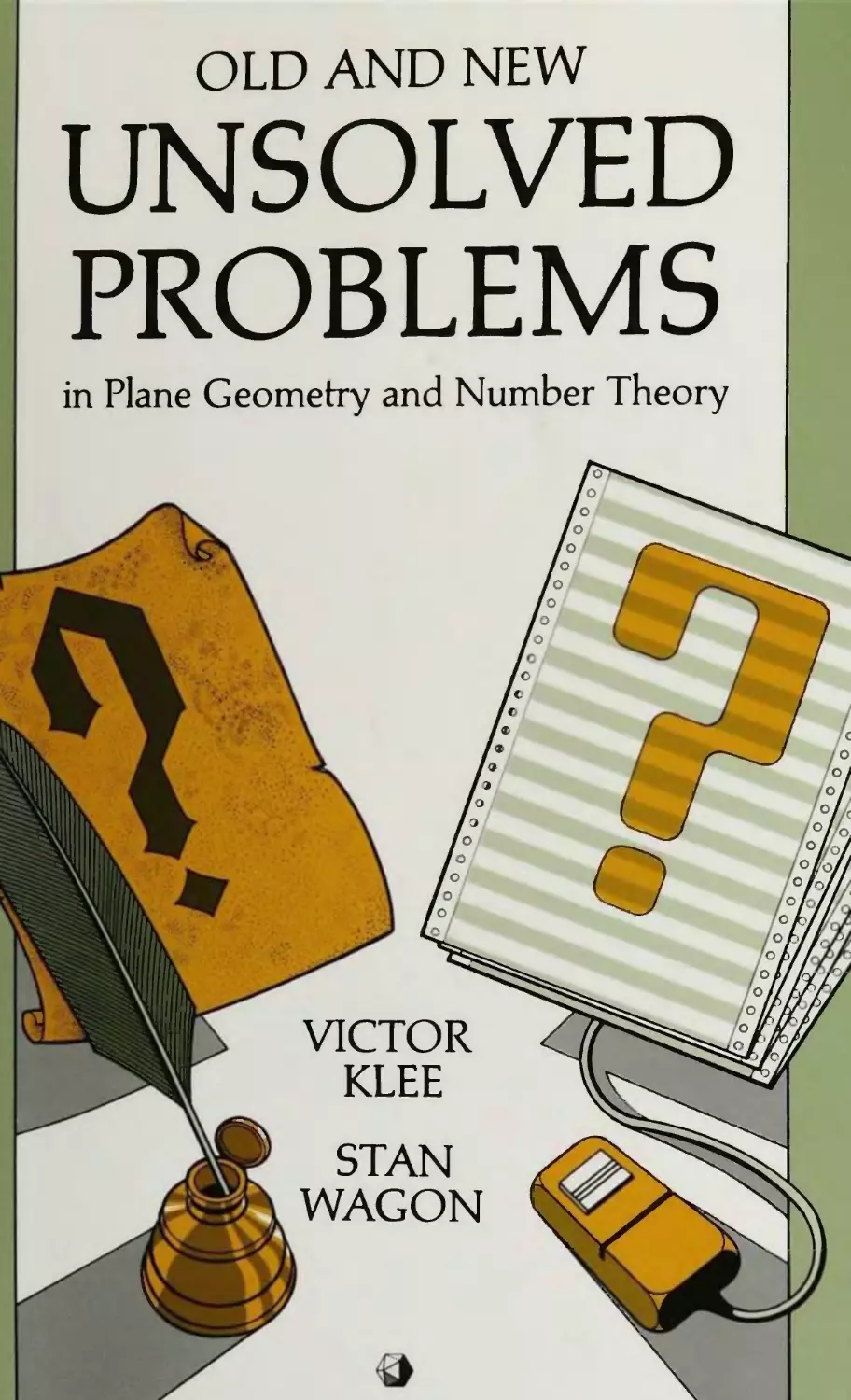
OLD AND NEW
U
PR
in Plane Geometry and Number Theory
.
\\\\\\ II
I
III
\\ \ - 11
'" '
I I
,,'!
,
\.
.
VICTOR
KLEE
STAN
WAGON
"
, T
'..., .
OLD AND NEW
UNSOLUED PROBLEMS IN
PLANE GEOMETRY AND NUMBER THEORY
UICTOR KLEE AND STAN WAGON
THE
DOLCIANI MATHEMATICALEXPOSmONS
Published by
THE MATHBMATICALASSOCIATION OF AMERICA
Committee on Publications
DONALD ALBERS, Chainnan
Dolciani Mathematical Expositions Editorial Board
JOE R BUHLER, Chairman
CHRISTINE AYOUB
JOHN H. EWING
JOHN R. LUX
Doleiani Mathematical Expositions series design
ROBERTISHI + DESIGN
TEX macros
RON WHITNEY
The Dolciani Mathematical Expositions
NUMBER ELEVEN
OLD AND NEW
UNSOLVED PROBLEMS IN
PLANE GEOMETRV AND NUMBER THEORV
UICTOR KLEE
University of Washington
STAN WAGON
Macalester College
Published and Distributed by
THE MATHEMATICAL ASSOCIATION OF AMERICA
@1991 by
The Mathematical Association of America (Incorporated)
Library of Congress Catalog Card Number 91-61591
Complete Set ISBN 0-88385-300-0
Vol. 11 ISBN 0-88385-315-9
Printed in the United States of America
Current printing (last digit):
1098765432
Figures 7.5, 7.6, and 7.8 are reprinted by pennission of the publisher from Figures 3.8.6,10.3.16, and
10.3.28, respectively, by B. Griinbaum and G. C. Shephard, Ti/ings and Patterns, pp. 156, 542, and 548.
Copyright 1987 by W. H. Freeman and Company.
Figure 12.3 is reprinted by pennission of the publisher from Figure 1.15 by J. A. Bondy and U. S. R.
Murty, Graph Theory with Applications, p. 22. Copyright 1976 by Elsevier Science Publishing Co., Inc.
The DOLCIANI MATHEMATICAL EXPOSmONS series of the Mathematical As-
sociation of America was established through a generous gift to the Association from Mary E
Dolciani, Professor of Mathematics at Hunter College of the aty University of New York. In
making the gift, Professor Dolciani, herself an exceptionally talented and successful expos-
itor of mathematics, had the purpose of furthering the ideal of excellence in mathematical
exposition.
The Association, for its part, was delighted to accept the gracious gesture initiating the
revolving fund for this series from one who has selVed the Association with distinction, both
as a member of the Committee on Publications and as a member of the Board of Governors.
It was with genuine pleasure that the Board chose to name the series in her honor.
The books in the series are selected for their lucid expository style and stimulating
mathematical content. 1}rpically, they contain an ample supply of exercises, many with ac-
companying solutions. They are intended to be sufficiently elementary for the undergraduate
and even the mathematically inclined high-school student to understand and enjoy, but also
to be interesting and sometimes challenging to the more advanced mathematician.
DOLCIANI MATHEMATICAL EXPOSmONS
1. Mathematical Gems, Ross Honsberger
2. Mathematical Gems II, Ross Honsberger
3. Mathematical Morsels, Ross Honsberger
4. Mathematical Plums, Ross Honsberger (ed.)
S. Great Moments in Mathematics (Before 1650), Howard Eves
6. Maxima and Minima without Cakulus, Ivan Niven
7. Great Moments in Mathematics (After 1650), Howard Eves
8. Map Coloring, Polyhedra, and the Four.Color Problem, David Barnette
9. Mathematical Gems HI, Ross Honsberger
10. More Mathematical Morsels, Ross Honsberger
11. Old and New Unsolved Problems in Plane Geometry and Number Theory, Victor Klee and
Stan Wagon
12. Problems for Mathematicians, 1Vung and Old, Paul R. Halmos
13. Excursions in Calculus: An Interplay of the Continuous and the Discrete, Robert M. Young
14. The Wohascum County Problem Book, George 1: Gilbert, Mark Krusemeyer, and Loren
C. Larson
The Mathematical Association of America
1529 Eighteenth Street, NW
Washington, DC 20036
800.331-1622 FAX 202.265-2384
CONTENTS
Preface .................. ........ XI .
...................................... ......... ............
Chapter 1.1\vo-Dimensional Geometry
Inttoduction .............................................................................1
1. Illuminating a Polygon.... . . ... .... .... ... .. ... .. .... ................ .3-11, 71-79
Is each reflecting polygonal region illuminable?
2. Equichordal Points ............................................................. 12-15, 80--85
Can a plane convex body have two equichordal points?
3. Pushing Disks Together .............. . . . . . . . . . . . . . . . . . . . . . . . . . . . . . . . . 16-20, 86-90
When congruent disks are pushed closer together, can the area of their
union increase?
4. Universal Covers ........................................................... .21-24, 91-94
If a convex body C contains a translate of each plane set of unit diameter,
how small can C's area be?
5. Forming Convex Polygons ..........................................25-28,95-102
How many points are needed to guarantee a convex n-gon?
6. Points on Lines ............................................................................... 29-35, 103-110
If n points are not collinear, must one of them lie on at least
n connect-
ing lines?
7. Tiling the Plane .. . . . . . . . . . . . . . . . . . . . . . . . . . . . . . . . . . . . . . . . . . . . . . . . . .36-44, 111-119
Is there a polygon that tiles the plane but cannot do so periodically?
8. Painting the Plane ................................................ 45-49, 120-127
What is the minimum number of colors for painting the plane so that no
two points at unit distance receive the same color?
9. Squaring the Circle ............................................... SO-53, 128-131
Can a circle be decomposed into finitely many sets that can be rearranged
to form a square?
10. Approximation by Rational Sets ...................................54-57, 132-136
Does the plane contain a dense rational set?
11. Inscribed Squares ................................................. 58-65, 137-144
Does every simple closed curve in the plane contain aU four vertices of
some square?
12. Fix'ed Points ...................................................... 66-70, 145-150
Does each nonseparating plane continuum have the fixed-point prop-
erty?
References ...................................................................... 1S1
vii
viii
CONTENTS
Chapter 2. Number Theory
Introduction .................................................................... 167
13. Fermat's Last Theorem ......................................... 168-172, 199-202
Do there exist positive integers :c, y, and z and an integer n > 3 such that
:c'" + yf1. = zf1.?
14. A Perfect Box.................................................. 173-174,203-205
Does there exist a box with integer sides such that the three face diagonals
and the main diagonal all have integer lengths?
15. Egyptian Fractions ............................................. .175-177, 206-208
Does the greedy algorithm always succeed in expressing a fraction with
odd denominator as a sum of unit fractions with odd denominator?
16. Perfect Numbers....... . ... . . ....... .. .. . .... ...... . ....... . ... .178-181,209-214
Is there an odd perfect number? Are there infinitely many even perfect
numbers?
17. The Riemann Hypothesis ....................................... 182-185, 215-220
Do the nontrivial zeros of the Riemann zeta function all have real part
!?
2 .
18. Prime Factorization ..... . . . . . . . . . . . . . . . . . . . . . . . . . . . . . . . . . . . . . . . .186-190, 221-224
Is there a polynomial-time algorithm for obtaining a number's prime fac-
torization?
19. The 3n + 1 Problem ............................................ 191-194, 225-229
Is every positive integer eventually taken to the value 1 by the 3n + 1
function?
20. Diophantine Equations and Computers.......................... 195-198,230-233
Is there an algorithm to decide whether a polynomial with integer coeffi-
cients has a rational root?
References ...................................................................... 234
Chapter 3. Interesting Real Numbers
Introduction .................................................................... 239
21. Patterns in Pi .... . . . . . . . . . . . . . . . . . . . . . . . . . . . . . . . . . . . . . . . . . . . . . . .240-242, 251-254
Are the digits in the decimal expansion of 11' devoid of any pattern?
22. Connections between 11' and e ........................................ 243, 255-257
Are 11' and e algebraically independent? Is their ratio rational?
23. Computing Algebraic Numbers ..................................244-247,258-260
If an irrational number is real-time computable, is it necessarily transcen-
dental? Is V2 real-time computable?
24. S ummin g Reciprocals of Powers .................................248-250,261-264
111 . " a1 ?
Is 1 + 2S' + 3B" + 4S" + . . . IIl'atIon .
References ................... . . .. .. .. .. . . .. .. . .. . .. .. .. .. .. .. .. .. .. .. . . . . . . . . . . . . . . . . . . . . . . . . . . . . 265
CONTENTS
ix
Hints and Solutions: 1Wo-Dimensional GeometIy .................................. 269
Hints and Solutions: Number Theol}' ........... . . . . . . . . . . . . . . . . . . . . . . . . . . . . . . . . . . .300
Hints and Solutions: Interesting Real Numbers
. .... ........ ..... ..... ... .... ... ...
311
Gloss.aJy ........................................................................ 315
Index of Names . . . . . . . . . . . . . . . . . . . . . . . . . . . . . . . . . . . . . . . . . . . . . . . . . . . . . . . . . . . . . . . . . .325
Subject Index. . . . . . . . . . .. . . . . . . . . . . . . . . . . . . . . . . . . . . . . . .. . . . .. . . . . . . .. . . . . . .. . . . . .331
Addendum ...................................................................... 335
PREFACE
THE ROLE OF UNSOLUED PROBLEMS
As mathematics becomes ever more complex, more structured, and more special-
ized, it is easy to lose sight of the fact that the research frontiers still contain many
unsolved problems that are of immediate intuitive appeal and can be understood
very easily, at least in the sense of understanding what a problem asks. Parts of
plane geometry and number theory are especially good sources of such intuitively
appealing problems, and those are the areas emphasized in this book. For each of
the presented problems, we look at its background, try to explain why some mathe-
maticians have found the problem of special interest, and tell about techniques that
have been used to obtain partial results. Some of the exercises will help out readers
establish partial results for themselves, and references are provided for those who
want to learn more about the problems.
All mathematical discoveries may be said to consist of the solution of unsolved
problems. Sometimes a question is answered almost as soon as it is formulated.
Then the question and its answer are published together, and the question never
becomes known as an unsolved problem. In other cases, a mathematical question
may be formulated long before anyone is able to answer it. If the question becomes
widely known, many researchers may direct their efforts toward answering it and
the unsolved problem may have a significant influence on the development of math-
ematics.
Some unsolved problems are conceptually very simple and specific-for exam-
ple, "Is the answer 'yes' or 'no'?", "What is the value of this function at a specified
point of its domain?" Others are conceptually sophisticated-for example, "How
xi
xii
PREfACE
can such and such a theory or argument be extended so as to apply to a certain more
general class of objects?" Both the simple and the sophisticated problems have
played an important role in the development of mathematics, and often they are
inextricably mingled. Some of the .'simplest" unsolved problems, such as Fermat's
last "theorem" (see Section 13) have led directly to some of the most sophisticated
mathematical developments and, in turn, to sophisticated unsolved problems. On
the other hand, the solution of a sophisticated problem often requires answering a
number of simple, specific questions. Thus it is probably unreasonable to try to de-
cide whether the simple or the sophisticated problems have been more important
in the development of mathematics. In any case, this book is devoted exclusively to
problems of the simple sort-ones whose statements are short and easy to under-
stand.
Some of the more modem areas of mathematics are poor sources for the sort
of unsolved problem that is emphasized here. If one thinks of mathematical disci-
plines as buildings, some could be represented by buildings that are very tall but also
quite narrow, with a few important research problems sprouting out of the roof. In
order to reach these unsolved problems, one must climb through the many lower
floors of the building, and on each floor must make one's way through numerous
definitions and theorems that may be necessary for even understanding what the
unsolved problems are about. By contrast, we are concerned here with some parts
of mathematics that can be represented as broad, low buildings, with a high ratio of
roof area (research problems) to volume. Any particular problem can be reached,
at least in the sense of understanding what it asks, by entering the building through
the proper door and climbing only one or two flights of stairs. It is striking that plane
geometry and elementary number theory, the oldest branches of mathematics, still
offer such a large supply of easily understandable, intuitively appealing, unsolved
problems. This book contains some of our favorite examples from each subject.
Before proceeding to the problems themselves, we should admit that our pic-
ture of branches of mathematics as buildings is misleading in some important re-
spects. For example, we have pictured elementary number theory as a broad, low
building, and many mathematicians would think of the subject of algebraic geom-
etry as one of the tallest, most highly structured buildings. However, algebraic ge-
ometry has provided some of the most important tools for dealing with some of the
most "elementary'7 problems of number theory, such as Fermat's last theorem. This
illustrates the intermingling of simple problems and sophisticated problems, and.
the important distinction between understanding a problem in the sense of having
an intuitive grasp of what it asks, and the much deeper understanding that requires
knowing enough to have some chance of solving the problem or at least discovering
new results that are relevant to it. For each problem in this book, we hope to have
provided enough information to enable the reader to understand the problem in at
PREfACE
xiii
least the first sense. It remains to be seen what is required for understanding in the
second sense. However, we don't believe that all of the problems presented here
will require sophisticated methods for their solution. Probably some will be solved
by means of a single really clever idea. There's no monopoly on clever ideas, and
your chance of solving some of the problems may be as good as anyone's!
Part of the appeal of elementary problems is the feeling that they ought to have
solutions that are equally elementary. But elementary problems can have exceed-
ingly complex solutions. A notorious example is the four color theorem (every map
in the plane can be colored with four colors so that adjacent countries are colored
differently); its statement is simple but its proof, discovered in 1976 by K Appel and
W. Haken, is long, subtle, and involves an extensive computer calculation. Another
example is a less well-known result due to R Monsky: It is impossible to dissect a
square into an odd number of triangles having equal area (see Section 7 for a dis-
cussion of this result and its extensions). The only known proofs use a sophisticated
concept from field theory. Mathematics is full of simple-sounding statements that
have been proved, but whose proofs are complicated, using the most sophisticated
tools mathematicians know. But that's not the worst of it. It may be that for cer-
tain elementary conjectures, no proof of either the conjecture or its negation exists.
Most interesting questions deal with infinitely many instances; indeed, much of the
power and beauty of mathematics consists of finding a finite proof that answers in-
finitely many instances of a question. As observed by Haken 1 in an interesting paper
that contains both details of the four color theorem's proof and some philosophi-
cal observations, it may be that "infinitely many single statements of a conjecture
have infinitely many individual and significant differences so that a proof of the
conjecture is impossible since it would require infinitely many case distinctions."
(For more on the possibility that simple problems are undecidable, see Section 20.)
Thus amateur and professional mathematicians are in comparable situations. An
amateur might spend years searching for an elementary solution to an elementary
unsolved problem, confident that such a solution exists. A professional, armed with
supercomputers and the cumulative technical knowledge of generations of brilliant
mathematicians, might attack a problem confident that a solution, perhaps a com-
plicated one, exists. But both run the danger of being stymied by the nonexistence
of the objects of their search.
Nevertheless, some of the open problems in this book may indeed have simple
solutions. The fact that a problem has been unsolved for centuries does not mean
that a simple solution fails to exist. Tho examples: Euler wondered two centuries
ago whether four fifth powers could sum to a fifth power. Here is an extremely
simple solution, though one that would be difficult to find without a computer:
1 (
n attempt to understand the four color problem," Journal of Graph Theory, 1 (1977) 193-206.
xiv
PREfACE
27 5 + 84 5 + 110 5 + 133 5 = 144 5 (see p. 171). Another question going back to work
of Euler is whether the sum of the infinite series 1 + 1/23 + 1/33 + 1/43 + 1/53 +...
is an irrational number.
Here too there is a fairly elementary proof that remained undiscovered for
centuries until Apery's work in 1978 (see pp. 249, 263).
One of the dangers inherent in writing a book on unsolved problems is that
they will not be unsolved for long. We were pleasantly surprised when, in 1990, Mik-
los Laczkovich resolved the infamous circle-squaring problem (section 9). This was
a problem that we thought was very difficult and might be unsolved for decades.
And then in 1992 Marek Rychlik announced a solution of the two-equichordal-
points problem (section 2). But none of this prepared us for the shock in late June
of 1993, when Andrew Wiles stunned the mathematical community by proving Fer-
mat's last theorem (section 13). Unlike the other two problems, this one goes back
to the 1650s and had resisted the attacks of many genemtions of the world's best
mathematicians. The solutions of each of these three problems involve techniques
far removed from the problem's statement. In the case of Fermat's last theorem,
the solution uses some of the deepest results of modem mathematics.
Although the mathematical community is generally pleased at such progress,
there is also a little sadness when a great problem falls. As Wiles said [New IVrk
Times, June 29,1993]: "There is a sense of loss." 'llue mystery lies in the unkn own;
we hope that the still-unsolved problems in this book give a sense of the mystery
and beauty that still live in the realm of elementary mathematics.
ORGANIZATION OF THE BOOK
Each section of the book is devoted to a single problem or a related group of prob-
lems, and each section is divided into two parts. The first part is elementary. Its
main goal is to supply the necessary definitions, convey some intuitive feeling for
the problem, and present some easy proofs of relevant results. The second part
contains more advanced arguments and mentions references. We hope that all of
each first part and some of each second part will be accessible to undergraduate
mathematics majors, and that everything in the book will be accessible to all grad-
uate students of mathematics. On the other hand, since the presented problems
are unsolved, and since fairly extensive references are supplied, there may be some
interest in the research community as well.
The sections are arranged in three chapters. In each chapter, the first parts
are grouped together, followed by the second parts. Thus the reader may peruse
an entire collection of first parts without being distracted by technical details or
references, and may then consult the second parts and the references for more
information about whichever problems seem most appealing. References appear at
PREfACE
xv
the ends of the individual chapters, and also in the Addendum that is incorporated
in this second printing.
ACKNOWLEDGEMENTS
For helpful mathematical or editorial comments, or for supplying useful material,
we are indebted to Donald Albers, Vojtech BaIint, Miroslav Benda, Joe Buhler,
Vasilis Capoyleas, Kiran Chilakamarri, Herbert Edelsbrunner, Paul ErdOs, John
Ewing, Klaus Fischer, Richard Gardner, Chris Godsil, Eli Goodman, Peter Gruber,
Branko Griinbaum, Richard Guy, Charles Hagopian, Joan Hutchinson, John Isbell,
Aleksander Ivic, Peter Johnson, James Jones, Martin Kneser, Wlo dzimi erz Kuper-
berg, Miklos Laczkovich, David Larman, Dragoslav Ljubic, Erwin Lutwak, Howard
Masur, Mark Meyerson, Giacomo Michelacci, Paul Monsky, William Moser, Jan
Mycielski, Mark Nielsen, Andrew Odlyzko, Janos Pach, Roger Penrose, Richard
Pollack, Carl Pomerance, George Purdy, Basil Rennie, Peter Renz, Boyd Roberts,
Jack Robertson, Raphael Robinson, Joel Rogers, Moshe Rosenfeld, Marek
Rychlik, Reinhard Schafke, John Smillie, Alexander Soifer, Sherman Stein, Walter
Stromquist, Bernd Sturmfels, Sam Wagstaff, Gerd Wegner, Stephen Wright and
Joseph Zaks. Of course, any errors are our own, and we hope that readers will
write to tell us about them.
Finally, we want to record our special thanks to the MAPls Beverly Ruedi, who
took our jumbles of computer files and turned them into a book. It was a pleasure
to work with her.
Victor Klee
University of Washington
and
Stan Wagon
Macalester College
CHAPTER 1
TWO-DIMENSIONAL GEOMETRY
INTRODUCTION
Of the ideas that lead beyond the geometry of Euclid, the notion of a convex
set may be the one that would have been most easily understood by the ancient
Greeks. In fact, a close relative of this notion was defined by Archimedes. A set
is convex if it includes, with each pair of its points, the entire line-segment joining
them. (Intuitively, a convex set is one that has neither holes nor dents.) As a source
of appealing, easily stated unsolved problems, the study of low-dimensional convex
sets rivals number theory and graph theory. Thus it is not surprising that convex sets
playa central role in many of the sections of this chapter. However, there are also
problems that don't involve convexity, and some of them involve modem (though
elementary) set-theoretical and topological notions.
In the title of this book, the term "plane geometry'7 was used for brevity. How-
ever, that may suggest an axiomatic approach, and our approach here is certainly
not axiomatic. Rather, our viewpoint is that the geometric objects really exist, and
we want to study them in an efficient way. For that purpose, the most appropri-
ate setting seems to be the cartesian plane R2, complete with its usual topology
and basic vector operations. The title of this chapter, Tho-Dimensional Geome-
try, is intended to suggest that, although all of the main discussion is in R 2 and
the various Parts One are confined to R 2 , many of the problems have interesting
higher-dimensional analogues that are discussed briefly in Part Tho.
1
2
INTRODUCTION
In each section, the "title problem" is the one that begins the section and is
stated in the Thble of Contents. However, most of the sections include a variety of
other, equally interesting problems that are related in spirit to the title problem.
The variety is especially marked in Section 1, which concerns the role of reflections
in illumination and billiards.
Problem 6 is conceptually the simplest. It does not involve distance or angle or
area, only the incidence of points and lines. Problem 5 involves convex polygons as
well, and Problem 3 involves areas of unions of disks, but these problems would also
have been easily understood by the ancient Greeks. Problems 2 and 4 are simple,
but they do involve more general convex sets than the other problems just men-
tioned. Problems 7 and 8 concern subdivisions of the entire plane, rather than just
part of it. Problem 9 deals with a striking interaction between the simplest convex
sets (circles and squares) and sets that probably no one would agree to call "ge-
ometric figures." Problem 10 involves some relationships between geometry and
number theory, while Problems 11 and 12 involve topological notions.
Several of the problems are striking for the great disparity between what is
known and what may be true. For some of them, this disparity can be expressed
in a quantitative way. Problem 3 originates from the conjecture that when several
congruent disks are pushed closer together, the area of their union Can't increase.
However, the best that has been proved is that it can't increase by a factor of more
than 9. Problem 6 was motivated by a conjecture that when n points in the plane
are not all collinear, and when all the lines determined by pairs of these points are
added to the configuration, then one of the points is on at least in of the lines. Some
small counterexamples show that in doesn't always work, but perhaps ln does. It
was proved initially (but not easily) that 10- 1081 n always works, and that has been
improved to 10-32 n - s till a long way from In. A more technical result in Section 1
involves a smoothness assumption for the boundary curvature of a convex billiard
table. The original theorem assumed the curvature to be 553 times differentiable.
The 553 has been reduced to 6, but a further reduction is probably possible.
The most easily stated problems are 8 and 10. Problem 8 asks, "What is the
minimum number of colors for painting the plane so that no two points at unit dis-
tance receive the same color?" It has been known since 1960, when the problem first
appeared in print, that the number is 4, 5, 6, or 7, but no one has been able to nar-
row the possibilities further. Problem 10 asks, "Does every simple closed curye in
the plane contain all four vertices of some square?" An affirmative answer has been
known since 1913 for all sufficiently smooth convex curves, and more recent results
have avoided the convexity assumption. However, there is a sense in which most
simple closed cmves are not smooth at aU, and thus it is possible that the answer
is negative for most curves. Despite their ease of statement (or perhaps because
of it!), Problems 8 and 10 have, like many of the other problems considered here,
twO-DIMENSIONAL GEOMETRY: Part I
3
been the subject of incorrect published results. As we mentioned in the Preface, it
is tempting to believe that an easily stated problem should have an easy solution.
The reader is cautioned against believing that for most of the problems stated here.
There are other good sources of information about easily understood unsolved
geometric problems. We mention especially the book on tiling by B. Oriinbaum
and G. Shephard [GS4] and the books on lattice point problems by J. Hammer
[Ham] and
Erdos,
Gruber, and Hammer [EGH]. In addition, there are three
excellent collections of unsolved problems that will soon become books-those of
Erdos and G. Purdy [EP3], of H. Croft, K. Falconer, and R. Ouy [CFO], and of
W. Moser and J. Pach [MP] (developed from an earlier collection of L. Moser).
We should also mention the numerous articles of Erdos, Erdos and Purdy, L. Fejes
Toth, Griinbaum, and H. Hadwiger, some of which are included in our list of ref-
erences. Another good source of geometric problems is the "Unsolved Problems"
section in the American MathematicalMonthly. And there are many other sources-
too many to mention them all. It seems clear that the oldest part of mathematics
will continue to provide challenges (and surprises) for many years to come.
I. IllUMINATING A POLYGON
Problem I
Is each reflecting polygonal region illuminable?
Imagine life in a two-dimensional world where electricity and skilled construc-
tion are very expensive but reflecting materials are cheap. One might live in a room
whose shape resembles that of Figure 1.1 and whose walls are mirrors, and one
might hope to illuminate the entire room by a single light source. Can this always
be done, regardless of the room's shape? If it can be done, how should one discover
where to place the light source?
Light rays issue in all directions from the source, and each ray continues on its
way according to the usual rule: "angle of reflection equals angle of incidence." The
room is illuminated by a given source if each point of the room lies on at least one
of the rays. For each position of the light source s, the points that are illuminated
directly from s (without using reflections) form a set that is geometrically simple,
for it's a union of straight-line segments issuing from s. (Such a set is said to be star-
shaped from s). However, this simple picture rapidly becomes complicated as more
and more reflections are taken into account, and when the number of reflections is
4
I. ILLUMINATING A POLYGON
FIGURE 1.1
Can a light source be placed so as to illuminate the entire room, assuming each wall is
a mirror?
unlimited the analysis becomes very difficult. In fact, both of the following questions
are open, and they may have different answers.
Problem 1.1
Can each reflecting polygonal room be illuminated from at least one of
its points?
Problem 1.2
Can each reflecting polygonal room be illuminated from each of its points?
Perhaps there is a polygonal room that is illuminated for at least one placement
(or even for ....almost all" placements) of the light source, but for which at least one
placement does not result in total illumination. If there is such a room, it provides
an affirmative answer to 1.1 but a negative answer to 1.2.
We shall also be concerned with rooms whose walls are curved rather than
polygonal. When a ray strikes the boundary curve at a point where the curve has
a tangent, the angles of incidence and reflection are defined as those that the ray
makes with the tangent. And we assume that when the ray strikes a boundary point
where there is no tangent (e.g., a comer of a polygonal room), the ray is absorbed
and does not continue (see Exercises 1 and 2).
Unless the contrary is stated, we assume that the room's boundary consists of
a single simple closed curve (also called a Jordan cUIVe )-a continuous path in the
plane that doesn't cross itself and ends where it started. In the polygonal case, this
path is formed from a finite sequence of line-segments. The answers to Problems
1.1 and 1.2 may change if the room is permitted to have "holes," and may also be
affected by a requirement that the light SOlifce s
ould be interior to the room, or
TWO-DIMENSIONAL GEOMETRY: Pari'
5
FIGURE 1.2
This region with smooth boundary is not llIuminable from any point.
on the room's boundary. (Unless the contrary is stated, both sorts of placement are
permitted here.)
Now let's consider smooth rather than polygonal boundaries. In Figure 1.2, the
boundary is formed by an upper half-ellipse E with foci p and q, a lower half-ellipse
E' with foci p' and q', and two CUlVes that connect these to form a single smooth
Jordan CUlVe. Recall that the foci of an ellipse are so called because whenever a
light ray issues from one of the foci and strikes the ellipse, it is immediately reflected
back through the other focus. From this it follows easily that when a ray crosses the
segment pq and strikes E, it is immediately reflected back across pq (Exercise 3).
Hence the room is not illuminable from any point, for if the light source is below
the line pq then the areas labeled S are not illuminated and if the source is above
the line p' q' then the areas labeled S' are not illuminated.
For each positive integer n, n copies of Figure 1.2 can be joined as in Figure 1.3
to produce a smoothly reflecting region that is not illuminable from any n (or even
from any 2n - 1) sources-that is, even when 2n - 1 light sources are permitted, it
is impossible to place the sources so as to illuminate the entire room. By extending
this construction still further, using a shrinking sequence of copies of Figure 1.2 and
adding a single limit point p, we obtain a reflecting region that is smooth except at
p and cannot be illuminated from any finite number of light sources.
The easy analysis of the preceding smooth examples suggests an intriguing
question: Can we obtain an unilluminable polygonal region by taking a sufficiently
close polygonal approximation of an unilluminable smooth region?
If good workmanship should become less expensive, we might be able to afford
a room that is convex. Then we could illuminate the entire room directly by an
arbitrary placement of a single light source that emits rays in all directions. But
suppose now that the light source is a laser J emitting only a single ray. Can we, with
6
I. ILLUMINATING A POLYGON
FIGURE 1.3
For each n there is a smoothly bounded reflecting region such that even n light
sources do not suffice for total illumination.
the aid of reflections, hope to illuminate the entire interior of the room? The answer
is negative, regardless of the shape of the room's boundary and even if an arbitrarily
large finite number of single-ray light sources is permitted. This follows from the
fact that no circle can be completely covered by a sequence of lines (Exercise 4).
Though we can't illuminate the entire room by a single reflected ray, can we
at least come close to doing so? As an aid to intuition, let's regard the room as the
surface of a billiard table and refer to the rays as billiard paths. In our special game
of billiards, an opponent invisibly marks a small disk somewhere on the table. We're
free to put the ball wherever we like, and to strike it in any direction we choose. We
win the game if our billiard path passes over the opponent's disk (equivalently, if
our laser ray illuminates some point of the disk). We don't know where the disk has
been placed or how small it may be, so we want to be sure that our path passes over
every disk on the surface of the table. In mathematical terms, the path should be
dense in the table. The shape of the table determines whether such a path exists, and
this question of existence is still open for many shapes. In particular, the following
question arises.
Problem 1.3
Does each polygonal table admit a dense billiard path? How about trian-
gular tables?
Let us say that a polygonal table is rational if each of its angles is a rational
multiple of 1r. The following known result is too deep to prove here, but the special
case of a square table is discussed in Part 'fivo.
Theorem 1.1. On each rational polygonal table there is a dense billiard path.
A billiard path may be described by the sequence POPIP2 . . . that lists the path's
starting point Po and its succ
sive contacts with the boundary. The path is said to
TWO-DIMENSIONAL GEOMETRY: Part I
l
be periodic with period k if Pi+1c = Pi for each i > 1. Such a path is very far from
being dense in the table, for it consists of only a finite number of segments. It's easy
to see that when the table is an acute triangle, there is a billiard path of period 3
(Exercise 5) and it is known also that each right triangle admits a billiard path of
period 6. However, the following problem is open.
Problem 1.4
Does each polygonal table admit a periodic billiard path? How about ob-
tuse triangular tables?
As in the case of Problem 1.3, special methods are available for rational poly-
gons.
Theorem 1.2. On each rational polygonal table there is a periodic billiard path.
Now let's take a look at smooth tables. It's easy to see that when the table T
is circular, no billiard path is dense in T. For if the initial segment POPl is collinear
with the center c, then PlP2 is a diameter of T and the ball merely bounces back
and forth along this diameter. If PoPl is not collinear with c, then PlP2 is tangent
to a smaller circle 0 centered at c, and all the later segments are also tangent to
o (Figure 1.4). (The circle 0 is said to be a caustic for the table T. Caustics are
discussed in Part 1\vo.) Thus it's clear that no matter which path we produce, we
can't be sure it will pass over the opponent's invisible disk. However, we can be sure
of winning if we know the size of the disk in advance (Exercise 6).
FIGURE 1.4
If T is a circular table, 0 is a smaller concentric circle, and P is a billiard path in
which one segment is tangent to G, then a(T segments of P are tangent to C.
8
I. ILLUMINATING A POLYGON
How about periodic paths on a smooth table? On a circular table, each diame-
tral path is of period 2, and for each k > 3 an inscribed regular k-gon provides a
billiard path of period k. Here's a more general result.
Theorem 1.3. Suppose that the table T is smooth and convex; and that k > 2. Let
P be a convex k-gon of maximum perimeter inscribed in T. Then P provides a billiard
path of period k.
Outline of Proof. A ee2-gon of maximum perimeter" is obtained by taking two
boundary points p and q at maximum distance in T. Using the maximality and the
fact that T is convex, it's easy to see that T's tangents at p and q are both perpen-
dicular to the segment pq. Hence a billiard path that starts along the segment pq
continues to run back and forth along that segment.
Suppose now that k > 3, and consider the successive vertices vo, VI, . . . ,Vie =
Vo of a convex k-gon P of maximum perimeter inscribed in T. For each i, let L i de-
note the line that is tangent to T at the point Vi. To show that P provides a billiard
path of period k, it suffices to show that for each i, the segments Vi-IVi and Vi+1Vi
make equal angles with the line L i . Suppose, for example, that this fails when i = 1,
and that the segment VOVI makes a smaller angle with L 1 than does the segment
V2Vl. Then, from the fact that L 1 is tangent to T at VI, it can be shown that mov-
ing the point VI along the boundary slightly in the direction of Vo will produce an
inscribed k-gon of greater perimeter. (See Figure 1.5 and Exercise 7.) 0
Ca)
.......
..-
.--
........
.......
(b)
(c)
FIGURE 1.5
If an inscribed convex k-gon is of maximum perimeter, it produces equal angles of
incidence and reflection and hence provides a billiard path of period k.
TWO-DIMENSIONAL GEOMETRY: Pan I
9
Finally, let us consider the problem of illuminating a polygonal room when
the costs of careful construction and reflecting materials are prohibitive. We can
no longer afford to build with mirrors, so we must rely on direct illumination. We
cannot afford a convex (or even a star-shaped) room, so we cannot hope to illumi-
nate it with a single light source. Nevertheless, we would like to control the cost of
electricity by using the smallest possible number of light sources. The number of
sources needed is related to the number of edges of the polygonal boundary.
Theorem 1.4. For the direct illumination of a polygonal room with n edges, L n/3 J
light sources are occasionally necessary and always sufficient.
Outline of Proof. Remember that Lx J denotes the greatest integer not exceeding x.
Consideration of Figure 1.6 and its extensions shows that as many as L n/3 J sources
may be needed. To show that direct illumination can always be accomplished by
placing the sources at L n/3 J or fewer carefully chosen vertices of the polygon, we
use the following fact.
(A) H a Jordan polygon P has at least four vertices, there is a pair of vertices for
which the connecting open segment is interior to P.
To prove (A), let the vertices (in order of traversal of the polygon) be vo, V1, . . . ,
V n (= vo), and let Vi be such that the polygon's interior angle Vi-1 ViVi+1 is less than
'Ir. (Since the sum of the interior angles of a simple n-gon is (n - 2)1r, such an i must
exist.) Assume for notational simplicity that i = 1. If the open segment VOV2 is not
interior to P, then the interior of the triangle VOV1 V2 contains at least one vertex of
P, and among such vertices there is a vertex w whose distance from the line VOV2 is
a maximum. But then the open segment V1 w is interior to P.
Now the following can be proved by induction on the number of vertices, using
the observation (A).
(B) H P is a Jordan polygon, then certain triples of p's vertices can be used to
form triangles whose union consists of P and the points inside P, the triangles
being such that whenever two of them intersect, the intersection is an edge of
each or a vertex of each. Also, the vertices can be colored in three colors so
that all three colors are present in each triangle. (See Exercise 8.)
Using (B), the proof of Theorem 1.5 is immediate. When the n vertices are
colored in three colors, some color (say red) is used at most L n/3 J times. Each of
the triangles has exactly one vertex that is colored red, so we may simply place the
light sources at the red vertices. 0
Theorem 1.5 is sometimes called an "art gallery theorem'" or a "watchman
theorem," for it has the following interpretation: if the walls of an art gallery are
made up of n straight segments, then the eJ1tire gallery can be supervised by L n/3 J
10
I. ILLUMINATING A POLYGON
watchmen placed at appropriate comers of the gallery. There are other art gallery
theorems and related unsolved problems, some of which will be encountered in
Part Tho.
fiGURE 1.6
When there are n edges in the boundaIY of this sort of room, direct illumination
cannot be accomplished with fewer than l n/3 J light sources.
Exercises
1. We assume here that light rays are absorbed when they strike a comer of a
polygonal room. However, if a ray R strikes a corner at which there is an interior
right angle, it is reasonable (on grounds of continuity) to assume that R is reflected
back on itself. Explain why this is so. (It may be helpful to consider Exercise 2 in
conjunction with this one.)
2. Suppose that half-lines H and L form an angle A of radian measure 0:, with
21r /5 < 0: < 21r /3. With B denoting the half-line that bisects A, suppose that two
light rays RH and RL run parallel to B but are on opposite sides of B, with RH
striking H first and RL striking L first. Show that after RH is reflected from H, it
strikes L and then continues along a half-line SH that lies entirely in A. Similarly,
after RL is reflected from L, it strikes H and then continues along a half-line SLo
that lies entirely in A. Show that the half-lines SH and SL are parallel if and only if
0: = 1r/2.
3. Consider a reflecting elliptical room with foci p and q. Show that if a segment
of a light ray crosses the segment pq, then the next segment of the ray also crosses
pq.
4. Show that if C is a circle and L1' L2' . . . is a sequence of lines, then there is
a point of 0 that does not belong to any Li.
5. ( a) Show that for each triangle W there is an acute triangle T that admits a
billiard path of period 3 similar to W.
(b) Show that each acute triangle T admits a billiard path of period 3.
6. For the special game of billiards that we have discussed, suppose that the
table is a circle of radius 1 and we know our opponent's invisible disk is of radius at
TWO-DIMENSIONAL GEOMETRY: Pan I
II
least E. How can we be sure of winning the game by producing a billiard path that
crosses the disk?
7. For the case in which k > 3, complete the proof of Theorem 1.3. (Hint: In
order to see clearly how the cosines of the angles of incidence and reflection are
relevant, cany out the argument first under the assumption that in a neighborhood
of the point V.it the boundary curve T actually coincides with the tangent Li. Then
discuss the general case by choosing a coordinate system in which Vi is the origin
and L i is the x-axis.)
8. Prove the statement (B) by induction on the number of vertices. (Hint: If
the Jordan polygon P has n edges, with n > 4, then P has an interior diagonal D of
the sort described in (A). This divides P into two Jordan polygons, Q and R, whose
intersection is D. Since each of Q and R has fewer than n edges, each is subject to
the inductive hypothesis.)
9. For the simple closed polygonal rooms shown in Figures 1.1 and 1.6, produce
triangulations of the sort described in (A) of the proof of Theorem 1.4. Then color
the vertex-set in the manner described in (B).
For further discussion of this topic, turn to page 71. For hints and solutions,
turn to page 269.
2. EQUICHORDAL POINTS
Problem 2
Can a plane convex body have two equichordal points?
A chord of a region R is a segment that joins two boundary points of R. Each
chord xy through an interior point p of R is divided by p into two subsegments px
and py. The point p is an equichordal point if all chords through p are of the same
length (i.e., the sum of lengths px+py is constant), anequireciprocal point if the sum
of reciprocals 1/ (px) + 1/ (PY) is constant, and an equiproduct point if the product
(px)(py) is constant.
The center of a disk is an equichordal point, an equireciprocal point, and an
equiproduct point. It's natural to wonder whether points of these and related sorts
are found in noncircular regions, and how many such points a region might have.
Most of the basic questions have been answered, but the simplest of all-whether
a plane convex region can have two equichordal points-is still open. It was posed
in 1916.
If the answer to Problem 2 is negative (which is probably the case), what hap-
pens when the region is not required to be convex? Let's use the term Jordan region
for a bounded subset of the plane whose boundary is a simple closed CUlVe. Then
the following is also open.
Problem 2.1
Can a Jordan region have two equichordal points?
It's easy to construct noncircular Jordan regions that have one equichordal
point. Imagine a fixed point p in the plane, and a segment of fixed length A that
must pass through p but is free to slide back and forth as well as to rotate about p.
The segment may be regarded as a sort of drawing arm, with markers attached at its
ends x and y. Let Xo and Yo be the initial positions of the ends, and then move the
end x along a curve J from Xo to Yo such that each point of J is at distance less than
A from p, and (except for Xo and Yo ) no two points of J are collinear with p. Then
J lies on one side of the line through Xo and Yo, and as x traces the curve J, y traces
a curve K on the other side of the line (see Figure 2.1). The union J UK bounds a
Jordan region R that has p as an equichordal point, and with extra care in choosing
J it may be assured that R is convex (Exercise 6 in Part Tho). By permitting the arm
12
TWO-DIMENSIONAL GEOMETRY: Part 1
13
%2 J
K
fiGURE 2.1
Use of a "drawing ann" to construct a noncircular region that has an equichordal
point.
to vary in length, the same technique can be used to construct noncircular regions
that have an equireciprocal point or equiproduct point (Exercise 1).
Now suppose that a Jordan region R has two equichordal points p and q, and
imagine two drawing arms-an arm xy through p and an arm x'y' through q, both
of the same fixed length-with their ends x and x' joined by a hinge. Let both arms
start with x and x' at a point Xo collinear with p and q, so that the ends y and y' also
start at the same initial position Yo _ As the hinge traces out half of R's boundary-a
curve J from Xo to Yo, each of the ends y and y' must trace out the same other half-
a cwve K from Yo to xo, even though the two arms are sliding and rotating about
the distinct points p and q. That is hard to imagine, especially when R is required to
be convex. It suggests that the answer to Problem 2 (and perhaps 2.1) is negative.
Of the principal problems treated in this book, Problem 2 may in a sense be
the least important. Whatever the answer turns out to be, a solution probably won't
have much influence on the rest of mathematics. However, because the problem is
so old and so easy to state, it's initating that no one knows the answer. It may have
been partIy a sense of initation that has led people to work on the problem. Of the
mathematicians attracted to it, some have thought they had established an affirma-
tive answer, others a negative answer, but as yet, none of the proposed solutions
in either direction has withstood close examination. A successful treatment of the
problem will probably require a delicate interplay between geometry and analysis,
and it is all too easy to gloss over crucial analytical details because they are "geo-
metrically obvious."
Many attacks on the infamous equichordal problem have started by assuming
that C is a plane convex body or Jordan region with two equichordal points and
14
2. EQUICHORDAL POINTS
then deducing other properties of C. If C does exist, some of the properties might
make it clear how to construct C. If C doesn't exist, perhaps that can be proved by
establishing two mutually contradictory properties. The most important properties
known for C (if it exists) are stated without proof in Theorems 2.1 and 2.3-2.6
below.
Theorem 2.1. If a Jordan region has two equichordal points p and q, it is symmetric
about the line pq and about the midpoint of the segment pq.
Corollary 2.2. No Jordan region has more than two equichordal points.
Proof of 2.2. In terms of the usual vector operations, symmetry of a set about a
point m means that for each point x of the set, the point x + 2( m - x) is also in the
set. If a Jordan region had more than two equichordal points, it would, by Theorem
2.1, have two different centers of symmetry, say m and m', and would then include
each point of the unbounded sequence
Zt = 2m' - m, Z2 = 2m - Zt = 3m - 2m!, . . . ,
Z2k-l = 2km' - (2k - l)m, Z2k = (2k + l)m - 2km',. . . .
That's impossible, because Jordan regions are bounded.
o
Theorem 2.3. If a Jordan region C has two equichordal points, its boundary cUIVe
B is very smooth; in fact, B can be given by means of functions that are infinitely
differentiable.
In 1956 one mathematician claimed to have proved that when C is convex,
B cannot be given by functions that are six times differentiable. A 1957 claim by
another mathematician replaced "six" by "two." In 1958, a third mathematician
proved that if C has two equichordal points, then B can be given by functions that
are analytic and hence infinitely differentiable. Thken together, these results would
show that no convex body has two equichordal points. However, there are errors
in the "proofs" of the first two results. This shows how easily one can go astray
in dealing with mathematical problems that, like this one, are easy to state and to
"understand" but for which little rigorous machinery has been developed.
For a region with two equichordal points p and q (if there is such a region!),
the eccentricity e is defined as the ratio of the distance pq to the length of the chord
through p and q.
Theorem 2.4. If e is the eccentricity of a Jordan region with two equichordal points
then e < 0.235.
TWO-DIMENSIONAL GEOMETRY: Part I
15
Theorem 2.5. FOT given
q, and e, at most one Jordan region has equichordal points
p and q and eccentricity e.
Theorem 2.6. There is a real-valued function 11, defined by a power-series convergent
in the open interval (0, va/2), such that h(e) = 0 whenever e is the eccentricity of a
Jordan region with two equichordal points.
Theorem 2.6 implies that the number of possibilities for e is at most countable
and hence, in view of Theorem 2.5, there are (up to similarity) at most countably
many possibilities for a Jordan region with two equichordal points.
Much of the above information may be viewed as evidence against the exis-
tence of a convex body (or even a Jordan region) with two equichordal points. On
the other hand, Part Tho contains some information about an almost successful at-
tempt to construct a Jordan region with two equichordal points. Our own guess is
that the answers to Problems 2 and 2.1 are both negative. However, at the time of
writing, neither of the following possibilities is excluded by anything that has been
published and subjected to careful and extensive examination:
a. there exists a nonconvex Jordan region with two equichordal points, but no
such convex region exists;
b. there exists a convex Jordan region with two equichordal points, but no such
nonconvex region exists.
Exercises
1. Suppose that a plane curve is given in polar coordinates by the equation r =
f(8) for 0 < 8 < -rr, where 1 is a positive continuous function. Let p, = max{/(8) :
o < 8 :5 -rr}. Under what conditions on p, can 1 be extended to a positive continuous
function on [0, 2-rr] so that the origin is an equichordal (respectively, equireciproca1,
equiproduct) point of the region {(r,8) : 0 < r < 1(8),0 < 8 < 2-rr}?
2. A subset 5 of the plane is said to be symmetric about the x-axis (respectively,
y-axis, origin) if for each point (x, y) of 5, the point (x, -y) (respectively, (-x, y),
( -x, -y» also belongs to 5. Show that each of these conditions is implied by the
conjunction of the other two.
3. Show that the foci of an ellipse are equireciprocal points.
4. Show that each interior point of a disk is an equiproduct point.
For further discussion of this topic, turn to page 80. For hints and solutions,
turn to page 273.
3. PUSHING DISKS TOGETHER
Problem 3
When congruent disks are pushed closer together, can the area of their
union increase?
The answer to Problem 3 is certainly negative when there are only two disks.
If two disks overlap, pushing them closer together increases the amount of over-
lapping, hence decreases the area of their union and increases the area of their
intersection. It seems that this should be true for any number of disks, and perhaps
it is. However, for more than two disks the effect of overlapping is more compli-
cated than might at first be supposed, and must be examined closely. The following
problem is also open.
Problem 3.1
When congruent disks are pushed closer together, can the area of their
intersection decrease?
Even the notion of pushing the disks closer together must be examined care-
fully. Do we mean merely that in the new positions of the disks (after the pushing),
the distance between the centers of any two disks is less than or equal to their dis-
tance in the original positions? Or do we mean that there is a continuous shrinldng-
a way of moving the centers continuously from their original to their new positions
in such a way that at no time during the motion does any distance between centers
increase? Both interpretations are of interest, but they may yield different answers.
We'll take the first interpretation except where the second is specified.
Denoting the area of a set X by p,(X) (p, for measure), let us consider the area
P,(Ui Di) = p,(U
1 D i ), where Dt, . . . , Dn are disks in the plane. A first approx-
imation Al to P,(Ui D i ) is the number 8 1 = :Ei p,(D i ), the sum of the individual
areas. It is unchanged by moving the disks, but is greater than p,(U i D i ) if any two
of the disks overlap. Correcting for this, we obtain a second approximation A 2 by
subtracting the sum of the areas of the two-at-a-time intersections of the disks; that
.
IS,
A2 = Al - 82 = 8 1 - 82,
where 82 = LP, (Di n Dj).
i<j
16
TWQ.OIMENSIONAL GEOMETRY: Part 1
17
When the disks are pushed closer together, 8 1 is unchanged and 82 does not de-
crease, so A2 does not increase. However, A2 < It(Ui Di) if there is a point com-
mon to three interiors, and that suggests a third approximation
A3 = A2 + 83 = 8 1 - 82 + 8 3 ,
where 8 3 = E It(DinDjnDk).
i<j<k
Continuing in this way, we see that an exact expression for the area of the union of
n disks is
It ( 0 DI ) = 8 1 - 82 +... + (-1)'J.- 2 8 n _l + (_1)n-18n,
1=1
where
8k = E P, (Dil n . .. n DilJ .
l < il <i2<...<i,, < n
For example,
It (D I U D 2 U D3) = It(D I ) + It(D 2 ) + It(D3) - p,(D I n D 2 )
- It (DI n D 3 ) - It (D2 n D 3 ) + It (D I n D2 n D 3 ) ,
and for n disks there are 2 n - 1 terms in the expansion of It(Ui Di). Problem 3
concerns the effect on this alternating sum of pushing the disks closer together,
while Problem 3.1 involves only the effect on 8n. Certainly 8 1 is unchanged, 82
does not decrease, and it is known also that 8 3 does not decrease. However, not
much is known beyond that.
Problems 3 and 3.1 are of interest not only for the plane, but for a Euclidean
space of any dimension, with the disks replaced by spherical balls or, in the one-
dimensional case, by intervals; and they are of interest when the balls are not all of
the same size. Thus the general problem is as follows, where B(c,p) denotes the
ball of radius p centered at the point c and It denotes the appropriate measure for
the space in question (length on the line, area in the plane, volume in 3-space, etc.).
Problem 3.2
Suppose that n radii PI, . . . , Pn, n centers PI, . . . , Pn, and n other centers
ql, . . . , qn are given, where the qiS are at least as close together as the PiS
(i.e., dist(Pi, Pi) > dist( qi, qj». Under what additional conditions (if any
are needed) is it true that
18
3. PUSHING DISKS TOGETHER
(i)
p. (YB(qo,j/i») < p. (YB(v.,/1i»)?
(ii)
p. (QB(Q,,/1i») > p. (QB(v.,/1i»)?
Here are a few simple remarks related to Problem 3.2.
1. If [ai, b l ],..., [an, b n ] are intervals in JR, with aj < b i for each i, then the
intersection ni[
' bi] is equal to the interval [a, b), where a = maxi
and
b =
b i ([a, b) is empty when a > b). In particular, there are two intervals
[aj, bj] and [ale, ble] that have the same intersection as all n of them.
2. The union Ui B(Pi, Pi) is connected if and only if the balls can be arranged in
a sequence such that each one intersects at least one of its predecessors.
Using (2) and the fact that two balls B(Pj,pj) and B(PIe,PIe) intersect if and
only if dist(pj,PIe) < Pj + Pie, we see that:
3. If the union Ui B(Pi,Pi) is connected then so is the union Ui B(qi,Pi).
The various components of Ui B(pj, Pi) are pairwise disjoint, and hence the
measure of their union is the sum of their measures. From this it follows that:
4. If (for balls of a given dimension) the inequality (i) holds whenever the union
Ui B(Pi, Pi) is connected, then it always holds.
In dealing with the one-dimensional case of (i), we write l(p, p) instead of
B(p, p), to emphasize the fact that the "balls'7 are intervals. Thus l(p, p) is the in-
terval [p - p,p + p].
s. If U i l(Pi, Pi) is a connected interval [a, b), and j and k are such that a E
l(pj,pj) and be l(PIe,PIe), then
p. ( Y [(Pi, Pi») = Pi + lPi - plcl + Pic'
Theorem 3.1. The inequalities (i) and (ii) always hold in the one-dimensional case.
TWO-DIMENSIONAL GEOMETRY: Part I
19
Proof. For (ii), this is immediate from the last statement in (1). In dealing with (i),
we may by (4) assume that Ui I(Pi, Pi) is connected. Then Ui I( qi, Pi) is connected
by (3), and it follows from (5) that
1.1 ( Y I(qh Pi) ) = Pi + IIJ.1 - qlcl + Pic
for some choice of j and k. But
1.1 ( Y I(Ph Pi») > Pi + lPi - Pic I + Pic > Pi + IIJ.1 - qlcl + Pic,
which completes the proof. 0
Here are the sharpest results currently known (related to the inequalities (i)
and (ii» in Euclidean spaces of dimension more than 1.
Theorem 3.2. For arbitrary radi
both (i) and (ii) hold in IRd when the number of
balls is at most d + L
Theorem 3.3. Suppose that d = 2 amI the radii are all equal. Then under the "con-
tinuous shrinking" interpretation of "pushing closer together," (i) holds and it is also
true that the perimeter of Ui B( qi, Pi) is less than or equal to that of Ui B(Pi, pd.
When the number of balls exceeds d + 1 and the less restrictive notion of to-
getherness is involved, then even when the radii are equal it is known in IR2 only
that P(Ui B(qi, 1» < 9P(Ui B(pi, 1». The corresponding inequality holds in IRs
with the multiplier 27 on the right side, and in IR d with the multiplier 3 d . A proof
of this is outlined in Part 1\vo.
Exercises
1. Suppose that PIP2P3 and ql q2qS are triangles in the plane, with dist(Pi, p;)
dist(qi, q;) for all i and j. Show that if in each case the vertices are listed in clock-
wise order, then there is a continuous shrinking that moves the points PI, P2, and
P3 into the positions qh q2, and qs, respectively. Show by example that the conclu-
sion may fail when the sequences (P1,P2,P3) and (ql, q2, q3) do not have the same
orientation.
2. Give an example of two sets {PI,P2,P3,P4} and {ql, q2, qs,q4} in the plane
such that all the interpoint distances in the first set are greater than the correspond-
20
J. PUSHING DISKS TOGETHER
ing interpoint distances in the second set, and yet neither the first set nor its reflec-
tion in a line admits a continuous shrinking onto the second set.
3. (a) Show that if n = 3 and the plane sets {Pl'... ,Pn} and {ql, ...,qn} are
such that dist(pi,p;)
dist(qi,q;) for all i and j, then the perimeter of the set
Up = Ui B(Pi, 1) is greater than or equal to that of the set U q = Ui B( qi, 1).
(b) Show that (a) does not hold for all values of n. (It would be interesting
to know the largest value of n for which (a) does hold.)
4. [FW] Show that if [ai, bl]' . . . , [an, b n ] is a sequence of intervals in the line,
with al <
< · .. < an, then the measure of the union Ui[ai, bd can be computed
by the following algorithm.
begin
measure +-- 0;
leftspan +-- al ; rightspan +-- b l ;
for i +-- 1 until n do
begin
if ai < rightspan then rightspan +-- max{ rightspan, bi}
else begin
measure +-- measure + rightspan -leftspan;
leftspan +--
; rightspan
bi
end
end;
measure +-- measure + rightspan -leftspan;
output (measure)
end.
For further discussion of this topic, turn to page 86. For hints and solutions,
turn to page 274.
4. UNIUERSAL COVERS
Problem 4
If a convex body C contains a translate of each plane set of unit diameter,
how small can C's area be?
The diameter of a bounded closed set is the largest number that is attained as
the distance between two points of the set. For example, each of the following sets
has diameter 1: a (circular) disk D of radius 1/2; a square of edge-length 1/.../2;
an equilateral triangle T of unit edge-length. A less familiar set with unit diameter
is the so-called Reuleaux triangle R based on T; it is defined as the intersection of
the three disks of unit radius centered at T's vertices (Figure 4.1). Reuleaux trian-
gles have been used in designing linkages for converting reciprocating motion to
rotating motion, and as shapes for manhole covers. A very similar shape is used for
the rotor of the Wankel engine. We'll soon encounter some of the other interesting
properties of Reuleaux triangles.
FIGURE 4.1
A Reuleaux triangle.
When S is a collection of sets in the plane, a translation cover for S is a set
C that contains a translate of each member of S; equivalently, each member of S
lies in some translate of C. For example, the disk D is a translation cover for the
collection £, of all unit line-segments. Problem 4 asks for the minimum area of a
convex translation cover for the collection U of all plane sets of unit diameter. This
problem will serve as an entree to some striking geometric facts and to some other,
more famous, problems.
In order to gain experience with translation covers, let's consider the collection
£, briefly before passing on to the more complicated collection U. Note that a set X
is a translation cover for £, if and only if X contains a unit segment in each direction.
Hence the Reuleaux triangle R is also a translation cover for £. Note that R's area
21
22
4. UNIUERSAL COVERS
of (11' - V3)/2 (
0.705) is less than D's area of 11'/4 (
0.785). It's not hard to
verify that an equilateral triangle of edge-length 2/ V3 is also a translation cover
for £, (Exercise 1), and it is known to have the smallest area (of 1/V3
0.577)
of any convex translation cover for £'. However, the picture changes dramatically
when the condition of convexity is dropped. In fact, there are bounded plane sets
of arbitrarily small area that are translation covers for £'. Part 'I\vo contains some
information about these remarkable sets.
A plane convex body X is of constant width 1 if 1 is the distance between any
two parallel lines that bound a minimal strip containing X. It might at first be
thought that disks of unit diameter are the only convex bodies of constant width
1, but in fact the Reuleaux triangle R also has this property and there are many
other noncircular bodies of constant width 1. It is known that each plane convex
body of constant width 1 is of diameter 1 and perimeter 11', but the areas of such
bodies vary between (11' - V3)/2 (for R) and 11'/4 (for D) (see Exercises 2-3 for
some examples). It is also known that each plane set of diameter 1 is contained in
a convex body of constant width 1.
fiGURE 4.2
A Reuleaux triangle turning
in a square hole.
Any convex body K of constant width 1 can be placed in a square S of unit
edge-length, and can then be turned freely within S while maintaining contact with
all four edges of S (Figure 4.2). That's obvious in the case of D, and for any choice
of K it follows almost at once from the definition of constant width. The disk D
merely turns around in its original position, but the Reuleaux triangle R covers
most of S as it turns. That fact is used in the design of a bit that drills nearly square
holes, and is also the basis of a possible answer to Problem 4. At each comer of the
square is a small part that is not covered by R in its turning. The area {3 of each part
turns out to be 1 - V3/2 - 11'/24, and hence the covered part C of S has area
1 - 4{3 = 2V3 + 11'/6 - 3 = 0.9877700392. .. .
The convex set C is known to be a translation cover for U, and to be minimal in the
sense that no convex proper subset of 0 is a translation cover for U. However, that
TWo.OIMENSIONAL GEOMETRY: Part I
23
doesn't rule out the possiblity that a smaller translation cover could be constructed
in an entirely different way.
Here is a more famous relative of Problem 4. It was first proposed in 1914.
Problem 4.1
If a convex body C contains a rigid image of each plane set of unit diam-
eter, how small can C's area be?
In Problem 4.1, we are not restricted to translations. All rigid motions of the
plane-rotations, reflections, translations, and combinations of these-are permit-
ted, and that makes it possible to reduce the area of the covering body C. A rigid
cover for a collection S of plane sets is a plane set C such that for each member
X of S there is a rigid motion of the plane that carries X onto a subset of X. For
example, each unit segment is a rigid cover for the collection £. Problem 4.1 asks
for the minimum area of a convex rigid cover for the collection U.
We have already seen that the square S is a rigid cover for U. However, it
doesn't provide the minimum area, for a regular hexagon H whose opposite sides
are at unit distance is also a rigid cover for U, and its area is only V3/2 =
0.86602540. .. . In fact, it turns out that a rigid cover remains even after two cor-
ners of the hexagon have been shallowly truncated, and that reduces the area to
2 - 2/ v'3 = 0.84529945... . This was known in 1920, along with a lower bound
of 11"/8 + v'3/4 = 0.825711786. . . on the answer to Problem 4.1. There have been
three advances since then, the latest in 1980, but the problem remains open.
Among the many unsolved problems involving relationships between areas
and diameters of convex bodies, Problem 4.1 is probably the best known because it
is the oldest. Here is another old one.
Problem 4.2
What is the maximum possible area of a convex n-gon of unit diameter?
It has been known since 1922 that for odd n, the unique maximizing n-gon is
the regular n-gon of unit diameter. For even n, the problem has been solved only
forn = 4.
24
4. UNIUERSAL COUERS
Exercises
1. Show that, in an equilateral triangle of edge-length 2/ V3, a unit segment
can be moved continuously in such a way that its ends are interchanged.
2. Suppose that P is a regular n-gon of diameter 6, where n is odd and 0 < 6 <
1. Let P = (I - 6) /2. For each vertex v of P, let Xv and Yv denote the two adjacent
vertices of P that are at distance 6 from v. Let Av and Bv be minor circular arcs
that are centered at v and have radii 6 + P and p, respectively, where the ends of Av
are on the rays from v through Xv and Yv and the ends of Bv are on the rays from
Xv and Yv through v. (See Figure 4.3.) (When 6 = 1, Bv degenerates to the point
v.) Let R( n, 6) denote the region that is bounded by the 2n arcs Av and Bv. (Thus
R{3, 1) is the Reuleaux triangle.)
(a) Compute the diameter, perimeter, and area of R(n, 6).
(b) Show that a unit segment can be turned continuously in R( n, 6) in such
a way that its ends are interchanged.
fiGURE 4.3
3. Suppose that C is a plane convex body of constant width 1.
(a) Prove that the diameter of C is 1.
(b) Suppose that L and M are parallel lines that touch C and bound a strip
containing C. Prove that each of the lines intersects C in a single point, and the
segment joining these points is perpendicular to both of the lines.
4. If C is a rigid cover for U, then C contains both a circular disk D of diameter
1 and a Reuleaux triangle R of diameter 1. Compute the area of the union D U R
when D and R are such that a diameter of D joins two vertices of R. (Such a union
is known to be a rigid cover that is minimal in the sense that no proper subset of
it is a rigid cover. However, it is not minimum in the sense of having smallest area
among the rigid covers.)
For further discussion of this topic, turn to page 91. For hints and solutions,
turn to page 279.
5. fORMING CONUEX POLYGONS
Problem 5
How many points are needed to guarantee a convex n-gon?
A convex n-gon has n vertices and n edges, and it is completely determined
as soon as its vertices are specified. On the other hand, most ways of choosing n
points in the plane will not result in the formation of a convex n-gon (see Exercise
1). If the chosen points are collinear, they won't even contain all the vertices of a
triangle. A set of points in the plane is said to be in general position if no three of
the points are collinear. The precise statement of Problem 5 is as follows.
Problem 5
What is the smallest number f(n) such that whenever W is a set of more
than f(n) points in general position in the plane, then W contains all the
vertices of some convex n-gon?
. .
. .
. .
. .
FIGURE 5.1
This set of eight points does not contain all the vertices of any convex 5-gon.
Clearly f(3) = 2, for if three points in the plane are in general position, they
are the vertices of a triangle. To see that f( 4) = 4, consider an arbitrary set W of
five points in general position. If the convex hull of W is not a 4-gon or a 5-gon, it is
a triangle T whose interior contains two points p and q of W. The line pq misses one
of T's edges, and the ends of that edge together with p and q are points of W that
determine a convex 4-gon. The set of eight points in Figure 5.1 is in general position
but it does not contain the vertex-set of any convex 5-gon. On the other hand, it is
known that if W is any set of nine points in general position in the plane, then W
25
26
5. fORMING CONUEX POLYGONS
does contain all the vertices of some convex 5-gon. Thus f(5) = 8. However, the
proof of this is complicated, involving consideration of several cases.
Although fen) = 2 n - 2 when n is 3, 4, or 5, it does not seem intuitively obvious
even that f( n) is finite for large values of n. However, an elegant proof of this can be
based on a famous theorem of R Ramsey, which asserts that for each triple (r, 8, t)
of positive integers with r < 8, there exists a positive integer N{r, 8, t) that has the
following property:
Whenever W is a set of cardinality at least N{ r, 8, t) whose r-sets are par-
titioned into t classes, there is an 8-set S in W such that all r-sets from S
belong to the same class.
1b gain some feeling for Ramsey's theorem, note that if we set r = 1 and
N(I, 8, t) = 8t, the following form of the pigeonhole principle is obtained:
Whenever W is a set of cardinality at least N{I, 8, t) = st and the points
(I-sets) of Ware partitioned into t classes, there is an 8-set in W all of
whose points belong to the same class.
Fairly easy proofs of Ramsey's theorem appear in many books on combinatorics.
The Ramsey numbers N( r, 8, t) are in most cases very difficult to determine pre-
cisely, but we require only the existence of N(3, 8, 2) to show that fen) is finite for
all n.
Suppose that W is a plane set of at least N{3, 8, 2) points in general position.
For each 3-set {a,b,c} in W, let labclw denote the number of points of W that
are interior to the triangle abc. By the definition of N (3, 8, 2), there is an 8-set S
in W such that either labclw is odd for all {a, b, c} c S or labclw is even for all
{a, b, c} c S. We claim that the points of S are the vertices of a convex 8-gon.
Suppose the contrary. Then there are four points a, b, c, and d of S such that d
is interior to the triangle whose vertices are a, b, and c. No three points of W are
collinear, and hence
labclw = 1 + labdlw + Ibcdlw + lcadlw.
But that is impossible when all four of the numbers I. . .Iw are of the same parity.
o
In addition to the fact that f{ n) = 2 n - 2 when n is 3, 4, or 5, it has been proved
that
2,,-2 < f(n} < e::
:)
and conjectured that f( n) = 2 n - 2 for all n. However, these lower and upper bounds
are far apart. For n = 6, they yield only 16 < f (6) < 70. And the ratio of the upper
bound to the lower bound increases exponentially with n (Exercise 2).
TWO-DIMENSIONAL GEOMETRY: Part I
2l
Part Tho contains a proof of the upper bound. It is based on a close relative of
the following fact, which is included here because of its elegant proof.
Theorem 5.1. If m, n, and s are positive integers with s > mn, and aI, a2, . . . ,as is
a sequence of s distinct real numbers, then {lIi} has a decreasing subsequence of more
than m terms or an increasing subsequence of more than n tenns.
Proof. For each j, let mj (respectively, nj) denote the length (i.e., number of
terms) of the longest decreasing (respectively, increasing) subsequence of {ai} that
begins with aj. When j < k, the pairs (mj, nj) and (mk, nk) are distinct, for if
aj < ak then nj > nk, and if aj > ak then mj > mk. If, for aU j, mj < m and
nj < n, then the total number of pairs (mj, nj) is at most mn, contradicting the
fact that s > mn. 0
If a set V consists of the n vertices of a convex n-gon, then no point of V is
the midpoint of a segment joining two other points of V. In other words, the set
V is midpoint-free. Hence it is natural, in connection with Problem 5, to ask how
many points are needed to guarantee an n-set that is midpoint-free. An equivalent
formulation is the following.
Problem 5.1
What is the largest integer k( n) such that each set of n points in the plane
contains a midpoint-free subset of size k(n)?
It has been proved that k(2) = k(3) = 2, k(4) = k(5) = 3, k(6) = k(7) =
k(8) = 4, k(9) = k(lO) = k(ll) = 5, and
r -1+
8n+ 1 1 < k(n) < r
1 when n > 11.
(Here r x 1 denotes the smallest integer that is not less than x.) As in the case of
the function I, there remains the problem of narrowing the gap between lower and
upper bounds.
Exercises
1. Show (for n > 3) that a set PI,... ,Pn of n points in the plane is the vertex
set of a convex n-gon if and only if for each j there is a line that has Pj on one side
and aU the rest of the PiS on the other side.
28
5. FORMING CONUEX POLYGONS
2. The De Moivre-Stirling approximation to n! asserts that
n! 1
.
V21rnn+(1/2)e- n
as n
00. Using this, and letting
Tn = ( 2n - 4 ) /2 n - 2
n-2
(the ratio of the upper and lower bounds on f( n», prove that
( 4 n - 2 )
Tn/ n..;:i -. 1.
3. Show that for each pair of positive integers m and n, there is a sequence
of mn distinct real numbers in which each decreasing subsequence is of length at
most m and each increasing subsequence is of length at most n. (Hence Theorem
5.1 is the best possible result in a certain direction.)
For further discussion of this topic, turn to page 95.
6. POINTS ON LINES
Problem 6
If n points in the plane are not collinear, must one of them lie on at least
in connecting lines?
Problem 6 is the most elementary of all the geometric problems presented in
this book. It doesn't involve direction, distance, angle, or area, only the incidence
of points and lines. A point and a line are incident if each is on the other; that is,
the point belongs to the line and the line contains the point Relative to a given set
of points, a connecting line is one that's on at least two of the points and an ordinary
line is one that's on exactly two of the points.
When n points are in general position (no three collinear), the situation is
simple: the number of connecting lines is In(n - 1) and each point is on n - 1
of these lines; also, each connecting line is ordinary. The situation is even simpler
when the points are all collinear: then there's only one connecting line, and when
n > 3 it's not ordinary. Questions about the intermediate situation, when the points
are neither collinear nor in general position, have been of interest for many years.
As we'll see, some of them have been answered in striking ways.
For Problem 6, the stronger conclusion "at least
n connecting lines" is sug-
gested by the situation in which n is even and the n points are evenly divided be-
tween two lines (Figure 6.1).
FIGURE 6.1
n points with in2 + 2 connecting lines in aU; each point is on
n + 1 of the lines (in
the figure, n = 4).
The situation is similar when n is odd (Exercise 1). Consideration of these and
other examples led to a 1951 conjecture that the answer to Problem 6 is always af-
29
30
6. POINTS ON LINES
firmative, even with In in place of in. Counterexamples to the in conjecture were
later discovered for a few small values of n (9, 15, 19, 25, 31, 37). The known
examples are not easy to draw convincingly on a small piece of paper, because
apparently in each case the ratio of the greatest to the smallest of the interpoint
distances must be very large. However, the idea of the nine-point example is con-
veyed by Figure 6.2. In this figure there are four triples of parallel lines: (L1, L", L 3 ),
(L4, Ls, L6), (L 7 , L8, Lg), and (L10, L11' L12). For each triple it is possible to move
some of the points Ps, . . . ,P9 slightly so that the lines in the triple come together
at a point. Now imagine this to be done in such a way that, simultaneously, each of
the triples
(L3i-2' L3i-l' L3i)
(i = 1,2, 3,4)
has a common point Pi, and such that, further, the points PI, . . . ,P4 all lie together
on a line L 1 3 (not shown). Then the result is a configuration consisting of nine
points and thirteen connecting lines, with each point on only four of the lines. It is
not obvious that such simultaneous displacement of the points Ps, . . . ,P9 is possible,
but that is explained in Part 1\vo with the aid of projective geometry.
PI
P2 P2 P2
& i t
j P3
/
;
P3
.
...
...
..
.........- P 4
L..
.........- P..
L I2
........- P..
fiGURE 6.2
Schematic representation of a plane configuration of nine points and their thirteen
connecting lines, with each point on precisely four of the lines.
Even though the in conjecture is false for some small values of n, it may be
true for all sufficiently large n. Thus we state Problem 6.1.
TWO-DIMENSIONAL GEOMETRY: Parr I
31
Problem 6.1
Does there exist an integer no such that whenever S is a noncollinear set
of n points in the plane with n > no then some point is on at least in
connecting lines? If so, what is the smallest value for no?
The 37 -point example shows that no (if it exists) is at least 38. All six of the
mentioned examples show that in Problem 6 the multiplier i does not work for all
choices of n. What about smaller multipliers? Does any positive multiplier work
for all n? The answer is affirmative, but proving that seems to require sophisticated
arguments that lead only to very weak estimates (such as 10- 32 ) for c. Thus the
following close relative of Problem 6 is open.
Problem 6.2
What is the largest multiplier c such that whenever S is a noncollinear set
of n points in the plane, then some point of S is on at least en connecting
lines? Is c at least l?
The choice of 1 seems reasonable, because it works in all the known examples.
In the 31-point example, each point is on only 12 connecting lines, so no value of
c greater than 12/31 would work for all n. We have chosen to devote a section to
Problem 6 and its relatives because proving even the existence of a positive multi-
plier c is difficult, and because the gap between 1 and the best proved estimate for
c is so great. There aren't many similarly elementary problems for which the dis-
crepancy between what is known and what is suspected is as great as for Problem
6.2.
In connection with Problem 6, the proof of the following theorem is easy and
its basic idea has been used in the proofs of stronger results. However, since (for
each fixed c > 0) en/Vii -) 00 as n -) 00, Theorem 6.1 doesn't come close to
proving the existence of a positive multiplier that works for Problem 6.2.
Theorem 6.1. For any noncollinear set of n points in the plane, some point is on at
least .Jii connecting lines.
Proof. Let S denote the set of points in question, m the maximum number of
connecting lines on any point of S, and k the maximum number of points of S on
any connecting line. Then m > k, since for an arbitrary connecting line L and point
q E S\L, the lines connecting q to the various points of S n L are distinct.
32
6. POINTS ON LINES
Now let p be a point of S that is on m connecting lines. Since k
m, each lin
incident to p is incident to at most m - 1 additional points of S. But every point of
S lies on some such line, and hence n < m( m - 1) + 1. From this it follows that
m > ..jii. 0
We'll return in Part 1\vo to Problem 6 and some of its relatives, but we want
first to discuss another famous problem about incidence of points and lines. The
following result was conjectured in 1893, but wasn't settled in print until almost 50
years later.
Theorem 6.2. For each finite noncollinear set in the plane, there is at least one ordi-
nary line.
Proof. For the given set S of points, consider all pairs (p, L) consisting of a point
p of S and a connecting line L that misses p. Since S is not collinear, there are such
pairs, and since S is finite there are only finitely many of them. Hence among the
pairs (p, L), there is one for which the distance from the point p to the line L is a
minimum. We claim that in any such minimizing pair, the line L is ordinary. For
suppose the contraty, and consider the foot q of the perpendicu1m: from p to L. If
L is not ordinaty, there are at least two points of S on the same side of q; call them
p' and 8, with p' closer to q, and let L' denote the line on 8 and p (Figure 6.3). Then
the pair (P', L') contradicts the minimizing property of (p, L), because the distance
from p' to L' is less than the distance from p to L. 0
L
FIGURE 6.3
Proving the existence of an ordinaxy line.
Note that not only the noncollinearity, but also the finiteness of S is essential in
Theorem 6.2. The elegant proof makes the existence of ordinary lines seem almost
obvious. However, when there are many points in S, should there not be manyordi-
nary lines? How many? The answer is perhaps contained in the following (claimed)
result, but see the comments in Part 1\vo.
twO-DIMENSIONAL GEOMETRY: Part I
33
Theorem 6.3. For each noncollinear set of n points in the plane, there are at least
l n/2J ordinary lines.
Remember that l x J denotes the largest integer not exceeding x. The example
requested in Exercise 2 shows that if we want the conclusion of Theorem 6.3 to
hold for all values of n > 3, then the multiplier i can't be pushed up to
; and if
we want the conclusion to read "en ordinary lines" (rather than merely l en J), then
the constant c = , is the best possible. In problems concerning the incidence of
points and lines, as in many other parts of mathematics, it may happen that small
increases in the value of a constant can be attained only with great effort. For exam-
ple, improving the constant in Theorem 6.3 from , to i required an argument of
almost a hundred pages. Compare this with the much greater improvement in the
value of the constant multiplier that may be attainable in connection with Problem
6!
As the reader by now suspects, obtaining best possible results concerning the
incidence of points and lines can be much more difficult than is suggested by the
simple formulation of the problems. We'll end this section by discussing an excep-
tion -an easy argument that does yield a best possible result concerning incidences
in the plane. A set S of points is said to be a near-pencil if S is not collinear but there
is a line that contains all but one point of S.
Theorem 6.4. For n noncollinear points in the plane, the number of connecting lines
is always at least 71, and it is equal to n when the points form a near-pencil.
Proof. The first statement is obvious for n = 3, and the second statement is obvi-
ous for all n. Supposing that the first statement fails for some n > 4, let us consider
the least such n and the sorresponding set S. By Theorem 6.2, there is a line L that
contains exactly two points, p and q, of S. If S\ {P} is not collinear there are at least
n - 1 connecting lines for S \ {P}, and since L is ordinary for S none of those lines
is the same as L. 0
Exercise 6 shows that the principal content of Theorem 6.4 (the fact that n
noncollinear points determine at least n connecting lines) is purely combinatorial
and does not really depend on the geometric result 6.2 that is used in the above
proof of 6.4.
Theorem 6.4 is sharp in the sense that it precisely determines the minimum
number of connecting lines for a set of n noncollinear points. There is also an easy
proof (Exercises 7-8) that this minimum number n is attained only when the points
form a near-pencil. The following theorem (not so easy to prove) goes considerably
beyond that fact.
34
6. POINTS ON LINES
Theorem 6.5. For each n > 4, let
(n) denote the minimum number of connecting
lines for n points in the plane that do not form a near-penciL Then
{ 2n-S when6 < n < 9;
(4) =
(S) = 6 and
(n) = 2n _ 4 when 10 < n.
Exercises
1. Suppose that J and K are two lines in the plane that intersect at a point q.
Let the set S consist of j points on J \ {q} and k points on K \ {q}. In terms of j
and k, determine the number of connecting lines determined by S and by S U {q},
and the number of ordinary lines determined by each of these sets. Also, for each
of these sets decide which integers occur as
(a) the number of ordinary lines through some point of the set;
(b) the number of connecting lines through some point of the set.
2. Construct a set of seven points in the plane for which there are exactly nine
connecting lines and exactly three ordinary lines.
3. Assume the following, which is weaker than results stated above: for each
finite noncollinear set X in the plane, there are at least IXI/3 ordinary lines. Use
this assumption to prove that for each finite noncollinear set S and each point p
that does not belong to S, S admits an ordinary line that misses p.
4. When p is the center of a circle 0 in the plane }R2, inversion in C is the
mapping cP that carries }R2 \ {P} into itself according to the following formula: for
each point q E }R2 \ {P},
1
4>(q) = p + IIq _ pll2 (q - p).
Show that 4> has the following properties:
(a) for each circle K that misses p, cf>(K) is a circle that misses p;
(b) for each circle K that passes through p, cf>(K \ {P}) U {P} is a line
through p;
(c) for each line L that misses p, 4>(L) U {P} is a circle through p;
(d) for each line L that passes through p, cf>(L \ {p}) U {P} is a circle
through p.
5. A set is said to be cyclic or concyclic if it lies on a circle. Prove that if a
finite plane set is not collinear and not concyclic, then it admits an ordinary circle
(i.e., a circle that contains exactly three points of the set). (Hint: Use the results of
Exercises 3 and 4.)
TWO-DIMENSIONAL GEOMETRY: Part I
35
6. Suppose that X is a set of n points, with n > 3, and AI, . . . , Am are proper
subsets of X such that each pair of points of X is contained in a unique AI. Prove
that m > n. (Note that this is just a statement about abstract points and sets, where
the points need not have anything to do with the plane.)
7. (a) Construct a set of five points in the plane for which there are precisely
six connecting lines.
(b) Prove that if a set S of five noncollinear points in the plane is not a near-
pencil, then it determines at least six connecting lines.
8. Prove that
(n) > n for all n > 4, where
(n) is the minim um number of
connecting lines for a noncollinear plane set of n points that is not a near-pencil.
For further discussion of this topic, turn to page 103. For hints and solutions,
turn to page 281.
7. TILING THE PLANE
Problem 1
Is there a polygon that tiles the plane but cannot do so periodically?
For brevity, the term polygon is used to mean a simple polygonal region-a
subset of the plane consisting of a polygonal simple closed curve and all the points
inside it. A tiling of the plane is a collection T of regions that cover the plane in
such a way that no point is interior to more than one of the regions. The individual
regions (the members of'T) are then called tiles. There is special interest in tilings
whose tiles are all alike in some sense. In the most familiar tilings, all the tiles are
of the same size and shape-that is, there is a region T to which all the tiles are
congruent; T is then said to be monohedral, and T to be a prototile for T. We also
say that T tiles the plane, and that the plane can be tiled by T. For example, a regular
n-gon tiles the plane when n is 3, 4, or 6 (see Figure 7.1), but not otherwise (Exercise
1).
fiGURE l.1
For n = 3, 4, or 6, there is a tiling by congruent regular n-gons.
The tilings in Figure 7.1 are highly symmetric, where a symmetry of a tiling T
is defined as an isometry (a distance-preserving transformation) of the plane that
maps T onto itself-in other words, the image of each tile is a tile (see Exercise 2).
(Each isometry of the plane is produced by a rigid motion, a reflection, or a combi-
nation of the two.) A tiling T is periodic if its symmetries include translations in at
least two nonparallel directions. When this happens, the entire tiling T can be gen-
erated by repetitive translation of Ts intersection with a suitable parallelogram Q,
or of the finite set of tiles intersecting Q. If u and 11 are two nonparallel translation
vectors that describe symmetries of T, then the vectors of the form ju + kv, where
j and k are integers, form a plane lattice. For each parallelogram Q such that Q's
36
TWO-DIMENSIONAL GEOMETRY: Part I
37
vertices belong to this lattice and Q includes no other lattice point, the entire tiling T
can be generated from the part ofT that appears in Q. Simply use Q as the prototile of
an appropriate periodic tiling, and, in translating Q, carry along the configuration
fonned by Q's intersections with the members of T. Because each periodic tiling
is closely related in this way to a periodic tiling by congruent parallelograms, the
periodic tilings are especially easy to construct and analyze.
FIGURE 'l.2
The tilings in Figure 7.1 are periodic.
----- -. , .
t--
P
H
ru::--'
. rY r
. I I
T
FIGURE 'l.3
Some nonperiodic tilings by squares or triangles.
For each of the tilings in Figure 7.1, Figure 7.2 shows a lattice of translation
vectors and an associated period parallelogram. In the tiling by congruent regular
hexagons, the size and position of anyone tile completely determines the tiling
(Exercise 3); hence a regular hexagon can tile only periodically. However, in Figure
7.1 the tilings by squares and by equilateral triangles are formed from parallel strips
in a natural way, and the tiles within each strip can be translated to produce tilings
whose symmetry group consists only of translations in a single direction (Figure
7.3). Hence a tiling by either of those figures may be either periodic or nonperiodic.
A tiling by polygons is edge-to-edge if the intersection of any two of the tiles
38
l. TILING THE PLANE
is either a vertex of both' or an edge of both. It's easy to see that each monohe-
dral edge-to-edge tiling by squares or by equilateral triangles is periodic (Exercise
3), but for less symmetric tiles there may be monohedral edge-to-edge tilings that
exhibit a variety of symmetry groups (Exercise 4).
Problem 7 asks whether there is a polygon P that can tile only non periodically,
so that every monohedral tiling with P as prototile is nonperiodic. If the answer
is negative, then for each monohedral tiling whose prototile is a polygon, there
is a periodic tiling that has the same prototile. To explain why this problem and
its relatives are so interesting, let us extend the notion of a prototile. When each
member of a tiling T is congruent to one of a minimal finite set'P = {PI, . . . , Pn}
of tiles, the 1'is are called prototiles of T. A striking discovery was that there are sets
'P of polygons (and even of convex polygons) such that P is the set of prototiles for a
tiling but neither P nor any subset ofP is the set of prototiles for any periodic tiling.
Such sets P are said to be aperiodic. The existence of aperiodic sets is surprising,
for the most natural ways of constructing tilings rely heavily on periodicity. Also
striking is the success in finding ever simpler aperiodic sets. An early proof implied
the existence of an aperiodic set consisting of more than 20,000 polygons, but now
examples are known that consist of just two polygons or three convex polygons (two
pentagons and a hexagon). The latter example is described in Part 1\vo. Problem
7, motivated by the desire to discover just how simple an aperiodic set of prototiles
can be, amounts to asking whether 1 or 2 is the minimum number of polygons in
an aperiodic set. The problem is also open for convex polygons.
Problem 'l.1
What is the minimum number of convex polygons that can be used to form
an aperiodic set? Is it 1, 2, or 3?
The extensive theory of plane tilings is not restricted to convex tiles, but we
focus on the convex case in the present Part One in order to keep matters simple
and to gain rapid access to the results that are most relevant to Problem 7.1. In
particular, we want to explain the close relationship between Problem 7.1 and the
following.
Problem 'l.2
Which convex pentagons tile the plane?
Let us, keeping Problem 7.1 in mind, assemble some relevant facts about tiling
TWO-DIMENSIONAL GEOMETRY: Part 1
39
by convex polygons. A tiling by convex polygons is normal if there exist positive
numbers p and 6 such that each tile contains some disk of radius p and is contained
in some disk of radius 6. We omit the proof of the following result.
Theorem 7.1. For each 11, the plane can be tiled by convex n-gons. However, in any
normal tiling by convex polygons there must be infinitely many tiles that have six or
fewer sides. In particular, for n > 6 there is no monohedral tiling by convex n-gons.
Exercises 5 and 6 are related to Theorem 7.I t and Exercise 6 also states an
open problem.
A tiling T is isohedml if for any two tiles Tl and T 2 of T there is a symmetry
of T that carries Tl onto T 2 . Monohedrality, periodicity, and isohedrality are all
symmetry properties oftilings. It is obvious that isohedrality implies monohedrality,
and we explain in Part Tho why isohedrality also implies periodicity. However t even
for monohedral tilings, periodicity does not imply isohedrality (Exercise 4).
Most convex pentagons and hexagons do not tile the plane. However, many of
the convex polygons that do tile may be described as p-hexagons, where this means
any of the following: a convex hexagon in which there are two opposite sides that
are parallel and of equal length (opposite means separated t in each direction of
traversing the boundary, by two other sides); a convex pentagon that has two par-
allel sides; a convex quadrilateral; a triangle. We shall use the term nice p-hexagon
to refer to a p-hexagon that is not a pentagon, or, if it is a pentagon, it has two sides
that are not only parallel but also of equal length.
Theorem 7.2. Each p-hexagon is the prototile for an isohedral tiling of the plane, and
each nice p-hexagon is the prototile for an edge-to-edge isohedml tiling.
We omit the proof of Theorem 7.2, but Figure 7.4 is almost self-explanatory.
fiGURE 7.4
Some p-hexagons in isohedral tiUngs.
40
7. TILING THE PLANE
All convex hexagons that tile the plane have been known since 1918 (they are
not all p-hexagons), and the following is a consequence of that knowledge.
Theorem 7:3. If a convex hexagon tiles the plane, it can do so isohedrally and hence
periodically.
It follows from Theorems 7.1-7.3 that Problem 7.1 is equivalent to the same
problem phrased for convexpentagons that do not have two parallel sides. The con-
vex pentagons that tile isohedrally have all been classified, but the situation is un-
clear for the convex pentagons that are anisohedral, meaning that they tile but can-
not do so isohedrally. All of the known anisohedral convex pentagons have been
shown to tile periodically, and hence if the list of such pentagons is complete the
answer to Problem 7.1 is negative. However, even for the anisohedral convex pen-
tagons that are equilateral, the possibilities have been determined only with the aid
of a computer search that has not been independently verified.
The assembled information suggests that no convex pentagon (and hence no
convex polygon) is aperiodic, but it is far from proving that. In any case, anyone
looking for aperiodic sets of polygonal prototiIes should be aware of the following
fact.
Theorem 7.4. Whenever a finite set S of polygonal prototiles admits an edge-to edge
tiling that has a translational symmetry, then S also admits a periodic tiling.
H an aperiodic convex pentagon should be discovered, the next step might be
to consider an even more outrageous possibility.
Problem 'l.3
Is there a convex pentagon P that tiles the plane but is such that in ev-
ery tiling T with P as prototile, the only symmetry of T is the identity
mapping?
It is also conceivable (at least in the sense of not being excluded by any pub-
lished proof of which we are aware) that some tiling T by an aperiodic convex pent-
gagon does admit translative symmetries in one direction. (By Theorem 7.4, such a
tiling could not be edge-to-edge.) We mention this possibility and the one in Prob-
lem 7.3, not because we think they are likely, but to emphasize that even though
tilings by convex pentagons have been studied for more than seventy years, some
of the most basic questions concerning them are still open.
TWO.OIMENSIONAL GEOMETRY: Part I
41
Problems 7 and 7.1-7.3 are among the most important unsolved problems con-
cerning tilings of the plane. However, the study of tilings has led to many other
unanswered but elementary questions, and some of them are mentioned in Part
Tho. There is also a variety of appealing open problems concerning tilings of
bounded portions of the plane. We shall end the present section by discussing two
of these.
In a monohedral tiling of the plane, each tile is surrounded by congruent non-
overlapping copies of itself. It might be thought that the property of being surround-
able in this way guarantees that a polygon tiles the plane. However, that is not the
case, as is shown by the pentagon Q in Figure 7.5. Even though Q is surrounded by a
"first zone" formed from copies of itself, there is no way of surrounding Q by such
copies so that the first zone can in turn be surrounded by a second zone formed
from copies of Q.
1
1
fiGURE 7.5
A pentagon surrounded by a first zone of congruent copies. It cannot in any way be
surrounded by two zones.
Problem 7.4
For which positive integers r does there exist a convex polygon that can be
surrounded by r successive zones formed from (nonoverlapping) copies
of itself but cannot be surrounded by r + 1 such zones? In particular, is
r = 1 the only possibility?
42
'l. TILING THE PLANE
It is known that if r = 1 is indeed the only possibility, then the entire plane
can be tiled by each convex polygon that can be surrounded by two successive zones
formed from nonoverlapping congruent copies of itself. The first part of Problem
7.4 is open for nonconvex polygons as well, but in that case there are examples with
r> 1.
Tilings of a given bounded portion of the plane by polygons are often called
dissections. Dissection of polygons into triangles appeared in the proof of Theorem
1.4, and Theorem 9.1 is a striking result about the existence of such dissections.
In those results, the triangles may vary widely in shape and in area. But what can
be said about dissecting polygons into congruent triangles, or similar triangles, or
triangles that all have the same area? Concentrating here on area, let us say that a
polygon is k-equidissectable if it can be dissected into k triangles of equal area, and
equidissectable if it is k-equidissectable for some k. The l-equidissectable polygons
are just the triangles, and the 2-equidissectable polygons are also easily charac-
terized (Exercise 8). Each triangle is n-equidissectable for all n, and hence each
k-equidissectable polygon is also nk-equidissectable. Beyond that, the situation is
much more complicated, with a few striking results and many unsolved problems.
A set X is centrally symmetric if there is a point c of X such that for each point
m E X there is a point:£' E X such that c is the midpoint of the segment :£:£, (of
course, :£' = 2c - :£). It is clear that if a convex n-gon is centrally symmetric, then
n is even.
Theorem 7.5. For the k-equidissectability of a centrally symmetric convex 2m-gon, it
is necessary that k be even.
For the k-equidissectability of a regular 2m-gon P, it is obviously sufficient
that k should be a multiple of 2m; first dissect P into 2m congruent triangles,
and then dissect each of those into k/ (2m) triangles of equal area. For the k-
equidissectability of a parallelogram P, it is obviously sufficient that k should be
even; first dissect Pinto k/2 congruent parallelograms. and then dissect each of
those into two congruent triangles. However, in each case the necessity of evenness
is surprising.
The following is easily proved.
Theorem 7.6. If all the vertices of a polygon P have rational coordinates, then P is
equidissectable.
Proof. When the vertices of a triangle have coordinates (
1' 1Jl), (
2, 1J2), and
{{3, 1J3}, the triangle's area is half the absolute value of the determinant of the 3 x 3
matrix whose ith row is ({i, 'IJi, 1). Hence the area is rational if the vertices have
TWO-DIMENSIONAL GEOMETRY: Part I
43
rational coordinates. 1b prove Theorem 7.6, begin by dissecting P into triangles
without adding any new vertices (see the proof of Theorem 1.4). Let the ith tri-
angle have area D.i/bi, where ai and b i are integers, and with d denoting the least
common denominator of these fractions, write ai/bi = Ci/ d. Then dissect the ith
triangle into Ci triangles of area 1/ d, thereby obtaining a (Er Ci)-equidissection of
0
It might seem natural to try, by means of a limiting argument, to extend Theo-
rem 7.6 to irrational polygons. However, that doesn't work because the smallest k
for which a given rational polygon is k-equidissectable may depend on the denomi-
nators of the coordinates of its vertices. In fact, it can't work, as the following result
makes clear.
Theorem 7.7. When n > 4 it is true for almost all n-gons P that P is not equid is-
sect able.
We shall not make the notion of "almost all" precise here, but merely remark
that the k-equidissectability of a polygon P implies some delicate algebraic rela-
tionships involving P's angles and edge-lengths; most polygons do not satisfy those
relationships for any value of k.
Exercises
1. Show that if a is an interior angle of a regular n-gon, and the quotient 21r / a
is an integer, then n is 3, 4, or 6. Use this fact to show that for n = 5, and also for
n > 7, there is no monohedral tiling of the plane by regular n-gons.
2. Show that if 1 and 9 are symmetries of a tiling T, then the transformations
log and I-I are also symmetries of T. Here I and 9 are isometries of the plane,
and for each point p of the plane, (log) (P) and I-I (P) are defined as follows:
(1 0 g)(P) = l(g(P»;
l-l(P) is the unique point q such that I(q) = p.
3. Show that when the plane is tiled by congruent regular hexagons, the po-
sition of anyone tile completely determines the positions of the others. Do the
same for edge-to-edge tiIings by congruent squares and for edge-to-edge tilings by
congruent equilateral triangles.
4. With 0 < a < f3, let 'R denote the tiling of the plane by the a-by-f3 rectan-
gles R.i.j whose vertices are (ia,j{3), «i + l)a,j{3), (ia, (j + 1)f3), and «i + l)a,
(j + 1 )f3) (i and j ranging independently over the integers). When each
j is split
by a diagonal into two triangles, the result is a monohedral edge-to-edge tiling T of
44
t. TILING THE PLANE
the plane by o.-by-{3 right triangles. Show that, depending on the placement of the
diagonals that do the splitting, any of the following may be true of the tiling T and
its symmetry group G: T is isohedral; T is periodic but not isohedral (*); T is not
periodic but G does include translations (*); G includes a reflection but no transla-
tion; G includes more than one reflection but no translation; G consists of merely
the identity transformation. (In the two cases indicated by (*), it may be required,
in addition, that among Ts symmetries there are reflections-or that there are no
reflections.)
5. Starting with a regular heptagon centered at the origin, produce two tilings
T and T' of the plane that have the following properties:
(i) each tile is a convex heptagon;
(ii) each tiling has 7-fold rotational symmetry (i.e., is carried into itself by rotation
through the angle 211"/7 about the origin);
(iii) there is a positive p such that each member of T contains a disk of radius p;
(iv) there is a finite 6 such that each member of T' is contained in a disk of radius
6.
(Note that by Theorem 7.1, T must include members of arbitrarily large diameter
and T' must contain members that are arbitrarily thin.)
6. Produce a convex pentagon and a convex heptagon that can be used as the
prototiles for a tiling composed of infinitely many congruent copies of each. (Exper-
imental evidence favors the following conjecture from [OS4]: Whenever a normal
tiling of the plane by convex polygons includes infinitely many tiles with seven or
more sides, it also includes tiles that have five or fewer sides.)
7. (a) Show that each degenerate p-hexagon (one with less than six sides) is a
limit of nondegenerate p-hexagons.
(b) Produce a convex hexagon that cannot tile the plane.
8. Provide easily computable characterizations of the quadrilaterals that can
be dissected into
(a) two congruent triangles;
(b) two similar triangles;
(c) two triangles of the same area.
Which of these dissection properties is preserved by all invertible linear transfor-
mations of the plane?
9. Show that no convex n-gon can be dissected into exclusively nonconvex
quadrilaterals.
For further discussion of this topic, turn to page 111. For hints and solutions,
turn to page 285.
8. PAINTING THE PLANE
Problem 8
What is the minimum number of colors for painting the plane so that no
two points at unit distance receive the same color?
By a painting of a set X we mean a way of assigning one or more colors to each
point of X. Whenever 6 > 0 and the distance between points of X is defined, we'll
say that the painting is 6-chromatic if no two points of X at distance 6 receive the
same color. The 6-chromatic number x(X, 6) of X is the smallest number of colors
that can be used in a 6-chromatic painting of X. When x(X, 6) has the same value
for all 6 > 0 (as is clearly the case when X is the Euclidean plane), we speak simply
of the chromatic number of X and denote it by x(X).
Problem 8 asks for the chromatic number of the plane, denoted here by t2;
it is known only that 4
t2 < 7. Among mathematicians who have studied the
problem, several have stated their belief that t2 = 7, and each of 4, 5, and 6 has
also had its adherents.
Problem 8 is reminiscent of another plane coloring problem which for many
years was one of the three most famous unsolved problems in mathematics (the
others-Fermat's last theorem and the Riemann hypothesis-are discussed in other
sections of this book). In the four-color map problem, a "map" is formed from a
finite number of nonoverlapping plane regions ("countries"), each of which is to
be painted with a single color in such that a way that different colors are used for
any two countries that have a common boundary arc. It was conjectured in 1852
that four colors suffice to paint every planar map in this way. A supposed proof
was published in 1879 and widely accepted until, in 1890, an error was pointed out
and it was rigorously proved that five colors suffice. Over the years, several other
erroneous "proofs" of the four-color conjecture found their way into print, but the
conjecture was not finally established until 1976. If Problem 8 takes that long to
settle, we should know the answer by the year 2084, for Problem 8 was first posed
in 1960.
In discussing 6-chromatic paintings, it is convenient to say that two points are
friends if the distance between them is 6, and that a set is friendless if it does not
contain any pair of friends. The 6-chromatic number of X is the smallest number
of friendless sets that can be used to cover X. To show that t2 > 4, we shall derive
a contradiction from the assumption that the plane is painted I-chromatically in
three colors-say red, white, and blue. Note first that all three colors must be used
for the vertices of any equilateral triangle of edge-length 1. Let T, w, and b be the
45
46
8. PAINTING THE PLANE
red, white, and blue vertices of such a triangle, and let r be the third vertex of the
other equilateral triangle having the segment wb as an edge. Then r is red, for it
has a white friend and a blue friend. By rotating the set {r, w, b, r} about r, we can
obtain a similar set {r, w', 1/, r/} for which the the red points r and r' are friends
(Figure 8.1). Hence the painting is not I-chromatic, and in fact the l-chromatic
number of the 7-element set {r, w, b, r , Wi, 1/, r' } is at least 4.
r
b
l'
FIGURE 8.1
For each way of painting this set of seven points with three colors, there are two
points at unit distance that have the same color.
That suggests another problem.
Problem 8.1
When k is 5, 6, or 7, what is the smallest number n1c of points in a plane
set whose I-chromatic number is k?
Obviously n2 = 2, ns = 3, and the above example shows that n4 < 7. It is
known that, in fact, n4 = 7; that is, each plane set of fewer than seven points can be
painted I-chromatically with only three colors (Exercises 1 and 2). Of course, the
numbers ns, n6, and n7 are meaningless if t2 = 4. However, if t2 = 7, then perhaps
a good way to study t2 is to focus initially on ns and n6.
To show that t2 < 7, we describe a I-chromatic painting of the plane with 7
colors. The painting is based on a tiling of the plane by regular hexagons of side-
length 2/5 (Figure 8.2). Paint one of the hexagons with color #1, and then use colors
#2-#7 for the 6 hexagons that surround it. Now consider the IS-sided colored "tile"
T that is the union of these 7 hexagons, and note that the entire plane can be tiled
by translates of T. The resultant 7-color painting of the plane turns out to be 1-
chromatic. There's no need to wony about a little sloppiness (assigning more than
TWO-DIMENSIONAL GEOMETRY: Part I
4l
one color to some points) in painting the edges of the hexagons, for it is known
that when the painting is done precisely as described, no number in the interval
(4/5, V28/5) is realized as the distance between two points of the same color.
fiGURE 8.2
The plane can be painted in seven colors so that no two points at unit distance have
the same color.
The preceding discussion concerns x (X, 6), the 6-chromatic number of X,
which is the smallest number k such that X can be covered by k subsets none
of which includes two points at distance 6. The closed 6-chromatic number of X,
X(X, 6), is similarly defined, taking into account only coverings by closed sets. For
brevity, we'll use U2 for the closed chromatic number of the Euclidean plane IR2,
and V2 for the smallest number of closed congruent sets that can be used to cover
the plane so that no set includes two points at unit distance. (The numbers td, Ud,
and Vd are similarly defined for d-dimensional Euclidean space IR d .) It is clear from
the preceding results that 4 < t2 < U2 < 112 < 7, and it is known also that U2 > 6
(see Part Tho). However, even the following appears to be open.
Problem 8.2
Ist2 =u2? Isu 2 =V2?
If t2 = 7, then of course U2 = t12 = 7. However, it is also conceivable that
t2 < U2 < 'lJ2 (which could happen only if t2 is 4 or 5, U2 is 6, and V2 is 7). Thus we see
48
8. PAINTING THE PLANE
how easy it is, even for the much-studied Euclidean plane, to formulate intuitively
appealing questions that seem to be beyond the scope of present methods.
To appreciate the significance of closedness in the definition of U2, let's con-
sider the real line IR. It's clear that two colors suffice for a 1-chromatic painting ofIR.
Simply use red for each half-open intelVal [2k - 1, 2k) and blue for each half-open
intelVal [2k, 2k + 1) (k an integer). In particular, paint [-1,0) red and [0,1) blue.
However, with real paint we couldn't use red for all the negative points without
getting some red paint on the point o. And in fact, 2 = tl < Ul = VI = 3 (Exercise
3). We might think of X and X as applying, respectively, to ideally neat painters and
to real-life painters. For each point p of a closed friendless subset of IR, the set S
remains friendless even when a suitably small neighborhood of p is added to it. The
size of the neighborhood determines how sloppy the painter can be in painting the
point p.
Here is another variant of the problem of determining t2.
Problem 8.3
What is the minimum number 82 of sets into which the plane can be de-
composed so that in each set, at least one distance is omitted?
A set that does not omit any distance is known as a 8.-set. For Problem 8.3, we
want to paint the plane in a small number of colors so that for each color c there is
some positive number 8c that is not realized as the distance between any two points
with color c. The number 8c may vary with c. In Problem 8, by contrast, the same
distance 8c = 1 has to be associated with each of the colors. Obviously, 82 < t2,
and perhaps the two numbers are equal. However, it has been proved that 82 < 6
(Exercise 4), so the sharpest known upper bound for 82 is smaller than that for t2'
It is also known (Part Tho) that 82 > 4.
Exercises
1. [MM] Prove that for each set X = Xl, . . . , X5 of five points in the plane, the
I-chromatic number is at most 3. (Be prepared to consider several cases.)
2. [MM] Prove that for each set {Xl". . , X6} of six points in the plane, the
I-chromatic number is at most 3.
3. Prove that Ul = Vl = 3.
4. [Rai] Consider the tiling of the plane in which the basic "prototile" is, as
shown in Figure 8.3, a parallelogram that is the union of four regular hexagons and
eight equilateral triangles, all of side-length 1. Let these twelve figures be painted
in colors numbered 1-6, as shown, and extend by translation to the entire plane. Be
TWO-DIMENSIONAL GEOMETRY: Part I
49
careful at the boundaries; each triangle is to omit its boundary B (i.e., colors #5
and #6 are not used on B), and each hexagon omits its two lowest vertices and its
rightmost vertex. Show that the distance 1 is not realized within any of the sets #1,
#2, #3, #4, and the distance 2 is not realized within either of the sets #5, #6.
fiGURE 8.3
The tiling that is used to prove 82 < 6.
For further discussion of this topic, turn to page 120. For hints and solutions,
turn to page 289.
9. SQUARING THE CIRCLE
Problem 9
Can a circle be decomposed into finitely many sets that can be rearranged
to form a square? 1
Only one mathematical problem is so famous that it has become part of the
vernacular of English. "One might as well tIyto square the circle" is sometimes used
to describe an impossible task. This usage stems from the ancient Greek problem
of constructing a square equal in area to a given circle using only a straight-edge
and compass. The Greeks knew of the existence of a number, which we now call1l',
such that the area of a circle of radius r is 1l'r 2 . Thus their problem, for the unit cir-
cle, say, was to construct a square of side-length Ji . This they and generations of
mathematicians after them could not do, but a proof of the impossibility of the task
was not discovered until 1882, when R Lindemann proved that 1l' was a transcen-
dental number (see Sections 21 and 22). The relationship between transcendence
and geometric constructions stems from the fact that the coordin
tes of points in
the plane obtainable as intersections of lines and lines, circles and lines, or circles
and circles always satisfy quadratic equations with integer coefficients. But 1l', being
transcendental, satisfies no such equation, and neither does Ji.
A different circle-squaring problem arises if we replace the straight-edge and
compass by a tool of modem mathematics, arbitrary sets, but retain the geometrical
flavor by using rigid motions of the plane. Suppose A, a subset of]R2, is partitioned
into finitely many pieces
that can be rearranged using rigid motions of the plane
to form another plane set B. Then A is said to be equidecomposable with B. Loosely
speaking, you can imagine a jig-saw puzzle consisting of the pieces. If A is equide-
composable with B then the pieces can be put together one way to form A and
another to form B. In the formal definition, note that every last point of A must be
1 As this book was going to press, Problem 9 was solved by Miklos Laczkovich of Budapest, Hungmy
(Lac1]. Laczkovich's methods, which are quite complex (using ideas from the theoty of uniform distri-
bution of sequences), have many ramifications. First, he solves Problem 9 affirmatively. Second, he is
able to accomplish the decomposition using only translations, which is quite surprising. Third, his work
applies to polygons: Thus he improves Thrski's set-theoretic version of the Bolyai-Gerwien theorem
discussed in Part 1\vo by showing that any two polygons having the same area are equidecomposable
using translations alone. And fourth, he can also solve, affirmatively, the one-dimensional version of
the problem given in Part 1\vo (Problem 9.2). Now perhaps the most important open question in this
area is whether a polyhedron (or a ball) in ]i3 is translation-equidecomposable to a cube. An informal
discussion of Laczkovich's breakthrough can be found in [GW).
50
TWO-DIMENSIONAL GEOMETRY: Parr I
51
accounted for, and the pieces in the decomposition of A and B can have no points
in common. Now we can state the problem Thrski raised in 1925.
Is a circle in the plane (including its interior) equidecomposable with a
square?
In short, can the circle be squared set-theoretically?
To put this problem in a more familiar context, consider only polygons, and
the weaker notion of equidecomposability where the borders of the pieces are ig-
nored. More precisely, call two polygons congruent by dissection if the first can be
cut up into finitely many polygons that can be rearranged using rigid motions to
form the second, where we ignore the boundary lines of the pieces. This idea as a
basis for computing areas goes back to classical geometry; for example, it is easy to
see that any triangle is congruent by dissection to a rectangle whose length equals
the base of the triangle and whose width is half the triangle's height (Exercise 1).
More generally, it is not hard to prove the following theorem, which shows that the
area of any polygon can, at least theoretically, be computed in this way.
Theorem 9.1. (Wallace-Bolyai-Gerwien Theorem). Two polygons are congruent by
dissection if and only if they have the same area. In particular, any polygon is congruent
by dissection to a square of the same area.
Proof. The easy direction of this theorem is the one asserting that two equide-
composable polygons have the same area. This follows immediately from the ob-
servation that the area of each is the sum of the areas of the pieces. For the harder
direction we show that each polygon is congruent by dissection to a square. The
result will then follow because, given two polygons of equal area, we get two dissec-
tions of a square which, by superimposing the decompositions on each other, yield
a jig-saw puzzle that can be rearranged into either polygon.
In Exercise 1 it is shown that any triangle is congruent by dissection with a
rectangle. If a rectangle has its length no greater than four times its width, then it
can be turned into a square using three pieces as in Figure 9.1(a). But any rectangle
can be turned into one of the desired sort by bisecting the rectangle and stacking
the pieces, repeating as often as necessary (Figure 9.1(b». We have thus shown that
any triangle can be transformed to a square.
Now, any polygon can be decomposed into triangles, each of which can be
squared by the preceding technique. Hence it remains only to show that two squares
are congruent by dissection to a square, since this can be done repeatedly to trans-
form finitely many squares into a single large square. To do this, we can use the
52
9. SQUARING THE CIRCLE
relation a 2 + b 2 = e- together with the dissection proof of the Pythagorean theo-
rem illustrated in Figure 9.1( c). All the steps of this proof can be combined to yield
a single jig-saw puzzle decomposition of the final square that proves it is congruent
by dissection to the original polygon. 0
b
a
b
a
FIGURE 9.1
The main steps in the proof that any rectangle is equidecomPOsable to a square.
Theorem 9.1 is also true for the set-theoretic version of equidecomposability-
two polygons are equidecomposable if and only if they have the same area-but the
proof, sketched in Part'Rvo, is much more difficult. This deeper theorem brings up
a similarity of the modem circle-squaring problem to the classical Greek version.
Like the Greeks, we completely understand the situation for polygons: by the gen-
eralization of Theorem 9.1 just mentioned, any polygon is equidecomposable to a
square of the same area. But, again like the Greeks, we have made little progress
for the simplest of cwved regions, the circle; the answer to Problem 9 could easily
be yes, or no, although the results that have been obtained suggest the latter (but
see footnote at the beginning of this section).
Exercises
1. Prove that any triangle is congruent by dissection to a rectangle.
2. Thke an equilateral triangle and follow through the steps of the proof of
Theorem 9.1 to divide it into pieces that can be rearranged to form a square. You
should end up with a five-piece decomposition. In fact, a four-piece decomposition
exists (see [Eve, Chap. 5]).
3. (A. Engel [Bng, p. 385; AKW]) Let T be a triangle and T' its reflection.
Show that, using only two cuts, T can be cut into pieces that can be rearranged,
TWO-DIMENSIONAL GEOMETRY: Part I
53
fiGURE 9.2
1hmsform T into its mirror image, T', using only two cuts.
using only rotations and translations (no reflections) into T'. (Hint: This is tricky;
you might first try to find a dissection using three cuts.)
For further discussion of this topic, turn to page 128. For hints and solutions,
turn to page 292.
10. APPROXIMATION BV RATIONAL SETS
Problem 10
Does the plane contain a dense rational set?
For a set X, the associated distance-set I:1(X) consists of all positive numbers
that are realized as distances between pairs of points of X. For example, if X is the
set of integers {I,..., n}, then Ll(X) = {I,..., n-l}, while I:1(X) = X when X is
the set of all positive integers or the set of all positive rational numbers. A set X is
called rational if each number in Ll(X) is rational. A set P is rationally approximable
if it can be approximated to arbitrary precision by a rational set-that is, for each
positive f there is a rational set X such that each point of P is within f of some
point of X. It is obvious that if a set P is rationally approximable, then so is each
subset of P.
A dense subset of the plane is one that intersects every disk. If the plane con-
tains a dense rational set, then of course every set in the plane is rationally approx-
imable. However, it seems likely that the plane does not contain a dense rational
set, and thus the following problem is of interest.
Problem 10.1
Which subsets of the plane are rationally approximable?
The history of this problem is sUlVeyed in Part 1Wo. The sUlVey is brief, because
so little is known about the problem. Among problems that have been considered
by first-rate mathematicians, there are few for which the range of ignorance is as
great as it is for Problem 10.1 and its relatives. For example, it may turn out that
the answer to Problem 10 is negative while the following has an affirmative answer.
Problem 10.2
Is the entire plane rationally approximable?
An affirmative answer to Problem 10.2 requires only that for each positive f
there is a rational subset X E of the plane that intersects each disk of radius f. An
54
twO-DIMENSIONAL GEOMETRY: Part 1
55
affirmative answer to Problem 10 requires the existence of a single rational set X
that can selVe as X E for all positive E simultaneously.
It is conceivable that the answer to Problem 10.2 is negative while the following
has an affirmative answer.
Problem 10.3
Is each finite subset of the plane rationally approximable?
An equivalent formulation of Problem 10.3 is the following: When DI' . . . , Dn
is a finite sequence of disks in the plane, is it always possible to form a rational
set X = {Xl'... ,X n } by choosing a point Xi from each Di? Hthe answer to this
question is negative, then the plane has finite subsets that are not rationally approx-
imable and it would be interesting to know what is the minimum number of points
that such a set could have.
Problem 10.4
What is the largest integer n (if it exists) such that each set of n points in
the plane is rationally approximable?
In particular we pose the following.
Problem 10.5
Is each set of five points in the plane rationally approximable?
A very simple argument (Exercise 1) shows that each set of three points in the
plane is rationally approximable, but it's not easy to prove this for sets of four points
(see Part Tho). Obviously each straight line is rationally approximable, and hence
so is each set that is collinear (contained in a straight line). It is proved in Part Tho
that each circle is rationally approximable, and hence so is each set that is concylic
(contained in a circle). A few other special cases are easily handled (Exercises 4-
5). However, for most subsets of the plane, finite or infinite, the matter of rational
approximability is still unsettled. At one extreme of what might be true, there is the
possibility of a rational set X that is dense in the plane, in which case Problems
10, 10.2, 10.3, and 10.5 would all be answered affirmatively. At the other extreme,
there might exist an integer m of the sort described in the following problem. Then
56
10. APPROXIMATION BY RATIONAL SETS
it would be easy, as we shall see, to construct a set of m points that is not rationally
approximable.
Problem 10.6
Does there exist an integer m such that each rational set of m points in
the plane contains three collinear or four concyclic points?
It is known that any such m (if it exists) is at least 7.
Problem 10.'1
Does the integer m = 7 have the property mentioned in Problem 10.6?
For each plane set P, let S(P) denote the union of Pwith all lines that contain
two or more points of P and all circles that contain three or more points of P. Note
that when P is finite the set S(P) is not the entire plane (Exercise 2). Thus a set
Q = {ql'...' qm} can be constructed by choosing ql and q2 arbitrarily and then,
having chosen qi for all i < k, choosing qk in the complement of S( {ql, · · · , qk-l}).
When Q is constructed in this way, no three of its points are collinear and no four
of its points are concyclic. But if Q were rationally approximable, we could find m
sequences of points,
Z{,a4,... -. qj
(1 < j < m)
such that (by the definition of m) each set
Xi = {xl, x1, · · . , xi}
(1 < i < 00)
includes three collinear or four concyclic points. By a routine limiting argument
(Exercise 3), this would be true of the set Q as well, a contradiction shoWing that Q
is not rationally approximable.
Exercises
1. Suppose that a positive number E and distinct points p, q, and r in the plane
are given. Show that on the line pq there is a point y within E of q such that the
distance py is rational. Show that when rational numbers 'Y and 6 sufficiently close
to the distances pr and yr are chosen, the circles centered at p and q with radii 'Y
and 6 intersect at a point within E of r.
TWO-DIMENSIONAL GEOMETRY: Part I
57
2. Show that if S is the union of a finite number of lines and circles, and T is
a line or a circle different from any of those used to form S, then the intersection
S n T is finite and hence there are infinitely many points of T not in S.
3. Suppose (for points xt and qj in the plane) that the points ql, . . . , qm are
distinct, that
xl , x
, ... ..... qj
(1 < j < m)
and that for 1 < i < m the set Xi = {xl, x
, . . . , xf} includes three collinear or
four concyclic points. Show that the set Q = {ql,. . . , qm} includes three collinear
or four concyclic points. Give an example in which each Xi includes four concylic
points but the limit set Q does not have this property.
4. [Day2] (In this and the next exercise, a polygon is called rational if its vertices
form a rational set; i.e., its edges and diagonals all have rational lengths. ) Show
that if cos 8 is rational, then the rational triangles having an angle 8 are dense in
the class of all triangles with an angle 8. That is, each triangle in this class can be
approximated to arbitrary precision by a rational triangle in the class.
S. [Bes2, Day2] Show that the class of all rational parallelograms is dense in
the class of all parallelograms.
For further discussion of this topic, turn to page 132. For hints and solutions,
turn to page 294.
11. INSCRIBED SQUARES
Problem 11
Does every simple closed CUlVe in the plane contain all four vertices of
some square?
Intuitively, a simple closed CUlVe corresponds to a walk along a path that does
not intersect itself and eventually returns to its starting point. (Such a curve may not
appear to be very "simple" at all; see Figure 11.1.) Simple closed CUlVes in the plane
are often called Jordan CUIVes, and we'll use that term for brevity. In mathematical
terms, a set J is a Jordan curve if and only if there are two continuous real-valued
functions x and y on the unit intelVal [0,1] such that
(i) x(O) = x(l) and y(O) = y(l);
(ii) for 0 < 8 < t < 1, the point (x(s), y(s» is different from the point (x(t),y(t»;
(iii) the set of all points (x( s ), y( 8 » is precisely J.
Another way of putting it is to say that J is topologically equivalent to a circle.
fiGURE 11.1
A Jordan curve (simple closed curve in the plane) that contains all four vertices of a
square.
An important property of each Jordan curve J is expressed by the famous
Jordan cUIVe theorem, which asserts that the set IR \ J (J's complement in the plane)
58
TWO-DIMENSIONAL GEOMETRY: Part I
59
has just two components and J is the boundary of each. One of the components is
bounded and the other is unbounded. Each point of the bounded component is said
to be interior to J. A subset of the plane that is contained in the union of J with the
bounded (respectively, unbounded) component is said to be inside (respectively,
outside) J.
As the term is used here, a polygon P is inscribed in a set Z if all of P's vertices
belong to Z. It is not required that P c Z or, when Z is a Jordan CUlVe, that all of
P is inside Z. Thus Problem 11 asks whether every Jordan curve has an inscribed
square. The nicest Jordan cwve-a circle-has many inscribed squares, all of the
same size. There are also Jordan CUlVes that have inscribed squares of many differ-
ent sizes (Exercise 1). Some Jordan curves have only one inscribed square (Exercise
2), and perhaps (if the answer to Problem 11 is negative) some don't have any.
Since smoothness is not required in the definition of a Jordan curve, the func-
tions x and y that appear there may even be nowhere differentiable. That certainly
contributes to the difficulty of Problem 11, for it is known that each sufficiently
smooth Jordan curve does have an inscribed square. An arbitrary Jordan curve J
can be approximated by a sequence J 1 , J2, . . . of smooth Jordan curves, and it is
tempting to argue as follows: For each i, let Si be a square that is inscribed in Ji.
Pass to a subsequence Sk(l) , Sk(2) , ... that converges to a limit figure S inscribed in
J. This almost works, because if the edge-length of the square Sk(i) does not con-
verge to 0 then S is indeed the desired square. However, if the sizes of the squares
Sk(i) can't be controlled then S may be merely a point of J, and that's neither in-
teresting nor useful.
Although Problem 11 is still open, some striking results in the same spirit have
been proved. We'll outline some of the simpler arguments to indicate the sort of
methods that have been used. In our outlines of proofs, some details of compactness
and continuity arguments are omitted because they are routine and a bit tedious.
However, it should be mentioned that such omissions are dangerous in principle.
Some of the erroneous "proofs" of similar results have failed precisely because of
lack of attention to such details.
A convex polygon P is circumscribed about a set X if X is inside P and X in-
tersects each edge of P. In this section we shall be concerned with finding inscribed
or circumscribed polygons with specified shapes. Sometimes it is even possible to
find an inscribed or circumscribed figure for which, in effect, a direction as well as a
shape is specified. That involves the notion ofhomothety. A set W is ahomothet of
a set V if W can be obtained from V by a dilatation (magnification or contraction)
followed by a translation. In terms of vector operations in the plane, this says that
for some positive number'" and some point p, W is equal to the set
p + A V = {p + )'lJ : v E V}.
60
II. IN
CRIBED SQUARES
A set Z is similar to V if Z can be obtained by rotating some homothet W of V. (In
standard usage, homothety permits reflection in a point and similarity permits also
reflection in a line. That is not true of the notions used here, which are often called
positive homothety and direct similarity. We omit the adjectives in the interest of
brevity.)
The following result is almost obvious.
Theorem 11.1. If T is a triangle in the plane and X is a compact subset of the plane
consisting of more than one point, then some homothet of T is circumscribed about
X.
Proof. Since X is bounded, it is inside some homothet T' of T. Now slide the
boundary lines of T' toward X, one at a time, parallel to themselves, until they just
touch X. The resulting triangle is a homothet of T and is circumscribed about X.
o
Here is a more substantial result.
Theorem 11.2. If X is a compact subset of the plane consisting of more than one
point, then X admits a circumscribed square.
Proof. For easy visualization, we first restrict our attention to the case in which
X is a convex body C. Let U denote the unit circle of JR2. For each u E U let JRu
denote the line through u and the origin, and let V u denote the point of U into
which u is carried when the circle U is rotated counterclockwise through an angle
of 1f' /2. The line JRv u is orthogonal to JRu. We want to describe, in terms of certain
continuous real-valued functions, the unique rectangle F( u) that is circumscribed
about the given convex body C and has two of its edges parallel to the line JRu. A
circumscribed square is produced by "rotating" this rectangle.
The orthogonal projection of the plane onto JRu carries the convex body C
onto a closed line segment that joins two points ofJRu-say 4>(u)u and
(u)u, with
4>( u) <
(u). For a given C, this defines two continuous real-valued functions 4> and
on the circle U. Similarly, orthogonal projection of C onto the line JRv u produces
a segment [77(U), (u)]v u with 77(U) < (u), and the functions 77 and (are also con-
tinuous. The rectangle F( u) is bounded by two lines parallel to JRv u , intersecting
Ru at the points 4>(u)u and
(u)u, and two lines parallel to JRu, intersecting JRv u at
77(U)V u and (u)v u (see Figure 11.2).
Now let 6(u) =
(u) - p(u), where
(u) is the length of the edges of F(u)
parallel to the line JRu and p( u) is the length of the edges parallel to JRv u . Then 6
is a continuous function on the unit circle U, and the rectangle F(u) is a square
precisely when 6( u) = o. (If 6( u) = 0 for all u, then every F( u) is a circumscribed
TWO-DIMENSIONAL GEOMETRY: Part I
61
square. That would be the case if C were a disk, but it can happen in other ways as
well (Exercise 3).) If the function 6 is not identically zero, it must have both positive
and negative values, because for all u, 6( v u ) = -6( u). If a continuous real function
on the circle takes on both positive and negative values, then, of course, it takes on
the value 0 as well, and the result is a square circumscribed about C.
............
.... -.
..
...... .....
..............
line Rv ...
u ....
.....-=.
... -.
"ulv u . \.
\....
...
....
\
, ..............
............ \
fiGURE 11.2
This figure illustrates the construction used in proving Theorem 11.2.
Now consider an arbitrary compact set X that consists of at least two points.
If all of X is contained in a single line, then X is a subset of a segment pq joining
two points of X. In this case the square with diagonal pq is circumscribed about X.
If X is not collinear, the convex hull C of X is a convex body, and by the preceding
paragraph C admits a circumscribed square S. That is, C is inside S and each edge
of S intersects C. This implies that each edge of S intersects X, and hence S is
circumscribed about X. 0
As we have just seen, for circumscribed squares there is an easy way to pass
from a seemingly very special case to the general case. However, there does not
seem to be any way of making that transition for inscribed squares. The existing
partial solutions of Problem 11 guarantee the existence of inscribed squares only
under strong additional assumptions on the local behavior or global structure of J.
These results are stated in Theorems 11.4, 11.5, 11.7, and 11.8, but we want first to
deal with inscribed triangles.
Theorem 11.3. For each triangle T and Jordan cUIVe J, it is true that J admits an
inscribed triangle similar to T.
62
II. INSCRIBED SQUARES
Proof. The construction is carried out in two stages. The first stage produces a
triangle xyz that is similar to T, has yz as a longest edge, and is such that x and
y both belong to J while z is inside J. In the second stage the vertices are moved
continuously, keeping the triangle xyz similar to T and keeping x and y on J, in
such a way that at the end of the motion, z is outside J. Since z's path starts inside
J and ends outside J, it must at some time intersect J. At the time of intersection
we have an inscribed triangle similar to T.
To start the first stage, let w be a point interior to J, x a point of J closest to
W, and C the circle that is centered at w and passes through x. There is a homothet
of T that is inscribed in C, and by suitably rotating this in C we obtain a triangle
xyz that is similar to T and has yz as a longest edge. Denote these initial positions
of the vertices by Xl, Yo, and Zo. Now keeping X fixed at Xl, move y and z away from
Xl on the rays from Xl through Yo and Zo, continuing this until at least one of y and
z lies on J. With Yl and Zl denoting these new positions of y and z, we may assume
without loss of generality that Yl is on J and Zl is inside J. No further motion is
needed if Zl is also on J.
Assume now that Zl is interior to J, and let p and q be two maximally distant
points of J-that is, dist(u,v) < dist(p,q) for all U,v E J. Move y along J from
Yl to p, causing z to move to a new position Z2. Then, keeping y
ed at p, move X
along J from Xl to q, causing z to move to a new position Z3. Now x and y are in
positions p and q, while yz is a longest edge of the current triangle xyz. From the
maximizing choice of p and q it follows that Z3 is outside J. Hence at some time
during the motion, z must lie on J. 0
A square may be characterized as a rectangle whose edges are of equal length,
and also as a rhombus whose diagonals are of equal length or whose interior angles
are equal. In the proof of Theorem 11.2, a circumscribed square was produced by
continuous variation of a circumscnoed rectangle. Similarly, in proving Theorem
11.4 we produce an inscribed square for a special sort of Jordan curve by continuous
variation of an inscribed rhombus.
The following result deals only with a very special case of Problem 11, but
it is the only one known to us that does not even implicitly require any sort of
smoothness of J.
Theorem 11.4. If the Jordan curve J is symmetric about a point £; and "each ray
issuing from c intersects J in a single point, then J admits an inscribed square.
Proof. We employ polar coordinates in the plane, assuming without loss of gen-
erality that c is the origin. For each angle 8, let the positive numbers p( 8) and 0'(8)
be defined by the condition that (p( 8),8) and (0'(8),8 + 1r /2) are points of J. The
TWO-DIMENSIONAL GEOMETRY: Part I
63
hypotheses imply that p and (1 are continuous functions, with
p(8 + 11") = p(8) and (1(8 + 11") = (1(8)
for all 8. For each 8, the points
(p(8), 6), (u(8), 8 + 11"/2), (p(8), 8 + 11"), «(1(8),8 + 311"/2)
are the successive vertices of a rhombus inscribed in J. For any value of 6 such that
p( 8) = (1(8), the rhombus has equal diagonals and hence is a square.
We may assume without loss of generality that (1(0) < p(O). Then
(1(1t"/2) = p(1I") = p(O) > u(O) = p(1I"/2)
and it follows by continuity that p( 6) = (1(8) for some 8 between 0 and 11"/2. 0
The following result can also be proved by continuous variation of an inscribed
rhombus. However, in the absence of a center of symmetry the technical details
become considerably more complicated. (A Jordan curve is said to be convex if the
set of all points inside it is convex.)
Theorem 11.5. Each convex Jordan CU1Ve admits an inscribed square.
Although smoothness is not assumed explicitly here, the convexity require-
ment implicitly imposes a sort of smoothness. A convex Jordan curve has only
countably many "comers" -points at which there is no tangent-and even at a cor-
ner there are two semitangents, rays that act like tangents in one direction.
It is natural to wonder whether the triangles of Theorem 11.3 and the squares
of Theorem 11.4 can be replaced by other polygons. Here is a relevant observation.
Theorem 11.6. For a convex polygon P, the following two conditions are equivalent:
(i) each ellipse admits an inscribed polygon similar to P;
(ii) P is cyclic (can be inscribed in a circle) and has at most four vertices.
Outline of Proof. Suppose :first that condition (i) holds. Then P is obviously cyclic,
and we want to show that P's vertex-set V consists of at most four points. If V
consists of five or more points, there is a unique ellipse E containing V. Since two
ellipses are similar if and only if their eccentricities are equal, no polygon similar
to P can be inscribed in any ellipse whose eccentricity differs from E's. This con-
tradicts (i), and completes the proof that (i) implies (ii).
Now suppose that (ii) holds and E is an ellipse with eccentricity E. Let PI, . . . , P4
be the vertices of P, and for each fifth point Ps in the plane let !(Ps) denote the
64
II. INSCRIBED SQUARES
eccentricity of the conic C(ps} that passes through all the PiS. Then j(ps) = 0 when
ps is concyclic with the points PI,... ,P4, and as Ps is moved off to infinity, j{ps}
varies continuously from 0 to values greater than E. Hence there is a position of Ps
for which j(ps) = E and C(ps} is an ellipse similar to E. 0
In view of Theorems 11.3, 11.5, and 11.6 and Exercise 5, the following problem
is a natural complement to Problem 11.
Problem 11.1
If P is a convex polygon such that each Jordan cmve (or each convex Jor-
dan curve) admits an inscribed polygon similar to P, must P be a triangle
or a square?
Exercises
1. (a) With 0 < a < b, let K be the set formed by the two diagonals and one
pair of opposite edges of a square of edge-length b. Tell how to modify K so as to
obtain a Jordan curve that, for each 8 between a and b, has an inscribed square of
edge-length 8.
(b) With 1 < p < 00, let J p = {(
, 1J) : I
IP + 11JIP = I}. Show that for each
line L through the origin, J p admits an inscribed square that is symmetric about
the origin and has one of its diagonals parallel to L. Determine (in terms of p) the
range in the lengths of the diagonals of such squares.
2. Suppose that E is the noncircular ellipse whose equation is
x2 y2
-+-=1 whereO<b<a.
a 2 b2 '
Show that E admits a unique inscribed square, and the area of this square is
4a 2 b 2
a 2 + b2 ·
(Hint: Represent the ellipse parametrically by the equations x = a cos t, y = b sin t.
Begin by showing that each parallelogram inscribed in E is concentric with E. Then
use the fact that a parallelogram is a square if and only if its diagonals are perpen-
dicular and of equal length. )
3. Let p, q, and r be the vertices of an equilateral triangle of side-length 1, and
let the convex body C be the intersection of the disks of radius 1 centered at p, q,
and r. Then C's boundary J is a Jordan cUlVe formed from three circular arcs. Show
that for each square S of side-length 1, there is a translate of S that is circumscribed
about J.
TWO-DIMENSIONAL GEOMETRY: Part I
65
4. Show that J, the Jordan curve of Exercise 3, admits an inscribed regular
n-gon for n = 3, n = 4, and n = 6, but not for any other value of n.
5. Show that if Q is a quadrilateral whose successive angles are (for a small
positive E) 90 0 , (150 + E)O, 90 0 , and (30 - E)O, then Q cannot be inscribed in an
equilateral triangle.
6. Show that the relations of homothety and of similarity are reflexive, sym-
metric, and transitive. That is:
(a) each set has that relation to itself;
(b) if V is related to W then W is related to V;
(c) if V is related to W and W is related to X, then V is related to X.
For further discussion of this topic, turn to page 137. For hints and solutions,
turn to page 295.
12. FIXED POINTS
Problem 12
Does each nonseparating plane continuum have the fixed-point property?
If each mathematician were asked to name twenty favorite theorems, the
Brouwer fixed-point theorem would probably appear on most of the lists. Both for
intuitive appeal and for its many applications, the theorem is outstanding. In its
2-dimensional form, it asserts that for each continuous mapping I of the unit disk
U = {(x,y): z2 +'1' < I}
into itself, there is at least one fixed point-a point p of U such that 1(P) = p.
Intuitively, the theorem says this: Suppose that you take a paper copy of U; fold,
crumple, and wad it however you like, and finally crush it down into part of its
original area. Then at least one point of U must be directly over its original position.
(Tearing is excluded because it would interfere with continuity of the mapping. For
example, you could tear out a piece P at U's center, rotate what's left, and push P
away from the center. The resulting mapping would not have a fixed point, but it
would be discontinuous at points of P's boundary.)
Part Tho outlines a proof of the 2-dimensional form of Brouwer's theorem.
It's easy to give a complete proof of the I-dimensional form, which asserts that
if I is a bounded closed interval in the real line 1R and the function I : I -t I is
continuous, then f has a fixed point. To prove this, just consider the continuous
function 9 : I -t 1R defined by setting g( z) = I( z) - z for each z E I. If I is
the interval [a, b), it is clear that g(a) > 0 and g(b) < 0, so it follows from the
intermediate-value theorem that there is a point p in I for which g(P) = o. This
implies 1(P) = p, so p is a fixed point of f.
For any family of mappings of a set X into itself, it is natural to wonder (and
sometimes essential to know) whether each member of the family has a fixed point.
Because continuous mappings are so important, the set X is said to have the fixed-
point property if each continuous mapping of X into X has a fixed point. The 1- and
2-dimensional versions of Brouwer's theorem assert that intervals and disks have
the fixed-point property.
Tho sets X and Yare said to be homeomorphic if there is a one-to-one mapping
h of X onto Y such that both h and the inverse mapping h -1 are continuous. Such
a mapping h is called a homeomorphism.
66
TWO-DIMENSIONAL GEOMETRY: Part I
67
Theorem 12.1. If X and Yare homeomorphic and X has the fixed-point property,
then Yalso has the fixed-point property.
Proof. Consider an arbitrary continuous mapping 9 of Y into Y, and define the
mapping f = h- 1 gh: X ..... X; that is, for each x e X, f(x) = h- 1 (g(h(x». This
definition makes sense because h(x) e Y, whence g(h(x» is defined as a point of
Y and thus h -1 (g( h(x» is defined as a point of X. The mapping f is continuous
because h, g, and h- 1 are all continuous. Since the set X has the fixed-point prop-
erty, there is a point x e X such that f(x) = x; that is, h- 1 (g(h(x») = x. Applying
the mapping h to both sides of this equation, we obtain g(h(x» = h(x) and hence
the point h( x) is a fixed point of the mapping g. D
An arc is a set that is homeomorphic to the interval [0, 1], and a topological
disk is a set that is homeomorphic to the disk U. By Theorem 12.1, all arcs and
topological disks have the fixed-point property. Thus the following is of interest.
Theorem 12.2. Each plane convex body is a topological disk.
Outline of Proof. We suppose without loss of generality that the origin (0,0) is
interior to the plane convex body C, and for simplicity we denote the origin simply
by O. The natural radial mapping h of C onto the unit disk U turns out to be a
homeomorphism. To define h, note that for each ray R that issues from the origin
0, the intersection RnC is a segment Oc and the intersection RnU is a segment Ou,
where c belongs to the boundary of C and u to the boundary of U. Then let h map
the segment Dc linearly onto the segment Ou; that is h(c) = u, and h(
c) =
u
for 0 <
< 1. Obviously h is a one-to-one mapping of C onto U. We omit the
verification that both h and h- 1 are continuous. D
I aJ
f bl
fiGURE 12.1
Some plane continua that have the fixed-point property.
68
12. fiXED POINTS
A continuum is a set that is compact and connected. Not all plane continua
have the fixed-point property. For example, a circle or an annulus can be rotated
into itself to yield a continuous mapping with no fixed point. However, the fixed-
point property is possessed by many subsets of the plane that are not arcs or topo-
logical disks. For example, if the union of a finite number of arcs is connected and
does not contain any simple closed curve, then it has the fixed-point property (Fig-
ure 12.1a, Exercise 2). The same is true of the connected union K of a finite number
of arcs and topological disks if each simple closed curve in K lies entirely in one of
the disks (Figure 12.1b, Exercise 2). Other examples are provided by the "sin
arc"
(Figure 12.2a)-part of the graph of sin
together with the limit segment-and by
the "sin
circle" (Figure 12.2b). Additional examples can be formed by combining
these in various ways (Exercise 1).
too
v too.
s ...
w
u f..
( at
( bJ
FIGURE 12.2
Some plane continua that have the fixed-point property.
The following theorem is especially useful in showing that various sets have
the fixed-point property.
Theorem 12.3. Suppose that X is a set with the fixed-point property, r is a continuous
mapping of X onto a subset Y of X, and r(y) = y for each point y ofY. Then Y has
the fixed-point property.
Proof. Consider an arbitrary continuous mapping g: Y -+ Y, and define the map-
ping f: X -+ Y by setting f = gr; that is, for each x E X, f(x) = g(r(x». Sin
f is continuous and X has the fixed-point property, there exists p e X such that
f(P) = p. Thusp = g(r(p». But thenp e Y, since r maps X into Y and 9 maps Y
into itself. From p E Y it follows that r(p) = p and hence p = g(P). 0
When X and Y are related as in Theorem 12.3, the set Y is said to be a retract
of X and the mapping r is a retraction. Continua like the ones in Figure 12.1 are
TWO-DIMENSIONAL GEOMETRY: Parr I
69
retracts of topological disks (Exercise 2) and hence have the fixed-point property
by Theorem 12.3. However, the continua of Figure 12.2 are not retracts of disks, so
some other method must be used to show that they have the fixed-point property
(Exercise 8 in Part Tho).
Since circles and annuli lack the fixed-point property, it follows from Theorem
12.1 that any set homeomorphic to a circle or annulus also lacks the fixed-point
property. This fact may be generalized as follows.
Theorem 12.4. If K is a subset of the plane that contains a simple closed curve J but
does not contain all the points inside J, then K lacks the fixed-point property.
Proof. We discuss only the case in which J is the circle of unit radius centered at
the origin 0, and 0
K. (For reduction of the general case to this, see Exercise
3.) For each point k e K, let r(k) = k/llkll e J. Then r is a retraction of K onto
J. Since J lacks the fixed-point property, it follows from Theorem 12.3 that K also
lacks the fixed-point property. 0
Since the fixed-point property is so striking, many mathematicians have at-
tempted to determine just which plane continua have it. Among continua K with
the fixed-point property that have been mentioned so far, all except the "sin
cir-
cle'jO are nonseparating, meaning that the complement IR 2 \ K is connected. Problem
12, which asks whether all such plane continua have the fixed-point property, has
been called "the most interesting outstanding problem in plane topology." Several
erroneous proofs and counterexamples have been circulated informally.
Though Problem 12 is open, the intensive efforts to settle it have led to estab-
lishment of the fixed-point property for a variety of plane continua. Some of the
best results apply only to continua K that are arcwise connected, meaning that any
two points of K can be joined by an arc. Of the continua mentioned so far, all are
arcwise connected except the "sin
arc." In particular, the "sin
circle" is arcwise
connected, and it has the fixed-point property even though it separates the plane.
The following nice result settles Problem 12 for plane continua that are arcwise
connected.
Theorem 12.5. If K is an arcwise connected plane continuum that fails to separate
the plane, then K has the fixed-point property.
The next result is of special interest in connection with the "sin
circle."
Theorem 12.6. If K is an arcwise connected plane continuum that does not contain
any simple closed curve, then K has th
fixed -point property.
'l0
12. fiXED POINTS
References for Theorems 12.5 and 12.6 appear in Part 1\vo, where some stron-
ger related results are also stated.
Exercises
1. Suppose that X and Yare closed subsets of the plane, each of which has the
fixed-point property. Prove that if the intersection X n Y consists of a single point
p, then the union X U Y has the fixed-point property.
2. For each of the continua K of Figure 12.1, draw a topological disk D that
contains K and provide an informal description of a retraction of D onto K. It
follows from Theorem 12.3 that each of these continua has the fixed-point property.
Produce another proof of this fact by using Exercise 1.
3. It is known that if J 1 and J2 are simple closed cwves in the plane }R2, and the
points PI and P2 are inside JI and J2 respectively, then there is a homeomorphism
of}R2 onto itself that carries J 1 onto J2 and PI onto P2. Using this fact, complete
the proof of Theorem 12.4.
4. One of the many interesting relatives of the Brouwer fixed-point theorem
is the fact that there is no retraction of the disk U onto its boundary B. Show that
this is in fact equivalent to Brouwer's theorem.
For further discussion of this topic, turn to page 145. For hints and solutions,
turn to page 297.
TWO-DIMENSIONAL GEOMETRV: Part 2
I. IllUMINATING A POLYGON
Problem I
Is each reflecting polygonal region illuminable?
In using the term "illuminable," we are aware of the limitations of geometric
optics as only a first approximation of physical (wave) optics. However, we couldn't
resist this intuitively appealing statement of Problem 1. The problem's origin is
uncertain, but apparently it was first published by Klee [Kle2]. The smooth region
not ill umin able from any point (Figure 1.2) first appeared in an article by Ouy and
Klee [OK] as a modification of an earlier example of Penrose and Penrose [PP].
The existence, for each n, of a smooth region not illuminable from any n points,
was noted in [OK], and Rauch [Rau] suggested the infinite extension of this idea.
In contrast to these examples, Rauch and Thylor [RT) showed that in wave optics
with a smooth boundary, "there are no perfect shadows.';'
A problem of Connett [Con] asks whether in }R3 there is a container that
"traps" all the light rays that enter it. The analogous problem may be formulated in
the plane as follows. Suppose that a plane region R is bounded by a Jordan curve J
that is formed from a line segment 8 and a finite number of smooth arcs. Consider
all the light rays that enter R by crossing 8 and are thereafter reflected according
to the usual rule. Can it happen that none of these rays again strikes a point of 8?
In the analysis of billiard paths on a rational polygonal table, a crucial conse-
quence of rationality is that for each direction of the initial segment of a path, there
are only finitely many possible directions for the later segments (Exercise 10). The
existence of dense billiard paths in rational polygonal tables (Theorem 1.1) was
proved independently by Zemlyakov and Katok [ZK] and Boldrighini, Keane, and
Marchetti [BKM]; Masur [Mas] proved the existence of periodic paths (Theorem
1.2). However, the existence of dense paths and the existence of periodic paths are
open not only for general irrational polygons but even for irrational obtuse trian-
gles (Problems 1.3 and 1.4). We saw in Part One that each acute triangular table
admits a billiard path of period 3. It is easy to see that no such path is admitted
by any right triangular table. Holt [Hol] proved that whenever the table is a right
triangle it does not admit paths of period 5 or 7 but does admit paths of period 6
ZI
l2
I. ILLUMINATING A POLYGON
and (if not isosceles) of period 10. In fact, for each k there is a path of period 2 +4k
in all sufficiently thin right triangles.
The statements of Theorems 1.1 and 1.2 in Part One were chosen for their
simplicity, but the known results for rational polygonal billiard tables go far beyond
those simple statements. For a given interior point p of a rational table, and a given
unit vector u, let B(p, u) denote the billiard path that starts from the point p in the
direction u. Then it is known [Mas] that the set of starting directions u for which
some B(p, u) is periodic is always dense in the unit circle. The set of all (p, u) forms
a 3-dimensional manifold in JR4, and it is known [ZK, BKM] that for all (p, u) except
those in a set of 3-dimensional measure zero, the path B(p, u) is dense in the table.
There is a deep and important extension of this result due to Kerckhoff, Masur,
and Smillie [KMS], but it is too technical to be appropriate for inclusion here.
Although the preceding results on rational tables cannot be discussed here in
more detail, we should at least say a bit more about the easy case of a square table.
Consider, first for an arbitrary convex polygonal table To, the following procedure
that covers the plane with a sequence of congruent tables To, Tl, T2' . . . :
for i = 1,2,..., find the smallest index j such that some edge of Tj
is not an edge of any other Tk;
choose some such edge E i of7j and form Ti+l by reflecting Tj across
E i .
The tables that arise from this construction may overlap in complicated ways, but
when To is a square they provide a simple covering of the plane. Then, when ap-
propriate identifications are made between To's edges and those of the tables Ti,
each billiard path may be represented by a single ray (half-line) in the plane. (For
example, Figure 1.7 shows a billiard path of period four in a square table, and a
portion of the corresponding ray.) With the aid of this identification, the following
is not hard to prove (see Exercise 11).
Theorem 1.5. On a square table, each billiard path is periodic or dense in the square.
The periodic paths are exactly those for which the angle between the initial direction
and an edge of the square has a rational tangent T.
The first proof of Theorem 1.5, provided by Konig and Sziics [KS] in 1913,
used the tiling by squares and the following theorem of L. Kronecker to deal with
the case in which T is irrational: For each i"ational number T, the numbers of the
form nT - LnT J (n a positive integer) are dense in the interval (0, 1). (See Hardy and
Wright's Introduction to Number Theory [HW] for a concise version of the Konig and
Sziics proof, and an article by Sudan [Sud] for a more directly geometric approach.)
A similar tiling technique yields the same conclusion for a few other rational tables,
and it was once conjectured that in an arbitrary convex polygonal table, denseness
TWO-DIMENSIONAL GEOMETRY: Part 2
'l3
or periodicity were the only two possibilities for a billiard path that did not meet a
comer. However, among the counterexamples of Galperin [Gal] there are rational
n-gons for each n > 4, and there are also right triangles.
a b a b
u
d d ::(
c x/c
..
..d-
..
W ...
,..
v .....a b
d c
fiGURE 1.1
When the table is square, each billiard path may be represented by a half-line in the
plane.
Now let us consider (still on a polygonal table) a new billiard game, similar to
but more demanding than the game in Part One. In the new game, our opponent
places on the table an invisible rectangle on which two opposite edges are marked
ENTER and EXIT. We win the game only if there is a segment of our billiard path
that enters the rectangle at the ENTER end and leaves at the EXIT end. We don't
know the size, shape, or position of the rectangle. Hence to be sure of winning, our
path must not merely come arbitrarily close to each point of the table (as in the
earlier game), but must come arbitrarily close to each (point, direction) pair. In
mathematical terms, the path should be dense in the phase space. When the table
is rational, it follows from Exercise 10 that no such path exists. However, results of
two papers mentioned earlier [ZK, KMS] show that for certain irrational tables-
indeed, for "almost all" polygonal tables in a sense that will not be made precise
here-there is a billiard path that is dense in the phase space. As was shown by
Gruber [Gru], this holds also for "typical" smooth billiard tables.
One of the early results for smooth convex billiard tables was Theorem 1.3,
asserting the existence of a billiard path of period k for each k > 2. It is due to G.
D. Birkhoff [Bir]. It's not hard to produce a second path of period 2, for if Land
M are parallel tangents of the table T for which the distance between L and M is
a minimum, then there are points pEL n T and q E M n T such that the segment
pq is perpendicular to both Land M. But how about paths of higher period? Croft
and Swinnerton-Dyer [CS'] showed that each smooth convex table admits a second
'l4
I. ILLUMINATING A POLYGON
billiard path of period 3, and they indicate an extension of their method to show
that there are at least cjJ( k) essentially distinct billiard paths of period k, where cjJ is
Euler's function. But is that the best possible?
Problem 1.5
For each positive integer k > 3, what is the smallest number of billiard
ball paths of period k that a smooth convex table may have?
A convex caustic for a convex table T is a closed convex proper subset C of
T such that whenever a billiard path in T is such that its initial segment lies in a
supporting line of C, then every later segment also lies in a supporting line of C. (A
line L supports C if L intersects 0 and 0 lies entirely in one of the two halfplanes
bounded by C. When 0 is smooth, this just says that L is tangent to C.) We saw
in Part One that when T is circular, each smaller concentric circle is a caustic for
T. At least as early as 1745, it was known that for an elliptical table, each smaller
confocal ellipse is a caustic (see Guillemin and Melrose [OM] for a reference and
a simple proot). Interest in the existence of convex caustics for nonelliptical tables
led eventually to the following deep result.
Theorem 1.6. Suppose that the boundary curve of a plane convex body T is so smooth
that (when parametrized in terms of arc length ) its curvature is 6 times continuously
differentiable. If, in addition, the CU1Vature is everywhere positive, then the table T ad-
mits a convex caustic.
A theorem of Mather [Mat] is said to imply that if the curvature is zero any-
where, there can be no caustic. For any theorem that involves a smoothness as-
sumption, it is common mathematical practice to attempt to sharpen the theorem
by assuming less smoothness. Great strides have been made in the case of Theo-
rem 1.6, for the first published proof by Lazutkin [Laz] required that the curvature
should be 553 times differentiable! The reduction to 6 is due to Douady [Dou].
However, the following problem is open.
Problem 1.6
How far can the 6 in Theorem 1.6 be reduced?
It is natural to suspect that the high smoothness requirement of Theorem 1.6 is
an artifact of the proof rather than the underlying reality. However, Gruber [Gru]
TWO-DIMENSIONAL GEOMETRY: Part 2
15
has observed that there is a sense in which, among the convex tables having merely a
smooth boundary, almost all tables lack caustics. See Gruber for a survey of billiard
properties, and Zamfirescu [Zam] for a survey of many other surprising properties
of almost all convex bodies.
Let us now return briefly to periodic billiard paths. We remark first that to com-
plete the proof of Theorem 1.3 in Part One, the argument indicated there should
be accompanied by a proof of the existence of a convex k-gon of maximum perime-
ter inscribed in P. However, the existence of a longest inscnbed convex polygon P
with at most k sides follows from a routine compactness-and-continuity argument,
and then, from the fact that T itself is not polygonal, it follows that P does in fact
have k sides.
There are several results that actually characterize the shape of a convex table
in terms of the behavior of periodic billiard paths on it. For example, the smooth
tables of constant width are characterized by the property that each boundary point
lies on a path of period 2 (see Exercise 12 and its solution), and also by the property
that each path that is not of period 2 always turns right or always turns left (Sine and
Kreinovic [SK]). Regular polygonal tables are characterized by admitting a billiard
path similar to the table's boundary (DeTemple and Robertson [DRl]). Among
sufficiently smooth tables, the circular ones are characterized by the property that
for each k > 2, each boundary point lies on a regular k-gonal billiard path [DR2].
Probably the smoothness assumption in the latter paper can be weakened.
So far, all the problems discussed in this section have been set in the plane.
However, most of the problems can also be formulated for higher-dimensional re-
flecting rooms (or billiard tables, or art galleries), and the range of ignorance in
higher dimensions is far greater even than that in the plane. Croft and Swinnerton-
Dyer [CS] conjectured that the answer to the following is affirmative. (With "pe-
riod three" replaced by "period two," an affirmative answer was supplied by Kuiper
[Kui]. )
Problem I.i
If T is a smooth convex d-dimensional table, must T admit at least d bil-
liard paths of period three?
Gruber [Gro] observed that in any dimension, the confocal ellipsoids interior
to a given ellipsoid T are caustics for T. He conjectured that these confocal ellip-
soids (along with their intersection) are the only caustics for T, and that these are
the only examples of higher-dimensional caustics. Thus he expects an affirmative
answer to the following question.
16
I. ILLUMINATING A POLYGON
Problem 1.8
For d > 3, are the d-dimensional ellipsoids the only smooth convex d-
dimensional billiard tables that have caustics?
A partial affirmative answer has been obtained by Berger [Ber]. Compare this
with Theorem 1.6, and with the fact that for each compact convex subset 0 of]R2 it
is easy to produce a convex table T for which 0 is a caustic. 'lbmer [1br1, 2] showed
that such a T can always constructed as follows:
(a) place around 0 a loop of inelastic string whose length exceeds the perimeter
of 0;
(b) pull the string tight to produce a point p of the table's boundary;
(c) move the point p around 0, keeping the string tight, to produce the rest ofT's
boundary (see Figure 1.8 and Exercise 13).
Note that if 0 is 2-dimensional and is not an ellipse, then T is not an ellipse. How-
ever, each T constructed in this way must be smooth and can have no segments in its
boundary. (There is a 3-dimensional analogue of this string construction whereby,
starting from an ellipsoid, one can produce a larger, confocal ellipsoid [Hq. How-
ever, that does not appear to be useful for attacking Problem 1.8.)
....... .. ....
..
....... ....
.. .....
..
..- .
.. .
. .......... ...... ....
. .......
... --.
I ..... ............. -..
i ....... ................. '...
- ...
fiGURE 1.8
A string construction produces a billiard table for which a given convex curve is a
caustic.
Most of the problems of Part One are also of interest when the walls of the
room (or the billiard table or the art gallery) are made up of several Jordan curves,
one forming the outer boundary of the room and the others creating holes in the
room, forming inner boundaries as in Figure 1.9. For the problems that involve
reflections, each of the holes redirects aU the light rays that impinge upon it. Thus
TWO-DIMENSIONAL GEOMETRY: Part 2
'l'l
FIGURE 1.9
The illumination problem and the art gallery problem are also of interest for polygonal
rooms with polygonal holes.
it seems unlikely that the problem for h holes can be treated as a limiting case of the
problem for h + 1 holes by letting one hole shrink to a point or simply disappear.
Theorem 1.4 is due to Chvatal [Chv], and Fisk [Fis'] produced the elegant
proof given in Part One. When holes are present in the art gallety problem, the
number of necessaty guards is affected by the number h of holes as well as the total
number n of edges in the inner and outer boundaries. For example, any room with
24 edges and no holes requires at most 8 guards for supervision, but the room in
Figure 1.9 requires 9 guards. The following problem was raised in O'Rourke's com-
prehensive study,Al1 Gallery Theorems and Algorithms [ORol], from which figures
1.6 and 1.9 were adapted: If a polygonal art gallery has h holes, and n segments
are used to form the inner and outer boundaries, are l( n + h) /3 J guards always
sufficient? Extensions of Figure 1.9 show that l(n + h)/3J guards are sometimes
necessary, and the sufficiency of this number was finally proved by Hoffman, Kauf-
mann, and Kriegel [HKK) and by Bjorling-Sachs and Souvaine [BSS). See [She']
and [ORo2) for the status of art-gallery results that came after O'Rourke's book,
and see [KP2] for a survey of art-gallery problems in integer lattice systems.
Let us end this section with the most important of the many open higher-
dimensional problems in the spirit of the art gallery theorems. In effect, our "gallery'J
will be the part of d-space IRd that is left after the interior of a convex body 0 has
been removed, and we'll be concerned with direct illumination of the entire bound-
ary B of 0 by a small number of light sources that are "infinitely far'J from 0, so
that all the rays from a given source are paraJle1 to each other. More precisely, when
is
I. ILLUMINATING A POLYGON
b E B and R is an open half-line issuing from the origin, we'll say that b is R-lighted
if there is a point p of]Rd \ G such that the half-line p + R hits b before it hits any
other point of G (in other words, b can be seen by an observer looking in the direc-
tion R from some point outside 0). And b is strongly R-lighted if, in addition, the
half-line p + R intersects the interior of G (i.e., if the point b were removed then an
observer looking from p in the direction R could see G's interior).
The following is a consequence of a more general theorem of Ewald, Rogers,
and Larman [ERL] (see Exercise 14 for the case d = 2).
Theorem 1.8. For each convex body Gin ]Rd, there is a line M through the origin that
is not parallel to any segment in the boundary of G.
If R and S are the two open half-lines in M that issue from the origin, then
each point of B is R-lighted or S-lighted. Hence two directions of illumination
always suffice to light the entire boundary B. But how about strong lighting? For
each convex body 0 in R,d, let L( G) denote the minimum number k of half-lines
R l , . . . ,Rk such that each point of G's boundary is strongly
-lighted for some
i. Let L( d) denote the maximum of L( G) over all G in R,d. It is not hard to see
that L( G) = 2 d when G is a d-dimensional parallelotope, so L( d) > 2 d for all d
(Exercise 15).
Problem 1.9
Is it true that L( d) = 2 d for all d? If so, is the maximum attained only by
the d-parallelotopes?
Affirmative answers were established by Levi [Lev] for d = 2, and by Lassak
[Las 1 ] in the case of centrally symmetric bodies for d = 3. However, the best known
general bound, applying in all dimensions and not ass uming symmetry, appears to
be the bound,
(d + l)dd-l - (d -l)(d - 2)d-l,
of Lassak [Las2]. Schramm [Sch] has a better bound for convex bodies of constant
width. See Bezdek [Bezl, 2] for additional results related to Problem 1.9, and for a
discussion of the problem's history.
Exercises
10. Suppose that T is an n-gonal billiard table in which the interior angles
PI, · . . ,Pn are commensurate (i.e., each ratio /3i/ Bj is rational). Prove that each
TWO-DIMENSIONAL GEOMETRY: Part 2
I9
Pi is a rational mutiple of 11". With al, . . . ,an denoting the angles of inclination of
T's edges, and with 8 denoting the initial travel direction of a billiard path in T,
write down a finite set of angles that must contain the travel directions of all later
segments of the path.
11. For billiard paths on a square table, establish the characterization of peri-
odicity stated in Theorem 1.5.
12. Construct a noncircular smooth convex table in which each point of the
boundary lies on a billiard ball path of period 2.
13. What sort of table T results from the string construction when the inside
body (the caustic C) is an ellipse? an equilateral triangle?
14. Show that if C is a 2-dimensional convex body, then there is a line through
the origin that is not parallel to any segment in C's boundary.
15. Consider the d-dimensional cube C = [-I,I]d C IR. With k = 2 d , produce
k half-lines Rl' . . . , Rk issuing from the origin such that each point of C's boundary
B is Rl-lighted or R 2 -lighted, and such that each point of B is strongly
-lighted
for some i. Prove that the strong lighting of B cannot be accomplished with fewer
than 2 d half-lines (i.e., L( C) = 2 d ).
For hints and solutions, turn to page 271.
2. EQUICHORDAL POINTS
Problem 2
Can a plane convex body have two equichordal points?
Problem 2 was raised in 1916 by Fujiwara [Fuj], and in 1917 by Blaschke, Rothe,
and Weitzenbock [BRW). Thus it is one of the oldest of the geometric problems dis-
cussed here. For convex bodies, Theorem 2.1 was proved by Siiss [Sos] in 1925, The-
orem 2.5 by Dirac [Dir] in 1952. (There are related later results that employ much
weaker assumptions about the behavior of the "chord functions." See C. A. Rogers
[Rog] and Lannan and Tamvakis [LT] for central symmetry, R. Gardner [Gar'2]
for uniqueness.) In 1958 Wirsing [Wir] abandoned the convexity assumption and
considered the Problem 2.1 for an arbitrary Jordan region. In the forms stated in
Part One, all of the results 21-2.6 except for 2.4 are due to him. He and Dirac
showed first that the boundary curve is smooth at the ends of the chord through
the two equichordal points, then used this fact to establish smoothness of the entire
boundary. Wirsing then strengthened the smoothness result to establish analyticity
of the boundary. Ehrhart [Ehr] showed e < 0.5 (assuming convexity) in 1967, and
Theorem 2.4's sharper result on e was proved in the late 1980s by Michelacci and
Volcic [MV]. The asymptotic behavior of the function h (from Theorem 2.6) was
studied in detail by Schatke and Volkmer [SV], and one of their results implies that
there are (up to similarity) at most finitely many equichordal cmves.
The cautionary words at the end of Part One were necessary because there
have been so many claimed solutions of the equichordal problem that turned out to
be erroneous. However, it seems that the delicate asymptotic analyses of J. Rogers
[Rog'1, 2] and of SchMke and Volkmer provide the right way of approaching the
problem, and we expect that when they have been carried far enough, the infamous
equichordal problem will have been laid to rest with a result asserting that no Jor-
dan region can have two equichordal points. The same conclusion has been reached
independently by Rychlik [Ryc], who approaches the problem from the viewpoint
of dynamical systems.
For two points p and q of a line M, and for certain constants
, Hayashi [Hay] in
1926, Butler [But] in 1968, and Hallstrom [Hal] in 1974 came close to constructing
a Jordan region R with p and q as equichordal points and
as the length of all
chords through p or q. Rather than concentrating on the boundary behavior near
M, they initially ignored this and were able to construct a closed region R such that
for each line L that passes through p or q but not both, the intersection L n R is a
segment of length
. Aside from its intersection with M, R's boundary is formed
80
TWO-DIMENSIONAL GEOMETRY: Pan 2
81
from curves J and K on opposite sides of M. However, in this construction the
curves J and K don't actually reach the line M and it's not clear what happens as
they approach M. If the construction is to produce a genuine Jordan region, M's
intersection with the closure of J U K must consist of just two points. However,
it appears that as the constructed curves approach M they oscillate so wildly that
this intersection is instead a union of two segments-though it has not been proved
that this must occur.
Now we'll describe two constructions of convex regions that do have two equi-
chordal points. However, the regions are not in the Euclidean plane. The first con-
struction (Spaltenstein [Spa] 1984) is on the sphere; the second (petty and Crotty
[PC] 1970) is in the vector space JRd with d > 2, but this space is equipped with a
non-Euclidean distance.
Let's use the term spherical ellipse for a region R on an open hemisphere such
that under orthogonal projection onto the equatorial plane, Irs boundary B is car-
ried onto a noncircular ellipse (see Figure 2.2).
fiGURE 2.2
A spherical ellipse.
'
;?
J4i\
'. '%>mat.
. (l)1'-......_.&,'
,
'. r q"'=!;;t
-;
,....,
... ..
- ......
ii. I '
.-\
- ',
.."'
." ....." _H'.'
i
l
r.... ... =- "{ h -.. :
. '.
'
I ...
.'" -:/;.:_
<.
::: .....
., .
;R ,," JIJ
c
t' t.:.
[if!
!
4.
...t.':'. "A".'
. n -
'
l:1. t,.
'-:.- :.:"'
I, '" . ......., -' .", "..,.,..
.
'\
.
.
...1 .' -
An interior point p of a spherical region R is equichordal if there is a constant
that is the length of each great-circle arc in R that passes through p and joins
two points of B. We'll present the argument [Spa] showing that certain spherical
ellipses have two equichordal points. Perhaps the following problem can be settled
by an extension of the method.
Problem 2.2
Do all spherical ellipses have two equichordal points?
For 1 <
< 1], consider a spherical ellipse whose boundary B consists of all
points (x, y, z) for which z > 0,
82
2. EGUICHORDAL POINTS
Z2 + y2 + Z2 = 1 and
2z2 + 'TJ2y2 = 1.
Then B consists of all points of the hemisphere that lie in the cone given by
Z2 = {
2 -1)x 2 + {'TJ2 _1)y2.
The minor axis of the equatorial ellipse ends at (0 :I: 1/'TJ,0), and the length of the
corresponding great-cir cle arc G in R is the inverse cosine of the inner product
( 1 V
- 1 ) ( -1 V'TJ 2 - 1 ) ('TJ2 - 2)
0- · 0- =
, 'TJ t 'TJ ' 'TJ ' 'TJ 'TJ2 ·
Now we show that for certain choices of
and'TJ there is a point p = CO, "1, 6) of
G that is an equichordal point of R. Of course, "1 =F ° and hence the point (0, -"1,6)
is a second equichordal point.
Suppose that p is given, and for each point b of B let
b' = p - pcp . b )b,
where p is chosen so that
b. b' = IIb'II{'TJ - 2)/'TJ.
Since IIbli = 1, this guarantees that the length of the minor great-circle arc joining
the points b and b' /lIb'lI is the inverse cosine of ('TJ2 - 2 )/'TJ. Thus to obtain the point
p = (0,"1,6) = CO, ../ 1- 6 2 ,6)
as an equichordal point it suffices to choose 6 in such a way that for each point
b E B, the point b' belongs to the cone mentioned earlier.
The computations may be complicated in the general case, but they're easy
when 1 <
< 'TJ = V2. Then p is given the value 1 to assure that b . b' = 0. The
equation of the equatorial ellipse has the form
2{ cos 2 tP )z2 + 2 y 2 = 1
with 0 < tP < 1f' / 4, and the equation of the cone mentioned earlier becomes
z2 = {2cos2tP-l)z2 +y2.
Now set "1 = sintP, to make p = (0, sin tP, cos tP). If {x, y, z) belongs to B then with
b' = p - (p . b)b
we obtain
b' = (0, sin cP, cos tP) - (y sin tP + z cos cp)(z, y, z).
TWO-DIMENSIONAL GEOMETRY: Parr 2
83
Substitution in the equation of the cone yields (after some manipulation) an iden-
tity and completes the proof.
Now for the example of Petty and Crotty [PC]. With
< Q < 1, let p be a
point of I[td for which p . p = 1 - Q. Define the function 1/J by setting 1/J(O) = 0 and
1/J(x) = (x. x)/ VQ (x. x) + (x. p)2 for each x E ]Rd \ o.
It is clear for each x E I[td that 1/J(x) > 0 if x :f: 0 and 1/J(x) = 1
11/J(x) for all real
. It can be verified that the set {x : 1/J(x) < I} is convex, and from this it follows
(Exercise 7) that
1/J(x + y) < 1/J(x) + 1/J(y)
for all x, y E I[td.
Thus the function 1/J can be used to introduce a new distance B in I[td . defining
B(x, y) = 1/J( x - y) (Exercise 7). Let the length of a segment in I[td be defined as the
B-distance between its endpoints.
Now let 0 denote the set of all x E I[td for which x . x < 1. This is just the
usual unit ball of I[td , and is symmetric about the origin. With respect to the new
distance function B, the point p turns out to be an equichordal point of 0 and hence
the point -p is also equichordal.
In view of the example, the following theorem of Petty and Crotty [PC] is of
interest.
Theorem 2.7. In a normed linear space, no conva body has more than two equi-
chordal points.
Now let us return to the equireciprocal points mentioned in Part One. Suppose
that a simple closed curve B bounds a region with two equireciprocal points p and q,
and let rI and r/ be the points where B intersects the line pq. Falconer [Fal2] showed
that, as in the case of an ellipse, B is smooth at pi and r/ and the tangents there are
perpendicular to the line pq; and if B is twice differentiable at pi or q', 0 must in fact
be an ellipse. However, he also showed how to construct nonelliptical plane con-
vex bodies with two equireciprocal points, and even how to make their boundaries
infini tely differentiable except at pi and r/. A tool in his investigation was a result
from the field of differentiable dynamics that provides information about the iter-
ates of a mapping. It seems probable that any rigorous solution of the equichordal
problem will depend on similarly deep machinery, and this is one respect in which
the equichordal problem may turn out to be important after all. Perhaps, like many
other special problems, it will stimulate the development of mathematical tools that
turn out to have applications far beyond their original purpose.
Convex bodies with equiproduct points have been studied by Yanagihara
[Yanl, 2], Rosenbaum [Ros], J. Kelly [Kel], and Zuccheri [Zuc]. They show that
84
2. EQUICHORDAL POINTS
the set of equiproduct points of a d-dimensional convex body is the intersection
of a flat with the body's interior, and for 0
k < d - 2 there are nonspherical d-
dimensional convex bodies for which the set of equiproduct points is k-dimensional.
However, a d-dimensional convex body B must be spherical if B's set of equiprod-
uct points is of dimension d - 1, and also if B has at least two equiproduct points
and is either smooth or 2-dimensional.
For each exponent k =F 0, R. Gardner [Gar'3] defines a k-equipower point of a
region R as a point p such that the sum (px)k + (PY)k is constant for all chords xy
through p. The equichordal and equireciprocal points correspond, respectively, to
k = 1 and k = -1, and the equiproduct points are suggested to cover the missing
value k = o. Thus for k = 0 and k = -1, there exist plane convex bodies that
have two k-equipower points. Our Problem 2 asks about the still open case k = 1.
Gardner conjectures that ''There is no convex body with two k-equipower points,
for any k > 1. Possibly, there are none for any k =F 0, I."
Equichordal curves in space are studied by Craveiro and Robertson [CR], who
raise some new problems. It seems safe to guess that, in one guise or another, the
infamous equichordal problem will be with us for some time to come.
Exercises
5. For each positive continuous function 1 on [0,2'1r] with 1(2'1r) = 1(0), let
R(/) denote the Jordan region whose boundary curve has the equation r = 1(8)
in polar coordinates. Show that if 1 is twice continuously differentiable, then the
region R( "'f + I) is convex for all sufficiently large constants "'f. (Use the following
facts, whose proofs can be found in many calculus books:
(a) The boundary's curvature is given by k = (2r 12 - rr" + r 2 )/(r'2 + r 2 )3/2.
(b) R(/) is convex if k is everywhere nonnegative.)
6. Suppose that 9 is a positive continuous function on [0,2'1r] with g(2'1r) = g(O)
and such that g(8) + g('1r + 8) has the same value for all 8. Show that the origin is
an equichordal point of R(g). Use this in conjunction with Exercise 5 to show that
for each choice of constants a1, a2, . . . , alc, it is true for all sufficiently large a that
the curve whose equation is
r = a + a1 cos8 + a2cos38 +... + akcos(2k -1)8
bounds a convex region that has the origin as an equichordal point. (See E Kelly
[Kel'] for more information concerning the construction of noncircular regions that
have equichordal points.)
7. Suppose that a function t/>:]Rd --. ]R satisfies the following conditions:
TWQ.DIMENSIONAL GEOMETRY: Part 2
85
(i) 4> (x ) > 0 except when x is the origin;
(ii) 4>(>"x) = 1>"lx for all>" e JR and x e JRd ;
(ill) the set {x: 4>( x) < 1} is convex.
Showthat4>(x+y) < 4>(x)+4>(y)forallx,y eJRd .Showthatifthedis'tance6(x,y)
between any two points x and y is defined by setting 6(x, y) = 4>(x - y), then 6 is a
genuine distance function in the sense that it satisfies the following three conditions
for all x, y, and z:
(symmeny) 6(x, y) = 6(y, x);
(positivity) 6(x, y) > 0 if and only if x = y;
(triangle inequality) 6(x, z) < 6(x, y) + 6(y, z).
For hints and solutions, turn to page 273.
3. PUSHING DISKS TOGETHER
Problem 3
When congruent disks are pushed closer together, can the area of their
union increase?
Problem 3 was raised independently byThue Poulsen [Thu] in 1954 and Kneser
[Kne1] in 1955. Kneser proved that if the paiIWise distances between points ql, . . . ,
qn in IRd do not exceed those between the corresponding points Pi, then
JL (YB(Ili, 1») < 3 d JL (YBw., 1») .
Here is his proof. Let U = U
I B(Pi, 1), V = U
1 B(qi, 1), and suppose that
IIpi - pill > IIqi - qill for all i and j (where we are writing IIx - yll for dist(x, y».
Let I be a subset of {I, . . . , n} that is maximal with respect to the condition that
IIpi - pill
2 for all distinct i,j E I. Then
JL ( A B(qi,I») < JL (
B(Ili,3») <
JL(B(qi,3»
= SdEp,(B(qi' 1» = SdEp,(B(Pi' 1»
iel iel
= 3 d JL (
BW.,I») < 3 d JL (YB(Pi,I»).
The first inequality follows from the fact that each qlc is at distance at most 2 from
some qi with i E I. The third equality follows from the nonoverlapping of balls of
radius 1 centered at points Pi with i E I.
In the conjectured inequality (i) of Part One, the multiplier Sd is replaced by
1. It would not surprise us greatly if this conjecture turns out to be false, even when
d = 2, but we certainly expect the best multiplier for d = 2 to be muc
closer to 1
than to 9. In any case, the replacement has been rigorously justified only under the
assumption that one of following strong additional conditions holds:
d= 1;
d = 2, and there is a continuous shrinking of the points PI, . . . ,Pn into the
positions ql, · . · , qn;
86
TWO-DIMENSIONAL GEOMETRY: Part 2
87
the ratios dist(Pi,Pj)/dist(qi'q,;) are the same for all i =1= j
the number n of balls is at most d + 1.
The sufficiency of each of these conditions was stated by Hadwiger [Had2]. A proof
of the result for d = 2 (part of Theorem 3.3 in Part One) was published by Bol-
lobas [Bo12], of the result for constant ratios by Bouligand [Bou] and by Avis, Bhat-
tacharya, and Imai [ABI]). For the case in which n < d+ 1 (Theorem 3.2), Gromov
[Gr02] outlined a proof of the inequality (ii) and Capoyleas and Pach [CP] proved
both (i) and (ii). Kneser [Kne2] made the stronger conjecture (implying (i) and (ii»
that is stated in Exercise 5, and announced that he had a proof of this conjecture
forn < d+ 1 as well as ford = 1.
Other affirmative results in the spirit of the inequalities (i) and (ii) may be
found in papers by Alexander [Ale], Capoyleas and Pach [CP], Gale [Gal], Lieb
[Lie], Lieb and Simon [LS], Rehder [Reh], and Sudakov [Sud]. In particular, Su-
dakov proved the following, for which a much simpler proof was supplied by
Capoyleas and Pach [CP]. The latter authors also noted that the result is implied
by a negative answer to Problem 3 (see Exercise 6).
Theorem 3.4. Suppose that the points PI, . . . ,Pn and ql, . . . ,qn in the plane are such
that "Pi - Pi II > IIqi - qj II for all i and j, and let P and Q denote the convex hulls of
the Pi and the qil respectively. Then per(P) > per(Q), where per denotes perimeter.
When either of the convex hulls in Theorem 3.4 is a line segment 5, per(S) is
to be interpreted as twice the length of S. To see that the hypotheses of Theorem
3.4 do not imply p.(P) > p.(Q), consider the situation in which the points Pi are
collinear but greatly spread out while the points qi are bunched closely together
but in general position.
For experimentation in connection with (i), (ii), and similar conjectured in-
equalities, it is useful to have fast algorithms that compute the measures of unions
and intersections of important sorts of geometric figures. The algorithm of Exercise
4 (Part One) is due to Fredman and Weide [FW], whose paper also contains a pre-
cise determination of the computational complexity of finding measures of unions
of intervals. See van Leeuwen and Wood [VW] for measures of unions of rectangles
and their higher-dimensional analogues, Spirakis [Spi] and Avis, Bhattacharya, and
Imai [ABI] for measures of unions of balls.
The notion of continuous shrinking leads to some interesting problems in its
own right. The method of Gromov [Gr02] was used by Capoyleas and Pach [CP] to
prove that if PI, ... ,Pd+l,ql,..., qd+l are points ofIRdwith dist(pi,Pj) > dist(qi, qj),
and if the (d + l)..tuples (PI,... ,Pd+l) and (ql,"., qd+l) are similarly oriented,
then there exists a continuous shrinking of the PiS onto the qiS. However, the lol-
88
J. PUSHING DISKS TOGETHER
lowing old problem from Danzer, Griinbaum, and Klee [DGK] appears to be open
even for d = 2 (see Exercise 8).
Problem 3.4
For each dimension d > 2, decide whether there exists an integer md with
the following property: Whenever PI, . . . ,Pn, ql, . . . , qn are points of Rd
such that each set of md or fewer of the PiS admits a continuous shrinking
onto the corresponding qiS, then there is a continuous shrinking of all the
PiS onto all the qiS.
If md does exist, what is the best (smallest) value for md?
Of the known facts related to intersections of balls, the following result of
Kirszbraun [Kir] is the most interesting and useful. It can be deduced from The-
orem 3.3 (Exercises 10 and 11), but here we give the direct proof of Schoenberg
[Sch'].
Theorem 3.5. Suppose that n radii PI, . . . , Pru n centers PI, . . . , Pw and n other cen-
ters ql, . . . , qn are given, where the qiS are at least as close together as the PiS (i.e.,
IIqi - q; II < Pi - P; II). If the intersection ni B(Pi, Pi) is nonempty then so is the inter-
section ni B(qi, Pi).
Proof. We use the following fact: If C is a compact convex subset ofRd and w is a
point of Rd\c, then arbitrarily close to W is a point z such that IIz - ell < IIw - ell
for all e E C. To prove this in R2 , note that by C's convexity and closedness there
is a unique point Co of C that is closest to w. Let H denote the line through Co
orthogonal to the segment CoW, and note that all of C is on the side of H opposite
from w. From this it follows that each point z of the open segment CoW is closer to
each point of C than wis. (Th extend this argument from R2 to Rd, merely replace
"line" by "hyperplane" in the description of H.)
To prove the theorem, we assume that a point v E ni B(Pi, Pi) is given and we
show how to produce a point w E n i B(qi, Pi). We may assume v is not among the
PiS, for if v = P; we can set w = q;.
For each U E IR d , let 4>(u) = m8Xili u - qdl/llv - Pill. The function 4> is con-
tinuous and 4>( u) -. 00 as lIull -. 00, so 4> attains its minimum A at some point
wEIRd. Our aim is to show that A < 1, for then w is the desired point. Suppose, to
the contrary, that A > 1, and let the notation be chosen so that
IIw - qill { = A for 1 < i < k;
IIv -pill < A fork < i < n.
TWO-DIMENSIONAL GEOMETRY: Part 2
89
With
= Pi - 11, Qi = qi - w, and (,) denoting the inner product,
(Qi' Qi) > (
,
)
for 1
i S k.
Also, since the qiS are at least as close together as the PiS,
(Qi - Qj, Qi - Qj) < (
- Pj,
- Pj)
for all i andj.
It follows from these two sets of inequalities that
(Qi, Qj) > (
,
)
for 1 < i < j < k.
(*)
By the obselVation in the first paragraph, w belongs to the convex hull 0 of
the set {ql,... ,qk}, for otherwise the function 4> attains a value smaller than the
minimum 4>( w). Since w E 0, there are nonnegative constants 'Yi with sum 1 such
that w = :E
'Yiqi, whence, setting Q = :E
'YiQi, we have Q = :E
'Yi( qi - w) = 0
and thus (Q, Q) = o. However, since the 'YiS are nonnegative with sum 1, it follows
with the aid of (*) that
(Q, Q) > (* 'YiP., * 'YiP. ) > o.
The contradiction completes the proof.
o
See Griinbaum [Grlil] for a similar proof of a significant generalization of
Theorem 3.4. For applications of these results and their relatives, see Minty [Min]
and Exercises 12-14.
Exercises
5. Suppose that PI,... ,Pn, ql,..., qn are points of1R d such that dist(Pi,Pj) >
dist(qi, qj) for all i and j, and that PI, . . . , Pn are positive numbers. For 1 < k < n,
let ak (respectively, (3k) denote the volume (d-measure) of the set of all points that
belong to the ball B(Pi, Pi) (respectively, B(qi, Pi» for at least k distinct values
of i. Kneser [Kne2] conjectured that for each monotonically decreasing sequence
71 > 72 > ... > 7n of real numbers, it is true that :E : 17kak > E : I 7kbk. Show
that the conjectured inequalities (i) and (ii) are corollaries of this conjecture.
6. (J. Pach) Assume that the answer to Problem 3 is negative, and show how
this assumption can be used to prove Theorem 3.4.
7. For each d-tuple [ai, bl], . . . , [ad, bd] of pairs of real numbers with ai < bi,
let R( ai, . . . , ad; b l , . . . ,b d ) denote the rectangular paraIlelepiped consisting of all
90
3. PUSHING DISKS TOGETHER
x = (Xl,. . . , Xd) E JRd such that ai < Xi < bi for all i. Write down a simple formula
for the d-measure of the intersection of a finite number of sets of this form.
8. With md as in Problem 3.4, prove:
(a) m1 = 2;
(b) for all d > 2, md > 2d+ 1 (a bound attributed to A H. Cayford [DGK]).
9. Prove the following theorem of E. Helly [Hel]: If n > d and 01, . . . , On are
convex subsets of JRd, each d + 1 of which have nonempty intersection, then there
is a point in common to all the sets.
10. Prove Theorem 3.5 by using Theorem 3.2 and Exercise 9.
11. (J. Pach) Without using Helly's theorem, prove Theorem 3.5 by embedding
JRd in JRn-1 and applying Theorem 3.2.
12. Suppose, as in Theorem 3.5, that radii P1, . . . , Pn, centers Xl, . . . , X n , and
other centers Y1, . . . , Y,,: are given, with IIXi - Xj II > IIYi - Yj II for all i and j. Show
that:
(i) If the intersection ni B(Xi, Pi) contains a ball of radius P, then the same
is true of the intersection ni B(Yi, Pi).
(ii) If the set {Xl, . . . , Xn} is contained in a ball of radius P, then the same is
true of the set {Y1, . . ., Yn}.
13. When X and Yare sets equipped with distance functions, a contraction of
X into Y is a mapping f : X -to Y such that dist(f(X1)' f(X2» < dist(X1, X2) for
all Xl, X2 EX. Show that if X is a finite subset of JRd, f : X -to JRd is a contraction,
and p is a point of JRd\X, then f can be extended to a contraction of XU {P} into
JRd.
14. Prove that if X is a subset of JRd and f : X -to JRd is a contraction, then f
can be extended to a contraction of JRd into itself. (Hint: Show first, by means of a
compactness argument, that the result of Exercise 13 holds even when X is infinite.
Then establish the result of Exercise 14 for the case in which m = d. Finally, derive
the general case from this.)
For hints and solutions, turn to page 276.
4. UNIUERSAL COUERS
Problem 4
If a convex body 0 contains a translate of each plane set of unit diameter,
how small can O's area be?
It is not known whether the answer to Problem 4 is changed by omitting the
condition that 0 is convex. However (as we saw in Part One), with or without the
convexity of 0, the answer is not changed by replacing "set of unit diameter" by
"convex body of constant width 1." The same comments apply to Problem 4.1, which
we state again for the reader's convenience.
Problem 4.1
If convex body 0 contains a rigid image of each plane set of unit diameter,
how small can O's area be?
Without the convexity requirement, Problem 4.1 was posed in 1914 by Henri
Lebesgue, the French mathematician who was responsible for the theory of mea-
sure and integration that bears his name. Over the years, the problem has become
so well known that the term universal cover is often used for the sets that in Part
One were called "rigid covers" for the collection U of sets of diameter 1. It was Pal
[pall] who discovered in 1920 that the regular hexagon H of area .../3/2 is a univer-
sal cover. He showed also that by shallowly truncating H at two vertices, a convex
universal cover of area 2 - 2/.../3 could be obtained (Exercise 5). Still shallower fur-
ther truncation by Sprague [Spr] in 1936 produced a convex universal cover of area
0.84413770. . . . In 1975 H. Hansen [Hanl] showed that two vel}' shallow truncations
of Sprague's example (removing an area of about 2.10- 19 ) yield a convex universal
cover that is minimal in the sense that no convex proper subset of it is a universal
cover (see also [Han2]). A different modification of PaI's truncated hexagon was
produced by Duff [Dufl] in 1980, to obtain a nonconvex universal cover of area
0.84413570. . . . Perhaps the examples of Hansen and Duff provide the answers to
Problem 4.1 in the convex and nonconvex case, but there do not appear to be any
strong reasons for believing this to be the case. However, it does s
m safe to guess
that progress on Problem 4.1, which has been painfully slow in the past, may be
even more painfully slow in the future.
91
92
4. UNIUERSAL COUERS
Although there are many minimal universal covers that are not minimum, in
]R2 it is at least true that each minimal universal cover is of diameter less than 3
[Grii3]. In connection with higher-dimensional analogues of Problem 4.1, a hint
of new complexities is provided by Eggleston's result [Egg2] that for d > 3, ]Rd
contains minimal universal covers of arbitrarily large finite diameter. The set of
Exercise 4 plays a role in his construction.
Problem 4 is relatively new, having been proposed by B. C. Rennie in 1977.
The example described in Part One, obtained by turning a Reuleaux triangle inside
a square, was produced by Duff [Duf2].
Among the many other unsolved problems concerning the covering of plane
sets by other plane sets, we want to mention the following.
Problem 4.3
If a plane convex body contains a rigid image of each plane closed curve
of unit length, how small can its area be?
Although Problem 4.3 is open when the shape of the body C is unrestricted
aside from the requirement of convexity, there are satisfactory results for several
prescribed shapes. When the curves to be covered are not required to be closed,
problems of this sort are sometimes called "worm problems," so perhaps Problem
4.3 should be known as the "ringworm problem." For surveys of results on this and
a variety of other covering problems, see Chakerian and Klamkin [CK], Bezdek
and Connelly (BC], and NOlWood, Poole and Laidacker (NPL].
Now let's return to the subject of translation covers for the collection t, of unit
segments in the plane. It's easy to see (Exercise 1) that an equilateral triangle of
area 1/J3 is such a cover, and Pal [paI2] showed that it is the smallest one that is
convex. When convexity is not required, two separate problems arise:
What is the smallest area of a plane set that contains unit segments in all
directions?
What is the smallest area of a plane set in which a unit segment can be
moved continuously in such a way that its ends are interchanged? (This is
known as the Kakeya problem, and the sets in question are called Kakeya
sets. )
Besicovitch [Besl] solved both of these problems. He showed that the answer
to the first problem is "zero," in the sense that there are plane sets of Lebesgue
measure zero that contain not only unit segments, but in fact entire lines in all
directions. Later Davies [Dav] produced sets of measure zero that are translation
covers for the collection of all polygonal arcs in the plane.
TWO-DIMENSIONAL GEOMETRY: Part 2
93
Besicovitch showed that there is no "smallest area b for the second problem,
since there are Kakeya sets of arbitrarily small positive area. The first Kakeya sets of
small area were multiply connected (they had many "holes") and of large diameter.
However, much nicer Kakeya sets are now known. In particular, Cunningham [Cun]
showed that for each E > 0 there exists a simply connected Kakeya set of area less
than E contained in a disk of radius 1.
A condition weaker than convexity but stronger than being simply connected
is that of being starshaped, meaning that the set is a union of segments issuing from
some point. Starshaped Kakeya sets of areas approaching (5- 2v'2)1r /24 have been
constructed by Cunningham and Schoenberg [CS"'], and it has been proved [Cun]
that the area of any such set is at least 1r /108. The problem is to eliminate the gap.
Problem 4.4
What is the minimum area of a starshaped Kakeya set?
Since Section 4 is concerned mainly with covering problems, Problem 4.2
("What is the maximum possible area of a convex n-gon of unit diameter?") is
perhaps out of place. However, we could not resist including it as a further illus-
tration of our general theme-that there remain many interesting unsolved prob-
lems concerning even the most familiar mathematical objects. The basic papers on
Problem 4.2 are those of Reinhardt [Rei2] and Graham [Gral], and, for a higher-
dimensional analogue, Kind and Kleinschmidt [KK'].
We end this section by mentioning what is probably the most famous of all un-
solved problems that relate diameters to covering. The form dealing with arbitrary
bounded sets was raised in the 1930s by Borsuk [Bor].
Problem 4.5
For which dimensions d is it true that every bounded subset B of Eu-
clidean d-space can be covered by d + 1 sets of smaller diameter? Does
the answer change when B is required to be finite?
The range of ignorance on this problem is impressive. Let us denote by J( d)
the smallest integer k such that every bounded subset B of]Rd can be covered by
k sets of smaller diameter than B. It is easy to establish specific upper bounds for
J(d) (Exercise 6), but all the known bounds increase exponentially with d. On the
other hand, an affirmative answer to Problem 4.5 would say that J(d) = d + 1. It
is clear that J(d) > d + 1, because a theorem of Borsuk and Ulam [Bor] says that
94
4. UNIUERSAL COUERS
for each covering of the unit ball B in JRd by d closed sets, at least one of the sets
includes two antipodal points and hence has the same diameter as B itself.
Again, convex bodies of constant width come into the picture, for this notion
extends to JRd in a natural way (using distances between supporting hyperplanes)
and it is again true that each set of diameter 6 is contained in a convex body of
constant width (and diameter) 6. Hence Problem 4.5 is equivalent to its special case
in which the set B is assumed to be a convex body of constant width. (See Chakerian
and Groemer [CG] for a survey of properties of these bodies.) The restriction to
finite sets B may change the answer to Problem 4.5. However, a theorem of deBruijn
and Erdos [DE2] implies that if the answer is affirmative for finite sets, then every
bounded set of diameter 6 in JRd set can be covered by d + 1 sets none of which
includes two points at distance 6. (This does not imply that the covering sets are of
diameter less than 1.)
For d < 3, Problem 4.5 has been answered affirmatively by finding a convex
body 0 such that
(i) C is a rigid cover for the collection Ud of all subsets of JRd that are of diameter
1, and
(ii) C can be partitioned into d + 1 sets, each of diameter less than 1.
(See Exercise 6 for the case d = 2.) For these and many other facts related to
Borsuk's problem, see the excellent smvey of Griinbaum [Grii3]. And see the Ad-
dendum for reference to a recent paper showing that f( d) increases exponentially
and hence exceeds d + 1 for all large d.
Exercises
5. Let H denote a regular hexagon in which parallel edges are at unit distance,
so that H is a universal cover. Let G be obtained by rotating H through an angle
of 7r /6 about the center of H, so that G cuts off a portion of H around each of H's
vertices. Show that when two of these six portions (corresponding to two vertices
that are neither adjacent nor opposite) are taken away, what is left of H is still a
universal cover. Find the area of this universal cover.
6. With H as in Exercise 4.5, show that H can be split into three congruent
parts of diameter V3/2.
7. By using the fact that each subset of JRd of diameter 1 is contained in a d-
cube of edge-length 1, show that every bounded subset B of JRd can be covered by
(L v'dJ + l)d sets, each of which is of smaller diameter than B. (A better method,
due to Lassak [Lasl], d - 1 yields the much smaller number of 2 d - 1 + 1 covering
sets. However, this is still far from the conjectured d + 1.)
For hints and solutions, turn to page 279.
5. fORMING CONUEX POLYGONS
Problem 5
How many points are needed to guarantee a convex n-gon?
What is the smallest integer f( n) such that whenever W is a set of more than
fen) points in general position in the plane, then W contains all the vertices of
some convex n-gon? Investigation of this function f was begun in 1935 by Erdos
and Szekeres [ES1]. They noted the relevance of Ramsey's theorem (from [Ram]),
proved Theorem 5.1, and showed that fen) < (
-i ). (In Part One, the elegant
use of Ramsey's theorem is due to S. Johnson [Joh'], the proof of Theorem 5.1
to Seidenberg [Sei].) Returning to the problem twenty-five years later, Erdos and
Szekeres [ES2] showed that fen) > 2 n - 2 and conjectured that equality always
holds. There are several published proofs that f(5) = 8 [KKS, Bon, Lov], and
Lovasz [Lov] also has the most readable proof that fen) > 2 n - 2 .
Problem 5.1 (at the end of Part One) was proposed by Moser and Pach [MP].
The results on k( n) that are stated there were obtained by a seminar group led by
Balint [BBB].
To prepare for the proof that fen) < e:-=-i), note that for each finite plane
set T there are many ways of introducing a rectangular coordinate system so that
no two points of T agree in either coordinate. With t = ITI, the set T then has the
form
{(Xl,Yl), (X2,Y2),..., (Xt,Yt)}
with Xl < X2 < ... < Xt.
When t > n 2 , Theorem 5.1 guarantees the existence of a subsequence Xk(l) <
Xk(2) < ... < Xk(n) for which the corresponding sequence {Yk(i)} is also mono-
tone. To find the vertices of a convex n-gon in T, it suffices to find an increasing
subsequence {Xk(i)} f 1 for which the sequence of slopes
Yk{i) - Yk(i-l)
Xk(i) - Xk{i-l)
(i = 2,3, . .. , n)
is strictly monotone. When this sequence is increasing, the segments joining succes-
sive points (Xk{i)' Yk{i» form the graph of a convex function and the lower boundary
of a convex n-gon; when the sequence is decreasing, they form the graph of a con-
cave function and the upper boundary of a convex n-gon. The segment joining the
first point to the last forms the rest of the boundary.
95
96
s. fORMING CONUEX POLYGONS
Now suppose that X is a finite subset of Rand 4> is a real-valued function de-
fined for all pairs (x, x') of points of X such that x < x'. Bya 4>-convex (respectively,
ifJ-concave) sequence in X, we mean an increasing sequence Xl < X2 < ... < X m
(with m > 3) such that
4>(X1,X2) < 4>(X2,X3) < ... < ifJ(Xm-bXm)
(respectively, 4>(Xl, X2) > ifJ(X2, X3) > ... > ifJ(Xm-1' x m ).)
The proof that I( n) < (
24 ) is based on the following fact.
Theorem 5.2. For each pair of integers m, n > 3, let h( m, n) denote the smallest
integer s such that for each function 4> on a set of more than s points of1R, there exists
a c/>-convex sequence of length m or a c/>-concave sequence of length n Then
h(m,n) = ( m+n-4 )
m-2
forallm > 3andn > 3.
Proof. It is apparent that for all m and n, h( m, n) = h( n, m) and h(3, n) = n - 1.
Now consider an arbitrary m and n, each greater than 3, and set s = h( m - 1, n) +
h( m, n - 1). To prove that h( m, n) < s, we show that if X is a set of s + 1 points in
IR and 4>(x, x') is defined for all x < x' in X, then X contains a 4>-convex sequence
of length m or a 4>-concave sequence of length n. Suppose that X contains neither
sort of sequence, and let Xo consist of the first hem - 1, n) + 1 points of X. Then
Xo contains a 4>-convex sequence of length m - 1. Let v be the last member of
this sequence, and form Xl from Xo by removing Vo and adding the first point of
X beyond Xo. Then Xl contains a c/>-convex sequence of length m -1 whose last
member VI is different from Vo. Form X 2 from Xl by removing VI and adding the
first point of X beyond Xo. Continue in this manner, ending with the formation of
Xh(m,n-l) from its predecessor by removing Vh(m,n-l)-l and adding the final point
of X. Then Xh(m,n-l) also contains a c/>-convex sequence of length m - 1 whose
last member Vh(m,n-l) is different from all the preceding ViS. Since the set of all ViS
is of cardinality h( m, n -1) + 1, it contains a 4>-concave sequence B of length n -1.
Note that the first member q of B is itself the last member of a 4>-convex sequence
A of length m - 1. Let a denote the predecessor of q in A, and b the successor of
q in B. If 4>(a, q) < 4>(q, b) then b can be added at the right end of A, extending A
to a ifJ-convex sequence of length m. If ifJ( a, q) > ifJ( q , b) then a can be added at the
left end of B, extending B to a c/>-concave sequence of length n.
TWO"DIMENSIONAL GEOMETRY: Part 2
97
The preceding paragraph shows that hem, n) < s, and the reverse inequality
is left to the reader. From the recursion
hem, n) = hem, n - 1) + hem - 1, n)
in conjunction with the fact that h(m,3) = h(3,m) = m - 1, a straightforward
induction shows that h(m,n) = (m
2 4). 0
With t = (
_: ), we can now show that fen) < t. Consider an arbitrary plane
set T of more than t points in general position, and choose a rectangular coordinate
system so that no two members of T have the same x-coordinate. Then there are
numbers Xl < X2 < . · . < Xt and numbers Yi such that
T = {(Xl, YI), (X2, Y2),..., (Xt, Yt)}.
For each i and j such that i < j, define
Yj - Yi
f/J(Xi, Xj) = .
x. - x .
3
Since t = h( n, n), it follows from Theorem 5.2 that the sequence Xl, . . . , Xt has a
subsequence of length n that is f/J-convex or f/J-concave. With respect to the succes-
sive pairs of members of this subsequence, the slopes defined by f/J are not merely
monotone but strictly monotone, because of general position. Hence, as mentioned
earlier, a convex n-gon is formed by the points (Xi, Yi) corresponding to the subse-
quence.
Bisztriczky and Fejes T6th [BFl, 2, 3] considered the analogue of Problem 5
in which individual points are replaced by disjoint ovals (compact convex subsets
of the plane). They call three ovals collinear if the convex hull of the union of two
of them contains the third, and they call a collection F of n ovals an n-gon if no
member is contained in the convex hull of the union of the remaining members.
They proved [BF1] that for each n > 4 there exists b( n) such that whenever F is
a collection of more than b(n) disjoint ovals, no three of of which are collinear,
then some n-gon is a subcollection of F. They conjectured that the answer to the
following question is affirmative, and proved the conjecture for n = 4 [BF1] and
n = 5 [BF2].
Problem 5.1
Is b(n) = fen) for all n?
98
5. fORMING CONUEX POLYGONS
Motzkin and O'Neill [MO] extended some of the results of Erdos and Szekeres
[ESt] to subsets of1R d .
The following variant of Problem 5 was proposed by Erdos [Erd4]:
How many points are needed to form an empty convex n-gon? Specifi-
cally, what is the smallest integer g(n) (if it exists) such that whenever W
is a set of more than g( n) points in general position in the plane, then W
contains all the vertices of a convex n-gon whose interior misses W?
It is obvious that g(3) = 2 and easy to see that g( 4) = 4 (Exercise 4). The
configuration in Figure 5.2 shows that g(5) > 9, and Harborth [Har3] proved that
g(5) = 9.
.
.
.
fiGURE 5.2
In this set of nine points, it is impossible to find the vertex-set of a convex pentagon
whose interior misses the set.
Here is the principal open problem related to Erdos's question.
Problem 5.2
Is g( 6) finite? If so, what is its value?
Starting with the work of Avis and Rappaport [AR], successive computer
searches have increased the lower bound on g(6). The latest of which we are aware
is that of Overmars, Scholten, and Vmcent [OSV], based on a search-technique de-
veloped by Dobkin, Edelsbrunner, and Overmars [DEO]; it showed that g(6) > 28
[OSV]. Probably more extensive searching can increase this lower bound further,
but of course cannot in itself decide whether g(6) is finite. However, a surprising
construction of Horton [Hor] shows that for n > 7, g(n) is not finite; that is, there
TWO-DIMENSIONAL GEOMETRY: Part 2
99
are arbitrarily large sets W,. in general position in the plane, such that for each
convex 7-gon P with vertices in W, the interior of P includes other points of W.
It is common in mathematics that the insight required to settle a conjecture
may arise from formulating a stronger conjecture that includes the original one as a
special case. In 1881-82, Perrin [Per] approached some problems concerning points
and lines in the plane by studYing certain periodic sequences of permutations. His
approach has been revived and extended by Goodman and Pollack [GP1,2,3], and
has led to a more general conjecture from whose proof it would follow that f( n) =
2 n - 2 .
Consider an indexed set {PI, . . . ,Pn} of n points in the plane, and a directed
line L that is free to rotate counterclockwise about a fixed point. For each position
of L that is not orthogonal to any line determined by two of the points Pi, a per-
mutation of (1, . . . , n) is produced by projecting these points orthogonally onto L;
i precedes j in this permutation if, in the ordering provided by L's direction, the
projection of Pi precedes the projection of Pi. As the line L rotates, it occasion-
ally assumes a position that is orthogonal to one or more of the lines determined
by pairs of the PiS. As soon as L passes this position, it yields a new permutation in
which the ordering of each substring corresponding to such a line is reversed. Even-
tually L returns to its starting position and the process repeats itself, thus produc-
ing a periodic sequence of permutations of the indices 1, . . . , n. Figure 5.3 shows a
half-period of such a sequence of permutations, and indicates by underlining which
substrings of indices are reversed.
\\:\
..
\
.o
/
\ o
o - \I'
'1'.....
\
....
. . ....
\ \ .
0 0 0 .. ..
....
\ .....
'.
\ .
\
.. .......
"
\
\
\
-'. " ..-
.... \ . ..'"
.. .
.. \ ..-
e. \ .'
.... \ ...
o 0 . ...
\ \
.cr. ..,'
-'"
8.4, '\. \ ..-
-'. 'I::" . ,-
...... U \.
"
.......-- -',1: ....
.... .
" iI'.......
....1 i\", ........
" : " .. .....
: \ " ........
. ........
00
fiGURE 5.3
The first half-period of a sequence of permutations associated with the given set of
indexed points is
123456
1 32465
1 36425...£..6314 25..£..6 3412 5
63 4521
65432 1.
100
5. fORMING CONUEX POLYGONS
The following two conditions are satisfied by each sequence of permutations
that arises in the above manner from a finite set of indexed points in the plane:
(i) The move from one permutation to the next consists of reversing one or more
nonoverlapping substrings.
(ii) If a move results in reversal of a pair (i, j) then every pair of indices whose
order is not reversed in the same move is reversed by some later move that
precedes the next reversal of (i, j).
Any periodic sequence of permutations of (1, . . . t n) satisfying these condi-
tions is called an allowable n-sequence. Condition (ii) guarantees that permutations
a half-period apart in the sequence are the reverses of each other. Thus, for exam-
ple, the rest of the allowable 6-sequence in Figure 5.3 can be constructed without
further reference to the points themselves.
When a configuration is formed from a set {PI t . . . ,Pn} of n indexed points
along with all the lines determined by pairs of those points, various properties of
the configuration can be translated directly into properties of the corresponding al-
lowable n-sequence. For example, general position of the point set is equivalent to
the condition that only strings of length two are reversed in a move from one associ-
ated permutation to the next. A subset {Pk(I) , . . . 'Pk(m)} is the vertex-set of a con-
vex m-gon if and only if, in the allowable n-sequence associated with {PI," . ,Pn},
there is for each j E {I, . . . , m} a permutation in which k(j) precedes all the other
k( i)s (this follows readily from Exercise 9). For translations of two other geometric
properties, see Exercise 10 and also Part 1Wo of Section 6.
Goodman and Pollack [GP1] show that not all allowable sequences arise from
sets of points in the manner described above. In particular the following 5-sequence
is not geometrically realizable:
12534
21534
21354
21345
23145
32145
32415
32451
43251
43521.
It follows that although many questions about points and lines in the plane can be
translated into the language of allowable sequences, answers for the new purely
combinatorial problems may be different from those for the geometric problems
from which they stem. In particular, the function Ie of the following problem may
be different from the function I associated with Problem 5.10 any case, I < Ie and
thus any upper bound for Ie applies also to I.
Problem 5.3
What is the smallest integer le(n) such that in each allowable (/e(n) + 1)-
sequence in which only strings of length two are reversed, there are n
TWO-DIMENSIONAL GEOMETRY: Parr 2
101
indices such that each occurs before all the others in some member of the
sequence.
Goodman and Polack conjectured [GP3] that Ic(n) = 2n-2, and noted that
proving this would amount to extending a dual equivalent (formulated in [GP2]) of
the Erdos-Szekeres conjecture from lines to "pseudolines."
Exercises
4. Prove that g( 4) = 4.
5. (ESt] Suppose that al, a2, . . . ,as+l is a sequence of real numbers, with 8 =
e:-=-i) and n > 3. Prove that there is an increasing sequence k(I) < k(2) < ... <
ken) in {I,..., 8 + I} for which the sequence of differences {ak(i) - ak(i-l)} f 2 is
monotone. Show that the conclusion may fail when the sequence {ai} is of length
8 rather than 8 + 1.
6. (ESt] For n and 8 as in Exercise 5, construct an increasing sequence of real
numbers Xl < X2 < . .. < Xs and a sequence {Yi}
of 8 distinct real numbers such
that the sequence of slopes,
Yi - Yi-l
,
Xi - Xi-l
i = 2, . . . , 8
does not have any monotone subsequence of length n.
7. A subset of]Rd is in general position if, for I < k < d, no k-dimensional
flat contains more than k + I points of the set. Show that for each d, and for each
n > d, there is an integer C( d, n) that has the following property: Whenever a set
X of more than C( d, n) points in JRd is in general position, it has a subset Y of
cardinality n such that no point of Y is a convex combination of other points of Y.
(It appears that for most d and n, no good estimates are known for the smallest
value of C( d, n) with the stated property.)
8. Prove that for each pair of positive integers m and n, there are positive
integers p and q (depending on m and n) such that n < p < q and the following
is true: Whenever W is a plane set of more than q points in general position, W
contains the vertex-set of a convex p-gon P such that the number of points of W
interior to P is divisible by m. (For an independently discovered close relative of
this result, see Bialostocki, Dierker, and Voxman [BDV).)
9. Prove that the following two conditions are equivalent for a sequence
(PI,.'. ,Pn) of n points in the plane (n > 3):
(i) {Pit... ,Pn} is the vertex-set of a convex n-gon;
102
s. fORMING CONUEX POLYGONS
(ii) for each j, the allowable n-sequence corresponding to (PI,. .. ,Pn) includes a
permutation that starts with j.
10. Formulate, in terms of allowable sequences of permutations, the strength-
ened form of the conjecture that g(6) is finite.
For hints and solutions, turn to page 280.
6. POINTS ON LINES
Problem 6
If n points in the plane are not collinear, must one of them lie on at least
in connecting lines?
With the multiplier i replaced by
, Problem 6 was first posed by Dirac [Dir1],
who also proved Theorem 6.1. Despite Griinbaum's examples [Grii4, S] showing
that
doesn't work for all values of n, perhaps it does work for all sufficiently
large n (see Problem 6.1). It was Erdos [Erd2] who first suggested the difficulty
of establishing any lower bound of the form en where c is a positive constant. The
independent efforts of Beck [Bee] and Szemeredi and 1totter [ST] settled this dif-
ficult question, but their constants are extremely small compared to the constant
i that may work for all n. In any case, the constant C3 of [ST] can be considerably
improved by using a more recent result of aarkson, Edelsbrunner, Guibas, Sharir,
and Welzl [CEGSW]. The situation is reviewed in the following paragraph.
The constant C3 is of the form 10- 7 c l 1s , where the following property is re-
quired of the constant C1: For any set of n points and t lines in the plane such that
..;n < t < (;), the total number of point-line incidences is at most ern 2 / 3 t 2 / 3 . It is
shown in [ST] that this holds for C1 = 10 60 , and that yields C3 = 10- 1087 . However,
it follows from a theorem of [CEGSW] that we may take C1 = 23.233, and that
yields a value less than 10- 32 for C3-a great improvement over 10- 1087 but still
far from the conjectured i. It is surely possible to refine this analysis to obtain a
further improvement in C3, but this approach doesn't seem to offer much hope of
:finding the best value for the constants in the main problems of this section.
Aside from the value of the constant, any upper bound (on point-line inci-
dences) of the form en 2 / 3 t 2 / 3 is sharp, for a construction of Erdos based on the
n x n square grid provides a lower bound of the same form. (See also Edelsbrun-
ner [Ede] and Kranakis and Pocchiola [KP].)
Griinbaum's examples are most easily presented in the real projective plane
IT rather than the Euclidean plane E. A parallel pencil in E consists of all lines
parallel to a given line. To construct IT, start with the usual incidence relations in E
and augment them as follows:
(i) For each parallel pencil 'P, add a "point at infinity" q('P) that is incident to all
members of'P, with the understanding that q('P) :/: q('P') when'P:/: 'P';
103
104
6. POINTS ON LINES
(ii) Add a "line at infinity" that is incident to all points at infini ty.
Here are the properties of II that are most relevant to Problem 6 and its rela-
tives (for proofs, see any text on projective geometIy):
(a) II has not only the Euclidean property that for any two points, there is a unique
line incident to both of them, but also the dual property that for any two lines
there is a unique point incident to both of them. In fact, for any theorem about
the incidence of points and lines in II there is a dual theorem in which the words
"point" and "line'7 are interchanged.
(b) Any two lines in II can be interchanged by a one-to-one transformation of II's
points that preserves all incidences between points and lines.
Now let us reinterpret Figure 6.2 in terms of the projective plane II. For i =
1, . . . ,4, the parallel lines L i - 2 , L i - h and L i belong to a parallel pencil and hence
determine a point Pi on the line L13 at infinity. By (b) there is a one-to-one incidence-
preseIVing transformation of II that carries this line onto a "finite" line. That yields,
in the Euclidean plane, the example of nine points determining thirteen lines, with
each point on precisely four of the lines. Since 4 <
this shows that the multiplier
! doesn't always work in Problem 6.
fiGURE 6.4
Nine lines and thirteen points (including the unshown line and four points at infinity),
with each line on precisely four of the points.
Figure 6.4 is a dual illustration of the fact that the multiplier l doesn't always
work. The eight lines represent four parallel pencils 1'1, . . . , 1'4. When the line at
infinity and the four points q(1'i) are added to the configuration, we have in II a
system of nine lines det enninin g thirteen points, with each of the lines on precisely
four of the points.
TWO-DIMENSIONAL GEOMETRY: Part 2
105
The emphasis on the multiplier i in Problem 6 and
in Problem 6.1 may be
a consequence of the fact that the supply of critical examples is so limited. The
following is perhaps the most natural relative of Problem 6.
Problem 6.3
What is the least upper bound of constants d such that whenever n is
sufficiently large, S is a noncollinear set of n points in the plane, and c <
d, then some point of S is on at least en connecting lines?
Theorem 6.2 of Part One has an interesting history, for it settles a problem first
raised in 1893 by the famous mathematician, J. J. Sylvester. He may have had a solu-
tion, but the first published solutions to this specific problem appeared in response
to Erdos's revival of the problem in 1943 (see [Brdl]). A solution also follows (us-
ing the duality of projective geometry) from a 1940 result of Melchior [Mel]. The
elegant Euclidean proof given in Part One is due to L. M. Kelly (see [Coxl]). For an
account of more recent research on relatives of Sylvester's problems, see the sur-
vey papers of Borwein and Moser [BM] and Erdos and Purdy [EP2]. In particular,
Dirac [Dirl] and Motzkin [Mot] both conjectured in 1951 that for a noncollinear
set of n points in the plane, there should be at least L n/2 J ordinary lines. Kelly and
Moser [KM] came close to proving this, with their 3n/7 result mentioned in Part
One. The final solution with L n/2 J was claimed in the doctoral dissertation of S.
Hansen [Han'3], with the conclusion that except when n = 7 and n = 13, there
must be at least n/2 ordinary lines. However, "Theorem" 6.3 must still be regarded
as a conjecture, for Csima and Sawyer [CS"l, 2] have recently discovered an er-
ror in one of Hansen's main lemmas. They have also verified another of his main
lemmas, and have provided a rigorous proof that there are at least 6n/13 ordinary
lines.
Our proof of Theorem 6.4 is similar to that of de Bruijn and Erdos [DEI].
Theorem 6.5 resulted from the combined efforts of Kelly and Moser [KM] and El-
liott [Ell]. Elliott was concerned primarily with the circles determined by the triples
from a set S of n points in the plane, assuming of course that S is neither collinear
nor concyclic. He stated that for each such S, the total number of ordinary circles
(those containing exactly three points of S) is at least 2n(n -1)/63, and each point
of S lies on at least 2( n - 1)/21 such circles. (The existence of an ordinary circle
was first noted by Motzkin [Mot].) W. Webber has remarked that while Elliott's
arguments do indeed show the total number of ordinary circles, and the number
through a given point of S, to be bounded below by, respectively, quadratic and lin-
ear functions of n, they do not establish the specific bound for the total number of
circles given by Elliott. It would be of interest to find best-possible results on these
106
6. POINTS ON tiNES
numbers. Balintova and Balint (BB] showed that each point of S lies on at least
15( n -1) /133 ordinary circles, and for n > 6 the total number of ordinary circles is
at least (15n 2 - 15n + 1678)/266. J. Pach remarked that if the Kelly-Moser bound
(3n/7) on the total number of ordinary lines is replaced by the bound (Ln/2J) of
Hansen, then the argument of (BB] shows that each point lies on at least 3( n-l) /19
ordinary circles.
In view of the existence, under reasonable assumptions, of ordinary lines and
ordinary circles, it is natural to wonder about ordinary parabolas and ordinary conics,
with the natural definitions involving four points and five points, respectively. The
case of parabolas is open but that of conics has been settled, for Wiseman and
Wilson [WW] proved that if a finite plane set S is not contained in any conic, then
there is a conic C such that C contains precisely five points of S and is determined
by these points. They conjectured that this conclusion extends to plane algebraic
curves of higher order. That is, they expect an affirmative answer to the following
question.
Problem 6.4
Suppose that S is a finite plane set that is not contained in any algebraic
curve of order n. Must there exist such a curve that contains exactly n( n+
3)/2 points of S and is determined by those points?
We have already referred to two publications of Griinbaum [Grii4, 5] for spe-
cific examples related to the main problems of this section. However, it should be
added that these papers contain many other results and problems that were new at
the time (1971), and stimulated much of the later work on arrangements of lines
in the plane. In fact, these two papers are still excellent sources of unsolved prob-
lems in the spirit of our present exposition. (As was noted in a review of [GriiS],
it "is packed with interesting theorems and conjectures, enough to occupy a whole
generation of future geometers." [Cox2])
There are higher-dimensional theorems and unsolved problems related to
Problem 6 and to Sylvester's problem. The result on the existence of ordinary lines
extends immediately to JRd (Exercise 8), but how about ordinary planes for a finite
noncoplanar subset of JRd? One might be tempted to call a plane "ordinary" if it
contains only three points of the determining set. However, if the given points lie
on two skew lines in JR3 and there are at least three of the points on each line,
then there are no ordinary planes in this sense. (See [EP2] for references to other
examples.) Motzkin [Mot] therefore called a plane P ordinary with respect to a
given set Sin JR3 if P is determined by some three points of S and there is a line L
in P that contains all but one point of S n P. More generally, when d > 2, H is a
TWO-DIMENSIONAL GEOMETRY: Part 2
10l
hyperplane in ]Rd, and S is a subset of]Rd that does not lie in any hyperplane, His
ordinary with respect to S if H is the affine hull of some d + 1 points of S and there
is a (d - 2)-fiat in H that contains all but one point of S. Hansen showed for each
d that there always exists an ordinary hyperplane, and that when S consists of n
points in ]R3 there are at least
n ordinary planes [Hant, 2]. Probably the constant
i can be improved.
Purdy [Pur2] proved the existence of positive constants c and Ie having the
properties expressed in the next theorem.
Theorem 6.5. For an arbitrary set of n points in IR3, not all on a plane and not all
contained in two skew lines, let l and p denote, respectively, the number of lines and
the number of planes determined by these points. Then
(a) one of the points is incident to at least cl of the planes;
(b) l2 > knp.
Problem 6.4
What are the best values of the constants c and k in Theorem 6.5?
The range of indecision for the constant c is as great as that for Problem 6.3,
because the proof of 6.5(a) is based on the theorem of Beck [Bee] and Szemeredi
and notter [ST] mentioned earlier. However, as was mentioned by Purdy [Pur2],
there is reason to believe that the best value for k is at least 1 and perhaps even 1.5.
Another attractive 3-dimensional incidence problem is the following, due to Erdos
and Purdy [EPt, Purl] who established an affirmative answer when no three of the
points are collinear.
Problem 6.5
With hypotheses and notation as in Theorem 6.5, is it always true that
n -l + p > 2? If not, is it at least tme that n -l + p > 0 for all sufficiently
large n?
Concerning points and lines in the plane or in higher-dimensional spaces, there
is a bewildering variety of problems, both solved and unsolved, that are similar in
spirit of the ones considered here except that they involve such notions as direc-
tion, distance, angle, and area-allless purely combinatorial than the notion of
incidence. See Erdos and Purdy [EP2] for an excellent survey of such problems.
108
6. POINTS ON LINES
We end this section by discussing two of them. The following problem was raised
by E R. Scott [Sco] in 1970: What is the minimum number of directions that can be
determined by a noncollinear set of n points in the plane? Here each direction is
represented by an unoriented line through the origin.
It's easy to arrange n points in the plane so that no two connecting lines are
parallel; then the number of directions is In( n - 1). As is seen in Exercise 12,
it's also easy to arrange n noncollinear points so that they determine only 2l n/2 J
directions. Scott conjectured that this is the minimum, but was able to prove only a
much weaker lower bound (see Exercise 14). Ungar [Ung] eventually proved Scott's
conjecture by using the allowable sequences of Goodman and Pollack [GP2] that
were discussed in Part Tho of Section 5. Ungar's theorem inspired the following
problem of Jamison [Jam].
Problem 6.6
If S is a set of n points in the plane, no three of which are collinear, is it
necessarily possible to arrange the points in a sequence SI, . . . , Sn so that
the n -1 segments [Si-I, Si] all have different slopes?
Jamison conjectured that the answer is affirmative, even under the weaker as-
sumption that no connecting line contains more than in of the points. He also
proved the following.
Theorem 6.6. To any noncollinear set of n points in the plane it is possible to add
n -1 line segments Ooiningpoints of the set) so as to form a "direction tree "-a graph
that is a tree in which no two edges are parallel.
fiGURE 6.5
A direction tree and two direction paths.
Here the word "tree" is used in the usual graph-theoretic sense: a graph that
is connected and whose number of edges is one less than its number of vertices.
TWO-DIMENSIONAL GEOMETRV: Parr 2
109
Of the direction trees (adapted from [Jam]) shown in Figure 6.5, the last two are
direction paths-direction trees of the sort requested in Problem 6.6. However, no
direction path exists for the set of ten points in the first part of Figure 3.5.
Each line L in the plane separates the plane into two open half-planes L - and
L+. Let us say that a finite plane set X is k-balanced with respect to L if the two
sets X n L - and X n L+ differ in cardinality by at most k.
Problem 6.'1
Does there exist an integer k such that every finite plane set X of two
or more points admits a connecting line with respect to which X is k-
balanced? What about k = 2?
It is easy to see that k = 1 works whenever X is in general position (Exercise
15). Y. Kupitz conjectured that k = 1 always works, but counterexamples were
found by N. Alon and D. Wilbour. M. Pedes proved that if b( n) denotes the smallest
value of k that works for all setS of n points, then b( n) = O(log n); that is, the
quotient b( n) / log n is bounded.
Exercises
9. Prove that for n noncollinear points in )Rd, there is at least one ordinary line.
(Hint Project onto an appropriate plane.)
10. Suppose that J and K are two skew lines in )R3, and that the .finite set 8
consists of j points on J and k points on K. How many lines are determined by
pairs of points of 8? How many ordinary lines? How many planes are determined
by triples of points of S.? How many ordinary planes?
11. Prove that if n points in )Rd do not lie in any hyperplane, then they deter-
mine at least n ordinary hyperplanes. (Hint: Imitate the proof of Theorem 6.4, and
use the fact that there must be at least one ordinary hyperplane.)
12. Show that if V is the vertex-set of a regular n-gon, then n is the number of
directions of the connecting lines of V, and if V is the vertex-set of a regular n-gon
plus the center point, then 2Ln/2J is the number.
13. With S as in Exercise 1, assume in addition that with respect to J and also
with respect to K, q is not between any two points of 8. Prove that the number of
directions of lines determined by two points, one of which belongs to J n 8 and the
other to K n 8, is at leastj + k + l.
14. For an arbitrary noncollinear set S of n points in the plane, use the result
of Exercise 13 to show that the number d of directions of connecting lines is at least
110
6. POINTS ON LINES
vn/2. (Hint: Let q be a vertex of S's convex hull and let L 1 , . . . , Lf' denote the lines
connecting q to the remaining points of the set. For i = 1,..., r let Pi denote the
number of points ofT on L i . Apply the result of Exercise 13.)
15. Show that if X is a plane set that is in general position, then each point
of X lies on a connecting line with respect to which X is balanced. Conclude that
there are at least IXI/2 such lines.
For hints and solutions, turn to page 284.
7. TILING THE PLANE
Problem "I
Is there a polygon that tiles the plane but cannot do so periodically?
Because tilings are useful in construction and for decorative purposes, interest
in tilings goes back to antiquity. However, the concept of an aperiodic tiling (one
whose prototiles cannot be used to produce any periodic tiling) is a relative new-
comer on the mathematical scene. For almost all aspects of the theory of tilings of
the plane, the book of Griinbaum and Shephard [GS4] is unrivaled in its accuracy
and completeness. With their kind permission, we have borrowed freely from their
exposition. Theorem 7.4 is theirs, and Problems 7-7.4 all appear (sometimes in a
different form) in their book. Theorems 7.1 and 7.2 are due to Reinhardt [Reil]
(see Niven [Niv] for a nice proof of 7.1). Problem 7.4 and the pentagonal example
associated with it are due to Heesch [Hee], and Figure 7.5 is from [GS4, p.156]. The
term p-hexagon was initiated by Kuperberg [Kup], and Figure 7.4 is from a survey
article by him and G. Fejes T6th [FK] that describes the effective use of p-hexagons
in the study of packings and coverings by plane convex bodies.
We concentrated in Part One on Problem 7.1 (which is essentially the restric-
tion of Problem 7 to polygons that are convex), and we saw that it is closely related
to the problem of finding all convex pentagons that tile the plane. That is because
of Reinhardt's 1918 proof [Rei 1 ] that for n -I: 5, each convex n-gon that can tile
the plane monohedrally can also do so isohedrally and hence periodically (see also
[HK', Boll)). Reinhardt's incomplete discussion of the case n = 5 was extended
in 1968-69 by Kershner [Kerl, 2], who was the
t to discover convex pentagons
that admit monohedral periodic tilings but do not tile isohedralIy. Griinbaum and
Shephard [GS4] have a complete description not only of all the convex polygons
that can tile isohedrally but also of the various types of isohedral tilings that they
admit. According to their classification, there are 14 types of such isohedral tilings
with triangles, 57 with quadrangles, 24 with pentagons, and 13 with hexagons. (They
constructed 56 types for quadrangles, and an additional type was discovered by
Shtogrin [Sht].)
Kershner claimed to describe all convex pentagons that tile monohedrally. His
claim was correctso far as isohedral tilings are concerned, but renewed interest in
the subject stimulated by M. Gardner [Gar2] led to the discovery of new anisohedral
convex pentagons by R. James and M. Rice. An excellent survey of the pentagonal
situation was provided by Schattschneider [Sch]. Although the regular pentagon
does not tile, there are many equilateral convex pentagons that do tile. With the
III
112
l. TILING THE PLANE
aid of a computer, Hirschhorn and Hunt [HH] found a presumably complete list
of these, but their list has not been checked independently. In 1985, a new (not
equilateral) convex pentagon that tiles monohedrally was found by R. Stein [Ste'].
For additional details, see [GS4].
As this is being written, all of the known convex pentagons that tile monohe-
drally also tile periodically. Hence if the list of such pentagons is now finally com-
plete, it is true that Problem 7.2 has been solved, that the answer to Problem 7.3 is
negative, and the answer to Problem 7.1 is 2 or 3. However, there is no published
proof of the list's completeness, and because of the tricky nature of this subject,
even a published proof should be viewed with suspicion until it has been checked
by several experts in the field.
Since nonperiodic tilings are usually harder to construct than periodic ones,
the following theorem could be useful in attacking unsolved problems on aperiodic
tilings. It is a variant of the extension theorem of Griinbaum and Shephard [OS4,
p. 161], and its proof is similar to theirs. (AJordan region is a part of the plane that
consists of all points on or inside a simple closed cUlVe.)
Theorem 7.7. Suppose that RI' . . . , Rk are Jordan regions, and that for 1 < j < k,
R}, Rj, . . . is a sequence of Jordan regions converging to Rj. Suppose that PI, fJ2, . . .
is an unbounded sequence of positive numbers, and that for each i there is a collection
'Ii of nonoverlapping regions such that
(i) 'Ii covers the disk of radius Pi centered at the origin, and
(ii) each member ofT;, is congruent to some Rj.
Then some subset of {RI, . . . , Rk} is the set of prototiles for a tiling T of the entire
plane. If, moreove1; there is a disk D such that for each i and j, D is intersected by a
member of'Ii congruent to Rj, then there exists T having all of {RI, . . . , Rk} as its set
of prototiles.
The condition that R}, Rj, . . . converges to Rj may be defined in terms of the
behavior of convergent sequences PI,P2, . . . such that Pi E
for all i. It amounts
to saying that each such sequence converges to a point of Rj, and each point of Rj
is the limit of such a sequence (see Exercise 10).
Now the time has come to describe some aperiodic sets of polygons. Griinbaum
and Shephard [OS4] provide a comprehensive and readable account of the many
sets now known, and some of the more popular sets are also discussed by M. Gard-
ner [Gar3]. Hence we shall merely tell how to construct two aperiodic sets that are
the simplest known in their respective categories. One consists of two nonconvex
polygons, the other of two convex pentagons and a convex hexagon.
In Figure 7.6 (from [GS4, p. 542]) the angle 6 is 1r /5 and the two rhombi have
the same edge-length. Of course, there exist periodic tilings using one or both of
TWO-DIMENSIONAL GEOMETRY: Part 2
113
these prototiles. However, the arrows on the edges and the black or white dots at the
vertices are intended to restrict attention to edge-to..edge tiUngs in which, whenever
an edge E is shared by two adjacent tiles Tl and T2, the following conditions are
satisfied:
(i) whichever color (black or white) an end of E has as a vertex of Th it has the
same color as a vertex of T2;
(ii) if E carries an arrow as an edge of Tl, it carries a similarly directed arrow as
an edge of T2.
( a)
( b)
FIGURE 'l.6
Penrose rhombs with identification rules indicated by arrows and colors (6 = 'irIS).
A
D
B
c
FIGURE 'l. 'I
A dissection of the Penrose rhombs.
E
These tiles are called the Penrose rhombs for R. Penrose, who established that,
subject to the restrictions (i) and (ii), they tile only nonperiodically. It is shown
114
I. TILING THE PLANE
in Oriinbaum and Shephard [OS4] how, by suitably indenting or "outdenting" the
edges of the two rhombi, matching rules imposed by the colors and arrows can be
enforced instead by shape alone. When suitable polygonal indents and outdents
are used, the result is an aperiodic set consisting of two nonconvex polygons.
Figures 7.7 and 7.8 are from Oriinbaum and Shephard [OS4, p. 548]. They
show how, by dissecting the Penrose rhombs into convex polygons and then recom-
posing these in a different manner (due to R. Ammann), one can obtain an aperi-
odic set consisting of two convex pentagons and a convex hexagon. The aperiodicity
of this set of three convex tiles is enforced by shape alone.
FIGURE 'l.8
An aperiodic tiling due to Ammann. The three prototiles arise from the dissection of
the Penrose rhombs shown in Figure 7.7, followed by recomposition into a convex
hexagon and two convex pentagons. To obtain, from shape alone, an effect equivalent
to that of the matching rules for Figure 7.6, the point L in Figure 7.7 must be chosen
so that the segments GL, HL, and JK are of different lengths.
Problems 7 and 7.1 were motivated by measuring the complexity of an ape-
riodic set of polygons by the number of polygons in the set. Another reasonable
measure would be the total number of edges used, which is 16 for the three pro-
totiles of Figure 7.8.
Problem l.6
For an aperiodic set of polygons, what is the minimum total number of
edges? What is the minimum for aperiodic sets of convex polygons?
TWO.OIMENSIONAI. GEOMETRY: Part 2
115
See Girault-Beauquier and Nivat [GN] for a different approach to the problem
of finding simplest aperiodic sets.
We mentioned in Part One that if a polygon tiles isohedrally, then it does so
periodically. A little reflection shows that the set G of symmetries of an isohedral
tiling of the plane by polygons satisfies the following two conditions in addition to
the two expressed in Exercise 7.2:
(i) there is a bounded part B of the plane such that the plane is covered by B's
images under the various members of G;
(ii) there is a positive number 6 such that lip - g(p) II > 6 whenever 9 E G and p is
a point of the plane for which p :F g(p).
The sets of plane isometries satisfying these conditions are called the plane crystal-
lographic groups or the wallpaper groups. It is well known that there are (up to iso-
morphism) exactly 17 such groups (see [GS4] for many references related to this),
and that each of them includes translations in two independent directions (whence
isohedrality of a tiling implies periodicity).
In Exercise 7.4 we saw that a given prototile may be used in monohedral tilings
having a variety of symmetry groups. Griinbaum and Shephard [OS3] called a poly-
gon P an all-purpose tile if for each wallpaper group G there is a tiling T such that P
is T's prototile and G is T's symmetry group. They proposed the following problem.
Problem 'l.'l
Does there exist an all-purpose tile? If not, which prototiles attain the
maximum number of different symmetry groups?
They noted that a 30°-60°.90° triangle can be used to realize 14 of the 17
groups, and this triangle can be used together with a 15°-45°-120° triangle to realize
tl1e remaining 3 groups. They conjectured that no polygonal tile other than a 30°-
60°-90° triangle can be used monohedrally to realize 14 or more of the wallpaper
groups. It seems that the number of interesting unsolved problems about tilings of
the plane is endless. As sources of additional such problems, we mention especially
the book, Tilings and Patterns [GS4], and the papers by Griinbaum and Shephard
[GS2, 3] and by Danzer, Griinbaum, and Shephard [DOSl, 2].
Before leaving the plane, we want to complete the discussion of equidissectabil-
ity that was begun in Part One. The fact that a square fails to be k-equidissectable
for odd k was first suspected by Richman and Thomas (see (Tho]) and established
by Monsky [Monl]. Later results of Kasimatis [Kas], S. Stein [Ste"2], and Monsky
[Mon2] completed the proof of Theorem 7.5. An early form of Theorem 7.7 is due
116
'l. TILING THE PLANE
to Hales and Straus [HS], a sharper version to Kasimatis and Stein [KS]. Monsky's
result was extended to higher dimensions by Mead [Mea], who showed that for
the dissectability of a d-cube into k d-simplices of equal volume it is necessary and
sufficient for k to be divisible by d!.
Perhaps the following should be regarded as the central problem in the theory
of equidissectability of convex polygons.
Problem l.8
If one is given a pair (n, k) and the coordinates of the successive vertices
of a convex n-gon in the plane, how efficiently can P be be tested for k-
equidissectability?
Because the property of k-equidissectability can be expressed in terms of p
ly-
nomial equalities and inequalities involving the vertex-coordinates, it follows from
Thrski's decision theory for real-closed fields [Thr2, CK] that algorithms for testing
the property do exist. However, except for the special case treated in Exercises 8
and 12, it is not clear that the algorithms are really practical for this problem. (But
see Renegar [Ren] for one of the best algorithmic implementations of ETR, the
existential theory of the reals.) In particular, there are even trapezoids for which
the question of equidissectability is unsettled.
The notion of tiling (and related definitions) can, of course, be formulated
on the sphere and in higher-dimensional Euclidean spaces. Here is an attractive
problem of L. Fejes Toth [Fej]. (See Exercise 13 for the relationship between n
and k.)
Problem l.9
Let k great circles in general position (no three having a common point)
divideasphereinton = k(k-l)+2sphericalpolygonsofareasal,... ,an.
Must it be true that
m
{al} -+ 00 as k
oo?
mln{al}
Fejes Toth proves the existence of a constant ko such that
max{ al} > 7 43 whenever k > ko.
min{al} .
TWO-DIMENSIONAL GEOMETRY: Part 2
III
Tilings of}R3 have been much studied because of connections with crystallog-
raphy. However, some of the simplest and most natural problems are still open. We
shall merely state a few such problems, and refer to the survey article of Griinbaum
and Shephard [GS1] for more details and additional references and problems.
Problem l.10
Which tetrahedra tile 3-space monohedrally?
See Senechal [Sen] for a fascinating account of this problem's 2000-year his-
tory. The problem may eventually turn out to be barely tractable, but its difficulty
is indicated by the fact that even the following is open.
Problem l.11
Is there a tetrahedron that tiles }R3 monohedrally but cannot do so peri-
odically?
Danzer [Dan] has produced an aperiodic set that consists of four tetrahedra
with associated matching conditions (analogous to the matching conditions for the
Penrose rhombs). Problem 7.11 asks whether there is an aperiodic set that consists
of a single tetrahedron without any matching conditions. It is unknown whether
there is any convex 3-polytope that has this property. However, it is known for
each dimension d that if}Rd can be tiled by translates of a convex d-polytope P,
then there is also a lattice tiling by translates of P (and hence P tiles periodically)
(Venkov [Ven], McMullen [McM]). For examples of geometrically simple (though
nonconvex) 3-dimensional bodies that tile by translation and yet do not admit lat-
tice tilings (and for other interesting open problems), see Bezdek and Kuperberg
[BK] and their references.
For k > 5, there is a great variety of space-fillers among the convex 3-polytopes
with precisely k 2-faces. In fact, the variety is so great that there does not seem to be
any hope of finding a usable intrinsic characterization of these polytopes. However,
perhaps the following problem will prove to be barely tractable.
Problem l.12
What is the largest k (if there is a largest) such that }R3 can be tiled mono-
hedrally by a convex polytope with k faces?
118
t. TILING THE PLANE
As we saw in Part One, 6 is the maximum number of edges for a polygon that
tiles the plane monohedrally. The record for]R3 is held at present by Engel [Eng'],
who constructed a convex polytope with 38 2-faces that tiles 3-space, and even does
so isohedrally.
As the dimension d increases, it becomes difficult to deal even with tilings by
the most familiar of all d-dimensional geometric figures, the d-cube.
Problem 1.13
For which dimensions d is it true that in each tiling of ]Rd by congruent
cubes, at least two of the tiles share a (d - 1 )-dimensional face?
For lattice tiIings, every d has the suggested property (Hajos [Haj». Without
the lattice assumption, the property persists for d < 6 (Perron [per» but fails for
d > 10 (Lagarias and Shor [LS». Thus only dimensions 7, 8, and 9 are unsettled.
Stein [Ste"1] surveys the interesting connections between cube-tiling and problems
from number theory and algebra. Lawrence [Law] has an attractive purely graph-
theoretic formulation that might, if accompanied by clever analysis and extensive
computation, lead to further progress on Problem 7.13. Relative to a coloring of the
edges of a graph, a monochromatic odd cycle represents a way of taking a walk along
an odd number of edges, all of the same color, and returning to the starting vertex.
Now with Kn denoting the complete graph on n vertices, consider the following
assertion L( n, c) (true for some pairs ( n, c), false for others).
L(n,c): For every way of coloring the edges of Kn with c colors, there
is a monochromatic odd cycle or there is an edge e such that each way
of changing e's color (to one of the remaining c - 1 colors) produces a
monochromatic odd cycle.
Here is Lawrence's result.
Theorem 7.8. For each d >
the answer to Problem 7.13 is affirmative if and only
if the assertion L(2 d , d) is true.
See Corradi and Szabo [CS1, 2] for alternative graph-theoretic formulations
of Problem 7.13.
Exercises
10. (a) Assume that each nondegenerate p-hexagon (one with six sides) tiles
the plane. Use this in conjunction with Theorem 7.7 and Exercise 7.7(a) to prove
that every p-hexagon tiles the plane.
TWO-DIMENSIONAL GEOMETRY: Part 2
119
(b) Use Theorem 7.7 to prove that if r = 1 is indeed the only possibility
in Problem 7.4, then the plane can be tiled by each convex polygon that can be
surrounded by two successive zones formed from copies of itself.
11. Prove that each dissection of a convex n-gon Pinto n- 2 or fewer triangles
can be formed by adding n - 3 segments so that each segment joins two of P's
vertices and no two of the segments intersect except at a common endpoint.
12. Tell how to test a convex n-gon for k-equidissectability when k < n - 2.
13. Suppose that k ( > 1) great circles are used to dissect the sphere into n
regions (the components of the complement of the union of the circles). Show that
n must be even. Use Euler's theorem to show that n = k(k -1) + 2 when the great
circles are in general position.
14. (a) Investigate the truth of L( n, c) for a few small values of n and c. In
particular, show that L( 4,2) is true but L( 4,3) is false.
(b) Write a computer program that proves L(8, 3).
For hints and solutions, turn to page 287.
8. PAINTING THE PLANE
Problem 8
What is the minimum number of colors for painting the plane so that no
two points at unit distance receive the same color?
Problem 8 was posed in 1960-61 by M. Gardner [Garl] and Hadwiger [Had2].
The four-color map problem was settled by Appel and Haken [AR] in 1976; see
the books by Barnette [Bar] and Biggs, Lloyd, and WIlson [BLW] for a discusssion
of its early history.
In Part One, a certain configuration of seven points was used to show very
quickly that t2 > 4. Now we want to outline the proofs of two less obvious results:
82 > 4 and 'U2 > 6. In the exercises, these inequalities are extended to ]Rd with the
conclusions that 8d > d + 2 and 'Ud > 4d - 2.
The following proof is due to Raiskii [Rai]; a different proof of the result was
given independently by Woodall [Woo].
Theorem 8.1. If the plane is covered by three sets, at least one of them is a Il-set; in
other words, 82 > 4.
Outline of Proof. The proof uses the 7 -point configuration of Part One in conjunc-
tion with the following strange lemma. The lemma's proof is not deep (it involves
a use of "telescoping sums"), but it is omitted here.
Lemma. If 11, . . . ,lie are real-valued functions defined on ]R2 and PI, . . . ,Pie are
points ofJR d such that
Ie
:L)/i(q) - li(q - Pi)] > 1
i=1
for each point q of]R2, then at least one of the functions Ii is unbounded.
Now suppose that the plane is covered by three sets 8 1 , 8 2 , and 8 3 , none of
which is a Il-set, and assume without loss of generality that the sets are disjoint
For each i there is a positive number Di that is not realized as the distance between
any two points of Sit Let the set
be similar to the set {r, w, b, r , w' , b', r' } used
in Part One, with the point r at the origin, but let
be formed from equilateral
120
TWO-DIMENSIONAL GEOMETRY: Part 2
121
triangles of edge-length 6 i rather than 1. The following easily verified property of
is essential in the proof.
Among any three points of
there are two whose distance is 6 i .
For 1 < i < 3, let Pit, . 0 0 ,Pi7 be the points of
, and define Ii; (q) for each
q E }R2 by setting li;(q) = 0 if q + Pi; E Si, and li;(q) = 1 otherwise. Note that for
each fixed i and q, there are at most two zeros among the seven numbers Ii; (q); for if
there were three zeros then Si would include three members of a translate of Pi and
hence would include two points at distance 6 i o It follows that E : 1 E
1 Ii; (q) >
15. Now fix the integer j, and note that by definition,
li;(q - Pi;) = 0 if and only if q E Si.
Hence (since the sets Si are disjoint) the three numbers li;(q - Pi;) (1 < i < 3)
consist of a 0 and two Is. Thus
3 7
LLli;(q- Pi;) = 14,
i=1 ;=1
and for each point q E }R2, it is true that
3 7
LLlli;(q) - li;(q - Pi;)] > 1.
i=I;=1
Since each of the functions Ii; is bounded, this contradicts the lemma and com-
pletes the proof. 0
Exercise 7 outlines a proof that for all d, 8d > d + 2. It is based on the im-
mediate higher-dimensional analogue of the seven-point configuration used in }R2
(the "spindle" of Moser and Moser [MM]). However, much stronger inequalities
for large d have been obtained by using a variety of configurations in conjunction
with the following powerful theorem of Lannan and Rogers [LR].
IfRd contains a configuration of m points such that among each k of these
points there are two at distance 1, then Sd > m/k.
This enabled Larman and Rogers [LR] and Lannan [Lar] to show, respectively,
that for all d,
8d > d(d - 1)/6 and 8d > (d - 1)(d - 2)(d - 3)/178200,
and Frankl and Wilson [FW] to show that 8d grows exponentially with d. The results
on asymptotic behavior may be summarized by saying that there are functions
d
and 1Jd such that
d --+ 0 and 1Jd --+ 0 as d --+ 00, and such that for all d,
(1 +
d)1.2d < 8d < 'lJd < (3 + 71d)d.
122
8. PAINTING THE PLANE
The proofs of these results are beyond the scope of our exposition.
For all d > 2, the best known lower bounds for ta. have in fact been established
for Sa.. Raiskii's bound of d + 2 is the best when 3 < d < 9, but when d > 10 it is
superseded by the quadratic bound of Larman and Rogers, which for larger values
of d is overtaken first by the cubic bound of Larman and then by the exponential
bound of Frankl and Wilson.
Recall that in the definition of ta., the covering sets are unrestricted, while in
the definition of 'Ua. they are required to be closed. Of course, ta. < ma. < 'Ua., where
in the definition of ma. the covering sets are required to be measurable. Falconer
[Fall] showed that ma. > 5, and Szekely and Wormald [SW] made a comprehensive
study of distance-realization in coverings of IRa. by measurable sets.
The best lower bound on 'Ua. that works for all d is 4d - 2. It is due to Hadwiger
[Hadl], and comes from an extension of the proof of Theorem 8.2 to IRa. (Exercise
11). This lower bound for 'Ua. is not overtaken until d = 25 by the Larman-Rogers
quadratic bound for Sa..
Theorem 8.2. If the plane is covered by five closed sets, at least one of them includes
two points at distance 1; that is, 'U2 > 6.
Outline of Proof. The argument uses some basic properties of compactness and
connectedness, and also the following two lemmas.
Lemma. If a circle is covered by two closed sets, and 0 < 8 < 11', then at least one of
the sets includes two points at angular distance 8.
Lemma. If a square is covered by a finite number of closed sets, none of which inter-
sects two opposite edges of the square, then there is a point that belongs to at least three
of the sets.
The first lemma is immediate from the fact that some point of the circle be..
longs to both sets. The second lemma, used here without proof, is a form of the
Lebesgue tiling theorem that has played an important role in dimension theory
(see [Thc] for an elementary proot).
Using the two lemmas and some elementary properties of compactness and
connectedness, we shall prove the following:
If a square Q of edge-length 3 is covered by five closed sets Xl, . . . ,Xs then
at least one of the sets includes two points at distance 1.
Let us fix an arbitrary p > 0, and note that by the Heine-Borel theorem, each
Xi is covered by the union Yi of a finite number of disks of radius p centered in
Xi. Since the XiS are compact and p is arbitrary, it will suffice to show that some Yi
TWO-DIMENSIONAL GEOMETRY: Part 2
123
includes two points at unit distance. Note that}'i has only a finite number of compo-
nents, and each component is itself a closed set. Thus the collection of components
of the various }'is provides a covering of Q by finitely many closed sets.
Since the distance-function is continuous, each component realizes aU dis-
tances between 0 and its own diameter. Thus if some component is of diameter
at least 1, we have the desired conclusion. Suppose, on the other hand, that each
component is of diameter less than 1, and let T be the square of edge-length 1 that
is obtained by contracting Q toward its center. It follows from the second lemma
that some point p of T belongs to at least three different components, and clearly
these components are from three different sets }i-say, from Yi, 1'2, and 13.
Now let C denote the circle of radius 1 centered at p. Then C c Q, and the
proof is complete if XI, X2, or X3 intersects C. In the remaining case, C is con-
tained in X 4 U Xs, and, because pET, the desired conclusion follows from the first
lemma. 0
G. Wegner and 1: Spieker have considered the analogue of Problem 8 in which
two distances, 6 and E, are given, and we want to paint the plane so that two points
receive different colors whenever the distance between them is either 6 or E. The
minimum number of colors with which this can be accomplished depends on the
ratio between 6 and E. They have examples of pairs of distances for which 6 colors
are required, and they note that for any choice of two distances, no more than 49
colors are needed (see Exercise 13). Once again, a gap that begs to be closed!
We don't want to end the discussion of X(]Rd) without mentioning the fonowing
theorem of Beckman and Quarles [BQ] and its curious relationship to Problem 8.
Theorem 8.3. If d > 2 and ! : ]Rd .-. ]Rd is a transformation that preserves unit
distances, then f preserves all distances.
There now exist short proofs of this theorem (e.g., [Elv]), and extensions to
other spaces [Kuz, Len]. For references to several proofs, see Greenwell and John-
son [GJ], who raise the following problem.
Problem 8.4
For each dimension d, determine the set N d of all dimensions n such that
all distances are preserved by every unit-distance-preserving transforma-
tion of]Rd into ]Rn.
The restriction d > 2 is natural, because Theorem 8.3 fails when d = 1 (Exer-
cise 8). The restriction n > d is natural, because lR d contains a set of d + 1 points
124
8. PAINTING THE PLANE
Xo, . . . , Xd such that IIxi - Xj II for all i :F j (Exercise 6), while ]Rn contains no such
set when n < d. Nothing is known about Problem 8.4 beyond the following fact:
For each d > 2, Nd consists of all integers between d and some kd with
d < kd < X(]Rd) - L
The relationship between kd and X(]Rd) was noticed by Dekster [Dek] and others.
With k = x(1Rd), let Xl, .. . ,XIc be the disjoint sets in a I-chromatic painting ofJRd,
and let PI, ... ,Pic be points of]RIc-1 such that the distance between any two of the
PiS is equal to I (Exercise 6). Then define the transformation I : ]Rd -+ ]R1c-1 by
setting I(x) = Pi whenever x E Xi. It is clear that I preserves unit distances, and
equally clear that it preserves only unit distances.
Since d < kd < X(]Rd), the number
must be between 2 and 6. Not only is the
precise value of k2 unknown, but we do not even know whether kd = d for all d > 2.
In other words, does there exist a pair (d, n) with n > d such that all distances are
preserved by every unit-distance-preserving transformation of JRd into ]Rn?
Among other efforts to determine 8-chromatic numbers, we mention three
directions of special interest. Chilakamarri [Chi3] extended the Euclidean result by
showing that for an arbitrary 2-dimensional normed vector space, the I-chromatic
number is between 4 and 7. His paper contains other interesting results, and ends
with a collection of unsolved problems.
Benda and Pedes [BP] noted that for each d, X(]Rd,l) = X(A d ,I), where
Ad is the subset of ]Rd consisting of the points whose coordinates are all alge-
braic numbers. (This follows from Tarski's theory of real-closed fields (see [CK]).)
They also studied the I-chromatic number of Qd, the subset of ]Rd consisting of
the points whose coordinates are all rational (note that X(Qd, 1) = X( Qd, 6) for all
rational 6 > 0). They showed by elementary number-theoretical arguments that
X(Q2, 1) = 2 (discovered earlier by Woodall [Woo ]-see Exercise 5), X( Q3 , 1) = 2,
and X(Q4, 1) = 4. (See [Chi1, 2, Fis, Joh, Zak 2,3,4] for other work in this direc-
tion.) The result for Q4 is especially interesting, because Zaks [Zak3] later showed
that in each I-chromatic painting of Q4 in four colors, each of the color classes must
be dense in the space.
Although X( Qd, 1) has been determined for d
4, the following is open.
Problem 8.5
For d > 5, determine X( Qd, 1).
A lower bound for X( Qd, 1) is provided by w( Qd, 1), defined as the maximum
cardinality of a subset X of Qd such that the distance between any two points of X
is 1. It is well-known that w(]Rd, 1) = d + 1. Chilakamarri [Chil] showed that for
TWO-DIMENSIONAL GEOMETRY: Part 2
125
even d, w(Qd, 1) is d + 1 or d according as d+ 1 is or is not a perfect square; and for
odd d, w(Qd, 1) is d - 1, d, or d + 1 according to conditions that depend on whether
(d + 1)/2 is a perfect square and also on the solvability of a certain Diophantine
equation. In particular, w(Q5, 1) = 4. However, X(Q5, 1) > 6 [Chi2].
Now let Sd-1 = {x E ]Rd : IIxll = 1}, the unit sphere of ]Rd. It is obvious that
X(sd-1,6) = 1 for 6 > 2, and X(Sd-1, 2) = 2.
Problem 8.6
Is it true that 4 < X(Sd-1, 6) for all 6 < 2?
Simmons [Sim] conjectured that the answer to Problem 8.6 is affirmative, and
he proved this for 6 < V3. He conjectured that X(Sd-1, V3) = 4 and proved that
X(Sd-1, V2) = 4. Thenumberx(Sd-1, V2) is of special interest, for it is the smallest
number of colors that can be used to paint all the unit vectors in ]Rd in such a way
that no two orthogonal vectors receive the same color.
Problem 8.l
Determine X(Sd-1 , V2) for d > 4.
It would not surprise us if the solutions of Problems 8.5-8.7 require a deep
combination of methods from algebra, number theory, and combinatorics.
We end the discussion of 6-chromatic numbers by noting that for any set X
on which a notion of distance is defined, the 6-chromatic number of X is equal to
the supremum of the 6-chromatic numbers of the finite subsets of X (de Bruijn
and Erdos [DE2]). In particular, to show that the entire plane can be painted in k
colors so that no two friends have the same color, it would suffice to prove this for
an arbitrary finite subset of the plane. Erdos, Harary, and Thtte [EHT] defined the
dimension of a graph G to be the smallest d for which there exists an embedding
of G's vertices in ]Rd such that two vertices are adjacent in G if and only if their
images are at distance 1 in }Rd. In these terms, t2 is the maximum of the chromatic
numbers of the graphs of dimension 2. Purdy and Purdy [PP] described their use
of a supercomputer in searching for minimal graphs of dimension 2.
There are many other covering problems that involve distance and are similar
in spirit to the ones considered here. For example, a result of Erdos and Kaku-
tani [EK] (based on the continuum hypothesis) implies that the real line }R can be
covered by countably many sets 81,82, . . . , none of which includes two different
point-pairs with the same distance. (That is, if w, x, y, and z all lie in the same set
126
8. PAINTING THE PLANE
Si, and if the distanceswx andyz are equal, then {w,x} = {y,z}.) It is apparently
unknown whether such a covering is admitted by IRd for any d > 2.
Exercises
5. (Woodall [Woo]) Prove that X(Q2, 1) = 2.
6. Prove that for each integer d > 2 and each positive real 6, the space IRd
contains a set of d + 1 points whose distance-set is {6}, and also contains a set P of
2d + 3 points such that among any three points of P there are two whose distance
is 6.
7. (Raiskii [Rain Let 8d denote the minimum number of sets into which IR d
can be decomposed so that in each set, at least one distance is omitted (i.e., none
of the sets is a 8-set). Prove that 8d > d + 2.
8. Describe a one-to-one f : IR -+ IR such that f preserves all integral distances
but does not preserve all distances.
9. (Hadwiger, Debrunner and KIee [HDK]) Prove that if a circle of radius 1
is covered by three closed sets, then at least one of the sets includes two points at
distance 6 = V3. Show that this conclusion fails for every other positive value of 6.
10. Prove that if a square of edge-length 3 is covered by six closed sets, then at
least one of the set
includes two points at distance 1 or two points at distance V3.
11. (Hadwiger [Had1]) Below are the d-dimensional analogues of the lemmas
used in proving Theorem 8.2. The first lemma appears in [Had1], and the second
can be found in many books on topology (e.g., [HW']). Using these lemmas, prove
that Ud > 4d - 2.
(1) If an m-dimensional Euclidean sphere is covered by 3m - 1 closed sets, and
o < (J < arccos(-1/m), then at least one of the sets includes two points at
angular distance 8.
(2) Let [O,I]d denote the d-cube consisting of all points x = (Xl,..., Xd) E IR d
such that 0 < Xi < 1 for all i. For each i, let Fi- = {x E IR d : Xi = O} and
F;,+ = {x E
: Xi = I}. In any covering of [0,1]d by finitely many closed
sets, none of which intersects both an Fi- and the corresponding Ft, there
are d + 1 sets that have a point in common.
12. Use the method of Exercise 11 to prove that for an arbitrary d-dimensional
normed vector space M with unit sphere S = {x EM: IIxll = I},
X( M) > d+ 1 +X(S, 1).
Using this inequality, show that
X (M) > 6whend = 2, and 1( (M)
d+5whend > 3.
TWO-DIMENSIONAL GEOMETRY: Part 2
122
13. (G. Wegner) Show that for any choice of k distances 6 1 , . . . ,6k, the plane
can be painted in 7 k or fewer colors in such a way that no 6 i is realized as the
distance between two points of the same color.
14. (Benda and Pedes [BP], Chilakamarri [Chi1]) A famous theorem of La-
grange asserts that each positive integer is the sum of four squares (see [HW], or
Part One of Section 20 in Chapter 2). Use this to show that when d > 5, any two
points :c and y of Qd can be joined by a finite sequence :c = Po, PI, . . . ,Pk = Y of
points of Qd such that dist(Pi,Pi-l) = 1 for 1 < i < k. (It is known [B
Chit] that
the conclusion fails for d < 4. Number-theoretic methods are used for d = 1,2 by
[BP] and for d = 3,4 by Fischer [Fis] to provide a complete characterization of the
possibilities for y when :c is the origin.)
For hints and solutions, turn to page 289.
9. SQUARING THE CIRCLE
Problem 9
Can a circle be decomposed into finitely many sets that can be rearranged
to form a square? 1
Thrski's circle-squaring problem is closely related to the famous Banach- Thrski
paradox in three-dimensional space. This "paradox," discovered by Poland's Ste-
fan Banach and Alfred Thrski in 1924 (and closely related to earlier work by Felix
Hausdorft) sounds, on the face of it, absurd. Their result states (and proves!) that
any two bodies in ]R3, say a ball the size of a pea and a ball the size of the sun, are
equidecomposable. This assertion seems ridiculous; after all, the volumes of the
pieces of the pea will add up to the volume of the pea, and volume is preserved
under rigid motions, so the pieces can't be moved so that they combine to form the
sun. But the notion of volume is a subtle one and, at the beginning of the twentieth
century, mathematicians learned that not all sets of points can be measured (i.e., as-
signed a number in a way that conforms to our intuitive understanding of volume).
The so-called nonmeasurable sets are sets far removed from physical reality and the
reasoning underlying the preceding explanation of why the Banach- ThI:ski paradox
cannot be true implicitly assumes that the pieces are measurable. Using nonmea-
surable pieces, however, many weird and wonderful constructions are possible. (In
fac4 even without using nonmeasurable sets, it is possible to construct counterin-
tuitive examples in a very explicit manner; see Exercise 5 for a famous example of
a set that is congruent to half of itself.) See [Wag] for a complete discussion of the
Banach- Thrski paradox and related mathematical topics. The BTP implies not only
that a 3-dimensional ball is equidecomposable with a cube, but also that the ball is
equidecomposable with any cube, no matter how large or small! A deep theorem
of Banach, proven in 1923, asserts that no such paradoxical decompositions exist in
the line or plane. He derived this from the following result (proof in [Wag, Chap.
10]) on the existence of an invariant measure in ]Rl and ]R2.
Theorem 9.2. If n = lor 2, there is a function f (called a measure) assigning values
in [0, 1) to all bounded subsets of]Rn and satisfying the following conditions:
1. f agrees with the notions of length (respectively, area) for those sets having area
in the classical sense (i.e., intervals, polygons, circles);
1 This problem was recently solved by Miklos Laczkovich. See the note on page SO.
128
TWQ.DIMENSIONAL GEOMETRY: Part 2
129
2. I is finitely additive; that is, the measure of the union of a disjoint sequence of
finitely many sets is the sum of the measures of the individual sets; and
3. I is invariant underrigid motions; that is, congruent sets receive the same measure.
The existence of a measure as provided by the preceding theorem implies, by
a formalization of the intuitive argument following the statement of the Banach-
Thrski paradox, that no paradoxical decompositions exist for an interval or for a
square or for a circle. The essential difference between the line and the plane,
for which no paradoxes exist, and three- and higher-dimensional spaces, for which
paradoxical decompositions do exist, is that the group of rigid motions of n-space
is solvable if n = 1 or 2 and is highly nonsolvable (precisely, has free subgroups of
rank 2) ifn
3.
Now, the motivation for Thrski's problem [Thrl] is clear. In 1925 he knew that
a circle could not be equidecomposable with a square whose area was less than or
greater than the circle's area. But could it be equidecomposable with a square of
exactly the same area? This is the content of Problem 9, which, sixty years later, is
still wrapped in mystery.
The situation for polygonal equidecomposability is well understood. By Theo-
rem 9.2 equidecomposable polygons must have the same area and, by a variation of
Theorem 9.1 due to Thrski (see Exercise 4), whenever two polygons have the same
area the fact that they are congruent by dissection can be used to show that they are
equidecomposable. In other words, the Wallace-Bolyai-Gerwien theorem is valid
even if every last point is taken into account when constructing the decompositions.
Despite the Banach- Tarski paradox, a variation of Problem 9 can be formu-
lated for 3-space. The third problem in the famous 1900 list of Hilbert was to show
that the analogue of the computation of the area of a triangle by transforming it
into a rectangle (see Exercise 1) is false for a regular tetrahedron. This was the first
of the Hilbert Problems to be solved, as Max Dehn proved in 1900 that the regular
tetrahedron is not congruent by dissection (i.e., transformable using subpolyhedra)
with a cube. It had been known that some (nonregular) tetrahedra are congruent
by dissection with a cube, and Dehn's result was extended by Sydler in 1965 to yield
a necessary and sufficient condition for a polyhedron to be congruent by dissection
with a cube. However, the Dehn-Sydler condition is abstract and not easy to apply
in practice, and many unsolved problems remain; for example: Is there a purely ge-
ometric description of the tetrahedra that are equidecomposable with a cube? See
[Bol'] for a lucid exposition of these topics.
Because of the Banach- Tarski paradox we know that if completely general sets
are allowed as pieces, then any tetrahedron is equidecomposable with any cube, in-
dependent of their sizes. But the following question, which seems similar to Tarski's
circle-squaring problem, is unsolved.
130
9. SQUARING THE CIRCLE
Problem 9.1
Is a regular tetrahedron equidecomposable to a cube using pieces that are
measurable sets?
Only a few known results are relevant to Problem 9. One important theorem,
discovered by Dubins, Hirsch, and "Karush in 1963 [DHK], states that the circle
is not equidecomposable with a square provided topologically simple pieces are
used. More precisely, they proved that a circle is not "scissors-equidecomposable"
with a square; that is, it is impossible to partition the circle into pieces each of
which consists of the interior and boundary of a simple, closed curve. Recently
Richard Gardner [Gar' 1 ] has obtained additional negative results. He showed that
the circle cannot be squared if the motions are restricted to a discrete group; a
special case is that the circle cannot be squared if only rigid motions of the form
(x, y) ...... (x + p, y + q) are used where p and q are rational numbers. Perhaps it is
possible to prove that the circle cannot be squared using only translations, but even
this simple-sounding statement is unproven. Gardner has observed that his result
about discrete groups implies that circle-squaring is impossible using translations
and only three pieces. To see this, assume that one translation is the identity and
the others translate by (ai, a2) and (b l , b 2 ). These translations generate a discrete
group unless al = b l = 0 or a2 = b2 = o. Assume the former. Then vertica1lines
are preserved by the translations. Banach's measure in]Rl (Theorem 9.2) then im-
plies that the vertical sections of the square have the same lengths as the vertical
sections of a circle, whic h is abs urd since these lengths for a square form a piecewise
linear function, which v I - x 2 is not.
In 1929 John von Neumann proved that paradoxes in the plane do exist (and
hence the circle can be squared) provided one enlarges the set of transformations to
include area-preserving shears, that is, linear transformations represented by 2 x 2
matrices of determinant :1:1. For a proof that the addition of the single shear given
by 8(X, y) = (x + y, y) suffices, see [Wag, pp. 99-100].
Finally, we mention a one-dimensional version of Problem 9 (due to C. A
Rogers) that is unsolved l and that seems to be about as difficult as the circle-
squaring problem.
1 This problem has been solved by Laczkovich; see footnote on page SO. However, his methods do not
solve all one-dimensional versions. A still unsolved case: Is A equidecomposable to an intelVal where
A is the union of intelVals of the form ( lo
n -
, IO
n ), n = 0,1,2, . . .?
TWO-DIMENSIONAL GEOMETRY: Part 2
131
Problem 9.2
Let A be the following union of infinitely many open intelVals
( 1 2 ) ( 7 8 ) ( 25 26 ) ( 79 80 )
3 ' 3 U 9 t 9 U 27 t 27 U 81 t 81 U . . . .
A has total length equal to i. Is A equidecomposable to the intelVal (0, i)1
Exercises
4 (a). Show that a disk D is equidecomposable with the disjoint union of a disk
and a line segment whose length is less than the radius of the circle. (Hint: Use only
two pieces to decompose D. Let one piece be any segment contained in a radius
and congruent to the given segment together with the infinitely many segments
that arise by repeatedly rotating the first segment about the center of D through an
angle that is an irrational multiple of 11'; let the other piece be the remainder of the
circle.)
(b). Show that a disk D is equidecomposable to the union of D and any finite
number of line segments of any length. (The ideas used to solve this exercise form
the heart of Tarski's proof that if two polygons are congruent by dissection then
they are equidecomposable; it is simply a matter of "absorbing" the boundaries of
the pieces of the dissection.)
S. (Sierpmski-Mazurkiewicz paradox, 1914) Consider the subset E of the plane
consisting of all points corresponding to the complex numbers
+ i + 2i + + ni
ao at e a2 e . . . ane ,
where n and the ai are nonnegative integers and an =F 0. Using de Moivre's formula
(e i8 = cos 8 + i sin 8) it is easy to see that this set consists of all points obtainable
from (1,0) by repeatedly translating one unit to the right and rotating one radian
in the counterclockwise direction. Let A be the subset of E corresponding to points
having a representation in which ao = 0, and let B correspond to points having a
representation in which ao > o.
(a) Show that Au B = E and An B = 0. (Hint: For the latter, use the fact
that e i is a transcendental number, which is a consequence of Lindemann's theorem
discussed in Section 22, Part 1\vo.)
(b) Show that A is congruent to E (by rotation) and A is congruent to B by
translation. It follows that A and B are congruent to each other, which justifies each
being called a "half" of E. Hence the "paradox": E is a set that is congruent to half
of itself.
For hints and solutions, turn to page 293.
10. APPROXIMATION BY RATIONAL SETS
Problem 10
Does the plane contain a dense rational set?
The history of this problem and its relatives can be traced up to about 1920 in
Dickson's History of the Theory of Numbers [Die]. The problem of finding all ratio-
nal quadrilaterals was studied by the Hindu mathematicians Brahmegupta (born
598 A.D.) and Bhascara (born 1114 A.D.), and was in a sense solved by the famous
German mathematician Kummer in 1848 [Kum], when he showed that the problem
is equivalent to finding all rational solutions of a certain sixth degree polynomial
equation in five variables. However, it is not clear from his result that every plane
4...set is rationally approximable.
In the 1940s, Stanislaw Ulam asked Paul Erdos whether the plane could con-
tain a dense rational set. This was mentioned in a 1945 paper by Anning and Erdos
[AE], which proved that each integral set in the plane is finite. (A set X is integral
if all members of fl(X) are integers)
Interest in rational approximability was revived in the late 19508, when I.J.
Schoenberg posed the problem of determining all rationally approximable finite
subsets of the plane. The results in our Exercises 5 and (a special case of) 4 were
obtained in 1959 by Besicovitch [Bes2], and in 1960 Mordell [Mor] proved the much
deeper result that every plane 4-set is rationally approximable. In 1963, this result
was sharpened in two ways. Almering [AIm] showed that for each rational 3-set
{p, q, r} in the plane, the set of all points s for which {p, q, r, s} is rational is dense
in the plane. And Daykin [Day1] showed that for the class of all parallelograms, the
class of all quadrilaterals, and a certain class of hexagons, the members of the class
that are rational and have rational area are dense in the class. Up to this point, all
proofs of the rational approximability of arbitrary 4...sets had relied on a result of E.
Nagell concerning the density of rational points on cubic curves. However, in 1966
Sheng [She] obtained sharper results by a more direct and elementary approach.
His method was extended in 1969 by Ang, Daykin, and Sheng [ADS], but even their
theorem does not settle the question of whether every 5-set in the plane is rationally
approximable.
It was John Isbell who suggested that perhaps for m sufficiently large, each ra-
tional m-set (equivalently, each integral m-set) in the plane contains three collinear
or four concyclic points. Examples of Harborth [Har1,2] showed that for each m >
5 there is an integral m-set in the plane such that no three of its points are collinear
and no m - 1 of them are concyc1ic. An example of J. Leech (see Lagrange [Lag])
132
TWO-DIMENSIONAL GEOMETRY: Part 2
133
and Harborth and Kemnitz [HK] showed that m = 6 is also insufficient. The lat-
ter authors noted that whenever the side-lengths of a triangle are all rational, the
triangle's area admits a unique representation in the form qJT where q is ratio-
nal and r is 1 or is a squarefree integer. Calling r the characteristic of the triangle,
they showed that for each rational set in the plane, all triangles with vertices in the
set have the same characteristic. This was used, in conjunction with a computer
search, to show that 174 is the minimum diameter of an integral 6.set that has no
three collinear and no four concyclic points. In the example {PI,. . . ,P6} that re-
alizes this minimum, 174 is the distance between PI and P4, and the complete list
ofinterpoint distances is as follows: [12]&[54] 85, [13]&[64] 158, [14] 174, [15]&[24]
131, [16]&[34] 68, [23]&[65] 87, [25] 136, [26]&[35] 127, [36] 170.
Guy [Guy] discusses Problem 10 in his chapter on Diophantine equations, and
some other open problems presented there are also conveniently phrased in geo-
metric language. For example: Is there a point in the plane all of whose distances from
the comers of a unit square are rational?
aearly a finite set X is rational if and only if there is a positive integer k such
that the set kX = {kx : x E X} is integral (and see Exercise 6). However, it is
clear from the following two results that the close connection between integral sets
and rational sets breaks down in the case of infinite sets. Theorem 10.1 is Erdos's
strengthening [Erd2] of the Anning-Erdos [AB] result mentioned above.
Theorem 10.1. If an integral set X includes three noncollinear points A q, and r,
with distances pq = j and pr = k, then the number of points in X is at most 4j k +
2j + 2k + 1. Hence each infinite integral set in the plane is collinear.
Proof. For each point x EX, it is true that
Ixp-xql < pq=j.
Hence x lies on the line whose equation is xp = xq or on one of the j hyperbolas
whose equation is Ixp - xql = i, with 1 < i < j. Similarly, x lies on the perpendic-
ular bisector of the segment pr or on one of k hyperbolas with foci p and r. Each of
the j hyperbolas in the first set has at most four points of intersection with each of
the hyperbolas in the second set. The two lines have a single point of intersection,
and the line in either set has at most two points of intersection with each hyperbola
in the other set. 0
The Anning-Erdos paper may have been the first to exhibit a rational set
whose closure is a circle. Theorem 10.2 extends this by determining precisely which
circles can be obtained. This appears to be new, but its proof is based on ideas of
Sheng and Daykin [SD]. (See [HK"] for a different sort of result concerning ratio-
nal points on circles.)
134
10. APPROXIMATION BY RATIONAL SETS
Theorem 10.2. For each positive number p the following three conditions are equiv-
alent:
(i) p2 is rational;
(ii) on each circle of radius p there is a dense rational set;
(iii) on each circle of radius p there is a rationaI3-set.
Proof. It suffices, of course, to consider a circle of radius p centered at the origin,
so that each point of C has polar coordinates (p,8) for some angle 8 with -1r <
8 < 1r. We show first that (i) implies (ii). Let X denote the set of all points (p, 8) for
which the number (tan i8) I p is rational. For the continuous mapping f : (-1r, 1r]
(-lIp, IIp] given by f(8) = (tani8)lp, it is clear that f is one-to-one and hence
has a continuous inverse. Since the rationals are dense in the interval (-11 p, II p],
it follows that the members of X are dense in the circle C. To show that the set X
is rational, we use the trigonometric identities
sine a ::f:: (3) = sin a cos {3 ::f:: cos a sin {3,
. 1 I
smatan 2 a = -cosa,
and
sin 2 a+cos 2 a = 1.
When tan i8 = ap, it follows from the second identity with a = i8 that
e = (l-apsin
e)2,
whence by the third identity,
(1 + a 2 ,r) sin 2
e = 2apsin
e.
Then sin
8 = 0 and cos
8 = 1, or
. 1 2ap
sm 2 8 = I 2 2
+ap
and
I I - a 2 p2
cos 2 8 = 1+ a 2 p2 .
We conclude that if p2 is rational and tan i8 is a rational multiple of p, then
cos
8 is rational and sin
8 is a rational multiple of p. Now if (p,8) and (p, l/J) are
TWO-DIMENSIONAL GEOMETRY: Part 2
135
two members of the set X and 6 is the distance between them, then sin i (0 - t/J) =
6
2 and hence, by the first identity, 6 is the rational number
. 1 1 1 . 1
2ps1n -Oeos -4> - 2peos -0 sIn -4>
2 2 2 2.
This shows that (i) implies (ii) in Theorem 10.2. Obviously (ii) implies (iii).
To complete the proof, we show that if 0 is a circle of radius p and there is a
triangle with rational edge-lengths whose vertices lie on 0, then'; is rational. Let
r, s, and t each denote half of one of the edge-lengths of the triangle, and let a
(respectively, (3, ')') denote half of the angle subtended at O's center by the edge of
length r (respectively, s, t). Then')' = a + (3 or')' = 1r - (a + (3), according as the
triangle does not or does enclose the center of O. Also,
sin a = rip,
sin{3 = sip,
sin')' = tip.
It then follows, with the aid of the first and third trigonometric identities listed
earlier, that
f:.r v p 2 - S2 + f:.s "'; p2 - r 2 = tp,
where the two choices of::l: do not depend on each other. Clearing of radicals in the
usual way (twice transposing and squaring) yields an expression for p2 as a rational
linear combination of r, s, and t. 0
Most of the natural higher-dimensional problems on rational approximability
are untouched, though the reasoning of Anning and Erdos [AE] can be extended
to show that in ]Rd for d > 2, each infinite integral set is collinear. Steiger [Ste]
showed that for each d > 2, ]Rd contains arbitrarily large rational sets that do not
lie in any hyperplane. In fact, "arbitrarily large" may be replaced by "infinite," as a
consequence of Theorem 10.2 and Exercise 8. Aside from information obtained by
repeated application of Exercise 8, the following problem seems to be open.
Problem 10.8
For which positive integers d and positive real numbers p is it true that
spheres of radius p in ]Rd
contain a dense rational set?
contain an infinite rational set that does not lie in any hyperplane?
In ]Rd, the vertex-sets of regular simplices are precisely the sets X for which the
distance-set
(X) has only one member. See Larman, Rogers, and Seidel [LRS]
136
10. APPROXIMATION BV RATIONAL SETS
for some striking results on the structure of sets X in IRe! for which 8(X) has only
two members. Equally striking is the following theorem of Graham, Rothschild, and
Straus [GRS]: For the existence of d + 2 points in IRe! such that the distance between
any two of them is an odd integelj it is necessary and sufficient that d == 14 (mod 16).
Exercises
6. Show that a finite set {PI,... ,Pm} is rationally approximable if and only if
for arbitrarily large positive integers n there is an integral set {qf',. . . ,q
} such
that IInpi - q'f II < 1 for all i.
7. Prove that if a set Y is rationally approximable then for each real number
p, the set p,Y = {p,y : y E Y} is rationally approximable. (Thus it follows from
Theorem 10.2 that each circle is rationally approximable.)
8. Suppose that x, y, and z are positive integers such that x < y < z and
x 2 + y2 = z2. Prove that if a sphere of radius p in IRd contains an infinite rational
set that does not lie in any hyperplane, then in IRe!+l the same is true of spheres of
radius pz2/(2xy). Use this fact to show that for each rational p > 0 and each d > 2,
each sphere of radius p in IRe! contains an jnfini te rational set that does not lie in
any hyperplane.
For hints and solutions, turn to page 294.
II. INSCRIBED SQUARES
Problem II
Does every simple closed curve in the plane contain all four vertices of
some square?
How should we assign a date to an unsolved problem? We could observe that
if a problem is unsolved now then it has always been unsolved, but that's not very
useful. Thus we choose to date each problem from its first formulation in print.
Problem 11 was formulated by Toeplitz [Toe] in 1911, and thus appears to be the
oldest of the geometric problems presented here. It was studied in 1913-1915 by
Eroch [Emc1, 2], who proved the existence of inscribed squares for convex Jordan
curves that are polygonal or smooth. Later extensions of his or similar ideas [Zin,
Chr] settled the general convex case, and more sophisticated methods [Sni, Jer,
Gug, Str] later showed that each sufficiently smooth Jordan curve has an inscribed
square (see also [GW']). The sharpest of these results are the following two theo-
rems of Stromquist [Str].
Theorem 11.7. Each smooth simple closed curve in ]Rd admits an inscribed quadri-
lateral with equal sides and diagonals.
Theorem 11.8. Each locally monotonelordan cUlVe in R 2 admits an inscribed square.
In Theorem 11.7, "smooth b means having a continuously turning tangent.
When d = 2, the quadrilateral is a square. In Theorem 11.8, the requirement of
local monotoneity amounts to saying that each point p of J admits a neighborhood
in which J can be described can be described by a single-valued function y = f(x)
in some rectangular coordinate system whose orientation depends on p. This han-
dles all convex Jordan curves and most Jordan curves that are piecewise smooth.
Note, however, that as the theorems are stated here, none of 11.4, 11.5, and 11.7
subsumes either of the other two.
We don't know of any promising approach to finding inscribed squares in ar-
bitrary Jordan curves. The problem's difficulty is illustrated by the fact that Ogilvy
[Ogil] published a proposed proof for the general case in 1950, but in his 1972 book
[Ogi2] he conjectured that "there are some sufficiently nasty closed curves no four
of whose points are the vertices of a square." There may even be a sense in which
137
138
II. INSCRIBED SQUARES
most Jordan curves fail to have inscribed squares, just as most continuous functions
are nowhere differentiable and, as shown by Zamfirescu [Zam], most convex bod-
ies have a variety of weird properties. At the other extreme, it is conceivable that
the following has an affirmative answer. (A continuum is a set that is compact and
connected.)
Problem 11.2
If K is a plane continuum whose complement is not connected, must K
contain all four vertices of some square?
The proof of Theorem 11.3 (due to Meyerson [Meyl] and Kronheimer and
Kronheimer [KK"1]) can be extended to such continua. Meyerson [Meyl] showed
also that for an arbitrary Jordan curve J, each point of J with at most two excep-
tions is a vertex of an inscribed equilateral triangle. He is responsible for Theorem
11.6 [Mey4] and for the following result [Meyl], which guarantees the existence
of certain sorts of inscribed polygons even in simple closed curves situated in an
arbitrary metric space. As an aid in understanding the theorem, focus first on its
content when n = 2. In this case the theorem says that when a, b, and c are the
sides of a triangle with a < b < c, then if b = c every metric simple closed cmve
contains three points x, y, and z such that
xy : yz : zx = a : b : c;
and the existence of three such points is guaranteed only if b = c.
Theorem 11.9. Foreachintegern > 2andsequencerl,... ,rnin (0,11 the following
two conditions are equivalent:
(i) at least one r i is equal to 1;
(ii) for each simple closed cUIVe J in a metric space, there exist n+ 1 points Po, PI, . . . ,
Pn in cyclic order on J such that
dist(Pi-I,Pi) = ridist(pn, po) for i = 1,2,..., n.
The existence part had been proved earlier [Mil] for the case in which all riS
are 1, and with n = 3 that case yields the existence of an inscribed rhombus for
an arbitrary Jordan curve. Another paper of Meyerson [Mey3] contains an elegant
proof by H. E. Vaughan that each Jordan curve admits an inscribed rectangle. How-
ever, these results do not prescribe the similarity class of the rhombus or rectangle.
The example in Exercise 5 appears in [Zakl], attributed to L. M. Kelly. It seems
that even the following relative of Problems 11 and 11.1 is open.
TWO-DIMENSIONAL GEOMETRY: Parr 2
139
Problem 11.3
Is either of the following statements true?
(a) For each quadrilateral Q there is a Jordan curve that does not admit
any inscribed quadrilateral similar to Q.
(b) For each nonsquare quadrilateral Q there is a convex Jordan curve
that does not admit any inscribed quadrilateral similar to Q.
Additional problems arise if one relaxes the similarity requirement, seeking
inscribed figures that are only affinely equivalent to "nice" ones. See Oriinbaum
[Grii2] for the following problem, for references to papers that provide an affirma-
tive answer when the curve is convex, and for other related problems.
Problem 11.4
Does each Jordan cmve admit an inscribed affinely regular hexagon?
The proof of Theorem 11.1 is easily extended to establish an analogous result
about circumscribed simplices in IR d . However, most of the higher-dimensional re-
sults on inscribed or circumscribed figures require topological machinery that is
too sophisticated to present here. A theorem of Kalisch and Straus [KS] sets forth
conditions on ad-simplex S and a convex body C in IRd under which C's boundary
admits an inscribed simplex homothetic to S. Specialized to IR2, their result is as
follows.
Theorem 11.10. Suppose that T is a triangle in the plane, J is a convexJordan Cllnle,
and at no point of J are there semitangents parallel to two edges ofT. Then there is a
homothet ofT that is inscribed in J.
Under the assumption that a smooth (d - I)-manifold M in ]Rd is the bound-
ary of a convex body or of a region whose Euler characteristic differs from zero,
Gromov [Orol] proves that each d-simplex in IR d admits a homothet inscribed in
M.
Both cubes and regular octahedra are natural 3-dimensional analogues of
squares. It is known that each convex body in IRd admits a circumscribed cube [Kak,
YY], while there is a 3-dimensional convex body whose boundary has no inscribed
rectangular parallelotope and hence of course no inscribed cube [Bie]. The exis-
tence of inscribed regular octahedra has been discussed by several authors [Puc,
Oug, HLM], but results are inconclusive. In particular, an affirmative solution of
the following was claimed [Puc], but several steps in the proof are invalid [HLM].
140
II. INSCRIBED SQUARES
Problem 11.5
If M is the boundary of a 3-dimensional convex body, must M admit an
inscribed regular octahedron?
It is known [BR] that the boundary of each 3-dimensional convex body does
admit an inscribed parallelotope. This implies that the boundary of each centrally
symmetric 4-dimensional convex body admits an inscribed 4-parallelotope (see Ex-
ercise 7 for the essence of the simple argument). However, the following problem
is open for all d > 4 and when central symmetry is assumed it is open for all d > 5.
Problem 11.6
For which d is it true that the boundary of each d-dimensional convex body
admits an inscribed d-dimensional parallelotope?
It has been conjectured [BGKV) that for all sufficiently large d (probably d > 4
is sufficient), almost every d-dimensional convex body is such that its boundary fails
to admit an inscribed d-dimensional parallelotope.
For additional references to related higher-dimensional results and problems,
see [Grii2] and [HDK, pp. 49-50].
We would not want to leave the general subject of inscribed figures without
stating a striking theorem of Levy [Lev] and Hopf [Hop] on inscribed segments. It
was motivated by Rolle's theorem, familiar from calculus, which asserts that if I is a
differentiable real function on the inteIVal [0, 1], with 1(0) = 1(1), then there exists
to E (0, 1) such that I' (to) = O. Since I' (to) is the limit of the slopes of segments
that join points of I's graph near the point (to, I(to», we might expect to find short
horizontal segments inscribed in the graph. What can be said about the lengths of
such segments? Here is the surprising answer, and part of the proof is outlined in
Exercises 8 and 9.
Theorem 11.11. For each positive number
the following three conditions are equiv-
alent:
(i) for each differentiable real-valued function Ion [0,1] such that 1(0) = 1(1), the
graph of I has an inscribed horizontal segment of length E;
(ii) for each plane continuum K and each segment S inscribed in K, there is a parallel
inscribed segment whose length is E times that of K;
(iii) 1/ E is an integer.
TWO-DIMENSIONAL GEOMETRY: Part 2
141
As was noted in [Mey4], Theorem 11.11 contributes to the 2-dimensional ver-
sion of what we shall here call the problem of the mountain picnic. Suppose that
we're planning a mountain picnic, taking tables and stools of various sizes. For each
table or stool, the associated endset E is the set formed by the ends of its legs. We
hope to be able to place all the endsets on the mountain so that each one is level.
Will some reasonable assumption about the mountain ensure that this is possible?
In the 2-dimensional problem, each endset consists of just two points. A com-
plete solution of the problem is outlined in Exercise 10.
In the 3-dimensional problem, the mountain's base is represented by a Jordan
cwve J in )R2, the mountain itself by the graph (in )R3) of a function f : ]R2 .... )R
such that f E F J, the set of all continuous functions on )R2 that vanish outside J, or
f E Fj, the set of all nonnegative members of FJ. We assume for each table that
the endset consists of the vertices of a cyclic quadrilateral and for each stool that
the endset consists of the vertices of a triangle. In other words, we are dealing with
4-legged tables and 3-legged stools.
A level set of f is a set of the form {x : f(x) = A}, where A is a constant. We
hope to be able to inscribe a congruent copy of each endset in some level set. Of
course we could level all the endsets by going far from the mountain, out in the
surrounding plain where the elewtion (the value of f) is 0, but then it wouldn't
be a mountain picnic. Thus we associate with each endset a center-the endset's
circumcenter for the tables and an arbitrary interior point for the triangular stools,
and we require that when an endset is leveled, the associated center should be over
a point of the mountain.
Let us say that J isgood for square tables if for each positive 6 and each f E Fj,
some level set of f contains all four vertices of a square of edge-length 6 whose cen-
ter is inside J. Being good for triangular stools is similarly defined. The restriction
to Fj amounts to requiring that none of the mountain valleys dips below the level
of the base. Note also that we are in effect identifying each table or stool with its
endset, and ignoring the height of the table or stool. A consequence might be that
leveling would require placing an endset on the mountain in such a way that part of
the mountain sticks up through the middle of the table or stool-quite uncomfort-
able in practice, but viewed here with equanimity because it's only a mathematical
mountain.
The following theorem is due to Fenn [Fen] in the case of tables, to Zaks
[Zakl] and Kronheimer and Kronheimer [KK"I] in the case of stools.
Theorem 11.12. Each convex Jordan curve is good for all square tables and for all
triangular stools.
142
11. INSCRIBED SQUARES
Meyerson [Mey2] shows that for square tables the convexity assumption can-
not be abandoned, and remarks [Mey3] that the following problem is still open.
Problem II. 'I
Is each convex Jordan curve good for all rectangular tables?
(He actually raised the problem for general cyclic quadrilateral tables, but there
a negative answer follows from Exercise 5. See Exercise 11 for the relationship of
Problem 11.8 to Problems 11.1 and 11.4.)
Kronheimer and Kronheimer [KK"2] proved the following higher-dimensional
relative of Theorem 11.12's result for stools. See also [KK"3, 4].
Theorem 11.13. For each d-simplex S in JR and each compact d-dimensional sub-
manifold M ofJR d whose boundary is smooth at at least one point, there is a positive
number q such that for each T < q and each continuous nonnegative map f : M --to JR
that vanishes on the boundary, there is a simplex of diameter T that is similar to Sand
is inscribed in a level set of f.
It is unknown whether the smoothness condition can be dropped, and the ex-
tent to which nonnegativity of f is needed is also unsettled.
We end this section with a problem that is totally unrelated to Problem 11 ex-
cept that it too concerns inscribed squares. See Graham [Gra2] for the background
of this problem and its interesting relationship to Ramsey's theorem.
Problem 11.8
With L denoting the set of all points (z, y) in the plane such that z and y
are both positive integers, suppose that W is a subset of L for which
"" 2 1 2 = 00.
L", z +y
(:J:,y)EW
Must W contain all four vertices of some square?
Exercises
7. Establish the following by modifying examples from Exercise 1.
For each b > 0 there is a Jordan CUlVe J such that for each 8 with 0 < 8 < b,
there is a square of edge-length s that is inside J and inscribed in J.
TWO-DIMENSIONAL GEOMETRY: Part 2
143
8. Suppose that the convex body 0 in]R3 is symmetric about the origin, and P
is a plane intersecting C's interior but missing the origin. Show that CuP contains
one of the six 2-dimensional faces of a 3-dimensional parallelotope that is inscribed
in C's boundary.
9. [Uv] Show that if the function I : [0, 1] -+ JR. is given by
I(x) = sin 2 ( :x ) - :£sin 2 ( : ) ,
where e is a positive number that is not the reciprocal of an integer, then there is
no x E [0,1] such that I(x) = I(x + e).
10. [Uv]Let/beacontinuousreal-valuedfunctionon [0, 1], with 1(0) = 1(1),
and let M denote the set of all e > 0 such that for all x with 0 < x < x + e < 1,
I(x):/= l(x+e).For-I/2 < 6 < 1/2, let 16 denote the result of shifting I's graph
by an amount 6 to the right. Show that if a E M and b E M, then (on the intelVals
common to the domains of the functions in question) either 1-0. < I and f < Ib,
or 1-0. > I and I > lb. Deduce from this that a + b E M. Then, using the fact that
1 fJ M, conclude that M omits each of the numbers 1/2,1/3,1/4,....
11. [Mey4] Let F denote the set of all continuous functions I : JR. -+ JR. such
that I(t) = 0 for all t < 0 and all t > 1. Let F+ denote the set of all nonnegative
members of F. Prove each of the following.
(a) For each e > 0, the following two conditions are equivalent:
(i) e is the reciprocal of an integer;
(ii) for each I E F there exists t such that
o < t < t+e < 1 and I(t) = I(t+e).
(b) For each e > 0 and each I E F+ there exists t such that
o < t < t + e < 1 and I(t) = I(t + e).
(c) Whenever 0 < 6 < e and I E F, there exists t such that
o < t+6 < 1 and I(t) = I(t+e).
12. Suppose that 0 is a plane convex body with boundary J, and the origin 0
is interior to C. Prove the following:
(a) For each point x E C\{O} there is a unique positive number p.(x) such that
p.(x)x E J.
(b) A continuous function f on all of JR.2 is obtained by defining
{ I when x is the origin 0;
I(x) = 1 1-1/p.(x) when x E C\{O};
o when x fj C.
144
II. INSCRIBED SQUARES
( C) For each positive level
, the level sets of f are all homothets of J.
(d) If J is good (in the sense used earlier) for tables whose leg ends form a polygon
P, then a polygon similar to P can be inscribed in J.
For hints and solutions, turn to page 296.
12. fiXED POINTS
Problem 12
Does each nonseparating plane continuum have the fixed-point property?
Our discussion of the fixed-point property is based in part on an article by
Bing [Bin]. As he mentions, the fixed-point theorem that was proved by Brouwer
[Brol] in 1912 had been proved by Bohl [Boh] in 1904 for a more restricted class of
mappings. However, Brouwer's methods have had more influence on subsequent
developments in topology. It is interesting that Brouwer later lost faith in his own
early work and, indeed, in many of the proofs that were then (and are still) accepted
by most mathematicians. He developed new standards of mathematical definition
and proof, so rigorous and "constructive" in nature that full acceptance of his ideas
would mean abandoning large parts of mathematics as we know it. For details, see
Brouwer [Br02], van Stigt [vSt], and their references.
In proving Brouwer's theorem, we'll deal only with the case of topological
disks. Two preliminary results are required, but they are of interest in their own
right. The argument can be extended to show that topological d-balls (homeo-
morphs of the set {x E ]Rd : IIxll < I}) have the fixed-point property.
0
VI
0
Va
V u 0
0 v..
U
UI'
Va
0 oV 6
V g tJ1
2 1 2 1
fiGURE 12.3 (a) (b)
As the term is used here, agraph consists of a finite set of points (called nodes)
together with a set of unordered pairs of distinct nodes (called edges). For each
edge {x,y}, the edge and the node x (or y) are said to be incident to each other.
The number of edges incident to a node is its degree. For example, the graph in
Figure 12.3a has 11 vertices and 6 edges. The number of vertices of degree 0, 1,
145
146
12. FIXED POINTS
2, and 3 is 6, 3, 3, and 1, respectively. (Figure 12.3 is from the book by Bondy and
Murty [BM], which is a good general reference on graph theory.)
The first tool in proving Brouwer's theorem is the following lemma. ItS easy
proof, which is left to the reader (Exercise 5), uses one of the few general principles
of combinatorial mathematics: If you can count something in two different ways,
by all means do so!
Lemma 12.7. In any graph, the number of nodes of odd degree is even.
A simplicial subdivision of a triangle T is a finite collection of subtriangles with
union T such that for any two intersecting members of the collection, the intersec-
tion is a vertex or an edge of both members. An associated proper labeling is an
assignment of a label 0, 1, or 2 to each vertex in such a way that
(i) Ts three vertices are labeled 0, 1, and 2, and
(ii) for 0 < i < j < 2, each vertex on T's "ij" side is labeled i or j.
Relative to a proper labeling, a triangle in the subdivision is distinguished if its ver-
tices have all three labels. In Figure 12.3b, the distinguished triangles are T 2 , T g ,
and T12.
There are two results in the literature that are popularly called Spemer's lemma,
even though they deal with quite different matters. Here is the one that we need
[Spe ].
Lemma 12.8 (Spemer's Lemma). Every properly labeled simplicial subdivision of a
triangle has an odd number of distinguished triangles.
Proof. Construct a graph by associating a node with each of the subtriangles, and
also a node Po with the large triangle T. Let two vertices be adjacent (i.e., joined by
an edge) in the graph if the associated triangles intersect in a segment whose ends
are labeled 0 and 1. Then each node adjacent to Po corresponds to a subtriangle
having a 01 side in the 01 side of T, and the number of such subtriangles is odd
(Exercise 6). A little reflection shows that, aside from Po, each node of G is of
degree 0, 1, or 2, and a node is distinguished (i.e., the vertex set of the associated
subtriangle carries aU three labels) if and only if it is of degree 1. Since the number
of nodes of odd degree is even by Lemma 12.7, and since Po is of odd degree, there
must be an odd number of nodes of degree 1 that are different from Po: 0
Theorem 12.9 (Brouwer Fixed-Point Theorem). Topological disks have the fixed-
point property.
TWO-DIMENSIONAL GEOMETRY: Part 2
141
Proof. Because of Theorem 12.1, it suffices to consider a triangle T with vertices
xo, Xl, and X2. Each point y of T has a unique expression in the form
y =
o(y)xo +
1(Y)X1 +
2(Y)X2
with nonnegative numbers
i (y) whose sum is 1. (These numbers are the barycentric
coordinates of y with respect to the triple (xo, Xl, X2). See [HY] for a good discus-
sion of such coordinates.) Now consider an arbitraty continuous mapping I of T
into T. Since each of the functions
i and each of the composite functions
il are
continuous, the set
8 i = {yeT:
i(/(y» <
i(Y)}
is closed for each i. Each point y of the intersection 80 n 8 1 n 82 is fixed under I,
because the batycentric coordinates of I(Y) are the same as those of y. (Use the
fact that these coordinates are nonnegative and their sum is 1.)
To show that the set 80 n 8 1 n 82 is not empty, it suffices to show that for each
positive E, T contains a triangle of diameter less than E that intersects each of the
sets 8i. To this end, consider a simplicial subdivision of T so fine that each of the
subtriangles is of diameter less than E (Exercise 8). Let a vertex p of the subdivision
be labeled i if it belongs to 8i, being sure to use 0 or 1 for each vertex of the side
XOX1 of T. Since this labeling is proper (Exercise 7), the desired conclusion follows
from Lemma 12.8. 0
Exercise 5 and Lemma 12.8 are the 1- and 2-dimensional cases of a d-dimen-
sionallemma that leads to an easy proof of the d-dimensional version of Brouwer's
fixed-point theorem. The d-dimensionallemma asserts that in each proper labeling
of the vertices of a simplicial subdivision of ad-simplex (e.g., of a tetrahedron when
d = 3), the number of distinguished d-simplices is odd. In the proofby mathematical
induction, the argument for d > 3 is quite analogous to the one for d = 2, using
the (d - I)-dimensional result to get started (see, e.g., [Tom]).
When K c R m and L c ]Rn, the product K x L is defined in an especially
simple way as the set of all points x = (Xl, . . . , x m + n ) of ]Rm+n for which the point
(Xl,... ,x m ) belongs to K and the point (Xm+1'... 'x m + n ) belongs to L. In par-
ticular, the product of K by [0, 1] may be viewed as a sort of "prism" or "cylinder"
constructed on the base K. Note that the d-cube [0, l]d is homeomorphic with the
product [O,I]d-1 x [0,1], and that an alternative proof of Brouwer's theorem in d
dimensions would follow from this if the fixed-point property were preselVed under
product formation. However, not only is it not preselVed in general, but perhaps
even the following question of Bing [Bin] has a negative answer.
148
12. FIXED POINTS
Problem 12.1
Suppose that the continuum K is contained in the plane or is 1-dimensional.
If K has the fixed-point property, must the product K x [0, 1] have it?
Though the answer to Problem 12.1 is negative for high-dimensional K, several
open problems (Bing [Bin], Brown [Bro]) ask what are the simplest K (in various
senses) for which this happens.
The proof of Theorem 12.9 shows how coverings of a set by small subsets can
playa role in the study of fixed points, and how associated graphs can be used to
study such coverings. A different way of associating a graph with a covering is to take
a node for each set and to join two nodes by an edge if and only if the corresponding
sets intersect. The graph formed in this way is the intersection graph of the family of
sets.
A continuum is said to be snakelike (respectively, treelike) if for each positive
E it admits a covering by open sets of diameter less than € such that no three of
the sets intersect and the intersection graph is a simple path (respectively, does
not contain any circuit). Hamilton [Ham] proved that all snakelike continua have
the fixed-point property. There were several attempts to do the same for treelike
continua, but Bellamy [Bel] found a counterexample.
In connection with Problem 12, it should be added that each nonseparating
plane continuum is the intersection of a decreasing sequence of topological disks.
For d > 3, the intersection of a decreasing sequence of d-balls need not have the
fixed-point property [Bin], but the case d = 2 is unsettled.
In several respects, the sharpest and most interesting results related to Prob-
lem 12 are Theorems 12.5 and 12.6 of Part One, both due to C. Hagopian. In or-
der to explain his contributions more fully, let us say that a continuous mapping
f : K
K preserves arc-components if for each x E K there is an arc in K that
joins x to f(x). A stronger condition is that f is a deformation, meaning that there
is a continuous mapping h of the K x [0, 1] into K such that for each x E K,
f(x,1) = f(x) and f(x,O) = x. (This is a precise formulation of the idea that K
admits a continuous one-parameter family fl : K
K(O < t < 1) of mappings
such that fl = f and fo is the identity.) Here are the main results of Hagopian
[Hagl, 2, 3, 5, 6].
Theorem 12.10. If K is a nonseparatingplane continuum then each mapping of K
that preserves arc-components has a fixed point; thus K has the fixed-point property if
K is arcwise connected.
TWO-DIMENSIONAL GEOMETRY: Part 2
149
Theorem 12.11. Suppose that K is a continuum that does not contain a simple closed
Cunle. If K planar and arcwise connected then K has the fixed point property. If K is
merely planar then K has the fixed-point property for arc-component-preserving maps;
and if K is merely arcwise connected then K has the fixed-point property for deforma-
tions.
An example of Young [You] shows that without the planarity requirement in
Theorem 12.11, K may lack the fixed-point property. However, the following prob-
lem is open.
Problem 12.2
Must each tree-like continuum have the fixed-point property for arc-
component-preserving maps?
Hagopian [Hag4] established an affirmative answer for a more restricted class of
maps, and also [Hag3] for arc-coMponent-preserving maps under the additional
assumption that K does not contain uncountably many disjoint triods. (A triod is a
homeomorph of the set formed by three closed segments issuing from a common
vertex. )
We saw in Exercise 1 that if continua X and Y have the fixed-point property
and the intersection X n Y is just a point, then the union X U Y also has the fixed-
point property. What happens for more complicated intersections? It is known that
if each of X, Y, and X n Y is homeomorphic with a retract of a topological ball,
then the same is true of Xu Y and hence X U Y has the fixed-point property.
However, the following problem is raised by Bing (Bin], who shows that the answer
is affinnative if K is not required to lie in the plane.
Problem 12.3
Does the plane contain a disk D and a continuum K such that K has the
fixed-point property, D n K is an arc, and D U K lacks the fixed-point
property?
Exercises
5. Prove that in any graph, the number of nodes of odd degree is even.
6. For points Po < Pl < . · . < Pic in ]i, suppose that Po is labeled 0, Pic is labeled
1, and each of the intermediate points Pi is labeled 0 or 1. Show that, among the
ISO
12. fiXED POINTS
segments [Pi-I, pd (1 < i < k), there is an odd number for which one endpoint is
labeled 0 and the other is labeled 1.
7. Show that in the proof of Theorem 12.9, the labeling is proper.
8. The proof of Theorem 12.9 uses the fact that for each positive f the triangle
T admits a simplicial subdivision in which each of the subtriangles is of diameter
less than f. Supply an essential ingredient in the proof of this by showing that in the
barycentric subdivision of a triangle T the diameter of each of the six subtriangles is
at most two-thirds the diameter of T. (Each triangle of T's barycentric subdivision
has a vertex-set of the form
1 1
V(x,y,z) = {x, 2 (x+y), 3 (x+y+z)}
where (x, y, z) is a permutation of V's vertices.)
9. Show that the .'sin
arc" A and the "sin
circle" C (in Figure 122) have
the fixed-point property.
10. Let 6 1 > 62 > ... be a sequence of numbers in the interval (0, 'Ir /2), con-
verging to o. For each i, let Pi be the point of the plane whose polar coordinates
are (1,6i), and let Si denote the segment joining the origin 0 to Pi. Let X denote
the union of these segments. Show that both X and its closure have the fixed-point
property.
11. Among the specific continua mentioned here and in Part 1, which are
snakelike and which are treelike?
For hints and solutions, turn to page 298.
REfERENCES
[AKW] J. Aldins, J. S. Kline, and S. Wagon, Problem 633, CruxMathematicoTU11; 8 (1982)
120-121. (
9]
[Ale] R. Alexander, Lipschitzian mappings and total mean CUIVature of polyhedral
surfaces, I, 'Uansactions of the American Mathematical Society, 288 (1985) 661-
678. [
3]
[AIm] J. H. Almering, Rational quadrilaterals, Indagationes Mathematicae, 25 (1963)
192-199. [
10]
[ADS] D. Ang, D. Daykin, and 1: Sheng, On Schoenberg's rational polygon problem,
Bulletin of the Australian Mathematical Society, 9 (1969) 337-344. [610]
[AE] N. H. Anning and R Erdos, Integral distances, Bulletin of the American Mathe-
matical Society, 51 (1945) 598-600. [
10]
[AB] K. Appel and W. Haken, The solution of the four..color map problem, Scientific
American, 237, No.4 (Oct. 1977) 108-121. [68]
[ABI] D. Avis, B. K. Bhattacharya, and H. Imai, Computing the volume of the union
of spheres, The VISual Computelj 3 (1988) 323-328. [
3]
[AR] D. Avis and D. Rappaport, Computing the largest empty convex subset of a set of
points, Proceedings of the First Annual Symposium on Computational Geometry,
Association for Computing Machinery, New York, 1985, pp. 161-167. [
5]
[BBB]
Balint, A. BaIintova, M. Branicka, R Gresak, I Hrinko, R Novotny, and M.
Stacho, No midpoints in the subset, Canadian Mathematics Bulletin, to appear.
[65]
[BB] A. B;Uintova and
Balint, On the number of circles determined by n points in
the Euclidean plane, Acta Mathematica Hungarica, to appear. [
6]
[Bar] D. Bamette,Map Coloring, Polyhedra, and the Four-Color Problem, Mathematical
Association of America, Washington, D.C., 1983 [68]
[Bee] J. Beck, On the lattice property of the plane and some problems of Dirac,
Motzkin, and Erdos in combinatorial geometIY, Combinatorica, 3 (1983) 281-
297. [66]
[BQ] R S. Beckman and D. A. Quarles, Jr., On isometries of Euclidean spaces, Pro-
ceedingsoftheAmericanMathematical Society, 4 (1953) 810-815. (
8]
[Bel] D. R Bellamy, A tree-like continuum without the fixed-point property, Houston
Journal of Mathematics, 6 (1979) 1-13. [
12]
[BP] M. Benda and M. Perles, Coloring of metric spaces, unpublished manuscript,
Department of Mathematics, University of Washington, Seattle, 1976. (
8]
[Ber) M. Berger, Sur les cautistiques de surfaces en dimension 3, Comptes Rendus de
l
cademie Scientifique de Paris, 311 (1990) 333-336. [
1]
[Besl] A. S. Besicovitch, On Kakeya's problem and a similar one, Mathematische
Zeitschrift, 27 (1928) 312-320. [64]
[Bes2] -, Rational polygons, Mathematika, 6 (1959) 98. [610]
[BK] A. Bezdek and W. Kuperberg, Examples of space-tiling polyhedra related to
Hilbert's problem 18, question 2, in Topics in Combinatorics and Graph Theory,
Essays in Honour of Gerhard Ringe
R. Bodendiek and R. Henn, eds., Physica-
Verlag, Heidelberg, 1990, pp. 87-92. [67]
[Bezl] K. Bezdek, Hadwiger-Levi's covering problem revisited, in Progress in Discrete
and Combinatorial Geometry, J. Pach, ed., Springer, New York, to appear. [61]
151
152
REfERENCES
[Be] K. Bezdek and R. Connelly, Covering CUIVes by translates of a convex set,Amer-
ican Mathematical Monthly, 96 (1989) 789-806. [
4]
[BDV] A. Bialostocki, R Dierker, and B. Voxman, Some notes on the Erdos-Szekeres
theorem, Discrete Mathematics, to appear. [
5]
[Bie] A Bielecki, Quelques remarques sur la note precedente, Annales Universitatis
Mariae Curie-Sklodowska, 8 (1954) 101-103. [
11]
[BR] A Bielecki and K. Radziszewski, Sur les parallelepipedes inscrits dans les corps
convexes,Annales Universitatis Mariae Curie-Sklodowska, 8 (1954) 97-100. [
11]
[BLW] N. L. Biggs, E. K. lloyd, and R. J. Wilson, Graph Theory 1736-1936, Clarendon
Press, Oxford, 1976. (
8]
[Bin] R. H. Bing, The elusive fixed point property, American Mathematical Monthly,
76 (1969) 119-132. [
12]
[Bir] G. D. Birkhoff,Dynamical Systems, American Mathematical Society, Providence,
1927 (revised edition, 1966). [
1]
[BF1] K. Bisztriczky and G. Fejes T6th, A generalization of the Erd6s-Szekeres convex
n-gon theorem, Journal jar die Reine und Angewandte Mathematik, 395 (1989)
167-170. (
5]
[BF2] -, Nine convex sets determine a pentagon with convex sets as vertices, Ge-
ometriae Dedicata, 31 (1989) 89-104. [
5]
[BF3] -, Convexly independent sets, Combinatorica, 10 (1990) 195-202. [
5]
[BRW] W. Blaschke, H. Rothe, and W. Weitzenbock, Aufgabe 552, Archiv der Mathe-
matik und Physik, 27 (1917) 82. [
2]
[BGKV] H. L. Bodlaender, R Gritzmann,
Klee, and J. van Leeuwen, Computational
complexity of norm-maximization, Combinatorica, 10 (1990) 203-225. [
11]
[Boh] R Bohl, Uber die Bewegung eines mechanischen Systems in der Nahe einer
Gleichgewichtslage,Joumaljardie Reine undAngewandte Mathematik, 127 (1904)
179-276. [
12]
[BKM] C. Boldrighini, M. Keane, and R Marchetti, Billiards in polygons, Annals of
Probability, 6 (1978) 532-540. [
1]
[Boll] B. Bollobas, Filling the plane with congruent convex hexagons without overlap-
ping,Annales Universitatis Scientiamm Budapestinensis de Rolando Eotvos Nom-
inatae, SectioMathematica, 6 (1963) 117-123. [
9)
[Bo12] -, Area of the union of disks, Elemente der Mathematik, 23 (1968) 60-61. [
3]
[Bol']
G. Boltianskii, Hilbert's Third Problem, trans. R. Silverman, Wmston, Wash-
ington, D.C., 1978. [
7]
[BM] J. A Bondy and U. S. R. Murty, Graph Theory with Applications, American El-
sevier, New York, 1976. [
12]
[Bon] W. E. Bonnice, On convex polygons determined by a finite planar set, American
MathematicalMonthly, 81 (1974) 749-752. [
5]
[Bor] K. Borsuk, Drei Satze iiber die n-dimensionalen euklidische Sphare, Funda-
menta Mathematicae, 20 (1933) 177-190. [
4]
[BM'] R Borwein and W. o. J. Moser, A survey of Sylvester's problem and its general-
izations,Aequationes Mathematicae, 40 (1990) 111-135. [
6]
[Bou] G. Bouligand, Ensembles impropres et nombres dimensionnel, Bulletin de la
Societe Mathematique de France, 50 (1928) 320-344. [
3]
[Brol] L. E. J. Brouwer, Uber Abbildung van Mannigfaltigkeiten, Mathematische An-
nalen, 71 (1912) 97-115. [
12]
TWo-OIMENSIONAL GEOMETRV
153
[Bro2] -, Brouwer
Cambridge Lectures on Intuitionism, D. van Dalen, ed., Cam-
bridge University Press, Cambridge, 1981. [
12]
[Bro'] R. F: Brown, The fixed-point property and Cartesian products, American Math-
ematical Monthly, 89 (1982) 654-678. [
12]
[But] G. J. Butler, On the "equichordal curve" problem and a problem of packing and
covering, Ph.D. thesis, University College, London, 1968. [
2]
[CP]
Capoyleas and J. Pach, On the perimeter of a point set in the plane, in Discrete
and Computational Geometry: Papers from the DIMACS Special year, DIMACS
Series in Discrete Mathematics and Theoretical Computer Science, American
Mathematical Society, Providence, and Association for Computing Machinery,
New York, 1991. [
3]
[CG] G. D. Chakerian and H. Groemer, Convex bodies of constant width, in Convexity
and itsApplications, EM. Gruber and J.M. Wills, eds., Birkhiuser, Basel, 1983,
pp. 49-96. [
4]
[CK] G. D. Chakerian and M. S. Klamkin, Minimal covers for closed curves, Mathe-
matics Magazine, 46 (1973) 55-61. [
4]
[CK'] C. C. Chang and H. J. Keisler, Model Theory, North Holland, Amsterdam, 1973.
[
8]
[Chit] K. B. Chilakamarri, Unit-distance graphs in rational n-spaces, Discrete Mathe-
matics, 69 (1988) 213-218. [
8]
[Chi2] -, On the chromatic number of rational five-space, Aequationes Mathemati-
cae, 39 (1990) 146-148. [
8]
[Chi3] -, Unit-distance graphs in Minkowski metric spaces, Geometriae Dedicata, 37
(1991) 345-356. [
8]
[CIu] C. Christensen, Kvadrat indskrevet i konveks figur (Danish), Matematisk Tidd-
slaift B, 1950 (1950) 22-26. [
11]
[Chv]
Chvatal, A combinatorial theorem in plane geometry, Joumal ofCombinatorlol
Theory B, 18 (1975) 39-41. [
1]
[CEGSW] K. L. Clarkson, H. Edelsbrunner, L. J. Guibas, M. Sharir, and E. WelzI, Combi-
natorial complexity bounds for arrangements of curves and spheres, Discrete and
Computational Geometry, 5 (1990), 99-160. [
6]
[Con] J. E. Connett, 'Ifapped reflections?, American Mathematical Monthly, 99 (1992),
178-179. [
1]
[CSl] K. Corradi and S. Szabo, A combinatorial approach for Keller's conjecture, Pe-
riodica Mathematica Hungarica, 21 (1990) 95- 100.
[CS2] -, Cube tiling and covering a complete graph, Discrete Mathematics, 85 (1990)
319-321.
[Cox!] H. S. M. Coxeter, A problem of collinear points,American MathematicalMonthly,
55 (1948) 26-28. [
6]
[Cox2] -, Review of A"angements and Spreads ([GriiS]), Mathematical Reviews, 46
(1973) 1059. [
6]
[CR] E J. Craveiro de Carvalho and S. A Robertson, Equichordal curves, Proceedings
of the Royal Society of Edinburgh, lOA (1988) 85-91. [
2]
[CFG] H. 'I: Croft, K. J. Falconer, and R. K. Guy, Unsolved Problems in Geometry, Springer,
New York, 1991. [Introduction]
[CS'] H. Croft and H. E E Swinnerton-Dyer, On the Steinhaus billiard table problem,
Proceedings of the Cambridge Philosophical Society, 59 (1963) 37-41. [
1]
154
REfERENCES
[CS"I] J. Csima and E. 'I Sawyer, There exist 6n/13 ordinary points, Dis'crete and Com-
putational Geomeny, 9 (1993) 187-202. [
6]
[Cun] R Cunningham, Jr., The Kakeya problem for simply connected and for star-
shaped sets, American Mathematical Monthly, 78 (1971) 114-129. (
4]
[CS"'] R Cunningham, Jr. and I. J. Schoenberg, On the Kakeya constant, Canadian
Journal of Mathematics, 17 (1965) 946-956. [
4]
[D1llI] O. B. Dantzig, A J. Hoffman, and 'I C. Hu, 'ftiangulations (tilings) and certain
block triangular matrices, Mathematical Programming, 31 (1985) 1-14. [
7)
[Dan] L. Danzer, Three-dimensional analogs of the planar Penrose tilings and qua-
sicrystals,Dis'crete Mathematics, 76 (1989) 1-7. [
7)
[DOK] L. Danzer, B. Griinbaum, and
K1ee, Helly's theorem and its relatives, in Con-
ved
K1ee, ed., Proceedings of Symposia in Pure Mathematics, vol. 7, Amer-
ican Mathematical Society, Providence, 1963, pp. 101-180. [
3]
[DOSl] L. Danzer, B. Griinbaum, and G. C. Shephard, Can all tiles of a tiling have five-
fold symmetIy? ,American Mathematical Monthly, 89 (1982) 583-585. [
7)
[DGS2] -, Equitransitive tilings, or how to discover new mathematics, Mathematics
Magazine, 60 (1987) 67-89. (
7]
[Dav] R. O. Davies, Some remarks on the Kakeya problem, Proceedings of the Cam-
bridge Philosophical Socie
69 (1971) 417-421. [
4]
[Dayl] D. E. Daykin, Rational polygons, Mathematika, 10 (1963) 125-131. [
10]
[Day2] -, Rational triangles and parallelograms, Mathematics Magazine, 38 (1965)
46-47. [
10]
[DEI] N. G. de Bruijn and E Erdos, On a combinatorial problem, lndagationes Mathe-
maticae, 10 (1948) 421-423. (
6]
[DE2] -, A colour problem for infinite graphs and a problem in the theory of rela-
tions, Indagationes Mathematicae, 13 (1951) 369-373. (
4 and 8]
[Deb] H. E. Debrunner, Tiling Euclidean d-space with congruent simplices, in Discrete
Geometry and Conved
J. E. Goodman, E. Lutwak, J. Malkevitch, and R. Pol-
lack, eds.,Annals of the New H>rkAcademy of Sciences, 440 (1985) 230-261. (
7)
[Dek] B.
Dekster, Non-isometric distance 1 preserving mapping E 2 ..... E 6 , Archiv
der Mathematik, 45 (1985) 282-283. (
8]
[DR!] D. W. DeTemple andJ. M. Robertson, A billiard characterization of regular poly-
gons,Mathematics Magazine, 54 (1981) 73-75. [
1]
[DR2] -, Convex CUlVes with periodic billiard polygons, Mathematics Magazine, 58
(1985) 40-42. [
1]
[Die] L. E. Dickson, History of the Theory of Numbers, vol. n, Chelsea, New York, 1971
(reprint of 1923 edition). [
10]
[Dir1] G. A Dirac, Collinearity properties of sets of points, Quarterly Journal of Math-
ematics (Oxford Series 2), 2 (1951) 221-227. (
6]
[Dir2] -, Ovals with equichordal points, Joumal of the London Mathematical Socie
27 (1952) 429-437. [
2]
[DEO] D. E Dobkin, H. Edelsbrunner, and M. H. Ovennars, Searching for empty poly-
gons, Technical Report RUU-CS-88-11, Department of Computer Science, Uni-
versity of Utrecht, 1988. (
5]
[Dou] R. Douady, Applications du theoreme des tores invariants, these 3eme cycle,
Universite de Paris VII, 1982. [
1]
[DHK] L. Dubins, M. Hirsch, and J. Karush, Scissor congruence, Israel Journal of Math-
ematics, 1 (1963) 239-247. [
9]
TWO-DIMENSIONAL GEOMETRY
155
[Dun] G. R D. Duff, A smaller universal cover for sets of unit diameter, Royal Society
of CanadJl Mathematics Reports, 2 (1980) 37-42. [fi4]
[DufZ] -, On universal covering sets and translation covers in the plane,James Cook
Mathematical News, 2 (1980) 109-120. [fi4]
[Ede] H. Edelsbrunner, Algorithms in Combinatorial Geometry, Springer, New York,
1987. [fi6]
[Eggl] H. G. Eggleston, Figures inscribed in convex sets, American Mathematical
Monthly, 65 (1958) 76-80. [fill]
[Egg2] -, Minimal universal covers in En, Israel Journal of Mathematics, 1 (1963)
149-155. [fi4]
[Ehr] E. Ehrhart, Un ovale a deux point isocordes?, Enseignement Mathematiques, 13
(1967) 119-124. [fi2]
[Ell] E D. 1: A Elliott, On the number of circles determined by n points, Acta Acad-
emiae Scientiarum Hungaricae, 18 (1967) 181-188. [fi6]
[Elv] U. Elverling, The isometry problem, The Mathematicallntelligencet; 10, No.4
(1988) 47. [fi8]
[Erncl] A. Emch, Some properties of closed convex curves in a plane, American Journal
of Mathematics, 35 (1913) 407-412. [fill]
[Emc2] -, On the medians of a closed convex polygon, American Journal of Mathe-
matics, 37 (1915) 19-28. [fill]
[Eng] A. Engel, Geometrical activities for the upper elementary school, Educational
Studies in Mathematics, 3 (1971) 353-394. [fi9]
[Eng'] E Engel, Uber Wrrkungsbereichsteilungen von kubischer Symmetrie, Zeitschrijt
fUr KrystalIographie, 154 (1981) 199-215. [fi7]
[Erdl] E Erdos, et aI., Three point collinearity (Problem 4065),American Mathematical
Monthly, 51 (1944) 169-171. [fi6]
[Erd2] E Erdos, Integral distances, Bulletin of the American Mathematical Society, 51
(1945) 996. [fil0]
[Erd3] -, Some unsolved problems, Publications of the Mathematical Institute of the
Hungarian Academy of Sciences, 6 (1961) 221-254. [fi6]
[Erd4] -, Some combinatorial problems in geometry, in Geometry and Differential
Geometry, (Proceedings of a Conference at the University of Haifa, 1979),
Springer Lecture Notes in Mathematics, 792 (1979) 46-53. [fi5]
[EGB] E Erdos, E M. Gruber, and J. Hammer, Lattice Points, Longman Scientific, Har-
low, Essex, England (copublished with John Wiley, New York), 1989. [Introduc-
tion]
[EH1] E Erdos, R Harary, and W. 1: Thtte, On the dimension of a graph, Mathematika,
12 (1965) 118-122. [fi8]
[EK] E Erdos and S. Kakutani, On non-denumerable graphs, BuUetin of the American
Mathematical Society, 49 (1953) 457-461. [fi8]
(BPI] E Erdos and G. Purdy, Some extremal problems in geometry. li, Congressus
Numerantium, 15 (1975) 291-308. [fi6]
[EP2] -, Some extremal problems in combinatorial geometry, in Handbook of Com-
binatories, R. Graham, M. Grotschel and L. Lovcisz, eds., North Holland, Ams-
terdam, 1991. [fi6]
[EP3] -, Extremal Problems in Discrete Geometry (tentative title), WIley, New York,
to appear. [Introduction]
156
REfERENCES
[ES1] E Erdos and G. Szekeres, A combinatorial problem in geometry, Compositio
[ES2]
[Eve]
[ELR]
[Fall]
[Fa12]
[FK]
[Fej]
[Fen]
[Fis ]
[Fis']
[FW]
[FW']
[Fuj]
[Gal]
[Gal']
[Gad]
[Gar2]
[Gar3]
[Gar 1]
[Gar2]
[Gar'3]
Mathematica, 2 (1935) 463-470. [
5]
-, On some extremum problems in elementary geometry,Annales Universi-
tatis Scientiarum Budapestinensis de Rolando Eotvos Nominatae, Sectio Mathe-
matica, 3 (1960/61) 53-62. [
5]
H. Eves,A Swvey of Geometry, vol. 1, Allyn and Bacon, Boston, 1963. [
9]
G. Ewald, D. G. Lannan, and C. A. Rogers, The directions of the line segments
and of the r-dimensional balls on the boundary of a convex body in Euclidean
space, Mathematika, 17 (1970), 1-20. [
1]
K. J. Falconer, The realization of distances in measurable subsets covering JRn,
Journal ofCombinatorlal Theory A, 31 (1981) 187-189. [
8]
-, On the equireciprocal point problem, Geometriae Dedicata, 14 (1983) 113-
126. [
2]
G. Fejes T6th and W. Kuperberg, A survey of selected recent results in the theory
of packing and covering, in Progress in Discrete and Computational Geometry, J.
Pach, ed., Springer, New York, to appear. [
7]
L. Fejes T6th, On spherical tilings generated by great circles, Geometriae Dedi-
cata, 23 (1987) 67-71. [
7]
R. Fenn, The table theorem, BuUetin of the London Mathematical Society, 2
(1970) 73-76. [fill]
K. G. Fischer, Additive k-colorable extensions of the rational plane, Discrete
Mathematics, 82 (1990) 181-195. [
8]
S. Fisk, A short proof of Chvatal's watchman theorem, Journal of Combinatorial
Theory B, 24 (1978) 374. [
1]
E Frankl and R. M. Wilson, Intersection theorems with geometric consequences,
Combinatorica, 1 (1981) 357-368. [
8]
M. L. Fredman and B. Weide, On the complexity of computing the measure
of U[ai, bd, Communications of the Association for Computing Machinery, 21
(1978) 546-544. [
3]
M. Fujiwara, Uber die MitteIkurve zweier geschlossenen konvexen Kurven in
Bezug auf einen Punkt, Tohoku Mathematics Jouma' 10 (1916) 99-103. [
2]
D. Gale, On Lipschitzian mappings of convex bodies, Conve.tity,
Klee, ed,
Proceedings of Symposia in Pure Mathematics, vol. 7, American Mathematical
Society, Providence, 1963, pp. 221-223. [
3]
G. A. Galperin, On the existence of nonperiodic and nondense billiard trajecto-
ries in polygons and polyhedra, Soviet Mathematics Doklady, 29 (1984) 151-154.
[
1]
M. Gardner, A new collection of brain teasers, Scientific American, 206 (Oct.
1960) 180. [fi8]
-, On tessellating the plane with convex polygon tiles, Scientific American,
221 (July 1975), 112-117. [
7]
-, Penrose Tiles to 1Tapdoor Ciphers, W. H. Freeman, New York, 1989. [
7]
R. J. Gardner, Convex bodies equidecomposable by locally discrete groups of
isometries, Mathematika, 32 (1985) 1-9. [
9]
-, Chord functions of convex bodies, Journal of the London Mathematical
Society (2),36 (1987) 314-326. [
2]
-, Measure theory and some problems in geometry, Atti Seminario Matem-
atica e Fisica Universita Modena, 39 (1991) 39-60. [
]
TWO-DIMENSIONAL GEOMETRY
157
[OW] R. J. Gardner and S. Wagon, At long last, the circle has been squared, Notices
of the American Mathematical Society, 36 (1989) 1338-1343. (
9]
[GN] D. Girault-Beauquier and M. Nivat, Tiling the plane with one tile, Proceedings of
the Sixth Annual Symposium on Computational Geometry, Association for Com-
puting Machinery, New York, 1990, pp. 128-138. [
7]
[OW'] C. H. Goldberg and D. B. West, Bisection of circle colorings, SIAM Journal on
Algebraic and Discrete Methods, 6 (1985) 93-106. [
11]
[GPl] J. E. Goodman and R. Pollack, On the combinatorial classification of non degen-
erate configurations in the plane, Journal of CombinatorWl Theory A, 29 (1980)
220-235. [
5]
[GP2] -, A combinatorial perspective on some problems in geometry, Congressus
Numerantium, 32 (1981) 383-394. [
5 and 6]
[GP3] -, A theorem of ordered duality, Geometriae Dedicata, 12 (1982) 63-74. [
5]
[Gral] R. L. Graham, The largest small hexagon, Journal ofCombinatorWl TheoryA, 18
(1975) 165-170. [
4]
[Gra2] -, Recent developments in Ramsey theory, Proceedings of the International
Congress of Mathematicians (Warsaw, 1983), 1555-1567. [
11]
[GRS] R. L. Graham, B. L. Rothschild, and E. G. Straus, Are there n + 2 points in En
with odd integral distances? ,American Mathematical Monthly, 81 (1974) 21-25.
[
10]
[GJ] D. Greenwell and :P. D. Johnson, Functions that preserve unit distance, Mathe-
matics Magazine, 49 (1976) 74-79. [
8]
[Grol] M. L. Gromov, Simplexes inscnbed on a hypersurface (Russian), Matematich-
eskii Zametki, 5 (1969) 81-89. [
11]
[Gr02] -, Monotonicity of the volume of the intersection of balls, in Geometric As-
pects of Functional Analysis, J. Lindenstrauss and
D. Milman, eds., Lecture
Notes in Mathematics 1267, Springer, Berlin, 1987, pp. 1-4. [
3]
[Gru] R Gruber, Convex billiards, Geometriae Dedicata, 33 (1990) 205-226. [
1]
[Griil] B. Griinbaum, A generalization of theorems of Kirszbraun and Minty, Proceed-
ings of the American Mathematical Society, 13 (1962) 812-814. [
3]
[Grii2] -, Measures of symmetry for convex sets, in Convexity,
Klee, ed., Proceed-
ings of Symposia in Pure Mathematics, vol. 7, American Mathematical Society,
Providence, 1963, pp. 233-270. [
11]
[Grii3] -, Borsuk's problem and related questions, in Convaity,
Klee, ed, Pro-
ceedings of Symposia in Pure Mathematics, vol. 7, American Mathematical So-
ciety, Providence, 1963, pp. 271-283. [
4]
[Grii4] -, Arrangements of hyperplanes, in Proceedings of the Second Louisiana Con-
ference on Combinatorics, Graph Theory and Computing, R. Mullin, K. B. Reid,
D. :P. Roselle, and R. S. D. Thomas, eds., Louisiana State University, Baton
Rouge, 1971, pp. 41-106.
[GriiS] -, A"angements and Spreads, Regional Conference Series in Mathematics,
vol. 10, American Mathematical Society, Providence, 1972. [
6]
[GSl] B. Griinbaum and G. C. Shephard, Tilings with congruent tiles, Bulletin of the
American Mathematical Society, 3 (1980) 951-973. [
7]
[GS2] -, Some problems on plane tilings, in The Mathematical Gardner, D. Klamer,
ed., Prindle, Weber and Schmidt, Boston, 1981, pp. 167-196. [
7]
[G83] -, Is there an all-purpose tile?, American Mathematical Monthly, 93 (1986)
545-551. [
7]
158
REfERENCES
[GS4] -, Tilings and Patterns, W. H. Freeman, New York, 1987. [Introduction and
7]
[Gug] H. Guggenheimer, Finite sets on cUlVes and surfaces,lsraelloumal o/Mathemat-
ics, 3 (1965) 104-112. [
11]
[GM]
Guillemin and R. Melrose, An inverse spectral result for elliptical regions,
Advances in Mathematics, 32 (1979) 128-148. [
1]
[Guy] R. K. Guy, Unsolved Problems in Number Theory, Springer, New York, 1981. [fil0]
[GK] R. Guy and
Klee, Monthly research problems, 1969-71, American Mathemat-
icalMonthly, 78 (1971) 1113-1122 [fil]
[Had1] H. Hadwiger, Uberdeckung des euklidischen Raum durch kongruente Mengen,
Portugaliae Mathematicae, 4 (1945) 238-242. [
8]
[Had2] -, Ungeloste Probleme, Nr. 11, Elemente der Mathematik, 11 (1956) 60-61.
[fi3]
[Had3] -, UngelosteProbleme,Nr.40,ElementederMathematik, 16(1961) 103-104.
[fi8]
[HDK] H. Hadwiger, H. Debrunner, and
Klee, Combinatorial Geomel1y in the Plane,
Holt, Rinehart and Winston, New York, 1964. [fifi8 and 11]
[IfiM] H. Hadwiger, D. Lannan, and E Mani, Hyperrhombs inscn"bed to convex bodies,
Journal 0/ Combinatorial Theory B, 24 (1978) 290-293. [
11]
[Hagl] C. L. Hagopian, Uniquely arcwise connected plane continua have the fixed-point
property, 'lTansactions o/the American Mathematical Society, 248 (1979) 85-104.
[fiI2]
[Hag2] -, The fixed-point property for deformations of uniquely arcwise connected
continua, Topology and its Applications, 24 (1986) 207-212. [fiI2]
[Hag3] -, Fixed points of arc-component-preserving maps, 'lTansactions o/the Amer-
ican Mathematical Society, 306 (1988) 411-420. [fiI2]
[Hag4] -, Fixed points of tree-like continua, inFixed Point Theory and itsApplications,
R. E Brown, ed., Contemporaty Mathematics, vol. 72, American Mathematical
Society, Providence, 1988 pp.131-137. [fiI2]
[Hag5] -, Fixed points of plane continua, Rocky Mountain Joumal 0/ Mathematics, to
appear. [
12]
[Haj] G. Hajos, Uber einfach und mehrfache Bedeckung des n-dimensionalen Raumes
mit einem Wiirfelgitter, Mathematische Zeitschrift, 47 (1942) 427-467. [fi7]
[HS] A W. Hales andE. G. Straus, Projective colorings, PacificJournal o/Mathematics,
99 (1982) 31-43. [fi7]
[Hal] A Hallstrom, Equichordal and equireciprocal points, Boganci University Journal
0/ Science, 2 (1974) 83-88. [fi2]
[Ham] O. H. Hamilton, A fixed-point theorem for pseudo-arcs and certain other metric
continua, Proceedings o/the American Mathematical Society, 2 (1951) 173-174.
[fiI2]
[Ham'] J. Hammer, Unsolved Problems Concerning Lattice Points, Pitman, London, 1977.
(Introduction]
[Han1] H. C. Hansen, A small universal cover of figures of unit diameter, Geometriae
Dedicata, 4 (1975) 165-172. [fi4]
[Han'l] S. Hansen, A generalization of a theorem of Sylvester on lines determined by a
finite set, Mathematica Scandinavica, 16 (1965) 175-180. [fi6]
[Han'2] -, On configurations in 3-spacewithout elementary planes and on the number
of ordinmy planes, Mathematica Scandinavica, 47 (1980) 181-194. [fi6]
TWO-DIMENSIONAL GEOMETRV
159
[Han'3] -, Contributions to the Sylvester-Gallai- Theory, Doctoral dissertation, Univer-
sity of Copenhagen, 1981. [fi6]
[Har1] H. Harborth, On the problem of E Erdos concerning points with integral dis-
tances,Annals of the New York Academy of Science, 175 (1970) 206-207. [fi10]
[Har2] -, Antwort auf eine Frage von E Erdos nach flinf Punkten mit ganzahligen
Abstanden, Elemente der Mathematik, 26 (1971) 112-113. [fi10]
[Har3] -, Konvexe Fiinfecke in ebenen Punktmengen, Elemente der Mathematik, 34
(1978) 116-118. [fi5]
[HK] H. Harborth and A Kemnitz, Diameters of integral point sets, Intuitive Geometry,
K. BarOczky and G. Fejes Toth, eds., Colloquia Mathematica Societatis Janos
Bolyai, vol. 48,1987, pp. 255-266. [fi10]
[HW] G. H. Hardy and E. M. Wright,An Introduction to the Theory of Numbers, 4th ed.,
Oxford, London, 1960. [fifi1 and 8]
[Hay] 1: Hayashi, On pseudo-central oval (Japanese), Tohoku Mathematics Journa
27
(1926) 197-202. [fi2]
[Hee] H. Heesch, Reguliires Parkettierungsproblem, Westdeutscher Verlag, Cologne-Opladen,
1968. [fi7]
[HK'] H. Heesch and O. Kienzle, Fliichenschluss. System der Formen luckenlos ane;nan-
derschliessender Flachteile, Springer, Berlin, 1963. [fi7]
[Hel] E. Helly, Uber Mengen konvexer Karper mit gemeinschaftIichen Punkten,
Jahresbericht der Deutschen Mathematischen
re;nigung, 32 (1923) 175-176. [fi3]
[HC] D. Hilbert and S. Cohn-Vossen, Geometry and the Imagination, trans.:Po Nemenyi,
Chelsea, New York, 1952. [fi1]
[HH] M. D. Hirschhorn and D. C. Hunt, Equilateral convex polygons which tile the
plane, Journal of Combinatorial Theory.A, 39 (1985) 1-18. [fi7]
[HY] J. G. Hocking and G. S. Young, Topology, Addison-Wesley, Reading, Mass., 1961.
[fiI2]
[Hol] R B. Holt, Periodic reflecting paths in right triangles, Geometriae Dedicata, 46
(1993) 73-90. [fi1]
[Hop] H. Hopf, Uber die Sehnen ebener Kontinuen und die Schleif en gescholossenen
Wege, Commentarii Mathematici Helvetic
9 (1936-37) 303-319. [fill]
[Hor] J. D. Horton, Sets with no empty 7 -gon, Canadian Mathematics Bulletin, 26 (1983)
482-484. [fiS]
[HK"] E D. Humke and L. L. Krajewski, A characterization of circles which contain
rational points, American Mathematical Monthly, 86 (1979) 287-290. [fi10]
[HW'] W. Hurewicz and H. Wallman, Dimension Theory, Princeton University Press,
Princeton, 1941. [fi8]
[Jam] R. E. Jamison, Direction trees, Discrete and Computational Geometry, 2 (1987)
249-254. [fi6]
[Jer] R. Jerrard, Inscn"bed squares in plane curves, Transactions of the American Math-
ematical Society, 98 (1961) 234-241. [fill]
[Joh] ED. Johnson, Coloring abelian groups, Discrete Mathematics, 40 (1982) 219-223.
[fi8]
[Joh'] S. Johnson, A new proof of the Erdos-Szekeres convex n-gon result, Journal of
Combinatorial Theory A, 42 (1986) 318-319. [fiS]
[Kak] S. Kakutani, A proof that there exists a circumscribing cube around any closed
bounded convex set in
,Annals of Mathematics, 43 (1942) 739-741. [fill]
160
REFERENCES
(KKS] J. D. Kalbfleisch, J. G. Kalbfleisch, and R. G. Stanton, A combinatorial problem
on convex regions, Proceedings of the Louisiana Conference on Combinatorics,
Graph Theory and Computing, R. C. Mullin, K. B. Reid, and D. E Roselle, eds.,
1970, pp. 180-188. [
5]
[KS] G. K. Kalisch and E. G. Straus, On the determination of points in a Banach space
by their distances from the points of a given set, Anais Academii Brasililiensis
Ciencias, 29 (1958) 501-519. [
7]
[Kas] E. A Kasimatis, Dissections of regular polygons into triangles of equal areas,
Discrete and Computational Geometry, 4 (1989) 375-381. [
7]
[KS'] E. A Kasimatis and S. K. Stein, Equidissections of polygons, Discrete Mathemat-
ics, 85 (1990) 281-294. [
7)
[Kel] J. B. Kelly, Power points, American Mathematical Monthly, 53 (1946) 395-396.
[
2]
(KM] L. M. Kelly and W. Moser, On the number of ordinary lines determined by n
points, Canadian Journal of Mathematics 10 (1958) 210-219. [
6]
[Kel'] E J. Kelly, Curves with a kind of constant width, American Mathematical Monthly,
64 (1957) 333-336. [
2]
[KMS] S. Kerckhoff, H. Masur, and J. Smillie, Ergodicity of billiard flows and quadratic
differentials, Annals of Mathematics, 124 (1986) 293-311. [
1]
[Kell] R. B. Kershner, On paving the plane, American MathematicalMonthly, 75 (1968)
839-844. [
7]
[Ker2] -, On paving the plane,APL Technical Digest, 8 (1969) 4-10. [
7]
[KK'] B. Kind and E Kleinschmidt, On the maximal volume of convex bodies with few
vertices, Journal of Combinatorial TheoryA, 21 (1976) 124-128. [
4]
[Kir] M. Kirszbraun, Uber die zusammenziehenden und Lipschitzen Thmsformatio-
nen, Fundamenta Mathematicae, 22 (1934) 77-108. [
3]
[Klel]
Klee,An example related to the fixed-point property, NieuwArchiefvoor Wzskunde,
8 (1960) 81-82. [
12]
[Kle2] -, Is every polygonal region illuminable from some point?, American Mathe-
matical Monthly, 76 (1969) 80. [fil]
[Knel] M. Kneser, Einige Bemerkungen fiber das Minkowskische FHichenmaB, Archiv
der Mathematik, 6 (1955) 382-390. [fi3]
[Kne2] -, Letter of May, 1968, to B. Bollobas. [
3]
[KS"] D. KOnig and A. Sziics, Mouvement d'un point abandonne a l'interieur d'un
cube, Rendiconti della Circolo Palermo, 36 (1913) 79-90. [
1]
[KPl] E. Kranakis and M. Pocchiola, Enumeration and visibility problems in integer
lattices, Proceedings of Sixth Annual Symposium on Computational Geometry, As-
sociation for Computing Machinery, New York, 1990, pp. 261-270. [fi6]
[KK"I] E. H. Kronheimer and I! B. Kronheimer, The tripos problem, Journal of the Lon-
don Mathematical Society, (2),24 (1981) 182-192. [
11]
[KK"2] -, The n-dimensional simple tripos problem, Journal of the London Mathe-
matical Society, (2),31 (1985) 369-372. [
11]
[Kui] N. H. Kuiper, Double normals of convex bodies, IsraelJournal of Mathematics, 2
(1964) 71-80. [
1]
[Kum] E. Kummer, Journal fUr Mathematik, 37 (1848) 1-20. [
10]
[Kup] W. Kuperberg, Packing convex bodies in the plane with density greater than 3/4,
Geometriae Dedicata, 13 (1982) 149-155. [
7]
TWO-DIMENSIONAL GEOMETRV
161
[Kuz]
[Lacl ]
[Lac2]
[Lag]
[Lar]
[LR]
[LRS]
[LT]
[Lasl]
[Las2]
[Law]
[Laz]
[Len]
[Lev]
[Lev]
(Lie]
[LS]
[Lov]
(Lub]
[Mas]
A v: Kuzminyh, Mappings preserving unit distance (Russian), Siberian Mathe-
matics Jouma
20 (1979) 417-421. [fi8]
M. Laczkovicb, Equidecomposability and discrepancy: a solution of Thrski's
circle-squaring problem, Joumal fUr die Reine undAngewandte Mathematik, 404
(1990) 77-117. [fi9]
-, TiIings of polygons with similar triangles, Combinatorica, 10 (1990) 281-
306. [fi7]
J. Lagrange, Points du plan dont les distances mutueUes sont rationeUes,
Seminaire de Theorie des Nombres, Universite de Bordeaux, Exposition 27, April
4, 1983. [fi10]
D. G. Larman, A note on the realization of distances within sets in euclidean
space, Commentarii Mathematici Helvetic
53 (1978) 529-535. [fi8]
D. G. Larman and C.A. Rogers, The realization of distances within sets in eu-
clidean space, Mathematika, 19 (1972) 1-24. [fi8]
D. G. Larman, C. A Rogers, and J. J. Seidel, On the two distance problem, Bul-
letin of the London Mathematical Society, 9 (1977) 261-267. [fifi8 and 10]
D. G. Lannan and N. K. Thmvakis, A characterization of centrally symmetric
convex bodies in En, Geometriae Dedicata, 10 (1981) 161-176. [fi2]
M. Lassak, Solution of Hadwiger's covering problem for centrally symmetric con-
vex bodies in E 3 ,Journal of the London Mathematical Society, 30 (1984) 501-511.
[fi1 ]
-, Covering the boundary of a convex set by tiles, Proceedings of the American
Mathematical Society, 104 (1988) 269-272. [fi1]
J. Lawrence, Tiling )Rd by translates of the orthants, in Convexity and Related
Combinatorial Geometry, D. C. Kay and M. Breen, eds., Marcel Dekker, New
1(ork, 1982,pp. 203-207. [fi7]
v: E Lazutkin, The existence of caustics for a billiard problem in a convex do-
main, Mathematics of the USSR-Izvestija, 7 (1973) 185-214. [
1]
H. Lenz, Der Satz von Beckmann-Quarles in rationaler Raum, Archiv der Math-
ematik, 49 (1987) 106-113. [fi8]
E W. Levi, Uberdeckung eines Eibereiches durch Parallelverschiebungen seines
offenen K.erns,Archivder Mathematik, 6 (1955) 369-370. [fi1]
R Levy, Sur une generalisation du theoreme de RoUe, Comptes Rendus de
l'Academie Scientifique de Paris, 198 (1934) 424-425. [
11]
E. H. Lieb, Monotonicity of the molecular electronic energy in the nuclear co-
ordinates, Joumal of Physics B: Atomic and Molecular Physics, 15 (1982) 1.63-66.
[
3]
E. H. Lieb and B. Simon, Monotonicity of the electronic contribution to the
Bom-Oppenheimer energy, Journal of Physics B: Atomic and Molecular Physics,
11 (1978) L537-542. [fi3]
L. Lovasz, Combinatorial Problems and Exercises, North Holland, Amsterdam,
1979. [fi5]
A Lubiw, Decomposing polygonal regions into convex quadrilaterals, Proceed-
ings of the First Annual Symposium on Computational Geometry, Association for
Computing Machinery, New 1(ork, 1985, pp. 97-106. [fi7]
H. Masur, Closed trajectories for quadratic differentials with application to bil-
liards,Duke MathematicaIJou!fUl
53 (1986) 307-314. [fi1]
162
REfERENCES
[Mat] J. N. Mather, Glancing billiards,Elgodic Theory and Dynamical Systems, 2 (1982)
397-403. [
1]
[McM] R McMullen, Convex bodies which tile by translation, Mathematika, 27 (1980)
113-121.
[Mea] D. G. Mead, Dissection of the hypercube into simplices, Proceedings oftheAmer-
ican Mathematical Society, 76 (1979) 302-304. [
7]
[Mel] E. Melchior, Uber Vielseite der projektiven Fbene, Deutsche Mathematik, 5 (1940)
461-475.
[Meyl] M. D. Meyerson, Equilateral triangles and continuous curves, Fundamenta Math-
ematicae, 110 (1980) 1-9. [
11]
[Mey2] -, Convexity and the table theorem, Pacific Joumal of Mathematics, 97 (1981)
167-169. [
11]
[Mey3] -, Balancing acts, Topology Proceedings, 6 (1981) 59-75. [
11]
[Mey4] -, Remarks on Fenn's "The table theorem" and Zaks' "The chair theorem,"
Pacific Journal of Mathematics, 110 (1984) 167-169. [
11]
£MV] G. Michelacci and A Volcic, A better bound for the eccentricities not admitting
the equichordal body, Archiv der Mathematik, to appear. [
2]
[Mil] A N. Milgram, Some metric topological invariants, Reports of a Mathematical
Colloquium (2), S-6 (1939-1948) 25-35, University of Notre Dame, South Bend,
Indiana. [
11]
[Min] G. J. Minty, On the extension of Lipschitz, Lipschitz-Holder continuous, and
monotone functions, Bulletin of the American Mathematical Society, 76 (1970)
334-339. [
3]
[Monl] R Monsky, On dividing a square into triangles, American Mathematical Monthly,
77 (1970) 161-164. [
7]
[Mon2] -, A conjecture of Stein on plane dissections, Mathematische Zeitschrift, 205
(1990) 583-592. [
7]
[Mor] L. J. MordeD, Rational quadrilaterals, Joumal of the London Mathematical Soci-
ety, 35 (1960) 277-282 [
10]
[MM] L. Moser and W. Moser, Solution to Problem 10, Canadian Mathematics Bulletin,
4 (1961) 187-189. (
8]
[MP] W. Moser and J. Pach, Research Problems in Discrete Geometry, McGill Univer-
sity, 1986 (new addition to be published by Academic Press). (Introduction and
5]
[Mot] 1: S. Motzkin, The lines and planes connecting the points of a finite set, uansac-
tions of the American Mathematical Society, 70 (1951) 451-464. [
6]
[MO] 1: S. Motzkin and E E. O'Neil, Bounds assuring sets in convex position, Journal
of Combinatorial Theory, 3 (1967) 252-255. [
5]
[Niv] I. Niven, Convex polygons which cannot tile the plane, American Mathematical
Monthly, 85 (1978) 785-792 [
7]
[Ogil] C. S. Ogilvy, Square inscribed in an arbitraty simple closed curve,AmericanMath-
ematical Monthly, 57 (1950) 423-424. [
11]
[Ogi2] -, Tomonvw's Math, 2nd ed., Oxford, New York, 1972. [
11]
[ORo] J. O'Rourke,Art Gallery Theorems andAlgorithms, Oxford, New York, 1987. [
1]
[OSV] M. Ovennars, B. Scholten, and I. Vmcent, Sets without empty convex 6-gons,
'!echnical Report RUU-CS-88-12, Department of Computer Science, University
of Utrecht, 1988. [
5)
TWO-DIMENSIONAL GEOMETRY
163
[paIl] J. PaI, fIber ein elementares Variationsproblem, Damke VuJemkabemes Selska-
bet Matematiske og Fysiske Meddelse, 3 (1920), No.2. [fi4]
[Pal2] -, Ein Minimumproblem fUr Ovale, MathematischeAnnalen, 83 (1921) 311-
319. [fi4]
[PP] L. Penrose and R. Penrose, Puzzles for Christmas, New Scientist, 25 December
1958,1580-1581,1597. [fil]
[per] R. Perrin, Sur Ie probleme des aspects, Bulletin de ta Societe Math€matique de
France, 10 (1881-1882) 103-127. [fi5]
[per] O. Perron, Uber die liickenlose Erfiillung des Raumes mit Wiirfeln, Mathema-
tische Zeitschrift, 46 (1940) 161-180. [fi7]
[PC] C. M. Petty and J. M. Crotty, Characterization of spherical neighborhoods, Cana-
dian Journal of Mathematics, 2 (1970) 431-435. [fi2]
[Puc] C. Pucci, Sulla inscrivibilita di un ottaedro regolare in un insieme convesso lim-
itato dell spazio ordinaria, Atti delta Academia Nazionale dei Lincei. Rendiconti
Classe di Scienze Fisiche, Matematiche e Naturali, 8 (1956) 61-65. [fill]
[Purl] G. Purdy, A proof of a consequence of Dirac's conjecture, Geometriae Dedicata,
10 (1981) 317-321. [fi6]
[Pur2] -, 'I\vo results about points, lines and planes, Discrete Mathematics, 60 (1986)
215-218. [fi6]
[Pur3] -, Some combinatorial problems in the plane, in Discrete Geometry and Con-
vexi
J. E. Goodman, E. Lutwak, J. Malkevitch, and R. Pollack, eds., Annals of
the New York Academy of Sciences, 440 (1985) 65-68. [fi6]
[PP] C. Purdy and G. Purdy, Minimal forbidden distance one graphs, Congressus Nu-
merantium, 66 (1988) 165-171. [fi8]
[Rad] J. Radon, Mengen konvexer KOrper, die einen gemeinsamen Punkt enhalten,
MathematischenAnnalen, 83 (1921) 113-115. [fi3]
[Rai] D. E. Raiskii, Realization of all distances in a decomposition of the space R n into
(n+ 1) parts,MathematicaINotes, 7 (1970) 194-196; trans. from Mathematicheskii
Zametld, 7 (1970) 319-323. [fi8]
[Ram] R R Ramsey, On a problem of formal logic, Proceedings of the London Mathe-
matical Socie
(2), 30 (1929) 264-286. [fi5]
[Rau] J. Rauch, Dlumination of bounded domains, American Mathematical Monthly, 85
(1978) 359-361. [fil]
[Rf] J. Rauch and M. Thylor, Penetration into shadow regions and unique continu-
ation properties in hyperbolic mixed problems, Indiana University Mathematics
Journat 22 (1972) 277-285. [fil]
[Reh] W. Rehder, On the volume of unions of translates of a convex set,American Math-
ematical Monthly, 87 (1980) 382-384. [fi3]
[Rei!] K. Reinhardt, Uber die Zer1egung der Ebene in Polygone, Inaugural-Dissertation,
University of Frankfurt, R. Noske, Boma and Leipzig, 1918. [fi7]
[Rei2] -, Extreme Polygone mit gegebenen Durchmessers, Jahresbericht der
deutschen mathematischen Gesellschaft, 31 (1922) 251-270. [fi4]
[Ren] J. Renegar, The computational complexity and geometry of the first order theoty
of the reals, Journal of Symbolic Computation, to appear. [fi7]
[Ren'] B. C. Rennie, The search for a universal cover, Eureka, 3 (1977) 61-63. Carleton-
Ottawa Mathematics Association, Canada. [fi4]
[Rog] C. A. Rogers, An equichordal problem, Geometriae Dedicata, 10 (1981) 73-78.
[fi2]
164
REfERENCES
[Rog'I] J. C. W. Rogers, Remarks on the equichordal problem, manuscript, Polytechnic
University of New York, 1989. [
2]
[Rog'2] -, Asymptotic behavior of solutions of a nonlinear recursion relation arising
in the study of the equichordal problem, research announcement, 1990. [
2]
[Ros] J. Rosenbaum, Power points, American Mathematical Monthly, S3 (1946) 395-
396. [
2]
[RZ] M. Rosenfeld and J. Zaks, eds., Convexity and Graph Theory, Annals of Discrete
Mathematics, vol. 20, North-Holland, Amsterdam, 1984. [
6]
[Rys] H. J. Ryser, Combinatorial Mathematics, Mathematical Association of America,
Washington, D.C., 1963. [
6]
[SV] R. Schafke and H. Volkmer, Asymptotic analysis of the equichordal problem,
Journal JUr die reine und angewandte Mathematik, to appear. [
2]
[Sch] D. Schattschneider, Tiling the plane with congruent pentagons, Mathematics Mag-
azine, 51 (1978) 29-44. [
7)
[Sch'] L J. Schoenberg, On a theorem of Kirszbraun and Valentine, American Mathe-
matical Monthly, 60 (1953) 620-622. [
3)
[Sch"] O. Schramm, Illuminating sets of constant width, Mathematika, 3S (1988) 180-
189. [
1]
[Soo] :P. R. Scott, On the sets of directions determined by n points, American Mathe-
matical Monthly, 70 (1970) 502-505. [
6]
[Sei] A. Seidenberg, A simple proof of the theorem of Erd6s and Szekeres, Journal of
the London Mathematical Society, 34 (1959) 352. [
S]
[Sen] M. Senechal, Which tetrahedra fill space? ,Mathematics Maqazine, 54 (1981) 227-
244. [
7]
[She] '[ K. Sheng, Rational polygons, Joumal of the Australian Mathematical Society, 6
(1966) 452-459. [
10]
[SD] '[ K. Sheng and D. E. Daykin, On approximating polygons by rational polygons,
Mathematics Magazine, 38 (1965) 46-47. [
10]
[She'] '[ Shenner, Recent results in art galleries, Thchnical Report TR 90-10, Depart-
ment of Computer Science, Simon Fraser University, Burnaby, British Columbia,
Canada, 1990. (1b appear in Proceedings of the IEEE in 1992, in a special issue
on computational geometry.) [
1]
[Sht] M. I. Shtogrin, Action centers of planigons, Mathematical Notes of the Academy
of Sciences USSR, 44 (1988) 627-635; trans. from Mathematiches/de Zametki,
44(1988) 262-278. [
7]
[
im] G. J. Simmons, The chromatic number of the sphere, Journal of the Australian
Mathematical Society, Sere A, 21 (1976) 473-480. [
8]
[SK] R. Sine and
Kreinovic, Remarks on billiards,American Mathematical Monthly,
86 (1979) 204-206. [
1]
[Sni] L. S'nirelman, On certain geometrical properties of closed cwves (Russian), Us-
pehiMatematices/dhNauk, 10 (1944) 34-44. [
11]
[Spa] N. Spaltenstein, A family of cUNes with two equichordal points Qn a sphere,
American Mathematical Monthly, 91 (1984) 423. [
2]
[Spe] E. Sperner, Neuer Beweis fUr die Invarianz der Dimensionzahl und des Gebi-
etes, Abhandlungen aus dem Mathematischen Seminar der Universitiit Hamburg,
6 (1928) 265-272. [
12]
[Spi] :P. G. Spirakis, The volume of the union of many spheres and point inclusion
problems, Proceedings of the Second Annual Symposium on Theoretical Aspects
TWQ.OIMENSIONAL GEOMETRY
165
of Computer Science, Lecture Notes in Computer Science 182, Springer, Berlin,
1985, pp. 328-338. [fi3]
[Spr] R. Sprague, Uber ein elementares Variationsproblem,Matematisk Tiddslaift, 1936
(1936) 96-99.
[Ste] E Steiger, Zu einer Frage iiber Mengen von Punkten mit ganzzahliger Entfer-
nung, Elemente der Mathematik, 8 (1953) 66-67. [fi10]
[Ste'] R. Stein, A new pentagon tiler, Mathematics Magazine, 58 (1985) 308. [fi7]
[Ste"1] S. K. Stein, Algebraic tiling,American Mathematical Monthly, 81 (1974) 445-462.
[fi7]
[Ste"2] -, Equidissections of centra1ly symmetric octagons, Aequationes Mathemati-
cae, 37 (1989) 313-318. [fi7]
[Sti] W. I! van Stigt, Brouwer's Intuitionism, North-Holland, Amsterdam, 1990. [fi12]
[Str] W. Stromquist, Inscribed squares and square-like quadrilaterals in closed curves,
Mathematika, 36 (1989) 187-197. [fill]
[Sud] "- N. Sudakov, Gaussian random processes and measures of solid angles in Hilbert
space, Soviet Mathematics Doklady, 12 (1971) 412- 415. [fi3]
[Sud'] G. Sudan, Sur Ie probleme de rayon r6ftechi, Revue Roumaine de Mathematiques
PuresetAppliquees, 10 (1965) 723-733. [fi1]
[Siis] W. Siiss, Eibereiche mit ausgezeichneten Punkten, Sehnen, Inhalts und Um-
fangspunkt, Tohoku Mathematics Jouma
25 (1925) 86-98. [fi2]
[Syl] J. J. Sylvester, Mathematical Question 11851, Educational Times, 59 (1893) 98.
[fi6]
[SW] L. A Szekely and N. C. Wormald, Bounds on the measurable chromatic number
of JRn, Discrete Mathematics, 75 (1989) 343-372. [fi8]
[S1'] E. Szemeredi and W. 'I 'notter, Extremal problems in discrete geometry, Com-
binatorica, 3 (1983) 381-392. [fi6]
[Thr1] A Thrski, Probleme 38, Fundamenta Mathematicae, 7 (1925) 381. [fi9]
('Thr2] -, A Decision Method for Elementary Algebra and Geometry, 2nd ed., Univer-
sity of California Press, Berkeley, 1961. [fi7]
[Tho] J. Thomas, A dissection problem, Mathematics Magazine, 41 (1968) 187-190. [fi7]
[Thu] E. TIme Poulsen, Problem 10, Mathematica Scandinavica, 2 (1954) 346. [fi3]
[Toe] O. Toeplitz, Jlerhandlungen der Schweizerischen NatuifoTSchendedn Gesellschaft
in Solothum (August 1, 1911), 197. [fill]
(Tom] C. B. Tompkins, Sperner's lemma and some extensions, inApplied Combinatorial
Mathematics, E.E Beckenbach, ed., Wiley, New York, 1964, pp. 416-455. [fi12]
[The] A W. Thcker, Some topological properties of disk and sphere, Proceedings of the
First Canadian Mathematical Congress, Montrea
1945, pp.285-309. [fifi8 and 12]
[Tori] I! H. Thrner, Aspects of Convexity in Billiard Ball Dynamical Systems, Ph.D. Dis-
sertation, Department of Mathematics, Wesleyan University, Middletown, Con-
necticut, 1980. [fi1]
['Ibr2] -, Convex caustics for billiards, in Convexity and Related Combinatorial Geom-
etry, D. C. Kay and M. Breen, eds., Marcel Dekker, New York, 1982, pp. 85-106.
[fi1]
rUng] I! Ungar, 2N noncollinear points determine at least 2N directions, Journal of
Combinatorial Theory A, 33 (1982) 343-347. [fi6]
[VW] J. van Leeuwen and D. Wood, The measure problem for rectangular ranges in
d-space, Journal of Algorithms, 2 (1981) 282-300. [fi3]
166
REfERENCES
[Yen] B. A Venkov, On a class of Euclidean polyhedra (Russian),
stnik Leningrad-
skogo Universiteta. Seriya Matematiki, Fiziki, Hindi (Leningrad) 9 (1954) 11-31.
[fi7]
(Wag] S. Wagon, The Banach-Tarski Paradox, Cambridge University Press, New York,
1985. [fi9]
[Wir] E. WIrsing, Zur Analytizitat von Doppelspeichenkurven,Archiv der Mathematik,
9 (1958) 300-307. [fi2]
[WW] J. A Wiseman and E R. Wilson, A Sylvester theorem for conic sections, Discrete
and Computational Geometry, 3 (1988) 295-305. [fi6]
[Woo] D. R. Woodall, Distances realized by sets covering the plane, Joumal of Combi-
natorial Theory, 14 (1973) 187-200. [fi8]
[YY] H. Yamabe and Z. Yujobo, On the continuous functions defined on a sphere,
Osaka Mathematics Joumat 2 (1950) 112-116. [fill]
[Yan1] K. Yanagihara, On a characteristic property of the circle and the sphere, Tohoku
MathematicsJournat 10 (1916) 142-143. [fi2]
[Yan2] -, Second note on a characteristic property of the circle and the sphere, Tohoku
MathematicsJoumat 11 (1917) 55-57. [fi2]
[You] G. S. Young, Fixed-point theorems for arcwise connected continua, Proceedings
of the American Mathematical Society, 11 (1960) 880-884. [fi12]
[Zakl] J. Zaks, The chair theorem, in Proceedings of the Second Lousiana Conference on
Combinatorics, Graph Theory and Computing, Louisiana State University, Baton
Rouge, 1971, pp. 557-562. [fill]
[Zak2] -, On four-colourings of the rational four-space, Aequationes Mathematicae,
37 (1989) 259':'266. [fi8]
[Zak3] -, On the connectedness of some geometric graphs, Journal of Combinatorial
Theory B, 49 (1990) 143-150. [fi8]
[Zak4] -, Uniform distances in rational unit-distance graphs, Annals of Discrete Math-
ematics, to appear. [fi8]
[Zam] 'I Zamfirescu, Baire categories in convexity, Ani Seminario Matematica e Fisica
UniversitaModena, 39 (1991) 279-304. [fifil and 11]
[ZK] A Zemlyakov and A. Katok, Topological transitivity ofbiIlards in polygons, Math-
ematical Notes of the Academy of Sciences USSR, 18 (1975) 760-764; trans. from
Matematicheskii Zametki, 18 (1975) 291-300. [fi1]
[Zin] K. Zindler, Uber konvexe Gebilde, MonatsheftefUr Mathematik, 31 (1921) 25-57.
[fill]
[Zuc] L. Zuccheri, Characterization of the circle by equipower properties, preprint,
University of1iieste, 1989. [fi2]
CHAPTER 2
NUMBER THEORV
INTRODUCTION
Many unsolved problems in mathematics have famous (or infamous) reputations,
but the adjective "notorious" is used more often to descnl>e problems in number
theory than those in other fields. This is because problems in number theory that
sound so simple, involving only the most elementary notions of arithmetic, have
proven to be exceptionally difficult. Because of the fame attached to certain un-
solved problems (such as Fermat's last theorem or the existence of an odd per-
fect number), there regularly surface claims of a solution. But all such claims have
turned out to be false, which adds to the notoriety of the problems. Also contribut-
ing to the mystique is the long history of some of these problems: Fermat's last the-
orem (it is a conjecture, not a theorem) goes back four centuries, while the search
for perfect numbers began over two thousand years ago.
Several of the problems in this chapter can be understood by anyone knowing
how to add and multiply. We begin with Fermat's problem, which asks whether
two nth powers of positive integers can sum to another nth power (where n >
2). The next problem also deals with simple equations, a solution to which would
yield a three-dimensional box that generalizes the famous 3-4-5 right triangle. And
Problem 18, despite being posed in the twentieth century, involves the iteration of
a function defined very simply in terms of multiplication by 3 and division by 2.
Prime numbers, those not divisible by any other number (except themselves
and 1) are fundamental in number theory, and they are related to the issues raised
in Problems 16-18. Problem 16, which has its origins in the search for perfect num-
167
168
13. FERMAT'S LAST THEOREM
bers, is tied to the question: Are there infinitely many primes of the form 2 n - I?
Problem 17 is the famous Riemann hypothesis, which is equivalent to an assertion
about the accuracy of the estimate '1r(x) RS x/log x, where '1r(x) is the number of
primes less than x. Problem 18, a more modem question related to the capabili-
ties of high-speed computers, asks whether we can tell whether a number is prime
in a reasonable amount of time. More precisely, the question is whether there is
a polYnomial time algorithm to determine whether a number is prime, by which is
meant an algorithm for which there exists a polYnomial function p( n) such that the
algorithm always halts in fewer than p( n) steps for an input whose length (in this
case, the number of digits) is no The point is that the naive algorithms require an
exponential amount of time, which, for large numbers, means a wait of months or
years for an answer.
Algorithmic questions, a central theme of modem number theory, are also
dealt with in Problems 13, 19, and 20. Problem 20 asks whether there is an algo-
rithm that will decide, for certain equations, whether a solution in integers exists.
In Problems 13 and 19, specific algorithms are defined, but it is not known whether
they halt for every input.
The problem of listing interesting unsolved problems in number theory is one
that definitely does not halt, and we hope the reader will gain a flavor of the field
from the selection of old and new problems presented in this chapter. The reader
interested in additional elementary unsolved problems in this area should consult
the collections in the books by Guy [Guy] and Erdos and Graham [EG].
13. FERMArS LAST THEOREM
Problem 13
Do there exist positive integers x, y, and z and an integer n > 3 such that
x n + yn = zn?l
It has been known since ancient times that two square numbers can add up
to another square. The classical example is 3 2 + 4 2 = 52, but there are infinitely
many others, called Pythagorean triples. Pierre de Fermat (1608-1665) was the first
to consider the generalization to arbitrary powers. In his copy of a Greek text by
Diophantus he made his immortal comment that "It is impossible to separate a cube
1 Problem 13 has been settled negatively. See the Addendum.
NUMBER THEORY: Part 1
169
into two cubes, or a biquadrate [fourth power] into two biquadrates, or in general
any power higher than the second into powers of like degree; I have discovered a
truly remarkable proof, which this margin is too smaIl to contain." 1b this day his
claim has remained unproved, and Fermat's last "theorem" has become one of the
most notorious unsolved problems about the integers. In number theory especially
there are lots of easily-stated unsolved problems for which very little is known. But
Fermat's last theorem is exceptional in that it has attracted the efforts of many
mathematicians of the first rank, often with fruitful results. Although their work
has not yet established Fermat's claim, it has given rise to a rich theory, in some
cases opening up entirely new fields that have been central to the development of
modem mathematics.
We list below some of the highlights in the history of Fermat's last theorem
(FLT). First, some basic obselVations. If FLT is true for exponent n then it is true
for all multiples of n, for if x, y, z satisfy Fermat's equation (x n + yn = zn) with
exponent kn, then xk, yk, zk satisfy the equation with exponent n. It follows that
to prove FLT it suffices to prove it for prime exponents and exponent 4, and this
explains the interest in prime values of the exponent. Moreover, if x, y, z have a
common divisor d and satisfy Fermat's equation with exponent n, then
,
,
also
satisfy the equation. Thus it suffices to consider primitive triples, by which we mean
triples x, y, z having no common divisor.
1659 Fermat
1753 Euler
1825 Dirichlet, Legendre
1839 Lame
1847 Kummer
FLT is true for n = 4.
FLT is true for n = 3.
FLT is true for n = 5.
FLT is true for n = 7.
FLT is true for n < 37 (using his powerful
theorem that FLT is true whenever the
exponent is a "regular prime").
FLT is true for n < 100 (using a criterion
that works on some irregular primes).
FLT is true for n < 617 (using a calculator
and improvements to Kummer's criterion).
If (x, y, z) is a primitive counterexample
to FLT with exponent p (p prime), then
x > [(2 p 3 + p)/log(3p)]p. Hence by the
1991 result below, x has at least 17 million
digits.
FLT is true for n < 2500 (using a
high-speed computer).
1857 Kummer
1930-7 Vandiver
1953 Inkeri
1954 D. H. Lehmer, E. Lehmer,
and Vandiver
liO
1976
1983
1985
1987
1991
13. fERMArS LAST THEOREM
Wagstaff
Faltings
FLT is true for n < 125,000.
For every n > 3, Fermat's equation has
only finitely many primitive solutions.
FLT is true for "almost all"exponents n.
FLT is true for n < 150,000.
FLT is true for n < 1,000,000.
Granville, Heath-Brown
'Rumer and Wagstaff
Buhler, Crandall, and
SompoIski
Many, many other mathematicians have had a hand in advancing the state of
knowledge regarding Fermat's last theorem, and the literature on the subject is
immense. Ribenboim's book [Rib1] contains over 500 references.
The definition of a regular prime is given in Part Tho. It has not been proven
that there are infini tely many regular primes (although there is good evidence to
believe that there are), so the results above do not eliminate the possibility that FLT
is false for all prime exponents past a certain point. Faltings's result shows that at
least there are no other cases like the Pythagorean case, n = 2, since that is the only
exponent greater than 1 for which Fermat's equation has infinitely many primitive
solutions. To appreciate the striking 1985 result about almost all exponents, note
that as soon as Fermat established the n = 4 case, it followed that FLT is true for
all exponents that are multiples of 4, or 25% of the positiye integers. 1b make this
precise, let N(x) denote the number of integers n E [2, x] such that FLT is true for
exponent n. Then Fermat established that for any E > 0, N(x)/x eventually stays
greater than 1- E.
Likewise, Euler's proof of the cubic case implied the truth of FLT for all ex-
ponents that are a multiple of 3 or a multiple of 4, and this yields that N(x) Ix
eventually stays greater than
1 1 1 1
3+ 4 - 12 - E = 2 - E
for any positive E (the 1
is subtracted to take into account numbers that are mul-
tiples of both 3 and 4). In short, we may say that FLT is true for, asymptotically,
at least 50% of exponents. The phrase "almost all" means that the assertion is true
for, asymptotically, 100% of the exponents, that is, limZ-I-OO N(x)/x = 1. Now,
Wagstaff's 1976 result for primes up to 125,000 improved the limit's lower bound
to 93% (essentially the same value follows from the 1987 improvement to 150,000).
Further improvements along this line would raise the percentage, but still leave it
short of 100%. The striking aspect of the 1985 result, whose proof, given in Part
Tho, is based on the deep work of Faltings, is that it shows that FLT is true for,
asymptotically, 100% of the exponents. But keep in mind that the main interest is
not in arbitrary exponents n, but in prime exponents p; because it has not yet been
NUMBER THEORY: Part I
III
shown that FLT is valid for infinitely many primes, it is not known that the theorem
is valid for even 1% of the possible prime exponents.
Combining Inkeri's estimate on the size of z in tenns of n with the 1991 result
about the necessary size of n shows that any counterexample must lead to immense
numbers. Indeed, if z, y, z fonn a counterexample to FLT with exponent n, then
zn has at least 10 13 digits!
Fennat was an exceptional mathematician, responsible for many important
results in number theory. While the romantic notion that he possessed a remarkable
proof cannot be disproved, it is, as noted by Ribenboim [Ribl, p. 2], "very difficult
to understand today, how the most distinguished mathematicians could have failed
to rediscover a proof, if one had existed." Historian Andre WeD, whose book [Wei]
contains a detailed account of Fermat's achievements, summarizes the situation as
follows: "For a brief moment perhaps, and perhaps in his younger days, he must
have deluded himself into thinking that he had the principle of a general proof;
what he had in mind on that day can never be known."
It should also be mentioned that even the best mathematicians can have in-
correct intuition. For example, Euler thought that the exponent-three case of FL1;
which he was the first to prove, could be generalized to: If n > 3, then fewer than
n nth powers cannot sum to an nth power. 1\vo hundred years later, in 1966, L. J.
Lander and 1: R. Parkin (see [Guy, pp. 79-80]) discovered by a computer search
that 27 5 + 84 5 + 110 5 + 133 5 = 144 5 . And recently N. ElIdes [Elk] has shown
that there are infinitely many relatively prime triples of fourth powers that sum to a
fourth power; the smallest counterexample, discovered by R. Frye who used various
"Connection Machines" (see [Elk]), is
95800 4 + 217519 4 + 414560 4 = 422481 4 .
For sixth or greater powers, Euler's conjecture is still unresolved.
Problem 13.1
Can five sixth powers sum to a sixth power?
Exercises
1. Suppose FLT is true. Show that it remains true even if negative integers are
allowed for any of z, y, or z.
2. A Pythagorean triple is a set of 3 positive integers satisfying z2 + 'If = z2.
172
13. fERMAT'S LAST THEOREM
(a) Prove that whenever r and 8 are positive, relatively prime integers having differ-
ent parity and with r > 8, then (r 2 - 8 2 , 2r8, r 2 + 8 2 ) is a primitive Pythagorean
triple.
(b) Suppose (x, y, z) is a primitive Pythagorean triple. Show that exactly one of x,
y is even.
(c) Suppose (x,y,z) is a primitive Pythagorean triple and y is even. Prove that
there exist positive integers r and s as in (a) such that x = r 2 - 8 2 and y = 2rs.
3. (Griinert, 1856) Prove that if x, y, and z are positive integers with x < y,
2 < n, and x n + yn = zn, then x > n. (Hint: Use the factorization of zn - yn into
(z - y)(zn-l + zn-2y + ... + yn-l ).)
For further discussion of this topic, turn to page 199. For hints and solutions,
turn to page 300.
14. A PERFECT BOX
Problem 14
Does there exist a box with integer sides such that the three face diagonals
and the main diagonal all have integer lengths?
Fermat's equation is not the only way to formulate interesting problems that
stem from the classical Pythagorean relationships such as 3 2 + 4 2 = 52. The 3-4-5
triangle can be viewed as half of a rectangle in which all the lengths obtained by
joining vertices are integers. This leads to the question of whether the same type
of object can exist in three dimensions, that is, whether there can be a rectangular
box with integer sides such that the lengths obtained by joining all six vertices in
pairs are also integers. There are four new lengths obtained in this way: the three
diagonals of the faces, and the main diagonal that passes through the center of the
box. More precisely, what is sought is a solution in positive integers (called aperfect
box) to the following system of equations:
x 2 + y2 = a2
x 2 + Z2 = b 2
y2+z2 =c 2
x 2 + y2 + z2 = d 2 .
Here, x, y, z represent the lengths of the edges; a, b, c, the face diagonals; and d, the
main diagonal. The problem can be viewed as trying to find seven related integer
quantities: the lengths of the three edges, the three face diagonals, and the main
diagonal. If we instead ask for only six of these to be integers, then three simpler
problems arise, all of which have been solved.
Variation 1: The main diagonal is not required to have integer length.
Variation 2: One of the face-diagonals is not required to have integer length.
Variation 3: One of the edges is not required to have integer length.
In the first variation we seek three interconnected Pythagorean triangles, that
is, three integers x, y, and z such that each pair forms the two smaller entries of
a Pythagorean triple. Infinitely many solutions are known, the smallest of which is
44, 117, 240. As with all known solutions to any of the three variati ons, the seventh
length, in this case the main diagonal, is not an integer: v' 73225 = 270.6.... In-
finitely many solutions exist in the other variations as well. In variation 2, let the
173
174
14. A PERfECT BOX
edge-lengths be 104, 153, 672. An ex ample in variation 3 comes from the three
edges-lengths 124, 957, v' 13,852,800; the four derived diagonals are all integers.
There are other unsolved Diophantine equations that arise from plane geom-
etry. An integer-sided square cannot have an integer diagonal, since the diagonal-
side ratio is the irrational number ..;2. But the following generalization is unsolved.
Problem 14.1
Can a square with integer sides contain a point whose distance from each
comer is an integer?
A Heron triangle is one with rational sides and area. Finding these is eased
by the use of Heron's fo rmula for the area of a triangle with sides a, b, c: A =
v' 8 (8 - a)( 8 - b)( s - c), where 8 is one-half the perimeter; this formula was dis-
covered in approximately the first century A.D. By this formula, the area of the tri-
angle with sides 13, 14, 15 is 84, so this is an example of a Heron triangle. However,
the following generalization with 7 unknowns is unsolved.
Problem 14.2
Is there a triangle with integer sides, medians, and area?
Turning from Diophantine problems to the theory of primes, we can get a dif-
ferent sort of unsolved problem related to the classical 3-4-5 triangle.
Problem 14.3
Are there infinitely many Pythagorean triples where the hypotenuse and
one of the legs are prime numbers?
Exercises
1. (Brocard, 1895) Prove that if a perfect box exists, then two of its edges fail
to be relatively prime.
For further discussion of this topic, turn to page 203. For hints and solutions,
turn to page 301.
15. EGVPTIAN fRACTIONS
Problem 15
Does the greedy algorithm always succeed in expressing a fraction with
odd denominator as a sum of unit fractions with odd denominator?
Our current system of notation for numbers, using base ten, is by no means
the only system possible. A variety of number representation schemes have been
used by different civilizations, and the evolution continues even today as comput-
ers have brought base two (binary) and base sixteen (hexadecimal) notations into
greater use. Hand-held calculators use still a different system, called binary-coded
decimal, where a number is represented as a string of decimal digits, but each digit
is represented internally in binary. The Babylonians used a base-sixty system, and
the Romans used, naturally, Roman numerals. The even older system of the Egyp-
tians is of interest because it differs so much from the base-n systems and raises
interesting mathematical questions.
The Egyptians had special symbols for the unit fractions, which are the re-
ciprocals of the integers:
, i,
, and so on. But they did not have symbols for
fractions with numerators larger than 1 (except for i), and they represented such
fractions as sums of unit fractions. Of course, this can be done in the obvious way
by writing 2
' for example, as a sum of four summands, each equal to ;3 ' but there
are generally shorter representations. One way of finding them is by the use of a
so-called "greedy" algorithm, one that repeatedly chooses the largest unit fraction
that will fit. More precisely, given a fraction i where a and b are positive integers,
choose a sequence of unit fractions ;1 ' ;2 ' and so on by letting Xl be the least in-
teger such that ;1 <
, letting X2 be the least integer different from Xl such that
;1 < i - ;1 ' and so on; for example, this technique applied to
yields
+ l
a ;
yields l + t +
. The terminology "greedy algorithm" is used because at each
step we choose the desired object (in this case, a unit fraction differing from those
already chosen) that eats up as much of the given fraction as possible. It is not obvi-
ous that this algorithm always terminates in a finite number of steps, but Fibonacci
showed in 1202 A D. that it does (details in Part 1\vo). Thus any fraction can be
represented as a sum of finitely many distinct unit fractions. Moreover, Fibonacci's
proof shows that if the fraction is less than 1 then the number of unit fractions the
algorithm produces is not greater than the numerator.
The Egyptians may not have been aware of the greedy algorithm; they used
a combination of methods. For example, they represented
as j + la ' while the
175
Il6
15. EGVPTIAN FRACTIONS
greedy algorithm yields 1 + 15 . Much of our knowledge of Egyptian arithmetic
comes from the Rhind papyrus which was discovered in 1858 and deciphered in
1877 with the aid of the famed Rosetta Stone. For more on these discoveries and
the Egyptian system of arithmetic, in particular, division, where their scheme for
representing fractions comes into play, see [R
Bur]. See also [RS], who note:
"Nowhere was greater skill and versatility shown than in the deployment of unit
fractions. This was at once the glory and the straitjacket of Egyptian methodology."
Many interesting mathematical problems arise from the problem of represent-
ing a fraction as a sum of unit fractions. For instance, suppose we wish to use only
even unit fractions (by which is meant the reciprocals of even integers), or only odd
unit fractions. We will leave as an exercise (Exercise 5 in Part 1\vo) the result that
the greedy algorithm to represent any fraction as a sum of even unit fractions always
terminates. The odd case, however, is quite a different matter. First observe that
if a fraction has an even denominator when written in lowest terms then it cannot
be represented as a finite sum of odd unit fractions (Exercise 1). But if the denom-
inator is odd then it is not known whether the greedy algorithm always halts. All
I h h b . dd . . 4 1 1 1 1 As
examp es t at ave een me 0 ternunate, e.g., 23 = 7 + 33 + i329 + 2353659 .
these numbers show, the greedy algorithm quickly leads to large integers, making
it difficult to check the conjecture on a computer. Although the greedy algorithm
using odd denominators is not well understood, it is at least knOwn that every ra-
tional with an odd denominator can indeed be written as a sum of distinct odd unit
fractions.
Another unsolved problem concerns the smallest number of s umm ands nec..
essary to represent a fraction between 0 and 1 as a sum of distinct unit fractions.
Numbers of the form i require two summands (provided b is odd), and some num-
bers of the form i require three summands (e.g.,
; see Exercise 2( d) in Part Tho).
But for fractions of the form t it is not known that four summands are ever re-
quired. It has been conjectured by Erdos and Straus that three summands always
suffice, and this has been verified for all denominators under 100,000,000.
Problem 15.1
Is it true that whenever b > 1 the fraction t can be written as a sum of
three or fewer distinct unit fractions?
Exercises
1. Show that if b is even and a is odd then : is not a sum of finitely many odd
unit fractions.
NUMBER THEORY: Part I
III
2. TRUE or FALSE: For any fraction with an odd denominator, the greedy
algorithm that represents it as a sum of odd unit fractions yields at least as many
terms as the ordinary greedy algorithm.
For further discussion of this topic, turn to page 206. For hints and solutions,
turn to page 303.
16. PERFECT NUMBERS
Problem 16
Is there an odd perfect number? Are there infinitely many even perfect
numbers?
The search for perfect numbers is perhaps the oldest unfinished project of
mathematics. A positive integer is perfect if it equals the sum of its divisors other
thanitself;forexamp
e,6 = 1+2+3 and 28 = 1+2+4+7+14. The ancient Greeks
knew the first four perfect numbers and by 1914 eight more had been discovered.
The advent of modem computers brought new life into the search: the thirteenth
perfect number was discovered in 1952, and now 31 such numbers are known. Here
are the first nine:
6
28
496
8,128
33,550,336
8,589,869,056
137,438,691,328
2,305,843,008,139,952,128
2,658,455,991,569,831,744,654,692,615,953,842,176.
These numbers grow quickly-the largest known perfect number has over
130,000 digits-and this list immediately leads to the two unsolved problems of
this section:
(1) Does the list have infinitely many entries?
(2) Does an odd number ever occur?
It might seem that the two questions are similar but there are fundamental dif-
ferences between even and odd perfect numbers that make the questions quite
different.
The even perfect numbers are closely connected to primes of the form 2 n - 1,
which are called Mersenne primes; they can arise only when the exponent is prime
Il8
NUMBER THEORY: Part I
179
(Exercise 1). The first few examples are 3, 7, 31, 127, 8191. Note that these primeS,
when multiplied by the next smaller power of 2, yield perfect numbers: 3.2 = 6,
7.4 = 28, 31.16 = 496, and so on. This is true for all Mersenne primes, a fact
known to the ancient Greeks (Proposition 36 in Book IX of Euclid's Elements; see
(Hea]). Moreover, all even perfect numbers arise in this way, that is, are the product
of a Mersenne prime with the next smaller power of 2; this was stated by many
prior to Euler, but the earliest known proof is Euler's. The discussion is eased by
the introduction of the function O'(n), defined to be the sum of the divisors of n
(including both 1 and n). In terms of 0', a number n is perfect if and only if O'(n) =
2n. A fundamental fact about this function (Exercise 2) is that whenever a and b
are relatively prime integers, O'(ab) = O'(a)O'(b).
Theorem 16.1 (Euclid-Euler Formula). For every Mersenne prime 2 n - 1, the even
number 2 n - 1 (2 n - 1) is perfect. Moreover, all even perfect numbers have this form.
Proof. If 2 n - 1 is prime then it has only two divisors, itself and 1, whence 0'(2 n -
1) = 2 n . And the only divisors of a power of 2 are itself and the smaller powers of
2, whence 0'(2n-l) = 1 + 2 + 4 + ... + 2 n - 1 = 2 n - 1. Now 0'(2 n - 1 (2 n - 1» =
0'(2 n - 1 )0'(2 n -l) = 2 n (2 n -l), as required. Conversely,supposer is an even perfect
number; write r as 2 n - 1 m where n > 1 and m is odd. Since 2 n m = 0'(2 n - 1 m) =
(2 n - I)O'(m), we have
m
O'(m) = m + 2n _ 1 .
This implies that m/(2 n - 1) is an integer, whence m and m/(2 n - 1) are both
divisors of m. The expression for O'(m) then implies that m/(2 n -1) is equal to 1
and m has no other divisors. In other words, m = 2 n - 1 and m is prime. 0
The preceding theorem shows that infinitely many even perfect numbers exist
if and only if infinitely many Mersenne primes exist. This question is just one of
dozens of unsolved problems regarding the existence of infinitely many primes of a
certain form. In the case of Mersenne primes there are some reasons for believing
that infinitely many do exist. They turn up at fairly regular inteIVals and one can
provide heuristic arguments that this regularity should continue forever (see Part
Tho). Here are some other famous unsolved problems about prime numbers.
Problem 16.1 (1\vin Prime ConjectureJ
Are there infinitely many twin primes, that is, primes, such as 17 and 19,
or 227 and 229, that differ by 21
180
16. PERFECT NUMBERS
Problem 16.2
Axe there infinitely many primes of the form n 2 + I?
Problem 16.3 rR ErdosJ
Axe there arbitrarily long arithmetic progressions of primes? In other
words, is it true that for every n there exist n primes that form an arith-
metic progression?
The question about odd perfect numbers is different, since the theory of these
numbers is not closely connected with the theory of primes or other parts of number
theory. Several results are known; for example, an odd perfect number must have at
least 50 digits and at least eight distinct prime factors. But the situation is delicate
as is shown by Descartes's discovery (1638) that N = 22021 . 3 2 · 7 2 . 11 2 . 13 2 is
tantalizingly close to being perfect. Since, for p prime, u(P) = p + 1 and u(P2) =
1 + p + r, and since the following relation holds (Exercise 4( a»:
(22021 + 1)(1 + 3 + 3 2 )(1 + 7 + 7 2 )(1 + 11 + 11 2 )(1 + 13 + 13 2 ) = 2N,
it seems that N is an example of an odd perfect number. But there is a flaw in the
reasoning, and N is not perfect (Exercise 4(b». Nevertheless, this near-miss shows
how fragile the problem is; perhaps, as Descartes believed, some relatively simple
combination of a dozen or so primes does yield an odd perfect number.
Closely related to perfect numbers are the amicable pairs, numbers m, n such
that the sum of the divisors of each (excluding the number itself) equals the other.
In terms of u the definition is u(m) = m+n = u(n). The classical example, discov-
ered by the Pythagoreans, is the pair 220,284 (Exercise 3). The next discovered pair
is 17296 and 18416 (14th centwy, Ibn al-Banna, Morocco; see [BH]). Both perfect
and amicable numbers have been surrounded by much numerological speculation.
For example, Saint Augustine suggested that God took six days to create the heav-
ens and earth because 6 is a perfect number and hence this would signify the per-
fection of the work. Amicable numbers have often been associated with the perfect
friendship of two persons. Indeed, in 1007 in Madrid it was suggested that these
numbers could be used as a love-potion: serve the smaller number to the object of
your affections while eating the larger number yourself (for example, 220 and 284
grains of rice) [Dicl, p. 39]. See [BBC, Chap. 2] for more lore on perfect numbers
as well as proofs of several elementary facts about them.
Amicable pairs are similar to perfect numbers, in that the following is the cen-
tral unsolved problem.
NUMBER THEORY: Part I
181
Problem 16.4
Are there infinitely many amicable pairs?
By 1866, 65 pairs of amicable numbers were known, three discovered before
Euler, 59 discovered by Euler, and three discovered after Euler. Most of these
are quite large, so it was a surprise when a sixteen-year-old Italian, N. Paganini,
announced in 1866 his discovery of the amicable pair 1184 and 1210. Dickson,
in 1913, proved that the five smallest amicable pairs are (220,284), (1184,1210),
(2620,2924), (5020,5564), and (6232,6368). Several thousand amicable pairs are
now known [BH, LM, tRl, 2].
Exercises
1. Show that if n is composite then so is 2 n - 1.
2 Show that whenever a and b are relatively prime integers, 0'( ab) = 0'( a )O'(b).
(Hint: First show O'(a)O'(b) < O'(ab) and then show O'(ab) < O'(a)O'(b).)
3. Use the result of the preceding exercise to compute 0'(220) and 0'(284) and
verify that these numbers form an amicable pair; do the same for 17296 and 18416
(whose prime factorizations are 2 4 .23.47 and 2 4 .1151, respectively).
4 (a). Verify equation (1), using only a hand calculator.
(b). Find the flaw in the argument purporting to show that Descartes's num-
ber N is an odd perfect number.
For further discussion of this topic, turn to page 209. For hints and solutions,
turn to page 305.
11. THE RIEMANN HYPOTHESIS
Problem 1'1
Do the nontrivial zeros of the Riemann zeta function all have real part i?
Deciding the status of the Riemann hypothesis 1 is considered by many to be
the single most important unsolved problem in mathematics. 1b understand it fully
requires some knowledge of complex function theory, for it is an assertion about
the imaginary numbers for which the Riemann zeta function equals zero. How-
ever, there are equivalent versions that make no mention of complex numbers, and
we shall discuss some of these. More complete treatments, but still at a relatively
elementary level, can be found in [Rib3, Rie, WagS].
The main importance of Riemann's zeta function (which will be defined in
Part Tho) is its connection with the function 11'( x), the number of primes less than
or equal to x (it is convenient to allow noninteger values of x in the definition of
lI'(x». A study of tables of primes led Gauss to obsetve that, near an integer x, the
"probability" that a number is prime is about 1/ log x. Of course, primeness is not a
random phenomenon (see Section 16, Part Tho); Gauss's obsetvation was that the
number of primes in an intetval of size D near x, where D is neither too large nor
too small, is about D / log x. For example, there are 75 primes between 1,000,000
and 1,001,000, and
1,000
log 1,000,000 = 72.38. .. .
This obsetvation led Gauss (at the age of 15) to conjecture that lI'(x), for an integer
x, is well approximated by a definite integral that counts integers by assigning to
each number x a probability of 1/ log x that x will be counted. This can easily be
made precise by the following definition.
Definition 17.1. The logarithmic integra1 2 of x, denoted li(x), is
1 Named after its formulator, Bernhard Riemann (1826-1866), a German mathematician kno
to
generations of calculus students because of his definition of the definite integral using approximations
by rectangles.
2 There is a singularity at t = 1. Thus, to be precise, Ii(z) is defined to be the limit as E -+ 0 of
J:- e lo
t dt + J
+e lo
t dt. One can think of li(z) as being just the integral from 2 to z, since the
omitted part, that is, li(2), is less than 1.05.
182
NUMBER THEORY: Part 1
183
f:l: 1
Jo logt dt.
One way to say that one function is well approximated by another is to say that
their quotient approaches 1. Precisely, f(x) and g(x) are called asymptotic if
lim f(x) = 1.
:I:-too g( x)
We may now state the celebrated prime number theorem, proved in 1896 almost
100 years after Gauss conjectured it.
Theorem 17.2 (Prime Number Theorem). Thefunction 1I"(x) is asymptotic to li(x).
Because li(x) is not too hard to compute for large x (details in Part '!\vo; a
rough approximation is given by 10::1: (Exercise 1», this theorem allows one to very
quickly get an approximation to, say, the number of primes under a billion (10 9 ).
The theorem predicts that it will be near li(10 9 ), which equals 50,849,234. In fact,
there are 50,847,534 primes under a billion, so the relative error in this approxima-
tion is only 0.003%. The prime number theorem can be interpreted as saying that
the relative error in the approximation tends to zero; in other words, the relative
error is, asymptotically, 0%. However, the prime number theorem does not say any-
thing about the speed with which the relative error gets small. One can compute
li(10 100 ), for example, and get 4.36197... x 10 97 , but Theorem 17.2 does not say
explicitly how close this is to the true value of 11"(10 100 ). The function 1I"(x) has been
computed for various values up to 1016; these values lead (see Table 17.1) to the
guess that the error in the approximation is roughly on the order of ..jX. Subtler
considerations lead to a slightly more complicated conjecture, which is equivalent
to the Riemann hypothesis. More precisely, RH is equivalent to an affirmative an-
swer to the following question.
Problem 1'l.1
Is there a constant c such that, for any x, w(x) is within c..jXlogx ofli(x)?
Some bounds on the error in the use of lie x) are known, but they do not come
close to solving Problem 17.1. In particular, it has not been proved that there are
constants c and d, with d < 1, such that Iw(x) -li(x) I < ad. The Riemann hypoth-
esis would imply that the error is bounded by ad for any d > i. Returning to the
specific example of 10 100 , all that is currently known is that the error in using the
184
Ii. THE RIEMANN HYPOTHESIS
X '1I"{x) li{x) - '1I"{x) Relative error
100 25 5 0.2
10,000 1,229 17 0.014
1,000,000 78,498 130 0.0017
10 8 5,761,455 754 0.00013
10 10 455,052,511 3,104 6.82 x 10- 6
10 12 37,607,912,018 38,263 1.02 x 10- 6
10 14 3,204,941,750,802 314,890 9.83 x 10- 8
10 16 279,238,341,033,925 3,214,632 1.15 x 10- 8
TABLE 17.1
The relative error in the use of the logarithmic integral to approximate the number of
primes less than x approaches zero as x gets large.
logarithmic integral to approximate '11"(10 10 °) yields an error less than 3 x 1095; in
other words, '11"(10 100 ) = (4.36197:1: .03) x 10 97 . The Riemann hypothesis, how-
ever, implies that the error is at most 10 51 (this is not simply a consequence of the
bound in Problem 17.1, but follows from additional work). Therefore, under RH,
if li(10 100 ) is computed to 50 decimal places-which is not terribly difficult-the
result will agree with '1I"(10 100 ) to about 47 decimal places.
As far as lower bounds on the error are concerned, more is known. In 1914
Littlewood showed that there is a positive constant c such that, for infinitely many
values of x, 1'11" (x ) - lie x) I > c.JX log log log x/log x. Thus the order of the approx-
imation is never, in a consistent fashion, much better than .JX. However, just as a
stopped clock is right two times each day, li{x) occasionally does yield '1I"(x) exactly
(see remarks concerning Littlewood's result in Part 1\\'0).
To give another equivalent version of RH we need to introduce the Mobius
function, pen), which is defined on positive integers as follows. If n has the form
PIP2 · · . Pr where the Pi are distinct primes, then p( n) is defined to be +1 or -1
according as r is even or odd (p(l) is taken to be +1); and pen) = 0 if n is not
of this form and hence is divisible by the square of some prime. This function has
many applications in combinatorics and number theory. The connection with RH
arises by considering by how much the +l's can dominate the -l's (and vice versa)
as values of pen). To be precise, let M(x) be the sum of pen) for all n < x. Most
values of p. will be zero, and there will be a lot of cancellation between the +1's
and -l's. What we are interested in is the rate of growth of IM{x)l. It is known
that 1M {x)1 can be greater than VX, and it is suspected that for any c > 0 there are
NUMBER THEORY: Part I
185
values of x for which IM(z)1 > CVZ. The Riemann hypothesis is equivalent to an
affirmative answer to the following question.
Problem 11.2
Is it true that for every E > 0 there is a constant c such that IM(z)1 <
cxt+ E ?
Exercise
1. Show that li(z) is asymptotic to z/logx. (Hint: Use I'Hopital's rule.)
For further discussion of this topic, turn to page 215. For hints and solutions,
turn to page 307.
18. PRIME FACTORIZATION
Problem 18
Is there a polynomial-time algorithm for obtaining a number's prime fac-
torization?
Every positive integer N can be written uniquely in the form P
lP22 . . . P*: ,
where the Pi are distinct prime numbers. But in practice it is very difficult to de-
termine this prime factorization. Since the length of N, when written in base 2, is
llog2 NJ + 1, what we are seeking is an algorithm that determines the prime factor-
ization of N in time bounded by a power of log2 N (or, equivalently, by a power of
log N). This problem has become one of great importance because of cryptographic
applications that assume there is no polynomial-time algorithm for factoring.
If N is prime then N is its own prime factorization. Thus it is natural to break
Problem 18 into two components.
Problem 18.1 (Primality TestinSJ
Is there a polynomial-time algorithm that determines whether a number
is prime?
Problem 18.2 (factorineJ
Is there a polynomial-time algorithm that, given a composite number N,
computes a nontrivial (i.e., other than 1 or N) divisor of N?
If there are polynomial-time algorithms for primality testing and factoring,
then they can be combined to obtain the prime factorization of N. First test N
for primality. If N is prime we're done; if not, use the other algorithm to obtain
a nontrivial divisor d of N. Then repeat, replacing N by each of d and N / d. This
procedure will eventually terminate having found all prime divisors of N, and the
number of times each divides N. Each of the two algorithms will have been used
O(log N) times, so the running time is polynomially bounded.
If running time is not a consideration, there is a straightforward algorithm to
obtain a number's factorization. Roughly speaking, one simply tries all possible di-
visors. This can be done systematically by first reducing N by all the 2s that divide
it, then by all the 3s, then by all the 5s, then by all the 7s, and so on. Once all the
186
NUMBER THEORY: Part I
187
2s are divided out of N no other even number will divide N, which is why subse-
quent trial divisors are odd. Similarly, 9, 15, and other multiples of 3 can be skipped
as trial divisors once N is reduced by 3s. In fact, we need only consider primes as
trial divisors, though in practice one would not want to take the time to test trial
divisors for primality. Since a composite number must have at least one nontrivial
divisor less than its square root, the algorithm can terminate when the trial divisor
is greater than the square root of the current (possibly reduced) value of N, declar-
ing this value prime. This algorithm does not run in polynomial-time, however, be-
cause its main loop is executed roughly .{N times, and .{N is not bounded by any
polynomial in log N. It would take years to prove a 36-digit number prime by this
technique, even on today's fastest computers, which can do a billion operations in
a second. The trial divisor method is over 2,000 years old; modem primality-testing
algorithms are much, much faster.
Despite the sophisticated algorithms that have been developed to attack these
problems, factoring large numbers is still very time-consuming. For example, the
fastest known factoring algorithm, programmed on today's fastest computers, might
require centuries to factor an arbitrary 200-digit number. Numbers with fewer than
80 digits can be handled, and the 100-digit barrier has just been broken, but if the
problem is as inherently difficult as researchers believe, further progress will be
very slow. On the other hand, the best primality-testing algorithms, while not quite
polynomially bounded, work very well for numbers of moderate size: primality of
a 200-digit number can be determined in less than ten minutes. Thus there are
numbers proved to be composite, but for which no nontrivial divisors are known.
Examples: 2 727 -1 is not prime, but no divisors of this 219-digit number are known;
2 511 -1 is divisible by the primes 127, 439, 2298041, 15212471, and 9361973132609,
but, at press time, no prime factors are yet known for the number that remains
after these primes are divided out, a number having 123 digits and known to be
composite. See [BLSTW] for the limits of what is known along these lines.
The reader might well wonder how it can be known that a number is composite
without knowing any of its divisors. This turns out to be not too difficult because of
Fermat's little theorem, which states that if N is prime, then for any number b with
1 < b < N, 1P- 1 = 1 (mod N). So if, say, N > 2 and 2 N - 1 fails to be congruent
to 1 (mod N) (where N > 2), N cannot be prime. Unfortunately the converse to
Fermat's little theorem is false (Exercise 1), so this cannot be used to prove that a
number is prime. Nevertheless, the great majority of composite numbers fail this
test (i.e., for most composite N, 2 N - 1 ¥= 1 (mod N». Thus if one is willing to live
with a small chance of error, the Fermat little theorem test with b = 2 is a fast
way to determine primality. It might seem that the computation of large powers of
2 (mod N) would be slow, but there is a very efficient way of doing this (Exercise
2).
188
18. PRIME fACTORIZATION
One of the main ideas behind fast primality-testing algorithms is a strengthen-
ing of the Fermat little theorem approach that is quite simple and has many ramifi-
cations. As just pointed out, if N is prime and 1 < b < N then b N -1 == 1 (mod N).
And Exercise 2 shows how to efficiently compute this power by first computing b m
where m is the odd integer so that N -1 = 2 8 m, and then squaring s times. Let's call
this sequence of 8 + 1 numbers-the sequence: b m , b 2m , . . . , b N -1 (all mod N)-
N's b-sequence. Now, if * denotes a number that is not congruent to::l:l (mod N),
there are five 1 forms the b-sequence of N can take. The first two will be called
"type I" and the other three, "type 2" (note that the type of a b-sequence can be
determined without computing the last term):
b m 1J2m b 4m b N - 1
+1 +1 +1 +1 +1 +1 +1 . . . +1}
* * * * -1 +1 +1 type 1
. . . . . .
* * * . . . * +1 +1 . . . 1n
* * * * * * * . . . type 2
* * * * * * * . . .
The point of this classification is that if N is prime then not only must b N - 1
be +1 (Fermat's little theorem) but, because ::1:1 are the only numbers (mod N)
that square to 1 (Exercise 3), the path to +1 must be of type 1. Consider 561, which
masqueraded as a prime (see Exercise 1) under the Fermat little theorem test. Since
560 =
. 35, the 2-sequence has 5 terms, which are: 263, 166, 67, 1, 1. H 561 was
prime, it would not be possible for 67 2 to be congruent to 1 (mod 561). In other
words, the 2-sequence is of type 2 so the given number must be composite.
Even with this more complicated test, a composite can masquerade as a prime
as far as a few choices of b are concerned (examples: 2047, with 2-sequence 1, 1;
1373653, with 2-sequence 890592, -1, 1 and 3-sequence 1, 1, 1), but no composite
has a type 1 b-sequence for too many bs. The exact meaning of "too many" is the
key point in formulating a precise test. It seems that all odd composite numbers
are shown to be composite by some b less than 2(log N)2; numerical checking has
verified this for numbers up to two trillion [Wag4]. Moreover, this assertion is a
consequence of the extended Riemann hypothesis, a notorious unproved hypothe-
sis involving number theory and complex analysis. Under the assumption that this
upper bound on witnesses for compositeness is universally valid, the following algo-
1 In fact, the final row can never arise for odd N, prime or composite. A proof using elementary facts
about the order of an integer mod N was found by John Ewing.
NUMBER THEORY: Part I
189
rithm (due to Gary Miller) determines primality of an odd integer N in polynomial
time.
For each b less than 2(log N)2:
If N's b-sequence is of type 2, then output COMPOSITE, else
Output PRIME.
In short, if the b-sequence test for all b less than 2(log N)2 fails to determine
that N is composite, then N is declared prime.
Miller's algorithm is simple and elegant, but it has the unfortunate drawback
that it is not known if it always tells the truth. There is as yet no guarantee that the
assumption underlying the algorithm is valid, so if it outputs "PRIME" one cannot
be certain that the input is, in fact, prime. But a variation worked out by Michael
Rabin adds a lot of power to Miller's approach. Rabin obsetved that, without any
unproved assumptions, if N is composite (and odd) then N's b-sequence is of type 2
for at least one-half of the choices of bin [2, N -1]. This was later improved by Rabin
and, independently, L. Monier, to three-quarters of the choices. These results can
be turned into a probabilistic algorithm as follows. Given an odd integer N choose,
say, 100 random bs in [2, N -1] and compute the 100 b-sequences for N. If anyone
of these sequences is of type 2 then N is definitely composite. If they are all of type
1, then N is almost certainly prime. For if N is composite, the probability that this
will not be discovered by at least one of the 100 b-sequences is less than 4- 100 , a
number so small that it is unimaginable (except to mathematicians) that the input
fails to be prime. Indeed, one can argue that some accepted mathematical theorems
have such complicated proofs that the probability of an error is significantly greater
than the probability that a "probable prime" in the above sense is not really prime
(see [pom2, 3] for a discussion, and criticism, of this view).
There may simply be no polynomial-time algorithm (probabilistic or deter-
ministic) for factoring; any result along these lines would be a major achievement.
Primality-testing seems to be quite different, however, and the recent breakthroughs
in both theory and practice are as much an improvement over the classical trial di-
visor method as todays computers are faster than paper-and-pencil arithmetic.
Exercises
1. The number 561 = 311.17, and so is not prime. Show that the number satisfies
Fermat's little theorem with b = 2 (i.e., 2 560 = 1 (mod 561». (Hint: Show that 2 560
is congruent to 1 mod 3, mod 11, and mod 17). The number 561 is particularly bad,
since b 560 = 1 (mod 561) for every number b that is relatively prime to 561.
2. Explain why the following algorithm for computing X = b m works.
1. Take the base 2 representation of m, replace each 0 by an "8", and replace
each 1, except the leftmost 1, by "S M".
190
18. PRIME fACTORIZATION
2. Set X = b.
3. Work from left to right through the string of 8s and Ms. At each S replace
X by X2; at each M replace X by bX.
Note that this technique requires fewer than 2 rlog2 m 1 multiplications (some addi-
tional work is needed to get the base 2 representation of m), many fewer than the
less sophisticated method of repeatedly multiplying by b. If this technique is used
to fonn b m (mod N) where b m is greater than the overflow limit of the computer,
one would follow each 8 step and each M step by a reduction of X (mod N).
3. Prove that if p is prime and a 2 = 1 (mod p) then a is congruent to either +1
or -1 (modp).
For further discussion of this topic, turn to page 221. For hints and solutions,
turn to page 307.
19. THE 3n + 1 PROBLEM
Problem 19
Is every positive integer eventually taken to the value 1 by the 3n + 1
function?
One of the fascinating aspects of mathematics is the continual discovery of
interesting and difficult problems involving the most elementary concepts. The 3n+
1 problem, first considered in the 1950s, is a notorious recent example. Consider
the following function (called the "3n + 1 function"), which takes positive integers
to positive integers:
f( ) = { n/2, ifniseven
n 3n + 1, if n is odd.
The 3n + 1 problem asks what happens when f is applied repeatedly, starting
with an arbitrary positive integer.
The best way to get a feeling for this question is to go immediately to your
computer and write a program to examine the results of iterating f. A program to
do this in, say, BASIC, would be only two or three lines long. Or get a calculator
(and lots of paper) and keep track of the results for various starting values. As an
example, here is the result of 30 iterations with starting value 1,001:
1001, 3004, 1502, 751, 2254, 1127, 3382, 1691,
5074, 2537, 7612, 3806, 1903, 5710, 2855, 8566,
4283, 12850, 6425, 19276, 9638, 4819, 14458, 7229,
21688, 10844, 5422, 2711, 8134, 4067, 12202.
At first the results seem haphazard: sometimes the output of f is larger than
the input, sometimes smaller. But there are definitely some patterns. For example,
an odd step (i.e., an application of f(n) = 3n + 1) is always followed by an even
step; this is simply because 3n + 1 is even whenever n is odd. More mysterious
is the pattern in the long-term behavior of the iterations (the iteration sequence
starting from n is called the trajectory of n). Though not evident in the case of the
30 sample iterations just gjven, all trajectories eventually reach 1, and thereafter
produce the loop 1,4,2, 1,4,2, . . . . Well, at least all trajectories ever examined-
and three trillion have been checked so far-reach this loop. The 3n+ 1 conjecture
is the assertion that this is always the case. This question, which sounds so simple,
191
192
19. THE an+l PROBLEM
is apparently very difficult and has frustrated the efforts of many mathematicians.
Paul Erdos has commented, "Mathematics is not yet ready for such problems."
In addition to the verification of the conjecture for all starting values up to
3 X 10 12 , there are some heuristic arguments in favor of the conjecture, discussed
below and in Part Tho.
A fundamental result of computer science is that there does not exist an algo-
rithm that, given an arbitrary program, decides whether the program halts for all of
its inputs. Anyone who has written a complex computer program is aware of how
difficult it can be to tell whether the program has an infinite loop. The 3n + 1 prob-
lem shows that even programs whose logic is transparent can lead to difficulties. A
program that computes trajectories and halts upon reaching 1 is only a few lines
long. But the assertion that such a program halts for all inputs is equivalent to the
3n + 1 conjecture.
Note that there are two ways in which the program just mentioned might fail
to halt. There might be a starting value whose trajectory grows without bound (a
divergent trajectory); or there might be a nontrivial loop, that is, a value m other than
1, 2, or 4 such that the trajectory of m eventually returns to m, after which the loop
is repeated indefinitely.
Another way of stating the conjecture is to start from 1 and work backwards,
using the inverse of the 3n+ 1 function, as illustrated in Figure 19.1. The 3n+ 1 con-
jecture is equivalent to the assertion that every positive integer appears somewhere
in this diagram.
Although there is nothing truly random about the trajectories-they are com-
pletely determined once the starting value is specified-the apparent randomness
can be used to formulate a heuristic argument that sheds a little light on why the se-
quences are expected to return to 1. The idea is to consider a random walk designed
to approximate the behavior of the trajectories.
Since a random integer is equally likely to be even or odd, consider the ran-
dom process that takes a starting value z and repeatedly multiplies by i or i, with
equal probability. We use I because an odd step in the 3n + 1 trajectories is always
followed by an even step; the replacement of 3n + 1 by 3n simplifies the analysis
and does not have a significant effect (for one could replace 3n in the argument
that follows by 3.5n, which is greater than 3n + 1 if n > 2). This random process
produces sequences of the form:
Z --+ d 1 Z --+
dl Z --+ dsd 2 d 1 Z --+ . . . ,
where each
is either i or i.
In order to apply the theoty of random walks, we need an additive process
rather than a multiplicative one. This is easily arranged by taking logarithms; it is
convenient to use logarithms to the base 2_ which we denote simply by log. So con-
NUMBER THEORV: Part I
193
sider the random walk that starts at log x and at each step adds 0.584. . . or -1 with
equal probability (0.584... = log J; -1 = log
). Let S(r) denote the total change
after r steps. Because the steps are assumed to be independent, limr_1 S(r)/r is,
with probability 1, equal to the expected step-size. 1 But this expected value is just
the weighted average of the steps:
(0.584. ..) +
(-1) = -0.207. . . . This means
that, with probability 1, S( r) -. -00. Hence, for the random walk with starting
value log x, it is almost certainly true that there will be leftward motion totalling
at least -log x, which corresponds to the original multiplicative random process
getting from x to below 1.
9
18
36
72
fIGURE 19.1
The 3n + 1 conjecture states that all positive integers appear in the continuation of this
diagram. An integer m branches to 2m and, if (m - 1)/3 is odd, to (m - 1)/3. Where
is 271
If the "3" in the 3n + 1 function is replaced by a "5" or larger odd number, the
corresponding random walk diverges to infinity. For in these cases the average step
1 This is a consequence of the strong law of large numbers; see any text on probability theOlY.
194
19. THE 30+1 PROBLEM
is at least I (log( I) - 1), which is positive. Thus one expects that, in general (see
Exercise 3), the trajectories for the "an + 1 Problem" will diverge to infinity when
a is an odd integer greater than 3. But this has not been proved in even one case.
The following problem gives a specific example, for which some computation has
been done. The trajectory of 3, using the 7n + 1 function, grows as expected and a
computation of 36,500 odd steps yields values beyond 10 9000 that, quoting Crandall
[Cra], show "no apparent tendency to return."
Problem 19.1
Does the starting value 3 in the 7n + 1 problem lead to a divergent tra-
jectory?
Of course, heuristic arguments involving random walks do not prove anything
about the deterministic 3n + 1 trajectories. But there is evidence (discussed at the
end of Part Tho) that the trajectories do behave, to some degree, like random walks,
so this sort of analysis at least offers a glimmer of insight into why the 3n + 1 con-
jecture is believed to be true.
Exercises
1. Define the stopping time of a positive integer n to be the least positive integer
r such that fr (n) < n. Show that the 3n+ 1 conjecture is equivalent to the assertion
that all integers greater than 1 have finite stopping time.
2. Write a computer program that accepts a positive integer n and computes
its stopping time and trajectory. Verify that the trajectory of 1,001 hits 1 in 142
iterations of f. Use this program to locate the position of 27 in the extension of
Figure 19.1. (Some shortcuts for computing stopping times will be discussed in Part
Tho.)
3. Consider the analogue of the 3n+ 1 problem with the "3" replaced by a "5."
One might expect that, except for the loop starting at 1-1, 6, 3, 16, 8, 4, 2, I-all
trajectories are divergent. But this conjecture is false. Why?
4. One can just as well consider negative starting values in the 3n + 1 function.
What is a reasonable conjecture about the behavior of trajectories with negative
starting values?
For further discussion of this topic, turn to page 225. For hints and solutions,
turn to page 308.
20. DIOPHANTINE EQUATIONS AND COMPUTERS
Problem 20
Is there an algorithm that decides, given a polynomial Pwith integer coef-
ficients, whether there are rational numbers qi such that P( ql, q2, q3, . . .) =
01
In the present section polynomial will mean a polynomial, in one or more
variables, having integer coefficients. A Diophantine equation is one of the form
P(X!,. . . ,x n ) = 0 where P is a polynomial and solutions are sought in integers
(or, perhaps, in N or N+, the set of positive integers). Some notorious unsolved
Diophantine equations are discussed in Sections 13 and 14. When Hilbert posed
his famous problem list in 1900 he included a very general question about such
equations, asking for a method powerful enough to decide the solvability of all
Diophantine equations.
Hilbert.s Tenth Problem
'Ib devise a process according to which, given a polynomial P, it can be
determined by a finite number of operations whether the equation P = 0
is solvable in integers.
In modem terms, this problem asks for a computer program that accepts arbi-
trary polynomials as input, does a finite amount of computation, and outputs either
a "Yes" or a "No" according as a solution in integers does or does not exist. If there
were such a program, then when the output is "Yes" the computer could, by a sys-
tematic search that is guaranteed to halt, find positive integers for which the poly-
nomial is zero (see Exercise 1). Unfortunately, as was proved by Yun Matijesivic
in 1970, no such program exists!
The solution to Hilbert's tenth problem was one of the most dramatic results
of twentieth-century mathematics. Godel's famous theorem of 1931 showed that
for any reasonable axiom system (i.e., one that is consistent (there is no proof of
a contradiction from the axioms) and recursive (the axioms are recognizable by a
computer program» that is strong enough to do arithmetic, there are statements
that can be neither proved nor disproved from the axioms. Godel's sentences in-
volve a clever use of self-reference and are somewhat unnatural, more of interest to
logicians than to mathematicians (see (NN]). But the proof that no Diophantine-
195
196
20. DIOPHANTINE EQUATIONS AND COMPUTERS
equation-solving computer program exists is related to an important strengthening
of Godel's theorem: Given a consistent and recursive system of axioms for arithmetic,
there is a polynomial P in 9 variables such that P = 0 has no solution in positive inte-
gers, but yet this fact cannot be proved l from the axioms! In other words, there are
undecidable Diophantine equations: they have no solutions, but their unsolvability
is unprovable from the usual axioms of arithmetic.
There are many other remarkable consequences of the solution to Hilbert's
tenth problem. For example, there is a polynomial P such that the nonnegative
values of this polynomial (when all possible natural numbers are substituted for
the variables) is exactly the set of primes. Indeed, the polynomial can be written
down in a few lines [JSSW; Rie, p. 43]. Another surprising consequence is that
there is a single polynomial P{n, x, y, Z, Xl, . . . ,Xg) such that a solution in posi-
tive integers to P = 0 exists if and only if there are positive integers X, y, z, and
n (with n > 2) satisfying x"" + y'" = z"". In other words, Fermat's last theorem,
which is generally thought of as a family of infinitely many Diophantine equa-
tions, one for each exponent, is equivalent to a single Diophantine equation (al-
beit with more unknowns). This result is based on a definition of exponentiation
(x"") in terms of + and x, a crucial step in the solution of Hilbert's tenth problem.
Yet another surprising consequence is that there is a "universal" polynomial, that
is, a polynomial Q{a, Xl, ... ,Xg) such that for any polynomial P, there is an inte-
ger n, which depends on P, such that P = 0 is solvable in integers if and only if
Q(n, Xl,..., xg) = 0 is solvable in integers. Prior to Matijasevic's work it was be-
lieved by many that such a universal polynomial ought not to exist. For example,
G. Kreisel observed [Dav, p. 266] that "it is not altogether plausible that all (or-
dinary) Diophantine equations are uniformly reducible to those in a fixed number
of variables of fixed degree." However, Q, the universal polynomial, does exist and
can even be written down [Jon2]. See [Dav, DH, DMR] for more on Hilbert's tenth
problem, a fundamental result that combines elements of number theory, logic, and
computer science.
The extension of Hilbert's tenth problem to the domain of rational numbers
has not been solved, however. In other words, it is not known whether there is
an algorithm that can decide the solvability in rational numbers of all polynomial
equations, for example, the system of equations corresponding to the existence of a
rational box (Section 14) or the system of two equations xm+ym = landxyw = 1,
where m is fixed. A solution in rationals to this latter system corresponds to a non-
trivial solution in integers to Fermat's last theorem with exponent m (xyw = 1
guarantees that neither X nor y equals 0). Note that a finite system of equations is
1 See Part 1\vo for a discussion of the natural question: If a sentence cannot be proved, bow do we
know it's true?
NUMBER THEORY: Part 1
197
equivalent to a single equation since the polynomials P, Q, R, . . . are simultane-
ously equal to zero for certain rational values of the unknowns if and only if the
single equation p2 + Q2 + R 2 + . . . = 0 has a rational solution. Note also that an
equation of the form R = QisequivalenttooneoftheformP = o (letP = R-Q).
In order to compare various versions of the problem let's use the term X-
algorithm to refer to an algorithm that decides the solvability of polynomial equa-
tions with integer coefficients where the variables are allowed to take on values in
X. The 1970 breakthrough was in the context of N-algorithms, and stated that no
N-algorithm exists. It follows that no N+ -algorithm exists either (Exercise 2( a».
This implies that no Z-algorithm exists, thus solving Hilbert's problem in the form
he stated it. This implication is proved by observing that a Z-algorithm, if it existed,
could be transformed into an N-algorithm as follows. Suppose a polynomial equa-
tion P(x, y,. ..) = 0 with n unknowns is given. Let Q, a polynomial in 4n variables
be defined to be P(a 2 + 1J2 + c 2 + dJ,e 2 + /2 + g2 + h 2 ,.. .). If P = 0 has a solu-
tion in N, then, because of Lagrange's theorem that every nonnegative integer is a
sum of four squares (see [HW; Chap. 20]), there is a solution to Q = 0 in Z; and
a solution to Q = 0 in Z clearly implies that P = 0 has a solution in N. Thus a
Z-algorithm could be transformed into an N-algorithm. It is also possible to trans-
form an N-algorithm into a Z-algorithm (Exercise 3; see also Exercise 2). In any
event, because of the negative solution to Hilbert's tenth problem for N, neither
type of algorithm exists.
The preceding discussion shows that because there is no N-algorithm and be-
cause N can be defined in Z using only existential quantifiers (3, "there exists" )
ranging over Z and symbols for +, x, =, 0, 1, there cannot be a Z-algorithm. More
precisely, the definition is:
x E N if and only if 3a, b, c, d (x = a x a + b x b + c x c + d x d).
This same argument could be used to prove that no Q-algorithm exists pro-
vided one could find an existential definition of Z (or N) in Q. But it is not known
if such a definition exists.
Problem 20.1
Is there a sentence 8 with a parameter x that uses only existential quanti-
fiers (ranging over Q), the operations + and x, the equality relation, the
constants 0 and 1, and variables and parentheses, such that 8(x) is true
when a rational number q is substituted for x if and only if q is an integer?
In short, is Z existentially definable in Q?
198
20. DIOPHANTINE EQUATIONS AND COMPUTERS
Exercises
1. Suppose it is known that the polynomial equation P(:c, y) = 0 has a solution
in integers. Construct an algorithm that finds a solution.
2 (a). Given a polynomial P, construct another polynomial Q such that P = 0
has a solution in N if and only if Q = 0 has a solution in N+.
(b). Given a polynomial P, construct another polynomial Q such that P = 0
has a solution in N+ if and only if Q = 0 has a solution in N.
3. Given a polynomial P, construct another polynomial Q such that P = 0 has
a solution in Z if and only if Q = 0 has a solution in N.
For further discussion of this topic, turn to page 230. For hints and solutions,
turn to page 309.
NUMBER THEORY: Part 2
13. FERMAT 9 S LAST THEOREM
Problem 13
Do there exist positive integers x, y, and z and an integer n > 3 such that
x n +yn = ;en?
There is a lot of colorful history surrounding Fermat's last theorem. Monetary
prizes have been offered, the most famous of which is the Wolfskehl Prize offered
in the will of E Wolfskehl of Darmstadt, Germany, in 1908. The prize was a sub-
stantial one, 100,000 Marks, but inflation has reduced its current value to about
10,000 Deutschmarks. See [Ribl,
1.7] for an account of such prizes, which have
the unfortunate effect of encouraging hundreds of amateurs to submit "solutions."
For more on the history and mathematics ofFL1; see [Edw2, 3, Ribl, 2, Wag3, Wei).
Kummer's work on the connection between regular primes and FLT yielded
the first comprehensive result on the problem. Regularity can be defined in several
ways, the simplest of which is in terms of the Bernoulli numbers (defined in Section
24, Part Tho). An odd prime p is regular if it does not divide the numerator of any
of the Bernoulli numbers B 2 , B 4 , . . . , B p -3. The first irregular prime is 37, which
divides the numerator of
B _ _ 37 . 683 . 305065927
32 - 510 .
Roughly speaking, the importance of the regular primes is that in certain general-
izations of the integers that are relevant to FL1; unique factorization into (general-
ized) primes does not hold. But if p, which is used to form the generalized integers,
is a regular prime, then a version of unique factorization does hold, and this was
used by Kummer to prove FLT for such exponents. For more on Bernoulli numbers
and regular primes, a good place to start is [IR, Chap. 15].
It is not known whether there are infinitely many regular primes, but a heuristic
argument (see [Wag]) suggests that roughly 60.653% (= 1/.je) of the primes ought
to be regular; Wagstaff's computations, combined with more recent computations
by Thuner and Wagstaff [TWl) yielded that 8,398 of the 13,847 odd primes under
150,000 are regular, or 60.649%. Further statistica1 tests confirm the hypothesis that
199
200
13. fERMArS LAST THEOREM
the regular primes occur quite regularly, so there is good reason to believe that FLT
is true for infinitely many prime exponents. This has not yet been proved, although
it is .known that FLT is true for infinitely many pairwise relatively prime exponents
(Exercise 4(b».
Kummer also began the investigation into the case of an exponent that is an
irregular prime. He developed criteria for FLT that worked in some irregular cases,
including all the irregular primes less than 100 (37,59,67). Kummer's proofs here
were not entirely complete, but Vandiver proved that all the essential ideas were
correct. Vandiver, along with D. H. and Emma Lehmer, continued the development
of criteria for the irregular case, and in 1954 they found a condition especially well
suited to machine computation. Their condition worked on all the irregular primes
less than 2,500, and when Wagstaff checked the primes to 125,000 in 1976 he found
that their condition worked on all the irregular primes. Moreover, a recent compu-
tation by Buhler, Crandall, and Sompolski has shown that the condition is satisfied
by all irregular primes less than one million. Thus the 1954 condition (see [Ribl, p.
202]) has never failed to work on an irregular prime; if one could prove that it held
for every irregular prime, one would have proved FL'I
Wagstaff's computations took over a year of CPU time on a large computer.
The criterion used to verify FLT in the irregular case is rather complicated, but
only 10% of the computing time was spent on this aspect of the problem. The more
time-consuming part of the calculation (90%) was determining which primes are
irregular. Rather than using the definition directly, this is done by checking a com-
plicated set of equations. Jonathan Thnner, in a 1985 undergraduate honors thesis
at Harvard, showed how these equations could be improved slightly, and his tech-
nique has been used on the primes between 125,000 and 150,000 [TWl]. Thnner's
improvement works best on primes congruent to 1 modulo 4; for such a prime near
125,000, Thnner's method uses one-half the time of previous techniques.
Researchers have found it fruitful to divide FLT into two cases. Here we con-
sider only prime exponents and primitive solutions. The first case asserts that Fer-
mat's equation has no solution in which each of x, y, z is relatively prime to p; the
second case asserts that the equation has no solution in which p divides at least one
member of the relatively prime triple x, y, z. The first case has been of particular
interest. For example, in 1823, well before Kummer's work and using more ele-
mentary techniques, Sophie Germain was able to show that the first case holds for
all exponents under 100. She proved this by showing that for any odd prime p, the
first case holds for p if any of 2p + 1, 4p + 1, 8p + 1, lOp + 1, 14p + 1, 16p + 1 is
also prime. This result and its generalizations underlie a recent breakthrough by
Adleman, Fouvry, and Heath-Brown [HB2], who used deep theorems on the dis-
tribution of primes to prove that the first case of FLT is true for infinitely many
NUMBER THEORY: Part 2
201
primes. It is still not known) however, whether there are infinitely many primes P
such that 2p + 1 is also a prime. Thanks to recent computations of A. Granville and
M. B. Monagan (extended by Wagstaff) lanner) and Coppersmith [Cop]), it is now
known that the first case holds for all prime exponents less than 10 17 [Rib2) TW2].
It is unlikely that elementary techniques will be enough to solve FLT (assum-
ing that it is true!). As obselVed by Edwards [Edw2, p. ix]) no elementary proof has
ever been found that works for all exponents less than 37. (For a short, elemen-
tary proof of the cubic case) see [MW]; the case of fourth powers is even simpler)
and can be proved using only the characterization of Pythagorean triples in Exer-
cise 1; see [Ribl,
3.2].) However, elementary techniques continue to contribute
small pieces to the FLT puzzle. This is well illustrated by Filaseta's result in Exer-
cise 4, proved when he was a graduate student, and the extension (Theorem 13.2)
by Heath-Brown [HBI] and Granville [Gra'], independently (the latter also a grad-
uate student). The reader familiar with the Euler cJ>-function will be able to follow
the complete proof, given below. We emphasize, however, that the main tool un-
derlyjng these results is the deep theorem of Gerd Faltings, that for any n > 3,
Fermat's equation does not have infinitely many primitive solutions.
Theorem 13.2. Fermat's last theorem is true for almost all exponents.
Proof. We must show that
F(x) -+ 0
X
as x -+ 0,
where F( x) is the number of positive integers n < x such that FLT is false for
exponent n. Let PI' P2, . . . enumerate the odd primes.
Since
IT ( I -
) = 0
i=1 Pi
(Exercise 5) it is possible, given € > 0, to choose r such that
iI ( l-
) <
.
i=1 P
Let P = PIP2... Pr, and use Filaseta's corollary to Faltings's theorem (Exercise
4(a» to choose B so that FLT is true for all multiples of PI or P2 or . . . or Pr that
are greater than B. Then let x > max{ P, 2
} be arbitrary, and let m be the unique
integer such that mP < x < (m + I)P.
202
IS. FERMAT'S LAST THEOREM
We then have:
F(x) < B + Hn < x: gcd(n,P) = I}I
= B + (m + I) I{n E {I,... ,P} : gcd(n,P) = I}I
= B + (m+ l)tP(P)
=B+(m+l)prr ( 1-
)
i=l p,
Therefore F(3:) < B + E(m+l)P < .! + 2E = E 0
3: 3: 4mP 2 4
For an interesting connection between Fermat's last theorem, Newton's method
for solving equations, and continued fractions, see [McC].
Exercises
4 (a). (M. Filaseta, 1984 [Fit]) Deduce the following corollmy to Faltings's the-
orem that for every n > 3 Fermat's equation has only finitely many primitive solu-
tions: For every odd prime p there is an integer B such that FLT is true whenever
the exponent is a multiple of p that is greater than B. (Hint: If not, then Fermat's
equation has a solution for infinitely many exponents that are multiples of p. Show
how these lead to infinitely many primitive solutions in the case of exponent p.)
(b). Use Exercise 4( a) to construct infinitely many integers, no two of which
have a common divisor, such that FLT is true whenever one of these integers is the
exponent.
S. Prove that
ii ( I -
) = O.
i=l p,
(Hint: Use the fact that the harmonic series diverges.)
For hints and solutions, turn to page 300.
14. A PERfECT BOX
Problem 14
Does there exist a box with integer sides such that the three face diagonals
and the main diagonal all have integer lengths?
Variations on this problem have been considered at least since 1719, when
Halcke discovered the triple (44, 117,240), which has all face-diagonals integers
(see [Dic2, p. 497]). Brocard, in 1895, thought he had proved that no perfect box
exists, but his proof was erroneous since he had assumed that the side-lengths are
pairwise relatively prime (see Exercise 1). If a perfect box does exist, then the four
numbers (xd) 2 ,(xc)2, (00)2, (bc)2 are such that their differences are all perfect
squares. No such sequence of four squares is known to exist, so anyone who is
searching for a perfect box might first search for such a sequence.
Problem 14.4
Do there exist four distinct nonzero squares such that each of the six dif-
ferences they Yield is also square?
If only three squares are wanted with all differences being square, then an
example arises from any solution to Variation 2, where a face-diagonal, say y2 + z2,
is irrational. The squares z2, x 2 + z2,
have all differences square.
H instead we consider squares all of whose sums in pairs are square, then
asking for three such squares is just a restatement of Variation 1, and so again
(44, 117,240) is an example. A natural generalization is whether there exist longer
sequences of numbers with all sums of pairs square. No such sequence of length 4
is known.
Negative results in this area are rare. One approach is to examine the classes of
known solutions to Variations 1-3 and prove that the seventh quantity is definitely
not an integer. See [Lee] for some examples of this.
The three 6-parameter variations to the problem all have relatively small solu-
tions, but it is known that this is not the case for a perfect box. If a perfect box exists,
then all of its sides must be longer than one million, as verified by a computer search
carried out by I. Korec [Korl, 2]. R. Rathbun and '[ Granlund have extended the
computation using years of computer time to conclude that if a perfect box exists
then its smallest side is at least 375,000,000.
203
204
14. A PERfECT BOX
There are also lots of variations to Problems 14.1-3. For example, it is known
(J. A. H. Hunter, 1967) that a unit square contains a point having rational distances
from three of the comers (see [Guy, Problem D19]). The smallest example is given
in Exercise 2. The restriction to integer-sided squares in Problem 14.1 is essential,
since there are triangles such that no point is a rational distance from each of its ver-
tices (Exercise 3). However, given a rational-sided triangle, there are lots of points
having rational distance from each of the triangle's vertices; indeed, as proved by
Almering [AIm], the set of such points is dense in the plane. This result implies
an older result of Mordell on rational quadrilaterals (quadrilaterals with rational
sides and rational diagonals): Given any four points in the plane, there is a rational
quadrilateral with vertices arbitrarily close to the given points (Exercise 5). (These
results are also discussed in Part '!\vo of Section 10.) Regarding Problem 14.2, H
G. Eggleston [Egg] has given an elementary proof that no isosceles triangle can
have integer sides and integer medians. H. Schubert conjectured in 1905 that no
triangle could have integer sides, integer area, and two integer medians, but this
was disproved by R. H. Buchholz and R. L. Rathbun (independently) in 1987 (see
Exercise 6). For diverse results concerning Heron triangles whose area is a perfect
square (e.g., sides 9,10,17, area 36), see [Mel].
There are analogous problems in higher dimensions. It is known that rational
tetrahedra, that is, tetrahedra having rational sides, face areas, and volume, exist
(thus generalizing Heron triangles); the smallest known example is given in Exer-
cise 7. Moreover, any triangle in the plane can be approximated arbitrarily closely
by a Heron triangle (Exercise 8). This leads to the following question.
Problem 14.5
Can every tetrahedron be approximated arbitrarily closely by a rational
tetrahedron?
By arguments similar to those in Exercise 8, it can be shown that every tetra-
hedron can be approximated by one with rational sides. See [Dic2, Chaps. 4 and
5], [Guy, Chap. D], and [BG] for many more problems and results regarding Dio-
phantine equations that arise from geometrical considerations.
Exercises
2. Show that there is a point inside a square of side-length 52 having distances
25, 51, and 53 from three of the comers.
NUMBER THEORY: Part 2
205
3. Show that there exists a triangle such that no point has a rational distance
from all three vertices. In fact, such a triangle can be found such that two of its
sides are one unit long. (Hint: Use the fact that the rationals are countable while
the reals are not. A variation of this problem appeared as problem A-4 in the 1990
Putnam exam.)
4. Prove that the area of a Heron triangle must be divisible by 6. (Hint: De-
compose the triangle into two right triangles and use Exercise 13.2.)
5. Use Almering's result about triangles to deduce that given any four points
in the plane there is a rational quadrilateral with vertices arbitrarily close to the
given points.
6. (R. H. Buchholz, R. L. Rathbun, 1987) Show that the triangle with sides 52,
102, and 146 is a Heron triangle such that two of its medians have integer length.
7. (a) Show that if l:::.ABC is acute, then a tetrahedron exists with each of its
faces congruent to l:::.ABC.
(b) (J. Leech) Let l:::.ABC have sides a = 148, b = 195, and c = 203 and let
T be the tetrahedron obtained from this triangle as in (a). Show that each face of T
has integer area and that T has integer volume. (Hint: Use the following formula
for the volume of a tetr ahedron in which all faces are congruent:
_ . / (a 2 + b 2 - c 2 )(a 2 + c2 - b 2 )(b 2 + c2 - a 2 )
V-V 72
This formula can be derived using calculus (the volume of a solid can be obtained
by integrating its cross-sectional areas) and elementary geometry of triangles.)
8. Show that any triangle in the plane can be approximated arbitrarily closely
by triangles with rational sides and rational area. (Hint: First show that any right-
angled triangle can be approximated by a right-angled triangle with rational sides.
For an arbitrary triangle, break it into two right triangles.)
For hints and solutions, turn to page 301.
15. EGVPTIAN fRACTIONS
Problem 15
Does the greedy algorithm always succeed in expressing a fraction with
odd denominator as a sum of unit fractions with odd denominator?
The fact that each fraction can be represented "greedily" as a sum of distinct
unit fractions was proved by Fibonacci. We shall indicate the proof in the case that
the given fraction is less than 1; for the rest see Exercise 4. The greedy algorithm
proceeds by choosing the least positive integer m such that
i < m I l. Note
that as the algorithm proceeds, it will never be the case that the least m for which
this happens has already been used. For if this ever happened, it would mean that
at some stage
+
< m I l ' which implies m < 2 contradicting the assumption
that the given fraction is less than 1. Now, the inequality defining m yields that the
remainder, i -
, has a numerator (ma - b) that is smaller than a. Therefore, as
the algorithm continues, the numerators will form a decreasing sequence of positive
integers, whence the remainder will eventually be zero, as desired.
Although the greedy algorithm is easy to handle theoretically (at least in the
case where there is no restriction on the unit fractions), its behavior in practice may
be quite poor. For example, when applied to the modest fraction 1
1 it yields the
following representation:
1 1 1 1 1
25 + 757 + 763309 + 873960180913 + 1,527,612,795,642,093,418,846,225.
This dramatically illustrates one of the drawbacks of the algorithm: the denom-
inators in the representation grow very rapidly (Exercise 6). However, there are
better algorithms; an algorithm due to Bleicher keeps all denominators less than
lJ2. Applying his algorithm to the extreme example above yields the representation
5 1 1 1 1 1
121 = 25 + 1225 + 3477 + 7081 + 11737 .
And ad hoc techniques yield even better representations (Exercise 7). See [Ble]
for a comprehensive survey of Egyptian fraction algorithms; a good elementaty
introduction to Egyptian fractions can be found in [BBC]. In 1950 E Erdos [Brd]
proved that b b 1 requires at least llog log b J terms in its representation as a sum of
distinct unit fractions. Erdos conjectured that, for some constant C, any fraction i
between 0 and 1 can be written as a sum of c log log b distinct unit fractions. The best
result known is due to M. Vose [Vos] who proved that a constant c exists so that any
i between 0 and 1 can be written as a sum of at most cy10gb distinct unit fractions.
206
NUMBER THEORY: Part 2
20l
Note that Erdos's result implies that some fraction with a 175-digit denominator
requires at least 5 terms. In fact, as shown by Bleicher [BBC],
requires five unit
fr . ( . al 1 1 1 1 1 )
actions It equ s"2 + 3' + 15 + 115 + 230 .
The question of whether all rationals with odd denominator can be expressed
as a sum of distinct odd unit fractions was first raised as a problem in the American
Mathematical Monthly, and solved affirmatively by Breusch and Stewart [BS].
The following problem has led to some interesting work.
Problem 15.2
For which sets 8 of unit fractions is it true that each fraction can be written
as a sum of distinct members of 8?
R. Graham [Gra] proved several results including:
t. S has this property if for some constant C, S contains all primes and all squares
beyond c; and
2. if S is the set of reciprocals of squares, then any positive rational except those
between 0.6449... (= 11"2/6 -1) and 1 can be written as a sum of distinct frac-
tions in 8 (see Exercise 7).
Graham also obtained a generalization of the result of Breusch and Stewart con-
cerning odd unit fractions.
There are several unsolved problems concerning the representation of the
number 1 as a sum of distinct unit fractions. The following problem is due to Liang-
Shin Hahn [Haht, 2].
Problem 15.3
Is it true that whenever the integers greater than 1 are partitioned into
two sets, one of them has the property that 1 can be represented as a sum
of finitely many distinct reciprocals from the set?
Perhaps much more is true; Hahn also asks whether, for any partition, one of
the sets is rich enough to represent all rationals (using finitely many distinct recip-
rocals from the set). At least we know this is true for the partition into evens and
odds (Exercise 5). See [EO, Guy] for more unsolved problems regarding Egyptian
fractions. An extensive bibliography appears in [Guy], and an even longer list (al-
most 300 items) is obtainable from Paul Campbell of Beloit College.
208
15. EGVPTIAN FRACTIONS
Exercises
3 (a) Show that if b is odd then f can be written as a sum of two distinct unit
fractions.
(b) Show that if b is even then! can be written as a sum of two distinct unit
fractions.
(c) Show that if b is not divisible by 3 but is divisible by some prime that is
congruent to -1 (mod 6) then! is a sum of two distinct unit fractions.
(d) (N. Nakayama, 1940) Show that if all primes dividing b are congruent to
+ 1 (mod 6) then f is not a sum of two unit fractions.
4. Show that the greedy algorithm for representing a positive rational greater
than 1 as a sum of distinct unit fractions always terminates.
5. Show that the greedy algorithm for representing any fraction as a sum of
even unit fractions terminates.
6. Suppose that for a positive rational f < 1 the greedy algorithm outputs, in
order, the reciprocals of the integers ml, nJ.2, . . . , mlc. Let d = m¥ - mi. Prove that
..J2 :4 ..J211:-2
m2 > d, ma > a-, m4 > d ,..., mlc > a- .
7. Obtain shorter Egyptian fraction representations of 1
1 by (a) writing it as
1
1 + ( ll ) 2 and multiplying together two different representations of 1 2 1 ; (b) finding
a representation of A and multiplying each denominator by 11; (c) by finding an
integer n such that 121n has divisors {d i } adding up to 5n; it follows that
5n '" 1
121n - L.J 121n/ d i .
8. Show that if i is between
2 -1 and 1 then i is not a finite sum of reciprocals
of distinct squares. (Hint: See Section 24.)
For hints and solutions, turn to page 303.
16 PERFECT NUMBERS
Problem 16
Is there an odd perfect number? Are there infinitely many even perfect
numbers?
As discussed in Section 18, the best known techniques for determining the pri-
mality of an arbitrary number are quite time-consuming, and are feasible only for
numbers of fewer than 1,000 digits. But the largest Mersenne prime known, discov-
ered by D. Slowinski in 1985 using three hours on a CRAY computer, is 2216.091_1,
a number of over 65,000 digits. The reason that such large primes can be found is
that there is a special test for primality of numbers of the form 2n - 1 due to E.
Lucas who, in 1876, verified by hand that 2 127 -1 is prime. Let M(P) denote 21' -1.
The test goes as follows. First define the sequence {Lk} by setting Lo = 4 and let-
ting Lk+1 = L
- 2; this sequence begins: 4, 14, 194, 37634, 1,416,317,954. Then
M(P) is prime if and only if M(P) divides Lp-2 (see [Rie, Chap. 4] or [Ros'] for
a proot). Examples: M(5) = 31 which divides 37634; M(6) = 63 which does not
divide L4. This test is very efficient since only about p multiplications are needed
to decide whether 21' - 1 is prime (see [Ros, p. 183] for a more detailed analysis of
the efficiency of the Lucas test).
The 31 known Mersenne primes are M (P) for the following values of p: 2, 3,
5, 7, 13, 17, 19, 31, 61, 89, 107, 127, 521, 607, 1279, 2203, 2281, 3217, 4253, 4423,
9689,9941,11213,19937,21701,23209,44497,86243,110503,132049, 216091. The
first 30 of these numbers are known to be the first 30 Mersenne primes, but not
aU values of p under 216091 have been checked so it is possible (but unlikely, as
explained below) that another Mersenne prime is hiding below M(216091). When
M(11213) was proved prime by D. B. Gillies of the University of Illinois in 1963,
the university celebrated by asserting "2 11213 - 1 is prime';' in the space beside the
postmark on its metered mail. The Mersenne prime M(21701) is noteworthy in
that it was discovered by two California high school students, Curt Noll and Laura
Nickel, in 1978. Although it is not evident from the first few Mersenne primes,
now that 31 are known their regularity is striking. For example, if M(P) is prime
then there is a prime q less than 2p such that M(q) is prime (with two exceptions,
p = 127 and p = 4423). This regularity is made more apparent by graphing the
base-two logarithms of the values of p leading to Mersenne primes M(p).
The near-linearity of the data in Figure 16.1 shows that log2P is increasing
very regularly for those p yielding Mersenne primes. The average change in log2 p
is about 0.5766; another interpretation is that if M(P) and M(q) are successive
209
210
16. PERfECT NUMBERS
Mersenne primes, then the ratio: is, on average, approximately equal to 2°.5766 =
1.4716. . . . The surprising thing is that using facts about the form of potential fac-
tors of M(P) one can actually formulate a heuristic argument that implies that the
expected ratio is 2 1 / e7 = 21/eO.6772... = 1.4757... (see Section 24 for the definition
of "(). The idea of performing a statistical analysis on the Mersenne primes is due to
Gillies, the discoverer of the 21st, 22nd, and 23rd Mersenne primes, and has been
refined by S. Wagstaff (see [Sch,
3.5]). These ideas can be used to predict roughly
where the next Mersenne prime should be. Using the theory's ratio 1.4757 leads
to the value 1.4757 · 216091 = 318885 as the vicinity where the next p yielding a
Mersenne prime will be found.
20
5
15
'" 10
bO
o
-
5 10 15 20 25 30
fiGURE 16.1
A comparison of the actual values of log2P for which M(P) is prime (dots), and the
values predicted by a heuristic statistical argument (line).
It must be emphasized that the reasoning leading to a justification of the reg-
ularity in the Mersenne primes is completely unproven. Such heuristic arguments
abound in number theory, but one must always be a little wary. For an extreme ex-
ample, it is known that the function IO
:Z: is a good approximation to the density of
the primes near x (see Section 17, Part One); indeed it is a proved theorem that
the ratio of ?f( x), the number of primes less than x, to J; lo
t dt converges to 1 as x
approaches infinity (Theorem 17.2). This can be loosely interpreted as saYing that
the "probability" that an integer near x is prime is approximately IO
:Z: . This leads
to accurate results when used conservatively, but primeness is a deterministic, not
random, phenomenon and a too-literal use of such heuristics lead to absurdities.
For example, one could argue that the probability that both x and x + 1 are prime
is log:z:lo
(:Z:+l) ; integrating this quantity from 2 to 00 leads to the conclusion that
there are infinitely many integers x such that x and x + 1 are both prime, when in
reality there is only one such integer.
Another famous sequence of numbers is the sequence, Fn, of Fermat num-
bers: 3, 17, 257, 65537, 4294967297, 18446744073709551617, ... . These are the
NUMBER THEORY: Part 2
211
values of the expression Fn = 2 28 + 1. Fermat conjectured that they are all prime,
but each Fermat number whose prime/composite nature is known is composite, ex-
cept for the first five: it is now known that F 5 -F 21 are composite. The most recent
computation [YB] used a special technique for Fermat numbers to establish the
compositeness of F20, a 315,653-digit number. This computation took 10 days on
a CRAY 2, all for an ultimate output of a single bit, the answer .'composite"; this
prompted the programmers to quip: "Never have so many circuits labored for so
many cycles to produce so few output bits.'"
Problems 16.1-16.3 are special cases of more general conjectures, some of
which are very far-reaching. A famous theorem on primes is Dirichlet's theorem
(1837) that any arithmetic progression for which the first term and common differ-
ence are relatively prime contains infinitely many primes. This is equivalent to the
r = 1 case of the following problem, which L. E. Dickson conjectured to have an
affirmative answer.
Problem 16.5 fL. E. Dickson. 1904J
Suppose al + b 1 x, a2 + b 2 x,. . . , a r + brx, where ai, b i E Z and b i > 1,
satisfy the following condition:
There is no integer n > 1 such that for each integer k, n divides the product
(al + b 1 k)(a2 + b 2 k)... (a r + brk).
Then there exist infinitely many natural numbers m such that each
+
bim is prime.
The condition on the functions in Problem 16.4 is necessary, for otherwise
the desired numbers m do not exist (Exercise 5). One can weaken the conclusion
by requiring only one value of m yielding prime values of the r functions, but the
resulting conjecture is equivalent to the ostensibly stronger one (see [Rib3]). Dick-
son's conjecture implies both the twin prime conjecture and a positive solution to
Problem 16.3. For the first, just consider the two linear functions x and x + 2, which
are easily seen to satisfy the condition in Dickson's conjecture. For the second, see
[Rib3]. A different strengthening of the twin prime conjecture arises from more
quantitative aspects of prime distributions. Heuristic arguments can be used to
formulate a conjecture about the number of twin primes in the interval [1, x] (see
[Rib3, Zag]). The resulting estimate is surprisingly accurate, thus adding plausibil-
ity to the twin prime conjecture. For example, the conjecture predicts that there
will be 166 twin pairs between 10 15 and 10 15 + 150,000; in fact, there are 161 such
pairs.
212
16. PERfECT NUMBERS
Dickson's conjecture can be generalized to higher-degree polynomials in a way
that would yield an affirmative answer to Problem 16.2. The strongest conjecture
along these lines is Schinzel's hypothesis H, a proof of which would solve Problem
14.3 as well (see [Rib3]).
Problem 16.3 is a special case of a notorious problem of R Erdos and R Thran.
Erdos, a Hungarian mathematician who spends most of his time travelling to math-
ematics departments throughout the world, is known for offering financial rewards
for solutions to many of his problems. Solving even a $10 Erdos problem is quite
prestigious, and can be very difficult. Erdos has offered $3,000 for the solution to
the following.
Problem 16.6
Is it true that whenever {an} is a sequence of positive integers such that
E
1 a: diverges, then the sequence {an} contains arbitrarily long arith-
metic progressions?
Because the sum of the reciprocals of the primes diverges (see Theorem 17.3),
an affirmative answer to Problem 16.6 would settle Problem 16.3. An important
intermediate result has been obtained by G. Szemeredi who proved that if a set of
integers A has positive upper density (meaning: there is some c > 0 such that for
n sufficiently large, the fraction of integers in [1, n) that are in A is greater than
c), then A contains arbitrarily large arithmetic progressions (see [GRS,
2.5]). Un-
fortunately, the primes do not have positive upper density (Exercise 17.4), so Sze-
meredi's theorem does not settle Problem 16.3. The largest known arithmetic pro-
gression of primes has 19 terms [pri]. See [ME] for a computational approach to
Problem 16.6.
The theory of odd perfect numbers is less comprehensive than for even ones,
but there are several results about the form an odd perfect number must have, if
one exists. If N is an odd perfect number, then the following results are known.
R. Steuerwald, 1937
N has the form pC M2 where p is
prime and p = a = 1 (mod 4).
In Euler's result M cannot be
squarefree.
The sum of the reciprocals of the
prime divisors of N lies between
0.596 and 0.694.
L. Euler
D. Suryanarayana and
E Hagis, 1970
NUMBER THEORY: Part 2
E Hagis, 1975, 1983
J. Condict, 1978,
undergraduate thesis at
MiddlebuIY College
E Hagis, 1981
G. L. Cohen, 1987
R. E Brent and
G. L. Cohen, 1988
R. E Brent, G. L. Cohen,
H. J. J. te Riele, 1989
213
N has at least 8 distinct prime factors;
if N is not divisible by 3 then N has
at least 11 prime factors.
N has a prime factor larger than
300,000.
The second-largest prime factor of N
is at least 1,000.
The largest prime power dividing N is
greater than 10 20 .
N> 10 160 .
N> 10 300 .
In 1959 Wasing (see [Wag2]) obtained an upper bound on the function Vex),
the number of perfect numbers (odd or even) less than x, a corollaIY to which is
that the sum of the reciprocals of the odd perfect numbers is finite. Of course, by
the Euclid-Euler formula this is clear for even perfect numbers. Some interesting
results relating odd perfect numbers to computability have been obtained by C.
Pomerance. Consider the set of k for which there is an odd perfect number having
exactly k distinct prime factors. The only specific information known about this set
is Hagis's result that the set contains none of 1,2,3,4,5,6, 7. Because numbers
with k distinct prime factors can be arbitrarily large, it is not clear that this set is
computable. However, Pomerance [pom1] proved that it is, by finding an easily-
computed bound on odd perfect numbers with k distinct prime factors. His work
was motivated by a conjecture of C. W. Anderson, who observed that an odd perfect
number exists if and only if 2 is in the set R, defined to be the set of values (all
rational) of O'
) , for n = 1,2,3,... . Given a rational number q it is not at all
clear how to determine in finite time whether q lies in R; this leads to the following
question, which Anderson conjectured had an affirmative answer.
Problem 16.1 fC. W. AndersonJ
Is R a computable set?
214
16. PERfECT NUMBERS
For more on the preceding results concerning odd perfect numbers see [BCI,
BCI; Hag1, 2, Poml, Wag2] and the references cited in those papers.
Writing in 1877, Sylvester [Syll] felt that the set of conditions that an odd per-
fect number has to satisfy make it unlikely that such exists: "the existence of [an odd
perfect number]-its escape, so to say, from the complex web of conditions which
hem it in on all sides-would be little short of a miracle." Descartes's belief that
replacing the primes in his near-miss 22021 · 3 2 . 7 2 · 11 2 . 13 2 by other primes will
lead to an odd perfect number is false, both because of SteueIWald's result and the
necessity of having at least 8 prime factors. Nevertheless, no heuristic argument is
known that predicts the nonexistence of an odd perfect number, and there is a very
real possibility that some product of dozens, or perhaps hundreds, of primes leads
to one. On the other hand, perhaps there is a proof that none exists; according to
Sylvester [Sy12], "Whoever shall succeed in demonstrating their absolute nonexis-
tence will have solved a problem of the ages comparable in difficulty to that which
previously to the labours of Hermite and Lindemann environed the subject of the
quadrature of the circle."
Exercises
5. Show that if the condition on the functions tli + bix in Problem 16.5 is not
satisfied, then there cannot be infinitely many values of m yielding prime values of
the 8 functions.
6. (S. C. Root, 1969) Use the primality testing algorithm described in Exercise
18.6 to:find out how many terms of the following arithmetic progression are prime:
first term = 53297929, common difference = 9699690. Do you notice anything
special about the form of the difference, and can you explain it?
7. (0. Noeco, 1863) Show that a perfect number cannot have only two prime
divisors. (Hint: Use the formula for the sum of a geometric series to obtain a con-
tradiction from the assumption that 2 = C1(
a
b) . )
p q
For hints and solutions, turn to page 306.
17. THE RIEMANN HVPOTHESIS
Problem I 'l
Do the nontrivial zeros of the Riemann zeta function all have real part
?
For integers s > 1 we may define ,( s) to be
00 1
E ns '
n=1
This series converges for any real value s > 1 (see Section 24), so we may view'
as a function from (1,00) to JR. However, the real power of the zeta function arises
when it is considered as a function defined on all complex numbers (except s = 1)
and taking values in C. The construction of this extension is complicated, but it can
be done (see [Edwl]) and the result, which, for real x > 1, agrees with the definition
using series, is called the Riemann zeta function. Actually, it is not difficult to see
how to define ,( s) when the real part of s is positive. The following identity is easy
to verify for real s > 1 (Exercise 2).
I 00 (_I)n+1
(8) = (1-2 .2-°)
nO .
(1)
The nice thing about (1) is that even though the left-hand side does not make
sense if s < I-the series defining '(s) diverges for such s-the series on the right
is convergent for any positive real s. This allows us to use the right side of (1) to
define ,( s) for positive real s (except s = 1, for then 1- 2 1 - s = 0). So, for example,
one can check that '(
) = 1.4... (Exercise 3).
The preceding technique also works for complex values of s, provided the real
part of s is positive and s :/= 1. We omit the details, which can be easily worked out
by writing s as a + bi and n S as e B log n, and using e it = cos t + i sin t. This leads to
another formulation of RH that does not mention complex numbers.
Problem 1'l.3
Is it true that a =
is the only positive real number for which there exist
values of b making the foIIowing two series vanish:
215
216
17. THE RIEMANN HYPOTHESIS
00 ( l)n+l
" - cos(blogn),
L...J no'
n=l
00 (_l)n+l
" sin(blogn)?
L...J no'
n=l
(2)
Problem 17.3 is equivalent to RH because a pair of reals ( a, b) (where a > 0)
for which both series above equal 0 corresponds to a complex number a + bi for
which '(a + bi) = o.
The construction of an extension of , to all of C\ {I} is a refinement of the
preceding ideas, in that a formula is found that agrees with , for s having positive
real part, but which is defined in all of C\ {I}. This was done in 1859 by Riemann,
who realized the subtle connections between the zeros of the zeta function and
the distribution of primes. The theory of analytic continuation (see any text on
complex analysis, e.g., [Ahl]) guarantees that any two analytic extensions of the
original function on (1, 00) are equal.
FIGURE 17.2
The values of the zeta function on tbe critical line i + it, for 0 < t < 26, sbowing the
first three zeros.
The Riemann zeta function turns out to be zero whenever s is a negative even
integer, but it has other zeros as well. The precise location of these additional ze-
ros, called the nontrivial zeros, is what the Riemann hypothesis is concerned with.
Riemann conjectured that all nontrivial zeros have real part i, and it is this asser-
tion that is the original formulation of the celebrated Riemann hypothesis. Mil-
lions of zeros have been computed, and they all have real part i. Figure 17.2 shows
,( i + it) for 0 < t < 26, with the first three zeros visible. Indeed, van de Lune,
NUMBER THEORY: Part 2
211
te Riele, and Winter have computed the first 1,500,000,000 zeros, and they all lie
on the so-called critical line, the line in C consisting of complex numbers with real
part l. See [WagS] for a sketch of some of the ideas behind such computations, and
a discussion of whether this numerical work yields good evidence for RH. A more
detailed discussion of zeta-function computations can be found in [Edw1], while a
deeper discussion of the question of numerical evidence in favor of the Riemann
hypothesis may be found in [Odl]. A good introduction to the theory of the zeta
function may be found in [Pat]; for more advanced topics, see [Ivi].
It is not immediately clear what the zeta function would have to do with the
distribution of the primes. 1b point out one connection, recall the proof (Exercise
13.5) that
IT ( 1 -
) = 0,
i=l p,
where {Pi} is the set of primes. The proof can be neatly summed up by the formula
1 00 ( 1 )
00 l =II 1--.
2:n=l n i=l Pi
However, neither side of this formula is meaningful as it stands. One way around
the difficulty is to consider partial sums and products, as was done in the solution of
Exercise 13.5. Another way is to consider the 8th powers of n and Pi, where 8 > 1.
This yields
1 00 ( 1 )
00 l =II 1-8"
2:n=l n- i=1 Pi
(3)
which can be proved using the ideas of the solution to Exercise 13.5 (and a bit more
work to justify some manipulations with series), and which has the advantage that
both sides are meaningful, that is, are definite real numbers. The importance of
formula (3), which was known to Euler, is that it relates the primes, a central topic
in number theory, to the function (8), which does not explicitly mention primes
and can be studied by the methods of analysis.
The vanishing infinite product of Exercise 13.5 can be used to prove that the
series of reciprocals of primes diverges.
Theorem 17.3. The series l:
1 ;i is divergent.
Proof. In this proof all sums and products range over all prime values of p. Because
n (1 - ;) = 0, the series 2: log(1 - ;) diverges to -00. Assume that the series of
prime reciprocals converges. Then the series E -log(1 -
) -
diverges to 00.
218
It. THE RIEMANN HYPOTHESIS
But, using the Maclaurin series for log(l- x), the general term of this series equals
111
2 p 2 + 3# + 4 p 4 +...,
which is less than
1 1 1 1
2# + 3P3 + 4 p 4 +... = 2p(p - 1) .
This last is the general term of a convergent series (it's less than 1/(2(p -1)2»,
which is the desired contradiction. 0
Theorem 17.3 gives some information on the magnitude of the set of primes.
For example, since the series of square reciprocals converges we may conclude that
the primes are, in a sense, more numerous than the squares even though there
are infinitely many of each. For a discussion of the effect of the zeros of ( on the
distribution of primes, see [Rie, Chap. 2] (see also [Wag6]). For example, the prime
number theorem (Theorem 17.2) is equivalent to the assertion that (8) has no
zeros of the form 1 + it. Note that one consequence of the prime number theorem
is that the primes do not have positive upper density (Exercise 4).
One aspect of the data in Table 17.1 stands out, namely that li(x) always over-
estimates 1r(x). For many years it was believed that this was always the case, but in
1914 Littlewood proved that li(x) -1r(x) takes on large positive and large negative
values infinitely often (see the remark on Littlewood's result following Problem
17.1). The first value of x for which li(x) -1r(x) is negative has come to be known
as the Skewes number, after S. Skewes, who in 1933 obtained a gigantic bound under
which the first sign-change occurs. How gigantic? Well, it was considered a substan-
tial improvement when R. S. Lehman, in 1966, proved that the Skewes number is
less than 10 1166 . Here too, detailed knowledge of the zeros of (8) is relevant, and
H. te Riele [tR3] has recently improved the bound to 10 371 . Note the consequences
of this phenomenon for those who would draw conclusions about the global behav-
ior of a function solely from a finite amount of data. The Skewes number may be so
large that centuries of computation of the difference li(x) - 1r(x) would yield posi-
tive numbers, and steadily increasing ones at that. Thus a computation for x under,
say, 10 50 might not even scratch the surface of the true nature of this difference!
For further discussion of the Skewes number, see [Boa].
The logarithmic integral of x, defined in Part One via
(1 1 - E 1 1 3: 1 )
li(x) = lim . _ 1 t dt+ _ 1 t dt ,
E-O 0 og l+E og
NUMBER THEORY: Part 2
219
is easy to compute because, using Thylor series, one can show that (see [Rie, p. 55])
00 (log x)n
li(x) = "y + log log x + L '
n=1 n!n
where "y is Euler's constant (see Section 24). It takes only about 400 terms of this
series to get a value of li(10 100 ) accurate to 12 significant digits.
The computation of 11"( x) for large x is more difficult, since one would like to
do it without counting all the primes less than x one by one. There are techniques
for doing this, and the latest effort [LMO] is capable of computing the exact value
of 11" (x) for x near 10 16 in a few hours. The exact value of 11"(10 100 ) is currently out
of reach, however.
At the end of the last century R Mertens conjectured an apparently stronger
result than RH, namely that 1M (x) I < v'X for all x > 1 (recall that M( x) is the sum
of j.t(n) for all n < x; see Problem 17.2 for the property of M(x) that is equivalent
to RH). Although the Mertens conjecture is true for every value of x ever tried-
M. Yorinaga in 1979 completed a check up to x = 400,000,000-the conjecture
is now known to be false. In 1985 Odlyzko and te Riele [OtR] showed that, for
infinitely many integers x, IM(x)1 > 1.06v'X. This area bears some similarity to
the developments regarding the Skewes number in that the proof does not provide
any specific example of an x for which the conjecture fails. The refutation shows
only that some counterexample exists that is less than a gigantic number. Their
methods have recently been refined by J. Pintz [Pin], who has shown that there is
a counterexample less than 10 1065 . But even if the smallest counterexample is near
10 30 , we may never know a specific value of x for which IM(x) I > v'X.
Various heuristic arguments based on probability can be used in attempts to
explain why the Riemann hypothesis ought to be true. It can be argued that this
type of argument, which occurs for several other problems in number theory (see
Section 19, for example), may not be relevant to the truth of RH. But such heuristics
can be helpful to an understanding of a conjecture by placing it in a larger context.
See [Ios] for a discussion of probability arguments related to RH.
We conclude by mentioning that the Riemann hypothesis has many, many con-
sequences in addition to those in Problems 17.1 and 17.2. For example, in Section
18 it is shown that RH is connected to the complexity of determining whether a
number is prime. More precisely, if a more general assertion called the extended
Riemann hypothesis is true, then primality can be determined by an efficient (i.e.,
polynomial time) algorithm.
Exercises
2. Verify identity (1).
220
1 'l. THE RIEMANN HYPOTHESIS
3. How many terms of the alternating series on the right-hand side of (1) are
necessary to obtain «} > to one decimal place? Write a computer program to verify
that «}> = 1.4... .
4. Show that the primes have zero density, i.e., limit lim
-+o 11'
) = 0 and
conclude that they do not have positive upper density (definition in Section 16,
Part Tho).
For hints and solutions, turn to page 307.
18. PRIME FACTORIZATION
Problem 18
Is there a polynomial-time algorithm for obtaining a number's prime fac-
torization?
The best known general-purpose factoring algorithms, that is, ones that work
on all composite inputs rather than only on inputs of a special form, run in time
O(NO. 2 5+e). There are faster algorithms that, like Miller's primality test, require
various assumptions about prime distributions. Let's use the term heuristic com-
plexity to refer to an algorithm's time complexity that is known to be valid only
under certain, hopefully reasonable, assumptions about the distribution of primes.
It seemed more than a coincidence that, up to early 1990, the be st of the faste r
algorithms all had heuristic complexity functions of the form O( ec yl og N(log log N»,
where c is a modest constant (between 1 and 3). This function is far from polynomial
in n, the length of the input N. Because the same function arose from several dif-
ferent algorithms, it seemed as if it might be the true complexity function for factor-
ing. But then a 1988 idea of J. Pollard for factoring numbers of certain special forms
was refined into a new general method by J. Buhler, H. Lenstra, and C. Pomerance;
the method has heuristic complexity of the form O( ec -t!log N( log log N)2/3), which is
a theoretical improvement over the previous complexity bound. These ideas have
practical value as well, as A Lenstra and M. Manasse used Pollard's ideas to find
the complete factorization of the ninth Fermat number (see Section 16), 2 512 + 1,
a 155-digit number.
The best known general-purpose primality-testing algorithm (the Adelman-
Rumely-Pomerance algorithm) runs in time ncloglogn, and for inputs of moder-
ate size this algorithm works extremely well [CL]. A nice exposition of modem
primality-testing appears in (pom3]; see [Dix, Pom4, Wil] for a discussion of factor-
ing algorithms. Riesel's book [Rie] gives a comprehensive treatment of factoring,
primality testing, and other computational aspects of the theory of primes. To get
an idea of the progress in factoring over the past few years note that the ten "most
wanted" factorizations in the first edition (1983) of (BLSTW] were numbers hav-
ing between 53 and 71 digits. Hundreds of new factorizations have been discovered
since then, and the current list of ten most wanted factorizations consists of num-
bers having between 120 and 291 digits.
Note that the Miller-Rabin test described in Part One is a polYnomial-time
probabilistic test for compositeness: it is extremely likely to provide a definite proof
221
222
18. PRIME fACTORIZATION
of a number's compositeness, but if the number is prime no proof of that will re-
sult. An exciting recent breakthrough is the discovery by L. Adleman and M. Huang
[AH] (building on work of S. Goldwasser and J. Kilian) of a probabilistic test for
primality. Problems for which an efficient probabilistic algorithm exists are said to
be in the class RIP ("random polynomial"), which lies between the classes IP and NIP.
Thus both primes and composites are in RIP. For background on the various com-
plexity classes, in particular the important class of nondeterministic polynomial-
time problems (NIP), see [GJ].
One of the virtues of Miller's algorithm is its simplicity. It can even be imple-
mented on a hand-held programmable calculator or a home computer. Then one
can use only the values 2, 3, and 5 for b because it has been checked [PSW] that they
decide primality correctly for all numbers less than 1.5 x 10 9 , with four exceptions
(see Exercise 6). For a clever way (due to A K. Head) of fonning xy mod N (the
main computational bottleneck in Miller's algorithm) on a lO-digit machine where
x, y, and N are less than 1.5 billion, see [Ras, p. 100, Exercise 24]. Another point
to remember is that most numbers are not prime; indeed, most odd numbers are
divisible by some prime less than 20. So if one is testing random integers for pri-
mality one should precede the use of Miller's algorithm with a test for divisibility
by some small primes.
The known approaches to primality testing fall short of providing a polynomial-
time algorithm that depends on no unproved assumptions. At least we can be sure
that the primes are in NIP, however; that is, there is a succinct (polynomial-length)
certificate of a number's primality. Although the proof that composites lie in NIP
is obvious (a nontrivial divisor is the certificate of compositeness), the proof that
primes also have such certificates, a theorem discovered in 1975 by
Pratt, is more
intricate ([Ras, Thm. 8.19]; see also [Dix, Wag6]).
There has been a lot of interest in the factoring problem recently because of
applications to cryptography that assume there is no feasible way to factor large
numbers. The significance of these applications is that two people, Alice and Bob,
say, can arrange a secret code by which Bob can send secure messages to Alice
over a public line, without Alice and Bob having had to share in advance some
secret information regarding the code to be used. Assume that Bob is the sender
and Alice the receiver of the messages. First Alice chooses distinct 100-digit primes,
p and q, each of which is congruent to 3 (mod 4). This can be done by generating
random lOO-digit numbers and testing them for primality using, say, the Miller-
Rabin probabilistic technique, which has a negligible probability of error. Such a
search won't take too long since if only numbers congruent 3 (mod 4) are tested
then approximately one out of every 230 numbers is prime. Then Alice forms N =
pq and makes N (but not p or q) available to the public. To send a message, Bob
somehow codes it using a sequence of Os and Is (Bob can tell Alice publicly how
NUMBER THEORY: Part 2
223
the coding is done) and breaks the sequence up into blocks so that each block is
the base-two representation of a number less than N. Then, for each block X, Bob
computes a = X2 (mod N) (where 0 < a < N) and sends a instead of X. Now, it
is easy for Alice, who knows p and q, to figure out the two square roots of a modulo
p and the two square roots of a modulo q, and these numbers can be combined
(Exercise 5) to yield the four square roots of a modulo N, of which presumably
only one will correspond to a message in English. The assumption that no feasible
method of factoring exists implies that no feasible method of taking square roots
modulo N exists, so an eavesdropper learns nothing by listening in to the message
as it is sent. The preceding technique is a variation, due to M. Rabin, of the Rivest-
Shamir-Adleman (RSA) system.
When the original RSA method was proposed in 1977, the inventors used two
primes having 64 and 65 digits to encode a secret message and offered $100 as a
reward for its decryption. The product of the primes is a 129-digit number that
has come to be known as the RSA number. The RSA number has not yet been
factored, but the recent improvements in factoring methods may mean that their
message will soon be unraveled. There are many other encryption schemes, each
with certain advantages and disadvantages, all based on the idea of a function that's
easy to compute (like forming the product pq) but hard to invert (discovering p or
q from their product); see [Hel, Ros].
The security of coding schemes such as the one just discussed depends on more
than just the nonexistence of a polynomial-time factoring algorithm. It actually re-
quires that there is no fast algorithm that works any significant fraction of the time.
For example, a message-sender would not be pleased if 10% of the messages were
being read by eavesdroppers. The precise statement of the assumption under which
prime-number-based codes are secure is rather complicated, and much stronger
than just the nonexistence of a polynomial-time factoring algorithm.
Many apparently difficult problems have been proved to be NP-complete,
which, in practice, serves to certify their intractability. For an NP-complete problem
cannot be solved by a polynomial-time algorithm unless P = NP, which is widely
disbelieved. However, this approach may not be possible for proving factoring in-
tractable. To make this precise, note that the factoring problem is polynomially
equivalent to the decision problem for the following set (Exercise 7):
A = {(N, M) : N has a prime factor less than M}.
But AC (the set of pairs not lying in A) lies in NP: guess the prime factorization of
N, using the fact that primes are in NP to (nondeterministicaUy) verify that each
prime factor is indeed prime, and check that these primes are all greater than M.
Now, if A is NP-complete, then any problem B in NP polynomially reduces to A,
whence BC polynomially reduces to AC. But AC E NP, so BC E NP. In short, if
224
18. PRIME FACTORIZATION
A is NP-complete then NJID is contained in co-NP. This implies that co-NP
NP
(A E co-NJID <=? AC E NP =} AC E co-NP <=? A E NJID), so if A is NP-complete then
NP = co-NP, which, although it is seemingly weaker than P = NP, is also widely
disbelieved.
The preceding discussion has focused on factoring arbitrary integers. If an in-
teger has some special form, such as the numbers 2 r - 1 for example, there may
be special tests for factoring or dete rminin g primality that are much faster than
general-purpose algorithms. Indeed, there is a polynomial-time algorithm for test-
ing numbers to see if they are Mersenne primes (see Section 16). The largest known
prime, 2756839 - 1 (a number having more than 227,000 digits), was proved prime
by such a special-purpose algorithm.
Exercises
4. Suppose a E [1,pJ is a square mod p where p is prime and p = 3 (mod 4).
Show that the (mod p )-square roots of a are given by :l:a(P+l)/4 (mod p).
S. Suppose p and q are distinct odd primes, N = pq, 1 < a < N - 1, (:l:r)2 =
a (modp), and {:l:s)2 = a (mod q). Whenever two integers x and y are relatively
prime, there exist integers c and d such that ex + dy = 1, and these integers can
be found quickly (see discussions of the Euclidean algorithm in [Knu] or [NZ]).
Assuming c and d are such that cp+dq = 1, show that the four integers in [1, N -1]
congruent to :l:s(l - dq) :I: r(l - cp) (mod N) are the square roots of a (mod N).
6. Implement Miller's primality-testing algorithm on either a programmable
calculator or home computer. Your program should work on all inputs less than 1.5
billion, assuming that the computing device has to-digit accuracy. Only the values
b = 2, 3, and 5 need be used, provided the input is not one of the four composite
exceptions: 25,326,001; 161,304,001; 960,946,321; 1,157,839,381. See [Ros, p. 100,
Exercise 24] for a fast way of forming xy (mod N) for numbers near the overflow
limit.
7. Suppose that an oracle that decides membership in the set A = {(N, M) : N
has a prime factor less than M} is given. Using the oracle, describe a polynomial-
time algorithm to factor a given integer N.
For hints and solutions, turn to page 308.
19. THE3n + 1 PROBLEM
Problem 19
Is every positive integer eventually taken to the value 1 by the 3n + 1
function?
This problem is sometimes known as the Collatz conjecture, after L. Collatz
of Germany who posed a similar problem in the 1930s. The problem involving the
3n + 1 function was posed in 1952 by B. Thwaites (see [Lag], which contains many
results and a complete bibliography on this problem). The verification of the 3n+ 1
conjecture for starting values up to three trillion was carried out by K. Ishihata and
N. Yoneda of Tokyo.
It is convenient to introduce the function 0, defined only on the odd integers,
byC(n) = (3n+l)/28, where 2 8 is the largest power of2 dividing the even number
3n + 1. The function C merely combines each odd step in the trajectories of the
original3n + 1 function / with all the consecutive even steps that follow. Thus the
3n + 1 conjecture is true if and only if all C-trajectories of positive odd integers
end up at 1 eventually, which is equivalent to the assertion that each odd number
greater than 2 is eventually carried to a smaller integer by iterates of C. For the rest
of this section the stopping time of a positive integer n will refer to the number of
applications of C needed to transform n to a value smaller than n. Thus the stopping
time of 27 is 37. For many integers, indeed, almost all integers, it is known that the
stopping time is finite. For example, consider any n > 1 such that n = 1 (mod 4).
Then 3n + 1 is divisible by 4 so C(n) < 1(3n + 1) and the stopping time of n is 1.
Similar computations show that, unless n is congruent modulo 256 to one of:
27,31,47,63,71,91,103,111,127,155,
159,167,191,207,223,231,239,251,255,
(1)
then the stopping time of n is less than 5 (Exercise 4). This yields that, asymptot-
ically, at least 85% of the odd integers greater than 2 have a finite stopping time.
This approach can be refined further, and one of the most striking results yet proved
about this problem is the theorem ofTerras and Everett (see [Lag, Thm. A]) that in
fact, asymptotically, 100% of the odd integers beyond 2 have finite stopping time.
More precisely, liDln-+oo F
n) = 1 where F(n) is the number of odd integers be-
tween 2 and n having finite stopping time. Note that this theorem does not imply
even that infinitely many integers are transformed to 1 eventually (why not?). This
is known, however; Crandall [Cra] has shown that for n sufficiently large, the tra-
jectories of at least nO. os of the numbers between 1 and n reach 1 eventually.
225
226
19. THE sn+l PROBLEM
It was mentioned in Part One that a counterexample can have two forms: a
divergent trajectory or a nontrivial loop. At least it is known that there are no short
nontrivial loops; Terras ['Ier] and Garner [Gar] showed how a lower bound on a
counterexample to the original conjecture could be used to obtain a lower bound
on the size of a nontrivial loop. Their technique, combined with the fact that the
conjecture is true for starting values up to 700 billion, yields that any nontrivial loop
must have at least a half-million terms.
The list of congruence classes mod 256 in (1) can be used to speed up computa-
tion of the stopping time for large numbers of values. As one proceeds through the
odd numbers between, say, 3 and 2,000,000,000 one need only examine the congru-
ence classes in list (1). The stopping times for all the missed numbers are known in
advance (Exercise 4), and can easily be included in the accumulation of the stopping
times. Thus fewer than 15% of the stopping times need to be computed explicitly.
Greater savings are possible if one is willing to work modulo a larger power of 2
(and put in more initial computation).
Another intriguing aspect of the 3n + 1 problem is related to questions of
computability. Let A denote the set of positive integers whose trajectory contains
a 1 (and hence ends in the loop (1,2,4». The 3n + 1 conjecture asserts that A is
the set of all positive integers. But it is not even known whether A is a computable
set. In other words, no algorithm is known that:
(a) is guaranteed to halt for all n, and
(b) decides, for each input n, whether n lies in A.
Since no bound is known on the number of steps a trajectory might have (as a
function of the starting value), just iterating the 3n + 1 function is pointless: one
wouldn't know when to give up and declare a trajectory unbounded. It would be
remarkable if the set A, which is defined so simply, turns out to be noncomputable.
It has been known since the 1930s that noncomputable sets exist, but to define one
explicitly takes quite a bit of work (see any text on the theory of computation). John
Conway has shown that problems similar to the 3n+ 1 Problem can lead to stopping
time questions whose solution set is noncomputable (see [Wag1, p. 76]).
We now discuss a heuristic attempt to understand the 3n + 1 trajectories by
studying a random process designed to imitate the iterations of C. Consider the
question: How many iterations of C should it take, on average, to transform a start-
ing value to a smaller number? If the odd and even steps of the 3n + 1 function are
as random as they appear to be, then this average should be well approximated by
the average for a corresponding random process. Since, for odd n, it seems equally
likely that l (3n+ 1) is odd or even, and in the latter case, it seems equally likely that
1 (3n + 1) is odd or even, and so on, we are led to the following model. Consider
the random process that starts at x and, at each step, multiplies by 3/28 where s is
equal to 1 with probability l, 2 with probability 1, 3 with probability i, and so on.
NUMBER THEORY: Part 2
22l
We are interested in the expected number of steps for this sequence to dip below x;
since the x cancels out, this is the same as assuming a starting value of 1 and asking
for the expected number of steps until a value less than 1 is reached. Theorem 19.1
computes this expected value.
Theorem 19.1. For the random process just defined, but with starting value 1, the
expected number of steps before a value below 1 is first obtained is 3.49265. . . .
Sketch of proof. First note that the desired expected value is the same as the ex-
pected value of the number of
steps before a dip under 1 for the random process
that multiplies by
and ! with equal probability. Let Ti be the number of sequences
using terms equal to
and ! and satisfying:
(a) there are i
s;
(b) the product of the entire sequence is less than 1;
(c) the product of any proper initial segment is greater than 1.
These conditions imply that the first term is
, the last term is !, and the number
of !s is j( i} = l Li J - i + 1, where L = log23. The last follows from the fact that
[
r m ;(O) < 1 < [
r [
rO)-l.
For example, Tl = 1, T2 = 1, and TS = 2 because the corresponding sequences
satisfying conditions (a)-( c) must have, respectively, one, two, and two !s, and only
the following sequences work:
3 1
i=l: 2 ' 2 ;
331 1
i=2: 2 ' 2 ' 2 ' 2 ;
3331133 1 3 1
i = 3 : 2 ' 2 ' 2 ' 2 ' 2 and 2 ' 2 ' 2 ' 2 ' 2 .
As pointed out in Part One, the strong law of large numbers implies that, with
probability 1, this random process has a finite stopping time (i.e., gets under 1 even-
tually). Therefore the desired expected value is the sum of the following infinite
series:
00 .
"" tTi
L.-i 2i+j(i)-l'
i=l
(2)
since each summand is the product of i with the probability that the first dip under
1 occurs after i multiplications by
.
228
19. T8Esn+l PROBLEM
To calculate this partial sum we need to know several hundred values of the
Ti. They can be computed by using the following recursion, which is not hard to
establish (Exercise 6):
. _ ( i + j( i) - 2 ) _ L i 1 ( i + j(i) - k - j(k) - 1 )
T. - . 1 Tk . k .
- t-
k=l
Standard techniques (such as Stirling's formula to approximate factorials) imply
that 600 terms of the series (2) suffice to get within 10- 6 of the true sum. Using
a computer to first calculate Tl, . . . , T600 and then sum the corresponding terms of
the series, one gets a partial sum of 3.49265185. . . . Because the error is less than
10- 6 this proves that the expected value is 3.49265. . . . 0
With this theorem in hand, we can set up a computer experiment to compare
the actual stopping times of the 3n + 1 trajectories with 3.49265. . ., the expected
stopping time in the probabilistic model. The result of such a computation is that
the average value of the stopping times for all odd n between 2 and 2,000,000,000 is
3.4926497. . ., a very promising result. Indeed, this agreement is somewhat surpris-
ing because there are reasons for expecting the probabilistic model to do a poor job
of approximating Os stopping times. The probabilistic reasoning is based on an as-
sumption of independence, which is definitely lacking in the one billion trials using
O. For example, the stopping times for the odd numbers between, say, 1,000,000
and 1,001,000 are affected by the stopping times for values between 1,500,000 and
1,501,500. H the stopping times for the higher interval are larger than average, there
will be a bias toward long stopping times in the lower interval as well, because tra-
jectories starting in the lower interval must pass through the higher.
Since there is nothing random about the real 3n + 1 sequences, this massive
computation does not prove anything. Even if someone succeeded in proving that
the average stopping times for integers in [2, N] approach a finite limit as N ap-
proaches infinity, that would mean only that no divergent trajectory exists. This
would be a major breakthrough, but it would still leave open the possibility of a
nontrivial loop.
Finally, we mention another unsolved problem related to the numbers 3 and
2.
Problem 19.1
Consider the set of fractional parts of the numbers (
)n, n = 1,2, 3, . . . ;
that is, the set: 0.5, 0.25, 0.375, 0.0625, 0.59375, 0.390625, . .. . Is this set
uniformly distributed in the interval [0, 1]?
NUMBER THEORY: Part 2
229
Exercises
5 (a). Show that 16k+3 has stopping time 2; 32k+ 11 and 32k+23 have stopping
time 3; 128k + 7, 128k + 15, and 128k + 19 have stopping time 4; and 256k + 39,
256k + 79, 256k + 95, 256k + 123, 256k + 175, 256k + 199, and 256k + 219 have
stopping time 5.
(b). Conclude that a program that computes stopping times only for those
odd integers in list (1) can obtain the true average of stopping times by adding in
203 every time a multiple of 256 is passed.
6 (a). What are T4 and TS, the numbers used in the proof of Theorem 19.1?
(b). Verify the recursion for Ti used in the proof of Theorem 19.1. (Hint:
This recursion is a formula describing how, for example, T6 can be obtained from
Tt,..., TS.)
For hints and solutions, turn to page 309.
20. DIOPHANTINE EQUATIONS AND COMPUTERS
Problem 20
Is there an algorithm that decides, given a polynomial Pwith integer coef-
ficients, whether there are rational numbers qi such that P(ql, q2, qs, . . .) =
01
The solution to Hilbert's tenth problem, a theorem that "is a remarkable
achievement of 20th-century mathematics and deserves the close attention of any..
one interested in the fundamental nature of the mathematical enterprise" (I. Ka..
plansky), was completed in 1970 when Yuri Matijasevic of the Soviet Union put
the finishing touches on a body of work carried out by the American logicians Mar..
tin Davis, Hilary Putnam, and Julia Robinson. Roughly speaking the Americans
showed that the problem would be solved if there was a sequence of integers that
grew quickly (exponentially) but was defined simply (using polynomials and existen..
tial quantifiers). Matijasevic showed that the sequence consisting of every second
Fibonacci number filled the bill. A complete proof can be found in [Dav]; some
.
recent simplifications have been obtained by Jones and Matijasevic [JM1, 2].
Hilbert's problem asks whether the set A consisting of all Diophantine equa..
tions that do have solutions in positive integers is computable. Note that A, now
known to be not computable, is listable (see [DH]). This means that there is an
algorithm that lists all the members of A; the algorithm never completes the task,
however, and would have to run infinitely long to complete the listing. Roughly
speaking, the algorithm begins with a list of all polynomials and a list of all finite
sequences of positive integers (both sets are countable); then it plugs the first se..
quence (if it has the right length) into the first polynomial, then the first sequence
into the second polynomial; then the second sequence into the first polynomial,
then the first sequence into the third polynomial, and so on. By this "dovetailing"
technique, a solution to any solvable Diophantine equation is eventually discov-
ered. This algorithm does not show that A is computable since, for a specific Dio-
phantine equation having no solution, one would never learn in a finite amount of
time that the equation will never appear on the list. Note, however, that a set is
computable if and only if both it and its complement are listable. For if both listing
programs exist, they can be run simultaneously; any input will, in finite time, appear
on one or the other list, thus affirming or refuting the input's membership in the set.
It follows that Problem 20 is equivalent to asking whether the set of polynomials
for which there is no rational solution is listable.
230
NUMBER THEORY: Part 2
231
We have already mentioned some of the surprising consequences of the solu-
tion to Hilbert's tenth problem, such as the existence of a prime-representing poly-
nomial and an undecidable Diophantine equation. The result regarding primes is
considerably more general. In fact, any listable subset of N (this includes all com-
putable subsets of N) has the same property, that is, it is the positive range of a poly-
nomial evaluated over the integers (see [Dav, DH, DMR]). For arbitrary listable
sets, such as the primes, the representing polynomial is usually quite complicated.
An interesting example of a simple polynomial arises from the Fibonacci numbers:
It is not too hard to show that the Fibonacci numbers are exactly those positive
integers in the range of the polynomial y(2 - (y2 - yx - X 2 )2) (where x and y take
on values in Z; see Exercise 4).
To prove that an undecidable Diophantine equation exists, suppose the oppo-
site; that is, assume that every Diophantine equation's solvability could be either
proved or disproved (in some fixed axiom system). This would yield an algorithm
for deciding whether Diophantine equations have solutions: given such an equa-
tion, examine all proofs (in order of length) until a proof that resolves the question
one way or the other is found. The assumption implies that such a proof will even-
tually be found. But such an algorithm contradicts the negative solution to Hilbert's
tenth problem.
Let's pause for a moment to clarify an important point. If a sentence 8, such as
Godel's sentence or the unsolvability of a certain Diophantine equation, is unprov-
able, how can we know it is true? The point is that the sentence is constructed to be
unprovable and unrefutable from a certain set of axioms, say A. Although A cannot
prove either 8 or ..,8 ("not S"), stronger axiom systems might prove 8. 'IYPically,
it liappens that the system consisting of A together with ConCA) is strong enough
to prove 8, where ConCA) is the assertion that A is consistent. Why not then take
ConCA) as an axiom, replacing A by the system of axioms B = Au {ConCA)}?
Then B would indeed be strong enough to prove 8, but the method used to con-
struct 8 from A could just as well be used to construct another sentence 8' that is
undecidable in the expanded system B.
The result about the existence of undecidable Diophantine equations alluded
to in Part One is of great interest since it shows that, in theory, it is conceivable that
some of the famous unsolved Diophantine problems such as Fermat's last theorem
(which, as pointed out, is equivalent to a single Diophantine equation) have no so-
lutions, but this fact is unprovable from the standard axioms. Indeed, there are sev-
eral natural questions of arithmetic that are known to be unprovable from Peano's
axioms, the usual axiom system for arithmetic. One such is Goodstein's theorem,
described in Exercise 5. For more details, including a proof of Goodstein's theorem
(from axioms stronger than Peano's), see [KP] or [Hen]. For more on undecidable
Diophantine equations, see [DJS].
232
20. DIOPHANTINE EQUATIONS AND COMPUTERS
Hilbert's question puts no bound on the number of variables in the polynomial,
or its degree. But even with certain such restrictions no algorithm exists. If solutions
in N are sought, then there is no algorithm to solve Diophantine equations with 9
variables (see [Jon2]). When the number of variables is any of 8, 7, . . . ,2 the prob-
lem is open, but for polynomials in one variable there is an algorithm (Exercise 6).
The situation with Z replacing N is even less well understood, with the dividing line
at present being 21 variables rather than 9 (Y. Matijasevic and R. M. Robinson; see
(FW]). Thming to a polynomial's degree rather than the number of its variables, it
follows from a classical idea of 'I: Skolem that the solution to Hilbert's tenth prob-
lem means that there is no algorithm to decide the solvability of Diophantine equa-
tions of degree 4, in either Z or N (see [Dav]). The case of polynomials of degree 3
is unsolved. An algorithm exists for polynomials of degree 2 (see [Dav]), but this is
not necessarily of practical value, since it does not run in polynomial time. Indeed,
it is known that
{a, b, c E Z : ax 2 + l1y = c is solvable in positive integers x, y}
is NP-complete [MA].
Problem 20, Hilbert's tenth problem over the rationals, can be formulated in a
way that refers only to equations where integer solutions are sought. A polynomial
P( x, y, z, . . .) is called homogeneous if all terms have the same degree. For example,
3 xy 2 + 2yz2 - Z3 is homogeneous of degree 3; x 2 - y2 - 1 and x 2 - y3 are not
homogeneous. Note that a homogeneous polynomial P that is not just a constant
has value zero when all the variables are set to zero (called a trivial solution to
P = 0). Now, for every polynomial P there is a homogeneous polynomial 9 such
that P = 0 has a solution in rationals if and only if Q = 0 has a nontrivial solution in
integers. See [Rob'] for the construction of Q; the converse is true as well (Exercise
7). So a Q-algorithm exists if and only if there is an algorithm that decides, for a
homogeneous polynomial P, whether P = 0 has a nontrivial solution in Z.
Hilbert's tenth problem over the rationals is equivalent to a question about the
existence of an algorithm that decides whether certain polyhedra can be imbedded
in ]R3 so that all the vertices are at points with rational coordinates; see [Stu].
Note that Problem 20.1 asks for a definition that excludes..., ("not") and uni-
versal quantifiers ("for all x," \:Ix). If these are permitted then, as was proved by
Julia Robinson [Rob], Z is indeed definable in Q. However, her definition is quite
subtle, involving the Hasse-Minkowski theorem of number theory (an exposition
appears in [FW]).
NUMBER THEORY: Part 2
233
Exercises
4. Show that for any Fibonacci number F, there are integers x and y such that
F = y(2 - (y2 - yx - x 2 )2). It is also true that whenever this polynomial takes on a
positive value (for integer values of x and y), that value is a Fibonacci number (see
[Jonl]); thus the positive range of this polynomial is precisely the set of Fibonacci
numbers.
5. Consider the following algorithm for constructing a sequence of numbers,
starting with some positive integer X2. First write X2 in super base 2, by which we
mean writing X2 as a sum of powers of 2, writing each of the exponents as a sum of
powers of 2, writing each of the new exponents as a sum of power of 2, and so on.
For example, the super base 2 representation of 44 (= 101100 in base 2) is
222+1 + 22+1 + 2 2 .
Now, replace all the 2s in the super base 2 representation of X2 by 3s; then subtract
1 from the resulting mass of 3s to get X3, the next term of the sequence. To get X4,
write X3 in super base 3, replace all the 3s by 48, and subtract 1. Continuing Yields
a sequence of integers. To obtain Xn+l write X n in super base n, replace aU the ns
by (n + 1 )s, and subtract 1. The sequence for starting value 44 begins with:
X3 = 333+1 + 33+1 + 3 3 -1 (
1013),
X4 = 444+1 + 44+1 + 2 . 4 + 1 (
10155),
X5
10 2185 .
The passage from X3 to X4 uses the fact that the base 3 representation of 3 3 - 1
is 2 · 3 2 + 2 . 3 + 2. Considering how quickly these sequences grow, the following
result, known as Goodstein's theorem (see [KP] or [Hen, Chap. 10]), should seem
quite surprising: For every starting value X2 the sequence eventually strikes zero. If
the starting value is 4, how large will n be when X n first equals O?
6. Construct an algorithm that accepts as input P(x), a polynomial in one vari-
able, and outputs "Yes" or "No" according as P(x) = 0 does or does not have an
integer solution.
7. Show tbat if P is a homogeneous polynomial then there is another polyno-
mial Q such that P = 0 has a nontrivial solution in Z if and only if Q has a solution
inQ.
For hints and solutions, turn to page 309.
REfERENCES
[AR] L. M. Adleman and M. A. Huang, Recognizing primes in random polynomial time,
Proceedings of the Nineteenth Annual ACM Symposium on Theory of Computing,
New 1Vrk Ci
ACM Press, New York, 1987, pp. 462-469. [fiI8]
[Ahl] L.
AhIfors, ComplexAnalysis, second ed, McGraw Hill, New York, 1966. [fil7]
[AIm] J. H. J. Almering, Rational quadrilaterals, Indagationes Mathematicae, 25 (1963)
192-199. [fiI4]
[Bac] E. Bach, Analytic Methods in the Analysis and Design of Number-Theoretic Al-
gorithms, ACM Distinguished Dissertations, MIT Press, Cambridge, 1985. [fiI8]
[BBC] A. Beck, M. N. Bleicher, and D. W. Crowe, Excursions into Mathematics, Worth,
New York, 1969. [filS]
[Ble] M. N. Bleicher, A new algorithm for the expansion of Egyptian fractions, Joumal
of Number Theory, 4 (1972) 342-382 [filS]
[Boa] R. E Boas, The Skewes number, in Mathematical Plums, R. Honsberger, ed., Dol-
ciani Mathematical Expositions, No.4, Mathematical Association of America,
1979. [fil7]
[BH] W. Borho and H. Hoffmann, Breeding amicable numbers in abundance, Mathe
maties of Computation, 46 (1986) 281-293. [fi16]
[BC] R. E Brent and G. L. Cohen, A new lower bound for odd perfect numbers, Math
ematics of Computation, 53 (1989) 431-437. [fiI6]
[Bcr] R. E Brent, G. L. Cohen, and H. J. J. te Riele, An improved technique for lower
bounds for odd perfect numbers, Australian National University Thchnical Report.
[fiI6]
[BG] A Bremner and R. K. Guy, A dozen difficult Diophantine dilemmas, American
Mathematical Monthly, 95 (1988) 31-36. [fiI4]
[BS] R. Breusch, Solution to Problem E4512,AmericanMathematicaIMonthly, 61 (1954)
200-201. [filS]
[BLSTW] J. Brillhart, D. H. Lehmer, J. L. Selfridge, B.1bckennan, and S. S. Wagstaff, Jr.,
Factorizations of b n - 1, b = 2,3,5,6, 7,10,11,12 up to high powers, second ed.,
Contemporaty Mathematics, vol. 22, American Mathematical Society, Providence,
1988. [fiI8]
[Bur] D. Burton, The History of Mathematics, An Introduction, Allyn and Bacon, Newton,
MA, 1985. [filS]
[CL] H. Cohen and A K. Lenstra, Implementation of a new primality test, Mathematics
ofComputlltion, 48 (1987) 103-121. [fiI8]
[Coh] G. L. Cohen, On the largest component of an odd perfect number, Joumal of the
Australian Mathematical Society (Series A), 42 (1987) 280-286. [fi16]
[Cra] R. E. Crandall, On the "3x + I" problem, Mathematics of Computation, 32 (1978)
1281-1292. [fiI9]
[Dav] M. Davis, Hilbert's tenth problem is unsolvable,American Mathematical Monthly,
80 (1973) 233-269. [fi20]
[DH] M. Davis and R. Hersh, Hilbert's 10th problem, Scientific American, 229:5 (Nov.,
1973) 84-91. [fi20]
[DMR] M. Davis, Y. Matijasevic, and J. Robinson, Hilbert's tenth problem. Diophantine
equations: Positive aspects of a negative solution, in Mathematical Developments
Arising From Hilbert Problems, Proceedings of Symposia in Pure Mathematics, 28,
Part 2, American Mathematical Society, Providence 1976, 323-378. [fi20]
234
NUMBER THEORV
235
[Dicl] L. E. Dickson, History of the Theory of Numbers, vol. I, Chelsea, New York, 1971
(reprint of 1923 edition). [
16]
[Dic2] -, History of the Theory of Numbers, vol. II, Chelsea, New York, 1971 (reprint of
1923 edition). [
14]
[Dix] J. Dixon, Factorization and primality tests, American Mathematical Monthly, 91
(1984) 333-352. [
18]
[DJS] v: H. Dyson, J. E. Jones, andJ. C. Shepherdson, Some Diophantine forms of Godel's
theorem, Archiv fUr Mathematische Logik und Grundlagenforschung, 22 (1982) 51-
60. [
20]
[Edwl] H. M. Edwards,Riemann
Zeta Function, Academic Press, New York, 1974. [
17]
[Edw2] -, Fermat's Last Theorem, A Genetic Introduction to Algebraic Number Theory,
Springer, New York, 1977. [
13]
[Edw3] -, Fermat's last theorem, ScientijicAmerican, 239:4 (April, 1978) 104-122. [
13]
[Egg] H. G. Eggleston, Note 2347. Isosceles triangles with integral sides and two integral
medians, The Mathematical Gazette 37 (1953) 208-209. [
14]
[Elk] N. EIkies, On A 4 + B 4 +C 4 = D 4 ,Mathematics of Computation, 51 (1988) 825-835.
[
13]
[Erd] E. Erdos, The solution in whole numbers of the equation z11 +... z
= i, Matem-
atikai Lapok, 1 (1950) 192-210. (Hungarian, with English summary; see Math. Re-
views 13 (1952) 208.) [
15]
[EG] E. Erdos and R. Graham, Old and New Problems and Results in Combinatorial Num-
ber Theory, Monographie No. 28 de C Enseignement Mathematique, Universite de
Geneve, Geneva 1980. [
15]
[FiI] M. Filaseta, An application of Faltings' results to Fermat's last theorem, Comptes
Rendus/Mathematical Reports, Academy of Science, Canada, 6 (1984) 31-32. [
13]
(FW] D. Flath and S. Wagon, How to pick out the integers in the rationals: an application
of number theory to logic, American Mathematical Monthly, 98 (1991). [
20]
[GJ] M. R. Garey and D. S. Johnson, Computers and Intractability: A Guide to the Theory
of NP-Completeness, San Francisco, W. H. Freeman, 1979. [
18]
[Gar] L. E. Garner, On the Collatz 3n + 1 algorithm, Proceedings of the American Math-
ematical Society, 82 (1981) 19-22. [
19]
[Ora] R. L. Graham, On finite sums of unit fractions, Proceedings of the London Mathe-
matical Society, 14 (1964) 193-207. [
15]
[GRS] R. L. Graham, B. L. Rothschild, and J. H. Spencer, Ramsey Theory, Wiley, New
York, 1980. [
16]
[Ora'] A Granville, The set of exponents, for which Fermat's last theorem is true, has
density one, Comptes Rendus/Mathematical Reports, Academy of Science, Canada,
7 (1985) 55-60. [
13]
[Goo] R. Giintsche, Ober rationale Tetraeder,Archiv der Mathematik und Physik, 3 (1907)
371. [
14]
[Guy] R. K. Guy, Unsolved Problems in Number Theory, Springer, New York, 1981. [
13]
[Hagl] E Hagis, A lower bound for the set of odd perfect numbers, Mathematics of Com-
putation, 27 (1973) 951-953. [
16]
[Hag2] -, Sketch of a proof that an odd perfect number relatively prime to 3 has at
least eleven prime factors, Mathematics of Computation, 40 (1983) 399-404. [
16]
[Hahl] L.-S. Hahn, Problems and solutions, Sugaku, Math. Soc. Japan, 31 (1979) 376 (Jap-
anese). [
15]
236
REfERENCES
[Hah2] L.-S. Hahn, Egyptian fractions, Mathmedia, Academia Sinica, Thipei 15 (1980) 8-
12 (Chinese). [filS]
[HW] G. H. Hardy and E. M. Wright, An Introduction to the Theory of Numbers, 4th ed.,
Oxford, London, 1960. [fi20]
[Hea] 'I: L. Heath, The Thirteen Books of Euclid's Elements, vol. 2, Dover, New York, 1956.
[fi16]
[HB1] D. R. Heath-Brown, Fennat's last theorem for "almost all" exponents, Bulletin of
the London Mathematical Society, 17 (1985) 15-16. [fi13]
[HB2] -, The first case of Fennat's last theorem, The Mathematical Intelligencelj 7
(1985) 40-47, 55. [fi13]
[Hel] M. E. Hellman, The mathematics of public-key cryptography, Scientific American,
241:2 (Aug., 1979) 146-157. [fi18]
[Hen] J. M. Henle,An Outline of Set Theory, Springer, New York, 1986. [fi20]
[Ios] M. Iosifescu, On the random Riemann hypothesis, Proceedings of the Seventh Con-
ference on Probability Theory, Br
oij Romania, 1982, Editura Academiei Republicii
Socialiste Romania, Bucharest, 1984. [fi17]
[IR] K. Ireland and M. Rosen, A Classical Introduction to Modem Number Theory,
Springer, New York, 1982. [fi13]
[Ivi] Aleksandar Ivic, The Riemann Zeta-function, Wiley, New York, 1985. [fil7]
[Jon1] J. R Jones, Diophantine representation of the Fibonacci numbers, Fibonacci Quar-
te
13 (1975) 84-88. [fi20]
[Jon2] -, Universal Diophantine equation, Journal of Symbolic Logic, 47 (1982) 549-
571. [fi20]
[JM1] J. R Jones and Y.
Matijasevic, Register machine proof of the theorem on expo-
nential Diophantine representation of enumerable sets, Journal of Symbolic Logic,
49 (1984) 818-829. [fi20]
[JM2] -, Proof of recursive unsolvability of Hilbert's tenth problem, American Math-
ematical Monthly, 98 (1991) 689.
[JSWW] J. R Jones, D. Sato, H. Wada, and D. Wiens, Diophantine representation of the set
of prime numbers, American Mathematical Monthly, 83 (1976) 449-464. [fi20]
[KP] L. Kirby and J. Paris, Accessible independence results for Peano Arithmetic, Bul-
letin of the London Mathematical Society, 14 (1982) 285-293. [fi20]
[Knu] D. E. Knuth, The Art of Computer Programming, vol. 2, Addison-Wesley, Reading
Mass., 1971. [fi18]
[Korl] I. Korec, Nonexistence of a small perfect rational cuboid, Acta Mathematica Uni-
versitatis Comenianae, 42-43 (1983) 73-86. [fi14]
[Kor2] -, Nonexistence of a small perfect rational cuboid, II, Acta Mathematica Uni-
versitatis Comenianae, 44-45 (1984) 39-48. [fi14]
[Lag] J. C. Lagarias, The 3x + 1 problem and its generalizations,American Mathematical
Monthly, 92 (1985) 3-23. [fi19]
[LMO] J. Lagarias,
S. Miller, and A. Odlyzko, Computing 1I"(x): The Meissel-Lehmer
method, Mathematics of Computation, 44 (1985) 537-560. [fi17]
[LM] E. J. Lee and J. S. Madachy, The history and discovery of amicable numbers I-III,
Journal of Recreational Mathematics,S (1972) 77-93, 153-173, 231-249. [fil6]
[Lee] J. Leech, The rational cuboid revisited, American Mathematical Monthly, 84 (1977)
518-533. Corrections, ibid. 85 (1978) 473. [fi14]
(ME] N. MacKinnon and J. Eastmond, An attack on the Erdos conjecture, The Mathe-
matical Gazette, 71 (1987) 14-19. [fi16]
NUMBER THEORV
237
[MA] K. Manders and L. Adleman, NP-complete decision problems for binary quadrat-
ics,Journal of Computer and System Sciences, 16 (1978) 168-184. [fi20]
[MW] H. B. Mann and W. A. Webb, A short proof of Fermat's theorem for n = 3, The
Mathematics Student, 46 (1978) 103-104. [fi13]
[McC] J. McCleary, How not to prove Fermat's last theorem, American Mathematical
Monthly, 96, (1989) 410-420. [fi13]
[Mel] R. A. Melter, Problem 6628,American Malthematical Monthly, 97 (1990) 350. Solu-
tions by C. R. Maderer, J. H. Steelman, J. Buddenhagen, ibid. (1991) (to appear).
[fi14]
[NN] E. Nagel and J. R. Newman, Godel's Proof, University Press, New York, 1958. [fi20]
[NZ] I. Niven and H. S. Zuckerman, An Introduction to the Theory of Numbers, second
ed., Wiley, New York, 1966. [fi18]
[Odl] A. M. Odlyzko, On the distribution of spacings between zeros of the zeta function,
Mathematics of Computation, 48 (1987) 273-308. [fi17]
[OtR] A. M. Odlyzko and H. J. J. te Riele, Disproof of the Mertens conjecture, Journal
fUr die Reine undAngewandte Mathematik, 357 (1985) 138-160. [fi17]
[pat] S. J. Patterson, An Introduction to the Theory of the Riemann Zeta-Function, Cam-
bridge University Press, New York, 1988. [fi17]
[pin] J. Pintz, An effective disproof of the Mertens conjecture,Asteris'que, No. 147-148
(1987) 325-333. [fi17]
[Poml] C. Pomerance, Multiply perfect numbers, Mersenne primes, and effective com-
putability, MathematischeAnnalen, 226 (1977) 195-206. [fi16]
[pom2] -, Recent developments in primality testing, The Mathematicallntelligencer, 3
(1981) 97-105. [fi18]
[pom3] -, The search for prime numbers, Scientific American, 247 6 (Dec. 1982) 136-
147. [fi18]
[pom4] -, Analysis and comparison of some integer factoring algorithms, in Computa-
tional Methods in Number Theory, Part I, H. W. Lenstra, R. Tijdeman, eds., Math-
ematical Centre 1I'acts 154, Amsterdam, 1982. [fi18]
[pSW] C. Pomerance, J. L. Selfridge, and S. S. Wagstaff, Jr., The pseudoprimes to 25 x 10 9 ,
Mathematics of Computation, 35 (1980) 1003-1026. [fi18]
[Pri] E A. Pritchard, Long arithmetic progressions of primes; some old, some new, Math-
ematics of Computation, 45 (1985) 263-267. [fi16]
[RW] H. L. Resnikoff and R. O. Wells, Jr., Mathematics in Civilization, 2nd ed., Dover,
New York, 1984. [filS]
[Rib 1] R Ribenboim, 13 Lectures on Fennat's Last Theorem, Springer, New York, 1980.
[fi13]
[Rib2] -, Recent results about Fermat's last theorem, Expositiones Mathematical!, 5
(1987) 75-90. [fi13]
[Rib3] -, The Book of Prime NumberRecords, Springer, New York, 1988. [fifi15 and 17]
[Rie] H. Riesel, Prime Numbers and Computer Methods for Factorization, Birkhiiuser,
Boston, 1985. [fi16]
[RS] G. Robins and C. S. Shute, The Rhind Mathematical Papyrus, Dover, New York,
1987. [filS]
[Rob] J. Robinson, Definability and decision problems in arithmetic, Journal of Symbolic
Logic, 14 (1949) 98-114. [fi20]
[Rob'] R. M. Robinson, Advanced problem 6415, American Mathematical Monthly, 91
(1984) 373-374. [fi20]
238
REfERENCES
[Ros] K. H. Rosen, Elementary Number Theory and itsApplications, second ed., Addison-
Wesley, Reading, Mass., 1987. [
16 and 18]
[Ros'] M I. Rosen, A proof of the Lucas-Lehmer test,American Mathematical Monthly"
95 (1988) 855-856. [
16]
[Sch] M. R. Schroeder, Number Theory in Science and Communication, Springer, Berlin,
1984. [
16]
[Stu] B. Sturmfels, On the decidabiJity of Diophantine problems in combinatorial geom-
eny, Bulletin of the American Mathematical Society, 17 (1987)121-124. [
20]
[SyI1] J. J. Sylvester, Note on a proposed addition to the vocabulary of ordinmy arith-
metic, Nature, 37 (1887) 152-153 (correction, ibid. p. 179). [
16]
[Syl2] -, On the divisors of the sum of a geometrical series whose first term is unity and
common ratio any positive or negative integer, Nature, 37 (1888) 417-418. [
16]
[tRl] H. J. J. te Riele, On generating new amicable pairs from given amicable pairs,
Mathematics of Computation, 42 (1984) 219-223. [
16]
[00] -, Computation of all the amicable pairs below 1011, Mathematics of Computa-
tion, 47 (1986) 361-368. [
16]
[00] -, On the sign of the difference 1I'(x) -li(z), Mathematics of Computation, 48
(1987) 323-328. [
17]
[Ter] R. Terras, A stopping time problem on the positive integers, Acta Arithmetica, 30
(1976) 241-252. [
19]
[TW1] J. W. Thnner and S. S. Wagstaff, Jr., New congruences for the Bernoulli numbers,
Mathematics of Computation, 48 (1987) 341-350. [
13]
[TW2] -, New bound for the first case of Fermat's last theorem, Mathematics ofCom-
putation, 53 (1989) 743-750. [
13]
(Vos] M Vose, Egyptian fractions, Bulletin of the London Mathematical Society, 17 (1985)
21-24. [
15]
[Wagl] S. Wagon, The evidence: The CoUatz problem, The MathematicalIntelligencet; 7:1
(1985) 72-76. [
19]
[Wag2] -, The evidence: Odd perfect numbers, The Mathematica/lnteUigencer, 7:2
(1985) 66-68. m16]
[Wag3] -, The evidence: Fermat's last theorem, The Mathematical Intelligencer, 8:1
(1986) 59-61. [
13]
[Wag4] -, The evidence: Primality testing, The Mathematicallntelligencer, 8:3 (1986)
58-61. [
18]
[WagS] -, The evidence: Where are the zeros of zeta of 81, The Mathematicallntelli-
gencer, 8:4 (1986) 57-62. [
17]
[Wag6] -, Mathematica inAction, W. H. Freeman, New York, 1991. [
16 and 17]
[Wag'] S. S. Wagstaff, Jr., The irregular primes to 125000, Mathematics of Computation,
32 (1978) 583-591. [
13]
[Wei] A Weil, Number Theory: An Approach Through History; From Hammurapi to Leg-
endre, Birkhiuser, Boston, 1983. [
13]
[W"1l] H. C. Williams, An overview of factoring, in Advances in Cryptology, D. Chaum,
ed., Plenum, 1984. [
18]
[YB] J. Young and D. A. Buell, The twentieth Fermat number is composite,Mathematics
of Computation, 50 (1988) 261-263. [
16]
[Zag) D. Zagier, The first 50 million prime numbers, The Mathematicallntelligencet; 0
(1977) 7-19. [
16]
CHAPTER 3
INTERESTING REAL NUMBERS
All numbers are not created equal. Although real numbers correspond to points
on the number line and so, in one sense, they all look alike, there are tremendous
differences among them. Some were created by the earliest humans (1,2,3), oth-
ers by the sophisticated Greeks (y'2, 1f'), and still others by the discoverers of the
calculus (e). In addition to the elementary distinction between integers and nonin-
tegers, there are the classifications of real numbers into rational and irrational, or
algebraic and transcendental. More modem properties shared by some, but not
all, real numbers are normality and real-time computability. In this chapter we
present a few unsolved problems about the properties of some famous numbers,
and along the way we shall meet some other interesting, but less well known, num-
bers, such as Champemowne's number (0.12345678910111213. . .) and Liouville's
number (0.1100010000000000000001000. . .).
Perhaps the most famous interesting real number is 1f'. It has been known for
100 years that 1f' is irrational (not a quotient of two integers) and transcendental
(not the root of a polynomial with integer coefficients). But what about its decimal
expansion, the famous 3.14159265. . .? Me there any unexpected patterns? Do all
digits occur infinitely often? This is the essence of the question of 1f"s normality,
discussed in Section 21. The number e is also known to be irrational and transcen-
dental, and is in some ways easier to deal with than 1f'. But can it be combined with 1f'
in a simple way to yjeld a rational number? To be specific, Problem 21 asks whether
there are integers m and n such that m1f' = nee In other words, is e/1f' rational or
irrational?
The square root of 2 holds a special position among irrational numbers, since it
was the first. The ancient Greeks knew that the diagonal of a unit square had length
239
240
21. PATTERNS IN PI
V2 and, what is much more remarkable, they were able to prove that this quantity
is not a rational number. Much of modem mathematics is concerned with algo-
rithms and speed of computation, and in this area too V2 is special since there are
algorithms dating from Babylonian times that compute the digits very quickly. But
the fastest known algorithms to compute the digits of V2 (or 1r or e) slow down as
they get farther and farther out into the decimal expansion. Section 23 is concerned
with the notion of real-time computability, a term used to describe algorithms that
spew out their output without slowing down as they proceed. Is there a real-time
algorithm for computing the digits of V2?
Of course, one can ask a myriad of related questions about other numbers that
turn up in mathematics. In the final section we discuss one example that is inter-
esting both because of its connection with one of the most beautiful formulas ever
discovered (Euler's formula for the sum of the reciprocals of the even powers of
the positive integers) and because of some recent progress that used only relatively
simple mathematics.
21. PATTERNS IN PI
Problem 21
Are the digits in the decimal expansion of 1r devoid of any pattern?
No single number has attracted more attention than the number 1r, the ratio
of the circumference of a circle to its diameter (and the ratio of the area of circle
to the square of its radius). The number is involved in the famous and striking
equation, e i1r = -1, and it shows up in an amazing variety of situations, both pure
and applied, often in unexpected ways. For example,
1 1 1 1 1r 2
-+-+-+...+-+...=-
1 4 9 n 2 6
(see Section 24); and: The probability that a one-inch stick, when tossed randomly
onto a floor with parallel lines spaced one inch apart, will land so that it crosses one
of the lines is 2 /1r.
The properties of the number 1r have been studied inten
ly over the centuries
(see [Bee, BB1]), in great part because of its connection with the famous circle-
squaring problem (see Section 9). That problem was finally solved in 1882, when
Lindemann proved that 1r is a transcendental number. It follows that 1r differs rad-
ically from the irrational number V2" for example, since the latter is a root of the
INTERESTING REAL NUMBERS: Part I
241
polynomial equation $2 - 2 = o. Although 11' is well approximated by certain ra-
tionals, such as
or
, its irrationality implies that it does not exactly equal any
such ratio of integers. This is equivalent to saYing that the decimal expansion of 11'
does not ever terminate or repeat itself. So 11' cannot equal
3.14159265. . .734734734734. .. .
But this is not the same as saYing the digits do not show any pattern. For instance,
perhaps the digits of 11' look like
3.14159.. .07007000700007... .
This leads to the very difficult Problem 21, on which almost no progress has been
made. In particular, it is not known whether all digits occur, on average, equally of-
ten. To make the preceding question more precise, consider the digit 7. The number
of times it occurs in 1I"s first 29 million digits (after the decimal point) is summarized
in Thble 21.1.
Number of digits: 100 1,000 10,000 100,000 1,000,000 10,000,000 29,360,000
Number of 7s: 8 95 970 10,025 99,800 1,000,207 2,934,083
Frequency of 7s: 8% 9.5% 9.7% 10.0% 9.98% 10.002% 9.99347%
TABLE 21.1
The number of 75 in the first 29 million digits of 1r - 3.
One would expect that each of the ten digits occurs, roughly, about 10% of the
time. And indeed, the occurrence-ratios for the digit 7-0.08, 0.095, 0.097, 0.10025,
0.0998,0.1000207, 0.0999347-seem to be converging to 110 . The conjecture is that
these ratios (and the nine ratio-sequences for the other digits), if computed for the
full infinite decimal representation of 11', converge to the limit 110 . In particular, this
would mean that no digit stops appearing after some point. The evidence for this
conjecture is overwhelming-see Table 21.2, which illustrates these ratios (for the
first ten million digits of 11') for each of the ten digits-and no one has any doubt
that the rest of the digits behave the same way as the first ten million. But no one
has any idea how to go about proving it.
Anyone who thinks there might be a hidden, as yet unrecognized, pattern to
1I"s digits might first consult Hans Eberstark. Eberstark is a talented individual who
is extremely adept at performing feats of memorization and arithmetical computa-
tion, and he has memorized the first 11,000 digits of 11'. There were no patterns to
help him, and he managed the extraordinary task by matching words or syllables
in various languages to sequences of digits (he knows 16 languages ). See [Smi] for
242
21. PATTERNS IN PI
Digit: 0 1 2 3 4
Frequency: 999440 999333 1000306 999964 1001093
Digit: 5 6 7 8 9
Frequency: 1000466 999337 1000207 999814 1000040
TABLE 21.2
The frequencies of each of the ten digits in the first ten million digits of 11' - 3.
more details; for the current memorization record, which is at least 40,000 digits,
consult the latest Guinness Book of Records. If you have trouble remembering even
the first ten digits, you might try the following mnemonic phrase: "How I want a
drink, alcoholic of course, after the heavy lectures involving quantum mechanics."
The number of letters in the words corresponds to the digits of 11'!
The question as posed is not particularly important---even if lI"S digits are
proved to be patternless, there are much more efficient ways of generating random
numbers. But the techniques that have been developed to generate the millions of
digits have had important ramifications for high-precision computations and they
have led to very fast methods of computing, to a high degree of accuracy, functions
such as sin x and log x.
For further discussion of this topic, turn to page 251.
22. CONNECTIONS BETWEEN 1r ANDe
Problem 22
Are 1(' and e algebraically independent? Is their ratio rational?
Like 1(', the number e ( = 2.718281828459... ) has been much studied, even
though it was discovered over two thousand years later than 1('. The series repre-
sentation of e Z can be used to quickly prove that e is irrational and, like 1(', e is
known to be transcendental. Moreover, it is known that e Z is transcendental when-
ever x is a nonzero algebraic number. (Since, for example, e 1og2 = 2, this fails
when x = log 2; in particular, log 2 must be transcendental.) But almost nothing is
known about simple combinations 1 of the two famous numbers. For example, the
second problem posed above is equivalent to asking whether the real number 1('/ e
is rational. Equally difficult unsolved problems ask whether any of the following are
rational: 1('+e, 1('.e, 1('e, ee, 1(''11' . Such combinations are expected to be transcendental
numbers, but proving transcendence of individual numbers is difficult. However, it
is known that e'll' is transcendental; this is related to the most famous theorem in
this area: a b is transcendental whenever a and b are both algebraic, a is neither 0
nor 1, and b is irrational (see Part Tho).
A general conjecture that would imply the transcendence of many of the com-
binations is: The numbers 1(' and e are algebraically independent. This means that for
any polynomial p(x,y) with integer coefficients, at least one of which is nonzero,
p( 1(', e) f:: o. This conjecture implies that the sum, product, and quotient of 1(' and e
are all transcendental, and much more.
For further discussion of this topic, turn to page 255.
1 Here we are referring to operations involving real numbers; if complex numbers are allowed then
there is the famous relation e i1r = -1.
243
23. COMPUTING ALGEBRAIC NUMBERS
Problem 23
If an irrational number is real-time computable, is it necessarily transcen-
dental? Is V2 real-time computable?
From a computational point of view, rational numbers are simpler than ir-
rational ones. This can be made precise by observing that the decimal digits of a
rational can be computed in a way that requires a fixed amount of work per digit. If
we define a step to be the writing of a digit from 0 to 9 (or an auxiliary symbol such
as * or -), then we can count how many steps are necessary when the usual long di-
vision technique is used to get the first n digits of, say, 17/108. For each digit of the
quotient we have to write at most 8 digits: a 0 to the right of the previous remain-
der, a digit of the quotient (obtained by consulting a multipli
ation table for 108),
3 digits (at most) corresponding to a multiple of 108, and 3 digits (at most) to get
the remainder, which will be used to get the next digit of the quotient. If k denotes
the amount of work needed to set up the multiplication table, then it follows that
8n + k is a bound on the number of steps needed to get the first n digits. So the av-
erage amount of work per digit (in this case, at most 8 + : ) is bounded. (Of course,
the amount of work could be reduced since a rational's digits either terminate or
eventually repeat, but this does not speed things up significantly-the number of
steps is still, roughly, of the form en.) This leads to the following definition.
Definition 23.1. A real number is real-time computable if there is an algorithm that
computes its decimal digits and for which there is a constant c such that, for every
n, the algorithm uses at most en steps to compute the first n digits.
Roughly speaking, this definition says that on average the computation of each
digit requires a fixed amount of work, independent of whether the algorithm is
working on the tenth digit or the ten-millionth. Note, however, that the definition
refers to base-ten digits. It is not known whether an irrational number can be real-
time computable in all bases.
It is not hard to construct examples of irrational numbers that are real-time
computable. For example, none of the following numbers (given in base 10 nota-
tion) is rational, but they are all real-time computable:
Xl = 0.110001000000000000000001000000000000000. . .
X2 = 0.110100010000000100000000000000010000000. . .
244
INTERESTING REAL NUMBERS: Part I
245
XS = 0.100100001000000100000000100000000001000. . .
X4 = 0.123456789101112131415161718192021222324. . .
Xs = 0.111010010000100000001000000000000100000. . .
X6 = 0.110100110010110100101100110100110010110. .. .
The real number XI, sometimes called Liouville's number, has a 1 in positions
1,2, 6, 24, 120, . . . , n!, . . . ; X2 has a 1 in positions corresponding to the powers of 2;
3:3 has a 1 in positions corresponding to the squares; X4 is Champernowne's num-
ber (see Section 21); and Xs has a 1 in the positions corresponding to the Fibonacci
numbers. The reader might try to figure out the pattern governing the placement of
Is in 3:6 (a solution is in Part '!\vo ). Each of these numbers is irrational and real-time
computable (Exercises 1,2,4).
Let's examine the Liouville number Xl in more detail. The following method
of generating its digits shows that it is real-time computable. After the digit 1 in
the (n -1)!th position of Xl is written we precede the writing of each subsequent
o in Xl by filling in, with an *, the next position in n - 1 auxiliary rows underneath
the segment consisting of Xl'S first (n - I)! digits. As soon as this array is filled in
(some additional markers must be used to indicate when the last row of the array
is completed), we put a 1 in our main string (see Figure 23.1).
11000100000000000000
- ******
-******
-***
FIGURE 23.1
A typical stage in the generation of Xl'S digits. After the 24th digit of Xl (a "I") is
generated, the array of *s is erased and another" -" is added to the column on the
left.
Since (n-l)! + (n -l)(n-l)! = n(n-l)! = n!, the newly added 1 will be in
the correct position. And the number of symbols written in all will be approximately
2.n! since one auxiliary * is written for each digit of the main string. A few more
symbols are necessary to mark the n -1 rows each time, but in all no more than 3m
246
23. COMPUTING ALGEBRAIC NUMBERS
symbols are written to compute the first m digits of Xl. Therefore Xl is real-time
computable.
Liouville's number, Xlt is historically important since it was the first example
of a transcendental number. In 1844 Liouville proved that numbers with very long
runs of consecutive Os, like Xl, are necessarily transcendental. Numbers such as
Xs have not Yielded to his (or anyone elses) techniques, however, and that num-
ber's transcendence is unproved. Nevertheless, Xl shows that at least some tran-
scendental numbers are real-time computable. Since there are uncountably many
transcendental numbers and only countably many computable numbers (because
the number of n-line programs is finite for each positive integer n), most transcen-
dental numbers are not real-time computable.
What about algebraic numbers? Essentially nothing is known; to make our
extreme ignorance more precise, we don't know which of the following three pos-
sibilities holds:
(1) All algebraic irrational numbers are real-time computable.
(2) Some algebraic irrationals are real-time computable and some are not.
(3) No algebraic irrational is real-time computable.
In other words, there is not a single algebraic irrational number whose status re-
garding real-time computability is known!
The state of affairs will be clarified by examining another historically important
number, J2, which was the first number to be proved irrational. The Pythagoreans
of ancient Greece proved that V2 is irrational over two thousand years ago. Algo-
rithms for obtaining the digits of J2 go back even further, and today we still use
the Babylonian method: Let ao = 2 and define a sequence inductively by letting
a r +l = i(a r + 2/a r ). Then a r -. V2 as r -. 00. Moreover, the convergence is
extremely rapid: the number of correct digits doubles with each iteration (see Th-
ble 23.2). So to get n digits of V2 only log2 n terms of this sequence need to be
computed. However, the work becomes more complicated as more digits are com-
puted. In order to compute n digits of J2 one must, when computing the final a r ,
do an n-digjt division. Using the long division method takes at least n 2 steps, so at
least n 2 steps are used overall. Since n 2 is not bounded by en for any constant C,
this algorithm is not a real-time algorithm.
The argument of the preceding paragraph does not settle the question of
whether J2 is real-time computable, however. The Babylonian algorithm is not
fast enough, but perhaps there is an as-yet-undiscovered algorithm that does com-
pute n digits of J2 in en steps. If so, J2 would be an irrational algebraic number
that is real-time computable, ruling out possibility (3) above; if not, then possibility
(1) is ruled out. Despite a lot of progress recently in the construction of ultra-fast
algorithms, it seems unlikely that the digits of J2 are real-time computable. Unfor-
tunately there has been almost no progress on techniques to prove that something
INTERESTING REAL NUMBERS: Part I
247
ao=2
a1 = 1.5
a2 = 1.41666666. . .
as = 1.414215686274509804. . .
a4 = 1.414213562374689911...
as = 1.414213562373095049. . .
TABLE 23.2
The first few iterations of the Babylonian method of computing
.;2 = 1.4142135623730950488. .. .
cannot be computed in a certain amount of time, so if .J2 is not real-time com-
putable then this fact may be very difficult to prove.
It is generally expected that no algebraic irrational number is real-time com-
putable. This is the content of the Hartmanis-Stearns conjecture [HS), and it stems
from the belief that the digits of an algebraic irrational ought to be quite random.
However, the notion of randomness can be interpreted many ways. Even if the
Hartmanis-Stearns conjecture is true, from the point of view of applications to
cryptography requiring random digits, the digits of an algebraic irrational number
are definitely not sufficiently random. In other words, if someone reveals the digits
of an algebraic irrational number one at a time, the receiver can, after learning a
relatively small number of digits, predict the entire sequence. This striking theorem
was proved recently by R. Kannan, A K. Lenstra, and L. Lovasz [KLL).
Exercises
1. Why is each of Xl, X2, Xs, X4, Xs irrational?
2. Show that each of X2, X3, X4, Xs is real-time computable.
For further discussion of this topic, turn to page 258. For hints and solutions,
turn to page 312.
e
24. SUMMING RECIPROCALS OF POWERS
Problem 24
11 111 .. at?
s +-+-+-+...uratlon
2 5 3 5 4 5 .
It is impossible to add up the reciprocals of all positive integers. This is because
the harmonic series, 1 + l + l + i + i +. . . , diverges to infinity. But if enough of the
integers are omitted then the series may well converge; for example, the geometric
series 1 + l + i + i +. · . = 2. Most calculus texts contain a proof that the reciprocals
of the squares form a convergent series (the easiest way is to apply the integral test).
It is easy enough, with the help of a calculator or computer, to see that this sum is
approximately 1.6449, but it is harder to compute the sum exactly. Euler was the
first to realize that
00 1 11'2
E k 2 = 6'
k=l
and he gave an essentially correct proof.
Because of the comparison test for convergence, it follows from the conver-
gence of
b that the reciprocals of the cubes, the fourth powers, and so on, all
lead to convergent series. To simplify notation, let (n) be the sum of the recipro-
cals of all nth powers; thus (I) is undefined and (2) = 1.6449... = 1f'2/6. Thble
24.1 gives approximate values of the sums corresponding to higher powers.
("(n):
2
1.644934
3
1.202057
4
1.0823232
5
1.0369278
6
1.0173431
7
1.00834928
8
1.00407736
n:
TABLE 24.1
Values of the first seven reciprocal-power series.
The values are approaching 1, as they must (Exercise 2), and the distance from
1 is roughly halved with each higher power. But can Euler's neat formula in the
case of squares, 11'2/6, be extended to the higher powers? In fact, Euler himself
discovered such a formula, but it appJic
only tc the case of even powers. As in the
248
INTERESTING REAL NUMBERS: Part I
249
case of squares, the corresponding power of 1(' is involved:
1('4 1('6
('(4) = 90 ' ('(6) = 945 '
1('10
('(10) = 93555 '
1('8
('(8) = 9450 '
6911('12
('(12) = 638512875 ;
in general ('(2n) is a rational multiple of 1('2n.
But very little is known about odd powers. In fact, prior to 1978, nothing was
known about the nature of the numbers ('(3), ('(5), ('(7),. .. . Then, in a tour de
force of elementary though difficult reasoning based on a curious expression for
('(3) in terms of binomial coefficients, R. Apery of France proved that ('(3) is ir-
rational. His proof was quite controversial and has been described [V dP] as "a
mixture of miracles and mysteries." Apery's presentation of his result met with a
mixed reception; the following description is from [Beu]: ". . . in June 1978 R. Apery
confronted his audience with a miraculous proof for the irrationality of ('(3) =
1- 3 + 2- 3 + 3- 3 + . . . . The proof was elementary but the complexity and the un-
expected nature of Apery's formulas divided the audience into believers and dis-
believers. Everything turned out to be correct, however." Presumably ('(5), ('(7),
(9), and so on are all irrational, as the even values are (Exercise 3), but this is not
known.
Another natural question is whether the odd values follow any pattern similar
to the even values. In particular, is ('(3) the product of 1('3 with a rational number?
Although this is unknown, there are some subtle differences between the even and
odd cases and it is not generally believed that such a pattern exists for ('(n), n odd.
Computations of the decimal expansion of ('(3)/11'3 have shown no periodicity.
Although the harmonic series diverges, there is one especially famous question
concerning its rate of divergence. If H( r) denotes the sum of the first r terms of the
harmonic series, H(r) = 1 +
+ 1 +... +
, then H(r) is very close to logr. The
reason for this closeness is that the partial sum is well approximated by the integral
J;+1 t dt = log(r + 1), which for large r is only slightly greater than logr. It is easy
to see that the integral is smaller than the partial sum (sketch the integrand), so
that H(r) > logr. It is an important fact of analysis that this difference converges
to a definite constant as r gets larger; this constant is called Euler's constant, de-
noted by 7. In other words, lim,.-.oo H(r) -logr = 'Y (for a proof that this limit
exists, see [Bur] or [Knul, pp. 74, 108-111]). The value of 7 is 0.5772156649...,
and so this yields reasonably precise information about how fast the harmonic se-
ries diverges: The sum of the reciprocals of the first million integers, H(l,OOO,OOO),
is approximately 7 + log 1,000,000 = 14.39272622. . . (the real value of this sum is
14.39272672..., computed using formula (3) on page 74 of [Knul]). Now, like 1('
and e, l' is a fundamental constant of mathematics. But 7 has proved much more
250
24. SUMMING RECIPROCALS Of POWERS
troublesome than the other two. The transcendence of 1r and e was proved over a
century ago, but we still do not know the answer to the following question.
Problem 24.1
Is'Y an irrational number?
Exercises
1. Show that the sum of the first k terms of the series defining ('( n) approxi-
mates the value of ('( n) with error at most
1
k n - 1 (n -1).
(Hint: Use the integral test.)
2. (a) Show liII1n-+oo ('(n) = 1. (Hint: Use Exercise 1.)
(b) Show lim n -+ oo «('(n + 1) -1) / «('(n) -1) = 1.
3. Why does Euler's formula for ('(2n) imply that ('(2n) is irrational?
For further discussion of this topic, turn to page 261. For hints and solutions,
turn to page 313.
INTERESTING REAL NUMBERS: Part 2
21. PATTERNS IN PI
Problem 21
Are the digits in the decimal expansion of 1r devoid of any pattern?
The question regarding 1r is usually phrased more generally: Is 1r normal? A
normal number is one for which any finite pattern of digits, for example, 123456789,
occurs with the expected limiting frequency. This means that on average the pre-
ceding pattern occurs once in every billion (10 9 ) digits. Moreover, a normal number
must satisfy this condition when written in any base. It has been known for some
time that there are lots of normal numbers (almost all numbers are nonnal; see
[Niv3, Chap. 8]), but explicit examples are hard to find. D. Champemowne, while an
undergraduate at Cambridge University, proved that 0.123456789101112131415. . .
is normal in base 10 ([Cha]; see [Niv3, Chap. 8]), and it has even been proven [Cha,
CE] that the numbers 0.23571113171923. . . and 0.46891012141516. . ., obtained by
writing down all the primes and composites, respectively, are nonnal in base 10.
But an explicit example of a number that is normal in all bases is still lacking. In-
deed, it is unknown whether or not Champernowne's number, when written in base
2 (where it becomes 0.00011111100110101101. . .), is normal in base 2. It is known,
however, that a number can be normal in some bases but not in others [Cas, Sch].
And although it is not known that each of the ten digits keeps occuning in 1r, it
has been proved that some integer multiple of 1r (indeed, of any irrational num-
ber) has this property [Mahl]. Another positive result about digit-frequencies was
discovered by J. Franel in 1917 (see [TW]); he proved that for any a E (0,1], for
any place p, and for any digit d, the frequency of occurrence of d in the pth place
of the real numbers in the sequence 10"20,,30,,40,, 50, , . . . ,no' approaches the limit
1
as n --. 00. And Stoneham [Sto] proved that, for example, all blocks of 1230
digits occur somewhere in the (periodic) decimal expansion of 1/171000. In that
same paper Stoneham also constructs numbers that are normal in several bases,
and transcendental.
The proof that 1r is transcendental is quite difficult, but 1r)s irrationality can be
proved using only a few intricate maneuvers involving the integral of p(x) sin x for
a certain polynomial p(x). See [Nivl] for the proof. It is also possible, using only
251
252
21. PATTERNS IN PI
elementary means, to prove the stronger result that 1r 4 is irrational [Han]. A proof
of 1r'S transcendence can be found in Niven's book [Niv3] or in [
11.14] or in
[BB1,
11.2].
For several centuries the fastest way to compute 1r was to use Gauss's formula,
1 1 1
1r = 48 arctan 18 + 32 arctan 57 - 20 arctan 239
or one of many similar ones (these can be proved using trigonometric identities,
although it is more elegant to use complex numbers; see [Rib, pp. 201-204; Rie,
p. 297]), using Thylor series to evaluate the three arctangents. Each of the three
series alternate in sign, and so the error in a partial sum is no greater than the first
omitted term. Thus one could proceed to evaluate 1,000,000 digits of 1r as follows.
Add up terms of the three series until the last term added in is (in absolute value)
less than 10- 1 ,000,002, multiply by the coefficients 48, 32, and -20, and add up the
three numbers. The first series will be the slowest to converge; obtaining the desired
accuracy will take approximately 400,000 terms. The other two will converge much
faster, but still it will take about 900,000 terms in all (Exercise 2) and therefore over
two-and-a-half million operations (+, -, x, +) on 1,OOO,002-digit numbers to get
the desired million digits of 1r.
In 1976 R. R Brent and E. Salamin independently realized that a very rapidly
converging sequence discovered by Gauss almost 200 years ago could be used to
compute 1r. Their method [Sal] is a dramatic improvement over the method of the
preceding paragraph-the number of full-precision operations for a million digits is
reduced to a mere 155. In order to state their remarkable formula for 1r we need to
introduce the arithmetic-geometric mean of two numbers. The reader is probably
aware that, given two positive numbers a and b, their arithmetic mean is the average,
(a + b), and their geometric mean is Viih. Moreover, the arithmetic mean is always
greater than the geometric mean provided a =F b (can you prove this?). Now we
may, following Gauss, iterate this procedure, taking the two means of the two means
of a and b. More precisely, define two sequences {an}, {b n } by setting ao = a and
bo = b and inductively defining a n +l to be the arithmetic mean, and b n + 1 to be the
geometric mean of an and b n . These two sequences converge to a common limit,
called the arithmetic-geometric mean of a and b. More important (see Exercise 4),
they converge very quickly-the number of correct digits doubles at each step, and
so it takes only about 19 terms for million-digit accuracy.
We can now state the formula for 1r. Let ao = 1 and bo = 1/../2, let an, b n
denote the two sequences of means as just defined, let a be their common limit,
and let d n = a
-
. Then the Brent-Salamin formula states that
4a 2
1r = 1 -"
2j+ld..
L
.J=:
'J
INTERESTING REAL NUMBERS: Part 2
253
Hwe define 1r n to be
4a
+1
1 - "'!' 2;+l d . '
L.J3=1 '3
then 1r n will converge very quickly to 1r. Indeed, 1r19 will be accurate to over a mil-
lion digits and 1r26 to almost 200,000,000 digits. Because each iteration requires
eight arithmetic operations, where a square root is considered one operation since
techniques exist to compute square roots very quickly, 155 multiple-precision op-
erations are needed to compute a million digits of 1r this way (Exercise 5). The
data presented in Thbles 21.1 and 21.2 are based on computations done in Japan
[KTYU] using the Brent-Salamin formula. That computation is not the record,
however. David Bailey of the NASA Ames Research Center, working on a CRAY
2, computed just over 29,000,000 digits in early 1986 [Bai2]. His computation, which
took 28 hours of processing time, utilized a variation on the arithmetic-geometric
mean formula discovered by the Borwein brothers. Their variation is quartically
convergent: each iteration of the formula multiplies the number of correct digits
by four. Not to be outdone, Y. Kanada recaptured the record by computing 33 mil-
lion digits using 5 hours and 36 minutes of processing time on July 3, 1986. And at
the b eginnin g of 1987 he completed a computation of the first 2 27 -more than-134
million-digits. And recently the record crossed the Pacific Ocean yet again as D.
Chudnovsky and G. Chudnovsky of Columbia University completed a computation
of the :first one billion digits of 1r.
For more on the history of 1r-calculations see [Bec, BB1, Gar, Wag]. A detailed
disussion of the use of the arithmetic-geometric mean in high-precision computa-
tions of 1r and the elementary functions can be found in [BB1] (see also [AB)).
Exercises
1. How many times do the digits 0 and 1 occur in the first thousand digits of
Champemowne's number?
2. Look up the formula for the arctangent series and confirm that for z = fs '
the 400,000th term is less than 10- 1 ,000,002. How many terms will the other two
series take before falling under this bound?
3. If we apply the arctangent series to the equation arctan 1 = 1r / 4, we obtain
the series
1r 1 1 1 1
-=1--+---+--...
4 3 5 7 9 .
How many terms of this series must be added to obtain 10 digits of 1r?
4. If {an}, {b n } are the two sequences used to define the arithmetic-geometric
mean of a and b (where b < a), show that en = c
_1/8an+l' where en = an - b n .
254
21. PATTERNS IN PI
This implies that en <
_1/8b. It follows that once the terms of the sequence are
within 1 of each other, the convergence becomes very rapid since the error (en)
gets squared at each step. This means that the number of correct digits roughly
doubles at each iteration. 'lly it on some sample values of a and b to see this speed
of convergence.
5. Show that 11'19 can be computed using 155 multi-precision operations (i.e.,
+, -, x, +, ,;-).
6. Try programming the two techniques (arctangent and arithmetic-geometric
mean) for getting digits of 11'. It would be best to work on a computer that has avail-
able a package for dealing with storage and arithmetic on multi-precision numbers,
say 30 or 50 digits. The trickiest part will be getting the square root of a multi-
precision number, and for this Newton's method (see Section 23) should be used:
To get va to, say, 50 digits, let bo =
(1 + a) and compute b n sequentially where
b n = !(b n - 1 + a/b n - 1 ) and all arithmetic is done using 50 digits. When the b-
sequence stops changing, the value of b n will be the first 50 digits of va. Although
the arithmetic-geometric mean method is faster for computing large numbers of
digits, for 50- or l00-digit accuracy the arctangent method is faster, as you will dis-
cover.
For hints and solutions, turn to page 311.
22. CONNECTIONS BETWEEN 7r ANDe
Problem 22
Are 11' and e algebraically independent? Is their ratio rational?
The irrationality of e is easy to prove. The series for e Z implies that
111
e=1+-+-+-+...
2! 3! 4! .
If e were rational, then, if n is larger than e's denominator, n!e would be an integer.
But this would mean that
111
+ + +...
n+1 (n+1)(n+2) (n+1)(n+2)(n+3)
is a positive integer. This is a contradiction since this series is less than l +1 + 1+. . .,
which equals 1.
The transcendence of both e and 11' are special cases of Lindemann's 1882 the-
orem (see [Niv3, Chap. 9] or [Bak, Chap. 1]; the latter contains concise proofs of
the transcendence of e and 11'). He proved that e b is transcendental whenever b is a
nonzero algebraic number. Moreover, b is not restricted to being real, but may also
be a complex number. Letting b = 1 yields e's transcendence (proved nine years
earlier by Hermite). But 1I"S transcendence follows as well. For if 11' were algebraic
then, since i is algebraic (satisfying 3;2 + 1 = 0), i1l' would be algebraic. Lindemann's
theorem would then imply that e i1r is transcendental, contradicting e i1r = -1.
The seventh in Hilbert's celebrated list of problems asked whether the e in
Lindemann's theorem could be replaced by any algebraic number (see [Tij]). Since
an algebraic raised to a rational power is algebraic (Exercise 3), the case b = mln,
m, n integers, must be excluded. This problem was solved in 1934 by A. O. Gelfond
(Russia) and 1: Schneider (Germany), independently. More precisely, they proved
the following theorem.
Theorem 22.1. If a and b are algebraic complex numbers with a :F 0, a :F 1, and
b:F ':: (m, n integers), then a b is transcendental.
One application is that 2 V2 is transcendental. Another example illustrating the
power of complex numbers: the equation e i1r = -1 implies that ( -1 )-i = (e i1r )-i =
e 1r ; it follows from Theorem 22.1 that e 1r is transcendental.
See [Niv3, Chap. 10] for a proof of Theorem 22.1, which uses both complex
analysis and modem algebra (field extensions). Note that a complex number u+iv,
255
256
22. CONNECTIONS BETWEEN 11' and e
where u and v are real, is algebraic if and only if both u and v are algebraic reals
(Exercise 4). Hence Theorem 22.1 asserts that at least one of ab,s real and imaginary
parts is transcendental. A proof that, in fact, both the real and imaginary parts are
transcendental, provided b is neither purely real nor purely imaginary, appears in
[Rob].
c. L. Siegel, who had a hand in proving the transcendence of 2 V2 before the
discovery of the more general Theorem 22.1, has pointed out [Rei, p. 164] that
Hilbert felt that problems such as the transcendence of 2v'2, like so many other
problems in number theory, seemed to be incredibly difficult. In 1919 Hilbert as-
serted that the Riemann hypothesis would probably be proved before he died and
that Fermat's last theorem might be proved by the end of the century, but that 2v'2,s
transcendence would turn out to be more troublesome than either of the others.
Fifteen years later the transcendence of that number and the stronger Gelfond-
Schneider theorem had been established. The other two problems are still un-
solved. "This shows that one cannot guess the real difficulties of a problem before
having solved it" [Sie, p. 84].
Recently R. Kannan and L. McGeoch [KM] have shown, using the LoV8sZ
basis reduction algorithm, that if e + 1r is the root of a polynomial with integer c0-
efficients, then the Euclidean length of the vector of coefficients of the polynomial
is at least 500,000,000. David Bailey [Bail] used an algorithm due to Ferguson and
Forcade, and a couple of hours on a CRAY 2 supercomputer, to show that if e + 1r
is the solution of a degree-eight polynomial, then the height of the polynomial is at
least 1018, with similar results for 1r/e and some other combinations of 1r, e, and 'Y
(Euler's constant'Y is discussed in Section 24).
Exercises
1. ( a) Prove that at least one of 1r + e and 1r - e is irrational.
(b) Prove that at least one of 1r + e and 1r . e is irrational.
(c) Prove that at least one of 1r . e and 1r / e is irrational.
2. (a) Show that a consequence of the conjecture that e and 1r are algebraically
independent is that the decimal expansion of 1r does not contain the entire decimal
expansion of e; that is, 1r)ls digits do not look like 3.1415926.. .2718281828459... .
(b) Why is it impossible (regardless of the truth of the conjecture mentioned
in Exercise 2( a» for both the decimal expansion of 1r to contain e and the decimal
expansion of e to contain 1r?
3. Prove that a rational power of an algebraic number is algebraic.
4. Let a and b be real numbers. Prove that a + hi is algebraic if and only if a and
b are each algebraic. (Hint: For the forward direction, show that a - hi is algebraic
if a + hi is.)
INTERESTING REAL NUMBERS: Part 2
25l
s. Prove that logm n is transcendental if nand m are positive integers greater
than 1 and n is not a rational power of m.
6. Prove that e7l' v163 is transcendental. Nevertheless, this number is remarkably
close to an integer: it equals 262537412640768743.99999999999925007... .
For hints and solutions, turn to page 311.
23. COMPUTING ALGEBRAIC NUMBERS
Problem 23
If an irrational number is real-time computable, is it necessarily transcen-
dental? Is J2 real-time computable?
Liouville's proof of reI's transcendence is not too difficult and, as with so many
other results in this chapter, we refer the reader to Niven's book (Niv3] for a clear
discussion of the details (see also [Niv2;
p. 161]). The key point is that if a
number x is algebraic then, for some positive integer d, there are only finitely many
rationals ': satisfying
l re- m l <
.
n n d
But in the case of Liouville's number there are, for any d, infinitely many ratio-
nals satisfying the inequality (Exercise 3). This proof leans heavily on the very long
strings of zeros in XI, and does not apply to numbers such as X2, . . . , rea.
The discovery by G. Cantor in 1873 that the reals are uncountable while the
algebraic numbers are countable yielded a shorter, if less concrete, proof that tran-
scendental numbers exist, and the same technique implies that some numbers are
not real-time computable. We now know that several important constants such as
1r and e are not algebraic; it is suspected that they are not real-time computable
either, but this is not known. Striking partial results toward the Hartmanis-Stearns
conjecture have been obtained by Loxton and van der Poorten [LVI, 2, 3], building
on earlier work by Cobham [Cob] and Mahler. Their work yields that certain real-
time computable numbers-those computable on a finite automaton (a special sort
of machine that has less power than the full power of a computer or a human)-
must be transcendental if they are irrational. This yields the transcendence of the
numbers re2, X5, and rea, although the transcendence of these examples was already
known by more classical techniques (see (Mah2, refs. 4, 7, 8, 35, and 36]). The new
aspect of the work of Loxton, van der Poorten, and Cobham is the derivation of
transcendence from a number's computability properties. By the way, Xa was con-
structed as follows. A "I" is placed in the nth position if and only if the base-2 rep-
resentation of n has an odd number of Is. This number is irrational and real-time
computable (Exercise 4).
The history of the transcendence proof for X4 is interesting. In 1937 Mahler
received morphine injections while undergoing bone surgery. Wanting to convince
himself that the drug had not damaged hi
brain, he turned to the problem of
258
INTERESTING REAL NUMBERS: Parr 2
259
whether 0.123456789101112... is transcendental, which he settled affirmatively.
Mahler's proof for re4 is a special case of his result that O.P(1)P(2)P(3)... is tran-
scendental whenever P is a nonconstant polynomial with integer coefficients such
that P( i) E N whenever i is a positive integer.
There are other transcendence results for sequences that are not necessar-
ily real-time computable. The transcendence of sequences of Os and 1s generated
by repeatedly folding a strip of paper was proved by Mendes-France and van der
Poorten [D
MV]).
Our definition of real-time computable is an informal one since the nature of
the machine carrying out the computation was not made precise. This is well illus-
trated by rea. Under our definition a step is the writing of a single symbol; move-
ment left or right on the paper, to read a digit halfway between the current digit
and the start of the string, for example, is not counted. But in the real world such
movements take time and should be counted when measuring complexity of an al-
gorithm. In the algorithm for rea (solution to Exercise 4) the amount of left and
right movement increases as each digit is computed, so the number may not be
real-time computable on a real-world machine. Although greater precision is pos-
sible (using either the notion of a Turing machine or random-access machine), in
the problem at hand it seems unimportant. All real-time computable (irrational)
numbers whose transcendence is decided are transcendental, regardless of the sort
of machine used to define real-time computable. So, as Cobham has observed, we
may as well consider the conjecture to state that an irrational number that is real-
time computable on any sort of machine is not algebraic. For a rigorous summary
of some of the different ways of looking at the complexity of a single number, see
[BB2]. The Babylonian technique for evaluating V2 is faster than it looks because
of modem developments in the speed of multiplication and division. Let's assume
that two n-bit numbers are given (i.e., two integers having n digits when written
in base 2; a bit is a position that can take on one of the values 0 or 1). Let M(n)
be the number of bit operations (re + y, re . y, 1 - re all computed modulo 2, i.e.,
1 + 1 = 0) needed in the fastest algorithm to multiply the two given numbers. The
elementary school algorithm for multiplication can be used (the move to base 2
causes no siginificant change) but it takes roughly n 2 steps (by which we now mean
bit operations). There are faster ways (see [Knu2, Chap. 4] or [AHU,
2.6, 7.5]);
the best result known is that M(n) < cn(log n) (log log n) for some constant c. Since
each of the 2n input bits must be examined, multiplication takes at least 2n steps;
this means that, ignoring the leading constants, n < M(n) < n(logn)(loglogn).
Moreover, it is known that division can be done in cM(n) steps and this can be com-
bined with Newton's method (as the Babylonian square-root algorithm is usually
called) to compute square roots in cM(n) steps. In summary, the first n digits of
..f2 can be computed in cM(n) (= cn(logn)(loglogn» steps. This is quite fast, but
260
23. COMPUTING ALGEBRAIC NUMBERS
still not a real-time computation since the number of steps has not been reduced
to a constant multiple of n. The arithmetic-geometric mean algorithm for digits of
1r (Section 21) shows that n digits of 1r can be computed in eM( n) log n steps.
Newton's method applies to more than just square roots. It can be used to get
a sequence of approximations to a root of any equation f( x) = 0, and if the starting
value is sufficiently close to a root and f is a sufficiently nice function (in particular,
any polynomial whose derivative at the root is nonzero), the convergence is very
rapid. For details see a numerical analysis text or almost any calculus text. The
equation governing Newton's method is:
f(xn)
Xn+l = X n - f'(xn)'
which has a natural geometric interpretation (Exercise 5). Newton's method and
modem improvements have led to very fast algorithms for computing roots of poly-
nomials. For example, it is known (A Schonhage) that for any algebraic number x,
the first n digits of x can be computed in eM( n) steps. This means that, except for
the possibility of a larger constant C, an arbitrary algebraic number can be computed
as fast as V2 can.
Exercises
3. Show that for any d, the equation IXI - m/nl < n- d has infinitely many
solutions in integers m, n. (Hint: Let m/n be the sum of the first 8 terms of the
series defining XI, where 8 > d.)
4. Show that X6 is irrational and real-time computable.
S. (a) Show that Newton's method for finding the roots of x2 - 2 = 0 yields
the same iteration formula that the Babylonians used.
(b) Draw the graph of f( x) = x2 - 2, and consider the following method of
finding a root. Let Xo = 2, draw the tangent to the graph at (2, f(2», let Xl be the
x-intercept oftbis line, draw the tangent at (Xl, f(Xl», let X2 be the x-intercept of
this line, and so on. Show that this method is exactly the same as Newton's method
(and hence, by Exercise 5(a), the same as the Babylonian method).
For hints and solutions, turn to page 313.
24. SUMMING RECIPROCALS OF POWERS
Problem 24
I 1 1 1 1 .. al ?
s + 2 5 + 3 5 + 4 5 +... mation .
The (-function, extended to the domain of complex numbers, is one of the
most intriguing functions of mathematics, primarily because of the unsolved Rie-
mann hypothesis. See Section 17 for more on this problem and its connections with
conjectures involving the distribution of prime numbers.
There are a variety of ways to prove that (2) = '11'2/6. One elegant approach
starts from the infinite product expansion discovered by Euler:
sinx = IT oo ( 1- X2 ) .
X k 2 '1T2
k=l
As motivation for this formula note that it is clearly correct when x = k'1T, k an
integer; for a proof of its validity for all x see [Kob,
2.1]. Now, the coefficient of x 2
in the Maclaurin series expansion of si::z: is -
(Exercise 4). And the right-hand
side can be expanded into a power series by the usual method of multiplying out
(for justification see [Tit, p. 34]), which yields
00 1
- L k 2 '1T2
k=l
as the coefficient of x 2 . Since these coefficients must be equal (each is the second
derivative at x = 0, divided by 2), it follows that (2) = '11'2/6. A more elementary
proof using only ideas of trigonometry (first discovered by A M. and I. M. Yaglom
in 1953) is outlined in Exercise 5. For details of how Euler originally discovered that
(2) = '11'2/6, see [Ayo] or [Wei, Chap. III,
XVII-XIX]; one of Euler's proofs is
relatively elementary, using only manipulations with Taylor series and integrals (see
[Ayo, p. 1079]). Further history related to this fascinating formula can be found in
[Sta].
One consequence of the fact that (2) = '11'2/6 is the following argument show-
ing that whenever two positive integers are chosen randomly, the probability that
they are relatively prime (i.e., have no common divisor greater than 1) is 6/'11'2. An
informal proof of this l can be given as follows (see [Knu2,
4.5.2, exercise 10] for a
1 More precisely, it is being shown that if the integers are chosen randomly from the intelVal [It N]
then the probability that they are relatively prime c
mverges to 6/7r 2 as N -10 00.
261
262
24. SUMMING RECIPROCALS OF POWERS
more rigorous treatment). First observe that the probability that 2 does not divide
both of the chosen numbers is the probability that at least one of the numbers is
odd, which is 1- i. Similarly, the probability that 3 does not divide both of them is
1-!, and likewise for 5, 7,11,13, and so on for all primes. We need not consider
nonprime possibilities since if, for example, 2 does not divide both of the numbers,
then neither does any multiple of 2. Now, the probability that the two numbers
have no common divisor is the probability that all these events occur simultane-
ously, which is the product of all the probabilities. So the desired probability is the
infinite product
(1-
) (1-
) (1- ;5 ) (1-
)"',
By using the formula for the sum of a geometric series, one can see that the infinite
product coincides with
1 1 1
( 1 + ! + .!. + .. . ) ( 1 + ! + .!. + .. . ) ( 1 + .!. + ..L + . . . )
4 16 9 81 25 100
. . .
If we multiply the denominator out in the usual way we obtain the reciprocal of
the square of each integer exactly once. For example, 1
0 is the term obtained by
choosing! from the first series, 1 from the second series, 2 1 5 from the third series,
and 1 from the rest. This implies that the desired probability is the reciprocal of
E
1 -b, as claimed. You can easily verify this by experimenting: Ask each of two
friends to pick, say, a hundred integers at random, and check the pairs consisting of
their first, second, etc., choices to see if they have a common divisor. Approximately
61 % of the pairs should have no common divisor greater than 1.
Euler's general formula for ,en), where n is a positive even integer, is
2 n - 1 1r n IB n l
n! '
where Bn is the nth Bernoulli number. The Bernoulli numbers, an important se-
quence of rational numbers that also plays a role in the analysis of Fermat's last
theorem (Section 13), are defined as follows. The Bernoulli number Bn is the co-
efficient of x n In! in the Maclaurin series expansion of
x
f(x) = em - 1
(where 1(0) is defined to be 1). Therefore Bn = I(n)(o), the nth derivative of 1
at o. Except for Bt, the odd-indexed Bn are all zero. For more on the Bernoulli
numbers, see [IR, Chap. 15]. For proofs of Euler's formula for ,( n), n even, which
has been called "one of the most beautiful results of elementary analysis" [Ber1],
INTERESTING REAL NUMBERS: Part 2
263
see [Apo1; Ber1; IR, Chap. 15; Kno,
7.3). There do exist formulas that relate ('(n),
n odd, to the corresponding power of 1r, but they are much more complicated than
Euler's formula for n even (see [Ber2]).
Apery's proof of the irrationality of ('(3) uses the curious formula
00 1 5 00 ( -1)1e
L k 3 = '2 L A:3(2k) (*)
1e=1 1e=1 Ie
There are related formulas for squares and fourth powers:
00 1 00 1
L k2 = 3L k2f")
1e=1 Ie=l Ie
00 136 00 1
L A:4 = 11 L A:4f") .
Ie=l Ie=l Ie
(**)
Perhaps such formulas exist for larger powers as well-if so, they might be useful in
a proof of ('(n)'s irrationality-but so far no relationship between ('(n) and either
00 1 00 (-I)1e
knf:) or
kn(l:)
is known for any n > 5. Formula (**) leads to another proof that ('(2) = 1r 2 /6.
Since
( X ) 2 00 z21e
2 arcsin 2 = L 2 (lk)'
Ie=l k Ie
( 1 ) 2 2
('(2) = 3.2 arcsin 2 = 6 ( ; ) ·
See [Mel,
3.1) for a proof of (**). A proof of the arcsin formula appears in [Leh),
which also contains a discussion of the formula above for ('(3) and other remarkable
formulas relating 1r to series involving binomial coefficients.
Some of the mystery has been taken out of the proof of ('(3)'s irrationality by
E Beukers [Beu] who, guided by Apery's ideas, found a proof based on double and
triple integrals (see also [BB2, Thm.11.5]). These integrals can be used to give yet
another proof that ('(2) = 1r 2 /6 [Ap02].
Finally, we mention that recent work of H. Ferguson has produced an effi-
cient algorithm to search for algebraic relations for individual numbers. Concrete
applications include:
(1) if ('(3)/r satisifies a polynomial of degree 5 or less with integer coefficients
then at least one of these coefficients has more than 50 digits;
264
24. SUMMING RECIPROCALS Of POWERS
(2) if Euler's constant 'Y satisfies a polynomial of degree one or two with integer
coefficients then one of the coefficients has at least 100 digits.
In particular, neither of these numbers is rational unless one of the denominator is
very large. Additional applications of Ferguson's algorithm to gather evidence for
the transcendence of'Y and other famous constants can be found in [Bail].
Exercises
4. Evaluate the first three terms of the Maclaurin series expansion of
sin a:
a:.
s. (a) Prove that cot 2 a: <
< 1 + cot 2 a: when 0 < a: < 11"2/6.
(b) Assuming the identity
2 k'Jr m(2m-l)
L-, cot =
k=l 2m+l 3
(which can be proved using de Moivre's formula: (cos a: + i sin a:)n = cos nx +
i sin na:; see [pap, YY]), show how part (a) can be used to prove
m(2m -1) (2m + 1)2
1 m(2m -1)
3 < 'Jr2
k 2 < m+ 3 .
( c) Show that the result of (b) implies that (2) = 'Jr2/6.
6. Compute the first few Bernoulli numbers. Instead of repeatedly taking de-
rivatives of e= Z l ' it is easier to proceed as follows. The definition implies that
( B 2 a: 2 ) ( a:2 a: 3 )
a: = Bo + Bla: + + . · . a: + - + - + . ..
2! 2! 3!
(using the series expansion of e Z ). Multiplying out and setting all coefficients to 0
(except the coefficient of a:, which equals 1) yields values for the Bn.
7. Compute the first five digits of (3) two ways, first by adding up terms of the
series used to define (3), and second, by the right-hand side of formula (*). Which
method is faster?
For hints and solutions, turn to page 314.
REfERENCES
[AB] G. Almkvist and B. Berndt, Gauss, Landen, Ramanujan, the arithmetic-geometric
mean, ellipses, 11", and the Ladies Diary, American Mathematical Monthly, 95 (1988)
585-608. [
21]
[AHU] A
Aho, J. E. Hopcroft and J. D. Ullman, The Design and Analysis of Computer
Algorithms, Addison-Wesley, Reading, Mass., 1974. [
23]
[Apol] "f. M. Apostol, Another elementary proof of Euler's formula for '(2n),American
Mathematical Monthly, 80 (1973) 425-431. [
24]
[Apo2] "f. M. Apostol, A proof that Euler missed: Evaluating '(2) the easy way, The Math-
ematicallntelligencer, 5 (1983) 59-60. [
24]
[Ayo] R. Ayoub, Euler and the zeta function, American Mathematical Monthly, 81 (1974)
1067-86. [
24]
(Bail] D. Bailey, Numerical results on the transcendence of constants involving 11", e, and
Euler's constant, Mathematics of Computation, 50, (1988) 275-281. (
22]
(Bai2] D. Bailey, The computation of 11" to 29,360,000 decimal digits using Borweins'
quartically convergent algorithm, Mathematics of Computation, 50 (1988) 283-296.
[
21 ]
(Bale] A Baker, uanscendental Number Theory, Cambridge University Press, London,
1975. (
22]
[Bee] :Po Beekmann,A HIStory of 11", fifth ed., Golem Press, Boulder, 1982. [
21]
(Bed] B. Berndt, Elementary evaluation of '(2n), Mathematics Magazine, 48 (1975) 148-
154. [
24]
(Ber2] -, Modular transformations and generalizations of several formulas of Ra-
manujan,Rocky Mountain Journal of Mathematics, 7 (1977) 147-189. (
24]
(Beu] E Beukers, A note on the irrationality of '(2) and '(3), Bulletin of the London
Mathematical Society, 11 (1979) 268-272. [
24]
(BBl] J. M. Borwein and:Po B. Borwein, On the complexity of familiar functions and num-
bers, SIAM Review, 30 (1988) 589-601. [
21]
[BB2] -,Pi and theAGM, Wiley, New York, 1987. [
23 and 24]
[Bur] E Burlc, Euler's constant, The College Mathematics Jouma
16 (1985) 279. [
24]
[Cas] J. W. S. Cassels, On a problem of Steinhaus about normal numbers, Colloquium
Mathematicae, 7 (1959) 95-101. [
21]
[Cha] D. Champernowne, The construction of decimals normal in the scale of ten, Jour-
nal of the London Mathematical Society, 8 (1933) 254-260. [
21]
[Cob] A Cobham, Uniform tag sequences, Mathematical Systems Theory, 6 (1972) 164-
192. [
23]
[CE] A Copeland and:Po Erdos, Note on normal numbers, Bulletin of the American Math-
ematical Society, 52 (1946) 857-860. [
21]
[DMV] M. Dekking, M. Mendes-France, and A van der Poorten, Folds!, The Mathematical
Intelligencer, 4 (1983) 130-138, 173-181, 190-195. [
23]
[Gar] M. Gardner, Slicing 11" into millions, Discover, 6 January, 1985, 50-52. [
21]
[Han] J. Hanel, A simple proof of the irrationality of 1I"4,American Mathematical Monthly,
93 (1986) 374-75. [
21]
(HW] G. H. Hardy and E. M. Wright,An Introduction to the Theory of Numbers, fourth
ed., Oxford, London, 1960. [
21 and 22]
[lIS] J. Hartmanis and R. Stearns, On the computational complexity of algorithms,
Transactions of the American Mathematical Society, 117 (1965) 285-306. [
23]
265
266
REfERENCES
[IR] K. Ireland and M. Rosen, A Classical Introduction to Modem Number Theory,
Springer, New York, 1982. [fi24]
[KTYU] Y. Kanada, Y. Thmura, S. Yoshino, and Y. Ushiro, Calculation of 1(' to 10,013,395
decimal places based on the Gauss-Legendre algorithm and Gauss arctangent re-
lations, Computer Centre, University of Tokyo, 1983. [fi21]
[KLL] R. Kannan, A K. Lenstra, and L. Lovasz, Polynomial factorization and nonran-
domness of bits of algebraic and some transcendental numbers, Mathematics of
Computation, 50 (1988) 235-250. [fi23]
[KM] R. Kannan and L. A McGeoch, Basis reduction and evidence for transcendence
of certain numbers, in Sixth Conference on Foundations of Software Technology and
Theoretical Computer Science Conference, Lecture Notes in Computer Science, No.
241, Springer, Berlin 1986263-269. [fi22]
[Kno] K. Knopp, Infinite Sequences and Series, Dover, New York, 1956. [fi24]
[Knul] D. E. Knuth, The An of Computer Programming, vol. 1, Addison-Wesley, Reading,
Mass., 1968. [fi24]
[Knu2] -, The Art of Computer Programming, vol. 2, Addison-Wesley, Reading, Mass.,
1971. [fifi23 and 24]
[Kob] N. Koblitz, p-adic Numbers, p-adicAnalysis, and Zeta-Functions, 2nd ed, Springer,
New York, 1984. [fi24]
[Leh] D. H. Lehmer, Interesting series involving the central binomial coefficient, Amer-
ican Mathematical Monthly, 92 (1985) 449-457. [fi24]
[LVI] J. H. Loxton and A J. van der Poorten, Arithmetic properties of the solutions of
a class of functional equations, Journal fUr die reine und angewandte Mathematik,
330 (1982) 159-172. [fi23]
[LV2] -, Arithmetic properties of the solutions of a class of functional equations. fi,
forthcoming. [fi23]
[LV3] -, Arithmetic properties of automata: regular sequences, Journal fUr die Reine
undAngewandte Mathematik, 392 (1988) 57-69. [fi23]
[Mahl] K. Mahler, Arithmetical properties of the digits of the multiples of an irrational
number, Bulletin of the Awtralian Mathematical Society, 8 (1973) 191-203. [fi21]
[Mah2] -, Fiftyyears as a mathematician, Journal of Number Theory, 14 (1982) 121-155.
[fi23]
[Met] Z. A Melzak, Companion to Concrete Mathematics, Wiley, New York, 1973. [fi24]
[MV] M. Mendes-France and A J. van der Poorten, Arithmetic and analytic proper-
ties of paperfolding sequences, Bulletin of the Australian Mathematical Society, 24
(1981) 123-131. [
23]
(Niv1] I. Niven, A simple proof that 1(' is irrational, Bulletin of the American Mathematical
Society, 53 (1947) 509. [
21]
(Niv2] -,Numbers: Rational andI"ationat New Mathematical Library, vol. 1, Random
House, New York, 1961. [
23]
(Niv3] -, I"ational Numbers, Carus Mathematical Monographs, No. 11, The Mathe-
matical Association of America. Distributed by Wlley, New York, 1967. [
21, 22,
and 23]
[Pap] I. Papadimitriou, A simple proof of the formula E
l k- 2 =
/6, American
Mathematical Monthly, 80 (1973) 424-425. [
24]
[Rei] C. Reid, Hilbert, Springer, New York, 1970. [
22]
[Rib] :P. Ribenboim, Consecutive powers, Expositiones Mathematicae, 2 (1984) 193-221.
[
21 ]
INTERESTING REAL NUMBERS
26'l
[Rie] H. Riesel, Prime Numbers and Computer Methods for Factorization, Birkhiuser,
Boston, 1985. [
21]
[Rob] M. L. Robinson, On certain transcendental numbers, Michigan MathematicalJour-
na
31 (1984) 95-98. (
22]
[SaI] E. Salamin, Computation of 1r using arithmetic-geometric mean, Mathematics of
Computation, 30 (1976) 565-570. [
21]
[Sch] W. Schmidt, On normal numbers, Pacific Journal of Mathematks, 10 (1960) 661-
672. [
21]
[Sie] C. L. Siegel, 7ranscendental Numbers, Annals of Mathematics Studies, No. 16,
Princeton University Press, Princeton, 1949. (
22]
[Smi] S. B. Smith, The Great Mental Calculators, Columbia University Press, New York,
1983. [
21]
[Sta] E. L. Stark, The series E
l k- II , 8 = 2,3,4, . . ., once more, Mathematics Maga-
zine, 47 (1974) 197-202. [
24]
[Sto] R. G. Stoneham, On the uniform E-distribution of residues within the periods of
rational fractions with applications to nonnal numbers,ActaArithmetica, 22 (1973)
371-389. [
21]
[TW] E. Thorp and R. Whitley, Poincare's conjecture and the distribution of digits in
tables, Compositio Mathematica, 23 (1971) 233-250. [
21]
[Tij] R. Tijdeman, Hilbert's seventh problem: on the Gelfond-Baker method and its
applications, in Mathematical Developments Arising From Hilbert Problems, Pro-
ceedings of Symposia in Pure Mathematics, 28, Part 1, American Mathematical
Society, Providence, 1976. (
22]
[Tit] E. C. Titchmarsh, The Theory of Functions, 2nd ed, Oxford University Press, Lon-
don, 1939. (
24]
[VdP] A van der Poorten, A proof that Euler missed, The MathematicallnteUigencer, 1
(1979) 195-203. [
24]
[Wag] S. Wagon, The evidence: Is 1r normal?, The Mathematicallntelligence1; 7:3 (1985)
65-67. [
21]
[Wei] A Weil, Number Theory, An approach through history from Hammurapi to Legendre,
Birkhiuser, Boston, 1984. (
24]
[YY] AM. Yaglom and I. M. Yaglom, Challenging Mathematkal Problems with Elemen-
tary Solutions, Vol. TI, Holden-Day, San Francisco, 1967. (
24]
HINTS AND SOLUTIONS:
TWO-DIMENSIONAL GEOMETRY
I. ILLUMINATING A POLYGON
1.1. Let H and L denote the edges that are incident to the comer. Note that if a
ray R' is parallel to R, very close to R, and on the H side of R, then R' strikes H,
travels a short distance to strike L, and then leaves the comer along a path that is
parallel to R"s initial segment. The situation is similar when R' is on the L side of
R.
1.2. Measure angles counterclockwise from the x-axis, as usual. As measurements
of direction of travel, two angles are equivalent if and only if their difference is
divisible by 21r. As measurements of inclination of undirected lines, two angles are
equivalent if and only if their difference is divisible by 1r. IT a light ray traveling at
an angle 6 is reflected from a line whose angle is c/J, the ray's next segment travels
at an angle 2c/J - 6. In this problem, it may be assumed without loss of generality
that tbe angles of A's sides are 0 and a, and then the initial direction of travel of
both RH and RL is
a - 1r. Immediately after striking H, RH'S direction of travel
is 1r -
a, and then, after striking L, its direction {3 of travel is given by
1 5
{3= 2a- (1r- 2 a » = 2 a - 1r .
Immediately after striking L, RL'S direction of travel is 2a - (
a - 1r), and then,
after striking H, its direction'Y of travel is -
a + 1r. For 21r /5 < a < 21r /3 (as is
269
270
I. ILLUMINATING A POLYGON
assumed here), the angles {3 and 'Yare both between 0 and a, so they represent the
final directions of travel of RH and RL in A. And the difference {3 - 'Y is divisible
by 211" if and only if a = 11"/2.
1.3. Let x denote the point at which the ray crosses pq, and y the point at which
the ray strikes the ellipse. By the basic property of foci, the segments py and qy
make equal angles with the tangent to the ellipse at the point y. From the fact that
the segment xy lies inside the angle pyq, it follows that the reflected segment also
lies in this angle and hence crosses pq.
1.4. Assume without loss of generality that the circumference of the circle 0 is 1.
Use arc-length as a parameter, so that each point of C is represented by a decimal
O.ala2". , where each ai is a digit between 0 and 9. Now consider an arbitrary
sequence of lines L 1 , L 2 ,. .. . Each Li intersects C in at most two points, so all
these points of intersection can be arranged in a sequence PI, P2, . . . . Let q be the
point of C that corresponds to the decimal 0.b 1 b 2 ... , where b i is chosen to be 0
unless Pi's ith digit is 0, and in that case set bi = 1.
1.5. Consider an arbitrary triangle W with interior angles a, {3, and 'Y. Let x, y,
and z denote W's vertices, and let p denote the point of intersection of W's angle
bisectors. Construct lines L: 1 ;, Ly, and Lz through x, y, and z, respectively, and
perpendicular to the segments from p to these points. These lines form a triangle
T circumscribed to W, and the angles of T opposite the angles a, {3, and 'Yare,
respectively,
1
A = 2 ({3 +'Y},
1
B= 2 ('Y+a},
1
C = 2 (a+ (3).
Since each of A, B, and C is less than the sum of the other two, the triangle T is
acute. Clearly W is a billiard path of period 3 in T.
The above system of equations is equivalent to the system,
a=B+C-A,
{3 = C +A - B,
'Y = A+B-C,
which yields positive a, {3, and 'Y whenever A, B, and C are the angles of an acute
triangle T. Hence in that case we may start with a, {3, and'Y as the angles of a
triangle W, and construct a triangle similar to T that has W as a billiard path of
period 3.
1.6. Place the ball at a boundary point Po, and aim very close to (but not directly at)
the center. (For each i, let Ai denote the part of the table between the ray segments
Pi-1Pi and PiPi+l. Aim in such a way that A 1 is too narrow to contain any disk of
HINTS AND SOLUTIONS: TWO-DIMENSIONAL GEOMETRY
271
radius E. Since the Ais are congruent and the table is the union of the Ais, some ray
segment crosses the opponent's disk.)
1.7. Choose the coordinate system so that the point Vi is the origin, the tangent
Li is the x-axis, and the smooth convex table lies in the upper half-plane. There is
a differentiable function I such that in a neighborhood of the origin, the boundmy
cmve coincides with the graph of I; then 1(0) = 0 and 1'(0) = o. Let
get) = (dist. from Vi-l to (t,/(t») + (dist. from Vi+l to (t,/(t»).
Then g' (0) = 0 because 9 is differentiable and the perimeter-maximizing choice of
the vertices Vj implies that 9 attains a local maximum at o. With
Vi-l = (
, 1/)
and
Vi+l = (p, u),
we have
get) = (
- t)2 + (1/ - l(t»2)1/2 + (p - t)2 + (u - l(t»2)1/2
Calculation shows that
g'(0) = (p2 +
)1/2
(e +
)1/2 .
Since g' (0) = 0, the angles with the line L i made by the segments Vi-l Vi and Vi+l Vi
have equal cosines, and hence the angles are equal.
1.8. By combining triangulations of Q and R, we obtain the desired triangulation
of P. For the coloring of P, start with colorings of Q and R and then permute the
colors for R so that these colorings agree at the ends of the diagonal D.
1.10. For the first part, note that if the angles are commensurate, then their sum
«n - 2)11") is a rational multiple of Pi and hence Pi is a rational multiple of 11". For
the second part, recall (Exercise 1.2) that if a ray travels in direction 8 to strike an
edge whose angle of inclination is 4>, then the reflected direction of travel is 24> - 8.
From this it follows by induction that after the ray has struck edges whose angles of
inclination are successively ai, . . . ,ak, then the ray's current direction of travel is
2(ak - ak-l + ak-2 - ak-3 + · .. + al) - 8 if k is odd,
2(ak - ak-l + Qk-2 - ak-3 +... - al) + 8 if k is even.
272
I. ILLUMINATING A POLYGON
When there are only finitely many choices for the aiS, and when all the choices are
commensurate with 11", there are only finitely many possibilities (mod 211") for the
direction of travel of a ray that starts in a given direction 8.
1.11. See pages 378-381 of Hardy and Wright [HW].
1.12. Choose an equilateral triangle xyz of edge-length 6, and a positive number
E. Let R+ (x, y) denote the half-line from x through y, and R- (x, y) the opposite
half-line issuing from x. With x as center, construct a minor circular arc of radius
6 + E from R+ (x, y) to R+ (x, z) and a minor circular arc of radius E from R- (x, y)
to R- (x, z). Proceed similarly with 11 and z as centers. The smooth convex figure
o bounded by the six circular arcs has the property that whenever a line is perpen-
dicular to O's boundary at one of its points of intersection with the boundary, it is
also perpendicular at the other point of intersection. This double normal property
actually characterizes the so-called convex bodies of constant width, which appear
also in Sections 4 and 11. (A plane convex body is said to be of constant width w if
each supporting line of the body is at distance w from the parallel supporting line.)
1.13. When 0 is an ellipse, T is a larger ellipse having the same foci. When 0 is an
equilateral triangle, T is a smooth curve bounded by six elliptical arcs, each having
two vertices of 0 as foci.
1.14. Since the boundary J is a Jordan curve, there is a continuous mapping (
of the unit interval [0, 1] onto J such that ({oJ = « T) if and only if U = T or
{u, T} = {O, I}. Assume without loss of generality that the point «0) is not an
inner point of any maximal segment in J. Then for each such maximal segment
B there are numbers as and !3s such that 0 < as < {3s < 1 and the segment
is the image under ( of the interval [as, {3s]. Since the maximal segments have at
most endpoints in common, the same is true of the intervals [as,{3s] in [0,1]. This
implies that for each positive integer n there are at most n segments B such that
{3s - as > I/n. But then by 1.4 there is a direction that is not attained by any of the
segments B. (Note that convexity is not actually used here. The conclusion holds
for an arbitrary Jordan curve J. However, in ]R3 there exists a topologjcal2-sphere
B (not the boundary of a convex body) such that every line in :lR 3 is parallel to some
segment in B.)
1.15. For each point U = (UI, ..., Ud) e ]Rd having IUil = 1 for all i, let R(u)
denote the half-line consisting of all positive multiples of u. For each point P =
(PI,." ,Pd) e B there exists i such that Ipil = 1. H Pi = 1, then the half-line
p+ R{I,..., 1) misses 0, and if Pi = -1 the half-line p+ R( -1,..., -1) misses O.
HINTS AND SOLUTIONS: TWO-DIMENSIONAL GEOMETRV
213
Hence each point of B is R(I,..., I)-lighted or R( -1,..., -I)-lighted. Also, if 0'
is such that O'i = Pi for all i such that Ipi I = 1, then P is strongly R( 0' )-lighted. Note,
finally, that if R 1 , . . . , Rk are rays issuing from the origin, and k < 2 d , then there
exists a 0' E B whose sign-pattern does not agree with that of any of the (generators
of the) R;.s, and consequently 0' is not strongly lighted by any R;..
2. EQUICHORDAL POINTS
2.1. With a = 1(0) and b = 1(1r), J.t < a + b is the condition for the equichordal
construction and
1 1 1
-<-+-
J.t a b
for the equireciproca1 construction. No condition is needed for the equiproduct
construction.
2.3. If an ellipse E of eccentricity e has one focus at the origin (0,0) and the other
at the point (2c,0) (in rectangular coordinates), then E's equation in polar coordi-
nates may be written as
! = !(l- esin8)
r k
where k is an appropriate constant.
2.4. For notational simplicity, let the interior point be the origin. Write the circle's
equation in polar coordinates (r, 8), and find a quadratic equation that determines
two values of r for the circle's intersection with the line tan 8 = J.t. Note that al-
though each of the values involves J.t, their product does not.
2.5. If c is the cUlVature function for the boundary of R( 'Y + I), then ds denom-
inator is positive and c's numerator is equal to ('Y + I) ('Y + I - I") + 21 12 . Since
I" is continuous, there exists a positive real (3 such that 1"(8) > -{3 for all 8. For
'Y > (3, the curvature c is everywhere positive.
2.7. To show that lJ>(x + Y) < lJ>(x) + ,lJ>(Y) + 2£ for each £ > 0, choose 0: and (3 so
that tJ>(x) < 0: < lJ>(x) + £ and lJ>(y) < (3 < lJ>(y) + E. Let'U = x/o: and v = y/{3.
Then 'U and v both belong to the convex set of points for which lJ> < 1. Hence with
21'4
3. PUSHING DISKS TOGETHER
'Y = a + {3, the convex combination
1 a {3
-(x +1/) = -u+-v
'Y 'Y 'Y
also belongs to that set. But then 4>(
( x + 1/» < 1, whence
4>(x + 1/) < 'Y < a + (3 < (4)(x) + E) + (4)(1/) + E).
3. PUSHING DISKS TOGETHER
3.1. With xy denoting dist(x, 1/), assume that
PIP2 < min ( P2PS , PSPI ) .
ql q2 q2qS QSql
The desired continuous shrinking of triangle PIP2PS onto Ql Q2QS can be accom-
plished in five stages, as follows:
(i) 'D:anslate PIP2PS so as to make PI coincide with ql-
(ii) Rotate PIP2PS about the new point PI (= ql) so as to bring the point P2 onto
the ray from ql through Q2. Note that because the triples PIP2PS and ql Q2qS had
the same orientation, the new point PS is on the same side of the line through
Ql and q2 as qs.
(ill) If PIP2 = ql q2, this step is omitted. Otherwise, PIP2 > ql q2 and the triangle
PIP2PS can be shrunk uniformly toward the point PI until P2 coincides with q2.
We now have PI = ql and P2 = q2- For the new points Ph P2, and Ps, it follows
from the minimizing choice of the original PI and P2 that PIPS > Ql qs and
P2PS > q2qS-
(iv) If PIPS = ql qs, this step is omitted. If PIPS > ql qs, rotate the segment P2PS
about the point P2 and toward the point PI- This steadily decreases the distance
PIPS, and the rotation can be continued until PIPS = ql qs-
(v) For the current versions of Ph P2, and Ps we have PI = qh P2 = q2, and PIPS =
ql qs- If, in addition, P2PS = q2qS, then ps = qs. If P2PS > q2qS, then we rotate
the segment PIPS about the point PI and toward the point P2, thus decreasing
the distance P2Ps until it becomes equal to q2qS.
HINTS AND SOLUTIONS: TWO.DIMENSIONAL GEOMETRV
215
3.2. Let Ph P2, and P3 be vertices of an equilateral triangle, and let P4 be the third
vertex of the other equilateral triangle that has PI and P2 as vertices. Set ql = PI,
q2 = P2, q4 = q3 = Pa. In any continuous shrinking of the Pi into the positions qi,
the distances PIP2, PIP3, P2Pa, PIP4, and P2P4 cannot vary. Hence for any given posi-
tion of (points corresponding to) PI and 112 during the shrinking, there are only two
possible positions for P3 and P4, both on the perpendicular bisector L of the seg-
ment PIP2. But the point P, confined to L, cannot move continuously from its initial
position to its final position (which coincides with the final position of P4) without
reducing its distance to PI and P2. The validity of the argument is unchanged when
the configuration of the PiS is replaced by its reflection in a line. By a slight dilatation
of the Pi configuration, an example is obtained in which the interpoint distances for
the PiS are actually greater than those for the qiS.
3.3. (a) Use Theorem 3.3 and Exercise 1.
(b) (M. Kneser and W. Habicht [Kne2].) Let Op denote the circle of radius
p centered at the origin, and for 0 < p < 0' let A(p, 0') denote the closed annulus
between Ou and Op. The construction involves a radius p and a distance 6 that are
later specified in more detail. It is required always that p > 3 and 6 < 1, and it will
become clear that the desired example is attained whenever p is sufficiently large
and 6 sufficiently small.
For 1 < i < k, the point Pi will lie on 0 p and we set qi = Pi. For k < i < k+m,
the point Pi will lie on Op-I+6 and we set qi+m = qi = Pi. We set n = k + 2m, and
for k + m < i < n let Pi denote the point at which C p+1-6 is intersected by the ray
from the origin through Pi-m. The numbers p, 6, k, and m are still to be specified,
but it is clear that for any specification the interpoint distances of the qiS do not
exceeed those of the corresponding PiS.
Let the points Pi,... ,Pic of Op be chosen so that their mutual distances are
all at least 2, and so that, subject to this condition, k is as large as possible. It can
be verified that k/ p -. 'Ir as p -. co. Let U 1 = U
I B(Pi, 1). Then the perimeter
of U 1 is 2'1rk, the part of UI'S perimeter that lies outside Op exceeds 'Irk, and for
6 sufficiently small the part of UI'S perimeter that lies outside Op+6 still exceeds
wk. Let the points PIc+I,... ,PIc+m of Op-I+6 be so densely distnbuted that the
following conditions are satisfied:
(a) the union U 2 = U
+; l B(Pi, 1) covers the annulus A(p-l + 6,p);
(b) the union U3 = U
+;
+l B{Pi, 1) covers the annulus A(p,p+ 1- 6);
(c) the part of U2'S perimeter that lies inside Op-I+6 differs by less than 6 from the
perimeter 2'1r(r - 2 + 6) of Op-2+6;
216
3. PUSHING DISKS TOGETHER
(d) the part of Us's perimeter that lies outside Cp+l differs by less than 6 from the
perimeter 211"(p + 2 - 6) of C p +2-6.
These choices may require large m, but the fact that they can be made follows from
the Heine-Borel theorem and some elementaIy geometric estimates.
Now set
n n
Up = UB(Pi, 1) = Ul U U2 U Us and U q = UB(qi' 1) = Ul U Us.
1 1
Then the perimeter of Up is at most 211"(p - 2 + 6) + 1I"(2p + 4 + 26) + 26, while the
perimeter of U q is at least 211"(p - 2 + 6) + 1I"k - 6. Since k/ p -to 11" as p -to 00, it is
clear that 1I"(2p + 4 + 26) + 26 < 1I"k - 6 for all sufficiently large p and sufficiently
small 6.
3.6. (J. Pach) Let the points Pi, the points qi, and the convex hulls P and Q be as
in Theorem 3.4. For each p > 0, let P p denote the union of all disks of radius p
centered in P (this is called the parallel body of P with radius p). It is known that
It{P p ) = It(P) + pper(P) + p211".
An easy calculation shows that
1£ (YB(q.;,P») < I£(Qp) < 1£ (YB(qi'P») +4>(P)
with l/J(p) -to 0 as p -) 00. A similar statement applies to P p and It (Ui B(Pi, p».
But then it follows that
p(per (P) - per (Q» > (It(P p ) -1t(P» - (p,(Qp) -1t(Q».
and that the expression on the right side of this inequality is greater than or equal
to
1£ (YBCP.,P») -1£ (YB(qi'P») - 4>(P) -I£(P) + I£(Q).
If the answer to Problem 3 is known to be negative, then this last expression is
bounded below as p -) 00, whence it follows that per (P) > per (Q).
3.7. The intersection of parallelepipeds
R(af,. . . , a
; bi,. .. , b
), . . ., R(af, . . . ,ad; b
,. . . , ba -
)
HINTS AND SOLUTIONS: TWO-DIMENSIONAL GEOMETRY
2ll
is equal to R(al,..., ad; b I ,..., bd) where for each i, ai = max {at,..., af} and
bi = min {bt, · · . , bf}.
3.8. (a) Suppose that PI, . . . , Pn and ql, . . . , qn are points of the line JR., with
Ipi - Pi 1 > Iqi - qil.
For 0:5 t < 1, let Xi(t) = (1- t)Pi + tqi. Then
IXi(t) - xi(t)1 = 1(1- t)(Pi - Pi) + t(qi - qi)l.
If it is true for all i and j that Ipi - Pi 1 > Iqi - qi 1 and the differences Pi - Pi and
qi - qi are both nonnegative or both nonpositive, then
IXi(t) - xj(t)1 = (1- t)lpi - pil + tlqi - qjl
and each distance IXi(t) - xj(t)1 is monotone in t. In this case, the XiS describe a
continuous shrinking of the PiS onto the qiS.
Now suppose, on the other hand, that for some i and j, one of the numbers
Pi - Pj and qi - qj is positive and the other is negative. Then the pair (Pi, Pi) cannot
be shrunk continuously onto the pair (qi, q;), because in any such motion the order
of the points would eventually be reversed and hence by continuity there would be
a time at which the image of Pi coincides with that of Pi.
(b) To see that md > 2d + 1 when d > 2, consider the case in which PI, . . . , Pd
are the standard basis vectors of JR.d, Pd+i = -Pj for 1 < j < d, and P2d+1 is a large
positive multiple of Pl. Let qi = Pi for 1 < i < 2d, and q2d+l = -Pi. Then each set
of 2d of the PiS can be shrunk continuously onto the corresponding qiS, but it is not
possible to shrink the entire set of 2d + 1 PiS continuously onto the corresponding
qi S .
3.9. The proof due to Radon [Rad] is based on the following obselVation, which is
known as Radon's theorem: If n > d + 2 and PI, . . . ,Pn are points ofJR.d, then the set
of indices {I, . . . , n} can be partitioned into two sets J and K such that the convex hull
of {Pi : j E J} intersects the convex hull of {pk : k E K}. To prove Radon's theorem,
embed each of the points Pi in }Rd+l by appending a (d + 1 )st coordinate equal to 1.
The resulting set of more than d + 1 points in JR.d+1 is linearly dependent and hence
there are real numbers ai
not all zero, such that I:
1 aiPi = 0 and E
1 ai = o.
Let
J = {i : ai < O}, K = {i : ai < O},
tr = - Eai = E ai > 0,
iEJ iEK
218
3. PUSHING DISKS TOGETHER
and
1 1
q = - E Of.jPj = - E Of.lePIe.
q jeJ q leeK
Then q belongs to the convex hull of the PjS and also to the convex hull of the PieS.
'Ib prove Helly's theorem from Radon's theorem, use induction on the number
of sets. Suppose that 0 1 , . . . , On are convex subsets of jRd, with n > d + 2, and that
Pi belongs to each of these sets with the possible exception of Oi. If the sets J and
K and the point q are as in Radon's theorem, then q belongs to all the sets Oi.
3.10. To prove Theorem 3.4 it suffices, in view of Helly's theorem, to deal with
the case in which n = d + 1. If n
+: B(Pi, Pi) :f: 0, then for each E > 0 the set
n :+: B(Pi, Pi + E) contains a ball of radius e and hence by Theorem 3.2 the volume
of
+: B(qi, Pi + e) is positive. But then, of course, n :+: B(qi, Pi) :f: 0.
3.11. (J. Pach) Let jRd be regarded in the usual way as a subspace of jRn-1. For
each x E jRd and P > 0, let O( c, p) denote the (n - I)-ball that is centered at x and
has radius p. Under the hypoiheses of Theorem 3.4, the volume « n - I)-measure)
of n
1 O(Pi, Pi + e) is positive for each E > 0, whence by Theorem 3.2 the same
is true of n
1 O(qi' Pi + E). But then n
l O(qi, Pi) :f: 0, and from this it follows
readily that n
1 B(qi, Pi) :f: 0.
3.12. The intersection n i B(Xi, Pi) contains a ball of radius P if and only if the
intersection ni B(Xi' Pi - p) is nonempty. The set {Xl'... ,x n } is contained in a
ball of radius P if and only if the intersection ni B(Xi, p) is nonempty.
3.13. Let Pi = lip-xiII, whencep E niB(Xi,Pi). Then apply Theorem 3.5.
3.14. For the case in which m = d, repeated application of the result of Exercise
13 serves to extend the given f to a contraction that is defined on a dense subset of
]Rd. Then appeal to uniform continuity to extend f to a contraction that carries all
of jRd into jRd. 'Ib treat the case in which d < m, assume without loss of generality
that jRd is a subspace of jRm, and then directly apply the result for d = m. For
the case in which d > m, assume without loss of generality that jRm is a subspace
of ]Rd. Apply the result for d = m to extend f to a contraction g: jRd --. jRd. The
composition h = P 0 g: jRd --. jRm is the desired extension of f, where P is the
orthogonal projection of jRd onto ]Rm.
HINTS AND SOLUTIONS: TWO-DIMENSIONAL GEOMETRV
2'l9
4. UNIVERSAL COVERS
4.2. (a) The circle-sectors with center v and arcs Av and Bv have central angle
9 = 1r /n and radii 6 + P and p, respectively. Each Av sector contributes 9(6 + p) to
the perimeter of the body, and 9(6 + p)2 /2 to the area. Each Bv sector contributes
9p to the perimeter and 9p2 /2 to the area. Hence the total perimeter is 1r and the
total area is
n 8
+n e(S;p)2 -.8) +1
where 'Y is the area of the n-gon and {3 is the area of an isosceles triangle whose
equal sides of length 6 enclose an angle of 9.
(b) Let the vertices of the underlying n-gon be numbered vo, . . . , Vn-l in or-
derof clockwise traversal of the boundary. For each vertex v, let v' denote the vertex
at distance 6 from v that is encountered first in traversing the boundary from v, and
let v" denote the other vertex at distance 6 from v. (Thus
= Vj and v
' = Vj+h
where j = i + (n - 1)/2 (mod n).) Note that if W = v" then v = Wi. Define
Wo = VO, Wl = vg, W2 = wq,... . For each vertex v, let B(v) and T(v) denote
the unit segments through v that lie in R( n, 6) and pass through v' and v", re-
spectively. Now starting with the segment B( wo), rotate it about Wo to the position
T(wo) = S(Wl). Then rotate it about Wl to the position T(Wl) = S(102). In the
final rotation, the segment rotates about Wn-l from the position S(Wn-l) to the
position T(Wn-l) = B(wo). Now it is back in its original position, but its ends are
reversed
4.3. (a) Let p and q be points of C whose distance is equal to O's diameter, and let
Land M be lines that pass through p and q, respectively, and are perpendicular-to
the segment pq. From the fact that each of p and q is a point of 0 farthest from the
other one, it follows that 0 lies in the strip bounded by L and M. But then, since
o is of constant width 1, the distance between p and q is 1.
4.5. Assuming that H is a universal cover, reason as follows [paIl]. Since the paral-
lel cuts are at unit distance, each point that is interior to one of the comer triangles
is at distance greater than 1 from each point in the opposite comer triangle. Thus
whenever a set of unit diameter is placed in H, it misses at least three of the comer
triangles. Now note that in each set of three vertices of H, there are two vertices
that are neither adjacent nor opposite.
4.6. Each of the three congruent parts is a pentagon that has one of its vertices at
the center of H.
280
5. fORMING A CONUEX POLYGON
4.7. For each positive integer k, the unit d-cube [0, l]d can be cut into k d smaller
cubes by dividing the underlYing interval [0,1] into k subintervals of length Ilk. The
diameter of each of the smaller cubes is equal to Viilk. Now take k = l ViiJ + 1.
5. fORMING A CONVEX POLYGON
5.4. For a set W of 5 points in general position in the plane, consider the convex
4-gon of smallest area among those with all four vertices in W.
5.5. Consider the function cp( i, j) = aj - ai, defined whenever 1 < i < j < s + 1.
5.6. An especially nice solution appears on p. 502 of Lovasz [Lov].
5.7. Use Ramsey's theorem, letting the d-simplices with vertices in X play the role
of the triangles in the proof for }R2. Divide the vertex-sets of the d-simplices into d
classes, according to the residue class (mod d) of the number of other points of X
in the simplex.
5.8. Divide the 3-sets {a, b, c} in the plane into 2m classes, according to the values
of the residues (mod 2) and (mod m) of the number of points of W that are interior
to the triangle abc. Choose p > n such that p = 2 (mod m), and let q denote the
Ramsey number N(3,p,2m). For W in general position with IWI > q, there is a
p-set S in W all of whose 3-sets belong to the same class. As was noted in Part
One, S is the vertex-set of a convex p-gon P. The polygon P can be dissected into
p - 2 triangles, and they all have (mod m) the same number of points of W. Since
m divides p - 2, the total number of points of W interior to P is divisible by m.
5.9. Use the result of Exercise 5.1.
5.10. As extended to allowable sequences, the conjecture that g( 6) is finite says
that there exists an n for which the following condition is satisfied by all allowable
n-sequences in which only substrings of length 2 are reversed.
There is a set S of six indices in {I, . . . , n} such that:
(i) for each j E S there is a permutation in the sequence in which j precedes all
five indices in S\ {j};
HINTS AND SOLUTIONS: TWO.DIMENSIONAL GEOMETRV
281
(ii) for each index i fJ S, there is no permutation in the sequence in which i pre-
cedes all members of S.
6. POINTS ON LINES
6.2. For the seven points of S, take the three vertices of a triangle, the centroid
of the triangle, and the midpoints of the three edges.
6.3. With n = 181, suppose that p lies on each ordinary line for 8. Let U (respec-
tively, V) denote the set of all points of S that lie on ordinary lines for 8 (respec-
tively, 8 U {p}). Then IUI > 2n/3, for 8 admits at least n/3 ordinary lines and no
point of 8 belongs to two such lines. Also IVI > (n + 1)/3, for S n {p} admits at
least (n + 1) /3 ordinary lines and no point of 8 belongs to two such lines. It is clear
also that U n V = 0, whence IU U VI > n, and this is a contradiction completing
the proof. (This argument is due to Elliott [Ell].)
6.4. We use the inner-product notation (, ) for vectors in ]Rd, and we speak of
spheres and hyperplanes rather than circles and lines. In this form, the result is
valid for all d. Let us assume without loss of generality that C is the unit sphere
{x: (x, x) = I} and p is the origin. Then with x' = 4J(x), we have x = (x', X/)-lX'.
Attention is restricted here to the case in which the origin does not belong to the
sphere or hyperplane that is to be inverted, for the remaining cases are similar but
simpler.
With the aid of straightfolWard linear algebra, the following three statements
about a subset S of]Rd are seen to be equivalent:
(i) S is a sphere in ]Rd \ to};
(ii) for some point q and some r > 0 with r 2 :f: (q, q),
S = {x: (x - q, $ - q) = r 2 };
(ill) for some point v and some real a with 0 :f: a < i (v, v),
S = {x: (x, x) + (v, x) + a = O}.
282
6. POINTS ON LINES
Thus if (i) holds, then for appropriate a and v, the following statements are equiv-
alent: x' E
8;
(x', x') (Vi, x')
(X', x')2 + (X', xl) + a = O.
(C',X/) + (a-lv, x') +a- 1 = O.
Since
0", a-I <
(v, v)/a2 =
(a-Iv, a-Iv),
it follows that
8 is a sphere that misses the origin.
Also, the following two statements are equivalent:
(i) H is a hyperplane that misses the origin;
(ii) for some point v:/: 0 and some 0 > 0, H = {x: (x, v) = a}.
Thus for appropriate Q and v, the following statements are equivalent:
x' E
H;
Cz
w) ,v) =aj
(x', x') - (x',v)/a = 0;
( ' 1 I 1 ) 1 ( )
x - 2a v, x - 20 v = 4a 2 v, v .
The last equation is that of a sphere with center 2
v and radius 11 2
vII.
6.5. Choose P E 8, let C be a circle centered at P, and let 4> denote the inversion
in C. Since the set 8 is not collinear or concyclic, the set
(8 \ {p} ) is not collinear
and hence, by Exercise 3, 4>(8 \ {p}) admits an ordinmy line L that misses p. But
then
(L) U {P} is a circle that contains P and exactly two other points of 8. (This
use of inversion is due to Motzkin [Mot].)
6.6. The theorem and the following proof are due to de Bruijn and Erdos [DEI],
who also provide a complete description of the situations in which m = n. For
simplicity, call the sets Ai lines and the members Xl, . . . , X n of X points. Denote by
Pi the number of points on the line Ai, and by lj the number of lines on the point
Xj. Observe that Pi < lj whenever Xj
, because for each of the Pi points y of
Ai there is a line A(y) that contains {Xj, y}, and y:/: y' implies A(y) :/: A(y').
Now assume without loss of generality that Pi > 2 for all i, that lj > In for all
j, and that Al . . . ,At are the lines on X n (thus t = In). Counting incidences in two
HINTS AND SOLUTIONS: TWO-DIMENSIONAL GEOMETRY
283
ways shows that
m n
LPi = Llj.
i=l j=l
It is shown in the next paragraph that after some permissible shuffiing of notation,
t t
LPi < Llj,
i=l j=l
whence, of course,
m n
L Pi > L lj.
i=t+1 j=t+1
But for t < i < m, it follows from the obselVation in the preceding paragraph that
Pi < In' and hence (by the minimizing choice of In) Pi < lie From there, the desired
inequality, m > n, follows from the fact that
m n
L Pi > L lj.
i=t+1 j=t+1
For 1 < i < t, choose Xk(i) E Ai \ {x n }. When h and i are distinct indices
between 1 and t, Xk(h) :F Xk(i), because equality here would imply {Xk(h)'X n } C
Ah n Ai. And, since Xk(h) :F Xk(i), Xk(h) f/. Ai, because othelWise {Xk(h),Xk(i)} C
Ah n Ai. Thus the notation may be chosen so that k( i) = i for 1 < i < t. Now with
Xl f/. A 2 , we have P2 < ll. Similarly, P3 < l2,...,Pt < It-I, PI < It. But then
t t
LPi < Llj,
i=l j=l
and the proof is complete.
(The inequality, m > n, can be extended to the situation in which there is a
> 1 such that each pair of points appears in precisely
of the sets. See the theory
of incomplete balanced block designs, and especially Fisher's inequality on p. 99 of
[Rys].)
6.7. For the desired set of five points, take the center and four vertices of a square.
Now consider a noncollinear set S = {PI, . . . ,ps}, and suppose that S is neither a
near-pencil nor in general position. Then there is a line L that contains precisely
three points of S, and we may assume they are PI, P2, and P3. Since at most one of
these three points is collinear with P4 and ps, there are distinct indices i and j in
{I, 2,3} such that the set {Pi,Pj,P4,PS} is in general position.
284
6. POINTS ON LINES
6.8. Clearly'\(4) = 6, and'\(5) = 6 by Exercise 7. Now for each set S, let 'Y(S)
denote the number of connecting lines determined by S. With n > 6, consider a set
S of n points that does not form a near-pencil, and let P and q be the points of an
ordinary line L for S.1f the set S\ {p} is not a near-pencil, then 'Y(S) > ,\( n-l) + 1
because L is not the same as any line determined by two points of S \ {p}. Suppose,
then, that S \ {p} is a near-pencil, whence there is a line M that contains n - 2
points of S \ {p} and omits only a single pointp' of S \ {pl. Note that n - 2 > 4.
If q E M, then p f/. M and S \ {q} is not a near-pencil because the line M contains
at least three points of S \ {q} but does not contain either p or p'; hence, again,
'Y(S) > '\(n - 1) + 1.
If q f/. M, then 'Y(S) > 2( n - 2) + 2 because in addition to Land M there are
n - 2 lines joining p to points of M and n - 2 lines joining q to points of M. We
have proved, therefore, that
'\(n) > min{'\(n - 1) + 1,2n - 4}
for each n > 6. Since '\(4) = '\(5) = 6, it follows that '\(n) > n for all n > 4.
6.11. The assertion is obvious when n = d + 1. Suppose that the assertion fails for
some choice of d > 2 and n > d + 2. Consider the least such d and, with respect to
this choice of d, the least such n. And consider an arbitraty finite set S of n points in
]Rd such that no hyperplane contains S. Let H be an ordinary hyperplane for S, so
that there is a (d- 2)-fiat G in H and a point p of H\ G such that (SnH) \ {P} c G. If
the set S\ {p} does not lie in a hyperplane, then the inductive hypothesis as applied
to (d, n-l) implies that S\ {p} determines at least n-l ordinary hyperplanes, none
of which is H. If S\ {p} does lie in a hyperplane J, then the inductive hypothesis as
applied to (d-l, n-l) implies that S\ {p} determines at least n-l ordinary (d- 2)-
fiats in J. When extended to include p, each of these is an ordinary hyperplane for
S in ]Rd, and each is different from H.
6.13. Let'U and v be the points of S n J and S n K, respectively, that are closest to
q, and consider the set of lines consisting of J, K, each line through 'U and a point
of S n K, and each line through v and a point of S n J. The number of lines in this
set is k + l + 1. Since every line in the set intersects every other line in the set, no
two determine the same direction.
6.14. It follows from Exercise 6.8 that Pi + Pi + 1 < d for all i, j. There are
r(r -1)/2 pairs of indices (i,j) with 1 < i < j < r, and each Pi appears in r-l
HINTS AND SOLUTIONS: TWO-DIMENSIONAL GEOMETRV
285
such pairs. Summing over all such pairs yields the inequality
r 1
(r -1) LPi < 2 r(r -l)(d -1).
i=l
But I: ; 1 Pi = n - 1, whence
d> 2(n - 1) 1 > 2(n -1) 1
- r + - d +,
cP - d - 2(n -1) > 0,
and
1
d > 2 (I+ v 8n-7»T.
7. TILING THE PLANE
7.1. The sum of the n interior angles is (n - 2)11". If the angles are all of measure
a then (n - 2)11" = na, whence 211"/Ot = 2n/(n - 2). Thus n must"be 3, 4, or 6 if
211"/ a is to be an integer. Now suppose that the plane is tiled by congruent regular
n-gons, and consider a vertex v of one of the tiles. If v is a vertex of each of the k
tiles surrounding v, then 211" = ka, whence k is 3, 4, or 6 and n is, respectively, 6,
4, or 3. If, on the other hand, v belongs to a tile T of which v is not a vertex, and
there are m other tiles incident to v, then v is an inner point of an edge of T and it
follows that 11" = mOl. But Ot = 1I"{n - 2)/n and hence n = men - 2), implying that
(n, m) is (4,2) or (3,3).
7.4. Think of the underlying rectangles as arranged in horizontal strips Sj -
U-OO<i<oo
j. Since a #= {3, it is true that no matter how the diagonals are placed
to produce the tiling T by triangles, every symmetry of T carries each strip onto
a strip. Now think of marking each underlying rectangle with + when the added
diagonal has positive slope, - when it has negative slope. When all marks are +, T
is isohedral. When successive strips are marked
. . ., all +, all-, all-, all +, all-, all-,...
(repeating the pattern of a + strip followed by two - strips), T is not isohedral but
it is periodic because its symmetry group includes both the horizontal translation
by distance a and the vertical translation by distance 3{3. When, for each j, the
286
'I. TILING THE PLANE
marking is
... - - - - +++- - +- - +++- - - - ".,
(with + for Roj, - for each of R( -2)j, R( -1)j, R 1j , R 2j , then three +s at each end,
then four -s at each end, etc.), the symmetry group consists of vertical translations
and reflections in horizontal lines. This can be modified to eliminate the transla-
tions. 'Ib obtain a trivial symmetry group, mark exactly one strip. · · + + + · · . (all
+s), one. . .+-+-+-. .. (alternating + and -), one.. .++--++--++--...
(alternating ++ and --), etc.
7.5. See Figure 3.1.6 on page 119 of Griinbaum and Shephard [GS4]. By adjusting
the sizes of the convex heptagons, the idea behind this tiling can be used to produce
both T and T'.
7.6. For a tiling of the requested sort, see Figure 3.4.1 on page 136 of [GS4]. (As
reported by Griinbaum, experimental evidence in favor of the conjecture stated
here consists of the fact that no tiling known to him contradicts the conjecture, and
he and others have tried without success to produce such a tiling.)
7.7. (a) For a nice p-hexagon P that is really a pentagon, indexing can be chosen
so that the successive vertices and edges are 110, 8 11 111, 8 2 , 112, 8a, l1a, 8 4 , 114, 8 5 , 115
(= 110), with 8 1 and 8 4 parallel and of equal length. Now rotate the edge 8 5 slightly
about 114, moving 115 away from 110, and:fill the gap between (the new) 115 and 110 by
a new edge 8 6 joining 115 to 110. The resulting p-hexagon has six edges, and can be
made arbitrarily close to P. The other cases can be handled similarly.
(b) Start with a regular pentagon P, whose interior angles are al131r /5. 1h1n-
cate P at one vertex, introducing a new edge that is perpendicular to the angle
bisector at that vertex. The result is a convex hexagon H that has four interior an-
gles of 31r /5 and two of 41r /5. Since no combination of the terms 41r /5, 41r /5, 31r /5,
31r /5, 31r /5, 31r /5, 1r adds up to 21r, no point can be surrounded by nonoverlapping
copies of H.
7.8. Let 1111 112, l1a, 114 be the successive vertices of the quadrilateral Q, indexed
so that the diagonal 112114 is interior to Q. H Q is convex, the diagonal 11111a is also
interior to Q. Note that Q can be 2-dissected only by using 112114 or, when Q is convex,
using 11111a. Hence Q is 2-equidissectable if and only if either
(i) the vertices 111 and l1a are equidistant from the line determined by 112114, or
HINTS AND SOLUTIONS: TWO-DIMENSIONAL GEOMETRV
287
(ii) Q is convex and the vertices V2 and V4 are equidistant from the line determined
by VI V3.
The cases of dissectability into two congruent triangles or two similar triangles are
easy to analyze. Laczkovich (Lac2] for deeper results about similar triangles.
With the aid of the determinant formula used in the proof of Theorem 7.6, it
follows that when an invertible linear transformation of the plane is represented in
the usual way by an invertible matrix A, then for each triangle T it is true that the
area of T's image is equal to the area of T times the absolute value of A's determi-
nant. Hence the property of k-equidissectability is invariant for each k. However, it
is easy to produce a convex quadrilateral Q and an invertible linear transformation
L such that Q can be dissected into two congruent triangles but the image L(Q)
cannot be dissected into two similar triangles.
7.9. Suppose that, in a dissection of a convex n-gon Pinto q quadrilaterals, pre-
cisely k of the quadrilaterals are nonconvex. Each of those k quadrilaterals Q has
exactly one vertex V at which Q's interior angle exceeds 11". Since P is convex, in the
dissection each such v is interior to P and acute interior angles of other quadrilater-
als fit together to complete the task of surrounding v. Since the sum of P's interior
angles is (n - 1)11", and the sum of the interior angles of all the q quadrilaterals is
211"q, it follows that 211"k + 1I"(n - 2) < 211"q and hence 2(q - k) > n - 2 > o. (We
are indebted to D. Gale for this argument.) It is also worth mentioning that when
a polygonal region P is to be dissected into convex quadrilaterals, but P itself is
permitted to have holes (and hence, of course, to be nonconvex), then it may be
very difficult to decide whether any dissection of the desired sort exists (see Lubiw
(Lub ]).
7.11. The assertion is obvious for n < 4. With n > 5, suppose the assertion proved
for all smaller values of n and consider a dissection of a convex n-gon Pinto k
« n - 2) triangles. Let I denote the set of all pairs (T, L) such that T is a triangle
in the dissection and L is a line that contains a side of T; then III = 3k. Each of the
lines that contains an edge of P is associated with at least one triangle, and each of
the m additional lines that contains an edge of a triangle is associated with at least
two triangles (one on either side of the line). Hence
n+2m < III = 3k < 3n-6,
and it follows that m < n - 3. Now we claim that, in fact, m = n - 3 and the m
lines arise from segments added in the stated manner. To prove this it suffices to
establish the following.
288
'l. TILING THE PLANE
(*) At least one of the triangles has an edge vw that connects two nonadjacent
vertices of P.
Suppose for the moment that (*) has been established. Then the n-gon P is
dissected by the segment vw into two convex polygons P' and P". If these polygons
have n' and n" vertices, respectively, and are dissected (by the dissection of P) into
k' and k" triangles, respectively, then n' + n" = n + 2 and k' + k" = k. By the
inductive hypothesis, k' > n' - 2 and k" > n" - 2, whence
n + 2 = n' + n" < k' + k" + 4 = k + 4 < n + 2.
It follows that k' = n' - 2, k" = n" - 2, and by the inductive hypothesis each of P'
and P" is dissected in the indicated manner. But then the same is true of P.
It remains only to prove (*). If (*) fails and each vertex of P lies on one or
more of the m additional lines, it can be verified that no two of P's vertices lie in
the same triangle of the dissection. But then k > n, contradicting the hypotheses.
Hence there's a vertex y of P that is not on any of the m additional lines. H x and
z are the vertices on either side of y, then one of the triangles of the dissection has
a vertex at y, a second vertex on the segment yx, and a third vertex on the segment
yz. H the second and third vertices are at the ends of their respective segments,
then (*) holds. Otherwise, discard the triangle xyz and denote by Q the part of P
that remains. Then Q is an n-gon or an (n+ 1 )-gon and we have a (k -1 )-dissection
of it, contradicting the inductive hypothesis.
7.12. When k < n - 2, no k-dissection is possible. When k = n - 2, try all
ways of placing n - 3 segments in the indicated manner, thus obtaining an (n - 2)-
dissection. By using the determinant formula from the proof of Theorem 7.6, each
of the (n - 2)-dissections can be tested to see whether it is an equidissection. For a
more sophisticated approach, see Dantzig, Hoffman, and Hu [DHH]. Considering
the dissections of a convex n-gon Pinto n - 2 triangles, they assume that each ad-
missible triangle (one whose vertices are vertices of P) has an associated cost, and
they develop an algorithm for finding a dissection of minimum total cost. Hence we
may proceed as follows:
(i) Produce any (n - 2)-dissection, and use it to compute P's area.
(ii) Define the cost of any triangle T to be
1
I (area of T) - n _ 2 (area of P) I.
HINTS AND SOLUTIONS: TWO-DIMENSIONAL GEOMETRV
289
(ill) Note that the (n - 2)-equidissections of P are precisely the (n - 2)-dissections
whose total cost is zero.
7.13. For the first assertion, note that the entire arrangement is symmetric with
respect to the sphere's center, and that for k > 1, no region includes two antipodal
points. When a great circle is added to the arrangement, it cuts each region that it
intersects into two parts, and because of the symmetry it intersects an even number
of regions. For the second assertion, let v, e, and n denote, respectively, the numbers
of vertices, edges, and regions in a subdivision of the sphere formed by k great
circles in general position. Each circle C contains 2( k - I) points of intersection
with the other circles. Hence C contains 2( k - 1) edges, and e = 2k( k - 1). Each
pair of circles produces two vertices, so v = k(k - 1).
Now use the fact that by Euler's theorem, v - e + n = 2.
8. PAINTING THE PLANE
8.1. First rule out the possibility that each point of X has precisely three friends in
X. Then consider the case in which Xl has at most two friends. Finally, show that if
Xl has four friends then they can be painted I-chromatically in two colors, leaving
the third color for Xl.
8.2. If Xl has at most two friends, paint the set {X2,... ,xa} with three colors
(possible by Exercise 1) and use for Xl the color different from those used for Xl'S
friends. Next consider separately the case in which Xl has precisely five friends and
the case in which Xl has precisely four friends. Finally, discuss the case in which
each of the points Xi has precisely three friends.
8.4. This construction shows that 82 < 6. Woodall [Woo] obtained the same con-
clusion by a different construction in which each of the six sets is closed.
8.5. If pi q and r I 8 are rationals in their lowest terms such that (PI q)2+( r / 8)2 = 1,
then exactly one of p and r is even, and the other, along with q and 8, is odd. (This
uses the characterization of Pythagorean triples stated in Exercise 13.2.) Now let us
say that two points (a, b) and (c, d) of Q2 are equivalent if and only if the differences
a - c and b - d both have odd denominators when written in lowest terms. Then
any two points of Q2 whose distance is 1 are equivalent, and the various equivalence
classes are translates of each other. Hence it suffices to color a single equivalence
290
8. PAINTING THE PLANE
class in the required way. We do this for the class containing the origin by assigning
one color to points of the form ( odd/odd, odd/odd) or ( even/odd, even/odd) and
the other color to points of the form (odd/ odd, even/odd) or (even/odd, odd/odd).
8.6. It suffices to do this for any particular value of 6. In constructing the config-
uration of 2d + 3 points, the choice of 6 = v'2 is convenient because then d of P's
points may be taken as the points Pl, . . . , Pd on the coordinate axes at distance 1
from the origin. Define two other points q+ and q_ of P by the condition that
1::i: vd + 1
q:f:= d (1,1,...,1),
so that each of q+ and q_ is at distance v'2 from each of the points Pl,. . . ,Pd. To
obtain the remaining d + 1 points of P, "rotate" this configuration of d + 2 points
about q+ so that the distance between q_ and its image is equal to .../2.
8.7. The proof is a straightforward extension of the proof of Theorem 8.1, using
the configuration of 2d + 3 points mentioned in Exercise 8.6 (see V
\)odall [Woo]
for a different proof that Sd > d + 2).
8.9. See p. 76 of [HDK] for the construction showing that no value of 6 other than
v'3 has the stated property. To see that v'3 has the property, assume without loss of
generality that all three closed sets are nonempty and let P be a point that belongs
to two of the sets. Let q and r be the other two vertices of an equilateral triangle
that is inscn"bed in the circle and has P as one of its vertices. Then at least one of
the three sets contains at least one of the pairs {p, q}, {q, r}, and {r,p}.
8.10. Let S denote the square of edge-length 3, and T the square of edge-length
1 that is obtained by contracting S toward its center. Let the sets covering S be
Xl, . . . , X 6 , and for each p > 0 define the sets Yi and their components as in the
proof of Theorem 8.2. If each component is of diameter less than 1 then some point
P of D belongs to three of the Yis-say to Y l n 1'2 n Y3. Let C denote the circle of
radius 1 centered at p, and note that C is contained in S. If at least one of Yi, 1'2,
and 1'3 intersects C, then that Yi includes two points at distance 1. If not, then Cis
covered by the remaining three Yis, and the preceding exercise yields two points at
distance v'3 in one of these Yis.
8.11. Once the lemmas are available, the proof that 'Ud > 4d - 2 is a straightfor-
ward extension of the proof of Theorem 8.2.
HINTS AND SOLUTIONS: TWO-DIMENSIONAL GEOMETRY
291
8.12. Choose a basis bl, . . . , bd for M, and let each point x of M be represented
by the sequence (Xl, . . . ,Xd) of its coordinates with respect to this basis. For each
T > 0, let Q-r denote the parallelotope {x : ° < Xi < T for all i}. For 1 < i < d,
define the opposite facets F,,- and Ft of Q-r in the natural way, and let 'lJ-r denote the
minim um distance that is realized between any pair of opposite facets. Now choose
T large enough to insure that 'lJ-r > 1, and then imitate the proof for Exercise 8.11
to show that X (M) > d + 1 + X (S, 1). Having done that, complete the discussion
by noting that when d = 2, it follows from the connectedness of S that X (S, 1) > 3,
and when d > 3 a slightly more complicated argument shows that X (S, 1) > 3.
8.13. For each 6 i (1 < i < k), the plane can be covered by a collection Ci of 7 sets,
none of which includes two points at distance 6 i - For the desired covering by 7 k or
fewer sets, take all sets of the form
Xl n X2 n . . . n X k
with Xi e Ci.
8.14. If the origin can be joined by paths of the specified sort to points x and y
of Qd, then x can be joined also to x + y and hence the origin can be joined to
x + y. Thus it suffices to show that the origin can be joined to each point of Qd in
which all coordinates are zero except for a single coordinate I/n in the ith position,
where n is a nonzero integer. Since distances from the origin are unchanged by a
permutation of coordinates, it suffices to consider the case i = 1. By Lagrange's
four squares theorem, there are integers a, {3, 'Y, and 6 such that
4n 2 -I = a 2 + {32 +
+6 2
and hence
( 1 ) 2 2 ( {3 ) 2 2 ( 6 ) 2
1 = 1 2n + (
) + 2n + (
) + 2n .
This implies that the points
(
.o,o.o.o.o,o,....o)
and
( 1 a {3 'Y 6 )
2n ' 2n ' 2n ' 2n ' 2n ' 0, 0, . .. , ° .
are at unit distance from each other and the latter is at unit distance from the origin.
292
9. SQUARING THE CIRCLE
9. SQUARING THE CIRCLE
9.1. (a) The following diagram is a complete solution, since any triangle can be
placed so that the altitude drawn from the top vertex lies entirely within the triangle.
fiGURE 9.3
The transformation of a triangle into a rectangle.
9.2. You should end up with a five-piece decomposition as illustrated in Figure
9.4.
1/4
.f3/4
.f3/4
/2
fiGURE 9.4-
A dissection of a square into pieces that can be moved to form an equilateral triangle.
HINTS AND SOLUTIONS: TWO-DIMENSIONAL GEOMETRY
293
9.3. If T' is superimposed on T as shown in Figure 9.5, then one need only cut
along the two dotted lines.
..
..
..
..
..
..
, ...
. .
fiGURE 9.5
The transformation of T into its mirror image.
9.4. (a) Let D denote the disk, S the given segment outside D, and r the coun-
terclockwise rotation through 1 radian about D's center. Then let A be a part of
a radius of D that is congruent to S (it is important that A not contain D's cen-
ter, which is easily arranged since S is shorter than D's radius); let B = {pn(A) :
n = 1,2,3,. . .}; let C = D\(A U B). Then the sets A, B, and C partition D, while
the sets S, AU B, and C partition D U S. Moreover, p maps AU B onto B and a
translation exists mapping S onto A. Using the identity on C completes the proof
of equidecomposability of D U S with D.
(b) First break up the line segments into finitely many pieces each of which
is shorter than the disk's radius. Then use (a) repeatedly until all segments are
absorbed into D.
9.S. (a) It suffices to show that the representation of each number in E as a poly-
nomial in e i is unique. But if some number had two distinct representations, sub-
traction would Yield a polYnomial relation satisfied by e i . This would contradict the
transcendence of e i , which follows from Lindemann's theorem that e b is transcen-
dental whenever b is algebraic.
(b) Let p denote a one-radian counterclockwise rotation; p corresponds to
multiplication of a complex number by e i . Using the uniqueness of representations
mentioned in the solution to part (a), it follows that p(E) = A. Similarly, if r de-
notes the one-unit rightward translation, then r( E) = B.
294
10. APPROXIMATION BV RATIONAL SETS
10. APPROXIMATION BY RATIONAL SETS
10.4. If rand s are positive numbers and
a = r(s2 - cos 2 6 + 1),
b = 2rs,
c = r«s + COS6)2 -1),
then a, b, and c are positive and a 2 = b 2 + c 2 - 2bccos 6, whence a, b, and c are
the side-lengths of a triangle with 6 as one angle. Now given any triangle with side-
lengths a, b, and c, solve the above system of equations to obtain positive real values
for rand s in terms of a, b, and c. Approximate those closely by rational values r'
and s', and then use the above equations to find rational a', b', and c! that are close
to a, b, and c.
10.S. For positive real numbers w, x, y, and z, it is easy to see that 2( w 2 + x 2 ) =
y2 + z2 if and only if there exists a parallelogram whose sides are of lengths wand
x and diagonals are of lengths y and z. Moreover, if r > 1, s > 0, t > 1 + v'2, and
2rs
w= 2 '
r +1
s(r 2 - 1) s(t 2 + 2t - 1) s(t 2 - 2t - 1)
x = r 2 + 1 ' Y = t2 + 1 ,z = t 2 + 1
then w 2 + x 2 = s2 and y2 + z2 = 2s 2 , so there is a parallelogram with sides wand
x and diagonals y and z. Since the displayed system of equations can be solved for
r, s, and t in terms of w, x, y, and z, the strategy here is similar to the one used in
Exercise 4.
10.8. With )Rd embedded as usual in )Rd+l, let S denote the sphere in )Rd that is
centered at the origin and has radius p. Let q (respectively, c) be the point of )Rd+l
whose first d coordinates are 0 and whose last coordinate is fX£jy (respectively,
_p(y2 - x2)j(2xy». Then the distance from q to any point of S is pz/y. And the
set Su {q} lies on the sphere in )Rd+l that is centered at c and whose radius is equal
to p times the quantity
( 2 ) 1/2
X y2 -x 2 z2 ( y2 _ x 2 )
-+ =-= 1+ .
y 2xy 2xy 2xy
For the second part of the exercise, note that each positive rational number can be
expressed in the form pr / (2xy) for some choice of rational p and of integers x, y,
and z as described.
HINTS AND SOLUTIONS: TWO.DIMENSIONAL GEOMETRY
295
II. INSCRIBED SQUARES
11.1. (a) Let Q be a concentric (and homothetic) square of edge-length a. Remove
from K all the points interior to Q, and then add the two edges of Q that are not
parallel to edges of K.
(b) use the fact that in polar coordinates, the equation of J p is rP(1 cos DIP +
I sin DIP) = 1, and (since I cos(D + 1r/2) I = I sin 01 and I sin(O + 1r/2) I = I cosO I) the
curve J p is invariant under rotation through the angle 1r /2.
11.2. If T is the linear transformation that canies (x, y) onto (x/a, y /b), then
T carries E onto the unit circle 0 and carries parallel lines onto parallel lines.
Hence the parallelograms inscribed in E are carried onto parallelograms inscribed
in C. The latter are in fact rectangles concentric with 0, so it follows (by invert-
ing T) that each parallelogram inscribed in E is concentric with E. Now consider
the two diagonals of such a parallelogram and suppose that (a cos u, b sin u) and
{a cos T, b sin T ) are the ends of these diagonals that lie in the upper half-plane. The
condition for perpendicularity of the diagonals is
a 2 cos u COS T + b 2 sin u sin T = 0,
and with
= tan u and 1] = tan T this Yields
1] = _a 2 /b 2 . The condition for equal
length of the diagonals is
a 2 cos 2 q + b 2 sin 2 u = a 2 cos 2 T + b 2 sin 2 T,
which with the aid of standard trigonometric identities Yields
= -TJ . Hence 1] =
a/b, T = arctana/b, and the square's edge-length is 2aCOST = 2ab/ v a 2 + b 2 .
11.3. For each point v of the circular arc qr, the body 0 lies in the strip between
the lines Land M that are orthogonal to the segment pv and pass through p and v,
respectively. This strip is of width 1. Verify that 0 also lies in another strip of width
1 whose bounding lines are orthogonal to Land M.
11.4. If J admits an inscribed regular n-gon P with n > 7, one of J's three circular
arcs-say the arc qr-includes three vertices u, v, and w of P that are consecutive
in the natural cyclic order on P's boundary. The perpendicular bisectors of the
segments uv and vw intersect at p. This implies that the center of P's circumcircle
is at p, and from this a contradiction can be derived. A special argument is needed
for the case n = 5. (Note that 0 is of constant width in the sense discussed in Part
1\vo of Section 4. Eggleston [Egg1] shows how to modify 0 to obtain a convex body
296
11. INSCRIBED SQUARES
of constant width whose boundary does not have an inscribed regular n-gon for any
n > 5.)
11.5. Let the successive vertices of the quadrilateral Q be a, b, c, d, with 90 0 angles
at a and c, an angle of 150 0 + E at b, and an angle of 30 0 - E at d. If all four vertices
of Q lie on the boundary of an equilateral triangle E, then some side S of Q is
contained in a side G of E. If S is de, an immediate contradiction results, because
if a is to lie on E's boundary, then B must be interior to E. Similarly, 8 cannot be
the side da, and we may assume without loss of generality that S is cb. On the ray
from c through b, we encounter first a vertex v of E and then the intersection w of
this ray with the ray from d through a. The triangle awv has an interior angle of 60 0
at w and an exterior angle of 60 0 (an angle of E) at v. However, the exterior angle
is the sum of the two nonadjacent interior angles, so a contradiction results.
11.7. For notational simplicity, let b = 2. Let 8 1 denote the square
{(
,17):max(I
I, 1171> = 1},
of edge-length 2 and centered at the origin Co. Let f and p be real numbers with
o < f < p < 1. For each n > 1, let Sn = en + pn 8h where the center en of 8n is
given by
Cn = (Cn-1 + pn-1 + E'" + pn, 0).
Then 8 1 ,8 2 , . . . is a sequence of pairwise disjoint homothets of 8 1 , marching steadily
to the right and converging to the point
00 00
q= (1+ E f n+2E p n,0).
n=1 n=1
To produce a Jordan curve J(p,f), add the limit point q and connect each 8n to
8n+1 by an isthmus of width En surrounding part of the x-axis. For each fixed p
with 1/-12 < p < 1, it is true for all sufficiently small E that J(p, E) contains an
inscribed square of each length between 0 and 2.
11.8. Let V1, . . . , V4 be the vertices of a parallelogram inscribed in 0 n P. Then
V1, . . . , V4, -V1, . . . , -V4 are the vertices of a parallelotope inscribed in o.
11.9. Use the fact that f(x + t) = f(x) - €sin 2 ( 1r /E).
HINTS AND SOLUTIONS: TWO-DIMENSIONAL GEOMETRY
291
11.11. Assertion (a) is Theorem 11.10. For (b), define a continuous function 9 on
[0, 1 - E] by setting
g(x) = f(x + e) - f(x).
Then g(O) > 0 and g(l-e) < 0, so 9 attains the value o. For ( c), use the argument of
Meyerson [Mey4], changing the scale (for notational simplicity) by replacing [0, 1],
6, and e by [0, L],
, and 1, respectively. With p = 1 -
, we want to show that for
each f E F[OtLJ there exists 3: E [0, L] such that
f(x-
) = f(x+p).
Suppose the contrary. Then by continuity we may assume
f(x-
) < f(x+p)
for all x E [0, L].
(Thecase>issimilar.)Sincef(x-
) = o for all x <
,itfollowsthatf(x+p) > 0
for all x E [0,
], whence
f(x + 1 + p) > 0 for all x E [0,
].
Byinduction,f(x+n+p) > Owheneverx E [O,
]andx+n+p < L.Henceineach
unit length subinterval of [0, L], the set of points with f(x) > 0 has measure greater
than
. A similar argument shows that in each such subinterval, the set of points
with f(x) < 0 has measure greater than p. Since
+ p = 1, that is a contradiction
completing the proof.
12. FIXED POINTS
12.1. Suppose that f is a continuous mapping of X U Y into itself, with f(p) E
X. Define the retraction r : xu Y -+ X by setting r(3:) = x for all x E X,
r(y) = p for all y E Y. Then consider the mapping r f : X -+ X. Since X has
the fixed-point property, there exists q E X such that r(f(q» = q. It must be the
case that f(q) E X, for otherwise f(q) E Y and rf(q) = p, whence p = q E X
and f(q) = f(p) E X, a contradiction. From the fact that f(q) E X it follows
at
r(f(q» = f(q) and hence f(q) = q.
12.4. If there were a retraction r of U onto B, the composition of r with a rotation
of B would be a fixed-point-free continuous mapping of U into itself. Conversely,
if f were a fixed-point-free continuous mapping of U into itself, then a retraction r
298
12. fiXED POINTS
of U onto B could be obtained as follows: for each point p E U, form the ray from
p through f(p) and let r(p) be the point at which this ray intersects B.
12.5. Let e denote the number of edges of the graph, and for each i let Vi denote
the number of i-valent nodes. Then 2e is the number of ordered pairs consisting of
an edge and an incident node. Count these pairs in a different way to see that
2e = VI + 2V2 + SVa +... + 2kv2k + (2k + l)V2k+l +....
This is an even number and the sum
2(V2 + va) +... + 2k(V2k + V2k+l) +...
is even. Hence the same is true of their difference
VI + Va + . . . + V2k+l + · · . ,
which is just the number of nodes of odd degree.
12.7. If a point y of triangle T belongs to the side whose ends are labeled i and j,
then
i(X) + Aj(X) = 1. Since
i(f(y» + Aj(f(y» + Ak(f(y) = 1
and each of these numbers is nonnegative, it must be true that
i(f(y» <
(y) or Aj(f(y» < Aj(Y).
12.8. Because of the symmetry of the construction, it suffices to consider the sub-
triangle with vertex-set V(u, v, w), where u, v, and w are the vertices of T. The
edges of this triangle join
1 1 1 1 1
u to 2 u + 2 v , u to S u+ S V+ 3 w ,
and
1 1 111
-u+ -v to -u+ -v+-w
2 2 3 S S'
and thus their lengths are, respectively,
1 1
211v - ull, s "(w - u) + (v - u)lI,
and
1
6 11 (w - u) + (w - v)lI.
12.9. For continuous f : A
A and for each a E A, let
(a) denote the x-
coordinate of a and let 6(a) = xi(a) -
(f(a». The function 6 is continuous, is
nonnegative at the point p and nonpositive on the segment S. If 6 vanishes at a
HINTS AND SOLUTIONS: TWO.DIMENSIONAL GEOMETRV
299
point of A \ S, that is a fixed point of I. Otherwise 6 is nonnegative on all of A \ S,
hence also on S, and thus vanishes everywhere on S. But then 1 maps S into Sand
hence has a fixed point in S.
For each point p of C, let
(P) be the length of the arc from 11. to p. (Thus
(u) = 0,
(v) = 2, etc.) For a continuous mapping 1 of C into itself, let 6(P) =
(P) -
(/(P». Then 6(11.) < o. H there is a point of C for which 6 > 0, then
the function 6 attains the value 0 and that yields a fixed point. If 6 is everywhere
negative, then 1 maps S into S and hence 1 has a fixed point in S.
12.10. Let K denote either X or its closure. Consider a continuous mapping 1 of
K into K, and suppose that 1(0) E Si. Let r denote the retraction of K onto Si that
takes all of K \ Si into o. Then there exists p E Si such that r 1(P) = p. If 1(P) E Si,
then rl(p) = 1(P) andp is a fixed point of I. If 1(P) rt Si then rf(p) = 0, whence
p = 0 and in fact 1(P) E Si. A separate argument is needed when K is the closure
of X and 1(0) belongs to the segment that is the limit of the SiS.
Comment. The space X x X lacks the fixed-point property [Kle2].
12.11. Arcs and the sin! arc are snakelike, hence also treelike. In addition, the
:r:
continuum of Figure 12.1a is treelike.
HINTS AND SOLUTIONS: NUMBER THEORY
13. FERMAT.S LAST THEOREM
13.2. (b) If x and y are both even then 2 divides each of x, y, and z. If x and y are
both odd, then z is even so 4 divides z2. But
x 2 + y2 = (2i + 1)2 + (2; + 1)2 = 4k + 2,
which is not divisible by 4.
(c) First show that
1
2 (z+x)
and
1
-(z - x)
2
are relatively prime and that their product is a square. Then let r and 8 be such that
r 2 =
(z+x) and 8 2 =
(z - x).
13.3. The hint yields that x n > (z - y) ny n-l. Therefore,
x n x
z - Y < < -.
nyn-l n'
whence
x
y + 1 < z < y + -.
n
This yields that n < x.
13.4. (a) Suppose not. Then there are primitive solutions (Xi, Yi, Zi), i = 0,1,2,...,
to Fermat's equation with exponent pmi for some increasing sequence {mi} satis-
fying mi+l > miZi. But then (X
i , y'!"i , Z,!"i) are primitive solutions to the equation
with exponent p. Moreover, the condition on mi+l implies that
mi+l > Z %imi > Z mi
Ni+l i+l i'
h I . di . t ....I.. 1:' It' , h
so t e so utlons are stmct, conLraulctJOg f'.}...'fl.gs s t eorem.
300
HINTS AND SOLUTIONS: NUMBER THEORY
301
(b) It follows from (a) that there are integers a, b, e, d, . . . such that FLT is
true for the exponents 3 a , Sb, 7 c , lid, . . . .
13.5. The formula for the sum of a geometric series yields that
n ( 1 ) n ( 1 )
II 1-
< II 1 1 1 .
i=l PI i=l 1 + Pi + Pf + .. . + P,
But this expression is bounded by the reciprocal of
1 t, since any k < n is the
product of prime powers p
i , with ai < n. Since the harmonic series grows without
bound, the reciprocal of this partial sum approaches 0 as n gets larger.
14. A PERFECT BOX
14.1. Suppose x, y, and z are edge-lengths for a perfect box, and are pairwise
relatively prime. Since two odd squares cannot sum to a square (see solution to
Exercise 13.2(b», exactly one of each pair of edge-lengths is odd. Assume x is odd.
Note that y2 + z2 is an odd square. It follows that x 2 + y2 + z2 is the sum of two
odd squares and, therefore, cannot be a square as supposed.
14.2. Assume the lower-left corner of the square is at (0,0). There are 24 permu-
tations to tty. The three equations stating that the distance from (x, y) to (0,0) is
51, to (52,0) is 25, and to (0,52) is 53 can be solved to get (x, y) = (45,24).
14.3. Consider a unit segment PQ and let C be the circle of radius 1 centered
at Q. Only countably many points have rational distance from each of P and Q
(countably many pairs of circles intersecting in at most two points each), and for
each such point E only countably many points on C have rational distance from E.
Since a union of countably many countable sets is countable, the uncountable set
C contains some point R for which no point P has rational distance from each of
P, Q, and R. Since Q is at distance 1 from both P and R, lJ.PQR is the desired
triangle.
14.4. Following the idea of the hint yields that the triangle can be split into two
right triangles, the first of which, by Exercise 13.2, has sides of the form
2r se,
(r 2 - s2)e,
(r 2 + s2)e,
and the second of which has sides of the form
2mnd,
(m 2 - n 2 )d,
{m 2 +n2)d,
302
14. A PERfECT BOX
where one of r, s, and one of m, n is even. So the area of the given triangle is
c(r8(r 2 - 8 2 )] + d(mn(m 2 - n 2 )].
Now, rs(r 2 - 8 2 ) must be divisible by 3 (if neither r nor 8 is divisible by 3, then
r 2 - 8 2 == (:1:1)2 - (:1:1)2 = 0 (mod 3». Similarlymn(m 2 - n 2 ) is divisible by 3. It
follows that the area is divisible by 6.
14.5. Given n > 0, choose a rational-sided triangle whose vertices are within n of
three of the given points. Then use Almering's result to get a fourth point within n
of the fourth given point having rational distances from the three chosen points.
14.6. It is easy to compute, using the law of co sines, that the three medians of the
given triangle have lengths 35, 97, and 4 V 1373.
14.7. (a) Place two copies of the triangle adjacent to each other along AB, so that
a parallelogram AO BO' is formed. If the triangle is acute then 00' > AB and we
may lift 0 and 0' simultaneously, thus rotating the two triangles, until the distance
between 0 and 0' equals c. Connecting the moved points 0 and 0' completes the
tetrahedron. One can analyze the cross sections of the tetrahedron oriented this
way-they are similar parallelograms-to obtain the formula given in the hint to
Exercise 3(b).
(b) Heron's formula applied to
ABO Yields that the area is 13650. The
formula in the hint Yields a volume of 611520.
14.8. If a circle of rational radius r is parametrized by
( l-t 2 2t )
rl+t2,rl+t2 '
t E 1R U 00,
then rational values of t lead to points with both coordinates rational. This Yields
the first result of the hint, by using a circle whose diameter is a rational close to
the given hypotenuse. Now, given
ABO let D be the foot of the perpendicular
from A to BO, and let a rational right-triangle approximating
ADB be placed
so that its right angle coincides with LAD B and do the same for a rational right-
triangle approximating
ADO. These two approximating triangles may have dif-
ferent heights, but one of them can be scaled down by a rational so that the heights
coincide. The resulting triangle is rational-sided and has rational height, and hence
is the desired Heron triangle.
HINTS AND SOLUTIONS: NUMBER THEORV
303
15. EGYPTIAN FRACTIONS
15.1. A sum of odd unit fractions, when combined into a single fraction, will have
an odd denominator.
15.2. FALSE. On input
the "odd" algorithm yields
1 1 1
3 + 5 + 11
while the ordinary algorithm yields
1 1 1 1
2 + 9 + 77 + 6930 .
A smaller example:
.
15.3. (a) The greedy algorithm yields
211
2k+1 = k+l + (k+l)(2k+l)"
3 1 1
(b) 2k = 2k + k .
(c) H p = 6k - 1 is the hypothesized prime, then
3 1 1
dp = 2kd + 2kd(6k -1).
(d)H
311
-=-+-
b m n'
let d = gcd(m,n). Then
3d 1 1 8 + t
-=-+-=
b 8 t 8t'
where 8 and t are relatively prime. Because b is odd, both 8 and t must be odd.
And since 8 + t = 0 (mod 3), one of 8, t is congruent to +1 (mod 3) and the other
to -1 (mod 3). Suppose 8 = -1 (mod 3). Then 8 is divisible by some prime p =
-1 (mod 6) (all odd primes are congruent to ::1:1 (mod 6». Now, we have that for
some integer r, 8 + t = 3dr and 8t = hr. Since p divides 8, p must divide b (as
desired) or p must divide r. But if p divides r, then p divides both 8 and 3dr, whence
p divides t, contradicting the fact that s and t are relatively prime.
304
15. EGVPTIAN fRACTIONS
15.4. If t > 1 the greedy algorithm will proceed by choosing as large an initial
segment of the harmonic series as will fit. If
is the first term that doesn't fit, then
m > 2 and the remainder after the first m - 1 terms have been subtracted from t
is less than
, and hence less than 1. By tbe case discussed in the text, the greedy
algorithm when applied to this remainder will terminate, and it will necessarily use
unit fractions less than
. This means the algorithm applied to t terminates.
15.5. Assume that the fraction is less than 1. The other case can then be handled
by considering the harmonic series as in Exercise 4 (more precisely, use the diver-
gent subseries of the reciprocals of the even integers). Now consider first the case
of an even denominator, 2
. Then if the greedy algorithm first produces 2:n , the
remainder will be
2ma-2k ma-k
4mk - 2mk .
The fact that 2m rather than 2( m - 1) was chosen means that this last numera-
tor is less than a and, as for the unrestricted greedy algorithm, this suffices. This
proof never uses the assumption that the numerator and denominator of the given
fraction are relatively prime. So given a fraction with an odd denominator we may
multiply numerator and denominator by 2 and use the preceding case.
15.6. By induction on i = 2, 3, . . . , k. If m2 < d, then
1 1 a
-+ <-
mi ml(ml -1) - b'
which implies that
1 < a
(mi - 1) - b'
contradicting the choice of mI. Now, assume inductively that
2i-
Tni>d ,
and let R = t -
j . Then
1 1 1 1 1 1 1
r--< --= < < = .
mi mi -1 mi mi(Tni -1) (mi -1)2 - (d2 i _ 2 )2 d2
-1'
which implies that Tni+l > d 2i - 1 .
2 1 1
15.7. (a) 11 = 6 + 66
and
21111
11 = 11 + 22 + 33 + 66 .
HINTS AND SOLUTIONS: NUMBER THEORV
305
Multiplying these and adding ...!.- yields
121
5 1 1 1 1 1 1 1 1 1
121 = 121 + 66 + 132 + 198 + 396 + 726 + 1452 + 2178 + 4356 .
5111 5 11 1
(b) 11 = 2 + 9 + 99 ' so 121 = 33 + 99 + 1089 -
(c) Thke n = 3 and consider the divisors 1, 3, and 11 of 363, which add up
to 15 = 3 . 5. This yields that
5 5.3 1 1 1
121 = 121 . 3 = 33 + 121 + 363 .
15.8. Because the series of square reciprocals adds up to 11'2/6, the conclusion
follows by considering whether or not the unit fraction 1/1 is used.
16. PERfECT NUMBERS
16.1. If n = ab then 2° - 1 divides 2" - 1 since the latter equals
(20 _ 1)(1 +
+ 220 + . . . + 2(b-l)0).
16.2. The two inequalities follow from the fact that the divisors of ab all have the
form d 1
where d 1 divides a and d2 divides b.
16.3. 220 = 4 · 5 . 11 so
0'(220) = 0'(4)0'(5)0'(11) = (1 + 2 + 4)(1 + 5)(1 + 11) = 504.
The factorization of 284 is 4 . 71 so
0'(284) = 7 . 72 = 504.
Since
0'(220) = 0'(284) = 220 + 284,
these two numbers form an amicable pair. The other pair is handled similarly.
306
16. PERFECT NUMBERS
16.4. (a) Dividing 2N by 22022 = 2 · 7. 11 2 . 13 and by 1 + 3 + 9 = 13 reduces
it to 1387323 which equals the product of the remaining factors on the left side
of (1).
(b) The computation of O'(N) uses the fact that the numbers 22021, 3, 7, 11,
and 13 are all prime. But 22021 = 19 2 . 61.
16.5. H some n divides all the products, then any prime divisor of n does so as
well; choose one and call it p. Now, for any integer m making each of the given 8
functions prime, one of the functions must equal p (since p divides their product).
But p cannot equal ai + bim for two values of m. It follows that there are at most r
choices of m for which all the functions are prime.
16.6. The given arithmetic progression has 16 prime values. The common differ-
ence has the form 2.3.5. 7. 11. 13 . 17. 19, and it is easy to see that any arithmetic
progression yielding 16 consecutive prime values must have a common difference
that is divisible by 2.3. 5.7. 11.13.
16.7. (Sylvester) Suppose n = tpqb is perfect (the case of a single prime power is
easy). Then
O'(po,qb)
2 = paqb
_ O'(po,)O'(qb)
- paqb
( 1 1 1 )( 1 1 1 )
= 1+-+-+...+- 1+-+-+...+-
p p2 pa q q2 qb '
using the fact that on prime powers 0' is just the sum of the smaller powers of the
same prime. Now, since p and q must be odd primes, we may assume that p > 3
and q > 5. This implies that the last product is less than the product of
1 1 1
1+-+-+-+...
3 9 27
with
1 1 1
1+-+-+-+...
5 25 125 .
But this last product is less than
.
which is less than 2, a contradiction.
.., .
HINTS AND SOLUTIONS: NUMBER THEORV
307
17. THE RIEMANN HVPOTHESIS
17.1. It suffices to consider the quotient of li(x) - li(2) with x/log x; because
li(x) -li(2) is a definite integral from 2 to x, we can apply I'Hopital's rule and the
fundamental theorem of calculus. This yields
log x
log x-I '
whose limit is 1 as x -+ 00.
17.2. The left-hand side equals
1 2
1
L.J n 8 L- (2n)8'
which equals the right-hand side.
17.3. Since the error is less than the first omitted term, one wants n large enough
that 1/ Vii divided by the absolute value of (1 - 2 . 2- 8 ) = -0.414... is less than
0.05. It suffices to take n > 2,334. (There are much more efficient ways to compute
'(8)!)
17.4. If the limit did not equal 0, then 11" (x ) .log( x) / x would approach 00, contra-
dicting the prime number theorem which says that this fraction has the limit 1.
18. PRIME fACTORIZATION
18.1. 2 560 == (216)35 == 1 (mod 17), by Fermat's little theorem. The other two
cases are similar. Now, if two numbers are congruent modulo relatively prime in-
tegers, they are congruent modulo their product.
18.2. If m's base two representation is, for example, 1100101. . .001" then the al-
gorithm forms, in succession, the numbers b ll , b ll , b llO , b llOO , . . . , bll0010l...001.
18.3. The hypothesis implies that p divides a 2 - 1, which equals (a + l)(a - 1).
But if p, which is prime, divides a product of two numbers, p must divide one of the
two numbers, so p divides one of a + 1, a - 1, as required.
308
19. THE 3n +1 PROBLEM
18A. Suppose a E r 2 (modp). Then a(P-l)/2 E r P - 1 = 1 (modp) by Fermat's
little theorem. The hypothesis on p implies that (p + 1)/4 is an integer, so we have
(:l: a CP+l)/4)2 = aCP+l)/2 = a. a CP - 1 )/2 = a (modp).
Since, by the method of Exercise 3, a has at most two square roots mod p, and since
a nonzero number and its negative are unequal mod p (this uses the fact that p is
odd), the two square roots (one, in the case that a E 0) have been found.
18.5. If b denotes one of the proposed square roots, then b = :I:r (mod p) and b =
:1:8 (mod q). Therefore b 2 E a modulo each of p and q, whence b 2 = a (mod pq).
These four are the only square roots for if h 2 = a (mod pq), then h = :I:r (mod p)
and h = :1:8 (mod q). It follows that h is congruent to one of the four choices for b
modulo both p and q, and hence modulo N.
18.7. First note that the oracle Yields a one-step primality test; simply ask whether
(N, N) E A. For the rest, it suffices to produce a single nontrivial divisor of a
composite number N. First ask whether (N,IN/21) EA. If it is, then ask whether
(N,IN/41) E A; if it isn't, ask whether (N,13N/41) E A. Continuing this interval-
halving search will produce a prime divisor in O(log N) steps.
19. THE 3n +1 PROBLEM
19.1. Assume all integers greater than 1 have finite stopping time (the other di-
rection is clear). Then the trajectory of 2 ends in the 1-4-2 loop so, by induction,
the same is true for every larger starting value.
19.2. After 111 iterations of 1,27 is transformed to 1, entering Figure 19.1 along
the branch. . . 92, 46, 23, 70, . . . .
19.3. There is the nontrivial loop: 13, 66, 33, 166, 83, 416, 208, 104, 52, 26.
19A. It has been conjectured that all negative trajectories end in one of the loops:
(-1,-2),
( -5 -14 -7 -2 0 -1 0)
, , , , ,
or
( -17 -50 -25 -74 -37 -110 _ 55 _ 164 _ 82
, , , , , , , , ,
-41, -122, -61, -182, -91, -272
-136, -68, -34).
HINTS AND SOLUTIONS: NUMBER THEORV
309
19.5. (a) The case of 32k+ 11 is typical. Its trajectory begins with 32k+ 11, 48k+ 17,
36k + 13, 27k + 10, whence the stopping time is 4.
(b) 203 = 64.1 + 16.2 + 8.3 + 8.3 + 2.4 + 2.4 + 2.4+
1 . 5 + 1 . 5 + 1 . 5 + 1 . 5 + 1 . 5 + 1 . 5 + 1 . 5.
19.6. (a) T4 = 3 and T4 = 7.
(b) The first binomial coefficient is the total number of sequences satisfying
(a) and (b): i-I is may be placed in any position but the first and last. From
this overestimate must be subtracted the number of sequences that fail to satisfy
(c). Each such has a largest proper initial segment (with k is, say) that satisfies (b)
and ( c), and the number of ways of extending such a segment to one with i is by
adjoining the appropriate number of is and is is the coefficient of Tic on the right.
20. DIOPHANTINE EQUATIONS AND COMPUTERS
20.1. What is needed is a systematic way of checking every possible pair of integers
and plugging them into P to see if they form a solution. One approach is to first
try (0,0), then try all pairs where the largest number has absolute value 1, then
all untried pairs with largest absolute value 2, and so on. Each of tliese groups is
finite, so infinite loops are avoided. Another approach is to go through the positive
integers in order. If a number m is divisible by something other than 2 and 3, ignore
it. Otherwise, write m as 2 a g b and substitute each of the four pairs of the form
(:i:a, :i:b) for x and y in P.
20.2. (a) Given P(x, y,.. .), let Q(x, y,...) be P(x - 1, Y -1,.. .).
(b) Given P(x, y,.. .), let Q(x, y,...) be P(x + 1, y + 1,.. .).
20.3. Given P(x, y, . . .), let Q equal P(x' -x", 11 -y", . . .). Then P = ° is solvable
in Z if and only if Q = ° is solvable in N.
20.4. First show that for any Fibonacci number F there exists an integer x such
that (F2 - Fx - X 2 )2 = 1. Now, F = p(x, F), where p is the polynomial
y(2 - (y2 - yx _ x 2 )2).
20.5 The sequence starts with 4, 26, 41, 60, 83, 109. After a gigantic number of
steps, it starts decreasing, and X n is first ° when n = d . 2 d where d = 3 X 2 27 . This
value of n is greater than 10 120 ,000,000.
310
20. DIOPHANTINE EQUATIONS AND COMPUTERS
20.6. First check that P is not just a constant; if it is, output "YES" only if the
constant is o. Now, a nonconstant polynomial approaches 00 as x approaches 00, so
there is a number H (which can be determined explicitly in terms of the coefficients)
such that if Ixi > H then IP(x)1 > 1. It follows that any integer solution can be
found by checking the finitely many integers in [- H, H].
20.7. If P is a homogeneous polynomial with variables Xl,... ,X n , let Qi be the
polynomial obtained from P by replacing each occurrence of Xi with 1. Then let Q
be the product of the n polynomials Qi. It is not hard to see that P has a nontrivial
solution in Z if and only if Q has a solution in Q.
HINTS AND SOLUTIONS:
INTERESTING REAL NUMBERS
21. PATTERNS IN PI
21.1. There are 66 Os and 177 Is.
21.2. log{ 1
)800,001 < -1,000,002. 284,757 terms for arctan 5
. 210,225 terms for
arctan 2
9 .
21.3. One would want the first omitted term to be less than 10- 11 . This requires
n to be about 50 billion.
21.4. Hint: ObselVe that
-1 = 4{a
- b
).
21.5. Hint: It takes 8 x 19 = 152 operations to get a19, b19, d 19 , and
19
1- :E2i+ 1 d;.
;=0
Then, using the relation
= (a19 + b I9 )2, one addition, one multiplication, and
one division yield 11'19.
22. CONNECTIONS BETWEEN 7r ANDe
22.1. (a) If both were rational then their sum would be too, contradicting the irra-
tionality of 11'. The same argument shows that at least one of 1I':f:e is transcendental.
(b) If1l'e = q and 1I'+e = rwhereqandr are rational, then1l'{r-1I')-q = 0,
contradicting 1I"S transcendence. Exercise l(c) is similar.
22.2. (a) If this happened, then, for some integer k and rational q, 11' would equal
q + (e/l0k). This means 10 k 1l' - e - 10 1c q = 0 which, after multiplication by the
denominator of q, becomes an algebraic relation between 11' and e.
311
312
23. COMPUTING ALGEBRAIC NUMBERS
(b) Such a possibility implies that the decimal expansion of '/r (and of e) is
periodic, in contradiction to '/r's (or e's) irrationality.
22.3. If a is algebraic then so is am, since the product of algebraics is algebraics.
But if p(x) is a polynomial that has am as a root, then p(xn) is a polynomial having
a m / n as a root.
22.4. If a and b are algebraic then so is hi and hence also a+hi. Conversely, ifp(x)
is a polynomial with integer coefficients having a + hi as a root, then p( a - hi) = 0
too. To see this assume, for example, that p(x) has degree three; multiply everything
out and compare real and imaginary parts. Now, if a - hi is algebraic then the sum
and difference of a + hi and a - hi are algebraic, yielding that a and b are both
algebraic.
22.5. The hypothesis implies that logm n is irrational. Since m 10gm n = n, Theo-
rem 22.1 implies that logm n cannot be algebraic.
22.6. Since v'163i is algebraic, this follows from Theorem 22.1 in exactly the same
way that e'1r's transcendence was proved.
23. COMPUTING ALGEBRAIC NUMBERS
23.1. In all cases the runs of Os get arbitrarily long. A rational number has an
eventually periodic decimal expansion (unless the digits are all 0 beyond a certain
point) and so all runs of Os have length bounded by the longest run occurring prior
to the end of the first repeating section.
23.2. X2 can be handled similarly to Liouville's number. Using an auxiliary row
under the main row one can proceed in a way that requires the writing of one aux-
iliary digit for each of X2'S digits. X3 is similar since the string of zeros increases by
two each time. Write 100 and then write a 0 corresponding to each 0 of the previous
run of zeros; this uses fewer than 2n steps for n digits. Xs is similar. For X4, write
the digits an integer at a time. Get the next one by placing a 1 under the units digits
of the previous integer and performing the addition. The 1 at the preceding step
will serve to mark the left end of the integer. Then the sum can be copied and the
process continued. Each integer making up X4 is written twice, and there are the
auxiliary Is, but in all fewer than 3n digits are used to get n digits of X4.
HINTS AND SOLUTIONS: INTERESTING REAL NUMBERS
313
23.3. Let m/n be as in the hint, i.e,
= 10- 11 + 10- 21 + 10- 31 + 10- 41 + . . . + 10- sl .
n
Then n = 10 81 and the difference between Xl and
is 10-{s+1)1 + 10-(8+2)1 + . · .,
which is bounded by a geometric series and so is less than 2 x 10-(8+1)1. But this
last is less than l/nd because 8 > d.
23.4. One way to prove that X6 is real-time computable is to begin by writing a 1.
Now, to generate more digits look at the first ..unread" digit and use the following
rules to write two more digits: 0 --. 01 and 1 --. 10. Then read the next digit,
use it to generate two more digits, and so on. The first unread digit is a 1, so the
main sequence becomes 110. Now the next unread digit is 1 so the main sequence
becomes 11010, and so on. Since no auxilimy digits are written (except in the table),
this shows X6 is real-time computable.
To prove the irrationality of X6 obselVe first that if k < 2 m - 1 then the digits in
the positions corresponding to 2 m + 2k and 2 m + 2k + 1 are 1, 0 or 0, 1 according
as the value of the (2 m + k)th position is 0 or 1. This follows from the definition
using the parity of the nunber of Is in the base-2 representation of the position
number. Now, this implies nonperiodicity, for suppose the sequence eventually had
a repeating part of length k. Choose m so that 2 m - 1 > k. Then the value of the
(2 m + 2k -1)th position equals the value of the (2 m + k - l)th position, which
contradicts the rules deduced above.
23.5. (a) X - (x 2 - 2)/2x = (x 2 + 2)/2x =
(x + 2/x).
(b) If X n is the x-coordinate of the current point on the graph, then the
equation of the tangent line is
y - (x
- 2) = 2x n (x - x n ).
The x-intercept of this line (set y = 0) agrees with the formula of Newton's method.
24. SUMMING RECIPROCALS OF POWERS
24.1. The error is less than
1 00 1 1
-d3;-
k x n - k n - 1 (n -If
314
24. SUMMING RECIPROCALS OF POWERS
24.2. (a) By Exercise 1,
1
1 < ('(n) < In-l(n -1) '
which implies ('( n) -. 1.
(b) Use the result of Exercise 1 with k = 2 to get upper bounds on ('(n +
1) -1-1/2n+l and on ('(n) -1-1/2 n . Use these to bound the quotient of the
exercise between expressions that approach 1/2.
24.3. Since w is transcendental, any power of w is irrational.
24.4. Instead of repeatedly taking derivatives (which is complicated and requires
l'Hopital's rule for evaluation at a; = 0) just take the series for sin a; and divide
through bya;. This yields the series
a;2 a;4 a;6
1--+---+...
31 51 7! .
24.5. (a) This is a consequence of the well-lmown inequality: sin a; < x < tanx
forO < a; < w/2.
(b) This follows from (a) by straightfolWard substitution.
(c) Part (b) implies that
m 1
L k 2
1c=1
is trapped between two quantities, each of which converges to w 2 /6 as m -. 00.
24.6. The first 14 Bernoulli numbers are:
1 1 1 1 1 5 691
1, - 2 ' 6 ' 0, - 30 ' 0, 42 ' 0, - 30 ' 0, 65 ' 0, - 2730 ' O.
GLOSSARY
Affine combination. An affine combination is a linear combination in which the
sum of the coefficients is 1.
Affinelyequivalent. Tho sets are affinely equivalent if there is a one-to-one affine
transformation that carries one set onto the other.
Affinely independent. A set is affinely indpendent if none of its points is an affine
combination of the remaining points.
Affine transformation. An affine transformation is a transformation T that pre-
serves affine combinations. That is, whenever PI, . . . , Pn are points of T's do-
main, and -"1, . . . ,
are real numbers whose sum is 1, it is true that
T(
) =
T(p.).
Equivalently, an affine transformation consists of a linear transformation fol-
lowed by a translation.
Algebraic number. A real or complex number that is a root of some polynomial
with integer coefficients. For example, V2 is a root of z2 - 2 and i (= v I) is a
root of z2 + 1. The algebraic numbers form afield, that is, the sum, difference,
product, and quotient (with nonzero denominator) of two algebraic numbers
is again algebraic.
315
316
GI.OSSARV
Alternating series test. If {an} is a decreasing sequence of positive numbers and
an -. 0 as n -. 00 then the infinite series ao - al + a2 - . · . converges and
the approximation to the sum obtained by using a partial sum is in error by
less than the first omitted term.
Ball. A ball consists of a sphere plus its boundary. Thus a ball in Euclidean d-
space consists of all points whose distance from a given point is less than or
equal to a given positive number. When d = 2, the baIls are called disks.
Base-two notation. The representation of an integer in terms of powers of two.
The base-two (or binary) notation of 45, for example, is 101101 because 45 =
25+
+22+2°.
Body. See convex body.
Boundary. The boundary of a set S consists of all points p such that each neigh-
borhood of p includes both points of S and points not in S.
Bounded set. A bounded subset of IRd is one that is contained in some ball.
C. The set C of complex numbers, that is, numbers of the form x + iy where x
and y are in IR and i denotes v 1.
Centrally symmetric. A subset S of JRd is centrally symmetric if there is a point c
(the center) such that for each point p of S, the point 2c - p also belongs to
S. (Note that c is the midpoint of the segmentjoiningp and 2c - p.)
Circle. In the Euclidean plane, a circle is the set of all points at a given positive dis-
tance from a given point. (A ..solid circle" -a circle together with the points
inside it -is here usually called a disk.)
Closed set. A closed set is one that includes all of its boundary points.
Collinear. A set is collinear if it is contained in some line.
Compact set. For a subset S of IR d , the following three conditions are equivalent,
and a set satisfying these conditions is said to be compact: S is bounded and
closed; for each sequence of points of S there is a subsequence that converges
to a point of S; for each collection of open sets that covers S, there is a finite
subcollection that also covers S.
GtOSSARV
31l
Comparison test. If 0 < an < b n for each n, and if E b n converges, then E an
converges.
Computable set. A set for which there is an algorithm (i.e., computer program)
that can recognize membership in the set. Thus the even numbers are com-
putable because it is easy to write a computer program that outputs "Yes,r
when the input integer is even, and "No" when it is not. This definition can
be used for sets that do not consist of integers by coding the sets as integers
in some way.
Concyclic. A set is concyclic if it is contained in some circle.
Congruent. 1\vo sets are congruent if there is a one-to-one distance-preserving
transformation between the points of one and the points of the other.
Congruent mod m. 1\vo integers a and b are said to be congruent mod m (written
a = b mod m) if they leave the same remainder after division by m; equiva-
lently, a = b mod m if b - a is divisible by m.
Connected. A connected set is one that cannot be expressed as the union of two
disjoint closed subsets.
Convex combination. A convex combination of points PI, . . . , Pk is a linear com-
bination in which the coefficients are nonnegative and their sum is 1.
Convex body. As the term is used here, a convex body is a convex set that is
bounded, closed, and has nonempty interior. Occasionally, when it clear from
context that convexity is assumed, the shorter term "body" is used.
Convex hull. The convex hull (con X) of a set X is the intersection of all convex
sets containing X. Equivalently, it is the set of all convex combinations of
points of X. It is known that when X C ]Rd, each point of con X can be
expressed as a convex combination of d + 1 or fewer points of X.
Convex set. A convex set is a set S such that for each pair P and q of points of
S, the entire segment pq is contained in S. This is equivalent to saying that S
includes all convex combinations of its points.
Countable set. A set that can be put into a one-to-one correspondence with the
set of natural numbers. It is not hard to see that the sets of even integers,
318
Gf.OSSARV
positive integers, and negative integers are all countable. Somewhat trickier
are the proofs that the set of rationals and the set of algebraic numbers are
also countable. The set of real numbers, on the other hand, is uncountable.
Dense. A set X is dense in a set Y if X C Y and each neighborhood of each point
of Y includes a point of X.
Disjoint. Tho sets are disjoint if they have no common point.
Disk. See ball and circle.
e. The base of the natural logarithms. One way to define e is as the unique number
a such that the derivative of a Z is a Z . It can be shown (see a calculus text) that
2 is too small and 3 is too big. Further calculations show that e = 2.71828. . . .
Edge. For a Jordan polygon, the terms edge and side are used interchangeably.
Euclidean i-space. This is the space ]Rd with the norm of a point x = (Xl,. . . , Xd)
defined as
( d ) 1/2
Ex
1
and the distance between x and a point Y = (Yl, . . . ,Yd) defined as
( n ) 1/2
(Zi - Yi)2 .
Euler's 4>-function. The function 4>( n) is defined on positive integers n, for which
it is the number of integers in the interval [1, n] that are relatively prime to n.
A formula for 4> can be given in terms of n's prime factorization: if n = np
i,
then
(n)=nn(l-
).
Fibonacci numbers. The sequence of numbers obtained by starting with 0, 1, and
obtaining each succeeding number by adding the previous two. Thus the first
few Fibonacci numbers are 0, 1, 1, 2, 3, 5, 8, 13, 21, 34, 55, 89.
GLOSSARV
319
General position. Points in the plane are in general position if no three of them
are collinear.
Geometric series. An infinite series where each term is obtained by multiplying
the preceding term by a fixed number T. These series therefore have the form
a+ ar + ar 2 +ar 3 +. . . . A geometric series with nonzero first term converges
if and only if Irl < 1, and the sum is a/(I- r).
Graph. A graph consists of a finite set V of points (called vertices or nodes) to-
gether with a set of unordered pairs of points of V (called edges).
Half-line. See ray.
Harmonic series. The infinite series
1 111
1+-+-+-+-+...
2 3 4 5 ·
which (see any calculus text) diverges to infinity.
Incidence. Two sets are incident if one is contained in the other. In particular, a
point and a line are incident if the point lies on the line or, equivalently, the
line passes through the point.
Infinite series. Infinitely many numbers that want to be added together. If the
partial sums (the sums of the first n terms) converge to the limit S as n -+ 00
then the series is said to converge to the sum S. Otherwise the series is said
to diverge.
Inner product. The inner product of two points
x = (XI,". ,Xd) and Y = (Yip.. ,Yd)
of]Rd is the number
d
LXiYi.
I
Recall that this is equal to the product IIxlIlIYII cos 8, where II . II denotes the
Euclidean norm and 8 is the angle between the rays that issue from the origin
and pass through the points x and 1/, respectively.
320
GLOSSARV
Integral test. Suppose J(x) is a continuous and decreasing function on [m,oo].
Then:
(a) If 0 < an < J( n + 1) for n > m and f: I( x) dx is finite, then the series
am + a m +l + . . . converges to a sum that is no greater than the integral.
(b) If 0 < fen) < an for n > m then am + a m +l +... is at least as large as
f: f(x) dx, and the series diverges if the integral diverges.
Interior point. A point p is an interior point of a set S if some neighborhood of p
is contained in S.
Intersection. The intersection of two sets X and Y is the set of all points that
belong to both X and Y.
Irrational number. A real number that is not rational. Historically, the first ex-
ample is ..;2, which can be seen to be irrational as follows. If ..;2 = ':: then
2n 2 = m 2 . But the base-two representation of m 2 ends in an even number of
zeros while that of 2n 2 ends in an odd number of zeros.
Jordan curve. A Jordan curve is a simple closed cuIVe in the plane.
Jordan polygon. A Jordan polygon is a Jordan cUIVe that is formed from a finite
number of segments.
Jordan region. When a Jordan curve is removed from the plane, what's left is the
union of two disjoint connected sets, only one of which is bounded. The union
of the cUIVe and that bounded component is a Jordan region.
Line. The line determined by two distinct points x and y is the set of all points of
the form
x + (1 -
)y, where
is an arbitrary real number.
Line-segment. The line-segment (or simply segment) determined by two distinct
points x and y is the set of all points of the form
+(1-
)y, where 0 <
< 1.
(This is the "closed segment." For the "open segment," use 0 <
< 1.)
Linear combination. A linear combination of points PI, . . . ,Pn is a point express-
ible in the form
iPi where the
i are real numbers.
Linear transformation. A linear transformation L is one that preseIVes linear
combinations, so that always L(
iPi) =
iL(Pi). The linear trans-
formations of jRn into jRffl are precisely the transformations that can be rep-
GLOSSARV
321
resented in the usual way by an m x n matrix A, so that L{x) = Ax for each
point x E ]Rn.
Maclaurin series. Many functions can be expressed as an infinite series of the
form I:
1 anx n . The Maclaurin series of an infinitely differentiable func-
tion f{x) is the series I:
1 anx n where each an equals f(n){O)/n!. Many
familiar functions (sin x, cos x, e Z , polynomials, etc.) are represented by their
Maclaurin series, but this is not true for all infinitely differentiable functions.
For example, the function e-1/l zl is infinitely differentiable but all the coeffi-
cients in its Maclaurin series are zero.
N. The set of natural numbers: 0, 1, 2, 3, 4, 5, . . . .
Neighborhood. A neighborhood of a point p is a set that contains some ball cen-
tered at p.
Nondeterministic polynomial-time algorithm. This is a complicated concept and
the reader is referred to the book Computers and Intractability: A Guide to
the Theory of NP-Completeness by M. Garey and D. Johnson (Freeman, San
Francisco, 1979) for a more detailed discussion. In short, a nondeterministic
algorithm to recognize a set A is one that can be implemented by a computer
program that includes instructions of the form "GOTO 100 OR 200 OR 300"
where the line number chosen depends on, say, a coin-flip. If, for any input
in A, at least one sequence of coin-flips leads to the ouput "Yes," and if for
any input not in A all sequences of coin-flips lead to a "No," and if the pro-
gram runs in polynomial time for all inputs, then the algorithm is said to be a
nondeterministic polynomial-time algorithm, and the set A is said to be in the
class Nf. An equivalent definition is the following: A set A is in NIP if there
is a polynomial-time algorithm that accepts as input potential members of A
and an additional string called a certificate, and such that for each input in
A there is at least one certificate for which the algorithm halts with a "Yes,"
while for inputs not in A, all certificates lead to a "No." For example, the set
of composite numbers is in NIP because the program that accepts two inte-
gers nand c « n) as input and checks whether c divides n and 1 < c runs
in polynomial-time, and if n is composite then there is a certificate c lead-
ing to a "Yest namely any proper divisor of n. Many problems for which the
naive algorithm works in exponential time lie in NIP. It has not been proved
that the class Nf is, as expected, different than IP; indeed, this problem, called
the f = Nf problem, is the most important problem of theoretical computer
science.
322
GLOSSARV
Normed linear space. A normed linear space consists of a real vector space to-
gether with a function II . II (the norm) that satisfies the following conditions
for all points x and y of the space and all real numbers
: IIxll > 0, with
equality if and only x is the origin; lI
xll = 1
llIxll; IIx + yll < IIxll + lIyll. The
distance between two points x and y of a normed linear space is defined as
IIx - yll.
Open set. A set is open if it contains a neighborhood of each of its points.
ParaUelotope. A parallelotope in IRd is a set that is the image, under some affine
transformation of IRd onto itself, of the cube {x = (Xl,... ,Xd) : IXil <
1 for all i}. Equivalently, a parallelotope is a set of the form
d
{c + E EiPi : lEi I < 1 for all i},
1
where c is a point of IRd and PI, . . . , Pd are linearly independent points of ]Rd.
Partition. A partition of a set S is a collection of pahwise disjoint sets whose union
is S.
Pi (1r). The ratio of the circumference of a circle to its diameter. Equivalently, the
ratio of the area of a circle to the square of its radius.
Plane. See ]R2.
Polygon. This is used ambiguously here. Sometimes it means a simple closed curve
that is formed from a finite number of segments. In other cases, it means a
polygonal Jordan region.
Polynomial-time algorithm. An algorithm that runs in time (by which is meant the
number of fundamental bit operations) that is bounded above by a polynomial
function of the length of the input. Thus there are
onstants c and k such
that for any input, the algorithm halts in cn k steps where n is the length of
the input. The class of problems solvable by a polynomial-time algorithm is
denoted by P.
Q. The set of rational numbers.
GI.QSSARY
323
1R. The set of real numbers, that is, numbers corresponding to a point on an
unbounded (in both directions) line. The standard representation for a real
number is by its decimal expansion.
}R2 . See ]Rd.
}Rd. The points of]Rd are d-tuples of real numbers. The space is made into a real
vector space by defining addition and scalar multiplication in the usual coor-
dinatewise fashion. Thus if x = (Xl'...' Xd) and Y = (Yl,..., Yd), we have
X + Y = (Xl + Yl,..., Xd + Yd) and ",,(Xl'...' Xd) = (>a l ,..., >ad). Unless
some other distance function is specified, it is assumed that the Euclidean
distance is used (see Euclidean d-space).
Rational number. A number of the form ': where m and n are integers. The ratio-
nals are distinguished among the real numbers by having decimal expansions
that are eventually periodic; that is, after some point the decimal expansion
consists of a finite block of digits that repeats.
Ray. Except in Section 1, this means a subset of]Rd that is of the form {q + ""p :
"" > O} for some q E ]Rd and some nonzero p E ]Rd. (This is the "closed ray"
that issues from q in the direction p. For "open ray," use "" > 0.) In Section
1, rays in this sense are called "half-lines," because the word "ray" is used to
denote the polygonal path followed by a light ray under the usual reflection
rule.
Recursive set. This is a synonym for computable set.
Region. A region is a connected set that has interior points.
Relatively prime integers. Tho integers such that the only positive integer that
divides both is 1.
Rigid motion of the plane. A function from the plane ]R2 to itself that preserves
distance and preserves orientation (a consequence of this definition is that
the function is one-to-one and onto). The rigid motions of the plane consist
of translations and rotations; these mappings can be carried out rigidly in
the plane, that is, continuously and without leaving the plane. A reflection
preserves distance, but is not a rigid motion since a triangle, say, would have
to be tom, or taken out of the plane, in order to be reflected in a line.
324
GOOSSARV
Segment. See line-segment.
Side. For a Jordan polygon, the terms side and edge are used interchangeably.
Simple closed curve. A simple closed curve is the image of a circle under a one-
to-one continuous transformation. A subset S of]Rd is a simple closed curve
if and only if there are continuous real-valued functions 11,. . ., Id on [0,1]
such that, with peT) = (/1 (T), ..., Id(T» E ]Rd, the following conditions are
satisfied: p(O) = p(l); for 0 < U < T < 1,p(u)
peT); S = {peT) : 0 < T <
I}.
Simplex. A d-simplex is the convex hull of d + 1 affinely independent points. The
2-simplices are the triangles, and the 3-simplices are the tetrahedra.
Sphere. A sphere is the set of all points at given distance from a given point. In a
normed linear space, each sphere has the form {x: IIx - ell = p}, where cis
the sphere's center and p is its radius.
Square. This is used ambiguously here. Sometimes it means just the boundary,
and sometimes its means the entire "solid square."
Symmetric. See centrally symmetric.
Tetrahedron. See simplex.
Thanscendental number. A real or complex number that is not algebraic.
Thanslation. A translation is a transformation that adds a fixed point to each point
in its domain. Thus ifT is a translation of]Rd there is a point q E ]Rd such that
T(x) =x+qforallx E ]Rd.
Union. The union of two sets X and Y is the set of all points that belong to X or
to Y (or to both).
Z. The set of all integers (positive, negative, or zero).
INDEX Of NAMES
Adleman, L M. 200,221-222
al-Banna, I. 180
Alexander, R. 87
Almering, J. H. 132,204-205,302
Alon, N. 109
Amman, R. 114
Anderson, C. W. 213
Ang, D. 132
AIming, N. H. 132-133, 135
Apery, R. 249, 263
Appel, K. xii, 120
Archimedes 1
Augustine, Saint 180
Avis,D. 87,98
Breusch, R. 207
Brocard, H. 174,203
Brouwer, L E. J. 145
Brown, R. E 148
Buchholz, R. H. 204-205
Buhler, J. R 170, 221
Butler, G. J. 80
Bailey, D. 253, 256
BaIint,
95, 106
BaIintova, A. 106
Banach, S. 128, 130
Barnette, D. 120
Beck, J. 103, 107
Beckman, E S. 123
Bellamy, D. R 148
Benda, M. 124, 127
Berger, M. 76
Besicovitch, A. S. 92, 132
Beukers, E 263
Bezdek, A. 117
Bezdek, K. 78, 92
Bhascara 132
Bhattacharya, B. K. 87
Bialostocki, A. 101
Biggs, N. L 120
Bing, R. K 145, 147-149
Birkhoff, G. D. 73
Bistriczky, K. 97
Blaschke, W. 80
Bleicher, M. N. 206-207
Bohl, R 145
Boldrigbini, C. 71
Bollobas, B. 87
Bondy, J. A. 146
Borsuk, K. 93
Bouligand, G. 87
Brahmegupta 132
Brent, R. P. 213, 252
Campbell, R 207
Cantor, G. 258
Capoyleas,
87
Cayford, A H. 90
Chakerian, G. D. 92,94
Champernowne, D. 251
ChiJakamarri, K. B. 124, 127
Chudnovsky, D. 253
Chudnovsky, G. 253
Chvatal,
77
Clarkson, K. L 103
Cobham, A 258-259
Cohen, G. L 213
Collatz, L 225
Condict, J. 213
Connelly, R. 92
Connett, J. E. 71
Conway, J. 226
Coppersmith, D. 201
Corradi,K. 118
Coxeter, H. S. M. 105-106
Crandall, R. E. 170, 200, 225
Craveiro de Carvalho, E J. 84
Croft, H. 'I 3, 73
Crotty, J. M. 81
Csima, J. 105
Cunningham, E 93
Dantzig, G. B. 288
Danzer, L 88,117
Davies, R. O. 92
Davis, M. 230
Daykin, D. E. 132-133
De Bruijn, N. G. 94, 105, 124,282
Debrunner, H. 126
Dehn, M. 129
Dekster, B.
124
DeThmple, D. W. 75
!)es
rtes. R. 180--181,214
325
326
Dickson. L E. 132, 181,211
Dierker, R 101
Diophantus 168
Dirac, G. A SO, 103
Dirichlet, R G. L 169
Dobkin, D. R 98
Douady, R. 74
Dubins, L 130
Duff, G. E D. 91
Eberstark, H. 241
Edelsbrunner, H. 98, 103
Edwards, H. M. 201
Eggleston, H. G. 92,204, 295
Ehrhart, E. 80
EIkies, N. 171
Elliott, R D. 1: A 105-106,281
Emch, A 137
Engel, A 52
Engel, R 118
Erdos, R 3,94-95,98,103,105,107-108, 124,
132-133,135,168,176,180,192,206-207,212,
282
EucUd 1, 179
Euler, L 169-171,179,212,217,240,248-249,
261-262
Everett, C. J. 225
Ewald, G. 78
Falconer, K. J. 3, 122
Faltings, G. 169-170,201-202, 300
Fejes T6th, G. 97, 111
Fejes T6th, 1... 3, 116
Fenn, R. 142
Ferguson, H. 256,263-264
Fermat, R de 168, 171
Fibonacci 175,206
Filaseta, M. 201-202
Fischer, K. G. 127
Fisk, S. 77
Forcade, R. Vl 256
Fouvry, E. 200
Franel, J. 251
Frankl, R 121-122
Fredman, M. L 87
Rye, R. 171
Fujiwara, M. 80
Gale, D. 87, 287
Galperin, G. A 73
Gardner, M. 111, 120
Gardner, R. 80, 84, 130
Garner, L 226
Gauss, C. E 182-183, 252
INDEX Of NAMES
Gelfond, A O. 255-256
Germain, S. 200
Gillies, D. B. 209-210
Girault-Beauquier, D. 115
Goldwasser, S. 222
Goodman, J. E. 99
Graham, R. L 93, 136, 146, 168, 207
Granville, A 170, 200
Greenwell, D. 123
Groemer, H. 94
Gromov, M. L 87, 139
Gruber, R 3, 74-75
Griinbaum B. 3, 88-89, 92, 94, 103, 106, 111-
112,114,117,139,286
Griinert, J. A 172
Guibas, L J. 103
Guillemin,
74
Guy, R. K. 3, 71, 133, 168
Habicht, Vl 275
Hadwiger, H. 3, 87, 120, 122, 126
Hagis, R 212-213
Hagopian, C. L 148-149
Hajos, G. 118
Haken, Vl xi-xii. 120
Hales, A Vl 116
Hallstrom, A. SO
Hammer, J. 3
Hansen, H. C. 91
Hansen, S. 105-107
Harary, E 124
Harbortb, H. 98, 132-133
Hardy. G. H. 72
Hausdorff, E 128
Hayashi,1: 80
Head, A K. 222
Heath-Brown, D. R. 200
Helly, E. 90
Hermite, C. 214,255
Hilbert, D. 195, 255-256
Hirsch, M. 130
Hirschhorn, M. D. 112
Hoffman, A. J. 288
Holt, R 71
Hopf, H. 140
Horton, J. D. 98
Hu, 'I C. 288
Huang, M. 222
Hunt, D. C. 112
Hunter, J. A H. 203
Imai, H. 87
Inkeri, K. 169-170
!s'.Je 1 !, J. R. 132
INDEX OF NAMES
32l
Ishihata, K. 22S
James, R. 111
Jamison, R. E. 108
Johnson, R D. 123
Johnson, S. 95
Jones, J. 230
Kakutani, S. 124
Kanada, Y. 253
Kannan, R. 247, 256
Karusb, J. 130
Kasimatis, E. A. 115-116
Katok, A. 71
Keane, M. 71
Kelly, J. B. 84
Kelly, L M: 105, 139
Kelly, P. J. 85
Kemnitz, A. 133
Kershner, R. B. 111
Kilian, J. 222
Kind, B. 93
Kirszbraun, M. 88
K htmldn, M. S. 92
Klee,
88, 71, 126
Kleinschmidt. P. 93
Kneser, M. 86-87, 89, 275
Konig, D. 72
Korec, I. 203
Kranakis, E. 103
Kreinovic,
75
Kreisel, G. 196
Kronecker, L 72
Kronheimer, E. H. 138, 142
Kronheimer, R B. 138, 142
Kuiper, N. H. 75
Kummer, E. 132, 169, 199-200
Kuperberg, W. 111, 117
Kupitz, Y. 109
Laczkovicb, M. xii-xiii, SO, 287
Lagrange, J. 132
Lame, G. 169
Lander,LJ. 171
Lannan, D. G. 78,80, 121-122, 135
Lassak, M. 78, 94
Lawrence, J. 118
Lazutkin,
E 74
Lebesgue, H. 91
Leech, J. 132,205
Legendre, A. M. 169
Lehman, R. S. 218
Lehmer, D. H. 169,200
Lehmer, E. 169, 200
Lenstra, A. K. 221,247
Lenstra, H. 221
Levi, R W. 78
Levy, R 140
Lieb, E. 87
Lindemann, R 50,214, 255,293
Liouville, J. 258
Littlewood, J. E. 184, 218
Lloyd, E. K. 120
Lovasz, L 95, 247, 256
Loxton, J. H. 258
Lubiw, A. 287
Lucas, E. 209
McGeocb, L 256
McMullen, P. 117
Mahler, K. 258-259
Manasse, M. 221
Marchetti, M. 71
Masur, H. 71
Mather, J. N. 74
Matijasevic, Y. 195-196,230,232
Mead, D. G. 116
Melchior, E. 105
Melrose, R. 74
Mendes-France, M. 259
Mertens, R 219
Meyerson, M. D. 137, 142
Michelacci, G. 80
Miller, G. 189, 221-222,224
Minty, G. J. 89
Monagan, M. B. 201
Monier, L 189
Monsky, P. xii, 115
Mordell, L J. 132, 204
Moser, L 3, 121
Moser, W. 3, 95, 105, 121
Motzkin, 1: S. 98, 105, 107, 282
Murty, U. S. R. 146
Nagell, E. 132
Nakayama, N. 208
Nickel, L 209
Nivat, M. 115
Niven, I. 252, 258
Nocco, G. 214
Noll, C. 209
Odlyzko, A. 219
O'Neill, P. E. 98
O'Rourke, J. 77
Ogilvy, C. S. 137
Overmars, M. 98
Pach.J 3,87,89-90,95,106,276
328
INDEX Of NAMES
Paganini, N. 181
Pal, J. 91-92
Parkin, 1: R. 171
Penrose, L. 71
Penrose, R. 113
Pedes, M. 109, 124, 127
Perrin, R. 99
Perron, O. 118
Petiy, C. M. 81
Pintz, J. 219
Pocchiola, M. 103
Pollack, R. 99
Pollard, J. 221
Pomerance, C. 213,221
Pratt,
222
Purdy, C. 124
Purdy, G. 3, 107-108, 124
Putnam, H. 230
Quarles, E S. 123
Rabin, M. 189,221-223
Radon, J. 277
Raiskii, D. E. 120, 122, 126
Ramsey, E R 26
Rappaport, D. 98
Rathbun, R. L 204-205
Rauch, J. 71
Rehder, W. 87
Reinhardt, K. 93, 111
Renegar, J. 116
Rennie, B. C. 92
Ribenboim, R 170-171
Rice, M. 111
Richman, E 115
Riemann, B. 182, 216
Riesel, H. 221
Robertson, J. 75
Robertson, S. A 84
Robinson, J. 230,232
Robinson, R. M. 232
Rogers, C. A 78, 80, 121-122, 130, 135
Rogers, J. 80
Root, S. C. 214
Rosenbaum, J. 84
Rothe, H. 80
Rothschild, B. L 136
Rumely, R. S. 221
Salamin, E. 252
Sawyer, E. 1: 105
Schafke, R. 80
Schattschneider, D. 111
Schinzel, A 212
Schneider, 1: 2S5-256
Schoenberg, I. J. 88, 93, 132
Scholten, B. 98
Schonhage, A 260
Schramm, O. 78
Schubert, H. 204
Scott, E R. 108
Seidel, J. J. 135
Senechal, M. 117
Sharir, M. 103
Sheng, 1: K. 132-133
Shephard, G. C. 3,111-112,114,117
Shermer, 1: 77
Shtogrin, M. I. 111
Siegel, C. L 256
Simmons, G. J. 124
Simon, B. 87
Sine, R. 75
Skewes, S. 218
Skolem, '[ 232
Slowinski, D. 209
Smillie, J. 72
Sompolski, R. W. 170,200
Spaltenstein 81
Spemer, E. 146
Spieker, '[ 123
Spirakis, E G. 87
Sprague, R. 91
Steiger, E 135
Stein, R. 112
Stein, S. K. 115-116,118
Steuerwald, R. 212,214
Stewart, B. M. 207
Stoneham, R. G. 251
Straus, E. G. 116, 136, 176
Stromquist, W. 137
Sudakov,
N. 87
Sudan, G. 72
Suryanarayana, D. 212
Suss, W. 80
Swinnerton-Dyer, H. E E 73
Sydler, J. R 129
Sylvester, J. J. -105,214, 306
Szab6, S. 118
Szekely, L A. 122
Szekeres, G. 95
Szemeredi, E. 103, 107, 212
Szemeredi, G. 212
Szucs, A 72
Thmvakis, N. K. 80
Thnner,1. 170,199-201
INDEX Of NAMES
329
'Thrski, A. SO-51, 116, 124, 128-129, 131
'!aylor, M. 71
te Riele, H. J. J. 213,217-219
"!erras, A Z25-226
Thomas, J. 115
Thue Poulsen, E. 86
Thwaites, B. 225
1beplitz, O. 137
'Il"otter, W. 1: 103, 107
Thran, R 212
'furner, R H. 76
Thtte, W. 1: 124
Ulam, S. 93, 132
Ungar, P. 108
van de Lune, J. 216
van der Poorten, A. J. 258-259
Vandiver, H. S. 169,200
Van Leeuwen, J. 87
Van Stigt, W. R 145
Vaughan, H. E. 138
Venkov,B.A 117
Vmcent, I. 98
Voice, A 80
Volkmer, H. 80
von Neumann, J. 130
Vose, M. 206
Voxman, B. 101
Wagstaff, S. S. 169-170,199-201,210
Webber, W. 105
Wegner, G. 123, 127
Weide, B. 87
Weil, A 171
Weitzenbocl4 W. 80
Welzl, E. 103
Wilbour, D. 109
Wilson, P. R. 106
Wilson, R. M. 120-122
Winter, D. 1: 217
WIrsing, E. 80, 213
Wiseman, J. A 106
Wood, D. 87
Woodall, D. R. 120, 124, 126, 289
Wormald, N. C. 122
Wright, E. M. 72
Yaglom, A. M. 261
Yaglom, I. M. 261
Yanagihara, K. 84
Yoneda, N. 225
Yorinaga, M. 219
Young, G. S. 149
Zaks, J. 124, 142
Zamfirescu,1: 75, 137
Zemlyakov, A 71
Zuccheri, L 84
SUBJECT INDEX
acute biangle 7, 10,270
alcoholic drinks 242
algebraic curve 106
algebraic numbers 243,246, 256
allowable sequence 100-102, 108,280-281
amicable numbers 180-181
anisohedral 40
aperiodic tiling 38, 112-115
arithmetic-geomebic mean 252-254,260
arc 67,69, 148-149,299
arcwise connected 69, 148-149
area 16-17,19,21-24,86-87,91-94,279-280
artgalleIYtheorem 9-11,76-77,271
balanced 109-110
ball See sphere
Banach- Thrski paradox 128-129
baxycenbic coordinates 147
baxycenbic subdivision 150, 298
billiard path 6-8, 10-11, 269-272
Bernoulli numbers 199,262,264,314
Borsuk's problem 93-94
Brent-Salamin formula 252, 253
Brouwer fixed-point theorem 66, 70, 146-147,
297-298
caustic 7, 74-76
Champemowne's number 239, 245, 251, 253
chord 12
chromatic number 45-49, 120-127,289-291
circle 7, 10-12, 15,21,69, 116,270-271 See also
ordin8IY circle, inversion
circle-squaring 50-52, 129, 200, 240
circumscribed figures 60-61
collinear 56
coloring 9, 11, 45, 120 See also painting
computable set 213,226
concyclic 34, 56
congruent by dissection 51-52
conic 106
connecting line 29-35, 103-110, 281-285
constant width 22, 24, 75, 272, 295-296
continuous shrinking 16, 19, 86, 88, '1:17
continuum 66,68-70, 138, 141, 145-150
convex hull 87,276-278
convex polygon 23,25-28,95-102,280-281 See
also names of particular sorts of polygons
convex set 1, 12
cover 21-24,91-94
CIyptography 222-223
CIYstallographic group 115
cube 94, 118,280
curvature 273
cyclic See concyclic
degree 145-146
A-set 48, 120
de Moivre
formula 131,264
de Moivre-Stirling approximation to nl 28
dense billiard path 6, 71-73
dense set 54,57, 132-135
diameter 21-24, 91-94, 279-280
Diophantine equations 174,195-197,204,230-
232
Dirichlet's theorem 211
disk See circle
dissection xii, 42, 44, 51-52, 119, 287-288
double normal 272
drilling square holes 22
e 210, 215, 239-240, 243, 250, 255-257,293
eccenbicity 14, 273
ellipse 5, 10, 15, 74, 79, 81-83, 270, 272-273
ellipsoid 75-76
equichordal point 12, 15, 80-85, 272
equidecomposable sets 50, 128-130
equidissection 42-43, 119, 286
equipower point 84
equiproduct point 12, 15, 84, 273
equireciprocal point 12, IS, 84, 273
Euclid-Euler formula 179, 213
Euler 4>-function 74
Fermat numbers 210-211,221
Fermat's last theorem xi,45, 167-172, 196, 199-
202,231
Fermat's little theorem 187-188, 256, 307-308
Fibonacci numbers 230-231, 233,245
Fisher's inequality 283
fixed-point property 66-70, 145-150, 297-299
fixed-point theorem See Brouwer fixed-point
theorem
focus 5, 10, 15, 270
four color theorem xii, 45, 120
331
332
'Y 210,219,249-250,264
general position 25-26,29,100-101,110
God 180
Goodstein's theorem 231, 233
GOdel's theorem 195-196,231
graph 109, 145-149
greedy algorithm 175-177
Guinness Book of Records 242
half-line 10
Hartmanis-Steams Conjecture 247,258
Helly's theorem 90,278
heptagon 44,286
Heron triangle 174,204-205,302
Heron's formula 174,302
hexagon 23,36-37,40,43,46, 94, 111 114 132
139 ' , ,
Hilbert's tenth problem 195-197,230-232
homeomorphic 66-67
homothet 57-60, 65, 139
illumination 3-6, 9-11, 71, 76-79, 269-273
incidence 29-35, 103-107, 109-110, 145-146,
149,281-285,298
scribed figures 58-65, 137-144, 295-297
mversion 34, 281-282
irregular prime 199-200
isohedral 39-40, 111
Jordan curve 4, 58-65, 69-70, 137-138,272
Jordan curve theorem 58-59
Jordan polygon 9-11, 114
Jordan region 12-15, 112
Kakeya set 92-93
Kummer's criterion 169
labeling 146-147, 150,298
Lagrange's four squares theorem 127, 197,289
lattice 36-37
Lebesgue tiling theorem 122
level set 141-142, 144
lighting See illumination
line See ordinmy line, connecting line, pseudo-
line, line at infinity
line at infinity 103-104
Liouville's number 239, 245-246 312
listable 230-231 '
logarithmic integral, li(:z:) 182-185, 218-219
measure 86
Mersenne primes 178-179,209-210 224
midpoint-free 27 '
Mobius function, IL( n) 184, 219
monohedral 36,39-39,41,43-44, 117
SUBJECT INDEX
monotone subsequence 27-28,95-101
morphine 258
near-pencil 33-34, 284
noncomputable set 226
nondeterministic polynomial time (NP) 222-224,
232
nonseparating continuum 66, 69
normal numbers 251
normed linear space 83,85
octahedron 140
ordinmy circle 34, 106, 282
ordinary line 29,33-35,109
ordinmy plane 107, 109
painting 45-49, 120-127, 289-291
parabola 106
p
rewgram 3
5
1
,294
parallel body 276
parallel pencil 103-104
par
elotope (= parallepiped) 140,276,296
penal See near-pencil, parallel pencil
Penrose rhombs 113-114
pentagon 38,44, 111-112, 114,286
perfect box 173, 203
perfect numbers 167,178-181 209-213
. '
penmeter 19,22, 87, 276, 279
periodic See periodic billiard path, periodic tiling
periodic billiard path 7-8,71-75,271
periodic tiling 36-37,40,111-112
phase space 73
p-hexagon 39,44, 118, 286
4>-function See Euler 4>-function
pi (11') 50,239-243,248-257,261
1I'(:z:) 182-183, 218-219
picnic 141-142
pigeonhole principle 26
point at infinity 103-104
polygon See names of special types
p
lynomial-time algorithm 186, 189,221-224
pnme number theorem 183, 218
prime numbers 182,186-189,196,209-212, 216-
223,231,262
product 147, 148,299
projective plane 103-104
prototile 36-40, 44
pseudoline 101
Putnam competition 205
Pythagorean triples 168, 171-174,201
quadrilateral 65, 132, 137, 139, 286
quantum mechanics 242
Radon's theorem 277-278
SUBJECT INDEX
Ramsey's theorem 26, 142, 280
random polynomial time (n) 222
rationally approximable set 54-57, 132-136,294
rational polygon 6, 71-73, 79, 271-272
rational set 54-57,132-136,294
real-time computable 244-246, 259
reflection 3-8, 1
11, 71-76, 79, 269-272
regular n-gon 23-24, 65, 75, 109
regular prime 170, 199-200
retraction 68-70, 297-299
ReuJeaux triangle 21-22, 24
Rhind papyrus 176
Riemann hypothesis 168,182-184, 188,215-219,
256
Riemann '-function 182, 215-218, 249, 261-264
right triangle 7
rigid cover 23-24, 91-92
ringworm problem 92
Rolle's theorem 140
Rosetta stone 176
RSA exyptography scheme 223
separating continuum 138
Sierpiiiski-Mazurkiewicz paradox 131
(T(n) 179
simple closed curve See Jordan curve
simplicial subdivision 146
smooth 5-6, 8, 11-14, 74-76, 79, 137,271
snakelike continuum 148
333
Spemer's lemma 146
sphere 81, 86, 116, 119, 136,289, 294
square xii, 22, 36-37,43,58-65, 72, 79, 133, 137-
138,142
starshaped 3, 93
stopping time 225-229
string construction 76, 79, 113, 272
symmetric 14-15,36, 40, 42-43
tetrahedra 204-205
3n + 1 conjecture 191-194,225-229
tiling 36-44,46, 111-119,285-289
trajectory 191-194,225
transcendental numbers 50, 239, 243-244, 246,
251,255-256
translation cover 21-22
tree 108-109, 148, 150
treelike continuum 148-150
triangle 22,24,43,57,61-62, 139, 142,294
triangulation 9, 271
twin prime conjecture 211
universal cover See rigid cover
WaUace-Bolyai-Gerwien Theorem 50-51, 128-
129
wallpaper group 115
Wolfskehl prize 199
'(8) See Riemann zeta function
ADDENDUM
Chapter I
TWO-DIMENSIONAL GEOMETRV
I. ILLUMINATING A POLYGON
Pages 71-72. Connett's question and its relatives have been studied by R. J. M.
Dawson, B. E. McDonald, J. Mycielski, and L. Pachter. Although the idea of a "light
trap" is intuitively appealing, the existence question turns out to be quite sensitive
to the precise manner in which the notion is defined. It is easy to construct Jordan
cwves that are traps in the sense required in Connett's paper (where all the entering
rays are parallel), but there are no traps in the sense that we defined on page 71.
As was mentioned on pages 71-72, the knowledge concerning billiard paths
on polygonal tables is much more complete for rational than for irrational poly-
gons, and for triangular tables it is most complete when the triangle is acute (See
Boys [Boy] for another result on acute triangular tables.). However, as was noted
by Boshernitzan [Bos], there remain many mysteries even for rational triangles.
4. UNIUERSAL COUERS
Page 91. It is easy to see that, among the convet universal covers, there is one of
minim um area. The corresponding result for general universal covers was proved
by Kovalev [Kov] in 1986.
Page 94. In 1992 it was proved by Kahn and KaIai [KK] that fed) > (1.2)v'd for
all sufficiently large d, and in particular that f( d) > d + 1 for d = 1,325 and also
for all d > 2,014. The restriction to finite sets does not change this picture, because
335
336
ADDENDUM: TWO-DIMENSIONAL GEOMETRV
their results are proved by constructing an appropriate subset of {O, 1}d, the vertex-
set of the unit d-cube. However, between 3 and 1,325 there are enough unsettled
dimensions to provide many years of employment (and enjoyment?) for devotees
of Borsuk's problem and its relatives.
5. FORMING CONUEX POLYGONS
Page 99. Higher-dimensional analogues of Problems 5 and 5.2 have been consid-
ered by Bisztriczky and Soltan [BS].
Page 101. E-M. Schmidt [Schill] shows that in the asymptotic sense, most allow-
able n-sequences are not geometrically realizable. He also presents an algorithm
for producing an allowable sequence arising from a given set of points in the plane.
1. TILING THE PLANE
Page 112. A recent important paper on aperiodic sets of tiles is that of Amman,
Griinbaum and Shephard [AGS].
8. PAINTING THE PLANE
Page 120. It appears that Problem 8 was :first posed explicitly in 1950 by E. Nelson.
See Soifer [Soil] for the problem's history, and see [Chi4] and [Soi2] for sUlVeys of
later developments.
9. SQUARING THE CIRCLE
For a comprehensive and up-to-date sUlVey of results relating to equidecompos-
ability, see [Lac2].
II. INSCRIBED SQUARES
Page 62. The following extension of Theorem 11.4 has been proved by Nielsen
and Wright [NW]. They show, in fact, that the symmetric Jordan CUlVe J may be
replaced by an arbitrary plane continuum that is symmetric about a point in its
complement.
Theorem 11.4'. Suppose that the Jordan curve J is symmetric about a point c. Then
for each rectangle Q, .1 contains all four vertices of some rectangle that is similar to Q
and is centered at c. In particl}!ar. J contain
all four vertices of some square.
ADDENDUM: NUMBER TH EO RV
337
Outline of proof. Thking c to be the origin 0 and Q to be centered at 0, let w be
a point of J closest to o. Let A denote the line segment joining w to -w, let 0
be one of the subarcs of J that joins w to -w, and let J' = Ac U O. Then J' is a
Jordan curve. Let 8 be the largest of the angles between the diagonals of Q, and
let T denote the transformation that rotates the plane about the origin through an
angle 8. Then T(J') is also a Jordan curve. Since A and T(A) cross at the origin
and do not meet elsewhere, the curves J' and T( J') must meet at some point that
lies in both 0 and T( 0). Hence there is a point p of J such that T(P) E J n T( J).
The four points p, -p, T(P), and - T(P) all belong to J and are the vertices of a
rectangle similar to Q. 0
Page 138. Nielsen [Nie] has proved that if J is a Jordan curve, T is any triangle,
and v is a vertex of smallest angle in T, then there is a dense subset X of J such
that each point x of X is a vertex of some triangle that is inscribed in J and similar
to T, with x corresponding to v under the similarity.
12. fiXED POINTS
Page 149. Hagopian [Hag6] has proved that every simply-connected plane con-
tinuum has the fixed-point property.
Chapter 2
NUMBER THEORV
13. fERMATS LAST THEOREM
In June, 1993, Andrew Wiles, a British mathematician working at Princeton Uni-
versity, announced his discovery of a proof of Fermat's last theorem. He uses in-
novative and deep techniques of algebraic geometry to prove several cases of a
conjecture of Taniyama; it was known by work of G. Frey and K. Ribet that these
cases imply FL1: His proof caused quite a frenzy in the mathematics community:
the work has been called the most exciting thing that has happened in mathemat-
ics. According to Ribet (see [Kol]), "Most people in the room, including me, were
incredibly shell-shocked."
338
ADDENDUM: INTERESTING REAL NUMBERS
16. PERFECT NUMBERS
In March, 1992, a new Mersenne prime was found by David Slowinski and Paul
Gage: M(756839) is prime and it is the largest explicitly calculated prime num-
ber known (see [Ewi]). There are no Mersenne primes for p between 216,091 and
400,000, but the interval (4000000, 756839) has not yet been completely checked.
For a discussion of complexity issues related to perfect numbers see [BMS].
20. DIOPHANTINE EQUATIONS AND COMPUTERS
Zhi- Wei Sun of China recently proved that there is no algorithm to solve Diophan-
tine equations in 11 variables, where solutions in Z are sought. This is a significant
improvement over the previous best of 21 variables and brings the situation for Z
close to that for N, where 9 variables yjeld recursive undecidability. See [Zhi] for a
proof of a weaker result (20 variables).
Chapter 3
INTERESTING REAL NUMBERS
21. PATTERNS IN PI
For a fascinating profile of the Chudnovsky brothers see [Pre].
23. COMPUTING ALGEBRAIC NUMBERS
The continued fraction expansion of the Liouville number is very well behaved and
much is known about the continued fractions of X2 and XS; see [Shal, 2, VS].
ADDENDUM: REfERENCES
339
REfERENCES
[AGS] R. Amman, B. Griinbaum, and G. Shephard, Aperiodic tiles, Discrete and Com-
putational Geometry, 8 (1992) 1-26. [
7]
(BMS] E. Bach, G. Miller, and J. Shallit, Sums of divisors, perfect numbers, and factoring,
SIAM Journal of Computing, 15 (1986) 1143-1154. [
16]
[Bez2] K. Bezdek, Hadwiger's covering conjecture and its relatives,American Mathemat-
ical Monthly, 99 (1992) 954-956. [
1]
[BS] 'I Bisztriczky and
Soltan, Some Erdos-Szekeres type results about points in
space, to appear. [
5]
[BS] I. Bjorling-8achs and D. Souvaine, A tight bound for guarding general polygons
with holes, Tech. Rep. LCSR-TR-165, Rutgers University, Dept. of Computer Sci-
ence, May 1991. [
1]
[Bos] M. D. Boshemitzan, Billiards and rational periodic directions in polygons,Amer-
ican Mathematical Monthly, 99 (1992) 522-529. [
1]
[Boy] C.
Boys, The triangular billiard table problem, Mathematical Gazette, 15 (1930)
78-81. [
1]
[Chi4] K. B. Chilakamarri, The unit-distance graph problem: a brief survey and some new
results, Bulletin of Institute of Combinatorics and its Applications, 8 (1993) 39-60.
(
8]
[CS"2] J. Csima and E. 'I Sawyer, The 6n/13 theorem revisited, Proceedings of the Sev-
enth International Conference in Graph Theory, Combinatorics, Algorithms, and
Applications, June 1-5, 1992, Kalamazoo, to appear. [
6]
[EWll J. Ewing, The latest Mersenne prime,American Mathematical Monthly, 99 (1992)
360. [
16]
[Hag6] C. L. Hagopian, The fixed-point property for simply-connected plane continua, to
appear. [fi12]
[Han2] H.C. Hansen, Small universal covers for sets of unit diameter, Geometriae Dedi-
cata, 42 (1992) 205-213. [
4]
[HKK] R Hoffmann, M. Kaufmann, and K. Kriegel, The art gallery theorem for polygons
with holes, Proceedings of Foundations of Computer Science 91 (1991) 39-48. [
1]
[KK] J. Kahn and G. Kalai, A counterexample to Borsuk's conjecture, Bulletin of the
American Mathematical Society, 29 (1993) 60-62. [
4]
[KoI] G. Kolata, At last, shout of 'Eureka!' in age-old math mystery, New 1fJrk Times,
June 24, 1993, p. 1. [
13]
[Kov] M. D. Kovalev, The smallest Lebesgue cover exists, Mathematical Notes, 40 (1986)
736-739. (1i'anslated from Matematicheskii Zametki, 40 (1986) 401-406.) [
4]
[KP2] E. Kranakis and M. Pocchiola, A brief survey of art gallery problems in integer
lattice systems, technical report, Laboratoire d'Informatique de l'Ecole Normale
Superieure, Paris, 1991. [
1]
[KK"3] E. H. Kronheimer and E B. Kronheimer, Kakutani's theorem for real-valued maps
on a compact surface, Proceedings of theAmerican Mathematical Society, 8S (1982)
256-260. [
11]
[KK"4] E. H. Kronheimer and E B. Kronheimer, Level triangles on a surface with bound-
ary, Geometriae Dedicata, 18 (1985) 269-273. [
11]
[Lac2] M. Laczkovich, Paradoxical decompositions: A survey of recent results, Proceed-
ings of the First European Congress of Mathematics (Paris, 1992), forthcoming.
340
ADDENDUM: REfERENCES
[LS] J. C. Lagarias and E W. Shor, Keller's cube-tiling conjecture is false in high dimen-
sions, Bulletin of the American Mathematical Society, 27 (1992) 279-283. [fi7]
[Nie] M. J. Nielsen, 1liangles inscribed in simple closed curves, Geometrioe Dedicata, 43
(1992) 291-297. [fill]
[NW] M. J. Nielsen and S. E. Wright, Rectangles inscnced in symmetric plane continua,
to appear. [fill]
[NFL] R. NOlWood, G. Poole, and M. Laidacker, The worm problem of Leo Moser, Dis-
crete and Computational Geometry, 7 (1992) 153-162. [fi4]
[ORo2] J. O'Rourke, Computational Geometry Column 15, SIGACT News, 23: 2 (1992)
26-28. [fil]
[pre] R. Preston, The mountains of pi, The New 1Vrker, March 1992,36-54,61-68. [fi21]
[Rye] M. Rychlik, Inventiones Mathematicae, to appear. [fi2]
[SchIll] E-M. Schmidt, Counting and generating circular sequences of finite planar point
sets, Algorithms Revie
2 (1992) 139-151. [fi5]
[Shal] J. Shallit, Simple continued fractions for some irrational numbers, fi, Journal of
Number Theory, 14 (1982) 228-231. [fi23]
[Sha2] J. Shallit, Real numbers with bounded partial quotients: A survey, L 'Enseignement
Mathhnatique, 38 (1992) 151-187. [fi23]
[Soil] A Soifer, Chromatic number of the plane: a historical essay, Geombinatorics, 1: 3
(1991), 13-15. [fi8]
[Soi2] A. Soifer, Mathematical Coloring Book, Center for Excellence in Mathematical
Education, University of Colorado at Colorado Springs, to ap
r. [fi8]
[VS] A J. van der Poorten and J. Shallit, A specialized continued fraction, Canadian
Mathematical Bulletin, to appear. [fi23]
[Zhi] Z.- W. Sun, A new relation-combining theorem and its application, Zeitschrift JUr
Mathematische Logik und Grundlagen der Mathematik, 38 (1992). [fi20]
Mathematics/Plane Geometry and Numlwr Theory
Victor KIee was born in S.\I1 Fr.mcisco in 1925. He f
received his B.A. from Pomona Collegt.. in 1945, and
his Ph.D. from the University of Virginia in 1949. He I If
IS currently Professor of Mathematics and ACUUlKt -
... .,
Prof<.'ssor of Computer Science at thc.' University of
W.L"hington in Seattle. He hclS sel\'ed as Pre
ident of t
::t
The Mathematical Association of Anwrica ..
lit! i
(1971-1972), and has bt'en th('J'ecipil'l\( of the oJ
'0
Association's Award for Distinguished Service to f
:J
0
Mathematics (1977). He is the alllhOi of more th.m ...
$4
0
200 research papers in several areas of mathematic
. -f
Stan Wagon was born in Montreal in 1951. Ill'
received his B.S. from McCilllIni\'l'rsity in 1971 and
his Ph.D. from Dartmouth College in 1975. He
taught at Smith College for fitreen vears, and now
teaches at Macalester College in St. Paul,
lilll1t"sota. c
, .
E
He has published 34 mathematical papers and sl'veral \ E
..
...... :r:
books, including: l'he Emmcll-Tank; Pamtlox, c
8
Mathmwtim in Action and A",mal;"
Calrolu.... '0
"
Profe
or Wagon's many other intt.'rcsts indudt- , ;;
......, 0
, ...
mountain running and wildl'rness skiing. <;jine<.' 1980 .e
0
he has been an editor of l.'llmnw71i"K magMine.
Part of the broad appc.'al of mathematics is that there arc simply st.ued questions that have
not yet been answered. These questions are plentiful in the dreas of plane geometry and
number the0l1'. and tlle purpose of this book is to discuss somt.' unsolved problems in
these fields.
The presentation is organiJ'ed around 24 central problems, many of which are accompa-
nied by other. related problems. Each problem is placed in its historical and mathematical
context and is presented in two parts, The first gi\es an elemental)' ov('rview, discussing
the history and both solved and unsolved variants of the problem. Pan Two contains more
details, including a few proofs of rdated result.., a wider and deeper survey of what is
known about the problem and its relatives, and a large collection of references.
The book will appealLO a range of mathematicians-teachers at alllevds, sturlent" (hoth
undergraduate and graduate) as well as researchers. It could be used as a text in a uJUr
("
about unsolved probkms, and also in cours('s in geometry or number th<.'ory. High school
teachers interested in learning about devdopmenls in modc.'rn mathc.'m.uics and Ilw "tatus
of famous problems sllch as those d<.'aling with the Riemann hypothesis, perfect and prime
numbers, tilings of the plane, or illumination of polygons will find the book very useful.
Cover design by Barbieri & Grc..:1i
ISBN O-
385-315-9