/





Text
                    EVERY WEEK

AUGUST 24, 2022

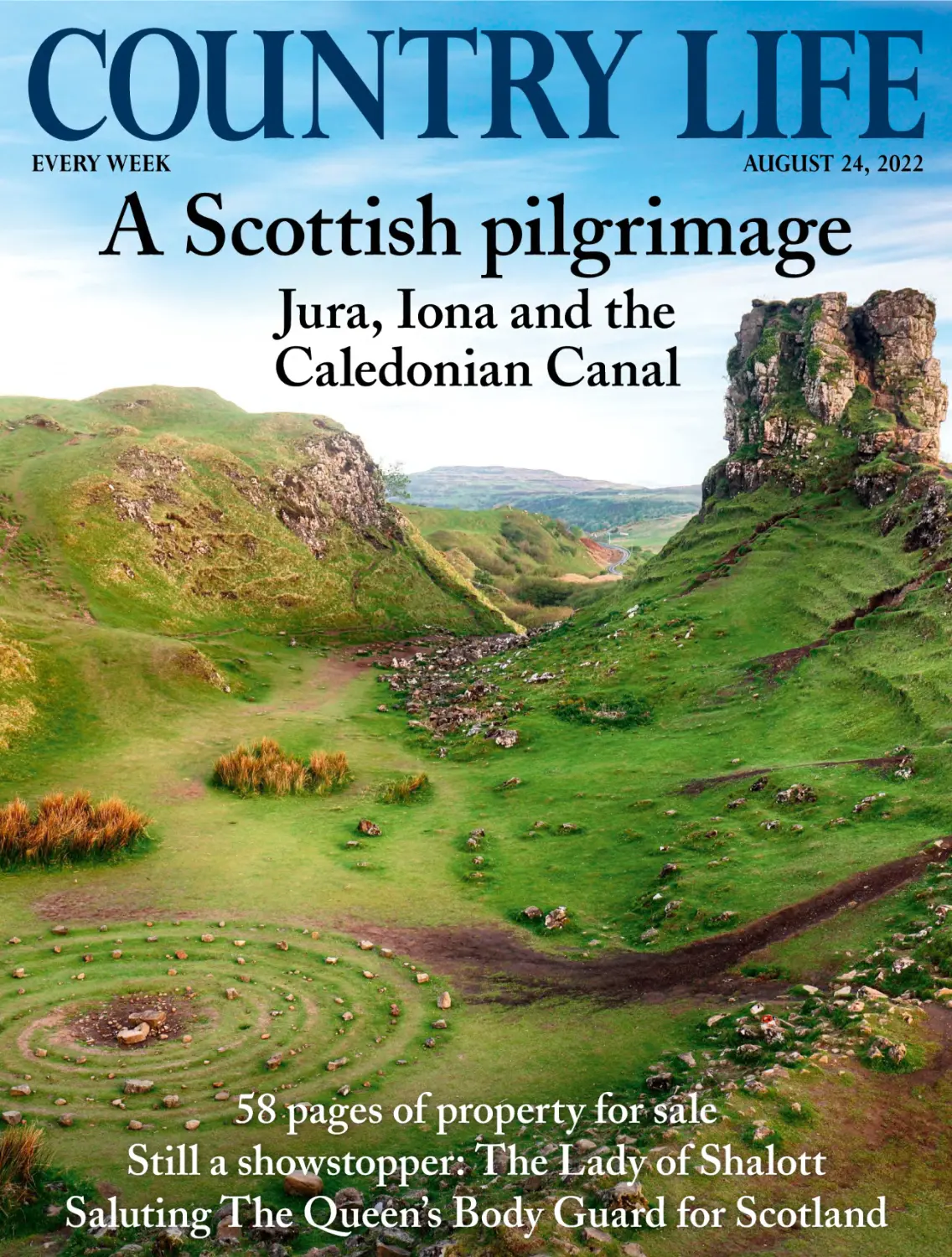
A Scottish pilgrimage
Jura, Iona and the
Caledonian Canal

58 pages of property for sale
Still a showstopper: The Lady of Shalott
Saluting The Queen’s Body Guard for Scotland

VOL CCXIX NO 34, AUGUST 24, 2022

Lucy Shepherd
Lucy is an explorer and fellow of the Royal Geographical Society, London SW7.
She recently travelled 253 miles across the Kanuku Mountains in Guyana, South America,
with a team of indigenous Amerindians, in a united attempt to secure government
protection for the area between the Essequibo River and the border with Brazil.
Photographed at the Royal Geographical Society, by Mike Garrard

Contents August 24, 2022

Those in peril on the sea: a young gannet (Morus bassanus) among adults in the Shetlands, where birds are hard hit by avian flu

100 From sea to shining sea
Mary Miers traces the Caledonian
Canal, 200 years after Telford’s
engineering marvel opened
Fairy Glen, Isle of Skye
(TTstudio/Alamy Stock Photo)

Cover stories

80 Masterpiece
Jack Watkins falls under the
spell of The Lady of Shalott
82 Romance realised
In the first of two articles, Clive
Aslet tours Ardfin on the Isle of
Jura, a Victorian sporting lodge
reimagined for the 21st century
90 When the saints go
marching in
Retracing the Highland route of
St Columba to Iona, Joe Gibbs
and his fellow pilgrims conquer
hill and glen, until sickness hits
96 Bring me my bow
Royal Archer Jamie Blackett
dons his green coat on the
64 | Country Life | August 24, 2022

This week

76 Tessy Ojo’s favourite
painting
The head of The Diana Award
picks a pair of powerful women
78 Scents and sensitivity
The weather whiffles to the
nose of John Lewis-Stempel
108 Interiors
Sitting rooms and footstools
112 The good stuff
Hetty Lintell takes on tartan
122 A load of old cobbles
Nostalgically pleasing to the eye,
cobblestones were an equine
saviour, reveals Harry Pearson
124 The tree of life
A flash of red on high: the rowan
tree will feed many hungry birds,
notes John Lewis-Stempel

128 Natural magic
Bonnington House, Edinburgh,
famous as the home of Jupiter
Artland, is set in spectacular
gardens, finds Caroline Donald
136 Kitchen garden cook
Melanie Johnson tucks into figs
138 Touched by our natural
heritage
Iain Parkinson meets the guardians of our rare hay meadows
144 Stick it to me
Ian Morton is caught in goosegrass
152 Play your cigarette cards
right
These tiny works of art have long
been prized, says Charles Harris

Every week

66 Town & Country
70 Notebook
72 Letters
73 Agromenes
74 Athena
114 Property market
118 Properties of the week
134 In the garden
148 Books
154 Art market
156 Bridge and crossword
157 Classified advertisements
162 Spectator
162 Tottering-by-Gently

Six issues for £6*

Visit www.countrylifesubs.co.uk/A36N
*After your first six issues, your payments will continue at £40.50 every
three months. For full terms and conditions, visit: www.countrylifesubs.
co.uk/6for6terms Offer closes October 31, 2022

Andy Parkinson/www.naturepl.com

bicentenary of The Queen’s
Body Guard for Scotland

Future Publishing Ltd, 121–141 Westbourne Terrace, Paddington, London W2 6JR
0330 390 6591; www.countrylife.co.uk

A special relationship

F

OR country folk across the UK,
this is often the time of year
when thoughts turn to rekindling
a special relationship with Scotland, perhaps with a particularly affectionately regarded pool on a salmon river,
Munro top or hole on a golf course. However, although Scotland’s natural environment still delights the countryman’s soul,
it is not a happy place at the moment.
Food rationing is in place on some
Hebridean islands because the nationalised
ferry service is failing for lack of investment; anglophobia is tolerated in political
discourse in a way that other forms of discrimination would not be; and rural Scots
are feeling increasingly alienated, to the
point where the idea of parts of rural
Scotland splitting from Holyrood is now
being discussed openly.
Two decades of separatist control of education has embedded the idea that Scotland
is an English ‘colony’, although, if anything,
the accession of the House of Stuart made
PPA Magazine Brand
of the Year 2019
PPA Front Cover of the Year 2018
British Society of Magazine
Editors Columnist of the Year
(Special Interest) 2016
British Society of Magazine Editors
Scoop of the Year 2015/16
PPA Specialist Consumer
Magazine of the Year 2014/15
British Society of Magazine Editors
Innovation of the Year 2014/15

it the other way round. Fieldsports have
been framed in that narrative. There are
currently moves in the Scottish Parliament
to ban mounted hunting (but not foot packs),
regulate driven grouse shooting out of existence and exterminate red deer to make way
for trees, yet the plight of the Atlantic salmon
is ignored as it edges closer to extinction.
Thankfully, in Scotland’s vast immutable
landscapes, transient politics are easily
forgotten and the excitement of a first fish
or a rare-bird sighting are as special and
treasured as they always were.
Scotland has its own distinct heritage,
as an article on The Queen’s Bodyguard for

Six issues for £6*

Visit www.countrylifesubs.co.uk/A36N

*After your first six issues, your payments will continue
at £40.50 every three months. For full terms and conditions,
visit www.countrylifesubs.co.uk/6for6terms
Offer closes October 31, 2022

Editorial

Editor-in-Chief
Mark Hedges
Editor’s Office/Lifestyle Editor
Rosie Paterson 6591
Editorial Enquiries

Editorial Assistant
Amie White 6102
Telephone numbers are
prefixed by 0330 390
Emails are
name.surname@futurenet.com
Deputy Editor
Kate Green 4171
Managing & Features Editor
Paula Lester 6426
Architectural Editor
John Goodall
Gardens Editor
Tiffany Daneff 6115
Executive Editor and Interiors
Giles Kime 6047
Deputy Features Editor
Victoria Marston 6446
News & Property Editor
Annunciata Elwes 3961
Luxury Editor
Hetty Lintell 07984 178307

Scotland highlights (‘Bring me my bow’,
page 96) and manmade marvels to rival any
south of the border (‘From sea to shining
sea’, page 100). The Union has always been
a marriage of equals, with Scotland fielding
her own team in the Commonwealth Games
as she has since the days of the Empire
Games. Yet, as this magazine demonstrates
week after week, there is a deeper, richer
British culture that celebrates slight Scottish differences in, for example, architecture,
but remains indisputably British when viewed
against our European neighbours.
There is what many people see as a deliberate separatist campaign to make English
voters wish to be shot of the Scots, but, after
three centuries of intermarriage, a hard border at Gretna would divide not only nations,
but families and would cut Britons off from
what many consider their spiritual home,
even if they only see it once a year. In fact,
everyone should actively love Scotland and
her glorious landscape all the more, and pray
for an end to the politics of nationalism.

Head of Design
Dean Usher

Clare Dove

Senior Art Editor
Emma Earnshaw

Advertisement director
Kate Barnfield 07817 629935

Deputy Art Editor
Heather Clark

Advertising (Property)
Julia Laurence 07971 923054

Senior Designer
Ben Harris

Lucy Khosla 07583 106990

Picture Editor
Lucy Ford 4072

Katie Ruocco 07929 364909

Deputy Picture Editor
Emily Anderson 6488
Chief Sub-Editor
Octavia Pollock 6605
Senior Sub-Editor
James Fisher 4058
Digital Editor
Toby Keel
Property Correspondent
Penny Churchill
Acting International
Property Editor
Carla Passino
Country Life Picture Library

Content & Permissions
Executive
Cindie Johnston 6538

Commercial director

Luxury

To find out more, contact us
at licensing@futurenet.com or
view our available content at www.
futurecontenthub.com
Head of Print Licensing Rachel Shaw
Circulation Manager Matthew De Lima
Production
Group Production Manager
Nigel Davies

Interiors/Travel
Emma Hiley 07581 009998

Management
Senior Vice President Women’s,
Homes and Country
Sophie Wybrew-Bond

Art & Antiques

Managing Director Chris Kerwin

Mollie Prince 07581 010002
Classified

Tabitha Tully 07391 402205
Advertising and Classified
Production
Stephen Turner 6613

Senior Ad Production Manager
Jo Crosby 6204

Printed by Walstead UK
Subscription delays We rely on
various delivery companies to get
your magazine to you, many of which
continue to be affected by Covid. We
kindly ask that you allow seven days
before contacting us about a late
delivery at help@magazinesdirect.com

Inserts Canopy Media
020–7611 8151;
lindsay@canopymedia.co.uk
Back issues
www.magazinesdirect.com

International
Country Life is available for licensing
and syndication.

Subscription
enquiries

0330 333 1120

www.magazinesdirect.com

August 24, 2022 | Country Life | 65

Town & Country

Edited by Annunciata Elwes
At the mouth of the
Firth of Forth, the
Isle of May was once
a favourite with monks,
Vikings raiders and
smugglers, but has for
some time been the
haunt of breeding grey
seals and a noisy flurry
of some 200,000 nesting seabirds in the
summer, including
puffins, guillemots,
shags, oystercatchers,
fulmars and gulls. Due
to this year’s alarming
strain of avian flu
in seabird colonies,
NatureScot was forced
to close the island for
five weeks, but, earlier
this month, it finally
reopened to public
landings, the majority
of seabirds having left
to overwinter elsewhere. As breeding
seasons vary between
different species,
many other coastal
nature reserves and
islands are still closed

If you plant
it, they
will come
W

HEN Mary Anne Aytoun Ellis
was invited to draw a selection
of Britain’s Ancient Trees as part of
The Queen’s Green Canopy (QGC)
initiative marking the Platinum
Jubilee, it was her dream commission. The individual character of
trees—scars, burls, galls, warts
and all—has always fascinated her
and no tree is more characterful
than an ancient one.
Beginning on Boxing Day last year,
Miss Aytoun Ellis has travelled the
length and breadth of Britain drawing
20 venerable specimens selected
66 | Country Life | August 24, 2022

from the QGC list of 70 Ancient Trees.
She has chosen a variety of not
only species, but situations—ancient
oaks at Cowdray, West Sussex, and
in Windsor Great Park, Berkshire,
to a humble hawthorn sandwiched
between garage blocks on a housing

Prisk Wood
ancient smallleaved limes
in ink, tempera
and gesso by
Mary Anne
Aytoun Ellis

estate in Crawley, West Sussex.
‘There’s something poignant about
that,’ she feels.
The drawings, alongside the artist’s
written observations, will be published
in a limited-edition book coinciding
with an exhibition opening at Sotheby’s
on December 10, as the Platinum
Jubilee year of our longest-reigning
monarch draws to a close.
Ancient trees see many monarchs
come and go and several claim historic associations. The venerable
fig drawn by Miss Aytoun Ellis at
Lambeth Palace in London was planted
by Cardinal Pole in 1556 and she jokes
that ‘Elizabeth I is supposed to have
sat under almost every ancient oak
I’ve come across’. If any of the trees
planted in honour of our own Queen,
Elizabeth II, live as long, let’s hope
that an artist of similar calibre will
be there to record them.
Laura Gascoigne

For all the latest news, visit countrylife.co.uk

Forbidden,
not forgotten

Good week for
White storks
Thirty-seven have been
released at Knepp, West
Sussex. It’s hoped they’ll
migrate south—the project
hopes to restore a population
of 50 breeding pairs in southern
England by 2030

Alamy; Andrew Lawson; Matt Chung; Will Pryce; York Modern Books; National Trust/Gary Cosham

B

ANNED books
are the theme
of this year’s Firsts:
London Rare Book
Fair, commemorating the 100th
anniversary
of
James
Joyce’s
Ulysses and in
response to current conversations
around censorship
in literature and the media.
Organised by the Antiquarian
Booksellers Association (ABA), the fair
will see 120 dealers congregate at the
Saatchi Gallery, London SW3, on
September 16–18, with first-edition
highlights including Galileo Galilei’s
Dialogo (1632) of his inquisition
fame, Einstein’s Relativity (1916),
banned (and burned) by the Nazis,
and Copernicus’s De revolutionibus
orbium coelestium (1543), which placed
the sun at the centre of our solar
system, rejecting the widely believed
idea that the earth was the
crux of everything. Priced at
£2 million with Sophia Rare
Books, the last was deemed
heretical by the Catholic Church
and banned for more than 100
years. Meanwhile, BAS BOOKS
will bring a signed copy of D. H.
Lawrence’s Lady Chatterley’s
Lover (1928), the first Penguin 1961
edition of the same that was the
subject of the obscenity trial, and
Lord of the Flies by William Golding.
‘Now is an ideal opportunity to celebrate Ulysses and others like it, that
were suppressed, banned or led to their
authors being ostracised for expressing
views that were different from what was
acceptable when they first appeared,’
notes Pom Harrington, ABA president
and chairman of Firsts London, whose
Peter Harrington Books brings a Japanese Ulysses (1928) to the fair. ‘One tends
to think of forbidden works as an issue
of another era, but it’s a subject that
is very much of our time. The printed
word has always remained a powerful
vehicle for enshrining an acceptance
of plurality of views. We thought it was
a topic that remains very current and
worthy of shining a light on.’

Pollock’s Toy Museum has loaned 14 pleasingly macabre
toy theatres, printed plays, operas and melodramas
and miniature cut-outs for model theatres from the
Regency and Victorian eras to Horace Walpole’s Gothic
Revival villa, Strawberry Hill House, London TW1.
The exhibition ‘Pollock’s Toy Museum Presents:
Cardboard Gothic Damsels, Demons and Heroes’
runs to September 14

Galloping home
M

Y troubles are all over and I am
at home.’ The birthplace of the
author of that line—from Black Beauty,
one of the most beloved books of all
time—is being taken on by an equestrian charity and will open to the
public for the first time this month.
The owner of Anna Sewell House,
in Great Yarmouth, Norfolk, has asked
Redwings Horse Sanctuary to become
caretakers of the building. The timberframe Grade II-listed house was
bought by the benefactor’s mother several decades ago,
to prevent it from being dismantled by an American fan
of the book and shipped to the US.
Sewell’s novel, written to ‘induce kindness, sympathy and
an understanding treatment of horses’ had far-reaching
ramifications for equine welfare—notably to the abolition of
the bearing rein, used to elevate the heads of carriage horses.
Leanne Plumtree of Redwings says that the charity is
‘unbelievably excited and honoured’ to become custodians
of the house. ‘The connection between what Anna Sewell
wanted to achieve by writing Black Beauty and the work
we are doing here today makes it a fitting legacy.’
The house will be used to showcase both the charity’s
activities and the life and work of Sewell. An official opening will be held on August 26 and volunteers are sought
to ensure that the house can be open to the public on
certain days. Those interested in volunteering are asked
to contact the charity via volunteering@redwings.co.uk
Flora Watkins

Modern medicine
Grisly medieval cures from
Cambridge University Library
manuscripts have been digitised
and released; they include ground
baked owl powder and boar’s fat for
gout and, for cataracts, application
with a feather, direct to the eye, of
a hare’s gall bladder and honey
Sheerness Dockyard
As part of an £8m makeover, the
Kentish town’s derelict church has
been rebuilt—its gilded weathervane
and four clock faces are visible
for miles around once more
Seeing red
A benefit of climate change could be
that southern England becomes
ideal for growing Pinot Noir grapes,
Burgundy’s red wine fruit of choice,
says viticulture journal OENO One

Bad week for
Nessie’s privacy
Rising water temperatures at Loch
Ness could soon mean its resident
monster will have to venture elsewhere for food, perhaps roaming
the banks, warn climate experts
Romance
Dating app Tinder celebrates its 10th
anniversary this year and 65bn
matches worldwide, yet half of
Britons think their parents’ generation produced more romantic love
stories than theirs, finds a study
Scottish salmon
A shortage of workers has the future
of the UK’s biggest food export in
doubt; we need a ‘more enlightened
approach to the movement of labour
into the UK,’ says Salmon Scotland
Humanities
English Literature and Fine Art are
among university degrees that lead
to the lowest average salaries five
years after graduation; Computer
Engineering, Project Management
and Finance are top earners in
the same timeframe

August 24, 2022 | Country Life | 67

Town & Country
After an £8 million transformation, Holland Park’s
hidden gem Leighton
House, London W14, will
reopen on October 15.
Once home to Victorian
artist and former Royal
Academy president
Frederic, Lord Leighton,
who was at the centre of
a bohemian community
of artists, it is known for
its cultural-melting-pot
interiors, including the
Arab Hall (right), with
mosaics and tiles
acquired on Leighton’s
travels through Turkey,
Egypt and Syria. The
museum’s first contemporary art commission
and a refurbished east
wing will also be unveiled,
with never-before-seen
historic features

Blooming
lovely
T

HIS year, some 40,000 people have
visited the 500 or so havens of Nature
open via Scotland’s Gardens Scheme
(SGS), benefiting hundreds of charities;
new gardens for 2023 are now sought.
In the 91 years since the charity, the
patron of which is The Duchess
of Rothesay (known as The Duchess
of Cornwall south of the Border), was
founded, much money has been raised
—£3 million by 1995 and £304,215 last year alone. Each garden owner may choose a charity to which
60% of the proceeds go; the rest goes to the scheme and its main beneficiaries: the Queen’s Nursing
Institute Scotland, Maggie’s and Perennial. Among the first gardens to open back in 1931 was Balmoral
Castle; George V commented: ‘I hope you’ll persuade everybody in Scotland to open their gardens.’
New openings this year include much acclaimed Little Sparta in Lanarkshire (above), home of
the late artist Ian Hamilton Finlay and his wife, Sue, where poetry, sculpture, bees and livestock
mingle amid structured moorland (September 6, 1pm–4pm); the recently redesigned grounds
of Coul House in Fife, with its hydrangeas, roses, rhododendron and wisteria (September 24,
11am–3pm); A Blackbird Sings at Glassel Park estate in East Lothian, with year-round colour
surrounding multiple water features (September 17, 10am–5pm); and Orkney’s neighbouring Old
Granary Quoy and The Quoy of Houton, offering spectacular views of Scapa Flow and an indoor
peach tree (September 4, 10am–4pm).
‘Although this year has still been far from “normal” with continuing Covid infections and costof-living concerns, we know that our garden open days bring a welcome escape and joy to so many,’
comments Liz Stewart, SGS chief executive. ‘And it’s not only the charities and visitors that benefit…
our amazing family of garden owners and volunteers love sharing the fruits of their labour, their knowledge and their enthusiasm with other garden lovers.’ Visit www.scotlandsgardens.org for details.
68 | Country Life | August 24, 2022

Liquid gold

I

N 2004, the Littlemill
distillery, founded in
1772 on the banks of the
River Clyde in West Dunbartonshire, was destroyed by fire and, since
then, Loch Lomond Group
master blender Michael Henry
has looked after the few remaining
rare casks of Lowland single-malt
whisky distilled in 1976. It’s from this
limited store that a special 250thanniversary release of 250 bottles
comes. Priced at £9,500 apiece, each
dose of this precious 45-year-old liquid
matured in oloroso casks comes in
a hand-blown decanter made by
Glencairn Crystal, with a unique silveron-black glass-plate image by worldrenowned photographer Stefan Sappert,
taken using a Victorian camera and capturing the view towards the original
Littlemill distillery from the banks of the
Clyde, all in a bespoke wooden case.
The whisky itself has a ‘silk-like mouthfeel’, elderflower, chamomile and lemon
zest on the nose, notes of vanilla syrup,
tart green fruits and cinnamon and
a ginger and dry oak tannin finish
(www.littlemilldistillery.com).

Country Mouse

I

Nature creeps back

T

HE ruins of the Great Hall at
Nymans, West Sussex, which was
destroyed by fire in 1947, are the setting
for a dramatic new garden that showcases the extraordinary plantsmanship
of the people who lived and worked there.
From the 1890s to the 1930s, Ludwig
Messel and his son Leonard, together
with head gardeners James and Harold
Comber, were responsible for creating
internationally important plant collections at Nymans, sponsoring planthunting expeditions and introducing
hybrids. A number of plants the Messels
brought to the West are featured in the
new ‘Garden in the Ruins’, including
Camellia ‘Leonard Messel’, Eucryphia
x nymansensis ‘Nymansay’, Forsythia
suspensa ‘Nymans’ and Rhododendron
decorum ‘Mrs Messel’.
‘The Great Hall hadn’t been accessible
for 75 years, but the enclosed space left
behind by the fire provided an exciting
opportunity to design a new garden,’
explains assistant head gardener Nick
Delves, who took inspiration from the

work of Ludwig’s grandson, set designer
Oliver Messel, in designing the space,
giving it a theatrical edge with weathered steel screens in which the family
crest, a cedar of Lebanon and medievalstyle windows are laser cut. ‘We wanted
people to be able to see inside for the
first time, but we also wanted to showcase Nymans’s plant collection and
its huge importance.’
These were ‘important times in horticultural and plant introduction and
collection history,’ adds horticultural
botanist Joanne Ryan, and ‘both the
Messels and Combers should be thought
of alongside other great horticultural
influences of the period… The relationship at Nymans between the garden
owners and their head gardeners and
how they selected plants, cultivated and
developed the garden gives us a living
legacy to enjoy and learn from with
every visit. Rare, unusual and outstanding plants abound, many from
wild sources, and many selections are
still stalwarts of gardens today.’

Due to popular demand,
the ‘Scottish Women Artists:
Transforming Tradition’ exhibition
at the Sainsbury Centre, Norfolk,
has been extended by two months
to September 4, featuring work
by the likes of Agnes Miller Parker
(The Uncivilised Cat, left), Margot
Sandeman and Charlotte Prodger

Take the weather with you

T is raining as I write and I am watching in wonder,
in the way I once observed snow as a boy. It is
remarkable how a garden responds to heavenly precipitation—you can water with cans and hose pipes
all you like (if allowed), but it is rain that really cheers
it up. The drought has been dismal for frogs and
toads, which have a particular fame in the Hampshire
village where I now live. However, there are always
winners and losers due to our erratic, and increasingly more extreme, weather patterns.
In half a century of Nature observation, I have never
seen wild pheasants and red-leg partridges raise broods
so successfully. I stopped in amazement last week
when a hen pheasant led her well-grown brood of seven
chicks down the road ahead. The dry weather has
obviously made all the difference when it comes to
raising their young. Bumblebees are abuzz, but, if
the butterfly population follows the same course it did
after the summer of 1976, it will be in serious peril.
Nature is changing at breakneck speed and,
although the weather has always been a lottery—
especially in this country—humans, through climate
change, have unfortunately stacked the metereological deck against the environment and many
species of fauna and flora. MH

Town Mouse

The return to London

W

ITH its bouts of intense heat, London has been
a tiring city to live in this summer. It finally
became intolerable, however, when a group of tourists staying in a neighbouring house started leaving
food out for the foxes. All that could be said for the
night-time noise that resulted is that it made the
peace and cool of the family’s distinctly rural summer
holidays seem all the sweeter.
The children assert that we have done nothing
over the past couple of weeks but visit museums,
ruins, country houses and gardens. As that complaint was made on the return journey from a beach,
however, it didn’t carry much weight. Indeed, the
principal undertaking of the holiday has, in fact,
been swimming. First on the Northumberland
coast, then on huge, empty Irish beaches and,
finally—in defiance of the midges—in a rock pool
with a waterfall up the Mourne Mountains. The
last was the result of a foolhardy bet with a nineyear-old niece and was freezing and invigorating
in equal measure.
Now, the holidays have done their work. Town
Mouse feels depressingly confident that the journey
home will be delayed, crowded and dispiriting, but
urban life beckons. And for the fun it offers, September in London is a hard month to beat. JG

August 24, 2022 | Country Life | 69

Town & Country Notebook
Quiz of the week

Paws for thought

1) Who wrote the poem Lochinvar?
2) Sphagnum is a genus of which
group of plants?
3) In Morse code, what letter
is represented by one dash?
4) Which noblemen hold the
highest hereditary titles in the
British peerage?
5) Which playing card is known
as the curse of Scotland?

Word of the week
Butterboy (noun)
A novice, particularly
among taxi drivers

100 years ago in
August 26, 1922

Dog trainer Ben Randall
offers his advice

Knock, knock

Q

Whenever anyone knocks on the door,
my dog goes mad. He’s friendly, but I’d
prefer it if he didn’t make such a fuss.
L. A., Warwickshire
I prefer a dog to bark once, then walk
back to its bed because it trusts me and
knows there’s no threat. But how do you
reach that state?
1. The ‘leave’ command is a must, so make
sure your dog acts on it before you begin.
2. Encourage your dog to go to its bed when
people arrive: point at the area, say their
name and then ‘in’, multiple times. When
they do as they are told, reward them with

A

kibble or praise. 3. Enlist help: ask someone
to knock and, if the dog reacts, give the
‘leave’ command, followed by ‘in’, walk
to the door, open then close it and walk
back to your dog, rewarding them for
getting it right. Do this again and again—
you’re aiming to retrain your dog to think:
‘As soon as I hear the doorbell, I’m going
to run to my bed and wait for my reward.’
4. Take it outside: when someone comes
through the gate or a driver pulls up, give
the ‘leave’ command and point to an area
where you want the dog to go, such as the
porch. 5. Keep at it!
To pose your own canine conundrum,
email paws-for-thought@futurenet.com.
For more details about Mr Randall’s
positive methods and his training app,
visit www.gundog.app/trial or www.ledbury
lodgekennels.co.uk

Time to buy

Beoplay EX wireless
earbuds in Gold Tone,
£349, Bang & Olufsen
(020–3769 0254; www.
bang-olufsen.com)

Y

OUR correspondent ‘Aniseed’,
writing in COUNTRY L IFE of
the 12th instant, says he never
remembers hearing a hind bark
when alarmed on Exmoor. On
May 29th last my wife and I saw
three hinds come up out of
a coombe on Robin Howe, near
Wootton Courtney, just after
dusk. When they saw us one
of them stopped a few moments
and barked several times. Then
they took flight, and we heard
the same sound again in the
distance. I have never noticed
this call before, but was informed
by a resident that probably the
hind had a calf somewhere
about. I should describe the sound
as a sort of coughing grunt’.
A former tenant of Cloutsham
Farm told me some years ago
that her son had often heard the
hinds grunting.—Ernest Blake
1) Sir Walter Scott 2) Mosses 3) T 4) Dukes
5) Nine of diamonds Riddle me this: 77

70 | Country Life | August 24, 2022

Harris Tweed
and Chilcott
Lavender Bags:
Ocean Gift Box
Set of 6, £55,
Chilcott (01874
730424; www.
chilcottuk.com)

Hen Espresso Cups, £12 each,
Cluck Cluck! (01473 658168;
www.cluckcluck.biz)

‘“Still,” he said. “Ach,”
I said. “Ach nothing,”
he said. “Ach sure,”
I said. “Ach sure what?”
he said. “Ach sure,
if that’s how you feel.”
“Ach sure, of course
that’s how I feel.”
“Ach all right then.”
“Ach,” he said. “Ach,”
I said. “Ach,” he said.
“Ach,” I said. “Ach.”
So that was settled’
Milkman,
Anna Burns

Riddle me this

Which number between
one and 100 has the most
syllables when said out loud?

In the spotlight
White Park cattle

Nobody knows how long the old strains of
white cattle have grazed Britain and Ireland—
they turn up in medieval records of far more
ancient mythology. The horned White Park
type has long been defined as rare, having
hung on, historically, in a few relict communities.
Of these, the Chartley herd was recorded from
1248, when some of Staffordshire’s roaming
wild cattle were first kept in parks. It was down
to fewer than 10 animals by 1905, when the
Ferrers family sold them; a fire during their
rail transportation reduced them further, but

Alamy; James Davidson; Dreamstime; Getty/Dorling Kindersley

Baked pear and nougat
Glace de Rocher, Specially
Selected Fendant, Valais,
Switzerland 2020. £9.99,
Aldi, alc 12%
If you’ve never had a Swiss wine
or a Fendant (Chasselas), then
this ticks two boxes. It could
do with more acidity to balance
the ripe baked pear and nougat
flavours, but the soft, creamy
texture and slight sweetness
will appeal to those looking
for a gentle style of white.

what remained found sanctuary at Woburn
and two dozen were returned to the 13th Earl
Ferrers in 1970, signalling their re-emergence.
The Dynevor (Dinefwr) line traces back at
least 1,000 years; the 9th Baron Dynevor had
to sell up in the 1970s, dispersing his herd, but
the National Trust traced and reintroduced the
aminals in 1992. White Parks now flourish in
small herds worldwide. Distinctive black (sometimes red) points define them and their eyes
are especially attractive, appearing to be traced
with eyeliner and with thick, long, black lashes.

Unmissable events

September 13–17
Giselle, London
Coliseum, St Martin’s
Lane, WC2. New interpretation performed
by the United Ukranian
Ballet, in support of Ukraine
(020–7845 9300; www.
londoncoliseum.org)

Until November 1
‘Exodus: The Uganda
Asians Crisis of 1972’
exhibition, Arundells,
Salisbury, Wiltshire. How
28,000 refugees started
again in Britain after being
given 90 days to leave their
country (01722 326546;
www.arundells.org)

August 28–October 25
‘Crowning Glory: The Story
of Tiaras’ exhibition, Firle
Place, Lewes, East Sussex.
Costume jewellery from Downton
Abbey, The Young Victoria
and Muppets Most Wanted
(01273 858307; www.firle.com)

Wines of the week

September 6–November 26
Spike, various venues.
Touring production of Ian
Hislop and Nick Newman’s
new play telling the story
of Spike Milligan and The
Goon Show (www.
spiketheplay.co.uk)

September 14–18
Budleigh Salterton
Literary Festival, various
venues, Devon. With Pam
Ayres, Baroness Floella
Benjamin, Joe Swift, Dame
Sheila Hancock and many
more (0333 666 3366;
www.budlitfest.org.uk)

Westbrook House, West Bradley, Somerset. August 27, 11am–5pm
These four acres have been transformed by the present owners since 2003
(‘Rural charms’, June 1) and link perfectly with the surrounding cider orchards
and pasture. At this time of year, they present an uplifting picture of late-summer
plenty (www.ngs.org.uk)

Phenolic grip
Forza della Natura, Orange
Catarratto, Sicily, Italy 2021.
£9.99, Waitrose, alc 12.5%
Catarratto can be a fairly
anodyne grape, but here it’s
given a new lease of life. About
10% of the blend underwent
12 days’ skin contact, hence the
pale-amber colour and phenolic
grip. Unfined and unfiltered,
this displays orange blossom,
marmalade and some spice.
Mega fresh
Mas Mudigliza, Coume des
Loups, Côtes du Roussillon
Villages, France 2019. £14.95,
Champagnes & Châteaux,
alc 14.5%
In the Fenouillèdes in France’s
south-west, hand-harvested
old vines of Syrah, Grenache
and Carignan have produced
this lovely peppery, blackberrytinged wine. It has sweet, darkcherry fruit, together with mounds
of plum, liquorice, thyme and dried
rosemary. Mouthwatering acidity
keeps it fresh and drinkable.
A bit different
Tua Rita, Keir Ansonica,
Tuscany, Italy 2020. £39.90,
Hedonism, alc 12.5%
Indigenous Tuscan grape Ansonica
fermented on skins in amphorae
for two months before three
months in concrete. Lemon
juice and citrus peel lift earthy,
waxy yet vibrant flavours of terracotta and ripe peach skin, with
fresh acidity and a long finish.
For more, visit www.decanter.com

August 24, 2022 | Country Life | 71

Letters to the Editor
We will
remember
them

H

ARRY PEARSON
writes that ‘Every
weathervane tells a story’
(‘Just blame it on the
weathervanes,’ August
10): this battered example sits atop Newport Stables in Melton Mowbray,
Leicestershire, home for paras of the 156 Parachute
Battalion in 1944. Early in the morning of September
18 that year, they were leaving to take part in the
Battle of Arnhem and, given that consequential
punishment would be unlikely, a few decided to take
pot shots at the weathervane. Their assumption
proved terribly true, as only 36 of about 600 men
came home. To this day, each autumn, the families
of those paratroopers return to Melton to view the
weathervane, which acts as a memorial
to those brave men.
John O’Reilly, Nottinghamshire

The writer of the letter of the
week will win a bottle of Pol Roger
Brut Réserve Champagne

Farewell, old friend

T

HE White Lion sign has hung over the inn on the river
crossing at Holmefield for generations. Pack horses
stopped there on the way to the Corn Mill and Chapel Hill,
then used the old road as a snicket to avoid Blind Jack’s turnpike fees at Tup Bridge. The Lion saw the Corn Mill move to
full-scale woollen production, then to making shoes; it saw
terraces built on Burnley Road and buses taking people to
work. Now, it sees traffic jams, as commuters drive
to Manchester. As I write, the sun is setting.
The shadows creeping over the new housing estates on Chapel Hill have already
cloaked the Lion. It closes its doors for the
last time tonight. Just another pub, just
another town in the Lancashire Pennines.
Kathy Fishwick, via email

Contemporary heraldry

M

AY I suggest weathervanes (August
10) be given a new use as the modern
family crest? Ours is so special to us that
it is the one item we have taken along every
time we moved over the past 30 years. Given
to us for our silver-wedding anniversary,
it depicts five small bells within an overall
WI outline of a bell. No prizes for guessing
our surname.
Jim Bell, Herefordshire

Provincial glories

A

Looking at ewe

I

PARTICULARLY liked the cover
of the August 10 issue, featuring
St Mary the Virgin, Lasborough,
Gloucestershire, with the sheep
grazing in the churchyard. It took
me back to the village I grew up in,
where sheep always grazed in the
churchyard and among the graves:
they did a wonderful job of keeping
the grass short, although I suspect
they were also partial to cut flowers.
It seems a shame that sheep are
no longer used as lawnmowers in
churchyards, especially as we are
trying to be more eco-friendly.
Dawn Miller, Gwent

THENA’S visit to the Birmingham Museum and Art Gallery
(August 10) was less fulfilling than
hoped, but, often, exceptional collections at provincial galleries offer
an excellent experience. One such
place is The New Art Gallery Walsall
(below). It houses the Garman Ryan
Collection, which was donated by
Jacob Epstein’s widow, Kathleen
Garman, and includes works by
Picasso, van Gogh, Monet, Degas,
Renoir, Turner, Constable and
Epstein. Displayed thematically in
airy, panoramic galleries, this is
a thoroughly absorbing collection
that deserves to be better known.
Andrew Jones, via email

Contact us (photographs welcome)

Email: countrylife.letters@futurenet.com
Post: COUNTRY LIFE, 121–141, Westbourne Terrace, Paddington,

London, W2 6JR

We regret that we are unable to respond to letters submitted by post
Future Publishing reserves the right to edit and to reuse in any format or medium submissions to the letters page
of Country Life

N.B. If you wish to contact us about your subscription, including regarding changes
of address, please telephone Magazines Direct on 0330 333 1120

Country Life, ISSN 0045-8856, is published weekly by Future Publishing Limited, Quay House, The Ambury, Bath, BA1 1UA, United Kingdom. Country Life Subscriptions: For enquiries and orders,
please email: help@magazinesdirect.com, alternatively from the UK call: 0330 333 1120, overseas call: + 44 330 333 1120 (Lines are open Monday–Saturday, 8am- 6pm GMT excluding Bank
Holidays). One year full subscription rates: 1 Year (51) issues. UK £213.70; Europe/Eire €380 (delivery 3–5 days); USA $460 (delivery 5–12 days); Rest of World £359 (delivery 5–7 days). Periodicals
postage paid at Brooklyn NY 11256. US Postmaster: Send address changes to Country Life, Airfreight and mailing in the USA by agent named WN Shipping USA, 165–15, 146th Avenue, 2nd Floor,
Jamaica, NY 11434, USA. Subscription records are maintained at Future Publishing Ltd, Rockwood House, 9–16, Perrymount Road, Haywards Heath, RH16 3DH. Air Business Ltd is acting as our
mailing agent. BACK NUMBERS Subject to availability, issues from the past three weeks are available from www.magazinesdirect.com. Subscriptions queries: 0330 333 1120. If you have difficulty in
obtaining Country Life from your newsagent, please contact us on 0330 390 6591. We regret we cannot be liable for the safe custody or return of any solicited or unsolicited material, whether
typescripts, photographs, transparencies, artwork or computer discs. COUNTRY LIFE PICTURE LIBRARY: Articles and images published in this and previous issues are available, subject to
copyright, from the Country Life Picture Library: 01252 555090/2/3.
Editorial Complaints: We work hard to achieve the highest standards of editorial content and we are committed to complying with the Editors’ Code of Practice (https://www.ipso.co.uk/IPSO/cop.html) as enforced by IPSO. If you have
a complaint about our editorial content, you can email us at complaints@futurenet.com or write to Complaints Manager, Future Publishing Limited Legal Department, 3rd Floor, Marsh Wall, London E14 9AP. Please provide details
of the material you are complaining about and explain your complaint by reference to the Editors’ Code. We will try to acknowledge your complaint within five working days and we aim to correct substantial errors as soon as possible.

72 | Country Life | August 24, 2022

Alamy; Getty

Letter of the week

Mark Hedges

O come, all ye faithful

I

N his piece ‘We
must restore
local churches
to local people’
(August
10)
Simon Jenkins
suggests that
redundant churches should be
placed
under
local-authority protection. Admirable,
but what about the thousands of churches trying to keep their doors open?
The annual running cost, not including maintenance, of our Grade I-listed
church in Penshurst (above) is £75,000.
It is a huge struggle to find this sum
and, no doubt, parish churches everywhere are finding the same. I would like
to know what his solution is to this
equally pressing problem.
Stephen Hazell-Smith, Chair, Friends
of Penshurst Church, Kent

Every deacon counts

I

APPLAUD Simon Jenkins for his
persistence in raising the issue
of care for redundant churches. But
he is starting at the wrong end. The
Church of England’s own analysis,
in its report Going Deeper, concludes
that ‘a decrease in clergy is associated,
on average, to a decline in attendance’.
Despite this, bishops are driving down
clergy numbers in most dioceses.
Reverse this tragedy and the challenge
will be greatly reduced.
Admiral Sir James Burnell-Nugent,
Devon

AUGUST 31

Horse heaven: galloping
on Dartmoor, competing
in parkland and saving
equines. Plus rural sounds,
a forgotten Nature writer
and SCHOOL LIFE
Make your week, every
week, with a Country Life
subscription
0330 333 1120

Oh, the irony
T

HE long arm of the law doesn’t
always seem as present in the
countryside as we would wish.
We know that the day of the village
bobby is over and that rural police forces
now have to deal with crimes that were once
entirely foreign to them. Cyber security, international drug dealers and migrant issues
often seem to crowd out the more mundane,
but still very distressing issues of petty theft,
farm vandalism and fly-tipping.
Despite these natural tensions, rural support for law and order and for the police is
wholehearted. The kind of questioning that
affects the Met and some other urban forces
is rarely heard in the countryside. Our only
real complaints centre on the need for a police
presence to deter as well as detect.
With that attitude
towards the importance
of the rule of law, it’s not
surprising that, however
concerned we may be
about issues such as climate change or the costof-living crisis and however angry at the lack
of urgency and delivery
by the Government, we
don’t support the actions of extremists such
as Extinction Rebellion. We may share their
concerns, but not their methods.
That’s why there will be few country people
who will disagree with last week’s decision by
the High Court to uphold legally granted planning permission and stop protesters disrupting
the construction of a replacement fuel pipeline from Southampton to Heathrow Airport.
That is despite the fact that the pipe will be
carrying damaging fossil fuels and will increase
capacity at the a time when the Government
and Parliament has said we should reduce it.
The irony of the whole case is that the company that has demanded the protection of the
law is ExxonMobil. This is the very company
that used every mechanism to avoid being
subject to laws designed to protect the world

from climate change. It delayed US action on
global warming for the best part of 20 years
by denying the science its own researchers
had established. As revealed in the recent BBC
documentary, Big Oil v the World, ExxonMobil knew that fossil fuels were changing the
climate in a dangerous way, yet the company
hid that knowledge to protect its profits.
Lee Raymond, former chairman and chief
executive, constantly claimed that there was
no evidence for human influence on climate
despite the evidence held by his own research
department. ExxonMobil and its allies used
that denial to confuse the issue and lead legislators, particularly in America, to prevent action
against global warming. Chuck Hagel, one of
the key senators involved, now says of ExxonMobil—without qualification—‘they lied’.
Therefore, the irony in
the courtroom last week
was to hear this company ask for legal protection when for so long
they had fought against
laws that would stop them
from damaging the environment. ExxonMobil’s
barrister said that the
green protesters were
‘conspiring to injure’ its business ‘by unlawful
means’. What an accurate assessment of ExxonMobil’s actions on climate change: ‘conspiring
to injure by unlawful means’ the world’s climate.
As the BBC correctly said, it was ‘Big Oil
versus the World’. There’s no doubt that we all
have a right to be angry at the damage caused
by ExxonMobil’s cynical actions—actions
that endanger every one of us.
Yet that doesn’t mean we should break the
law. Instead, we should be demanding reform
of the planning system so that new infrastructure of this kind is not allowed. We should insist
that big companies such as ExxonMobil publish and carry out a clear programme to reach
net zero by 2050 and we should avoid buying
products from companies that have shown
such disregard for the health of the planet.

The company
delayed US action
on global warming
for the best part
of 20 years

August 24, 2022 | Country Life | 73

Athena

Cultural Crusader

A crisis for
the Church
of Scotland

E

ARLIER this year, Athena wrote
about the scandalous treatment
of numerous castle and monastic ruins in state care by Historic
Scotland (March 9). Now, the Church of
Scotland is in the process of a far-reaching
review that could leave more than one-third
of its churches abandoned. Athena has had
the potential closure of the outstanding
Kilbirnie Auld Kirk, North Ayrshire, drawn
to her attention, but the wider impact of this
initiative is shocking. In Fife alone, as many
as 52 churches might close, including
buildings such as the former Cistercian
church of Culross Abbey and St Fillan’s
Church in Aberdour. In Inverness-shire and
Moray, the number could be more than 30.
At the root of these changes is the socalled Radical Action Plan approved by

the General Assembly of the Church of Scotland in 2019. Underpinning the aims of this
initiative is a fundamental restructuring
of the church at a local level. In Scotland,
this presently comprises about 1,250 congregations organised into 43 districts or
Presbyteries. The decline in church attendance and movements in population have
created a dislocation in some areas between
congregations and the estate of about 3,000
churches and halls (as well as 800 manses
and nearly 12,500 acres of glebe land).

History, heritage
and beauty
don’t even weigh
in the scales
What the Church of Scotland intends,
however, is a fundamental reorganisation
of its entire estate, hubbing parishes to
create a reduced network of churches that
are ‘well-equipped spaces in the right
places’. That sounds fairly reasonable, but
it begs the question of what the churches
need to be equipped and positioned for.
The answer seems to be Christian mission
with an emphatically contemporary,

youthful and implicitly urban twist. History,
heritage and beauty don’t even weigh in the
scales. Indeed, these qualities are likely
to be a positive disadvantage to any church
possessed of them.
For example, an associated consultation
document pointedly invites parishes to
consider whether their church is ‘too expensive for its missional needs? Is it good
Christian stewardship to have a small congregation rattling around in a huge building?’
And in setting out a ‘minimum standard’
for church buildings, it suggests that they
should meet ‘all health and safety requirements’, possess ‘modern toilet facilities’ and
‘a minimum energy efficiency standard’.
Applying such criteria threatens to leave
large numbers of cherished and historically important buildings abandoned. That
change will particularly affect isolated,
rural communities. As if that wasn’t tragedy
enough, it also promises to sever the Church
of Scotland as a living institution from its
physical and historical roots. That may well
save money, but it will also cause alienation and local resentment both within and
beyond the ranks of congregations. The
Church of Scotland clearly faces some difficult decisions, but it needs to show much
greater sensitivity to the past—and its own
past—if it is to plan a successful future.

The way we were Photographs from the Country Life archive

1932

Unpublished

Every week for the past 125
years, COUNTRY LIFE has
documented and photographed many walks of life
in Britain. More than 80,000
of the images are available
for syndication or purchase
in digital format. To view
the archives, visit www.
countrylifeimages.co.uk
and email enquiries
to licensing@
futurenet.com

74 | Country Life | August 24, 2022

Country Life Picture Library

A class, largely composed
of women, listens to a smartly
dressed instructor with
a broom-handle pointer
talking about cows. The
photograph was taken to
illustrate an article on the
West of Scotland Agricultural College, following its
move to new premises on
the Auchincruive estate, Ayr.

My favourite painting Tessy Ojo
While We Wait by Sophia Oshodin

While We Wait,
2021, acrylic on
canvas, 36in by
36in, by Sophia
Oshodin (b. 1983),
House of Fine Art,
London

This painting highlights the challenges and
inequality facing women across the world.
It speaks about women conditioned to wait their
turn, wait to be recognised or wait for permission
on what happens to their bodies. What I love
about it is how it portrays the women and female
friendship: although they might be “waiting”,
they are still living; they are creating memories.
They have coffee in hand, games on the table
and wear gorgeous earrings. It speaks about
empowerment and, to me, about the company
you keep. Get yourself a tribe of cheerleaders,
people who will help you stand tall and not
make you shrink. Every girl needs a good tribe
76 | Country Life | August 24, 2022

Charlotte Mullins comments on
While We Wait

T

WO women sit around a small
coffee table sipping hot drinks
and playing cards. They are
smartly dressed in bold patterns:
checks follow the contours of one
woman’s crossed legs, as flamingos
on the other woman’s dress seem to
dance across the surface. Purples
and yellows writhe through her hair
as muscular succulents push in from
the edges of the canvas.
Sophie Oshodin trained in political
science before returning to painting
in 2019. Self-taught, she draws on
a wide range of art for inspiration,
including Matisse’s highly patterned
interiors. Often, her women are
involved in leisure activities—riding
on a scooter, reading on a balcony,
relaxing in a bath with a glass of red
wine—but they are always active

and dynamic. The women in While
We Wait are similarly alert, even
questioning. As they gaze confidently
at us, it is as if they expect something
to happen—social change perhaps?
—although they seem resigned to
the fact that it may take a while.
The artist has spoken of the notable
absence of black figures in Western
art and her latest paintings have
a political edge. She is a Nigerian
painter who works in London and the
figures she depicts could exist in either
location. Whether picking lemons in
a leafy garden or selling them at an
urban market stall, she ultimately
wants to give her women agency, to
give them power. They assert themselves on the canvas and we can’t
help but look at them and revel in
their bold bonheur de vivre.

By kind permisson of Sophia Oshodin

Tessy Ojo is chief executive of The Diana Award,
which continues Diana,
Princess of Wales’s legacy
of rewarding young people
for their social action and
humanitarian work

From the fields

John Lewis-Stempel

Scents and sensitivity
As he observes his cows on a warm August
day, John Lewis-Stempel allows himself to be
led by the nose and discovers that weatherwhiffing is no dark art, but proper science
Illustration by Michael Frith

I

WAS leaning on the iron gate of the cow
field, chewing a length of ryegrass, gazing
at the occupants. The cows, bits of grass
hanging from their slobbery mouths, regarded
me. Mirror match.
Few animals exude contentment to the
degree of an outdoor cow in summer and
watching the Limousins engendered the usual
contagious joy. But my hanging like a yokel
on the gate was about more than self-help,
a down-on-the-farm pick-me-up: survey
a collection of cows for five minutes and you
can tell which is sick and which is on the up
(or down) in the herd order. Any cow off to the
side or dragging behind is a cow in trouble.

I then started to
sniff out the other
aromas of high
summer in the
countryside when it
has recently rained
All was well in the cowfield. Particularly
well… there was a euphoria above standard
cow-watching. There was something in the
air. It had rained 15 minutes earlier and the
wet, bare ground around the gateway, where
the cattle stand and stare, was releasing the
odour of the earth. This particular scent,
petrichor (‘Sweet with the evening rain’,
August 3)—from the Greek petra, ‘rock’,
and ichor, ‘blood of the gods’—is, to cut
a chemical lesson short, a diffusion of aerosols containing the soil compounds, the most
potent of which is geosmin. When it goes
right up our noses, the 600,000 cells of the
olfactory centre really rather like it. Primeval
and musky, geosmin is a common ingredient
in perfumes. Bottled delight.
But my nose was being tantalised yesterday afternoon by more than petrichor. If the
78 | Country Life | August 24, 2022

days of sun had dried and nullified smells,
the post-rain humidity had released them.
A little breeze was blowing up the meadow,
over the cows’ backs, and on the air there
mingled also the warm, flowery fragrance
of cattle coats in full bloom. The smell of
cows, the odour of the earth. Heaven scents.
I then started to sniff out the other aromas
of high summer in the countryside when it
has recently rained and the wheat has been
cut. From the ziggurat of wheat bales awaiting collection came a redolence akin to
sun-drying washing on the line (another
smell used commercially: Chanel No 5 contains the same aldehydes as clean laundry);
down the lane puffed the incense of honeysuckle blossom. On the lee edge of the
breeze were tart fruit notes of elderberry
and crab apple, which, of course, is the smell
of autumn approaching.
There was something else. Something else
before autumn and cider and chutney and
jam. I stuck my nose into the air, toffeenosed, dog-nosed, horse-nosed—and inhaled.
Then, I smelled the storm.
When I was a child, my grandmother, on
long walks along the lanes of east Herefordshire,
urged me to smell the coming of the rain on
the wind. I finally got it: it’s the faint whiff
of swimming pool. Weather-whiffing is no
dark art, a rural grandmother’s voodoo, but
proper science. During a thunderstorm,
lightning, by a chemical chain reaction in
the sky, creates ozone and ozone has a sharp
odour reminiscent of chlorine. Wind from
an approaching storm carries ozone down
from the clouds and into the nostrils.
Led by my nose, I scurried home down the
lane; less than an hour later, the sky blackened, lightning jigged over the mountain,
whips cracked in the sky and the rain bounced
a foot high off the concrete of the yard.
My encounters with olfactions and odours
prompted me, that evening, to pull down a book
off the shelf that I had long been meaning to
read: Orwell’s Nose, by John Sutherland. Of
all English writers, Orwell had the keenest

schnozzle for smells, including those of the
countryside. At heart, as Prof Sutherland notes,
Orwell was a peasant, forever making little
farms wheresoever he went. (One can also make
a decent case that the roots of his politics, the
mixing of tradition with anti-authoritarianism
and a sense of fair play, lie with the Diggers
of the English Revolution.) In the Orwellian
oeuvre, the only happinesses occur in rurality:
Gordon and Rosemary’s day out on Farnham
common in Keep the Aspidistra Flying,
Winston and Julia’s alfresco lovemaking in
‘golden countryside’ in 1984 and George
Bowling’s nostalgic pond-fishing memories
of Lower Binfield in Coming Up For Air.
I read Orwell’s Nose outside in the garden,
by candlelight, enveloped by the lavender

vapour of the night-time country garden.
(It had stopped raining.) From over the stone
wall wafted the bitter perfume of ripening hops.
I had some expectation, not unsatisfied, that
a book about olfaction would benefit from being
read in a strongly odorous environment.
Animal Farm, when ‘smelled’ through
Orwell’s proboscis, is instructive. He loathed
20th-century mechanical miasmas, but
adored horses, not least because their grassine
excrement was inoffensive to his perceptive
nasal receptors. (As it was to the hooter of
his hero, the misanthropic Jonathan Swift.)
So it is perhaps non-coincidental that Boxer
the horse is the hero of Animal Farm. Conversely, Orwell detested pigs, partly because
of their offensive omnivorous excrement.

The villains of Animal Farm? The swine, led
by the cigar-smoking Napoleon.
Orwell was simply wrong about pigs. Or,
at least, free-range pigs. To reproof Orwell,
I walked around to the pig hut, where the 10
porkers were stretched out, snoring on deep
straw. I inhaled deeply from the belly of one
of the pinky-perky Welsh pigs; she could have
been sprinkled with talcum powder, so lovely
was her scent. From the pigs’ outdoor latrine
area (pigs are prissy and precise about their
ablutions) came the sweet, baked-apple attar
of pig poo. Animals are what they eat. Our pigs
largely forage, between helpings of organic
cereals for breakfast and supper.
I run an intentionally traditional farmyard, which is richly smelly and would give

Orwell’s nose substances for thought. Pigs,
equines, chickens, geese, hay and straw,
a pile of cow manure, occupy three sides;
vintage tractors, with their addictive acrid
whiff of red diesel, stand in the entrance.
Surround smell.
I confess there is one incongruous odour
in this old-fashioned animal farmyard. In
summer, I rub Ambre Solaire Factor 30 onto
the ears of the pale-skinned pigs to prevent
sunburn. Scents and sensitivity, then.
Twice crowned victor of the Wainwright
Prize for Nature writing, for ‘Where Poppies
Blow’ and ‘Meadowland’, John LewisStempel’s bestselling book ‘Woodston: The
Biography of an English Farm’ was published last year (Doubleday, £20)
August 24, 2022 | Country Life | 79

Britain’s greatest masterpieces

The Lady of Shalott
by J. W. Waterhouse

Uncanny: Waterhouse’s first and most striking rendering of The Lady of Shalott, painted in 1888, continues to cast a timeless spell

S

EVERAL years ago, the Royal Academy
of Arts (RA) staged a major exhibition
on J. W. Waterhouse—and what a feast
for the eyes it was. Here were examples
of the artist’s grandly staged history paintings, including The Favourites of Emperor
Honorius and St Eulalia, plus Pre-Raphaeliteinfluenced forays such as Hylas and the
Nymphs. The real showstopper, however,
was The Lady of Shalott, an awesome work
that, notwithstanding the calibre of the
pictures around it, cast its presence across
the entire room.
The Lady of Shalott has been stopping
the hearts of gallery visitors for decades
at Tate Britain, where it is usually to be seen,
80 | Country Life | August 24, 2022

having been one of the founding gifts presented to the institution by Sir Henry Tate
in 1894. According to one of Waterhouse’s
biographers, Peter Trippi, the gallery sold
27,600 Lady of Shalott postcards and 6,500
pens in 1999, two years after its three-month
absence from the walls unleashed thousands of expressions of disappointment
from visitors.
The Rome-born artist was on a fairly certain
winner in his choice of subject for the painting,
first exhibited at the RA’s Summer Exhibition
of 1888. Sir John Everett Millais’s Ophelia
(1851–52) had fired a Victorian passion for
pictures of comely young maidens floating
downstream to watery deaths, unleashing

regular copyist images. On the literary side,
Sir Alfred Tennyson’s Arthurian poem The
Lady of Shalott, first published in 1832 and
then revised in 1842, still had a big public
following. Waterhouse had a copy of the poet
laureate’s collected poems, which he had
covered in sketches for potential pictures.
In Tennyson’s poem, the ill-fated lady
is incarcerated in an island tower, beside
a river that wends its way to Camelot, at
which she is forbidden to look or she will
be cursed. Her only view on the outside
world is via the reflections in a mirror,
through which she catches sight of ‘bold
Sir Lancelot’ on horseback riding towards
the castle. Unable to contain her feelings

Nino, the cosmopolitan Englishman

John William Waterhouse (1849–1917), although ostensibly a very English artist, was
born in Rome, where his father worked as a painter. His family returned to England
in the 1850s and he spent most of his working life in London, but J. W. was always
affectionately referred to as ‘Nino’.
His early work was steeped in the classical traditions of painting, as well as the close
study of the artefacts and archaeology of antiquity. The accurate rendering of classical
detail is apparent in The Favourites of Emperor Honorius (below), St Eulalia and Mariamne
Leaving the Judgement Seat of Herod. Biographer Anthony Hobson argued that ‘the
whole tenor of Waterhouse’s work is classical and Italianate, rather than medieval and
Gothic as with the Pre-Raphaelite Brotherhood and their followers’.
Although The Lady of Shalott addressed the romantic subject matter favoured by the
Pre-Raphaelites, the naturalistic setting possibly reflected an awareness of the pleinair work of the French Impressionists and was an attempt to merge the two styles.

What they said
And down
the river’s dim
expanse/Like
some bold seer
in a trance,/The
broad stream bore her far away
Alfred Tennyson, ‘The Lady
of Shalott’ (1842 revised
version)

Alamy

While figure and surroundings vie for our attention,
Waterhouse still carefully
selects the moment within the
incident to hold us in contemplation–the moment between
the words “She loos’d the
chain, and down she lay”
Anthony Hobson, ‘J. W.
Waterhouse’ (1989)

of physical attraction towards the handsome
knight, she gazes longingly at him, at which
point the mirror cracks and the curse is
unleashed. She then embarks on a forlorn
boat journey towards Camelot, singing her
last song and dying en route.
The location Waterhouse used for the
setting is unknown, although Anthony
Hobson in his J. W. Waterhouse writes that
it has overtones of Somerset or Devon, two
favoured haunts of the artist. The flat light
of an overcast sky and the dark green of
the foliage convey a damp, sombre, endof-the-day mood. Simple brushstrokes depict
a foreground of reeds, with the richly coloured
tapestry the maiden wove in her solitary
tower draped over the side of the boat, the
upright prow of which seems almost to burst
out of the frame.
These details alone do not convey the peculiar magic of this painting. Waterhouse was
always a compositional maestro, with the skill
of a stage manager for conveying drama.
However, the atmospheric, three-dimensional
element experienced when standing in front

of The Lady is uncanny. What is it about this
painting that casts such a spell? Is it the
angle of the white-robed figure’s head, the
chin lifted, yet the expression downcast, eyes
looking to the right, but somehow gazing
inwards? Looking at her, we are in parallel
with the trance-like state she appears to be in.

The painting
has been stopping
the hearts of gallery
visitors for decades
The 1888 Summer Exhibition’s committee
was so sufficiently impressed by the work
that they placed it so that it could be seen
when climbing Burlington House’s grand
staircase. Waterhouse would paint two further
versions of this story in 1894 and 1915,
neither of which caught the imagination
in quite the same way.
Jack Watkins

It was Waterhouse’s choice
to show, with unsparing
realism, her eyes red from
weeping and her puffed lips
“singing her last song”
Peter Trippi, ‘J. W.
Waterhouse’ (2002)
A highly sophisticated piece
of painting that evokes a magical
world of dreamlike romance
Catalogue description from
the Waterhouse retrospective
of 2008–09
A kind of academic
Burne-Jones… with less
insistence on design and
more on atmosphere
Obituary in ‘The Times’, 1917

August 24, 2022 | Country Life | 81

Romance realised
Ardfin estate, Isle of Jura, Argyll and Bute, part I

A Victorian shooting lodge has been stylishly recast
as the heart of a modern estate. In the first of two articles,
Clive Aslet reports on this remarkable project
Photographs by Dylan Thomas

Fig 1 preceding pages: Jura House, set
amid the wilds of the Inner Hebrides.
Fig 2: The new Doric entrance, made on
the landward side of the house; the old
entrance interrupted the sea views

I

F you were to be magically transported
to the rocky southern tip of Jura in the
Inner Hebrides, you would find yourself at Ardfin. There is a beach of grey
sand and, when you have scrambled up the
rocks, the path ascends steeply through
bluebells and wild garlic, primroses and
campions, between the gaunt, wind-sculpted
branches of lichen-encrusted trees. At the
top, you emerge onto a lawn, part of it used
as a cricket pitch, occasionally shared—
despite the best endeavours of those responsible for fencing the property—with red deer.
Here is Jura House (Fig 1), once a modest
Victorian shooting lodge, now a fully equipped
country house, the style of which reflects that
of the Baronial Revival of the original.
Jura House is the nerve-centre of the
14,000-acre Ardfin estate, site of the former
home of the Campbell lairds who ruled the
Isle of Jura from the 17th century. In 1772, the
Campbell of the day entertained the amiable
Welsh naturalist Thomas Pennant as he travelled through the area to research his book
A Tour of the Hebrides (1774). Intending
to land on Islay, he and his companions
Fig 3: The drawing room, with as much
furniture as possible from the old lodge.
It has been restored and, in some cases,
repurposed—the cabinet behind the armchair serves as an air-conditioning unit
84 | Country Life | August 24, 2022

Fig 4 above: The breakfast room forms part of the new East Wing. Fig 5 below: A hidden door set among the library bookshelves.
Fig 6 facing page: The dining room. Whereas the overmantel and dining table were bought at an auction for the room, the chairs
are among the furniture that was bought with the house and restored. Nothing was thrown on a skip or otherwise discarded
found themselves becalmed, then driven
north; a bump at 1am, when their boat’s hull
scraped the sea floor, alerted them to their
arrival off Jura. Presumably, it was the
impoverished fisherwomen, collecting their
‘wretched fare, limpets and periwinkles’, who
told Mr Campbell, because he obligingly sent
horses for the travellers.
With Pennant was his servant Moses Griffith,
who made sketches of points of interest,
such as the Paps of Jura. There are in reality
only three, but they appear in the resulting
engraving as half a dozen rum babas receding into the distance. Already, the population
had been depleted by emigration, the land
being, for the most part, ‘without the possibility of cultivation’. Unfortunately, Griffith
did not draw Jura House, although Pennant
was entertained there. After dinner, he was
taken to see the little island of Am Fraoch
Eilean, the ‘heather island’, with its castle or
tower house, Claig Castle. Then—as now—
only the ground floor of this 15th-century
building remained. Pennant noted that the
86 | Country Life | August 24, 2022

walls are 9ft thick, with, on the west side,
a cutting ‘of vast depth’ through the rock on
which the castle stands that was formerly
crossed by a drawbridge.
Another wave of emigration took place in
the 1830s—a consequence, perhaps, of the
extreme fertility of the islanders who, noted
Pennant, often bore twins. From a peak
of 1,300, the population of Jura fell to 200,
where it remains today. Sheep replaced the
small black cattle, which had once been swum
across from Islay to be driven to the ferry
taking them to the Scottish mainland.
The scene was set for the reinvention of the
Highlands as a destination for sportsmen
and readers of Sir Walter Scott, so much
associated with Queen Victoria and Prince
Albert, who bought Balmoral in Aberdeenshire in 1852. Initially, the attractions of
shooting, stalking and fishing were enough
for the hardy males who went North every
August, gun and fishing rod in hand. As Mary
Miers reveals in Highland Retreats: The
Architecture and Interiors of Scotland’s

Romantic North, they were prepared to camp
in little more than huts, tended by a farmer’s
wife. But they were soon dreaming of castles.
If it is to Scott that we owe the cult of the
Highlands in literature, the architectural
form was set by William Burn. In 1838, Burn
reimagined Jura House, engulfing the previous structure in harling, gables and tower.
It was a subdued essay in the Scottish or Scots
Baronial style, in which Burn was a specialist: success allowed him to underwrite the
publication of Robert Billings’s The Baronial
and Ecclesiastical Antiquities of Scotland
(released in four volumes, 1848–52), which
he quarried for details.

At first, sportsmen
were prepared to camp
in little more than huts.
But they were soon
dreaming of castles
Burn’s reputation was based as much on
his skill in his planning houses as on the style
he gave them. From the moment a Burn client
and his wife got up in the morning, they proceeded through a logical sequence of rooms,
in the order they needed them. Their paths
never crossed those accessing the state rooms
in which guests were entertained and their private quarters colonised more and more of the
house, as well as, perhaps, part of the garden.
There was often a door in the drawing room
to reach them: only the family could go through
it. Such arrangements, however, required
scale and Jura House was too small for Burn
to arrange it so completely. In about 1880, the
Inverness architect Alexander Ross made
improvements, commemorated by a wall
plaque bearing the Campbell arms. Even so,
it has only been in the 21st century that Jura
House has fulfilled its potential as a fully
orchestrated country house, the plan of which
reflects the needs of its age (Figs 4, 5, 7 and
8)—however different that age may be from
early-Victorian days.
After the First World War, Jura House was
inherited by Charles Campbell. He was one
of the younger of four brothers, two of whom
had been killed in the conflict. Before 1914,
he had worked in Canada, Alaska and Australia, whence he returned to fight, obtaining
a commission with difficulty because of a glass
eye. Ardfin was a burden to him and, in 1938,
he sold the estate. Many years before, it had
been prophesied that the last Campbell on
Jura would be a one-eyed man, his possessions
loaded into a single cart pulled by a white
horse; and so it proved.
88 | Country Life | August 24, 2022

Fig 7: The East Room. Most of the furniture here came from a home that the clients
had sold in London. It has adapted unexpectedly well to its new surroundings
Without the investment needed to maintain a Highland estate up to the nines, the
property declined, until it was run as a B&B
for fishermen and stalkers. Water from the
taps ran brown from the peat, a sight that may
have gladdened the hearts of whisky drinkers,
but wrought havoc on the plumbing.
When the present owner bought Ardfin
in 2010, he soon realised that he would have
to upgrade the lodge to suit 21st-century life.
This gradually led to the decision to rebuild
both the house and farm steadings on a large
scale. The old Jura House would survive in
the centre of the composition and set the style

(Figs 3 and 6), but the size was trebled and
a new suite of accommodation created from
the derelict steadings a little way up the hill.
The architect of this transformation has
been Alireza Sagharchi of Stanhope Gate
Architecture, helped in execution by the local
firm of Thomas Robinson. Mr Sagharchi
is not only a specialist in the creation of luxurious homes, but restored The Prince of
Wales’s farmhouse in the Romanian village
of Viscri, a project that called for an exemplary
understanding of local crafts. Jura House displays a similar love of materials, such as the
walls built of field stones of different colours

has been changed (Fig 2). The new entrance
court not only enhances the visitor’s sense
of arrival, but allows the rooms on the south
side of the house, with their big mullion windows, to enjoy uninterrupted views of lawn,
sea and the coast of Islay. The lawn, however,
is not quite what it seems, being also home
to the first tee of an outstanding golf course
designed by Bob Harrison, so naturally
planned that you would hardly know it was
there. Sand bunkers have been kept to a minimum, although outcrops of rock present
their own challenges and some holes require
players to drive across sea. The presence
of the course would be all but invisible if it
were not for the flags by the holes.
Mr Sagharchi’s scheme not only transformed Jura House, but the whole estate, with
its 16 miles of shoreline. The old boathouse
was restored and an Adirondacks-style barbecue built; a small chapel is being discussed
for the grounds. This has been part of a general revival of the estate, which has also seen
the planting of thousands of young trees.
Plans are under way to make Ardfin selfsufficient in energy, too.

It had been
prophesised that the
last Campbell on Jura
would be a one-eyed
man on a white horse;
and so it proved

Fig 8: The expansive new boot room with its tiled floor was inspired by the ‘pine box’
of the original entrance hall. The table (and the Belfast sink) came from the old kitchen
made for the steadings. Other extremely
hard local stone, practically a kind of granite,
was used where possible. Ugly cement harling was removed from the walls of the main
house and replaced with a lime render that
not only looked more sympathetic, but allowed
the house walls to breathe. Scored to imitate
stone, the render forms a contrast with the
greenish stone of the quoins. Basalt window
surrounds and mullions have been cut from
solid rock, which is so thick that no water,
however tumultuous the weather, can penetrate to the inside; having soaked in, it is
expelled as the stone dries.

Gutters, painted dark green, stretch across
the fronts of some dormers, as they might in
a traditional lodge. Although Ardfin is now
much bigger than it was before, the volumes
are broken up, so that the homeliness of the
original has been maintained. A bracket on
the east gable has been left for a future statue,
perhaps of Diana (as the goddess of hunting),
perhaps of Finn McCool (the legendary giant
after whom Ardfin has been named). There
is a family kitchen on one side of the house
and a swimming pool and spa on the other.
Previously, Jura House was entered on the
south side, facing the sea. This arrangement

Among the projects afoot is the reawakening of the walled garden. Under the 19thcentury Campbells, the garden must have
been the glory of Ardfin, created—if the date
proudly displayed on the cisterns of both
lavatories is to be believed—in 1812. The
sundial boasts that it was ‘calendared for Jura’
the same year. Sheltered by rough stone walls
and watered from a burn that runs through
a dressed stone channel, the garden includes
tree-ferns and eucalyptus—sourced by the
then head gardener on a trip to Australia and
New Zealand in the 1980s. Azaleas, rhododendrons and fuchsias thrive here, as the globe
shapes of metal buoys, rescued from the sea,
provide structure. There was an air of romantic decay when the present owner arrived, but
decades of manuring vegetable beds with
seaweed had left a highly fertile soil. Due to
the presence of the Gulf Stream, there is no need
to protect against frost. When the replanting
is complete, this walled garden will become
a significant addition to the glorious horticultural tally on the West Coast of Scotland.
August 24, 2022 | Country Life | 89

When the saints
go marching in
With his heart set on ‘pilgrim-ing’
through the Highlands–one of Europe’s
most beautiful landscapes–Joe Gibbs
retraces St Columba’s footsteps to Iona,
little knowing that a bout of norovirus
is about to hinder his best-laid plans

90 | Country Life | August 24, 2022

Alamy

B

UT why are they doing it?’ asked
Hermione, an aunt, in a Wodehousian sort of way. She had
a point. Why indeed? Had any
of us stopped to think? On the face of it, the
clue was in the word ‘pilgrimage’, suggestive
of a lengthy votive journey. However, as to
the choice of route and what spirit moved
us, it was a fair question to which I had only
a partial answer at the outset.
I have twice ridden El Rocio, the great
Andalusian pilgrimage by horse, foot and mule
cart that converges annually on a village in
the Doñana at Pentecost. The Spanish have
an enviable habit of making a party of anything.
El Rocio is a cocktail of landscape, culture
and Catholicism sustained by copious vino.
By day, pilgrims sing flamenco hymns and
priests kneel before ox-cart-borne silver effigies of the Rocio Virgin. By night, they light
fires in gypsy-wagon circles and accompany
flamenco with mesmeric palmas clapping.
El Rocio is very different to Spain’s betterknown northern pilgrimage of the Camino
de Santiago de Compostela, which is
anchored to no particular date. Solitary and
sober by comparison—and international in
flavour, where El Rocio is almost exclusively
Spanish—the Camino hosts an annual
350,000 pilgrims on its ancient routes that
converge on the cathedral resting place
of St James the Great in Galicia.

Facing page: The author rides into the
wilds on his faithful grey Hispano-Arab.
Top: Holy destination: lonely Iona Abbey,
founded by St Columba in AD563, with Mull
beyond. Above: St Columba Bidding Farewell to the White Horse by John Duncan
We live in an age when pilgrim trails in the
UK and across Europe are undergoing
a renaissance and there is a marked revival
of interest among people of all faiths and
none in following the old holy routes. Why
not, I reasoned, pilgrim through our own
‘barren land’, the Highland landscape, one
of Europe’s most beautiful wildernesses, to
the island of Iona, where resided St Columba
—arguably Scotland’s most celebrated and
influential cleric, ‘a man of venerable life and

blessed memory… founder of monasteries’.
Our pilgrimage perhaps might establish
a Highland Camino, trading Caledonian for
Iberian culture, whisky for sherry, ceilidh for
duende, St Columba for St James.
The trail we mapped out follows the imagined return route to Iona that Columba
might have taken after his mission to convert King Brude (also known as Bridei I) and
the Picts in about AD563. It begins at Craig
Phadrig, Brude’s vitrified hill fort above
Inverness, and tracks the Great Glen Way
path to Fort William. From there, it follows
the West Highland Way path until Black
Mount, where it hives off down Glen Kinglass
to the shores of Loch Etive; thence to Oban
and, after a ferry, on the single-track road
across the Ross of Mull to Fionnphort, the
embarkation point for the 10-minute crossing to Iona. In all, a journey of about 180 miles,
with campsites to stay in overnight.
When spring arrives and Nature comes to
full bloom, ‘thanne longen folk to goon on
pilgrimages’, quoth Chaucer. And how right
he is. Spring—which, in our northern latitude,
reaches a crescendo in early June—feels the
time to be afoot. The diabolical midge is yet
to appear at full strength. The yellow is on
the broom, as the Scots gypsy-travellers’
song has it. Flag irises, wild hyacinths, violets
and primroses throng the woodlands. There
seems to be a cuckoo in every glen.
August 24, 2022 | Country Life | 91

Arriving at emerald-hued St Ronans Bay on a sunny day would make any pilgrim forget their sore feet, unless norovirus intervened

Curlew ululate on the moors. And, bar a few
rainy days early on in the journey, we passed
beneath azure skies.
Our group of a raggle-taggle dozen ranged
in age from 18 to 72. At times, others joined us
for spells. I travelled aboard a grey HispanoArab gelding, walking part of the way to
share the burden. Others chose Highland
ponies, but most settled for Shanks’s variety
and made the journey on foot. An Achiltibuie
lady gained points by walking barefoot as
medieval Scottish pilgrims did, their shoes
knotted around their necks. The ponies had
been taken straight off the hill by their westcoast owners and were as tricky as Highlanders can be. Klumpen—German for the
point at which fondue goes sticky—was aptly
named, as no amount of riding ‘aids’ could
move him. Eventually, both Highlanders had
to be herded instead of ridden.
A trusty borrowed white van—its side
bearing the thought-provoking dictum ‘one
life, live it’—and a patient driver made the
carrying of tents, backpacks and supplies
for the horses unnecessary.
92 | Country Life | August 24, 2022

Spring feels the time
to be afoot. The yellow
is on the broom, as
the gypsy song has it.
There seems to be
a cuckoo in every glen
With a sprinkle of Lourdes holy water on
our heads, we were piped down from Craig
Phadrig by Duncan and Iain MacGillivray,
father and son in a great Highland musical
dynasty. The Big Spree and Leaving Glen
Urquhart rang in our ears as we set forth
holding staves bound to sprigs of rosemary,
the pilgrim’s herb in Spain where it shares its
name, romeria, with the word for pilgrimage.
The first five days down the Great Glen
became more of a pub crawl than a pilgrimage.
St Columba had managed to subdue the Loch

Ness monster as a casual aside to his mission
to Inverness, but we only quelled our thirsts
each night at a wayside inn. Spirits, songs
and poems flowed around campfires.
By the time we had descended the Devil’s
Staircase into Glencoe and reached Black
Mount, with the prospect of beautiful Glen
Kinglass ahead, we might have been forgiven for thinking we had done the hard
work. But, as the saying goes, if you want to
make God laugh, tell him your plans. In the
small hours of that night, two-thirds of our
party assembled at a ditch to vomit violently
into its depths. Truly, we had stumbled into
Bunyan’s Slough of Despond. Between noroviral heaves, we agreed that this reversal
of fortune had lent a hitherto rather larky
pilgrimage a much-needed penitential aura.
In medieval times, pilgrims struck in such
a way would have rested until fit to resume
their way. But full campsites and ferries, as
well as jobs to return to, made that option
impossible. As one pilgrim remarked: ‘In the
end, we didn’t do the pilgrimage; the pilgrimage did us.’ And so we staggered on from

Black Mount, doing as much as we could
bear. Only one of our number, a lady, completed the full march.
Whenever I visit Iona, it always moves
the spirit. The physical effort of a gradual
approach by land and water increases the
effect. We crossed to the island on a day of
plangent beauty, sat inside the abbey to feel
its peace and lay outside on the tombs
of monks and warriors to absorb its past.
Our pilgrims’ reward was to find the card
machine out of order, allowing free entry.
Aunt Hermione still taps a querulous finger,
I feel. She awaits an answer to the spiritual
part of her question. I think that for most
of us, at the very least, it was a case of solvitur
ambulando—the slow, rhythmic progress
by horse or foot allowed us to ‘work out by
walking’ concerns for which everyday life
leaves little time. I know that some certainly
found spiritual sustenance and mapped out
a better future for themselves. Others felt
moved by historical associations.
Even an aunt couldn’t quarrel with the
last word going to Samuel Johnson, who
declared: ‘To abstract the mind from all
local emotion would be impossible, if it were
endeavoured, and would be foolish, if it were
possible… That man is little to be envied…
whose piety would not grow warmer among
the ruins of Iona.’
The light of Heaven? Sunbeams part the
rain clouds over the west coast of Iona

St Columba and Iona

• St Columba, known as Colum Cille, was
a high-born Irish holy man, probably of the
Uí Néill family, who arrived in Iona with 12
followers in AD563 when he was aged about
42. Iona lay in the Gaelic kingdom of Dál
Riata. Columba expanded the centuries-long
task of converting Scotland and northern
England to Christianity, begun by St Ninian
in the 5th century
• ‘Where there is a cow there is
a woman and where there is a woman
there is mischief’—a Gaelic proverb
attributed to St Columba

• The illuminated manuscript of the Book
of Kells was probably begun on Iona and
removed to Ireland during the 9th-century
Norse raids. In the same period, St Columba’s
relics were moved to Dunkeld, Perthshire
• Up until the 11th century, the burial
ground of Reilig Odhráin on Iona was
claimed to have received the bodies
of 48 Scottish kings, eight Viking and
four Irish, although the exact number
buried there is impossible to verify
• In the 12th century, Iona became part
of the Lordship of the Isles

• The Breccbennach, now known as the
Monymusk Reliquary, once contained
a relic of St Columba and was paraded
before the Scots army at Bannockburn

August 24, 2022 | Country Life | 93

96 | Country Life | August 24, 2022

Bring me
my bow
Sir Walter Scott’s legacy
lives on as The Queen’s
Body Guard for Scotland,
The Royal Company
of Archers, celebrates
its bicentenary on
a joyful royal occasion.
Jamie Blackett brushes
off his uniform

T

HREE cheers for Her Majesty the
Queen. Hip hip…’ A great roar rent
the air as 323 white gloves punched
eagle-feathered bonnets into the
air and three hurrahs bounced off the walls
of the Palace of Holyrood and the next-door
ruins of Holyrood Abbey across to the cliffs
of Arthur’s Seat and back again. It was one
of those supremely joyful moments that will
stick in the memory, a visual and audible
demonstration of the bond between a muchloved monarch and her loyal bodyguard.
This moment had been a long time in the
making; serendipitously, The Queen’s 70
years on the throne coincided with 200 years
of The Royal Company of Archers’ service
as the Sovereign’s Body Guard for Scotland.
The Almighty had ensured that the sun shone
for the afternoon of June 30 during an otherwise wet and windy week in Edinburgh and
Her Majesty, whose public appearances have
become less frequent and all the more treasured, was able to be present and was visibly
touched by the parade and the presentation
of a Reddendo by the Captain-General, the
Duke of Buccleuch and Queensberry.
The parade was the culmination of Royal
Week, the annual migration of the Court to
Edinburgh, where the Royal Family performs
its official duties in Scotland, notably an investiture, a garden party and the installation
Shooting for the Musselburgh Arrow: an
archer of The Royal Company takes aim

August 24, 2022 | Country Life | 97

Above: The Reddendo Parade. Below: Dr Nathaniel Spens, president of the Royal College of Physicians and a noted Archer, by Raeburn

98 | Country Life | August 24, 2022

Walter Scott. In August 1822, the recently
crowned George IV made his visit to Scotland,
the first by a British monarch since Charles II’s
brief and ultimately abortive restoration in
Scotland in 1651. Scott, who had met the King
when he was still Prince Regent several years
before, was the organiser for the visit and
took the opportunity to become impresario
of a series of splendid pageants, one of which
coincided with the King’s 60th birthday.

Lift your chin sir,
please. That’s it, now
the other one
He indulged his theatrical imagination to
the full. Many aspects of Scottish culture
today can be traced back to that momentous
month. Tartan became the national dress
of Scotland in a way it never had been before.
Edinburgh’s global reputation as a festival
city, with its lively Arts festivals and Royal
Military Tattoo, probably owes something
to the benchmark set by Scott that August.
It is not known whether Scott, who was
himself an Archer, influenced the decision,

Alamy; Getty

of new Knights of the Most Ancient Order
of the Thistle in St Giles’s Cathedral.
The Royal Company of Archers is an entirely
voluntary unit. For Archers, many of them now
backwoodsmen with military service in their
distant pasts, it is time to forget about silage
making and sheep shearing, have a haircut,
polish boots and medals and head for Edinburgh to be reintroduced to the esoteric
mysteries of bow drill under the tender care
of The Royal Company’s Toxophily Sergeant
Major and a team of Scots Guards drill sergeants before the public appearance. (‘Lift your
chin sir, please. That’s it, now the other one.’)
This is a challenge that exercises rarely
stimulated parts of the brain for those with
the conventional movements literally drilled
into them in school CCFs or at Sandhurst, as
holding a bow in the left hand and standing
at ease with feet together with the right foot
behind and at 45˚ to the left are the exact opposite of holding a sword or rifle in the right hand
and standing at ease with feet apart.
Echoing all great British institutions, The
Royal Company’s origins as The Queen’s Body
Guard for Scotland are stranger than fiction,
no accident as they owe much to the kaleidoscopic imagination of the great novelist Sir

The Reddendo tradition

Every monarch since George IV has
been presented with a Reddendo shortly
after their coronation and to mark jubilees. During The Queen’s reign, there
has been a departure from the original
pair of arrows and it has taken the form
of pieces of silver, glass or jewellery
The Royal Company has a long
tradition of commissioning art.
Archers’ Hall contains many works
of art, including Raeburn’s celebrated portrait of the most talented
Archer of his day, Dr Nathaniel
Spens, and a portrait of The Queen
painted by Nicky Philipps to mark
her 90th birthday. The Reddendo
commemorating the Platinum
Jubilee is a glass sculpture (below)
reflecting aspects of The Royal
Company by the artist Colin Reid

Above: The Royal Family in 1937. Below: The Company’s coat of arms on Archers’ Hall
but the Council of The Royal Company petitioned the King to be accepted as his personal bodyguard for the visit. The offer was
accepted and The Royal Company of Archers
paraded and has guarded the monarch during
official engagements in Scotland ever since.
The origins of The Royal Company go back
to the formation, by order of the Privy Council,
of The King’s Company of Archers in 1676, to
encourage the ‘noble and useful recreation
of archery’. This formalised the ‘shooting’ being
carried out around Edinburgh by ‘noblemen
and gentlemen’ who had been competing for
the Musselburgh Arrow, said to be the world’s
oldest sporting trophy, since at least 1603,
when the first winner’s medallion was struck.
Archery, specifically longbow shooting,
remains at the core of The Royal Company’s
activities. Archers shoot in the grounds of
Holyrood and in the indoor butts at
Archers’ Hall, the imposing Georgian
clubhouse on Buccleuch
Street, Edinburgh’s equivalent of a London livery
hall. Competitions are held
around Scotland and there
is a triennial match against
the Woodmen of Arden, the
society of English toxophilites founded in 1758—the
longbow equivalent of the
Calcutta Cup. Each Archer
fires two arrows carrying his colours at
a ‘clout’, a strawfilled target at 180
yards. Arrows are

sometimes loosed off simultaneously so that
a competition resembles a medieval battle.
The Royal Company also has a charitable
arm, a trust that awards donations and grants
to benefit the Arts, heritage and sport, especially for the disabled, including those who
have served in the Armed Services.
Members of The Royal Company must provide their own uniforms, many of them family
heirlooms, which occasions extreme anxiety
about moth damage and waistlines. Dress
consist of a green frock coat and green trousers laced with black mohair and red velvet,
a cross belt and sword. The headdress is
a traditional Highland chieftain’s bonnet
with an eagle’s feather. Behind the feather is
a white silk cockade, the badge of the Jacobite armies in 1715 and 1745, the only item on
any British military uniform that commemorates that heritage. The Jacobite sympathies of a number of Archers in
the 18th century may also
account for The Royal
Company’s unique tradition of demonstrating
good faith by saluting with
both hands: one with sword
or bow and the other with
the palm of the hand raised
to the right of the forehead.
The presentation of the
Reddendo, a Latin word
used in Scots Law
meaning ‘by giving
in return’, dates
back to 1704, when
Queen Anne

The Royal Company has an establishment of 400 Archers on the Active
List. Archers are required to go ‘nonCeremonial’ at the age of 75, but remain
members. This year’s Reddendo Parade
was the largest gathering in The Royal
Company’s 200year history as
Body Guard
Famous former Archers
include the
novelist Sir
Walter Scott,
the poet Robert
Burns and the
artist Sir Henry
Raeburn

granted the Charter that forms the Laws
of The Royal Company today. In return for
certain privileges, The Royal Company could
be called upon to render to Her Majesty and
her successors, a ‘pair’ of barbed arrows
(actually, three arrows), resting on an embroidered green velvet cushion.
The Reddendo is presented with the traditional words spoken by the Captain-General:
‘According to our ancient Charter, I present
to Your Majesty the Reddendo, craving that
Your Majesty will be graciously pleased to
continue Your royal countenance and recognition of all the ancient rights and privileges
of The Royal Company of Archers, Your
Majesty’s Body Guard for Scotland.’
There were reports of the cheering being
audible more than a mile away, so perhaps
Scott’s statue, sitting beneath its monument
in Princes Street Gardens, heard them and
smiled, happy in the knowledge that the tradition he did so much to enhance lives on.
August 24, 2022 | Country Life | 99

From sea
to shining sea
On the 200th anniversary of the opening of Thomas
Telford’s Caledonian Canal, Mary Miers explores
the greatest manmade marvel of the Highlands
Illustration by Polly Crossman

I

N 1825, an unusual order from a Highland
woollen mill was delivered to Dunaincroy
near Inverness, where the recently opened
Caledonian Canal was causing severe
problems. So porous were the glacial gravels
along this stretch that the waterway could not
be maintained to the required 15ft level and
so, faced with yet another setback, the engineer
James Davidson chanced a radical solution.
He ordered the basin to be drained and dredged,
then had its bed and banks lined with webs
of thick tweed and matting, over which was
poured a layer of puddled clay and sand.
It worked! The cloth provided a bond for the
clay, which dried into a watertight skin, and
the canal stopped leaking.

There can be no
doubting the marvel
of Telford’s project,
which introduced the
north of Scotland to
the industrial age
Sailing peacefully along the canal today, it’s
difficult to imagine the challenges that beset
Thomas Telford’s boldest feat of civil engineering. Politically controversial, vastly over
budget and fraught with logistical problems,
the Caledonian Canal was the HS2 of its day.
When eventually it opened (unfinished) in 1822,
it had taken 19 years, instead of the predicted
seven, to construct and set the government
back nearly £1 million (instead of the quoted
£350,000). This was by no means the final bill.
Yet, there can be no doubting the marvel
of Telford’s project, which introduced the
north of Scotland to the industrial age. The
Herculean task involved diverting roads and
rivers, dredging lochs, cutting through rock
and fossilised oaks, excavating millions
of cubic yards of earth and building embankments, aqueducts, dams and 29 locks to
create a navigable waterway across 60 miles
of wild and uncharted terrain.
Telford (1757–1834) was 46 when he was made
the project’s principal engineer and already
a leading figure in what was then still a young
profession. The son of a Borders shepherd,
apprenticed to a stonemason aged 14, he had
worked on local bridges and in Edinburgh New
Town before moving south, where he was
employed at Somerset House in London and
Portsmouth Dockyard, meeting leading architects and learning about dock construction.
The morning sun illuminates the Caledonian Canal near the Corpach basin

August 24, 2022 | Country Life | 101

19

Fort William, originally Inverlochy, occupies the
site of Gen Monck’s fort of 1654, rebuilt and
named after King William in 1690; only a gateway survives
today. Attractions include the West Highland Museum;
the Ben Nevis Distillery; the impressive ruins of 13thcentury Inverlochy Castle; Glen Nevis, with its hillwalkers’
visitor centre and gorge with waterfall; and Inverlochy
Castle Hotel, a castellated Victorian pile where Queen
Victoria spent a week in 1873 and enthused: ‘I never saw
a lovelier or more romantic spot’. Fort William is the start
of the Road to the Isles: the journey west to the port of
Mallaig. Harry Potter fans will love the Jacobite steam train,
which travels the route along the West Highland Railway

18

At Banavie, Neptune’s Staircase comprises
a quarter-mile long flight of eight locks overlooked by two bow-fronted former lock-keepers’ houses
and other original dockside buildings. Below the locks,
the canal was cut over Corpach Moss, now the modern
suburb of Caol, to a pair of locks above the Corpach
Basin and the final sea-lock on Loch Linnhe

17

Loy aqueduct: one of several built to carry the
canal over the mountain burns and rivers that
feed the River Lochy. The road (also built by the canal
contractors) passes under one of the arches. South of
the canal, two other historic routes run roughly parallel—
Gen Wade’s military road and the West Highland Railway

14

Remote Gairlochy feels
little altered since Telford’s
day, although an additional lock
(the only one added to the canal)
was built here in 1844. The
original bow-fronted lock-keeper’s
house, where Telford stayed
during inspection visits, survives
with its stables and garden, sadly
empty and deteriorating today.
You’re now in Cameron country,
heartland of the Jacobite clan,
with its Clan Cameron Museum
at Achnacarry. Above the village
of Spean Bridge (bridge by
Telford, 1819) is the famous
monument to the Commandos,
who trained in the hills all around
here during the Second World
War. Nearby are the ruins of Gen
Wade’s High Bridge over the
Spean, where a small band of
Highlanders routed two companies of Royal Scots in the
first conflict of the ’45

10

Loch Oich is the highest loch in the Great
Glen. The problems with dredging it almost defeated Telford

11

The ruin of 17th-century
Invergarry Castle, seat
of the MacDonells of Glengarry,
rises sheer above Loch Oich
from Creagan an Fhithich
(Raven’s Rock—the clan’s war
cry). Destroyed by government forces in 1746, it stands
in the grounds of a Victorian
house, now the Glengarry
Castle Hotel

9

Auchteraw
Woods sits
above the stretch
between Fort
Augustus and
Aberchalder,
and offers lovely
forestry walks
along the banks
of the River Oich
and up the hill
to the vitrified
fort of Torr Dhuin

16

At Moy, the last of the
original swing bridges is
still operating by hand—after
letting boats through at Gairlochy,
the lock-keeper dashes along
the towpath on his bicycle to
open it

9

11
12

10

13
14
15
17

16

13

18

19

12

15

Telford’s Mucomir Bridge takes the
road over the River Lochy, which was
re-routed here to flow down a waterfall into
the River Spean, so that the canal could
occupy its old bed

One of the
most peaceful
reaches of the canal
is beautiful Laggan
Avenue, a deep cutting at the highest
point that runs for
over a mile between
original plantations of
Scots pine and other
native trees

Loch Lochy,
entered
from the east
through Laggan
locks, is 10 miles
long, with expansive views of Ben
Nevis and the surrounding Lochaber
hills. The loch was
dammed and
dredged to raise
its level 12ft. Walk
over the hill into Glen
Roy to see the
astonishing Ice Age
Parallel Roads

5

St Columba navigated 23-mile Loch Ness in
AD580, when the first account was given of an
unexplained phenomenon in the loch. Since the
1930s, the village of Drumnadrochit has developed
as the Loch Ness Monster tourist centre

2
4

6

1

5

1

7
8

4

8

Fort Augustus, formerly
Kilcumein (St Cumin), is the
site of one of the government
forts connected by Wade’s military roads that were built to
control the Great Glen after the
1715 Jacobite uprising. The fort
was replaced in about 1880 by
a Benedictine abbey school. The
flight of five locks here at the
southern end of Loch Ness
changes the water level by 40ft;
their construction necessitated
three steam engines, the greatest pumping operation of the
whole project. An engine house
can be seen behind the
Caledonian Canal Heritage
Centre on the lowest lock

Cruising through life

3

Inverness: strategically
positioned medieval
burgh and capital of the
Highlands, bisected by the
River Ness, which is lined
with churches and overlooked by a toy fort—the
19th-century sheriff and
district courts, now converted to a museum, on the
site of the 12th-century
royal castle. Inverness has
a cathedral, theatre and
botanic gardens; Church
Street has the best preserved
old buildings. Little survives
of the Cromwellian fort by the
harbour, but Britain’s finest
Hanoverian fort, the Adam
brothers’ Fort George, stands
nine miles east at Ardersier.
Culloden battlefield and
visitor centre is also nearby

Enclosed by a massive
embankment along the base
of Torvean Hill, the canal occupies
part of the original bed of the River
Ness, which was re-routed to its
east. In 1807, just to the north-east
of the hill (approximate site of
today’s clubhouse), canal diggers
Falls of Foyers: a famous unearthed a high-status Pictish
beauty spot popularised chain of 33 heavy silver links, now
by early Highland tourists, in the National Museum of Scotland
such as Burns, Wordsworth,
The ruins of Castle Urquhart
Coleridge and Turner, who
sprawl over a strategically
came to admire the two sets located promontory, the site of
of waterfalls plunging into
an Iron Age fort and possibly the
a dramatic gorge. Britain’s stronghold of the Pictish King
first hydroelectricity was
Buide. Founded in the 13th
produced here from 1896, century, the castle played an
to power an aluminium
important role in the Wars of
The former fishing vilsmelter. Much reduced
Independence, was given to clan
lage of Clachnaharry
in volume since Victorian
Grant in 1509 and was partly
became
the project’s HQ.
times, the falls are still an
destroyed in 1692, to prevent
The
lock-keeper’s
house
impressive sight
its use by Jacobite forces
and canal workshops stand
alongside the lock here,
which Telford thought had
the finest masonry on the
entire waterway

7

6

The best way to appreciate Telford’s Herculean feat as you savour some of Scotland’s
finest scenery is to travel the canal by boat. Le Boat has a fleet of motor cruisers of
different sizes with well-equipped galleys and comfortable en-suite cabins. They are
easy to operate—no previous experience necessary—and welcome dogs. There’s good
fishing from the boat in Loch Lochy and pontoons along the way, so you can moor up
and explore the surrounding countryside. Outdoor activities include walking on the Great
Glen Way, mountain biking, white-water rafting and the Great Glen Canoe Trail.
Seven-night, self-catered cruise, starting and finishing at Le Boat’s base at Laggan,
from £649 per boat (023–9280 9124; www.leboat.co.uk)

2

3

The four Muirtown locks,
completed in 1809,
raise/lower the canal by 32ft

August 24, 2022 | Country Life | 103

In 1787, he was made Surveyor of Public Works
in Shropshire, where his legacy of bridges and
canals is renowned for the ingenious use of cast
iron. He became engineer to the Ellesmere Canal
in 1793 and was widely consulted on projects
around Britain, notably on how to improve
communications in the north of Scotland.
Telford’s scheme for the Caledonian Canal
was part of a much wider project intended to
boost the desperate Highland economy and
stem the flow of emigration. He had already
been involved with the British Fisheries
Society, laying out Pulteneytown in Wick in 1786,
and, in 1801, was commissioned by the government to make a tour of the North to report on
how an infrastructure could be developed
to provide opportunities for work and trade.
The result of Telford’s ‘Scotch survey’ was
a masterplan of unprecedented scope, involving 920 miles of new roads, more than 1,000 new
bridges, additions to harbour works and the
transformation of the Great Glen into a continuous waterway that linked the North Sea to
the Atlantic—‘one of the noblest projects that
ever was laid before a Nation, the whole of which
I am satisfied is practicable, at a given expense
[and would] have a striking effect upon the
welfare and prosperity of the British Empire’.
The journey around the north coast of
Scotland via the Pentland Firth was long and
fraught with dangers and the idea of creating
a safe passage that avoided the threat of being
storm wrecked or captured by French privateers was not new. The canal age had already
arrived in Scotland, with the building of the
Forth & Clyde and the Monkland canals in the
1770s, and several surveys had already proposed a shipping route through the Great Glen.
This geological fault line, which runs
diagonally through the mountains from the
Beauly Firth to Loch Linnhe, provided a number
of advantages for navigation between the two
coasts. A ribbon of three lochs, including

Cheshire Ring
Canal ring comprising sections
of six historic canals (including
the Bridgewater) and 92 locks
over 97 miles of varied terrain,
from the heart of Manchester
outwards to the fringes of the
Peak District
Llangollen
Renamed section of Telford’s
never-completed Ellesmere
Canal, famous for two aqueducts: the pioneering 1805
Pontcysyllte, longest in the
UK and highest in the world,
which carries the water in

104 | Country Life | August 24, 2022

a narrow iron trough on brick
arches over the River Dee,
and the 1801 Chirk over the
Ceiriog Valley
Grand Union
The longest in Britain, linking the heart of London to
Birmingham via the Chilterns.
Features include the 1811
Iron Trunk Aqueduct over
the Ouse and the two-mile
Hatton flight of 21 locks in
rural Warwickshire
Kennet and Avon
Linking three historic canals

that formed part of the waterways connecting London and
Bristol, its route from Reading
to Bristol takes you through
southern England at its most
idyllic—from the North Wessex
Downs to the southern edge
of the Cotswolds, via Bath
Lancaster
A lock-free option with wonderful views of the Forest
of Bowland, the Pennines
and Morecambe Bay. Runs
for 42 miles from Preston to
Tewitfield and includes the
Lune Aqueduct

Monmouthshire and Brecon
(above)
Made up of several canals, but
with only six locks, this 36-mile
waterway from Brecon to the
Pontymoile Basin is a favourite for
rural tranquillity: it’s not connected
to a main network and runs
through the Brecon Beacons

Alamy; Shutterstock

On the water: top canals in England and Wales

A ladder of eight locks, named Neptune’s Staircase, steps the waterway some 62ft at the south-western end of the canal

the seemingly fathomless Loch Ness, made
up 38 miles of the route and the maximum
gradient was only 106ft. High levels of rainfall and numerous burns coursing down the
steep hills ensured an ample supply of water.
Telford’s track record of attracting the best
professionals ensured a loyal team, many of
whom he’d worked with on previous projects.
Men such as the consulting engineer William
Jessop; Matthew Davidson, ‘zealous to the
degree of anxiety’, and John Telford (no relation), the respective resident engineers at
Inverness and Fort William; John Simpson,
in charge of masonry; and the ironmaster
William Hazledine.
Stonemasons, wrights and carpenters came
from afar. The digging work was undertaken by
Highlanders working for small individual

contractors, but many were unused to organised
employment and unwilling to work when
there were seasonal jobs to be done at home.
‘The herring season had been most abundant,
and the return of the fine weather will enable
the indolent Highland creatures to get their
plentiful crops and have a glorious spell at the
whisky-making,’ wrote Telford in 1818; paradoxically, given the aims of the project, navvies
from the cities had to be drafted in.
The whole operation—marshalling and
training the workforce, assembling machinery,
materials and provisions, erecting a foundry,
barracks, brewery, workshops and houses for
the main contractors—resembled a military
campaign. Wheeled traffic was scarcely known
in much of the region, so wheelbarrows and
horse-drawn wagons had to be designed and

built on site and tramways laid to transport the
soil. The amount of dredging and pumping
required far exceeded expectations and the
story of how steam engines were brought in
—and, on occasions, invented—to carry out
the work is captivating.
Construction began at each end of the
canal. At Inverness, this comprised four locks
at Muirtown and a great basin terminating in
a lock at Clachnaharry, from which a doublepronged peninsula was built out over the
mudflats to channel the canal to its final lock
and sea opening—an astonishing feat. Meanwhile, at Banavie near Fort William, a ladder
of eight locks—Neptune’s Staircase—stepped
the waterway 62ft in Britain’s longest staircase
lock. Storms greatly hindered the construction
of the sea lock to its west, where the Corpach
August 24, 2022 | Country Life | 105

Above: Loch Lochy had to be permanently raised by 9ft, much to the chagrin of its owner Alasdair MacDonell. Right: Castle Urquhart

Basin had to be blasted out of solid rock and
a coffer dam constructed to keep out the sea.
As works progressed inland, poorer stone
and mounting costs forced Telford to compromise on standards. He also had to contend
with the recalcitrant clan chief Alasdair
MacDonell of Glengarry, whose demands for
compensation for his lands around Lochs
Oich and Lochy became ever more litigious.
‘Loch Lochy, ten miles long, had to be raised
permanently nine feet, and a new passage for
the river cut through solid rock, regulated by
weirs and sluices,’ remembered Joseph Mitchell.
The deep cutting at Laggan and the five Fort
Augustus locks, plus the dredging of Loch
Oich, proved particularly taxing. Telford’s
poet friend Robert Southey, who accompanied him on a tour in 1819, observed the
‘digging, walling and puddling going on, men
wheeling barrows, horses drawing stones
along the railways… The dredging machine
was in action, revolving round and round,
and bringing up at every turn matter which
had never been brought to the air and light.
Its chimney poured forth volumes of black
smoke, which there was no annoyance in
beholding, because there was room enough
for it in this wide clear atmosphere. The iron
106 | Country Life | August 24, 2022

The canal survives
against all odds
and can be admired
today as Telford
designed it
for a pair of lock-gates was lying on the ground
having just arrived from Derbyshire’.
The canal was funded entirely by the
Treasury through the Caledonian Canal
Commission and government opposition to
the escalating costs mounted as interest in the
project waned following Napoleon’s defeat.
The uptake from shipping once it opened was
buoyant, but toll income proved much lower
than predicted and, by the 1830s, storm flooding, leaks and collapsing masonry demanded
urgent decisions: closure or a massive programme of repairs.
By 1847, when Queen Victoria and Prince
Albert sailed through the Great Glen aboard
the steam yacht Fairy, the canal had undergone
a comprehensive upgrade and reconstruction,

costing £228,000. It could now accommodate
the steam tugs introduced to haul vessels
against the wind and the increasing number
of paddle steamers that brought tourists
flocking to the Highlands. However, the new
industrial ships were too large to navigate the
waterway and, from the 1860s, there was
increasing competition from the railway—
the steam power that had made the Caledonian
Canal possible was also the reason it so soon
became outmoded.
It came back into its own during the two
World Wars and was renovated and mechanised
in the 1960s, when the Corpach pulp mill provided a lifeline for the West Highland economy. Yet, since the 1850s, by which time it had
cost more than three times the estimate, it has
served principally as a tourist attraction, the
scenery along its route preserved thanks to
its failure to stimulate industry.
‘There will come a time soon,’ prophesied
Coinneach Odhar, the famous Brahan Seer,
‘when full-rigged ships will be seen sailing
eastward and westward by the back of
Tomnahurich [the hill above Inverness].’
Those ships may now be pleasure craft, but
the canal survives against all odds and can be
admired today largely as Telford designed it.

August 24, 2022 | Country Life | 107

Interiors

The designer’s room

Life-enhancing colour
creates the perfect
backdrop to family
life in this Hampshire
sitting room, designed
by Henriette Von
Stockhausen

T

HE generous ground-floor layout of
this Georgian house already included
a dining room, drawing room and
library, so, when it came to planning this
sitting room, Henriette von Stockhausen
of VSP Interiors was asked to create a less
formal space. ‘It was important that the
scheme would sit comfortably within the
Classical design of the house, but my clients
were keen for it to have a fresh and up-todate look—to be somewhere relaxed where
the family could get together, play games
and watch television,’ explains the designer.
A painting by Pippa Ridley, entitled A Day
at the Beach, set the scene; a wallpaper in
sky blue with a herringbone pattern by Ralph
Lauren Home (020–3450 7750; www.ralph
lauren.co.uk) creates a lively setting. ‘I love
this design,’ she says. ‘It has a movement
and texture that looks and feels like fabric.’
The wallpaper was teamed with curtains
in Pineapple Frond linen by Soane (020–
7730 6400; www.soane.co.uk). The latter
were kept deliberately simple—no fringes,
pelmets or capes—to ensure the room
looks younger and more contemporary.
A raspberry-red sofa was upholstered in
Old Flax by Soane and the armchairs are
in a stripe by Susan Deliss (07768 805850;
www.susandeliss.com).
The hand-knotted rug was sourced
through Robert Stephenson and was
designed by the late Melissa Wyndham
(020–7225 2343; www.robertstephenson.
co.uk). ‘I usually work with antique rugs,
but this more contemporary design was
perfect for this space.’ Antique and vintage
fabrics were introduced on the cushions.
‘Antiques are so important for me—even
if I only use them to a small extent. They
help to balance the room and stop it from
looking too shiny and new.’
Arabella Youens
VSP Interiors (01305 265892;
www.vspinteriors.com)

108 | Country Life | August 24, 2022

February 16, 2022 | Country Life | 109

Interiors

Georgian-style stool, £910 plus fabric,
David Seyfried (020–7823 3848;
www.davidseyfried.com)

Puffa buttoned stool in Velvet Ochre,
from £492, Tetrad (01772 792936;
www.tetrad.co.uk)

Signature buttoned bench in Camel
mohair, £3,764, George Smith (020–7384
1004; www.georgesmith.com)

Softly
does it

TP ottoman with skirt, £3,540
plus fabric, Lorfords Contemporary
(01666 318953; www.lorfords.com)

Ottomans and
footstools, selected
by Amelia Thorpe

Arthur medium stool in Linara
Flax Blue linen, £665, Neptune
(01793 934011; www.neptune.com)

Octagonal storage ottoman,
from £688 plus fabric, Rosanna
Bossom (020–3488 9744;
www.rosannabossom.co.uk)

The Rattan Ripple ottoman, large
with cushion, £10,830, Soane Britain
(020–7730 6400; www.soane.com)

Bedham stool in Aqua Clean
Tenby Navy, £971, Sofas & Stuff
(www.sofasandstuff.com)

Carved Square Kilim footstool
in Blue Rose Ragini, £985, Susie
Watson Designs (0344 980 8185;
www.susiewatsondesigns.co.uk)

Broadway ottoman, £2,220 plus
fabric, Dudgeon (020–7589 0322;
www.dudgeonsofas.com)

Hudson ottoman in Herons
Pink Velvet, £650, Warner House
(0330 055 2995; www.warner-house.com)

110 | Country Life | August 24, 2022

The good stuff

The Honey Bee & Thistle
silk scarf, £195, Emily Carter
(www.emily-carter.co.uk)

Edwardian amethyst
and pearl dragonfly
brooch, £5,500, Bentley
& Skinner (020–7629 0651;
www.bentley-skinner.co.uk)
Mark slipper in madras
summer check, £495, Mount
Street Shoe Company (07973
444440; www.mount
streetshoecompany.com)

Highland
fling

Tie-front
gathered silk
crêpe-dechine blouse,
£490, Victoria
Beckham (www.
net-a-porter.
com)

The Revival Thermos,
£30, Thermos
(www.thermos.co.uk)

Hetty Lintell draws
inspiration from the
Scottish landscape

T

HE perfect companion for a trip to the
Highlands, Thermos flasks have been
keeping our liquids hot or cold for more than
100 years. The idea was sparked in 1892, when
Scottish scientist Sir James Dewar invented
Marlborough the vacuum flask through his work in cryogenics. In 1904, the technology was rolled out
Trench
commercially and the Thermos as we know it
in Jubilee
Tartan, £849, was born, with a name derived from thérmé,
Holland Cooper heat in Greek. The company’s latest launch
includes the one pictured, which you’ll notice
(01608 658
is deeply nostalgic—just like those we grew
063; www.
hollandcooper. up with. Late summer in Scotland is full of
glorious purple heather, the colour of which
com)
(as well as with the flower of Scotland: the
thistle) inspired this choice of accessories.
Enlarged tartan
lilac lightweight
scarf, £299, Joshua
Ellis (01924 350070;
www.joshuaellis.com)

Lilac calf
cashmere
socks, £85,
Connolly
(020–7952
6708; www.
connollyengland.
com)

Ballon Bleu de
Cartier watch,
price on
application, Cartier
(www.cartier.com)

Faded-purple
linen dressing
gown, £590,
Emma Willis
(020–7930 9980;
www.emmawillis.
com)

Property market

Penny Churchill

Pride of Scotland
Lochs, burns, wild mountains, cattle, fishing,
shooting and grouse moors: Scotland has it all
in spades, as these properties show

F

ROM grand country houses to farms
and estates, from remote Highland
lodges to coastal retreats, buyers in
Scotland are currently spoilt for choice. This
week, we take a look at some of the most
exciting properties currently on the market
north of the Border.
In 1790, renowned Scottish architects
Robert and James Adam designed Glencarse
House in the Carse of Gowrie, a 20-mile
stretch of fertile land on the north shore of
the Firth of Tay between Perth and Dundee,
for estate owner Thomas Hunter. Listed
Category C and still one of Perthshire’s most
impressive country houses, handsome
Glencarse House, set in 18½ acres of gardens
and parkland looking south over farmland
towards Fife on the south bank of the Firth
of Tay, is for sale through Knight Frank
(0131–222 9608) and Rettie & Co (0131–220
4160) for ‘offers over £2.15 million’.
114 | Country Life | August 24, 2022

In his book The Fair Land of Gowrie
(Culross & Son, 1939), author Lawrence Melville describes Glencarse as it stood then:
‘The original mansion is of Adam design.
It was greatly enlarged in the 19th and 20th
centuries by the addition of wings in the east
and west. Stone steps and the balustrade
have been placed at the front and altogether
the house has been completely modernised.’
It is further described as ‘a beautiful sheltered
residence’ and the grounds as being ‘tastefully laid out… the trees embrace many rare
specimens, some of which were imported
many years ago from the Himalayas’.
During their 20-year tenure, the present
owners have further modernised the house,
which comes with a gate lodge and a courtyard
of outbuildings and offers 15,874sq ft of living
space on three floors, with a two-bedroom
flat, stores and a wine cellar on the lower
ground floor. The accommodation includes,

Above left: Glencarse House, Perthshire,
was designed by Robert and James Adam.
Offers over £2.15m. Above: Easter Ogil,
Angus, has fine salmon fishing. £1.45m
at ground-floor level, an entrance hall, three
fine reception rooms, billiards room, family
room, study and a 1930s hothouse/conservatory, with the principal bedroom suite, five
further bedrooms and three bathrooms on the
first floor, and a further two/three bedrooms
and a family bathroom on the floor above.
Nine miles north of Forfar and four miles
from the A90 road that links Dundee with
Aberdeen, Tom Stewart-Moore of Knight
Frank is handling the sale of the picturesque, 37-acre Easter Ogil estate at Glenogil,
the valley of the Noran Water, which flows
along its western boundary. He wants ‘offers
over £1.45m’ for the wonderfully private
small estate in the heart of the Angus Glens,

Find the best properties at countrylife.co.uk
for ‘offers over £7m’, or in two lots, Lot 1 comprising the handsome, six-bedroom Georgian
main house with five cottages, the farm
steading and 735 acres, for which ‘offers
over £4.8m’ are sought. Lot 2 comprises
Cairnhill Farm with its three-bedroom
farmhouse, two cottages and 350 acres,
at ‘offers over £2.2m’.

Queen Victoria visited
Tillyfour to recognise
the Aberdeen
Angus breed
Tillyfour has a longstanding history with
Aberdeen Angus cattle dating back to 1820,
when William McCombie took on the lease
from his father and set out to build up his
own herd. He crossed Angus ‘Doddies’ with
Aberdeen ‘Hummlies’ to produce the sturdy,
hornless, amenable breed we know today.
From 1832 onwards, McCombie won more
than 500 major awards for his cattle at agricultural shows throughout the UK and Europe.
In the late 1860s, Queen Victoria visited
Tillyfour to officially recognise the Aberdeen
Angus breed. To mark the occasion, a new
wing was added to Tillyfour House. Not being
very tall, Her Majesty would have been unable
to see over the hedge to the field in front of
the house from a ground-floor room and she
is recorded as having sat in the new firstfloor drawing room (now the principal
Tillyfour, Aberdeenshire, is available as
a 1,086-acre whole or in two lots. £7m

home to some of Scotland’s finest grouse
moors, with excellent salmon fishing available on the nearby Rivers Tay, North and
South Esk, Dee and Don.
Surrounded by beautifully maintained
formal gardens, a bank of mixed woodland
and three paddocks of parkland grazing,
charming, mid-19th-century Easter Ogil
House has four reception rooms, eight bedrooms and three bathrooms. It comes with
two estate cottages and a range of traditional
farm buildings with potential for development, subject to planning.
Further north again, Evelyn Channing,
Savills’s first lady of Scottish country property (0131–247 3720), is overseeing the sale,
due to the retirement of the present incumbent, of the 1,086-acre Tillyfour residential
and livestock farm in rural Aberdeenshire,
5½ miles from Alford and 25 miles west
of Aberdeen. It is being sold either as a whole
August 24, 2022 | Country Life | 115

Property market

Above: Water’s Edge sits on the rocky
Ayrshire coast. £2.3m. Right: Mixed farm
Linton Burnfoot in the Borders is being
offered as a whole or as three lots. £3.1m
bedroom) to watch the parade of cattle in
what is still known as the Bull Field.
With the Cheviot Hills to the south and the
more open farmland of Berwickshire to the
north, the central Scottish Borders not only
offer some of the most beautiful countryside in the south of Scotland, but is a region
renowned for productive farmland, forestry
and exciting country sports.
Here, Savills are handling the sale of Linton
Burnfoot, described as ‘a spectacular mixed
farm with a first-class shoot’, seven miles from
Kelso and 12 miles from Jedburgh. The ringfenced, 540-acre farm sits in an unspoilt and
tranquil setting in a valley spanning Kale
Water, a 20-mile-long tributary of the River
Teviot. In recent years, it has been run as a stock
farm with the emphasis on producing fat lambs
finished off grass, under a contract farming
agreement that expires on November 30,
2022. It is also the setting for an excellent
driven pheasant and duck-flighting shoot.
Linton Burnfoot is being sold, either as
a whole for ‘offers over £3.1m’ or in three lots.
Lot 1, comprising Linton Burnfoot Farmhouse,
116 | Country Life | August 24, 2022

steading and paddock, 15 acres in all, is
available for ‘offers over £800,000’; originally
built in the 1740s, remodelled in the early
1800s and extended in 1998, the comfortable,
seven-bedroom, stone farmhouse has been
brilliantly adapted for family country life.
Lot 2, Linton Burnfoot Farm with 485 acres,

is for sale for ‘offers over £2m’, whereas Lot 3,
two arable fields, 39 acres in all, is available
for ‘offers over £300,000’ (0131–247 3720).
Over in the west, the coastline of south
Ayrshire is known for its rich and varied
landscape, lovely beaches, horse racing and
riding and championship golf courses at Royal

Troon, Prestwick and Turnberry. James
Denne of Knight Frank in Melrose (01896
807013) seeks ‘offers in excess of £2.3m’ for
the striking, architect-designed Water’s Edge
at Maidens, 1½ miles from Turnberry and
14 miles from Ayr, a relatively painless commute from central Glasgow.
For years, a modest fisherman’s cottage
stood on The Knowes, a rocky outcrop just
south of Maidens, where Water’s Edge now
stands. This was also the site of a shipyard
owned by the Marquess of Ailsa, who was
lord of Culzean Castle and chief of Clan
Kennedy. Racing yachts built and launched
from the slipway, the remains of which can
still be seen, include one for legendary
yachtsman Sir Thomas Lipton and a transatlantic yacht built for Lord Ailsa himself.

The use of glass
throughout the house
is a major feature
The use of glass throughout the house is
a major feature of Water Edge’s design, notably
in the full-height window wall of the lounge and
galleried landing. The house offers 9,315sq ft
of dramatic living space with four reception
rooms, four bedrooms and four bathrooms
laid out on the upper and mezzanine floors,
with a cinema, bar and dining area in the basement. It stands in just under 2¾ acres of
landscaped gardens, with parking for six cars.
If a quiet country life in dreamy south-west
Scotland is the ideal, Strutt & Parker (01738
567892) can provide the reality in the shape
of Category B-listed Spottes House, which
stands in 34 acres of gardens, grounds and
woodland on the edge of the tranquil village
of Haugh of Urr, three miles from Castle
Douglas and 12 miles from Dumfries. Yet the
Solway coast at Kippford, with its splendid
beaches, marinas and safe moorings, is a mere
20-minute drive away.
Spottes House was built in about 1790, when
it was known as Spottes Hall, with additions
in 1873 and 1887, when the house was extended
to its current layout. It was renovated and
had its roof replaced in the 1990s, since when
the present owners have completely refurbished the interior, updating electrical and
heating systems and installing a gym, sauna
and cinema. Spottes House now provides some
10,400sq ft of light-and-airy living space on three
floors, including four main reception rooms,
five bathrooms and two home offices, with
additional six-bedroom accommodation in the
Courtyard House adjoining the walled garden.

Above: Spottes House, Dumfries and Galloway, has a loch and a boathouse. £2.45m.
Below: Lagg estate in the isolated Assynt National Scenic Area, Sutherland. £1.2m

The beautifully maintained Victorian gardens
and grounds, which include a grass bowling
green, tennis court and loch with a boathouse, are a delight, and a pond is a haven
for wildlife, with herons, swans and roe deer
regular visitors. The agents seek ‘offers over
£2.45m’ for this idyllic property, which comes
with an arboretum, a 3½-acre field and riverbank and salmon fishing rights on the Urr Water.
Finally, with splendid isolation in mind, the
Inverness office of Strutt & Parker (01463
723593) seeks ‘offers over £1.2m’ for the 618-acre
Lagg estate at Lochinver, in the sparsely
populated Assynt National Scenic Area north
of Ullapool in south-west Sutherland—
a still-quiet landscape of lochs, lochans, rivers

and burns in a wild mountain terrain bounded
by a rugged coastline. The area provides
a majestic setting for walking, climbing, fishing
and sailing, or simply getting away from it all.
The Lagg estate includes six named hill
lochs with riparian rights on the larger Loch
Poll and two residential properties: threebedroom Lagg House and four-bedroom
Fearna Cottage. The current owners have run
the estate on the basis of its sporting assets,
with fishing on the hill lochs for wild brown
and stocked rainbow trout. There is also
enjoyable woodcock shooting, with about
150 pheasants annually providing a small
number of shoots for family and friends
around Christmas and New Year.
August 24, 2022 | Country Life | 117

Properties of the week

Annunciata Elwes

North of the border
Irresistible bolthole properties
in glorious Scotland

Outer Hebrides, offers over £400,000
In an Atlantic sweet spot between North and South Uist, the Isle of Benbecula
can be reached by flights from Glasgow or ferries from Skye and Oban. Here,
two-bedroom Ceol Na Mara—which means ‘music of the sea’ in Gaelic—and
accompanying one-bedroom cottage Bayview, in the small crofting settlement
of Griminish, make the most of their surroundings, with views of a never-ending
horizon from almost every room. The island’s beaches have clean, white sand and
the machair along the dunes is home to corncrake. Bell Ingram (01463 717799)

Clackmannanshire, offers over £1.5 million
Surrounded by 34 acres of parkland with mature trees and
far-reaching views, handsome Scots baronial Brankstone
Grange Castle offers almost 11,000sq ft of accommodation,
mostly over three floors, with an extra two levels in the
castellated tower. There are eight bedrooms in total—three,
including the master, have corner turrets—and the interior has
been well renovated by the current owners. This would make
an idyllic family home, located near the village of Bogside,
near Alloa, Blairhall and Clackmannan and 25 miles from
Edinburgh airport—and further opportunities for prospective
buyers are presented with current planning permission for the
construction of 15 luxury chalets; there’s also a ruined cottage
(above) that needs renovating. Strutt & Parker (01738 783350)
118 | Country Life | August 24, 2022

Properties of the week

Isle of Arran, excess £350,000
There can be no better escape from the world than Pladda Rock, a 28-acre island less than a mile off
the south coast of Arran, visited by no one but its owner and flocks of migratory seabirds, including
Arctic terns, shags and turnstones, who use it as an important stop-over and breeding ground—
although there is a helipad, too, for a different sort of flight. Travelling by boat, you come into a sheltered
concrete jetty on Pladda’s eastern edge, or a historical landing point at the northwest tip, just below
a stone-and-slate bothy, which, added to the five bedrooms within the former lighthouse keeper’s
accommodation (needs upgrading), makes the island large enough for a family. A lovely 2½-acre
walled garden, previously used by keepers to grow fruit and vegetables, needs bringing back to
life and there are various outbuildings with development potential. Northern Ireland can be seen
on a clear day, Arran and Aisla Craig in most weathers and the former is only 15 minutes away by
boat, where the village of Kildonan has a shop and post office. The closest airport is Campbeltown
on the Kintyre Peninsula (21 miles), with flights to Glasgow. Knight Frank (0131–222 9608)
Borders, £600,000
In an elevated, rural spot above the
Jedwater Valley and overlooking the
pretty town of Jedburgh, with its
famous ruined abbey, Victorian villa
Antylands has five bedrooms and
plenty of period features, such as
fireplaces and decorative plasterwork;
the interiors, although in good proportion and with tons of natural light,
do need updating. The lovely terraced
garden includes mature trees, a summerhouse and bountiful orchard of apple and
plum trees, and there’s also a paddock
and large field for grazing with its own
water supply within nearly four acres.
Knight Frank (01896 807013)

120 | Country Life | August 24, 2022

Midlothian,
offers over £975,000
Within the conservation area of Juniper
Green, a popular village on the outskirts
of Edinburgh (with all the convenience
that entails), sits handsome Hunters
House, a C-listed Georgian property
of 1825 that enjoys south-facing views
over the Pentland Hills. The pretty vinecovered garden room is a highlight, as
are the integral wooden shutters and
fireplaces galore and the five-bedroom
house has been well cared for. Savills
(0131–247 3770)

A load of old cobbles
Sweetly evocative of a past we never knew, but a nightmare for cyclists, cobbled
streets were once a lifesaver for our working horses, explains Harry Pearson

T

HERE are few sounds more evocative to the British ear than that of
horses’ hooves on a cobbled street.
The rattle of iron against cobblestone is as much a part of our national
collective consciousness as the sweet tang
of strawberries, the hum of bees in lime trees
and the scent of dog roses after June rain.
Many of the nation’s most beloved streets—
Norwich’s Elm Hill, The Shambles in York,
Rye’s Mermaid Street, Frome’s Catherine Hill,
Steep Hill in Lincoln, Frenchgate in Richmond,
North Yorkshire—are cobbled. There’s something about the knobbly vernacular style that
awakens a nostalgia for a past we never knew.
It’s little wonder that one of our favourite
television adverts, for Hovis, featured the
cobbled sweep of Gold Hill in Shaftesbury,
Dorset, a boy in a flat cap pushing a bicycle
and the sound of Dvořák’s Symphony No 9.
In our minds, the cobbled street is either
bathed in a buttery late-afternoon sunlight
or glistening beneath gaslight, submerged
in mist at the start of a Conan Doyle story.

Other nations, it should be noted, have the
same romantic attachment to cobblestones.
Paul Gauguin likened his painting style to the
‘deep, hollow and powerful’ sound of wooden
clogs on cobbled streets. To Charles Baudelaire, the sound of logs thumping onto cobbles
was as much a harbinger of coming winter
as swooping swallows were the arrival of
summer and Cyrano de Bergerac hoped his wit
would flash like spurs striking cobblestones.
It’s unlikely that anyone has ever been so
inspired by concrete paving slabs or asphalt.
The Romans built cobbled streets as early
as the 3rd century BC, but the first ones in
England began to appear in the 15th century.
They were a durable alternative to dirt roads
that, ripped up by a procession of carts and
livestock, needed constant upkeep and repair.
Cobbled roads did not rut and drained far
better than their dirt counterparts, but building them was a back-breaking endeavour.
122 | Country Life | August 24, 2022

Gleaming through the ages: evening light catches the setts by London’s Tower Bridge

Cobbles (the name derives from ‘cob’ meaning ‘rounded lump’—hence cob loaves) were
naturally shaped by water. They had to be
picked from riverbeds, transported in barrows
and laid by hand in a massive jigsaw puzzle.
The celebrated Gold Hill contains 58,000
cobbles, which gives an idea of the enormity
of the task. Merely thinking about the bending involved is enough to bring on lumbago.
A long walk on cobbled streets is likely to
leave your ankles aching and prolonged cycling
across them will bump you around until your
bottom is numb (on the notoriously rugged
cobbles of Belgium and northern France,
cyclists may end races with nosebleeds), yet
they are an excellent surface for horses. It was
for this reason that a kind of cobble enjoyed
a wave of popularity in the late 19th century.
Thanks to Sherlock Holmes, we think of
Victorian London resounding to the rhythmic
rattle of Hansom cabs on cobbles, but, until
the 1890s, much of the capital’s road network
was actually surfaced with wooden blocks.
These were tough, cheap and hard-wearing,

but became slippery and dangerous when wet,
particularly for workhorses, which could not
get a purchase on the slick surface. Watching
the carnage on a rainy day at Ludgate Hill
in the 1880s, as horses slid and whinnied in
terror, writer and animal-welfare campaigner
John Denny speculated angrily that the makers
of such roads must also be ‘big share-holders
in a joint stock horse-slaughtering company’.
The answer was the sett. Unlike the naturally occurring cobble, the sett was a quarried
oblong of granite, hard sandstone or Yorkstone,
with six flat sides. The size was calibrated to
match the length of the average horseshoe
from heel to toe and many farriers bent down
the heels of shoes so they would find a grip
against the edge of the sett, giving greater traction when pulling a cart, carriage or tram. The
days of watching workhorses collapse and
break knees or slide backwards, pulled by the
weight of their load, were over. The setts had
another advantage, too: the clatter of hooves
and iron-rimmed wheels on cobbles served as
an early-warning system for pedestrians.

Getty

Gold Hill contains
58,000 cobbles, which
gives an idea of the
enormity of the task

Oh! rowan tree.
How fair wert thou in simmer time,
Wi’ a’ thy clusters white,
How rich and gay thy autumn dress,
Wi’ berries red and bright.
From the song ‘The Rowan Tree’ by Lady
Nairne (1766–1845)

S

TANDING sentinel on some lonely
crag, the rowan is the last tree before
the summit. On the descent from
the sky, rowan is the first tree man
meets. The rowan grows at bleak heights,
3,200ft above sea level, where no other native
tree can cling to life. It is hardy, fierce-rooted,
resistant to the frost, the cold and the wind.
The rowan’s feather-shaped leaves bear a passing resemblance to those of the ash (but with
deeper toothing). This design in botany,
together with the tree’s inhabiting of the high
places, account for its alternative name of
‘mountain ash’. If perched on a precipitous
ledge seems to be rowan’s natural habitat,
it is nowadays pressed into happy service
ornamenting inner-city supermarket car
parks and care homes. Wherever or whenever encountered, rowan possesses beauty.
The Scottish writer Lady Nairne was hardly
alone in believing ‘There was na sic a bonnie
tree/In a’ the countrie side’.

Humans have been
forever enchanted
by the rowan and
ascribed it magical
properties
A small tree, growing up to 30ft, Sorbus
aucuparia has an upright splendour in its
youth and graceful torch-flare in its maturity,
both evident in the bare winter architecture,
when slanted sunlight will flash, blinding, off
its silvery-grey skin. The geometrical, palegreen foliage opens as early as April and is
followed by clusters of white, heavy-scented
blossoms (‘simmer’s pride’). By September,
these clotty-cream flowerheads have ripened
into clusters of bright-scarlet berries, against
which the sky is always its best blue.
Alas, the berries, which contain high levels
of parasorbic acid, are toxic when raw and
a bitter fruit when cooked. Even rowan jelly,
the tree’s main gift to the table, is more truly
rowan-and-apple (and sugar) jelly. The brave
or the desperate may fashion rowan berries
into wine or, in north Wales, a sort of ale
A rowan tree (the ‘mountain ash’) stands
alone in the landscape of Glen Sannox

124 | Country Life | August 24, 2022

The tree of life
Growing at bleak heights where no other
could thrive, the rowan tree is an endless
benefactor of wild things despite its toxic
nature, says John Lewis-Stempel

August 24, 2022 | Country Life | 125

Our mystical mountain ash

• Rowan’s benevolence to the wild
things is not ended
with the berries; its
leaves are eaten by
the caterpillars of a number of moths, including
the larger Welsh wave,
orange underwing and
the autumn green carpet.
Unusually, the tree is cantharophilous—
or primarily pollinated by beetles. In total,
rowan supports 58 insect species
• The dark-red heartwood is tough and
was formerly used for tool handles,
whistles, spindles, spinning wheels, bows,
arrows, walking sticks and yoke-pins
• Druids used the rowan’s bark and
berries to dye their ceremonial garments
brown/black
• Greek myth explains the berries’
bright colour; an eagle, sent to retrieve
a chalice of ambrosia stolen by demons,
was wounded. When drops of its
blood fell to earth, they transformed
into rowan trees
• A rowan by any other name? The
rowan is a member of the rose family,
Rosaceae, and is closely related to the
wild service tree and whitebeam
• The country name for Sorbus aucuparia
of ‘quicken’ refers not to its speed of
growth, but its endowing with life, as
with the quick of the fingernail
Each red rowan berry has a tiny five-pointed
star or pentagram opposite its stalk; the
pentagram is an ancient symbol of succour.
And there is no better colour than red to
stave off evil: ‘Roan-tree and red thread/
Haud the witches a’in dread.’
A piece of rowan in your hand or a sapling
planted in the ground works wonders. So,
in Wales, as well as in Yorkshire and Ireland,
rowans were grown in churchyards to prevent the dead from rising and, in Scotland,
the tree ringed crofts to prevent
the ingress of malicious faeries.
In Yorkshire, May 2 was celebrated
as Rowan Tree Witch Day, when
houses were hung with branches, and,
as late as the 1890s, rowan crosses
were inserted into the walls of buildings of Aberdeenshire. The ‘rantree’,
the beam in the chimney from which the
cooking pot was hung, was a built-in
antidote to witchcraft. Almost everywhere in these isles, milk was stirred
with a twig of rowan to prevent the
evil ones from curdling it and milkmaids looped a hobble made of hair

rope with a rowan toggle around their
churns and buckets, to stop fairies stealing
the dairy contents. Travellers carried rowan
walking sticks or a twig of the tree in their
pocket. They warned in Northumberland:
‘Woe to the lad, Without a rowan tree gad.’
The precautionary efficacy of rowan was
extended to domestic animals. According
to the Pitt Rivers Museum, the people of
Scotland and northern England ‘would
make a hoop of rowan tree on May-day and
force sheep and lambs to pass through it’,
so as to protect them against witchcraft and
the reaper. A twig of Sorbus aucuparia tied
to the cow’s tail would also serve.
When the ancient Celts determined that
the rowan was ‘the tree of life’, one feels they
may have been wise indeed.

Naturepl.com; Alamy; Getty

known as Diodgriafel. The various European
spirit drinks that are infused with rowan,
such as the German Ebereschengeist, Danish
rowan schnapps and the Belarusian Ryabina
Zimnyaja, essentially utilise the berry as an
agent of astringency.
As medicine, the rowan’s scarlet fruit contains 0.1mg/g dry weight vitamin C—three
times that of oranges—hence its extensive
use in times past in the treatment of scurvy.
According to the University of Kuopio,
Finland, rowan berries can significantly
boost your antioxidant levels, preventing
cancerous growths and reducing the chances
of premature ageing. A wonderfruit, an
elixir, then.
The berries of the rowan are, however,
to the taste of the birds. A rowan tree in
a ‘mast’ autumn will become encrusted with
Viking birds from the north. Waxwings
(below) will gorge up to three times their
own bodyweight in berries per day. Pine
martens, badgers, deer, wood mice, red
squirrels, slugs and the apple fruit moth are
also rowan-berry consumers and badgers
have been recorded as climbing the tree
for its fruit. Rowan’s role as benefactor of
the wild things is an ancient truth. A 14thcentury Irish poem acknowledges:
Glen of the rowan trees with scarlet berries,
With fruit sought by every flock of birds.
A sleeping paradise for every badger,
Silent in their sets with their young.
For the birds, the rowan is life, but also
death; aucuparia mean ‘bird-catching’,
a reference to the use of the mucilaginous
fruit by trappers in making birdlime, a viscid,
adhesive substance spread on a branch or
twig upon which a bird may land and
become glued. Sometimes, the birds were
tempted into traps by simple baiting with
the alluring berries.
Humans have been forever enchanted by
the rowan and ascribed it magical properties. The Norse believed that the first man
came from an ash, the first (Embla) woman
from a rowan, Creation being the ultimate
thaumaturgy. ‘Rowan’ itself is derived from
the Scandinavian raun, meaning
‘charm’ or ‘spell’. In folklore, rowan
amulets and incantations are invariably prophylactic against evil, rather
than its diabolic summoning. The
rowan is the tree of protection—
in Norse legend, the god Thor,
drowning in an Underworld
river, grasps a rowan
branch and hauls himself to safety. Doubtless, the physical
characteristics of the
rowan contributed to its
reputation as a guardian tree.

Making rowan jelly

This traditional seasoning is often claimed to
be Scottish, although Welsh recipes for saws
criafol are venerable. There are hints of bitter
marmalade and peat, but rowan jelly should be
a sight as well as a taste: absolutely translucent, like gazing through ruby gemstone
Method
 et up a jelly bag or line a sieve with muslin
S
and place over a large bowl.
 ash the rowan berries and chop the crab
W
apples roughly. Put the fruit into a pan with
the water and bring to the boil. Simmer
until pulpy. Tip mixture into jelly bag and
allow to drip overnight. Do not squeeze.

Ingredients
2¼lb rowan berries

2¼lb crab apples (or Bramleys)
2 pints of water

About 1lb granulated sugar
Juice of one lemon

 easure the juice in a pan. For every 20fl oz
M
of juice, add 1lb of sugar. Squeeze in
lemon juice and bring slowly to a boil, stirring until sugar has dissolved. Boil rapidly
for about 10 minutes before testing to set.
 our jelly into four large, warm, sterilised
P
jars. Ideal with game and lamb, it’s also
good with Caerphilly cheese.
August 24, 2022 | Country Life | 127

Natural magic
The private garden at Bonnington House, near Edinburgh
The home of Mr and Mrs Wilson

Arabella Lennox-Boyd has designed a garden of underlying
structure overlaid with colour and charm creating many different
areas, each with its own personality, discovers Caroline Donald
Photographs by Jason Ingram

R

OBERT WILSON, co-owner of
Nelsons natural medicines—of
which Rescue Remedy is the most
famous—and his wife, Nicky, are
a generous couple. Since buying Bonnington
House in West Lothian, a few miles from the
western reaches of Edinburgh, they have
opened up their 100-acre estate to the public
in order to share their impressive, site-specific
art collection: walk through their woods and
you come across works by the likes of Anish
Kapoor, Laura Ford and Ian Hamilton Finlay.
Over the past 12 years, Jupiter Artland, now
run as a charity, has become popular not
only with art lovers, but school groups and
families keen to meet up for a stroll and
a coffee in the countryside.
However laid back the Wilsons are about
the occasional child charging up and down
the slopes of the large Charles Jencks land
installation at the entrance to Jupiter Artland
or the hundreds camping in the meadow for
the Jupiter Rising art and music festival, the
family’s private garden remains exactly that:
private, for all but one day a year.
The first time it opened for Scotland’s
Garden Scheme was in April last year. Mrs
Wilson’s father had died of motor-neurone

disease at the end of 2020, when only small
funerals were allowed. ‘The one thing he had
broken lockdown for was to come and see
the tulips—we had planted tens of thousands
of them and the garden was extraordinary,’
she says. ‘We thought: right, we’ll do that again
and raise money for the motor-neurone charity,’ at the same time encouraging his friends
to gather in his memory. ‘My father would

The garden was
to be as “magical”
as the gabled and
turreted house
have had a complete scream. There was not
one tulip. Of course, they came out two weeks
later and the garden was absolutely fecund
with gorgeousness.’ Lesson learnt about the
capriciousness of the Scottish seasons and,
this year, they moved the opening to the end
of June (next year, it will be in July).
As with the Grade A house, which began life
in 1622 as the home of Sir James Foulis, later
Lord Retfurd, and was remodelled under the

ownership of the Wilkie family in 1858 in the
Jacobethan style, the garden has gone through
many incarnations. When the Wilsons arrived,
however, the five-acre walled area at the back
was almost completely bare, apart from a few
overgrown hollies. ‘Every single plant you could
rely on for structure had been chopped out,’
says Mrs Wilson. ‘It was very sad, but at least
it meant there was a blank canvas.’ The young
family made use of it as best they could, keeping a Shetland pony in one area, pigs in another.
Mrs Wilson originally designed a parterre
and a formal kitchen garden. But she realised
she was more of a sculptor (she trained at
Camberwell and Chelsea College of Art) than
a gardener, so she brought in Arabella LennoxBoyd to develop the garden further—although
the kitchen garden remains. ‘We wanted
something that was quite intimate and gentle
and colourful,’ explains Mrs Wilson. The
garden was to be as ‘magical’ as the gabled
and turreted house, to which the Wilsons
have added a wing at each side.
Indeed, there are ‘magical’, spiritual elements
throughout. ‘The garden is laid out geomantically,’ says Mrs Wilson. ‘The dining room used
to be used for a lot of ceremony and there is
a secret cross that goes across the house.’

Preceding pages: The coolly formal Portland-stone terrace is set off by yew hedges and a reflective moat. Facing page: Containers
flamboyantly planted by Thomas Unterdorfer pick up the copperas render, now replaced by orange lime wash. Above: The walled
kitchen garden, designed by Nicky Wilson, with a cobble mosaic by Maggy Howarth set around a Moroccan fountain
August 24, 2022 | Country Life | 131

A palette of purples

The walls of Bonnington House are such
a bold orange that they offer a wonderful foil to purple planting. Here are some
of Mr Unterdorfer’s favourites
Allium ‘Purple Sensation’ Kicks
off the season with strong spheres
of iridescent purple
Wisteria sinensis Grown for its scent
and profusion of flowers
Centaurea montana ‘Amethyst
Dream’ A great selection and good
filler in the borders
Dahlia merckii A delicate species
dahlia that flowers until the frost and is
easily raised from seed. Also overwinters
in mild areas
Dahlia ‘Thomas A. Edison’ One
of the best purple dahlias, in pots and
in the cut flower borders
Daphne bholua ‘Jacqueline Postill’
Wonderful scent and good planted
near pathways
Lavandula ‘Hidcote Blue’ We grow
it in pots for year-round interest, tightly
clipped after flowering
Persicaria microcephala ‘Red
Dragon’ Grown in pots and in borders
for its purple foliage
Phuopsis stylosa Frames the scented
terrace and flowers all summer
Succisa pratensis Planted in the
parterre for late-season interest
Verbena bonariensis Used in pots
and borders, moves beautifully in the
wind and is a hit with butterflies
Viola labradorica Low growing and
spreading, scented flowers

On the dining
terrace, with beds of
herbs, the air is filled
with the most amazing
scent; it is a heavenly
place to work
Top left: The 17thcentury dovecote,
glimpsed over the
wall from the kitchen garden. Left:
The mown-grass
labyrinth is based
on the floor of
Chartres Cathedral in France.
Above: The enclosure designed by
Arabella LennoxBoyd contains
a water feature
based on the Cross
of St John, picking
up on the spiritual
elements in the
garden, which
sits on ley lines

132 | Country Life | August 24, 2022

There is a Cross of St John in Lady LennoxBoyd’s design of the enclosed area beside the
17th-century dovecote, which leads to the
ballroom, and ‘ley lines’ that run through the
design of the swimming-pool garden (part
of Jupiter Artland) and connect to Mount
Schiehallion in Perth & Kinross. A sandstone
sundial at the centre of a new parterre also
dates from the 17th century and a labyrinth
based on the one on the floor at Chartres
Cathedral in France has been laid out on the
grass, with tweaks by Mr Wilson.
Whatever lies beneath, ‘it’s a very formal
garden; the bones are very strong and classic
Arabella,’ says Austrian-born head gardener
Thomas Unterdorfer, who has been with the
Wilsons since 2018, having come from Rockcliffe, Emma and Simon Keswick’s garden
near Cheltenham in Gloucestershire. There
is a series of different areas—some for entertaining; others for quieter moments—that

flow together, yet each providing its own
atmosphere, divided by yew, hornbeam, copper and green beech. The hedging also acts
as a foil to the grasses, bulbs and perennials
of the borders, in a colour scheme predominantly of whites, blues, purples and pinks.
Whether it is the way you step straight out
into the garden, the brilliant yellow of the
laburnum arch or the turquoise of the outdoor furniture and pops of strong oranges,
pinks and reds of the annual planting in
large terracotta pots on the terraces and Mrs
Wilson’s new coral-coloured obelisks in the
hot borders, all work in relation to the house,
the walls of which are painted a striking burnt
orange lime wash to replace a copperas render.
By the kitchen is a dining terrace, with raised
beds of culinary herbs enclosed by willow
wicker, that nod to Bonnington’s early history.
This is one of Mr Unterdorfer’s favourite
areas, with lilac, several varieties of daphne,

philadelphus, lavender, thyme and nicotiana.
‘The air is filled with the most amazing scent;
it is a heavenly place to work.’
Perfect for parties is a large Portland-stone
formal terrace, aligned with the steps at the back
of the house and edged with a reflective ‘moat’
and layers of close-clipped layers of yew hedging. The pièce de résistance, to contrast with
this cool formality, is Mr Unterdorfer’s everchanging exuberant array of potted plants,
lining the steps from the house like a chorus
from the finale of a 1930s Broadway musical.
As did many gardens, Bonnington suffered
in the pandemic, but Mr Unterdorfer has added
more bulbs and refreshed some of the soil and
planting, as well as fitting in the odd plant
brought back by the Wilsons from friends’
gardens, ‘which is nice, as it becomes more
and more a personal garden’. Whatever is
going on in the world, there on their doorstep
is the family’s very own rescue remedy.
August 24, 2022 | Country Life | 133

In the garden

Heavenly hydrangeas

VERYTHING in the garden
year is subject to the
lengthening and shortening of the day. After the peak
in late June, the early starters
fade away into the background
and we find ourselves thinking,
well, that’s it for another year.
We know better, of course, but
the human memory is short,
so, as July becomes August, we
welcome back our momentarily
forgotten old friends, the hydrangeas, lilies and dahlias. We
grumble a little at the dry lawn
and the darkening trees, but, as
long as there are hydrangeas,
there will be pleasure in the latesummer flower garden.
One of the best aspects of
most hydrangeas is the sheer
length of the flowering period.
Other flowers bud, open, bloom
and go over, but the hydrangea
flower is blessed with a papery
quality that renders it not only
indestructible, but, like yourselves, becomes steadily more
handsome and altogether nobler
with age. Those big specimens
of Hydrangea paniculata that
started flowering as soon as the
longest day was past keep going
right on into autumn, gradually
changing from creamy white
to pinky brown, tuning in seamlessly to the advance of seasonal
colour all around. On the garden
island of Isola Bella on Lake
Maggiore, Italy, late September
is the ideal time to witness this
spectacle, as the hydrangea heads
become so big that they hang

Showing its colours: Hydrangea macrophylla ‘Merveille Sanguine’

vertically downwards like lanterns. It is a magnificent sight.
Another good place to view
hydrangeas is the garden at
Lismore Castle in Co.Waterford,
a Cavendish (and former Desmond) residence that towers
Gormenghast-like over the lovely
River Blackwater. I was there
in July a few years ago and I have
never seen such a handsome
double border of mixed hydrangeas, the great beauty and rude
health of which convinced
me that, if I were that plant,
I would dwell forever in the
Emerald Isle.
Part of the reason for this is
climate. All of us have experienced the awful sensation of
looking out of a window in a warm

Horticultural aide-mémoire
Pick early apples

Early apples take us by surprise each year
because this is a fruit we associate with autumn.
Nevertheless, there are excellent fruits that are ripe right now.
It is necessary to seek them out, as they do not, in general,
keep and, after a few days, their texture begins to resemble
blotting paper. Off the tree, however, they are lovely, fresh, juicy
and, indeed, aromatic. Among the classics is ‘Worcester Pearmain’
(above), all scarlet blush and scrumptious flesh if eaten straight
off the tree. Apple enthusiasts will know where to seek out
‘Beauty of Bath’, still the best-looking apple of all. SCD

134 | Country Life | August 24, 2022

dry spell and witnessing the
sudden and utter collapse of
the hydrangea leaves, hanging
as if death had struck them
instantly. It is attention-seeking
behaviour and a good soak will
restore order overnight, but as
a pathetic spectacle it is hard
to beat. Hydrangeas like hot dry
weather about as much as dogs
do. If you wonder about the ones
on Lake Maggiore, that region
is subject to frequent downpours through the summer, at
least in normal times.

The hugeness
of some is
a revelation
One of the few difficulties
with this obliging genus is the
choice. There is too much of
it. A skim through a catalogue
soon develops into cross-eyed
bafflement. The answer is to go
to a garden with a good and welllabelled collection and do your
homework on the spot. RHS
Wisley in Surrey is very good for
this purpose: simply walk up the
hill to the grove of oaks and
there they all are in tip-top
order. The hugeness of some is

a revelation. On the face of it,
this is a surprise, as anyone
who has dug a tree pit at Wisley
(ahem) will tell you that the soil
is a stony, sandy waste, but, if
you keep mulching, things
improve over time and you can
bask in your own reflected glory.
Among my favourite hydrangeas for that summer-into-autumn
parade of gathering splendour
is an American species, H. quercifolia. The name translates neatly
as ‘oak-leaved’ and, indeed, the
resemblance is obvious. In my
gardening lifetime, this species
has gone from doubtfully hardy
to entirely reliable in this country,
so there are compensations. Its
form and flowers are admirable,
but it is the autumn colour of the
leaves that draws universal praise.
On that latter note, let us not
forget the hortensia hydrangeas,
granny’s seaside bungalow favourites. The breeders have been at
work there, too. One of their
triumphs, although it may not be
to everyone’s taste, is ‘Merveille
Sanguine’, or ‘Bloody Marvel’,
of which the name is a marketing
achievement in its own right.
As July progresses, the flowers
develop a lurid, deep-pink tint
and, as autumn comes on, the
leaves colour magnificently
in several shades of red. The
combination of all this is very
dramatic. I saw it first at the
Pictons’ Old Court Nursery at
Colwall on the Malvern Hills,
Herefordshire—my kind of paradise—and bought it on sight.
I went back a year later and
bought another. They sit happily
in big pots outside my back door.
I like them more with every year
that passes. What greater recommendation can there be?
Steven Desmond’s book
Gardens of the Italian
Lakes, with photography
by Marianne Majerus, is
published by Frances Lincoln
Next week Late colour

Alamy

E

Steven Desmond

Kitchen garden cook Figs

by Melanie Johnson

More ways with
Figs

Summer antipasti with figs
and truffle honey
On a serving plate, place a ball
of burrata, a few slices of prosciutto, some quartered figs,
olives, toasted focaccia, salted
almonds and then drizzle over
olive oil and truffle honey.
Serve alfresco.

Method

Ingredients
Serves 4
4 large chicken
supremes, (breasts
with skin on, bone in)
75ml olive oil

Place the chicken supremes
in a roasting dish, then add the
olive oil, butter, red onions, garlic,
mushrooms, figs, Port and
chicken stock. Mix everything
together so the supremes are
coated, then season the whole
tray and place the rosemary
sprigs on top of the chicken.
Roast for 30–40 minutes
(depending on size) or until
browned and cooked through.

20 minutes before the potatoes
are done, add the hispi cabbage,
cut side down, in the roasting
dish with the potatoes. Cook for
a few minutes in the oil, then turn
to the other side. Once charred
on both cut sides, place the cut
sides up and roast for 15 minutes.

500ml chicken stock

Add the new potatoes to
another roasting dish, toss
with the grated garlic and olive
oil and place on a shelf below the
chicken. Roast for 45 minutes.

Strain the chicken-pan juices
through a fine mesh sieve into
a saucepan. Simmer to reduce
until thick and syrupy.
Halve the figs and add them to
the sauce. Heat for about five
minutes to soften them.

2 cloves garlic,
grated

Remove the chicken roasting
tray from the oven. Place the
chicken on a board and cover
with foil to rest.
136 | Country Life | August 24, 2022

Place the chicken supremes
on plates, drizzle over the
sauce and put a fig on each.
Serve with the garlic-roasted
new potatoes and grilled hispi
cabbage on the side.

75g butter

2 red onions, peeled
and quartered
2 cloves garlic,
grated

100g mushrooms,
chopped
2 figs, quartered
200ml Port

2 sprigs rosemary
1kg new potatoes

100ml olive oil

2 hispi cabbages,
outer leaves removed
and quartered
4 figs

Juicy figs
add perfectly
subtle sweetness
to savoury
dishes, too

Melanie Johnson

Port- and fig-roasted chicken with
hispi cabbage and garlic-roasted
potatoes

Ricotta pancakes with
honeyed figs
In a bowl, whisk together two
eggs, 30g caster sugar, 250g
ricotta, 100ml milk and one
teaspoon of vanilla. Melt butter
in a frying pan and add dollops
of the ricotta mixture.
Cook until gently browned on
both sides. Place on a plate
to keep warm. To the same pan,
add four fresh figs, sliced, and
heat to soften. Place a few
pancakes on each plate and
top with the figs. Drizzle over
honey and serve with some
extra ricotta on the side.

Touched by our
natural heritage
Nature’s equivalent of churches or standing stones,
our surviving hay meadows are biodiversity hotspots
offering a glimpse of days gone by and capturing the
hearts of many, says Iain Parkinson

I

Photographs by Jim Holden

MAGINE, for a moment, the enchanting
form of a classic hay meadow, where
the abstract designs of Nature repeat
over and over again in varying degrees
of complexity and regularity, in countless
expressions of natural wonder. A meadow
that sparkles with an ever-changing palette
of colours from shimmering golds and emerald
greens to pastels of pink, purple and magenta.
I have managed, restored, created and studied
traditional hay meadows throughout my
career, but remain astonished by their endless beauty of colour and form.
Hay meadows are grassland habitats that
are left to grow in spring so they can be cut
for hay in summer, then grazed by sheep
or cattle into the autumn, until the ground
becomes too wet. The traditional practice
of annual hay cutting and autumn grazing
is essential to maintaining a mosaic community of wildflowers, grasses, sedges and
rushes, which also includes a couple of species of tiny yet fascinating ferns. The diversity of plants supports a metropolis of life,
including pollinating insects, butterflies and
moths, dragonflies and birds.
There is a common misconception that
meadows share a similar set of botanical
characteristics. On the contrary, close inspection at a species level reveals countless
expressions of regional identity. Meadows
differ in beauty of colour and form due to the
changing patterns of their underlying geology, soils and hydrology, as well as different
types of topology and management. The welldrained soils of upland hay meadows, for
example, support a unique flora, including
a number of rare and threatened plants, from
wood crane’s-bill (Geranium sylvaticum)
and globeflower (Trollius europaeus) to the
delicious-smelling—and aptly named —
meadowsweet (Filipendula ulmaria).
The land that time forgot: a drowner leaps
a ditch in Salisbury’s Harnham Water

In contrast, the flower-rich swards of the
central floodplains favour the growth of
moisture-loving plants, such as snake’s-head
fritillary (Fritillaria meleagris), great burnet
(Sanguisorba officinalis) and pepper saxifrage (Silaum silaus), which have all evolved
sophisticated strategies to cope with seasonal flooding. Lowland meadows are at their
best in spring, when spectacular displays
of cowslips (Primula veris) and green-winged
orchid (Anacamptis morio) drape carpets
of colour across the landscape.

The practice of hay
cutting and autumn
grazing is essential to
maintaining a mosaic
of flowers and grasses
Most remarkable of all, however, are the
‘machair’ meadows, where a highly specialised flora has adapted to life growing on
lime-rich shell sands typically found on the
coastlines of the Western Isles. The rich
diversity of flora found in these hauntingly
beautiful grasslands reflects the timeless
bond that has unified people, place and
plants generation after generation.
Hay meadows embody a time when farming worked in harmony with Nature, a time
long before the harmful forces of intensive
agriculture robbed our grasslands of many
of their botanical treasures. Meadows have
been marginalised for a number of reasons.
Conversion to intensively managed grasslands by ploughing and reseeding, together
with heavy inputs of chemical fertiliser, are
the main culprits—but under-management
and overgrazing, combined with a loss of
expertise, have all played a part. The scale
and speed of decline already represents
August 24, 2022 | Country Life | 139

a conservation catastrophe, but, sadly,
meadows and the wildlife they support continue to be lost at an alarming rate.
It is not only the loss of wildflowers that
is cause for concern, but also the devastating
impact this has on the complex and mutually
beneficial relationships they share with other
species. When hay meadows vanish from the
landscape, populations of butterflies, bees
and other pollinating insects are dramatically affected, as are the animals that predate
those insects, such as birds, badgers and our
beleaguered bats. Traditionally managed
hay meadows are now exceptionally rare,
but, by virtue of their enduring character,
surviving examples demonstrate a resilience
to change that is worth celebrating.
Hay meadows underpin our lives in more
ways than at first we might imagine. They
provide us with healthy soils, fresh air to
breathe, clean water to drink. They also play
an important role in capturing carbon and
providing naturally engineered solutions to
the threat of seasonal flooding. The myriad
insects they support help to pollinate wild
plant populations and agricultural crops; as
open green spaces, they provide us with places
to relax and reflect. Spending time in the
company of wildflowers is not only a proven
remedy to counter the stresses and strains
of modern life, but also has the power to
stimulate the senses and soothe the soul.

Retired farmer Keith Datchler champions roadside verges as a source of biodiversity

In their heyday, meadows transformed the
countryside each spring and early summer
with their rich tapestries of colour and sound.
Walking through our Nature-depleted countryside today, it is hard to imagine a time
when field after field overflowed with countless wildflowers; the biodiverse grasslands
of our childhood have all but vanished from
the landscape. Fortunately, a scattering
of traditional hay meadows still survive due
to the heroic actions of the conservation
community—people who embody the specialised and colourful character of plants found
within the sward. The secret life of a classic
hay meadow is a fascinating story best told
by the people whose own lives—and livelihoods—are deeply entangled within its
complex web.

The retired farmer
‘My wife says if I were cut in half, I would
have “meadows” written through me like
a stick of rock’
EITH DATCHLER is a self-confessed
meadow nut who has spent his working
life in farming caring for some very fine
examples of species-rich grassland on the
Beech estate in East Sussex. Lately, he has
turned his attention to roadside verges in
a personal quest to protect, conserve, enhance

K
Marrying science with talking to farmers, Ruth Starr-Keddle is creating meadows anew

140 | Country Life | August 24, 2022

Above: An activity with its own rhythm: artist Ruby Taylor weaving baskets from fragrant stalks. Below: A once-familiar corncrake
and celebrate this untapped resource. The
traces of ancient grassland found alongside
our highways and byways act as reservoirs
for biodiversity, providing habitats for wildlife and a home for many rare and threatened
plants. Roadside verges, although mostly
little strips of grass, are everywhere.
Individual patches may seem insignificant,
but, collectively, they represent a massive
land-holding that has the potential to buzz
with biodiversity.

The Tees-Swale farming and Nature
officer
‘My connection to the landscape and the
cultural heritage of upland hay meadows
has deepened with time’
FIRST met Ruth Starr-Keddle nearly 10
years ago, during a study tour of the meadows of the British Isles. I was not only struck
by the depth of her botanical knowledge of
upland flora, but also by her understanding
of the important role farmers play in the conservation of these highly specialised grasslands. Each summer, Dr Starr-Keddle works
in partnership with local contractors, farmers
and landowners to harvest green hay from
species-rich donor meadows with a large
forage harvester. The wildflower and grass
seed from the green hay is spread onto nearby

I

meadows. Over the years, she has successfully created nearly 150 new meadows using
this restoration technique, which is built upon
a collaboration with the farming community.

The artist
‘Like the haymaker, I time my harvest
of grasses to the rain, sun, wind and the
setting of the seed’

She has created 150
new meadows using
this technique, in
collaboration with the
farming community

M

EADOWS have long whispered inspiration into the hearts and minds of
painters, poets and other discerning artists.
Sitting on my desk at work is a small vessel
intricately woven using green hay foraged
from a local meadow. This little work of art
was crafted by Ruby Taylor, who can often
be found in a meadow foraging for inspiration.
There are many wonders of the natural world,
but few landscapes inspire more artistry
than the design of a classic hay meadow. In the
fight to save our magnificent meadows, art
has an increasingly important role to play,
as it provides a platform to raise attention and
encourages all of us to imagine a more colourful future for our wildflower grasslands.

The volunteer warden
‘Bowing down to the majesty of a meadow
is something I have always encouraged;
there is no better way to experience the
wealth and beauty of flora and fauna than
by lowering yourself down to their level’
ORTH MEADOW National Nature
Reserve in Wiltshire is home to one
of the finest meadows in the British Isles.
Each spring, aspiring botanists make a special
pilgrimage to North Meadow to witness the
spectacular displays of snake’s-head fritillaries (Fritillaria meleagris) that grace

N

August 24, 2022 | Country Life | 141

the area with their nodding,
pink-and-purple-chequered
flowerheads. Anita Barratt is custodian of
this ancient meadow, initially as a volunteer,
then seasonal warden and finally as reserve
manager, before retiring and returning to
her original role as a volunteer. During the
course of her long association with this
meadow, she has led hundreds of guided
walks, introducing countless people to many
rare and threatened plants that continue to
thrive as a result of a long and uninterrupted
traditional system of management.

The deputy head gardener at Highgrove
Gardens
‘Mowing with a scythe has a gentle rhythm
that allows animals the time to take refuge
in the uncut margins’
ILDFLOWERS can often be found
masquerading as meadow in a garden
setting. One of the most famous garden
meadows is found at Highgrove, Gloucestershire. Designed by The Prince of Wales long
before meadows were in vogue, this rich and
diverse grassland is now a focal point of the
garden, offering colour and character throughout the year. Someone who knows the personality of this meadow better than most is
Matthew Murgatroyd, who is responsible for
organising the annual hay cut. His choice

W

Anita Barratt cares for North Meadow in the same way as her local medieval forebears

Meadows are
imbued with the
experiences,
memories and
motivations of people

of mowing implement is the humble scythe,
which he wields to great effect. Meadows
are imbued with the experiences, memories
and motivations of people and, by keeping the
art of scything alive, Mr Murgatroyd is preserving the intimate bond that connects people
with place through the power of plants.
‘Meadow: The Intimate Bond Between People,
Place and Plants’ by Iain Parkinson is published by Kew Publishing (£25)

A practitioner of an ancient art: Matthew Murgatroyd reaches the parts a tractor can’t when he scythes the meadows of Highgrove

142 | Country Life | August 24, 2022

Stick it
to me

Now brushed aside as
a weed with an irritating
propensity for attaching
itself to clothing,
goosegrass was once
welcomed with open arms,
thanks to its medicinal
properties, finds Ian Morton

G

OOSEGRASS is widely regarded
as the stickiest nuisance in the
garden. Although it owes its most
common name to geese, which
have a liking for it, dozens of its folk names
mark its stickiness—sticky willy, sticky molly,
stickyjack and sticky bob, among others.
Local names, such as hayriffe and hedgeriffe,
are said to have originated from the AngloSaxon word for robber or tax-gatherer, because
the plant stole wool from passing sheep.
Belying both moniker and appearance,
however, goosegrass doesn’t actually stick.
Instead, its square stems and the undersides
of its leaves are coated with tiny hooked hairs,
with which it fastens itself to drape over
whatever herbage is to hand, enveloping and
subduing smaller plants and climbing more
than a yard up stouter foliage in search of
sunlight. Nicholas Culpepper’s 1652 herbal
treatise described its stems as ‘so weak that
unless it be sustained by the hedges, or other
things near which it groweth, it will lie down
on the ground’. Fast-growing and determinedly verdant in spring, it snatches at animals
and clothes, so much so that a folk name, everlasting friendship, offered a sardonic comment on its persistence, with another, sweethearts, celebrating its entwining nature.
Even the ancient Greeks remarked on the
plant’s habit of embracing human clothing—
they called it philanthropon. Yet, Galium
aparine, native to wide areas of Europe,
North Africa and Asia and subsequently
naturalised from the Americas to Australasia, has shown its love to people in more
useful ways, helping country folk for many
centuries. In the classical era, it was used
by shepherds to strain hairs out of the milk
of sheep and goats and its tiny white summer
flowers were added to milk in order to
144 | Country Life | August 24, 2022

A leafy vegetable
or a clingy menace:
goosegrass has
many guises

Sticky notes
• Rural children traditionally teased
each other by throwing handfuls
of goosegrass or secretly attaching
it to the backs of victims’ clothing
• In The Merchant’s Tale, Chaucer
warned of the combustible nature
of bedstraw mattresses: ‘O perilous
fyr that in the bedstraw bredeth’
• In ancient Scandinavia, the plant was
used to calm women in labour and
was known as Frigg’s grass after the
Norse goddess of married women
to be drunk hot or cold. In the past, women
rinsed their hair in this infusion to encourage lustre and length and bathing in it was
believed to ensure success in affairs of the
heart. The dried and roasted seeds can be
ground to serve as a reduced-caffeine coffee
substitute, although with a diuretic effect.
Homoeopathy now cites its support for the
lymphatic system and its resistance to throat
infections. A permanent red dye, galiosin, was
also produced from the plant’s roots: used as
a domestic colourant, it was incorporated by
Scottish, Cheshire and double-Gloucester
cheesemakers to add a richer hue to their wares.
The plant is only one member of the Galium
genus, of which botany
counts up to 650 varieties
worldwide. A close relative that occurs here—
preferring dry coastal
areas and less plentiful
today than the rampant
G. aparine as a result
of changes in agricultural
practices—is the scented G. verum, which
throws up stems with yellow flower clusters
smelling of hay and honey. This variety was
used as a more fragrant, upmarket mattress
filling in medieval times, when it was known
as lady’s bedstraw or even Our Lady’s bedstraw,
as religious folk subscribed to the legend that
it featured in the infant Christ’s cradle, whereupon its white flowers became gold.
Other folk names for this variety recorded
by Culpepper were cheese rennet for its milkcurdling properties, petty mugget from the
French for ‘little dandy’ and maiden’s hair,
because, in Tudor times, a yellow extract from
its leaves and stems was used as a hair dye.
Traditionally, this yellow tincture was popular
in Ireland. Lady’s bedstraw was used to treat
epilepsy and hysteria; Culpepper prescribed
it for nosebleed and earache and Gerard noted
it as ‘an ointment which is good for anointing
the weary traveller’. Modern homoeopathy
cites it as a remedy for urinary problems,
such as bladder stones and gravel.

Culpepper called
it “a herb of Venus,
strengthening the
parts she rules”

146 | Country Life | August 24, 2022

• In the same genus, Galium odoratum,
known as sweet woodruff, is cultivated
for its flowers and vanilla-like scented
foliage. Climbing or recumbent, it makes
a good ground-covering plant. Because
it contains coumarin, a chemical in the
benzopyrone class, it has been used
in Fougère perfumes since 1882
• Goosegrass has a bitter taste and
is disliked by animals
• Part of the Rubiaceae family, the
Galium genus is a relative of more than
13,000 species worldwide, most of them
in the tropics. UK species include the
common madder, the roots of which
provided alizarin, a red cloth dye from
ancient times. It superseded cochineal
to provide the scarlet tunics for the
18th-century British redcoats. Botanically, the family is identified by simple
opposite leaves and sympetalous
actinomorphic flowers

Alamy

curdle it to make cheese. The Greek botanist
Dioscorides named it Galium (from gala,
milk), a genus classification accepted by
Linnaeus, who noted that its sieving function
prevailed in his native Sweden—a practice
that is said to have continued for a long time.
The aparine came from the Greek for ‘seize’,
in recognition of its coercive caress.
One of its defining old English names, bedstraw, arose from the practice of stuffing
mattresses with the dried plant because its
‘self-stickiness’ ensured the filling remained
evenly distributed and the shape stayed uniformly thick. It also helped that, when dried,
the plant is aromatic and astringent, which
was thought to deter fleas.
Inevitably, goosegrass
featured in traditional
medicine. Dioscorides
suggested it for weariness;
Galen said it would treat
obesity. In medieval days,
it was pulped to relieve
poisonous stings—Gerard
prescribed it for snake and spider bites—and
poultices of the whole plant blended with oatmeal were used for skin ailments, burns and
light wounds, although doctors now warn that
handling it raw can invite contact dermatitis.
Gerard could not have known, of course,
about its complex chemical constituents—
such as alkaloids, flavonoids and citric acid
—but Culpepper emphasised its medicinal
worth, pronouncing it ‘a herb of Venus, strengthening the parts internal and external which
she rules’, and declaring ‘it is a good remedy
in the spring, eaten (being first chopped small
and boiled well) in water gruel, to cleanse the
blood and strengthen the liver… and fitting
it for that change of season that is coming’.
He also advised that its small, white, fourpetal flowers were ‘very good for the sinews,
arteries and joints, to comfort and strengthen
them after travel, cold and pain’.
Goosegrass is certainly edible: the young
growth can be cooked as a leaf vegetable and
its dried leaves may be infused as a tisane

Books

Edited by Kate Green

Oh, for a proper cup of tea!
Tourists: How
the British
Went Abroad
to Find
Themselves
Lucy
Lethbridge
(Bloomsbury, £20)
N the summer of 1815, ‘excursionists’ flocked to Waterloo
in search of souvenirs. Charlotte
Eaton, arriving two days after
the battle, observed how the ground
was ‘literally whitened’ by scattered packs of cards, books and
papers. Walter Scott picked up
a bullet-pierced French breastplate to display at his Borders home,
Abbotsford; others scavenged
skulls and letters, a lost shoe, cap
or scabbard as momentos, indulging in the frisson of horror elicited
by the corpse-strewn scene.

I

Travel was all
about “the desire
to be different
and the reassurance of being
the same”
This novel form of tourism
encompasses several of the themes
in Tourists, from the quest for
exciting new experiences and the
pleasure of collecting—some might
say looting—‘relics’ and objets
trouvés, to the romance of ruins
and the ‘contemplation of death,’
package tours and the mutation
of the visitor experience into
a merchandising opportunity for
mass-produced bric-a-brac and
fakes. Within two years, hawkers
were ‘continually offering us bones,
pieces of hair, buttons, bullets etc…
but I have no faith in them,’ noted
Waterloo tourist Marianne Thornton.
By the 1920s, battlefield tourism
had evolved from ghoulish jaunt
to pilgrimage: Thomas Cook was
offering six-day motorcoach tours
148 | Country Life | August 24, 2022

Tourists scale the Great Pyramid of Giza, Egypt, in the 19th century

of European sites ‘consecrated by
the heroism and the grief of nations’.
In her absorbing new book, Lucy
Lethbridge explores the character
and social mobility of the British
through their relationship with
‘abroad’, from the Grand Tour to
the 1950s. She is an engaging guide,
charting with wit and a wealth
of sources everything from the
Victorian Nordic craze to changing attitudes to sun and sea, with
enjoyable diversions into such
minutiae as snow-globes and Letts
diaries and corn remedies. Themes,
such as the popularity of what are
now called ‘wellness spas’ and
snobberies among fellow travellers, show how little tourism has
changed in many respects.
Since the 18th century, when
milords shipped home trunkloads
of art and antiquities, shopping has
been integral. Enticing souvenirs—
postcards and illustrated luggage

labels; Parthenon-shaped clocks,
model gondolas, Spanish fans and
dolls in clogs—distilled national
stereotypes into ‘portable knickknacks… that said “I have been
here” ’. Paradoxically, many were
industrially produced to imitate the
artisanal products that visitors
so enjoy haggling for in markets.
The author is good on the aspirations of tourists and how often
these conflict with reality. The quest
for landscapes that appealed to Picturesque taste was an incentive,
famously lampooned by the fictional Dr Syntax. Yet, perhaps
because diarists strained to describe
the emotions inspired by a foreign
view, they tended to resort to making comparisons, often somewhat
disappointedly, with home: ‘A significant number of Victorian tourists
visiting the Alps seem to have been
reminded of Box Hill in Surrey, the
highest point of the North Downs.’

Aided by steam transport, Victorians crossed the Channel to
escape the grime of industrialised
Britain and to discover authentic
pastoral cultures, yet many found
the discomforts, the Roman Catholicism, the lack of a proper cup of
tea—and, of course, the plumbing
and local cuisine—distasteful.
For the British middle classes,
travel was all about ‘the desire
to be different and the reassurance of being the same’, so Swiss
resorts provided Anglican chaplains, Nice had English libraries
and newspapers and Spa in
Belgium an English hunt.
We meet the founding fathers
of organised leisure in the contrasting personalities of Albert
Smith the ‘great spectacularist’,
Henry Gaze, pioneer of the budget
adventure holiday, and evangelical temperance campaigner
Thomas Cook. They planted the
democratising and moralising
roots of mass tourism and the
book includes lively accounts of
the rise of the all-inclusive tour,
holiday clubs, touring associations and chummy hiking groups.
In the early 20th century, nostalgia for a simpler, healthier life
encouraged many to take to the
open road, tramping, camping,
cycling and caravanning. The
founding of the Youth Hostel Association and Butlin’s first holiday
camp in the 1930s coincided with
the ‘golden era of the inexpensive
holiday’ and the discovery of the
Spanish Mediterranean as an
escape from the Depression.
The effect of cheap air travel
is summed up in a description of
Palma, transformed into ‘a theme
park of pseudo-Balearic experience
carefully tailored to feel, with its
hair salons, pubs and golf courses,
almost like home—but cheaper,
boozier and warmer’. For all the
entertainment, there’s a bittersweet note: the tourist industry
is the unwitting destroyer of the
very essence of what it sells as the
passport to happiness and health.
Mary Miers

Books
swelling waves, dives into their
hollows, and twitters with delight
as it perceives an object that will
alleviate its hunger.’
Audubon also writes about the
birds and other wildlife of the
coast, including another species
named after his distinguished
predecessor: Wilson’s plover. This
shorebird breeds along the
beaches of the east coast of the
US and is now threatened by
development and disturbance
from tourism. Again, as in so
many of these accounts, he blends
forensically accurate detail with
beautifully written prose, noting
that: ‘The flight of this species
is rapid, elegant and protracted…
they fly low over the land or water,
emitting a fine clear soft note.’

J

150 | Country Life | August 24, 2022

He draws
our attention
to seabirds
“in peril even
if they remain
out of our sight”

Audubon’s study of an osprey from his book The Birds of America

of birdlife before the terrible
environmental disasters of the
20th century and beyond. Yet
even Audubon was too late
to encounter one doomed species, the great auk. This huge,
flightless relative of the razorbill, whose upright stance and
inability to fly earned it the nickname ‘penguin’ (a word later
transferred to the flightless
birds of the southern hemisphere), went extinct in 1844,
but was already scarce during
Audubon’s time at sea.
The great auk’s extinction was
largely caused by industrialscale killing of the birds for their
skins, flesh and eggs. In another
account, titled ‘The Eggers of

Labrador’, Audubon describes
the horrific scenes at one guillemot colony, as the men destroy
all that they do not collect, trampling the eggs ‘with their huge and
clumsy boots’, so that ‘when they
leave the isle, not an egg that they
can find is left entire’.
Audubon also brilliantly
evokes the tedium of a long
ocean voyage, broken only by
the occasional appearance of
birds such as Wilson’s petrel,
a tiny seabird barely larger than
a house martin, named after his
fellow ornithologist Alexander
Wilson: ‘Full of life and joy
it moves to and fro, advances
towards the ship, then shoots
far away, gambols over the

Audubon has long been a controversial figure in ornithological history. As did all his peers,
he thought nothing of shooting
birds to use as models for his
artwork and his attitudes
towards human slavery leave
much to be desired. Yet, as the
photographer and conservationist Subhankar Banerjee notes in
his foreword, Audubon draws
our attention to the lives of seabirds, ‘that are now in peril even
if they remain out of our sight’.
Today, when so many of the
marine and coastal species face
threats from pollution, habitat
loss and the climate crisis, we
can learn from this master of
painting and prose. As Professor
Banerjee concludes, Audubon
at Sea ‘adds a significant new
chapter in our understanding
and appreciation of Audubon
as an imperfect and troubled
19th-century polymath’.
Stephen Moss

Print Collection/Getty; Courtsey of the Lilly Library

Audubon
at Sea
Edited by
Christoph
Irmscher
and Richard
J. King
(University
of Chicago Press, £24)
OHN JAMES AUDUBON is
widely acclaimed, both in his
adopted homeland of the US and
elsewhere, as the world’s greatestever bird artist. His huge, colourful paintings—many depicting
the birds life size, in oddly contorted positions—are unmistakable. His masterwork, The Birds
of America (1827–38), holds the
record for the most copies sold
for more than $1 million—eight
in all. Most enduringly, he lives
on in the name of the National
Audubon Society (now known
simply as ‘Audubon’), the American equivalent of our own RSPB.
Most of Audubon’s best-known
paintings depict waterbirds,
such as herons, egrets, pelicans
and flamingos; or landbirds,
including the passenger pigeon
and ivory-billed woodpecker, both
now extinct. He is less well
known for his exquisite portraits
of seabirds and even less celebrated for his writings on the
birds and wildlife of marine and
coastal habitats. Even today,
his subjects are often neglected
by modern Nature writers, for
whom seabirds are somehow
‘out of sight, and out of mind’.
In this well-produced volume,
the editors now seek to redress
that historical imbalance. Subtitled
‘The Coastal and Transatlantic
Adventures of John James
Audubon’, the book comprises
a series of extracts from Audubon’s own writings and diaries,
together with exquisite line
drawings, and 20 colour plates
showing the finished paintings.
Both his writings and illustrations reveal him to have been
an acute and perceptive observer
of the natural world.
Reading these accounts,
almost two centuries after he
wrote them, we gain a real
insight into the sheer abundance

6 issues for just £6

*

Country Life - the UK’s only weekly glossy magazine- is a celebration
of modern rural life and all of its diverse joys and pleasures

£1
AN *
ISSUE
Never miss an issue | Pay less than in the shops | Delivered in plastic free wrap
SUBSCRIBE
TODAY

Online
countrylifesubs.co.uk/22aug

✆ 0330 333 1120

Lines open Mon-Fri 8.30am-7pm and
Sat 10am-3pm. Quote code: A72H

THE DIRECT DEBIT GUARANTEE This Guarantee is offered by all banks and building societies that accept instructions to pay Direct Debits. If there are any changes to the amount, date or frequency of your Direct Debit, Magazines Direct will notify you three working days in advance of your account being debited or as otherwise agreed.
If you request Magazines Direct to collect a payment, confirmation of the amount and date will be given to you at the time of the request. If an error is made in the payment of your Direct Debit by Magazines Direct or your bank or building society, you are entitled to a full and immediate refund of the amount paid from your bank or building
society. If you receive a refund you are not entitled to, you must pay it back when Magazines Direct asks you to. You can cancel a Direct Debit at any time by simply contacting your bank or building society. Written confirmation may be required. Please also notify us.

Complete this coupon and send to: FREEPOST FUTURE PUBLISHING LIMITED No further address needed. No stamp required – for UK only.
YES! I would like to subscribe to Country Life
YOUR DETAILS
Mrs/Ms/Miss/Mr

Forename

PLEASE TICK
YOUR PREFERRED
PAYMENT METHOD

UK Direct Debit: Pay only £6 for 6 issues, continuing at £40.50 every 3 months, saving 29% (full price £57.38)
2-year cheque/cash/credit or debit card (102 issues): Pay only £323.99, saving 29% (full price £459)
1-year cheque/cash/credit or debit card (51 issues): Pay only £175.99, saving 23% (full price £229.90)

Choose from three easy ways to pay:

Surname

1. CHEQUE

Email

I enclose a cheque/postal order for: £

Address
Postcode

2. CREDIT/DEBIT CARD

Mobile No.

Please debit £

I WOULD LIKE TO SEND A GIFT TO
Mrs/Ms/Miss/Mr

Forename

n Visa

n Visa Debit

Address

from my:

n MasterCard

n Amex

Card No:

nnnn nnnn nnnn nnnn
nnnn

Email
Address
Postcode

For office use only. Originator’s reference – 173594
Name of bank

Expiry Date:

Surname

Instruction to your bank or
building society to pay by Direct Debit

to Future Publishing Limited

Home Tel No. (inc area code)
By submitting your information, you agree to our Privacy Policy available at www.futureplc.
com/privacy-policy/. Please keep me up to date with special offers and news from Country
Life and other brands within Future Publishing Ltd Group by ❏ email, ❏ post, ❏ telephone
and/or ❏ SMS. You can unsubscribe at any time.

made payable

3. DIRECT DEBIT

Signature

(I am over 18)

Postcode
Account name
Sort code

Account No

Please pay Magazines Direct Direct Debits from the account detailed on this instruction subject
to the safeguards assured by the Direct Debit guarantee. I understand that this instruction
may remain with Magazines Direct and, if so, details will be passed electronically to my bank
or building society.

Date

Signature

(I am over 18)

Date

❏ Please keep me up to date with special offers and news just by email from carefully selected companies. Your personal details will not be shared with those companies - we send the emails and you can unsubscribe at any time. Offer closes 31 December 2022. *After your first six issues, your
subscription will continue at £40.50 every 3 months by UK Direct Debit. Offer open to new UK subscribers only. Please allow up to 6 weeks for delivery. Payment is non-refundable after the 14 day cancellation period unless exceptional circumstances apply. For full terms and conditions, visit
magazinesdirect.com/ terms. For enquiries and overseas rates please call 0330 333 1120. Lines open Monday-Friday, 8.30am-7pm and Saturday 10am-3pm UK Time or email help@magazinesdirect.com. Calls to 0330 numbers will be charged at no more than a national landline call and may be included
in your phone provider’s call bundle.

XCL CODE A72H

Play your cigarette cards right

A

MAN without a hobby is an
abnormal sort of creature,’
asserted Edward Wharton-Tigar,
who amassed the largest collection of cigarette cards the world has ever
known. Starting aged four in 1917, this keen
cartophilist had acquired more than one
million cards by 1985, when he bequeathed
them to the British Museum, which said it
would provide a special gallery for permanent
exhibition, but sadly never did (currently,
his cards cannot be viewed at all). WhartonTigar—war-time saboteur, diamond- and
metal-mining expert, and formidable international business man—found relaxation and
happiness in the astonishing variety of these
little cards, which were first
introduced in the US in 1875,
followed in Britain by WD&HO
Wills in 1887 and thereafter
emulated all over the world.
Cards varied in artistic merit,
but many were of remarkable
quality and distinction.
Usually printed in series of
up to 50, some were portrait
miniatures—Cosways on

cardboard—of actors, politicians, royalty
or historical figures. Sportsmen were popular, in action or as portraits, sometimes with
an amusing, semi-cartoon emphasis.
Within a few years of the cards’ launch,
almost no area of potential interest was ignored
by cigarette manufacturers, of whom there
were several hundred. Animals, flags, landscapes, ships, boy scouts, architectural styles,
coats of arms, racehorses, chorus girls,
engineering feats and birds of every size and
plumage from exotic jungle to suburban nesting box: all co-existed in eclectic profusion.

Meticulously detailed human costumes, both
fashionable and military, were highly popular. Gallaghers did a series on millinery.
The attraction of these cards was obvious.
They encouraged—or undermined—brand
loyalty. Decorative and informative, with text
on the reverse, they cost nothing beyond the
price of the cigarettes (one shilling for 20 in
1945). They appealed greatly to children, for
whom they provided vivid little windows upon
a world without television or colour photographs. Today, they give vivid social insight.
Some were educational: Products of the
World by Players or British Prime Ministers
from Carreras; some were evocative, such as
‘Shots from the films’ by Ogdens; many were
hyper-patriotic: Kensita’s Builders of Empire
or the—unissued—Wills Waterloo set (now
worth about £7,500). Others were designed to
amuse: Chinese sets of playing cards
embellished by coy ladies or Churchmans’s Pantomime women.
Many cards were simply witty
and charming: the Wills Lawn Tennis
series, 1931, depicting, among others,
Mrs Fearnley-Wittingstall and
Mrs Helen Wills Moody going

Alamy; Bridgeman Images

Launched in the late-Victorian era to encourage brand loyalty, cigarette cards
quickly became a form of art and a prized collectible, finds Charles Harris

A house of
(cigarette)
cards

• Cigarette cards
were originally
used to stiffen
paper packs
• They were first seen in China in 1904,
with an early set showing foot binding
• Food companies used cards, too.
Brooke Bond featured chimps in 1995
• A series of cards about Edward VIII
was destroyed on his abdication
• Doncella ran post-war cigar cards
(as an adjunct to Dudley Moore’s Tom
Thumb television advertisements, in
which he and a tall blonde smiled
enigmatically at each other)
• James I (above) denounced tobacco
as ‘hateful to the nose, harmful to the
brain, dangerous to the lungs’. He was
ahead of his time
for sliced backhands, as Miss Betty Nuthall
(who screen tested for Pathé) smilingly puts
away a forehand drive. There are splendid
Wills golfers, too, in billowing plus fours or
driving off replete in suit and tie, and John
Arlott once observed that cigarette cards
provided ‘one of the finest pictorial records
of world cricket in the 20th century’.
Artists were employed either in tobaccocompany studios or by the printers of the
cards. Many were anonymous, but some signed
their work. H. H. [Herbert] Harris was one
of these. Having worked on Bovril advertisements, he came to the attention of Bristol
printers Mardons, who used him for the felicitous Tennis and Golf illustrations. He went
on to produce cartoons for The Bystander.

They were vivid little
windows upon a world
without television
Perhaps the zaniest cards were those by
Frenchman Jean-Marc Côté, who, in The World
in 2000 of 1899, imagined underwater croquet.
Anyone wanting to see a selection of the best
cards should visit Oxford’s Bodleian Library,
which has two large collections and provides a friendly, helpful welcome. Librarian
Julie-Anne Lambert showed me a few of her
rarest and finest, some of which are silk and
resemble tiny, exquisite tapestries. Morris
and Sons’s vivid birds, such as the Nepal
yellow-backed sunbird or the waxwing chatterer—are especially attractive.

As addictive
then as
Instagram
is now: the
profusion
of cigarette
cards made
them hugely
collectible
and ideal for
swapping

Rare cards are expensive, but others can be
obtained cheaply. The most valuable cards
in the world depict Pittsburgh Pirate baseball
player Honus Wagner. He was a non-smoker
who discovered in 1912 that the American
Tobacco Company was printing cards
featuring him and took legal action to
prevent it, but not before a few cards got
out. Wharton-Tigar purchased one
in the late 1940s for $250. In 1981,
another sold for $25,000 and, in
2016, a collector paid $3,120,000.
No English sporting personality has fared so well.
Col Charles Bagnall DSO
founded the London cigarette-card
company in 1927 and the Cartophilic
Society of Great Britain in 1938. Both thrive,
although few cards have been produced since
1945, when more than 60% of the population
smoked. Times have certainly changed.

Art market

Huon Mallalieu

Fig 1: Portrait of Steven Wolters by Caspar Netscher. £44,100

Questions
of ownership

The spoils of war and conquest still
cause conundrums on the market,
as works by Picasso and Dora Maar
stir up interest in Paris

R

ESTITUTIONS of looted
and stolen works of art
are among the most complicated and emotional issues
to plague the market, potentially
blighting relations between countries and peoples forever. Plunder
and pillage have always been
inseparable from warfare and
imperial endeavours, from the
massive depredations organised
by a Napoleon, Hitler or Goering
to instances of souvenir-taking
by individual soldiers. Temptation can be intense, as Robert
Clive made clear to the committee
investigating his actions in India:
‘Consider the situation in which
154 | Country Life | August 24, 2022

the victory at Plassey had placed
me. A great prince was dependent
on my pleasure; an opulent city
lay at my mercy, its richest bankers bid against each other for my
smiles; I walked through vaults
which were thrown open to me
alone, piled on either hand with
gold and jewels! Mr Chairman,
at this moment I stand astonished
at my own moderation!’
Equitable agreements may
eventually be reached about the
future of the Parthenon (otherwise Elgin) marbles and the
Benin bronzes—even the Amber
Room, should it ever re-emerge
—but there will always be new

Fig 2 top: Portrait of Picasso at the Hôtel Vaste Horizon by Dora
Maar. €11,152. Fig 3 above: Guernica during its creation. €8,528
wars and new injustices. Looted
treasures from Syria, Iraq,
Afghanistan and now Ukraine
will trouble the market and
courts for years. In recent
weeks, one such problem has
been brought to a happy resolution, but another appears to be
currently in limbo.
One of the less well-known
sub-categories of Nazi looting
occurred in the Netherlands in
January 1945. As ‘reparation’ for
losses from Allied bombing, the
shattered and deserted city of
Arnhem was divided into four
areas, each of which was to be
combed for art and valuables to

send to four German cities. The
loot included 14 Old Master paintings, which the eminent collector Dr Joan Hendrik Smit van
Gelder had deposited in a bank
for safety. In fact, these were
taken by the commander of one
of the collecting squads for himself and disappeared. Several
have been found over the years,
including one that was hanging
in the Mansion House in the City
of London, and another sold in
July for the benefit of the numerous heirs, headed by the doctor’s
daughter, 101-year-old Charlotte
Bischoff van Heemskerck, who
remembers the pictures well.

Pick of the week

Fig 4: Mendiant—Londres, 1934, taken by Dora Maar. €3,149
Most recently, the latter had
been with a German collector,
who returned it to the family.
It was a 21in by 17½in portrait
of Steven Wolters, a Dutch Levant
Company merchant (Fig 1), by
Caspar Netscher (1639–84), and
it sold for £44,100.
As I write, the destination
of a Chinese silver moon flask,
which was to have been offered
by Alastair Gibson Auctions
of Lambeth at the beginning
of July, has not been revealed.
It was made for the Xianfeng
Emperor in 1852 and engraved
‘The Hunting Flask of the Emperor
of China taken from the Summer
Palace, Pekin, and presented to
the London Scottish Volunteers
by Colonel the Hon A Anson VC’.
Archibald Augustus Anson,
a son of the Earl of Lichfield,
organised an auction of the plunder for the benefit of his troops
and the flask became a shooting
trophy for the Volunteers.
The Chinese government
demanded that Gibson’s auction
be stopped, but, apparently, a private sale has been made. I gather
that this will not follow the precedent of a 2018 auction in which
Mr Gibson was involved, when
a Western Zhou bronze from the

Summer Palace was sold to an
anonymous bidder, who then
donated it to the National
Museum in Beijing.
The last time I wrote about
Theodora Markovitch, better
known as Dora Maar (1907–97),
a clerihew came to mind, which
I cannot resist repeating:
Pablo Picasso
Acquired a canvas so
He threw away his guitar
To portray Dora Maar.
The death of the photographer
and painter, Picasso’s model and
lover between 1936 and 1945, was
followed by a series of remarkable sales in Paris, including 10
Picasso paintings, 50 drawings,
and a hoard of prints, books,
manuscripts, photographs, objets
trouvés, painted bones and
stones, even jewellery he had
decorated for her. Her own early
Surrealist photographs are much
admired, most famously the
Portrait of Ubu, which she
showed in the London International Surrealist Exhibition in
1936. The title comes from
Jarry’s scatalogical play Le Roi
Ubu and the image is, in fact, an
armadillo foetus in a preserving
jar. Some of the combination
print-photographs Maar made

Gerald Benney (1930–2008) was one of Britain’s most distinguished designers and silversmiths and the first craftsman to
hold four Royal Warrants simultaneously. He also had the business sense to negotiate a 1.5% royalty on cutlery designs for
a Sheffield manufacturer. In early July, a seven-lot private collection of Benney wares was offered at Dreweatts of Newbury
in Berkshire. All but one sold, with a double-estimate £12,350
being paid for a circular silver table centrepiece (above right),
itself centred on a gold-coloured aquamarine brooch.
A pair of silver-gilt and enamel goblets (right)
reached £7,800, a gold and
enamel circular box (above left)
made £7,020 and a silver and
enamel bowl by his pupil Jane
Short (below) sold for £9,100.

with Picasso and records of his
work and their life together
are also in demand, but, on the
whole, his influence overwhelmed her talent.
At the end of June in Paris,
Artcurial offered 400 lots of her
photographs, many of which had
never been published. Most dated
from her Picasso years and
included one image of Guernica
during its creation (Fig 3).
Naturally, there were numerous
portraits of both of them, plus
friends, such as Paul and Nusch
Eluard, street characters in
London (Fig 4) and Barcelona,
as well as Paris, and fashion
shoots, with a number of
‘abstract compositions’.
This was, presumably, the
final tranche of her collections

and, although there were few
of the most celebrated images,
each was accompanied by an
original negative, a period contact proof and a photograph
printed specifically for the sale.
The Guernica sold for €8,528
(£7,190) and a gelatin-silverprint
half-length portrait of Picasso
beneath trees at the Hôtel Vaste
Horizon, Mougins (Fig 2), in
1936 or 1937, about the time they
first met, reached €11,152 (£9,400).
An image of a nude taken in 1935
before much of its surface was
scraped in 1980 to create a Surreal
image, sold for €9,971 (£8,404)
and three 1980 abstract compositions of a disc and triangle
reached €5,510 (£4,644).
Next week Birds and bottle
August 24, 2022 | Country Life | 155

Crossword
A prize of £25 in book tokens will be awarded for the first correct solution opened.
Solutions must reach Crossword No 4744, Country Life, 121–141 Westbourne
Terrace, Paddington, London, W2 6JR, by Tuesday, August 30. UK entrants only

ACROSS
8 Slender figure, ultimately —
yours, once (5)
9 Phone about English meat?
That’s significant (9)
10 Support oarsman’s
swimming movement (10)
11 Spy only licensed at first in
Maine (4)
12 Small territory one’s hired
out for rent? (5)
13 Coming to Yorkshire river
for exciting activity (9)
14 Clothing to boast about (4)
16 Shrewd woman in outskirts
of Coventry (5)
17 In Tajrish, a harsh ruler once (4)
21 Press employee’s sleepingplace pinched by wooer (9)
23 Complete idiot losing head (5)
24 Netting stored in some
sheds (4)
25 Arrive without dark pigment,
initially seeming awkward (10)
26 Superfluous debt-collector
bitten by colourful insect?
(9)
27 Like an organ Los Angeles
hospital rejected (5)

DOWN
1 Crazy over Heather’s equine
accommodation (8)
2 But such a letter would
probably be rectangular! (8)
3 Deny its abnormal thickness
(7)
4 Possibly a major’s very short
time at the top? (6-2-7)
5 Divide cathedral city —
seriously (8)
6 Climbing plant climate
change finally affects (8)
7 Fisherman’s rage about lake
(6)
15 Reportedly seaside fanatic’s
sort of fruit? (8)
16 Agree with commander
serving a sentence, say (8)
18 Flexible tube you once used
inside plant-raising building
(8)
19 Freshly fluttering around
ring, it may torment Arabs (8)
20 Present-day charge for
hiring a dog? (7)
22 Upper-class north-east
archdeacon, not consistent (6)

4744

CASINA

SOLUTION TO 4743
ACROSS: 1, Christianised; 8, Slap; 9, Cockscombs; 10, Gilded; 11, Nonmetal; 12, Pruderies;
14, Cold; 15, Dash; 16, Guatemala; 20, Estonian; 21, Nobody; 23, Silverside; 24, Skip;
25, Sidesplitting. DOWN: 1, Collier; 2, Rapid; 3, Seceder; 4, Inconsequential; 5, Nosing;
6, Storeroom; 7, Dab hand; 13 Dissolved; 15, Dismiss; 17, Tangent; 18, Lodging; 19, Cirrus;
22, Bassi.
The winner of 4742 is S. Markwick, Hellingly, East Sussex

156 | Country Life | August 24, 2022

Bridge Andrew Robson
F
INESSE or drop? It’s that alltoo-familiar decision when you
are missing the queen and three
low cards. Speaking personally,
there is perhaps a natural inclination
to finesse, even though the odds
very narrowly favour the drop.
Finessing requires an air of, well,
finesse. Playing for the drop is,
erm, dropping the ball.
Best of all, though, is to engineer
a win-win position. Plan the play
in Six Hearts after West leads the
nine of Diamonds, dummy’s suit.
Dealer South
North-South Vulnerable
A5
K82
AKJ84
875
KJ943
N
75
W ✢E
9
S
KJ1093

Q10862
Q6
107632
Q

7
AJ10943
Q5
A642
South
1
Pass
6♥(2)

West

1
Pass
End

North

2♦
5♥(1)

(and this is where the Ace of Clubs
cash makes all the difference), if
East is 5 -2 -5 -1 , he will win
the Queen of Hearts, but (because
his safe Club exit has been removed)
be endplayed. A Diamond round to
dummy will give declarer a fifth
Diamond trick (and three Club
discards), while a Spade will enable
declarer to discard a Club from
hand as he ruffs in dummy, then
able to discard his two remaining
Clubs on the Diamonds. Slam made.
The odds of missing three cards,
one of which is the King, favour
finessing and comfortably so. If
I put two cards in Bag A and one
card in Bag B, you wouldn’t guess
the King was in B. Don’t be too
hasty, though.
On our second deal, West cashed
the Ace-King of Diamonds and
switched at trick three to the King
of Clubs to dummy’s Ace.
Dealer West
Neither Vulnerable
87652
85
942
A72

East

4♠
Pass

N
1074 W ✢E
AKJ83 S
KQJ83

(1) Relying on East-West to have
10 Spades and therefore partner
with only one.
(2) Fabulous working values.
That Queen of partner’s Diamonds is looking huge!

Surely that Diamond must be
singleton—why else would West
lead a Diamond rather than his
side’s bid-and-supported suit? Declarer won the Queen and, expecting
West to have the longer (or samelength trumps) as East, given his
presumed four fewer Diamonds,
cashed the Ace of Hearts hoping
to observe her majesty. Two low
cards appeared. Should he run
the Knave, playing West to be 5
-3 -1 -4 ? Or cross to the King,
playing him to be 5 -2 -1 -5 ?
You can succeed in both scenarios
with a bit of agility. East is either
5 -1 -5 -2 ; or 5 -2 -5 -1 .
Cross to the ace of spades and ruff
a spade, eliminating the suit. Now
for the clever, perhaps counterintuitive bit. Cash the Ace of Clubs
(key play).
At trick six, lead the Knave of
Hearts and, when West plays low,
run it. If East is 5 -1 -5 -2 , your
finesse will win—and you will lose
a late Club (with Diamonds splitting
five-one, you can discard only two
Clubs on the Diamonds). However

K43
KJ93
Q105
1064

AQJ109
AQ62
76
85
South

West

1♠

2♣

4♠

1♦

Pass(2)

North

East

Pass

1♥

Pass

Pass

3♠(1)

Pass

(1) Pre-emptive raise—one
below the level of the fit as
the hand is so barren.
(2) Reluctantly but mindful
his partner couldn’t bid over
Three Spades.

At the table, declarer immediately
led a Spade to the Queen. The
finesse was successful, but with
West discarding, there was no
way back to dummy to repeat the
finesse. One down.
Declarer should have taken the
Heart finesse at trick four (which
he always needs to work). After
a successful Heart to the Queen, he
can now cash the Ace and ruff a heart
to get back to dummy. He now takes
a Spade finesse. West discarding
means he needs to return to dummy;
however, he can ruff a fourth Heart
and repeat the Spade finesse. The
Ace then fells East’s King and he
tables his cards. Game made.

Spectator

I

Lucy Baring

How to make a party last

AM washing up plates that
have just come out of the dishwasher. Coronation chicken
that’s been in the sun for several
days is a stubborn beast. My phone
pings to say that my passport
will arrive today. I need someone
to be alert and in the house at all
times, 8am till 8pm. Alert is key,
because on Monday there were
at least seven people in the cottage and not one of them noticed
the DPD driver who’d come to
collect the Silent Disco equipment.
I don’t like to say I have lost
my passport, but it is missing, so
I booked an appointment with the
passport office for a fast-track
replacement, the only available
slot being the day before we are
having a party in our field. On the
allotted Friday, I abandon preparations, go to London for my
11.15am slot, join a long queue
of people who also have an 11.15am
slot, chat with the graduate in
front of me who is applying to the
police force and watch the chaotic
woman in front of her who is rummaging for photographs in her bag,

biro in mouth, before calling her
parents for their passport details.
The graduate and I, clutching
our immaculately counter-signed
forms, are mutually wide-eyed
at this approach as we shuffle
forward. Eventually, I take a ticket
and stand in front of an official
whose first question is: ‘Where’s
your old passport?’

Coronation
chicken that’s
been in the sun
for several days
is a stubborn
beast
I return home to find impressive
progress. Tables and chairs from
the village hall are laid out, the
borrowed speaker is in position
in the army tent, the old tin bath is
waiting for ice. Having suggested
to the family that we ‘have a few

TOTTERING-BY-GENTLY By Annie Tempest

We are committed to only using magazine paper which is derived from responsibly
managed, certified forestry and chlorine-free manufacture. The paper in this magazine
was sourced and produced from sustainable managed forests, conforming to strict
environmental and socioeconomic standards.
All contents © 2022 Future Publishing Limited or published under licence. All rights
reserved. No part of this magazine may be used, stored, transmitted or reproduced in
any way without the prior written permission of the publisher. Future Publishing Limited
(company number 2008885) is registered in England and Wales. Registered office: Quay
House, The Ambury, Bath BA1 1UA. All information contained in this publication is for
information only and is, as far as we are aware, correct at the time of going to press.

162 | Country Life | August 24, 2022

people each’ to supper/dancing
in the field (we asked four), alarm
bells began to ring with the WhatsApp messages saying: ‘I’ve got 20
coming.’ By the time I’ve added
this up to 82, I realise I’ve underestimated the infrastructure we
need and that a fairly last-minute
DIY party means a lot to D.
I call mobile loo companies who
pretty much laugh: ‘No chance,
we’ve got four weddings that weekend.’ As luck would have it, and
before Zam started digging a pit,
I passed a flatbed in the village on
which were two portaloos, rang
the number on the side of the truck
that minute and, bingo, the loos
were available and are, in fact,
pretty much the first thing I see
when I return from London. They
are very blue. And very plonked.
On Saturday, I fuss about when
I can put chicken in borrowed
bowls in the heat and boil kilo after
kilo of new potatoes as others
collect ice and drape rugs over hay
bales and lay tables and make
playlists. Our four friends arrive
in time to help. ‘I’m very unhappy

about the loo position,’ I complain
as we approach the field. The
artistic and practical friend doesn’t
hesitate: ‘Let’s move them.’ We’re
shimmying them across the field
on a rug as the first guests arrive.
Saturday night turned into Sunday morning and all day a steady
stream of departing young appear
from here and there, cars and
tents, waving their goodbyes. By
Monday, there is a hard core that
is put to work with bin bags.
Somehow, however, the box with
the coronation-chicken plates and
cutlery is overlooked until we see
it so covered in wasps and flies
that we can’t get near it. ‘That
looks like a Tuesday problem,’
says one, before heading off.
So, on Tuesday, when the sun is
down and the wasps temporarily
departed, we collect it. And, on
Wednesday morning here I am,
giving each plate a third go. My
passport arrives at 10am, in less
than four working days and well
before I’ve finished washing up.
Next week Joe Gibbs

Visit Tottering-By-Gently on our website: www.countrylife.co.uk/tottering

Future cannot accept any responsibility for errors or inaccuracies in such information.
You are advised to contact manufacturers and retailers directly with regard to the price
of products/services referred to in this publication. Apps and websites mentioned in this
publication are not under our control. We are not responsible for their contents or any
other changes or updates to them. This magazine is fully independent and not affiliated
in any way with the companies mentioned herein.
If you submit material to us, you warrant that you own the material and/or have the
necessary rights/permissions to supply the material and you automatically grant Future
and its licensees a licence to publish your submission in whole or in part in any/all issues
and/or editions of publications, in any format published worldwide and on associated

websites, social media channels and associated products. Any material you submit is
sent at your own risk and, although every care is taken, neither Future nor its employees,
agents, subcontractors or licensees shall be liable for loss or damage. We assume all
unsolicited material is for publication unless otherwise stated, and reserve the right to
edit, amend, adapt all submissions.

Member of the Audit
Bureau of Circulation

.

9000

9027