

Tags: travel rural living lifestyle jazz country life magazine hush puppies property for sale route 66 american culture real estate
ISBN: 0045-8856
Year: 2024



EVERY WEEK
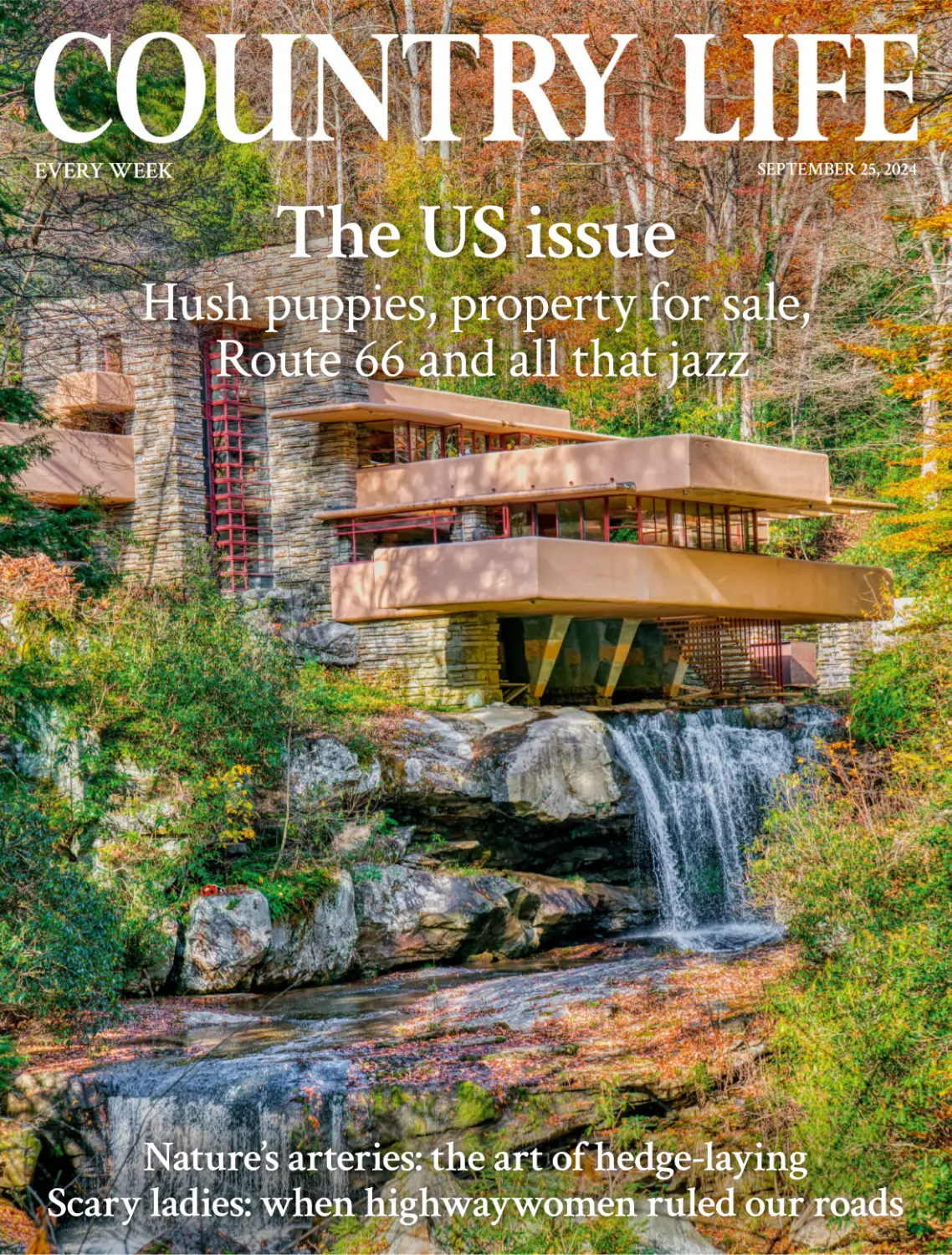
The US issue
SEPTEMBER 25, 2024
Hush puppies, property for sale,
Route 66 and all that jazz
Nature’s arteries: the art of hedge-laying
Scary ladies: when highwaywomen ruled our roads
VOL CCXXIII NO 39, SEPTEMBER 25, 2024
Ms Vanshika Goenka Misra
Vanshika is the CEO of British heritage brand Christy and founder of Kool Kanya, a women’s professional
networking platform that seeks to address the disparity in opportunities for women in the workplace.
She holds a degree in Political Science from Brown University, Rhode Island, US.
Photographed at The Berkeley hotel, London SW1, by Mike Garrard
Contents September 25, 2024
Herculean effort: Stephanie Prideaux-Aspinall of the National Trust cleans the Hercules statue in the Pantheon at Stourhead, Dorset
Frank Lloyd Wright’s Fallingwater
property in Pennsylvania, US
(Daniel Wilson/Alamy)
COVER STORIES
82 Life on the hedge
Richard Negus reveals how the
ancient art of hedgelaying plays
a crucial role in creating countryside highways for British wildlife
86 Playing fast and loose
Matthew Dennison unmasks
the tough-talking, gun-toting
highwaywomen who brazenly
ruled the roads of Britain
119 US Special
The latest in Stateside luxury on
land and sea (page 120), Charles
Harris charts the birth of Liberty
(page 122), Agnes Stamp relives
the golden age of transatlantic
travel (page 126), Charlie Thomas
gets his kicks on Route 66 (page
130), Russell Higham tunes up for
THIS WEEK
64 Alexia Robinson’s
favourite painting
The Love British Food founder
falls for a classic animal work
66 ‘A well-resorted tavern’
In the first of two articles, Jeremy
Musson charts the remarkable
history and preservation of Mount
Vernon, George Washington’s
former home in Virginia, US
72 The legacy
Sir Laurence Olivier takes centre
stage once more as Kate Green
applauds his crucial role in the
founding of the National Theatre
52 | Country Life | September 25, 2024
74 Navigating nostalgia
Joseph Phelan is at the tiller for
a joyous canal-boat journey—
to the Industrial Revolution and
back—on Britain’s canal network
90 Singing the end-ofsummertime blues
A dose of digging is just what
the doctor ordered for John
Lewis-Stempel as he attempts
to shake off his gloomy mood
94 Luxury
Hetty Lintell presents gorgeous
jewellery, chic clothing and top
treatments, plus actor Matthew
Goode shares his favourite things
102 Interiors
A bedroom makeover leaves
Amelia Thorpe green with envy
146 Love in a dry climate
Kendra Wilson marvels at the
innovative design of a desert
garden at Ghost Wash in the
Paradise Valley, Arizona, US
- a week’s a long time without it
Subscribe and receive six issues for £6*
Visit www.countrylifesubs.co.uk/C76N
*After your first six issues, your payment will continue at £46.49 every three months by UK Direct
Debit. For full terms and conditions, visit magazinesdirect.com/terms. Offer closes October 1, 2024.
154 Kitchen garden cook
Melanie Johnson showcases
meals for meat-free Mondays
starring earthy wild mushrooms
156 Foraging
It’s a magnet for dirt and earwigs,
but don’t let that put you off—
anyone for cauliflower-fungus
cheese, asks John Wright
160 The swing of the pendulum
It’s high time we celebrated the
golden age of British horology,
suggests Huon Mallalieu, as he
finds out exactly what made
our master clockmakers tick
EVERY WEEK
54 Town & Country
58 Notebook
60 Letters
61 Agromenes
62 Athena
108 Property market
114 Property comment
152 In the garden
158 Arts & antiques
166 Art market
168 Books
173 Bridge and crossword
174 Classified advertisements
178 Spectator
178 Tottering-by-Gently
Zachary Culpin/BNPS
Newport and all that jazz (page
134), Rosie Paterson checks in on
New York hotels (page 138), Tom
Parker Bowles finds out what’s
hot in US food (page 140) and
Melanie Bryan looks at COUNTRY
LIFE across the pond (page 144)
Future Publishing Ltd, 121–141 Westbourne Terrace, Paddington, London W2 6JR
0330 390 6591; www.countrylife.co.uk
Born in the USA
O celebrate our special American
issue, here is a reminder of what
we love most from across the
Atlantic.
+VTLZ[PJISPZZ
The refrigerator, the dishwasher, the washing
machine, the electric iron and the microwave
oven were all invented there, for which we
thank you from the bottom of our hearts.
0UMS\LU[PHS^VTLU
In 1873, Leonard Jerome, proprietor of the
New York Times, rented Rosetta Cottage on
the Isle of Wight for Cowes Week. Within three
days, his daughter Jennie had accepted a proposal from Randolph Churchill—a plaque
marks the spot; their son, Winston, was born
the following year. Another heiress, Nancy
Tree (later Lancaster), owner of Colefax and
Fowler, was an arbiter of taste who taught the
British how to decorate their houses elegantly.
And then there’s our very own Carla Carlisle…
Red, amber, green
Traffic lights may make us curse, but it’s chaos
when they fail. The first red-green lights
were installed in Cleveland, Ohio, in 1912.
T
PPA Front Cover of the Year 2023
Property Magazine of the Year 2022,
Property Press Awards
Building up
We don’t universally love them, but think how
much land urbanisation would take without
skyscrapers. The first, designed by William
Le Baron Jenney, was built in Chicago in 1885.
>LSSILOH]LKKVNZ
The jolly little Boston terrier, with its prick
ears and dapper markings, has such a reputation for politeness that it’s been dubbed
‘The American Gentleman’.
;VIVSKS`NV
On July 20, 1969, the world watched in wonder
as US astronauts Neil Armstrong and Buzz
Aldrin stepped onto the surface of the Moon.
*SHJRL[`JSHJR
We’d struggle to produce COUNTRY L IFE
without Pennsylvanian Christopher Latham
Sholes’s invention of the typewriter and the
QWERTY keyboard.
Blue jeans
In 1873, Levi Strauss and Jacob Davis obtained
a US patent on the process of putting rivets
in men’s work trousers. The rest is history.
,S]PZ
The greatest rocker of them all.
Editorial
Editor-in-Chief
Mark Hedges
Editorial Enquiries
News & Property Editor
Annunciata Elwes 3961
Lifestyle and Travel Editor
Rosie Paterson 6591
Working 9 to 5
It was Henry Ford who realised that the
40-hour working week was more productive, less exhausting and engendered better
worker loyalty.
*VYUHZOPNOHZHULSLWOHU[»ZL`L
‘No mere butter-smeared bite,’ writes Tom
Parker Bowles of corn-on-the-cob (September
11), ‘rather a baroque symphony…’.
4PJRL`4V\ZL
And the Seven Dwarfs and Cruella de Vil—
the creations of the pioneering Walt Disney
are still funny and enduring.
Brilliant Bernstein
He was a tricky, mercurial musician to work
with, but he gave us West Side Story, surely
the most romantic musical of them all.
/VSS`^VVKNSHTV\Y
Marilyn Monroe and Greta Garbo, Clark
Gable and Paul Newman—from the days
when film stars knew how to maintain their
mystique and fire the imagination.
;VTVYYV^PZHUV[OLYKH`
Gone with the Wind vs our own Brief
Encounter: discuss.
*V\U[Y`3PML7PJ[\YL3PIYHY`
Content & Permissions
,_LJ\[P]L
Cindie Johnston 6538
Commercial director
0UZLY[Z*HUVW`4LKPH
020–4517 1430;
paloma.walder@canopymedia.co.uk
Back issues
www.magazinesdirect.com
3\_\Y`,KP[VY
/L[[`3PU[LSS07984 178307
*SHYL+V]L
Telephone numbers are
WYLÄ_LKI`0330 390
Head of Design
+LHU<ZOLY
Emails are
name.surname@futurenet.com
;VÄUKV\[TVYLJVU[HJ[\Z
at licensing@futurenet.com or
view our available content at
www.futurecontenthub.com
Senior Art Editor
Emma Earnshaw
(K]LY[PZLTLU[KPYLJ[VY
HUK*SHZZPÄLK
2H[L)HYUÄLSK 07817 629935
British Society of Magazine Editors Scoop
of the Year 2015/16
Deputy Editor
Kate Green 4171
Head of Print Licensing
Rachel Shaw
Deputy Art Editor
Heather Clark
(K]LY[PZPUN7YVWLY[`
3\J`2OVZSH 07583 106990
0U[LYUH[PVUHS7YVWLY[`
PPA Specialist Consumer Magazine
of the Year 2014/15
Managing & Features Editor
Paula Lester 6426
Circulation Manager
4H[[OL^+L3PTH
Senior Designer
Ben Harris
Architectural Editor
John Goodall
Picture Editor
3\J`-VYK 4072
Gardens Editor
;PɈHU`+HULɈ6115
Acting Deputy Picture Editor
,TTH+H]PZ
,_LJ\[P]L,KP[VYHUK0U[LYPVYZ
Giles Kime 6047
Chief Sub-Editor
6J[H]PH7VSSVJR 6605
Deputy Features Editor
Victoria Marston 6446
Senior Sub-Editor
Stuart Martel
(K]LY[PZPUNHUK
*SHZZPÄLK7YVK\J[PVU
Stephen Turner 6613
Assistant Features Editor
Agnes Stamp
Digital Editor
;VI`2LLS
Senior Ad Production Manager
1V*YVZI` 6204
Art and Antiques Editor
Carla Passino
(carla.passinobargioni@
futurenet.com)
Deputy Digital Editor
1HTLZ-PZOLY 4058
Property Correspondent
7LUU`*O\YJOPSS
-VYHSS`V\YZ\IZJYPW[PVULUX\PYPLZWSLHZL]PZP[!
www.magazinesdirect.com/corporate/contact-us
PPA Magazine Brand of the Year 2019
PPA Front Cover of the Year 2018
British Society of Magazine Editors Columnist
of the Year (Special Interest) 2016
British Society of Magazine Editors
Innovation of the Year 2014/15
Editor’s PA/Editorial Assistant
Amie Elizabeth White 6102
Scarlett Glendenning
07938 735212
3\_\Y`
Katie Ruocco 07929 364909
0U[LYPVYZ;YH]LS
,TTH/PSL`07581 009998
Art & Antiques
Julia Laurence 07971 923054
Production
Group Production Manager
5PNLS+H]PLZ
Management
Senior Vice President Women’s
HUK3\_\Y`
/PSSHY`2LYY
Managing Director
Malcolm Young
7YPU[LKI` Walstead UK
September 25, 2024 | Country Life | 53
Town & Country
Annunciata Elwes
Butterfly SOS
E have known for some time
that butterflies are in trouble,
with a decline of 80% since
the 1970s. The problem was
more recently highlighted back in August,
when a plea was made for more volunteers
to take part in the last week of the Big
Butterfly Count, due to a dramatic decrease
in sightings of these indicator species.
Now, the results are in and they have
spurred charity Butterfly Conservation on
to request, in an open letter to Defra Secretary Steve Reed, that the Government
declare a ‘Nature Emergency’ and ban
‘butterfly-killing’ neonicotinoid pesticides
properly, without exception.
With 85,000 volunteer ‘citizen scientists’
completing 143,241 15-minute counts (for
the record, this is slightly fewer participants
than last year, but they conducted more
counts), there was an average of seven butterflies spotted per count, down almost 50%
on last year’s 12 and the lowest in the 14
years since the initiative began. About 81%
of species have declined over the past year
and butterflies that have had their worst
ever summer include the common blue
(down 69% since 2023), holly blue (80%),
W
54 | Country Life | September 25, 2024
green-veined white (24%), small white (46%),
small tortoiseshell (74%), painted lady (66%)
and Scotch argus (61%). In total, some
935,000 butterflies and day-flying moths
were recorded across the UK from July 12
to August 4, down almost 600,000 on 2023
(more than a third); in a record 9,000 cases,
counts resulted in no sightings at all.
The summer of 2024
has been very poor
for butterflies…
Nature is sounding
the alarm call
‘The previous lowest average number
of butterflies per count was nine in 2022,
this latest figure is 22% lower than that,
which is very disturbing,’ says Richard Fox,
Butterfly Conservation’s head of science.
‘Not just that, but a third of the species
recorded in the Big Butterfly Count have had
their worst year on record, and no species
had their best. The results are in line with
Clockwise, from left:
Painted lady, holly
blue, small tortoiseshell, common blue
and Scotch argus
wider evidence that the summer of 2024 has
been very poor for butterflies… Nature is
sounding the alarm call.’
According to the Wildlife Trusts, a single
teaspoon of neonicotinoids delivers a lethal
dose to 1.25 million bees and, although their
general use is banned in the UK, exceptions
have repeatedly been authorised within the
past few years, for example, to protect sugar
beet crop. However, ‘when used on farmland,’
explains Dr Fox, ‘these chemicals make
their way into the wild plants growing at
field edges, resulting in adult butterflies and
moths drinking contaminated nectar and
caterpillars feeding on contaminated plants’.
Labour has pledged to prevent these emergency allowances and, although this is welcome,
‘we no longer have time for pledges—we
need action,’ reads the charity’s open letter.
‘While banning neonicotinoid pesticides won’t
solve the butterfly emergency or the Nature
emergency, it is a vital first step in restoring
butterfly numbers.’ The charity would also like
to see greater focus on supporting farmers
to reduce reliance on these harmful chemicals. To sign the petition, which closes on
October 13, and find out more, visit https://
butterfly-conservation.org/emergency
For all the latest news, visit countrylife.co.uk
Timeless
spirituality
Good week for
RTIST and Royal Drawing School
teacher Susan Bacon (also known
as Lady Bacon, chatelaine of Raveningham Hall in Norfolk) has reimagined
the traditional medieval Book of Hours
in a way that honours the spirituality
of the natural world as well as Christianity. ‘The inspiration for this Book
of Hours comes from a lifelong interest
in antiquarian books and manuscripts,
especially Books of Hours with their
vibrant illuminations. They were seen
as companions for life,’ explains Lady
Bacon. ‘I felt that, using the natural
world and my illustrations, I could give
Christianity a gentle nudge with a light
touch.’ Incorporating favourite prayers,
poems by the likes of Christina Rossetti,
John Donne and Walter de la Mare, and
a comparison of the naturalist’s calendars of Revd Gilbert White and William
Marwick, alongside 140 of Lady Bacon’s
own vivid illustrations (below), including
a beautiful Linnean Floral Clock, A Book
of Hours was published on September
12 (Tandem Publishing, £9.99).
Lucky plovers
The RSPB reported 71 ringed
plover fledglings at Snettisham,
Norfolk, a dramatic increase from
19 in 2021, attributed to further
efforts in keeping visitors and
dogs away from the coastal nests
A
Sweet trees
A nursery in Denbighshire, Wales,
has successfully cultivated dozens
of specimens from the 16 Sorbus
torminalis, a rare native tree, in the
area. The fruits were once eaten
as sweets and brewed into beer
‘Delphinium Dad’ Colin Parton’s National Plant Collection
Purple patch
ITH 105 cultivars, Yorkshireman Colin Parton’s
delphinium collection was awarded National Plant
Collection status last month. It joins charity Plant Heritage’s 700-plus Plant Collections across the UK.
Mr Parton, also known as ‘Delphinium Dad’, has been
building what is thought to be the largest collection
of delphiniums in the UK for the past 40 years at his home
in the West Yorkshire village of Methley. It includes
21 rare and endangered cultivars, such as Delphinium
elatum ‘Bambi’, ‘Boudicca’ and ‘Taj Mahal’.
‘Sadly, so many delphiniums have been lost over the
past 20 years and I am keen to stop this happening to any
more of the named Delphinium elatum cultivars,’ he says.
‘I would welcome any donations of named cultivars I do
not hold… They would also be propagated so the cultivar
prospers for many more years.’
‘The changing climate, new pests and diseases or even
changing fashions can result in plants no longer being
bought from nurseries and planted in gardens, but keeping
a selection within the National Plant Collections ensures
that these “living libraries” are protected, and their futures
guaranteed,’ comments Plant Heritage CEO Gwen Hines.
‘We are immensely grateful to Colin and his tireless efforts.’
Visit www.plantheritage.org.uk for further information;
Mr Parton’s garden is open by appointment only (07485
512926; delphiniumcollection@gmail.com) and entry can
be free or in the form of a donation to Cancer Research.
W
It’s officially spider season and a new
set of stamps issued by Royal Mail
celebrates these fascinating creatures,
with the help of wildlife artist Richard
Lewington. Ten designs feature, among
others, the rare ladybird and heather
crab spiders, common garden cucumber
and zebra spiders and the nursery web
spider, often found on road verges
Eely good news
A critically endangered European
eel was spotted on a tour of the
River Sherbourne during Coventry’s
River Festival, highlighting the ‘potential’
of the river to
‘recover and improve ecologically’
Eat Game Awards 2025
Nominations for the best restaurants,
chefs, butchers and products in
the industry are now open via
www.eatgame.co.uk/nominations,
closing on November 18
Copper load of this
Three disused, historical copperworks buildings integral to the
growth of Swansea for more than
300 years will be restored and
developed for new uses
Bad week for
Bats
A bat-observing group
in Buckfastleigh, Devon,
reports an ‘alarming’
decline of rare greater
horseshoe bats, counting
as few as 20 against
an expected 1,000 earlier
this year
Reckless abandonment
Surrey Docks Farm, based in
south-east London, has warned
against dumping pets at the
premises after at least one
animal left in a bag at the gate
was killed by foxes
Leaking figures
Key flood defences across England
are in disrepair, reveals leaked
Government data, leaving about
5.7 million properties at risk of flooding as a wet autumn looms AEW
September 25, 2024 | Country Life | 55
What’s the buzz?
NEW RHS survey has identified more
than 100 plants popular with bumblebees that are not on the charity’s official
Plants for Pollinators list. Between February
and May this year, volunteers recorded
bumblebee sightings in gardens and parks,
noting the flowers of most interest in that
critical time of year ‘when queens are under
maximum stress, foraging on their own as
they establish their nests,’ says Bumblebee
Conservation Trust’s Dr Richard Comont.
Just announced, the results of the Bumbles
on Blooms project—recognised by Defra
this year as a Bees Needs Champion—name
some 350 plants. Interestingly, bees are most
drawn to white petals, closely followed by pink
and purple, tying in with the top reported
A
plants of comfrey, crocuses, chives,
dandelion and heather. Of the 10 bumblebee species recorded, the three
most commonly seen were early, bufftailed and common carder and
suburban areas, with their jigsaw of smaller gardens and
allotments, are hotspots.
‘The prolonged, wet spring
this year made it especially
challenging for bumblebees
to establish their colonies,
so this project has been very
timely,’ explains Helen Bostock, the
RHS’s senior wildlife specialist. ‘The
public’s observations have highlighted
the importance of a diverse range of plants
Camassia (left) is one of a number of
plants identified by the RHS as being
popular with bees (above), despite not
figuring on its Plants for Pollinators list
in supporting bumblebee populations throughout spring. This data will help us refine
our recommendations and encourage
more gardeners to plant for pollinators,
especially as autumn offers the perfect
window for planting both spring
bulbs and perennials.’
As well as the usual suspects, the
charity names daffodil, snake’s head
fritillary, camassia, Grevillea
rosmarinifolia and Pittosporum tenuifolium as ‘showing
promise’. Visit www.rhs.org.uk/science/
help-our-research/bumbles-on-blooms
for further information.
Serial offenders
T’S a rite of passage to have a train delayed or cancelled by something
completely stupid—with ‘animals on the line’ a classic groan-worthy
announcement. In the light of last week’s capybara escape from a zoo in
Shropshire, we present Network Rail’s list of the worst animal trespassers
on tracks in the past 12 months. In no particular order, they are deer, bees
(bees?), mice, hedgehogs, a donkey, cows and one tortoise.
In total, animals trespassed 1,432 times in the 12 months up to March 31.
Of those, deer were the most numerous, with 349
recorded incidents. Sheep came second, with 177
incursions, followed by birds, cows, swans, dogs,
cats, badgers and foxes. However, by a considerable
margin, humans are the worst culprits, trespassing on the railway 19,300 times.
As well as compiling lists of annoying animals,
Network Rail’s solutions include a deer-detection
system on the East Coast Main Line, which has
deterred 6,000 deer since its rollout in May 2023. Further
mitigation efforts include installing wildlife crossings,
partnering with animal charities such as the Swan
Sanctuary to provide specialist training and inspecting
fencing, and working with nearby farmers. JF
I
56 | Country Life | September 25, 2024
Both the autumn equinox and recent harvest moon
are celebrated in an exhibition at Bere Mill, on the
River Test east of Whitchurch, Hampshire. Saad
Qureshi’s uncanny Night Jewel I (above) is among
works on show in the former paper and corn mill set
in picturesque water meadows and gardens dotted
with sculpture, with other artists including Robyn
Litchfield, Domenica de Ferranti, Hugo Winder-Lind
and Stanley Donwood. ‘Harvest Moon’ runs to
October 16 (www.tinmanart.com)
0HPU/3LHJO"+HTPHU4VUL`)\[[LYÅ`*VUZLY]H[PVU"5LPS/\STL"(UKYL^*VVWLY"2LYY`;OVYWL".L[[`"(SHT`"-PVUH6ZIHSKZ[VUL*V\U[Y`3PML"1VU[`>PSKL;PU4HU(Y["9PJR.\LZ[
Town & Country
History in
the making
HE gun used to assassinate Archduke Franz
Ferdinand, Pink Floyd’s Wish You Were
Here master tape, the hat Napoleon abandoned
at Waterloo, moon dust from Apollo 11, T. S. Eliot’s
fountain pen and Ernest Hemingway’s typewriter are
among the pivotal items of history and culture documented
in a new exhibition. Photographer and Legacy+Art founder Rick
Guest, whose work can be seen in the National Portrait Gallery, has travelled the
globe photographing objects dating back three centuries to form the show, which
will run at art fair StART next month. Other implements of creation that have
been photographed are Lord Byron’s gold-and-enamel dip pen, Sir Henry Moore’s
chisels, Jane Austen’s writing table and Lucian Freud’s paints, with more items
of interest including Sir Peter Blake’s hand-painted bass drumskin used on the
cover of The Beatles’ Sgt. Pepper’s Lonely Hearts Club Band album in 1967 and
Beethoven’s death mask. On the musical theme, various microphones at Abbey Road
have been photographed, used by The Beatles and Kate Bush among others. After
10 years at the Saatchi Gallery, StART will be the debut event at the new Town Hall,
King’s Cross, London WC1, and the exhibition ‘Holy Relics’ runs from October 7–13.
T
Pull the
other one:
only a few
of the loorelated
items from
the Thomas
Crapper
Collection,
which is
being sold
by owner
Simon Kirby
Don’t forget to flush
VER the years, only a few enthusiasts have visited the private Stratfordupon-Avon museum housing the Thomas Crapper Collection and owner
Simon Kirby has now taken the difficult decision to sell it. Assembled over
40 years by the ‘acknowledged expert in the history of the “smallest room”’, who
used to own the famous company and is now consultant to the Royal Household,
among other owners of antique bathroomware in historic buildings, the collection
has received architectural salvage company Salvo’s Truly Reclaimed seal
of authenticity. The vast 1,200 items, mostly loos from various manufacturers,
range from the 1830s to the 1960s and also include George V’s bath from the Royal
Train, complete with silver-plated taps, other huge cast-iron baths panelled
in mahogany, a thunderbox and a potty with Hitler’s face in the bottom.
‘I cannot justify keeping the collection. It is time for it to be explored and enjoyed
by the public,’ comments Mr Kirby, who would prefer the items be kept together
and is looking for offers over £300,000. However, he also invites members of the
public to register interest in individual items should it have to be split up. He adds:
‘Old bathroomware of this quality and condition is seldom found these days; this
is a unique chance to acquire a large number of rare pieces.’ Visit www.salvoweb.
com or https://trulyreclaimed.org/thomas-crapper-museum for further information.
O
Country Mouse
Bound by a golden thread
OTS in pushchairs, an old lady in a wheelchair,
children on excitable ponies, well-mounted gentlemen and myriad others made up the followers of the
Percy on the recent National Trail Hunting Day.
Rousing speeches affirmed our shared love for the
spectacular country we’re lucky to cross, our close-knit
community and the pack’s wise-eyed Old English
hounds—one of which, Sparkle, will show her paces
at Crufts next year—before they set off with zeal to
follow the trail laid by a fleet-footed former rugby
player. The golden thread gleamed bright across the
Northumberland moors, burnished through the centuries and still strong, for now, at least.
In the western Highlands the following week,
a chance encounter with keeper Colin led us to
Reraig estate, where he cares for his beloved deer.
Grand royal stags came at his echoing call to feed
mere yards away. In between stories, he lamented
the tree-planting zealots who’ve banished the close
season for male deer, but the young stalker we followed
a day later keeps the traditional seasons and, standing
on top of the hill with ridge after ridge of moss and
heather and rock stretching into the blue distance,
alive with insects, birds and the great deer, Scotland’s
majesty seemed undimmed. Long may we follow
our hounds and stags wherever they roam. OP
T
Town Mouse
St Albans in sunshine
RILLIANT September mornings always feel
particularly exhilarating and last week was
rich with them. There’s an early freshness with
promise of warmth to come that’s uplifting, the
pleasure further sharpened by a consciousness that
the trees are starting to turn and the weather will not
hold. Last Saturday, Town Mouse enjoyed one such
morning in St Albans, arriving just as the market in
the long, central square was starting business. The
array of food was wonderful, although one popular
stall of pet food let off a smell of fish and bone from
which it was a relief to escape. It was still possible
to buy coffee and a cake without queuing, but, a few
hours later, the heaving crowds were astonishing.
In between these passages through the market,
there was a meeting of the Monumental Brass Society
to attend. The bulletins and annual transactions of this
society—and several others to which their father
belongs—are always greeted by the children with
wild hilarity when they arrive in the post. Even they,
however, might have enjoyed the sunlit interior of the
abbey and the extraordinary 14th-century funeral
brass of Abbot Thomas de la Mare. In the background were the sounds of a wedding in the Lady
Chapel—a magical day for such a happy event. JG
B
September 25, 2024 | Country Life | 57
Town & Country Notebook
Edited by Victoria Marston
Quiz of the week
Cabinet of curiosities by David Profumo
1) What type of creature is a blackcap?
2) Which British couturier designed
Elizabeth II’s wedding gown?
3) What is ‘albumen’ more commonly
known as?
4) I Am the Very Model of a Modern
Major-General is from which work by
Gilbert and Sullivan?
5) In which century did the Black
Death occur in Europe?
Babycham glasses
Riddle me this
‘Thiss sentance conntains two errorrs.’
How many mistakes are there in the
preceding sentence?
100 years ago in
ROM the retro-kitsch section of my Cabinet
comes this nice unused set of 1970s vintage
Babycham glasses, featuring the iconic bowtied, Bambi-like fawn that promised the drinker
an evening of friskiness and sparkle—you’d
assume it was a chamois, but, in fact, it was
modelled on a Chinese water deer.
Back in the 1940s, the Showering family
developed a sweetish, fizzy cider made from
Swiss Wasser pears, initially called ‘Champagne
de la Poire’, then ‘Baby Cham’, until its eventual
christening. Launched in 1953, this ‘genuine
Champagne perry’ was the first alcoholic beverage to be advertised on British television—
‘I’d love a Babycham!’—and, a precursor of the
alcopop, it was aimed at the new female market.
Only 6% ABV, the little green four-liquid-ounce
bottle, with its image of respectable, even chic
occasions, soon became ubiquitous (although
F
there were cocktail
adaptations including, by admixture with brandy,
the ‘Legover’).
The historic
English tradition of making
effervescent cidery
drinks actually predates the sparkling
Champagne method and when the French
protested about trademark infraction in 1978,
they lost their case. It was once said that only
two pubs in England didn’t stock the drink;
after languishing awhile following its heyday,
Babycham has returned to the Showerings
of Shepton Mallet, Somerset—‘The Happiest
Drink in the World!’
Follow David on Instagram @david_profumo
Time to buy
T this season of the year one
of the chief ornamental features of our woodlands and the
countryside in general is the many
beautiful tints and delicate shades
of colour so characteristic of the
foliage of several of our trees and
shrubs. The impression of such
pictures on the mind cannot but fail
to suggest to one the value of coloured foliage in the adornment
of the garden after the summer and
early autumn flowers are long since
departed joys. It is only in autumn
that the russets and those vague
colours between red, yellow and
purple are to be seen in our gardens,
for leaves take on tints which are
rarely seen in flowers. Such colours
are seen when the late afternoon sun
brings into prominence the browns
and yellows and casts a mellow
radiance over the whole garden.
Blackbird Bronze
Miniature Sculpture:
handmade in the UK,
10% of sales goes
to the RSPB, £60,
Blackbird Jewellery (www.
blackbirdjewellery.com)
A
1) Bird 2) Sir Norman Hartnell 3) Egg white
4) ‘The Pirates of Penzance’ 5) 14th century.
Riddle me this: Five (four spelling mistakes,
plus the incorrect claim that there are only
two errors)
58 | Country Life | September 25, 2024
Bathtub Gin: citrusy
and refreshing, in
an apothecary-style
bottle, £34.95, available
from Master of Malt
(01892 888376; www.
masterofmalt.com)
On this day…
September 25, 1818
Dr James Blundell performed
the first human-to-human
blood transfusion at Guy’s
Hospital, London SE1, using
multiple donors—it had previously been attempted using
animal blood, which had
proved fatal. Indeed, this
patient died 56 hours after
the injections and it wasn’t
until 1901 that different blood
groups were identified.
A novel note
‘In the shaded darkness, silence
had the quality of a looming
dragon. It seemed to roar
and the roar to reverberate,
to dominate’
Clear Light of Day,
Anita Desai
Poet’s corner
‘Glory be to God for
dappled things—
For skies of couple-colour
as a brinded cow;
For rose-moles all in stipple
upon trout that swim;
Fresh-firecoal chestnut-falls;
finches’ wings’
Pied Beauty,
Gerard Manley Hopkins
Glyn Satterley/Country Life Picture Library; Alamy; Michael Craig-Martin, Eye of the Storm, 2003. Acrylic on canvas, 335.3cm x 279.4cm. Collection Irish Museum
of Modern Art, Purchase, 2005. © Michael Craig-Martin. Photo: Prudence Cuming Associates Ltd. Image courtesy of Gagosian; Annabelle King/Future Plc
September 27, 1924
In the spotlight
Median wasp (Dolichovespula media)
Wine o’clock
A rare find
Sainsbury’s, Taste the
Difference Discovery
Collection Luberon, Rhône,
France, 2023. £12,
Sainsbury’s, alc 13.5%
This Rhône blend is new to
Sainsbury’s and hugely over
delivers for the price. Unoaked
and mostly Vermentino (with
Grenache Blanc, Ugni Blanc
and others), it kicks off with
breezy citrus, mineral and grassy
aromas. Lipsmacking citrus and
fresh green notes are rounded
out with honey and dried herbs,
underpinned by a mineral
streak, with a long, crisp finish.
Visit www.decanter.com
ITH the ripening of fruits on trees,
brambles and vines, it naturally follows
that plenty of wasps are at large, seeking out
the juicy sweetness. Pears, grapes and plums
have thin enough skins to be broken into
easily and the holes already made from bird
peckings enable access to the flesh of tougherskinned apples.
Despite people’s widespread loathing and
fear of wasps, they are chiefly a benign presence in the garden, eating thousands of harmful
insects and their larvae. The nests are always
W
magnificent feats of papery invertebrate architecture and, although the quarters of some
species are hidden in the ground or crevices in
buildings, those of median wasps are suspended
in trees and shrubs—a papier mâché peardrop
with a neat, round entrance at the base.
Much of the colony’s work has been done by
now; a new generation of queen wasps and
males emerges with the close of summer, the
males dying after mating and the young queens
departing to find hibernation quarters. The old
queen will also die, her job consummately done.
Unmissable events
October 7–26 ‘90 Years
of English Decoration:
The Lucinda Oakes Selling
Exhibition’,:PI`S*VSLMH_
1VOU-V^SLY ¶ 7PTSPJV
Road, London SW1. Pieces
by the decorative artist and
KH\NO[LYVM*VSLMH_KPYLJ[VY
.LVYNL6HRLZ
2231; www.sibylcolefax.com)
Until December 10
‘Michael Craig-Martin’
(pictured), Royal Academy,
Burlington House, Piccadilly,
London W1. Largest retrospective of the British artist’s
colourful work ever to be held
PU[OL<2
"
www.royalacademy.org.uk)
October 4–6 Literature
& Landscape, The Maltings,
Wells-next-the-Sea, Norfolk.
Festival of the Arts, with Robert
Macfarlane, Adam Nicolson
and Alice Oswald (www.
literatureandlandscape.org)
October 5 Sea Watch
Saturday!, Wembury Point,
Plymouth, Devon. Bring your
binoculars and learn about
cetaceans and sea birds
on the first Saturday of each
month (01752 862538; www.
devonwildlifetrust.org)
Book now
November 19 Oscar livestream, worldwide. A new
ballet based on the life and
works of Oscar Wilde broadcast live from Sydney Opera
House by The Australian Ballet
(www.australianballet.com.au)
September 29 Bates Green Garden, Arlington, East Sussex
6^ULKI`[OL4J*\[JOHUMHTPS`MVY`LHYZ[OPZ]LY`ZWLJPHSNHYKLUPZWYPTHYPS`
[OLJYLH[PVUVM*HYVS`U4J*\[JOHU^OVKPLKPU /LYZRPSSZHZHWSHU[Z^VTHU
shine out from woodland to courtyard and borders, where asters and dahlias are
seasonal fortes. Pre-booking essential (www.ngs.org.uk).
Time for tea
Irish breakfast
Given that the Irish
consume about five
cups of tea a day per
person—half a cup more
than the average Englishman—we
should pay heed to Irish breakfast
tea, which emphasises strong
Assam in the blends, with a more
robust and intense flavour than
English breakfast. The heavily
oxidised Assam leaf gives the tea
a reddish hue and it punches
a malty flavour. Breakfast teas are
often associated with the bold taste
of black tea. The boost of caffeine
from these blends makes them
the perfect morning pick-me-up.
How to serve
Brewing is less particular than the
finer blends demand and little harm
will be done by too-hot water—
á*MVY
TPU\[LZPZMPUL
Where to buy
Barry’s Irish Breakfast Tea has
charmed Neal’s Yard Dairy into
stocking 250g of loose tea at

"^^^
nealsyarddairy.co.uk). Morrisons
stocks the same blend in 80
teabags for £3.50.
Jonathon Jones discovers
teas from around the world,
finds new flavours and takes
English tea to Asia
September 25, 2024 | Country Life | 59
Letters to the Editor
Mark Hedges
Into the deep
Letter of the week
W
HE attached photograph (above)
may interest readers—it is the
Baker rifle, recently referred to in
COUNTRY L IFE , being fired at Bisley
earlier this year (Letters, August 14).
Each year, the RAF Target Rifle Club
entertains 50 liverymen at Bisley for
the day, with the surplus proceeds
being donated to the RAF Benevolent Fund. This year, with the help
of the 95th Rifle Battle Re-enactment
& Living History Society, the Liverymen had the opportunity to fire the
Baker rifle. The event celebrated its
10th anniversary this year and has
raised more than £70,000 for the fund.
Colin Sach, Lincolnshire
T
HE best explanation of how to determine the
length of a rod, pole or perch is to be found
in Yards, Gallons, and Golden Sovereigns by the
late Hope L. Bourne (Notebook, September 11). Apart
from it being the width of a bay in a barn that could
stand four oxen (above), Hope maintained that the
length of a rod in any parish was determined by
standing outside the church door on a Sunday and
getting the first 16 men to emerge, standing in line
toe-to-heel. The total length was the lawful rod for
the parish at that time. The extra 6in would be made
up by the soles of the boots. What
a gloriously local measurement.
Dr Sean Beer, Dorset
T
The writer of the letter of the week
will win a bottle of Pol Roger Brut
Réserve Champagne
Electric field
HANK you to Kathryn Bradley-Hole
for highlighting the unseen menace
of radio-frequency radiation and
electromagnetic fields (In the garden,
August 28). I am one of the (unfortunate) people who can feel
electromagnetic radiation (EMR). I noticed this more than
15 years ago, although no one could or would give me an
explanation. Finally, after hearing a broadcast by Dr Olle
Johansson, I recognised my health problem, which is most
unfortunate given this technology is the future. A recent report
in the Sénat in France on the impact of EMR on the health
of intensively raised hens and also on milk production raises
some interesting questions. Dianne Robat, by email
T
Swift response
THENA is so wise in pointing out
that the demand for ‘Experiences’
may have little to do with the venue
(Athena, September 11). However,
to see Swifties following the Taylor
Swift trail through the galleries of the
V&A was a clever induction into the
many collections. One young visitor
recommended The Blue Skies Project of prints, drawings and photographs in an adjacent room and
commented: ‘It’s so cool how they
spread it out so
you walk through
lots of the museum.’
In this case, the
Taylor Swift exhibit
had everything to
do with the venue.
Janice Ketley,
Surrey
A
Beach essentials
I
AM prompted to write about treating stings from jellyfish (‘If I only
had a brain’, July 3). Here in Australia,
stings from some species (box jellies)
are not only excruciatingly painful,
but often deadly. The most effective
way of deactivating the stinging cells
(nematocysts) is to apply vinegar to
the affected area. So, if you are likely
to encounter medusae while swimming, take a bottle of vinegar with you
to the beach.
Dr Graeme Watson, Victoria, Australia
Contact us (photographs
welcome)
Email: countrylife.letters@futurenet.
com
Post: COUNTRY LIFE, 121–141,
Westbourne Terrace, Paddington, London,
W2 6JR
We regret that we are unable to respond to
letters submitted by post
Future Publishing reserves the right to edit and
to reuse in any format or medium submissions
to the letters page of COUNTRY LIFE
If you wish to get in touch about your COUNTRY LIFE
subscription, including regarding changes of address,
please visit www.magazinesdirect.com/corporate/
contact-us
COUNTRY LIFE, ISSN 0045-8856, is published weekly by Future Publishing Limited, Quay House, The Ambury, Bath, BA1 1UA, UK. COUNTRY LIFE Subscriptions: For enquiries and orders, email: help@
magazinesdirect.com, alternatively from the UK call: 0330 333 1120, overseas call: + 44 330 333 1120 (Lines are open Monday–Saturday, 8am- 6pm GMT excluding Bank Holidays). One-year full
subscription rates: 1 Year (51) issues. UK £259; Europe/Eire €513 (delivery 3–5 days); USA $580 (delivery 5–12 days); Rest of World £446 (delivery 5–7 days). Periodicals postage paid at Brooklyn NY 11256.
US Postmaster: Send address changes to COUNTRY LIFE, Airfreight and mailing in the USA by agent WN Shipping USA, 165–15, 146th Avenue, 2nd Floor, Jamaica, NY 11434, USA. Subscription records are
maintained at Future Publishing Ltd, Rockwood House, 9–16, Perrymount Road, Haywards Heath, RH16 3DH. Air Business Ltd is acting as our mailing agent. If you are an active subscriber, you have
access to back issues through your iOS or Android devices. You will only be able to access the digital back issues as long as you are an active subscriber. To buy single back issues (print format) visit: magazinesdirect.
com (‘Single issues’ tab) or email: help@magazinesdirect.com For help call: +44(0)330 333 1113. Lines are open Mon- Fri 8.30am-7pm; Sat 10am-3pm UK time. Magazinesdirect.com is owned and operated
by Future Publishing Limited. We regret we cannot be liable for the safe custody or return of any solicited or unsolicited material, whether typescripts, photographs, transparencies, artwork or
computer discs. COUNTRY LIFE Picture Library: Articles and images published in this and previous issues are available, subject to copyright, from the COUNTRY LIFE Picture Library: 01252 555090/2/3.
Editorial Complaints: We work hard to achieve the highest standards of editorial content and we are committed to complying with the Editors’ Code of Practice (https://www.ipso.co.uk/IPSO/cop.html) as enforced by IPSO. If you have
a complaint about our editorial content, you can email us at complaints@futurenet.com or write to Complaints Manager, Future Publishing Limited Legal Department, 121-141 Westbourne Terrace, W2 6JR. Please provide details
of the material you are complaining about and explain your complaint by reference to the Editors’ Code. We will try to acknowledge your complaint within five working days and we aim to correct substantial errors as soon as possible.
60 | Country Life | September 25, 2024
Alamy; Tom Naunton Morgan; Getty; Renault UK
Calling the shots
Great lengths
E have a 55ft-deep well under
the rear wall of our 15th-century
Kentish hall house–half outside with
a grille over and half inside with a viewing window in what, 600 years ago, was
the full height of the hall (‘Let’s get to the
bottom of this’, September 11). When
the water slowly rises and the depth
reaches 33ft, water appears in the village
‘marble pond’. As the depth increases
further, we may have a flow of the
Nailbourne through our otherwise dry
chalk valley. The maximum depth
recorded was 44ft in 2012, when the
plastic ducks and other toys our children
dropped into the well 40 years ago
floated into sight, but not quite
within reach.
Paul Loxton Edwards, Kent
Optional extras
MUCH enjoyed your ‘first-car reminiscences’ feature (‘The sweet taste
of freedom’, August 28) and Kate
Green’s red Renault 4 (Gertie) reminded
me of my own early escapades. My ‘4’
sported some bizarre features. The
gear lever had been replaced by an
umbrella handle stuffed into the dashboard. The fuel gauge promised more
fuel the harder the engine revved, but
flicked to zero if the fan came on. The
wiring allowed the engine to run with
ignition off, but windscreen wipers
on and with the added comedy value
of the engine only firing as the wipers
travelled in one direction—fine at high
speeds, but somewhat jerky around
town. The headlamps pointed at the
trees and a ‘tilt’ light illuminated under
extreme body roll—this was thought
to be the oil light as it always accompanied a gravelly engine rattle. Ah, they
don’t make cars like that any more!
Tim Wells, by email
I
Magic moments
I
AGREE wholeheartedly with your
choice of misused words, but would
add one that is constantly and grossly
overemployed (Leader, September 4).
Everything that satisfies is now ‘fantastic’. The real magic of fantasy has
disappeared over the rainbow.
Ian Morton, by email
OCTOBER 2
Finding paradise amid the
muddy landscape of the
estuary, plus willow workers,
violin makers, travel,
history painting
and Chitty-ChittyBang-Bang
Food authority needs teeth
HE countryside often finds itself
dependent upon the activities
of organisations whose purpose
is to protect particular interests.
That is perfectly understandable, but they
wield such influence that we need to be vigilant
in monitoring their activities. Groups such
as the National Union of Farmers (NFU), the
Country Land and Business Association (CLA)
and the Food & Drink Federation (FDF), not
to mention the big supermarkets—all these
can make a huge impact on how we live in the
countryside and how farmers make a living
and look after the land.
That’s why last week’s riposte by the FDF
to a serious report by Bite Back, the charity
supported by chef and food writer Jamie
Oliver, was particularly concerning. Bite Back
had shown that the 10
largest food manufacturers had combined
carbon emissions worldwide that significantly
exceeded those of the
entire global aviation
industry and, indeed,
those of the UK as
a whole. The report
highlighted the fact
that seven of these 10 firms were not on track
to meet the 2050 emissions targets they have
set themselves; only four have verifiable
emissions targets, anyway, and three actually
increased their emissions in 2022.
Yet, faced with these figures, the FDF merely
dismissed the report and said that, as it was
based on worldwide assessments, it therefore
didn’t specifically refer to Britain. Worst of all,
it commented that, although the food we
consume does produce about a quarter of UK
emissions, it wasn’t the manufacturers’ responsibility as only 6% was directly attributable
to their processing. Agromenes believes such
a great industry deserves better representation
than this superficial, offhand dismissal.
The food we eat is brought to us by farmers,
hauliers, manufacturers and retailers, as well
as other suppliers ranging from packaging
T
companies to printers. The big food companies
play an important part in that chain. Their
huge advertising spend influences the public’s
choices, what they ask farmers to produce
affects the pattern of agriculture and the prices
they are prepared to pay help to determine rural
incomes. The FDF should ask how it is that
among its largest members there are companies
that aren’t performing in the public interest
and that six of the biggest have no verifiable
commitments to fighting climate change.
No amount of talking about ‘initiatives’ and
a ‘willingness to cooperate’ with the Government in improving things should divert the FDF
from the shocking facts Bite Back revealed.
The countryside cannot play its proper part
in the reduction of emissions, the renewal of the
soil and the encouragement of biodiversity
unless their big customers with their huge
resources help drive
the necessary change.
The food industry is
a global business and
all 10 of the UK’s major
food firms are global
companies. The FDF
can’t ignore their worldwide activities nor the
crucial role they play in enabling farmers to
produce food in a way that regenerates the soil,
cares for the environment and thus ensures our
ability to produce food in the future. It should
have responded to a simple question: what is
the FDF doing about the fact that Ferrero, Kraft
Heinz and PepsiCo have increased emissions
year on year? At present, it looks as if they neither
knew nor cared. For the sake of the members
that have committed themselves to net zero by
2050—Danone, Mars, Mondelďz and Nestlé—
the FDF should have welcomed the Bite Back
report. It should have promised it would seek
a response from the culprits and in future insist
all members have verifiable targets on emission
reduction. That is the issue that should be
on next month’s board agenda. The NFU and
CLA have already shown themselves ready to
work with manufacturers to achieve that end.
Ten food
manufacturers have
combined carbon
emissions that exceed
those of aviation
September 25, 2024 | Country Life | 61
Athena
Cultural Crusader
Art shouldn’t
be demeaned
by fighting
PREDICTABLE row has just
erupted over the exhibition by
the National Trust (NT) of The
Uninvited Guest from the
Unremembered Past by the contemporary
artist Nicola Turner, at the Gothic Revival
house of Tyntesfield, Somerset. A series
of installations made from organic dead
matter, including the legs of chairs and horse
hair, ‘disrupt’ the house. Their materials,
according to the NT’s description ‘hold
traces of memory; the horsehair has been
salvaged from old mattresses and furniture,
[and is] therefore absorbed with a lived
history from both its time as a domestic
object and as part of a living animal. The
installations explore ways of listening
to past, present and future’. To some, the
exhibition demeans the house, its collections
A
and its history, and to others it frames the
building in a fresh and unexpected way.
Athena hasn’t visited, but she thought
the artist’s installation in the courtyard
of Burlington House for the Royal Academy
Summer Exhibition this year, The Meddling
Fiend, striking and historically informed.
Now the heroic
phase of saving the
property is over, what
happens next?
It’s important to make clear that The
Uninvited Guest from the Unremembered
Past was displayed last year at the Wells
Art Contemporary in the superlative 14thcentury cathedral chapter house without—
to Athena’s knowledge—any public criticism.
That fact highlights the reality that this row
is about the irreconcilable divisions that
now exist between the present management of the NT and its critics as part of the
Culture Wars. As in so many prolonged
quarrels, the longer the fighting goes on,
the harder it is to feel wholehearted support
for either side. As regards this exhibition,
Athena thinks it’s unhelpful that a temporary
exhibition by a contemporary artist of standing should become implicated in hostilities.
It has done so, however, and there are interesting issues underlying the accompanying
Punch and Judy exchange of insults.
Athena doesn’t generally go to historic
buildings to see contemporary art. So it’s
undoubtedly annoying if a contemporary
installation is so strident that it compromises its setting. Added to which, she feels
offended by the widespread assumption
on the part of so many cultural institutions
at present that history is only digestible if
it comes with a spicing of the contemporary.
In her opinion, it’s an unaccountable view,
born of ignorance and a crisis of confidence
in the value of the past.
On the other hand, she is conscious that
the NT faces a dilemma with a house such
as Tyntesfield. Now the heroic phase of saving
the property and its contents ‘for ever and
for everyone’ is over, what happens next?
An owning family could evolve a house
to suit their taste and needs. For a conservation charity, however, the initial act
of preservation can mutate into fossilisation.
Art installations are one means of reframing them, but the bar must be high, not
least because familiarity easily persuades
those responsible to underestimate the
inherent interest of what they care for.
The way we were Photographs from the COUNTRY LIFE archive
1917
Every week for the past 125
years, COUNTRY LIFE has
documented and photographed many walks of life
in Britain. More than 80,000
of the images are available
for syndication or purchase
in digital format. To view
the archives, visit www.
countrylifeimages.co.uk
and email enquiries
to licensing@
futurenet.com
62 | Country Life | September 25, 2024
Country Life Picture Library; John Goodall
Published
June 23
Soon after America entered
the First World War in April
1917, COUNTRY LIFE produced
an appreciation focused
on its new ally with the
magazine’s first ever photographic cover (left). It shows
the celebrated statue of
Abraham Lincoln: The Man
(1887) by Augustus SaintGaudens in Chicago. To the
far left is the statue today.
My favourite painting Alexia Robinson
The Arab Tent by Sir Edwin Landseer
The Arab Tent, about 1865–66, oil on canvas, 61in by 89in, by Sir Edwin Landseer (1802–73), Wallace Collection, London
When we trained a racehorse at home,
it was a struggle to think of a stable
name for Premier Portrait by Portrait
Gallery. My thoughts turned to my
favourite painting in my favourite art
gallery, the Wallace Collection–Landseer’s
The Arab Tent–so we named him Wally.
He won 13 races for us and was National
Champion point-to-pointer. Because the
Wallace Collection is free, I wander
in often and just stand in front of this
painting. As a child I wanted to snuggle
up with the dogs and be part of it
64 | Country Life | September 25, 2024
Charlotte Mullins comments on
The Arab Tent
S
IR EDWIN LANDSEER came
from a large artistic family—his
father, John, was an engraver
and all his siblings became artists.
A precocious draughtsman, Landseer
began exhibiting at the Royal Academy
aged 13 and achieved the highest level
of fame in the family, with many of his
paintings turned into engravings and
widely disseminated.
The Arab Tent was completed in
1866, the year he finished sculpting
four lions for the base of Nelson’s
Column in Trafalgar Square. The artist
was responding to the growing interest
in Orientalism in this painting.
An Arab mare and foal lie on a rug
outside an Arab tent. Two Persian
greyhounds rest in the tent’s shade,
sprawled across a leopard skin, and
two monkeys make a bed of palm
leaves on the taut canvas above. There
are many incongruities in this picture,
but Landseer’s mastery of painting
animals is never in doubt. He studied
them at menageries and in the wild,
even dissecting them to understand their
anatomy, as did his predecessor George
Stubbs. He would anthropomorphise
them so they took on human characteristics and traits, with loyal and devoted
dogs being a particular favourite.
When he was painting The Arab
Tent, Landseer was offered the presidency of the Royal Academy, but turned
it down. The press had noticed his
‘nervous state of health’, exacerbated
by heavy drinking. Some time later, in
1872, he entered an asylum, dying the
following year.
Alamy
Alexia Robinson is the
founder of Love British
Food, the National Harvest
Service and British Food
Fortnight, which this year
runs until October 6
‘A well-resorted tavern’
Mount Vernon, Virginia, US, part I
A property in the care of Mount Vernon Ladies’ Association
In the first of two articles, Jeremy Musson looks at the remarkable history
and preservation of the country home of America’s first president
Photographs by George Washington’s Mount Vernon
OUNT VERNON—the former
home of George Washington,
first President of the US—is an
extraordinary place; a dignified
Virginian gentleman’s seat (Fig 1) overlooking
the Potomac River that was built in several
phases throughout the 18th century. With an
exterior clad in timber, detailed and painted
to appear like stone rustication, the house
is probably the most intensely researched
in America. It has been the subject of a sustained preservation campaign, with a great
deal of significant work taking place over the
past 12 years; this is due for completion in
2026 and will be part of the 250-year celebrations of the signing of the Declaration of
Independence. A final phase includes the
reintroduction of a lost timber sole plate that
will help underpin the structural integrity
M
66 | Country Life | September 25, 2024
During the Civil
War, the Association
had the site declared
neutral ground
of the building for the next century. This
is the first of two articles examining the
history of the house and site as it moves
towards the end of a major programme of
repairs. The second article will focus on the
restoration of the interiors.
Unsurprisingly, Mount Vernon has been
a subject of fascination, mostly because
of George Washington, major-general and
commander-in-chief of the American or
‘Continental’ army that fought the British in
the American Revolutionary War (as the War
of Independence is now usually known),
before becoming the first elected president
of the new American nation (Fig 4). His character and values helped shape the fledgling
country’s sense of self and he himself shaped
Mount Vernon, providing designs for the house
with his own pen, in the spirit of a gentleman
amateur, and the provision of pattern-book
exemplars for his craftsmen.
There can be little doubt that Washington
adored Mount Vernon; late in life, he wrote
of it: ‘No estate in United America is more
pleasantly situated than this. It lies in a high,
dry & healthy country […] on one of the
finest Rivers in the world.’ The Washingtons
were famously hospitable, with Washington
describing his house—only half-jokingly—
as a ‘well resorted tavern’ in 1787. By the time
of his death, on December 14, 1799, Washington had devoted 45 years to the development
of the estate, both the 8,000-acre plantation
and the principal residence and parkland.
After retiring from office in March 1797, he
returned to improve both the farming and
the house, partly in a self-conscious imitation of the ideal of Cincinnatus, the military
leader of the early Roman republic who
returned to his plough.
The house survived the American Civil
War even when many older estate houses in
the region were destroyed. Its preservation
was due to a dedicated band of women—the
Mount Vernon Ladies’ Association, which was
formed in 1853 under the direction of Ann
Pamela Cunningham, with representatives
drawn from many of the original states
of the Union. In 1861, during the Civil War,
the Association petitioned military leaders
on both sides and succeeded in having the
site declared neutral ground, an event that
deserves more study for how such historic
buildings can be protected in wartime.
The same association, still with a womanonly board, owns and manages Mount Vernon
today, preserving it without state assistance
and opening it to more than one million
visitors a year. It has continued to enhance
the presentation of the home of one of the
founding fathers—perhaps the founding
father—of the modern American nation.
This work is supported by the outstanding
facilities of The George Washington Presidential Library, also on the Mount Vernon estate.
The house and its collections associated with
the Washington family have been the focus
Fig 1: Mount Vernon, above the Potomac
River, with its famous piazza or portico.
It is timber built, but the wall surfaces
are detailed to appear like rustication
of an extraordinary level of scholarly research,
which has fed into redecoration work, following a guiding principle of presenting the site
as it was at the death of Washington.
A museum, together with films and guides,
helps visitors explore Washington’s life and
values alongside those of the emerging American republic, encompassing new research,
knowledge and understanding about the
lives and contribution of the many AfricanAmerican enslaved servants and estate
workers. The plantation and estate had an
enslaved workforce of 317 at his death, typical
of how an agricultural property in the
September 25, 2024 | Country Life | 67
Fig 2 above: English merchant Samuel Vaughan made a sketch survey in his 1787 journal.
Fig 3 right: The entrance front; the house was enlarged in stages during the 18th century
American South or the British Atlantic colonies was then run. Washington was regularly accompanied by his enslaved personal
manservant, William Lee, who is depicted
with him in more than one portrait. His will
freed Lee outright in recognition of his devotion during the Revolutionary War. The other
slaves he owned personally were to be freed
after the death of his wife, Martha, suggesting some ambivalence towards the system
of slavery and the slave-based economy
from which he and his estate benefited.
The Mount Vernon land belonged to the
Washington family from 1674. Washington’s
father, Capt Augustine Washington—a Virginian agriculturalist, JP and county sheriff
—bought it from his sister in 1726 and had
a new five-bay house built there, consisting
of a single main storey with an attic, in 1734.
68 | Country Life | September 25, 2024
Washington was
a land surveyor
by training and,
by conviction, an
“improving farmer”
George took over the estate from his older
half-brother Lawrence and was a tenant
until the death of Lawrence’s widow in 1761.
The young Washington was an army officer
for the British administration during the
1750s war with the French. He was colonel and
commander of the Virginian regiment in
1755–58 and married a young widow called
Martha Dandridge Custis in 1759, gaining
two stepchildren, to whom he was devoted.
By the 1770s, Martha’s wealth had brought
him to into the top rank of Virginian society.
He was then embarked on a political career
that would culminate in him becoming
a commander of the American forces against
the British and the first US President.
Mount Vernon was rather neglected during
Washington’s presidency and he returned in
early 1797 to find the house ‘in need of repairs’,
describing himself in April of that year as
‘surrounded by Joiners, Masons, Painters
&ca’. The house had been raised by a storey
in 1758–59 to create a new first floor and attic
and, in the late 1770s and early 1780s, his
cousin and agent, Lund Washington, had to
oversee the work when Washington was away
fighting the British. Extended to both the north
and south, the house reached its full physical
extent at nine bays wide, with a double-height
portico running its length, in a simple Tuscan
order derived from a design by Batty Langley.
Complete by 1777, the portico—always known
as the piazza, its name apparently derived
from the piazza of London’s Covent Garden
—became the place where visitors enjoyed
views of the river and cool evening breezes.
Two three-bay pavilions of 1½ storeys
were added in 1775–76 on the entrance—and
landward—side of the building (Fig 3);
these were linked to the main house by unusually open, curved colonnades, the pavilions
replacing outbuildings built by Washington’s
half-brother. One pavilion housed a kitchen;
the other, the servants’ hall. Further distinction to the entrance elevation was conferred
by a triangular pediment over the entrance
Fig 4: George Washington at Princeton,
as commander of the Continental Army
in 1780, painted Charles Willson Peale
and an octagonal lantern known as the cupola.
Both these details helped disguise the asymmetry of the elevation, which followed the
placement of the stair in 1734.
In 1787, Washington designed and built
a brick greenhouse (Fig 5), filling it with
lemons, limes, aloes and palm trees. Low wings
on either side housed some of the enslaved
workers of the estate; men on one side, women
on the other. Although later damaged by fire
and rebuilt in a different form, this building
—both orangery and wings—was reconstructed to its original appearance in 1950–51.
Housing for enslaved families, now lost, was
also provided in cabins near the greenhouse.
Washington was a land surveyor by training and, by conviction, an ‘improving’ farmer,
who was always on the look out for clever
solutions. He considered it ‘within the
September 25, 2024 | Country Life | 69
rules of architecture… to make such small
departures’ as were necessary for a pleasing
result. As well as providing a simple sketch
for the 1770s additions, he designed a 16-sided
threshing barn for processing and storing
grain. This was built by estate carpenter
Thomas Green, who worked at Mount Vernon
in 1782–94. Green’s team of enslaved carpenters included African-born Sambo Anderson,
who also worked on alterations to the main
house. The barn was later lost, but a replica
was built in 1996, on a site nearer the house.
After seeing his
house... one would
say that he had seen
the most beautiful
examples in England
Visitors to the estate were very conscious
of the status of Washington and many
recorded their impressions in detail. In 1785,
Robert Hunter wrote: ‘I rose early and took
a walk about the general’s grounds, which
are really beautifully laid out… [he] superintends the whole himself. Indeed, his
greatest pride now is to be thought the first
farmer in America. He is quite a Cincinnatus,
and often works with his men himself, strips
off his coat and labors like a common man.’
Astonished by the size of a small estate village of workers’ houses, Hunter noted: ‘He
has everything within himself—carpenters,
bricklayers, brewers, blacksmith, bakers,
etc.’ Hunter admired the way Washington
knew how to ‘prefer solid happiness in his
Fig 5: The 1787 greenhouse burnt down in 1835 and was rebuilt in 1951, with bricks from the White House. The wings were slave quarters
70 | Country Life | September 25, 2024
Fig 6: The extensive workshops and cabins of the Mount Vernon estate were noted by many visitors during Washington’s lifetime
retirement to all the luxuries and flattering
speeches of European courts’.
English visitor Samuel Vaughan made
a sketch survey of the grounds in 1787 (Fig 2).
It shows the extent of the house, the planting,
the parade of outbuildings, workshops and
dwellings—still present today (Fig 6)—
and the parklike quality of the approach.
Vaughan presented Washington with a fully
drawn-up version of this, which has been an
essential reference point for the estate as
a protected monument. He noted ‘a street is
formed on each side at right angles above
200 feet long in which are sundry houses for
domesticks Tradesmen Workshops etc’. Some
of these have survived, others reconstructed.
The main house is compact in the centre, with
the piazza to the east described by a visitor
in 1796 as ‘the general resort in the afternoon’.
The entrance hall forms an east-west central
passage through the house and, leading
directly off it, are four intimate sized rooms.
On the north side are the Front Parlour and the
Little Parlour and to the south are the dining
room and a principal guest bedchamber.
Additions in the 1770s include Washington’s study to the south and the notable room
known as the ‘New Room’ to the north.
In reference to this, Washington wrote:
‘I would have the whole executed in a masterly manner.’ This double-height room has
a Venetian window, with its exterior character taken directly from plate 51 in Langley’s
Treasury of Designs, 1750, copied faithfully
by estate carpenter Goin Lanphier.
Visiting in 1798, Polish aristocrat Julian
Niemcewicz described the New Room as
a ‘large salon... recently added’. Of the wider
estate, he observed: ‘In a word the garden, the
plantations, the house, the whole upkeep
proves that a man born with natural taste can
divine the beautiful without ever having seen
the model. The Gl. [General] has never left
America. After seeing his house and his gardens one would say that he had seen the most
beautiful examples in England of this style.’
Benjamin Henry Latrobe, a British architect recently settled in Virginia, was more
circumspect, commenting in 1796 that: ‘Along
the other front is a portico supported by
8 square pillars, of good proportions and
effect.’ Although noting an expensive marble
chimneypiece ‘in the taste of William Chambers’ in the New Room, he added: ‘Everything
else is good and neat, but by no means above
what would be expected in a plain English
country gentleman of £500 or £600 a year.
It is however, a little above what I have hitherto seen in Virginia.’ We will look at the rich
and complex story of the interiors of Mount
Vernon in next week’s article.
Acknowledgements: Thomas Reinhart
Visit www.mountvernon.org
September 25, 2024 | Country Life | 71
The concrete
stage
The National Theatre
building, designed by Sir
Denys Lasdun and Peter
Softley, met with a mixed
response. COUNTRY LIFE
Architectural Editor Mark
Girouard described the
Grade ll-listed edifice as
‘an aesthetic of broken
forms’, Pevsner thought
its acres of concrete ‘overbearing’ and, in 1988,
The King (then Prince of
Wales) suggested it was
a ‘clever way of building
a nuclear-power station
without anyone noticing’
S
IR LAURENCE OLIVIER is chiefly remembered
—and revered—as the consummate charismatic
actor, but his talent extended beyond the artistic;
without his personality and vision, the National
Theatre might never have survived. Even before he
became its first director, in 1962, it had taken more
than a century to get off the ground, from the first
pamphlet calling for its creation, A House for Shakespeare by publisher Effingham Wilson in 1848, to
the National Theatre Act of 1949. This authorised
£1 million of state funding to be spent on a new building on London’s South Bank, although that theatre
was not completed until after Olivier’s tenure, in 1976.
It was, however, to his design and, when he retired
in 1973, he performed the topping-out ceremony.
His National Theatre was at what is now the Old Vic
and a series of huts in Aquinas Street, SE1, served as
the administrative centre. However, Olivier (1907–89)
gave the project its much-needed shot in the arm, commanding help from the big names of the day; Dame
72 | Country Life | September 25, 2024
Maggie Smith and Sir Derek Jacobi were members
of the first ensemble; Joan Plowright and Jeremy
Brett were among the cast in 1970 (pictured). Peter
O’Toole starred as Hamlet in the first production,
on October 22, 1963. Olivier’s own stage career was
to peter out, surprisingly blighted by stage fright.
The current director, Rufus Norris, only the sixth,
has had different challenges, including restrictions
on touring due to Brexit, the pandemic, during which
live streaming was initiated, reaching 173 countries
and 15 million viewers, and the pressure of balancing
a schedule of traditional moneyspinners with new
works that champion the buzzwords of diversity and
inclusivity. The current productions are Shakespeare’s
Coriolanus, starring David Oyelowo (Olivier Theatre),
new work A Tupperware of Ashes by Tanika Gupta
about an Indian family making decisions about their
mother, whose mind is fading (Dorfman), and The Other
Place, a retelling of the Antigone story (Lyttelton).
As in Olivier’s day, the casting is top notch. KG
Getty
The legacy Laurence Olivier and the National Theatre
Navigating nostalgia
Once the bustling arteries of the Industrial Revolution, today’s
British canals are places of tranquillity, joy and community,
says Joseph Phelan, as he explores their timeless appeal
RITAIN’S revived canal network
is a marvel of centuries-old engineering and volunteer-led grit.
This winding system of interconnected channels meanders its way through
landscapes rural and urban, unpretentious
and unhurried, imbued with an unmatched
charm. Two centuries on from its commercial heyday, when nearly 4,000 miles of canals
criss-crossed the country, the network
provides a welcome
opportunity to step
into a world where
there is no choice but
to slow down.
The resurgence of
Britain’s canals underscores not only their
resilience, but their
evolution—although no longer used for their
original purpose, they are as valuable
a commodity today as they ever were.
Canals were the bustling arteries of the
Industrial Revolution. Between the 1770s
and the 1830s, an era dubbed the Golden Age
of the canal, Britain was hit by a wave of
waterway fever. Masterminded by engineering luminaries such as James Brindley,
Thomas Telford and William Jessop,
B
the canals were a means of conveniently
transporting goods—from coal to pottery,
raw cotton to wheat—across the country
en masse. This brought rapid growth and
major economic development to Birmingham,
Manchester, Liverpool and Leeds, as well as
scores of other towns and cities.
Somewhat ironically, the canals played
a role in facilitating their own demise.
Canalmania was replaced by an obsession
with steam trains and
railway companies
capitalised on the
existing canal network,
using it to transport
the materials needed
for railway construction and maintenance.
The canals subsequently fell into a state of widespread
disrepair and, although some routes and
operators limped on, the majority were all
but abandoned. This could easily have marked
the end of the story and, under slightly different circumstances, canals would have
quietly slipped into history, a subject for
study rather than observation.
The network we see today, with its wellmaintained paths and locks, its visitor
Hollywood to Llangollen canal: Harrison Ford takes in the slower pace of life on the water
76 | Country Life | September 25, 2024
centres and amenity-rich mooring sites,
is a far cry from how it looked in its darkest
days. After the Second World War, the canals,
with ports, buses and the railways, were
nationalised. This led to suggestions that the
smaller waterways should be permanently
closed and they likely would have been, had
it not been for people such as Tom Rolt.
Born in 1910, Rolt was a British writer, engineer and conservationist who, with Robert
Aickman, kick-started the canal network’s
renaissance. In 1944, he published his seminal book Narrow Boat, which chronicled the
good, bad and beautiful of his travels on the
canal system aboard his narrowboat, Cressy.
The book shone a vivid spotlight on the
downfall of the canals, captured the public’s
imagination and, consequently, catalysed
the birth of the canal-restoration movement.
In 1946, Rolt and Aickman co-founded the
Inland Waterways Association (IWA), with
the aim of promoting the conservation, use,
maintenance and restoration of the canals.
Eighty years on from the publication of his
Getty; Shutterstock; Nadia Isakova/AWL Images; Adam Edwards
Volunteers give
a collective 671,000
hours to the
waterways annually
Narrow Boat, Britain’s canals are in better
shape than the writer could possibly have
imagined, thanks to an army of volunteers
following in his well-trodden footsteps.
According to the Canal & River Trust, these
volunteers give a collective 671,000 hours
of their time to the waterways annually.
That equates to about 76½ years.
The British Waterways Board was established to manage and enhance the network
in 1963, but it wasn’t until 1968—and the
landmark Transport Act, propelled by the
inimitable Barbara Castle—that our canals
received the funding necessary to begin
transforming them from dilapidated trenches
to navigable waterways. Since then, people
have given up their free time to maintain locks,
clear towpaths, run visitor centres, restore
habitats, paint railings and pick up litter.
One such individual is Steve Mears, a resident
of Worksop in Nottinghamshire. Following
a career as an engineering manager, he recognised that his expertise could help restore
some of the network to its former glory.
Time to take in the view: the Kennet and
Avon canal, famous for its flight of 29 locks
at Caen Hill, passes through Bathampton
‘I found my specific skill set to be greatly
needed and I was almost immediately carrying out repairs to lock mechanisms that had
been needed for several years,’ says Mr Mears.
‘I really enjoy the engineering aspect of working on the canal, but, most of all, I enjoy the
camaraderie of my fellow volunteers. Due
to funding cuts, there is very little money
available for infrastructure and maintenance, so I feel I’m part of maintaining our
country’s industrial heritage.’
Although the canals are predominantly
used for leisure today, numerous narrowboats house thriving businesses. Bike-repair
workshops, book stores, bakeries, yoga studios
and flower boutiques are only some of the
enterprises you could stumble upon. One particularly innovative concept is The Waltzing
Matilda Boat, a floating pizzeria created by
father-and-son duo Paul and Chris Edwards.
Life on the water
Timothy Betton, an abstract landscape
artist, lives and works aboard a narrowboat in London. He explains the appeal:
‘Since I can remember, I’ve dreamed
of living on a narrowboat. I love the
alternative lifestyle and being close to
Nature. I’m lucky enough to have a mooring in central London, meaning I don’t
have to move my boat every two weeks,
unlike many other boaters.
‘My boat is unusual in that it has
a double-height room, which I use as
my art studio. Water is a main focus of
my artistic work. Shaped by the environment, my recent pieces investigate
how water permeates everything.
‘The boat is smaller than an average
flat, but the positives outweigh the
negatives. I see myself remaining here
for the foreseeable future. It’s a different,
sometimes challenging way of life, but
it suits me perfectly.’
September 25, 2024 | Country Life | 77
Have oven, will travel: Chris Edwards and his father, Paul, traverse canals aboard The Waltzing Matilda Boat, serving pizza as they go
‘The idea came about during the first lockdown,’ explains Chris. ‘I was a chef and my dad
was furloughed. We thought about creating
a little café on the canal and the idea evolved
when I suggested adding a pizza oven. We
move the boat along the Macclesfield and
Peak Forest Canals regularly, changing locations to reach different communities, but our
customers can easily find us through our
social-media accounts.’ He concludes: ‘The
boat has created a lot of memories and brought
my family closer together. It has made us feel
an integral part of the canal’s vibrant life.’
Today, there are more boats registered
on the waterways than at the height of the
Industrial Revolution. This is, in large part,
due to a growing contingent of intrepid
adventurers. Nigel Fenwick and his wife,
Sue, are recent converts to canal life.
Now and then
1757 Opening of the Sankey
Canal, a river navigation in
north-west England, regarded
as the first modern canal
1761 Opening of the Bridgewater Canal, considered the
first true manmade canal in
Britain, constructed to transport coal from Worsley,
Greater Manchester, into
Manchester itself
1761 James Brindley’s Barton
There are more boats
registered on the
waterways than in the
Industrial Revolution
‘After I was made redundant in 2021, Sue
and I sold our home and spent five months
travelling around the UK,’ reveals Mr Fenwick.
‘It occurred to me that we might like to live
on the water and we now spend our summers
on our electric narrowboat, Tethys Solaris.
‘Because we don’t have the drone of a diesel
engine, we get to fully experience the beauty
of the countryside. We love getting up with
the lark and cruising down the canal, listening
Aqueduct, which crossed the
River Irwell, becomes the first
canal aqueduct in Britain
1793 Work begins on the
Grand Junction Canal, which
is designed to connect
London with the Midlands.
It is completed in 1805
1825 Opening of the Stockton
and Darlington Railway, the
world’s first public railway to
use steam locomotives. This
marks the beginning of competition with the canals
78 | Country Life | September 25, 2024
to the birds singing,’ he enthuses. ‘So far, we’ve
covered about 700 miles of canal and rivers.
The joy is in not having to go anywhere, be
anywhere or do anything to a schedule.’
Some 2,700 miles of UK canals and rivers
are currently interconnected. The Wey & Arun
Canal Trust, which is aiming to create the
missing link between Britain’s inland waterways and the English Channel, is one of many
organisations dedicated to restoring longneglected stretches of the network.
The transformation of Britain’s canals
is a powerful testament to what can be
achieved through dedication, passion and
a deep appreciation for cultural heritage.
They are more than a symbol of Britain’s
industrial ingenuity—they are a source of
joy, relaxation and community for future
generations to cherish.
1944 Publication of Tom Rolt’s
book Narrow Boat, which
plays a significant role in raising public awareness and
interest in canal preservation
1968 Barbara Castle’s
Transport Act recognises the
leisure value of canals and
provides money to support
their recreational use
1946 Establishment of the
Inland Waterways Association,
which campaigns for the
conservation and restoration
of Britain’s inland waterways
2012 The Canal & River Trust
is established to look after more
than 10,000 assets and structures, including bridges, lock
gates, aqueducts and reservoirs
1948 Nationalisation of the
canals, railways and ports, which,
despite significant underfunding, helps the canals survive
2014 First episode of Great
Canal Journeys, hosted by
Timothy West and Prunella
Scales, airs on More4
IP
R
C
ER
BS
SU
FF
O
O
TI
N
Make someone’s week, every week,
with a gift subscription
EVERY WEEK
MAY 8, 2024
The glorious Cotswolds
101 pages of property for sale
EVERY WEEK
MAY 15, 2024
Everything’s coming up roses
The best of Chelsea
SIX
Footman to fritillary: the names that flutter by
Fill your cup: the Cotswold cafés raising their coffee game
Bloomsbury gardens, Mrs Beeton and the best of Badminton
EVERY WEEK
ISSUES FOR
£6
JUNE 12, 2024
How to make the
countryside beautiful again
*
THE
GREEN
ISSUE
Scratching the surface: why soil matters
Seaside foraging and the real cost of wool
The Royal Family’s favourite artist
EVERY WEEK
Interiors special
APRIL 10, 2024
How beautiful things transform a home
The man who discovered oxygen
In the Monet: a garden inspired by great art
When the frog croaks: how animals forecast weather
Why everyone wants to live in Rose Cottage
Brawn and brilliance: the drama of Caravaggio
Saving otters and playing duets with nightingales
ORDER ONLINE NOW
Visit www.countrylifesubs.co.uk/H25J or telephone
0330 333 1120 and quote code H25J
Offer closes October 2, 2024. Price is guaranteed for the first 6 months, please allow up to 6 weeks for the delivery of your first subscription issue (up to 8 weeks overseas), the subscription rate includes postage and packaging.*Savings are based on the cover price. Payment is non-refundable after
the 14-day cancellation period. **Access to the digital library will end with your subscription. For full terms and conditions, visit www.magazinesdirect.com/terms. For UK enquiries please call: +44 (0) 330 333 1113. Lines are open Monday-Friday 8.30am-7pm, Saturday 10am-3pm UK Time (excluding
Bank Holidays) or email: help@magazinesdirect.com. Calls to 0330 numbers will be charged at no more than a national landline call, and may be included in your phone provider’s call bundle. For overseas enquiries please call: 1-844-779-2822. Lines are open Monday-Friday 8.30am-5pm EST.
Life on the hedge
The modern hedgelayer’s role is no longer
that of a fencer, but instead a practical
conservationist creating vibrant, thorny arteries
of hedgerow habitat, says Richard Negus
T is impossible to say precisely when
the first hedge in Britain was laid, yet
it is beyond doubt that our hedgerows
are the oldest in Europe. This truth came
to light in the early 1980s, when archaeologist
Francis Pryor and a team from Cambridge
unearthed the traces of a hedged-in sheep fold
and livestock market in the stark peatlands
of Flag Fen near Peterborough, Cambridgeshire. A nondescript piece of blackened hedgerow brash was exposed, visibly clean cut and
angled, indicative of trimming with, one supposes, a billhook. When
radiocarbon-dated, this
barb helped to prove that
some 4,500 years ago,
people here were already
well established in agricultural practices familiar to us today—mixed farming, draining
land and managing hedgerows. It stands to
reason, then, that if the hedge was integral
to this proto-agricultural Bronze Age landscape, then so too were hedgelayers.
This belief in my trade’s antiquity is no
display of hubris, more old-fashioned common
sense. The hedge is and always will be a manmade construct, each one planted by human
I
hand to fulfil practical agricultural roles. Then
as now, if a hedge is to remain as a hedge,
rather than morphing into a linear wood or
rambling scrub block, it requires the intervention of man. Our national hedgerow network
is eclectic, reflecting the remarkably localised
differences in soil, climate and terrain that
determine agricultural land use. The regional
styles of hedgelaying, regarded as near art forms
by some, only emerged as a result of these
sectarian deviations of the land. Before exploring these variations, it is
important to first understand what is meant
by hedgelaying.
Hedgelaying involves
making a partial downwards angled cut through
the basal stem of a hedgerow shrub. The layers
of bark, cambium and inner sapwood remain
connected to the root stock via the thin tongue
left after the clean slash has been made with
billhook, axe or chainsaw. The tongue allows
the stem, now known as a pleacher, to be bent
over at an angle, usually between 30–45 degrees;
the heel that remains behind the tongue is cut
cleanly off. The thin yet pliable tongue is all
that is needed to supply sap, water and
If a hedge is to
remain a hedge,
it requires the
intervention of man
Left: Hedgelayer Tina Bath at work near Cheddar, Somerset. Above: The tools of the trade
September 25, 2024 | Country Life | 83
The Lancashire and Westmorland style creates a dense and double-brush laid hedge
nutrients to the laid pleacher. Sap runs
uphill, therefore downward-facing shoots
and branches are removed, as well as any dead
wood, invasive bramble, briony and clematis
or stems that are surplus to requirement.
Further nicks and cuts are made along the
length of every pleacher, ‘building’ the hedge
so that each lays neatly one a-top the next.
The process is repeated along the entire
hedge length. In many cases, the laid pleachers
are retained by stakes of hazel, sweet-chestnut
or sycamore driven into the ground. Frequently, the stakes are bound with longer
whippy lengths of hazel or willow, increasing the rigidity of the whole. When the laid
hedge grows back in the spring, the cleancut heels coppice, producing vertical shoots;
buds along the laid pleachers erupt, filling
in gaps. Like an armoured fighting vehicle’s
Chobham armour, this lattice of shoots grows
in a semi-ordered jumble, creating a bottomto-top thick barrier of thorn.
84 | Country Life | September 25, 2024
The obvious question to ask, when barbed
wire or electric fencing can provide economical
and less labour-intensive stock fencing, is why
even bother to lay hedges today? Equally, is there
any need to stock-proof land? After all, vast
swathes of East Anglia, for example, are dedicated to arable and vegetable production. The
answer is straightforward. Archaic as they are,
For farmland wildlife,
the British hedgerow
today is a lifesaver
hedges continue to hold numerous agricultural
roles. A hedgerow—even one back-fenced by
wire—provides year-round shelter from the
elements for livestock. In arable rotations,
the hedge is a wind break and acts as a filter,
preventing soil, chemicals or fertilisers from
leaching into water courses. Many of the
reasons our Bronze Age forebears first planted,
then managed hedgerows, therefore, still
hold true today. Yet the modern hedge has
a role that agrarians of former times would
have thought largely inconsequential.
For farmland wildlife, the British hedgerow
today is a life saver. Much is made of the hedgerows deemed lost since the end of the Second
World War. This simplistic sound-bite ignores
the truth that hedgerows have always been
a fluctuating feature, reflecting agricultural
booms and busts and the shifting patterns
of farming fashion and consumer need. What
is true, however, is that post-war decline of
hedgerows, when combined with intensive,
chemically aided food production, has had
a disastrous effect on Nature. Managing our
existing hedgerows better—rather than simply
planting new ones—guarantees food, shelter
and nesting sources for a litany of bird, mammal,
invertebrate and reptile species. When partnered with uncultivated field margins, these
Simon Buck/Richard Cannon/Country Life Picture Library; Alamy;
Courtesy of the National Hedgelaying Society
Pleachers are laid low in the Yorkshire hedge to contain escapologist sheep and lambs
Hedge hopping
There are more than 30 recognised
regional variations. Here are six easily
identifiable styles
Midlands
Evolved to keep livestock in fields
bounded by ditches. The hedge is laid
away from the ditch, with brushwood
exposed on the field side. Pleachers
are laid at a 30-degree angle, retained
by stakes spaced about 18in apart,
placed behind the first line of stems.
The top binding of hazel is woven
in a barley twist, strengthening the
hedge against livestock and weather
South of England
Laid with sheep in mind, southernstyle hedges have brushwood left
on both sides, meaning livestock can
graze on either side of the new lay
simultaneously. Pleachers are laid
at 30 degrees or less if lambs are
present. Stakes are placed in the
centre of the hedge at about 20in
intervals and are bound together
in a hurdle-weave style
Derbyshire
Similar to the Midland style, with
brushwood facing the livestock side
of the hedge. Local unavailability
of hazel or sweet chestnut leads to the
stakes being made from sawn timber
or any other sturdy post. Pleachers are
laid so that they weave in and out
of these posts and there is no need
for top binding
manmade, linear combinations of hedgerow
and grassland re-create the truly lost habitats
of rural England—scrublands and meadows.
The thoroughly modern hedgelayer’s role
is no longer that of a fencer, repairing gaps and
preventing livestock from straying. Instead,
we are practical conservationists, creating
hedgerow habitats and thickening the base,
density being the most important factor in
wildlife-friendly hedgerows, whereas height
and width are largely irrelevant. Whether
rejuvenating older hedgerows or improving
younger lines, hedgelaying morphs gappy,
sparse and straggly lengths into vibrant,
thorny arteries that connect habitats together,
providing safe corridors along which wildlife can dwell and travel, protected from
predators and the elements.
My business partner and I lay some 13,000ft
of East Anglian hedgerows each season. On
farm drives and in prominent positions, we
adopt the Midland style, but for 80% of our
King of conservation: Charles III hedgelaying at Sandringham when Prince of Wales
farmland hedges we lay in a ‘conservation
style’, shunning pre-cut stakes and instead
pollarding stems roughly 3ft apart and cut
at 3½ft tall. We weave our laid pleachers into
these living stakes and rarely bind the top.
Our lack of adherence to tradition does raise
the eyebrows of some purists, yet it is a style
designed for our local terroir and developed
through experience and pragmatism. We
briefly believed this East Anglian style, as we
call it, to be unique and worthy of note. This
vision was recently dashed when a beeffarming correspondent from south-west Wales
contacted me after seeing an example of our
work on Twitter (now X). ‘I am delighted
you are using the Carmarthenshire style,’
he wrote. Which goes to show, with a heritage as old as ours, that in hedgelaying there
is nothing new under the sun.
Yorkshire
Pleachers are laid low to retain sheep
and lambs. Softwood stakes are
placed at 23in intervals, with a single
softwood rail nailed along the top.
It is traditional to keep Yorkshirestyle hedges free from grazing livestock for one season after laying.
The resulting hedge is usually no
more than 3ft in height
Lancashire and Westmorland
A dense and low-laid, double-brushstyle hedge. Stakes are staggered
on either side of the centre line, with
no binding present. The finished
hedge appears densely boxy,
reflecting the prowess of upland
lambs in escapology
Devon
The famous Devonshire earthen
banks act as the primary means
of stock retention here, although the
hedge that sits atop these banks
is laid very low, with all side growth
removed. Crooked stakes fix the long
laid pleachers in place
September 25, 2024 | Country Life | 85
OCIETY knew what it thought about
them and it was mostly bad. Brave,
independent, resourceful, even entrepreneurial they may have been, but
the women who, in the 17th and 18th centuries,
turned to crime on the nation’s highways
inspired deep mistrust—and not simply for the
danger they posed to travellers. For highwaywomen, a term coined in the 1730s, were worse
than criminals. More than their male counterparts, they represented a potent challenge to
the established order: gun-toting, pipe-smoking,
violent and, more often than not, cross-dressing.
Of one of Britain’s best-known highwaywomen Mary Frith, known as Moll Cutpurse,
whose life of crime lasted five decades, including targeted offences against Parliamentarians
during the Civil War, the author of A History
of the Lives and Robberies of the Most Noted
Highwaymen, Footpads, Shoplifts and Cheats,
written in 1714, found little to commend.
Instead, he criticised Moll for fighting boys;
he scorned her ‘natural abhorrence of tending
children’. Such a tendency, he impressed upon
his readers, was anything but ‘natural’.
S
In men’s attire I oft
have rode… sometimes
a beard upon my chin
to blind people’s eyes
In 1662, the Newgate Calendar had castigated
Moll as ‘a very tomrig or hoyden’, possessed
of a ‘boisterous and masculine spirit’. Highwaywomen such as Moll were transgressive and
readers were not surprised when they learned
that, as a young girl, she ‘could not endure
that sedentary life of sewing or stitching;
a sampler was as grievous to her as a winding sheet; and on her needle, bodkin and
thimble she could not think quietly, wishing
them changed into sword and dagger’.
Unsurprisingly, highwaywomen became
villainous objects of fascination. Their scandalous exploits, real or imaginary, inspired
ballad-mongers, story-tellers and, presumably,
a nation’s nightmares. Susan Higges was the
subject of two ballads published in 1640. Both
The Sorrowfull Complaint of Susan Higges
and A True Relation of One Susan Higges,
dwelling in Risborrow a Towne in Buckinghamshire and How Shee Lived 20 Yeeres, by
Robbing on the High-Wayes were cautionary
tales. For two decades, Higges menaced the
roads of Buckinghamshire, Bedfordshire and
Northamptonshire before justice caught up with
her in the form of the executioner’s noose. She
Margaret Lockwood as a noblewomanturned-highwaywoman in The Wicked Lady
86 | Country Life | September 25, 2024
Playing fast
and loose
Buoyant and brazen, the hard-riding, tough-talking
and gun-toting highwaywomen of the 17th and
18th centuries struck fear and awe into the hearts
of the nation, discovers Matthew Dennison
Cross-dressing criminal Moll Cutpurse,
a notorious 17th-century highwaywoman
They were labelled
the “shame of women”,
“bobbed-hair bandits”
not of her salvation; saying, it was true she
was a great Sinner, but… her conscience told
her God had… compassion on her’. Few were
surprised that she was prepared to risk her life
for a single tankard: even a century later, the
Hibernian Journal recorded that, in Dublin
and its environs, highwaymen and highwaywomen targeted men and women of every
rank or religion, all bar the very poorest.
In a handful of instances, an aura of romance
attached itself to highwaywomen. The bestknown was Katherine Ferrers, a Carolean
heiress married as a teenager to her stepfather’s
nephew. Legend claims that Ferrers was driven
to highway robbery by a combination of boredom and financial exigency—thanks to her
family’s Royalist sympathies, much of her
fortune was confiscated during the Civil War,
leaving her anxious about her survival. In 1945,
her sensational story inspired a film made by
Gainsborough Pictures called The Wicked Lady,
with actress Margaret Lockwood in the title
role. In a letter to Picturegoer magazine, a local
historian claimed to have found the secret closet
in Ferrers’s house, Markyate Cell, in which she
changed into her highwaywoman’s disguise.
Her story is almost certainly lavishly embellished: she was also accused of slaughtering
cattle and burning down farm buildings.
To this shadowy history of violence and dishonesty, the imaginative and public-spirited
actions of a rustic serving maid provide
a cheering antidote. In a ballad of the 1770s
called The Cook-Maid’s Garland: or The Outof-the-way Devil, the cook-maid in an inn at
Rygate accepts a wager of £100 to take revenge
on four highwaymen who have robbed a travelling party ‘not far from Croydon town’. ‘Of her
subtle invention the like sure was never known,’
claims the balladeer. The maid then covers
her body in size before rolling in ‘coney-wool’
and soot, fastening a pair of antlers round
her waist and another to her head. Thus
blackened and disguised, she lies down on
horseback. She resembles the two-headed
‘dragon of Wantley’ and sets off to frighten
the highwaymen. Successful in her aim, she
chases the terrified malefactors back to the
inn. ‘To a justice strait all four were soon
convey’d’ and the cook-maid’s reward, exactly as she deserves, is ‘a portion good’.
Stand and deliver: Faye Dunaway reprises
the role of highwaywoman Lady Barbara
Skelton in the 1983 remake of The Wicked
Lady, inspired by the life of Katherine Ferrers
Everett Collection/Mary Evans Picture Library; Alamy; Ronald Grant Archive/Mary Evans Picture Library
had merited the severest punishment as a result
of her cunning disguise—‘In men’s attire I oft
have rode, upon a Gelding stout,… sometimes
a beard upon my chin to blind the people’s eyes’;
she was also foolish enough to take pride in her
exploits, laying claim to ‘great robberies [done]
valiantly, the counties round about’. Stories
of Higges were intended as deterrents.
Typically, highwaywomen were labelled the
‘shame of women’, ‘bobbed-hair bandits’ who
rode astride, frequented drinking dens and
taverns and, like their male counterparts,
threatened innocent travellers with pistols,
swords and beatings. In October 1772, a journalist calling himself ‘No Macaroni’ lamented
a decline in standards of feminine behaviour.
Among examples he cited was the robbery of
a coach near Barnet ‘by a single highway-woman
who took from nine men all the money they
had’. Yet, equally often, ballads and chapbooks
transformed their hard-riding, tough-talking
subjects into celebrities. Moll Cutpurse inspired
not one, but two plays: The Madde Pranckes
of Mery Mall of the Bankside (1610) and The
Roaring Girl (1611), by Thomas Middleton
and Thomas Dekker, revived by the Royal
Shakespeare Company as recently as 2014.
It was a career that lured only the bravest
young women and its constant dangers ruled out
any but the most hardened adventuress. In the
third quarter of the 17th century, Jane Voss was
one such. Voss invariably worked with a male
accomplice, whom she claimed as her husband.
On at least seven occasions, she escaped the
death penalty by implicating her ‘husband’ in
her crimes. Finally convicted in 1684 for the
relatively minor misdemeanour of stealing
a silver tankard, she remained buoyant and
brazen to the end, confessing that ‘she doubted
From the fields
John Lewis-Stempel
Singing the end-ofsummertime blues
As September bids a melancholic farewell, John LewisStempel looks to the transformative power of Nature
and our agricultural rites and rituals to stave off his
regret at summer’s passing for another year
Illustration by Michael Frith
‘In briefe, I thus conclude of it, I hold it the
Winters forewarning, and the summers
farewell’
On September, from ‘Fantastickes’, Nicholas
Breton, 1626
EASONAL Affective Disorder. SAD.
Usually applied to depression caused
by the dark of winter, but for me the
crunch time is the end of summer,
when the tart, over-ripe smells of autumn
fruit come sniffing in, the day shortens and
the night-time cold is a different sort of cold,
a thinner, keener, bone-touching cold. Yesterday, in the faded lemony sunlight of the
afternoon, a wasp stung itself to death on the
sitting-room windowsill, its body spinning
in crazed circles, as,
outside in the garden,
a robin sang its wistful
September song. In the
morning, a chiffchaff
had sung briefly, halfheartedly, from the lime
trees, themselves turning a jaundiced yellow,
before exiting the country scene, the last
of the summer warblers to so depart. As the
ornithologist and politician Sir Edward Grey
noted in The Charm of Birds (1927) the
chiff-chaff’s melancholic September notes
are a ‘sort of quiet farewell’.
This morning, by deus ex machina-caused
perversity, I picked up, during a coffee break
from updating the medicine records for our
sheep, Ford Madox Ford’s novel The Good
Soldier, which opens with the line: ‘This is the
saddest story I ever heard.’
The End-of-Summertime Blues. No one
factors how many winters they may have left
in their life, only the summers.
What do you do? Well, you go outside. More
than a century ago, Henry David Thoreau, the
S
American environmentalist and philosopher,
made the sane observation: ‘Staying in the house
breeds a sort of insanity always.’ The world
is always worse indoors, but even a glimpse
of Nature from behind glass can go a long way.
Famously, the psychologist R. S. Ulrich found
that hospital patients who had a view of trees
recovered more quickly than those whose rooms
looked on to a brick wall. Contact with Nature
increases alpha-wave activity in the brain. Alpha
waves, which are in the range of 7–12 Hz, are
the waves the brain creates when it is relaxed.
Ipso facto, mental and physical health is
improved. Interestingly, the resonant frequency
of the earth’s electromagnetic field (Schumann’s
Resonance) is in the same Hz range as alpha
waves; consequently,
when people are outside they may literally
be in sync with Nature.
Even better is turning
the earth, as a gardener
or farmer. A specific
soil bacterium, Mycobacterium vaccae, activates a set of serotonin-releasing neurons
in the dorsal raphe nucleus of the brain, the
same ones targeted by Prozac. You can get
a useful dose of Mycobacterium vaccae by
simply walking in the wild, but ploughing or
digging can alter the mindset.
Knowing this, I downed the elevenses
black coffee and went to the little barn,
hauled out the Pubert rotavator and fired
it up. Started turning over the quarter acre
marked for the planting of garlic. Under the
blades of the rotavator, the earth churned like
brown propellor-wake. I could have ploughed
the quarter acre with the tractor, but there is
something especially satisfying in rotavating;
it has something of the experience of walking
behind a horse-drawn plough; the way one
stumbles, even when holding the handlebars,
The night-time cold
is a different sort of
cold, a thinner, keener,
bone-touching cold
90 | Country Life | September 25, 2024
over the turned sea-wavy earth and has to
hold the bucking earth-turner down.
I got quite lost in the heady moment; the
ferrous smell of the dirt, the transformation
of the ground beneath my feet, the potential
of the crop to come. Even above the churring
of the rotavator there was, quite distinct, the
radio-chatter of excited starlings, flocking,
wing-whirring, between the corn stubble and
the bared, sheeny earth of the to-be garlic patch.
I got to thinking, because that is the oddity
about manual farmwork. One turns into a field
philosopher. When we, the people, were young
and all agriculturalists, the planting dates
of the crops were stepping stones through the
year, its passage marked by the dates of when
the wheat—or whatever—went into the ground
and was later harvested. Further, life was
ordered by agricultural rites and rituals, initially
‘pagan’, but then appropriated by the Church.
September, the month of leaving and change,
was traditionally a month of fairs and hunting. Saint Giles’s Day, September 1, was also
known as St Partridge Day, as it opened the
season on Perdix perdix. Holy Cross Day,
September 14, as Nick Groom remarks in The
Seasons, his celebration of the old English year,
was the day the Devil himself went nutting,
so it is wise not to go by oneself. A better and
alternative entertainment was the Sturbridge
Fair, which took up half a square mile and
the variety of stalls—from wool merchants
to pewterers—reducing Daniel Defoe, not
normally known for reticence with words,
to exclaiming it ‘impossible to describe’.
Sturbridge Fair ran from 1211–1933.
September was also the time of hiring fairs for
agricultural labourers—Hardy describes one
such in Far from the Madding Crowd (1874)—
but perhaps most famously it was the time of
goose fairs. Geese were traded throughout the
month, but especially on September 29, Michaelmas, or the Feast of Michael and All Angels.
Indeed, the day was traditionally celebrated by
eating a well-fattened specimen and any farm
tenant late with the rent would present a gift of
goose. Eating a goose at Michaelmas was deemed
to ‘spell prosperity for the coming year’ and
protect against financial need in the family, or
as the folk saying went: ‘Eat a goose on Michaelmas Day,/Want not for money all the year.’
As a goose-breeder myself I can applaud the
advertising slogan. Rather more seriously, did
not the old rites and rituals provide a rhythm
to the year? A rhythm, at once communal and
in harmony with the natural calendar, that
helped us get through the year. Even through
the saddest month of all, September.
Twice crowned victor of the Wainwright Prize
for Nature writing, John Lewis-Stempel’s
latest book, ‘La Vie: A year in rural France’,
is out now in paperback (Penguin). His
next book, ‘England: A Natural History’
(Doubleday, £25) is out on October 3
September 25, 2024 | Country Life | 91
Luxury Notebook
Edited by Hetty Lintell
A new avenue
Jeweller Boodles
has launched its
latest collection, Fifth
Avenue, to celebrate
the Ashoka-cut diamond, which was cut and
patented by the Goldberg
family in New York. Each
piece is inspired by the
city’s Art Deco architecture,
shapes and colours. Many
feature the astonishingly
beautiful Ashoka cut,
with its 62 elongated
facets. Pendant set
with an Ashoka
cut diamond and
pink enamel in
platinum and 18carat Single Mine
Origin pink gold, £38,000
(www.boodles.com).
Ringing around
ONDON antique jeweller
S. J. Phillips is set to unveil
one of the most important antique
ring collections to appear on the
market in recent years. Comprising 121 treasures, spanning more
than two millennia, the Jonest
Collection showcases incredible
variety in the design and purpose
of rings—dating from Ancient
Greece to the 18th century. A special exhibition will be held at the
jeweller’s Mayfair showroom from
October 7–11. Highlights include
Graeco-Roman wedding rings and
medieval and Renaissance rings
tracing the use of signets and gemstones, as well as 18th-century
portrait miniatures with royal provenance, such as a diamond and
enamel ring (below), believed to
show Princess Anne, daughter
of George II (www.sjphillips.com).
L
Heritage chic
A
LEXA CHUNG has been announced as the new creative director of British heritage brand Barbour.
She is perfect for the role, having worn Barbour jackets from her childhood in Hampshire through
to the muddy fields at Glastonbury. The model and broadcaster has launched Barbour’s AW24 ‘The Edit
by Alexa’ collection. ‘My intention was to create something immediate that reflects my wardrobe,
interests and style in this moment, while staying true to the brand’s epic heritage,’ the designer explains.
The collection comprises wax jackets with tartan liners, colourful quilted jackets and knitwear made
by Harley of Scotland. It also introduces footwear—a short Wellington inspired by Alexa’s Chelsea Boot
and a slip-on clog, which we all know ends up being the most useful shoe of the lot (www.barbour.com).
The cheek of me
KIN can play up at this time of year, so look
to the experts at The Dorchester Spa, W1.
Here there is a top-notch troop of clinicians on the
roster, including the pioneering Dr Uliana Gout,
who performs the LAM Luxe Celebrity facial.
Luxuriate in the spa’s heavenly facilities, then
shuffle over to the treatment room for some
clever radio frequency (for contouring), her signature LAM exosome infusion of pure hydrating
molecules (for glorious plumpness) and then the
anti-inflammatory light therapy (for a lovely glow).
As your skin soaks it all in, let your brain do the
same as she imparts generously her knowledge
on your skin concerns (020–7319 7109; www.
dorchestercollection.com).
S
94 | Country Life | September 25, 2024
American dream
HE latest jewellery crush of mine
is New York jeweller Jade Trau, who
currently has a pop up at Harrods, which
is handy for trying on her delicious pieces.
The pieces are perfect for piling on
together and when I met the jeweller
recently she was adorned with layer
upon layer of bangles and chains—I was
transfixed. This Hanging Sophisticate
diamond necklace is firmly on my evergrowing list headed ‘one day please’. £7,040
(https:\\jadetrau.com; www.harrods.com).
T
Window shopping
O coincide with the opening of the new Tiffany & Co boutique in Selfridges, the American
jewellery house will launch a month-long takeover of the Selfridges windows, creating
an open-to-all gallery on London’s Oxford Street. Tiffany & Co was one of the first brands
to create miniature worlds as window displays—even in the 1860s, the windows of the store
at 550, Broadway, New York, were lavishly dressed to draw crowds. In 1955, American designer
and window dresser Gene Moore elevated window displays into a true art form. Every two
weeks throughout his 39 years with the company, Moore created a new set of window displays
on Fifth Avenue and 57th Street, totalling more than 5,000 displays—each was a miniature
universe. Four British artists (including Damien Hirst) have been commissioned to create
installations, alongside window displays inspired by Tiffany’s archives. From September 26–
October 20 at Tiffany & Co, Selfridges, 400, Oxford Street, London W1.
T
Luxury for £25
Comforting Milky Cleanser, £25, Bufarma
HIS cleanser is good enough to eat—no, really—
as it’s made from organic buffalo milk on a farm
near Napoli, Italy, owned by three generations with
inherited knowledge that buffalo milk has made their
hands incredibly soft when farming. This milk has
the richest lipid content of all milks, which protects
the skin barrier, naturally comforting dehydrated
faces as it gently removes impurities. Its high levels
of calcium mean extra skin moisturisation, too. The
bottles are made from infinitely recyclable aluminium,
just like the milk cans on their farms. It turns out
Cleopatra had something right—bathing in milk does
lead to calmer, baby-soft skin (www.bufarma.com).
T
Pastures new
Shoe guru Penelope Chilvers has a new
shop in Stow-on-the-Wold, Gloucestershire, and it not only stocks her delectable
footwear, but also a selection of small
British brands and local artisans to
become a lifestyle-concept store. The
brand has also launched a bespoke
service for Chilvers’ famed Andalusian
handmade riding boot, so you can have
different calf
measurements,
leathers and
even add
embroidery.
Also, bring in
your old PC
boots for an
MOT. Handmade
riding boots, £600
(www.penelope
chilvers.com).
September 25, 2024 | Country Life | 95
A few of my favourite things
Born in 1978, the British actor grew up in the village of Clyst St Mary, near
Exeter in Devon. Famed for his parts in films, such as Brideshead
Revisited and The Imitation Game, he appeared as Anthony
Armstrong-Jones in Netflix’s The Crown and Henry Talbot in Downton
Abbey, as well as in the CBS legal drama The Good Wife. He lives
in Surrey with his wife, Sophie, and their three children.
Words by Hetty Lintell. Illustrations by Ollie Maxwell
I’ve injured my knee, which I won’t bore you with,
but I haven’t been able to play golf—a misery for me
as it does keep my powder dry somewhat. I have
fallen for the KM-700 irons by Miura, a Japanese
brand. These are the last that Katsuhira Miura is going
to ever design as he has reached a certain age. It took
him five years to perfect, apparently. They are divine
and I have been looking at them online a lot. They
probably won’t improve my game at all, but my God
they are beauties. From £2,430 (www.miuragolf.com).
I am incredibly fond of my beautiful morning
suit from Hackett. I don’t go to many weddings,
but when I put it on it’s like wearing armour. I also
love the company’s cashmere jumpers, although
I can’t lounge around the house too much because
our Romanian rescue dog, Suki (love of my life
as she is), is a ruiner of nice items: everything
gets covered in her hair (www.hackett.com).
96 | Country Life | September 25, 2024
My wife, Sophie, gave me an
S.T. Dupont lighter that stands
as a relic to the days I used to
smoke. I’ve never actually used
it as I was so scared of losing
it and it sits in the bathroom in
its beautiful red box, which is
a luxury in itself, without what’s
inside. It makes a lovely little
ping when you open it. I hope
to use it in a film one day
(https://uk.st-dupont.com).
A cut above
Styled by Hetty Lintell.
Photographed by Paul Zak
Clockwise from left: Yellow diamond ring, 10.03 carats radiant-
cut, and yellow diamond removable pendant and diamond line
necklace featuring 76 individually claw-set oval step-cut diamonds,
both price on application, G. Collins & Sons (01892 534018; www.
gcollinsandsons.com); Jean Schlumberger by Tiffany 92-stone
necklace, £84,500, Tiffany (www.tiffany.co.uk); Art Deco Van Cleef
& Arpels diamond and platinum Un Cercle clip brooch, £39,500,
Hancocks London (020–7493 8904; www.hancocks-london.com)
98 | Country Life | September 25, 2024
From left: Egg Drop earrings, £26,880, Fabergé (020–
7659 4950; www.faberge.com); Princess Cascading drop
diamond necklace in platinum, price on application,
Harry Winston (020–7907 8800; www.harrywinston.com);
Herringbone white diamond flexi bangle set with round
brilliant cut white diamonds in 18-carat white gold, price
on application, David Morris (020–7499 2200; www.david
morris.com); Gentleman’s tweed suits from a selection at
Huntsman Savile Row (www.huntsmansavilerow.com)
September 25, 2024 | Country Life | 99
Interiors
The designer’s room
An emerald green
silk is the star of this
sumptuous bedroom
by Guy Goodfellow
S part of a project to restore
a five-storey 19th-century townhouse in Notting Hill, interior
designer Guy Goodfellow was asked to
transform the principal bedroom. ‘Even
a bedroom of this scale can feel cosy and
charming,’ he says. ‘We wanted to create
a hideaway in the heart of the city.’
The centrepiece of the space is an
antique four-poster bed. ‘I had in mind the
magnificent green velvet bed at Houghton
Hall in Norfolk,’ recalls Mr Goodfellow,
who chose a bespoke handwoven emerald
silk from Susan Deliss (07768 805850;
www.susandeliss.com). ‘The fabric is shot
with subtle golden yellow, giving it an
unusual translucence,’ he adds. ‘We lined
the green with our Taza linen, designed
for this project—it is light and fresh and
I’m told that it’s lovely to wake up to.’ The
bed is dressed with a suzani, also from
Susan Deliss, and the scene completed
with the yellow-green lustre of a Venetianglass bedside lamp.
A considered mix of antique furniture
adds to the character of the room. ‘Every
piece has gentle curves, which add a softness that is important in a bedroom,’ he
says. The early-19th-century French fruitwood commode is teamed with a walnut
writing desk and black leather chairs that
add some drama. To accentuate the luxuriously cocooning feel of the room, the walls
are lined with putty-coloured Fez, a weave
from the Guy Goodfellow Collection. An
antique rug lies on seagrass matting to
complete the room. ‘The rustic simplicity
of the seagrass sets off the richness of the
gilding and fabric walls,’ he adds.
Amelia Thorpe
Guy Goodfellow (020–7349 0728;
www.guygoodfellow.com)
Guy Goodfellow Collection (020–7352
9002; www.guygoodfellowcollection.com)
A
Photographer: Astrid Templier
102 | Country Life | September 25, 2024
Interiors
Green Woven Lambswool throw,
£110, Joanna Wood (020–7730 5064;
www.joannawood.com)
Round Jute Light Green placemats,
£50 set of four, Birdie Fortescue (01328
851651; www.birdiefortescue.co.uk)
Stanlette pendant shade in Military
Green with Copper interior, £43, and
Classic pendant fitting kit, £26, Pooky
(020–7351 3003; www.pooky.com)
Seasonal
greens
Willow Pattern Green cushion,
£149, Jan Constantine (01270 821194;
www.janconstantine.com)
Furniture and
accessories to celebrate
this verdant hue,
selected by
Amelia Thorpe
Rutherford table lamp in Green glazed
ceramic and 18in Lily Linen laminated
shade, £655, Vaughan (020–7349 4600;
www.vaughandesigns.com)
Regency Wave chest, £3,783,
Julian Chichester (020–7622 2928;
www.julianchichester.com)
Tiber pendant in Green, small,
£666, Hector Finch (020–7731 8886;
www.hectorfinch.com)
104 | Country Life | September 25, 2024
Fluted side table in Feld, £1,335,
Georgie Wykeham (07795 810539;
www.georgiewykehamdesigns.com)
Paw-foot table lamp in Brass with
Henry Bertrand Loden Silk shade,
£2,388, Charles Edwards (020–7736
8490; www.charlesedwards.com)
The Maud chair in Plain Stripe Emerald
poplin with gathered skirt, £2,477,
Flora Soames (01747 445650;
www.florasoames.com)
Property market
Penny Churchill
The West awakes
All is abuzz in the West Country following a recent surge
of activity in the market for large farms and country
houses in some of the region’s most picturesque locations
ERCHED on the western slopes
of Windwhistle Ridge in south Somerset, the serene medieval parish
of Chaffcombe is bounded to the north by
Knowle St Giles, to the east by Cudworth,
to the south by Cricket St Thomas and to the
west by the market town of Chard. Half
a mile south of Chaffcombe village stands
historic Avishays House set in some 90 acres
of parkland, paddocks and woodland, now
for sale through Savills (020–7016 3822),
either as a whole at £6 million, or £3.5m for
P
108 | Country Life | September 25, 2024
the main house and buildings with some
43 acres of land.
In the early 1500s, the Avishays estate was
held as a freehold under Chaffcombe manor
before being sold in 1559 to John Browne
of Frampton, Dorset. Several generations
later, Robert Browne sold the estate in 1697
to his tenant, Elias Sealy of Chaffcombe.
Sealy was succeeded by his son, Samuel,
whose daughter, Sarah, married James
Marwood of Widworthy, Devon. Under her
will, Avishays was to be held jointly by her
Historic Avishays House stands in 90 acres
south of Chaffcombe in Somerset. £6m
four daughters as long as her only son,
James, ‘continued insane’. He died in 1811,
after which Avishays passed to Sarah
Bridget Marwood, whose great-nephew,
William Elton, sold it to Edward Clarke,
a Chard solicitor, in 1859. Thereafter, the
property changed hands many times, before
Savills facilitated its sale to the current
owners in 2017.
Find the best properties at countrylife.co.uk
According to A History of the County
of Somerset Volume IV (1978), edited by
R. W. Dunning, ‘the house is of brick with stone
dressings and appears to be of the 18th century, but the east side of the main building
incorporates part of an earlier 17th-century
house which was re-fronted in the last years
of the same century, when an eastern courtyard
with coach house, stables and brew-house were
laid out. The courtyard was further enclosed
on the north by a kitchen wing added in the
earlier 18th century, and in 1745 the main range
was extended southwards and doubled in
depth by the addition of new principal rooms
behind a symmetrical west front of seven
bays. More service rooms were added to the
north in the 19th century. There is a large
walled garden to the south-east, and on the
hill to the east a small embattled structure
of the 19th century, known as The Castle’ (now
the Monmouth Clock Tower, listed Grade II).
Avishays, listed Grade II*, is located centrally within its parkland and boasts 7,168sq ft
of traditional family accommodation on two
floors. Its Georgian façade faces west, with
views over lawns to the parkland beyond, but
the main entrance is located in the original 17thcentury wing to the east. Inside, well-designed
interiors offer a seamless flow of rooms,
including a galleried entrance hall, three
main reception rooms, a study, large kitchen/
breakfast room, master bedroom suite and
six further bedrooms, five with their own bathroom. An impressive leisure suite, comprising
an indoor swimming pool, gym and sauna is
accessed via a half landing on the back stair.
To the rear of the house, the charming coach
house provides guest accommodation and
stables, with a further outbuilding converted
into a separate games/snooker room. Another
coach house has been renovated to include
a wine cellar and a secure garage for classic cars.
If sold as a whole, the estate would include
the additional land, some woodland and five
other properties, namely the East, West and
North lodges, plus two modern estate cottages.
Its Georgian façade
faces west, with views
over lawns to the
parkland beyond
Across the county border in Dorset, James
Toogood of Savills (020–7016 3822) is also
handling the sale of the exquisite, Grade II*listed Pamphill Manor at Pamphill, near
Wimborne, which similarly dates from the late
17th century and was enlarged in the 18th and
early 20th century. Previously part of the
Kingston Lacy estate, ancestral home of the
Bankes family who left it to the National Trust
in 1982, the manor house, set in 2¼ acres
of beautifully kept gardens and grounds, is
now offered on a 99-year National Trust lease
from 2020 at a guide price of £3.45m. The house
is surrounded by an area of National Trust
woodland to which there is no public access.
According to the Royal Commission on
Historical Monuments, Pamphill Manor was
built around a 16th-century core by Matthew
Beethell, who was steward to Sir Ralph
Bankes of nearby Kingston Lacy. In the late
17th/early 18th century, the handsome east
front with its striking Dutch gable was added,
followed in the early to mid 18th century by the
Georgian wing overlooking the driveway.
Well maintained by successive owners, the
house offers 8,646sq ft of elegant accommodation on three main floors, including, on the
ground floor, a reception hall, library, dining
room, sitting room, study, garden room, wine
room, kitchen/breakfast area, breakfast room,
gym and boot room. The first floor houses the
principal bedroom suite and two en-suite
bedrooms, with a playroom/sitting room, two
bedrooms, a bathroom, study and a guest/
au pair apartment on the second floor. Outbuildings include an 18th-century coach house
and stable block, and a modern garage.
Twenty miles or so to the north-west,
Alice Keith of Knight Frank (020–8106 1362)
is handling the sale of Locketts Farm at
Droop, in Dorset’s glorious Blackmore Vale,
Handsome Pamphill Manor, set in 2¼ acres near Wimborne in Dorset, is available on a 99-year lease from the National Trust. £3.45m
September 25, 2024 | Country Life | 109
Property market
Above: Georgian Bickleigh House in Devon.
£3.5m. Right: The 215-acre Locketts Farm
in Dorset’s Blackmore Vale. Excess £6.75m
4½ miles from Sturminster Newton, 11½ miles
from Sherborne and 12 miles from Blandford
Forum. She seeks ‘offers in excess of £6.75m’
for the ring-fenced, 215-acre farm, which boasts
a splendid, six-bedroom main house designed
by Dorset-based architect Stuart Martin and
completed in 2016, excellent equestrian
facilities, farmland in good order and views
towards Bulbarrow Hill and the ‘Dorset Downs’.
For Mrs Keith, Locketts Farm represents ‘the
complete package’, given that ‘people who
buy in Dorset tend to live there full time, and
really appreciate the county’s excellent choice
of schools and lively social scene’.
The house, built of Bath stone and fitted
with English oak throughout, is approached
through a pretty courtyard garden. The heart
of the house is a spacious T-shaped kitchen
with French doors opening out onto the east
and west terraces. Other ground-floor rooms
include a dining room, drawing room and
domestic offices. A double-width stone staircase leads to the principal bedroom suite and
three further en-suite bedrooms, with two
eaves bedrooms on the second floor. A courtyard of ex-farm buildings includes a former
threshing barn partially converted to a large
office, and a three-bedroom cottage incorporating a separate one-bedroom flat.
Over the border in Devon, Oliver Custance
Baker of Strutt & Parker (020–7591 2213)
110 | Country Life | September 25, 2024
quotes a guide price of £3.5m for sublime,
Grade II-listed Bickleigh House at Bickleigh,
in the lovely Exe Valley, four miles from Tiverton and 10 miles from Exeter. Impeccably
renovated by its current owners, the Georgian
former rectory stands in 23 acres of landscaped gardens, paddocks and rolling fields
on the edge of the Saxon village, which predates the Norman Conquest and is thought
to have been part of the Silverton Royal estate
and the likely location of a royal hunting lodge.
The property comes with an adjoining
two-bedroom annexe and a detached coach
house, which has planning consent for conversion into a further two-bedroom annexe.
There is also consent for a swimming pool
in the walled garden to the south of the house.
Bickleigh House offers some 7,200sq ft of wellplanned living space, including a reception
hall, three reception rooms and a kitchen/
breakfast room plus butler’s pantry, cellar
and courtyard on the ground floor, with the
principal bedroom suite and three further
en-suite bedrooms on the first floor. The
adjoining two-bedroom staff flat is currently
used as part of the main house, but could
be easily converted into separate accommodation. Outbuildings include a newly
constructed stable block and a fully restored
original stable building.
Next week Working from home in the West
Property comment
Edited by Annunciata Elwes
Rolling with
the changes
In every end is a new
beginning, finds Lucy Denton,
as she examines the highs
and lows of the sale
of a country estate, for all
parties, including tenants
Looking to the future: Chettle House in Dorset is one of a number of country estates to receive substantial investment in new hands
N
OTHING lasts forever, but in an age
of commercial possibilities, the disposal of country-house estates can
be unsettling for many and a golden opportunity for a monied few. The sales of Ripley
Castle near Harrogate, to be revealed in more
detail by Carter Jonas after October this
year, and the Bridehead estate in Dorset,
which went on the market in early summer, are
sensational—Ripley especially for the sudden
culmination of seven centuries of family
ownership, which started with Sir Thomas
Ingleby in the 1300s and will end with Sir
Thomas Ingilby, 6th Baronet, in 2024.
Both properties are asset rich. Bridehead
is a traditional country domain with the estate
hamlet of Littlebredy, farms and a neat Gothick
mansion at its core. Ripley has its splendid
Grade I-listed castle, 18th-century pleasure
grounds, deer park and the Boar’s Head pub,
114 | Country Life | September 25, 2024
likely to be included in the sale. Community
crowdfunding efforts are underway to buy
separately the eye-catchingly ornate village
hall, built in 1854. No doubt decisions such as
these to sell ancient estates have not been taken
lightly, but the end of any long association
between a big house and its family and tenants
might cause a psychological wrench, as much
as a practical need for some to find another
home or job. With a new owner—usually private buyers or international investors—come
changes to estate management, residential
lettings and the visiting public. Collections
might be dispersed; the motifs of nobility
carved in stone become outmoded.
The vulnerabilities of country-house estates
haven’t altogether gone away. Although a great
many are flourishing, modern-day sales faintly
recall the worst of the mid-20th-century
spoils precipitated by two World Wars, when
countless houses were crushed and land
sawn up for the want of an heir and a fortune.
Times have changed, but current economic
conditions are not helping: the post-covid outlook is one of sharply risen costs of materials
and labour and ‘new legislation is squeezing
the amount of income generated from traditional estate enterprises’, points out Sam
Holt, head of the estates and farm agency at
Strutt & Parker. ‘There is also growing anticipation of the upcoming autumn Budget as any
changes to the capital gains and inheritance
tax regimes may have an impact.’
Owning an estate is ‘a significant responsibility and the investment needed is vast’,
adds Alice Keith of Knight Frank’s farms and
estates team. ‘Sub-division is usually avoided
by agents to preserve integrity, but sometimes it makes financial sense to split up
property and land. It’s a terrible shame,
Property comment
The historic Ripley Castle estate near Harrogate in North Yorkshire is going onto the market after seven centuries of family ownership
but that’s the reality of it.’ Yet, there are
definite upsides for buyers who could inject
a vital boost and a fresh perspective; when the
Walpole family sold Wolterton Hall in Norfolk
in 2016, originally built for Horatio, brother
of Prime Minister, Sir Robert Walpole, its
new owners undertook what was ultimately
an award-winning refurbishment following
years of vacancy, reviving the estate. Adlington
Hall in Cheshire, the seat of the Legh family
from the 15th century to 2023, was bought,
undivided, with a view to long-term investment. Alexander Davies-Terry, head of estate
at the Fitzwilliam Wentworth estate in South
Yorkshire, says that the Preservation Trust
at Wentworth Woodhouse, the goliath mansion
There are definite
upsides for buyers who
could inject a vital boost
and fresh perspective
sold out of family ownership in 1989, is a ‘force
for good, and beneficial for tourism’.
Matthew Beckett, The Country Seat blogger, cites ‘Tottenham House, Easton Neston,
Brogyntyn Hall, Mawley Hall and Chettle
House, which have all been sold directly
from the long-standing family to new owners
who have invested substantial amounts into
restoring and improving them’. It seems there
could be much for existing residents on old
estates to look forward to, as long as things
are sensitively done. Alex Lawson, head of farm
and estate sales at Savills, says that ‘communication and transparency with tenants
and employees, where possible, is key. Nobody
likes to see property empty and vacant period
residential properties in particular can deteriorate quickly. Owners buy into the community that often comes with a historic
rural estate and increasingly recognise their
responsibility for contributing to the social
value for all those directly and indirectly
connected’. With that in mind, there’s no time
like the present to invest in the past.
Things to consider when buying a country estate
Bear in mind existing tenants and
businesses; think about the countryhouse traditions of social responsibility
and stewardship.
Take into account the substantial
investment that it will take to buy and
116 | Country Life | September 25, 2024
maintain a country house and grounds,
and whether there is scope for diversification of assets—what about public
access, commercial opportunities,
clever ways of using the house and land?
‘Think about those parts of an estate that
are not income producing, whether
redundant stables, barn or folly,’ says
David Tomback, development economics
director at Historic England, ‘and consider
how they might be brought back into
long-term beneficial use.’
‘We know from history that decisions
to sell have been prompted by the
sheer cost of running significant historic houses,’ notes Ben Cowell,
director general of Historic Houses,
‘and one of the concerns around the
sale of large estates is the impact on
the local community, and the degree
to which public access might be
revoked.’ Consider keeping—or
improving—arrangements for visitors.
There may be circumstances when buying
only part of an estate impacts the balance
of tax relief and liabilities—seek professional
advice at the start.
Contemplate restoration and other
work to buildings and land that might
be necessary. Seek advice from your
regional Historic England office and
from the local council in relation to
designations and other heritage and
planning considerations.
Paul Highnam/Country Life Picture Library; Alamy
Some country houses are secondary
to a principal mansion, discarded by the
family when the greater financial burden
was too much; others have sold off acreage or built assets—and the ‘balance’
of income is lost. Understand exactly what
the property comprises and weigh up
viability given running costs and price
of works, especially as the modern
country house operates in a very different
way to its predecessors.
US SPECIAL
Susanne Kremer/AWL Images
Travel & international property
September 25, 2024 | Country Life | 119
US Special News
High society
UILT side by side by feuding relatives,
the Waldorf-Astoria originated as two
hotels, built in 1893 and 1897 respectively.
Reimagined in 1931, the 625ft Park Avenue
landmark set the standard in American hospitality and has become synonymous with
old-fashioned glamour and a New York way
of life. Cole Porter took up residence in 1934
and kept his 10-room, 33rd-floor suite—which
he proclaimed was ‘a dream of beauty’—
until his death in 1964.
Inspiring the next generation of residents,
the Waldorf Astoria New York enters a new era
this year following an extensive restoration,
B
Herding Katz
CROSS the pages of scores of beautifully produced coffee-table tomes, fatherand-son co-founders of Abbeville Press introduced art into the homes of millions,
amplifying artistic voices through the medium of print. Vigorous art collectors
themselves, Harry N. Abrams (1905–79) and his son Robert (Bob) Abrams
(1943–2023) amassed a mighty collection of 20th-century art along the way. From
critically acclaimed sculptor Isamu Noguchi to figurative painter Bob Thompson
plus a number of prolific pop-art acquisitions including Andy Warhol, Alex Katz and
Marisol, the collection is marked by the visionary publishers’ unwavering confidence
in the present, summed up by the late Mr Abrams Jr as ‘art without boundaries—
without anything to consider other than the art itself’. Selected works from the Abrams
family collection will be offered in a dedicated live auction on September 27 by
Sotheby’s New York and a dedicated online auction from September 20–30. Katz’s
1974 portrait Joan (left) is estimated to fetch $1.5m–$2m (www.sothebys.com). AS
A
120 | Country Life | September 25, 2024
Waldorf Astoria New York; Courtesy of Sotheby’s; Zeph Colombatto
offering fully furnished homes—with exclusive
access to more than 50,000sq ft of private
residential amenities, from health and wellness to entertaining and business spaces—
starting from $1.8 million. ‘Coupled with
bespoke audio visual offerings from Bang
& Olufsen and signature interior design
services from B&B Italia, the collection
of residences caters to buyers seeking personalised turnkey living, refined elegance
and the exclusive world-class services of the
legendary Waldorf Astoria in the heart
of Manhattan,’ says Loretta Shanahan, senior
director of sales at Waldorf Astoria Residences New York (00 12 12 872 1200; www.
waldorfastoriaresidencesny.com). AS
Floating city
HE largest privately-owned residential superyacht
MS The World offers its community of liveaboards
the excitement of global exploration from the comfort
of an ultra-luxury home at sea. There are 165 residences
aboard the ship, each benefiting from amenities including
six restaurants, golf, the only full-size regulation tennis
court at sea, swimming pools and a spa and fitness suite.
Destinations are carefully curated by the ship’s residents and the 2025 itinerary is testament to months
of research and discussion: the voyage circumnavigates
vast, open expanses, lesser-explored, remote lands and
tiny island inlets taking in some of the globe’s most vibrant
destinations. After ringing in the new year in Cabo San
Lucas, on the southern tip of Mexico’s Baja California
peninsula—an area referred to by oceanographer and
filmmaker Jacques Cousteau as ‘the world’s aquarium’—
MS The World will set sail on her first voyage of the year
along the dramatic western coastline of the US before
embarking on an expedition to the Sea of Cortez, followed
by two further voyages to Madagascar and West Papua
(00 19 54 538 8449; www.aboardtheworld.com). AS
T
New openings
N
EW York City might be nicknamed ‘the
city that never sleeps’, but when it comes
to new hotel openings, it’s safe to say that
the rest of the US hasn’t exactly been resting on its laurels. In the south, there’s The
Dunlin Auberge (below), which opened in
August on the Kiawah River, a 20-minute
drive from historic Charleston, South Carolina, surrounded by 2,000 picturesque acres
of flora- and fauna-rich marshlands (www.
aubergeresorts.com/the-dunlin), and the
10-suite The Celestine in New Orleans,
Louisiana, a former private residence, built
in 1791 in the world-famous French Quarter
(www.thecelestinenola.com). Tennessee
Williams stayed when the building at 727,
Toulouse Street was first transformed into
a hotel in the 20th century, writing something undoubtedly cosmic in the central
courtyard. Following a year-long hiatus,
it emerged in February with new owners,
a new name and a new look. Go west and
you’ll find Dawn Ranch in Sonoma, California
—a clutch of cabins, cottages and glamping
tents on the very edge of the Russian River
where yoga, meditation classes, origami
workshops and guided stargazing are all
on offer (www.dawnranch.com). RP
How a-boat it?
G
UESTS of Aman New York can now
experience Manhattan in a wholly different manner—with the introduction of private
cruises. The hotel has its own fleet of motorised yachts—including a 48ft Daychaser and
36ft Hinckley Picnic Boat—which guests
can charter for between four and six hours,
departing New York Harbour. Itineraries can
be personalised to whoever is on board: perhaps you’d like to watch the sun set behind
the Statue of Liberty or cruise the Hudson
River while one of the hotel’s master chefs
whips up a multi-course menu. Visit www.
aman.com for more information. RP
September 25, 2024 | Country Life | 121
US Special
The new Colossus
Standing proud at the ‘sea-washed, sunset gates’, Lady Liberty
became a beacon of hope for immigrants and a symbol of freedom
under just and democratic law, finds Charles Harris
UTUMN rain fell heavily upon the
great parade, as thousands marched
along New York’s Fifth Avenue to the
rousing sound of military bands
and the cheers of enthusiastic crowds. It was
October 28, 1886: an American icon was about
to be born. Frédéric Bartholdi, an artist, sculptor and photographer from Alsace in France,
was attracted by large antique statuary
when visiting Egypt in the 1850s. He planned
a giant female figure that he hoped to set,
like a colossus of Rhodes, at the entrance to
the Suez Canal. However, the Khedive would
not pay. In 1865, he was delighted to accept
a proposal from French lawyer, politician
and fable-writer Edouard de Laboulaye to
create a monument for France to give to the
US. It was the ultimate consolation prize.
Laboulaye was inspired by the American War
of Independence—won with French assistance
—and the recent outcome of its civil war.
However, like many Frenchmen, he also felt
strong resentment against England for having
ousted France from North America in the
1750s. Mounting a cultural counterstrike, he
canvassed individuals (often freemasons),
businesses and municipalities and they—
largely motivated by hope of trade with the
world’s fastest growing nation, whose main
business partner was Britain—agreed to
commission a statue of ‘Liberty enlightening
the world’. In two transatlantic lobbying
tours, the persuasive Bartholdi encouraged
Americans to fund a plinth.
However, things did not go smoothly. The
original intention was to inaugurate the statue
on the centenary of the 1776 Declaration of
Independence, but only a giant arm and torch
were ready by then. These were sent as a novel
promotional exhibit to Philadelphia. Response
to the pedestal appeal was tepid. Press magnate
Joseph Pulitzer saved the day, gathering more
than 120,000 small donations through a newspaper campaign. The statue itself was a brilliant
blend of art and engineering. Its thin copper
surface was scaled up from plaster models,
segments were hammered into shape over
wooden forms, then fitted via a tracery of flexible metal straps to an iron pylon; a structure
designed by Parisian tower-builder Gustave
Eiffel. Construction took nearly a decade.
A
122 | Country Life | September 25, 2024
After completion in 1884, the statue was
dismantled and shipped to Bedloe’s (now
Liberty) Island; a prominent, fortified spot
chosen by Bartholdi outside New York harbour. There, it was re-assembled upon an
eclectic plinth (with Doric pilasters, much
rustication and Aztec elements) designed by
Richard Morris Hunt. The statue, 151ft from
sandals to torch tip, weighed 220 tons. Total
installed height was 305ft—some 60ft lower
than St Paul’s Cathedral, but by far the highest
structure in pre-skyscraper New York and the
tallest statue in the world. The 26ft torch—
not illuminated until electric light was later
arranged—was reached via a ladder inside the
arm (Liberty was an inefficient lighthouse
until 1902). An internal platform afforded views
through windows in the ‘sun-ray’ coronet.
Liberty’s expression
is more Boadicea
than kindly aunt
The statue quickly weathered to a chilly
green and is eternally memorable to anyone
arriving by sea. I saw it first as a schoolboy
from the deck of the Cunard ship Media, in the
grey dawn after a stormy Atlantic crossing.
It seemed then a moving symbol of a mighty
nation, both powerful and benevolent.
However, Liberty’s expression is not benevolent—more Boadicea than kindly aunt. She
holds the Declaration of Independence, but
is clearly no human-rights lawyer. Androgynous, with a strong masculine nose and chin,
she has been assumed to signify welcome
to a great land where you might, if robust
and energetic, do well. This is misleading.
Emma Lazarus’s famous verse inscription
speaks of welcoming ‘huddled masses yearning to breathe free, the wretched refuse
of your teeming shore…’ However, this was
certainly not Bartholdi’s idea—he told the
North American Review that he intended
the statue to celebrate Franco-American
alliances against the British Empire.
By the mid 1880s, many millions of economic migrants from Europe—particularly
German, Irish and Italian and a few from
France—had already arrived (and were
often living in terrible squalor). Meanwhile,
the US government was remorselessly destroying native Indians—people undoubtedly
both wretched and yearning to be free. In 1884,
Gen Sherman observed that Indians had
been ‘substantially eliminated from the problems of the army’. Fewer than 250,000 were
left, decaying in reservations, and the Chinese
were already banned. Although the statue
stands upon a broken chain, former slaves
found economic and social liberty elusive.
The Cleveland Gazette asserted, ‘the idea
of American liberty “enlightening the world”…
is ridiculous in the extreme’.
Questionable, too, was the relevance of
a female statue to unenfranchised women,
200 of whom, not invited to the Bedloe ceremony, hired a boat. Dodging around a fleet
of warships, they reached the island, triumphant
through the mist and rain. Their leader, Lillie
Blake, waved a sign, ‘American Women have no
Liberty’, and claimed the monument as theirs.
All this was ignored by the party on the
speakers’ platform, which included canal
impresario Ferdinand de Lesseps. President
Grover Cleveland, 49—himself a mighty figure
of 19 stone (275lb), recently married to a girl
of 21—spoke presciently of a ‘Sentinel… keeping
watch… before the gates of America’. Sentries,
of course, keep people out, as well as welcoming them in. Rain cancelled the fireworks, but
salutational gunfire on land and sea provided
some entertainment and the celebrities retired
to feast at Delmonico’s restaurant.
To the Romans, Liberty was Libertas, a goddess, fountain of just law. Bartholdi’s statue
seems less a celestial neo-classical figure than
a sturdy, almost pre-Raphaelite one (Rossetti
painted several strong, straight noses like hers).
She also had many forerunners: Delacroix’s
famous picture of 1830 shows an attractive
young female advancing through carnage with
bared breast, tricolour and bayonet—a version
of France’s republican symbol, Marianne;
Dumont’s Genius of Liberty (1836) prances
ethereally with wings, but is both nude and
male; Crawford’s Statue of Freedom (1863),
Torch bearer for a nation: Bartholdi’s Statue
of Liberty welcomes visitors to New York
US Special
Rooms with a view
Midtown, $9,950,000 (about £7.6m)
Soaring 1,000ft above Fifth Avenue,
this three-bedroom, three-bathroom
apartment features interiors by AD100
designer Charles & Co and enjoys farreaching views across the Manhattan
skyline. On the 88th floor, residents also
have access to Moss, a members-only
hospitality club delivering world-class
dining and recreation services.
Savills (07803 013362; www.savills.com)
Helping hand: the torch in Liberty’s grip makes a fundraising visit to Philadelphia in 1876
adorning the Capitol in Washington, carries
her sword and shield in readiness.
Lady Liberty holds what Michelle Obama
called a ‘hopefully hoisted torch’, but—unlike
Britannia, a comparable, but far older evocation of freedom and patriotic superiority—is
unarmed, although her brow spikes have been
academically observed to resemble a savage
medieval mace. Victor Hugo called her a ‘devilish colossus’. The 21st-century design sage
Stephen Bayley prefers a ‘peculiar, pagan
demonstration of French ambition’. It is uncertain who Bartholdi’s model was, if, indeed,
he used one. Candidates include his mother,
124 | Country Life | September 25, 2024
his brother and Isabella Boyer, former wife
of Isaac Singer of sewing-machine fame.
Liberty had no formal connection with immigration, handled after 1892 from nearby Ellis
Island. However, 15 million people sailed to the
US between 1890 and 1914 and most would have
felt some strong emotion on seeing her towering figure stepping forward through sleet or
sunshine, to inspect them at their voyage’s end.
Whatever the underlying motives of the
French, the mixed responses of Americans,
or the strange dynamic of its artistic quality,
the statue undoubtedly became what Ronald
Reagan was to call ‘the champion of human
freedom’. Freedom, that is, under just and democratic law, which is the true meaning of liberty.
She also became a magnificent advertisement
for an immense young nation. This was a nation
of English origin, language, common law,
culture and investment—factors with which
no Gallic statue could hope to compete.
In 1945, Liberty replaced a weary Britannia, not Marianne, as the world’s figurehead
of order and freedom. The America she represents, with its strength, treasure and generally
enlightened resolution, has repeatedly helped
much of the world to avoid disaster, not
always with French assistance. Bartholdi
and Laboulaye would be rueful about this,
but no doubt grateful.
Getty; Tallandier/Bridgeman Images
Upper West Side, $19,750,000
(about £15.4m)
This four-bedroom, five-bathroom
apartment situated near Columbus
Circle enjoys magnificent vistas from all
rooms, across Central Park, the Hudson
River and beyond to the George Washington Bridge. There is a 24-hour concierge
service, health club, spa, a 55ft pool and
room service from Jean Georges, the
Michelin-starred restaurant next door.
Hamptons (020–8618 4551; www.
hamptons-international.com)
US Special
Steady as she goes
Fairy-tale palaces that float upon the sea first appeared in the
Edwardian era. A century later, the majestic ocean liners of the
‘golden age of travel’ continue to captivate, says Agnes Stamp
HARACTERISED by glamour and
an interest in speed, the interwar
period witnessed a surge in travel
and tourism. Commercial flights
were a new concept (Imperial Airways offered
routes from Croydon to the Continent), private
motorcars boomed on British roads from
187,000 in 1920 to some 1.5 million by the outbreak of the Second World War and fast,
smart passenger ships, such as Aquitania,
Normandie (‘the world’s most perfect ship’)
and Queen Mary, established the ocean liner
as the ultimate embodiment of a luxurious way
of life, determined by affluence and opulence.
Despite the 1920s marking the dawn of the
‘golden age of travel’, the most lucrative period
for the ocean liner was the Edwardian era,
the ‘gilded age’ that witnessed majestic liners
Olympic, Titanic and Aquitania embark on
their maiden voyages, carrying first-, secondand third-class passengers. COUNTRY L IFE
would later note that these ships were ‘the
purest opulence [that] had been set afloat. The
ships were heavily Edwardian, they were the
Charlottenburg Palace, the Gothic Chatsworth; they were all the Ritz hotels of the
western world amazingly established on the sea’
(‘When luxury went to sea’, December 26,
C
126 | Country Life | September 25, 2024
1968). A Cunard captain said RMS Aquitania
was ‘a fairy tale come true. It is the fairy tale
of the city that floats in the mid-Atlantic’.
First-class passengers enjoyed lavish interiors. Richard Fletcher wrote in Travelling
Palaces that, when it came to great liners:
The White Star Line
introduced the first
ocean-going fitness
suite on Adriatic
‘You may sleep in a bed depicting one ruler’s
fancy, breakfast under another dynasty
altogether, lunch under a different flag and
furniture scheme, play cards, or smoke, or
indulge in music under three other monarchs,
have your afternoon cup of tea in a verandah
which is essentially very modern and cosmopolitan.’ Mealtimes were marathons in rich
temptation and leisure activities were extensive. The White Star Line introduced the
world’s first ocean-going fitness suite, complete with Turkish baths, plunge pool and
gymnasium, aboard RMS Adriatic, which
would be rolled out across its Olympic-class
liners and expanded to include a squash/
racket court, a swimming pool, a barber’s shop
and a ladies’ hairdressing salon.
Although these liners packed many cheaper
ticket holders into the depths of third class,
the maiden voyages of our floating palaces
sparked mass media attention, citing how much
passengers were willing to spend on a firstclass ticket. One editorial noted that cruising
was ‘for the financial giants of our time… who
could lightly pay for this single voyage, the
year’s upkeep of ten British families’.
The US Emergency Immigration Act of 1921
significantly capped the number of cheap
ticket holders that were travelling by steamship and the shipping lines began to look for
new ways to ensure economic gain. Many of
the now redundant steerage and third-class
quarters were revamped into further leisure
facilities—cafés and bars—and the move
from coal to oil allowed the decks, which had
once been showered with black smut, to be
transformed into more recreational spaces,
allowing for tennis courts and sun loungers
—the rich now had their playground.
The great passenger ships would become
as famous as the celebrities that sought
Getty; Alamy
Left to right: Sailing in effortless style: film stars Greta Garbo, Marlene Dietrich and Elizabeth Taylor. Facing page: SS Normandie
US Special
Come sail away
Leaping across the pond: bellhops make the most of USS Leviathan’s polished decks
sun-drenched sanctuary on their decks.
Cole Porter composed Begin the Beguine
during a 1935 Pacific cruise aboard the
Cunard ocean liner Franconia and Elizabeth Taylor and her two poodles, Teeny and
Cheery, were frequent passengers on
Cunard’s liners during the 1940s and 1950s.
Marlene Dietrich and Ernest Hemingway
decided cruising was the only way to travel
and Frank Sinatra, Audrey Hepburn and
Clark Gable are among myriad luminaries
to have sailed the
transatlantic route.
As express locomotives, including le
Train Bleu, became
symbols of prestige
and modernity, appearing in films such as
Shanghai Express
(1932), the liner, too, would be romanticised
by Hollywood, providing settings for musicals
Anything Goes (1934) and, in 1953, Gentlemen Prefer Blondes. Anita Loos’s Loreli Lee
noted in her diary that she ‘really loves the
Majestic, it is just like being at the Ritz’.
Life aboard these glorious ships—both in
resplendence and despair—continues to fascinate us. To date, the tragedy of RMS Titanic
has inspired some 19 cinematic efforts, including a 1943 Nazi propaganda film—which
would be banned by Goebbels for sending
the wrong message about the German war
effort—and James Cameron’s epic 1997 love
story, ranked as the highest-grossing film of
all time until 2009. The fictional fate of capsized transatlantic liner Poseidon has inspired
three films (1972, 1979 and 2005) and, last year,
in an act that to many defied logic, five ill-fated
passengers paid $250,000 (£195,000) each to
visit the wreck of Titanic in a submersible.
Although the convenience of air travel
would
eventually
supersede travelling
by ship, ocean voyages
still manage to sparkle
with a dusting of oldfashioned elegance.
The chance to finally
put those steamer
trunks to use, take
a turn about the deck and dress for dinner
offers a glimpse into a bygone era. ‘Cruising
appeals to both those with a spirit of adventure and to others who are content to let the
world come to them,’ notes John Graves in
Waterline: Images from the Golden Age of
Cruising (2004). In the age of instant gratification, the thought of experiencing the world
at a slower pace is more appealing than ever.
The old adage is true: it’s not the destination,
but the journey that matters.
Ocean voyages still
manage to sparkle
with a dusting of oldfashioned elegance
128 | Country Life | September 25, 2024
Cunard’s transatlantic crossing
Sail across the Atlantic aboard Cunard’s
majestic flagship, Queen Mary 2. From
January 2025, the quintessential sevennight crossing from Southampton to New
York can also be made on the latest
addition to the fleet, Queen Anne.
From £589 per person (www.cunard.com)
Viking’s Mississippi Delta Explorer
journey
Few have come close to capturing the
mighty, muddy Mississippi quite like
novelist Mark Twain, whose Life on the
Mississippi memoir recounted his days
as a steamboat pilot. This itinerary takes
in Darrow, the gateway to the grand
homes on the Lower Mississippi, and
Memphis, the birthplace of rock ‘n’ roll.
From £3,995 per person (www.viking
rivercruises.co.uk)
Ponant’s Great Lakes expedition
This 10-night cruise sails the five interconnected freshwater lakes that straddle
the US/Canada border, past Georgian
Bay, Mackinac Island and Niagara Falls.
Seven-night itineraries with the Smithsonian Institution are also available.
From £6,150 per person (https://uk.
ponant.com)
Seabourn’s Canada & New
England fall foliage cruise
Journey from New York to Montréal, via
Nova Scotia, in search of the Americas’
most natural phenomenon. Seabourn’s
12-day cruise, typically in October, offers
a visit to Saguenay Fjord National Park.
From £6,099 per person
(www.seabourn.com)
US Special
Route to the past
Does the world’s most famous road still capture
the romance of the open road? We brave
1,300 miles of Route 66 to find out
Words and photographs by Charlie Thomas
HERE are 191 turns in eight miles,’
says the woman, who smiles as
she warns of the Oatman Highway
just up the road. She is a clerk in
Cool Springs Station, the last roadside stop
before this treacherous part of Route 66 in
north-west Arizona. ‘Just stick to the speed
limit and there’s nothing to worry about.’
She knows the face of a concerned traveller
when she sees one.
I’m right to be worried. Dangerous Roads,
a website dedicated to highlighting the
world’s most difficult routes, describes this
stretch as having ‘very few guardrails giving
you no leeway for error’. It is, indeed, technical, with steep drops that will put the fear
in your passenger if they peer out of the
window. It’s also high—the summit of Sitgreaves Pass topping out at 3,595ft above
sea level. Those brave enough to drive it will
be rewarded with a visit to the Gold Rush
town of Oatman itself located
after the summit. They can
also brag that they’ve driven
one of the oldest stretches
of Route 66.
The Oatman Highway
is very different to much
of Route 66, which once
followed a broadly diagonal line of tarmac from
Chicago, Illinois, all the way
to Los Angeles, California. The
route was intended to make crosscountry travel easier,
as well as boosting the
income of the small
towns it severed. The
route was decommissioned nearly 40 years
ago in 1985 and celebrates its centenary in
2026, so what does ‘the
Main Street of America’
look like today?
Cyrus Stevens Avery (1871–1963) is widely
considered the ‘Father of Route 66’. Settling
in Tulsa, Oklahoma, he was an early advocate
of the highway and lobbied to bring wellmaintained roads to his home state. Following
the First World War, the US quickly modernised
and the idea of a national highway system first
percolated in the 1920s. Avery, who was behind
the movement, was particularly passionate
about a transcontinental route from Chicago
to the Pacific Coast. He even coined the catchy
‘66’ moniker and it stuck, despite various official
attempts to push ‘60’ or ‘62’. On November 11,
1926, Route 66 was officially commissioned.
T
America has, of course, changed drastically since. Many of the small towns along
the route have flourished, others have suffered ever since the Route’s decommissioning in the 1980s.
I joined the road in Flagstaff, Arizona, first
flying into Phoenix and then staying at The
Fairmont Scottsdale—a 2½ hour drive south
of Flagstaff. It’s necessary to stop before
you’ve even started—to adjust to both the
new time zone and to the intense, dry heat.
A stop in Sedona, when driving north to
meet Route 66, is not to be missed. The city
is home to two state parks and surrounded
by Mars-like red rock formations and vibrant
green foliage. If you want to stop (again), try
Enchantment Resort, in the heart of Boynton
Canyon, the ideal base for exploring what are
some of the US’s most beautiful landscapes.
After all this overwhelming beauty, you
might feel somewhat underwhelmed by Flagstaff itself, but there is plenty
to see from the Romanesque
Revival architecture in its
historic downtown district
to the many weathered motel
signs that hint at the town’s
past. One of the best is the
Western Hills Motel sign
from 1950, which still
lights up defiantly at night.
In 1938, on the eve of the
Second World War, Route 66
was described as ‘continuously
paved’. It was good
timing not only for
the war effort, but for
the thousands who
were forced to flee west
from the severe dust
storms and periods of
drought that became
known as the Dust
Bowl (1934–40)—one
of the worst humanexacerbated ecological disasters in history.
The motor hotels, or motels, built along
the road’s edge before the war were joined
by hundreds of new ones in the late 1940s and
1950s, owners keen to draw in motorists with
increasingly elaborate designs and bigger
and brighter neon signs. Streamline Moderne
architecture was a popular choice and saw
motels and cafés built to look like boats, cars
—and even toasters. Mexican restaurants
marketed themselves with giant sombrero
hats, leaving little doubt of the cuisine served
inside, and Native American-appropriated
wigwams popped up outside convenience
stores and diners. Fibreglass ‘muffler men’
loomed 25ft-tall, advertising garages.
In 1950, more than 6.5 million new cars
were sold in the US. Five years later, the
Avery coined the
catchy “66” moniker
and it stuck, despite
official attempts to
push “60 or “62”
Dusty driving: Amboy in California, one
of the lonely outposts along Route 66
that speak of miles and miles to go
September 25, 2024 | Country Life | 131
US Special
number rose to eight million. This boom,
together with the excessive wartime use, signalled the end of Route 66. Much of the tarmac
laid 20 or so years before was cracked and
now undrivable and the road’s narrow widths
weren’t designed for modern, larger cars.
It was the introduction of multi-lane highways that put the final nail in the coffin.
After returning from Germany, President
Eisenhower, impressed by Adolf Hitler’s
autobahn, quickly devised a complete overhaul of the country’s highway system and, over
the next two decades, the majority of 66 was
paved over or completely bypassed.
The beauty of Route
66 stems from the
fact that you should–
and often have to–
leave it
This makes driving the Route today challenging. It’s not until you get to Seligman—
a small town that has one of the best collections of original 66 architecture, dating from
the early 1900s—that the clocks feel as if
they’ve truly turned back. Seligman is also
the place that, in 1987, convinced the state
of Arizona to designate the stretch from
Seligman to Kingman ‘Historic Route 66’.
This inspired the seven other states that lie
along the Route to do the same and, seven
years later, the National Historic Route 66
Federation was founded—a group that’s
busy preserving and restoring what is left.
The 100 unbroken miles to Kingman take
in the run-down Historic Trading Post of
Peach Springs, Hackberry General Store,
the eccentric Antares Point Visitor Centre
and Mike’s Outpost Saloon—all the while
traversing dusty desert vistas often devoid
of other traffic. In Kingman, you can enjoy
a home-cooked meal of pork chops ‘Florentine’ in a roadside diner before going one
of two ways: California or, via Oatman and
its tricky roads, Las Vegas.
Sin City was never on Route 66, but those
travelling west today rarely miss it. The city
Bagdad Cafe at Newberry Springs, California, the setting for a 1987 film of the same name
132 | Country Life | September 25, 2024
Above: The nostalgic
Americana Motor
Hotel at Flagstaff,
Arizona. Below:
The Supai Motel
is a traditional
Route 66 staging
post at Seligman
in Arizona
One for the road: the spirit of Route 66 lives on at Seligman, Arizona; the stretch from here to Kingman is branded the ‘Historic Route 66’
is an acquired taste, but its bright lights and
kitsch needs to be experienced at least once.
It’s all laid out in front of me from the comfort of my air-conditioned room on the 36th
floor of Fontainebleau, the Strip’s newest
hotel. Better still is the hotel’s spa—every
driver needs a massage to relax the shoulders
—and its restaurants. Don’s Prime is a must
for steak; La Fontaine’s breakfast will set
you up for the day’s adventures.
It dawns on me that, although fractured,
Route 66 still serves part of its original purpose. It will get you, broadly, from one side
of the country to the other, but its beauty
stems from the fact that you should, and
often have to, leave it, to take in a landmark
or a town and then rejoin it. Today’s Route 66
isn’t a strict path, it’s a guide that passes by
some of the US’s greatest sights.
The final descent into the embrace of the
wide blue Pacific Ocean takes me through
Roy’s Motel & Café, Amboy—which is now
slowly being restored to former glory—to
Barstow and to the Wigwam Motel in San
Bernardino. From there it’s a straight line
to Santa Monica, where the route officially
finishes. I celebrate in the Pendry West
Hollywood with palm tree-skimming, hazy
views of Downtown LA.
The vast, urban sprawl is a world away
from the twisty trials of Oatman and it must
have been as overwhelming back then
as it is right now.
At a glance Charlie Thomas’s itinerary
Fairmont Scottsdale Princess A beautifully finished resort and a suitable place
to relax amid Phoenix’s desert heat. Service
is excellent and there are two large pools,
one with twin slides, and a number of wellrated restaurants. The queen-size bed
was among the comfiest of any hotel I’ve
visited (www.scottsdaleprincess.com)
Enchantment Resort Sedona Little
can beat a poolside cabaña at Enchantment on a non-driving day. Buried deep
in Boynton Canyon, Sedona, it has spectacular mountain views. If you do drag
yourself away, hike the red-rock landscape for more sights of the otherworldly
formations (www.enchantmentresort.com)
Fontainebleau Las Vegas One of the
newest—and tallest (737ft)—buildings in
Las Vegas, the Fontainebleau is an
impressive feat of engineering. It’s a hotel
of numbers, 3,644 rooms, 67 storeys,
looking out towards the Sphere (a music
and entertainment venue) and bright lights
of Sin City. The Lapis Spa sets the standard for all hotel wellness sites—with its
multitudes of saunas, and pools—but the
restaurants are even more impressive:
Don’s Prime, Chyna Club and La Fontaine
—all offering exceptional quality and service (www.fontainebleaulasvegas.com)
Pendry West Hollywood One of the more
discreet hotels in West Hollywood, the
Pendry is accessed through the back
of the building, away from the bustle of
Sunset Boulevard. Inside, things are similarly relaxed and the small lobby and personalised services make it feel like a boutique hotel. Amenities include a quiet,
well-appointed gym, saunas, rooftop pool
and a restaurant—and even an intimate,
100-seat music club that has hosted the
likes of John Legend and Jeff Goldblum’s
band (www.pendry.com/west-hollywood)
What to drive A Mercedes-Benz CLE 300
4MATIC Coupé, with a two-litre inline-four
turbocharged engine, nine-speed automatic transmission and four-wheel drive.
The CLE is an effortless long-distance
cruiser (quiet and smooth)—reminiscent
of mid-century grand tourers, but packed
full of technology. It averaged just under
30mpg on the 1,300-mile journey.
How to do it Elegant Resorts offers a 12night trip from £3,949 per person with stays
at the hotels above, plus The View Hotel
in Monument Valley, Arizona, and Shutters
on the Beach in Santa Monica. The price
includes return flights with American
Airlines, UK lounge access and car hire
(01244 897294; www.elegantresorts.co.uk)
September 25, 2024 | Country Life | 133
US Special
A Newport state of mind
Once proclaimed to be the original American art form, jazz continues to thrive
at the eponymous jazz festival of Rhode Island, discovers Russell Higham
I
134 | Country Life | September 25, 2024
Name dropping: a star-studded bill for the
1965 festival is topped by Frank Sinatra
When I got off the
bandstand, everybody
was looking at me
like I was a king
or something
refused to allow the following year’s festival
to be held there because the sheer numbers
it had attracted (more than 13,000) exceeded
its official capacity. To provide an alternative venue, Lorillard and her tobacco-heir
husband Louis purchased Belcourt, a spectacular mansion further down Bellevue
Avenue with large grounds and cavernous
halls, again designed by Richard Morris Hunt.
Styled on Louis XIII’s Versailles hunting
lodge, Belcourt was originally commissioned
by socialite Oliver Hazard Perry Belmont to
house his collection of horses and vintage
automobiles. The Lorillards’ neighbours
objected to the anticipated jazz-loving
hordes, too, however, so the 1955 festival
took place in Freebody Park, a nearby
recreation ground often used for baseball.
The 1955 festival also saw the debut
Newport appearance of another jazz legend
in a performance that changed the course
of modern music. Miles Davis approached
Wein, insisting he be allowed to play at the
event. Many critics had already written Davis
off: although possessing prodigious musical
talent, his battles with drug addiction—not
to mention his often-challenging personality
traits—meant that the (arguably) world’s
greatest trumpet player did not have a working band to play with. Initially reluctant
to accommodate this volatile musician,
Wein relented at the last minute and Davis
appeared on stage, much to the audience’s
surprise, looking clean, clear-headed and
immaculately dressed. He delivered a sublime set, with Thelonious Monk and Gerry
Mulligan, that broke new ground stylistically and garnered rapturous applause for its
professionalism and virtuosity.
Although the set only lasted 23 minutes,
the performance changed Davis’s career:
before he’d even left the stage, he was being
offered recording contracts that produced
some of his finest albums ever. As Davis
recounted in his autobiography: ‘When I got
off the bandstand, everybody was looking
at me like I was a king or something—people
were running up to me offering me record
deals. All the musicians there were treating me like I was a god… It was something
else, man.’
Newport’s success continued to grow,
aided by the popularity of Bert Stern’s film
recording of the 1958 festival, Jazz on a Summer’s Day. ‘Jazz-adjacent’ musical genres
were added to the repertoire, with folk
music getting its own separate festival in
1959, followed by classical a decade later.
In 1965, Bob Dylan ‘went electric’ on Newport’s
stage and, by the end of that tumultuous
decade, rock acts such Led Zeppelin and
Frank Zappa were stealing the show. So,
unfortunately, were acts of lawlessness
(mainly, it must be said, by unticketed
Facing page, clockwise, from top left: Led
Zeppelin, Dizzy Gillespie and James Brown
take to the stage at Newport Jazz Festival
Alamy; Getty
N his 1939 undergraduate thesis
at Harvard University, the composer,
conductor and pianist Leonard Bernstein noted that jazz is ‘the ultimate
common denominator of the American musical style’. Nowhere is that style and spirit
more prevalent than in Newport, Rhode
Island, home to the Newport Jazz Festival,
which celebrated its 70th birthday last month.
Less than two hours’ drive from Harvard
through leafy New England, this elegant
resort on the north-east coast of the US is
where the ‘aristocracy’ of America’s Gilded
Age—the Astors, Kennedys, Roosevelts and
Vanderbilts—built their ‘cottages’, as they
called them, in the late 19th century.
Intended as summer boltholes from New
York’s sweltering temperatures, the misnomer was as ironic as the false modesty.
One of those ‘cottage’ dwellers was Elaine
Lorillard. She had married into the family
who owned the site where The Breakers
stands—Newport’s grandest mansion of all
—a four-storey-high, 70-bedroom monument
to prosperity, designed by Richard Morris
Hunt for Cornelius Vanderbilt II. Lorillard,
in combination with George Wein—a pianist
and producer who ran Boston jazz club
Storyville—founded the Newport Jazz Festival in July 1954 as a summertime distraction
for her friends and neighbours.
Despite her dizzying wealth and Newport’s
rich abundance of leisure opportunities,
Lorillard lamented to Wein ‘there’s just nothing to do’. To alleviate boredom the previous
summer, she had helped organise a performance by the New York Philharmonic at the
Newport Casino—now home to the International Tennis Hall of Fame—built in 1880
on historic Bellevue Avenue. She chose this
location again for what was initially called
the American Jazz Festival.
The line-up of live acts was stellar, although
many of the names were yet to achieve the
legendary status they hold today: for between
$3 and $5 admission, you could bop to—or even
with—Billie Holiday, watch the Oscar Peterson
Trio ‘get down’ (to quote the common parlance
of the time) or simply ‘flip out’ and ‘dig’
Dizzy Gillespie ‘layin down some crazy beats’.
The event was a success—quite ‘the bomb’,
in fact—and so popular that Newport Casino
US Special
Where to stay
in Newport, Rhode Island
Gardiner House A new waterfront
building that fits in seamlessly with
the other 18th- and 19th- century properties next to it. It’s owned by two
locals, one of whom is the grandson
of American Impressionist painter
Howard Gardiner Cushing (www.
gardinerhouse.com)
Ocean House Newport’s grande dame
hotel was once a summer retreat for
the rich and famous; today, it’s better
known for its proximity to Taylor Swift’s
house. The 57-room property has an
indoor saltwater swimming pool overlooking the Atlantic, an excellent spa,
rolling lawns and a fleet of MercedesBenz convertibles for self-guided
excursions (www.oceanhouseri.com)
Newport Harbor Island Resort
Previously a Gurney’s, this Rhode
Island property is now Newport Harbor
Island Resort, fresh off the back of
a major and decidedly contemporary
refurbishment. This is the only hotel
in Newport with its own outdoor swimming pool—and it’s a saltwater one
to boot. A great option for families
(www.newportharborisland.com)
The Fort Adams State Park extravaganza attracts spectators on land and sea in 1985
The director’s choice
Multiple Grammy-winning bassist, composer and jazz bandleader Christian
McBride (right) has been Newport Jazz
Festival’s artistic director since 2017.
He told COUNTRY LIFE that, despite the
long list of musical legends that have
appeared there, there is one notable performer who has, up until now, evaded
Newport: ‘My biggest dream for the
festival has always been [to get] Stevie
Wonder. Jazz musicians respect his
work the way we respect Duke Ellington,
Thelonious Monk and Wayne Shorter.
He’s given us that same level of artistic
brilliance. I’ve played with him twice and
it was an absolute dream.’ Here are six
of Mr McBride’s recommendations for
136 | Country Life | September 25, 2024
key performances at Newport over
the past seven decades:
• Diminuendo and Crescendo
in Blue by Duke Ellington, 1956
• Straight, No Chaser by Miles
Davis, 1958
• My Favorite Things by
John Coltrane, 1963
• Just in Time by Joshua Redman
Quartet, 1993
• Call For All Demons
by The Philadelphia
Experiment, 2017
• Anouman
by James Carter
Organ Trio, 2018
fans outside the gates) in a repeat of the
behaviour that had, in 1961, led to the festival being cancelled altogether. The upstanding burghers of Newport said ‘enough was
enough’ and, consequently, sent their eponymous festival packing to New York for most
of the 1970s.
Allowed to return in 1981, the festival now
resides, impeccably mannered, at Fort Adams
State Park, a historic former army and naval
base in Newport Harbour. The main stage
faces out, across the audience, to Narragansett Bay, where a flotilla of sailboats and
yachts—ranging from modest to mega—
glint in the sunlight. Families lay out
homemade picnics and deckchairs
on the lawns as, out at sea, the chinking
of Champagne flutes mingles with the
music floating across the water from
artists such as James Taylor, Joni
Mitchell and, this year, English musician Elvis Costello.
Back in town, America’s
‘old money’ still calls the
tune, socially at least.
The children of Countess
Anthony Szápáry—
direct descendants
Where to buy
Making waves: Joni Mitchell salutes the
crowd at the 2022 Newport Folk Festival
of Cornelius Vanderbilt—still summer in
Newport, as the prominent Van Alen family,
descended from the Astors—maintain a home
on Ocean Drive. Hammersmith Farm, the
family home of Jacqueline Kennedy Onassis,
née Bouvier, where she later holidayed with
JFK, can also be found here and, in neighbouring South County, newly minted ‘aristocracy’,
such as musician Taylor Swift, have their
own mansions.
Ocean Drive, $12,500,000 (about £9.5m)
The Playhouse, built in 1902, occupies a majestic waterfront site on Price’s Neck Cove.
The four-bedroom, three-bathroom property enjoys a pool, spa area, a deeded mooring
and a detached two-bedroom, single-bathroom guest house. Gustave White Sotheby’s
International Realty (00 14 01 849 3000; www.sothebysrealty.com)
Duke Ellington
claimed he “was born
at Newport”. It was,
and still is, truly
where jazz lives
Last year, Newport was voted the number
one location in the US to buy a luxury holiday home, the Hamptons now being all but
sold out, according to real estate agents.
Perhaps they come for the East Coast intellectualism and an appetite for Arts and
culture without the brash freneticism of New
York—or perhaps they come simply for the
love of jazz.
As musician and lecturer Dr Steve Kershaw puts it: ‘Duke Ellington claimed [he]
“was born at Newport”. The Newport Jazz
Festival has gone on to produce the most
astonishing legacy of live jazz performances,
recordings and films from across all the
multifarious styles of jazz. It was, and still
is, truly where jazz lives.’
Red Cross Avenue, $849,900 (about £647,526)
A two-bedroom, single-bathroom Victorian home located within the desirable KayCatherine neighbourhood. Exuding the charm and elegance of a bygone era, the property
enjoys 10ft-high ceilings and period features throughout. Hogan Associates, an affiliate
of Christie’s International Real Estate (00 14 01 845 9500; www.hoganassociatesre.com)
September 25, 2024 | Country Life | 137
US Special
Paint the town
What’s the secret to standing out in a city where hotels are two a penny? A splash of
colour is key, according to two new openings in New York, US. Rosie Paterson checks in
Warren Street Hotel, Tribeca
British interior designer Kit Kemp has a new
address in New York’s Tribeca. It’s a part of the
city with strong design credentials—pop into
Twenty First and R. & Company galleries—
but none of the ruckus that normally comes
with being this cool. Mrs Kemp might be best
known for her internal transformations, but
it’s the façade of Warren Street that really
packs a punch. It’s a dramatic, teal-coloured
structure with gargantuan factory windows
that gives guests a chance to feel as if they’re
living in one of New York’s coveted warehousestyle apartments—albeit temporarily. That’s
not to say the interiors are lacking, however.
Warren Street is the first project that the
designer has worked on with two of her
daughters and it’s a welcome, more whimsical
addition to ‘heavier’ hotels nearby, such as
The Beekman and The Greenwich.
Much has been made of how the hotel feels
as if it could be on this side of the pond—‘Oh,
138 | Country Life | September 25, 2024
this is so charmingly English,’ exclaimed one
woman as she sat down to breakfast—and yes
there’s afternoon tea, a British craft collection
and botanical-print wallpapers and fabrics,
but the scale, the service and the amenities
(kombucha in the Drawing Room’s honesty
bar; complimentary membership to a slick gym
for the duration of your stay) all feel resolutely
Americana. It’s all the better for it, too.
From $795 (about £618) a night (www.
firmdalehotels.com / hotels /new-york /
warren-street-hotel)
Fifth Avenue Hotel, NoMad
The corridors inside the Fifth Avenue—a former
Gilded Age mansion—are whisper quiet, despite the fact that the hotel is situated on always
busy Fifth Avenue, which slices through the
centre of Manhattan like a well-sharpened
knife. There’s also a newly built glass tower
that punches high into the sky on the footprint
of the mansion’s carriage house. The bedrooms
are split between the two buildings, each one
a riot of colour, pattern, texture and art—
the brainchild of Martin Brudnizki, whose
maximalist genius has touched the majority
of five-star hotels opened around the world
in the past three years. The Fifth Avenue is
the best glimpse into his brilliant brain and
a tangible example of what can happen when
he’s given the chance to run wild.
The communal spaces are already a hit
with cut-throat New Yorkers: Café Carmellini
(fists at the ready if you want to book one
of the opera box-style tables on the restaurant’s mezzanine floor) and the Portrait Bar
(tables are equally scarce, but do persist,
so you can try a perfectly mixed gin gimlet).
Breakfast is served in a hidden room, somewhere above the bar that’s reached via a tangle
of corridors hung with playful pictures of
abstract human eyes.
From $1,031 (about £780) a night (www.
thefifthavenuehotel.com)
Simon Brown
Left: Kit Kemp’s best of British meets Americana at Warren Street. Right: The Martin Brudnizki-designed Portrait Bar at the Fifth Avenue
US Special
All that meat and no potatoes
More than merely super-sized burgers and fries, American food is a mouthwatering
reflection of the nation’s cultural diversity, says Tom Parker Bowles
F the restaurant you have been directed
to lies between the 7-Eleven and the
dry cleaners in a dusty strip mall,’ wrote
Jonathan Gold, the late, great Los
Angeles based seer of serious eating, ‘you’re
probably at the right place.’ Prince’s Hot
Chicken, little more than a glass-fronted,
nondescript shopfront on the northern edge
of Nashville, Tennessee, is just that place.
It’s a few minutes after noon, on a sultry
Southern afternoon, and the queue snakes
gently round the block. Inside, five ageing booths
and a large serving hatch, manned by Andre
Prince, the great-niece of founder Thornton
Prince. The story goes that Thornton had quite
an eye for the ladies and, one night, after
stumbling home late with lipstick on his collar,
his girlfriend had had enough. She cooked
up fried chicken spiked with enough cayenne
pepper to knock out a black bear. The problem
was, Thornton loved it so much he asked for
seconds. A Nashville institution was born.
Back to the present day and the Prince’s kitchen, where three ladies dunk joints of chicken
into seasoned flour, dosed with varying amounts
of cayenne pepper, ranging from a respectable
‘plain’ to a frankly suicidal XXX Hot. More
about which later. The meat is then slipped
into vast iron skillets, fried until the crust
is crisp and golden, then served atop a couple
of slices of Mighty White bread, topped with
a pile of pickles. So far, so civilised.
I
Six of the best
• In-N-Out, various locations on the west coast
and beyond The key is goodquality meat, freshly minced
and never frozen, as well as
freshly baked buns. Simple,
but consistently excellent
(www.in-n-out.com)
• Prince’s Hot Chicken,
Nashville, Tennessee
A Nashville legend and the
granddaddy of them all,
Prince’s is still frying up hot
chicken most days, in
a variety of heat levels.
Beware those, the XXX hots.
Above: Lobster roll, the New England sandwich of choice. Facing page: The hot-dog
seller is king on the streets of Manhattan
These birds bite back (www.
princeshotchicken.com)
• Joe’s Stone Crab, Miami,
Florida A South Beach institution and my first stop,
whenever I’m in town. These
chilled Florida Stone Crab
claws (in season from October
to May) are adored for good
reason—sweet, succulent
and dipped in their famous
mustard sauce. ‘Selects’ are
the best size and don’t miss
the fried green tomatoes either
(https://joesstonecrab.com)
• Tia Sophia’s Santa Fe,
New Mexico A small, no-frills
140 | Country Life | September 25, 2024
The first time I visited, overcome with
some sort of idiotic, macho, masochistic
chilli-heat derring-do, I went for the hottest
of all. ‘You sure, honey?’ asks Ms Prince,
with one eyebrow raised. ‘It’s real spicy.’
I nod, suddenly slightly worried. ‘I’ll be fine,’
I reply with as much manliness as I can
muster, before going to sit down. Ten minutes
later and my leg quarter arrives, the crust
stained a livid crimson by the industrial
quantities of chilli. I gulp and get to work.
The first bite is pure joy, that crust thick, but
light and brittle, cracking joyously between
the teeth to reveal a mass of sweet, juicy
white meat. Ms Prince watches on, impassive, from the hatch.
However, that first bite is deceptive and the
heat gradually builds, rolling back across
the mouth and down the throat in relentlessly
fiery waves. Pretty soon, the pain is allencompassing, as my eyes flood, sweat pours
down my brow and my tongue is reduced to
a useless lump of throbbing gristle. As the
endorphins rush in to help quell the inferno,
I find myself light-headed, dizzy and actually
suffering (and it is very much suffering) an
out-of-body experience. Soon, even thinking
hurts. It takes 10 minutes before I can breathe
properly, let alone talk. Ms Prince shakes
her head and goes back into the kitchen. ‘It
ain’t chatting food,’ says one wag on the
next-door table. You can say that again.
diner that they say is the birthplace of the breakfast burrito.
Whatever the truth, they’re
beauties—flour tortillas, filled
with bacon and spiced potatoes,
then topped with green chile,
cheese and a fried egg. Oh, and
they’re vast, too, about the
size of a large terrier (https://
tia-sophias.weeblyte.com)
• Bon Creole, New Iberia,
Louisiana At the Bon Creole
Lunch Counter, things are
Bayou to their core. In an old
style, open-plan room, surrounded by local taxidermy,
you’ll find gumbo (both chicken
and sausage, and seafood),
with a murky sharpness and
soothing depth and some of
the best Po’Boys (stuffed with
fried shrimp, oysters, catfish
or all three) I’ve eaten anywhere. Real Cajun food
(https://bon-creole.com)
• Angelo’s, Fort Worth,
Texas I am not going to get
into any argument about who
smokes the best ‘que’ in Texas.
As if! I love Angelo’s, still
going strong after more than
60 years. Texas beef, lustily
seasoned with dry rub, then
slow smoked over hickory wood.
Don’t miss the sliced brisket
(https://angelosbbq.com)
US Special
This is only one tale in a vast American
volume of great regional dishes. Sure, there are
parts of the country where fast food fills strip
mall after strip mall, a disconsolate, depressing
and dyspeptic sprawl of the bland and ultraprocessed. But look closer, and you’ll find
succour in the most unlikely of places. I could
bang on about crawfish boils eaten deep in the
Louisianan bayou and barbecue-judging competitions, where I was anointed an official judge
of the Kansas City Barbeque Society, held my
right hand to my heart and swore allegiance
to ‘truth, justice, excellence in barbecue and
There’s always
some new speciality
to seek out
the American way of life’ before going on to eat
my weight in smoked ribs, whole hog, chopped
pork, Boston butt and brisket. American barbeque is not so much a low and slow cooking
style as full-blown religion. ‘Barbecue alone
encompasses the high-and-lowbrows,’ writes
Lolis Eric Elie in Smokestack Lightning, ‘the
sacred and the profane, the urban and the rural,
the learned and the unlettered, the blacks, the
browns, the yellows, the red, the whites.’ Good
barbecue is most certainly a religious experience.
A land built upon immigration, of course,
means some serious eating. Not only those
two German arrivistes-turned-American icons,
Caddo Lake in Texas is famed for its hush puppies—or cornmeal fritters—and catfish
the hotdog and the hamburger. Italian pizza
and pasta, transformed into New York Slice,
Chicago Deep Pan and spaghetti with red sauce.
There’s crawfish étouffée, bananas Foster and
jambalaya, Cajun and creole dishes with a broad
French burr; Texan chilli and fajita bowls,
Chinese-inspired chop suey and General Tso’s
chicken; Arizona fry bread, a Native American
staple. As well as Buffalo wings and Brunswick
stew (with or without squirrel), New England
clam bakes and chowders, Delaware scrapple,
Wisconsin cheese curds and Frito Pie. As for
the sandwiches… from Texas brisket and South
Carolina pulled pork to the wagon-wheel
muffulettas and Po’Boys of New Orleans.
Philly Cheesesteak, New York Reuben and
New England Lobster roll, down to a Miami
Cuban. Not forgetting the all-conquering Club.
No, America can be a magnificent place to
eat and there’s always some new speciality to
seek out, some regional classic to try. ‘Despite
the best efforts of forward-looking bankers and
mad-dog-franchisers,’ wrote Calvin Trillin in
his serious eating masterpiece, American Fried,
‘there is still great food all over the country.’ The
book was published a half century back, but the
words still ring true. So forget all the tired old
clichés. And come to where the flavour is.
Los Angeles County, California, $16,750,000 (about £12.8m)
This 12-bedroom and 11-bathroom Mediterranean-style estate is
situated within a double-gated community in Calabasas. The large
kitchen features Italian onyx countertops, dual islands, premium
Viking appliances and a cosy breakfast area with a fireplace. The
outdoor kitchen is ideal for entertaining, equipped with a high-end
Heston barbecue and a spacious bar top area. Douglas Elliman/
Knight Frank (020–7861 1199; www.knightfrank.com)
142 | Country Life | September 25, 2024
Napa County, California, $15,750,000 (about £12m)
This six-bedroom, six-bathroom residence—designed by
Michael Guthrie + Co Architects—offers indoor-outdoor living
overlooking the mountain ranges of Napa Valley. The open-plan
kitchen is complemented by ample outdoor living space and
a 2½-acre Cabernet Sauvignon vineyard. Hillary Ryan of Sotheby’s
International Realty–St Helena Brokerage (00 17 07 224 8000;
www.sothebysrealty.com)
Shutterstock; Kav Dadfar/4Corners Images; Paul Rollins for Sotheby’s International Realty
Where to buy
US Special
A special relationship
From ‘keen, but mediocre’ golfers to frequent flyers on our Frontispiece page,
Melanie Bryan explores the links between COUNTRY LIFE and our American friends
American beauties
Many American ladies have featured on
COUNTRY L IFE’s famous Frontispiece, but
none more than Viscountess Astor. Born in
Danville, Virginia, in 1879, Nancy Astor—
Great Britain and Northern Ireland’s first
female MP to take her seat—graced our
magazine’s celebrated portrait page no fewer
than three times. In 1913, she appeared for the
first time in an evocative oil painting by John
Singer Sargent. She subsequently appeared
on November 1, 1919, following her husband’s
accession to the title Viscount, and again on
December 13, after her election to Parliament.
Hold the front page
On June 23, 1917, the magazine was wholeheartedly dedicated to our transatlantic Allies.
To mark the significance of the US declaring
war against Germany earlier that year, a special,
colourised front cover was produced showing
the Lincoln Memorial and large swathes of the
magazine were dedicated to the architecture,
game reserves, art, museums and military,
among other things, of the US.
An article on page 633 of the special edition
tackled the perils of Americanisms for the
English visitor: ‘…he will not take long to
discover that in the New World his mother
tongue is spoken with variations that confuse
and bewilder him… a “lunch” may be eaten
at any hour of the day, provided that the
repast is only a light one. “Dessert” is not
fruit and nuts, but what we call the sweet
course… If the English visitor asks for “biscuits”, he will be served with hot rolls.’
144 | Country Life | September 25, 2024
From left: Nancy Astor in 1913; a 1937 Lincoln Zephyr advert; the US special from 1917
Raise the par
On August 1, 1914, the results of the hotly
contested COUNTRY LIFE Golfing Architecture
competition were presented by its sponsor—
the American architect Charles Blair Macdonald.
The fortuitous winner—described as a ‘keen,
but mediocre’ golfer—one Dr Alister Mackenzie,
not only walked away with the £20 first prize,
but a priceless introduction to America’s ‘father
of golf course architecture’. This association
proved most fortuitous to Dr Mackenzie, who
went on to be commissioned to design none
other than the Augusta National Golf Club.
by shadowy canyons—and that is already what
one is beginning to feel about New York. Where
everyone is somebody, then no one’s anybody;
and even now the old thrill of ascending the
Singer building is no longer to be recaptured.
When it first so daringly reared its head into the
clouds you looked out from its top dizzily, as
from a balloon-basket high above a still more
or less normal town; whereas today, in the skyscraper areas, you look out from the forty-second
floor, across a street at windows much like your
own, and a sky-line none the more exciting for
being five hundred feet above the normal level.’
Hit the road
One can only imagine how futuristic British
cars would have looked under pressure from
American car designers had the Second World
War not intervened. The perfect illustration
of the problem facing UK car manufacturers is
a 1937 advert (above) for a curvaceous American
Lincoln Zephyr in an ‘English’ country scene.
Put pen to paper
‘Sir, It is surprising how few of the great number
of people interested in buildings throughout
Britain realise that the architect responsible for
completing the Capitol building in Washington
was born in 1764 in Fulneck, West Yorkshire…
In 1803, Benjamin Henry Boneval Latrobe was
given the task of completing the Capitol by President Thomas Jefferson. By 1811, both wings of
the building were finished, but when the British
burned the Capitol in 1814 leaving only the walls
standing, Latrobe was appointed to reconstruct
the exterior. Although he died of yellow fever
in New Orleans in 1820 and the Capitol was not
finished until 1829, Latrobe’s plans were
employed for the project.’ A. H. Robinson, Bradford, West Yorkshire (February 10, 1977)
A head for heights
Beautiful lithographs by the renowned artist
Vernon Bailey illustrated Clough Williams-Ellis’s
musings on New York’s ever-expanding vertiginous skyline on July 9, 1927. ‘One sky-scraper
makes a tower and a landmark; half a dozen
make a latter-day San Gimignano; a huddle of
fifty makes an irregular tableland, intersected
Country Life Picture Library
King of the castle
When legendary American newspaper magnate
William Randolph Hearst wanted to buy a large
property in the UK, he naturally turned to the
pages of COUNTRY L IFE . Never one to miss
an opportunity, an August 3, 1925 cable sent
to his own magazine offices in London barks
seemingly petulant orders: ‘Want buy castle
in England.’ He had seen an advertisement
for St Donat’s (in Wales, not England) for sale
in our magazine. Two months later, it was his
and, for the next decade, he was an infrequent
visitor. Guests included the likes of Charlie
Chaplin, Winston Churchill and even a young
John F. Kennedy in his Welsh wonderland.
Love in a dry climate
The garden at Ghost Wash, Paradise Valley, Arizona, US
The home of Lauri and Eric Termansen
Garden design in the Arizona desert is a matter of adapting
to the weather and the terrain and being clever with cacti.
The spectacular results fill Kendra Wilson with awe
Photographs by Caitlin Atkinson
HE wildlife out here is not particularly friendly,’ the cab driver says,
as we head to Paradise Valley from
suburban Scottsdale in Arizona,
US. ‘If you go off the trails, you have to deal
with scorpions, rattlesnakes, javelinas…’
Javelinas are a type of wild pig, she explains.
‘They’re pretty aggressive.’
Plant life, too, has a spiky armoury here in
the south-west and it’s not difficult to understand the basic appeal of smooth lawns and
high hedges, the default position of designed
landscapes across this continent. With the
motorised hum of trimming, cutting, fertilising
and weedkilling in every neighbourhood and
on every day that is not winter, it’s a polluting,
as well as a noisy response to the wilderness.
There are signs that things are changing,
however, and it’s the surrounding landscape
and native plants that are providing the cue.
T
When the boojum tree
is in flower, it’s like
sequins on a dress
The natural topography of the Sonoran
Desert is breathtaking. Valleys edged by distant mountains are intercepted by lumpy red
hills that seem to have been modelled from
clay. Rocky terrain is strewn with saguaro
(the cartoon-like cactus with upright arms)
and more succulents of every shape and texture can be seen along roadsides. On the
opulent streets of Paradise Valley, indigenous
plants combine in a more purposeful way
with shade-giving, deciduous yellow palo
verde (Parkinsonia microphylla), trees that
are also native. Clearly, cacti are used by
tastemakers, but they are not universally
loved; the conventional idea is that native
plants are dull, but, for the visitor, desert
plants look spectacular out here.
Monsoons are a part of summer in this
desert, the wettest in the world. They are
short and sharp, but recurrent, briefly lowering temperatures that can touch the high 40s
for days on end. In Paradise Valley, torrents
of water pour down Camelback Mountain
behind the street where Ghost Wash is situated, descending through the property in
channels (or washes) on either side. The
house and its garden, begun two years before
the main build, were designed with this in mind.
The plants that thrive along the washes are
native to the area; prickly pear (Opuntia),
yellow-flowered, silver-leaved brittlebush
Preceding pages: A staged garden of lowwater plants is framed by Sonoran Desert
ironwood trees. Right: San Pedro cactus,
yellow aloe and blue elf aloe add drama
148 | Country Life | September 25, 2024
Above: The boojum tree in glittering flower, with silver torch and golden barrel cacti.
Right: An Anacacho orchid tree and blue torch cactus, with purple-heart spiderwort
(Encelia farinosa) and desert ironwood
trees (Olneya tesota) soak up water and are
resilient during periods of drought.
Yet this is not a wild garden. The middle
section is highly staged, with descending terraces that negotiate some of the 37ft gradient
between the front courtyard and the southfacing guest house. There is a patch of lawn
that is not vast and is irrigated from a well on
site. By law, natural washes must be allowed
to pass uninterrupted through neighbourhoods, without being diverted on the water’s
descent. The property’s name derives from the
water that flows over the central part of the
house; it is not a real wash—it is a phantom
one. A notably flat roof is an ‘infrastructure
amenity’ that effectively acts as a cistern.
‘It’s a low-water, lush-desert garden,’ says
Michele Shelor of Colwell Shelor Landscape
150 | Country Life | September 25, 2024
Architects, a Phoenix firm that is best known
for incorporating sustainable designs into
larger commercial sites. This 2½-acre ‘passion
project’ had been carpeted with turf when Ms
Shelor’s clients Lauri Termansen and her husband, Eric, bought the land 16 years ago; restoration of wash areas began immediately.
The aesthetic cohesion of Ghost Wash is
closely connected with the clients’ vision. ‘Lauri
didn’t want to have anybody else’s garden,’ says
Ms Shelor. Mrs Termansen expands: ‘The
architect [Darren Petrucci, of A-I-R, Inc.] is
a friend, and he asked me about designers
I liked. One of them was Bottega. And so the
weave that you see in different areas is like
a basket weave, like a Bottega purse. Even
the roof is woven together in little panels.’
Every window at Ghost Wash frames
a picture of plants, echoing a photographer’s
viewfinder. ‘You can see everything from the
inside,’ says Mrs Termansen. ‘To me, it’s like
fashion. All the plants bloom; when the
boojum tree is in flower and the wind blows,
it’s like sequins on a dress.’ She is an appreciator of art and books, but her walls are
notably bare. ‘We consider what Michele did
with the landscape to be our art,’ she says,
and it is difficult to argue with this.
A desert garden that is perhaps best appreciated from inside is a sensible idea in a place
where daily activity is plotted around airconditioning. Winters are chilly, but reliably
pleasant months such as October are no
longer so reliable; even water-storing succulents struggle when temperatures do not dip
below the 30s at night. The climate is not helped
by urban sprawl—the Sun Corridor around
Phoenix stretches at least 50 miles across.
Prickly customers
Saguaro cacti (Carnegiea gigantea), the great
symbol of the American West, are keeling over.
People are starting to listen, if they can look
beyond the familiar. ‘What’s wonderful about
the desert is that you get these vast views—
it’s uninterrupted,’ observes Ms Shelor. ‘And
people are like: “Oh, it’s brown.” A lot of them
don’t want cacti. But being able to see forever
and that kind of lonely stillness that happens
—you don’t hear leaves rattling in the wind,
it’s very stark. You have to find the beauty.’
Mrs Termansen adds: ‘There’s a set of mountains we can see from the terrace that are so
beautiful. They don’t have much vegetation,
but they have creases. When the sun hits, you
have purple and orange, and creases that are
dark blue…’ Ms Shelor says she wouldn’t live
anywhere else; Mrs Termansen, who is from
Houston, concurs: ‘I agree. It’s the best.’
Michele Shelor’s team worked with Native
Resources, a specialist in salvaged plant
material—in Arizona, it is coded into law
that indigenous plants that are cleared
for development are put aside for re-use.
Native plants along the garden’s periphery
are only lightly managed, encouraging birds
and insects into the rest of the space. The
garden’s main stage is more of a botanical cabinet, a showcase of desert plants
from around the world with the kind
of cultural requirements that allow them
to adapt well to living in this one.
In the US, the term ‘low water’ for
planting has become a point of some
contention, as ornamental imports, seen
romping through forests and smothering
chaparrals from east to west, have
a reputation for adapting rather too well.
However, carefully considered climateappropriate planting is a huge gain over
thirsty imported grass and European
hedging. Low-water plants in this garden
originate from the deserts of North and
Central America, as well as Africa, and
they all grow in the Desert Botanical
Garden nearby, where Ms Shelor initially
took Mrs Termansen to do some window
shopping: ‘We chose cacti that resembled something, such as shearling, or
had a different texture.’
Stems of succulents that shimmer and
surprise are elements of a textural picture
that, like the technology on the house roof,
is more complex than it looks. Take the
front courtyard, where edited prickly pears
on the driveway yield to eccentric tentacles
of octopus cactus (a Sonoran native, Stenocereus alamosensis), hinting at further
botanical curiosities within. They dangle
over walls of pale brick, which in turn
reveal themselves to be intricately laid in
two different patterns, contrasting further
with a diagonal pattern on the ground.
September 25, 2024 | Country Life | 151
In the garden
Charles Quest-Ritson
The spread of Johnny Appleseed
D
Core values: ‘Julia’s Late Golden’ apples are named in tribute to
the talented photographer Julia Hember, who died of leukaemia
was also a happy accident. But
there is a natural tendency among
hybrids to revert to the norm—
scientists call this ‘regression to
the mean’—which means that most
apple seedlings resemble more
closely their sour wild progenitors
from the mountains of Kazakhstan.
Over the centuries, gardeners
and orchardists have singled out
and propagated apple varieties that
are a distinct improvement on
those that preceded them. These
may have been selected for any
number of different reasons—not
only their suitability for cooking
or dessert, but also for their crop
size, their season of fruiting, the
regularity of their cropping from
year to year, their resistance to
disease and their keeping qualities
(some varieties can be stored to
last right through the winter). Most
important to a head gardener—
the man who reigned supreme
in the walled garden of a lordly
Horticultural aide-mémoire
Spike the lawn
The lawn is gradually recovering from its summer trampling.
It is a good idea to revive its spirits in the cool days of autumn.
Most important is to spike it all over to relieve compaction
and ensure rainfall penetrates. Take a fork and, starting
at one corner, push it in with your boot to the full depth
of the tines. Withdraw it like Excalibur and continue along
the lawn edge at 6in intervals, proceeding across the lawn
in an orderly fashion until the whole surface is pierced. SCD
152 | Country Life | September 25, 2024
estate—was the performance
of fruit trees in the local combination of climate and soil. Local
fame might lend renown to him or
his employer. ‘Glory of Roundway’
is a huge cooker from Roundway
Park in Wiltshire, a place that,
it is fair to say, has never been
famous for anything else, whereas
the eponymous ‘Charles Ross’
commemorates the head gardener
at Welford Park in Berkshire.
Sometimes, if
rarely, a seedling
is a humdinger
Many connoisseurs consider
their local varieties to be the best,
as did those 19th-century head
gardeners. However, they seldom
had the opportunity to meet a full
range of the apples available from
other gardens and from nurseries.
At the first ever National Apple
Congress in 1883, delegates were
given the chance to taste 1,545
distinct cultivars. The best dessert
apple—by no means a local ‘find’
—was judged to be ‘King of the
Pippins’, which turned out to be
the French variety ‘Reine des Reinettes’ under an English disguise.
What about those genuine seedlings—the wildlings we see along
country roads? Some 3,000 of them,
together with ‘local favourites’,
were recently DNA tested at the
National Fruit Collection at Brogdale in Kent. They were then compared with fruit from trees within
the Brogdale collection to confirm
their identity. Most of the local
ones turned out to be duplicates
of apples already known to Brogdale, but some 900 were, indeed,
new varieties. The best have been
propagated and taken into care
at the National Fruit Collection.
Some of these have been registered,
too, and now carry rather untraditional names, such as ‘White Tie’,
‘Don’s Delight’ and ‘Forty Winks’.
One new foundling has a more
traditional name—‘Julia’s Late
Golden’—which commemorates
Julia Hember, who died of leukaemia in 2003. I remember Julia in
1980 as a lively 10 year old who
coped well with three boisterous
brothers. She grew up to become
a gifted and successful photographer, whose untimely death was
the cause of great sadness to all
who knew and loved her. Some
years before she died, Julia noticed
an apple seedling at the back
of a shrub border in her parents’
Wiltshire home. It was late flowering and late fruiting, with apples
that were deep golden-yellow,
sometimes with a pink flush, and
deliciously rich and aromatic,
with a perfect balance between
acidity and sweetness. After Julia’s
death, her mother arranged for
it to be propagated and sold commercially, with a donation given
on each sale to leukaemia research
at Barts in London. It was soon
listed in the RHS Plant Finder and
a plant of it was presented to the
late Queen when she noticed it in
a Wiltshire Community Orchards
exhibit in 2012. That tree now
flourishes at Windsor Castle,
a happy end to a sad story.
Charles Quest-Ritson
recommends the website
www.fruitid.com
Next week Chilean guava
Alamy
RIVE along a country
lane at this time of the
year and you may see
an apple tree growing out of the
hedgerow. Drive along a major
road, however, and you will see
many more. All have grown from
the apple cores that we throw out
of the window as we travel along.
You first notice the trees in
spring, when pink-and-white apple
blossom bursts prettily into flower.
It’s then that you realise exactly how
numerous they are—it’s rather aweinspiring to think that all those
flowering beauties have grown
from apples, probably bought in
shops and supermarkets years
ago and consumed by drivers or
passengers on long car journeys.
There’s a stretch of road near
one of the army bases on Salisbury
Plain where you can see innumerable apple trees lining the old
route to London. One September
day, I decided that it would be
fun to pick a couple of apples
from each of them and take them
home for our children to taste with
us and come up with a verdict on
their quality. It turned out that
‘quality’ was not the right word.
Most of them were insipid and
a few were actually disgusting.
This was no surprise. The apples
we eat are the result of many centuries of hybridisation and selection.
They don’t come true from seed.
Sometimes, if rarely, a seedling
turns out to be a humdinger—
a distinct improvement that fills
a gap in the market. ‘Bramley’s
Seedling’ is one example and some
claim that ‘Cox’s Orange Pippin’
Kitchen garden cook Wild mushrooms
by Melanie Johnson
More ways with
Wild mushrooms
Wild-mushroom and mozzarella air-fryer arancini
Fry 250g chopped wild mushrooms in butter until softened,
then set aside. To the same
pan, add olive oil and a diced
onion, then fry until soft. Pour
in 200g of Arborio rice and
toast for two minutes, then
pour in 120ml of dry white
wine and let it absorb. Slowly
add 750ml hot chicken stock,
stirring until creamy. Stir in the
mushrooms, 30g of butter and
50g of Parmesan and taste for
seasoning. Mix and then chill.
Dip your hands in water and
then shape golf ball-size balls
with small piece of mozzarella
at the centre. Dip each in
flour, then beaten egg, then
panko breadcrumbs. Spray
with olive oil and air fry at
200˚C for 10 minutes or until
golden. Serve with mayonnaise and extra Parmesan.
Wild-mushroom, spinach and
creamy herb polenta with
Parmesan truffle oil
Method
Heat the chicken stock
and milk in a large saucepan until simmering and
then pour in the polenta.
If it’s the coarse kind,
process it briefly in
a blender so the end
result can be entirely
smooth and creamy.
Using a whisk, mix the
polenta to ensure there
are no lumps. Cook for
about 30 minutes. Once
cooked, remove from
the heat and stir in the
butter, Parmesan, herbs
and seasoning.
Heat a splash of olive oil
in a large frying pan and
add the onion. Fry until
translucent, but not
browned, then add the
garlic. Fry for a minute
or so more and then add
the mushrooms. Cook
until their liquid has
evaporated—about 8-10
minutes—and then pour
over the white wine. Heat
until the wine has reduced
by half. Add the spinach,
mixing it in so it wilts down,
and then add seasoning.
Spoon the creamy polenta
into bowls, top with the
mushrooms and spinach,
drizzle with truffle oil, grate
over Parmesan and finish
off with a scattering of
fresh parsley.
Ingredients
For the herbed polenta
1 litre chicken stock
300ml whole milk
200g polenta
50g butter
75g Parmesan, finely grated
2 sprigs rosemary,
leaves removed
3 sprigs thyme, leaves
removed
Seasoning
A splash of olive oil
1 onion, finely diced
1 clove garlic, grated
400g mixed wild mushrooms
(such as chanterelle,
porcini, shiitake)
100ml dry white wine
200g spinach leaves
Truffle oil, Parmesan and fresh
parsley, chopped
Easy wild-mushroom
and miso spaghetti
Fry 400g of mixed wild mushrooms in olive oil. Add a grated
clove of garlic and four tablespoons of white miso paste.
Mix them together and add
40g grated Parmesan. Add
a small ladle of pasta water and
mix to a sauce. Stir through
300g of cooked pasta and
serve with extra Parmesan.
Earthy and autumnal, wild mushrooms
are perfect for meat-free Mondays
154 | Country Life | September 25, 2024
Foraging Cauliflower fungus
The curled and torn thing
A magnet for dirt, moss and earwigs, the cauliflower fungus is more delectable
than it sounds, but doesn’t justify the ludicrous price tag, decides John Wright
Illustration by Kateryna Kyslitska
USED to take out a group of ‘bushcraft’
enthusiasts on foraging expeditions.
If you didn’t know, they are the sort
of people who spend nights of discomfort in makeshift tents of twigs and leaves.
One of them was a brilliant tracker, but,
he told me, I was the hardest of all
people to track. Foragers, it seems,
merely wander about aimlessly.
Searching for cauliflower fungi is
particularly random because, even
if you can see every tree in a pine
forest, it may be necessary to look
at them all from the other side as
well. I still do this sometimes, although
mostly leave it to chance, content with stumbling across one every year or two.
Once you spot a cauliflower fungus, there
is (almost) no mistaking it. They are large—
I have a photograph of one that is considerably larger than the basket alongside it—
and roughly spherical, made up of a multitude of radiating, curled and twisted fronds.
These are creamy in hue, turning to toffeecoloured with age and brittle/cartilaginous
to the point that bits drop off when you slice
into one. It has a branching structure that
arises from a thick base, exactly like a cauliflower. The Latin name, Sparassis crispa,
reflects its morphology: ‘the curled torn
thing’ (they do look shredded), from sparass,
meaning ‘to tear’, and crispus, ‘curled’. The
OED throws in the towel over how ‘crisp’, in
the sense of ‘brittle’, came about.
The fungus is a mild parasite of coniferous
trees, almost invariably pines, but also spruce,
cedar and larch. An infected tree will suffer
brown rot, the dead heartwood of trunk and
root being consumed, but will usually survive for many years. The fruiting bodies will
appear very occasionally, growing at the
base of the tree or from the roots. Despite
cauliflower fungus being relatively common
in Britain, it is very bad form to collect one
entire. The convention among thoughtful
foragers is to slice away enough for tea and
leave the rest. The next visitor will do the
same. Mature specimens that have lost their
fresh appearance are not so good to eat and
should be left to produce their spores.
I
156 | Country Life | September 25, 2024
The flavour is very
good–nutty, with a hint
of pine and almonds
One other Sparassis species occurs in
Britain: S. spathulata. I have seen it only
a couple of times, in the New Forest. Its fronds
are broader and curled across their width—
spathulata means ‘little spade’. The easy
Cauliflower-fungus cheese
Simple recipes are best for the cauliflower fungus, with ‘sautéed’ featuring
strongly. Cauliflower-fungus cheese is
asking to be made, but I suggest using
a cheese sauce would result in a bland
and soggy dish. However, sautéing the
fungus first, laying it in a dish, sprinkling
a grated, strong hard cheese on top and
putting the dish under the grill until the
cheese melts would fit the bill nicely.
distinction is that it grows on broad-leaved
trees. Although edible, the forager should
stay his or her hand when eyeing one of these,
as it is rare. The only other conceivable confusion is with the perfectly edible and (very)
superficially similar hen of the woods
(‘Counting your chickens’, August
14). Again, this always grows on
deciduous trees, not pines.
One other caution worth a mention
is the amount of forest that finds its
way into a cauliflower fungus. Pine
needles, twigs, dirt, bits of moss and
the occasional earwig are all drawn to it,
necessitating a serious spring clean when
back in the kitchen. Fortunately, it does not
suffer from maggots or the attention of any
other invertebrate, as far as I have discovered, quite possibly because it contains
an insecticide. This compound bears
a ridiculously long scientific name and
is known more simply as ‘sparassol’,
a name, I think, that warranted a little
more consideration. It is easily converted
to a more powerful insecticide (DMB), so cultivation of the cauliflower fungus has been
considered. Unfortunately, it is not an easy
fungus to grow, being fussy about its substratum and growing conditions, and with patents
published that warn of the many hoops that
must be jumped through. Nevertheless, kits
are available for anyone with time on their
hands and a fondness for frustration.
The flavour of the cauliflower fungus is
very good—nutty, with a hint of pine and
almonds. It is also a healthy option in that
40% of its dry weight is beta-glucan, the
cholesterol-controlling substance more familiar in the form of oat bran. To this may be
added welcome amounts of vitamins E and
C, plus any number of compounds that are
‘anti’, such as anti-inflammatory and antihypertensive. Altogether a tasty and healthy
option, but not, I think, sufficiently so to
warrant the laughable £350-plus per kg sometimes asked by professional foragers. I must
remind any instinctive entrepreneurs that
permission from the landowner is required
under the 1968 Theft Act, if you wish to sell
your fungal finds. Life is hard.
Arts & antiques
Edited by Carla Passino
Purple haze
London mesmerised Monet, who yearned to capture the many colours of its fog
and light, but he never managed to show his ‘Thames’ series in the city–until now
HE shifting colours of London
captivated and maddened Claude
Monet in equal measure. ‘There
is no country more extraordinary
for a painter,’ he gushed in a letter to his wife,
Alice, in February 1901, only to rail a month
later that ‘to keep going with a canvas is
almost impossible… No one will ever know
how hard I worked to achieve so little’.
The French painter first came to London
as a young man in 1870 during the FrancoPrussian war, but returned to paint it in 1899,
1900 and 1901, always in winter, when the fog
was at its thickest. ‘He wanted to capture the
atmospheric effects the city was very well
known for,’ said Karen Serres, senior curator
of paintings at London’s Courtauld Gallery,
when she presented the museum’s forthcoming exhibition on the French Impressionist.
Monet took rooms at the Savoy and spent
hours painting on the balcony, which took
in the boat-studded Thames, Charing Cross,
the (long since replaced) Waterloo bridge and
the factories, chimneys, smoke and wharfs
of the South Bank. He only needed to leave
the hotel for one of the recurrent motifs in
the series, the Houses of Parliament, to paint
which he ‘pulled some strings’ to work from
a balcony at St Thomas’s hospital. ‘He only
worked at St Thomas’s at dusk because he had
a very specific idea in his mind of what he
wanted,’ explained Dr Serres. ‘He absolutely
T
158 | Country Life | September 25, 2024
loved the effect of the sun setting behind the
massive structure [of Parliament], silhouetted in the dark shadows. Therefore, he
only went to St Thomas at about 4pm or 5pm;
he only had about an hour or two to work
and every painting was really hard won.’
From one day to the
next, I didn’t find the
same landscape
No amount of en plein air painting in
France seemed to have prepared him for the
vagaries of the London light. ‘From one day
to the next, I didn’t find the same landscape,’
he lamented in a 1904 interview, revealing
that, in his attempts to capture the city’s fleeting colours, he had ‘spoiled more than 100
canvases’. Monet painted directly on canvas,
making what he called ‘notations’ to mark
where the sun was or detail a light effect.
‘Once that effect was gone—perhaps a gust
of wind or a cloud of steam came by—he put
that canvas aside and grabbed another one
and started painting this new effect,’ noted
Dr Serres. ‘At the end of his stay, he had almost
100 canvases begun, but none finished.’
He was eventually forced to complete the
paintings in his Normandy studio, but the
effort proved well worth it. When his dealer
in Paris, Paul Durand-Ruel, held an exhibition
of 37 of his London landscapes, ‘it met with
huge critical acclaim, carriages lined up around
the block, apparently, and it cemented his
reputation,’ according to Ernst Vegelin van
Claerbergen, head of the Courtauld Gallery.
The paintings sold so quickly that Monet’s
plans to present them in a second show in
London, where they had been conceived and
where he, an anglophile, was seeking recognition, were foiled. He tried to work on other
pictures, but ultimately couldn’t finish enough
for a British exhibition. His wish is coming
true more than a century later courtesy of the
Courtauld, which has managed to reunite, for
the first time in 120 years, 18 of the 37 paintings originally selected by Monet for his Paris
show. The French painter saw them as a series
akin to his paintings of Rouen’s Cathedral,
but perhaps even more ambitious in scope: not
only were the London views almost double
the number of the Rouen pictures he had previously presented, but Monet curated nearly
every detail, from the choice of frames to the
installation. So much so that, joked Dr Serres,
who followed his original arrangement as
closely as possible at the Courtauld: ‘I have
absolutely no merit, because Monet is basically the curator of this exhibition.’
‘Monet and London’ is at the Courtauld
Gallery, London WC2, from September 27–
January, 19, 2025 (www.courtauld.ac.uk)
Lyon MBA/Photo Alain Basset; Mud and Thunder; Hector Innes Photography
Monet’s Waterloo Bridge, Sunlight Effect (left) and Charing Cross Bridge, the Thames (right) reveal the ephemeral quality he sought
The bonfire of the vanities
OLIVER CROMWELL deplored vanity, so
when it came to having his portrait painted,
he requested that his picture not flatter him
at all: ‘Remark all these roughness, pimples,
warts, and everything as you see me;
otherwise I will never pay a farthing for it’.
According to George Vertue, the Lord
Protector addressed his words
to Sir Peter Lely, but it’s more
likely that he was instructing
miniaturist Samuel Cooper
—and ‘the prince of limners’,
as antiquary John Aubrey
called him, obliged. His 1657
picture, in particular, shows
the balding Cromwell clad in
simple armour, looking every
one of his 58 years of age. Yet,
says miniature specialist Emma
Rutherford, the portrait is not as humble
as it purports to be. Within, ‘there are
lots of subtle power plays, one being the
armour: it’s saying: “I’m a great military
A MATCH MADE
IN HEAVEN
commander. You step foot in England and
my army will crush you.”’ Another indication
of the Lord Protector’s status is his lawn
collar. ‘It was one of the few pieces of clothing that was washed regularly. The whiter,
cleaner and more starched your collar, the
better household you had behind
you and, really, the wealthier you
were.’ Although Cromwell did
make a show of turning up in
Parliament with his collar
blood-stained from shaving,
here it is immaculate. Every
detail asserts his role as ruler,
down to the frame, studded
with diamonds that cost the
equivalent of £30,000. The picture is one of many on show in ‘The
Reflected Self’, an exhibition curated
by Mrs Rutherford for Compton Verney in
Warwickshire (until February 23, 2025; www.
comptonverney.org.uk), which charts the
function miniatures performed for centuries.
NSPIRATION for placing contemporary art in period settings
doesn’t come more beautiful than
at ‘Vessel’, a trail linking seven
remote churches near the Black
Mountains in Wales. Curated by
Jacquiline Creswell for Art and
Christianity, it sees each medieval
building play host to 21st-century
stoneware, tapestry, sculpture or
installations responding to the
concept of vessel, whether intended as a body, a boat or a container. The most striking match
is perhaps between St Michael
and All Angels, Gwernesey, and the
Grace Vessel within (above). The
human-like figure by ceramicist
Jane Sheppard is set against the
ancient walls and arches of the
tiny Grade I-listed church, a powerful symbol of all the people who
have found spiritual nourishment
there over the past 800 years. ‘Vessel’
runs until October 31 (www.
artandchristianity.org/vessel).
I
WEIRD & WONDERFUL
HE late Dianne Feinstein
had courage to spare. She
entered politics when it was
a man’s world, braved attempts
on her life and became San
Francisco’s first female mayor
after her predecessor, George
Moscone, was killed in 1978.
Many more ‘firsts’ followed,
but she considered her most
T
important work to be her report
on the CIA’s recourse to torture in interrogations. Away
from politics, Feinstein was
a passionate collector of art,
furniture, design and jewellery,
plus political memorabilia.
Bonhams is offering the contents of her San Francisco
and Washington DC homes,
including William Alexander
Coulter’s striking Ships sailing in San Francisco Bay with
Fort Point in the distance
(above). The Dianne Feinstein
sale is in Los Angeles, US, on
October 8 (www.bonhams.com).
Take five: highlights in the career of an artist who painted Elizabeth II
THE doors of some of Britain’s
most distinguished houses
have opened for portraitist and
interior painter Susan Ryder—
including Buckingham Palace.
A monograph published this
month, Looking Through, by
Unicorn (www.unicornpublish
ing.org), reflects on her exceptional career, ahead of her
next solo exhibition, ‘Touched
by Light’, at Panter & Hall,
London SW1, October 9–25
(www.panterandhall.com)
1. As a young artist, Miss
Ryder headed to Norfolk to
paint its big skies, which an
old aunt misheard as pigsties.
Years later, the artist submitted a painting of Suffolk pigs
to the New English Art Club
—and was elected to it
2. Miss Ryder was still an art
student when she first exhibited at the Royal Academy
3. Her sitters included the late
Diana, Princess of Wales, and
Elizabeth II (right), who was
charming, but ‘not the stillest
of people’. At one stage, the
Buckingham Palace room in
which the late Queen sat for
her portrait was needed for
a state visit by Nelson Mandela.
This meant the masking tape
Miss Ryder usually employed
between sessions to mark the
placement of chair and easel
was out of the question—so
she used staples instead
4. That wasn’t her greatest
challenge: when painting a boy,
she left her work on the easel
at his home—to find his threeyear-old sister had added her
own marks to the canvas
5. Miss Ryder loves to paint
lamplit settings: the lamplight,
she says, is more beautiful
than a sunset
September 25, 2024 | Country Life | 159
The
swing
of the
pendulum
Early clocks had variable
hours, but even in the
golden age of British
horology, when Thomas
Tompion made his
masterpieces, a man
relying on public
timepieces could end his
walk earlier than he had
started. Huon Mallalieu
traces the evolution
of British clock-making
RCHBISHOP USSHER calculated
that the world began at 6pm precisely on October 22, 4004BC.
More recent scientists tell us with
relatively less certainty that the Big Bang
occurred 13.799 billion years ago. In both
calculations, the existence of time is unquestioned, the unstoppable flight of its arrow
analogous to the doxology’s glory of God,
‘which was, is and ever shall be’. It is currently fashionable among some physicists
to regard time as an illusion, with the ‘now’
as the only reality (more simply expressed
in the Earl of Rochester’s Love and Life:
‘The present moment’s all my lot,/And that
as fast as it is got, Phyllis, is only thine’).
However, once we accept the necessity
of time, whenever its starting point, then
it becomes necessary to measure it.
The earliest measuring devices were water
clocks, shadow clocks and sundials and the
earliest hours were variable, depending upon
daylight, latitude and season—indeed,
A
Keeping London time: the clock faces of
the Elizabeth Tower are 23ft in diameter
160 | Country Life | September 25, 2024
variable-hour clocks were used until the 19th
century in Japan, where it would have been
reasonable to enquire: ‘How long is an hour
today?’ Elsewhere, the noon-to-noon passage
of the sun gave us the 24 fixed-hour system,
as measured by both Chinese and Alfred the
Great’s candle clocks. The first mechanical
clocks, from the 13th century, were powered
by stone (later brass) weights and used
a verge escapement driving a foliot wheel to
strike bells on the hour. Probably the oldest
working survivor is the Salisbury Clock
(about 1386), whereas the near-contemporary
Wells astronomical clock, the movement
of which is in the Science Museum, was one
of the earliest to have a dial.
From the early 15th century, weights began
to be replaced by mainsprings, adapted from
coiled springs in locks, gradually allowing
for smaller, portable clocks and, indeed,
watches. Inventions tend to have many
fathers, although usually only one has naming rights, and that is true of the development
that dominated horology for three centuries.
Galileo and the Jesuit astronomer Giovanni
Battista Riccioli were working on the application of pendulums to time-keeping earlier,
but it was Christiaan Huygens (1629–95)
who invented a weight-driven pendulum
Above: Still ticking: the clock in Salisbury Cathedral, Wiltshire, dates from about 1386.
Below: One of only seven surviving pendulum clocks made by Salomon Coster
Where there is sun, there is a sundial, one
of oldest ways to tell the time in the world
clock on Christmas Day, 1656, as he recorded,
and it was patented the following year.
The pendulum both encouraged the development of longcase clocks and made smaller
table clocks practical. These are known as
bracket clocks, although it was no longer
essential for them to be supported on walls
to allow for weights. The pendulum, together
with the slightly later balance spring for
watches, increased accuracy from a loss or
gain of up to half an hour a day, to no more than
a couple of minutes. The 1657 patent was
taken out on behalf of Huygens by Salomon
Coster (1620–59), the maker, and HuygensCoster clocks were exported to Florence, Paris
and London within the year. Huygens was
also the inventor of an endless rope drive,
allowing much longer running durations.
Among Coster’s workforce at that time
was John Fromanteel, one of many links
162 | Country Life | September 25, 2024
Getty; Alamy; The British Museum/Trustees of the British Museum; Bonhams
Variable-hour clocks
were long used in
Japan, where it would
have been reasonable
to enquire: “How long
is an hour today?”
between Dutch and British clockmakers. The exact connections
between individuals and the
passage of influence between
them are matters of continued dispute between
horologists of the two
countries. An earlier link
was Cornelis Drebbel
(1572–1633), who had
been summoned to the
English capital by James I
to provide machinery for
Court masques, together
with the architect Inigo
Jones and playwright Ben
Jonson. As an engineer, Drebbel
also built the first operational
submarine (the King was a passenger)
and he may have passed his
knowledge of optics, lenses in
particular, to Huygens’s father,
Constantijn, a statesman and
patron who visited London
on various diplomatic missions.
In between periods in England,
Drebbel also worked for the
Emperors Rudolf II and Ferdinand II in Prague with the Swiss
clockmaker Jost Bürgi.
The Fromanteels were Protestant
immigrants from Flanders and John’s
father Ahasuerus has been credited by
some as the maker of the first pendulum
clock in England. Certainly, as wooden
cases came into fashion, together with
pendulums, he was one of the foremost
makers of cases for the new bracket
or table clocks and, in particular, he
developed the characteristic use of very
thin ebony veneers. The strong, classically architectural forms of English
clock-cases in the 1660s and early 1670s
may be due to the connection not only
to Jones, but also to Jones’s assistant
and successor John Webb. From the
1670s to the 1720s, table clocks tended
to be less rigidly architectural and
the tops generally had variations of basket or cushion domes with carrying
handles. At the same time, longcase
clocks were decorated with olivewood
or walnut veneers, rather than burr
walnut, ebony or ebonised pearwood,
and their hoods retained classical or
spiral-twisted columns.
Ahasuerus Fromanteel was associated
with the Cromwellian regime and, although
he was willing to compromise his Puritan
preferences and work in classical and
Baroque styles after the Restoration,
he retired to the Netherlands for
a while, before returning to take
Left: Christiaan Huygens
invented the weightdriven pendulum (below)
on Christmas Day, 1656.
Right: Longcase clock,
1690–94, movement by
Ahasuerus Fromanteel
advantage of the 1676
Great Fire of Southwark
and set up business in
an area that was free of
City restrictions and had
a tradition of furnituremaking.
As architectural purists
sometimes regard 1660–1720
as the pinnacle of British countryhouse building, so are those decades
described as the classic age of
English clock-making, when skill,
innovation, function and beauty
were most closely aligned. It is not
possible to refrain from quoting
Sacheverell Sitwell’s judgement
that: ‘Thomas Tompion seems to
be marked as head of his profession by the mere music of his
name, as its syllables chime
slowly and solemnly on the ear.’
The pendulum
increased accuracy
from a loss or gain
of up to half an hour
a day to no more than
a couple of minutes
Tompion (1639–1713) was the head
of his profession indeed, but many
others stood near him in eminence,
most notably the Fromanteel dynasty,
Edward East (1602–about 1695), Joseph
Knibb (1640–1711), Daniel Quare (1647/8–
1724) and Tompion’s nephew-by-marriage
George Graham (1673–1751). As the 18th
century progressed, good, but not necessarily innovative, clockmakers established
themselves in all major centres.
Tompion was the son of a Bedfordshire
blacksmith and it seems likely that he
had contact with East and Knibb and
began as a journeyman for Fromanteel.
An early patron, probably introduced
through Knibb, was the scientist Robert
Hooke, with whom he had a testy relationship. Major royal backers included—as
well as the later Stuart
September 25, 2024 | Country Life | 163
Silver-mounted,
ebony year-going
Mostyn clock,
made by Thomas
Tompion in 1689
The ‘Q’ clock, a quarter-repeating table
clock made by Tompion for Queen Mary
Those were clocks
for the rich. In 1693,
a Tompion for
William III cost the
equivalent of about
£104,000
monarchs—Queen Anne’s underestimated
husband, Prince George of Denmark, whose
significance has recently been uncovered
by the horologist Richard Garnier. Not only
was Tompion renowned for his skills as
a designer and maker, but so, too, were his
workmen, many of them Huguenots, such as
Daniel and Nicholas Delander. When he had
established his style, Tompion began to produce clocks in batches, meaning that it was
necessary to number the various parts so
that they could be assembled correctly: by
the end of his career, he had numbered 580
clocks, as well as about 4,000 watches. The
numbering was continued by Graham, his
successor in the business.
164 | Country Life | September 25, 2024
Those were clocks for the rich. In 1693,
a Tompion for William III cost £600, perhaps
the equivalent of about £104,000 today, and,
a couple years earlier, another royal commission was said to have cost £1,500, more
than £300,000 now. The generality relied on
public clocks, which varied widely in timekeeping. In 1693, a writer to the Athenian
Mercury described his walk from London’s
Covent Garden to the Royal Exchange, leaving as the clock struck two. He passed seven
public clocks, all telling different times,
and reached his goal apparently at 1.45. ‘This
I aver for a Truth, and desire to know how
long I was walking?’
After the 1720s, the movements of British
clocks and, eventually, time became standardised and cases and dials followed
fashion, with black and coloured japanning
coming after marquetry, although for a while
clocks lagged behind other furniture. Mahogany only ousted walnut in the 1750s, mantel
clocks superseded table clocks and, from
the 1830s, cheaper European and American
longcases ended British manufacture. The
swing of the pendulum continued, but no
longer defined clockmaking.
Set back
the clock
Specialist antique
dealers
Richard Price
Bullpits House,
Bourton, Dorset
(01747 840084
or 07860 200209;
www.antiqueclocks.tv)
Tobias Birch
Evesham, Worcestershire,
open by appointment only
(01242 242178 or 07970
795892; www.tobiasbirch.
com)
Howard Walwyn
123, Kensington Church
Street, London W8
(020–7938 1100; www.
walwynantiqueclocks.com)
Carter Marsh
No 32A, The Square,
Winchester, Hampshire
(01960 844443; https://
cartermarsh.com)
Ben Wright
Crew House, Market Place,
Tetbury, Gloucestershire
(07814 757742; www.
benwrightclocks.co.uk
Art market
Huon Mallalieu
Luck of
the draw
Early English
drawings and
watercolours take
centre stage at
Olympia Auctions
this autumn, with
contemporary ones
featuring at the
Decorative Fair
OLO WILLIAMS (1890–1962)
is one of my most revered
heroes. His Early English
Watercolours (1952) was the
great resource of my early days
as a drawings cataloguer and
later an invaluable aid in compiling my own books on the subject.
Extraordinarily, the book, which
took him six years to write, was
a spare-time activity. He was
a man of many talents that fed
into one another: poet in English, Welsh-speaking bard, botanist and zoologist, bibliographer,
art critic and occasional shortstory writer (at least two were
published in COUNTRY L IFE). He
was a museum correspondent
and leader writer for The Times.
All these interests informed his
collecting, studies in bibliography
and book illustration, leading
him directly to 17th- and 18thcentury drawings and the then
often-forgotten artists who produced them. As his obituarist
said, this was not ‘the stampcollector’s search for rare specimens: he had a simple and direct
interest in the more human
aspects of the drawings’.
A. J. Finberg, Randall Davies,
Laurence Binyon and other
scholars had done a certain
amount of groundwork, but it
was Williams whose research
made it possible to understand
the English School that extended
I
Fig 1 left: A Guariche lamp. With Meubles et Lumières. Fig 2 right: A Fiori console. With Dumonteil
Fig 3 left: A rare 1956
‘Rigitulle’ drinks trolley
by Mathieu Matégot.
With Rose Uniacke.
Fig 4 right: A ‘Diamante
Bar’ designed by Ico
Parisi in about 1960.
With Giulia De Jonckheere and Galerie Hadjer
beyond the great names. From
Davies, his mentor, he borrowed
the concept of the ‘Distinguished
Amateur’ for talented, but anonymous artists. He (although far from
anonymous) could well be termed
the Distinguished Amateur.
From the 1930s to 1960s, English drawings were a field in which
discerning connoisseurs could
revel (in a restrained manner,
of course), untroubled by mass
competition, or such vulgar concepts as buying for investment.
In Bond Street, there were civilised scholar dealers, such as Jim
Byam Shaw, Tom Baskett and
Jack Naimaster. In the print and
junk shops of the Charing Cross
Road and Bloomsbury, collectors
such as Williams, Martin Hardy,
166 | Country Life | September 25, 2024
Paul Oppé, Prof Jack Isaacs,
Dudley Snelgrove, Bruce and later
Michael Ingram, Walter Brandt,
Cornish Torbock, George Goyder,
John Witt, Leonard Duke and
William and Mercie Spooner could
buy great bundles of drawings,
attributed or otherwise, to take
home and browse. There were
similar piles and portfolios in
auctions. For the most part, the
enthusiasts were friends, who met
regularly to share discoveries.
Williams presented some of his
best to the British Museum and
a few more to Yale. The market
has blossomed and faded over
the decades since his death, but,
on October 2, 350 drawings and
watercolours (Fig 8) from the portion of the collection that passed
to a grandson will be offered at
Olympia Auctions, which is making
a worthy attempt to re-create at
least something of those great days.
I would urge surviving fellow
enthusiasts to take a look; there
are many fascinating things and
with estimates from £150 to £1,500,
prices are unlikely to be punitive.
A reminder that draughtsmanship is still alive, if not the
widespread activity that it was
in the 18th century, can be found
at the autumn Decorative Fair
in Battersea Park, London SW11
(October 1–6). Catharine Miller
of Hollywood Road, London SW10,
will be showing coloured pencil
drawings by the remarkably
accomplished Michael Angove,
a designer who has worked with
Diane Arques/ADAGP, 2024; Courtesy of Giulia de Jonckheere and Galerie Hadjer; Iolo Williams Collection; Elliot Davies Fine Art; Courtesy of Portuondo Gallery and PAD London
Fig 5: A Persian bronze shortsword blade. With Elliot Davies
companies such as Sanderson,
Liberty and Jo Malone. He draws
small objects, including keys, salt
spoons, feathers (Fig 6) and
insects, isolated on otherwise
blank sheets of paper, but given
solidity by their shadows. There
will be new works at the fair set
in box frames with Artglass,
which is non-reflective and protects from UV rays (each £2,250).
Variety in time and taste is one
of the Decorative Fair’s many
strengths. A first-time exhibitor,
York-based antiquities dealer Elliot
Davies (www.elliotdavies.art),
offers a bronze short-sword blade
(Fig 5) from the north-west Persian Lorestan province, which
measures 19¾in long and dates
from the 2nd or 1st millennium BC.
It has ‘bloodlines’ cast along it,
which are not only decorative,
but practical, serving to prevent
an opponent’s blood from making
users lose their grip (£3,750).
Hot on that fair’s heels is the
autumn PAD in Berkeley Square
(October 8–13). This originally
Parisian design fair is a 20thto 21st-century event. Previously
there has been one exception, the
London furniture dealer Blairman,
which offered a leavening of later
19th-century Arts and Crafts.
However, Martin and Patricia Levy
have announced that they will
now be ‘dealing more privately’
than through the gallery and fairs.
PAD would be the perfect onestop for someone who wished to
furnish in a coolly coherent midcentury manner. Such a person
might visit the stand of the Portuondo Gallery, which has outlets
in London, Madrid and New York,
in order to assess a white fibreglass ‘Boomerang’ desk (Fig 7)
by the French designer Maurice
Calka (1921–99) for Leleu Deshays
in about 1969. To work at it, one
might be tempted by a doublecounterweight floor lamp (Fig 1)
by a contemporary of Calka, Pierre
Guariche (1926–95), which is with
Meubles et Lumières of Paris.
Jean-Michel Fiori (b. 1952) is
a sculptor and designer originally
from Limoges who has a following
in China, as well as France. He
incorporates animals and birds
Fig 6: A Michael Angove feather drawing. With Catharine Miller
Fig 7:
Maurice
Calka’s
‘Boomerang’
Desk, from
1969. With
Portuondo
Gallery
into much of his furniture and,
although his style may suggest
descent from the 19th-century
bronze animalier sculptors, he
mixes humour and perhaps even
Disney cartoons into some creations. His little bronze console
table (Fig 2) with Dumonteil
Design of Paris has deer heads and
a bird and its spindly form suggests ancient Roman furniture.
A mid-century buyer might
then relax with the help of either
a ‘Diamante Bar’ (Fig 4), designed
in about 1960 by the Italian architect Ico Parisi (1919–96), which is
with Giulia De Jonkheere/Galerie
Hadjer, again of Paris, or with
a 1956 ‘Rigitulle’ drinks trolley
(Fig 3) in black perforated sheet
brass and glass by HungarianFrench furniture maker and tapestry designer Mathieu Matégot
(1910–2001), which is with Rose
Uniacke of Pimlico Road, SW1.
Next week Frieze/Firenze
Pick of the week
Fig 8: Sir Robert Ker Porter’s The Great Lavra Belltower of the Kiev Monastery of the Caves. At Olympia
Iolo Williams’s book on English
watercolours was limited to artists
born before 1785 and did not cover
its greatest decades, so that
superb practitioner William Henry
Hunt (1790–1864) gets only one
glancing mention. However, he,
too, is having a moment in the
sun with Guy Peppiatt’s exhibition
of more than 40 examples at
6, Mason’s Yard, London SW1
(September 23–October 4; www.
peppiattfineart.co.uk).
Sunday Afternoon by William Henry Hunt
September 25, 2024 | Country Life | 167
Books
Edited by Kate Green
Why flowers should have powers
The Dominion
of Flowers:
Botanical
Art and
Global Plant
Relations
Mark Laird (Yale, £35)
HIS is a beautiful, but
unusual book. At first
sight, it promises a jolly
romp through the English gardening scene 250 years ago, with an
erudite text and beautiful illustrations. These include lots of
watercolours of flowers by John
Müller and Henry Seymer (father
and son), plus paper collages by
Mary Delany and illustrations from
Curtis’s Botanical Magazine—
all with long, informative captions.
Drawing
inspiration:
Mary
Lawrance’s
Blandford or
Portugal
Rose (far
left), from
1799, and
Walter
Fitch’s
Metrosideros
robusta
(left), the
northern
rata, dating
from 1849
T
Prof Laird is
with the modern
moralists. You
may not like it,
but it makes
you think
It is much more complicated than
that, however. Mark Laird is an
academic, a professor emeritus at
Toronto University, Canada, who
has for many years been responsible for ‘floral beauty’ at the restored
Painshill landscape garden in
Surrey and has advised at such
places as Hestercombe in Somerset and Strawberry Hill, London
TW1. He is a man of many disparate interests, including the
rise of Linnaean botany, his own
family history, its links to New
Zealand, the flora of Dorset where
he grew up and the conservation
of indigenous life in almost all its
forms. His academic studies, his
enthusiasms and his experiences
provide the structure for a subjective mixture of autobiographical
memoir and political polemic.
Prof Laird’s argument is that,
when our ancestors brought back
beautiful and useful plants from all
over the world, it was at a high cost
to the indigenous peoples from
whom we took them. Access to wild
plants, insects, birds and animals
made possible the accumulated
knowledge—especially medical
knowledge—among the traditional
societies that British imperialism
destroyed. Conservation is now
imperative. Plants and animals
should have rights—and rivers
should be entitled to ‘personhood’.
One of our more vigorous cultural debates in recent years was
fanned by the National Trust’s
decision to present its countryhouse properties in the context
of our history of colonialism and
slavery. Some regarded this
approach as sanctimonious nonsense, but, for social and cultural
historians, it raised the question
of whether we should judge our
18th- and 19th-century ancestors
by the standards and values we hold
dear today. Prof Laird is firmly
with the modern moralists. There
is much within this book of historical injustices, unfair privilege,
class exploitation, imperial agendas, global dominance, racist
mindsets, institutional violence,
income gaps, decolonisation and
toxic masculinity—not to mention
colonial guilt and the demand
for reparations. You may not like
it, but it makes you think.
The Paul Mellon Centre has an
enviable reputation for the quality
of its studies of British art. It is
affiliated to the Yale Center for
British Art and, legally speaking,
a part of Yale University. Prof Laird
has lived in Canada for 35 years and
describes himself as an ‘ex-patriot’.
Does he mean it, or should we question his copy editor? From time
to time, the book exhibits a weak
understanding of British culture—
readers will be surprised to find the
Duke of Newcastle referred to as
‘Lord’ Newcastle. You cannot skim
read this book. Every sentence
offers a thought for consideration
and some may make you uncomfortable, but you will enjoy the romance
and the nostalgia—plus the copious
illustrations. Charles Quest-Ritson
Syndicate
Felix Francis
(Zaffre, £20)
HE trend for
syndicated
racehorse ownership, in which
costs are mitigated, triumphs mutually celebrated
and sorrows mutually drowned,
has risen significantly in the past
decade. There are more than
2,000 syndicates in Britain, from
Highclere Thoroughbred Racing,
which boasts several Classic
and Royal Ascot winners, to
golfing mates having a horse
with their local trainer.
The flawed hero of Felix
Francis’s latest racing thriller is
enjoying the syndicate manager’s
dream—a Derby winner—when,
during post-race celebrations,
his daughter vanishes. Soon, his
phone is pinging with nasty messages instructing him to prevent
horses winning, or else. As with his
late father Dick’s famous racing
novels, Mr Francis’s story includes
a femme fatale, a spot of gratuitous violence and much excellent
research and background information about racing. It’s a bit of a daft
plot, albeit a fun one, but the pace
of the story and the authenticity
is as good as ever. KG
T
168 | Country Life | September 25, 2024
Books
I
Founder
of Sandhurst:
Maj-Gen John
Le Marchant
Paul Le
Messurier
(Amberley,
£22.99)
N the pantheon of British
generals, John Gaspard Le
Marchant occupies something
of a niche. His distinction lies not
so much in his service in the field
as in his energy and active mind,
which did a great deal to improve
the fighting quality of the British
army in the early 19th century,
especially the cavalry and the staff.
His lasting legacy is the Royal Military Academy, Sandhurst, Surrey.
Le Marchant was born in
Amiens in 1766 to a French wife
and an officer of the 1st (Royal)
Dragoons, John Le Marchant
of an old Guernsey family. After
a wayward early youth, Le Marchant entered the army at 16 via
the Wiltshire Militia, then joining the cavalry and seeing active
service in the ill-fated campaign
in the Low Countries of 1793–95.
nothing of the kind) is how these
women vanished from history.
The Suspicions of Mr Whicher,
a case of child murder within a ‘respectable’, middle-class household,
highlighted the prejudice and derision to which working-class male
police detectives were subjected:
how much more so for workingclass women, the pool from which
The mystery
is how these
women vanished
from history
most detectives came? As Dr Lodge
argues, the business of detection
requires a gamut of ‘unladylike’
activity, including basic information and data gathering, frisking/
searching, all manner of undercover shenanigans, apprehending
suspects and the writing of detailed
witness statements for public trial.
Caught red-handed: a female
detective in a cartoon from Judy,
or the Serio-Comic Journal, 1885
All of which, it is revealed, was
undertaken by women before, as
well as after, the formal establishment of the Detecting Branch of
the Metropolitan Police in 1842.
Dr Lodge’s investigation covers
six main chapters, each one
focusing on a different context,
I
The Royal Military College at Marlow, a forerunner to Sandhurst
Like many an officer, notably
the future Duke of Wellington,
Le Marchant learned how to do
things by observing how not to
do things during the campaign.
A remark by an Austrian cavalry
officer that British swordsmanship was ‘most entertaining’, but
reminded him of ‘someone chopping wood’ particularly seized
him. On his return to Britain, Le
Marchant designed a new curved
170 | Country Life | September 25, 2024
blade in collaboration with the
Birmingham cutler Henry Osborn.
It became the 1796 Pattern Light
Cavalry Sabre, adopted for all the
army’s hussar and light dragoon
regiments. In the same year, his
treatise of instruction on mounted
swordsmanship was officially
promulgated as Rules and Regulations of the Sword Exercise of the
Cavalry. The elderly George III
was absorbed by it ‘and country
predominantly within Britain, and
shifting between reality and fiction,
from the ‘searchers and watchers’
working alongside the police force,
usually wives or daughters of officers, via theatrical and literary
representations, private inquiry
agencies, some managed by
women, and ending with the pioneer Chicago-based Pinkerton
detective, known as Kate Warn.
Among the many revelations,
even within the first few pages,
is that the boom in women (as well
as men) promoting themselves
as detectives occurred in the wake
of the Matrimonial Causes Act
of 1857, where a clear path to
divorce, albeit still hard for women
to achieve, was established and,
therefore, a corresponding need
for evidence of adultery, domestic
abuse, bigamy and so on. Enter
stage left women detectives posing as servants, hotel maids and
street hawkers. It’s a great subject
and this book does it justice.
Jacqueline Riding
lanes abounded with small boys
practising the cuts with sticks’.
Le Marchant was convinced that
officers of the cavalry and infantry
should be able to receive professional training, like those of the
Royal Engineers and Royal Artillery at Woolwich, and proposed
a scheme to the commanderin-chief, the Duke of York, to
establish schools of instruction
at High Wycombe and Great
Marlow, Buckinghamshire, where
cadets for the army of the East
India company were trained.
In 1812, these two departments combined and moved to
Sandhurst, whose buildings
Le Marchant planned. He would
not see them in use, however.
The year before the move, he was
promoted major-general to command a cavalry brigade in the
Peninsula and was killed leading a charge at Salamanca in
1812. He left 10 orphan children,
his wife having died in childbirth in 1811. The author, a fellow
Guernsey man, tells the story
faithfully and well.
Allan Mallinson
Sir George Grey Special Collections, Auckland Libraries; Sarah Lodge
The
Mysterious
Case of the
Victorian
Female
Detective
Sara Lodge
(Yale, £20)
F, on reading the words ‘Victorian’ and ‘Detective’, the
image that springs to mind is
either the fictional Sherlock Holmes
or Jack Whicher, hero of Kate
Summerscale’s 2008 true-crime
bestseller, then you are in for
a surprise. In her fascinating
new book, Sara Lodge, a senior
lecturer in English Literature
at the University of St Andrews,
sets out the facts and fictions
around the women who practised
detection within the criminal
justice system throughout the
19th century. It is the result of
a decade-long search through
a multitude of primary sources and
spans a broad range of academic
disciplines. The mystery (in truth,
N
O
TI
IP
CR
ER
BS
SU
FF
O
Subscribe
now and get
six issues
for £6*
ORDER ONLINE NOW
Visit www.countrylifesubs.co.uk/H25K
or call 0330 333 1120 and quote code H25K
Offer closes October 2, 2024. Price is guaranteed for the first 6 months, please allow up to 6 weeks for the delivery of your first subscription issue (up to 8 weeks overseas), the subscription rate includes postage and packaging.*Savings are based on the cover price. Payment is non-refundable after the
14-day cancellation period. **Access to the digital library will end with your subscription. For full terms and conditions, visit www.magazinesdirect.com/terms. For UK enquiries please call: +44 (0) 330 333 1113. Lines are open Monday-Friday 8.30am-7pm, Saturday 10am-3pm UK Time (excluding Bank
Holidays) or email: help@magazinesdirect.com. Calls to 0330 numbers will be charged at no more than a national landline call, and may be included in your phone provider’s call bundle. For overseas enquiries please call: 1-844-779-2822. Lines are open Monday-Friday 8.30am-5pm EST.
Crossword
Bridge Andrew Robson
W
E return to Bristol and the
Provost Spring Foursomes,
that premier British teams event.
My team, Orca, met a Scottish
international team in round two
that included Dr Samantha Punch.
Dr Punch has established Bridge:
A Mind Sport for All (BAMSA),
which has three laudable aims:
(1) to transform the image of bridge;
(2) to encourage more people of all
ages to play; (3) to ensure the card
game continues to thrive. And so
say all of us.
Only one declarer (out of seven)
made Three Notrumps on this
deal from round two.
Plan the play on the King of
Hearts lead and see if you can
become the second.
Dealer South
East-West Vulnerable
AJ42
A52
A10
10854
106
N
KQJ9643 W %E
J32
S
6
K975
98654
AQ97
Q83
1087
KQ7
KJ32
South
West
1NT(11-14) 3
North East
3NT
End
There is little point in ducking
the lead, as (you know from the
bidding) East will already be
exhausted of Hearts. You win the
Ace and East discards a Diamond.
At trick two, you lead a Club
to the Knave. You half expect
to crash and burn (if the Knave
loses to West), but the Knave
wins. Given that East has 13 nonHearts and West has only six, you
expect East to have four Spades
and four Clubs and will need
a third Spade trick. With East
favourite to hold the King of
Spades, you cross to the Ace and
return a second Spade to your
Queen (as East correctly ducks).
At trick five, you cross to the
Ace of Diamonds and lead up
a second Club to your King, West
(as expected) discarding. You
now cash the King-Queen of Diamonds (you don’t want East exiting safely in the suit) and exit
with a third Club.
East can win the next four
tricks—the Ace-Queen of Clubs,
the long Diamond and the King
of Spades. However, his last card
is the nine of Spades while
dummy’s is the Knave. That’s nine
tricks and game made.
Creating something from nothing
is every entrepreneur’s—or bridge
player’s—dream. Take our second
deal from round six.
Dealer South
Neither Vulnerable
J943
A95
95
A1062
A5
K762
J842
Q73
N
%
W E
S
2
Q104
AK10763
984
KQ10876
J83
Q
KJ5
South
West
North
East
1
Pass
3
Pass(1)
4
End
1) Might chance Four Diamonds
at Duplicate Pairs (where more
risks can be taken to ensure the
best opening lead—as you can’t
do worse than a bottom).
With a very unappealing opening
lead, West sensibly preferred to
lead from a Knave than a higher
picture and selected a low Diamond. A pleased East won the
King and (not believing declarer’s
Queen) tried to cash the Ace,
ruffed. At trick three, declarer
led the Queen of Spades, West
winning the Ace and exiting safely
with his second Spade.
Declarer won the Spade and
at the next trick led the Knave
of Clubs, apparently the winning
guess in the suit. West covered
with the Queen, declarer winning
dummy’s Ace and returning to the
King. On this trick, East followed
with the nine, and West with the
seven. Declarer now led up the
five of Clubs and West followed
with his remaining three. The
defence had conjured up a phony
finesse position and, in a moment
declarer will wish to forget, the
six was called from dummy.
A grateful East won the eight
and declarer had to lose a late
Heart—one down.
Note that the correct odds
play in Clubs is not to lead the
Knave because you will not make
a fourth trick when there’s
a doubleton Queen. Either cash
the Ace and lead low to the
Knave, or cash the King and lead
low to the ten.
A prize of £25 in book tokens will be awarded for the first correct solution opened.
Solutions must reach Crossword No 4849, Country Life, 121–141 Westbourne
Terrace, Paddington, London, W2 6JR, by Tuesday, October 1. UK entrants only
ACROSS
1 He looks for insects? That’s
disgusting in a Greyfriars
boy (3-6)
5 At home, obtained a piece
of cast metal (5)
8 Initially cross slope
on climbing aid (7)
10 His must break up a narrow
strip of land (7)
11 Naïve, fatter-sounding
southern traders (12)
14 Woman Republican nursing
head of this sufferer (6)
15 Make a fuss about old city
animal, perhaps (8)
16 Rusting agents I’d introduced
to neat workers? (8)
18 Penetrate jetty by church (6)
19 Theatre employee, one
running old coach? (5,7)
23 Bright red vehicle belonging
to yours truly (7)
24 Clear all stock, primarily
satisfying the Spanish
hooligan (4,3)
25 Pluck shown by Chinese
dynasty protecting West (5)
26 Amazed old city force in
outskirts of Sunderland (9)
DOWN
1 Support Bacon’s 6? (10)
2 Food item stirring up rift
with Prague (10)
3 Singer’s general drift (5)
4 Dissembler upset motorists
over vehicle on lines (7)
5 Hospital doctor at Scottish
island left for big match (13)
6 Willing to have pheasant, for
example (4)
7 Analyse water flowing
through Hampshire (4)
9 Girl on remote object, an old
bike (5-8)
12 A guest our offspring
originally disturbed?
Disgraceful (10)
13 Had a ball, being famous (10)
15 Lettuce: three quarters
of price (3)
17 Female mammal seeing
child’s game on ship (7)
20 Skinflint in firm is erratic (5)
21 Northerner’s small country
dwelling (4)
22 Callas loses head, delivering
song (4)
4849
CASINA
SOLUTION TO 4848
ACROSS: 1, Figure of speech; 8, Stifle; 9, Captive; 10, Orphanage; 11, Recap; 12, Amount;
14, Aeration; 16, Knapsack; 19, Overdo; 21, Baggy; 22, Eccentric; 24, Fiddler; 25, Marked;
26, No melon no lemon. DOWN: 2, Instrumentation; 3, Refrain; 4, Opera; 5, Secrete;
6, Emporia; 7, Have a good mind to; 13, Tea; 14, Ask; 15, Roo; 17, Sky-blue; 18, Cheerio;
20, Ventral; 23, Cumin.
The winner of 4847 is P Wrenn of Tunbridge Wells, Kent
September 25, 2024 | Country Life | 173
Spectator
Jonathan Self
The past is a strange land
EAD leaves in the gutters
and on the lawn. Dead
leaves rising and falling
on the breeze, unsettled and
impatient, in the stable yard.
Dead leaves filling the dips
in the path as I make my way
through the woods towards the
sea. My head is full of Edward
Thomas. Adlestrop, of course,
his walks with Robert Frost—
his indecision about which way
to go led the latter to write The
Road Not Taken—and especially
his poem Digging: ‘To-day I think/
Only with scents,/–scents dead
leaves yield,/And bracken, and
wild carrot’s seed,/And the square
mustard field.’
A month ago, the boreen smelled of honeysuckle, wild roses,
camomile and heather. Now
it smells of the earth, of roots,
of rotting plants, of decay.
Although it is clearly autumn,
the trees are still far from bare
and the green hedgerows and
ditches are spotted with colour:
the blue violet of devil’s bit scabious, the purple red of betony,
the hot pink of fireweed. I stop
D
every few yards to sample the
last of the blackberries (it was
a bumper year), so ripe that most
disintegrate in my hands and my
fingers and lips are stained black.
The rocky outcrops overlooking
the beach are covered with sea
asters, which somehow manage
to cling on despite the winds and
the waves.
In a sheltered hollow stands
a single Spanish chestnut tree.
So far, I have gathered a couple
of dozen nuts, which I am storing in a wooden barrel full of dry
sand (a trick my mother taught
me) at the back of the barn.
Their subtle, slightly nutty, sweet
and creamy scent always evokes
the same childhood memory:
me, fresh from the bath, lying
in front of the fire in brushedcotton pyjamas while my father
roasts sweet chestnuts on an
iron skillet, swearing softly every
time he burns himself.
In general, I find autumn the
most nostalgic of the seasons.
The word was invented in 1688 by
a Swiss physician called Johannes
Hofer—nostos being the ancient
TOTTERING-BY-GENTLY By Annie Tempest
We are committed to only using magazine paper which is derived from responsibly managed,
JLY[PÄLKMVYLZ[Y`HUKJOSVYPULMYLLTHU\MHJ[\YL;OLWHWLYPU[OPZTHNHaPUL^HZZV\YJLKHUKWYVK\JLK
MYVTZ\Z[HPUHISLTHUHNLKMVYLZ[ZJVUMVYTPUN[VZ[YPJ[LU]PYVUTLU[HSHUKZVJPVLJVUVTPJZ[HUKHYKZ
(SSJVU[LU[Z-\[\YL7\ISPZOPUN3PTP[LKVYW\ISPZOLK\UKLYSPJLUJL(SSYPNO[ZYLZLY]LK
No part of this magazine may be used, stored, transmitted or reproduced in any way without the prior
^YP[[LUWLYTPZZPVUVM[OLW\ISPZOLY-\[\YL7\ISPZOPUN3PTP[LKJVTWHU`U\TILY
PZYLNPZ[LYLK
PU,UNSHUKHUK>HSLZ9LNPZ[LYLKVɉJL!8\H`/V\ZL;OL(TI\Y`)H[O)(<((SSPUMVYTH[PVU
contained in this publication is for information only and is, as far as we are aware, correct at the time
VMNVPUN[VWYLZZ-\[\YLJHUUV[HJJLW[HU`YLZWVUZPIPSP[`MVYLYYVYZVYPUHJJ\YHJPLZPUZ\JOPUMVYTH[PVU
You are advised to contact manufacturers and retailers directly with regard to the price of products/
178 | Country Life | September 25, 2024
Greek for homecoming and algos
for pain—who noted that mercenaries fighting a long way from
home experienced a sense of acute
longing and melancholia. Hofer
believed that it was a physical
malady that, if left untreated, could
be fatal. In 1710, another Swiss
doctor, Thomas Zwinger, claimed
Hofer believed
nostalgia was
a physical
malady that,
if left untreated,
could be fatal
that the illness could be induced
by listening to an alpine milking
song, Kühe-Reyen. This was taken
so seriously by the military authorities that singing or playing the
tune was punishable by death.
Jean-Jacques Rousseau said of the
melody that it made listeners
‘burst into tears, desert or die’.
Prior to the 20th century, nostalgia was one of the medical
profession’s most studied conditions—a mysterious disease that
was believed to be responsible
for lethargy, depression, heart
palpitations and even dementia.
Over the past 100 years, however,
it has become less about homesickness and more about a longing
for the past. It is now a wistful,
sentimental sort of a word,
although it has lost none of its
power. Advertising men use it to
sell products (think of those Hovis
commercials), politicians to promote the idea that they can return
the country to some imagined
past glory and psychologists to
treat various conditions such
as depression and Alzheimer’s.
As the old joke goes, nostalgia
certainly isn’t what it used to be.
Back to Thomas, who neatly
summed up nostalgia’s real attraction: ‘The Past is a strange land,
most strange./Wind blows not
there, nor does rain fall:/If they
do, they cannot hurt at all.’
Next week Patrick Galbraith
Visit Tottering-By-Gently on our website: www.countrylife.co.uk/tottering
ZLY]PJLZYLMLYYLK[VPU[OPZW\ISPJH[PVU(WWZHUK^LIZP[LZTLU[PVULKPU[OPZW\ISPJH[PVUHYLUV[\UKLY
V\YJVU[YVS>LHYLUV[YLZWVUZPISLMVY[OLPYJVU[LU[ZVYHU`V[OLYJOHUNLZVY\WKH[LZ[V[OLT;OPZ
THNHaPULPZM\SS`PUKLWLUKLU[HUKUV[HɉSPH[LKPUHU`^H`^P[O[OLJVTWHUPLZTLU[PVULKOLYLPU
If you submit material to us, you warrant that you own the material and/or have the necessary rights/
permissions to supply the material and you automatically grant Future and its licensees a licence to
publish your submission in whole or in part in any/all issues and/or editions of publications, in any format
W\ISPZOLK^VYSK^PKLHUKVUHZZVJPH[LK^LIZP[LZZVJPHSTLKPHJOHUULSZHUKHZZVJPH[LKWYVK\J[Z(U`
material you submit is sent at your own risk and although every care is taken neither Future nor its employees,
HNLU[ZZ\IJVU[YHJ[VYZVYSPJLUZLLZZOHSSILSPHISLMVYSVZZVYKHTHNL>LHZZ\TLHSS\UZVSPJP[LKTH[LYPHS
PZMVYW\ISPJH[PVU\USLZZV[OLY^PZLZ[H[LKHUKYLZLY]L[OLYPNO[[VLKP[HTLUKHKHW[HSSZ\ITPZZPVUZ
C6<5;9@LIFEPZHTLTILYVM[OL0UKLWLUKLU[7YLZZ:[HUKHYKZ6YNHUPZH[PVU^OPJOYLN\SH[LZ[OL
<2»ZTHNHaPULHUKUL^ZWHWLYPUK\Z[Y`>LHIPKLI`[OL,KP[VYZ»*VKLVM7YHJ[PJLHUKHYLJVTTP[[LK
[V\WOVSKPUN[OLOPNOLZ[Z[HUKHYKZVMQV\YUHSPZT0M`V\[OPUR[OH[^LOH]LUV[TL[[OVZLZ[HUKHYKZ
HUK^HU[[VTHRLHJVTWSHPU[WSLHZLLTHPSJVTWSHPU[Z'M\[\YLUL[JVT0M^LHYL\UHISL[VYLZVS]L
`V\YJVTWSHPU[VYPM`V\^V\SKSPRLTVYLPUMVYTH[PVUHIV\[07:6VY[OL,KP[VYZ»*VKLJVU[HJ[07:6
VUVY]PZP[^^^PWZVJV\R
Member of the Audit
Bureau of Circulation
9000
9001