/


Author: Broderick D. Filippo P.D.
Tags: novel science fiction fiction novels
ISBN: 978-1-933065-39-7
Year: 2012

Text
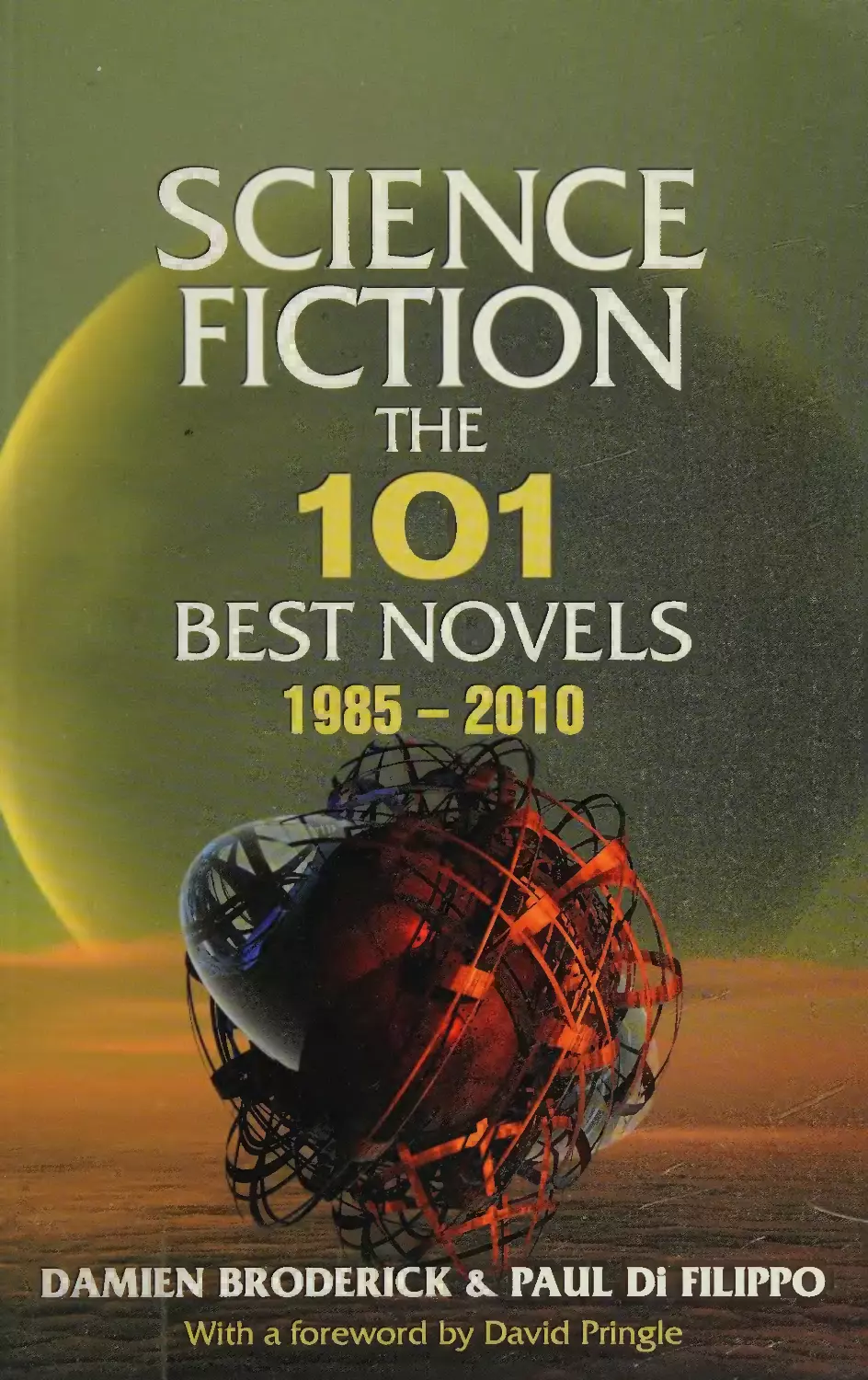
                    SCIENCE
FICTION
THE
1O1
BEST NOVELS
2010
DAMIEN BRODERICK & PAUL Di FILIPPO
With a foreword by David Pringle

SCIENCE
FICTION
THE
1O1
BEST NOVELS
1985-2010
Damien Broderick & Paul Di Filippo
With a foreword by David Pringle
Nonstop Press • New York

SCIENCE FICTION: THE 101 BEST NOVELS 1985 - 2010
© Copyright 2012 Damien Broderick & Paul Di Filippo
Foreword © Copyright 2012 David Pringle
First Edition: 2012
All rights reserved. No part of this book may be reproduced, stored in a retrieval system, or
transmitted in any form, or by any means, digital, electronic, mechanical, photocopying, or
otherwise, without prior permission of the publisher.
Nonstop Press books may be purchased for educational, business, or sales promotional use.
For information please write: nonstop@nonstop-press.com
POB 981, Peck Slip, New York, NY, USA 10272-0981
Cover and book design by Luis Ortiz • Production by Nonstop Ink
ISBN 978-1-933065-39-7 Trade Paper
Printed in the United States of America
www.nonstop-press.com
Nonstop Press

Contents
Foreword	6
Introduction	8
The Handmaid's Tale (1985)	 13
Ender's Game (1985)	16
Radio Free Albemuth (1985)	19
Always Coming Home (1985)	 21
This Is the Way the World Ends (1985)	 24
Galapagos (1985)	 27
The Falling Woman (1986)	 30
The Shore of Women (1986)	 32
A Door Into Ocean (1986)	 35
Soldiers of Paradise (1987)	 38
Life During Wartime (1987)	 41
The Sea and Summer (1987)	44
Cyteen (1988)	 47
Neverness (1988)	 50
The Steerswoman (1989)	 53
Grass (1989)	 56
Use of Weapons (1990)	 58
Queen of Angels (1990)	 61
Barrayar (1991)	64
Synners (1991)	67
Sarah Canary (1991)	70
White Queen (1991)	73
Eternal Light (1991)	76
Stations of the Tide (1991)	79
Timelike Infinity (1992)	 82
Dead Girls (1992)	 85

Jumper (1992)	 87
China Mountain Zhang (1992)	 89
Red Mars (1992)	   91
A Fire Upon the Deep (1992)	 94
Aristoi (1992)	 97
Doomsday Book (1992)	100
Parable of the Sower (1993)	••	103
Ammonite (1993)	105
Chimera (1993)	 107
Nightside the Long Sun (1993)	109
Brittle Innings (1994)	113
Permutation City (1994)	115
Blood (1994)	118
Mother of Storms (1995)	121
Sailing Bright Eternity (1995)	124
Galatea 2.2 (1995)	127
The Diamond Age (1995)	130
The Transmigration of Souls (1996)	133
The Fortunate Fall (1996)	135
The Sparrow/Children of God (1996/1998)	138
Holy Fire (1996)	141
Night Lamp (1996)	143
In the Garden of Iden (1997)	146
Forever Peace (1997)	149
Glimmering (1997)	152
As She Climbed Across the Table (1997)	154
The Cassini Division (1998)	156
Bloom (1998)	159
Vast (1998)	162
The Golden Globe (1998)	165
Headlong (1999)	168
Cave of Stars (1999)	170
Genesis (2000)	 173
Super-Cannes (2000)	176
Under the Skin (2000)	179
Perdido Street Station (2000)	182
Distance Haze (2000)	185
Revelation Space trilogy (2000)	188
Salt (2000)	190

Ventus (2001)	192
The Cassandra Complex (2001)	195
Light (2002)	198
Altered Carbon (2002)	201
The Separation (2002)	 203
The Golden Age (2002)	 205
The Time Traveler’s Wife (2003)	 208
Natural History (2003) . '	  211
The Labyrinth Key / Spears of God	214
River of Gods (2004)	217
The Plot Agajpst America (2004)	 220
Never Let Me Go (2005)	 223
The House of Storms (2005)	 226
Counting Heads (2005)	 229
Air (Or, Have Not Have) (2005)	231
Accelerando (2005)	 234
Spin (2005)	 237
My Dirty Little Book of Stolen Time (2006)	 240
The Road (2006)	 243
Temeraire /His Majesty's Dragon (2006)	 245
Blindsight (2006)	 248
HARM (2007)	251
The Yiddish Policemen's Union (2007)	 253
The Secret City (2007)	 255
In War Times (2007)	 257
Postsingular (2007)	 260
Shadow of the Scorpion (2008)	 263
The Hunger Games trilogy (2008-2010)	 265
Little Brother (2008)	 268
The Alchemy of Stone (2008)	271
The Windup Girl (2009)	 273
Steal Across the Sky(2009)	 275
Boneshaker (2009)	 277
Zoo City (2010)	 280
Zero History (2010)	 283
The Quantum Thief (2010)	 286

Foreword
Time moves on.
Science Fiction:The 100 Best Novels: 1949-1984, a book I wrote in 1984 and
which was published in 1985, needed a sequel by now—and here it is. More than 25
years have gone by, and many hundreds of science-fiction novels and collections have
continued to pour from the English-language presses (as well as those of other lan¬
guages), so some guidance as to “the best” of the last quarter-century is surely required.
Having been unable to keep up with all those new sf works myself, I am delighted that
Damien Broderick and Paul Di Filippo have taken it upon themselves to do the job,
and I am very happy to endorse their excellent book.
I have read fewer than half of the novels they describe here (after 1984, as editor
of the magazine Interzone until 2004, my main sf reading consisted of short stories—
thousands of them); but, judging from the works I do know, I feel confident that all
the less-familiar choices in this book are sound. Damien Broderick’s and Paul Di
Filippo’s qualifications for making those choices are second to none: both are creative
science-fiction writers of many years’ standing, among the best of their time, and both
have in addition written a good deal of stimulating criticism, including numerous sf
book reviews. I actually included a novel by Damien in my hundred best of 27 years
ago—The Dreaming Dragons (1980), which I described as “the best Australian science¬
fiction novel I know” (that sounds belittling in retrospect—the book was much more
than that). It has since been revised and reissued as The Dreaming. Since then, Damien
has written several more fine sf novels, of which perhaps The White Abacus (1997), a
knottily speculative work, is the most successful.
Of course, it would not have been seemly for the authors to include any works
of their own in this new hundred best, but perhaps I can compensate for that by
mentioning not only Damien’s later novel, above, but also Paul’s humorous Fuzzy
Dice (2003) and his manically inventive short-story and novella collections such as The
Steampunk Trilogy (1995) and Ribofunk (1996), some of the contents of which I had
6

the pleasure of first publishing in Interzone. At the time I wrote my book in the 1980s,
Paul Di Filippo had published no novels or collections, but if I had been writing this
follow-up volume now a number of Pauls books, as well as several of Damien’s, would
certainly have been strong contenders for inclusion.
As for the authors whose novels are described in the following hundred or so
mini-essays, I am particularly pleased to see a large contingent of those whose ear¬
ly stories were first published in Interzone—among them, Stephen Baxter, Richard
Calder, Greg Egan, Nicola Griffith, Simon Ings, Paul J. McAuley, Ian R. MacLeod,
Alastair Reynolds, Geoff Ryman^and Charles Stross. I can vouch for all these writers
as capable of first-rate work. And of course,, many others with books discussed here
are well-known names, some of them from the literary “mainstream”—Brian Aldiss,
Margaret Atwood, the late J. G. Ballard, Iain Banks, Michael Chabon, Karen Joy Fowler,
William Gibson, M. John Harrison, Kazuo Ishiguro, Ursula K. Le Guin, Jonathan
Lethem, Cormac McCarthy, China Mieville, Michael Moorcock, Richard Powers,
Christopher Priest, Philip Roth, the late Kurt Vonnegut, and more. It is a first-rate
line-up, and those readers who follow all the recommendations will have months and
years of good reading before them.
A century, and a millennium, have turned since I wrote my book. The world is
different, but science fiction carries on vigorously, reflecting our times back to us in
imaginative form—and Damien’s and Paul’s book celebrates that endeavor splendidly.
David Pringle
Selkirk, Scotland
7

Introduction
SCIENCE FICTION, according to David Pringle’s excellent guide to the 100
best English-language sf novels in the period 1949-84, to which this volume is a
kind of sequel, is “a form of fantastic fiction which exploits the imaginative perspec¬
tives of modern science.”
That’s true. But here’s a necessary caution: most science fiction, our favorite kind
of story-telling and reading, has about as much to do with real science as chick lit has
to do with poultry.
(For brevity, we’ll refer to science fiction as sf, rather than sci-fi, which is now
standard journalistic parlance but, as Ursula K. Le Guin recently remarked, “as a term
for the whole field it seems kind of cheap”')
Numerous other definitions have been suggested: sf as the literature of change, in¬
deed of radical, disruptive, wondrous change; of cognitive estrangement or conceptual
breakthrough; of drastic difference from the known, safe, everyday world; of suspended
disbelief and dizzying spectacle. For most of us, sf is what we see on TV or in mon¬
strously expensive and profitable movies: warring starships roaring in the vacuum of
space, warriors and explorers plunging through wormholes to far stars, robots helpful
or malign, parallel worlds, psychic clones, time machines carrying the unwary into the
gulfs of the future or dangers of the past, or a hundred and one other locales beyond
the known realities of our sometimes humdrum lives. All this is valid enough, but it is
not the whole or deepest truth, especially of sf literature.
For sf, as Le Guin added, is not about the future, or space travel, not really. For
all the legitimate or sham apparatus of science and technology deployed in these tales,
they are not about science, by and large. Rather, for Le Guin, a very distinguished
practitioner of the art, sf is a “metaphorical way of dealing with our current reality.”
The shorthand idiom sf is “basically a commercial term describing a certain genre
of fiction.” That is, it’s more a marketing tool than a literary category like drama or
pastoral verse. It is a label designed to guide purchasers or library readers to a stack of
books (or movies, comics or TV shows) that share a certain common appeal.
But what is it about a genre that makes its appeal so reliable, so rewarding to
1	http://www.bbc.co.uk/iplayer/episode/p00d5vqc/The_Interview_Ursula_Le_Guin/
B
merchants? Many readers with literary credentials disapprove of writing they dismiss
as “genre”: romance, say, or thrillers, westerns, horror, science fiction.These kinds of
storytelling they suppose to be intrinsically inferior and limited compared to their
prized literature, otherwise known to scholars as “bourgeois realism,” or “psychological
realism,” which is itself just another genre that can be sharp, brilliantly incisive, emo¬
tionally involving, or soggy, comfortable, and routine.
But wait—that’s an oversimplification, too, because a glance at The New York
Review of Books or the Guardians book review pages reveals a “literary” appetite for
many varieties of fiction or styling, some of them blurring into the kinds of writ¬
ing marketed since the 1960s as science fiction. Franz Kafka’s phantasmagorical fables
remain evergreen, Latin American “magical realism” was fashionable a decade or two
back, John Barth’s rich and zany metafictions had their day, while nobody doubts that
Dante’s allegorical adventures in Purgatory and Hell in The Divine Comedy and Don De
Lillo’s absurdist Airborne Toxic Event in White Noise are as heavy-duty literary as it gets.
It’s equally true that many genre readers stick faithfully to their accustomed di¬
versions, preferring yet another franchised episode of Captain Kirk and Mr. Spock, or
Luke Skywalker and his mean Dad, rather as some people eat the same breakfast every
day and wouldn’t dream of adding garlic to their nightly dinner steak, or replace it now
and then with squids in spice. For these happy browsers, “literary” writing is snobbish
and any attempt by sf writers to adapt the same techniques to broader their canvas and
elaborate their palette (or palate) is pretentious or boring or uses “too many hard words.”
In a genre where masters from H. G. Wells to Robert Heinlein, Ursula Le Guin and
Philip K. Dick were comfortable with once-unfamiliar terms like ecology or delta- V or
epistemology or with fresh coinage like ansible or kibble, this seems an odd complaint. It’s
one we intend to ignore in our discussion of 101 significant, exemplary sf novels from
the last quarter century, novels that in a hundred and one different ways are as wily
and inventive as the best speculative writing and as well-wrought and insightful into
the nature of human consciousness and society as anything by, well, Nobel Laureate
Doris Lessing or Philip Roth or Margaret Atwood or Michael Chabon or Cormac
McCarthy—some of whom, marvelously, are here as well, with their own distinctive
contributions to the canon of recent speculative fiction.
The year 1985 inaugurates the span under consideration in this volume, and it might
profit us to consider, with memory’s Wayback Machine, exactly what some of the
salient features of that far-off year were. (Of course, we are not going to rely solely
on our fallible human wetware, but instead will consult Wikipedia, an omnipresent
invaluable resource whose very name was nothing but a gibberish string of phonemes
in 1985. But more on that in a few paragraphs.)
Ronald Reagan assumed his second presidential term. His name then still con¬
jured up images of black-and-white movies, and, for sf readers, a deliberately and bril¬
liantly offensive NewWave story by J. G. Ballard, not the vaseline-lensed hagiography
the man enjoys among some today. Reagan’s bete noire was the Soviet Empire, which
in 1985 seemed destined to reign eternally with an iron fist across half the planet.
China, on the other hand, although also a Communist bogeyman, was an amusingly
backward country subject to internal purges and worthy of notice only when it reared
up against Taiwan. Japan, however, was a different matter, the one country threatening
to usurp the USA’s place as global economic and cultural powerhouse. (This irony of
their past top dog status became particularly painful in early 2011, when a devastating
9

earthquake and tsunami battered that island nation.) European nations still featured
individual currencies, and required their citizens to present passports for internal travel
in their own Union.The worst terrorist attack against the USA had happened in 1983,
in Beirut—an enormous blow, some 200 soldiers dead.The world population was 4.8
billion. Climate change was something only paleontologists had to be concerned with.
A state-of-the-art cellphone was the Motorola DynaTAC, that expensive, rarely
seen, retrospectively laughable walkie-talkie-sized unit. The internet consisted of low
bandwidth communications amongst some military and university computers. A state-
of-the-art home computer setup could be had for $1000.00 (nearly $2000.00 dol¬
lars in todays terms): a Commodore 64 CPU and keyboard; a green-on-black CRT
monitor; an external floppy disk drive; and a dot-matrix B&W printer. (That’s what
many writers sprang for back then, happily abandoning electric typewriters and car¬
bon paper forever.) Text-only email service could be obtained through a noisy dial-up
modem connection. Music was released by large corporations on the relatively new
medium of compact discs. Books and magazines and newspapers had no digital elec¬
tronic counterparts. Broadcast TV and the major networks remained dominant over
the nascent cable hookups. Electric cars were nonexistent.
In the sf field, cyberpunk had burst out of the Zeitgeist as the hottest new move¬
ment, while steampunk was merely a tossed-off term of derision. If science fiction
did not still outsell its upstart sister fantasy, at least sales were basically even—unlike
the present, when sf is the minority category. The Star Wars cinematic franchise had
ceased, seemingly forever, with three films, while 1982 s Bladerunner had as yet sired no
true progeny.The term “CGI” was essentially meaningless.The prime mode of sf fan
activity (“media fan” was more or less a subcategory of readerdom), besides the oc¬
casional small-scale convention (that year, San Diego Comic Con hosted a mere 6000
attendees), relied on paper “fanzines” distributed through the postal service, and in fact
the cyberpunk movement, preaching a future dominated by cyberspace, promulgated
itself through just such paper vessels.
Of 1985 fashions in clothing, dance, music, interior decoration, art and other
mutable human pursuits, we will not speak, since such things are by their very nature
transient and not assumed to be an unchangeable bedrock of existence.
You can, of course, provide your own present-day counterpoint to this capsule
description of 1985. But any portrait of today will certainly limn a world that has
undergone immense, almost unforeseeable changes since that vanished baseline year.
Wired, distributed, hyperkinetic, beset by heretofore-inconceivable perils and chal¬
lenges, gifted with potential-filled miracle gadgets, inventing new artforms and modes
of communication, moving at warp speed, the world of the second decade of the 21st
century and its inhabitants must present time-traveler-magnitude cognitive dissonance
to anyone who contemplates the past twenty-five years. Yet at least half the global
population is old enough to have experienced both eras firsthand. Why, then, are we
not on a daily basis disoriented strangers in a strange land, unable to function for all the
head-whirling confusion? Well, primarily because all the massive changes snuck up on
us incrementally, and were absorbed at a steady pace. But also because of sf.
Science fiction is the tool that allows us to master such change. From birth in its
modern genre form in the pages of 1926 s Amazing Stories, through its nurturing and
refinement by a small coterie of true believers through the middle of the twentieth
century, and on to its gradual world domination starting with, oh, let us say, Kubrick
and Clarkes 2001: A Space Odyssey in 1968, science fiction has offered a cognitive
1 □

toolkit in easy-to-assimilate, entertaining form that allows us to get mentally comfort¬
able with the notion of change and its most radical effects before we are hit with the
reality of it upside the collective head. Science fiction is the one type of literature that
promotes, to use the phrase pioneered by the bloggers at Boing-Boing (try explaining
the concept of “blog” to a citizen of 1985!), the creation of “happy mutants.” It’s the
literature of cultural Darwinism, the sieve through which we pan for ideational gold.
Our selections in this volume, if we have done our job well, will illustrate not only
the immense changes of the past two-and-a-half decades, but also sf’s vast reach and
power, which of course we will need even more in the wild quarter century ahead!
One caution:Although our title promises a survey of the 101 best science fiction novels
in English since Pringles volume, we can’t guarantee that any single reader will agree
that our tally really is the best. After all, the annual Hugo and Nebula and Clarke and
Locus and Campbell and Ditmar and other awards for the best sf novel of the year do
not always concur—indeed, it is a rare distinction for any book to gain as many as two
of these prestigious prizes. There are many celebrated and perhaps bestselling authors
we might have included, and we would have done so if we’d had room for another
hundred tides. Certainly we are not dismissing this abundance of enjoyable riches.
What we can promise you is that the novels we discuss are among the most sig¬
nificant works of science fiction from the last quarter century, books that reward careful
reading while providing pleasure, amusement, novelty, wonderment. If you read all or
even many of these good novels, you’ll slowly realize that science fiction is not just
a genre but is indeed a mode of storytelling. Most other genres are restricted in their
subject matter, their focus, their typical ways of using words to invite readers into their
familiar worlds. Crime fiction and thrillers, romances, westerns, tales of vampires or
zombies—all offer niches, however various and ingeniously developed, within which
the reader knows pretty much what to expect. Some franchise sf is Eke that too, but the
best sf breaks through genre boundaries and tells stories that can borrow their subject
matter and manner from any of the existing genres, while pushing them into new ter¬
ritories never before visited.
The science fiction mode has experienced large scale convulsions since it emerged
a century or more ago, and especially since its advent as a commercial pulp form in
the 1920s. If we regard the earEer work—by Mary Shelley, Verne, WeUs, many oth¬
ers—as not yet visibly genrefied, it’s apparent that science fiction’s history has passed
through several “waves” since the ’20s The first pulp fiction age ended when John
W. Campbell assumed editorship of Astounding in 1939, and the famous Golden Age
storytellers emerged: Isaac Asimov, Leigh Brackett, Robert Heinlein, Henry Kuttner
and Catherine Moore, A. E. van Vogt. Call that the Second Wave, extending into the
discovery of the “soft sciences” in the 1950s. A Third Wave flooded over the field in the
1960s with a newly refined, often poetic, Eterary flavor and poEtical concerns typical
of the sixties (but foreshadowed in the previous decade by Theodore Sturgeon, Edgar
Pangborn, and others). This Third Wave included the so-called “NewWave” but ex¬
ceeded it, with pivotal work by Philip K. Dick, Roger Zelazny, Samuel Delany, Ursula
K. Le Guin, Joanna Russ, Norman Spinrad,Thomas M. Disch, Harlan EUison, Robert
Silverberg, a host more.
In the 1970s, that upheaval was already history and sf entered a period of consoli¬
dation, blending its traditional excitement with more self-aware literary aspirations. At
the end of David Pringle’s catchment area in 1984, cyberpunk came and went Eke a
1 1

lurid flower, followed by the New Space Opera and the New Weird as a Fourth Wave
carried sf on its flood tide into the new millennium. In the decade or so since the
century’s turn, sf has made its extraordinary impact in music, movies and even “literary
fiction” (though seldom acknowledged as such).There are hints already that we stand
at the frothing edge of a newer Wave. Nobody is quite certain where sf is headed, or
what form some Fifth Wave will take. Is the age of the book finally over? Will reading
shift from paper to Kindles and Nooks and snazzier forms of portable electronic plat¬
forms, sheets of e-paper you can jam in your pocket, beams ofjight shone straight onto
your retina, waves of information borne directly to your brain via wifi or quantum
entanglement? Already much of the best short sf is rqjeased online, usually in free ven¬
ues supported as loss-leaders by traditional publishers, or funded by ads. An e-future
would not spell the death of sf novels, of course, any more than the passing of pulp
magazines with their monthly serials and the rise of paperback originals meant that sf
was extinct—far from it. But we might see the sorts of unsettling, exciting novelties
proclaimed by Eric Rosenfield:
a lot of big-name Science Fiction writers look like they’re standing still. While
Bruce Sterling and Cory Doctorow and Vernor Vinge fantasize about the
Singularity or augmented reality... [others are] writing a fiction that speaks to
a world in which we find ourselves not exactly emancipated by technology but
simply hyper-connected by it, our identities as people redefined by the media
we share, media which we embrace and deeply care about even when it leaves
us bewildered, co-opted, and reduced in a thousand ways to algorithms... .This
is not what our world is like, but it’s very much what it feels like... tapped into
some kind of primal dream of what it means to Eve in our techno-saturated
time.. ,2
Perhaps that’s the shape of future sf, or maybe this post-Latest New Thing pro¬
spectus will be already antiquated in another few years (“So 2011”). Meanwhile, we
can enjoy the accumulated riches of the past quarter century, from mainstream novelist
Margaret Atwood’s speculative/sexual political sensation The Handmaid’s Tale to the
brilliant first novel of Finnish string theorist Hannu Rajaniemi writing with perfect
ease simultaneously in English, and sf, and quantum physics, all conjoined to dazzle us.
From one perspective, then, you can see this list as Science Fiction 101. From another,
it’s 101 excellent novels for sf to hang its hat on, at a jaunty angle and with a knowing
gleam in its eye.
Damien Broderick
San Antonio, Texas
Paul Di Filippo
Providence, Rhode Island
2	http://io9.com/#!5568956/why-robin-sloan-is-the-future-of-publishing-and-science-fiction
1 2

1: Margaret Atwood
The Handmaid's Tale (1985)
IN 1949, George Orwell (the English writer Eric Blair) published Nineteen Eighty-
Four, his devastating, technologically managed and stratified dystopia. That novel,
bleak and terrible, remains a watchword for totalitarian futures, even though more
than a fourth of a century has passed since the date of its imagined terror. The year
after the real 1984, distinguished Canadian poet and novelist Margaret Atwood pub¬
lished her own scarifying dystopia. While Orwell’s Orwellian prospect seems less likely
today, long after the fall of the Soviet Union, Atwoods woman-hating Republic of
Gilead is all too visible in nations such as Iran and Afghanistan (where she spent some
time). Sequestered, cloaked women suffer repression by the Taliban and other theo¬
cratic regimes. In the USA, where Atwoods imaginary Gilead springs from a harsh
Christian fundamentalist conspiracy and coup d’etat,political extremists really dojoin
with science-deniers in aspirations scarily akin to Atwood’s cautionary tale.
The novel is set around the end of the 20th century; like Orwell’s, its date has
already passed. Does this mean it’s no longer science fiction? (Some prefer to see it as
fable, and Atwood declared it “speculative fiction,” famously dismissing sf as “talking
squids in outer space” but relenting more recently.) No. Like a number of other fine sf
novels discussed below, The Handmaid’s Tale is best read as alternative history—allohis-
tory, uchronia—a record of a past that might have occurred had key events taken a
slightly different course. Atwood does not appeal to sf’s toolkit of quantum superposed
realities or Many Worlds theory to justify her fantastika, nor did Philip Roth (Entry
1 3

76), Michael Chabon (Entry 88) or several others among our 101. But it’s no accident
that, as well as being shortlisted for the mainstream, Booker Prize, it won the Arthur C.
Clarke, Locus, and James Tiptree, Jr. Awards for best sf novel, while selling more than
a million copies to readers who always supposed they disliked sf.
What motivates Atwood’s narrative is the same fateful dynamo (“The purpose of
power is power,” wrote Orwell) driving Nineteen Eighty-Four. “The book is an exami¬
nation of character under certain circumstances, among other things... it’s a study of
power, and how it operates and how it deforms or shapes t^ie people who are living
within that kind of regime.”3
Offred (“of Fred”) is 33 years old, conscripted into the Handmaid caste to bear
children to powerful Commanders and their barren Wives in a nation polluted by
reactor catastrophes, toxic molecules, viruses, environmental desecration. Her monthly
and highly orchestrated rape is justified by phrases from the Old Testament. While her
true name is never revealed, it is probably June—perhaps significantly, as an under¬
ground rebellion against this fascist state is known as Mayday, and Offred exemplifies
the future of that day. The novel is her often despairing and superbly written medi¬
tations on a bitterly constrained life, torn away from her husband and child, denied
identity, work, access to any materials she might use to harm her betters or kill herself.
Marthas do the scut work, Econowives tend house for the working men. Aunts
at the Red Center, using drugs and harsh discipline, shape younger women Eke June/
Offred into cowed, cowled, scarlet-clad nuns of fertility. Young men with machine
guns, Angels and Guardians, patrol the Republic and monitor checkpoints. Former
abortion doctors and priests are still being hunted down and hanged in public; a rapist
Guardian is literally torn apart by maddened Handmaids in a ceremony recalling the
Greek myth of Pentheus dismembered by Maenads.
Against this suffocating background Offred is drawn into illicit liaisons with her
Commander—at first to play Scrabble, of all things, and read old forbidden magazines,
but finally dolled up in whorish garb for a night in the inevitable “men’s club” where
she is displayed as an “evening rental,” then set up with chauffer Nick by Wife Serena
Joy, a former TV evangelist in the mold of Tammy Faye Bakker, who hopes fresh
young semen will get the Handmaid pregnant and secure their social position. But
these new crimes only wind the chains more tightly, bring Offred closer to ruin even
as it seems she might escape to Canada via the Underground Femaleroad.
If it is a future not quite as terrible as the crazed utopia of Cambodia under Pol
Pot, nor even of the Gulag, still it is unbearably, soul-crushingly bleak. In the much
modified film script by Harold Pinter, Offred knifes the Commander to death and es¬
capes with her lover Nick. Atwood’s novel is less explicit, while leaving that plot door
ajar. An afterword records an academic discourse in 2195; the book we’ve just read
proves to be a reconstruction from 30 old cassette tapes dictated by the Handmaid,
perhaps to her daughter or the new child, following her presufriptive escape to free¬
dom. As Atwood comments, “Her little message in a bottle has gotten through to
someone—which is about all we can hope, isn’t it?”
But the novel is not just a redemptive “little message,” either; it is a beautifully
wrought poem of a book, filled with acute observations. Consider the irises:
3	Mervyn Rothstein,“No Balm in Gilead for Margaret Atwood,” NewYork Times, February 17,1986.
1 4

bleeding hearts, so female in shape it was a surprise they’d not long since been
rooted out. There is something subversive about this garden of Serenas, a sense
of buried things bursting upwards, wordlessly, into the light, as if to point, to
say: Whatever is silenced will clamor to be heard, though silendy. A Tennyson
garden, heavy with scent, languid; the return of the word swoon. Light pours
down upon it from the sun, true, but also heat rises, from the flowers them¬
selves, you can feel it: like holding your hand an inch above an arm, a shoulder.
It breathes, in the warmth, breathing itself in. (161)
/
As does this novel, in all its brutality and' longing.
1 5

2: Orson Scott Card
Ender's Game (1985)
is it about a science fiction novel that has remained more or less
VV continuously in print for more than a quarter century, inspired legions of pas¬
sionate fans and equally passionate detractors, spun off an entire universe of sequels,
prequels and lateral reworkings, and became a standard part of many high-school cur¬
ricula? Perhaps only by voyaging deep into its origins can a 21st century reader gain
some perspective on Orson Scott Card and his Ender’s Game.
It is instructive to pick up the first edition of The Encyclopedia of Science Fiction
(1979), attributed then only to founding editor Peter Nicholls, and note that there is
no entry for Orson Scott Card. True, Card had already sold his first story in 1977 to
Analog, but the Encyclopedia’s general policy was to focus on authors with book cred¬
its—although they did make exceptions for such luminaries as Robert Abernathy and
Vance Aandahl.
By the second edition, from 1993, when John Clute had come onboard as co¬
editor, Card merits two full pages.
Plainly something had happened to boost his stature.That kickstart was, of course,
Ender’s Game, which this later edition of the Encyclopedia revealed, in fact, to have as its
seed Card’s very first story sale of the same name that had been ignored in 1979. In his
substantial 1990 short story collection, Maps in a Mirror, Card records that
The novel Ender’s Game is the only work of mine... that was truly expanded
1 6

from a short work that I had not intended to expand. Indeed, I had never ex¬
pected to do anything with Ender Wiggin again.... I was beginning to work
with a novel idea with the working title Speaker of Death.... [SJuddenly it
dawned on me that the Speaker should be Ender as an adult.... [A]ll the prob¬
lems would be solved if I went back and rewrote “Enders Game” as a novel, in¬
corporating into it all the changes that were needed to properly set up Speaker.
The explosive effect of the novelized version of that Analog tale cannot be under¬
estimated, on Card’s career or th£ genre in general. As Clute observes: prior to 1985,
after some initial promise, “OSC’s career then seemed to drift.” If not for Ender and his
much elaborated exploits, Card today might very well be regarded in the same ranks as
Abernathy or Aandahl: a minor, respectable, forgotten craftsman.
And in the sf field at large, Card’s book contributed to the growing popularity of
military sf, a subgenre with a relatively small profile circa mid-1980s; to the popular¬
ization of teen protagonists driving much of the current YA boom; to the co-opting of
videogames into the sf mythos (a process also abetted by the uncannily co-emergent
1984 film The Last Sta fighter); and to the genesis of a million fannish flame wars over
perceived sexism, racism, homophobism, elitism and hyper-religiosity in Card’s works.4
What stroke of genius propelled this book to such influential heights? It’s simple,
in retrospect. Whereas most excitingly controversial novels include one or two hot-
button topics at most, Card’s novel is composed of nothing but a half-dozen hot-button
issues wrapped in a bildungsroman. In more or less descending order, these include:
An existential threat to the entire human race.
The nature of alien intelligence and person-hood, or, the role of“the other.”
Genocide.
Means versus ends.
The “great man” theory of history.
The limits of government and the proper role of the citizen.
The limits and nature of the educational system.
The military ethos.
The nature of sociopaths and power.
Family dynamics.
Sibling rivalry.
Schoolboy rivalry.
Not even Robert Heinlein in Starship Troopers, James Blish in A Case of Conscience
or Philip Jose Farmer in The Lovers, perhaps not even Joanna Russ in The Female Man
had packed so much argument-provoking philosophical dynamite into one novel.
Andrew “Ender”Wiggin—bearing a surname indicative perhaps of braininess un¬
der one’s “wig”—is the youngest child of three, a mere seven years old at tale’s start,
with brother Peter the oldest and sister Valentine the middle one. They are all “odd
johns,” quasi-mutant geniuses. Peter, the sociopath, will become a political powerhouse,
the Hegemon. Valentine will shape society by her essays. But to Ender falls the great¬
4	See Prof. John Kessel’s astringent analysis of the novel at:
http://uwiv4.ncsu.edu/~tenshi/Killer_000.htm
1 7

est burden and glory. He will undergo years of brutal training at the interplanetary
military outposts known as Battle School and Command School, all to elicit and mold
his unique strategic genius.That genius will ultimately be arrayed against the Buggers,
mankind’s implacable alien enemy who almost destroyed our species twice before.
In very sturdy, engaging and transparent prose, Card delivers a kind of Tom Brown’s
Schooldays mated with Tire Prisoner TV show and From Here to Eternity. He captures
with precision the eternal cruelties of schoolboy interactions, the rigors of boot camp,
and the sophistications of war college. At the same time, he dissects the power-tripping
that occupies nations and their governments. Ender is both innocent child and hopeful
monster, the hothouse hybrid bloom of a harsh climate.
Card’s tale is remarkably proleptic in several areas, including the use of child sol¬
diers, virtual reality, tablet computing, internet communications, and social networking
sock-puppetry, as well as foretelling the collapse of the Soviet empire.
Besides the controversies outlined above, Card manages to rub other raw areas.
There’s a nebulous sense of incest among the Wiggin kids—Valentine exiles herself to
a colony world with beloved Ender; Peter plainly wants to dominate his sister in every
physical sense. “Girls” don’t do well in Battle School since evolution is against them,
and the Bugger warriors are all females under a Queen, yet also paradoxically evoke
male homosexuality by their racial nickname. But perhaps most provocative of all is
the assertion in Chapter 14 that love and compassion are the essential underpinnings
for slaughter. This yoking of two realms generally perceived as polar opposites recalls
some of the deliberate contrarian “Martian” thinking of Michael Valentine (a coinci¬
dental naming by Card?) Smith in Heinlein’s Stranger in a Strange Land.
In three sequels—Speaker for the Dead (arguably a better novel), Xenocide and
Children of the Mind—Ender would inhabit the post-genocidal, human supremacist
universe he and his siblings had helped to create, following an expiational hegira
through large tracts of time and space. But those sequels, and subsequent parallel re¬
tellings, could never deliver the raw jolt of Ender’s original cannon-propelled arc and
shellburst lighting up of the heavens.
TG
1 8

At
3: Philip K. Dick
Radio Free Albemuth (1985)
THE DEATH of Philip K. Dick in 1982 deprived readers of one of the seminal
figures of twentieth-century sf, and of possible major works left unborn. Yet his
impact on the field during the period of our survey, and on the wider culture, con¬
tinued to grow and resonate immensely, with numerous film adaptations of his stories,
canonization of several of his novels in the Library of America series, multiple editions
and distillations of his Collected Short Stories, the adaptation of his themes and tropes as
metaphorical touchstones for essayists and commentators, and the posthumous publi¬
cation of several works.
The majority of the Dick books that appeared post-1982 constituted his trunk-
consigned mainstream works, from his stymied early career as a mimetic writer—inso¬
far as he could ever masquerade as such.Yet one book, the first to see print after Dick’s
death, was pure science fiction, and forms a very respectable initial contribution to his
active afterlife in the field.
Radio Free Albemuth, as we know it, is a reworked version of a novel that Dick
wrote to make sense of his famed mystical experiences circa 1974. When the original
text was rejected by publishers, he streamlined the book to the form we know, and
left a copy of the manuscript with his friend, the writer Tim Powers, who preserved
it for eventual publication. But the intimate and important material would not lie fal¬
low, and Dick rejiggered it all much more extensively to form VALIS, his late period
masterpiece that was published during his lifetime. So in some complicated sense,
Albemuth was the trial run for VALIS.
PKD partisan and packager Jonathan Lethem maintains in an interview with
Library of America that VALIS is the more sophisticated, mature, esthetically pleasing
and intellectually dense statement of Dick’s “pink light” epiphany, and in this Lethem
1 9

represents the irrefutable majority opinion. But he also acknowledges that some read¬
ers prefer Albemuth and find it to be the superior incarnation, and it’s easy to see why.
It’s for the same reason that pencil sketches by a master painter are often more allur¬
ing than finished canvases by the same creator. Cleaner lines, less fussing, spontaneous
emotions. Albemuth holds the core concepts and plot of Dick’s puzzling brush with
divine or alien intelligence without extra literary incrustations.
The central thesis of the novel is easy to encapsulate: “An extraterrestrial intel¬
ligence from another star system had put one of their vehicles into orbit around our
planet and was beaming covert information down to us.” But as our hero notes, to
state the case in this fashion “reduced something limitless to a finite reality.” Radio
Free Albemuth is all about exfoliating the possibilities of this simple thesis rather than
pruning them, thereby affirming the supreme ineffability of creation, which remains
ultimately unbesmirchable by humanity’s stupidity and vices.
The first half of the novel is told from the first-person viewpoint of a hack
sf writer named Philip K. Dick, who is watching his close friend, Nicholas Brady,
undergo the baffling communications from aVast Active Living Intelligence System.
Dick and Brady Eve in what was already, at the time of Dick’s composition (1976),
an alternate timeline. In this continuum, the USA is a dictatorship run by President
Ferris F. Fremont—a melange of Richard Nixon and Ronald Reagan—who strives
to protect the country from a fictional enemy dubbed Aramcheck. Beside the usual
government agencies, Fremont employ the Friends of the American People as spies
and vigilantes, and a young woman member of FAP seeks to entrap Phil.
Meanwhile, VALIS, or Radio Free Albemuth (Albemuth being the name of the
star system where VALIS originates), is revealing much useful information to Nick, such
as how to cure his son’s illness and that time really stopped at AD 70, resulting in “Black
Iron Prison” status for a duped planet. At the midpoint of the text, the first-person voice
switches seamlessly to Nick’s (thereby cementing the identity of Brady and PKD).The
two men, along with a similarly touched woman named Sadassa Silvia, strive to utilize
VALIS’s help to set things right. A small, sad coda reverts to Dick’s point of view.
Dick’s patented blend of paranoia, anti-authoritarianism and droll self-depre¬
cation, his roller-coastering between optimism and despair, and his continuous and
continuously frustrated attempts to balance saintliness with the demands of the flesh,
achieve a fine expression and balance here. The book is lacking in a heavy-duty plot,
without many dramatic set-pieces. It’s a minimalist version of VALIS’s recomplica¬
tions, more like the kind of proto-sf “novel of ideas” such as we find in More’s Utopia
or Bellamy’s Looking Backward: 2000-1887. But that sketchiness just gives more room
to the extravagant existential delvings. As the fictional PKD gleefully says, having just
discarded willy-nilly another one of his own myriad explanations, “Theories are like
planes at LA International: a new one along every minute.”
But the human dimensions of the quandary—the confusion, oppression and ex¬
cruciation of Nick Brady/PKD; the damaged, spoiled potential of Fremont; the patient
supportiveness of Nick’s wife Rachel; the defiant resilience of Sadassa Silvia—also shine
forth beyond the philosophical bloviation, as would be expected from an author who
once declared that the entire universe was contained in a dead dog by the side of the road.
Prophetic of much of our post-911 landscape, Radio Free Albemuth, to employ
Wells’s phrase, shows with economy and brilliance what happens to a “mind at the
end of its tether,” when the leash snaps and the unchained being goes scarily free for
the first time in history.
2D

At
ALWAYS
COMING
MOME_
4: Ursula K. Le Guin
Always Coming Home (1985)
IN THE 1950s and ’60s—arguably the true “Golden Age of Science Fiction,” when
the genre matured as a form—the finest sf novels were sleek, small, supercharged
engines designed to snap readers instantly into the fast lane and get them to the as¬
tounding end of the freeway, preferably with a bang at the end. As fashions changed,
and popular fiction grew more hefty, pace and astonishment gave way to detail, orna¬
mentation, complex characterization. One-off novels sprouted into trilogies and sagas.
Perhaps the most famous was Frank Herberts Dune sequence, continued after his
death by less artful writers. The most successful was Gene Wolfe’s science fantasy The
Book of the New Sun, in four parts with an extra volume to wrap the saga, which then
continued anyway with a tetralogy and a trilogy (see Entry 36).
Ursula Le Guin’s Always Coming Home uses neither of these models. It is self-
contained, but contains multitudes. Le Guin defined this sort of approach in an essay,
“The Carrier Bag Theory of Fiction” (1986):
the natural, proper, fitting shape of the novel might be that of a sack, a bag. A
book holds words.... Science fiction properly conceived, like all serious fic¬
tion. .. is a way of trying to describe what is in fact going on, what people actu¬
ally do and feel, how people relate to everything else in this vast sack, this belly
of the universe, this womb of things to be and tomb of things that were, this un¬
ending story.... Still there are seeds to be gathered, and room in the bag of stars.5
5	In Dancing at the Edge of the World, London: Gollancz, 1989, pp. 169-70.
2 1

Like her famous The Dispossessed, this novel is an “ambiguous utopia.” A Taoist
matrilineal culture of Kesh villages in a far future linked by unobtrusive AIs is bor¬
dered by the grasping patriarchy of the Condor. The three-part central story by Stone
Telling is, however, only a fifth of this bag-like book. The rest is a collage of Kesh
poems, fables, life stories, romantic tales, recipes, reflections by Pandora (an imagined
“archeologist of the future”), a glossary, drawings by artist Margaret Chodos and songs
composed by Todd Barton.
So this is an sf novel, but not as we know it, Jim. It’s perhaps science fiction’s
equivalent of Moby-Dick, or Ulysses, but more engagingly, liicidly written than either
of those often unread masterpieces. Neither is it an entertainment in the vein of The
Demolished Man or Ringworld-, it is reflective, movihg like the Pacific Coast river Na
that flows through a post-Greenhouse, post-ecodoom Napa Valley. In this landscape Le
Guin herself grew up, with anthropologist father Arthur and writer mother Theodora
Kroeber. The novel is a tribute to both, and perhaps to Clifford Geertz’s model of
anthropological “thick description”: immersion in another’s culture, even if, as here, it
does not yet exist.
Stone Telling is herself a halfling, born of a Kesh mother, Willow, and a True
Condor father, Kills, or Terter Abhao, Commander of the Army of the South. Thus
she’s “half-House,” mocked and teased by the other children, yearning for escape.
Though she finds her way to the Condor, who are struggling to build a machine¬
technology empire in a world now exhausted of metals and easy supplies of power, she
returns home disillusioned, regretful, ready to embrace a village life of natural cycles
that is, admittedly, a little stifling. “As I speak of it,” she says of her father’s people, “this
way sounds clownish. That is myself, my voice; I am the clown. I cannot help the
reversals.” But reversals are built in to the daily life of these ambiguous Utopians; the
basic structure of a Kesh village is a double spiral, like a barred galaxy, like two hands
met at the thumbs, or Hinge.
The storyteller is born North Owl, in the little town of Sinshan, becomes Ayatyu
in the City, then Woman Coming Home, and in her old age Stone Telling. By our
conventions of empirical realism, some of what she tells seems bizarre and impossible
(a wooden spoon passes through muscle and bone like the wash of a candle flame).
Advanced science, magical realism or plain magic? “In the Valley the distinction [be¬
tween fact and fiction] is gradual and messy.” This lends every tale an eerie, uncanny
feel, while an unusual earthiness anchors even a child’s perception. North Owl jour¬
neying from home for the first time, comes to “Granny’s Twat,” a town “between the
spread legs of the Mountain.” Such frankness in a spiritually rich and sexually candid
people is startling, and displays the Kesh with no need for editorializing, using with
cool panache a familiar method from the sf toolkit that literary tourists (John Clute
calls their slumming “charabanc sci-fi”) never quite master.
The tale’s tragedy is that “What is seen with one eye has no depth.The sorrow of
my parents’ life is that they could see with one eye only.”Willow and Kills are literally
incomprehensible to each other. When their daughter follows her father, renamed by
him Ayatyu, she is trapped in a society akin to crusader Christianity, or warrior Islam,
or any other hierarchical monolith. Women are pets or dirt, in effect, and embrace
their lot. The Condor call themselves Dayao, a blistering homonym of Tao. Ayatyu
marries, bears a daughter. As the mad ambitions of the Dayao One spiral into self¬
destructive ruin, her father aids her escape. And in time, with age, she writes these
beautiful, calming memories.
22

Can the generous, communal way of life in the Valley speak to us? An Archival
message cited by Stone Telling suggests it might:
In leaving progress to the machines, in letting technology go forward on its
own terms and selecting from it... is it possible that in thus opting not to move
“forward” or not only “forward,” these people did in fact succeed in living in
human history, with energy, liberty, and grace?
23

5: James Morrow
This Is the Way the World Ends (1985)
PLANNING THERMONUCLEAR war and its aftermath, Mutually Assured
Destruction, used to be called, euphemistically but chillingly, “thinking about the
unthinkable.” Science fiction has often thought about the unthinkable, all too often
with unthinkable relish. By contrast, This is the Way the World Ends is like a punch in the
mouth by the Angel of Death in the garb of a stand-up comic. It was quickly compared
to Jonathan Schell (7 Tie Fate of the Earth) out of Kurt Vonnegut, which was spot-on. It is
likely, however, that the careful study by Schell, in the 1980s a prominent opponent of
nuclear arms race strategy, is already forgotten, even as more nations than ever around
the globe arm themselves with nuclear weapons, and plan resource-crisis wars.
George Paxton is a tomb cutter with an “adorable daughter” and a wife “who
always looked as if she had just come from doing something dangerous and lewd.” He
has been spared misery: “the coin of George Paxton’s life had happiness stamped on
both sides—no despair for George. Individuals so fortunate were scarce in those days.
You could have sold tickets” to his life. His neighbor sells scopas suits, for Self-Contained
Post-Attack Survival, and Paxton buys one, signing a meaningless document admitting
his complicity in any subsequent nuclear exchange.
In the dreadful event, the suits do not work, any more than the schoolroom “duck
and cover” drills of the 1950s would have done. Here is part of Chapter 5, “In Which
the Limitations of Civil Defense Are Explicated in a Manner Some Readers May Find
Distressing”:
24

Townspeople marched down to the river... arms outstretched to lessen the
weight of their burned hands. Many lacked hair and eyelashes... A white lava
of melted eye tissue dripped from their heads; they appeared to be crying their
own eyes.
A seeing-eye dog, its scopas suit and fur seared away, licked the face of its
dead master. “Somebody put the fur back on that dog!” George shouted.
It is not sentimentality to be moved profoundly by these images of carnage and
horror. Nor is it ghoulish to laugh with Morrow at the black, bleak post-holocaust
progress of George Paxton, his good-hearted Candide.Twenty-five years on, long after
the collapse of one wing of this appalling calculus of global death, the twenty-first
century might not be the worst of times. But neither is it yet the best of times, for in¬
ternational terrorism, the forces underpinning its threat, and massive military responses
to it, ensure that George’s world might yet ignite around us. Morrow’s splendid novel,
only in unimportant ways superannuated by political shifts, lives on.
Morrow’s conceit in this grimly satirical novel is that those complicit in the
suicide of the human race might be held accountable in war trials conducted in
Antarctica by the Unadmitted—those immense multitudes who are doomed to non¬
existence by this universal, self-inflicted cataclysm. It is a hazardous device for a mor¬
alist like Morrow, because it seems to open out into all kinds of other metaphysical
trials, not least of all those involved in the use of contraception to limit family size,
or of abortion. The distinction, though, is that Morrow’s apocalypse destroys existing
persons—adults and children—as well as “potential” human beings.
In this Tribunal of the Unadmitted, representatives of the final holocaust stand
accused. They are politicians, arms merchants, apologists for war, a hypocrite meant
to implement arms control “who never in his entire career denied the Pentagon a
system it really wanted.” Among these patently guilty stands sweet-natured George
Paxton, Morrow’s Everyman: “citizen, perhaps the most guilty of all. Every night, this
man went to bed knowing that the human race was pointing nuclear weapons at itself.
Every morning, he woke up knowing that the weapons were still there. And yet he
never took a single step to relieve the threat.”
Can George truly be found guilty, in this Swiftian drama? Isn’t the horren¬
dous violence of the novel, foreseen with darkly comic irony by Morrow’s version
of Nostradamus, just a side-effect of our evolutionary past? Thomas Aquinas, for the
prosecution, will not allow this plea to go unchallenged:
“Are we innately aggressive?” asked Aquinas. “Was the nuclear predicament
symptomatic of a more profound depravity? Nobody knows. But if this is so—and
I suspect that it is—then the responsibility for what we are pleased to call our inhu¬
manity still rests squarely in our blood-soaked hands... And then, one cold Christmas
season, death came to an admirable species—a species that wrote symphonies and sired
Leonardo da Vinci and would have gone to the stars. It did not have to be this way.
Three virtues only were needed—creative diplomacy, technical ingenuity, and moral
outrage. But the greatest of these is moral outrage.”
Morrow’s own moral outrage is evident, and powerfully expressed. Not all read¬
ers will agree. They are given their spokesmen: “Self-righteous slop, you needed that
25

too,” replied one of the accused. But Morrow does not leave the verdict open. George,
unlike the rest, avoids the counts of Crimes Against Peace, War Crimes, and Crimes
Against Humanity. But the court finds him unequivocally guilty of Crimes Against the
Future, and sentenced him to be hanged.
What makes this novel more than a one-sided pamphlet by a pacifist is its nuance,
its attention to the detail of real life in the midst of its phantasmagorical, almost Lewis
Carrollian trading of accusation and defense. Escaping, fleeing across ice on a giant
prehistoric vulture, he meets his beloved daughter:
“Honey, there’s something I want to ask.”
“What?’
“Do you know what’s happened to you?”
“Yes, I know.”
“What’s happened to you?”
“I don’t want to tell you.”
“Please tell me.”
“You know what’s happened.”
“TeU me.”
“I died.”
This is not a light-hearted or thrilling entertainment of a novel. But it is a neces¬
sary one, stfll.
26

6: Kurt Vonnegut, Jr.
Galapagos (1985)
SENTIMENTAL, CYNICAL, clear-eyed, spiritual, godless, often very funny,
Kurt Vonnegut (1922-2007) was more than a cult favorite in the 1960s and ’70s
but has fallen from popular favor. His early novel The Sirens of Titan was unabashed pa¬
perback sf, but of a kind rarely seen until then, and Cat's Cradle was almost as explicitly
science fictional. Many of his subsequent novels contain an uncanny quality, verging
on sf without ever quite going there. Galapagos tells the cautionary and scathing tale
of humanity’s future evolution into mindlessness, narrated by a ghost still lingering a
million years hence. That ghost, as it happens, is Leon Trotsky Trout, son of the prolific
Kilgore Trout whose terrible sf is quoted through most ofVonnegut’s fiction after his
appearance in Breakfast of Champions (1973). It’s obvious that Trout is a fond if mocking
mask for sf master Theodore Sturgeon, but really he is, of course, Vonnegut himself.
As, too, is Leon, who recalls humankind’s ruined world, brought down (he asserts) by
the excesses of our huge, intelligent, obsessive and endlessly tricked and tricky three-
pound brain.
Perhaps the oddest aspect of this bittersweet fable, told by an apparent anti-in¬
tellectual misanthrope hanging onto hope by the skin of his teeth, is how startlingly
accurate his near-future predictions were. Global financial collapse is due to “a sud¬
den revision of human opinions as to the value of money and stocks and bonds and
mortgages and so on, bits of paper,” wealth “wholly imaginary... weightless and im¬
palpable,” just as it nearly did a quarter century later.
27

A Japanese genius invents the Mandarax, a handheld device in “high-impact black
plastic, twelve centimeters high, eight wide, and two thick,” with a screen the size of
a playing card, that can translate a thousand languages, diagnose illnesses, bring up any
kind of information or literary quote. At a time when “portable” or luggable comput¬
ers were known as boat anchors and linked by phone lines, Vonnegut had foreseen
Google and the iPhone (which, to draw on the kind of absurdist detail he peppers his
pages with, is 11.6 by 6.2 by 1.2 cm). All of this information is useless after the Fall,
Trout claims, and dubs the Mandarax “the Apple of Knowledge.” A nod to Genesis, but
a startling and amusing intimation of the Apple iPhone...
The Galapagos islands, described with distaste in 1832 by Charles Darwin as a
“broken field of black basaltic lava, thrown into the most rugged waves, and crossed by
great fissures, is everywhere covered by stunted, sun-burnt brushwood, which shows
little signs of life,” become the home of the last traditional humans, one man and
nine women. From this remnant, marooned on Santa Rosalia, home of the vampire
finch, springs the non-sapient Homo sapiens of the next million years. Eventually our
descendants are aquatic fish-eaters with a head sleek and narrow, jaws adapted to
snatching their marine prey, skull too cramped for intelligent thought. To Trout, this
is a satisfactory consummation; the fittest have survived, even if their initial “fitness”
was sheer dumb accident in a world smashed by human ingenuity and an infertility
virus (perhaps inspired by AIDS) spread through the machineries of world-girdling
technology.The Galapagos are spared precisely by their isolation.The new humans are
inbred, furred because of a mutation engendered in a Japanese child by her mother’s
exposure to the Hiroshima bombing, but at least spared the heritable Huntington’s
chorea (ironically, a mind-destroying illness) that their ship’s Captain fears he carries. It
is a future of“utter hopelessness.”
Vonnegut being the kind of Mark Twain writer he was, all of this hopelessness is
screamingly funny.
In a typographical stunt that blends foreboding with a cheeky grin, all those fated
to die before next sunset are given an asterisk before their name. *Andrew Macintosh is
a sociopath billionaire with a blind daughter, Selena, who survives. Her seeing-eye bitch
is Kazakh, who,“thanks to surgery and training, had virtually no personality”—like the
posthumans of the far future, who manage it by natural selection. (Curiously, Kazak
without an h is the alert canine companion to Winston Niles Rumfoord in Sirens of
Titan, whose fate is to become detached in time and space. This probably signifies the
sort of meaningless coincidence that for Vonnegut comprises most of the events of life
and indeed the universe.) *Zenji Hiroguchi is the inventor of the Mandarax, and his
death strands his pregnant wife Hisako, skilled in ikebana or flower arrangement, in a
hellish landscape devoid of flowers.
Adolf von Kleist avoids Huntington’s (unlike his brother *Siegfried). He is cap¬
tain of the Bahia de Darwin, out of Ecuador, deserted by its crew. This vessel is chosen
for “the Nature Cruise of the Century,” a strenuously promoted event that attracts
celebrities such as Jacky Onassis and Rudolph Nureyev, although both are spared the
rigors of Santa Rosalia as the human world goes bankrupt and sterile.This ship of fools
comprises rogues, victims and other hapless souls: fiftyish Mary Hepburn in surplus
combat fatigues, widowed school teacher; *James Wait, a younger swindler who makes
Mary his eighteenth wife; Jesus Ortiz, an Inca waiter who idolizes the wealthy and
hopes to join their number until a brutal encounter with financier *MacIntosh sets
him straight; others. Leon Trout, political refugee to Sweden from the Vietnam War
28

after partaking in a My Lai-type massacre, is not aboard, being dead, but we learn his
tale as well, and that of six little Kanka-bono cannibal girls.
The whole shambling novel, typically for Vonnegut, is a jumble of flash stories
and blackouts, salted with sardonic jokes and agony, yet somehow manages to achieve
what Martin Amis claimed for it, that “it makes the reader sweat with pleasure, but also
with suspense.”This is so even though we know that “Thanks to certain modifications
in the design of human beings, I see no reason why the earthling part of the clock¬
work can’t go on ticking for ever the way it is ticking now.” Brainless, that is, with no
Beethoven, no Shakespeare, no high school movie showing annually the erotic mating
dance of the Galapagos’ blue-footed boobies, population deleted.
29

7: Pat Murphy
The Falling Woman (1986)
ARE COMMUNICATIVE, rational ghosts still a fantastical, supernatural con¬
ceit, rather than some as-yet unplumbed facet of the quantum-strange universe,
if they convey accurate information about their pre-posthumous lives; undertake no
actions that violate natural laws; and appear at times and places that bear a logical
relationship to their old identities, visiting us, perhaps, out of physicist David Bohm’s
implicate order?
Such is the categorical conundrum posed to the literary taxonomist by Pat
Murphy’s The Falling Woman, a novel full of ghosts. We think such a story can be
parsed as sf. Murphy’s second novel is undeniably science fiction, due not only to the
general reasonable affect of the ghosts therein, but also to the science-heavy apparatus
and storyline that contain them, like Prospero’s warding spells
Science fiction has made many accommodations with spirits in the past.Timeslip
tales such as Jack Finney’s Time and Again are really all about a live human easing back
into the realm of the departed, achieving time travel (an essential motif of sf) without
the machinery. Sometimes, alien cultures have ready access to their dead, as in Brian
Aldiss’s Helliconia trilogy. And finally, the whole iffy area of paranormal powers has long
been accorded a central place in science fiction, from at least John W. Campbell’s time
(Asimov’s Mule, anyone?). Thus we get the wild talent of psychometry—invoking
the historical information trail of an object via touch—which comes awfully close to
seeing ghosts
30

In any case, the protagonist of The Falling Woman, Elizabeth Butler, is indubitably
a scientist—an archaeologist—who sees ghosts, as does, intermittently, her daughter
(thus suggesting a genetic basis for the ability). So exactingly and empathetically is the
mother’s professional field depicted that we accept the ghosts as merely one more tool
in her toolkit, a handy technic that her less-gifted peers simply lack.
Elizabeth Buder and her professorial co-worker Tony Baker are on their annual
summer dig at the Mayan site of Dzibilchaltun, riding herd on the usual set of horny
and lackadaisical and sincere students. (The camp’s interpersonal dynamics summon
up allied notes from such safari scenarios as Hemingway’s “The Short Happy Life of
Francis Macomber.”) Elizabeth, long prone to seeing animated shades from the past
while not interacting deeply with them, now experiences visions of the last inhabitant
of the once-flourishing Mayan setdement, an old woman named Zuhuy-kak. More
vitally, Elizabeth discovers she can converse with Zuhuy-kak, and begins to learn in¬
formation she could not otherwise have access to. But the spirit is bitter and vengeful,
and has bad things in store for Elizabeth, generating the book’s considerable suspense,
which is compressed into a mere two weeks or so.
Into this fraught scenario comes Diane, the estranged daughter, fleeing bad times
of her own. She wishes to reconnect with her mother, and Elizabeth reluctantly agrees
to take her on as an untrained helper. (Diane’s inexperience allows Murphy conve-
niendy and unawkwardly to educate both character and readers in the methodology
and goals of a dig.) Murphy splits the narrative between mother and daughter points
of view, and the resulting see-sawing insights and battling failures of communication
prove fertile.
The mother-daughter relationship obviously is a central engine of the book,
and Murphy explores it passionately and deeply. Likewise, the patriarchal roadblocks
Elizabeth has experienced in her career are highlighted in a judicious yet righteously
ireful manner. Elizabeth’s damaged psyche receives an airing as well, nowhere more
tellingly than in Chapter Thirteen, where she muses on the central dead space inside
her heart. “I had sealed off the part of me that knew how to love. It was too close to
the part of me that knew how to hate, and that was at the center of the madness. I had
sealed them all away, leaving a dead place...’’Then Elizabeth all unconsciously segues to
a discussion of the cenote—the Mayan sacrificial well that plays such a pivotal role in
the tale—never realizing that, metaphorically, just such a cold vacuity full of skeletons
and sacrificed virgins ties inside herself. Murphy’s deft symbolical identification of in¬
ner and outer topography is complete.
Murphy’s novel consorts well with the elegantly enigmatic work of Graham
Joyce, Jonathan Carroll and Jo Walton, although with an emphasis on science rather
than fantasy. Elizabeth Butler is no Indiana Jones. In fact, she belittles her profession.
“Archaeologists are really no better than scavengers, sifting through the garbage that
people left behind when they died... We’re garbage collectors really.” But the dedica¬
tion and intellect she bestows on her chosen field, the scrupulousness with which
she follows her protocols into the territory of artistry, her unselfish desire to expand
humanity’s knowledge base, all belie her protests, and her adventures of the mind—
whether with trowel in hand or conversing with the dead—end up outshining any¬
thing Harrison Ford has yet brought to the screen.
v-5.
3 1

8: Pamela Sargent
The Shore of Women (1986)
EDITOR OF the first, and still important, anthology devoted to science fiction
by women, Women of Wonder (1975), and two sequels, novelist and critic Pamela
Sargent observed that women sf writers during the ’70s, like the feminist sisterhood,
were
coming to consider themselves a group. This is not to say that they shared the
same views, were equally doctrinaire in their feminism, or similar in their writ¬
ing. But there was a growing sense that science fiction was a form in which
the issues raised by feminism could be explored, in which writers could look
beyond their own culture and create imaginative new possibilities.
She added:
At the core of both feminism and science fiction—at least what ideally should
be at the core of both—is a questioning of why things are as they are and how
they might be different. Science fiction, with more women writing it, had a
chance to become what it had claim to be all along—a literature that embraces
new possibilities.6
6 Pamela Sargent, Women of Wonder: The Classic Years: Science Fiction by Women from the 1940s to
the 1970s, Harcourt Brace & Co., 1995, 16, 20.This is a revised and extended version of the 1975
original.
32

Alongside the many excellent writers she showcases in her anthologies, Sargent
exemplifies this prospectus in her own novels. These range from one of the first novels
exploring the consequences of human cloning, Cloned Lives (1976), to a formidable
trilogy about terraforming Venus, and other serious, thoughtful, lucid work. In The
Shore ofWomen (1986), Sargent constructs a post-apocalyptic world where today’s smug
certainties have been undone by global nuclear war and a consequent “nuclear winter.”
Hundreds or perhaps thousands of years later, matriarchal and apparently world¬
wide urban utopias—walled enclaves protected by force fields—maintain a station¬
ary technological civilization, in the midst of a vast wilderness sparsely populated by
bands of hunter-gatherer men scratching a stone age living.These mini-clans get along
grudgingly with each other in prickly territoriality, united by a “holy speech” used
in the many hi-tech shrines scattered by women across the landscape. Here worship¬
ful and (by default, in everyday life) homosexual men drop by to commune in wired
dream with the Lidy, and Her several virtual aspects, enjoying imaginary coition with
very real consequences, as their semen is milked away mechanically and used to in¬
seminate the Mothers of the World safely within their lesbian redoubts. Girl children
are retained by the enclaves, boys shoved out at 5 or 6 after mindwashing and placed
in the custody of men. If any bands get the itch to join into larger settlements, risking
the reinvention of agriculture, the wheel and metal-working, golden flying globes are
dispatched from the nearest city to slaughter the brutes and raze their habitats to the
ground.
Inevitably, since this is a novel written for todays readers, it takes a Romeo and
Juliet turn, although one with more fear and loathing and remorseless slaughter than
Shakespeare managed after TitusAndronicus.A. young woman, accused of complicity in
a near-murder done by her mother, is exiled with her into the outer grimness. While
her mother dies almost immediately at the hands of male ruffians, Birana survives,
sheltered by wise Wanderer. In the guise of a beardless youth, she meets Arvil, a young
man of about her own age. Their growing relationship and even intimacy is thwarted
by Birana’s bigoted, heterophobic upbringing.
But this social order is no mere inversion of our own traditionally homophobic
rejection and stigmatization of gays and lesbians. In Sargent’s future, men are repeat¬
edly conditioned to worship the ideal feminine, and to crave the orgasmic satisfactions
of vaginal sex. So while Birana is revolted by the prospect of physical intimacy with a
male, Arvil must fight his own impulses.
Meanwhile, Birana’s peer and former object of desire, Laissa, has problems with
her own mother, who retains an unhealthy affection for her infant son Button, try¬
ing to forestall his exile into barbarity. By a curious coincidence, Arvil is Button’s
older brother, and Laissa’s twin—and the physical resemblance does not escape Birana,
whose initial interest in the young man is a displacement of her infatuation with his
sister.
The early emphasis on Laissa, more or less dropped for the bulk of the book, is
explained in the end, when as a historian she shapes much of the first-person testi¬
mony of these two star-crossed lovers into the book we’ve read. It perhaps explains a
certain muted, almost sepia-toned calmness in the telling of events that do not lack in
drama, tension, fear, intoxicated romance, terror, death, birth, and courageous persever¬
ance. This avoidance of a melodramatic tenor in a narrative where it might seem an
endless temptation is one of the features that draws the reader into a sympathetic lan¬
guor, the kind of mood more often elicited by longVictorian novels than by survivalist
33

thrillers, or even the chilling bleakness of Cormac McCarthy’s The Road (Entry 84). It
is a little reminiscent of the long dying falls of George R. Stewarts superb Earth Abides
(1949), but Sargent tells a more confronting tale than history’s collapse into pastoral
loss of memory.
The women’s enclaves resemble more closely the sequestered, changeless city
Diaspar, in Arthur C. Clarke’s The City and the Stars (1956). The youth who leaves
Diaspar for the forbidden outdoors is Alvin, almost an anagram of Arvil, so perhaps
The Shore of Women, with its hints of a rapprochement between the sexes and these
mutually alien ways of life, is a kind of inversion of Clarke’s famous fable. The voice
of that book, too, moved against the fall of night to a vivid stance opposing restriction
and fearful stasis. In the end, this is the reality the women of Sargent’s enclave must
accept, however resentfully: “We are being given a chance to reach out to our other
selves. What we do will show what we are and determine what we shall become.”
34

9: Joan Slonczewski
A Door Into Ocean (1986)
BESIDES REPRODUCING the evocative Ron Walotsky art from the first
hardcover edition, the first paperback edition of Joan Slonczewski’s A Door into
Ocean, from 1987, adds an interior illustration showing two darkly tinted naked hu¬
manoids amidst lush foliage and exotic flying and crawling beasts. A naive reader today
might easily mistake the scene for an outtake from the film Avatar, a project some
twenty-plus years unborn when that paperback appeared. And thus we get a lesson
yet again in how Hollywood “honors” its prose antecedents with outright shameless,
unacknowledged theft.
And to compound the injustice, Slonczewski goes without fair credit for her
influential, groundbreaking work even among hardcore readers. For although percep¬
tive critics of the James Cameron movie cited many sf “contributions,” from Poul
Anderson and Ursula K. Le Guin to the Strugatsky Brothers and Ben Bova, hardly
any mention was made of Slonczewski’s important work, a finer accomplishment even
than many of the other respected alleged sources, and one that stands to Cameron’s
broad cartoony strokes as a Mary Cassatt painting to an animated advertising mascot.
Two contrasting worlds are intimately linked: Shora, a large moon, an ocean
planet populated by parthenogenic females only, who rely on bio-sciences and possess
a complex Zen-style philosophy of integration with nature and rules for harmonious
interpersonal dynamics; and Valedon, the primary world, a planet hosting a warlike,
competitive society of traditional males and females, who rely on the usual “hard”
35

technologies, and who seem bent on despoiling Shora.
Two unofficial emissaries from Shora toValedon adopt a young lad named Spinel
and bring him back to their planet in an attempt to see if he may be “humanized.”
A prior instance of such acculturation, a woman ambassador named Berenice, was a
less-than-sufficient proof of concept—although she will continue to play an integral
and touching role in the story.
Spinel adapts with no small reluctance and frequent misunderstandings, even fall¬
ing in love and mating, tantric-sex-style, with Lystra (whose name, echoing the famous
story of Lysistrata, is not be overlooked by the reader). After half a year on Shora, events
compel Spinel’s return to Valedon, where culture shock with his old home further
enlightens him. A campaign of brutal suppression is undertaken on Shora, and even
Spinel’s return as interfacing man-of-two-worlds might be inadequate to secure peace.
The lucid gravitas of Slonczewski s prose is matched by her even-handed com¬
prehension of every viewpoint shared by her disparate cast, and her story—as well as
her intricately fabricated ecology—contains numerous surprises and epiphanies, as
well as plenty ofThoreauvian heartfelt paeans to the power of nature—a decided rar¬
ity in the “steel beach” catalogue of sf.
In the cool water, branch shadows wove fleeting patterns upon the hide of
the young starworm. Lystra admired the sinuous trunk that stretched several
swimming-lengths ahead of her, though barely a third as long as the maturer
specimens of Raia-el.The mouth stalks of the starworm spread in a perfect star
around its lip, none broken and regrown as on older starworms....The young
starworm had lone streamers of filters within its mouth, because it was not yet
large enough to digest squid or large fish, only plankton and fingerlings. As
Mithril’s cousins raked debris from the filters, Lystra swam up to the surface to
get the net full of fingerlings that could be fed into the star-rimmed mouth, a
handful at a time.
In the best manner of sf dialoguing, Slonczewski confesses to several inspirations,
works she wished to respond to: Le Guin’s The Word for the World is Forest, Herbert’s
Dune, and, surprisingly, Heinlein’s The Moon is a Harsh Mistress. She plucked from these
models a set of polarities which she would embody in an alluring narrative, resolving
their seeming incompatibility into a whole, organic synthesis.
Besides its generally acknowledged prominent place in the lineage of feminist sf,
A Door Into Ocean fits neatly into three other equally valid traditions, conferring on it
a quadrupled strength and complexity.
First is the utopian strain. Attempting to imagine and depict a society that confers
maximum freedom and sustainable necessities for all, Slonczewski evokes any number
of ancestors, from John Uri Lloyd’s Etidorhpa, through Le Guin’9 The Dispossessed. And
extending her influence forward, we reach descendants like Kim Stanley Robinson.
A second tributary of theme and topic might be deemed the literature of tran¬
scendental refusal, a much tinier stream in the canon than the utopia, but still sig¬
nificant. Melville’s Bartleby, the Scrivener and Edward Abbey’s The Monkey Wrench Gang
come to mind.
Lastly, the third extra-feminist lineage shared by Ocean is the biopunk, or ribofunk
one. Biology has always taken a back seat in sf to the so-called hard sciences, and works
such as Damon Knight’s Masters of Evolution and T. J. Bass’s The Godwhale shine out all
36

the more for their stance that squishy is powerful. Slonczewski’s training and expertise
as a professor of biology lend her work a sophisticated plausibility and ingenuity found
only at the top of this subgenre.
Feminist/monkey-wrenching/utopian/biopunk sf: now, that’s a standout combi¬
nation that only a masterful writer could bring off! And Slonczewski does it superbly.
Slonczewski reportedly took eight years to craft Ocean, and her newest book (as
of this essay) was separated from its predecessor by eleven years. But like the patient
lifeshapers of Shora, what counts in her work is not speed and volume, but elegant
living results.
,*"1	y-”.
37

10: Paul Park
Soldiers of Paradise (1987)
[Starbridge Chronicles]
BRUCE STERLING, JeffVanderMeer, Paul Park: three authors who share a
generation and who spent a sizable portion of their formative years outside the
United States. For Sterling, India; forVanderMeer, Fiji; and for Park, Sri Lanka and oth¬
er parts of Asia and Africa.The seminal experience of being indoctrinated in alienness
and apartness shines forth in the writings of each, rendering them mutually resonant
spirits, rare genre writers who have an interest in recreating the exotic, but inhabited
from inside, with full understanding of the manifold traps and joys of multiculturalism.
And certainly all three men share a kinship with older models of such genre cosmopo¬
lites: Cordwainer Smith (Paul Linebarger) and James Tiptree, Jr. (Alice Sheldon).
Park’s transcendent first novel, Soldiers of Paradise, and its sequels, Sugar Rain and
The Cult of Loving Kindness, speak treasure troves about this kind of global upbring¬
ing and attitude, and certainly could not have been written with the same intensity,
creative ferment and insightfulness by someone merely swotting up Baedekers. Soldiers
and Rain are essentially one long narrative, broken in two for publishing purposes (and
indeed they appeared yoked together in a second edition as The Sugar Festival), while
Cult exhibits a time disjunction that qualifies it for separate inspection.
Initially our venue is the city of Charn and, later, its rival metropolis, Caladon.
Charn is a big, dense, multiplex city of numerous well-delineated districts, inhabited
38

by elites—primarily, the many-branched Starbridge family, with a distant member
of the clan actually ruling Caladon as well—and masses of poor and suffering work¬
ers, some of them belonging to non-human races. With a complex topography—the
major prison alone is an enormous labyrinth cored from a mountain and housing
hundreds of thousands of prisoners—the religion-besotted, politics-mad, outre city is
as much character as the major personages.The history and culture of this world—not
Earth, but part of a solar system whose mechanics enforce seasons of enormous dura¬
tion, seasons whose violent transitions power much of the disruptive human activ¬
ity—are impasto’d with such intensity and specificity that Park’s world looms almost
as solid as our own.
Those major protagonists would be Abu and Charity Starbridge, brother and sis¬
ter, and their cousin, Doctor Thanakar. From a life of privilege, the three will descend
into a welter of suffering as their city undergoes revolution and war. Martyred toward
the end of the firsf'volume, Abu becomes a saint whose legacy figures heavily in the
third installment. The second book concerns the aftermath of the long war between
Charn and Caladon, the French-Revolution-terror of the political scene in Charn,
and the struggles ofThanakar and Charity to survive and reunite.
Park employs a certain distancing technique in his narrative, having our unnamed,
omniscient historian sometimes speak of events as occupying the ancient past. But this
occasional leap into historicity does not preclude an intense immediacy of sensory
and emotional impact, as we follow Thanakar and Charity through their trials, to an
eventual hard-won reunion of damaged souls.
In an interview with critic and editor Nick Gevers, Park said, “In the Starbridge
books, the task I set for myself was to make a strange place come alive, so that the ex¬
perience of reading it was comparable to the experience of living in that world. More
than people or events, those books are about the place itself: to a large extent, especially
in the first book, events occurred so as to carry the reader into different sections of the
physical and social landscape. What I was trying to do was to make every moment both
physically and emotionally vivid, which requires a lot of description, and a layered
technique.” His success is undeniable.
The speculative elements in the sequence are integral to the human dramas, and
innovative in their own right.The long seasons of this world, where a whole new gen¬
eration may arise before, say, winter departs, have been integrated into the culture and
internalized in the psyches of the inhabitants in curious and novel ways. Likewise the
“sugar rain” of spring, with its mutation-inducing chemicals. And receiving insightful
dissections are the power-trip strictures and habits of a religion whose actual epipha¬
nies seems to be provable and irrefutable.
The third book inhabits a different but allied territory, being in some ways a
pastorale opposed to the panoramic, Victor-Hugo-tapestried urbanism of the first two
parts, almost a Green Mansions idyll. In a forest far from Charn, during the long sum¬
mer that comes after the spring revolution, an elderly monk following quasi-Buddhist
teachings and named Mr. Sarnath rescues two orphaned newborns, another brother
and sister pairing, who grow up to be Rael and Cassia, teenaged acolytes of the Cult
of Loving Kindness. Eventually Cassia becomes the prime engine of the movement.
Park’s close-up portrayal of this nascent crusade is almost Southern Gothic in its
treatment. One could imagine this passage, for instance, to have come from Flannery
O’Connor describing some backwoods revival meeting:
39

The cripple lay on his back, his long legs crossed, each ankle locked over
the opposite knee. The two women were kneeling on either side of him. The
piebald woman had unscrewed the top from a jar of ointment, and she was
rubbing the ointment on the cripple’s legs. Still the crowd was singing and
clapping to the rhythm that the pregnant woman had abandoned; she was out
of breath. Her naked breasts were heaving as she bent down low and took some
of the ointment on her palms.
This installment ends inconclusively, with Cassia’s legacy rippling forth unpre-
dictably into the long, eternal future of the world.
Readers will search in vain for critical appreciation of the Starbridge Chronicles as
part of the New Weird movement exemplified by China Mieville and others (Entry
62), but its place there is incontestable. Deriving much of its atmosphere, style, plot
structures and characterization techniques from the work of Mervyn Peake, a New
Weird preceptor, the Starbridge Chronicles serve as an interface between unchristened,
older, proto-New Weird opuses such as Gene Wolfe’s Book of the Neto Sun and Robert
Silverberg’s Majipoor sequence, and the younger novels that would finally crystallize
the mode. Mention of the Majipoor books also brings up the much older subgenre
of planetary romance, pioneered by Leigh Brackett and C. L. Moore, among others.
The Starbridge Chronicles plays off this old pulp mode masterfully and with natural feel
for Planet Stories exoticism. A savvy reader would not jump overmuch to encounter
Moore’s hero Northwest Smith battling the insidious Shambleau in Charn’s precincts.
In the same conversation with Gevers cited earlier, Park self-deprecatingly ob¬
serves, “The hardest thing for me as a writer is to speak without irony, without the
protection of being misunderstood. To say, ‘this is what I think is important,’ or ‘this
is what I think is true, or beautiful, or funny, or moving’—that is what is difficult for
me.” But readers of this masterful series will attest that Park has brilliantly overcome
any such earnest flubbing of his heart’s message.
4D

11: Lucius Shepard
Life During Wartime (1987)
CATAPULTING TO prize-winning prominence in the early 1980s, Lucius
Shepard effortlessly surpassed the achievements of the previous generation of
once-routine sf writers—Robert Silverberg, Harlan Ellison—who had remade them¬
selves more ambitiously in the 1960s and ’70s. But Shepard, unlike most of the brilliant
kids who created modern science fiction in the late 1940s and ’50s, was already (like
Gene Wolfe, Entry 36) in the middle ofhis life. He had experience of the Vietnam war
(perhaps as a reporter rather than warrior), had traveled widely in dangerous places
from Latin America to Afghanistan, performed in rock bands, married and divorced.
This is the curriculum vita of a Conrad, a Hemingway, a Robert Stone rather than an
Asimov, and his work is clearly affiliated with those writers, and with the baroque
lushness of the magical realists of Colombia and Argentina: Gabriel Garcia Marquez,
Julio Cortazar. The superb opening stanza of Life During Wartime first appeared in
Asimov’s as the novella “R & R” and won 1987’s Nebula and Locus Awards, but the
novel, published without conspicuous genre trappings, was hailed as well by non-genre
reviewers and critics.
From this remove, we see that Shepard’s future did not quite come to pass, yet
its vividness and edge still bite. Tel Aviv has not been nuked, Guatemala has not been
invested by US troops on the scale ofVietnam—but parallels are evident in Iraq and
Afghanistan and the relentless drug wars in Mexico and other nations south of the
US border.
4 1

David Mingolla is a 19 year old conscript, stationed in the preposterous Ant Farm,
a military termitarium of tunnels and weapons quickly reduced to uselessness by guer¬
rillas. It is a reductio ad absurdum of the protracted engagement in Vietnam, and serves
as well for the massively armored western military enclaves in Iraq and other oil-rich
nations. What makes New York art student Mingolla special is his possession of that
old sf standby, psychic abilities. He has been headhunted by Psicorps, a kind of merci¬
less psi training branch of the armed forces distantly akin, but far more ferocious, to
the actual US Star Gate remote viewing program that was still deeply classified when
Shepard wrote his fiction.
Mingolla rejects the call: “These guys think they’re mental wizards or something,
but all they do is predict stuff, and they’re wrong half the time. And I was scared of
the drugs, too. I heard they had bad effects.” He cannot deny his own nature, though,
and the impulses drawing him after he meets Debora Cifuentes, a sexually compel¬
ling Sombra enemy psychic. Soon he is in the appalling “therapeutic” custody of Dr.
Izaguirre, doped with a rare flowered weed that elicits and enhances psi powers—not
just gappy precognition but an uncanny ability to shape and control the emotions of
others. And the drugs do have very bad effects. They turn Mingolla, step by crazed
step, into a sort of monster. It seems no accident that his name is a near-homonym for
Mengele, the Nazi experimentalist doctor from Auschwitz-Birkenau concentration
camp who fled to Argentina and Paraguay.7
In the 1950s, this could have been a standard “psionics” adventure seeded by
John W. Campbell, editor of Astounding. In the hands of a luminous, tough-minded,
politically embittered writer like Shepard, it moves far beyond those catchpenny limits.
Sometimes the diction is a little too ponderous, portentous—“The memories of the
dead men in his wake were weights bracketed to his heart, holding him in place”—but
mostly Shepard’s writing is various and fluently fitted to its purpose: raspingly obscene
and brutal when the grunts talk macho trash, driven through superstitious rituals of
self protection from magical assault, or sexually frank and fervent, or richly descriptive,
drifting from lyricism to terror:
A couple of dozen butterflies were preening on Coffee’s scalp—a bizarre ani¬
mate wig—and others clung to his beard; a great cloud of them was circling
low above his head like a whirlpool galaxy of cut flowers... Butterflies poured
down the tunnel to thicken it further, and [Coffee] slumped... the mound
growing with the disconnected swiftness of time-lapse photography, until it
had become a multicolored pyramid towering 30 feet above, like a temple
buried beneath a million lovely flowers.
Mingolla’s progression is a sort of J. G. Ballard-meets-Philip K. Dick descent
through a nightmarish Purgatorio or harrowing of Hell, hallucinatory, compulsive,
stripping flesh from bone. At the outset, he regards “the core problems of the Central
American peoples,” like his own, as being “trapped between the poles of magic and
reason, their lives governed by the politics of the ultrareal, their spirits ruled by myths
and legends, with the rectangular, computerized bulk of North America above and the
conch-shell-shaped mystery of South America below.”
7 Shepard did not consciously intend this pun, stating that he drew the name Mingolla from a
newspaper. But the story he published immediately after “R & R” was titled “Mengele,” and the
unconscious is tricky.
42

Granted, this is a patronizing appraisal by an untested youth, yet it eerily foreshad¬
ows the magical war between two old Spanish families that proves to be the hidden
core of the mad, arbitrary conflict tearing at the Americas. Mingolla sinks ever deeper
into this nightmare of myth, drugs, paranormal intuition, and personal command, held
from the pit of absolute power by his bond with Debora yet ruinously energized by it.
Is his final temptation to drag them together into a Faustian hell of survivalist banality?
The titular “Life During Wartime” was a Talking Heads’ song of rebellion in an
imagined 1980s’ epoch of urban terror. Messages are sent only in uncertain hope that
they’ll reach their destination and get a reply, identity is masked, preparations for at¬
tack by the nameless narrator are readied, even day and night are reversed—and there’s
every chance that nobody will ever rtiake it home. That’s Mingolla’s bleak prospect,
too. Let us hope we might yet escape it ourselves.
43

12: George Turner
The Sea and Summer (1987)
Arguably the two most important Australian science fiction novelists to
date are Greg Egan, for his brilliant ingenuity and scientific depth (Entry 38), and
the late George Turner (1916-1997), for what one critic called his “moral seriousness”
and his determination to avoid classic sf cliches.
A quality of gravitas attends almost all Turners writing, beginning with his award¬
winning non-sf novels of the 1950s and ’60s. (He shared the 1962 Miles Franklin award
for The Cupboard Under the Stairs and the Commonwealth Literary Fund award for
The Lame Dog Man.) He entered the science fiction world with a series of ferociously
contentious and hard-bitten critical reviews of much loved work such as Alfred Bester’s
The Demolished Man, and finally decided to try his own hand at the genre.
His first sf novel, Beloved Son, was applauded by critics, and earned him a Ditmar
award, but his best is probably Drowning Towers (the US retitling of the original The Sea
and Summer), a Greenhouse mid-catastrophe study of human nature under extreme
pressure, climatic and social. It won the Arthur C. Clarke award, and was regional win¬
ner in the international Commonwealth Writers’ Prize. (Another significant novel is
Genetic Soldier [1994], which drew upon Turner’s own military experience during the
Second World War.)
A thousand years after the melting of Antarctica’s ice, Lenna, a scholar, and Andra,
a playwright of the Autumn People, explore the drowned high-rise towers built
to accommodate the swarming Swill, living on State charity, of mid-21st century
AA

Melbourne, Australia. Each of these monstrous, crowded tenement ghettos housed
some 70,000 uneducated, stinking, workless victims of a collapsing society, eight to
a bedroom. Most of the book proves to be a novel written by Lenna, reconstructing
a key moment in the failure of this makeshift bureaucratic solution to overpopula¬
tion and global climate change. Each chapter is told by one or other of the play¬
ers in this drama, although their voices share Turner’s irritable, tin-eared truculence.
(Ventriloquism was not one of his gifts; the biographer of J. G. Ballard, John Baxter,
complained that “if there is an awkward way to express a simple thought,Turner will
find it.” But George Turner had different game in his sights.)
The tragical history of our coming century is observed by the Autumn People
as a new ice age closes in on a less populated, more modest world better prepared for
disastrous change and its amelioration.Their editorial chorus serves Turners purpose
as a propagandist, but the meat of the book is the tale of the Conway family: mother
Alison, her paramofir Billy Kovacs—Boss of one teeming tower block, thug, and po¬
lice toady—and her clever, thwarted children Teddy and Francis, dragging themselves
upward again through dystopia. The Conways stand midway between high and low;
they are Fringe, formerly Middle Sweet (the well-off with jobs), and now live in a
wretched small house near Kovacs’ monstrous ghetto.
“In 2041,” Francis notes in his diary—presumably Lenna’s reconstruction, not
a remnant document—“the population of the planet passed the ten billion mark.”
(This is still considered plausible by UN demographers, if on the high end.) Francis
was six, Teddy nine, meat rationed, the wheat belt crushed against the southern coast,
gasoline unobtainable on the open market, the top third of Australia taken by desper¬
ate Asian invaders, nine-tenths of Melbourne’s 10 million crammed into a tenth of its
area. These barrios for the Swill are arrayed in “ten close-packed groups of monoliths
snuffing blunt snouts at the sky.”
Evidently the grim lessons of the 20th century, when inner city slum communi¬
ties were razed and replaced by appalling, dysfunctional high-rise Projects, have been
forgotten or ignored. The sea is inexorably rising. And a Final Solution of some kind
looks inevitable: either the extraneous living must be culled (although at least not
butchered; there is no horrified cry here that “Soylent Green is people!”'), or their
fertility snipped. Kovacs suspects that a plot is underway at the highest levels of au¬
thority—genocide of the Swill via mass sterilization—and he is prepared to take any
vicious steps necessary to unmask it.
Teddy enters Police Intelligence, while genius lightning-calculator Francis wea¬
sels his cunning way into various criminal enterprises. A coalition ofTeddy, his revered
Police Intelligence chief, and father-figure Kovacs, creates from select Swill the “New
Men”: “people who do what they can instead of sitting on their arses waiting for time
to roll over them.” Unlike A. E. van Vogt’s Slans, and other supermen of classic sf, these
New Men can do little to hold back the literal and figurative tides.
Sly Francis is the most entertaining and pleasingly picaresque character in this
very Australian version of Dickensian social critique. He is not euphemistic in his
hatred of the Swill: “I used to be afraid of their violence but that can be avoided; now
I just detest their dirt, their whining voices and their lack of interest in anything but
enduring through the night to the following day.” But The Sea and Summer is no mere
finger-wagging. The intertwined stories tear along, “little human glimpses,” as Lenna
puts it, that “do help, if only in confirming our confidence in steadfast courage.”
Aside from its merits as a vivid and disturbing study of character under duress,
45

for us in the early decades of the 21st century this novel has a singular and prophetic
salience (for all the nits one might pick).Turner characterized our time as plagued, for
the authorities, by
the nuclear threat and the world population pressure and the world starvation
problem and the terrorist outbreaks and the strikes and the corruption in high
places shaking hands with crime in low places, and the endless business of sim¬
ply trying to stay in power—all to be attended to urgently.
Sound familiar?
46

HUGO AWARO-WINNING AUTHOR OF P0WNKL0W1TAT1QN
13: C. J. Cherryh
Cyteen (1988)
IN BUDDHIST practice, the dharma is transmitted through teachings from one
master to another, establishing an endless chain of wisdom. Something very similar
happens in literature, but especially in science fiction. Editors anoint authors, authors
have proteges or collaborators. Fans become professionals, pros remain connected to
fandom. Sometimes authors are also editors, and/or critics. Perhaps the field is actu¬
ally more like the Buddhist Net of Indra, the symbol for “a universe where infinitely
repeated mutual relations exist between all members of the universe,” to quote that
science fictional nexus of mutual crowd-sourced knowledge, Wikipedia.
Surely C. J. Cherryh must feel part of such a transmission, a living legacy, since
she was one of the final, late-period discoveries of that seminal figure, the fabled fan,
writer and editor Donald A. Wollheim, who bought and published her first two books
in 1976, helping Carolyn Janice Cherry (he added the “h” to her surname for its
somewhat alien, non-feminine resonance) to win a John W Campbell Award for Best
New Writer the following year.
Since then, with her patented blend of exotic planetary romances—romances of¬
ten in the sense of both grand adventures and passionate affairs of the heart—Cherryh
has climbed to great heights, with over sixty books published. Half of those pertain to
one continuity, the Alliance-Union universe, of which Cyteen is a tiny, but satisfying
and award-winning slice.The whole sequence is a full-bore, centuries-spanning future
history, akin in feel and tone to Poul Andersons Technic series, but perhaps not quite
47

as well-known—yet!
Despite appearing at the apogee of the cyberpunk movement, the book’s title
does not refer to a cybernetic adolescent, but rather to the name of a long-settled
colony world that rivals ancient Earth in power and status. Cyteen has ascended to
its influential position thanks to the business enterprise—really, political player and
think tank as well—known as Reseune, which exclusively controls the cloning and
“tape education” processes that are capable of turning out lab-grown disenfranchised
workers (“azi”) and privileged citizens alike, to meet any needs (including warfare,
long before George Lucas’s “Clone Wars”). And controlling'Reseune is Ariane Emory,
ancient megalomaniacal spider, user, abuser and manipulator at the heart of the web. A
genius “Special,” Emory is a combination of Hov^rd Hughes, Rupert Murdoch and
Edward Teller.
The first third of the book (a fortunate division that lent itself to a since-over-
turned publisher’s decision to issue the narrative in three separate parts) sets up the
whole current scenario, backstory and vast troupe of players. Its climax is the assas¬
sination of Ariane Emory by a disaffected confederate. Desperate to regain Emory’s
leadership abilities and brains, Reseune’s executives clone her and undertake her up¬
bringing from infancy, in the book’s middle portion. Seeking to replicate her historical
nurture, they embark on a program straight out of The Boys from Brazil. This segment
ends when Ari II assumes her majority at age fifteen, gets wise to the true nature of
her life, and begins to take the reins of Reseune.
“You know why they made me and how they taught me, and you know what
I am. And you know my predecessor had enemies who wanted her dead, and
one who killed her. The closer I get to what she was, the more scared people
get—because I’m kind of spooky, Amy, and I’m real spooky to a lot of people
who weren’t half as afraid of my predecessor.”
Indeed!
Cyteen is, in some deep and truly profitable sense, but not exclusively, a rethink¬
ing and updating of Huxley’s Brave New World. Casting its spotlight on the genetic
tailoring of people to fit into social niches, their artificial education by “tape” means,
and the establishment of elites and underclasses, the book echoes and refines Huxley’s
dystopia to a certain level of precision. But Cherryh has other themes and tropes in
mind. Placing the world of Cyteen in a galactic setting against rival worlds, with all
the competition and realpolitik machinations that such a milieu implies, the author
exhibits an interest in examining the Darwinian game of“nation” versus nation (Earth
versus Cyteen), weighing which political system is best fitted for taking the species
to new and productive—if not necessarily safe and fair—places in a hostile universe.
But perhaps Cherry’s deepest concern is the allied realms-of identity/conscious-
ness and family. Although the Reseune tech is less godlike than some other fictional
constructs and does not permit full identity transplants between bodily shells, her por¬
trayal of shared clonal identities treats of many of the same existential notions found
in the works of such writers as David Brin; Greg Egan; Kazuo Ishiguro (Entry 77);
Richard Morgan (Entry 69); Dan Simmons; John Varley. As for family, Cherryh riffs
inventively about what it means to have subsets of one’s genes distributed throughout a
large population, and the limits and possible permutations of consanguinity and blood
loyalty. In a sense, she has carnalized Greg Bear’s notion of virtual “partials.”
48

Cherry’s sprawling yet channeled novel (think of a powerful central river with
lazy marshes adjacent, a kind of Everglades of a book) combines the sociopolitical
reach of Poul Anderson’s aforementioned Technic tales with the Byzantine familial
treacheries and alliances of Roger Zelazny’s Amber sequence. It blends the weird hot¬
house domesticity of Gene Wolfe’s “The Fifth Head of Cerberus” or Le Guin’s “Nine
Lives” with the biopunk grotesqueries of Jack Vance’s The Dragon Masters. Such a reci¬
pe would have resulted in a farrago in the hands of a lesser writer, but Cherryh justifies
every bit of Zen master faith that Donald Wollheim placed in her.
49

14: David Zindell
Neverness (1988)
STANDING JUST outside the period of our survey is a mighty crag of a book,
A. A. Attanasio’s first novel, Radix. This hegira of maturation, mutation and ad¬
venturing across a far-future landscape, where cognitive estrangement and uncanny
emotional frissons are the reader’s glorious reward, delivered by the handmaidens of
beautifully ornate and darkly rococo language, is a secret talisman to a small group of
readers. Surely David Zindell must number himself among the Attanasio cult, for his
debut novel Nevemess seeks to achieve many of the same goals through similar ver¬
bal and cultural warpings. Zindell succeeds magnificently, not merely recapitulating
Attanasio’s victories, but also incorporating inspirations from several other and older
models ofWeird Sf into a unique voice.
Nevemess’s scenario is simple—like that of The Canterbury Tales—but opens out
onto endless possible expanses. At least three thousand years into our future, a portion
of the galaxy is host to thirty thousand civilized worlds, linked by the bold and privi¬
leged pilots of a mathematically inclined Order centered in the glamorously exotic
city of Neverness. Our hero and narrator is Mallory Ringess, newly minted as a Pilot
and embarked on a quest involving nothing less than the secret of how humanity may
ensure its own survival, efflorescence and transcendence. His first adventure takes him
among the macrocosmic brain cells (linked cybernetic moons) of the godlike Solid
State Entity. Based on information there, he next journeys among the polar tribesmen
5D

called the Alaloi. Medical mishaps deposit Ringess on the mystical mystery world of
Agathange for two whole years. Returning to Neverness, Ringess finds much change
and languishes in confusion for a time.Then comes the Pilots War, revolt, death and
treachery, and one final questing.
Ringess recounts his own exploits in a rich language full of neologisms and
repurposed words, which some have likened to the methodology of Gene Wolfe. And
just as Wolfe was influenced by Jack Vance, so too does Zindell employ some of the
stratagems of that anthropologically savvy Grand Master, showing us how social cus¬
toms and taboos and convoluted etiquette can shape and constrain societies. Ringess s
forays, solo and with his comrades, obviously harken to the great Arthurian cycle of
tales (hence “Mallory,” as in Thomas). The “Elder Eddas” secret which they all quest
after is thus akin to the Holy Grail. Moreover, the bardic, mythic, roistering elan vital
on display brings up comparisons with E. R. Eddison’s great Zimiamvia trilogy, which,
though it soon became indistinguishable from fantasy after its first few pages, com¬
menced as science fiction set on Mercury. Sometimes Zindell’s voice approaches that
of David Lindsay in his eccentric A Voyage to Arcturus. And Stanislaw Lem’s extravagant
techno tall tales in The Cyberiad spring to mind as well.
The trope of damaged or specially endowed starship pilots is a rich one in sf,
and Zindell has a lark trying to incorporate as many allusions to the great stories of
this heritage as possible. Cordwainer Smith, Samuel Delany, Frank Herbert and Anne
McCaffrey are the major past peaks he surmounts. Additionally, Zindell makes a nod
toward what was at the time the gold standard of space opera, Larry Niven’s Known
Space future history, with mention of a “ringworld” and employment of the trope of
a wavefront of exploding stars that threatens civilization, the Puppeteer’s bane, here
called “theVild.”
Zindell’s story is notable for its unabashed cerebral pleasures, which do not cancel
out its vividly physical blood and thunder moments:
My ship did not fall out into the center of the moons. Instead, I segued into a
jungle-like decision tree...Each individual ideoplast was lovely and unique.The
representation of the fixed-point theorem, for instance, was like a coiled ruby
necklace. As I built my proof, the coil joined with feathery, diamond fibres of
the first Lavi mapping lemma.
These star pilots, are taking their ships through windows in hyperspace by prov¬
ing mathematical theorems! How strange! And yet—don’t today’s pilots do something
like that already? Mapping a course, by hand or by computer, is the application of
mathematics to the shape of the world. These futuristic pilots happen to be doing
it (somehow) directly! Feeling these sentences work on you, getting the point, is an
audacious and shivery pleasure for those who know that the trick to decoding such
sentences is not by way of the conventional dictionary and encyclopedia. Recognizing
the fixed-point theorem, which in mathematics governs the transformation of one set
of points into an isomorphic set, helps one appreciate a sense of recursion in what is
being described/constructed—but it is not crucial.
So here, by the same method, is Ringess’s escape from the Solid State Entity:
I was trembling with anticipation as I built up a new proof array.Yes, the simple
Lavi could be embedded! I proved it could be embedded. I wiped sweat from
5 1

my forehead, and I made a probability mapping. Instandy the million branches
of the tree narrowed to one. So, it was a finite tree after all. I was saved!
Much sf claims to be focused on ideas, while really hewing to pulp action.
Zindell’s book is truly about ideas, notably that great human conundrum revolving
around whether free will exists or not.
As for the legacy of Neverness, like Attanasio’s Radix it remains a secret stream in
the genre. But it seems unlikely, for instance, that Neal Stephenson could have been
unaware of this book when he conjured up his science monks in Anathem. And pos¬
sibly M. John Harrison nodded in Zindell’s direction with his baroque space opera
Light (Entry 68).
Zindell would follow up this magnificent and self-sufficient book with a trilogy
dubbed A Requiem for Homo Sapiens. These books certainly did not dilute his accom¬
plishment with Neverness, but simply by virtue of coming later, they could not carry all
the freight of unprecedented wonder and astonishment borne so capably by Neverness.
52

15: Rosemary Kirstein
The Steerswoman (1989)
WE FIRST encounter the protagonist of this four-part opus, a woman named
Rowan, and her quest across a seemingly magical world in the pages of The
Steerswoman. A sequel followed fairly swiftly in the form of The Outskirter’s Secret. (Both
of these books were bundled in an omnibus titled The Steerswoman’s Road.) Then came
a long interval of silence on Kirstein’s part until the release of The Lost Steersman, fol¬
lowed at a relatively rapid clip by the fourth book, The Language of Power. The series
does not terminate here, however, but Kirstein seems to have bogged down slightly,
revealing lately that what she thought would constitute Book 5 instead morphed into
Book 6, leaving the immediate follow-up volume unbegun. Nonetheless, her unfin¬
ished accomplishment here is still significant. As author and critic Jo Walton says, “ If
you like science, and if you like watching someone work out mysteries, and if you like
detailed weird alien worlds and human cultures, if really good prose appeals, and if
you can stand reading a series written by someone brilliant who writes excruciatingly
slowly but has no inconsistencies whatsoever between volumes written decades apart,
you’re really in luck.”
Rowan is a member of a knowledge-seeking and information-disseminating
guild whose itinerant members bind together an ostensibly pre-technological world.
The Inner Lands where the steerswomen travel constitute a safe and civilized realm
dotted with cities and trade routes, while the Outskirts where they never venture are
53

harsher lands populated by odd beasts and nomadic tribesmen with strict codes of
behavior. A final factor in the cultural equation is the presence of a handful of wizards,
who remaim generally aloof from daily affairs, while retaining immense powers that
allow them to dictate policy when they so desire. For many generations this stable
scenario has allowed mankind to flourish. But now things have gone awry.
The first sign of a breakdown in the system is an odd piece of jewelry that comes
into Rowan’s hands. In the first book of the series, she determines that the jewelry was
connected to the demise of one of the Guidestars, stable points of light in the night
sky that serve to guide travelers. In the second book, Rowan and her new best friend
Bel, a woman warrior from the Outskirts, reach the source of the “jewels” and discover
a crashed Guidestar. The fact that this ostensibly “natural” object was actually manu¬
factured opens the possibility that Rowan’s world is not all it seems. In fact, a master
wizard named Slado seems to be at the heart of a vast conspiracy. In the third volume,
on the hunt for Slado, Rowan encounters a new sentient race.
In the fourth installment, where much is revealed, Rowan and Bel are back in the
Inner Lands in a seaside town named Donner. There, they begin to piece together the
local events of forty years ago, when the Guidestar fell and Slado first rose to power.
Questioning the townsfolk—answering a steerswoman’s questions is compulsory, un¬
der pain of a lifetime ban from sharing in the guild’s knowledge base—Rowan learns
of a struggle for control between apprentice Slado and his master Kieran. Apparently
Slado killed Kieran, assumed his powers, and began his ascent to world dominance. But
where is Slado today, and what does he intend?
The arrival of an old friend, Wiliam, promises to help provide some answers.
Several books prior, Wiliam was a teen with magical propensities whom Rowan man¬
aged to apprentice to a friendly wizard named Corvus. Now an adult, Wiliam has left
Corvus behind to function as a free agent. Rowan enlists his help to plunder the se¬
crets of the current wizard of Donner, a pompous fellow named Jannick. But Jannick’s
lore is concealed in a house that has killed all previous intruders. Can Rowan, Wiliam
and Bel penetrate Jannick’s defenses and emerge with clues to Slado s plotting? Maybe,
with aid ofJannick’s own dragons...
Rosemary Kirstein walks the tightrope between fantasy and science fiction in this
series with precision and grace, producing a hybrid adventure that recalls both purely
fantastical works such as Le Guin’s Earthsea series and purely science-fictional titles like
Miller’s A Canticle for Leibowitz.
Right from the outset, Kirstein has been clever and scrupulous about planting
clues which hint that not all is as it seems in her future. Although the books read on
the surface as pure fantasy, they carefully leave themselves open to interpretation as
post-apocalyptic sf. By the fourth volume, this secret is out in the open, and even
the non-wizardly characters themselves start to get the picture. New mysteries left
unsolved by the book’s end, involving astronomical photographs, further deepen the
sf nature of the tale.
What Kirstein is doing is portraying how humanity’s innate desire to unriddle
the phenomenological universe will persist through all sorts of dark-ages setbacks.
Rowan’s adherence to the tenets of her guild make her a kind of proto-scientist, and
thus a perfect exemplar of the science fictional mindset. Additionally, the books take
on some of the qualities of a mystery novel, as Rowan and crew try to reconstruct old
crimes and puzzle out active conspiracies. Sf and the mystery genre have always been
intimately linked, and Kirstein makes the most of their resonance.
54

But of course none of this would matter if the characters and their adventures
were not compelling, and Kirstein satisfies in these areas as well. Rowan ages realisti¬
cally during the course of her adventures (the books span six years of her life), and by
the fourth volume she’s scarred and limping from her exploits. Bel is an excellent foil
and contrast to Rowan, and Wiliam comes across as his own man as well. Kirstein’s
compassion for even minor characters is evident on every page, and her prose is mea¬
sured and alluring without being overworked.
Further entries in this already monumental series, much awaited, can only add to
its unique luster.

16: Sheri S. Tepper
Grass (1989)
IF THOMAS Hardy had ever written an sf novel, he might have produced some¬
thing very much like Sheri Tepper’s Grass. A thick, claustrophobic, landed-gentry
melodrama full of strained politesse, thwarted sexuality, immemorial traditions, fated¬
ness, dark passions, religious obsession, foreboding, doom, cultural misunderstandings,
and hypocrisy. It’s a book about bizarre aliens in which humans are the strangest
creatures of all, one over which the judiciously omniscient narrator looms like a god
who could be called cruel, were She Herself not so splendidly Other as to defy hu¬
man conventions.The novel bears affinities to the works of James Tiptree, Gene Wolfe,
Norman Spinrad, Laurence Janifer, Jack Vance and M.John Harrison, but possesses an
eerie ambiance and otherworldly Weltanschauung all its own.
Let us consider, in the reverse order Tepper presents them, two planets. Earth,
teeming with too many souls, is ruled by Sanctity, a religious government with total
control on the homeworld, but lesser sway among the diaspora of colonized worlds.
Sanctity is worried about plague. An unstoppable, unnamed disease has begun to
spread, killing even the head of the church, the Hierarch. Lady Maijorie Westriding
and her husband RigoYrarier are summoned by the authorities. They are informed
that they are being dispatched as ambassadors to the only colony world that has shown
no signs of the plague—a planet that bans scientific researchers. Their undercover mis¬
sion: to discover a cure, if any. Off they go, with reluctant adolescent children Tony and
Stella in tow, and a retinue of assistants and priests.
56

The world where they have been assigned is called Grass. Completely covered by
a lush carpet of non-Terran grasses (invoked by the author with Whitmanesque poetic
cadences), except for one rocky hundred-square-mile site that serves as a port town,
the world is inhabited by seven haughty, elite families who live on their walled estan-
cias spotted throughout the vast wilderness. Peons support them with their separate
village Eves. To help order and ameliorate the extremely long Grassian calendar year
with its harsh protracted winter, the elite lead lives of mannered ritual, full of taboos
and compulsions, disdaining anything/raf’rai, or foreign.
Chief among these ceremonial pursuits is the Hunt, involving three native an¬
imals. First, the prey, the foxen, savage predators, each big as a dozen tigers. Then
come the Hounds, canine-like creatures large as Earth horses. And finally, the horse
analogues, or Hippae, scaled and horned and razor-crested mounts like good-sized
dragon-dinos, whose human riders suffer an appalling mortality rate, sometimes even
vanishing entirely dYiring the chaotic Hunts.The Hounds and Hippae are not domes¬
ticated or kept by the humans, but merely appear at Hunt times, as if in symbiosis and
obeying some kind of planetary cycle.
Added to this outre melange are the Green Brothers, a Jesuitical sect of monks
whose main task is an archaeological dig at the ruined city of the long-extinct Arbai,
enigmatic humanoids whose ruins dot the galaxy. The Green Brothers also breed hy¬
brid grasses and sport a cult of sky-worshipping tower climbers within their ranks. And
why is it, exactly, that the Brothers can roam the prairie and never be attacked by the
supposedly vicious foxen?
Once on Grass, Maijorie and her family find themselves the center of disdain,
sabotage and entrapment. Rumors abound that the Moldies—humans who wish actu¬
ally to spread the plague and engineer a cleansing apocalypse—might be present.With
an outsider’s perspective, Maijorie begins to see that the Hippae might be the true
rulers of Grass. But will the sentient monsters enjoy having their secrets revealed? And
will they threaten her family first of all?
Tepper deftly spins a half-dozen plates simultaneously. She speculates on ET the¬
ologies in the manner of James Blish or Mary Doria Russell. She delves into ornate
ecologies and life cycles in the manner of Philip Jose Farmer. She looks at inbreeding
and clannish pride, recalling Avram Davidson (“The House the Blakeneys Built”)
and David Bunch (Moderari). Romance, or lack thereof, fills the human dimensions.
Maijorie and Rigo suffer a dead marriage, and infidelity looms with a Grassian na¬
tive, Sylvan bon Damfels, who allures Marjorie and she him. Issues of colonialism and
privilege, machismo and sexism come by turns to the fore.
Additionally, Grass merits one more distinction. It is generally acknowledged that
Samuel Delany s Flight from Neveryon was the first work of fantastika to deal with AIDS,
the relevant portion of Delany s book appearing as early as 1984. But five years after
that, Teppers treatment of the incurable disease rampant within the Sanctity—the
shame it confers, the secrecy involved, the class barriers in play—marks a second re¬
spectable foray by the genre into dealing, at least on metaphorical terms, with the late
twentieth century’s dominant epidemic.
Tepper continued exploring this complex cosmos in the notional Arbai Trilogy,
whose formidable second and third entries were Raising the Stones and Sideshow. But
these tangential cousins cannot duplicate or enhance the exotic, mind-blowing es¬
trangements of Grass. The book glows like some rare Terence Malick film, aloof and
mysterious, knowing yet quizzical.
57

IAIN M.
BANKS
‘Banks is a phenomenon ... wildly successful,
fearlessly creative’ William Gibson
USE OF
WEAPONS
17: lain M. Banks
Use of Weapons (1990)
IAIN M. Banks, without the middle initial, made his reputation with several freaky
postmodern novels of highwire psychopathology. He erupted into British letters in
the mid-1980s with such brio that Fay Weldon famously dubbed him “the great white
hope of British Literature.” She had in mind The Wasp Factory (1984), with its grisly
brilliance, and a handful of other technically adventurous mainstream titles. A closet sf
fan at the time, Banks was enabled by those successes to publish the bounteous space
opera Consider Phlebas (1987), an exuberant amalgam of every big screen science fic¬
tion invention since (and including) Larry Niven’s Ringu>orld,a gold bangle the size of
Earth s orbit.
With itsT. S. Eliot title, its gaudy tale of interstellar conflict between the Culture
and the brutal Idiran empire, Consider Phlebns introduced a fully stocked universe as
ample as anything in sf’s future histories by Heinlein, Poul Anderson, Niven, Asimov.
Cunningly, Banks contrived to present the Culture as the apparent imperialist enemy,
before his elaborate, careful unfolding of the tale engages our true sympathies.
Happily, Banks has returned repeatedly to this delightfully detailed universe of his
post-scarcity galaxy-faring Culture, most of its human-like population dwelling on gi¬
gantic, Al-controlled starships or Orbitals, luxurious habitats smaller than a Ringworld
and spinning on orbit around strange suns, peaceful but armed to the teeth. Many of
the novels involve interstellar spies and manipulators known as Special Circumstances,
and their harrowing moral quandaries.
5B

In The Player of Games (1988), for example, world-weary Jernau Gurgeh is appar-
endy an amateur Culture expert in strategy and tactics, chockablock with specialized
genofixed glands, nurtured and perhaps owned by whimsical and snide Al machines.
Gurgeh is snookered into a husde on a planetary scale. Duped agent of his rich an¬
archist society, he climbs the ranks of a barbarous game-structured society, learning
something of empathy and involvement. His tale enveloped the story of a single intel¬
lectual combatant in the endless conflict between Banks’s machine-loving hedonistic
Culture (tolerant, benevolent, resolute) and its foes: brutality, credulous faith, political
hierarchy, war.
Perhaps Banks’s finest sf novel is the early JJse of Weapons, a drastically complex bi¬
ography of a soldier, Cheradenine Zakalwe, recruited from a world not unlike Czarist
Russia and for centuries sent into the field again and again, supported with only the
most ironic ambiguity by subtle Culture intelligences human and artificial. (He ap¬
pears again, unnarfied and to considerable ironic effect, at the very end of Banks’s
recent Surface Detail [2010]). Frozen to death, he can be healed, if reached in time.
Even if he’s decapitated, he can be revived. A poisoned worm of lost memory remains
hidden from sight, however, baffling the labyrinthine plans of even the Culture’s most
beguiling minds. Banks somehow works a narrative miracle, a triumph of generic en¬
gineering, fusing thriller and moral parable, reeking detail and clinical distance, fanciful
invention and heartfelt pain.
The Culture Special Circumstances agent is named, with typical Banksian aban¬
don, Rasd-Codurersa Diziet Embless Sma da’ Marenhide, more usually just Diziet
Sma, attended by her lethal, sardonic drone Al companion Fohristi-whirl Skaffen-
Amtiskaw Handrahen Dran Easpyou, or Skaffen-Amtiskaw. Drones are unsentimental:
“We’ve a nebula fleet assembling; a core of one Limited System Vehicle and
three General Contact Units stationed around the cluster itself, plus eighty or
so GCUs keeping their tracks within a month’s rush-in distance. There ought
to be four or five GSVs within a two-to-three months dash for the next year
or so. But that’s very, very much a last resort.”
“Megadeath figures looking a bit equivocal are they?” Sma sounded bitter.
“If you want to put it that way,” Skaffen-Amtiskaw said.
The novel winds on itself like a double spiral, an architecture suggested by his
Scottish colleague and friend, the equally talented Ken MacLeod (see Entry 53).The
main story carries us forward; its parallel runs backward, in leaps of recovered traumat¬
ic memory. In the end, all certitudes are broken. Anything may be used as a weapon,
however personal, ugly, ruinous to the wielder.The novel is a coiled maze; many ways
lead in, as many out, all of them refuting determinacy even as they insist upon it.
And for all that, the book is tremendous fun, and is often credited with the revival
of intelligent space opera. Colossal artifacts with facetious names like the Very Little
Gravitas Indeed roar across the galaxy, while enhanced humans and snide machines
frolic within their protective fields. The happiest moment, exactly catching Banks’s
way of taking sf’s geegaws and doing rude things with them, is this:
“To the Culture,” he said, raising his glass to the alien. It matched his gesture.
“To its total lack of respect for all things majestic.”
59

At the heart of sf as an enterprise—if it has one, and to the extent that it sur¬
mounts national boundaries—ones often sees the hungry wish not to die, not to be
mortal and evanescent, not to be cast into nothingness just when the story is getting
interesting. Thus, sf’s interest in time-dilating starships, in cryonic suspension into the
future, in characters who upload their minds into secure computer substrates, who
hybridize themselves by a dozen paths into persistence. Does anyone really want to live
in the inhospitable ruin of Mars, let alone the planets of distant stars, reachable only
at immense cost and probably uninhabitable on arrival? Yes, a few do, like Arctic and
Antarctic explorers; it would be a rewarding exploit, in its way (see Robinson’s Mars
trilogy, Entry 29). But maybe, after all, it is a metaphor like the anarcho-socialistic
Banksian Culture. “Can I get there by candle-light?*Yes, and back again!”
Meanwhile, we have the Culture and its delights, complexities, rich imaginary
adventures, and we’re the better for their sometimes confronting thought experiments
and gratifying playfulness.
60

18: Greg Bear
Queen of Angels (1990)
A PRODIGY, GREG Bear published his first sf story at 16, in 1967, and his first
novels by 1979, but his major impact on the genre awaited his maturity in the
mid-1980s (Blood Music; the ambitious diptych about the infinite construct, the Way,
Eon and Eternity; the world-destroying attack by aliens, The Forge of God and its venge¬
ful sequel). In later years he explored a range of sf and near-sf forms, from Star Trek and
Star Wars vehicles, to a pre-Foundation novel set in Asimov’s commodious universe, hi-
tech FBI and horror tales, a far future novel that echoes William Hope Hodgson and
Arthur C. Clarke (an early Bear influence), City at the End o/Time. Like John Varley, he
has explored projects in Hollywood. Of them all, perhaps Queen of Angels and its sequel
Slant (1997) are his most satisfying classical sf works.
Jacques Lacan (patriarch of French psychoanalytic feminism) rewrote Freud as
the geographer of lack. “When, in love, I solicit a look, what is profoundly unsatisfying
and always missing is that—You never look at me from the place from which I see you.” Sf’s
canon is drenched with wish-fulfillments answering exactly Lacan’s poignant absence:
mind readers, shape-shifters, paranormal gestalt superhumans built up—organ by or¬
gan, as it were—out of maimed, bitterly lonely individuals. Bear’s melodramatic Blood
Music attempted a 1980s’ version: Vergil Ulam, a self-centered, heedless biotech cow¬
boy, brews the world’s first intelligent microbes and lets them loose in his own blood¬
stream.This is an early imagining of nanotechnology, viruses or perhaps machines built
on a molecular scale. Soon the world’s population is melting down, each mind and soul
6 1

absorbed into its own endless fecund angelic orders of smart tissue. Lacan’s lovers are
lost in endless narcissism, then set free into microbial quantum heaven:
With her last strength she came to him and they lay in each others arms,
drenched in sweat.... With each pulse of blood, a kind of sound welled up
within him as if an orchestra were performing thousands strong.... Edward and
Gail grew together on the bed, substance passing through clothes, skin joining
where they embraced and lips where they touched.
«
Bear’s ornate policier of the 21st century, Queen of Angels, evades such explicit
transcendence. It uses nanotechnology, a science only now beginning to shift from
fantasy into reality, to enter the fragmented neural architecture of a political dissident.
That voyage is paralleled with the quest for true selfhood in an artificial intelligence—
something it attains only by doubling itself into a sort of Lacanian self-reflexivity. More
than 20 years after its first publication the novel remains challenging, audacious, noth¬
ing if not ambitious, attempting to portray an American world of 2047 that is real in
every fiber of the text, as significantly different from our own time as ours is from the
Elizabethan. In a somewhat unlikely millenarianism, a great change is anticipated as
the world approaches the “binary millennium” of 2048: in binary notation, the jump
from the year 11111111111 to 100000000000.
The neuro-therapied rich live in combs, vast hi-tech termitaries. Between these
arcologies, in the Shade, dwell the untherapied. Society is rich; nano machines can
literally build gourmet food from garbage, construct full-scale robot devices (arbeit-
ers), even transform human bodies. And the human mind/brain itself is finally giving
up its secrets. An Al probe investigates the planets of Alpha Centauri B, beaming back
data and opinions for dispersion through LitBid interactive media programs available
to everyone, a sort of souped-up YouTube-meets-Facebook. Crimes are solved with
ease by highbrow pds—public defenders.
In this endlessly inventive utopia Emanuel Goldsmith is the world’s most famous
black poet and ideologist of revolt (and surely we are meant to think of Nineteen Eighty-
Four’s Emmanuel Goldstein, Orwell’s theorist of resistance to Big Brother and author of
The Theory and Practice of Oligarchical Collectivism). Goldsmith runs amok, murders eight
of his friends, and vanishes. Transformed pd Mary Choy must track her suspect, but
more importantly she needs to understand the motivation ofhis crime.The immensely
wealthy parent of one of the victims, capturing Goldsmith, seeks to use prohibited
psychological techniques that permit an observer to enter another human’s Country of
Mind. In Bear’s Jungian mythos, this is the substrate of mental agents, talents and sub¬
personalities that comprise each self. In an eerie parallel, the Al four light years away
struggles to become the first non-human “self,” to declare itself “I”.
Bear’s narrative never remains stationary, shifting voice and point of view, adapt¬
ing techniques from modernist John Dos Passos first borrowed for sf half a generation
earlier by John Brunner in Stand on Zanzibar (1969). The reader does not slip grace¬
fully through this story; it can be an effort in places, but with an enormously satisfy¬
ing payoff. Queen of Angels, like its author, is genuinely prodigious, and Bear’s future
assembles itself like a nano machine from a multitude of brilliant details, built with a
disturbing conviction.
Simultaneously, one is aware that this is a construct, a kind of artistic thought
experiment that echoes Bear’s fundamental model of mind. That model was itself en¬
62

tirely up to date, at least for the end of the 1980s, paralleling with remarkable fidelity
the cognitive psychology of Howard Gardner (theorist of multiple intelligences) or
Roger Schank (who proposes that we think in stories, not sets of rules). Roger Atkins,
designer of the Al, AXIS, asks.jokingly: Why does the self aware individual look in the mir¬
ror? The answer: Because to be alone is to be insufficient.
Things come in at least threes; there are no brutal binary oppositions of right
versus wrong. Self and Other are met halfway by the self’s Jungian double. Human
and machine Al are mediated by transforms such as Mary Choy, who returns in Slant.
Crime is not opposed simply by punishment, but by therapy (and understanding), and
that, in turn, is open to question. So the book,is not merely the demonstration of an
academic theorem; it has a heart: AF pioneer Marvin Minsky’s Society of Mind, one
might say, invades and enriches Dostoyevsky’s Crime and Punishment.
63

19: Lois McMaster Bujold
Barrayar (1991)
COMMERCIAL SCIENCE FICTION has always been primarily a form of
adventure fiction, initially targeting mostly men and boys, so it’s not surprising
that military stories and settings should be prominent sellers. It is no accident that a
movie with the explicit title Star Wars was the first truly massive sf blockbuster. This
emphasis remains even when anti-war aspects infiltrate, in novels like Joe Haldeman’s
award-winning Forever War and its sequels (see Entry 50). Rather surprising, however,
was the abrupt arrival, in the mid-1980s, of Lois McMaster Bujold’s military heroine
Commander Cordelia Naismith of egalitarian hi-tech Beta Colony, and her beloved
enemy (at first), the bisexual Captain Lord Aral Vorkosigan, of the Russian-inflected
neo-feudal warrior planet Barrayar, and later their seriously deformed, utterly charm¬
ing son Miles, a marvelously ingenious, madly brave and resourceful trickster.
A theme common to military fiction is the demands and satisfactions of honor
and courage under extreme challenge. Self-reliance, competence and the mutuality of
comradeship in the face of relentless foes feature centrally in the founding sf of E. E.
“Doc” Smith and Robert Heinlein, but a warrior’s honor and its vicissitudes is argu¬
ably the primary motif. Indeed, an sf series by David Weber (begun some years later)
even names its Horatio Hornblower-in-space heroine “Honor.” What’s especially re¬
markable about Bujold’s treatment is her uncompromising adoption of a woman’s
point of view, in the first two volumes of her Vorkosigan saga (with 13 volumes as of
64

2010,8 and more to come), and then of a male protagonist whose honor and decency
are threaded through with a genius for deception, disguise, even betrayal in the larger
cause, told with high humor in the midst of explicit pain and horror. Her own genius
is to blend so successfully an achieved feminism, nuanced investigations of ethics under
pressure at the individual and political scales, observant character studies (the dying
Emperor, Sergeant Bothari, many others, slipping only with a melodramatic sadist vil¬
lain), disarming or biting wit, and rousing, immensely enjoyable derring-do.
Barrayar won the 1992 Hugo and Locus Awards for best sf novel of 1991, and is
the hinge linking the Naismith and Vorkosigan fils novels, but it is not truly a stand¬
alone book. Bujold’s first novel, Shards ofHono.r (1986), establishes the deepening love
story between Cordelia, a Betan Expeditionary Force survey team commander, and
her foe, the stocky Barrayaran aristocrat known unjustly as the Butcher of Kommar,
both stranded together on a deadly new world. In the book’s complex unfolding,
Admiral (and latei" Imperial Regent) Aral Vorkosigan is time and again thrust into
crises where he must choose the lesser of two soul-testing evils, impelled by his mili¬
tary oaths and his devotion to a terraformed home world, still struggling after years
of isolation following war with a third world, Cetaganda.A notable aspect of Bujold’s
series is the way many worlds and diverse cultures in her galactic landscape, linked by
jealously guarded and contested wormhole routes, develop as the sequence continues
in logical but unexpected detail barely hinted at in earlier books. And her characters
grow, responding to conflict and the tasks of maturity with a measure of sophistication
perhaps unexpected in headlong adventure fiction.
While Barrayar is the immediate sequel to Shards of Honor, picking up the next
day, Shards had been followed the same year by the story of Cordelia’s adolescent son
in The Warrior’s Apprentice (1986). Here young Miles shows his mettle in face of scorn
and dread of “muties”—he is genetically sound but the victim in utero of a muta¬
genic toxin—but finds himself flung like the hero of some boy’s own caper into the
charismatic impersonation of “Admiral Naismith,” in command of a ragtag crew of
outlaws he pulls together and dubs the Free Dendarii Mercenaries. It is tremendous
fun, although it lacks the intensity of these two books devoted to his mother, later
combined as Cordelia’s Honor (1999),9 but a Miles sequel, The Vor Game (1990), won
the Hugo Award for 1991, perhaps paving the way for Barrayar s Hugo the next year.
Considered as a single novel, then, Shards/Barrayar is an intriguing variation on
classic space opera. It does not lack for the swashbuckling of starships clashing in the
night of deep space between the stars, but expends as much devotion to the conflicts
and pleasures of its cast of men and women of high and less high station, on people
damaged by war, as well as those triumphant, on babies and their care in an age of
“uterine replicator” machines. It is far from Aldous Huxley’s dyspeptic vision of de¬
canted specialized clones in Brave New World, though; ostensibly a thousand years’
hence, Bujold’s universe is a sort of Star Trek for grown-ups. In a space opera setting,
she deploys the kinds of technology we might anticipate before the end of this century.
And that gives the stories a certain immediacy sometimes lost in more transcendental
sf set at the limits of today’s comprehension.
One index of the zeal of Bujold’s readers is the collaborative Vorkosigan Wiki
8	In a remarkably astute and bold marketing move, all of these works are bundled free on a CD-
ROM attached to Cryoburn (Baen, 2010).
9	The first 10 chapters can be read at:
http://u/ww.webscription.net/chapters/0671578286/0671578286.htm
65

website,10 and the extensive plot summaries on Wikipedia. Shard ofHonors /Barrayar is at
once a quite moving story of a womans self-chosen exile as a stranger in a strange land,
for the love of her man and wounded child, and an admirable prelude to the long con¬
tinuing saga of Miles Vorkosigan, whom critic Sylvia Kelso memorably characterizes as
“a ‘genius brat,’ a manic loose cannon who triumphs where superiors and enemies fail,
an outlaw, a white Coyote prevailing not by gun or fist but wits.”11
10	http://vorkosigan.wikia.com/wiki/Vorkosigan_Wiki
11	http://www.dendarii.com/reviews/kelso.html “Loud Achievements: Lois McMaster Bujold’s Science
Fiction,” NcwYork Review of SF, October 1998 (No. 122) and November 1998 (No. 123).
66

20: Pat Cadigan
Synners (1991)
THE 19TH French boy poet Arthur Rimbaud was shot by his lover, Symbolist
Paul Verlaine, when he was 18, abandoned his hallucinatory art before he was 21
and swapped it for a brief, somewhat villainous life as soldier, trader and arms dealer.
He was the very model of the sexually transgressive, edgy criminal artist/addict/sacred
monster, doomed to early death (he perished of cancer at 37). Beat writers Eke Jack
Kerouac clambered aboard the same drunken boat in the 1950s, and science fiction
embraced this icon with reEsh a decade later in many of the stories and novels of
Samuel R. Delany, who in his rather professorial way enacted the same trajectory—but
failed to die young, taking a chair at the University of Massachusetts, Amherst. Another
two decades on, the street-wise user/loser turned up again in the noir hi-tech com¬
puterized futures of cyberpunk, put through his disengaged paces by William Gibson,
Bruce Sterling, and another professor, Rudy Rucker. Among these “Movement” ex¬
plorers of cyberspace, the most prominent woman writer was a former Hallmark card
poet, Pat Cadigan (who prankishly kiUs Sterling, under his Movement nom de guerre
Vincent Omniaveritas, in a “terrorist raid”).
Synners, which takes cyberpunk uncompromisingly from the street into virtual
mind worlds no less haUucinatory than Rimbaud’s, won the 1992 Arthur C. Clarke
Award, as did the later Fools. The difficulty in reading a hip book about the 21st cen¬
tury written two decades ago, however briUiantly, is that its future has become now,
or nearly. Meanwhile, everything has moved sideways in directions the book didn’t
67

anticipate. Read in the proper spirit, this doesn’t matter. Philip K. Dick’s fiction was
full of robot cabbies and personal space-clunkers for commuting to Mars, but we read
straight through such amusing quirks to the wit, desperation, desolation and sheer
reality funk that Dick caught so well. It’s less easy to swallow simpler postulates oblit¬
erated by history: a world ruled by Soviet Union communists, say (unless it’s read as
alternative history), or a post-2001 long-established lunar base lit also by the new sun
that was once Jupiter. We know that just didn’t happen, and the glitch trips our foot as
we move into the fiction.
Seventeen year old Sam—Cassandra—tormented by LA’s dire post-Big One
computerized traffic control GridLid, laments the low quality rental car monitor that
can’t play videos; she reserves “a tailored hardcop^ of The Daily You printed out from
the dataline.” It isn’t that Cadigan’s future is deliberately and weirdly retro. Google,
Netflix, GPS satellite mapping, iPhones, Kindles, etc, weren’t in existence in 1991, and
even a dedicated extrapolater can miss parts of what’s coming when it’s driving at us
at exponential speed. Some of this absence can be explained, though, as viral damage
done to any distributed electronic system, and viruses of varying degrees of whimsy or
malignity are Cadigan’s chief contrivance, far-sighted for the time. (John Brunner had
been there earlier, predicting computer worms in 1975’s The Shockwave Rider, equally
dense and also clotted with futuristic vernacular almost as jarring as Anthony Burgess’s
A Clockwork Orange from 1962.) Some is just fashion shock: Sam wears a self-built
cybersystem inside an insulin pump, micro-powered by two leads run into her abdo¬
men. One adult is aghast—“They never have put it over, never, never, never”—and
won’t look; wise old Fez explains,“She’s right... Most people will reject anything that
requires them to be a pin cushion.” (Although brain implants, legal and otherwise, are
commonplace in Synners.) The piercing fad was already spreading in earnest even as
the book came out. Does this hazard, common to most sf written decades ago, invali¬
date Synners? No. It is one of our 101 best sf novels of the last quarter century precisely
because Cadigan soaked its pages in a possible future realized so well that we read it
now as much for the insight it offers into what didn’t happen.
Sam is the legally-emancipated hacker daughter of virtual reality advertising/sim-
ulation designer Gabe Ludovic, a man increasingly addicted to the immersion thrills
of his own scenarios while trapped in a decaying radioactive marriage. His employer,
Diversifications, Inc., has just acquired small enterprise Eye-Traxx, whose sociopathic
researcher Dr. Lindel Joslin is building living cortical implants a few molecules wide.
These allow artificial realities as compelling as out-of-body experiences, as full immer¬
sion hallucinations. Meanwhile, Visual Mark and Gina are synners, synthesizers who
mash image and sound into what the music audience craves now that the day of live
performance is gone for good.This is the viral video clip straight from the unconscious,
piped out of the toxed-up brain like a melange, it seems, of Max Ernst and Lady Gaga.
The texture of the stone shifted again; something seemed to part, like water,
like veils, and he was looking into the stone, his sight traveling into the heart
of the secret—
The surface of the lake rippled again; more flashes of light, brighter, to the
point of pain, hot needles driving into his head...
And then he was out, floating away more weightless than weightless, con¬
sisting of less than the empty space between his dreams, as if everything that
was himself had been distilled down to one pure thought.
60

An industrial espionage hack inadvertently uncovers much too much, leading
to a rogue Al merging with a human upload, flinging these corporate honchos and
zoned-out artists into uproar with law and the technological abyss.Yes, it is storytell¬
ing in the then-newish cyberpunk mode, but also the media corporate hysterics of
Norman Spinrad’s Bug Jack Barron (1969), two decades street-smarter. (Cadigan’s fa¬
mous in-your-face line is “If you can’t fuck it, and it doesn’t dance, eat it, be it, or throw
it away.”) A couple more decades on, it retains plenty of bite and propulsion, a nervy
vision of a future that didn’t quite happen, but might yet.
69

21: Karen Joy Fowler
Sarah Canary (1991)
IS THIS luminous, slyly funny, touching, memorable novel actually science fiction
about alien first contact? Or is it perhaps a mystery with gothic overtones? Or a tale
of vampirism, or feminism-inflected history cast as fable, or “slipstream” (like a seal or
a mermaid, uneasily at home in two different media)? Obviously we consider it sf, and
indeed a very great ornament to the mode of science fiction, as to American letters
in general. But displaying here the subtle evidence for this assessment would require
spoilers, which as that internet term self-explains would rather spoil the pleasure of
tracing the story for yourself.
Fluent in Mandarin, German and English, as befits a student for the Imperial
Examinations that select the lordly mandarin class of bureaucrats. Chin Ah Kin is an
indentured worker laying track on the great railroads of 1870s’ north-eastern USA.
Not quite a slave, he has been abducted on board ship with a sack over his head, dis¬
embarked at New Orleans, and now toils, stranger in a strange land, in the region the
Chinese know as Gold Mountain.
“In 1873, in the fir forest below Tacoma. Washington, a white woman with short
black hair and a torn black dress stumbled into a Chinese railway workers’ camp.”
Superstitious, like everyone in this novel, Chin takes her for one of the immortals,
and seeks his bliss by taking care of her, at his uncle’s instruction. Speechless, save for
grunts, blurts and ululations, Sarah Canary gains her name from this deficit when she
is finally delivered (after Chin has been arrested and forced to hang an Indian accused
70

of rape, not the last brutality in this unsparing book) into the appalling lunatic asylum
at Steilacoom, WA.
There they meet Dr. Carr, alienist, and his patient B.J.. A charmingly deranged
young man uncertain ofhis own existence, B.J. is prey to perceptual distortions (again,
like everyone else in the novel, though only he is labeled as mad). He sets the pair free
and escapes with them in a picaresque, episodic, haphazard and entirely gratifying mis¬
sion, leading to Sarah Canary’s final transformation and disappearance.
Ugly, incommunicado, at home with birds but scarcely noticing the mostly devi¬
ous humans she encounters, Sarah Canary is a projective screen upon which the hopes,
lusts and terrors of everyone else are written. Is she literally an alien, in the science
fictional sense—a being from another world, and therefore another species entirely?
Certain scenes imply so, and as it happens Fowler herself considers this to be the case.
Still, in postmodern mode, she warns us that interpretations of this sort must always
remain, in the end, for each reader.
Her Wizard of Oz crew, in their madcap wanderings, gather in the ebullient
Burke, a naturalist, and his associate Harold, who has purchased from Burke a dead
mermaid, hideously ugly, which proves to be something else entirely. Finally they col¬
lect Miss Adelaide Dixon, suffragist and magnetic doctress, whose public addresses in
support of free love and women’s right to orgasm create just the kinds of ructions one
anticipates in this brutal male environment at the edge of civilization.
Miss Dixon sees in Sarah Canary (both names are always given; she is never Sarah
nor Miss Canary) the escaped murderess Lydia Palmer, whom she wishes to save.
Harold, a man driven to a desperate belief in his own immortality by the horrors of
the Civil War, pursues Sarah Canary under a sort of taxidermist impulse. She is one of
science fiction’s “women that men don’t see,” but women don’t see her, either, prob¬
ably because she is not a women but a creature from an entirely different realm than
the familiar bisymmetry of the sexes.
Broken symmetries mark Sarah Canary and her oddly triumphant procession.
The puzzle or koan is posed: Of what use is one wing to a bird?To a duck feigning in¬
jury, a great deal of use, faking-out any carnivores hungry for her chicks. What use is a
single chopstick? Harold learns to his disadvantage, when he essays what 19th century
sexist primness referred to as “female frailty,” i.e. rape. (Such delicacy does not attend
the dominant racism that asserts “Find a crime, hang a Chinaman,” a dictum Chin
must warily consider whenever he deals with the white demons and demonesses.)
Chin sees the world as circles and straight lines, and the plot traces just such patterns,
as if all these characters are acting out parts in a circus act. Indeed, from start to end
the novel itches with fleas, not least in reports of a flea circus, its diminutive captives
dressed as people. Is the human world just a flea circus to Sarah Canary and her own
people? It is not impossible.
One recurrent note in this unsentimental book is sounded by Burke: “Let us
have no lies between us.... No dissembling. No cunning. No deceit.”Yet the story is
built of little but cunning or clumsy deceit. It is the contrary of what Chin’s ancient
culture, for all its own sexism, deems the essence of civilization: ren, “the tolerance or
benevolence a man felt toward others... the most fundamentally human quality.The
ideogram was the same as the ideogram for man.”
All of this zany, challenging tale is told in a voice beautifully suited to its many
Emily Dickinson epigraphs. Adelaide Dixon, secluded with her alien charge above
a hostelry of drunken, riotous men, observes that “the wind blew water across the
7 1

window with a sound like a handful of pebbles thrown by a secret lover.” B.J., too,
finds semaphores in every random snap of a blanket in the wind. The world is written
upon by messages that nobody else can decipher. “The moon came out again and the
water on the window pearled against a background of black branches and black sky.
Adelaide began to make black marks on the paper before her, marks that flew across
the page like birds.” Like, perhaps, Sarah Canary hatched Eke a pupa from her dress
that heals itself, flown naked into a sky where nobody can see her. Except us, lucky
readers, in imagination.
72

22: Gwyneth Jones
White Queen (1991)
[The Aleutian Trilogy]
IN LEWIS Carroll’s delirious Through the Looking Glass, the White Queen is a chess
piece person who lives backwards in time (since she lives on the other side of the
mirror), and easily believes six impossible things before breakfast. Gwyneth Jones’s
White Queen is Braemar Wilson, an aging British political revolutionary and trash
media journalist of remarkable beauty, giving her nom de guerre to a movement op¬
posed to an apparent colonialist alien invasion of Earth. Her beloved enemy is Johnny
Guglioli, 28 year-old American eejay or engineering journalist, exiled to Africa, in¬
fected victim of a petrovirus that destroys the computing substrate “blue clay” domi¬
nant in 2038.
Johnny becomes the object of infatuation of a hermaphrodite alien from a gen¬
eration ship stranded on orbit, “tall and slight, with a touch of coltish awkwardness as
if she hadn’t finished growing... and a dusky olive complexion that didn’t absolutely
rule out many nationalities.” Plus what looks like a cruel disfiguration: the sunken
absence of a nose, a harelip that reveals her canines. Despite this, most of those who
see her in this West African town regard her as La jolie-laide—attractively ugly. Before
long, s/he has reversed her knees, closed her hands into clawed pads, and is running
like a wolf or perhaps a baboon. All this against a backdrop of the Eve wars—a gender
conflict on a global scale—and the rise of a socialist USSA.
So this is not your average love story, not even for science fiction which has been
73

familiar with sexual oddities since at least Philip Jose Farmers The Lovers in 1952,
where a man falls for a mimetic insect. The reverse mirroring of Carroll’s White Queen
is everywhere at work in this first volume of what would become the Aleutian Trilogy,
where the second book, North Wind (1994) takes place a century or so after the first, and
the third, Phoenix Cafe (1998), 300 years after the aliens made themselves known and
eventually, effortlessly, colonized the disrupted nations and cultures of the world, before
packing up and leaving, using a faster than light system devised by a human woman
scientist.12 It is not surprising, then, that White Queen shared the inaugural James Tiptree,
Jr. award for sf and fantasy expanding or exploring the understanding of gender.
The threads of the story are many and hypercomplexly knitted, and for a long
time it is almost impossible to unravel who is who, or why. Most of the characters are
confused about each other—not just their motives, which is always rather mysterious
in any serious novel, but their very nature. That’s because Jones is undermining iden¬
tity, nature and nurture from the outset. The trilogy is not just a headlong postmodern
work of art; it’s a poststructural construct. But don’t let that put you off.
Since the 1940s, science fiction has worked the same way you best learn language
and customs—by being immersed in a culture, as a child learns. Faux-sf, by contrast,
operates the way school children used to learn French or Latin, arduously memoriz¬
ing tables of vocabulary and grammar. Gwyneth Jones uses almost pure immersion, a
method pioneered in Fred Pohl’s and Cyril Kornbluth’s Wolfbane (1959, revised 1986)
and Frank Herbert’s Whipping Star (1970) and The Dosadi Experiment (1977).You sink
or swim. This is either baffling and frustrating or exhilarating, especially in the first
half of White Queen where there is very little hand-holding. Oddly, in the two sequels
Jones is far more forgiving, perhaps because she is obliged to use traditional infodumps
to bring forgetful or new readers up to speed quickly. Usefully, she has published a
remarkably detailed and fascinating account of how she developed the background to
the trilogy, and if readers start drifting or getting seasick they might consider turning to
this essay, “Aliens in the Fourth Dimension.” Perhaps the key to these novels of identi¬
ties and affiliations turned on their heads and then sideways is Jones’s critical postulate:
I wanted my aliens to represent an alternative. I wanted them to say to my
readers it ain’t necessarily so. History is not inevitable, and neither is sexual
gender as we know it an inevitable part of being human.... I planned to give
my alien conquerors the characteristics, all the supposed deficiencies, that
Europeans came to see in their subject races in darkest Africa and the mystic
East—“animal” nature, irrationality, intuition; mechanical incompetence, indif¬
ference to time, helpless aversion to theory and measurement: and I planned
to have them win the territorial batde this time. It was no coincidence, for my
purposes, that the same list of qualities or deficiencies—a nature closer to the
animal, intuitive communication skills and all the rest of it—were and still are
routinely awarded to women... the human world over.13
The “intuitive communication” of the Aleutians, mistaken for telepathy, is a shar¬
ing of microscopic airborne packets of information gradually suffusing the world, aug¬
mented by grooming and gobbling “vermin”—the wanderers that summarize each
alien s current state of mind and history.These unisexed people give birth to offspring
12	A superb short analysis of this third volume, by feminist critic and publisher L.Timmel Duchamp,
is at: http://ltimmel.home.mindspring.com/phoenix.html
13	http: //homepage, ntlworld.com/gwynethann/ALIENS, htm
74

that reincarnate one of some three million genotypes that have persisted forever, but
with constant updates that provide a sort of Lamarckian evolution. This bold postulate
is milked for all it’s worth in a formidable display of science fictional creativity. Luckily,
Jones is a masterful writer; as Kathleen Bartholomew notes, “Her prose is etched in
silvered glass, with acid: it is hard and bright and sharp, and it smokes.” Here is an ex¬
ample, where Johnny is traumatically raped by Clavel, his alien poet stalker:
The naked chicken-skin baboon crouched over him. It took his hand and
buried it to the wrist in a fol<J that opened along its groin. The chasm inside
squirmed with life. Part of its wall swelled, burgeoning outward.... Something
slid out of the fold: an everted bag of raw flesh, narrowing to a hooked end.
Science fiction as challenge—as exploration of otherness—has never been more
confronting.
Aje, v-%
75

23: Paul McAuley
Eternal Light (1991)
[Four Hundred Billion Stars Trilogy]
THERE MUST have been something special added to the water consumed at
science fiction conventions circa 1980, a laggardly, relatively unexciting time in
the field. Or perhaps, as in John Wyndham’s The Midwich Cuckoos, a generation earlier
some visiting aliens tampered with a batch of human embryos. Or could a fallen me¬
teor possibly have kickstarted an evolutionary leap among those who came in contact
with it, as Philip Jose Farmer postulated for his Wold Newton stories? In any case, these
fanciful explanations might not be strictly necessary to account for the burst of Hard
Sf writers that came to fresh prominence around this time. We might just call it the
Zeitgeist, and let it go at that. Something similar would happen a generation later, with
such figures as Alastair Reynolds and Peter Hamilton, indicating a mysterious cyclic
and emergent process fruitfully and forever at work at the heart of the genre.
First to arise in this earlier renaissance wave was Charles Sheffield. He was quickly
joined by John Stith, Koger MacBride Allen, Paul Cook, Colin Greenland and Paul
McAuley.Their work took off from ancestors such as Larry Niven and Poul Anderson,
bringing fresh possibilities to the subgenre of technologically rigorous yet mind-blow¬
ing sf.
In the current landscape, Sheffield is gone, deceased too young, and Cook, Allen,
Greenland and Stith have either fallen silent or departed the high-profile mainstream
76

of publishing. But happily, Paul McAuley remains at the top of his game, an acknowl¬
edged master. His first novel and its two sequels, especially the third book for which
this entry is named, betokened his burgeoning talent to all who were paying attention
at the time.
Four Hundred Billion Stars possesses a Stapledonian title somewhat at odds with
its Michael Bishop innards. In a galactic scenario where mankind, despite 600 years of
interstellar activity, remains precariously enthroned at best, Dorthy Yoshida, astrono¬
mer and telepath, is sent to a benighted, artificially jiggered planet, P’thrsn, where a
small group of fellow human researchers is intent on unriddling the ancient enigmas
concealed by the seemingly savage sophonts.Jn a manner somewhat reminiscent of—
yet decidedly less trippy than—Robert Silverberg’s Downward to the Earth, she makes
immersive mental contact with the natives and notches up a victory toward the surviv¬
ability of our species.
Of the Fall was a minor, lateral extension of this future history. Set earlier in
the galactic backstory, on the colony world Elysium, the book conflated elements
of Heinlein’s The Moon is a Harsh Mistress and any of Poul Anderson’s Polesotechnic
novels, such as War of the Wing Men. Hidden beneath excess plottage at its core, a pe¬
rennial sf sentiment: “Knowledge is an abstraction won from the whirling chaos of the
universe, neither constant nor concrete.”
Bouncing back from Elysium’s tedium—without wasting these backstory tid¬
bits—and rejoining the sharply delineated and appealing Dorthy Yoshida in a new
culminative adventure proved the winning stroke to signal McAuley’s expansion of
his prowess.
Eternal Light begins with an astrophysical action passage surely meant to recall
the famous start of Doc Smith’s Triplanetary. Smith: “Two thousand million or so years
ago two galaxies were colliding; or, rather, were passing through each other. A couple
of hundreds of millions of years either way do not matter, since at least that much
time was required for the interpassage.” McAuley: “It began when the shock wave of
a nearby supernova tore apart the red supergiant sun of the Aiea home system, forc¬
ing ten thousand family nations to abandon their world and search for new homes
among the packed stars of the Galaxy’s core.” And although McAuley’s updating of the
Smithian paradigm is notably short on ravening particle rays and giant vacuum tubes,
it nonetheless hews to the spirit of wide-eyed space opera, albeit tinged with more
ethical nuance and sophistication, thus setting a template in the field for future works.
Yoshida, still reeling from the half-understood revelations received on P’thrsn
about the Aiea, mankind’s enemy, is kidnapped by Duke Taibeck Barlstilkin, one of the
Golden, or near-immortal human elite. They embark on a mission with many others
of various persuasions on a big ship to a rogue star and accompanying planet hur¬
tling toward Earth at a sizable fraction of lightspeed. There, Barlstilkin suspects more
information on the Aiea will be found, with Dorthy s help. Travelling separately in a
small ship is Suzy Falcon, ex-fighter pilot eager to wreak revenge on the aliens, and
her companion, an artist named Robot.When all these factions are plunged through a
wormhole to the very center of the Galaxy, where the ancient enemy of the Aiea lurk,
they must undergo a mental and physical odyssey of enlightenment.
McAuley’s foray into what we might think of nowadays as patented Gregory
Benford territory (Entry 41) also benefits from its flavors of Frank Herbert’s Dune
sequence, homages to Samuel Delany’s seminal Nova, and even a few sprinkles of
Zelazny’s cavalier, biack-souled immortals in the portrait of Barlstilkin.The dense sen¬
77

sory tangibility of the various venues (although surprisingly limited for most space
operas) contribute to the impact of the book, as do the portraits of Suzy and Dorthy
as pawns (specifically, female pawns) who manage to achieve high degrees of freedom
and self-actuation. A touching and surprising emotional coda rounds out the book’s
virtues.
The majestic long-term, wonder-inspiring perspectives of the book, squeezed
down into the realtime adventures of the cast, are summarized by Professor Gunasekra
when he says, “If more people understood the time scale on which the processes of the
macrouniverse operate, we should not be a species blown up with hubris.”
Science fiction as a guide to an easygoing confident humility and sense of one’s
true embedded place in the scheme of creation. That’s McAuley’s vision in a nutshell.
7S

24: Michael Swanwick
Stations of the Tide (1991)
6 6 THE BUREAUCRAT fell from the sky.”
Miranda, where he lands, is a world on the edge of cataclysm as precession
swings its poles. The ice melts, drowning most of its land ecology under the centenary
Jubilee Tides, threatening the colonist humans. Evolution has pre-adapted most of the
world’s creatures to this cyclical calamity, so that birds and animals can morph into
marine form. Perhaps the fabled native indigenes, the haunts, do so as well. As the geo¬
logical crisis nears, troops from the orbitals gather the locals in readiness for evacuation.
Crowd violence is poised on a hair trigger. Precious artifacts are removed, and what
can’t be saved is smashed or burned. The mood is one of carnival, an extended Dia de
los Muertos, a frenzied Day of the Dead. Hunting for an item of forbidden technology
in this forcibly and resentfully primitive culture, the bureaucrat harrows a kind of hell
in a landscape of convulsive transformation.
Throughout the book, this nondescript bureaucrat, a representative of the or¬
bital Division ofTechnology Transfer, remains nameless, but by no means juiceless and
anonymous. Attended by his nano-maker briefcase-cum-AI, he takes on shifting roles
as he crosses the world Miranda in the Prospero system. Is he himself Shakespeare’s ma¬
gician Prospero, from T7te Tempest, or is that the (perhaps phony) magician Gregorian,
whom he seeks? The briefcase might as well be named Ariel; an information system
is called Trinculo, a jester from that play. Maybe Gregorian is, rather, Caliban, roar-
79

ing out his desire to rape the planet Miranda. Or is the bureaucrat a suffering, post¬
modern and ambiguous Jesus—taught Tantric sex by a superb, tattooed Magdalene,
Undine—dragging his crucifix through 14 Stations of the Cross told in the novel’s
14 tidal chapters, to his final transformation? Or perhaps a potential Judas—or indeed
Satan banished and fallen from heaven—ready to betray his own kind? Gregorian,
meanwhile, was born of a virgin surrogate mother, fathered by a man from the celestial
Puzzle Palace... another contorted hint.
Swanwick is himself a magician of words and images, setting traps and betraying
our expectations. His first story was the accomplished “Ginungagap,” when he was 30;
his second novel Vacuum Flowers mixed space opera with cyberpunk, and later he won
applause for The Iron Dragon’s Daughter and Jack Faust, all splendid inventions. Here he
brews a hallucinogenic recipe, intensely vivid, baffling, but intoxicating. In Stations of
the Tide, which won 1992’s Nebula and Locus awards for best novel, nothing holds still
for long. People readily move their point of awareness into skeletal surrogate bodies,
and can fracture their minds into agents that impersonate them, act on their behalf, are
absorbed back and extinguished. When an agent of the blockaded colony mind Earth
is met, it is something out of Milton and Swift, an authentically monstrous manifesta¬
tion in virtual reality:
The encounter space was enormously out of scale, a duplicate of those
sheds where airships were built, structures so large that water vapor periodically
formed clouds near the top and filled the interior with rain. It was taken up by
a single naked giant.
Earth.
She crouched on all fours, more animal than human, huge, brutish, and
filled with power.... Her limbs were shackled and chained, crude visualizations
of the more subtle restraints and safeguards that kept her forever on the fringes
of the system.
This vast, sweat-stinking, musky monster is a figure familiar from psychoanalysis:
the archaic Mother, a sort of feral female phallic force, more mythic than misogynistic
in Swanwicks making.And Eke that clammy image from post-Freudian analysis, com¬
plete with vagina dentata, it invites the bureaucrat into its mouth. In the overwhelm¬
ing presence of an Earth utterly overborne by technology out of control, he asks the
agent:
“What do you want from us?”
In that same hfeless tone she replied, “What does any mother want from
her daughters? I want to help you. I want to give you advice. I want to reshape
you into my own image. I want to lead your lives, eat youi' flesh, grind your
corpses, and gnaw the bones.”
It is the childhood terror of Hansel and Gretel, of Jack and the Beanstalk giant.
More explicitly, Earth demands: “Free the machines.”Terrified, these augmented hu¬
mans must keep their ancient parent shackled if hardly powerless. The center of this
novel is the power, the sexy lure (the novel is drenched in sex, often perverse), and
the dangers of high technology. Such forebodings are not fanciful, considering our
prospects perhaps only a generation away from nanotechnology, artificial intelligence,
BQ

machine interfaces and human modification. Grimm’s fairy tales caught the rural
voices of the nineteenth century and earlier. Do they work now in a world remade
by science? Well, we carry our history with us, tucked away inside our narratives and
nightmares. Will our descendents be human?
That’s a question sf has posed in one form or another for decades, and is increas¬
ingly salient. Swanwick acknowledges as much in sly borrowings scattered throughout
the tale, references to classic stories by Brian W.Aldiss (“Even as his body hit the waters
of the fjord, it began to change. A flurry of foam marked some sort of painful struggle
beneath the surface”—from “A Jtind of Artistry”), the golden cyborg body of the
transformed woman Deirdre in Catherine Moore’s “No Woman Born,” and figures
from hard-edge poetry like Ted Hughes’ Crow. A key resonance is Gene Wolfe’s mar¬
velous The Fifth Head of Cerberus, with its shapeshifting, mysterious aborigines. Missing
these tips of the hat to the past won’t spoil the story, but Swanwick’s risotto blends
many ingredients and flavors, from the Bible to Shakespeare and Milton all the way
intoVernorVinge’s Singularity, even anticipating Charles Stross’s wildly inventive post-
human futures. The book is a delightful and disturbing confection, reaching at once
into the past and the future, and yet entirely itself, like Swanwick’s talent.
8 1

25: Stephen Baxter
Timelike Infinity (1992)
[Xeelee Sequence]
RECALLING THE advent of A. E. van Vogt, Robert Heinlein and other stal¬
warts of sf’s Golden Age in the 1940s, Stephen Baxter arrived with a bang—and
at first his style and characterization were equally rudimentary. That did not mat¬
ter much because, like those North Americans, this British newcomer half a century
on was an instant master of mind-boggling ideas, throwing out sparkling Catherine
wheels of wild notions that convulse the imagination. It was less important that his
first novel, Raft, was stodgily told than that it was the tale of someone from our rec¬
ognizable universe abruptly flung into another, where the force of gravity is a billion
times as strong. What would that be like? With a Cambridge degree in mathematics
and a PhD in engineering, Baxter knew what it would be like because he worked
through the problem, just as the old-fashioned sf masters had. And his advantage was
computers to help with the calculations, and spectacular new science in the journals,
waiting to be used.
By his second novel, Titnelike Infinity, his styling was improved, but what held
readers’astonished attention was the scale ofhis declared ambition.The book plunged
into the deep immensity of its title, and heralded a sequence (not yet completed) that
reaches from the Big Bang birth of the universe to its guttering and death. For Olaf
B2

Stapledon, in First and Last Men and Star Maker, the history of humankind was many
millions of years long but merely a chapter against the dark background of the cosmos.
Stephen Baxter ventured upon an updated version but with a cast of characters, hu¬
man and otherwise, that were increasingly well rendered.
Baxters role for humanity starts just as humblingly, with the species crushed into
subservience by the first alien species we encounter (the Squeem) in A.D. 4874, after
thousands of bright, hopeful years protected from aging by AntiSenescence technol¬
ogy. The Squeem are bested, but a second alien species (the Qax, in their Spline liv¬
ing starships) occupies Earth. Jasoft Parz, once a wannabe rebel, is now the aging and
compliant ambassador to the Qax Governor.A millennium and a half earlier, Michael
Poole is designer of an exotic tetrahedral wormhole mouth that will be hauled from
Jupiter space by the near-lightspeed GUTship Cauchy, to serve as a time gate. When
this Interface is returned 1500 years later to occupied Earth, it allow the escape to the
past of Poole’s fellow designer, Miriam Berg, and a group of ideologues, the Friends of
Wigner, who hope to shape the future in humanity’s image by manipulating a conjec¬
tured Quantum Observer at the far end of time.
The Qax, like the Squeem, are defeated, but humankind falls once more before
a third alien species, the Xeelee near-gods and their nightfighters. A ferocious million
year war finally sees the Xeelee victorious—but still under threat in turn. While the
Friends ofWigner had hoped to shape the participatory universe—becoming, as van
Vogt would put it,‘ masters of the Sevagram”—Baxter’s sequence of novels and short
stories does not permit so comforting a fable of human exceptionalism. Nor, indeed,
of the victory of any kind of life we would understand. That fate is reserved, as we
learn in a sequel, The Ring, for dark matter photino entities able to reset the ther¬
mostats of all the stars in the universe, rapidly aging them to a dull red simmer that
will persist for trillions of years. In their cozy cores, photino entities will endure, un¬
troubled by supernovas and gammas ray bursters, to the very ends of timelike infinity.
This cosmological drama is implicit in the very shape of Baxter’s stories. Time
twists and loops, boiling with causality stresses, from the return to the solar system
of the time-dilated wormhole tunnel at the start of Timelike Infinity to the immense
engineering feat that contorts a cosmic string into a gateway a thousand light years
across, spun up to nearly the speed of light.This Ring, or gravitational Great Attractor,
is not the work of puny humans. It’s a colossal undertaking extending five billion
years into the past, the greatest achievement of the Xeelee. Their goal is to preserve
baryonic life—the kind built, like us, from quarks and electrons—against the depreda¬
tions of the incomprehensibly strange alien photino birds. Since the Xeelee Baryonic
Lords can’t prevail in our universe, they mean to escape to a more hospitable zone, or
perhaps rewrite history so their foe is already defeated in the remote past. It was not
a new idea in science fiction, but Baxter engaged its complexities with the attack of a
late 20th century van Vogt:
The battered, scorched corpse of the Spline warship... emerged from the col¬
lapsing wormhole into the Qax Occupation Era at close to the speed of light.
Shear energy from the tortured spacetime of the wormhole transformed into
high-frequency radiation, into showers of short-lived, exotic particles which
showered around the tumbling Spline.
It was like a small sun exploding amid the moons of Jupiter. Vast storms
were evoked in the bulk of the gas giant’s atmosphere. A moon was destroyed.
B3

Humans were killed, blinded.
Cracks in shattering spacetime propagated at the speed of light...
Quantum functions flooded over Michael Poole like blue-violet rain, re¬
storing him to time. He gasped at the pain of rebirth.
Poole is destined at last to see the extinction of all stars, all matter in our cos¬
mos—to be the last human witnessing the death of the universe. Like his mentor and
later collaborator, Arthur C. Clarke (Light of Other Days, the Time Odyssey sequence),
Baxter is playing for keeps.
Ajt v-”.
84

26: Richard Calder
Dead Girls (1992)
[Dead Girls Trilogy]
IN OUR contemporary world of twelve-year-old killers and sixteen-year-old su¬
permodels (who work in a field where burnout hits by age twenty), it takes little ex¬
trapolative power to forecast a future even more skewed toward the commodification
of youth and beauty, sex and death. But to tease from such bare extrapolations their
most outrageous implications, then to embody the theory in believable characters
moving through an ultra-tangible world seen through a scrim of gorgeous, super¬
charged prose the likes of which sf has seldom enjoyed—Ah, that takes the perverse
genius of a Richard Calder.
Calder’s first novel was the astonishing Dead Girls, in which we are introduced to
two adolescents of a decaying future: Ignatz Zwatz and his doll-girl Primavera. In the
next century a rogue nanoplague—escaped from android sex toys—now feasts among
humanity, transforming all the female children of its tainted male carriers into sterile
dolls: half-organic, half-”quantum-magical” succubae. Plainly, should all young females
be born dolls, humanity will be extinct. Interspecies war is declared, countries are rav¬
aged, economies collapse, niche-life blooms. Narrated by Ignatz, a smitten traitor to
his race, Dead Girls is a helter-skelter eroticizing of Peter Pan, a cinematic barrage of
strange emotions and outre images.
The sequel, Dead Boys, carries forward the tale with all of the wild-eyed obses¬
85

sional hysteria of its predecessor. Yet it’s a more cloistered, less expansive book, suffer¬
ing a bit from “middle-itis.”
Primavera is now a truly dead “dead girl,” her ravaged CPU womb literally kept
in a bottle by the despondent Ignatz, as drug and talisman. Through the wormhole
womb Ignatz s unborn daughter, Vanity St.Viridiana, sends messages from the future,
attempting to remake the past. The artificial Elohim—the dead boys of the title—now
make their appearance as Inquisitorial persecutors of the dead girls. As Ignatz falls
deeper into the womb-spell, past, present and future become inextricably tangled, un¬
til history goes “nonlinear.” His very identity is usurped by that of a dead boy, Dagon.
The book ends on what seem to be “the last bars of reality’s finale.”
What is most missed in Dead Boys is Primavera’s presence, not really compensated
for by her sketched-in daughter. Also, the entropy of this scenario is so thick that the
Asian atmosphere—so rich in the first book (Calder himself is long and intimately
conversant with Thailand)—becomes skeletal.
However, with its high-calorie, mucilaginous mix of Egyptology and Jack the
Ripper, Nabokov and Beardsley, flesh and metaphysics, the first two books croon like
Nine Inch Nails covering nostalgic music-hall ballads.
Dead Things is the capstone to the trilogy, and reveals a very intelligible path and
destination laid out, not always apparent to naive readers from the start.
The first book was certainly the most straightforward and “normal,” capable of
being read almost exclusively—albeit too simply—as gorgeously bejeweled cyber¬
punk, an objective correlative to our contemporary sexual hangups. With the second,
Calder’s mimetic universe shattered. Quantum-level tamperings inherent in the CPU
wombs of the Cartier androids fractionated time and space, producing a certain fine of
history in which our lovable lad Ignatz Zwatz became Dagon the Elohim, slaughterer
of the doll-girls he once adored, and slave to a plague known as Meta, defined thus in
Dead Things: “Meta is a psychosomatic disorder which affects, not just those who pos¬
sess the disorder, but everything they perceive. It affects the fabric of space and time
itself. Meta is all.”
As Dead Things opens, Meta still holds full sway, and has for the thousand years of
Dagon’s bloody life. He remembers nothing of his existence as Ignatz, except perhaps
the vaguest subliminal stirrings. But all that is about to change. Captured by the last
survivors of the old paradigm and forcibly re-educated about the origins of his Meta¬
dominated multiverse, Ignatz must swallow The Reality Bomb, then detonate himself
at the Omphalos of the continua in order to restore non-Meta health to existence. But
the exact nature of the baseline reality is one final surprise left in Calder’s bag of tricks,
a revelation that adds both more humanity and less cosmic importance to the trilogy.
Of course, all this convoluted plot—which might just as well be derived from
any van Vogt novel—is hardly the main reason to read Calder. In all three volumes,
what we are lusting after is the brilliandy corrupt baroque inflections ofhis text, the
leering gloss he provides on everything from superheroes to Grail Quests; Krazy Kat
to Gnosticism; Wonderbras to the French Revolution; Xena, Warrior Princess, to Poe.
Reading Dead Things is like having an imp-sized George Bernard Shaw or Oscar
Wilde sitting on your shoulder and regaling you with cynical witticisms as you watch
all five hundred cable channels simultaneously.
There was a feeling in this book that Calder had indeed exhausted these particu¬
lar obsessions of his in this particular manner. Where he ventured from here proved
that his talent could open just about any rococo door he chose.
B6

STEVEN GOULD
WARM. DELIGHTFUL AND
COMPULSIVELY READABLE.**	&
— Publishers Weeklv
"Gbod stuff. Everyone's revenge fantasies thought
through with some Wonderful twists.”
— Lois McMastewBujold.
Hugo Award-winning author of Barrayar
27: Steven Gould
Jumper (1992)
SF AUTHOR Rudy Rucker (Entry 91), who does a lot of critical thinking about
the nature of the genre, has given us a very useful specialized literary term with
the introduction of “power chord” to our vocabulary. By this musical analogy, Rucker
is referring to the massive, Wagnerian tropes that are at the center of our field, signa¬
ture concepts so freighted with accreted meaning—starflight, aliens, time travel—that
merely to strum them is to invoke something majestic and powerful. But of course, the
writer gets no subsequent free ride for merely plunking out such heavy-metal notes,
but must ably follow up the initial strumming with a maestro’s flair.
Teleportation is one such leitmotif, whether achieved mechanically or organi¬
cally. As a special ability inherent in the mutant human body, the trope is especially
impactful, conferring on the possessor great power and great responsibility, to use the
famous Stan Lee linkage, and appealing to mythic daydreams of most readers. The his¬
tory of the genre is rich with stimulating instances (although, curiously enough, not as
many stories as are devoted to telepathy and other mental quirks), most notably Alfred
Bester’s The Stars My Destination, a masterpiece which has probably deterred more
over-awed writers than it has encouraged.
But Steven Gould proved ready for the challenge of beating Bester at his own
game, and in his debut novel no less. Although Gould limited himself to depicting a
lone teleporter, and not a whole society of them, he nevertheless codified this wild
talent in such a masterful, concrete, vivid, exciting fashion as to lay down the gold
standard for any future writers looking to harp upon this particular power chord.
07

Gould’s achievement represents the brilliant intertwining of two strands of story:
the strictly personal, mimetic, “human-interest” plot, and the rigorously speculative yet
fabulist development of the quasi-magical power of“jumping.”This fusion harkens to
the ideal definition of a work of science fiction, where naturalistic fidelity and specula¬
tive ideation go hand in hand. In reality, neither strand can be separated from the other,
without destroying the book, but it helps the discussion to consider them separately in
this somewhat artificial distinction.
First, the human dynamic. First-person narrator Davy Rice is seventeen years old
at the start of the book, and his voice is pitch-perfect (although occasionally a little
of the inter-teen dialogue is creaky). Davy exhibits the quintessential adolescent mix
of bravado and fear, overconfidence and trepidation, optimism and nihilism, insight
and blindness, knowledge and ignorance that would be predicated, given his unusual
upbringing. Knocked down yet eager to battle on, to survive and flourish, he follows
a unique course of action that is utterly believable given his deftly sketched personal¬
ity and history. Likewise, Davy’s father and mother emerge as fully rounded human
beings, not mere game pieces. Millie, Davy’s girlfriend, stands forth as similarly multi¬
dimensional, especially in her reactions to learning Davy’s secret. Gould’s anatomiza¬
tion of how society works shows deep, mature understanding as well. Given all this, if
one could, impossibly, remove the “jumping” from the book, a coherent and well-done
novel would remain.
But to add in the teleportation is to raise the story to its science-fictional acme.
Subject to clinically defined abuse from his father, Davy learns under this stress that
he can teleport. He reacts with caution and disbelief at first. (Taken into account by
Davy is the meta-knowledge about such things derived from real literary works such
as Stephen King’s Firestarter, and, yes, the Bester book, a factor often neglected in sf
and fantasy novels.) But once he determines the reality of his situation, he proceeds
in a manner, not without mistakes, that fulfills both the daydreams and nightmares of
the reader. Without once succumbing to easy and indulgent “Mary Sue” self-identifi¬
cation, Gould nonetheless inhabits Davy’s voyage of discovery intimately, making the
miraculous process so real and logical, consorting so well with a physics paradigm, that
the reader is convinced that such a wild talent could only be investigated and exploited
in the very fashion Gould outlines.
Gould’s prose—Davy’s voice—is sharp and complex and flavorful, without be¬
ing mannered or idiosyncratic or dense. The narrative has that legendary Heinlein
verisimilitude and affability so often imitated but seldom duplicated. The quick cuts
between physical locales that are the very hallmark of teleportation are handled bril¬
liantly, so that the reader feels simultaneously whipsawed yet grounded.
When the book moves into thriller territory—Davy conceives revenge upon the
Islamic terrorists who killed his mother, and thus runs afoul of the USA’s National
Security Agency as well—some of the quotidian domesticity of the novel is lost. But
the thriller mechanics—a little prescient of the X-Men movie franchise—are ably ma¬
nipulated, and Davy’s actions up the ante in a way that had to. happen, unless Gould
had improbably chosen to detour into some kind of minimalist Dying Inside cul-de-sac.
The sequel, Reflex, very competently and entertainingly extends Davy’s and
Millie’s story, which, alas, is not the case with the reboot volume,Jumper: Griffin’s Story,
composed as a movie tie-in. But the initial thrills of Davy’s wild talent epiphany, and
the blossoming out of his powers, are fully delivered in the first superior volume, a
landmark of its kind.
SB

28: Maureen McHugh
China Mountain Zhang (1992)
ONE WONDERS precisely how Maureen McHugh feels about her accom¬
plished first novel, a hard-hitting, elegant hybrid of mimetic and speculative
modes, some twenty years after its publication, given that the broad premise of its
somewhat dystopian future (dystopian, that is, from the American perspective) seems
closer to fulfillment than ever. Is she proud of her uncanny prophetic vision, or dis¬
mayed at her Cassandra-like status? After all, her book’s monitory message stayed un¬
der the culture’s radar for two decades.Whatever the author’s extra-literary sentiments,
she can continue to be pleased with the fine literary quality of this striking debut.
Fictional forecasts of what was seen as America’s imminent, nasty and assuredly
well-deserved doom probably first materialized about twenty-four hours after the
founding of the nation. Popular during the late Sixties (see Norman Spinrad’s 1970
story “The Lost Continent”), such deliciously self-flagellating depictions of decline re¬
main in vogue today, as witness the masterful novel Julian Comstock by Robert Charles
Wilson. McHugh’s book falls midway along the timeline between Spinrad and Wilson,
and identifies a threat to the USA little acknowledged at the time of the novel’s com¬
position.
Our main protagonist, China Mountain Zhang (Zhang Zhong Shan), twenty-six-
years old at novel’s outset, is a gay man, half Chinese, half Latino, living in New York
City in the tail end of the twenty-first century and laboring as a construction worker.
Zhang’s decrepit, stunted USA has undergone a “Second Depression” and socialist rev¬
olution, the Cleansing Winds period, and is entirely in thrall to the Chinese hegemony.
Zhang must hide both his sexuality and mulatto nature to get ahead in conformance
B9

with Chinese prejudices. But in the opening section of the novel (all portions embrace
vivid first-person narration), all his dissembling comes to naught, as a curious non-sex-
ual affair with his boss’s daughter blows up in his face, and he finds himself unemployed.
We next inhabit the viewpoint of Angel, a female kite rider in the futuristic sport
favored by Zhang as spectator, involving aerial competitions with advanced hang-glid¬
er-type technology where the riders cybernetically jack into their crafts. Returning
to Zhang’s life, we find him desperately taking a job at a research station at Baffin
Island near the Arctic Circle, hoping that the “hazardous duty” perks involving an
educational stipend will allow him to advance. The next contrasting vignette involves
Martine, a middle-aged woman setder on Mars.
Zhang returns, a student at Nanjing University, maturing and suffering at the
intersection of illicit love and society’s imperatives. Alexi, Martine’s husband back on
Mars, offers our next sidebar, before we encounter Zhang in post-grad mode, sophis¬
ticating his native skills. Catching up, four years on, with his old New York City boss’s
daughter, San-xiang, provides insights into the problems of the ruling class. Finally,
Zhang returns to New York, dallies for a time with old lover Peter, begins teaching,
and, at the book’s broad-ended conclusion, finds his future wide-open and beckoning,
in contrast to the stymied dead-end vision of his youth. A true journey’s end, but also
merely the first step on a longer path.
McHugh’s novel walks a beautiful tightrope between cyberpunk and humanist
modes, leaning ultimately more toward the latter side. True, her techno-socio-political
speculations and gritty/gleaming world-building are top notch, in the Sterling-Gibson
manner. This contrasting portrait of China with the USA’s condition is typical.
In New York [thinks Zhang] I ride a subway system built sometime in the
1900’s, here buses segment and flow off in different directions. There’s a city
above the city, a lacework super-structure that supports thousands of four-
tower living units and work complexes like the University complex we live
in... and there’s food here I’ve never seen or heard of, from Australia and South
America and Africa, at outrageous prices. Everyone here seems rich.
But such touches take a back seat to character development, the bildungsroman
nature of the tale. The reader’s primary interest always resides in Zhang’s muddled
course through life’s minefields, as he acquires more and more tools with which to
carve out a life for himself, coming to recognize his flaws, remedying what he can and
accepting the rest. It’s a primal journey that provides strong hooks into the reader’s
affections and sympathies.
With its multiple viewpoints and slice-of-life concerns, McHugh’s novel harks
to an infrequently sampled but distantly admired landmark of an earlier generation,
Thomas Disch’s urban and urbane 334. Echoes of fragments of Samuel Delany’s “We,
in Some Strange Power’s Employ, Move on a Rigorous Line” and “Time Considered
as a Helix of Semi-Precious Stones” also intrude their presence. Stripped of any sur¬
realism or epistemological weirdness, McHugh also somehow owes a debt to Philip K.
Dick and his focus on the “little man.”This is one of those rare sf novels where neither
war nor espionage, neither mortality nor crime, neither paradigm shifts nor transcen¬
dence serve as plot engines. Instead, in accordance with Ursula K. Le Guin’s famous
essay, “Science Fiction and Mrs. Brown,” we inhabit deeply an average soul, and in so
doing share what Zhang characterizes as an “inner light” resident in us all.
90

29: Kim Stanley Robinson
Red Mars (1992)
[Mars Trilogy]
TO UNDERSTAND the nature and scope and thrust of Robinson’s much-
admired, diamond-hard Mars books, it’s first necessary to get past one major
shibboleth: the word “infodump.” In an interview, Terry Bisson said: “Someone once
described your Mars books as an infodump tunneled by narrative moles. I think it was
a compliment. What do you think?” Robinson replied:
No, not a compliment. I reject the word “infodump” categorically [...and] I
reject “expository lump” also, which... are attacks on the idea that fiction can
have any kind of writing included in it. It’s an attempt to say “fiction can only
be stage business” which is a stupid position.... [T]he world is interesting be¬
yond our silly stage business. So “exposition” creeps in. What is it anyway? It’s
just another kind of narrative.... And in science fiction, you need some science
sometimes; and science is expository; and so science fiction without exposition
is like science fiction without science, and we have a lot of that, but it’s not good.
This forceful demand for unhindered access to a full complement of writerly
tools is no mere crochet on Robinson’s part, but a radical stance that would allow
him to craft a big bold story on the widest possible canvas, a work utterly new and
9 1

contemporary that paradoxically employed some of sf’s oldest, almost Gernsbackian
methodologies.
The Mars trilogy-plus-one is the late twentieth century’s equivalent of War and
Peace by Leo Tolstoy, immense (more than 2600 pages), full of solid research deployed
to illuminate historical forces and the specialness of a chosen time and place, made
vivid by supportive storylines employing a large troupe of actors. In Robinson’s case,
of course, his history hasn’t yet happened, so facts had to be supplemented with in¬
formed speculation, and he could not utilize actual personages. Nonetheless, his Mars
sequence has about it the tactility and complex realism of history, and could almost
serve as a blueprint for some NASA return to space, (although its emphasis on partner¬
ing with the Russians and the Japanese might have to be updated with references to
Chinese and Hindu partners). More crucially, these chronicles of the future are what
cultural theorist Fredric Jameson, Robinson’s postmodern Marxist mentor, would call
dialectical history—not a typical sf celebration of raw technology, but a contestatory,
painful journey toward a plausible utopia.
Red Mars opens in the year 2026 and finds its focus with John Boone, the first
man to step on that alien world, soon murdered, and his close companions,, the “First
Hundred” setders. Ensconced on a planet hostile to life, coping with harsh conditions
and already fracturing into rival parties, they split into those who wish to terraform
the planet (the Greens, led by Sax Russell), those who wish to leave it as pristine as
possible (the Reds, led by Ann Clayborne), and Areophanists who hope for an entirely
new way of Martian life.
A revolution in 2061 undoes many of their programs, bringing down the great
skyhook or areosynchronous cable 37,000 kilometers long, 10 meters across, unte¬
thered from its asteroid anchor so that it lashes down around the equator of the world:
The cable was now exploding on impact... and sending sheets of molten ejecta
into the sky, lava-esque fireworks that arced up into their dawn twilight, and
were dim and black by the time they fell back to the surface....The second
time around the speed of the fall would accelerate to 21,000 kilometers an
hour, he said, almost six kilometers a second; so that for anyone within sight of
it—a dangerous place to be, deadly if you were not up on a prominence and
many kilometers away—it would look like a kind of meteor strike, and cross
from horizon to horizon in less than a second. Sonic booms to follow.... Clips
shot from the night side surface were spectacular; they showed a blazing curved
line, cutting down like the edge of a white scythe that was trying to chop the
planet in two.
Robinson does not fail to turn an eye toward the unstable situation back on
Earth, ruled by corrupt, corporate transnationals, which mostly intend to strip Mars of
its resources. But progress proves inevitable.
Green Mars chronicles the transitional period where the fourth planet is first
able to host unprotected plant life. A soletta, a huge delicate cone of mirrors 10,000
kilometers across, hangs between Mars and Sun, focusing extra sunlight for heat and
power. Infalling ice asteroids fill the basins with renewed oceans and rivers that support
a new biosphere, thickening the atmosphere. Interference from Earth continues, until
the home world’s own problems overwhelm the old hegemony. Drastic life extension
technologies devised on Mars allow the early settlers to remain youthful for many
92

decades, personally embodying their ideological and political concerns into a rapidly
changing future for the once-red planet.
After a second revolution, and in preparation for a third, Blue Mars spans a century
and more. Mars is raised to solar system ascendency, opening up first the solar system
and then the stars for humankind. As with the long historic sagas of James Michener,
a familial line of blood and genes unites the eras—but now each generation extends
across hundreds of years, creating not just new habitable worlds but a new kind of
society deserving (in Robinson’s view) of this opportunity.
A pendant book, The Martians, contains a whopping twenty-eight laterally illumi¬
nating extensions of the saga, some counterfactual to the trilogy, ranging across a wide
spectrum, from a “reprinting” of the Martian Constitution followed by scholarly com¬
mentary, to abstracts of scientific papers; poetry; myths; and in the ultimate selection,
“Purple Mars,” the depiction of a slice of Robinson’s own life during the composition
of the trilogy.
With his blend of realpolitik, scrupulous scientific accuracy, visionary future his¬
tory and microcosmic affairs of the mind and heart, Robinson’s books obviously owe
a debt to Robert Heinlein’s novels of pioneering in space, such as Farmer in the Sky
and especially The Moon is a Harsh Mistress, until now the gold standard of space colo¬
nization and rebellion stories. But Stan Robinson’s own well-known outdoorsman
activities provide the empathy and sensibilities that allow him to depict the geology,
geography, topography and nitty-gritty tactility of life on the planet. He achieves a un¬
paralleled blend of minute short-term focus and Stapledonian long-view perspectives.
Robinson’s achievement here would inform his own subsequent near-future
Science in the Capital series about imminent global climate change, but no real heirs
have yet stepped forward to emulate his patented mix of sober engineer’s blueprints
and pioneer’s utopian zeal.
93

30: Vernor Vinge
A Fire Upon the Deep (1992)
[Zones of Thought]
DESPITE CLAIMS pushing the genre back to 77ie Epic of Gilgamesh, modern
science fiction is not much more than a century old, or perhaps two. l4That might
explain why so many of its great ideas, its unique storytelling devices, are the creations
of only a few brilliant, fertile innovators. The most obvious is H. G. Wells, who gave us
time machines, war between worlds, invisibility, scientific hibernation into the future,
manipulation of animal stock into human form, and many more. Mary Shelley is ac¬
knowledged for Frankenstein and his monstrous medical breakthrough, Isaac Asimov
for psychohistory and robotics, Jack Williamson for terraforming. Few genuinely new
ideas have been spawned more recently, but mathematician Vernor Vinge is the patent
holder on one: the Singularity. In his 1986 novel Marooned in Realtime (a close candi¬
date for this book), he projected a vivid sense of accelerating technological change, so
swift in its closing intervals that within years, then weeks, then days, then faster still,
humanity catapults itself into a kind of black hole of unknowability, transcending all
that we are and have been, driven to this state by computer minds first equal to our
own and then very, very much greater.
14 This vexed topic is discussed usefully by Jess Nevins in
http: / /io9. com/ #15796919/may-day-1871-tlie-day-science-ficticm-ii’as-iin’ented
94

Having seen this daunting prospect as an almost inevitable end of the road for
humankind, or for any intelligent species, Vinge found that he’d painted himself into
a narrative corner with no obvious escape. If every civilization either obliterates itself
or passes into an incomprehensible condition of Singularity, hidden behind a veil we
can’t pierce with our limited minds, how can a science fiction writer continue with
her craft, his bold extrapolations? Vinge’s solution was another startling move on the
story-telling game board. Suppose the universe is partitioned, as portrayed in his 1993
Hugo and SF Chronicle award-winning novel A Fire Upon the Deep. We see no faster
than light (FTL) space craft, no visjting or colonizing aliens, experience no technol¬
ogy equal to magic, precisely because of where we live, here two-thirds of the way out
from the core of the Milky Way. Actually, Vinge postulates, the universe is divided into
Zones: the Unthinking Depths near the heart of the galaxy where mind is almost
impossible, the Slow Zone where we live, the Low, Mid and Top Beyond near the rim,
and the empty gulfs of intergalactic space, or Transcend, where post-Singularity be¬
ings dwell, equal to gods but segregated from us by the cramping laws of local physics.
Of course, today’s physicists have no more reason to postulate such a segmented
cosmos than those in Wells’s time had for his gravity insulator “Cavorite”—something
that crops up, amusingly, in A Deepness in the Sky (1999), the prequel that won the
2000 Hugo, the Prometheus, and the Campbell Memorial awards. It doesn’t matter.
Science fiction, as we noted in the Introduction, need not mirror what happens to
be known at the time of writing, or even when a story is read. What’s needed is the
mimicry of authenticity, an attempt to suggest ways in which future or ancient or alien
knowledge might impinge on today’s verities and shake them up, using rules of reason
and logic to explore their impact.Vinge is a scientist, but he is also a great storyteller;
the Zones of Thought is a delicious gadget allowing him to take us into a kind of his¬
tory of the future that nobody had ever imagined. And to escape, in one bound, the
trap he’d set for all sf writers in postulating an inevitable Singularity lurking in the
shoals of tomorrow. But this does not limit his tale. Even walled out by the sluggishness
of the inner galactic Zones, Powers are terrible in the true sense, and, when they go
bad, are Blights, vast, all but unstoppable, utterly menacing.
Vinge seldom writes directly of this war between ancient gods, because conflict
at such scale loses sympathy. His people are two children,Johanna Olsndot, 14, and her
brother Jefri, only 7, survivors of a catastrophic Blight event unleashed in High Lab
by their careless information-archeologist parents from Straum, a Beyond world abut¬
ting the Transcend. Inward He Sjandra Kei, Harmonious Repose, and the Tines World.
Fleeing in coldsleep from the feral symbiotic amalgam now dubbed the Straumli
Bhght, the children are rescued on Tines World by barbarians, the boy taken by the
tyrannical Steel, the girl by Steel’s rival, Queen Woodcarver.
Tines are pack creatures somewhat resembling fierce dogs, each pack comprising
a single consciousness mediated by ultrasonic bursts. If a single animal perishes, an¬
other may join the pack, altering the group consciousness. This lovely notion is fresh
and fascinating (and was first introduced by Vinge in a novella, “The Blabber,” in 1988,
which perhaps should be read before A Fire Upon the Deep). A. rescue mission to save
the kids and a treasure they possess, key to blocking and repelling the worlds-eating
Bhght, is undertaken by humans Ravna Bergsndot and resurrected Pham Nuwen
(who appears as well in the prequel, 20,000 years earlier), and a pair of Skroderiders,
Greenstalk and Blueshell, limbless ahens mounted on gaily decorated six-wheeled
carts for mobflity.
95

Equally charming, the faster than light Beyond communities are linked by an
interstellar communications Net of deliberately limited bandwidth. Quoted text mes¬
sages are much Eke 1990 bulletin board posts, with trolls, scammers, spammers and the
clueless mixed in with valuable exchanges:
Language path: Arbwyth->Trade24->Cherguelen->Triskwehne, SjK units
From: Twirlip of the Mists [Perhaps an organization of cloud fliers in a
single jovian system.Very sparse priors.]
Subject: Bhghter Video thread
Key phrases: Hexapodia as the key insight
Distribution:
Threat of the Bhght
Date: 8.68 days since Fall of Relay
Is it true that humans have six legs? I wasn’t sure from the evocation. If
these humans have three pairs of legs, then I think there is an easy explanation
for —
These novels (in 2011, a third, Children of the Sky, continued the story of A Fire
Upon the Deep) are big, meaty, crammed with goodness, fright, insight and entertain¬
ment: real science fiction in a world clogged with derivative “sci-fi.”
96

WALTER
JON
WILLIAMS
ARISTOI
'A GREAT TALENT' INTERZONE
31: Walter Jon Williams
Aristoi (1992)
SOME PEOPLE will be offended by this inventive, sexually and politically com¬
plex novel, but that shouldn’t put anyone off rushing to obtain a copy. In 1992, it
was beaten to the Hugo award by two other masterpieces,Vinge’s A Fire Upon the Deep
(Entry 30) and Connie Willis s Doomsday Book (Entry 32), but Aristoi is their equal, a
masterful book of ideas about the limits of human nature, consciousness, and culture
in an age of virtual reality and nanotechnology.
Is it a utopia or a dystopia? That is, in fact, the question at its heart, and its resolu¬
tion is one of the causes of potential discomfit. Robert Heinlein’s and Larry Niven’s
tough-minded libertarian heroes are not always approved by social democrats, nor
Joanna Russ’s and Samuel R. Delany’s uncompromising feminism and BDSM fables
relished by rugged chauvinists, but it is possible to read both kinds of novel with an
appreciation for their vigor, imaginative reach, and sheer narrative power. So, too, here.
Gabriel is a youngish Aristo, not yet a century old, a copper-locked Mandarin of this
future where Earth was destroyed by feral, runaway nano-goo, or Mataglap, originated
in Indonesia and named for its berserkers. He has both male and female lovers, in the
Realized World as in the oneirochron or virtual reality dreamtime. As the book opens,
he and his imprinted dog Manfred, a surgeon, prepare to impregnate his lover Marcus,
the Black-Eyed Ghost.
A new Earth2 has been terraformed, and other worlds colonized (such as his
Illiricum, the World of Clear Light, which Gabriel nano-architected). Control of this
hideously dangerous technology is reserved for the most capable and superbly edu¬
97

cated, selected as in Confucian China by relendess and formidable examination. These
Aristoi are gifted in a special way: their personalities are fragmented, in a benign vari¬
ant of multiple personality disorder, and individuated into daimones able to function
together or separately, advising, processing information, taking over in moments of
crisis where special expertise is critical. This radical idea is, like Greg Bear’s in Queen
of Angels (Entry 18), not unlike some current theories of cognitive psychology. These
model minds as neurological societies or parliaments, reaching back to Freud’s It, I and
I-Supervisor, and to Jung’s archetypes of the collective unconscious, as well as to medi¬
eval dread of demonic possession. It is Gabriel’s supreme mastery of these indwelling
personae and access instruments—Spring Plum, Reno, Augenblick, Bear, Welcome
Rain—that justifies his role as master of an entire world, literally worshiped by his
mother and her devotees. It enables him to pursue an unknown master criminal whose
vicious activities seem set to undermine everything the Aristoi culture represents.
The skills of an Aristo or Ariste are not limited to knowledge and sage-like com¬
mand of his or her own body. An entire science of powerful signs and gestures shapes
behavior in this future, like the prowess of the Bene Gesserit sisterhood in Frank
Herbert’s Dune sequence, with their secret hand signals and dominating Voice. In this
case, though, the Postures and Mudras are common currency, part body language, part
coercive authority. “Gabriel knew how the psyche worked, how it was mirrored by
the body. How to trump every stance, every pose, every physical mode; how to pursue
an inevitable course though another’s mind.” Here is the extreme form, the Mudra of
Domination:
The precise jut of the thumb was meant to imitate the ideographic radical for
alarm, which appeared in every sign marking a hazard... and the set of the
middle two fingers was authority, which appeared on every public building, in
every classroom....The mudra as a whole was supposed to stop people in their
tracks, to stun their will, to make them malleable—even if only for an instant.
Under this custodial authoritarianism, the Demos or polloi thrive, healthy, well-
fed, in an environment of placid beauty. None so startled, then, as the Aristoi, learning
that a world has been created illegally, stocked with diseased and warlike humans,
arrested at the level of Renaissance Europe. The culprit appears to be Saito, another
Aristo, abetted by a woman sexually involved with Gabriel. Confident in their mastery,
Gabriel and several associates travel to the benighted planet, are captured and brain¬
washed. But then—
The novel is so tightly organized around certain principles and their undoing or
betrayal that any further discussion will risk spoiling your enjoyment if you haven’t
yet read it. If that’s the case, we encourage you to finish Aristoi and only then come
back here.
Cordwainer Smith’s brilliant, timeless stories of the Instrumentality and the
Underpeople told of a utopia/dystopia of submissive long-lived people dependent
on the slavery of uplifted animal people. It was broken by conspiracies high and low,
returning freedom, disease, brief lifespan, religious faith and (allegedly) vivid meaning
to its citizens thus shocked awake.These were not necessarily ideas appealing to most
sf readers, but the magic of Smith’s images and voice made them classics of the genre.
The same motor drives Aristoi. Legendary Captain Yuan, whose golden monument
stands above Kuh-e-Rahmat, the Mount of Mercy, on Earth2, proves to be responsible
90

for this atrocious undertaking—all its cruelty, ignorance, abbreviated lifespan. His mo¬
tive, as in Smith s Rediscovery of Man, is a renewal of societies trapped in decadent
torpor and self-congratulation by the Logarchy, the Platonic system of social hierarchy
and Guardians Yuan himself founded.
Williams follows this elaborate set-up to its inevitable end. Subverted in his own
array of daimones, Gabriel is helpless—until a deeply hidden final Voice emerges, a
battle sub-personality that operates to free him when he is distracted. His inner crea¬
tures take him to liberty, in sidebars that accompany the martial arts action:
t
WELCOME RAIN:There’s got to be a way into him...
SPRING PLUM: “A visible spear is easy to dodge, but it is difficult to
defend against an arrow from the dark...”
GABRIEL:J am feinting!
VOICE:We’ll cut each other to bits at this rate.
CYRUS: Groin.
BEAR: A reserve of qi is rising through your heels.
Thus at last, with suitable irony, Captain Yuan’s plan is fulfilled, in the name of
opposing it. It is too soon to know if this is a just ending, let alone a happy one. Come
back in 10,000 years.
,*-7 Ak,
*c--4
99

32: Connie Willis
Doomsday Book (1992)
Not many science fiction novels, which still are mostly centered on cool
ideas and awesome spectacle but with only serviceable characterization, can
make you laugh gently and then bring real tears to your eyes. Doomsday Book—named
for the Domesday census record made in 11th century England and Wales—does
both. It shared the Hugo award with VernorVinge’s brilliant space opera A Fire Upon
the Deep (Entry 30), plus a Nebula and a Locus award, and little wonder. It is an un¬
forgettable fiction of time travel that uncompromisingly pulls us and its luckless time
travelers into the heart of the 1300s, a century poisoned by “scrofula and the plague,”
that “burned Joan of Arc at the stake.”
Nineteen year old medieval historian Kivrin Engle connives at visiting
Oxfordshire in 1320 for her practicum, the first researcher to go so far into the past.
She assures her doubtful supervisors that this date is safely before the arrival of the
Black Death in 1348. Massively inoculated (but, as project physician Mary Ahrens
notes with a sympathetic wince, without her nose cauterized against the filth and
stench), Kivrin is trained in languages and dialect, hair grown out, clad in handspun,
hand woven garb. But of course something goes badly wrong, stranding her in the
early years of the Death.
What goes wrong, ironically, is an abrupt influenza epidemic in her own time,
which she carries into the past. It has caused the equally dazed, infected time machine
operator to mess up the target date fix. Soon the flu flattens almost everyone in the
1 DO

time project, killing some of them, marooning Kivrin in one of the most lethal epochs
of all recorded history. Ailing and contagious herself, she is at least consoled by the
discovery that the villagers are immune to the flu—because it is, in fact, their ancient
dormant virus she’s caught in the 21st century, and they all got over it last year, in 1347.
It has been disturbed and set free during a cemetery dig in preparation for her trip
before she’d had her T-cell enhancement.
These two quite distinct illnesses, then, one viral, the other bacterial, separated
by 700 years, both at Christmas, create a poignant double helix of story. In the fu¬
ture, Oxford is quarantined with hundreds falling sick. In the past, as bubonic plague
spreads remorselessly, people simply die and ar£ left unburied by the few ill, exhausted
survivors. Kivrin records her side of this pitiful tragedy in her notebook, whimsically
named her Doomsday Book; now it is that, in very truth.
Time travel is4a favorite Willis theme. It allowed Oxford historians in her early
prize-winning story “Fire Watch”15 to visit London’s St. Paul’s cathedral during the
Blitz, and find themselves engaged in desperate efforts to extinguish German incen¬
diaries that threatened the ancient church. Kivrin is mentioned as a young woman
who always looked as if she had been crying “since she got back from her practicum.
The Middle Ages were too much for her.” Doomsday Book explains why. A later, huge
two-part Hugo-winning novel, published as Blackout and All Clear, returns to London
under aerial attack by the Nazis. But Willis can also use time travel for delightful con¬
fusion and silliness, as she did in Hugo and Locus award-winner To Say Nothing of the
Dog, which is ostensibly a very silly hunt for some hideous Victorian artifact known as
“the Bishop’s Bird Stump,” in Coventry Cathedral which was in fact badly damaged
during the Blitz. In line with its title, borrowed from 19th century humorist Jerome
K. Jerome, the novel and its hapless protagonist meander in time-lagged confusion
through landscapes sometimes closer to Lewis Carroll than to sf. It is very funny.
The merriment in Doomsday Book is far more muted, gentle and verging always
on gallows’ humor. Willis is very good at showing the nuisance and irritations of
dealing with pests, uncomprehending or uninterested staff, bureaucratic snafus, the
ordinary annoyance of everyday life. Dr. Ahrens is miffed by awful and inescapable
commercial Christmas jingles.
Mary was standing at the curb, opposite the chemist’s, digging in her shop¬
ping bag again.“What is that ghastly din supposed to be?” [...]
“Jingle Bells,” Dunworthy said and stepped out into the street.
“James!” Mary said and grabbed hold of his sleeve.
The bicycle’s front tire missed him by centimeters, and the near pedal
caught him on the leg....
The carillon had finished obliterating “Jingle Bells” or “O Little Town
of Bethlehem” and was now working on “We Three Kings of Orient Are.”
Dunworthy recognized the minor key.
Mary and James Dunworthy are academics of the old school, not a bit like the
lone geniuses of much science fiction: rumpled, no longer young, slightly foggy, civi¬
lized, caught up in faculty squabbles and small accidents even as Kivrin gets lost in
time.
In 1348, Kivrin arrives in pain, with early flu symptoms, ready to accost passers¬
15 http.7/www. infinityplus.co. uk/stories/firewatch.htm
1 □ 1

by with “O holpen me, for I am fol sore in drede,” and “I have been y-robbed by fel
thefes.”Wretchedly sick, she is aided by Father Roche, who takes her for an angel ap¬
pearing in a wash of light. Later, against his vows, guilty, he falls in love with her. The
plague is already spreading. Feigning amnesia, Kivrin is succored at a nearby manor
house, learns to respect and love these people of another century, yet can do nothing
but witness in horror their dying. As her little friend Agnes falls toward death, she rails
in her Doomsday Book against God:
*
You bastard! I will not let you take her. She’s only a child. But that’s your spe¬
cialty, isn’t it?	»
A little later, the girl is dead.
Kivrin washed her little body, which was nearly covered with purplish-blue
bruises. Where Eliwys had held her hand, the skin was completely black. She
looked like she had been beaten. As she has been, Kivrin thought, beaten and
tortured. And murdered. The slaughter of the innocents.
It is a powerful, clear-eyed look into the reality of most of human history, appro¬
priately echoed in the epidemic of the 21st century. Willis speaks to the heart as well
as the mind in this superb, affecting novel.
1 02

OCTAVIA E.
BUTLER
Parable of the Sower
MULTIPLE AWARD-WINNING AUTHOR OF
KINDRED AND FLEDGLING
"G R^PPI NG... POIGN ANT...SUCCEEDS
ON MULTIPLE LEVELf.’
-NEW VORK 7/Al£> SOOli'lUVlfW i
33: Octavia Butler
Parable of the Sower (1993)
THE UNTIMELY death in middle age of Octavia Butler, African-American
female sf writer—and that descriptive phrase is so infrequently necessitated by
reality, that it serves as both luminous beacon in Butlers case and indictment of the
genre and the culture at large—cut short not just an exemplary career of probing,
daring speculative fiction, but also removed a figure who had served in numerous
extra-literary ways as an inspiration to an under-served segment of the sf reader and
author ranks.The only solace her mourners could take was that Butler had produced
a substantial and fairly sizable legacy that seems in no danger of vanishing with her.
Although much goodness was undeniably lost, including the third unwritten book,
Parable of the Trickster, meant to conclude this series, after Parable of the Talents.
Butler was a hard-headed and hard-nosed individual not beholden to any party
line, as her final novel, Fledgling, might well reveal, given its gender-powertripping,
quasi-pedophile, vampiric sexual antics. And in fact, Parable of the Sower and its sequel
surprisingly owe more to Robert Heinlein’s Farnham’s Freehold and Stranger in a Strange
Land than to, say, Alice Walker or Toni Morrison, writers with whom Butler might be
expected—by the unenlightened and uninitiated—to share sensibilities.
The first Parable is the story of Lauren Olamina, a young woman coming of age in
an America gone to hell. Armed enclaves offer the only precarious security in a world
of rapists (who seem, contrary to history, totally uninterested in equally succulent boy¬
flesh), cannibals, and marauders.
1 03

Given the chance to attain her majority in relative peace, Lauren develops into a
woman with a literal Destiny. Formulating her own unique philosophy/religion, train¬
ing herself to be the very model of Heinleins Competent (Wo)Man, she is one of the
few prepared to survive upon the destruction of her walled burb, which sends her and
a ragtag assortment of companions on a quest down ruined highways for a safe place to
found a community based on her well-articulated and intriguing Earthseed principles.
These Earthseed principles revolve around the inevitability and dominance of
Change, offering a kind of stripped-down Buddhism fit fqr nature red in tooth and
claw. Olamina as prophet is certainly no hippie-dippy Michael Valentine Smith. But
the seductiveness of her platform has inspired real-^ife adherents, in the same way that
the geek culture has adopted Heinlein’s “grok.”
Its hard to overstate the libertarian components of this first book. Lauren is
fond of statements such as “Armed people do get killed ... but unarmed people get
killed a lot more often,” and “If they have manners or if they can learn manners, we
keep them. If they’re too stupid to learn, we throw them out.” RAH himself couldn’t
have phrased it any more clearly. (And as in Farnham’s, there’s even a hint of incest, as
Lauren falls in love with a man who she explicitly states resembles her dead father.) If
Lauren, as an oppressed African-American female, has perhaps more justification for
such Darwinian sentiments, they are still a bit grating at times, especially when applied
to the Great Unwashed Masses who brutally threaten every step of Lauren’s journey.
One might also question whether this anarchic scenario (which has cropped
up in stories by other women writers as diverse as Tiptree and Kress, making me
think that civilization is indeed a female-oriented, -sustained and, upon its passing, a
female-lamented construction) would ever really be able to perpetuate itself. The high
birthrate amid chaos which Butler postulates, for one thing, is directly contradicted
by the recent Russian experience, where social unrest has brought a decline in births.
Parable of the Talents finds Olamina’s daughter, Larkin, taking center-stage in the
colony dubbed Acorn, where the Earthseed principles come up against brutal religious
fundamentalism. But Butler finds time to examine the mother-daughter dynamic as
well.
Ultimately, neither libertarian overtones nor minor implausibilities in this duol-
ogy can detract from the power of Butler’s story of survival through apocalypse, fol¬
lowed by rebirth, which is one of the classic sf themes. Told entirely as entries from
Lauren’s diaries and Larkin’s, the narratives never flag. The blood spilled in Butler’s
book comes not from special effects squibs, but from living, distinct humans. The sex,
the dirt, the thirst are all immediate and real. Buder pretty much achieves what Lauren
aspires to: “I’m trying to speak—to write—the truth. I’m trying to be clear.”
t*"! Ajt U”,
A--©*
1 04

34: Nicola Griffith
Ammonite (1993)
Nicola Griffith’s departure from science fiction for the presumably
more rewarding field of crime novels was a lamentable blow. Her award-win¬
ning work as novelist, anthology editor and short-story writer, though not prodigious
in size, w'as prodigious in talent and verve. Still young, she might yet choose to regift
the genre with new work. But meanwhile, we can enjoy her speculative oeuvre as it
stands, focusing now on Ammonite, her outstanding debut book.
Ammonite belongs to a long and proud tradition of sf novels focused on gender
issues. The roll call of the most famous ones—not to slight a host of marginally less
notable candidates—is painfully small, but prestigious. Gilman’s Herland; Le Guin’s
The Left Hand of Darkness; Russ’s The Female Man; Charnas’s The Holdfast Chronicles;
Slonczewski’s A Door Into Ocean (Entry 9);Tepper’s The Gate to Women’s Country. In the
case of Ammonite, our laboratory for cultural experimentation, an all-female planet, has
come into being through the quirk of a virus.
The planet GP, or Jeep, was settled from other human polities several centuries
before the story opens. But then contact with the galactic ekumene was severed. Upon
its rediscovery, Jeep proves to harbor a universal contagion, present since the initial
encampment, that is one hundred percent fatal to all males and twenty percent fatal to
non-native females. The planet is utterly woman-centric. Yet somehow, even without
male gametes, the population reproduces.
This intriguing setup attracts the professional interests of an anthropologist,
1 05

Marguerite Angelica Taishan, or Marghe. Somewhat damaged psychically by brutal
past experiences, Marghe is drawn to this strange world as well by subconscious im¬
pulses. She descends to the planet half-guessing that it’s a one-way trip. After a brief
orientation at the precarious encampment of her interstellar peers, she sets off into
the uncharted realms of Jeep. Her first encounter is with the nomadic horsewomen
known as the Echraidhe. There she acquires an enemy who will figure importantly
later: Uaithne, who believes herself an avatar of the Death Spirit, in the manner almost
of Native American Ghost Dancers. Forcibly adopted into their ranks, Marghe under¬
goes both hazing and education before making her escape through harsh blizzards that
leave her nearly dead.	,
Rescued by a woman named Leifin, Marghe finds her next harbor is Ollfoss, a
more civilized settlement.There, healed and accepted into the community, she receives
a vision of her mother conferring upon her a totemic object: that type of ancient fossil
shell called an ammonite. She takes the name of Marghe Amun, bonds and mates with
a woman named Thenike, and begins to accept her role as a viajera, or traveling bard
and judge, Thenike’s profession. Marghe learns the secret of the planet’s reproductive
methods, and conceives a child at the same time Thenike does. But then other respon¬
sibilities call: Uaithne has convinced the horsewomen to wage war on the oSplanet
invaders, and the tiny outpost seems doomed—without Marghe’s intervention, as a
woman of two worlds.
It should be obvious from the outset that it is not Griffith’s intent to describe
any kind of simplistic, ideologically biased female utopia. To the contrary, life on Jeep
exhibits the same ratio of imperfections and glories, pain and joys, wisdom and folly
as the dual-gendered cosmos. But what Griffith presents is a deeply wrought alterna¬
tive. She is truly conducting an anthropological thought experiment in how uniquely
constrained environmental/biological conditions could highlight certain human traits
and attitudes, and diminish others. Consequently, her narrative assumes a naturalistic
heft and balance not found in more programmatic tales of gender-bending.
The world of Jeep—vividly brought to life with elegant and near-tactile sensory
descriptions—is a sensibly functioning enterprise, organic and authentic, rich with
bonds and customs and social and familial structures. Griffith invests most of her story
in explicating those new paradigms, letting the reader learn them at the same time
Marghe does. The effect is of a gradual immersion into the culture, not always easy
or comfortable, but ending in total acceptance on the part of protagonist and reader.
Griffith is intent on disabling old dichotomies, the chief of which is observer and
observed, actor and acted-upon. Marghe quickly goes from scientific expert to native
status, helpless at first, then eventually street-smart. As she observes, she wasn’t in the
field, she was the field. But other binary categories are defused as well. Perhaps most
telling is that Marghe assumes the surname of a male god of fertility, the Egyptian
creator. She is engaged in the major act of creating or recreating herself, erasing the
damage inherent in her at the time she arrived on Jeep.
In Chapter Twelve, in a tour-de-force pyrotechnic passage, Marghe learns the
extrasensory trick conferred by the virus, now a part of her genome, of mentally div¬
ing into her own cells and triggering her pregnancy. (This wonderful hardcore trope
of the genre was probably crystallized most strikingly by Norman Spinrad in his story
“Carcinoma Angels.”) Literally self-fertilizing, Marghe and the other women of Jeep
proclaim their self-sufficiency in the face of all hostile opponents, showing that to
master the self is to master the universe.
1 06

MARY RRSIMRI RM
35: Mary Rosenblum
Chimera (1993)
SCIENCE FICTION lost the talented Mary Rosenblum to the mystery genre
for a decade, circa 1996 to 2006, but she returned in that latter year to speculative
fiction with Water Rites, a climate change novel, soon followed by Horizons, an accom¬
plished piece of near-future Hard Sf. This is a reinhabitation much to be applauded,
since she popped up undiminished, exhibiting the same skills that made her one of the
standout new writers of the 1990s. Her lone short-story collection to date, Synthesis
& Other Virtual Realities, held many stellar examples of the best of her debut decade.
Chimera’s first chapter admirably exhibits Rosenblum’s sophomore skillset (it was
her second book).Within its few info-dense pages, in the best Campbellian “lived-in
future” manner, we are introduced to protagonist Jewel Martina, a former gutter¬
snipe, now med-tech, working her way up the establishment ladder of success, via
a sideline of freelance information brokering. We see her problematical interactions
with her employer and immediate bete noir, Harmon Alcourt, aged yet technologi¬
cally preserved and randy rich businessman. We get a primer on the coherent and
well-envisioned functioning of the all-important virtual reality-mediated Worldweb
(definitely at this date one of “yesterday’s tomorrows,” but still prescient, detailed and
clever).And we bump intoVR artist David Chen (though he is not assigned his name
until later). Not to mention a little tour ofAlcourt’s excellent Donald-Trumpish HQ
set into the very ice of Antarctica beneath Mount Erebus! Although the pacing is less
manic, the language more restrained than Alfred Bester’s, the overall effect is similar
1 07

to that of The Demolished Man, limning an economy and culture predicated on novel¬
ties heretofore undreamed. Rosenblum’s virtuality is light on surrealism and heavy
on commerce.
Circumstances send Jewel back to the thorny bosom of her dysfunctional family
in Seattle—shiftless sister Linda, paralyzed druggie husband Carl, street-smart, VR-
sawy niece Susana.The earthquake-stricken city and its surrounding “’burbs” are de¬
picted evocatively in classic grim ’n’ gritty cyberpunk fashion.
Jewel looked through the gang-signed permaglass, sweating because the air-
conditioning was down again. Below the grimy poncrete span of the rail, small
houses lined up in orderly rows, separated by tan strips of weedy dust. They
were old, with roofs of crumbling shingles. Ancient cars, broken bits of fur¬
niture, piles of cardboard and plastic trash cluttered the old yards. A lot of the
houses had burned to blackened shells in this neighborhood.
Hello, Detroit 2011. The crumbling infrastructure of Rosenblum’s future, as well
as the permanent sullen underclass and greedy, heedless elite, retain their contempo¬
rary relevance—sadly and to America’s shame.
David Chen and his male lover Flander are on the scene as well, physically or as
avatars, and the accidental bonds first fostered amongst the trio in Antarctica ramify,
with Jewel even saving David’s life.Threats by unknown antagonists send Chen, Jewel
and Susana into the deserts of the American West and into the arms of Serafina, tough
old broad and mysterious VR “guardian angel.” Ultimate confrontation with Alcourt
looms.
Rosenblum’s brand of cyberpunk bears a distinct and welcome flavor of the
domestic novel and the romance novel, a hybrid leavening of the subgenre’s standard
macho posturing. The romantic triangle between Chen,Jewel and Flander, sometimes
implicit, sometimes explicit, resonates with the work of Catherine Asaro in her Skolian
books, the first of which would appear not long after Chimera, as if obeying some
Zeitgeist imperative.
But Jewel’s embedding in the blood ties of family, a motif that receives much
narrative attention, is an even stronger flavor. Likewise, David Chen’s conflicts with his
patriarchal clan, and Serafina s backstory. Try to imagine Case of Neuromancer taking
his niece on his adventures, however Ono-Sendai deck-capable such a hypothetical
character might have been, and you’ll see the drastically different vision Rosenblum’s
brand of cyberpunk imparts.
Although overlooked by most critics when compiling the history of cyberpunk,
Chimera is definitely an epochal second-generation instance of that mode, much in the
manner of the work of Simon Ings (Entry 57) and others.That its author was a woman
is also historically notable, given the paucity of female cyberpunks. But these inciden¬
tal milestones cannot compare to the accomplished story-telling and world-building
that constitute the book’s essential core.
1 08

36: Gene Wolfe
Nightside the Long Sun (1993)
[The Book of the Long Sun]
NO CONTEMPORARY author of science fiction has intelligently con¬
sidered and ingeniously employed more ways of fruitfully and exponentially
undermining his own narratives than Gene Wolfe (although a chosen few—Barry
Malzberg, Christopher Priest (Entry 70), Brian Aldiss (Entry 87)—may have come
close). A large portion of Wolfe’s oeuvre consists of stories whose immediate surface
voice is frequently bent, subverted, transmogrified, or mitigated by a secondary voice
usually concealed within a net of subtle textual clues. Two or more interpretations of
Wolfean events are standard, and part of the fun of reading Wolfe is assigning identities
to the voices and deciding which is primary, which secondary (if such relative weights
can be assigned at all).
Paradoxically,Wolfe also has an ability and a reputation for composing stories that
are almost naively straightforward in their transcription of events. Physical happenings
and emotional states are rendered by certain of his narrators in crystalline simplicity,
rich in sensory detail, and delivering a powerful emotional impact. And sometimes, of
course, these two characteristic Wolfes—deceiver and revealer—inhabit the same page.
The Book of the Long Sun at first seems to belong to the straightforward camp.The
tale of a generational starship shaped like a standard O’Neill tin can (hence the titular
rodlike axial sun) coming to the end of its voyage was stylistically and thematically
informed on every page by the Jesus-like character of its protagonist, Patera Silk, a
1 09

humble, honest, ultimately influential priest of the ship’s Al gods. What a surprise, then,
at the very close of the fourth volume, to learn that the whole long narrative was not
the product of some omniscient objective author viewing the wild flurry of events
from some nebulous godlike vantage, but rather a historic memoir, a recreation, writ¬
ten by two of the subsidiary characters, a husband and wife named Horn and Nettle.
Throughout Silk’s story, these two characters hid behind third person (in retro¬
spect, Horn was present from page one of the opening volume, naturally enough). But
finally stepping out into first-person voice, Horn disclosed his authorship and portrayed
himself living with Nettle and children on the world Blue, the ultimate destination of
the starship. Of Silk, they knew nothing more, the prrest having remained behind
But it was only with Exodus from the Long Sun, the fourth volume in the middle
part of a gigantic saga that began with The Shadow of the Torturer—The Book of the New
Sun, The Urth of the New Sun, The Book of the Long Sun, The Book of the Short Sun— that
readers could finally begin to say some semicogent things about the central quartet.
First, readers could note that the Long Sun quartet was in reality one seamless
narrative, a market-dictated publishing freak, 1200-plus pages that should, in a more
perfect world, have been enclosed between two cloth-covered boards only. Prior to
the appearance of the final volume, only partial truths could have been uttered about
Wolfe’s novel(s).
Those who might doubt the unity of the book should consider the publishing
breakpoints and resumptions. While somewhat dramatically satisfying and terminal,
the former are no more than traditional chapter closures, bridges broken in midair, not
rainbow pots of gold.
At the end of the first volume, Nightside the Long Sun, our protagonist’s hand is
upon a doorknob, mystery awaiting beyond. At the start of the second, Lake of the Long
Sun, he opens that selfsame door. At the end of that volume, we leave our hero kneel¬
ing in the mud by a dying man. He reappears, aged only a few hours, admittedly not
until Chapter Two of the third book, Calde of the Long Sun, but that small delay is only
because Wolfe has now decided to splinter the narrative among different viewpoints,
and Chapter One of the third entry is devoted to other people. Book Three ends with
our main character standing outdoors as friendly foreign troops prepare to enter his
city in a victory parade. We find him a few pages into Chapter One of Book Four,
hurriedly tackling personal chores before that very parade’s start.
Much more important is the tightly enclosing timeframe. The entire action of the
quartet takes place over a mere ten or fourteen days. Events from the first book rever¬
berate continuously throughout. Wounds sustained in the opening volume have not
even healed by the climax of the last. And of course a rigorously consistent symbolism
and thematic unity enfolds all four volumes.
Enough of generalities. Our story opens in Nightside the Long Sun, a book that is
somewhat anomalous when compared with the later entries, since it represents the last
days of the old order of affairs.
We are inside a multi-generation starship shaped like the traditional O’Neill space
habitat: an immense spinning cylinder, inhabited lands on the curving interior wall,
the eponymous source of heat and light a blaze that runs from endcap to endcap. The
residents mostly know on some subliminal level that their world is artificial	espe¬
cially as it is undercut by an immense tunnel network—but are too busy living their
mundane, centuries-hallowed lives to bother themselves about destinations or cosmol¬
ogy. Especially since they are kept in line by very real Al gods who dwell in Mainframe
1 1 □

and can possess their human servitors via an optical download. (This theocratic setup,
by the way, echoes Harry Harrison’s underrated Captive Universe.)
Mediating between gods and mankind are the Pateras, the priests, and the
Mayteras, or nuns. Patera Silk is our focus. This is his story, “The Book of Silk,” as it is
called retrospectively by a hidden narrator. Even when he is offstage, Silk dominates
the action, the dialogue, the feelings of his fellow citizens ofViron. If we understand
Silk, we understand the whole series.
Basically, Silk is the Brave Little Tailor, a simple soul with a high destiny.16 From
his opening epiphany Silk moves'to eventual selfless dominance ofhis city, and insures
the salvation of the whole Whorl of the Long Sun. This is the most obvious reading
ofhis adventures.
And yet Silk simultaneously embodies several other archetypes. He is Don
Quixote, delusioiaary romantic. Consider how he falls impossibly in love with a wom¬
an he barely knows, ultimately throwing away everything to pursue her. He is a thief,
the Jack of Shadows, to borrow the tide of Roger Zelazny’s 1971 novel, which was a
tribute to Jack Vance, whom Wolfe also admires. He is—no sarcasm intended—also the
canny urban or noir-ish priest best envisioned as played by Bing Crosby or Spencer
Tracy, trying to save his parish. And as a true believer and hierophant, Silk also neces¬
sarily casts a shadow of Jesus, in everything from symbolic donkey rides to wounds
received from soldiers to temptation in a High Place.
Most intriguingly, Silk is also Chesterton’s Father Brown. Echoes of that sleuthing
priest become apparent every rime Silk sits down his friends and retails his deductions,
several times in each volume. If we need it made explicit, in Exodus Wolfe has Silk
respond to a man who says he loves mysteries with: “I don’t. I try to clear them up
when I can....” In all these roles, though, Silk is unswervably honorable and good, yet
humanly fallible: a rare figure in sf. Worldly accomplishments mean little to him; only
the saving ofhis soul and those ofhis flock hold sway over him.All the thieving, fight¬
ing and political chicanery he must perform are aimed at nothing but establishing a
peaceful atmosphere in which to minister to the common people of his city.
This focus causes Wolfe deliberately to keep the action bottled up within the
precincts of Silk’s beloved and thickly detailed city. Only the tiniest fraction of events
occur in alternate settings.The cliched “Hunt for the Control Room” scenario found
in most generation-starship tales is almost nonexistent. This one-in-four book is, in
fact, almost an anti-generationship tale. Oh, there are the momentary expected fris¬
sons—such as when Silk finally sees the stars for the first time—but the whole story
could have been transplanted with minor changes to, say, Dynastic Egypt.
Not to say that Wolfe pulls rabbits out of his hat and calls them “smeerps.” A
writer ofhis invention and subtlety is probably constitutionally incapable of such a sin.
No, Wolfe’s Simakian robots are utterly believable. His digital gods and their intrusive
Windows are a fine invention.The Crew of Flyers who guard the Cargo (i.e., Silk and
all his fellows) are weirdly tribal possessors of regressed knowledge.
Equally fine are Silk’s supporting cast. Maytera Mint, later General Mint, is a con¬
vincing Joan of Arc. The whores Hyacinth and Chenille could have stepped out of
Brecht’s TheThreepenny Opera. Silk’s superiors in his order—Remora and Quetzal—recall
A Canticlefor Leibowitz. Even Silk’s pet talking bird, Oreb, is granted a witty individualism.
16	In accordance with this,Wolfes style and diction are considerably less erudite and recomplicated
than in the saga’s predecessor, The Book of the New Sun. That sequence prompted the remarkable
440-page Lexicon Urthus, but to date the sequels have yielded only several useful pamphlets.
1 1 1

The full-scale civil war between Silk and the illegal current government of
Viron—a war foreshadowed in the second book and fully underway by the third—is
also never less than realistic in its spurts of fury and weary pauses. As in Paul Park’s
Wolfe-resonant Starbridge books (Entry 10), the birth of a new order is portrayed as a
contorted and painful process.
Brecht, the playwright, can have the last word on Silk’s character and impact,
from his drama The Caucasian Chalk Circle:" Great is the seductive power of goodness.”
V-*,
See http://uwiv.siriusfation.com/for the encyclopedic annotations by independent scholar and pub¬
lisher, Michael Andre-Driussi.
1 1 2

37: Michael Bishop
Brittle Innings (1994)
SINCE HIS first short-story sale in 1970 (“Pinon Fall” in Galaxy magazine),
Michael Bishop has revealed a questing spiritual intelligence uniquely concerned
with moral conundrums. While his works are often full of both the widescreen specta¬
cles associated with science fiction and the subtle frissons typical of more earthbound
fantasy, his focus remains on the engagement of characters with ethical quandaries any
reader might encounter in daily life. Whether to succor a dying relative at some per¬
sonal expense; how to earn an honest living while being true to one’s muse; how best
to establish essential communication among strangers forced to rely on each other for
survival: these issues and others equally vital form the core of Bishop’s concerns. And
his prescription for success most often involves not derring-do or superhuman efforts,
but simply the maintenance of an honest, open heart and a charitable, brave soul.
While only occasionally delving into explicitly religious themes, Bishop’s personal
Christian faith—wide enough to embrace references to Buddhism, Sufism and other
creeds—shines through in every tale.
A talent capable of being decanted into many different molds, genre and other¬
wise, Bishop’s skills and vision translate from one medium to another without dimin-
ishment or concealment. Never content merely to repeat his past triumphs, he has
steadfastly ventured into new territory with every book. He surely broke fresh and
fertile ground with Brittle Innings, where, employing the obvious metaphor, he hit a lit¬
erary home run. With echoes of Eudora Welty, John Steinbeck and William Faulkner,
as well as the cinematic drolleries of the Coen Brothers, Brittle Innings is a leisurely
1 1 3

paced speculative summer idyll not bereft of suspense, infused with the alternating lan¬
guorous and frenetic rhythms of baseball, the sport which informs its every sentence.
A promising high school ballplayer in rural Oklahoma during the early years of
World War II, seventeen-year-old Danny Boles is recruited by team-owner Jordan
McKissic—Mister JayMac—for McKissic’s Georgia farm team, the Highbridge
Hellbenders. After making his way east, not without traumatic difficulties that literally
render him speechless, Danny arrives in the town of Highbridge to plunge into a mi¬
lieu unlike anything his sheltered life has previously prepared him for. In the McKissic
lodging house (whose lines evoke a “fairy-tale castle”), Danny is introduced to an as¬
sorted passel of idiosyncratic players, wives, nieces, crew and townspeople. Surely the
most dramatic figure is Jumbo Henry Clerval, an enormous ugly shambling grotesque
who can wallop a baseball with a tremendous force that makes him the most valuable
member of the Hellbenders.
Assigned to room with Henry, Danny quickly finds himself intrigued by the
enigma of Jumbo. He discovers the strange man to be a pacifist loner possessed of
a quick wit and a large if stilted vocabulary. Throughout the single season of ball¬
playing that the book spans, Danny and Henry become friends. Learning Henry’s
secret origin—the man is the one-and-only immortal monster created by Dr.Victor
Frankenstein—Danny becomes complicit in his patchwork friend’s quest to refine his
artificial soul and survive with some nobility among those who disdain him.
Meanwhile, a lovingly detailed series of dusty games that culminates in a pen¬
nant battle, each contest individualized into a pithy Iliad, is laid out before us, with
Danny’s triumphs and failures shaping him into maturity. He falls in love with Phoebe
Pharram, JayMac’s niece; he encounters the prevalent racism of the era; he learns of
the fate of his long-absent father; and he navigates the webwork of emotions among
his teammates with some skill. But right upon the verge of individual success, Danny
finds his future wrenched onto a cataclysmic track, one which embroils Jumbo Henry
Clerval as well.
Bishop’s sure hand amasses a wealth of period details here—without any ungainly
infodumps—which succeed in recreating a vanished decade down to the stitching
on the very baseballs. Narrated in the first-person by Danny, this book unfalteringly
captures the young man’s unique voice, a mix of naivete and hard-earned wisdom.The
embedded memoirs of Jumbo Clerval offer an enthralling mini-epic of the monster’s
post-Shelley career, resonant with any number of sf tropes. And a delicious ambigu¬
ity is maintained for a long interval: is Clerval truly what he claims to be, or simply a
deluded giant born of woman like everyone else, who has fabricated this interesting
history to ennoble himselfr
But in the end the clues tip toward the verity of Gervais past, placing the narra¬
tive firmly among Bishop’s other, perhaps more explicitly hardcore sf excursions. Mary
Shelley’s inspirational novel is rightly revered as the grandmother of modern science
fiction, by critics such as Brian Aldiss.The inclusion of the titular monster here makes
Brittle Innings automatically part of the sf canon.
Told as an extended flashback from Danny’s 1991 perspective, the tale is drenched
in a luminous nostalgia for what amounts to a Golden Age (despite the period’s ac¬
knowledged defects), a “once upon a time” venue where mythic beings—not only
Jumbo, but the other players as well—still walked the earth. This Bradburyian evoca¬
tion of a legendary prelapsarian past is one of the effects sf does all too infrequently,
but to which the mode lends itself splendidly in the hands of a master such as Bishop.
1 1 4

Beyond space, time, eternity - the ultimate creation dream
38: Greg Egan
Permutation City (1994)
< 6 BAUDELAIRE CAN screw himself. I’m here for the physics,” remarks a young
woman in Greg Egan’s Locus award winning story “The Planck Dive.” Physics is
what Egan provides in most of his sf: physics (and metaphysics) at the margins of the
known and beyond, physics rendered not so much in storytelling’s ancient visceral
imagination as in a kind of cool, ironic allegory of equations tormented to the limit.
This is a very odd kind of writing, even for hardened sf readers. Like the work of
Polish novelist Stanislaw Lem, it requires an appetite for fresh thoughts superbly de¬
ployed. Even so, Egan’s second sf novel, Permutation City, won a prestigious jury prize,
the Campbell Memorial award.
So such late-generation, highly cerebral science fiction prose is not always easy to
read. It can be annoyingly expository, no matter how hard Egan tries to disguise the
fact as he renders his radically strange futures. But it is always an ambitious and artistic
bid at the impossible. His prose and his ideas extend us as we struggle with their for¬
midable, uncompromising clarity. Indeed, one commentator has observed: “Permutation
City, which features unlikeable characters, wooden dialogue, and a depressing storyline,
is one of the most thought-provoking works of science fiction ever written.”17
That is why Egan emerged in the 1990s as perhaps the most important sf writer
17	Manuel Moertelmaier:
http://hagiograffiti.blogspot.com/2009/04/solomonoff-induction-breaks-egans-dust.html
1 1 5

in the world. In many respects he remained an undeveloped literary artist. Even his fin¬
est work totters by comparison with the complex best of some other writers surveyed
in this book, texts that engage us more completely in their imaginative embrace. But
Egan’s forte was established from the outset: to deploy with clean, brilliant ingenuity
some astonishing or seemingly paradoxical insight from science and philosophy. He is
enviably in command of the latest neurosciences, molecular biology, advanced com¬
puter programming, artificial and natural intelligence, evolutionary theory. His politics
is crisp, astute, pitilessly candid. If his style is—level (let’s npt say “flat”)—it isn’t just
because he enjoys deflating pretension. His antiheroic yet very drily witty voice is the
natural register for a disillusioned, clear-eyed observer.
That is also an apt description of the major characters in Permutation City, even
though one of the principals spent years in a psychiatric facility scribbling anagrams
like “Pin my taut erotic/Art to epic mutiny/Can’t you permit it/To cite my apt ruin?”
(There is a clue here, which you can trace back to the title.) Finally, advanced nano¬
surgery corrects his mad delusions. But are his ideas really delusional? In 2050, Paul
Durham is convinced—can remember, vividly—that he has experimented on himself
in 2045, uploading his consciousness into a virtual reality environment, using a tech¬
nology now mature enough that the wealthy use it at death as a form of resurrection
into a better world. Paul and his Copy cooperate in an audacious test of an extreme
theory.
The nature and impheations of that Dust theory develop elaborately through
the novel, but in essence it’s this: what happens when a self-aware human mind run
on a computer has its process interrupted, each calculated step delayed until finally it
is running like a flickering movie? Answer: the gaps are unnoticeable to that mind, in
much the way we can’t notice our visual blind spot, or the ceaseless saccadic jittering
of our eyes. But then what happens if the sequence of experiences is run randomly: not
ABCDF., but BDECA? Durham learns that fife goes on unchanged, from the inside.
Fragments of experience stitch themselves together into a seamless continuity. (There
are problems with this conclusion, and trying to resolve them is part of the fun of the
book.)
Egan has noted:
I recall being very bored and dissatisfied with the way most cyberpunk writ¬
ers were treating virtual reality and artificial intelligence in the ’80s; a lot of
people were churning out very lame noir plots that utterly squandered the
philosophical implications of the technology. I wrote a story called “Dust,”
which was later expanded into Permutation City, that pushed very hard in the
opposite direction, trying to take as seriously as possible all the implications of
what it would mean to be software.... I just look at things from the characters’
perspective and ask myself what their problems and anxieties would be.18
18	http://gregegan.customer.netspace.net.au/INTERVIEWS/Intervieu>s.html#Aurealis
1 1 6

Durham tests his ideas by building a hidden virtual world that, in effect, generates
itself even after the computers it is running on stop processing its program. This, he
argues, is possible, despite its apparently absurdity, if a continuous consciousness can
be implemented, via coordinate transforms, as a gappy sequence of states scattered
randomly like dust through time and space. If that sounds crazy, it’s worth noting that
the physicists Fred Hoyle, Julian Barbour and Max Tegmark independently proposed
that the entire universe operates rather like this.
As part of the lure needed to extract millions in development funds from rich
dead Copies already uploaded into cyberspace, Durham hires a brilliant young wom¬
an, Maria Deluca, who has managed to tweak artificial life cellular automata into
evolving without instantly going extinct. The upshot is the creation of a simplified
world, with its own physics and history: a blend of Second Life and Tetris or Sudoku.
In principle, this Autoverse world is capable of supporting life and, when run for bil¬
lions of simulated years, evolving new intelligence. Maria is dubious, especially when
the authorities tell her it’s all a scam and ask her to spy on Durham. But he is offering
a lot of money for her to map out such a new world (as he is paying a great deal to
cyber-architect Malcolm Carter to design a virtual reality city suitable for mega-rich
Copies), and Maria’s mother is dying but cannot afford the scan needed for her to join
the Copies in aVR afterlife.
Egan develops these threads, and more, in impressive, thought-out detail, every
page dense with ideas, swift cut and thrust, unexpected implications. When finally
the uploaded humans in Durham’s Permutation City venture into the vastly evolved
world sprung from Maria’s coding, communicating their role as creators of that world
to its insect-like inhabitants, they confront a comeuppance at once terrifying, inevi¬
table, and brilliandy... Eganesque.
1 1 7

39: Michael Moorcock
Blood (1994)
[Second Ether trilogy]
ALMOST ALL of Michael Moorcock’s work dovetails into a huge and im¬
pressive edifice of mind-boggling complexity. In his Multiverse, characters cross
continua with abandon, donning and dropping masks, changing gender, dying, being
resurrected, smiling ruefully with world-weary panache throughout innumerable cre-
ation-and-destruction cycles of the plenum. Like Philip Jose Farmer or James Branch
Cabell, Moorcock produces intertwining tales that, however satisfying and enthralling
in their own right, acquire deeper significance when slotted into their overarching
framework.
Besides being another exotically glazed brick in the wall of this titanic, lifetime
structure, the Second Ether trilogy, which opens with Blood, represented, according to
Moorcock’s own publicity, a “culmination of [my] ideas and themes.” And indeed,
Blood and its companions do possess a different tenor from much of the saga: the sense
of futility and doom that weighs down an Elric, say, has been modified here by a pal¬
pable air of hope. The final chapter is even titled “The Moral Multiverse.” But many
of the machinations and personas of the larger players in this endless Game ofTime
will still seem very familiar to any readers of Moorcock’s earlier books—not in itself
a hindrance to enjoyment.
1 1 B

Like many of the volumes in Moorcock’s canon, Blood follows a certain pattern.
The reader is initially plunged into a universe analogous on some level to ours, which
seems whole and self-sufficient. Gradually, figures and forces from a higher plane be¬
gin to intrude, revealing the real scale of affairs, which tend to culminate in a fruitful
apocalypse.
The small world Moorcock focuses on here is a unique and vibrant creation.
On a timeline where Africa is predominant and whites are a degenerate and despised
minority, the South of America is a black-ruled melange of planters, riverboaters, gam¬
blers, and white slaves. Compounding this strangeness is a different set of physics, one
which taps floating spots of “color” for power. Unfortunately arrogant mankind, by
drilling too deep for more and more color, has created the Biloxi Fault, a flaw in spa¬
cetime that has dangerously warped the fabric of this world.
Supreme in this society are the professional gamblers, or jugadors (the prose here
is a beguiling mix of English, Arabic, Spanish, and French, a kind of Cosmic Cajun).
Two of the most famous are Jack Karaquazian (note the family resonance with Jerry
Cornelius) and Sam Oakenhurst. Bound by their chivalry and codes of honor, they
travel from the Terminal Cafe on the edge of the Fault up and down the Mississippi,
brawling, loving, and playing their Borgesian games, “games of such complexity and
subtle creativity, using the most exquisitely delicate electronics (or more recently pseu¬
do-electronics) to create realities whose responsibilities and mathematics sometimes
terrified even the most experienced of gamblers.”
This training unwittingly hones Jack and Sam for moving on up to the Second
Ether, where the Zeitjuego between the forces of Chaos and the stifling Singularity is
waged, (Amusingly, the “Second Ether” figures in their own world as a kind of pulp
serial that happens to be true!) Soon, they are recruited by the exotic Rose von Bek
and embark on an attempt to re-fashion the multiverse to incorporate love and justice,
while Jack also continues his Orphic search for his lost love, the female jugador Colinda
Dovero.
Moorcock succeeds admirably in creating a romping tail-tale atmosphere for the
early parts of his book. At times he captures the kind of off-kilter description and
dialogue beloved by R. A. Lafferty. At other times, the work is reminiscent of Ishmael
Reed in his Yellow Back Radio Broke-Down, with a tinge of William Burroughs. The
mix is potent, heady and ultimately unlike anything else.
The middle volume in this series, Fabulous Harbours, disarmingly and unexpect¬
edly consists of a short-story collection. Moorcock chose to link an assemblage of dis¬
parate stories with new bridges. But Harbours keeps faith with Blood by opening with
an appearance by that earlier volume’s colorful lovers, Jack Karaquazian and Colinda
Dovero. But it turns out that the pair has traded both their original universe and the
charms of the Second Ether (where the Zeitjuego, or Game of Time, is played) for
residence, however temporary, in yet a third universe.
This timeline is inhabited and to some extent shaped mainly by the von Beks,
that delicious, dilatory, decadent, deceitful clan whom Moorcock often chronicles.
One tentacle of the family is ensconced in Londons mythic Sporting House Square,
where a gathering ostensibly spins the tales that form this book.
These stories (many of which evoke the ambiance of The Boys’ Own Paper as if
written byj. K. Huysmans) range across time and space, from a pirate-infested America
to a Thatcherite England. Through many of them strides a red-eyed albino with a
soul-sucking sword, whether called Elric (“The Black Blade’s Summoning”) or Ulrich
1 1 9

(“The Affair of the Seven Virgins”; “Crimson Eyes”) or Al Rik’h (“No Ordinary
Christian”). Karaquazian and Dovero gradually fade from view (although their ally/
antagonist, Captain Quelch, remains in various disguises), and the reader finds himself
repaid for their absence by the doings of the comical, alluringly abominable von Beks.
At the Eteral and figurative center of the book is “Lunching With the Antichrist.”
This tale explicates and embodies the core of Moorcock’s esthetic. Portraying a fragile,
isolated period when many factors conspire to permit a utopian moment to exist, this
subtle, elegiac tale achieves the impossible: it causes the reader to feel nostalgia for a
time and place that never actually was.
In his introduction, Moorcock opined: “I belieye our visions reveal our motives
and identities. I also believe that one day our visions of a perfect society will be subtle
enough to work. Here, for the time being, is a vision of an imperfect world that is
somewhat better than our own...” Playing anarchic demiurge, Moorcock simultane¬
ously entertains and remolds our shared life nearer to his heart’s desire, reinforcing the
trilogy’s themes.
The War Amongst the Angels provides, in pluperfect Moorcock fashion, an incon¬
clusive conclusion perfecdy consistent with the author’s open-ended philosophy of
existence, where everything is “permanently conscious, permanently changing, per¬
manently dying.” This final book charts the intersection of these two axes of story
more fully, and at the coordinates zero, zero, the Multiverse is remade.
The War Amongst the Angels opens as a rather old-fashioned memoir penned
by one Rose von Bek (born Margaret Rose Moorcock, niece to an author named
Michael!). As in “Lunching with the Antichrist,” an aching nostalgia permeates Rose’s
tale of her fife. Her twentieth-century world—where continent-spanning tramway
lines and zeppelins abound, and where WWII transpired rather differently—is on the
verge of coarsening, and quite a few of the deservedly elitist von Beks find it all rather
discouraging. Of course, many of the family may seek refuge and adventure by walk¬
ing the moonbeam roads into the Second Ether, that realm of warring angels where
mortals blossom into their frightening avatars.
Interleaved with Rose’s narration are chapters told from the viewpoint of Jack
Karaquazian, who has found his lost lover Colinda Dovero, but now stands poised to
lose her if he is to rescue the Multiverse from the clutches of Law and the Original
Insect.
Like a movie by Luis Bunuel, War is exceedingly slippery and shifty. Characters
come and go, mutating their forms and personalities, across an unstable landscape.Yet
within these parameters, Moorcock manages to tell some old-fashioned tales of hero¬
ism and adventure (albeit with a parodic edge) and describe scenes of urban and rural
beauty as if he were Fielding writing Tom Jones. Like Philip Jose Farmer, Moorcock ag¬
glomerates various historical and fictional mythic figures—Wild Bill Cody,Tom Mix,
Sexton Blake, Dick Turpin—into his yeasty mix of characters, blurring the borderline
between those composed of “mere” words and those fashioned of flesh and blood.
If the Beatles’film Yellow Submarine had been scripted by Fellini (the Italian direc¬
tor lends his name to a holy chalice in this novel), the result might have been The War
Amongst the Angels. And ultimately, the experience of reading the entire Second Ether
trilogy is akin to living through the explosion of a warhead. Fragments shoot off in all
directions, smoke and noise abound, and one’s sense of wholeness is shattered. And yet
in the eye of the explosion lives a curious peace.
1 20

40: John Barnes
Mother of Storms (1995)
DISASTER THRILLERS with headlong action and a large, hyperactive cast
are a staple of the movies, but not so much, these days, in print sf. Civilization of¬
ten crumbled or was blown apart in apocalyptic sf of the immediately post-Hiroshima
period, but widescreen assaults on the planet do not transfer well to the page. Michael
Crichton managed it in The Andromeda Strain (1969), as did Stephen King’s immense
The Stand (1978, uncut edition 1990), but classic sf largely stayed away until Larry
Niven and Jerry Pournelle’s two blockbusters, catastrophe thriller Lucifer’s Hammer
(1977) and Footfall (1984). Despite significant sales, neither of those led to a boom
in the subgenre. A notable example that worked well, however, despite itself and by
scrambling over its own limitations, is John Barnes’ Mother of Storms.
Barnes is a man of parts: PhD in Theatre, former Assistant Professor of drama
and communication in a small Colorado college, more recently industrial semioti-
cian, novelist, he drew quick attention with his first book, Orbital Resonance (1991), a
Heinleinian tale told from the viewpoint of a young teen girl. His subsequent books,
some obviously hasty, were ingenious and gritty but often encrusted with sadistic
violence. This bent is seen most repulsively in rape-filled Kaleidoscope Century (1995)
which introduced the global mind virus One True. Barnes is not recommending dire
behavior, but his books are frequently told by psychopaths or at least the morally
numbed.
Mother of Storms throttles back on this tendency, but does manage several brutal
1 2 1

sex scenes. One leaves horny college kid Jesse the worse for wear, when he has his way
with cyborged XV star Synthi Venture/‘Finally he is limp, sore, hurting, and her rough
hand trying to bring him up again is unbearable... blood welling to the surface in a
couple of places.” XV, introduced in 2006, is full-immersion shared experience, and
Synthi (real name Mary Ann Waterhouse, who wants nothing more than to escape her
ubiquitous celebrity) is a jacked-in porn journalist who travels to news hotspots and
has brutal sex with Rock and Quaz. It’s a satiric projection of today’s extreme cable TV
played more for world-weary revulsion than arousal, against a backdrop of hundreds
of millions of deaths in a colossal runaway planetary storm of diabolical proportions.
It’s 2028.The Flash did serious damage to the LJS in 2016 (it seems to have been a
big electromagnetic pulse attack, with a nuclear strike thrown in) .The Alaskan Free State
separated peacefully in 2018, but is now being eyed by the Siberian Commonwealth,
which keeps illicit trajectory weapons on the Arctic seabed.The newly powerful UN
chooses to take the threat out with a preemptive strike from near-space, hitting them
with a barrage of antimatter missiles. An unfortunate side-effect is the disruption of
vast pockets of methane clathrates under the ice, released into the ocean, bubbling up
into the atmosphere 173 billion metric tons of methane, a powerful greenhouse gas.
“That’s just about nineteen times what’s in the atmosphere in 2028,” an omniscient
narrator informs us, “or thirty-seven times what’s in the atmosphere in 1992.”
In the fashion of blockbusters, Barnes shifts the action every few pages between
a large cast spread far and wide: Jesse Callare and his hopeless crush on Naomi, a hot
college activist who blends a sort of Fox News version of feminism and left radical
environmentalism; Synthi, with her preposterously augmented breasts, buttocks and
internal abdominal sheathing; Diogenes, Jesse’s highly placed meteorologist brother,
who believably imparts a lot of the background information while his young wife and
child fret; US Republican President Grandma, Brittany Lynn Hardshaw and her crim¬
inal sidekick Harris Diem; print journalist Berlina Jameson, an Afropean expelled from
Europe in 2022 during a resurgent racist ethnic cleansing of all but whites; wealthy
GateTech boss John Klieg who buys up or patents key technical advances before any¬
one sees their implications; the obsessed, vengeful father of a raped girl slaughtered to
make an illegal XV; and most importandy, ex-spouses Carla and Louie Tynan. Carla is
another meteorologist, cruising the world in her submersible while veteran astronaut
Louie, one of the few humans to stand on Mars, is the sole crew of an abandoned space
station, both of them jacked-in to a worlds-girdling cyber system about to accelerate
headlong into aVingean Singularity (see Entry 30)...
As with techno-thrillers of the Tom Clancy kind, a vast amount of information is
thrown at the inundated reader:
“...extra heat is extra energy, and one place atmospheric heat goes is into
hurricanes, especially when you consider the interaction with surface water.
Bigger hurricanes, more hurricanes, hurricanes where there’ve never been
hurricanes...”
And
The replicating code that carried messages to reprogram nodes could be dupli¬
cated and modified, intelligence added, and the whole turned into a datarodent
(so called because it listened and ratted on whoever it could).
1 22

As climate crisis intensifies at dizzying speed, mega-hurricane Clem vents a gust¬
ing outflow jet that spins the storm west to east, picking up power and water vapor
from the Atlantic, devastating Europe as well as America. As more than a billion people
die, Louie mobilizes replicators on the abandoned Moon base, and with his machine-
amplified intelligence repurposes his orbital home into an interplanetary vehicle that
plunges into the outer solar system to collect and hurl back into Earth’s atmosphere
frozen gases to soothe and disarm the terrifying world storm. In the aftermath, Carla
and Louie, uploaded into a grid as large as the solar system, running a million times
faster than human consciousness, speak to th6 chastened world through Mary Ann’s
implants, a transcendent narrative of the history and destiny of humankind that folds
together greed, kindness, exploratory hunger, the pleasures of familiarity and domes¬
ticity:
There is no lens that doesn’t distort, no two lenses that can be true at once,
and yet some distort less than others; and yet, again, however much the story
and the picture might bend, seen through all of them, the story will finish in
all of them.
As it does, in a kind of triumph that reaches beyond the pain and disgust and
dread into a future promise “when every voice can be heard—indeed, every voice that
speaks must be heard, forever.”
1 23

-as w nir r>» of
AW GREAT SYMPHONY'
ONE CAN ONI V STAND
AND APPIAUD."
-asmstm
t . mo.v - >
BRIGHT
ETERNITY
BOOK 6 OF THE GALACTIC CENTER SERIES
SA1L1
BY I HE NEBULA AWARD-WINNING AUIHOR OF |
7»E St \8OKN
GREGORY
BENFORD
41: Gregory Benford
Sailing Bright Eternity (1995)
[Galactic Center Saga]
EVER SINCE the first fictional robot showed some signs of failing to tug at its
chrome-plated forelock in the presence of its human masters—and this would
have occurred circa 1920, with the appearance of Karel Capek’s R.U.R.—the theme
of rebellion among the mechs has been an sf“power chord,” subject to endless fresh re¬
interpretations. Perhaps the first author to move this theme of fractious and intelligent
killing machines off Earth and out into an interstellar setting was Fred Saberhagen,
with his sharply inventive, but somewhat repetitive Berserker stories, the first of which
appeared in 1963, and established the template which would later see such media suc¬
cess in the Battlestar Galactica and Terminator franchises. Around the same time, Keith
Laumer explored this meme from a slightly different angle with his Bolo tales, many of
which featured sentient killing machines friendly to their human masters.
But few authors have endowed the trope with as much power, majesty and scope
as Gregory Benford, in the six-book saga known as the Galactic Center sequence that
commenced with 1977’s In the Ocean of Night. (Actually, given the fact that this open¬
ing novel contains material originally published in 1970, and the concluding salvo
appeared in 1995, Benford devoted a round quarter-century of his writing career to
the project.) Benford blended the simpler theme of robot dominance of humankind
with various cosmological, philosophical and existential speculations to produce a star-
1 24

flecked tapestry spanning some 35,000 years of galactic history.
The first two books—In the Ocean of Night and Across the Sea of Suns—may be
regarded as a diptych or even a single novel broken in two. The first book opens in
the now-bypassed “yesterday’s tomorrow” of 1999, and finds astronaut Nigel Walmsley
making the first contact with an alien intelligence within our solar system. In Across the
Sea of Suns, Walmsley and crew are embarked, some sixty years later, on humanity’s first
interstellar voyage. Reaching another planetary system, they find themselves stranded
there at book’s end—but with hopeful portents.
Readers expecting an immediate continuation of Walmsley’s career when Great
Sky River appeared must have suffered a short, sharp shock. But trust in Benford’s
schemes would ultimately prove to be rewarded. Instead of a resolution to Walmsley’s
quandary, the action takes place tens of thousands of years into his future, after human¬
ity’s glorious ascent and painful fall, against hordes of mechanical rivals.
On the planet Snowglade, the small tribe known as the Bishop Family five a har¬
ried life as prey to intelligent machines—“techno nomads.” (Think a combination of
William Tenn’s Of Men and Monsters and Thomas M. Disch’s The Genocides.) Mutated
into new clades along Stapledonian lines, these weakly posthuman humans employ
a scavenger’s bricolage technology and rely on the advice of embedded software an¬
cestors. Led by headman Killeen, the Bishops find a starship and escape their deadly
world.
In Tides of Light, they arrive at their intended refuge planet only to find it being
gutted by a huge cosmic string under intelligent direction. Picking up Quath, a new
ally from the myripodia aliens, they push inward toward the seething Galactic Center.
Arriving in Furious Gulf they find a hidey-hole with other humans, the “esty,” “a
space-time kernel” embedded in the warped cosmic substrate around a massive black
hole. The artificial esty is a whole universe of wonders in itself. And there, impossibly,
Killeen’s son and heir Toby meets up with—Nigel Walmsley.
Sailing Bright Eternity at first unfolds Nigel’s backstory to a listening Toby, hook¬
ing up past to future with the literal and metaphorical wormhole connections that
the ancient man, preserved by various Einsteinian time contractions and paradoxes,
has experienced. He recounts the discovery of the Old Ones, immaterial intelligences
like gods, subsisting in enormous filaments of information floating in space. He dis¬
closes the ultimate aim of the mechanicals: to engineer their essences into the soup
of particles at the Omega Point at the end of all time. After learning all this, Toby em¬
barks on his own odyssey across the Labyrinth of the esty—with deliberate shades of
Huck Finn’s river quest. Curiously enough, this quest comes to resembles Moorcock’s
warped New Orleans passages in his Second Ether volumes (Entry39).
Through the efforts of all the players, acting in fashions that mix predestination
with free will, the mechs will eventually be subdued into a more beneficial role, and
the Syntony will blossom: a new paradigm for intelligence to inhabit. As Benford signs
off his Timeline, caps sic: “END OF PREAMBLE. LATER EVENTS CANNOT
BE THUS REPRESENTED.” We have passed into post-verbal Singularity territory.
Benford’s chapters in this final volume are like nuggets of dwarf star matter: small
but full of gravity, as if together they can assemble a pointillistic portrait of something
too big to depict with conventional strokes of the narrative brush.
Nigel thought of them as The Phylum Beyond Knowing. They spoke to
him as he sat there... Only the voice. One rolling articulation, threaded with
1 25

chords. But without words.
Information is order. By the Second Law of Thermodynamics, order is a
form of invested energy.... Information is order is food.
While memes swim in the warm bath of cultures—both Natural or me-
chanical/electronic—others could operate as pure predators.These use the en¬
ergy equivalent of information. They can swallow data banks, or whole men¬
talities—not to harvest their memes, biit to suck from them their energy stores.
When a lion eats a lamb, it is not using the lamb’s genetic information, except
in the crudest sense. Predators do not propagate memes; they feed upon them.
So there arose in mental systems the datavor^s.
His language when dealing with cosmological issues acquires a bardic heft worthy
of Poul Anderson. His metaphysical musings foreshadow the kind of quasi-religious
speculative physics that scientist Frank Tipler would later engage in.
In the Xeelee sequence, begun some 15 years after Benfords, Stephen Baxter
(Entry 25) achieved a future history of the same magnitude and nature as Benford’s,
one perhaps even more complexly baroque. But no one has surpassed this ground¬
breaking achievement in mapping the unmappable depths of space, time, and con¬
sciousness.
1 26

Richard Powers
Roman
■
42 Richard Powers
Galatea 2.2 (1995)
Richard powers is one of the finest contemporary American novelists,
celebrated for melding literary and scientific sensibilities, awarded a MacArthur
“Genius” Fellowship in 1989 and many other distinctions, such as the Corrington
award for Literary Excellence and the Dos Passos Prize for Literature. He holds the
Swanlund Chair in English at the University of Illinois. Galatea 2.2 is narrated by a
blocked novelist named Richard (Rick) Powers, author of four novels beginning with
Three Farmers on Their Way to a Dance and The Gold Bug Variations—which just happen
to be novels written by the real-world Powers. But this is not an autobiographical
tale of literary and academic woe or triumph. It is a transrealist metafiction, and more
than that it is science fiction about the emergence of an artificial intelligence—the
computer networked program Helen—and the way a deepening bond between man
and machine ends in the (imagined) Powers’ renovation and the book we’re reading.
In Greek myth, Galatea was the beautiful statue carved by sculptor Pygmalion
who falls in love with his creation, brought to life by the goddess Aphrodite.The com¬
puter program Helen is the joint creation of its designer and programmer, the gnom¬
ish, cynical Philip Lentz (whose once-genius wife Audrey is now brain damaged), and
visiting scholar Powers, at his wits’ end and ready to try any diversion to kick-start his
next novel. At Urbana-Champaign,“I now had the credentials to win a year’s appoint¬
ment to the enormous new Center for the Study of Advanced Sciences. My official
title was Visitor. Unofficially, I was the token humanist.” So Powers himself is a kind of
1 27

Galatea (maybe version 2.2, following the Al’s 2.1), slowly drawn into renewed life by
his contact with the machine mind.
Certainly his frozen mid-life state, locked into the stony waste land of his self¬
ruined life, badly needs to be cracked open to the air and light. He finds a kind
of friendship and challenge in the emergent, experimental artificial intelligence. “It
doesn’t make sense. I can’t get it.There’s something missing,” she tells him at last. The
tragedy is that when he fully opens the world of humankind to Helen, she cannot ac¬
cept the pain and sorrow she finds everywhere:
I gave her news abstracts from 1971 on. I downloaded network extracts from
recent UN human resource programs. I scored tape transcripts of the night¬
ly phantasmagoria—random political exposes, police bulletins, and popular
lynchings...
This insight into raw, unliterary human nature kills her, or at least drives her into
withdrawal and a silence far more blighted than Powers’ ever was. “I don’t want to
play anymore.... I never felt at home here.This is an awful place to be dropped down
halfway.”
Galatea 2.2 is not the first or last insightful and affecting novel about the birth of
an Al designed to pass the Turing Test, the equal of any human with which it convers¬
es. Robert Heinlein’s Mike was one, in The Moon is a Harsh Mistress (1966). Stanislaw
Lem provided a scarifying Al assessment of humanity before vanishing in “Golem
XIV” (1981 in Polish). Marvin Minsky, the great Al theorist at MIT, collaborated on
The Turing Option (1992) with veteran sf novelist Harry Harrison. Astro Teller, grand¬
son of H-bomb physicist Edward Teller, told through emails the development and
flight of a web Al in Exegesis (1997). Popular Canadian sf novelist Robert J. Sawyer
concluded his detailed, charming IVWW trilogy on the topic (Wake, Watch, Wonder)
in 2011. But Powers’ richly imagined work surpasses all these as literature, perhaps
because he plainly embeds his own life experience so evocatively in it—even though
we do not know how much is strict reportage and how much is shaped invention.
Of course, Lentz’s Al project is entirely fictional, but the detail shows how deeply
and carefully Powers researched the topic, drawing on his early studies in physics and
mathematics, and his post-MA work as a commercial programmer. Lentz’s program
seems to combine elements from classic Al work by John McCarthy and Minksy,
David Rumelhart’s connectionism, and ongoing development of knowledge represen¬
tation in Cyc by Doug Lenat and others:
Most attention converged on complex systems. At the vertex of several inter¬
secting rays—artificial intelligence, cognitive science, visualization and signal
processing, neurochemistry—sat the culminating prize of consciousness’s long
adventure: an owner’s manual for the brain.
Lentz concludes that his machine brain needs some profound interaction with a
human mind—not just facts plugged into search trees, but the deep empathic under¬
standing available in fiction and poetry. Powers, dithering with the end of his fourth
novel, nothing new bubbling, is conscripted to the task. He reads literature to the
emerging Al, which learns to be a person during this I-Thou communion. So, too, per¬
haps, does Rick Powers, wrecked by the failure of his decade-long relationship with
1 28

C. and humiliated by his rejected infatuation with A., a graduate student. Much of the
novel obsessively retraces his life with C., the death of a dear friend, the maimed or
thwarted Eves of others. When finally Helen the Al is subjected to a Turing test—can
an independent judge distinguish her essay from a human answering the same ques¬
tion?—she is absurdly failed, although her poignant suicide note is utterly heartfelt
and A.’s brilhant competing essay is precisely the processed product of literary theory’s
machinery.
Galatea 2.2 proves, Eke one of its own theorems, that science fiction and high
Eterature are not mutually exclusive. It is an instance of what Powers wants imagina¬
tive writing to be:
We must come to terms with a fuller and richer understanding of life science
and all that it implies.Why wouldn’t a Eterary scholar want to know everything
that neurologists are discovering about the way the brain works? We are shaped
by runaway technology, by the apotheosis of business and markets, by sciences
that occasionally seem on the verge of completing themselves or coUapsing
under their own runaway success. This is the world we Eve in. If you think of
the novel as a supreme connection machine—the most complex artifact of
networking that we’ve ever developed—then you have to ask how a novehst
would dare leave out 95% of the picture.19
It remains the large ambition of science fiction to complete that picture.
19 77ie Minnesota Review (2001), Jeffrey Williams, “The Last Generalist: An Interview with Richard
Powers,” http://www. theminnesotareview. org /journal/ns 5 2 /powers, htm
1 29

43: Neal Stephenson
The Diamond Age (1995)
Neal Stephenson’s oeuvre has to pass through the Goldilocks Filter.
We need to sort out his books that are too small and too slight (77;e Big U, his
first novel) and also those that are too massive and too ponderous to be exemplary
(Cyptonomicon, Anathem), leaving those that are “just right.” Essentially, that brings the
reader down to Snow Crash and The Diamond Age. While Snow Crash is nigh unto
perfect, it inhabits some cyberpunk territory that was well trodden upon the novel’s
release. But The Diamond Age is genuinely ground-breaking, and just as perfect in its
own special way.
The Diamond Age has been called a post-cyberpunk novel, and it assuredly is,
despite featuring many of the tropes of cyberpunk. Why is that? For one major reason.
Cyberpunk always embodied the core notion that, as William Gibson phrased it
in his short story “Burning Chrome” (1982),“The street finds its own uses for things.”
In cyberpunk, all the innovation and action derived from individuals and low-class
types—outlaws (even outlaw AIs). Society was always flailing around crazily in order
to keep up, existing several steps behind the bleeding edge. Cyberpunk is the literature
of outsiders, and, ultimately, the adolescent vision, for good or ill.
But in The Diamond Age, society has finally adapted superbly to the ultimate
gizmo—nanotechnology—by radically restructuring and evolving its organizational
paradigms. The globe is not flailing, not crashing, not foundering: it’s humming like
a top. All the startling, beneficial and well-conceived developments are happening in
1 30

the “phyles,” those tightly organized social sets formed by voluntary affiliation (think
Vonnegut’s “karasses”—from his Cat’s Cradle (1963)—with hardware and manifestos),
and which serve to channel technology. “Now nanotechnology had made nearly any¬
thing possible, and so the cultural role in deciding what should be done with it had
become far more important than imagining what could be done with it.” In other
words, goodbye, rogues, loners and dreamers; hello, family members, Rotarians and
wise elders, such as the novel’s Judge Fang. It’s the world as seen and inhabited and
constructed by adults.
This shift is illustrated deliberately by the early thread about a halfwit brutal
enforcer named Bud, and his swift and fatal end at the hands of justice. Bud might
have stepped out of Neuromancer or the Mad Max films, thinking he was a predator in
a helpless utopia of sheep. But he was put down effortlessly. So much for the juvenile
cyberpunk ethos.
Bud leaves behind a child named Nell, who becomes the accidental possessor of
The Young Lady’s Illustrated Primer: a Propedeutic Enchiridion. This incredibly sophisti¬
cated smartbook, developed by a “Vicky” engineer named Hackworth (the Vickys are
a phyle modeled on the Victorian Era), will be her ticket to a superior education she
would otherwise lack, and a step up the class ladder. But her future will not be un¬
threatened, by such groups as the CryptNet hackers, the Fists of Righteous Harmony
terrorists, and the Drummer hedonists.
The genius achievements of Stephenson in this novel fall into roughly two camps.
First comes the sheer speculative brilliance and heft. Every single thing about
this future has been re-thought.There are no lazy sf cliches.The author blueprints this
world and its gadgets and its existential metanarrative down to the cellular level. It’s as
if Arthur C. Clarke’s Diaspar (in 1956’s The City and the Stars') had been engineered by
Apple Computers. Utopias—and The Diamond Age is definitely at minimum a quasi¬
utopia—are notoriously hard to make believable. We are too used to seeing in fiction
the many ways things can go wrong. It takes a rare writer nowadays to show us how
things can not only go right, but actually build upon and surpass the present. But isn’t
that sf’s original core mission, oft-abandoned or paid mere lip-service these days?
Stephenson’s accomplishments in this capacity have resulted in something re¬
markable and rare: an sf novel that has not gone stale or become outmoded in the
sixteen or more years since its inception. The future limned so thickly in these pages
looks just as probable and attractive and brilliant as it did upon release. Its seamless
construction is impervious to any short-term crises or trends that have upset other
near-future applecarts.
Stephenson’s other triumph is the telling of the story. Again, Utopias famously
face the problem of blandness and lack of conflict. Stephenson zeroes in the inevitable
systemic glitches even such a sophisticated future must exhibit, and milks them for all
they are worth. Much of the drama, of course, stems from affairs of the human heart,
which are eternal. Hackworth’s desire to enrich his own daughter’s future, which
results in the illegal copy of the Primer going astray. Nell’s plight as an abused and ne¬
glected child, and her fantasy world. (Stephenson’s jaundiced but compassionate take
on the underclass resonates with that ofThomas M. Disch, the brilliant sf novelist and
poet neglected in life and dead by his own hand in 2008.) Judge Fang’s sense of pro¬
priety and justice. The maternal feelings of Miranda, the “ractor” (interactor) woman
who interfaces with Nell via the Primer. The gruffbut tender custodial care of Nell by
Constable Moore. All these and more propel the tale.
1 3 1

But also of note in the telling is Stephenson’s exuberant, amalgamated prose.
It’s a strong tripod of language. First comes marvelous Dickensian and steampunkish
locutions associated with the Vickys. Atop that, delirious infodump language full of
neologisms that make reading sf a distinct paraliterary protocol, the kind analyzed by
novelist and theorist Samuel R. Delany. Finally, a Pynchonesque hipster demotic prose
provides wry observations and laughs. Blended together with head-whipping jump¬
cuts even within paragraphs, the resulting text is a syncretic delight.
Two other strains of prose play important but smaller parts. The fantasy/fairytale
elements of the Primer’s stories recall the fusion of fantasy and sf codified in Vernor
Vinge’s True Names. Some of this leaks out into Hackworth’s life, when he declares that
he is embarked on “a quest for the Alchemist.” It’s more Joseph Campbell than John
W. Campbell at this point. And the pulp elements involving Dr. X as the quintessential
Yellow Peril mad scientist are amusing and well done as well.
At the core of Stephenson’s novel is a smart dissection how culture works and
what it’s good for. Consigning moral relativism to the trashcan of history, he comes
down firmly on the side of standards and education and visionary goals, a maximum
of individual freedom within collective frameworks of mutuality. That all of this is
conveyed to Nell—and to us—through an old-fashioned book, however high-tech,
perfectly symbolizes the continuity of humanity’s history, from distant past to illimir-
able futures.
•3 § g-
1 32

44: William Barton
The Transmigration of Souls (1996)
IT TOOK William Barton two decades—from his first novel, Hunting on Kunderer,
issued in 1973—until the mid-1990s to reach his peak. But having done so, he shows
no sign of dropping off his new high plateau. Bartons metier—at least in his solo nov¬
els; he has a parallel career writing high-tech thrillers with Michael Capobianco—has
become the intelligent repurposing of old core sf themes and tropes into a knowingly
recursive kind of fiction which, implicitly or explicitly, acknowledges the existence of
the genre and its importance to many people, all within the very framework of his new
fictions, and yet without seeming derivative and fan-pandering. In fact, Barton’s sense
of nostalgia for sf’s Golden Age—the field’s youth and his own personal childhood—is
generally melancholy for what’s been lost, rather than blindly jingoistic and immune to
current conditions.
The emblem of “Fortress America,” first employed a generation prior by Jack
Williamson and others, and that of ancient inherited alien technology, form the main
engines in this entry.
Barton realizes that sf contains numerous tropes that resonate powerfully with
our deep psychic structures. Perhaps one of the strongest is that of “omnipresence,”
the ability to be anywhere or anywhen at will. Whether omnipresence is embodied
in a network of matter transmitters or one of more conventional vehicles, this dream
of triumphing over the strictures of time and space, of enjoying godlike immanence,
fascinates like no other. A quick catalog of writers who have been captivated by this
1 33

notion would have to include Simak, Sturgeon, Heinlein, Moorcock, Farmer, Stith,
Cherryh, Norton, Laumer, Silverberg, Bear, and Pohl. Plainly, there is something deep
and strange and alluring in this notion, attracting the attention of some of the field’s
best and most ambitious writers. But despite being highly recursive—Barton’s charac¬
ters acknowledge sf precedents—this novel stands in no literary shadows, but instead
blazes forth with its own pure fire of excitement and ideation.
The Transmigration of Souls opens amid much strangeness, all cleverly interpolated.
A century or so in the book’s past, American lunar explorers.secretly discovered a bur¬
ied stargate. After visiting a few planets and reaping much alien technology, they inex¬
plicably retreated to Earth, sealing themselves and t^eir wonders inside the aforemen¬
tioned Fortress America, leaving the rest of the overpopulated, overburdened globe
to fend for itself. (This motif carries a wry and nose-thumbing message about global
perceptions of America hegemony. The world retroactively misses America, which is
nonetheless hardly blameless for the greedy sequestering of all alien tech.) Now, two
competing teams—one Arab, one Chinese, both unwitting of what awaits them—are
finally heading back to the Moon, hoping to reactivate the old US base. Pursuing
them is an American vessel.
What happens next is simply this: members of all three teams fall into the Gnostic
gears of the universe.
It turns out that the stargates are not what they first appeared to be. They are
entries to entire alternate timelines, the skeins of the Multiverse. Instead of blithely
visiting a familiar Alpha Centauri, say, the hunters and the hunted are falling through
layers of ontological reality. Moreover, they must contend with the “Toolbox manag¬
ers,” the quasi-omnipotent assistants of a departed God, one of whom happens to
be a transfigured human sf writer previously lost in the funhouse. (Shades of L. Ron
Hubbard and his famous image of God as a writer in a dirty bathrobe!)
Barton populates his book with intriguing, clearly delineated characters, flawed
and noble, avaricious and altruistic. This proves essential, as their ultimate destinies are
linked to their innermost selves. One of them, Ling Erhshan, happens to be an inveter¬
ate reader of sf, providing Barton with a legitimate way to reference dozens of previous
sf works in the same vein he’s mining. Yet despite this, because of Barton’s unrelenting
grounding of his text in sensory details and deeply lived mature existence, nothing
seems arbitrary, his creation is concrete.
Barton’s tough-yet-sensitive-guy style produces an adrenergic, thought-provok¬
ing tale that drags the willing reader through it. Like John Barnes (Entry 40), Barton
has a sensibility and style that is half cynical, half sentimental, half postmodern, half
old-fashioned, half scientific, half fantastic. It’s a potent brew, fit for whatever gods
haunt the Multiverse.
y-9,
V
1 34

r--
•"A superb example of speculative fictioj
—JAe New York Times
45: Raphael Carter
The Fortunate Fall (1996)
LET’S BEGIN with an admission: the future in this fine first novel is arguably
implausible, because in the mid-’90s Carter insisted on grisly 1980s’ cyberpunk
devices contrived to make our skins crawl: chips as big as your thumb socketed into
the shaved scalp:
The chip was long and white, with many metal legs... holes drilled in my head,
capped with black adapters... the Net-rune in my cheek, a scar of garish lumi¬
nescence slashing down from eye to jaw in swoops and angles... the bumps and
bulges in the left side of my skull where implants nestled to the connectible
tissue, like baby spiders hidden in the tangle of their egg sac.
When you’re Maya Tatyanichna Andreyeva (of News One hearth, a Camera),
chasing down a disappeared genocide by the human swarm-mind Unanimous Army
in Kazakhstan, that is the kind of cyberware your skull bristles with. Except that by
the 24th century or even this one, it surely will not be, despite disruptions in the rising
curve of technology due to Carter’s nasty Guardians and the horrific worse-than-the-
disease meme war solution of the Unanimous Army.
It will take nanotechnology and advanced Al-mediated bioengineering to get
from here to there, and that will yield a condition closer to Greg Bear’s Blood Music or
Rudy Rucker’s orphids (powerful smart microbes infesting your flesh; see Entry 91)
than to clunky old jack-in William Gibson pre-personal computer cyberpunk. In this
1 35

case, righteous extrapolation looks more like magic than most sf has ever surmised.
And indeed, Maya is also infested by a “nano population” that requires refreshing now
and then from a flask. So the implied technology is seriously inconsistent.
And yet this flaw does not for a moment damage Carter’s deliciously written
novel. It is almost plausible that this authentic sf novel might be read simply as a study
of a woman journalist of the future, even if the Russia in question is a pretty strange
locale in the Fusion of Historical Nations policed by the amusingly named Emily
Postcops (very polite and deadly if you breach their etiquette). Maya is a lesbian, which
her otherwise wildly diverse world regards as a vile crime—as ours did for centuries,
and still does in plenty of places. (Raphael Carter’s xyeb site declares a passionate inter¬
est in androgyny as the way of the future, or perhaps just as an option that ought to
have its ample space, and a certain tension in the novel’s substrate plainly derives from
the author’s own embattled endurance of bigotry.)
We are quickly drawn into the teasing but slightly sinister flirting between Maya,
a telepresence Netcast journalist, and her new “screener,” Keishi Mirabara, a young
Japanese Black emigre, to judge from herVR image. This mysterious person stands
between Maya’s unfiltered consciousness and the vast feedback ocean of her co-ex-
periencing audience. Has Keishi known Maya previously, in a decade-long blind-spot
enforced in her memory by a patrolling chip? “You’re a Postcop,” Maya speculates
fearfully.“Or are you aWeaver?”The Weavers are virus-scouring denizens of grayspace.
Little wonder Maya is paranoid and mind-scrambled.
And what is her relationship to Pavel Voskresenye, a cyborged revolutionary, for¬
mer victim of the Mengele-like author of the hidden atrocity she investigates? How
may the wrath of the deadly Weavers be avoided? And what is happening with the
snooty Africans, apparently the only people to have gone through the Singularity
with success? Theirs is a hyper hi-tech culture ruled, or perhaps epitomized, by the
Unknown King, His Majesty-in-Chains, and Only-A-Man, and Its-Ethereal Highness,
the calculator-king. And what is it, exactly, that is very like a whale? In Maya’s future,
you can pose these questions in the new languages Sapir or KRIOL, if you would
prefer. “Sapir... changes human thought to fit computers, not the other way round.”
Carter’s brio and inventive spin on all the cyber tropes apparendy exhausted in
the 1980s and early 1990s is fun, speedy, if never quite as wrenchingly moving as the
writer clearly wishes it to be. Or maybe that is just an index of overdose on those very
cyberpunk tropes.Yet a mainstream reader, hunting for a novel on women journalists
in Russia, would be baffled by The Fortunate Fall. It takes shrewd sf insiders to relish
work this complex and detailed, which is itself a hazard for the author because such
readers are already immunized against the shock of the new. But the artificial life spec¬
ulations are exactly right in their quicksilver detail: species and genera and entire phyla
of viruses and grander alife creatures that prey on each other in grayspace, the realm
of virtual reality. Long before The Matrix, Carter envisaged the creatures of that realm:
Some long, lithe creature, like an eel, was swimming for its life with an
immense shark behind it.... At the last instant, the eel ducked into Swazi and
was silvered.The shark... fretted and fumed, like a cartoon lawman stopped by
a painted border...
The bubbles circled the shifting and circling Weaver. At length one of her
tendrils flicked idly, like a hand absently grasping a teacup, and a bubble disap¬
peared. ..
1 36

[T]he lump of neurodes was thickly cabled to a vast dark bulk that loomed
above us... like a storm cloud that takes up the whole sky.The eye shrank
from it.
Maya is confronted by entities with designs on humanity:
“They are trying to hack the archetypes—to change what makes us human.
You might say they’re trying to revoke original sin.” [...]
“We are a machine built by God to write poetry to glorify his creatures.
But we’re a bad machine, built on an off day.”
Puzzles, mysteries, false memories, transformations pile atop each other. Finally,
Maya faces a redemptive possibility: “Maya, they can only take away so much. They
can’t change who you are, not completely.” It is a hope common to many of the pow¬
erful dystopias discussed in this book, and we can only trust that it will remain true.
1 37

46: Mary Doria Russell
The Sparrow/Children of God (1996/1998)
MARY DORIA Russell, a Ph.D. in biological anthropology, formerly Christian,
then atheist, now convert to Judaism, was already a married mother in her mid¬
forties when The Sparrow appeared—unusual for a newcomer to the sf mode. It im¬
mediately won several distinguished awards, including the 1997 Tiptree prize for best
sf novel exploring gender issues (in this case, largely the problems of elected celibacy
and the muted varieties of conventional sexual identity).
In 2039, the Stella Maris, a modified asteroid paid for by the Society of Jesus, ar¬
rives at Rakhat, a planet of Alpha Centauri, in pursuit of the ravishing music SETI
astronomers detect from the Centauri suns. Father Sandoz, S.J., and his friends begin
their first mission in wonder and hope. Once their clumsy work is done, the broadcast
music has been silenced, and Sandoz is broken.
There is a case of conscience at the core of The Sparrow and its sequel Children of
God: not just of moral scruple, of sin and forgiveness, or good and evil, but of mortal
consciousness itself—awareness of self, and perhaps of deity, of transfiguring spirit or
its absence, of the pain and glory of exquisite sensitivity in a world from which God
has, proverbially, absconded.
Two fatally entangled intelligent species are found. Runa and Jana’ata, nicely
imagined and deployed, are co-evolved prey and predator, the masterful four percent
literally cultivating and eating the babies of the lovable but docile 96 percent. The
Rakhat lion people are an exquisite warrior race, like those samurai aristocrat warriors
1 30

as deft with tea ceremony and flower arrangement as they were with the sword. The
sheep—well, a funny lot, the sheep. Children of God reveals that lions not only subsist
on the succulent lamb but employ their sheep as civil servants, historians, eyes and ears,
the whole mercantile infrastructure.
These are two distinct if entwined species, whose DNA each speaks its singular
but complementary message. Ruin is brought upon Rakhat’s ecological balance by
the interference of the moralizing humans. The Runa population is held in precarious
check by their failure to develop agriculture (as was ours, until a few thousand years
ago).The revolutionary invocation,“We are many.They are few,” is enough to trigger a
cascade of resentful Jana’ata rebellion across the' planet, disrupting the age-old accom¬
modation of eater and eaten.
Father Sandoz is literally and repeatedly sodomized by these very large and pun-
ishingly equipped J^pa’ata; his colleagues perish. Russell’s own key is this: “What hap¬
pens to Emilio Sandoz is a holocaust writ small. He survives, but loses everyone. Now
he has to live in its aftermath.”The moral? “Maybe it’s ‘Even if you do the best you can,
you still get screwed.’ ” But what if God’s neither in His heaven nor absconded? What
if He’s a delusion and a snare, a folly for trapping the vulnerable into cruel absurdities
like the voluntary abandonment of sex, children, the simplest comforts of attachment,
physical embrace? We find ourselves staring into the face of a Demiurge: in this case,
the engagingly smiling face of Mary Doria Russell. Emilio Sandoz and his luckless
associates are the snake in an old garden, or rather the culpable gardeners in an old
snakepit, and believe they sense the hand of God directing their path.
Broken Sandoz, body ruined by scurvy, mutilation and insupportable grief, bends
beneath a crueler doubt than the loss of God. He suspects that deity is not absent but
active, smashing us at random or for spite. He has had plentiful proof of divine inter¬
vention, coincidences that stretch chance as an explanation. He’s correct; it is the hand
of the author at work, skewing the probabilities, setting up the design and kicking it
to splinters, in the hope of performing an invocation in the next world up, the world
we readers share with her.
Rescuers find Sandoz imprisoned, his hands cut to shreds, dissociated and trau¬
matized, his body unpleasantly damaged by repeated buggerings. These worldly,
charmingly profane Jesuits recoil like shocked maiden aunts, assuming without ques¬
tion that he has voluntarily chosen a depraved life as a homosexual prostitute. Mary
Doria Russell renders Sandoz effectively speechless in his own defense during a pitiless
interrogation, but even so the scandalized reaction of his brothers in Christ is difficult
to accept. Father General Giuliani’s avows that this cruel grilling “was necessary. If he
were an artist, I’d have ordered him to paint it.” As a linguist, specialist in tongues, he
must speak his travail—because, despite his apparent apostasy, Emilio Sandoz is “the
genuine article,” a true mystic given sight of God. “He is still held fast in the formless
stone, but he’s closer to God right now than I have ever been in my life.”
One human adult and one damaged child survive the carnage after Sandoz is
returned in mute disgrace to Earth. Runa, challenged by horrific attack, learn that
the lamb can best the lion given sufficient numbers and resolve. Jana’ata society is ef¬
fectively destroyed. It is a mess of biblical proportion. By the time Sandoz the apostate
is hauled kicking and screaming from Earth back to hell, torn from his new love and
her own child, leaving behind all unknowing a new life, the lions are almost extinct
and the sheep are everywhere.
What kind of theodicy is an ex-Jesuit to find in this nightmare? Luckily, two
1 39

human holy fools guide him, one a slow learner thug who sings opera beautifully,
d’Angeli, the other an autistic savant genius who unpacks a Philip Glass—like Music
of the Spheres from the comingled genomes of all three species. God has worked, as
usual, in mysterious ways, and all’s well that ends well, even if the deep harmony of the
choir of angels is brought forth from the tormented evolutionary succession of two
whole planetfuls of anguished souls.
Of the two novels, Children of God is more satisfactory than its better received
forerunner, whose cast are now mostly dead, leaving Russejl without their dazzlingly
intelligent winsomeness. If sf’s vocation is to be “a symbolic meditation on history
itself”—as critic Fredric Jameson insists—Russell cpmes closer here to that large-scale
canvas. Drawn in to her complex antiphonies, the richly imagined and described lives
of these twinned aliens and their human tempters, one is able to ignore the incon¬
sistencies and absurdities. Redeemed Sandoz is left at the end, as he must be, holding
doubt in his tattered hands.
1 4D

47: Bruce Sterling
Holy Fire (1996)
IT’S THE end of the 21st century. Aquinas, a postcanine with an implanted voice¬
box, hosts a TV show, and solicits protagonist Maya as a guest:
“Frankly, I hate old movies. I don’t even much like my own ancient medi¬
um of television. But I’m enormously interested in the processes of celebrity.”
“I’ve never had such a sophisticated conversation with a dog,” said Maya. “I
can’t appear on your show, Aquinas. I hope you understand that. But I do like
talking to you. In person, you’re so much smaller than you look on television.
And you’re really interesting. I don’t know if you’re a dog or an artificial intel¬
ligence or whatever, but you’re definitely some kind of genuine entity. You’re
deep. Aren’t you? I think you should get out of pop culture. Maybe write a book.”
“I can’t read,” the dog said.
It’s a poignant moment, and an index of how startling yet fragile ordinary life
might be in a future that’s on the verge of the authentically posthuman. Aquinas is
an early step on the path to the truly posthuman astonishments of Sterling’s first tour
de force, 1985’s Schismatrix, and its associated stories about the bioengineering Shapers
and cyborged or uploaded Mechanists, our solar system descendants in 2200 and later
centuries. That sequence was Sterling’s most remarkable plunge into a techno-future
that sprang from the same assessment of change as, say,VernorVinge’s (Entry 30). But
Holy Fire is more engaging, more human, even as its characters go beyond what have
always been the limitations of their species.
That scene with Aquinas from near the end of Holy Fire is nicely bookended at
the start by glimpses of Plato, an earlier version of Canis Superior:
1 A 1

The dog wore a checkered knit sweater, tailored canine trousers, and a knitted
black skullcap.
The dog’s front paws were vaguely prehensile, like a raccoon’s hands.... A
dim anxiety puckered the hairy canine wrinkles around the dog’s eyes. It was
odd how much more expressive a dog’s face became once it learned to talk.
Plato’s very old owner, Martin, is dying, and wants Mia, who loved Martin seventy
years ago, to adopt the creature. She declines, but it’s a wedge into her carefully pro¬
tected, safe life. As a representative of the ruling polity tells her, “The world is extremely
strange now.... People Eke you are brittle... There’s ho such thing as a genuine normal¬
ity for a ninety-four-year-old posthuman being.. ..You’re just very guarded, and very
possessive of an old-fashioned emotional privacy that no one really needs nowadays.”
Californian Mia is persuaded, finally, and undergoes an extremely traumatic and
compEcated rejuvenation, the kind that can only be earned by devoted service to the
pohty.
Neo-Telomeric Dissipative Cellular Detoxification... was a very radical treat¬
ment that was very little tried and very expensive. Mia knew a great deal about
NTDCD, because she was a professional medical economist. She qualified for
it because she had been very careful. She chose to take it because it promised
her the world, and she was in a mood to gamble.
Mia put 90 percent of her entire financial worth into a thirty-year hock to sup¬
port research development and maintenance in NTDCD.
The detail of her renewal is plausible and coolly rendered:
InterceUular repair required a radical loosening of the intraceUular bonds so as
to faciEtate medical access through the ceU surfaces.. ..The skinless body would
partially melt into the permeating substance of the support gel. The fluidized
body would puff up to two and a half times its original volume.
At this point, flexible plastic tubing could worm its way into the corpus.
The skinless, bloated and neotenically fetahzed patient, riddled with piercings,
would resemble an ivory Chinese doU depicting acupuncture sites.
At the end of this heroic transformation, fully as drastic as Plato’s or Aquinas’s, she
is a hormone-bursting young woman of 20 with a mind neither old nor really new.
She changes her lifestyle and name, becomes Maya. And the novel accelerates into its
fin de siecle not-quite-Singularity future, roaming through a new Europe, a world re¬
covered from the dreadful plagues of the 2030s and ’40s. But at last Maya knows that
she is anchored, or perhaps mired, in her own 21st century becoming. “I’ll never Eve
to see the world beyond the singularity,” she tells a young scientist/artist.“It’s not that
I don’t want to. But I just wasn’t born in time.” “Are there worse things than dead,
Maya?” she’s asked, and answers. “Oh, my heavens, yes.”
And one of those things, it turns out, is what dead Martin had been doing to his
dog, Plato.The luckless creature shares his modified doggy mind with an emulation or
extension that roams Martin’s cyberspace memory palace, tormented by the conflict
between his illuminated postcanine mind and his animal instincts. It is a fearsome al¬
legory of how we could go wrong, running recklessly toward an augmented future
that will never entirely remake us into cyber-angels bathed in holy fire—at least, not
until the utterly altered future of a Schismatrix.
1 42

48: Jack Vance
Night Lamp (1996)
During a magnificent career spanning six decades—a career terminated only
by blindness and weariness, and which received deserved but unexpected tribute
with a long paean in The New York Times—simply to announce that Jack Vance had a
new novel out was enough to send a fair number of discerning fans scurrying to their
nearest bookstore, cash in hand andVance s name quivering on their lips.The achieve¬
ments of this irreplaceable author have been of such consistently high quality that
his books rank as must-buys, no foreknowledge of subject matter or ostensible genre
necessary. Whether his latest offering was mystery, fantasy or sf,Vance could always be
counted on to provide an inimitable reading experience, one which featured baroque
word-portraits depicting gorgeous scenery, odd cultures and quirky characters, as well
as scintillating dialogue,Jacobean plotting and recondite emotional depth charges.
Coming just before his retirement, Night Lamp represented Vance at his late-ca-
reer peak. Here are three typically vivid passages picked almost at random, illustrating
his talents at evoking exotic panoramas, people, rituals and objects with deft neolo¬
gisms and repurposed familiar terms.
Maihac brought out his froghorn, perhaps the most bizarre item in his
collection, since it comprised three dissimilar instruments in one. The horn
started with a rectangular brass mouthpiece, fitted to a plench-box sprouting
four valves. The valves controlled four tubes which first wound around, then
1 43

entered, the central brass globe: the so-called “mixing pot.” From the side op¬
posite the mouthpiece came a tube which flared out into a flat rectangular
sound bell.... Above the mouthpiece, a second tube clipped to the nostrils
became a screedie flute....
For weeks volunteers and professionals had decorated the Surcy Pavilion
to represent a street in the mythical town Poowaddle. False fronts simulated
buildings of unlikely architecture; balconies held lumpy pneumatic buffoons,
caparisoned in the traditional Poowaddle costume: tall crooked hats with wide
brims supporting burbling baluk birds and brass-footed squeakers; loose panta¬
loons, enormous shoes with up-curling toes....
The Swamps along the fringes of the desert and beside the river seethed
with life. Balls of tangled white worms, prancing web-footed andromorphs
with green gills and eyes at the end of long-jointed arms, starfish-like penta¬
pods tip-toeing on limbs twenty feet long; creatures all maw and tail; wallowing
hulks of cartilage with pink ribbed undersides.
Linguistically and visually, Vance recalls a mature version of another genius in his
own domain, the children’s author Dr. Seuss. Both men delight in the garishly oddball.
IfVance accentuates the darker aspects of his vision, that’s only because he’s writing
novels for adults.
Two of the most favored character types in the Vance Repertory Troupe occupy
center stage in Night Lamp. (The title, by the way, naming a sun on whose lone habit¬
able planet certain crises occur, is not explicated until well past the halfway point of
the novel, consistent with Vance’s gradual unveiling of his plot’s mysteries.) The first
figure is that of the boy who survives against all odds—bearing a strange destiny in¬
volving revenge—and matures into a highly competent young man.The best previous
example of this theme in Vance was Emphyrio; the most extensive, Kirth Gersen, is the
vengeful hero of the Demon Princes quintet. Here the lad is named Jaro Fath, orphan
with missing memory and odd voices ringing in his head.
The second figure is that of the fey, willful, enticing girl-woman. Frequently
she is evil, just as frequently good. There’s one of each in Night Lamp-. Lyssell Bynnoc
and Skirlet Hutsenreiter.The former is not a full-fledged villainess, such as we saw in
Vance’s Cadwal Chronicles sequence beginning with Araminta Station, more a self¬
centered amoralist. But the latter is as charming a love-interest as any Vance has yet
conjured, a figure with affinities to Nabokov’s beloved nymphets.
With these two youngsters bearing the major weight of events, Vance spins out
an elaborate tale of treachery, decadence, social climbing and the satisfaction of ob¬
taining justice long delayed. Echoing his classic The Dragon Masters at one point, the
story jumps between two major locales: the planets Thanet and Fader, the latter Night
Lamp’s satellite.The action spans two decades, giving the tale—\Vhose twists and turns
it would be unfair to divulge—a rich sense of history.
Another ofVance’s prime concerns shines thorough in this book: the notion of
delusional systems. In the largest sense of the label, any kind of society represents for
Vance a consensual folly. But he makes a crucial distinction between those delusions
that work, that are sustainable and generally beneficial, and those that are inherently
primed for failure: predatory, destructive of their holders and those around them. The
society on Thanet, with its stultification into “ledges of comporture,” is a working sys¬
tem that generally promotes harmony and order (although Jaro the rebel runs afoul of
1 44

it right from childhood). However, such malignant societies as that of Ushant (where
“tamsour” rules) and Fader (where “rashudo” is the ideal) prove the danger of attempt¬
ing to force life into artificial molds. In the concluding chapters of the book, Vance
concentrates this warning down into the portrait of a single man with a unique, pris¬
on-bred philosophy and code of conduct, who is totally unable to adjust to freedom.
Always contrasting mankind s petty lusts and ultimately insignificant actions, our
short lifespans and limited mentalities, against the vaster background of an infinite,
infinitely rich universe, Jack Vance simultaneously upholds the sanctity of human life,
proposing that our best impulses and emotions are the only reHable measures and
guides in a treacherous cosmos.
1 45

| KAGE BAKER
49: Kage Baker
In the Garden of Iden (1997)
[The Company]
KAGE Baker died in 2010 at age 57, she had been publishing science
for less than a decade and a half, but her impact was swift and endur¬
ing. Her major work was the Company/Dr. Zeus, Inc. series of nine novels and a
considerable number of short stories and novellas linked by the theme of time travel,
covert manipulation of history and prehistory, and enforced immortality for a few.2"
Fortunately, Baker was able to wrap this significant million-word-plus storyline with
The Sons of Heaven (2008), which satisfactorily and quirkily tied together the multitude
of threads spun out of the fertile premise of In the Garden of Iden. That debut novel
introduced her obsessed and time-harried Spanish botanist Meqdoza, seized as a small
girl and imprisoned in 1541 by the Inquisition, saved by a Company Facilitator,Joseph,
and augmented into a deathless cyborg by dubious emissaries from the 24th century.
Baker s clever, plausible twist on the time travel notion is that history (at any given
moment) is invariant, so what is known to have happened cannot be changed by visi¬
tors from the future. However, much history is unrecorded or open to interpretation,
allowing time travelers to intervene covertly. “If history states that John Jones won a
20 A useful, detailed account of the Dr. Zeus, Inc. project and its many operatives and conspiracies
is http://cti.wikipedia.org/wiki/Dr._Zeus_Inc. but this should not be consulted before reading the
novels.
1 46

million dollars in the lottery on a certain day in the past, you can’t go back there and
win the lottery instead. But you can make sure that John Jones is an agent of yours,
who will purchase the winning ticket on that day and dutifully invest the proceeds for
you.” Centuries later, wisely husbanded by financial dealers throughout the past, your
winnings will arrive in the form of funds, land, recovered lost paintings by famous
artists. Even extinct creatures and plants can be preserved for the benefit of future
ages, so long as you have reliable agents seeded across the ages. This scheme allows
the Company access to the treasures of time even though nobody can travel forward
beyond their own point of origin. /Or so it seems, until Mendoza’s puzzling “Crome
radiation” starts messing with spacetime.)
Cyborged immortality, meanwhile, proves workable only when its necessary mas¬
sive changes are made as early as possible. Adult bodies and brains are too set in their
ways. Doomed, forgotten children of the past are located by Company agents and
press-ganged into eternity. Feisty, ignorant little Mendoza is one such, even her name
borrowed, condemned to death as a Jew by equally ignorant but far more culpable
Inquisitors. Snatched away by 20 millennia-old Joseph, she begins her transforma¬
tion and accelerated training as a specialist in rare plants for her saviors from nearly a
thousand years in her future. This furtive organization, by the mid 24th century, is ef¬
fectively rulers of the world. But mysteries attend Dr. Zeus, Inc., plenty of indications
that its future is not the utopia its immortalized delegates might have hoped to find
at the end of their long, weary journey. Indeed, no messages have been received from
beyond the Silence in July 8, 2355, leading to wild speculations. Is the world doomed
to end on that day, perhaps in a global conflict brought on by the Company itself?
Baker was a master of story: now emotionally moving and even heartbreaking,
now zany and laugh-out-loud black-humored. Mendoza’s fate, eerily, is to fall desper¬
ately in love three times with the same man, who is different each time and always
inappropriate, but compulsively desirable. It is the kind of tangled gothic romance
only possible in a time travel sequence, and Baker works it for all it’s worth, to our
enjoyment and benefit. In this opening volume, he is a 16th century English puritan,
the former libertine and radical Nicholas Harpole, racked with guilt over his sexual
infatuation with the lovely, mysterious Mendoza, who is only just starting to get the
smallest notion of what being a cyborg implies.
In England for the marriage of Queen Mary Tudor to Prince Philip of Spain,
Mendoza visits the botanical garden of Sir Walter Iden and finds there a rare medicinal
treasure, Julius Caesar’s Holly. Thus, the novel’s title, with its inevitable undertones of
exile from the Garden of Eden and its secret trees of both life and the knowledge of
good and evil. Under Joseph’s cynical tutelage, Mendoza seduces Nicholas, but when
he uncovers her inhuman nature he flees to Rochester and preaches fire and brim¬
stone, attracting the wrath of the reinstated Catholic church. Like the famous Oxford
Martyrs, he is sentenced to burning at the stake. Can white-skinned, red-haired, black-
eyed Mendoza, with her enhanced powers and knowledge of futuristic technology,
save her lover?
In the Garden of Iden is very much the best place to start the series, but it really
comes into its own with Sky Coyote. Mendoza arrives on the west coast of America in
1699, before the ruinous arrival of the Spanish. The local people, the Chumash tribe,
are taken in by Joseph’s manic impersonation of the trickster god, but less persuaded by
his efforts to recruit their guilds into service of the Company. Accomplished in dialect,
Baker avoids the usual stilted translations, presenting the Native Americans in charm¬
1 47

ing and sometimes hilarious colloquialisms crossed with Chamber of Commerce
wheeler-dealer from three centuries later. Introducing Joseph, visiting Humashup
township, chief Sepawit stands in “nothing but a belt and some shell-bead money”:
“Well, folks. I guess our distinguished visitor doesn’t need much of an intro¬
duction to you all—” Scattered nervous giggles at that....“Uncle Sky Coyote,
I’d like to introduce Nutku, spokesman for the Canoemakers’ Union.... And
this is Sawlawlan, spokesman for the United Workers, in Steatite.” Another
one wearing lots of money, with big hair and a sea-otter cape. “And Kupiuc,
spokesman for the Intertribal Trade Council ajjd Second Functionary of the
Humashup Lodge. And this is Kaxiwalic, one of our most successful indepen¬
dent entrepreneurs.”
There’s not a breath of condescension or mockery in this. Baker shows us worlds
ancient and recent as if we live in them, and for all their startling familiarity they re¬
main hauntingly strange. This is wonderful storytelling, cut tragically short by Baker’s
early death.
1 40

Hugo and Nebula Award-Winning Author of rhe Forever War
A Publishers Weekly Best Book of the Year
forever peace
Winner of the John W. Campbell Award
A
50: Joe Haldeman
Forever Peace (1997)
JOE HALDEMAN, 2010’s SFWA Grand Master, is sf’s consummate story-teller,
his tales always illuminated by a moral consciousness. Far from turning them dull
preachy, this is what makes his fiction memorable, decade after decade. Half a life¬
time ago, Haldeman recast the Vietnam conflict in his memorable Hugo, Nebula and
Locus award-winner, The Forever War (1975). His elite, technically-sawy troops battled
an alien foe across light-years and centuries. Poignantly, each engagement cut them
off from Earth by hundreds of years, as relativistic velocities flung them into their
own ever-more incomprehensible future. At the end of the thousand year war, it all
turned out to have been a mistake. And new humanity, now a standardized group-
mind named Man, has more in common with the clone-like alien Taurans.
Where can damaged veterans go in a universe like that? Haldeman returned in
Forever Free (1999), a quarter century later in both reality and narrative time-line, to
probe the consequences of the peace. William Mandella and his love Marygay Potter
accepted Man’s offer of a world sardonically named Middle Finger (“up yours” or,
even more frankly, MF). Here, unreconstructed relics of the war huddle from a uni¬
verse repellent in its inhuman benevolence. MF proved to be the sort of welcome¬
home Vietnam veterans enjoyed—cold and hard.Technology, surprisingly, is not great¬
ly advanced after a millennium. William and Marygay, and their adolescent son and
daughter, now aquaculture fisherfolk, live in ice-bound rural Paxton (“peace town”),
1 49

chafing under Man’s benign supervision. If Forever War was a caustic reply to Robert
A. Heinlein’s Starship Troopers, Forever Free seemed ready to follow his Methuselahs
Children: a stolen starship, a run for the edge of the galaxy, freedom boldly purchased.
But Haldeman had larger fish to fry.
Might a wily, squabbling group of aging veterans defeat the omnipresent custody
of their evolutionary superiors? Or was Man’s non-telepathic group mind a blind end?
If Mandella and his conspirators managed to flee relativistically into the remote future,
what could they possibly seek that will not be worse than their current anguished
alienation? Might they find an answer to the horrors of the Forever War itself, and
all of human history’s suffering? The plot maneuvers of Forever Free are abrupt and
startling. One conceptual breakthrough after another tears open our understanding
of this universe, until finally Haldeman deploys a kind of Gnostic explanation for the
world’s pain. Gnosticism is a faith with few adherents these days, perhaps because it
is not very satisfying—and its claims are just as dubious in fiction (except, perhaps,
in Philip K. Dick’s).The gratuitous cruelty that climaxes Forever Free, and its equally
gratuitous redemption, lurches from comic-book excess to world-weary acceptance.
The augmented fighting suits of this quasi-trilogy morphed into a stifling enclosure
of the spirit.
A far more satisfying thematic sequel to The Forever War already existed, the sub¬
ject of this entry—Forever Peace. Set in a different near-future (Haldeman’s prefatory
note calls it “a kind of sequel, though, examining some of that novel’s problems from
an angle that didn’t exist twenty years ago”), this 1997 Hugo, Nebula and Campbell
Memorial award-winner proposed a cure for war and hatred in the tradition of hu¬
manistic sf, notably Theodore Sturgeon’s: just the sort of empathic group mind that
Mandella and his veteran friends found so creepy. It was if Haldeman restlessly tried out
all the variants on salvation, determined to keep us entertained as he did so. Perhaps he
is telling us that suffering is simply built-in to the cosmos, laced through it, unavoidable
except at the cost of extinguishing the burning spark of individual awareness.
Certainly the guilty pain of inflicting misery and death on a helpless foe nearly
drives Harvard PhD physicist and part-time draftee warrior Sergeant Julian Class to
suicide. In a convincing extrapolation of the remote-controlled UAVs now piloted to
fatal destinations in Afghanistan by specialists in the US mainland, the wealthy nano¬
rich, warm fusion-powered Alliance in 2043 fight the Ngumi or “pedros,’’Third World
guerillas, using “soldierboys,” lethal robots run long-distance via jacked-inVR immer¬
sion.
Haldeman is not writing for the squeamish:
I shouted “Drop it!” but she ignored me, and the second shot disintegrated her
head and shoulders. I fired again, reflexively, blowing apart the M-31 and the
hand that was aiming it, and turning her chest into a bright red cavity. Behind
me, Amelia made a choking sound and ran to the bathroom to vomit.
The proverbial link between sex and violence is explicit—“her lower body was
in a relaxed, casually seductive pose”—and jacking in is great for sex even when you’re
not killing someone: “when we were jacked it was something way beyond anything
either of us had ever experienced. It was as if life were a big complex puzzle, and we
suddenly had a piece dropped in that nobody else could see.”
Adapting the cyberpunk convention, Haldeman suggests a more optimistic spin:
1 50

being mentally wired together in a sort of hive mind for several weeks disables a hunt-
er/killer platoon’s capacity to kill. Ultimately, this process will lead to the emergence
of Homo sapiens pacificans, whose capacity to work together in mutual sympathy will
ensure the subspecies’ replacement of our current squabbling humankind.
In this partitioned world, even more extremely divided between haves and have-
nots, an apocalyptic cult, the Enders, wishes to hasten the death not only of all hu¬
mans but of the entire universe. Only in this way can a corrupt, fallen world be saved.
Making this proposition all too realistic is the Jupiter Project, a sort of mega-Large
Hadron Collider. Julian Class and his lover Amelia Harding learn of this experiment
that within weeks will trigger a new Big Bang, destroying the cosmos. Their fran¬
tic analysis of this ultimate existential' threat is rejected by the leading Astrophysical
Journal, blocked by Enders in key places and their leaders, the Hammer of God. This
is undoubtedly extreme and melodramatic—it’s hard to imagine how even a nano¬
enabled society could dismantle and repurpose a moon of Jupiter within the next few
decades—but serves the purpose admirably of pumping up the stakes in Haldeman’s
quest for a solution to human aggressiveness.
Forever Peace provides a rousing counterbalance to the bleak view of humanity’s
future in both Forever War and Forever Free.
1 5 1

51: Elizabeth Hand
Glimmering (1997)
ASTUTE CRITIC, unashamed craftsmanly novelizer of films, artist supreme
in her own non-shared universes, Elizabeth Hand has emerged since her debut
novel Winterlong as one of the finest voices of her generation, a cohort of writers who
all debuted more or less in the middle 1980s. Unlabeled and uncategorized so far by
historians of the genre—other than those who formed the cyberpunk and humanist
camps—this generation has emerged over the span of this survey to be the defining
voices of the field, taking up the reins in large part from any still-working survivors
of earlier ages, and driving the team of speculative horses in a noticeably different
direction.
Hand’s gorgeously crafted fiction generally falls into slipstream categories, and of
late has even ventured into pure naturalism (Generation Loss). But she proved herself
to be an expert hard-edged speculator with the Glimmering and selected other works.
For this apocalyptic saga of a world gone off the rails, Robert Chambers’s cult
masterpiece, The King in Yellow, serves Hand in an untraditional, non-Lovecraftian way
as a symbol of fin-de-siecle decadence and spiritual entropy betokening the grim ride
ahead for humanity in a collapsing ecosystem.
This book in Hand’s canon was preceded, tellingly enough, by her novelization
of Terry Gilliam’s film 12 Monkeys, and Glimmering is a clear kissing cousin to that
cinematic biological Gotterdammerung.
Hand economically sets up her premise in a two-page prologue: in the year 1997
1 52

(but not precisely our historical 1997, rather a uchronic version), an overdose of new
ozone-destroying chemicals, coupled with a massive methane release from polar re¬
gions and an enormous solar flare, trigger a change in Earth’s atmosphere, soon dubbed
the Glimmering. Moire sheets of cold colored flames replace our natural celestial view,
and all electrical equipment in use at the instant of ignition is shorted out.This is clearly
the end of civilization as we’ve abused it. Major adjustments are demanded. But with a
blind stubbornness, the mass of mankind continues to hang on to old habits.
Hand’s use of this particular trope—celestial phenomena changing our terres¬
trial physics—solidly allies her with such hardcore forebears as Fredric Brown (“The
t
Waveries”) and Poul Anderson (Brain Wave) and might very well have had an influence
on the similar premise of S. M. Stirlings Emberverse series.
One of those with his head in the sand—circa 1999, two miserable years into
the disaster—is John Chanvers Finnegan, a gay man who is heir to a dwindling family
fortune (initially f6"unded on the sale ofVictorian glass Xmas ornaments, ironically
echoing the current gaudy appearance of the Earth itself). Finnegan lives in a decrepit
Yonkers mansion with his elderly grandmother and house-keeper. The fact that he
is dying of AIDS is understandably more vital to him than the world’s demise. What
will shake Finnegan out ofhis semi-charmed life? A visit and miraculous gift from his
mysterious friend, Leonard Thrope, a devil-may-care Byronic artist—or “sociocultural
pathologist”—intent on bearing witness to death and dying in all its forms.
Soon, Finnegan is reluctantly hosting stray pregnant waifs, seeing tangible ghosts,
feeling love reawaken, and beginning to realize that he has been nominated for a larger
role in the coming millennium than he had ever wished to play.
Two motifs here signify Hand’s devotion to a pair of masterly writers who have
influenced her greatly. The decaying, life-stuffed mansion speaks to John Crowley’s
Little, Big, while the persistence-with-distortion of cultural norms and personal re¬
lationships amidst urban dissolution harks to Samuel R. Delany’s Dhalgren. Both
Crowley and Delany have played a huge part in the formation of Hand’s own esthetic.
Hand, of course, excels at her gritty depiction of a world on the skids. No stranger
to postapocalypses ever since her Winterlong and its sequels, she has a keen knack for
conveying the psychic adjustments people must make to continue surviving in the
midst of chaos. Unlike some Irwin Allen panoramic disaster, Glimmering has a smallish
cast of major characters, allowing Hand to build up in great and subtle detail their re¬
alistic portraits. The visceral thrills of life in the ruins are balanced precisely by Hand’s
loving attention to individual psyches.
With a dollop of Lucius Shepard’s Green Eyes (and is there a sly allusion to Shepard
in the character of music manager Lucius Chappell?), a smattering of Mark Helprin’s
Winter’s Tale, a pinch of Disch’s 334, and Hand’s own salty broth and spices, Glimmering
is a unique and tasty dish that might be called Ragnarok Ragout.
*<r-A q* Z--a*
1 53

52: Jonathan Lethem
As She Climbed Across the Table (1997)
LIKE NEIL Gaiman, Jonathan Lethem and his career have long ago transcended
the science fiction genre of their roots, soaring into the literary stratosphere occu¬
pied by PEN conferences and assignments from Rolling Stone magazine to hang with
funk legend James Brown. Perhaps the clearest token of this status occurred when his
recent domestic relocation from Brooklyn to the West Coast became fodder for the
New York tabloids. While he remains genially avuncular toward the genre, producing
introductions, for instance, for the Library of America Philip K. Dick omnibuses, it
is undeniable that starting no later than his fifth book, Motherless Brooklyn, he was no
longer a part of science fiction, despite his continued usage of the tropes of fantastika.
Yet once upon a time, it was possible to view Lethem’s work as wholly integral
with the field, where it received regular reviews (not the case today), and surely with
As She Climbed Across the Table, he played completely and brilliantly within the bound¬
aries of the genre.
Lethem’s first novel, Gun, with Occasional Music, was a gonzo dystopia. In the
world inhabited by Private Inquisitor Conrad Metcalf, Muzak has infiltrated all audio¬
visual media, resulting in orchestral newscasts, abstract TV, and newspapers filled with
captionless photos. Asking questions is a forbidden act, save to those of the Inquisitor’s
Office and to the few independent Pi’s like Metcalf. Artificially evolved animals (who
function much like the Toons in Roger Rabbit, a tragicomic underclass) and artificially
evolved children—’’babyheads”—mingle with the repressed normal humans, neurot¬
ics who all suffer from this society’s absurdist strictures.
1 54

Amnesia Moon solidified Lethem’s street creds in the sf world. In the near future,
things have come apart. Alien invasion, psychotropic warfare, environmental disaster—
the cause of our downfall is any, all, or none of these. But the effects are indisputable.
The world is now divided into zones of altered reality, subject to the shaping influenc¬
es of the occasional lucid dreamer, whose flights of fancy become other people’s reality
(as in, of course, so much of Philip K. Dick’s work, and Le Guin’s The Lathe of Heaven).
Living in a shattered Wyoming community that evokes the ambiance of a dozen
classic apocalyptic venues all run through a blender, our protagonist, Chaos, appears
to be such a powerful figure, yet one wounded by amnesia and kept in subjugation by
fellow dreamer, the Palmer Eldritch-like Kellogg. One day Chaos’s disgust and unease
reach the boding point: he assaults Kellogg and hits the road, determined to discover
his past. Along for the ride comes Melinda Self, furry thirteen-year-old foil, a ruefully
humorous, tough-minded daughter figure.
His hegira taKfes Chaos through a handful of twisted communities, eventually
depositing him in a relatively functional San Francisco.
As She Climbed Across the Table, Lethem’s third novel, mixed centered surrealism
and loopy groundedness, and is as smoothly exhilarating as Eric Clapton’s guitar licks,
and possibly just as classic. And like any pop masterpiece, it goes down so smoothly
that you don’t notice the philosophical barbs until you’re being reeled in. With its em¬
phasis on academic-centered hard physics R&D, it could be a Gregory Benford novel
(COSM, say) in postmodern drag.
Physicist Alice Coombs has made a certain decision of the heart: to fall in love
with an artificially created pocket universe named “Lack,” whose only manifestation in
our continuum is a picky nothingingness that ingests random objects. Naturally Alice’s
newly discarded lover, Philip Engstrand, pompous soft science maven, is dismayed at
losing his soulmate.This book—narrated in Philip’s hurt, ironic, hilariously bewildered
tones—is the story of how Philip seeks to reclaim Alice from Lack.
Miraculously, As She Climbed functions equally well on a multitude of intriguing
levels. It’s plain old soap opera, the eternal triangle of girl, boy, and spacetime discon¬
tinuity. It’s a retelling of “The Emperor’s New Clothes,” illustrating how people can
delude themselves into believing that “nothing is something.” It’s a cheesy “invention
rapes inventor” tale, Eke Dean Koontz’s Demon Seed. And it’s a pungent satire of aca¬
demia, with just the section on Georges De Tooth, “resident deconstructionist,” worth
a dozen lesser campus novels.
Moreover, Lethem finds time to riff on several fellow authors: James Tiptree (an¬
other Alice), is evident in the heroine’s feelings for Lack:“It’s a basic response to... em¬
brace the alien.” Crash-era Ballard can be heard in this project by one of Philip’s grad
students: “[He] had applied for funding to study the geographic spray of athletes on a
playing field following an injury. He wanted to understand the disbursement of bodies
around the epicenter of the wounded player.. .’’And Terry Bisson’s story, “The Shadow
Knows,” featuring an alien emptiness in a bowl, seems another definite referent.
Lethem’s beautifully balanced, metaphorically rich prose propels this blackly jolly
fable to a surprising yet satisfying conclusion. By book’s end, a sense that the author
had accomplished his takeoff taxiing and was now fully in flight for more cosmopoli¬
tan cities pervades the pages.
1 55

53: Ken MacLeod
The Cassini Division (1998)
[Fall Revolution]
BY A strange irony, this astringently cynical novel is best known tor one phrase,
a sarcastic put-down of the Vingean Singularity: “The Rapture for the nerds.”
The irony is that the story is exactly about what happens to humankind after a real
Singularity accelerates and transforms technogeeks into a state inconceivable to the
(apparent) losers who are Left Behind.
These Outwarder “fast folk” upload themselves into immensely powerful com¬
puter substrates on Jupiter, dismantle its moon Ganymede, turning it into an exotic¬
matter wormhole that stretches to a very distant star. Their human slaves use that
traversable spacetime link to escape to a world they name New Mars, ten millennia in
the future, where they set up a libertarian anarcho-capitalist utopia.
What ensues is a clash not just of civilizations but of utopias, as the Union—those
deathless humans who inhabit the inner solar system after the Fall Revolution of
2045 and savage viral attacks from Jupiter on their electronic infrastructure—reject
capitalism and embrace a kind of Darwinian communism. It is a drastic imaginary
sandbox few American writers would consider playing in, and indeed Ken MacLeod,
like his colleague Iain M. Banks (see Entry 17), is a Scot. It's no coincidence that two
other non-Scottish masters of transhuman sf, Charles Stross (Entry 81) and Hannu
Rajaniemi (Entry 101), also live in Scotland, a territory known for its fierce indepen¬
1 56

dence and resentment of authority.
The Cassini Division is the equivalent, in MacLeod’s Fall Revolution history, of
Special Circumstances, the spy commando operatives of Banks’s post-scarcity Culture
utopia. MacLeod’s viewpoint agent is beautiful, youthful but old. Ellen May Ngwethu
(a surname that means freedom) is convinced that the long-quiescent fast folk are pre¬
paring a new assault on the despised mere humans.The Command Committee remain
doubtful, and consider her suggested solution to be nothing better than genocide.
But Ngwethu holds firm to the ideology developed by Korean and Japanese labor¬
camp prisoners, the True Knowledge, cobbled together from the few pre-20th century
books available to them: Stirner, Nietzsche, Marx and Engels, Joseph Dietzgen (“The
moral duty of an individual never exceeds his interests. The only thing which exceeds
those interests is the material power of the generality over the individual”), Darwin and
Herbert Spencer. Their doctrine is uncompromising, “the first socialist philosophy
based on totally pessimistic and cynical conclusions about human nature:
Life is a process of breaking down and using other matter, and if need be, other
life.... There is nothing but matter, forces, space and time, which together make
power. Nothing matters, except what matters to you. Might makes right, and
power makes ffeedom.You are free to do whatever is in your power, and if you
want to survive and thrive you had better do whatever is in your interests....
All that you really value, and the goodness and truth and beauty of life, have
their roots in this apparently barren soil.
This is the true knowledge.
We had founded our idealism on the most nihilistic implications of sci¬
ence, our socialism on crass self-interest, our peace on our capacity for mutual
destruction, and our liberty on determinism. We had replaced morality with
convention, bravery with safety, frugality with plenty, philosophy with science,
stoicism with anesthetics and piety with immortality.
And the outcome of this extreme teaching, where the word “banker” is the ul¬
timate obscenity? Why, a culture “sustainable materially and psychologically, a climax
community of the human species, the natural environment of a conscious animal....
We called it the Heliocene Epoch. It seemed like a moment in the sun, but there was
no reason, in principle, why it couldn’t outlast the sun, and spread to all the suns of
the sky.”
The Outwarders in their Jupiter Brain, though, breaking free at last from their
virtual reality trap or mass psychosis, seem ready to turn all the matter and energy in
the solar system into more data-crunchers.To them, ordinary augmented humans are
“counter-evolutionaries.” On distant New Mars, meanwhile, ten thousand years in the
future but linked by the wormhole to their era of origin, capitalism has created an al¬
ternative utopia with AIs and uploads (rejected as mere machines by the Union), copied
minds. The dead can be revived from smart-matter storage, a marvel of the free market.
Some of the characters reappear from MacLeod’s 1996 Prometheus award win¬
ner, The Stone Canal. Each of the four Fall Revolution volumes can be read inde¬
pendently. The first, The Star Fraction (1995)—a nominee for Arthur Clarke award,
also winning the libertarian Prometheus award despite its Trotskyist coloration—is
less accomplished than the splendid sequels. The Sky Road (1999) skews this history
interestingly.
1 57

Ellen Ngwethu’s quest, in The Cassini Division, is for the vanished genius Isambard
Kingdom Malley, whose flawed theory of everything was still close enough to the truth
that the wormhole project and a working starship drive were based on it. Malley lives
among dropouts from the Union: he’s a non-co, a contemptible non-cooperator in the
new communist order. She finds him, and in the Division’s spacecraft Terrible Beauty
they take the wormhole route to New Mars to arrange cometary kinetic attacks on
the posthumans of Jupiter ten thousand years in the past. MacLeod’s blend of upscale
tour-of-utopias (all the chapters are named after classic works of this kind: Looking
Backward, News from Nowhere, A Modern Utopia, In the'Days of the Comet, etc),
ideological spats (New Martian capitalists use gene-engineered upgrades, the com¬
munists stick to machines, including nano-difference engines), and traditional thrill-a-
minute calamity storytelling makes this one of the best novels about the Singularity: a
veritable rapture for nerds!
1 50

A NEW YORK TIMES NOTABLE BOOK'
ARTHUR C CLARKE."
— The Denver Pest
M VIEW OF
ANKINO'S FUTURE
AHO THE UNIVERSE
REMINISCENT OF
wil McCarthy
54: Wil McCarthy
Bloom (1998)
A HOT-SHOT POLYMATH, Wil McCarthy has been a rocket engineer for
Lockheed, a popular-science columnist, a TV movie scenarist, and the inventor
of what could turn out to be one of the landmark inventions of all time, program¬
mable matter, discussed in his 2003 book Hacking Matter.21 His company RavenBrick
is developing early forms of smart matter, such as windows that respond selectively to
heat, rather as spectacles do to ultraviolet light, the first step on the way to materials
with tunable quantum dopants that let them mimic other substances. Somewhere in
there, he published nine novels, ranging from effective to brilliant, the most recent
when he was just 39. It is an early career to make Robert Heinlein seem like an
amateur.
What marks McCarthy’s fiction is its blend of well-conceived and often extrava¬
gant plotting, believable characterization, vivid and accurate settings, and classic faux-
scientific handwaving that seems altogether credible, even as the readers mind boggles.
This mix is no accident; McCarthy notes:
The problem with action/adventure fiction is that most of it is dumb as rocks.
The problem with literary fiction is that for all its beauty and depth, there’s
usually not much going on. In between these two extremes lies what is gener-
21 Downloadable from http://unuw.wilmccarthy.com/HackirigMatterMultimediaEdition.pdf
1 59

ally known as “genre” fiction, i.e., the romance, SF, horror, mystery and sus¬
pense stories that most of us actually read.
Bloom was his fifth published novel, released when he was 32, and certified his
arrival as an sf master. A further sequence of four novels, known collectively as The
Queendom of Sol, was launched two years later with the astonishing The Collapsium,
about a man who uses nanorobots to build his own small planet in the Kuiper belt
after first assembling thousands of miniature black holes, devises fax teleportation for
the Solar System, and then in a fit of urgency invents the principles behind an inertia¬
less space drive, and flies off to rescue the Sun from imminent destruction. And that’s
just the start.The series is a four course meal, stuffed with nutritious alternative physics
that might even turn out to be true. Bloom, by contrast, is a bracing energy drink and
a brisk workout that leaves you muscle-burned but satisfied.
John Strasheim, a cobbler on austere Ganymede in 2106 who makes shoes
weighted down with gold, that now-abundant metal, is a part-time journalist whose
book on the destruction of Earth and the rest of the inner solar system is a minor clas-
sic.The moons ofjupiter, and other small habitats of the outer solar system, remain free
of the dreadful Mycora nanoplague infestation that emerged in New Guinea and al¬
most instantly sporulated across the world, turning flesh, buildings and rock into seeth¬
ing versions of itself. These technogenic lifeform spores poured out into space, eating
energy from sunlight, infecting and absorbing everything out as far as the asteroids,
when the cold began to hamper their spread. But only the most vigorous and devoted
efforts by the Immunity—the cultures of the outer system—can fend them off.
Now Strasheim is recruited to join a select crew to probe this swarming infesta¬
tion, flying inward toward the Sun in the Louis Pasteur, now coated with a mimetic
fractal surface that its designer hopes will deter the mycora gray goo from snacking
on it. It seems that the Mycosystem is learning to adapt, speeding its breach of the
immunity protections:
The air vent and the wall it was part of began to boil, their substance turning
fluid, turning into rainbow-threaded vapors as the tiny, tiny mycora disassem¬
bled them molecule by molecule.... How vivid the colors, how crisp the lines
and edges!... class-one threaded bloom in early germination phase, about two
minutes before fruiting began. Some structure already visible in the expanding
fog, crystalline picks growing like needles from the drydock wall.
Not everyone is happy about this expedition, not least the cultish Temples of
Transcendent Evolution, which regard the vast swarm as a sort of deity, an immense
mind that has evolved or perhaps been designed to replace humankind as the noo¬
sphere of the solar system. Cast as the superstitious foe of Ganymedes more rea¬
sonable citizens, the Temples prove seductively plausible, not surprisingly since they
echo the transcendental yearnings of many of sf’s best and most influential writers:
Sturgeon with his hunger after gestalt minds, Heinlein and his Pantheistic Multiperson
Solipsism, Goonan s surreal nanopunk (see Entry 90). Also not surprisingly, therefore,
except to the main characters, the payoff turns out to approximate this scientistic tran¬
scendence, putting a crimp in the covert motives of the expedition.
Pursued by ships of the Temples, Strasheim and his fellow astronauts pause for
supplies at the Floral asteroids, and get their staid minds blown by the arboreal low-
1 6D

gravity antics of Saint Helier settlers, with their hypogravitic osteo deformities. It’s a
classic sf confrontation of cultures radiated from everything we find familiar, the zee-
spec wearing Ganymedeans (whose clunky specs provide them with wearable com¬
putation, augmented reality overlays, etc) and the neurally-wired, Al-assisted, touchy-
feely asteroid humans and their delightful creole, that has to be translated by instantly
uploaded zee-spec code:
“Heyyo,” the man said brightly. “Ahn behalfde gavnoffice, aloha wekkomc the San
Heelyer. Ma nom wa Chris Dibrin. Kai I am lok to assist you. ”
/
Ostensibly, the Pasteur’s task is to drop monitors on the inner planets, but the
Temples, and their embedded agents, are convinced that these devices are meant to de¬
stroy the Mycora. That’s not impossible, given “ladderdown” nuclear technology, one
of McCarthy’s zanfer inventions: a process in which elements are encouraged to trans¬
mute into states lower on the periodic chart, releasing immense amounts of energy.
Abused, this power source might set off vast solar flares, driven by “cascade fusion,” that
will boil away the entire Mycosystem. McCarthy handles this risky melodrama with
skill, frightening and awing us with the scale of the threat and its possible solution, but
retaining a vulnerable human voice as his narrator.
Let’s hope McCarthy finds time to return to fiction after he’s solved some of the
more urgent problems of the real world.
1 6 1

55: Linda Nagata
Vast (1998)
FEMALE WRITERS of Hard Sf, widescreen baroque or otherwise—those hy¬
pothetical gender-swapped equivalents of, for instance, the “Three Gregs,” Benford,
Bear and Egan—are sparse on the shelves. Julie Czerneda and Joan Slonczewski (Entry
9), come to mind, but don’t quite peg into the exact same narrative niches as the males
cited. Lois McMaster Bujold (Entry 19) tends more toward Patrick O’Brian. And
Catherine Asaro slants more towards interstellar romances. Linda Nagata, however,
matches the males precisely at a game they previously imagined was their own domain.
Her first two novels popped up at either end of 1995 as paperback originals. First
to surface was The Bohr Maker. Shifting amidst a variety of sweat-redolent, lived-in,
high-tech venues, with an emphasis on far-out nanotech extrapolations, this book
called up shades of Michael Swan wick’s Vacuum Flowers, boasting believable characters
who were truly citizens of the future, in both attitudes and capabilities.
Playing fluidly with concepts of identity and reality (simulated versions of vari¬
ous characters and their surroundings compete with baseline originals), Nagata wove
a thrilling tale of the deadly hunt for the device of the title, a unique colony of
nanomachines capable of turning any human host nearly godlike. Employing charac¬
ters from the lower classes (the street urchins Phousita and Arif) as well as the upper
(space-dwelling Nikko and his nemesis and lover, Kirstin), Nagata was able to sketch
an entire world in her fluent, hardedged prose, a tool as sharp as that possessed by many
a longtime writer.
1 62

This exciting debut showed an author who had fully digested the work of writ¬
ers from Bear to Egan, McAuley to Calder,Varley to Ryman, and fashioned her own
bright chimeric beast on which to ride and join the parade.
With her second book, Tech-Heaven, Nagata did many things differently, while
retaining the virtues of the first book—always a promising strategy. And she appeared
to add two more writers to her list of influences: Norman Spinrad and James Tiptree.
Unlike Bohr, Tech-Heaven opened in a world not too far removed from ours.
Biotech research is slighdy further along, as are several societal trends of a Luddite,
Balkanizing nature. Otherwise, a gritty familiarity obtains.The character whose shoul¬
ders we ride exclusively (with one small exception) is the young woman named Katie
Kishida, wife to Tom, mother to two daughters. This tighter focus, compared to the
viewpoint shifts in Bohr, allowed a rich depth of character development. Over the jam-
packed course of this novel, we see Katie believably age into her early sixties, accumu¬
lating scars and layeft of memory that evoke the painfully earned wisdom exhibited
by many ofTiptree’s older female characters.
When her husband has what seems to be an inescapably fatal accident, Katie
faces the task of seeing him placed into risky cryonic suspension. (The details of cry-
onic shutdown and, later, revival are highly convincing and realistic, and are typical
of Nagata’s scrupulous attention to the nuts-and-bolts of her future.) This act diverts
Katie’s whole life onto an unexpected course.Taken up by the media and by compet¬
ing pro-cryo and anti-cryo factions, Katie becomes first a spokesperson for the move¬
ment, then an actual high-stakes player in the whole biotech industry.
It’s in the details of the political infighting and media manipulation that Nagata
shows a flair reminiscent of Spinrad’s. Much of the book is devoted to Machiavellian
maneuvers that, gradually, lead us to the very future of The Bohr Maker. Along the way,
mankind’s immersion in the technosphere, the quest for the utopian “tech-heaven” is
forcefully debated, with not all of the points accruing to Katie’s side either. (Short in¬
termittent chapters focus on the Bardo-like hallucinations of the frozen Tom Kishida,
whose brain retains a certain level of functioning, providing a spiritual angle to the
materialistic debate.)
Nagata’s next book, Deception Well, would elaborate—after skipping a big interval
of fictional time in her future history—the developments seen in the first two volumes.
In the period of Deception Well, three millennia hence, a small portion of our
galaxy has been settled by sublight ships carrying frozen human passengers. Some suns
have become Hallowed Vasties, surrounded by millions of artificial habitats in a kind
of pointillistic Dyson sphere.The nanotech known as “makers” allows for many other
biological and material wonders as well. But all human civilization is under threat from
the berserker fleet known as the Chenzeme, who have ravaged the galaxy for millions
of years. Besides their predatory ships, the Chenzeme have infected mankind with a
cult virus that breeds charismatic leaders obscurely allied to the Chenzeme cause, as
well as hordes of obedient followers.
One such hybrid Savonarola is a young man named Lot. We encounter him as a
child, and follow his adventures on the world known as Deception Well, a Solaris-type
living planet that offers a possible solution to mankind’s problems. After such mind¬
expanding incidents as rappelling down two hundred miles of orbital beanstalk and
being ingested by the Well, lot ends up forced to flee his home with several friends, in
further search of his destiny.
Vast opens some 200 years after this departure.The semi-living ship Null Boundary,
1 63

shadowed by Chenzeme pursuers, carries Lot and his comrades toward an unknown
fate. Adding tension, the humans (including the ship’s captain, an ancient digitized per¬
sonality called Nikko) are at odds about their best options and leery of Lot’s powers.
When the Chenzeme ship catches up to Null Boundary, a strange mating between the
two crafts opens up new avenues for possibly subverting the whole Chenzeme fleet.
Whether Lot will achieve his personal goals remains in doubt up till the final pages.
Nagata is highly inventive in her language, conjuring up such terms as “philoso¬
pher cells” and “sensory tears” to brilliantly match her closely reasoned speculations.
Although the density of her conceptualization never reaches Eganesque levels, she
provides more than enough wonders—including an entire vacuum ecosystem—to
entrance the reader.	'
At one point, Lot, nearly drowning inside a Null Boundary environment gone
chaotic, experiences “a sense of wonder edged in faint, warm fear.” That’s the impact
Nagata’s work offers to readers, too.
y-%
1 64

"JOHN VARLEY IS THE BEST WRITER
‘	IN AMERICA" - TOM CLANCY
JOHN UHRLEV
HUGO ANO NEBULA AWARD WINNING AUTHOR OF STM tfACH
56: John Varley
The Golden Globe (1998)
A TERRIFYINGLY VTVID life-and-death pursuit inward from the outer solar
system, an hilarious and cluey Hollywood-in-Space and Off-OfF-Broadway tell-
all, a scam caper, a poignant psychobiography, The Golden Globe is the most fun you
can have (as John Varley says of writing his sf) with your clothes on. Although there’s
no obligation not to read it naked, as dedicated nudist Robert A. Heinlein, one of
Varley’s acknowledged prototypes, might have done. After all, in this highly enjoyable
romp, eight year old thespian Kenneth Catherine “Sparky” Valentine and his Gang
perform for millions of viewers in vests but without pants, bare as Donald and Daisy
Duck.They decide not to have sex on the show until sidekick Polly is 11 and has her
“blood day,” just as her mother did.
And their show rates better than a competing kiddy program, What the Fuck?,
which is failing because “the declining numbers of educational programming across
the board in the past three years reflected a growing anti-intellectualism or merely
a stagnation of fresh new ideas in the presentation of loftier kid-vid.” On his 100th
birthday, in 2250, highly cyborged and ageless, switching from male to female form at
the rather painful drop of a hat, Kenneth is denounced by another player as a “poly¬
morphous, talentless, scenery-chewing, ass-kissing sorry excuse for a has-been actor!”
Little wonder that a recent interview with Varley for a conservative website issued
this warning: Read at your own risk.22
Sparky’s dad is abusive, charismatic John Barrymore Valentine, famous as a stage ac¬
22 http://www. republibot.com/content/interi’icu>-john-uarley?page= 1
1 65

tor in this era of vids and (according to Howdy Doody “The Trade Mag of Kid-vid ) for
what the police call the “long con.”That’s what he did time for, anyway, though
I’ve been told his skills at the Pigeon Drop and the Spanish Lottery are con¬
siderable as well. He exhibits no shame about this, doesn’t mind discussing it
with the press. It’s all part of some extremely wonky political worldview I will
not bore you with.
This worldview might be consistent with libertarian Meinleinism, a formidable
star-craving crank cult in Luna two centuries after the Invaders took over Earth and
incidentally killed billions, exiling the remnant of humankind to the Eight Worlds,
most of them moons.
Versions of that elaborate solar system have comprised Varley’s chief playground
since the late 1970s, most buoyantly and complexly displayed in Steel Beach (1993), this
quasi-sequel, and the promised finale, Irontown Blues.
Down on his luck in the cometary zone beyond Pluto—not to mention that little
business with the governor’s daughter—centenarian Sparky gets his chance to play
Lear. But only if he (and his Bichon Frise dog Toby) can reach the Golden Globe the¬
ater, King City, Luna farside. Even flying in a pirated spacecraft via a slingshot past the
photosphere of the Sun, it seems a schedule impossible for a man without funds. And
there’s a Mafia enforcer team after him from the former Plutonian hard-case prison
moon Charon, demonic commandos of ruthless pursuit. This relentless chase, an all—
stops-out blend of Hitchcock, Peckinpah, and Itchy & Scratchy, has Sparky braining
(with a sousaphone and a violin case), dismembering, and setting fire to his vengeful
hunter, who keeps coming back for more like one of the Furies:
With one hand almost off, one arm stuck to his side by the tanglenet, the other
arm held by the ring of brass tubing, six inches shorter and fifty pounds fighter
than me... even with all that about the only edge I had on him was the weight....
I wrestled him to the bed, all the time soaking up a punishing series of kicks
to the shin and a jackhammering ofhis knees to my crotch.... His kicking lost
some accuracy, but never let up. I hurled him face-first into the makeup mirror,
pulled him away, and then did it again now that it was broken and jagged.... I
searched for his eyes with my thumbs and felt something squish, but that gave
him a chance to shrug the tuba up over his free shoulder and he began flailing
at me. He used the arm as a club, getting in one ringing blow that almost broke
my collarbone, then another to my side, before bringing his forearm down like
a swung baseball bat on the edge of the makeup table. Face powder blossomed
into the air, and both bones in his forearm snapped like dry spaghetti. I thought
I heard him grunt a little from that, but it never slowed him.- He kept swinging
the arm, which now bent in three places, the mangled and blackened remains
of his fist like a grisly mace at the end of a bloody rope.
These recurrent set-pieces are genuinely thrilling, and macabrely funny. Varley is
shameless. In earlier and better days, to which many flashbacks return us, young Sparky
had an accountant, a handsome Latin-lover type who... looked like a lawyer, and
who was proud ofhis Indian and Arab heritage, .. .named Yasser Dhatsma-Bhebey.”
Only in a novel as drenched in stage and movie lore as this one could a lawyer be
1 66

named, unblushingly.Yes sah! Dat’s ma baby. Is that Yasser’s gag, or Varley’s? It doesn’t
matter; this is madcap noir.
Adding to the lunacy is Elwood P. Dowd, as played by Jimmy Stewart in Harvey,
who shows up (visible only to Valentine Jr.) in moments of crisis to chide Sparky
gently or give him handy advice. The legendary director of King Lear, toward whom
he is rushing under deadline, is his childhood sidekick Polly, now a centenarian crone
whose fundamentalist creed forbids her the benefit of antiaging treatments. And there’s
the murder he (or perhaps Elwood Dowd) committed 70 years ago, which also has
him on the run. When the hitman shows up in his dressing room halfway through a
triumphant opening night, disabling his lethal Pantechnicon luggage and menacing
beloved Toby the dog, it’s showdown time. Followed, inevitably, by a court trial—this
one adjudicated by a computerized Judge, and interrupted by shocking revelations.
What else would you hope for in such a fun gallimaufry? A faster than light star¬
ship in which to fide the Charonese? Luckily, there’s one of those, too, owned by the
Heinleiners.
As Sparky, that ancient movie buff, says:“Keep watching the sky!”
1 67

57: Simon Ings
Headlong (1999)
SCIENCE FICTION is always breeding up its own successors, the glorious mu¬
tants who will overthrow the reigning dinosaurs and inherit the marketplace.Thus
it was with cyberpunk, that subgenre just breaking big circa 1985, at the start of our
survey. These mirrorshade-wearing rebels came along, cunning mammals, and over¬
threw the old fogy dinosaurs. But fifteen years onward, a new generation of writers
had taken the crude and primitive tools and tropes which the first-generation cy¬
berpunks had established and expanded them immensely. The first-gen writers, born
mid-twentieth-century or earlier, improvising their tools as they raced ahead into the
mists of futurity, the lineaments of the fabulous beast they stalked as yet unclear, lurk¬
ing at the waterholes Burroughs and Pynchon had charted, could only look behind
now and see baroque mutants surpassing their progenitors in every way!
Simon Ings is a fine example of this phenomenon. His second and third nov¬
els were a tight duology comprised of Hot Head and Hotwire. Ings—a cusp writer
born in 1965—furiously limned a transhuman future where giant rogue Als known
as Massives plot a biologically ripe fate for the solar system incorporating jazzed-up
humans weird enough to be their own aliens. Ings’s future can be synopsized thus:
not long from now, Earth is a patchwork of poverty and wealth, shiny new cities and
plaguey ruins, all as a result of a recent war fought with the Massives. No clear victory
was won by either side, for the Massives still flourish, on Earth as intelligent networks
and in space as mad habitats where exotic lifeforms are bred in tanks and on slabs of
pain.Various factions—pro- and anti-Massive, as well as neutrals—pursue their diverse
goals, utilizing exotic technics, creating nano- and bio-based miracles.
1 6B

In language as dense as anything by McAuley (Entry 23) or Egan (Entry 38),
Ings proved himself their conceptualizing equal, an outrider on humanity’s singularity¬
bound forced march into the future. These superb novels were the very model of post¬
modern, trans-cyberpunk fiction: laser-gazed logicbombs, simultaneously appalling and
heartening, monitory and embracing. All the lessons and insights and techniques that
the first generation of cyberpunks donned Eke sometimes ill-fitting garments, Ings fully
internalized.
Ings culminated this series with Headlong, which, by virtue of a single shared
character (the scientist Dr. Nouronihar), serves as a prequel to his duology.Yet in ef¬
fect and tone, it’s vasdy different from the pripr two novels. More along the lines of
M. John Harrison’s Signs of Life or Richard Kadrey’s Kamikaze L’Amour, Headlong is a
love story and a tale of detection set much closer to our present time. (The similar¬
ity to Harrison’s work, at least, cannot be coincidental, for Ings has even coUaborated
with Harrison on a story or two.) Consequently, the miheu of Headlong, distorted as it
might be with new drugs, new pohtics, and new technology, feels more homey than
that in the duology, and so the bruising events hit even more forcefully.
Like most great Chandler- or Hammettesque noir fiction, Headlong is narrated styl¬
ishly in the first person. The poetically melancholy Chris Yale was an architect assigned
to help colonize the Moon. Given brain implants that confer godlike sensory abilities
by his employer, the enigmatic Apolloco,Yale and his wife Joanne, along with the other
Lunarians, became something other than mortal. However, economic collapse on Earth
dragged them back “downwell,” where they were stripped of their new senses. Now, Eke
the doomed starpilots in Delany’s “Aye, and Gomorrah...” the exiled Lunarians form a
caste of crippled freaks, subject to a disease called Epistemic Appetite Imbalance.
Bad as his lot is,Yale is about to experience worse. His aihng wife turns up mur¬
dered, and his search for the reasons behind her strange death propel the swiftly mov¬
ing, indeed headlong plot.
Ings’s book is stuffed with classic noir tropes: treacherous friends, helpfill enemies,
driven cops, sexual confusion, drugs, riddles, assignations with strangers in seedy dives.
But Ings infuses each trope with the requisite sf energy, and the union of genres is
seamless. Ings manages also to balance the fate of individuals with the fate of his whole
world, giving each its proper weight. Here is Ings via Chris Yale musing on the para¬
doxical search for truth:
The detective looks for a single cause. The detective hunts through the
spreading World, dismissing the irrelevant, the ambiguous, the accidental, and
searches instead for one Answer.
The World, on the other hand, has no focus. From a single cause, it extem¬
porizes a complex creation, a Eve and changing mass, an endless spew of things.
The World doesn’t care for answers, only questions.
The detective’s truth and the World’s truth are different. Find one, you lose
the other.
There is nothing extraneous in Ings’s writing, and much that is marvelous. BEnk
between sentences, and you might miss something. His Ballardian touches explore real
emotional and psychic depths, and chart some dangerous shoals in the murky waters
ahead of us.
Toward the end of Hotwire, Ings says, “My world...had left its languages lagging so
far behind.But by writing his books, Ings has rendered that trap inert.
1 69

58: George Zebrowski
Cave of Stars (1999)
DURING MORE than 40 years as a writer—his first story appeared in 1970—
George Zebrowski has gained praise and recognition as one of the philosopher¬
poets of science fiction. The long novel Macrolife (1979) carried humankind in swarm¬
ing space habitats from a dying Earth to the final transcendental Omega Point collapse
of the cosmos. The usual adjective applied to Macrolife is Stapledonian (for the British
author of Last and First Men and The Star Maker), but its companion Cave of Stars pays
more attention than Stapledon did to the people involved in his own immense future
history.
Zebrowski now has a large body of short work, young adult and other novels,
some in collaboration. He has edited anthologies, published Star Trek franchise books
of more than usual reach, and in 1999 won the prestigious Campbell Memorial jury
award for Brute Orbits, an uncompromisingly bleak exploration of future penal theory
and practice. Even so, in today s epoch where sci-fi has become the debased but wildly
lucrative common currency of mass entertainment, he struggles to make a living from
his much-praised writing.
One clue to his lack of broad commercial success is a feature found repeatedly
in his formally quite diverse fictions: a reviewer called them “outrageously didactic,”
and they are often that—although rarely only that. Nor is this an accident, a failure
to master the basic pleasing narrative arts. Zebrowski has adamantly chosen this path,
convinced that only in such an austere program will he find the purity of intention
1 70

and construction suited to his designs as philosopher-poet. No starship battles blaze
in the opening pages of Cave of Stars. Rather, we track the bleak inward meditations
and muted exchanges of figures high or fallen in the politics of “the fourth planet of
Tau Ceti, in the third century after the death of Earth.” New Earth was settled by
adherents of the Roman Catholic church, and in 2331 Josephus Bely—its aged head
of theocratic government, his Holiness Peter III—and the pontiff’s prime minister
Paul Anselle, plus the Popes unacknowledged daughter Josepha and her exiled lover
Ondro are among those tormented by the conflicting demands of faith, doubt, and an
arrested technological status quo maintained ruthlessly lest humankind sink again into
“life’s disorder and dismay.”
To New Vatican comes an emissary of a 100 kilometer-long macrolife mobile
world, its inner shells (astonishingly) as roomy as a planet’s surface, with malcontent
settlers and space for dissidents. Voss Rhazes (named for a 9th century anti-supersti-
tious Arab surgeon and alchemist) is Linked to a sort of super-internet. His flyer com¬
mands inertia with gravitic technology; to Anselle, secretly a doubter of the Catholic
creed he represents, “it sang of angels, of intellects that looked beyond limits.” When
Anselle conveys to the Pope that the people of the mobile worlds are effectively death¬
less, save for catastrophic accidents,Bely is appalled.“A traveling hell has come to us....
We carry too much darkness within ourselves for a corporeal paradise to be possible
for our kind.” But the aged, ill pontiff is tempted by the lure of endless life. With it,
he might “secure the years he needed” to finish the work of redemption for his flock.
Such cases of conscience and conflicts between faith and reason are surprisingly
common in the notable sf of the last half century or so. Pamela Sargent’s ambiguous
feminist utopia in The Shore of Women (Entry 8) controls men by imposing a fake ma¬
triarchal goddess. If Atwood’s Gilead, in The Handmaid's Tale (Entry 1) adopts aspects
of Islamic sharia law, it bears the trappings of a high Protestantism near to the traditions
of Rome. And while Mary Doria Russell is a convert to Judaism, The Sparrow and The
Children of God (Entry 46) are centrally enacted by Jesuits. It is perhaps inevitable, then,
that Zebrowski works out his epochal contrasts by invoking ecclesiastical bullying fa¬
miliar to Western culture from the persecution of Bruno and Galileo to heavy-handed
(and high handed) anathemas from Rome in the last century. So a confrontation staged
in New Vatican, “the City of God,” has a fated inevitability reminiscent of non-sf best¬
sellers by Father Andrew Greeley and Morris West.
Cave of Stars confronts not only faith versus reality, but also reality versus aug¬
mented dream. “We have the temptation of final happiness,” laments First Councilman
Wolt Blackfriar (an ironically priestly name).“In dream worlds an individual can loos¬
en all limits and be a god.... Many do not wish to return once they have tasted direct
wish fulfillment.” How can such a transcendental lure be resisted—the power to be
a god, if only in virtual reality? “By not trying it.” Still, mightn’t our empirical world
itself be no more than a simulation? Some philosophers, Blackfriar notes, “insist on
searching for experimental proof of the falseness of our universe.” Like Pope Peter
III, the mobile habitat’s transhumans can find a secure footing only through faith—in
their case, that the universe of experience is not false.That it is truly real gains credence
in a powerfully wrought mass killing twice the magnitude of Stalin’s genocide, and its
bitter aftermath.
It would be inappropriate to detail the plot turns of this thoughtful novel. Action
and reflection pursue each other through a tragic, poignant, finally hopeful trajectory.
But this is just one tale in Zebrowski s history of the mobile worlds carrying macrolife
1 7 1

toward the closure of the universe and rebirth into a further cycle of the wheel, life
finally reshaped by its tumultuous vast history. Perhaps, he suggests, efforts to clam¬
ber into a redeemed posthuman condition are not necessarily thwarted just because
“sainthood could not be inherited”—that is, imported into the genome. Abolition of
death might forestall that stamped-in sentence “common to all shortlived creatures
who yearned uselessly to step out from the abyss of themselves.”
For at the end, “death without dying became an art, a dance of deletions and
additions that slowly brought forth new personalities... set to seek beyond the past’s
horizons, determined to awake into ever greater dreams.”
1 72

Pool Anderson
59: Poul Anderson
Genesis (2000)
ONE OF the late Poul Anderson’s final novels confronts the basic and almost
insurmountable fact about the far future: that technological time will be neither
an arrow nor a cycle (in Stephen Jay Goulds phrase), but a series of upwardly accel¬
erating logistical S-curves, each supplanting the one before it as it flattens out. Unless
self-inflicted disaster inevitably reduces intelligence to ruin and global death—ex¬
plaining the Fermi paradox of the absence of detectable extraterrestrial civilizations—
history seems fated to pass through a Vingean Singularity, as we see in a number of
other novels here,23 into a realm beyond our present imaginative capacity.
If so, it is plausible that intelligent consciousness, once evolved, must proliferate
on a galactic scale, mutating and extending its own capacities, perhaps replacing its
very substrates. It might relocate itself, for example, from limited organic bodies to
very much more adaptable synthetic forms.The Science Fiction Writers of Americas
1997 Grand Master, Poul Anderson (1926-2001), like Frederik Pohl and other sf writ¬
ers steeped in the ever-revised history of the future, was familiar with extrapolations
along these lines by roboticist Hans Moravec, and built them gracefully into his own
saga of a galaxy a billion or more years farther off into deep time.
An earlier version of Genesis, a 100-odd page novella, appeared in Gregory
Benfords anthology Far Futures (1995). Anderson’s tale was perhaps overshadowed at
the time by Greg Egan’s extraordinary “Wang’s Carpets”: a post-Singularity story so
23 E.g., Entries 30, 40, 54,71,81,91.
1 73

uncompromising that it seeded Egan’s remarkable novel Diaspora (1997), probably the
most rigorous posthuman sf work yet published. Anderson subsequently extended his
own story of Gaia’s plans for ancestral Earth threatened, in the far future, by a swelling,
terminal Sun.
Gaia, the vast, immanent Al custodian and consciousness of the world, rather
frighteningly wishes to allow the world to perish in final flame rather than disrupt the
Sun’s “natural” astrophysical trajectory. Other mighty Minds throughout the galaxy,
and to the “shores of the Andromeda,” find this plan perverse. One such godlike node,
Alpha, hives off a sub-mind (still Olympian by our standards), and sends this Wayfarer
to Earth to investigate and intervene. A still more diminished aspect or agent of this
fragment is a reconstruction of the early upload engineer Christian Brannock. A mere¬
ly human-scale genius, he visits the planet as his larger self communes and debates with
Gaia. What he finds, inevitably, is baffling yet emotionally moving (in its constrained
way), recalling those Norse sagas Anderson loved so well.
And all of this impossibly remote story is told to us as myth, as repeatedly dis¬
tanced construct. We are informed again and again that what we read is nothing Eke
the vast reality. Of course, this must be so, given the premises of ruthlessly projected
futurism.“All is myth and metaphor, beginning with this absurd nomenclature [Alpha,
Wayfarer], Beings like these had no names.They had identities, instantly recognizable
by others of their kind. They did not speak together, they did not go through discus¬
sion or explanation of any sort, they were not yet ‘they.’ But imagine it.”
And we do, for we have been here before. This is the grand proleptic mythol¬
ogy of Olaf Stapledon himself, of Roger Zelazny’s “For a Breath I Tarry” (1966)—in
which Machine remakes Man, but then bows before Him (which is absurd and sadly
farcical, however much that story was loved in the 1960s).
In this revised version of his myth, Anderson eases our entry to allegory via
several well-formed episodes from the comparatively near future: a boy’s epiphany
beneath starry heaven, in our Earth; Christian’s empathy with his robotic telefactor
extension on Mercury, prelude to his own status as an uploaded and finally mul¬
tiply-copied personality; English bureaucrat Laurinda Ashcroft who plans the first
millennial salvation of Earth from the brute assaults of a heedless cosmos; a small,
neat parable of rigid, gorgeous clan rivalries held in check and paralysis, finally, by
the emerging Mind of Gaia. These are Anderson’s antinomies again (and perhaps
American science fiction’s): the sacred autonomy of the self, the craving for transcen¬
dence in something larger; personal responsibility, and its terrible limits in a world
linked, defined, by billions of threads.
Returned to Earth, Wayfarer’s Brannock and Gaia’s Laurinda tarry inT^wx-eigh-
teenth-century civility, falling in love (of course), driven together and apart by a series
of visitations to simulated histories as dense and real and tormented and doomed as
the “real world.” Their own personalities are no less constructed, however rooted in
some small early reality, and so the poignancy of their dilemma is the greater. But for
us, knowing that we read a fiction, and snatched in a kind of postmodern gesture again
and again by Poul Anderson from our comfortable readerly illusion, these figures and
their worlds run the risk of all allegory: can we care?
It is the great artistic problem for any form of art predicated upon utter disrup¬
tion and dislocation. Religious art faced it long ago, and clad its transcendent message
in parable, majestic song and quietness, sacralized domesticity, anguish transformed
at the graveside. These are territories Poul Anderson trod in all his work, more so,
1 74

perhaps, than did any of his peers. Confronting the Singularity, reaching for these well-
honed tools to give himself voice and range, perhaps he succeeded as well as anyone
can manage—given that the task is impossible. If he did not truly succeed, this is hardly
his fault. It takes an entire culture to sustain such mythos. Sf has begun to grow the
mythos, but meanwhile the worlds culture turns technological runaway into jingles
and plastic toys. It is compelling to watch how the genre, the mode, of sf is responding
to this immense perspective, into the pitiless depths where Poul Anderson, not long
before his death, made his brave foray.
,*"1
1 75

60: J. G. Ballard
Super-Cannes (2000)
EXCEPT AT the very beginning of his career, J. G. Ballard (who died in 2009)
was always a hard sell outside his UK homeland. When he first began appearing
in American science fiction magazines in the late fifties and early sixties, with his el¬
egant, piercing surrealism and world-spanning cataclysms—consider 1962’s The Voices
of Time and 1966’s The Crystal World—he was greeted with some warmth, as an heir to
such British disaster writers as John Wyndham and John Christopher. But by the time
of science fictions New Wave and Ballard’s increasing experimentalism, he became
anathema to the fundamentalist technocratic wing of the field. This phase of his career
surely climaxed in 1970 with Doubleday’s pre-release pulping of his already printed
book of “condensed novels,” The Atrocity Exhibition, deemed obscene and libelous at
the last minute by Mr. Doubleday himself.
Undaunted, Ballard forged ahead with such seminal novels as Crash, Concrete
Island and High Rise. But his profile remained stuck at a certain plateau until the pub¬
lication in 1984 of The Empire of the Sun, and its subsequent Spielbergization in 1987.
This autobiographical transfiguration of Ballard’s World War II childhood experiences
in a Japanese internment camp in Shanghai brought him new attention and stature,
in his native England at least, including annual shortlisting for various literary prizes.
Even so, in America—a country Ballard was always been critically yet lovingly ob¬
sessed with—his reputation and sales never really soared. His novel just prior to Super¬
Cannes, the admirable Cocaine Nights, went two years after British publication without
1 76

an American edition, and when it finally appeared it was issued by Counterpoint Press:
a distinguished imprint, yet surely not one of the larger houses. The reason for this
neglect and inattention undoubtedly lies not in any difficulty of language or narrative,
for Ballards prose is seductive and pellucid and his stories compelling, but in the harsh
truths he chooses to render. Consider that The Atrocity Exhibition was alternately titled
Love and Napalm: Export USA, and you have Ballard’s themes and topics in a nutshell.
Our entry here does not deviate, even as it accosts a global malaise.
The plot of Super-Cannes is remarkably simple. A young doctor,Jane Sinclair, and
her older husband, cashiered aviator Paul Sinclair, arrive in the French planned resi-
dential-community-cum-business-park, Eden-Olympia, for an extended contractual
assignment. Jane will assume the duti'es of the community’s physician, while Paul, our
narrator, rests and recuperates from the smash-up of his small plane some months ago.
But Eden-Olympia proves to be a whited sepulcher, rife with old-fashioned murder,
infidelity and treadhery, and also seething with postmodern neuroses and newfan¬
gled megalomania. These traits are fostered by the enigmatic staff psychiatrist Wilder
Penrose (note a name blending those of a famous film director and a famous theorist
of consciousness), who will eventually prove to be the worm at the heart of the hot¬
house rose.
The crack in Penrose’s deadly game—a crack that Paul Sinclair will deliberately
grip and pry apart—Res in the mass-murder that occurred a few months prior to their
arrival, when the former physician, David Greenwood, began systematically slaughter¬
ing some of the highest placed executives of this Mediterranean utopia. Paul Sinclair s
growing identification with the dead Greenwood eventually culminates in a fusion
not unforeseeable yet still totally potent.
On the surface, we have a tale that might almost have issued from the pen of
Daphne Du Maurier, ripe for a Hitchcockian transformation to the screen.24 But of
course the gulf between the sensibilities of Du Maurier and Ballard is immense.
Ballard is a Hermes of“inner space,” a term he popularized during the NewWave.
Whether limned through omniscient narration or firsthand, as here, the psychic land¬
scapes of Ballard s characters assume a heft and presence congruent to, and substantial
as, his meticulously rendered outer geographies (the imaginary resort ofVermilion
Sands, the atom bomb-racked atolls of the Pacific, Cape Canaveral succumbing to a
plague of Martian dust).The Jungian and Freudian swamps into which Paul and Jane
Sinclair plunge with perverse eagerness, lured on by the will-o’-the-wisps of their
fellow debauched Eden-Olympians, are the real terrain of the story. Spiked with all of
Ballard’s trademarked tropes unrepentantly arrayed—the drained swimming pool, the
downed pilot, the sexualized auto-crash, the JFK assassination—as well as his gnomic
dialogue and black, black humor, this book is also a captivating Chandlerian mystery
whose solution is assembled from honest clues without scanting or cheating.
But at least as important as the psychological explorations are the sociocultural
commentary and extrapolative contrarianism for which Ballard is famous. Sf author
Bruce Sterling has maintained that out of the past fifty years of science-fictional fore¬
casts, no one has captured the evolving lineaments of our world better than Ballard.
Indeed, in sketching the rough beast continually being born out of the confluence
of media and dreams, this book comes closer to a report on tomorrow’s headlines
than many a “hardcore” science fiction novel. Wilder Penrose s theory on dealing with
24 Ballard name-checks Hitchcock in Chapter 16; these two mordant, icy auteurs share many quali¬
ties, an observation that has not found its way into print before. At least the comprehensive book-
1 77

modern insanity—’’Psychopathy is its own most potent cure, and has been throughout
history. At times it grips entire nations in a vast therapeutic spasm”—raises frissons of
recognition in the post-September 11th landscape. And Ballard produces actual shud¬
ders when he writes, “Like all the graffiti at Eden-Olympia—a fifty-million-dollar
office building and a few francs’worth of paint turns it into something from the Third
World.”
Although Ballard had not written a book in which the science fictional elements
were foregrounded since at least The Day of Creation, the focus here on the abyss before
us marked this novel as the work of our bravest oracle.
length study by Roger Luckhurst, The Angle Between Two Walls:The Fiction of J. G. Ballard, has no
index citation for the filmmaker.
1 70

61: Michel Faber
Under the Skin (2000)
CONVENTIONALLY, HORROR is treated as a unified genre, a useful mar¬
keting category, its products conveniendy compartmentalized in the same way
that booksellers shelve together all their fantasy stock, their science fiction, their thrill¬
ers and their chick lit. However, the curious thing about horror is that the term does
not in essence describe a set of tropes or venues—which is notably, if not universally,
true of sf and fantasy—but rather a readerly reaction, a frisson, an emotional climate.
The set of signifiers that are associated with horror—werewolves and zombies, ghosts
and monsters, biological strangeness and madness, to name a few—can be utilized in
echt fantasy or science fiction, leaving the host genre dominant, with a horror overlay.
Whereas the mere appearance of an elf or unicorn—sans explicit scientific rationale—
is enough to denote a fantasy, and the mere appearance of a spaceship or alien—sans
overt magical basis—is enough to denote a work of science fiction, the mere visitation
of a bona fide ghost does not destroy the science-fictionality of a work, as we have seen
in Pat Murphys The Falling Woman (Entry 7).
Horror sf, or sf horror, has a long and notable heritage, extending back at least as
far as Guy de Maupassant’s “The Horla” and Ambrose Bierce’s “The Damned Thing.”
Lovecraft famously synchronized stark cosmological realities as distilled by contempo¬
rary astronomers with horror motifs in his Cthulhu Mythos stories. Eric Frank Russell,
a dab hand at conventional horror stories for the pulps, injected shudders into his sf
novel Sinister Barrier. Colin Wilson pioneered space vampires in his The Mind Parasites.
1 79

Many of the films of David Cronenberg qualify, as does Guillermo del Toro’s Mimic,
and Ridley Scotts famous series that began with Alien. More recently in prose fiction,
Michael Shea has made something of a specialty of sf horror, notably with his award-
nominated novella “The Autopsy,” which for a long while stood at the acme of this
hybrid kind of tale.
But the arrival of Michel Faber’s first novel, Under the Skin, dethroned Shea, and
the book seems likely to occupy the pinnacle for a while, so mercilessly, brilliantly
creepy is it.
Fittingly enough, we begin intimately, as if parasitically riding the shoulder of a
woman named Isserley, while she prowls the highway? of Scotland in her beat-up car,
looking for hitchhikers. Isserley favors brawny males, and the reader’s first supposi¬
tion—artfully fostered by Faber’s minimal clues, delivered in elegant prose seasoned
with a stream of Isserley s thoughts—is that the woman is a sex addict. Isserley pictures
men naked, dreams of shifting them about into different positions.
When Isserley finally secures a suitable male, her conversation seems to trend in that
same direction. We share the hitchhiker’s thoughts, increasing our anxiety for him at the
hands of.. .a dangerous, unstable nymphomaniac? But then comes the first of many jolts
derailing our preconceptions. At the flick of a switch, hidden needles filled with a drug
spring up and paralyze her rider-victim. The narration cuts away as, we presume, she
disposes of him offstage, in some unknown fashion and to some unknown fate.
Another day, and Isserley hunts again.We are now determined she is a serial killer.
Ah, but of what stripe? Talk of comrades at a farm lead us to believe she’s part of some
Manson-like cult. But little by little, in excruciatingly extracted bits and pieces, as if
fragments of a corpse are washing up onto the beach Isserley touchingly loves, the
reality is delivered to us. Seldom has a “big reveal” been so experdy and tantalizingly
withheld.
Isserley is an alien, surgically altered to resemble an attractive human woman, but
only upon cursory inspection. “The rest of her was a funny shape, though. Long skinny
arms with big knobbly elbows... Knobbly wrists too, and big hands.. .but narrow, too,
like chicken feet. And tough, like she’d done hard work with them...no disguising
how short her legs were. Still, those tits... ” It’s no wonder Isserley looks odd, given that
this is the real conformation of her species, seen undisguised in Amlis Vess, rich scion
of the alien corporation that has set up a feedlot on earth, to produce luxury meats for
consumption on the home planet:
He stood naked on all fours, his limbs exacdy equal in length, all of them
equally nimble. He also had a prehensile tail, which, if he needed his front
hands free, he could use as another limb to balance on, tripod-style. His breast
tapered seamlessly into a long neck, on which his head was positioned like a
trophy. It came to three points: his long spearhead ears and his vulpine snout.
His large eyes were perfectly round, positioned on the front of his face, which
was covered in soft fur, like the rest of his body.
Amlis Vess has come to inspect his holdings, and at this point Isserley s sad, pre¬
dictable, harsh life goes into the offal bin. Vess is a crusader, a kind of PETA acolyte
who believes that the “vodsels” (humans) are the same “under the skin” as Isserley and
her cohorts. Vess’s visit and beliefs upset Isserley, eventually making her sloppy and
undermining her orderly exile.
1 SO

Faber employs his clinical yet gorgeous prose like a scalpel across the readers sen¬
sibilities, particularly when unflinchingly describing the feedlot and abattoir technol¬
ogy of the aliens. His work resembles the early Ian McEwan of The Cement Garden era,
the medical precision of Michael Blumlein, or classic J. G. Ballard, particularly in his
use of outre metaphors. Here is Isserley’s estimation of a Homo sapiens penis. (Recall
that she thinks of herself as “human” and Earthlings as animals.) “His penis was grossly
distended, fatter and paler than a human’s, with a purplish asymmetrical head. At its tip
was a small hole Eke the imperfectly closed eye of a dead cat.”
But Faber’s most empathetic and analytical passages are reserved for his tortured
heroine. Despite her unthinking, evil ways, we identify utterly with her dilemma,
thanks to Faber’s narrative magic, feebng every ounce of self-disgust and despair, every
pain in her racked hmbs (which bear the allegorical freight of a human transsexual,
too). This is the tfue miracle of the novel: we reahze that the worst horror is that in¬
flicted by aEens upon the least of their kind, not by aEens upon their cattle.
Of course, numerous satirical or Swiftian themes abound in the book. ColoniaEsm,
eEtism, carnivore behavior, workplace automatism, corporate loyalty, bleeding-heart
cluelessness, even foodie decadence (pay attention to how the aEen chef gloriously
describes marinating techniques and other such kitchen-show staples), all come in for
a sound drubbing. But paramount over any such skewering is the portrait of a woman,
however aEen, coming to grips with her ethical choices and her final reaEzation that
a bad Efe cannot be Eved rightly.
i a 1

62: China Mieville
Perdido Street Station (2000)
A V 7TLEN CHINA Mieville’s towering phantasmagorical second novel, Perdido
W Street Station, gained the Arthur C. Clarke Award in the UK for best novel of
2000, readers had a strong inkling that a major new talent had arrived on the scene.
But the full depth of Mieville’s future accomplishments could hardly be fully intuited
at that moment. A rapid succession of sui generis books.The establishment by example
of a whole new subgenre—the New Weird—and the personal authorial victory of
widespread mainstream recognition, with his 2011 offering, Embassy town, earning cov¬
erage in such unlikely venues as Entertainment Weekly magazine.
None of this is undeserved. With his Bas-Lag series of three books to date,
Mieville follows in the tradition ofWyndham Lewis, Alasdair Gray and Mervyn Peake,
pulling off the most impressive act of narrative “subcreation” (to employ Tolkien's term
for the literary instantiation of an entire “secondary world”) in ages.These books, con¬
flating hip urbanism, realpolitik and outre flights of fancy, make one take heart for the
vitality of what can at times seem like a played-out, doddering genre.
The world of Bas-Lag exists akimbo from our familiar fields, dappled, eccentric,
unthinkable and hypnotic. And yet, and yet—how ultimately true and pertinent to all
that we hold dear are the people and issues and living conditions encountered in this
skewed mirror.The engaging, repellent city of New Crobuzon, where all the intricate
loops of Mieville’s tale tangle, is rendered with a combination of minute specificity
and bold strokes. The swamps and fens, alleys and aerial trams, insane monuments
1 82

and crumbling slums are impastoed with Mieville’s precise and rich prose: “In the
outline of stillborn streets shacks of concrete and corrugated iron blistered overnight.
Inhabitation spread like mould.”Yet the text never grows clotted, but instead, thanks to
the constant action, remains compulsively readable.
Several off-kilter kinds of technology blend with various magics to render New
Crobuzon a Victorian parody, yet with its own character. Not quite a dystopia or
police state, the polity is still heavy-handed and repressive, filling the evil half of the
moral equation. But the counterfprces of good in this scenario are themselves a base
and motley lot, lusty, unrepentant and truly alive. Mostly thieves and artists, they all
revolve around one rogue scientist named Isaac Dan der Grimnebulin. Through Isaac’s
ill-considered researches a horrible threat, the slake-moths, are loosed upon the city,
and the bulk of the book deals with the battle against these /l/iews-style predators.
There are scenes here which, like the captivating patterns of the slake-moths,
are impossible to expunge from memory. If I mention an aerial battle that involves a
blindfolded man with a dog strapped to his back—and the dog is issuing the orders!—
then you’ll have the barest hint at the wonders that wait within.
Mieville also accomplishes the nigh-impossible: social commentary on our own
world without weighty preaching. The situation of New Crobuzon’s working poor,
so reminiscent of the lot of citizens in Brazilian favelas and other global slums, comes
across with great impact. Life is entropy with a grin: Perdido Street Station makes this
abundantly clear, as does Mieville’s Bas-Lag follow-ups, The Scar and Iron Council.
A massive nautical tale of obsession, magic and oudaw existence, The Scar con¬
tains enough plot for several lesser novels. The neo-Gothic, steampunkish city of New
Crobuzon is in turmoil, following the events of the earlier book. Instead of produc¬
ing a direct sequel to Perdido Street Station, Mieville chose to go off at an angle to his
established path, opening up broader vistas of his entrancing, unique world of Bas-Lag.
Whereas the previous book never ventured outside the confines of New Crobuzon,
this book ranges across the map of Bas-Lag, revealing to us more history, more geogra¬
phy, more cultures. It was a bold, expansive move, and much was gained by this tactic.
Mieville’s subcreation becomes more expensive, more of a whole organic quilt rather
than a single intensely embroidered patch.
There’s a plethora of wonders here. Mieville’s fecund imagination conjures up
vivid images on every page. His alien races are truly alien, and his humans are exoti¬
cally colored. Uther Doul, an Elric-style outcast, has to be one of the best literary pi¬
rate figures ever written. And the supporting character named Tanner Sack emerges as
one of the most sympathetic. Set-piece by set-piece, Mieville knocks you on your butt.
Whether presenting us with giant mosquito women or undead vampires, Mieville
knows how to ratchet up the suspense. And the overall tale matches the apocalyptic
novels of Mark Geston in its levels of insane damnation. Finally, Mieville cleverly gets
us to reverse our allegiances from New Crobuzon to Armada in the exact same fash¬
ion that his heroine Bellis does.
For his fourth novel, Iron Council, Mieville returned to the grotesquely alluring
world of Bas-Lag and its mightiest city, New Crobuzon, rewarding his fans. Yet the
third entry in the series is eminently readable for novices also, featuring a new cast
of characters and easy immersion in the various species, politics and culture of New
Crobuzon.
The tale follows two parallel tracks—symbolically quite fitting, seeing that a
mighty railroad train lies at the heart of the novel—which converge toward the cli¬
1 03

max. Between alternating episodes from both narrative tracks, we learn in an extended
flashback the story of “golem master” Judah Low’s young manhood, how he worked
for the grand, monumentally crazy scheme of building a railway across the treacherous
terrain of Bas-Lag, and how he helped form the Iron Council when he and others
stole the vehicle that was essential to the enterprise, converting it into a “perpetual
train” of independence and freedom. Eventually a dozen different subplots cohere,
culminating in a massive battle for the soul of New Crobuzon, with enormous sacri¬
fices—sometimes at deadly cross-purposes.
Mieville succeeds in his ambitious program here due to a number of factors. First
are his sheer language abilities. Like Ian MacLeod, a fellow British fantasist, Mieville
writes gorgeous sentences that are obviously crafted with painstaking effort, yet which
read smoothly and elegantly, sheer poetry. Whether he’s describing monsters such as
the “inchmen”—“Colossal and grossly tubate, a caterpillar body studded with tufts,
ventricles opening and closing sphincters, dun with warning colors. The man-torso
congealed into the front of that yards-long body...”—or gothic buildings or convo¬
luted action sequences, Mieville employs diction and syntax in idiosyncratic ways, not
content to fall back on cliches. Secondly, Mieville exhibits immense fertility of both
plot and setting.The dozens of“xenian”sentients who share Bas-Lag with the humans,
the welter of incidents that make up this history, all spew forth in convincing multi¬
tudes. Bas-Lag possesses the inexhaustibility of the real world.
Next comes Mieville’s allusiveness. Literary precedents—Tolkien,Vance, Peake—
are playfully invoked (consider that one dire batde is resolved by the unexpected ar¬
rival of horse-clan warriors), but so are real-world milestones.The war between New
Crobuzon andTesh bears comparison to the conflict between the USA and Iraq.The
revolt of the underclass in the city harks back to Paris, 1968. And could the Mayor of
new Crobuzon be Maggie Thatcher? No doubt! Anchoring his tale in both the litera¬
ture of the fantastic and real history gives it a science fictional solidity that other more
rarefied fantasies lack. Mieville’s sense of multiculturalism is another plus. His creation
is not a whitebread affair, but partakes of many different flavors suitably transmogrified:
Hispanic, European, African, Anglo. Finally, Mieville’s flair for rich characterization is
pronounced.In short, what Mieville has accomplished is to render a world both utterly
estranged from ours, yet eerily congruent, and to populate it with figures who breathe
and bleed and love, and whom we may care deeply about.
aJa
*<r-4	p-®*
1 64

63: Jamil Nasir
Distance Haze (2000)
DISTANCE HAZE trembles in the phase space between Douglas Hofstadter’s
Godel, Escher, Bach and OEver Sacks’s An Anthropologist on Mars—or maybe
Dennis Overbye’s Lonely Hearts of the Cosmos and Buffy the Vampire Slayer. The words
flow Eke honey, with just enough grains of pepper to gravel the tongue; it is a book
for the ear, and the inner eye.
Sf writer Wayne Dolan, something of a dud after five books (success with his first
two, the next flopped, his marriage crumbbng, his child lost to him), visits the lavishly
endowed DeriweUe Institute for the Electrical Study of Rebgion. He hopes to reignite
his flagging career with a popular science account of crackpot but enthraUingly New
Agey doings at the Institute, where Nobel laureates and workaday drudges seek the
spirit in the lab. Dolan plans a book akin to bestseUers about the Santa Fe Institute,
driven in doing so to examine the murk in the depths of his own self-damaging and
dissatisfied soul.
The key feature of Distance Haze is that, like quite a few good current sf books,
it is genuine hterature. That is quite an impressive achievement, since the storyline
itself is a string of silly pranks, one tasty absurdity mounted on another. But Nasir’s
near-science postulate is based on genuine recent work in cognitive neuroscience.
Reputable scientists do claim to have located a “god module” in a portion of special¬
ized temporal lobe circuitry that Eghts up preferentially during religious experiences.
Lesions near this region can precipitate “hyper-religiosity,” a cEnical disorder. It is not
1 B5

a stretch that certain genome sequences encode these modules, and might in future
be switched on or off in the brain of a developing infant. Might a person mature from
childhood without any intrinsic, evolved bent for faith? If so, would he or she be
cruelly impaired, hurled into inconsolable Sartrean nausea and meaninglessness—or,
rather, liberated from programmed illusion to an unprecedented degree? Could such a
transformation be worked on the brain of an adult? It is a topic that has been explored
by Greg Egan, the master of this sort of speculation. But Nasir writes more joyously
and hurtingly than Egan.
Nothing much in the novel is as it seems. Certain mystical or dreamlike episodes
might be delusions fostered by grief, thwarted pain and ambition and love, and perhaps
concealed machineries. It is possible that Nasir himself did not know ahead of time
where the narrative would come to rest, his several alternative superposed trajectories
careening together to create a kind of mutually constructing and self-deconstructing
curve drawn sparkling inside the Cloud Chamber of Unknowing. He comes close to
making it work successfully because he is ready to put his character through comic
pain:
...he had reasoned that out there somewhere must be a girl beautiful and young
and educated that would love him, blonde with silken skin who unclothed was
all catlike languor and fire....They sat in a quaint cafe and talked about Emily
Bronte and Shakespeare, Doyne Farmer and God, complexity and love and
the structure of the universe, their eyes locked together, until he could feel the
earth turning about him, the blood rushing in his veins, time bringing the sun
to light the flowers in the window boxes, the rain to water them....
But where to go? A singles bar? The idea both repelled and tantalized him.
He holding a drink and sliding through air-conditioned dimness toward a half-
seen hairdo in the smoke, which would probably conceal a drunk dental hy¬
gienist or secretary who, smelling his fear and uncertainty, would sneer at him
in her stupid vocabulary and bad grammar. He didn’t know where any singles
bars were, and anyway even if he managed to pick someone up he would have
nowhere to take her but his smelly, disheveled apartment.
The fatuous but heartbreakingly elegiac, the callously cruel but self-laceratingly
candid—none of this is remotely new to the mainstream, but it remains rare in an sf
novel. What you might not find in most “literary” novels is Nasirs easy confidence
with the rhetoric of scientists in full flight, notably in a concerted scene with a Francis
Crick-like genetics Nobelist, Dr. Raymond Hall:
“Do you think scientists are immune from the lure, the seduction of higher
meaning?...Science began as a religious exercise: it was believed that the study
of nature would reveal the hand of the Creator and hints as to His divine
plan. It was never suspected that no sign of a God would ever be found at all,
that deep, rigorous study of nature over hundreds of years using incredibly
sophisticated techniques would turn up not one iota of evidence—not one,
anywhere—that God exists....This isn’t some whim or premature conclusion
or philosophical sleight of hand. It is the result of five hundred years of concen¬
trated study by thousands of the best minds of every generation... all of which
has been gone over again and again by people of all backgrounds and biases, but
1 B6

most of whom, the vast majority of whom would much rather have concluded
that there was a higher meaning. If there had been one there to find, we would
have found it, we would have fallen on our knees before it, we to whom mean¬
ing, pattern is everything.”
What counts here is Nasirs scrupulous annotation of a worldview rarely seen
in the mainstream, yet often just assumed as background in sf.When the epiphanies
tumble down, as they inevitably do (most blatantly, in the exact middle of the book),
their sweetness is only slightly cloying, since we know in our bones that awful reverses
lurk deep within such narratives of redemption and illumination. The question is,
which redemption will be unmasked as villainous error: the probing scientific melior¬
ism with its inevitable thalidomide-like risks, or the Zennish post-illusioned elevation
of the ordinary? Nasir’s answers are thought-provoking. One might have expected this
fine novel to be a strong runner for the Philip K. Dick award (as was Nasir’s earlier
novel, Tower of Dreams in 1999), or the Campbell Memorial award. It was not even a
nominee.
1 B7

(A) TOUR DE FORCE...RAVlSHiNGLY INVENTIVE.
		Publishers Weekly
BEST SCIENCE FICTION NOVEL OF THE YEAR"
Science FictionChronicle
REVELATION
SPACE
64: Alastair Reynolds
Revelation Space trilogy (2000)
Alastair Reynolds is an astronomer by profession and a writer by grace
of nature and vocational diligence. He came to the field's attention by publish¬
ing a number of attention-grabbing short stories in the UK magazine hiterzone and
elsewhere, then leaped into a three-book deal with one of the UK’s best publishers,
Gollancz. These initial three books would all turn out to be set in the same future
continuity, and eventually the saga would be extended by two others, so far. This
future history would take its name from the first book, Revelation Space, a confident
postmodern space opera offering intergalactic adventures aplenty, despite a little ambi¬
tious bloat.
In the 2500s, our galaxy is colonized to a small degree by humans of various
clades. Alien sentience is surprisingly absent, save for two minor races. The Jugglers
are ocean-locked creatures without our kind of tech, and the Shrouders are enigmas
hidden away in deadly twisted segments of the continuum—the “revelation space” of
the title, where hallucinations and epiphanies precede almost-certain death. Scattered
clues abound as to the past history of our galaxy, and the conjectured scenario is not
pleasant. Millions of years ago the Dawn War incurred mass extinctions of various sa-
pients, and a few humans suspect that whatever ancient mechanisms killed these races
still li e in wait.
Into this landscape, Reynolds inserts one professional soldier-assassin,Ana Khouri;
1 BB

one merciless starship commander, IliaVolyova (also female, the de facto trendy gender
nowadays for tough spacers); and one rogue scion of a famous family, Dan Sylveste,
whose Shrouder-altered mind seems to hold secrets inaccessible even to himself.
Reynolds uses a three-track narrative to acquaint us with these main characters
and a slew of supporting actors.
In the first segment, we watch Sylveste at work on the planet Resurgam, con¬
ducting an archaeological dig. Unsuspected by him, his skills and knowledge are de¬
sired by someone else. That person isVolyova, who is battling a plague onboard her
ship, the Nostalgia for Infinity. Meanwhile, Kliouri is resident in the vast urban space
known as Chasm City. She is tasked with infiltrating the Nostalgiafor Infinity as it seeks
Sylveste, and then eventually killing the man.
The narrativejracks fuse to two, as Khouri is insinuated aboardVolyova’s ship, and
then to one, as the Nostalgia picks up Sylveste as well.The denouement on an artificial
planet circling a neutron star certainly rewards the careful buildup, which has been
peppered already with sub-climaxes galore.
Reynolds proffers many gifts to his readers, among which are primarily specula¬
tive fertility and descriptive clarity. Here for example is his vivid explanation behind
the explosion of an ancient weapon:
Spacetime had been punctured, penetrated at the quantum level, releas¬
ing a minuscule glint of Planck energy. Minuscule, that is, compared with the
normally seething energies in the spacetime foam. But beyond normal con¬
finement that negligible release had been like a nuke going off next door.
Spacetime had instandy healed itself, knitting back together before any real
damage was done, leaving only a few surplus monopoles, low-mass quantum
black holes and other anomalous/exotic particles as evidence that anything
untoward had happened.
Employing such no-nonsense yet evocative prose, Reynolds still manages to pro¬
duce some real poetry. And his choice to eschew FTL travel or FTL communications
lends a deeper majesty to his slow empires.
Reynolds, born in 1966, represents a generational shift in the writing of space
opera. Raised on Star Wars, Reynolds and his cohort take the bones of the mature sub¬
genre for granted, relying automatically on the painfully accumulated encrusted tropes
of their forebears as mere scaffolding onto which they can graft twenty-first-century
speculative concepts, postmodern sensibilities and multicultural characters, and some
paradoxically retro blood and thunder. Their sense of wonder derives not from the
mere skeletal notion of empires stretching across light-years and the tech that supports
them, but from the flesh of daily living that enfolds the milieu.
Reynolds’s unerring ability to please a new generation of readers—and attract
veteran fans as well—his reliability in crafting lived-in and challenging galactic ad¬
ventures would be rewarded in 2009, when he inked a contract garnering him one
million UK pounds for his next ten books. Doc Smith, pioneer of the form, was un¬
doubtedly smiling down incredulously from his heavenly coign of vantage.
1 B9

Mam Haberts has got what It takes'
Peter F. Hamilton
65: Adam Roberts
Salt (2000)
THE DEBUT of a startlingly original voice in our field, especially a voice that
sounds a grimmer, more classically tragic note than some of our more frothily
entertaining bards, is always an occasion for celebration. Adam Roberts’s first novel,
Salt, was one such joyous eruption of note.
Roberts appeared out of the blue, unheralded by shorter fiction, a mode which
to the present he has mostly eschewed. But he would not remain unknown for long,
given his polymathic accomplishments. Issuing at least one book per year since his
first, Roberts has branched out into literary parody and critical exegesis, even produc¬
ing a book-length study, The History of Science Fiction. But it is with his novels that he
has secured his sterling reputation. All his novels are unique, each starting with some
consensus-shattering conceit packed with both emotional and intellectual substance.
Although some critics such as Paul Kincaid have found his work arid and overly re¬
complicated, Roberts is arguably the essence of what an sf writer must be: visionary,
brave, shocking, lateral-thinking.
Because what arrives unheralded and disruptively must always be compared with
what has gone before, despite any injustices to all parties involved, consider some of
the sensations of reading Roberts’s first novel, all unawares.
It’s like reading Crowley’s “In Blue” as rewritten by Barry Malzberg. It’s like
reading Ursula Le Guin’s The Dispossessed as rewritten by Norman Spinrad, or her The
Left Hand of Darkness reworked by Ken McLeod (Entry 53). Or Robinson’s Red Mars
1 90

(Entry 29) altered by Mark Geston. Or Eric Frank Russell’s Wasp redone by Stanislaw
Lem.Yes, that strange and enjoyable.
A sublight colonization party—twelve ships tethered to a tame comet—is headed
toward a distant world that seems from past probes to be capable of supporting life.
One ship, the Senaar, is crewed and captained by adherents of a rigidly hierarchical
political system. Another ship, the Als, contains anarchists. Our narrators, in alter¬
nating sections, are Barlei, a general, and Petja, a typical libertarian type. The con¬
flicts that arise between these men and their followers en route, before they enter
hibernation for three decades of travel, are merely a sampling of the trouble that will
follow on Salt, their new world. Struggling with the inhospitable environment, the
colonists nonetheless are fairly well off and secure enough to have time for mischief.
Misunderstandings,between the settlements named after the founding ships soon blos¬
som into internecine war.
Roberts portrays both his dominating landscape—a world of chlorine-tainted
seas and harsh radiation, yet weirdly beautiful—and his people astonishingly well. Lots
of the uneasy laughter in this tragicomic book stems from the disjunction between
viewpoints. Seeing the same events through the radically different minds of Barlei
and Petja, the reader is astonished that any two humans could be so incongruent. Or
perhaps the moral we are meant to take away is that any agreement at all between any
two humans is the real miracle.
But the core event that limns the full extent of these clashing worldviews is the
arrival of a Sennarian diplomat, Rhoda Titus, in Als. Petja s take on her mission, and
her reaction to his indifference, segues from hilariously comic to shatteringly tragic,
once battle intervenes. And it’s a surprise, yet somehow right, that Rhoda gets the final
words in the book.
Roberts’s real genius is in making neither Barlei nor Petja the absolute villain.
Both are obtuse at time, both perceptive. Each honors his own values, and simply can¬
not fathom an alternate paradigm. Perhaps Barlei is a bit more self-serving and deceit¬
ful, but Petja’s frigid honesty and lack of connection serves him and his community
just as ill as Barlei’s glory-seeking sternness. And neither man “wins” in the end.
Salt stands today as a marker laid down in a gamble by a neophyte author: can a
career be made under present marketplace circumstances without pandering to fans,
repeating oneself, or dumbing down sf’s essential mode of estrangement? No wise
reader should be willing to bet against the seasoned veteran Roberts has become, in
light of his superlative record.
1 9 1

66: Karl Schroeder
Ventus (2001)
KARL SCHROEDER holds the distinction of being one of the few writers of
sf actually trained in “designing the future,” having recently acquired a Master’s
degree in Strategic Foresight and Innovation, that discipline once called “futurism.”
But even before passing that academic milestone, he proved speculatively puissant
indeed, in the homegrown, un-diploma’d manner of other masters of the genre, offer¬
ing readers a brilliantly recomplicated future straight out the gate with his debut solo
novel Ventus, whose Heisenberg-hazy December/January publication date straddled
the century’s divide, earning it the lead slot in this volume’s 21st-century selections.
In many ways, Ventus is the quintessential novel of “conceptual breakthrough,”
a classic mode of sf that can be relied upon to provide many delightful frissons for
reader and protagonist alike. A narrative venue, either somewhat mysterious to native
dweller and reader alike, or, alternatively, mistakenly deemed fully plumbed and com¬
prehended, is revealed to possess hidden depths, or to exist in undetected relations to a
larger sphere. The textbook case is a generation starship carrying nescient and degen¬
erate human cargo. In the instance of the planet Ventus, inhabited by our hero, Jordan
Mason, both conditions are true, and the existential explosion causes Jordan—and the
novel’s appreciative audience—to experience that mind-widening ontological leap
beloved of the sub-genre.
Ventus was terraformed a thousand years in the past by artificially intelligent
nanotech entities doing mankind’s bidding. But upon the arrival of the first human
1 92

settlers, these “Winds” inexplicably went a tad berserk, and began a program of de¬
stroying any technological artifacts. The result, after a few centuries of mecha-Luddite
pogrom, was to plunge the colonists into ignorance of galactic affairs and into a state
of civilization on the level of Earths 1700s. Steam power is barely known and tolerated
by the Winds, who are thought byVentusites to be malicious supernatural creatures.
Into this setded society come two interstellar emissaries, operating undercover:
Calandria May—much like aBanksian Culture operative (Entry 17)—and Axel Chan,
Han Solo-ish rogue. They are on' the trail of a construct named Armiger, a semi¬
detached extension, an avatar, of a rogue Al dubbed “3340.” Although the hostile 3340
has been put down elsewhere, its scattered seeds such as Armiger still threaten our
species.
Jordan Mason-is their lead to Armiger s whereabouts, thanks to a nanotech probe
from Armiger that he bears in his sensorium. But Calandria does not reckon with
the fact that the humans on Ventus have their own dynastic schemes, and that some
of them might actually be able to communicate with the powerful, enigmatic Winds.
When Calandria’s starship is destroyed and she and Axel are stranded, the fun is just
beginning. Especially when Armiger joins forces with dynamic Queen Galas, one of
the few natives who understands the Winds for what they truly are.
Schroeder has a stylistic and thematic romp across his blood and thunder adven¬
ture, by operating on two levels: those of fantasy/myth and of Hard Sf. While the whole
scenario is impeccably buttressed by cutting-edge science, much of the action comes
across like fantasy. The untenanted perfect ancient mansions where machine servitors
await are straight out of the uncanny fairytales by Grimm or Andersen. Armiger’s
corpse-like condition and his stumbling escape through nighted forests reads like the
plight of a zombie or Golem. There are duels and castles galore. As Calandria observes,
something about Ventus inspires ancient feelings of the supernatural.
Likewise, when Axel tries telling Jordan about the war against 3340, Jordan replies
that it sounds like pure legend. This flip-flop illusion—vase or profiles?—is the perfect
sf trope of cultural relativity. Schroeder is, to some degree, heir to John Campbell’s
worldview and school of storytelling. On6 can envision this book as being written by
a ramped-up, hip, 21st-century H. Beam Piper or Randall Garrett. And indeed, one of
Campbell’s late-period discoveries,VernorVinge, attempted something similar to this
in his Tatja Grimm’s World. Schroeder even indulges in a little of the ironic, winking
juxtaposition of mythic and scientific that Roger Zelazny employed in Lord of Light
and elsewhere.
One of Schroeder’s most salient and intriguing riffs concerns the concept of
“thalience.” This is the notion of networked intelligence at the fine-grained levels,
attainable through a nanotech insemination of computing power. Here’s how Jordan
comes to conceive of this revelation, yet another conceptual breakthrough:
Each and every object in the world knew its name; all, that is, save for the hu¬
mans who lived here, because they had no dusting of media within them....
Jordan had found by experimenting that when you changed an object into
something else, its mecha noticed and altered its name to suit. That had got
him wondering: could you command an object to change its name; and if you
changed an object’s name, would the object itself change to match it?
Instantly, the savvy reader will spot the forerunner of both Rudy Rucker’s con¬
1 93

cept of an intelligent creation in his Postsingular (Entry 91), and also a hint of Wil
McCarthy’s notion of programmable matter in his non-fiction book Hacking Matter,
and associated novels (Entry 54). Finally, this is yet another instance of Schroeder mess¬
ing with an overlay of faux magic, since knowing an object’s “true name” and using
it to command (seeVinge’s seminal novella of that title) has long been a wizardly skill.
Schroeder would later issue a satisfying prequel to Ventus, Lady of Mazes. And
his Virga sequence is a glorious, masterful exploration of the “steel beach” theme of
odd environments. But in Ventus, he melded perfectly the novel of fantastical, legend¬
breeding derring-do with the novel of postsingulan humanity, producing a book that
could be read and enjoyed on multiple scales, from the atomic to the cosmic.
1 94

67: Brian Stableford
The Cassandra Complex (2001)
[Emortality sequence]
At 17, in 1965, Brian Stableford published his first (co-authored) story in Science
Fantasy, and his first published novel followed at 21. By mid-2011, he had pub¬
lished 201 books in a profusion of formats and genres, unified by his interest in the
interactions between science and narratives of the fantastic. After a degree in biology,
he gained a PhD in the sociology of sf, and his long writing career has constantly
pushed against the boundaries of commercial science fiction and fantasy. As a result, he
became marginalized in a market where reliable commodities tend to bring far greater
profits to publishers. In a recent interview, he was justifiably caustic:
Stories require things to go wrong in order that they can be put right again,
thus providing a basic pattern of challenge and climax and a satisfactory sense
of closure. Many writers do, of course, find the prospect of progress innately
threatening—it’s difficult for anyone over 40 to adopt any attitude to the future
except terror or denial—but I’m more concerned with the way that the very
nature of fiction favors story-arcs that afford a tacit privilege to the status quo,
representing all innovation as evil simply because that’s the easy way to make
a story gripping. Morally responsible futuristic fiction—which, of course, ex¬
cludes all cinema and TV “sci-fi” and most printed sf—needs to find a way of
1 95

steering around that problem.... Hopefully, there will always be heroic writers
willing to work on that frontier, but as a marketing category, sf will continue
to go exactly where it’s been headed since the term entered common usage:
nowhere.25
One of Stablefords major achievements was his ambitious Emortality sequence of
six novels, published out of order and not a commercial success, the last volume mak¬
ing it into print only due to its championing by a US editor.26 While the first books
released were Inherit the Earth (1998), set in the 22nd century, Architects of Emortality
(1999), set in the late 25th century, and Fountains ofYouth (2000), in the 31st century,
the sequence begins chronologically with The Cassandra Complex (2001), anchored
far more near-term in 2041. Dark Ararat (2002) follows an interstellar Ark into the
29th century, and The Omega Expedition (2002) extends beyond the year 3000. All six
are developed from a large-scale effort at futurism published in 1985 by Stableford
and fellow British writer David Langford, The Third Millennium: A History of the World
2000-3000 A.D..They comprise an attempt at a genuinely searching and non-trivial
futurist exploration of this millennium in which the quest for extended lifespan will
be sought and finally achieved.The goal is emortality—a term coined in The Conquest of
Death (1979) by biology professor Alvin Silverstein. Unlike immortality, which seems to
promise eternal life through invulnerability or supernatural survival, emortality more
reasonably offers protracted healthy youth, while remaining prey to super-diseases,
lethal accidents, and ultimately the extinction of the entire universe.
Each of these novels is independent, although several characters reappear, inevi¬
tably given the very long lives enjoyed by those preserved by cryonic biostasis or true
emortality treatments. But the saga they weave is one immense fabric. Information
and references to offstage events and characters are seeded throughout, just as realist
novels are replete with unfootnoted references to historical commonplaces. The alert
reader slowly accretes knowledge of this future, ranging from the engineered global
stockmarket bouleversement or Great Panic of 2025, that allowed a few megacorps to
take over the world, the rise of“hobbyist terrorism” after ’22 (the book was a hair too
early for 9/11), the rise and fall of post-backlash feminist Real Women, the massive
dieback and sterilization of humankind in vast plagues, through to the final conquest
of death. Names recur: Adam Zimmerman, founder of the Ahasuerus Foundation
(named for the fabled, deathless “Wandering Jew”), preserved for a thousand years
to witness the outcome of his great plan, Mortimer Gray, historian of death, Madoc
Tamlin, Michael Lowenthal.
Deliberately, the novels comprise two trilogies, one of thoughtful classic sf adven¬
ture, the second following a kind of comic, playful path into an increasingly strange
future where the traditional tropes of fiction simply break down because the old
stakes (youth versus aging and death) no longer retain their ancient poignant value.
It’s a mark of this comic aspect that important figures in the policier The Architects of
Emortality are Charlotte Holmes and her boss Hal Watson, and the beautiful, clever,
and insufferable Oscar Wilde, a geneticist who designs flowers (and naturally wears a
green carnation).
The best entry point is The Cassandra Complex, which uncannily resembles Prime
25	Brian Stableford interviewed by Barbara Godwin (2006):
http: / / uwui infinityplus. co. uk /nonfiction / intbs06. htm
26	The tangled background is sketched in Stableford’s foreword to Les Fleurs du Mai (Borgo Press,
2010).
1 96

Suspect, the dark, gritty, layered British television police investigation drama made fa¬
mous by actor Helen Mirren and orginated by screen writer Lynda la Plante, although
Stableford had planned the book before the first of that series was broadcast. It is
easy, though, to visualize forensic specialist Inspector Lisa Friedman, PhD, as an aging
Mirren, pressed at age 61 toward retirement by an arrogant younger woman Chief
Inspector, and beset by nitwits.
Woken and attacked in her code-locked bedroom by unidentifiable assailants
convinced that she is hiding something crucial, denounced by the word TRAITOR
daubed on her door, Lisa swiftly learns that her former teacher and lover Morgan
Miller is missing. What’s more, his decades-long breeding project with half a million
mice has been incinerated. Miller, it proves, has lately made tentative contact with both
the Ahasuerus Foundation and their rivals, the Algenists, proponents of a Nietzschean
dream of posthuman enhancement.
Is either organization convinced that 40 years of breeding experiments have
found a cure for death? Lisa can’t believe Miller would have hidden such an ep¬
ochal discovery from her. But everything is more tangled than even she can imagine.
Unfolding the plots and counterplots provides the action of the plot. What makes the
book, and the series, truly interesting and rewarding is the amount of serious thinking
about our future that Stableford has embedded in his novels.
1 97

t	. -
M. JOHN HARRISON
68: M. John Harrison
Light (2002)
BACK IN the 1950s, sf satirists parodied a brainless future where people handed
over tedious choices to machines but failed to rue their decision because the
marrow was leached from their lives. Ironic, then, that the same fate is encroaching
upon sf itself. Shelves are crammed with Stepford Sci-Fi.That mightn’t matter—peo¬
ple have a right to their denatured comfort food—if publishing conglomerates and
their accountancy programs leave enough lebensraum for challenging books, the rich
meat, texts that don’t give up their meaning in a single glazed pass. True, such books
have not yet all gone, but they struggle against strangling odds.
That numbing grip can be seen in the slowed or blocked passage into American
editions of many fine novels from the UK. Charles Stross, nowadays a spectacular suc¬
cess story, took years to get his novels into US print. Iain M. Banks, Ken MacLeod, M.
John Harrison, Ian McDonald, others—did the British specificity of their locales (even
their galactic locales), their independent accents, made such work unreadable to many
who mistook their own backyards for the cosmos?
Harrison’s Tiptree award-winning novel from 2002 arrived in the USA in a
(handsome) Bantam trade paperback two years late, although without the chapter¬
head flourishes of the Gollancz edition. The Tiptree judges (whose remit is to find
the year’s premier work exploring gender issues in sf and fantasy) declared Light “rich,
horrible, sad, and absurd,” a novel that “says a lot about how the body and sex inform
one’s humanity. It will reward rereading.” Indeed, it almost demands rereading.
Its most traditional elements are Harrison's consummately wrought space battles,
fought in infinitesimal fractions of a second by a brutally truncated starship captain
wedded to her ancient sentient K-ship White Cat. These scenes are genuinely prodi¬
gious.This is intense genre textuality at full throttle, yet shaped with a pre-Raphaelite
tenderness. But Harrison is deconstructing exactly the visceral, stoned excitement we
1 9S

gain from such scenes. He is showing us the bitter emptiness at the core of K-captain
Seria Mau Genlicher slaughtering people from the leached yearning of her own
worthlessness.
Out in the flat gray void beyond, a huge actinic flare erupted. In an attempt
to protect its client hardware, the White Cat's massive array shut down for a
nanosecond and a half. By this time, the ordnance had already cooked off at
the higher wavelengths. X-rays briefly raised the temperature in local space to
25,000 degrees Kelvin, while the other particles blinded every kind of sensor,
and temporary sub-spaces boiled away from the weapons-grade singularity as
fractal dimensions. Shockwaves sang through the dynaflow medium like the
voices of angels, the way the first music resonated through the viscous substrate
of the early universe before proton and electron recombined.
In the epoch of the blog, we now have access to Harrison’s own mordant, rich
commentary on his intentions in creating this lapidary work of art. It is not especially
surprising that a working draft title was Empty Space. What fills the novel to flood¬
ing is the paradoxical fullness and emptiness of space: the foamed, invisible dazzle of
quantum virtual particles rushing in and out of reality, sustaining our apparent solidity.
At the core of the narrative is the Kefahuchi Tract, fecund waste land boundary of
the black hole seething in its infinitely dense vacancy at the heart of the galaxy. On
its shores, its Beach, are the derelict traces of extinct species drawn to its transfinite,
transgressive promise: whole abandoned star-plying planets, great enigmatic machines.
Everywhere in this cosmic absence and emptiness is always more, and then, as
Harrison insists, always more after that.
In a parallel tale, his present-day serial killer mathemagician, the obsessed and
terror-haunted Michael Kearney, plunged dizzyingly as a child into the fractal end¬
lessness of the sea’s edge, an aperture of insight that finally gives humanity faster than
light travel. Ed Chianese, the novel’s third chief player, is client and then tormenter
and cuckolder of a mock human New Man named, absurdly,Tig Vesicle. “Chinese Ed”
retreats from the intoxicating confusion and fertility of his and Seria’s 25th century
interstellar world (pursued by the standover Cray Sisters, a British joke on the once
notorious brutal Kray Brothers) into aVR cartoon of noir mean streets. Ed the twink,
as usual in such picaresques, is being educated; like some zany in a Philip K. Dick Ace
Double, he is being programmed as a medium, a precog, a shaman of the Tract.
But in the cauldron of this simmering bouillabaisse of broken people, other fish-
ies mingle, flesh peeling from their hearts, perhaps curing their egregious and haunted
lovers. Kearney’s waif wife Anna, in her abiding sexual solicitude, her regaining of
her self, is not a character one would find in Stepford Sci-Fi. Nor is the great-limbed
Annie, Ed’s simple-minded rickshaw girl saint. It would be easy to read this casting of
characters as mean-spirited, even misogynist; that would miss the point utterly, as the
Tiptree judges understood. But so, too, would be the temptation to see Light as just a
recuperation for the 21st century of, say, Alfred Bester’s The Stars My Destination, for all
that Kearney cries out like synesthetic Gully Foyle, in the moment of his apotheosis:
“Too bright,” he said....The light roared in on him unconfined: he felt it on
his skin, he heard it as a sound.... The vacuum around him smelled of lemons.
It looked like roses.
1 99

As the Shrander, an awful horse-skull entity in a maroon wool winter coat that
haunts Kearney’s blighted trajectory to heaven, explains: “Everywhere you look it un¬
packs to infinity.What you look for, you find.” It’s Eke that with Harrison’s marvelous,
difficult, rewarding novel, indeed his entire oeuvre, which constitutes a reproach to the
McSci-Fi racks and a healing proof that the form of science fiction is not exhausted
after all. More, and then always more after that.
(And indeed, in a more literal sense, Harrison provided' more in 2006, returning
to this universe in Nova Swing, for which he won the Arthur C. Clarke and Philip K.
Dick awards.)	'
2OD

HEYNE<
RICHARD
MORGAN
Das |
69: Richard Morgan
Altered Carbon (2002)
IT’S EXCEEDINGLY rare to find a debut novel as accomplished as Richard
Morgan’s Altered Carbon. Inevitable comparisons must be made to the initial smash
that William Gibson’s Neuromancer caused, since Altered Carbon certainly qualifies as
pure third-generation kick-ass cyberpunk, a lineal descendant of the 1980s. It’s simply
one hell of a ride.
I woke once more, this time to a rough numbness in the surface of my skin,
like the feeling your hands get just after you’ve rinsed them clean of detergent
or white spirit, but spread throughout the whole body. Re-entry into a male
sleeve. It subsided rapidly as my mind adjusted to the new nervous system.
Morgan’s future involves fully recorded personalities downloaded into fresh bodies,
“sleeves” that are either synthetics or clones or essence-wiped adult humans.The setting is
26th century Earth, mainly the city of San Francisco. Here we find our narrator/protago¬
nist Takeshi Kovacs, “sleeved” in a new body and set loose to find out the truth behind the
apparent suicide of billionaire Laurens Bancroft.The client who hired Kovacs is Bancroft,
the suicide victim himself. Kovacs is an Envoy, a near-psychopathic trained killer-soldier
from the stars, now installed in new flesh. The living Bancroft is derived from a backup
copy of the dead man, and lacks the memories of his own final hours due to deficient
backup timing. Bancroft believes he was murdered, and details Kovacs to find his killer.
20 1

Almost instantly, Kovacs is plunged into the elaborate and deadly politics of both
the local scene and the whole Earth milieu. A large cast of suspects, allies, enemies
and innocent bystanders complicates matters. There’s Kristen Ortega, local cop, who
just so happens to be the lover of the body Kovacs is wearing, that of a fellow cop
uploaded out of his flesh to the penal Stack for various crimes. There are profes¬
sional assassins Trepp and Kadmin, who are stalking Kovacs. There’s the Al that runs
the hotel Kovacs is staying at, the Hendrix, who becomes Kovacs’s partner. There are
organlegging doctors; hackers known as Dips who take byte-sized pieces of personal¬
ity backups in transit; and an assortment of whores, drug-dealers and other unsavory
types. Most importantly of all, there’s merciless crime lord Reileen Kawahara, with
whom Kovacs has tangled before. When Kovacs begins to step on her toes, the vio¬
lence amps upward.
Morgan has the essentials of noir fiction nailed down tight. The wisecracks in
the face of death, the elaborate similes and metaphors (“less noise than a Catholic
orgasm”), the institutional corruption, the way alliances get made despite principles
rather than because of principles. The plot is more tangled than six Chandler novels
put together, yet Morgan manages to unknot it all at the end. Kovacs is as nasty a hero
as any outside of a James Crumley novel, yet we root wholeheartedly for him. And the
speculative content is impeccable: a sharp central concept (reminiscent in many ways
of the core notion in David Brin’s Kiln People), lots of deadly hardware, and plenty of
socio-political ramifications.
One possible gripe is with the unlikelihood that five centuries have passed since
our day. Morgan picks this distant era because he needs to set up a degenerate elite
of ancient powerbrokers. (Bancroft and Kawahara are both three centuries old.) But
would such things as the UN, tobacco cigarettes and LED readouts survive unaltered
over such a span? What institutions and customs remain to us from Shakespeare’s time?
It’s much more likely that the passage of five centuries would result in a future with
many fewer familiarities. But once you get over this initial implausibility, the action
of the book is freed to zigzag madly from one explosive action scene to another, all
of them elaborately constructed and recomplicated. Morgan’s unflagging attention
to meticulous detail confirms the old saw about genius being an infinite capacity for
taking pains.
Morgan shows us that, given a wealth of talent and ambition, no writer need be
afraid to tackle any mode of fiction deemed played-out. All those who suspected that
the landmark fusion of noir and sfWilliam Gibson pioneered had been done to death
will find their rebuttal here.
V-9.
202

70: Christopher Priest
The Separation (2002)
FAR OUTSIDE the hackneyed ninety percent of sf demarcated by Theodore
Sturgeon in his famous Law, Christopher Priest’s brand of science fiction is marked
by adroitness, by quantum uncertainty, by feints and sleights of hand, by deliberate and
gratuitous misdirection, and by wide-eyed perverse miscomprehensions that often re¬
sult in enormous cockups. On a certain plane, it’s science fiction as a parable of the sci¬
entific process itself. The wily, seductive, secretive universe attempts to fool its humans,
who must gradually strip away Temptress Creation’s seven veils, until the “beauty bare”
of Euclid is revealed. Sometimes Beauty is a Gorgon, though.The path to knowledge is
strewn with failed theories, misinterpreted observations, and no little human wreckage.
It is no accident that the individual novel of Priest’s that has received the most
public notice, The Prestige, filmed by Christopher Nolan, is literally full of such things,
embodied in the sundry apparatus of stage magic, including multiple sets of double
individuals, both identical and deviating from their mutual template. The book stood
as the echt Priest tale—you witness a puzzling phenomenon; it maddens you; how do
you interpret it?—until the coming of The Separation, which crystallized his modus
operandi and voice even further, in elegant contours.
On its surface, The Separation is “merely” an alternate-history novel centered
around World War II. One might suspect it at first to be akin to Connie Willis’s recent
award-winning duology, Blackout/All Clear, in which lightweight time travelers expe¬
rience the Blitz as something of a theme park, while threatening consensus history.
But distinguishing himself from Willis’s blander, more straightforward sf, Priest quickly
reveals that he has something much odder in mind. If any comparisons are to be made,
Kurt Vonnegut’s Slaughterhouse-Five, with its hapless protagonist unanchored in time
203

and space, should be one correlative—although Priest has no interest in Vonneguttian
whimsy—with Kathleen Goonan’s jazz-suffused In WarYears (Entry 90) the other.
The frame tale of the narrative opens in 1999, with a writer of popular histories
named Stuart Gratton. At a book-signing, Gratton receives a handwritten memoir of
WWII from a woman named Angela. The memoir is by one J. L. Sawyer. This first-
person account occupies the next couple of hundred pages of The Separation. We
follow the doings of Jack (the memorist) and Joe Sawyer, twin brothers, both bearing
the initials “JL.”Jack, an RAF pilot, seems to be Angela’s illegitimate father, despite Joe
having been married to Angela’s mother, Birgit. (Joe, Jack tells us, died in 1940 when
a bomb destroyed his London ambulance.)
With meticulous period detail, Jack describes his own wartime endeavors, focusing
on an odd mission where he met not only Churchill’s double, but also Rudolf Hess’s
doppelganger. Throughout the narrative, much is made of Joe and Jack’s exceptional
physical and mental affinity that was shattered by their falling out over Birgit, their fateful
“separation.” Priest conveys this in a number of subde ways, such as having Jack enjoy
the film The Lady Eve, with Barbara Stanwyck, where Stanwyck plays a dual role: one
woman with two identities.The autobiography concludes with Jack a grateful old man.
Mid-novel, at memoir’s end, we return to historian Gratton in 1999, and learn
that his timeline is not ours. (Adalai Stevenson a USA President, followed in office
by Nixon?) And Jack Sawyer’s memoir seems to have strayed across dimensions, since
Angela, its courier, does not exist anywhere Gratton can find her. Next up is an account
by Stan Levy, one of Jack’s wartime comrades, which seems to confirm this continuum¬
jumping: Levy maintains that Jack died in 1941 in a plane crash we earlier saw him sur¬
vive. So it’s on to investigate Joe’s life as a conscientious objector, by objective documents
and Joe’s own words. We see Joe father Angela, attend peace negotiations with the Nazis,
and watch him undergo odd “lucid imaginings” about Jack, that culminate in spectral
superpositions, collapsed into a final solid timeline, Schrodinger-style, by Joe’s sentience.
Priest’s novel is obviously a sobering meditation on war and peace, centering
on the 20th-century’s greatest bellicose cataclysm. In the end, it’s an equivocal ex¬
amination. The pros and cons, benefits and costs of Jack’s familiar war timeline are
well known to us, but rendered stingingly fresh by Priest’s handling. It’s Joe’s pacifis-
tic timeline that’s more problematical, leading to a half century of global stagnation.
Would such a stasis-ridden, albeit Communist-free future be acceptable, if it meant no
Dresden firestorm, no Hiroshima? Readers are left to decide for themselves.
But it’s as a portrait of the uncanny workings of the haunted house multiverse, along
the lines recendy expounded by such physicists as Brian Greene, that The Separation really
excels. The seepage and fluctuations between Jack and Joe speak to us of clashing branes,
of Borges’s “The Garden of Forking Paths,” of Nabokovian doubles such as Humbert
Humbert and Quilty.What is the nature of consciousness across the multiverse? Do Jack
and Joe share a single mind? (Echoes of Brian Aldiss’s hilariously horrific “Let’s Be Frank”
intrude.) Priest ingeniously depicts such conundrums and leaves the unpacking to us.
In Philip K. Dick’s seminal The Man in the High Castle, the Nazi timeline of
the main narrative is solid as pain, with only brief glimpses of “better” alternate his¬
tories afforded to those trapped characters. In The Separation, every timeline (critic
Paul Kincaid identifies at least four) seems equally fungible, equally privileged, equally
threatened, a whole sheaf of “insubstantial castles fading.” Arguably, this indeterminate
multipolar universe offers more “freedom” than Dick’s locked-down scenario. But it’s
a freedom, Priest cautions us, that takes formidable strength of being to survive.
204

71: John C. Wright
The Golden Age (2002)
TOHN C. Wright arrived apparently from nowhere in his mid-forties, with this
I immensely detailed far future romance, a trilogy (really a single huge book) in¬
stantly fluent in sf’s imaginative costume drama:
She was speaking with an entity dressed as a cluster of wide-spread en¬
ergy bubbles. This costume represented Enghathrathrion’s dream version of
the Famous First-Harmony Composition Configuration just before it woke to
self-awareness, bringing the dawn of the Fourth Mental Structure.... Beyond
them, a group of vulture-headed individuals were dressed in the dull leathery
life armor of the Bellipotent Composition, with Warlock-killing gear.
The Golden Age, runner-up for the 2003 Locus award for best first novel, suggested
that here we had a writer who (like John Varley) had lain awake in agonies of insomnia
devising all these wheels within wheels and their special designations. Wright’s far
future palpably grows from immersion in the genre’s long, braided conversation, and
for all the abundance of wheels there’s very little wheel-reinventing here. A lengthy
and useful interview with Nick Gevers offers frank witness to his grateful borrowings:
A. E. Van Vogt formed my childhood picture of what a hero was. Van Vogt
portrayed a man who was more sane, more rational, than his foes, was able to
overcome them. No other writer’s works fill me with the sense of awe and
205

wonder as does Van Vogt.
Jack Vance and Gene Wolfe are masters of style, and I filch horn them with¬
out a twinge of remorse.27
The clearest influence on Wrights voice, and a welcome one, is Jack Vance. Here
is Wright in typically Vancian mocking dialogue:
“Now we have heard him speak; and our open-mindedness is rewarded; for
we now learn that [he] believes that what he does is to benefit mankind, and to
spread our civilization, which he claims to love. A fine discovery! The conflict
here can be resolved without further ado.”
Elsewhere, he recalls the impact of van Vogt’s sfon him, “the sense of wonder that
the grand... tradition of space opera embraces. I am trying to write a space opera in his
style, so I never have a super-starship ten kilometers long when a ship one hundred ki¬
lometers long will do; I never blow up a city when I can blow up a planet.” SoWright
was the latest of the ambitious deep future New Space Opera boom—David Zindell,
Stephen Baxter, Paul McAuley, Iain M. Banks, Peter Hamilton, Alastair Reynolds, Wil
McCarthy (most of them with entries in this book). His Prologue, “Celebrations of the
Immortals,” sketches in a mere 350 words a truly wondrous carnival of beings gathered
for the Golden Oecumene’s millennial High Transcendence. All human and posthu¬
man neuroforms are represented, fictional as well as real, high transhumans returned
briefly to earthly estate from their calculational realms, projected future descendants,
“languid-eyed lamia from morbid unrealized alternatives.” It is a beguiling pageant.
In this feverish, abundant, user-pays utopia, foppish Phaethon of Rhadamanthus
House finds himself inexphcably ill at ease. Before the first volume is done, this flawed
sun god will test the very nature of his identity and that of his beloved wife Daphne,
and of his clone father Helion (another solar name, for an engineer who works liter¬
ally in the bowels of the Sun), contest with artificial minds thousands of times more
potent than his own, spar with human variants collective and modified, and test his
nerve in a puzzling challenge that combines the curse of Orpheus with the tempta¬
tion of Pandora.
Is this libertarian Golden Age truly one, with all its immense wealth, cruelty,
absolute responsibility to and for self? A certain hard-luck case complains, to comic
effect, “You are wealthy people. You can afford to have emotions. Some of us cannot
afford the glands or midbrain complexes required.” Or might it be a Golden Cage,
penned shut by the caution of immortals within a Solar System that can be reshaped
(the Moon brought closer,Venus relocated farther from the Sun, the Sun’s chaos itself
tamed) but not escaped.
There are no aliens in this future, no superluminal physics, no time machines,
and apparently the single extrasolar expedition failed long ago. (Our suspicions on this
score pay off in the second volume.) Who attacks Phaethon with such determination,
guile and ferocity? Are there alien invaders after all? Or perhaps Sophotechs (AIs) gone
to the bad, which is to say become as self-interested as their charges? Or is Phaethon,
like many of sf’s amnesiac supermen, a terrifying rogue force about to reduce order
to ruin if his self-inflicted shackles are opened, or carry all into some transcendence
beyond the year’s festive High Transcendence?
27	At http://wuw.sfsite.com/05a/jaf127.htni
zoe>

The trilogy is on one level a travelogue, and Phaethon’s misadventures a pretext
to display spectacular scenery. In this case, though, the spectacle is rarely as simple as a
catalogue of advanced technology (although there is lots of that, and rather nice it is,
too), or dazzling settlings. One poor man is obliged to trudge downstairs all the way
from geosynchronous orbit, a 40,000 kilometer plod, compiling his food and drink
from air and wastes as he descends a space elevator’s core—a ludicrous but enviably
crazed plot move. No, the spectacle shares something with the posthuman cognitive
explorations ofWalter Jon Williams (Entry 31) and Greg Egan (Entry 38).
Tens of thousands of years hence, or perhaps millions, these people differ in men¬
tality as much as in flesh or chip, or so we are told. If this is rarely enacted satisfactorily,
perhaps it’s because that would exceed our capacity to grasp, and Wright’s to imagine.
Still, it is enchanting to consider the segmented and spliced levels of Phaethon’s own
consciousness, the ways in which his inward construction of the world can be tweaked,
betrayed, filtered, manipulated, clarified, the profusion of people in the Golden Age:
the Hundred-mind near the kindled star of Jupiter, the gelid frozen brains of Neptune
with their envious designs for good or ill, the idealized computer eidolons of the
Aeonite School, Warlock neuroforms with intuitive skills derived from non-standard
neural links between brain modules, and Invariants with a unicameral brain immune
to filtering and hence dwelling within an utterly stark Weltbild—hideously deprived,
not unlike our own current condition yet perhaps saner.
On and on it goes, in a sort of extended commentary, from the right, on Olaf
Stapledon’s classic, minatory, marxist Last and First Men. If all this sounds didactic, it is
not, just. Wright has a quirky sense of humor, combined oddly with a rather ramrod
young fogy sense of propriety (he deplores the louche way sf editors and writers freely
address each other by their first names). And his characters are not wholly given to
mighty projects, although Phaethon, it is true, unblushingly craves “deeds of renown
without peer”; one Al likes to manifest in the collective virtual world as a penguin,
fishy-breathed but able to fly so fast he leaves a vapor contrail. Wright’s ingenuity,
density, wit, sly comedy are all very enjoyable.
aJa V-5,
207

72: Audrey Niffenegger
The Time Traveler's Wife (2003)
UNTIL YOU read this elaborate time-twisting invention, you might be
tempted to dismiss The Time Traveler’s Wife, best-selling debut novel by Audrey
Niffenegger, as romantic confectionary. It is considerably more than that, despite the
flaws in any sf book written by someone who’s redesigning the screwdriver so she
can invent the steering wheel. It is a powerfully mimetic novel grounded in a strange
premise, fantastika enriched by copious detail drawn from the real world of the author.
That, at any rate, is one’s impression, noticing certain telling aspects of the world
not always included in commercial sf. What distinguishes The Time Traveler’s Wife from,
say, a clever traditional sf entertainment like Poul Anderson’s There Will Be Time (1972)
is its very ordinariness, its refusal, by and large, to use this abnormal intrusion as an op¬
portunity to showcase the time traveler’s technical prowess, political nous or prejudice,
trans-historic destiny. Here is a revealing interview quote from Niffenegger:
I like science fiction, but it’s not really what I read. So I wasn’t trying for sci¬
ence fiction... what I was initially interested in was having one fantastical or
strange thing and then regular reality. There’s this idea that you change one
thing about the world and everything else moves around it. This idea that
you’re allowed to play with reality somewhat. In my art, I’m somewhat sur¬
realistic.... I like changing things.28
28	Veronica Bond, interview with Niffenegger, Bookslut, 2003:
http: //unm’.bookslut.com/features/2003_12_001158.php
2DB

What Niffenegger was reaching for was not “surrealism,” although she didn’t
know it, but rather a term and a strategy devised by Rudy Rucker—transrealism.29
Sf is all about changing things, but what happens when you are telling a con¬
temporary story—even one where a six-year old girl is likely to be visited by her
forty-something, stark-naked future husband—and an external event overwhelmingly
intrudes into your own life, into history, into your book. “The part that happened
around 9/11 was interesting,” Niffenegger says,
... because, of course that happened when 1 was almost done with the book and
I thought, wow, I can’t really let this go un-addressed. For the most part real
world events don’t really make it into this book because I didn’t want to date
it and I didn’t want it to be about the world. It’s really about this relationship. I
figured, you have this gigantic thing and if you don’t at least nod at it, it’s going
to seem glaring in its absence.
This is one version of the insistence of the empirical, the return not of the
Freudian repressed but of the everyday, in this case amplified into gritty terror that
serves in the narrative, for a brief moment, as an icon of the traveler’s uncanny, dread¬
ful, fated, powerless standpoint, ever moving, never moving. Niffenegger comments,
“It’s something that bugs me about actual science fiction, this effort to provide all the
answers and make everything work out very neatly.” But of course her novel is “actual
science fiction,” at least if Flowers for Algernon is sf. Still, she is right to feel qualms; more
than actual science fiction, her novel is actual transrealism, a coloration of sf enlivened and
enriched by uncertainty, familiarity used against itself to provide a jolt not only of
shocked surprise but also, paradoxically, of recognition.
Both of which are features of this emotionally moving slipstream novel. Librarian
Henry DeTamble and his once and future wife Clare Anne Abshire (“this astound-
ingly beautiful amber-haired tall slim girl... this luminous creature”) take turns nar¬
rating their time-slipped love. Henry has been flipped into the past hundreds of times
from childhood, stranded
naked as a jaybird, up to your ankles in ice water in a ditch along an uniden¬
tified rural route.... Sometimes you feel as though you have stood up too
quickly even if you are lying in bed half asleep. You feel blood rushing in your
head, feel vertiginous falling sensations. You hands and feet are tingling and
then they aren’t there at all... and then you are skidding across the forest-
green-carpeted hallway of a Motel 6 in Athens, Ohio, at 4:16 a.m., Monday,
August 6,1981, and you hit your head on someone’s door, causing this person,
a Ms. Tina Schulman from Philadelphia, to open this door and start screaming
because there’s a naked, carpet-burned man passed out at her feet.
That classic, patient, self-ironic narrative is one of the two voices of the tale,
but really both comprise a single civilized middle-class point of view (wealthy up¬
per middle-class, in Clare’s case) relaying the kind of love affair seldom recounted
outside genre sf, between two entwined lovers and their sometimes wretchedly hay-
wired world. Unlike fantasy treatments of time slippage (by Jack Finney or Richard
Matheson, say), Henry’s quirk is eventually attributed to a very rare chromosomal dis¬
29	See Damien Broderick, Transrealist Fiction, Greenwood Press, 2000.
209

order, Chrono-Displacement, which gets passed along to his and Clare’s daughter Alba.
At 10 years of age, when they meet in the future, this child tells him that he has
been dead for five years. So Henry knows in advance that he will die when he is 43.
While time travelers have a modicum of free will (or so it seems), they cannot change
their timeline to avoid perils, since that would entail altering the future’s known past,
something forbidden by the laws of physics. Inevitably, then, the story is deeply trag¬
ic—in the mode of fated Greek tragedy but more personal and realistic—and its
denouement both disquieting and painfully poignant.
But for a Chrono-Displaced Person, the futui£ can sometimes touch the past
beyond death:
She is an old woman; her hair is perfecdy white and lies long on her back in
a thin stream, over a slight dowager’s hump. She wears a sweater the color of
coral.The curve of her shoulders, the stiffness of her posture says here is someone
who is very tired, and I am very tired, myself. I shift my weight from one foot
to the other and the floor creaks; the woman turns and sees me and her face
is remade into joy....
As is ours, perhaps through tears.
2 1 □

73: Justina Robson
Natural History (2003)
NATURAL HISTORY was runner-up for 2004’s Campbell Memorial award,
a distinguished feat attained previously by such luminaries as Kurt Vonnegut,
Ursula K. Le Guin, Ian Watson, John Crowley, Michael Bishop, Lucius Shepard, Kim
Stanley Robinson, Neal Stephenson, and Greg Bear (three times). British Justina
Robson, trained in philosophy, had already made her mark with Silver Screen (1999)
and Mappa Mundi (2001), both shortlisted for the Clarke award. She suggests the main
question raised in this space opera of Forged (modified and augmented human stock)
and Unevolved (same old earthly us) is whether, “because of your physical form,” you
are locked into a specified identity. In particular, “Whether you can still possess a hu¬
man identity if you are some sort of radically different gigantic cyborg type of creature
that lives among the stars.”
Voyager Lonestar Isol is just such a cyborg or MekTek, adapted for deep space
and heading for Barnards Star when she slams into exploded alien detritus that pits
her hull savagely and leaves her apparently doomed. She awakens in the debris an
advanced M-Theory engine made of silicon Stuff that in a trice whips her 11-dimen¬
sionally to an enigmatic world near the galactic hub, and then home:
“Stuff is a technology and it is also people, indivisibly fused.... It is intelligent,
responsive, compassionate, but it does not have an identity of its own.... Stuff
watches. It chooses points where life of a certain developmental stage is sure to
2 1 1

come across it, seeding the universe with points of access.”
Ironhorse Timespan Tatresi, a kilometer-long solar system bulk carrier, takes her
to feathered Corvax, formerly a Roc, Handslicer class, for investigation, on behalf of a
burgeoning insurgency of Forged against Monkeys or Hanumaforms (us again, their
creators).The Forged are not slaves, exactly.Their own consoling ideology poses them
as sole custodians of meaning and true freedom (their Form and Function, designed
teleologically into them) that the Old Monkeys lack, dull creatures of Darwinian
happenstance that we are. All that holds them back^ffom decamping to a home world
of their own, a seemingly abandoned earthlike planet found by Isol, is the regard in
which they hold their mythic Forged Citizen “father-mothers.” Even this is a sim¬
plification, as Aurora quickly explains to Zephyr: “Clinging to Function is a puritan
ideal.... Form is likewise irrelevant; only what you can contribute to the lives of others
should be a measure of a soul’s value.”
Here is a striking echo of today’s conflicted ideologies over, say, reproductive, gay,
and transgender rights to choice, and a foreshadowing of the shape these tussles will
likely take in any early transhuman or posthuman future.
More generally, Robsons political setting, which at first resembles black slaves
against white masters, or Third World against First, or workers against capitalists,
strikes the habituated sf reader as an echo of that enormous mythic future sketched
so hauntingly by Cordwainer Smith, Underpeople ranged against the Lords of the
Instrumentality (a comparison we also drew earlier, in Entry 31, with Walter Jon
Williams’ Aristoi). Smith’s modified animal people struggled for redemption and self-
determination against the true and augmented humans of Old Earth, Norstrilia and
the rest of his crypto-Christian universe left unfinished due to his early death. Here,
Tom Corvax is an aging, damaged birdman tech and VR boodegger, dreaming a
banned virtual human life.
Soon we find a Jamaican cultural archaeologist, Zephyr Duquesne, taking her
swift if squeamish flight inside the flesh and metal body of an immense Passenger
Pigeon person, Ironhorse AnimaMekTek Aurora. Impossible not to recall the E’telekeli
eagle-man messiah from Smith’s long rebellion; just as impossible, grinning, not to
recall “Blackie” Duquesne, E. E. “Doc” Smith’s anti-hero from the primitive Skylark
space operas. Is this surfeit of Smiths and Forged a nod to that immense repository
of sf iconography, whimsy, heartbreak and literary tools shaped for getting us into the
inconceivable and back? No; it’s either an accident or a convergence of memoryless
sf with very old images from folklore. Robson comments: “I have never read any
Cordwainer Smith. Ever. I never read any Al Reynolds until this week. I never read
any Bruce Sterling. Or Doc Smith. For many of my teenage years when I was doing
my formative reading I didn’t dare actually read sf, so I used to Imagine it off the cov¬
ers and blurbs.”30
For all its conceptual underpinnings of problematic identity and struggles for
independence or existential meaning, Robson’s novel is no improving homily but a
New Space Opera ripping yarn. If her redeployment of numerous wheels does cause
some grinding of the axles, some bald infodumping, it adds a certain freshly spun
aroma to her saga of machined folks seeking Paradise Regained and finding... well, as
so often in sf, epiphany and transcendence, of a sort.
Dispatched with Isol via Hypertube to the mystery planet’s surface for eight days
30Justina Robson, personal communication.
2 1 2

of study, Zephyr is warned that while the Hypertube forms a continuous surface with
our four familiar dimensions, “it is only a single Planck length in extent.” Crossing it,
therefore, takes only 10 to the minus 43 seconds—to get anywhere. “Everything in
transit, for that instant, no matter its size in our universe,” becomes superposed,jammed
together—the secret, perhaps, of Stuff. “Nice, nice, very nice,” as Kurt Vonnegut chant¬
ed in his splendid sf fable Cat’s Cradle, “So many different people, In the same device.”
That’s an entanglement you could drive a mystical insight through, and Robson does,
along with her complex tale of self-making and self-transcending in spaces outer and
inner:
Zephyr looked down at her own hands in her lap, the flower between
them, against the heavy blue suit. “Ready.”
From all around her she heard a thousand voices begin to sing a happy tune.
2 1 3

74: Howard Hendrix
The Labyrinth Key / Spears of God
(2004-2006)
HOWARD HENDRIX’S four novels prior to our two-fold selection here—
Lightpaths, Standing Wane, Better Angels and Empty Cities of the Full Moon—all
exhibited an admirable and remarkable playfulness, an engagement with abstruse
philosophical and metaphysical conundrums, embodied in likable characters and re¬
complicated plots. Each book was a little more assured and smooth than the previous;
his fifth novel, The Labyrinth Key, and its sequel, Spears of God, continued that trend.
Had Neal Stephenson not already used the neologism Cryptonomicon for his own
1999 novel, that title would have fitted perfectly The Labyrinth Key, a book that seeks
to erase the distinction between “theology and technology,” a centuries-old split that
in Hendrix’s view has tainted our civilization in a nearly fatal manner. (This theme
recalls the mystical engine of John Crowley’s /icyypf quartet, begun in 1987.) Using
cryptography as his main leitmotif and tossing in resonant material from mythology,
quantum physics and a dozen other disciplines, Hendrix fashions a book that ignites all
the intellectual depth charges of a Robert Anton Wilson novel while simultaneously
functioning on its surface level as a satisfyingly convoluted spy thriller.
Jaron Kowk is a man with a seemingly straightforward mission: to help America’s
National Security Agency beat the Chinese in the “quantum crypto race.” But Jaron
has gotten sidetracked in the labyrinth of history, running the threads of his researches
2 1 4

deeper and deeper into the numinous alchemical past. Eventually, the fruits of his
off-kilter hypotheses trigger his mysterious disappearance. But before he vanishes he
broadcasts into the web a virtuality episode containing numerous clues to his findings.
Ben Cho is the man assigned by the NSA to pick up the trail ofjaron’s work.
Interacting with Jaron’s widow, Cherise; with a Hong Kong detective named Marilyn
Lu; with the Deputy Director of the NSA, James Brescoll; and with a handful of other
oddball characters, some gonzo, some deadly, Ben will soon discover that his bond
with Jaron goes deeper than expected. Amidst terrorist attacks, ploys and counterploys,
Ben will undergo a strange transformation that allows him to become both the laby¬
rinth of the universe and the key to its unlocking.
Hendrix has a lot of fun setting up a raft of competing conspiracies: besides
the NSA, the CIA and the Chinese secret service, there’s the Tetragrammaton, the
Kitchener Foundation, an outlaw segment of the web named Cybernesia, and, most
mysterious of all, the Instrumentality. Hardcore sf readers will recognize this imaginary
polity from the stories of Cordwainer Smith, and Hendrix is deliberately invoking
Smith’s creation, with its not-so-hidden guiding hand that grips humankind’s future.
With tongue firmly planted in cheek, Hendrix tells us that one “Felix C. Forrest,” a
spook in the 1940s, was a pivotal figure in the net of conspiracies. Of course, “Felix
C. Forrest” was another of Paul Linebarger’s pen-names. With his levels upon levels
of watchers, and numerous triple- and double-agents, Hendrix approaches the giddy
heights of an Edward Whittemore novel. Add to this such Egan/Stross riffs as “virtual¬
ization bombs” and “cryptastrophes,” and you have a potent mix indeed.
Hendrix succeeds almost uniformly in blending spy-caper action with mind-
boggling discourse quite believably and non-lumpishly. The one glaring flub along
these lines is the theoretical lecture on topology which Ben Cho delivers while get¬
ting a lap dance in a strip club. But this improbable scene occupies only a minuscule
slice of what is otherwise a bang-up hybrid of Kabbalah and terrorists, transcension
and realpolitik.
The sequel to The Labyrinth Key, Spears of God, moves at such a relevant yet dis¬
crete tangent to its forerunner that no pripr knowledge of Hendrix’s work is necessary
to appreciate it, yet it forms an invaluable extension.
Latin America features ecological “islands” called “tepuis,” jungle realms so iso¬
lated from their neighbors that evolution proceeds in unique ways. In one such pocket
biosphere lives a tribe called the Mawari. They are possessed of a strange meteorite
that fell to Earth generations ago.This worshipped object carried biological agents that
infected the Mawari and gave them strange mental powers. Now, their existence made
known to outsiders, the tribe will become the focus of the First World’s greed. But
what the Westerners don’t realize is that by breaking the isolation of the Mawari, they
are infecting the whole world with the germs of a potential apocalypse (or salvation,
if the two can even be distinguished).
Central to the fate of the Mawari are scientists Michael Miskulin and Susan
Yamada, on an expedition to the region, backed by the finances of Miskulin’s rich
uncle, Paul Larkin.They find all the adults Mawaris slaughtered, and only four children
left in hiding. The scientists bring the orphan children to America and the refuge of
Larkin’s home.
It eventuates that the slaughter was engineered by one General Retticker, in
charge of a military project to create the perfect soldier. He wants to reverse-engineer
the mental powers of the Mawari for his own uses, and has his own pet scientist, Darla
2 1 5

Pittman. Ignorant of the genocide necessary to secure her a certain meteorite sample,
Darla goes to work eagerly. Retticker’s strings are being pulled in turn by a weird
cabal: Doctor Vang, leader of a conspiracy to boost mankind onto a new evolutionary
plateau, and his associates, evangelist George Otis and adventurerVictor Fremdkunst.
This cabal plans to trigger the end times by stoking war in the Middle East. The last
major player is Jim Brescoll, head of the NSA, with his own designs on the Mawari
survivors. But the wild card is that the four Mawari children—Alii, Aubrey, Ebu, and
Ka-dalun—have plugged into the global infosphere and are about to start pulling
cosmic strings of their own.
Rudy Rucker speaks often of science-fictional “power chords,” those fantastical
tropes so seminal that they keep cropping up in the genre. As Howard Hendrix explic¬
itly acknowledges, the notion of stony visitors from space and their unseen or enig¬
matic cargoes is one such. Meteors and meteorites present a rich topic that can never
go stale, so long as humanity remains ignorant of what exists beyond our atmosphere.
Hendrix masterfully incorporates into one vast tapestry perhaps every myth, historical
incident, scientific fact and way-out speculation about meteorites. It’s doubtfill that a
better or more all-encompassing novel on this power chord could be written, barring
new discoveries.
Hendrix has always been known for blending rather New Age-ish mystical
themes with his hardcore scientific speculations, and this book is no exception. The
actual textbook information about celestial stones and the more far-out yet informed
speculations about the biological agents they might carry are married to a kind of“in-
digo children” myth about the next level of human development. It’s generally a happy
marriage, and Hendrix succeeds in convincing us that human evolution could very
well have been directed all along by these “spears of god.” Perhaps Hendrix is, on a final
level, paying subtle homage to Philip Jose Farmer and his “Wold Newton” mythos!
2 1 6

75: Ian McDonald
River of Gods (2004)
IT’S FREQUENTLY complained that nearly all science fiction characters have
been white, male and middle-class, even if some of them are superficially green, sex¬
less or galactic emperors. Star Trek was applauded for allowing a few black and women
actors to serve on the Enterprise, but their roles were restricted essentially to bit parts.
When more recent mass media sf introduced black American actors, they often car¬
ried their stamp of Otherness with them. Teal’c in Stargate SG-1 was an impressive
black man, but alien, as was the Klingon Worf in Star Trek: The Next Generation. More
disturbingly, the lustful, comically sordid, money-grubbing Ferengi in later Star Trek all
too obviously echo the vile caricatures of Jews published by Nazi newspapers like Der
Sturmer.
Doubtless none of this was deliberate, but it certainly reflected anxieties and
prejudices among many readers and viewers. How refreshing, then, to find in River of
Gods and the short stories that followed it, collected in Cyberabad Days, an intensely
felt, overwhelmingly detailed portrait of India in the middle of the 21st century, in
which most of the cast are Hindu or Muslim in a landscape at once instantly recog¬
nizable yet radically unfamiliar to most of us in the West. (A similar shift, as we’ll see,
underpins Paolo Bacigalupis multi-award winning The Windup Girl—Entry 96—set
in a future Thailand.)
That these compulsive, densely imagined works came from an Irish white man is
surprising and impressive. McDonald had never set foot in India, but his detailed re¬
2 1 7

search and eidetic memory allowed him to create a persuasive bone-deep experience
for Anglo-American readers. River of Gods deservedly won a year’s best award from the
British Science Fiction Association, and was shortlisted for the Hugo and the Arthur
C. Clarke awards. Several years later, even more awards and notices attended his novel
Brasyl, set with equal conviction in equally unfamiliar South American landscapes of
the 18th and 21st centuries. McDonald’s special genius is the evocation of post-colonial
landscapes, reflecting his own childhood during the euphemistically-named and ter¬
ror-drenched Troubles of Northern Ireland.
River of Gods is large in every sense: 600 pages of tightly-written, often almost
hallucinatory prose that shifts its tone from character to character, setting to setting,
each change in register perfecdy fitted to the moment, and often to the consciousness
driving forward in that moment. It is not comfortable, and requires attention, which
it amply rewards.
While the British were ousted from India in 1930, August 15, 1947 was the of¬
ficial Independence Day. So 2047 is the centenary of India’s freedom from colonial
rule, but a partitioned landscape of squabbling sub-nations seethes under a rainless
Greenhouse sky, awaiting the deferred monsoon:
The fevz seconds of heat between airport and air-conditioned car stunVishram.
He’s been too long in a cold climate. And he had forgotten the scent, like
ashes of roses. The car pulls into the wall of color and sound. Vishram feels the
heat, the warmth of the bodies, the greasy hydrocarbon soot against the glass.
The people. The never failing river of faces. The bodies. Vishram discovers a
new emotion. It has the blue remembered familiarity of home-sickness but
is expressed through the terrible mundane squalor of the people that throng
beneath these boulevards. Homenausea. Nostalgic horror.
Vishram Ray, a would-be standup comic in Glasgow, now returning to the an¬
cient city ofVaranasi (Benares, Kashi, on the holy Ganges) in the sub-state of Baharat,
is youngest son of a wealthy power corporation owner who is experimenting with a
zero point energy machine that opens into other universes.This project, like many of
the most complex tasks in India, is controlled by artificial minds, aeais, that under the
US Hamilton Acts must never exceed a certain sub-Turing limit.
Inevitably, self-organizing Generation Three Al programs 20,000 times smarter
than us do just that, and are pursued and “excommunicated” with extreme preju¬
dice by the Krishna Cops of the Ministry. Mr. Nandha is one of these functionaries,
dedicated to his role, neglecting his beautiful young soapi-addicted wife in this nation
where sex-selection has allowed four boys to be born for every girl.The most compul¬
sive soapi is Toum&Country, a sort ofVR Dallas acted by faux Al thespians who know
they are programs but assert their own unique individuality.
One of the show’s brilliant set designers is Tai, a nute—neither male nor female,
genderless, a kind of sublimely beautiful living Brancusi sculpture who suffers the
dangerous disapproval of yts pious neighbors. Astute and subtle Shaheen Badoor Khan,
intended for a cabinet post in the Baharat government, falls in love with yt, with
inevitable dire consequences when a Swedish-Afghani reporter is manipulated into
revealing their delicate, perverse bond. A mysterious rising politician, N. J. Jivanjee,
makes diabolical mischief, and sf habitues will guess why.
Meanwhile, an asteroid is found in controlled orbit near Earth with a machine
2 1 8

inside, the Tabernacle, that seems to be twice as old as the solar system. Yet it displays
slighdy futuristic images of American scientists Thomas Lull and Lisa Durnau—col¬
leagues and former lovers who run a vast, accelerated simulated world, Alterre—and
an eerie young Indian woman, Aj, who has power over terrifying war machines and
seems able to download a Google-grade data source into her brain. This list does not
exhaust the cast of the novel, which is a large-scale braided creation as compulsive as
the Toum&Country soapi, and just as fractal, entwined and manipulated by events and
powers beyond any individuals ken.
Somehow, miraculously, McDonald holds it all together, weaves the threads into a
pattern at once dazzling and satisfying. Is our universe no more stable and real, finally,
than the disintegrating Alterre? “We rejoin the river of history,” says Mr. Chakraborty,
of death, “our storjps told and woven into the stream of time.” How deeply woven
we learn only at the end of this remarkable novel. It is the story, as Najia reflects, of
“an attempt by a djinn made of stories to understand something outside its mandalas
of artifice and craft. Something it could believe it had not made up itself. It wanted
the drama of the real, the fountainhead from which all story flows.”That is almost the
definition of science fiction itself.
2 1 9

76: Philip Roth
The Plot Against America (2004)
ALTHOUGH SCIENCE FICTION still has more than a whiff of the unre¬
spectable about it, literary mandarins such as Atwood (Entry 1), Chabon (Entry
88), Ishiguro (Entry 77), McCarthy (Entry 84) and Roth sometimes turn to sf themes,
even if they don’t realize it. The most common form is the dystopia or apocalypse,
where sf’s “If this goes on—” is usually given a flatfooted outing. Sometimes these ef¬
forts produce a successful crossover or “slipstream” novel, like those mentioned.
One form increasingly congenial to literary readers is the couriterfactual, known
by sf readers as alternate (more properly alternative) worlds, stories set against histo¬
ries that never happened because some critical forking path led into a history where
Hannibal thrashed Scipio Africanus, China declined to abandon its advanced seafaring
technology, or black Africans colonized the Americas. History as thought-experiment.
Literary writers rarely venture far into this multiverse, although Kingsley Amis allowed
the Church of Rome to prevail in Britain in The Alteration, and Vladimir Nabokov’s
Ada, or Ardor is a Russia, an Antiterra, without Leninist terror. Two notable alternative
realities among our 101 books, by Philip Roth and Michael Chabon, present different
outcomes to the fascist assault on Jews and other persecuted minorities in the waste¬
land heart of the 20th century.
Roth is perhaps today’s most distinguished American writer, so his novel of a
USA deformed by Nazi sympathizers is at once a superb work of contemporary mi¬
mesis and a surprising, agile leap sideways into alternate history. Does that make it sf?
22D

No overt technological device drives this deviation from what actually happened. Roth
does not even bother to provide a handwaving gesture towards fashionable theories of
overlapping quantum many worlds, infinite in number, each at right angles to every
other, the kind of thing we find in Philip Pullman’s His Dark Materials fantasy tril¬
ogy (1995-2000), let alone a critical time machine-engendered change as in Ward
Moore’s Bring the Jubilee (1953) or Poul Anderson’s Time Patrol stories. Surely Roth
would consider such apparatus unnecessary, jejune. He thought he was making it all
up: “I had no literary7 models for reimagining the historical past.” Still, The Plot Against
American can be read rewardingly as sf generously defined, akin to Philip K. Dick’s
Hugo winning The Man in the High Castle (1962) with its occupied, divided postwar
USA infested by fascist Germany and Japan.
In 1940, Franjdin D. Roosevelt fails to gain his third term, defeated by Nazi-
sympathizing, white supremacist celebrity aviator Charles A. Lindbergh. (In our world,
certain Republican isolationists considered urging Lindbergh to run for the presi¬
dency. Struck by this historical morsel, Roth asked a classic sf question: “What if they
had?”)31 The narrator, in that pivotal year a 7-year old Jewish New Jersey boy named
Philip Roth, is already aware of the same poisoning that blighted the author’s world:
the racist automotive genius Henry Ford, the Jew-hating radio priest Father Coughlin,
even some well-placed rabbis of his ancestral faith eager to placate their defamers.
“To tell the story of Lindbergh’s presidency from the point of view of my own fam¬
ily,” Roth has remarked, “was a spontaneous choice. To alter the historical reality by
making Lindbergh America’s 33rd president while keeping everything else as close to
factual truth as I could—that was the job as I saw it.”
Unlike the balkanized America of Dick’s great novel, let alone the convulsive jolts
and seismic upheavals of most sf alternate histories, Roth’s counterfactual clings closely
to the world he knew, growing up, and like Sinclair Lewis’s famous It Can’t Happen
Here (1935), shows that it can, and by what means.This is Isaac Asimov’s psychohistory
in action, at the closest possible fine grain: sf not of physics but of the raw stuff of life
and fluid personality under stress. (Curiously, the Jewish boy living downstairs, whose
mother is beaten to death and incinerated by Klansmen, is named Seldon—although
surely not for Asimov’s psychohistorian Hari Seldon.)
It is fascinating to watch Roth reinventing several road-tested and well-tuned sf
devices. He keeps “the adult’s narrating voice explicit without its sounding didactic in
recounting the imaginary historical events. After all, my reader can’t know anything
of the history I’m inventing, there is no common knowledge that is complete, and
so, though one can allude to Munich or to the Treaty ofVersailles, one cannot allude
to the Iceland Understanding (the 1941 nonaggression pact signed in Reykjavik by
Lindbergh and Hitler) without spelling it out.”
By holding his focus so close to the child’s perspective—the boy’s obsession with
stamp collecting, caring for his maimed warrior cousin Alvin’s suppurating stump—the
larger utterance of history is allowed to unfold like a black and white newsreel project¬
ed in the background.The novel is precisely a fiction of the epoch of science and tech¬
nology: the aircraft and mass media frenzies that enable Lindbergh’s fame and Hitler’s
hypnotic, appalling rise, the mass deaths that blighted our world as well as the fictional
Philip’s, the broadcasts and easy travel that facilitate the rise and rise (and eventual fall)
of the loathsome opportunistic Rabbi Bengelsdorf, fiance of Philip’s aunt Evelyn, head
of the Office of American Absorption, “koshering Lindbergh for the goyim.”
31 Philip Roth, “The Story Behind‘The Plot Against America,”’ New York Times September 19, 2004.
22 1

Bengelsdorf institutes “Just Folks,” a scheme to decontaminate Jewish children
by summering them with an isolated rural family. Philip’s older brother Sandy comes
home from Kentucky a convert to middle American values; soon the Homestead
’42 program is uprooting ethnic enclaves and dispersing their minorities across the
continent. Young Seldon and his family are relocated early, with tragic results. When
finally the nation reels to its senses after Lindbergh vanishes, Roosevelt gets reelected.
Chronology proceeds, for good and ill. It is a sort of inverse of Michael Chabon’s later
TheYiddish Policemen’s Union (2007), where Jews are settled from around the world in
Alaska.	«
This is history reflected in a blood drop. It is powerful, painful, suggesting one
path along which tomorrow’s science fiction might proceed, away from galactic em¬
pire fantasies of Ubermenchen (enjoyable as those can be) and into the complex ripeness
of life.
y-8.
222

a
Sunday Times
Never *
Let Me
Go
. Kazuo
Ishiguro
THE	BOOI
77: Kazuo Ishiguro
Never Let Me Go (2005)
AV THEN NUANCED, Booker-winning Japanese-British author Kazuo
VV Ishiguro published his novel of clones raised for organ-transplant—chosen by
Time magazine as the best book of the decade—New York Times reviewer Sarah Kerr
drew back her skirts in abject terror of pollution:
The setup is so shocking—in such a potentially dime-store-novel way—that
it’s hard to believe at first that it issued from Ishiguro’s desktop. Has one of
our subtlest observers gone to pulp? The novel is the starkest instance yet of a
paradox that has run through all Ishiguro’s work. Here is a writer who takes
enormous gambles, then uses his superior gifts to manage the risk as tightly as
possible.The question is what he’s gambling on. Is he setting up house in a pop
genre—the sci-fi thriller—in order to quietly upend its banal conventions....32
It was a moment of grim humor for sf readers, who were more likely to see the
device of organ-farming as quietly upending the banal conventions of polite upper¬
middle class literary fiction. Certainly Ishiguro’s book is about as far from the thriller
genre as one could get; there are no explosions, reckless car chases, ninja descents into
secret laboratories, asteroid impacts. As a novel written for readers for whom, not many
years ago, the notion of human cloning was utterly absurd, and is now at best disgust-
32 http: //www. ny times,com/2005104/17/books/review/17KERRL. html
223

ing and at worst metaphysically criminal, Never Let Me Go has shock value, although
the idea of cloning reaches back in literature at least as far as Aldous Huxley’s Brave
New World (1932).
In sf, organlegging was introduced and named by Larry Niven in the early vol¬
umes of his Known Space series in the 1960s. Sturgeon’s 1962 novella “When You
Care, When You Love” visited this territory, as did John Boyd’s The Organ Bank Farm
(1970), and so, more recently, did Michael Marshall-Smith’s'grisly Spares (1996) and
Bujold’sVorkosigan universe (see Entry 19).These can be dismissed as banal pop genre
product only at the cost of willfully ignoring thouglftful (and playful) presentations, in
many superior sf works, of an important issue.
Even so, is Ishiguro’s novel really sf? As with much well-received literature bor¬
dering sf’s territory, we can reasonably ask if it makes the grade. If so, its literary
qualities—the quiet, artfully unreliable presentation of awakening into maturity, into
the unyielding and sometimes awful responsibilities of adulthood—make it instantly
worthy of inclusion in any list of the great sf of the last quarter century. Or is cloning
just a pallid, undeveloped and confused premise glued onto a conventional rite de pas¬
sage? Stern custodians of the hard science fiction lineage will object that the scenario
is preposterous: cloning for this purpose works only if each genetic twin is dedicated
to the use of a single wealthy or powerful individual. Nor could organ transplants cure
“cancer, motor neuron disease, heart disease.” Moreover, since the problems of histo¬
compatibility have been overcome in this alternative history (it’s set in a 1990s where
biological progress went faster and differently after the Second World War), surely it’s
simpler, if no less morally reprehensible, to steal infants from orphanages, or the Third
World, say, and mine them for organs? Or, as now, recover tissues from those dead in
accidents?
This objection is perhaps unnecessarily severe.Terrible things have been done in
the past on the basis of incompletely mastered technologies. In this parable, post-War
British medicine seems to have taken paths mapped by Nazi experimenters, with
all the self-serving moral blindness that implies. If cloning people allows citizens to
enjoy longer and healthier lives, isn’t it all too dreadfully plausible that victims will
be cast out, despised as “soulless” non-human? Make that leap (hardly more drastic
than allowing time travel or faster than light starships in your fiction), and the book
can be read—as can Philip Roth’s Nazified 1940s’America (Entry 76), and Cormac
McCarthy’s post-catastrophe future (Entry 84)—as a literary essay into territory long
since pioneered by sf’s explorers.
In Hailsham, seemingly a quite lavish boarding school for wealthy children (al¬
though we see only the staff, never parents), Kathy H. makes her rather timid way
toward a future of“donations,” carers and “completion.”We know at once that dona¬
tion entails the removal of crucial organs, that carers look after clones already rifled
while awaiting their own postponed but inevitable lethal fate, and that “completion” is
a euphemism for death. Seen that way, it is a fable of life and death as we have always
known it, as we try to avoid knowing it: the biological decay, ruin and surcease lying
ahead of everyone except those who die even earlier than usual, and the misuse of
some humans by others to make their own lives easier. The science fictional aspect
sharpens our response to what everything in our culture trains us to avoid, which we
either avert our eyes from or valorize as a kind of mysterious blessing that the mature
should embrace.
Kathy’s best friend is the more outgoing Ruth, who first scorns Kathy’s inter¬
224

est in the bumbling, endlessly mocked Tommy, but ends by stealing him as her lover.
As these seemingly privileged kids pass from the comforts of Hailsham to the far less
pleasant Cottages, and finally to the hospitals where they suffer their predestined fate,
their circumstances and small crises are observed with Ishiguro s unrelenting eye.Their
guardians, Miss Lucy, Mr. Frank, Nurse Trisha, Miss Geraldine of the art class, head
guardian Miss Emily, the distant Madame who gathers their artwork for a supposed
“Gallery,”are revealed through the childrens gaze. Madame,Ruth suggests, is scared of
them, and they test this revulsion by intruding into her space. It is not fear, of course, as
we can see, but a distancing mechanism any sensitive adult would have to adopt, faced
with what amounts to Sophie’s Choice writ large.
These children, Kathy learns finally, were regarded by the world of naturals as
“shadowy objects in test tubes without souls.” It is Ishiguro’s triumph to show exactly
how wrong this estimate is, and must be, as we move in reality toward a future where
such benighted attitudes might yet prevail alongside creationism, racism, and other
absurd or malign myths.
,e-7 3*4 v-11.
225

78: Ian R. MacLeod
The House of Storms (2005)
HERE’S ALICE, in front of her mirror, about to enter Looking Glass land—yet
she’s also the Wicked Queen, asking her mirror who’s the fairest of them all,
ready to stamp her foot in rage and crush any upstart. England is divided down the
middle, financial and judicial sophisticates to the right, rural and maritime toilers and
thrusters to the left, Tweedledum and Tweedledee, eager to plunge into ruinous civil
war. Here’s the hothouse city boy, fatally ill, filling in love with the unschooled sea¬
shore girl, buoyantly healthy. Here’s the great rotten trunk of authority mirrored by its
own burgeoning but stifled seedlings. Here's the fruit falling not far from the tree, into
the same loam that fed the tree, yet growing aslant from heredity and nurture both. Or
is it? Is the seed in the fruit determined by, and determining, all the long history of the
tree and its blood-soaked soil?
These are archetypal oppositions, dichotomies, puzzles, reversals, storybook cli¬
ches meeting themselves like faces in a crazed mirror, unexpected yet inevitable, pre¬
dictable as legend.The mood, of course, is melancholy.The telling is drawn-out, som¬
ber, steeped in long-shadowed afternoon light.
Ian R. MacLeod is a fine British writer of large ambition and copious talent. He
has twice won the World Fantasy Award, two Asimov’s polls, as well as the Sideways
Award and a Locus Poll award, and in 2009 the Clarke and the Campbell Memorial
awards. Nick Gevers called The House of Storms (justly) “unfailingly elegant, full of
brilliantly realized English landscapes, deftly sensitive characterizations, luminously
226

reworked fairy tales, and poetic elegies to lives and opportunities lost.... The House
of Storms is that uncommon thing, a sequel to be treasured as much as its precursor.”
That precursor was The Light Ages (2003), MacLeod’s first venture into an elabo¬
rately realized alternative history separated from our own in the 17th-century with
the discovery of “aether,” a force or quintessence that powers a botched industrial
revolution as dreadful as our own. It sustains cheap and shoddy workmanship, permits
localized control of the weather, useful for a sea-going culture—and damages its luck¬
less handlers as if it were a diabolical blend of radioactivity and chemical mutagens.
Aether is at once a science-fictional device and a ferocious figuration of the
industrial process and its often inhuman side-consequences, its astonishing wealth,
beauty, temptations, corrosive power. So this is not fantasy at all; while it’s not science,
it’s assuredly science fiction.
In the earlier book, a poor Northern boy narrates his rise through a Dickensian
world of squalor, horror and unbreakable hierarchy. A century later, this quasi-sequel
tells the aching if rather too fairytale-like generational saga of the collapse of aether
and the rise of electricity, the very force that in our world catalyzed versions of de¬
mocracy and industrial totalitarianism alike, and the final triumph of mass consumerist
culture.
So The House of Storms is not Dickensian, but perhaps Wellsian, not Victorian so
much as Edwardian, with all the nasty poverty, pollution, bigotry, suppressed class ha¬
tred that would burn through into the First World War. Here it enacts in miniature a
conflict between the great European powers, as a second English Civil War purport¬
edly waged by the East against the West to end slavery in an underexploited Thule, our
America. Inevitably, we read undertones of both the American War of Independence
and its internecine War Between the States. A compressed allegorical weight is borne
by the principal characters. Greatgrandmistress Alice Meynell is a beautiful wicked
witch from the land of Grimms’ fairytales, a sort of Mrs. Coulter (from Philip Pullman’s
His Dark Materials trilogy): conscienceless, ambitious, murderous,yet strangely devoted
to her ailing son Ralph. Alice comes by ill fortune from the wrong side of the money
mirror. Born Alice Bowdly-Smart to a wealthy couple, she is plunged after their per¬
haps accidental deaths into poverty, makes her way as a sort of upmarket whore to
London, ruins a grandee of the powerful Guild of Electricians and marries another,
connives, kills, steals; in short, she is a sort of Becky Sharp (Thackeray’s Vanity Fair)
who never comes a cropper.
Her son Ralph is her weakness. She takes him west to the Guild’s seaside mansion
Invercombe, not far from the Bristol seaport, close, as well, to Einfell, where change¬
lings huddle, poor detritus smashed by the touch of aether. Alice herself is addicted to
the stuff, using its corrupting power to retain an unearthly beauty. She learns to em¬
ploy the aether-entangled telephone mirrors that link the nation like magical worm¬
holes, providing access to a kind of cyberspace or psychic netherworld into which the
spirit might be uploaded even as the body grows transparent as glass.
Is this, then, an essay in steampunk, a version of Gibson’s and Sterling’s remarkable
The Difference Engine? (Punchcard “reckoning engines” are here, too.) Not quite. At al¬
most every point in his narrative arc, or beautifully wrought longueur-filled meander,
MacLeod looks somewhere else. He is deliberately avoiding the vulgarly obvious, but
the price is considerable.
In place of more conventional huggermugger, he gives us a diorama of Great
Men and Women from the 19th and turn of the 20th Century. It is tempting to identi-
227

fy Ralph with a nascent Darwin, intent on finding in the Canaries (here, the Fortunate
Isles) his own Galapagos. Together with the shoregirl Marion Price, with whom he
falls radiantly in love, Ralph develops the theory of Habitual Adaptation.Their bastard
child, Klade, raised by uncanny changelings, is a sort of Caliban whose name, in our
world, suggests a group of organisms with a single ancestor, as well as a new Adam
made from clay. While there are aspects of natural selection in the hypothesis, the term
suggests more than a little of Lamarck. What is clear is that Ralphs vile mother is the
very embodiment of Social Darwinism, acting out a brutalized and simplified version
of Darwin: nature red in tooth and claw.	,
MacLeod has a large future, and we’re lucky to have him here, on this side of
Alices mirror.
-a # k-
228

79: David Marusek
Counting Heads (2005)
THE OPENING forty-plus pages of this ambitious and rambunctious debut
novel were originally published separately under the title “We Were Out of Our
Minds With Joy,” and serve as the launching platform from which the rest of the bold
and ground-breaking story takes off.
In that prelude, we are introduced to the world of the 2090s, and a strange milieu
it is. Previously, a massive terrorist assault known as the Outrage has contaminated
Earth’s entire biosphere with NASTIES, nanotech assailants, leaving people to huddle
within protected cities. But this forced retreat has really amounted to less than a tiny
speedbump in the advance of technology and a go-go culture. The human lifespan is
now practically infinite—if you can afford the rejuves. Everyone possesses a “mentar”
of varying capabilities, mentars being Al “paste-brains” that help humans navigate the
world virtually and in “realbody.” Synthetic crops feed the worlds billions Beamed
power from satellites in orbit around the Sun offers endless energy. And humankind
stands on the threshold of colonizing the stars in vast Oships.
Our protagonists in this first section are Sam Harger and Eleanor Starke. Sam’s an
artist, and Eleanor’s a businesswoman-cum-politician.They fall in love in bizarre 21st-
century style and later are awarded a child in the baby lottery.Their life seems ideal. But
then Eleanor’s political rivals strike at her through Sam. He is mistakenly branded a ter¬
rorist and stripped of his immortality and other health benefits by Homeland Command.
His very cells are booby-trapped, turning him into a literally stinking pariah, one of the
“seared.” Section one ends with him reluctantly leaving his wife and child, Ellen.
229

Cut to forty years later. The world has grown even stranger. Legions of clones—
identified generically by the first names of their original donors, such as jerrys, evan-
gelines, russes and jeromes—do society’s scutwork, while the “affs” lord it over them.
In the middle are the average joes and janes who must struggle to pay for their rejuves,
while eating the plainest fare from their Nanojiflys. The Outrage has just been de¬
clared officially over, and the city of Chicago—where our story occurs—is ready to
lower its shields.
Eleanor and Ellen Starke are still alive and in power. Until they are both assas¬
sinated. Eleanor dies permanently, but Ellen’s head is cryostatically preserved. Much of
the plot revolves around attempts to get her reborn in the face of continued enemy
action. But we also learn what happened to Sam Harger: he’s now known as Samson
Kodiak, member of an extended “charter” family. We follow him through his dying
days, as well as observing the twisty destinies of: young Bogdan Kodiak—a 29-year-old
permanently stuck in adolescence; Fred and Mary, two clones; and Eleanor’s political
ally, the ineffectual Merrill Meewee. Additionally, mentars such as Wee Hunk, Cabinet,
Hubert, Concierge and Arrow play their parts, as one era closes and a new one opens.
This novel is a trippy, gleeful tour through a “milling menagerie of transhuman-
ity,” and anyone who revels in the heady (sorry for the pun), gonzo, densely recom¬
plicated sf of John Wright (Entry 71), Charles Stress (Entry 81), Rudy Rucker (Entry
91), Cory Doctorow (Entry 94) or Karl Schroeder (Entry 66) will find this novel by
Marusek to be a sterling addition to their ranks. Marusek is unstintingly generous in
his speculations, which are all entertainingly wild yet convincingly realistic. He builds
characters who are far from the cliches of the field. (No brave female spaceship pilots,
cowboy data-hackers, mirrorshaded ninjas, or other faded types.) And he balances his
plot perfectly between mega-scale and micro-scale events.
With regard to his speculations, Marusek obviously focuses much of his intellec¬
tual weight on the repercussions of biological advancements. His future is one where
bodies can be regenerated from nothing more than a preserved head and neck, leading
to the truly Boschian image of a tiny embryonic form dependent from the terminus
of an adult spinal cord. But of course he doesn’t ignore other developments in robotics
and nanotech, integrating these areas beautifully. Likewise, he examines how culture
and society remake themselves to accommodate new technologies. His portrait of the
weird clone society is startling and novel.The big clone party—a magnificent literary
set piece—that sprawls across the middle of the book will knock your socks off.
Marusek’s characters grab you because they are, underneath their transhuman¬
ity, so ordinary and pitiable. The up-and-down married relationship between clones
Fred and Mary and how their characters strive to grow is truly affecting. Additionally,
Marusek cranks up that Philip K. Dick vibe of mankind struggling to maintain the
borders between what’s real and what’s artificial, human and android. When Samson
has to argue with his life-support chair, for instance, one hears echoes of Dick, as we
do in the struggle of the russ named Fred to assert his individuality.
Perhaps the major weapon in Marusek’s arsenal is his zesty language—reflecting a
basically optimistic view of his future—and copious dead-on neologisms. These tools
make the story shimmer and glow, hypnotizing the reader into true belief in the sub¬
stantiality of his marvelous, alternately hilarious and melancholy new world.
John Campbell’s famous instruction to his writers was to deliver a story that read
like the contemporary fiction of the year it was set in. And that’s exacdy what Marusek
has accomplished here.
230

80: Geoff Ryman
Air (Or, Have Not Have) (2005)
Geoff ryman is a notably adventurous writer straddling the boundaries
of science fiction, fantasy, slipstream, experimental writing, queer-inflected fic¬
tion and, recently, “Mundane” sf. His work is poignant, dense with detail, requiring a
concentrated reading—yet it has a luminous clarity and humanity that’s brought him
awards and acclaim in Britain (his adopted base), the USA, and Canada (his birthplace).
The Child Garden (winner of the 1990 Arthur C. Clarke and Campbell Memorial
awards), Ryman’s superb novel of genetic engineering, came close to being the long-
awaited work successfully bonding the force and aspirations of both literature and
sf. Air, winner of the Clarke, the Tiptree, and the British Science Fiction Association
awards, belongs to the same shortlist of candidates.
This grittily realist, soaringly fantastical story of Mrs. Mae Chung, a robust mid¬
dle-aged woman and mother of grown children in the imaginary nation of Karzistan,
bordering China and Kazakhstan, inverts almost every aspect of The Child Garden. It
moves in a pavane amid the balanced forces of the I Ching and other divinatory mani¬
festations of the four ancient elements: air, fire, water and earth. Kizuldah, the Happy
Province of rural peasants, is saturated in its own past, even as the flood of a belated
today and then an instantaneous tomorrow crams memory into ruinous mud while its
insistent presence invades poor Mae’s mind like a plague of memetic computer viruses.
Air is the next technology after the Internet, 2020’s mercantile version of what
sf has long postulated—access to a group or gestalt mind. It is Google in the head,
without need of chips, display, data gloves or keyboard, Theodore Sturgeon’s and Joe
23 1

Haldeman’s gestalt connectivity for the age of quantum superspace and petaflop com¬
putation. It is the all-at-once of M-Theory’s timeless unity of space and change, ac¬
cessed via a Format burned into the brain that—in trial runs in Karzistan, Tokyo and
Singapore—uses an under-construction UN software template.
Unluckily, the Format test suggests that it is liable to disrupt and even madden
unprepared brains exposed even briefly to Air’s 11 -dimensional ubiquity. The rival,
slower Gates Format struggles for preferment, seizing eagerly on the UN test’s col¬
lateral damage. From the big centers of power among the Western Haves, these global
contests cascade in surprising ways over the ill-equipped but richly complex social
arrangements of the Have Nots—who, naturally enough, bitterly resent being labeled
as such by their patronizing benefactors.
Local fashion-advice specialist (and dirt-grubbing farmer) Mrs. Chung is perhaps
the most extreme victim of these side-effects. In the moment of formatting, an elderly,
blind, sweet-natured neighbor dies in her arms, so their minds become entangled.
With typical comic bravura, Ryman explains that this is because they share an email
address in the timeless realm of Air. Mae Chung’s personality is infused with the dead
Mrs.Tung’s yearnings and her now forever-unchangeable history, like one infested by
a dybbuk or demon.
A secondary effect of her unique immersion in Air is enhanced creativity. Mae
gains access to the world’s plenty, learning to use the old-fashioned Web via a classy
digital TV to contact markets for her fashion business, which soon goes global. This
clever, illiterate woman’s faltering but growing competence is delightful to watch. Her
naivety allows her to promote her wares with flyers teaching a women’s circle of fel¬
low villagers
HOWTO MAKE BIG BUCKS FROM INFO
for this is the last corner of the world not yet awash in spam. Ryman has stressed that
the setting is wholly invented, although it owes something to his experience ofTurkey.
The village of sinewy Karz peasants and tolerated, beautiful but delicate Eloi is richly
evoked, utterly believable.
Because Air is authentic literature, Mae’s emotional involvements, her love affairs,
her friendships and their subtle or brutal ebbs and flows, form the tense focus of the
narrative. Still, to a degree no mundane novel could permit, the fanciful sf element of
Air plays an equally compelling and impelling role. Echoing the tidal disruption that
Air’s full implementation threatens, the very snows of the high places cupping the vil¬
lage hang at the edge of melting and flood. It is a threat only Mae and her memorious
but increasingly spiteful ghost can detect. Mae knuckles down in face of this threat,
learns meteorological arcana and bullies her way to the expensive software needed to
interpret the local weather data she and her charge laboriously gather. As water rushes
finally across earth, the fire of her unstoppable will snatches many of her mocking fel¬
lows to a redemptive safety that only an Air-powered bodhisattva could have managed.
Against this hard-headed peasant empiricism, Mae’s immersion in Air reveals real¬
ity’s mutability under desire. She rips asunder a wire fence by a sort of quantum magic:
“The fence was mere fiction. So she tore it.” By the same means, an absurd, even gro¬
tesque, miracle brings Mae a pregnancy like nothing seen since the age of myth and
legend. Mae is a sort of paradoxical Virgin Mother figure, and her joyous son, scalded
and blind like Mrs. Tung but awash in Air’s music and light, is a sort of Redeemed
232

New Human/Buddha/Christ, conceived in a loving, sexual feast. Yet the novel itself
rejects interpretation:
“Everything has always been and has always happened at once. Which
means nothing causes anything else. Which means stories only happen in this
poor balloon-world of ours. Stories have no meaning. Nothing can be inter¬
preted. Everything just is, without meaning.... It is all just one big smiling Now.”
The wondrous art wrought in Rymans Air shows some of its meaning plainly,
calling forth grins, astonishment and tears. More of its meaning is tucked away inside,
Eke the hidden curled-up dimensions of M-Theory s spacetime, and (resembling The
Child Garden in its.,closure) Eke the final pages of the third book of Dante’s Divine
Comedy, beyond words or imagining high and low.
233

La gran novela sobre'
la singularic'ad tecnoldgica
81: Charles Stross
Accelerando (2005)
LIKE GREG Egan a decade earlier, Charles Stross seemed to come from nowhere
and leap immediately to the top rank of science fiction and fantasy writers. This is
an illusion in both cases (each had published early short fiction), but especially so for
Stross, who for years pounded on many dozing publishers’ doors with several excit¬
ing book manuscripts before Festival of Fools was eventually bought by Ace, released
as Singularity Sky, and went straight on to the Hugo ballot for best novel of the year.
As did his audacious post-Singularity novelette “Nightfall” (poking its tongue out at
Asimov’s most famous title). Neither won, but it was a remarkable debut.
Stross’s work has proved enormously popular, and justly so. With Accelerando, the
quasi-novel compilation of his sequence of nine astonishing stories from Asimov’s,
begun in 2001 with “Lobsters,” Charles Stross was sealed as the new Poet Laureate of
theVingean technological singularity. “Elector,” the penultimate chapter, was on the
2005 Hugo shortlist for best novella, which made a total of four Hugo nominations,
one Nebula nomination, two Sturgeons, one BSFA, and a Seiun shortlisting before
Accelerando was published. It won the 2006 Locus award for the year’s best novel. By
the middle of the first decade of this century, Charles Stross was no longer just the sf
writer to watch—he had well and truly arrived. In 2009, he became the first author to
have a novel on the Hugo shortlist in six consecutive years, and in 2010 both a novella
and a novelette on the ballot.
The Accelerando project’s five years of development (it is tempting to apply this
234

sort of corporate language to Stross’s dense techno-speak art-artifact) yielded an early
twenty-first-century counterpart to John Brunners compressed future shock 1969
Hugo-winner, Stand on Zanzibar, complete with rich idiomatic sidebars or side loads
of Baedeker guidance to the non-native.
The rogue corporation rears up slightly and bunches into a fatter lump; its skin
blushes red in patches. “Must think about this. Is your mandatory accounting
time-cycle fixed or variable term? Are self-owned corporate entities able to
enter contracts?”
That’s funny, and fun, as well as knowing. Some readers complain of infodump¬
ing of the most blitant kind, yet that device seems unavoidable when a torrential
cascade of novelty is the very topic of a work of art. Approached with an appreciative
generosity of response, these dollops of data are tight, compressed, inventive, brilliantly
illuminated gems, or perhaps genomes (or memomes) that will unfold, in a prepared
mind, into wondrous ecologies of image and idea. The changes implied by headlong
acceleration are by definition too immense, too subtle, to be portrayed or perhaps even
imagined. Stress has the audacity and, luckily for us, the imagination to come close to
pulling it off.
Manfred Macx is a venture altruist (“Manfred’s on the road again, making strang¬
ers rich”)—Stress is not afraid to have us smile even as he jolts our preconceptions—a
decade or so hence, encrusted with computer wearables and the latest wifi connectiv¬
ity, affianced until recently to Pamela, a dominatrix headhunter for the IRS who tries
to persuade global megacorps to cough up the tax they owe. Their venomous bond
is manipulated sardonically by their robot cat, Aineko, which is being hacked and
upgraded on the sly by Pamela. This nicely observed android animal—“It sits on the
hand woven rug in the middle of the hardwood floor with one hind leg sticking out
at an odd angle, as if it’s forgotten about it”—might be the secret narrator of the novel.
Its augmentation and expansion toward the condition of a low-level demiurge mirrors
the transitions of humankind and our posthuman Vile Offspring.
In a bondage scene of hilarious erotic vividness, Pamela gets herself pregnant
with their daughter Amber, who will carry much of the long arc of the story to the
Singularity and beyond, as human minds export themselves increasingly outside the
skull into machine substrate exocortices. In turn, Amber’s son Sirhan (well, son of one
of her many instantiations) takes the generational saga to the destructive Childhood’s
End-style transcension of the solar system into a Matrioshka Brain (energy-hungry
Dyson shells of computronium hosting untold trillions of superminds), the return
from death of an extremely augmented Manfred, and a blind plunge beyond the pro¬
vincial Milky Way to a realm where a galactic superintelligence seems to be mounting
a “timing channel attack on the virtual machine that’s running the universe, perhaps,
or an embedded simulation of an entirely different universe.”
It is typical of Stross’s full-on method that he declines to define “timing channel
attack,” which is a sneaky method of undermining encryption by observing how long
it takes to complete various aspects of the coding or decoding process. That doesn’t
matter, nor should there be any problem in the book’s inundation of references from a
dozen or a hundred different disciplines, not least Internet lore, mined by his jackdaw
and inventive mind. This is how high bandwidth science fiction works. If some item
baffles you, rush on and rejoice in the confusion. Or, if you are obsessive, Google it.
235

Stross’s text points in both those directions simultaneously. As the decades pass,
as the rate of change accelerates, his characters become Googlized. And even with their
inbuilt channels of information and communication, they are lost like us in the hy¬
drant gush of available knowledge. All around them, intellectual tools are mutating
into predatory lifeforms. Feral tax auditing software roams the solar system, entire
economic systems convulse in ecological firestorms of contest. And then there are the
aliens... which, of course, are just as likely to be autonomous spam attacks as anything
we would recognize as people.
Accelerando is a Fantasia-bright cavalcade of borrowed and adapted landscapes—
the Atomium globe from the 1950 World’s Fair, the deck of the Titanic emulated in
a virtualization stack, a phony debased Islamic heaven—transplanted to Saturn’s icy
atmosphere or a virtual reality world inside a soda can starwhisp or an alien router
network. Does it work? Can it work? It is an impressive attempt upon the impossible.
For all its Catherine-wheel sparkle and intellectual bravura, there is evidence that the
impossible must remain always out of reach—but kudos to the brave writer who at¬
tempts it!
236

ROBERT CHARLES WILSON
'THE BEST SCIENCE FICTION NOVEL SO EAR THIS TEAR.'
82: Robert Charles Wilson
Spin (2005)
FOR SOME years, ambitious but quiet sf novels by American-Canadian Robert
Charles Wilson have established him as one of the finest writers in the genre, his
books at once as beautifully written and moving as many a mainstream work, yet
impelled by well conceived sf speculations. Increasingly, these have taken a powerfully
audacious cosmogonic turn, especially in his Aurora award-winning Darwinia, with
its dizzying conceptual breakthroughs, 77ze Chronoliths (Campbell Memorial Award in
2002), and Spin (a finalist for the Campbell Award, and Hugo winner in 2006) and its
sequels Axis (2007) and Vortex (2011).
As always with truly fine sf, we tussle with a disconnect between the small inti¬
mate scale of human lives, motives, joys and agonies, and the immensity of cosmos and
deep time. Perhaps the wisest technical solution for an sf writer is to display the latter’s
grandeur and sublimity through the confusions and evasions of ordinary people faced
with shocking insight and life changes.
A year or two from now, the sky goes utterly black. A dark shell has enclosed
the entire globe, blotting out stars, Moon, infalling meteorites and luckless astronauts
in orbit. Satellites fall from the sky in shreds. Yet the Sun also rises in its accustomed
celestial clockwork. Or does it? The sunspots are gone. This solar disk, or rather its
emulation, radiates like a dream of pre-Galilean Plato. Yet the tides sway in the lost
Moon’s embrace. Someone up there likes us enough to keep the planet’s ecology tick¬
ing over. For what reason? Who are these Hypothetical? The first glimmerings are
237

not gained for several years.The gateway in the sky is permeable, it turns out, but the
universe beyond is running faster than our daily round. A hundred million times faster.
Or rather, the world’s time has slowed, and the shield protects life from the storm of
blue-shifted radiation outside.
It is as if the entire world were trapped on orbit at the event horizon of a black
hole, appalling gravity braking the planet’s time in a demonic demonstration of rela¬
tivity theory. But this terrifying anomaly is the tool of a science beyond anything we
know. The media start calling it the Spin; everything customary, it seems, is spinning
out of control. Beyond its opaque shroud, the entire universe spins like a crazy play¬
ground carousel. Cosmic time sleets through its hourglass. Within decades, by shroud
time, the Sun is doomed to boom into red giant expansion, presumably obliterating
the world. The galaxy itself will age and wane even as children like youthful Tyler,
Jason and Diane (we meet them first in budding adolescence, as the stars go into hid¬
ing) grow up, fall in and out of love and power. A human lifespan is matched finally to
the aging of the cosmos, or our corner of it.
It is a conceit that echoes Greg Egan’s first sf novel Quarantine (1992), but while
Egan’s was a dazzling noir exercise in quantum prestidigitation, Wilson’s moves with
a lovely melancholy through three decades of terror, accommodation, power ruc¬
tions, Faustian ambition (Mars is seeded with life, which flourishes as people on
Earth watch), dreadful insight, contained apotheosis. And all of this history is wrought
small—or rather, at a meaningful, intuitive human scale—in the reflecting life of a
handful of people, most of whom are neither the rulers of the world nor sf’s frequent
secret mutants destined to rule the sevagram (although Jason verges on both condi¬
tions).
There is a sort of Evelyn Waugh or Anthony Powell elegiac quality suffusing
Spin, and more than a touch of F. Scott Fitzgerald’s Gatsby, replacing a more headlong
melodramatic genre brutality. Tyler Dupree, a physician of modest gifts, writes much
of this book in a graphomanic surge, driven by a healing virus that is making him
more than human, in, predictably, a modest way. His voice is placid, resigned, displaced
from center yet with a deepening self-assurance. He opens with words borrowed from
his brilliant friend, the Odd Johnish Jason Lawton: “Everybody falls, and we all land
somewhere.” This resembles Maugham or the Waugh of Brideshead Revisited. Indeed,
during his harrowing, Tyler finds a batch of “swayback Somerset Maugham novels
more tempting” than a biography of his famous friend (with its measly five references
to himself in the index).
“We’re as ephemeral as raindrops,” Jason tells him, in a posthumous letter. When
stoical, good-hearted, perhaps faintly Aspergerish Tyler falls, he picks himself up and
trudges on to the end of the world, driven perhaps by his dogged, doggish, heartbreak¬
ing devotion to Jason’s gifted sister Diane. She traps herself in despairing commitment
to just the sort of mad fundamentalist dogma people fall into when the world seems
to fail their heartfelt longings.
Time is the hero of this novel; the opening chapter is headed “4 X 10⁹ A.D.,”
four billion years hence—as far into the future, very nearly, as we are now from the
accretion of our planet. How Tyler fetches up there with Diane, racked as he is with
an alien disease in a drastically changed social order, comprises the curve of the tale,
like an arch across the heavens, which alternates between this deep future where the
sky is clear again, and the back story beginning in the second chapter titled, suitably,
“The Big House.”
23B

Tyler’s mother is house-keeper to wealthy Carol and E.D. Lawton. E.D. is a ruth¬
lessly Campbellian competent man whose aerostat company forges vastly profitable
global communications links once GPS and commsats have been smashed by the Spin.
Tyler’s late father Marcus was once E.D.’s partner, but now the orphaned boy watches
the world of his lost heritage from across the lawns to the Big House. Just so, of course,
humankind watches the cosmos, small fry at the edge of an expanse crowded with
godlike Hypotheticals who gradually come into some sort of numinous focus as the
entwined narrative threads strive toward maturation and completion.
Tyler, perhaps inevitably for this kind of role, seems a bit of a sap much of the
time, tending his hopeless lifelong crush on Diane, duped (for the greatest good, natu¬
rally) by Lawton pere and fils alike, witness to great doings, and even, amanuensis and
handy factor to some of those pushing the levers of world historical change, playing
his obliterated part. At the end, he has earned hope, and perhaps finds it.Wilson writes
Eke an autumnal, melancholy angel.
239

83: Liz Jensen
My Dirty Little Book of Stolen Time
(2006)
TENSEN IS not marketed as a genre author, nor reviewed in genre venues. And
I she doesn’t exactly rate big coverage from mainstream, establishment publications
Either—a result, arguably, of her slipstream nature, and her consequent tailing between
two camps.These factors make it unlikely that genre readers will have a deep familiar¬
ity with her work. And that’s a shame, given her superb prose, witty fantastical conceits,
narrative drive, and mature sophistication.
Her five books prior to our selection here were all fantastical in nature, and set
the stage for our ultimate candidate. Herewith, then, a brief course in Jensen 101.
Jensen’s maiden voyage was E^ Dancing, and it possessed all the satirical verve
and zing of a Kit Reed or George Saunders production. Bedraggled, hapless Moira
Sugden is married to your typical mad gynecologist, Gregory, who is, unbeknownst
to Moira, using her as an incubator to test his new treatment that will theoretically
create a “perfect baby.’’
Her second book, Ark Baby, also centers around fertility and marriage, but is
cast not as a contemporary melodrama but rather as a mixed steampunk/near future
satire. One track concerns rogue veterinarian Bobby Sullivan. Sullivan lives in the
then-future era of 2005, when all of the UK is suffering from an inexplicable sterility
240

plague. (His humiliating specialty is ministering to pets which act as child surrogates.)
Forced to relocate, for various reasons, to a rural peninsula called Thunder Spit, he
finds his life intersecting with two strange women, the twins Blanche and Rose Ball.
The heroic sexual efforts of this trio will eventually shatter the sterility plague. But
the contemporary track takes a back seat to the wacky and resplendentVictorian half
of the book. Here, we witness the strange birth and career ofTobias Phelps, offspring
of the Gendeman Monkey and a contortionist female. Phelps will eventually find the
love of his life in the form of the immense Violet Scrapie, despite Violet’s having had
the misfortune once to cook up the carcass ofTobias s father. Jensen sews up the two
halves of her canvas expertly, melding past with present.
With her third book, Jensen confirmed her delightful and irrepressible hum¬
mingbird habits, flitting to yet another mode. With The Paper Eater, Jensen creates one
of the best dystopias of recent memory, easily comparable to the work of Max Barry
and Rupert Thomson. The man of strange habits from the title is Harvey Kidd. The
realtime frame tale finds Harvey on a floating prison ship, where chewing on scrap
paper to produce papier-mache has become his sanity-preserving habit. (His skin is
grey from ingested inks!) As Harvey interacts with his cellmate, we eventually learn his
life story. With echoes of Matt Ruff, Philip K. Dick, J. G. Ballard and William Gaddis,
Jensen’s third book is a small neglected masterpiece.
Jensen surprises yet again with her fourth book—because at first she seemingly
reverts to the near-mainstream domesticity of Egg Dancing. But as we soon learn, she’s
really taking us to a different territory altogether. War Crimes for the Home is the life
story of Gloria Winstanley, an elderly Cockney lady with a life full of“secrets and lies,”
to use the relevant tide of Mike Leigh’s 1996 film. Like Moira’s mother in Egg Dancing,
Gloria is an old lady confined to a not unpleasant but nonetheless stifling nursing
home. Her son Hank and daughter-in-law Karen make frequent visits but are unable
to disturb Gloria’s facade, alternately dreamy and abstracted or irritable and spiteful.
Gloria claims she has Alzheimer’s, but the reality is vastly more complicated. Gloria’s
memory, we eventually learn, was tampered with hypnotically during World War II. In
parallel tracks (as with Ark Baby), we witness the seminal events of the War that dam¬
aged Gloria’s psyche, as we also witness the events in the present that just may heal her,
albeit with a certain measure of pain.
The reign of warped souls continued in her fifth book. The Ninth Life of Louis
Drax ventures firmly into Patrick McGrath or early Ian McEwan territory: New
Gothic. The child character, a nine-year-old French boy, who tells his story in a truly
eerie, psychotic yet wise-beyond-his-years voice, has survived a cascade of near-fatal
childhood accidents. Like a cat with nine lives, he’s used up eight, he feels, and is now
embarked on his ninth. And what a life it turns out to be. An accident during a family
picnic sends Louis into a coma. He is placed at a longterm-care institution. Attendant
upon her son is devoted mother Natalie Drax. Seemingly no more than a bereaved
parent, Natalie hides dark secrets about her and Louis. From his coma Louis is able to
witness events and influence people telepathically—Jensen’s delicious black icing on
the cake of madness. This book is the closest you can come in print to a film by Pedro
Almodovar.
To counterbalance Drax’s grimness, Jensen turns in My Dirty Little Book of Stolen
Time to more or less pure farce. What she delivers is, improbably, a timeslip romance,
but not the debased and simple-minded bodice-ripping kind. It’s a mix ofTom Holt
and Kage Baker, Harry Harrison and H. G.Wells,James Blaylock and Lemony Snicket.
241

The year 1897 in Copenhagen finds our young heroine-narrator, Charlotte
Schleswig, struggling to make a living as a whore. Burdened by the care of a glut¬
tonous and slatternly mother—Charlotte insists that Fru Schleswig, the slovenly pig,
cannot possibly be related to a beautiful princess such as herself—our working girl is
always on the alert for a more lucrative scam. She believes she’s landed on easy street
when she and her mother get a housecleaning job with Fru Krak, a rich and egotisti¬
cal widow. While the elder Schleswig labors away sweeping up dust bunnies, Charlotte
pilfers whatever’s not nailed down to pawn.
Fru Krak’s husband, it turns out, mysteriously vanished seven years ago. His dis¬
appearance is connected with a locked room in the basement of the Krak manor.
Charlotte’s curiosity is aroused, and she breaks in one night with her mother. They
discover a curious contraption, and before you can say “Terry Gilliam’s Time Bandits”
they are accidentally transported to our era’s London. There they find Professor Krak,
hale and hearty, living among a surreptitious refugee community of fellow time-trav¬
eling Danes.
Charlotte is transfixed by the modern age, especially when she falls in love with a
dashing young Scottish archaeologist, Fergus McCrombie. Soon she induces Professor
Krak to sponsor a Christmas visit back to 1897, to introduce Fergus to her native
era. Once back in “history,” everything goes wrong. Charlotte is separated from both
Fergus and the Professor, and only her own ingenuity can restore the lovers.
Jensen has immense fun with this setup. Her depiction of period Copenhagen is
rich and sensorially deep. (Nor is this choice of nationality for Charlotte merely arbi¬
trary. Jensen invokes, both overtly and covertly, the spirit of Hans Christian Andersen
and his famous fairytales as a template for Charlotte’s life story.) Of course we also
get the expected but still humorously contrived reactions of a visitor from the past
to modern life, as well as some neat chrono-paradox mindblowers. The characters
are all humanly endearing, with every high-minded, principled stand undercut by
carnality or vice-ridden selfishness. And yet the whole narrative is full of warm good-
heartedness. All of these virtues are couched in Jensen’s vibrant prose that goes down
easy, yet is full of nuggets of observation and wit. “The Pastor.. .was a paunchy man in
his middle to late years, with clattering false teeth that seemed to roam his mouth Eke
a tribe of nomads in search of land on which to pitch camp.”
Discovering the work of Liz Jensen is like stumbling on a time-machine in a
basement: you have no idea of where it will take you, but you know it’ll be a heU of
a ride.
242

THE ROAD
84: Cormac McCarthy
The Road (2006)
LIKE ALL fiction and much art, sf displays figures acting (or stymied) in a land¬
scape. As noted in earlier entries, for most literary fiction its figures and landscape
are familiar to the intended reader, and their portrayal is nuanced, shaded, closely ex¬
amined to a degree possible only with the already well-known. By contrast, so-called
genre fiction usually has different goals and means: characters are often gaudy, overlit,
driven by wild passions, moving through extravagant landscapes sketched with comic
strip boldness and exaggeration.
Sf is especially remarkable for its emphasis on inventive settings, landscapes none
of us has trodden outside dream or imagination. One extreme is the landscape of final
desolation, of apocalypse and post-apocalypse—the world blighted by global nuclear
war or genocidal plague, or literally destroyed, the Sun gone nova, whole galaxies
obliterated in immense spectacle. In Greg Bear’s The Forge of God (1987), chunks of
neutronium and antineutronium are fired into the Earth’s core by aliens; the mutual
annihilation tears the planet apart. Charles Pellegrino and George Zebrowski’s The
Killing Star (1995) wrecks Earth with targeted relativistic bombs striking at 0.92 of
fight speed, and finally the Sun itself is destroyed as a few survivors flee into deep space.
Cormac McCarthy’s Pulitzer-winning novel The Road is not rationalized in this
fashion, and the post-catastrophe landscape through which his unnamed man and
boy trudge, pushing their shopping cart from frigid mountains to fouled sea, is never
explained. Most life other than human is dead: no trees, crops, grass, birds, fish.The sky
is gray and cold, rain and snow and drifting ash blight the world, which rumbles with
243

immense distant upheavals. Ten years earlier, the nameless man and his pregnant wife
experienced the end of their world:“The clocks stopped at 1:17. A long shear oflight
and then a series of low concussions. He got up and went to the window... the power
was already gone. A dull rose glow in the windowglass.”
A reader schooled in the protocols of science fiction, with its attention to back¬
ground as well as the figures roaming its roads, immediately asks: what happened? How
did this occur? Where’s the radiation poisoning? Many conventional readers, captivated
by Oprahs TV championing of the novel, take the tnise-en-scene to be a harsh warning
of environment despoliation, the ruined world a victim of unchecked climate change.
Others suppose that this is the nuclear winter dreaded for decades. Neither explanation
makes sense. McCarthy’s calamity could be due to relativistic bombardment (but there
is no sign of malign aliens, who would make this a very different kind of story), or the
kind of asteroid impact or series of super-volcano eruptions that destroyed the dinosaurs.
Arguably these are absurdly inappropriate concerns, like probing the economic
system of Samuel Beckett’s Waiting for Godot. If so, can we fruitfully read The Road as
sf, or is this at best misguided and at worst an act of grasping subcultural appropria¬
tion? No less a commentator than Michael Chabon denies that the novel is science
fiction, while noting that “the post-apocalyptic mode has long attracted writers not
generally considered part of the science fiction tradition. It’s one of the few subgenres
of science fiction, along with stories of the near future (also friendly to satirists), that
may be safely attempted by a mainstream writer without incurring too much damage
to his or her credentials for seriousness.”
Many readers, then, take The Road as an allegory, a stripped-down fable, a sort of
harrowing of hell, a liturgy for a terminal world that requires no detailed explanation
and would be damaged by one. It is simply a schematic future we dread, a cannibal
distillation of everything vile in human nature, a sort of naturalistic Irfemo for the 21st
century. The narrative voice seems to support such a reading. Dialogue has no open¬
ing or closing quotes, reducing speech to part of the flat surface of the eviscerated
planet. Punctuation is spare or absent, so that “can’t” becomes (confusingly) “cant,” and
“won’t” becomes “wont”; one wit called The Road a post-apostrophic novel.
But this is a habitual quirk of Cormac McCarthy, a 1981 MacArthur Genius fel¬
low, not new-minted for a world stripped even of conventional grammar. And while
much of the narrative is undecorated to a degree Hemingway or Raymond Carver
might have envied, it lifts now and then into high-toned passages closer to James Joyce
at his most biblical.The very ending of the novel is a paean to the lost landscape of our
full Eving world, and the boy is told that “the breath of God was his breath yet though
it pass from man to man through all of time.”Will there be time, though, beyond this
awful lifeless desolation, drained of the divine essence (mystic Jakob Boehme’s salitten
“The salitter drying from the earth”)?There are hints that the man is an apostate theo¬
logian, a scholar despairing of books, while the boy (who nurtures within him “the
fire”) is a sort of Paraclete of the end times. Will the hum of mystery return in the deep
glens where brook trout once stood in the amber current? It seems a forlorn hope.
The Road runs between two narrative worlds: the canonized territory of Eterature
and the suspect landscapes of paraliterary genre, horror, science fiction. We readers
push our shopping carts along this rutted, contested path, diving for protection to one
side or the other as the bookless barbarians surge by. Read The Road as sf, accepting its
corrosive world without fussing at its engine, and the spare or heightened voices can
sweep you into a new kind of slipstream fiction that blends old and new.
244

85: Naomi Novik
Temeraire /His Majesty's Dragon (2006)
[Temeraire sequence]
IN 2007, Naomi Novik won the John W. Campbell award for best new sf or fan¬
tasy writer, awarded for her gloriously entertaining novel His Majesty’s Dragon (the
original title Temeraire was used in the UK). A blend of the late Patrick O’Brian’s
Captain Aubrey/surgeon Maturin Napoleonic naval wars series and perhaps Anne
McCaffrey’s Pern dragons, it presented an alternative turn-of-the-nineteenth century
differing from our world in the presence of large, intelligent, domesticable flying drag¬
ons. What s especially significant in this warm series are the superbly wrought, lovingly
observed dragons, and their jealous bond with favored humans.
His Majesty’s Dragon was only the first of a saga now intended to run to nine
volumes. The first three, originally published at monthly intervals to maintain mo¬
mentum, are the Temeraire trilogy; the next three, the Laurence trilogy. The sixth
book, Tongues of Serpents, set largely in 19th century penal Australia, came out in 2010,
with Crucible of Gold scheduled for 2012. Although the overall sequence was thus in¬
complete in 2010, extending beyond our time frame, this grand and compelling series
comprises one large work of delightful allohistorical imagination that clearly deserves
to be listed among the best sf (not fantasy) books of the last quarter century. It swiftly
developed a devoted following, and already has a wiki dedicated to its characters, back¬
ground, divergences from true history, and detailed timeline.33
Captain Will Laurence commands the HMS Reliant in 1805 when he meets and
33 http: //www. temeraire. org/wiki/Main_Page
245

bests the French frigate Amitie in the growing conflict with Napoleon. Taken as a
prize of war, this vessel proves to hold a rare treasure—the egg of a Chinese Imperial.
Newly-hatched dragons bond with whichever human harnesses them, but only if they
choose to. Baby Temeraire has grown attached to Laurence even in the egg (during
which time dragons learn the languages they hear, and emerge fully articulate, opin¬
ionated, feisty as adolescents, and tremendously hungry). Laurence is dismayed by this
attachment, since he is now obliged to leave a promising career in the navy for the
despised ranks of the Royal Aerial Corps. In snobbjsh and class-prejudiced England,
the raffish airmen (and, shockingly, airwomen) have little prospect of marriage—their
dragons are furiously jealous creatures—let alone station or wealth. The pair are dis¬
patched to Loch Laggan, in Scotland, a bleak training grounds. For Will Laurence’s
father, Lord Allendale, this is a bitter blow, and his fiance dumps Will to hastily wed
another aristocrat with better prospects.
From this uncomfortable, even disagreeable beginning, Laurence swiftly develops
a fondness for his brilliant draconic charge and companion. Novik’s presentation of
the dragons is delicious:
“I can hear that you are unhappy,’’Temeraire said anxiously. “Is it not good
that we are going to begin training? Or are you missing your ship?... If we do
not care for it, surely we can just go away again?” [...]
“It is not so easy; we are not at liberty, you know,” Laurence said. “I am a
King’s officer, and you are a King’s dragon; we cannot do as we please.”
“I have never met the King; I am not his property, like a sheep,”Temeraire
said. “If I belong to anyone, it is you, and you to me. I am not going to stay in
Scotland if you are unhappy there.”
“Oh dear,” Laurence said; this was not the first time Temeraire had shown
a distressing tendency to independent thought....
Their relationship is full of fertile ambiguities. Laurence is in a sense the dragon’s
father-figure, but Temeraire is never really a child, and isn’t much like a human, ei¬
ther, despite his clear and articulate speech. While the former naval officer is driven
by military and aristocratic virtues, especially honor (after one contretemps he even
gives himself up to authorities at the risk of summary execution, rather than decamp
dishonorably), the young dragon is an anarchist from the moment he leaves his shell.
Most of all, they are boon comrades. As he grows in size and power, Temeraire be¬
comes in turn a sort of affectionate father or larger brother to Laurence, tucking him
under his great wing as shelter from ill weather:
“I am never going to let anyone take you from me.”
“Nor I, my dear,” Laurence said, smiling, despite all the complications which
he knew might arise if China did object. In his heart, he shared Temeraire’s
view of the matter, and he fell asleep almost at once in the security of the slow,
deep rushing ofTemeraire’s heartbeat, so very much like the endless sound of
the sea.
Temeraire does not lack for sexual satisfaction among his own kind. Indeed, his
high rank as a Chinese dragon of lofty lineage makes eggs he fertilizes a great prize,
especially when he proves to be not just an Imperial but a royal Celestial. Even strait¬
246

laced Will manages a difficult love affair with Captain (later Admiral) Jane Roland,
mother of his teenage crew member Emily. Even so, there’s a delicate homoerotic (or
dracoerotic) undertone to the fierce fondness between man and dragon. It is hilari¬
ously brought out by Novik, formerly a well-known slash fiction writer, when Will
soothes the sensitive new tendrils sprouting from the adolescent dragon’s ruff:
’’Come now, you are like to make everyone think you are a vain creature,”
Laurence said, reaching up to pet the waving tendrils....
Temeraire made a small, startled noise, and leaned in towards the stroking.
“That feels strange,” he said.
“Am I hurting you? Are they so tender?” Laurence stopped at once, anx¬
ious....
Temeraire nudged him a little and said,“No, they do not hurt at all. Pray do
it again?”When Laurence very carefully resumed the stroking,Temeraire made
an odd purring sort of sound, and abruptly shivered all over. “I think I quite
Eke it,” he added, his eyes growing unfocused and heavy-Edded.
Laurence snatched his hand away. “Oh, Lord,” he said, glancing around in
deep embarrassment; thankfuUy no other dragons or aviators were about at the
moment.
Temeraire proves to be of immense value to the embattled British crown, espe¬
cially when he discovers his gift of the Divine Wind, a terrifying roar capable of raising
seas and smashing enemy ships. He finds acceptance and leadership among his feUow
war dragons, learning to herd them Eke the cats they somewhat resemble in character:
independent, proud, picky—and, like the dragons of legend, inordinately fond of bEng,
especiaUy gold, which they seize as prizes in combat or seek to be paid.
In another sense, they are victims of colonial racism, and Laurence’s opposition to
the African slave trade also serves to alienate both man and dragon from the corrupt
estabEshment. The books so far published develop aU these threads with consum¬
mate skifl, taking them to Europe, Africa (where they find a dragon kingdom), China
(where Temeraire meets his envious brother, and his albino Celestial enemy, the female
dragon Lien, while in a brilliant diplomatic coup WiU is adopted by the Emperor), and
finaEy to the arid wastes of the red heart of Austraba.
If there is often one troublesome feature of such alternative histories, it’s that so
Ettle is changed by such immensely consequential intrusions—in this case, the in¬
troduction of an entire new inteUigent species. It’s impossible to suppose, as one can
with the allohistories of Roth and Chabon, that one or two smaE changes can be ab¬
sorbed without upsetting everything that foEows. Finding Admiral Nelson or indeed
the British Empire alive and weE in such a drasticaEy skewed world is absurd. But then
so is faster than Eght starflight and time travel, so we must put aside such nitpicking
qualms and accept the premise, delighting in the pleasures that foEow in profusion
from that indulgence.
247

86: Peter Watts
Blindsight (2006)
SO A Vampire, an autistic, a dissociative disorder Gang of Four, a wired man, and a
female warrior built like an enhanced carboplatinum brick shit-house walk into a
bar. Oh, and don’t forget the Al they rode in on, driving the Theseus, their spaceship.
The Dramatis personae list of this astonishing novel does sound like a bad joke, but
it turns out the bitter joke is on humanity—indeed, on consciousness itself, which
is being crushed out of existence across the galaxy. And not by malignant intention,
either. Call it evolution in action. This is a voyage of the damned, a ship of tailored
anti-fools propelled beyond the edge of the solar system by teleported antimatter, aim¬
ing to meet up for the first time with aliens, and test their mettle.
Superb Canadian sf novelist Peter Watts had his own mettle famously tested by
US border guards in 2009 as he tried to re-enter his home country, because he failed
to throw himself on the ground fast enough, and was beaten, pepper-sprayed, jailed,
charged with assault and resisting arrest, and eventually (afterTV records were viewed)
found guilty only of obstructing a border officer, with a suspended sentence and fine.
A year later, he barely survived necrotizing fasciitis, the ghastly “flesh-eating bacteria,”
noting,“I’m told I was a few hours away from being dead.... If there was ever a disease
fit for a science fiction writer, flesh-eating disease has got to be it.” He contracted it
“during the course of getting a skin biopsy... it was being all precautionary and taking
proper medical care of myself that nearly got me killed.” His own hard-edged science
fiction, beginning with the Kilters trilogy, seems gruesomely like a foreboding parable
of these ironic woes.
24B

Blindsight is a standalone novel. Watts (who holds a doctorate in marine biology)
creates one of sf’s most frightening and horribly plausible alien menaces, and then uses
that engine to power a complex investigation of mind, intelligence, consciousness—
and the survival consequences of lacking these faculties. It turns out that a mind is not
such a terrible thing to lose. Quite the reverse. Our vaunted sense of self proves to be
a blockage in the computational pipeline, a decorative feature that gets in the way of
swift, effective reaction to the threats and opportunities of an uncaring and mindless
universe.
Each of the crew of Theseus is neurologically atypical. Siri Keeton lost half his
brain after a childhood viral infection and had his cognition rebuilt with computer
inlays. Lacking any4nstinctual empathy or “theory of mind,” he has erected a superb
modeling system for grasping, but not sharing, the inner life of other humans. Susan
James and her alternative personae are a version of sf’s partials or daemons (see Entry
31), but they pop up from the unconscious to take control at awkward moments.
Major Bates operates through drone bodies. Above all is the vampire genius Jukka
Sarati, his lethal and terrifying predator gaze masked by wrap-around specs.Vampires
were recompiled from the ancient DNA of a species that once preyed on human
animals but went extinct because of a neural defect: an inability to deal with +’d
lines—the Crucifix glitch. Vampires see all the chains of any argument instantly; they
can “hold simultaneous multiple worldviews!’
The crew’s mission goal is to examine an incoming comet that seems linked
to the event of February 18, 2082, when a grid of 65,536 alien probes blazed above
the Earth, taking a global snapshot for their unknown masters. En route, crew in hi¬
bernation, the Theseus Al is redirected to a target half a light-year from home: Ben,
a monstrous dark mass ten time the size of Jupiter, emitting coded pulses. A 30 kilo¬
meter craft rises from it, dubbed Rorschach for its dark enigma, holding a menace that
ultimately spells obliteration to any creature with a mind. These aliens have evolved
beyond consciousness, or sidestepped it. They are “philosophical Zombies” achieving
perfection in a kind of mindless instant response.
To convey this almost incomprehensible threat, Watts wields his own brand of
post-cyberpunk crammed prose, clean and dense, taking no prisoners but playing fair
with those who can keep up. When the computerized, autistic narrator is blind-dated
with Chelsea, a neuroaestheticist, his best and only friend advises that she’s “Very thig-
motactic. Likes all her relationships face-to-face and in the flesh.” Thigmotactic implies
exactly that: motion in response to touch. But this isn’t showy wordplay, it’s just how
such people converse—and it’s a handy way of segueing into the fact that by the end of
the 21st century hardly anyone has physical sex anymore. Siri Keeton is “a virgin in the
real world,” and not at all distinctive in this. His mother, meanwhile, is Ascended, one
of the Virtually Omnipotent, her body stored (maybe, or perhaps recycled) while her
consciousness wings off into her own created virtual universe. “Maybe the Singularity
happened years ago,” Siri reflects. “We just don’t want to admit we were left behind.”
Everything important is explained, brilliantly foreshadowed, paying off with
bangs of shock and abrupt insight. This is the mature fruit of the tree of Swanwick,
Greg Bear, Greg Egan discussed in previous entries. Call it neuropunk (as Watts him¬
self suggested). He displays the future with a density that seems cinematic but is more
layered than any fractal CGI surface. Simple quotation can’t catch this; the effect’s
cumulative. But consider the vile creepy scramblers, all slithery tentacles, that you can
never see because they’ve just moved into your visual blind spot:
249

“.. .these things can see your nerves firing from across the room, and integrate
that into a crypsis strategy, and then send other commands to act on that strat¬
egy, and then send other commands to stop the motion before your eyes come
back online. All in the time it would take a mammalian nerve impulse to make
it halfway from your shoulder to your elbow. These things are fast, Keeton. Way
faster than we could have guessed even from that high-speed whisper line they
were using. They’re bloody superconductors!’ '
Blindsight is one ofthejewels of early 21st century sf—like MacLeods The Cassini
Division (Entry 53), it’s another rapture for the nerds, glorying in its knowingness and
existential bleakness. Luckily, we readers are not restricted to blindsight (a mysterious
unconscious visual skill that lets some blind people without a trace of conscious vi¬
sion manage to evade obstacles), so we can ponder these portraits of future modified
humans and appalling aliens with the same clear-eyed gaze with which Watts addresses
them.
250

87: Brian Aldiss
HARM (2007)
IT’S THE day after tomorrow in London, and not a pleasant one indeed.With ter¬
rorism on the upswing, the authorities have begun rounding up the most unlikely
suspects on the flimsiest of charges. One such unfortunate victim is Paul Fadhil Abbas
Ali. Born in the UK to immigrant parents, Paul has assimilated to the nines, marry¬
ing an Irish wife named Doris, and authoring a novel which he fancies emulates P. G.
Wodehouse, that quintessentially British writer. But he’s made one fatal error: in his
comedy, two characters joke about assassinating the Prime Minister.
This horrible crime promotes Paul to the status of “Prisoner B’’ at the Hostile
Activities Research Ministry, or HARM—in actuality, a torture camp.There, he is sub¬
jected to excruciating bodily and psychological—well, harm, to put it mildly. What’s
Paul’s one refuge and retreat? Simple: he’s been a dissociative kind of personality ever
since youth, due to cerebral damage inflicted by his father’s beatings. Now, he begins
to hallucinate an existence on another planet, Stygia, inhabiting the persona of one
Fremant.
Stygia was ostensibly settled by a lone human starship at some point in our future,
after Earth’s civilization destroyed itself. It’s a grim world whose many life forms all
derive from insects. Humanity can still eke out a living, hindered by one other factor:
the colonists did not travel to this world as incarnate individuals. Rather, they were
stored as quasi-biological personality templates, which, upon landing, were decanted
into new bodies. But the decanting went awry, and now the invaders are patchwork
25 1

Frankenstein monsters, at least mentally. They speak in a kind of Joycean cant, for in¬
stance, and have trouble with institutions such as democracy and religion. Of course,
this hasn’t stopped them from wiping out the native sentients, the Dogovers.
As Paul’s senseless interrogation continues in London, Fremant embarks on his
own quest for meaning, fighting both the planet and the short-sighted stupidity of his
fellows.
This novel easily ranks among Aldiss’s finest works, a milestone achievement to a
long and splendid career not yet over. It rings changes on many of his long-running
themes, and also cements itself firmly into the general sf canon. Essentially, it embodies
the famed oriental parable of the butterfly and the philosopher in a gripping account
of man’s inhumanity to man.
On the front cover of the first edition of this novel, the one former book of
Aldiss’s alluded to is Report on Probability A, and that’s no gratuitous reference, however
unlikely a selection it appears to be from Aldiss’s whole oeuvre. The scenes in the
present-day of Paul’s incarceration (“Prisoner B” recalls the alphabetic monikers of the
earlier book’s characters) embody the transparent, objective, almost deracinated, repeti¬
tive, I-am-a-camera style of that earlier Nouveau rowan-inspired book. For instance,
Paul’s hazy focus on the fireplace that graces one room where he’s tortured in an old
mansion renders the scene as tangible as that outside the reader’s window. Again, the
lack of proper affect on the part of the interrogators echoes the earlier book, as does
a multileveled ranking of observers (Stygia in this case, versus the voyeurs of Report).
But see how far we’ve come from 1968, and not in a good direction: whereas
Report supplemented its dreariness and stasis and paranoia with eroticism and the pos¬
sibility of change for the better, now, four decades later we have only cruel mortality
and evolutionary regression. Yet perhaps, Aldiss hints, utopian 1968 was the anomaly,
and mankind’s baseline condition is this naked aggression and fear. The events on
Stygia seem to say so as well.
The Stygian passages also play to the same world-building strengths that Aldiss
exhibited in Hothouse and the Helliconia Trilogy. And of course he’s always been politi¬
cally engaged, as a book like his Super-State shows.
So here we have Aldiss presenting us with a distillation of his wisdom, in very
topical clothing.
HARM also echoes many classics by other writers. First off, of course, we turn
to the many dystopian masterpieces (which Aldiss names and discusses in an ap¬
pended interview). There are also rich elements of Russell Hoban’s Riddley Walker
in the cracked stories the Stygians tell themselves, as well as Kornbluthian satire on
the “Marching Morons” theme.The alien Dogovers could have come out of Michael
Bishop’s Transfigurations, while the manner in which Paul/Fremant ends up on Stygia,
and that planet’s nomenclature, make us think of David Lindsay’s A Voyage to Arcturus.
But perhaps the main homage here is one that might go unnoticed:Jack London’s
The Star Rover, in which a prisoner’s torture sends him on an astral journey.
In any case, Aldiss has succeeded in blending all these strains, personal and genre-
related, into a deeply moving meditation on whether humanity can survive its own
fallen nature, or is doomed to devour itself.
252

88: Michael Chabon
The Yiddish Policemen's Union (2007)
WINNER OF the Nebula, the Hugo and the Sidewise sf awards, and a fi¬
nalist for crime fiction’s Edgar, this is a sumptuously witty and entertaining
alternative history of Jewish relocation in the early 1940s to a grudging Alaska, the
Destruction (with some four million fewer Jews murdered than in our Holocaust),
then the atomic bombing of Berlin in 1946, and the eviction of Jews from Israel in
1948. Its reception had been prepared in the literary world by Chabon’s earlier suc¬
cess with The Mysteries of Pittsburgh (1988, when he was 25), Wonder Boys (1995), the
comic book-inflected The Amazing Adventures of Kavalier & Clay (2000), which won a
Pulitzer, and a prizewinning YA fantasy, Summerland (2002).
While some Jews, such as Einstein, managed to escape Germany in the early
years of Nazi rule, widespread racism in the rest of the world made it hard to find a
new homeland. In our 1940, President Roosevelt considered allowing Jews to settle in
Alaska, but this program was successfully blocked by the Democratic Party representa¬
tive for the Alaska Territories, Anthony Dimond. In Chabon’s counterfactual history,
Dimond died in an accident, clearing the way for the settlement of millions ofjews on
the western fringes of the then-Territory, around Sitka. But this life-saving gesture has
a time limit: after 60 years, at the start of the 21st century, Reversion will return these
lands to the USA, and Jews once again will be forced into a Diaspora.
That is a setting fueled for a revival of Messianism, especially among the black hats,
or Chasidic Jews.The (imaginary) Verbover sect has clawed its way back from cruel war¬
time reduction to just eleven members, and under the grossly obese Rebbe Shpilman
is now the Jewish equivalent of a Mafia family, armed to the teeth, festering with every
manner of crime, but suffused with a belief in the imminent appearance of Messiah.This
long-prophesied miracle will bring peace to the world and see the return of the Jews
to the Promised Land of Israel, from which they were brutally evicted in 1948. In the
253

murky background, an equally fundamentalist Christian President of the USA is eager
to see the Jews return to rebuild the Temple on the Dome of the Rock, since this marks
the return of Jesus, and the last days. How these factors entwine and work themselves
out is one of the driving forces in Chabon’s mystery, which on the surface seems to be a
murder mystery:Who shot and killed a junkie in the sordid hotel where dwells Detective
Meyer Landsman, divorced, guilty over the abortion of his son and the suicide of his
father (recurrent Abraham and Isaac motifs), in squalor and a haze of booze?
The ghetto atmosphere of this doomed shtetl landscape winds ever more suffo¬
catingly around the narrative as linkages are discovered between the most unexpected
players.Yet the mood of the novel is often antic, not remotely gloomy, a sort ofWoody
Allen handwringing hysteria blended with hard men, and a few hard women, working
for high stakes. These Sitkans speak in Yiddish, rendered in a delightfully but always
totally understandable skewed English, with occasional lapses into “American” for out¬
bursts of profanity. Their cell phones are Shofars (for the ramshorns used to wake the
soul to repentance), their guns are sholems, for the peace work they do, or threaten to
do. A familiar greeting is “What’s up, yid?”The wit is exactly what we think of as char¬
acteristically Jewish. “He’s a bad man,” Landsman says. “And he always was.” His cousin
Berko, with aTlingit Indian mother murdered in a Jewish-Indian riot orchestrated by
his father, replies, “Yes, but he made up for it by being a terrible father.” Landsman and
his estranged wife, Bina Gelbfish, now his commanding officer, fall into the same tense,
affectionate, exasperated banter. One of the pleasures of the novel is watching these two
middle-aged and lonely, abrasive people work their way toward a kind of reconciliation.
Another pleasure is Chabon’s expert guidance through this oddly warped history
that is not ours and yet reflects some of the more dismaying tendencies in our own.
A failed war in Cuba, which returned its American warriors broken and rejected at
home, is an equivalent ofVietnam, but President Kennedy escapes assassination and
marries Marilyn Monroe. There is no 9/11 tragedy of the falling towers, but the
Holy Land of three faiths is torn asunder by endless squabbles among the Arab and
other remnant nationalities; without Israel, without Jews in Jerusalem, one gathers that
terrorists and religious ideologues developed other obsessions—but the mad leaders
of the USA, driven by dreams of making the Book of Revelation come true, work
covertly with radical Jews to create the magical circumstances for a Jewish return (or
military invasion) of their Holy Land, spearheaded by the criminal black hats.
It is a rich stew, and so are the aromas of the novel, steeped in cuisines from old
Europe, not to mention the Filipino-style donut or shtekeleh: a “panatela of fried
dough not quite sweet, not quite salty, rolled in sugar, crisp skinned, tender inside, and
honeycombed with air pockets. You sink it in your paper cup of milky tea and close
your eyes, and for ten fat seconds, you seem to glimpse the possibility of finer things.”
So, too, with the book itself.
Life and death chase each other in the headlong gallop familiar from the noir nov¬
elists Chabon tips his hat to—Hammett, Chandler—as Landsman is shot at, wounded,
stripped, tied to a bed, hurls himself barefooted into snow to make his escape, seeking
the killers of his murdered sister and the brilliant chess-playing junkie who proves
pivotal to the whole bedlam of faith and crime, corruption and redemption (of sorts),
while his cousin Berko is yet again a prospective father, and Landsman and his tribe
gain some hopes for their dispossessed future. Aside from the nimble plotting and the
mayhem, Chabon’s characters are memorable and starkly individual.This might be the
best alternative world novel we’ve seen to date.
254

X. O.CK
*HD WO»U> FANIASY AWAHD-WIAHW
CaROL
emsHwiLLeR
89: Carol Emshwiller
The Secret City (2007)
AT NINETY years of age in 2011, Carol Emshwiller was undeniably the First
Lady of Sf, the reigning female avatar of the genre and its rich, unexhausted pos¬
sibilities. In small part this status originally derived from the record of her helpmate and
muse duties with her much admired husband, Ed Emshwiller, whose large catalogue of
paintings (as Ed Emsh) practically defined mid-twentieth-century sf imagery. But by far
the larger part of her glory derives from her own writing: robust, adventurous, always
sparkling, even at its grimmest. And Emshwiller can indeed at times be as cold-eyed as
Cormac McCarthy (Entry 84). Her first short story appeared in 1954 (her complete out¬
put is currently being collected in several volumes), and she has gone on to produce these
short gems right down to the present. But in the new century she became energized to
write novels, and produced two superlative ones, both of which revitalized old tropes.
On Edgar Rice Burroughs’s Mars, there lived a strange bipartite race. Half the
race had the form of disembodied heads with some small appendages; the other half of
the race were headless bodies. Of course, the headlings used the brutes as vehicles. Out
of this pulp cliche, Carol Emshwiller, in an unwaveringly futuristic voice, fashioned
a profound novel of amazing depth and intimacy. The Mount takes place on a future
Earth where an alien race of conquerors known as the Hoots employ subjugated hu¬
mans as their rides. Charley is a teenaged Mount who happens to be assigned to the
Hoot child who will one day become the leader of the invaders. As the wild humans
still at large launch a successful rebellion, Charley finds his loyalties torn between his
master and his species. In the end, the pair forge a third way between the opposed
camps. Dealing with issues of slavery and freedom and the awkward bonds between
255

father and child, this novel belongs on the shelf with such classics as Tom Disch’s
Mankind Under the Leash and William Tenn’s Of Men and Monsters.
Relatively soon after this triumph came an ever stronger work, The Secret City.
This novel is narrated alternately from two points-of-view, both alien. The first
such being we meet is Lorpas, known to humans as Norman North. Like all his kind,
Lorpas does not originate on Earth. Fifty years ago, a small party of aliens arrived here
secretly as tourists. They became stranded. The elder generation gradually died off,
leaving a few youngsters now grown to exiled adulthood. These remnants are almost
as much human—by culture—as they are natives of their home planet, Betasha.They
wander the planet, never daring to assimilate, hoping for a rescue mission that, so far,
has never arrived. Lorpas is typical, an itinerant homeless hybrid, sensitive and intel¬
ligent, but never allowed by circumstance to reach his full potential.
Finally, after an uncomfortable run-in with the police, he determines to find the
Secret City, a legendary refuge in the mountains where many of his kind have suppos¬
edly gone to ground. So he sets out into the California alpine wilderness.
The Secret City proves to be nothing more than a primitive encampment where
only three remaining Betashans live: Mollish, an old woman; Allush, a young woman
(and our second narrator); andYoupas, a feral young man who hates Earthlings—and
who comes to hates Lorpas, as a rival for Allush s affections.
The plight of this foursome is complicated immensely when the rescuers from
Betasha finally turn up—with all the disdain that “civilized” purebreds can have for
dirty savages. And when a human rancher named Corwin and his beautiful daughter
Emily are drawn into the picture, the group dynamics become even more chaotic.
Aliens living in secret among humans is another of Rudy Rucker’s sf “power
chords”—an sf trope so strong that it can be endlessly reworked. It’s stimulating to see
such a fine, accomplished and subtle writer as Emshwiller having a go at it.
The genre holds a number of vivid prior examples. Perhaps the most famous is
Zenna Henderson’s series involving “the People” (collected in Ingathering), and that’s
a model it seems Emshwiller definitely has in mind. But there was also a more malign
set of aliens intent on concealing themselves among us in the briefly broadcast but
well-remembered TV series, The Invaders, and a little of this interpretation creeps into
Emshwiller’s tale as well, in the actions of the brutal “rescuers” from Betasha. Algis
Budrys’s Hard Landing is another relevant milestone. And finally, Steve Cash’s ongoing
series about the Meq seems a close cousin to Emshwiller’s novel.
But all these past instances aside, no one has yet approached the trope with the
finesse and grace of Emshwiller. She’s a writer of such slantwise sensibilities and such
deep perceptions that she conveys the exotic weirdness of such a setup—and the al¬
most unfathomable otherness of the Betashan mentality—with uncommon vividness
and startling jolts of creepiness. Like Gene Wolfe, she filters actions through the per¬
ceptions of her characters in such a way that we are both drawn into the immediacy of
her plot and simultaneously held aloof a bit. As in Wolfe’s The Fifth Head of Cerberus, we
encounter the world through the not-always understandable eyes of another species.
There’s a little bit, too, ofjohn Crowley’s outre Engine Summer in the manifestation of
the Secret City as overgrown labyrinth.
But ultimately, especially through the love story between Allush and Lorpas, we
come to cherish these aliens and realize their virtual identity with us. Perhaps that’s always
the essential message of this particular power chord: there’s no real need to hide, for we’re
all brothers and sisters under the skin—if we can overcome our prejudices, that is.
256

90: Kathleen Ann Goonan
In War Times (2007)
ON DECEMBER 7,1941,“a date which will live in infamy,”Japanese military
made an undeclared act of war on US forces stationed in Pearl Harbor, Hawaii,
killing 2335 soldiers and sailors and 68 civilians, sinking the Battleship USS Arizona
with the loss of 1104 lives. On the evening before the attack, in Kathleen Goonan’s
novel of time shifts and jazz, Sam Dance—an “uncoordinated soldier” with poor eye¬
sight—is seduced by an exotic European physicist:
Dr. Eliani Hadntz was only five foot three, though she had seemed taller in the
classroom, and Sam had not suspected that her tightly pulled-back hair was a
mass of wild black curls until the evening she sat on the edge of his narrow
boardinghouse bed.A streetlamp threw a glow onto her pale breasts.... He had
no idea why she was here.
Throughout the novel, Dr. Hadntz slips in and out of Sam’s life, twisting history
from the bloody path it has taken in our chronicles toward a utopian alternative that
dances to the bebop arrhythmic cadences of the jazz that Sam and his best pal Wink
love. It can’t be coincidence that Eliani Hadntz’s name speaks to our yearning for an
alternative world where the worst excesses of a bloody twentieth century hadn’t hap¬
pened. To young Sam, a brilliant but unschooled engineer, she brings the plans for
an unexplained device that manipulates time by combining a “parallel spiral” (time’s
multiple courses, and the DNA double helix) with the quancum uncertainties of con¬
257

sciousness. Hadntz reflects that
if human consciousness was the time-sensitive entity she believed it was, this
device could be called a time machine... that affected the physics and con¬
sciousness of human behavior.... It would enable humans to use the constant
expansion of the universe, in much the same way that the previously invisible
power of electricity had been harnessed and was now put to all kinds of posi¬
tive uses....
*
This beautiful Hungarian Gypsy scientist, who has left her 12 year old daughter
in Nazi-occupied Europe in order to work with the Allies on an atomic weapon, has
withdrawn from the Manhattan project in hopes that her time device can redeem the
very nature of humankind. For Dance, though, mired in war work on magnetrons
that will power weapons and radar, such hopes seem elusive. After his beloved brother
Keenan is killed at Pearl Harbor, entombed in the Arizona, Sam is flung into the war
effort, pursued by Major Bette Elegante of the OSS who wants to know more about
the Hadntz device that Sam and Wink try to build. Of course he falls in love with
Bette.
He witnesses atrocities and their consequences. Still, Dr. Hadntz’s conviction is
that human nature can be shifted away from the brutish herd mentality and impulses
that create war. “How can people treat one another this way?” she asks. “What I am
thinking about is how to remove or change this propensity... this urge to be like all
the others and to follow a leader blindly....” Sam objects:“Turn the world into your
breeding pen? Isn’t that what Hitler is trying to do?” No, says Hadntz heatedly. Her
way does not involve murder but rather a cure for our innate stupidity.
What anchors these airy sf speculations is the density of Sam’s experience in the
war and after it, some of this conveyed through his diary entries. And these in turn,
Goonan has been quick to acknowledge, are drawn directly from her own father’s
writings and war stories. Thomas Goonan tried for a year to enter the military despite
his poor eyesight, finally did so, was chosen for special training and work on much
the same advanced electronics as Sam, with Company C of the 610th Battalion. He
was shipped to France in 1945, then to Germany, supplying troops on the Rhine with
ordnance and equipment, and after the German surrender he and his friends opened
a biergarten behind their billet in Muchanglandbach,just as Sam and Wink do, “liberat¬
ing” huge quantities of wine, barrels, glasses.
Back in the States, amateur saxophonist Sam hangs out in the best jazz venues
of the time, catching Dizzy Gillespie and Charlie Parker, and Monk at Minton’s in
Harlem, wishing Wink were there, illuminated and astonished by the way these utterly
new sounds let them feel and see the world in new ways. Or was Allen Winklemyer
actually killed in Berlin? Time is unraveling. Jazz is a parallel to the intended action of
the mysterious device that Sam continues to tinker with, even after a test version had
melted down into a puddle of metal. Jazz resonates throughout the novel, informing
the rhythms of the prose in key moments:
His brain became a device tuned and retuned by Bird’s notes; he was tossed like
a plane in a wild storm across the astonishing sky of the man’s mind.... [Sam
watched] the man bring the notes out from where they flocked within him,
building pressure until they burst forth as complex fragments united by tone,
25B

by instrument, by his fast-moving fingers, a blur on the keys of his alto sax.
When time bursts forth in complex fragments united by a new kind of historical
melody, and dead Wink reappears, Goonan merges her father’s recollections with an
aspirational science fiction vision of a world that could be made differently. The hinge
point of change will not surprise anyone who was young in the same era as Kathleen
Goonan—she was born in 1952—but even much younger readers will feel a shiver
to find Sam in a world where “the news was much different. Robert Kennedy was
president, and JFK was still alive, a globetrotting philanderer.... Once they got into
D.C. there was no sign of the highway construction that had threatened obliteration
of whole neighborhoods.”They are in a different history, where Sam’s youngest chil¬
dren “had grown up in a world free of the threat of nuclear war, due to the Munich
Disarmament Treaty negotiated by Khrushchev and Kennedy in 1964.”
In War Times is a novel that, like Sam, embraces time’s released melody.
,'"1	V-9,
259

91: Rudy Rucker
Postsingular (2007)
POSTSINGULAR, WITH its sequel Hylozoic (2009), are two-thirds of a tril¬
ogy—incomplete at the end of 2010—proposing that all matter is alive and adja¬
cent “brane” realities can be contacted.This radical notion is more often found on the
New Age shelves, but Rucker is a mystic with solid mathematical credentials, and his
zany vision of the near future is a very different Singularity and aftermath than those
of Anderson, Barnes, Doctorow, Stress, orVinge himself.
Two teens, Jeff Luty and Carlos Tucay, launch a model rocket that kills Carlos,
leaving Luty to grow up a heartbroken, embittered and monomaniacal genius. Some
years later, Luty runs Nantel labs, with plans to transform the planet Mars into a Dyson
sphere of computational self-reproducing nanomachines—nants. Working at Nantel is
fellow genius Ond Lundquist, who doubts the wisdom of this scheme but goes along
with it. Sure enough, after eating Mars the nants turn their omnivorous jaws on Earth.
Ond’s autistic son Chu, a math savant, saves the world.
While Luty hides from a vengeful populace behind a quantum mirror, Ond re¬
leases orphids: benevolent “smart lice”—intelligent nanoscopic creatures)—to protect
against future nant incursions. Linked into a sentient web of global connectivity, or
orphidnet, with humanity automatically plugged in, all sights, sounds and knowledge
are instantly available to everyone. Its voyeurs’ heaven, and hell.
Then things really get weird.
The sensory upgrades provided by the orphids reveal the presence of giant, slow-
moving Hibraners, intermittent visitors from another dimension.The orphidnet gives
birth to beezies, artificial intelligences that culminate in the Big Pig, a Singularity¬
260

grade AI.A class of widely despised “kiqqies” arises, using the orphidnetand Big Pig to
amplify their intelligence tenfold, but only while they are connected.VietnameseThuy
and Latino Jayjay, and Big Pig Posse chums lesbian Kittie and code-loving Sonic, are
typical dumpster-diving kiqqies. While Thuy endlessly writes her metanovel Wheenk
(which just might be the book we’re reading), Jayjay searches for an entry to the
Hibrane dimension, and stumbles on teleportation along the way.
But Luty, the Hibraners, and the Big Pig all have competing apocalyptic plans
of their own. Humanity is just a trivial bump in the road to be smoothed out—un¬
less Thuy and Jayjay can “unroll the lazy eight,” the compacted eighth dimension of
superstring theory hidden in our existing universe:
We use the harp to unroll our eighth dimension, which means we make our
eighth dimension into an endless line. And—here’s the “lazy” part—we give
the line a special metric so that our minds can reach all the way to infinity.
Like how the endless decimal 0.9999999... describes a point that’s only one
meter away? That’s how the Hibrane already is, if you think about it. Infinity is
everywhere. Lazy eight.
Rudy Rucker, as we might predict from his rigorous yet gonzo past work, is one
of the few bold visionaries daring enough to envisage a future beyond the veil of a
Singularity. He follows unflinchingly what it means for human intelligence to attain
new plateaus, inhabiting the twisty minds of those jolted through that phase-state tran¬
sition without losing our sympathy. He does it by blending eternal human verities—
love, lust, greed, incompetence, ambition jealousy, self-doubt—with new miraculous
abilities and powers and potentials.
Two interlocked families—Ond, Nektar and Chu Lundquist, and Craigor, Jil,
Momotaro and Bixie Connor—resemble Updike suburban spouse-swappers with
same-sex fun thrown in. The Big Pig Posse are recognizable freegan/anarchists whom
one might encounter today in their native San Francisco, where much of the novel
occurs. So this empathetic characterization supports the scaffolding of mind-boggling
postsingular tech that Rucker ingeniously elaborates. Earth undergoes Lazy Eight Day,
as compacted dimensions of spacetime unfurl, giving humans godlike powers of te¬
lepathy, teleportation and control over sentient matter.
Necessarily, the books are densely written, requiring the reader to participate
fully in the intellectual games—
“To travel between the two worlds, a Hibraner turns off self-observation
and spreads out into an ambiguous superposed state, and then she observes
herself in such a way so as to collapse down into the other brane....
“The encryption lies in the way in which the Hibraner does the self-obser¬
vation,” said the mushroom. “We can view it as being a quantum-mechanical
operator based on a specific numerical pattern. And that would be the encryp¬
tion code. Think of the code as the orientation of a higher-dimensional vector
connecting the branes. It’s a very short distance, but you have to travel in the
right direction.”
—yet also captivatingly plotted for sheer narrative verve, laced with humor and sus¬
pense. Walking a tightrope between information overload and vivid action, the book
26 1

captures the zip, zest and buzz of the postsingular milieu, a world where miracles are
commonplace, yet structured logically to provide real challenges, risks and triumphs.
Hylozoic ramps up the strangeness to new levels. Every atom and composite entity
now owns at least a rudimentary mind, right up to Gaia, the supreme personification
of the whole planet. Humanity consists of post-scarcity slackers and those denialists
who stubbornly pursue the old ways of living. Our heroes remain media stars Thuy
and Jayjay, now married, and the autistic savant Chu.With a little help from a transdi-
mensional Hieronymus Bosch, these three will combat a dual alien invasion from the
Peng and the Hrull, who are intent on colonizing our world.
Ruckers amiable, antic apocalypse is full of loose-limbed Beatnik/Firesign
Theatre/Warner Brothers cartoon goofiness. His rigorous extrapolation of quantum
strangeness veers deeply into that territory identified by Arthur C. Clarke, where
technology becomes magic, but Rucker plays square with the reader, imposing sharp
boundaries of digital logic that encourage genuine narrative peril and suspense. His
dialogue-heavy style lends a cinematic immediacy to the action.
Although Ruckers trilogy begins in the recognizably near future, the whole
landscape of Earth, and humanity’s role, is radically transmogrified by this new para¬
digm of physics. With godlike powers come cosmic-level threats, yet human foibles
and virtues naggingly persist. The effect is Eke an issue of the Fantastic Four penned by
Freeman Dyson and Edward Witten. What’s most energizing about Rucker’s comic
inferno (Kingsley Amis’s phrase for wildly satirical sf) is how precisely it mirrors and
valorizes our current condition. As aU our revered and immemorial fiscal and cultural
systems collapse about us, some of us stick our heads in the sand, but others creatively
surf the chaos straight into the optimistic future sf has always held dearest.
262

92: Neal Asher
Shadow of the Scorpion (2008)
PART OF the exciting British Hard Sf/space opera Renaissance of the past two
decades, Neal Asher remains perhaps the member of this exclusive club with the
lowest profile—at least in the USA, where many of his books have yet to receive sec¬
ondary pubheation. This status is undeserved, as Asher’s hard-edged, inventive novels
rank as high as those of Alastair Reynolds (Entry 64) or Richard Morgan (Entry 69).
At the time of this writing, twelve of Asher’s novels occupy the common territory
of his Polity future history. Shadow of the Scorpion is second in the internal chronology,
following Prador Moon, and hence a good jumping-on point for interested readers.
Asher’s main protagonist in the series is secret agent Ian Cormac, deadly employee of
the Earth Central Security forces. Published after readers had already become familiar
with our hero (starting with Cridlinked in 2001), with Asher’s conception of his enter¬
prise now deepened, Scorpion jumps back in continuity to explicate Cormac’s youth
and his start as an agent, filling in the past of someone we’ve already seen in mature
form.
Cormac lives in a period when the galaxy is threaded by the runcible, an in¬
stantaneous teleporting device. Naturally, given this instrument, humanity has spread
far and wide, aided by artificial intelligences and some other cool tech. Our kind has
recently concluded a war against the Prador, a weird and violent arthropoid species.
But no member of the Prador is alluded to by the scorpion of the title. That entity
is a enigmatic human-created war drone which has been shadowing Cormac for ten
years, ever since the death of Cormac’s father when the boy was eight. (One track of
263

the novel follows that youthful Cormac, his mother and his big brother Dax on Earth,
in such exotic locales as the undersea city ofTritonia.) The drone seems to bear a mes¬
sage for Cormac, but one which will not be delivered until Cormac has gone through
many mortal trials.
The main action of the novel takes place when Cormac is a young adult soldier
in the ECS. He and his two mates—Carl Thrace and Yallow N’gar—have just been
assigned to the planet Hagren, to guard a crashed Prador warship being plundered
by human scientists. The ship also contains awesome weapons, which are desired by
the Separatist insurgents. When Carl is proved a traitor and closet Separatist early in
the mission, Cormac s life and future get warped into a melange of vengeance and
patriotism and personal questing for the truth of his own excised past. With his new
comrades, including the android Golem Crean, Cormac will learn if he has the right
stuff to make an ECS agent.
As the reader might surmise from this precis, Asher’s focus here is on the military
side of galactic affairs. And his up-to-the-minute novel proves that every new war ul¬
timately generates its own science fiction, perhaps with some understandable time lag.
WWII and Korea gave us Starship Troopers. Vietnam brought us Joe Haldeman’s
The Forever War (Entry 50). Covert Latin American incursions led to Lucius Shepard’s
Life During Wartime (Entry 11). And now, in the wake of Iraq I and Iraq II, in a post-
9/11, post-Abu Ghraib landscape, we are starting to see a different kind of military sf,
most notably in the work of Richard Morgan and a few others, such as Adam Roberts
with his New Model Army. Granted, there’s still plenty of military sf with its head in the
ground, recreating old paradigms with real or false nostalgia. But a few writers with
their fingers on the true pulse of events are beginning to depict a future with its roots
in contemporary realities. Asher and this novel are part of this phenomenon, by which
sf rejuvenates its core concepts.
The way the soldiers of the Polity are rebuilt after what would otherwise be fatal
wounds; the way the Separatists wage an insurgency; the way the commanders of the
Polity ruthlessly direct their war; the nature of an enemy like the Prador—all these ele¬
ments and more bespeak close attention to 21st-century headlines. Asher even subdy
connects sex and torture, as in the Abu Ghraib scandal. Note the parallel constructions
that follow. Here’sYallow sexily seducing Cormac: “I’m going to need your undivided
attention for a good hour.” And here’s ultra-tough Agent Spencer preparing to torture
information out of a rebel named Sheen: “You are a very valuable piece of meat and
you are going to receive my utter attention over the next few hours.” Case closed.
The result is a rather grim yet compelling depiction of the oddball hells of future
wartime, blended with additional characterization and motivation for Cormac. And
let us not forget to mention a goodly amount of hip and exciting technological and
sociological extrapolation, and many convulsive, propulsive action scenes.
264

93: Suzanne Collins
The Hunger Games trilogy (2008-2010)
True genius in crafting a runaway pop sensation, as many critics have not¬
ed, lies in providing “familiar novelty.” In other words, supplying the reading or
viewing or listening public with something easily identifiable and likable, something
readily apprehendable, something they have enjoyed in the past, yet with just enough
difference to render the product fresh and unique, quivering exci tingly at the tip of the
Zeitgeist. But of course, that’s just the conceptualizing portion of the creator’s job. The
heavy lifting involved in reifying the concept; getting musical notes or words down on
paper, or images on film, involves skill and craft and dogged dedication—not only in
the composition, but in the marketing—as well as a firm belief in the integrity, value
and organic unity of one’s vision.
J. K. Rowling is the biggest success story of this type in the field of fantastical
literature. Her Potter-verse had numerous literary precedents, yet she was able to blend
and tweak her selection of component parts into a stimulating new recipe, delivered
with panache and zest. Rowling’s counterpart on the Young Adult sf front is surely
Suzanne Collins, whose Hunger Games trilogy renders all the excitement, thrills, and
thought-provoking controversies of past great sf novels, incarnated by a stellar cast of
characters with whom readers can easily empathize.
It’s easy enough to itemize the parts that went into Collins’s trilogy. The Japanese
cross-platform sensation Battle Royale. William Golding’s Lord of the Flies. Shirley
Jackson’s “The Lottery.” Fredric Brown’s “Arena.” Richard Connell’s “The Most
Dangerous Game.” Robert Sheckley’s The 10th Victim. Heinlein’s Tunnel in the Sky.
265

A bit of Baum’s Oz (teenage girl stranded in a strange kingdom, and set an almost-
impossible task before she can return home). Any number of post-apocalypse, “world
made by hand” dystopias, from Wells on down. And, paramount, the reality-TV series
Survivor. But such a cold-blooded dissector’s catalogue fails to capture the sheer read¬
ing pleasure, emotional impact and polished presentation of Collins’s saga.
A century or so beyond the present day, the shards of the collapsed United States
of America have been reconstituted into a dictatorial ruling city, Capitol, set in the
Rockies and surrounded by twelve oppressed Districts that pay tribute with young
warriors who must compete in the mortality-rife bread-and-circuses Hunger Games.
Our heroine is Katniss Everdeen, who makes the Christ-like gesture of submitting
her exempted self to the Games in her younger sister’s place. Once in Capitol she is
subject to cynical media grooming (resonance with the hypermedia decadence of
Jodorowsky’s graphic novel Incal spring to mind) almost worse than the combat to
come.
But that combat does come, and is unsparingly conveyed. Here’s the aftermath of
Kat killing another girl by exposing her to mutant wasps.
The girl, so breathtakingly beautiful in her golden dress the night of the
interviews, is unrecognizable. Her features eradicated, her limbs three times
their normal size. The stinger lumps have begun to explode, spewing putrid
green Equid around her.
Needing the dead girl’s bow and arrows, Kat has to manhandle this human
wreckage to get them.
After surviving the Games with her village-mate Peeta, Kat finds, in Catching
Fire, that the deadliest days have just begun. The suicidal act of defiance that won her
and Peeta an unprecedented shared victory, telecast to the nation, has brought long-
quashed rebellion to a simmer.
Back in District 12, and touring the country, Kat finds herself—under the symbol
of the mockingjay pin she famously wears—reluctantly at the heart of the turmoil,
while concerned simultaneously with keeping her loved ones alive, and with bur¬
geoning parallel romances with Peeta and old hunter friend Gale. But then comes an
unexpected return to the savage arena, and with it another literary influence rears its
head. The clock-shaped technological booby-trap, where Kat and crew rumble, sum¬
mons up nothing so much as the gloriously insane, over-planned traps the Joker used
to engineer for the Silver Age Batman. But on a weightier level, clever allusions to
the Mitteleuropean revolts of 1989 and even prescient temblors from the Arab Spring
vibrate through this portion of the saga as well.
Collins’s charming first-person voice for Kat continues unerringly, pulling the
reader deep into the action, and the increasingly mature and realpolitik-sawy girl of
this installment is a realistic expansion of the young woman who entered the Games
all naive.
Collins unrelentingly ratchets up the stakes and tensions in the concluding vol¬
ume, Mockingjay, which shifts to the venue of District 13, the legendary rebel redoubt
that proves, distressingly, to be literally underground, a militarized autocracy on the
lines of George Lucas’s THX 1138 or Philip K. Dick’s The Penultimate Truth. Kat is
forced into the Joan of Arc role of Mockingjay, and also acquires a bit of a superhero
patina, what with her intelligent weapons and armor. Romantic concerns serve as
266

welcome interstitial moments, with Gale by her side, yet emotionally distant, and
Peeta a tortured captive in the Capitol. The savagery of the arena, naturally missing, is
replaced by the brutality of combat, culminating in Katniss’s squad-level, then solo, as¬
sault on the Capitol, in the manner of a John Scalzi or David Drake military novel.The
ultimate ending: Orwellian victory, betrayals, sacrifice, Post Traumatic Stress Disorder,
and a harsh grace.
The success of Rowling and Collins, as well as Stephanie Meyer and a host of
second-tier YA authors, among both their intended adolescent audience and a huge
number of adult readers, raises the provocative question of whether “mature” science
fiction has reached a point of self-referential, inward-looking decadence that has con¬
tributed to the dwindling of its readership. (A similar instance in the field of comics
draws parallels with the senescent output of DC and Marvel, and a charming yet cal¬
low rogue Eke Scott Pilgrim.) Certainly, The Hunger Games provides more immediate
surface pleasures and points of newbie access than The Quantum Thief (Entry 101).
But sacrificing the accumulated thick intertextual continuity of a century’s worth of
adult science fiction might not be strictly necessary for the genre’s survival, if we can
interbreed the best YA sf with the best adult sf, selecting for the virtues that appeal to
the eternal thirteen-year-old, sense-of-wonder addict in us all.
267

94: Cory Doctorow
Little Brother (2008)
WHILE THE majority of his science-fictional peers forsake the genre’s histori¬
cal commitment to near-term speculations and politically conscious fiction,
fleeing for the bland safety of Middle Earth or Wizard School or Interstellar Empires,
Cory Doctorow plunges headlong into the venerable tradition of admonitory, near¬
future prophecy. He’s a smart and talented and inventive writer, still as youthful and
energetic and optimistic, despite approaching age forty, as he was upon his precocious
debut in 1998. His ability to function on the bleeding edge of technology and Culture
is daily exhibited by his partnered curatorship of one of the web’s most popular and
influential blogs, Boing Boing. All of these qualities are evident from page one of Little
Brother, latest in a long line of anti-authoritarian books.
Ever since Anthony “Buck” Kogers sought to overthrow America’s evil Han
overlords in the pages of his 1928 Amazing Stories debut, “Armageddon 2419 A.D.,”
science fiction has concerned itself with prophecies of doom for the United States and
its unique and transcendental form of democracy. (This hortatory mode actually began
in England, all the way back in 1871, with George Chesney’s The Battle of Dorking,
a work that sparked scores of other John-Bull-endangered scenarios.) Almost im¬
mediately thereafter, writers as diverse and as diversely talented as John W. Campbell,
Robert Heinlein, Fritz Leiber and Jerry Sohl took up the gauntlet, depicting Old
Glory besmirched under the thumb of forces inimical to our revered core values. By
1962, the format had reached some kind of mad apotheosis and larger cultural signifi¬
26B

cance and awareness with the release of the fictionalized documentary Red Nightmare,
in which narrator Jack Webb was ourVirgil on a journey across a hellish USA overrun
with Commies.
At the same time, a second literary strain foresaw the possibility of decay and dic¬
tatorship from within: homegrown worms burrowing within our own subverted in¬
stitutions. Sinclair Lewis conjured up a nativist presidential dictator in It Can’t Happen
Here. And of course Orwell’s Nineteen Eighty-four implicitly limned a dystopia that had
sprouted stepwise over time on domestic soil, rather than being imposed from without
by foreigners. This sense of a democracy betrayed by factions within that had lost sight
of its seminal values naturally received a huge boost in the 1960s, reflecting the preva¬
lent mistrust of government. A late-period instance of this formulation is the graphic
novel by Alan Moore, Vfor Vendetta (1982-88, and filmed in 2006).
Both types of science fiction—and their hybrid offspring—lend themselves
to certain shared plot devices, a stew of motifs from the American Revolution, the
French Resistance, and other historical rebellions. A simmering revolt against seem¬
ingly impossible odds, led by a charismatic hero of the underground and his loyal
posse, including one or more babelicious fellow female freedom fighters. Treachery,
sacrifice, atrocities, temporary defeats and ultimate victories. Noble speeches, cruel
dictates, torture and resistance. Often, the rebels will enlist or invent new technology
to aid their cause, explicitly endorsing America’s Edisonian virtues and privileging the
small, idealistic and flexible forces over the ossified, cynical, superior powers.
Such stories are among the most stirring and topical and edifying sf novels ever
written. As has been famously argued, Orwell’s book alone probably forestalled the
very future it so convincingly painted as inevitable. But of course, such a potent tool¬
box works perfectly well for any ideology, no matter how dangerous and despicable.
William Luther Pierce’s reprehensibly racist The Turner Diaries is the black sheep of this
genre, but no less powerful for that.Doctorow’s Little Brother is a book which fits as
perfectly into this tradition as if organically grown from the seeds of its predecessors.
Luckily, Doctorow and his novel are on the side of the angels, i.e., America’s Founding
Fathers and a contemporary citizenry that’s proud, thoughtful, and knows the true
meaning of patriotism.
Little Brother is the first-person tale of Marcus Yallow, a seventeen-year-old student
in San Francisco on the day after tomorrow. (The ineluctable presence of a teen narra¬
tor and the publisher’s marketing have cast this book as a Young Adult title, and in fact
it debuted on The New York Times Bestseller List, Children’s Chapter-book Division, at
the number 9 slot. But all those who have enjoyed Doctorow’s past “adult” novels will
find this an equally strong and mature and polished Enk in that chain.)
Marcus is a Good Boy and a Nice Kid from a fine middle-class Eberal home, de¬
spite exhibiting the familiar adolescent impulses to mess around and goof off in harm¬
less fashion. He also happens to be a cyberwhiz. One day he and some pals are bunking
school. Unfortunately, this is the moment when al-Qaeda chooses to blow up the Bay
Area Bridge and the underwater BART tunnels. In the chaos, Marcus and his pals are
hauled off the streets in a military sweep and remanded to extra-legal inquisitors. After
some harrowing physical and mental harassment based on his rebeUious attitude and
past misdemeanors, Marcus is eventually deemed a non-threat and turned loose.
But he discovers upon his return home that in the face of this terrorist as¬
sault America is well on its way to becoming an anti-privacy police state, with the
Department of Homeland Security monitoring the travel, purchases and thinking of
269

innocent citizens. Angry both at his own treatment and the general shrinking of free¬
doms, Marcus begins to lead a teenaged resistance movement.
Cobbling together an alternate, privacy-friendly internet out of simple video¬
game consoles, Marcus—masquerading as the mysterious and anonymous Mlk3y—
foments small but cumulatively stinging acts of culture-jamming, becoming a glam¬
orous icon of rage against the machine. He is aided by his pals, including newcomer
Ange Carvelli, who becomes his first love. Dodging the authorities, Marcus gets a
nerve-racking crash course in the dangers, thrills and responsibilities of dissent, before
the whole situation ramps up to a climactic battle bf small and righteous versus big
and mean-spirited.
Doctorow’s major literary accomplishment, from which all else flows, is certainly
his faithful and naturalistic inhabiting of the consciousness of Marcus. In every respect,
Doctorow’s portrayal of the lad is utterly believable, from his scared reactions at his
initial confinement to his puppy love affair to his fiery resentment at the abuses of
authority.This verisimilitude echoes the proverbial Golden Age of Sf (and the Golden
Age of an sf author’s intoxication with the form) being thirteen. This is a novel where
satirist P. J. O’Rourke’s formulation of “Age and guile beating youth and innocence
every time” is given the hearty and convincing boot. Which is not to say that Marcus
has a cakewalk to victory. Doctorow is careful to insert realistic setbacks and road¬
blocks and partial victories into his tale, just as he fairly offers the arguments of the
authorities.
Doctorow is of course in love with technology and romanticizes it no end. His
paean to computer programming at the close of Chapter 7 is practically a love song,
and some of his—or Marcus’s—infodumps approach MEGO conditions. Coding up
boring Cobol routines for the insurance industry, say, can instill doubts about the
wonderfulness of all programming. But then again, the core ethos of sf revolves around
technology, and Marcus’s ingenious hacking makes for some clever reading.
Doctorow’s goals with this novel are twofold: first, of course, to entertain with
scintillating speculations and an exciting adventure; second, to propagandize on behalf
of freedom, political accountability, communal action and taking control of one’s life.
The book reflects this bipartite mandate neatly, in its alternation between action and
theorizing, with each half of the equation balancing and justifying the other.
In the end, Doctorow totally fulfills his dream of updating Orwell for the iPod
generation.
v-\
270

EKATERINA SEDIA
nx<ty'Wi{
95: Ekaterina Sedia
The Alchemy of Stone (2008)
BORN IN Russia in 1970, expatriated author Ekaterina Sedia still rates as a
comparative youngster in the field. Her initial publication credits date to early
2005, with her second and well-received novel, The Secret History of Moscow, appear¬
ing as recently as 2007. So she’s an author whose career has blossomed wholly in the
crepuscular light of the New Weird, that startlingly revealed louche neighborhood
of Fantastika City initially mapped by M.John Harrison, JefFVanderMeer and China
Mieville. Given the hype, allure and trendy prominence of New Weird, it’s only natural
that any beginning author with a bent for off-kilter scientific romances would come
to play in this mode. Perhaps inspired by such predecessors as Kathe Koja, Sedia shows
herself to be a solid citizen of this venue, bringing to the exotic milieu a solid helping
of steampunk-style science.
Her third novel, The Alchemy of Stone, is pure New Weird, much along the lines
of China Mieville’s gold-standard trend-setter, Perdido Street Station (see Entry 62). But
unlike Mieville’s maximalist, burly tome, Sedia’s book is something of a miniaturist’s
triumph, showing a decidedly female touch, if such a gender distinction bears any
weight at all. The tale focuses on a limited cast and a few central tropes or motifs, yet
in the end renders a city and a world and its inhabitants nearly as deeply as Mieville’s
more hulking construction.
Sedia’s compact and charmingly tragic book takes place in the City of Gargoyles,
an arcane conglomeration built partially by primal non-human stone-working crea¬
tures (now in danger of extinction), and partially by the subsequent human settlers.
27 1

Mattie is a sentient “female” automaton created by a Mechanic named Loharri. Given
her partial freedom (Loharri still retains the literal key to her windup heart), Mattie
has switched to the rival political/philosophical camp of the Alchemists. Her pursuit
of a cure for what’s killing the gargoyles will lead her through politics, warfare and
romantic heartbreak, as power struggles intersect with more personal affairs.
Mattie’s meticulous lab work to perfect “the alchemy of stone” recipes that will
halt the petrification of the gargoyles show Sedia’s keen and clear understanding of
the basic tenets and practices of science, and her desire to put such knowledge at the
heart of her fiction. Her novel’s title proves well-chosen when we recall that our own
historical alchemists were not primarily supernatural occultists, but sedulous experi¬
menters intent on producing duplicable results and transmissible formulas.
But enfolding this science-fictional nugget at the heart of the book lies the over¬
arching depiction of Mattie, and the burden of meaning engendered by her sheer
being. What we have here is the latest extension of the grand old theme of “robot
becoming human.” Like Lester del Rey’s Helen O’Loy, Mattie is a robot who learns to
love, despite abuse at the hands of her creator and her second-class status in the city’s
hierarchy. “She came from Loharri’s laboratory, born of metal and coils and spare parts
and boredom; this is where she would find herself in the end, likely enough.” And
Sedia’s conceit of a physical key to Mattie’s heartsprings experdy illustrates one of the
things sf does so well: concretization of metaphor.
Along with its echoes of Mieville, Sedia’s sweetly melancholy novel—continu¬
ously captivating, even though less densely tricked out with backstory and verisimili-
tudinous details—carries with it a delicious flavor of a tributary stream to sf: European
puppet fairy tales, from E.T. A. Hoffmann to Carlo Collodi. In the end, though, its
major guiding star might be a writer who does not figure often enough into New
Weird hagiography, despite a strong and continuing track record: Tanith Lee. Lee’s
particular blend of dark fantasy, romance, weird science and obsessive quests seems to
have found a worthy protege in Sedia.
Finally, as an extra-literary codicil, we should mention that Sedia’s career happens
to illustrate another important development that occurred during the period of our
survey: the rebirth of the small or independent sf presses. Once, on the nearer borders
of the Golden Age, before large publishing houses became interested in science fiction,
the core publishers of distinction were all small, fan-based operations such as Arkham
House, Gnome and Shasta. Today, as big firms chop their backlists, avoid anything but
potential bestsellers, and become leery of transgressive subject matter, indie firms such
as Night Shade Books and Tachyon Press, aided by POD and digital technologies, carry
the banner of innovative sf high. Nearly Sedia’s entire output has reached readers thanks
only to Sean Wallace’s bold Prime Books.
272

96: Paolo Bacigalupi
The Windup Girl (2009)
AWARDS IN the sf field are an exceedingly problematical metric of literary val¬
ue. Anyone attempting to justify the World Fantasy prize taken by Martin Scott’s
Thraxas against contention from books by James Blaylock and Peter Beagle, among other
superior nominees in 2000, knows that much. But every now and then, usually once a
generation, a book will justifiably sweep the slate of awards in a year, betokening some¬
thing special and of lasting value.The “triple crown” of Hugo, Nebula and Philip K. Dick
awards given to William Gibsons 1984 Neuromancer was for a long while unequalled.
Then came Paolo Bacigalupi’s The Windup Girl—like Gibson’s book, a debut
novel following some acclaimed short stories—to pick up a Nebula, a Hugo, a Locus, a
John Campbell and a Compton Crook award. Plainly, both fans and professionals alike
recognized a book of rare merits, one that perhaps even signified a generational shift of
talent within the field, given Bacigalupi’s relative youth. (He was aged 36 in the year of
The Windup Girl’s publication, and as John Scalzi has convincingly demonstrated in his
essay “Why New Novelists Are Kinda Old, or, Hey, Publishing is Slow,” this is precisely
the average age of past breakout writers.)
What virtues rendered Bacigalupi’s novel so popular and meritorious? Topicality,
speculative prowess, and fine writing (that last virtue in reality standing for a whole
suite of narrative excellencies in such essential areas as plot, characterization, setting
and language). Like Ian McDonald (Entry 75),Bacigalupi has achieved a rare fusion of
mimetic and science fictional power that fulfills all the long-harbored expectations of
a certain camp of science fiction, most recently codified in Geoff Ryman’s “Mundane
SF” manifesto. Hewing rigorously to contemporary realities and science, focusing on
near-term futures, this kind of science fiction eschews the glories of space opera and
273

time travel and other extravagances for meticulous blueprints of our probable paths
through rough decades ahead.
And rough indeed is Bacigalupi’s vision for the planet.
The Expansion—our current era—is over, killed by the exhaustion of cheap
energy sources. Now humanity lives in the Contraction. Untenable skyscrapers are left
to rot. Genetically engineered megodonts turn millwheels that store animal energy
in spring batteries. And agronomists struggle with every tool in their biopunk kits to
provide enough calories for the globe’s suffering population.
It’s this last domain that occupies centerstage in 'The Windup Girl. Anderson Lake
is a farang spy resident in Thailand as a factory owner, really seeking to exploit the
country’s hidden and acknowledged biological resources. But he has the misfortune
to fall for Emiko, the Windup Girl. A slave and member of the underclass of artificial
humans, Emiko wants nothing more than her freedom. But she harbors secret poten¬
tials that will alter all the personal and social equations on which Lake only imagines
he has a firm grasp, leading, at least in Thailand, to something of a Ballardian entropic
interlude in the world’s recalibration.
Bacigalupi’s evocation of his future Thailand is dense and sensorily rich. The
sweat and stink and perfumes, the heat and humidity, the colors and sounds accrete
into a palpable texture. The technological accommodations and cultural shifts of the
Contraction are complexly arrayed. (Citizens of this future find that the rare, clunky,
coal-fired automobile moves appallingly fast.) This is world-building, not bereft of
monitory impulses either, of the finest caliber.
But it’s the dynamic and unpredictable interactions among the cast that are the
most entrancing aspect. In his corrupt, mercenary way, Anderson Lake is a soulful art¬
ist of the world’s flora. His resonance with outsider Emiko is telling. Emiko’s status
is a fresh riff on the perennial “underpeople” trope, best exemplified by Cordwainer
Smith’s Instrumentality mythos and Richard Calder’s Dead Girls sequence (Entry 26),
which also revels in a Southeast Asian milieu. Captain Jaidee represents the best of offi¬
cialdom. But a venal villain almost steals the show: Hock Seng, Lake’s toadying factory
manager, who out-Heeps Uriah.
The whole mix evokes the louche tropical ambiance of a Graham Greene or
Somerset Maugham tale, and calls for a director of Howard Hawks’s stature to render
The Windup Girl as another To Have and Have Not. Bogart as Lake, Bacall as Emiko and
Brennan as Hock Seng? When CGI avatars are perfected, why not?
In a recent review of the anthology Welcome to the Greenhouse (an apt alternative
title for The Windup Girl), Bacigalupi opined that science fiction
seems to affirm that children will still be children and that even in a devas¬
tated future, thrilling antics await. We want that affirmation. We are desperate
and grateful for it. And our storytelling methods respond to that basic human
hunger. Fiction, by its nature, is optimistic. Even the most apocalyptic of...
scenarios... contain people. Fiction is an artificial construct in itself, in that it
presumes that there is a story to tell, with its protagonists and antagonists and
arc of discovery, or learning, or change. My biggest fear is... that fiction itself is
extinct.That in the future there will simply be no tale to tell.
So long as writers such as Paolo Bacigalupi fight the good fight on the printed
page, that ultimate threat of narratological extinction will be staved off a little longer, al¬
though, as Bacigalupi knows and shows, the battle will not be painless or without losses.
274

Nttu From Nebula flujAro-UJinnin^ flutnOf
NfiNC V
KRESS
STEALACROSS
THE SKV
97: Nancy Kress
Steal Across the Sky(2009)
LIKE CHERIE Priest (Entry 98), Nancy Kress reversed the typical late-twentieth,
early-twenty-first-century career arc of many a genre writer, as exemplified by a
figure such as George R. R. Martin, whose sf beginnings have been swamped in his
later Tolkienesque success. She moved from the relatively freeform paradigm of fantas-
tika to the more rigorous and structured realm of science fiction, and proved herself a
fan favorite and peer-acknowledged master, having racked up three Hugo awards and
four Nebula trophies for her innovatively speculative fiction. Anyone taking notice of
her 1981 debut fantasy novel, Prince of the Morning Bells, would have had no inkling of
this lurking swerve in her career.
With Steal Across the Sky, Kress manages to blend her scientific concerns with
issues of spirituality, getting the best of both worlds (and mirror worlds are an explicit
theme here) into her book.
Of all the hot-button topics that sf can address, religion surely has to be Number
One. Consider Robert Heinlein s Stranger in a Strange Land, Lester del Rey’s “For I
Am a Jealous People,” James Blish’s A Case of Conscience, and Mary Doria Russell’s
The Sparrow (Entry 46) as examples of provocative thought experiments about God
and the afterlife. Kress’s contribution certainly merits inclusion in that honor roll of
theologically explosive novels.
Kress starts with a simple yet deep premise and then unfurls it to a wide, enigmat¬
ic banner. An alien race calling itself the Atoners arrives at Earth in the year 2020. (In a
275

clever conceit, First Contact is achieved through a website!) They ask for volunteers to
visit a variety of planets on which reside our human cousins, “kidnapped” and relocat¬
ed by the Atoners themselves 10,000 years ago. The Terran volunteers have one mis¬
sion: to witness—actually, to ferret out sans alien help—some specific yet undisclosed
wrongfulness inflicted millennia ago upon the human race. When this knowledge is
finally gained, it proves to be sheer dynamite.We won’t give away the surprise, except
to say that the revelation regards the human soul, and will have immense impact back
on Earth.“It was a bomb the Atoners were sending back with these twenty-one young
people, a bomb that would hit all the continents at once, igniting controversies hot
enough to scorch them all.”
So much for Part One of the book, which resembles a kind of The Man Who Fell
to Earth in reverse, given the plight of the human observers adrift on two alien planets,
Kular A and Kular B. Our main emotional and rational locus in this investigation,
splendidly limned, is Cam O’Kane, an American woman full of youthful impatience,
survivalist vigor and lateral insights into the culture of Kular A. In communication
with her counterpart on Kular B, Lucca Maduro, she manages to uncover the ancient
alien misdeed, which involves tampering with our species’ genetic heritage.
Part Two of Steal Across the Sky documents the chaotic, consensus-reality-shat¬
tering effects this discovery has on human civilization—and on the private lives of
the Witnesses who returned. Kress employs a clever “multimedia” approach, shifting
among many points of view and offering us fake “documents,” to create a dazzling
patchwork impression of global upheaval.
Kress achieves a hybrid glory in her bipartite novel. The first half certainly harks
back to the anthropologically inclined novels of Michael Bishop (A Funeral for the Eyes
of Fire) and Ursula K. Le Guin (The Dispossessed, especially for its similar mirror world
motif), offering us “thick” immersive descriptions of a puzzle culture.That the puzzle
culture is an underlying human one, by genetic evidence, only adds to the sense of
estrangement. (This trick is often employed by another master, Jack Vance; see Entry
48.) Kress s book also resonates with Gardner Dozois’s Strangers, a grim catalogue of
cultural misunderstandings, culminating in a shocking truth.
The second half of the novel reads like one of those classic Damon Knight ve¬
hicles, such as “I See You” or A for Anything, in which a radical bit of technology (an
omniscient viewing device or matter-duplicator, respectively, in Knight’s work) rips
the foundation stones out from under all human existence. That Kress chooses to
show the power inherent in a simple meme (the revelation of what humanity has lost
by alien tampering) instead of a gadget is indicative of the way our perspective and
attitudes have changed since Knight’s day, as the value of information has become
paramount over material objects.
In the end, the ultimate depths of the revelation are left unplumbed, and Kress
refuses to write the explicit future of humanity. But the almost Lovecraftian lesson
remains clear: contact with the larger universe is bound to expose us to concepts our
puny human brains are almost unable to process.
t8-/
276

CHER1E
PRIEST
atfvtWure at rrrtliHO pace
an<J cwrepirii) ^reppruBM. full
o»w#n<Jerfulf» ^rty deUtl»,
th<4 book is{HiM vtirretHtible.'
SCOTTWtSTlHftkO
98: Cherie Priest
Boneshaker (2009)
HAS STEAMPUNK jumped Captain Nemo’s clockwork shark yet, at the end
of this first quarter century of its prominence?
The genre—succinctly described as a mix of archaic tech (either real or fanci¬
ful), the supernatural, and postmodern metafictional tricksterism, set in the consensus
historical past or alternative timelines—was first christened in 1987, a lifetime ago as
cultural and literary fads are measured, in a letter to Locus magazine from the writer
K.W. Jeter. Of course, the actual roots of the form extend back even further, perhaps
as early as 1965, when a certain television show named The Wild, Wild West debuted.
Certainly, literary styles and tropes, once invented, can be exceedingly long-lived.
The Gothic is still with us today, and flourishing, despite being a couple of centuries
old. So long as a type of fiction offers unexplored narrative possibilities, it will con¬
tinue to be employed by those writers who find it congenial.
But steampunk has exfoliated beyond the merely literary, into the daily lives of
its fans. Like Civil War re-enactors or medievalist members of the Society for Creative
Anachronism, steampunks now include those for whom the novels and stories have
been superseded by cosplay, crafting, music, partying, artwork, manga, anime, feature
films and the creation of props or working hardware. For every reader and writer of
steampunk fiction, there are probably hundreds or thousands of other activists who
gleefully embrace some non-written manifestation of the steampunk ethos.
Generally speaking, by the time a subculture such as steampunk secures the atten¬
277

tion of major media, resulting in extensive coverage of the craze, that phenomenon is
already on the way out. But despite numerous and growing features about steampunk
in the global press, such does not seem to be the case this time. The juggernaut that is
steampunk, like Dr. Loveless’s giant mechanical spider in the 1999 film version of The
Wild, Wild West, seems capable of crushing all naysayers.
Yet what of the literature itself—now transformed into something of an ap-
*
pendage—that spawned the movement? Has it exhausted all the radium bullets in
its Gatling gun, or is fresh work still capable of surprising the reader? Contemplating
Cherie Priest’s bright-faced contributions, one can hold out hope for continuing liter¬
ary quality and novelty within the sub-genre.
Priest’s career arc is contrary to that of many authors, writers who began in the
smaller arena of sf and then moved to the bigger and better-paying fantasy venues. She
commenced with a fantasy trilogy consisting of Four and Twenty Blackbirds, Wings to the
Kingdom, and Not Flesh Nor Feather, before venturing into science fiction of the archaic
sort. But she immediately displayed a ready grasp of the tropes. Funky brass and leather
and thick-lensed goggles are a trademark signifier of steampunk. Frequently, though,
beyond a certain fashionableness their utility is negligible. So when Cherie Priest goes
to the trouble in her novel Boneshaker to provide a clever rationale for the existence
and prevalence of such eye-gear, you know you’re in for a meticulously conceived and
executed ride, featuring an adolescent protagonist whose actions are circumscribed
within a tiny venue, in a book that nonetheless sports a folly adult texture and range.
Seattle, 1863: the giant tunneling machine of mad inventor Levi Blue manages to
destroy a sizable portion of the city and unleash a subterranean gas—the Blight—which
zombifies all who inhale it. (The gas is made visible through those special goggles.) The
citizens respond by walling off the infected district and leaving those trapped inside to
die—or worse. Sixteen years later, Blue’s ostracized widow, Briar, Eves in the ghetto just
outside the wall with her teenaged son Zeke. Intent on clearing his father’s name, Zeke
takes off one day across the wall, and Briar has no recourse but to follow.
Priest’s focus on a steampunk wasteland is playfolly and productively anoma¬
lous. Generally, the genre Ekes to focus on intact and functioning societies, whether
dystopian or mundanely civil. Her depiction of the interzone as an outlaw realm of
freedom, however dangerous, evokes the punk dream of Efe outside establishment
strictures—a dream too often actuahy neglected in the genre that borrows half its
name from that music. The horror tropes are another entertaining divergence from
standard steampunk templates.
Likewise, the paraUel domestic quests of mother and son (Priest divides the action
in half between Zeke and Briar) is a freshening of both motivation and character from
the rote adventurers the reader often encounters in this type of tale.
Priest’s small, carefoUy constrained sphere of action (some widening dialogue
pertains to the Civil War still raging back East, long after our version had ended) does,
however, feel claustrophobic and slightly unambitious at times. But within that Emited
domain, she manages to impart a vivid sense of strangeness and adventure.
Fresh off her success with Boneshaker, Cherie Priest maintained her heady steam¬
punk momentum with Clementine (2010). As you might suspect from its less-weighty
title, which surely wiU evoke childhood memories of a silly ditty, Clementine is more
of a romp—less fraught and dire—than its predecessor, despite being set in that exact
same fictional universe. Consider it as the best episode of The Wild, Wild West never
filmed.
27B

Focus is initially on two larger-than-life characters, veritable forces of nature,
who entertainingly and suspensefully split alternating chapters of the narrative until
their paths finally cross. First comes Captain Croggon Beauregard Hainey, ex-slave and
now a legendary sky-pirate. Hainey is in hot pursuit of his own stolen airship, the Free
Crow, which a dastard named Felton Brink has stolen and rechristened Clementine.
Brink is heading to Louisville, Kentucky, bearing a mysterious cargo, and Hainey
wants revenge. (The secret of the cargo will tally with the re-naming of the ship, if
you like clues.)
On Hainey s trail is Maria Isabella Boyd, a woman “nearly forty years old and two
husbands down,” in her own words. Not that Boyd has ever relied overmuch on men.
She’s been a Confederate spy, an actress and a general survival expert. Now, having
been hired by Allan Pinkerton himself, she’s a private detective/cop. She’s leery of her
first assignment, but determined to give it a go.
When Hainey and Boyd meet, it’s a titanic dustup that ultimately settles down
in strained cooperation. The rigors of their madcap odyssey will mellow that prickly
relationship into respect and friendship, and leave each antagonist with a forced but
genuine friendly feeling for their rival.
Priest’s tale in this sequel benefits from a wider canvas. With Boneshaker being set
exclusively in Seattle, and mostly in that city’s walled ghetto, events got slightly claus¬
trophobic, and we did not see as much of her alternative-history America as we might
have wished. Clementine remedies that small deficit, as our heroes ricochet around the
West and Midwest, and we get a larger sense of the festering Civil War back East.
Priest exhibits a minute and juicy particularity about her imagined past, ground¬
ing us in tons of sensory details. We can feel the jouncing flight of the dirigibles, smell
the booze-redolent cellars and cheap hotel rooms of the tale. When Boyd is sent in a
long trip in an unprotected two-person airship, the Flying Fish, we shiver with her, and
brace for the dangerous descent.The Flying Fish is the proud creation of one Algernon
Rice, another Pinkerton agent, and Rice’s rich depiction and coherent actions, despite
his being basically a walk-on character, illustrate the care and ingenuity which Priest
lavishes on even the most minor personages in her story. She’s mastered the Dickensian
trick of doing quirky-memorable-but-not-overbearingly-so.
With a woman and a black man—three black men, actually, given Hainey s two
memorable sidekicks, Lamar and Simeon—at the center of her tale, Priest could have
chosen to go all heavy-handed pot-of-message on us. But although both Boyd and
Hainey do get off some good quips and ripostes refuting their alleged second-class
status, the theme of equality remains objectified mainly in their actions, residing at a
subtle, almost subliminal level. The thrilling tale is Priest’s main concern here—as it
rightly should be—as she lets adventures serve as enlightenment in a most admirable
fashion.
A third volume, Dreadnought (also 2010), broadened and deepened the saga of
what Priest has called her “Clockwork Century.”
p-9*
279

LAUREN BEUKES
“Lauren Beukes is very, *very* good...
it feels effortless, utterly accomplished”
WILLIAM GIBSON
99: Lauren Beukes
Zoo City (2010)
SCIENCE FICTION is the literature of change, yes indeed. But by this max¬
im, the genre reader generally understands an incremental, if-this-goes-on type of
change. Even stories set ten millennia into the future presuppose a steady drumbeat
of historical stepping-stone changes, one neatly following another, even if there are
periods of “two steps forward, one step back,” or vice versa. There are variations to
this algorithm, of course, involving unexpected but nonetheless conceivable changes.
Suppose cheap fusion power were perfected. Then society would change radically, but
still along comprehensible lines. Or suppose Armageddon arrived, via alien invasion
or human folly. A massive, catastrophic change, but, again, with predictable lineaments.
Black swans are a given.
Yet from time to time sf contemplates what might be best dubbed “paradigm
shifts,” incredible, unforeseeable alterations in the very functioning of the universe. In
Poul Andersons Brain Wave, the Earth swims into a different cosmic zone, and brain
functioning accelerates for every creature on the planet. In Jack Vances “The Men
Return,” the narrative opens in the long-established aftermath of such a quantum
change, and we witness the transition back to “normality.” Greg Egan’s “Luminous”
postulates a rival region of space whose alien mathematics threatens to swamp our pre¬
carious habitat. Sometimes, new branches of science retroactively warp the consensus
history we take for granted. In both Ian MacLeod’s The Light Ages and The House of
Storms (Entry 78) and Stephen Baxter’s Anti-Ice, strange substances—aether and anti¬
2BD

ice—thrust our continuum down orthogonal paths.
Such is the case with Lauren Beukes’s Clarke Award-winning Zoo City, a fit
companion to the MacLeod and Baxter volumes. Beukes’s second novel, after the
well-received Moxyland, is set in a Johannesburg, South Africa, circa 2009, that is both
familiar and estranged.
“Zoo City” is the nickname given the Hillbrow inner residential district of
Johannesburg. Here live citizens of an underclass dubbed the “animalled,” people who
have been saddled with totem beasts, mystical yet tangible icons of their “sins.” (A
textual wink toward Philip Pullman’s use of this conceit in the His Dark Materials
sequence is sure to provoke a smile.) The animalled began massively manifesting glob¬
ally in the late 1990s, but retrospectively could be detected as early as 1986. Their
appearance marked the Ontological Shift, which has allowed “magic” entry into the
world.The animalled humans each receive a shavi, or power, as compensation for their
ostracism. But these powers actually read more like the genre-honored psi capabili¬
ties beloved of John Campbell & Co. And in fact Beukes has a go at explaining them
with science:“Lab studies show that some spells work through manipulating hormone
levels, boosting serotonin or oxytocin or testosterone.”
Our juicy-voiced, dirty-mouthed, metaphor-slinging narrator and heroine is one
Zinzi December, attached to an affable Sloth for the murder of her brother. Zinzi’s
wild talent is a form of psychometry, the ability to mentally discern links and histories
between objects and people. Zinzi has cobbled together a dicey, dead-end, off-the-
books living by selling her talent for petty quests—finding lost wedding rings, etc.—
and by using her old journalistic skills—from her “Former Life”—to pen spammer
scams. But then she is hired by a rich and powerful music producer, Odi Huron, to
find a missing young female pop star named Songweza. This MacGuffin propels her
and us through a rich assortment of places and peoples and incidents, accreting a pal¬
pable vision of this recalibrated world.
A native of South Africa, Beukes pumps her novel full of that continent’s mani¬
fold cultures, miseries, joys and sensory riches. This hybrid techno-magical milieu is
as colorful as African textiles, as noisy and dangerous as a liquor-sodden shebeen, as
rhythmic and melodious as the Kwaito music Songweza sings. Departing from the
polar opposite literary images of Africa as either a continent of failed states or a reposi¬
tory of mythic nobility, Beukes portrait of this lateral continuum establishes Africa
as its own heterogeneous sovereign entity, on an equal footing with the First World.
Beukes’s novel has been hailed as another fine instance of noir sf, but if so, her
noir is not that of Chandler or Hammett which William Gibson embraced. Rather,
Zinzi’s telling and attitude hark back to one of the other top crime writers, Ross
MacDonald, and his PI, Lew Archer. MacDonald’s focus on families and their secrets
is replicated in Zinzi’s delvings into the brother-sister bonds between Songweza and
S’bu, and the in loco parentis misdeeds of Huron. And her tropical Johannesburg maps
surprisingly well onto MacDonald’s sun-addled, superficial California. “The urban
sprawl thins out as the road deteriorates; kit-model cluster homes, malls and the fake
Italian maestro-work that is the casino give way to B&Bs, stables, ironwork furniture
factories, and country restaurants.” Kitsch and brand-names and slovenly construction
are the uniform surface of the world, even where magic prevails.
On the sf tip, Beukes’s personable familiars tap into the same mythic and fan¬
pleasing vein as Andre Norton’s The Beast Master and James Schmitz’s The Demon
Breed. Humanity’s long dream of a deeper consortium with the rest of unspeaking
2B 1

biological creation is a perennial sf trope. Her exfoliation of how the Ontological Shift
would be integrated into society is blueprint-precise (hospitals have special procedures
for magical animal bites). And her climax involving perversions of the shavi powers and
animal familiars could only arise in the new paradigm she has invented.
The animalled ones fear a kind of dark matter of the soul they call the Undertow.
By confronting this fearlessly, Zinzi December proves that the only way to emerge out
the far side of any change is by moving relentlessly forward.
2B2

100: William Gibson
Zero History (2010)
Like some arcane and cryptic wizard employing a hieratic numerology to craft
his spells, William Gibson likes to work in threes. Far from being impelled by the
publishing industry’s fascination with commercial trilogies—for, indeed, his triplets
are not even marketed as such, but only observed in retrospect—Gibson’s focus on
sequential cycles of three novels seems to arise from his need to employ shifting angles
of attack, to make lateral feints and forays against and into his abstruse subject matter.
His most famous set of three books probably remains his first: Neuromancer, Count
Zero and Mona Lisa Overdrive, the “Sprawl” trilogy that introduced cyberpunk and cy¬
berspace to the reading public. Following a story collection and a collaborative steam¬
punk novel, Gibson next turned his attention closer to the present with the “Bridge”
trilogy: Virtual Light, Idoru, and AllToinorrotv’s Parties.
Zero History marks the culmination of a trilogy too new to have been named yet
(although by this chapter’s end, an overarching appellation suggests itself), a cycle that
started with Pattern Recognition and continued with Spook Country. AH three books are
set in a recognizable present, Gibson having foresworn traditional sfwith the assertion
that “fully imagined cultural futures were the luxury of another day....” Some critics
have dubbed this new mode of storytelling “speculative fiction of the very recent past.”
And truly, the bones beneath the narrative flesh are remarkably similar. Still fol¬
lowing sf’s imperative to dramatize cultural, political and technological changes in
visionary ways, Gibson’s newest fiction slides a reality-enhancement filter over his
authorial camera lens, offering snapshots of contemporary times that are more CAT
203

scans than photographs, totalizing in a diagnostic readout where the estranging and
deracinating forces at play all around us—a sustaining yet potentially poisonous me¬
metic medium we swim in, and consequently ignore—are highlighted and brought
into the foreground of the reader’s attention.
Consider Gibson’s current fiction as analogous to the controversial terahertz body
scanners being installed at airports worldwide: they both present ghostly yet detailed
and embarrassing imagery of the hidden aspects of whatever passes before their eye.
Pattern Recognition (2003) featured a female protagonist, Cayce Pollard, who pos¬
sessed an almost supernatural sensitivity toward commercial hype. A freelancer, she was
hired to track down, among other things, the origin of some viral video being post¬
ed on the internet. But the man who did the hiring—Hubertus Bigend, millionaire
owner of a firm called Blue Ant—although he was onscreen only minimally in that
first outing, would become the dominant figure of the next two books, just as Cayce
would be replaced by a new model heroine. Gibson’s rethinking and retooling at work.
The enigmatic Bigend is a relatively young and charismatic Belgian whose name
is pronounced “bay-jend,” although he self-mockingly accepts and encourages the easy
and common mispronunciation of“Big End.” Money and fame are secondary to him, if
not ultimately undesirable. What really floats his boat is surfing the wavefronts of trends
and innovations, of winkling out potential new cultural explosions while they are still
sputtering squibs. He is, in essence, the ultimate coolhunter, and tends to employ people
possessing similar gifts. Curiously, Cory Doctorow’s recent Makers features a very similar
mover and shaker, Landon “Ketdebelly” Kettlewell, leading a reader to ponder exacdy
why that archetype is assuming greater prominence in today’s culture.
In Spook Country (2007), Bigend employs Hollis Henry, female ex-member of an
eccentric pop group called the Curfew. He sets her on the trail of what, at the time of
the book’s pubheation, was called “locative art,” but which today has been subsumed
under the broader heading of “augmented reality.” Parallel to Hollis’s strand is that of
a clever and sensitive drug addict named Milgrim, co-opted by the Feds and sent after
some mysterious people who might be terrorists, but who turn out to be principled
avengers of wrong-doing. One of these fellows is named Garreth, and he becomes
Hollis’s lover.
Zero History opens up about a year or so later. Hollis and Milgrim, relocated to
London from the USA, continue to work for Bigend.The utterly believable and easy-
to-love Hollis remains essentially the woman we came to know in Spook Country: a
wry, savvy, wary and principled artist and survivor. She’s a nicer version of Cassandra
Nearing, ex-punk photographer from Elizabeth Hand’s Generation Loss (2007).
But Milgrim has undergone a rejuvenation, having been detoxed at Bigend’s
great expense through an experimental method of multiple totaTblood replacements.
It is Milgrim, in effect, who is starting out at “zero history,” a condition that also
echoes much of twenty-first-century existence, as the resdess citizenry of the planet
seeks to forget or to mashup humanity’s inconvenient past in a fit of “atemporality.”
In fact, the ratio of authorial interest and focus has been reversed here from earlier.
Whereas in Spook Country the storytelling was about sixty-forty in favor of Hollis,
here Milgrim’s personality and fate assume dominance. (One might well assume that
Milgrim is named after Stanley Milgram, famed psychologist who often seemed intent
on stripping down the human psyche to its essential building blocks, much in the way
that Gibson’s Milgrim has been rebuilt.)
The MacGuffin is a “secret brand,” a line of clothing known as Gabriel Hounds.
2B4

Bigend wants to lay his hands on the creator of this anti-product, and sets Hollis and
Milgrim to ferreting out the origin of the clothing. But they unfortunately intersect
with a semi-deranged ex-military type named Michael Preston Gracie, as well as his
mean sidekick Foley, and a simple investigation turns deadly. Add in Hollis’s dirty-
tricks boyfriend Garreth, her two ex-bandmates, and a Federal agent named Winnie
Tung Whitaker, among others, and Gibson has a recipe for a complicated and farcical
thriller.
Mention of the thriller mode raises the issue of Gibson’s altered taste in narrative
templates. His earlier books were famous for their noir influences. But this latest tril¬
ogy firmly adopts the armature of the simon-pure caper/thriller/espionage novel: a bit
of John LeCarre, some Elmore Leonard, some Carl Hiassen. (Gibson’s mordant, droll
humor is an aspect of his writing frequently overlooked.) A Mission Impossible-style
climax here would have seemed totally out of place in his earlier works. And in fact,
one suspects that the formula employed in these three books even offers a sly nod to
Charlie’s Angels: mysterious Mr. Big(end) sends his wily women on various secret and
dangerous assignments.
But of course, if with one eye completely closed and the other half-shut, a reader
could view Zero History as Gibson’s Charlie’s Angels script, with eyes fully open the
same reader would see Gibson’s evergreen deep tropes and themes utterly intact. His
Pynchonesque preoccupation with paranoia and with subterranean movements and
factions remains on display, as does his Ballardian fascination with the surfaces of the
material world. Just as Ballard posed the existential and koan-like question, “Does
the angle between two walls have a happy ending?” so too does Gibson’s intense and
minute particularity, concerning such things as Hollis’s luxe hotel room, induce a kind
of slippery, almost Phildickian apprehension in the reader, a sense that quotidian real¬
ity is a loose warp and weft we continually re-weave to keep from falling through to
our doom.
One notable aspect, however, about the new-model William Gibson different
from the younger version is a kind of cooling down of affect and tone. This might
derive simply from the author’s aging, or represent a deliberately dispassionate strategy
in dealing with the confusing postmodern world.The white-hot impatience and drive
of his earlier protagonists is missing nowadays. Sex, for instance, is hinted at and spoken
of, but never indulged, either on- or off-screen. Moments of high drama are few and
far between, and when they do occur—such as the collision of cars carrying Milgrim
and Foley—they are rendered in subdued fashion. It’s all very “The Dude Abides.”The
working-hard-just-to-maintain stance, always an undercurrent in Gibson’s fiction, has
now expanded to be the default option for navigating the world.
In a Wired essay titled “My Obsession,” Gibson declares, “We have become a na¬
tion, a world, of pickers.” Scavengers, in other words, for the beautiful and odd and
valuable and fascinating. Given that this same obsession is precisely what drives Bigend,
the ultimate engine of all three books, we might call this latest cycle of Gibson’s novels
the “Picker “ series. We all are searching for gems in the manure, says this X-ray-eyed
observer.
2B5

101: Hannu Rajaniemi
The Quantum Thief (2010)
THIS EXTRAVAGANT, densely-loaded, intricately playful high-energy novel
is the equivalent, for the end of the first decade of the 21st century, of Gibson's
Neuromancer when it launched cyberpunk and closed David Pringle’s volume of best
sf novels up to 1984. First of a trilogy, it’s a dazzling attempt to weave into one long
story every major idea and method of telling it that today’s sf has devised, and then
add some more.
It is about the search for a key, and for keys to open boxes hiding other keys, and
itself needs a key to unlock some basic mysteries that are lurking in plain sight. In
Finnish PhD string theorist and entrepreneur Hannu Rajaniemi’s astonishing debut
novel, Jean le Flambeur is imprisoned in the vast mirrored expanse of the Dilemma
Prison. He is the greatest gentleman thief of his time, and is soon to escape. Rajaniemi
proffers the needed key, with all bland innocence, in the opening epigraph, a quote
from the French writer Maurice Leblanc (1864-1941):
...there comes a time when you cease to know yourself amid all these changes,
and that is very sad. I feel at present as the man must have felt who lost his
shadow...
—7'lie Escape of Arsene Lupin
286

Leblanc’s Lupin was the French equivalent of Conan Doyle’s Sherlock Holmes,
but with a twist: like le Flambeur, he was a master thief. A flambeur is a flamer, a big-
time gambler. So this is not Jean’s true name (and neither was Lupin’s), but marks his
occupation. For most English-language sf readers, though, this simple key, and many
others scattered through the novel like Easter eggs, will be unavailable without re¬
peated trips to Google.
Jean Le Flambeur, trapped in a deadly iterated Prisoner’s Dilemma game meant
to teach him the value of cooperation, is sprung in a daring raid by Mieli who wants
her female lover Sydan back and needs the thief’s help. Of course that is just one of the
motivational threads in this monstrously complex tale. Escaped to Mars and a gigantic
walking city, the Oubliette, Lupin is pursued by 20 year old genius detective Isidore
Beautrelt, who is entangled with a cryptic and powerful woman, Raymonde. These
names and motivations are taken directly from Leblanc’s Arsene Lupin Vs. Sherlock
Holmes: The Hollow Needle, where the task of the brilliant boy detective Isidore is to
find his way through a maze of tricky clues and false leads. And indeed a Maze plays a
key role in The Quantum Thief, as does memory and forgetting, hiding and disclosure,
false names and faces. It is a confection that keeps you on your toes even as it melt on
your tongue, like the chocolates that are one of the Oubliette’s specialties.
Rajaniemi carefully chooses terms from Finnish (the intelligent, saucy spacecraft
Perhonen is a butterfly, the alinen is the substrate of a vast cyberspace, Mother Ilmatar is
a goddess from the national Finnish epic, the Kalevala), Russian (the enslaved minds or
gogols are a pun on Nikolai Vasilievich Gogol’s novel Dead Souls, while the Sobornost
collective mind ruling the inner solar system is a borrowing from Russian precommu¬
nist mysticism), plus scads of French. But the teasing search provides its own pleasures,
as does the deluge of neologisms and borrowings that decorate the surface of The
Quantum Thief.
Young Isidore is called in early to investigate the baffling murder of “Marc
Deveraux. Third Noble incarnation. Chocolatier. Married. One daughter.... As always in the
beginning of a mystery, he feels like a child unwrapping a present. There is something
that makes sense here, hiding beneath chocolate and death.” Deveraux’s mind has been
stolen and hidden in plain view, and in solving the crime Isidore manages to get his
face in the papers, something he really didn’t want in this society based on a technol¬
ogy of gevulots (Hebrew for “borders” or guarantees of privacy and containment).The
city is a masque of people in masks, blurry or invisible unless they allow access.
All of this politesse is handled by the exomemory system, which of necessity
must be utterly sacrosanct—but, Isidore deduces, has apparently been breached and
tampered with. He hopes to join the company of the tzaddikim (Hebrew for the righ¬
teous elite who represent justice), and has been taken under the wing of a tzaddik, the
Gentleman, whose metallic mask hides more than a face. Meanwhile, le Flambeur is
drawn into his most audacious, risky heist and saved by the quite literal wings of Mieli,
whose augmented body and brain serve the immensely powerful posthuman pel-
legrini. Qosephine Pellegrini, as it happens, is a foe and lover of Arsene Lupin. Marcel,
Gilbertine and Bathilde are from Proust’s In Search of Lost Time. None of this name¬
dropping can be accidental, nor anything as simple as whimsical borrowing from the
canon of European crime and literary fiction. Watching how all this masking and
unmasking works out will be part of the pleasure of the unfolding trilogy.)
The book seethes with action, vivid and inventive decoration, peril and audacious
escape:
2B7

Mieli shatters the pseudoglass with her wings. The shards billow across the
room in slow motion like snow. The metacortex floods her with information.
The thief is here, the tzaddik there, a fleshy human core surrounded by a cloud
of combat utility fog... .Then her wings’ waste-heat radiators are blocked too,
and she has to drop back to slowtime.
The tzaddik’s foglet-enhanced blow is like colliding with an Oortian com¬
et. It takes her through a glass shelving unit and the wall behind it.The plaster
and ceramics feels like wet sand when she passes through it. Her armor screams
and a quickstone-enhanced rib actually snaps. Her metacortex muffles the
pain; she gets up in a cloud of debris. She is in the bathroom. A monster angel
stares at her in the bathroom mirror.
The story can’t be explained, it has to be lived through. We pick up clues as we
go, trying out hypotheses, seeing them fail, trying again, just as the thief must weave
his way toward an uncertain goal and recovery of his blocked memories, and the de¬
tective strives to make sense of events that seem entirely unconnected. In a universe
of posthuman demigods, where the solar system was changed catastrophically by the
Spike—“Jupiter is gone, eaten by a singularity, gravitational or technological or both,
no one knows”—and life is followed by service as a cyborged Quiet, until rebirth is
earned, where Time is the very currency, we read as if our future depended on it.
Which is, indeed, how science fiction felt, sometimes, during the boundary years
1985-2010, between the brief lurid explosion of cyberpunk and the deferred future
everyone anticipated for the magical year 2000 and after.To repeat the insightful words
that close David Pringle’s volume:
.. .all the best science fiction... deals with reality, not fantasy, and if some of the
technological gimmickry... may seem far-fetched, it also serves, as would a set
of distorting mirrors, to reflect ourselves and what is around us.
2BS

INSPIRED BY DAVID PRINGLE’S LANDMARK 1985 WORK
Science Fiction: The 100 Best Novels, this volume supplements the earlier selec¬
tion with the present authors’ choices for the best English-language science fiction
novels during the past quarter century. Employing a critical slant, the book pro¬
vides a discussion of the novels and the writers in the context of popular literature.
Moreover, each entry features a cover image of the novel, a plot synopsis, and a mini
review, making it an ideal go-to guide for anyone wanting to become reacquainted
with an old favorite or to discover a previously unknown treasure. With a foreword
by David Pringle, this invaluable reference is sure to provoke conversation and de¬
bates among science fiction fans and devotees.
DAMIEN BRODERICK is a writer whose works include the novel The Judas
Mandala and critical studies Ferocious Minds and X, Y, Z, T: Dimensions of Science
Fiction. He is a five-time recipient of the Australian SF Ditmar Award and a runner-
up for the John W. Campbell Memorial Award for Best Science Fiction Novel. He
lives in San Antonio, Texas.
PAUL DI FILIPPO is a two-time Nebula Award finalist and a Philip K. Dick fi¬
nalist. He is the author of The Steampunk Trilogy, and Top Ten: Beyond the Farthest
Precinct, Creature from the Black Lagoon, Ribofunk and the editor of the forthcom¬
ing Freaks in a Box:The Myths of Media. He lives in Providence, Rhode Island.
DAVID PRINGLE is a writer and editor. He is the author of several guides, includ¬
ing Modern Fantasy:The Hundred Best Novels, Science FictiomThe 100 Best Novels,
and The Ultimate Guide to Science Fiction. He served as the editor of Foundation,
and founded the English science fiction magazine Interzone.
nonstop press • new york
www.nonstop-press.com