/




Text
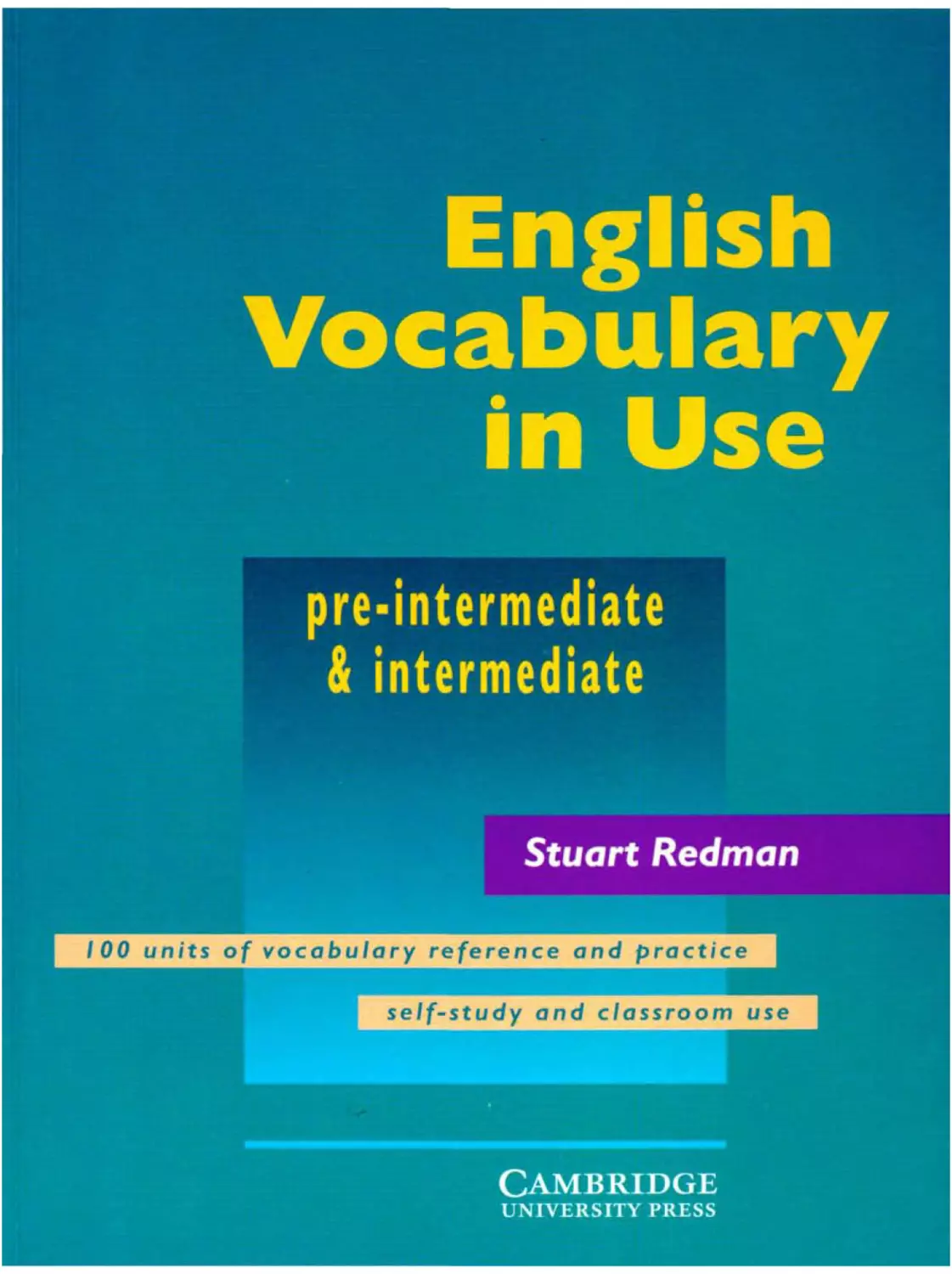
English
Vocabulary
in Use
pre-intermediate
& intermediate
Stuart Redman
100 units of vocabulary reference and practice
self-study and classroom use
Cambridge
UNIVERSITY PRESS
English
Vocabulary
in Use
pre-intermediate and intermediate
CAMBRIDGE
UNIVERSITY PRESS
PUBLISHED BY THE PRESS SYNDICATE OF THE UNIVERSITY OF CAMBRIDGE
The Pitt Building, Trumpington Street, Cambridge CB2 1RP, United Kingdom
CAMBRIDGE UNIVERSITY PRESS
The Edinburgh Building, Cambridge CB2 2RU, United Kingdom
40 West 20th Street, New York, NY 10011-4211, USA
10 Stamford Road, Oakleigh, Melbourne 3166, Australia
© Cambridge University Press 1997
This book is in copyright. Subject to statutory exception and to the provisions
of relevant collective licensing agreements, no reproduction of any part may
take place without the written permission of Cambridge University Press.
First published 1997
Third printing 1997
Printed in the United Kingdom at the University Press, Cambridge
A catalogue record for this book is available from the British Library.
ISBN 0 521 55737 2
Introduction
Learning
1 Learning and revising with this book
2 Keeping a vocabulary notebook
3 Using a dictionary
4 English language words
5 Problems with pronunciation
6 Classroom language
Word formation
7 Prefixes
8 Noun suffixes
9 Adjective suffixes
10 Zero affixation
11 Compound nouns
12 Compound adjectives
Phrase building
13 Collocation (word partners)
14 Verb or adjective + preposition
15 Preposition + noun
16 Phrasal verbs: form and meaning
17 Phrasal verbs: grammar and style
18 Idioms and fixed expressions
19 Make, do, have, take
20 Give, keep, break, catch, see
21 Get: uses and expressions
22 Go: uses and expressions
23 Apologies, excuses and thanks
24 Requests, invitations and suggestions
25 Opinions, agreeing and disagreeing
26 Specific situations and special occasions
Parts of speech (special problems)
27 Uncountable nouns and plural nouns
28 Verbs + -ing form or infinitive
29 Verb patterns
30 Adjectives
31 Prepositions: place
32 Adverbs: frequency and degree
Examples
uncountable noun, prefix, main stress
rough, through, island, necessary
board pen, swap places, rub sth. out
un-, in-, dis-, im-, re-
-tion, -ity, -ness, -ment
-ive, -y, -able, -ful, -less
to stay / a stay; a look / to look
alarm clock; credit card; baby-sitter
easy-going, good-looking, well-paid
a strong accent, miss the bus
listen (to), keen (on), good (at)
on holiday, by mistake, on TV
lie down, get over sth., take off
put on, get by, make sth. up
never mind, take a short cut, What’s up?
make progress, do homework, have a rest
keep a record, break the law, catch a bus
get a job, get married, get up
go deaf, go for a drink, have a go
sorry I’m late, I got held up, thanks a lot
could you ...?, I’d love to, how about ...?
what do you think of ...? personally, according to
hi, good luck, nice to meet you, happy birthday
information (U), trousers (pl)
enjoy, can’t stand, refuse
verb + object, verb + ‘that’ clause
big vs. huge, boring vs. bored
on the table, next to the church
hardly ever, quite, almost
Connecting and linking
33 Time and sequence
34 Addition and contrast
35 Similarities, differences and conditions
36 Reason, purpose and result
Topics
The world around us
37 The physical world
38 Weather
39 Using the land
40 Animals and insects
41 Countries, nationalities and language
People
42 The body and what it does
43 Describing people’s appearance
44 Describing character
45 Human feelings and actions
46 Family and friends
47 Ages and stages
Daily life
48 Daily routines
49 Homes and buildings
50 Around the home 1
51 Around the home 2
52 Everyday problems
53 Money
54 Health: illness and disease
55 Health: injuries
56 Clothes
57 Shops and shopping
58 Food
59 Cooking and restaurants
60 Town and country
61 On the road
62 Transport
Work
63 Work: duties, conditions and pay
64 Jobs
65 The career ladder
66 In the office and in the factory
67 Business and finance
68 Sales and marketing
Leisure and entertainment
69 Hobbies
70 Sport 1: games, people and places
71 Sport 2: winning, losing and scoring
72 Cinema and theatre
73 Music, art and literature
when, while, after, first of all, finally
in addition, although, in spite of
similar to, compared with/to, unless
as, so, because (of), as a result
oceans, mountains, deserts, hurricane
showers, cloudy, fog, pour with rain
plants, agriculture, mining, gold
lion, wild, spider, rabbit
Sweden, Swiss, Arabic
bend your knees, bite your nails
tall and blond with broad shoulders
shy, friendly, unpleasant
pride, jealous (of), stare, whisper
niece, relatives, surname, best friend
teenager, grow up, adult, pregnant
get up, leave home, go to sleep
flat, on the ground floor, roof
lounge, on the sofa, food mixer
washbasin, tidy, hoover, polish
it’s not working, drop, break
coins, borrow, I can’t afford it
flu, sore throat, sneezing
twist my ankle, bleeding, bruise
shirt, trousers, take off, get dressed
chemist, shop assistant, I’m being served
carrot, peach, lamb
fry, salty, main course, book a table
suburbs, noisy, fields
turn left, traffic lights, accident
coach, bus stop, platform, get off
What do you do?, salary, do overtime
dentist, lawyer, plumber
be promoted, resign, unemployed
show sb. around, assembly line, goods
turnover, make a profit, rise and fall
market share, competitors, image
photography, play cards, spare time
tennis court, racket, goal, referee
win, draw, latest score, half-time
audience, actor, a thriller
orchestra, composer, painting, novelist
Communication and technology
74 Newspapers
75 Television
76 On the phone
77 Computers
Social concerns
78 Education: school
79 Education: university
80 Law and order
81 Crime
82 Politics
83 Bureaucracy
84 War and peace
85 Pollution and the environment
Tourism
86 Air travel
87 Hotels
88 A sightseeing holiday
89 On the beach and in the country
Notional concepts
90 Time
91 Numbers
92 Distance and dimension
93 Shapes, colours and patterns
94 Partitives
95 The senses
Varieties of English
96 Notices and warnings
97 Vague language
98 American English
99 Formal and informal English
100 Abbreviations and abbreviated words
journalist, headline, article
programme, turn on, soap opera
engaged, operator, Is that ...?
screen, software, save, data
primary school, subject, term
do a degree, do research, lecture
court, trial, arrest, guilty
murder, commit a crime, steal
political party, democracy, elect
fill in a form, driving licence, signature
peace talks, attack, terrorism, invade
protect, destroy, recycle, waste
flight, take off, passport control
bill, single room, book, in advance
guidebook, castle, souvenir, take photos
sand, sunbathe, hiking, picnic
for ages, at, on , during, last, recently
two and a half, divide, nought point six
is it far? a long way, deep, width
round, square, pattern, grey, greenish
piece of cake, group of people
smells fresh, tastes like ..., see vs. watch
mind your head, beware of pickpockets
sort of things, stuff
sidewalk, vacation, elevator
purchase/buy, children/kids
MP, UN, VAT, phone, bike, fridge
Answer key 206
Phonetic symbols 246
Pronunciation problems 247
Index 248
Acknowledgements 266
Introduction
Who is this book for?
English Vocabulary in Use (pre-intermediate and intermediate) has been written to help
learners at this level to improve their English. It has been designed for students who are
studying on their own, but it can also be used by a teacher in the classroom with groups of
students.
How is the book organised?
The book has 100 two-page units. The left-hand page explains new words and expressions
(most units contain approximately 25 new words or phrases), and the right-hand page gives
you a chance to check your understanding through a series of exercises which practise the
new vocabulary. In a very limited number of units e.g. Units 18 and 71, the right-hand page
also includes a few new words and phrases which are not explained on the left-hand page.
There is an answer key at the back of the book. This not only gives correct answers to
exercises with ‘right’ or ‘wrong’ solutions, but also possible answers and sample answers for
exercises which do not have ‘right’ or ‘wrong’ solutions.
There is also an index at the back of the book. This lists all the new words and phrases
introduced in the book and refers you to the unit or units where these words appear. The
index also includes a phonemic transcription for many of the words, and on page 247 you
are given special help with the pronunciation of approximately 200 words which present
particular problems for many learners of English.
The left-hand page
This is the page that introduces the new vocabulary for each topic or area of language. First
of all, the vocabulary is divided into a number of sections (А, В, C, etc.) with simple clear
titles; and then within each section, new words are explained using a number of different
techniques:
• A short definition. The definition follows directly after the word, or comes at the end of
the phrase or sentence; it is in brackets and introduced by the symbol =.
e.g. unemployed (- without a job); feel like (= want or desire infml)
The abbreviations fml or infml tell you if a word is either ‘formal’ or ‘informal’.
• A short explanation. This will be a complete sentence which often includes the new word,
e.g. effective. (If something is effective, it works well and produces good results.)
• A synonym or opposite, e.g. terrific (= fantastic); dirty (^ clean)
• In a situation. Some words are difficult to define and it is easier to see their meaning when
they are put in context. The following is from a text about a motoring accident.
e.g. ‘The driver of the Mercedes was OK, but the other driver was badly injured, and both
cars were badly damaged.’
• A picture or diagram. This seems the obvious way to explain a large number of concrete
nouns and verbs.
carrot go along here and turn left.
For many of the new words there are also sentence examples which show the words in
context in order to consolidate their meaning and illustrate any special syntactic features.
My boyfriend gets very jealous when I talk to other boys.
The plane appeared in the sky, then suddenly disappeared behind a cloud.
He admitted stealing the woman’s money, (admit + -ing)
We were very busy but we managed to finish by 6 o’clock, (manage + inf.)
Finally, a big effort has been made to introduce new words alongside other words that often
appear with them (this is called ‘collocation’).
e.g. miss the bus; a strong accent; the car broke down; it’s vitally important; fasten your seat
belt; go on holiday; give someone a hand; to a certain extent, a terrible pain, etc.
The right-hand page
This page contains the exercises to practise the new vocabulary presented on the left-hand
page. In general the first exercise practises the form of some of the new words, and then there
are further exercises which focus on the meaning. In most units there is at least one exercise
which gives learners a chance to think about and practise new vocabulary in relation to their
own lives, and/or a task which invites learners to do something with the vocabulary outside
of the book (e.g. 11.4, 14.4, etc.). And in every unit, there is a range of exercise types to help
maintain your interest.
Using the book
The first five units (or first six units if you go to an English class) teach you some important
vocabulary, but they also help you with with useful ideas and techniques for vocabulary
learning. Do these units first, and then work through the book studying the units which
interest you.
Summary of abbreviations and symbols used in the book
n noun
V verb
adj adjective
inf ml informal word or expression
fml formal word or expression
pl word only used in the plural
(U) uncountable word
(C) countable word
* opposite
AmEng American English word or expression
[not I lost the bus] indicates that a word or expression is wrong
I Learning and revising with this book
Look at Exercise 1 on the next page before you read this page.
A Establish a routine
A routine means doing certain things regularly in the same way. And if you are using this
book for self-study (- to study alone), it helps to have a routine. Decide how much time you
can spend on the book each day or each week. If you are studying a unit for the first time,
try to give yourself at least (= a minimum of) half an hour or forty-five minutes; if you are
revising (= looking through a unit a second or third time), five or ten minutes each time is
very useful. So, plan longer periods for new units, and shorter periods for revision.
В Working through the book
Do different things to maintain your interest.(= keep your interest high). For example:
• Don’t work through the units in sequence (= in the order they appear in the book): look
through the units and choose ones that interest you.
• When you do a unit, you can:
read the whole of the left-hand page, then do the exercises.
read part of the left-hand page, then do one or two exercises.
try the exercises first, then use the left-hand page when you have a problem.
• Be active when you are learning. For example:
While you are reading the left-hand page, use a highlighter pen to mark new or
interesting vocabulary.
Practise saying the words silently in your head (= without a noise), and also out loud (=
making a noise, so it is possible for others to hear), to see if you can pronounce them.
Put new words in your own notebook using some of the ideas from Unit 2 to do it
effectively. (If something is effective, it works well and produces good results.)
C Revision
It is common to learn a word one day, then find you cannot remember it a day later. If you
revise regularly (just for short periods), it helps you to remember words and make them
part of your ‘active’ vocabulary. Here are some ideas for revising with this book.
• Do exercises in pencil. Check your answers when you have finished, then rub them out
(= remove them using a rubber/eraser). Later, come back and do the exercises again, and
just use the left-hand page if you cannot remember something.
• When you read a left-hand page for a second time, have a piece of card with you. When
you reach a new word in bold which has a definition/explanation after it in brackets ( ),
cover the definition quickly and try to say what it is. Then uncover it to see if you were
right.
• Revise for short periods but do it often. Five minutes a day is probably better than half
an hour a week; but half an hour a week is probably better than two hours a month.
• As with learning, be active when you revise. Look for different ways to revise: test
yourself, create games for yourself; set goals/targets (= decide on things you want to be
able to do by a particular time); decide when to work on something, e.g. meaning on
Sunday, pronunciation on Monday, etc.
I • I Think about these questions. On the opposite page you will find some answers. Do you agree
with them?
1 Is it better to plan regular self-study, or is it better just to study when you think you’ve got
some free time?
2 Do you think you should work through the units in the same order as they appear in the
book?
3 Do you think it’s a good idea to write down new words in a notebook while you are
studying a unit?
4 Is it necessary to revise vocabulary?
5 Is it better to revise vocabulary occasionally for long periods of time, or is it better to
revise regularly for short periods of time?
1*2 Finding your way round the book.
Turn to the Topic units in the Contents on pages 1-3. Take a blank piece of paper and cover
the right-hand side of the page giving the examples. Now read down the list of unit titles. For
each one, try to write down your own examples - one or two for each unit. Are there any
unit titles you don’t understand? Are there any units where you can’t think of examples? If
so, turn to that unit and find out what it is about.
You could use similar titles in your own vocabulary notebook. (See Unit 2)
1.3 True or False? If the sentence is false, rewrite it to make it true. Write your answers in pencil.
1 In this book, new words are often shown in bold print.
2 Definitions/explanations of new words are often in brackets after the word.
3 A routine means doing certain things in a different way each time.
4 If you maintain something at a level, it means you keep it at the same level.
5 If something, e.g. a way of learning, is effective, it doesn’t work very well.
6 At least 50 people means a maximum of 50 people.
7 If you write something then rub it out, you remove it from the page.
8 If you do something silently, you do it without making a noise.
9 Revision means studying something for the first time.
10 If you have a goal or target, you have something you want to be able to do or achieve by
a particular point in the future.
Now check your answers on the opposite page and look at any wrong answers carefully.
Then rub out your answers and come back to this exercise again tomorrow or within the
next two or three days. Find out how much you can remember.
1.4 Planning your self-study.
Now start making your own plans to use this book. Decide how much time you can spend
each week, plan some longer periods to study units for the first time, but also some shorter
periods for revision. The first five units will teach you some important vocabulary; give you
ideas on keeping a notebook; and give you help with pronunciation. After that, continue with
the units that interest you most.
Good luck.
2 Keeping a vocabulary notebook
A Organising your notebook
Give each page or double page a title, e.g. sport, education, phrasal verbs, etc. Then, as you
learn new words, record each one on a suitable page. You could also have a general index
in the back of your book, with a space for each letter Then, as you learn new words, you
enter them alphabetically with the title of the topic in brackets.
What do I need to record?
These things are important but you won’t need to record all of them for every word.
What? Meaning How? a translation b definition/explanation c synonym or opposite Example lembrar = to remember (Portuguese) A pond is an area of water smaller than a lake. awful (= terrible); ugly (^ beautiful)
d picture saucepan
e example sentences Pronunciation phonetic symbols or your own system Part of speech (n), (v), (adj), etc. Grammar make a note + example sentence Common partners phrase or sentence Special style make a note My hands were cold so I put on my gloves, ache /eik/ ache (like ‘make’) gloves (n); remember (v); careful (adj), ache (n, v) enjoy + -ing form; I enjoy going to parties, weather (U); We had lovely weather in Italy, make a mistake; make a decision; make a mess purchase (fml); kids (infml)
Note: You won’t learn everything about a word when you first record it, so always leave
space in your notebook, then you can come back and add more information later.
C Organising words on the page
Certain words often appear together (common partners), so it is a good idea to record them
together, and not just write lists of words on their own. You can do this in different ways:
3 Smile- (y n)
e-.^ She- SmileJ ah me- tje-she-rc
He- me- a bi^r Smile-.
Shes «ph a love-fa Smile-.
rise- rise- sharply fall fall sharply
Nohe both v^rbs are- irre^ylar: rise/roSe/rise-n; fall/fe-ll/falle-n
2» I Organise this list of words into three groups and give each one a title.
tie put on
painful scarf
helpful jeans
fare blouse homeless train get on
jumper jacket journey careful station
platform thoughtless ticket useless
Find the units in this book which may include these words and add more examples.
2.2 Underline the correct answer or answers.
1 A pond is:
a) bigger than a lake b) smaller than a lake c) the same size
2 I really enjoy:
a) play tennis b) to play tennis c) playing tennis
3 When we were on holiday we had:
a) lovely weathers b) lovely weather c) a lovely weather
4 The underlined letters in ache are pronounced the same as in:
a) machine b) catch c) chemist
5 She gave me a........... smile.
a) strong b) big c) large
6 The past tense of fall is:
a) fell b) felt c) failed
7 You can put on:
a) gloves b) a decision c) shoes
8 Rise sharply means:
2.3 Look again at the list a-e in B. Which would be the best way(s) to record the meaning of
each word in the list below? What other information would be useful to record with this
word (e.g. pronunciation, part of speech, grammar, common partners, etc.)? Use a dictionary
to help you.
dream concentrate beard nearly
empty forget rescue knife
2.4 Fill the gaps with common partners for these verbs, then start a page in your own notebook
for more examples. Turn to Unit 19 to help you.
take a picture make a mistake
do your homework
have a rest
3 Using a dictionary
What dictionaries do I need?
If possible, you should buy two dictionaries: a good bilingual dictionary and a good
English-English dictionary. The bilingual dictionary is quicker and easier for you to
understand; the English-English dictionary may give you more information about a word or
phrase, and it is also a good idea for you to work in English as much as possible. Here are
some current recommended English-English dictionaries:
Large dictionaries Medium-sized dictionaries
Cambridge International Dictionary of English Collins COBUILD Essential Dictionary
Longman Dictionary of Contemporary English Oxford Wordpower Dictionary
Collins COBUILD English Dictionary Longman Active Study Dictionary
Oxford Advanced Learner’s Dictionary
В What information does a dictionary give me?
• the meaning, e.g. homesick = unhappy when you are away from home for a long time
• the pronunciation, e.g. chaos /keios/, dreadful /dredfol/, island /ailond/
• the part of speech, e.g. dirty adj (= adjective), lose v (= verb), law n (= noun)
• any special grammatical features, e.g. advice (U) (= uncountable)
• common collocations (word partners), e.g. you do homework [not you make homework]
• example phrases or sentences, e.g. It was such a big menu, I didn’t know what to choose.
• opposites (where they exist), e.g. polite impolite/rude)
Note: In most English-English dictionaries for foreign learners, collocations are usually
shown in bold or italics, or they are included in the examples given after the definition.
pronunciation part of speech grammatical feature
••at i furniture! /silt/ n (C) an item of furniture that has 20
definition
collocations
been designed for someone to sit on • Chairs, stools, sofas
and benches are different types of seat. • All the chairs are
taken - Гт afraid you’ll have to use this table as a seat. • A
car usually has a driver’s seat, a front/passenger seat
andtjack/rear seats, • Why don't you sit down on that seat
pvfrthere while we’re waiting? • The hall’s quite full - I
can’t see any empty seats, • My ticket says 22D but there's
already someone in (-sitting on) that seat. • Is this seat
free/taken (= Is anyone using it)?* Would you keep (- stop
examples
C How should I use my dictionary?
Here are some ideas to help you.
• When you look up a word, put a / next to it. Each time you return to a page with a /
look at it quickly to check that you remember the word.
• If you see an English word in a text, first try to guess the meaning, and carry on reading
to see if your guess seems correct. Use your dictionary to check the meaning.
• If you look up a word in a bilingual dictionary and get several different words in your
own language, look up the word in your monolingual dictionary. This should help you to
decide which word in your own language is the nearest translation in this context.
• Remember that many words have more than one meaning, and the first meaning in the
dictionary is not always the one you want. Read through the different meanings.
If you find these exercises difficult, it may mean that you need to practise using a dictionary
more often, or you need to buy yourself a better dictionary.
3® I Use a dictionary to find/check the answers to these questions. (They are all based on words
from the opposite page.)
1 What does dreadful mean?
2 How do you pronounce lose? (Is it the same as ‘choose’ or ‘chose’?)
3 What part of speech is choose?
4 What part of speech is homesick?
5 Homework and chaos are both nouns, but what type of noun are they?
6 What adjectives are often used before chaos? (Give two.)
7 What two prepositions are often used after choose?
8 Write down a sentence example of choose used with a preposition.
3^2 When you look up a word, you can also use your dictionary to increase your vocabulary by
learning related words and phrases. Find out if your dictionary helps you to answer these
questions, also about words from the opposite page.
1 Choose is a verb, but what is the noun with the same meaning?
2 Advice is a noun, but what is the verb with the same meaning?
3 Advice is also uncountable, but you can make it countable using another word. Can you
complete this sentence: ‘He gave me a very useful........... of advice.’
4 What adjective is formed from chaos?
5 What is the opposite of dirty?
6 What is the difference between homework and housework?
7 What is the opposite of lose a game?
8 What is the opposite of lose weight?
9 Law often appears in the phrase law and.............What is the missing word?
10 If you want to sit at a table in a cafe and you see that one person is sitting there already,
but another seat is empty, what can you say to the person sitting down?
3®3 In the word ‘island’ /ailand/, the letter ‘s’ is silent (= not pronounced). Use the pronunciation
guide in your dictionary to find the silent letters in each of these words. (Do not include the
letter ‘e’ at the end of a word.)
knife bomb psychology receipt castle doubt wrist calm
Note: Students often ask if the letter ‘t’ is pronounced in ‘often’. Some people pronounce it,
others don’t. What does your dictionary say?
3#4 Look at the entry for suit on the right, then match the definitions with the sentences on the
left.
1 I’m afraid black doesn’t suit me - my
hair is the wrong colour.
2 A: I’m not going, so don’t ask me again.
B: OK. Suit yourself.
3 If we have the meeting this afternoon,
would 2.30 suit you?
su<ta v m 1 to be acceptable or convenient for a par- [s|,
ticular person or in a particular situation: Finding a date 1 2 3
that suits us all is very difficult. I Buy a database program
to suit your needs. ) suit sb (fine) spoken (=becompietely 1
acceptable) “Eight o’clock?" "Thai suits me fine. "| suit sb ।
down to the ground (=be exactly right for someone) .
Yup, this little car suits me down to the ground. 2 (notin
passive) to make someone look attractive: That coat re-
ally suits PauL\Red suits you. —see m* (USAGE) \
3 well/best/ideally suited to have the right qualities to
do something: Dirk would be ideally suited to the job. < 1
4 suit yourself spoken used to tell someone they can do ?
whatever they want to. even though it annoys you: "I j
don’t really feel like going out after all. “ "Suit yourself ” I
AnwMtt&bgQk fir# >>
4 English language words
•A? Parts of speech
nouns
verbs
adjectives
adverbs
prepositions
pronouns
articles
e.g. chair, information, happiness
e.g. choose, tell, complain
e.g. happy, tall, dangerous
e.g. slowly, carefully, often
e.g. in, at, on
e.g. me, you, him, we, it, she
e.g. definite article (the); indefinite article (a/an)
В Special terms
Uncountable noun: (U) a noun which has no plural form and cannot be used with the
indefinite article, e.g. information. See Unit 27.
Plural noun: (pl) a noun which only has a plural form and cannot be used with the
indefinite article, e.g. trousers. See Unit 27.
Infinitive: the base form of a verb, e.g. (to) work, (to) stop, (to) be.
Phrasal verb: a verb + adverb and/or preposition, e.g. turn on (verb + adverb), look after
(verb + preposition), give up (verb + adverb), put up with (verb + adverb + preposition).
See Units 16 and 17.
Idiom: a group of words with a meaning that is different from the individual words, e.g.
never mind, hang on, a short cut, keep an eye on something.
Transitive verb: a verb which needs a direct object, e.g. Police caught the man (‘the man’ is
the direct object of the verb ‘caught’). See Unit 17.
Intransitive verb: a verb which does not need a direct object, e.g. The books arrived on
time. (There is no direct object after arrive.) See Unit 17.
C Word building
In the word uncomfortable, un~ is a prefix, comfort is a root, and -able is a suffix. Other
common prefixes include: re-, in-, and dis-*, common suffixes include: -ity, -ment, and -ive.
Many words also have synonyms, which are words with the same meaning. For example,
‘big’ is a synonym of ‘large’. The opposite is ‘small’.
D Pronunciation
Dictionaries show the pronunciation of a word using phonetic symbols, e.g. book /Ьик/,
before Zbi’fa:/, cinema Z’sinamaZ, and so on.
Each word contains one or more syllables: ‘book’ has one syllable; ‘before’ has two syllables
(be-fore); ‘cinema’ has three syllables (ci-ne-ma); ‘education’ has four syllables (e-du-ca-
tion); and so on.
For pronunciation, it is important to know which syllable has the main stress. On ‘before’ it
is the second syllable (before); on ‘cinema’ it is the first (cinema); and on ‘education’ it is the
third (education).
Note: Dictionaries mark stress in different ways: in bold (return); or a ' before the main
syllable (re'turn). Make sure you understand how your dictionary shows it.
E Punctuation
full stop . comma , brackets ( ) hyphen - question mark ?
4» В There is one word missing in each line of this text. Where does the missing word go? What
could it be? And what type of word is it (noun, verb, etc.)? Look at the example first.
Last year I went to^or my holiday. I spent the first . (hovh^)..........
week Seville staying with a couple of friends, and ...................
then I took a train to Barcelona where spent another .........................
ten days. It is beautiful city and I had a marvellous ...................
time. I stayed in a very hotel right in the centre, but ...................
I didn’t mind spending a lot money because it is a ...................
wonderful and also very convenient. My brother was ...........................
the person who recommended it; he goes Spain a lot ...........................
and he stays anywhere else. ...................
4®2 In the dialogue below, can you find at least one example of the following: an uncountable
noun; a plural noun; a phrasal verb; an idiom?
A: What’s the time?
B: 8 o’clock, so we’d better get a move on if we’re going to meet your sister at the airport.
A: That’s alright. Her flight doesn’t arrive until 8.30.
B: Yeah, but it’ll take us an hour to get there - you know what the traffic is like.
A: OK. I’ll just go and get changed.
B: What’s wrong with those shorts?
A: I don’t like driving in shorts. I’m going to put some jeans on.
4®3 Look at the underlined verbs in these sentences. Which are transitive, which are intransitive?
1 She broke her leg. 4 Take off your jacket.
2 I got up at seven thirty. 5 She doesn’t like Chinese food.
3 We arrived late. 6 He told me to sit down.
4®4 How many syllables are there in each of the words in the box?
English noun informal education
understand adjective decide pronunciation
before opposite preposition comfortable
Now mark the main stress on each of the above words.
4® 5 Look at these words, then answer the questions below,
happy correct lucky sure possible
1 What part of speech are these words?
2 Change each one into an adverb.
3 Can you write down a synonym for at least three of the words?
4 Which prefix do you need to form the opposite of each word? (three different ones)
5 Which word has the main stress on the second syllable?
5 Problems with pronunciation
Ж'АШ Phonetics
With many languages you can look at a word and know (more or less) how to pronounce
it. With English this is not true: it is often very difficult to know the pronunciation from
looking at a word. For example:
cough (pronounced like ‘off’) enough (like ‘stuff’) through (like ‘too’) and dough (like ‘so’)
The only way you can be sure about the pronunciation is to learn some phonetic symbols
which tell you the pronunciation. Dictionaries use them, and there is a table of phonetic
symbols, with examples, on page 246. Phonetic symbols are used next to many words in the
index, and there is a special list of words on page 247, which cause pronunciation problems
for speakers from different countries.
В Word stress
When a word has two or more syllables, one of them has the main stress. In these examples,
the main stress follows the symbol
'accent pre'fer education 'necessary Ja'pan Japa'nese
If you put the stress on the wrong syllable, it may be difficult for listeners to understand
what you are saying.
Probably the most important sound in English because it is often the pronunciation of the
letters ‘a’, ‘o’ and ‘e’ if they are not part of a stressed syllable.
ma'chine /тэ’Дт/ 'mother /‘тлдэ/ po'tato /pa’teitau/ 'cinema /'sinama/
Key letters and sounds
A common problem is that a single letter or combination of letters has more than one
pronunciation, e.g. -ough in section A. Here are some more examples:
the letter ‘o’ is often /о/, e.g. hot; or /л/, e.g. some; or /эо/, e.g. no
the letter ‘a’ is often /ае/, e.g. hat; or /ei/, e.g. same; or /a:/, e.g. fast
the letter ‘u’ is often /л/, e.g. run; or /о/, e.g. put
the letter ‘i’ is often /1/, e.g. sit; or /ai/, e.g. side
E Silent letters and short syllables
There are many words in English where a letter is not pronounced:
fasten plumber calm knee wrong comb
There are also many words where we almost ‘eat’ one of the syllables, and as a result a
vowel sound almost disappears and a word, for example, with three written syllables may
be two (or two and a half) in spoken English. For example:
interested /mtrastid/ fattening /faetnirj/ vegetable /vecfetabl/
Note: The exercises on the next page practise some words with difficult pronunciation.
5® I Try using some phonetic symbols. Using your dictionary or the index, fill in the
pronunciation of these words (put the symbols between the / /). Then practise saying the
words and make sure you can see and hear the difference in the pronunciation of the words
in each pair.
5® 2 Look at the underlined letters in these words. Which one is the odd one out in each case?
1 bread dream spread dead
2 spoon room flood choose
3 fast phrase blame sunbathe
4 cousin wound (n) rough trouble
5 virus pilot diet since
6 hyphen symptom type psychology
Which syllable has the main
5Л
stress in these words? Put them in the correct column.
cathedral policy palace
opposite police understand
advertisement desert (n)
competition organise
assistance education
first second third
Now look at the words again. How many examples of the /э/ sound can you find?
5Л
Look at the underlined letters in these pairs of words. Is the pronunciation the same or
different?
know I knife
island / Islam
listen I western
aisle I Christmas
hand / handsome
muscle / scissors
climb / bomb
honest / hope
wrong / wrist
calf / calm
Classroom language
A Equipment
These are some of the things you may use in your classroom or school.
Note: We can use some of these nouns as verbs with little or no change: to video (= to
record a programme on video), to photocopy (= to use the photocopier), to highlight and to
file (= to put things in a file)
В Classroom activities
Here are some classroom activities. Look carefully at the verbs in bold.
Things you do in the classroom:
Look up a word if you don’t understand it. (= find the meaning of a word in a dictionary)
Borrow someone’s dictionary or rubber. (= use it and then return it)
Rub out mistakes in your notebook. (- erase mistakes / remove them using a rubber)
Things the teacher may do in the classroom:
Plug in the tape recorder. (= put the plug in the socket and turn on the electricity)
Turn up the tape recorder (= increase the volume) if the students can’t hear it.
Rub things off the board. (= remove writing from the board)
Correct students’ English. (= give the correct English if students make mistakes)
Things your teacher may ask you to do in the classroom:
Could you clean the board, Carlos? (= remove all the writing from the board)
Write these words down. (= write these words on a piece of paper / in a notebook)
Enrique, could you swap places (= exchange places) with Lorena?
Repeat this sentence (= say it again) after me.
C Questions about vocabulary
What does X mean? [not what means X?]
How do you pronounce it?
How do you spell ‘bicycle’?
How do you use ‘anyway’ in a sentence?
What’s the difference between X and Y?
6» I Label these pictures then check your answers on the opposite page.
6.2 Answer these questions.
1 What do you rub off the board?
2 What do you put in a tape recorder?
3 What do you put on an OHP?
4 What do you keep in a file?
5 What do you put in a briefcase?
6 What do you put in a socket?
7 What do you use a dictionary for?
8 What do you use a rubber for?
9 What do you use a photocopier for?
10 Why do you turn up a tape recorder?
6.3 Match the verbs on the left with the nouns on the right.
1 clean places
2 turn up a word
3 borrow mistakes
4 swap the board
5 video a dictionary
6 do the OHP
7 correct the tape recorder
8 look up a programme
9 plug in an exercise
6.4 Think about your last lesson (in English or any other subject). Did you do any of these
things? clean the board use a rubber borrow something watch a video swap places with someone look up a word make a mistake write something down in a notebook
6Л Here are some answers. What are the possible questions?
A: .................................? B: It means to exchange places.
A: .................................? B: /swop/ Like ‘cop’ or ‘stop’.
A: .................................? B: S-W-A-P.
A: .................................? В: I can’t see the board from here. Will you swap
places with me?
Prefixes
Ж With the meaning ‘not’
Prefixes (un-, in-, il-, ir-, and dis-) are often used to give adjectives (and some verbs and
nouns) a negative meaning. Here are common examples:
happy unhappy
possible impossible
correct incorrect
like (v) dislike (v)
legal illegal (- against the law)
regular irregular, e.g. irregular verbs
un- is used with many different words, e.g. unfriendly, unable, unemployed (- without a
job), untidy (= not in order; in a mess)
im- is used before some words beginning with m or p, e.g. impolite (= rude), impatient
(somebody who is impatient wants things to happen now; they cannot wait for things)
il - is used before some words beginning with 1, e.g. illegible (= cannot be read because the
writing is very bad)
ir- is only used before some words beginning with r, e.g. irresponsible
dis- is used before some adjectives, e.g. dishonest, and a few verbs, e.g. dislike, disagree
in- is used before a limited number of words, e.g. invisible (= cannot be seen)
Note: A prefix does not normally change word stress, e.g. happy/unhappy; possible/
impossible. But the stress may change if you want to emphasise the negative or opposite:
A: Was he happy about the change?
B: No, he was very unhappy about it.
Verb prefixes: un- and dis-
These prefixes have two meanings: they can have a negative meaning (as above), but they
can also mean ‘the opposite of an action’ or ‘to reverse an action’. This meaning is used
with certain verbs.
I locked the door when I left, but I lost the key, so I couldn’t it unlock it when I got back.
I had to pack my suitcase (= put everything in it) very quickly, so when I unpacked (- took
everything out) at the hotel, most of my clothes looked terrible.
The plane appeared in the sky, then suddenly disappeared behind a cloud.
In the morning you get dressed (= put on your clothes); when you go to bed you get
undressed (= take off your clothes).
Т-т-С/ Other verb prefixes with specific meanings
re- (= again) My homework was terrible, so I had to redo it.
The shop closed down but will reopen next month.
I failed my exam but I can retake (or redo/resit) it next year,
over- (= too much) I think my boss is overdoing it at the moment. (- working too hard;
also overwork)
I went to bed very late and I overslept (= slept too long) this morning.
The shop assistant overcharged me. (= asked me for too much money)
mis- (- badly or I’m afraid I misunderstood what he said.
incorrectly) Two of the students misread the first question.
7.1 Which prefix forms the opposite of these words? (The bottom line are all verbs, the rest are
adjectives.)
happy ...........patient .........polite ...legal
correct .........regular .........visible ...possible
legible .........friendly ........employed ...........honest
pack ...lock ....agree ...like
7* 2 Agree with these statements, using words from the left-hand page which have the same
meaning as the underlined words.
Example: A: He doesn’t have a job, does he?
B: No, ...............
1 It’s against the law, isn’t it?
Oh yes,................................
2 His room is always in a mess, isn’t it?
Yes,...............................
3 He took off his clothes!
Yes,...............................
4 This handwriting is impossible to read.
Yes I know,................................
5 She can never wait for five minutes, can she?
No,................................
6 I thought it was rude, didn’t you?
Yes, it was very..............................
7.3 Complete the verbs in these sentences.
1 I’m sorry, I mis............ her message completely.
2 We un.............. as soon as we got to the hotel, then went out for a walk.
3 She was here a minute ago, but then she dis..........I’m afraid I don’t know where
she is now.
4 We normally have similar opinions but I dis........ with him totally on the subject
of drugs.
5 My homework was so bad that I’ll have to re........ it.
6 Apparently her alarm clock didn’t ring and she over.........
7 She finally managed to un.......... the door and we were able to go inside.
8 I dis.......... the film, but the others enjoyed it.
9 I don’t think I’ll pass the exam, but I can always re........... it in September.
10 The post office shuts for lunch but it should re............ at 2.00 p.m.
11 She’s over......... at the moment. She really needs a holiday and a complete break
from her job.
12 My sister wrapped up my present so well that it took me about five minutes to
un............ it.
7.4 Keep several pages in your notebook for verbs or adjectives which combine with these
prefixes. Each time you add a new word, read through your list of words with that prefix,
then close your book and see how many you can remember.
® Ж Verb + suffix
Many nouns are formed in this way.
Verb Suffix Noun
improve (= get better) -ment improvement
manage (e.g. a shop or business) -ment management
elect (= choose somebody by voting) -ion election
discuss (= talk about something seriously) -ion discussion
inform (= tell someone something) -ation information
organise -ation organisation
jog (= running to keep fit or for pleasure) -ing jogging
spell (e.g. S-P-E-L-L) -ing spelling
Note: Sometimes there is a spelling change. The most common is the omission of the final
‘e’ before the suffix -ion or -ation: translate/translation; organise/organisation
fc Adjective + suffix
Nouns are also formed by adding a suffix to an adjective. Two suffixes often added to
adjectives to form nouns are -ness and -ity.
Adjective Suffix Noun
weak (^ strong) -ness weakness
happy -ness happiness
dark (e.g. at night, when you can’t see) -ness darkness
stupid (^ intelligent, clever) -ity stupidity
punctual (= always arrives at the right time) -ity punctuality
similar (= almost the same; Ф different) -ity similarity
Pronunciation
The addition of these suffixes may change the pronunciation.
Nouns ending -ion or -ity have the main stress on the syllable before, so the pronunciation
may be different from the verb or adjective:
Verb Noun Adjective Noun
educate education similar similarity
translate translation stupid stupidity
discuss discussion punctual punctuality
-er/-or and -ist
These are common noun suffixes added to existing nouns or verbs, and they describe people
and their jobs.
-er -er -or -ist
dancer driver actor artist
singer manager director economist
murderer footballer translator psychologist
farmer employer operator journalist
Note: Notice the common spelling changes:
translate/translator, operate/operator, economy/economist, psychology/psychologist.
8 Л Complete the tables and mark the stress on each word. The last two in each column are not
on the opposite page, but do you know or can you guess the noun formed from them?
Verb Noun
educate improve jog govern spell hesitate arrange
Adjective Noun
stupid dark weak similar punctual sad popular
8®2 Combine the suffixes on the right with the verbs or adjectives on the left, and then complete
the text below. (Remember you may need to make a small spelling change.)
improve televise elect
educate weak manage
govern stupid
-ment
-ity -ion -ation -ness
In his first broadcast on m
since he won the last
month, the Prime Minister promised to
make health and two of his
top priorities. And in a strong attack on
the previous , he said that
the present of the British
economy was caused entirely by their
and bad £>.
He said he would act immediately and he
hoped the British people would be able to
see clear signs of an in
the economy by the end of the year.
8Л Write down the name of the person who does these things.
Example: farm ..farmer;......................
1 act ..................... 4 sing 7 economics
2 employ .................. 5 murder .................... 8 translate
3 football ................ 6 psychology ................ 9 manage
8&4 Look at the two examples and then complete the rest of the definitions.
Example: An actor is a person who ... a<>t£. in. fi.ltM,. . and on. TV....
A murderer is a person who ... .Wrde-r$. Someone-....
1 A journalist is a person who .............................................................
2 A ballet dancer is a person who ..........................................................
3 A film director is a person who ..........................................................
4 A bank manager is a person who ...........................................................
5 An employer is a person who...............................................................
6 A pop singer is a person who..............................................................
7 A translator is a person who .............................................................
8 A lorry driver is a person who ...........................................................
9 A photographer is a person who ...........................................................
10 An artist is a person who ................................................................
9 Adjective suffixes
Suffixes change word class, e.g. from verb to noun or noun to adjective, but they can also
change meaning (see sections В and C below).
A Noun or verb + suffix
Noun or Verb Suffix Adjectives
danger, fame -ous dangerous, famous (= well-known)
music, politics industry, economics -al musical, political, industrial, economical (- saves you money)
cloud, fog, sun, dirt -y cloudy, foggy, sunny, dirty (^ clean)
attract, create -ive attractive (= pretty, nice to look at); creative (= able to produce new ideas; with imagination)
Note: Sometimes there is a spelling change. Here are common examples:
double the consonant, e.g. sun/sunny, fog/foggy
leave out the final ‘e’, e.g. create/creative, fame/famous
leave out the final ‘s’ before ‘al’, e.g. politics/political; economics/economical
change ‘y’ to ‘i’ before ‘al’, e.g. industry/industrial
-able /эЫ/
This suffix (also -ible in some words) is used to form many adjectives from nouns or verbs:
enjoyable, comfortable, knowledgeable (= knows a lot), suitable (= right/correct for a
particular situation).
Quite often, -able (and -ible) has the meaning ‘can be done’. For example, something that is
washable ‘can be washed’. Other examples include:
drinkable, comprehensible (= can be comprehended or understood), reliable (= can be relied
on or trusted, e.g. a car or other machine that never goes wrong or breaks down).
Words ending -able quite often express the opposite meaning by adding the prefix un-:
undrinkable, unreliable, unbreakable (= cannot be broken), unsuitable, uncomfortable
Words ending -ible add the prefix in-:
incomprehensible, inflexible (somebody who is inflexible has a fixed idea about something
and cannot change quickly or easily; an inflexible timetable cannot be changed easily);
inedible (= cannot be eaten).
C -ful and -less
The suffix -ful often means ‘full of’ + the meaning of the adjective: careful, you are full of
care; if you are helpful you are full of help. Other examples are: painful (= hurts a lot),
useful, and thoughtful (= someone who is thoughtful is kind and always thinks about
others; a thoughtful action shows care for others)
The suffix -less means ‘without’ + the meaning of the adjective: if you are careless, you do
something ‘without care’. Other examples are: painless, useless (= has no use or function)
thoughtless, jobless and homeless (= with nowhere to live)
Note: You can see that -ful and -less are often used with the same words to form opposites.
This is not always true: a person with a home is NOT homeful.
9.1 Write down an adjective (or adjectives) formed from these nouns or verbs. Cover the
opposite page first.
thought dirt pain comfort
attract care knowledge fame
create danger suit rely
fog politics sun wash
home enjoy music break
use
9*2 Fill the gaps with suitable adjectives from the opposite page.
1 You must be very................. when you drive in wet weather.
2 It was so.............. this morning that I couldn’t see more than twenty metres in front
of me.
3 Everyone in my country has heard of her; she’s very............
4 The people in the tourist information office were very.......... and answered all
our questions without any problems.
5 This is a very.............. road; there were at least three serious accidents on it last
year.
6 It was very.................. when I hit my leg against the corner of the table.
7 This bag is very............... because I can use it for work or when I go on holiday.
8 We’ve never had any problems with our TV in ten years; it’s been very............
9 The factory is in the middle of the........... part of the city, surrounded by other
factories.
10 I made some coffee but it was horrible. In fact, my sister said it was.........
11 I’m afraid my working hours are very.............; I have to start at exactly the same
time every day and finish at the same time every day.
12 It seems terrible to me that there are so many.......... people living in a city with
thousands of empty houses.
9Л How many of these words can form opposites with the suffix -less?
painful wonderful useful careful
beautiful tactful awful thoughtful
Can you think of words which mean the opposite of the other words (the ones
without -less)?
9Л From the adjectives on this page and the opposite page, choose three which could describe
each of these people or things. (You can use the same adjective more than once.)
1 the weather ..........................................................................
2 someone who is a very bad driver .....................................................
3 Wolfgang Amadeus Mozart ..............................................................
4 a large city .........................................................................
5 Albert Einstein ......................................................................
6 a new car ............................................................................
7 a speech .............................................................................
8 yourself .............................................................................
I 0 Zero affixation
What is zero affixation?
Many words in English can function as a noun and verb, or noun and adjective, or verb
and adjective, with no change in form. The meaning is not always the same, but this unit
looks at examples where the words do have the same meaning.
What’s the answer? (noun) I must clean my room, (verb)
Answer the question, (verb) It’s a clean room, (adjective)
I don’t like the cold, (noun) I didn’t reply to the letter, (verb)
I don’t like cold weather, (adjective) I wrote a reply to the letter, (noun)
Note: Other examples in the book are marked like this: ache (n, v), damage (n, v), dry (v,
adj). Keep a record of them in your notebook.
В Noun and verb
You may know these words in one form but not the other. (The definitions are for the verb.)
in a line)
brake (= stop a car using the brake on the floor) ring (= phone)
diet (= eat less and lose weight) push (^ pull)
guess (= give an answer without knowing the facts) murder (= kill someone)
Note: Other words in this group include: stay, drink, rest, look, cost, and wait. Use a
dictionary if you need to check the meaning. Here are a few examples:
We queued for half an hour. We waited in a queue for half an hour.
This orange smells/tastes strange. This orange has got a strange smell/taste.
I didn’t know the answer, so I guessed. I didn’t know the answer, so I had a guess.
c
Which verb?
When you use these words as nouns, you
Verb
We stayed in Paris for a short time.
We rested for a while.
She braked quickly.
He needs to diet.
I’m going to ring him.
I looked in the paper.
He pushed me.
I dreamt about you last night.
need to choose the correct verb to use with it.
Noun
We had a short stay in Paris.
We had a short rest.
She put on the brakes quickly.
He needs to go on a diet.
I’m going to give him a ring.
I had a look in the paper.
He gave me a push.
I had a dream about you last night.
10.1 Rewrite these sentences using the underlined nouns as verbs. The meaning must stay the
same. Look at the example first.
Example: There was a lot of rain yesterday.
It raineJ a lot
1 We had a long wait.
2 I had a dream about you last night.
3 We waited in the queue for half an hour.
4 The cost of the holiday was about £500.
5 I wrote a reply to his letter yesterday.
10Л Now rewrite these sentences using the underlined verbs as nouns. The meaning must stay the
same.
1 I’ll ring him this evening.
2 I diet if I put on weight.
3 It was very hot, so we rested for a while after lunch.
4 I braked but I still couldn’t stop in time.
5 He pushed me.
6 Did you look in the paper?
10Л Sometimes the same word form can be a verb and noun but with a very different meaning.
Read these pairs of sentences. Does the verb have the same meaning as the noun, a similar
meaning, or a completely different meaning?
1 We had a long wait for the bus.
If we wait any longer, we may miss the train.
2 Could we have another bottle of water, please?
I asked her to water the garden.
3 I gave him the book.
Did you book the table in the restaurant?
4 They always take a break after an hour’s work.
Did he break his arm skiing?
5 I go for a run most mornings.
I was late so I had to run to get to school on time.
IB
I Compound nouns
Ш Formation
A compound noun is formed from two nouns, or an adjective and a noun. Here are some
common examples.
alarm clock
credit card
table tennis
T-shirt
earring
sunglasses
traffic lights
tin opener
parking meter
* first aid
" pedestrian crossing
dining room (= the room where you eat meals)
film star (e.g. Tom Cruise, Jodie Foster)
brother-in-law (= your sister’s husband, your husband’s brother)
income tax (= the tax you pay on your salary)
writing paper (= paper for writing letters)
washing machine (- the machine for washing clothes)
cheque book (= a book which has cheques)
baby-sitter (= he/she looks after children when parents are out)
"'mother tongue (= your first language)
"'science fiction (= stories about the future)
"’box office (- where you buy tickets in cinemas and theatres)
В One word or two?
Compound nouns are usually written as two words (e.g. credit card), but sometimes they
are joined by a hyphen (e.g. baby-sitter), or written as one word (e.g. sunglasses).
Unfortunately there is no rule for this, so you may need to check in a dictionary.
C Pronunciation
The main stress is usually on the first part (e.g. parking meter) but sometimes it is on both
parts (e.g. mother tongue). In A, the compounds marked *all have the stress on both parts.
Some dictionaries show the stress on compounds.
D Forming new compounds
Quite often, one part of a compound forms the basis for a number of compound nouns,
post/ticket/box office traffic lights/warden/jam film/pop/rock star
brother/sister/father/mother -in-law dining/sitting/waiting room
Note: A traffic jam is a long line of cars which are moving slowly because the road is busy;
and traffic wardens patrol the streets to make sure you are not parked in the wrong place
illegally. You buy theatre tickets at the box office and train tickets at the ticket office.
Exercises
I I • I Find compound nouns on the opposite page connected with each of these topics.
I I .2 Complete these sentences with suitable compound nouns, then see if you can find them on
the opposite page.
1 I’m late because there was a terrible................. in the centre of town.
2 Humphrey Bogart was a famous..................... in the forties and fifties.
3 My.................. didn’t ring this morning and I didn’t wake up until 9.30.
4 When I got to the surgery, I had to sit in the............... for forty minutes before I
could see the dentist.
5 Mary really wanted to see the film but she couldn’t find a................. for the
children, so she had to stay at home.
6 When I’m driving I always wear................... if it’s very bright and sunny.
7 You have to pay................... on your salary in Britain; the amount depends on how
much you earn.
8 I often have the same problem: I park the car next to a................., and then I
discover that I don’t have the right money.
9 In some countries you have to have a.................. box in your car for minor injuries
and illnesses.
10 My brother loves................., but I prefer true stories about the present or the past.
11.3 Take one word (the first part or the second part) from each compound and create a new
compound. Use a dictionary to help you if necessary.
Examples: brother-in-law ........................
table tennis le&.........
dining room ...................... traffic lights ..............................
film star ................................. sunglasses .....................
credit card ...................... post office .................................
toothpaste ................................. hairdryer .....................
Now mark the main stress on each of the compound nouns you have created.
I 1.4 Try creating your own compound nouns. Choose two or three common words and then try
to form compound nouns from them. When you have two or three possibilities, check in a
dictionary to see if your words exist. Start with these.
.............. book or book ..............
................................................. card
Compound adjectives
Formation and pronunciation
A compound adjective is formed from two different words, and occasionally three. They are
usually written with a hyphen (e.g. good-looking, well-known), and the stress is usually the
same on both parts of the compound.
Describing people
Many compound adjectives
describe a person’s appearance,
character, and situation.
This is William. He isn’t well-known
(= famous), he isn’t well-off (- rich),
and I’ve never heard anyone say he was
good-looking (= handsome/attractive).
But he’s a very nice man - kind, friendly
and very easy-going (= relaxed). In this
picture he’s wearing a short-sleeved shirt
and a brand-new (= completely new) hat.
‘Well’ and ‘badly’
These adverbs combine with many past participles to form compound adjectives. You can
use ‘well’ or ‘badly’ in front of the adjective (except well-known, which has no opposite).
a well-directed film
a well-made pair of shoes
a well-written story
a badly-paid job (= a low salary)
a badly-behaved child (= acting in a bad way)
a badly-dressed young man (= wearing horrible clothes)
A ‘five-minute’ walk
It is common to combine a number and a singular noun to form a compound adjective.
It’s a fifteen-minute drive to the centre. (= a drive of fifteen minutes)
He works in a four-star hotel. (= a hotel with a rating of four stars)
I gave her a five-pound note. (= a note with a value of five pounds)
The winner was a ten-year-old girl. (= a girl who is ten years old)
There was a two-hour delay on our flight. (= the plane was two hours’ late)
Common compounds
She had a full-time job in a bank, but after the baby was born she changed to a part-time
job and just worked in the mornings.
The hotel is north-west of here, about ten miles away, (also north-east, south-east, and
south-west)
Most of the population are right-handed, but about 10% are left-handed.
On trains and planes you can buy a first-class ticket if you are happy to pay a lot more.
Mary bought a second-hand BMW. (= the car was not brand-new, but was a new car for
her)
Note: As with compound nouns, you can often combine different words with one part and
form many different compound adjectives.
I 2»I Match words from the box on the left with words from the box on the right to form 12
compound adjectives.
good well
easy north
ten short
brand badly
part left
first second
new known
written class
looking sleeved
hand handed
going east
time pound
I 2.2 For each word below, find two words which will combine with it to form different
compound adjectives. Cover the left-hand page first.
well badly handed
time
east
I 2.3 Complete the compound adjectives in these sentences.
1 They were both wearing short-........ shirts.
2 We stayed in a five-......... hotel.
3 There is a shop in London which sells things for left-..... people.
4 He’s just bought a brand-....... car.
5 The airport is about ten miles south-........ of the city centre.
6 One little girl was very badly-.......; she kept shouting during lunch and then threw
food all over the floor.
7 She’s just got a.......-time job; she works three hours a day on Mondays,
Wednesdays and Fridays.
8 It was a very badly-......... article: I noticed several punctuation mistakes and lots of
spelling mistakes.
9 They’re very well-........., so they can afford to go to expensive restaurants.
10 It’s a twenty-......... walk to the house, but it takes much less than that in the car.
11 She’s got a little stall in the market where she sells second-. things.
12 When I saw her last night, she was dancing with a very good-........ young man in a
white suit.
13 I was astonished when the man at the next table gave the waiter a ten-........... note as
a tip.
14 Have you ever met a well-........... actor or politician?
15 I had a nice time with my cousin - he’s good company and very easy-.............
I 2»4 Write ten sentences about yourself and use a different compound adjective from the opposite
page in each one. You can describe yourself, your personality, your family, your clothes, the
place where you live, the journeys you make, etc. Try to do this exercise with a friend and see
who can finish first.
Л Collocation (word partners)
О A What is collocation?
If you want to use a word naturally, you need to learn the other words that often go with it
(word partners). These can be very different from language to language. For example, in
English we say:
I missed the bus (= I didn’t catch the bus) [not I lost the bus]
She made a mistake [not she did a mistake]
A heavy smoker (= someone who smokes a lot) [not a strong smoker or a big smoker]
It was a serious illness [NOT a big illness or a strong-illness]
В Verb + noun
The meaning of many of these examples may be clear, but did you know these verbs and
nouns go together? Is it the same or different in your language?
start the car (= turn on the engine) start a family (= think about having your first child)
tell a story tell the truth tell a lie)
tell a joke run a shop/company (= manage/control it)
get on a bus get off) get in(to) a car get out (of) a car)
miss a person (= be unhappy because that person is not there)
miss a lesson (= when you don’t come to a lesson)
C Adjective + noun
Common adjectives often combine with a wide range of nouns.
a soft drink (- non-alcoholic drink) a soft voice (^ a loud voice)
dry wine (^ sweet wine) dry weather (^ wet weather)
strong coffee (^ weak coffee) a strong accent (^ a slight accent)
hard work (= hard physically or mentally) a great success (= very successful)
heavy traffic (= a lot of cars) heavy rain (= raining a lot)
Look at some of these phrases in example sentences.
I can’t understand his English because he has such a strong accent.
It was hard work organising the conference, but I think it was a great success.
You always get heavy traffic during the rush hour.
D Adverb + adjective
In these examples, all the adverbs mean very, but we choose to use them with certain
adjectives. (You could still use very in all of these examples if you wish.)
I was terribly sorry to hear about your accident.
He’s highly unlikely to come now. (= I’m almost sure he will not come)
She is fully aware of the problem. (= she knows all about the problem)
It is vitally important that you make a note of common collocations in your notebook.
E Collocation in dictionaries
All good dictionaries now include examples of common collocations but they do it in
different ways: sometimes they are in bold print after the definition; sometimes in italics
after the definition; and sometimes in the definition and examples. (See Unit 3, Section B.)
I 3» I You can keep a record of common collocations by using ‘spidergrams’. These are very clear
on the page and you can add to them. Complete these.
13Л Write the opposite of these phrases and expressions.
1 sweet wine
2 a strong accent
3 strong coffee
4 a soft voice
5 get on the bus
6 tell the truth
7 catch the bus
8 get in the car
I 3.3 Find a suitable adjective, verb or adverb from the opposite page to complete these sentences.
1 I’m........... sorry I’m late, but I....... the bus and had to wait ages for another
one.
2 He........... everyone the same joke, and nobody laughed.
3 We had lots of snow in the night and I had a problem..... the car this morning.
4 Michael is the owner, but his brother John..... the company, and he has about 50
employees working for him.
5 I think they want to get married and...... a family.
6 That’s the third mistake she’s.... today.
7 It’s......... important that we finish this work by the end of the week.
8 If this......... rain continues, I think he’s........ unlikely to come.
9 I don’t drink.......... coffee at night because it keeps me awake.
10 I really........ my family when I stayed in Australia on my own last year.
I 3.4 The adjectives on the left can all mean ‘very big’, but we often use them specifically with the
nouns on the right. Use a good dictionary to find the correct collocations, and then complete
the sentences below.
wide large
broad vast
shoulders range
majority size
1 I used to be medium but I need a............... now because I’ve put on weight.
2 Fortunately the shop I go to has a............ of shirts and jumpers to choose from.
3 I’ve also got very............., but my waist is quite small.
4 A few men can’t find clothes to fit them, but the............ are small, medium or large.
I 4 Verb or adjective + preposition
A Verb (+ preposition)
Here are some common examples of verbs which are usually followed by a particular
preposition. You will probably know most of these verbs, but do you always get the
preposition right? Pay special attention to any that are different in your language.
I often listen to the radio.
My brother never agrees with me. (= he never has the same views/opinion as me)
I may go to the match; it really depends on the weather. (= the weather will decide for me)
He suffers from (- has the unpleasant/bad experience of) a type of diabetes.
He got married to a girl he met in France.
I’m going to apologise (= say sorry) for the mistakes we made.
She has applied (= made a written request) for a new job.
They were waiting for me when I arrived.
Don’t worry (= be nervous) about your exam; it’ll be OK.
She complained (- said she was not satisfied) to the waiter about the food. (You complain
to someone about something.)
He spends a lot of money on clothes and discos.
That dictionary belongs to Rolf. (- it is Rolf’s dictionary)
Changes of meaning
Sometimes a verb may
be followed by different
prepositions, and the
meaning changes.
He threw the ball at me.
(= in order to hit me;
perhaps he was angry)
He threw the ball to me.
(= for me to catch it)
He shouted to me. (= in order to communicate with me)
He shouted at me. (- he was angry with me)
C Adjective (+ preposition)
I was never very good at mathematics.
She is afraid of (= frightened of) flying.
I’m very keen on Italian food. (= I like Italian food very much)
She is similar to (= almost the same as) her older sister, but very different from her brother.
He’s very interested in antique furniture.
I was surprised at (or by) the weather; it rained nearly every day.
I think she is aware of (= knows about) the problems in her class.
I’m tired of studying foreign languages. (= I’ve had enough and I want to stop)
The streets are full of rubbish. (= there is rubbish everywhere in the streets)
There is something wrong with this TV. (= the TV is not working/functioning correctly)
14® I Finish these questions with the correct preposition, then write a short answer for each one.
1 A: What exactly is she worried...?
2 A: What subjects is she good.....?
3 A: Who is she waiting.....?
4 A: What job is she applying......?
5 A: What programme is she listening.....?
6 A: What did she complain......?
7 A: What did she apologise.....?
8 A: Who does this car belong......?
9 A: I know she was angry but who was she shouting
10 A: What kind of films is she interested........?
11 A: What will the decision depend.........?
12 A: What is she afraid........?
B: ..................................
B: ..................................
B: ..................................
B: ..................................
B: ..................................
B: ..................................
B: ..................................
B: ..................................
B: ..................................
B: ..................................
B: ..................................
B: ..................................
14.2 Match the sentence beginnings on the left with the endings on the right.
1 He suffers a at me, but it missed.
2 She wasn’t aware b for a job in Australia.
3 He threw the book c from a rare illness.
4 She complained d to the man across the lake.
5 She said it was similar e for the mistake.
6 She applied f at his choice.
7 She shouted g of clothes.
8 He said it depends h to the one she has.
9 The suitcase was full i of working at weekends.
10 She’s tired j of her mistakes.
11 She apologised к on me.
12 I was very surprised 1 about the bad service.
14.3 Complete these sentences in a way that is logical and grammatically correct. If possible,
compare your answers with someone who has also done this exercise.
1 My steak was overcooked, so I complained .............................................
2 When I was a child I sometimes wore clothes that belonged ............................
3 I want to help poor people, so I have decided to apply ...............................
4 I work quite hard but I’m not very good .............................................
5 In the summer a lot of people suffer .................................................
6 I’ve always been interested...........................................................
7 I’m very keen .......................................................................
8 A lot of people are afraid............................................................
9 People in my country are very different ..............................................
10 When I went to.................., I was very surprised................................
14.4 A good dictionary will tell you if a verb or adjective is usually followed by a special
preposition. Sometimes the preposition is shown after the verb or adjective; sometimes it is
illustrated in the example sentences. Use a dictionary to find the preposition that often
follows these words.
fond (adj) concentrate (v) responsible (adj) rely (v)
I 5 Preposition + noun
Common patterns
There are many expressions formed by a preposition + noun, and sometimes a preposition
is used with a particular meaning in a number of expressions, so they are very common.
A book by Stephen King, a film by Steven Spielberg, a song by Elton John.
You can go for a walk, for a drive, for a run, for a swim.
You can go in the morning, in the afternoon, in the evening (but/at mgW._____
You can travel by car, by plane, by bus, by coach, by train, by taxi (bup^m foot/
I heard it on the radio; I saw it on TV; I spoke to her on the phone (but I read it in the
newspaper, in a magazine).
The man in the dark suit (= wearing the dark suit); the woman in the red dress.
Fixed expressions
Sometimes it is difficult to know why a particular preposition is used, and you must learn
these as fixed expressions.
I took his pen by mistake. (= I thought it was my pen)
I did all the work by myself. (= on my own; without help from others)
The shoes are made by hand. ( = not by machine)
The workers are on strike. (= they refuse to work because of a problem over pay, hours,
etc.)
I met them by chance. (= it wasn’t planned - it was luck) S'
The children are on holiday. (= they are having a holiday) //
He broke the plate by accident.
(= he did not want to do it - it was an error/mistake) )/
He broke the plate on purpose.
(- he wanted to do it and intended to do it)
There are two million out of work. (= without a job)
There were at least fifty people at the party. (= a minimum of 50)
C In time or on time?
Sometimes two prepositions can be used with the same noun, but the meaning is different.
Lessons begin at 8.30 and I always arrive on time. (= at 8.30)
Lessons begin at 8.30 and I always get there in time. (= before 8.30; I’m not late)
In the end we went home. (= finally, after a long period)
At the end of the book they get married.
The two men are in business. (- they are businessmen)
The two men are in Germany on business. (= they are there for work and not for a holiday)
I’ll see you in a moment. (= very soon)
I can’t speak to you at the moment. (= right now)
1 5» 1 Complete these sentences with the correct preposition. Cover the opposite page first.
1 I saw it TV. 11 I went the afternoon.
2 They came car. 12 He came ... foot.
3 They are all ... strike. 13 The clothes are made hand.
4 He is here .... business. 14 She broke it.. accident.
5 I did it my own. 15 He did it ... purpose.
6 It was written Goethe. 16 I’ll see you .... a moment.
7 We went .. a walk. 17 I’m very busy the moment.
8 I read it . a magazine. 18 It’s very quiet night.
9 He’s holiday this week. 19 We met . chance.
10 She took it.... mistake. 20 She’s least 25 years old.
I 5»2 Replace the underlined words with a suitable prepositional phrase. Look at the example first.
Example: The meeting was planned for 11 a.m. and we got here at 11 a.m. on fime-
1 I wrote the reports without any help from anyone else.
2 Did you get to the cinema before the film started?
3 Thousands of people are without jobs in my town.
4 She’s making a phone call.
5 I saw the advertisement when I was watching TV last night.
6 He opened her letter because he thought it was addressed to him.
7 It was a very long journey but finally we got there.
8 He gets killed in the last scene of the film.
9 I’m afraid I’m very busy right now.
10 I saw her yesterday but I didn’t plan to see her.
I 5.3 Respond to these questions with a negative answer and a suitable prepositional phrase. Look
at the example first.
Example: Was it the man wearing the blue shirt?
Na . .the-.. man . in the lyhite .Shirt
1 Did she hit him on purpose?
2 Did they go by car?
3 Are they here on holiday?
4 Did you read about the accident in the newspaper?
5 Did the others help him?
6 Do you want to sit down and have a rest?
I 5.4 Look at the prepositional phrases on the opposite page again, and make a list of the ones
which are not exact translations from your own language. Put the list in your pocket and
carry it around with you. Test yourself as often as possible by thinking of a translation
and/or explanation and/or example sentence for each one.
I 6 Phrasal verbs: form and meaning
О Formation
A phrasal verb is a verb combined with an adverb or preposition, and occasionally with an
adverb and preposition.
The price of petrol may go up (= increase) again next week.
He fell over (= fell to the ground) when he was running for the bus.
She’s promised to find out (= learn/discover) the name of that new hotel.
Who is going to look after (= take care of) the children when she goes into hospital?
If you don’t understand the meaning, you can look it up (= find the meaning in a book - in
this case a dictionary).
He doesn’t get on with (= have a good relationship with) his parents, (verb + adv + prep)
Meaning
Sometimes the meaning of a phrasal verb is very similar to the base verb, and the adverb
just emphasises the meaning of the base verb, e.g. stand up, wake up, save up, hurry up, sit
down, lie down and send off (e.g. a letter). On other occasions, the adverb adds the idea of
completing the action of the verb, e.g. drink up (= finish your drink), eat up (= finish
eating), finish off.
But more often, the meaning of a phrasal verb is very different from the base verb, e.g. go
up doesn’t mean the same as go; look after is different from look; and look after is also
quite different from look up. An adverb or preposition can therefore change the meaning of
a verb a great deal.
Here are some more examples of this type of phrasal verb.
It took her a long time to get over (= get better I recover from) her illness.
He told me to carry on (= continue) as far as the traffic lights.
I persuaded my wife to give up (= stop ) smoking.
I can’t make any sandwiches because we’ve run out of bread. (= the bread is finished / all
used, so we have no bread)
In the end my next-door neighbour had to come and put out (= extinguish/stop) the fire.
Multiple meaning
Many phrasal verbs have more than one meaning, so you must be careful when you see a
phrasal verb you think you know, or look up the meaning in a dictionary. In the examples
marked *, the phrasal verb is much more natural than the explanation in brackets.
It was hot so I decided to " take off (= remove) my jacket.
I am always nervous when the plane * takes off (= leaves the ground).
I don’t think I’ll get through (= finish) this report before five o’clock.
I think she’ll get through (= pass) the exam.
I "’picked up the rubbish (- took it from the ground or a low place)
and put it in the bin.
I had to go to the shop to pick up (= collect) my photos.
My alarm clock didn’t go off (= ring) this morning.
The bomb could go off (= explode) at any minute.
The fish will " go off (= go bad) if you don’t put it in the fridge.
I б» I Fill the gaps to complete the phrasal verb in each sentence.
1 We went round the school and............... up all the rubbish.
2 I don’t think they ever........... out how the man escaped.
3 This milk smells horrible; I think it has.......... off.
4 Do you think they’ll............. through the exam next week?
5 They had a bad relationship at first, but she........... on very well with him now.
6 The price has............ up three times this year.
7 I agreed to........... after my sister’s cat when she goes to France.
8 We can............ on until the teacher tells us to stop.
9 Why didn’t your alarm clock............... off this morning?
10 I’m afraid this photocopier has.......... out of paper, but you can use the other one in
my office.
16*2 Complete these sentences in a logical way.
1 It will take her a long time to get over .............................................
2 I’m afraid we’ve run out of...........................................................
3 He had to look it up .................................................................
4 I don’t really get on with ...........................................................
5 She came in and took off .............................................................
6 I had to put out .....................................................................
7 Who is going to look after ...........................................................
8 I went to the garage to pick up ......................................................
9 The plane took off ...................................................................
10 My rent is going up .................................................................
163
Look at the dictionary entry for pick up, and match the meanings with the sentences below.
pick up v adv 1 (TJ (pick sbdy./sthg.** up) to take
hold of and lift up: Pick up the box by the handles.
-see picture on page 669 2 [T] (pick sthg.*> up) to
gather together; collect: Please pick up all your toys
when you've finishedplaying, 3(1] to improve: Trade
is picking up again, 4 (T] (pick sthg.** up) to gain;
get: Where did you pick up that book/your excellent
English? 5 (I;T (pick sthg.** up)] to (cause to) start
again: to pick up (the conversation) where we left off
6 [TJ (pick sbdy./sthg.**up) to collect; arrange to go
and get: Pick me up at the hotel, jfm going to pick up
my coat from the cleaner's, 7 [Tj (pick sbdy./sthg.«*
up) to collect in a vehicle 8 [T] (pick sbdy.*» up)
1 I said I would pick her up at the airport.
2 I picked up most of the rubbish that was on the floor.
3 Where did he pick up that strange accent?
4 Business was bad at the beginning of the year but it’s picking up now.
5 I hurt my back when I tried to pick up that chair.
16Л Write two sentences for each of these phrasal verbs to show their different meanings.
pick up take off go off get through
I 7 Phrasal verbs: grammar and style
Look at Unit 16 on the form and meaning of phrasal verbs before you do this unit.
A Grammar: intransitive verbs
Some phrasal verbs are intransitive and do not need a direct object.
The children are growing up. (= getting older and more mature)
The doctor told me to lie down on the bed.
Don’t wait out there. Please come in. (= enter)
I’m going to stay in (= stay at home) this evening.
With these verbs, you cannot put another word between the verb and adverb.
В Grammar: transitive verbs
But many phrasal verbs are transitive and do need a direct object. With some of these, you
can put the object between the verb and adverb:
Put on your shoes / Turn on the TV /
Put your shoes on / Turn the TV on /
If the object is a pronoun, it must go between verb and adverb.
Put them on / [not Put on them] Turn it on / [not Turn on it]
Note: A dictionary will show you if you can put a word between the verb and adverb:
turn tobj) iswncHi /£t3:n, v(always + adv?prep) to ’
use a control to switch (a piece of equipment) on or offer to 70
increase or reduce what it is producing ♦ Turn off/out the
light, (MJ • Who turned the telly on?[M] ♦ I asked him to turn
down the heating, (MJ ♦ Turn the sound up - I can't hear '
what they ’re saying. (MJ ♦ This programme's boring - shall I
turn over (= change the station) to BBC? [I] • This sort of 75
heater turns off (-can be switched off) at the mains, (I) •
C Style: formal or informal
Some phrasal verbs can be used equally in written or spoken English. Sometimes this is
because there is no other easy way to express the meaning of the phrasal verb.
I always wake up early, even at weekends.
The car broke down (= went wrong; stopped working) on the motorway.
The plane couldn’t take off because of bad weather.
Thieves broke into (= entered by force and illegally) the house and took money, credit cards
and all my jewellery.
^7^ Informal phrasal verbs
But most phrasal verbs are informal and are more common in spoken English. In written
English there is often a more formal word with the same meaning.
We had to make up a story. (= invent/create from our imagination)
I can usually get by on about £200 a week. (= manage)
You can leave out question 7. (= omit, i.e. you don’t need to do question 7)
They’ve got a problem and they asked me to sort it out. (= resolve (it) / find a solution / do
something about it)
These exercises also practise and test some of the phrasal verbs from Unit 16.
17.1 Complete these sentences in a logical way.
1 I’m not very good at making up ....................................................
2 Could you lie down ................................................................
3 She asked me to turn on ...........................................................
4 Two men tried to break into........................................................
5 We have asked an engineer to come and sort out ....................................
6 Are you going to stay in ..........................................................
7 Why did you leave out..............................................................
8 I’m afraid we broke down ..........................................................
9 Can you get by ....................................................................
10 I grew up .........................................................................
17.2 Is it possible to separate the two parts of the phrasal verb in the sentences below? Look at
the examples first, and use a dictionary to check your answers. (You can also check your
answers in the answer key.)
Examples: I forgot to get off the bus. NO (get the bus off X)
Why did he take off his trousers? yes (take his trousers off /)
1 She decided to carry on working.
2 He had to put out the fire.
3 Could you turn on the radio?
4 I had to lie down for a few minutes.
5 Could you go to the shop for me? We’ve just run out of coffee.
6 I think she made up that story.
7 I can’t get by on the money my parents give me.
8 Children grow up very quickly these days.
9 I turned off the light when I went to bed.
10 Can we leave out this question?
17.3 Make these texts more informal by changing some of the verbs to phrasal verbs with the
same meaning. (There are three in each text.)
1 The cost of living is increasing all the time and I find it quite difficult to manage on my
salary. But I think I can probably continue for a few months.
2 She told us to enter, but then we had to remove our shoes and I had to extinguish my
cigarette.
3 The teacher told the class to invent a story to go with the picture in their books, and then
continue with exercise 4. She said they could all omit exercise 5.
I 7.4 There are many phrasal verbs in other units. Can you find:
1 three phrasal verbs in Unit 21 on page 46?
2 three phrasal verbs in Unit 47 on page 98?
3 three phrasal verbs in Unit 48 on page 100?
4 three phrasal verbs in Unit 56 on page 116?
5 three phrasal verbs in Unit 62 on page 128?
6 three phrasal verbs in Unit 75 on page 154?
I 8 Idioms and fixed expressions
A What is an idiom?
An idiom is a group of words with a meaning that is different from the individual words,
and often difficult to understand from the individual words. Many of the phrasal verbs in
Units 16 and 17 were idiomatic. Here are some more common idioms.
The teacher told us to get a move on. (= hurry; be quick)
My wife and I take it in turns to cook. (= I cook one day, she cooks the next, etc.)
I don’t know the answer off-hand. (= without looking it up or asking someone)
It’s not far. We can take a short cut (= a quick way) through the park.
I’m not very good at small talk. (= social talk; not about serious things)
I’m sorry I can’t make it (= come) on Friday.
I asked her to keep an eye on (= watch / look after) my suitcase while I went to the toilet.
Fixed expressions
There are also expressions in English where the meaning is easy to understand, but the same
idea in your language may need a completely different expression. In other words, if you
just translate from your language, you may say something in English which is completely
wrong. For this reason, you need to learn some expressions as idioms. For example:
A: What was wrong with the hotel?
B: Well, for a start it was next to a motorway and very noisy. And to make matters worse,
there were factories on the other side of the road, which stayed open 24 hours a day.
It’s not a problem in the short term (= at the moment) but in the long term (= for the longer
future) we will need to think about it and probably spend some money on it.
Using idioms
Idioms are important but they can be difficult to use correctly.
• With many idioms, if you make just a small mistake, it can sound strange, funny, or
badly wrong. For example: get a move; a small talk; put an eye on, off-hands, etc.
• Idioms often have special features: they may be informal or funny or ironic; they may
only be used by certain people (e.g. young children, or teenagers, or elderly people); they
may only appear in limited contexts; they have special grammar. For these reasons, you
can often ‘learn’ the meaning of an idiom but then use it incorrectly. For example:
After her husband died she was down in the dumps. (This idiom means ‘sad and
depressed’ but is completely wrong here: the situation is too serious and the idiom is too
informal.)
D Easy idioms to use
Some idiomatic expressions are used on their own, or with just one or two other words.
These are often the easiest to use.
A: Are you coming? A: Can I borrow your dictionary?
B: Yes, hang on. (= wait) B: Sure, go ahead. (= help yourself; take it; do it)
A: What’s up? (= what’s the matter?) A: I don’t know which one to choose.
B: Nothing. B: Well, make up your mind. (- make a decision)
A: I’m really sorry but I’ve forgotten to bring the book you lent me.
B: That’s OK. Never mind. (= it’s OK, don’t worry; it’s not important)
18.1 It can be difficult to guess the meaning of an idiom, especially if you do not have the full
context. Look at these examples (they are not presented on the opposite page).
1 I feel like a drink. 4 She was pulling my leg when she said that.
2 They’ve gone for good. 5 I can probably make do with a smaller flat.
3 I’m tied-up all afternoon.
Here is a fuller context for each of the above idioms. Can you guess the meaning now?
1 A: Are you hungry?
B: No, but I feel like a drink.
2 A: Do you think they’ll ever come back to England?
B: No, they’ve gone for good.
3 A: Do you have a lot of clients to see?
B: Yes, I’m tied-up all afternoon.
4 A: Did she tell you there were no bathrooms in the hotel?
B: Yes. I think she was pulling my leg when she said that.
5 A: Do you really need a large flat?
B: Well, it’s nice to have a big place, but I can probably make do with a smaller flat.
18.2 Replace the underlined words in each dialogue with a suitable idiomatic expression from the
opposite page. (But try to answer the questions before looking at the opposite page.) Can
you think of similar expressions in your own language?
1 A: Is Rebecca here?
B: Yes, wait a minute. Г11 get her.
2 A: Does it take long to get there?
B: No, I know a quick way.
3 A: Could I borrow this for a minute?
B: Yes, take it.
4 A: Sorry I can’t come on Thursday.
B: That’s OK. Don’t worry.
5 A: What’s the matter?
B: Nothing. Why?
6 A: Look after my things for a minute?
B: Yeah, sure.
7 A: Do we have to go now?
B: Yes, hurry up, otherwise we’ll be late
8 A: You’ll have to decide soon.
B: Yes I know, but it’s very difficult.
!8.3 Complete the expressions in these sentences.
1 It wasn’t a very successful holiday. For a........ the beach was a long way from our
hotel; then to make............ worse, the car broke down on the third day and we had to
walk to the beach, the rest of the time.
2 We take it in.......... to look after the dog.
3 She asked me about the times of the trains but I couldn’t tell her off-.......
4 I don’t enjoy parties where you just stand around and make........... talk with lots of
people you don’t know.
5 We can probably make............. with a three-roomed flat for the moment, but in the
long........... we will have to think about moving into a bigger place.
18.4 Can you find at least three idiomatic expressions in this text. What do they mean?
I ivonf fo #a^ wifh m^ 6-ovdn la# iveet. arc- fhe> came- buf havt-
IH+Ь in c-ommon: lov&4 (fort and I hafe- if; I’m mad ahouf mud о and hdc nof
infer€#ed in if A*C ^ov imagine-, nve- didn’f have- a ^od firne fo^cfher;
and by abouf ThvrCda^ we really ofher’c nervec, Co I
dec-ided fo eome home. ______
I 9 Make, do, have, take
There are many common expressions with these verbs, and often they are different in other
languages, so you need to learn them.
Things we make
a mistake (= an error)
a meal (= prepare and
cook something to eat)
money (= become rich)
friends
a decision
a noise
progress (U) (= improvement)
Things we do
homework (U)
the housework (U) (= cleaning)
subjects (= study subjects)
a course
the shopping (= buy food)
research (U) (= detailed study
in one subject)
(someone) a favour (= do
something to help someone)
something/anything/nothing
Things we take
an exam (also Mo an exam’)
a photo
a decision (also ‘make’)
a shower (also ‘have’)
a bus/train/plane/taxi
He made a few mistakes in the exam.
I had to make my own dinner last night.
He made a lot of money when he worked in America.
It’s not always easy to make friends in a foreign country.
We can have the red ones or the green ones, but we must
make a decision (choose the red or green) before 6 p.m.
I can’t work when the children make a lot of noise.
Her English is good now; she has made a lot of progress.
В
I forgot to do my English homework last night.
My mother does all the housework in our house.
Did you do English at school?
I did a one-week course in word processing.
I always do the shopping at the weekend.
He’s doing research in physics at Rome University.
I don’t have any coffee. Could you do me a favour
and lend me some?
I didn’t do anything last night. That boy has done
nothing all day
Things we have
a rest (= relax / do nothing)
food (= eat food) and drink
a drink (_ drink something)
a bath/shower
a party
a baby (= be pregnant or give birth)
a (nice/great/terrible) time
They had a long rest after the game.
I had steak but Paul just had a cup of tea.
Let’s have a drink before dinner.
I always have a bath when I get up.
I’m having a party for my birthday.
Mary is having a baby next month.
We had a very nice time in Switzerland last year.
I’m going to take four exams next month.
She took lots of photos on holiday.
I’m not very good at taking decisions.
I’m just going to take a shower before lunch.
We were late, so we took a taxi to the airport.
Note: Notice the use of be + adjective [NOT have i noun] in these expressions:
She was lucky I’m hungry (= I want to eat) I’m thirsty (= I want a drink)
19.1 Cross out the incorrect verbs in these sentences. Both verbs may be correct.
1 I couldn’t do/make the homework last night.
2 She’s going to make/have a party for her birthday.
3 Did he do/make many mistakes?
4 I often make/do the housework.
5 Did you make/take many photos?
6 When do you take/do your next exam?
7 I want to do/make a course in English.
8 We must take/make a decision soon.
9 He is doing/making research in chemistry.
10 They did/made a lot of noise during the party.
19.2
Replace the underlined word(s) with a suitable word or expression from the opposite page.
Example: I want to eat something. Гги
1 Let’s drink something.
2 I’m going to prepare lunch tomorrow.
3 I’ll clean the house at the weekend.
4 I ate a pizza in the restaurant.
5 I want a drink.
hungry
6 I usually buy my food on Saturday morning.
7 They both want to become rich.
8 When are they going to decide?
9 I think she enjoyed herself last night.
10 She is definitely improving. How many
driving lessons has she had now?
19.3 Look at the four split pictures. Describe what happened using at least two expressions from
the opposite page in each one. Look at the example first.
I 9.4 Test yourself. Without looking at the opposite page, write down six things you can:
Examples:
make .. a. /И!Ф... do .. the-.. hoy&wprtc have . a. ..
20 Give, keep, break, catch, see
These common verbs have many different meanings (some of them in other parts of this
book). This unit looks at some important meanings of these verbs, and in some cases they
combine with specific nouns, e.g. give someone a ring, break the law, etc. You can learn
these as expressions.
A Give
I’ll give you a ring this evening. (= phone you this evening)
Could you give me a hand? (= help me)
Please give my regards to Paul. (= please say ‘hello’ to him from me) or
If you see Paul, please give him my regards.
В Keep
The coat will keep you dry; the gloves will keep your hands warm. (= the coat/gloves will
help you to stay dry/warm) [keep + noun/pronoun + adjective]
I keep losing my glasses; I keep getting backache. (= I lose my glasses / get backache again
and again) [keep + -ing]
Please keep in touch. (= don’t forget to stay in contact, e.g. phone or write to me
sometimes)
The school keeps a record (= clear written information) of the number of times that
students are absent.
C Break
He broke the world record again. (= created a new record, e.g. He ran the 100 metres in
9.85 seconds, which is 0.1 seconds faster than anyone else.)
Most people break the law at some point in their life. (= do something wrong / against the
law)
In my first lesson with a new class, I usually do something to break the ice. (= to make
people feel more relaxed when they first meet strangers)
D Catch
We can catch a bus down the road. (= take a bus/travel by bus)
How did you catch that cold? (= get that cold/virus)
Catch the ball and throw it to James.
1 See
A: This part of the picture doesn’t look right compared with the other part.
B: Yes, I see what you mean. (= I understand what you are saying)
A: Do you think we need to hire a car?
В: I don’t know. I’ll see (= I’ll ask and find out) what the others say.
I don’t/can’t see the point of practising six hours a day. (= I don’t understand the reason for
practising six hours a day; I think it’s crazy)
20» I Match the nouns on the right with the verbs on the left to form common word partnerships.
(There is one noun you need to use twice.)
break (2) keep (2)
catch (3) give (2)
the ball the law a cold
me a hand a bus in touch
a record my regards to ...
20.2 Fill the gaps with the correct verb in these sentences.
1 I don’t......... the point of spending a lot of money on tickets when we can watch the
concert on television.
2 These boots should........... your feet warm and dry.
3 Please........... my regards to your mother when you go back home.
4 Before we make a decision, let’s........... what Patricia says.
5 If it’s too far to walk, we can........ a bus.
6 I don’t know what the problem is, but I.......... getting headaches.
7 When I meet people on holiday I always promise to............. in touch, but I never do.
8 I didn’t really enjoy the holiday because I........ a cold on the second day and spent
most of the week sneezing and blowing my nose.
9 When you organise a conference or a course, I think you need something to............
the ice, otherwise people are a bit nervous of each other.
10 I don’t.......... the point of spending a lot of money on children’s clothes because they
only last for a few months and then they’re too small.
20*3 What expressions are represented by these pictures? Can you complete the sentences below?
Look at the example first.
1 How did you
2 He agreed to
............................? 3 I decided to ................................
................................ 4 He finally .................................
20*4 Look through the key expressions in bold on the opposite page again. Can you translate
these expressions into your own language? If so, do you use the same verb in your own
language? Concentrate on the ones that are different.
Get: uses and expressions
Meanings
Get is an informal word, so it is more common in spoken English than written English. It
has many meanings. Here are some of the basic ones.
receive
obtain
(sometimes = buy)
become
(= a change in state)
arrive
fetch _ x
I got a letter this morning.
You get a certificate at the end of the course.
She’s trying to get a new job.
Where did you get those shoes?
It gets dark very early at this time of year.
My hands are getting cold.
When did you get here?
I’ll phone when I get home.
Could you get the books from the cupboard?
She went to get the children from school.
‘Get’ + past participle
We sometimes use the more informal ‘get’ + past participle:
get married (= marry)
get divorced (= divorce)
get dressed (= dress)
get undressed (= undress)
get changed (= change clothes)
ger-lost (= lose one’s way)
She got married in France.
They got divorced last year. (= the marriage has ended
officially)
I got dressed quickly and went out.
He got undressed and got into bed.
When I got home I went to my room and got changed.
I got lost on my way to the station.
Common collocations
Get is so common with certain words (often describing a change of state) that it is a good
idea to learn them as expressions.
It’s getting hot/cold
dark/light
late
better/worse
busy
I’m getting hot/cold
tired
better/worse
hungry
ready (= preparing)
Note: The expression getting better at something can describe an improvement in your
ability to do something, e.g. I’m getting better at English/swimming; it also describes an
improvement in your health, e.g. She was very ill but she’s getting better now. getting
worse)
Ш Phrasal verbs and special expressions with ‘get’
I get on very well with my sister. (= I have a very good relationship with my sister)
How are you getting on? (a) (= a general question: how is life?)
(b) (= what progress are you making, e.g. with your English?)
It’s difficult to get to know people in a foreign country. (= meet people and make friends)
I want to get rid of all my old records. (= sell them or throw them away or give them away)
My alarm wakes me up at 7 a.m., but I don’t usually get up (= get out of bed) until 7.15.
21.1 Write a synonym for get in each of these sentences.
1 Where can I get something to eat round here?
2 I’m just going to get some paper from the office. I’ll be back in a minute.
3 What time did they get here last night?
4 He got very angry when Г told him what you did with his CDs.
5 I couldn’t get a room; all the hotels were full.
6 We normally get five weeks’ holiday.
7 This book is getting quite interesting.
8 I must get some stamps before I go home.
9 He sent the letter last week but I didn’t get it until yesterday.
10 Do they often get here early?
2L2 Write appropriate sentences using Гт getting + adjective or it’s getting + adjective.
1 A: ............................................
B: Yes it is. I’ll turn on the heating.
2 A: ...........................................
B: OK, let’s have something to eat, then.
3 A: ...........................................
B: Yes me too. I’ll open the window.
4 A: ...........................................
B: Yes it is. I think I’ll go to bed.
5 A: ............................................
B: Yes. I’ll put the lights on.
6 A: ............................................
B: No you’re not. You’re getting much better. You understand a lot now.
21 «3 Rewrite each of these sentences using an expression with get. The meaning must stay the
same.
1 They’re preparing to go out.
They’re 7/............................................
2 I had to put on my clothes very quickly.
I had to . 7.......................................
3 How do you meet people and make friends in this country?
flow do you............................................?
4 I have a good relationship with my boss.
I............................................
5 We’re going to throw away most of these chairs.
We’re going to............................................
6 Someone told me you’re doing a new course. How’s it going?
Someone told me you’re doing a new course...........................................
2L4 Write down examples of ‘get’ that you see or hear, then try to group your sentences
according to the different meanings. This will help you to get (= obtain) an idea of the ways
in which this important word is used in English.
22 Go: uses and expressions
A Come vs. go
Go usually expresses a movement away from the
position the speaker is in now; come expresses a
movement towards the speaker.
Imagine you are at school. The time is 9.30 a.m.
I had to go to Jimmy’s to pick up some
books; then I went to the post office
before I came to school.
Sometimes the speaker is in one place but imagines that they are already in another place.
When Thomas meets Marta in Spain, he invites her to Switzerland. He says:
‘Would you like to come and visit me in Bern?’ (He imagines he is there and so her
movement is towards him.)
We can also imagine that the listener is in a different place. Talking to Marta, Thomas says:
‘I’ll come to your flat at 7.30 p.m.’ (She will be at home, so his movement is towards her.)
Note: It is a similar difference between bring and take:
I think I’ll take my bike to the match and Peter can bring it back here tomorrow.
В Different meanings of‘go’
• When you leave a place in order to do an activity, you often express it either with go + -
ing noun or go (out) + for a + noun. Here are some common examples:
We could go shopping. She wants to go (out) for a walk,
riding (on horses). (out) for a drink.
They went sightseeing. Let’s go (out) for a drive,
swimming (also Tor a swim’). (out) for a meal.
• Go is followed by certain adjectives to describe a change in state (usually to a worse
state) with the meaning ‘become’ (get is also used with some adjectives).
My brother’s hair is going grey, and my father is going bald. (= losing all his hair)
The company went bankrupt last year. (= lost all its money and had to stop operating)
My grandmother is going deaf, (deaf = cannot hear)
He’ll go mad (= get very angry infml) if you wear his jacket.
• It is often used to describe the speed something is travelling (also do):
We were going about 80 kph when the accident happened.
• When you want to say/ask if a road or form of transport takes you somewhere:
Does this bus go to (= take me to) the National Gallery?
I don’t think this road goes to (- leads to) the station.
C Expressions
I’ve never tried bungee jumping but I’d love to have a go. (= try it)
How’s it going? (= How are you? infml) And you can use the same question if you want to
know if something is easy, difficult, enjoyable, etc. For example, if you are doing an
exercise in class, your teacher may ask: How’s it going? (also How are you getting on?)
It’s my go (also it’s my turn). This expression is used in games such as chess or monopoly
where you move from one player to another, then back.
22® I Complete the dialogue with suitable forms of these verbs: come, go, bring, take, (There are
two verbs that can be used in one of the answers.)
A: What time are you 4).......... to Jim’s party this evening?
B: I’m not sure because Christopher is (?)........ here first, and then we’ll (?)........
together.
A: Right. Do you know what’s happening about the music?
B: Yeah. I’m going to 4)........... some CDs, and Sue is (?)......... her guitar. I’ll
probably leave quite early though, so do you think you could (?)........... my CDs back
here tomorrow?
A: Yeah sure. What time.
B: Well, I want to (?)....... to the shops in the morning. Could you («)........ before ten?
A: No problem.
22.2 Replace the underlined words and expressions. The meaning must stay the same.
1 It’s hard to say exactly but I think the lorry was going about 60 kph.
2 Some people aren’t interested in scuba diving but I’ve always wanted to have a go.
3 Come on John, it’s your go.
4 Hi Sue. How’s it going?
5 Excuse me. Does this road go to the bus station?
6 A: How’s it going?
B: Not bad. We’ve nearly finished the first exercise.
22® 3 Complete these sentences with an -ing noun (e.g. riding), or for a + noun (e.g. for a walk).
1 I went.................... this morning and bought some books and clothes.
2 We didn’t have much food in the house so we decided to go out......................
3 Why don’t we go...................... in that nice new bar near the square?
4 I wanted to go.................... because I had never been to Venice before, but the
others wanted to hire a car and go..................... in the countryside.
5 The pool was at the end of the road , so we decided to go....................
6 There are some stables near where we live with about a dozen horses, and we go
........................ most weekends.
22«4 Complete these sentences with a suitable word. Use a dictionary to help you.
1 You can wear a hearing aid if you go..............
2 If business doesn’t improve they could go............
3 You can dye (= change the colour of) your hair if you start going..........
4 And you can wear a wig if you go..............
5 If she sees the dog destroying her flowers, she’ll go.........
22® 5 Look back at the different meanings of go (as verb and noun) on the opposite page. Translate
these meanings into your own language. How many meanings use the word for go in your
language? How many are expressed with a different word or in a different way? Compare
with someone who speaks the same language if possible.
22®6 Now look up go in a good English dictionary. You will find many meanings (including
phrasal verbs and idioms), but just concentrate on two or three that you think may be useful
to you. Try to learn them. Write down the meanings with example sentences in your
notebook. Write a translation as well if you want.
23 Apologies, excuses, and thanks
Apologies (= saying sorry)
We can apologise (- say sorry) in different ways in different situations:
(I’m) sorry. I beg your pardon (fml).
I’m very/terribly/so/awfully sorry.
I’m very/really sorry I’m late.
Sorry to keep you waiting. I won’t be
long. (= I will talk to you soon)
Situation
A general apology, e.g. you close the door in
someone’s face, interrupt someone, etc.
A stronger apology, e.g. you step on someone’s
foot or take their coat by mistake.
When you are late for an appointment.
Someone is waiting to see you and you are busy,
e.g. with someone else.
Note: In formal situations (especially in writing), we often use apologise and apology:
I must apologise for (being late). I would like to apologise for (the delay. Unfortunately, ...)
Please accept our apologies for the mistakes in your order. We tried to ...
fi Excuses and promises
If the situation is quite important we usually add an explanation or excuse after the
apology. An excuse is the reason for the apology, which may or may not be true. (If it is not
true, it should still be a reason that people will believe.) Here are some common excuses:
I’m sorry I’m late but I was delayed/held up at the airport.
I’m sorry I’m late, but my train was cancelled. (= the train was timetabled but did not run)
Note: To be/get delayed or be/get held up (infml) both mean to be late because of a problem
that is out of your control.
If you are responsible for a problem, you can offer or promise to do something about it.
I’m sorry about the mess in here. I’ll clear it up. (= I’ll tidy it up)
I’m sorry about the confusion, but I’ll sort it out. (- I will solve the problems)
C Reassuring people
When people apologise to us, it is very common to say something to reassure them (- tell
them that ‘everything is OK’), and that we are not angry. These are all common
expressions. Note that we often use two of them to emphasise the fact that ‘it’s OK’.
A: I’m sorry I’m late. B: That’s OK. Don’t worry, or Never mind. It doesn’t matter, or
That’s OK. No problem.
Thanks
These are the most common ways of thanking people in everyday situations:
A: Here’s your pen. B: Oh, thank you / thanks (very much).
A: I’ll answer that. B: Oh, thanks a lot (infml).
A: I’ll post those letters for you. B: Oh, thank you. That’s very kind of you.
If you go to someone’s house for dinner, or stay with people in an English-speaking country,
you will need to thank them for their hospitality (= when people are kind and friendly
towards their guests). You could say something like this:
Thank you very much for inviting me. It’s been a lovely evening.
Thank you very much for everything. You’ve been very kind.
23.1 The opposite page includes a number of expressions, or groups of words that often appear
together. How many can you remember? Complete these dialogues in a suitable way.
1 A: I’m......... sorry.
B: That’s OK.
2 A: I’m sorry........ late. I’m afraid I got....... up.
B: That’s OK. No...........
3 A: Sorry to......... you waiting.
B: That’s OK. Never...........
4 A: I’ll carry your bags for you.
B: Oh, thank you. That’s very........ of you.
5 A: I must......... for missing the meeting.
B: That’s OK. It doesn’t.........
6 A: I’m busy right now but I won’t be.........
B: ......... mind. I’ll come back later.
7 A: I......... your pardon.
B: It’s OK. Don’t..........
8 A: I think the boss has got a real problem.
B: Yes, but don’t worry, he’ll....... it out.
23 «2 What could you say in these situations? (If it is an apology, give an explanation/excuse if you
think it is necessary.)
1 You get on a bus at the same time as another person and he/she almost falls over.
2 You arrange to meet some friends in the centre of town but you are twenty minutes late.
3 You are pushing your car into a side road and a stranger offers to help you.
4 A friend borrows a pen from you and then loses it. When they apologise, you want to
reassure them.
5 Some English friends invite you to dinner. How could you thank them as you leave their
house at the end of the evening?
6 A colleague at work tells you that a number of files are in a mess: papers are all in the
wrong order and he doesn’t know what to do. When he apologises to you for this mess,
how can you reassure him, and what offer can you make?
7 You are unable to go to a meeting you arranged with a client at their office, and now you
must write to them to explain.
8 Your company promised to send some information about new products to a customer last
week. You still haven’t sent the information and must now write to explain.
23.3 Do you apologise, reassure, explain and thank people in similar ways in your own language?
Read the left-hand page again and think about any differences between English and your
language.
24 Requests, invitations and suggestions
A
Requests and replies
We use different expressions to introduce a request - it depends who we are talking to, and
the ‘size’ of the request (‘big’ or ‘small’). These are some of the most common (the ‘small’
requests first), with suitable positive and negative replies.
A: Could you pass me the salt? A: Could I (possibly) borrow your dictionary?
B: Yes, sure. B: Yes, of course, or Yes, help yourself (= yes, take it) or
Go ahead.
A: Do you think you could possibly lend me two or
B: Yes sure or I’m afraid I can’t.
I’m afraid not.
I wish I could but, / I’m sorry but,
three pounds?
I haven’t any money
on me at all.
A: I was wondering if I could (possibly) leave work half an hour early today, or Would you
mind if I left work ...
B: Yeah, no problem, or Well I’d rather you didn’t (actually), because ...
В Invitations and replies
A: Would you like to go out this evening?
B: Yeah great / lovely / I’d love to or I’m sorry I can’t.
A: We’re going to a restaurant and we were wondering
if you’d like to come with us?
B: I’d love to, but I’m afraid I can’t.
Oh, I’m afraid I have to look after my younger sister.
C Suggestions and replies
Here are some common ways of asking for and making suggestions (= ideas for things to
do/say/make, etc.) and suitable replies.
Asking for suggestions
What shall we do tonight? Where shall we go this evening?
Making suggestions
How about (or what about) going to the cinema? (Note: How/What about + -ing)
We could go to the leisure centre and watch the basketball.
Why don’t we try that new club in the main square?
Responding
Yeah, great / fine / OK / that’s a good idea.
Yeah, if you like. (= if you want to go, then I am happy to go)
Yes, I don’t mind. (= I have no preference)
I think I’d rather (= I would prefer to) go out for a meal.
Note: In this situation, learners often say ‘it’s the same for me’. We don’t use this expression
in English; we say I don’t mind.
24.1 Correct the mistakes in this dialogue.
A: Do you like to go out this evening?
B: I’m afraid but I haven’t got any money.
A: That’s OK, I’ll pay. How about go to see a film?
B: No, actually I think I’d rather to stay at home and do my homework.
A: Why you don’t do your homework this afternoon?
B: I’m busy this afternoon.
A: OK. How about tomorrow evening, then?
B: Yeah good.
A: Great. What film shall we go to?
B: For me it’s the same.
24»2 Complete these dialogues with a suitable word or phrase.
1 A: Could you............. open that window? It’s very hot in here.
B: Yeah,..............
2 A: Clive and Sally are here at the moment and we were.......... if you’d like to come
over and join us for a meal this evening?
B: Yes, I’d...........
3 A: What............. we do this evening?
В: I don’t know really. Any ideas?
A: Why.............. go to the cinema? We haven’t been for ages.
B: Yeah, that’s a..........
4 A: OK. Where............. we go on Saturday?
B: ............ going to the beach if the weather is good?
A: Yeah. Or we............. try that new sports centre just outside town.
B: Mmm. I think I’d............ go to the beach.
A: Yeah OK, if you.............
5 A: What............. you like to do this weekend?
В: I don’t...........You decide.
24.3 Here are eight requests, invitations or suggestions. Respond to each one as fast as you can
with a suitable reply. If possible, do this activity with someone else: one of you asks the
questions, the other answers.
1 Could I borrow a pen for a minute?
2 Do you think you could post a letter for me?
3 I was wondering if you’ve got a suitcase you could lend me?
4 Would you like to go out this evening?
5 I’ve got some tickets for a concert of classical music and I was wondering if you’d like to
go with me?
6 How about going to a football match at the weekend?
7 Why don’t we meet this afternoon and practise our English for an hour?
8 We could invite some other people from our English class to meet us as well.
24.4 There will be many situations when you make requests, invitations and suggestions in your
own language, and respond to the requests, invitations and suggestions of others. Try using
English expressions in place of your first language. If your friends don’t understand, you can
teach them a bit of English.
2 5 Opinions, agreeing and disagreeing
A Asking someone for their opinion
What do you think of his new book?
How do you feel about working with the others?
What are your feelings (pl) about the change in the timetable?
What’s your honest opinion of that painting?
В Giving your opinion
I think Charles had the best idea.
I don’t think he knew very much about the subject.
Personally, I think his first book is terrible.
In my opinion we should sell the old car and buy a new one.
As far as I’m_ concerned the whole evening was a waste of time.
Note:
• If you want to say something isn’t a good idea you make ‘think’ negative:
I don’t think it’s a good idea, [not I think it’s not a good idea.]
• Personally and As far as I’m concerned are more common in spoken English.
• As far as I’m concerned can mean, ‘this is my opinion and I don’t care what others
think’.
C Giving the opinion of others
According to one of the journalists on television (= in the opinion of this journalist), the
Prime Minister knew nothing about it.
The newspapensays that the Prime Minister knew weeks ago. (Note: we still use the verb
say when referring to a written opinion)
O Agreeing with someone
We often agree by continuing with the same opinion or adding to it.
A: I think we should concentrate on this one project.
B: Yes, it’s better to do one thing well than two things badly.
But if we want to make it clear we agree, we can use these expressions:
Yes, I agree (with you). (Note: agree is a verb in English, [not I am agree])
Yes, I think you’re right.
E Disagreeing with someone
It is very common in English to begin with a short expression of agreement, and then give a
different opinion. Here are some expressions used to introduce the disagreement:
but don’t you think .
but I’m not sure that
but don’t forget ...
If you d?s agree strongly with someone you can say: I’m afraid I totally disagree (with you).
Note: When we want to disagree but not completely, we can use these phrases:
Yes, I partly agree (with you), but ...
I agree to some extent / a certain extent, but ...
25.1
25.2
25.3
25.4
Complete these sentences in at least three different ways to ask people their opinion.
1 the proposed changes?
2 .............................. the new building?
3 .............................. the transport system?
4 .............................. the new divorce law?
5 .............................. the government’s decision to make parents responsible?
Fill the gaps with the correct word. (One word only.)
1 A: What did you think........... it?
B: Well,............ I didn’t like it.
2 ............ to the radio, we won’t know the result until tomorrow morning.
3 I agreed with him to a certain...........
4 As far as I’m..........., we need to buy a new photocopier immediately.
5 I’m afraid I.......... disagree with you.
Rewrite these sentences without using the underlined words and phrases. The meaning must
stay the same.
1 In my opinion you can’t learn a language in three months.
2 I think the club needs to buy new players.
3 Yes, I think you’re right.
4 According to the newspaper, terrorists started the fire.
5 I agree with her to some extent.
Continue these short conversations. You can either agree with the point of view and add to
the argument; or introduce a different point of view. If you introduce a different point of
view, remember to start with a short expression of agreement first.
1 A: A lot of women are quite happy to stay at home and be housewives.
B: ...........................................................................................
2 A: The state shouldn’t give money to people who don’t want to work.
B: ...........................................................................................
3 A: People from developing countries need all the help we can give them.
B: ...........................................................................................
4 A: We should think about legalising cannabis.
B: ...........................................................................................
5 A: It can be very dangerous if people become too nationalistic.
B: ...........................................................................................
26 Specific situations and special occasions
You will know many of these expressions but may not be sure exactly how they are used.
Greetings: ‘hello’
Hi/Hello. How are you?
Good morning, good
afternoon, good evening
How do you do?
Farewells: ‘goodbye’
Nice to meet you.
(Nice to have met you.)
Bye. See you later.
Bye. See you soon.
Goodnight
A: Have a nice weekend.
B: Yes. Same to you.
This is the normal greeting when you meet someone you
know, (also: How’s it going? infml) The usual reply is: Fine
thanks. And you? Or possibly, Not bad. How about you?
These expressions are used at different times of the day (most
people say Good morning until lunchtime). British people
do not usually say Good day, but Australians do.
For formal situations when you meet someone for the first
time. The reply can be the same (How do you do?) or
Pleased/nice to meet you.
В
For formal situations, when you say goodbye to someone you
have just met for the first time.
If you plan to see someone you know later the same day.
When you know you will see them again, but have no specific
plans to meet them.
When you say goodbye to someone late at night, or if you (or
they) are going to bed.
The statement and reply when you say goodbye to a colleague/
friend at work, school or college on Friday afternoon.
C Happy occasions and celebrations
Happy Birthday To someone on his/her birthday. You can also say Many Happy
Returns, and write either expression in a birthday card.
Happy/Merry Christmas To someone just before or on Christmas Day. You also write
this in a card.
Happy New Year To someone at the beginning of the year.
Congratulations To someone who has just done something, e.g. passed an exam
or got a job. In many situations we can also say Well done.
D Special conventions
Excuse me (a) To get someone’s attention (b) When you want to get past, e.g. in a
crowded place (c) To tell others you are going to leave the room.
Sorry (a) To say sorry, e.g. you stand on someone’s foot. You could also say I
beg your pardon in this situation. And (b) When you want someone to
repeat what they said.
Cheers To express good wishes when you have a drink with other people.
Informally it can also mean ‘goodbye’ (also cheerio) and ‘thank you’.
Good luck To wish someone well before a difficult situation, e.g. a job interview, an
exam, a driving test, etc.
Bless you To someone when they sneeze. They can reply by saying Thank you.
Note: In English there is no special expression when people start eating. If you want to say
something, you can use the French expression Bon appetit, but it is not common.
26.1 What message could you say on the phone or write in a card to these people?
1 A friend. Next week is 25 December.
2 A friend who is 21 tomorrow.
3 A friend on January 1st or soon after.
4 A very good friend who has just passed some important exams.
5 A friend who is going to take his driving test in three days’ time.
6 A friend you know you are going to meet in the next few days/weeks.
26«3 What could you say in these situations?
1 You are in a meeting. Someone enters the room and says you have an important telephone
call. What do you say as you leave?
2 Someone says something to you but you didn’t hear all of it. What do you say?
3 You met a new business client for the first time fifteen minutes ago, and now you are
leaving. What do you say?
4 You are in a crowded bus. It is your stop and you want to get off. What do you say to
other passengers as you move past them?
5 You are staying with some English friends. What do you say to them when you leave the
room in the evening to go to bed?
6 You are in the street. A woman walks past you and at the same time something falls out of
her bag. She has her back to you. What do you say?
7 A friend tells you they have just won a competition.
8 Another friend is going for a job interview this afternoon.
26Л Here are some more special expressions. When do we use them and do you have equivalent
expressions in your own language?
hard luck say ‘cheese’ watch out I’ve no idea
TLT^ Uncountable nouns and plural nouns
& Uncountable nouns
Uncountable nouns (e.g. information):
- don’t have a plural form (information-»);
- are used with a singular verb (the information are);
- cannot be used with the indefinite article ‘a/an’. (I want an-information)
These uncountable nouns are often countable in other languages. Look at them carefully.
He refused to give me more information about the hotel.
She gave me lots of advice about the best dictionary to buy.
We are going to sell all the furniture. (- tables, chairs, armchairs, desks, etc.)
My knowledge of German is very limited.
You need a lot of equipment for camping (e.g. tent, sleeping bag, things for cooking, etc.)
She is making good progress in her English. (= her English is improving / getting better)
We had fabulous weather in Italy.
The teacher gave us a lot of homework last night.
I never take much luggage (= bags and suitcases) when I go on holiday.
В In dictionaries
Countable nouns are usually shown with a (C) after them; uncountable nouns have (U)
after them; and some nouns can be countable with one meaning and uncountable in
another.
book (C) The books are on the table.
housework (U) I did a lot of housework this morning.
hair (U) My hair is getting very long and untidy. I need to get it cut.
hair (C) There is a hair on my dinner plate.
О Plural nouns
Plural nouns (e.g. trousers):
- only have a plural form and cannot be used with ‘a/an’ (a. trouser)
- usually have a plural verb (the trousers is-...) are,
- some plural nouns can be made singular using a pair of, e.g. a pair of trousers/sunglasses
Other words which are usually plural include:
I bought a pair of jeans yesterday.
These shorts are too long. ^^fe***^
I bought a new pair of pyjamas when I went into hospital. WjAjhI //rS®
The scissors are on the table. l ПгКП 11/ 7 i
When it’s sunny I wear sunglasses for driving. \ \ 1 I
These stairs are dangerous.
You can weigh yourself on those scales over there. Ж
The headphones on my new walkman are great.
27.1 Correct the mistakes in these sentences.
1 I need some informations.
2 We had a lovely weather.
3 The furnitures are very old.
4 I’m looking for a new jeans.
5 Your hairs are getting very long.
6 Do you have a scissors?
7 We had a lot of homeworks yesterday.
8 Do you think she’s making a progress with her English?
9 These trousers is too small.
10 She gave me some good advices.
27Л Are these nouns countable, uncountable, or countable with one meaning and uncountable
with another? Use a dictionary to help you. If they can be countable and uncountable, write
sentence examples to show the difference.
butter cup housework insurance
spaghetti coffee grape money
television coin work travel
27*3 Complete these dialogues using a suitable plural noun or uncountable noun from the
opposite page. Make sure the form of each word is correct. Look at the example first.
Example: A: It’s too hot for jeans.
B: You need ...a fair of .......
1 A: I have to cut this paper into three pieces.
B: You need..............................................
2 A: I can’t see because the sun is in my eyes.
B: You need.............................................
3 A: I don’t know what to do when I leave school.
B: You need.............................................
4 A: My room looks so empty.
B: You need..............................................
5 A: I want to find out how much I weigh.
B: You need..............................................
6 A: I can’t play my music loud because my mother always complains.
B: You need..............................................
7 A: I’m starting to feel cold in bed.
B: You need..............................................
8 A: My teacher said my English wasn’t getting any better.
B: You need..............................................
27*4 Read this text from a radio broadcast. Can you find two more uncountable nouns and two
more plural nouns? (These words are not included on the opposite page.)
Traffic has been bad throughout the day because of roadworks on the
A40 at Uxbridge which are causing long delays for motorists heading
into London. The authorities are advising drivers to avoid the area
if at all possible, and we will, of course, keep you informed of the
situation with the latest news every half hour, so don’t go away.
ntiiiiiaaiiii..—??_- : -CfiliMM №ii :Гп Ж:~:; ЛГКт'"—: J L-fT Ш / j.irr ii ll^lГl1MlllllllllllГr- iiiiiiiimiiimmmii- "i _oir-"~iiiiiniimr , J mi 11
_ Verbs + -ing form or infinitive
A Verb + -ing form
Some verbs are followed by an -ing form if the next word is a verb:
enjoy finish imagine
(don’t) mind can’t stand (= hate) feel like (= want/desire infml)
give up (= stop doing something for the last time)
avoid (If you avoid something, you keep away from it; if you avoid someone, you stay away
from them. You do these things by intention.)
admit (If you admit something, you agree it is true, and usually it is something bad.)
deny (= the opposite of admit; in other words, you say something isn’t true)
Look at these sentences to help you with the meaning of the more difficult verbs.
I stayed in last night but I feel like going out this evening.
At the police station, he admitted stealing the woman’s money but denied hitting her.
Cigarettes are very expensive, so he’s decided to give up smoking.
I’ve lived in New Zealand all my life; I can’t imagine living anywhere else.
Some people can’t stand working at the weekend but I don’t mind. (= it’s not a problem)
I always try to avoid driving through the city centre during the rush hour.
В Verb + infinitive
Some verbs are followed by an infinitive if the next word is a verb:
offer want seem decide hope forget
mean (= intend, plan) expect (= think or believe something will happen)
manage (= be able to do something, even when it is difficult)
refuse (- say ‘no’ when someone asks you for something)
promise (= say you will definitely do something, or that something will definitely happen)
Look at these sentences to help you with the meaning of some of the verbs.
We were very busy but we managed to finish before 6 p.m.
It was getting late and there were no buses so I offered to take them home in my car.
He hit one of the boys but he didn’t mean to do it; I meant to go but I forgot.
I asked her to carry the suitcases but she refused to help.
I don’t expect to see them before next week.
They promised to phone as soon as they arrive.
C Verb + infinitive without ‘to’
There are two common verbs followed by an object + infinitive without ‘to’. They are:
make someone do something, and let someone do something.
My parents make me do my homework every night. (= they force me to do my homework)
My parents let me go out after I’ve done my homework. (= they allow/permit me to go out)
D Verb + -ing form or infinitive
Some verbs can be followed by an -ing form or infinitive, but the meaning is very similar,
e.g. love, like, hate, and prefer. But with some verbs there is a difference in meaning:
1 remembered to buy a present for my brother. (= I didn’t forget to buy a present)
I remember buying her a present. (= it’s in my memory; it happened and I remember)
28.1 Cross out the incorrect answers.
1 We decided to work / working during our holiday.
2 She promised to help / helping us.
3 I don’t feel like to go / going for a walk at the moment.
4 He forgot to take / taking the cake out of the oven.
5 Do you really hate to drive / driving when it’s wet?
6 I can’t imagine to eat / eating pasta every day of the week.
7 Most of the time she prefers to work / working on her own.
8 I don’t remember to go / going to the zoo when we stayed in Madrid.
9 He hopes to finish / finishing his thesis by the end of the month.
10 I don’t mind to help / helping you if I’m not busy.
28®2 Complete part c) of each number in a suitable way.
1 Most people want:
a) to be rich b) to get married c) ....................................................
2 A lot of people can’t stand:
a) getting wet b) getting up early c) .................................................
3 Most people enjoy:
a) going to parties b) lying on a beach c) ............................................
4 On hot days most people don’t feel like:
a) working b) eating big meals c) .....................................................
5 Most people expect
a) to be happy b) to find a job they will like c) .....................................
6 A lot of people don’t mind:
a) washing-up b) ironing c) ...........................................................
7 Some parents make their teenage children:
a) wear certain clothes b) do housework c) ............................................
8 Other parents let their teenage children:
a) wear what they like b) stay out all night c) .......................................
Now think about each of the above statements. Are they true, and are they (or were they)
true of you? If possible, compare and discuss your answers with someone else.
28» 3 Read the story and answer the questions below.
When Julie was 17, her father said she could go on holiday with two school friends. He
also said that he would lend her the money for a hotel, but she must pay for the air fare
and her entertainment. Julie was delighted and said she would bring him back a wonderful
present and pay him back in six months. But first they had to decide where to go.They
looked at lots of brochures and finally agreed on a two-week holiday in the south of
France.They had a great time, but unfortunately Julie spent all her money and forgot to
buy a present for her father.
1 What did Julie’s father let her do when she was 17? He let...................................
2 And what did he offer to do? He offered ..........................
3 But what did he refuse to do? He refused ..........................
4 In return what did Julie promise? She promised ........................
5 What did the three girls decide? They decided ........................
29 Verb patterns
Ш Verb + object
subject verb object
She proposed (= suggested fml) the plan at the meeting.
The travel agent confirmed (= said it was sure) my reservation.
They discussed (= talked about ) the film for hours.
В Verb + object + question word
subject I verb told object them question word where to find it.
She asked us why we wanted it.
He showed everyone what to do.
Note: A common mistake is: ‘He explained me what to do.’ After explain + question word,
there is no direct object. We say: ‘He explained what to do / what I had to do.’
C* Verb + object + infinitive
subject verb object infinitive
She asked everyone to leave.
They told us to wait outside.
The doctor advised him to stay in bed.
I wanted the others to help us.
He persuaded me to go to the party.
She warned them to be careful.
persuade = make somebody change their mind.
John wanted to get an IBM but I persuaded him to buy an Apple Macintosh.
warn = tell someone of a possible danger, and often tell them what they should(n’t) do.
She warned the children not to swim near the rocks.
Verb + * (object) + (that) clause
subject verb object (that) clause
He said — (that) it was good.
She suggested - (that) we go together.
He insisted — (that) we work until 5 p.m,
They told him (that) it was expensive.
She warned me (that) it was dangerous.
insist = demand something strongly and not accept refusal.
She insisted that I stay with them (= she did not want me to stay in another place).
We can also use -ing after suggest, e.g. She suggested going there together.
E Verb + (object) + preposition
He insisted on paying for the hotel. (Note: use the -ing form of the verb after a preposition)
They blamed the driver for the accident. (= they said he was responsible / it was his fault)
He complained (to the manager) about the bad service. (= he said he was not satisified)
The manager apologised (to the customer) for the bad service. (= the manager said sorry)
29.1 Correct the mistakes in these sentences. (Most are the result of translating from the first
language.)
1 She said me the film was terrible.
2 He told it’s not possible.
3 Can you explain me what to do?
4 She suggested us to go to an Italian restaurant.
5 Can we discuss about my report?
6 I want that he leaves.
7 I need to confirm me the booking.
8 I apologised my mistake.
9 She advised me buy a dictionary.
10 She insisted to pay.
29»2 What is the missing verb in each of these sentences? (There may be more than one answer.)
1 I didn’t understand how the photocopier worked but she kindly..................... me.
2 She wasn’t satisfied with her course, so she went to see the Principal to
3 It was a terrible thing to say to him, but she refused to.................
4 He knew it was dangerous but he didn’t..................... me.
5 I didn’t want to go at first but she................. me.
6 She advised them to stay here but they..................... on going.
7 I booked the room by phone but they asked me to...................... it in writing.
8 I don’t think it was my fault but they still.................. me.
9 She didn’t know the way but I..................... how to get there.
10 They watched the film together and then they..................... it in small groups.
29.3 Complete these sentences in a logical way.
1 Some of us were getting hungry so I suggested ...........................................
2 They were making a lot of noise next door and I told ....................................
3 She went to that new Italian restaurant and said ........................................
4 We read the book for homework and discussed .............................................
5 The streets are quite dangerous at night so I insisted ..................................
6 It was only a few minutes to the beach , but I still couldn’t persuade ..................
7 She wasn’t feeling very well and the teacher advised ....................................
8 The whole team played badly but most of the newspapers have blamed.......................
9 The water there can make you ill and I warned ...........................................
10 If you don’t understand the instructions, someone will explain...........................
29.4 When you learn new verbs, you may need to know the constructions that are used with
them. So, look at the grammar information about a word in a good dictionary, and always
look carefully at the example sentences, then write one or two of your own. Do it for these
three examples. What patterns from the opposite page are used after these verbs?
order recommend prevent
Adjectives
A 'Scale’ and ‘limit’ adjectives
(absolutely) terrible (very) bad OK (very) good
awful
dreadful
-------------------------
(absolutely) marvellous
wonderful
great
terrific
We can use very before ‘scale’ adjectives e.g. very good, very bad; we can use absolutely
before ‘limit’ adjectives e.g. absolutely awful, absolutely great. (You cannot say ‘very
wonderful’; you cannot say ‘absolutely good’.) Here are some more examples.
Scale Limit Scale Limit
big huge/enormous hot boiling
small tiny cold freezing
tired exhausted crowded (= full of people) packed
interesting fascinating frightened (= afraid of sth.) terrified
surprised astonished hungry starving (infml)
В Adjectives ending -ing and -ed
There is a large group of adjectives which can have an -ing or -ed ending. The -ing ending is
used on adjectives which describe a person or thing or situation; the -ed ending is on
adjectives which describe the effect this person, thing or situation has on us.
It was such a boring party; I was bored, and so was everyone else.
I didn’t think the film was very frightening, but my younger brother was frightened by it.
I think the students are depressed largely because the weather is so depressing.
Other examples of common adjectives ending -ing and -ed include:
surprising/surprised exciting/excited
exhausting/exhausted terrifying/terrified
confusing/confused tiring/tired
frightening/frightened fascinating/fascinated
astonishing/astonished embarrassing/embarrassed
interesting/interested disappointing/disappointed
Look at these examples to help you with the meaning of some of these words.
John wasn’t very good at maths, so I was very surprised when he passed the exam. And I
was astonished when I discovered that he’d got 98%.
In London there are lots of streets with the same name and it’s very confusing if you are a
tourist. Another problem is that it’s a huge place. We walked everywhere on our last trip
and we were exhausted at the end of each day. But it’s an exciting city, with so much to
do.
It’s been a terrible week for Greg. He was very disappointed last Saturday because he played
badly in an important match. Then on Monday, his girlfriend left him for someone else,
so he’s very depressed at the moment.
One of our teachers can never remember our names. It seemed funny at first, but now it’s
getting a bit embarrassing.
30.1 Write at least one limit adjective for these scale adjectives. Cover the opposite page before
you begin.
big
small
tired
surprised
interesting
hot
cold
bad
hungry
frightened
ЗОЛ Rewrite this postcard using limit adjectives where possible to give a more positive and/or
more extreme effect.
Arnv©d on SvuJatj, Th© hof©l к good — w©V© gpt э
big. room anJ th© food к m©©. It? £©©и hot ©✓©nj day
$o far, to *v©V© ^[>©*tt most of the firn© on th© beach,
along ivith ©vte-rwon© ©k© — itk v©nj ©mvd©J. But
th© $©a к ac+uall*| cold — that4 because it's th©
Atlantic ©oa$t, I Suppo^©.
Tomorrow и/©’г© t? walk. t) a Wall Seaside
✓illa^ about ten Kilometres from h©r© — I rmagin© ГII
b© r©alfy tired by the tim© rz© ^©t bacK, but tr does
Sound an interesting flace and Pm looking. forward to
it.
I’ll write again in a covfle of days and tell you about it
Until then, love, B©nita
30*3 Complete these dialogues using the correct limit adjective in the correct form (-ing or -ed).
1 A: Was it very tiring?
B: Yes we were absolutely.........................
2 A: I was very interested in her talk.
B: Yes it was absolutely.....................
3 A: Maria said it was a frightening film.
B: Yes it was absolutely.....................
4 A: It was a surprising decision, wasn’t it?
B: Yes I was absolutely......................
5 A: Was it very cold?
B: Oh yes, it was........................
ЗОЛ Can you think of an adjective from the opposite page to describe how the people felt in each
of these situations?
1 They walked about ten miles in the morning, then spent the afternoon helping some
friends to cut down some trees.
2 From the description in the travel brochure, they expected a beautiful big villa by the sea.
In actual fact it was quite small, not very nice, and miles from the beach.
3 They decided to wear jeans to the party but when they arrived everyone else was wearing
formal evening dress.
4 One person told them the street was on the left, another told them to turn right, and a
third person said they had to go back to the station.
5 When they got home there was a new car outside their house. They went inside and there
was a new sofa in the lounge and a new dining table in the dining room.
3 I Prepositions: place
At, On, In
Learn these rules.
at a point/place x
on a surface
in an area or space
e.g. I met her at the bus stop. She lives at 43 Duke Road.
He’s at work (i.e. not at home). They’re at a party tonight
e.g. The book is on the desk. We sat on the floor.
e.g. Malawi is a country in Africa. She lives in Milan. He’s in
the kitchen. The key’s in my pocket. Put it in the box.
О Opposites
Some prepositions form pairs of opposites.
up f
down
out of I
over/above
behind
in front of
under/below
Note: Over/above are often synonymous, so are under/below, but over and under
sometimes suggest movement.
When we flew over Paris we couldn’t see much because we were above the clouds.
Below us was the river which ran under the bridge.
10 Here are some more common prepositions of place
We drove along the river,
round the lake, past the
old castle, and through
the village.
We came over the bridge,
and parked next to the
house, which was
opposite the hotel.
Our house is between two
shops and it is near a
bus stop; you just go
across the road and walk
along the other side
towards the church.
3 I • I Fill the gaps with at, on or in.
1 I put the books........ the table.
2 The butter is....... the fridge.
3 We saw them......... the bus stop.
4 I met her....... a party.
5 She works....... Barcelona.
6 The dictionary is....... my desk.
7 I sat..... the bed and wrote the letter.
8 I left my books....... school.
9 There was still a lot of snow....... the ground when I arrived.
10 He lives........ a very nice area.
3 I »2 Answer the questions using the opposite preposition.
1 Was he standing in front of the picture?
No,..............................................
2 Is it up the hill to his house?
No,..............................................
3 Did you climb over the fence?
No,..............................................
4 Did you see her get into the car?
No,..............................................
5 Did you fly below the clouds?
No,..............................................
6 Does she live in the flat above you?
No,..............................................
3 I«3 Look at the map and complete the description of the route you took on the first day.
We took the boat 7)....... the channel, then we drove 7)..... France and 7).....
Switzerland, where we spent the first night W)..... a small town quite ....... Lucerne.
Now look at the diagram and complete the description of the second day.
The next morning we walked №........... a river which ran 7)..... two mountains. We had
lunch .(?)..... a small restaurant and then walked 7.).... the lake and 79)... the small
town of Stans, before going back.
3 2 Adverbs: frequency and degree
|||Ж Frequency (= how often)
◄-----------------------------------------------------------------------------------►
i . seldom ffml.)
regularly . .
always frequently J? often sometimes occasionally hardly ever never
quite о en rarely
Note:
• Adverbs of frequency go before the main verb with the exception of the verb ‘to be’:
I occasionally see them. They hardly ever go to the cinema now.
She is often late these days. I’ve never tried Korean food.
• Sometimes, occasionally and often can go at the beginning or end of the sentence:
They go to the zoo quite often. I play tennis occasionally.
Sometimes my parents give me money. Occasionally I work at the weekend.
f-W Degree (= how much)
positive OK negative
◄-----------------------------------------------------------------------------------►
extremely very rather fairly slightly fairly rather very extremely
incredibly pretty quite a bit quite pretty incredibly
Note:
• Rather is more formal than the other words and often describes a negative situation:
We had rather bad weather. The food was rather expensive.
• For a positive situation, rather often indicates that something is better than we expected:
Her cooking is rather good actually. (I didn’t expect that, so it was a very nice surprise.
• Incredibly, pretty and a bit are informal and mostly used in spoken English; a bit is
mostly used before negative adjectives (not positive ones) or adjectives with a negative
prefix.
The food was pretty good. (= nearly ‘very’ good) That Ferrari is incredibly expensive.
The hotel was a bit disappointing, actually. I thought she looked a bit unhappy.
Almost/nearly
It’s almost/nearly five o’clock. (= it is probably about 4.57)
I almost/nearly lost the match. (= I won but only just; only by a small amount)
Note: almost the same NOT quite the same
ЖДО Hardly
Hardly + a positive often has the same meaning as almost + a negative:
I hardly had anything to eat for lunch. (= I had almost nothing)
She could hardly walk after her operation. (= she almost couldn’t walk)
Note: In the above sentences you can also use barely with the same meaning.
32.1
Organise these mixed up words into correct sentences.
1
2
3
4
5
6
brother often us Sunday visits on my
me ever phones she hardly
have leg my broken never I
visit saw I hardly his him during
get occasionally I early up
always she Monday on early is work
for
a
32«2 Replace the underlined adverb with a different adverb that has the same meaning.
1 She seldom goes to conferences now.
2 I can barely remember the first house we lived in.
3 There were almost fifty people there, you know.
4 I thought it was a bit disappointing, didn’t you?
5 I’m afraid I’m extremely busy next week.
32.3 Respond to these sentences using ‘rather’ to show surprise. (You can also add ‘actually’ at the
end of the sentence.)
1 A: Was it a boring evening?
B: No, it....................................
2 A: Were the children very noisy?
B: No, they....................................
3 A: I’ve heard it’s a very dirty town. Is that true?
B: No, it....................................
4 A: Was the weather awful?
B: No, it....................................
32.4 Change the underlined adverbs to make the first two sentences slightly more positive, and the
last three sentences slightly less negative.
1 I thought they were very good.
2 He’s been getting quite good marks in his exams.
3 John said the flat was very small.
4 They said it was fairly boring.
5 The clothes were very expensive.
32.5 Put a frequency adverb into each of these sentences to make a true sentence about yourself.
Make sure you put the adverb in the correct place. Compare your answers with someone else
if possible.
1 I buy clothes I don’t like.
2 I clean my shoes.
3 I remember my dreams.
4 I give money to people in the street if they ask me for money.
5 I speak to strangers on buses and trains.
6 I’m rude to people who are rude to me.
Now think about each of your answers to the above sentences. Do you think they are:
a) very typical? b) fairly typical? c) slightly unusual? d) extremely unusual?
If you compared your answers with someone else, how would you describe their answers?
I Time and sequence
When and as soon as
I’ll phone my uncle when I get home. / As soon as I get home I’ll phone my uncle.
When you’ve finished you can go home. / You can go home as soon as you’ve finished.
Note: The meaning is the same, but as soon as suggests it is more immediate. Note also that
both items can be followed by the present tense or the present perfect (but not mill).
Pat wrote some letters while I cooked the dinner, (two actions in the same period of time)
The accident happened while I was on my way to work. (Here there is a longer action ‘on
my way to work’ and a shorter action ‘the accident’. We can also use when or as here.)
I saw him (just) as I came out of the office. (For two very short actions we use as (not
while), and we often use just as to emphasise that these two short actions happened at
exactly the same moment: He opened the door just as I touched the handle.)
C One thing after another
We met the others in the cafe, and then we went to the match.
I finished my homework, after that I played a couple of computer games.
After my visit to New York, I decided to have a rest.
We had something to eat before we went out.
Note: We can also follow before and after with an -ing form:
After visiting New York, I ... We had something to eat before going out.
О
We had a great holiday. First of all we spent a few days in St. Moritz. Then / After that we
drove down to the Italian Riviera and stayed in Portofino for a week. Finally, we went
back to Switzerland and visited some old friends in Lucerne.
Note:
• If one action happens soon after the other, we often use afterwards in place of after
(that): First of all we met the others for a meal, and afterwards we went to the disco.
• If you want to say that something happened after a lot of time and/or a lot of problems,
you can use eventually or in the end.
We took several wrong turnings and the traffic was awful, but eventually we got there.
There are different combinations of words and phrases we can use here:
SON: Why can’t we go away this weekend?
dad: First(ly) because I’m busy this weekend. Second(ly) you’ve got a lot of school work
to do. And third(ly) we’re planning to go away next weekend.
Note:
• We can also start with the phrases to begin with / to start with.
• In spoken English we can start with for one thing, followed by and for another (thing).
• For the second or final reason,we sometimes use (and) besides or anyway (infml)-.
We can’t go to that club because it’s too far. And besides, I’m not a member.
33.1 Cross out the incorrect answers. Sometimes both answers are correct.
1 I’ll give them your message as soon as I get / will get there.
2 Maria cleaned the kitchen as/while I did the bathroom.
3 We must go to that gallery before leave/leaving.
4 I had a lot of problems at the shop but eventually/finally they agreed to give me a refund.
5 The phone rang while / just as I was leaving the house.
6 The letter arrived while/as we were getting ready.
33 «2 Complete these sentences in a suitable way.
1 We had a game of squash and afterwards ..............................................
2 I’ll meet you as soon as ............................................................
3 I must remember to lock the back door before ........................................
4 I think I dropped the letter as .....................................................
5 I looked up half of the words in my dictionary while ................................
6 We had to wait for hours but eventually .............................................
7 My car is too big for you to drive. And besides, ....................................
8 I saw him break the window just as ..................................................
33*3 Add a final sentence (starting with a suitable link word or phrase) to each of these texts.
1 A: Why do you want to stay in this evening when we could go to Karl’s party?
B: Well, for one thing because my ex-boyfriend will be there and I really don’t want to see
him...................................................................................
2 A: What did you do?
B: First of all we spent a few days in Paris. After that we took the train down to Marseilles
and stayed with friends...............................................................
3 A: Why can’t we send one of our staff to the conference?
B: Well, to start with, I don’t think that the company should send anyone to the
conference. And ......................................................................
ЗЗЛ You spent a week at a hotel and had these problems:
- There was very little variety in the food.
- The service was very slow.
- When you mentioned this to the staff, they were very rude.
The manager was on holiday during your stay, so you have decided to send a letter of
complaint. Write the next part of this letter and then look at the model answer for the whole
letter in the answer key.
Dear Sir/Madam
I have just returned from a weekend break at The
Royal Malvern Hotel, and I am writing to express my
dissatisfaction with the food and service provided
in your restaurant J' ’ "" .. .......~ ' «r
3 4 Addition and contrast
Ж In addition, moreover, etc. (X and Y)
When you add a second piece of information in a sentence to support the first piece of
information, you often use and, e.g.The food is excellent and very good value. When you
put this information in two sentences, these link words and phrases are common:
The food is usually very good. Furthermore, it is one of the cheapest restaurants in town.
The set menu is £10, which is excellent value. Iir addition, you get a free glass of wine.
The restaurant has a reputation for excellent food. It’s also very good value.
The food is excellent in that restaurant. It’s very good value as well (or too).
You get very good food in that place. What’s more, it’s excellent value.
Note: The first two examples are more formal and more common in written English. The
last two examples are more common in spoken English.
В Although, in spite of, etc. (X but Y)
When you want to contrast two pieces of information in a single sentence and say that the
second fact is surprising after the first, you can use these link words:
She still won the game although / though I even though she had a bad knee.
They still went for a walk in spite of the fact that it was pouring with rain.
The service is worse despite th effect that they have more staff.
Note:
In these examples you can also begin the sentence with the link word:
Although she had a bad knee, she still won the game.
It is very common to use still in these sentences to emphasise the surprise (as in examples).
In the last two example sentences you can use a noun or -ing form:
They went for a walk in spite of the rain. The service is worse despite having more staff.
After although, you can only have a noun/pronoun + verb (i.e. although she had a bad knee
I her knee was bad).
C Whereas
This word is used to connect a fact or opinion about a person, place or thing, with
something different about another person, place or thing (you can also use whilst). In other
words, the second fact is a contrast with the first, but not always a surprise (as in В above).
John is very careful whereas Christopher makes lots of mistakes.
The south is hot and dry whereas the north gets quite a lot of rain.
D However
You can use however to contrast two ideas in two sentences, and say that the second
sentence is surprising after the first (as in B); and you can use however or on the other hand
to make a contrast between different people/places or things (as in C above):
I don’t agree with a lot of his methods. However, he is a good teacher.
We didn’t like the hotel at all. However, we still enjoyed ourselves.
Marcel thought it was a great film. Joe, however I on the other hand, thought it was stupid.
Most big cats, such as tigers and leopards, are very solitary creatures. Lions, however / on
the other hand, spend much of their time in groups.
34.1 Cross out the incorrect answers. Both answers may be correct.
1 Although / in spite of we left late, we still got there in time.
2 It was a fantastic evening although / in spite of the terrible food.
3 We have decided to go in spite of / despite the cost of the tickets.
4 They enjoyed the course even though / whereas it was very difficult.
5 I love the sea furthermore/whereas most of my friends prefer the mountains.
6 We found a lovely villa near the lake that we can rent. In addition / Moreover it has its
own swimming pool, and we have free use of a car provided by the owners.
7 We both told John the car was too expensive. However / On the other hand, he still
decided to buy it.
8 Most people we met tried to help us. They were very friendly too / as well.
9 During the week the town centre is very busy. At the weekend on the other hand /
whereas, it is very quiet and almost empty.
10 My uncle is the owner of the factory opposite. He also/however runs the restaurant next
door and the car hire company down the road.
34.2 Combine parts from each column to form five short texts.
A
He went to school today
He always did his best at school
He’s got the right qualifications.
He didn’t pass the exam
He decided to take the job.
В
even though
in spite of
However
whereas
What’s more
C
the pay isn’t very good.
he’s the most experienced.
the help I gave him.
he didn’t feel very well.
most of his schoolfriends were very lazy.
34.3 Fill the gaps with a suitable link word or phrase.
1 taking a map, they still got lost.
2 It took me two hours to do it................... the others finished in less than an hour.
3 The hotel has a very good reputation..............., it is one of the cheapest in the area.
4 She managed to get there.................... she had a broken ankle.
5 It’s not the best dictionary you can buy,................., it’s better than nothing.
6 She’s younger than the others in the group, and she’s better than most of them.........
34.4 Complete these sentences in a logical way.
1 I was able to follow what she was saying even though ..................................
2 I was able to follow what she was saying whereas ......................................
3 We enjoyed the holiday in spite of ....................................................
4 If you buy a season ticket, you can go as often as you like. Furthermore, .............
5 The exam was very difficult. However, .................................................
6 Although it was a very long film, .....................................................
34.5 Answer the questions and test yourself on these different link words and phrases.
1 Write down all the link words and phrases from the opposite page that you can remember.
2 Organise them into groups according to their meaning.
3 Write your own examples for each one and keep them on one page in your notebook. In
future, you can add more examples as you meet them.
35 Similarities, differences and conditions
Similarities
These are ways of saying that two or more things are similar, or have something the same.
Peter is similar to (- like) his brother in many ways. Peter and his brother are very similar.
Peter and his brother are quite alike.
Maria and Rebecca both passed their exams. (= Maria passed and Rebecca passed)
But neither wants to go to university. (= Maria doesn’t want to go and Rebecca doesn’t
want to go either)
The two boys have a lot in common. (= they have many things e.g. hobbies, interests,
beliefs, that are the same or very similar) See also section B.
Differences
These are ways of saying that two or more things are different.
His early films are different from his later ones.
Paula is quite unlike (= very different from) her sister.
They have nothing in common. (= they have no interests or beliefs that are the same)
Using ‘compare’
We want to compare the prices of all the televisions before we decide which one to buy.
They made a comparison of average salaries in different parts of the country.
Our new flat is very big compared with/to our old one. (= if you compare it with the other)
If you compare this one with the others, I’m sure you’ll see a difference.
Exceptions
When we make a general statement about things or people and then say that one thing or
person is not included or is different from the others, we use these words and phrases:
It snowed everywhere except on the west coast.
The two girls are very similar except that Louise has slightly longer hair.
The museum is open every day except (for) / apart from Sunday(s).
Everyone heard the fire alarm except (for) / apart from the two boys in room 7.
Note: Except can be followed by different words (nouns, prepositions, etc.), but except for
and apart from are followed by nouns or noun phrases.
Conditions
Here are some words/phrases which introduce or connect conditions. Like ‘if’, they are used
with certain tenses, and the rules are quite difficult. For the moment, notice the tenses
underlined in the examples, and use them in this way until you meet other examples.
We will be late unless we hurry. (= we’ll be late if we don’t hurry)
Unless the weather improves (= if the weather doesn’t improve), we won’t be able to go.
I must go now otherwise (= because if I don’t) I’ll miss the last bus.
You can borrow it as long as (= on condition that) you bring it back by Thursday.
Note: The meaning is very similar to if here, but the use of as long as shows that the
condition is very important to the speaker.
Take your umbrella with you in case it rains. (= because of the possibility it may rain later)
I brought food in case we get hungry. (= because of the possibility we may be hungry later)
35.1 Read the information, then complete the sentences using the words/phrases from A and B.
MICHEL ...
is 21 and lives with his parents.
He has worked in a shop. He is
shy, hard-working and very good
at sport. He would like to
become the manager of a sports
shop.
PHILIPPE ...
is 22 and lives alone. He is
at university. He is clever
but lazy, and spends most of
his time at parties. He has no
plans for the future.
PAUL ...
is 18 and lives with his
parents. He is a trainee
in a bank, but one day
would like to be the
manager. He is a very
good footballer.
1 Michel and Paul are very
2 Philippe is quite......
3 Paul and Michel have...
the other two.
4 Paul and Philippe have almost nothing...
5 Paul and Michel both....................
6 Neither of them...................
35.2 Rewrite these sentences. You must start with the words you are given and use the words in
brackets. The meaning must stay the same. Look at the example first.
Example: He’s like the others.
He’s ..ytyq .th&.p+herS,.. (similar)
1 Martin is quite unlike his brother.
Martin is very ............................................................. (different)
2 When you see the houses, you realise that the flats are very good value.
The flats are very good value ................................................ (compare)
3 In her class, Carla was the only one who didn’t pass the exam.
Everyone ...................................................................... (except)
4 The two boys have completely different interests.
The two boys have ............................................................. (common)
5 You don’t have to wear a tie except for Saturday(s).
You don’t have to wear a tie ................................................... (apart)
35.3 Fill the gaps with the correct link word or phrase from E opposite.
1 You must write these words down................. you may forget them.
2 I’ve made extra food for the party............. more people come than we expect.
3 I can meet you for dinner on Friday evening.............. I have to work late at the
office.
4 We agreed to buy my daughter a dog................ she takes it for a walk every day.
35*4 Complete these sentences in a suitable way.
1 I want to finish this report today otherwise I’ll .......................................
2 You can’t get in that disco unless you .................................................
3 You can borrow the money as long as you..................................................
4 I’ve cleaned the spare room and made the bed in case ...................................
5 I’m not going to work on Saturday unless ................................................
6 I’m going to take my cheque book with me in case ........................................
35* 5 How many different sentences can you write beginning with these words?
Compared with Britain, my country ..........................................................
I S Reason, purpose and result
A Reason
I went home early because/as/since I was feeling a bit tired.
Note: With as or since, the reason (in this example ‘feeling tired’) is often known to the
listener or reader, so it is less important. It is also common to put as/since at the beginning
of the sentence: ‘As/since I was feeling tired, I went home early’. In spoken English, many
native speakers would use so after the reason: I was feeling a bit tired, so I went home early.
We can also use because of, but with a different construction. Compare:
We always go there because the weather is absolutely wonderful, (because + noun + verb)
We always go there because of the wonderful weather, (because of + (adjective) + noun)
Due to and owing to have the same meaning as because of, but they are more formal, and
are often used in sentences which explain the reason for a problem:
The plane was late due to bad weather, (due to is often used after the verb ‘to be’)
Due to / Owing to the power cut last night, I missed the late film on TV.
В ‘Cause’ and ‘result’ verbs
There are some verbs which we can use in similar ways to the words above:
Police think the bus caused the accident. (= was responsible for the accident)
The extra investment should lead to more jobs. (= result in more jobs)
‘Cause’ and ‘result’ verbs sometimes appear together in this way:
Police think that a cigarette caused the fire which resulted in the destruction of the building.
C Purpose
A ‘purpose’ is an intention, an aim or a reason for doing something:
The purpose of buying this book was to improve my English.
But we often introduce a purpose using so (that):
I bought this book so (that) I can improve my English.
They went home early so (that) they could watch the match on television.
We moved house so (that) we could send our children to this school.
Note: In spoken English, people often just say so (without that). It is also very common (as
in the examples) to use a modal verb, e.g. can or could, after so that.
D Result
These words introduce a result:
I left the ticket at home, so I’m afraid I had to buy another one.
I forgot to send the letters. Consequently, some people didn’t know about the meeting.
She was extremely hard-working and therefore deserved the promotion.
Both the manager and his assistant were ill. As a result, there was no-one to take decisions.
Note: So is the most common, and usually links ideas in a single sentence. As a result and
consequently are more formal, and usually connect ideas in two separate sentences (as in
the examples). Therefore (also more formal), can be used in a single sentence (as in the
example), but may also connect two sentences.
36« I Combine the two sentences into one sentence using so, so that, because, as, or since. More
than one answer is possible in some sentences.
1 I didn’t phone you. It was very late.
2 I turned up the radio in the lounge. I could hear it in the kitchen.
3 The restaurant was full. We went to the bar next door.
4 I stayed at home. I was expecting a phone call.
5 It’s a very large city. You have to use public transport a lot.
6 I learned to drive. My mother didn’t have to take me to the riding school every week.
36.2 Transform these sentences using because of. Make any changes that are necessary.
Example: He couldn’t play because he had an injured shoulder.
fte- covldnf platj Ье-oavCe- of hk injured chovlder.
1 She got the job because her qualifications are excellent.
2 The weather was terrible, so we couldn’t eat outside.
3 She had to stay at home because she has a broken ankle.
4 The light was very bad, so the referee had to stop the game.
5 The flowers died because it was so dry.
6 The traffic was very heavy. I was half an hour late.
36.3 Read this memo from a manager to the staff. Fill the gaps with suitable words or phrases.
To: All staff
From: The Manager
Date: 9.8.96
Subject: Temporary roadworks
From next Monday (and continuing throughout the week), there will be
roadworks on all major approach roads to the factory.(1)this will(2j
considerable delays, could I please ask staff to leave home a few minutes early in
the morning (3> everyone arrives on time.
I have been told that these roadworks could also severe traffic
congestion.{5) it may be advisable to leave your cars at home and use
public transport instead.
Thank you for your cooperation in this matter.
DP
36.4 These sentences are all about learning English. Complete them in a logical way.
1 I want to improve my English because ................................................
2 I bought myself a Walkman so that I .................................................
3 I study English at the weekend as ...................................................
4 I always write words down in my notebook so that.....................................
5 I don’t get many opportunities to practise my English. Consequently, ................
6 My brother has got a number of American friends. As a result, .......................
7 If he could speak almost perfect English it could lead to ...........................
8 Some people find English difficult because of........................................
3 7 The physical world
south pole
Physical features
continents
countries
islands
group of islands
oceans
seas
lakes
rivers
falls
mountains
mountain ranges
jungles
forests
deserts
e.g. Asia, Europe
e.g. China, Brazil
e.g. Sicily, Corsica, Hong Kong
e.g. The Bahamas, The Balearics
e.g. The Atlantic Ocean, The Pacific Ocean
e.g. The Red Sea, The Dead Sea
e.g. Lake Tanganyika, Lake Titikaka
e.g. The Nile, The Mississippi
e.g. Niagara Falls, The Iguacu Falls
e.g. Mount Everest, Mount Fuji
e.g. The Andes, The Alps
e.g. The Amazon (also called The Amazon rainforest)
e.g. The Black Forest
e.g. The Sahara, The Gobi
Note: Sometimes you need the definite article ‘the’, e.g. The Atlantic Ocean, The Alps;
sometimes no article is used, e.g. Mount Everest and Lake Titikaka. Compare this with your
own language.
В Natural disasters
A disaster is when something terrible happens, which often results in death, destruction and
suffering.
37.1 Complete these sentences, as in the example.
Example: The Nile is .. а. и/е-.Г.
1 The Atlantic is.......................
2 The Alps are........................
3 Greece is........................
4 The Sahara is.........................
5 The Amazon is.........................
6 The Mediterranean is...........................
7 The Bahamas is........................
8 Africa is........................
9 Crete and Corsica are.........................
10 Everest is the highest..................... in the world.
11 Michigan and Eyrie are two of the Great......................
12 The ‘Great Bear’ is a group of......................
37.2 Fill the gaps in the text with the if necessary.
My journey took me across........Atlantic Ocean tom......Europe to..........South America.
I travelled through......Amazon rainforest and down through the interior of........Brazil as
far as.....Iguacu Falls. From there I headed north again, through Bolivia, round......Lake
Titikaka and up to Cuzco. Then I crossed......Andes and finally arrived in lima. For the last
part of the journey I flew to....Jamaica in......West Indies.
37.3 What disaster is being described in each of these sentences?
1 It lifted a car about ten feet off the ground, and then we saw it disappear down the street.
2 It was about two metres deep and we watched as most of our furniture just floated away.
3 The grass turned yellow and most of the crops died.
4 The walls began to move visibly, and large cracks opened up in the ground.
5 We could see the lava slowly advancing towards the town just ten miles away.
37.4 Can you name everything marked r*
on this map? Write your answers next
to the symbols.
38 Weather
Л Weather conditions
Look at this list of common weather words. Notice that it is very common to form
adjectives by adding ‘-y\
Noun Adjective Noun Adjective
sun sunny wind windy
cloud cloudy ice ic(e)y
fog foggy shower showery
heat hot humidity humid
Note: When it rains for a short period of time, we call it a shower, e.g. We had several
showers yesterday afternoon.
When it is raining a lot we often say it’s pouring or it’s pouring with rain. This phrase is
much more common than ‘it’s raining cats and dogs’, which many students seem to learn.
warm
boiling hot
(= very hot)
not very warm
cold
(also chilly)
------------►
freezing
(= very cold)
People round the world have different ideas about temperature:
5°C (five degrees centigrade) is freezing for many Brazilians.
—10°C (minus ten degrees or ten degrees below zero) is very cold but quite normal in the
mountains in Switzerland during the winter when it usually snows a lot.
30-35°C is boiling for England and very unusual, but it is very common in parts of Spain
during the summer.
C Wind
The first word here is very gentle; the last is more than 100 km per hour and can be very
dangerous.
a breeze a wind a strong wind a gale a hurricane
It was a hot day but there was a lovely breeze.
The wind blew my hat off.
The hurricane in Florida destroyed trees and buildings.
Thunderstorms
A spell (- period) of very hot weather often ends with a thunderstorm. First it becomes very
humid (- hot and wet), then you get thunder and lightning, and finally, very heavy rain (= it
pours with rain). Afterwards, it is usually cooler and it feels fresher.
38.1 Identify the weather conditions in these pictures.
38.2 True or false? If a sentence is false, write a true sentence about the weather conditions in the
sentence.
1 It often pours with rain in the desert.
2 It gets quite chilly in the desert in the evening.
3 Thunder makes a noise.
4 Lightning can kill people.
5 A shower is a gentle breeze.
6 A spell of hot weather may end in a thunderstorm.
7 If it is humid, the air will be very dry.
8 Below zero, water turns to ice.
9 Heavy rain means that it is pouring with rain.
10 When it’s foggy you need sunglasses.
38.3.Complete these scales.
. —► wind —► strong wind —► ..................................... —► hurricane
—► hot —► warm —► not very warm —► cold —► .
38.4 Complete this text with suitable words.
The single greatest influence on
Japanese weather is the wind. During
the summer it 11)..........from the
Pacific, causing 1?)......and humid
weather, but in winter, the north-
westerly (?)..........from Siberia are
very cold and it If).........heavily on
the mountains of the north west. The
south-eastern parts receive cold dry air.
Between June and mid July, there is a
1?)..........of wet weather when the
rice fields get the water vital for growth.
After that, there is less .........
rain, but the air is still 0.......
Autumn, however, is drier, and usually
very pleasant.
Write a paragraph about the weather in your own country, or a specific part of your country,
e.g. your own region. Try to use as many words as possible from the opposite page.
3 9 Using the land
Ground and soil
When we walk, our feet are on the ground (= the general word for the surface of the earth).
For the top part of the ground where grass and flowers grow, we use the word soil.
There were no seats in the park, so we had to sit on the ground.
The ground is very hard because it hasn’t rained for weeks.
Plants don’t grow very well here because the soil is too dry.
leaves
then you must water it (= give it water).
о plants
grass
robtk
I
Above the ground
Some land is used for parks and gardens where we often
grow trees and plants (= living things with roots and leaves,
smaller than trees which grow in the soil). First, you plant
the tree or plant (= put the tree or plant in the ground),
branches
Land in the country is often used for agriculture/farming. Some farms concentrate on dairy
produce such as milk, butter and cheese. Other farms keep animals which are slaughtered
(= killed) and sold for their meat, e.g. cows and lambs. Some farms use the land to grow
fruit, e.g. apples and pears; vegetables, e.g. potatoes and carrots; and cereals, e.g. wheat,
maize and barley. When they are ready, farmers pick the fruit and harvest the other crops
(- take the other crops from the ground). This period is called the harvest. We use the word
crop(s) as a general word to describe all the things that are grown to be eaten:
In parts of Africa the crops failed because of the drought (= long period without rain).
We had a wonderful crop of barley last year.
Below the ground
One of the main activities below the ground is mining. This is the process of extracting
(fml) (= removing or taking out) different materials, e.g. coal or gold, from below the
ground. We call the place a mine, e.g. a coal mine or gold mine.
These are some of the metals we take out
of the ground:
gold: a valuable yellow metal used to make
coins and jewellery
silver: a valuable whitish metal used to make
coins and jewellery
iron: usually takes the form of a hard dark-grey
metal, and is used in building and to make tools.
It is also used to make steel
tin: a softer metal often used to cover other metals
copper: a soft reddish metal; it permits heat and
electricity to pass through it easily
39.1
Which nouns on the right often follow the verbs on the left? (There may be more than one
noun for several of the verbs.)
1 plant coal
2 water cows
3 pick wheat
4 extract apples
5 grow plants
6 slaughter trees
39.2
Are these statements true or false? If false, correct them.
1 Plants need roots.
2 Soil is the top part of the ground.
3 Drought is a long period of rain.
4 If you extract something, you remove it.
5 The harvest is the period when we plant the crops.
6 Iron is used to make silver.
39.3
Complete the descriptions of these objects with a suitable ‘metal’.
2 a....... spoon
3 a knife with a
......... blade
4 a frying pan with
a........... base
5 a......... ring
6 these........ bars
are very strong
39.4
Complete these sentences with the correct ‘general’ word. Look at the example first.
Example: Apples, oranges and bananas are all types of ...frvit.......
1 Potatoes, beans and carrots are types of...............
2 Silver, tin and copper are types of.............
3 Milk, butter and cheese are all............. products.
4 is the general word for wheat, maize, barley, etc.
5 We use the word............... as a general word for plants which are grown to be eaten.
39.5
Answer these questions about your own country.
1 Which of these are the most important to your economy: agriculture, mining or fishing?
2 Are any precious (= valuable e.g. gold or silver) metals found in your country?
3 What are some of the main crops grown in your country?
40 Animals and insects
& Pets and farm animals
Many people keep pets (= domestic animals
that live with people) in Britain. The most common
are dogs and cats, but children in particular
sometimes keep mice (singular - a mouse)
and rabbits.
Farm animals include: sheep, pigs, cows, horses,
chickens and goats.
Note: The word ‘sheep’ is the singular and plural form i.e. a sheep or some sheep. A young
sheep is called a lamb.
В Wild animals
In a zoo or in the wild, you will find these wild animals.
C Common insects
Here are some common insects.
D In the water, in the air, and on the ground
Here are some creatures (= living things, e.g. animals, birds, fish) that swim, fly, or move
along the ground.
40> I Look at the underlined letters in each pair of words. Is the pronunciation the same or
different? Look at the examples first.
Examples: whale water (different) cat camel ( same)
1 lion tiger 6 monkey mosquito
2 leopard mosquito 7 camel snake
3 bear eagle 8 leopard shark
4 gorilla giraffe 9 dog wasp
5 spider wild 10 mouse cow
40.2 Divide these words into three groups and give each one a title.
monkey horse goat fly lion cow elephant pig mosquito
butterfly tiger wasp sheep camel ant leopard bear chicken
40.3 Start each sentence with a suitable creature from the opposite page.
1 can fly at a great height.
2 ................ can swim very long distances.
3 ................ can understand lots of human commands.
4 ................ can run very fast.
5 ................ can travel through the desert for long distances without water.
6 ................ can be 30 metres in length.
7 ................ can eat fruit from tall trees.
8 ................ change their skin several times a year.
9 ................ can pick things up with their trunk.
10 ................ provide us with wool.
40.4 Complete the sentences with a suitable word.
1 They’ve got lots of pets: two dogs, four cats, and a.............
2 Their farm animals include cows, sheep and................
3 The children love to see the ‘big cats’ at the zoo such as lions, tigers and..........
4 I hate most insects, but particularly mosquitoes and.............
5 We saw some really large animals at the Safari Park: elephants, giraffes and............
40Л Can you match these creatures with their maximum speeds?
lion spider elephant
rabbit Pig snail
shark golden eagle
64 kph 0.05 kph 80 kph
56 kph 40 kph 18 kph
270 kph 1.88 kph
4 I Countries, nationalities and languages
Who speaks what where?
Country
Germany
France
Italy
Spain
Britain
Portugal
Japan
Korea
China
Thailand
Australia
The United States
of America
Saudi Arabia
Brazil
Sweden
Switzerland
Egypt
Holland
Mexico
Russia
Israel
Greece
Turkey
Argentina
Nationality
German
French
Italian
Spanish
British
Portuguese
Japanese
Korean
Chinese
Thai
Australian
American
Saudi Arabian
Brazilian
Swedish
Swiss
Egyptian
Dutch
Mexican
Russian
Israeli
Greek
Turkish
Argentinian
Language
German
French
Italian
Spanish
English
Portuguese
Japanese
Korean
Mandarin (also Cantonese)
Thai
English
English
Arabic
Portuguese
Swedish
Swiss-German, French, Italian
Arabic
Dutch
Spanish
Russian
Hebrew
Greek
Turkish
Spanish
The people
When you are talking about people in general from a particular country, there are some
nationalities that you can make plural with an ‘s’, but others can only be formed with the
definite article (and no plural ‘s’):
Brazilians
Germans
(The) Italians are (usually very ...)
Russians
Israelis
The British
The French
The Swiss are (usually very ...)
The Dutch
The Japanese
Ш
Note:
• With both groups you can also use the word ‘people’: British people, German people, etc.
• When you talk about one person from these countries, you need to add woman/man/
person to the group on the right: a Brazilian but a Japanese person; a German but a
Swiss person, etc.
41.1 Answer these questions without looking at the opposite page.
1 Write down three countries where the first language is English.
2 What language is spoken in Brazil?
3 What are people from Holland called?
4 Write down three languages spoken in Switzerland.
5 What language is spoken in Saudi Arabia?
6 What nationality are people from Sweden?
7 What language is spoken in Mexico?
8 What are people from Egypt called?
9 What is the first language in Israel?
10 Where do people speak Mandarin?
41.2 Mark the main stress on the words in the box, and practise saying them.
Japan Japanese Brazilian
Austria Australia Chinese
Egyptian Arabic Italian
Portuguese Saudi Arabia
What do you notice about the stress on words ending -ia, -ian, and -ese?
41 »3 Complete these sentences with the name of the people from the country on the right.
Examples: I’ve worked a lot with I’ve spent a lot of time with ... 1 We do a lot of business with 2 are usually hard-working. 3 I have always found very friendly. 4 People often say that are reserved. 5 are very organised. 6 I met a lot of on my trip to Athens. Germany France Japan Israel Brazil Britain Switzerland Greece
41.4 Complete these sentences.
1 Bangkok is the capital of..................
2 Buenos Aires is the capital of ............
3 Ankara is the capital of...................
4 Seoul is the capital of....................
5 Cairo is the capital of....................
6 Riyadh is the capital of..................
7 Athens is the capital of .................
8 Tel Aviv is the capital of ...............
9 Stockholm is the capital of ..............
10 Lisbon is the capital of ..................
41.5 Can you identify these languages?
1
2
3 Gao
4 /7 0 (a
5 П1 a
6
7 aoeie
8 Pola
9 C^rOez.;
10
И \
41.6 Have you met someone from each of the countries on the opposite page? Go through the list
and tick the ones you have.
42 The body and what it does
Parts of the body
|Physical actions
You can breathe through your nose or your mouth. Most
people breathe about 12-15 times a minute.
People smile when they’re happy, or to be polite; they laugh
when people say something funny; they may cry when they’re
sad; they yawn when they’re tired, or bored.
Many people nod their head to mean ‘yes’, and shake their
head when they mean ‘no’.
When you pick up something heavy, you must bend your knees
and keep your back straight.
blow your nose
42.2 Match the verbs on the left with a 1 blow your knees
suitable part of the body on the right 2 shake your nose
to form common expressions. 3 comb your nails
Use each verb and noun once only. 4 fold your head
5 bend your arms
6 nod your hair
7 bite hands
42*3 What do these actions often mean? (There may be lots of possible answers.)
1 People often smile when ..............................................................
2 They often breathe quickly after .....................................................
3 They laugh when ......................................................................
4 They may bite their nails'............................................................
5 They blow their nose .................................................................
6 They shake their head.................................................................
7 And nod their head....................................................................
8 They cry .............................................................................
9 They yawn when .......................................................................
42.4 There are fourteen words
describing parts of the body, either
across or down, in this word square.
Can you find them?
С E L В О W A
H T I A E N R
I О P C Y A M
N E С К E I H
I H A N К L E
К С H E S T E
С H E E К A L
43 Describing people’s appearance
General
Positive: beautiful is generally used to describe women; handsome is used to describe men;
good-looking is used for both; pretty is another positive word to describe a woman (often a
girl) meaning ‘attractive and nice to look at’.
Negative: ugly is the most negative word to describe someone; plain is more polite.
Height and build
tall and slim medium height and build short and fat medium height and
very muscular
Note: Another word for slim is thin, but slim has a more positive meaning, e.g. John is
lovely and slim, but his brother is terribly thin. Skinny also has the same meaning but is
very negative. It is not very polite to say someone is fat; overweight is more neutral and
polite.
Hair
straight wavy curly
fair
blond( e) light brown
dark
dark brown black
Special features
The man on the left has got
very pale skin (= white skin).
He also has broad shoulders,
with a small scar at the top of
his left arm. The other man has
dark skin. He also has a beard
and moustache and quite a
hairy chest and a tattoo.
Asking questions about a person’s appearance
Q: What does she look like? A: She’s quite tall, with short fair hair.
Q: How tall is she? A: About 1 metre 65.
Q: How much does she weigh? A: I don’t know and it may be rude to ask. Probably
about 45 kilos.
43® I Complete these sentences in a suitable way. (More than one answer may be possible.)
1 She’s got blonde...................
2 He’s got very pale.................
3 They’ve both got curly..................
4 I would say he was medium...................
5 Her brother has got very broad..................
6 She doesn’t like men with hairy.................
7 Last time I saw him he had grown a...................
8 He’s got very muscular..................
9 Both men were very good-....................
10 All of them have got dark...................
43 • 2 Replace the underlined word in each sentence with a word which is either more suitable or
more polite.
1 He told me he met a handsome girl in the disco last night.
2 She’s beautiful but her younger sister is really quite ugly.
3 I think Peter is getting a bit fat, don’t you?
4 Most people want to stay slim, but not as skinny as that girl over there.
5 I think she’s hoping she’ll meet a few beautiful men at the tennis club.
43*3 You want to know about the following:
- someone’s general appearance
- their height
- their weight
What questions do you need to ask? Complete these questions.
What................................?
How................................?
How much.................................?
Now answer these questions.
1 How tall are you?
2 How would you describe your build?
3 How much do you weigh?
4 What kind of hair have you got?
5 What colour is it?
6 Would you like it to be different? If so, what would you like?
7 Do you think you have any special features?
8 Are there any special features you would like to have?
9 Do you like beards?
10 Can you think of a famous woman you would describe as beautiful, and a famous man
you would describe as good-looking?
If possible, ask another person these questions.
44 Describing character
A Opposites
Many positive words describing character have clear opposites with a negative meaning.
Positive
warm and friendly
kind
nice, pleasant
generous (= happy to give/share)
optimistic (= thinks positively)
cheerful (= happy and smiling)
relaxed and easy-going
strong
sensitive
Negative
cold and unfriendly
unkind
horrible, unpleasant
mean (= never gives to others)
pessimistic (= thinks negatively)
miserable (= always seems unhappy)
tense (= nervous; worries a lot; not calm)
weak
insensitive (= does not think about others’ feelings)
honest (= always tells the truth) dishonest
Jane is very tense at the moment because of her exams, but she’s usually quite relaxed and
easy-going about most things.
I think the weather influences me a lot: when it’s sunny I feel more cheerful and optimistic;
but when it’s cold and raining I get very miserable.
He seemed a bit unfriendly at first, but now I’ve got to know him I realise he’s very warm
and kind.
The shop assistant told me that the dress I tried on looked better on people younger than
me. I thought that was very insensitive of her, but at least she was being honest, I
suppose.
В Character in action
People often talk about qualities of character that you may need in a work situation. Again,
some of these words come in pairs of opposites: one positive and one negative.
P о s i ti ve N ega ti ve
hard-working lazy (= never does any work)
punctual (=always on time) not very punctual; always late
reliable unreliable (= you cannot trust / depend on someone like this)
clever, bright (infml) stupid, thick (infml)
flexible inflexible (= a very fixed way of thinking; unable to change)
ambitious unambitious (= no desire to be successful and get a better job)
Some pairs of opposites do not have a particularly positive or negative meaning:
He is very shy when you first meet him because he finds it difficult to talk to people and
make conversation; but when he knows people quite well he’s much more self-confident.
People often say the British are very reserved (= do not show their feelings), but when you
get to know them they can be very emotional like anyone else.
C Using nouns
Some important qualites are expressed through nouns.
One of her great qualities is that she uses her initiative. (= she can think for herself and take
the necessary action; she does not need to wait for orders all the time)
That boy has got no common sense (= he does stupid things and doesn’t think what he is
doing). His sister, on the other hand, is very sensible. (= has lots of common sense)
44® I Organise these words into pairs of opposites and put them in the columns below.
mean clever nice lazy relaxed hard-working
tense cheerful generous unpleasant stupid miserable
Positive Negative
44.2 What prefix forms the opposite of each of these words? (You need three different prefixes.)
kind flexible friendly honest
reliable sensitive ambitious pleasant
44® 3 How would you describe the person in each of these descriptions?
1 He never bought me a drink all the time we were together.
2 I have to tell her what to do every minute of the working day. She wouldn’t even open a
window without someone’s permission.
3 He often promises to do things but half the time he forgets.
4 She’s always here on time.
5 I don’t think he’s done any work since he’s been here.
6 She finds it difficult to meet people and talk to strangers.
7 He could work in any of the departments, and it doesn’t matter to him if he’s on his own
or part of a team. _______
8 One of the great things about her is that she is so(aware onwhat other people think or
feel.
9 Bob, on the other hand, is the complete opposite. He is always making people angry or
upset because he just doesn’t consider their feelings.
10 The other thing about Bob is that he really wants to get the supervisor’s job and then
become boss for the whole department.
44*4 What nouns can be formed from these adjectives? Use a dictionary to help you.
Example: kind
punctual optimistic reliable lazy
confident generous ambitious stupid
sensitive strong flexible shy
44.5 Choose three words from the opposite page which describe you. Is there one quality you do
not have but would like to have? What, in your opinion, is the worst quality described on the
opposite page? If possible, compare your answers with a friend.
45 Human feelings and actions
Feelings
Noun
love hate)
happiness sadness)
Adjective(s)
happy (^ sad)
anger angry
fear afraid (of) / frightened (of)
pride proud (of)
jealousy jealous (of)
embarrassment embarrassed/embarrassing (see Unit 30)
Note:
• Pride has different meanings, but the most common is the feeling of satisfaction you have
because you (or people you are connected with) have done something well.
He was very proud when his wife became the first President of the organisation.
• Jealousy is a feeling of anger and unhappiness you may have if (a) someone you love
shows a lot of interest in others, or (b) if someone has something you want / don’t have,
a) My boyfriend gets very jealous when I talk to other boys.
b) He’s jealous of his brother because his brother is more intelligent and makes more
money.
• A common adjective is upset, which means unhappy, sad, and even angry, because
something unpleasant has happened, e.g. He was very upset when we didn’t invite him.
Ways of...
Ways of speaking
whisper (v, n) (= speak very quietly)
shout (v, n) (= speak in a very loud voice)
Ways of looking
stare (v, n) ( - look at someone/something in a fixed way for a long time)
glance (at) (v, n) (= look at someone or something very quickly)
Ways of walking
stroll (v, n) (- walk in a slow casual way)
march (v, n) (= walk quickly and with a clear purpose/reason)
Things we do with our hands
45® I What nouns can be formed from these adjectives?
angry sad
happy proud jealous embarrassed
45®2 Find the logical ending on the right for each of the sentence beginnings on the left.
1 He was very proud when a
2 He was very jealous when b
3 He was very embarrassed when c
4 He was very angry when d
5 He was very sad when e
6 He was very frightened when f
someone stole his money.
his father appeared on TV with the Prime Minister.
he heard that his aunt had died.
he saw those big dogs running towards him.
he bought her a birthday present on the wrong day.
his best friend went out with the girl he really liked.
45Л Answer these questions. If possible, ask someone else the same questions.
1 Would you feel embarrassed or upset (or both) if you forgot your mother’s birthday or
your father’s birthday?
2 Do you ever feel frightened in a car (as a passenger) because you are going very fast?
3 Do you get angry when other people want you to do things that you don’t want to do?
4 If you made a stupid mistake in English, would you feel embarrassed?
5 Is there any one thing that you are very proud of?
6 Are there any common situations where you sometimes feel embarrassed?
45'4 What are these people doing? Describe their actions using words from the opposite page.
45.5 Replace the underlined words with a single verb that has the same meaning.
1 She stopped working and looked quickly at the clock.
2 As we were in the library, he spoke very quietly in my ear.
3 We walked casually along the beach and then stopped for a drink.
4 He made us all walk quickly up the hill.
5 The man kept looking at Susan, but she didn’t seem to notice.
6 Jim doesn’t know what happened, except that the man hit him hard on the side of his face.
Family and friends
A Relatives (= members of your family)
These are the most important relatives (also called relations):
male female
Your parents’ parents grandfather grandmother
Your parents’ brother and sister uncle(s) aunt(s)
Your aunt’s/uncle’s children cousin(s) cousin(s)
The father and mother of the person you marry father-in-law mother-in-law
The brother and sister of the person you marry brother-in-law sister-in-law
Your brother’s/sister’s children nephew(s) niece(s)
The person you marry dies, so you are a ... widower widow
Your mother or father remarries, so you have a ... step-father step-mother
В Family background (= family history)
My grandfather was a market gardener in Ireland. He grew flowers, fruit and vegetables,
and sold them in the market every day. He worked hard all his life, and when he died, his
son (now my uncle) and daughter (my mother) inherited a large house and garden
(= received this house and garden from my grandfather when he died). They carried on the
business together until my mother met my father. They got married, moved to England, and
1 was born two years later. They didn’t have any more children, so I am an only child.
C Family names
When you are born, your family gives you a first name, e.g. James, Kate, Sarah and Alex
arc common first names in Britain. Your family name (also called your surname) is the one
that all the family share e.g. Smith, Brown, Jones, and O’Neill are common surnames in
Britain. Some parents give their children a middle name (like a first name), but you do not
usually say this name. Your full name is all the names you have, e.g. Sarah Jane Smith.
D Changing times
Society changes and so do families. In some places, people may decide to live together but
do not get married. They are not husband and wife, but call each other their partner.
There are also many families in some parts of the world where the child or children live(s)
with just their mother or father; these are sometimes called single-parent families.
E Friends
We can use a number of adjectives before friend:
an old friend (= someone you have known for a long time)
a close friend (- a good friend; someone you like and trust)
your best friend (= the one friend you feel closest to)
We use the word colleagues to describe the people we work with.
F Ex-
We use this for a husband/wife/boyfriend/girlfriend we had in the past but do not have now:
The children stay with my ex-husband at the weekend.
1 saw an ex-girlfriend of mine at the disco last night.
46.1
Look at the family tree and complete the sentences below.
Albert 8c Mary Dodds
John = Susan
Jill = Paul
(died 1995)
Barry — Sheila
Eve
Ana
Timothy
Tom
1 John is Jill’s.........................
2 Timothy is Jill’s...........................
3 Eve and Ana are Timothy’s..............................
4 Eve is Sheila’s.........................
5 Albert Dodds is Tom’s............................
6 Barry is Eve’s...........................
7 Susan is Timothy’s...........................
8 As Paul died in 1995, Jill is a........................
9 Tom is Mary’s............................
10 The only two people who are not related are........................... and
46Л
Answer these questions about yourself and your country.
1 What’s your first name?
2 What’s your surname?
3 Is that a common name in your country?
4 Do you have a middle name?
5 Are you an only child?
6 Who is your oldest friend?
7 Do you work? If so, how many of your work colleagues are also your friends?
8 Do you have any ex-boyfriends or ex-girlfriends who speak English very well?
9 Are single-parent families becoming more common in your country?
10 In your country, do more and more people live together without getting married?
46.3 Draw your own family tree. Are there any relationships you cannot describe in English? Can
you also write a short summary of your family background (as in В on the opposite page)?
Ages and stages
Growing up
Age
0-1 approximately
1-2
2-12 approximately
13-17 approximately
18 +
20-30
30-40
40+
60 or 65
75+
Stage
a baby
a toddler
a child - this period is your childhood
a teenager (14 = early teens)
an adult
in your twenties (24-26 = mid twenties)
in your thirties (38= late thirties)
people are middle-aged; in middle age
retirement (- when people stop work; they are retired)
old age (you can also use elderly)
Note: For boys, the period between 14-17 approximately (slightly younger for girls) is
called adolescence, i.e. you are an adolescent. In law you are an adult at the age of 18, but
many people think of you as an adult when you leave school.
в
Childhood and adolescence
Sam (on the right) was born in Scotland but
when he was two, his father got a new job in
London and he grew up in the south of England.
He went to university at 18 where he ...
c
Romance
... where he met Anthea. He went out with
her (= she was his girlfriend; he was her
boyfriend) for three years, but towards the
end they had lots of rows (= arguments) and
they split up (= broke up / separated). In
his mid twenties ...
Marriage
...in his mid twenties he met Maureen. They
fell in love and got married within six months.
A year later she got pregnant and they had their
first child, a boy. As you can see, she is now
expecting their second child (to be pregnant =
to be expecting a baby). But sadly Sam met
another woman and he left Maureen two months
ago to live with the other woman.
47® I What stage of life are these people at?
1 Paul isn’t 2 yet, so he’s still a.........................
2 Albert was a bus driver for 40 years but stopped work two years ago, so he is now
3 Susan is 25, so she is in her...........................
4 Caroline is 50 this year so she is now in her............................
5 Ron is 33 and his wife is 32, so they are both in............................
6 Joan is 75 this year, so she is quite..........................
7 Jason was born six weeks ago, so he’s a..............................
8 Leyla is 13 this year, so she’ll soon be a...........................
9 Ravi is 18 this year, so legally he becomes..........................
10 15 is often a difficult age for boys going through...........................
47Л Are these sentences true or false about the people on the opposite page? If the sentences are
false, write the correct answer below. Try to answer the questions first without looking at the
opposite page.
1 Sam was born in Scotland.
2 He grew up in the south of Ireland.
3 He went out with Anthea for two years.
4 They split up because Sam went to live in Japan.
5 Sam fell in love with Maureen.
6 They had a baby a year after they got married.
7 Maureen is now expecting her third child.
8 Maureen left Sam.
47® 3 Find the logical ending for each of the sentence beginnings on the left and construct
Rebecca’s life.
1 Rebecca was born a
2 She grew up b
3 Her first boyfriend c
4 She went out with him d
5 She went to university e
6 She fell in love f
7 They got married g
8 She had a baby h
9 Her father retired i
was a boy at her secondary school.
in her early thirties.
on a farm with lots of animals.
when she was in her late twenties.
in a small local hospital in 1972.
for six months.
just after the baby was born.
with another student doing medicine,
when she left school.
How many of the sentence beginnings on the left can you answer about your own life?
Answer the ones you can.
48 Daily routines
A Sleep
During the week I usually \%ake up at 6.30 a.m. I sometimes lie in bed for five minutes but
then I have to get up (= get out of bed and get dressed). Most evenings, I go to bed at about
11.30 p.m. I’m usually very tired, so I go to sleep / fall asleep very quickly. Occasionally
though, I can’t get to sleep (= succeed in sleeping). When that happens, I sometimes manage
to fall asleep about 3 a.m., then I oversleep (= sleep too long) in the morning. If I have a
late night (= go to bed very late; an early night), I try to have ajap (= a short sleep, e.g.
20-25 minutes) in the afternoon. The weekends are different. On Saturday and Sunday I
have a lie-in. (= stay in bed until later, e.g. 8 a.m. or 8.30 a.m.)
В Food
In the week I have breakfast at 7.30 a.m., lunch at 1.00 p.m., and dinner around 7 p.m. I
also have one or two snacks (= small amounts of food), e.g. cakes, biscuits or fruit, during
the day at work. As I live alone / on my own / by myself (= without other people), I also
have to make my own breakfast and dinner (= prepare breakfast and dinner for myself), but
during the week I don’tjxytherj= make an effort) to cook very much.
I also have to feed (= give food to) my two cats twice a day as well.
Note: With breakfast, lunch or dinner in general, there is no definite article (the).
C Keeping clean
In the summer I have a shower in the morning, but in the winter I often have a bath instead
(= in place of a shower). Sometimes I have a shave at the same time, or I shave when I have
a wash and clean/brush my teeth after breakfast. I wash my hair two or three times a week.
Note: In some contexts, it is more common in English to use have + noun than a single
verb, e.g. I’m going to have a wash. [NOT I’m going to wash.]
D Work
In the morning I leave home about 8.15 a.m. and get to work (- arrive at work) by 9 a.m. I
have a lunch break (= stop work for lunch) from 1-2 p.m., and a couple of short breaks
during the day. I leave work around 5.30 p.m. and get home about 6.15 p.m.
E Evenings
During the week I usually stay in (= stay at home) and have a rest (= relax and do nothing).
But at the weekend I often go out (= leave the house for social reasons, e.g. go to the
cinema or disco with friends), but quite often I also have friends for dinner (= invite friends
to my house and cook dinner for them), or friends just come round (= visit me at the house)
for a chat (infml) (= conversation) or we play cards, e.g. poker or bridge.
F
Housework
I do the shopping (= buy the food) on Saturday.
Fortunately (= luckily) I have a cleaner (= a person who cleans)
and she does most of the housework: she does my washing
(= washes the clothes), the washing-up (= washes the dishes)
and does most of the ironing.
48®! The opposite page includes a number of expressions with ‘have + noun’, e.g. have breakfast,
have a shower. Can you remember six more?
have...................... have...................
have...................... have...................
have...................... have...................
48Л Now complete some more word partnerships and expressions by matching the verbs on the
left with the correct word on the right.
1 fall a rest
2 do my teeth
3 have the dog
4 play asleep
5 go cards
6 clean the ironing
7 feed early
8 get up to bed
48* 3 Complete this dialogue with suitable words or phrases from the opposite page.
A: Don’t a.)............. to cook a meal this evening.
B: Why not?
A: We could (A.............. instead.
B: Yeah. Where?
A: Well I’d like to go to that new Korean restaurant. We could ask Karen and Mike to come.
B: That’s miles away. No, I think I’d rather (?)....... and have an (A........... night.
A: But it’s Friday. You can have a (A......... tomorrow if we have a late night.
B: Yes I know but I’m tired. Look, why don’t you ask Karen and Mike to !6).......... for
a meal. I can order some pizzas from the takeaway and we’ll have a nice evening here.
A: Sorry, but if you don’t want to come to the restaurant with me, I’ll go .7)........
48.4 Here are some common sentences in English. Translate them into your own language and
then decide which of these sentences you often use in your own language.
1 Did you go out last night?
2 I think I’m going to stay in this evening.
3 I overslept this morning.
4 I couldn’t get to sleep last night.
5 Do you want to come round this evening?
6 I forgot to do the shopping.
7 What time did you get home?
8 I nearly fell asleep in the lesson today.
48 Л Can you find three faits from the opposite page which are exactly the same in your routine,
three which are similar, and three which are completely different? Complete the table below.
same
1 I go to bed around 11.30 p.m.
2 ...........................
3 ...........................
4 ...........................
similar
I leave home at 8.40 a.m.
completely different
I never do any ironing.
Homes and buildings
В Flats
steps
I live in a block of flats.
My brother lives on the ground floor,
and I have a flat on the third floor.
Unfortunately there is no lift, so I
have to climb three flights of stairs to
reach my flat. But I do have a balcony
with a wonderful view of the park
opposite the flats.
Note: Steps are usually outside a building or inside a public building; they are stone or
wooden. Stairs (pl) connect floors inside a building and are often covered with a carpet.
C Buying and renting
Some people buy a flat or house (= they own it / it belongs to them). When they do this in
Britain, people usually borrow money from a bank or an organisation called a Building
Society. This money, which is called a mortgage, is often paid back over 25 years.
Other people rent a house or flat (= they pay money every week or month to the person
who owns the house). When they do this, the money they pay is called the rent, and the
person who owns the house or flat is the landlord.
D Describing a flat or house
The rooms on the ground floor are quite dark light) because they don’t get (- receive)
very much sun. They are also quite noisy quiet) because they are near the roads and the
traffic. The other negative thing is that the rooms are draughty (= cold air comes into the
room through the windows and under the doors because they don’t fit very well). This
means it is expensive to heat the rooms (= to keep the rooms warm). Fortunately I have a
very good central heating system. In other ways, it is also very nice: it’s in good condition (=
in a good state/doesn’t need to be repaired; Ф in bad condition), and the rooms are
huge/enormous (= very, very big; Ф tiny / very, very small)
49» I What can you remember about the house and block of flats on the opposite page? Without
looking, try to answer these questions. If you think an answer is false, correct it. Finally,
check your answers by looking at the opposite page.
1 Does the house have a garage?
2 Does it have a fence around the front garden?
3 Is there a window in the roof?
4 Is the gate open or shut?
5 How many steps are there in front of the entrance to the block of flats?
6 Does each flat have a balcony?
7 Does the brother live on the first floor?
8 Do the flats have a view of the countryside?
49«2 Complete these sentences with a suitable noun or verb.
1 I opened the.............., walked up the.............. and rang the.............
2 We had to............... six flights of stairs to get to her flat because the...........
wasn’t working.
3 I’ve got a great............. from my balcony.
4 Do you own the flat or do you............... it?
5 I’m living in the house now but it actually............... to my brother. He bought it two
years ago. It was in very bad.............. then, but he spent a lot of money on it.
6 It costs a lot of money to.............. a house when you live in a cold climate. Central
............. is usually quite expensive.
49Л Write down four more positive things and four more negative things you could say about a
house/flat or the rooms in a house/flat. When you have finished, compare your answers with
section D opposite.
Positive
the-.
are- vt-nj |i^h+
Negative
. rpQiyjS. are-. . dar(c
Now think about your answers again. Which positive features are the most important for
you? Which negative features do you hate the most?
49.4 What about your home? Answer these questions.
1 Do you live in a house or flat?
2 If you live in a flat, what floor is it on?
3 If you live in a house, do you have a garden?
4 Does the house/flat belong to you (or your family), or do you rent it?
5 Do you have your own garage or personal parking space?
6 Would you describe your house/flat as dark or light?
7 Is it noisy or quiet?
8 Do you have central heating?
S 0 Around the home I
A Rooms
The living room or lounge (= where you sit, relax, talk and watch TV); the dining room; the
kitchen; the bedroom(s); and the bathroom(s).
Some people also have a study (= room with a desk where you work), a utility room (= a
room usually next to the kitchen, where you have a washing machine), a spare room (= a
room you don’t use every day. Often this is a room that guests can use), and possibly a
playroom for small children.
В
CD player /
hi-fi / music
system
While the cat was asleep in the armchair, I sat on the sofa and had a look at the paper.
Then I turned on the TV and went to make a cup of tea.
I put the meat in the oven, put my dirty clothes in the washing machine, made the coffee
and put the milk back in the fridge.
50» I Complete the descriptions. (There may be more than one possible answer.)
1 The bedroom, that’s where you . ...
2 The kitchen, that’s where you do the.....................
3 The bathroom, that’s where you have a.................... and......................
4 The lounge, that’s where you.................... and.....................
5 The dining room, that’s where you....................
6 A spare room, that’s often where.....................
7 A study, that’s usually where you....................
8 A utility room, that’s often where...................
50Л You are in the kitchen. Where would you put these things?
1 milk
2 meat that you are going to cook
3 dirty clothes
4 dirty cups and saucers
5 clean cups and saucers
6 biscuits and a packet of spaghetti
50Л Here are some things you find in the lounge or kitchen but the letters are jumbled. What are
they, and where do they belong?
skin nacitusr rapcet shadriswhe teklet
faos veon digref hiamcrar pobcadru acepasnu
50 »4 Complete these sentences with the correct adverb or preposition.
1 He put the plates..... the cupboard.
2 I took the ham........ of the fridge, made myself a couple of sandwiches, and then I put
the rest of the ham......... in the fridge.
3 I usually sit...... the sofa and my husband sits......... an armchair.
4 I was bored, so I turned........ the television.
5 You normally cook it........ the oven for about forty minutes.
6 I took the butter....... of the fridge and put it........ the table.
50 . 5 Imagine you have just moved into a new flat, and for the first six months you can only have
six of the following. Which would you choose?
sofa carpets dishwasher TV cooker curtains fridge desk
hi-fi bed dining table washing machine kettle saucepans
food mixer armchair
50 .6 Write down:
1 three things in the lounge and kitchen you can turn on/off.
2 three things in the kitchen you can wash.
3 three things in the lounge and kitchen you can sit on.
4 two things you can use to boil water.
5 I Around the home 2
I put on my pyjamas, got into bed, set the alarm clock, switched off the light, and went to
sleep.
The bathroom
I didn’t have time for a bath, but I had a wash, cleaned my teeth, and then I went to school.
Housework (U)
My room is very clean and tidy (= everything in order), but my brother is very untidy; he
leaves his clothes all over the floor and never makes his bed. What’s worse, he doesn’t clean
his room very often, so most of the time it is quite dirty.
I do the washing-up every evening after dinner, and I normally do the washing and ironing
at the weekend when I have a bit more free time. I also hoover the carpets and polish the
dining room table once a week.
51.1 Find the correct ending on the 1 I cleaned the light
right for each of these sentence 2 I went into bed
beginnings on the left, then put 3 I set a wash
the sentences in the most 4 I switched off my teeth
logical order. 5 I had to sleep
6 I put on the alarm clock
7 I got my pyjamas
5 I «2 The pictures show six things the woman did this morning. Complete the sentences below.
How often do you do these things? Complete these sentences about yourself.
1 I often ................................................................................
2 I sometimes ............................................................................
3 I occasionally .........................................................................
4 I never.................................................................................
5 I ......................................................................................
6 I ......................................................................................
5 I «3 Test your memory. Cover the opposite page and answer these questions about the pictures.
1 Does the alarm clock show 11.30?
2 Does he have one pillow or two?
3 Is the wardrobe open?
4 How many drawers does the chest
of drawers have?
5 Is the girl in the bathroom holding a towel?
6 Is she looking in the mirror?
7 Is the shower above the bath?
8 Can you see any soap on the washbasin?
How well do you know your own home? Answer these questions as quickly as possible.
1 Have you got a mirror above the washbasin in the bathroom?
2 Have you got a towel rail on the same wall as the washbasin?
3 Is the toilet next to the bath/shower?
4 Have you got a wardrobe and chest of drawers in your bedroom?
5 Have you got a lamp on your bedside table?
6 Have you got an alarm clock?
S 2 Everyday problems
A There’s something wrong with ...
If there is a problem with a machine or a thing that you use e.g. TV, light, washing
machine, computer, food mixer, pen, etc., we often use these expressions:
There’s something wrong with the TV. (= there is a problem with it)
The light’s not working. (= not functioning / there is no light)
The shower’s not working properly. (- it is functioning but not very well)
The telephone is out of order. (- not in use / not functioning)
Note: The phrase out of order is often used when a public machine or piece of equipment
isn’t working, e.g. public telephone, public toilet, drinks machine at a station, etc.
В In the home
Yesterday morning Paul had a lot of problems.
and it broke
He got another
cup, made a
coffee, and then
spilt it.
It ruined (= destroyed)
his T-shirt because
there was a large
stain on it.
He decided to make some toast, but he burnt the first piece (if you burn something, you
damage it with fire), then realised he’d run out of bread (= the bread was finished / there
was no more bread). He did not leave home in a good mood (= feeling very happy).
C Out and about
After Paul went out, things got worse. He left home with a
ten-pound note in his pocket, and walked to the bus stop.
Unfortunately he was a bit late and the bus was a bit early, so
he missed the bus. While he waited for the next one, he got out
his walkman, but the batteries had run out (= the batteries were
finished). When the bus arrived, he got on and put his hand in
his pocket - no ten-pound note (he had lost his money). The
driver told him to get off. He didn’t want to be late for school,
so he started running. Moments later, he saw a dog, but not its
lead - and tripped over the lead.
He got to his feet, carried on to school, then he realised he had left his bag on the bus.
Note: Students often say "he forgot his bag on the bus’ in this situation. In English, we must
use the verb leave if we say where something is. For example:
I’ve forgotten my bag; but I left my bag on the bus.
52® I Complete the past tense and past participle of these verbs.
Infinitive Past tense Past participle
burn break drop spill trip lose leave
52®2 Match the sentence beginnings on the left with the correct ending on the right.
1 I dropped the radio on the floor
2 The batteries have run out
3 I’m afraid I left
4 I spilt the drink
5 I missed the bus
6 I burnt myself
7 I forgot
a when I lit that cigarette.
b and had to wait ages for another.
c and it made a mess on the carpet,
d to bring my money.
e my money at home.
f and now I can’t get it to work.
g so I can’t listen to my walkman.
52.3 This is what happened when Paul had a party at his house. Write a description of the
damage.
52Л Write logical answers for each of these questions, using vocabulary from the opposite page.
1 How did you break that glass?
2 Why can’t we watch TV?
3 How did you cut your knee like that?
4 I’m cold. What’s wrong with the central heating?
5 What happened to the money I gave you?
6 Where’s your homework?
7 What’s wrong with this radio?
8 Why can’t you use the public phone in the station?
52Л Answer these questions using often I occasionally I hardly ever I never.
How often do you:
drop things? break things? burn things?
spill things? lose things? forget things?
trip over things? leave things behind? run out of things?
What sort of things do you drop, burn, run out of, etc.?
S 3 Money
A Notes and coins
Here are some examples of British money. The currency (= the type of money used in a
country) is called sterling.
ten pounds
a ten-pound note
fifty pence (we usually say 50p)
a fifty-pence piece
В Common verbs
Notice how these common verbs are used.
spend £££ (on) sth. Last week I spent £100 on food, and £20 on books.
pay (for) sth. I paid £200 for my new desk. (= it cost me £200) Where do I have to pay for these things?
cost My new desk cost (me) £200. (- I paid £200)
charge The mechanic charged me £100. (= asked me to pay £100 for the service he provided)
lend Could you lend me some money? or
borrow Could I borrow some money?
waste Parents often think that children waste their money (= use it badly) on sweets and other things that they don’t need.
save (up) I’m saving (up) (= keeping some of my money when I receive it) for a new bike. I should have enough by the end of the year.
C Adjectives
free cheap reasonable quite very incredibly
◄ expensive expensive expensive
$
D Important words and phrases
I can’t afford (= don’t have enough money) to go on holiday this year.
How much is that watch worth? (= What is the value of that watch?)
It’s worth about £50. (= the value is £50)
The cost of living (= how much people pay for things) is very high in places like Sweden or
Norway, but people still have a good standard of living (- the level of money and
comfort people have).
S3® I Fill the gaps using the past tense of verbs from the box. Be careful, most of them are
irregular.
buy spend lose pay cost
sell win waste find give
1 My car was five years old, so I.......... it and........... a new one.
2 I was very sad when I............. my watch in the street. It was a present from my wife
and it........... her a lot of money. Fortunately, somebody........... it the next day and
took it to a Police Station.
3 I.......... over £2,000 for my computer, but it isn’t worth very much now.
4 My father............ me £50 last week but I............. most of it on a ticket for a concert
on Friday.
5 Last week somebody............... £lm in a game on television. It was incredibly exciting.
6 I’m afraid I......... my money on those CDs because I never play them.
S3.2 What can you say in these situations? Complete the sentences but do not use the underlined
words and phrases.
Example: You want to tell a friend that a restaurant wasn’t cheap.
..
1 You want to know the value of your friend’s gold ring.
How much is..........................................?
2 A friend wants to go to an expensive restaurant but you don’t have enough money.
I’m afraid I...........................................
3 You want to borrow some money from a friend.
Could you...........................................?
4 You want to know how much a friend paid for her dictionary.
How much............................................?
The-. ,iva£ ,^/Ие-
53Л How quickly can you answer these questions? Write down answers to all of them in one
minute, then go back and check. If possible, ask someone else the same questions.
1 Is the currency in America called the dollar?
2 Is a five-pound note worth less than a fifty-pence piece?
3 If you lend something to someone, do they borrow it?
4 If you waste money, do you use it well?
5 Is ‘sterling’ a currency?
6 If you ‘can’t afford’ something, do you have enough money for it?
7 Does ‘cost of living’ mean the same as ‘standard of living’?
8 If someone tells you a hotel is reasonable, is it very expensive?
J3.4 Write down the approximate price of six things in your country, e.g. a daily newspaper, a
short bus journey, a cup of coffee in a bar/cafe, a ticket for the cinema, a takeaway
hamburger, a pair of jeans, etc. Do you think the price is expensive, reasonable, cheap?
Compare your answers with someone from the same town, and if possible, someone from a
different country.
Health: illness and disease
A
Common problems
She’s sneezing. She’s coughing.
She’s got a
a sore throat.
She’s blowing
her nose.
She’s got
a temperature.
What's the matter?
I’ve got a cold
I’ve got flu (U) (more
serious than a cold)
I’ve got hay fever (U)
I’ve got diarrhoea (U)
I feel sick
I’ve got a hangover
How do you know? (the symptoms)
a sore throat, sneezing, a cough
symptoms for a cold + aching
muscles and a temperature, e.g. 39.5
sneezing, runny nose, sore eyes
I keep going to the toilet
I want to vomit (= be sick)
headache, feeling sick
Cause of illness
a virus
a virus
allergic reaction to
pollen from grass
often food, or a virus
many e.g. food, alcohol
too much alcohol
Note: For these illnesses, you can either buy something from the chemist, or go to your
doctor, who may give you a prescription (= a piece of paper with an order for some
medicine) that you get from the chemist.
В
Aches and pains
Nouns: We only use ache with the following: I’ve got toothache (U), a stomach-ache,
backache (U), earache (U) and a headache. For other parts of the body we use pain,
e.g. I woke up in the night with a terrible pain in my chest.
Verbs: You can use ache for some things, e.g. my back aches; but hurt is more common to
describe real pain, and it can be used with or without a direct object:
She hurt her foot when she jumped off the bus and fell over, (also injured here) or
She hurt herself when she jumped off the bus and fell over.
I hit my leg against the table and it really hurts. (= gives me a terrible pain) "
Adjectives: The only common adjective is painful (^ painless):
I had an injection yesterday and it was very painful.
A: Did it hurt when you had your filling? (- when the dentist fills a hole/cavity in the tooth)
B: No, it was painless.
C
Serious illnesses
Doctors believe smoking is the major cause of lung cancer.
He had a heart attack and died almost immediately.
Hepatitis is a liver disease.
Asthma (chest illness causing breathing problems) has
become more common.
Note: Illness and disease are often used in the same way,
but disease is used for a serious condition caused by an
infection e.g. a liver disease. Illness is a more general word.
lungs
54Л Write down the main symptom or symptoms for these conditions.
1 a cold: ........................................................................
2 flu: ..........................................................................
3 hay fever: .....................................................................
4 a hangover: ...................................................................
5 diarrhoea: ....................................................................
6 asthma: .......................................................................
54®2 Look at the underlined letters in these pairs of words. Is the pronunciation the same or
different? Look at the examples first.
Examples: ache pain constipated stomach same different
1 disease diarrhoea 4 virus illness
2 chemist ache 5 flu muscle
3 hurt allergic 6 cough enough
S43
Look at the pictures and write what happened in the space below. Try to use at least three or
four words or phrases from the opposite page.
I had..........................................................................
54.4 Fill the gaps with a suitable word.
1 I hit my hand on the desk and it really................
2 They say she died of a heart................
3 She had some apples that weren’t ready to eat and now she’s got stomache-....................
4 I’ve got this terrible............ in my neck from sleeping in the wrong position.
5 He died of................ cancer even though he never smoked a cigarette in his life.
6 I went to the doctor, and she gave me a................. for some tablets.
7 Pollution makes her............... worse and it’s difficult for her to breathe.
8 There are different forms of hepatitis; one is a more serious............... than the other.
9 I hurt............... when I fell off that chair.
10 My back................. from sitting at that computer all day.
54.5 Look at the opposite page again. Have you had any of these illnesses recently? Have you had
any aches and pains recently? Make a list of the ones you have had. Are there any other
illnesses you have had or still have? If so, find the name for it/them in English.
S S Health: injuries
A Common injuries
An injury is damage to part of your body, usually caused by an accident in the home, on the
roads, or during a game, e.g. of football. Here are some common injuries:
What’s the problem?
1 I cut (v, n) my finger
2 I cut my leg quite badly
3 I twisted my ankle
4 I broke my arm
5 I’ve got concussion
6 I burnt my hand
7 I’ve got a bruise (n, v)
on my arm
How did it happen? Result Solution
using a knife it’s bleeding a bit a plaster
I fell over it’s bleeding quite a lot a bandage (n, v)
running for a bus I can’t walk on it easily rest
I fell off my bike I can’t use it plaster (U) and a sling
playing football I’m confused; don’t know where I am rest
taking something out of a hot oven it’s very painful special cream
I hit it on the side of my desk it’s swollen and blue/Ыаск in colour ice pack
ft
Hospital treatment
Look carefully at the key words in these texts.
John fell off a chair, hit his head on the floor, and knocked himself unconscious. His wife
called an ambulance but John was still unconscious when it arrived. He was rushed to
hospital (= taken very quickly) where they kept him for two days for blood tests.
I jumped for the ball and collided with another player
(- we ran into / hit each other). We both had cuts on our
head, but I had to go to hospital for eight stitches.
Wounds and injuries
Wound (n, v) and injury are both used to describe damage to the body, but a wound is
generally caused by a weapon (e.g. gun or knife) and it is usually intentional.
He shot the man in the chest. (- a bullet wound in the chest) [from a gun]
He stabbed the boy in the back. (= a knife wound in the back)
He got into a fight and got beaten up. He had a black eye and two broken ribs.
55» I Complete the table with the correct verb forms.
Noun Verb
cut wound injury shot
Noun Verb
blood bandage bruise treatment
S5.2 Look at the pictures and write the story.
Now compare your story with the model answer in the key.
5S*3 Complete these conversations in a suitable way.
1 A: ... bleeding quite a bit, so I had to put a plaster on it before I could finish.
B: How did you do it, anyway?
A: Oh, I was..............................................................................
2 A: ... the next day the eye was really swollen and he had bruises down both his arms.
B: My goodness. What did he tell his parents?
A: More or less the truth. He said .......................................................
3 A: ... tried to get up again but I couldn’t move. It was incredibly painful, but
fortunately there were a few pedestrians around to help me.
B: That’s lucky. But what were you doing?
A: .......................................................................................
4 A: ... my face was cut and he had a terrible bruise on his head.
B: Sounds very unpleasant. How did it happen exactly?
A: .......................................................................................
55.4 Answer these questions about yourself. If possible, ask another person the same questions.
1 Have you ever broken your arm or leg?
2 Have you ever needed stitches ?
3 Have you ever had concussion?
4 Have you ever been unconscious?
5 Have you ever had a blood test?
6 Have you ever been in an ambulance?
56 Clothes
Note: Some of these words are plural nouns, e.g. jeans and trousers. See Unit 27.
В Important verbs
Use this text to guess the meaning of the key words.
I got up at 7.30, had a shower, got dressed, and had breakfast. It was a cold morning so I
put on my overcoat and left home about 8.20. When I got to work I took off my coat and
hung it up behind the door. It was hot in the office, so I took my jacket off as well. During
my lunchbreak I had a look round the shops. I saw a nice jacket in one shop and tried it on,
bit it didn’t fit me - it was too small and they didn’t have a bigger size.
Note: Notice the different word order with the verbs put on, take off, hang up, and try on.
If you want to know the rule about this, turn to Unit 17 Phrasal verbs: grammar and style.
C Too small and not long enough
The man is wearing a suit, but it doesn’t
fit him very well: the jacket is too small
(= not big enough); the trousers are too
short (= not long enough).
SS® I Finish this sentence with six different items of clothes.
I need a pair of ................
56^2 Find a logical order for these sentences.
1 He took off his trousers.
2 He put his shoes back on.
3 He tried on the suit.
4 He went into the changing room.
5 He took it off.
6 He paid for the suit.
7 He took off his shoes.
8 He went back to the sales assistant,
9 He put his trousers on again.
56*3 What’s missing?
Write down anything
that is missing in the
second picture of
the woman.
5CL4 Fill the gaps with suitable words. (More than one answer may be possible in some cases.)
1 She decided to wear a............... and a............... instead of a dress.
2 I tried on a............; the jacket was fine but the............... were too short.
3 It was hot in the office, so I took off my jacket and............., and rolled up the
sleeves of my................
4 I wanted to buy the jacket, but unfortunately the one I tried on wasn’t big.............
and they didn’t have it in a bigger...............
5 I also wanted a new jumper, but unfortunately the medium size was................. big and
the small size wasn’t big...............
56Л Write down:
1 five things usually worn by women only; and five things worn by men and women.
2 a list of clothes you like and don’t like wearing.
3 five more items of clothing you have at home in your wardrobe / chest of drawers.
Shops and Shopping
a
Shops and shopping
shop assistant: person who works in a shop; also called sales assistant
shop window: the window at the front of the shop
shopping centre: a place with many shops, outside or indoors
window shopping: to look round the shops but not buy anything
shopping list: a list of things to buy
I went shopping yesterday (= I went to the shops to buy food or clothes, etc.)
I did the shopping yesterday (= I bought food and household goods)
в
Types of shop (and what they sell)
Name of shop
department store
supermarket
newsagent(’s)
butcher(’s)
greengrocer(’s)
boutique
chemist(’s)
Wb at it sells
almost everything (furniture, clothes, electrical appliances, e.g. TV
and washing machine, toys, jewellery, etc. and sometimes food)
food and household goods, e.g. cleaning products
newspapers, cigarettes, sweets, stationery, e.g. writing paper, cards,
envelopes, etc.
meat
fruit and vegetables
fashionable clothes
medicine, baby products, shampoo, soap, toothpaste, etc.
Note: Most other shops are just ‘+ shop’, e.g. shoe shop, record shop, camera shop, etc.
Useful words and expressions
ASSISTANT: Can I help you?
ASSISTANT: Can I help you?
ASSISTANT: Can I help you?
CUSTOMER: Yes, I’m looking for (= I want) a blue jumper.
CUSTOMER: No, I’m just looking, thanks. (- I don’t need help)
CUSTOMER: I’m being served, thanks. (= another assistant is
already serving/helping me)
ASSISTANT: What size are you looking for? (e.g. big? small? medium? 12? 14? 16?)
CUSTOMER: Where’s the changing room? (= the room where you try on clothes; also called
the fitting room)
ASSISTANT: It’s down there on the right.
CUSTOMER: Yes, I’ll take this one / these. (= Yes, I want
to buy this one / these)
customer: No, I’ll leave it thanks. (= No, I don’t
want to buy it/them)
CUSTOMER: Excuse me. Where do I pay for
these?
ASSISTANT: Over at the cash desk/till.
CUSTOMER: And can I pay by cheque / credit
card?
ASSISTANT: Yes, of course.
57.1 Can you find a ‘general’ word on the opposite page to describe each group of items below?
Example: ..fry'lt.... e.g. apples, oranges and peaches
1 e.g. shoes, a blouse, a jacket
2 ................... e.g. a sofa, an armchair, a table
3 ................... e.g. a television, a washing machine, a food mixer
4 ................... e.g. washing powder, soap, milk, toilet paper
5 ................... e.g. teddy bear, plastic gun, lego
6 ................... e.g. writing paper, envelopes
57.2 Where would you buy each of the items on the left? Choose from the shops in the box.
Now write down two more things you could buy in each shop.
newsagent
chemist
department store
butcher
greengrocer
supermarket
57.3 What word or phrase is being defined in these sentences?
1 A shop where you can buy fashionable clothes.
2 A place with many shops, either outside or indoors.
3 A person who works in a shop.
4 The place where you can try on clothes in a shop.
5 The place where you pay for things in a shop.
6 To look round the shops without planning to buy anything.
7 The shop where you buy meat.
8 The shop where you buy medicines, baby products, shampoo, etc.
57.4 Complete this shopping dialogue.
ASSISTANT 1: Can I help you?
CUSTOMER: Yes, I’m П)......................... a blouse like this, but in blue.
assistant 1: I see. And what U)..................... are you looking for?
CUSTOMER: Uh, 14 usually.
ASSISTANT 1: Ok, I’ll just go and see if we’ve got any.
CUSTOMER: Thank you.
ASSISTANT 2: Can I help you?
CUSTOMER: No, it’s OK, I’m U)........................ thanks.
assistant 1: Here we are. The last one in stock.
customer: Great. Can I try it on?
assistant 1: Yes of course. The U)...................... is just over there.
ASSISTANT 1: How was it?
CUSTOMER: Fine. I’ll .........................
ASSISTANT: Right. Would you like to pay over there at the №...............
58 Food
A Fruit
В Vegetables
C Salad
A salad is a mixture of uncooked vegetables. The main ingredient in a salad is lettuce, but it
may also contain tomato, cucumber, and other things.
D Animals (meat), fish and shellfish
animal: cow calf (- young cow) lamb (= young sheep) pig
meat: beef veal lamb pork
Note: A person who does not eat meat is a vegetarian.
58.1
Can you write down a vegetable and fruit:
Vegetable Fruit
1 beginning with the letter ‘p’ . .......... ........
2 beginning with the letter ‘b’ ................ .........
3 beginning with the letter cm’ ................. ........
4 beginning with the letter ‘c’ ................ ........
5 beginning with the letter ‘a’ ................ ........
58.2
Find a word in the right-hand box where the underlined letter(s) are pronounced in the same
way as the underlined letter(s) in a word in the left-hand box. Be careful: there are two extra
words in the right-hand box which you do not need.
lettuce onion
orange banana
aubergine salmon
tomato melon
salad chicken
calf lamb
cauliflower mushroom
58.3
Which is the odd one out in each group, and why?
1 pork veal salmon beef
2 salmon shrimp oyster lobster
3 lettuce aubergine tomato cucumber
4 peach onion mushroom courgette
5 chicken lamb beef mussels
58.4
Do you eat the skin (= the outside) of these fruits - always, usually, or never? Make three
lists.
apples pineapples cherries grapes
pears bananas peaches mangoes
oranges lemons melons strawberries
58.5
Using words from the opposite page, complete these sentences about yourself and your
country. If possible, compare your answers with someone else who has done this exercise.
1 In my country.................... is/are more common than ...............................
2 In my country.................... is/are more expensive than ............................
3 In my country a mixed salad usually contains.............................................
4 In my country we don’t grow .............................................................
5 And we don’t often eat ..................................................................
6 Personally, I prefer.................. to ..............................................
7 I love.................... but I don’t really like ......................................
8 My favourite meat is ....................................................................
5 9 Cooking and restaurants
В
Ways of cooking food
boil: in water, e.g. carrots
fry: in oil or butter above the heat, e.g. sausages
grill: under the heat, e.g. toast or meat
roast: in the oven using oil, e.g. meat
bake: in the oven without oil, e.g. cakes
Note: Food which is not cooked is raw.
Cooking steak
If you have steak you can eat it rare (= cooked very quickly and still red); medium-rare
(cooked a bit longer and just red in the middle); medium (cooked a bit more and just pink);
or well-done (cooked even longer and not pink at all).
Desc ri bi ng food
tasty: has lots of taste: a positive word; Ф tasteless: a negative word
bland: without a strong taste; neutral in flavour, e.g. boiled rice
sweet: lots of sugar; Ф bitter
salty: lots of salt
hot/spicy: lots of spice, e.g. curry
fresh: recently produced, e.g. fresh bread; recently picked, e.g. fresh fruit
tender: easy to cut; a positive word used to describe meat; Ф tough
fatty: meat with a lot of fat; Ф lean
fattening: food which makes you put on weight / get fat, e.g. cream, biscuits, etc.
Eating in restaurants
In Britain you often have three courses: a starter (e.g. soup), a main course (e.g. steak or
chicken), and a dessert (e.g. strawberries or ice cream). You may also have an aperitif (= a
drink before the meal, e.g. gin and tonic), and coffee after the meal. When you pay the bill
(= the money for the meal; AmEng = check), you sometimes also leave a tip (= money) for
the waiter if service is not included in the price. (10% is a normal tip.) If it is a popular
restaurant, you may also need to book (= reserve) a table in advance (= before you go).
The menu
Starters
Broccoli Soup
Home-made Chicken Liver Bate
Tagliatelle with Courgettes} Cream and Bacon
Main Courses
Baked Salmon with Spinach
Breast of Chicken in a White Wine Sauce with Mushrooms
Grilled Fillet Steak in a Pepper Sauce
Mushroom Risotto
Desserts <&>
Chocolate Mousse
Fruit Salad
Ice Cream
59.1 Do you often eat the following food in your country? If so, do you eat it in the same way?
Example: In Britain, we often eat ‘fish’ but not usually ‘raw fish’.
raw fish
fried eggs
baked potatoes
raw spinach
fried bread
grilled cheese
fried rice
grilled sausages
roast beef
roast peppers
boiled eggs
baked bananas
59.2 Look at the menu on the opposite page again, and answer these questions.
1 Which starter doesn’t contain vegetables?
2 Which dish contains pasta?
3 Which dish may be rare or well-done?
4 Which dish is definitely cooked in the oven?
5 Which dish will probably be quite spicy?
6 Which dish contains alcohol?
7 Which meat may be fatty or tough if you are unlucky?
8 Which dessert(s) will be quite sweet?
9 Which dessert must be very fresh?
10 You are on a diet (= you are trying to lose weight) and you do not want to have a
fattening meal. Which would probably be the best dish to choose for each course?
59.3 Choose a possible adjective from the opposite page to describe each of these foods.
Adjective
lemon ...........................
chicken .........................
honey ...........................
bacon ...........................
Adjective
ice cream ...............................
fillet steak ............................
chillies ................................
avocado .................................
59.4 What about restaurants in your country, and your own taste in food? Answer these questions
about yourself and your country.
1 Do you normally need to book a restaurant in advance?
2 Is it common to give the waiter a tip? If so, how much?
3 Do you normally eat three courses in a restaurant? If not, how many courses do you
normally have?
4 How many of these do you normally find on the table in a restaurant in your country?
salt yeslno pepper yeslno oil yeslno
vinegar yeslno napkins yeslno
5 Generally, do you add more salt to your food when you eat in restaurants?
6 Do you like steak? If so, how do you like it cooked?
7 Would you say that food in your country is very spicy?
8 Would you say that food in your country is generally quite fattening?
If possible, ask another person the same questions.
Э Town and country
A Towns
Here are some of the things you will find in most big towns.
a commercial centre: an area with lots of banks and company offices
shopping centres: places with many shops, either indoors or outdoors
car parks: places to leave many cars
factories: buildings where you make/manufacture things, e.g. cars
suburbs: areas outside the centre of town where people live
libraries: places where you can borrow books
pollution: dirty air because of smoke and petrol fumes
night-life: places to go at night, e.g. bars, restaurants, cinemas, theatres, discos, etc.
В The country
Here are some of the things you will find in the countryside.
C Advantages and disadvantages
People who prefer the countryside to big towns, often say this:
Towns:
are noisy
are dirty and polluted
are stressful
are crowded (= full of people)
are dangerous
The countryside:
is quiet and peaceful
is clean
is calm and relaxing
has lots of open space
is safe
People who prefer big towns have a different point of view:
In towns:
there are plenty (= lots) of things to do
it’s exciting
there’s a wide range of shops (= many different shops)
there’s lots of night-life, e.g. bars, cinemas, discos
In the countryside:
there’s nothing to do
it’s boring
there are only a few shops
there’s no night-life
6€h Й Complete this table of opposites.
Big towns and cities Village life and the countryside
.......................... quiet and peaceful
.......................... clean air
exciting ..........................
stressful ..........................
.......................... lots of open spaces
.......................... nothing to do in the evening
dangerous..............................................
Do you agree with everything in the table above? Put a tick (✓) beside each answer you do,
and a (X) beside each answer you don’t. If possible compare and discuss your answers with
someone else.
60*2 Organise the words in the box into three groups: things that you usually find in towns (in
your country), things you usually find in the country, and things you often find in both town
and country.
fields factories gates car parks
libraries tractors suburbs villages
traffic Town Hall shopping centres footpaths
pollution valleys night-life woods
Town
Country
Town and country
6CL3 Look at the picture on the opposite page for one minute, then cover it and complete this text
based on the picture.
We opened the Л!..................., said ‘hello’ to the man on the
............., and then followed the Pl.................. across the
Pl.................. and down into the Pl................... We stopped and had a
picnic by the river and then walked up through the Pl.................. on the other
side of the Pl.................. A bit later we came to a Pl...............where
we stopped and bought some bread.
60'4 Think of your journey to school, college or work. How many of these things do you see or
pass?
а саг park factories woods a library a museum parking meters
lots of traffic commuters a night club fields suburbs a railway station
6 I On the road
Road features
motorway (AmEng = freeway or expressway)
A * '
pedestrian crossing
(- where people can cross the road)
roadworks
road signs
An accident
Read the text and use the context and the diagram to help
you with the key words.
There was a serious accident on one of the main roads
into Stuttgart this morning. An old lorry (AmEng = truck)
broke down in the middle of the road, and the driver
couldn’t move it. It was eight o’clock, the middle of the
rush hour, so it soon created a terrible traffic jam. Drivers
got very angry and a man in a Mercedes tried to go round
the lorry. Unfortunately another car was coming in the
opposite direction. The driver braked hard and tried to
stop, but he couldn’t prevent the accident - the Mercedes
crashed into the front of his car. The driver of the Mercedes
was OK, but the other driver was badly injured and both
cars were very badly damaged.
Giving directions
Go along here, turn right into
the main road, then take the first
turning on your left. Keep going,
and then turn left again when
you get to the bank.
Ё> important words and phrases
Taxis (AmEng = cab) use the road; pedestrians use the pavement (AmEng = sidewalk).
The speed limit on motorways in Great Britain is 70 mph (120 kph).
Most petrol stations (AmEng = gas station) in Great Britain are self-service.
Ger in the car and remember to fasten your seat belt.
The other car was going very slowly, so I decided to overtake (= pass it on the outside lane).
61.1
Complete the text for directions to the
bank using the map to help you.
Go................... and
.................. at the junction. Then
you.............. and right
when you........ the...........Then
............ again............... Road,
and the bank is..
just........... cinema.
Start here
61.2
Fill the gaps with the correct words.
1 Don’t forget to............. your.............. belt when you.............. the car.
2 There was a bad accident this morning. One driver died, the other driver was badly
..............., and both cars were badly...............
3 In the morning, the............. starts at about 7 o’clock and goes on until at least 9.30.
Then it starts again about 4.30 in the afternoon.
4 It was raining, so when I............ the car didn’t stop quickly enough, and I
............ into the back of the car in front.
5 The bicycle hit me just as I stepped off the.......... to cross the road.
6 The car........................, so I phoned a garage and they sent someone to repair it.
7 There was a terrible..........................., and that’s why it took me two hours to
get home in the car.
8 I was doing about 65 mph on the inside.............. of the motorway, and suddenly a
car............. me doing about 90 mph.
61.3
Many road signs are international. Do you know or can you guess what these mean?
traffic
You can’t
There’s only one
end of
a low
50 mph* is the
you can’t
a car
1
4
7
2
5
8
3
6
9
(*mph = miles per hour; 50 mph = 80 kph approximately)
61.
Answer these questions about your own country.
1 Do you have a speed limit on motorways? If so, what is it?
2 How many lanes do motorways usually have?
3 Do drivers usually stop for pedestrians at pedestrian crossings?
4 Are most petrol stations self-service, or do people serve you?
Transport
A
Vehicles
Vehicle is the general word for
all types of road transport.
A: How did you get here?
В: I came by bus.
A: And the others?
B: Sue and John came by car.
A: And Paul?
B: He missed the bus, so he
had to take a taxi.
В
Catch a bus, take a taxi
Bus Train Plane Taxi Bicycle Car
driver driver pilot driver cyclist driver
drives drives flies drives rides drives
(£) fare fare air fare fare — —
catch/take catch/take take take go on (my) go by
get on/off get on/off get on/off get in/out get on/off get in/out
bus station railway station airport taxi rank - -
Railway stations
You may hear these announcements.
The train now arriving at platform 3
is the 8.48 to London Paddington,
calling at Swindon and Reading.
Passengers for Didcot change ( =
change trains) at Swindon.
We apologise to passengers for the
late arrival of the 8.52 to Oxford.
This train will now arrive at platform
6 in approximately 20 minutes.
The next train due to (= timetabled
to) arrive at platform 4 is the 9.06 to
Birmingham.
D Buses
Sometimes buses are not very punctual (= they don’t arrive at the correct time). Where I live
buses should run (= come) every ten minutes, but sometimes I wait at the bus stop for half
an hour with a long queue (AmEng = line) of people, and then three buses come together,
and they’re all full up (- full of people, and no more people can get on). On other occasions
the bus is early and I miss it (= I don’t catch it. NOT I lost the bus.).
65L i Cross out the incorrect word in these sentences.
1 You mustn’t ride/drive a motorbike without a crash helmet.
2 She told him to get in / get on the car and fasten his seat belt.
3 Bus fares/tickets are getting more expensive.
4 Trains to the airport travel/run every half hour.
5 The pilot couldn’t drive/fly the plane in such bad weather.
6 Have a look at the train schedule/timetable to find out when the next one arrives.
7 We were late, so we had to take/catch a taxi.
8 1 left my house a bit late and I lost/missed the bus.
62» 2 Write down two different words that can combine with each of the words below.
Example: miss . ......
the- train
1 .............................. 3 .............. 5
fare station get in
2 ............. 4 .............................. 6 .............
get on driver journey
62^3 Identify these means of transport without looking at the opposite page.
1 .................... 2 ................ 3 ...................... 4 ............... 5 ....................
62^4 Fill the gaps with the correct word.
1 Our train leaves from............. 7.
2 I waited at the............. for ten minutes, and then two buses arrived.
3 I couldn’t get on the first bus because it was.............
4 The train was half an hour late. I think the reason for the late........... was bad
weather.
5 Buses are not very..............Sometimes they come every five minutes, then other
times you have to wait for forty minutes.
6 When I got to the bus stop there was a long............. of people.
7 The flight was fine but we had a terrible............. from the airport to our hotel.
8 I think the next train is........... to arrive in about ten minutes.
62oS Are these statements true or false in your experience?
1 Trains are more reliable than buses.
2 Train fares are more expensive than bus fares.
3 Train journeys are more interesting than bus journeys.
4 Railway stations are nicer places than bus stations.
5 You get to the place you are going faster by taxi than by car.
, ‘ *л;;
О Work: duties, conditions and pay
A What do you do?
People may ask you about your job. They can ask and you can answer in different ways:
What do you do? I’m (+ job) e.g. a banker I an engineer I a teacher / a builder
What’s your job? I work in (+ place or general area) e.g. a bank / marketing
What do you do for a living? I work for (+ name of company) e.g. Union Bank, ICI, Fiat
Note: ‘Work’ is usually an uncountable noun, so you cannot say ‘a work’. If you want to
use the indefinite article you must say ‘a job’, e.g. She hasn’t got a job at the moment.
В What does that involve? (= What do you do in your job?)
When people ask you to explain your work/job, they may want to know your main
responsibilities (= your duties I what you have to do), or something about your daily routine
(= what you do every day/week). They can ask like this: What does that (i.e. your job)
involve?
Main responsibilities
I’m in charge of (= responsible for) all deliveries out of the factory.
I have to deal with any complaints (= take all necessary action if there are complaints).
I run the coffee bar and restaurant in the museum (= I am in control of it / I manage it).
Note: We often use responsible for / in charge of for part of something, e.g. a department or
some of the workers; and run for control of all of something, e.g. a company or a shop.
Daily duties/routines
I have to go to I attend (fml) a lot of meetings.
I visit/see/meet clients (= people I do business with or for).
I advise clients (- give them help and my opinion).
It involves doing quite a lot of paperwork (a general word we use for routine work that
involves paper e.g. writing letters, filling in forms, etc.). Note the -ing form after involve.
C Pay
Most workers are paid (= receive money) every month and this pay goes directly into their
bank account. It is called a salary.We can express the same idea using the verb to earn:
My salary is $60,000 a year. (= I earn $60,000 a year.)
With many jobs you get (= receive) holiday pay and sick pay (when you are ill). If you want
to ask about holidays, you can say:
How much holiday do you get? or How many weeks’ holiday do you get?
The total amount of money you receive in a year is called your income. This could be your
salary from one job, or the salary from two different jobs you have. And on this income
you have to pay part to the government - called income tax.
D Working hours
For many people in Britain, these are 8.30-9.00 a.m. to 5.00-5.30 p.m. Consequently
people often talk about a nine-to-five job (= regular working hours). Some people have
flexi-time (= they can start an hour or so earlier or finish later); and some have to do
shiftwork (= working at different times, e.g. days one week and nights the next week). Some
people also work overtime (= work extra hours). Some people are paid to do/work
overtime, others are not paid.
63.1 Match the verbs on the left with the nouns or phrases on the right. Use each word once only.
1 earn overtime
2 work meetings
3 pay a shop
4 go to clients
5 deal with £500
6 run income tax
63«2 Starting with the words you are given, rewrite each of these sentences using vocabulary from
the opposite page. The basic meaning must stay the same.
Example: I’m a banker.
I work ...in. banfcin^.....
1 What do you do?
What’s..........................................
2 I earn $50,000 dollars.
My.........................................
3 I get £20,000 from my teaching job and another £10,000 from writing.
My total........................................
4 I am a chemist.
I work for........................................
5 In my job I have to look after and maintain all the computers in the building.
My job involves .........................................................................
6 I’m responsible for one of the smaller departments.
I’m in ..................................................................................
63«3 This is part of a conversation with a teacher about her job. Can you supply the missing
questions?
A: ?
В: I usually start at nine and finish at four.
A: ?
B: Yes a bit. On certain courses I work until five o’clock, and then I get paid extra.
A: ?
B: Twelve weeks. That’s one of the good things about being a teacher.
A: ?
B: No we don’t, I’m afraid. That’s one of the disadvantages of being a teacher. But I suppose
money isn’t everything.
63Л Can you answer these general knowledge questions about work?
1 What are normal working hours for most office jobs in your country?
2 Can you name three jobs that get very high salaries in your country?
3 When you start paying income tax in your country, what is the minimum amount you
have to pay?
4 What jobs often involve shiftwork? (Give at least two examples.)
5 Is flexi-time common in your company or your country?
63«S Think about your own job. How many of the things on the opposite page do you do? How
is your work different? Can you explain your responsibilities and daily duties in English?
A The medical profession
These people treat (= give medical treatment and try to solve a medical problem) and look
after (= care for / take care of) others: doctor, nurse, surgeon (- a specialist doctor who
works in a hospital and operates on people), dentist, and vet (= animal doctor). The word
‘vet’ is a short form for 'veterinary surgeon’.
В Manual jobs
These are jobs where you work with your hands, and all the examples below are skilled
jobs (= they need a lot of training).
bricklayer
(builds walls)
plumber
(fits and repairs
water pipes,
bathrooms, etc.)
electrician mechanic
(fits and repairs (repairs cars)
electrical things)
carpenter
(makes things
using wood)
C Professional people
Job
architect
lawyer
engineer
accountant
university lecturer
broker (stock market)
Definition
designs buildings
represents people with legal problems
plans the building of roads, bridges, machines, etc.
controls the financial situation of people and companies
teaches in a university
buys and sells stocks and shares
D The armed forces and the emergency services
soldier sailor pilot
(in the army) (in the navy) (in the air
force)
police officer firefighter (in
(in the police force) the fire brigade)
64L I Write down at least one job from the opposite page that would probably be impossible for
these people.
1 Someone who didn’t go to university.
2 Someone with very bad eyesight (= cannot see very well).
3 Someone who is always seasick on a boat.
4 Someone who understands nothing about cars.
5 Someone who will not work in the evening or at weekends.
6 Someone who is afraid of dogs.
7 Someone who is afraid of heights and high places.
8 Someone who is terrible at numbers and figures.
9 Someone who can’t stand the sight of blood.
10 Someone who is a pacifist, who is anti-war.
64*2 Complete these definitions.
1 An architect ...
2 A university lecturer .................................................................
3 An accountant .........................................................................
4 A vet .................................................................................
5 A lawyer...............................................................................
6 An engineer ...........................................................................
7 A bricklayer...........................................................................
8 A stock broker ........................................................................
9 A mechanic.............................................................................
10 A surgeon .............................................................................
64Л Respond to the statements below, as in the example.
Example: A: He’s a policeman.
B: family? When did he-.join the police
1 A: He’s a soldier.
B: ....................................................?
2 A: He’s a sailor.
3 A: He’s a fighter pilot.
B: ...............................................................?
4 A: He’s a firefighter.
B: ...............................................................?
You have just bought a piece of land and you are planning to build a house on it. Write
down at least six people from the opposite page that you may need to help you. What would
you need their help for?
Example: a bncEJayer -to build the- и/э/к
Write a list of friends, relatives and neighbours (just choose people who have jobs). Can you
write down what each person does? Use a bilingual dictionary to help you if necessary.
Example: Mij unde- Jim к an e-n^ine-e-r H"k wife к an ao^oun'hnh
___Г The career ladder
A Getting a job
When Paul left school he applied for (= wrote an official request for) a job in the accounts
department of a local engineering company. They gave him a job as a trainee (= a very
junior person in a company). He didn’t earn very much but they gave him a lot of training
(= organised help and advice with learning the job), and sent him on training courses.
Note: Training is an uncountable noun, so you cannot say ‘a training’. You can only talk
about training (in general), or a training course (if you want to refer to just one). Here you
can use the verbs do or go on: I did / went on several training courses last year.
В Moving up
Paul worked hard at the company and his prospects (= future possibilities in the job) looked
good. After his first year he got a good pay rise (= more money), and after two years he was
promoted (= given a higher position with more money and responsibility). After six years he
was in charge of (= responsible for / the boss of) the accounts department with five other
employees (= workers in the company) under him (= under his responsibility/authority).
C Leaving the company
By the time Paul was 30, however, he decided he wanted a fresh challenge (= a new exciting
situation). He was keen to work abroad, so he resigned from his company (= officially told
the company he was leaving his job; you can also say ‘he quit the company’) and started
looking for a new job with a bigger company. After a couple of months he managed to find
a job with an international company which involved (= included) a lot of foreign travel. He
was very excited about the new job and at first he really enjoyed the travelling, but ...
D
Hard times
After about six months, Paul started to dislike the
constant moving around, and after a year he hated it;
he hated living in hotels, and he never really made
any friends in the new company. Unfortunately his
work was not satisfactory either and finally he was
sacked (= told to leave the company / dismissed /
given the sack) a year later.
After that, Paul found things much more difficult. He
was unemployed (- out of work / without a job) for
over a year. He had to sell his car and move out of
his new house. Things were looking bad and in the
end Paul had to accept a part-time job (= working
only some of the day or some of the week) on a fruit
and vegetable stall in a market.
E Happier times
To his surprise, Paul loved the market. He made lots of friends and enjoyed working out in
the open air. After two years, he took over (= took control of) the stall. Two years later he
opened a second stall, and after ten years he had fifteen stalls. Last year Paul retired (=
stopped working completely) at the age of 55, a very rich man.
65.1 Write a single word synonym for each of these words/phrases.
1 given the sack =........................
2 out of work =..........................
3 left the company =.........................
4 was given a better position in the company =........................
5 future possibilities in a job -...................
6 stopped working for ever =........................
7 workers in a company =..........................
65«2 Find the logical answer on the right for each of the questions on the left.
1 Why did they sack him? a Because he was nearly 65.
2 Why did they promote him? b Because he was late for work every day.
3 Why did he apply for the job? c Because he needed more training.
4 Why did he retire? d Because he was out of work.
5 Why did he resign? e Because he was the best person in the department.
6 Why did he go on the course? f Because he didn’t like his boss.
65• 3 Complete these sentences with a suitable word or phrase.
1 I don’t want a full-time job. I’d prefer to work............
2 She’d like to go on another training............
3 I’m bored in my job. I need a fresh..............
4 He works on a stall in the.............
5 At the end of this year we should get a good pay.............
6 She’s got more than a hundred workers under................
7 I didn’t know he was the new manager. When did he take..............
8 It’s a boring job and the pay is awful. Why did he............?
65»4 Complete this word-building table. Use a dictionary to help you.
Verb General noun Personal noun(s)
promote ..................... -
employ ..........................................
resign ......................
retire ...................... -
train ...........................................
65Л Have you got a job in a company? If so, answer these questions as quickly as you can.
1 What does your job involve?
2 Are you responsible for anything or anyone?
3 Have you had much training from the company?
4 Have the company sent you on any training courses?
5 Have you been promoted since you started in the company?
6 Do you normally get a good pay rise at the end of each year?
7 How do you feel about your future prospects in the company?
8 Are you happy in the job or do you feel it is time for a fresh challenge in another
company?
If possible, ask another person the same questions.
In the office and in the factory
A The office
В Office work
Brenda works for a company which produces furniture. She works in an office, which is just
opposite the factory where the furniture is made. This is how she spends her day:
She works at a computer most of the time, where she writes letters and reports.
She answers phone calls, mostly from retailers. (- shops selling the factory’s furniture)
She makes phone calls to retailers, and the factory making the furniture.
She sends invoices to customers. (= paper showing products sold and the money to pay)
She shows visitors around the factory.
She does general paperwork, e.g. filing reports, writing memos, answering letters.
She arranges meetings for her boss and other managers in the company.
C The ‘shop floor’ of the factory
This is where products are manufactured (= made). Modern factories have fewer workers
than in the past - this is because of automation (= machines do most of the work), and
most factories use an assembly line (- an arrangement in which each worker makes a part
of the product and then passes it on to the next person or machine). On an assembly line,
workers fit/assemble the different parts, and supervisors (= people in charge/control)
check/inspect/examine each stage to make sure the product meets the required standard
(- is good enough).
D Finished goods
Goods (pl) is the general word used for things that are made to be sold. When the product,
e.g. a radio, is finished, it is packaged (- put in plastic and then in a box) and stored (=
kept) in a warehouse. When a customer, e.g. an electrical shop, orders some of these goods,
they are delivered to the shop (= taken to the shop) using road or rail.
66» I Write down three nouns that could follow each of these verbs. You can use the same noun
more than once. Not all of them are on the left-hand page.
1 write ...a fetter............ 3 make .................................
2 send
4 arrange
66Л Fill the gaps with the correct word to form a compound noun in each case.
1 I told him to put the details on the notice.................
2 She has to check the goods when they come off the assembly.....................
3 I’m sure I took the reports out of the filing............... and put them in my
brief....................
4 It’s a very boring job and I spend most of my time doing general paper.................
5 I threw all that stuff in the wastepaper.................
66.3 What words from the opposite page are being defined here?
1 The place where you store finished products before they are sold.
2 The process of using machines to do work that used to be done by men and women.
3 A plural noun for things that are made to be sold.
4 A thing you often hang on the wall, which tells you the date.
5 A book where you often write down all your appointments and things you have to do.
6 A piece of paper which shows the products that a customer bought and the money they
have to pay.
7 A person or business that sells goods to the public.
8 A part of a desk where you often keep pens, paper, notes, etc.
66®4 Replace the underlined verb using a different verb with the same meaning (in this context).
1 This particular machine is made in Germany.
2 I help them to assemble the different parts.
3 The supervisor always inspects our work carefully
4 When the books are printed they are kept in the warehouse.
5 The factory said they’ll be able to take the furniture to the shops next Monday.
66»5 Have you got a job? If so, how many of these statements are true for you in your job? (If you
haven’t got a job, how many of these things would you like to do?)
1 I work at a computer a lot of the time.
2 I do quite a lot of general paperwork.
3 I make a lot of phone calls.
4 I send faxes occasionally.
5 I show people around my workplace.
6 I arrange meetings.
7 I attend (= go to) quite a lot of meetings.
8 I have to write letters and reports.
9 I go to conferences.
67 Business and finance
A Banks and businesses
Most businesses need to borrow money to finance (= pay for) investments (= things they
need to buy in order to help the company, e.g. machines). The money they borrow from the
bank is called a loan, and on this loan they have to pay interest, e.g. if you borrow £1,000
and the interest rate is 10%, then you have to pay back £1,000, plus £100 in interest.
В Businesses and profit
One of the main aims/objectives (= the things that you hope to do/achieve) of a company is
to make a profit (= earn/receive more money than it spends) make a loss). If a company
does not make a profit or a loss, it breaks even.
Most companies are happy if they can break even in their first year of business.
Companies receive money from selling their products - this money is called the turnover.
The money that they spend is called the expenditure (fml). They spend money on these
things: raw materials (= materials in their natural state used to make something else, e.g.
coal and oil are important raw materials used to make plastics); labour (= employees);
overheads (= necessary costs for a company, e.g. rent for buildings, electricity, telephone)
Rise and fall
Business people often need to talk about the movement of sales, prices, interest rates, profit
and loss, etc. Here are some of the words used to describe these trends (= movements):
rise / go up / increase rise slowly (also gradually) rise sharply
fall / go down (‘decrease’ is less common as a verb) fall slowly go down sharply
Note: rise, increase, and fall are also used as nouns: a slow rise in interest rates, a steady
increase in sales, a sharp fall in profits, a dramatic (= sharp) rise in inflation. We can also
use be up/down: prices are up by 10%; profits are down by £2m.
Ш Businesses and the economy
In order to grow/expand (= get bigger) and thrive/prosper (= do well / be successful), many
companies want or need the following:
low inflation, so prices do not go up
low interest rates, so the company can borrow money without paying a lot of interest
economic and political stability (= things remain steady and stable and there are no sudden
changes in the economic and political situation)
a healthy/strong economy (= in good condition), and not an economy in recession (= in a
period of reduced and slow business activity)
tax cuts (= tax reductions / lower taxes), so they can keep more of their profit. This often
depends on government expenditure, e.g. The government will not be able to reduce
taxes if public expenditure continues to rise.
67® I What single word or phrase is being defined in each of these sentences?
1 Money you borrow from a bank for your business.
2 What you must pay the bank if you borrow money.
3 The continuous increase in the price of things.
4 The things you hope to do/achieve within a period of time.
5 When a company does not make a profit or a loss.
6 When an economy is in a period of reduced and slow business activity.
67.2 Replace the underlined word(s) in each sentence with another word that has the same
meaning.
1 There has been a slow rise in sales.
2 This comes after a dramatic fall last year.
3 Fortunately the company is doing well now.
4 And it’s growing very quickly.
5 This is one of their main objectives.
6 Profits have risen considerably.
6 7.3 Look at the graph and complete the sentences on the left with one word for each gap.
1 In 1993 sales.................
2 In the following year they
3 In 1995 there was a...................
.............. in sales.
4 In 1996 business improved and there
was a..................................
5 And in 1997 sales..................
6 In the five-year period sales
................ by 40,000.
67.4 Fill the gaps to form compound words or common phrases.
1 expenditure 3 tax.......................... 5 raw....................
2 ............ stability 4 ............. rate 6 profit and.................
67.5 Can you answer these questions about your own country?
1 What is the current inflation rate?
2 If you borrowed $10,000 from your bank, what would the interest rate be approximately?
3 What is the state of the economy at the moment? Is it strong? Is it in recession?
4 Do you think businesses are optimistic about the future?
5 Has the government reduced company taxes or personal taxes in the last twelve months?
6 Has public expenditure risen or fallen in the last twelve months?
Sales and marketing
A What is marketing?
People talk about the marketing mix. This consists of (= it is formed from and includes):
choosing the right product (= what a company produces/makes or offers)
selling it at the right price (= what it costs to the buyer/consumer)
using the right kind of promotion (= the ways to make the product popular and well-
known; this includes advertising.)
making it available in the right place (= where you sell the product and how it reaches the
consumer; also known as distribution)
This ‘mix’ is often referred to as the four Ps, and marketing people have the job of matching
these things to the needs of consumers (= the people who buy and use products). People
who buy the products of a particular company are that company’s customers/clients.
В ‘Sales’ and ‘market’
There are a number of words which combine with sales and market to form compound
nouns and word partnerships which are very common in marketing.
sales figures: the amount you have sold
sales target: the amount you would like to sell in a future period
sales forecast: the amount you think you will sell in a future period, e.g. next year
sales representative: a person who sells a company’s products; abbreviated to sales rep
sales/marketing manager: the person who runs the sales/marketing department
market research: collecting and studying information about what people want and need
market share: the % of a market that a company has, e.g. a 20% market share
market leader: the company or product with the biggest market share
C Competition
Ford Motors is the market leader in the UK car industry. Its main competitors (= the most
important companies in the same market) are Vauxhall and Rover, and it has had to work
very hard in recent years to maintain its market share. Every time a competitor launches a
new product (= introduces a new car onto the market), it is harder for Ford to stay in front.
A company’s image
The image of a product/company (= the picture or idea that people have of the
product/company) is very important in sales and marketing. Some companies want a
fashionable image (= modern and up-to-date), others do not. For example:
mass-produced (- made
in large numbers), reliable
(= you can trust it), good
value (= good for the money)
functional but boring.
young; exciting,
glamorous (= exciting
+ attractive); often
fashionable, dangerous;
not very practical.
high quality (= high standard/
very good), luxury (= expensive
and giving great comfort), high
status/prestige (= important;
driven by important people).
I The ‘marketing mix’ consists of the four Ps. Can you remember what they are? Write them
down and then check on the opposite page.
See how many different compound words and word partnerships you can form from the
words in the box (you can use a word more than once), then complete the definitions below.
sales market manager share figures
marketing leader research department forecast
1 A sales.................. is what you think you are going to sell during a future period.
2 The marketing................... will be responsible for all the activities in the
marketing.....................
3 Sales................... tell you how much you have sold of a product.
4 The market.................. is the company with the largest market
................... in a particular market.
5 Market................... gives you information about what people want, need and buy.
68® 3 What knowledge is necessary to be a good sales rep? Complete this text and then try to add a
further sentence of your own.
First of all a good sales .4)............ needs to have an excellent knowledge of their
company’s &................... Secondly, he or she needs to know all about the
................. of their main ..................Thirdly, a sales representative should
be familiar with the needs of !?)................... in their particular market, and should
obviously be very familiar with the needs of their company’s most important
( 6)
68^4 Complete this word-building table. Use a dictionary to help you.
Noun Adjective Noun Adjective
competition fashion exciting glamourous prestige luxury reliable dangerous
68»<1 Which nouns or adjectives from the last exercise (or any others from section D on the
opposite page), do you associate with these companies and products?
Rolex.....................................
Coca Cola ...............................
Ferrari ..................................
Swatch....................................
Benetton.................................
Sony.....................................
Levis...................................
mobile phones............................
68®6 Can you answer these questions about your own country? If possible, compare your answers
with someone else.
1 Which company is the market leader in the motor car industry in your country?
2 Do you know its approximate market share?
3 Which companies are its main competitors?
4 Write down the names of at least two cars that have been launched in the last six months.
69 Hobbies
Hobbies are activities that we do in our spare time (= free time).
Things people play
cards board games
guitar saxophone
musical instruments
Note: People join clubs (- become members of clubs) where they can play cards and chess.
Things people collect
stamps coins
antiques
hiking camping
rock climbing
jogging
With these hobbies we can use two different verbs, go and do:
We often go camping in the summer, or I do a bit of / a lot of rock climbing in the summer.
D
Creative hobbies
Caroline makes her own
clothes. (= she makes
clothes for herself; she
doesn’t buy them)
Barbara likes
photography.
Brigit is mad about (= really
likes) DIY. (DIY = do-it-
yourself)
Note: When we start a hobby for the first time we often use the phrasal verb take up, and
when we stop doing the hobby for the final time, we often use the phrasal verb give up.
I took up golf when I was fifteen, but I gave it up last year.
69* I Without looking at the opposite page, write down:
1 three things that people often play
2 three things that people often collect
3 five outdoor hobbies which include some physical exercise
69Л Here are some people talking about their hobbies. Can you guess what the hobby is in each
case?
1 I usually use colour, but sometimes you get a better effect with black and white. It really
depends on the subject.
2 I really enjoy going round the shops and markets looking for a bargain.
3 I try to practise every day, but sometimes it’s difficult because I don’t like to disturb my
neighbours too much. And one neighbour gets very angry if I play the same thing over and
over again.
4 The great thing is you can do it when you like. I usually do it three or four times a week -
either early in the morning, or after school. I only go for about 25 minutes but it really
keeps me fit.
5 Obviously it saves me a lot of money; and in any case, I hate buying things in boutiques
because so many things are badly made.
6 I joined a club because I wanted to get better, and I now play twice a week in the evenings.
It has helped me a lot and I have a much better memory for all the different moves and
strategies.
7 I think this is a very common hobby for people like me, who have a house but don’t have
much money. That’s why I started, but now I think I do a better job than many
professionals.
69» 3 Complete these sentences with a suitable verb.
1 How often do you................ jogging?
2 She.............. hiking because she wanted to get more exercise. Unfortunately, she
didn’t like it and she........... it.............. about six months later.
3 She has always.............. her own clothes; it’s much cheaper than buying them.
4 He.............. old coins.
5 I............. quite a lot of rock climbing when I’m on holiday.
6 I learnt to............ the piano when I was at school.
7 I wanted to improve my chess, so I............. a chess club.
8 I don’t really........... anything in my spare time.
69Л Answer these questions.
1 Have you got a hobby? If so, what is it?
2 How long have you had this hobby?
3 Is it an expensive hobby?
4 Why do you like it?
5 How much time do you spend on your hobby?
6 Is it a common hobby in your country?
7 Write down three other common hobbies in your country.
If possible, ask another person these questions.
Sport I: games, people, and places
In English you normally play a game but do a lot of / a bit of sport:
In the winter I do quite a lot of skiing; in the summer I play tennis and cricket.
Ball games and equipment
hockey
For most ball games you need boots or training shoes (trainers).
For tennis, squash and badminton you need a racket.
For baseball and table tennis you need a bat. For golf you need clubs.
In tennis, volleyball and badminton there is a net across the middle of the
court. There is also a net around each goal in football.
В Things you can do with a ball
throw it head it pass it hit it catch it kick it
C Places and people
The playing area for football, rugby, hockey and cricket is called a pitch; for tennis,
volleyball, basketball, squash and badminton it is a court; for golf it is a course.
Note: When you describe the playing area for football and the area around for the crowd (=
the people who watch, also called spectators), it is called a stadium, e.g. Wembley Stadium.
Players: Some games are played by individuals, others are team games. In a team, one
player is the captain, and there is a manager (e.g. in football) or a coach (e.g. in basketball).
Officials: Football, rugby and hockey have a referee but tennis, cricket and baseball have an
umpire. In football the referee has a whistle to control the game and two linesmen. In tennis
there are line judges to decide if the ball is ‘in’ or ‘out’.
D Other sports
Name
athletics
motor racing
swimming
boxing
skiing
Place
track
track
pool
ring
slopes (piste)
Equipment
vest, shorts, running shoes or spikes
crash helmet
swimming costume (women); trunks (men)
vest, shorts, gloves, boots
sticks, ski suit, ski boots
Exercises
7 CL I Write down six things you can do with a ball. Cover the opposite page first.
it ............................... it ..................... it
it ............................... it ..................... it
7G/1 Write down:
1 five games where you can hit the ball (with various kinds of equipment).
2 four games where you can pass the ball.
3 three games where you can catch the ball.
4 two games where you can kick the ball.
5 one game where you can head the ball.
70>3 Organise these words and put them in the correct columns below? (You can put a word in
more than one column if you wish.)
swimming gloves crash helmet course football racket track
ring boots pool motor racing clubs tennis net court golf
pitch track trunks boxing goals costume shorts whistle vest
Sport Place Equipment
70® 4 True or false? If false, correct the sentence to make it true,
1 The people who watch a football match are the audience.
2 The official who gives the score in tennis is the umpire.
3 Athletes wear shorts.
4 You need a stick to play hockey.
5 Boxers wear gloves.
6 Tennis is played on a pitch.
7 The referee in football has a whistle.
8 Women wear trunks for swimming.
70 Л Answer these questions. If possible, ask a friend the same questions.
1 Are there any games or sports on the opposite page that you watch but don’t play? If so,
what are they and where do you watch them?
2 Are there any games or sports on the opposite page you play/do yourself? If so, which?
3 Are there any that you are good at?
4 Are there any that you hate?
5 Are there any that are not played much in your country?
6 Which game or sport is the most popular in your country?
7 Which game or sport on the opposite page is the most dangerous in your opinion?
8 Which game or sport requires the most strength?
9 Which one has the biggest crowds?
10 Can you write down at least three more games/sports not included opposite.
Illi
I Sport 2: winning, losing, and scoring
A Winning and losing
Notice how these key words are used:
Spain beat Switzerland 3-2. (= Switzerland lost to Spain 3-2) In other words:
Spain won the match. (= Switzerland lost the match)
Spain defeated Switzerland. (= Switzerland were defeated by Spain)
Spain were the winners. (= Switzerland were the losers)
If both teams or players have the same score (= number of goals or points), it is a draw (e.g.
2-2 is a draw). We can also use draw as a verb, e.g. we drew yesterday’s match/game 2-2.
Note: A match is used for an organised game: We had a game of football with a few friends
in the park, but we’ve got an important match against a very good team next week.
When the game is still in progress, we often use the verb lead to describe the position of the
teams and players, or latest to describe the score:
HALF-TIME SCORE: SPAIN 2 SWITZERLAND 1
At half-time, Spain are leading Switzerland two-one. (= the latest score is two-one to Spain)
Sampras is leading three-two in the first set. (- the latest score is three-two to Sampras)
What’s the score?
In most games you score goals (e.g. football, hockey) or points (e.g. table tennis,
basketball). At the end of the game there is a result (= players/teams win, lose, or draw).
However, the scoring system - and the way we describe it - is different from game to game.
Football
Spain 0-0 Italy (we say nil-nil)
Spain 1-0 Italy (one-nil to Spain)
Spain 1-1 Italy (one-all)
Spain 1-2 Italy (two-one to Italy)
Spain 2-2 Italy (two-all)
Tennis
15-0 (fifteen-love)
30-0 (thirty-love)
30-30 (thirty-all)
40-40 (deuce) [pronounced like "juice’]
Advantage X
Game X
If the final score is 2-2 in a cup match,
you may have to play extra time. And
if the score is still 2-2 at the end of extra
time, there is a penalty shoot-out.
Game and set to X (e.g. 6-3 or 7-5)
If the score reaches 6-6 you have a
tie-break to decide the set.
Competitions
In many sports, players and
teams play every week in a
league (the player/team that
wins the most games in a
season is the winner of the
league championship). In
most sports, there is also a
cup competition, which is
usually a knock-out
competition.
These exercises also revise some vocabulary from the previous unit.
71 • 1 Complete the table with the correct forms.
Infinitive Past tense Past participle Infinitive Past tense Past participle
win lose beat lead catch draw
71.2 How do we say these scores?
1 Football: 0-0 2-1 4-4
2 Tennis: 15-0 40-30 40-40
71.3 Fill the gaps in these texts with suitable words or phrases.
In the World Cup Final of 1994, Brazil T........... Italy 3-2 in a T)......... shoot-out.
After ninety minutes the 0)........... was 0-0; and it remained the same after thirty
minutes of T).........., but then Italy T)........... 3-2 in the penalty shoot-out after
Baresi and Baggio both missed. This was the fourth time that Brazil had ft)....... the
World Cup.
Ivanisevic T).......... to Sampras in the second round. He!?)........... the first
(?).......... 6-4, but then T°.)........ the second TV............ on a TV...........
After that, Sampras dominated the rest of the TV............. and won easily. The final
TV............. was 4-6, 7-6, 6-1, 6-2.
71.4 True or false? Check your answers by looking back at this unit and the previous unit.
1 Brazil won the football World Cup in 1994.
2 Football has an umpire.
3 A set in tennis is always decided on a tie-break.
4 If two teams have the same score at the end of the game, it is a draw.
5 Golf is played on a course.
6 If someone gives you the latest score, the game has finished.
7 Sticks are used in skiing and hockey.
8 In a knock-out competition, you can lose one or two games but still win the competition.
71.5 Which sport is being described in each sentence? (The underlined words are key words and
you can look them up to increase your vocabulary in different sports.)
1 The referee gave the try although many people thought it was a forward pass.
2 He scored the winner with a beautiful free kick from just outside the penalty area.
3 He served fifteen aces and not one double fault.
4 The coach called a time out with just 45 seconds left and two points between the teams.
5 He crashed into the car in front with just two laps remaining.
6 First he was booked (= the yellow card) for a bad tackle, and then he handled the ball
inside the penalty area, so the referee had to send him off (- the red card).
7 In the 200 metres freestyle, he overtook the Russian on the final length to win the race.
8 She sprinted away from the rest of the field on the final lap and won easily.
Cinema and theatre
A Theatre
At the theatre you can see plays, e.g. Hamlet by Shakespeare, or musicals, e.g. Phantom of
the Opera by Andrew Lloyd Webber. In a play the cast (= the total number of actors) is
usually quite small, but musicals often have a very large cast.
One difference between the theatre and cinema is that you usually book (= reserve) tickets
in advance (= some time before the actual performance) if you are going to the theatre.
Another difference is that the audience (= the people watching the play/musical) clap at the
end of the performance. This does not usually happen (in Britain) at the end of a film.
Cinema
Plays are performed on stage, films are shown on screen. In your country, films in English
are either shown with subtitles (= there is a translation across the bottom of the screen), or
they are dubbed (= the English is removed and replaced by actors speaking in your own
language).
Films are set (= take place) in many different periods and places, e.g. Room with a View is
set in the early part of the 20th century; Blade Runner is set in the future. And when people
talk about films, they often talk about the director, e.g. Spielberg, Bertolucci; and the stars,
the most important actors and actresses, e.g. Tom Hanks and Jodie Foster.
C
Types of film
western: a film about America in the 19th
war film, e.g. Born on the 4th of July
horror film, e.g. Dracula, Frankenstein
science fiction film: about the future
century; often with cowboys and indians
action film, e.g. Indiana Jones
comedy: a funny film that makes you laugh
thriller: an exciting story often about a crime
D Describing plays and films
Journalists write articles in which they give their opinion of new films and plays. They are
called critics, and their articles are called reviews. These are some words they may use:
moving: producing strong emotions, often of sadness; a positive word
violent: includes lots of scenes with fighting and death
powerful; has a big effect on our emotions
gripping: exciting and very interesting
good fun: used to describe a film that may not be very serious or important but is enjoyable
slow: boring
72*1 Look at the picture of your visit to the
theatre and answer these questions.
A
q L
1Ц WblU Q s l;
1 Did you sit in the stalls or circle?
2 Which row were you in?
3 Were you next to an aisle?
4 Did you have a good view of the stage?
^wb ^Й1
^^4 ^^^b
1^4
Wb "9 & & Ф 3
Q Igl
Q S
&
£
Б
72«2 What word or phrase is being defined?
1 A play or film in which part of the story is sung to music.
2 The total number of actors in a play or film.
3 The people who watch a play at the theatre.
4 What these people do with their hands at the end of a play.
5 The person who makes a film.
6 Journalists who write articles about films and plays.
7 The name of the articles they write.
8 The translation of the story of a film across the bottom of the screen.
9 To reserve tickets before the performance.
10 The most important actors or actresses in a film.
72Л Have you seen these famous films made in English over the last twenty years? If so, try to
complete the rest of the table using words from the opposite page. Then write in the titles of
three more films you have seen and complete the rest of the table for it.
Film Type of film Subtitles or dubbed? Description of film {adjectives)
1 Dirty Harry with Clint Eastwood 2 Blade Runner with Harrison Ford 3 Four Weddings and a Funeral with Hugh Grant 4 Schindler's List with Liam Neeson 5 Dances with Wolves with Kevin Costner 6 7 8
Music, art and literature
Forms and people
Forms Person
Music classical pop/rock composer songwriter
Art painting sculpture painter 1 artist sculptor J (general)
Literature the novel short stories poetry plays novelist short story writer poet dramatist/playwright j writer (general)
В Music
Classical music: e.g Beethoven’s piano concertos, Schubert’s symphonies. Beethoven and
Schubert are both composers (= people who write classical music) and most of their
music is played by an orchestra (= large group of musicians including violins, cellos, etc.)
which is led by a conductor, e.g. Georg Solti or Loren Maazel, as leader.
Opera (- a play in which the words are sung): e.g. La Boheme by Puccini, Carmen by Bizet.
Rock and pop music: e.g. U2, Bon Jovi, Maria Carey. This music is played by groups/bands,
e.g. Bon Jovi, Simply Red; or solo artists, e.g. Madonna. Many solo artists, e.g. Phil
Collins, are singer-songwriters (= they write and perform/play their own songs).
Jazz: e.g. Duke Ellington, Miles Davis, Stan Getz.
C Musical instruments and musicians
drums
D Art
If you want to see the paintings of a famous artist, you need to go to an art gallery or
museum. There you can see individual paintings and sometimes an exhibition (= a collection
of paintings by one painter or school of painters, e.g. the Impressionists), e.g.
There’s a Monet exhibition at the National Gallery next week.
There are many different types and styles of painting:
a portrait (= a painting of a person)
a self-portrait (= a painting of the artist by himself/herself)
a landscape (= a painting of part of the countryside)
an abstract painting (= a painting that is not realistic)
73 & I What are or were these people? (painter? sculptor? novelist? poet? dramatist? songwriter?
composer? conductor? rock star? pop star? musician? singer? pianist? etc.) Some of them may
be more than one of these things.
1 Leo Tolstoy
2 William Wordsworth
3 Henrik Ibsen
4 Yukio Mishima
5 Anton Chekhov
6 Wolfgang Amadeus Mozart
7 Giuseppe Verdi 13 Henry Moore
8 Mick Jagger 14 Jorge Luis Borges
9 Milton Nascimento 15 Pablo Picasso
10 Paul Tortelier 16 Saki
11 Paul Simon 17 Leonard Bernstein
12 Mark Knopfler 18 Alberto Giacometti
73®2 What do you call the people who play the following instruments?
piano guitar drums violin cello flute
73 What types of painting are these?
73.4 Use the context and your own knowledge to fill the gaps in these sentences and dialogues.
1 He used to be conductor of the Berlin Philharmonic..............
2 Phil Collins was in a famous.............. called Genesis before he became a
3 A: Do you like............... music?
B: Yes, very much.
A: And who’s your favourite..............?
B: It’s hard to say, but I love Bach and Vivaldi.
4 There’s going to be an............ of his paintings at the new art..............
5 She used to............. her own songs but now she mainly.............. material
written by other people.
6 I haven’t been to the............. since I saw The Marriage of Figaro last year.
7 I think The Great Gatsby is Scott Fitzgerald’s best.............
8 His first............. was performed in a very small theatre.
74 Newspapers
Background
In Britain, most newspapers are daily (= they come out / are published every day); a few
only come out on Sundays. Magazines are usually weekly (= they come out every week), or
monthly (= published every month).
Some newspapers are tabloids (= small in size) e.g. The Mirror; others are called
broadsheets (= larger in size) e.g. The Times. In general, the tabloids represent the popular
press (short articles and lots of pictures) and the broadsheets represent the quality press
(longer articles and more ‘serious’). The largest circulation (= number of readers) is The Sun.
В Contents
Most British papers contain the following:
home news (= news about Britain)
foreign/international news (= news about other countries)
business news
sports news
features (= longer articles about special subjects, e.g. a famous person or a political issue)
radio and TV programmes
weather forecast (= tells you what the weather will be like)
reviews (= when film, theatre and music critics write about new films, plays and records,
and give their opinion of them)
C People
Editor: the person in control of the daily production.
Reporters/journalists: people who report news and write articles; many journalists are
freelance (= they work for themselves and are not employed by the newspaper).
D Headlines
Certain words (usually very short) are often used in newspaper headlines. Here are some:
row (pronounced like ‘cow’) (= an argument)
quit (= to leave a job)
bid (n, v) (= an effort / a try / an attempt)
cut (v, n) (= to reduce / make less)
back (= to support)
hit (= to affect badly)
talks (= discussions)
key (= very important)
E ‘It said in the paper that
When we refer to something in a newspaper we can use the verb say (not write), or the
expression according to:
It says in The Times that they’ve found the missing girl.
According to The Guardian, the missing girl was found last night.
74® I Think about newspapers in your own country. Answer these questions.
1 How many daily national newspapers are there?
2 How many are tabloids?
3 Are any of the "quality’ papers in tabloid form?
4 How many broadsheets are there?
5 How many newspapers only come out on Sunday in your country?
6 Which newspaper has the largest circulation?
7 Can you name at least one editor of a daily paper; and two or three famous journalists
who write for daily or weekly papers?
8 How often do you read the newspaper? How often do you buy a newspaper?
74® 2 Explain these headlines in your own words. Do not use the underlined words.
i Minister to quit ]
Government cuts spending J
on new hospitals__y"—..
New bid to cut teenage smokingj
Germany backs |
US plan |
6 Ministers in tax row
4 Bad weather hits farmers
7 P0LICE DISC0VER ш WITNESS
8 Japan and US enter |
fresh talks f ".......J
2
3
74.3 Buy two different newspapers (in English or your own language) and complete this table.
Paper 1 (no. of pages) Paper 2 (no. of pages)
home news foreign/international news feature articles business news sports news
For the same two papers complete this table.
Paper 1 (yes/no) Paper 2 (yes/no)
weather forecast cartoons crossword radio and TV programmes reviews
How many pages are left? What are they about? If possible, compare answers with a friend.
Television
Operating a television
plug it in
turn it on turn it off)
remote control
You may also want to turn it up (= increase the volume because you can’t hear) turn it
down); and turn over (= change to a different channel, e.g. from 1 to 3)
Note: You can also say switch on, switch off, or switch over (but not switch it up/down).
в
Types of programme
Here are some types of TV programme:
Soap opera: a programme often on two or three times a week, which follows the lives of a
group/community of people; the stories are often exciting, dramatic and hard to believe.
Quiz show or Game show: individuals, teams or families who answer questions or play
different games against each other. The winner gets a prize, e.g. a car, a holiday, money.
Chat show: a programme where a presenter talks to famous people about their lives and
careers; sometimes there is music as well.
Documentary: a film with factual information, often analysing a problem in society.
A series: a number of programmes about the same situation or the same characters in
different situations. This may be a comedy series (the programmes are intended to be
funny), or a drama series (the programmes are intended to be exciting, with interesting
characters and situations).
Current affairs programme: a programme about a current social/political problem. Current
means that it is happening ‘now / at the present time’.
с
D
TV in Great Britain
At the moment there are five ‘terrestrial’ channels (or stations)
on TV (BBC 1, BBC 2, ITV, Channel 4, and Channel 5). If you
pay extra, you can have a satellite dish and receive satellite TV;
or pay to have cable TV - there are many channels available.
Talking TV
Here are some useful words and phrases connected with television:
What’s on TV tonight? (= what programmes are showing on TV tonight?)
What time’s the film on? (- what time does it start?)
How long do the commercials last? (- the advertisements between programmes)
What’s your favourite programme? (= the programme you like most/best)
Are they showing the game live (= as it happens) or just recorded highlights? (= parts of the
game after it has been played, e.g. later in the day/evening)
How much is a TV licence? (= money you have to pay the government if you have a TV)
75.1 You are watching TV with a friend. What could you say in each of the situations below?
Look at the example first.
Example: You want to watch a programme on TV. Could you .th*.TV ри?...
1 2 3 4 You can’t hear the programme very well. Could you ? You want to watch a different programme. Could you ? Now it’s too loud for you. Could you ? You don’t want to watch any more. Could you ?
75*2 Here is part of an evening from three British TV channels. Can you find at least one example
of: a documentary, a quiz show, a game show, a drama series, and a current affairs
programme? There is also one example of a comedy series and two soap operas. Can you
guess which programmes they might be?
7.00 Telly Addicts
Noel Edmonds hosts the quiz in
which teams have their television
knowledge put to the test.
7.30 Watchdog
Anne Robinson presents the
stories that affect consumers in
the 1990s. With Alice Beer and
reporters Chris Choi and
Johnathan Maitland.
8.00 EastEnders
Kathy tries to come to terms with
Ted’s revelations. Michelle
receives a letter that could
change her life.
For cast see Tuesday
Stereo Subtitled...........5500
8.30 2 Point 4 Children
The Deep. There’s something
fishy going on when Bill and Ben
are asked to look after their
neighbour’s house.
9.00 Nine O’Clock News
With Peter Sissons.
Subtitled
Regional News
Weather Rob McElwee........3245
7.00 The Krypton Factor
Four new contestants compete for
a place in the November final.
Director Tony Prescott; Producer Wayne
Garvi e Stereo Subtitled ....9448
7.30 Coronation Street
It’s farewell time at the Rovers.
Episode written by Stephen Malimratt
For cast see Wednesday. Repeated on
Wednesday at 1.25pm Subtitled.239
♦ Bet's off: page 22
8.00 Bruce’s Price Is Right
Game show testing knowledge of
the price of consumer goods.
Director Bill Morton; Producer Howard
Huntridge Stereo Subtitled.........2968
8.30 World in Action
In a classroom fitted with
cameras, World in Action reveals
what is really going on in Britain’s
overcrowded schools and asks
who is to blame.
9.00 New series
Cracker
Brotherly Love (part 1).
in the first of this three-
Er part thriller, a prostitute is
^found raped and murdered,
opening oid wounds at the
station. See today’s choices.
7.00 Channel 4 News
Presented by Jon Snow and Cathy
Smith. Including Weather
Subtitled..........,......829535
7.55 The Slot
The daily soapbox offering viewers
the chance to air their opinions.
Stereo................,..141603
8-00 New series
Desperately Seeking
Something
A four-part series in which Pete
McCarthy explores the strange
universe of alternative beliefs.
8.30 Baby It’s You
Continuing the six-part series
which uses natural history filming
techniques to observe the first
two years of a baby’s life.
9.00 Cutting Edge
The Trouble with Money
Strange though it
seems to some, not
Sir everyone enjoys winning the
^lottery. This documentary
explores the joys and pitfalls of
getting rich quick.
75 • 3 Answer these questions about TV in your own country.
1 How many ‘terrestrial ‘channels are there?
2 Do you watch satellite TV and/or cable TV?
3 In total, how much TV do you watch every week?
4 What are your favourite programmes on TV at the moment?
5 What night are they on?
6 Do you enjoy watching the commercials?
7 Do you often watch football matches live on TV? If not, do you watch the highlights?
8 Do you need a TV licence in your country? If so, how much is it?
On the phone
phone box
answerphone
Starting a phone conversation
A
The first example is an informal situation; the second example is a more formal call.
A: Hello.
B: Is that Mary? [not Are you Mary? or Is it Mary?]
A: Yeah.
B: Hi. It’s Ruth, [not I am Ruth, or Here is Ruth]
Note: When British people answer the phone at home they usually just say ‘hello’ and
sometimes they also give their number. They do not give their name.
C: Good morning. Chalfont Electronics.
D: Oh good morning. Could I speak to Mrs Gordon, please?
C: Yes. Who’s calling, please?
D: My name is Paul Scott. (This is usually how you introduce yourself in a formal situation.)
C: Right, Mr Scott. I’ll put you through. (= I will connect you with Mrs Gordon)
В Telephone problems
4.20 p.m You try to phone your sister Susan but the line is engaged (- the line is busy). In
other words, someone is already on the phone (= using the phone).
4.30 p.m. You phone your sister again but it’s the wrong number (= you have dialled
another number, e.g. 637 424 and not 627 424, and a stranger answers).
4.35 p.m. You get through to your sister’s number (= make contact) but she’s out (= not at
home). Her husband answers and says that Susan won’t be back (- will not
return) for a couple of hours, so you leave a message, e.g. Could you ask Susan
to ring me when she gets back? The husband agrees to give Susan the message.
7.30 p.m. Susan phones you back but you are out. She leaves a message on your
answerphone. Her message is: Jean, this is Susan. I’m just returning your call (=
phone call). I’ll give you a ring (= phone you) tomorrow.
C Useful vocabulary
A reverse charge call (AmEng = collect call). This is when the person you ring agrees to pay
for the phone call. If you make a reverse charge call, you must go through the operator.
If you have someone’s name and address, you can call Directory Enquiries to get their phone
number. If you phone another town or city, you need to know the code, e.g. the code for
Cambridge is 01223. This type of call is a long distance call (y= a local call).
76.1 Write down five words or expressions including the word ‘phone’ or ‘telephone’.
76.2 Fill the gaps in these phone conversations with suitable words or phrases.
A A: Good morning. Boulding Limited. Can I help you?
B: Yes. (I)............... Paul Mathews and I’m trying to contact Mr Patterson. He
actually left a .(?)............. on my answerphone yesterday afternoon.
A: I see. Well, I’m afraid Mr Patterson’s (3)............ at the moment. Can I ask him
to И).............. later?
B: Yes please. I shall be here until lunchtime. My (*)........... is 748 7267.
В A: Hello.
в: Hi. <*)................ Sandra?
A: No, sorry. I’m .(?)............. Sandra’s not here at the moment.
B: Oh. Do you know when she’ll (?)................?
A: No, I’ve no idea.
B: OK. Well in that case, could I (?)............. a.................... for her?
A: Yes, of course.
B: Could you ask her to (J 9.)............ this evening, please?
A: Sure. What’s your name?
B: Catherine. I’m a colleague from work. She’s got my number.
A: Right. I’ll tell her.
B: Thanks very much. Bye bye.
A: Bye.
C A: Hello?
В: О................ Carlos?
A: Yeah, speaking.
B: Hi Carlos. №)................ Serena.
A: Oh hello. I was expecting you to ring yesterday.
В: I did - or at least I tried. I M............ your number about six times last night
but I couldn’t .ад...............It was .ВД................. all the time.
A: Oh yes, I’m sorry about that. I was T6?.............. the phone to my brother for
about an hour and then someone from school rang me about the table tennis
tournament next week.
B: Oh well, never mind. Anyway I’m phoning about ...
76.3 Can you answer these questions?
1 In your country, what is the emergency number for the police, fire brigade or ambulance?
2 Is there a Directory Enquiries? What number is it?
3 From your country, what’s the dialling code for the United Kingdom?
4 How much does it cost to make a local call?
5 How often do you have to pay your phone bill?
6 Is it cheaper to phone during the night?
7 What’s the phone number of your English school?
8 Have you ever made a reverse charge call? If so, who was it to?
If possible, compare and discuss your answers with someone from the same country.
A Hardware
VDU (monitor)
As well as the hardware (= the machines), you also need software (= the programs needed
to work the machines). These programs are on disks, e.g. the hard disk inside the computer,
or floppy disks or on CD-ROMs (- Compact Disc Read Only Memory, a CD on which you
can put a large amount of information).
В Operating a computer
Using the mouse, you can do a number of things by clicking on different icons (= moving
the mouse to point at different pictures at the top of the screen).
open a new open an existing save the data print cut
document document in this document
A
copy
paste
C What do people use computers for?
A word processor is a computer used to prepare documents or letters, or the software that
is used for this purpose. Many people use their computers for word processing, e.g. writing
letters and reports. A lot of business people use spreadsheets (= a program used to enter and
arrange numbers and financial information) and databases ( = programs which allow you to
store, look at or change a large amount of information quickly and easily). Some people
also use graphics (= the pictures and symbols a computer program can produce).
D Important vocabulary
More and more people are becoming computer-literate (= have experience of working with
computers and know how to use them) as many programs and machines are so user-friendly
(= easy to use). You can now connect your computer to computers all over the world using
the Internet (- a system that allows computers to connect using telephone lines). People
send each other e-mail (electronic mail) messages using this system or network.
If your computer is slow it may need more memory. It may crash (= stop working) if there
is not enough memory or if it has a bug (= a software problem; also a virus). Make sure you
make a back-up copy of your work (= an extra copy on a floppy disk).
77® I Add another word, abbreviation, or part of a word, to complete common ‘computer’ words
and phrases.
1 soft 7 a computer
2 a word 8 -ROM
3 floppy 9 laser
4 -friendly 10 lap
5 -literate 11 spread
6 key 12 -mail
77Л Can you remember what these symbols mean?
77® 3 Complete this text about using a computer for word processing.
I wrote a report on the 2]__________this morning.When I finished, I E!______out two copies
- one for me and one for my boss.Then, without any warning, the computer went £), and
I’m afraid I lost the whole document.This is very unusual because normally I 0)the data
while I’m writing and then make a (?)copy when I have finished; this morning I forgot.
Anyway, I gave the report to my boss, hoping that she would not ask me to change it in any way.
She did. She thought it was a bit long and said it would be better if I used more (?)to
illustrate some of the written information. She also thought it would make the report look more
attractive.
I went back and rewrote most of the report when the computer was OK, only I E!_____part of
the middle section which was rather repetitive, and I added extra (?)as my boss advised.
It did look better by the time I’d finished, and this time I remembered to (?)it and make a
(|0)co py.
J7A Answer these questions. If possible, ask someone else the same questions.
1 Do you have a computer at home? If so, what is it?
2 Do you use computers at school/college/university/work? If so, what type?
3 What do you use them for?
4 Would you say you are computer-literate?
5 Do you find most computers user-friendly?
6 What software programs are you familiar with?
7 Do you use e-mail?
8 Have you used CD-ROM? If so, what programs did you use and why?
9 Do you think ‘The Internet’ will have an important influence on our daily lives? Do you
think it will be important in helping people from different countries to learn English?
A The system
Most children in England and Wales follow this route in the state system (= free education).
Age
3 some go to nursery school
5 everyone starts primary school
11 pupils go to a secondary school (AmEng = high school). This may be a comprehensive
(- mixed ability) or a grammar school (= children selected for their academic ability)
16 they leave school and get a job, or go to a college for vocational (= job) training, e.g.
hotel management, secretarial courses; or stay at school for two more years
go to university
1 8 they leave school and get a job or — go to a college for further education/training,
e.g. teaching, business studies.
Note:
• You go to school (as a pupil to study) and go to university (as a student to study). You
don’t use the definite article The’ here. Other expressions like this are go to bed (to
sleep); go into hospital (when you are ill); go to church (to pray / to worship).
• In some areas of the UK there are not many grammar schools.
• There are also public schools. In fact, these are private, and parents pay to send their
children there. Some are expensive. About 5% of the population go to public schools.
В A school timetable
MON TUES WED ; THURS FR1
Lesson 1 Religious Education Maths Social Education English Visual Art
(break)
Lesson 2 History Science Music . Science Geography
Lesson 3 English French Physical Education (PE) Maths
(lunch)
Lesson 4 Maths* History Information Technology Maths Physical Education
Lesson 5 Geography Visual Art French English
* Maths is an abbreviation of mathematics.
As you can see, the pupils have five lessons every day, and altogether they do (= study)
eleven subjects a week plus Physical Education (PE). Every morning they have a twenty-
minute break. There are three terms (= periods of continuous work) in a school year, and
the timetable changes every year.
Note: Some words in English which end in ‘s’ look plural, but in fact they are singular:
Maths isn’t my favourite subject, and physics is very difficult.
Most nouns of this type refer to subjects; other examples are economics and politics.
78$ I
Here are some school subjects but the letters are mixed up. What are the subjects?
Example: MGREAN . ..........
1 TAHMS 6 EHGORAGPY
2 IRTHOSY 7 RAT
3 CNECSEI 8 SIMCU
4 NISGEHL 9 EHNFCR
5 HOGTCEYNLO 10 NEOCCIOSM
78*3 How much can you remember? Try to answer these questions or complete the sentences
without looking at the opposite page.
1 At what age do children go to nursery school?
2 At what age do they start primary school?
3 When they go to secondary school it is either a grammar school or a..................
4 At what age can English and Welsh children leave school?
5 According to the timetable the foreign languages studied is............
6 Not including PE, how many subjects do the children do?
7 What happens if children fail all the exams they take at the age of 16?
8 What can they do if they pass all their exams at the age of 18?
78®3 What about you and your country? Answer these questions.
1 Did you go to nursery school?
2 Do most children start primary school at the age of five?
3 Is the secondary school system similar or different?
4 How many subjects did/do you study at secondary school?
5 Did/do you study any subjects which are not included opposite?
6 What was/is your favourite subject?
7 How many lessons did/do you have every day?
8 Is/was your school a state school or public school?
9 At what age can you leave school?
10 How many terms are there in a school year?
78$4 Complete these sentences with the correct expression.
1 When she was a child she went..................... in a small village with only fifty other
pupils.
2 He didn’t go to school last term because he was very ill and he had to go
3 I was very tired, so after I finished my homework I went.....................
4 When I left school I went..................... and studied medicine.
5 It was a religious school, so we had to go................... quite a lot.
/SUS The next unit is about university and further education. Can you think of six subjects you
can study at university which you do not usually study at school? Write down your answers,
then turn to the next page.
Education: university
A Subjects
You can normally do/study these subjects at university but not always at school:
medicine
psychology
business studies
law
sociology
agriculture
philosophy
architecture
history of art
engineering
politics
Note: The underlined letters in some of the words above show the syllable with the main
stress. Also note that the first syllable of psychology is pronounced /sai/ like ‘my’.
В Studying at (a British) university
If you want to go to (= enter fml) university, you must first pass examinations that most
students take at the age of eighteen (called ‘A’ levels). Most students take three ‘A’ levels
(three examinations in three different subjects) and they must do well in order to get/obtain
a place at university because the places are limited. At the moment, approximately 30% of
young adults go to university in Britain.
If you get a place at university, the tuition (= the teaching) is free, and some students also
get (= receive) a grant (= money to pay for living expenses, e.g. food and accommodation)
as well. Students at university are called undergraduates while they are studying for their
first degree.
Most university courses last (= go on for / continue for) three years, some courses last four
years, and one or two courses, e.g. medicine, may be even longer. During this period
students can say that they are doing/studying history, or doing / studying for a degree in
history, for example. When they finish the course and pass their examinations, they receive
a degree (the qualification when you complete a university course successfully). This can be
a BA (= Bachelor of Arts) or a BSc (= Bachelor of Science), e.g. I have a friend who has a
BA in history, and another who has a BSc in chemistry.
C Postgraduate courses
When you complete your first degree, you are a graduate. (In the US, students also use this
word as a verb and say, they 'graduated in history’ or 'graduated in chemistry’, for
example.) Some students then go on to do a second course or degree (postgraduate course/
postgraduate degree). These students are then postgraduates. There are usually three
possible degrees:
MA (Master of Arts) or MSc (Master of Science); usually one year
MPhil (Master of Philosophy); usually two years
PhD (Doctor of Philosophy); at least three years
When people study one subject in great detail (often to find new information), we say they
are conducting / doing / carrying out research (U); e.g.
I’m doing some research into/on the languages of different African tribes.
D School vs. university
At school, you have teachers and lessons, at university, you have lecturers and lectures.
When a lecturer gives/does a lecture, the students listen and take/make notes (= write down
the important information), but do not usually say much, except to ask occasional
questions.
79® I Read these sentences spoken by university students. What is each person studying?
1 We have to know every bone in a person’s body.
2 I’m concentrating on the modernist style and the work of Le Corbusier and Frank Lloyd
Wright.
3 The way we use fertilizers is much more precise than twenty years ago.
4 We’re going to concentrate on Freud and Jung this term.
5 I’ve been reading some books on time management.
6 Expressionism was really a reaction to the work of the Impressionists.
7 We ‘ve spent a lot of time on American foreign policy and how it has been affected by
various domestic problems.
8 You must know this case - it’s one of the most famous in legal history.
Now mark the stress on each of your answers, check with the answer key, and practise saying
the words.
79® 2 What do you call:
1 the money some students receive if they get a place at university?
2 the qualification you get at the end of university?
3 the name we give students during this period at university?
4 teachers at university?
5 students when they have completed their first degree?
6 students studying for a second degree?
7 the study of one subject in great depth and detail, often to get new information?
8 the talks that students go to while they are at university?
79«3 Replace the underlined verbs with different verbs that have the same meaning in the context.
1 Who is giving the lecture today?
2 Did she receive a grant for her course?
3 Is it more difficult to obtain a place at university?
4 You have to pass the exams before you can enter university.
5 He’s studying physics, I think.
6 I think they’re carrying out some research into the cause of asthma.
7 I didn’t take any notes in the lecture yesterday.
8 The course goes on for three years.
79®4 How similar is university education in your own country? Answer these questions. If
possible, compare your answers with someone else from your own country and/or someone
from a different country.
1 Do you need to pass examinations before you can go to university?
2 Do some students get a grant to study at university?
3 Is the tuition free if you go to university?
4 Do most students go to university at the age of 18 or 19?
5 Do more students go to university in your country than in Britain?
6 Do most degree courses last three years?
7 What is your equivalent of the British BA or BSc?
8 Do you have similar postgraduate degrees in your country?
.'Э
Law and order
The police
They do a number of things. When someone commits a crime (= breaks the law and does
something wrong / illegal / against the law) the police must investigate (= try to find out
what happened / who is responsible). If they find the person responsible for the crime, they
arrest them (= take them to the police station). At the police station, they question them
(= ask them questions to find out what they know) and if they are sure the person
committed the crime, the person is charged with the crime (= the police make an official
statement that they believe the person committed the crime). The person must then go to
court for trial.
В
The court
In court, the person charged with the crime (now called the defendant or accused) must try
to prove (- provide facts to show something is true) that they did not commit the crime; in
other words prove that they are innocent guilty). The jury listens to all the evidence
(= information about the crime, for and against the defendant) and then makes their
decision.
C Punishment
If the defendant is convicted of the crime (= the jury decides that the defendant is guilty),
the judge will give the sentence (= the punishment). For example, if a person is convicted of
murder, the sentence will be many years in prison. The person then becomes a prisoner, and
the room they live in is called a cell.
For crimes that are not serious (often called minor offences, e.g. illegal parking), the
punishment is usually a fine (= money you have to pay).
Put this story in the correct order.
1 they found both men guilty.
2 and charged them with the robbery.
3 £10,000 was stolen from a bank in the High Street.
4 After the jury had listened to all the evidence
5 They were sent to prison for seven years.
6 The trial took place two months later.
7 and they finally arrested two men.
8 They questioned them at the police station
9 The police questioned a number of people about the crime
80c T Answer the questions.
1 Who investigates crimes?
2 Who sentences people?
3 Who live in cells?
4 Who decides if someone is innocent or guilty?
5 Who defend people and present evidence?
6 Who commit crimes?
80,3 Fill the gaps with suitable words.
1 I have never.............. the law and.............. a crime.
2 In Britain it is............ the law to drive a car without insurance.
3 If you park illegally you will have to pay a...............
4 The police were fairly sure the man committed the crime, but they knew it would be
difficult to............... it in court.
5 The jury must decide if the accused is innocent or...............
6 In order to reach their decision, the jury must listen carefully to the............
7 If the accused is............. of murder, the............. may be at least ten years in
prison.
8 He has been in trouble with the police once before, but it was only a minor................
8 CL 4 Read this short story, then write down your response to the questions below, based on your
knowledge of the law in your own country.
Two fifteen-year-old boys broke into a house in the middle
of the day when the owner was out, and took money and
jewellery worth about £900. The owner reported the crime
to the police when she returned home at 6 p.m.
............................... Й-
1 Will the police investigate this crime?
2 How will they investigate? What will they do?
3 Do you think the police will catch the two boys?
4 If they do, what crime will they be charged with?
5 Can the boys be sent to prison?
6 What do you think the sentence would be? Do you think this is the correct sentence?
Compare your answers with the answer key (based on the situation in the United Kingdom).
If possible, discuss your answers with someone else.
Crime
A Against the law
If you do something illegal (= wrong / against the law), then you have committed a crime.
Most people commit a crime at some time in their lives, e.g. driving above the speed limit,
parking illegally, stealing sweets from a shop when they were children, etc.
В Crimes
Crime Criminal (= person) Verb
theft (= general word for stealing) thief steal (also take)
robbery (= steal from people or places) robber rob
burglary (= break into a shop/house and burglar burgle / break into
steal things)
shoplifting (= steal from shops when open) shoplifter shoplift
murder (= kill someone by intention) murderer murder
manslaughter (= kill someone by accident) -
rape (= force someone to have sex) rapist rape
Crime prevention
C
What can governments do to fight crime (= take action to stop crime)? These things happen
in some countries, although many people may think they are not a good idea.
Police carry (= have) guns.
Police are allowed to (= are permitted to) stop anyone in the street and question them.
The courts give tougher punishments for crimes committed than in the past (e.g. bigger fines
or longer prison sentences than in the past).
There is capital punishment (= death, e.g. by electric chair or hanging) for some crimes.
What can individuals do to prevent a crime from happening (= stop a crime happening)?
Here are things some people do to protect themselves and their property (- home and land),
although you may not think they are all a good idea.
Don’t walk along dark streets late at night (e.g. midnight) on your own (= alone).
Lock all doors and windows when you go out.
Don’t wear expensive jewellery.
Leave lights on at home when you go out.
Fit ( = install) a burglar alarm (= a machine which makes a noise if someone enters your
home).
Make sure your money is safe, e.g. wear a money belt.
Carry a mace spray. (This is a chemical and if you spray it in
someone’s face, it is very unpleasant. In some countries
you are allowed to carry this type of spray.)
Put money and valuables (= valuable possessions) in a safe
(= a strong metal box, which is very difficult to open or break).
Keep a gun in your house for self-defence (= to protect yourself if
someone attacks you).
a safe
These exercises also revise some vocabulary from Unit 80.
8 I«1 Organise the words in the box into three groups: crimes, people, and places.
murder thief prison barrister robbery
burglar cell criminal court rape shoplifting
manslaughter judge prisoner jury police station
8 I $2 Respond to these statements or questions confirming the crime in each one.
1 A: He broke into the house, didn’t he?
B: Yes, he’s been charged with...........
2 A: He killed his wife?
B: Yes, he’s been charged................
3 A: She stole clothes and jewellery from that department store, didn’t she?
B: Yes, and she’s been...................
4 A: The man on the motorbike didn’t mean to kill the boy.
B: No, but he’s been charged................
5 A: He took the money from her bag?
B: Yes, but they caught him and he’s been..................
81^3 How safe and secure are you? Answer these questions, yes or no.
1 Do you often walk in areas which are not very safe? yes = 1 no - 0
2 Do you often walk on your own in these areas late at night? yes = 2 no - 0
3 Do you wear a money belt when you go out? yes - 0 no - 1
4 Do you wear an expensive watch or expensive jewellery? yes - 1 no = 0
5 Do you check doors and windows before you go out yes = 0 no = 2
when your home is empty?
6 Do you have a burglar alarm? yes = 0 no = 1
7 Do you leave lights on when you go out? yes = 0 no = 1
8 Is there someone who protects the building while you are out? yes = 0 no - 2
9 Do you have a safe in your home? yes = 0 no = 1
Now add up your score: less than 3 = very, very safe; 3-5 = quite safe; 6-8 = you could take
a lot more care; more than 8 = you are a dangerous person to know!
8 I $4 Fill the gaps in these questions with a suitable word.
1 Do you think the police should............ guns?
2 Do you think the police should be............. to stop and question people without a
special reason?
3 Do you agree with capital............. for certain crimes such as murder?
4 Do you think it should be legal for people to carry a mace...........?
5 Do you think people should be allowed to use a gun or knife in self-..........?
6 Do you think tougher punishments will help to.............. crime?
What is your opinion on these questions? Discuss them with another person if possible.
Politics
A Types of government
Monarchy: a state ruled by a king or queen. There are also countries that have a monarchy
but the monarch is not the ruler, e.g. The United Kingdom.
Republic: a state governed by representatives (= men or women chosen by the people) and a
president, e.g. USA or France. People who believe in this system are republicans.
Democracy: a system of government in which leaders are chosen by the people, e.g. France
or the UK. People who believe in this system are democrats.
Dictatorship: a system of government in which one person rules the country (= one person
has total power). This person is called a dictator.
в Political beliefs
Abstract noun Personal noun/adjective
conservatism conservative
socialism socialist
social democracy social democrat
liberalism liberal
communism communist
fascism fascist
People who believe in social democracy are social democrats
C Political positions
What does it mean to be a socialist or a conservative? Often, it means different things in
different countries, but in Britain we often talk about someone’s political position like this:
left-wing / on the left middle of the road / right-wing / on the right
(= socialist) in the centre (= liberal) (= conservative)
D Elections
In a democracy, people vote for (= they choose in a formal way / elect) the political party
(e.g. conservatives, liberals or socialists) that they want to form (= make) the government.
They do this in an election, and in many countries elections take place I are held (= they
happen) every four or five years.
42% voted for the socialists in the last election (= the socialists got 42% of the votes).
The president was elected two years ago.
E Government
Political systems are different all over the world. In the UK, when a political party wins a
majority (= 51% or more) of seats (= official positions in parliament) in an election, they
become the government of the country, their leader (= the head of the party / person in
control) becomes Prime Minister and they are in power.
The government must have policies (= programmes of action) to run (= manage) the
country. This means, for example, an economic policy (for the economy), and a foreign
policy (for actions taken by the country in other parts of the world).
Exercises
82« I Complete this word-building table. Use a dictionary to help you if necessary.
Abstract noun Person Adjective
politics democracy dictatorship socialism conservatism liberalism
8221 Fill the gaps to complete this text about the political system in the United Kingdom. One
word in each gap.
In the UK are held every five years, (The .. Minister may decide to hold one J
after four years, but five years is the maximum.)
Some countries have a system of proportional representation: this means in theory, that a
political party with 30% of the 2?____________should get 30% of the seats in . In i!
the UK, the political £)_______is different: here the winner takes all. This means that the I
person with the most votes in each political area (called a constituency) wins the seat; and the jf
political <5 which wins a <7> of the seats will <8> the government J
on their own. As a result of this system, it is possible for a party to be in w with only
40% of the total vote. Some people think this system is unfair.
What do you think? What possible reasons could there be to justify (= support) this system?
Think about your answer, then compare it with the ideas suggested in the key.
Answer these questions about your own country. If possible, ask someone else the same
questions.
1 Which party is in power at the moment?
2 When were they elected?
3 Who is the leader of this party?
4 Is this person the President or Prime Minister of your country?
5 Do you agree with most of their policies?
6 Would you describe yourself as left-wing, right-wing, or in the centre?
7 Do you think your political views have changed much during your lifetime?
8 How many major (= important) political parties are there?
9 Who did you vote for in the last election?
10 Do you think this party will win the next election? Will you vote for them again?
82Л You can increase your English vocabulary in politics quite easily:
Buy three newspapers (in English if you are in an English speaking country, or your own
language if you are in your own country), and find the same political story in each one. Read
the articles and underline any words that appear in all of them, and any other words you
think are important. If you are reading a newspaper in English, try to guess the meaning of
these words and then use a dictionary to check.
This exercise is equally useful if you read articles in your own language. You use a bilingual
dictionary to find the English translation/explanation for your underlined words, and you
can then look up these words in a monolingual dictionary as well.
J Bureaucracy
A What is it?
Bureaucracy refers to the official rules and procedures used by officials (= bureaucrats) to
control an organisation or country. For many people it is a negative word as it often means
unnecessary rules, long waits, and lots of documents and forms.
В Documents
When you need to obtain (= get) or show documents, it is important that you know the
names of them. Here are some important ones:
passport
identity card: a card with your name, date of birth and photo to show who you are. Great
Britain is one of the few countries where people still do not have identity cards.
driving licence: the official document which permits you to drive on public roads,
visa: this gives you permission to enter, pass through or leave a country.
certificates: official pieces of paper stating certain facts, e.g. a birth certificate gives facts
about your birth, and exam certificates state you have passed certain exams.
Officials often check (= look at and examine) your documents, e.g. the police may check
your driving licence; passport officials may check your identity card.
Some of these documents are for a fixed period of time, e.g. a visa may be for six months.
At the end of that time, your visa runs out (infml} / expires (fml} (= it finishes / comes to an
end). If you want to stay in the country you must renew it (= have a new one for a further
period of time). You can renew a visa, a passport, a membership card for a club, etc.
C Forms
There are also situations where you need to fill in (= complete) forms. Here are some:
landing card: a form you may have to fill in when you enter another country,
enrolment form: a form you often fill in when you do a course, go to a school or college,
etc. It may also be called a registration form.
application form: a form to write details of yourself, often when applying for a job.
With almost all forms, you will need to sign them (= write your signature), e.g:
signed
D Formal language
Here are some formal written expressions and their spoken English meanings.
Written Spoken
date of birth - When were you born?
country of origin = Where do you come from?
marital status = Are you single or married?
date of arrival = When did you arrive?
date of departure = When are you leaving?(or when did you leave?
E, Bureaucratic problems
We often associate bureaucracy with problems. For example, you may have to queue (v, n)
(= wait in a line) to get an official piece of paper or have it stamped.
83Л Write down at least two words which can be used before these nouns.
1 ..............
card
3 ...............
licence
2 ................
certificate
4 ............
form
83®2 Complete these sentences with a suitable word.
1 Will you need to............... a visa if you go to the United States?
2 I was surprised that nobody.............. my passport when we arrived in France.
3 Could you............... this form, please?
4 They sent the form back to me because I had forgotten to.............. it at the bottom.
5 I’m afraid my visa............. next week, so if I want to stay here I will have to
............. it. But I don’t think it’ll be a problem.
6 You should get there early because there are always long.............., and you may have
to wait quite a long time.
7 I want to do an English course in London, so I wrote to a few schools and asked them to
send me an ................ form.
83Л How many of these documents do you have?
a passport
a driving licence
a birth certificate
a marriage certificate
an identity card
a TV licence
a degree certificate (from a university)
an exam certificate for an English exam, e.g. Cambridge,
Oxford or ARELS
83 «4 Complete these sentences with a suitable paraphrase.
1 What’s your date of birth? In other words, when ........................................
2 What’s your country of origin? .........................................................
3 What’s your marital status?.............................................................
4 What was your date of arrival? .........................................................
5 When’s your date of departure? .........................................................
83®5 I asked some English people what they felt about bureaucracy and also about problems they
had had with bureaucracy. What about you? How do you feel? Have you had any problems?
Write down your thoughts and problems, then compare them with the replies from British
people in the answer key.
1 .........................................................................................
2 .........................................................................................
3 .........................................................................................
84 War and peace
The outbreak (= start) of war
Wars often start because of a conflict (= strong disagreement) between countries
or groups of people, about territory (= land that belongs to one group or country).
Look at the diagram on the right and read the text on the left.
Country A invades country В (= A enters
В by force and in large numbers), and
captures (also takes I takes control of)
the city of X. Soldiers from country В
have to retreat (= go backwards; Ф to
advance) to the city of Y. A’s army and
air force continue to attack the city of
Y (- take violent action to damage it),
but B’s soldiers defend it (= take action
to protect it) successfully.
В
A war zone
The area around the city of Y is now the main war zone
(- the area where the fighting is happening). Country В
has asked for help from its allies (= countries who are
friends with country B). The allies send aid (= help) in the
form of extra troops (= large groups of soldiers) and
supplies (= food and other things that are needed every
day, e.g. blankets and medicine) to help. There is shelling
(= firing of guns and explosives) of the city every day and
hundreds of soldiers are either killed or wounded
(= injured while fighting). Many civilians (= ordinary
people who are not in the army) are killed as well.
C Peace talks
For the civilians who are still alive dead), the situation gets worse. As winter approaches,
food supplies run out (= they are almost gone/finished) and there is no electricity. The
soldiers get tired, and both sides begin to see that neither side can win the war; they agree
to meet for peace talks (pl) (= talks to try to negotiate a peace settlement / an end to the
war). After some time they agree to a ceasefire (= a period of no fighting).
D
Terrorism
This is violent action for political reasons. People who do this are terrorists, and a common
terrorist crime is hijacking (= to take control of a bus, train, ship or plane; the people on
board then become prisoners). The main purpose of hijacking is to use the prisoners (called
hostages) in order to bargain for something (= to demand something in exchange for the
hostages). The terrorists may agree to release (v, n) the hostages (= permit the hostages to go
free) if a government agrees to give the terrorists money or release other terrorists.
i Match the words on the left with the correct definition on the right.
1 ally a land controlled by a country
2 release b stop fighting
3 conflict c permit to go free
4 troops d injure while fighting
5 invade e large groups of soldiers
6 wound f friendly country
7 territory g strong disagreement
8 ceasefire h enter another country by force and in large numbers
84o2 Use opposites to contradict what the speaker says in the sentences below. Look at the
example first.
Example: A: Is the soldier dead?
B: No, he’s ........
1 A: Will they agree to a ceasefire?
B: No, they’ll.........................................
2 A: Do you think the army will try to advance when the weather improves?
B: No, I think.........................................
3 A: Do the people still have lots of food?
B: No, they’re beginning to..........................................
4 A: Is the town mostly full of soldiers?
B: No, they’re.........................................
5 A: Do you think they’ll keep the hostages for a long time?
B: No, I’m sure they’ll.........................................
84® 3 When we repeat an idea in a text we often try to avoid using the same word twice. Read this
text and find examples of words being used as synonyms for previous ideas. The first one has
been done for you (food and medicine = supplies).
THERE is a desperate need for food and
medicine, but with the town surrounded, the
lorries are unable to bring in essential supplies.
We have seen ordinary people in the street
giving some of their meagre rations of food to
the soldiers who are defending them, but very
soon the troops will be just as hungry as the
civilians if the situation gets any worse.
Meanwhile, the centre of the town is being
slowly destroyed. There is almost daily shelling
of the buildings that still stand, and this
morning we witnessed gunmen firing at almost
anyone who dared to go out into the streets. ।
One old woman was hit in the leg and we saw ।
at least two others who were quite badly
wounded as well. i
Aid agencies have appealed to the soldiers
to allow them to enter the town, but so far the ।
General in command has even refused to let f
anyone in, including doctors and nurses. Many I
fear it is now only a matter of days before the J
town is captured, and if this happens, the army I
could take control of the whole region within I
weeks. 1
84® 4 Can you answer these questions with two reasons for each one? If possible, discuss your
answers with someone else before checking with the key.
1 Why do terrorists take hostages?
2 Why do some governments always refuse to agree to terrorist demands?
8 S Pollution and the environment
A
Important definitions
People are more worried about the environment
(= the air, water, and land around us) as a result
of the harmful (= dangerous/damaging) effects
of human activity. Some of these activities cause
pollution (= dirty air, land and water) and some
are destroying the environment (= damaging it
so badly that soon parts will not exist). Here
are some of the problems:
the ozone layer: a layer of gases which stop harmful radiation from the sun reaching the
earth; recent research shows that there is now a hole in parts of the ozone layer.
global warming: an increase in world temperature caused by an increase in carbon dioxide,
acid rain: rain that contains dangerous chemicals; this is caused by smoke from factories.
В The ‘greens’
Because of these problems, there are many groups of people whose aim is conservation
(- the protection of natural things, e.g. plants and animals). They are often referred to as
greens, e.g. ‘Greenpeace’ and ‘Friends of the Earth’.
dumping (= throwing away) industrial waste (= unwanted material)
in seas and rivers
aerosol cans (usually called sprays). Some
of these contain CFCs (= a chemical )
which can damage the ozone layer.
cutting down tropical rainforests (e.g. The Amazon).
This increases carbon dioxide in the atmosphere.
D
How can we help?
• Don’t throw away bottles, newspapers, etc. Take them to a bottle bank or newspaper
bank, and then they can be recycled (= used again).
• Plant more trees.
• Don’t waste (= use badly) resources, e.g. water, gas. Try to save waste) them.
Note: a resource is a valuable possession. There are natural resources, e.g. water or gold;
and human resources, e.g. knowledge and skills. The word is usually plural.
85.1 Fill the gaps to form a compound noun or phrase from the opposite page.
1 the........ layer 5 .......... warming
2 ......... rain 6 .......... fumes
3 ......... waste 7 .......... rainforests
4 a bottle................ 8 natural or human........
85®2 Complete these word-building tables. If necessary, use a dictionary to help you.
Noun Verb
waste pollution damage protect destroy
Noun Adjective
damage environment harm danger safe
8 5 ® 3 Complete the definitions.
1 Conservation is the protection of natural things, e.g............. and..................
2 Acid rain is rain that contains dangerous chemicals. It is caused by ...................
3 The ozone layer is a layer of gases that stop dangerous radiation from the sun from
reaching ..................................................................................
4 Global warming is an increase in world temperature caused by an increase in ............
5 CFC (chlorofluorocarbon) is a chemical which ...........................................
8 5«4 If we want to look after the environment, there are certain things we should and shouldn’t
do. Complete these two lists in suitable ways.
We should:
..................... paper, bottles and clothes.
..................... tropical rainforests.
..................... more trees.
..................... water and energy.
We shouldn’t:
..................... paper, bottles and clothes.
..................... the ozone layer.
..................... water and energy.
..................... tropical rainforests.
85Л Test your knowledge of words from the opposite page and ‘green’ issues. Are these
statements true or false!
1 CFCs protect the ozone layer.
2 ‘Greens’ believe in conservation.
3 A hole in the ozone layer could increase skin cancer.
4 Cutting down tropical rainforests increases the amount of carbon dioxide in the
atmosphere.
5 Plastic cannot be recycled.
Air travel
A Departures
This is the usual sequence of activities when you get to the airport.
First you go to the check-in desk where they weigh
your luggage. Usually you are permitted 20 kilos,
but if your bags weigh more, you may have to pay
excess baggage (= you pay extra). The airline
representative checks your ticket and gives you a
boarding card for the plane with your seat number
on it. Then you go through passport control where
an official checks [not controls] your passport,
and into the departure lounge. Here, you can also
buy things in the duty-free, e.g. perfume, alcohol
and cigarettes. About half an hour or forty
minutes before take-off, you are told to go to a
gate number, e.g. gate 14, where you wait before
you get on the plane. When you board (= get on)
the plane, you find your seat. If you have hand
luggage, you can put it under your seat or in the
overhead locker above your seat.
The plane then taxis (= moves slowly) towards the runway, and when it has permission to
take off, it accelerates along the runway and takes off.
Note: The verb to taxi is generally only used in this context.
В
The flight
You may want or need to understand certain announcements; these come from the captain
(= the pilot) or from an air steward or stewardess I cabin crew I flight attendants (= people
who look after the passengers):
Please fasten your seat belt and put your seat
in the upright position.
We are now cruising (= flying comfortably) at an altitude (= height) of 10,000 metres.
May we remind passengers (= ask passengers to remember) that there is no smoking until
you are inside the terminal building (= where passengers arrive and depart).
The cabin crew (= air stewards) are now coming round with landing cards. (These are cards
you sometimes have to fill in when you enter certain countries.)
C Arrival
When the plane lands (= arrives on the ground), you have to wait for it to stop / come to a
halt. When the doors are open, you get off the plane and walk through the terminal
building and go to the baggage reclaim where you collect your luggage. You then pass
through customs (green = nothing to declare; red = goods to declare; blue = European
Union citizens). If you are lucky, you can then get a bus, taxi or train to the centre of town
without waiting too long. You can also hire a car (= rent a car) at most airports.
Note: In British English you normally hire something for a short period, e.g. hire a room for
a party, and rent something for a long period, e.g. a flat; for a car, you can use both words.
86® I Complete the words or phrases below using words from the box.
off control free card baggage
in lounge luggage reclaim locker
1 boarding 6 duty
2 baggage 7 overhead
3 excess 8 take-
4 passport 9 departure
5 hand 10 check-
86&2L What do you call:
1 The place where you go when you arrive at the airport with your luggage?
2 The card they give you with the seat number on it?
3 The money you have to pay if your luggage is very heavy?
4 The place where you sit and have a drink when you are waiting for your flight to be
called?
5 The bags you carry onto the plane with you?
6 The place above your head where you can put your hand luggage?
7 The part of the airport where the plane accelerates and takes off?
8 The people who look after you on the plane?
9 The part of the airport you walk through when you arrive or depart?
10 The place where you collect your luggage after you land?
86 *3 Complete this part of a letter about an unpleasant flight.
Pear Tom
IWJusf arrived in Kome- but Гт $fill recovering, from a really terrible flight
We 0) two hours late because- of bad rveafhe-r, and then over the
channel we hif more- bad weather. The- P)
announced +haf we- had fo
0) our seat belts, which was a bit worrying, and for half an hour we
W through a terrible stertn. It was still raining, and very windy when we
<5) in Коте- and I was really glad te Ю_____________________the plane and gpt into
the airport building,
fvrtvnately things have improved since- then but I really hope the return
<7) is a lot better.
8(L4 Think about the whole experience of flying (from check-in to the time you leave the airport
at your destination) and answer these questions. If possible, discuss your answers with
someone else.
1 What is the most interesting part, and what is the most boring part?
2 Where do you often have delays, and why?
3 Is there any part that frightens or worries you?
4 What do you usually do during most flights?
5 Do you always eat the food they give you?
6 Is there one thing which would improve flying and make the experience more interesting?
F Hotels
A Types of hotel
Hotels in Britain are graded with stars from one-star to five-star (five-star hotels are the best
and most expensive). You can also stay in a Bed & Breakfast (B&B) (also called Guest
Houses) where you pay for a bedroom, possibly an ensuite (- room with private bathroom)
and breakfast.
В Types of hotel accommodation
a single room: for one person with a single bed
a double room: for two people with one large double bed
a twin room: for two people with two single beds
full board: includes breakfast, lunch and dinner
half board: includes breakfast and dinner
В Sc B: just the room and breakfast
A visit to a hotel
We stayed in the Carlton Hotel for three
nights in July, but I booked (= reserved) our
room three months in advance (= before; in
other words, in April) because it was the
middle of the tourist season. When we
arrived we checked in at reception, then the
porter carried our suitcases up to our room. I
gave him a small tip (n, v) - about 50p, I
think. The staff were very friendly - we had
a very nice chambermaid (= the woman who
cleans the room) - and the room was very
comfortable. The only problem we had, in
fact, was with the shower which didn’t work
(= function) very well. (You could also say
‘There was something wrong with the
shower’.)
D
Useful words and expressions
Could I book (= reserve) a room for next Thursday?
Could I have an early morning call at 7 a.m. please? (= Could you wake me at 7 a.m.?)
Could you put it on my bill, please? (- add the cost to the bill, e.g. for a drink you have in
the hotel bar)
Could I pay my bill, please? (= pay for everything)
Could you order (- call) a taxi for me to go to the airport?
Are you fully booked (= completely full) next week?
Is breakfast/dinner included? (= Does the price include breakfast/dinner?)
Where’s the lift? (- the machine which takes you up or down a floor) [AmEng = elevator]
Excuse me. How do I get to the underground station from here?
87.1 Put these sentences in a logical order.
1 I paid my bill.
2 I checked in at reception.
3 I left the hotel.
4 I went up to my room.
5 I spent the night in the hotel.
6 I had an early morning call at seven o’clock.
7 I booked a room at the hotel.
8 I went out for dinner in a local restaurant.
9 I arrived at the hotel.
10 I got up and had a shower.
11 I had breakfast.
12 I tipped the porter who carried my luggage upstairs.
87.2 What would you say in these situations?
1 You want to stay in a hotel for two nights next week with your husband/wife. You phone
the hotel. What do you ask or say?
2 You are at the hotel reception and you are planning to leave in about 15 minutes. What
could you ask the receptionist?
3 You want to wake up at 7 a.m. but you don’t have an alarm clock. What do you ask at
reception?
4 You have a drink in the hotel bar. The barman asks how you want to pay. What’s your
reply?
5 When you turn on the shower in your room, the water comes out very very slowly. What
could you say at reception?
6 You want to go to the nearest bank but don’t know where it is. What do you ask at
reception?
87Л You are staying in quite a good hotel (e.g. two-star or three-star) in your country. Would you
expect to have the following?
1 a room without a private bathroom
2 a hairdryer in the bathroom
3 a colour television in the room
4 a telephone in the room
5 writing paper in the room
6 a machine for making tea and coffee in the room
7 an electric trouser press (= a machine which presses/irons your trousers for you) in the
room
8 air conditioning in the room
If possible, compare your answers with someone from a different country.
О й A sightseeing holiday
A Sightseeing
You may do a bit of sightseeing on holiday, or you may do a lot of sightseeing, but you will
probably go to a museum or art gallery, and see or visit some of these things:
Many people go on a sightseeing tour of a town (usually in a bus); they can also go on a
tour of the castle / the cathedral / the art gallery, etc. When you are sightseeing, it helps to
buy a guidebook (= a book of information for tourists) and a map of the town you are in.
В Things that tourists often do on holiday
look round the shops I have a look round the shops
take photographs
spend a lot of I lots of money
buy souvenirs (= typical products from the country)
get lost (= lose their way)
go out most evenings (= go to different places for social reasons, e.g. restaurant or disco)
have a good/great time (- enjoy themselves)
Describing ‘places’
The word place is very common and can describe a building, an area, a town, or country:
Bruges is a lovely place (= town) and we found a really nice place (= hotel) to stay.
The town is full of interesting places (= areas/buildings).
These words are often used when we describe places:
Venice is beautiful but it’s always packed (= very crowded/full) with tourists in the summer.
New York is very cosmopolitan. (= full of people from different countries and cultures)
Vienna has lots of historical monuments. (= places, e.g. castles, built a long time ago)
Many beautiful cities have become very touristy. (- a negative word: ‘too much tourism’)
Sao Paolo is a really lively place (- full of life and activity) and the night-life is fantastic.
Note: If you want to ask if it is ‘a good idea’ to visit a place, you can use worth + -ing:
A: If I go to Scotland, is it worth spending a few days in Glasgow?
B: Yes definitely. And if you want to travel round a bit, it’s worth renting a car.
88® 8 Complete this postcard that John sent to his family while he was on holiday. You may need a
word or phrase in each space.
fti eve-njone-/ IVe- been in Park for alrnocf a и/eefc now and
Im having. a (0. I Cpenf fhe fircf few daK
£)_____________— The fciffel lower, Nofre Раме, and all
fhe vSval 'fovrist attractions Moc+ placed are ab^olufeltj
0)_____________ wibh iovric+c (i+’c +ne Ьме of bhe tjear I
£uppo$e), So Hesferdaw I decided to have (* 1 2 3 4 5)_______
round fhe Shops and I bought a few Ф.
Todaij I’ve been io a couple of Very interesting art
<6 * *)____. I £pt £1___________on mij watj back, io the
hotel but it didn’t matter because I discovered a really
fascinating, w___________ with lots of lijtle stalls Sellin^.
Just abovr evenj+hinc. froM apples io antty&S
I ate in the hotel the first nig^t but usually I
(9)............. and have dinner in a restaurant — the food
is fantastic. I’m afraid I’ve (|Q) ________a lot of money, but
it’s a great place and Pve 0 0_____________ lots of
photographs So you’ll be able to See for yourself when I
gpt back home on the Z'tth. See you then, John
88®2 Which of these places do you usually visit or go to when you are on holiday?
museums art galleries churches/cathedrals tourist shops concerts
discos / night clubs castles/palaces/temples the cinema markets restaurants
bars the theatre
88®3 Confirm the information in the questions without repeating the same words and phrases. Use
words and phrases from the opposite page.
Example: A: You’ve got quite a few pictures, haven’t you?
B: Ye$f we 'look, lots of photos
1 A: Is it a nice city?
B: Yes, it’s a.......................................
2 A: There’s a big mix of people in New York, isn’t there?
B: Yes, it’s very.......................................
3 A: Was it very crowded?
B: Yes, it was........................................
4 A: There’s a lot to do in the evenings, isn’t there?
B: Yes, the.........................................
5 A: Did you enjoy yourselves?
B: Yes, we.........................................
88®4 Without using one town more than twice, name a town or city in your country which is:
lively
cosmopolitan
very touristy
not worth visiting
packed with tourists in the summer
famous for its historical monuments
really worth visiting if you are interested in architecture
iJ M On the beach and in the country
A Places to stay
When people go on holiday they stay in various places
(= a number of different places): some go to hotels; others
rent an apartment (a ‘holiday’ flat) or villa (= a house by
the sea or in the countryside; often in the Mediterranean I
southern Europe); some prefer sleeping in a tent at a
campsite.
В
At the beach
Many people spend their holiday in seaside resorts (= towns by the sea for tourists, e.g.
Malaga, St. Tropez, Okinawa) where they can spend most of their time on the beach. Some
people enjoy swimming, others love sunbathing (= lying on the beach in order to get a
suntan). If you like sunbathing, you should use suntan lotion to help you get a tan and
protect your skin. If you don’t have any protection, you may get sunburn, which is painful
and can be dangerous. And if you want total protection you should use sunblock, or sit
under a beach umbrella.
Swimming can also be dangerous if there are rocks under the water or if the sea is rough,
e.g. with big waves.
In the country
People who live in large towns often like to get away (- leave the place where they live) at
weekends or in the summer, and enjoy the peace and quiet (= calm and tranquillity) of the
country (also called the countryside). Some people just like to put their feet up (= relax and
do nothing) and occasionally go for a stroll (= a slow casual walk); while others enjoy
hiking (= long walks, often hill walking) across hills and valleys. And the countryside is a
great place to have a picnic (= eating a prepared meal of cold food outside).
Note: Learners sometimes say ‘I love to be in the nature’. This is usually a translation from
their first language and it is not correct in English. The nearest we can say is probably ‘I
love being in the countryside’.
89.1 Write down at least five words beginning with ‘sun’. You can check your answers on the
opposite page and in the index.
sun.................... sun................... sun............
sun.................... sun.............
Match a word from the left with a word from the right to form eight words or phrases.
1 sandy waves
2 suntan bathe
3 beach beach
4 rough lotion
5 sun sea
6 sea cliff
7 big side
8 steep umbrella
Now write answers to these questions.
1 Why do most people go to seaside resorts?
2 Why do people sunbathe?
3 Why do they use sunblock?
4 Why do they use suntan lotion?
5 How does it feel if you get sunburn?
6 What sport requires big waves?
7 Have you been in a boat when the sea was very rough? Were you seasick?
89«3 Complete this short text with a suitable word or phrase in each gap.
I live and work in Milan but I like to Ш....... at the weekend if possible. My
parents have a small house in the &.........., about 100 kilometres from Milan, and
it’s a great place to go if you want a bit of peace and ®.......In the summer you
can just .($........by the pool during the hottest part of the day, then in the evening
go for a ®..........through the village or over the fields. Sometimes we go out for
the whole day and have a ..............somewhere, by the lake or next to one of the
many vineyards.
89*4- Fill the gaps with a suitable word. (One word only for each gap.)
1 Would you prefer a holiday in a seaside......... or a holiday in the country?
2 Would you prefer to stay in one place, or would you rather (= prefer to) go to
.............. places?
3 Would you prefer to spend your time............. on a beach or would you rather go for
long walks?
4 Would you prefer to stay in a hotel or.......... an apartment?
5 Would you prefer to eat in a restaurant or have a.......... in the open air?
6 Would you prefer somewhere that was quite lively, or would you rather go to a place
where there was peace and...............?
Look at the questions again. Which would you prefer? If possible, discuss your answers with
someone else.
jW174» _
и Time
A Prepositions: at, on, in
|£ИВММКЯЬ e.g. at $ o'clock, at 3.30, at midnight
on a day e.g. on Monday, on July 14, on the second day
in a period e.g. in the morning, in April, in 1995
Important exceptions are: at Christmas, at Easter, at the weekend, at night
В Words often confused
Some time prepositions are easily confused. These are common problems:
I will stay here until she phones. (= I will go after she has phoned)
I will be in the office until 4 o’clock. (= I will leave the office at 4 o’clock)
I will be in the office by 4 o’clock. (= I will arrive at the office not later than 4 o’clock)
I’ll be back home by lunchtime. (= I will arrive home not later than lunchtime)
I’ve worked in this office for six months, (for + a period of time)
I’ve worked in this office since May. (since + a point in time)
I worked for a newspaper during the war / 1990 / the summer, (this tells you ‘when’)
I worked for a newspaper for four years / six months, (this tells you ‘how long’)
[not I worked for the newspaper during four years.]
Note: During a period may mean a part of that period or the whole period, e.g. ‘during the
war’ can mean part of the war or the whole war. The context usually makes it clear, but if
we want to stress or emphasise that an action occupied the whole period, we often use
throughout, e.g. It rained throughout the night. (- it didn’t stop raining)
I’m going back to Spain in ten days’ time. (= ten days from now)
We arranged our next meeting for April 7th. (= to be on April 7th)
C Approximate times: past and future
I’ve known my dentist for ages (= for a long time), but I haven’t been for a check-up
recently/lately (= e.g. in the last few months).
I haven’t seen Tom recently/lately (= e.g. in the last few weeks).
I used to go to an Australian dentist but that was a long time ago (e.g. 5-10 years ago).
My sister went to the dentist the other day (= a few days ago).
This dictionary will be OK for the time being (= for now / until I need a better one).
D Periods of time
There are 60 seconds in a minute; 60 minutes in an hour, 24 hours in a day, 7 days in a
week, 2 weeks in a fortnight, 52 weeks in a year, 10 years in a decade; 100 years in a
century.
E Time passing: take and last
My English course lasts ten weeks. (= it continues for ten weeks)
How long does the film last? (= How long is it from the beginning to the end?)
It takes me (= I need) half an hour to get to school.
We can walk but it’ll take (= we’ll need) a long time.
90® I Complete the text with at, on, or in.
There’s one bus from London which gets here (!).... ten o’clock (?)........ the morning and then
another which gets in (?)... four o’clock 0).... the afternoon.That’s .(?). weekdays, but
(?).... the weekend the timetable is a bit different..(?).. Saturday there are still two buses but
the second one arrives (?).. five thirty; (?).. Sunday there is just the one bus 09). two
o’clock. And .(!!).. the winter, the service doesn’t run at all 0?). Sundays.
90Л Cross out the incorrect answers.
1 The teacher told us to finish our homework by/until Monday.
2 We can’t leave by/until the others get back.
3 I’ve been in the army for/since I was eighteen.
4 They’ve worked here for/since/during six months.
5 I visit my uncle every week for/since/during the winter.
6 I was at university for/since/during four years.
7 She’s going back to France in/after three months’ time.
8 He left the office during/throughout the lunch break.
9 It was hot during/throughout August; we didn’t have one day under 30 degrees.
10 I booked a table in the restaurant by/for next Saturday. I hope that’s OK.
90Л Can you complete these sentences with the correct number?
1 The Olympic Games usually lasts about............... weeks.
2 Rembrandt was born in the...............th century.
3 President Kennedy died in...............That’s............ years ago.
4 It takes approximately............. hours to fly from Tokyo to New York.
5 Some athletes can run 100 metres in less than............. seconds.
6 The............. was the decade in which the USA and USSR (at that time) were both
trying to be the first country to put a man on the moon.
90®4 Replace the underlined time expressions with more ‘approximate’ time expressions.
1 I went to the library three days ago.
2 This dictionary isn’t great but it’ll be OK until I’m more advanced.
3 I haven’t been to the cinema for the last three weeks.
4 And I haven’t been to a concert for three or four years.
5 I went to Egypt with my parents but that was ten years ago.
90®5 Complete these sentences about yourself and your country.
1 On weekdays I usually get up at................ and leave home at...............
2 I always clean my teeth in....................
3 I don’t go to school/college/work on.....................
4 I usually have a holiday in...................
5 I have been in my present school/college/job for....................
6 I have been studying English since....................
7 I haven’t spoken English since.....................
8 It takes me................... to get to school/college/work.
9 You can’t get a driving licence until.................
10 It rains quite a lot during....................
9 I Numbers
<: .-.'A., Cardinal numbers
379 = three hundred and seventy nine 2,860 - two thousand eight hundred and sixty
5,084 = five thousand and eighty-four 470,000 = four hundred and seventy thousand
2,550,000 = two million, five hundred and fifty thousand
3,000,000,000 = three billion
Note: There is no plural ‘s’ after hundred, thousand, million and billion when they are part
of a number. On their own, they can be plural, e.g. thousands of people; millions of insects.
В Ordinal numbers and dates
One of the problems with dates is that we write them and say them in a different way:
We write 4 January (or 4th January), but say the fourth of January or January the fourth.
We write 21 May (or 21st May), but say the twenty-first of May or May the twenty-first.
1997 = nineteen ninety seven
1905 - nineteen hundred and five or nineteen oh five
Fractions and decimals
1V4 = one and a quarter
IV2 = one and a half
TV4 ~ one and three quarters
IV3 - one and a third
1.25 = one point two five
1.5 - one point five
1.75 = one point seven five
1.33 = one point three three
Percentages
26% = twenty-six per cent
More than 50% is the majority; less than 50% is the minority.
11 Arithmetic
There are four basic processes for working out (= calculating) a problem:
+ - addition
- = subtraction
x = multiplication
= division
e.g. 6 + 4 = 10 (six plus/and four equals/is ten)
e.g. 6-4 = 2 (six minus four equals/is two)
e.g. 6 x 4 = 24 (six times I multiplied by four equals/is twenty-four)
e.g. 4 -ь 2 = 2 (four divided by two equals/is two)
Ж Saying ‘O’
This can be spoken in different ways in different contexts.
telephone number: 603 724 = six oh three, seven two four (AmEng = six zero three)
mathematics: 0.7 = nought point seven, 6.02 = six point oh two
temperature: -10 degrees = ten degrees below zero / minus ten degrees
football: 2-0 = two nil tennis: 40-0 = forty love
G Talking numbers
Here are several useful words and expressions connected with numbers:
The streets have got odd numbers (e.g. 3, 5, 7) on the left and even numbers (e.g. 4, 6, 8)
on the right. . 1
I got 16 out of 20 in our last test.
91.1 How do you say these numbers in English? Write your answers after each one.
1 462 ...............................................................................
2 2'/. ..............................................................................
3 2,345 .............................................................................
4 6.75 ..............................................................................
5 0.25 ..............................................................................
6 З'Л ...............................................................................
7 1,250,000 ..........................................................................
8 10.04 .............................................................................
9 47% ...............................................................................
10 10 September ......................................................................
11 3 July ............................................................................
12 602 8477 (phone number) ...........................................................
13 -5 centigrade .....................................................................
14 In 1903 ...........................................................................
15 In 1876 ...........................................................................
Now practise saying them. If possible, record yourself saying them and then record a native
speaker of English saying them or someone from your country who speaks English very well.
Listen to both. How do you sound?
91.2 Correct the mistakes in these sentences.
1 After the game I heard the crowd was over twenty thousands.
2 We arrived on the ten September.
3 There were two hundred twenty altogether.
4 I got twenty-five from forty in my test.
5 My birthday is thirty-one August.
6 My phone number is seven twenty three, six nought nine.
91 Л Write answers to these problems.
1 23 and 36 is...........
2 24 times 8 is.........
3 80 minus 20 is........
4 65 divided by 13 is.........
5 Add 10 and 6, multiply by 8, then subtract 40 and divide by 11. What have you got left?
6 Divide 33 by 11, multiply by 7, add 10, and subtract 16. What number is left?
91 Л Answer these questions. Write your answers in words.
1 When were you born?
2 How much do you weigh?
3 What is the number of the flat or house where you live?
- 4 Is that an odd or an even number?
5 What is the approximate population of your town?
6 What is the approximate population of your country?
7 What is the normal temperature of a healthy person?
8 How many kilometres are there in a mile?
___i Distance, size and dimension
Distance
The most common way of asking about distance is probably: How far is it? Here are two
more common questions, and some expressions often used in the reply.
Is it a long way?
Is it very far?
Is it a long way?
Is it very far?
No, just round the corner. / a couple of minutes’ walk (= very near).
No, not far. / No, about five or ten minutes’ walk (- quite near).
Yeah quite a long way. / Yeah, over a mile.
Yes it’s a long way. / Yes it’s miles. / Yes it’s too far to walk.
Note: We can use far in a question or negative but not in a positive statement on its own,
e.g. we don’t say ‘it’s far’, we say ‘it’s a long way’. But we can say "it’s too far to walk’.
В Size and dimension
We can describe size using the nouns above or the adjectives formed from them, like this:
What’s the length/width/height/depth/size of ...? or How long/wide/high/tall/deep/big is ...?
Note:
• We generally use tall to describe people, trees and buildings; and high to describe
mountains. We also say high-rise buildings.
• Notice also that in the answer to these questions, an adjective follows the measurement:
The garden is about ten metres wide. (= The width is about ten metres.)
Size in people and things
We use different words to describe the size of people and things:
a tall girl a short girl)
a fat person a thin person) See Unit 43 for more details,
a long book (- many pages) a short book)
a deep lake (= many metres) a shallow lake)
a thick book (^ a thin book)
a wide road a narrow road)
Note: We can use big or large to describe size in English, but not great. For English
speaking people, great (infml) = fantastic. But we can use great before big to say that
something is very big, e.g. I saw a great big dog in the park.
If you want to ask about size in clothes, you say: What size are you? or What size (shoes)
do you take? If you don’t know, then you need someone to measure you.
92.1 Think about the room/place you are in now and answer these questions, using some of the
expressions from the opposite page.
1 How far is it to the nearest shop?
2 How far is it to a bank?
3 Is it very far to the nearest bus stop?
4 Is it very far to a post office?
5 Is it a long way to the nearest swimming pool?
6 Is it a long way to the next big town?
7 How far is the nearest railway station?
8 Is it far to the centre of town?
If possible, ask someone else the same questions and compare your answers.
91Л Write down eight different questions you could ask about the distance, size or dimensions of
the things in the pictures.
92® 3 Contradict the speaker in the sentences below. Look at the example first.
Example: A: Is it a long film?
B: ..No,. Short....................
1 A: Is he a bit fat?
B: No, he’s.......................................
2 A: The water’s quite deep, isn’t it?
B: No,........................................
3 A: Their office is in quite a low building, isn’t it?
B: No,........................................
4 A: Is the road very wide at that point?
B: No,........................................
5 A: It’s a fairly boring place, isn’t it?
B: No,........................................
6 A: He’s quite tall, isn’t he?
B: No,........................................
7 A: They only live in a small place, don’t they?
B: No, it’s.......................................
9 3 Shapes, colours and patterns
Shapes
a square (n)
square (adj)
a triangle (n)
triangular (adj)
a pyramid a right angle a point (n) a star
pointed (adj)
a square box, a round table, a pointed end, a rectangular field, an oval shape
Note: We can also form adjectives to describe shapes in this way:
The ball was egg-shaped; a heart-shaped wedding cake; a diamond-shaped bag.
В Colours
You will already know most of the common colours. Here are some that are less common:
Mix black and white to form grey. Mix red and blue to form purple.
Mix green and blue to form turquoise. Pink is a colour between red and white.
Beige is a very light brown with some yellow in it.
C Shades of colour (= degrees and variation of colour)
She bought a dark green skirt.
He was wearing light blue jeans.
My new shirt is pale yellow.
shades of grey
dark grey
light/pale grey
Note: With some colours, we use pale rather than light, e.g. pale yellow, pale pink.
D Patterns (also called ‘designs’)
E Use of the suffix -ish
When we want to say that a shape is almost round or a colour nearly green, we can express
this idea by adding the suffix -ish: a roundish face; a greenish tie; a yellowish colour.
93*1 Describe these pictures using the correct noun and a suitable adjective.
93? X What object is being described in each of these sentences?
1 It’s got a point at one end and that’s the end you use to write with.
2 It’s greyish on the outside, pink on the inside, it swims and you eat it.
3 The shape is rectangular and it’s usually green. There are lots of other lines on it, and
people play on it.
4 It’s a reddish-orange in colour, quite long and usually pointed at one end, and you eat it.
5 At certain times of the month it’s completely round; at other times, it’s closer to a semi-
circle but not quite.
6 It can look pale blue, more often dark blue, and sometimes a greenish blue. It really
depends where it is and whether the sun is shining on it.
7 It’s oval-shaped, white or beige or light brown in colour, hard on the outside, and you eat
it usually when it is cooked.
8 It is triangular, and in some countries you have to carry one in the boot of your car.
9 The bottom part is triangular, and at the top there is another bit in the shape of a semi-
circle. You put things on the triangular part and hang them using the semi-circular part.
10 It has four sides and four right angles.
93 What are you wearing? Write down a detailed description of what you are wearing, including
the exact colour of everything. If there is a colour or design you cannot describe, try to find it
using a bilingual dictionary.
Partitives
There are many different words used to describe a particular quantity of something. Usually
the word is joined to the noun it describes with ‘of’.
A
Containers (e.g. a bag) and contents (e.g. of shopping)
a bag of
shopping
a bowl of
sugar
a box of
chocolates
a carton of
orange juice
a can of
cola
a glass of
water
a packet of
cigarettes
a jug of
milk
a cup of
coffee
a bottle of
wine
a tube of
toothpaste
a tin of
fruit
a vase of
flowers
a jar of
marmalade
В
With uncountable nouns
When we use uncountable nouns (e.g. advice), we sometimes want to talk about one of
something. We cannot say an advice or one advice, but we can use certain words to make
these nouns singular: a sheet of paper ( = one piece of paper) or a slice of bread (= one piece
of bread). We can actually use the word piece with many nouns:
a piece of cake
a piece of wood
You can use piece with some abstract nouns, e.g. a piece of information, a piece of luck.
The most common partitive is a bit, which is informal and used with many nouns. It usually
means a small amount but can be quite general. It can be used with the examples above,
and more: a bit of butter, a bit of time, etc.
c
A pair of...
Some nouns have two parts, e.g. trousers (two legs) and shoes (left and right). You can use
a pair of to specify the number, e.g. a pair of skis, two pairs of shoes, three pairs of tights.
D
Groups of things
a herd of cows
a group of people
a bunch of flowers
a gang of youths/
kids/teenagers
Gang has a negative meaning: it suggests a group of young people who may cause trouble.
I Some of these containers do not look exactly the same as the ones on the opposite page, but
the names are the same. Can you decide what the missing words are?
5 a.............. of biscuits
6 a............ of apples
7 a............ of paint
4 a ......... of matches
8 a............. of coffee
94» 2 Contents come in different containers. Would you be surprised to see any of the following?
a glass of soup
a jug of wine
a jar of mustard
a vase of coffee
a tube of cigarettes
a bag of salt
a bowl of milk
a tin of tomatoes
a carton of toothpaste
94^3 Complete these sentences with a suitable noun.
1 They gave her a big.......... of flowers for her birthday.
2 They’re looking for a........... of youths who may be responsible for the damage.
3 I cut about six......... of ham and put them on a plate.
4 They own a large............ of land on the coast.
5 I did a........... of homework last night, then went out.
6 She told us to take out a blank.......... of paper, then write our names at the top.
7 A small........... of people gathered outside the embassy.
8 I need at least two......... of socks inside these shoes.
9 I asked him for a........... of advice.
10 I like to put a......... of cream in my coffee.
11 Have you seen that old............ of boots I use for gardening?
12 I’ve got a........ of time, so I can help you now if you like.
Cross out any answers which are wrong in these sentences.
1 I asked her for a bit/piece of advice.
2 I ordered a piece/sheet of cake.
3 There was a group/gang of journalists outside her house.
4 My lunch consisted of two slices/pieces of bread and a small bunch/group of grapes.
5 She hit me over the head with a small piece/bit of wood.
6 I’m in a hurry but I’ve still got a bit/piece of time.
7 We had a piece/bit of luck this morning: we won some money!
8 Could I have a piece/bit/drop of milk in my coffee?
I
The senses
The five basic senses
These are: sight, hearing, taste, touch and smell. For each one we use a basic verb, which
can be followed by an adjective or noun in these constructions:
It looks terrible, (from what I could see)
He sounds German, (from what I heard)
It tastes strange, (from tasting it)
It feels soft, (from touching it)
It smells wonderful, (from smelling it)
We can also use the verbs as nouns. These
It looks like a wedding cake
It sounds like a good idea.
This tastes like bread.
It feels like a blanket.
This smells like garlic.
are very common:
I didn’t like the look of the fish.
I don’t like the taste of olives.
1 really like the sound of church bells.
I hate the smell of petrol.
В
See, look (at) and watch
See is the ability to use your eyes (the verb is not normally used in the progressive);
look (at) often means to look carefully I pay attention to something that is not moving; and
watch often means to pay attention to something that is moving:
I can’t see a thing without my glasses. (= I’m not able to see 11 am blind)
I can’t find my keys and I’ve looked (- searched I looked carefully) everywhere.
I want the doctor to look at (- look carefully and examine) my knee.
The police have been watching that man for weeks.
I watched the match and then went for a drink with friends.
Look (= look carefully) in the corner of my eye; you can see (= are able to see) the mark.
He ran into me because he wasn’t looking. (= paying attention; the speaker seems angry)
He ran into me because he didn’t see me. (= wasn’t able to see me; the speaker is not angry)
Sometimes two verbs are possible in one context; sometimes only one:
I saw a great film last night. (= at the cinema; we cannot use watch here)
I saw/watched a great programme last night. (- on TV; we can use either verb here)
C Hear and listen (to)
Hear means able to hear; listen (to) means to pay attention to things you hear:
I couldn’t hear what she said. (= I was physically unable to hear)
I can sometimes hear the trains from my bedroom. (= I am able to hear without trying)
I don’t know what she said because I wasn’t listening. (= 1 wasn’t paying attention)
I often listen to the early evening news on the television. (- I make an effort to listen)
I was listening to the radio when I heard a strange noise outside.
Sometimes it is possible to use hear (but not in the progressive form) to mean ‘listen to’:
I know he’s dead - 1 heard it on the radio last night. (- I heard it when I was listening)
D Touch
Don’t touch those wires - they’re dangerous.
You have to press that button to start the machine.
I don’t feel safe up here. Could you hold my hand?
1 Complete the sentences using words from the box. Use a dictionary to help you.
water sore cod donkey photo silk fresh
new washing powder ripe door bell horrible
1 I don’t think I’ll eat this peach; it doesn’t feel.......
2 Those shoes look...............When did you buy them?
3 This milk smells...............I’ll open another bottle.
4 This coffee tastes like..............Who made it?
5 My feet are feeling............ after that run.
6 I love the smell of............ bread.
7 That painting looks like a..............
8 I know it’s a horse but it looks like a...........
9 British people eat a lot of haddock. It’s a white fish and tastes like.......
10 I’m sure it is expensive perfume, but to me it smells like..........
11 Your telephone sounds just like a.............
12 This blouse was very cheap but it feels like.............
Complete the sentences below the pictures using looks/tastes/feels + adjective.
2 This pillow
1 This man
95^3 Cross out any answers which are wrong.
1 I was listening to / hearing the radio when I listened to / heard a terrible noiose outside.
2 The government is going to introduce new laws about noisy neighbours - I listened to /
heard it on the radio this morning.
3 She turned up the volume but I still couldn’t listen to / hear it.
4 I don’t know if this is an antique; we’ll have to get an expert to come and look at / see it.
5 They wanted to stay and watch / look at the programme, but it was a bit late.
6 I was very angry with Tom - he just wasn’t hearing / listening when I spoke to him.
7 Can you bend over and touch / press your toes?
8 You have to touch / press the eject button if you want to get the video out.
9 Could you touch / hold this video for a moment while I move the TV?
10 If you watch / look carefully, you can look / see how the man does the trick with those
cards.
95 *4- Write down a smell, taste, and sound that you like and hate. Complete these sentences, and
then try to compare your answers with someone else.
I love the smell of..........................
I love the sound of..........................
I love the taste of..........................
I hate the smell of..........................
I hate the sound of .........................
I hate the taste of ........................
I Notices and warnings
A Informative notices
Some notices give you information:
OUT OF ORDER
for a machine that is
not working, e.g. phone
or washing machine
NO VACANCIES
in the window of a B&B
(cheap hotel). It means the
hotel is full
SOLD OUT
outside a cinema or concert
- there are no tickets left. All
sold
В Do this!
Some notices tell you to do certain things:
PLEASE QUEUE OTHER SIDE
wait in a line on the other side of
this notice) e.g. in a bank or post office
KEEP RIGHT
(= stay on the right side, and continue on
the right side) e.g. in airports
Don’t do this!
Some notices tell you not to do certain things:
NO EXIT
No Parking
DO NOT LEAN
OUT OF THE WINDOW
PLEASE
DO NOT
DISTURB
SILENCE
EXAMINATION IN
PROGRESS
Please Do Not Feed
Keep off the grass
Watch out!
DO NOT LEAVE
BAGS
UNATTENDED
Some notices are warnings - they tell you to be careful because something bad may happen:
MIND YOUR HEAD MINDTHE STEP
(= be careful you don’t hit your (= be careful you don’t hit the step
head e.g. in front of a low door) and fall e.g. in front of a step)
FRAGILE
(= be careful, this will
break easily)
BEWARE OF PICKPOCKETS
(= be careful, there are people here who will steal
things from your bag or pocket without you knowing)
96.1 Can you complete these notices and warnings in possible ways, without looking at the
opposite page?
WLJt Where would you expect to see these notices or warnings?
1 No vacancies
OUT ОТ OKP6-K
2 Beware of pickpockets
Sold out
6
7
FRAGIll
4 Please queue other side
Keep off the grass
What notice(s) is/are possible in each of these places?
1 a zoo
2 a waiting area in a busy airport
3 the door of a hotel room at 9 o’clock in the morning
4 in front of garage doors
5 above the window of a train
6 inside a theatre
7 on the underground
8 a door going into a low room
Now write some different notices of your own. Think of six possible notices you could put in
one of these places:
1 a school
2 a university
3 a language school
4 a place where people work, e.g. bank, factory, hospital
Where would you put these notices? If possible, do this activity with another person or show
it to another person.
96® 5 Look for other notices (in English or your first language). Can you understand the English
notices? Can you translate the ones in your own language. Try to find six more notices in the
next week.
Vague language
Vague means 'not clear or precise or exact’. For example, we can say:
I have a vague idea where it is. (= I know the general area but I don’t know exactly where)
1 have a vague memory of the game. (= I can remember bits of it but not very clearly)
In spoken English we often use words which are very vague.
A Thing(s)
• To refer to actions, ideas and facts:
The main thing (= fact) about John is that he likes everything to be organised.
Hitting that young child was a terrible thing (= action) to do.
• To refer to countable objects (often the speaker and listener know what the object is, or
the speaker has forgotten the name of it at the moment of speaking):
What’s that thing (bicycle) doing in the house?
Put those things (cups and saucers) in the cupboard.
• To refer to a general situation:
How are things at school? (= school in general)
Recently, things (= life in general) have been going really well.
В Stuff
We generally use stuff (infml) to refer to uncountable nouns (or a group of countable
nouns) when it is not necessary to be precise and give the exact name. Often the listener
knows what the speaker is talking about.
Just leave that stuff (= different items of clothes) on the floor. I’ll clear it up.
I never use that biological stuff (- washing powder) in my machine.
C (A) sort of...
This is used to describe something when you are not being very exact or precise. Sometimes
it is not possible to be exact, and sometimes you cannot find the exact word you want.
The walls are a sort of yellowy colour. (= not exactly yellow, but similar to yellow)
It’s a sort of horror film. (= not exactly a horror film, but similar to one)
He gets ... uh sort of ... nervous when you mention the word ‘exams’.
D A bit
It often means 'a little’, but it is very common in spoken English, and sometimes it may be
used more generally to mean a little or even quite a lot.
Could you speak up a bit (= a little). I can’t hear you very well.
I thought the hotel was a bit (= quite) expensive, actually.
E Approximately
These words have the same meaning but approximately is more formal than the others:
The train should arrive in approximately twenty minutes.
It’s about three miles to the house.
There were roughly twenty people at the party.
We are expecting 100 guests, more or less.
97® I What could thing(s) and stuff refer to in these sentences?
1 I never wear that stuff; it’s got such a strong smell.
2 This thing has got stuck in the lock.
3 I bought a couple of bottles when I was in Scotland. It’s great stuff.
4 We don’t need these things. We can eat the chicken with our fingers.
5 What’s that white stuff called that you mix with water to make bread?
6 There was a great thing on television last night about elephants.
7 I couldn’t get any more stuff in my suitcase.
8 It’s a wonderful thing and keeps my young children occupied for ages.
9 I don’t know why I bought that thing - it’s too heavy for me to carry even when it’s
empty.
10 It’s good stuff. My hair feels really soft, and it didn’t cost a lot.
97® 2 Add a few words and phrases from the opposite page to make this conversation less precise
and more natural.
A: How many people were at the conference?
B: 400
A: Did you enjoy it?
B: Yes
A: You don’t seem very sure.
B: Well, there were some good events, but it was too long.
A: And did you go to John’s talk?
B: Naturally
A: How did it go?
B: Well he was nervous at the beginning, but he soon got more confident and I think it went
really well.
A: Did he have a big audience?
в: 75
A; That’s good, isn’t?
В: I think John was disappointed - he wanted at least a hundred.
97® 3 Reply to each of these questions with a suitable ‘vague’ response.
1 A: Did you get everything you wanted?
B: Yeah .............................................................................
2 A: Was it expensive?
B: Yeah .............................................................................
3 A: Did you say the walls were blue?
B: Yeah .............................................................................
4 A: Will there be twenty chairs in the room?
B: Yeah .............................................................................
5 A: Is it a very serious film?
B: Yeah .............................................................................
6 A: Are you tired?
B: Yeah .............................................................................
97®4 Think about similar words and phrases that you use when speaking your own language.
How many direct translations can you find for the words and phrases on the opposite page?
American English
A British English and American English
People in Britain and America understand each other perfectly most of the time, but there
are differences in grammar, vocabulary, spelling and pronunciation. With vocabulary, the
same word may have a different meaning, e.g. British chips are American french fries; and
American chips are British crisps. Sometimes there are completely different words for the
same thing: a lorry in British English is called a truck in American English.
Vocabulary
Here are some important differences. The British English word comes first in each case.
Most of the words are explained in other units. Use the index to help you.
Roads and transport
taxi / cab/taxi
return (ticket) / round trip
petrol I gas (gasoline)
main road I highway
motorway/freeway
underground/subway
subway/underpass
pavement/sidewalk
lor ry/t ruck
car park I parking lot
Education
secondary school I high school
term/scmcster (= periods in
a college year)
university/college
Time
autumn/fall
holiday/vacation
fortnight / two weeks
Homes
tap/faucet
rubbish / garbage/trash
dustbin/trashcan
toilet/bathroom
wardrobe/closet
Buildings
flat/apartment
ground floor I first floor
lift/elevator
vest/undershirt
trainers/sneakers
toilet (gents/ladies) / bathroom (men’s/ladies’ room)
Note: Some American English words are now becoming more common in British English,
e.g. movie (Br. - film); apartment (Br. = flat); semester (Br. = term). One special problem is
that guys in American English can refer to men and/or women, but in British English it is
only used to refer to men.
9SL I Decide if the speaker is using British English or American English, and cross out the incorrect
answer.
1 We’ve decided to take our vacation in the autumn/fall this year.
2 At my son’s high school the new term/semester starts next week.
3 I never eat biscuits or sweets/candy.
4 Put that garbage in the dustbin/trashcan.
5 The trousers look nice with that waistcoat/vest.
6 The lorry/truck came past us on the highway.
7 My apartment is on the fourth floor but I’m afraid there’s no lift/elevator.
8 The people next door are on holiday/vacation. They’ll be away for a fortnight.
9 We left the car in the car park / parking lot and took the subway to the centre.
10 My trainers are in the wardrobe/closet.
98Л Now complete this table.
This text includes some words used in American English. Underline them and write the
British English words on the right-hand side.
It was getting near lunchtime and I needed some gas, so I left 1 .....................
the freeway and drove towards the nearest town.There was 2 .....................
a gas station just outside the town and I decided to stop and 3 .....................
have a look round. I put the car in a parking lot and took a 4 .....................
cab to the centre. It was midday and very hot, so I stopped at 5 .....................
a little cafe with tables on the sidewalk. I started talking to a 6 .....................
truck driver, who gave me a history of the town, and afterwards 7 .........................
he took me on a guided tour. It made a very nice break.
98L4 Here are some more American English words that are explained in different parts of this
book. What is the British English equivalent?
American English
1 stand/wait in line
2 drapes
3 collect call
4 attorney
5 check (in a restaurant)
British English
Formal and informal English
Most English that you learn can be used in a wide range of situations. But you will also
hear or see language that is formal or informal, and sometimes very formal or very
informal. You need to be more careful with this language because it may not be suitable in
certain situations. (They are marked fml and infml throughout the book.)
A Formal English
Formal English is more common in writing than speaking. It is found in notices, business
letters, and legal English; but you will also hear examples in spoken English.
Cafe notice: Only food purchased (- bought) here may be eaten on the premises (= here).
Police statement in court: I apprehended (= stopped) the accused outside the supermarket.
Theatre announcement: The play will commence (= start) in two minutes.
Formal business situation: The meeting will resume (= start again) this afternoon at 2 p.m.
Lawyer: My client had a broken ankle. Thus (= so) he could not have driven the car.
Formal letter: I regret to inform you (= I am sorry to say) that we are unable to (= can’t)
grant (= give) you ...
Announcement: If you require (= need) further assistance (= more help), please contact ...
Outside a pub: Parking for patrons (= customers) only.
В Informal English
In general, informal language is more common in spoken English than written English.
Certain types of language are often informal:
- most uses of get are informal (See Unit 21 for more details)
- many phrasal verbs are informal (See Units 16 and 17 for more details)
- many idioms are informal (See Unit 18 for more details)
Here are some examples using words from above and other common informal words:
I had to go and pick up (- collect) the kids (= children) from school.
My fiat is very handy for the shops. (= near the shops and very convenient)
I managed to fix up (= arrange/make) an appointment for 7.30.
I thought the book was terrific (= marvellous).
Most of the students are bright (= intelligent) but one or two are really thick (= stupid).
I offered him ten quid (= pounds) but the guy (= man) wasn’t interested.
I reckon (= think) we’ll get (= obtain) the money pretty (= quite) soon.
What’s up? (= What’s the matter?)
We must get in touch with them (= contact them) very soon.
Do you fancy going out? (= Would you like to go out?) Note the -ing form after fancy.
When you get (= reach/arrive) there, have a word with (- speak to) someone at reception.
I’m just going to the loo (= toilet).
C Slang
This is a form of very informal language. It includes words used by particular groups of
people (e.g. some young people may refer to 'drugs’ as dope), and also words which many
people think are impolite and unnacceptable in most situations. You should probably not
use these words, but some of them are quite common . The word piss (= urinate / go to the
toilet) for example, is often used metaphorically in these slang expressions:
piss off (= go away); he was pissed (= drunk); it’s pissing with rain (= it is raining heavily)
99. i Put the words on the left into the correct columns in the table.
purchase
loo
thus
quid
apprehend
guy
handy
resume
terrific
commence
reckon
Formal Informal
Now find a synonym for each of the words from this list.
therefore toilet convenient catch/stop start man start again
pound think fantastic buy
99Л Rewrite these sentences in more informal English.
1 When are you going to collect your bicycle?
2 Most of these children are very clever.
3 I think it’ll commence quite soon.
4 Would you like to go out for a meal?
5 My flat is five minutes from where I work, thus it is very convenient.
6 What’s the matter?
7 The man in the market wanted twenty pounds for this ring.
8 Where did you purchase that book?
9 They’ll never apprehend him.
10 I’m just going to the toilet.
99 Now rewrite this letter in more suitable formal English.
Dear Mr Collins
We’re really sorry to say that we can’t lend you the sum of five
hundred quid that you need, but it may be possible to give you a
loan for some of the money.
If you are still interested, do you fancy getting in touch with
our main office to fix up an appointment with the assistant
manager. He will be happy to talk to you about it.
lours sincerely
Э9&4 Dictionaries will tell you if a word is formal or informal. Use your dictionary to find out if
these underlined words are either formal or informal.
1 I couldn’t attend the meeting. 4 He’s a nice bloke.
2 I thought the film was a drag. 5 Smoking isn’t permitted.
3 Someone has pinched my pen.
Abbreviations and abbreviated words
A Letters or words? Some abbreviations are read as individual letters: BBC British Broadcasting Organisation MP Member of Parliament UN United Nations PM Prime Minister UK United Kingdom EU European Union USA United States of America Some abbreviations are read as words. OPEC /эорек/ Organisation of Petroleum Exporting Countries AIDS /eidz/ Acquired Immune Deficiency Syndrome Occasionally an abbreviation can be read as individual letters or a word. VAT /vaet/ or V-A-T Value Added Tax (= a tax on goods/products in EU countries)
В Written forms only Some abbreviations are written forms only; they are still pronounced as full words. Mr /mists/ St. Mark (Saint Mark) Mrs /misiz/ (= a married woman) Dean St. (Dean Street) Ms /moz/ (= a woman who may be single or married) Dr (Doctor)
c Abbreviations as part of the language Some abbreviations (from Latin) are used as part of the language. Abbreviation Pronunciation Meaning* Latin etc. /et'setrs/ and so on et cetera e.g. E-G for example exempli gratia i.e. 1-E that’s to say, id est in other words *Note: This is also how we say them in spoken English; we write ‘e.g.’ and we say Tor example’.
D Shortened words Some English words can be shortened, and it is very common to meet them in this form, particularly in spoken English Here are some of the most common: phone (telephone) fridge (refrigerator) bike (bicycle) maths (mathematics) exam (examination) TV/telly (television) board (blackboard) plane (aeroplane) a paper (newspaper) case (suitcase) photo (photograph) mum (mother) dad (father) ad/advert (advertisement) sales rep (sales representative) vet (veterinary surgeon) PC (personal computer) flu (influenza) (= an illness like a cold but more serious) lab (laboratory) (= a special room where scientists work) language lab (= room where students can listen and repeat using recording equipment) Note: Most of these words are explained in other parts of the book. Use the index on pages 248-265.
1 00.1 What do these letters stand for? Complete each one.
1 BBC = British ........................
2 MP = Member of ......................
3 EU = European........................
4 VAT = Value..........................
5 PM = Prime.....................
6 UN = United ...................
7 UK = ..........................
8 OPEC = Organisation of Petroleum
100.2 Rewrite this note, making it more informal by using short forms where possible.
Midnae-I
Fe-Ee-r had a mafhe-mafioC e-xaminafion fhk a^te-щоои and fhe-и he- had E?
-take- hk bieyede to the re-pair chop, Co he-’ll probably be- a bif lafe- home-.
Чои oan waEda Ee-levicion while- you’re- waiElnzr for him, and ple-aCe- he-lp
?ourSelf to antjfhin^. !и the- re-^n^p-rafor. If The-re-’c a problem (for example,
doctor fjrown rin^C about the influenza vaccination), my telephone number
ic next to the photographs on the dining_room table. I Should be home
mySelf by about five o'clock.
Margaret (FbterS mother)
I 00® 1 What abbreviations in written English are often used for these words or phrases?
1 for example 4 in other words
2 and so on 5 Mister
3 Street 6 Doctor
t 00.4 Complete these sentences with suitable abbreviations or shortened words opposite.
1 If you go to any of the Mediterranean islands.......... Sardinia or Corsica, it’s a good
idea to hire a car.
2 He didn’t want to walk so he went on his...........
3 A: Do you always listen to tapes in the classroom?
B: No, we sometimes listen in the...........
4 I asked the teacher to write the word on the.........
5 If you go there, you can buy books, pens, writing paper,........
6 She was away from college last week because she had.......... I think she’s better
now, though.
7 When I decided to sell my records, I put an........ in the paper and I had three
replies the same day.
8 It was a warm day so I put the milk and butter in the...........
9 If the tickets are very expensive........ more than $75, don’t buy any.
10 I put my.......... in a left luggage locker.
100Л' Here are some more abbreviations. What does each one stand for, and where will you see
them?
PTO RSVP c/o asap
Answer key
Unit I
There is no key for this unit.
Unit 2
2Л Possible answers
Clothes/accessories Railways Words with -ful/-less suffix
tie fare homeless
put on train painful
blouse get on careful
scarf journey helpful
jumper station thoughtless
jacket platform useless
jeans ticket
1Л lb 2c 3 b 4c 5b 6a 7a and c 8 b
2*3 The answers here will depend on your first language: a translation may or may not be suitable for
all of the words. Example sentences are a good idea for most words, and there is usually
something else that is also useful to know. Here are some suggestions:
dream: noun and verb; as a verb the past tense and past participle can be ‘dreamed’ but more
common is ‘dreamt’ /dremt/. As a noun it is used with the verb ‘have’; also useful to learn
‘nightmare’ (= bad dream).
empty: full. Also useful to learn ‘half-empty’ (= ‘half-full’) but seems more negative.
concentrate: the main stress is on the first syllable, and it is followed by the preposition ‘on’. The
noun is ‘concentration’.
forget: irregular verb (forget/forgot/forgotten); remember.
beard: a picture is the best way to show meaning; it is pronounced /bmd/; also useful to know is
‘moustache’.
rescue: synonym = save; noun and verb.
nearly: synonym = almost; usually goes before the main verb except the verb ‘to be’, e.g. We
nearly lost the game; It is nearly 4 o’clock.
knife: a picture is the best way to show meaning; the letter ‘k’ is silent; also important to know
are ‘fork’ and ‘spoon’.
2Л1 Possible answers
take: a picture/photo, time, a bath, a decision
do: your homework, research, someone a favour, an exam, sport, one’s best, the shopping (food)
make: a mistake, a decision, a mess, a noise, friends, money, coffee
have: a rest, a bath, a drink, a party, a good time
Unit з
3 Л 1 terrible 2 the same as ‘choose’ 3 a verb 4 an adjective 5 uncountable
6 complete/total/utter 7 You must choose between A and B; You can choose from ten
different colours. 8 See answers to 7
3*2 1 choice 2 advise 3 piece 4 chaotic 5 clean 6 ’homework’is school or
college work that you do at home; ‘housework’ is work that is necessary in a home e.g. washing,
ironing, cleaning 7 win a game 8 gain / put on weight 9 order 10 Is this seat
free/taken?
3*3 knife; bomb; psychology; receipt; castle; doubt; wrist; cahn
3«4 1 = def. 2 2 = def. 4 3 - def. 1
Unit 4
4® I 1 in Seville (preposition)
2 I spent (pronoun)
3 a beautiful city (indefinite article)
4 expensive hotel (adjective)
5 of money (preposition)
6 wonderful hotel/place (noun)
7 to Spain (preposition)
8 never stays (adverb)
4L2 uncountable noun: time; traffic
plural noun: shorts; jeans
phrasal verb: get in; put on
idiom: get a move on
4*3 1 transitive 3 intransitive 5 transitive
2 intransitive 4 transitive 6 intransitive
Syllables and main stress (underlined)
One syllable: noun
Two syllables: English; decide; before
Three syllables: informal; understand; adjective; opposite; comfortable (Four syllables are possible
here, but the ‘or’ is silent for most native speakers most of the time. /клтКэЫ/)
Four syllables: education; preposition
Five syllables: pronunciation
4L5 1 adjectives
2 happily; correctly; luckily; surely; possibly
3 happy/content; correct/right; lucky/fortunate; sure/certain; no clear synonym for ‘possible’,
although ‘maybe’ and ‘perhaps’ are very similar.
4 unhappy; incorrect; unlucky; unsure; impossible
5 correct
Unit 5
P 1 row /гэо/ and cow /као/
2 back /bask/ and bacon /beikan/
3 soup /snip/ and soap /saop/
4 vase /voiz/ and razor /reiza/
S®2 1 dream because it is pronounced /driim/
2 flood because it is pronounced /flod/
3 fast because it is pronounced /foist/
4 wound because it is pronounced /wumd/
5 since because it is pronounced /sms/
6 symptom because it is pronounced /simptam/
5Л first policy palace opposite desert second third cathedral understand police competition advertisement education assistance
organise
/э/ appears in: cathedral /ka'Oiidral/ understand /Anda'staend/ police /pa'liis/ competition /knmpa'tijan/ opposite /'npasit/ advertisement /ad'vaitismant/ education /edso'keijan/ desert /'dezat/ assistance /a'sistans/ organise /'aiganaiz/
5,4 Same Different know/knife island/islam (s in island is silent) muscle/scissors aisle/Christmas (s in aisle is silent) climb/bomb listen/western (t in listen is silent) wrong/wrist hand/handsome (d in handsome is silent) calf/calm honest/hope (h in honest is silent)
Unit 6
6Д 1 writing 7 look up the 2 a cassette 3 an OHT 4 notes/papers 5 meaning of a word 8 rub things out / erase them
10 because people can’t hear it very well
notes/books 6 a plug
9 photocopy things
6Л
1
5
9
clean the board 2 turn up the tape recorder
video a programme 6 do an exercise 7
plug in the OHP / tape recorder
3 borrow a dictionary 4 swap places
correct mistakes 8 look up a word
CL 5 A: What does ‘swap’ mean?
A: How do you pronounce it?
A: How do you spell it?
A: How do you use it in a sentence?
Unit 7
7 * I unhappy; impatient; impolite; illegal
incorrect; irregular; invisible; impossible
illegible; unfriendly; unemployed; dishonest
unpack; unlock; disagree; dislike
1 2 it’s illegal it’s very untidy 3 4 he got undressed it’s illegible 5 she’s very 6 impolite r impatient
"% 1 misunderstood 4 disagree 7 unlock 10 reopen
2 unpacked 5 redo 8 disliked 11 overworking
3 disappeared 6 overslept 9 redo/retake 12 unwrap
Unit 8
IL I education; improvement; jogging; government: spelling; hesitation; arrangement;
stupidity; darkness; weakness; similarity; punctuality; sadness; popularity.
8.2 1 television 3 education 5 weakness 7 management
2 election 4 government 6 stupidity 8 improvement
8.3 1 actor 4 singer 7 economist
2 employer 5 murderer 8 translator
3 footballer 6 psychologist 9 manager
tlL4 1 writes reports/articles for newspapers
2 dances in ballets
3 directs films
4 manages a bank
5 employs people (employees)
6 sings pop songs and makes records
7 translates books and articles
8 drives a lorry
9 takes pictures (photographs)
10 draws and paints things, e.g. people and landscapes
Unit 9
9.1 thoughtful/less attractive creative foggy homeless useful/less dirty careful/less dangerous political enjoyable painful/less knowledgeabl (un)suitable sunny musical comfortable e famous (un)reliable washable (un)breakable
9.2 9.3 1 careful 4 knowledgeable or helpful 7 2 foggy 5 dangerous 8 3 famous 6 painful 9 painless; useless; careless; thoughtless; tactless* useful 10 reliable 11 industrial 12 undrinkable inflexible homeless
*If someone is ‘tactful’ they are diplomatic, i.e. they always say the right things. If you are
tactless, you are always saying the wrong thing and might be offending someone.
Opposites for the other words:
wonderful (^ terrible, awful) awful (^ wonderful, fantastic) beautiful (^ ugly)
Possible answers
1 cloudy, sunny, foggy
2 dangerous, careless, thoughtless, awful
3 musical, creative, famous
4 industrial, famous, beautiful, dirty, attractive
5 famous, creative, knowledgeable
6 reliable, comfortable, economical
7 political, enjoyable, thoughtful
8 ?
Unit 10
10.1
1 We waited a long time.
2 I dreamt about you last night.
3 We queued for half an hour.
4 The holiday cost about £500.
5 I replied to his letter yesterday.
I Ch 2 1 I’ll give him a ring this evening.
2 I go on a diet if I put on weight.
3 It was very hot, so we had a rest for a while after lunch.
4 I put on the brakes but I still couldn’t stop in time.
5 He gave me a push.
6 Did you have a look in the paper?
ICh3 1 same meaning
2 similar (but not exactly the same because ‘to water’ means ‘to pour water over something that
is growing’.)
3 completely different (the verb ‘to book’ = ‘to reserve’)
4 completely different (‘a break’ is a rest; ‘to break a leg’ = to fracture the leg)
5 similar (but not exactly the same because ‘a run’ here is not just the action of running; it is an
activity that the person chooses to do.)
Unit I I
i i«I Possible answers
Money: credit card, cheque book, box office (where you buy tickets), income tax
Roads: traffic lights, traffic jam, pedestrian crossing, parking meter, traffic warden
Things we wear: T-shirt, sunglasses, earring
People: baby-sitter, brother-in-law, film star, pop star
I 1,2 1 traffic jam 4 waiting room 7 income tax 9 first aid box
2 film star 5 baby sitter 8 parking meter 10 science fiction
3 alarm clock 6 sunglasses
11*3 Possible answers
1 sitting room; waiting room
2 pop star; rock star
3 birthday card; postcard
4 toothbrush (= what you clean your teeth with)
5 traffic jam, traffic warden
6 sunshade (= parasol); suntan (= when your body goes brown from the sun)
7 box office, postbox
8 hairdresser (= person who cuts your hair)
1 i Possible answers
notebook (= a book of plain paper to write notes)
textbook (= a book used for study, especially in schools)
cookery book (= a book that tells you how to prepare and cook food)
telephone book (= the book with telephone numbers; also called a telephone directory)
bookcase (= a piece of furniture with shelves for books)
book shop
greetings card, e.g. birthday card, Christmas card
travel card (= a ticket for travel on buses and trains for a period)
phone card (to use with certain telephones)
postcard
Unit 12
I 2L I good-looking
easy-going
ten-pound
brand-new
part-time
first-class
well-known
north-east
short-sleeved
badly-written
left-handed
second-hand
I 2»2 Possible answers
well-done; well-made; well-built; well-dressed
badly-written; badly-designed
right-handed; left-handed
part-time; full-time
north-east; south-east
9 2.3 1 sleeved 4 new 7 part 10 minute 13 pound
2 star 5 east/west 8 written 11 hand 14 known
3 handed 6 behaved 9 off 12 looking 15 going
Unit 13
I 3» I heavy smoker; heavy traffic; heavy rain
miss a bus; miss a person; miss a lesson
tell a joke; tell a lie; tell the truth; tell a story
9 3.2 1 2 dry wine a slight accent 3 weak coffee 4 a loud voice 5 6 get off the bus tell a lie 7 8 miss the bus get out of the car
13.3 1 2 terribly; missed told 5 start 6 made 9 strong 10 missed
3 4 starting runs 7 vitally 8 heavy; highly
9 3.4 1 large size 2 wide range 3 broad shoulders 4 vast majority
Unit 14
1 4L I Prepositions and possible replies
1 about; I’ve no idea.
2 at; French and German.
3 for; Her brother, I think.
4 for; Assistant manager.
5 to; I think it’s a comedy programme.
6 about; She said the vegetables were cold.
7 for; The fact that she was late twice last week.
8 to; The man over there.
9 at; One of the students in her class.
10 in; Thrillers, I think.
11 on; How much it costs, I expect.
12 of; The fact that she can’t get out. She’s claustrophobic, you see.
14Л 1c 2 j 3a 41 5 h 6 b 7 d 8k 9g 10 i 11 e
12 f
i 4*3 Possible answers
1 to the waiter I about it
2 to my brother/sister
3 for a job with a charity / in a developing country
4 at English
5 from hay fever
6 in languages
7 on opera
8 of flying
9 from English people
10 London; by/at the number of parks
^^7 fond of; concentrate on; responsible for; rely on
Unit 15
1 5.1 1 2 on 3 on by 4 on 5 on 7 for 8 in 9 on 10 by 11 in 12 on 13 by 14 by 15 on 16 in 17 at 18 at 19 20 by at
6 by
15.2 1 by myself 1 on my own 5 on TV 9 at the moment
2 in time 6 by mistake 10 by chance
3 out of work 7 in the end
4 on the phone 8 at the end
I 54 3 1 No, she hit him by accident.
2 No, they went on foot (or by bus, by taxi, by train).
3 No, they’re here on business.
4 No, I saw it on TV (or ‘I heard about it on the radio’).
5 No, he did it by himself I on his own.
6 No, I’m in a hurry.
Unit 16
16® I 1 picked 3 gone 5 gets 7 look 9 go
2 found 4 get 6 gone 8 carry 10 run
I Л-41 Possible answers
1 her illness
2 bread/coffee/sugar etc.
3 in a dictionary
4 my boss I my parents / the neighbours I my teacher etc.
5 her coat / her jacket / her gloves etc.
6 the fire
7 the cat I the children etc.
8 the car
9 early/late etc.
10 by ten pounds I next week etc.
1 = def 6 2 = def 2 3 - def 4 4 = def 3 5 = def 1
I See Page 36 for examples.
Unit 17
*7.& Possible answers 1 excuses/stories 2 on the bed / on the floor 3 the TV 1 the light 1 the fire 4 my flat 1 my house 5 the problem / the mess / the central heating 6 tonight / on Saturday evening 7 the second question / the final part 8 just outside London 9 on your salary / on seventy pounds 10 in a small town / by the sea
17.2 1 no 6 yes (made that story up) 2 yes (put the fire out) 7 no 3 yes (turn the radio on) 8 no 4 no 9 yes (turn the light off) 5 no 10 yes (leave this question out)
*7.3 1 The cost of living is going up all the time and I find it quite difficult to get by on my salary. But I think I can probably carry on for a few months. 2 She told us to come in but then we had to take off our shoes and I had to put out my cigarette. 3 The teacher told the class to make up a story to go with the picture in their books, and then carry on with Exercise 3. She said they could all leave out Exercise 4.
17.4 Unit 21: get on (with someone); get on (= make progress); get up Unit 47: grow up; go out (with); split up; break up Unit 48: wake up; get up; stay in; go out; come round Unit 56: take sth. off; hang sth. up; put sth. on; try sth. on Unit 62: get on; get off; get in(to); get out (of) Unit 75: turn sth. on/off; turn sth. up/down; switch on/off/over; plug sth. in Unit 18
18.1 1 feel like = want/desire 2 for good = for ever 3 tied-up = busy 4 pulling sb.’s leg = joking by saying that something is true when in fact it is not true. 5 make do = manage
18.2 1 hang on 5 What’s up? 2 a short cut 6 Keep an eye on 3 go ahead 7 get a move on 4 make it; Never mind 8 make up your mind
18.3 1 start; matters 3 -hand 5 do; term 2 turns 4 talk
1 Examples have something 1 nothing 1 a little in common = to have similar interests (If you 'have nothing in common’, it means you don’t have similar interests.) mad about something = to like something very much get on someone’s nerves = to make someone angry or irritable by your behaviour.
Unit 19
$9.1 1 do 3 make 5 take 7 do 9 doing
2 have 4 do 6 take and do 8 take and make 10 made
19.2 1 have a drink 5 I’m thirsty 8 take/make a decision
2 make 6 do my shopping 9 had a good time
3 do the housework 7 make money 10 making progress
4 had
I 3 Possible answers
1 My mother had to do a lot of housework, so I agreed to do the shopping for her.
2 A couple asked me to do them a favour and take a picture of them, or I made friends with a
couple of people and took some photos of them.
3 I went to the disco and had a great time, but unfortunately I had to do an exam today, which
was very difficult.
Unit 20
20» I break a record I the law; catch the ball I a bus I a cold; keep in touch I a record;
give my regards to / me a hand
И. * и 1 see 3 give 5 catch 7 keep 9 break
2 keep 4 see 6 keep 8 caught 10 see
20Л 1 break the ice 3 catch a bus
2 give him/her a hand 4 broke the record
Unit 21
2 1.1 1 buy 3 arrive 5 obtain * 7 becoming 9 receive
2 fetch 4 became 6 receive 8 buy 10 arrive
"obtain is used more frequently in written English than in spoken English.
21Л 1 2 -» It’s getting cold in here. 4 I’m getting hungry 5 I’m getting hot 6 It’s getting late It’s getting dark I’m getting worse at English
1 2 3 getting ready to go out get dressed very quickly get to know people in this country 4 get on very well with my boss 5 get rid of most of these chairs 6 How are you getting on?
Unit 22
22.1 1 going 2 coming 3 go 4 take
5 taking (‘bringing’ is also possible here if the speaker already imagines himself at the party)
6 bring 7 go 8 come
22.2 1 doing 3 turn 5 take me
2 try 4 How are you? 6 How are you getting on?
22.3 1 shopping 3 for a drink 5 for a swim
2 for a meal 1 for something to eat 4 sightseeing; for a drive/walk 6 riding
22.4 1 deaf 2 bankrupt 3 grey 4 bald 5 mad
Unit 23
23LI
1 very/terribly/really/awfully
2 I’m; held; problem
3 keep; mind
4 kind
5 apologise; matter
6 long; never
7 beg; worry
8 sort
23Л
Possible answers
24.1
МЛ
1 Гт terribly sorry / I beg your pardon.
2 Гт sorry Гт late but I missed the bus.
3 Oh thank you. That’s very kind of you.
4 Don’t worry. It doesn’t matter.
5 Thank you for inviting me. I Thank you for a lovely dinner/meal.
6 Never mind. Don’t worry. I’ll sort it out.
7 I would like to apologise for not coming to your office last week. Unfortunately, ...
8 Please accept our apologies for the delay in sending the information we promised you.
Unfortunately we had a fire at the factory last month, and this has resulted in ...
Unit 24
A: Would you like to go out this evening?
B: I’m afraid I haven’t got any money, (omit ‘but’)
A: That’s OK, I’ll pay. How about going to see a film?
B: No, actually I think I’d rather stay at home and do my homework? (omit ‘to’ before ‘rather’)
A: Why don't you do your homework this afternoon?
B: I’m busy this afternoon.
A: OK. How about tomorrow evening, then?
B: Yeah fine. / Good idea.
A: Great. What film shall we go to?
В: I don’t mind.
1 possibly; sure I of course
2 wondering; love to
3 shall; don’t; good/great idea
4 shall; how about; could; rather; like
5 would; mind
Possible answers
24.3
1 Yeah sure 5 I’d love to, but I’m afraid I can’t
2 Yes of course 6 Yeah great
3 I’m afraid not 7 Yes that’s a good idea
4 Yes, I’d love to 8 Yes if you like
25.1
25.2
Unit 25
Any combination of these question beginnings:
What do you think of ...
What do you feel about ...
What are your feelings about ...
1 of; personally (‘actually’ would also be correct here)
2 according
3 extent
4 concerned
5 totally (‘completely’ would also be correct here)
25СЗ Possible answers
1 Personally I don’t think you can learn a language in three months.
2 In my opinion the club needs to buy new players.
3 Yes, I agree with you.
4 The newspaper says that terrorists started the fire.
5 I partly agree with her.
2S$4 Possible answers
1 Yeah maybe, but I think there are lots of women who don’t want to do that.
2 Yes I agree to some extent, but how do you decide if someone doesn’t want to work?
3 Yes, I think you’re right.
4 You could be right but don’t you think that more people would take drugs if we did that?
5 Yes I agree to a large extent - it can lead to a lot of conflict between countries.
Unit 26
I 1 Happy Christmas or Merry Christmas
2 Happy Birthday (or Many Happy Returns)
3 Happy New Year
4 Congratulations
5 Good luck
6 See you soon
26*2 1 How do you do?; How do you do?
2 Bless you
3 Have a nice/good weekend; Yes, same to you.
4 Cheers; Cheers
16*3 1 'Excuse me’ is enough here, but you could add a little more, e.g. ‘Excuse me for one moment’
or ‘Excuse me. I won’t be long’.
2 Sorry? (with rising intonation)
3 Goodbye. Nice to meet you. / Nice to have met you.
4 Excuse me.
5 Goodnight. (See you in the morning / tomorrow.)
6 Excuse me. (You would probably add something like ‘I think you’ve dropped something’.)
7 Congratulations
8 Good luck
2€L4 We use ‘hard luck’ to someone who has just failed in something, e.g. failed an exam
We ask people to ‘say cheese’ when we are about to take a picture of them.
We say ‘watch out’ as a warning e.g. to warn someone crossing a road that a cyclist is right
behind them and could hit them if they aren’t careful.
We say ‘I beg your pardon’ in many situations when we also say ‘sorry’ e.g. you step on someone’s
foot; you interrupt someone. It is more formal.
We say ‘I’ve no idea’ to show that we definitely do not know the answer to something; in some
cases we say it because we are annoyed at being asked the question.
Unit 27
I 1 I need some information.
2 We had lovely weather.
3 The furniture is very old.
4 I’m looking for a new pair of jeans, or I’m looking for some new jeans.
5 Your hair is getting very long.
6 Do you have any scissors? or Do you have a pair of scissors?
7 We had a lot of homework yesterday.
8 Do you think she’s making progress with her English?
9 These trousers are too small.
10 She gave me some good advice.
27® 2 countable: cup; grape; coin
uncountable: butter; travel; housework; money; spaghetti; insurance
countable and uncountable:
television U e.g. Television is bad for your eyes.
C e.g. We bought a new television yesterday.
work U e.g. Most people enjoy their work.
C e.g. The Mona Lisa is a famous work of art.
coffee U e.g. I love coffee.
C e.g. I sat down and ordered a coffee (i.e. cup of coffee).
27.3 1 some scissors 1 a pair of scissors 5 some scales
2 some sunglasses 1 a pair of sunglasses 6 some headphones
3 some advice 7 some 1 a pair of (warm) pyjamas
4 some furniture 8 to do more homework
27^4 uncountable nouns: traffic; news
plural nouns: roadworks; authorities
Unit 28
28® I 1 to work 3 going 5 to drive I driving 7 to work I working 9 to finish
2 to help 4 to take 6 eating 8 going 10 helping
2B®2 Possible ways to complete Part C.
1 to have a successful career; to be happy; to have children
2 doing housework; waiting at bus stops; going to the dentist
3 getting up late; walking in the country; going shopping
4 walking long distances; doing sport; drinking coffee
5 to live until they are 75; to have some disappointments; to meet a person they will love
6 making their bed; cooking their dinner; tidying up
7 come home at a certain time; tidy their own rooms; get up at a certain time
8 get up when they like; do what they like; have parties at their home
28®3 1 He let her go on holiday with her friends.
2 He offered to lend her the money for the hotel.
3 He refused to pay for the flight and her entertainment.
4 She promised to bring him back a present and repay her loan in six months.
5 They decided to go to the south of France for two weeks.
Unit 29
29® I 1 She said the film was terrible.
2 He told me it’s not possible.
3 Can you explain what to do?
4 She suggested that we go to ... / she suggested going to ...
5 Can we discuss my report?
6 I want him to leave.
7 I apologised for my mistake.
9 She advised me to buy a dictionary.
10 She insisted on paying.
1 2 showed 3 apologise complain 4 warn 5 6 persuaded insisted 7 confirm 9 explained 8 blamed 10 discussed
19Л Possible answers 1 that we go for a meal. 2 them to be quiet. 3 it was great. 4 it in class. 5 on going with her / that we go together 6 him to go. 7 her to go home. 8 the manager for the defeat. 9 them not to drink it. 10 how it works.
order
1 + object, e.g. He ordered a meal.
2 + object + infinitive, e.g. He ordered us to leave.
recommend
1 + object, e.g. She recommended the school.
2 + 'that’ clause, e.g. She recommended that we stay in a hotel.
3 + preposition, e.g. What would you recommend for young children?
4 + (object) + -ing, e.g. I recommend (you) reading the book before you see the film.
prevent
1 + object, e.g. I couldn’t prevent the accident.
2 + object + preposition, e.g. They prevented us from leaving.
Unit 30
30.1 big/enormous or huge
small/tiny
tired/exhausted
surprised/astonished
interesting/fascinating
hot/boiling
cold/freezing
bad/awful or terrible or dreadful
hungry/starving
frightened/terrified
30.2 Sample answer
Arrived on Sunday. The hotel is fantastic - we’ve got a huge room and the food is wonderful. It’s
been boiling every day so far, so we’ve spent most of the time on the beach, along with everyone
else - it’s absolutely packed. But the sea is actually freezing - that’s because it’s the Atlantic coast,
I suppose.
Tomorrow we’re going to walk to a tiny seaside village about ten kilometres from here - I imagine
I’ll be really exhausted by the time we get back, but it does sound a fascinating place and I’m
looking forward to it.
I’ll write again in a couple of days and tell you about it. Until then,
30.3 1 exhausted 2 fascinating 3 terrifying 4 astonished 5 freezing
30.4 1 exhausted Unit 3 1 2 disappointed 3 embarrassed 4 confused 5 astonished
3 1.1 1 on 2 in 3 at 4 at 5 in 6 on 7 on 8 at 9 on 10 in
3 1 «2 1 No, behind the picture.
2 No, down the hill.
3 No, under the fence.
4 No, I saw her get out of the car.
5 No, above the clouds.
6 No, the flat below me.
31.3 1 across 3 into 5 near 7 between 9 round
2 through 4 in 6 along 8 at/in 10 through
Unit 32
32® I 1 My brother often visits us on Sunday.
2 She hardly ever phones me.
3 I have never broken my leg.
4 I hardly saw him during his visit.
5 I occasionally get up early, (‘occasionally’ could also begin or end the sentence)
6 She is always early for work on a Monday.
32*2 1 hardly ever / rarely 2 hardly 3 nearly 4 slightly 5 incredibly
32®3 1 No it was rather interesting (actually)
2 No they were rather quiet (actually)
3 No, it’s rather clean (actually)
4 No, it was rather good (actually)
32*4 1 I thought they were extremely good.
2 He’s been getting very good marks in his exams.
3 John said the flat was fairly / quite / a bit small.
4 They said it was a bit boring.
5 The clothes were quite/fairly expensive.
Unit 33
3 3® I 1 get 2 while 3 leaving 4 eventually/finally 5 just as 6 while/as
3 3*2 Possible answers
1 we went for a swim.
2 I have finished here.
3 leaving.
4 I was getting out of the car.
5 John looked up the other half.
6 the bus arrived.
7 you are not insured to drive it.
8 I was coming round the corner.
33*3 Possible answers
1 And for another, I’ve got lots of work to do.
2 Then finally we came back through the Loire valley and stayed in Tours for a couple of days.
3 besides/anyway, we can’t really afford it.
3 3*4 Possible answer
Dear Sir
I have just returned from a weekend break at The Royal Malvern Hotel and I am writing to
express my dissatisfaction with the food and service provided in your restaurant.
To begin with, there was very little variety in the food and sometimes no choice at all. Secondly,
the service was very slow most of the time and we had to wait half an hour between courses. And
finally, when we complained to the head waiter about these delays, he was very rude and the
service did not improve.
I sincerely hope that immediate action will be taken to improve this situation, and I shall expect a
letter of apology and explanation for this very poor standard of service in a hotel with such a fine
reputation.
Yours faithfully
Unit 34
34.1 1 although 4 even though 7 however 10 also
2 in spite of 5 whereas 8 too 1 as well
3 in spite of / despite 6 In addition / Moreover 9 on the other hand
34*2 He went to school today even though he didn’t feel very well.
He always did his best at school whereas most of his friends were very lazy.
He’s got the right qualifications. What’s more, he’s the most experienced.
He didn’t pass the exam in spite of the help I gave him.
He decided to take the job. However, the pay isn’t very good.
34*3 1 despite / in spite of
2 whereas
3 furthermore I in addition / moreover I what’s more
4 although I even though I despite the fact that
5 however I on the other hand
6 as well / too
34.4 Possible answers
1 she spoke very quickly. 4 it’s much cheaper.
2 the others couldn’t. 5 I think they’ll probably pass
3 the bad weather. 6 I wasn’t bored at all.
Unit 35
3 5*1 1 similar
2 unlike I different from
3 a lot in common
4 in common
5 live at home I have jobs / like sport I want to become managers
6 went to university
3 522. 1 Martin is very different from his brother.
2 The flats are very good value compared with/to the houses.
3 Everyone in the class passed the exam except Carla.
4 The two boys have nothing in common.
5 You don’t have to wear a tie apart from (on) Saturday(s).
31*3 1 otherwise 2 incase 3 unless 4 as long as
35*4 Possible answers
1 have to finish it at the weekend.
2 a member.
3 pay me back before next week.
4 my cousin comes to stay for a few days.
5 I have to.
6 I want to buy anything.
Unit 36
3<L I 1 I didn’t phone you as/since/because it was very late, or
It was very late so I didn’t phone you.
2 I turned up the radio in the lounge so (that) I could hear it in the kitchen.
3 The restaurant was full so we went to the bar next door, or
We went to the bar next door as/since/because the restaurant was full.
4 I stayed at home as/since/because I was expecting a phone call, or
I was expecting a phone call so I stayed at home.
5 It’s a very large city so you have to use public transport a lot. or
You have to use public transport a lot as/since/because it’s a very large city.
6 I learnt to drive so that my mother didn’t have to take me to ... (purpose)
I learnt to drive, so my mother didn’t have to take me to ... (result)
36*2 It is possible to use "because of / due to / owing to’ in all of the answers.
1 She got the job because of her excellent qualifications.
2 We couldn’t eat outside owing to the terrible weather.
3 She had to stay at home because of her broken ankle.
4 The referee had to stop the game owing to the bad light.
5 The flowers died because of the dry weather.
6 Owing to the heavy traffic, I was half an hour late, or
I was half an hour late due to the heavy traffic
36®3 1 as/since 2 cause / lead to 3 so that 4 lead to 5 therefore
3S«4 Possible answers
1 I want to improve my English because I will need it in my job very soon.
2 I bought myself a walkman so that I could listen to English cassettes on the bus.
3 I study English at the weekend as I am very busy during the week.
4 I always write words down in my notebook so that I don’t forget them.
5 I don’t get many opportunities to practise my English. Consequently I find it difficult to
remember everything I study.
6 My brother has got a number of American friends. As a result, he gets a lot of opportunities to
practise his English.
7 If he could speak almost perfect English, it could lead to a job in Britain or America.
8 Some people find English difficult because of the pronunciation.
Unit 37
37*t 1 an ocean
2 a mountain range
3 a country
4 a desert 7 a group of islands 10 mountain
5 a jungle (a rainforest) 8 a continent 11 Lakes
6 a sea 9 islands 12 stars
3771 My journey took me across the Atlantic Ocean from Europe to South America. I travelled through
the Amazon rainforest and down through the interior of Brazil as far as the Iguacu Falls. From
there I headed north again, through Bolivia, round Lake Titikaka and up to Cuzco. Then I crossed
the Andes and finally arrived in Lima. For the last part of the journey I flew to Jamaica in the
West Indies.
1 hurricane 2 flood 3 drought 4 earthquake 5 volcano
37*4 1 Sahara Desert 2 River Nile 3 Nigeria 4 Lake Tanganyika
5 Mount Kilimanjaro 6 Victoria Falls 7 Kalahari Desert 8 South Africa
9 Madagascar 10 the equator
Unit 38
38.1 1 foggy 2 snowing 3 cloudy 4 pouring with rain 5 ic(e)y 6 sunny
38.2 1 false 3 true 5 false 7 false 9 true
2 true 4 true 6 true 8 true 10 false
38*3 The missing words are
breeze; gale
boiling; freezing
38*4 1 blows 2 hot 3 winds 4 snows 5 spell 6 heavy 7 humid
Unit 39
39. 1 1 plant trees (you can 'plant plants’ but it sounds unnatural. In this case you would probably say:
'We’re going to put some plants in’.
2 water trees/plants
3 pick apples
4 extract coal
5 grow wheat/apples/trees/plants
6 slaughter cows
39*2 1 true 4 true
2 true 5 false (a period when we take crops from the ground)
3 false (a long period without rain) 6 false
39*3 1 a tin can 3 a knife with a steel blade 5 a gold wedding ring
2 a silver spoon 4 a frying pan with a copper base 6 these iron bars are very strong
39.4 1 vegetable 2 metal Unit 40 3 dairy 4 cereal 5 crop(s)
40.1 1 same /ai/ 5 same /ai/ 8 different /a/; /ui/
2 different /е/; /эо/ 6 different /л/; /о/ 9 same /о/
3 different /еэ/; IvJ 4 different /д/; /ch;/ 7 different /ае/; /ei/ 10 same /ао/
40*2 Suggested answers
Farm animals', pig, cow, horse, chicken, sheep, goat
WzW animals: lion, tiger, elephant, monkey, camel, leopard, bear
Insects: fly, mosquito, wasp, ant, butterfly
40.3 Possible answers
1 eagles 6 blue whales
2 whales or sharks 7 monkeys or giraffes
3 monkeys or dogs are the most probable answer 8 snakes
4 leopards, lions, tigers and other big cats 9 elephants
5 camels 10 sheep
40.4 Possible answers
1 mouse/rabbit
2 pigs/horses/chickens
3 leopards (panthers and cheetahs would also be possible)
4 ants/flies/wasps (cockroaches would also be possible)
5 camels
40.5 golden eagle = 270 kph when they dive (= fly in a downward direction)
lion = 80 kph shark = 64 kph rabbit = 56 kph elephant = 40 kph pig =18 kph
spider =1.88 kph snail = 0.05 kph
Unit 41
4 I • I 1 Great Britain, the United States of America, Canada, Australia, New Zealand
2 Portuguese
3 Dutch
4 Swiss-German, French, Italian. A small number of people also speak a language called
Romansch.
5 Arabic
6 Swedish
7 Spanish
8 Egyptian
9 Hebrew
10 China
41.2 Japan Japanese Brazilian Egyptian Arabic Italian Austria Australia
Chinese Portuguese Saudi Arabia
Words ending -ia usually have the stress on the third syllable from the end.
Words ending -ian usually have the main stress on the second syllable from the end.
Words ending -ese usually have the stress on the final syllable, i.e. on the -ese.
41.3 Possible answers
1 The Japanese 3 Brazilians 5 The Swiss
2 Israelis 4 The British 6 Greeks
41.4 1 Thailand 3 Turkey 5 Egypt 7 Greece 9 Sweden
2 Argentina 4 South Korea 6 Saudi Arabia 8 Israel 10 Portugal
41.5 1 Russian 4 Japanese 7 Dutch 10 French
2 Korean 5 Greek 8 Spanish 11 Swedish
3 Italian 6 Chinese 9 Swiss German
Unit 42
42.1 1 forehead 8 foot 15 wrist
2 cheek 9 toe 16 hand
3 chin 10 finger 17 bottom
4 chest 11 neck 18 thigh
5 arm 12 shoulder 19 heel
6 hip 13 waist
7 knee 14 elbow
42Л
1 blow your nose
2 shake hands
3 comb your hair
4 fold your arms
5 bend your knees
6 nod your head
7 bite your nails
42Л
1 they’re happy or being polite
2 running
3 they’re happy or when someone says something funny
4 when they’re nervous
5 when they have a cold
6 when they want to say ‘no’
7 when they mean ‘yes’
8 when they’re sad, unhappy, or possibly when they’re very happy
9 they’re tired or bored
42Л
Unit 43
43.1 1 hair 5 shoulders 2 skin 6 chests 3 hair 7 beard/moustache 4 height/build 8 arms/legs 9 looking 10 hair/skin/eyes
43.2 43.3 44.1 44.2 1 beautiful/pretty 2 plain 3 overweight 4 thin 5 What does he/she look like? How tall is he/she? How much does he/she weigh? Unit 44 Positive Negative clever stupid nice unpleasant relaxed tense hard-working lazy cheerful miserable generous mean unkind; unfriendly; unreliable; unambitious; unpleasant inflexible; insensitive dishonest good-looking/handsome
1 mean 2 has no initiative 1 doesn’t use her initiative 3 unreliable 4 punctual 5 lazy 6 shy 7 flexible 8 sensitive 9 10 insensitive ambitious
44.4 punctuality optimism/optimist (person) reliability laziness
confidence generosity ambition stupidity
sensitivity strength flexibility shyness
Unit 45
45.1 anger; sadness; happiness; pride; jealousy; embarrassment
45.2 lb 2 f 3 e 4a 5c 6 d
45.4 1 people strolling
2 soldiers marching
3 someone pressing a button
4 someone whispering
5 someone shouting and pointing his finger at someone
45.5 1 glanced 3 strolled 5 stared
2 whispered 4 march 6 punched
Unit 46
46.1 1 John is Jill’s brother-in-law.
2 Timothy is Jill’s nephew.
3 Eve and Ana are Timothy’s cousins.
4 Eve is Sheila’s niece.
5 Albert Dodds is Tom’s grandfather.
6 Barry is Eve’s uncle.
7 Susan is Timothy’s aunt.
8 As Paul died in 1995, Jill is a widow.
9 Tom is Mary’s grandson.
10 The only two people who are not related are John and Sheila.
Unit 47
47.1 1 2 3 4 toddler 5 their early thirties retired 6 elderly mid twenties 7 baby in her late forties 1 middle-aged 8 teenager 9 an adult 10 adolescence
47.2 1 2 3 4 5 6 7 8 true false: He grew up in the south of England. false: He went out with Anthea for three years. false: They split up because they had lots of rows, true false: Maureen got pregnant a year after they got married. false: Maureen is now expecting her second child. false: Sam left Maureen.
47.3 le 2c 3a 4f 5 i 6 h 7 d 8b 9g
Unit 48
48.1
have lunch; dinner; a nap; a lie-in; a late night / an early night; a wash; a shave; a bath; a break;
a rest.
48.2 1 fall asleep
2 do the ironing
3 have a rest
4 play cards 7 feed the dog
5 go to bed 8 get up early
6 clean my teeth
48* 3 1 bother
2 go out
3 stay in
4 early
5 lie-in
6 come round
7 on my own / by myself
49.1 Unit 49
1 yes 2 yes 3 no 4 shut 5 three 6 no 7 no 8 no
49.1 1 gate; path; doorbell 2 climb; lift 3 view 4 rent 5 belongs; condition 6 heat; heating
49.3 Possible answers Positive the rooms are very light a good view quiet large rooms in good condition Negative the rooms are very dark no view noisy small rooms in bad condition draughty
Unit 50
5 CL 1 Possible answers
1 sleep
2 cooking and washing-up
3 wash and shower (and bath)
4 sit and relax (and watch TV)
5 eat meals
6 guests sleep I where you keep things you don’t use all the time.
7 work/study
8 you have a washing machine / tumble dryer (= machine to dry clothes)
50.2 1 in the fridge 4 in the dishwasher
2 in the oven 5 in the cupboard
3 in the washing machine 6 in the cupboard
5CL3 sink; curtains; carpet; dishwasher; kettle; sofa; oven; fridge; armchair; cupboard; saucepan
50®4 1 in 2 out; back 3 on; in 4 on 5 in 6 out; on
5CL6 Possible answers
1 oven, TV, radio, hi-fi, washing machine, dishwasher
2 plates, cups, saucers, saucepans, glasses, knives and forks
3 chair, stool, armchair, sofa
4 kettle, saucepan
Unit 51
58.1 1 I cleaned my teeth 5 I had a wash
2 I went to sleep 6 I put on my pyjamas
3 I set the alarm clock 7 I got into bed
4 I switched off the light
Possible order: 5, 1 (or 1, 5), 6, 3, (could be 3, 6), 7, 4, 2. There are, of course, other variations
e.g. you might get into bed and then set the alarm clock; etc.
51.2 1 She did the shopping. 2 She ironed something. 3 She did the washing-up. 4 5 6 She hoovered the carpet / did the hoovering. She did the washing. She made the bed.
51.3 1 no 2 two 3 yes 5 no 4 three 6 yes 7 yes 8 no
Unit 52
52.1 Infinitive burn break drop spill trip lose leave Past tense burnt {also burned) broke dropped spilt (also spilled) tripped lost left Past participle burnt {also burned) broken dropped spilt (also spilled) tripped lost left
52.2 If 2 g 3 e 4 c 5 b 6 a 7 d
52.3 1 someone broke some glasses 2 he has a stain on his trousers 3 he burnt his shirt
52.4 Possible answers
1 I dropped it. 5 I’m afraid I lost it. 2 I’m afraid there’s something wrong with it. 6 I left it at home. 3 I tripped over. 7 It’s not working. 4 It’s not working properly. 8 It’s out of order.
Unit 53
53.1 1 sold; bought 3 paid
2 lost; cost; found 4 gave; spent
5 won
6 wasted
53.2 1 How much is your gold ring worth?
2 I’m afraid I can’t afford it. or I’m afraid I can’t afford to go.
3 Could you lend me some money?
4 How much did your dictionary cost? or
How much did you pay for your dictionary?
53.3 1 yes 2 no 3 yes 4 no 5 yes 6 no 7 no 8 no
Unit 54
54.1 la cough, sore throat, sneezing
2 a cough, sore throat, sneezing, temperature, aching muscles
3 runny nose, sneezing, sore eyes
4 headache
5 keep going to the toilet
6 difficulty in breathing
54.2 1 different /di/, /dai/ 4 different /ai/, /1/
2 same /к/ 5 different /и:/, /л/
3 same /зг/ 6 different /о/, /л/
S4L3 Possible answer
I had terrible toothache, so I made an appoitment to see the dentist. He had a look at the tooth
and decided that I needed a filling. It was quite a big one, so I had an injection first. Afterwards it
felt so much better.
54.4 1 hurts 2 attack 3 ache 4 pain 5 lung 6 prescription 7 asthma 8 disease 9 10 myself aches
Unit 55
55.1 Noun Verb Noun Verb
cut cut blood bleed
wound wound bandage bandage
injury injure bruise bruise
shot shoot treatment treat
55 Л Model answer
Paul somehow fell from the tree where he was picking apples and he knocked himself
unconscious. His wife immediately rang for an ambulance and it soon arrived and rushed him to
hospital. He was suffering from concussion and had to have some stitches for a large cut on the
side of his head, but fortunately it was nothing more serious than that.
5 5»3 Possible answers
1 I was preparing the dinner and I cut my finger on the vegetable knife.
2 he was in a fight and someone gave him a black eye.
3 I was running for a bus and I hit my foot on something on the pavement and fell over.
4 We were running for the same ball; Pm afraid I didn’t see him and he didn’t see me, and we
collided.
Unit 56
56®! Possible answers
shoes, socks, jeans, trousers, shorts, gloves, tights
56Л 4, 7, 1, 3, 5, 9, 2, 8, 6
56® 3 an earring, a ring, a button, a pocket, a necklace, gloves.
56*4 Most likely answers
1 blouse or *top; skirt 3 tie; shirt 5 too; enough
2 suit; trousers 4 enough; size
('"top is a general word)
56® 5 Possible answers
worn by women: dress, blouse, skirt, tights, necklace
worn by both: hat, gloves, jeans, trousers, jacket, scarf, coat, shirt
Unit 57
57® I 1 clothes 3 electrical appliances 5 toys
2 furniture 4 household goods 6 stationery
57*2 newsagent: envelopes, a newspaper
chemist: toothbrush, aspirin
department store: envelopes, an armchair, gloves (and possibly the apples, carrots, coca cola,
chicken and a loaf of bread)
butcher: a chicken
greengrocer: apples and carrots
supermarket: a chicken, a toothbrush, a loaf of bread, coca cola, apples, carrots, a newspaper
Other things you could buy in each shop:
newsagent: cigarettes, sweets, greeting cards
chemist: soap, shampoo, perfume, toothpaste
department store: clothes, washing machines, saucepans
butcher: steak, sausages, bacon, lamb
greengrocer: onions, oranges, peas, lemons
supermarket: coffee, wine, cakes, biscuits, cheese
57.3 1 boutique 3 shop/sales assistant 5 till 1 cash desk 7 butcher(’s
2 shopping centre 4 changing/fitting room i 6 window shopping 8 chemistfs
57.4 1 looking for 3 being served 5 take it
2 size 4 changing room 6 till / cash desk
Unit 58
58® I 1 peas/potato; peach/pear
2 beans; banana
3 mushroom; melon
4 carrot/cauliflower/cabbage; cherry
5 aubergine; apple
58*2 lettuce/chicken /1/
onion/mushroom /л/
orange/cauliflower /о/
banana/melon /а/
aubergine/tomato /эи/
salmon/lamb /ае/
58*3 1 salmon; the others are types of meat but salmon is a fish
2 salmon; the others are types of shellfish but salmon is a fish
3 aubergine; the others are found in salad but aubergine isn’t
4 peach; the others are vegetables but a peach is a fruit
5 mussels; the others are types of meat but mussels is a shellfish
58*4 Most likely answers:
always usually never
cherries apples bananas
grapes peaches pineapples
strawberries pears melons
lemons
oranges
mangoes
Unit 59
59.2 1 chicken liver pate
2 tagliatelle with courgettes, cream and bacon
3 fillet steak
4 baked salmon
5 steak with a pepper sauce
6 breast of chicken in a white wine sauce
7 fillet steak
8 ice cream and chocolate mousse
9 fruit salad
10 probably the soup, salmon, and fruit salad
59*3 Possible answers
lemon - bitter chicken - bland or tender honey - sweet bacon - salty or fatty or tasty
ice cream - sweet fillet steak - tender or fatty or lean chillies - hot and spicy
avocado - bland
Unit 60
60.1 Towns noisy dirty and polluted exciting stressful crowded lots to do dangerous Villages quiet and peaceful clean air boring relaxing lots of open space nothing to do in the evening safe
60.2 Possible answers Town factories shopping centres pollution night-life Town Hall, suburbs Country fields woods tractors villages valleys Town and country gates car parks footpaths libraries traffic
6О.З 1 gate 3 path 2 tractor 4 field 5 valley 6 wood 7 valley 8 village
Unit 61
6 I•I Go along this road and take the first turning at the junction. Then you keep going and turn right
when you get to the school. Then turn right again into Maldon Road, and the bank is on the left-
hand side just after the cinema.
61.2 1 2 3 fasten your seat belt; get in 1 start injured; damaged rush hour 4 5 6 braked; crashed pavement broke down 7 traffic jam 8 lane; overtook
61.3 1 park 4 one lane 7 lights
2 speed limit 5 motorway 8 bridge
3 turn right 6 park 9 roadworks
Unit 62
62 Л
62.2
62,3
62Л
63Л
63.2
63Л
64Л
64.3
1 ride 3 fares
2 get in 4 run
Possible answers
5 fly 7 take
6 timetable 8 missed
1 bus fare; train fare; air fare; taxi fare
2 get on the bus; get on the coach; get on the train; get on the plane
3 bus station; railway station; coach station
4 bus driver; train driver; taxi driver; van driver
5 get in the car; get in the taxi; get in the van. (People also sometimes say ‘get in the bus’ or ‘get
in the train’.)
6 train journey; bus journey; taxi journey; coach journey
1 coach 2 van 3 lorry 4 motorbike 5 bike
1 platform 3 full up 5 punctual 7 journey
2 bus stop 4 arrival 6 queue 8 due
Unit 63
1 earn £500
2 work overtime
3 pay income tax
4 go to meetings
5 deal with clients
6 run a shop
1 What’s your job?
2 My salary is $50,000.
3 My total income is £30,000.
4 I work for a pharmaceutical company.
5 My job involves looking after and maintaining all the hardware.
6 I’m in charge of one of the smaller departments.
A: What are your working hours?
A: Do you do/work any overtime?
A: How much holiday / how many weeks holiday do you get?
A: Teachers don’t earn very much, do they?
Unit 64
Possible answers
1 a lawyer or doctor
2 a pilot
3 a sailor
4 a mechanic
5 a policeman
6 a vet
7 a fireman
8 an accountant
9 a doctor, nurse, surgeon, or vet
10 a soldier, sailor, or someone in the air force
Possible answers
1 an architect designs buildings
2 lectures in a university
3 controls the financial affairs of a company
4 treats animals
5 advises people on legal problems
6 plans the construction of roads and bridges
7 builds walls
8 buys and sells shares
9 repairs cars
10 operates on people
1 Really. When did he join the army?
2 Really. When did he join the navy?
3 Really. When did he join the air force?
4 Really. When did he join the fire brigade?
64*4 Possible answers
an architect to design your house
a lawyer to give you legal advice
a carpenter to make cupboards and fit doors
a plumber to fit the kitchen and bathroom
an electrician to do all the electrical work
an accountant to calculate how much everything will cost
Unit 65
65.1 1 sacked/dismissed 3 resigned 5 prospects 7 employees 2 unemployed 4 promoted 6 retired
65.2 lb 2 e 3d 4 a 5 f 6 c
65.3 1 part-time 2 course 3 challenge 4 market 5 rise 7 over 6 her 8 apply
65.4 Verb promote employ resign retire train General noun promotion employment resignation retirement training Personal noun employer (boss(/employee (worker) trainer (gives the training) / trainee (receives it)
Unit 66
66s I Possible answers
1 write: a letter, a report, a memo, a cheque
2 send: a letter, a report, a fax, an invoice
3 make: phone calls, products, the tea, mistakes
4 arrange: meetings, conferences, visits, training courses
66.2 1 noticeboard 3 filing cabinet; briefcase 5 wastepaper basket/bin
2 assembly line 4 paperwork
66.3 1 warehouse 3 goods 5 diary 7 retailer
2 automation 4 calendar 6 invoice 8 drawer
66.4 1 manufactured 4 stored
2 fit 5 deliver (‘send’ would also be possible)
3 examines/checks
Unit 67
67.1 1 loan 3 inflation 5 it breaks even
2 interest 4 aims/goals/objectives 6 recession
67.2 1 gradual 3 thriving 5 aims
2 sharp 4 expanding 6 gone up
67.3 1 rose 3 sharp fall 5 rose sharply
2 fell slightly 4 steady rise 6 rose
67.4 1 public expenditure 3 tax cuts 5 raw material(s)
2 political/economic stability 4 interest/inflation rate* 6 profit and loss
*(Rate of inflation is also commonly used.)
Unit 68
68.1 product, price, promotion, place
68.2 sales manager; sales figures; sales forecast; market share; market leader; market research;
marketing manager; marketing department.
1 forecast 3 figures 5 research
2 manager; department 4 leader; share
68.3 1 representative 3 products 2 products 4 competitors 5 consumers 6 customers/clients
68.4 Noun Adjective Noun Adjective
excitement glamour competition fashion exciting glamorous competitive fashionable prestige luxury reliability danger prestigious luxurious reliable dangerous
Unit 69
69.1 Possible answers
1 cards, musical instruments, board games
2 stamps, coins, antiques
3 hiking, rock climbing, jogging, hunting, camping
69.2 1 2 3 photography collecting antiques playing a musical instrument 4 5 6 jogging makes her own clothes chess 7 DIY
69.3 1 go 3 made 5 do 7 joined
2 took up; gave it up 4 collects 6 play 8 do
Unit 70
70.1 head it; pass it; catch it; drop it; throw it; hit it; kick it
70.2 Possible answers
1 tennis, table tennis, squash, badminton (shuttlecock), cricket, baseball, hockey
2 football, rugby, American football, hockey, basketball
3 rugby, American footbalk cricket, baseball, basketball
4 football, rugby
5 football
70.3 Sport Place Equipment
swimming pool trunks (men); costume (women)
football pitch boots, shorts; goals; net (for the goal); whistle (referee)
motor racing track crash helmet
golf course clubs
boxing ring shorts, boots, gloves, vest
tennis court racket, shorts, net, training shoes
70.4 1 false (they are the crowd/spectators) 2 true 3 true 4 true 5 6 7 8 true false (it is played on a court) true false (they wear a swimming costume)
Unit 71
71.1 Infinitive win lose beat lead catch draw Past tense won lost beat led caught drew Past participle won lost beaten led caught drawn
71.2 1 nil-nil two-one four all 2 fifteen love forty thirty deuce
71.3 1 beat 5 lost 9 set 13 match
2 penalty 6 won 10 lost 14 score
3 score 7 lost 11 set
4 extra time 8 won 12 tie-break
71.4 1 true
2 false (it has a referee)
3 false (it is only decided on a tie-break if the score reaches 6-6)
4 true
5 true
6 false (it is still in progress)
7 true
8 false (if you lose you are out of the competition)
71Л 1 rugby 3 tennis 5 motor racing 7 swimming
2 football 4 basketball 6 football 8 athletics
Unit 72
72.1 1 stalls 2 C 3 yes 4 no
72.2 1 musical 3 the audience 5 director 7 reviews 9 to book
2 the cast 4 clap 6 critics 8 subtitles 10 stars
72.3 1 Dirty Harry could be described as an action film or a thriller.
2 Blade Runner is a science fiction film.
3 Four Weddings and a Funeral is a comedy.
4 Schindler's List could be described as a war film or a thriller.
5 Dances with Wolves is a western.
Unit 73
73.1 1 Tolstoy- novelist
2 Wordsworth - poet
3 Ibsen - dramatist
4 Mishima - novelist
5 Chekhov - dramatist
6 Mozart - composer
7 Verdi - composer
8 Mick Jagger - singer and songwriter
9 Nascimento - singer-songwriter
10 Paul Tortelier - cellist
11 Paul Simon - singer and songwriter
12 Mark Knopfler - singer, songwriter, guitarist
13 Henry Moore - sculptor 16 Saki - short story writer 14 Borges - novelist and short story writer 17 Bernstein - composer and conductor 15 Picasso - painter 18 Giacometti - sculptor
73.2 pianist; guitarist; drummer; violinist; cellist; flautist
73.3 1 a landscape 2 a portrait 3 an abstract
73.4 1 orchestra 5 write; performs/plays 2 group/band; solo artist 6 opera 3 classical; composer 7 novel 4 exhibition; gallery 8 play Unit 74
74.2 Minister to leave his job / resign Government reduces spending ... New attempt/try to reduce ... Bad weather has a terrible effect on farmers Germany supports ... Minister in argument about tax Police discover important witness Japan and US enter fresh discussions Unit 75
75.1 1 Could you turn it up, please? 2 Could you turn/switch over? 3 Could you turn it down? 4 Could you turn/switch it off?
75.2 Documentary: Cutting Edge and World in Action Game show: Bruce’s Price is Right (The Krypton Factor is also a game show) Quiz show: Telly Addicts Drama series: Cracker Current affairs: World in Action The soap operas are: Coronation Street and EastEnders. The comedy series is Two Point Four Children. Unit 76
76.1 Possible answers phone number; phone card; phone box; telephone directory; answerphone; on the phone
76.2 A 1 My name is 2 message 3 out / not here 4 ring you / call you back 5 number В 6 Is that 7 afraid 8 be back 9 leave (a) message 10 phone me / ring me / ring me back C 11 Is that 12 it’s 13 rang 14 get through 15 engaged 16 on
Unit 77
77. I Possible answers
1 software 5 computer-literate 9 laser printer
2 a word processor 6 keyboard 10 laptop
3 floppy disk 7 a computer program/programmer/game 11 spreadsheet
4 user-friendly 8 CD-ROM 12 e-mail
77.2 1 cut 4 open a new document 6 copy
2 print 5 open an existing document 7 paste
3 save the data in this document
77.3 1 computer 3 down 5 back-up 7 cut 9 save
2 printed 4 save 6 graphics 8 graphics 10 back-up
Unit 78
78.1 1 Maths 3 Science 5 Technology 7 Art 9 French
2 History 4 English 6 Geography 8 Music 10 Economics
78.2 1 3 4 16 7 They leave
2 5 5 French and German 8 Go to university or get a job
3 comprehensive 6 12
78.4 1 to school 3 to bed 5 to church
2 into hospital 4 to university
Unit 79
79.1 1 2 medicine architecture 3 agriculture 4 psychology 5 business studies 7 politics law
6 history of art 8
79.2 1 a grant 3 undergraduates 5 graduates 7 research
2 degree 4 lecturers 6 postgraduates 8 lecture
79.3 1 doing 3 get 5 doing 7 make
2 get 4 go to 6 doing/conducting 8 lasts
Unit 80
80.1 3, 9, 7, 8,2, 6,4, 1, 5
80.2 1 the police 3 prisoners
2 the judge 4 the jury
5 barristers (lawyers)
6 criminals
80.3 1 broken; committed 3 fine 5 guilty 7 convicted; sentence
2 against 4 prove 6 evidence 8 offence
80.4 1 Yes
2 Visit the people who were broken into and take fingerprints if possible.
3 Probably not
4 burglary
5 No, not at 15.
6 Probably a suspended sentence (= the boys are free but if they commit another crime in the
next year or two years, they will receive a much tougher punishment) unless the boys already
have a record for burglary. In this case, they could be sent to a centre for young offenders.
Unit 81
81.1 Crimes murder robbery rape manslaughter shoplifting People Places
thief prison
barrister cell
burglar court
judge police station
criminal
prisoner
jury
81.1 1 burglary 2 with murder 3 charged with shoplifting 5 charged with theft 4 with manslaughter
81.4 1 carry 2 allowed/able Unit 82 3 punishment 5 defence 4 spray 6 reduce/cut
82.1 Abstract noun politics democracy dictatorship socialism conservatism liberalism Person Adjective politician political democrat democratic dictator dictatorial socialist socialist conservative conservative liberal liberal
82.2 1 elections 4 parliament 7 majority 2 Prime 5 system 8 form 3 votes 6 party 9 power Possible reasons to justify this system are: One single party has power, so there is little compromise which produces a strong government; there is a single set of policies; the government has a majority and so is relatively stable and does not need to call elections often.
Unit 83
83«l 1 identity/landing card
2 birth/marriage/exam certificate
3 driving/TV licence
4 application/enrolment/registration form
1
2
3
83Л
get/obtain
checked
fill in
4 sign 7 enrolment/registration
5 runs out / expires; renew
6 queues
83 1 when were you born?
2 Where do you come from?
3 Are you single or married?
4 When did you arrive?
5 When are you leaving?
83«5 Problems mentioned were:
1 long queues
2 waiting in one queue, then you discover you should be in another queue
3 delays e.g. in getting a new passport
4 officials putting the wrong information on documents, which then need to be changed, e.g.
driving licence
5 officials losing information you have given them
6 being asked to explain the same information over and over again to different officials,
especially over the telephone
7 spending a long time getting a document in one country, then you discover that nobody is
interested in it when you arrive in another country
8 officials who act like policemen
Unit 84
84.1 1 ally = friendly country
2 release = permit to go free
3 conflict = strong disagreement
4 troops - large group of soldiers
5 invade = enter another country by force and in large numbers
6 wound = injure from fighting
7 territory = land controlled by a country
8 ceasefire = stop fighting
84.2 1 carry on fighting I continue to fight 4 mostly civilians
2 they will retreat 5 release them
3 run out of food
84.3 First mention repeated as ...
ordinary people civilians
soldiers troops
shelling firing
hit wounded
allow them to enter let anyone in
captured take control of
soldiers army
84.4 Possible answers
1 Terrorists use hostages for bargaining, e.g. they release hostages if governments give them
money or release political prisoners. Hostages also give the terrorists protection.
2 Some governments refuse on moral grounds, i.e. they believe it is wrong to bargain with
hostages. Some governments believe that if you agree to terrorists demands on one occasion,
terrorists will attack again.
Unit 85
85.1 1 the ozone layer 2 global warming 3 acid rain 4 exhaust fumes 5 6 7 8 industrial or human waste tropical rainforests a bottle bank natural or human resources
85.2 Noun Verb Noun Adjective
waste waste damage damaging
protection protect environment environmental
destruction destroy harm harmful (#= harmless)
pollution pollute danger dangerous
damage damage safety safe
85.3 1 plants and animals 4 carbon dioxide
2 smoke from factories 5 destroys the ozone ! layer
3 the earth
85.4 We should: recycle paper etc.; save/keep/protect tropical rainforests; plant more trees; save water
and energy
We shouldn’t: throw away paper etc.; destroy the ozone layer; waste water and energy; cut down
tropical rainforests
85.5 1 false 2 true
3 true 4 true 5 true
Unit 86
86.1 1 2 3 4 5 boarding card baggage reclaim excess baggage passport control hand luggage 6 7 8 9 10 duty free overhead locker take-off departure lounge check-in
86.2 1 check-in 5 hand luggage 9 terminal building
2 boarding card 6 overhead locker 10 baggage reclaim
3 excess baggage 7 runway
4 departure lounge 8 stewards (or cabin crew)
86.3 1 took off 3 fasten 5 landed 7 flight
2 captain/pilot 4 flew 6 get off
Unit 87
87. I 7, 9, 2, 4, 12, 8, 5, 6, 10, 11, 1, 3
87.2 Possible answers
1 I’d like to book a double room for two nights for next Thursday and Friday, please? or
Do you have a double room free for next Friday and Saturday?
2 Could I have my bill, please? or Could you order a taxi for me, please?
3 Could I have a call tomorrow morning at 7 a.m., please?
4 Could you put it on my bill, please?
5 I’m afraid there’s something wrong with the shower in my room, or
I’m afraid the shower in my room isn’t working very well.
6 How do I get to the nearest bank from here? or
Could you tell me the way to the nearest bank, please?
Unit 88
88.1 1 great/lovely time 4 a look 7 lost 10 spent
2 sightseeing 5 souvenirs 8 market 11 taken
3 packed 6 galleries 9 go out
88.3 Possible answers
1 Yes, it’s a great place.
2 Yes, it’s very cosmopolitan.
3 Yes, it was absolutely packed.
4 Yes, the night-life is fantastic.
5 Yes, we had a great time.
Unit 89
89» 1 Possible answers
sunshine; suntan; suntan lotion; sun cream; sunburn; sunglasses; sunbed; sunbathe; sunlight;
sunblock; sunset; sunrise; sunshade; sunstroke
89.2 1 2 1 2 3 4 5 6 sandy beach 3 beach umbrella 5 sunbathe suntan lotion 4 rough sea 6 seaside to spend time on the beach 7 big waves 8 steep cliff
because they want a suntan
to protect yourself from the sun
to protect themselves and also help to get a suntan
very painful
surfing
89.3 1 2 get away 3 quiet 5 walk/stroll country/countryside 4 lie/sunbathe 6 picnic
89.4 1 resort 3 lying/sunbathing 5 picnic 2 different/various 4 rent 6 quiet Unit 90
90.1 1 2 at 3 at 5 on 7 on 9 on 11 in in 4 in 6 at 8 at 10 at 12 on
90.2 1 by 3 since 5 during 7 in 9 throughout
2 until 4 for 6 for 8 during 10 for
90.3 1 2 two 3 1963 5 ten 17th 4 12 hours 30 minutes 6 1960s
90.4 1 2 3 a few days ago 4 for ages for the time being 5 a long time ago recently/lately
Unit 91
S’ JL I 1 four hundred and sixty-two
2 two and a half
3 two thousand three hundred and forty-five
4 six point seven five
5 nought point two five
6 three and a third
7 one million two hundred and fifty thousand
8 ten point oh four
9 forty-seven per cent
10 the tenth of September or September the tenth
11 the third of July or July the third
12 six oh two eight four seven seven or double seven
13 five degrees below zero or minus five degrees centigrade
14 nineteen oh three or nineteen hundred and three
15 eighteen seventy six
91^2 1 thousand
2 the tenth of September
3 two hundred and twenty
4 twenty-five out of forty
5 the thirty-first of August
6 seven two three six oh nine
91Л 1 59 2 192 3 60 4 5 5 8 6 15
Unit 92
92® 2 Possible questions
How tall is she?
What size shoes does she take?
How high is the mountain? / What’s the height of the mountain?
How far is it from one side of the lake to the other?
How big is the lake? / What’s the size of the lake?
How deep is it? / What’s the depth of the lake?
How long is the pitch? / What’s the length of the pitch?
How wide is the pitch? / What’s the width of the pitch?
92®3 1 No, he’s quite thin.
2 No, it’s very shallow.
3 No, it’s a tall building, actually.
4 No, it’s quite narrow.
5 No, it’s a great place.
6 No, he’s fairly short.
7 No, it’s a great big place.
Unit 93
93 1 1 2 3 4 5 a rectangular table a star-shaped ring a round window a check shirt a tartan tie 6 7 8 9 10 an oval-shaped plate
diamond-shaped a striped sofa a pointed nose light grey jeans earrings
93.2 1 pencil/pen 6 the sea
2 salmon 7 an egg
3 football/rugby/hockey pitch or tennis court 8 a ‘warning’ triangle
4 carrot 9 a coat hanger
5 moon 10 a square
Unit 94
94® I 1 bottle 3 bowl 5 packet 7 tin
2 jug 4 box 6 bag 8 jar
94®2 Probable answers
The most surprising and unlikely are: a vase of coffee; a tube of cigarettes; a carton of toothpaste
It may also be quite unusual to have a ‘glass of soup’.
94Л 1 bunch (also ‘bouquet’) 7 group
2 gang 8 team
3 slices (also pieces and bits) 9 piece (also bit)
4 piece (also bit) 10 drop (also bit)
5 bit 11 pair
6 sheet (also piece and bit) 12 bit
94® 4 Wrong answers
1 none
2 sheet
3 gang (gang would be appropriate if you have a negative view of journalists)
4 group
5 none
6 piece
Unit 95
S 1 ripe 4 water 7 photo 10 washing powder
2 new 5 sore 8 donkey 11 doorbell
3 horrible 6 fresh 9 cod 12 silk
95.2 Possible answers 1 looks sad. 2 looks/feels soft. 3 tastes horrible.
95.3 1 listening to; heard 2 heard 3 hear 4 look at 5 watch 6 listening 7 touch 8 press 9 hold 10 watch (‘look’ is also possible here but less likely); see
Unit 96
96® i Possible answers
Please queue other side
Beware of pickpockets
Mind the step
Mind your head
Sold-out
Please do not disturb; Please do not feed the animals
Out of order
No exit; No smoking; No parking
Keep right; Keep off the grass
96®2 Possible answers
1 2 3 4 In a Bed & Breakfast (cheap hotel) On the underground Customs at an airport or port Bank or post office 5 Public telephone 6 Theatre or cinema 7 On the outside of a parcel/package 8 In a park
96.3 1 Please do not feed the animals 5 Do not lean out of the window
2 Do not leave bags unattended 6 No smoking
3 Please do not disturb 7 Keep right; No smoking; No exit
4 No parking 8 Mind your head
Unit 97
97.1 Possible answers
1 a type of perfume or after shave
2 the key
3 whisky
4 knife and fork
5 flour
6 programme
7 clothes or belongings
8 a type of toy
9 a suitcase
10 shampoo or conditioner
9 7® 2 Possible additions
A: How many people were at the conference?
B: Roughly 400.
A: Did you enjoy it?
B: Yes, sort of.
A: You don’t seem very sure.
B: Well, there were some good things, but it was a bit too long.
A: And did you go to John’s talk?
B: Naturally.
A: How did it go?
B: Well he was sort of nervous at the beginning, but he soon got more confident and I think it
went really well.
A: Did he have a big audience?
B: About 75.
A: That’s good, isn’t it?
В: I think John was a bit disappointed - he wanted at least a hundred.
97^3 Possible answers
1 more or less 3 sort of
5 sort of
2 a bit
4 more or less/roughly 6 a bit / sort of
Unit 98
98 Л
1 American (because of vacation): fall
2 American (because of high school): semester
3 British (because of biscuits): sweets
4 American (because of garbage): trashcan
5 British (because of trousers): waistcoat
6 American (because of truck): highway
7 Probably American (because of apartment): elevator
8 British (because of fortnight): holiday
9 American (because of subway with this meaning): parking lot
10 British (because of trainers): wardrobe
98«2 British American
holiday vacation
trousers pants
flat apartment
trainers sneakers
secondary school high school
biscuits cookies
rubbish garbage
main road highway
fortnight two weeks 1 fourteen days
underground (tube) subway
98.3 1 gas/petrol 5 cab/taxi 2 freeway/motorway 6 sidewalk/pavement 3 gas station / petrol station or garage 7 truck driver / lorry driver 4 parking lot / car park
98.4 1 queue 2 curtains 3 reverse charge call 4 barrister 5 bill Unit 99
99.8 Formal Informal purchase handy resume loo thus terrific commence quid apprehend reckon guy purchase/buy; handy/convenient; loo/toilet; resume / start again; thus/therefore; terrific/fantastic; quid/pounds; commence/start; apprehend/catch; reckon/think; guy/man
99.2 1 When are you going to pick up your bike? 2 Most of the kids are very bright. 3 I reckon it’ll start pretty soon. 4 Do you fancy going out for a meal? 5 My flat is five minutes from where I work, so it’s very handy. 6 What’s up? 7 The guy in the market wanted 20 quid for this ring. 8 Where did you buy/get that book? 9 They’ll never catch him. 10 I’m just going to the loo.
99.3 We regret to inform you that we are unable to lend you the sum of £500 that you require, but it may be possible to grant you a loan for part of the sum. If you are still interested, would you like to contact our main office to arrange an appointment with the assistant manager. He will be happy to discuss the matter further.
99.4 1 attend (fml) = go to 4 bloke (infml} = man 2 a drag (infml) = boring 5 permitted (fml) = allowed 3 pinched (infml) = stolen Unit 100
100.1 1 British Broadcasting Corporation 5 Prime Minister 2 Member of Parliament 6 United Nations 3 European Union 7 United Kingdom 4 Value Added Tax 8 Organisation of Petroleum Exporting Countries
100.2 Michael Pete had a maths exam this afternoon and then he had to take his bike to the repair shop, so he’ll probably a bit late home. You can watch TV while you’re waiting for him and please help yourself to anything from the fridge. If there’s a problem (e.g. Dr Brown rings about the flu vaccination) my phone number is next to the photos on the dining room table. I should be home myself by about 5 p.m. Margaret (Peter’s mum)
100.3 1 e.g. 2 etc. 3 St. 4 i.e. 5 Mr 6 Dr
100.4 1 e.g. 3 lab 5 etc. 7 ad(vert) 9 i.e.
2 bike 4 board 6 flu 8 fridge 10 case
I 00»5 PTO stands for ‘please turn over5 at the bottom of a page.
RSVP means ‘please reply’ (from the French ‘respondez, si’il vous plait’) and is found at the
bottom of formal invitations e.g. to a reception or wedding. The French do not use this
expresssion or abbreviation however.
c/o stands for ‘care of’. You put this on an envelope when the person you write to does not live at
the address on the letter but can be reached there.
asap stands for ‘as soon as possible’ and is commonly used in faxes; the letters are read
individually a-s-a-p.
Phonetic symbols
Vowel sounds
Consonant sounds
Symbol Examples Symbol Examples
/i:/ /i/ sleep me happy recipe /р/ /Ь/ JDUt book
/1/ /0/ pin dinner foot could pull /t/ /d/ take dog
/u:/ do shoe through /к/ car kick
/е/ red head said /д/ go guarantee
/э/ arrive father colour /tf/ catch church
/з:/ turn bird work W age lounge
/о:/ sort thought walk я/ for cough
/ае/ cat black /v/ love vehicle
/л/ sun enough wonder /е/ thick path
/о/ got watch sock /д/ this mother
/аг/ part heart laugh /s/ since rice
/ei/ name late aim /z/ /J/ zoo houses shop sugar machine
/ai/ my idea time /3/ pleasure usual vision
/si/ boy noise /h/ hear hotel
/еэ/ pair where bear /m/ make
/1э/ hear beer /п/ name now
/эо/ go home show /о/ bring
/аи/ out cow /1/ look while
/иэ/ pure fewer /г/ road
/j/ young
/w/ wear
Pronunciation problems
when ‘a’ is /ei/
patient
Asia
dangerous
pavement
bacon
phrase
engaged
sunbathe
lately
when ‘u’ is /л/
punctual
luggage
hungry
discuss
function
publish
customs
luck
bankrupt
when ‘i’ is /ai/
pilot
virus
dial
hepatitis
minus
licence
diet
striped
tiny
when ‘o’ or ‘oo’ is /л/
gloves
oven
month
front
monkey
government
worry
flood
blood
When ow is /эо/ e.g. row (= line), throw, blow, show, know, elbow
When ou or ow is /ао/ e.g. lounge, drought, row (= argument), towel, allowed, blouse,
shower
When ou is /ш/ e.g. soup, group, through, wound, souvenir, routine
When ou is /л/ e.g. cousin, couple, trouble, tough, rough, enough
When a, au or aw is /a:/ e.g. draw, raw, law, stall, fall, cause, audience, launch, exhausted
When a or au is /a:/ e.g. vase, calm, laugh, draughty, half
When a or u is /1/ e.g. busy, business, minute, lettuce, purchase, surface, orange, damage
When о is /ш/ e.g. move, prove, improve, lose
When or or ur is /31/ e.g. purple, burn, burglary, worth, work, curtain
When ea is /е/ e.g. dreadful, jealous, health, dead, bread, instead, pleasant, weather, weapon
Silent letters (the underlined letters are silent):
island, knee, knife, know, knock, knowledge, wrong, wrist, muscle, castle, whistle, fasten,
listen, bomb, lamb, thumb, comb, scissors, psychology, honest, hour, cupboard, answer,
guess, handsome, aisle, half, calm, christmas, mortgage
Short syllables (the underlined letters often disappear or are only а /a/):
fattening; miserable; comfortable; fashionable; restaurant; strawberry, eventually, parliament,
actually occasionally, prisoner, medicine, favourite, temperature, literature
Problem pairs:
quite /kwait/ and quiet /’kwaiat/ desert /'dezat/ and dessert /da‘z3:t/
soup /su:p/ and soap /saop/
Note: The pronunciation of these letters at the end of words is often like this:
-ous /as/ e.g. famous, dangerous, unconscious, ambitious, cautious, jealous
-age /icfe/ e.g. luggage, baggage, village, damage, cabbage, bandage, message, manage, garage
-able /эЫ/ e.g. comfortable, reliable, suitable, unbreakable, vegetable, fashionable, miserable
-are /еэ/ e.g. care, spare, square, beware, stare, fare, aware, rare(ly), barely
-ile /ail/ e.g. fragile, mobile, file, while
-tory/tary /tari/ e.g. directory, history, secretary, documentary
-ture /tfa/ e.g. picture, signature, departure, capture, temperature, literature, feature
-ate /eit/ at the end of verbs e.g. educate, operate, communicate
-ate /at/ at the end of nouns and adjectives e.g. graduate, approximate, certificate
Index
a bit 32, 97
accent 5 /‘aeksant/
a long time ago 90
a long way 92
a sort of 97
about 97 /a’baot/
above 31 /эЪлу/
absolutely 30 /aebsa’luitli/
abstract 73 /'aebstraekt/
academic ability 78
/aeka’demik/
accident 61 /‘aeksidant/
according to 25, 74
/a’koidirj tui/
accountant 64 /a’kaontant/
ache (n, v) 54 /eik/
acid rain 85 /'aesid rein/
across 31 /a’krns/
action film 72 /‘aekjan/
actor 8 /'aekta/
ad/advert 100 /aed/ /'aedvsit/
addition 91 /a’dijan/
adjective 4 /'aecfciktiv/
admit 28 /ad'mit/
adolescence 47 /aedakesans/
adolescent 47 /aedal'esant/
adverb 4 /‘aedvaib/
advertising 68 /’aedvataizirj/
advice 3, 27 /ad’vais/
advise 3, 29, 63 /ad'vaiz/
afford 53 /a'faid/
afraid (of) 14, 45 /a’freid/
after (+ -ing) 33 /'uifta/
afterwards 33 /aiftawacfc/
against the law 80, 81
/a'gentst/
agree (with) 14 /a'grii/
agriculture 39, 79
/‘aegnkAltfa/
AIDS 100 /eidz/
air force 64 /еэ fois/
air steward(ess) 86
/'ea stjuiwad/
aisle 72 /ail/
alarm clock 11 /a'laim/
alive 84 /a’laiv/
allow (sb. to do sth.) 28
/а Чаи/
allowed (to) 81
ally/allies 84 /’aelai/ /’aelaiz/
almost 32 /’oilmaost/
alone 48 /аЧаоп/
along 31 /аЧог)/
also 34 /’ailsao/
although 34 /aikdao/
altitude 86 /'aeltitjuid/
always 32 /bilweiz/
ambitious 44 /aem'bijas/
ambulance 55 /‘aembjalans/
American /a’menkan/
and so on 100
anger 45 /‘aegga/
angry 45 /’aerjgri/
ankle 42 /'aerjkl/
answer (n, v) 10 /'ainsa/
answering machine 76
ant 40 /sent/
antiques 69 /aen'tirks/
anyway 33 /’eniwei/
apart from 35 /a'pait/
apartment 89 /a’paitmant/
aperitif 59 /apera’tiif/
apologise (for) 14, 23, 29
/a'polad^aiz/
apology 23 /a'polad^i/
appear 7 /a’pia/
apple 58 /'aepal/
application (form) 83
/aepli’keijan/
apply (for) 14, 65 /a’plai/
apprehend 99 /aeprkhend/
approximately 97
/a'proksametli/
Arabic 41 /’aerabik/
arable 39 /’aerabal/
architect 64 /’uikitekt/
architecture 79 /’aikitektfa/
Argentina 41 /aid^an'tiina/
Argentinian 41
/aid^an’tmian/
arithmetic 91 /a’nOmatik/
armchair 50 /aim'tfea/
armed forces 64 /a:md
foisiz/
army 64 /‘aimi/
arrest 80 /a'rest/
arrival 62, 86 /a'raival/
art 73 /ait/
art gallery 73 /ait gaelari/
article (definite/indefinite) 4
/‘uitikal/
artist 73 /‘aitist/
as 33, 36
as a result 36
as far as I’m concerned 25
as long as 35
as soon as 33
as well 34
ask 29 /aisk/
assemble 66 /a'sembal/
assembly line 66 /a’sembli
lain/
asthma 54 /’aesOma/
astonished/astonishing 30
/as'tonijt/ /as'tomjig/
at (a time) 90 /at/
at (the bus stop) 31
at Christmas / Easter / the
weekend 90
at least 1,15
at night 15, 90
at the end 15
at the moment 15
athletics 70 /aeOdetiks/
attack 84 /a’taek/
attend 63, 99 /a'tend/
attorney (US) 80 /a’taini/
attractive 9 /a’traektiv/
aubergine 58 /‘аоЬазйп/
audience 72 /‘oidians/
aunt 46 /amt/
Australia 41 /os'treilia/
Australian 41 /os'treilian/
automation 66 /aita'meijan/
avoid 28 /a'vaid/
aware (of) 14 /a'wea/
awful 2, 30 /‘aifal/
BA 79 /bii ei/
baby-sitter 11 /beibisita/
back (v) 74 /Ьаек/
back-up copy 77
backache 54 /‘baekeik/
badly- 12, 61
badminton 70 /'baedminton/
bag 94 /Ьаед/
baggage reclaim 86 /'baegid^/
bake 59 /beik/
balcony 49 /‘baelkoni/
banana 58 /bo’ncuno/
band 73 /baend/
bandage 55 /‘baendid^/
barely 32 /'beoli/
barrister 80 /‘baeristo/
baseball 70 /‘beisbo:!/
basket 94 /'baiskit/
basketball 70 /’baiskitbod/
bat 70 /baet/
bathroom 50, 98 /’baiOrom/
batteries 52 /baetori:z/
BBC 100 /bi: bi: si:/
be back 76
be down 67
be in power 82
be unable to 99
be up 67
be/get delayed / held up 23
beach /bi:tf/ ~ umbrella 89
bear 40 /Ьео/
beard 43 /biod/
beat 71 /bi:t/
beautiful 43 /'bju:tifol/
because (of) 36 /bi'koz/
bed & breakfast 87
bedroom 50 /'bedrom/
bedside table 51 /‘bedsaid/
bee 40 /bi:/
beef 58 /bi:f/
before (+ -ing) 33 /bi'fo:/
behind 31 /bi'hamd/
beige 93 /beis/
belongs to 14, 49 /bi'lorjz
tu:/
below 31 /bfloo/
belt 56 /belt/
bend (n, v) 42, 61 /bend/
besides 33 /bfsaidz/
best friend 46
between 31 /bi’twim/
beware of 96 /bi'weo ov/
bicycle 62 /‘baisikol/
bid 74 /bid/
bike 100 /baik/
bill 59, 87 /bil/
billion 91 /‘bilion/
birth certificate 83
/Ьз:9 so'tifikot/
bit 94 /bit/
bite your nails 42 /bait/
bitter 59 /'bits/
blame (sb. for) 29 /bleim/
bland 59 /blaend/
bleed 55 /bli:d/
bless you 26 /bles ju:/
block of flats 49 /Ыок/
bloke 99 /Ыоок/
blond(e) 43 /blond/
blood test 55 /bkd test/
blouse 56 /blaoz/
blow your nose 42
board (black/white) 6, 100
/bo:d/
board (v) 86 /bo:d/
board games 69
board pen 6
boarding card 86 /‘boidirj
ka:d/
boil 59 /boil/
boiling 30, 38 /'boiliij/
bon appetit 26 /bon aepoti/
book (v) 59, 72, 87/bok/
bookcase 50 /'bokkeis/
boots 56 /bu:ts/
born (be born) 47 /Ьэ:п/
borrow 6, 53 /’boroo/
both 35 /Ьоо9/
bother 48 /Ъодо/
bottle 94 /‘botol/
bottom 42 /'botom/
boutique 57 /bu:'ti:k/
bowl 94 /bool/
box 94 /boks/
box office 11
boxing 70 /‘boksirj/
boyfriend 47 /‘boifrend/
brackets 1, 4 /'braekits/
brake (n, v) 10, 61 /breik/
branch (e.g. of a tree) 39
/bra:nt|7
brand-new 12 /brae’nju:/
Brazil 41 /bro’zil/
Brazilian 41 /bro'zilion/
break (n) 78 /breik/
break a record 20
break down 17, 61
break even 67
break in(to) 17, 81
break one’s arm 55
break the ice 20
break the law 20, 80
break up 47
breathe 42 /bri:d/
breathing 54 /'briidirj/
breeze 38 /bri:z/
bricklayer 64 /'brikleio/
bridge 61 /bricfe/
briefcase 6, 66 /'briifkeis/
bright (clever) 44, 99 /brait/
bring 22 /brirj/
Britain 41 /’bnton/
British 41 / brit iJ7
broad shoulders 43 /bro:d/
broadsheet 74 /'bro:dfi:t/
broker 64 /‘brooks/
brother-in-law 11, 46
bruise (n, v) 55 /bru:z/
brush one’s teeth 48, 51
BSc 79 /bi: os si:/
build 43 /bild/
bullet/knife wound 55
bunch (of flowers) 94 /Ьлп{|7
bureaucracy 83
/bjoo’rnkrosi/
bureaucrat 83
/'bjoorookraet/
burglar 81 /Ъз:д1о/ ~ alarm
81
burglary 81 /Ъз:д1оп/
burgle 81 /Ъз:до1/
burn 52 /Ьз:п/
bus station/stop 62
business studies 79
butcher 57 /'botfo/
butterfly 40 /‘bAtoflai/
button 56 /‘bAton/
by (e.g. Dickens, Spielberg,
etc.) 15
by accident 15
by car/train/bus/plane 15
by chance 15
by hand 15
by mistake 15
by myself 15, 48 /bai/
by 90
cab (US) 98 /кжЬ/
cabbage 58 /'kaebicfe/
cabin crew 86 /’kaebm kru:/
cable TV 75 /'keibal/
calculator 66 /‘kaelkjaleita/
calendar 66 /'kaelanda/
calf 58 /kaif/
call (n) 76 /kail/
calm 5, 60 /ku:m/
camel 40 /'kaemal/
camping 69 /’kaempir)/
campsite 89 /‘kaempsait/
can (n) 94 /каеп/
can’t stand 28
cancel(led) 23 /’kaensald/
candy (US) 98 /‘kaendi/
capital punishment 81
/'kaepital 'pAnifmant/
captain 70 /‘kaeptin/
capture 84 /’kaepfa/
car park 60, 61 /ku: pa:k/
careful 9 /'keafal/
careless 9 /'kealas/
carpenter 64 /’kuipanta/
carpet 50 /'kaipit/
carrot 58 /’kaerat/
carry 81 /'kaeri/
carry on 16
carry out research (in/into)
79
carton 94 /’kuitan/
case 100 /keis/
cash desk 57 /kaef desk/
cassette 6 /ka’set/
cassette recorder 6
cast 72 /ku:st/
castle 88 /’kuisal/
catch (a ball) 20, 70 /kaetf/
catch a bus/train 13, 20, 62
catch a cold 20
catch fish 39
cathedral 88 /ka'0i:dral/
cauliflower 58 /‘koliflaua/
cause 36 /ko:z/
CD-ROM 77 /sii di: rom/
ceasefire 84 /'siisfaia/
cell 80 /sei/
cellist 73 /’felist/
cello 73 /‘felau/
central heating 49 /’sentral/
century 90 /’senfari/
cereal 39 /'signal/
certificate 83 /sa’tifikat/
chalk 6 /folk/
chambermaid 87
/'feimbameid/
championship 71
/‘faempianfip/
changing room 57
channel 75 /'faenal/
charge 53 /faic^/
charge sb. (with a crime) 80
chat 48 /faet/
chat show 75
cheap 53 /f i:p/
check (adj) 93 /fek/
check (US) 59 /fek/
check (v) 66, 83 /fek/
check in (v) 87
check-in (desk) 86
cheeks 42 /f iiks/
cheerful 44 /‘fiafal/
cheerio 26 /fiari’au/
cheers 26 /‘tfiaz/
chemist 54, 57 /‘kemist/
cheque book 11 /fek bok/
cherry 58 /'f eri/
chess 69 /fes/
chest 42, 54 /fest/
chest of drawers 51 /fest av
dra:z/
childhood 47 /'faildhod/
chilly /'f ili/
chin 42 /fin/
China 41 /'faina/
Chinese 41 /fai'nhz/
chips 98 /fips/
choice 3 /fais/
choose 3 /fu:z/
chronological 1
/krona'lnc^ikal/
cinema 5, 72 /‘sinama/
circle (theatre) 72 /'s3:kal/
circle 93 /’saikal/
circulation 74 /s3:kja'leifan/
civilian 84 /sfvilian/
clap 45, 72 /klaep/
classical music 73 /‘klaesikal/
clean (v, adj) 6, 10 /kliin/
clean one’s teeth 51
cleaner 48 /‘klima/
clever 44 /’kleva/
click 77 /klik/
clients 63 /klaiants/
close friend 46
closet (US) 98 /'klnzit/
cloud 38 /klaod/
cloudy 38 /‘klaudi/
clubs 70 /kkbz/
coach (person) 70 /kaof/
coach (transport) 62 /kauf/
coal 39 /kaol/
coffee table 50
coin 53, 69 /кэш/
cold (adj, n) 10 /kauld/
cold (illness) 54 /kauld/
collar 56 /‘kola/
colleague 46 /'knliig/
college (US) 98 /'kohc^/
collide 55 /ka’laid/
colour 93 /'кл1э/
comb (your hair) 5, 42
/kaum/
come 22 /клт/
come in 17
come into power 82
come out (publish) 74
come round (become
conscious) 55
come round (visit) 48
comedy 72, 75 /'knmadi/
comfortable 9 /’клтНэЬэ!/
comma 4 /’кота/
commence 99 /ka'mens/
commercial centre 60
/кэ’тзТэ! senta/
commercials 75 /ka'maifalz/
commit a crime 80, 81
/ka’mit/
common sense 44 /‘knman
sens/
communism 82
/'knmjunizam/
communist 82 /'komjunist/
compare 35 /кэт'реэ/
compared with/to 35
comparison 35
/kam'paensan/
competition 68, 71
/kompa'tifan/
competitor 68 /kam'petita/
complain (to sb. about sth.)
14, 29 /kam'plem/
composer 73 /kam'pauza/
comprehensible 9
Zkompn'hentsabalZ
comprehensive 78
/kompn'hensiv/
computer 66 /kam’pjuitaZ
computer-literate 77
/-’litaratZ
conductor 73 Zkan'dAktaZ
confirm 29 /кэп1з:т/
conflict 84 Z’knnfliktZ
confused/confusing 30
Zkan’fjmzd/ /kan'fjmzirj/
congratulations 26
Zkangraetfo’leiJanzZ
consequently 36
Zkonsakwantli/
conservation 85
/konsa’veijan/
conservatism 82
Zkan’saivatizamZ
conservative 82
Zkan’saivativZ
consumer 68 /kan'sjuima/
continent 37 /'knntmant/
convict sb. (of a crime) 80
/kan’vikt/
cooker 50 /’кока/
cookies (US) 98 Zkokiiz/
copper 39 /'кора/
copy 77 /'kopi/
correct (v) 6 /ka'rektZ
cosmopolitan 88
/knzma'politan/
cost 53 /kost/
cost of living 53
cough 5, 54 /kof/
Could I speak to ...? 76
Could I/you (possibly) ...?
24
country 37 Z’kAntriZ
country of origin 83
country(side) 89
/kAntriisaid/
courgette 58 /koi’set/
course (training) 19, 65
ZkoisZ
course (food) 59 ZkoisZ
court (justice) 80 /ka:tZ
court (sport) 70 /kait/
cousin 46 /’kAzanZ
cowboy 72 Z'kaubai/
crab 58 ZkraebZ
crash helmet 70
/kraej ‘helmat/
crash into 61
creative 9 Zkri'eitiv/
creature 40 Z’kriitfa/
credit card 11
cricket 70 /'krikitZ
crime prevention 81 /kraimZ
critic 72, 74 Z'kritik/
crop 39 Zkrop/
crowd 70 /kraodZ
crowded 30, 60 /’kraudid/
cruise 86 Zkru:zZ
cry 42 Zkrai/
cucumber 58 /’kjuikAmba/
cupboard 50 /'kAbad/
curly 43 /'кз:И/
currency 53 /‘kAransiZ
current 75 /'kArant/
~ affairs 75
curtain (theatre) 72 /‘kaitanZ
curtains 50 /’kaitanz/
cut 55, 74, 77 /kAt/
cut down 85
daily 74 /'deili/
dairy 39 Z'deari/
damage 85 Z’daemic^/
damaging 85 Z'daemicfeigZ
dangerous 9 Z’demc^aras/
dark 8, 43, 49, 93 Zdaik/
darkness 8 /'dcnknas/
date 91 /deit/
date of arrival/departure 83
date of birth 83
deaf 22 /defZ
deal with 63 /di:lZ
decade 90 /'dekeid/
decide 28 /di'saidZ
decimal 91 /‘desimalZ
deep 92 Zdiip/
defeat 71 /di'fiit/
defend 84 /dffend/
defendant 80 /defendant/
degree 79 /di'griiZ
degrees (e.g. centigrade) 38
Zdi 'grixz/
delay(ed) 23 /dfleid/
deliver 66 /dfliva/
democracy 82 /di'mokrasi/
democrat 82 Z'demakraetZ
dentist 64 Z'dentistZ
deny 28 /di'nai/
department store 57
/di'paitmant staiZ
departure 86 ZdfpcntfaZ
~ lounge 86
depend (on) 14 /dfpendZ
depressedZdepressing 30
Zdi'prest/ /di’presirjZ
depth 92 ZdepOZ
desert 37 /'dezatZ
design 64 /dilzam/
desk 66 ZdeskZ
despite 34 Zdfspait/
dessert 59 Zdi ’zait/
destroy 85 ZdfstraiZ
dial 76 /daial/
diarrhoea 54 Zdaia'ria/
diary 66 Z’daiariZ
dictator 82 /dik'teita/
dictatorship 82 Zdik’teitafipZ
diet (v, n) 10 ZdaiatZ
different (from) 14, 35
/’difarant/
dimension 92 /dai'menjan/
dining room 11, 50
director 72 Zdi'rektaZ
directory enquiries 76
Zdfrektari irjkwairiiz/
dirt 9 /dsit/
dirty (/= clean) 3, 9 /‘daiti/
disagree 7 /disa’grii/
disappear 7 Zdisa’pia/
disappointedZdisappointing
30 /disa’pamtidZ
Zdisa'paintir)/
disaster 37 Zdi'zaistaZ
discuss 8, 29 /di’skAsZ
discussion 8 Zdi'skAjan/
disease 54 Zdi'zi:zZ
dishonest 7, 44 Zdi’sonistZ
dishwasher 50 /'difwnja/
disk 77 /diskZ
dislike 7 /di’slaik/
dismiss 65 /di'smis/
distance 92 Z'distansZ
distribution 68
/distrrbjuijan/
divide (arithmetic) 91
/dfvaidZ
division 91 /di'v^an/
Do you think you could ...?
24
do/don’t 96
do (a bit of / lots of) hiking,
etc. 69
do (the) housework 19
do a course 19, 65
do a subject 19, 78
do homework 3, 19
do overtime 63
do research (in/into) 19, 79
do something/nothing 19
do the ironing 48
do the shopping 19, 48, 57
do the washing 48
do the washing-up 48
do well 67
do-it-yourself (DIY) 69
document 77, 83
/'dnkjomont/
documentary 75
/dnkjo'mentori/
don’t worry 23
doorbell 49 /’doibel/
double room 87
/dAbal ruim/
down (the computer’s
down) 77 /daon/
down 31 /daon/
down in the dumps 18
downmarket 68
/daon’mcukit/
Dr 100 /'dnkta/
drag 99 /draeg/
drama series 75 /’draimo/
dramatic 67 /dro'maetik/
dramatist 73 /'dramatist/
drapes (US) 50 /dreips/
draughty 49 /’draft i/
draw (n, v) 71 /droi/
drawers 66 /dro:z/
drawing 73 /'dronrj/
dreadful 30 /’dredfal/
dream (n, v) 10 /driim/
drinkable 9 /'drirjkabal/
driving licence 83 /’draivirj
laisans/
drop (n) 94 /drop/
drop (v) 52
drought 37, 39 /draot/
drummer 73 /'drama/
drums 73 /dramz/
dry weather 13
dubbed 72 /dAbd/
due to 36, 62 /djui tui/
dumping 85 /'dAmpirj/
during 90 /’djoarirj/
Dutch 41 /dAtf/
duty-free 86 /djuiti frit/
duvet 51 /'djuivei/
e-mail 77 /'i: meil/
e.g. 100 /i: c^ii/
eagle 40 /'iigal/
earache 54 /’lareik/
early morning call 87
early twenties/thirties etc.
47
earn 63 /з:п/
earrings 11, 56 /'larirjz/
earth 37 /з:0/
earthquake 37 /’3:0kweik/
easy-going 12 /’i:zi: gaoirj/
economic policy 82
/iika'nnmik/
economic stability 67
economical 9 /iika'nomikal/
economics 78 /iika'nomiks/
economist 8 /ii'konamist/
editor 74 /'edita/
education 5, 78, 79
/edsu’keijan/
effective 1 /ffektiv/
Egypt 41 /'irc^ipt/
Egyptian 41 /I'dypjan/
elbow 42 /’elbao/
elderly 47 /’eldali/
elect 8, 82 /flekt/
election 8, 82 /I'lekfan/
electrical appliances 57
/I'lektnkal a’plaiansiz/
electrician 64 /elik^njan/
elephant 40 /'elifant/
elevator (US) 98 /’eliveita/
embarrassed/embarrassing
30, 45 /im'baerast/
/im'baerasirj/
embarrassment 45
/im'baerasmant/
emergency services 64
/i'm3:<feantsi/
emotional 44 /I'maofanal/
employer 65 /im'plaia/
employment 65
/im'ploimant/
engaged 76 /irj1 geic^d/
engineer 64 /endy'nia/
engineering 79 /endy'nianrj/
enjoy 28 /in’c^oi/
enjoyable 9 /m'dpiabal/
enormous 30, 49 /I'naimas/
enough 5, 56 Л’плТ/
enrol 83 /m'raol/
enrolment form 83
environment 85
/m'vaiaranmant/
equator 37 Ykweita/
equipment 27, 70
/I'kwipmant/
etc. 100 /it'setara/
EU 100 /ii jui/
even 91 /'iivan/
even though 34
eventually 33 /I'ventfuali/
evidence 80 /’evidans/
ex- 46 /eks/
exam 100 /ig'zaem/
examine 66 /ig'zaemin/
except (for) 35 /ik’sept/
excess baggage 86
/ekses ’baegicfc/
excited/exciting 30, 68
/ik'saitad/ /ik1 saltirj/
excuse 23 /ik'skjuis/
excuse me 26 /ik'skjuiz mi/
exhaust fumes 85 /ig’zoist
fjuimz/
exhausted/exhausting 30
/ig’zaistad/ /ig'zaistirj/
exhibition 73 /eksi'bijan/
expand 67 /ik’spaend/
expecting (a baby) 47
/ikspekirj/
expect (think) 28 /ik'spekt/
expenditure 67 /ik'spenditfa/
expensive 53 /ik’spensiv/
expire 83 /ik'spaia/
explain 29 /ik'splein/
extent 25 /ik'stent/
extra time 71 /'ekstra taim/
extract 39 /’ekstrakt/
extreme 82 /ik’striim/
extremely 32 /ik'striimli/
eyebrows 42 /’aibrauz/
factory 60, 85 /‘faektari/
fair 43 /fea/
fairly 32 /’feali/
fall (n, v) 67 /fail/
fall asleep 48 /fail/
fall in love 47 /foil/
fall over 16 /foil/
fall slowly/sharply 2 /fail/
fall (n) (US) 98 /fail/
falls 37 /failz/
family name 46
famous 9 /'feimas/
fancy 99 /'faensi/
far 92 /fa:/
fare 62 /fea/
farewell 26 /fea'wel/
farmer 8 /'fa:ma/
farming 39 /'faimirj/
fascinated/fascinating 30
/‘faesineitad/ /faesineitir)/
fascism 82 /‘faefizam/
fascist 82 /’faefist/
fashion 68 /’faejan/
fashionable 68 /'faejanabal/
fasten 5 /'faisan/
fasten your seat belt 61, 86
fat 43, 92 /feet/
father-in-law 11, 46
fattening 5, 59 /'faetanirj/
fatty 59 /‘faeti/
faucet (US) 98 /‘foisit/
favourite 75 /'feivarit/
fear 45 /fia/
features 74 /'fhtfaz/
feel (n, v) 95 /fill/
feel like ... 18, 28
feel sick 54
feels + adj; feels like + noun
95
fence 49 /fens/
field 60 /'fiild/
fifteen-minute (drive) 12
fifty-pence piece 53
fight crime 81 /fait/
file (for papers) (n, v) 6
/fail/
files 66 /faialz/
filing cabinet 66 /'failirj
‘kaebmat/
fill in (a form) 83
film star 11 /film stui/
final score 71 /'famal ska:/
finally 33 /’famali/
finance (v) 67 /'famaens/
find out 16
fine (n) 80 /fam/
finger 2, 42 /'fiijga/
finish 28 /'fimJ7
fire (v) 84 /faia/
fire brigade 64 /faia brigeid/
firefighter 64 /‘faiafaita/
first aid 11
first class 12
first name 46
first of all 33
first(ly) 33 /faistli/
fishermen 39 /fijaman/
fishing 39 /'fijirj/
fishing boat 39
fit 56, 64, 66 /fit/
fitting room 57 /’fitirj rum/
five-pound (note) 12
fix up 99 /fiks/
flats 49 /fleets/
flexi-time 63 /’fleksitaim/
flexible 44 /’fleksibal/
flight 62, 86 /flait/
flood 37/flAd/
floor 49 /f la:/
floppy disk 77 /'flnpi disk/
floral 93 /'floiral/
flu (influenza) 54, 100 /flu:/
fly 40, 62 /flai/
fog 38 /fog/
foggy 38 /'fogi/
fold your arms 42
food mixer 50
foot 42 /fut/
football 70 /'futbail/
footpath 60 /’futpuiO/
for 90 /fa:/
for a start 18
for a walk/swim/drive/run
15
for ages 90
for another thing 33
for example 100
for good 18
for one thing 33
for the time being 90
force (sb. to do sth.) 28
/fa:s/
forehead 42 /’fond/
foreign news 74 /‘form/
foreign policy 82
forest 37 /‘fonst/
forget 28 /fa'get/
form (a government) 82
/fa:m/
fortnight 90 /‘faitnait/
fortunately 48 /'fa:tfanatli/
fountain 88 /‘fauntm/
fraction 91 /‘fraekfan/
fragile 96 /'fraed^ail/
France 41 /frarns/
freelance 74 /'friilams/
freeway (US) 98 /‘friiwei/
freezing 30, 38 /'friizirj/
French 41, 78 /frentf/
french fries (US) 98
frequently 32 /‘friikwantli/
fresh 59 /freJV
fridge (refrigerator) 50, 100
/frid^/
friendly 44 /'frendli/
frightened/frightening 30
/fraitand/ /fraitaniij/
front door 49
front garden 49
fruit 58 /fru:t/
fry 59 /frai/
frying pan 50
full (of) 14 /ful/
full board 87
full name 46
full stop 4
full up 62
full-time 12
fully aware 13
fully-booked 87
furniture 27 /‘famitfa/
further 99 /1з:да/
furthermore 34 Яз:да'та:/
gain (weight) 3 /дет/
gale 38 /geil/
game 71 /geim/
gang 94 /gaerj/
garage 49 /'даепс^/
garbage (US) 98 /‘garble^/
gas(oline) (US) 98 /‘gaesalim/
gate 49, 60 /geit/
generous 44 /’c^enaras/
geography 78 /c^i'ografi/
German 41 /'с^згтэп/
Germany 41 /’с^згтат/
get (arrive/become/fetch/
obtain/buy/receive) 21
get a move on 18
get away 89
get better/worse/hot, etc. 21
get by 17
get changed 21
get divorced 21
get dressed 7, 21, 56
get home 48
get in 62
get in touch with 99
get in(to) a car 13, 61
get into bed 51
get lost 21, 88
get married (to) 14, 21, 47
get off/on (a bus) 13, 62
get on (make progress) 21
get on (with sb.) 16, 21
get out (of a car) 62
get over (an illness) 16
get ready 21
get rid of 21
get through (make contact)
76
get through (finish) 16
get through (pass an exam)
16
get to know 21
get to sleep 48
get to work 48
get undressed 7, 21
get up 21, 48
giraffe 40 /c^i'raif/
girlfriend 47 /'gadfrend/
give (a lecture) 79 /giv/
give one’s regards to sb. 20
give sb. a hand 20
give sb. a push 10
give sb. a ring 10, 20, 76
give sb. the sack 65
give up sth. 16, 28, 69
glamour 68 /‘glaema/
glamorous 68 /‘glaemaras/
glance (at) (n, v) 45 /glams/
global warming 85 /'glaobal
wa:mir)/
gloves 2 /glovz/
go (travel) 22
go (leads to / takes you) 22
go (out) for a
walk/meal/drink etc. 22
go ahead 18
go along here 61
go bald/deaf/grey/mad 22
go bankrupt 22
go into hospital 78
go off (explode / go bad /
ring) 16
go on a (training) course 65
go on a diet 10
go on a tour of ... 88
go on holiday 89
go out 88
go out with sb. 47
go shopping/sightseeing etc.
22, 57
go to bed 48
go to church/school/college
78
go to sleep 51
go to university 47, 78, 79
go up (increase) 16
go upmarket/downmarket
68
goat 40 /gout/
gold 39 /gaold/
golf /golf/ ~ course 70
good (at) 14
good fun 72
good-looking 12, 43
good luck 26
good morning/afternoon/
evening/night 26
good value 68
goods 66 /godz/
gorilla 40 /ga’nla/
government 82 /'gAvanmant/
gradual(ly) 67 /gradual/
graduate 79 /’graec^uat/
grammar school 78
grandfather 46
/’graendfazda/
grandmother 46
/’graendmAda/
grant 79 /gramt/
grapes 58 /greips/
graphics 77 /‘graefiks/
grass 39 /gruis/
great 13, 30, 92 /greit/
Greece 41 /gri:s/
Greek 41 /griik/
green beans 58
greengrocer 57 /‘grimgraosa/
greens 85 /grimz/
greetings 26 /griitirjz/
grey 93 /grei/
grill 59 /gnl/
gripping 72 /'gripirj/
ground 39 /graond/
ground floor 49
group (collection) 94 /gruip/
group (pop group) 73
grow 39, 67 /дгэо/
grow up 17, 47 /дгэо/
guess (n, v) 10 /ges/
guest house 87 /gest/
guidebook 88 /'gaidbuk/
guilty 80 /‘gilti/
guitar 69, 73 /gi'ta:/
guitarist 73 /gi’tainst/
guns 84 /длпг/
guy 99 /gai/
guys (US) 98 /gaiz/
hair 27 /hea/
hairy (chest) 43 /'heari/
half 91 /ha:f/
half board 87
hand 42 /haend/
hand luggage 86
handsome 43 /’haendsam/
handy 99 /‘haendi/
hang on 18
hang sth. up 56
hangover 54 /'haerjaova/
happiness 8, 45 /’haepinas/
Happy Birthday / Christmas
/ New Year 26
hard disk 77
hard luck 26
hard work 13
hardly 32 /'haidli/
hardly ever 32
hardware 77 /lha:dwea/
hardworking 44
/haid'waikirj/
harmful 85 /'haimfal/
harvest 39 /‘hazvist/
hate 28 /heit/
have a baby 19
have a break 48
have a dream 10
have a drink 19
have a go 22
have a good/great time 19,
88
have a lie-in 48
have a look 10, 50
have a nice weekend 26
have a party 19
have a rest 10, 19, 48
have a shower/bath/wash/
shave 19, 48
have a word (with) 99
have a(n) early/late night 48
have breakfast 48
have friends for dinner 48
have something to eat 19
have something/nothing in
common 35
hay fever 54 /hei fiiva/
head (v) 70 /hed/
headache 54 /‘hedeik/
headline 74 /‘hedlain/
headphones 27 /'hedfaonz/
health 54 /helO/
healthy (economy) 67
/'helOi/
hear 95 /hia/
hearing 95 /‘hiani)/
heart 54 /halt/
heart attack 54
heat (v) 49 /hi:t/
heat (n) 38 /hirt/
heavy rain 13, 38
heavy smoker 13
heavy traffic 13
Hebrew 41 /’hiibrur/
hedge 60 /hed$/
heel 42 /hill/
height 43, 92 /hait/
held up 23 /held/
help yourself 24
helpful 9 /‘helpfal/
hepatitis 54 /hepa'taitis/
high 92 /hai/
high school (US) 98
highlighter pen 6 /'hailaita/
highlights 75 /‘hailait s/
highly (unlikely) 13 /'haili/
highway (US) 98 /’haiwei/
hijacking 84 /haidzaekirj/
hiking 69, 89 /'haikirj/
hips 42 /hips/
hire 86 /haia/
historical monuments 88
history 78 /‘histari/
history of art 79
hit 70 /hit/
hit (affect badly) 74 /hit/
hobby 69 /'hobi/
hockey 70 /'hoki/
hold (an election) 82 /haold/
hold 95 /haold/
hole punch (n, v) 6 /haul/
holiday pay 63 /'holadei/
Holland 41 /‘holand/
home news 74
homeless 9 /‘haomlas/
homesick 3 /‘haomsik/
homework 27 /‘haomwaik/
honest 44 /‘nnist/
hoover 51 /‘huiva/
hope 28 /hoop/
horror film 72 /'hora/
hospitality 23 /hospi'taelati/
hostage 84 /'hostid$/
household (goods) 57
/‘haoshaold/
housework 3, 27, 51
/'haoswaik/
How about ...? 24
How are you getting on? 21
How are you? 26
How do I get to ...? 87
How do you do? 26
How do you feel about ...?
25
How do you pronounce ...?
6
How do you spell ...? 6
How do you use ...? 6
How long/tall/wide is ...?
92
How much does he/she
weigh? 43
How tall is he/she? 43
How’s it going? 22
however 34 /hao'eva/
huge 30, 49 /hjuicfe/
human resources 85
/'hjuiman rizoisiz/
humid 38 /'hjuimid/
humidity 38 /hjufmidati/
hundred 91 /'hvndrad/
hunting 69 /'hvntir)/
hurricane 37, 38 /Ълпкэп/
hurry up 16 /Ълп/
hurt (oneself) 54 /halt/
hyphen 4 /‘haifan/
I agree with you 25
I beg your pardon 23, 26
I don’t mind 24
I don’t think ... 25
I regret to inform you 99
I think you’re right 25
I was wondering if ...? 24
I won’t be long 23
I’d love to 24
I’d prefer to / I’d rather ...
24
I’ll clear it up 23
I’ll leave it 57
I’ll sort it out 23
I’ll take it/them 57
I’m (terribly/very/so) sorry
23
I’m afraid I can’t 24
I’m afraid not 24
I’m being served 57
I’m just looking 57
I’m looking for a ... 57
I’m sorry I’m late 23
i.e. 100 /ai i:/
ic(e)y 38 /aisi/
ice 38 /ais/
ice hockey 70 /ais/
icons 77 /‘aikonz/
identity card 83 /afdentati
kaid/
idiom 4 /‘idiom/
if you like 24 /if/
illegal 7, 80, 81 /I'liigal/
illegible 7 /I'lec^abal/
illness 54 /'ilnas/
image 68 /‘imic^/
imagine 28 /I'maecfein/
impatient 7 /im’peijont/
impolite 3, 7 /impal'ait/
impossible 7 /im'pnsabal/
improve 8 /im'pruiv/
improvement 8
/im'pruivmant/
in (a period) 90
in (Africa) 31
in a good mood 52
in a mess 7
in a moment 15
in a newspaper/magazine 15
in addition 34
in advance 59, 72, 87
in business 15
in case 35
in charge of 63, 65
in front of 31
in good/bad condition 49
in my opinion 25
in other words 100
in power 82
in recession 67
in short supply 39
in spite of 34
in the countryside 60
in the dark suit / red dress
15
in the end 15, 33
in the long term 18
in the morning/afternoon/
evening 15
in the short term 18
in the wild 40
in time 15
in your twenties/thirties etc.
47
income 63 /Ьдклт/
income tax 11, 63
incomprehensible 9
/inkDmpri'hensabal/
incorrect 7 /mkar'ekt/
increase (n, v) 10 /'mkri:s/
/in'kriis/
incredibly 32, 53
/in’kredibli/
industrial 9 /m’dAStrial/
infinitive 4 /m’finativ/
inflation 67 /m'fleijan/
inflexible 9, 44 /m'fleksobal/
inform 8 /in'faim/
information 8, 27
/mfa'me i Jan/
information technology 78
inherit 46 /m'hent/
initiative 44 /fnijotiv/
injection 54 /in'cfeekjon/
injure 54 /'incfea/
injury 55 /hncfeari/
innocent 80 /’masont/
insect 40 /’msekt/
insensitive 44 /in1 sent sat iv/
insist (on) 29 /in'sist/
inspect 66 /m'spekt/
instead 48 /in'sted/
interest 67 /'intrast/
interest rate 67
interested (in) 5, 14, 30
/‘mtrastid/
interesting 30 /’mtrastii)/
internet 77 /‘intanet/
into 31 /'intu/
invade 84 /in'veid/
investigate 80 /m’vestigeit/
investment 67 /m’vestmant/
invisible 7 /in'vizabal/
invoice 66 /’mvais/
involve 63, 65 /m'vnlv/
iron 39, 51 /aian/
ironing 48 /'aianirj/
irregular (verbs) 7 /1’regjala/
Is that ...? (phone) 76
island 37 /'ailand/
Israel 41 /'izreil/
Israeli 41 /iz'reili/
it doesn’t matter 23
Italian 41 /ftaelian/
Italy 41 /htali/
item 94 /’aitam/
jacket 56 /'cfeaekit/
Japan 5, 41 /cfea’paen/
Japanese 5, 41 /cfeaepa'niiz/
jar 94 /650:/
jealous 45 /'cfeelas/
jealousy 45 /‘cfeelasi/
jeans 27, 56 /cfeirnz/
jobless 9 /‘dsoblas/
jog 8 /cfeog/
jogging 8, 69 /cfeogirj/
join (a club) 69 /фэт/
join (the army/the police) 64
journalist 74 /‘d^ainohst/
joystick 77 /‘d^aistik/
judge 80 /с^лс^/
jug 94 /с^лд/
jumper 56 /‘с^лтро/
junction 61 /'дзлдк/оп/
jungle 37 /’дзлддэ!/
jury 80 /‘cfeoori/
just as 33
just round the corner 92
keen (on) 14 /ki:n/
keep (going/getting/losing)
20, 61 /kiip/
keep + noun/pronoun +
adjective 20
keep a record 20
keep an eye on sth./sb. 18
keep in touch 20
keep off the grass 96
keep right/left 96
kettle 50 /‘ketal/
key (adj) 74 /ki:/
keyboard 66, 77 /‘kiiboid/
kick 70 /kik/
kids 99 /kidz/
kind 44 /kamd/
kitchen 50 /'kitfm/
knee 5, 42 /nil/
knitting 69 /'nitit)/
knock (on a door) 45 /nnk/
knock oneself unconscious
55
knock-out 71 /‘nokoot/
knowledge 27 /'nnlicfe/
knowledgeable 9
/'nnlicfeobol/
Korea 41 /кэ'пэ/
Korean 41 /ko’non/
lab 100 /laeb/
labour 67 /'leibo/
lake 37 /leik/
lamb 40, 58 /laem/
lamp 50, 51 /laemp/
land (v) 86 (n) 39 /laend/
landing card 83, 86
landlord 49 /‘laendbid/
landscape (painting) 73
/‘laendskeip/
lane 61 /1ет/
language lab 100 /’laeijgwic^
laeb/
laptop 77 /’laeptnp/
laser printer 77 /’leizo/
last (v) 79 /la:st/
last 90 /laist/
late arrival 62
late at night 81 /leit/
late twenties/thirties etc. 47
lately 90 /'leitli/
latest 71 /'leitist/
laugh (n, v) 10, 42 /laif/
launch 68 /hmt|7
law 79 /h:/
law and order 3, 80
lawyer 64 /'киэ/
lazy 44 /’leizi/
lead 71 /liid/
lead (electrical) 6 /liid/
lead to 36
league 71 /liig/
lean 59 /liin/
leave a job (resign) 65 /liiv/
leave a message 76
leave home/work (depart)
48
leave lights on 81
leave out (omit) 17
leave sb. (permanent
separation) 47
leave sth. behind (forget
sth.) 52
leaves (on a tree) 39 /liivz/
lecture 79 /'lektfa/
lecturer 64, 79 /lektfara/
left-wing 82 /leftwirj/
lemon 58 /’lemon/
lend 53 /lend/
length 92 /lerjkG/
leopard 40 /’lepod/
lesson 78 /'leson/
let (sb. do sth.) 28 /let/
lettuce 58 /'letis/
liberal 82 /liborol/
liberalism 82 /’liborolizom/
library 60 /laibrori/
licence 75 /'laisans/
lie (on the beach) 89 /lai/
lie down 16, 17
lie in bed 48
lift 49, 87, 98 /lift/
light (colour) 93 /lait/
lightning 38 /’laitnirj/
like 28, 95 /laik/
line (phone) 76 /lain/
line (US) 62 /lain/
line judge 70
lion 40 /laion/
lips 42 /lips/
listen (to) 14, 95 /'lison/
literature 73 /‘litratfa/
live (adj) 75 /laiv/
lively 88 /’laivli/
liver 54 /’livo/
living room 50 /’liviij/
loan 67 /loon/
lobster 58 /lobsto/
local call 76 /’lookol/
lock 7 /Ink/
long 92 /Ing/
long distance call 76
loo 99 /lui/
look (at) 95 /lok/
look after sth./sb. 16, 64
look round (e.g. the shops)
88
look up (a word) 6, 16
looks + adj; looks like +
noun 95
lorry 61, 62 /'Iori/
lose (a game) 3, 71 /luiz/
lose sth. (e.g. money) 52
lose weight 3
loss 67 /Ins/
lounge 50 /launc^/
love (tennis) 71, 91 /1лv/
love 28 /1лv/
luggage 27, 86 /'kgicfe/
lung 54 /1лг)/
lung cancer 54
luxury 68 /'kkjari/
luxurious 68 /kg'soarias/
MA 79 /em ei/
machine 5 /ma'Jim/
mad about sb./sth. 69
main course 59
main road 61
maintain 1 /mein'tem/
majority 82, 91 /ma’c^orati/
make a decision 2, 19
/meik/
make a loss 67
make a meal of 19
make a mess 2
make a mistake 2, 13, 19
make a profit 67
make coffee 50
make do (with) 18
make friends 19
make it 18
make money 19
make my own
breakfast/dinner 48
make my own clothes 69
make notes 79
make (sb. do sth.) 28
make up (a story) 17
make up your mind 18
manage (be able to) 28
/’maenicfe/
manage (a shop) 8 /’maenid^/
management 8
/’maenicfemant/
manager (sport) 70
/’maenidp/
Mandarin (also Cantonese)
41 /’maendarm/
manslaughter 81
/'maensbrta/
manual 64 /'maenjual/
manufacture 66
/maenja'faektfa/
Many Happy Returns 26
map 88 /таер/
march (walk) (n, v) 45
/mait|7
marital status 83 /’maentol
steitas/
market 88 /’maikit/
marketing /’maikitirj/
-mix 68
market leader/research/share
68 /'maikit/
marriage 47 /'таепдз/
marvellous 30 /'maivabs/
mass-produced 68
/maespro’c^uist/
match 71 /maetf/
maths (mathematics) 78,
100 /maeOs/
maybe 25 /’meibi/
mean (adj) 44 /mim/
mean (v) (intend/plan) 28
/mim/
mechanic 64 /mi'kaenik/
medicine 79 /'medsan/
medium (meat) 59
/'miidiam/
medium-height 43
meetings 63 /’miitigz/
melon 58 /‘melon/
menu 59 /‘menju:/
message 76 /’mesicfe/
metal 39 /‘metal/
Mexican 41 /’meksikan/
Mexico 41 /'meksikao/
mice 40 /mais/
mid twenties/thirties etc. 47
middle age 47
middle name 46
middle of the road 82
million 91 /'miljon/
mind 28 /maind/
mind the step / your head
96
mining 39 /’mamir)/
minor (offence) 80 /‘mama/
minority 91 /mai'nnrati/
minus 38, 91 /'mamas/
mirror 51 /‘miro/
miserable 44 /’mizrabal/
misread 7 /mis'riid/
miss a lesson 13 /mis/
miss a person 13
miss the bus 13, 52, 62
misunderstand 7
/imsAnda'staend/
mobile (phone) 76
/'moobail/
modem 77 /‘moodem/
monarchy 82 /‘mnnaki/
money belt 81 /‘nuni belt/
monitor 66, 77 /'momta/
monkey 40 /'mArjki/
monthly 74 /'тлпОП/
moon 37 /mum/
more or less 97
moreover 34 /ma:r'aova/
mortgage 49 /'maigicfe/
mosquito 40 /mos’kiitao/
mother tongue 11 /’тлда/
mother-in-law 46
motor racing 70 /'maota/
motorbike 62 /‘maotabaik/
motorway 61 /'maotawei/
mountain 37 /’maontm/
mountain range 37
mouse (computer)
~ mat 77 /maos/
mouse (animal) 40 /maos/
moustache 43 /ma'staij?
moving 72 /'muivir)/
MP 100 /em pi:/
MPhil 79 /em fil/
Mr 100 /mista/
Mrs 100 /misiz/
Ms. 100 /maz/
multiplication 91
/mAltipli'keijan/
multiply 91 /’mAltiplai/
murder (n, v) 10, 81
/'msida/
murderer 81 /’maidara/
muscular 43 /’mAskjala/
mushroom 58 /'тл/гот/
music 73 /'mjmzik/
musical 9, 72 /‘mjuizikal/
musical instrument 69, 73
mussels 58 /’mAsalz/
narrow 92 /’naerao/
natural (resources) 85
/'пае tf oral/
navy 64 /'neivi/
near 31 /nia/
nearly 32 /’mali/
necessary 5 /'nesasari/
neck 42 /пек/
necklace 56 /’neklas/
neither 35 /’naida/
nephew 46 /'nefju:/
net 70 /net/
never 32 /fneva/
never mind 18, 23
newsagent 57 /‘njuizeidpnt/
nice to meet you 26
niece 46 /nils/
night life 60, 88
nil 71, 91 /nil/
nine-to-five job 63
no exit/parking/smoking/
vacancies 96
nod 42 /nod/
noisy 49, 60 /'naizi/
north-east/west 12
north/south pole 37
notebook 6 /‘naotbok/
notes (money) 53 /naots/
notice (n) 96 /‘naotis/
noticeboard 66 /’naotisbaid/
nought 91 /nait/
noun 4 /паоп/
novel 73 /'noval/
novelist 73 /’nnvalist/
nurse 64 /na:s/
nursery school 78 /'n3:sari/
occasionally 32 /a'keisanli/
ocean 37 /’эо/эп/
odd 91 /nd/
of course 24
off-hand 18
offence 80 /a’fens/
offer 28 /'ofэ/
often 32 /’ofan/
oh 91 /ао/
ОНТ 6 /ао eitf ti:/
oil 58 /ail/
old age 47
old friend 46
on (a day) 90
on (the table) 31
on business 15
on condition that 35
on foot 15
on holiday 15
on one’s own 15, 48, 81
on purpose 15
on strike 15
on the ground/first floor 49
on the left/right 82
on the other hand 34
on the phone 15, 76
on the radio 15
on the sofa 50
on time 15
on TV 15
only child 46
OPEC 100 /'эи рек/
opera 73 /’opara/
operate (on) 64 /'npareit/
operator 76 /‘npareita/
opposite 4 /'opazit/
optimistic 44 /opti'mistik/
orange 58 /'orind^/
orchestra 73 /'oikistro/
order 29, 66, 87 /'oido/
ordinary-looking 43
otherwise 35 /’Adowaiz/
out loud 1
out of 31
out of order 52, 96
out of work 15, 65
outbreak 84 /'autbreik/
oval 93 /'ouvol/
oven 50 /‘Avan/
over 31 /'ouvo/
overcharge 7 /ouvo'tfaids/
overcoat 56 /'ouvokout/
overdo 7 /ouvo’dui/
overhead locker 86
oversleep 7, 48 /aova’sliip/
overtake 61 /aova’teik/
overtime 63 /‘aovataim/
overweight 43 /aova'weit/
owing to 36 /'ouirj tu/
own 49 /эоп/
ozone layer 85 /'ouzoun leia/
pack (a suitcase) 7 /раек/
package (v) 66 /'paekid^/
packed 30, 88 /paekt/
packet 94 /'paekit/
pain 54 /pein/
painful 9, 54, 55 /'peinfol/
painless 9 /'pemlos/
painter 73 /'peinto/
painting 73 /'pemtirj/
pair (of) 94 /реэ/
palace 88 /'paelis/
pale 43, 93 /peil/
pants (US) 98 /paents/
paperwork 63, 66
/‘peipaw3:k/
park (v) 61 /ра: к/
parking lot (US) 98
parking meter 11
part-time 12, 65
partly 25 /'paitli/
partner 46 /’paitno/
pass a ball 70 /pais/
pass an exam 79
pass through customs 86
passenger 62 /‘paesand^a/
passport 83 /'paispoit/
passport control 86
past 31 /paist/
paste 77 /peist/
path 49 /paiO/
pattern 93 /‘paetan/
pavement 61 /'peivmont/
pay (for) 53 /pei/
pay back 67
pay by cheque/credit card
57
pay interest 67
pay rise 65
PC 100 /pi: si:/
peace 84 /piis/
peace and quiet 89
peace settlement 84
peace talks 84
peaceful 60 /'piisfol/
peach 58 /piitf/
pear 58 /pea/
peas 58 /piiz/
pedestrian 61 /pi'destrian/
pedestrian crossing 11,61
penalty 71 /'penalti/
pepper 59 /'pepo/
peppers 58 /'pepoz/
percentage 91 /po'sentid^/
perform 72 /pa'faim/
performance 72 /po'foimons/
perhaps 25 /po’haeps/
permit 99 /'paimit/
personally 25 /’p3isonoli/
persuade 29 /po’sweid/
pessimistic 44 /pesi'mistik/
pet 40 /pet/
petrol station 61 /'petrol/
PhD 79 /pii eitf di:/
philosophy 79 /fI’losofi/
phone 100 /faun/
phone book/box/card/
number 76
phone sb. back 76
photo 100 /'foutou/
photocopier 6 /'foutoukopio/
photocopy 6 /'foutouknpi/
photography 69 /fa'tografi/
phrasal verb 4
physical education 78
/'fizikol/
pianist 73 /'piiamst/
piano 73 /pi'aenou/
pick 39 /pik/
pick sth./sb. up (collect) 16,
99
pick sth. up (gather) 16
picnic 89 /'piknik/
piece 94 /piis/
pig 40 /pig/
pillow 51 /’pilau/
pilot 62, 64 /'pailot/
pinch (steal) 99 /pintf/
pineapple 58 /'painaepol/
pink 93 /pirjk/
piss 99 /pis/
pitch 70 /pitf/
place 88 /pleis/
plain 43 /plein/
plane 100 /plem/
plant (n, v) 39 /plaint/
plaster 55 /'plaisto/
platform 62 /'plaetfoim/
play (n) 72, 73
play a game 71 /plei/
play a musical instrument
69
play cards 48, 69
player 70 /’pleia/
playroom 50 /’plenum/
playwright 73 /'pleirait/
pleasant 44 /'plezant/
please do not disturb 96
please do not feed the
animals 96
please queue other side 96
plenty 60 /’plenti/
plug 6 /р!лд/
plug sth. in 6, 75
plumber 5, 64 /'р1лто/
plural noun 4 /'pluorol/
plus 91 /plAs/
PM 100 /pi: em/
pocket 56 /'pokit/
poem 73 /'pouim/
poet 73 /'pouit/
point (at sth.) 45 /point/
point (decimal) 91 /point/
police force 64 /po'liis/
police officer 64
policy 82 /'polosi/
polish 51 /'polij/
polite 3 /po'lait/
political 9 /pa'htikal/
political leader/party 82
political stability 67
politics 78, 79, 82
/'polatiks/
pollution 60, 85 /pa'luijan/
pond 2 /pond/
pool 70 /puil/
pop music 73
pop star 11
popular press 74
pork 58 /рэ:к/
porter 87 /'paita/
portrait 73 /'poitrit/
Portugal 41 /'paitfagal/
Portuguese 41 /paitfa'giiz/
post office 11
postgraduate 79
/paust'graed^uat/
potato 5, 58 /pa'teitao/
pour (with rain) 38 /po:/
powerful 72 /'paoafal/
precious 39 /’preJas/
prefer 5, 24, 28 /рпТз:/
prefix 4 /'priifiks/
pregnant 47 /’pregnant/
preposition 4 /prepa'zijan/
prescription 54
/pri’skripjan/
press (a button) 45, 95
prestige 68 /pres'tiis/
prestigious 68 /pres'tic^os/
pretty 32, 99 /'pnti/
prevent 29, 61 /pri’vent/
prevent sth. (from) 81
pride 45 /praid/
price 68 /prais/
primary (school) 78
/’praimari/
Prime Minister 82
print 77 /print/
printer 77 /’prmta/
prison 80 /’prizan/
product 68 /’prodAkt/
profession 64 /pra’fejan/
profit 67 /’profit/
promise 28 /'promis/
promote 65 /pra'maot/
promotion 65, 68
/pra'maujan/
pronoun 4 /'praonaon/
properly 52 /'propali/
property 81 /'propati/
propose 29 /pra’pauz/
prospects 65 /’prospekts/
protect (oneself) 81, 89
/pra’tekt/
protection 85 /pra'tekjan/
proud 45 /praud/
prove 80 /pruiv/
psychology 79 /sai'kolad^i/
public expenditure 67
public school 78
publish 74 /’pAbliJV
pull (n, v) 10 /pul/
pull sb.’s leg 18
pullover 56 /'polaova/
punch sb. 45 /рлпЦ7
punctual 8, 44, 62
/'pAgktfual/
punctuality 8 /pAnktfu'aelati/
punishment 80, 81
/’pAniJmant/
pupil 78 /’pjuipal/
purchase 99 /'p3:tfas/
purple 93 /'p3ipal/
purpose 36 /’p3:pas/
push (n, v) 10 /puf/
put on the brakes 10
put on weight 59
put on (clothes) 2, 17, 51,
56
put one’s feet up 89
put sb. through (connect)
76
put sth. back (return) 50
put sth. out (extinguish) 16
pyjamas 27, 51 /pa'cfeaimaz/
pyramid 93 /’piramid/
quality 68 /'kwolati/
quality press 74
quarter 91 /‘kwoita/
question (v) 80 /’kwestfan/
question mark 4
queue (n, v) 10, 62, 83
/kjux/
quid 99 /kwid/
quit 65, 74 /kwit/
quite 32, 92 /kwait/
quiz show 75 /kwiz Jau/
rabbit 40 /'raebit/
racket 70 /’raekit/
railway station 62 /'rcilwei/
rain (n, v) 10 /rein/
rainforest 37 /'reinforist/
rape 81 /reip/
rapist 81 /reipist/
rare (meat) 59 /re a/
rarely 32 /’reali/
rather 24, 32 /'ra:da/
raw 59 /го:/
raw material 67
reasonable 53 /'riizanabal/
recently 90 /’riisantli/
reception 87 /ri'sepjan/
recession 67 /ri’sejan/
reckon 99 /'rekan/
recommend 29 /reka’mend/
recorded highlights 75
rectangle 93 /'rektaerjgal/
recycle 85 /rii’saikal/
redo (homework) 7 /rii'du:/
reduce 67, 81 /ri’djuis/
referee 70 /refar'i:/
refuse 28 /'refjuis/
registration (form) 83
/red^i'streijan/
regularly 32 /’regjalali/
relaxed 44 /ri’laekst/
release 84 /ri'liis/
reliable 44, 68 /n'laiabal/
religious (education) 78
/n'lic^as/
remember 28 /ri'memba/
remind 86 /ri'mamd/
renew 83 /n’njui/
rent (v, n) 49, 86 /rent/
reopen 7 /rii’aopan/
repair 64 /п’реэ/
repeat 6 /ri’pixt/
reply (n, v) 10 /n'plai/
reporter 74 /n’paita/
republic 82 /п'рлЬИк/
republican 82 /п'рлЬЬкэп/
require 99 /n'kwaia/
research 79 /ri's3:t|7
reserved 44 /ri'zaivd/
resign 65 /ri'zam/
resignation 65 /rezig'neijan/
resort 89 /n'zoit/
resources 85 /n’zaisiz/
responsibilities 63
/rispnnsi'bilitiiz/
responsible (for) 63, 65
/rdspontsobal/
result (in) 36 /n’zAlt/
resume 99 /ri'zju:m/
retailer 66 /'rhteila/
retake (an exam) 7 /'ri:teik/
retired 47 /rftaiad/
retirement 47, 65
/rftaiamant/
reverse charge call 76
review 72, 74 /ri’vju:/
revise 1 /ri’vaiz/
revision 1 /rfvisan/
ride (a bike) 62 /raid/
right angle 93 /rait aerjgal/
right-wing 82 /raitwiij/
ring (boxing) 70 /nrj/
ring (v, n) 10
rise (n, v) 67 /raiz/
rise slowly/sharply 2
river 37 /'riva/
roadworks 61 /'raodwaiks/
roast 59 /roost/
rob 81 /rob/
robber 81 /’robo/
robbery 81 /’robori/
rock climbing 69 /гок/
rock star 11 /гок/
rocks 89 /roks/
romance 47 /roo'maens/
root 39 /ruit/
rough (sea) 89 /глГ/
roughly 97 /Тл1 li/
round (adj) 93 /raond/
round (preposition) 31
round trip (US) 98
routine 1, 63 /rui’tim/
row (argument) 47, 74 /гао/
row (line) 72 /гао/
rub sth. off (the board) 6
/глЫ
rub sth. out 1, 6
rubber 6 /‘глЬэ/
rugby 70 /'глдЫ/
ruin 52 /'rom/
run (a shop/company) 13,
63
run (frequency) 62
run out (of sth.) 16, 52, 83,
84
runny nose 54 /‘глш/
runway 86 /‘rAnwei/
rushed (to hospital) 55
/rAjt/
rush-hour 61 /гл/аоэ/
Russia 41 /'гл Jo/
Russian 41 /‘гл/эп/
sack 65 /saek/
sadness 45 /‘saednos/
safe (n) 81 /seif/
sailor 64 /'seilo/
salad 58 /'saelod/
salary 63 /'saelari/
sales 68 /seilz/
sales figures/forecast/
manager/target 68
sales rep 68, 100
salmon 58 /’saemon/
salt 59 /so:lt/
salty 59 /’sodti/
same to you 26
sand 89 /saend/
satellite 75 /'saetolait/
satellite dish 75
saucepan 50 /'soispan/
Saudi Arabia 41 /saodi
o'reibia/
Saudi Arabian 41 /saodi
s'reibian/
save (data) 77 /seiv/
save (up) 16, 53 /seiv/
saxophone 69, 73
/’saeksafaon/
saxophonist 73
/saek'sofamst/
say (the paper / TV says
that ...) 25 /sei/
say cheese 26
scales 27 /skeilz/
scar 43 /ska:/
scarce 39 /skeos/
scarf 56 /skaif/
science 78 /saisns/
science fiction 11, 72
scissors 27 /‘sizaz/
score 71 /ska:/
screen (computer) 77
/skrim/
screen (cinema) 72 /skrim/
sculptor 73 /'skAlpta/
sculpture 73 /'skAlptfa/
sea 37 /si:/
seafood 58 /'si:fu:d/
seaside 89 /'si:said/
season 87 /‘siizan/
seat 3 /si:t/
seats (in parliament) 82
second (n) 90 /‘sekond/
second(ly) 33 /'sekandli/
second-hand 12
secondary (school) 78
/‘sekandari/
see 95 /si:/
see (understand / find out)
20
see you later/soon 26 /si:/
seem 28 /si:m/
seldom 32 /'seldom/
self-confident 44
self-defence 81
self-portrait 73
self-study 1
semester (US) 98 /si’mesta/
semi-circle 93
send off (a letter) 16 /send/
senses 95 /‘sensiz/
sensible 44 /’sentsibal/
sensitive 44 /'sentsitiv/
sentence (prison) 80
/'sentans/
series 75 /'siari:z/
serious (illness) 13 /'siarias/
set 71 /set/
set the alarm 51
shade 93 /Jeid/
shake 42 /Jeik/
shake hands 42
shallow 92 /’Jaelao/
shape 93 /Jeip/
shark 40 /Ju:k/
sharp(ly) 67 /'Jaipli/
sheet (of paper) 94 /Ji:t/
shelling 84 ГJeliij/
shiftwork 63 /‘Jiftw3:k/
shirt 56 /Js:t/
shoot 55 /Ju:t/
shop assistant 57
shop window 57
shoplift 81 /'Joplift/
shoplifter 81 /'Jbplifta/
shoplifting 81
shopping centre 57, 60
shopping list 57
short 43, 92 /Jb:t/
short story 73
short-cut 18
short-sleeved 12
shorts 27 /foits/
shoulders 42 /’Jauldaz/
shout (at sb. / to sb.) 14, 45
/Jaut/
show 29 /Jbo/
show sb. (a)round 66 /fao/
shower (rain) 38 /Jaua/
shower (wash) 51 /Jaoa/
showery 38 /'Jaoari/
shrimps 58 /Jrimps/
shy 44 /Jai/
sick pay 63
sidewalk (US) 98 /‘saidwoik/
sight 95 /salt/
sightseeing 88 /'saltsinrj/
sightseeing tour 88
sign 83 /sain/
signature 83 /’signatfa/
silence: exam in progress 96
silent(ly) 1 /’sailantli/
silver 39 /'silva/
similar (to) 8, 14, 35
/'simih/
similarity 8 /simi’laerati/
since 36 /sins/
since 90 /sms/
singer 73 /'siija/
single room 87
single-parent family 46
sink 50 /sir)к/
sister-in-law 11, 46
sit down 16 /sit/
sitting room 11
size 56 /saiz/
skiing 70 /'skiiirj/
skilled 64 /skild/
skinny 43 /'skini/
skirt 56 /sk3it/
slang 99 /slaer)/
slaughter 39 /'slo:ta/
sleeves 56 /sliivz/
slice 94 /slais/
slightly 32 /'slaitli/
slim 43 /slim/
sling 55 /slirj/
slopes 70 /shops/
slow (boring) 72 /sho/
slow(ly) 67
small talk 18
smell (n, v) 10, 95 /smel/
smells + adj; smells like +
noun 95
smile (n, v) 2, 10, 42 /small/
smoke 85 /smaok/
snack 48 /snaek/
snail 40 /sneil/
snake 40 /sneik/
sneakers (US) 98 /'snhkaz/
sneeze 54 /sniiz/
so (that) 36
soap 51 /saop/
soap opera 75
soccer (US) 70 /'soka/
socialism 82 /‘saojhlizam/
socialist 82 /'saojhhst/
sociology 79 /saoJTohdy/
socket 6 /'sokit/
sofa 50 /‘saofa/
soft drink/voice 13
software 77 /‘softwea/
soil 39 /soil/
sold out 96
soldier 64 /'saoldp/
solo artist 73
something wrong (with) 14
sometimes 32 /'sAmtaimz/
songwriter 73 /'sorjraito/
sore throat 54 /soir Oraot/
sorry 26 /'sori/
sorry to keep you waiting
23
sort of 97
sort sth. out 17
sound (n, v) 95 /saond/
sounds + adj; sounds like +
noun 95
south-east/west 12
souvenir 88 /suivon'io/
Spain 41 /spem/
Spanish 41 /'spaenij?
spare room 50
speak up 97
spectators 70 /spek'teitaz/
speed limit 61
spell (e.g. of hot weather)
38
spell 8
spelling 8 /'spelii)/
spend (money) on 14, 53,
88
spicy 59 /'spaisi/
spider 40 /'spaida/
spikes 70 /spaiks/
spill 52 /spil/
split (up) 47 /split/
spray 81, 85 /sprei/
spreadsheet 77 /‘spredjut/
square 93 /skwea/
squash 70 /skwoJV
St. 100 /strut/ /seint/
stab 55 /staeb/
stability 67 /sta'bihti/
stadium 70 /’steidiam/
stage 72 /steid$/
stain 52 /stein/
stairs 27, 49 /steaz/
stalls 72 /stodz/
stamp (v) 83 /staemp/
stamps 69 /staemps/
stand up 16 /staend/
standard 66 /'staendad/
standard of living 53
stare (n, v) 45 /stea/
star (film) 72 /sta:/
star (in the sky) 37 /star/
start a car 13 /stait/
start a family 13
starter 59 /'stuito/
starving 30 /'staivirj/
state system 78 /steit/
station (TV) 75 /'steifan/
stationery 57 /’steijbnari/
statue 88 /’staetfui/
status 68 /'steitas/
stay (at school) 78 /stei/
stay in 17, 48 /stei/
steady/steadily 67 /'stedi/
Г stedili/
steal 81 /still/
steel 39 /still/
steep 89 /stiip/
stepfather/mother 46
steps 49 /steps/
sterling 53 /’stadi!)/
sticks 70 /stiks/
still 34 /stil/
stocks and shares 64
stomach 54 /‘stAmak/
stomache-ache 54
/‘stAmakeik/
stool 50 /stud/
store 66 /star/
straight 43 /streit/
strawberry 58 /'straibari/
stress 4 /stres/
stressful 60 /‘stresfol/
striped 93 /straipt/
stroll (n, v) 45, 89 /straol/
strong 44 /strorj/
strong accent/coffee 13
strong economy 67
study (n) 50 /‘stAdi/
stuff 97 /stAf/
stupid 8 /’stju:pid/
stupidity 8 /stjui’pidati/
subject 78 /‘sAbcfeikt/
subtitles 72 /‘sAbtaitalz/
subtraction 91 /sab'traekjan/
suburbs 60 /‘sAbaibz/
subway (US) 98 /‘sAbwei/
suffer (from) 14 /‘sAfo/
suffix 4 /'sAfiks/
suggest 29 /safest/
suggestion 24 /sa'dsestfan/
suit (v) 3 /suit/ (n) 56
suitable 9 /‘suitabal/
sunbathe 89 /‘sAnbeid/
sunblock 89 /’sAnblok/
sunburn 89 /’злпЬзш/
sunglasses 11, 27
/’sAnglaisiz/
sunny 38 /‘sAni/
suntan lotion 89 /‘sAntaen
laufan/
supermarket 57
/‘suipamuikit/
supervisor 66 /‘suipavaiza/
supplies 84 /sa’plaiz/
surgeon 64 /'saicfean/
surname 46 /’saineim/
surprised (at/by) 14, 30
/sa'praizd/
surprising 30 /sa’praizir)/
swap (places) 6 /swop/
Sweden 41 /'swiidan/
Swedish 41 /‘swiidij/
sweet 59 /swiit/
swimming 70 /‘swimirj/
~ costume 70
Swiss 41 /swis/
switch sth. on/off/over 75
/swit|7
Switzerland 41 /‘switzalaend/
swollen 55 /‘swaolan/
syllable 4 /‘silabal/
symptom 54 /‘simptam/
synonym 4 /'sinanim/
T-shirt 11
table tennis 11, 70 /‘teibl/
tabloid 74 /‘taeblaid/
take 22, 90 /teik/
take a bus/train/taxi 19
take a decision 2, 19
take a photograph 2, 19
take a shower 2, 19
take an exam 19
take control (of) 84
take it in turns 18
take notes 79
take off (leave the ground)
16, 17, 86
take off (remove) 16, 56
take over 65
take photographs 88
take place 82
take the first/second turning
on the left/right 61
take time 2
take up (a hobby) 69
take-off (n) 86 /‘teikof/
talks 74 /toiks/
tall 43, 92 /tail/
tan 89 /taen/
tartan 93 /‘taitan/
taste (n, v) 10, 95 /teist/
tastes + adj; tastes like +
noun 95
tasty 59 /‘teisti/
tax cut 67
taxi (v) 86 /'taeksi/
taxi rank 62
team 70 /tiim/
teenager 47 /‘tiineicfea/
telephone directory 76
/'telifaun di'rektri/
tell 29 /tel/
tell a joke/story 13
tell the truth 13
telly 100 /'teli/
temperature 38 /'tempratfa/
temple 88 /'tempol/
ten-pound note 53
ten-year-old (boy) 12
tender 59 /‘tends/
tennis 70 /‘tenis/
tense 44 /tens/
tent 89 /tent/
term 78 /t3im/
terminal building 86
/'t3iminal bildirj/
terrible (pain) 54 /'terabal/
terribly (sorry) 13 /teribli/
terrific 30, 99 /ta’nfik/
terrified/terrifying 30
/terifaid/ /terifaiirj/
territory 84 /'teritari/
terrorism 84 /'terarizam/
terrorist 84 /‘teranst/
text book 6
Thai 41 /tai/
Thailand 41 /‘tailaend/
thank you (very much) 23
thanks 23 /Oaerjks/
that’s a good idea 24
that’s to say (i.e.) 100
that’s true 25
that’s very kind of you 23
theft 81 /Oeft/
therefore 36 /‘deafai/
thick (stupid) 44, 99 /Oik/
thick 92 /Oik/
thief 81 /Oiif/
thin 43, 92 /0т/
thing(s) 97
third 91 /03id/
though 34 /дао/
thoughtful 9 /‘Ooitfal/
thoughtless 9 /‘Oaitlas/
thousand 91 /‘Oauzand/
three-quarters 91
/Orii’kwaitaz/
thriller 72 /‘Onia/
through 5, 31 /0rui/
throughout 90 /Oru’aut/
throw 70 /Огэи/
throw away 85
throw sth. (at sb. I to sb.)
14
thumb 2, 42 /Олт/
thunder and lightning 38
/'OAnda and ‘laitnirj/
thunderstorm 38
/'OAndastozm/
thus 99 /3as/
ticket office 11
tidy 51 /'taidi/
tie 56 /tai/
tie-break 71 /‘taibreik/
tied-up 18 /’taidAp/
tiger 40 /'taiga/
tights 56 /taits/
times 91 /taimz/
timetable 78 /'taimteibal/
tin 39, 94 /tin/
tin opener 11 /tin/
tiny 30, 49 /'taini/
tip (n, v) 59, 87 /tip/
tired (of) 14, 30 /taiad/
tiring 30 /'taiarirj/
to a certain/large extent 25
to begin with 33
to make matters worse 18
to start with 33
toddler 47 !'India/
toe 42 /tau/
toilet 51 /'toilat/
tomato 58 /ta'muitau/
too (+ adj) 56
too (as well) 34
too (far) to (walk) 92
toothache 54 /'tuiOeik/
touch (v) 95 /tAtf/
tough 59, 81 /tAf/
touristy 88 /'toansti/
towards 31 /tawaidz/
towel 51 /taual/
toys 57 /taiz/
track 70 /traek/
tractor 60 /'traekta/
traffic 60 /’traefik/
traffic jam 11,61
traffic lights 11, 61
traffic warden 11
trainee 65 /trei'ni:/
training /'tremirj/ ~ course
65
training shoes 70
transitive/intransitive verb 4
translator 8 /traens'leita/
trash (US) 98 /traeJV
treat 64 /triit/
trial 80 /trail/
triangle 93 /'traiaerjgal/
trip (over) 52 /trip/
troops 84 /truips/
tropical (rainforest) 85
/'tropikal/
truck (US) 98 Лглк/
trunks 70 /trArjks/
try (sth.) on 56
tube /tjuib/
tuition 79 /tju'ijan/
Turkey 41 /'tsiki/
Turkish 41 /'taikiJV
turn left/right 61 Лзш/
turn sth. down 75
turn sth. off 75
turn sth. on 17, 50, 75
turn sth. up 6, 75
turnover 67 /'t3inaova/
turquoise 93 /'t3ikwu:z/
twin room 87
twist one’s ankle 55
two-hour (delay) 12
ugly 2, 43 /‘лдН/
UK 100 /jui kei/
ulcer 54 /'Alsa/
umpire 70 /'лтрагэ/
UN 100 /jui en/
unbreakable 9 /An'breikabal/
uncle 46 /'лг)ке1/
unconscious 55 /An'kontfas/
uncountable (noun) 4
/An'kaontabal/
under 31 /‘Anda/
under sb. (under their
authority) 65
undergraduate 79
/Anda’graed^uat/
underpass (US) 98
/'Andapuis/
undershirt (US) 98
/'Andajait/
undrinkable 9 /An'dnrjkabal/
unemployed 7, 65
/Anim'plaid/
unfriendly 44 /An’frendli/
unhappy 7 /лпЪаерк
unkind 44 /An'kamd/
unless 35 /an'les/
unlike 35 /An'laik/
unlock 7 /лп'1ок/
unpack (a suitcase) 7
/лп’раек/
unpleasant 44 /An'plezant/
unreliable 9, 44
/Ann'laiabal/
unsuitable 9 /An'suitabal/
untidy 7, 51 /An'taidi/
until 90 /an'til/
up 31 /лр/
upright 86 /'лргаП/
USA 100 /jui es ei/
useful 9 /'juisfal/
useless 9 /’juislas/
user-friendly 77
utility room 50
vacation (US) 98 /va'keijan/
vague 97 /veig/
vague idea/memory 97
valley 60 /'vaeli/
valuables 81 /'vaeljuabalz/
value 53 Гvaeljui/
van 62 /vaen/
various 89 /'vearias/
vase 50, 94 /vuiz/
VAT 100 /vii ei ti:/
veal 58 /vid/
vegetable 5, 58 /'ved^tabal/
vehicle 62 /'viakal/
verb 4 /v3ib/
vest (US) 98 /vest/
vet 64, 100 /vet/
video (n, v) /'vidiao/
view 49 /vjui/
villa 89 /'vila/
village 60 /'vilich;/
vinegar 58 /'viniga/
violent 72 /‘vaialant/
violin 73 /vaia’lm/
violinist 73 /vaia'lmist/
virus 54 /'vaiaras/
visa 83 /'viiza/
vitally (important) 13
Г vaitali/
vocational 78 /vau'keijanal/
volcanic 37 /vol'kaenik/
volcano 37 /vnl’kemao/
volleyball 70 /'voliboil/
vomit 54 /’vomit/
vote (for) 82 /vaot/
waist 42 /weist/
wait (for) 14 /weit/
waiting room 11
wake up 16, 17, 48
want 28, 29 /wont/
war /wai/ ~ zone 84
war film 72
wardrobe 51 /'waidraob/
warehouse 66 /’weahaos/
warn 29 /worn/
warning 96 /’wamig/
wash 48 /woJ/
washable 9 /wojabal/
washbasin 51 /’wojbeisan/
washing machine 11, 50
washing-up 48
waste 53, 85 /weist/
wastepaper basket 66
watch 95 /wot|7
watch out 26
water (v) 39 /'wa:ta/
wave 45 /weiv/
waves 89 /weivz/
wavy 43 /’weivi/
weak 8, 44 /wiik/
weakness 8 /’wiiknas/
weapon 55, 81 /’wepan/
weather 27 /’weda/
weather forecast 74
weekly 74 /'wiikli/
weigh 86 /wei/
well done 26 /will/
well-directed/known/made/
off/written 12
well-done (meat) 59
western 72 /’west an/
whale 40 /well/
what about ...? 24
what do you do? 63
what do you think of ...?
25
what does he/she look like?
43
what does X mean? 6
what shall we do? 24
what size are you?
what size do you take? 92
what do you do for a
living? 63
what’s on? 75
what’s the difference
between X and Y? 6
what’s the height/width of
... ? 92
what’s up? 18, 99
what’s more 34
when 33 /wen/
whereas 34 /wea’raez/
while 33 /’wail/
whisper (n, v) 45 /’hwispa/
who’s calling? 76
why don’t we ...? 24
wide 92 /waid/
wide range 60
widow 46 /’widao/
widower 46 /’widaua/
width 92 /witO/
win 71 /win/
wind 38 /wind/
window shopping 57
windy 38 /’windi/
wonderful 30 /’wAndafal/
wood 60 /wod/
word processing 77
word processor 77
work (function) 87 /walk/
work 63
work out (calculate) 91
work overtime 63
working hours 63
worry (about) 14 /'wAri/
worth (+ -ing) 53, 88 /w3i0/
would you like to ...? 24
wound 55, 84 /wuind/
wrist 2, 42 /rist/
write (sth. down) 6 /rait/
writer 73 /’raito/
writing paper 11
wrong 5, 14, 76 /год/
wrong number 76
yacht 89 /jot/
yawn 42 /join/
zebra 40 /’zebra/
zero 91 /’ziaroo/
zoo 40 /zao/
Acknowledgements
I owe a great debt to Gillian Lazar for the extremely meticulous and valuable comments she
has made on every single unit in the book, and also for her continued support and
encouragement. Others have reported on parts of the manuscript, and for their valuable and
supportive feedback I would also like to thank: Phillip N. Hewitt, Mike McCarthy,
Geraldine Mark, Karl E. Schuhmacher, Roy Sprenger, Liz Walter.
Much of the material has been piloted in different parts of the world. I would like to thank
Mark Appleby (Barcelona, Spain), Helen Barnes (British Council, Barcelona, Spain), Frank
Carney (British Council, Pozan, Poland), Cliff Parry (British Council, Athens, Greece), Chris
Powell (International House, Pisa, Italy), Sean Power (ELCRA Bell S.A., Geneva,
Switzerland), Pat Rich (British Council, Barcelona, Spain), Karen Williams (British Council,
Barcelona, Spain). Sean Power and Mark Appleby have not only given me very useful
feedback but also valuable suggestions for improving the material.
Geraldine Mark has not only commented on the material, she has also edited it, and with
remarkable incisiveness, efficiency, and constant good humour. My thanks to her.
At Cambridge University Press, I would like to thank Jeanne McCarten for the inspiration
behind this project; Noirin Burke for all her work in organising reports and piloting; and
Isabella Wigan for her work in collating the final stages of the project.
On the production side, I would like to thank Randell Harris and Nick Newton for their
design, Peter Byatt for his illustrations, and the rest of the team at Cambridge University
Press.
Finally my thanks, as always, to Ruth Gairns for her support, advice and encouragement.