/






















































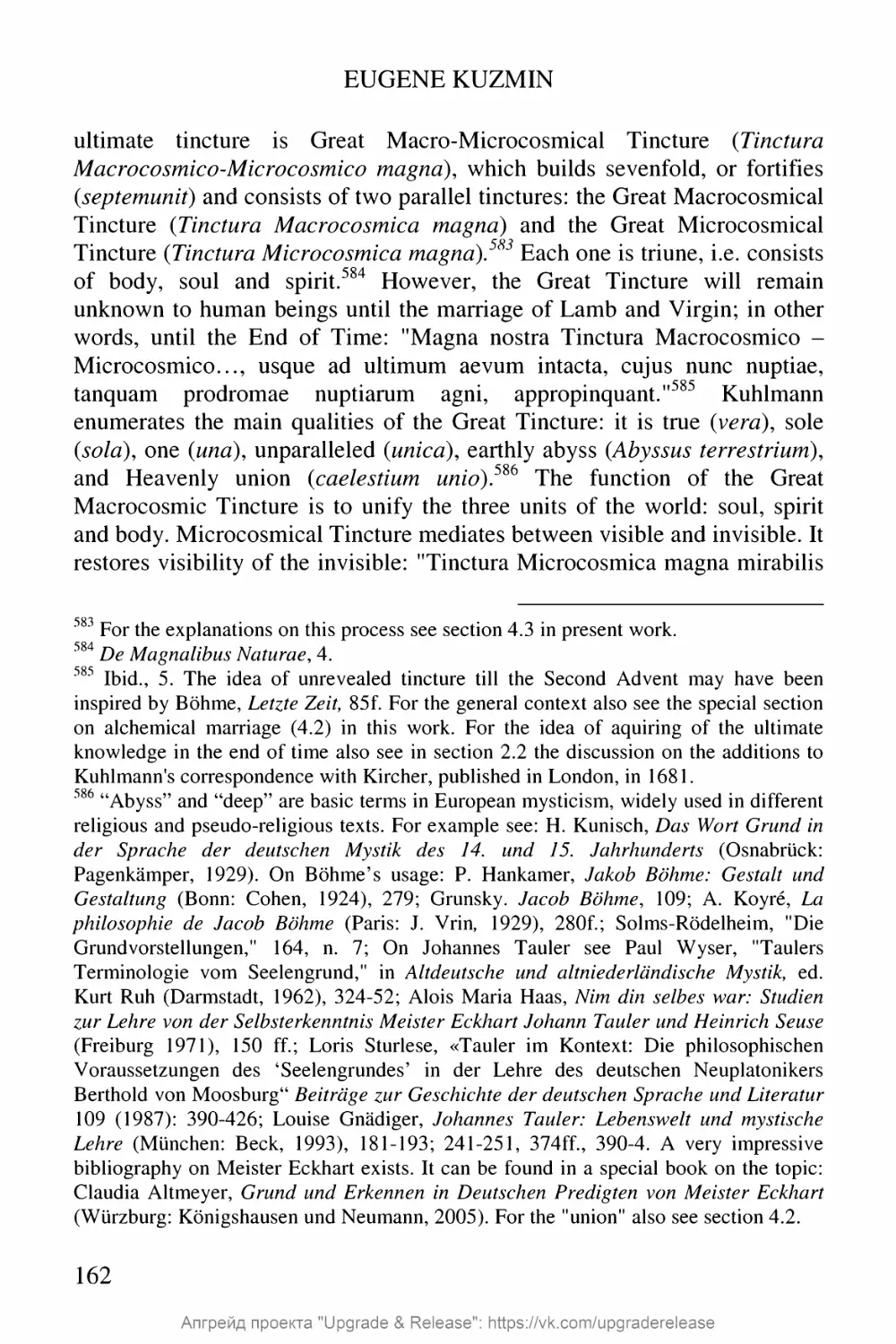


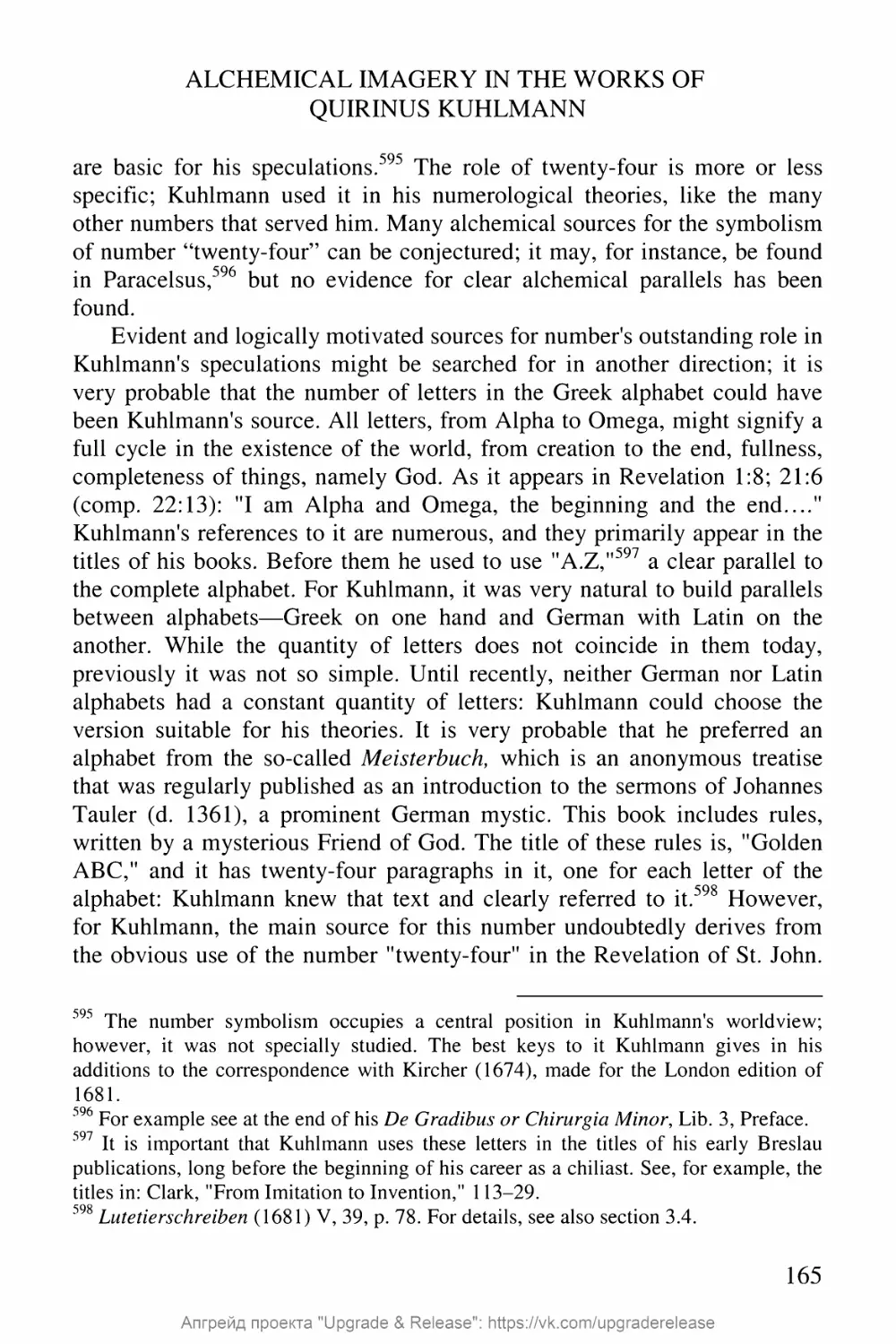
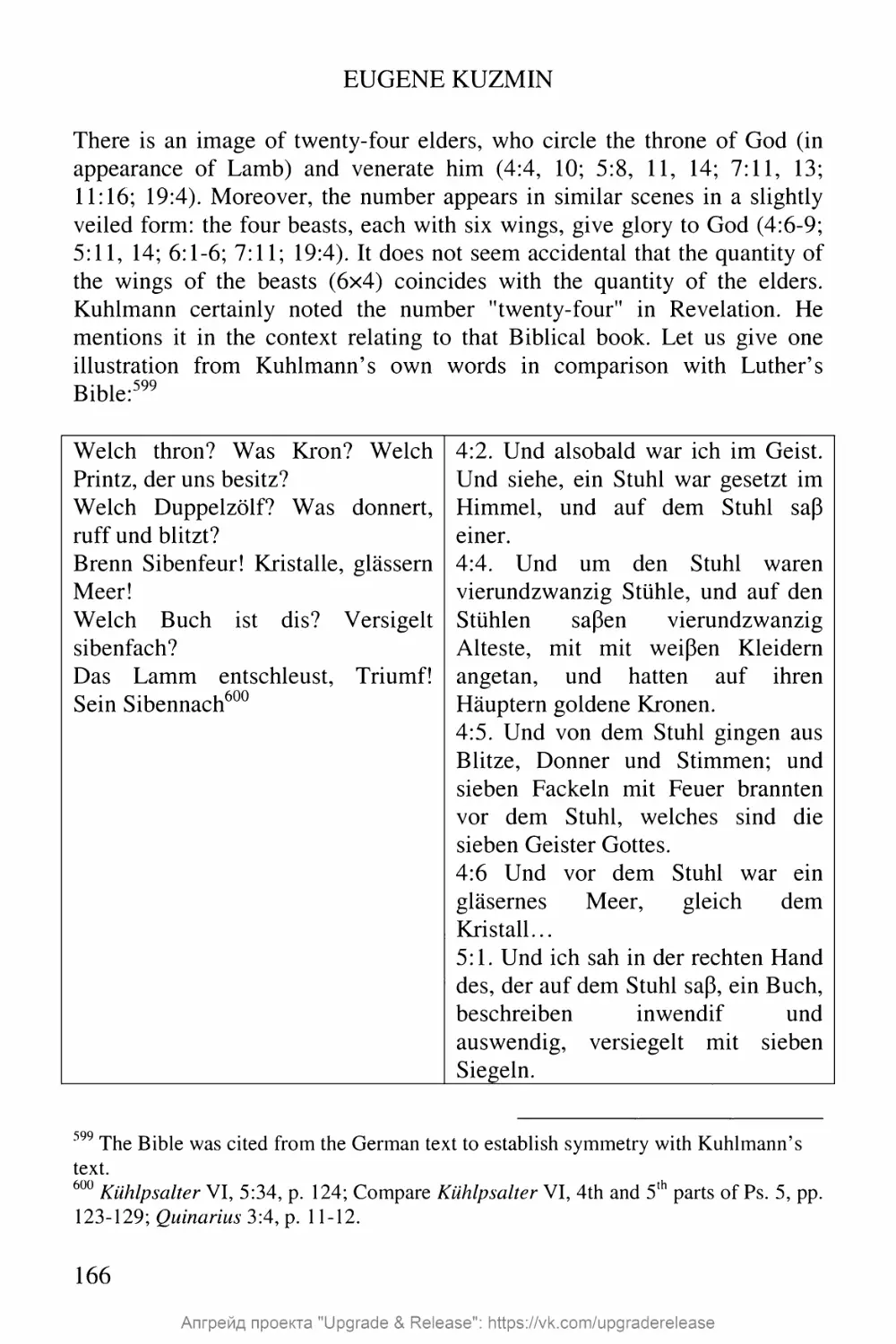

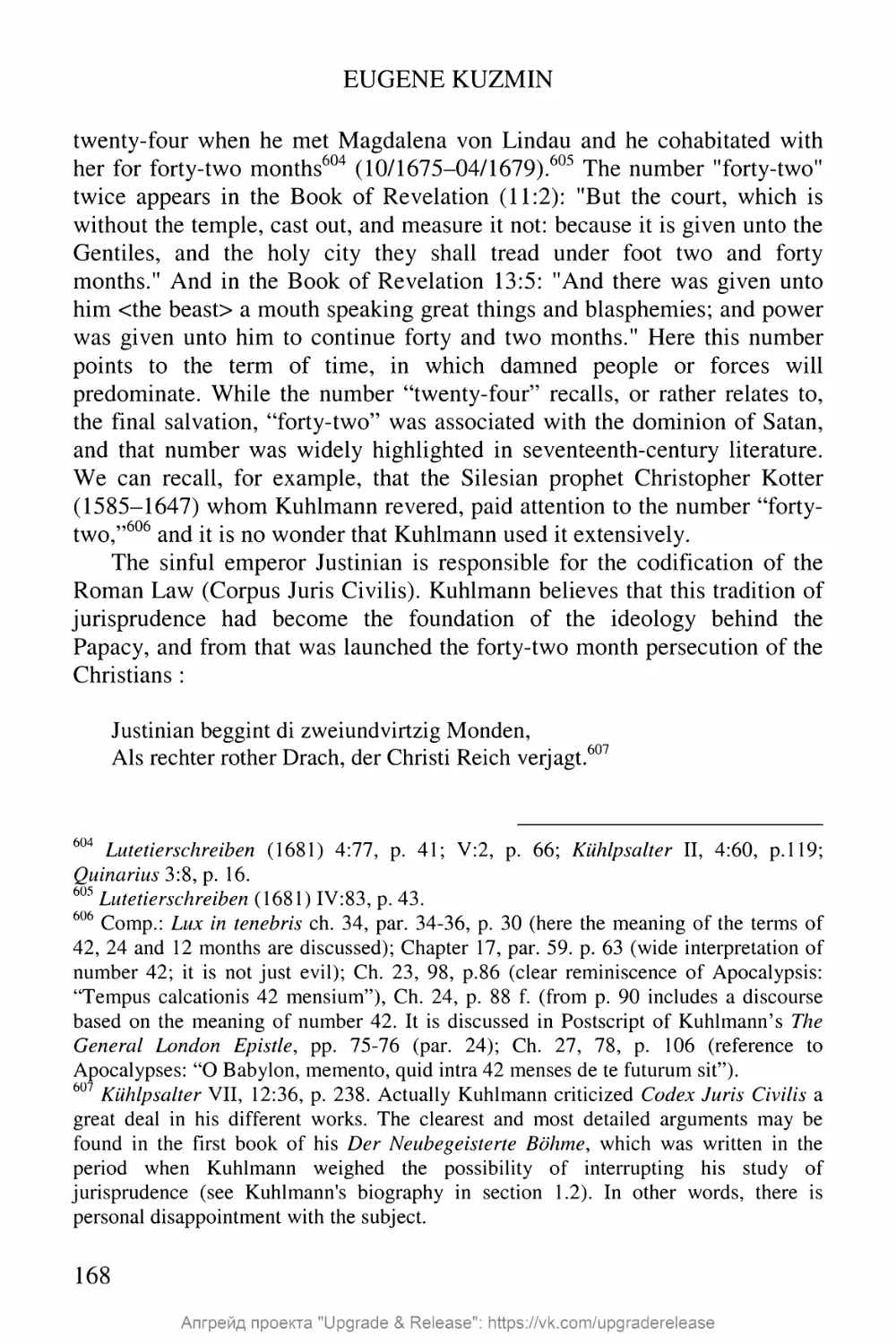



















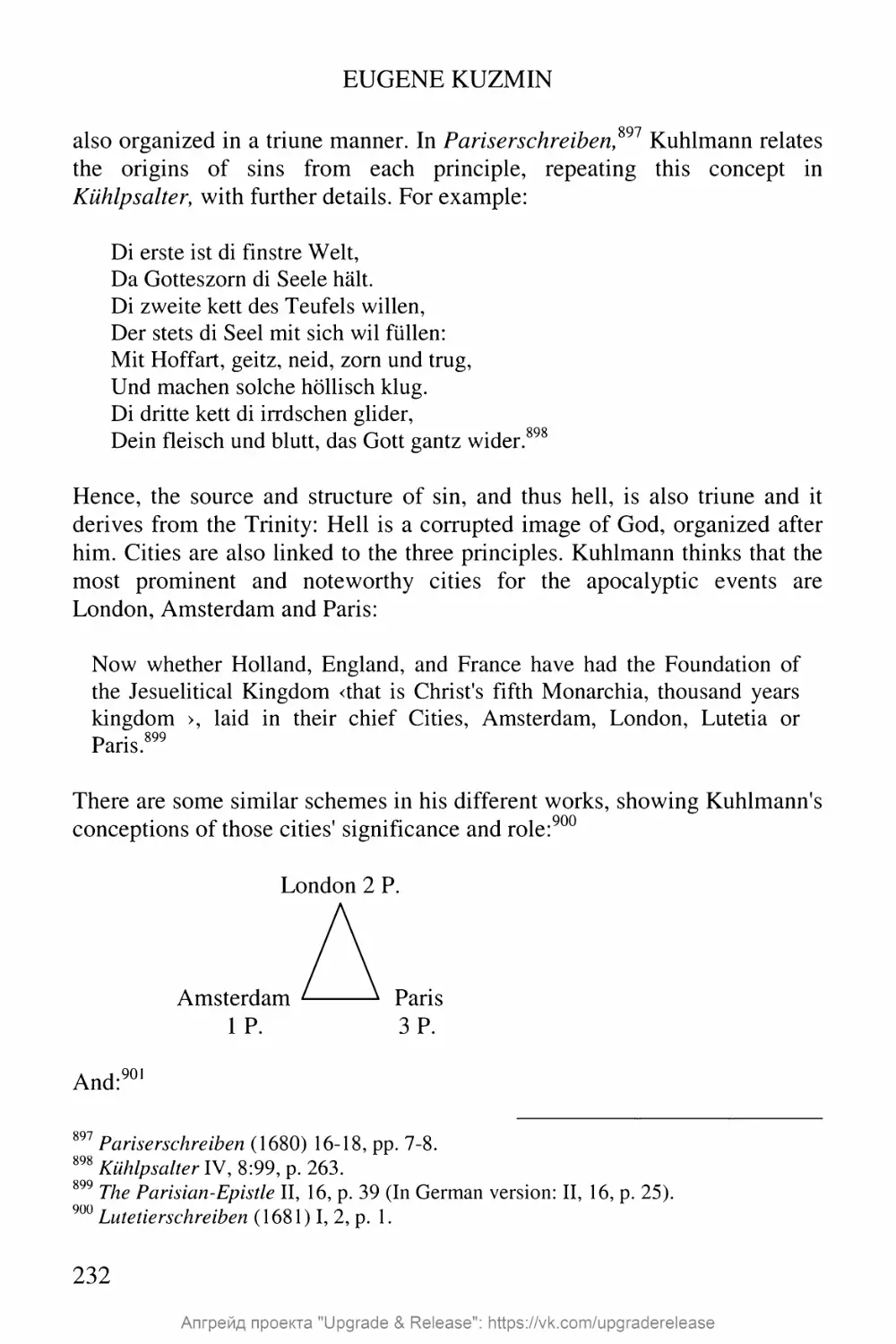
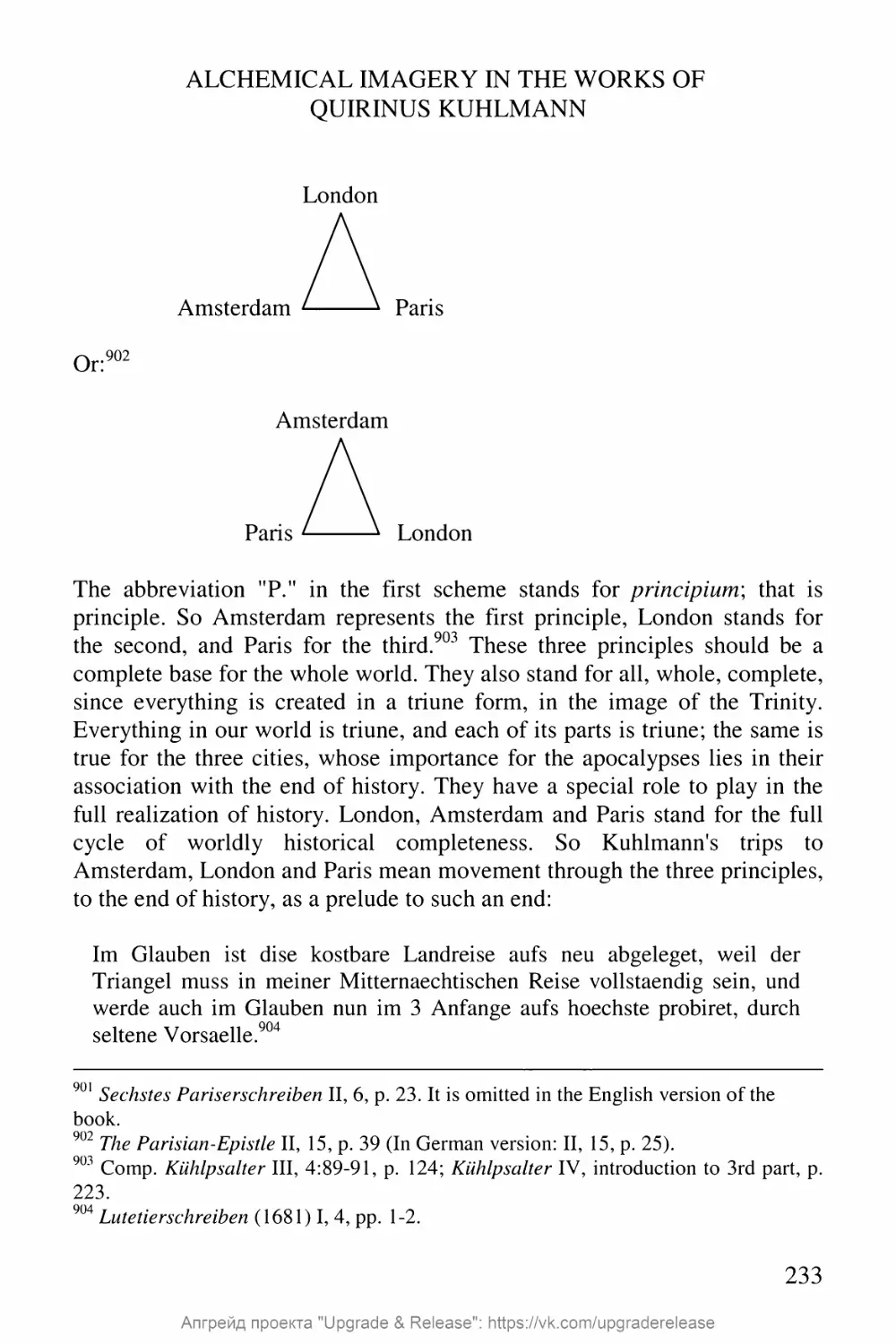
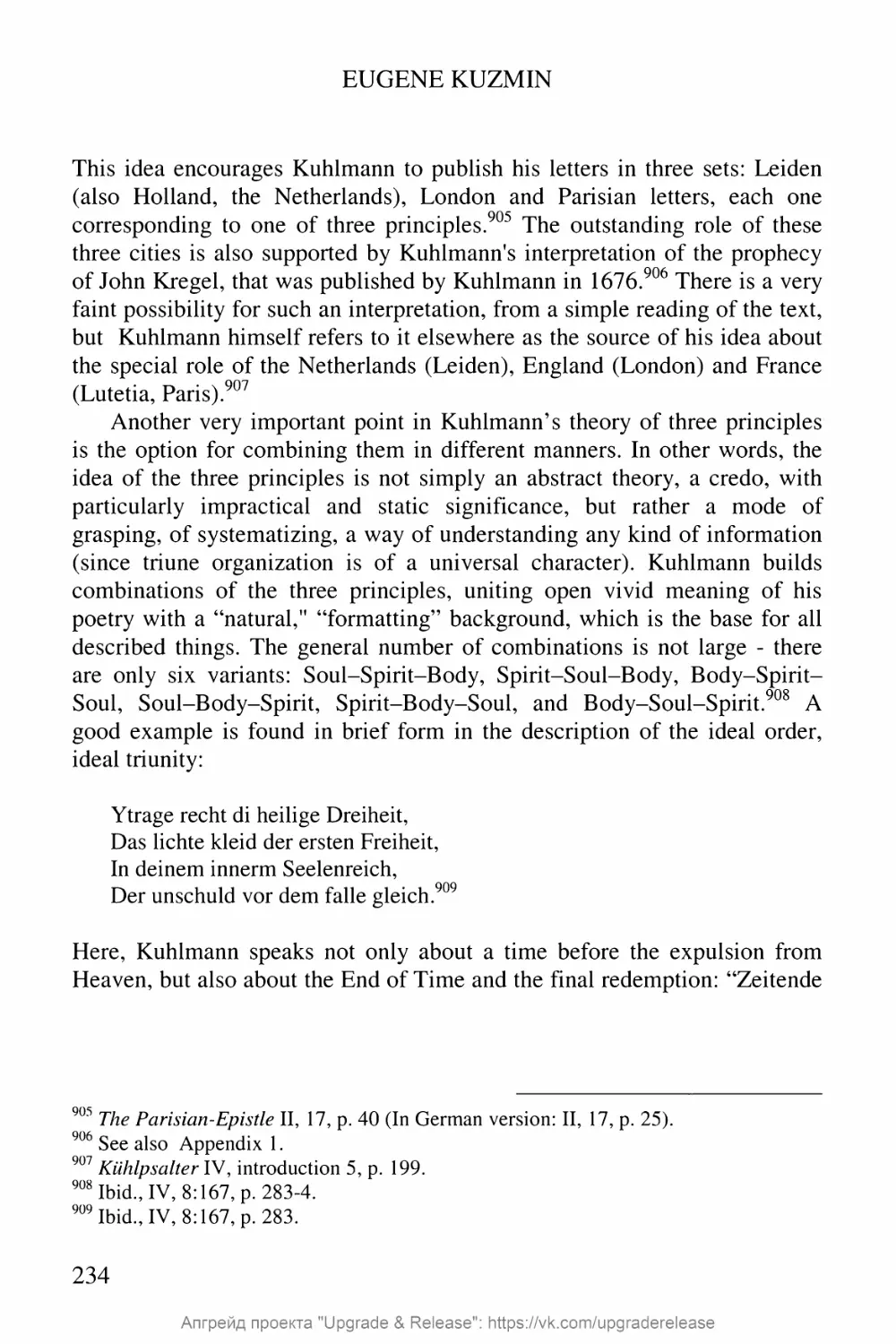

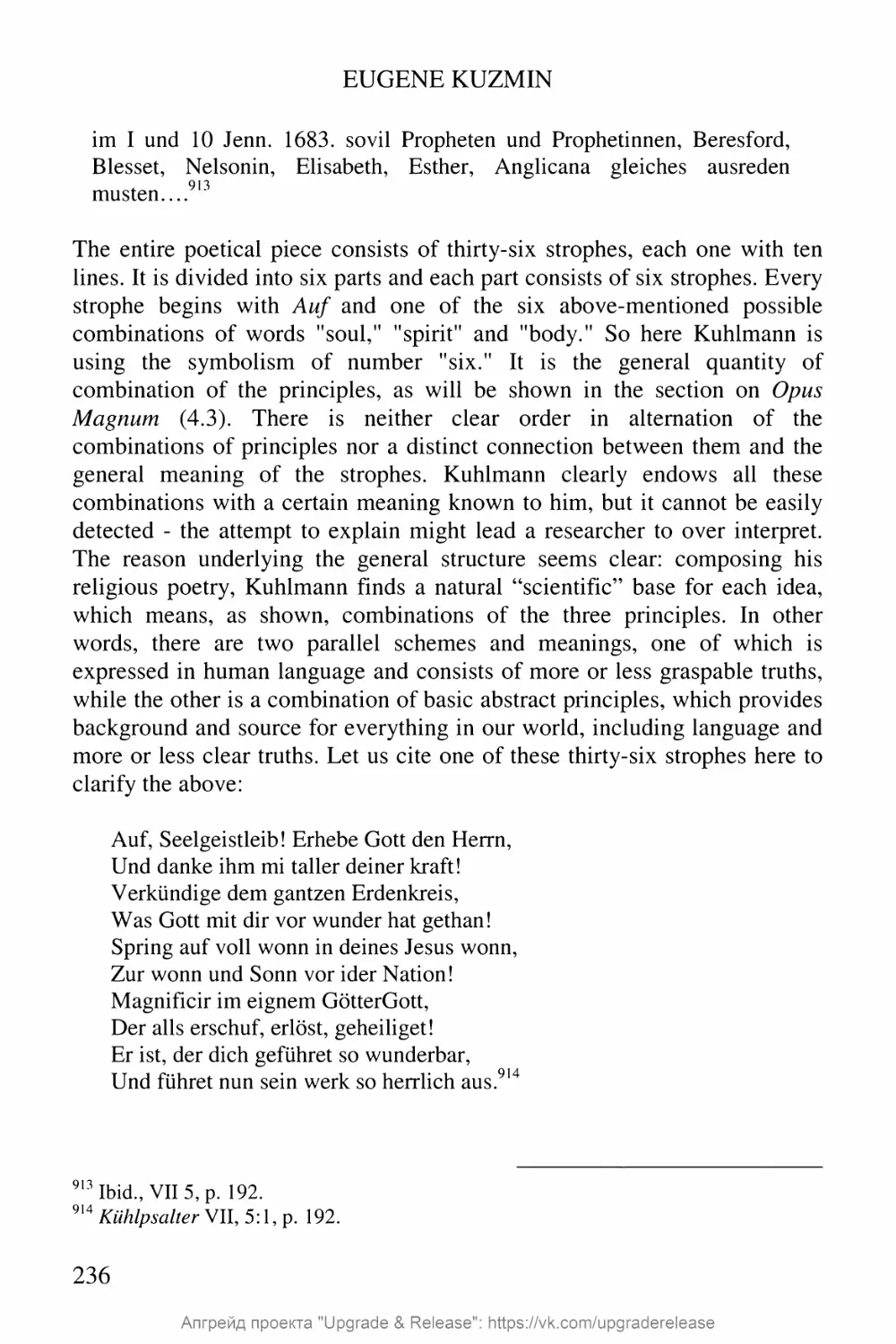









































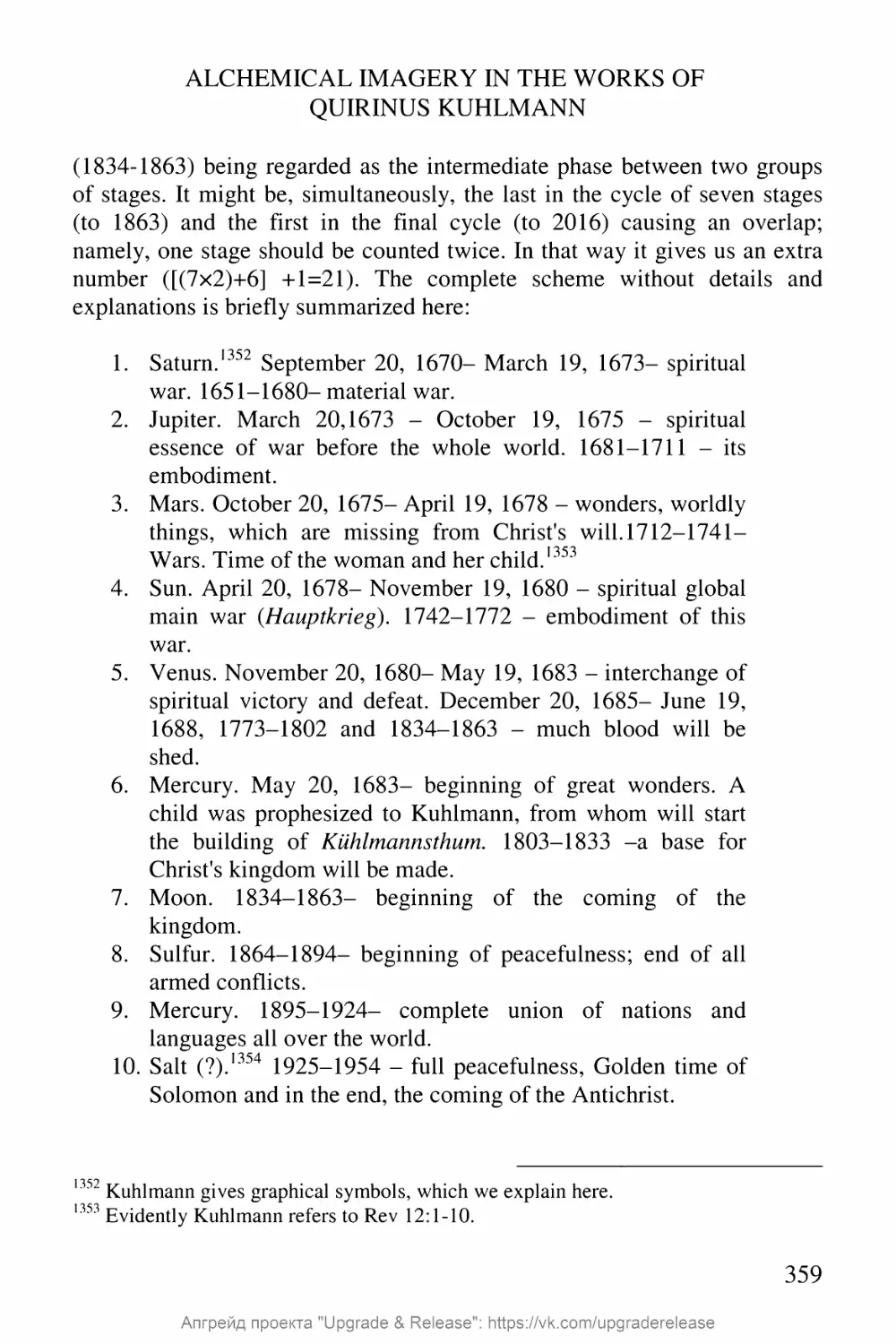
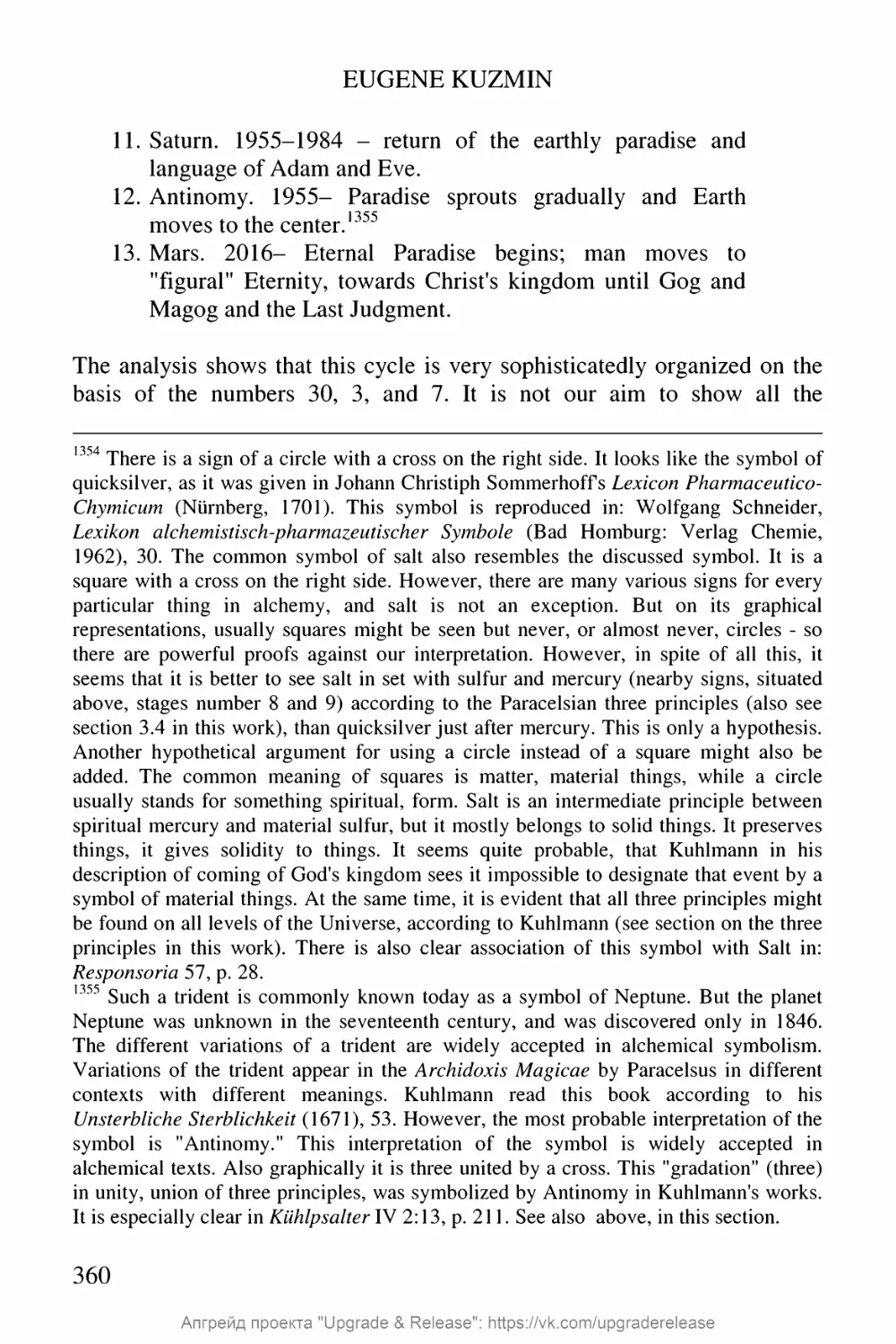
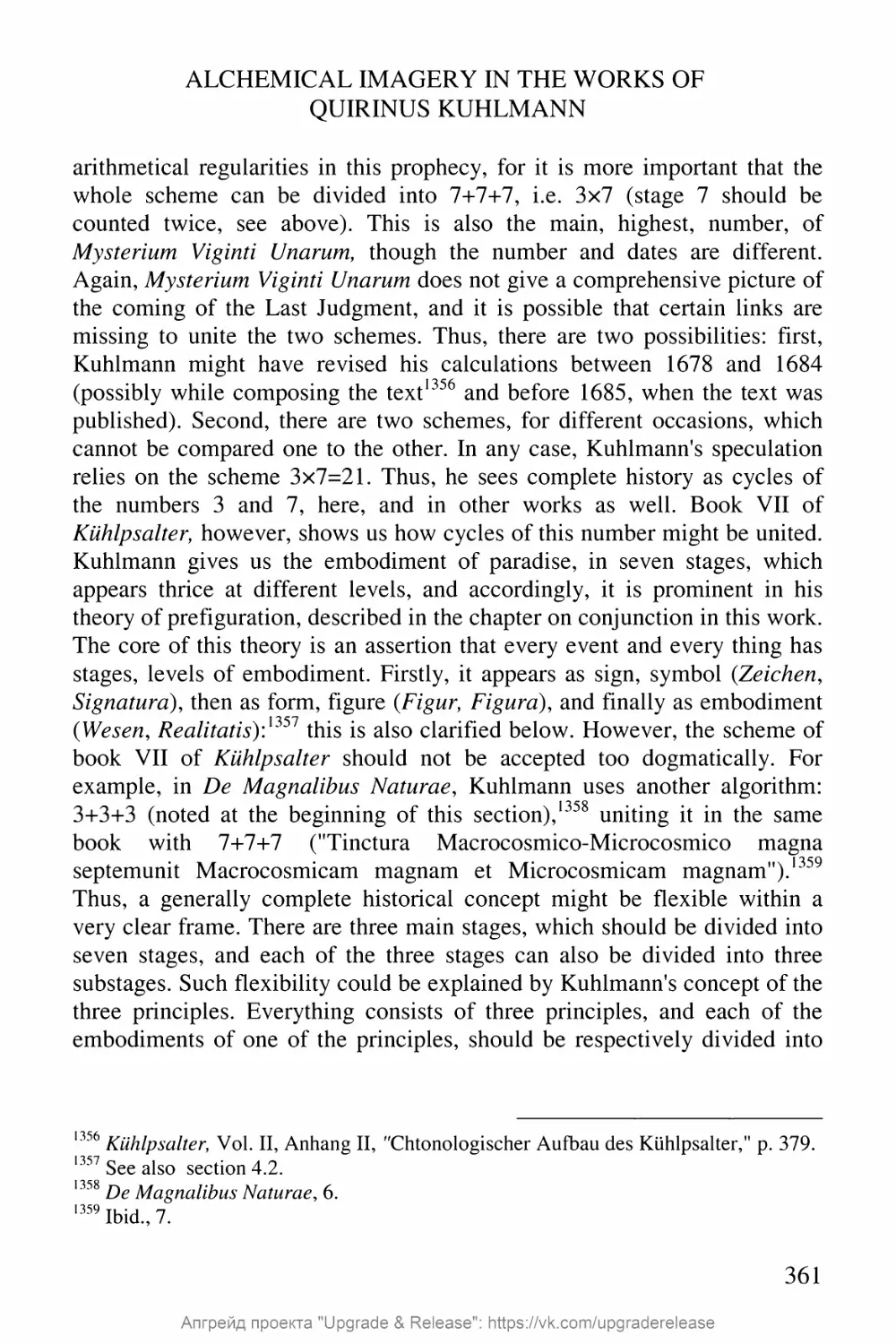
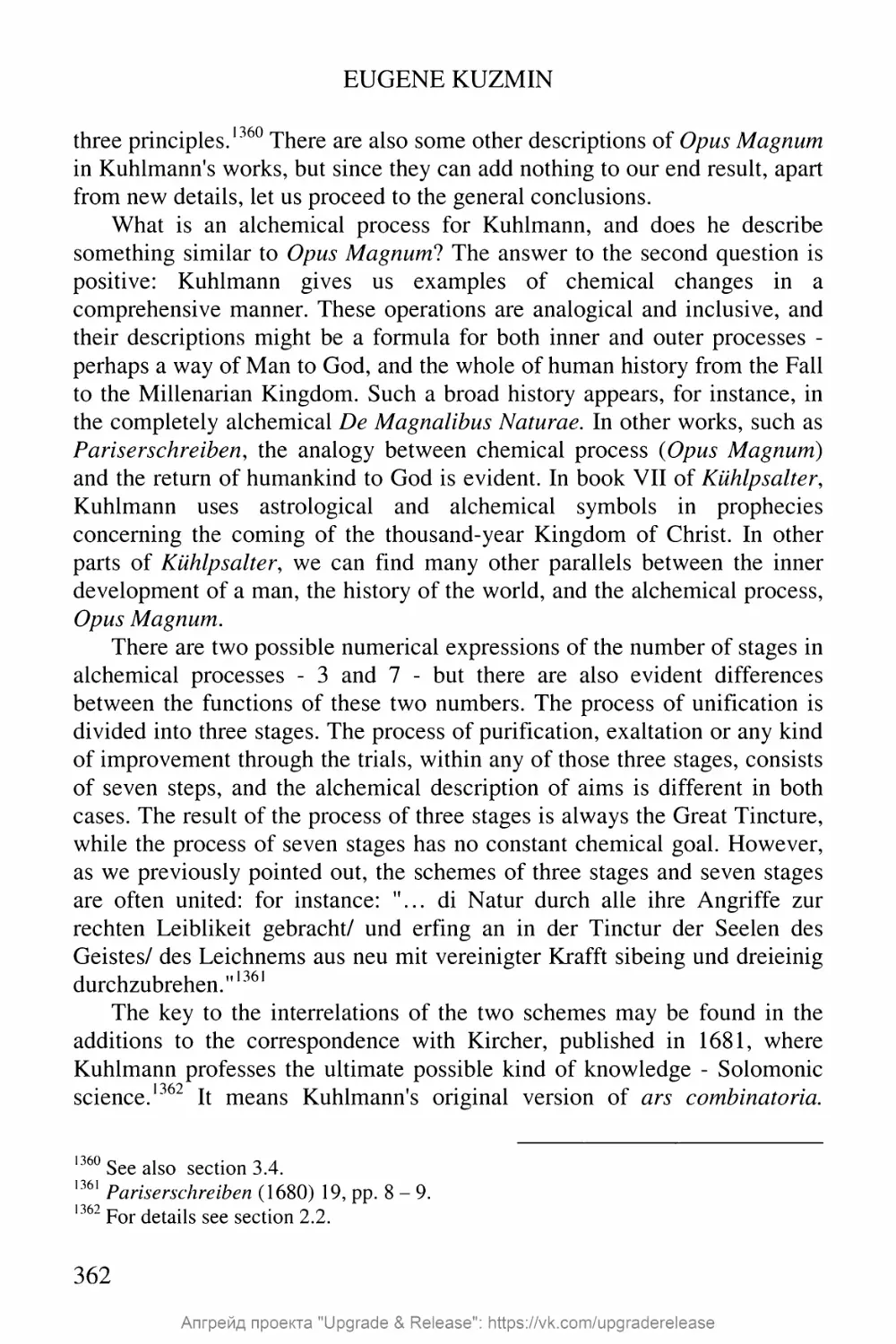










































Text
                    ALCHEMICAL IMAGERY IN THE WORKS
of QUIRINUS KUHLMANN
	by Eugene Kuzmin

SIRIUS ACADEMIC PRESS
2013

ALCHEMICAL IMAGERY
IN THE WORKS OF
QUIRINUS KUHLMANN
(1651 -1689)
Eugene Kuzmin
SIRIUS ACADEMIC
Anrpewg npoekma "Upgrade & Release": https://vk.com/upgraderelease

EUGENE KUZMIN
SIRIUS ACADEMIC PRESS
28203 SW 110th Ave
Wilsonville, Oregon 97070 USA
siriusacademic.com
© Copyright by Eugene Kuzmin (2013)
ISBN: 978-1-940964-01-0
Cover design by Sasha Naumov
All rights reserved. No part of this work may be copied or reproduced
in any way without the expression written permission of the author(s)
and the publisher.
Anrpewg npoekma "Upgrade & Release": https://vk.com/upgraderelease

ALCHEMICAL IMAGERY IN THE WORKS OF
QUIRINUS KUHLMANN
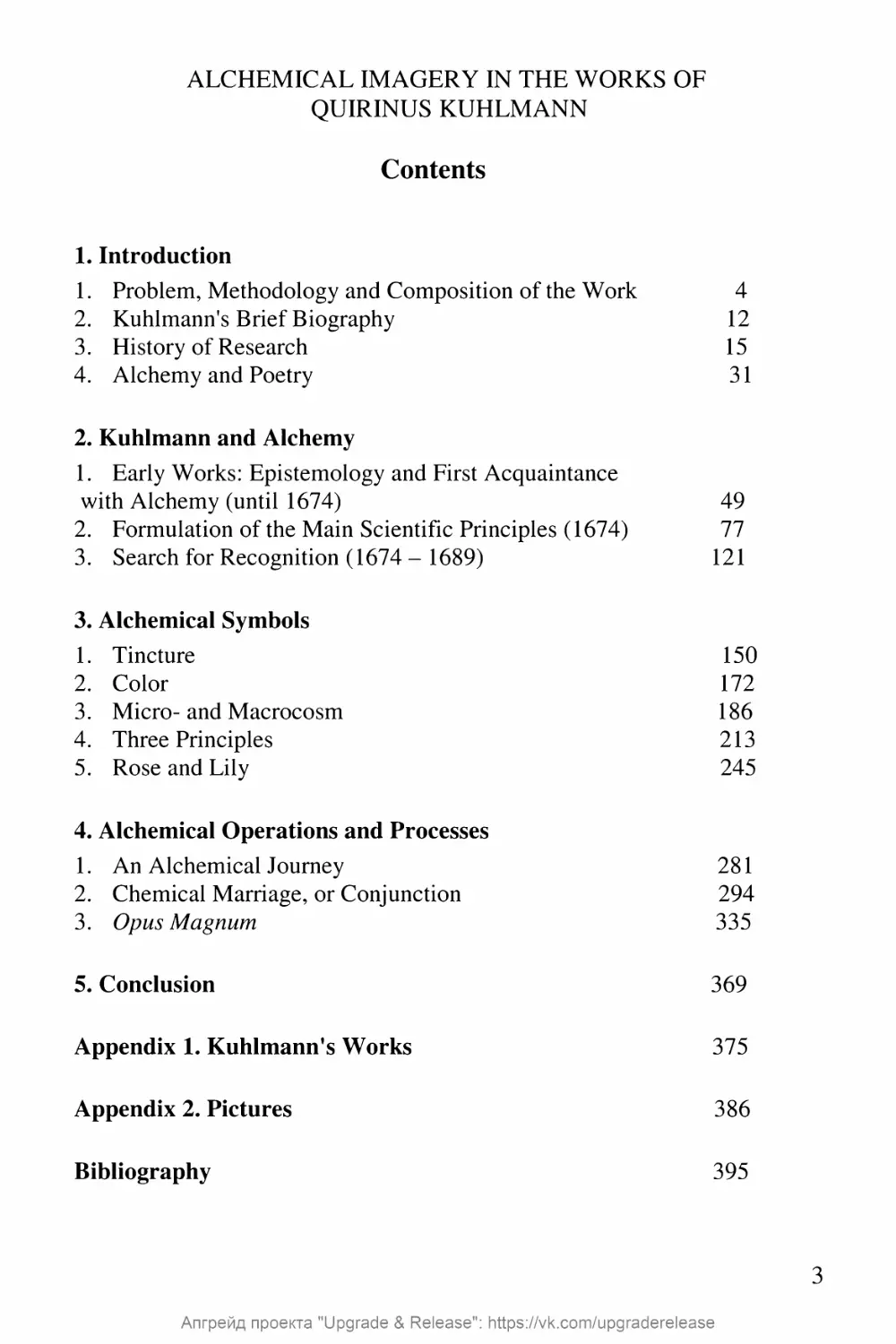
Contents
1. Introduction
1.	Problem, Methodology	and Composition of the Work	4
2.	Kuhlmann's Brief Biography	12
3.	History of Research	15
4.	Alchemy and Poetry	31
2.	Kuhlmann and Alchemy
1.	Early Works: Epistemology and First Acquaintance
with Alchemy (until 1674)	49
2.	Formulation of the Main Scientific Principles (1674)	77
3.	Search for Recognition (1674 - 1689)	121
3.	Alchemical Symbols
1.	Tincture	150
2.	Color	172
3.	Micro-and Macrocosm	186
4.	Three Principles	213
5.	Rose and Lily	245
4.	Alchemical Operations and Processes
1.	An Alchemical Journey	281
2.	Chemical Marriage, or Conjunction	294
3.	Opus Magnum	335
5.	Conclusion	369
Appendix 1. Kuhlmann's Works	375
Appendix 2. Pictures	386
Bibliography	395
3
Anrpewg npoekma "Upgrade & Release": https://vk.com/upgraderelease

EUGENE KUZMIN
1. Introduction
1.1 Problem, Methodology and Composition of the Work
The widely known chiliast thinker and German baroque poet Quirinus
Kuhlmann (1651-1689) was interested in alchemy. His knowledge of the
subject was based both on books and on personal acquaintance with many
alchemists - some famous, some little known. Kuhlmann freely discussed
his ideas with these adepts, and their theories may well have had a
considerable influence on him. Similarly, Kuhlmann may have inspired
certain alchemists, and thus traces a dialogue between literature and science
during the Scientific Revolution1—that period which saw the emergence of
modern scientific nomenclature—can be found in Kuhlmann's writings.
This work was originally planned as an attempt to solve the widely
acknowledged problem found in studies of the Silesian baroque poet,
Quirinus Kuhlmann - alchemy's impact on his works. Though the problem
has been frequently noted, no special study has been made of it, and
references to it have never been seriously explored. That Kuhlmann was
interested in alchemy is generally accepted as a given, but without particular
verification: though it is self-evident through Kuhlmann's references to
known alchemists, the character and intensity of alchemy's influence on him
remains unclear.
The research could have been completed without difficulty, since
Kuhlmann's biography and works have been thoroughly studied (see section
1.3) and the main facts about him and his books are easily accessible. A
large body of works exists on the impact of alchemy on various poets (see
section 1.4), and it would not be difficult to borrow a scheme from any of
1 The Scientific Revolution is a period roughly between 1500 and 1800, when new
ideas in various sciences led to a rejection of doctrines that had prevailed from Ancient
Greece through the Middle Ages, and laid the foundations of modern science. The term
was coined in: Alexander Koyre, Etudes galileennes (Paris: Hermann, 1939). The
literature on the subject is vast. For general introduction see: Rupert A. Hall, The
Scientific Revolution, 1500-1800: The Formation of the Modern Scientific Attitude, 2nd
ed. (Boston: Longmans, 1962); Thomas Samuel Kuhn, The Structure of Scientific-
Revolutions (Chicago: University of Chicago Press, 1962); Richard S. Westfall, The
Construction of Modern Science: Mechanisms and Mechanics (New York: Wiley,
1971); Steven Shapin, The Scientific Revolution (Chicago: The University of Chicago
Press, 1996).
4
Anrpewfl npoeKTa "Upgrade & Release": https://vk.com/upgraderelease

ALCHEMICAL IMAGERY IN THE WORKS OF
QUIRINUS KUHLMANN
those studies and extrapolate it onto our own inquiry. However, during the
textual study and analysis it became clear that such a methodology creates a
serious problem. There are two widespread methods for studying the impact
of alchemy on literature, and they are illustrated by many examples in
section 1.4. One can search for references to alchemical books and
quotations from them. If a certain author declares that he has borrowed an
idea from an alchemical text or unambiguously cites an alchemical text,
then the impact of alchemy on that person cannot be questioned. Sometimes
an author's general attitude to alchemy is disclosed in his explanations; if he
insists that the transmutation of metals is impossible, it is clearly established
that he does not believe in transmutation. The negative side of this approach
lies in its plain informative character. When studying a considerable number
of authors, one can decide on the extent to which alchemical ideas were
disseminated, or on attitudes toward alchemy in general, but it cannot
explain the distinctive influence that alchemy had in an author's works. It
remains unclear why, and to what extent, those authors engaged in alchemy
in the first place, or what ideas they adapted from it. The results of such
studies are thus limited and contribute hardly anything to understanding the
context of alchemy's impact.
There is a second method, that involves the analysis of particular ideas,
theories, and symbols, and in fact it is the only possible way to clarify the
character and reasons for borrowing from alchemy. In this case, though, we
must clearly know and formulate what alchemy entails and what are the
implications of its distinctive language, images, symbols, and theories. It is
necessary to have lucid ideas about its essence, and what distinguishes it
from other disciplines, and this leads to an artificial construction of the
abstract ideal of alchemy.
It is impossible to offer a simple explanation of the essence of alchemy,
for its adepts did not draw up a unified common conception of its subject,
methods, and tasks. The contemporary education system stipulates the
subjects and methods of study. Academic institutions have assembled a set
of researches enabling a never-ending dialogue between researchers on the
subjects deemed appropriate for academic study,2 but the situation with
alchemy was completely different. Right from the beginning, it was
excluded from the circle of official, commonly accepted spheres of
2 Thomas Samuel Kuhn, The Structure of Scientific Revolutions.
5
Anrpewfl npoeKTa "Upgrade & Release": https://vk.com/upgraderelease

EUGENE KUZMIN
knowledge,3 and its tie with academic disciplines was doubted. During the
seventeenth century, the situation started to change, with the increasing
popularity of alchemy that generated an incredible flood of books on
alchemy and burgeoning interest in it.4 There were many attempts to make
alchemy an established discipline, open to debate by the scientific
community, and to incorporate it in the educational system.5 Alchemy
3	William R. Newman, “Technology and Alchemical Debate in the Late Middle Ages,”
Isis 80 (1989): 423-45. Also in his: Promethean Ambition: Alchemy and the Quest to
Perfect Natures (Chicago and London: The University of Chicago Press, 2004), 34¬
114.
4	This popularity is widely known and noted in various works on alchemy. The topic
was discussed in detail, for instance in R. Hirsch, "Printing and the Diffusion of
Alchemical and Chemical Knowledge," Chymia 3 (1950): 115-41; Allan G. Debus, The
Chemical Philosophy: Paracelsian Science and Medicine in the Sixteenth and
Seventeenth Centuries, 2 vols., (New York: Science History Publications, 1977), 1:448¬
55; Bruce T. Moran, Distilling Knowledge: Alchemy, Chemistry, and the Scientific
Revolution (Cambridge, Mass and London: Harvard University Press, 2005), 46-66;
Also in the beginning of: Allen G. Debus, "Paracelsianism and the Diffusion of the
Chemical Philosophy in Early Modern Europe," in Paracelsus: The Man and his
Reputation. His Ideas and their Transformation, ed. Peter Grell Ole (Leiden, Boston,
Koln: Brill, 1998), 226-44.
5	Allen G. Debus, Science and Education in the Seventeenth Century: The Webster-
Ward Debate (London: Macdonald; New York: American Elsevier, 1970); his,
"Chemistry and the Universities in the Seventeenth Century," Academiae Analecta:
Klasse der Wetenschappen 48 (1986): 13-33; his, "Chemists, Physicians, and Changing
Perspectives on the Scientific Revolution," Isis 89, no. 1 (March 1998): 66-81; Owen
Hannaway, ’’Early University Courses in Chemistry” (PhD diss., The University Of
Glasgow, 1965); his, The Chemists and the World: The Didactic Origins of Chemistry
(Baltimore, Md.: Johns Hopkins Press, 1975); Jose Mana Lopez Pinero’s introduction
to: Lloren$ Co^ar, El "Dialogus" (1589) del Paracelsista Lloreng Canary la cdtedra de
medicamentos quimicos de la Universidad de Valencia (1591) (Valencia: Catedra e
Institute de Historia de la Medicina, 1977), 9-25; Jose Mana Lopez Pinero, "Paracelsus
and his Work in Sixteenth and Seventeenth Century Spain," Clio Medica 8 (1973): 113¬
41; Bruce T. Moran, The Alchemical Word of the German Court: Occult Philosophy
and Chemical Medicine in the Circle of Moritz of Hessen (1572-1632) (Stuttgart: Franz
Steiner Verlag, 1991); idem, Chemical Pharmacy Enters the University: Johannes
Hartmann and the Didactic Care of Chymiatria in the Early Seventeenth Century
(Madison: American Institute of the History of Pharmacy, 1991). On the importance of
a convincing theory for the acceptance of the knowledge as science (based on the
example of the healers in the Renaissance) see John Henry, “Doctors and Healers:
Popular Culture and the Medical Profession,” in Science, Culture and Popular Belief in
Renaissance Europe, ed. Stephen Pumfrey, Paolo L. Rossi and Maurice Slawinski, 191¬
6
Anrpewg npoekma "Upgrade & Release": https://vk.com/upgraderelease

ALCHEMICAL IMAGERY IN THE WORKS OF
QUIRINUS KUHLMANN
evolved from an amorphous marginal sphere of knowledge into a widely
popular, and thus even more shapeless field, with extensive discussions on
alchemy that created various opinions about it. Ultimately chemistry
became an official science, while alchemy returned to its former
marginality, at best.
Another problem is the vagueness and instability of alchemical
terminology, a well-known problem, noted in most works on alchemy.* 6
Alchemical texts were intentionally written in an unclear style that
permitted numerous interpretations;7 nothing is stated clearly and with
certainty, and thus there is no well established and commonly accepted
nomenclature. Any alchemist could produce new symbols, and so every
text, event, and phenomenon could be interpreted as an alchemical sign.
Maurice P. Crosland has summarized that situation,8 and shows how the
same terminology could simultaneously be alchemical and non-alchemical.
He also states that modem chemistry begins from a certain standardization
of alchemy's language and methodology.
Such a situation makes a simple comparison between ideas impossible.
If there are two ideas or symbols, one of which appears in an alchemical
book and the other in a poem, it cannot prove alchemy's impact; the poem
might also have inspired an alchemist who granted it an alchemical
interpretation. A poet and an alchemist could well have had a third non-
alchemical source, and yet we can speak of alchemy as a definite subject: if
alchemical books were written, published, bought, and explained by
alchemical lexicons, and if there were people who called themselves
221 (Manchester and New York: Manchester University Press, 1991); Fritz Krafft, 'Die
Arznei kommt vom Herrn, und der Apotheker bereitet sie'. Biblische Rechtfertigung der
Apothekerkunst im Protestantismus. Apotheken-Auslucht im Lemgo und Pharmak-
Theologie, Quellen und Studien zur Geschichte der Pharmazie 76 (Stuttgart, 1999), 59¬
74; idem, "Arzneien 'umb sonst und on gelt' aus Christi Himmelsapotheke,"
Pharmazeutische Zeitung 146(2001): 10-17.
6 For interesting philosophical insight into the problem see: Raimond Reiter, "Die
'Dunkelheit' der Sprache der Alchemisten," Muttersprache: Zeitschrift. Zur Pflege und
Erforschund der deutschen Sprache 97, no. 5-6 (1987): 323-6. However, this article is
too abstract and theoretical for our historical study.
7 For the bibliography of the modern attitudes to alchemical symbolism see: H. J.
Sheppard, “A survey of alchemical and hermetic symbolism,” Ambix 8 (1960): 35-41.
8 Maurice P. Crosland, Historical Studies in the Language of Chemistry (Cambridge,
Mass.: Harvard University Press, 1962); his “Changes in Chemical Concepts and
Language in the Seventeenth Century," Science in Context 9 (1996): 225-40.
7
Anrpewfl npoeKTa "Upgrade & Release": https://vk.com/upgraderelease

EUGENE KUZMIN
alchemists, this should be a criterion for defining alchemy as a subject and,
thus, for alchemical impact. We can start defining alchemy's impact by
listing the main principles of our study of its influence on literature. First of
all, we need to show that Kuhlmann had certain clearly alchemical sources,
to prove that the poet had read alchemical books or was in contact with
alchemists, and to identify remarks and passages where alchemy is
unmistakably referred to.
Every symbol or term has to be briefly discussed, from a historical
perspective, that may illuminate the relationship between the symbol or
term and alchemical tradition. Alchemical lexicons are particularly
important in this context, since they show real correlations between the
subject and the history of terms and symbols. Though the definite source of
an alchemical symbol or term may be difficult to trace, one can identify
possible influences by examining the works that the writer read. Finally, we
should investigate if various separate symbols and terms can be considered
part of a specific alchemical theory. Alchemy should not be regarded as a
chaotic set of terms and symbols, but as a science or pseudo-science, which
provides its adepts with promises of acquiring specific theoretical or
practical systematic knowledge.
Quirinus Kuhlmann is a suitable figure for gaining an understanding of
the interrelation between alchemy and literature. The question of alchemy's
impact on him is a very old unresolved problem (see section 1.3). On the
whole his contemporaries regarded him as an adept, and this is noted by
most of his early biographers, of whom the most important are Gottfried
Arnold (1666-1714) and Johann Christoph Adelung (1732-1806). That
reputation has strong foundations, and it is enough to note among his works
the manifesto De Magnalibus Naturae (1682), written for adepts of
alchemy; even so, the actual impact of alchemy on Kuhlmann has never
been specially studied. Walter Dietze, who authored the best-known
research on Kuhlmann, questioned the importance of alchemy on
Kuhlmann's worldview, though he did not enlarge on the topic.
This work thus has two main tasks; the first is to address the unsolved
question regarding alchemy's impact on Quirinus Kuhlmann, and the second
is to construct a new, dedicated methodology for studying the impact of
alchemy on literature - a mission likely to pioneer research on the
interrelationship between literature and science in the seventeenth century.
The first task, however, totally overwhelms the second one, since the extent
of the work and the focus on one personality rules out a comprehensive and
abstract discussion. This work accordingly focuses on Kuhlmann, without
8
Anrpewg npoekma "Upgrade & Release": https://vk.com/upgraderelease

ALCHEMICAL IMAGERY IN THE WORKS OF
QUIRINUS KUHLMANN
highlighting the ties between alchemy and literature, and with no extensive
discussion on other personalities. The new methodology is not only a tool
for this specific study but, as shown in section 1.4, it may be useful for other
studies of how alchemy affected literature.
There are four parts to this study. The first part is an introduction into
the entire work, and begins with an explanation of the methodology and
general principles, as well as offering information on the its goals, structure,
and arguments (1.1). The second section of the first part provides general
information on Kuhlmann's biography (1.2); although our theme is
alchemical imagery in his work, rather than his life, this section looks at his
personality. The main biographic facts are given as briefly as possible,
simply to introduce Kuhlmann to the reader. Section 1.3 contains a brief
history of Kuhlmann's scholarship and its main trends, and also explains the
importance of studying alchemical imagery in his works. The final section
of the first part (1.4) introduces readers to the problematic of the
interrelations between alchemy and literature.
The need for seeking a new methodology is well grounded, and an essay
follows on the history of research into alchemy's impact on literature; the
essay is neither comprehensive nor complete. We cite a broad range of well-
known and representative articles, that reflect the chief trends and problems
in studies of the alchemy-literature relationship. Several very accurate
studies exist concerning the impact of alchemy on the literature of
Romanticism,9 but we have excluded them from our outline. Around 1800,
attitudes toward alchemy radically changed, alchemy was no longer a focus
for debate in the scientific community, and so those works research a reality
radically different from that of the seventeenth century. As well as
providing a bibliographical guide, the essay's principal task is to prepare the
field for discussing the literature-alchemy relationship, and to set out the
principles and strategies for our study. It points out some important
philosophical and methodological problems entailed in such research.
The actual research starts in the second part, that concerns the
development of Kuhlmann's knowledge of alchemy, and discusses the books
9 Dietrich von Engelhardt, Hegel und die Chemie: Studie zur Philosophic und
Wissenschaft der Natur urn 1800 (Wiesbaden: Pressler, 1976); Georg Schwedt, Goethe
als Chemiker (Berlin: Springer, 1998); Michel Chaouli, The Laboratory of Poetry:
Chemistry and Poetics in the Work of Friedrich Schlegel (Baltimore and London: The
John Hopkins University Press, 2002).
9
Anrpewfl npoeKTa "Upgrade & Release": https://vk.com/upgraderelease

EUGENE KUZMIN
he read and the alchemists with whom he communicated, though it is of
course vital not only to produce a list of such books and persons, but also to
establish how Kuhlmann responded to them. Much attention is paid to the
development and evolution of Kuhlmann's attitude to scientific knowledge
and his epistemological assumptions. As far as possible, the material is
organized chronologically, though occasionally compliance with that strict
order tends to render the text less readable, since Kuhlmann repeatedly
returns to the same topic, so there are exceptions to chronological order. The
section's main purpose is to describe the process of Kuhlmann's
development throughout his life.
This part has three sections - a division generated by the logic of
Kuhlmann's inner progression (1.2). The turning point in his development is
1674, when he reacted to Jakob Bohme's (1575-1624) works, which deeply
impressed him. From that point, Kuhlmann is especially known as a
Behmenist (i.e. follower of Bohme), as his Neubegeisterter Bohme brought
him wide fame. Hence, this year splits our narrative into three sections:
before 1674, that was a formative stage when Kuhlmann tries to find a main
direction for his thinking; in 1674 he formulates leading principles for his
basic theories; and after that year, Kuhlmann applies his newly developed
teaching. That division also changes the study's main character. Before
1675, Kuhlmann's sources are mostly from books, but from that year
onwards he creates personal contacts with many alchemists; at that period,
he acquired his knowledge principally from oral sources. This part is far
from comprehensive, and shows only Kuhlmann's alchemical inspirations
without addressing his main inspirations. General studies about Kuhlmann,
particularly Walter Dietze's (1.3) monograph, are worth consulting for
information on his most important sources. We deliberately refrained from
presenting detailed notions regarding the complex relationship between
people and ideas, and the section's overarching aim is to show Kuhlmann's
development in general, rather than his place in intellectual history.
The work's third part discusses Kuhlmann's alchemical terms and
symbols, and chronological order is generally avoided here; only
sometimes, in cases of considerable changes in the symbol's usage over
time, it is specifically noted. The discussion is mostly analytical, with a
focus on the symbols' essence, not on the details of their development
through Kuhlmann's lifetime. The set of alchemical symbols is not
complete here, for we chose the terms and symbols most important for
understanding Kuhlmann's works. There are three sections in this part: it
starts with a brief explanation of the history of a symbol/term and its
10
Anrpewg npoekma "Upgrade & Release": https://vk.com/upgraderelease

ALCHEMICAL IMAGERY IN THE WORKS OF
QUIRINUS KUHLMANN
connection with alchemy; next, the usage, meaning, and role of the
symbol/term in Kuhlmann's works are explored; finally, succinct attention
is given to the connection of the term/symbol in its particular context to
alchemy, and the probable source of Kuhlmann's use of it.
The final part addresses alchemical theories and processes in
Kuhlmann's works, and attempts to show the role of separate symbols and
ideas in their interrelations within a certain system, with developed
alchemical theories. The analysis of Kuhlmann's works is not organized, for
the most part, in chronological order. There is a brief reference to the
history of a certain theory, a discussion of the idea's meaning in Kuhlmann's
works, and some remarks on Kuhlmann's possible sources. There are three
sections in this part. The first concerns Kuhlmann's journey and an
alchemical interpretation of its nature (4.1), showing the diversity of the
problem: there is nothing chemical in a journey itself, but it can be
explained as a chemical act. This section is intended to emphasize the main
methodological problems when studying alchemy's impact on literature. The
second part highlights "alchemical marriage" (4.2), a pivotal theme in Carl
Gustav Jung's study of alchemy, and that has often dominated modem
studies on alchemical symbolism. The final topic addresses the main
alchemical process - Opus Magnum (4.3). It unites various alchemical ideas
into a single theory and one narrative, and addresses the main features of
Kuhlmann's actual use of alchemical imagery.
The study has two appendices. The first provides a bibliography of
Kuhlmann's works, and explains the character of the sources and their
chronological order, as well as describing the availability of his writings.
There is no edition of Kuhlmann's complete works, and some of his books
are extremely rare and so there the bibliographical data are highly diverse.
Important references to Kuhlmann's works in the main text of the work offer
general explanations on the character of the sources, and they are described
systematically in a special section (Appendix 1). The second appendix
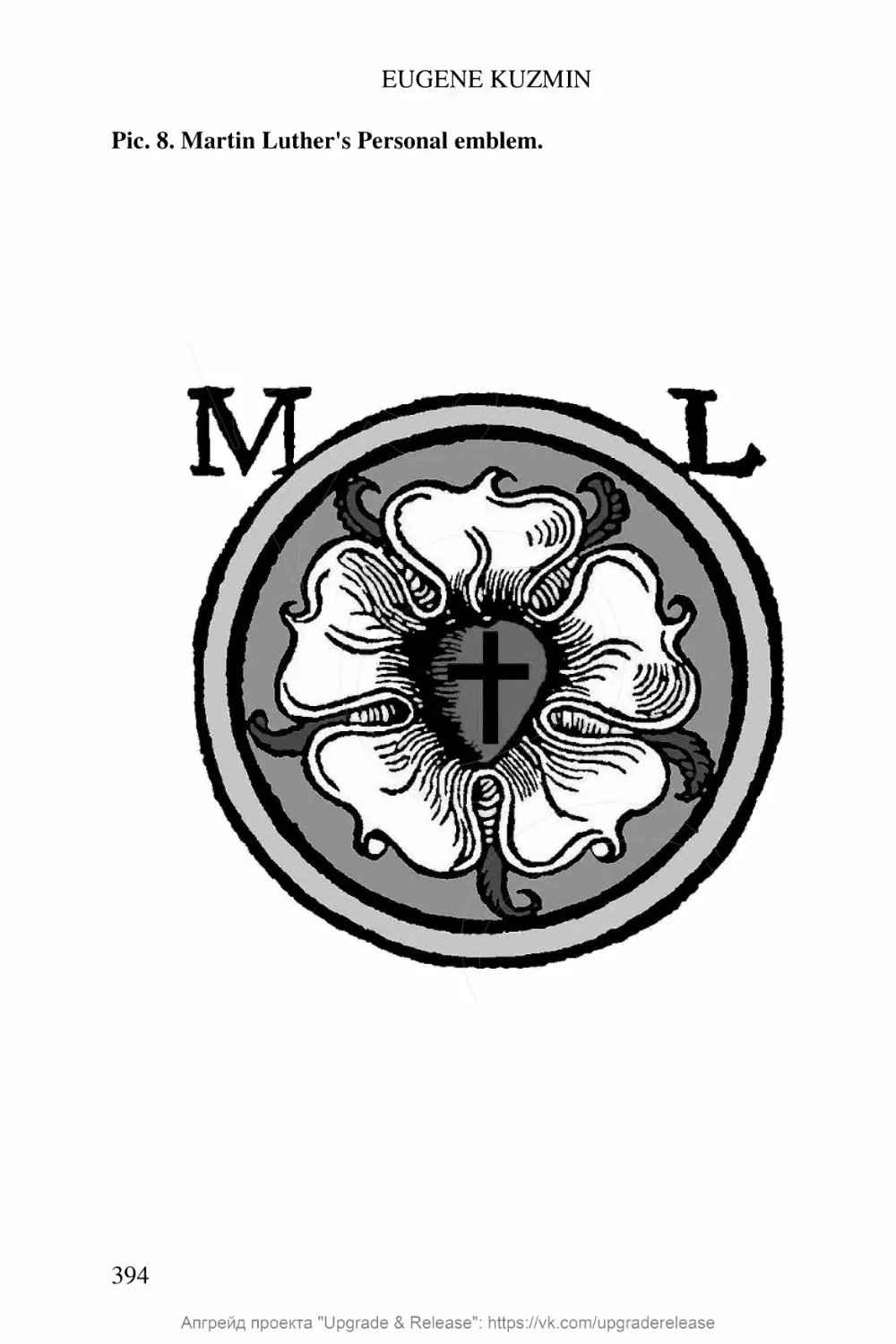
consists of pictures - illustrations mentioned in the work. The conclusion at
the end of the entire work explains some important ideas established by this
study. While researching material on Kuhlmann, different versions of the
names of the same person were encountered, however only one was used
throughout to maintain consistency.
The title of this study highlights Imagery in the Works of Quirinus
Kuhlmann, and its neutrality cannot delude the reader by implying
substantial explanations. Alchemy as such cannot have an impact. The
11
Anrpewg npoekma "Upgrade & Release": https://vk.com/upgraderelease

EUGENE KUZMIN
subjects of alchemy and its nomenclature are too flexible, and it is a broad
sphere of knowledge with unclear boundaries, and thus the word "imagery"
lets us adopt a broad view of the problem, without terminological
restrictions.
Since this work presents a new methodology and deals with a
considerable quantity of primary sources, it was deemed preferable to avoid
discussion, when possible, on modern technical terms, and thus to focus our
attention on the main trajectory of the research and be flexible in our
responses to the complex content of the sources.
1.2. Kuhlmann's Brief Biography
Quirinus Kuhlmann was born in Breslau (Wroclaw) on February 25, 1651 to
a Lutheran family. Very little is known about his sister, Eleonore Rosina.
His father's profession is under question, since different testimonies
maintain that he was a merchant, or a harness maker. He evidently died
while traveling, only three years after Quirinus Kuhlmann was born. Until
the future poet's twelfth birthday, the boy suffered from a speech
impediment, for which he was often mocked: possibly, his extensive reading
compensated for his lack of social interaction. He began to study in the open
city library of Breslau, and from 1661 he attended the Ratgymnasium bei
Maria Magdalena, where he studied for nine years at the municipality's
expense. His first works were published in that period, and he became
renowned at a very early age. Kuhlmann also gained influential friends
during that period. He was sponsored by different patrons throughout his
entire life. Kuhlmann had very complex relations with some of them, and
financial support strongly depended on his patrons' attitude to his ideas and
deeds, as well as his personal interactions with them, making his wellbeing
unstable.
In September 1670, Kuhlmann set off to study jurisprudence at the
University of Jena, which had the reputation at that time of a university with
low academic standards, though it was the university where Lutheran youth
from Silesia embarked on higher studies. In Jena, Kuhlmann wrote and
published his works, and tried to attract the attention of famous and noble
people. The range of his correspondence and works, and the fact that he
published some impressive anthologies, shows the absence of a clear
direction of interest, or immersion in something definite. Although
Kuhlmann received attention and praise in Jena, he was apparently
12
Anrpewg npoekma "Upgrade & Release": https://vk.com/upgraderelease

ALCHEMICAL IMAGERY IN THE WORKS OF
QUIRINUS KUHLMANN
dissatisfied with the university and left in 1673 for Leiden, then one
Europe's most famous universities. His decision may have been spurred by
his inner search for a vocation. Kuhlmann's publications while in Jena show
his negligible interest in studies of jurisprudence.
Leaving Jena for Leiden marked a decisive turning-point for Kuhlmann,
and it was the year when he became acquainted with Jacob Bbhme's
writings, to which he responded excitedly. In 1674, summarizing his new
inspirations, Kuhlmann wrote his famous work, Der Neubegeisterte Bohme,
a book that introduced him into a circle of religious thinkers, particularly the
so-called enthusiasts.10 Since that work, he was usually regarded as a
Behmenist, and for the most part it is a true definition; throughout his life,
Kuhlmann repeatedly refers to Bohme as the ultimate authority. While
Kuhlmann certainly had a wide circle of acquaintances, his principal friends
and opponents are Behemists. Following his engagement in Bbhme's works,
Kuhlmann's religious search intensified. After 1674, he visited numerous
European cities where he was introduced to many famous enthusiasts and
adepts, such as Johannes Rothe, Friedrich Breckling, Johannes Gichtel,
Tanneke Denys, and Mercurius van Helmont (2.2, 2.3). Kuhlmann believed
in his prophetic mission and sought confirmation of it, a search that led him
to construct a "private mythology," as Walter Dietze calls it (1.3).
Kuhlmann gave special meaning to each of his deeds and the events in
his life, as well as his travels. Three of his journeys were especially well
planned and difficult, as a missionary in lands that Kuhlmann knew little
about. The first was a journey to Constantinople to convert the Ottoman
Sultan to Christianity; undertaken in 1678-1679, it had little success.
Kuhlmann could not meet the Sultan Mechmed IV, who in the meanwhile
had left Constantinople on a campaign against the Tsardom of Russia.
Kuhlmann did not convert the Sultan, but explained his failure as a victory,
believing that his journey would spiritually bring about the conversion of
the Turks. Second, he traveled "spiritually" to Jerusalem in 1681-1682,
10 "Enthusiast" means "inspired by God". From the book of R.A. Knox it is generally
regarded as a specific phenomenon in European history. For the introduction see R. A.
Knox, Enthusiasm: A Chapter in the History of Religion (Oxford: Oxford University
Press, 1950); Michael Heyd, "Be Sober and Reasonable:" The Critique of Enthusiasm
in the Seventeenth and Early Eighteenth Centuries (Leiden, New York, Koln: E. J.
Brill, 1995); Lawrence E. Klein and Anthony J. La Vopa, eds. Enthusiasm and
Enlightenment in Europe, 1650-1850 (San Marino, California: Huntington Library,
1998).
13
Anrpewfl npoeKTa "Upgrade & Release": https://vk.com/upgraderelease

EUGENE KUZMIN
though he never arrived there, because of financial problems. He traveled
through France and Switzerland, seeing this journey as seeking the
conversion of the Jews, which Kuhlmann believed would occur in the future
as a result of his journey. Finally, in 1689, he moved to Russia, where he
planned to agitate the Russians to join an anti-Catholic union, together with
the Turks and Protestants. However, he was arrested and burned at the stake
as a heretic in Moscow.
Kuhlmann composed a considerable quantity of works, both poetic and
theoretic; the theoretic ones were rich in form, but monotonous in content.
Starting from 1674, Kuhlmann repeatedly insisted on his outstanding
religious mission. He arranged his arguments in the form of pamphlets,
letters, commentaries, anthologies and philosophical works - aimed to
appeal to different thinkers, and addressing different spheres of human
knowledge (see Appendix 1).
Women played a very important role in Kuhlmann's life and, as a
consequence, in his theoretical speculations too. Three women are worthy of
note: Magdalena von Lindau, Mary Gould (Kuhlmann called her Maria
Anglicana), and Esther Michaelis. Quirinus Kuhlmann cohabitated with
Magdalena von Lindau without legalizing the union from October 1675-
April 1679, and they remained in sporadic contact after 1679. This was
during his journey to the Ottoman Empire and early chiliastic career. In
1685, after a long cohabitation and many hesitations, Quirinus Kuhlmann
finally married Mary Gould, a physician and an educated woman, in
Amsterdam. It was apparently a happy marriage, but Mary died on
November 16, 1686. A year later Kuhlmann married Esther Michaelis, who
stepfather, Loth des Haes, was the publisher of some of Kuhlmann's books.
Kuhlmann's personality has some traits that, allied with the fate of his
works, might attract the attention of researchers into the history of ideas.
First, Kuhlmann was particularly known to his contemporaries for his
extravagant thoughts, deeds and, most importantly, as an adept; for instance,
he was in touch with Mercurius van Helmont, Athanasius Kircher, Albert
Otto Faber, and prominent English Behmists (2.2, 2.3). His wide range of
contacts with seventeenth-century scientists is discussed at length below.
Second, Kuhlmann had a great influence on the development of widely
known trends in thinking of his time, although that impact is not the topic of
our study and is not discussed comprehensively here. To mention a few of
such influences, nevertheless, Gottfried Wilhelm Leibniz (1646-1716)
showed interest in his ideas on ars combinatoria. He certainly read at least
one of Kuhlmann's works, his published correspondence with Athanasius
14
Anrpewg npoekma "Upgrade & Release": https://vk.com/upgraderelease

ALCHEMICAL IMAGERY IN THE WORKS OF
QUIRINUS KUHLMANN
Kircher (1601/2-1680). Another example is Kuhlmann's celebrated treatise
Der Neubegeisterte Bohme (1674), published before the first edition of
Opera Omnia by Jakob Bohme (1682), and might have inspired it.
Kuhlmann was noted by early Russian masons.
The theme of alchemy's influence on seventeenth-century poetry is
widely known and has already been mentioned (see also 1.4). As a poet,
religious thinker, and an adept rolled into one person, Kuhlmann is a good
subject for studying that phenomenon. He and his ideas were known among
alchemists, and in his works, all those topics are merged and quite
indivisible. And moreover Kuhlmann can be viewed as a starting-point in
the relationship between literature and science at the time of the Scientific
Revolution — a highly significant era for the rise of the modern scientific
narrative, scientific terminology, and its application.
1.3. History of Research
Walter Dietze compiled a history of scholarship before 1963 in his Quirinus
Kuhlmann: Ketzer und Poet, as did Jonathan P. Clark in his article "Beyond
Rhyme or Reason. Fanaticism and the Transference of Interpretive
Paradigms from the Seventeenth-Century Orthodoxy to the Aesthetics of
Enlightenment." (See below). Diinnhaupt's is the most recent attempt at
producing a definitive bibliography of Kuhlmann in his
Personalbibiographien zu den Drucken des Barock, with special assistance
from J.P. Clark." Our bibliographical sketch is not completely independent
nor innovative research into that question, and is rather based considerably
on Dietze, Clark and Diinnhaupt. The main stages in the development of
historiography are repeated here, to give a clear idea of the context of our
work on Kuhlmann. It provides the reader with an understanding of the
main problems in studies of Kuhlmann; it indicates how that scholarship
developed, and helps to explain the significance of this research. We have
no intention of providing a comprehensive bibliography; only the most well
known and influential works have been chosen, those reflecting the main
direction in which Kuhlmann studies developed. We also refer to works that
11	Gerhard Diinnhaupt, Personalbibliographie zu den Drucken des Barock, (Stuttgart:
Hiersemann, 1990-1993), 4:2444-62.
15
Anrpewfl npoeirra "Upgrade & Release": https://vk.com/upgraderelease

EUGENE KUZMIN
are important for our particular theme - the alchemical impact on his
writings.
Before Kuhlmann's death in 1689 and for some time thereafter, his
name and his biography were generally remembered.12 His works were
well-known and adherents of his religious teaching continued to be active
after his death (particularly Christoph Barthut), but without garnering
significant success. He was noted in various studies of the period. Some
information on his life was found in purely historic works, for instance in
those of Lucae, Kohler, and Ludwig.13 His name was also noted in general
descriptions of Silesian literature, such as in the works by Erdmann
Neumeister,14 Johann Christian Leuschener,15 Johann Sigismund John,16 and
J.G. Peuker.17 Kuhlmann was also held up as an example in religious
controversies and his fate and teaching were used, for instance, in the
polemic around Bohme between Abraham Calovius18 and Friedrich
Breckling.19 For Calovius, Kuhlmann's fate was a deleterious result of
Bohme's impact, while Breckling believed that Bohme's true teaching could
not be blamed for its interpreters' misunderstandings. Indeed, Kuhlmann is
12	Generally the bibliographical sketch on Kuhlmann is based on Walter Dietze,
Quirinus Kuhlmann: Ketzer und Poet; Versuch einer monographischen Darstellung
von Leben und Werk, Neue Beitrage zur Literaturwissenschaft 17 (Berlin: Riitten und
Loening, 1963), 339-51.
13	Friedrich Lichtstern [Friedrich Lucae], Fiirsten- Krone Schelisische... (Frankfurt am
Main: Knoch, 1685), 103-5; Johann David Kohler, Der Shelisischen Kern-Chronicke
Anderer Theil... (Frankfurt: Buggel, 1711), 2:497-522 ; Gottfried Ludwig, Vniversal-
Historie, Von Anfang der Welt bis aufletzige Zeit... (Leipzig: Lanck, 1718), 1:600.
14	Erdmann Neumeister, Specimen Dissertationis Historico-Criticae De Poetis
germanicis hujus saeculi praecipuis.. .(n.p., 1706), 62 f. The work was reedited as De
Poetis Germanicis, by Franz Heiduk, with German translation by Gunter Merwald
(Bern: Franck, 1978). See pp. 369 f. in new edition.
15	Johann Christian Leuschner, Ad Cvnradi Silesiam togatam.... (Hirschberg: Immanuel
Kahn., 1753). no pagination.
16	Johann Sigismund John, Parnassi silesiaci sive Recensionis Poetarvm
Silesiacorvm... (Breslau: Rohrlahius, 1728), 120 f.
17	Johann Georg Peuker, Kurze biographische Nachrichten der vornehmsten
schlesischen Gelehrten die vor dem achtzehnten Jarhundert gebohren warden, nebst
einer Anzeige ihrer Schriften (Grottkau: Verlag der evangelischen Schulanstatt, 1788),
62 ff.
18	Abraham Calovius, Anti-Bohmius... (Leipzig: Christiphor Wohlfart, 1690), see
Preface and in main text pp. 118 f.
19	Friedrich Breckling, Anticalovius sive Calovius cum asseclis suis prostratus, et
Jacobus Boehmius cum aliis testibus veritatis defenses (Halle: Luppius, 1688).
16
Anrpewg npoekma "Upgrade & Release": https://vk.com/upgraderelease

ALCHEMICAL IMAGERY IN THE WORKS OF
QUIRINUS KUHLMANN
most often cited as a negative example, a warning to the righteous. This
image is also found in works by August Pfeiffer,20 Samuel Schelwig,21 22 23 24
Georg Pritius, Heinrich Ludolf Benthem, ‘ Andreas Carolus, Johann
Fiedrich Corvinus,25 and Adam Rechenberg.26 A founder of Pietism, Philipp
Jacob Spener (1635-1705), also adhered to this line of reasoning; he was
very well aware of Kuhlmann's ideas and initially expressed a certain
optimism for Kuhlmann's possible recovery from deviant beliefs. However,
Spener later lost hope of such an eventuality.27
Academic interest in Kuhlmann's teaching and biography was embodied
in two dissertations written in the early eighteenth-century. Gottlieb
Liefmann defended the first of them in Wittenberg under the title
Dissertatio historica de fanaticis Silesiorum et speciatim Qvirino
Kuhlmanno in 1698; it was reissued in 1713 (second edition) and in 1733.
According to the title page of that book published in 1733, it was the fourth
edition. The dissertation may have been printed twice in the same year,
though research has not yet tried to determine the question. The second
dissertation, Dissertatio de Quirino Kuhlmanno, Fanaticorum speculo et
exemplari, was defended by Johann Christian Harenberg and published in
the second volume of Museum Historico-Philologico-Theologicum, in
Bremen, in 1732. Both dissertations lack actual information or facts, but
they are evidence that interest in Kuhlmann was unabated.
The turning point in the study of Kuhlmann's biography and
bibliography was Gottfried Arnold's Unparthayische Kirchen- und Ketzer-
20 August Pfeiffer, Antichiliasmus... (Lubeck: Bbckmann, 1691), 65 f., 69 f.; his,
Antienthusiasmus... (Lubeck: Bbckmann, 1692), 268-72.
21 Samuel Schelwig, Die Sectirische Pietisterey...(n.p., 1969), 49.
22 Georg Pritius, Moskowitischer Oder Reufiischer Kirchen-Staat... (Leipzig: Groschuff,
1698), 24-7.
23 Heinrich Ludolf Benthem, Holiindischer Kirch- und Schulen-Staat... (Frankfurt and
Leipzig: Forster, Gottschick, 1698), 2:165, 343-7.
24 Andreas Carolus, Memorabilia Ecclesiastica seculi d nato Christo... (Tubingen:
Cotta, 1699), 2:114.
25 Johann Friedrich Corvinus, Anabaptisticum et Enthusiasticum Pantheon... (n.p.,
1702).
26 Adam Rechenberg, Sumniariuni Historiae Ecclesiasticae.... (Leipzig: Klosius, 1697),
722.
27 There is a special study on the problem: Jonathan P. Clark, '"In der Hoffnung
besserer Zeiten': Philipp Jakob Spener's Reception of Quirinus Kuhlmann," Pietismus
und Neuzeit 12 (1986): 54-69.
17
Anrpewfl npoeKTa "Upgrade & Release": https://vk.com/upgraderelease

EUGENE KUZMIN
Historie. The author collected substantial material on the Church's history
from its beginnings to his own days: he also found many basic sources for
Kuhlmann's biography and teaching.28 Arnold was the first who tried to
compile a comprehensive list of Kuhlmann's works. The book provides the
reader with substantial interesting and suggestive information, and
consequently the book Unparthayische Kirchen- und Ketzer-Historie
became a popular source for knowledge on Kuhlmann in wider circles.
Arnold supplied many well-known historians with data of genuine value,
but also provoked a bitter polemic in which Kuhlmann's name significantly
figured. In presenting both biographical and speculative data on him,
Heinrich Feustking aggressively advanced a clearly negative appraisal of
Kuhlmann as a heretic;29 as well as awarding bias, it shaped the tendency in
studies for such well-known historians as Ehregott Daniel Colberg,30 Johann
Michael Heineccius31 and Johann Georg Walch.32 In the age of the
Enlightenment, Kuhlmann continued to attract attention. His name
occasionally appeared in periodic and general works on enthusiasts,33
though there were no discoveries, suggestions, or new facts. Moreover, no
special studies were made that specifically concerned Kuhlmann himself.
The philosophical and ideological perspectives changed drastically, so that
allegations of heresy were modified to charges of foolishness.
The epic work by prominent philologist and lexicographer Johann
Christoph Adelung, Geschichte der menschlichen Narrheit is notable.34 This
28 Gottfried Arnold, Unpartheyische Kirchen= und Kezer= Historie, vom Anfang des
Neuen Testaments bis auf Jahr Christi 1688..., 4 in 2 vols (Frankfurt: Thomas Frischen,
1729), 3:197-201.
29 Heinrich Feustking, Gynaeceum Haeretico Fanaticum, Oder Historie und
Beschreibung Der falschen Prophetinnen/ Qvackerinnen/ Schwarmerinnen/ und
anderen sectirischen und begeisterten Weibes-Personen/ Durch welche die Kirche
Gottes verunruhiget warden;... entgegen gesetzet denen Adeptis Godofredi Arnoldi
(Frankfurt and Leipzig: Zimmermann, 1704), 406-10.
30 Ehregott Daniel Colberg, Das Platonisch-Hermetischen Christenthum... (Leipzig;
Gleditsch, 1710), 1:322-6; 2:644 f.
31 Johann Michael Heineccius, ...Eigentliche und wahrhafftige Abbildung der alten und
neuen Griechischen Kirche... (Leipzig: Gleditsch, 1711), 30-37.
32 Johann Georg Walch, Die Historische und Theologische Einleitung in die Religions-
Streitigkeiten...vols. 4 and 5. (Jena: Meyer, 1736).
33 See also n. 10.
34 Johann Christoph Adelung, Geschichte der menschlichen Narrheit, oder
Lebensbeschreibungen beriihmter Schwarzkiinstler, Goldmacher, Teugelsbanner,
18
Anrpewfl npoeKTa "Upgrade & Release": https://vk.com/upgraderelease

ALCHEMICAL IMAGERY IN THE WORKS OF
QUIRINUS KUHLMANN
eight-volume work, printed between 1785 and 1789, contains biographies of
different religious thinkers presented from the perspective of the
Enlightenment, as fools. Kuhlmann's biography occupies almost a hundred
pages in the work's fifth volume, that is an attempt to explore the problem
from a position unmarked by previous religious discussion. As well as
analyzing previous works on the topic, Adelung tried to compile a new and
full list of Kuhlmann's publications. The Geschichte der menschlichen
Narrheit surpasses all previous works not only in quantity of information,
but also in accuracy of research. In the eighteenth century, particularly its
first part, biographic notions about Kuhlmann appeared in numerous
lexicons,35 but his name started disappearing from wider circles toward the
end of the century and mentions of Kuhlmann became exceedingly rare.
In the early nineteenth-century, interest in Kuhlmann's works and
personality started to revive,36 and a book by August Kahlert, Schlesiens
Antheil an deutscher Poesie, awakened some interest in his personality.37
Kahlert's study returned the name of Kuhlmann to general studies of
literature and history, as well as to lexicons,38 though Kuhlmann's biography
and writings were not thoroughly dealt with. The new interest in Kuhlmann
caused a shift, and the sources were gradually searched and studied. Many
years after his first study on the topic, August Kahlert devoted a special
work to Kuhlmann.39 Nevertheless, by the end of the century interest had
died away in Germany itself.
Certain references were made to Kuhlmann in scientific literature in
Russia, during the last twenty years of the nineteenth century,40 and a first
work especially devoted to him was published in 1867. It was an article by
Nikolay Savvich Tikhonravov, which addressed Kuhlmann's visit to
Zeichen- und Liniendeuter, Schwdrmer, Wahrsager und anderer philosophischer
Unholden (Leipzig, 1785-1789), 5:2-90.
35 For their list see Dietze, Quirinus Kuhlmann: Ketzer und Poet, 348.
36 The bibliography from the 19th century till 1963 is particularly based on Dietze,
Quirinus Kuhlmann: Ketzer und Poet, 9-16.
37 August Kahlert, Schlesien Antheil an deutschen Poesie: Ein Beitrag zur
Literaturgeschichte (Breslau: A. Schulz, 1835).
38 For a list of these publications, see Dietze, Quirinus Kuhlmann: Ketzer und Poet, 9¬
10.
39 August Kahlert, "Der Schwarmer Quirinus Kuhlman," Deutsches Museum:
Zeitschrift fur Literatur, Kunst und ofentliches Leben 10 (1860): 316-24.
40 Dietze, Quirinus Kuhlmann: Ketzer und Poet, 14.
19
Anrpewfl npoeKTa "Upgrade & Release": https://vk.com/upgraderelease

EUGENE KUZMIN
Moscow in 1689.41 Ivan Sokolov found original document relating to
Kuhlmann's trial—a manuscript that Tikhonravov had not encountered.42
All the Russian documents were carefully analyzed and published by
Dmitriy Tsvetayev in 1883.43 Tikhonravov's article remained better known,
however, and for a proposed collection of his works, Tikhonravov revised
and expanded his article that was ultimately never printed because of the
publisher's financial circumstances. The text was first translated into
German by A.F. Fechner, an evangelical pastor in Moscow, and was
published in Riga as a small book.44 Tsvetayev published a piece that
included a reference to Kuhlmann, but was lesser known than the works of
Tikhonravov; it was an article on Protestants in Russia during the reign of
Sofia (1682-1689).45 He reproduced this text, without conceptual or factual
changes, in another work on non-orthodox Christianity in Russia in the
sixteenth and seventeenth centuries.46
After Kahlert's work, the next study in Germany devoted to Kuhlmann
would appear only in 1909, an article by Bernhard Ihringer.47 The author
rejected the old widespread conception that regarded Kuhlmann’s life as a
point in the history of human foolishness. For Ihringer, the talented poet's
extravagant ideas were vestiges of his time, and thus a subject worth
studying; his publication enhanced Kuhlmann’s standing somewhat and his
name began to reappear in several general works.48 The need to publish
Kuhlmann’s works became obvious, and in 1923, Ausgewahlte Dichtungen
appeared in Hadern-Verlag.49 Seven years later, two biographical studies
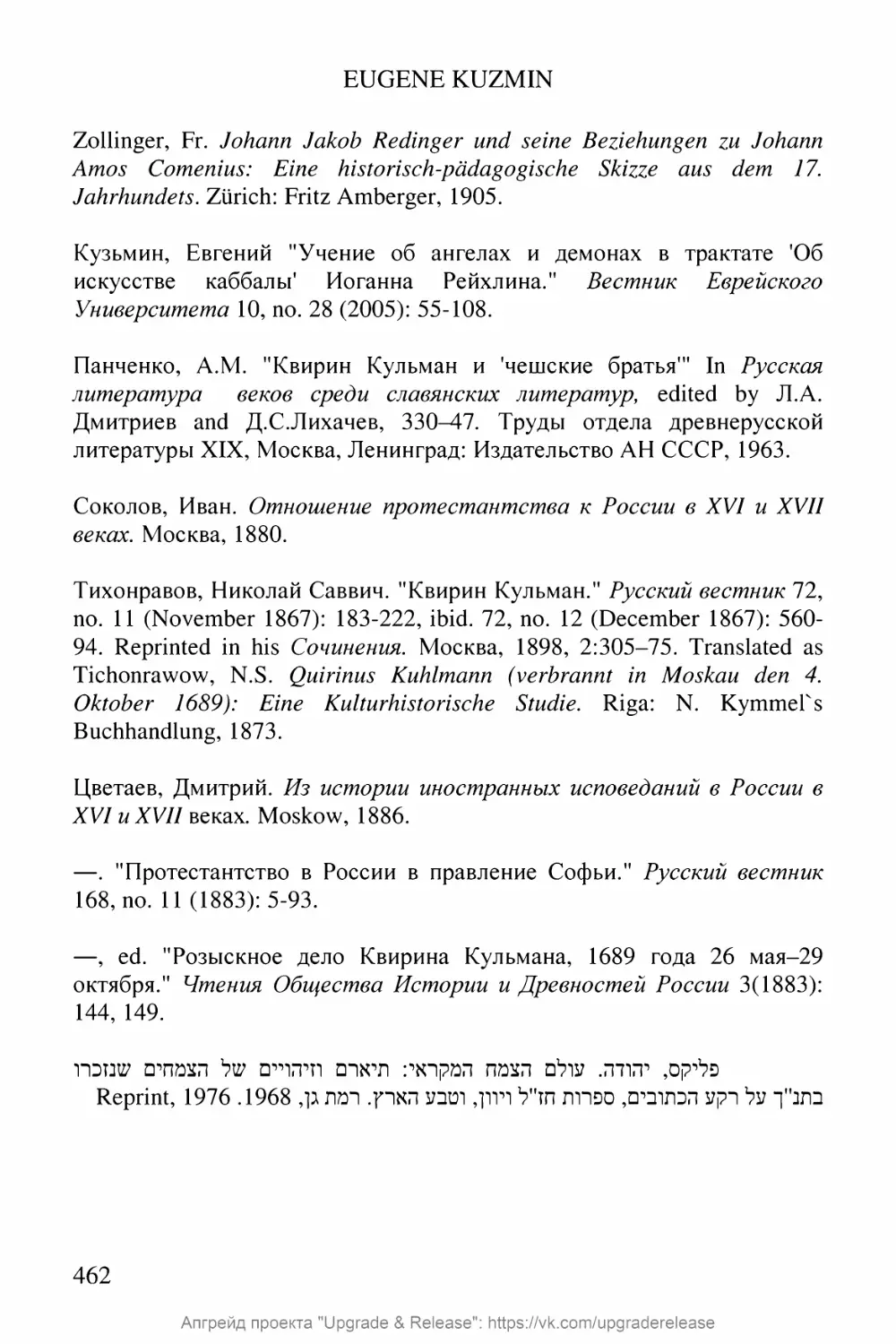
41 HHKOJiaii CaBBnq TnxoHpaBOB, "Kbhphh KyjitMaH," PyccKuu eecmuuK 72, no. 11
(November 1867): 183-222, ibid. 72, no. 12 (December 1867): 560-94.
42
PiBaH Cokojiob, OmnoiaeHue npomecmaumcmBa k Poccuu 6 XVI u XVII bckox
(MocKBa, 1880),. 171 ff.
43	IjBeTaeB, "Po3biCKHoe aejio KBupmra KyjibMana, 1689 roaa 26 Man-29
OKTflOpn," HmeHun O6u{ecmBa Hcmopuu u ffpeBHOcmeii Poccuu 3(1883): 144, 149.
44 N.S. Tichonrawow, Quirinus Kuhlmann (verbrannt in Moskau den 4. Oktober 1689):
Eine Kulturhistorische Studie (Riga: N. KymmePs Buchhandlung, 1873).
45 JjMMTpm IjBeTaeB, "RpoTecTaHTCTBO b Poccmm b npaBJienne Cocj)bM," PyccKuu
eecmHUK 168, no. 11 (1883): 5-93.
46 Idem, H3 ucmopuu unocmpauHbix ucnoBedauuu b Poccuu b XVI u XVII BeKax
(Moskow, 1886).
47 Bernhard Ihringer, "Quirinus Kuhlmann," Zeitschrift fiir Bucherfreunde 1 (1909):
179-82.
48 For their list see Dietze, Quirinus Kuhlmann: Ketzer und Poet, n. 7-9, pp. 359-60.
49 Quirinus Kuhlmann, Ausgewahlte Dichtungen, ed. Oda Weitbrecht (Potsdam: Hadern
Verlag, 1923).
20
Anrpewg npoekma "Upgrade & Release": https://vk.com/upgraderelease

ALCHEMICAL IMAGERY IN THE WORKS OF
QUIRINUS KUHLMANN
were published, by Will-Erich Peuckert50 and Johannes Hoffmeiser,51
respectively: some important sources were found and published by Theodor
Wotschke52 and Dmitrij Cizevskij;53 but World War II interrupted progress
in these investigations.
A new momentum for these studies came in 1950, in the article “Stand
und Aufgaben der deutschen Barockforschung” by Erik Lunding.54 The
special studies on Kuhlmann furnished information about him and spurred
interest in him for general researches on history, literature, religion, and for
lexicons:55 from time to time his lyrical works appeared in various
anthologies.56 A tendency towards a search for and careful study of the
sources, as opposed to generalization, is evident in some works engaging
with different aspects of Kuhlmann’s biography and writings, such as the
studies by Robert L. Beare,57 Claus Victor Bock,58 Curt von Faber du
Faur,59 Leonard Foster and A. A. Parker,60 Blake Lee Spahr61 and B. O.
50	Will-Erich Peuckert, "Quirinus Kuhlmann" In Schlesische Lebensbilder, edited by
der Historischen Kommission fur Schlesien, vol. 3, edited by Friedrich Andreae et all.
(Breslau, 1928), 139-144.
51	Johannes Hoffmeister, "Quirinus Kuhlmann" Euphorion 31 (1931): 591-615.
52	Theodor Wotschke, "Neues von Quirin Kuhlmann," Zeitschrift des Vereins fiir
Geschichte Schlesiens 72 (1938): 268-75.
53	Dmytro Cizevskij, "Zwei Ketzer in Moskau" Kyrios 6 (1942/43): 29-46. Reappeared
in his, Aus zwei Welten: Beitrage zur Geschichte der slavisch-westlichen literarischen
Beziehungen (Den Haag, 1956) 231-68.
54	Erik Lunding, "Stand und Aufgaben der deutschen Barockforschung," Orbis
Litterarum. Revue Danoise d'histoire litteraire 7, no. 1-2 (1950): 27-91.
55	For a list see Dietze, Quirinus Kuhlmann: Ketzer und Poet, n. 16, p. 361.
56	For a list see Dietze, Quirinus Kuhlmann: Ketzer und Poet, n. 17, p. 361.
57	Robert L. Beare, "Quirinus Kuhlmann and the Fruchtbringende Gesellschaft," The
Journal of English and Germanic Philology 52, no. 3 (July 1953): 346-71.
58	Claus Victor Bock, "Ekstatisches Dichtertum, Die Geistreise Quirinus Kuhlmanns,"
Castrum Peregrini 29 (1956):26-47, repr. in: Antaios 2 (1960): 42-60; idem, "Quirinus
Kuhlmann in Nederland." Duitse Kroniek 10 (1958): 31-38.
59	Curt von Faber du Faur, "Die Keimzelle des Kiihlpsalters." The Journal of English
and Germanic Philology 44, no. 2 (April 1947): 150-9.
60	Leonard Forster and A.A. Parker, "Quirinus Kuhlmann and the Poetry of St. John of
the Cross," Bulletin of Hispanic Studies 35, no. 1 (January 1958): 1-23; Leonard W.
Forster, "Zu den Quellen des ’Kiihlpsalters,’ Der 5. Kiihlpsalm und der Jubilus des
Pseudo-Bernhard." Euphorion 52 (1958): 256-71.
61	Blake Lee Spahr, "Quirin Kuhlmann: The Jenar Years." Modern Language Notes 72,
no. 8 (1957): 605-10.
21
Anrpewg npoekma "Upgrade & Release": https://vk.com/upgraderelease

EUGENE KUZMIN
Unbegaun.62 Some important obscure details of Kuhlmann's biography were
revealed in these brief studies. However, it was Robert L. Beare’s article
“Quirinus Kuhlmann: Ein Bibliographischer Versuch” (1954) that marks a
certain shift in studies of the poet.63 This brief work summarizes the
bibliographic development over years of search for Kuhlmann's extremely
rare writings, reflecting a movement toward the study of exact facts and the
composing of inclusive inquiries.
In 1952, Rolf Flechsig wrote an important dissertation on Kuhlmann,64
the first attempt to explore Kuhlmann's entire biography since Adelung's
work in the eighteenth century. It offered an analysis of his poetry, based on
a wide examination of sources, and the bibliography's accuracy and totality
are among the work's principal achievements. Flechsig compiled his own
list of Kuhlmann's work, and also tried to detect and examine each
individual source. However, his main foundation for biographical facts was
Kiihlpsalter, and Flechsig also declared it in the title of his dissertation: it
was a good departure point, since in Kiihlpsalter Kuhlmann describes his
mythologized autobiography in approximate chronological order. Though
the book's language is none too clear, its text could be compared with other
sources, and Flechsig attempted to do just that. Flechsig's dissertation has
become extremely important for Kuhlmann's scholarship. It gives a very
detailed and full-length biography of Kuhlmann. The dissertation and the
above-mentioned articles by Beare became a basis for further studies.
Flechsig's research, nonetheless, lacks two very important elements. He tries
to include all the important sources, although it is not an easy task, and
perhaps there can be no complete set of sources, when studying a person
like Kuhlmann who read so widely and had such a large circle of contacts.
Without previous researches to rely on, Flechsig had too narrow a base of
information to build upon.
The following year, Robert L. Beare published his article “Quirinus
Kuhlmann: The Religious Apprenticeships,”65 which primarily focuses on
the poet’s biography, and more specifically on his early life experience.
62 B.O. Unbegaun, "Un ouvrage retrouve de Quirin Kuhlmann." La Nouvelle Clio 3:7-8
(July- August 1951): 251-61.
63 Robert L. Beare,“Quirinus Kuhlmann: Ein Bibliographischer Versuch,” La Nouvelle
Clio f> 164-82.
64 Rolf Flechsig, "Quirinus Kuhlmann und sein 'Kiihlpsalter'" (PhD diss., Rheinische
Friedrich-Wilhelms-Universitat, Bonn, 1952).
65 Robert L. Beare, “Quirinus Kuhlmann: The Religious Apprenticeship,” PMLA 68
(1953): 828-62.
22
Anrpewfl npoeirra "Upgrade & Release": https://vk.com/upgraderelease

ALCHEMICAL IMAGERY IN THE WORKS OF
QUIRINUS KUHLMANN
Prior to his study, Beare had sought out sources on Kuhlmann and became a
leading specialist on them. Claus Victor Bock also made a considerable
contribution to the study of Kuhlmann's life and writings. In 1957, he
published his Quirinus Kuhlmann als Dichter,bb a book in two parts. The
first is a brief, but very substantial biography with some previously
unknown facts and new interpretations of known data. In the second part,
Bock offers his philosophic, unhistorical, conception of Kuhlmann's
"ecstatic" language. The scope of material here is very wide; for instance,
applying psychoanalysis for interpreting Kuhlmann's poetry and religious
imagery. The book's main idea is the affinity Kuhlmann's ideas and
language have with the incantations of shamans. Bock had started studying
this problem earlier,66 67 68 and his monograph elaborate the idea.
The shift in general attitude to Kuhlmann, from neglect to interest,
arrived at the same time as knowledge of his biography became more
widespread; this is discernible in Walter Nigg's well-known book, Heimlich
Weisheit.b* The text does not include any new information on Kuhlmann's
biography and ideas and gives only general information about him.
However, Kuhlmann appears here in the company of the most prominent
and known seventeenth-century mystics, such as Johann Arndt, Jakob
Bbhme, Johann Valentin Andreae, Johann Amos Comenius, Angelus
Silesius, Johann Georg Gichtel and George Fox.
However, for the most part, the Russian period of Kuhlmann's
biography remained unknown in the West. In 1962, A.M. Panchenko wrote
an article about Kuhlmann's political program and its background at the
time of Kuhlmann's visit to Moscow.69 Consequently, the sources are
mainly Russian material concerning the trial against Kuhlmann (1689).
Unfortunately, this article remains unnoted in the West until today.
66 Claus Victor Bock, Quirinus Kuhlmann als Dichter: Ein Beitrag zur Charakteristik
des Ekstatikers (Bern: Francke, 1957).
67 Bock, "Ekstatisches Dichtertum, Die Geistreise Quirinus Kuhlmanns".
68 Walter Nigg, Heimlich Weisheit: Mystisches Leben in der evangelischen Christenheit
(Zurich and Stuttgart: Artemis-Verlag, 1959), 258-73.
69 A.M. IlaHHeHKO, "KeupuH KyjibMan u ’neuiCKue SpaTta,"' in PyccKan mimepamypa
66K06 cpedu cjiaeHHCKux jiumepamyp, ed. JI.A. JJmhtphb h JJ.C.JlHxaneB (MocKBa,
JTeHHHrpaa: H3/taTejitcTBO AH CCCP, 1963), 330-47.
23
Anrpewfl npoeKTa "Upgrade & Release": https://vk.com/upgraderelease

EUGENE KUZMIN
Beare discovered and published some very important miscellaneous
biographical facts in 1962.70 Walter Dietze, a scholar from East Berlin, with
knowledge of the Russian language, researched the Russian documents on
Kuhlmann and made the main facts known in the West.71 After Dietze's
research, a brief account of Kuhlmann's death in Moscow was discovered;
Gottfried Arnold may have known about this anonymous German text,
which bears the title Quirinus Kuhlmann Leben und Todt. It was published
by Leonard Forster.72 Since this article, there have been no further additions
to the accounts on Kuhlmann's death in Moscow; there have only been some
completely speculative works on his life there and the importance of his
theories for the Russian history of ideas.73 After the publication of the article
on Kuhlmann's death in Moscow, Walter Dietze wrote the best general book
on Kuhlmann to date, Quirinus Kuhlmann: Ketzer und Poet, published in
1963. It is a standard biography with many new facts that Dietze discovered,
and draws on the primary sources and previous research. Dietze briefly
retells the content of Kuhlmann's entire work, excluding some very early
poems recently discovered by Jonathan Philip Clark (Appendix I).74
Quirinus Kuhlmann: Ketzer und Poet became the starting-point for all
further studies. It provides Kuhlmann's standard biography and his entire
bibliography, and its main advantage compared with every other work on
Kuhlmann is its inclusiveness, brevity, and high scholarly standards. Dietze
discusses all periods of Kuhlmann's life, and reconsiders the legends about
Kuhlmann. The information on Kuhlmann and his work is wholly based on
primary sources; Dietze tries to draw upon all of them and succeeds better
than any other researcher in the field. The book chiefly presents pure facts,
and though the author offers some theories and abstract explanations, they
do not play a central role. Dietze's book enables and makes necessary the
70 Robert L. Beare, "Quirinus Kuhlmann: Where and When?" Modern Language Notes
77, no. 4(1962): 379-97.
71 Walter Dietze, "Quirinus Kuhlmanns letztes Wirken in RuBland," Sinn und Form 14
(1962): 10-71.
72 Leonard Forster, "Quirinus Kuhlmann in Moscow 1689: An Unnoticed Account,"
Germano-Slavica 2, no. 5 (1978): 317-23.
73 John M. Gogol, "The Archpriest Avvakum and Quirinus Kuhlmann: A Comparative
Study in the Literary Baroque," Germano-Slavica 2 (1973): 35-48; V. David Zdenek,
"The Influence of Jacob Boehme on Russian Religious Thought," Slavic Review 21, no.
1 (1962): 43-64.
74 Jonathan Philip Clark, "From Imitation to Invention: Three Newly Discovered Poems
by Quirinus Kuhlmann," Wolfenbiitteler Barock-Nachrichten 14(1987): 113-29.
24
Anrpewfl npoeKTa "Upgrade & Release": https://vk.com/upgraderelease

ALCHEMICAL IMAGERY IN THE WORKS OF
QUIRINUS KUHLMANN
movement from studies that merely collect plain data on Kuhlmann's life
towards studies of Kuhlmann's ideas and placing them in the context of
seventeenth-century thinking. Conducting such studies was a difficult task
before the works of Beare, Flechsig, Bock and particularly those of Dietze,
because of the sparse knowledge about Kuhlmann's biography and
bibliography. Following Dietze's work, it is now possible to concentrate
endeavors on the special aspects of Kuhlmann's ideas and life.
Two tendencies in the studies on Kuhlmann after Dietze's work can be
discerned: the first is greater detail, and the second is the broader reference
made to Kuhlmann in studies on the history of ideas and German literature.
The focus on case-studies of specific writings and ideas, instead of the
composition of the inclusive works, is exemplified in Sibylle Rusterholz's
article with its detailed interpretation of one of Kuhlmann's psalms.75 A
number of dissertations discuss the rhetoric in Kuhlmann's works, such as
that by Klaus Karl Ernst Neuendorf who tried to gain broad insights into the
problem;76 his thesis discussed Kuhlmann's different works. Klaus Karl
Ernst observed the poet's development throughout his life. Neuendorf
emphasized the impact of ars combinatoria on Kuhlmann,77 and a
discussion devoted to this question alone comprises nearly a quarter of the
whole dissertation.78 Ralf Schmittem's thesis examines one of Kuhlmann's
main works, the Kiihlpsalter, and the role of rhetoric in it: the dissertation
deserves special attention for researchers into the alchemical aspect of
Kuhlmann's ideas.79 Schmittem meticulously explores hermetic philosophy
in Kiihlpsalter and the theory of prefiguration (also see sections 2.2 and
4.2), but did not define the subject, and noted the general impact of hermetic
and/or alchemic ideas on Kuhlmann. The meaning of the term "hermetic" in
this work is not thoroughly explained. Schmittem offers general definitions
borrowed from various books on hermetic ideas, and draws weak
comparison between these definitions and his subjective interpretation of
75 Sibylle Rusterholz, "Klarlichte Dunkelheiten. Quirinus Kuhlmanns 62. Kiihlpsalm,"
in Deutsche Barocklyrik: Gedichtinterpretationen von Spee bis Haller, ed. Martin
Bicher and Alois M. Haas (Bern and Munich: Francke, 1973), 225-64.
76Klaus Karl Ernst Neuendorf, "Das Lyrische Werk Quirinus Kuhlmanns:
Interpretationen zu seiner rhetorischen Struktur" (PhD diss., Rice University, 1970).
77 For ars combinatoria, see part 2 of this work.
78 Neuendorf, "Das Lyrische Werk Quirinus Kuhlmanns," 113-51.
79 Ralf Schmittem, "Die Rhetorik des Kiihlpsalters von Quirinus Kuhlmann: Dichtung
im Kontext biblischer und hermetischer Schreibweisen" (PhD diss., Koln, 2003).
25
Anrpewfl npoeKTa "Upgrade & Release": https://vk.com/upgraderelease

EUGENE KUZMIN
Kuhlmann's writings: it cannot therefore be considered a completely correct,
scientific and empiric research. Producing artificial and simple images
based on modern books, with especially disputable and questionable points
for their comparison, fails to provide reliable data.
Generalization is another tendency in studies of Kuhlmann. The quantity
of data about his life and writings makes it possible to discuss his
personality and ideas in general studies on the history of ideas and German
literature. Werner Vordtriede, for example, who edited a selection of pieces
from the Kilhlpsalter, wrote an article about Kuhlmann, where he repeats
known facts about Kuhlmann's life and his main work. The article's central
problem is Kuhlmann's place among German poets of the Baroque.
Vortriede's estimation is very high: "... er (der Kilhlpsalter) ist doch noch
nur Kuhlmann's Haupwerk, sondern auch eines der Hauptwerke des
deutschen Barock."80 On the article's first page, he notes the importance of
alchemical symbolism in Kilhlpsalter, but does not enlarge on the matter,
simply noting that Kuhlmann borrowed the alchemical symbolism of the lily
and the rose from Bohme (3.5). Conrad Wierdemann depicts a certain
tendency towards irrationality in the poetry, citing examples from Johann
Klaj, Catharina von Greiffenberg and Q. Kuhlmann. 81 Thomas Althaus
compares the stylistic peculiarities of Catharina Regina von Greiffenberg's
Sonneten oder Klinggedichten and Kuhlmann's Himmlische Libes-kilsse?2
he was evidently inspired by Conrad Wiederman.83 Gerald Gillespie
compares theories of the language in the works of Kuhlmann, Kircher and
Leibniz,84 attempting to denote a linguistic tradition particular to Germany.
Wilhelm Schmidt-Biggemann briefly presents the main facts about
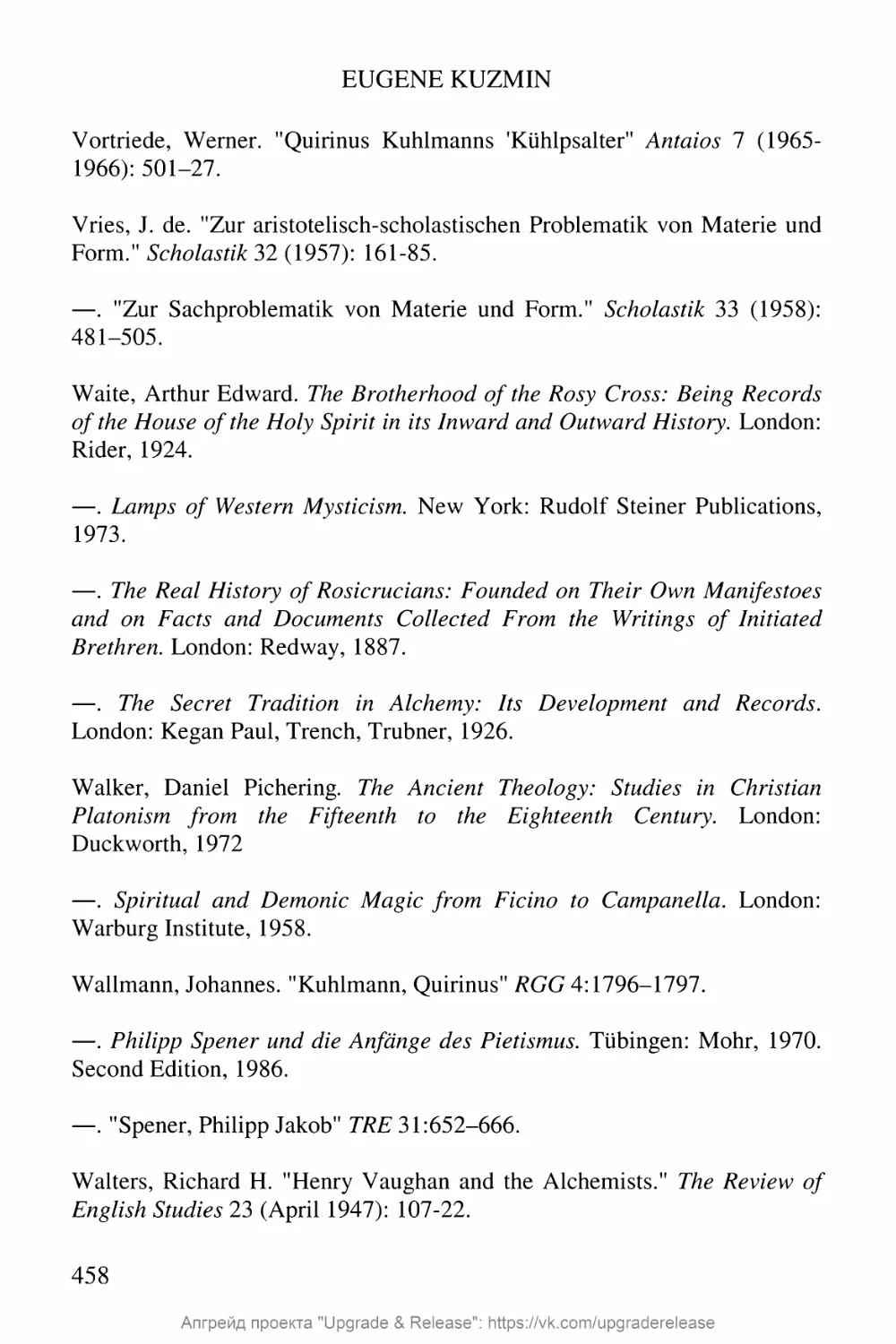
80 Werner Vortriede, "Quirinus Kuhlmanns 'Kilhlpsalter" Antaios 7 (1965-1966): 501—
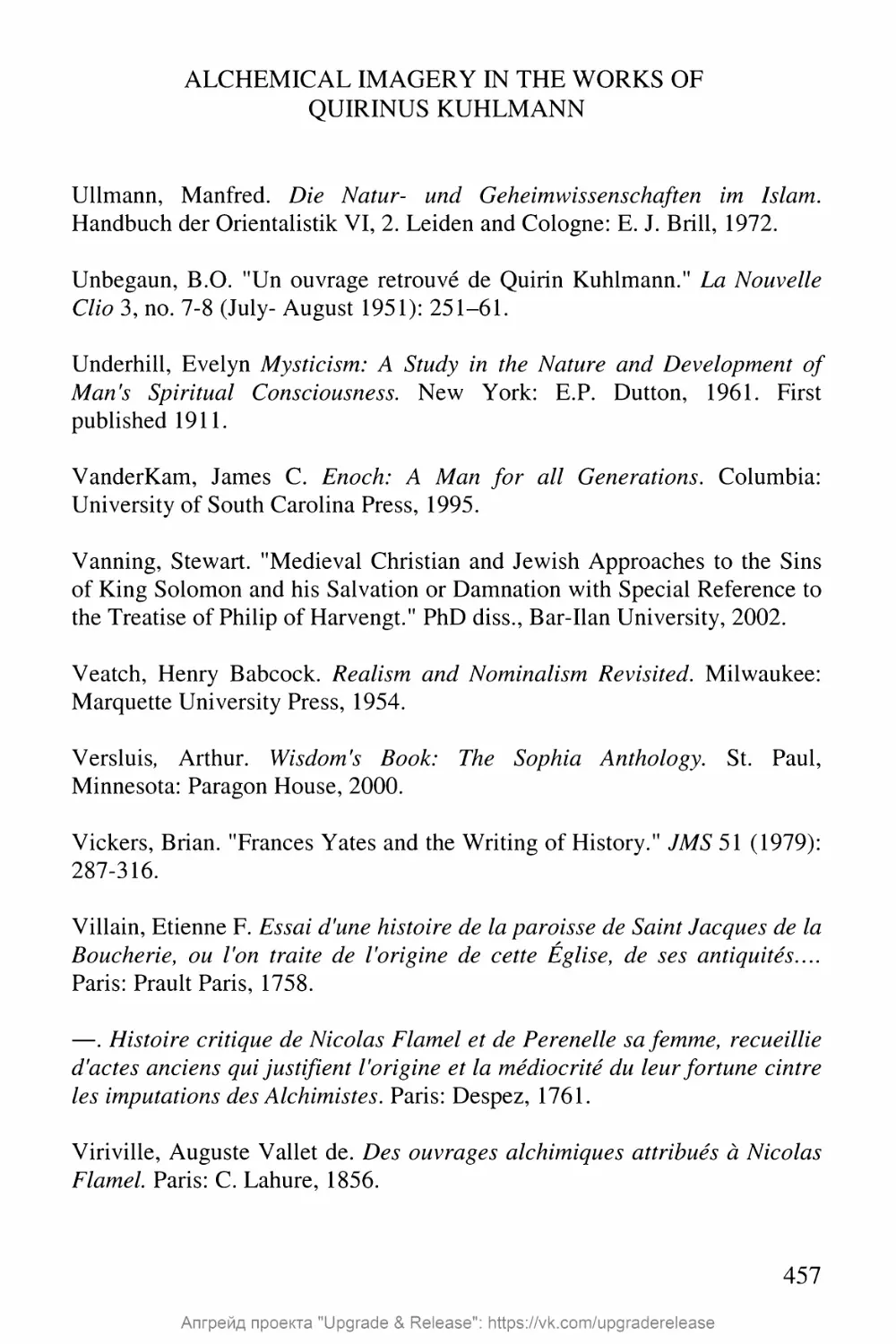
27.
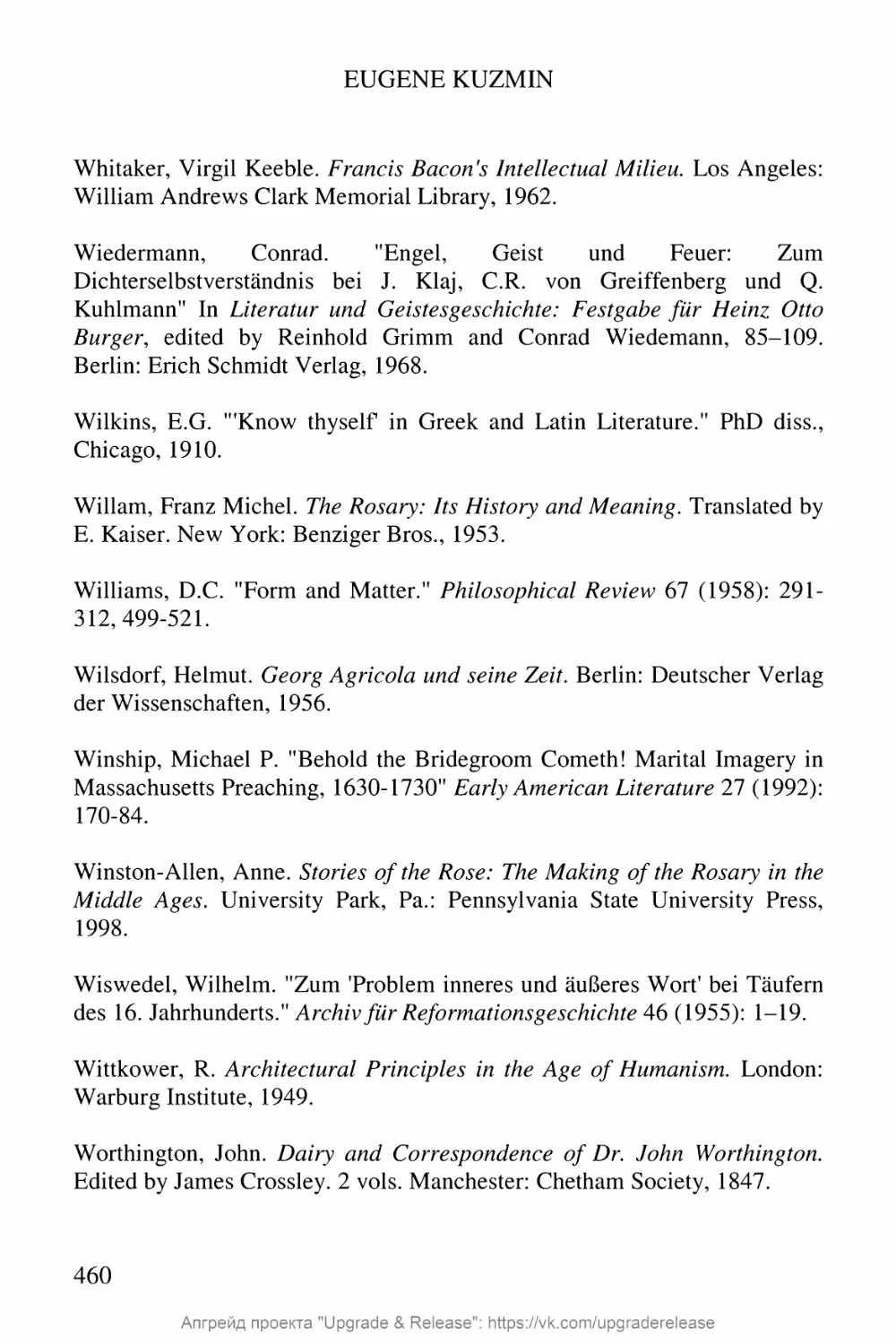
81 Conrad Wiedemann, "Engel, Geist und Feuer: Zum Dichterselbstverstandnis bei J.
Klaj, C.R. von Greiffenberg und Q. Kuhlmann," in Literatur und Geistesgeschichte:
Festgabe fiir Heinz Otto Burger, ed. Reinhold Grimm and Conrad Wiedemann (Berlin:
Erich Schmidt Verlag, 1968), 85-109.
82 Thomas Althaus, "Einklang und Liebe. Die spracherotische Perspektive des Glaubens
im Geistlichen Sonett bei Catharina Regina von Greiffenberg and Quirinus Kuhlmann,"
in Religion und Religiositat im Zeitalter des Barock, ed. Dieter Breuer (Wiesbaden:
Harrassowitz Verlag, 1995), 2:779-88.
83 Wiedemann, "Engel, Geist und Feuer," 85-109.
84 Gerald Gillespie, "Primal Utterance: Observations on Kuhlmann's Correspondence
with Kircher, in View of Leibniz's Theories," in Wege der Worte: Festschrift fiir
Wolfgang Fleischhauer, ed. Donald C. Reichel (Cologne and Vienna: Bohlau, 1978),
27-46.
26
Anrpewfl npoeKTa "Upgrade & Release": https://vk.com/upgraderelease

ALCHEMICAL IMAGERY IN THE WORKS OF
QUIRINUS KUHLMANN
Kuhlmann's biography and ideas;85 though his article is mainly a
compilation, his analysis of Kuhlmann's ideas is deep and inclusive.
Schmidt-Biggemann makes many important parallels and remarks
concerning general patterns of Christian religious thinking in the
seventeenth century, offering an original interpretation for some of
Kuhlmann's vague symbols. Jonathan P. Clark researched the
transformation of Baroque discourse into the speech patterns of the
Enlightenment, and defines the problem as follows: "Schwarmerei and the
related phenomena of "fanaticism" and "enthusiasm" provide insight into
the transference of interpretive paradigms from the seventeenth-century
religious orthodoxy to Enlightenment discourses."86 Even though the
problem is very broad, Clark principally relies on chronological and
ideological tendencies found in reactions to Kuhlmann's work: Clark had
previously written a dissertation on Kuhlmann.87 After the works of
Flechsig, Bock, and Dietze, the biography of Kuhlmann and his main ideas
became clearer. Before their works, in spite of Kuhlmann's importance for
understanding the history of religion and literature in the seventeenth
century, he was rarely and superficially studied, and any interest in him was
hampered by incomplete knowledge of his biography. After Dietze's book,
Kuhlmann became commonly cited in works on the history of ideas and
German literature; a full list is unnecessary, and only a few examples
follow. Jutta Weisz awarded significant attention to Kuhlmann's
Unsterbliche Sterblichkeit in her general study of German epigrams in the
seventeenth century.88 Kuhlmann is cited in two books by Andrew Weeks,
one on Jakob Bohme89 and the other a history of German mysticism.90 The
85 Wilhelm Schmidt-Biggemann, "Salvation through Philology: The Poetical
Messianism of Quirinus Kuhlmann (1651-1689)," in Toward the Millennium:
Messianic Expectations from the Bible to Waco, ed. Peter Schafer and Mark Cohen
(Leiden, Boston, Koln: Brill, 1998), 259-98.
86 Jonathan P. Clark, "Beyond Rhyme or Reason. Fanaticism and the Transference of
Interpretive Paradigms from the Seventeenth-Century Orthodoxy to the Aesthetics of
Enlightenment." German Issue 105, no. 3 (April 1990): 563-82.
87 Idem, "Immediacy and Experience: Institutional change and Spiritual Expression in
the Works of Quirinus Kuhlmann" (PhD diss., Berkley, 1986).
88 Jutta Weisz, Das deutsche Epigramm des 17. Jahrhunderts (Stuttgart: J.B.
Metzlersche Verlagsbuchhandlung, 1979).
89 Andrew Weeks, Boehme: An Intellectual Biography of the Seventeenth-Century
Philosopher and Mystic (New York: State University of New York, 1991), 2.
27
Anrpewfl npoeKTa "Upgrade & Release": https://vk.com/upgraderelease

EUGENE KUZMIN
brief remarks on Kuhlmann in the book on Bbhme demonstrate awareness
to Kuhlmann's special role in the rich tradition of his interpreters and
followers, although such remarks were not unique or novel, since Kuhlmann
was also mentioned, for example, in John Joseph Stoudt's well-known study
on Bbhme.90 91 The references to Kuhlmann in Weeks' second work are more
significant; although he did not attempt to produce a comprehensive history,
he described some of the most important points in the history of German
mysticism and Kuhlmann appears in that context. In his references to the
poet's biography and ideas, Weeks completely relies on Dietze. Kuhlmann is
presented as a predecessor of the writer and graphic artist Gunter Bruno
Fuchs (1928-1977) in a recent study by Georg Ralle.92 Though this work is
not important for the present research, it reflects the current state of
Kuhlmann scholarship: he has finally become a widely known Baroque
poet, and information on his biography and writings are easily accessible.
Alchemical imagery is, however, the theme of the present work, not
Kuhlmann's biography or bibliography. Though frequently mentioned in
works about Kuhlmann, in his lifetime and until today, alchemical imagery
has never received special scholarly attention. Kuhlmann's fame as an
alchemist began during his lifetime. As we will see later, Kuhlmann often
referred to alchemical books, communicated with prominent alchemists and
appealed to them. In the polemic against Kuhlmann, Breckling (see also 2.3)
notes that fact:
....noch ein ander Thronfurst Quirin Kuhlmann/ der sich selbst schon fiir
Salomon von Kaiserstein ausgibt	 Denn ein jeder wil gern der Elias
Artista selbst seyn / und von alien falschen Alchymisten und Goldsuchern/
die gleich der Erden Gold machen und auff das Gold mehr als auff Gott
hoffen/ verehret und angebehten seyn....93
90 idem, German Mysticism from Hildegard of Bingen to Ludwig Wittgenstein: A
Literary and Intellectual History (New York: State University of New York Press,
1993), 172, 185, particularly 190-1.
91 John Joseph Stoudt, Sunrise to Eternity: A Study in Jacob Boehme's Life and Thought
(Philadelphia: University of Pennsylvania Press, 1957), 64.
92 Georg Ralle, Gunter Bruno Fuchs und seine Literarischen Vorlaufer: Quirinus
Kuhlmann, Peter Hille und Paul Scheerbart (Hannover - Laatzen: Werhahn, 2007).
93 Cited according Dietze, Quirinus Kuhlmann: Ketzer und Poet, 252.
28
Anrpewfl npoeKTa "Upgrade & Release": https://vk.com/upgraderelease

ALCHEMICAL IMAGERY IN THE WORKS OF
QUIRINUS KUHLMANN
Breckling especially emphasized the impact of Paracelsus on Kuhlmann,94 95
and was not the only one who made such assertions. In later books,
Kuhlmann is usually grouped together with Paracelsus and Jakob Bbhme,
though the theme is not emphasized. Kuhlmann's main characteristics are
"phantast" and "enthusiast." In Gottfried Arnold's Unparteyische Kirchen
und Ketzer-Historie (first edition in 1699-1700; in the edition of 1629,
3:197-201) he included the first reliable biography of Quirinus Kuhlmann,
with a critique of his works. Arnold clearly underscored the impact of
alchemical works on Kuhlmann. Gottfried Wilhelm Leibniz was interested
in Kuhlmann's ideas on the ars combinatorial and noted alchemy and
enthusiasm as Kuhlmann's main inspirations: "Quirin Kulman Silesien
home de scavoir et d'esprit, mais qui avoit donne depuis dans deux sortes de
visions egalement dangereuses, 1'une des Enthousiastes, 1'autre des
Alchymistes..."96 In volume IX of his Geschichte der menschlichen
Narrheit (1799), Johann-Christoph Adelung unmistakably stressed
Kuhlmann's fame as an adept, and thus his dependence on alchemical
sources.
Over time, Kuhlmann's alchemical inspirations were noted in nearly
every mention of him, though not verified or explained. Flechsig - in his
work on Kuhlmann's biography and writings - showed a complete
misunderstanding of the problem, and alchemy for him is akin to black
magic. Notwithstanding, he defended Kuhlmann and Bbhme, who he
believed, applied alchemy only for its symbolism, without magical
connotations: "Der Gebrauch von alchemischer Terminologie war durchaus
iiblich und begint keine schwarzmagische Betatigung. Gerade bei Boehme
wird sie haufig als Symbologie benutzt...."97 Flechsig tried to avoid any
deep inquiry into the problem.
In the basic book on Kuhlmann's biography and bibliography, Dietze's
Ketzer und Poet (1963) he frequently mentions alchemy's impact on
Kuhlmann. Though the theme is not important for that book's main concept,
it is unavoidable in research into Kuhlmann. Dietze accordingly did not
94 Dietze, Quirinus Kuhlmann: Ketzer und Poet, n. 156, p. 473.
95 Dietze, Quirinus Kuhlmann: Ketzer und Poet, 344-7.
96 Gottfried Wilhelm Leibniz, Nouveaux Essais sur I'Entendement Humain (1703-1705)
in Book 4, chapter 19. Cited according Gottfried Wilhelm Leibniz, Samtliche Schriften
und Briefe (Darmstadt, Leipzig, Berlin: Akademie-Verlag, 1962), 4/2: 507. Dietze cited
German translation: Dietze, Quirinus Kuhlmann: Ketzer und Poet, 347.
97 Flechsig, "Quirinus Kuhlmann," n. 16, pp. 327-8.
29
Anrpewfl npoeirra "Upgrade & Release": https://vk.com/upgraderelease

EUGENE KUZMIN
group alchemical topics in one section, and does not make inter-references
when discussing them, and all the same draws a clear conclusion pertaining
to this theme. Showing the considerable role of alchemy in Kuhlmann's
work, Dietze asserts that it reflects a common situation of the seventeenth
century; he emphasizes that the alchemical terms in Kuhlmann's works
could be understood without the knowledge of alchemy:
...die alchimystische Terminologie, die Kuhlmann gelegentlich benutzt, ist
zu dieser Zeit allgemein gebrauchlich und in seinen Schriften wohl eher im
iibertragenen als im wbrtlichen Sinne zu verstehen.98 99
The remark also provides a reason for avoiding a specific discussion of the
theme, and Dietze is silent on specific alchemical ideas. His brief remarks
throughout the book are very general, and supply no exact or definite
information on the topic. In the article by Ernst Benz, "Zur Sprachalchimie
der deutschen Barockmystik", Kuhlmann's poetry was foregrounded," yet
the work contributes little to the substantial study of alchemy's impact and is
philosophical rather than historical. Benz indicates the affinity between the
popularity of alchemical theories in the seventeenth century, and the
contemporary attitude to language and the tendency to coin neologisms.
The absence of a study dedicated to the impact of alchemy on
Kuhlmann depreciates the value of remarks on alchemy, since they do not
have a reliable basis. And yet the situation regarding research on the topic is
quite understandable. Kuhlmann's name and literary heritage were neglected
for years, and it was only recently that his biography and works became
widely and accurately researched, applying modern standards of
scholarship. Kuhlmann's standard biography appeared only in 1957, drawn
up by Bock with many lacunae, and again in 1963, by Dietze. Kuhlmann's
key works were scarcely accessible for decades, and his main book, the
Kiihlpsalter, was only reedited in 1971. Without basic biographic and
bibliographic data it was impossible to research the wide-ranging topic of
alchemy's impact until recently, and though the impact of alchemy is
generally referred to in works about Kuhlmann, none of them has proved
the fact of such influence.
98 Dietze, Quirinus Kuhlmann: Ketzer und Poet, 122.
99 Ernst Benz, "Zur Sprachalchimie der deutschen Barockmystik," Dichtung und
Volks turn (Euphorion) 31 (1936): 482-98.
30
Anrpewfl npoeKTa "Upgrade & Release": https://vk.com/upgraderelease

ALCHEMICAL IMAGERY IN THE WORKS OF
QUIRINUS KUHLMANN
1.4. Alchemy and Poetry
In our title, the problem is phrased as an abstract, inexact - even odd
concept. How can two unequal and incomparable things, from different
categories, be compared or addressed properly and equally? Poetry and
alchemy are different categories: poetry is a form, a literary genre, while
alchemy is mostly content. Undoubtedly, alchemical ideas imply a certain
means of narrative—a certain genre, though that is true of any science or
sphere of knowledge, like mathematics, physics, or chemistry. For a
discourse on alchemical topics, one kind of narrative may be more suitable
than another. Content stipulates the form - when we say "alchemy" we
imply content, not form. In the case of poetry, the reverse is true, for an
alchemical text can be poetical, but when we say "poetical" we do not mean
it is "alchemical" - we refer to form, ignoring content.
Alchemical poems have been known since alchemy's origins, at least
since seventh-century Alexandria.100 101 Rhythmic scientific treatises evidently
preceded the rise of alchemy, and there are numerous examples expressing
the knowledge of nature in poetic form, such as Hesiod's book, Works and
Days.'0' An alchemist could use poetical form just as a poet could use
alchemical symbols for solving literary tasks. In addition, a poet could
engage in alchemy, just as an alchemist could compose poems. In reality,
the interrelations could be very complex. In the case of Kuhlmann, the
situation is more or less clear - he sees himself primarily as a poet and
prophet - and so here our study of alchemy's impact on him will take the
form of alchemical ideas that influenced an individual who did not
completely associate himself with the study of alchemy.
The theme of the impact of alchemy on literature has been much
discussed, and while many works exist on the question, there is no clear
continuous tradition and no discussion on methodology. This is an
understandable situation since the topic itself is indeterminate, hard to
define or demarcate; moreover, the vast quantity of alchemical and literary
100 Robert M. Schuler, Alchemical Poetry: 1575-1700. From Previously Unpublished
Manuscripts (New York and London: Garland Publishing, Inc., 1995), xxvi.
101 For other examples see Schuler, Alchemical Poetry, xvi-xvii; Comp, idem, Francis
Bacon and Scientific Poetry, Transactions of the American Philosophical Society 82:2
(Philadelphia: American Philosophical Society, 1992), 3-8.
31
Anrpewfl npoeirra "Upgrade & Release": https://vk.com/upgraderelease

EUGENE KUZMIN
material impedes the unification of evidence. What is needed is a dialogue
between proponents of different ideas, rather than countless monologues
that do not contribute to developing ideas in the field. Works on the topic
cannot be comprehensive, due to the theme's obscurity.
There is also a problem in defining alchemy, of alchemy's links with many
categories such as occultism,102 religion, science, and hermeticism.
Examining works on the theme may be helpful in finding our own formulas,
and so we decided to make a brief bibliographical review that comprised
only known and modern works, dating from the 1930s onwards, when the
theme became popular among scholars of literature. The material is
organized by author and presented in chronological order.
Any discussion of alchemy and its role in the life of different authors
and their works, must address the period when they lived, and the twentieth
century should be considered the beginning of the modern view of the
problem. S. Foster Damon's article on the role of alchemy in Chaucer's The
Canon's Yeoman's Tale can be regarded as the turning point in studies of
alchemy's impact on literature,103 though the problem itself is not new, of
course, and references to previous works appear in Damon's article. The
main difference between this and previous studies is its shifting of the
problem from the background to foreground. Damon structures an intensive
and precise scholarly discussion on sources. In contrast to widespread
assumptions of that time, Chaucer laughs at alchemy, but Damon proves
that he "is far from attacking alchemy." Moreover, Chaucer "was probably
not only in sympathy with it, but possibly knew (and if so, respected) the
famous secret." Damon insists that Chaucer's attack was only against false
alchemists, who discredited the noble science.
Katharine Maynard's general, and brief, article on science in early
English literature, 155O-165O104 was published in 1932, and Chapter V of
the article is dedicated to alchemy. Since the work was written before the
102 "Occultism" is a most problematic term. It completely changed its meaning from the
time of the Renaissance and Baroque. This will be explained in the proper place in this
paper (n. 197). But for the general introduction in the problem, in its present context, on
the misleading connection of so-called occultism and Hermetism Brian P. Copenhaver,
"Natural Magic, Hermetism and occultism in Early Modern Science," in Reappraisals
of the Scientific Revolution, ed. David C. Lindberg and Robert S. Westman
(Cambridge, 1990), 261-301 may be consulted.
103 S. Foster Damon, "Chaucer and Alchemy," PMLA 39 (December 1924): 782-8.
104 Katharine Maynard, "Science in Early English Literature 1550-1650," Isis 17, no. 1
(1932): 94-126.
32
Anrpewfl npoeKTa "Upgrade & Release": https://vk.com/upgraderelease

ALCHEMICAL IMAGERY IN THE WORKS OF
QUIRINUS KUHLMANN
major studies were published and before many sources were retrieved, it
lacks references to several important sources. In fact, it addresses the
influence of alchemy on English literature briefly and simply; Maynard only
cites clear references to alchemy, that include the word, and avoids any
discussion of alchemical theories and practices. A major achievement of the
author is her ability to identify the importance of and inherent creativity in
the problem. She believes that researching the impact of science on
literature could throw light on the reflection of scientific development on
the consciousness of non-scientists, and on the advancement of knowledge
among the masses. Literature might represent such reflection better than any
other human activity:
That literature reflects life is a theory often presented, and very widely
accepted. There are even those who claim for the imaginative record
precedence over formal history as a true picture of a given period. And if
true, this picture must include to a greater or less degree, according to the
character of the era, an outline of the progress of science, with the effect
upon everyday living and thinking of the new discoveries and inventions.
For, if the poet is the best of all historians, it is because in reacting to
events the creative imagination is moved not merely to reflect, but to
illuminate, the outward happening, and to interpret its significance.
The great importance of the contribution that the English metaphysical poet,
Henry Vaughan, made to hermetic philosophy is unquestionable. His twin
brother, Thomas, was a well-known hermetic philosopher and alchemist,
and their mutual influences are clearly visible. Henry Vaughan also
translated extracts from the alchemical treatise of Henricus Nollius, the
follower of Paracelsus, and published them under the title Hermetical
Phy sick in 1655. These are well documented, accessible examples of the
interrelations between literature and alchemy in the seventeenth century,
that are noted in research on Henry Vaughan. Works dedicated to his
hermetic and alchemical sources appear from an early date. In 1932,
Elizabeth Holmes published a monograph on the hermetic imagery of Henry
Vaughan,105 in the form of full-length book, although Holmes does not
present her position on the meaning of "hermetic." She writes very generally
105 Elizabeth Holmes, Henry Vaughan and the Hermetic Philosophy (Oxford:
Blackwell, 1932).
33
Anrpewfl npoeKTa "Upgrade & Release": https://vk.com/upgraderelease

EUGENE KUZMIN
on Bohme and other well-known thinkers, and shifts from idea to idea
without defining their role in her study. Her book is thus important as a
pioneering work, an attempt at collecting evidence, but offers little to the
modern researcher since it is deficient in facts and notably lacks
methodology. The general and rather superficial work by Holmes appeared
the same year as a study by Arthur J.M. Smith on the interrelations between
Henry and Thomas Vaughan;106 While it was not an original and
outstanding idea, the article indicates a tendency to concretization in the
sphere. Smith presents the different essential philosophical and religious
ideas proposed by Thomas and Henry Vaughan and compares them: his
main conclusion concerns the complete affinity of concepts between the
twin brothers.
The following year, Wilson O. Clough wrote an article on the theme.107
In his general introductory remarks, he also reveals his uncertainty on the
topics of alchemy and hermeticism, an understandable and excusable
position since he wrote his work before many important related works.
Clough reviews the main literature on the history of hermeticism at the level
possible in the 1930s. Though the difficulties in writing the article are
evident, Clough clearly formulates questions and answers them in a definite
order, with explicit and persuasive arguments. Ultimately the article is
useful and significant, even today: Clough builds his discourse on firm
foundations, skillfully organizing and merging biographical evidence with
accurate analysis of texts. Such structure makes it possible to point out some
likely sources and reasons for the use of hermetic philosophy in Henry
Vaughan's poetry. Clough's conclusion is as follows:
...Henry Vaughan is not far from being a Hermetic poet. Yet, in a truer,
more permanent sense, Henry Vaughan is more than Hermetist. He is a
poet, assimilating and subordinating his borrowings from the Hermetists...
Although Clough often discusses alchemy in the article, his main theme is
hermetic philosophy, and he describes alchemy, magic and astrology
without recognizing the differences between them.
106 Arthur J.M. Smith, "Some Relations between Henry Vaughan and Thomas
Vaughan," Papers of the Michigan Academy of Science, Arts and Letters 18 (1932):
551-61.
107 Wilson O. Clough, "Henry Vaughan and the Hermetic Philosophy." PMLA 48, no. 4
(December 1933): 1108-30.
34
Anrpewfl npoeKTa "Upgrade & Release": https://vk.com/upgraderelease

ALCHEMICAL IMAGERY IN THE WORKS OF
QUIRINUS KUHLMANN
Ralph M. Wardle wrote a study on the influence of Thomas Vaughan,
an alchemist, on his brother Henry, the poet.108 It is a rather controversial
work; Wardle frequently seeks hermetic philosophy in Vaughan, but does
not define his subject clearly. The declared conflict of hermetic philosophy
with so-called "conventional Christianity" also remains unexplained, and
thus unhistorical. Though he presents a range of facts to try and establish
parallels, Wardle evidently lacks a clear strategy. He points out parallels
between works by Thomas Vaughan, Henry Vaughan and some hermetic
texts, and maintains that the twins go beyond the hermetic treatises known
to them. This article constitutes an important stage in studies of the
interrelations between alchemy and literature; it provides several interesting
parallels and, more importantly, reveals the need for distinctness in such
researches.
During World War II, L.C. Martin published a less known article on the
hermetic tradition in Henry Vaughan,109 110 in which the author compares
different excerpts from Vaughan with various pieces in Hermetica,using
a slightly awkward method. It is known that Vaughan was familiar with
knew Hermetica, and there is no argument that it was his principal source
for some common ideas, as long as there is no special contention against
borrowing. While Vaughan did in fact borrow similar concepts from other
sources, it is certainly vital to establish clear parallels between the texts as a
starting point for a deeper study - and Martin does so expertly. Richard H.
Walters has written on the impact of alchemy on Henry Vaughan.111 This is
highly important for us, since its main topic is alchemy, not hermeticism. At
first glance, such a thematic shift certainly indicates a search for further
clarification and specification of the topic, but in reality, the trend remains
unchanged. Walters himself explains his task very simply, noting that our
knowledge on the topic is not enough:
108 Ralph M. Wardle, "Thomas Vaughan's Influence upon the Poetry of Henry
Vaughan," PMLA 51, no. 4 (December 1936): 936-52.
109 L.C. Martin, "Henry Vaughan and 'Hermes Trismegistus'" The Review of English
Studies 18, no. 71 (July 1942): 301-7.
110 Hermetica is specially discussed in this work in the section on Kuhlamann's
alchemical sources (2.1).
111 Richard H. Walters, "Henry Vaughan and the Alchemists," The Review of English
Studies 23 (April 1947): 107-22.
35
Anrpewfl npoeKTa "Upgrade & Release": https://vk.com/upgraderelease

EUGENE KUZMIN
The debt of Henry Vaughan to the hermetic philosophers, as the alchemists
styled themselves, has been frequently noted, but the extent to which he
was influenced both by their basic ideas and by their terminology deserves
further exposition and emphasis.
Walters posits an inexact theme, for hermetic philosophers and alchemists
are often, but not always, the same people, and such a supposition forms the
study's foundation. Walters takes one generalized theory in Henry Vaughan
and seeks the same concept in generalized, unified hermetic and alchemical
theory, without noting that there are various theories within alchemy -
which is not a dogmatic, completely unified doctrine. However, within the
discussion on generalized topics the author draws comparisons between
definite sources, and looks for texts, traditionally denoted as alchemical,
that parallel Vaughan's ideas. Walters also finds clear evidence of the
alchemical sources. His main conclusion emphasized the role of hermetic
influences, that were the foundation of Vaughan's worldview:
The hermetic influence was not merely productive of strange terms and
bizarre ideas, but helped Vaughan to develop, and provide a foundation for,
his interest in 'the live of things'. It is not therefore true to claim that
Vaughan writes at his best when freest from hermetic influence, for that
influence was stronger, deeper and more subtle in its effects than may at
first appear.
W.A. Murray wrote an article on the parallels of alchemical images in John
Donne and Paracelsus."2 The reason for such a study is clear: Donne makes
wide use of symbols, which are usually regarded as alchemical and
doubtlessly refer to only one alchemist, Paracelsus. However, her final
conclusion concerns the role of Paracelsian borrowings: to illuminate the
actual meaning of the poetry, to provide "a unified basis from which one can
reasonably imagine a true lyric intensity taking its rise."
A search for alchemical imagery in John Donne was also made by
Joseph A. Mazzeo, whose article on the theme appeared in 1957.112 113 Mazzeo
briefly refers to the complexity of the problem: alchemical practices and
theories might also be philosophical, occult and mystical doctrines. Though
112 W.A. Murray, "Donne and Paracelsus: An Essay in Interpretation" The Review of
English Studies 25 (April 1949): 115-23.
113 Joseph A. Mazzeo, "Notes on John Donne's Alchemical Imagery," Isis 48, no. 2
(June 1957): 103-23.
36
Anrpewfl npoeirra "Upgrade & Release": https://vk.com/upgraderelease

ALCHEMICAL IMAGERY IN THE WORKS OF
QUIRINUS KUHLMANN
Mazzeo attempts to clarify the subject and observe it from a proper
perspective, the results are unconvincing. Such topics as primary matter,
micro- and macrocosms, balsams, fire and heat, and symbolism of the
serpent are not exclusively alchemical. Moreover, Mazzeo's own arguments
for their alchemical nature are not strong enough, and he fails to build
systematic and organized proofs. However, Mazzeo devotes a special
section in his article to Donne's attitude towards alchemy, and it provides
the debate on alchemical ideas with a good and in-depth explanation.
Edgar Hill Duncan authored several articles on the impact of alchemy
on English literature, and tried to analyze different authors separately; the
scope of his interests was clearly defined in his dissertation, where Duncan
discussed the impact of alchemy on Chaucer, Jonson, and Donne."4
Duncan's works, published between the 1930s and the 1960s, represent an
entire epoch in the study of interaction of alchemy and literature. He wrote
some articles on Chaucer's The Canon's Yeoman's Tale, of which the first
refutes the idea that Chaucer's work is entirely satirical.114 115 Duncan
particularly compares its alchemical ideas with the alchemical theories
found in the works of Geber and Arnold of Villanova, and the article's main
idea is to demonstrate Chaucer's deep knowledge of alchemy. The second
article is a deep, detailed analysis, far more convincing than the previous
one,"6 and here Duncan presents his elaborate search for Chaucer's sources
and intentions. Among the main ideas is that Chaucer's work might also
include a "message to the true sons of doctrine," and that the medieval
author's criticism and mockery may have targeted the/h/se alchemy.
Another author to whom Duncan turns his attention is Ben Jonson:
Duncan analyses Jonson's famous play The Alchemist (1610) - a crucial
topic in studies of the interaction between alchemy and literature. However,
Duncan's point of departure is later — in Jonson's masque: Mercury
Vindicated from the Alchemists at Court (1615).117 Duncan contends that
Jonson's knowledge of alchemy had greatly increased during those five
114 Edgar Hill Duncan, "Alchemy in the Writings of Chaucer, Jonson and Donne" (PhD
diss., Vanderbilt University, 1940).
115 idem, "The Yeoman's Canon's Silver Citrinacioun," Modern Philosophy 37 (1940):
241-62.
116 idem, "The Literature of Alchemy and Chaucer's Canon's Yeoman's Tale:
Framework, Theme, and Characters," Speculum 43, no. 4 (October 1968): 633-56.
117 Idem, "The Alchemy in Jonson's Mercury Vindicated," Studies in Philology
39(1942):625-37.
37
Anrpewfl npoeKTa "Upgrade & Release": https://vk.com/upgraderelease

EUGENE KUZMIN
years, and perhaps his Mercury Vindicated presents us with a more
elaborate and deeper view of alchemical theories than The Alchemist.
Duncan describes some of them, though he doesn't define them, or alchemy
itself: it is unnecessary because the masque itself, by its own testimony, is
clearly alchemical. He discusses the concepts in terms of their ties with
many specifically alchemical works, and also makes a comparison between
them all. Duncan also paid much attention to identifying definite sources of
alchemical ideas in Jonson and, for instance, he composed a separate article
to establish a link between the ideas of Jonson and Arnold of Villanova's
Rosarium)^ In the article on Jonson's The Alchemist, he lists the affinities
in various alchemical treatises and in Jonson.118 119 It is a substantial work, with
clear proofs and examples, but unfortunately it is a brief article lacking a
detailed and inclusive analysis. Duncan accordingly does not describe
borrowings from alchemical treatises systematically: his article consists of
many important facts, but does not organize them clearly organization and
ends with "etc.:" "It is not necessary to follow Subtle's alchemical
theorizings further." Duncan also authored an article on alchemy in John
Donne's poetry;120 it has a twofold purpose: "to demonstrate the skill with
which Donne adapted alchemical concepts to poetic uses, and to help
clarify, for present day readers, those figures dependent on abstruse
alchemical ideas." Duncan makes an important remark on Donne's sources:
"aside from frequent reference to Paracelsus in his prose, Donne gives no
hint as to where his knowledge of alchemy was derived." Duncan uses a
wide range of alchemical literature for comparison. The observed symbols
and figures are almost without doubt alchemical, and does not present a
matter for discussion. However, he does not seek an inclusive list of
Donne's alchemical sources, for he believes that alchemy plays an auxiliary
role in Donne's works and is not an elaborated dogmatic aspect of the poet's
ideas. His general conclusion is:
...the amount of Donne's alchemical knowledge is, after all, of little
importance. An important matter is the originality which Donne displayed
in his adaptation of the material of alchemy to his poetical purposes. And
118 Idem, "Jonson's use of Arnald of Villanova's Rosarium," Philological Quaterly 21
(1942): 429-34.
119 idem, "Jonson's Alchemist and the Literature of Alchemy," PMLA 61, no. 3
(September 1946): 699-710.
120 idem, "Donne's Alchemical Figures," English Literary History 9, no. (1942): 257-85.
38
Anrpewfl npoeKTa "Upgrade & Release": https://vk.com/upgraderelease

ALCHEMICAL IMAGERY IN THE WORKS OF
QUIRINUS KUHLMANN
analysis of these figures in the light of alchemical literature has, I hope,
helped to show the most important matter of all: the precision and skill
with which Donne applied the material to his purposes in molding conceits.
Duncan's work on Milton is clearly composed, and the goals and methods
well defined.121 At the beginning of the article, Duncan explains his
methodology, which has a distinct cause:
...there is no attempt made in what follows to determine the precise
sources of Milton's knowledge. Instead, since the reconstruction of a phase
of the intellectual climate of an age is our aim, relevant materials which are
a part of that age have been freely utilized - whether or not it can be
proved that Milton knew them.
There is a plethora of sources for every topic relating to Early Modern
Europe, when written and printed texts were widely disseminated;
nowadays though those old texts are not easily accessible. Duncan shows
that Milton used widely known scientific theories of his time, and defining
science and alchemy was unnecessary in that case. Alchemical ideas in
literature do not only reveal relationships between literature and science,
and are sometimes themselves the most useful evidence for alchemy's
development. However, its medieval history lacks texts known and easily
accessible to researchers. For example, a special section on Chaucer122 is
included in Holmyard's celebrated monograph on the history of alchemy
from its beginnings until the Scientific Revolution, although the book
contains no references to the interrelations between science and literature.
Holmyard briefly retells the contents of Chaucer's The Canon's Yeoman's
Tale, because the text itself is a cardinal source of alchemical knowledge in
fourteenth-century England.
Regrettably, Harold Jantz's article on the topic is mostly unnoted,123
although it gives a substantial answer to attempts at over-interpretation in
studies of alchemy, particularly regarding its ties with literature. Using
121 Edgar Hill Duncan, "The Natural History of Metals and Minerals in the Universe of
Milton's Paradise Lost," Osiris 11 (1954): 386-421.
122 Eric John Holmyard, Alchemy (Harmondsworth, Middlesex: Pinguine, 1957), 173¬
82.
123 Harold Jantz, "Goethe, Faust, Alchemy, and Jung," The German Quarterly 35, no. 2
(March 1962): 129-41.
39
Anrpewfl npoeKTa "Upgrade & Release": https://vk.com/upgraderelease

EUGENE KUZMIN
scrupulous analysis and a great quantity of facts, Jantz showed that Jung's
alchemical interpretation of Goethe's Faust is mistaken, and proves that
researchers often see anything they want when their studies lack a stable
foundation. It is easy to reach false conclusions when a research does not
apply a clear methodology, and relies on a wide range of facts. It is
particularly true for famous and well known pieces of art, because they are
deeply enrooted in our conscious and culture. Thus, everyone has his own
version of a classical work in his mind. Robert Ellrodt described the
mechanism with which the metaphysical poets used scientific knowledge in
art,124 and cited various reasons for scientific curiosity, or incuriosity, and
diverse ways of showing interest in science. The role of science in inspiring
many poets was determined by combinations of four main factors: a
utilitarian spirit, intellectual curiosity, reliance on reason, and reliance on
faith. Ellrodt refers to many authors - such as George Herbert, Cowley,
Vaughan, Traherne, Crashaw, Marvell, Greville, Suckling and Francis
Kynaston - but relates most of all to John Donne.
A book by Desiree Hirst, Hidden Riches,'25 is especially noteworthy. Its
research theme is the origin of the symbolism of William Blake (1757¬
1827), and at first sight, the book does not fit into our theme and period. Her
work is relevant for two reasons; it is widely known and popular, and Hirst
uses an original method to define the tradition of symbolism. She does not
describe the discussed tradition of symbolism as theologia prisca,
philosophia perennis, "neoplatonic," "hermetic," "alchemical," "occult,"
"magical," or by other widely known terms. Yet she starts from a distance,
from the Renaissance, and discusses the tradition of thinking, which was
usually distinguished as a distinctive trend in European belief during the
Renaissance. That tradition was particularly popularized in works by Will-
Erich Peuckert, Frances A. Yates, D.P. Walker, Brian P. Copenhaver, and
recently by Wilhelm Schmidt-Biggemann.126 Hirst repeats their main
124 Robert Ellrodt, "Scientific Curiosity and Metaphysical Poetry in the Seventeenth
Century," Modern Philology 61, no. 3 (February 1964): 180-97.
125 Desiree Hirst, Hidden Riches: Traditional Symbolism from the Renaissance to Blake
(London: Eyre & Spottiswoode, 1964).
126 Of course Hirst does not refer to the books listed below. Many of them appeared
after the publication of her book. However, it is important to present the full line of
cardinal books on the tradition. Will-Erich Peuckert, Die Rosenkreutzer: Zur
Geschichte einer Reformation (Jena: Eugen Diederichs Verlag, 1928); his Pansophie:
Ein Versuch zur Geschichte der weissen und schwarzen Magie. 2nd edition. Stuttgart:
Kohlhammer, 1936; Daniel Pichering Walker, Spiritual and Demonic Magic from
40
Anrpewfl npoeKTa "Upgrade & Release": https://vk.com/upgraderelease

ALCHEMICAL IMAGERY IN THE WORKS OF
QUIRINUS KUHLMANN
historical narrative, but includes Blake in that tradition, and thus her efforts
are not focused on problems of methodology. There is a historically
established tradition, which is described and characterized in other works, it
is a topic for discussion, and she sees no need to specify it by a certain
name.
Joseph E. Grennen analyzed The Canon's Yeoman's Tale and found two
contradictory kinds of alchemy in it:127 128 129 the first type works against God's
will, and is false alchemy, while the second kind is true and consists of
spiritual teaching which serves man on his way to God. Grennen's article
deals with the composition of Chaucer's text and his intentions, though
hardly discusses the impact of alchemical books, or definitions of alchemy.
A.W. Rudrum is well known for his critique of A. Waite's publication on
Thomas Vaughan’s works, and as the redactor of their new editions,
and he looks at the poetry of Thomas Vaughan’s brother, Henry Vaughan,
from a hermetic point of view, not from a perspective of studying literature.
In his late work on the topic, the texts start with a critical note, and he
Ficino to Campanella (London, 1958); idem, The Ancient Theology: Studies in
Christian Platonism from the Fifteenth to the Eighteenth Century (London: Duckworth,
1972); Frances A. Yates, Giordano Bruno and the Hermetic Tradition (Chicago:
University of Chicago, 1962); idem, The Art of Memory (London: Routledge and Kegan
Paul, 1966); idem, The Rosicrucian Enlightenment (London and Boston: Routledge and
Kegan Paul, 1972); idem, The Occult Philosophy in the Elizabethan Age (London:
Routledge and Kegan Paul, 1979); Brian P. Copenhaver, "Hermes Trismegistus,
Proclus, and the Question of a Philosophy of Magic in the Renaissance," in
Hermeticism and the Renaissance: Intellectual History and the Occult in Early Modern
Europe, ed. Ingrid Merkel and Allen G. Debus (Washington, London and Toronto:
Folger Books, 1988), 79-110; idem, "Natural Magic," 261-301; idem and Charles B.
Schmitt, Renaissance Philosophy (Oxford and New York: Oxford University Press,
1992); Wilhelm Schmidt-Biggemann, Philosophia perennis: Historische Umrisse
abendlandischer Spiritualitdt in Antike, Mittelalter und Fruher Neuzeit (Frankfurt:
Suhrkamp, 1998). For a history of the term philosophia perennis see Charles B.
Schmitt, "Perennial Philosophy from Agostino Steuco to Leibniz," Journal of the
History of Ideas 27, no. 4 (1966): 505-32.
127 Joseph E. Grennen, "The Canon’s Yeoman’s Alchemical ’Mass,’" Studies in
Philology 62 (1965): 546-60.
128 Thomas Vaughan, The Works of Thomas Vaughan, mystic and Alchemist (Eugenius
Philalethes), edited by Arthur Edward Waite (London: Theosophical Publication
House, 1909).
129 Thomas Vaughan, The Works of Thomas Vaughan, edited by A.W. Rudrum
(Oxford: Clarendon, 1984).
41
Anrpewg npoeKTa "Upgrade & Release": https://vk.com/upgraderelease

EUGENE KUZMIN
vehemently objects to the opinions of Pettet, Gamer and Durr130 who assert
that Henry Vaughan’s best poems are those with negligible hermetic
influence, a position that Rudrum takes issue with.131 Generally speaking, he
wrote several articles aimed at proving the subtlety and centrality of
Vaughan’s hermeticism, the important role of alchemical ideas and mystical
experience in his outlook on the natural world.132 For Rudrum, alchemy is a
form, an aspect of Renaissance hermeticism:
Though one should not equate ’’hermeticism” and ’’alchemy”, one may
fairly consider alchemy an aspect of Renaissance hermeticism; indeed,
most men of that time, hearing the phrase ’’hermetic philosopher”, would
have thought of a practicing alchemist rather than of a mystical writer.133
The difference between a hermetic and mystical writer appears unclear.134
Rudrum uses deep analysis to define obscure passages, and apparently that
is why he wrote several articles and did not combine them under one title.
He chose to perform a deep analysis of definite facts, instead of giving an
inclusive but superfluous description of the evidence. Rudrum combines
various details to elicit the real meaning of Vaughan’s words and their
sources. He discussed religious subjects, that have complex and indirect ties
with practical knowledge on matter and nature. The main problem lies in the
fact that there is no clear definition of "hermeticism," and indeed Rudrum
discusses ideas, words, symbols and images. He believes that even a
personal mystical experience is expressed here through hermetic and
130 E.C. Pettet, Of Paradise and Light: A Study of Vaughan's "Silex scintillans"
(Cambridge: Cambridge University Press, 1960); Ross Garner, Henry Vaughan:
Experience and Tradition (Chicago: University of Chicago Press, 1959); Robert Allen
Durr, On the Mystical Poetry of Henry Vaughan (Cambridge, Mass.: Harvard
University Press, 1962).
131 A.W. Rudrum, "Vaughan’s ’The Night’: Some Hermetic Notes," The Modern
Language Review 64, no. 1 (January 1969): 11-9.
132 A.W Rudrum, "Henry Vaughan’s ’The Book’: A Hermetic Poem," AUMLA 16
(November 1961): 161-6; idem, "Henry Vaughan and the Theme of Transfiguration,"
Southern Review (An Australian Journal of Literary Studies) 1 (1963): 54-68; idem,
"Vaughan’s ’The Night’"; idem, "An Aspect of Vaughan’s Hermeticism: The Doctrine of
Cosmic Sympathy," Studies in English Literature 14 (Winter 1974): 130-38; idem,
"The Influence of Alchemy in the Poems of Henry Vaughan," Philological Quarterly
49 (1970): 469-80.
133 idem, "The Influence of Alchemy in the Poems of Henry Vaughan," 469-80.
134 idem, "Henry Vaughan and the Theme of Transfiguration," 54-68.
42
Anrpewg npoekma "Upgrade & Release": https://vk.com/upgraderelease

ALCHEMICAL IMAGERY IN THE WORKS OF
QUIRINUS KUHLMANN
theological symbols.135 Sometimes, the nature of all these expressions is
dubious or not evident. Often belonging to the subject of hermetic tradition
is established on the character of its sources; that is, if the source of the
concept is commonly regarded as hermetic, the concept is also hermetic,
even though the situation is far more complicated in many cases. Sometimes
Rudrum presents a certain concept as hermetic without offering proof, and
his disinclination to give definitions precludes him from integrating
different views of the problem. It is clear from the previous context that
hermetic means certain religious, philosophical, alchemical tradition, far
apart from Hermetica itself. Rudrum therefore collects many interesting
facts but fails to unite them in a solid concept. Rudrum's search for
hermeticism without furnishing a clear definition of the subject leaves his
general ideas open to criticism, for while he gives many interesting facts, his
main conclusion is elusive. It is a strange kind of research, whose outline is
clearly unknown to the author. A good example of a critique of Rudrum's
method is an article by James D. Simmonds,136 presenting revised
arguments of the previously mentioned article "Henry Vaughan's 'The
Book': A hermetic Poem."137 Simmonds shows that all the ideas which
Rudrum called hermetic may equally be regarded as non-hermetic.
An article by Michael Flachmann on Ben Jonson138 offers a substantial and
well-documented analysis of the poet's sources. Flachmann compares the
different alchemical ideas in Ben Jonson's works with various alchemical
treatises, but the work lacks a simple structure and summary. Although the
reader encounters many interesting and important facts, no clear conclusion
is given, and it seems to be an unneeded addition to the data:
At this symbolic extreme, Ben Jonson becomes the alchemist, and his
alchemical metaphor becomes a thinly veiled ars poetica, a didactic theory
of poetry which seeks to distill not only his dramatic characters but his
audience as well.
135 On Vaughan's personal mystical experience see Rudrum, "Henry Vaughan and the
Theme of Transfiguration," 54-68.
136 James D. Simmonds, "Vaughan's 'The Book': Hermetic or Meditative?"
Neophilologus 47 (1963): 320-7.
137 Rudrum, "Henry Vaughan's 'The Book': A Hermetic Poem," 161-6.
138 Michael Flachman, "Ben Jonson and the Alchemy of Satire," Studies in English
Literature, 1500-1900 17, no. 2 (Spring 1977): 259-80.
43
Anrpewfl npoeirra "Upgrade & Release": https://vk.com/upgraderelease

EUGENE KUZMIN
One of the most influential contemporary researchers of the impact of
alchemy on literature is Stanton J. Linden. His article on Francis Bacon does
not directly address literature but it shows his method very well, with its
merits and demerits,139 referring readers to an important problem in studies
of alchemy’s impact:
Although references and allusions to alchemy abound in the writings of
English men of letters throughout the Middle Ages and Renaissance,
scholarly analysis has most often neglected those which appear outside the
works of Chaucer and Ben Jonson.140
Linden conducts an extensive and scrupulous analysis of Bacon’s references
to alchemy, but the work lacks a clearly defined method, though he
compensates for the shortfall by showing impressive knowledge of the
material. His article “Alchemy and Eschatology in Seventeenth-Century
Poetry" is devoted to the topic,141 and is a major study on the theme because
of its inclusive character. It was preceded by his "The Breaking of the
Alembic...,"142 but his “Alchemy and Eschatology in Seventeenth-Century
Poetry" is his more developed work. Linden notes that until the late
139	The theme of Francis Bacon’s relation to alchemy attracted much attention. Firstly a
very influential book of Yates, The Rosicrucian Enlightenment. Here she discusses his
interrelations with Rosicrusianism. Also Lynn Thorndike turns much attention to his
personality in her A History of Magic and Experimental Science (New York: Columbia
University Press, 1923-1958), 7:63-88. Apart from these classical works, there were
many articles on the topic: Joshua C. Gregory, "Chemistry and Alchemy in the Natural
Philosophy of of Sir Francis Bacon, 1561-1626," Ambix 2 (1938): 93-111; Harold Fish,
"Bacon and Paracelsus." Cambridge Journal 5 (1952): 752-58; Paolo Rossi, Francis
Bacon: From Magic to Science (Chicago: University of Chicago, 1968); Lynn
Thorndike, "The Attitude of Francis Bacon and Descartes Towards Magic and Occult
Science," in Science, Medicine and History: Essays on the Evolution of Scientific
Thought and Medical Practice written in honour of Charles Singer, ed. E. Ashworth
Underwood (Oxford: Oxford University Press, 1953), 451-4; Muriel West," Notes on
the Importance of Alchemy to Modern Science in the Writings of Francis Bacon (Los
Angeles: William Andrews Clark Memorial Library, 1962); Stanton J. Linden, "Francis
Bacon and Alchemy: The Reformation of Vulcan". Journal of the History of Ideas 35,
no. 4 (October- December 1974): 547-60.
140	Linden, "Francis Bacon and Alchemy," 547-60.
141	idem, "Alchemy and Eschatology in Seventeenth-Century Poetry.” Ambix 31
(November 1984): 102-24.
142	idem, "The Breaking of the Alembic: Patterns of Alchemical Imagery in English
Renaissance Poetry." Wascana Review, Renaissance Issue 9 (1974): 105-13.
44
Anrpewg npoekma "Upgrade & Release": https://vk.com/upgraderelease

ALCHEMICAL IMAGERY IN THE WORKS OF
QUIRINUS KUHLMANN
sixteenth - early seventeenth century, the dominant tradition was the
satirical one,143 which reached "backward to Chaucer's The Canon's
Yeoman's Tale and extends through Jonson." Later, the situation changes,
and a tradition of spiritual alchemy, fused with eschatology, becomes
prominent in English literature. Although the author gives many examples
from poetry and alchemical works, their relationships remain obscure. His
method is very simple: he takes a passage of poetry and a similar passage
from an alchemical treatise. Linden does not give a definition of alchemy,
nor does he try to discover facts revealing alchemy's influence on literature:
without a definition of the subject, the reader's impression of the article is
that it is merely a pile of facts. However, the most important of Linden's
works on the theme is his Darke Hierogliphicks,'44 an impressive volume
which contains the history of the impact of alchemy on English literature
over three centuries:
...this book investigates the influence of alchemy in English literature of
the late Middle Ages and the sixteenth and seventeenth centuries through
detailed study of references and allusions that occur in the literary works
produced during this three-hundred-years period.145
It begins in 1385, the date usually regarded as the approximate year when
Chaucer began writing his main work The Canterbury Tales, which
includes The Canon's Yeoman's Tale—the satire on alchemy. From this
point, the work discusses the impact of alchemy on literature until the
Scientific Revolution. Such a great stretch of time does not constrict Linden,
and there are separate chapters on Bacon, Jonson, Donne, Herbert, Henry
Vaughan, Milton, and Samuel Butler. Linden analyzes many other authors
as well, trying to encompass many writers and to create a full picture of the
phenomenon, without the modern or unhistorical interventions with recent
accolades: "Generally, I have not been greatly concerned with making
distinctions between writers who are regarded as "major" and "minor"
today."146
143 This tradition was a theme of Linden’s dissertation "Alchemy and the English
Literary Imagination: 1385 to 1633" (PhD diss., Minnesota, 1971).
144 Stanton J. Linden, Darke Hierogliphicks: Alchemy in English Literature from
Chaucer to the Restoration (Lexington: University Press of Kentucky, 1996).
145 Linden, Darke Hierogliphicks, 1.
146 Linden, Darke Hierogliphicks, 4.
45
Anrpewg npoekma "Upgrade & Release": https://vk.com/upgraderelease

EUGENE KUZMIN
It is important to understand the studied topic's definition in
monumental works, and so Linden starts with a long compilation of the
history of alchemy, from the first evidence of it, and also gives various
explanations for the term "alchemy" from a range of sources. Linden
demonstrates alchemy's composite origin, a great variety of alchemical
practices, characters of alchemical subjects, treatises and their usages, and
shows the diversities of its theories - both alchemical and non-alchemical -
mentioning the idea of four elements, for example. However, when
discussing the impact of alchemy on literature, Linden chooses a very safe
position, and tends to use texts which clearly refer to alchemy, discussing
different authors' attitudes to alchemy, rather than how alchemy impacted
on them. It is a clever method, which allows readers to see the long and
changing history of approaches to alchemy - and thus its role in society;
Linden thus supplies a good beginning towards understanding alchemy's
impact on literature, and vice versa. The work's main conclusion is the
assertion that alchemy in literature made a career from satire into an
important source for profound religious metaphors::
...in these poets it (alchemy) becomes a subtle and learned vehicle for
expressing change, growth, regeneration, and salvation; that it figures forth
important events in Christian history by means of alchemical allegory, and
that it represents Christ as the philosopher's stone or "great elixir" - to this
extent it might be said that "literary alchemy had also become purified, but
the perfection of the form in which it appears in mid-century was achieved
only after processes occurring over nearly three centuries had been
completed. In either case, whether it is used to promote humor and satire or
as a richly suggestive basis for metaphor, alchemy's influence in English
literature of the Middle Ages and sixteenth and seventeenth centuries was
extensive and profound.147
Continuing Mazzeo's study,148 James R. Keller builds a more accurate and
painstaking analysis of one of Donne's sermons.149 The article begins by
emphasizing the priority of speculative ideas over practice in alchemy, and
then Keller proceeds to discuss the sermon itself. Again, he does not feel
bound to define the subject, and sometimes the alchemical analogies are
147 Linden, Darke Hierogliphicks, 297.
148 Mazzeo, "Notes," 103-23.
149 James R Keller, "The Science of Salvation: Spiritual Alchemy in Donne's Final
Sermon." Sixteenth Century Journal 23, no. 3 (Autumn 1992): 486-93.
46
Anrpewfl npoeKTa "Upgrade & Release": https://vk.com/upgraderelease

ALCHEMICAL IMAGERY IN THE WORKS OF
QUIRINUS KUHLMANN
clear enough, found in excerpts with clear practical chemical analogies. One
example from many such passages is: "Therefore David who was metal
tried seven times in the fire, and desired to be such gold as might be laid up
in God's treasury." Many common alchemical terms are used, such as
"tincture," and specific names of stages in chemical transmutation, though
sometimes alchemical parallels can be regarded as only presumed
alchemical influences, if Keller does not say so specifically. For instance,
"hypostatic union" may derive both from medieval mystical theology and
from alchemy,150 151 and this also holds true for the discourse on the virtue of
Christ's blood. In the summary, Keller tries to define a reason for using
alchemical language: "...the language of the hermetic experiment helps to
revive Christian platitudes that have all but lost their meaning."
Pierre-Yves Badel wrote a very noteworthy article on the alchemy in the
medieval French Roman de la Rose (The Romance of the Rose),''5' where an
accurate and extensive examination of the evidence leads to a
methodological problem - to the question of the criterion that enables us to
designate a certain text as alchemical. Badel discovers that the symbols
themselves cannot give a clue:
Should we say then that the Rose at least uses the elements of the
alchemical code? This would be to ignore the fact that alchemy has no
code of its own, aside from a scenario that is linked to a specific practice.
The fountain, the tree, love, birds, and waters do indeed belong to alchemy;
but do they not first belong to literature?
He declares it impossible to answer the question regarding the impact of
alchemy on Roman de la Rose.
Robert Schuler is another major author in studies of the impact of
alchemy on literature and vice versa; the characteristic feature of his works
is the search for a new methodology and a new point of view on the
problem. He produced a special study on Chaucer's reputation as an adept—
150 See also section 4.2 in present work.
151 Pierre-Yves Badel, "Alchemical Readings of the Romance of the Rose," in
Rethinking of the Romance of the Rose: Text, Image, Reception, ed. Kevin Brownlee
and Sylvia Huot (Philadelphia: University of Pennsylvania Press, 1992), 262-85. For
more information on Roman de la Rose see section 3.5.
47
Anrpewfl npoeirra "Upgrade & Release": https://vk.com/upgraderelease

EUGENE KUZMIN
alchemical authority,152 a theme previously referred to in a special study on
the texts, attesting to it.153 Joseph E. Grennen referred to it as an "occult
exegesis."154 Then again, such a reputation was generally ignored by serious
scholars who had discussed the topic of the impact of alchemy on Chaucer.
Schuler's article mostly deals with first-hand evidence—with primary
sources. Schuler also wrote a work whose theme was Francis Bacon's
interaction with scientific poetry;155 it starts from the question of
disagreement between philosophy and poetry, which he identifies as early as
Plato's era {Republic 607b). According to Schuler the same conflict can be
found in Bacon's works: Francis Bacon theoretically demotes poetry to mere
"fiction," relying on his own understanding of Aristotle, though on the other
hand he frequently refers to the scientific poetry of Lucretius and Virgil, for
example. The source of conflict is that Bacon articulated "a 'new' mode of
perceiving the world while still burdened with the conceptual and linguistic
baggage of the 'old.'" He insisted that a philosopher should use "style-less"
language for expression of objective scientific truth. In spite of this, he used
traditional materials. He was also fascinated by ancient scientific poetry,
though he did not find any rational basis for it.
Pamela H. Smith tries to explain the outstanding popularity of alchemy
during the sixteenth-seventeenth centuries by means of specific
characteristics of alchemical terminology.156 While her article does not
directly address the interrelations between science and literature, it does
provide an explanation for them. Most important for us is the idea expressed
near the beginning of the article:
.. .but alchemy functioned as a language of mediation because it provided a
particular flexible discourse that simultaneously possessed a material and a
metaphysical dimension, both of which were familiar at court.
Though Smith's general conclusion is too abstract and comprehensive for a
brief article, her idea holds promise. So as mentioned, there is a
152 Robert M. Schuler, "The Renaissance Chaucer as Alchemist," Viator: Medieval and
Renaissance Studies 15 (1984): 305-33.
153 Gareth Dunleavy, "The Chaucer Ascription in Trinity College, Dublin MS. D. 2.8,"
Ambix 13 (1965): 2-21.
154 Grennen, "The Canon's Yeoman's Alchemical 'Mass,'" 546-60.
155 Schuler, Francis Bacon.
156 Pamela H. Smith, "Alchemy as a Language of Mediation at the Habsburg Court,"
Isis 85, no. 1 (March 1994): 1-25.
48
Anrpewfl npoeKTa "Upgrade & Release": https://vk.com/upgraderelease

ALCHEMICAL IMAGERY IN THE WORKS OF
QUIRINUS KUHLMANN
considerable number of works examining the interactions of literature and
alchemy (and sometimes the absence of any connection between them,
when the author was unaware of previous works in the field), and some
repetitions are discernible in them. At first, the discussion mostly revolves
around a small group of poets, who discussed alchemy in their works or
were undoubtedly influenced by it. Studies on the impact of alchemy have
two principal trajectories: the researchers try to indicate a poet's attitude to
alchemy or another noticeable idea related to alchemical themes, and then
discuss defined alchemical topics and theories. What is needed in such
studies is a clear definition of alchemy, but this is the very point that all
works on the topic lack. The result is a discussion of themes that neither the
author nor the readers have a clear conception of. The quality of studies
depends on the scholar's erudition and clarity, and if the references to
alchemical sources are persuasive or provable, the work may sound
convincing. The question of over-interpretation is also relevant here - a
problem that was brilliantly outlined by Jantz and Badel.157 The study of
such a complex theme as the relationships between alchemy and literature
thus needs, but generally lacks, a clear and simple strategy and methodology
(comp. 1.1). Since the problem has never been clearly formulated, it still has
no precise solution.
2. Kuhlmann and Alchemy
2.1. Early Works: Epistemology and First Acquaintance with Alchemy
(until 1674)
From his earliest and until his final works, Kuhlmann never defined himself
as an adept or as an alchemist, and emphasized his mission as a poet and
prophet. He did however, refer to alchemy from early on, and his initial
interest in experimental science is evident in his first writings. In his poem
"Liebes-Rose," written for the wedding of his sister Eleonore Rosina, and
published in 1670, Kuhlmann does not use alchemical ideas, for the
occasion was apparently not suitable. He alludes in the poem to a number of
mythological, historical and literary figures, reflecting the standard practice
157 Jantz, "Goethe, Faust, Alchemy, and Jung," 129 41; Badel, "Alchemical Readings
of the Romance of the Rose, 262-85.
49
Anrpewfl npoeKTa "Upgrade & Release": https://vk.com/upgraderelease

EUGENE KUZMIN
in seventeenth-century poetry; among the allusions, Kuhlmann notes
Bacon's smartness, which may be capable of mastering nature: "Kan schon
deB Bacons Witz bemeistern die Natur."158 Since Kuhlmann does not
develop the theme, it is unclear to which of the two prominent philosophers
he refers, Roger Bacon (ca. 1214-1294) or Francis Bacon (1561-1626).
Kuhlmann's text may reflect the latter's mode of thinking, but this does not
supply a definite solution. One of the best known medieval alchemical
treatises, The Mirror of Alchemy, was commonly ascribed to Roger Bacon.
Francis Bacon was highly skeptical about alchemy, though he did not deny
it completely:159 nevertheless, both of them were renowned philosophers,
who had a great impact on the formation of modem scientific methods.160
The idea that philosopher should overcome nature seems more appropriate
to Francis Bacon,161 but there is no apparent indication to which Bacon
Kuhlmann refers. Neither of the two are mentioned in the bibliographic
index of his Geschicht-Herold, was published only two years later (1672).
Kuhlmann cites, in the main text of Geschicht-Herold, a certain Roger, who
is an expert in stones and metals,162 and perhaps it alludes to Roger Bacon.
However, for us it is important to note that Kuhlmann had certain interests
in the philosophy of nature very early on.
In both versions of his early work, Unsterbliche Sterblichkeit (1668,
1671) traces can be found of Kuhlmann's interest in the philosophy of
nature—to the study of nature—and the general difference between the
book's first edition (1668) to the second one (1671) is a greater emphasis on
those motifs. Yet in the first edition, that he wrote between the ages of 15
and 17, he dedicated poems to people connected to the history of
experimental science, as well as some ancient natural philosophers. In both
versions of Unsterbliche Sterblichkeit there is an epigram on Pliny the Elder
(9, 7). Kuhlmann repeats the well-known anecdote that Pliny found his
death during the eruption of Vesuvius, and in Unsterbliche Sterblichkeit
(1671), he cites a long list of sources for that story.163 An epigram on the
158 Clark, "From Imitation to Invention," 113-29.
159 Seen. 139.
160 For the comparison of their basic scientifical ideas see: Herbert Hochberg, "The
Empirical Philosophy of Roger and Francis Bacon," Philosophy of Science 20, no. 4
(October 1953): 313-26.
161 Peter Pesic, "Wrestling with Proteus: Francis Bacon and the ’Torture' of Nature." Isis
90, no. 1 (March 1999): 81-94.
162 Geschicht-Herold, 80.
163 Unsterbliche Sterblichkeit (1671), 50-1.
50
Anrpewg npoekma "Upgrade & Release": https://vk.com/upgraderelease

ALCHEMICAL IMAGERY IN THE WORKS OF
QUIRINUS KUHLMANN
physician Menecrates is also found in both versions; according to
Unsterbliche Sterblichkeit, he was regarded as a god. Kuhlmann says
nothing on the sources, but they seem to be numerous, and include
Plutarch's well-known Sayings of Kings and Commanders, "Aelian" 12:51,
and Clement of Alexandria's Exhortation to the Heathen 4. In the second
edition of the Unsterbliche Sterblichkeit, the poem appearing as number 38,
is about Aristotle who is called "the Alexander of wisdom of the world."
However, it is simply an example of a wise man and makes no reference to
his philosophy.
The theme of alchemy also appears in the Unsterbliche Sterblichkeit.
Kuhlmann composes some epigrams for that book in which alchemy is a
central theme. Firstly, in both editions under number 77, there is a poem on
an alchemist, in two versions:
Mein Gut hab ich verkockt/ Ich bin in Armut kommen/
Nach dem des Feuers Glutt das Gold mir weggenommen:
Es kam vor einen Stein mein Geld in freie Luft;
Der Geist auch bald hemach: Der Leib in diese Gruft.
Mein Gold hab ich verkocht und bin in Armutt kommen/
Als mir des Ofens Glutt mein Glutt/ und Muth genommen:
Es kam um einen Stein mein Gold in freie Lufft/
Der Geist floh solchen nach/ der Leib blib diser Grufft.164 165
In this epigram, the attitude to alchemy is negative and Kuhlmann insists on
the vanity of the art. The search for gold leads the alchemist to poverty
instead of to desirable prosperity. Kuhlmann builds parallels between the
loss of money (in the air) and the spirit (in the air), and thus alchemy is
shown here as vanity for intellectual, spiritual and material life. However,
Kuhlmann's initial and original concept is not clearly found in this text, and
he only translates a familiar epigram. Kuhlmann pointed out his literary
source in his Unsterbliche Sterblichkeit,^5 It is epigram IX in book II of
Epigrammata by John Owen (loannis Audoenus) (ca. 1564 - 1622/3):
Rem decoxit iners Chymicus, dum decoquit aurum,
164 Unsterbliche Sterblichkeit (1671), 33.
165 Ibid., 59.
51
Anrpewg npoekma "Upgrade & Release": https://vk.com/upgraderelease

EUGENE KUZMIN
Et bona dilapidate omnia pro lapide.
This is not strictly an expression of Kuhlmann's opinion about alchemy,
simply the translation of a well-known epigram with a ready concept. John
Owen was extremely popular in the seventeenth century, and translating his
works was no doubt an attractive task for a young poet.
There was a certain shift in Kuhlmann's knowledge on alchemy between
1668 and 1671; he may have read some new books on the topic in the span
of time between publications of the two versions of that book. In the second
variation of his Unsterbliche Sterblichkeit two new epigrams on the theme
appear, relating to Paracelsus (19) and Raymond Lull (64). These epigrams
are not found in the first version of Unsterbliche Sterblichkeit. In both texts,
Kuhlmann praises alchemists, and designates Paracelsus as the "German
Hermes." For Kuhlmann at least later the word "Hermes" was equivalent to
"smart."166 Paracelsus successfully fights death, creates gold, and uses the
power of planets for his sigils:
Grab Arnoldus Theophrastus Paracelsus
Des Teutschen Hermes.
Der Leichen hat beseelt/ Metall in Gold verklahrt/
Und der Planeten Krafft in Sigeln dargewehrt/
Erlegt der Tod und sprach: wo du mdchst ferner leben/
So wurden noch auff mich die Menschen wenig geben.167
Our interpretation of the phrase "Der Leichen hat beseelt" as successfully
combating illness and death is based on Kuhlmann's own explanation, that
he gives in his Grabschriften (1671) as a commentary to the cited words:
"Von des Theophrastus Wunder=curen schreibt vil Melchior Adamus in Vit
Germanorum Medicorum."168 A prominent medieval scholar - Raymond
Lull (1232-1315) - also appears in Kuhlmann's epigram as an alchemist who
had succeeded in transmutation (64):
Der Gold aus Ertz gemacht/ u. durch verborgne Krafft/
In einer Schrifft verstekt der Menschen Wissenschaft/
LiB hir/ was irdisch war mit wenig sand beschliissen/
166 Pariserschreiben (1680) 37, 13.
167 Unsterbliche Sterblichkeit (1671), 18.
168 Ibid., 53.
52
Anrpewg npoekma "Upgrade & Release": https://vk.com/upgraderelease

ALCHEMICAL IMAGERY IN THE WORKS OF
QUIRINUS KUHLMANN
Was Lullus hat gewust/ lehrt Lullus Kunst zu wissen.169
There is no problem with such an approach to this scholar, for Lull enjoyed
a long and stable reputation as a prominent alchemist, though that tradition
has little to do with reality. A great number of spurious and celebrated
alchemical books were ascribed to him,170 and in the seventeenth century
that reputation was not questioned. In 1672, in his Geschicht-Herold,
Kuhlmann refers to Opera Chymica by Lull, that was published in 1597.
There is no actual evidence that Kuhlmann had read his alchemical books in
1671, while composing Unsterbliche Sterblichkeif, he might have heard
rumors about Lull's chemical reputation and later sought out his works on
the theme. Aftermath Kuhlmann became interested in his non-alchemical
philosophy and refers to him as a non-alchemist, and this is a very
significant development. The Silesian poet certainly knew the alchemical
works which were ascribed to Lull, but Kuhlmann was particularly
interested in his non-alchemical books. In the Unsterbliche Sterblichkeif,
both Lull and Paracelsus seem mostly positive characters, though their
legacy might be questioned. Although plain and only slightly developed
images, these two personages could well have been in Kuhlmann's sphere of
interest at that period, though he has not studied them very thoroughly yet.
Kuhlmann did not lack sources on Lull and Paracelsus: he possessed some
secondary sources on Paracelsus, his main textbook being Vitae
Germanorum Medicorum (Heidelberg and Frankfurt am Main, 1620) by
Melchior Adamus (ca. 1575-1622).171 Kuhlmann also refers to the letter by
"studious Franz" published by Michael Neander in 1586. This text on the
170 Michela Pereira, The Alchemical Corpus attributed to Raymond Lull (London:
Warburg Institute, 1989); Michela Pereira, "Medicina in the Alchemical Writings
Attributed to Raimond Lull (14th-17th Centuries)," in Alchemy and Chemistry in the
16th and 17'1’ Centuries (Dordrecht, Boston and London: Kluwer Academic Publishers,
1994), 1-15.
171 In Geschicht-Herold Kuhlmann refers to the edition of 1618. It is an error. Adam
Melchior Vitae was published in five volumes (Vitae Germanorum Philosophorum;
Vitae Germanorum Medicorum; Vitae Germanorum Jurecinsultorum et Politicorum;
Vitae Germanorum Theologorum; Vitae Theologorum exterorum principum) from 1615
to 1620. Some parts were published in Frankfurt am Main (Publishing houses of Jonas
Rosa and of Nikalaus Hoffmann), and some parts in Heidelberg (publishing of
University by Johannes Lancelottus and Johann Georg Geyder). There is a clear date on
the title page, but Kuhlmann might have relied on his memory.
53
Anrpewfl npoeKTa "Upgrade & Release": https://vk.com/upgraderelease

EUGENE KUZMIN
ability of Paracelsus to transmute metals has rather vague origins.172 173 The
only work that Paracelsus authored that Kuhlmann mentions in the
Unsterbliche Sterblichkeit is Archidoxis Magicae,m a work whose
authenticity as written by Paracelsus was already questioned in the late
sixteenth-century. The treatise varies considerably in its different published
versions and manuscripts. In the classical edition of Paracelsus' works,
compiled by Johann Huser in ten volumes (Basel, 1589-1590), the treatise
Archidoxis Magicae appears in the appendix to the last volume.174
Kuhlmann, however, does not address the problem of that work's
authenticity; that is, he certainly paid attention to Paracelsus, but
superficially, without a deep study of the sources.
The same is true with Lull, about whom Kuhlmann undoubtedly read,
and the sources can easily be listed since Kuhlmann refers to them himself.
Most probably though he has only a few texts on Lull or possibly only one.
In the Unsterbliche Sterblichkeit Kuhlmann mentions the biography of Lull,
written by the French Jesuit Nicholas Caussin (1583-1651),175 a reference
that is difficult to decipher. It seems that Caussin composed no such book.
In the register of Geschicht-Herold, Kuhlmann mentions only one of his
books: Symbolica Sapientia, XII. Libris descripta, published in Cologne, in
1623. We have failed to discover a book with such a title. Two of Caussin's
books were published in Cologne that year: (1) De Symbolica Aegyptiorum
sapientia: in qua Symbola, Parabolae, Historiae Selectae, quae ad omnem
Emblematum Aenigmatum Hieroglyphicorum conitionem viam praestanf,
and (2) Polyhistor symbolicus: Electorum symbolorum, et parabolarum
historicarum stromata XII libris complectus. According to Campbell, De
Symbolica Aegyptiorum sapientia comprised two books that were initially
published separately (1618). The Polyhistor symbolicus became the second
172 Anna M. Stoddart, Life of Paracelsus (London: Murray, 1911), 252-54; Henry M.
Pacher, Magic into Science. The Story of Paracelsus (New York, 1951), n. 4, p. 317.
173 Unsterbliche Sterblichkeit (1671), 53.
174 It was also published in spuria of Sudhoffs edition of Paracelsus, in vol. 14.
However, based on a new-found manuscript, Wolfgang Schneider supposed that the
first four books might have been derived from a genuine text of Paracelsus: Wolfgang
Schneider, Paracelsus-Autor der Archidoxis Magica? Veroffentlichungen aus dem
pharmaziegeschichtlichen Seminar der Technischen Universitat Braunschweig 23
(Stuttgart: Deutscher Apotheker Verlag, 1982).
175 Unsterbliche Sterblichkeit (1671), 53. On Caussin see Stephen F. Campbell,
"Nicolas Caussin's 'Spirituality of Communicatio': Meeting of Divine and Human
Speech." Renaissance Quarterly 46 (1993): 44-70.
54
Anrpewfl npoeKTa "Upgrade & Release": https://vk.com/upgraderelease

ALCHEMICAL IMAGERY IN THE WORKS OF
QUIRINUS KUHLMANN
part of De Symbolica Aegyptiorum sapientia.'16 For this study only one
edition, that of 1634, was consulted, and it does not include a special section
on Lull. Kuhlmann's main or sole source is Ars Combinatoria, sive Ars
magna sciendi (Amsterdam, 1670) by Lull's follower Athanasius Kircher
(1602-1680):
Kircherus in seiner ARTEMAGNA SCIENDI sive COMBINATORIA,
welcher wol verstanden/ wi seit mit ihren Erklarungen LUPETUS,
LAVINETa Corn. AGRIPPA JORD ANUS; von rechten Zwekke entfernet/
und wi hoch vil durch di Lullianische Alphabeta gestigen.176 177 178
Actually, Kuhlmann had long been interested in Athanasius Kircher, and his
interest can be discerned in Entsprossene Teutsche Palmen, published in
1670 (vers 132, 383 f., 429, 815) and perhaps even earlier - for in
Preifiwiirdige Venus (1669) and Schreiben an Schobel, 1670 (vers 381). In
the Unsterbliche Sterblichkeit (1671), Kuhlmann also refers to other works
by Kircher, such as Oedipus Aegyptiacus and Mundus Subterraneus.™
Quirinus Kuhlmann may have read Kircher's Magnes sive de Magnetica
arte - this can be seen in the elegy written for the funeral of Gottfried
Lehmann (1668), Preiftwiirdige Venus (1669),179 180 Entsprossene Teutsche
Palmen (Vers 383 f.); Schreiben an Schobel (1670). Kuhlmann's interest in
Kircher is possibly connected with his attraction to literature, for he notes
the prominent German poet and translator Georg Philip Harsdorffer (1607¬
1658), who was also inspired by Kircher's ars combinatorial Walter
Dietze also assumes that Kuhlmann may have learned much about ars
176 Campbell, "Nicolas Caussin's 'Spirituality of Communicatio,"' 44-70.
177 Unsterbliche Sterblichkeit (1671), 58.
178 Ibid., 50-52.
179 Preifiwiirdige Venus, 8, 14.
180 Entsprossene Teutsche Palmen vers 429. Dietze, Quirinus Kuhlmann: Ketzer und
Poet, 82; Neuendorf, "Das Lyrische Werk Quirinus Kuhlmanns," 121-6. For the
character of influences of Kircher, Harsdorffer and Becher on Kuhlmann's ars
combinatoria see Andreas B. Kilcher, Die Sprachteorie der Kabbala als Asthetisches
Paradigma: Die Konstruktion einer asthetischen Kabbala seit der Friihen Neuzeit
(Stuttgart and Weimar: J.B. Metzler, 1998), 260-5. There is also an epigram to
Harsdorffer in the Unsterbliche Sterblichkeit (1671) under number 30. On the influence
of Kircher on Harsdorffer see J.E. Fletcher, "G.P. Harsdorffer, Nurnberg und
Athanasius Kircher," Mitteilungen des Vereins filr Geschichte der Stadt Nurnberg 59
(1971): 203-10.
55
Anrpewfl npoeKTa "Upgrade & Release": https://vk.com/upgraderelease

EUGENE KUZMIN
combinatoria from Heinrich Miihlpfort, a physician and poet from Breslau
(Wroclaw), and Erhard Weigel, a scientist from Jena.181
We can see that Kuhlmann’s interest in Kircher182 stems from a very
early date, and persisted until the end of his life, as shown later. Kuhlmann
is mainly attracted by ars combinatoria, a system of logic, less by the
alchemical aspect, and needs this system for inquiries into scientific and
religious topics.
At this point, we must establish Kircher’s attitude to alchemy.183 Kircher
describes at length the alchemical experiments he carried out in the
laboratory of the Roman College in his Mundus Subterraneus (1663), which
Kuhlmann names (the edition he referred to was published in Amsterdam,
1665), in the "Register” to Geschicht-Herold, and in his bibliography of
Kircher’s work, and also in his correspondence with Kircher (first edition:
Amsterdam, 1674 and with final addition: London 1681). He concedes that
human hands cannot transmute metallic and other substances, and Kircher
thinks that demons are probably capable of it. Nature without a doubt
performs transmutation constantly, but it alone can make the metals afresh.
Kircher believes that human beings are unable to exactly reproduce a
181	Dietze, Quirinus Kuhlmann: Ketzer und Poet, 86.
182	Kircher wrote his autobiography, but it includes many contradictions and inaccurate
information. For his biography and impact see F. Brauen, "Athanasius Kircher (1602¬
1680)" Journal of the History of Ideas 48 (1982): 129-34; J.E. Fletcher, "Athanasius
Kircher and the distribution of his books," The Library 21, no. 2 (1968): 108-17; idem,
"Athanasius Kircherus Restituendus: The Bibliographic Basis of Biographic Research
for a 17th century figure," Australian Academic and Research Libraries 4 (1974): 187¬
203; idem, "Athanasius Kircher: A Man under Pressure," in Athanasius Kircher und
seine Beziehungen zum gelehrten Europa seiner Zeit, ed. John Fletcher (Wiesbaden: In
Kommission bei Otto Harrassowitz, 1988), 1-15; Joscelyn Godwin, Athanasius
Kircher: A Renaissance Man and the Quest for Lost Knowledge (London: Tames and
Hudson, 1979).
183	For the place of Kircher’s scientific, particularly alchemical, ideas in the scientific
context of the 17th century see H.B. Torrey, "Athanasius Kircher and the Progress of
Medicine," Osiris 5 (1938): 246-75; C.S.J. Reilly, "Athanasius Kircher, a contemporary
of the Sceptical Chemist," Journal of Chemical Education 32 (1955): 253-8; Jiri Marek,
"Athanasius Kircher und die "neue" Physik im 17. Jahrhundert," in Athanasius Kircher
und seine Beziehungen zum gelehrten Europa seiner Zeit, ed. John Fletcher
(Wiesbaden: In Kommission bei Otto Harrassowitz, 1988), 37-51; Joscelyn Godwin,
"Athanasius Kircher and the Occult," ibid., 18-36; Godwin, Athanasius Kircher, J.E.
Fletcher, "Medical men and medicine in the correspondence of Athanasius Kircher."
Janus 56 (1969): 259-77; M. Baldwin, "Alchemy and the Society of Jesus in the
Seventeenth Century: Strange Bedfellows?" Ambix 40 (1993): 41-64.
56
Anrpewg npoekma "Upgrade & Release": https://vk.com/upgraderelease

ALCHEMICAL IMAGERY IN THE WORKS OF
QUIRINUS KUHLMANN
process of the Creator. In Mundus Subterraneus, Kircher criticizes modem
chemists, particularly Paracelsus and his followers, he asserts that true
alchemy is cosmological and metaphysical rather than deriving from
materialistic practical knowledge, and he believes it is useful to conduct
chemical experiments. Metallurgists are also sometimes attested to be
alchemists, but Kircher believes that the transmutation of metals is
impossible. That is why adepts, who understand transmutation as an
accessible chemical reaction, are misguided at best and at worst
demonically inspired. Kircher clearly differentiates between true and false
alchemists and produces a table of distinctions of their doctrines.
There is a special section, "Alchemy of the Hieroglyphs" in Kircher's
Oedipus Aegyptiacus (1652-1654). Kuhlmann notes this book in the
"Register" to Geschicht-Herold and in his bibliography of Kircher's work in
the addition to his correspondence with Kircher (see Appendix 1). In that
book, Kircher dismisses the notions that King Solomon's wisdom184
included the knowledge of transmutation: his wisdom was purely scientific,
and moreover he knew the most profitable places for gold mining -
important information for Kuhlmann's future speculations. A great authority
for Kircher was the Tabula Smaragdina of Hermes Trismegistos, a text
produced during the Middle Ages in the Arabic East as a composite of the
ideas of Plato, Proclus, and hermetic books (see also below).
As illustrated, Kuhlmann also refers to other prominent interpreters of
Lullian art, such as "LUPETUS, LAVINETa Corn. AGRIPPA
JORDANUS" in Unsterbliche Sterblichkeit (1671)."I85 people who seem to
have been adopted from Kircher. Kuhlmann refers to him directly: "KIRCH,
ac. Libr. I. Cap. II, p. 3...,"186 and also mentions the above Ars magna
sciendi. In both books, in Unsterbliche Sterblichkeit and Ars magna sciendi,
these entire interpretations of Lullian art emerge in the same order, manner,
and with the same abbreviation "Corn."187 Later, in his first letter to Kircher,
Kuhlmann recalls the list of commentators on Lull: "Legimus enim simul
Interpretes Lupetem, Bern, de Lavinheta, Henr. Cornel. Agrippam,
184 On Solomon also see sections 2.2 and 4.2 in this work.
185 Unsterbliche Sterblichkeit (1671), 58.
186 Ibid., 58.
187 Athanasius Kircher, Ars magna sciendi (Amsterdam: Apud Joannem Janssonium a
Waesberge 1669), Liber I, Caput III, p. 4. Kuhlmann refers to the mistaken page.
Possibly, there are variations in the pagination in different exemplars of the same
edition.
57
Anrpewfl npoeKTa "Upgrade & Release": https://vk.com/upgraderelease

EUGENE KUZMIN
Jordanum Brunum...,"188 insisting here that he has read them. A few words
about these people are called for at this point.
Lupetus is a known version of the name of Lupitus of Barcelona
(Lupitus Barchinonensis) or Seniofredus, an astronomer who flourished in
the late tenth-century. He was an archdeacon, who was primarily known as
Gerbert of Aurillac, and who later became Pope Sylvester II (ca. 946¬
1003).189 In our case, this identification cannot be proven since there is
insufficient evidence. In both Kircher and Kuhlmann, the information is
very brief, and it seems close to impossible that Kuhlmann ever read
anything about or written by this person, except for Kircher's remark. At
least Kuhlmann repeats his name in its rare form, as it appears in Kircher's
book. Kuhlmann gives no hint of him, except in the list borrowed from
Kircher. It is also possible, that another Lupetus, unknown to us, is
mentioned. However, we do not have another theory, and perhaps a special
study to Kuhlmann's reference will be carried out in future.
Catalan theologian Berhard de Lavinheta (d. ca. 1530), who taught in
Paris from late 1514 (or early 1515) until 1516, was the first Lullist
theologian at the Sorbonne.190 He is evidently known under the name
"Lavinet," which is mentioned in Unsterbliche Sterblichkeit (1671), but
without reference to his treatise.191 In the "Register" to Geschicht-Herold,
Kuhlmann mentions his Opera Omnia (Cologne, 1612). However,
Kuhlmann made the same mistake in his name as Kircher did, and hence
Kuhlmann's genuine acquaintance with de Lavinheta's work or works may
be questioned.
Kuhlmann also refers to Heinrich Cornelius Agrippa from Nettesheim
(1486-1535).192 Agrippa practiced alchemy and refers to it in his different
works, though he did not compose a special treatise on the theme:193 he had
188 Epistolae duae, 4.
189 Harriet Pratt Lattin, "Lupius Barchinonensis," Speculum 7, no. 1 (January 1932):
58-64.
190 Mark D. Johnston, "The Perception of the Lullian Art, 1450-1530" Sixteenth
Century Journal 12, no. 1 (Spring 1981): 31—48.
191 Unsterbliche Sterblichkeit (1671), 58.
l92As an introduction to his biography and bibliography on him see, particularly,
Charles G. Nauert, Agrippa and the Crisis of Renaissance Thought (Urbana: University
of Illinois Press, 1965).
193 For the theme of alchemy in Agrippa's works see Nauert, Agrippa, passim; W.D.
Miiller-Jahncke, "The Attitude of Agrippa von Nettesheim (1486-1535) Towards
Alchemy," Ambix 22 (1975): 134-50; W. Newman, "Thomas Vaughan as an Interpreter
58
Anrpewfl npoeiaa "Upgrade & Release": https://vk.com/upgraderelease

ALCHEMICAL IMAGERY IN THE WORKS OF
QUIRINUS KUHLMANN
very diverse interests, and particularly has a reputation as a magician.194 His
main work De occulta philosophia (1533)195 is a scientific compendium that
systematizes all knowledge of unseen (occult) virtues in nature through all
the natural sciences. The division of qualities into seen and unseen derives
from an important contrariety in Greek philosophy - that of sensible-
intelligible - and through Aristotle, this problem became deeply rooted in
European scientific tradition.196 Originating from this direction of thinking
is the division into occult qualities (planetary influences, magnetic virtues
etc.) and manifest qualities (tastes, colors and so on).197 Thus, Kuhlmann
might have been introduced to this scientific tradition through Agrippa.
Nevertheless, it is significant that Unsterbliche Sterblichkeit does not
emphasize this outstanding person. Kuhlmann refers to Agrippa as a source
for his knowledge on Lull, so that, at that time, he might have known or
noted only his work devoted to the topic, Commentaria in Artem brevem
Lullinam (Cologne: Joannes Soter, 1531). The book is mentioned in the
"Register" of Kuhlmann’s Geschicht-Herold (1672) with the collected works
of Agrippa (but without any notation on the context). It is very characteristic
of Agrippa von Nettesheim," Ambix 29 (1982): 125-40; Paola Zambelli, "Cornelius
Agrippa, ein kritischer Magus," in Die okkulten Wissenschaften in der Renaissance, ed.
August Buck (Wiesbaden: Otto Harrassowitz, 1992), 65-89 (especially on alchemy see
pp. 73-4); Vittoria Perrone Compagni, "’Dispersa Intentio’ Alchemy, Magic and
Sceptecism in Agrippa," Early Science and Medicine 5, no. 2 (2000): 160-77.
194 It was his common reputation, which appears in many books. As one example, let us
note that his influential early biography attests to him as a magician, Henry Morley, The
Life of Henry Cornelius Agrippa von Nettesheim, Doctor and Knight, Commonly
Known as Magician, 2 vols. (London: Chapman and Hall, 1856).
195 The book also has an earlier version from 1510, which has not been properly
studied.
196 Leen Spruit, Species Intelligibilis: From Perception to Knowledge, 2 vols. (Leiden,
New York, Cologne: E. J. Brill, 1994); EBremm Ky3bMMH, "YneHne 06 anrejiax n
aeMonax b TpaKTaTe ’06 ncKyccTBe Ka66ajibi’ KoraHHa PenxjmHa," BecmuuK
EepeucKoeo YHueepcumema 10, no. 28 (2005): 55-108.
197 On the meaning of "occult" in that period, see Keith Hutchison, “What Happened to
Occult Qualities in the Scientific Revolution?” Isis 73 (1982): 233-53; Christoph
Meinel, "Okkulte und exakte Wissenschaften," in Die okkulten Wissenschaften in der
Renaissance, ed. August Buck (Wiesbaden: Otto Harrassowitz, 1992), 22-43; Paul
Richard Blum, "Qualitates occultae'. Zur philosophischen Vorgeschichte eines
Schliisselbegriffs zwischen Okkultismus und Wissenschaft," in Die okkulten
Wissenschaften in der Renaissance, ed. August Buck (Wiesbaden: Otto Harrassowitz,
1992), 45-64.
59
Anrpewg npoekma "Upgrade & Release": https://vk.com/upgraderelease

EUGENE KUZMIN
that Kuhlmann gives the name "Jordanus" together with "Agrippa" without
any division, and it is only in the index to Geschicht-Herold (1672) that
Kuhlmann gives the full name of "Jordanus" as "Jordanus Brunns" and
mentions some of his books:
Jordani Bruni
Nolani Itali
Artificuim perorandi, communicat. a Jo. Henr. Alfred, Francof. 1612. in 8.
Lullianum Specierum Scrutinium, Lampas Combinatoria Lulliana, Lampas
Venatoria Logicorum, Lullianis operibus. Argent, adnex.
Evidently Kuhlmann has a vague idea about Giordano Bruno (1548-1600)
while composing his Unsterbliche Sterblichkeit (1671), since the Italian
philosopher appears only in the quotation from Kircher; it may, however, be
the point when his interest in Bruno arose. Kuhlmann moves from
ambiguous information in 1671, through his bibliography in 1672, to the
ability to discuss him in correspondence with Kircher in 1674. Giordano
Bruno (1548-1600) had broad scientific interests, and his main
specialization was mnemonic techniques: he was one of the most prominent
and influential thinkers of proto-scientific tradition that was variously
described as Neo-Platonic, occult, magical, pansophia, philosophia perennis
and prisca theologia)9i The absence of unified terminology reflects that
tradition's diversity and complexity. However, in spite of the terminological
complexity, it remains one tradition, since its proponents studied from one
another: sometimes they were friends and used the same texts as a main
authority, such as those of Plato, the Neo-Platonists, and Hermetists.
Undoubtedly, this tradition had a certain impact on the development of the
sciences in general and on alchemy in particular.
Thus, Kuhlmann's knowledge on Lull at the time of writing
Unsterbliche Sterblichkeit could not have been wide and deep, since it was
clearly based entirely on Kircher, however he was interested in Lull's ideas
and studied them extensively while composing Unsterbliche Sterblichkeit.
Published in 1672, Geschicht-Herold takes into account the titles of Lull's
work and many commentators on him. It is unknown whether Kuhlmann
had read them all. But he certainly knew of them and had studied at least
some of them since he often refers to details of those works in his
correspondence with Kircher. In that respect, it should be especially noted
198 Seen. 126.
60
Anrpewg npoekma "Upgrade & Release": https://vk.com/upgraderelease

ALCHEMICAL IMAGERY IN THE WORKS OF
QUIRINUS KUHLMANN
that Kuhlmann speculates in his addition to correspondence (London, 1681)
on tinctures, where he refers to the works on alchemy ascribed to Lull.199 200
Kuhlmann does not give the names of the books here, but most probably his
knowledge of the theme was borrowed from the collection published in
1597 and ascribed to Lull's alchemical work - the book Kuhlmann mentions
in his Geschicht-HeroldVM Kuhlmann thus had certain knowledge about
alchemy and interest in it, but he looks for "wonders," anecdotes, for
something unusual, more than for an instrument for exploring nature. In this
course of "scientific" poetry, an epigram on a magus (44) appears in both
editions (1668, 1671):
Grab Gotfredi des Fuerstn der Schwartz Kuenstler.
Mein Mund sprach vil von Gott/ das Hertze von dem Teuffel/
Di Kantzel blendte fest/ daB keiner hatte Zweiffel.
Ein holtzstes war mein Sarg/ di freie Lufft mein Grab:
Ich stig wi Lucifer/ und fil/ wie er/ herab
The text can be interpreted as a warning, a text against magic, but the
inclusion of the poem on the wizard in the collection of epigrams certainly
marks an interest. The epigram on the black magician actually shows us the
role of alchemy and philosophy of nature in Kuhlmann's early worldview. It
appears as a curiosity, something that deserves attention. The general place
of natural science is not considerable. The main part of the book in both
versions has 100 epigrams. There is also an addition of eighteen epigrams in
the second redaction (1671). The sole themes of the collection are death,
vanity and brevity of life. Epigrams are dedicated to prominent individuals
in different fields, to abstract people, and even to animals, so only a very
small number of the poems have themes relating to alchemy. The topics,
which have something in common with science, are not developed in a
scientific direction. Kuhlmann speaks about outstanding personalities, about
wonders and remarkable events, and it seems that Kuhlmann's involvement
in alchemy and natural science is only one of his many interests. There are
also some important points: first, while Kuhlmann reads widely and adapts
199 Responsoria 15, p. 13.
200 Raymundus Lullius, Opera Chymica (Argent, 1597).
61
Anrpewfl npoeKTa "Upgrade & Release": https://vk.com/upgraderelease

EUGENE KUZMIN
his knowledge on alchemy, there is no evidence that he tries to understand
this field: his main emphasis is on prominent individuals.
On the same note, another text of Kuhlmann's early works, Himmlische
Libes-kiisse (1671) is worth addressing; here, the topic is more clearly
religious. In Unsterbliche Sterblichkeit, religious speculation on vanity and
the transience of earthly delights are in the foreground. Himmlische Libes-
kiisse presents a theme, which is based on the Song of Songs and Christian
nuptial symbolism,201 which is not unusual for the baroque period. The title
and idea may have been borrowed from theologian Heinrich Muller, who
wrote the book Der himmlische Liebes-Kufi (1659). Afterwards, Kuhlmann's
letter to Heinrich Muller was enlarged into one of the best known of
Kuhlmann's treatises, Neubegeisterter Bohme (see below). In Himmlische
Libes-kiisse, influence of alchemical texts can also be found: Kuhlmann
used Corpus Hermeticum I and V. The theme and images of Corpus
Hermeticum reveal nothing specifically alchemical; they certainly might be
interpreted as alchemical like any other thing, because of the absence of a
clear definition of alchemy as a discipline, but we have no indication that
Kuhlmann understands them in such a way. However, the interest in
Hermes Trismegistos is usually indicative of alchemical knowledge, and
since the connection between alchemy and hermeticism is not always clear
enough, let us give a general introduction to this problem.
Hermetic texts consist of a wide range of texts with diverse content,
dating primarily from Late Antiquity;202 however, even the criterion of
identification of the texts as hermetic is questionable. It is widely accepted
that hermetic texts are pseudepigrapha, that have been ascribed to Hermes
Trismegistos or referred explicitly to him as their author. Some researchers
accept it as a given, but it was also substantiated by Ullmann in regards to
Arabic Hermetism.203 This idea is not completely evident and conclusive,
201 See also section 4.2 in this work.
202 For a very brief introduction see the articles "Hermes Trismegistos" and
"Hermetism" by Jean-Pierre Mahe and Antoine Faivre, respecitively, in The
Encyclopedia of Religion, ed. Mircea Eliade (New York: Macmillan, 1987), 6:287-302;
Florian Ebeling, The Secret History of Hermes Trismegistus: Hermeticism from Ancient
to Modern Times, translated by David Lorton (Ithaca and London: Cornell University
Press, 2007) (brief, popular); Originally in German Florian Ebeling, Das Geheimnis des
Hermes Trismegistos (Munchen: C:H: Beck, 2005).
203 Manfred Ullmann, Die Natur- und Geheimwissenschaften im Islam, Handbuch der
Orientalistik VI, 2 (Leiden and Cologne: E. J. Brill, 1972), 370. Ullmann relates to the
theories of his predecessors. So a history of the discussion might be found there.
62
Anrpewfl npoeKTa "Upgrade & Release": https://vk.com/upgraderelease

ALCHEMICAL IMAGERY IN THE WORKS OF
QUIRINUS KUHLMANN
since sometimes texts with similar or the same content might be ascribed to
Hermes as well as to other authors. For example, the well-known and
principal hermetic treatise, Asclepius, includes a brief hymn, which
concludes a long dialogue. This hymn appears also separately in papyrus
found in Nag Hammadi204 and in Papyrus Mimaut (Paris, Louvre, Papyrus
2391) col. XVIII without any connection to Hermes.205 In Papyrus Mimaut,
it is part of a longer prayer embedded in a magical composition, which is an
invocation of Helios. It is important to distinguish between the different
texts, to systematize and organize them, and this is also true for hermetic
texts. For example, Tadeusz Zielinski saw in Hermetica two kinds of
religion, and therefore the texts may derive from two sources - dualistic and
pantheistic206 - an artificial classification by concept. It is more likely that
there is no clearly formulated philosophical system or systems in hermetic
texts: this is today a widespread assumption that, to a considerable extent,
results from common criticism of the attempt to detect such a unified
hermetic philosophy by Josef Kroll.207 208 There is also another division of
hermeticism, into philosophical/learned and technical/popular. Such
distinctions were made, for instance, by some editors and translators of
hermetic texts in the twentieth century, by Walter Scott (philosophical and
theological versus "pseudo-science" and "masses of rubbish") and Andre-
Jean Festugiere ("hermetisme savant" and "hermetisme populaire"), which
noted complex and close interrelations between two kinds of Hermetica™
However, more recently Garth Fowden has clearly showed that the source
204 Nag Hammadi Codices V, 2- 5 and VI with Papyri Berolinensis 8502, 1 and 4.
(Leiden: E.J. Brill, 1979), 379-87.
205 The Greek Magical Papyri in Traslation Including the Demonic Spells, ed. Hans
Dieter Betz (Chicago and London: The University of Chicago Press, 1986). III.591-
609, pp. 33-34.
206 Tadeusz Zielinski, Hermes Trzykroc-Wielki (Hermes Trismegistos), 2nd ed.
(Zamosc: Zygmunt Pomaranski i Spolka, 1921).
207 Josef Kroll, Die Lehren des Hermes Trismegistos (Munster: Aschendorffsche
Verlagsbuchhandlung, 1928).
208 Hermetica: The Ancient Greek and Latin Writings which Contain Religious or
Philosophic Teachings Ascribed to Hermes Trismegistus, transl. and ed, Walter Scott
(Oxford: The Clarendon Press, 1924-1936), 1:1-2; A.-J. Festugiere, Hermetisme et
mystique pal'enne (Paris: Aubier-Montaigne, 1967), 30; idem, La Revelation d'Hermes
Trismegiste (Paris J. Gabalda, 1944-54), 1:Iff.; 2:1-2 (however, Festugiere notes close
interrelations between philosophical and popular hermetica).
63
Anrpewfl npoeKTa "Upgrade & Release": https://vk.com/upgraderelease

EUGENE KUZMIN
and readers of such treatises have yet to be identified.209 Probably the
hermetic texts originate from Hellenistic Egypt;210 the oldest of them
evidently stem from 2-3 A.D. However, since we are speaking about quite
different texts with an unclear connection, we should assume that they were
written throughout the centuries. The idea of dividing the division of
Hermetica into philosophical and technical perhaps reflects the history of
these texts' reception in Europe. The philosophical Hermetica consists of:
1.	Corpus Hermeticum. A collection of 17 texts, which has a numeration I¬
XIV and XVI - XVIII, with the omission of XV. These texts were unknown
in the Latin West until the fifteenth century. A monk, Leonardo da Pistoria,
brought a Greek manuscript containing fourteen treatises (I-XIV) from
Macedonia to Latin Europe, and presented the text to Cosimo de Medici, a
ruler of Florence. At the end of 1462 or the beginning of 1463, Cosimo gave
the manuscript to the prominent Renaissance scholar and translator Marsilio
Ficino (1433-1499) for translation into Latin. The translation was published
in 147, and was very successful. There were no fewer than sixteen editions
by the end of the sixteenth century. Ficino gave a title of the first text from
the collection, Poemander, to the whole collection. The first Greek edition
of Corpus Hermeticum, by Turnebus in 1554, used a more extensive
manuscript. It included three additional hermetic treatises (XVI-XVIII). In
the text, between I-XIV and XVI-XVIII, three excerpts from an anthology
209 See on Hermetic literature in antiquity: Garth Fowden, The Egyptian Hermes: A
Historical Approach to the Late Pagan Mind (Cambridge: Cambridge University Press,
1986).
210 First modern researcher of Hermetic texts, Reitzenstein looked for their Eastern
sources, Egyptian and later Iranian. See Richard Reitzenstein, Poimandres: Studien zur
griechisch-dgyptischen und friihchristlichen Literatur (Leipzig: Teubner, 1904); idem,
Das iranische Erlbsungsmysterium: Religionsgeschichtliche Untersuchungen (Bonn:
Marcus und Weber, 1921); idem with H. H. Schaeder. Studien zum antiken
Synkretismus aus Iran und Griechenland (Leipzig: Teubner, 1926). It became a matter
of long discussion. It is unknown whether they were written in Greek. Possibly the texts
really have Egyptian roots: Jean-Pierre Mahe, "Preliminary Remarks on the Demotic
Book of Thoth and the Greek Hermetica." Vigiliae Christianae 50, no. 4 (1996): 353¬
63. The bibliography on different inspirations, such as Egyptian, Babylonian, Graeco¬
Romanian, Jewish, and Christian: Antonino Gonzalez Blanco, "Hermetism: A
Bibliographical Approach," in Aufstieg und Niedergang der Romischen Welt:
Geschichte und Kultur Roms im Spiegel der Neueren Forschung. II, Principal, ed.
Hildegard Temporini und Wolfgang Haase (Berlin and New York: Walter de Gruyter,
1984) 17:4, p. 2243 ( n. 5-9).
64
Anrpewfl npoeKTa "Upgrade & Release": https://vk.com/upgraderelease

ALCHEMICAL IMAGERY IN THE WORKS OF
QUIRINUS KUHLMANN
of John Stobaios (see below) were also included. Later this insertion
received number XV. In the critical edition of Reitzenstein it was excluded
but the numeration became I-XIV and XVI - XVIII, with the omission of
XV. From this publication onward, the numeration remains unchanged.211
2.	Stobaei Hermetica. John Stobaios composed a Greek anthology of
excerpts from various authors for the instruction of his son Septimus. The
work was produced around 500 AD and apparently initially consisted of
four books. Later its four books were organized into two groups under the
titles Eclogae physicae et ethicae (I, II) and Florilegium (III, IV). The
anthology is of very mixed content, and it is significant that there are more
than forty hermetic fragments. Among them are excerpts from Corpus
Hermeticum, from the Greek Asclepius (see below) and from unknown
today sources. This material was organized by Walter Scott,212 who
excluded previously known texts and organized newly found excerpts into
twenty-nine parts. This systematization was also used as the base of the best
modern critical edition of hermetic texts.213
3.	Asclepius (between 320 and 410). It is an extant hermetic text, which
now appears in its entirety only in Armenian and Latin, but was originally
written in Greek. Its first Greek name was Perfect Discourse {Logos
teleios). However, there are considerable differences between the Latin and
Armenian versions of the text and the known Greek excerpts: sometimes it
is a title only for the Latin version (see also 6).
4.	Coptic Discourse on the Eighth and Ninth - a treatise found in Nag
Hammadi codex 6.6 in Egypt in 1945.
5.	Fragments related to Hermes Trismegistos, which were found as
quotations in the books of various Greek, Latin, and Syrian authors.
211 For a modern translation see Hermetica: The Greek "Corpus Hermeticum" and the
Latin Asclepius in a new English Translation, with Notes and Introduction, transl. and
ed. Brian P. Copenhaver (Cambridge: Cambridge University Press, 1992).
212 Hermetica: The Ancient Greek and Latin Writings, 1:82-86, 378-9 (critique), 380¬
533 (text).
213 A.-J. Festugiere and A.D. Nock. Corpus Hermeticum, 4 vols. (Paris: Les Belles
Lettres, 1945-1954).
65
Anrpewfl npoeKTa "Upgrade & Release": https://vk.com/upgraderelease

EUGENE KUZMIN
6.	Definitions of Hermes Trismegistos for Asclepius - a version of
Asclepius (see 3). The Greek treatise of the second century, which is now
available only in Armenian, was probably translated in the second half of
the sixth century. It has parallels with other hermetic texts of Corpus
Hermeticum and Latin Asclepius. The treatise was only discovered in the
second half of the twentieth century, and was translated into French.214
Therefore, it was a list of the texts of so-called "philosophical" or "learned"
Hermetica. Another category of texts, the so-called "popular" or "technical"
is very extensive but unfortunately there is no comprehensive
systematization and edition of those texts in any proper order. Their main
quantity does not exist as a collection, as in the case of philosophic
Hermetica. The supposed "technical" Hermetica is comprised of very
different treatises, written at different epochs and for different purposes.
There are many publications on them, but it is a real problem to unite
observations of great quantities of works from various epochs, written in an
assortment of languages and for diverse purposes. The best known attempt
to solve the problem is Festugiere's La Revelation d'Hermes Trismegiste,
whose first volume is a brilliant observation of such books.215 There is also
an essay on Arabic hermetic writings of all genres by Louis Massignon,216
though the study is unfortunately preliminary.
In general, the division of hermetic literature into popular and
philosophical or philosophical and technical is more traditional than actual.
Firstly, the term "popular" used for technical, and "practical" used for
magic, astrology and alchemy, is highly problematic. Magic has never been
a discipline of the uneducated or the lower classes. Secondly, so-called
"philosophical" Hermetica comprise many clearly magical, astrological and
alchemical elements, and the so-called technical Hermetica is not always
definitely "technical." This diversity was recently thoroughly described.217
214 Jean-Pierre Mahe, tr. "Les Definitions d'Hermes Trismegiste a Asclepius," Revue
des scienes religieuses 50 (1976): 195-214. Reprinted in vol. 2 of his: Hermes en Haute-
Egypte, 2 vols. (Quebec, 1978-1982).
215 Festugiere, La Revelation d'Hermes Trismegiste, vol. I, L'Astrologie et les sciences
occultes.
216 Festugiere, 1942-53, vol. 1, pp. 384-400.
217 John Scarborough, "Hermetic and Related Texts in Classical Antiquity," in
Hermeticism and the Renaissance: Intellectual History and the Occult in Early Modern
Europe, ed. Ingrid Merkel and Allen G. Debus (Washington, London and Toronto:
Folger Books, 1988), 7-44 (His main idea is unity of different spheres of knowledge in
66
Anrpewg npoekma "Upgrade & Release": https://vk.com/upgraderelease

ALCHEMICAL IMAGERY IN THE WORKS OF
QUIRINUS KUHLMANN
Let us give only few examples. Excerpts VI, XXII and XXIX from Stobaei
Hermetica, which are traditionally attributed as "philosophical'’ Hermetica,
are completely astrological. On the other hand, the so-called Tabula
Smaragdina is generally known as a "technical" hermetic text, although it
sounds quite philosophical.218 Possibly this diversity is derived from
antiquity. At least it is clearly seen in the early alchemical texts where many
hermetic passages might be found.219 For example, the alchemist
Olympiodorus (fourth or fifth century) quotes Zosimus’ work Concerning
Physical Property, which closely corresponds with Stobaei Hermetica
XXIII-XXVI.220 The same alchemist Zosimos of Panopolis refers to Corpus
Hermeticum I and IV, thus showing an absence of a definite border between
alchemical and philosophical texts ascribed to Hermes Trismegistos.221
Therefore, the Hermetica cannot be definitely divided into philosophical,
magical, astrological, and alchemical texts, since it comprises all these
spheres of knowledge. The existence of such a unity was proposed by J.
the Hermetism, which was lost afterwards, but remained a source of attractiveness of
Hermetica)', William C. Grese, "Magic in Hellenistic Hermeticism." Ibid, 45-58.
218 John Ferguson, Bibliotheca Chemica: A Catalogue of Alchemical, Chemical and
Pharmaceutical Books in the Collecion of the Late James Young... (Glasgow: J.
Maclehose and Sons, 1906), 391-4; Edmund Oscar von Lippmann, Enstehung und
Ausbreitung der Alchemie, 3 vols (Berlin: Springer, 1919-1954), 2:206-9; Fuat Sezgin,
Alchemie, Chemie, Botanik, Agrikultur bis ca. 430 H., Geschichte des arabischen
Schrifttums 4 (Leiden: E. J. Brill, 1971), 40, nr. 14; J. Ruska, Tabula Smaragdina: Ein
Beitrag zur Geschichte der hermetischen Literatur (Heidelberg: C. Winter, 1926).; M.
Plessner, "Neue Materialien zur Geschichte der Tabula Smaragdina" Der Islam 16
(1927): 77-113; Robert Steele and D.W.Singer, "The Emerald Table of Hermes: Three
Latin Versions which were Current among Later Alchemists," Journal of Chemical
Education 3 (1926):863-75; Holmyard, Alchemy, 81, 97-100; Frank Sherwood Taylor,
The Alchemists: Founders of Modern Chemistry (London: Heinemann, 1951), 90;
Quispel Gilles, "Gnosis and Alchemy: The Tabula Smaragdina," in From Poimandres
to Jacob Bohme: Gnosis, Hermetism and the Christian Tradition, ed. Roelof van den
Broek and Cis van Heertum (Amsterdam: In de Pelikaan, 2000), 303-33.
21 Scarborough, "Hermetic and Related Texts," 27-28 (special section on alchemy);
Festugiere, La Revelation d'Hermes Trismegiste, 1:217-82 (special section on
alchemy).
220 Pierre Eugene Marcelin Berthelot, ed., Collection des anciens alchimistes grecs, 3
vols. (Paris: Georges Steinheil, 1887-1888), 3:89. Festugiere, La Revelation d'Hermes
Trismegiste. 1:253-60 (paragraph 33, comp, also paragraph 19, p. 247).
221 Festugiere, La Revelation d'Hermes Trismegiste, 1:263 ff. Comp. Scarborough,"
Hermetic and Related Texts," 19-44.
67
Anrpewg npoekma "Upgrade & Release": https://vk.com/upgraderelease

EUGENE KUZMIN
Scarborough.222 For alchemists, Hermes Trismegistos was the most
authoritative alchemist; all his attributed writings were subject to alchemical
interpretations. In our case, it is important that Hermes Trismegistos was
widely associated with alchemy. To conclude this long explanation of the
problem, we must ask where the link lies between hermeticism and
alchemy, even though the influence of hermeticism cannot prove, in turn,
alchemy's influence. Nevertheless, if we study the impact of alchemy and
are sure of its existence, references to hermeticism are further arguments for
such an impact and evidence of its character.
Kuhlmann twice refers to Corpus Hermeticum, namely to philosophical
Hermetica, in his Himmlische Libes-kiisse. In the second poem of the book,
he presents the idea that God's wisdom must received only in silence. This
simple concept of Kuhlmann is posed under the title "Holy Trinity" with
reference to the first text of Corpus Hermeticum, "Poimandres:"
Di H. Dreieinikeit.
Mercur. Trismegistus Poemandr. cap. I.
©EOS. ANEKAAAHTOS. APPHTOS.
SIOnHI. OQNOTMENOS.
Di WeiBheit war bemiiht durch feurigen Bedacht
Des Hbchsten Maiestat und Wesen zuerfinden:
Ihr scharffes Auge schin nur (leider!) zuerblinden
Der Sinnen Sonnen=strahl verkehrte sich in Nacht.
Als nun di Gbttin hoch bethranet alte Pracht/
Verspiirte si ein Kind des Meeres tiffe Griinden;
Es rif: durch meine Hand wird alles Wasser schwinden!
DiB ist/ mein Engel/ nicht (sprach si) in deiner Macht.
Der holde Knabe rif: diB sol ein Kind beginnen/
Wann WeiBheit Gottes Nahm und Wesen wiird ersinnen/
Das selbst kein Cherubin/ kein Saraphin versteht!
Di Heldin stund beschamt/ und liB di Stimme hbren:
"Mit schweigen miissen wir den Herrn der Herren ehren;
"Wann WeiBheit Gott bestiirmt/ so fallt si und vergeht.223
The reference "Poemandr. cap. I." is to Corpus Hermeticum I; "Poimandres"
is the title of the first treatise in the Corpus Hermeticum. However, this
222 Scarborough, "Hermetic and Related Texts, 7-44.
223 Himmlische Libes-kiisse, 2.
68
Anrpewfl npoeKTa "Upgrade & Release": https://vk.com/upgraderelease

ALCHEMICAL IMAGERY IN THE WORKS OF
QUIRINUS KUHLMANN
name was extended to the whole collection in Marsilio Ficino's edition
(Milano, 1493); Kuhlmann evidently knew and used that particular edition,
and at least he mentions it under the name of author Hermes Trismegistos in
the index in Geschicht-Herold (1672). This means, for Kuhlmann,
"Poemandr" is the entire Corpus Hermeticum. Chapter I stands for the first
text of the corpus, which today is usually called "Poimandres." Doubtless
the main images of the poem are derived from Corpus Hermeticum I.
Kuhlmann reacts to the complicated eschatology of the book here. The text
of the poem is very vague. There is also the attitude of a gifted poet, who
tries to be regarded as a polymath and expresses inexpressible obscure
wisdom. On the other hand, it is not really a very difficult or complex text;
Kuhlmann gives clear keys to nearly every detail of his intricate poem in the
section of Geschicht-Herold, "Das iibermenschliche GedachtniB"224
However, an elaborate analysis of Kuhlmann's understanding of eschatology
is beyond the bounds of our search for Kuhlmann's alchemical sources.
According to the author's explanations, the main idea of the text is also very
simple: praising God leads to acquaintance with ultimate wisdom, which is
completely inaccessible for fools (that is, the impious). Kuhlmann gives this
idea as an introduction to the poem, referring to Johann Arndt's Buchern
vom wahren Christentum (see below). Kuhlmann also refers to Corpus
Hermeticum V ("A discourse of Hermes to Tat, his son: That god is
invisible and entirely visible").225 226 227 This treatise is an item in Kuhlmann's
bibliography of works on God's magnificence. Here Hermes Trismegistos
appears along with K. Barth, A. Kircher, Justin the Martyr, D. Basilius, S.
Chrysostomus, and Damascenus. In other words, he is only one in a series
of prominent thinkers. The references themselves have no clear alchemical
connotation.
Another important source for Kuhlmann in Himmlische Libes-kiisse is
Johann Arndt's Bucher vom wahren Christenthum. Kuhlmann refers to
Arndt's two passages, which have nothing to do with alchemy. Both extracts
are borrowed from the second book of Vom wahren Christentum, but from
different chapters (43 and 36). In the first extract, the importance of praising
the Lord is emphasized, and the second extract deals with prayer.
224 Geschicht-Herold, 78 ff.
225 Himmlische Libes-kiisse, 5.
226 Ibid., 1.
227 Ibid., 62.
69
Anrpewg npoeKTa "Upgrade & Release": https://vk.com/upgraderelease

EUGENE KUZMIN
However, if Kuhlmann had read Johann Arndt, he would should have been
well aware of his hermetic rhetoric. They are not the only references to
Arndt who continues later to be an important authority for Kuhlmann.228
Johann Arndt (1555-1621) was a prominent and very controversial
Lutheran theologian, who inspired development of both Protestant and
Catholic thinking. His impact was particularly impressive on Lutheran
mysticism, that is, on Pietism. The founder of that movement, Philipp Jakob
Spener (1635-1705), repeatedly called attention to Arndt's writings and even
compared him to Plato.229 Johann Arndt was well acquainted with the
philosophy of nature in general and with alchemy in particular. He started
his formal higher education with artes liberates and medicine,230 and his
interest in natural philosophy in general, and in alchemy, continued
throughout his entire life. He wrote a commentary on Heinrich Khunrath's
famous alchemical work, Amphitheatrum Aeternum. However, all of Arndt's
works, including Bucher vom wahren Christenthum, bear clear traces of
influences of alchemy. The second part of Bucher vom wahren
Christenthum book was mostly based on Valentin Weigel (1533-1588), and
the fourth part on Paracelsus. But the theme of alchemical inspirations in
Arndt's works deserves a special long discussion in a separate study, and it
228 Der Neubegeisterte Bbhme, p. 125; Kilhlpsalter III 6, introduction, p. 133;
Lutetierschreiben IV 127, p. 55.
229 Classical old work on Arndt's biography: Wilhelm Koepp, Johann Arndt: Eine
Untersuchung uber die Mystik im Luthertum (Berlin: Trowitzsch, 1912). Koepp in his
study gives wide interpretation of mystic, which he particularly produces from the
discussion on the theories of Ritschil's school. He sometimes merges mysticism with
the philosophy of nature and sets it as something not completely Christian, emphasizing
diversity of the problem. Such a method was criticized by Christian Braw. He wrote a
book on the influence of historical Christian mystics on Arndt: Christian Braw, Bucher
im Staube: Die Theologie Johann Arndts in ihrem Verhaltnis zur Mystic, Studies in
Medieval and Reformation Thought 39 (Leiden: E.J. Brill, 1986). The sources of
Arndt's main work Bucher vom wahren Christenthum were specially studied in:
Edmund Weber, Johann Arndts vier Bucher vom Wahren Christentum als Beitrag zur
protestantischen Irenik des 17. Jahrhunderts: Eine quellenkritische Untersuchung
(Marburg: Elwert, 1969). There is a new general biographic and bibliographic work
with new data and methodology: Hans Schneider, Der fremde Arndt: Studien zu Leben,
Werk und Wirkung Johann Arndts (1555-1621) (Gottingen: Vandenhoeck und
Ruprecht, 2006).
230 Hans Schneider, "Johann Arndts Studienzeit," Jahrbuch der Gesellschaft fiir
Niederlsiichsische Kircengeschichte 89 (1991): 133-75.
70
Anrpewfl npoeKTa "Upgrade & Release": https://vk.com/upgraderelease

ALCHEMICAL IMAGERY IN THE WORKS OF
QUIRINUS KUHLMANN
has in fact been thoroughly studied already.231 It is very probable that
Kuhlmann took some information about alchemy from Arndt's book or
books, and Kuhlmann could hardly overlook the impressive quantity of
information on the philosophy of nature in Arndt's works. In the Himmlische
Libes-kiisse, Kuhlmann mentions Raymond Lull, who also appears as an
example of an alchemist in the Unsterbliche Sterblichkeit (see above). In the
Himmlische Libes-kiisse, he plays another role, and becomes an authority on
ars combinatoria together with Athanasius Kircher.232 So the image of Lull
in the Himmlische Libes-kiisse better suits his most celebrated and authentic
works along with the essence of his philosophical ideas. Perhaps this shift
reflects Kuhlmann's turn to the study of Lull's main treatises.
In the Himmlische Libes-kiisse, while there are many references to books
and authors that can be defined as alchemical, Kuhlmann gives no evidence
that he turns his attention to the alchemical points in them. Though referring
to such texts, he shows no interest in the philosophy of nature. On the other
hand, the Himmlische Libes-kiisse is full of alchemical symbolism without
any hint at definite sources. Sometimes it seems that Kuhlmann turns to the
theme probably only for poetical imagery; suitable images which sound
good, but without a deep or close representation of alchemy:
Hir sind uber-wiirdig beizusaBen di Gold-verse/ mit welchen ein Hoch adel
gebohrner und auserlesener Tichter/ di Welt abgeschilder:
Ein krafftiger Magnet/ der Schuld sein Eisen nenet/
231 Koepp, Johann Arndt, passim.; Hans Schneider, "Johann Arndt als Paracelsist," in
Neue Beitrage zur Paracelsus-Forschung, ed. Peter Dilg and Hartmut Rudolph
(Stuttgart: Akademie der Diozese Rottenburg-Stuttgart, 1995), 89-110; Carlos Gilly,
"Hermes or Luther? The Search for Johann Arndt's De Antiqua Philosophia et divina
veterum magorum sapientia Recuperanda," in From Poimandres to Jacob Bbhme:
Gnosis, Hermetism and the Christian Tradition, ed. Roelof van den Broek and Cis van
Heertum (Amsterdam: In de Pelikaan, 2000) , 379-398; Hermann Geyer, Verborgene
Weiseit. Johann Arndt's Vier Bucher vom Wahren Christentum als Programm einer
spiritualistisch-hermetischen Theologie (Berlin: de Gruyter, 2001); Joie Shackelford,
"Western Esotericism and the History of European Science and Medicine in the Early
Modern Peiod," in Western Esotericism, ed. Tore Ahlbaeck (Abo (Turky), Finland:
Donner Institute, 2008), 173-203; Johann Anselm Steiger, Medizinische Theologie:
Christus Medicus und Theologia Medicinalis bei Martin Luther und im Luthertum der
Barockzeit; mit Edition dreier Quellentexte (Leiden and Boston: Brill, 2005), 125.
232 Himmlische Libes-kiisse, 60.
71
Anrpewfl npoeKTa "Upgrade & Release": https://vk.com/upgraderelease

EUGENE KUZMIN
Ein Kiinstler/ der uns mehr von Gott als Golde scheidet/
Ein giildner Distel=strauch/ ein schoner Triibe=sand.233
A certain impact of alchemy (natural philosophy and chemical practice) can
be identified in these words, but it is very slight; Kuhlmann uses its imagery
to express ideas that have no direct connection with alchemical theory and
practice and uses alchemy to illustrate non-alchemical ideas. There is also a
poem on an alchemical theme in Himmlische Libes-kiisse'.
Der XXX. Libes=KuB
Jesus=verlibter.
Cantic. V.v.14.
Die Gold=kunst prangte nechst mit ihren Weisenstein/
Ihr Mund war voller Gold di Gold=tinctur zu loben/
Er strich recht gulden aus di goldbewehrten Proben/
Durch di noch manch Artist erlange Ruhm und Schein/
Si hilf ihn Himmelhoch/ ein Artznei aller Pein/
Di hochgesegnet Erd/ ein Lebens Bronn von oben/
Ein Himmlicher Magnet/ von der Natur erhoben;
Ihr Kunstgold solte nur gantz unvergleichlich sein.
Di Himmels=libe sprach: Halt/ holde Schwester inne!
Ich riihme selbst dein Hold vor allem Gold-metall;
Das difi das beste sei / dis kan mir nicht zu sinne/
Mein Libster stiirtzt dein Gold in den Verachtungsfall/
Du weist/ sein giildnes Haupt ist tausendmahl noch feiner:
Wi glantzt mein Jesus nicht vor tausend Sonnen reiner?234
Here Kuhlmann emphasizes religion's primacy over alchemical art, and
insists that it is much more important to strive for God, than for gold (both
symbolical and real). Thus, Kuhlmann feels it important to say something
on alchemy, which reflects a clear interest in the subject, and yet his
remarks on alchemy reveal his poor knowledge of the theme. The quantity
of even fundamental alchemical sources is not impressive, and Kuhlmann
repeats the same few ideas borrowed from books on the philosophy of
233 Ibid. 32, p. 38.
234 Ibid. 30, p. 34.
72
Anrpewg npoekma "Upgrade & Release": https://vk.com/upgraderelease

ALCHEMICAL IMAGERY IN THE WORKS OF
QUIRINUS KUHLMANN
nature. For instance, he twice speaks about a magnet (Psalms 30 and 32),
and in fact he refers to this topic very early on.235 Later, in his compilation,
he makes a parallel theme to Psalm 32 with the image of a magnet: "Straff-
getichte liber di MiBgebrauchte VersBkunst."236 It was possibly borrowed
from Kircher's Magnes sive de Magnetica arte (1641).237 Kuhlmann names
the edition of 1654 in the index to Geschicht-Herold (1672) and in his
bibliography of Kircher's book, published as an appendix to his published
correspondence with Kircher (1674). Kuhlmann might also have had
knowledge prior to Kircher's compilation on magnets Magnesia sive
Conclusion.es experimentales de effectibus Magnetis (1630).238
In 1671-72, Kuhlmann published two impressive anthologies,
Sonnenblumen and Geschicht-Herold239 240 The first is very difficult to grasp
in its entirety, consisting as it does of a diverse assortment of mixed
material: the general plan and idea of the work bears the imprint of Kircher's
ars combinatorial Kuhlmann's knowledge on this theme is in fact
growing rapidly, as clearly seen in the bibliography of his Geschicht-
Herold, which lists a remarkable number of books on the theme. Kuhlmann
often uses alchemical symbolism and allusions in those books.
Sonnenblumen is very badly organized, it is a vast collection of everything
and anything that Kuhlmann found noteworthy and it offers no precise
source or clear philosophy: for instance: "Es warden durch di Poeterei di
schonsten Gedanken an ihre Ehrenstelle erhaben/ und wi di Edelgesteine/ in
das feste Gold verfasset."241
The text of Geschicht-Herold might clarify Kuhlmann's realm of
reading. In the book he gives a comprehensive bibliography, to demonstrate
his outstanding erudition:
235 Die Preiftwilrdige Venus, 8, 14; Entsprossene Teutsche Palmen, Vers 383 f.;
Schreiben an Schbbel, vers 381; Sonnenblumen, 27.
236 Sonnenblumen, 27.
237 Dietze, Quirinus Kuhlmann: Ketzer und Poet, 83. On the magnetism in Kircher's
work see: William Hine, "Athanasius Kircher and Magnetism," in Athanasius Kircher
und seine Beziehungen zum gelehrten Europa seiner Zeit, ed. John Fletcher
(Wiesbaden: In Kommission bei Otto Harrassowitz, 1988), 79-97.
238 According to W.Hine, the book was first published in Wurzburg, in 1631.
239 For details see: Dietze, Quirinus Kuhlmann: Ketzer und Poet, 52-62.
240 Dietze, Quirinus Kuhlmann: Ketzer und Poet, 83 f..
241 Sonnenblumen, 68f. (Nr. 135, “Poeterei")
73
Anrpewfl npoekma "Upgrade & Release": https://vk.com/upgraderelease

EUGENE KUZMIN
Richtiger Anzeiger Alter und Neuer Aus- und Einheimischer Theologen/
Juristen/ Artzeneirfahrnen/ Weltklugen/ Sitten- und Tugendlehrer/
Tichter/ Redner/ Weis- Scheid- und Goldkiinstler/ Vernunft und
Shulweisen/ Sterngelahrten/ Geschicht- Land- Reisbeschreiber/ und
allerhand Biichverfasser/ welche In meinem Geschichtherolde/
Sonnenblumen/ und andern Jugendschrifften angezogen und gebrauchet
worden.
All told, the index lists approximately 473 authors and nearly a thousand
books, but we cannot tell if he had read all of them.242 However, on the
basis of different references in his works, we can assume that Kuhlmann
had at least seen most of the books mentioned. The bibliographical items are
multiple and diverse, featuring works on very different topics, such as
politics, literature, travels and geography, religion, ethics, history, and even
on Judaism. Many works on different aspects of the philosophy of nature
appear in this list, including a great number of alchemy books. As shown in
the introduction, the definition of alchemy and works about it are very
unclear, so no completely proven list of alchemical works mentioned in the
Geschicht-Herold can be produced. However, the list of the works from the
Geschicht-Herold, which definitely play a prominent role in the history of
alchemy, should be reproduced here to indicate Kuhlmann's background on
the subject. A discussion of every book, its editions, content and role would
soon develop into a voluminous work, and since no one knows the extent of
their impact on Kuhlmann, we list only the most important authors for the
history of alchemy, as noted in Kuhlmann's "Register" to Geschicht-Herold:
1.	H. C. Agrippa von Nettesheim (1486-1535)
2.	Avicenna (ca. 980-1037)
3.	Giolio Cesare Baricelli (b. 1574)
4.	Johann Joahim Becher (1635-1682)
5.	OlufBorch (1626-1690)
6.	Hermann Conring (1606-1681)
7.	Johann Wolfgan Dienheim (seventeenth century)
8.	Pieter van Foreest (1521-1597)
9.	Oswald Gabelhofer
10.	Cornelius Gemma (1535-1578)
12.	Henrick van Heer (sixteenth-seventeenth centuries)
242 Dietze, Quirinus Kuhlmann: Ketzer und Poet, 69-70.
74
Anrpewfl npoeKTa "Upgrade & Release": https://vk.com/upgraderelease

ALCHEMICAL IMAGERY IN THE WORKS OF
QUIRINUS KUHLMANN
13.	Heinrich Khunrath (ca. 1560-1605)
14.	Athanasius Kircher (1601/2-1680)
15.	Andreas Libavius (1555-1616)
10.	Paracelsus (1493-1541)
11.	Werner Rolfinck (1599-1673)
12.	Philipp Jacob Sachs von Lowenheimb (1627-1672)
15. Daniel Sennert (1572-1637)
13. Johann Sperling (1603-1658)
15.	Izsak Czaban (1632-1703)
16.	Michel Zanardi (1570-1642)
17.	Zosimos of Panopolis (end of the third - beginning of the fourth century
AD)
18.	Johann Zwelfer (1618-1668)
There are some clear parallels in Kuhlmann's text with alchemical authors
mentioned in the bibliography, and this attests to Kuhlmann's acquaintance
with actual books and shows that he really did read at least some of them.
For instance, he explains the etymology of the word Herold as "Heer alt" - a
designation of old soldiers.243 Evidently, this definition was borrowed from
Agrippa's De incertitudine et vanitate scientiarum declamation inuectia
(1526), chapter 81.244 Kuhlmann discloses his admiration for the alchemist
Becher in the introduction (Vorgesprdche)245 246 to his work. However, the
reason for Kuhlmann's special interest in him derives from Becher's
knowledge of ars combinatoria. Kuhlmann sees a connection between it
and Becher's success in the study of nature. Kuhlmann refers to Epistola de
Perpetui Mobilis Inventione (Alcmar, 1607) and Tractatus de Elementis
(without further information) by Cornelius Drebbel (1572-1633) in the
section "Das iibermenschliche GedachtniB.1,246 Here it is depicted as
cosmology, and resembles a poem in Himmlische Libes-kiisse (1971) based
on Corpus Hermeticum I (see also above).247 Kuhlmann in fact uses
Drebbel's treatises to illustrate his understanding of cosmology in the
243 Geschicht-Herold, Vorgesprache §5.
244 Noted by Dietze: Dietze, Quirinus Kuhlmann: Ketzer und Poet, n. 44, pp. 44-45.
245 It has no pagination.
246 Geschicht-Herold, 79-80. The preliminary remark on Drebbel's publication in
Thorndike, A History of Magic, TA92-3>.
247 Himmlische Libes-kiisse, 2.
75
Anrpewfl npoeKTa "Upgrade & Release": https://vk.com/upgraderelease

EUGENE KUZMIN
hermetic text. In the same section, "Das iibermenschliche GedachtniB,"
Kuhlmann presents a list of experts in metals and stones, those he knew
from Drebbel, but does not analyze their concepts, only noting their
existence. Some authors on this list do not appear in the "Register," and
thus, although there is no clear indication that Kuhlmann had ever read
these experts, his interest in them could suggest such a possibility. These
experts are: Georg Agricola (1494-1555), Oswald Croll (ca. 1560-1609),
and a certain Roger, possibly Roger Bacon (ca. 1214-1294). Agricola is a
famous metallurgist, as well as the author of the influential De re metallica,
who had a very skeptical attitude towards alchemy;248 however, he was
acquainted with alchemy and its technology and refers to them. Roger
Bacon, previously mentioned here, is the supposed author of the celebrated
medieval alchemical book The Mirror of Alchemy. Oswald Croll was a
Paracelsian alchemist and a strong proponent of using chemistry in
medicine, who held the position of professor of medicine and alchemy at the
University of Marburg.249
We have given only a few examples of the many instances in
Kuhlmann's references to scientific theories, to alchemy and alchemists. He
also discusses dreams, atomistic theory, and various aspects of medicine.
Our examples clarify only the character of Kuhlmann's use of alchemy in
Geschict-Herold; performing a full and comprehensive analysis is a
248 On his attitude towards alchemy, see the preface to the English translation of his
main work: Georgius Agricola, De re metallica, translated by Herbert Clark Hoover
and Lou Henry Hoover (New York: Daver Publications, 1950), XXVII-XXIX. The
standard biography of Agricola is Helmut Wilsdorf, Georg Agricola und seine Zeit
(Berlin: Deutscher Verlag der Wissenschaften, 1956). Owen Hannaway, the author of
famous book on alchemy (The Chemists and the Word: The Dedactic Origins of
Chemistry) composed an article about Agricola: Owen Hannaway, "Georgius Agricola
as Humanist," Journal ot the History of Ideas 53, no. 4 (1992): 553-60. However, there
is no reference to alchemy in this text. The main topic of the article is an explanation of
the ability and intention of humanists to combine love of letters, of classical texts with
practical, empirical investigations.
249 Gerald Schroder, "Oswald Crollius" Pharmaceutical Industry 21 (1959): 405-8;
idem, "Crollius, Oswald," Dictionary of Scientific Biography 3:471-2; Wolfram Kaiser,
"Oswald Croll (1560 bis 1609)," Zahn-, Mund- und Kieferheilkunde 64 (1976): 716¬
27; Debus, The Chemical Philosophy, 1:117-26; Owen Hannaway, The Chemists and
the Word: The Didactic Origins of Chemistry; Wilhelm Kuhlmann, "Oswald Crollius
und seine Signaturenlehre: Zum Profil hermetischer Naturphilosophie in der Ara
Rudolphs II," in Die okkulten Wissenschaften in der Renaissance, ed. August Buck
(Wiesbaden: In Kommission bei Otto Harrassowitz, 1992), 103-123.
76
Anrpewfl npoeKTa "Upgrade & Release": https://vk.com/upgraderelease

ALCHEMICAL IMAGERY IN THE WORKS OF
QUIRINUS KUHLMANN
complicated task that may be undertaken in future. A general impression of
the work can be phrased in two simple assertions: first, Kuhlmann shows
great erudition in natural philosophy in general, and in alchemy in
particular. He had read many books on these topics. Second, Kuhlmann
does not produce any special alchemical concept, and his references to
alchemy are used for his non-alchemical purposes. Thus, a conclusion
should be made on alchemy's impact on Kuhlmann's early works - before he
started his chiliast career and drew up his main theory. In fact, all observed
works that were published before 1674, profess no distinct idea, and mostly
reflect Kuhlmann's fascination with different books he had read - and the
quantity of these books grows. Kuhlmann starts with rich allusions in his
early poems and poetic reaction to the books and their content in the
Unsterbliche Sterblichkeit. In Himmlische Libes-kiisse, he grows more
independent from the sources, and freely reworks obviously borrowed ideas
that are all accurately reproduced from various texts, with the source noted.
Finally, Kuhlmann publishes anthologies, to master the unusual quantity of
information from the books. He tries to become familiar with all aspects of
human knowledge and hence the scope of his reading is very wide: among
the books he has read there are many texts on alchemy, though he does not
especially emphasize them and discusses the theme as one of many. Such a
range of inspirations is the result of Kuhlmann's attitude to his education.
He cannot concentrate on a single sphere of knowledge, and attempts to
master universal wisdom, which should include everything - not only
consist main principles and abstract conclusions, but also every detail of all
possible knowledge of the Universe.
2.2. Formulation of the Main Scientific Principles (1674)
The years 1673 and 1674 can be regarded as a turning-point in
Kuhlmann's life and thinking. Dissatisfied with his studies at Jena
University, he decides to leave in 1673 (1.2). That same year, his friend
Abraham Plagge gave Kuhlmann the collected works of Jakob Bohme,
which impressed Kuhlmann. The following year he established contacts
with prominent chiliasts, of whom the first was the famous Johannes Rothe
77
Anrpewg npoekma "Upgrade & Release": https://vk.com/upgraderelease

EUGENE KUZMIN
(1628-17O2).250 A scion of a rich and noble family, Rothe received a good
education but did not pursue a career, preferring to become vir dei. Through
his prophecies and sermons, he had a great impact on different spheres of
life in Holland, including politics. Rothe was very impressed by Kuhlmann,
and he and his ideas became integral parts of Kuhlmann's philosophy (see
also below). From this point—his acquaintance with Bbhme's works and
different chiliasts—Kuhlmann himself embarks on his career as a prophet.
In 1674, at the start of this new path, he was seeking new patterns, and in
fact his works dating to that year clearly demonstrate that tendency - the
problems of epistemology, interrelations between prophecy and science,
ratio and faith are central to them. In brief, from 1673 to 1674, Kuhlmann's
life was drastically changing and his ideas underwent considerable revision
and systematization. The works he wrote during that period are vital for
understanding of his entire subsequent life; they provide a key to his basic
ideas and explain simple principles that later Kuhlmann only hints at, or
presents in a vague prophetic manner. It is also important to emphasize the
studious nature of Kuhlmann's inspirations during that year. He mostly
formulates his ideas in written form, discussing published books and
referring to written texts, particularly those of Bohme, Rothe, and Kircher,
and this section therefore relates mostly to books and ideas. There is very
little information on his personal acquaintance and communication with
others. The year 1674 was a very productive one for Kuhlmann, and he
published three books during the year - the correspondence with Kircher,
Prodromus quinquennii mirabilis, and Neubegeisterter Bohme. His
correspondence with Rothe, published in 1675 should be added to them.
Kuhlmann's additions to his correspondence with Kircher, made in the 1681
edition, must not be overlooked; there may have been some revision of his
previous ideas, which we cannot indicate detect due to lack of evidence.
However, the additions cannot be discussed separately from the presentation
of the main text of the correspondence, in another section of this work. On
the one hand, there is no need to reconstruct changes in Kuhlmann's theory
from day to day, and it is also impossible: the texts were written within a
brief period of time and reflect similar theories, so that the chronological
principle is not essential here. However, organizing the whole discussion by
250 For Rothe’s biography see: K. H. D. Haley, “Sir Johannes Rothe: English Knight
and Dutch Fifth Monarchist,” in Puritans and Revolutionaries. Essays in Seventeenth¬
Century History presented to Christopher Hill, ed. Donald Pennington and Keith
Thomas (Oxford, 1978), 310-32.
78
Anrpewfl npoeirra "Upgrade & Release": https://vk.com/upgraderelease

ALCHEMICAL IMAGERY IN THE WORKS OF
QUIRINUS KUHLMANN
discrete ideas or theories also seems irrelevant: such a method is applied in
the next part (3). Our intention here is to give an understanding, a sense, of
Kuhlmann's mode of thinking and expression, and so the discussion must
be organized by sources, notwithstanding the repetitions and lack of clarity
that reflect the character of Kuhlmann's words. Based on all these
suggestions, it should be easy to establish order, and the correspondence
with Kircher is a good beginning since it continues Kuhlmann's interest of
his early years. After that Prodromus will be discussed, which is also clearly
influenced by Kircher's ideas, and moreover the Latin terminology of the
treatise has much in common with the Latin terms of the correspondence.
Der Neubegeisterte Bbhme is a German book. Hence, the manner of
expression is quite different, and the principal topic is also different: in this
treatise, Kuhlmann is reacting to other theories and books. Its main
inspiration is Bbhme, and Kircher is mentioned among many other thinkers,
so Der Neubegeisterte Bbhme should be discussed separately. After that, we
should add the correspondence with Rothe, which though it was published
the following year, it reflects a collection of similar ideas. Kuhlmann also
cites Rothe's letters in the Neubegeisterter Bbhme. There is little to add to
the previous texts and so the discussion is very brief. Finally, we look at
additions to the correspondence with Kircher, made in the 1681 edition. The
text is Kuhlmann's own commentary and continuation of the text published
in 1674, and in fact it could summarize the discussion of this section.
Let us start with the correspondence with Athanasius Kircher.
Kuhlmann's extensive interest and engagement in ars combinatoria has
already been mentioned and is clear from his early works. In other words,
he was strongly influenced by ars combinatoria from the very beginning of
his career as a poet and thinker. In 1674, Kuhlmann decided to correspond
with Kircher; this resulted in two letters and two answers, which were
published, albeit with some changes. Evidently, from the very beginning
Kuhlmann wrote them for a wide circle of readers, as a specific treatise on
the topic with the addition of the opinion of a known expert on the theme
(Kircher). At any rate, Kuhlmann started publishing the letters and
continued the correspondence. This story is briefly noted in the essay on
Kuhlmann's works in this work (Appendix 1).
The importance for Kuhlmann of ars combinatoria in general, and its
systematic representation by Kircher in particular, is that it offers a brief
explication of the main principles of the world. It is an art of unification of
79
Anrpewg npoeKTa "Upgrade & Release": https://vk.com/upgraderelease

EUGENE KUZMIN
various kinds of knowledge, which may facilitate a grasp of this knowledge
in its entirety:
Et quanquam methodus haec omnium Methodorum, Artium, Scientarum sit
mater, simplicitate tamen gaudet omnium maxima, omnesque libros, hodie
extantes... e multitudine sua ad unitatem valet reducere.251
This uncomplicated unity is clearly associated with the Christian idea of
simplicity and pure spirit, and thus true wisdom is simple and the
opposite of sophisticated philosophy:
Omnes candorem meum amabunt, si veritatem suamque salutem amabunt,
nec Philosophos, simulque Philosophiam, sed Sapientiam simplicem,
Universalem, omnibus creatis inscriptam sequentur, mihi nihil
adscribentes, indignissimo hominum, sed omnia Deo, quo Praeceptore
unice glorior.252
This passage can be termed anti-scholastic, in accordance with Kuhlmann's
confessional adjustment to the tradition of such criticism. In fact, the
rhetoric against oversophisticated medieval Catholic philosophy, usually
characterized as scholastic, was usual in Lutheran theology. The tendency
derives from Martin Luther's Disputatio contra scholasticam theologiam
(1517). Initially, the term "scholastic" did not refer to a certain trend or sect
in the philosophy of the Middle Ages. Today the term usually designates the
main tendency of the medieval philosophy from the twelfth century onward,
and its aftermath was modeled by the University of Paris. Its main features
are the veneration of Aristotle, cultivation of logic and, particularly, some
special methods of work with texts. Renaissance and Protestant criticism
develops the use of this term to define certain phenomena in medieval
philosophy: in fact, terminological inexactness often appeared at that period,
rendering the use of the word "scholastic" very appropriate for criticizing
any sophisticated intellectual activity.253 Kuhlmann's statement reflects this
251 Epistolae duae, 7. It is the central idea of the whole book, particularly comp. pp. 21¬
22, 25-26.
252 Ibid., 19.
253 The problem is very broad. It also depends on discussions about terminology.
However, some books could be recommended as an introduction into this matter. Hans
Leube, Kalvinismus und Luthertum im Zeitalter der Orthodixie (Leipzig: Diechert,
1928); Heiko A. Oberman, The Harvest of Medieval Theology (Cambridge, Mass.:
80
Anrpewfl npoeKTa "Upgrade & Release": https://vk.com/upgraderelease

ALCHEMICAL IMAGERY IN THE WORKS OF
QUIRINUS KUHLMANN
rhetorical tradition of Lutheran philosophy, a matter that deserves special
discussion and a separate study; it is not a topic of the present work,
although it may be researched in the future. However, there is also very
clear stress on the opposition of God's and human knowledge, and can be
regarded as a critique of godless sciences, a search for consolation between
God's and human's truths, for a pious kind of wisdom.254 The study of
Nature, according to Lull's method (ars combinatorial is a way to God. The
Universe is an imprint of its Creator, and though creatures, we might ascend
to the knowledge of God:
Credidi enim a primis unguiculis, nihil, quam omnia scire divinius nihil
Homini convenientius, quern Mundi majoris Compendium non solum, sed
Harvard University Press, 1963); idem, Spatscholastik und Reformation: Der Herbst
der mittelalterlichen Theologie (Zurich: EVZ, 1965); idem, Werden und Wertung der
Reformation. Vom Wegestreit zum Glaubenskampf (Tubingen: Mohr, 1979); Peter
Petersen, Geschichte der aristotelischen Philosophic im protestantischen Deutschland.
Leipzig, 1921; Rolf Schonberger, Was ist Scholastik? Philosophic und Religion 2
(Hildesheim: Bernward, 1991); Ulrich G. Leinsle, "Scholastik/Neuscholastik" TRE
30:361-6; James H. Overfield, Humanism and Scholasticism in Late Medieval
Germany (Princeton: Princeton University Press, 1984) (he is quite original in assertion
that the conflict between Humanism and Scholasticism was exaggerated in modern
studies); Erika Rummel, The Humanist-Scholastic Debate in the Renaissance and
Reformation (Cambridga, Mass, and London: Harvard University Press, 1995).
254 For the tendency towards the search for pious philosophy see: Robin Bruce Barnes,
Prophecy and Gnosis: Apocalypticism in the Wake of the Lutheran Reformation
(Stanford, Calif.: Stanford University Press, 1988); Margaret Osler, "Baptizing
Epicurean Atomism: Pierre Gassendi on the Immortality of the Soul," in Religion,
Science, and Worldview: Essays in Honor of Richard S. Westfall, ed. Margaret Osler
and Paul Lawrence Farber (Cambridge: Cambridge University Press, 1985), 163-84;
idem, "Fortune, Fate and Divination: Gassendi’s Voluntarist Theology and the Baprism
of Epicurus," in Atom, Pneuma, and Tranquillity: Epicurean and Stoic Themes in
European Thought, ed. Margaret Osler (Cambridge: Cambridge University Press,
1991), 155-74; Rivka Feldhay and Michael Heyd. "The Discourse of Pious Science,"
Science in Context 3 (1989): 109-42; Reijer Hooykaas, Robert Boyle: A Study in
Science and Christian Belief (Lanham, Md.: University Press America, 1997); Michael
T. Walton, "Genesis and Chemistry in the Sixteenth Century," in Reading the Book of
Nature: The Other Side of the Scientific Revolution, ed. Allen G. Debus and Michael T.
Walton (Kirksville, Mo: Sixteenth Century Journal Publishers, 1998), 1-14; Ann Blair,
"Mosaic Physics and the Search for a Pious Natural Philosophy in the Late
Renaissance." Isis 91, no. 1 (2000): 32-58.
81
Anrpewg npoekma "Upgrade & Release": https://vk.com/upgraderelease

EUGENE KUZMIN
ipsius Creatoris Imaginem ex universe naturae libro didiceram Quo autem
evidentiora argumenta me moverunt, necessario existere Artem quandam
Artium, Scientiam Scientarum, eo majori aviditate volumina tua, in quibus
amplissimam portam ad omnium Artium Scientiarumque cognitionem
brevi adquirendam pollicebaris, uno quasi intuiti devoravi255 *
The source of this way to ultimate Truth is only through God: "Posteriores
practice discribent ex Deo, quo Doctore solum possibile, ipsum Deum.1,256
This Lullian method penetrates the very core of the Universe, making it
intelligible. It is not rhetoric; there is no business of fine words. Lullian art
reflects reality:
Vidimus enim Lullo Centrum universale omnium rerum fuisse cognitum,
methodumque ex ipso Centro depromtam, rudi stilo depinxisse, et majorem
rerum quam verborum curam habuisse. Sicuti in Jure nostro Leges scire
non est verba earum tenere, sed vim ac potestatem: Sic Lullum scire non
est Artis alphabeta verbalia cognoscere, Syllogistice ilia proferre, sed
realem vim sub illis ex universe Naturae libro latentem intelligere, et
omnibus posse applicare.257
In this passage, Kuhlmann may be hinting at Lull's bad Latin, noting the
unimportance of formal style, formalistic reasoning in comparison with
content. Criticism of barbaric Latin in Lullian writings is commonplace to
express opposition to his philosophy, from the Renaissance onward. There
is nothing odd about that emphasis or the choice of the object of criticism.
The outstanding attention to Latin style and writing skill in the Renaissance
is well known, but it is noteworthy that the poet Kuhlmann prefers sense,
choosing between meaning and style. The discord between poetics and truth
cannot be harmonized on an esthetic base. Kuhlmann sees a superior reality,
God's manifestations in the principles of Lullian philosophy. It is so lofty a
level of truth that it cannot be questioned. Kuhlmann says that Cornelius
Gemma ascribed to Lull: "Scientiam rerum non veram, sed apparentem,
ipsamque Sophisticen."258 Kuhlmann reacts to this as blasphemy; perversion
true Lullian philosophy: "...quod vitium nunquam divini Lulli, sed
of
255
256
257
258
Epistolae duae, 3-4.
Ibid., 18.
Ibid., 5.
Ibid., 6. Kuhlmann also mentions Cornelius Gemma (1535-1578) in his bibliography
in Geschicht-Herold (1672).
82
Anrpewfl npoeKTa "Upgrade & Release": https://vk.com/upgraderelease

ALCHEMICAL IMAGERY IN THE WORKS OF
QUIRINUS KUHLMANN
simulatorum Lullistarum est proprium."259 Here Kuhlmann approaches the
so-called discussion of realists and nominalists.260 For him, universals,
abstract ideas, are real. The multitude was created from unity, from God,
and the search for unity in plurality might be regarded as way to God.
259 Epistolae duae, p. 6.
260 It is a very important point in polemic medieval European philosophy, which had
become evident from the twelfth century and was always bound to the tradition of
logic. For every two trends, thinkers of very different kinds might be ascribed, with
quite manifold philosophical systems. Very approximately, the distinctive feature of
nominalism is an assumption that only individual things really exist and that universal
concepts, such as genera and species, are not real things, but mental constructs. The
position of realists is opposite. They believe that universal concepts exist independently
from the human mind. Some general information, in fact, might be found in any general
book on Medieval philosophy. The discussion between realists and nominalist was one
of the most important at that time. But let us refer to some special works, which could
be used for systematic and deeper insight into the theme: Meryck H. Carre, Realists and
Nominalists (London: Oxford University Press, 1946); Gottfried Martin, Wilhelm von
Ockham: Untersuchungen zur Ontologie der Ordungen (Berlin: de Gruyter, 1949);
Philippe Delhaye, Une controverse sur I'dme imiverselle au IXe siecle (Namur, 1950);
Henry Babcock Veatch, Realism and Nominalism Revisited (Milwaukee: Marquette
University Press, 1954); Joseph Maria Bochehski, Alonzo Church and Nelson
Goodman, The Problems of Universals: A Symposium (Notre Dame, Ind.: University of
Notre Dame Press, 1956); Jan Pinborg, Logik und Semantik im Mittelalter: Ein
Uberblick (Stuttgart-Bad Cannstatt: Frommann-Holzboog, 1972); W. Stegmiiller,
Glauben, Wissen und Erkennen: Das Universalienproblem einst und jetzt, 2nd ed.
(Darmstadt: Wissenschaftliche Buchgesellschaft, 1978); William J. Courtenay,
"Nominalism and Late Medieval Thought: A Bibliographical Essay," Theological
Studies 33 (1972): 716-34; idem, "Late Medieval Nominalism Revisited: 1972-1982"
Journal of the History of Ideas 44, no. 1 (1983): 159-64; Astrik L. Gabriel, "'Via
Antiqua' and 'Via Moderna' and the Migration of Paris Students and Masters to the
German Universities in the Fifteenth Century," in Antiqui und Moderni:
Traditionsbewufitsein und Fortschrittsbewufitsein im spaten Mittelalter, ed. Albert
Zimmerman (Berlin: De Gruyter, 1974), 440-83; Martin M.Tweedale, Abailard on
Universals (Amsterdam: North Holland Pub. Co, 1976); David Malet Armstrong,
Nominalism and Realism, vol. 1, Universals and Scientific Realism (Cambridge:
Cambridge University Press, 1978); Neal W. Gilbert, "Ockham, Wyclif, and the 'Via
Moderna'," in Antiqui und Moderni: Traditionsbewufitsein und Fortschrittsbewufitsein
im spaten Mittelalter, ed. Albert Zimmerman (Berlin: De Gruyter, 1974), 85-125; Alain
de Libera, La Querelle des Universaux: De Platon a la fin du Moyen Age (Paris:
Editions du Seuil, 1996).
83
Anrpewg npoeKTa "Upgrade & Release": https://vk.com/upgraderelease

EUGENE KUZMIN
Abstract ideas exist at a higher level of reality, and opposing this fact means
blasphemy:
His probe observatis, nos in Altissuni Naturam ipsam ex multitudine in
unitatem, ex unitate in multitudinem deduximus, juxta germanam Naturae
methodum, omnibus creatis inscriptam, et principium in fine, fine in
principio, admirandum mysterium mysteriorum, gratia divina tandem
invenimus.261
So the absolute Truth is cognoscible: it is one, and in this Truth all
particular knowledge unites:
Priores multorum millies millium Paradoxorum Theoriam simplici vitae
historia narrabunt, Generisque humani, non Hominis laborem absolvent,
omnes libros scriptos omnium Gentium ad unitatem deperditam...
generaliter reducentes.262 263 264
There is no truth within the multitudes of books: "Quanquam multa millia
librorum pervolverim, in nullius verba juro: nec opus habeo, Sole veritatis
aeternae splendescente.1,263 However, the final disclosing of all the secrets of
nature will herald the end of the world. The research, search for the truth,
approaches the Apocalypses: "In his libris, quae sub sex sigillis
Apocalypticis occulta fuere aperientur mysteria, veraque a falsis
evidntissime vindicantur, consummatione Mundi jamjam
appropinquante.1,264 There is another very important point for our
understanding of Kuhlmann's alchemical ideas: he believes that through the
“consciousness," "convenant" (conscientia), the study of nature should be in
complete concordance with study of the Bible. These two kinds of
knowledge should always be together, since they are interdependent and in
full harmony: "Temporisque thesauri latent in libro Naturae, Scripturae,
Conscientiae, et explicatur Scriptura ex Natura, Natura ex Scripture, ambae
ex conscientia, dulcissima profecto harmonia."265 Therefore, knowledge of
nature and knowledge of the Scripture are undividable, and with the
"consciousness," "convenant" (conscientia) between them, their total
261 Epistolae duae, 6.
262 Ibid., 18.
263 Ibid., 19.
264 Ibid., 18.
265 Ibid., 18-19.
84
Anrpewg npoekma "Upgrade & Release": https://vk.com/upgraderelease

ALCHEMICAL IMAGERY IN THE WORKS OF
QUIRINUS KUHLMANN
quantity becomes three - Natura, Scriptura and Conscientia. Kuhlmann
believes that the methodology of ars combinatoria leads to new horizons in
every science, in grammar, history, logic, rhetoric, and poetics.266 Poetics is
nearest to God's science, whose authority is based on the Bible (though few
will be able to attain such a high level): "Nulla autem Scientia Sapientiae
propior divina Poesi.... Genius versificatoris multis contigit, Poeticus
paucissimis, qui in Davide ac Salomone maxime eminuit."267 For
Kuhlmann, a poet is in fact a herald of highest truth, and poetry is the
highest science.268 269 The idea stems from his earlier works and does not
change throughout his life: for example: "Tichter sind aller Weisheit
GroBvater; ihre Reime gleichen sich den Kleinodien I mit denen di
Wissenschafften sich ausziren.1,269 Underlying Kuhlmann's entire
epistemology are the following terms: wisdom (sapientia), prudence or
smartness (prudentia) and science or understanding (scientia). There are
reflections of God's triunity that may be received through theology.270 271 The
interpretation of prudentia as smartness and scientia as understanding is
based on Kuhlmann's reproduction of the scheme in his book Der
Neubegeisterte Bohme (also see below): scientia is translated here as
Ver stand or Wissenschaft, and prudentia as Klugheit?1' Moreover, these
terms - sapientia, prudentia and scientia, are very important in the entire
history of Western philosophy, and they also usually appear together. Their
source is Proverbs 2. A Latin translation (Vulgate) of the text is based on the
interplay between the affinities and differences of the meanings of these
three words:
.. .ut audiat sapientiam auris tua inclina cor tuum ad noscendam prudentiam
si enim sapientiam invocaveris et inclinaveris cor tuum prudentiae se
quaesieris earn quasi pecuniam et sicut thesauros efffoderis illam tunc
intelleges timorem Domini et scientiam Dei invenies quia Dominus dat
sapientiam et ex ore eius scientia et prudentia...
266 Ibid., 22-23.
267 Ibid., 23.
268 Ibid., 24.
269 Sonnenblumen, 26; comp. Sonnenblumen, 68; Geschicht-Herold, Vorgesprache, § 6,
story 19; Hermathena Peregrinantium, Vorrede; Entsprossene Teutsche Palmen, Vers
502.
270 Epistolae duae, 24-25.
271 Der Neubegeisterte Bohme, 36, 45.
85
Anrpewg npoekma "Upgrade & Release": https://vk.com/upgraderelease

EUGENE KUZMIN
Prudentia was also a common translation of Aristotle's phronesis
(Nicomachean Ethics'). It is an intellectual skill in practical matters, as
distinct from theoretical ones. It should be noted that the discussion on the
prudentia occupies a very important place in Summa Theologica of Thomas
Aquinas (Ila Ilae 47 - Ila Ilae 56, or Secuda secundae, qq. 47-56, or part ii-
ii, qq. 47-56, i.e. "Treatise on Prudence"). As mentioned, sapientia,
prudentia and scientia are parallel to scriptura, natura, and conscientia.
Thus, sapientia is connected with religious knowledge, and reception of
God's truth. Scientia and prudentia relate to natura and its study according
to the Scripture. During the European Middle Ages, the division of
knowledge into that of Scripture and of Nature, usually imagined as two
books, was very widespread.272 273 There is also a moral philosophy, whose
main matter is God's and human justice; it also reflects God's triunity and
consists of jurissapientia, jurisprudentia, and jurisscientia.212.
After moral philosophy, Kuhlmann poses "experimental" sciences, or
kinds of knowledge about the world: naturaesapientia, naturaeprudentia
and naturaescientia. The object of study of naturaescientia is "all visible
things," and does not include astronomy. Evidently, under naturaescientia,
Kuhlmann means exploration of that which is perceivable by the senses,
which is opposite to intelligible things - that are perceivable by intellect.
Such a distinction has deep roots in Greek philosophy and was an important
aspect of the peripatetic tradition.274 The problem of an insufficient sense
perception in researches was shown in chapter 8, book 12 of Aristotle's
Metaphysics in the case of astronomy, which is therefore often regarded as
unempirical or as a not totally empirical science. Astronomy/astrology is
272 E.R Curtius, European Literature and the Latin Middle Ages (London: Routledge
and Kegan Paul, 1953), 319-26; William G. Madsen, From Shadowy Types to Truth:
Studies in Milton’s Symbolism (New Haven: Yale University Press, 1968), 124-44;
Benjamin Nelson, “Certitude, and the Books of Scripture, Nature and Conscience,” in
On the Roads to Modernity: Conscience, Science and Civilizations; Selected Writings,
ed. Toby E. Huff (Totowa, N.J.: Roman and Littlefield, 1981), ch. 9; James Bono, The
Word of God and the Languages of Man: Interpreting Nature in Early Modern Science
and Medicine (Madison: University of Wisconsin Press, 1995).
273 Epistolae duae, 25.
274 Hutchison, “What Happened to Occult Qualities”; Paul Richard Blum, "Qualitates
occultae: Zur philosophischen Vorgeschichte eines Schliisselbegriffs zwischen
Okkultismus und Wissenschaft"; Spruit, Species Intelligibilis', KyatMHH, "Yuenue 06
aHrejiax n aeMOHax." Comp. n. 197.
86
Anrpewfl npoeKTa "Upgrade & Release": https://vk.com/upgraderelease

ALCHEMICAL IMAGERY IN THE WORKS OF
QUIRINUS KUHLMANN
related to naturaeprudentia: "...Rotam coeli terraeque, ut omnia in bonitate
gubernabantur." However, the highest kind of knowledge concerning nature
is natursapientia: its subject is at the very core of creation - the origin of all
things, their past, present and future. Natursapientia is a look at things and
their essence in the godlike triunity: it is the science of Solomon.275 This
entire scheme might be deduced from Jakob Bbhme's classification of
sciences in the title of his first book: Aurora oder Morgenrbte im Augang,
das ist: Die Wurzel oder Mutter der Philosophiae, Astrologiae und
Theologiae, aus rechtem Grunde.... There are, therefore, three principal
sciences or realms of knowledge: philosophy, astrology, and theology.
Kuhlmann discusses this order in his Neubegeisterter Bbhme (see also
below), interpreting philosophy as science on nature, on visible things.276 277
Kuhlmann believes that ars combinatoria, makes it possible to unite
different sciences with their multitudes of data into one book: he is actually
referring to four sciences - physics, medicine, chemistry and mathematics:
"Nullo autem libro uterer alio, quam Naturae, Scripturae, Conscientiae,
ubique praesente, Physicam, Medicinam, Chimiam, Mathesin e multitudine
sua ad unitatem reducens.1,277 Nevertheless, the list of sciences is flexible
and later Kuhlmann speaks about cryptography, linguistics, theology,
medicine, jurisprudence, philosophy, music, mathematics, rhetoric, and
poetics.278 What is most important for our theme is that Kuhlmann also
discusses alchemy and medicine - two sciences that are united in Epistolae
duae. He thinks that ars combinatoria may be indebted to inner true
alchemy and medicine, and that inner alchemy furnishes solutions to the
problems of external alchemy:279 280
Innumera ex Arte Combinatoria inveniri posse in Medicinam,
Chymiamque recte Paradoxis tuis subjunxisti, sed hoc optarem (moneam
libere) ut magis interna quam externa, nucleum, quam corticem
280
quaereres.
275 Epistolae duae, 25.
276 Der Neubegeisterte Bohme, 62-63.
277 Epistolae duae, 25-26. Kuhlmann’s idea of the acquiring alchemical knowledge
through ars combinatoria might have been borrowed from J.J. Becher. See
"Grundspruchsregister" in Geschicht-Herold.
278 Epistolae duae, 26-31.
279 See also section on micro- and macrocosms in this work (3.3).
280 Epistolae duae, 31.
87
Anrpewg npoekma "Upgrade & Release": https://vk.com/upgraderelease

EUGENE KUZMIN
This inner spiritual alchemy is the opposite of the external alchemy of false
alchemists:
Nam inventa Paradoxa vane speciosa simillima sunt fictitio
Alchymystarum auro; Solida aeternae tincturae. Sicuti fictitium aurum in
igne colorem auriferum perdit; Verum aurum calorem sentiens triumfat:
Sic inventa ludicra evulgata despiciuntur, vera magnifaciuntur, majore
utilitate indies apparente.281
Indeed, there is a paradox, for there is an inner alchemy that is based on ars
combinatoria. It is thus a completely speculative science, and yet it provides
the alchemist with a key to understanding outer phenomena. On the other
hand, there is an outer alchemy, whose subject is natural phenomena:
studying that outer alchemy leads to false, untrue solutions, imperfect
knowledge and, as a result, to failure in practice. It would be interesting to
know which alchemists Kuhlmann was reading or kept in mind while he
composed that book. Characteristically, he produces a bibliography, but
unfortunately he lists authors without the titles of their books: he names
Aureol Theophrast Paracelsus, Jan Batista van Helmont, Heinrich Khunrath
and Johann Joachim Becher:
Legimus et omnes, qui ad manus nostras venere... et Chimiae Hermeticae
Defensores, Aurel. Theoph. Paracelsum, I. B. Helmontium, Henric.
Khunrathum. Io. Joachim. Beccherum, quorum scripta in hoc genere
partim laudantur, partim culpantur.282
Kuhlmann may perhaps have referred to Jan Batista van Helmont in his
Prodromus, a work dating to the same year, but he fails to give Helmont's
first name so it is unclear whether Kuhlmann refers to the father or the son
(Franciscus Mercurius). Jan Batista, the father, is mentioned in the text, and
this may be surmised from the general context. In Prodromus, Kuhlmann
spoke out against the existence of a variety of theories, when instead of one
truth there are many concepts. Here, Paracelsus and van Helmont seem to be
on the same level, as examples of researchers of apparent nature.283
282 ibid.',’5.'
283 Prodromus quinquennii mirabilis, 42.
88
Anrpewg npoekma "Upgrade & Release": https://vk.com/upgraderelease

ALCHEMICAL IMAGERY IN THE WORKS OF
QUIRINUS KUHLMANN
Therefore, it is more likely that he refers to Jan Batista, who was an
alchemist and physician; his son was especially known for studies in
cabbala and language. Kuhlmann thus adds Jan Batista van Helmont to
well-known figures from his earlier works. It is a very interesting testimony,
which shows Kuhlmann's clear interest in the Paracelsian tradition. The
study of a defined impact is a difficult task when there is an absence of clear
references. However, De Magnalibus Naturae attests to Kuhlmann's
acquaintance with Jan Batista’s theory, though it could well have been
borrowed from other sources. Here Kuhlmann speaks of different gases: "...
juxta gazas suas proprias." It was in fact Jan Batista's main discovery that
there is not one kind of gas, but many.284 285 Later, he gets to know Jan Batista's
son, Mercurius, and their relations are discussed below. Meanwhile it is
worth noting that Kuhlmann was ready for such a meeting, though it is also
important that he is reluctant to discuss or mention any ideas and theories of
Jan Batista. There may be two explanations for his reticence: first,
Kuhlmann is not composing a treatise on alchemy, and so references to
specific alchemical ideas are unnecessary. Another possible explanation is
that, at that stage, Kuhlmann did not understand much about alchemy. He
may have read popular alchemical literature of his time, but did not yet have
the ability and knowledge to adapt it.
Alchemist Becher also appears in Epistolae duae as a mathematician, an
inventor of the artificial language by Kircher's method: "Spirensis ille
Mathematicus Beccherus toto anno invento suo novo Steganographio
infudavit, certissime persuasus, se invenisse linguam hac opera
universalem.1,285 Kuhlmann mentions several authors along with the above¬
named, and they include magicians, alchemists, adepts, and people
important for the history of alchemy, such as Cornelius Gemma, Cornelius
Drebbel (1572-1633), Johann Wolfgang Dienheim (seventeenth century),
Heinrich Cornelius Agrippa, Jordano Bruno, Raymond Lull, and Abbot
284 De Magnalibus Naturae, 8. Comp. Responsoria 19, p. 16. Walter Pagel, "The 'Wild
Spirit' (Gas) of John Baptist van Helmont and Paracelsus," Ambix 10 (1962): 1-13;
idem, Religious and Philosophical Aspects of van Helmont's Science and Medicine,
Supplements to the Bulletin of the History of Medicine 2 (Baltimore: Johns Hopkins
Press, 1944), 16-22; James Riddick Partington, A History of Chemistry, 4 vols.
(London: Macmillan, 1961-70), 2:227-32.
285 Epistolae duae, 28.
89
Anrpewfl npoeKTa "Upgrade & Release": https://vk.com/upgraderelease

EUGENE KUZMIN
Trithemius (1462-1516).286 However, Kuhlmann does not attest to them as
alchemists, and he in fact separates them from alchemists: his criteria in this
case are unknown.
General ideas are presented in another work from the same year (1674),
but with a more subjective emphasis; that is, he speaks more about himself
than about abstract comprehensive matters, as in his correspondence with
Kircher. Kuhlmann planned to write a letter to Johannes Rothe (see above),
which was finally expanded into the treatise Prodromus Quinquennii
mirabilis, where he gives substantial evidence and proofs for his special
mission. It makes this treatise extremely important for studying his early
biography, and it is equally significant for our topic. In this book, Kuhlmann
presents an ambitious scientific project. The scientific program, which he
professes in his letters to Kircher, became clearer and systematic in
Prodromus. It is also significant that there was a marked change in
Kuhlmann's main and substantial point of view in this Latin treatise. The
early books, written up to 1674, until Prodromus and, as we shall see,
Neubegeisterter Bohme, are clearly produced by a pupil; they are full of
admiration, and Kuhlmann praises prominent, illustrious people. In
Unsterbliche Sterblichkeit (1668, 1671) he admires the greatness of poets,
philosophers, scientists and various successful people. His books are full of
dedications, and the tone of his letters is humble. In Prodromus, Kuhlmann
starts establishing his authority from an iconoclastic position, denying the
worthiness of his previous ideals. Sometimes his words against official
educational institutions are bitter: "O miselli Theosophistae et Diabologi! ...
Nugas emitis in Academiis: nugas iterum venditis...."287 These lamentations
clearly bear religious emphasis. The cited passage is only a prelude to
criticism of godless - and thus unneeded - kind of knowledge. Generally,
Kuhlmann's tone is becoming much more religious than ever before. In
Prodromus, Kuhlmann shows far more interest in religion than any other
286 Trithemius appears also in Der Neubegeisterte Bohme, 26. Here he has no
connection with alchemy. For general information on him see Arnold Klaus, Johannes
Trithemius (1462- 1576) (Wurzburg: F. Schoningh, 1971); Noel L. Brann, The Abbot
Trithemius (1462- 1516): The Renaissance of Monastic Humanism, Studies in the
History of Christian Thought 24 (Leiden: Brill, 1981). For the discussion on his
reputation as an alchemist, see J.R. Partington, “Trithemius and Alchemy.” Ambix 2
(1938): 53-59.
287 Prodromus quinquennii mirabilis, Euripeao Lectori.
90
Anrpewfl npoeKTa "Upgrade & Release": https://vk.com/upgraderelease

ALCHEMICAL IMAGERY IN THE WORKS OF
QUIRINUS KUHLMANN
topic, including the sciences.288 Kuhlmann does not deny the importance of
sciences, but takes issue only with vain knowledge: he believes that true
sciences should be substituted by "occult," "hidden" ones,289 and proclaims
their reestablishment: "Omnia occulta Naturae, Scripturae, Conscientiae
simul aperiuntur: omnia deperdita restituuntur."290 Nature, Scripture and
consciousness (conscientia), are also mentioned in the correspondence with
Kircher, where their unity is a base of true knowledge.291 But here, in
Prodromus, Kuhlmann makes it clear that the unity of Nature, Scripture and
consciousness has been lost and should be restored. In Prodromus,
Kuhlmann repeats his ideas about wisdom (sapientia), science (scientia) and
prudence (prudentia), but with a slightly different emphasis. Previously he
described it as a reflection of God's triunity, which could be received
through theology, and as a basis for the sciences.292 In Prodromus,
Kuhlmann identifies wisdom, science and prudence with the Eternal Gospel:
"... de Deo Sapientiam, Prudentiam, Scientiam, h.e. Aeternum
Evangelium...."293 Essentially, the division of human knowledge into
wisdom, prudence and science also reflects the differences in the modes of
thinking required in various sciences: "...sapienter indagarem, prudenter
disponerem, scienter vero perficerem."294 Thereby the sciences form a unity,
a single cognitive process. A topic should first be investigated by wisdom
(by proper sciences); next, the results of the investigation should be
arranged by prudence (by other sciences), and finally the data should be
concluded and completely polished, by scientia. The rebirth of "occult"
sciences proclaimed by Kuhlmann means unity of knowledge, as was also
mentioned in his correspondence with Kircher: "Unitas deperdita iterum
reperta est: Principium Naturae finem suum absolvit."295 At the moment,
there is no division of the sciences into truth that is occult (in its specific
meaning in the seventeenth century), versus non-occult, or diabolic
288 Kuhlmann proclaims it throughout his entire book, but he particularly deals with his
turn from diabolic science to God in chapter IV: Prodromus quinquennii mirabilis, 12¬
14.
289 See n. 197 in this work.
290 Prodromus, Euripeao Lectori.
291 Epistolae duae, 18-19. See also above in this work.
292 Ibid., 24-25.
293 Prodromus, Euripeao Lectori; Comp. Prodromus quinquennii mirabilis, p. 36.
294 Ibid., 29.
295 Ibid., Euripeao Lectori; comp. 30.
91
Anrpewg npoeKTa "Upgrade & Release": https://vk.com/upgraderelease

EUGENE KUZMIN
knowledge. The bond between vice and virtue lies within every of science,
and there true and false jurists, physicians, chemists, philologers, and
mathematicians:
Eruam Jurisconsultis, Politicis, et Rerum publicarum Administratoribus
veram simulatamque Jusissapientiam, Jurisprudentiam, Jurisscientiam,
Justitiae aeternae fundamenta aeterna tribuentem, quo Jure indicato
magnus Antichristus Juridicus, omnes locos implens, seipsum, me tacente,
indicat. Detegam Physicis, Medicis, Chymicis veram simulatamque
Naturaesapientiam, Naturaeprudentiam, Naturaescientiam, Coelorum,
Elementorum, Brutorum, Vegetabilium, Mineralium originem e centro suo
deseribentem, et simul Macrocosmos Microcosmos Hominem tractantem,
ex quibus Antichristus Physicus, Medicus, Chymicus elucescet. Revelabo
Philologis, Mathematicisque Artium suarum Universalium, hactenus
pessime intellectarum Sapientiam, Prudentiam, Scientiam, et simul
Antichristum Mathematicum Philologicumque.296
The religious point of view on science and the critique of contemporary
institutional knowledge actually leads Kuhlmann to the idea of a clear
division between Christian and pagan sciences; or rather Christian and
pagan parts in every science. However, Kuhlmann particularly criticizes the
science of established educational and scientific organizations. But he still
desires, with some hesitation, to compose his Doctorate "ad glorificandum
ergo lesu Christi nomen" in the unreformed organization that he criticized
— the university.297 This was a time of uncertainty in his life: though he was
enrolled in Leiden University in 1673, evidently he did not start his studies
and finally left the university in 1673-74. In Prodromus he proclaims a
refutation of institutional knowledge: the Christian sciences are occult and
inward, while the pagan sciences are outward.298 * Kuhlmann does not only
discuss knowledge, science and "academics," but also projects a new
arrangement of education. The educational institution and the course of
study should be organized in accordance with the natural order; for instance,
the ideal college consists of four faculties recalling the four elements; days
and nights correspond to deans; moon to pro-rector; sun to rector. The
296 Ibid., Euripeao Lectori. Comp. Also more substantial criticism of the system of
education in chap. 7, 24-26.
297 Ibid., 15.
298 It is one of the central ideas throughout the whole treatise. Particularly the idea is
explained in Prodromus quinquennii mirabilis, 12-14. Comp, also ibid., 41-42.
92
Anrpewfl npoeKTa "Upgrade & Release": https://vk.com/upgraderelease

ALCHEMICAL IMAGERY IN THE WORKS OF
QUIRINUS KUHLMANN
designation for such an organization is also noteworthy. Kuhlmann insists
that it should be arranged in a manner conforming to ars combinatoria.
Therefore, as mentioned above, for Kuhlmann it is not a technical art and
rather he sees it as reflecting the order of the world:
Populosissima Academia erat mihi solitude: Solitudo contra Academia
Academiarum, in qua Natura mihi repraesentabat universum Collegium cujus
quator Elementa quator Facultates, omnes creaturae libri; Anni tempora
Professores; Campi Urbesque cathedrae et suggestus; Numerus, Ordo,
Mensura Praesides; Rerum Combinationes et vicissitudines Opponentes et
Respondens; Dies Noctesque Decani; Luna Prorector, Sol vero Rector
Magnificentissimus, omnia gubernans, omnia dirigens lisdem temporibus in
hac Acadmia indefesse studenti, evenit, ut Carmen quoddam polytropon sive
Combinatorium ederem.... Addideram, sub his versibus latere combinatoriis
omnium rerum scientiam et quasi chaotica confusione semina Logices,
Rhetorices, Ethices, Politices, Mathematices, Arithmeticae, Geometriae,
Musicae, Astronomiae, Physices, Medicinae, Jurisprudentiae, Theologiae in
illis esse conclusa.299
In the text cited above, with its division of every science into two parts - one
true and the other untrue - Kuhlmann gives some details on his vision of
sciences. First, there is a classification of the sciences, which are divided
into three blocs: (1) political and juridical; (2) natural - physics, medicine
and chemistry; and (3) philology and mathematics.300 In general, Kuhlmann
clarifies a vague point in his correspondence with Kircher: Epistolae Duae
has two sets of sciences - political-juridical and natural, and the text might
be interpreted as if those two kinds of sciences are united in theology.301 In
Prodromus, the idea receives an interesting development: philology with
poetics might be interpreted as an ultimate divine art in both Kuhlmann's
books. According to Epistolae Duae, they share the highest position among
the sciences, along with theology. In Prodromus, Kuhlmann transfers the
highest position from theology to mathematics. His insistence on the
priority of mathematics was prevalent during that period, it is a tradition
usually termed Neo-Platonic, since it had a much wider base in the
philosophy of Late Antiquity. It stems from an old idea in Greek philosophy
300 Ibid., Euripeao Lectori.
301 Epistolae duae, 25. See also above in this work.
93
Anrpewfl npoeKTa "Upgrade & Release": https://vk.com/upgraderelease

EUGENE KUZMIN
prioritizing the intellectual over the empirical.302 In this classification of
sciences, Kuhlmann also defines their objects. The second kind of sciences,
which includes alchemy, deals with Heaven (evidently it is astronomy /
astrology), the elements, animals, plants, minerals, microcosm and
macrocosm. Kuhlmann has a comprehensive theory on human knowledge,
its origin, essence and application and it leads him to produce a
compendium of the true sciences, which enables everyone to adapt the
highest truth in all its manifestations:
Hine dolui Gentiles scientia sua manca Christianis meis palmam adhuc
praeripere, nec ullos Homines esse inter Christianos et pejores et stultiores
insipientio resque ipsis litteratis. Hine nullum Vollumen pervolvi, in quo
non plurima illius Scriptori incognita discebam, sublimiorem mentem ex
mente mea Autori adscribendo, aliquando lapus, Doctorem Ductoremque
meum internum ab externis nondum distinguens. Hine edocus fui
Bibliothecam omnium rerum, Naturam invisere, Mundi librum ceu
Tractatum Tractatuum aperire, coeli terraeque Tomos enucleare, quorum
Alphabeta sive litterae sunt Elementa; Partes Capita, solia; Sensitiva,
Vegetabilia, mineralia: puncta, commata, semicola siderum influxus;
omnium vero Synopsis et Compendium Homo, Microcosmum et
macrocosmum, Angelicam naturam tertio principio excedens, Deus
terrenus triunus, ad imaginem Dei Deorum triune in tempore factus.303
Kuhlmann presents his draft version of that compendium in his Prodromus:
1.	Ars Apophthegmatica. It is an art to instruct heads of states, nobles and
every man without sufficient knowledge, who knows only one language,
German, in various sciences.
2.	Ars Tragica. It is the science of tragedies throughout cultures and
languages, which enables studying old works and producing new ones.
3.	Ars Comica. It is the art of comedy.
302 The classical work on the medieval tradition of the empirical study and its impact on
the Scientific Revolution is Rossi, Francis Bacon. The problem comes from the
peculiarities of the theories of knowledge in Antiquity and in the Middle Ages. For the
introduction to the theory of knowledge in the Middle Ages with bibliography see:
Spruit, Species Intelligibilis. Also general description of the sources of the tradition in
Antiquity might be found in: Ky3bMMH, "YneHne 06 anrejiax n aeMonax."
303 Prodromus quinquennii mirabilis, 13-4.
94
Anrpewg npoekma "Upgrade & Release": https://vk.com/upgraderelease

ALCHEMICAL IMAGERY IN THE WORKS OF
QUIRINUS KUHLMANN
4.	Ars magna Poetica. Its objective is poetic. It includes a formal art,
namely rhymes, is full of practical instructions and an inner knowledge of
searching for epithets, as well as the usage of combinatorial techniques.
5.	Ars magna eloquentiae solutae et ligatea. It is the art of using Kircher's
ars combinatoria in the general theory of the study of languages and
poetics.
6.	Ars magna sciendi. A method of unification of the sciences, which
allows all their essence to be organized into one book. Kuhlmann means the
following sciences: theology, jurisprudence, medicine, philosophy,
philology and the art of mechanics.
7.	Ars scribendi. Its subject is divine things, which enable compliance with
God's ways; to differentiate between false and true.
8.	Ars magna linguas discendi. Art of the study of the New and Old
Testaments.
9.	Ars magna Commentandi, or Commentarius. The art which enables
resolving all commentaries into one book, by refining their essence.
10.	Ars magna Critices. Art of producing one's formulated and proven
opinion about every writing.
11.	Ars magna seu Harmonia adagiorum. The universal method for
usefulness of all nations.
12.	Ars magna Historiae Specialis Hominis. It should be a book on the
history of the world, consisting of three volumes. The first volume concerns
politics, history and ethnography; the second is about prominent thinkers;
and the final volume should be on historians, or rather, everyone who deals
with history.
13.	Homo Microcosmus. A method for acquiring knowledge on macrocosm
by exploring the inner world of a man.
14.	Homo Deus. The image of God from which could be seen the very core
of truth.
15.	Homo Diabolus. The source of knowledge on the essence of evil.
16.	Resurrectio. Demonstration of the realm of Nature in all its
completeness.
17.	Illustres seculi hujus Centumviri. Images of the ten most prominent
polymaths of the seventeenth century, presented by the new method.
18.	Ars magna Antiquitatias. All antiquities of all places and of all nations,
from the point of view of the new method.
19.	Tacitus Politicus. Maxims of prominent governors from all over the
world, presented by a previously unheard of method.
95
Anrpewg npoekma "Upgrade & Release": https://vk.com/upgraderelease

EUGENE KUZMIN
All these exercises should be performed for the glory of God, who is the
ultimate source of knowledge: "Arte magne Dicendi a Deo mihi data."304
This lengthy catalogue and the reason for its composition throw light on
Kuhlmann's general motives. Although it is not a psychological inquiry, the
main conclusion reached after reading the list, concerns Kuhlmann's
considerable hesitations and inability to find a clear direction in his life. On
the one hand, he pronounced a general reform of the sciences, and criticized
their contemporary conditions. It has been shown that Kuhlmann had a clear
and simple theory regarding the origin and role of sciences, and he also
embraces their basic, but unproven classification. On the other hand,
Kuhlmann continually tries to show his erudition and to master all kinds of
knowledge, but he is not capable of this; like everyone else, he cannot know
everything, though he fails to understand this fact. He has undoubtedly read
many books, but he has found in them only fragmented knowledge on
different things, and yet he tried unsuccessfully to adapt and organize all
human knowledge into a comprehensive worldview: what resulted was a
clumsy and badly organized catalogue of all human knowledge. Evidently,
this list is a table of contents of only the first part of his planned work. In
chapter X of Prodromus, Kuhlmann mentions two volumes of the universal
book, of which the first is theoretical and second is practical: "In duos ergo
Tomos opus hoc distribuam, cujus prior erit theoreticus, posterior
practicus."305 However, Kuhlmann's conception of practical and theoretical
knowledge seems rather strange: the first volume consists of a compendium
of all human scientific knowledge, organized, systemized, reworked, and
based on ars combinatoria and God's ultimate truth:
Absolvet in unico libro simul Bibliothecae Bibliothecarum, cui cedent omnes
Bibliothecae terrarium, cum omnes in unico Volumine comprehenduntur.
Nam Scriptores Theologici, Juridici, Medici, Philosophic!, Philologici
omnium Linguarum, Gentium, Populorum, ex ingenti sua multitudine ad
Unitatem deperditam, virtute methodi Universalis reducuntur, generali
dispositione, nec de Opere illo perficiendo desperassem, tanta judicii
acrimonia a Deo, instructus, nisi Omnipotens consummatione seculi laborem
absumeret.306
304 Prodromus quinquennii mirabilis, 20. Comp, particularly on God's inspiration ch. 8,
26-29.
305 Ibid., 33.
306 Ibid., 33.
96
Anrpewg npoekma "Upgrade & Release": https://vk.com/upgraderelease

ALCHEMICAL IMAGERY IN THE WORKS OF
QUIRINUS KUHLMANN
The second, practical, part of the compendium, entitled Quinquennalium
Studiorum, sive Clavis Aeternitatis, Aeviternitatis, Temporis, reveals the
utter religious truth: its title shows the organization of material in the
volume. Aeternitas (eternity) is the first part, which deals with God: "Sub
Aeternitate decribimus Aeternitatis abyssum sive Deum unum et Trinum
aeternissimae Aeternitatis Parentem..."307 The themes of the second part,
Aeviternitas (time without end) are angels, spirits, ideas, and occult
subjects,308 while the book's final section, Tempus (time) describes
manifestation of God, his triunity,309 in visible things: "Sub Tempore autem
tractabimus omnem Mundum visibilem ejusque Deum creatum, Hominem,
tribus principiis divinis consistentem, Unum et Trinum, ad instar Dei Unius
et Trini factum."310 311 Kuhlmann thus divides all knowledge into practical and
theoretical. Theoretical means scientific; that which should be united and
unified by Kircher's ars combinatoria. Practical knowledge is knowledge of
the ultimate religious truth, which is the basis for the sciences.
Another important treatise of the same year, 1674, is Neubegeisterter
Bohme. It is the best known of Kuhlmann's work from that period, and one
of his most recognized books throughout his career.3" As the book's title
shows, its main topic is Jakob Bohme. Studies of Bohme have regrettably
never properly assessed the value of Neubegeisterter Bohme, and there is no
study on Bohme that specifically deals with the book's contents. Kuhlmann
published his widely known commentaries before the first complete edition
of Bbhme's works, published in Amsterdam in 1682. Modern editions are
based on that edition, though with the addition of some letters. Kuhlmann
personally knew the editors of that version of Bohme's complete works (see
next section), and may have contributed to its formation. The
Neubegeisterter Bohme also provides satisfying evidence for an
understanding of the circulation and usage of Bohme's works before their
formalization in a corpus.
Returning to Kuhlmann, it should be noted that Neubegeisterter Bohme
marked a turning point in his career; the work became well known and
307
308
309
Ibid.,. 34.
Ibid., 35-36. Comp. n. 197.
See also section 3.4 in this work.
310 Prodromus quinquennii mirabilis, 36.
311 See preface of Jonathan P. Clark to Der Neubegeisterte Bohme, XLIII-XLVIII.
97
Anrpewg npoekma "Upgrade & Release": https://vk.com/upgraderelease

EUGENE KUZMIN
through it Kuhlmann was introduced to wide circles of people who were
engaged in religious search, and intellectuals of different kinds. As with
Prodromus, it developed from a letter: Kuhlmann wrote to Heinrich Muller
(1631-1675), the leading professor of theology in Rostock and a prominent
religious author.312 Since the Neubegeisterter Bohme has been well
summarized in previous works on Kuhlmann, we discuss here only the
scientific ideas, particularly alchemical and epistemological ones, contained
in that treatise. Although Neubegeisterter Bohme offers rational and clear
argumentation, Kuhlmann is adamant from the very beginning that he is
presenting God's utter truth; that his treatise does not express the author's
personal views, i.e. his own opinions. Before the preface he cites John 7, 16¬
18:
My doctrine is not mine, but his that sent me. If any man will do the will of
him; he shall know of the doctrine, whether it be of God, or whether I
speak of myself. He that speaketh of himself, seeketh his own glory: but he
that seeketh the glory of him that sent him, he is true, and there is no
injustice in him.313
The very fact that the uneducated Bohme spoke about the same things, on
the same level, and reached the same conclusions as did educated
theologians in general, and Heinrich Muller in particular, was a crucial point
for Kuhlmann's general strategy in the book. Moreover, the educated
theologians' ideas justify Bbhme's mission. The actual comparison of
Bohme's ideas and those of Muller are found in the first five chapters of
Neubegeisterter Bohme, where Kuhlmann shows his fascination with the
possibility of acquiring perfect knowledge through revelation, which
coincides with or supersedes perfect theological speculations. Indeed, he
believed that revelation was the source of Bohme's knowledge - an image
that suits the Evangelical ideal of simplicity very well. The question of
Bohme's lack of education set off discussions on his inspirations in the
seventeenth century.314 However, Kuhlmann could not have known about
312 See about him: Caspar Otto Friedrich Aichel, Dr. Heinrich Muller: Eine
Lebensbeschreibung (Hamburg: Rauches Haus, 1854).
313 Here the English King James Version Bible is cited instead of Kuhlmann's German
text.
314 Bo Andersson, "Du Solst wissen es ist aus keinem stein gesogen:" Sudien zu Jacob
Bbhmes Aurora oder Morgen Rote im auffgang, Acta Universitatis Stockholmiensis,
Stockholmer Germanistische Forschungen 33 (Stockholm: Almqvist & Wiksell
98
Anrpewfl npoeKTa "Upgrade & Release": https://vk.com/upgraderelease

ALCHEMICAL IMAGERY IN THE WORKS OF
QUIRINUS KUHLMANN
the principal works on the subject, because they were published at the end
of the century, after publication of Bohme’s complete works (1682), and
therefore after Kuhlmann composed Der Neubegeisterte Bohme.
Kuhlmann’s critique of modern science and education in fact greatly
exceeds the bitter attacks of Prodromus. and becomes one of the main
motifs in the whole book. For example, in his brief version of the history of
Christianity:
Von diser Zeit (891 AD) fing sich di rechte Wehzeit an/ zumahl als nach
dem tausendem Christjahre das andere Thir aufstig/ di Schultheologia und
Philosophia/ der rechte Antichrist in Babel/ welcher zwei Horner hat wi
das Lamm / das Alte und Neue Testament/ und redet wi der Drache/ der
Teufel in dem Heidenthume.315
Established sciences are the embodiment of the Antichrist:
Dieser Antichrist ist di Heidnischchristliche und
PabstischLutherischCalvinische Theologi, Jurisprudentz / Medicin,
Philosophi, Philologi, welche aus Heidnischen und Antichristischen
Buchern zusammengeflikket....316
Kuhlmann drew on two sources to demonstrate the vanity of modern
sciences: first, his own experience, based on long and deep insight into the
problem: "So sahe ich aller Wissenschaften eitelkeit;’’317 or more
definitively: "Alls ich nun in alien heutigen Wissenschaften di wahre
WeiBheit gesuchet/ und stat ihrer/ lauter UnweiBheit mit den
International, 1986), 129-31; For the discussion about the idea of "simpleness" in
Bohme’s Aurora see also Wilfried Barner, "Uber das ’Einfeltige’ in Jakob Bbhmes
Aurora." in Religion und Religiositat im Zeitalter des Barock, ed. Dieter Breuer
(Wiesbaden: Harrassowitz Verlag, 1995), 2:441-53. Barner briefly mentions
Kuhlmann, without a special discussion on him.
315 Der Neubegeisterte Bohme, 23. See also the chapters 10-12 (pp. 102-127) of Der
Neubegeisterte Bohme. Here Kuhlmann specially discusses the problem of vanities of
modern science, while he also makes different remarks on the topic in the different
parts of the book.
316 Ibid., 27. Every one of these sciences is also criticized separately. See particularly
pp. 28-29.
317 Ibid., 108.
99
Anrpewg npoekma "Upgrade & Release": https://vk.com/upgraderelease

EUGENE KUZMIN
Allergelahrtesten angetroffen...1,318 Second, the arguments in the criticism of
modern sciences reflect the opinions of prominent men who explored the
sciences very thoroughly: Kuhlmann refers to Heinrich Cornelius Agrippa
von Nettesheim (De incertitudine et vanitate scientiarum declamation
inuectia, 1526), Heinrich Khunrath (Amphitheatrum sapientiae aeternae),
Caspar von Barth (Soliloquia rerum divinarum, 1623 and 1655), Andreas
Gryphius (Uberdrufi Menschlicher Dinge, 1655) and Johann Joachim
Becher.318 319 The motley character of this list is evident: it contains two
prominent polymaths: H.C. Agrippa and J.J. Becher, also known as
alchemists; one physician and alchemist H. Khunrath; and two writers: A.
Gryphius and Caspar von Barth. The reference to H.C. Agrippa is not
surprising; he was a great authority in science of that time, whose criticism
of human knowledge was widely known and of course Kuhlmann is no
exception and was familiar with Agrippa's writings (see above). The
Neubegeisterter Bbhme does not lack plaudits for von Nettesheim:
Dieser Mann hatte rechtseltene Naturgaben.... In seinem
dreiundzwanzigsten Jahre lehrte er als ein Professor der Theologi/
nachgehender zeit ward er beider Rechten und der Artznei Doctor: seine
beredsamkeit und grosse Philologischen erfahrnisse hatte er nicht nur
alleine auf ofentlichen Kathedern/ sondern auch von Printzen und Herren
horen lassen. Er hatte vil sprachen gefasset/ keinen theil der Weltweisheit
unberiihret gelassen/ auch einen unerhorten Begrif der allergeheimesten
Kiinsten und Alchemischen Verborgenheiten uberkommen/ dab er vor ein
Wunder seiner Zeit gehalten.320
So the important sciences named here are theology, jurisprudence,
medicine, philology and alchemy; the first three are the main branches of
university studies from the Middle Ages, and remained so the Early Modern
318 Ibid., 121.
319 On Becher see Herbert Hassinger, Johann Joachim Becher 1635-1682: Ein Beitrag
zur Geschichte des Merkantilismus (Vienna: Holzhausen, 1951); Debus, The Chemical
Philosophy, 1:458-63; his article in the Dictionary of Scientific Biography 1:548-51;
Pamela H. Smith, "Consumption and Credit: The Place of Alchemy in Johann Joachim
Becher’s Political Economy." In Alchemy Revisited. Proceedings of International
Conference on the History of Alchemy at the University of Groningen 17-19 April 1989,
ed. Z.R.W.M. von Martels (Leiden, New York, Kpbenhavn, Koln, 1990), 215-21;
Mikulas Teich, "J. J. Becher and Alchemy." Ibid., 222-8.
320 Der Neubegeisterte Bohme, 108-9.
100
Anrpewg npoeKTa "Upgrade & Release": https://vk.com/upgraderelease

ALCHEMICAL IMAGERY IN THE WORKS OF
QUIRINUS KUHLMANN
period. Philology is the most important for Kuhlmann, since he himself
composes poems. The role of alchemy in that list is very significant;
Kuhlmann does not emphasize a definite aspect of Agrippa's range of
interests, for though he engaged to a large extent in this science, he left no
special book on it. His alchemical ideas are found in his works that were
dedicated predominantly to other topics, and thus Kuhlmann himself
emphasizes this theme.
Kuhlmann's attitude to Khunrath is delightful: "Er ward um di
allertifsten sachen durchzuforschen/ mit grosser begirde von Gbttlicherm
Feuer entflammet..."321 This phrase may contain a pun, a reference to
Khunrath's book De Igne Magorum Philosophorumque (1608). In any case,
the title of this book was previously known to Kuhlmann.322 In
Neubegeisterter Bbhme, a passage is cited that critiques modern sciences,
from Khunrath's Amphitheatrum sapientiae aeternae'.
Was redet aber darinnen von den heutigen Wissenschaften? "Di weltliche
WeiBheit/" spricht er/ "di sa heuchelhaftig/ aufgeblasen/ hoffartig/
zankhaftig/ prahlend/ mit Leerer Worte schwatzhaftigkeit einen
verstandlosen Schall plaudert/ mit dialectischen Zauberwerk durch
sophismatische iimschweife/ verfiihrungsnetze aufspannet...."323
However, generally speaking, Kuhlmann relates to Khunrath's works as
religious insights into the sciences, and maintains that Khunrath's final and
ultimate idea is that the key to Nature can be found in the Scriptures: "...auf
vilen Reisen hatte er mit alien iiberwigung gehalten/ ja vermerket endlich/
wi Gott selbst in der H. Schrift Natur und ihm selbst redete und
antwortete."324 Kuhlmann's speculation is not intended to completely negate
science, but rather to reform it, and refers to Khunrath as someone who is
building a new kind of scientific knowledge based on religious truth:
Als nun ihm der jenige/ der es alleine kan/ Jesus Christus/ di
VatersweiBheit des allgemeine Buch in der Dreizahl aufgethan/ so erbaute
er <Khunrath> den Schauplatz der ewigen alleinwahren WeiBheit/ nach
321 Der Neubegeisterte Bbhme, 111.
322 Geschicht-Herold, index.
323 Der Neubegeisterte Bbhme, 111.
324 Ibid.
101
Anrpewfl npoeKTa "Upgrade & Release": https://vk.com/upgraderelease

EUGENE KUZMIN
Christlichcabalistischer/ Gottlichmagischer/ wi auch Physischchymischer
dreieinigallgemeiner Lehrart/ein rechtes Wunderbuch.325
From the text of the Neubegeisterter Bohme, it follows that Kuhlmann
probably knew at least two of Khunrath's works, Amphitheatrum Sapientiae
aeternae and De Igne Magorum Philosophorumque. In the index to
Geschicht-Herold (1672), Kuhlmann also mentions Warhafftiger Bericht
vom Philosophischem Athanore (1615).
The mention of Caspar von Barth and Andreas Gryphius is noteworthy.
The former is particularly known as a neo-Latin writer, who wrote in a
language that later - and particularly in Kilhlpsalter - is associated with
paganism.326 There is no mention of Barth's interest in pagan antiquity, but
in the Neubegeisterter Bohme he appears as a polymath:
... Caspar von Barth/ ein Wunder seltener hauptkopffe. Diser Mann fing an
fast eher Bucher zumachen/ als zu lesen: schrib nachmals so vil/ als andere
konnen lesen/ und laB so vil als alle Theologen/ Juristen/ Artzte/
Philosophen/ Philologen/ Redner/ Ponten und dergleichen Personen
geschriben/ daB er auch liber 50000. dunkele brter/ als vor ihm keiner
gethan in seinen 180 biichern der Adversarien/ geschweige anderen
Erklarungsschriften erleutert.327
Referring to Soliloquia rerum divinarum (1623 and 1655), Kuhlmann shows
that Caspar von Barth approved of the vanity of earthly knowledge.
Gryphius is a prominent poet and dramaturge, who also studied the
philosophy of nature, though it was never been his main field, or even an
important one for him. In spite of this, Kuhlmann exhibits his critique of
science, and his opinion of Gryphius could be important here for two
reasons. First, Kuhlmann was especially interested in poetry and awarded it
special prominence in his speculations on the philosophy of nature, as we
have already noted. Therefore, the words of a celebrated poet possess
uneven authority. Second, perhaps Kuhlmann with his literary inclinations
knows the works of poets better than those of scientists.
The prominent alchemist Johann Joachim Becher, discussed above, does
not appear in Der Neubegeisterte Bohme as an alchemist. He plays a role of
325 Ibid.
326 For a critique of use of Latin in Der Neubegeisterte Bohme see, for instance, pp.
380-3.
327 Ibid., 112.
102
Anrpewg npoekma "Upgrade & Release": https://vk.com/upgraderelease

ALCHEMICAL IMAGERY IN THE WORKS OF
QUIRINUS KUHLMANN
polymath: "Diser Mann/ was er auf Hochschulen/ reisen/ in hofen und
allerhande Wissenschaften erfahren...1,328 Kuhlmann particularly refers to
alchemists and men of letters as authorities in different sciences, but there is
no clear emphasis on Becher's alchemical interests in Kuhlmann's
speculations. Therefore, one of the main specialties of the people he holds
up as examples has little importance for Kuhlmann: it is, however, evident
that books on philology, poetry and alchemy played a prominent role in
Kuhlmann's life.
The set of the sciences is not stable in discussions of Neubegeisterter
Bohme. Here Kuhlmann speaks about theology, jurisprudence, medicine,
philosophy and philology, though elsewhere he feels free to change this
enumeration - sometimes it contains only theology, philosophy and
philology;328 329 or perhaps, theology, law, medicine, philology, philosophy,
and mathematics;330 or jurisprudence, medicine, philology and
philosophy.331 * Although generally it seems that Kuhlmann does not make
much progress in his critique of scientific knowledge that appears in
Epistolae Duae and Prodromus, in reality Kuhlmann radically changes his
own position and understanding of the differences between vice and virtue.
The three manifestations of God's triunity in jurisprudence, which consists
of jurissapientia (Rechtsweifiheit), jurisprudentia (Rechtsklugheit), and
jurisscientia (JRechtswissenschafft),ii2 while the remainder of the eternal, i.e.
the pious foundation falls into the category of unholy knowledge, or rather
into the sphere of the educational and research institutions of the Antichrist.
It is also true regarding the doctorate he previously sought (see above).333
So, while the foundation of Kuhlmann's ideas might be from the eternal,
namely from God's foundation, its realization within a university is the work
of Satan, and is thus neglected by God:
...ich aus dem ewigem Rechtsungrunde dei Rechtswelt/ Rechtsklugheit /
Rechtswissenschafft ausarbeitete	 Denn wi ich in diser bemiissigung
bemiihsam war / so widerstunt mir der Herr Herr gewaltsamlich. Ein
eintziges Jahr hatte ich diser Arbeit bei mir zugetheilet / welche in so vil
328 Ibid., 118.
329 Ibid., 41.
330 Ibid., 47.
331 Ibid., p. 48.
* * Epistolae duae, p. 25. German names are in Der Neubegeisterte Bohme, 36
333 Prodromus quinquennii mirabilis, 15.
103
Anrpewg npoekma "Upgrade & Release": https://vk.com/upgraderelease

EUGENE KUZMIN
hundert Jahren alle Juristen ni auszuarbeiten vermbgend.... Di
Hauptversursachung war so heftiger abhaltung/ weil albereit der Tag inner
wenig wochen bestimmet/ wo ich mich mit dem Antichristischen Rechts
Doctorgrade beflekken wolte / da ich von ihren Hohschulteufeleien sonst
noch unbeflekket/ und entstund mein Begehren aus keinem Ehrgeitz / weil
ich schon bei mir beschlossen disen Doctorthortittel in kurtzer zeit
wegzuwerfen.334
The problem with the conventional sciences lies in their being based on
opinions, while knowledge should be derived from the absolute truth:
...Hochschulen... welche in Meinungen und nicht in warem Wesen stehen:
Der Antichristischen Wolfe/ Baren und Lowen Hblen sind auch derer
eigene Hochschulen/ und ihre Professoren/ welche eine ewige Feindschaft
wider das Pabstthum in Worten und Werken fiihren/ nicht aus dem ewige
Grunde bestatiget/ sondern aus ihren selbstgewachsenen Autoren.335
The wolves, bears and lions are Protestants - Kuhlmann explains these terms
on the same page.336 Science based on the commentaries of words results in
vain variety, instead of a quest for the one and single truth. The
understanding of the truth means understanding of the essence of things, and
has nothing to do with erudition or formal abilities of the mind:
Der Pabst wil erzwingen/ daB seine Satzungen: als des Kirchenhauptes/
sein das ewige Evangelium; di Lutheraner geben gleichfals ihre
Wortgebundene Erklarung davoraus; di Calvinisten sagen auch also; und
haben doch alle drei kein ewiges Evangelium/ sondern ein eigenertichtetes
Lugenevangelium; das si mit den Worten des ewigen Evangeliums als
rechte Antichristen verdekken.... Das ewige Evangelium ist nach den
euserlichen Worten der wahre Verstand Prophetischer Worte; nach dem
innerlichen Grunde di Erkantnis Gbttlicher WeiBheit.337
334 Der Neubegeisterte Bohme, 36.
335 Der Neubegeisterte Bohme, M. The idea is one of the central in the entire book.
Comp., particularly, pp. 379-80.
336 The image might have been borrowed from Lutheran preacher Joachim Betke (1601¬
1663): Der Neubegeisterte Bohme, 269. Comp, also p. 287; Kiihlpsalter, p. 340
(Paralipomena zum Kiihlpsalter 14:4).
337 Der Neubegeisterte Bohme, 289.
104
Anrpewg npoeKTa "Upgrade & Release": https://vk.com/upgraderelease

ALCHEMICAL IMAGERY IN THE WORKS OF
QUIRINUS KUHLMANN
Yet in another book, the lions, bears and panthers are also Catholics,338
showing that this symbolism has no avouched meaning. Kuhlmann sees the
main problem of contemporary religion in epistemology:339 Catholics have
untrue knowledge and untrue science, based on godless foundations, and the
Protestants remain under a delusion; though dissatisfied with Catholicism,
they have not repaired the epistemological base of their own religious
knowledge. Without receiving knowledge about God, based on a true
foundation, devotion cannot be properly established, and thus to be a true
Christian, it is not enough to formally be a Christian or to belong to a certain
denomination:
Alles/ was wider di Christusgebote / wider di ware Libe/ Demuth/
Sanftmuth/ Gelassenheit/ Heilikeit/ WeiBheit / es sey unter welchem
Nahmen es wolle/ das ist widerchristisch / teufelisch / und muB in den
Hbllenpfuhl / wo es nicht widergebohren wird.340
Contemporary sciences have definite pagan elements, or have their roots in
pagan knowledge:
Unser Hohe Schulen verwerfen ja noch zu tage di wahre Erkantnis von
Gott/ mit dem Munde fiihren si uns zu Gott/ als dem Brunnquell wahrer
WeiBeit/ mit ihren eigen / Exempeln aber zum Teufel/ als dem Vater der
Liigen/ weil si seine Liigenaposteln/ Aristoteln/ und andere
Heidnischchristliche Schuler bffentlich zulehren sich nicht schamen.341 342
Kuhlmann emphasizes that all modern Christianity was inspired by pagans:
"...das heutige Geschichtevangelium aller secten wird erlemet von Heiden
und Heidnischchristlichen Professoren...1,342 Or: "Was ist di Philisophi der
heutigen Europeischen Christen? Macht si nicht ein Christliches
Heidenthum/ und Heidnisches Christenthum?"343
338 Gottliche Offenbahrung 26, p. 7.
339 Comp, also Pariserschreiben (1680) 122, p. 34.
340 Der Neubegeisterte Bohme, 47.
341 Ibid., 91. This is one of the central ideas of the whole book. For a special discourse
on this problem see in ch. 19, pp. 284-91.
342 Der Neubegeisterte Bohme, 291.
343 Ibid., 372.
105
Anrpewfl npoeirra "Upgrade & Release": https://vk.com/upgraderelease

EUGENE KUZMIN
Hence, knowledge exists in a mixed form, its true and untrue parts are
merged into one: and the Devil is responsible for such a situation:
Dann der Teuffel verblendet di Weisesten diser Welt (wo solche Weise
zubetiteln) mit dem fernglase christlicher gleiBnerei/ daB si das durchaus
abgbttische/ selbstgedichtete und heidnische Christenthum ni sehen mbgen/
sondern es noch mehr von tag zu tage verargen mogen.'
The third and last argument against contemporary sciences is the fact that
sciences do not work: theology cannot offer clear and definite knowledge
about God since philology and philosophy deal particularly with pagan -
and thus untrue - knowledge. Medicine rarely cures and a successful
physician draws more on experience than on knowledge. Other natural
sciences are feeble because our knowledge of nature is very fragmented and
unclear.345 The solution is to reestablish science on the base of the Holy
Writ: "Di hochheilige Schrift beschlos aller Wissenschaften Wurtzel/ und
heisset/ billichst ein Buch aller Bucher/ aller Wissenschaften Wurtzel...."346
However, man's nature is partly bestial and partly in God's image, thus
human knowledge and perception consist of both pagan and Christian
elements. Everything should be perceived on the right, namely non-pagan,
truly Christian base, and human knowledge should be reformed.347
Jakob Bbhme's main mission is to show a method of distinction between
true and false - pagan and Christian knowledge: "...den Unterscheid
zwischen wahren und falschen I Christlichen und Heidischen Wissen zu
erbfnen."348 Kuhlmann declares that a new knowledge—a new truly
Christian science—can be established. Moreover, in Neubegeisterter Bbhme
he poses 1,000 questions - that he believes will be answered only by using
the true teaching.349 He extracts these questions from the Bible (the first ten
chapters of Exodus) and Bbhme's writings;350 in addition he insists on the
possibility of producing new questions by ars combinatoria, emphasizing
that the possessor of the key to true knowledge could answer an endless
344 ibid.,
345 ibid.,
346 ibid.,
347 ibid.,
103.
102-8.
121.
122-23.
348 Ibid., 124.
349	Ibid., 293-385.
350	Preface to Der Neubegeisterte Bbhme, p. XXXIII.
106
Anrpewg npoekma "Upgrade & Release": https://vk.com/upgraderelease

ALCHEMICAL IMAGERY IN THE WORKS OF
QUIRINUS KUHLMANN
number of problems. The truth is one, and it opens gates to knowledge of
any aspect of the entire world’s diversity.351
A very important alchemical kind of knowledge, to which Kuhlmann
returns on different levels throughout his whole life, clearly appears in
Neubegeisterter Bohme. It is Rosicrucianism, an intellectual movement that
arose in the early seventeenth-century.352 Possibly, it has fictitious roots,
since actual Rosicrucians in that period are unknown. Their existence is
established only in Rosicrucian manifestos, in an allegorical treatise, and in
literature based on these texts. Early basic Rosicrucian sources consist of
Allgemeine und General Reformation der gantzen weiten Welt and Fama
Fraternitatis (first known editions include both texts bound together, both
anonymous; Cassel, 1614), Confessio Faternitatis (1615) and Johann
Valentin Andreae’s Chymische Hochzeit Christiani Rosencreutz (1616).
Although Andreae’s text was published later than the anonymous
manifestos, it was written and circulated in manuscript form much earlier
and seems to have been composed in 1605353 or 1607:354 it is also possible
351	Der Neubegeisterte Bohme, 385-93.
352	Ronald Edighoffer, Die Rosenkreuzer (Munich: Beck, 1995); Regine Frey-Jaun, Die
Berufung des Tiirhuters. Zur "Chymischen Hochzeit Christiani Rosencreutz” von
Johann Valentin Andreae (1586-1654) (Bern: Lang, 1989); John Warwick
Montgomery, Cross and Crucible: Johann Valentin Andreae (1586-1654); Phoenix of
the Theologians, 2 vols. (The Hague: Martinus Nijhoff, 1973); Peuckert, Die
Rosenkreutzer, Yates, The Rosicrucian Enlightenment. For the critique of Yates’ book:
Brian Vickers, "Frances Yates and the Writing of History." JMS 51 (1979): 287-316;
Arthur Edward Waite, The Brotherhood of the Rosy Cross: Being Records of the House
of the Holy Spirit in its Inward and Outward History (London: Rider, 1924). Waite’s
classical book of 1924 on Rosicrucians was preceded by his earlier and less elaborated
work: The Real History of Rosicrucians: Founded on Their Own Manifestoes and on
Facts and Documents Collected From the Writings of Initiated Brethren (London:
Redway, 1887).
353	The date of composing the text Valentin Andreae based on his autobiography (Vita,
p. 10). Andreae lists his work of certain period of life, and the succession of titles
enables us to suppose the year of writing Hochzeit. For the evidences that the text was
composed in 1605 see: Richard Kienast, Johann Valentin Andreae und die vier echten
Rosenkreutzer-Schriften (Leipzig: Mayer & Muller, 1926), 238 (it seams it is the first
work with this date); Montgomery, Cross and Crucible: Johann Valentin Andreae
(1586-1654) Phoenix of the Theologians, 1:36, 38, 54; Thomas Willard, "Andreae’s
ludibrium: Menippean Satire in the Chymische Hochzeit" In Laughter in the Middle
Ages and Early Modern Times: Epistemology of a Fundamental Human Behavoir, its
107
Anrpewg npoekma "Upgrade & Release": https://vk.com/upgraderelease

EUGENE KUZMIN
that the text was written later, as a reply to manifestos.* 354 355 It is doubtful
whether Allgemeine und General Reformation is in fact a Rosicrucian text,
for it was borrowed from a famous literary, initially not Rosicrucian, book.
Fama Fraternitatis and Confessio Faternitatis were also known from an
earlier date. There is at least evidence for this from Adam Haslmayr (1562-
ca. 1630), who was aware of four manuscripts of Fama Fraternitatis in
1610,356 but the question of their date cannot be regarded as finally resolved.
The authorship of early Rosicrucian texts is known only as regards two of
the above-mentioned books. Allgemeine und General Reformation der
gantzen weiten Welt is a German translation of Advertisement 77 from
Centuria Prima of Rigguagli di Parnaso, the main work of celebrated Italian
satirist Trajano Boccalini (1556-1613). Its real authorship was initially
established by Michael Maier (1568-1622), an alchemist and early partisan
of the Rosicrucians.357 There is thus something curious about this text’s
history - a fragment of a political satire transformed into a sober manifesto.
It was also alchemically interpreted in the seventeenth century by Radtichs
Brotofferr,358 and consequently, this political satire published as a
Rosicrucian work was supposed to have had alchemical meaning: this was a
common attitude regarding Rosicrucian works. The Chymische Hochzeit
Christiani Rosencreutz was published as an anonymous work, but the
Lutheran theologian, Johann Valentin Andreae (1586-1654), claimed
Meaning, and Consequences, edited by Albrecht Classen, 767-787 (Berlin and New
York: De Gruyter, 2010), 770, n. 14.
354 Carlos Gilly, ed. Cimelia Rhodostaurotica: Die Rosenkreuzer im Spiegel der
zwischen 1610 und 1660 entstandenen Handschriften und Drucke (Amsterdam: In de
Pelikaan, 1995), p. 82. His dating is based on the witness of Carl Widemann. Tilton
accepts Gilly’s theory. See: Hereward Tilton, The Quest for the Phoenix: Spiritual
Alchemy and Rosicrusianism in the Work of Count Michael Maier (1569-1622) (Berlin:
Walter de Gruyter, 2003), p. 128.
355 Roland Edighoffer, Rose-Croix et Societe Ideale selon Johann Valentin Andreae
(Neuilly sur Seine, 1982), pp. 230-234; Martin Brecht, Johann Valentin Andreae. Weg
und Programm eines Reformers zwischen Reformation und Mode me (Tubingen:
Vandenhoeck & Ruprecht, 1977), 288.
356 Carlos Gilly, Adam Haslmayr: Der erste Verkimder der Manifeste der
Rosenkreutzer (Amsterdam: In de Pelikaan, 1994).
357 See Waite, The Brotherhood, 113-142. On Maier and Rosicrucisns see: Tilton, The
Quest for the Phoenix. The topic is specially discussed in the third part of the book.
358 Radtichs Brotofferr, Elucidarius Major, oder Erleuchterunge uber die Reformation
der gantzen weiten Welt.. (Liineburg: Stern, 1617).
108
Anrpewg npoekma "Upgrade & Release": https://vk.com/upgraderelease

ALCHEMICAL IMAGERY IN THE WORKS OF
QUIRINUS KUHLMANN
authorship in his autobiography.359 The unclear situation regarding the
origins of the first Rosicrucian texts provoked a long-term discussion on
Andreae's role in the whole issue, and many attempts were made both to
ascribe the Rosicrucian manifestos to him, and to question his authorship of
the Chymische Hochzeit. Today it is generally accepted that Andreae
composed the Chymische Hochzeit, though is unlikely to be the sole author
of the manifestos.360
359 It has not been published by Andreae. The first edition of original Latin text is:
Friedrich Heinrich Rheinwald, ed. Vita, ab ipso conscripta (Berolini: H. Schultze,
1849), 10. The translation of the original text has appeared earlier: D.Ch. Seybold, ed.
(Winterthur, 1799).
360 A summary of early texts on the Rosicrucian’s origin with discussion on Andreae’s
authorship of early Rosicrucian texts is: Christoph Gottlieb von Murr, Ueber den
wahren Ursprung der Rosenkreuzer und des Freymaurerordens (Sulzbach: Siedel,
1803). A tabular summary of the key authors from 1700 to 1928 who expose their
position on whether Andreae has composed founding documents of Rosicrucianism,
can be found in: Peuckert, Die Rosenkreutzer, 400-402. This list was revised in: Hans
Schick, Das altere Rosenkreuzertum: Ein Beitrag zur Entstehungsgeschichte der
Freimaurerei (Berlin: Nordland, 1942), 64, n. 151. An attempt to resolve the problem
from the philological position, by comparison of thee primary Rosicrucian texts:
Kienast, Johann Valentin Andreae und die vier echten Rosenkreutzer-Schriften.
Kienast’s conclusion - Andreae is an author of Hochzeit, but is not of manifestos. Some
other very influential works on the subject are: Ferdinad Katsch, Die Enstehung und der
wahre Endzweck der Freimaurerei, auf Grund der Originalquellen (Berlin: E.S.
Mittler, 1897), 223-71; Jvan Kvacala, Johann Valentin Andreaes Anted an geheimen
Gesellschaften (Jurjew, 1899); Waite, The Brotherhood, 182-214. Although a huge
critique of scholarly inaccuracy in the book of Paul Arnold, its discussion of the
evidences on the pre-Rosicrucians presents some very important facts: Paul Arnold,
Histoire des Rose-Croix et les origins de la Franc-Magonnerie (Paris: Mercure de
France, 1955). Relatively recent summary of the discussion on Andreae's authorship
with very decisive new attempt of it in: Montgomery, Cross and Crucible, 1:158-255.
Tilton, The Quest for the Phoenix, 127-31. Apart from various theoretical speculations
on the possible Andreae's authorship of entire first Rosicrucian texts, there is a
reference to a letter, which mentions own Andreae's admission that he with some of his
friends has published Fama Fraternitatis: Gottfrid Arnold, Kirchen- und Ketzer-
Historie. On the refutation of Arnold's testimony see: Montgomery, Cross and
Crucible, 1:212-213. Also Andreae's close friend Melchior Breler affirmed Andreae's
collaboration in writing of Fama\ Melchior Breler, Mysterium iniquitatis
Pseudoevanlicae: Hoc est: Dissertatio apologetica pro doctrina beati Joannis Arndtii
(Goslariae: typis Vogti, sumptibus J. & H. Sternen, 1621), 100-101. A passage in
Andreae's Vita also may hint to the fact that he has composed these manifestos in
109
Anrpewg npoeKTa "Upgrade & Release": https://vk.com/upgraderelease

EUGENE KUZMIN
The main idea of all these texts is a reformation of society and science
(inseparable from religion) by a secret Rosicrucian fraternity, founded by
the legendary Christian Rosenkreuz (Rosencreutz) (1378-1484). According
to the manifestos, Rosenkreuz had traveled to the East and returned with
knowledge of the great secrets of nature. The manifestos present the history
of the fraternity and describe the need for the reformation of society and
science. Andreae's Chymische Hochzeit is an allegory of man's striving for
perfection, which is analogous to the refining of metals. Although the
relation of this text to alchemy was questioned,361 the text itself shows a
clear impact of alchemy. Most obviously, it is visible in the book's title and
in the description of parallel spiritual and chemical ways to achieve
perfection. The Rosicrucian texts had a great impact on the development of
alchemy, and rapidly gained a position of complete authority on it. Even
collaboration with Hess and Hoelzel (p. 20). Such authorship was accepted in: Richard
van Dulmen, Die Utopie einer christlichen Gesellschaft. Johann Valentin Andreae
(1586-1654) (Stuttgart: Frommann-Holzboog, 1978), 78; Frey-Jaun, Die Berufung des
Tilrhilters: Zur "Chymischen Hochzeit Christiani Rosencreutz von Johann Valentin
Andreae (1586-1654), 16. But, anyway, according to these testimonies it appears that
the Fama is collective work. At least Andreae cannot be regarded as its sole author.
However, it is quite probable that personage Rosencreutz was produced by Andreae's
imagination. It appears so according inscription of Christoph Besold, a friend of
Andreae, made on the manuscript of Fama. It was discovered by van Dulmen (see note
6 to the chapter "Christoph Besold, Jurist und Theologe" in Utopie). Referred and
developed with some other evidences and arguments by Frey-Jaun. Die Berufung des
Tilrhilters, 16-18. Famous researcher of Rosicrucians, Christopher McIntosh points to
the group in Tubingen, which includes Andreae, as authors of two first Rosicrucian's
manifestos and Andreae as an author of the Hochzeit in his The Rosicrucians: The
History, Mythology, and Rituals of an Esoteric Order (Boston, 1997). Susanna
Akerman looks at the whole issue in wide context, trying to analyze the political and
religious situation, possible interrelations between different prominent figures in early
Rosicrusianism. It is certainly an answer to the speculation's of Francis Yates on the
political foundation of the issue (see her, The Rosicrucian Enlightenment). Akerman
concludes that Andreae is the author of three primary Rosicrucian works, namely
Fama, Confessio and Hochzeit, but he "is not responsible for what the other writers
wanted to use the Rosicrucian format for." See her, Rose Cross Over the Baltic: The
Spread of Rosicrucianism in Northern Europe (Leiden, Boston, Koln: Brill, 1998), 68¬
124, 241.
361 Herman Kopp, Die Alchemie in alterer und neuerer Zeit, 2 vols. (Heidelberg:
Winter, 1886), 2:5. The most elaborated and fundamental attempt to raise an objection
against Kopp's concept and to prove that Chymische Hochzeit Christiani Rosencreutz is
an alchemical text is Montgomery, Cross and Crucible.
110
Anrpewg npoekma "Upgrade & Release": https://vk.com/upgraderelease

ALCHEMICAL IMAGERY IN THE WORKS OF
QUIRINUS KUHLMANN
though Hermann Kopp was perplexed by Chymische Hochzeit, regarding it
as a not completely true alchemical text, he was unable to ignore it.362 The
Rosicrucian texts stirred a rapid storm of reactions. A great quantity of
books about the movement, both welcoming and hostile were published,
with the discussions focusing on two main spheres - the religious, and the
scientific.363 Kuhlmann was certainly inspired by the Rosicrucian texts.
Before composing Neubegeisterter Bohme, Kuhlmann refers to a widely
known Italian satirist, Trajano Boccalini (1556-1613). There is no
Rosicrucian context in Kuhlmann's attitude to him in his early works, and in
Sonnenblumen, Boccalini is simply an outstanding satirist:
Es muss ein Boccalin auf teutsch di Feder spitzen!
Um solche Misgeburt der Welt zustellen dar!
Er wiirde deine Thron durchlauchste fester stiitzen
Ja der verfluchten Brutt erbauen Grufft und Baar!364
In the index to Geschicht-Herold, Kuhlmann mentions Boccalini's
Politischer Probirstein aus dem Pamass (1617), a German translation of
Trajano's main work, Rigguagli di Parnasso. Part of it became a
Rosicrucian manifesto but there is no evidence that Kuhlmann was aware of
that fact. So no clear reference to Rosicrucians appears until the
composition of Neubegeisterter Bohme,365 where a significant shift is
noticeable: in chapter XXI, Kuhlmann gives some explanations regarding
his thousand theosophical questions with a special discourse on the
Rosicrucians:
Das XXL Capittel.
Aus den 1000. Theosophischen Fragen mehr als 1000000000 das ist/
unendliche Millionen neuer Fragen/zur beantwortung alien Gelarten und
Weisen der Christenheit/ vorgestellet/ nebenst einer Ansprach an di
Rosenkreutzer.
362 Kopp, Die Alchemie, 2:1-45.
363 See catalogues of such books: F. Leigh Gardner, A Catalgue Raisonne of Works on
the Occult Scienes, Vol. 1, Rosicrucian Books, introduction by Dr. William Wynn
Westcott, 2nd ed. (London: Privately Printed, 1923); Schick, Das altere
Rosenkreuzertum, 309-34; Cimelia Rhodostaurotica.
364 Sonnenblumen, 32.
365 Der Neubegeisterte Bohme, 385.
Ill
Anrpewfl npoeKTa "Upgrade & Release": https://vk.com/upgraderelease

EUGENE KUZMIN
Insisting on the vanity of theology and on scholars' inability to answer the
questions posed in Neubegeisterter Bohme, Kuhlmann appeals to
Rosicrucians: "O ihr Rosenkreutzer! Um meine Frage zubeantworten/ und
werde ich alsdan leicht di Wahren von den Falschen unterscheiden
mbgen!"366 Throughout the chapter, Kuhlmann builds schemes, albeit not
clearly or definitely organized. He acknowledges that there are seven
epochs throughout history, in each of which something is clarified about
human knowledge of God and nature: men can only attain complete and
perfect knowledge at the final stage:
Alle Sigel warden entsigelt/ alle Geheimisse entgeheimniisset/ alle Wunder
entwundert: Seelig sind/ di dar auf achtung fassen. Di sechste Zeit gehet
meist wider in di Unzeit/ und ist voriiber/ ob si gleich noch ni voriiber. Das
heilige Reich wird aufgerichtet/ weil di sibende Zeit aus der Unzeit
kommet.... Di Unwissenheitsnacht ist grosser/ als si imals gewesen so
lange Menschen gewesen. Jedoch durchblitzet di ewige WeiBheitsonne des
VerfmsterteZ in deren Lichte schon wandeln/ di imn Lichte wandeln.367
Kuhlmann believes that Rosicrucians declared that they possess the secrets
of the sixth period, which precedes the final seventh one. They are said to
have a Latin book, whose name Kuhlmann gives in German is Wunder der
6sten Zeit oder den Rosenkreutzern. This treatise enables Rosicrucians to
unite Scriptural truth and knowledge of Nature—to distinguish between
false and truth:
Wir tragen vor di Wunder der 7. und nicht nur der 6sten Zeit/ aus derer
Fiille nicht wenig entlehnet di Geselschafft/ welche sind di Briiderschafft
des lobishen Ordens des Rosenkreutzes begriisset.... Was betitelte
Rosenkreutzer in ihrer Entdekkung der Briiderschafft und Bekantnis
schreiben/ stimmet mit dem heiligen Schrifft- und Naturgrunde iiberein:
und weisen wir in unser Lateinischen Schrifft von den Wunder der 6sten
Zeit oder den Rosenkreutzern daB derer Wunder warhafftig/ ihr
verheischen dem Naturgrunde mbglich/ ja uns darzustellen zu seiner Zeit
bequem...368
366 Ibid., 391.
367 Ibid. See also a section 4.3 in this work.
368 Der Neubegeisterte Bohme, 389-90.
112
Anrpewfl npoeKTa "Upgrade & Release": https://vk.com/upgraderelease

ALCHEMICAL IMAGERY IN THE WORKS OF
QUIRINUS KUHLMANN
According to Kuhlmann, now is the time to expose the secrets to everybody:
Auf/ auf ihr Rosenkreutzer! Wo seid ihr? was verberget ihr euch ferner?
Die Zeit ist gebohren/ das alles Verborgene wird an das Taglicht gebohren/
und mus euer Unschuld klar erscheinen/ weil alle Geheimnislichter
erscheinen!369
A very important idea put forward in Kuhlmann’s later works is the
receiving of true, ultimate knowledge at the End of Time, associated with
opening of the seven seals described in the Book of Revelation - an idea
most clearly expressed in his De magnalibus naturae (1682).370
Rosicrucians are engaged in accepting that knowledge. Kuhlmann himself
adapts the symbol of roses and crosses as his personal emblem371 and
possibly sees himself as a mediator in transmitting secret knowledge, as a
Rosicrucian:
Si sind das neuneinige Lilrosenkreutz, das grosse Geheimnis, das der
Allmaechtige seinem unwiirdigstem Junglinge zum Sigeltinge geschenket;
in welchem di 77 Kronwunder, di Wunder wunderbahrster Wundr, derer
wesentliche Entsigelung so gar gros sein wird, dass der Vernunfft etwas
hinvon zu vertrauen Unvernunfft, weil gefallene Vernunfft ihre Vernunfft
uber der Kronraeder Vernunfft verleuhret. Denn di Weisheit Gottes spigelt
sich in der Krone tausend, weil dise aller dinge Krone und Grund ist, und
solche ligt in dem Lilirosenkreutz, dem Wunderringe vollkommen
verborgen, Weisen und Unweisen verborgen.372
While Kuhlmann does not refer to definite Rosicrucian treatises, the sources
are clearly seen in the text of Der Neubegeisterte Bohme, where Kuhlmann
cites at length from an introduction to the German translation of Trajano
Boccalini with so-called Fama, published together in 1614: it is the first
known published Rosicrucian book. The book Wunder der 6sten Zeit oder
den Rosenkreutzern or Miranda sextae aetatis is mentioned in chapter 3 of
369 Ibid., 390.
370 See appendix 1.
371 See pic. 1. For more details and interpretation of the cited passage see section 3.5 in
this work.
372 Gottliche Offenbahrung 40-44, pp. 10-11.
113
Anrpewg npoekma "Upgrade & Release": https://vk.com/upgraderelease

EUGENE KUZMIN
Confessio Fraternitatis. More accurately, the Rosicrucian manifesto does
not clearly refer to a book:
Den es je wol zu gedencken und zu glauben, daB diB unser unverhofftes
gutwilliges anbieten, viel und mancherley Gedancken bey den Leuten
erwecken werde, welchen di Miranda sextae aetatis noch nicht bekandt
worden...373
Nevertheless, Kuhlmann may interpret this text as a reference to a book. It
is also possible that Kuhlmann is hinting here at another Rosicrucian treatise
with the same idea in the heading; it could, for example, be a work by
Daniel Mbgling, because it bears a similar title.374 Kuhlmann also quotes
long excerpts from the introduction to the first Rosicrucian texts Allgemeine
und General Reformation der gantzen weiten Welt and Fama
Fraternitatis.375 376 We can thus clearly establish that Kuhlmann has read the
first three Rosicrucian manifestoes before or while composing
Neubegeisterter Bohme.
There is another Rosicrucian treatise that Kuhlmann might have been
familiar with from very early on, but its exact date has not been clearly
established - it is the Einfaltig ABC Buchlein. Will-Erich Peuckert
discovered a manuscript, that includes this book, in the library of the
University of Breslau (Wroclaw) with the signature I Fol. 778 and describes
it with an incomplete publication in his Die Rosenkreutzer.™ We are very
grateful to the library, and particularly to Joanna Madej (from the
Department of Manuscripts), who kindly provided us with a copy of the
manuscript. The text bears no date. Peuckert maintains that it was composed
in the seventeenth century, but not earlier than 1620, and there are probably
also some insertions into the manuscript dating from the eighteenth century
into the seventeenth-century manuscript. Some other manuscripts are known
373 Cited according Johann Valentin Andreae, Allgemeine und general Reformation der
ganzen Welt..., ed. Ferdinand Maack (Berlin: H. Barsdorf, 1913).
374 Theophilus Schweighart [Daniel Mogling], Pandora Sextae Aetatis, Sive Speculum
Gratiae Das ist: Die gantze Kunst und Wissenschajft der von Gott hocherleuchten
Fraternitet Christiani Rosencreutz, wie serr sich dieselbige erstecke, auff was weifi sie
fiiglich erlangt, und zur Leibs und Seelen gesundheit von uns nidge genutzt werden,
wieder etliche deroselben Calumnianten (O.o., O.D., 1617). See also : Gilly, ed.,
Cimelia Rhudostaurotica 202, p. 131.
375 Der Neubegeisterte Bohme, 390.
376 Peuckert, Die Rosenkreutzer, 435-9.
114
Anrpewfl npoeKTa "Upgrade & Release": https://vk.com/upgraderelease

ALCHEMICAL IMAGERY IN THE WORKS OF
QUIRINUS KUHLMANN
with different versions of the treatise.377 This text has similar or identical
parts with anonymous Geheime Figuren der Rosenkreuzer, aus dem 16ten
und 17ten Jahrhundert, published in Altona, in 1785-88. Kuhlmann does
not refer to the text of the manuscript I Fol. 778, though all his main
alchemical ideas are found there, and the book's title (Einfaltig ABC
Biichleiri) appears in Kuhlmann's works as a symbol - the ABC is one of the
poet's central images.378 The manuscript contains the motto: "Omnia ab uno,
unum ad omnia:" this is the idea of unity, that is so central in Kuhlmann's
first organized scientific ideas and until his death. From this point, the
manuscript discusses the triunity of God, as does Kuhlmann. The 3v (with
continuation on p. 4r), as does p. of Geheime Figuren der Rosenkreuzer, aus
dem 16ten und 17ten Jahrhundert, includes text "Von der Zahl 3." It is a text
about a number three, which occupies a central place in Kuhlmann's
speculations, and references to the three alchemical principles are found
throughout both Kuhlmann's works (3.4) and in this manuscript. The central
position of the idea of triunity of God and about its reflection in nature
should also be noted. Some schemes have parallels in Kuhlmann's works.
One corresponds to the system of emanation depicted on the title pages of
every part of Kilhlpsalter (see pic. 2). One picture in the manuscript shows
Jungfrau Sophia. The ideas of time and eternity are clearly emphasized in
this manuscript, as they are everywhere in Kuhlmann's writings. The
manuscript's origin, author and owners in the seventeenth century are
unknown. It comes from Breslau (Wroclaw) and Kuhlmann, the diligent
reader, could have seen it. However, there are some counterarguments.
Firstly, the fact that Kuhlmann does not give all the above-mentioned ideas
a Rosicrucian context in his early writings, and moreover, he starts referring
to Rosicrucianism years after he has left Breslau (Wroclaw). Second, the
ideas in the manuscript were widespread and were themselves were
borrowed from different sources. Therefore, Kuhlmann might well have
discovered all the above-mentioned ideas in other texts or by means of
personal contacts.
377 Rafal T. Prinke, "Lampado trado: From the Fama Fraternitatis to the Golden Dawn,"
The Hermetic Journal 30 (1985): 5-14; Codex Rosae Crucis: A Rare and Curious
Manuscript of Rosicrucian Interest; Now Published for the First Time in its Original
Form, introduction and commentary by Manly P. Hall (Los Angeles: Philosophers
Press, 1938).
378 See also section 3.4 in this paper.
115
Anrpewfl npoeirra "Upgrade & Release": https://vk.com/upgraderelease

EUGENE KUZMIN
Another text written that same year is the book Epistolae Leidenses.
Although it was published in 1675, it contains the correspondence with J.
Rothe from January-April of 1674 and bears an impressive title page:
Theosophicae Epistolae. In actuality, Kuhlmann is mostly professing his
own ideas in these letters; they add nothing on sciences in general, and on
alchemy in particular. Kuhlmann repeats his critique regarding the false
wisdom of modern sciences, that should be replaced by true pious
knowledge379 which engages in the problem of the differences between false
and true.380 381 He returns to the idea of unification of knowledge through ars
combinatorial^ Kuhlmann again speaks about his basic epistemological
ideas of 1674, previously described in his work. It is based on three main
concepts: wisdom (sapientia), science or understanding (scientia) and
prudence or smartness (prudentia)™2 383 384 In the Epistolae Leidenses, Kuhlmann
also emphasizes the parallels between sapientia, prudentia, scientia and
aeternitas (eternity), aeviternitas (time without end), tempus (time). These
categories correspond to principium (beginning), medium (middle), and/mA
(end), aeternitas (eternity), aeviternitas (time without end), tempus (time),
have appeared in Kuhlmann's Prodromus in the title of the announced
comprehensive book on utter religious truth. Its title should be
Quinquennalium Studiorum, sive Clavis Aeternitatis, Aeviternitatis,
Temporis.™2 Kuhlmann also draws a parallel, if not so clearly, between
time categories and sapientia, prudentia, and scientia in Prodromus™^
These sets of three ideas each, both in Prodromus and Epistolae Leidenses,
reflect the triunity of God. Such association also appears in other
treatises,385 386 387 and in the correspondence with Rothe, the idea of the
manifestations of the Trinity is more emphasized than ever before: In
Epistolae Leidenses Kuhlmann returns to the speculations on scriptura,
no/	.
natura and conscientia; that we saw in Epistolae duae and Prodromus;
and they too are manifestations of the Trinity.
379 Epistolae Leidenses, 4, 6, 27-30, 43-44.
380 Ibid., 4-8, 27-30.
381 Ibid., 10-11,44—45.
382 Ibid., 13,43-44.
383 Prodromus quinquennii mirabilis, 34.
384 Ibid., 29.
385 Epistolae duae, 24-25; Comp. Der Neubegeisterte Bohme, 36, 45.
386 Epistolae Leidenses, 44-45. Comp. Epistolae duae, 18-19.
387 Epistolae duae, 18-19; 25-26; Prodromus quinquennii mirabilis, Euripeao Lectori.
116
Anrpewg npoeKTa "Upgrade & Release": https://vk.com/upgraderelease

ALCHEMICAL IMAGERY IN THE WORKS OF
QUIRINUS KUHLMANN
The picture of Kuhlmann's epistemology and his ideas concerning the
history of development of human knowledge/sciences would be incomplete
without the additions to his correspondence with Kircher (1674), published
in 1681 (see Appendix 1). This date (1681) exceeds the objectives of this
section; however, the texts reflect an evolution of Kuhlmann's worldview up
to roughly 1674, from the desire to become a polymath, to the career of
chiliast and prophet. The texts are comprised of the same ideas described
previously in this section. Moreover, these additions also give a conclusion -
a key to the theories of year 1674. Evidently, Kuhlmann himself saw the
role of that text in this respect; at least, he adds new parts to his previous
book, instead of publishing a new treatise. The style of the additions differs
drastically from previously published letters - there is no theoretical
discussion on some aspects of Lull's teaching, as was the case in the
beginning. The new text appears to be a practical political chiliasm,
Kuhlmann leaves no room for discussion and confirms himself as a superior
authority: "Videbantur tibi nostra..., supra omnem humani ingenii captum
longe constituta, a nemine hue usque ne cogitate quidem, Adamea,
Salomonica, nulli mortalium nisi mihi Soli nota...."388 Kuhlmann explains
the necessity of the additions to previous correspondence by the changes
that have occurred in the world. That is, strengthening of the inwardly weak
Rome, which Kuhlmann compares with Goliath: "Causa est <of
publications ut videas, Romae etiam speciossima esse straminea
fortissimumque; Goliathum proprio gladio adhuc posse transfodi ab
Adolescente."389 It leads Kuhlmann to appeal to Kircher: "Responsoriis tuis
posterioribus, Athanasi Kirchere, satisfaciet praesens Epistola, exinsperato
Romam, inque Roma te videns, cuus aspectum post transactum hactenus
silentium obstupesces."390 In the letter, Rome appears both as a symbol of
Catholicism and as a certain tradition in human history and consciousness.
Kuhlmann repeats his idea of the absence of unity in religion, knowledge
and politics.391 The additions are full of rejection of modern knowledge, and
again Kuhlmann remarks on above-mentioned sapientia, prudentia,
388 Responsoria, 4, p. 9-10.
389 Kircheriana, 3. Kuhlmann might also have had in mind Daniel’s biblical prophecy.
Here a colossus with feet of iron and clay is describe; it is usually associated with
Rome. See also section 3.5 in this work. The special emphasis on the image of Goliath
reminds the text of Quinarius (1680).
390 Responsoria, 2, p. 9.
391 Ibid., p. 10 ff.
117
Anrpewg npoekma "Upgrade & Release": https://vk.com/upgraderelease

EUGENE KUZMIN
scientia392 and naturaesapientia, naturaeprudentia, naturaescientia.393
However, Kuhlmann also describes his new vision for classifying the
sciences and their sources, that did not appear in his previous books.
Kuhlmann declares that there are two traditions in the history of
sciences/knowledge/wisdom: (1) the Wisdom of Adam; and (2) the Wisdom
of Solomon. After and because Lucifer rebelled, God creates the Earth and
Man became its ruler;394 Adam received comprehensive, perfect, simple,
pure, and spontaneous knowledge:
Adamus ergo terrenus erat Angelus, Corporalis Spiritus, terrarium
Princeps, habens Sapientiam plenissimam, mediam, valde bonam,
ingentem, sublimem, infusam, puram, sanctam, absolutam, perfectam,
omniumque rerum naturalium, caelestium, Spiritualium absque omni
studio, simplicissimo intuitu callentem, si Abyssum Unicam malitiaeque
fontem excipias.395
Adam was not acquainted with evil: "Tam incognita enim Protoplasto
Malitia fuit,"396 397 but the Fall changed Man's consciousness. It was
transmuted into a corporal abyss: "in Abyssum Corporalem ex Abysso
Spirituali Mundo denuo transmutato...1,397 He lost the ability to see
everything in the light of God's triunity. Nevertheless, he preserves the
potential capability to reach it in his inner world: "... Lucemque Filii Dei
Triunitatemque suam deperdideret, ignitam Animam et mundanum Animum
Mente latente reservans."398 That was the point when knowledge lost its
completely good character. Kuhlmann insists constantly in the text that after
the Fall, knowledge has two aspects, good and evil. And, hence, also after
the event, knowledge lost its unity. For instance:
Sapientia ergo Antediluviana Signum fuit ex infusa Sapientia Adamaea et
Signi numerum habuit usque ad Tempus secundum, qui Denarius fuit, nec
392 Ibid., 12, p. 12; 35, p. 21; 39, p. 22; 47, p. 24; 51, p. 26; 54, p. 27; 58, p. 28.
393 Ibid., 29, p. 19; 39, p. 22.
394 Ibid., p. 16 ff.
395 Ibid. 28, p. 18.
396 Ibid. 28, p. 18.
397 Ibid. 35, p. 21.
398 Ibid. 35, p. 21.
118
Anrpewg npoeKTa "Upgrade & Release": https://vk.com/upgraderelease

ALCHEMICAL IMAGERY IN THE WORKS OF
QUIRINUS KUHLMANN
Denarium in ullo Patriarcha excessit, aut excedere potuit vel debuit, usque
Signum duobus effluxis Millenariis exsignatum esset.399
Adamic science / knowledge was replaced by Solomonic science /
knowledge, and the latter leads to the loss of unity:
Adamaeam Sapientiam post lapsum a Salominaea, ceu Unitatem et Centum
distare, ex adductis percepisti, ac Salomonaeam nullam in comparationem
venire cum Adamaea ante lapsum, e demonstrato rerum Centro fortasse
audivisti.400
Solomonic science should restore Adamic science: "...Verbumque Jehovae
humanitatem induisse, ut Generi Humano deperditam Adamaeam
Sapientiam iterum restitueret, Salomonaea Sapientia multis modis
majorem."401 Of all the nations, Egyptians were the most successful in the
Solomonic arts, and Hermes Trismegistos was much indebted to the
development of alchemy:
Et quanquam inter Orientales, Aegyptiorim Populus gloriosam Sapientiae
palmam fere cunctis Gentibus praeripuit, interque ipsum Ingens iste
Naturalium Scientiarum Secretarius, Hermes Trismegistus, suae Genti
Chymicarum Solutionum facem ex rudi quasi Naturae Pyrite, primus
accendit; Ipsa tamen Hermetis Hermeticique Temporis Signatura
humillime submittit Sceptrum Ebraeorum Salomoni, litemque Larinorum
definit, dubitantium, an Salomon Transmutariae Artis Possessor fuerit nec
ne?402
Scientific knowledge and the seven liberal arts are inspired by God:
Nam septem Artes liberales vel Universales, Instrumenta omnis Sapientiae
craetae nimirum Diesapientiae, Naturaesapientiae, Deinaturaesapientiae,
divina inspiratione calluit, Signaturam que internam ac externam in Creatis
Coelestibus, terrestribusque evolvens, magnum Naturae Mundique Librum
in tria Volumina Septempartita distributum, absque omni haesitatione legit
399 Ibid. 38, p. 22.
400 Ibid. 44, p. 23.
401 Ibid. 45, p. 24.
402 Ibid. 50, pp. 25-6.
119
Anrpewg npoekma "Upgrade & Release": https://vk.com/upgraderelease

EUGENE KUZMIN
perlegitque magnumque Naturae Mundique Compendium in tres Tabellas
septempartitas distinctum Hominem secum ubisque habens nullius
Scientiae cogitationisque Astralis expers vixit.403 404 405
However, it is clear that Kuhlmann declares the necessity of the unity of
knowledge and of scientific method: in this context, the diversity of science
learned from books cannot be regarded as very useful. Kuhlmann proposes a
very simple method able to surpass all kinds of knowledge because it is
likely to enable the restitution of every kind of information, in every
particular case:
... Methodus simul latet omnes Libros deperditos, Verbi gratia; Henochi,
Abrahami, Esdrae, Salomonis, Nathanis, vel inter Gentiles, Sybillarum,
Hermetis Trismegisti, Platonis, Aristotelis, Ciceronis, vel inter Christianos
cujusvis Paths, aut Scriptores; a verbo ad verbum, ceu fuere, antequam
deperditi, restituendi.
A brief explanation of this method: everything should be grasped as a
process of embodiment and realization. There are three stages to the process
of embodiment: sign, symbol (signum), then form and figure (figura), and
finally embodiment, "reality" (realitas)?05 Each stage can be described
through a combination of the seven planets or through
astrological/alchemical ideas designated by them.406 The systematization
and schematization of everything according to this method enables us to
cognize everything correctly. Solomon's science/knowledge was defective,
because it caused idolatry to flourish, and the diffusion of false science also
resulted from that accident.407 The restitution of Solomon's true wisdom is a
scientist's task but, as mentioned earlier, only the restitution of Adam's
wisdom, which is possible through Solomon's wisdom, leads to the exact
cognition.408
403 Ibid. 54, p. 27.
404 Ibid. 42, p. 23.
405 See also section 4.2 in this work. Dietze called it Praefigurationstheorie and has
described it in detail: Dietze, Quirinus Kuhlmann: Ketzer und Poet, 169-77, 203, 236.
406 Responsoria, pp. 20 ff.
407 Ibid., pp. 29 ff.
408 This history of human knowledge closely corresponds to the history of alchemy
according to Kircher. There are also many differences. Evidently, Kuhlmann wrote this
text as a response to Kircher’s hypothesis. However, the scrupulous analysis of the texts
120
Anrpewg npoekma "Upgrade & Release": https://vk.com/upgraderelease

ALCHEMICAL IMAGERY IN THE WORKS OF
QUIRINUS KUHLMANN
Let us summarize this section. Kuhlmann produced an impressive
quantity of the texts within the span of approximately one year - 1674. Both
the main concepts and problematics of these texts are very similar, and in
them he formulated and presented his main ideas. In the works written
during that short period, Kuhlmann criticizes academic traditional
knowledge and professes the necessity to turn to new kinds of sciences—to
a new base, that must be religious. The sciences must serve religion,
religion must serve the sciences and their results should coincide. Scientific
cognition of the world is cardinal, and although Kuhlmann emphasizes the
religious aspect of true knowledge, he insists that there is only one
possibility for acquiring it - through scientific exploration. From 1674
onward, Kuhlmann professes religious truth, but on a scientific basis; his
main concern is to find a specific scientific method that might enable man to
explore utter religious truth. Kuhlmann tries to produce a full
comprehensive scheme for all kinds of knowledge, and therefore he
includes all the science that he knows. In this system, alchemy plays a very
important role, but does not predominate: Kuhlmann certainly knew of and
read an impressive number of alchemical books and refers to them, but they
are not his main inspiration.
2.3. The Search for Recognition: 1674-1689
As mentioned in the previous section, Kuhlmann's main concept of science
took shape in 1674, and while it is difficult to say from which period some
ideas originated, it is evident for the most part they remain unchanged
throughout Kuhlmann's whole career. He only corrects certain details,
without touching the core. There is also a drastic change in the character of
Kuhlmann's educational process. He left his systematic university studies
and during that period he started to move among wide circles of different
religious and scientific thinkers. Kuhlmann's publications, particularly his
Der Neubegeisterte Bohme, provided an introduction him to an outstanding
number of well-known thinkers. Kuhlmann left considerable material
concerning his communication with various people, but it is sometimes
exceeds the task of our research. Comp. Athanasius Kircher, Oedipus Aegyptiacus
(Rome: Ex Typographia Vitalis Mascardi, 1652-1654), 2:389-94. At least Kuhlmann
has this theory in mind before 1681. See Quinarius 3:1, p. 10.
121
Anrpewfl npoeKTa "Upgrade & Release": https://vk.com/upgraderelease

EUGENE KUZMIN
difficult to detect the sources of Kuhlmann's principal inspirations. After
1674, he introduces himself as a prophet, rather than a gifted student.
Kuhlmann searches for recognition of his own teaching, and does not show
that he has read many books, while references to the authors cited in his
works become inaccurate. His evolution in alchemical knowledge is
difficult to separate from his development as a chiliast. However, this work
is not meant to furnish a complete history of Kuhlmann's aspirations, it
focuses only on alchemical sources that are neither comprehensive nor
enough for understanding Kuhlmann's overall development. For wide-
ranging information on the various influences that were exercised on him, it
is recommended to consult his standard biography.409
In fact, all of Kuhlmann's development after his book Der
Neubegeisterte Bohme, for which he gains wide recognition, is influenced
by Bohme. Kuhlmann certainly not only knew Behmenists personally, but
also studied books on the topic. He mentions Abraham von Franckenberg
(1593-1652), a famous friend, a follower, an early biographer of Bohme;410
he was also well known as the author of several original alchemical and
cabbalistic books. It is particularly important to note that Kuhlmann was
introduced to the prominent Behmenist. He is greatly inspired by the living
tradition, and through associating with different thinkers, who themselves
become part of Kuhlmann's worldview. Those individuals are not authorities
for Kuhlmann, but rather mythologized images, as will be made clear in
parts three and four of this work, in discussions on alchemical images. Let
us now briefly describe Kuhlmann's circle.
Kuhlmann arrived in Amsterdam in 1674, at a time of intensive inner
search, as noted above. There he established personal contact with two
409 See biographical and bibliographical sections in this work (1.2 and 1.3).
410 Lutetierschreben (1681) IV 94, p. 46. On Abraham von Franckenberg see: Peuckert,
Die Rosenkreutzer, 217-318; Theodorus Cornelius van Stockum, Zwischen Jakob
Bohme und Johann Scheffler: Abraham von Franckenberg (1593-1652) und Daniel
Czepko von Reigersfeld (1605-1660) (Amsterdam: Noord - Hollandsche Uitgevers
Maatschapij, 1967); J. Bruckner, Abraham von Franckenberg: A Bibliographical
Catalogue with Shortlist of his Library (Wiesbaden: Harrasowitz, 1988); Sibylle
Rusterholz, "Elemente christlicher Kabbala bei Abraham von Franckenberg," in
Christliche Kabbala, ed. Wilhelm Schmidt Biggemann (Ostfildern: Jan Thorbecke,
2003), 183-97; her, "Abraham von Franckenbergs Verhaltnis zu Jacob Bohme: Versuch
einer Neubestimmung afgrund kritischer Sichtung der Textgrundlagend," in
Kulturgeschichte Schlesiens in der Friihen Neuzeit, ed. Klaus Garber (Tubingen: Max
Niemeyer, 2005), 1:205-41.
122
Anrpewfl npoeKTa "Upgrade & Release": https://vk.com/upgraderelease

ALCHEMICAL IMAGERY IN THE WORKS OF
QUIRINUS KUHLMANN
friends whom he knew since their close cooperation in Zwolle in 1665—
1667; Friedrich Breckling (1629-1711) and Johann Georg Gichtel (1638—
1710). Neither of them were practical chemists or researchers of nature, but
were well-known religious thinkers and prominent Behmenists.411 Gichtel
strongly influenced the Protestant spiritualists in particular, and the
development of philosophy in general: in both those sphere, his most
important credit is the first publication of Jakob Bbhme's complete works in
1682.412 This edition, with a few additions, serves as the basis for modem
publications. In this context, it should be noted that Kuhlmann wrote his
work on Bbhme, Der Neubegeisterte Bbhme, and communicated with
Gichtel before the 1682 edition, and consequently Kuhlmann might have
had an impact on a few texts. Gichtel did not set down his ideas on paper in
a systematic manner, and did not write books, but the extant correspondence
of Gichtel on theoretical, religious, and philosophical problems is known.
There were various separate publications of his different letters from 1696.
First editions were independently produced by Gichtel's friend Johann
Georg Graber and Gichtel's disciple Gottfried Arnold, with whom he had
contact only through correspondence, and both their collections became the
foundation for all later publications of Gichtel's letters. These books had no
fixed titles, and the best known, and the one still referred to today, is the
collection Theosophia practica, published in Leipzig in 1722. Perhaps the
chief reason for this collection's popularity was its size; it includes Gichtel's
biography and more letters than any of the previous editions. Anthologies of
Gichtel's letters started appearing after Kuhlmann's death. While it is
impossible to discuss the impact of these books on Kuhlmann's works,
Theosophia practica includes all Kuhlmann's main alchemical topics. For
instance, Virgin Sophia, the three principles with similar symbolism and
meaning, emphasized the contrariety of inner and outer, purification by fire,
411 The dependence of Bohme's speculations on alchemy is widely known and generally
noted in all books on him. Some of them can be found in the bibliography to this study.
There are also some special inquiries in the topic: Adolf von Harlep, Jacob Bbhme und
die Alchymisten: Ein Beitrag zum 'Verstandi/J J. Bbhme’s (Leipzig: J. C. Hinrich’sche
Buchhandlung, 1882); Lawrence M. Principe and Andrew Weeks "Jacob Bohme's
Divine Substance Salitter: Its Nature, Origin and Relationship to 17th Century Scientific
Theories." British Journal for the History of Science 22, no. 1 (1989): 53-61.
412 Werner Buddecke, Die Jacob Bbhme-Ausgaben, 2 vols. (Gottingen: L. Hantschel,
1937-57); Frans A. Janssen, "Bohme's Wercken (1682): Its Editor, Its Publisher, Its
Printer." Quaerendo 16, no. 2 (1986): 137-41.
123
Anrpewfl npoeKTa "Upgrade & Release": https://vk.com/upgraderelease

EUGENE KUZMIN
allegorical marriage, speculations on time and eternity. Two tinctures are
discussed and can be found in both authors' works. However, there is no
need to suppose that Gichtel's text influenced Kuhlmann: they were in
personal contact, and thus the ideas appearing in the letters, or similar
theories, could well have been exchanged in conversations. Gichtel in fact
strongly influenced his contemporaries, particularly through personal
contacts. In Amsterdam, his considerable number of followers organized an
order, and called themselves Gichtelianer, Engelbriider. The second name
was borrowed from Matt. 22:30: "...but shall be as the angels of God in
heaven:" the order's full name was Jesusliebende fruchtbringende
apostolische Gesellschaft von dem Orden des Gekreuzigten^3
It seems that Kuhlmann and Gichtel were in close contact only in
Amsterdam, for there are no traces of an intensive relationship throughout
the years. At least once, though, Gichtel received some information
concerning Kuhlmann from London, albeit of negative character. It was in
a letter, written on July 14, 1680, from the English Enthusiast Martin John:
"Es hat wohl Kuhlman nein geborner BreBlauer viele groBe Worte davon
gegeben, aber es ist nur Phantasie, und wird auch nimer nichts draus
werden, man sperret nur den Leuten die Mauler auf."413 414 Kuhlmann refers to
Gichtel, but says nothing in that context regarding definite borrowings.415
Nonetheless, their contacts seem to have been strong. In any case, it is
possible that Kuhlmann one way or another relates to Gichtel's order
{Engelbriider), or he may have been a member for a short time. At least
three years after communication with Gichtel, Kuhlmann wrote:
Ist nicht Gott dein Vater worden?
Bist du nicht im Engelorden?
Jesus ist dein Bruder ja?
Gott der heilge Geist bleibt nah,
Weil er Freund und Troester bliben...416
413 Hoffmeister, "Quirinus Kuhlmann," 591-615; Dietze, Quirinus Kuhlmann: Ketzer
und Poet, n. 47, p. 404.
414 Johann Georg Gichtel, Theosophia practica.... (Leiden, 1722), U3f. Cited also in
Dietze, Quirinus Kuhlmann: Ketzer und Poet, n. 71, p. 408.
415 Kiihlpsalter, Inhalt der Kiihlpsalter 25, p. 316.
416 Kiihlpsalter I, 13:2, p. 38. See on it: Dietze, Quirinus Kuhlmann: Ketzer und Poet,
113-14; Flechsig, "Quirinus Kuhlmann," 57; Bock, Quirinus Kuhlmann als Dichter,
24.
124
Anrpewfl npoeKTa "Upgrade & Release": https://vk.com/upgraderelease

ALCHEMICAL IMAGERY IN THE WORKS OF
QUIRINUS KUHLMANN
Another of Kuhlmann's associates was Gichtel's friend, Friedrich Breckling,
who descended from an old family of priests and had received a good
education: a prominent theorist, Breckling left many published and
unpublished works. Gottfried Arnold lists no fewer than forty-five titles,
though this rich heritage was for the most part neither re-edited in critical
scientific editions, nor closely studied: investigations of his biography have
only begun to appear in recent years. Johann Anselm Steiger published
Breckling's autobiography,417 while the work that Britta Klosterberg has
conducted on the books that were in Breckling's possession.418 Breckling
was certainly not engaged in an experimental alchemical quest - he was a
spiritualist and a mystic - but the alchemical rhetoric was very well known
to him. Johann Valentin Andreae was one of the central authors who may
have had an impact on him.419 Breckling was a well-read author, versed in
alchemy and acquainted with such figures as Jakob Bohme and Valentin
Weigel. He was also familiar with various alchemical treatises, and had
been introduced to this theme by the physician Johannes Tacke.420
Kuhlmann had been in close contact with Breckling since 1674, when they
first met in Amsterdam. Breckling specially noted Kuhlmann's first visit,
commenting about an ardent, talented young man: "Quirin Kuhlmann zu uns
kommen...."421 Robert L. Beare suggests that Breckling may have
introduced Kuhlmann to Gichtel, but without providing any discussion.422
Kuhlmann's leaving Amsterdam did not interrupt their connection and they
continued to correspond. The remainder of Kuhlmann's letters, written in
417 Friedrich Breckling, Autobiographic: Ein friih neu zeitliches Ego-Dokument im
Spannungsfeld von Spiritualismus, radikalem Pietismus und Theosophie (Tubingen:
Max Niemeyer Verlag, 2005).
418 Britta Klosterberg, "Libri Brecklingici: Bucher aus dem Besitz Friedrich Brecklings
in der Bibliothek des Halleschen Waisenhauses," in Interdiszipliniire
Pietismusforschung: Beitrdge zum Ersten Internationalen Kongress fur
Pietismusforschung, ed. Udo Strater (Tubingen: Niemeyer, 2005), 871-81.
419 Dietze, Quirinus Kuhlmann: Ketzer und Poet, 114.
420 Martin Brecht, "Die deutschen Spiritualisten des 17. Jahrhunderts," in Geschichte
des Pietismus: Das 17. und friihe 18. Jahrhundert, ed. Martin Brecht (Gottingen:
Vandenhoeck und Ruprecht, 1993), 1:228.
421 Dietze, Quirinus Kuhlmann: Ketzer und Poet, 114. Refers to Theodor Wotschke
"Neues von Quirin Kuhlmann," 268-75.
422 Robert L. Beare, "Quirinus Kuhlmann: The Religious Apprenticeship," 828-62.
125
Anrpewfl npoeKTa "Upgrade & Release": https://vk.com/upgraderelease

EUGENE KUZMIN
1675, reveal his respect for Breckling,423 While for his part, Breckling - in
his correspondence with prominent Lutheran theologian Philipp Jacob
Spener (1635-1705)424 - speaks very positively about Kuhlmann.425 When
Kuhlmann returned to Amsterdam from the Ottoman Empire in May 1680,
he tried to renew contacts with Friedrich Breckling,426 but his attempt
resulted in a bitter conflict that possibly originated due to the contradictory
developmental directions of Kuhlmann’s and Breckling’s ideas. Quirinus
Kuhlmann became more radical, while Friedrich Breckling drifted towards
orthodoxy; none the less, Breckling remained a very notable thinker for
Kuhlmann. Their dialogue continued, in spite of the hostility,427 and they
corresponded with one another until 1685.428 429 Kuhlmann published two
polemical works against Breckling: the first is Rimdte Erklaehrrung von den
Augen Jehovahs an Friedrich Breckling written in 1680 and printed in 1688,
but no copies of it have been found. In 1688 Kuhlmann also published
Widerlegten Brecklingsworte?29 a polemic that can be regarded as evidence
of a dialogue, despite their personal disagreement.
In 1675, Kuhlmann was invited to Lubeck by Christian Wener, a rich
merchant and ribbon maker, and a Mennonite, Kuhlmann accepted his
invitation and arrived in Lubeck that year. Adelung believed that Werner
423 Dietze, Quirinus Kuhlmann: Ketzer und Poet, 187; Texts of the letters in
Landesbibliothek Gotha. The signature is Chart. A. 413. The letters were published in
Wotschke "Neues von Quirin Kuhlmann," 270ff.; Kuhlpsalter , Angang III: Briefe
Kuhlmanns, pp. 381 ff.
424 He was called "father of Pietism" by Ritschl. See: Albrecht Ritschl, Geschichte des
Pietismus; 3 vols. (Bonn: Marcus, 1880-86), 2:163. However he is not a Pietist himself.
The bibliography on him is very impressive. For a general introduction see Johannes
Wallmann, "Spener, Philipp Jakob" TRE 31:652-66. The main biography on primary
sources: Paul Griinberg, Philipp Jakob Spener, 3 vols. (Gottingen: Vandenhoeck und
Ruprecht, 1893-1906). Widely known new general work on Spener is Johannes
Wallmann, Philipp Spener und die Anfange des Pietismus (Tubingen: Mohr, 1970). On
his attitude to Bohme’s teaching see Helmut Obst, "Jakob Bohme im Urteil Philipp
Jakob Speners" Zetschrift fiir Religions- und Geistesgeschichte 1, no. 2 (1971): 22-39.
425 Dietze, Quirinus Kuhlmann: Ketzer und Poet, 187. For the impact of Kuhlmann on
Spener see Clark, "’In der Hoffnung besserer Zeiten,’" 54-69.
426 See also Kuhlmann’s brief biography (1.2) and special section on Kuhlmann’s travel
to the Ottoman Empire in this work (4.1).
427 Dietze, Quirinus Kuhlmann: Ketzer und Poet, 253-5, 296-7.
428 Letters were published in Wotschke "Neues von Quirin Kuhlmann," 268-275;
Kuhlpsalter, vol. II, Anhang III; pp. 383-90.
429 Dietze, Quirinus Kuhlmann: Ketzer und Poet, 187, 226, 254.
126
Anrpewg npoekma "Upgrade & Release": https://vk.com/upgraderelease

ALCHEMICAL IMAGERY IN THE WORKS OF
QUIRINUS KUHLMANN
regarded Kuhlmann as an adept and alchemist.430 This was one of the most
important meetings of his life. The Polish noble Matthias Cetner431
introduced him to the Dutch prophetess Tanneke Denys—also Denijs and
De Nijs (1637/8-after 1687)432—and to her husband Hendrik van Swinderen
(also known as Schwindern).433 Kuhlmann had already heard much about
her from Johannes Rothe, the famous prophet in Amsterdam, 434 and
Kuhlmann was undoubtedly impressed by the new acquaintance. After
coming into conflict with his patron Christian Werner, Kuhlmann moved to
the Swinderen's house, and lived there in harmony with the couple for some
time: "...in ihrem Hause nach ihrer Eigenschafft im uneigenen Leben
mitlebete.435 436 This idyllic life and education continued for five months:
"...fiinf Monden... nach der Lilischen Beiwohnung eingezogen.1,436
However, relations soured between Kuhlmann and the Swinderens that
same year. In the summer of 1675, Magdalena von Lindau had come to
Lubeck, and after some time, Kuhlmann declared her his bride in the sacred
marriage of cosmic importance.437 Tanneke Denys reacted to this
declaration very negatively,438 although the hostility was not long-lasting.
Denys made clothes for Kuhlmann for his journey to the Ottoman Empire,
which evidently took place after the conflict between her and Kuhlmann.439
In turn, Kuhlmann tried to renew their religious collaboration in London, in
1679, but without success.440 Kuhlmann describes his failure with great
430 Adelung, Geschichte der menschlichen Narrheit, 5:33-9.
431 Kuhlmann on Cetner: Lutetierschreiben (1681) IV, 50, p. 33.
432 For general bibliographical data see F. van Ingen, Bbhme und Bbhmisten in den
Niederlanden im 17. Jahrhundert (Bad Honnef, 1984), 18, 35; Mirjam de Baar,
"Prophetess of God and Profilic Writer Antoinette Bourignon and the Reception of her
Writings," in 'I Have Heard about You': Foreign Women's Writing Crossing the Dutch
Border: From Sappho to Selma Lagerlof, ed. Suzan van Dijk et al. (Hilversum:
Verloren, 2004), 136-49 (on Denys: ibid., pp. 140-1).
433 Dietze, Quirinus Kuhlmann: Ketzer und Poet, 117.
434 Tanneke Denys appears in quotations from Rothe in chapter 16 of Kuhlmann's Der
Neubegeisterte Bbhme.
435 Pariserschrieben (1680) 80, p. 24. See also from 77, p. 23.
436 Lutetierschreiben (1681) IV, 62, p. 37. For symbolism of "lily" see special section in
this work (3.5).
437 See special section on sacred marriage in this work (4.2).
438 Dietze, Quirinus Kuhlmann: Ketzer und Poet, 118-19.
439 Historisch VerhaalVIII, 105, p. 27.
440 Dietze, Quirinus Kuhlmann: Ketzer und Poet, 186.
127
Anrpewfl npoeKTa "Upgrade & Release": https://vk.com/upgraderelease

EUGENE KUZMIN
regret, but without any anger.441 Denys' ideas remain his main inspiration
and she plays a key role and central figure in his speculations throughout his
entire life.442
Denys was born in Haarlem. She was the author of works, such as
Pognosticatie. Over de 10 jaren besluyt (1662) De Christelycke Lely-bloem
(Amsterdam 1662), T'Vervolgh van de christelijke lely-bloem (Amsterdam
1663) and T'Bestuyt van de Christelijcke Lely-bloem (Amsterdam 1664). It
is impossible to detect clear philosophical influences in her brief prophecy,
but her main work, consisting of three parts, Die Christliche Ulien-blum
(1662-1664), depends without a doubt on Bohme.443 The influence of
Tanneke Denys is very impressive, because of her image and the frequency
of references to her in Kuhlmann's work from their first meeting and up to
his final writings. It is clear that such education was probably private;
Kuhlmann everywhere emphasizes its comprehensive and basic character.
For instance:
Dann fingen sich recht di Figuren mit mir an, nachdem ich von ihnen aus-
und eingekleidet; drei tage nach einander ward mit mir von ihnen, doch
ihnen unergriffen, mit den Bildern des Zeichens, der Figur und des Wesens
gespilt, meine drei Kronen befestiget, alle Tincturen der dreien Anfange
vollig versigelt und entsifelt.444
However, Kuhlmann stressed the impact of private communication:445
Tanneke Denys is an embodiment of the second (God the Son, Spirit, light),
of the three basic principles:446
Daarom verstaat alle, gy di met Tanneken in hare 10 Figuurlijke jaren
omgegangen zijt, ende merkt op! Alles, wat met haer na het eenige Lichts-
principium na teekenen, figuur, wesen voorgegangen is, dat stoot my
lichamelijk in elk aanvang ter hand.
441 Kilhlpsalter IV, 6, pp. 225-227; Comp. Pariserschrieben (1680) 123, p. 34.
442 Bock, Quirinus Kuhlmann als Dichter, 26 ff.; Dietze, Quirinus Kuhlmann: Keizer
und Poet, passim.
443 Dietze, Quirinus Kuhlmann: Ketzer und Poet, 117-8; Ingen, Bohme und Bbhmisten,
18, 35.
444 Pariserschreiben (1680) 81, p. 24.
445 Historisch VerhaalVIII, 103, p. 27.
446 See special section 3.4 in this work.
128
Anrpewfl npoeKTa "Upgrade & Release": https://vk.com/upgraderelease

ALCHEMICAL IMAGERY IN THE WORKS OF
QUIRINUS KUHLMANN
Hendrik van Swinderen appears among the most important "witnesses" for
Kuhlmann's special mission in Historisch Verhaal (1685).447 Evidently, this
prominent person in Lubeck's community of Behmenists has written
nothing, and not much more can be said about his verbally expressed ideas.
A brief text from the Historisch Verhaal treatise does not clarify the real
extent and content of his impact on Kuhlmann. The problem is not in the
size of text. He sees Swinderen's prominent position in the cosmic drama
and in his own biography. There is no acceptance of primacy, but insistence
on the interrelation between Tanneke Denys, Hendrik van Swinderen, and
Quirinus Kuhlmann; evidently as the three principles, namely of Soul (God
the Father, fire), Spirit (God the Son, light), and Body (Holy Spirit):448
Henrik van Schwindern is mijn derde getuyge, in't Jaar 1675 in Lubek,
hoewel sijn getuygenisse door de nadering van Tanneke Denys, sijner
Huysvrouw, in de werelt berblykt. Ik quam hem voor in de Magische
grond, als de geheele wereld, en hy moest my ook overgeven drie dagen na
malkander, de 3. Figuuren der gantschen werelt.449
Plainly, Kuhlmann sees his role in exhibiting an interrelation of the three
principles, which are the foundation for the whole world: "Brengt uwe
Figuuren als Figuugen aan't licht, ende geest my mijn getuygenisse, daar toe
u Godt roept...."450 451
Kuhlmann's first visit to England in 1676-78 clearly marks an
intensification in his study of alchemy: there is no doubt that Kuhlmann
enters a circle of people engaged in natural sciences, and he himself notes
that he was in contact "mit dem Medicinieren.1,451 Dietze supposes that
Kuhlmann and one of the most prominent scientists of the seventeenth
century, Franciscus Mercurius van Helmont (1614-1698), may have met in
Amsterdam in 1675, and it sounds very probable. Both Kuhlmann and van
Helmont frequented the coterie of the famous prophetess Antoinette
Bourignon (1616-1680), though Kuhlmann's relations with her were not
447 Historisch Verhaal III, 25, p. 8.
448 On the three principles, see special section of this work. Historisch Verhaal VIII,
100, p. 26.
449 Historisch Verhaal III, 25-27, pp. 8-9.
450 Ibid. Ill, 27, p. 9.
451 Pariserschreiben (1680) 99, p. 28.
129
Anrpewfl npoeKTa "Upgrade & Release": https://vk.com/upgraderelease

EUGENE KUZMIN
straightforward or very good.452 However, according to Pariserschreiben,
Kuhlmann makes the acquaintance of van Helmont in England, in 1676:
Als ich nun durch alle funf Gestalten durchgegangen/ und di sechste
erreichet in London, im Jahr 1676/ um zur Leiblikeit einzudringen/ so war
dis di Zeit/ da ich mit ihm in Bekantschafft und Freundschafft gerith/ Mein
vilwerther Baron von Helmont....453
Mercurius van Helmont was the third son and fifth child of Jan Baptista van
Helmont (1579-1644), a celebrated follower of Paracelsus, and a famous
scientist. Mercurius was known as a religious thinker and an alchemist, who
published the heritage of his father, a reformer of education, but most of all,
as a Christian cabbalist.454 Kuhlmann was greatly indebted to him for his
education, and notes his influence: "... da ich mit ihm in Bekantschafft und
Freundschafft gerith/ Mein vilwerther Baron van Helmont, und lauffet seine
Beschaffenheit mit alien uberein/ daB ich daraus ihn billichst kenne und
erkenne."455 Generally, the field of knowledge, which van Helmont opened
before Kuhlmann is known - it was cabbala456 - though it might have been
intertwined with alchemical ideas, which from the very beginning would
have been peculiar to Christian cabbala.457 Kuhlmann also lists books with
452 Dietze, Quirinus Kuhlmann: Ketzer und Poet, 115-66, 186; Marthe van der Does,
Antoinette Bourignon: Sa vie (1616-1680)-Son oeuvre (Amsterdam: Holland
University Press, 1974), 131, 134-5, 148. For general information on Antoinette
Bourignon and her works see J. Bjorkhem, Antoinette Bourignon: till den svarmisk
religiositetens historia och psykologi (Stockholm: Svenska kyrkans diskonistyrelses
bokforlag, 1940); Does, Antoinette Bourignon.
453 Pariserschreiben (1680) 101, p. 29.
454 For standard biography with description of his works see Allison P. Coudert, The
Impact of the Kabbalah in the Seventeenth Century (Leiden, Boston and Koln: Brill,
1999).
455 Pariserschreiben (1680) 101, p. 29.
456 Ibid. 104, p. 29.
457 Gerschom Scholem, "Alchemie und Kabbala: Ein Kapitel aus der Geschichte der
Mystik," Monatsschrift fur Geschichte und Wissenschaft des Judentums 69 (1925): 13¬
20; 95-110. This article was reprinted as a separate book in Breslau, the same year.
After many years Scholem revised his thesis and published a new book on the topic:
Alchemie und Kabbala (Frankfurt am Main: Insel-Verlag, 1977). This book had some
reprints. It was also translated into English by Klaus Ottmann: G. Scholem, Alchemy
and Kabbalah (Putnam, Connecticut: Spring Publications, 2006). Actually the problem
is discussed in many other Scholem’s works. His position is clear. Christian cabbala
(from the Renaissance onward) is in close relation with alchemy, but alchemy is not
130
Anrpewg npoekma "Upgrade & Release": https://vk.com/upgraderelease

ALCHEMICAL IMAGERY IN THE WORKS OF
QUIRINUS KUHLMANN
which he became acquainted through van Helmont: "... er (van Helmont)
durch Peganium mit der Harmonia Evangeliorum, der Apocalypsis, dem
Naturabece, der Cabala denudata, dem Zohar, und dergleichen Werken um
der Juden und zerfreute Secten willen vorhatte...."458 Some names and titles
from this fragment of text should be explained: the name Peganius Rautner
mentioned here is a pseudonym of Christian Knorr von Rosenroth (1636—
1689), a cabbalist, poet, alchemist, and mystic of Silesian origin. He
collected cabbalistic texts, editing them and translating them into Latin.
With some collaborators, Rosenroth composed a celebrated anthology of his
translations, Kabbala denudata, first published in 1677-78, 1684,459 which
until very recently was a key resource book on the cabbala for Christian
readers.460 Kuhlmann also names Rosenroth’s Christian mystical treatises,
ordinary part of true genuine cabbala. A new sight on the problem, which derives from
Scholem’s ideas: Andreas Kilcher, "Die Kabbala als Trope im asthetischen Diskurs der
Friihromantik," in Kabbala und die Literatur der Romantik: Zwischen Magie und
Trope, ed. Eveline Goodman-Thau, Gert Mattenklott and Christoph Schulte (Tubingen:
Max Niemeyer Verlag, 1999), 135-166. Kilcher insists that any kind of cabbala cannot
be regarded as "true genuine," since such approach itself is unhistorical. He particularly
looks at its role in the history of the European literature, emphasizing its esthetic value.
For his more detailed study of cabbala see Kilcher, Die Sprachtheorie der Kabbala als
Asthetisches Paradigma (for a remark on alchemy see p. 24). The important evidence
of the interrelations between cabbala and alchemy were noted both in Jewish and
Christian traditions by Patai: Raphael Patai, The Jewish Alchemists: A History and
Source Book (Princeton, New Jersey: Princeon University Press, 1994), 152-169 (Ch.
12: “Kabbalah and Alchemy: A Reconsideration”). Arturo Schwarz, Kabbalah and
Alchemy: An Essay on Common Archetypes (Northvale, N.J. and Jerusalem: J. Aronson,
2000). Schwarz’s book is interesting from a philosophical point of view. It is very
theoretical and speculative and lacks facts. There is a recent disctiptive book, which
presents a history of the combination of alchemy and cabbala: Raimon Arola, La cabala
y la alquimia en la tradition spiritual de Occidente: Siglos XV-XVII (Palma de
Mallorca: Mandala, 2002).
458 Pariserschreiben (1680) 103, p. 29.
459 On some important features of the project see: Andreas B. Kilcher, "Kabbalistische
Buchmetaphysik Knorrs Bibliothek und die Bedeutung des Sohar," in Christliche
Kabbala, ed. Wilhelm Schmidt-Biggemann (Ostfieldern: Jan Thorbecke, 2003), 211¬
23.
460 On Christian Knorr von Rosenroth and Kabbala denudata see Kurt Selecker,
Christian Knorr von Rosenroth (1636-1689) (Leipzig: Mayer und Muller, 1931); Artur
Kreiner, Stille Leuchte: Das Leben des Dichters und Kanzlers Christian Knorr von
Rosenroth (Nurnberg: Glock und Lutz, 1946); Andreas B. Kilcher, ed., Die Kabbala
131
Anrpewg npoeKTa "Upgrade & Release": https://vk.com/upgraderelease

EUGENE KUZMIN
Eigentliche Erklarung uber der Gesichter der Offenbarung S. Johannis
(1670) and Harmonia Evangeliorum (1672), and thus Kuhlmann's study of
cabbala was not completely composed of Hebraist studies. Van Helmont
introduced to him cabbala mixed with Christian mysticism. The Naturabece
is evidently van Helmont's book with an introduction by Christian Knorr
von Rosenroth: its correct title is Naturalphabetes der heiligen Schprach
(1677).
In this list of the mentioned works, it is extremely important to note that
Kuhlmann refers to Christian mystical and to cabbalistic books, completely
ignoring van Helmont's and Rosenroth's alchemical heritage. However, it
cannot be regarded as clearly indicating that no discussions on alchemical
topics took place between Mercurius van Helmont and Kuhlmann.
Kuhlmann may have doubted their special importance, because he already
had some knowledge of alchemy, but cabbala was an absolutely new
discipline for him, and he would probably have wanted to emphasize that.
However, it is also clear that Kuhlmann's main ideas had been formed
before this meeting. He only tries to insert van Helmont and his teachings
into their proper place in a comprehensive worldview. Kuhlmann seeks
signs of his role in it, and defines him as material, or more precisely as
natural. In other words, Mercurius belongs to the third principle (body as
opposed to spirit and soul), the four elements, among the elements to Earth
and Water, and to the four beasts of Daniel's vision:461
Er war beim Kaiser und Pabst, bei Konigen, Fiirsten und Herren, in den
vernemsten Platzen Europens gewesen/ nach des dritten Principii
Eigenschafft; hatte zu Land und Wasser vil erfahren/ und legte mir in
meine SchloB manch natiirliches Roschen, das er doch nicht legte....
Der (mars, venus, mercury, Jupiter), in der Cabala di hbhle der Meteri und
di vir Thire Daniels benennet, wi ich nach gehends gesehen/ bleibe an
seinem Ort/ und War er sein/ und dich nicht sein/ di wahre Signatur seines
Ruffes.462
Kuhlmann composed an entire treatise, Pariserschreiben (1680), on the
whole scheme of the world, at the base of which lie three elements: here van
Helmont plays the role of the embodiment of the third principle.
denudata: Text und Kontext; Akten der 15. Tagung der Christian Knorr von Rosenroth
Gesellschaft (Bern: Lang, 2006).
461 See also a special part on the three principles in this work (3.4).
462 Pariserschreiben (1680) 101, 103, p. 29.
132
Anrpewg npoekma "Upgrade & Release": https://vk.com/upgraderelease

ALCHEMICAL IMAGERY IN THE WORKS OF
QUIRINUS KUHLMANN
Another widely known practical chemist, who was in contact with
Kuhlmann, is Albert Otto Faber (1612-1684), a native of Lubeck who
received a doctorate in philosophy in Marburg and later studied
jurisprudence for some time. During his career, he served the Prince of
Sulzbach, and the Kings of Denmark, Sweden and England. In 1661, he
settled more or less permanently in England, and there he made a
commitment to Quakerism. His particular interests lay in religion, mostly
chiliastic, and in practical chemical knowledge. Faber is also well known
for his activity as a prominent physician and publisher, and he composed
and translated many treatises on both topics into English. In the trends of
alchemy, he is defined as a Helmontian iatrochemist, namely a partisan of
chemistry's use in medicine, and as a follower of Jan Batista van Helmont.
Nonetheless, he was an original thinker who gained wide recognition,
particularly for his De Auro Potabili.^ From his first visit to London in
1676, Kuhlmann was in close contact with Albert Otto Faber, and their
friendship remained unshaken throughout their lives, until Faber's death in
1684.463 464 Faber first translated from Latin into English and then published
Kuhlmann's General London Epistle (1679): on the final page of this brief
treatise appears an announcement regarding the plan to translate other of
Kuhlmann's works:
These following Books of the Author will be translated into English with
all convenient speed:
l	.The Fore-runner of the wonderful Five years examined.
2	. Ten London Epistles, of which the present Epistle is the Ninth.
3	.The Lilly-Rose-sprout, or Behmen New-spirited.
4	.The Lilly-rose-bud.
5	.The 1st 2d. 3d. and 4th. Book of Songs.465
463 The biographical sketch with data on his works: H. Sampson, "Dr. Faber and his
Celebrated Cordial." Isis 34 (1943): 472-96; On Faber as a proponent of Helmontian
tradition see Antonio Clericuzio, "From van Helmont to Boyle: A Study of the
Transmission of Helmontian Chemical and Medical theories in seventeenth-century
England," British Journal for the History of science 26, no. 3 (1993): 303- 34.
464 Dietze, Quirinus Kuhlmann: Ketzer und Poet, 121, 186, 189, 203,
465 The General London Epistle, 79.
133
Anrpewg npoeKTa "Upgrade & Release": https://vk.com/upgraderelease

EUGENE KUZMIN
The first book of this list is, without a doubt, Prodromus, and the third book
is undoubtedly Der Neubegeisterte Bbhme. Under the number "five" appear
four books of the Kiihlpsalter. A brief translated fragment from the
Kiihlpsalter was printed at the end of the published correspondence with
Faber.466 The collection of epistles, noted under the number two, is
unknown. There is no information on whether ten London epistles were ever
published. There are three possible explanations for this fact: perhaps
Kuhlmann only planned to compose the texts; second, the collection may
include the letters, later published under another title. There is a possibility
that these texts were never printed, until finally, the manuscripts were lost.
The fourth title could be Quinarius, which bears the subtitle Zum ewigem
gedachtnisse an dem tage/ da gleich sein Aufbruch von dem Rosen-
/lilgischem Bromly bey Boo des Londens nach Comstantinopel/ dem Rom
des Aufganges/ zweijahrig war gestellet. In spite of the difference in titles,
both them refer to a new beginning, which leads to the thousand-year
Kingdom of Christ. Lily and Rose are symbols of God's kingdom on the
earth.467 The Quinarius was first published a year after The General London
Epistle, so in 1679 it might have been a draft for it, without a final title.
Thus, English and German titles might have indicated Kuhlmann's different
versions of the name of the same book. It could be said that the correlation
of German and English titles is possible, yet cannot be completely proven.
Under the number "four" Quinarius might have been mentioned. But this is
only a hypothesis, which cannot be regarded as completely established. The
General London Epistle (1679), including the advertisement on the last
page, does not mention the name of the publishing house. Such a policy is
very usual for Faber, who tried to escape persecution for his confession.468
The close ties and friendship between Kuhlmann and Faber, a prominent
466 The Parisian-Epistle, 63-64. It is an English translation of Kiihlpsalter V, 14:9-15,
pp. 73-75. Dietze reproduces German and English texts: Dietze, Quirinus Kuhlmann:
Ketzer und Poet, 608-11. German version of correspondence with Faber, Sechstes
Pariserschreiben, also ends with a fragment from Kiihlpsalter (pp. 39-40), but from
another psalm, published after book VIII of Kiihlpsalter, in a separate book in 1688.
See Kiihlpsalter vol. II, Anhang I, pp. 372-3. This publication appears as Kiihlsalomon,
which might be understood as evidence for Kuhlmann's draft for a new book. See:
Beare's introduction to Kiihlpsalter, p. XX. However, the interchangeability of these
two titles for the same book is also possible: Dietze, Quirinus Kuhlmann: Ketzer und
Poet, 226.
467 See section 3.5 in this paper.
468 H. Sampson, "Dr. Faber and his Celebrated Cordial," 472-96.
134
Anrpewfl npoeKTa "Upgrade & Release": https://vk.com/upgraderelease

ALCHEMICAL IMAGERY IN THE WORKS OF
QUIRINUS KUHLMANN
translator from German into English, is another argument for explaining the
possibility that Faber himself translated and published a letter that
Kuhlmann addressed to him. The only other trace of a promise to translate
Kilhlpsalter appears in correspondence with Faber (The Parisian-Epistle).
Evidently for Kuhlmann, their private communication prevails over literary
relations. In Kuhlmann's early works there is no suggestion of any
acquaintance with Albert Otto's works. Neither does The Parisian-Epistle
(1683), addressed to Faber, contain any reference, question or discussion
concerning Faber's works. Kuhlmann describes his mission, dreams,
inspirations, prophesies, and Bohme's ideas, as well as referring to probably
alchemical topics, such as the three principles and forms of the philosophy
of Aristotle. However, he makes no mention of the discussion on these
problems in Faber's books.
Bbhme's teaching was very popular in England in the seventeenth
century, and between 1644 and 1662, all his works were published there.469
Kuhlmann was also introduced to the circle of English Behmenists, to the
well-known Philadelphian Society, with its leaders John Pordage (1607¬
1681) and Jane Lead (1624-1704), in 1676.470 John Pordage (1607-1681)
was born in London,471 the eldest son of Samuel, a grocer. John studied
medicine and theology at Oxford, probably without taking a degree. He
himself received a number of visions and gathered a community around
him, whose members were permanently part of his household. Though
accused of heresy, Pordage was acquitted. He composed many religious
works. Pordage was very interested in alchemy and astrology, and was in
close contact with Elias Ashmole (1617-1692),472 a prominent alchemist,
collector and publisher of alchemical texts. Ashmole gave Pordage a copy
469 Margaret L. Bailey, Milton and Jakob Boehme: A Study of German Mysticism in
Seventeenth-Century England (New York: Haskell House. 1964), 56.
470 Dietze, Quirinus Kuhlmann: Ketzer und Poet, 121, 186, 237. Publication history of
Bbhme’s works in England: Bailey, Milton and Jakob Boehme, 57-114, 183-87. On
Behmenists in England see: Nils Thune, The Behmenists and the Philadelphians: A
Contribution to the Study of English Mysticism in the 17th and 18th Centuries (Uppsala:
Almquist & Wiksells Boktryckeri AB, 1948); Hirst, Hidden Riches, 76-109.
471 Bailey, Milton and Jakob Boehme, 95-96, 106; Thune, The Behmenists, 33-67.
472 J. Andrew Mendelsohn, "Alchemy and Politics in England 1649-1665" Past and
Present 135 (1992):30-78; Julie Hirst, Jane Lead: A Biography of a Seventeenth¬
Century Mystic (Aidershot: Ashgate, 2005), 42.
135
Anrpewg npoekma "Upgrade & Release": https://vk.com/upgraderelease

EUGENE KUZMIN
of his translation of Arthur Dee's Fasciculus chemicus in 1650.473
Alchemy's influence on Pordage is clearly evident in his Theologia Mystica
which explains Bohme's teaching.
Jane Lead (1624-1704) is a celebrated English Behmenist and
prophetess. She was born in Letheringsett, Norfolk, the daughter of Hamond
Warde and Mary Calthorpe. She became acquainted with John Pordage in
1663, and four years later finally joined his group. After the death of her
husband, William Lead, on 5 February 1670, she turned to mystical search
and took up permanent residence in Pordage's house. Behmenists, mystics,
and the Philadelphian Society gathered around them. The society was
named after the sixth of the seven churches mentioned in Revelation 1:11,
3:7-13:
Saying: What thou seest, write in a book, and send to the seven churches
which are in Asia, to Ephesus, and to Smyrna, and to Pergamus, and to
Thyatira, and to Sardis, and to Philadelphia, and to Laodicea. And to the
angel of the church of Philadelphia, write: These things saith the Holy One
and the true one, he that hath the key of David; he that openeth, and no
man shutteth; shutteth, and no man openth: I know thy works. Behold, I
have given thee a door opened, which no man can shut: because thou hast a
little strength, and hast kept my word, and hast not denied my name.
Lead's numerous works were written and published in the last period of her
long life; her books are prophecies, not of an alchemical nature, but the fact
that she was under the influence of Bohme and Pordage indicates the
possibility of some knowledge of alchemy. In her book on Lead, Julie Hirst
discusses alchemical imagery in her works, albeit superficially.474
Kuhlmann does not refer to the works of Lead and Pordage, and it is not
clear if he ever read them, but he does mention the Philadelphian Society
and Lead. In one psalm he thanks God for his global plan and speaks about
signs of the End, mentioning the Philadelphians in a very vague context: its
general meaning is the notion of the nearing of the End, though the details
might be deciphered on a spiritual level:
Der Nahmen Jesuel schmtikkt euer Philadelphen!
473 Mendelsohn, "Alchemy and Politics, 30-78; Hirst, Jane Lead, 42.
474 Hirst, Jane Lead. On Lead see also Bailey, Milton and Jakob Boehme, 106-8.
136
Anrpewfl npoeKTa "Upgrade & Release": https://vk.com/upgraderelease

ALCHEMICAL IMAGERY IN THE WORKS OF
QUIRINUS KUHLMANN
Christus bringt Schwerd und Zepter von dem fernem Ost und Norden.475
There is also a reference to Philadelphians in The Parisian-Epistle:
Let those false Brethren, who say they are Philadelphians, but are not, fall
down at the feet of those who are so indeed, according to thy Word, and
with blushing Experience how they have had thy Word in their mouths.476
Evidently it should be understood as a curse on false English
Philadelphians, but not as a speech directed against the English
Philadelphians versus Philadelphians of the Bible. At least it matches the
tone of the entire letter, where Kuhlmann discusses the present moment.
There is no trace of any conflict between Kuhlmann and the Philadelphians,
but there is also little information about the latter in his works. According to
Breckling's evidence, Philadelphians unanimously had made "previously
unheard" prophecies on Kuhlmann's mission: "...und die Englische
Philadelphi von Ihm unerhorte Dinge so einmiithig prophetieren..."477 As a
result, Philadelphians have a good chance to be regarded as important
"witnesses" for Kuhlmann's mission, and they actually were. In one of his
psalms, Kuhlmann refers to Jane Lead - generally it is a psalm on witnesses,
but Lead is not included in the list in the introduction to the psalm:
Dreieiniger! Lass Lead mit ihrem Volk
Zur Feuers prob, darinn si Gold bewahret!478
Here Kuhlmann uses an alchemical metaphor. He says that Lead (the name
can be interpreted as a metal and/or the name of the prophetess) with her
people, namely the Philadelphian Society, will turn to Gold, through trials.
For Kuhlmann, lead and gold are obviously completely opposite metals:
"Oder ist nicht das allerbeste Theil im Blei weit geringer (in seiner Natur
nemlich) als das allergeringeste Theil im Golde?"479 This contrariety of
475 Kiihlpsalter, vol. II, Anhang I, p. 351.
476 The Parisian-Epistle, The Second Head-Sealing 9, p. 47; in German version p. 29.
477 Cited according Dietze, Quirinus Kuhlmann: Ketzer und Poet, n. 156, p. 472;
Wotschke, "Neues von Quirin Kuhlmann," 273-4.
478 Kiihlpsalter VIII 12:24, p. 324.
479 Lutetierschreiben (1681) I, 39, p. 11. Very clear opposition of lead and gold also in
Kiihlpsalter , VII, 9:8 p. 216. Comp, also an important passage on artificial gold,
137
Anrpewfl npoeKTa "Upgrade & Release": https://vk.com/upgraderelease

EUGENE KUZMIN
Lead and Gold is sometimes rendered into a religious symbol - Lead is
peculiar to Babel and Gold is a sign of the God's kingdom:
... and am most willing, my mist dear Breathren, to communicate all these
things and such like more to you, which are of force enough to transmute
all the Lead of your Babel into pure Gold, if you will but heartily set upon
the Work of Reformation. It was for this I was born, and called before I
was born, that I might change Babylon into Gold, without the use of any
material Sword, whether of Steel or of Lead, and the strength of my
Enemies falling upon me in vain, shall fall by their own strength, the Lord
of Hosts fighting for me, you your selves being Witnesses.480
So Lead and the Philadelphian Society might have played a very significant
role in Kuhlmann's theory and images, but it cannot be determined for sure.
They may have inspired Kuhlmann regarding alchemical rhetoric and quasi-
scientific general theories, with which he was evidently familiar, through
Jakob Bbhme, Johann Arndt and Johann Valentin Andreae. Possibly a free
discussion on Bbhme provoked Kuhlmann to polish his ideas and
terminology. At any rate, he sometimes refers to such oral tradition of
interpretation of Bbhme; for instance: "How many are there, who from
Behmens Writings, speaks of the Three Principles, as highly illuminated
Persons?"481
While in London, Kuhlmann was in touch with other prominent
Philadelphians - for instance, Ann Bathurst (b. 1639). Her husband
sponsored Kuhlmann’s journey to the Ottoman Empire (see 4.1), but a bitter
conflict later erupted between them.482 In 1679, Kuhlmann contacted
Thomas Bromley (1629-1691),483 a widely known ardent Philadelphian.
Thomas Bromley was born to a noble family in Worcestershire and attended
received from lead: Kiihlpsalter , VII, 8:11, p. 212. However, this passage has primarily
a non-alchemical connotation. So it can hardly be used for an interpretation of
Kuhlmann’s alchemical ideas.
480 The General London Epistle 121, pp. 50-51.
481 The Parisian-Epistle I, 59, pp. 25-26. In German version pp. 16-17.
482 Dietze, Quirinus Kuhlmann: Ketzer und Poet, passim; Peter Cersowsky,“Das
geistliche Tagebuch der Anne Bathurst,” in Religion und Religiositdt im Zeitalter des
Barock, ed. Dieter Breuer (Wiesbaden: Wiesbaden: Harrassowitz Verlag, 1995), 2:759¬
70.
483 Dietze, Quirinus Kuhlmann: Ketzer und Poet, 186; Peter Chersowsky, Magie und
Dichtung. Zur deutschen und englischen Literatur des 17. Jahrhunderts (Munich: W.
Fink, 1990), 244 ff.
138
Anrpewg npoeKTa "Upgrade & Release": https://vk.com/upgraderelease

ALCHEMICAL IMAGERY IN THE WORKS OF
QUIRINUS KUHLMANN
a good school; he later became a fellow of All Souls' College, and
eventually went to live in Pordage's house. His biography was published
with his book The Way to the Sabbath of Rest (1678) in 1692. Developed
technical alchemical terminology can be found in this book; for instance,
Bromley often uses such words as "tincture" and "transmutation."
Kuhlmann was familiar with The Way to the Sabbath of Rest (1678), and
mentions it in the Historisch verhaal.^ Kuhlmann could thus have learned
many alchemical theories and images from both practical scientists and
hermetic theoretic philosophers, mainly Behmenists, while also studying
with itinerant adventurers.
One such adept established contact with Kuhlmann in London in
1682.484 485 Kuhlmann called him Leendert Pietersz, Holgrave van Zwol en
Blocksiel. Unfortunately, hardly anything is actually known about him, and
to date, information about his life and ideas is found solely in Kuhlmann's
works. This forgotten personage played an outstanding role for Kuhlmann.
Quirinus Kuhlmann highly appreciated Holgrave van Zwol en Blocksiel,
primarily for his prophecies, that Kuhlmann published in a separate book in
1684 (Wonder-Openbaring). He regarded Leendert Pietersz as his
"witness;" the one who attested to Kuhlmann's special role in the
approaching of the Second Advent: this adept appears as a "witness" in
Historisch Verhaal, where he is given more space than any other person.486
According to Kuhlmann, Leendert Pietersz was a physician in Leenwarden.
This is false information,487 though it is true that Holgrave van Zwol en
Blocksiel was an alchemist, physician and magus,488 who conducted
correspondence with nymphs and was in contact with gnomes.489 Holgrave
484 Historisch verhaal 122, p. 32.
485 Wonder-Openbaring (1684), Voor-Reden (according Dietze); Historisch-Verhaal
(1685) 31, p. 9; Kiihlpsalter VII, 5, introduction, p. 192. The same references in Dietze,
Quirinus Kuhlmann: Ketzer und Poet, n. 40. p. 458.
486 In Historisch Verhaal 31-60, pp. 9-16. Dietze discusses the figure of Holgrave van
Zwol en Blocksiel: Dietze, Quirinus Kuhlmann: Ketzer und Poet, 227-31.
487 Beare, "Quirinus Kuhlmann: Where and When?", 395.
488 On the advantage of magic in this case, see: Historisch-Verhaal 38, p. 11.
489 Dietze, Quirinus Kuhlmann: Ketzer und Poet, 228-9. On correspondence with
nymphs in primary sources, see Kiihlpsalter VII, (Introduction), p. 203; 21tagichte
Ojfenbahrung, p. 17. On gnomes: Wonder-Openbaring (1684), p. 39 (according
Dietze); 21tagichte Ojfenbahrung, 9 ff. Kuhlmann does not use today's widely known
word "gnome." Instead he writes unterirdische Leute, Unterirdischen, unterirdisches
Volk. The term "gnome" was invented by Paracelsus. It first appears in his Liber de
139
Anrpewfl npoeKTa "Upgrade & Release": https://vk.com/upgraderelease

EUGENE KUZMIN
van Zwol en Blocksiel uses such terms as "philosophical stone," Urim and
Thumim, Shechina, though the context is not completely clear from
Kuhlmann’s writings,490 but nevertheless it shows that Holgrave van Zwol
en Blocksiel’s ideas were a very complicated amalgam of cabbala, magic
and alchemy. Kuhlmann becomes Leendert Pietersz’s pupil and tries to cure
sick men and cripples,491 but in tandem Kuhlmann quickly discovers
Holgrave van Zwol en Blocksiel’s amorality and brutality,492 and severs his
relations with him. Leendert Pietersz also becomes an image, a
personification of Lucifer in Kuhlmann’s works,493 and yet his attitude to
Holgrave van Zwol en Blocksiel’s prophecies remains unshaken. For
example, showing the sinfulness of Leendert Pietersz in Historisch Verhaal,
Kuhlmann still describes Holgrave van Zwol en Blocksiel as a "main
witness," and this magus actually turns out to be analogous to the Biblical
Balaam:
Somma: so waerachtig de Propheteering Bileams van Christo is, alhoewel
hy voor sijn belooning der onrechtvaerdigheyt gedoodt weird; soo
waerachtig is dien Helgraf ook aanbevoolen de overlevering van alles aen
my, overmids hy van mynentwegen, alles ontsagen heeft.494
And in another book:
Dise ein-und-zwantzigtaegichte Offenbahrung zur fiinf und zwantzig
jarigen Wunder-Offenbahrung (vom 23 December 1984, bis zum 12 Jenner
1685) ist desto nothwendiger gemeinzumachen, imer der heutige Bileam,
L.P. Holgraf, auf des Teufels Rath aus narrischem Geitz der gantzen
Christenheit strikke geleget.495
nymphis, sylphis, pygmaeis et salamandris et de caeteris spiritibus, ed. Robert Blaser,
Altdeutsche Ubungsexte 16 (Bern: Francke, 1960) (In Sudhoffs edition, vol. 14). So it
might be said that, probably, Kuhlmann had never seen this book.
490 Kuhlpsalter, VII, 9 (introduction), p. 214; Kuhlpsalter, VII, 10 (introduction), p.
218; Kuhlpsalter, VII, 12 (introduction), p. 227; 21tagichte Offenbahrung, passim.
491 Wonder - Openbaring (1684), introduction (according Dietze); 21tagichte
Offenbahrung 31, p. 20; Historisch Verhaal (1685) 142 and 165, pp. 37, 43; Dietze,
Quirinus Kuhlmann: Ketzer und Poet, 227.
492 The description of Leendert Pietersz’s vices occupies much place in Historisch
Verhaal, from 37, p. 10 onward.
493 Dietze, Quirinus Kuhlmann: Ketzer und Poet, 229, 250.
494 Historisch Verhaal 58, p. 15.
495 21tagichte Offenbahrung, p. 3. Comp. Kuhlpsalter III, 4:95, p. 125.
140
Anrpewg npoekma "Upgrade & Release": https://vk.com/upgraderelease

ALCHEMICAL IMAGERY IN THE WORKS OF
QUIRINUS KUHLMANN
Balaam was a biblical personage - a seer summoned by Balac, King of
Moab, to curse the invading Jews; he could not do it, and instead blessed
them; this story appears in Num. 22-24. Sometimes Balaam is described as a
false prophet, as in Num. 31:8, 16 (comp. Josh. 13:22); 2 Pet. 2:15; Jude 11;
and Apoc. 2:14, and Kuhlmann is of course aware of such diversity. Balaam
is damned:
Wi ging es mir, als Hbllgraf endlich kam,
So ward er BILEAM; ISCARIOTH und JAMBRES:496
Kuhlmann emphasized that Balaam is directed by God, but finally deserves
punishment:
1st Bileam ein Hohnaturprophet,
Gewiirdiget mit vilerfach erkantnis?
Das Schwerd durchfahrt ihn im gerechtem grimm!
Er bleibt im hohn mit seinem lohn auf ewig.
Gott eifert hochst auf der Propheten tiikk:
Weissagung wird ihr hochstes ungeliikk,
Wann si verkehrn nach nutz den lichtesblikk.497
In Historisch Verhaal. Kuhlmann mentions the book by Pieterz’s friend,
Helvetius;498 Dietze accurately notes that there is not enough information to
identify him,499 for the nickname could apply to any native of Switzerland.
There is, however, a slight possibility that it may be the famous physician
496 Kiihlpsalter VIII, 12:14, p. 321. The last name in the quotation is not widely known,
so a few words should be said about them. Jannes and Jamb res, or Jannes and Mambres
are two magicians, who contended with Moses and Aaron according to Exodus 7.
Although the names of the magi do not appear in that book, they might be found in 2
Tim. 3:8. There is a rich tradition about them in Jewish, Pagan and Christian literature.
Sometimes they are regarded as sons of Balaam. See Conrad von Orelli, "Jannes und
Jambres" in Realencyklopddie fiir protestantische Theologie und Kirche (Leipzig,
1900), 8:587-8.
497 Kiihlpsalter VIII, 4:5, p. 294.
498 Historisch Verhaal 32, p. 9.
499 Dietze, Quirinus Kuhlmann: Ketzer und Poet, n. 40, p. 458,.
141
Anrpewg npoekma "Upgrade & Release": https://vk.com/upgraderelease

EUGENE KUZMIN
and alchemist Johann Friedrich Schewitzer (1625-1709), who used to be
called Helvetius.
After the break with Leendert Pietersz, Kuhlmann found another adept -
this time it was Pieter Blesset from London. Their first meeting was in 1684
and their close contacts persisted until 1687: he too appears as a "main
witness," and Kuhlmann dedicated considerable attention to him in the
Historische Verhaal.500 Only Leendert Pietersz is featured at greater length
in that book. No evidence exists that Blesset prophesied certain teachings,
though he held seances and produced prophecies. Historische Verhaal and
particularly 21tagichte Offenbahrung (1685) were organized as
conversations: in 21tagichte Offenbahrung, Kuhlmann describes these
seances and prophecies, and gives their dates. The main body of the work
consists of protocols, in the form of questions and answers; Kuhlmann and
Blesset converse with King David, King Solomon, gnomes,501 and angels.
There are also clue terms used by Leendert Pietersz. For instance,
"philosophical stone," Urim and Thumim, Shechina. Kuhlmann certainly
sees Blesset's prophecies as an explanation and continuation of Holgrave
van Zwol en Blocksiel's words. The full title of the protocols with Blesset's
seances clearly shows that the text was in fact published as a commentary to
Leendert Pietersz: "Ein-und-zwantzigtagichte Offenbahrung Von den
Legaten der 10 Stamme nach Amsterdam, Zur Fiinf-und zwantzig-jarigen
Wunder-Offenbahrung des heutigen Bileams, Leonhard Pieter Holgrafens,
Doctor in Leuwaerden." In the Kiihlpsalter, Kuhlmann clearly says that he
sees a continuation of the prophesies of Holgrave van Zwol en Blocksiel in
the prophesies of Blesset: the place and role of Leendert Pietersz is
transferred to Blesset: "Als Blesset kam in des Hollgragrafens platz!"502
Kuhlmann discusses a quite different topic with him, comparing him to the
prophetess Elizabeth Michaelis, mother of Kuhlmann's third wife Esther
(see sections 1.2 and 4.2). Possibly one of the most important texts and
topics discussed with Pieter Blesset was that connected to the Rosicrucians:
Quirinus emphasizes the Rosicrucian problem as most characteristic of
Blesset's ideas - "Wat de millionen der Rosenkruycers by Blesset beduyden,
is hier openbaar."503 So there is no clear evidence that Blesset and
500 Historisch Verhaal 70-99, pp. 18-26.
501 See n. 489. On the conversations with King Solomon, see also: Monarchia
Jesuelitica, pp. 9-14.
502 Kiihlpsalter Nil, 5:17, p. 196. Comp. Kiihlpsalter Nil, 5:23, p. 198.
503 Historisch Verhaal 191, p. 49.
142
Anrpewfl npoeKTa "Upgrade & Release": https://vk.com/upgraderelease

ALCHEMICAL IMAGERY IN THE WORKS OF
QUIRINUS KUHLMANN
Kuhlmann specifically discussed alchemical topics, though they did discuss
Rosicrucianism, that is closely connected to alchemy. Blesset also assumed
Holgrave van Zwol en Blocksiel's place as the main master of secret
knowledge, as a specialist in the same field, and Holgrave instructed
Kuhlmann in alchemical topics. So it is also possible that Blesset was a
specialist in alchemy, and discussed it with Kuhlmann. Kuhlmann's clear
interest in Rosicrucianism stems from Der Neubegeisterte Bohme (1674) as
previously pointed out and, furthermore, it does not cease afterwards and
this interest received new impetus from communications with Leendert
Pietersz, Holgrave van Zwol en Blocksiel, and Pieter Blesset, with all of
whom Kuhlmann returns to discuss this topic. According to Historisch
Verhaal, he receives some information from Blesset, but only verbally:
"Den 7 May verscheenen by Blesset wederom sichtbaarlijk de Onder-
aardschen, gelijk ook de Rosenkruycers, ofte het Volk, dat in't Centrum
woont; aar quam ook den overleeden..."504 Reference to this theme is also
found in 21tagichte Offenbahrung (1685). In January 1685, Kuhlmann had a
question on Rosicrucians, and gnomes gave him an answer:
1st nimand anders auf der welt, der das Urim und Thumim kan machen dan
Holgraf; was ist das werck der Rosenkreutzer, ihr Nahme, Platz und zahl?
A. In der welt find vil tausend, welche machen kbnnen das Urim und
Thumim. Holgraf hat es verlohren. Das Werk der Rosenkreutzer ist zu
machen den Lapis, das Urim und Thumim; ihre Nahmen, Platze und anzahl
sind unzehlbar.505
The passage itself is not clear, though from this fragment the alchemical
nature of Rosicrucians is definitely apparent. Their work is producing Lapis,
through operations with Urim and Thumim whose secrets cannot be
deciphered due to lack of evidence. But the production of Lapis - the
Philosophical Stone - shows that Rosicrucians are adepts of alchemy.
Kuhlmann was introduced to Mary Gould in 1682, if not beforehand: he
calls her Maria Anglicana in his works. They were in close contact from
1683 and afterwards cohabitated; in fact Kuhlmann initially vacillated
between Mary Gould and Magdalena von Lindau, his previous mistress.
504 Historisch Verhaal 95, p. 25.
505 21tdgichte Offenbahrung XV, 20, p. 18. Comp, less clear poetic description of this
prophecy: Kilhlpsalter Nil 5:35, p. 201.
143
Anrpewfl npoeKTa "Upgrade & Release": https://vk.com/upgraderelease

EUGENE KUZMIN
Finally though, Kuhlmann and Anglicana married in Amsterdam in 1684,
and their married life abruptly ended with Mary Gould's death in 1686.506
Mary Gould was an educated woman and had a medical practice in London.
Flechsig found in Gemeente-Archief van Amsterdam, a single known
document in which Anglicana's real name - Gould - appears, and also gives
brief and reliable information on her profession: "Maria Gould van Londen,
docteresse."507 However, Dietze noted that the academic degree was
inaccessible for women in the seventeenth century, and thus docteresse
(doctor) indicates her profession.508 Medicine and alchemy at that time
closely corresponded, and Maria Anglicana might have been versed in both
disciplines, a supposition reinforced by the fact that she was known to
belong to chiliasts' circles. She seems to have been interested in rather
theoretical, abstract and philosophical topics that, expressed in the technical
terminology of medicine and chemistry, were commonplace for alchemy.
Kuhlmann remarks on her impact on him, that she could "viel verborgene
dinge anzeigen."509 No book written by Maria Anglicana is known, and
hence her influence on Kuhlmann cannot be properly investigated; and still,
their closeness encourages us to conjecture that Kuhlmann consulted her
about alchemical problems when he composed his works.
Kuhlmann certainly had read the legendary and celebrated alchemist
Nicolas Flamel (Flammell Parisiensis) (13307-1418?), and on one occasion
referred to his teaching on the three principles,510 though such teaching does
not openly appear in Flamel's works. Subsequently, there are two
possibilities: Kuhlmann might have over-interpreted the text, or he could
have been familiar with someone else's over-interpretation. Nicolas Flamel's
celebrated work the Book of Hieroglyphic Figures {Livre des figures
hieroglypiques) was first published in French, in 1612, in Paris by the firm
of the widow M. Guillemot and S. Thiboust, with another otherwise
unknown book by Pierre Arnauld de la Chevallerie {Three Treatises on
Natural Philosophy). There were some later books, that never gained the
first one's popularity. The Book of Hieroglyphic Figures rapidly became one
of most widely known alchemical texts throughout Europe, but no trace of it
506 Dietze, Quirinus Kuhlmann: Ketzer und Poet, 235.
507 Flechsig, "Quirinus Kuhlmann," n. 9, p. 378.
508 Dietze, Quirinus Kuhlmann: Ketzer und Poet, n. 76, p. 462.
509 Widerlegte Blecklinsworte (1688), p. 5. According to Dietze, Quirinus Kuhlmann:
Ketzer und Poet, n. 79, p. 462.
510 Lutetierschreiben (1681) V, 9, p. 68.
144
Anrpewfl npoeKTa "Upgrade & Release": https://vk.com/upgraderelease

ALCHEMICAL IMAGERY IN THE WORKS OF
QUIRINUS KUHLMANN
earlier than the seventeenth century has been found, and its authorship was
questioned by Abbe Villain in the eighteenth century.511 The concept was
disputed, but no precise solution to this discussion has been reached.512 The
main evidence on Flamel is discussed in the most recent works by Rovert
Halleux, Jacques Van Lennep and Laurinda S. Dixon.513 L.S. Dixon has also
published an old English translation of the Book of Hieroglyphic Figures
(1624) with commentaries and a very helpful introduction.514 Arthur Waite’s
study on Flamel is of some value as an attempt to see this author in the
wider context of alchemical tradition.515 Raphael Patai emphasized the
Jewish element of Flamel’s legend, and such a point of view might help to
look at the problem from a new angle.516 The Book of Hieroglyphic Figures
has a very intricate plot. It begins with the story of Flamel’s purchase of an
alchemical manuscript entitled The Book of Abraham the Jew, a mysterious
book of twenty-one pages that includes some fine enigmatic pictures and
enshrines great secrets. There were clear explanations on how to produce
gold, albeit with a few significant omissions. Flamel wrote that everything
511	Etienne F. Villain, Histoire critique de Nicolas Flamel et de Pernelle sa femme,
recueillie d'actes anciens qui justifient I'origine et la mediocrite du leur fortune cintre
les imputations des Alchimistes. (Paris: Despez, 1761) and idem, Essai d'une histoire de
la paroisse de Saint Jacques de la Boucherie, ou I'on traite de I'origine de cette Eglise,
de ses antiquites.... (Paris: Prault Paris, 1758).
512	Support was also given for his being the authentic author by Albert Poisson,
Histoire de I'Alchimie; XIVe siecle: Nicolas Flamel, sa vie, ses findations, ses oeuvres;
suivi de la reimpression du Livre des figures hieroglyphiques et de la lettre de Dom
Pernety a I'abbe Villain (Paris: Bibliotheque Chamornac, 1893); Louis Figuier,
LAlchimie et les alchimistes'. Essai historique et critique sur la philosophic hermetique,
3rd ed. (Paris: Hachette, 1860). The opposite point of view: Auguste Vallet de Viriville,
Des ouvrages alchimiques attribues a Nicolas Flamel (Paris: C. Lahure, 1856).
513	Robert Halleux, “Le myth de Nicolas Flamel ou les mecanisme de la
pseudepigraphie alchimique,” Archives internationals d’histoire des sciences 33
(1983): 234-45; Jacques Van Lennep, Alchimie: Contribution a I’histoire de Part
alchimique (Brussels: Credit Communal, 1984), 256-62; Laurinda S. Dixon, “Textual
Enigma and Alchemical Iconography in Nicolas Flamel’s Exposition of the
Hieroglyphicall Figures.” Caudia Pavonis 10, no. 1 (Spring 1991): 5-9.
514	Nicolas Flamel, Nicolas Flamel: His Exposition of the Hieroglyphicall Figures
(1624), ed. Laurinda Dixon (New York and London: Garland Publishing, 1994).
Review by Hakness in Isis 89, no. 1 (1998): 132.
515	Arthur Edward Waite, The Secret Tradition in Alchemy: Its Development and
Records (London: Kegan Paul, Trench, Trubner, 1926), 137 ff.
516	Patai, The Jewish Alchemists, 218- 33.
145
Anrpewg npoeKTa "Upgrade & Release": https://vk.com/upgraderelease

EUGENE KUZMIN
was clear, excluding the matter that should be used for transmutation, but
from Flamel's references to his experiments, it is evident that he
encountered many problems in understanding the book. Together with his
devoted wife Perenelle, he performed a series of experiments in vain.
Finally, with his wife's blessing, Flamel left his native Paris for Spain,
where he hoped to find a Jew who could understand and explain the book's
secret meanings. It was a successful journey - Flamel found a baptized Jew
with a deep knowledge of alchemy - but on their way to Paris, Flamel's
companion died, though he had previously explained everything at length.
Flamel and Perenelle thus succeeded in the transmutation. The secret of this
process, according to the Book of Hieroglyphic Figures was represented in
stone as an exposition of figures purportedly commissioned by Flamel for a
tympanum at the Cimetiere des Innocents in Paris. The book gives a
description of these hieroglyphic figures with vague separate alchemical and
theological "explanations." There is a brief reference to Flamel in
Kuhlmann's letter, though it is not enough to understand how the alchemist's
text was studied and understood. From Kuhlmann's note, it is only clear that
he has found two pivotal ideas for his theories: the three principles and
conjunction.517 It is important to mention that in 1681, a brief German text
was edited with an interpretation of the Book of Hieroglyphic Figures, with
a special emphasis on conjunction - Ein kurtzer Tractat genandt
Summarium Philosophicum was published in the collected works of Nicolas
Flamel.518
Kuhlmann's knowledge of Paracelsus was also discussed in the previous
chapter. However, after 1674, his acceptance of Paracelsus needs to be
revised. It was commonly stated, throughout his career as a chiliast, that
Kuhlmann was familiar with some prominent Paracelsians, but let us repeat
the most important stages of Kuhlmann's acquaintance with Paracelsus. This
prominent alchemist and physician first appears in Kuhlmann's early work
Unsterbliche Sterblichkeit (1671); in that book, Kuhlmann lists his sources,
some of which are secondary, such as Melchior Adamus' (ca. 1575-1622)
Vitae Germanorum Medicorum (Heidelberg, 1620),519 a letter on Paracelsus
517 See also sections 3.4 and 4.2 in the present work.
518 Nicolas Flamellius, Chymische Werke (Hamburg: Verlegung Johann Adolph Hartels,
1681).
519 In Geschicht-Herold Kuhlmann refers to the edition of 1618, Frankfurt. Evidently it
is an error.
146
Anrpewfl npoeirra "Upgrade & Release": https://vk.com/upgraderelease

ALCHEMICAL IMAGERY IN THE WORKS OF
QUIRINUS KUHLMANN
by "studious Franz" of vague origin, published by Michael Neander520 and
one of Paracelsian's own works Archidox Magicae.521 Afterwards,
Kuhlmann notes a collection of the works of Paracelsus in Latin translation
by Gerhard Dorneus, in the index to the Geschicht-Herold,522 523 524 though it is
unclear if he had really read them. In Prodromus (1674), Kuhlmann calls for
the unity of true knowledge. He compares the diversity of ideas to that of
languages - caused by the tower of Babel: "Confusionem confusionum sive
Babylonicae turris lapsaeque Naturae Sapientes...1,523 In this situation of a
plethora of concepts, Paracelsians are just one trend in thinking among
many others:
In Justiniano, Hoppero, Grotio, Puffendorfio horumque Sectatoribus
speciosum Jus-Non-jus in Paracelso, Helmontio ejusque defensoribus
apparentem naturam in Telesio, Patritio, Cardano, Campanella, Cartesio,
hujusque notae sectariis fictam pictamque veritatem paucis naturae lapsae
simulates sapientes perspexaram
It is clear from the cited passage that the actual attitude to Paracelsians,
regarding any other existing trend of thinking, is generally negative and
concurs with the general direction of Kuhlmann's rhetoric of that period. In
1674, he clearly declares the need for the total reorganization and
reformation of sciences and all forms of human knowledge. The importance
of Paracelsus thus decreases for a time, but after a short period, Kuhlmann
establishes personal contact with some prominent Paracelsians. From 1675,
Mercurius van Helmont was among his friends, and the following year
Kuhlmann grew close to another prominent Paracelsian, Albert Otto Faber.
And through individuals like Pordage, for instance, he may have been
familiar with many Paracelsian alchemical theories and practices. However,
Kuhlmann has the distinctive peculiarity of bragging about his outstanding
polymath knowledge as much as possible. Accordingly, the absence of
references to Paracelsus could be an indication that Kuhlmann did not
develop his knowledge of him. However, during that specific period,
Paracelsus appears once again in Kuhlmann's works - in the psalm dealing
520 Stoddart, Life of Paracelsus, 252—4; Pacher, Magic into Science, n. 4, p. 317.
521 Unsterbliche Sterblichkeit (1671), 53.
522 Aureol Theophrast Paracelsus, Operum Larint redditorum Tomi IX (Basel, 1595).
523 Prodromus quinquennii mirabilis, 42.
524 Ibid., 42.
147
Anrpewg npoeKTa "Upgrade & Release": https://vk.com/upgraderelease

EUGENE KUZMIN
with interpretations of Leendert Pietersz's prophesies, Theophrast Aureol
Paracelsus appears among prophets and righteous men:
Vil Heiligen des alt und neuen Bunds
Gehn aus und ein, wo mein Geheimniis spilt.
Tobias, Job, Jor, Judith, Paracels
Beschamen schon di Welt mit ihrer kunsst!525
Paracelsus' prophetic mission links three treasures and the figure of
Holgrave van Zwol en Blocksiel. There is a question on Paracelsus in
prophesies received through Blesset, in whom Kuhlmann saw a commentary
to Holgrave van Zwol en Blocksiel, 21tagichte Offenbahrung'. "Sind di 3
Schatze des Theophrastens wahr oder nicht? A. Di 3 Schatze des
Theophrastens sind wahr."526 There is a secret of Paracelsus about three
treasures, which should be opened by Holgrave van Zwol en Blocksiel
before Kuhlmann:
...Des Paracels drei schatz
Erbffnen sich, di er vor mir bewart,
Als er di Sonn mit Jor und Luther fiihrt.
Es rbchelt auch sein letzer Osterreichs,
Als ich so alt, wi er di zeit gesatzt,
Da Hbllgraf mir di schliissel reichen solt.527
Without doubt, Kuhlmann is referring to the book of Paracelsus Von den
drei Schatzen und dem Lowen aus Mitternacht, which was published by
Sudhoff as spuria.523 Most probably, Kuhlmann had read this vague text and
Leendert Pietersz was expected to be its interpreter, and possibly Kuhlmann
got this text through Holgrave van Zwol en Blocksiel. As in the case of
Paracelsus, there is also a return after some time, at a new level, to another
particular tradition — hermeticism. Kuhlmann's references to the Corpus
Hermeticum in his Himmlische Libes-kiisse (1671) were previously
mentioned. After a considerable span of time, in the additions to
correspondence with Athanasius Kircher (1674) published in London in
Kilhlpsalter VII, 5:33, p. 201.
526	21tagichte Offenbahrung Zugabe 4, p. 21.
527	Kilhlpsalter VII, 5:25, p. 199.
528	Sudhoff 14:545-6. On this text also see: Akerman, Rose Cross Over the Baltic, 12¬
15, 125-172.
148
Anrpewg npoekma "Upgrade & Release": https://vk.com/upgraderelease

ALCHEMICAL IMAGERY IN THE WORKS OF
QUIRINUS KUHLMANN
1681, Hermes Trismegistos appears as one of the most important possessors
of true knowledge.529 It is clearly alchemical knowledge: "... Hermes
Trismegistus, suae Genti Chymicarum Solutionum facem ex rudi quasi
Naturae Pyrite, primus accendit,"530 and also: "...nec Metallicus iste Lapis
famosus, Hermeticum Secretum Gentili Christianorum errore dictus, Ipsi
incognitos, cum Centenarius Tincturae numerus Salomoni fuerit
proprius..."531 Kuhlmann clearly declares his chemical knowledge and is
certainly referring to chemical processes, such as the producing of Pyrite in
the first case, and to the spiritual interpretation of the Opus Magnum -
acquiring the Philosophical Stone. References to the certain chemical
processes reflect Kuhlmann's clear interest in alchemical topics between
1674 and 1681, though he does not mention the sources of his knowledge.
After this text Kuhlmann starts to refer repeatedly to so-called Tabula
Smaragdina, evidently a medieval alchemical text of unclear origin.532
Kuhlmann cites its beginning in his manifesto to adepts: "Quod est superius,
illud est sicut inferuius & vice versa, quod est inferius, illud est, sicut
superius."533 In the text De magnalibus naturae, where Kuhlmann clearly
refers to Tabula Smaragdina, the idea of God's unity (with a hint about
triunity) and a presentation of the creation of multitudes from one source, is
central to the whole treatise. These two topics are also most important in all
paragraphs of Tabula Smaragdina. The triunity is not prophesied openly in
the hermetic text, but can be interpreted from the first phrase that insists
three time on the text's truth. The truth is commonly associated with God,
and thus, the triune truth might easily be associated with triune God. In the
last paragraph, Hermes Trismegistos (the thrice greatest) also appears, but
for Kuhlmann, seeking everywhere for the reflection of God's triunity, it is
simply another argument for God's triunity.534
529
530
531
532
Responsoria, 42, p. 23; 50, pp. 25-26; 57, p. 28.
Ibid., 25.
Ibid., 28.
Ferguson, Bibliotheca Chemica, 391-4; Lippmann, Entstehung und Ausbereitung
der Alchemie, 2:206-9; Sezgin, Alchemie, 40, nr. 14; Ruska, Tabula Smaragdina',
Plessner, "Neue Materialien zur Geschichte der Tabula Smaragdina." The influence of
the text on Kuhlmann was briefly noted in: Dietze, Quirinus Kuhlmann: Ketzer und
Poet, n. 115, pp. 453-4.
533 De Magnalibus Naturae, 6-7. Comp. Lutetierschreiben (1681) I, 11, p. 3.
534 See also a section 3.4 in this work.
149
Anrpewg npoekma "Upgrade & Release": https://vk.com/upgraderelease

EUGENE KUZMIN
It should be said in conclusion to this section that Kuhlmann was
strongly influenced by alchemy; he personally knew prominent individuals
who used alchemical rhetoric to express religious and philosophical ideas,
and practical chemists. It is reasonable to assume that in his private life,
Kuhlmann discussed alchemy - for we know for certain that his Mary
Gould (Maria Anglicana) was familiar with the discipline. However, at this
period of Kuhlmann's life (after 1674), sources of definite alchemical topics
are hardly detectable, and Kuhlmann ceases to demonstrate his outstanding
erudition by composing lengthy bibliographies.
3. Alchemical Symbols
3.1. Tincture
The word “tincture” is widely known and one of the main conventional
alchemical terms. In Latin it stands for “dyeing,” but was evidently not
widely used in Antiquity. F. Dobler thought that “tincture” gives the
impression of being a post-classic lexical invention, apparently of
alchemical origin.535 However, at least one of the classical Latin authors,
Gaius Plinius Secundus (AD 23/4-79), usually called Pliny the Elder to
distinguish him from his nephew—Gaius Plinius Caecilius Secundus—used
the word twice in his celebrated Natural History (Naturalis Historia). The
book enjoyed an outstanding position in the philosophy of nature until the
Scientific Revolution.536 Both occurrences of the word "tincture" have
parallels in alchemical texts; one story is about Lake Ascanius, whose water
could color clothes (31, 10, 46 § 110), a process that was widely discussed
among alchemists. At least in Early Modern Europe, the process of plating
in vitriol537 springs was defined as an example of transmutation in nature,
535 F. Dobler, “Die Tinctura in der Geschichte der Pharmazie,” Pharmaceutica Acta
Helvetiae 33 (1958): 765-96. M. Kruger repeated it in his “Zur Geschichte der Elixiere,
Essenzen und Tinkturen” (PhD diss., Braunschweig, 1968), 42.
536 The question of the possible influence of Plinius on the Western scientific tradition
is well known. Lynn Thorndike paid him much attention in her A History of Magic,
1:41-99 (the section bears the title: “Pliny’s Natural History”). The Chemical problems
in Plinius were studied in Pliny the Elder, The Elder Pliny’s Chapters on Chemical
Subjects, ed. with transl. and notes by Kenneth C. Bailey, 2vols (London: E.Arnold and
Co., 1929-1932).
537 History of the term “vitriol” in Agricola, De re Metallica, 572-4, n. 11.
150
Anrpewfl npoeKTa "Upgrade & Release": https://vk.com/upgraderelease

ALCHEMICAL IMAGERY IN THE WORKS OF
QUIRINUS KUHLMANN
and thus was an argument for the possibility of an artificial imitation of the
natural process of transmutation.538 Another occurrence of the word
“tincture” in Pliny the Elder's Natural History correlates well with the main
tradition in depicting the history of alchemy and deserves to be cited at
length (37, 9, 38 §119):
We shall now give a separate account of “cyanus,” for a short time ago we
applied this name to an “iaspis” owing to its blue colour. The best kind is
the Scythian, then comes the Cyprian and lastly there is the Egyptian. It is
very commonly counterfeited by tinting other stones (adulteratur maxime
tinctura), and this is a famous achievement of the kings of Egypt, whose
records also mention the name of the king who first tinted stones in this
539
way.
In works on the history of alchemy, the practice of producing forgeries or
imitations of precious stones and metals in Egypt has been widely accepted
as the origin of alchemy.540 Thus we can contend that, from that point on,
538	See, for example, Daniel Sennert, Epitome naturalis scientiae.... (Wittenberg:
Schiirer, 1618.), 408; Raphael Aversa, Philosophia metaphysicam physicamque
completens quaestionibus contexta. In duos tomos distribute (Roma: Jacobus
Mascardus, 1625-27), 2:198; Lazarus Ecker, Treatise on Ores and Assaying, trans, from
the German ed. of 1580 by A.G. Sisco and Cyril Stanley Smith (Chicago: University of
Chicago Press, 1951), 223; Andreas Libavius, Syntagma selectorum undiquaque et
perspicue traditorum alchymiae arcanorum (Frankfurt: Excudebat Nicolaus
Hoffmannus, Impensis Petri Kopffi, 1611), 280. It is discussed in: Newman,
Promethean Ambitions, 102-103, 105; Debus, The Chemical Philosophy, 1:347-8.
539	Here cited is the translation of D.E. Eicheholz in: Pliny, Natural History (London:
William Heinemann Ltd. and Cambridge Massachusetts: Harvard University Press,
1962), 10:261-3.
540	It is a commonly known concept of Egyptian origin of alchemy, which stems from
old alchemical books themselves. It is a widespread assumption that alchemy is derived
from the art of producing forgeries. Actually it was so widespread, because of the
absence of reliable control on the authenticity of stones and metals: Hermann Kopp,
Geschichte der Chemie, 4 vols. (Brunswick: F. Vieweg, 1843-1847), 2:167; 4:208.
However, the scientific base for the theory that the Egyptian practice of producing
forgeries was the basis for alchemical speculations lies in discovering, in 1828, and
editing from 1869 of the so-called Stockholm and Leiden Papyri. However, the texts
themselves are Greek, and, probably, were composed between first and third centuries
A.D. This problem is a common topic of discussion in classical general works on
alchemy and for encyclopedias. The literature on this problem is vast. Nevertheless, let
151
Anrpewg npoekma "Upgrade & Release": https://vk.com/upgraderelease

EUGENE KUZMIN
the term's legacy was established, though the factual existence of alchemy
itself was in question at that period, at least in the West. Further history of
the term “tincture,” already in Western alchemy, certainly deserves much
more attention than it has received from modem researchers. A truly
comprehensive study of the vast alchemical literature would require an
especially extensive inquiry. Some accurate studies on the term exist,
written by F. Dobler, M. Kruger, and W. Schneider,* 541 but they suffer from
a number of significant shortcomings. All of them works have a clear
pharmaceutical emphasis, which though important and interesting for the
whole matter and the history of technology, is insufficient for studying the
history of the term in general and its role in speculative alchemy. That
emphasis also attracts authors’ attention particularly to the subsequent
development of the term, without exploring its sources accurately and
comprehensively. Thus, reliable, detailed and systematized information on
the pharmaceutical aspect of the problem near Kuhlmann’s time is easy to
find - but more on the current development of the term "tincture," less on its
earlier sources.
In the seventeenth century, much was written on tinctures, and in fact
the word was in such exhaustive use that it was often the central topic of
many alchemical works. Some of the famous ones are The Book Concerning
the Tincture of the Philosophers by Paracelsus,542 Johann Rudolph
Glauber’s (1604-1668, 1670) De auri tinctura sive auro potabili vero
(Amsterdam, 1646, 1651; Frankfurt am Main, 1652; Amsterdam, 1658),
us note some well-known works: Lippmann, Entstehung und Ausbereitung der
Alchemie, 1:1-27, 3:15-17, 50-51 (this work is very scrupulous); Holmyard, Alchemy,
introduction; Robert P. Multhauf, The Origins of Chemistry (London: Oldbourne 1966);
Jack Lindsay, The Origins of Alchemy in Graeco-Roman Egypt (London: Muller,
1970); Debus, The Chemical Philosophy,. 1:3-6; Waite, The Secret Tradition (his whole
book is an attempt to present the history of alchemy as the history of misunderstanding
of Egyptian technology by successors); Homer H. Dubs, “The Origin of Alchemy.”
Ambix 9 (February 1961): 23-36 (he is very skeptical). On p. 25 Dubs clearly declares:
“Egypt must be excluded as a possible motherland for alchemy.” For bibliography of
early works on alchemy see: Allan G. Debus. “The Significance of the History of Early
Chemistry.” Cahiers d’histoire mindiale 9 (1965): 39-58.
541 Kruger, "Zur Geschichte"; Dobler, “Die Tinctura"; W. Schneider, Geschichte der
Pharmazeutische Chemie. Nurnberg, 1972, 94-95. Kruger’s work is much more
detailed than the two previous inquiries.
542 The treatise is a part of Archidoxis. For German text see vol. 3 of Sudhoff’s edition.
First English translation was done by J.H. Oxon, which was published in London in
1660.
152
Anrpewfl npoeirra "Upgrade & Release": https://vk.com/upgraderelease

ALCHEMICAL IMAGERY IN THE WORKS OF
QUIRINUS KUHLMANN
Gabriel Clauder (1633-1691) Dissertatio de tinctura universalis, vulgo lapis
philosophorum dicta... (Altenburg 1678), Levin Fischer De aurea auri
Tinctura (1704, from 1626), Johann Gercke (1643-1727) Ultimum Apollinis
testamentum, in quo vera et radicalis solutio et tinctura Solis (1690),
Theophil Ebert and Christoph Stubner De virtutibus homileticis,
virtutumque tinctura verecundia (1612). However, a detailed discussion on
all these treatises may be superfluous for our understanding of Kuhlmann’s
background in this field. It is far more important to show a generally
accepted, brief and common assumption regarding tinctures around the time
of Kuhlmann’s activity; this can certainly be found in the alchemical
lexicons of the sixteenth and seventeenth centuries. Noteworthy also is the
fact that authors of such lexicons felt bound to explain the term, denoting it
as both unclear and specifically an alchemical word. The early alchemical
lexicon of Paracelsian Adam of Bodenstein (1528-1577),543 published in
1575, explains the term in these words: "Tinctura, quinta essentia de
microcosmo."544 Defining tincture as the quintessence of man may be
perplexing, and it may seem strange to find such anthropocentric
inclinations in the work of a practical chemist and physician. Not that
alchemy is a science with clear terminology and subject, but the cited
passage is a definition from a lexicon, and so though it should explain
meaning, the meaning remains obscure. Another problem is the
anthropocentrism of the definition. What might such a thesis about man
(microcosm) clarify about the philosophy of nature? First of all, let us give
an explanation of other terms which appear here. Adam of Bodenstein
defined quintessence as follows: "Quinta essentia, das Arcanum naturae, so
das natiirlich gesterckt wirt uber seinen gradum."545 He also explains the
word Arcanum as something that has no gradus,546 and so quintessence is
something that has no gradus, but governs it.
543 Adam of Bodenstein was one of the early publishers and translators of Paracelsus.
See on him: article by Pearl Kibre in the Dictionary of Scientific Biographies, 1:49-50;
Thorndike, A History of Magic, 5:,619, 636, 6:267; For edition of his small works see:
Wilhelm Kuhlmann and Joahim Telle, eds., Der Friihparacelsismus. Corpus
Paracelsisticum. Vol. 1, Part 1. Friihe Neuzeit 59 (Tubingen: Max Neimeyer, 2001).
544 Adam of Bodenstein, Onomasticon Theophrasti Paracelsi (Basel: Peter Perna,
1575), 30.
545 Bodenstein, Onomasticon, 24. Comp: Andreas Libavius, Alchymia (1597), Part II,
Book II, Chapters III, VII and XXVI. See also further.
546 Ibid., 5.
153
Anrpewg npoeKTa "Upgrade & Release": https://vk.com/upgraderelease

EUGENE KUZMIN
Let us try to reconstruct the probable meaning of the word "tincture" in
Bodenstein’s lexicon in a clearer way. Since there is no modern work about
his ideas to rely upon, the preliminary character of our attempt should be
noted. Paracelsus emphasizes the application of alchemy for medical
purposes; he made its medical aspect central and with strong
anthropocentrical stress, evident in almost all his books. In the classical
work on the history of chemistry, Kopp's Geschichte der Chemie, there are
two different periods in the development of alchemy: the first can be
characterized by the search for transmutation of metals into gold, and the
other, with its emphasis on medicine starts with Paracelsus.547 A few
examples of Paracelsian anthropocentrism follow. It is very significant that
he opens his practical chemical book, The Archidoxis, with a section
“Concerning the Mystery of the Microcosm,”548 an idea most apparent as
expressed in his Philosophia Sagax; “Thus man is fifth essence and
microcosm and the son of the whole world” (Also ist der Mensch, das
fiinffte Wesen und ist Microcosmus und ist der Sohn der gantzen Welt).549
Adam of Bodenstein had many reasons to notice this Paracelsian
inclination. Both his diligent work of translation and editing, and the lexicon
he produced with its comments on the obscure words of Paracelsus, are
important for adapting original Paracelsian ideas. Moreover, his individual
experience probably led him to the medical and anthropocentric aspects of
the teaching of Theophrastus Philippus Aureolus Bombastus von
Hohenheim. Adam von Bodenstein became a Paracelsian after miraculous
cure effected by a Paracelsian physician, following long ineffective healing
by “conventional” doctors.550
547 Kopp, Geschichte der Chemie; Allen G. Debus believed that such a shift from the
search for transmutation to medicine was a revolution that led alchemy toward its
change into chemistry. See his "latrochemistry and the Chemical Revolution," in
Alchemy Revisited. Proceedings of the International Congerence on the History of
Alchemy at the University of Groningen 17-19 April 1989, ed. Z.R.W.M. von Martels
(Leiden, New York, Kpbenhavn, Cologne: E.J. Brill, 1990), 51-66.
548 The micro-macrocosmic theory is also discussed in a special section of this work
(3.3).
549 Philosophia Sagax, Lib. I, cap.2. In Sudhoffs edition vol. 14, Cited in: Walter Pagel,
Paracelsus: An Introducion to Philosophical Medicine in the Era of Renaissance, 2nd
ed. (Basel, Munich, Paris, London, New York, Tokyo, Sydney: Karger, 1982), 65.
550 Pagel, Paracelsus, 126.
154
Anrpewfl npoeKTa "Upgrade & Release": https://vk.com/upgraderelease

ALCHEMICAL IMAGERY IN THE WORKS OF
QUIRINUS KUHLMANN
The word gradus (or Grad) in the works of Paracelsus is widely used in
very different contexts, but always for “degree,"551 and it appears to be more
a common word, than a specific term with a constant meaning. However, in
Paracelsus's treatise De Gradibus, that clearly describes degrees in nature,
the word's implications are very definite and clear: all the "degrees" (gradi)
mentioned in the treatise correlate with the four elements: earth, air, water
and fire, and all four of them may then be reduced into two - cold and hot.
The lexicon (Onomasticon) relied heavily on that very book, and Adam of
Bodenstein was the first editor and commentator of De Gradibus,552 and so
the book evidently had stronger influence on him than any other treatise by
Paracelsus. Adam of Bodenstein's first edition of De Gradibus by
Paracelsus includes margin notes that served as the basis for Bodenstein's
future lexicon {Onomasticon). Thus, De Gradibus may clarify Bodenstein’s
definition of the word “tincture” in Onomasticon.
The terminology and general meaning of De Gradibus are based on
Aristotelian Form-Matter theory, whose main meaning can be briefly
summed up in a few words, if we ignore details and variations. There are
two main principles in the world: one is active, spiritual and it is form; the
second is passive, material and it is matter. Form is organized and produced
from matter that defines individual things and beings.553 In De Gradibus
551 It is very significant that the index to Sudhoff’s edition of Paracelsus does not
include Grad. There are, however, many similar words, including gradus. See Martin
Muller, Registerband zu Sudhoffs Paracelsus-Gesamtausgabe, Nova Acta Paracelsica,
Suppiementum (Munich: Oldenburg, 1960). However, Walter Pagel noted Paracelsian
doctrine of gradi in Pagel, Paracelsus, 370.
552 De Gradibus et Vompositionibus Receptorum et Naturalium, Libri VII. Sudhoff, 4:5¬
67. Bodenstein’s first edition was published by Petrus Fabricius zu Muelhausen in
1562. It includes marginal notes.
553 The literature on the topic is very extensive. See for example: Climens Baeumker,
Das Problem der Materie in der griechischen Philosophic: Ein historisch-kritische
Untersuchung (Munster Aschendorff,, 1890); H. Happ, Hyle. Studien zum
aristotelischen Materie-Begrieff (Berlin, New York: De Gruyter, 1971); E.S. Haring,
"Substantial Form in Aristotle's Metaphysics Z." Review of Metaphysics 10 (1956¬
1957): 308-32, 482-501, 698-713; Nicolai Hartmann, Zur Lehre von Eidos bei Platon
und Aristotles (Berlin: De Gruyter, 1941); G. von Hertling, Materie und Form und die
Definition der Seele bei Aristotles (Bonn: Weber, 1871); A.R. Lacey, "Matter and Form
in Aristotle," Phronesis 10 (1965): 54-69; R.D. Sykes, "Form in Aristotle: Universal or
Particular." Philosophy 50 (1975):311-31; J. de. Vries, "Zur aristotelisch-scholastischen
Problematik von Materie und Form," Scholastik 32 (1957): 161-85; idem, "Zur
155
Anrpewfl npoeKTa "Upgrade & Release": https://vk.com/upgraderelease

EUGENE KUZMIN
Paracelsus asserts that quintessence is “Specific Form” and hints that
“degrees” are matters, bringing to mind matter in Aristotelian philosophy.
Paracelsus believes that there are different kinds of matter. Paracelsus assets
that quintessence possesses matter and an essence quite exclusive and
different from the elements of matter and essence: it is beyond nature and is
a part of the nature of things, it governs elements and makes them adapt
definite characteristics. In Chapter 2 there is a rather obscure discourse that
can be interpreted as identifying quintessence as Arcanum.554 Quintessence
also clearly corresponds to tincture - Paracelsus describes extractions,
tinctures, and calls them quintessence. Finally, in the entire hierarchy of
things, in Chapter 4, tincture and the Philosophical Stone occupy a superior
position, which may be easily correlated with human beings. Thus, a man
consists of four elements, matter, and supernatural parts.555 These four
elements specified and shaped a human being through “Form," the name for
such “Form” in general is “quintessence,” and in the case of human beings,
the “form” is usually called “tincture.”
Bodenstein’s disciple, Gerard Dorn (ca. 1530-before 1584),556 557 defines
the term in quite a different way: "Tinctura dicitur, quod colore suo
penetrate et tingit alia corpora, ut crocus in aquam injectus,1,557 and we can
see that for him, the term “tincture” clearly stands for “dyestuff,” and his
explanation is practical and technical. Practical alchemist Martin Ruland
(1569-1611), in his Lexicon Alchemiae (1612), gives a much more extensive
explanation of the word, and composes several different definitions,
repeating the title “Tincture.” The first is brief and evidently relies on
Sachproblematik von Materie und Form." Scholastik 33 (1958): 481-505; Edward
Ingram Watkin, A Philosophy of Form (London: Sheed and Ward, 1935); D.C.
Williams, "Form and Matter." Philosophical Review 67 (1958): 291-312,499-521.
554 For some distinctive notes on the relationship between Quintessence and Arcanum
see especially Paramirium, IV and Explicatio Totius Astronomiae
555 “Supernatural” is our own term, which was chosen to emphasize a gap between
things composed from the four elements, and something which was not.
556 For his biography see Dictionary of Scientific Biographies, 4:169-71.
557 Evidently the passage “...ut crocus in aquam injectus” referes to commonly known
technology of enameling. In the Lexicon of Martin Ruland it is clearer (see below). For
a brief description of the process see: Charles Singer and E.J. Holmyard et al., A
History of Technology, vol. 3, From Renaissance to the Industrial Revolution c. 1500-c.
1750 (New York and London: Oxford University Press, 1957), section IX., Enameling
(698) in F.W. Gibbs “Invention in Chemical Industries,” 676-708.
156
Anrpewfl npoeKTa "Upgrade & Release": https://vk.com/upgraderelease

ALCHEMICAL IMAGERY IN THE WORKS OF
QUIRINUS KUHLMANN
Dorn's lexicon: "Tinctura dicitur quod colore suo penetrate et stinguit
corpora vetuli crocus aquam, wap die Corper durchdringet und farbet."558
After that, in the second paragraph, Ruland explains that Tinctura is a
certain kind of Arcanum (that is, quintessence) with its own essence,
qualities, form and colors. It influences different things with its nature.
There are two kinds of tincture: Aperta and Producta. The first kind
spontaneously manifests on the surface, frequently on metals. Producta is
occult or potential color or virtue, which may be extracted. Ruland says that
there are several kinds of such tinctures, but does not enumerate them, only
noting the most “noble” of them - metallic and vegetable.559 Generally
speaking, there is a clear reference to different variants of alchemical
transmutations. First, there is a change on the surface (Aperta). Today we
might label it as forgery. Second, there is an inner, real and complete
transmutation (Producta). The essence or form, in the terms of the
philosophy of Aristotle, moulds particular things; this essence or form might
be extracted and its extraction is tincture.
Ruland gives different definitions of the word "tincture," emphasizing
its practical, chemical, and experimental meaning. He first discusses
pharmaceutical technologies, but his explanations rely heavily upon the old
Paracelsian theory. For him “tincture” is Arcanum, which is form since it
“influences different things with its nature.”560 All the above-mentioned
definitions of the word "tincture" stem exclusively from Paracelsian
tradition. However, Andreas Libavius shares the main ideas regarding the
discussed term. Because of his criticism of Paracelsian alchemy, he is
usually regarded as an opponent of Hohenheim,561 but in Libavius'
558 Ruland, Lexicon Alchimiae, 474 f.
559 Details on the technology of receiving tinctures in the seventeenth century, see
Kruger, “Zur Geschichte,” 42.
560 Ruland, Lexicon Alchimiae, 52.
561 Thorndike, A History of Magic, 6:238-53, Pritington History, 2:244-70; But his
critique is not completely directed against all Paracelsianism. Actually, Libavius
opposed Paracelsian terminology, but not his ideas. Throughout his works, Libavius
refers frequently to various texts of Paracelsus. In the Introduction (Lectori Salutem) to
his famous Alchemia (1597), Libavius clearly explains his postion. He says that
Paracelsus writes reliable things, but in very vague manner. See also: Hannaway, The
Chemists and the Word: The Dedactic Origins of Chemistry; Stephen Pumfrey, "The
Spagyric Art; or, the Impossible Work of Separating Pure from Impure Paracelsianism:
A Historiographical Analysis," in Paracelsus: The Man and his Reputation. His Ideas
and their Transformation, ed. Ole Peter Grell (Leiden, Boston, Cologne: Brill, 1998),
157
Anrpewfl npoeKTa "Upgrade & Release": https://vk.com/upgraderelease

EUGENE KUZMIN
Alchymia, Part II Book II, Chapter 3 and onward (especially chapter 7),
“tincture” is also explained as Arcanum specificum, which, possessing a
form quality, may also induce change of color and may transmute things
("naturam tingere posit"). So his explanation of the term accords well with
the general trend in understanding the word "tincture."
In William Johnson’s (ca. 1610-1665) lexicon, various definitions of
different alchemists were brought together.562 He does not produce a
homogenous concept, and collected a mixture of ideas and remarks. Johnson
cites Ruland's article but does not include his first paragraph563 and refers to
Libavius's definition of tincture.564 He adds to it a piece from Jean Beguin
(1550-1620):
Tinctura, aut Sulphur Narcoticum vitrioli, est insigne anodynum, reliquis
omnibus merito anteserendum, quod Paracelsus summopere commendat, et
magni aestimat. Desctibitur apud Beguinum Pag. 431565
This passage from Beguin is not a definition of the term "tincture." It
presents information about a particular essence, it is defined tincture,
namely extraction, which could be used as an anodyne. There is some
indecisiveness in the different definitions in the lexicon, and it is visible that
Johnson was unable to organize them. He adds the explanation that tincture
is not colors extracted from mixtures, but extracted from defined things;
colors which are the essence or forms (in Aristotle's sense) of those things:
Tinctura, vocabula Chymici, non intelligent (ut vulgus opinatur) colores
simplices a misto separates, vel exaltatos. Sed colores essentiae rerum et
qualitatibus formalibus a concrete corpora extractis inhaerentes566
21-51 (see pp. 28-29), but this whole article describes diversity of the attitudes to the
Paracelsian tradition; Bruce T. Moran, "Medicine, Alchemy, and the Control of
Language: Andreas Libavius versus the Neoparacelsians." Ibid., 135-149.
562 William Johnson, Lexicon Chymicum (London, 1652). Expanded version appeared
in 1660. On Johnson's lexicon see: Debus, The Chemical Philosophy, 1:508 ff. For his
biography see: Patricia Petruschke MacLachlan, "Johnson, William," Dictionary of
Scientific Biographies 7:150.
563 Johnson, Lexicon Chymicum (1652), 217; (1660), 231-2.
564 Ibid. (1652), 217; (1660), 2:65-6.
565 Ibid. (1652), 244; (1660), 2:69.
566 Ibid. (1660), 2:65.
158
Anrpewg npoekma "Upgrade & Release": https://vk.com/upgraderelease

ALCHEMICAL IMAGERY IN THE WORKS OF
QUIRINUS KUHLMANN
Johnson also tries to compile a list of the kinds of tinctures. However, he
produces a blend of diverse information, that is neither complete nor
systematic; though he provides the reader with impressive data, he fails to
give practical examples and explanations, and always concludes with "etc.:"
Tincturarum variae sunt differentiae. Aliae passivae dicuntur, quae
extrahuntur, ut tincturae arosarum, etc. Aliae activae, quae scilicet passives
extrahunt, et ipsas tinctures communicant, ut magisterium sapientum
Crocus, etc. Item tincturam alia est naturalis: Alia artificialis: Quaedam
aminalis: Quaedam Metallia; Alia simplex: Alia composite: Quae interdum
olea dicuntur, interdum spiritus, interdum quintae essentiae, prout magis ab
his participant, vel cum aliis.567
Thus, Johnson's explanations of the word "tincture" resemble the definitions
of his above-mentioned predecessors, this is not surprising, since Johnson
relies on and cites them. For him tincture is also the occult essence of a
thing, which forms individuality from raw, formless matter: it is equivalent
to "form" in Aristotle's philosophy. The main feature of Johnson's lexicon is
that it is a compilation based on very different sources. The method is not
new for alchemical reference books, and Ruland also relies on Dorn. But in
Johnson's lexicon, borrowing from the greatest maximum number of texts is
his dominant method, and the result is a compilation of ill-organized
material.
Some words also should be said about Bohme because of his importance
in Kuhlmann’s worldview. The problem is very complicated and rich in
details since Bohme often uses the term "tincture" in a great variety of
contexts. In the index to his works in the 1730 edition, the references to this
word comprise four full pages (364-368). Notwithstanding, the word's
meaning has not been thoroughly studied. In the celebrated work of Hans
von Grunsky, the topic is not discussed separately and clearly. The book
itself presents a very sophisticated scheme, which should explain Bohme’s
philosophical system as a whole—comparing and unifying information from
separate treatises.568 There is a special inquiry by Gunter Graf zu Stolms-
Rbdelheim into Bohme’s vocabulary, and here the topic is briefly discussed,
though nonetheless, he collects quotations from Bohme, rather than
567 Ibid. (1660), 2: 66.
568 Hans von Grunsky, Jacob Bohme (Stuttgart Frommann-Holzboog, 1956).
159
Anrpewg npoekma "Upgrade & Release": https://vk.com/upgraderelease

EUGENE KUZMIN
explaining the term itself.569 Thus, although “tincture” is a very important
term in Bohme’s system, it has not attracted much attention from
researchers. So let us make a brief introduction to the problem. It is not a
discussion on Gunter Graf zu Stolms-Rbdelheim’s work. It is only an
attempt to make a brief, clear, and introductory description of the meaning
of the word "tincture" in Bbhme's works. Bohme himself gives a very clear
definition of the term:
Die Tinctur ist ein Ding, die da scheidet, und das Reine oder Lautere von
dem Unreinen bringet, die aller Geister Leben, oder alle Essentien in
seinen hbchsten Grad bringet: Ja sie ist die Ursache des Scheines oder
Glantzes, sie ist eine Ursache, dap alle Creaturen sehen und leben: aber
ihre Gestalt ist nichts einerley, sie ist im Biehe nicht als in Menschen, auch
in Steinen, Metallen und Krautern unterscheiden: wiwol sie warhaftig in
alien Dingen ist, aber in etlichen starck, in etlichen wie unmachtig.570
Hence, "tincture" is a thing (Ding), which may change from unclear to clear,
base to noble, and transmute things into something of a higher degree (in
this particular case Spiritual Life, essence):571 it is actually a peculiarity
common to all things.572 “Tincture” is the source of life in God, which
“works” in concrete things: “...Tinctur, welche ist das Centrum und
Ursache des Lebens.”573 It is a verbum in actu,574 that is, a manifestation of
God's word. It is dual, male and female575 and it unites three principles576
and seven qualities (Eigenschaften). These qualities might be associated
with planets, metals and spirits of the Revelation 5:6, since the word tinctur
569 Gunter Graf zu Stolms-Rodelheim, "Die Grundvorstellungen Jacob Bohmes und ihre
Terminologie" (PhD diss., Ludwig-Maximilians-Universitat zu Munchen, 1960), MO-
SO.
570 Prine. 12:26, p. 136.
571 It gives a common definition of alchemy as the art of separation of clear from
unclear. For example, in the lexicons of G. Dorn and M. Ruland that are widely cited
here. Thus, tincture here correlates with alchemy itself and becomes its core.
572 Prine. 12:22, 26, 28. It also exists in metals, and it enables transmutation of metals:
Prine. 13:26; Taufe 2, 2:26.
573 Dreyf. Leb 9:37.
574 Clav. 14.
575 For example, Menschw. 1, 6:10; Prine. 13:18; it is clearly depicted in a table
(TETRAGRAMMATON) in Tab. Prine.
576 See special part on the three principles in this work .
160
Anrpewg npoeKTa "Upgrade & Release": https://vk.com/upgraderelease

ALCHEMICAL IMAGERY IN THE WORKS OF
QUIRINUS KUHLMANN
itself consists of seven letters.577 However, in this case, Bohme is not fully
consistent and sometimes he refrains from calling the female part of tincture
by the name of tincture: "Der Mann hat die Tinctur, und das Weib die
Wesenheit, als die Matrix."578 There are different kinds of tincture in three
different principles (Mercury, Sulphur and Salt).579 Thus, the common
meaning of the term “tincture,” in general, may be easily described. There is
clear affinity of explanations of the meaning of the term by different
alchemists, and all of their theoretical foundations are the same. Briefly, we
can say that the term “tincture” in its general common connotation stands
for something that produces individual things from matter. Tincture is the
inner, occult, spiritual part of things. The extractions were regarded as a
chemical separation of occult quality, the spiritual essence of things. Colors
were the main feature of things for alchemists, and the changing of color
was associated with changing of essence. Hence, tincture relates both to
"dyeing" and to "transmutation."580 That lofty status of tincture may have
inspired Bohme’s interpretation: it is, in fact, quite traditional, but the
substitution of practical chemical conventions by abstract theosophical
speculations gives tincture an enormously important status in the entire
Universe, bringing it near to God.581
Kuhlmann has his own theory concerning the tinctures, which he
explains at length in his brief alchemical treatise De Magnalibus Naturae
(1682).5S2 Here discourse on tinctures is one of two topics (along with
micro- and macrocosms). There are also very valuable, supportive
treatments in his other works. By adding supplementation from other usages
of the term in different works, we may reconstruct Kuhlmann’s theory in
detail. The only problem is the possibility of evolution of his worldview,
though we found no marked contradiction in Kuhlmann’s different
declarations regarding tincture.
In De Magnalibus Naturae, Kuhlmann describes the hierarchy of
tinctures, in which superior includes inferior (concentratum est). The
Tab. Prine. 28
578	Dreyf. Leb 9:38. But on female tincture see, for example, Myst. M. 58:46. On
interaction of male and female (or matrix) tinctures may be found in Seel. Frag. 5
579	Stolms-Rddelheim, "Die Grundvorstellungen," 149-50. See also a special section on
the three principles in this work (3.4).
580	Comp, with special section on colors in this work (3.2).
581	Tab. Prine. 28.
582	See addition 1.
161
Anrpewfl npoeKTa "Upgrade & Release": https://vk.com/upgraderelease

EUGENE KUZMIN
ultimate tincture is Great Macro-Microcosmical Tincture (Tinctura
Macrocosmico-Microcosmico magna), which builds sevenfold, or fortifies
(septemunit) and consists of two parallel tinctures: the Great Macrocosmical
Tincture (Tinctura Macrocosmica magnet) and the Great Microcosmical
Tincture (Tinctura Microcosmica magna).583 Each one is triune, i.e. consists
of body, soul and spirit.584 However, the Great Tincture will remain
unknown to human beings until the marriage of Lamb and Virgin; in other
words, until the End of Time: "Magna nostra Tinctura Macrocosmico -
Microcosmico..., usque ad ultimum aevum intacta, cujus nunc nuptiae,
tanquam prodromae nuptiarum agni, appropinquant."585 Kuhlmann
enumerates the main qualities of the Great Tincture: it is true (vera), sole
(sola), one (una), unparalleled (unica), earthly abyss (Abyssus terrestrium),
and Heavenly union (caelestium unio).5*6 The function of the Great
Macrocosmic Tincture is to unify the three units of the world: soul, spirit
and body. Microcosmical Tincture mediates between visible and invisible. It
restores visibility of the invisible: "Tinctura Microcosmica magna mirabilis
583	For the explanations on this process see section 4.3 in present work.
584	De Magnalibus Naturae, 4.
585	Ibid., 5. The idea of unrevealed tincture till the Second Advent may have been
inspired by Bohme, Letzte Zeit, 85f. For the general context also see the special section
on alchemical marriage (4.2) in this work. For the idea of aquiring of the ultimate
knowledge in the end of time also see in section 2.2 the discussion on the additions to
Kuhlmann’s correspondence with Kircher, published in London, in 1681.
586	“Abyss” and “deep” are basic terms in European mysticism, widely used in different
religious and pseudo-religious texts. For example see: H. Kunisch, Das Wort Grund in
der Sprache der deutschen Mystik des 14. und 15. Jahrhunderts (Osnabriick:
Pagenkamper, 1929). On Bohme’s usage: P. Hankamer, Jakob Bohme: Gestalt und
Gestaltung (Bonn: Cohen, 1924), 279; Grunsky. Jacob Bohme, 109; A. Koyre, La
philosophic de Jacob Bohme (Paris: J. Vrin, 1929), 280f.; Solms-Rodelheim, "Die
Grundvorstellungen," 164, n. 7; On Johannes Tauler see Paul Wyser, "Taulers
Terminologie vom Seelengrund," in Altdeutsche und altniederlandische Mystik, ed.
Kurt Ruh (Darmstadt, 1962), 324-52; Alois Maria Haas, Nim din selbes war: Studien
zur Lehre von der Selbsterkenntnis Meister Eckhart Johann Tauler und Heinrich Seuse
(Freiburg 1971), 150 ff.; Loris Sturlese, «Tauler im Kontext: Die philosophischen
Voraussetzungen des ‘Seelengrundes’ in der Lehre des deutschen Neuplatonikers
Berthold von Moosburg44 Beitrdge zur Geschichte der deutschen Sprache und Literatur
109 (1987): 390-426; Louise Gnadiger, Johannes Tauler: Lebenswelt und mystische
Lehre (Munchen: Beck, 1993), 181-193; 241-251, 374ff., 390-4. A very impressive
bibliography on Meister Eckhart exists. It can be found in a special book on the topic:
Claudia Altmeyer, Grund und Erkennen in Deutschen Predigten von Meister Eckhart
(Wurzburg: Konigshausen und Neumann, 2005). For the "union" also see section 4.2.
162
Anrpewg npoekma "Upgrade & Release": https://vk.com/upgraderelease

ALCHEMICAL IMAGERY IN THE WORKS OF
QUIRINUS KUHLMANN
mysterio reddit visibilem invisibilis animae, spiritusque invisibilioris
quondam scintillulam sub visibili spiritu suo corporeo..."587 The Great
Tincture is an answer, a conclusion, to scientific researches. Both the
physical world, that is our Earth and the astral world, that is seen as Heaven,
will be completely understood with the discovery of that Tincture: "Cum
Princioibus Regibusque superioris astralis Mundi inferiorisque hujus
Elementaris, familiarissime conversari."588 This tincture enables adepts to
cure all kind of illness, to destroy its very source: "Magna sunt Vobis, o
Adepti, Tinctura vestra omnes morbos tollere..."589 Actually, as mentioned
above, Kuhlmann emphasizes the need to understand that the possibility of
such a panacea will only come at the End of Time, after God's trial.
Throughout human history, from primordial sin to the Millenarian
Kingdom, diseases are a means of realizing God's justice: this is what
Kuhlmann explains in the continuation of the above cited sentence:
...quamvis non intellectos: majora erunt omnium rerum mirborumque
causas ex denario rerum morborumque praeteriti, praesentis futurique aevi,
ordine nomineque suo precognoscere et majoris momenti arcana, ad
aeternum damnatorum statum pertinentia, longe supra hoc seculum adhuc
posita, ad gloriam iustitiae divinae eruere.590
It is, however, evident, that Kuhlmann only gives an example from
medicine. Everywhere in the book he emphasizes that the Great Tincture
enables grasping the very core of everything, finding an answer to every
scientific problem. It exceeds all our modern knowledge and consciousness.
Modern science is based on experience and experiments, but future
knowledge will penetrate into the very core of everything and then
experiments will become unnecessary:
Moderna Cognitio a posteriori saltim cognoscit, quae nullo modo
comparanda venit cum restituenda jam Cognitione a priori, inter Magnalia
ultimi aevi reservata.... Hine eadem felicitate, in denario qualitatum
aeternarum, aeviternarum, temporalium semel exercitatus, omnia invisa,
587 De Magnalibus Naturae, 4-5. It certainly is a reference to Opus Magnum, which will
be explained in the section 4.3.
588 De Magnalibus Naturae, 10.
589 Ibid.
590 Ibid.
163
Anrpewfl npoeKTa "Upgrade & Release": https://vk.com/upgraderelease

EUGENE KUZMIN
inaudita, ad instar visorum auditorumque callet percurrere, enumerare,
eloqui; qua Arithmeticus suos nunquam visos auditosque numeros.591 592
These two kinds of knowledge are Adamic and Solomonic, as described in
Section 2.2. The Great Tincture, or every one of the Great Tinctures—both
micro- and macrocosmic—"concludes" (concludif) in its completeness
twenty-four universal tinctures (Tinctura Universalis'). Kuhlmann believes
that it is a common error in books on nature (libris physicis) to consider any
of the twenty-four Microcosmic or twenty-four Macrocosmic tinctures as
the Great Tincture: "Communi fato in libris Physicis Vna vel altera ex 24
tincturis Macrocosmicis Microcosmicisque pro nostra magna habetur.1,592
Each ones offers adepts great possibilities: "...multiplicationis infinitude,
harmonia rerum omnium, stupenda qualitas merebatur istud apud
Homines."593 However, it does not get to the very core of things (nondum ad
Centrum Mundi natos), and thus is not an essence or a reflection of the true
essence of things. Kuhlmann gives neither a description nor a list of the
pairs of twenty-four Universal Tinctures, nor does he specifically discuss
this concept in general, and therefore the question as to whether he has a
clear idea of the subject remains open. Nevertheless, it seems that the theory
of twenty-four tinctures is his own. At least the remark on the adepts' error,
who know only one of twenty-four tinctures, may be interpreted as an
assertion that only he himself, Quirinus Kuhlmann, possesses the
information concerning the quantity of Universal Tinctures, while adepts
have incomplete theories. The absence of a full list of Universal Tinctures
hints that Kuhlmann most likely has a general idea of them, but not in detail,
and of their quantity as derived from the symbolism of “twenty-four.” In his
dissertation on the Kiihlpsalter, Flechsig turns his attention to this number,
which he found as one among other secret codes of Kiihlpsalter (in Rhyme
of iv, 38; quantity of strophes in 75, or 53) and recognized in it an important
number for Kuhlmann's symbolism.594 However, Flechsig did not seriously
try to detect the source of this symbol for Kuhlmann, and only notes some
examples. Again, this approach is understandable, since it is clear from
reading Kuhlmann's works that the “24” cannot be positioned among the
most important numbers for him - “3," “5," “10," “21” and “1000” - which
591 Ibid., 8.
592 Ibid., 5.
593 Ibid., 5.
594 Flechsig, "Quirinus Kuhlmann," 236.
164
Anrpewg npoekma "Upgrade & Release": https://vk.com/upgraderelease

ALCHEMICAL IMAGERY IN THE WORKS OF
QUIRINUS KUHLMANN
are basic for his speculations.595 The role of twenty-four is more or less
specific; Kuhlmann used it in his numerological theories, like the many
other numbers that served him. Many alchemical sources for the symbolism
of number “twenty-four” can be conjectured; it may, for instance, be found
in Paracelsus,596 but no evidence for clear alchemical parallels has been
found.
Evident and logically motivated sources for number's outstanding role in
Kuhlmann's speculations might be searched for in another direction; it is
very probable that the number of letters in the Greek alphabet could have
been Kuhlmann's source. All letters, from Alpha to Omega, might signify a
full cycle in the existence of the world, from creation to the end, fullness,
completeness of things, namely God. As it appears in Revelation 1:8; 21:6
(comp. 22:13): "I am Alpha and Omega, the beginning and the end...."
Kuhlmann's references to it are numerous, and they primarily appear in the
titles of his books. Before them he used to use "A.Z,"597 a clear parallel to
the complete alphabet. For Kuhlmann, it was very natural to build parallels
between alphabets—Greek on one hand and German with Latin on the
another. While the quantity of letters does not coincide in them today,
previously it was not so simple. Until recently, neither German nor Latin
alphabets had a constant quantity of letters: Kuhlmann could choose the
version suitable for his theories. It is very probable that he preferred an
alphabet from the so-called Meisterbuch, which is an anonymous treatise
that was regularly published as an introduction to the sermons of Johannes
Tauler (d. 1361), a prominent German mystic. This book includes rules,
written by a mysterious Friend of God. The title of these rules is, "Golden
ABC," and it has twenty-four paragraphs in it, one for each letter of the
alphabet: Kuhlmann knew that text and clearly referred to it.598 However,
for Kuhlmann, the main source for this number undoubtedly derives from
the obvious use of the number "twenty-four" in the Revelation of St. John.
595 The number symbolism occupies a central position in Kuhlmann's worldview;
however, it was not specially studied. The best keys to it Kuhlmann gives in his
additions to the correspondence with Kircher (1674), made for the London edition of
1681.
596 For example see at the end of his De Gradibus or Chirurgia Minor, Lib. 3, Preface.
597 It is important that Kuhlmann uses these letters in the titles of his early Breslau
publications, long before the beginning of his career as a chiliast. See, for example, the
titles in: Clark, "From Imitation to Invention," 113-29.
598 Lutetierschreiben (1681) V, 39, p. 78. For details, see also section 3.4.
165
Anrpewfl npoeKTa "Upgrade & Release": https://vk.com/upgraderelease

EUGENE KUZMIN
There is an image of twenty-four elders, who circle the throne of God (in
appearance of Lamb) and venerate him (4:4, 10; 5:8, 11, 14; 7:11, 13;
11:16; 19:4). Moreover, the number appears in similar scenes in a slightly
veiled form: the four beasts, each with six wings, give glory to God (4:6-9;
5:11, 14; 6:1-6; 7:11; 19:4). It does not seem accidental that the quantity of
the wings of the beasts (6x4) coincides with the quantity of the elders.
Kuhlmann certainly noted the number "twenty-four" in Revelation. He
mentions it in the context relating to that Biblical book. Let us give one
illustration from Kuhlmann’s own words in comparison with Luther’s
Bible:599
Welch thron? Was Kron? Welch
Printz, der uns besitz?
Welch Duppelzolf? Was donnert,
ruff und blitzt?
Brenn Sibenfeur! Kristalle, glassern
Meer!
Welch Buch ist dis? Versigelt
sibenfach?
Das Lamm entschleust, Triumf!
Sein Sibennach600
4:2. Und alsobald war ich im Geist.
Und siehe, ein Stuhl war gesetzt im
Himmel, und auf dem Stuhl sap
einer.
4:4. Und um den Stuhl waren
vierundzwanzig Stiihle, und auf den
Stiihlen sapen vierundzwanzig
Alteste, mit mit weipen Kleidern
angetan, und hatten auf ihren
Hauptern goldene Kronen.
4:5. Und von dem Stuhl gingen aus
Blitze, Donner und Stimmen; und
sieben Fackeln mit Feuer brannten
vor dem Stuhl, welches sind die
sieben Geister Gottes.
4:6 Und vor dem Stuhl war ein
glasernes Meer, gleich dem
Kristall...
5:1. Und ich sah in der rechten Hand
des, der auf dem Stuhl sap, ein Buch,
beschreiben	inwendif	und
auswendig, versiegelt mit sieben
Siegein.
599 The Bible was cited from the German text to establish symmetry with Kuhlmann’s
text.
600 Kuhlpsalter VI, 5:34, p. 124; Compare Kuhlpsalter VI, 4th and 5th parts of Ps. 5, pp.
123-129; Quinarius 3:4, p. 11-12.
166
Anrpewg npoekma "Upgrade & Release": https://vk.com/upgraderelease

ALCHEMICAL IMAGERY IN THE WORKS OF
QUIRINUS KUHLMANN
A certain passage is of interest in the above-cited lines: “Welch
Duppelzblf?” There is no 12+12 symbolism in the Revelation, but
Kuhlmann was surely fascinated by the option to note that the exceptionally
important number in the Book of Revelation, twenty-four, consists of
12+12. The dozen is well known and generally established as a “holy”
number, and can hint variously at the number of apostles, constellations,
tribes of Israel, and many other meaningful religious symbols. Once
Kuhlmann emphasized it in the Book of Revelation, the number "twenty-
four" becomes very significant for him and polysemantic in its usage. It
develops into a key for interpretation, and for deciphering the world and
texts. Kuhlmann notes the date of Christina Poniatovia’s (1610-1644)
prophecy from Lux in (e) tenebris:
Nun kommet offen mit dem 24 Prophetischem October der Gbttliche
Endzwekk aller solcher Veborgentheiten, das ewige Reich Jesuels, als es
mit der Prophetin Christina am 24 October 1628 so geheim bezeichet, nach
ihren so schrecklichem 21.22.23. October, der sich in unserm
Prophetischem schrecklich genug ausgehiillet.601
Here Kuhlman unites "twenty-four" with 3x7=21, building “21.22.23” with
the number “24."602 This operation is performed in such a way that may
prompt 20 (21) steps to 3+1=4, and finally = 24. Thus, Kuhlmann interprets
and explains the secret number of the Revelation, which is as vague a book
as it is important for his chiliastic search. For such purpose, the commonly
accepted “holy” numbers, such as “one” (unity), “three” (the Trinity) and
“four” (elements) are most suitable. Kuhlmann specially notices that
Athanasius Kircher (1602-1680) became famous when he was twenty-four
years old.603 Evidently, Kuhlmann also noticed that number “twenty-four”
when reversed is “forty-two,” at least he emphasizes that he was aged
601 Kiihlpsalter VIII, Preface, 5, p. 271.
602 It is most probable that Kuhlmann also kept in mind the prophecy of Kotter, in
which he gives the years 1621, 1622, 1623, 1624 as parallel to Pythagorean:
1+2+3+4=10, together with other numerical speculations, including “24.” See: Lux in
tenebris, 1657, p. 20 f. (chapter 8). As an introduction to Pythagorean philosophy from
the Renaissance see: S. K. Heninger, Touches of Sweet Harmony: Pythagorean
Cosmology and Renaissance Poetics (San Marino: The Huntington Library, 1974).
603 Quinarius II, 7, p.8.
167
Anrpewfl npoeKTa "Upgrade & Release": https://vk.com/upgraderelease

EUGENE KUZMIN
twenty-four when he met Magdalena von Lindau and he cohabitated with
her for forty-two months604 (10/1675-04/1679).605 The number "forty-two"
twice appears in the Book of Revelation (11:2): "But the court, which is
without the temple, cast out, and measure it not: because it is given unto the
Gentiles, and the holy city they shall tread under foot two and forty
months." And in the Book of Revelation 13:5: "And there was given unto
him <the beast> a mouth speaking great things and blasphemies; and power
was given unto him to continue forty and two months." Here this number
points to the term of time, in which damned people or forces will
predominate. While the number “twenty-four” recalls, or rather relates to,
the final salvation, “forty-two” was associated with the dominion of Satan,
and that number was widely highlighted in seventeenth-century literature.
We can recall, for example, that the Silesian prophet Christopher Kotter
(1585-1647) whom Kuhlmann revered, paid attention to the number “forty-
two,”606 and it is no wonder that Kuhlmann used it extensively.
The sinful emperor Justinian is responsible for the codification of the
Roman Law (Corpus Juris Civilis). Kuhlmann believes that this tradition of
jurisprudence had become the foundation of the ideology behind the
Papacy, and from that was launched the forty-two month persecution of the
Christians :
Justinian beggint di zweiundvirtzig Monden,
Als rechter rother Drach, der Christi Reich verjagt.607
604 Lutetierschreiben (1681) 4:77, p. 41; V:2, p. 66; Kiihlpsalter II, 4:60, p.l 19;
Quinarius 3:8, p. 16.
605 Lutetierschreiben (1681) IV:83, p. 43.
606 Comp.: Lux in tenebris ch. 34, par. 34-36, p. 30 (here the meaning of the terms of
42, 24 and 12 months are discussed); Chapter 17, par. 59. p. 63 (wide interpretation of
number 42; it is not just evil); Ch. 23, 98, p.86 (clear reminiscence of Apocalypsis:
“Tempus calcationis 42 mensium”), Ch. 24, p. 88 f. (from p. 90 includes a discourse
based on the meaning of number 42. It is discussed in Postscript of Kuhlmann’s The
General London Epistle, pp. 75-76 (par. 24); Ch. 27, 78, p. 106 (reference to
Apocalypses: “O Babylon, memento, quid intra 42 menses de te futurum sit”).
607 Kiihlpsalter VII, 12:36, p. 238. Actually Kuhlmann criticized Codex Juris Civilis a
great deal in his different works. The clearest and most detailed arguments may be
found in the first book of his Der Neubegeisterte Bbhme, which was written in the
period when Kuhlmann weighed the possibility of interrupting his study of
jurisprudence (see Kuhlmann's biography in section 1.2). In other words, there is
personal disappointment with the subject.
168
Anrpewfl npoeKTa "Upgrade & Release": https://vk.com/upgraderelease

ALCHEMICAL IMAGERY IN THE WORKS OF
QUIRINUS KUHLMANN
The number "forty-two" from the Book of Revelation (11:2) receives a clear
political interpretation. For Kuhlmann the rule of gentiles means domination
of the Turks and the Pope: "Das Tiirkenthum verstarkete sich stundlich; das
Pabstthum auch/ und herrscheten beide liber alle Geschlechter/
Sprachen/Heiden/ bis beider 42 Monat voriiber waren."608 Kuhlmann tries to
understand and interpret modern political realities by searching for possible
cycles—something that might be represented by the number "forty-two."
Applying this number, he discovers regularity in the so-called "Popish Plot"
(1678-1681) in particular609 and political confrontation between Protestants
and Catholics in England (1661-1685), and during the reign of Charles II
Stuart (1630-1685) in general.610 As previously noted, Kuhlmann also tries
to detect this number in his biography: forty-two months of cohabitation
with Magdalena von Lindau,6" recalling Kotter's prophecy (1585-1647),612
and forty-two months between journeys to Constantinople and “to
Jerusalem.”613 The number “forty-two” does not remain for something
crucially maleficent: God, and thus truth, will be victorious over the Devil
in any case.614 The number “forty-two” is a number for confession,
repentance: "Elias shut up Heaven, during the time of forty-two month;
John on the contrary, preached Repentance during the same time of forty-
608 Der Neubegeisterte Bohme, 23.
609 John Pollock, The Popish Plot: A Study in the History of the Reign of Charles 11
(London: Duckworth and Co., 1903); John Kenyon, The Popish Plot (London:
Heinemann, 1972).
610 Kiihlpsalter V, 12, pp. 55-63; Kiihlpsalter VI, introduction to the 3rd part of Ps. 1, p.
106; On the reign of Charles II see Antonia Fraser, King Charles II (London:
Weidenfeld and Nicolson, 1979); Roland Hutton, Charles 11: King of England,
Scotland, and Ireland (Oxford: Clarendon Press, 1989); John Miller, Charles II
(London: Weidenfeld and Nicolson, 1991).
611 Lutetierschreiben (1681) IV, 77, p. 41; V; 2, p. 66; Kiihlpsalter II, 4:60, p.l 19;
Quinarius 3:8, p. 16.
612 Kiihlpsalter III, 4:60, p. 119.
613 The Parisian-Epistle, Head-Sealing 5, p. 35, in German version pp. 22-23;
Kiihlpsalter VI, Introduction to Ps. 1, p. 103; Kuhlmann had never been to Jerusalem. It
was a “spiritual” visit, during Kuhlmann's travels in Europe. See: Dietze, Quirinus
Kuhlmann: Ketzer und Poet, 202-9.
614 Kiihlpsalter VIII, 4:7, p. 294.
169
Anrpewg npoekma "Upgrade & Release": https://vk.com/upgraderelease

EUGENE KUZMIN
two months.”615 In this passage Kuhlmann refers only to the probation
induced on Man by “Babylon.” There are many parallel assertions that lead
to such a conclusion, such as: "Das Probsechs des Babyions mit seinen 42
Monden uber uns ist nach alien Anfangen vollendet."616 Here all these plots
were excluded from their associated contexts, and although it is a rough
systematization based on the dominant topic, the clearest passages were
chosen. Nevertheless, every reference should give evidence that typically
these themes are amalgamations of various complex hints and associations.
The source also may be very complex. For example, for someone so highly
esteemed by Kuhlmann, prophet Christopher Kotter's numerical
speculations are very important. He also speaks of "twenty-four” and “forty-
two,” but it's impossible to scrutinize Kuhlmann’s every association.
Another text, which deals with tincture as one of the basic motifs, is
Pariserschreiben. Here Kuhlmann again speaks about triune tincture, which
plays the main role in purification and unification of the three principles
(section 3.4), namely of soul (Seele), spirit (Geist) and body (Leichnam).
Tinctures’ main functions are unification and purification:
Di Natur durch alle ihre Angriffe zur rechten Leiblikeit begracht/ und
erfing an in der Tinctur der Seelen/ des Geistes/ des Leichmans aufs neu
mit vereinigter Krafft sibenig und dreieinig durchzubrechen. Dariiber ward
di Seele aufs neu im heiligen Feuer angeziindet/ der Geist
neubelichtgeister/ der Leichnam in Mannlich- und Weiblicher Tinctur
durchklahret/ und entstund unter den Hauptern ein einmiittiger vergleich/
daB in der Seelen ward der Geist gebohren/ und von beiden ging der
Gemiittgeist aus/ das allerliblichste Bild des Dreinigen Gottes un der
Anfang unzertrennlicher Eintracht.617
Or: "Di Lilienfigur... di Alles und Nichts besitzet, im vollen Glauben
anzihen, um der kimftigzuempfangenen Tinkturen aller dreien Reiche
uneigen gebrauchen zulemen."618 It is a process that will lead the world to
final Redemption, and humankind to its final Salvation: a process, that is
615 The Parisian-Epistle (1683) 1:19 f., p. 9 (in German version p. 7). On Elias
compare, for example, Kiihlpsalter V, Fatalschlus des Fatalschlusses, p. 62-63, Ps. 13,
pp. 63-70.
616 Kiihlpsalter Preface to Buch VI, 11, p.102. For these "trials" also see section on
Opus Magnum (4.3). For mentioned in quotation three principles see section 3.4.
617 Pariserschreiben (1680) 19-20, pp. 8-9.
618 Lutetierschreiben (1681) IV,17, p. 26.
170
Anrpewfl npoeirra "Upgrade & Release": https://vk.com/upgraderelease

ALCHEMICAL IMAGERY IN THE WORKS OF
QUIRINUS KUHLMANN
discussed in detail in the section on Opus Magnum (4.3). Other sources fully
concord with the above-mentioned. Let us give some examples. Tincture is
a mediator that provokes radically good changes: "Nun bricht das Licht aus
der Tinctur ans licht,"619 it is the most important part of the thing, something
essential.620 It plays a special role in the End of Time and Salvation. It is a
universal medicine, a panacea:
Halt, Bruder, inn! Wir sind nur Gottesstrahl!
Kein fiinkchen noch vom Lammes Abendmahl.
Di Asche ward im goldfas zur Tinctur!
Dem godfas eins zur aller Volker Cur!
Das erst und letzt ist seines Mittels schlus,
Das mittel ist des erst- und letztens fus.621
It should be remembered though that there are various kinds of tinctures: the
inner and outer ones which correspond to the micro- and macrocosms,622
and three tinctures, each of which corresponds to one of the three
principles.623 Finally, it should be added that Kuhlmann's knowledge of
tincture was not completely theoretical, and thus his speculation cannot be
defined as theologically interpreted extractions from chemical books.
Kuhlmann evidently made real alchemical extraction of tinctures, but
without success:
Di Tincturen des Metallischen Reiches spigelten sich hefftig vor mir, deren
Besitzung mir verheischen von innen und aussen; doch wuste ich nicht di
so vilfache Zerbrechungen und Verzogerungen, welche Gott der Herr
allezeit unter dem Vorhange seines stillen Rathes verbringet624
Kuhlmann reached the conclusion that he should wait for God's words,
rather than fight to understand nature through experiments. In his
fascination with alchemy, Kuhlmann eventually sees the Devil's seduction,
and starts to believe that true knowledge of nature should be received
619 Kilhlpsalter III, 4:80, p. 122.
620 Kilhlpsalter N, intoduction to Ps. 3, p. 15.
621 Kilhlpsalter VI, 5:42-43, p. 127. Comp.: Lutetierschreiben (1681) VI,114, p. 51.
622 Lutetierschreiben (1681), V, 113, p. 102-3.
623 Ibid., IV, 17, p. 26.
624 Ibid., IV, 87, p. 44.
171
Anrpewg npoekma "Upgrade & Release": https://vk.com/upgraderelease

EUGENE KUZMIN
through God's revelation, rather than God's revelation through the study of
nature:
Imehr ich in Gelassenheit Gottes zeit auszuwarten gesonnen, imehr sprach
der Teuffel durch fremder Vernunftschein: Schleufs das Centrum im Steine
auf, das ist, den eingedrukkten allgemeinen Geist, und mache dir und uns
Gold und Brodt. Iss di Speise der Eigenheit aus den dir versprochenen
Tincturen? Greif and das Werk was wilst vom uneigenem Nichts dich und
uns aufhalten? I mehr ich mich ins innere vermeinte einzuwinden, um
im wahrem gelassenem Eines das Allesallesall, auch in den eusern
naturtincturen, zuuberkommen; i mehr ward ich ins eusere
ausgewunden, nicht ohme vile tife Wunden. Hir ist zupracticiren
Abrahams von Frankenberg Reim: Wer wil solche Flutten zaehlen,
solche Noth und Thraenen saat? Ein gescheider thuts verhaelen, Haelt
sich fest an Gottes Rath; und wil auch dise triibe Wellen, di mich oft
geschlagen, von sich selbst sich lassen veschlagen.625
Regarding the sources of the notion "tincture" in Kuhlmann's works, we can
say that the idea is a very traditional one; although it fully accords with
every alchemical definition in general, in his work it assumes a very specific
shape, and became an originally theory of Kuhlmann. For example, the
special hierarchy of twenty-four tinctures can be recalled again here: in
other words, Kuhlmann used commonly known and accepted ideas of
tincture for his own purposes. This situation, along with the absence of any
reference to a certain book or author, makes it impossible to reveal the
sources that Kuhlmann drew on while drafting his own original theory. But
even more important is the fact that he did not hesitate to propagate it to
adepts, to alchemists in his De Magnalibus Naturae.
3.2. Color
Colors occupy a very central position in the whole theory of alchemy from
its very beginning and throughout its history. As H. J. Sheppard wrote:
The importance of colour in the symbolism of alchemy cannot be
exaggerated. Any description of the magnum opus- the process employed
625 Ibid., IV, 93-94, p. 46. See also section on Micro- and macrocosm (3.3).
172
Anrpewfl npoeKTa "Upgrade & Release": https://vk.com/upgraderelease

ALCHEMICAL IMAGERY IN THE WORKS OF
QUIRINUS KUHLMANN
to prepare the Philosopher's Stone - would be incomplete, if not
impossible, without a consideration of the colours which were said to
herald the appearance of the consecutive stages of the Work.626
Color was the main criterion, the main distinctive feature, and property of
metals.627 Questions about the place of color theories in alchemical texts are
mentioned and discussed in most studies of alchemy.628 Sheppard and A. J.
Hopkins have written special works on the topic. The difference between
their articles and remarks on the problem in general works on alchemy is
evident, for Sheppard and Hopkins emphasize this theme, and the former
examines the problem independently. He discusses alchemical color
theories from a long historical perspective, but provides us with very little
solid evidence.629 Hopkins started from another point. He was deeply
engaged in the search for the source of Western alchemy which he had seen
in Egyptian Alexandria, and was convinced that it had roots in Greek
philosophy as well as in Ancient Egypt.630 The importance of color became
a cardinal item in the polemic. Although there is no definitely alchemical
text in Ancient Egypt, well-known papyri exist with information on coloring
and the forgery of gold for scientific use, such as those found in the Tel El-
Amarna letter of Burraburias II, king of Babylon (ca. 1375-1365 B.C.) to
Amenophis IV of Egypt.631 The Leiden and Stockholm papyri, which,
however, are of a later date, are by the first known Hellenistic alchemists.632
Hopkins formulated his main ideas many years before his special
publication on color theories. In 1925, he wrote a brief article that deals
with the history of alchemy in general, including its major features and
626 H. J. Sheppard, "Colour Symbolism in the Alchemical Opus." Scientia 49
(November 1964): 232-6.
627 Kopp, Geschichte der Chemie, 2:167; 4:208; his Beitrdge zur Geschichte der
Chemie, 2 vols. (Brunswick: F. Vieweg, 1869-75), 1:4-5.
628 It is also a very important point in Hermann Kopp. In his Geschichte der Chemie,
2:167; 4:208, he deals extensively with the problem of identification of metals. In his
Beitrdge, 1:4-5, he notes it, including identification by color in the line of central
problems in the history of alchemy.
629 Sheppard, "Colour Symbolism," 232-6.
630 John Arthur Hopkins, Alchemy: Child of Greek Philosophy (New York: Columbia
University Press, 1934); idem, "A Defense of Egyptian Alchemy." Isis 28, no. 2 (May
1938): 424-31.
631 Hopkins, "A Defense of Egyptian Alchemy," 424-31.
632 See also the section on tinctures (3.1).
173
Anrpewfl npoeKTa "Upgrade & Release": https://vk.com/upgraderelease

EUGENE KUZMIN
development.633 Here he clearly pronounces ideas, which he will repeat in
1934, in his main book Alchemy: Child of Greek Philosophy. Hopkins
insisted that Western medieval alchemy was, to a great extent, based on the
misunderstanding of ancient sources. The technology of dyeing in Egypt,
while it was regarded as transmutation, in Europe it was understood as the
technology of complete and substantial transformation of matter. The same
idea, almost at the same time, was declared independently by Arthur
Edward Waite,634 although Hopkins' writing received much greater
recognition in scientific circles. Since he was so involved in the debate over
the role of dyeing in the origins of alchemy, i.e. color as a main feature of
observable changes in the alchemical process, Hopkins wrote a special
article on this subject.635 One of his central questions is about the
interrelationship between practice and theory in alchemy. He wonders
whether colors were really observed in reactions, or if their importance was
restricted by theoretical, symbolic meaning. For example, Redgrove thought
that they held no practical meaning: "I suggest that no alchemist actually
obtained these colours in this order in their chemical experiments, and we
must look for a speculative origin for a belief in them."636 It was certainly
the result of long meditations on the subject, for earlier he has been an
adherent of the opposite view.637 Answering to the final opinion of
Redgrove, Sheppard insisted that at least Hellenistic, Alexandrian
alchemists actually saw the colors described in their books.638 There is also
a compromise theory, proposed in Lippmann's celebrated history of
alchemy;639 there, he tries to present a diversity of the sources on alchemy
throughout his work and, in the process, he notes both the theoretical and
practical meanings of colors.
However, let us reiterate the importance of colors, which has never been
doubted. Furthermore it has to emphasized that, as clearly shown in the
above discussed concepts, colors are principal symbols, signs, and
633 Arthur John Hopkins, "A Modern Theory of Alchemy," Isis 7, no. 1 (1925): 58-76.
634 Waite, The Secret Tradition.
635 Arthur John Hopkins, “Transmutation by Color: A Study of Earliest Alchemy,” in
Studien zur Geschichte der Chemie: Festgabe Edmund P. Von Lippmann zum
siebzigsten Geburtstage, ed. J. Ruska (Berlin: Springer, 1927), 9-14.
636 Herbert Stanely Redgrove, Bygone Beliefs: Being a Series of Excursions in the
Byways of Thought (London: William Rider and Son, 1920), 141.
637 Idem, Alchemy: Ancient and Modern (London: William Rider, 1910), 36.
638 Sheppard, "Colour Symbolism," 232-6.
639 Lippmann, Entstehung und Ausbereitung der Alchemic, passim.
174
Anrpewfl npoeKTa "Upgrade & Release": https://vk.com/upgraderelease

ALCHEMICAL IMAGERY IN THE WORKS OF
QUIRINUS KUHLMANN
symptoms of the main alchemical process - Opus Magnum. They play a
very central role in describing and designating the stages of that process.
For example, Lyndy Abraham's article on colors in the Dictionary of
Alchemical Imagery opens by defining them as the manner in which
alchemists divided the opus into stages.640 This topic is fundamental in most
works on alchemy and in discussions about alchemy's impact on an
individual. It is also generally accepted in nearly every work on alchemy,
including those by Hopkins, Sheppard, Redgrove (excluding violet), and the
widely known A Dictionary of Alchemical Imagery by Lyndy Abraham and
the celebrated Carl Gustav Jung. The order of colors, which appear through
transmutation, Opus Magnum, is stable; generally, the scientific tradition
speaks of the following order: BLACK - WHITE - YELLOW/RED -
VIOLET. An abbreviated description of the full alchemical process is also
in use: BLACK - WHITE - RED. It can be seen that the final color, violet,
might be omitted, as well as yellow before it. Sometimes supplementary
colors were inserted—for example, purple was often added after red, or a
range of colors (the Peacock's Tail) appeared between black and white. As
already mentioned, the importance of color theories in alchemy was
commonly recognized, and it was the case around Kuhlmann's time. The
colors observed in a reaction, were the main criterion and indication for the
characteristic alchemical process, Opus Magnum, clearly seen at the basis of
the alchemical lexicons. In the special section on tinctures, the widely
accepted connection between dyeing and transmutation was shown. We can
add an example from Martin Ruland's lexicon - here the connection is
clearer between a change of color and the nature of a thing. For instance,
there is one word tingere, which refers both to "dyestuff1 and to
"transmutation:"
Tingere, farben ist sein Natur verwandeln.
Tingiren und transmutiren.641
Thus, there is no doubt as in other alchemical topics, and this allows us to
search for such parallel color theories in Kuhlmann's works. Kuhlmann uses
a stable scheme to order colors and determine their interrelationship, but it
differs considerably from what was described above. The total number of
640 Lyndy Abraham, Dictionary of Alchemical Imagery, 44.
641 Ruland, Lexicon Alchemiae, 474.
175
Anrpewfl npoeKTa "Upgrade & Release": https://vk.com/upgraderelease

EUGENE KUZMIN
colors is also very clear, few, and unchangeable and appropriate to the
commonly accepted alchemical order. Four colors are mentioned in all of
Kuhlmann's works - black, red, white, and blue; he only gives another four
colors in his early work, Der Neubegeisterte Bohme (1674) - red, white,
yellow, and blue. They are the colors of the rainbow: "799. Was sind des
Regenbogens Farben/ als Rothe/ Weise/ Gelbe/ Blau?"642 643 In later works,
however, Kuhlmann does not return to this scheme and his main scheme
consists of black, red, white, and blue.
The color black is usually opposed to white, and ordinarily they show
and emphasize the contrast between good and bad: in this context, black
always stands for something negative, while white means something
positive. For instance, in the second Psalm of the fourth book of the
Kiihlpsalter, Kuhlmann depicts the reign of evil on the earth—forty-two
days' figure (42tagichten Figur)M3 and the hope for future repentance, and
expresses these ideas through color symbolism. He repeats the refrain :
Gottlob, das schwarzte schwartz imschwarzt mich mit macht,
Das ides art geriigt:
Allein imehr es schwartzt, i weisser Weisse sigt.644 645
It is an optimistic vision of the future, the second coming of Christ, the
Millenarian Kingdom: thus, anything bad, i.e. black, ultimately leads to
good, which is white: "Gottlob, was mich geschwartzt, wil ewigst mich
auch weissen.1,645 Dressing in black stands for sin, while white represents
virtue.646 647 Kuhlmann mentions the city of Sardis in his Kiihlpsalter^1 This
might be a reason to suppose that the symbolism of white clothing is
especially based on Revelation 3:1-6: "But thou hast a few names in Sardis,
which have not defiled their garments: and they shall walk with me in white,
because they are worthy."648 Kuhlmann could also be hinting at other
occurrences of the symbol in the Bible, for instance, Daniel 11:35, 12:10;
642 Der Neubegeisterte Bohme, p. 357.
643 On symbolism of number "forty-two" also see the section on tinctures (3.1).
644 Kiihlpsalter IV, 2, pp. 209-14.
645 Ibid. IV, 5:1,6, pp. 219,221.
646 Ibid. VI, 5:33, p. 124; Ibid. VII, 8:15, p. 213.
647 Ibid. Ill, 4:35, p. 114; Ibid. VI, 5:33, p. 124. See also the section on the Rose and
Lily (3.5) in this work.
648 On symbolism of Sardis also see in the section on the Rose and Lily of this work
(3.5).
176
Anrpewg npoekma "Upgrade & Release": https://vk.com/upgraderelease

ALCHEMICAL IMAGERY IN THE WORKS OF
QUIRINUS KUHLMANN
Matthew 17:2; Mark 9:2; Luke 9:29; Revelation 3:18; 4:4; 6:11; 7:9, 13-15.
The direction of the process from black to white, or the meaning of these
colors for every person is not absolute. For a fallen soul the colors change
places, and white turns into black: "Das hbchste Weis gibt gleiches
Schwartz:"649 and vice versa, Christ whitens us on our way to salvation: "Ihr
weisset Weis in uns mit unschuld klahr."650 With these colors, Kuhlmann
tries to express his intricate ideas, as he does in other cases when he uses
symbols; for instance: "So Schwartz und finster ich noch anzusehen: so
Weis und Lichte wird meine Unschuld sein."651 There is a clear
contradiction: bad and black versus good and white. Kuhlmann usually
describes outward as black, an inward as white. It is both a description of a
private experience and primarily an emphasis of inward over outward.
There are two realities - inner and outer - there may be disagreement
between them, but the inward reality is always more subtle and important.652
Godless people are sinners of another kind, who blacken everything, but try
to be seen outwardly as good men, believers:
Di siben tausend sind noch unter den Baaliten,
Di ohne Baal, ob si dem Baal in arm.
Gott weist di seinigen selbst unter Jesuiten:
Di sind ein greul, di weder kalt noch warm.
Ein Heuchler ist verflucht;
Wird tausendfach versucht;
Versucht, imehr er sucht mit gutten sich zumengen;
Wird immer mehr sich sengen.
Di voile lampe fakkelstrahlt,
Imehr si schwartzes schwartz ummahit.653
There is also another important aspect to such speculations: something or
somebody must be previously "blackened" in order to be cleansed
afterwards, and the trials of Man through misfortune match his own life to
Christ's Passion:
649 Kiihlpsalter V, 15:10, p. 79.
650 Ibid. VI, 5:35, p. 124.
651 Lutetierschreiben (1681), III, 46, p. 21.
652 For details also see section on micro- and macrocosms (3.3).
653 Kiihlpsalter , 13:24, p. 304.
177
Anrpewg npoekma "Upgrade & Release": https://vk.com/upgraderelease

EUGENE KUZMIN
Du hast, gerechter Gott, zur Dinern si gebrauchet,
Als ich dein feur ohn si entflogen war!
Ihr neid that mir vil gutts, ob er mich schon durchrauchet!
Si priifften mich durch ihre Teufelheer!
Ich ward dadurch bewahrt,
Durch was si nun verzehrt!
Drum bitt ich dich, mein Gott, um Jesussterbensnbthen!
Ach tbdte nun ihr tbdten!
Las deine Rache sein gehemmt,
Eh solche flutt si gantz verschwemmt.
Imer si mich beschwartzt, imer entstund mein weissen,
Weil Satan sich, nicht mich, durch si gestiirtzt!654
However, besides this instance, the symbolism of black and dark is
completely negative. For Kuhlmann, the common interpretation of the first
of the three principles in Bohme's writings655 as a dark world is inconsistent:
How many are there, who from Behemens Writings, speak of the Three
Principles, as highly illuminated Persons? Yet seeing his Writings are
rather Revelations and Discoveries, than exactly comprehended
Conceptions; it happens that the tough Comprehension of, and from the
Original, makes our Behmist Letter-Changers, to mistake the Dark World
(finstere Welt) for the first Principle, the Light World for the Second, and
Nature for the third, and so both speak and judge blasphemously
concerning Gods Essence, Fire and Wrath.656 The Light was from Eternity,
and it all the three Principles, in which the Dark World, with its three
Principles, was no otherwise manifest than Lead is in Gold; and Nature
also hath her three Principles according to the Dark World: So that in Gods
Children the Light World, according to Nature, Law and Gospel, hath
been, is, and shall be manifest, as in Gods Enemies the Dark World,
according to Nature, Law, and Gospel.657
The finstere Welt ("dark world") of the German version of this text can be
interpreted in various ways. It does not exclusively refer to the color, but
654 Ibid. IV, 13:7-8, p. 299.
655 See special section of this work on the three principles (3.4) in this work.
656 Essence, Fire and Wrath are attributes of the first principle. See also special section
of this work on the three principles (3.4).
657 The Parisian-Epistle 59, pp. 25-26. German version, pp. 16-17.
178
Anrpewg npoekma "Upgrade & Release": https://vk.com/upgraderelease

ALCHEMICAL IMAGERY IN THE WORKS OF
QUIRINUS KUHLMANN
here Kuhlmann rejects the widespread and accepted traditional
interpretation of Bbhme's writings (according to Kuhlmann’s own words),
because dark should mean something bad, while light should stand for
something good. The meaning of colors and tints is self-evident in
Kuhlmann's system of symbols. For him, the meaning of colors is a given
reality, and he believes that an attempt to refute it on the basis of Bbhme's
texts is hollow philosophizing. However, the opposition of white and black
cannot be regarded as the most important aspect of Kuhlmann's color
symbolism. He prefers to speak of the unchangeable order of three colors:
RED - WHITE - BLUE. The color red symbolizes the first of the three
principles, associated with God the Father, Soul (Seele), fire, rose,658 the
male principle, and Amsterdam.659 All these aspects are closely examined in
the appropriate sections of this work. The connection of the first principle to
the color red is constant and vivid, except for a few cases when Kuhlmann
uses the color to designate something zealous. The color might be easily
associated with fire - which is a feature of the first principle. Therefore, it
might be said that the color red everywhere in Kuhlmann's works always
and invariably stands for the first principle. The aspect of God in that
principle is also "Di rothe Ell."660 The "Ell" might be designated here as
female, as a reflection of the gender of the word "Seele" (soul), that is main
word for the first principle.661 The treatment and images of Amsterdam are
also closely related to the color red.662 There is also a clear line of
associations: red fire - red rose - Johannes Rothe, who is identified with the
first principle as well. The last connection is discussed in the sections on the
three principles and on conjunction. The name "Rothe" itself points to the
connection with the first principle. It signifies that "red" which is a color of
the first principle: "Und Roth sein nahm, das Amsterdam sein platz:"663
The color white has already been discussed as opposite to black. It is
also associated with innocence: "Ihr (Gottes Lamm) weisset Weis in uns mit
unschuld klahr."664 But it has a no less important function - its identification
658 See also special section on Rose and Lily (3.5) in this work.
659 See also special section on the three principles (3.4) in this work.
660 Kiihlpsalter III, 4:45, p.l 16. For the Kuhlmann's own explanation of the term "El" or
"Ell" as God see Lutetierscheiben (1681) III, 26, p. 18.
661 See also special section on the three principles (3.4) in this work.
662 Kiihlpsalter NX, 13:2, p. 155.
663 Ibid. 1114:44, p. 116.
664 Ibid. VI, 5:35, p. 124.
179
Anrpewg npoekma "Upgrade & Release": https://vk.com/upgraderelease

EUGENE KUZMIN
with the second of the three principles; namely with God the Son, Spirit
(Geist), light, lily, female principle, and the color is clearly connected with
London.665 It offers a good key to understanding the initial passages, in
which Kuhlmann describes the function and influence of the second
principle in different cases, on various levels. For instance, Kuhlmann uses
the symbolism of the color white in a story, around the time of his father's
death. This tragic event took place in 1654, when Quirinus Kuhlmann was
just three years old. Afterwards, he gives a teleological interpretation to this
incident. Remaining alone with his mother, Kuhlmann comes under God's
guardianship, and God thus accepts the role of his father. In this explanation
to his biographical data, Kuhlmann inserts a very complex and hardly
understandable passage:
Di Lilge solt aus dessen Kelche weissen,
Der triumfirt auf seinem weissen Pferd.666
Evidently, Kuhlmann does not speak very clearly, because he would like to
transmit a message to the reader a message, that he himself cannot definitely
formulate. We can find here a vivid association between domination of a
female and the transference to God, namely to Superior Good. In other
autobiographical passages, Kuhlmann recounts his training influenced by
the first principle, i.e. Johannes Rothe. Afterward, Kuhlmann describes his
development in Lubeck, under the guidance of Tanneke Denys, who is
associated with the second, white principle:
Mein Liibekk bot Sophiens Lilgenblumen,
Des weissen Lows hochheilgen Perlenschmukk667
As with Rothe, Kuhlmann connects Tanneke Denys' surname with a
principle: "Meine Frau von Schwindern sowohl mit ihren Stamnahmen
<Denys> als Beruf das weisse Lichtparadisische Geistes- Principium diser
Zeit vorfiguriret."668 However, Kuhlmann's associations are unclear. Only a
simple explanation can be given, which is seen on the surface, without solid
proof. The source of the surname Denys might stem from St. Denys (also
665 Ibid. VI, 13:3, p.155.
666 Ibid. Ill, 4:1 l,p. 110.
667 Ibid. Ill, 4:51, p. 117.
668 Pariserschreiben (1680) 42, p. 14.
180
Anrpewg npoeKTa "Upgrade & Release": https://vk.com/upgraderelease

ALCHEMICAL IMAGERY IN THE WORKS OF
QUIRINUS KUHLMANN
Dionysius or Dennis), or Dionysius Areopagite. St. Denys of France was a
bishop of Paris in the third century. He was martyred in approximately 250
AD, and St. Denys is venerated in the Holy Roman Church as the patron of
Paris and France. Dionysius Areopagite is mentioned in the Acts of the
Apostles. He descended from a well-to-do family and was converted by
Paul of Tarsus (Acts 17:17-34). The corpus of Christian Neo-platonic
writings, which appeared in the early sixth century, was falsely attributed to
him very early on, and now their authorship is generally referred to as
Pseudo-Dionysius.669 Since the ninth century at least, the legends of St.
Denys of Paris and Dionysius Areopagite have often been confused.670
Kuhlmann uses the name Denis for Dionysius Areopagite,671 and so it is
probable that he finds parallels between Tanneke Denys, St Denys of
France, and Dionysius Areopagite. In the commonly known writings of
Pseudo-Dionysius, the image of light as a symbol occupies an outstanding
position. Thus, Kuhlmann may build an association between Tanneke
Denys, the principle of light and with the author of the mystical writings of
Pseudo-Dionysius Areopagite on light.
The third color, which is usually mentioned with red and white, is blue.
This color, like the previous two, possesses a definite association: while red
is fire and white is light, blue is a circle of clouds. The color blue
669 The literature about him is very extant. See as an introduction with modern
bibliography: Gerard O'Dely, "Dionysius Areopagita" TRE 8:772-80. For special
bibliographies on him until 1960 see: J.-M. Hornus, "Les recherches recentes sur le
pseudo-Denys 1’Areopagite" Revue d’histoire et de philosophie religieuses 35 (1955):
404-48; idem, "Les recherches dionysiennes de 1955 a 1960" ibid. 41 (1961): 22-81.
670 Sumner McKight Crosby, The Abbey of St.-Denis, 475-1122 (New Haven: Yale
University Press, 1942), pass.; Review of Crosby's book by Hamilton A. Tompson, in:
English Historical Review 58 (July 1943): 357-9; Abbot Suger, Abbot Suger on the
Abbey Church of St.-Denis and Its Art Treasures, transl. and ed. Erwin Panofsky
(Princeton: Princeton University Press, 1946), 17 ff.; Alfred Adler, "The Pelerinage de
Charlemagne in New Light on Saint-Denis," Speculum 22, no. 4 (October 1947): 550¬
61; R. J. Loenertz, "La Legende Parisienne de S. Denys 1'Ariopagite," Analecta
Bollandiana 69 (1951): 217-37; David Knowles, "The Influence of Pseudo-Dionysius
on Western Mysticism," in Christian Spirituality: Essays in Honour of Gordon Rupp,
ed. P. Brooks (London: SCM Press, 1975), 79-94; David Luscombe, "Some Examples
of the Use Made of the Works of Pseudo-Dionysius by University Teachers in the Later
Middle Ages," in The Universities in the Late Middle Ages, ed. J. Ijsewijn and J. Paquet
(Louvain: Louvain University Press, 1978), 228-41.
671 The General London Epistle 99, p. 43.
181
Anrpewfl npoeKTa "Upgrade & Release": https://vk.com/upgraderelease

EUGENE KUZMIN
symbolizes innocence as does white: "BLAUE Farbe zeigt auf unschuld, ob
ihre Leiblikeit gleich der gantzen Wolkenumkreis ist."672 Blue stands for the
third principle, namely the Holy Spirit and androgyny. It has clear
association with Paris,673 which in turn is clearly associated with that
principle (see section 3.4). Moreover, Mercurius van Helmont, who stands
for the third principle, relates to the color blue: "Drittens/ daB er/ mein Herr
von Helmont, von der blauen Leiblikeit der Natur und dem blauen
Lowen."674 Here the connection between Helmont and the color blue is
unexplained. However, his family name seems to have an obvious
connection with "bright mount," and mountains are often referred to as blue
in the German language. But the attribution of the color blue to Body (Leib)
might seem problematic, since it is a heavenly color. It can be interpreted as
embodiment, manifestation of spiritual reality, seen in the Millenarian
Kingdom.675 676 Actually, the final redemption, "cooling," might be expressed
by blue. And this blue color is proof that Kuhlmann was selected by God,
since he was born in Breslau. The name of the city includes blau, i.e. "blue,"
and according to Kuhlmann, "blue" means "cool" in the Silesian dialect:
"Was Kuhl bei uns Schlefiern eigentlich heisst, ist BLAU. Nichts
BLAUERS hat BRESLAU, als ihren vertretenen Kuhl. Nichts
BLAUERERS tragt imals ider BRESLAUER.1,676
When considering the three principles, Kuhlmann does not discuss each
color extensively or separately, and rather speaks about their combinations.
In a special section of this work (3.4) I present an explanation of all aspects
of the three principles as a whole, and each part of that whole is also
associated with a combination of the three principles. As snow (white)
flushes our faces, Jesus’ red blood makes us cleaner (white):
Sterbe, Jesus, all mein Sterben!
Las dein Rosenblut mich farben!
672 Lutetierschreiben (1681) III, 18, p. 17.
673 Kuhlpsalter VI 13:4, p. 156.
674 Pariserschreiben (1680) 42, p. 14.
675 Comp. De Magnalibus Naturae, 4-5: "Tinctura Microcosmica magna mirabilis
mysterio reddit visibilem invisibilis animae, spiritusque invisibilioris quondam
scintillulam sub visibili spiritu suo corporeo..."
676 Lutetierschreiben (1681) 111:17, p. 17. However it seems that it is the sole evidence
for this meaning of the word blau in the Silesian dialect. At least no trace was found of
such an interpretation in other dictionaries and lexicons. See: Dietze, Quirinus
Kuhlmann: Ketzer und Poet, n. 111, p. 466.
182
Anrpewg npoekma "Upgrade & Release": https://vk.com/upgraderelease

ALCHEMICAL IMAGERY IN THE WORKS OF
QUIRINUS KUHLMANN
Jesus purpert uns mit Schnee!
Wasche mich aus deinen Wunden!677
The unity of these three colors is emblematic of the victory of God's people.
It is possible to organize true prophets, the forerunners of Kuhlmann, by
three colors:
	Das du mir selbst versigelst
Das Kiihlpropheten Fiinff nach Roth und Weis und Blau.678
These ideas are expressed more clearly in Kuhlmann's Pariserschreiben
(1680), a brief treatise in which Kuhlmann systematized the thinkers whom
he regarded as most important, according to the three principles. As
previously noted, Johannes Rothe was associated with the first principle,
Tanneke Denys with the second, while in Mercurius van Helmont and
Antoinette Bourignon Kuhlmann saw the male and female sides of the third
principle, respectively.679 Thus, a certain order of colors in Kuhlmann's
works designate a universal process, leading from sinfulness, from the
situation of the Fall, to redemption. This universal process proceeds through
the three principles, and each of the three principles, or every one of its
stages, has its particular color. Therefore, the way to God passes through the
three principles, or colors (red, white, and blue). The color black has a
completely negative meaning: black is the color of Satan, whose
machinations could tempt a man to turn away from God. It is clearly not
part of the way to God, and is something from which a man must be
purified.
It seems that Kuhlmann's color theory is alchemical by nature; he
definitely writes about a process of change that is described through colors,
and this is a most characteristic and traditional mode of expression of
transmutation for alchemy. Kuhlmann even coins a term lichtblaugold,
which unites the goal of alchemy and its color expression,680 colors that
have clear parallels with the three principles of Paracelsian alchemy.681 The
main problem in relation of these colors to alchemy lies in the absence of
677 Kiihlpsalter I, 6:7, p. 21.
678 Ibid., VII, 14:12, p. 257.
679 See also section (3.4) in this work.
680 Kiihlpsalter VI, 6:2, p. 129.
681 Comp, section 3.4 of this work.
183
Anrpewg npoekma "Upgrade & Release": https://vk.com/upgraderelease

EUGENE KUZMIN
references to chemical practice in most uses of color symbolism. Although
many alchemical books do not speak explicitly about alchemical practice,
for Kuhlmann - who likes to describe tinctures and adepts - it is atypical and
should be noted. It is also important that the order of colors in Kuhlmann's
works does not comply with the generally accepted order. Black I white I
red I violet (or without violet) versus black / red I white I blue. And yet,
alchemical theory has never been an unchangeable dogma, and moreover,
there is a clear and understandable inclination for a modern researcher of
alchemy to view it as an indivisible sphere of knowledge, that can be
described in its totality. The nature of colors and theories about them were
common topics of discussion, at least in the seventeenth century.682 The
omission of violet or its change into blue was widespread. However, blue
and azure were known symbols of quintessence, the Philosophical Stone,
and tincture as well.683 For Kuhlmann, these things clearly mean the
Millenarian Kingdom, and thus the final stage of process.684 So if the
changes of colors are stages in a process, the ultimate stage should stand for
quintessence, and thus also for blue. This color, along with azure, "shewes
us that we must thinke of heavenly things to come..." as recorded in Nicolas
Flamel's alchemical book, Exposition of the Hieroglyphicall Figures, that
Kuhlmann knew about.685 That treatise offers another interesting idea - that
the marriage of white and red produces hermaphrodite.686 The exchange of
positions between white and red is more enigmatic, and it is difficult to
pinpoint a reason for it; yet it is genuinely important to revise the positions
of the colors noted above. In reality, there is no consensus between
alchemical books, and the order seen through the transmutation of colors is
a very flexible one. For instance, in the anonymously authored Colours to
be observed in the Great Work,687 four colors known to us have other
682 For instance see: Allen G. Debus, "Sir Thomas Browne and the Study of Colour
Indicators," Ambix 29, no. 1 (1962): 29-36.
683 Lyndy Abraham, A Dictionary of Alchemical Imagery (Cambridge: Cambridge
University Press, 1998), 15,45.
684 See sections 3.1, 3.5 and 4.3 in this work.
685 Nicolas Flamel: His Exposition, 18-9. Comp. 33-4,. 46-7.
686 Ibid., 32-3.
687 [Bernard Trevisan] "Colours to be observed in the Great Work" published in
Aurifontina Chymica: or, a collection of fourteen small treatises concerning the first
matter of philosophers, for the discovery of their (hitherto so much concerned)
Mercury. Which many have studiously endeavoured to hide, but these to make manifest,
184
Anrpewfl npoeKTa "Upgrade & Release": https://vk.com/upgraderelease

ALCHEMICAL IMAGERY IN THE WORKS OF
QUIRINUS KUHLMANN
functions. Through all processes, two colors should be visible - the first is
black and at the end it should turn to white. If matter turns red, it is a sign of
excessive heat, while blue and yellow show that the process is not properly
completed.
Certain parallels might be made between Kuhlmann's four colors and
the seven colors in De Gradibus of Paracelsus.688 In spite of their different
quantity, there is a certain conceptual coincidence. Paracelsus said that
yellow, red, and green are colors of heat, while blue, white and black
correlate with coolness. Of these colors, Kuhlmann does not make much use
of yellow and green, and black is also not very important for his general
plan, the prophesized future. Like Paracelsus, he uses red for fire and heat,
while white and blue symbolize the cooling stage - this also matches
Paracelsus' scheme. More important and central to Kuhlmann's dichotomy
of the male rose and the female lily,689 is that it is comparable with the
Paracelsian male crocus and female rose and lily, as mentioned in De
Gradibus (1:8).690 It is very unlikely that Kuhlmann ever read De Gradibus,
for he never mentions it in any context, yet he could have heard about those
classifications from the Paracelsians with whom he was in contact.
If we look away from practical alchemical works, we can locate a clear
source of Kuhlmann's color symbolism, that completely coincides with
Bbhme's theory. It is undoubtedly evident that Bbhme was Kuhlmann's
main source, and in Mysterium Magnum this theory of colors is clearly
expressed. The Rainbow, which appears to Noah as a sign of the Covenant,
also reflects the very basic and important information on the structure of the
world: it consists of three colors, with each color acting as a symbol for one
of the three principles (see section 3.4):
Denn der Regenbogen hat die Farbe aller drey Principien: als des ersten
Principii Farbe, ist roth und dunckelbraun, bedeutet die Finster= und Feuer
Welt, als das erste Principium, das Reich Gottes Zornes. Des andern
Principii Farbe ist weilS und gelbe, ist die Majestatische Farbe angedeutet,
als ein Bilde der H. Welt, Gottes Liebe. Das dritten Principii Farbe ist griin
und blau, blau von Chaos, und griin von Wasser oder Salpeter, da sich im
for the benefit of Mankind in general (London Printed for William Cooper, at the
Pelican in Little-Britain, 1680), 93.
688 Sudhoff, 4:5-67.
689 See also special section on Rose and Lily (3.5) in this work.
690 Sudhoff, 4:5-67.
185
Anrpewg npoekma "Upgrade & Release": https://vk.com/upgraderelease

EUGENE KUZMIN
Schracke des Feuers der Sulphur und Mercurius scheidet, so gibts
unterschiedliche Farben, welche uns andeuten die innern geistlichen
Welten, welche in den 4 Elementen verborgen stehen.691 692
According to Bohme, then, red and dark brown are colors of the first
principle, namely that of fire. The second principle relates to white and
yellow - and is the principle of God's love, while the third principle
corresponds with green and blue. The entire line of the rainbow's three
colors, with their variations, in Bbhme's Mysterium Magnum, corresponds to
the End of Time just as for Kuhlmann: "Dieser Bogen ist die Figur des
Jiingsten Gerichts, wie sich die inneren geistlichen Weltern werden wieder
offenbaren, und die 4 Elementische Welt in sich verschlingen.1,692 The
symbolism of colors is traditionally central to alchemical theories, and also
plays an important role in Kuhlmann's works. While our assumption is that
Kuhlmann borrowed it from Bohme, it definitely also has broad alchemical
connotations in Kuhlmann's original theories.
3.3. Micro- and Macrocosm
Micro- macrocosmic theories occupy a central position in the entire Western
intellectual tradition. Although they fulfill a major role in the development
of philosophy, their roots are concealed in darkness. The origins of such
basic and ancient concept like micro- and macrocosm appear in great
antiquity. There is a serious problem in the impossibility of clearly
determining the chief characteristics and the common meaning of all micro-
macrocosmic theories. An inquiry into their origins implies a number of
other theoretical questions, such as animistic projections in primitive
thinking, and possible psychological and epistemological aspects of the
problem of the sources of micro- macrocosmic speculations. Defining a
clear subject of study is thus a complex matter: a balance must be found
between an extreme broadening of the theme, with the attendant loss of
deep insight into particularities, and the need to remain in a fixed
framework - which means losing a broad understanding of the problem.693
691 Myst. M. 33:27.
692 Ibid., 33:28.
693 The problem is evident, for instance, in: Alex Wayman, “The Human Body as
Microcosm in India, Greek Cosmology, and Sixteenth-Century Europe.” History of
186
Anrpewg npoekma "Upgrade & Release": https://vk.com/upgraderelease

ALCHEMICAL IMAGERY IN THE WORKS OF
QUIRINUS KUHLMANN
Notwithstanding, much has been written on the old and uncertain origin of
micro- and macrocosm theories in Western philosophy,694 and it is possible
to denote the main stages in their development by summarizing previous
works, without a new original investigation.
If we assume that micro- macrocosmic theories have always meant the
recognition of a similarity in the structure and in the processes in the
Universe, Anaximenes of Miletus (ca. 585 BC- ca. 525 BC) may be termed
their founding father. The phrase: “Just as our soul which is air holds us
together, so it is breath and air that encompasses the whole world”695 is
usually ascribed to him. From Anaximenes, onward, many similar assertions
can be found throughout ancient Greek philosophy, though it is hard to
define a boundary between simple free analogies and elaborated accepted
theories. Moreover, micro- and macrocosmic theories do not inescapably
imply analogy between man and nature, and sometimes the real meaning of
such theories is far more complicated as we will see in the case of
Kuhlmann. In any event, the terms "micro-" and "macrocosm" first appeared
much later than Anaximenes. In Western philosophical tradition the term
“microcosm” has been ascribed, on doubtful authority, to Democritus of
Abdera (ca. 460 BC- ca. 370 BC). It was an Armenian philosopher, David
of Neckar (who flourished about 490 A.D.) who asserted that he called man
Religion 22, no. 2 (1982): 172-90. It may be interesting as a conceptual attempt to build
a base for wide philosophic comparison, but it leads one astray from substantial
historical understanding of the developmental process of concept as a line of connected
facts.
694 For general history of micro- and macrocosmic theories see: George Perrigo Conger,
Theories of Macrocosmos and Microcosmos in the History of Philosophy (New York:
Russell and Russell, 1967) (first ed. in 1922, and reissued in 1950 by Columbia
University Press). Conger gives a summary of previous main works in the field (see pp.
xv-xviii). The work is independent from Conger’s influence: Rudolf Allers,
“Microcosmus: From Anaximandros to Paracelsus.” Traditio 2 (1944):317-407. It is
more philosophical. There are absent in Conger examples from Medieval and
Renaissance philosophy: There is also a brief, but substantial encyclopedic article,
which comprises the whole history of theories of micro-macrocosm: Gunter
Lanczkowski, Wolfgang Janke and Georg Siegmann “Makrokosmos/Mikrokosmos”
TRE 21:745-54.
695 Eclogae Stobaeus, I, x, 12. Cited from Conger, Theories of Macrocosmos and
Microcosmos, 2.
187
Anrpewfl npoeKTa "Upgrade & Release": https://vk.com/upgraderelease

EUGENE KUZMIN
the microcosm,696 but the attribution of this opinion to Democritus is
questionable.697 Nonetheless, it might be said that some evidence from Pre-
Socratic philosophy shows a process of crystallization of the macro- and
microcosmic theories, which did not adopt a finished form.698 The first
mentions of the terms “microcosm” and “macrocosm” are in Aristotle’s
Physics (viii, 2 (252 b 26)):699
If this can happen in the living thing, why not to the universe? And if in a
lesser cosmos, why not in a greater, and if in the cosmos, why not in the
unlimited? - if 'the unlimited' as a whole be susceptible of motion or
rest.700
It is noteworthy that these terms are never repeated in any of Aristotle’s
writings,701 so we lack the enough evidence to argue that Aristotle (384-322
BC) had an elaborated theory of micro- and macrocosm, or, moreover, to
discuss its particularities. Firstly, the idea that man is a microcosm
(brachycosm) is explicitly found in the writings of Philo (20-50 BC);702
696	Commentaria in Aristotelem graeca, ed. Adolf Busse, 23 vols. (Berlin: Reimer,
1904), Prolegomena, ch. XII in vol. 18; Die Fragmente der Vorsokratiker: Griechisch
und Dutsch, ed. Hermann Diels, 3 vols in 2 (Berlin: Weidmann, 1906-1910),
Democritus, frgt. 34.
697	Conger, Theories of Macrocosmos and Microcosmos, 6.
698	Conger, Theories of Macrocosmos and Microcosmos, 1-7. See also Allers,
“Microcosmus," 317-407, who did not rely only on literary evidence like Conger, but
tries to detect traces of concept through speculation on indirect evidence. Such
methodology is very important and cannot be regarded as more inaccurate than
exclusive comparison of literary sources. Our knowledge of pre-Socratic philosophy is
too fragmental and uncertain.
699	In spite of the fact that Aristotle’s works did not remain till today in their original
redaction, they are mainly reorganized authentic writings. See on this problem: Richard
Shute, On the History of the Process by Which the Aristotelian Writings Arrived at
Their Present Form (Oxford: Clarendon Press, 1888).
700	Translation of Philip H. Wicksteed and Francis M. Cornford (Cambridge, Mass.:
Harvard University Press; London: William Heinemann, 1980), 2:287, 289. Conger
gives his own translation (p. 6), but it was decided to change it for the newer and well
known English text. Philip H. Wicksteed mentions Conger’s interpretation of the
passage in notes.
701	Conger believed that this passage was borrowed by Aristotle from his unknown
opponent: Conger, Theories of Macrocosmos and Microcosmos, 11
702	Fritz Mauthner, Worterbuch der Philosophie: Neue Beitrage zu einer Kritik der
Sprache, 2nd ed., 2 vols. (Leipzig: Meiner, 1923-1924), 2:324 ff.: Philo discovered the
188
Anrpewg npoeKTa "Upgrade & Release": https://vk.com/upgraderelease

ALCHEMICAL IMAGERY IN THE WORKS OF
QUIRINUS KUHLMANN
from that time on, the opinion that there is a great world (usually nature, or
order in it), that resembles a small world (usually man)* 703 gradually starts
appearing in more and more texts of various kinds. The proper terms for
these theories, such as “little world” and “big world,” start to be commonly
used, and an especially prominent role of such speculations and terminology
is evident in astrological texts. For example, some very early occurrences
are found in Marcus Manilius (first century A.D.), who said that man is a
world in himself, and is the image of God; Gaius Julius Solinus (third or
fourth century AD) used the term “lesser world” {minorem mundurri)\ Julius
Firmicus Maternus (fourth century AD), asserted that man conformed to the
nature of the world.704 However, Neo-Platonism is the prevailing trend in
the development of European philosophy of late antiquity, and it readily
engaged with micro- macrocosmic speculations.705 In the case of
Christianity, it was not so simple: macro- microcosmic theories did not
become an integral part of Christian theology and philosophy at their very
beginning, and only gained an important position in the Middle Ages.706
The common knowledge of such theories should be borne in mind - for the
Greek Fathers, the idea and terms were so well known that they did not
term. See: De plantatione, 28; De vita Mosis, II, 135; De providentia. I, 40; Quis rerum
divinarum heres sit, 155. Conger, Theories of Macrocosmos and Microcosmos, 16-19.
703 For associations other than man with microcosm see: A.F. Titley, “The Macrocosm
and the Microcosm in Medieval Alchemy,” Ambix 1 (1937/8): 67-9.
704 Conger, Theories of Macrocosmos and Microcosmos, 25. Kuhlmann names a book
of Marcus Manilius with commentaries by Joseph Justus Scaliger (1540-1609) in the
index to Geschicht-Herold (1672): "Mar. Manilii Astonomiae libri V. Editore ac
Commentatore Jos. Scaligero. Paris, 1579." It is the second, and much improved edition
of the book. The first one was made by Regiomintanus (1436-1476) in Nuremberg, in
1473. Joseph Justus Scaliger also made a revised third edition (on the basis of another
manuscript) in Leiden, in 1600. However, the long history of criticism continues after
this edition.
705 Conger, Theories of Macrocosmos and Microcosmos, 20-24; Allers,
“Microcosmus," 321.
706 Conger, Theories of Macrocosmos and Microcosmos, 29-52; Peter Harrison, The
Bible Protestantism and the Rise of Natural Science (Cambridge: Cambridge University
Press, 2001), 48 ff. There are also many works on the idea of micro-macrocosm in the
writings of separate thinkers: Karl Clausberg, Kosmische Visionen. Mystische
Weltbeilder von Hildgard von Bingen bis heute (Cologne: DuMont, 1980); James
McEvoy, “Microcosm and Macrocosm in the Writings of St. Bonaventure.” S.
Bonaventure 1274-1974, Vol. II, Studia de vita, mente, fontibus et operibus Sancti
Bonaventurae, 309-43 (Grottaferrata (Rome): Colegio S. Bonaventura, 1973).
189
Anrpewg npoekma "Upgrade & Release": https://vk.com/upgraderelease

EUGENE KUZMIN
provide any explanation of them.707 Latin writers may have had many
sources for them, because the terms were in use from relatively early dates,
as noted above. Evidently, Ambrosius Theodosius Macrobius (ca. 400 AD)
was one of the main sources for Latin medieval authors:708 Latin Christians
adopted the idea of micro- macrocosm from early on, among them St.
Ambrose and St. Gregory.709
In the Early Modern period, in the Renaissance, the micro- macrocosmic
speculations grew immensely popular. Although they penetrated various
circles with quite different trends of thinking,710 they were especially
accepted by investigators of nature, namely magi, astrologers, alchemists
and hermetic philosophers.711 In chapter three, devoted to the Early Modem
Period, of George Perrigo Conger's Theories of Macrocosmos and
Microcosmos, chiefly discusses different Renaissance magi and natural
philosophers, such as Paracelsus, Giordano Bruno, Campanella and Jakob
Bohme.712 Conger dedicated a section to “Microcosmic Theories and
Alchemy in the Early Modern Period.”713 In Rudolf Allers’ examples from
the Renaissance, an occult element is also evident. He referred particularly
to the proponents of the same Platonic tradition such as Nicolaus Cusanus
(1401-1464), Pico della Mirandola (1463-1494), Marsilio Ficino, Agrippa,
Paracelsus, Bernardino Telesio (1509-1588), Johannes Reuchlin (1454/5-
707 Allers, “Microcosmus," 321. Comp.: Harrison, The Bible, 48; Lars Thunberg,
Microcosm and Mediator: The Theological Anthropology of Maxims the Confessor
(Chicago and La Salle, Illinois: Open Court, 1995).
708 Allers, “Microcosmus," p. 321.
709 Harrison, The Bible, 48. Peter Harrison, "The Virtues of Animals in Seventeenth¬
Century Thought." Journal of the History of Ideas 59, no. 3 (1998): 463-85.
710 On the importance of microcosm amd macrocosm for the Renaissance worldview
see: Michel Foucault, The Order of Things. An Archeolog of the Human Sciences
(London: Tavistock, 1970), 17-45 (ch. 2). On the theories of micro- and macrocosms in
architecture of the Renaissance: R. Wittkower, Architectural Principles in the Age of
Humanism (London: Warburg Institute, 1949), 27; in various trends of thinking, which
links to the general concept of man in the Renaissance: Philip C. Almond, Adam and
Eve in Seventeenth-Century Thought (Cambridge: Cambridge University Press, 1999),
39-41; for the catalogue of the references to micro- and macrocosms in English
literature of that period see: C.A. Patrides, "The Microcosm of Man: Some References
to a Commonplace" Notes and Queries 7 (February 1960): 54-6.
711 Steven Lois Goldman, “On the Interpretation of Symbols and the Christian Origins
of Modern Science.” The Journal of Religion 62 (1982): 1-20 (especially pp. 11-12).
712 Conger, Theories of Macrocosmos and Microcosmos, 53-72.
713 Ibid., 69-71.
190
Anrpewg npoekma "Upgrade & Release": https://vk.com/upgraderelease

ALCHEMICAL IMAGERY IN THE WORKS OF
QUIRINUS KUHLMANN
1522), Francesco Patrizi (1529-1597), and Giordano Bruno.714 In this
context, the work by Frances A. Yates - The Art of Memory - deserves
special mention. The theme of micro- and macrocosm is not central to the
book, but occupies a very important position throughout the entire text.
Yates does not deal with the history of this idea throughout the ages, but she
does show the strong ties between micro- macrocosmic theories and
hermetic tradition of the Renaissance.715 The criticism and decrease of
micro- macrocosmic speculations coincide with the shift in Western
thinking and the growth of a scientific method.716
Although in the seventeenth century the micro- macrocosmic theories
came to be under intense attack,717 speculations on micro- macrocosmic
theories remained quite natural and enormously widespread. In fact, they are
still highly important for a wide range of thinkers, particularly those
connected to the study of nature. In Early Modern Europe, the increase in
the sense of a gap between nature (macrocosm) and man (macrocosm)
makes nature more objective, external to man, and thus a subject for
investigation.718 It appeals to seekers of the keys to the world. A. F. Titley
described the role of the micro- macrocosmic theories in these words: "...
the macrocosm and the microcosm, a theory which up to and even after the
Renaissance, occupied a position comparable to the Theory of Evolution in
714 Allers, “Microcosmus," 317-407.
715 Yates, The Art of Memory, passim.
716 On Hermeticism see the section 2.1.
717 Barnes, Prophecy and Gnosis, 257-8; Keith Thomas, Religion and the Decline of
Magic: Study in Popular Beliefs in Sixteenth and Seventeenth-Century England
(London: Pinguin, 1973), 769-70; Conger, Theories of Macrocosmos and Microcosmos,
59, 65-67; Debus, The Chemical Philosophy, 1:132-3, 196, 203; Yates, The Art of
Memory, 372.
718 The problem of interrelations between man and nature is one of the central questions
in the entire history of philosophy. In the 20th century it seems that the most influential
thinkers, who wrote on the topic in general, were Martin Buber and Erich Fromm. The
problem of micro- macrocosms theories as a reflection of interrelations between man
and nature was also specially discussed from a philosophical standpoint by Ernst
Cassirer: Ernst Cassirer, Individuum und Kosmos in der Philosophic der Renaissance
(Leipzig: Teubner, 1927). This book was translated into English by Mario Domandi:
The Individual and the Cosmos in Renaissance Philosophy (New York, 1964). See also
: Don Parry Norford, "Microcosm and Macrocosm in Seventeenth-Century Literature."
Journal of the History of Ideas 38, no. 3 (July-September 1977): 409-28.
191
Anrpewfl npoeirra "Upgrade & Release": https://vk.com/upgraderelease

EUGENE KUZMIN
our own time."719 This popularity was due for the most part to Paracelsus, in
whose works speculations on micro- macrocosm occupied a pivotal
position,720 and in turn, the theories of Paracelsus were still extremely
influential in the seventeenth century.721
The critique of micro- and macrocosmic theories was produced from
different aspects by various thinkers,722 though the lion's share of that
criticism was also linked with Paracelsus - and generally stemmed from
reactions of the Paracelsians and of thinkers who were apparently inspired
by Paracelsus. The most widely known of them are Daniel Sennert (1572¬
1637), Jan Batista van Helmont (1579-1637) and Thomas Browne (1605¬
1682). All of them were interested in experiments and empirical study of
nature. Their common refutation of the central role of micro- macrocosmic
theories was based on their attitude to science, and they all repeat the same
argument: Paracelsus produced a good analogy of no practical or empirical
value. 723 However, the frequent association of micro- macrocosmic theories
with alchemist Paracelsus endows them with a special alchemical flavor,
that persists until today.724
Thus, it might be said that the micro- macrocosmic theories do not
belong exclusively to alchemy, for they are rooted in very different spheres
of human knowledge, from Antiquity at least, and in Early Modern Europe
they became strongly associated with the study of nature, and alchemy in
particular. The theory of micro- and macrocosm is also present in
Kuhlmann's works, and there is nothing extraordinary about this, since
remarks on micro- and macrocosms or the application of such theories is
prevalent in books written in the seventeenth century. However, this
719 Titley, “The Macrocosm and the Microcosm," 67-69.
720 Debus, The Chemical Philosophy, passim., but particularly 1:96-109, 124-5; Pagel,
Paracelsus, 65-72, 137-40.
721 Conger, Theories of Macrocosmos and Microcosmos, 55-60.
722 On the critique of Frances Bacon see: Yates, The Art of Memory, 372, Conger,
Theories of Macrocosmos and Microcosmos, 59, 65-67; On the critique from
theological point see Barnes, Prophecy and Gnosis, 257-8; Thomas, Religion and the
Decline of Magic, 769-70.
723 Conger, pp. 59, 65-67; Debus, The Chemical Philosophy, 1:132-3, 196, 203; Jean
Batista van Helmont, Oriatrike; or, Physick Refined, trans. J[ohn] Qhandler] (London,
1662), 235, 237. This is an English version of Ortus medicinae (Amsterdam, 1648).
724 See, for example: Alexander Roob, The Hermetic Museum: Alchemy and Mysticism
(Cologne: Taschen, 2001). It is a collection of famous alchemical illustrations with
commentaries. Microcosm and macrocosm occupies two of four sections.
192
Anrpewfl npoeKTa "Upgrade & Release": https://vk.com/upgraderelease

ALCHEMICAL IMAGERY IN THE WORKS OF
QUIRINUS KUHLMANN
commonly known and well-studied topic - which depends substantially on
certain reactions to and investigations of nature - is useful in demonstrating
Kuhlmann’s attitude towards the study of nature in general, and towards
alchemy in particular.
Kuhlmann discussed the theme quite a bit in his early Latin works,
written before 1674, as mentioned in a more general context (2.1) - where
there was little material to discuss relevant to that period. Kuhlmann used
the word microcosm for man, and macrocosm for the world, and there was
no trace of original and elaborated speculations on these terms. After 1674,
the situation changes, and moreover, in 1682 he composed a work, whose
main motif is micro- and macrocosm, De Magnalibus Naturae?25 That year
he also made very important, but brief remarks on the theme in De
Monarchia Jesuelitica as well as in additions to his correspondence with
Kircher (1674), published in London in 1681. A brief remark on the topic in
the Epistolae Leidenses (1675) is also of some interest; it was written and
published much earlier, at the dawn of Kuhlmann’s chiliastic career. Some
general facts about these sources should be noted, to assist in grasping the
meaning and significance of micro- and macrocosm speculations in
Kuhlmann's books. All three works are written in Latin. In two of them, De
Magnalibus Naturae and De Monarchia Jesuelitica, the occurrences of the
terms “microcosm” and “macrocosm” appear in their standard Latin forms
according to the rules of Latin grammar. Their free and rich of contextual
usage shows that they are natural, deeply elaborated terms of Kuhlmann’s
philosophical assumptions. In the Theosophicae Epistole Leidenses and in
the additions to the correspondence with Kircher, Kuhlmann wrote these
words with Greek characters.725 726 The difference in grammatical usage of the
terms may provide evidence that, in general, his theory crystallized between
1675 and 1682. In all these four works, the theme of micro- macrocosm is
closely related to motifs of natural philosophy, and in De Magnalibus
Naturae, it is one of the central topics: the entire book is dedicated to
natural philosophy and its relationship with religion.
725 Kuhlmann discusses micro- and macrocosmic theories in all parts of the work, but
he also gives especially related to the theme title to one of the parts: “Aenigma
Macrocosmo-Microcosmicum, communi vix opera Adeptorum ac Magorum
solvendum” and “Arcanum microcosmicum”.
726 Theosophicae Epistole Leidenses VII, p. 45; Responsoria, 26, p. 18; 87, p. 40.
193
Anrpewfl npoeirra "Upgrade & Release": https://vk.com/upgraderelease

EUGENE KUZMIN
The book Theosophicae Epistole Leidenses contains correspondences
with the Dutch seer Johannes Rothe. The words “micro- and macrocosm”
appear only in Kuhlmann’s final letter, which to a great extent deals with
the philosophy of nature. It starts with a reference to God the Father, the
first of the three principles, the beginning,727 728 and the Creator of the world.
Kuhlmann specially emphasizes the initial status of God the Father as the
governor of created things: "Princeps Principum, cui omnes Principatus
coeli terraeque serviunt, apparet ad possidendos Principatus Orbis
Universi.1,728 In the letter itself Kuhlmann discusses epistemology, problems
of education, and basis of the structure of the Universe, particularly the
three principles.
De Monarchia Jesuelitica is a manifesto for politicians and courtiers, a
theme explicitly declared by Kuhlmann in the book's subtitle, “For the
politicians and courtiers all over the world” (Ad Politicos Aulicosque orbis
terrarium). However, macrocosm and microcosm appear whenever
Kuhlmann wants to find “scientific” and/or “natural” arguments for his
political speculations. For example, four monarchies (the idea is based on
the interpretation of Daniel's biblical vision - see Daniel 7 and compare with
8-12 and Daniel 2)729 that correspond with four elements; i.e., macrocosm.
The fifth monarchy of Daniel's vision is quintessence, Monarchia
Jesuelitica and microcosm: "Orbis noster imperans quatuor Monarchiarum
Elementa exhibit, Elementis Macrocosmi aequalia, cujus quintum
Elementum est Monarchia Jesuelitica.”730 In other words, Kuhlmann looks
for the parallels between tendencies in politics and laws of nature. Thus, the
only treatise which includes Kuhlmann’s complete and developed
description of the theory of micro- and macrocosms is De Magnalibus
Naturae, and we start our investigation particularly with that book, making
some references to the two other works.
In the treatise De Magnalibus Naturae, Kuhlmann appeals directly to
the adepts, as he states on the title page: “Ad adeptos magosque orbis
terrarium.” The book's main theme, proclaimed in the introduction, is to
demonstrate the idea that the plurality of things originates from one simple
source: "Fruere mecum leone, Naturae conformi, haurique, ex Uno Omnia,
ex omnibus Unum, Unissimi Unius Unum, millenissimi Millenarii,
727 See special section on the three principles in this work (3.4).
728 Theosophicae Epistole Leidenses VII, p. 32.
729 See also section 3.5 in this work.
730 De Monarchia Jesuelitica 10, pp. 4-5.
194
Anrpewfl npoeKTa "Upgrade & Release": https://vk.com/upgraderelease

ALCHEMICAL IMAGERY IN THE WORKS OF
QUIRINUS KUHLMANN
Millenarium."731 Here Kuhlmann juggles with number “one” (unum),
building from it the characteristic with three lexemes to emphasize the
triune nature of God, and likewise with the number “millenarium”
(thousand) to show that God's creatures are many, but structured in God’s
image—in a triune manner.732 Referring to the “one” and “thousand,"
Kuhlmann may have been hinting at the full history of the world from God
to Millennium—God’s Millenarian Kingdom on the earth. In the general
conclusion to the book, Kuhlmann especially emphasizes that all things
derive from the breath of God’s word, meaning both the origin and basis for
the continuation of existence:
Hine ex omni Verbo Dei vivit Creatura Angelica, humana, et qualisqualis,
quod ex Ore Dei exhalatur. Hine ipsum Fiat, per quod Omnia create sunt,
Verbum est, cujus imaginem in Ore nostro gerimus! Summatim: Omnia
Secreta, Summa, ima, coelestia, terrestria, Animica, Spiritualia,
Corporalia, aeterna, temporalia, sub uno hoc verbo recondite sunt, nec
halitum aeternum comprehender nisi aeternae Sapientiae aeternus
Halitus.733
Such processes, in which a variety of things are embodied out of one, which
leads away from God, and the processes of unification - that leads to God,
are ubiquitous in nature, and Kuhlmann gives specific alchemical examples.
There are many tinctures: "Denarius ipsius millies-millies-mille est,
mysteriorum millinionibus stipatus."734 They might be reduced to twenty-
four universal tinctures, and these universal tinctures, in turn, to one great
tincture.735 Another noteworthy example concerns electrum: Kuhlmann does
not use this term in its original—namely in its classical or its modern—
sense; i.e. for the natural or artificial alloy of gold containing at least 20
731 De Magnalibus Naturae, 2. The interrelation of unity and plurality is an old and very
peculiar theme for all western history of philosophy and religion. See Jens Halfwassen,
“Einheit/Vielheit” RGG 2:1168-70. On the idea of unity as a main concept in alchemy
see: Redgrove, Bygone Beliefs, 121 ff.
732 See also the special section on the three principles in this work (3.4).
733 De Magnalibus Naturae, 16. Kuhlmann's reference to aeterna sapientia might hint
to the celebrated book of Heinrich Khunrath Amphithetrum sapientiae aeternae. See
also part 2.
734 De Magnalibus Naturae, 5.
735 Ibid., 4-5. See also the special part of this work on tinctures (3.1).
195
Anrpewfl npoeKTa "Upgrade & Release": https://vk.com/upgraderelease

EUGENE KUZMIN
percent silver and possibly some small quantities of copper, iron, palladium,
bismuth or other metals. Kuhlmann relies on the Paracelsian concept that
electrum is composed from all the metals attributed to the seven planets.736
On the basis of this theory in De Magnalibus Naturae, it is said that from
seven metals more than five thousand electri can be prepared. One sole
distinctive (unum unicumque) electrum of extraordinal virtue ("cujus unitam
virtutem eloqui voluminum opus foret")737 could be obtained from these
electri. In effect, the emanation of one God into the diversity of the world
might well be seen in the history of the Creation itself.738 When describing
the Creation, Kuhlmann pronounces some very important general
postulates. In his works, he gives a system of coordinates that may help us
to understand the meaning of the terms “microcosm” and “macrocosm."
Everything has come into being by means of God’s breath (halitus) and the
first breath of God is the invisible triune circle, out of which arises a visible
triune circle which is the kingdom of the angels Michael, Jesuel, and
Uriel,739 through whom the entire world was created.740 In fact, every act of
creation means nothing but embodiment, degradation, the way down, stage
by stage, from invisible form to visible, or, globally—from God to its
image: "Nam nihil est factum visibile, quod non antea fuit invisibile, et
ipsum Fiat Halitus creatus et visibiles est, in quo increatus invisibilisque
halitus exhalavit Imaginem Creatoris sui."741 The macrocosm and
microcosm are different stages in the process of creation. The microcosm is
an inward, cardinal part of macrocosm. Microcosm, which evidently does
not mean man here, is closer to God and less manifested than macrocosm:
736 Dorn, Dictionarium Theophrasti Paracelsi: “Electrum penes Theophrastum, est
mixture compositi metalli ex omnibus iuxta Planetarum obseruatas coniunctiones, in
vnicum metallicum corpus conflates et colliquatis.” (p. 39); Ruland, Lexicon Alchimiae:
“Electrum Theophrasto est mixture composite metelli ex omnibus septem Planetis in
unum corpus colliquatio.” (p. 193). Also in the works of Paracelsus. For example in De
Natura Rerum, 8: "... ein exempel an dem electro, das ist kein metal per se aber alle
metal in einem metal und corpus, wan es nun anatomirt und gescheiden wird, warden
alle siben metal, darzu pur, lauter und fein gefunden, nemlich golt, silber, kupfer, zinn,
blei, eisen und argentums vivum etc." Sudhoff, 11:360-1.
737 De Magnalibus Naturae, 5-6.
738 Ibid., 6.
739 Ibid., 15. Comp. Responsoria, 21-25, pp. 16-18.
740 This idea is borrowed from Bohme. It is expressed most clearly in his Aurora.
741 De Magnalibus Naturae, 15. The problem of creation was one of the central
questions in the whole history of the Christian doctrine.
196
Anrpewfl npoeiaa "Upgrade & Release": https://vk.com/upgraderelease

ALCHEMICAL IMAGERY IN THE WORKS OF
QUIRINUS KUHLMANN
microcosm guarantees macrocosm's existence, or rather produces it, and
thus, microcosm is closer than macrocosm to God as a source of existence:
Microcosmus, Centrum Macrocosmi non solum, sed etiam Compendium,
in Corde suo respirat, exspirat, exhalat Vitam, spiritum, respirationem
Macrocosmi totius, ac sub vapore quodam visibilii invisibilique in Ore
suo possidet ipsum halitum Jehovae triunus triunum.742
The microcosm is the field and goal of combat with Satan and of
redemption by Jesus: "Hunc halitum Microcosmicum, Serpentis fallaciam
deperditum, verus Microcosmus ipse, Jesus Christus, post resurrectionem
suam restaurare incepit."743 In turn, macrocosm does not mean only the
world, but rather stands for everything that is external to the place of contact
between God and its creature: it includes both the visible and invisible:
Macrocosmus noster, ex lapsu Regni medii ad pristinum suum splendorem
appropinquans, est materialis halitus spiritualis Regni Jesuelitici, et Sol
Macrocosmicum Cor est, Sedes Vitae Mundi, Respirationis Unicum
domicilium, quae exhalatur in triunum visibilem invisibilemque Orbem.744
In other words, macrocosm represents the entire created world—the world
in its completeness with all its parts, all its hierarchies, including the visible
and invisible, angels and men. Microcosm is the central part of macrocosm:
microcosm gives shape to macrocosm and governs it, being the point of
contact between God and creature. The triune structure of man is among
Kuhlmann's basic ideas. It closely corresponds to the structure of the
universe in his books, and is especially studied in the section on the three
principles of our work (3.4). In brief, man consists of soul (it corresponds to
God the Father), spirit (God the Son) and body (the Holy Spirit); his body
makes him similar to an animal, to macrocosm.745 However, in his inner
part, through his soul and spirit, a man is not just part of the created world
(macrocosm), but he is its ruler, its central part: "Homo autem est non pars
ulla Macrocosmi, sed ipsius Dominus, ipsum Totum, Centrum, Omne...
742 De Magnalibus Naturae, 15.
743 Ibid., 16.
744 Ibid., 15.
745 De Monarchia Jesuelitica 16-18, pp. 5-6. See also the section on the three
principles in this work (3.4).
197
Anrpewfl npoeKTa "Upgrade & Release": https://vk.com/upgraderelease

EUGENE KUZMIN
.1,746 As stated above, the central part of macrocosm is microcosm, and
hence, man is a microcosm, as the ruler of macrocosm. It should be noted
that, generally speaking, micro- and macrocosm correspond to the third
principle of God, to the Holy Spirit,746 747 but in man it is something different.
Here, microcosm associates with the first and second principles, which
correspond to God the Father and God the Son. There are some arguments
in favor of the study of microcosm, in comparison with the study of
macrocosm. Kuhlmann insists on the affinity of the whole and every one of
its parts, taken in any quantity and on any principle. Here his
argumentations are based on the celebrated hermetic text, Tabula
Smaragdina (see also section 2.1). Although Kuhlmann does not mention
this work, he clearly cites it: "Quod est superius, illud est, sicut inferius et
vice versa, quod est inferius illud est, sicut superius."748 749 It is true not only
for different parts of macrocosm: on this basis, Kuhlmann insists on the
affinity between micro- and macrocosms:
Quod est in Angelico mundo, illud est, sicut in humano.... Quod est in
increato, est illud, sicut in creato vel Angelico, vel Diabolico, vel humano.
Quod est in nostris Planeris Astrisque superioribus, est illud, sicut in
Planeris Astrique inferioribus. Quod est in Macrocosmo omni, illud est,
sicut in Microcosmo omni.
Kuhlmann certainly makes a reservation in order to distinguish between
man's and angel's worlds: “...gradibus suis juxta Principiorum seriem
distinctis.”750 Nature is simply organized, but its multitudinous character is
rooted in hierarchical structure: "Natura est simplicissima, et tamen
millecupla: gradibus ascendens omnibus, quae saltim Vna Vnacaque."751
However, as has already been shown, micro- and macrocosms are not
completely separate items that might be subject to rational comparison, for
microcosm is a principle of macrocosm - the first one builds and governs
the other. The passage “quod est in Macrocosmo omni, illud est, sicut in
Microcosmi omni” not only proclaims their affinity, but also says that
746 ibid. 18, p. 6.
747 Theosophicae Epistole Leidenses VII, p.46.
748 De Magnalibus Naturae, 6. On Tabula Smaragdina see section on Kuhlmann’s
alchemical sources in this work.
749 De Magnalibus Naturae, 7.
750 Ibid., 7.
751 Ibid., 2.
198
Anrpewg npoekma "Upgrade & Release": https://vk.com/upgraderelease

ALCHEMICAL IMAGERY IN THE WORKS OF
QUIRINUS KUHLMANN
everything included in macrocosm is also inherent in microcosm. Kuhlmann
offers examples, to be completely clear: "Hie absconditus est Lapis
Aeternitatis, Aeviternitatis, corporis, omnisque Confusionis Bonorum,
malorum, Adeptorum, Sophistarum, Veritatis, Falsitatis."752 Macrocosm,
which includes everything, is completely concentrated in microcosm: "Cum
Macrocosmus totaliter erat absolutus, in Microcosmo concentrabatur totus
ipse fuit creatus, ut gloriose Creator in Operibus suis quiesceret."753 Thus,
scientists/adepts are presented with two options: they may study macrocosm
- that is, they can catalogue a multitude of things or, vice versa, they may
grasp the very principle, essence of entire things, by turning their attention
to the study of microcosm. Thus, from the inward principle of macrocosm,
namely microcosm, knowledge is attainable about a multiplicity of things,
as well as on each particularity of specific things:
Cum mihi possitis enumerare millies-millies-millia colorum, sonorum,
Odoum, Saporum, tactuum nominibus suis innatis, ordine suo naturali,
absque ulla difficultate Temporisque dispendio, tunc scitote, quod in ipsius
semita ambuletis.”754
Besides, Kuhlmann is very optimistic about the future of human knowledge,
and believes that ultimately all secrets of nature will be discovered: "Nihil
est tarn occultum, quod non aperit.”755 In another work, De Monarchia
Jesuelitica, written in the same year, Kuhlmann phrases his conviction it
more clearly:
Omnia arcana Physica aliaque per ignem consistentia Experimenta omnium
Populorum, per methodum Abecedarii naturalis practice Universalem
eruebantur supra fidem velocissime, ut sex millenariorum abdita
Praeludium Physicae restitutae constituerent.756
However, it will be not realized completely until the End of Time, when the
main final truth will be revealed. For example, Kuhlmann says that Great
752 Ibid., 7.
753 Ibid., 3.
754 Ibid., 9.
755 Ibid., 8. Comp. p. 2 ("Figurae aeneae ad Lectrem Infinuatio")
756 De Monarchia Jesuelitica, p. 11.
199
Anrpewfl npoeKTa "Upgrade & Release": https://vk.com/upgraderelease

EUGENE KUZMIN
Tincture, namely the final goal of alchemy,757 * is to remain undistilled until
the Second Advent: "Magna nostra Tinctura Macrocosmico-Microcosmica
Virgo adhuc mansit, usque ad ultimum aevum intacta, cujus nunc nuptiae,
tanquam prodromae nuptiarum agni, appropinquant.1,758 The reference to
distillation is evidently made to present the process of producing the Great
Tincture as a purification process, at least this is the widespread connotation
of the image. Distillation usually means "refining" in alchemical texts.759 It
might be said that the sciences themselves will change very drastically, but
finally real knowledge will be granted as a revelation:
Post Physicam totam exhaustam in restituione omnium Artium
Principiorumque, Angelici duo globi Regis Michaelis Regisque Urielis
efferent nobis Physicam Angelicam inauditam, Successorum nostrorum
minibus tradendam, et perpetuo majora restabunt quo majora retegemus,
innumeralibilius inventionum scientiariumque millionibus.760
The way in which such high knowledge is acquired is more like the
revelation a prophet receives, than a scientific inquiry: it is spontaneous,
simple, not empirical and most substantial: "Modema Cognitio a posteriori
saltim cognoscit, quae nullo modo comparanda venit cum restituenda jam
Cognitione a priori, inter Magnalia ultimi aevi reservata."761 This true
knowledge is graded by the stages described in Kuhlmann's Gottliche
Offenbahrung (1688).762 In the additions to the correspondence with
Kircher, Kuhlmann declares the existence of Solomonic knowledge, whose
dissemination is necessary for the final redemption, 763 and that ultimate
knowledge might be given by God in the final days. Furthermore, the
activity of scientists who are oriented towards microcosm is likely to hasten
the Second Advent; Kuhlmann clearly declares this idea for the adepts:
"Praeparate igitur mecum viam Domino nostro lesu Christo, ac fruimini
mecum Magnalibus Naturae, ex speciali gratia nobis ultima mundi hora
laborantibus reservatis."764 The drastic, cardinal changes in knowledge and
757
758
759
760
761
762
763
See special section on tinctures in this work (3.1).
De Magnalibus Naturae, 4.
Moran, Distilling Knowledge, 11-16. Comp, section 4.4.
De Magnalibus Naturae, 10.
Ibid., 8.
Gottliche Offenbahrung 31-57, pp. 8-14.
See also section 2.2.
764 De Magnalibus Naturae, 9.
200
Anrpewg npoekma "Upgrade & Release": https://vk.com/upgraderelease

ALCHEMICAL IMAGERY IN THE WORKS OF
QUIRINUS KUHLMANN
the sciences are parallel and closely related to the changes in nature and
politics:
Quatuor elementa quatuorque vend in quinto suo elemento ventoque ad
concordantiam rediguntur ineffabilem amabilem, aeternam, ejusque
praeludia fuere ista experimenta, sub Tincturae Physicae titulo
famosissima, Monarchis Principibusque multis olim hodieque invincibiliter
exhibita et indies excellentiori modo exhibenda.765
Finally, it should again be emphasized - the relation of the commonly
accepted conception of microcosm as man parallels Kuhlmann's theory of
microcosm as the central, most spiritual part of macrocosm. In De
Magnalibus Naturae, microcosm is man and something more than man, a
projection of God, primal to nature. Man, or rather his core, his true essence,
is also such a projection:
Microcosmus, Centrum Macrocosmi non solum, sed etiam Compendium,
in Corde suo respirat, exspirat, exhalat Vitam... halitum Jehovae triunius
triunum, quern omnipotentia sua Creator Adamo inspiravit ad Imaginem
suam. Hunc halitum Microcosmicum..., verus Microcosmus ipse, Jesus
Christus, post resurrectionem suam restaurare incepit.. ,766
Sometimes microcosm is Christ, or the second principle in man;767 768 since He
is also man, He appears as the "image of God:" "...secunda, ceu Filius, est
imago Dei, sive halitus vivus, verbumque ex Deo, cor cordis humani.1,768
This passage with the previous citation from De Magnalibus Naturae,
clearly indicates that Christ is the second principle, the breath of life in man,
the word of God, and heart of heart as a microcosm.
So this is a compendium of Kuhlmann’s theory of micro- and
macrocosms: a brief summary is in order here to emphasize some important
points. First of all, relationships between micro- and macrocosm are
flexible, and they may designate different defined things. Micro- and
macrocosm are universal symbols, integral to every system: microcosm is
an inward principle, the creator and governor of macrocosm. In nature, the
765 De Monarchia Jesuelitica 15, p. 5.
766 De Magnalibus Naturae, 15-16.
767 See also section about the three principles in this work (3.4).
768 Epistolae Leidenses VII, p. 45.
201
Anrpewfl npoeKTa "Upgrade & Release": https://vk.com/upgraderelease

EUGENE KUZMIN
microcosm is the Holy Spirit and Man as an instrument of God. Macrocosm
is the entire created world. In Man, the microcosm may be regarded as the
spirit and soul, and the macrocosm as the body. Sometimes microcosm is
Christ in man, as a center—as a point of communication with God.
However, microcosm can also be the entire three principles in man,
emphasizing his triunity. God’s influences enter macrocosm through
microcosm; and vice versa. Creatures may establish contact with God
through the microcosm. In science, the most effective kind of inquiry is the
investigation of microcosm, since through it all the general principles and
laws of macrocosm, namely the world, are obtainable.
What remains for analysis is the problem of the absence of speculation
on micro- and macrocosms in the German treatises. Since Kuhlmann
devoted so much attention to it in Latin papers, and wrote a book whose
main theme was micro- and macrocosm, his disregard of the topic in his
German works requires investigation. The key to the problem lies in the
meaning of the words “inward” (Inner) and “outward” (Auftere) in
Kuhlmann’s German works - terms that are among the most significant and
frequently used in Kuhlmann’s speculations: their analysis may clarify
some deep and cardinal ideas. Briefly speaking, the general context of usage
and the interpretation of these terms fully coincide with the usage and
meaning of micro- and macrocosm speculations; however, Kuhlmann
himself made no precise assertion about that distinction, and without
reading and analyzing his entire body of work, our conclusions could be
unclear. Let us show some of the most obvious aspects of meaning, the role
of words, and the most distinctive contexts in which “inward” and
“outward” are used in Kuhlmann's different works, particularly regarding
Kiihlpsalter.
We have noted that Kuhlmann organizes the whole world in accordance
with three principles which lie at the base of everything: each and every
thing can be grasped as being composed of these three principles.769 These
principles are Soul (God the Father), Spirit (God the Son) and Body (the
Holy Spirit). Such a theory clearly corresponds to our topic. Generally,
"inward" stands for soul and spirit, while "outward" signifies body.770 The
role of these two terms is also distinguishable in the creation of the world in
general, and the reproduction of that process in any kind of event in
particular. The outer world was produced from the inner and, furthermore,
769 See also special section on the three principles in this work (3.4).
770 Lutetierschreiben V:43, p. 78.
202
Anrpewfl npoeKTa "Upgrade & Release": https://vk.com/upgraderelease

ALCHEMICAL IMAGERY IN THE WORKS OF
QUIRINUS KUHLMANN
"inward" provides the impetus for "outward:" it resembles the role of Christ
for a person, in that Jesus inspires man from inwardness:
Chtistsprosst im innerm Seelenreiche
Das Gottesreich dem Senffkorn gleiche?
Es ist der allerkleinste Sam,
Der imals in di Erde kamm.771
The division between inward and outward also has a strongly confessional
connotation, and aspect that is certainly emphasized: the priority of inward
in comparison with outward is always clearly explicit as Christianity's very
foundation:
Kein stein verbleibet an dem tempel,
Den Heiden zu dem lerexempel,
Das Gott in innerm Himmel lehr,
Und was von aussen, nur zerstoer.772
That trend towards “inner self’ is a characteristic feature of Christianity, and
it may contain a good lesson on essential Christianity for heathens and Jews
alike, as expressed in the above lines, and as Kuhlmann demonstrates
elsewhere.773 The gap between inward and outward teachings also vividly
reflects a distinction between Christianity and Islam: the Muslims received
control over holy places from God, while Christians lost them, and this was
not accidental but the realization of God’s intention to spur Christians to
turn towards their inner selves:
Di eusre orter choly places> stehn besucht,
Ob si nur schalen von der frucht.
Drum sind si meist dem Ismael gegeben,
Weil Christen recht am innerm kerne kleben.774
That conflict between inward and outward can be considered as a crucial
and fundamental difference between the two religions: outwardness and
771 Kiihlpsalter AN, 8:51, p. 248. Comp, ibid., VII, 12:30, p. 236.
772 Ibid., IV, 8:25, p. 240.
773 The Parisian-Epistle 25, p. 12 (German version 25, p. 8).
774 Kiihlpsalter AAA, 13:3, p. 182.
203
Anrpewg npoekma "Upgrade & Release": https://vk.com/upgraderelease

EUGENE KUZMIN
visibility are the basis of Islam, while Christianity is a religion of
inwardness and invisibility:
Das eusre bleibet des Ismaels sein Erb,
Und zur geschichte in helles licht und beugnis:
Das inner ward der Christen ihr gewerb,
Das si selbst warn in that des eusern zeugnis.775
Although the terms “outward” and “inward” possess such comprehensive
importance in describing global matters, more often than not Kuhlmann
uses them in a quite different context. The main field of struggle between
inward and outward is man:
Der Geist und Fleisch sind stets im schwerstem kampf:
Wo einer sigt, dam us das andre flihen.
Was himmlisch ist, das ist der Erde dampff:
Was irrdisch, mag nicht in den himmel zihen.776
This quotation clearly reveals the antagonism between inward and outward,
between Heaven and Earth, and Kuhlmann contends that the problem can be
resolved in two possible ways - by the separation,777 and the complete
unity778 of inward and outward, a total and right unification that will become
possible only at the End of Time.779 Thus, the outer world is not completely
or irreparably bad, but rather sinful, and in that very sinfulness lies the
impetus to seek the true path to salvation, for outward ordeals lead man to
God: man's suffering in this world turns his attention to his inward self:
Ob si im euserem vom Babelsdorn verwindt:
Dich ist ihr inners Gottesthron.780
Such ordeals might be very hard, but they lead to knowledge of God. Now
and again, Kuhlmann speaks ironically concerning his own difficult
circumstances, which, however, emphasize his prophetic predestination:
"'ibid., 13:35, p. 189.
776	Ibid., V, 4:8, p. 21.
777	Pariserschreiben (1680) 18, p. 8. See also section 3.4.
778	Kilhlpsalter VII, 12:30, p. 236; Pariserschreiben (1680) 20, p. 9.
779	See also section 4.2.
780	Kilhlpsalter V, 15:15, p. 81.
204
Anrpewg npoekma "Upgrade & Release": https://vk.com/upgraderelease

ALCHEMICAL IMAGERY IN THE WORKS OF
QUIRINUS KUHLMANN
Es ist ein Wunderwerk Gottes, dass ein so schwacher Leichnam, wi mein
natiirlicher Leichnam ist, unter so schrekklichen Zufallen nicht gantz
verschwachet, weil eine Priifung nach der andem mich angefallen: alleine
der lebendige Athem Gottes, mit so vilen sichtbahren zeichen meinem
innerem offenbahr belebet mich nur krafftiger, imehr mich alles entlebet.781 782
Man may in fact also pay attention to outward things in order to understand
his inner world or, in other words, to see God’s will in the world: ."..ich
sehe Gottes Finger in alien, und seine Weissheit unerforschbar in allem.1,782
Outer things are important as signs, and this is unsurprising because
inwardness is the basis for outwardness - to understand something properly,
to grasp its essence, implies penetrating into inwardness: "Sih auf den inner
grund, daraus ihr eusers kam!”783 Nevertheless, outward things cannot be a
final goal for man, and his real intention should be the ascent to his inner
self. Christians should turn to Christ, who is within: "... doch wachsen wir
fort in der inneren Welt an dem leibe Jesu Christi mit undendlicher krafft,
welche noch fleisch noch blutt, sondern Geist ist..."784 The true children of
Jesus turn from being outward to being inward men: "... wahre Kinder
Christi nach dem inwendigen Menschen im euserem Menschen
zuwerden."785 It is a means of ascent to the inner self, which is a place of
communication with God:
Das Paradeis bringt friichte schon im innerm:
Seine eusers sucht, bis es sein inners werd.786 787
The Kingdom of God is characterized as inward, as inneres LibesreichJ^
Throughout his works, Kuhlmann makes a distinction between inward and
outward Heaven, as mentioned above, though he clearly explains its
meaning only once. He compares Elias and John the Baptist - while the first
781 Lutetierschreiben (1681) IV, 149, p. 60.
782 Ibid., IV, 158, p. 62.
783 Kiihlpsalter VII, 12:30, p. 236.
784 Ibid. VIII, Introduction 15, p. 273.
785 Lutetierschreiben (1681) V, 39, p. 78.
786 Kuhlpsalter VIII, 1:1, p. 274.
787 Lutetierschreiben (1681) V, 1, p. 66.
205
Anrpewg npoekma "Upgrade & Release": https://vk.com/upgraderelease

EUGENE KUZMIN
performs wonders with Outward Heaven, that is the sky or natural Heaven,
the second is affected by Inward Heaven, or the inner world of a man:
Elias shut up Heaven, during the time of forty two month; John on the
contrary, preached Repentance during the same time of forty two
months.... The shutting up of the Outward Heaven for two and forty
months, was not to be compared with the opening of the Inward Heaven,
during the two and forty months.788 789 790
Clearly, then, the use, meaning, and context of inward-microcosm and
outward-macrocosm are similar, but this is not all, for the images and
associations which Kuhlmann usually uses with those words also coincide.
Let us examine only a few examples. Four winds in De Monarchia
Jesuelitica correlate with macrocosm, and in the Kiihlpsalter with the
outward world, and image that perhaps derives from Revelation 7:1. In his
Latin De Magnalibus Naturae, Kuhlmann gives a theory of microcosmic
and macrocosmic tinctures,791 while in the German Lutetierschreiben we
read about inward and outward tinctures.792 793 The inspiration of inner man,
the revelation for him by God’s exhalation, described in
Lutetierschreiben,m brings to mind God’s halitus (breath), which inspires
macrocosm through microcosm. Kuhlmann's symbolism is very flexible:
there are many possible lines of association and sometimes they clearly
show affinity between usages of micro-macrocosm and inner-outer
oppositions:
Di Schnur war in der Linken, das Buch in der Rechten hand <of angel>,
und weiset di Schnur auf Ubernatur, das Buch auf Natur; jenes auf
Paradeis, dises auf di Welt; jene auf das Unsichtbahre, dises auf
Sichtbahre; jene auf Innere, dises aufs Eusere.794
788 The Parisian-Epistle 19, 22, pp. 9-10 (German version 19, 21, p. 7). On the
symbolism of number "42" also see section 3.1.
789 De Monarchia Jesuelitica 11, p. 5.
790 Kiihlpsalter IV, 8:24, p. 284.
791 De Magnalibus Naturae, 4 ff.
792 Lutetierschreiben (1681) V, 113, p. 103.
793 Ibid., IV, 149, p. 60.
794 Gbttliche Offenbahrung 39, pp. 9-10.
206
Anrpewfl npoeKTa "Upgrade & Release": https://vk.com/upgraderelease

ALCHEMICAL IMAGERY IN THE WORKS OF
QUIRINUS KUHLMANN
We can thus sum up that, in science-oriented treatises in Latin, Kuhlmann
uses the “scientific” terms “micro- and macrocosms,” and for the same
things in German, his more religious works, he substitutes "inward" and
"outward" for “micro- macrocosm.” In spite of intensive criticism, the
micro- macrocosmic theories remain commonly known and widely accepted
in the seventeenth century, so Kuhlmann’s sources might have been very
diverse and not all detectable. Conversely, there is evidence that he refers to
three particular sources: Bohme, Paracelsian alchemy, and the anonymous
hermetic text, Tabula Smaragdina.195 Bohme is mentioned as the main
authority for wide general speculation in Theosophicae Epistolae
Leidenses?96 In De Magnalibus Naturae, Kuhlmann cites Tabula
Smaragdina?9'' The use of the word "electrum" in its specifically
Paracelsian meaning, as a metal composed from seven basic metals, in the
same treatise (De Magnalibus Naturae), which mainly presents micro-
macrocosmic speculations, might also be interpreted as a reference and a
hint at the source.795 796 797 798 The theory may not have been taken directly from
Paracelsus, and Kuhlmann could have heard about it from his numerous
friends who were versed in Paracelsian philosophy.799 In any case, the idea
of microcosm at that time was particularly associated with Paracelsian
alchemy. Certainly, but not exclusively, Kuhlmann might have felt that by
emphasizing speculation on micro- and macrocosm, he is hinting that the
ideas of Paracelsus and his followers form part of his worldview. However,
we should be aware of the fact that for an unknown or undetected reason
these examples show the only sources which Kuhlmann exposes. In reality,
the idea could have been borrowed from numerous books or communication
with people versed in alchemy. For example, let us point out the one book
with a detailed micro- macrocosm theory, to which Kuhlmann clearly refers,
but in a completely different context; that is, Bucher vom wahren
Christenthum by Johannes Arndt.800 Arndt, as well as Kuhlmann, mixes the
religious and scientific components of his theory, but Kuhlmann makes no
mention of Arndt's speculations on that topic, and there is no clear affinity
795 See also part 2 in this work.
796 Epistolae Leidenses VII, p. 44.
797 De Magnalibus Naturae, 6.
798 Ibid., 5-6.
See part 2 in this work.
800 See section 2.1 in this work.
207
Anrpewg npoeKTa "Upgrade & Release": https://vk.com/upgraderelease

EUGENE KUZMIN
between the application of their theories of micro- macrocosm: the influence
of Arndt on Kuhlmann in this matter cannot, therefore, be established.
The general mood of De Magnalibus Naturae and speculations in that
book on micro- and macrocosm reveal clear similarities with the celebrated
Rosicrucian manifesto Fama Fraternitatis (1614), which Kuhlmann read for
the first time no later than 1674, since it appears in the special part on
Kuhlmann's sources in this work (2.2). In the beginning of Fama
Fraternitatis the following is written:
Nachdem der allein weyse und gnadige GOTT; in den letzten Tagen sein
Gnad und Giitte so reichlich uber das Menschliche Geshlecht auBgossen,
dafi sich die ErkantnuB, beydes seines Sohns und der Natur, je mehr und
mehr erweitert, und wihr uns billich einer gliicklichen zeit riihmen mbgen,
daher dann nicht allein das halbe theil der unbekandten un verborgenen
Welt erf unden, viel wunderliche und zuvor nie geschehne Werck und
Geschbpff der Natur, uns zufiihren, und dann hocherleuchte Ingenia
auffstehen lassen, die zum theil die verunreinigte unvolnkommene Kunst
wieder zu recht brachten, damit doch endlich der Mensch seinen Adel und
Herrlichkeit verstiinde, welcher gestalt er Microcosmus, und wie weit sich
seine Kunst in der Natur erstrecket.
This is very particular to Kuhlmann's idea— that at the End of Time,
humankind will receive outstanding knowledge, and the ancient secrets will
be made known to everybody. However, the main goal of such revelation on
nature is knowledge of microcosm. It is clear that this theory's religious
implications are far more important for Kuhlmann than the philosophy of
nature: thus, the religious aspect is primary and the “scientific” is
secondary. This conclusion can be reached on the basis of several facts:
Kuhlmann saw himself as a prophet and religious thinker more than as an
alchemist; he uses the terms “inward” and “outward” in his main works,
while macro- microcosm especially appear in the Latin manifesto, which
appeal to the explorer of nature (De Magnalibus Naturae). The sources for
the idea of outward and inward worlds of Man are far more complicated
than those for micro- macrocosm theories, for they are subtle, hard to
formulate, and prevalent - within European culture, at least. W. Burkert, for
instance, regarded them as biologically determined - organisms should
“invent” a difference between inside and outside at a certain stage of
208
Anrpewg npoekma "Upgrade & Release": https://vk.com/upgraderelease

ALCHEMICAL IMAGERY IN THE WORKS OF
QUIRINUS KUHLMANN
evolution.801 In the history of philosophy, the concept of “inner human
being” is also easily found802 and, moreover, the gap between inward and
outward is enrooted at the very base of Christianity. Yet in the Gospel Jesus
declares: “The kingdom of God is within you.” (Luke 17:21) The best-
known and most debated idea of St. Paul about the “inner human being” is
expressed in 2 Cor 4.16 (“but though our outward man is corrupted, yet the
inward man is renewed day by day”), in Rom 7.22 (“For I am delighted with
the law of God, according to the inward man”) and in Eph 3.16 (“That he
would grant you, according to the riches of the glory, to be strengthened by
his Spirit with might unto the inward man”),803 and this idea was greatly
developed in Western Christianity, with Augustine usually regarded as its
main proponent.804 Phillip Cary skillfully formulated his role as follows:
"Augustine gives the concept of inner self a new beginning. And... this
Augustinian beginning stands at the head of the Western tradition of
inwardness as it comes down to us."805 Augustine’s phrase “The God
within is the God above” (Intus Deus altus est) was well known and
extremely popular in the Middle Ages.806 From that point on, a clear
inclination ensued that established harsh opposition between inward and
801 W. Burkert, “Towards Plato and Paul: The ‘Inner’ Human Being” In Ancient and
Modern Perspectives on the Bible and Culture: Essays in Honor of Hans Dieter Betz,
ed. A.Y. Collins (Atlanta: Scholars, 1998), 59-82.
802 See comprehensive article with evidence for “inner man” from Plato to the end of
the antiquity: Christoph Markschies, “Innerer Mensch” In Reallexikon fiir Antike und
Christentum, 22 vols (Stuttgart: Hiersemann, 1950-2008), 18:266-312. For roots of the
idea before Plato see: E.G. Wilkins, “'Know theyself in Greek and Latin Literature"
(PhD diss., Chicago 1910).
803 See the recent article with consistent history of studies: Hans Dieter Betz, “The
Concept of the ‘Inner Human Being’ (o eso anthropos) in the Anthropology of Paul”
New Testament Studies 46 (2000):315-41.
804 Phillip Cary, Augustine’s Invention of the Inner Self: The Legacy of a Christian
Platonist (Oxford: Oxford University Press, 2000). Markschies took notice of it also in
Ambrose: Markschies,“Innerer Mensch,”, 18: 267.
805 Cary, Augustine’s Invention, 140.
806 Hom. On Ps. 130.12 [Patrologia Latina 37:1712], See McGinn, The Presence of
God: A History of Western Christian Mysticism, 4 vols. (New York: Crossroad, 1991¬
2005), 1:242.
209
Anrpewfl npoeKTa "Upgrade & Release": https://vk.com/upgraderelease

EUGENE KUZMIN
outward in all of Western Christian tradition,807 and that worldview is
especially evident in German mysticism.808
Thus, it can be said that Kuhlmann borrowed the idea of inward and
outward selves from everywhere, as is also the case of micro- macrocosms.
The idea was so widespread that it is impossible to point to specific sources;
however, if we reword that statement as a question, if we put aside the
problem of immediate influences and turn to finding out who was the real
authority for Kuhlmann in this matter, the answer is easily found - it was
Johannes Tauler (d. 1361), to whom Kuhlmann clearly refers:
...und musten si iden Buchstaben desselben nach der Taulerischen Lehrart
erlernen, dass si uber das Fleisch di Oberhand krigen mochten, um wahre
Kinder Christi nach dem inwendigen Menschen im euserem Menschen
zuwerden.809
The choice of Tauler as an authority is natural, for he was a highly regarded
mystic in Germany, remaining so until the nineteenth century, and
Kuhlmann may have preferred to acknowledge a commonly accepted
authority rather than to point out the actual source of the idea. A detailed
comparison between their teachings is a complicated proposition, since
Tauler’s works consist of an impressive corpus of spurious treatises and
sermons. The much circulated sermons appeared in manuscripts and were
widely published from an early date (from 1498 onwards), but modern
scholarship has found that the editions of his works also include bogus
sermons: still, the idea of inner and outer man is central to Tauler’s
teaching, and reflected in widely recognized and known sermons.810 So we
807 L. Bouyer, Le sens de la vie monastique, 3rd ed. (Turnhout-Paris: Brespols, 1962)
183 ff.; Mojsisch Burkhard, Meister Eckhart: Analogic, Univozitat und Einheit
(Hamburg: Felix Meiner Verlag, 1983), 69.
808 See, for example, Weeks, German Mysticism, 69-98; Wilhelm Wiswedel, "Zum
'Problem inneres und auBeres Wort' bei Taufern des 16. Jahrhunderts," Archiv fiir
Reformationsgeschichte 46 (1955): 1-19.
809 Lutetierschreiben (1681) V, 39, p. 78. Comp. Der Neubegeisterte Bbhme, 99-100
(here he refers to St. Paulus and Tauler).
810 This motif is usually mentioned in the works on Tauler. But for an especially
detailed analysis see: Gbsta Wrede, Unio Mystica: Probleme der Erfahrung bei
Johannes Tauler (Uppsala: Almquist et Wiksell, 1974), 95-135; Werner Elert, Ein
Lehrer der Kirche: Kirchlich-theologische Aufsatze und Vortrdge von Werner Elert, ed.
Max Keller-Hiischemenger (Berlin: Lutherisches Verlagshaus, 1967), 19-22 (“Innen
und auPen bei Tauler und Luther”); Haas, Nim din selbes war: Studien zur Lehre von
210
Anrpewfl npoeKTa "Upgrade & Release": https://vk.com/upgraderelease

ALCHEMICAL IMAGERY IN THE WORKS OF
QUIRINUS KUHLMANN
may suppose that Kuhlmann’s knowledge of Tauler’s teaching about inner
and outer man, and our knowledge, have something in common. There is a
certain lack of clarity in Tauler’s assertions, sometimes he says that man
consists of two parts, inward and outward,811 sometimes of three (“ob er drei
Menschen ware und ist doch geiner”):812 these parts may vary too - once
they are:
1.	Der aupere, tierische,813 sinnliche Mensch.
2.	Der geistlige Mensch mit seiner Erkenntniskraft.
3.	Der neigende Seelengrund, der oberste Teil der Seele,
der Gemiit.814
In another sermon, man consists of:
1.	Das Tier im Mensch, das nach seinen Sinnen lebt.
2.	Das Geistwesen.
3.	Der oberste Mensch, gottfdrmig, gottgebildet.815
Under closer examination, no clear contradictions can be discovered
between these parts of man; while there are some variations in terminology,
the meaning remains the same. In the first paragraph, man who lives
according to his senses is depicted as beast-like; in the second, man is
directed by spirit (Geist); and the highest part of man is godlike - it is the
highest level of soul (der oberste Teil der Seele, der Gemiit). This triple
der Selbsterkenntnis Meister Eckhart Johann Tauler und Heinrich Seuse, 133ff.;
Gnadiger, Johannes Tauler: Lebenswelt und mystische Lehre, 129-36. There is also a
detailed work on Tauler on anthropology, in which however, emphasis on the terms
“inward” and “outward” is absent: Steven E. Ozment, Homo Spiritualist A
Comparative Study of the Anthropology of Johann Tauler, Jean Gerson and Martin
Luther (1509-16) in the Context of their Theological Thought (Leiden: E.J. Brill, 1969),
1-3, 13-26.
811 Johannes Tauler, Predigten, transl. and ed. Georg Hofmann, comment. Alois M.
Haas, 2 vols. (Einseideln: Johannes, 1979), pr. 9, 1:63.
812 Ibid., pr. 53, 2:409; pr. 59, 2:457.
813 Comp. Kiihlpsalter TV, 6:5, p. 226.
814 Tauler, Predigten, pr. 53, 2:409.
815 Ibid., pr. 59, 2:457.
211
Anrpewg npoeKTa "Upgrade & Release": https://vk.com/upgraderelease

EUGENE KUZMIN
division also agrees well with the double division of a man. Since outward
man desires “low” things (“verlangt stets nach niederen Dingen”) and
inward man belongs to God (“Des inneren Menschen Eigentum ist Gott")816
it might be supposed according to the basic description of the ternary of
man that 1. and 2. stand for outer man and 3. is inner man:
In diesen obersten inneren Menschen soil der Mensch sich wenden, mit
ihm sich vor den gbtlichen Abgrund legen, aus sich (selbst) herausgehen
und sich mit allem Got gefangengeben. Die beiden niederen Menschen (in
sich) soli er ilbersteigen und sie unterdriicken.817
Even though Kuhlmann clearly refers to Tauler and there are evident
parallels in their speculations, there are also some discernible differences:
their concepts coincide, for example, in understanding of soul as superior to
spirit, but their systems are also completely different in very basic aspects.
Kuhlmann's system is markedly more flexible, and for him "inner man"
usually means soul and spirit and "outer man" stands for body, but it might
also be only soul, or soul, spirit, and body as three principles. In Tauler’s
theory, inner man is soul, while feelings and spirit are outer man. Such a
discrepancy could be rooted in a misunderstanding of Tauler’s vague and
unsystematic terminology or in Kuhlmann’s free, "spiritual," attitude to the
sources, though it is more probable that Kuhlmann tries to build a scientific
abstract scheme allowing him to describe many particular things, a scheme
that can be regarded as an analogy between things.818 However, it is more
than analogy because the primary formula is itself an abstraction. There is
no such method in Tauler. Certainly, as mentioned, the use of the terms
“inward” and “outward” in the thinkers' works is extremely difficult to
compare, but at a certain point it could converge and allow a complete
reconstruction. The distinction between outward and inward is cardinal for
both Tauler and Kuhlmann. There is a clear distinction between inward and
outward throughout Tauler’s sermons; for example, it is true for prayer,
confession, life, and piety. It might have led Kuhlmann towards the notion
816 Ibid., pr. 9, 1:63.
817 Ibid., pr. 59, 2:457.
818 For role of analogies in the emergence of scientific worldview see: Joseph A.
Mazzeo, "Universal Analogy and the Culture of the Renaissance," Journal of the
History of Ideas 15, no. 2 (April 1954): 299-304.
212
Anrpewg npoekma "Upgrade & Release": https://vk.com/upgraderelease

ALCHEMICAL IMAGERY IN THE WORKS OF
QUIRINUS KUHLMANN
of constructing a comprehensive system of the world - divided into inward
and outward parts.
The question as to the originality of the concept of micro- and
macrocosm original is not easy to answer, for a great number of sources
must be examined to understand the details and different aspects of micro-
macrocosmic speculations. It is nevertheless clear that microcosm is not
merely Man and macrocosm is not just the Universe or something external
to man. At least A. F. Titley noted it819 and Don Parry Norford cited many
texts that give such an impression.820 821 In the opposition of micro- and
macrocosms, the problem of the place of God and abstract Platonic ideas
(also angels) should certainly be very important. Jean Gerson even added to
micro- and macrocosm, metacosm - that is mundus archetypus*2' A similar
logic is evident in our case. Kuhlmann tries to solve this problem, by
placing God within man according to Christian mystical tradition, including
that of Johannes Tauler, to whom Kuhlmann refers directly. Kuhlmann does
not need metacosm. He applies theories widely used among researchers of
nature concerning the dichotomy of micro- and macrocosm. Kuhlmann
makes this concept completely and traditionally religious. This aspect of
micro- macrocosmic speculations has never been specially studied, and
without a dedicated inquiry based on primary sources, we cannot state
conclusively if Kuhlmann was original in his theory: it is a problem that will
perhaps be solved at a later date.
Let us summarize this chapter. Kuhlmann uses the terms “micro- and
macrocosms” in his Latin treatises, which were written for scholars and
adepts. Adepts are mostly alchemists. In the German works Kuhlmann
substitutes the words “inward” and “outward” for “micro- and
macrocosms.” Microcosm, or inwardness is principal for macrocosm, or
outwardness, while macrocosm, or outwardness, communicates with God
through microcosm, or inwardness. It is true both for the whole world,
which has inward and outward parts, and for a man. Microcosm stands for
soul and spirit in man, while macrocosm means body. In these speculations,
Kuhlmann presents a clear inclination to unify scientific theories, foremost
alchemic, with his religious assumptions. The widespread and non-dogmatic
819 Titley, “The Macrocosm and the Microcosm," 68.
820 Norford, "Microcosm and Macrocosm," 409-28.
821 According to Heiko A. Oberman, The Dawn of the Reformation: Essays in Late
Medieval and Early Reformation Thought (Edinburgh: T. & T. Clark, 1986), 195-6.
213
Anrpewfl npoeKTa "Upgrade & Release": https://vk.com/upgraderelease

EUGENE KUZMIN
usage of the terms “micro-macrocosm” and “inward-outward” opens the
field for various speculations, that can be easily inserted into the frame of
old and respected traditions of religion and science.
3.4.	Three Principles
One of most well-known alchemical doctrines is the theory of the three
principles, namely sulfur, mercury and salt. It is a comparably new concept,
and the more common theory for medieval alchemy: there are two
principles of the world - sulfur and mercury.822 Paracelsus was the first who
clearly and unambiguously added salt to them.823 824 825 826 He often used the theory
of three principles in his different works and composed a special treatise
which clarifies them, Von den ersten dreien Principiis oder Essentiis
(1526). Thereafter, this theory gained enormous popularity. However,
Paracelsus did not completely fabricate his theory without basis, and he had
some prominent predecessors, among them Geber, a legendary Arabic
medieval alchemist, for whom salt held the position of a prime and
solidifying principle. Raymond Lull, who was assumed to be the author of
Testamentum novissimum™ by the alchemists of that period, lists entities of
all realms with salt as an essential component. In addition, according to
Michael Scotus (1175-1232), there is a third component of metals (in
addition to sulfur and mercury), which is called earth.827 In the works of
Paracelsus, these three principles represent the formatting of matter’s
822 On the possible sources of such a theory see: Allen G. Debus, The English
Paracelsians (London: Oldbourne, 1963), p. 45, n. 35; Reijer Hooykaas, "Die
Elementenlehre des Paracelsus" Janus 39 (1935): 175-188; idem, "Chemical
Trichotomy before Paracelsus?"Archives Internationales d'Histoire des Sciences
28(1949): 1063-74.
823 Pagel, Paracelsus, 82-9, 100-4, 267-73, 357; Massimo Luigi Bianchi, “The Visible
and the Invisible: From Alchemy to Paracelsus.” In Alchemy and Chemistry in the 16th
17th Centuries, ed. Piyo Rattansi and Antonio Clericuzio (Dordrecht, Boston, London:
Kluwer Academic Publishers, 1994), 17-50.
824 Sudhoff, 8:3-11.
825 Debus, The Chemical Philosophy, 1:78-84.
826 The influence of the writings of Lull on Kuhlmann is discussed in this work in part
2.
827 Pagel, Paracelsus, 357; idem, “Paracelsus, Traditionalism and Medieval Sources.”
In Medicine, Science and Culture: Essays in honour of Owsei Temkin, ed. Lloyd
Stevenson and Robert P. Multhauf, 50-75 (Baltimore: Hopkins Press, 1968), 51-75.
214
Anrpewg npoeKTa "Upgrade & Release": https://vk.com/upgraderelease

ALCHEMICAL IMAGERY IN THE WORKS OF
QUIRINUS KUHLMANN
beginnings: “mercury” is something unstable, fluent, fugitive, vaporous, and
spiritual; “sulfur” makes objects more or less combustible and formats
body, substance and structure; and finally, “salt” preserves things from
corruption, endows them with color and solidity. These three principles
provide the matter, the material components, from which nature produces
innumerable objects;828 their manifestation in different bodies may be
verified.829 They cannot designate spiritual impulses, sources, origins,
abstract ideas, though they may be interpreted in this way in the case of
inaccurate or incomplete knowledge of Paracelsian works. Insistence on the
existence of the three principles, which are basic for any object, has
indubitable religious connotations. The vision of nature and man as a
reflection of the Trinity is a well-known medieval theological assumption,
particularly in Augustinian tradition,830 and moreover religious motives for
using this concept can be found in Paracelsus, who connects spirit with
mercury, soul with sulfur, and body with salt - his tripartition of the
essentials of material beings follows the pattern of the sacred Trinity.831 It is
no wonder that a thinker of Kuhlmann's approach would have had much to
say about the three principles, and there are obvious reasons for that:
Paracelsian alchemy was enormously popular in the seventeenth century
and moreover, further the development of alchemy strongly depended on
reactions to Paracelsus, whether positive or negative. Thus, the influence of
his doctrines on any seventeenth-century thinker is very conventional.
Another important point lies in the fact that the Paracelsian reconciliation
between Christian truth and alchemical discoveries is well matched to the
general tendencies of Kuhlmann’s thinking, which always ties together
scientific, literary and religious truths, as already demonstrated in previous
828 Pagel, Paracelsus, 100-4.
829 Paracelsus Opus Paramirum 1:9; Paracelsus De Mineralibus III. This topic is
discussed in Pagel, Paracelsus, 103; Bianchi, “The Visible and the Incisible," 17-50.
830 McGinn, The Presence of God, 1:243-8; John Edward Sullivan, The Image of God:
The Doctrine of Augustine and its Influence (Dubuque, la: Priority Press, 1963);
Gerhart B. Landner, The Idea of Reform: Its Impact on Christian Thought and Action in
the Age of the Fathers (Cambridge, MA: Harvard University Press, 1959), ch. V.
831 Pagel, Paracelsus, 267-73; Wilhelm Ganzenmiiller,“Paracelsus und die Alchemie
des Mittelalters.” Angewandte Chemie 54 (1941): 427-31; Ernst Wilhelm Kammerer,
Das Leib-Seele-Geist Problem bei Paracelsus und einigen Autoren des 17.
Jahrhunderts (Wiesbaden: Franz Steiner Verlag GMBH, 1971), 33-40.
215
Anrpewfl npoeKTa "Upgrade & Release": https://vk.com/upgraderelease

EUGENE KUZMIN
sections of this work. Thus, the idea of the three principles with their link to
the idea of the Trinity, would certainly have pleased him.832
Kuhlmann discusses the three principles at length, and speculates
particularly on the number ’’three," the extent of his reflections on the topic
and all their associations is very impressive. Though his speculations on the
number three are rather formless, Kuhlmann gives some clear and basic
ideas that let us discover a certain foundation, a point of departure, for
understanding ideas that are often sophisticated and unconventional. The
notion of triunion was already central to Kuhlmann’s work in his early
writings, but the process of its formation or, more precisely, the dogmatic
fixation of ideas, is vague. Evidently while composing his Himmlische
Libes-kiisse, he was still searching. During that time he wrote a very obscure
and derivative poem, based on the first text of Corpus Hermeticum I:833
Di H. Dreieinikeit.
Mercur. Trismegistus Poemandr. cap. I.
0EOE. ANEKAAAHTOS. APPHTOS.
EIOIIHI. OQNOTMENOE.
Di WeiBheit war bemuht durch feurigen Bedacht
Des Hochsten Maiestat und Wesen zuerfinden:
Ihr scharffes Auge schin nur (leider!) zuerblinden
Der Sinnen Sonnen=strahl verkehrte sich in Nacht.
Als nun di Gottin hoch bethranet alte Pracht/
Verspurte si ein Kind des Meeres tiffe Griinden;
Es rif: durch meine Hand wird alles Wasser schwinden!
DiB ist/ mein Engel/ nicht (sprach si) in deiner Macht.
Der holde Knabe rif: diB sol ein Kind beginnen/
Wann WeiBheit Gottes Nahm und Wesen wiird ersinnen/
Das selbst kein Cherubin/ kein Saraphin versteht!
Di Heldin stund beschamt/ und liB di Stimme horen:
Mit schweigen miissen wir den Herrn der Herren ehren;
832 The importance of triunity in Kuhlmann’s thinking is specially emphasized in:
Schmidt-Biggemann, "Salvation through Philology," 259-98 (as reflection of the idea of
trinity). There is also a PhD. dissertation on the topic: Hans Miissle, "Quirinus
Kuhlmann: Trinitat als Existenz" (PhD diss. Munchen, 1953).
833 For the information on Corpus Hermeticum and on this poem, see section 2.1 in this
work.
216
Anrpewg npoeKTa "Upgrade & Release": https://vk.com/upgraderelease

ALCHEMICAL IMAGERY IN THE WORKS OF
QUIRINUS KUHLMANN
Wann WeiBheit Gott bestiirmt/ so fallt si und vergeht.834
This text shows no trace of triunity - the basic concept of the three
principles, and in fact, the entire book, Himmlische Libes-kusse, does not
show an intensive application of the idea of the Trinity as do Kuhlmann's
later works; it is very probable that Kuhlmann did not formulate or use that
theory at the time. The year 1674 marks a very different situation: the
previous year, Kuhlmann had started his study of Bohme's writings - this is
the time of Kuhlmann's so-called conversion.835 The following year, he
phrased and published his main conclusions on Bohme's writings, in which
the concept of the three principles is central: Kuhlmann also referred to
Bohme. As a result, Kuhlmann's concept of the three principles was formed
in that year, roughly, though it might also have derived from different
sources besides Bohme's works. Kuhlmann presents the idea of triunity as
central for understanding the world, in his description of Lull's methodology
in a letter to Kircher:
His probe observatis, nos in nomine Altissimi Naturam ipsam ex
multitudine in unitatem, ex unitate in multitudine deduximus, juxta
germanam Naturae methodum, omnibus creatis inscriptam, et principium
in fine, finem in principio, admirandum mysterium mysteriorum, gratia
divina tandem invenimus. Cognovimus unitate in trinitatem in unitate, et
infinita vera aspeximus, quae hodie falsa, et contra falsa, quae vera
creduntur.836
From 1674 on, all the main attributes of Kuhlmann's concept of triunity, of
the three principles, remain intact, and an acquaintance with all his writings
shows that he repeats this theory frequently without apparent changes.
Although Kuhlmann writes at length on the three principles in his various
works, in 1680 he publishes a separate treatise on this matter -
Pariserschreiben - whose subtitle is: Vom Dreieinigem Jehova Jhesus
Tsebaoth/ Der Nach Dreien Anfangen und vir Eigenschaffien in seinen
Heiligen sich offenbahret/ entbitet Hr. Johannes Rothe/ Fr. Tanneke von
Schwindern/ Hr. Baron von Helmont/ Jungf. Anthonette Bourignon. Here,
834 Himmlische Libes-kusse, 2.
835 See sections 1.2 and 2.2.
836 Epistolae duae, 6.
217
Anrpewfl npoeKTa "Upgrade & Release": https://vk.com/upgraderelease

EUGENE KUZMIN
he openly proclaims the doctrine of the three principles as the main topic of
the work, in which Kuhlmann briefly and clearly presents his theory in a
prosaic form. Let us review it.
The first principle is soul (Seele). It is associated with God the Father of
the Trinity: “Di Seele hatte in dem lichtem feuer Gottes des Vatern ihre
unendliche Krafft erblikket.”837 It is the unlimited fiery power of God,
which proudly introduces itself: “Ich bin di Abgriindliche feuermacht
Gottes;” it is exhalation—the breath—of God’s almighty in the existence
without beginning: “ein unbegreifliches Aushauchen seiner [of God]
Allmacht im unanfanglichem Anfange Mittel und Ende.”838 The second
principle is spirit (Geist), associated with God the Son of the Trinity: “Der
Geist in dem allerheliestem Lichte des eingebohrnen Sohnes.”839 840 It is the
substance of light—God’s image, his splendor and eternal Love: “Ich
[spirit] bin das allerhertzlichste Lichtswesen Gotes.... Ich bin... Lebenbild
Jehovens/ dessen Glantz und Wesen Licht und ewige Libe ist.” This
principle is feminine: ”Ich [spirit] bin eine Kbnigin der Himmeln/ eine
Printzessin des allerlichtesten Lichtes” It is the purest bride (allerreineste
Brant), “Lily of God’s unity” (Liliblume der Gottlichen Einheit)^0 It is
associated with the highest level of pureness, cleanness and clearness: “...di
allerlauterste Klarheit, di allerklareste Sauberheit, di allersauberste
Lauterheit.”841 A reservation is necessary here - certainly a believer might
be a bride of Christ (see section 4.2), the three principles have infinite
quantities of manifestations, as will be explained below. What Kuhlmann is
describing here is the highest, original, primordial combination of three
principles: Christ, when in combination with God the father and the Holy
Ghost, is a feminine principle. The third principle is body (Leichnam), and it
is associated with the Holy Spirit in the Trinity: “Der Leichnam in dem
ewigen ausgehendem Gebahren des Heiligen Geistes.”842 Also: “Ich gehe
aus von dem ewigen Vater und Sohne gleich dem Heiligem Geiste.” The
Leichnam is the whole world, heaven and earth—it is their heart, and it
concentrates in itself all created beings: "Ich <body> bin di gantze Welt
837 Pariserschreiben (1680) 10, p. 5.
838 Ibid. 11, p. 5. Kuhlmann translates the word Aushauchen into Latin as halitus. His
key work for understanding this term is De Magnalibus Naturae. See also section 3.3
of current work.
839 Pariserschreiben (1680) 10, p. 5.
840 In sections 3.5 and 4.2, special meanings of “bride” and “lily” are explained.
841 Pariserschreiben (1680) 12, pp. 5-6.
842 Ibid., 10, p. 5.
218
Anrpewg npoekma "Upgrade & Release": https://vk.com/upgraderelease

ALCHEMICAL IMAGERY IN THE WORKS OF
QUIRINUS KUHLMANN
alles liget alleine in mir/ ein Herz des Himmels und Erden/ ein Beherzscher
alles geschaffenen/ ein wahres Conterfait Gottes...alles aus allem in Allem
ist alleine in mir."843 It is clear from this passage, and others, that “body”
does not stand for “material” things, but rather it is the image, the form of
created things: “Ich ... bin der rechte geschaffene Gott/ das rechteste
Ebenbild des Ungeschaffenen.” The infinite and finite are united in it:
“...und trage in meiner Endlikeit das Undendliche unendlich.” While it
links to the outer laws of Nature, it governs over “natural princehoods,"
namely laws of nature, and spirits: "...alle Geister und Naturfurstenthumer
dinen mir ... ich ... bin ... der Grosfurst aller Geister.” It has both
masculine and feminine sides. First of all, Leichnam is father of all
mankind: “In meiner Mannlichen Gestalt bin ich der einige Vater des
irdischen und himmlischen Menschgeschlechtes,”844 the rose, the Lamb
(J tingling) of the Book of Revelation. The feminine side means mother of
believers and bride of the Lamb: ."..in meiner weiblichen di einige Mutter
aller Glaubigen/ di einige Braut Christi/ das wahre Weib/ di Frau auf dem
Monden/ mit der Sonnen umschattet mit den Stemen bekrbnet."845 In the
beginning, these three principles were triune, and the creation of the world
in its contemporary imperfect, wicked form started at the moment of their
disorder.846 It might be said that the creation of material man, the Fall,
which is also triune, was set in motion from this disorder:
... sondern der H. Dreifaltikeit einig und dreifachtig alleine erschaffen/
durch Adamsfall ein euserliches thirisches Geburthglid uberkommen/ von
deme unsere benennung herzu fiihren eine grosse Menschenbildheit ist.847
The Soul tried to adopt qualities (Eigenschaften) of the spirit, and vice
versa, while the Body desired to resemble them both.848 From the soul, the
fire without light, came angst fire (Angst feuer). Furthermore, that made the
existence of Pride (Hoffart), Meanness (Geitz), Envy (Neid), Wrath (Zorn)
843 Ibid., 13, p. 6.
844 The meaning of this passage is vague. It is possible that Kuhlmann speaks about
mankind of heaven and earth to include live and dead people, because they were all
created.
845 Pariserschreiben (1680) 13, pp. 6-7.
846 Ibid. 14-18, pp. 7-8.
847 Der Neubegeisterte Bohme, 122.
848 Pariserschreiben (1680) 15, p. 7.
219
Anrpewfl npoeKTa "Upgrade & Release": https://vk.com/upgraderelease

EUGENE KUZMIN
possible.849 The spirit without soul lost its power and became weak.850 The
attempt of Body to ascend was unsuccessful: it grasped everything in a
corporeal mode (nach fleischlicher art) - without heavenly mind
(himmlische Vermmfft), being earthly (irzdisch), rude (grab), beastly
(thirlisch), elemental (elementisch), and astral (astralisch) led to a mixture
of heavenly (himmlische) things with the earthly (irzdische)-, natural
(natiirlische) with supernatural (iibernatiirlische)', holy angels remain
thrones (Thronen) and spirits of nature (Geister der Natur).851 Although
evidently a final further mixture of things, apart from the process of
refinement, is the way to primordial union—namely to redemption: "Er
(Mercurius) machete das irrdische als himmlische in eine Eigenschaft, wi di
Jungfraw war."852 This present deplorable situation is brilliantly and
succinctly described in the Kilhlplsalter.
Christsinne, was das drei der ketten,
Das du nicht kanst dich draus erretten.
Di erste ist di finstre Welt,
Da Gotteszorn di Seele halt.
Di zweite kett des Teufels willen,
Der stetts di Seel mit sich wil fiillen:
Mit Hoffart, geitz, neid, zorn und trug,
Und machen solche hbllich klug.
Di dritte kett di irrdischen glider,
Dein fleisch und blut, das Gott gantz wider.853
Kuhlmann describes the redemption, the repairing of the world in
completely alchemical terms - the as receiving of tinctures, purification, and
as conjunction.854 It is a text in distinctive alchemical style, towards the
effect of fire but with clear religious connotations. He does not give a
chemical recipe, but describes the process through which Soul, Spirit, and
Body may become the image of triune God:
849 Ibid. 16, p. 7.
850 Ibid. 17, p. 8.
851 Ibid. 18, p. 8.
852 Lutetierschreiben (1681) IV, 19, p. 26. Here Kuhlmann refers to Bohme, Signature
Rerum.
853 Kiihlpsalter IV, 8:99, p. 263.
854 Lutetierschreiben (1681) IV, 17, p. 26.
220
Anrpewg npoekma "Upgrade & Release": https://vk.com/upgraderelease

ALCHEMICAL IMAGERY IN THE WORKS OF
QUIRINUS KUHLMANN
Inzwischen brach der Seelgeistleibewigische Funke <this spark originated
from throne of God in the moment of disorder between soul, spirit and
body, see Pariserschreiben 14, p. 7> durch; das feuer hatte ihn vbllig
gesauberet; das Licht sein Feuer in Gleichheit hochgradirt; di Natur durch
alle ihre Angreffe zur rechten Leiblikeit gebracht/ und er find an in der
Tinctur der Seelen des Geistes/ des Leichnams aufs neu mit vereinigter
Krafft sibeinig und dreieinig durchzubrechen.Daruber ward di Seele aufs
neu im heiligen Feuer angezundet/ der Geist neubelichtgeistet. Der
Leichnam in Mannlich- und Weiblicher Tinctur durchklahret/ und entstund
unter den Hauptern ein einmutiger vergleich/ dap in der Seelen ward der
Geist gebohren/ und von beiden ging der Gemuttgeist aus/ das
allerliblichste Bild des Dreinigen Gottes und der Anfang unzertrennlicher
Eintracht.855
Sometimes the difference between the German and Latin terms in
Kuhlmann’s works plays an important role. In one of his letters to Dutch
prophet Johannes Rothe, who was associated with the first principle,
Kuhlmann gives clear Latin parallels to soul (Seele), spirit (Geist) and body
(Leib) as terms for the three principles:
Adamus in statu integritatis erat unus homo, ceu Deus terrenus, et in
unitate triumus. Prima persona, ceu Patrem in homine referens, est anima;
secunda, ceu Filius, est imago Dei, sive halitus vivus, verbumque ex Deo,
cor cordis humani, quod Velle potest; tertia, sive Spiritus, est spiritus
mundi....856
The same terms for the three principles are also found in Latin Conversions
turcarum (1682):
Singulus homo est Similitudo Dei Unius, qui se etiam Triunum in Homine
singulo revelavit; nimirum in Anima, quae immortalis, et tarn Coeli quam
Inferni, tarn boni quam mali confors, in Spiritu, qui immortalis, et saltiam
Coeli confors; in Corpora, quod mortale, quod resurget; et est tamen homo
hie triunus saltim Homo Unicus.857
855 Pariserschreiben (1680) 19-20, p. 8-9.
856 Epistolae Leidenses VII, p. 45.
857 De Conversione Turcarum 23, pp. 8-11.
221
Anrpewg npoeKTa "Upgrade & Release": https://vk.com/upgraderelease

EUGENE KUZMIN
Thus, the first principle, God the Father, is anima (soul); the second
principle, God the Son, is called expiration of life, image of God, word of
God, human heart of heart (cor cordis humaniy, while Spirit, or Spirit of the
world, Holy Ghost, is the third principle. Thus, in the case of the three
principles, Kuhlmann uses the commonly accepted translations of the terms.
As previously noted, the theory of the three principles is ubiquitous in
Kuhlmann’s work and, since 1674, they appear in every one of his works.
His main book, Kuhlpsalter, clearly shows both the theory's significance for
Kuhlmann and its immutability in later years. In the pamphlet Inhalt des
Kuhlpsalter^ which Kuhlmann published just after the first part of his
Kuhlpsalter (that includes four books), the same year (in 1684), he explains
the importance of his main work: "Der Kuhlpsalter ist di Erfiillung aller
Kiihlpropheten, Kiihlweisen, Kuhlschrifftgelahrten...”858 859 For Kuhlmann the
three principles are among the main organizing components of his
Kuhlpsalter.
Er <Kiihlpsalter> bestehet aus 10 Biichern, nach den 10 Hauptgestalten,
oder 7 Geistern, und den 3 Anfangen, den 7 Quellen, und den 3
Widerbringern, das ider Kiihlpsalm wesentlich ein Wunder aufschleust und
zuschleust, nach einer Art eines Centrum.860
While this plan for the book's general composition was never fully realized,
the theory of the three principles occupies a central position in his
Kuhlpsalter, with its number speculation, references and hints about the
Trinity in various contexts, with the usual reference to God as triune,
engendering the particular impression of an interrelationship between ideas
of Trinity and the theory of the three principles. It would be a tough, if not
an impossible task, to discover all the numerous associations and
constructions based on the theory of the three principles. On the other hand,
unearthing and discussing every possible detail in this work is not that
important; it may be a good goal for the practical chiliast, but to gain a
general understanding of Kuhlmann’s theory, it seems enough to describe
his main ideas. The system of the three principles occupies a key position
for understanding everything, as will be shown below, and thus it
potentially includes more situations than Kuhlmann himself might have
858 Modern edition as “Anhang I” to Kuhlpsalter, vol. I, pp. 313-8.
859 Kuhlpsalter, vol. I, Anhang I, p. 313.
860 Ibid.
222
Anrpewg npoekma "Upgrade & Release": https://vk.com/upgraderelease

ALCHEMICAL IMAGERY IN THE WORKS OF
QUIRINUS KUHLMANN
mentioned. There are many, albeit unimportant remarks in Kuhlmann's
work, that were consciously ignored. The Kiihlpsalter is full of references
and latent hints regarding the theory of the three principles. Sometimes
Kuhlmann’s references to it sound enigmatic to the layman.861 862 Kuhlmann
also sets forth his doctrine, in certain parts of Kiihlpsalter, in the highly
detailed manner called “golden ABC” (giddene ABCfb2 - a phrase
deserving some special attention. It is a manifold symbol, with many
sources, as are some other of Kuhlmann's symbols, and is not unusual in
European texts.863 864 However, Kuhlmann himself refers to a number of
sources—and this fact cannot be disregarded. Firstly, he refers to Lullian
ars combinatorial "Sic Lullum scire non est Artis alphabeta verbalia
cognoscere, Syllogistice ilia proferre, sed realem vim sub illis ex universo
Naturae libro latentem intelligere, et omnibus posse applicare."865 He hints
at van Helmont's book with its introduction by Christian Knorr von
Rosenroth, Naturalphabetes der heiligen Schprach (1677). Kuhlmann
clearly refers to that text and calls it Naturabece. 866 This symbol perhaps
also hints at the Rosicrucian text Einfaltig ABC Biichlein, which Kuhlmann
could have seen.867 Finally, Kuhlmann undoubtedly refers to the so-called
Meisterbuch—an anonymous text, which usually prefaces editions (from the
first one, 1498) of the sermons of the medieval mystic, much venerated by
Kuhlmann, Johannes Tauler (d. 1361).868 For Kuhlmann, Tauler appears to
861 For example, Kiihlpsalter II, 5:1-4, pp. 58-9.
862 Kiihlpsalter N, 15, p 76-98; ibid. Ill, 8, part 4, pp. 150-8 (particularly, pp. 150-1);
ibid. IV 8, pp. 233-84.
863 See, for instance: Dietze, Quirinus Kuhlmann: Ketzer und Poet, n. 16, p. 479.
864 See also part 2 of this work.
865 Epistolae duae, 5. Comp. p. 6.
866 Pariserschreiben (1680) 103, p. 29. See also part 2 of this work, where the matter is
discussed in detail.
867 See section 2.2 in present work.
868 An exhaustive bibliography of works on Tauler published before 1961 is in: Ephrem
Filthaut, ed. Johannes Tauler: Ein Deutscher Mystiker; Gedenkschrift zum 600.
Todestag (Essen: Driewer, 1961), 436-479. A bibliography of works from 1961 until
1969 is in: Clemens Kottelwesch, Hildegard Huttermann and Heinz-Georg Halbe, eds.
Bibliographisch.es Handbuch der Deutschen Literaturwissenschaft, vol. I,
Bibliographic der Deutschen Sprach- und Literaturwissenschaft. (Frankfurt:
Kostermann, 1973). For a brief English biography: James M. Clark, The Great German
Mystics Eckhart, Tauler and Suso (Oxford: B. Blackwell, 1949). A new work on
Tauler's biography and works: Gnadiger, Johannes Tauler: Lebenswelt und mystische
223
Anrpewfl npoeKTa "Upgrade & Release": https://vk.com/upgraderelease

EUGENE KUZMIN
be an adept, or a person comparable with adepts, because he knew inner
tincture,869 and Kuhlmann clearly denotes him as a source of the symbol of
the "golden ABC:"
Di Nothwendikeit lehrete mich vor si ein Lebensabece aufsatzen, dass
nunmehr unter den giildenen Abeceen das sechste ist, und musten si iden
Buchstaben desselben nach der Taulerischen Lehrart erlernen, dass si uber
das Fleisch di Oberland krigen mochten...870
This text is a clear reference to the Meisterbuch, with its story of the true
conversion of a preacher, unnamed in the text, by the enigmatic Friend of
God (Gottesfreund) from Oberland. This Friend of God wrote an instruction
for the preacher under the title “golden ABC” (guldene ABC): until modern
critical researches, it was generally accepted that the newly converted man
was Johannes Tauler. In the “golden ABC,” Kuhlmann gives very abstract,
symbol-packed meanings that present his basic ideas—his general vision of
Biblical history of the world. However, there is nothing new in comparison
with Pariserschreiben. Let us cite a brief passage as an example of such
poetry:
Geht ein der Geist zur Seel, di Seele zu dem Geist,
So brennet licht im feur; ihr feuer in dem licht.
Der Geist wird voller stark in seiner feuermacht;
Di Seele leuchtet sanfft aus ihrer lichtesstill:
Si machen beide sich nach ihrer art den leib.
Der Vater wohnet in der Seele;
Der Sohn wird in dem Geist gebohren voller glantz,
Der heilige Geist geht von dem leichnam aus.
Di gantze Gottheit spilt ihr ewig libespil
Voll ewger Majestat der ewgen Majestaten.871
Lehre. For a broad context and new English work on Tauler see 4th volume of McGinn,
The Presence of God: A History of Western Christian Mysticism. The author of this
book makes a special emphasize on Meister Eckhart, but he also insists on the
importance of Tauler. The book is very useful for understanding of German mysticism
as whole.
869 Quinarius 4:2, p. 19. See also sections 3.1 and 3.3 in the present work.
870 Lutetierschreiben (1681) V 39, p. 78. Adelung notes Meisterbuch as a source of
Kuhlmann’s "Golden ABC" (5:42).
871 Kilhlpsalter N, 15:6, p 78.
224
Anrpewg npoekma "Upgrade & Release": https://vk.com/upgraderelease

ALCHEMICAL IMAGERY IN THE WORKS OF
QUIRINUS KUHLMANN
Roughly speaking, the union of Soul and Spirit is a conjunction of fire and
light, and it makes Soul softer and Spirit stronger:872 each of them needs its
own body. The Father dwelt in Soul, the Son in Spirit, and the Holy Ghost
in Body, and thus it sounds like Kuhlmann’s earlier prosaic explanations of
the theory. After this general description of Kuhlmann’s theory of the three
principles and its place as an organizing principle, some details should be
provided that can explain its role and instrumental value. First of all, these
three principles are neither pure abstractions withdrawn from real things,
and nor are they allegory. For instance, in Mysterium Viginti Unarum, there
is a brief list declaring the triunity of most important things: "Unus Deus
Triunus, Una Scriptura Triuna, Una Fides Triuna, Una Veritas Triuna."873 In
the book he devoted to Bbhme’s doctrine, Der Neubegeisterte Bbhme,
Kuhlmann declares that everything is triune - in these words:
Ich iiberlegte seiner schrifften <of B6hme> sehr genau und konte si auch
durch Gottesgenade iiberlegen weil ich der Einheit und Dreiheit in alien
dingen allmahlig kiindig worden.874
Evidently Kuhlmann discussed this topic in Behmenist circles,875 arguing
against the simple and inflexible interpretation of the doctrine of the three
principles. A long passage in his Parisian-Epistle reflects such direction of
discussion:
How many are there, who from Behmens Writings, speak of the Three
Principles, as highly illuminated Persons? Yet seeing his Writings are
rather Revelations and Discoveries <in German version only Revelations,
e.g. Offenbahrungen>, than exactly comprehended Conceptions
crechtbegriffene Abfassungen>; it happens that the tough Comprehension
of, and from the Original, makes our Behmist Letter-Changers, to mistake
the Dark World for the first Principle, the Light World for the second, and
Nature for the third, and so both speak and judge blasphemously
concerning Gods Essence, Fire and Wrath <Wesen, Feuer, Zorn>. The
872 Comp. Kiihlpsalter I, 7:11, p. 25.
873 Mysterium Viginti Unarum 20, p. 5.
874 Der Neubegeisterte Bbhme, 124.
875 For Kuhlmann's personal relations with Behemists see special section 2.3 in the
present work.
225
Anrpewfl npoeKTa "Upgrade & Release": https://vk.com/upgraderelease

EUGENE KUZMIN
Light was from Eternity, and in it all the three Principles, in which the
Dark World, with its three Principles.... ; and Nature also hath her three
Principles according to the Dark World: So that in Gods Children the Light
World, according to Nature, Law, and Gospel, hath been, is, and shall be
manifest, as in Gods Enemies the Dark World, according to Nature, Law
and Gospel.876
Subsequently, according to Kuhlmann, everything is triune. Heading the
world’s hierarchy is the Holy Trinity, and the important question is whether
it is the same with the principles. This is not a simple question: it is said in
Pariserschreiben that evil originates in the three principles' primordial
discontent. Kuhlmann’s description of redemption of the world through the
uniting of the three principles, which coincide with the Trinity, may also
sound very unorthodox. In his book on Bohme’s teaching, Neubegeisterter
Bohme (1674), Kuhlmann justifies such discourse by referring to Bbhme’s
authority:
Das 2. Buch <evidently De tribus principies> beschreibet di drei
unanfangene anfange Gotlichen wesens oder den unurspriinglichen
ursprung und ewige geburt der hochheiligen Dreifaltikeit.877
Jakob Bohme in turn, says that everything is from God and thus organized
in his image; in other words, in the likeness of the Trinity: "Denn das ist im
Urkund alles Ein Ding, es ist alles aus Gott, aus seinem Wesen nach der
Dreyheit gemacht; wie Er ist einig im Wesen, und dreyfaltig in
Personen."878 * The Trinity and the three principles are not same: one could
say that the three principles were created in the "image and likeness" of the
Trinity:
Siehe, es sind fiirnehmlich drey Dinge im Urkund, daraus sind worden alle
Dinge, Geist und Leben, Wesen und Begreiflichkeit, als Sulphur,
Mercurius und Sal. Da wirst du sagen, das sey in der Natur und nicht in
876 The Parisian-Epistle I, 59, pp. 25-26. In German version pp. 16-17.
877 Der Neubegeisterte Bohme, 63.
878 Prine. 1:5. There are really many similar assertions in Bohme’s various works, but
this example was taken from a most appropriate context, from the work on the three
principles.
226
Anrpewfl npoeKTa "Upgrade & Release": https://vk.com/upgraderelease

ALCHEMICAL IMAGERY IN THE WORKS OF
QUIRINUS KUHLMANN
Gott. Ja recht also: Di Natur aber hat ihren Grund in Gott, verstehe nach
dem ersten Principio des Vaters... .879
Indeed, Kuhlmann refers to and comments on Bbhme's teaching of the
interrelations between the three principles and God, and an affinity of ideas
might accordingly be supposed. However, there is no clear proof to deem
them completely identical. Kuhlmann makes his discourse enigmatic and no
clear definition of Bbhme's method is offered. The absence of a clear
concept is to be expected in this case, since Kuhlmann preferred to hide
answers to any kind of problem in a haze of mystery; it is his way of
thinking—his style of writing. Sometimes there are theoretical passages that
justify this approach. For example, in Neubegeisterter Bohme, he concludes
his review of De tribus principles with these words: "...mup unter dem
sibendem sigel alien Creaturen erbfnet werden/ was bishero von ewikeit
alien verborgen...."880 Usually, and without clear explanation, Kuhlmann
speaks of this matter in terms of the creation of triunity, of nature by a triune
God in his "image and likeness:" for example:
An Gott ist unser Glaub, den Einen, den Dreieinen:
Bei dem in Ewikeit, was war, ist, wird, wil scheinen.
Christ ist des Vatern Lust, sein Einger Sohn, sein wort:
Der hedge Geist geht aus von beiden ewigfort.
Ein Wesen machet drei gleichewig, gleichallmachtig.
Gott Vater, Sohn und Geist, ein Schbpffer der Natur:
Halt sibeneinig alls; dreieinig ist di spur.
In ihm aus ihm durch ihn sind der Dreiengel Reiche...881
These three principles are thus nearest to God's level of being, but do not
coincide with the Trinity and are rather derived from the persons of the
Trinity. It can be seen in the description of the creation of the material
world. The process, which has clear parallels with the Fall, with the
degradation of the highest reality of matter and conflicting situations
between components of the created world:
880 Der Neubegeisterte Bohme, p. 63. Comp, with General Triune tincture, which will
be revealed at the End of Time. See section on tinctures in this work (3.1).
881 Kiihlpsalter 111, 8, part IV, 1, pp. 150-1.
227
Anrpewg npoekma "Upgrade & Release": https://vk.com/upgraderelease

EUGENE KUZMIN
Es entstund einst unter den Hauptheilen des dreieinigen Menschen ein
Streit.... Di Seele hatte in dem lichtem feuer Gottes des Vatern ihre
unendliche Krafft erblikket; der Geist in dem allerhellistem Lichte des
eingebohrnen Sohnes seine unvergleichlichpliBende Krafft; der Leichnam
in dem ewigen ausgehendem Gebaren des Heiligen Geistes seine
wunderbahre Leibwerdung in allem durch alles aus allem... Inzwischen
Seele/ Geist und Leichnam miteinander sich zanketen/ so fil plbtzlich von
dem Trohne des dreieinigen Gottes ein dreieiniger Seelgeistleibewigischer
funke in eine gar albere Einfalt der ersten Naturgestalt/ und ward bald mit
der Seele um des ewigen Feuers-willens gleichheit...882
Here the principles are derived from the persons of the Trinity, and they are
not the same: the actual Creation starts from the conflict between the
principles and their departure from the Trinity. Accordingly, the quotation
and long discussion should be summed up. Kuhlmann does not describe the
relationship between the Trinity and the three principles as clearly as
Bohme does, but their conceptions are very similar or indistinguishable. For
Kuhlmann the three principles are the level of emanation of the Trinity, and
those principles penetrate the entire world. They are the principles of its
organization, which followed immediately after the Trinity, and represented
its structure in the creation and in every creature. In the cited text on the
disorder among the three principles, creation begins with the departure of a
triune sparkle from the throne of the triune God. This sparkle stands for the
triune principal angels, Michael, Jesuel, and Uriel: "Nay, the three-one
Kingdom of Michael, Jesuel, and Uriel, is scarce a spark of that Eternal
Fire, in whose Light we sport like Children." 883 Thus, it is not only the idea
of Trinity, but also the angelology, with its three principal angels that
Kuhlmann describes in connection with theory of the three principles. The
world is divided into three angels' kingdoms, and each principal angel has
his own kingdom, that are all triune - in other words, entire kingdoms are
also one. They are a stage in the emanations, described by Kuhlmann as
exhalation—breath: "Agamus de exhalatione Jehovae, quae triunus Orbis
est. Invisibilis Orbis triunus exhalavit Orbem visibilem triunum, qui
Regnum Michaelis, Jesuelis, Urielis erat triunum."884 Ironically, in his
poetry Kuhlmann explains this theory just as clearly: for instance:
882 Pariserschreiben (1680) 9-14, pp. 5-7.
883 The Parisian-Epistle 67, p. 29.
884 De Magnalibus Naturae, 15.
228
Anrpewfl npoeKTa "Upgrade & Release": https://vk.com/upgraderelease

ALCHEMICAL IMAGERY IN THE WORKS OF
QUIRINUS KUHLMANN
Als Gott aus Gott durch Gott enstunden,
Als Gott in sich hat gutt befunden
Nach seinem bild drei Engelreich,
Di ihres Schbpfers bildnis gleich.
Gott wollte Drei, wi sich bethronen:
Gott gab den dreien Kbnigskronen,
Kindahnlich glantzen Gottes Engel:
Lichtheilig, ewig, ohne Mangel,
Printz Michael ins Vaters macht,
Printz Jesuel ins Sohnes pracht,
Printz Uriel im Geistes lichte,
Voll Gotts vor Gottes angesichte,
Voll dreisibeinger Majestat,
Eh einer Gottes lib verschmaht,
Auflahend sich Gott abgestorben,
Und Gottes finsternis geworben.885
Hence, God creates three angels in his own "image and likeness," and they
govern the world according to God’s will. Each angel corresponds to a
certain person of the Trinity and to one of the three principles: Michael
relates to God the Father, the first principle, fire, soul; Jesuel to God the
Son, the second principle, light, and spirit; Uriel to Holy Ghost, the third
principle, body. Such links, however, are more strongly evident in another
psalm from the Kuhlpsalter by Kuhlmann:
Der Vater der gebahrt mit dem Printz Michael,
Den Sohn im Printzen Jesuel,
Das recht sein Geist ausgeht im Prentzen Uriel ...886
This is not a primordial order, however: originally Lucifer was Light, the
second principle,887 and it was only after his rebellion that Jesuel replaced
him.
885 Kuhlpsalter IV, 8:9- 10, pp. 235-6.
886 Kuhlpsalter V, 15:57, p. 93. Actually a description of correspondence between
angels, persons of the Trinity and three principles extends to Kuhlpsalter V, 15:60, p.
94. It is too long a piece to be quoted for illustration of a simple idea.
229
Anrpewg npoekma "Upgrade & Release": https://vk.com/upgraderelease

EUGENE KUZMIN
The idea of three principles is very important in Kuhlmann's
epistemology and educational program. A triune God can and should be
cognized through a triune world: "...lehovah triunus, ex toto Naturae libro
triunus, ab omnibus linguis, tribubus, Gentibus agnoscatur."887 888 As
mentioned in the section on Kuhlmann's sources and main scientific
assumptions (2.2), underlying his entire epistemology are the following
terms: wisdom (sapientia), science or understanding (scientia), and
prudence or smartness (prudentia). They are a reflection of God's triunity
and can be received through theology.889 890 The interpretation of prudentia as
smartness and scientia as understanding, is based on Kuhlmann's
reproduction of this scheme in Der Neubegeisterte Bbhme. Here, scientia is
translated as Verstand or Wissenschaft, and prudentia as Klugheit™ They
lay at the foundation of all human knowledge and sciences. So the
classification of science was also based on the principle of triunity - that
was demonstrated in section 2.2.
Certainly man has a triunian structure as well, since he is created in the
image and likeness of the Trinity:
Gott Vater, Sohn und Geist sei euer Gott:
Nach dessen Bild der Mensch ist einer, doch dreieinig.891
Kuhlmann usually refers to the three principles as soul, spirit and body in a
very general context, and uses those names as the main terms, in his treatise
devoted to the topic, Pariserschreiben, as well. Then again, he does not only
use common words for the components of a human being to denote parts of
the Universe, but vice versa; the cosmic drama is valued for each person,
being described as an inner process. More precisely, we can say that the
same principles as those which rule and construct the universe are the bases
used in constructing a human being and the processes that he undergoes. A
good example of this is in a certain explanation of the origin of sin:
Ein Mensch wird zwar gar Sonnengleich,
887 Responsoria, p. 16 ff.
888 De Magnalibus Naturae, 4.
889 Epistolae duae, 24-5.
890 Der Neubegeisterte Bbhme, pp. 36, 45.
891 Kiihlpsalter, VII, 13:7, p. 251. Before this assertion, Kuhlmann describes
interrelations of persons with the Trinity in the terms of the theory of the three
principles.
230
Anrpewfl npoeKTa "Upgrade & Release": https://vk.com/upgraderelease

ALCHEMICAL IMAGERY IN THE WORKS OF
QUIRINUS KUHLMANN
Wann Gottes Sonn in ihm aufgehet:
Doch bleibet er im Feuerreich,
Weil er vom Feuersquall bestehet.
Das Feuer ist der Seelengrund,
Und wird im Lichte nimmer kund:
Doch wo di Seel ihr selbst erspigelt,
So ist das Licht von ihr gefliigelt.892
Though the description here sounds simultaneously quite “scientific” and
religious, it is better defined as speculative. Kuhlmann constantly tries to
answer the comprehensive “why,” by searching for clues in the terms—in
symbols, which renders his discourse multi-faceted and imbues it with the
sense of a deep secret meaning. When spirit unites with soul, man is like the
Sun, and the spirit is both a light and Christ; accordingly, the conjunction of
spirit and soul also implies the mystical birth of Jesus within a man, and
hints at the marriage of man with God, or the church as a congregation of
human beings with God as in the approach of classical interpretations to
Psalms.893 However, man was created by God the Father, the fire, and thus
he has fire as his source. Fire without light, which is Christ, leads to the
Fall, to sin as mentioned above, and that is why man needs Christ, which is
light, for salvation. So, Kuhlmann sees no problem in speaking about the
separate existence of the different principles. The possible question of
separate existence of soul, spirit and body of man is answered with the
assertion that a human being is always triune: everything may be separated
into three principles and, in turn, every principle may be further divided into
another three principles.894 The structure of “light” serves as another
example of the triune organization of each thing. “Light” is the name for the
second principle, but if we take it separately, as such, it also has a triune
structure.895 In the description of the Trinity, light usually denotes Jesus, as
we have seen. According to Pariserschreiben, every person of the Trinity
may be associated with the light: "Jehovah, das ewige Licht; der von
Ewikeit als der Vater was das Licht; in Ewikeit als der Sohn ist das Licht;
zur Ewikeit als der Heilige Geist wird das Licht..."896 Hell, or sin, or evil is
892 Kilhlpsalter II, 4:2, p. 56.
893 See also section 4.2.
894 The Parisian-Epistle I, 59, pp. 25-26. In German version pp. 16-17.
895 Ibid.
896 Kilhlpsalter, Introduction to the book V, p. 3.
231
Anrpewfl npoeKTa "Upgrade & Release": https://vk.com/upgraderelease

EUGENE KUZMIN
also organized in a triune manner. In Pariserschreiben,^ Kuhlmann relates
the origins of sins from each principle, repeating this concept in
Kiihlpsalter, with further details. For example:
Di erste ist di finstre Welt,
Da Gotteszorn di Seele halt.
Di zweite kett des Teufels willen,
Der stets di Seel mit sich wil fiillen:
Mit Hoffart, geitz, neid, zorn und trug,
Und machen solche hollisch klug.
Di dritte kett di irrdschen glider,
Dein fleisch und blutt, das Gott gantz wider.898
Hence, the source and structure of sin, and thus hell, is also triune and it
derives from the Trinity: Hell is a corrupted image of God, organized after
him. Cities are also linked to the three principles. Kuhlmann thinks that the
most prominent and noteworthy cities for the apocalyptic events are
London, Amsterdam and Paris:
Now whether Holland, England, and France have had the Foundation of
the Jesuelitical Kingdom <that is Christ's fifth Monarchia, thousand years
kingdom >, laid in their chief Cities, Amsterdam, London, Lutetia or
Paris.899
There are some similar schemes in his different works, showing Kuhlmann's
conceptions of those cities' significance and role:900
Amsterdam
1 P.
London 2 P.
Paris
3 P.
And:901
897	Pariserschreiben (1680) 16-18, pp. 7-8.
898	Kiihlpsalter IV, 8:99, p. 263.
899	The Parisian-Epistle II, 16, p. 39 (In German version: II, 16, p. 25).
900	Lutetierschreiben (1681) I, 2, p. 1.
232
Anrpewg npoeKTa "Upgrade & Release": https://vk.com/upgraderelease

ALCHEMICAL IMAGERY IN THE WORKS OF
QUIRINUS KUHLMANN
Amsterdam
London
Paris
Or:901 902
Amsterdam
Paris	London
The abbreviation "P." in the first scheme stands for principium; that is
principle. So Amsterdam represents the first principle, London stands for
the second, and Paris for the third.903 These three principles should be a
complete base for the whole world. They also stand for all, whole, complete,
since everything is created in a triune form, in the image of the Trinity.
Everything in our world is triune, and each of its parts is triune; the same is
true for the three cities, whose importance for the apocalypses lies in their
association with the end of history. They have a special role to play in the
full realization of history. London, Amsterdam and Paris stand for the full
cycle of worldly historical completeness. So Kuhlmann's trips to
Amsterdam, London and Paris mean movement through the three principles,
to the end of history, as a prelude to such an end:
Im Glauben ist dise kostbare Landreise aufs neu abgeleget, weil der
Triangel muss in meiner Mitternaechtischen Reise vollstaendig sein, und
werde auch im Glauben nun im 3 Anfange aufs hoechste probiret, durch
seltene Vorsaelle.904
901 Sechstes Pariserschreiben II, 6, p. 23. It is omitted in the English version of the
book.
902 The Parisian-Epistle II, 15, p. 39 (In German version: II, 15, p. 25).
903 Comp. Kiihlpsalter III, 4:89-91, p. 124; Kiihlpsalter IV, introduction to 3rd part, p.
223.
904 Lutetierschreiben (1681) I, 4, pp. 1-2.
233
Anrpewfl npoeKTa "Upgrade & Release": https://vk.com/upgraderelease

EUGENE KUZMIN
This idea encourages Kuhlmann to publish his letters in three sets: Leiden
(also Holland, the Netherlands), London and Parisian letters, each one
corresponding to one of three principles.905 The outstanding role of these
three cities is also supported by Kuhlmann's interpretation of the prophecy
of John Kregel, that was published by Kuhlmann in 1676.906 There is a very
faint possibility for such an interpretation, from a simple reading of the text,
but Kuhlmann himself refers to it elsewhere as the source of his idea about
the special role of the Netherlands (Leiden), England (London) and France
(Lutetia, Paris).907
Another very important point in Kuhlmann’s theory of three principles
is the option for combining them in different manners. In other words, the
idea of the three principles is not simply an abstract theory, a credo, with
particularly impractical and static significance, but rather a mode of
grasping, of systematizing, a way of understanding any kind of information
(since triune organization is of a universal character). Kuhlmann builds
combinations of the three principles, uniting open vivid meaning of his
poetry with a “natural," “formatting” background, which is the base for all
described things. The general number of combinations is not large - there
are only six variants: Soul-Spirit-Body, Spirit-Soul-Body, Body-Spirit-
Soul, Soul-Body-Spirit, Spirit-Body-Soul, and Body-Soul-Spirit.908 A
good example is found in brief form in the description of the ideal order,
ideal triunity:
Ytrage recht di heilige Dreiheit,
Das lichte kleid der ersten Freiheit,
In deinem innerm Seelenreich,
Der unschuld vor dem falle gleich.909
Here, Kuhlmann speaks not only about a time before the expulsion from
Heaven, but also about the End of Time and the final redemption: “Zeitende
905 The Parisian-Epistle II, 17, p. 40 (In German version: II, 17, p. 25).
906 See also Appendix 1.
907 Kiihlpsalter IV, introduction 5, p. 199.
908 Ibid., IV, 8:167, p. 283-4.
909 Ibid., IV, 8:167, p. 283.
234
Anrpewg npoeKTa "Upgrade & Release": https://vk.com/upgraderelease

ALCHEMICAL IMAGERY IN THE WORKS OF
QUIRINUS KUHLMANN
in dem inner himmel.”910 The list of combinations which Kuhlmann gives
here is brief and enigmatic:
Sei Seelgeistleibewig im wandel!
Sei Geistseelleibewig im handel!
Sei Leibgeistseelewig im thun!
Sei Selleibgeistewig im ruhn!
Sei Geistleibseelewig erflammet!
Sei Leibseelgeistewig bestammet!9"
This strange fragment describes none other than an alchemical process,
which is parallel to the process of redemption: the process is discussed in
section 4.3. Some important factors are necessary for understanding
Kuhlmann’s theory of the three principles. Twice he gives the three
principles for uniting the two “holy” numbers “3” and “7." Two times three
makes “6” and there is another number, one, reserved for the final absolute
unified stage. Hence, the theory itself seems to have a numerological
background. In the passage cited above, Kuhlmann uses the different
combinations for the same three principles: Soul-Spirit-Body, which lets
him discuss his theory at a highly abstract level, that is nearest to God. Since
three principles are the foundation of the entire world and the reflection of
God in its structure, they serve as a most reliable expression of the truth.
Different combinations of these principles might describe the very essence
of all processes, all phenomena in the world. In another part of Kiihlpsalter,
psalm 5 in the book VII, Kuhlmann uses a combination of principles: here,
he merges the Natural prophecy (Naturvorbof) of Leendert Pietersz 912 with
the different revelations inspired by God:
Als ihm endlich sein Naturvorbot, Leonard Peter Hbllgraf von Swoll, in
seiner virdten Londnerbetretung an des 30 Novembers
WappingsWippingsfeuer 1682. unverhofft begegnet mit der 25 jarigen
wunderoffenbahrung von dem Kiihlmannsthume, Kiihlmannern,
Kiihlmannopel, und auch nach dessen niderfall, als wi des Swollerthurms
910 Ibid., IV, 8:168, p. 284. The vivid, emphasized distinction between inner and outer is
very important in Kuhlmann’s entire worldview. See section on micro-macrocosmic
theory (3.3) in this work.
911 Ibid.
912 See section 2.3 in this work.
235
Anrpewfl npoeKTa "Upgrade & Release": https://vk.com/upgraderelease

EUGENE KUZMIN
im I und 10 Jenn. 1683. sovil Propheten und Prophetinnen, Beresford,
Blesset, Nelsonin, Elisabeth, Esther, Anglicana gleiches ausreden
913
musten....
The entire poetical piece consists of thirty-six strophes, each one with ten
lines. It is divided into six parts and each part consists of six strophes. Every
strophe begins with Auf and one of the six above-mentioned possible
combinations of words "soul," "spirit" and "body." So here Kuhlmann is
using the symbolism of number "six." It is the general quantity of
combination of the principles, as will be shown in the section on Opus
Magnum (4.3). There is neither clear order in alternation of the
combinations of principles nor a distinct connection between them and the
general meaning of the strophes. Kuhlmann clearly endows all these
combinations with a certain meaning known to him, but it cannot be easily
detected - the attempt to explain might lead a researcher to over interpret.
The reason underlying the general structure seems clear: composing his
religious poetry, Kuhlmann finds a natural “scientific” base for each idea,
which means, as shown, combinations of the three principles. In other
words, there are two parallel schemes and meanings, one of which is
expressed in human language and consists of more or less graspable truths,
while the other is a combination of basic abstract principles, which provides
background and source for everything in our world, including language and
more or less clear truths. Let us cite one of these thirty-six strophes here to
clarify the above:
Auf, Seelgeistleib! Erhebe Gott den Herrn,
Und danke ihm mi taller deiner kraft!
Verkiindige dem gantzen Erdenkreis,
Was Gott mit dir vor wunder hat gethan!
Spring auf voll wonn in deines Jesus wonn,
Zur wonn und Sonn vor ider Nation!
Magnificir im eignem GbtterGott,
Der alls erschuf, erlbst, geheiliget!
Er ist, der dich gefiihret so wunderbar,
Und fiihret nun sein werk so herrlich aus.913 914
913 Ibid., VII 5, p. 192.
914 Kuhlpsalter VII, 5:1, p. 192.
236
Anrpewg npoekma "Upgrade & Release": https://vk.com/upgraderelease

ALCHEMICAL IMAGERY IN THE WORKS OF
QUIRINUS KUHLMANN
After a general description of Kuhlmann’s theory of the three principles,
the question of its direct sources may be posed. It is a problem without a
simple solution: the triune organization of everything was a widespread
assumption in the seventeenth century, and elaborated alchemical doctrine
of the three principles originates in Paracelsus. However, he had some
predecessors (see above), whose ideas were very near to the delineated
formulation of a similar theory and, moreover, a tradition akin to seeking
three bases in the entire world has ancient origins: it was prevalent in
Medieval Europe, particularly in the Augustinian tradition. It inspired
political thinking,915 philosophy of nature and had become a central
assumption of that time, when in fact theology closely corresponded to
science - for example, in angelology.916 A wholly mystical treatise would
sometimes include an elaborate scientific concept based on the idea of the
three principles,917 as evident, for instance, in the celebrated Itinerarium
mentis in Deum of St Bonaventure (1221-1274). The mixture of political
and religious ideas of that kind in a millenarian key was usually connected
with thinkers who followed Joachim of Fioris (ca. 1135-1202),918 though
his role as establisher of that tradition seems overestimated: the concept of
triunity was so widely accepted that there was no need to borrow it from
Joachim of Fioris.919 Therefore, there are no clues that could lead to a
915 Georges Duby, Les trois ordens ou Pimaginaire du feodalisme (Paris: Gallimard
1978).
916 Ky3bMMH "YneHne 06 anrejiax n aeMOHax."
917 On the importance of the triunity in mysticism with and without alchemical
component see Redgrove, Alchemy, 14-16. The opposite point of view might be seen in
Weeks, Boehme, 93-126. Weeks believes that the theory of triunity is completely
alchemical.
918 Thomas Gil,“Zeitkonstruktion als Kampf- und Protestmittel: Reflexionen liber
Joachim von Fiores trinitatstheologische Geschichtskonstruktion und deren
Wirkungsgeschichte” Concordia 31(1997): 3-17; Axel Mehlmann,“Confessio trinitatis:
Zur trinitatstheologischen Hermeneutik Joachims von Fiore,” in Von der Suche nach
Gott: Helmut Riedlinter zum 75. Geburtstag, ed. Margot Schmidt and Fernando
Dominguez Reboiras (Stuttgart and Bad Cannstatt: Frommann-Holzboog, 1998), 83¬
108; The influence of Joachim of Fiore on Kuhlmann is a commonly accepted idea, but
on the affinity of their terminology and Trinitarian thinking. For instance, see classical
and most elaborate arguments on this problem: Dietze, Quirinus Kuhlmann: Ketzer und
Poet, 246-8.
919 Marjorie Reeves, Joachim of Fiore and the Prophetic Future (London Harper and
Row, 1976), 142-3. The author says that there is no need to ascribe all millennial
237
Anrpewfl npoeKTa "Upgrade & Release": https://vk.com/upgraderelease

EUGENE KUZMIN
solution of the problem: Kuhlmann may have picked it up anywhere, and
thus the quantity of possible sources would be vast - and many of them
questionable.
Although it is evidently impossible to produce a list of Kuhlmann's
sources, we should search for probable alchemical sources, which are
ultimate proof of the alchemical character of the theory of the three
principles in Kuhlmann's works. Without a doubt, the theory might have
come from many other sources, perhaps from religious or philosophical
ones, but this fact is unimportant for us. It should be only researched
whether Kuhlmann's speculations on the three principles have an alchemical
basis.
The alchemical doctrine of the three principles originates in Paracelsus,
about whom Kuhlmann had some knowledge, both from oral and written
sources, from a very early date.920 There is a Paracelsian text, which might
be one of Kuhlmann's main sources for the doctrine of triunity, Von den drei
Schatzen und dem Lowen aus Mitternacht?2' a very popular text in the
seventeenth century. On the seances of Blesset,922 Kuhlmann seeks
confirmation on the trustworthiness of this text: "Sind di 3 Schatze des
Theophrastens wahr oder nicht? A. Di 3 Schatze des Theophrastens sind
wahr."923 For Kuhlmann it is a principal prophecy, which should be clarified
by Leendert Pietersz, as mentioned in the section on Kuhlmann's sources.924
For us, though, something else is more important: perhaps Kuhlmann is
interpreting three treasures as the three principles, at least in psalm 5, in
book VII, where every strophe begins with one of the six combinations of
soul, spirit and body (see above). Its chief theme is the prophecy of
expectations to Joachimism. However, he believes that the theory of three periods of
history, with three testaments is very particular to this tradition. Revees also proves a
connection with David Joris, who has a strong impact on Kuhlmann, to Joachimism (P.
143); Marjorie Reeves and Warwick Gould. Joachim of Fiore and the Myth of the
Eternal Evangel in the Nineteenth Century (Oxford: Clarendon Press, 1987), 3-5. Here
the authors prove both that the idea of a third and last Holy Scripture, which supersedes
the first two, so called "Eternal Evangel", was by no means an invention of Joachim of
Fiore and that this idea was much used with and without a connection with Joachim to
Fiore.
920 It is also discussed in sections 2.1 and 2.3.
921 See section 2.1 in this work.
922 See section 2.3 in this work.
923 21tagichte Offenbahrung, Zugabe 4, p. 21.
924 Kilhlpsalter VII, 5:25, p. 199.
238
Anrpewfl npoeKTa "Upgrade & Release": https://vk.com/upgraderelease

ALCHEMICAL IMAGERY IN THE WORKS OF
QUIRINUS KUHLMANN
Leendert Prietersz, which was based on the Von den drei Schatzen und dem
Lowen aus Mitternacht of Paracelsus; the importance of Paracelsus is
specially emphasized925 in the psalm itself. The association of Soul (Seele)
with the male principle and Spirit (Geist) with the female finds its base in
Paracelsus,926 who connects spirit with mercury, soul with sulfur, and body
with salt. In his book on the topic Uber die Natur der Dinge, De natura
rerum927 he describes it in these words:
Alle Metalle sind aus drei Materien geboren: Mercurius, Sulfur et Sal...
Merkur der Geist, Sulfur das Seelenprinzip und Sal der Leib.... Mercurius
vivus ist eine Mutter der Metalle genannt worden.... Sulfur ist das
Seelenprinzip, das alle Dinge reift und auskocht und wie Feuer wirkt.
Paracelsus associates Soul with fire (Sulfur, the principle of combustibility),
Spirit with something fluid and the female principle (Mercury), and Body
with solidity (Salt). It seems that Kuhlmann did not borrow his scheme
directly from Paracelsus, or he may have done so inaccurately. For
Kuhlmann, the word “mercury” itself has associations with science, with
capability, talent for exploring nature, and, thus, also with Body.928
Evidently, Kuhlmann is not reproducing somebody's ideas: he describes the
theory of the three principles in his own way, which he regards as correct,
and may thus have changed some details in Paracelsus' original theory. The
difference in their concepts is very natural, because for the theological way
of thinking, matter is more changeable than spiritual reality and so matter
can easily be associated with Mercury. Alchemy has quite a different
experience, and maintains that gas, a spiritual substance, is more changeable
than matter. So for Kuhlmann, who propounds a theological emphasis in
his works, Mercury is Body, while for Paracelsus the situation should be
reversed.
925 Ibid. VII 5:25, p. 199; Ibid. VII 5:33, p. 201.
926 Certainly we deal only with Kuhlmann's evident possible alchemical sources. The
descriprion of Spirit as female might have had deep roots. See: Ernst Benz, "Ist der
Geist mannlich? Logos- Sophia- Heiliger Geist". Antaios 7 (1965-1966): 452-75.
Johannes Tauler is among most probable of Kuhlmann's non-alchemical sources (see
section 3.3).
927 Sudhoff, 11:307^103.
928 Pariserschreiben (1680) 37-38, pp. 12-13.
239
Anrpewg npoeKTa "Upgrade & Release": https://vk.com/upgraderelease

EUGENE KUZMIN
Johann Joachim Becher may also have inspired Kuhlmann.929 This
prominent polymath engaged substantially with the theory of the three
principles, testing and modifying it. In his early work, Oedipus chymicus
(1663), Becher refers to them in basically the Paracelsian sense, but shortly
afterwards, he becomes a widely known opponent of the theory of the three
principles. Though he did not completely reject it, he completely revised it.
His main idea lies in the thesis that philosophical attributes of the
Paracelsian triad have little in common with ordinary salt, sulfur and
mercury, so they could not really be principles. However, Becher believed
that in practice, the concept of this theory might be used; in other words,
these principles are not real, but suitable for the description of nature. He
built his own theory, which is very close to that of Paracelsus. Becher gives
three kinds of terrae ("earths"), which have much in common with the old
three principles: terra vitrescible or terra lapidea (bringing to mind Salt),
terra pinguis (recalling Sulfur) and terra fluida (reminiscent of Mercury).
However, none of Kuhlmann’s references to Becher mention the theory of
the three principles, nor is there any indication that Kuhlmann had read
Oedipus chymicus, though he evidently was familiar with the changed
Paracelsian theory. It is notable that Becher’s Physica subterranean (1669)
and Experimentum Chymicum novum (1671), which Kuhlmann may have
read, discuss the theory of the three principles in quite a different manner
from Kuhlmann’s speculations (as terrae'). There, theological ideas,
particularly description of the Creation in Physica subterranean might have
attracted Kuhlmann’s attention. But how might Kuhlmann have reacted to
the very practical chemical ideas concerning the three principles described
in Becher's book? Kuhlmann’s works do not offer any answers. Thus, he
may have either borrowed or ignored relevant ideas from Becher to build his
own theory of the three principles. However, it is important for us that
Kuhlmann may have known Becher’s theory and may have used it, but in
his own specific way as a basis for his own ideas. Kuhlmann may possibly
have read Jan Batista van Helmont.930 In Jan Batista's works a good source
for the theory of the three principles can be found, and Jan Batista van
Helmont was among its main proponents.931 However, Kuhlmann gives no
definite evidence of borrowings from, and any possible impact of, Jan
929 See part 2 in this work.
930 Epistolae duae, 5. See also the sections 2.2 and 2.3 in this work.
931 Debus, The Chemical Philosophy, 2:317-22; Pagel, The Religious and Philosophical
Aspects.
240
Anrpewfl npoeKTa "Upgrade & Release": https://vk.com/upgraderelease

ALCHEMICAL IMAGERY IN THE WORKS OF
QUIRINUS KUHLMANN
Batista. Kuhlmann had long been in contact with Mercurius van Helmont, a
son and publisher of Jan Batista's works, but a definite impact cannot be
detected. It was established in the section on Kuhlmann's alchemical sources
that Kuhlmann learned from van Helmont, particularly cabbala, but there is
no evidence that they ever discussed alchemy. In this context, it is
interesting to note that Mercurius van Helmont in his fully alchemical 153
Chemical Aphorisms gives a more classical theory of two principles (sulfur
and mercury), but he would certainly have been familiar with the three
principles theory, from his father's works. Kuhlmann also clearly refers to
Mercurius van Helmont in his work on the three principles,
Pariserschreiben, as the person who by his existence and deeds represents
the third principle (body) in the world, and thus van Helmont was a part of
Kuhlmann's comprehensive system of the Universe. Yet it cannot be
regarded as evidence for borrowing the idea of the three principles. Since
we have no precise information on the themes of conversations between
Kuhlmann and van Helmont, no kind of influence can be supposed.
Kuhlmann may have included in his comprehensive theory of the three
principles some notions previously borrowed from other sources.
It is well known that he was a friend of Albert Otto Faber, a prominent
alchemist, religious thinker, and translator. Kuhlmann dispatched to him his
Parisian-Epistle (1683), one of the basic sources on the theory of the three
principles, and it is very probable that Kuhlmann and Faber discussed this
theory personally. As mentioned in the section on Kuhlmann's sources, he
was introduced to a circle of alchemists and physicians, but no list of them
remains, and we have no idea as to their total number or names. Mostly
Kuhlmann relied on Leendert Pietersz, Holgrave van Zwol en Blocksiel and
Pieter Blesset, who were basic interpreters of the Von den drei Schatzen und
dem Lowen aus Mitternacht of Paracelsus, as mentioned above.
Without a doubt, Kuhlmann was inspired also by another prominent
alchemist, Heinrich Khunrath - and his impact was shown in the section of
this work on Kuhlmann's sources. The question that must also be asked
concerns Kuhlmann's possible borrowing of Khunrath's concept of triunity.
While the entire composition and the ideas set out in Khunrath's book
Amphitheatrum sapientiae Aeternae draw on the concept of an omnipresent
triunity, theories of the principles in Khunrath’s Amphitheatrum and in
Kuhlmann’s works are completely different. The distinctions between them
are found at the most basic level - for example, Khunrath connects “body”
(Corpus) with sulfur and salt, “spirit” (Spiritus) with “mercury” and soul
241
Anrpewg npoeKTa "Upgrade & Release": https://vk.com/upgraderelease

EUGENE KUZMIN
(Anima) with “nature” (Natura)?32 in a schema that has nothing to do with
Kuhlmann's theory. And yet, Kuhlmann himself refers to Khunrath as his
source. Since the triunity is a central idea of the Amphitheatrum sapientiae
Aeternae, it does not remain unnoted. In the discussion on Khunrath's book,
Kuhlmann says: "Als nun ihm der jenige/ der es alleine kan/ Jesus Christus/
di VatersweiBheit das allgemeine Buch in der Dreizahl aufgethan...."932 933
In connection with the theory of three principles Kuhlmann also refers to
Nicolas Flamel:
Nachdem nun am Michaelstage alten Stils 1675. in Liibekk ich wider
meinen willen an Si verbunden ward, so liss ichs Gott walten, nur auf
meinen herrliche Uberwindung gedenkend, und gedachte nach alien
dreinen Anfaengen, nicht nur in dritten wi Flamell und Petronelle, auch
mein gottlichgegebenes Hauss zubeleuchten, weil mir von Gott ja alle
Kleinother der 3 Anfange taglich vorfiguriren.934
Flamel’s writings contain no reference to the theory of the three principles,
though his Book of Hieroglyphic Figures includes unclear speculations on
the number “three,” which may be interpreted as hinting at the three
principles. For example, Flamel says that the Jewish alchemical book on
which he based his whole theory contained three times seven pages; his
successful work after a pilgrimage takes three years; and he repeats the
whole process thrice. Certainly such references to the number three have no
simple interpretation, which may be connected with Kuhlmann’s theories.
However, it is quite probable that Kuhlmann kept in mind Flamel’s book,
writing on the three principles, and uniting the numbers "three" and
"seven."935
Jakob Bohme is an obvious source for the theory of three principles, to
which Kuhlmann clearly refers everywhere in his works; as in other cases,
this is unsurprising because of his conviction that Bohme is a prophetical
thinker par excellence. In his early chiliastic work, Der Neubegisterte
Bohme (1674), Kuhlmann reviewed De tribus pricipiis, emphasizing main
points, that are discernible in his subsequent works:
932 Heinrich Khunrath, Amphitheatrum sapientiae aeternae (Hamburg, 1595), 17.
933 Der Neubegeisterte Bohme, 111.
934 Lutetierschreiben (1681) V, 9, p. 68. On Flamel also see section 2.3 in this work.
935 See also section 4.3 in this work.
242
Anrpewfl npoeKTa "Upgrade & Release": https://vk.com/upgraderelease

ALCHEMICAL IMAGERY IN THE WORKS OF
QUIRINUS KUHLMANN
Das 2. Buch beschreibet di drei unangefangene anfange Gbttlichen wesens
oder den unurspriinglichen ursprung und ewige geburt der hochheiligen
Dreifaltikeit/ und wi durch und aus der selben di Engel/ Menschen/ und all
geschbpfe geschaffen/ warum siinde/ tod und hblle offenbahr worden.936
After that, Kuhlmann constantly returns to Bbhme's speculations on the
three principles, to such an extent that it is impossible to reproduce them all
here.
The unexpected designation of the female word Seele (Soul) for the
male principle and the male word Geist (Spirit) for the female principle in
connection with Bohme should be noted in particular. The same idea is
found in Bbhme's Tabulae Principiorum, in the explanations to the third
table (Microcosm); it is a text that immediately brings to mind pp. 5-9 in
Kuhlmann's Pariserschreiben (1681) in its main ideas, order and concept of
tincture. Evidently, Tabulae Principiorum was Kuhlmann's main source for
the idea of the three principles, while he also knew and used other works of
Bohme as well. While the picture is generally clear, one thing should be
especially noted. Kuhlmann does not simply or dogmatically borrow
Bbhme’s ideas and quote him everywhere he can, but rather tries to
understand the world through theory of the three principles: for this, he
accepts Bbhme’s theory as dogma. In that respect, Kuhlmann's need to
compose a whole treatise on this matter may be explained. Kuhlmann not
only gives general speculations, but also, for example, systematizes modem
philosophers in accordance with the principles: Johannes Rothe- fire and
soul; Tanneke Denys- light and spirit; Mercurius van Helmont and
Antoinette Bourignon- body.937 In Historisch Verhaal, Kuhlmann develops
this scheme further. He systematizes the "witnesses" most important for his
mission, modern thinkers and seers, into three groups, associated in the
context of the three principles. Each group includes seven "witnesses," and
each person in the group is associated with a planet:938
936 Der Neubegeisterte Bohme, 63.
937 Pariserschreiben (1680) 29f., p. lOff.
938 Historisch Verhaal, p. 1. Comp, section 4.3.
243
Anrpewg npoekma "Upgrade & Release": https://vk.com/upgraderelease

EUGENE KUZMIN
Planet
Number
First Principle
Second
Principle
Third Principle
Saturn
1.
Johann Rothe
Tanneke Denys
Sara Curtius
Jupiter
2.
Johann
Cornelius
Haseven
Magdalena von
Lindau
Andreas Seers
Mars
3.
Hendrick van
Swinderen
Anna
Wentwortin
Mary Beadman
Sun
4.
Johann
Oszmanton
Peikin
Elizabeth
Nelson
Mercury
5.
Leendert
Pietersz
Hellgraf
Anna Bathurst
Elisabeth
Michaelis
Venus
6.
Johann
Beresford
Foster
Esther
Michaelis
Moon
7.
Pieter Blesset
Gertrudis
Bromhall
Mary Gould
(Maria
Anglicana)
Kuhlmann emphasized that while Bohme’s books represent absolute truth,
his writings are misunderstood, and therefore the true inclinations of Bohme
should be discussed.939 Since Kuhlmann was introduced into wide circles of
Behmenists, as mentioned in section 2, he had the opportunity and ability to
discuss and form his own version of the theory. It must be emphasized again
that the list of sources above is incomplete and can never be complete.
Kuhlmann may well have had other sources for the theory of the three
principles, a theory that was very widespread, and there could have obtained
information both written and oral sources, that were never recorded. The
theory of the three principles was quite widespread, and one cannot indicate
an unmistakable time when Kuhlmann would have first heard about it. It
seem that Bohme was an impetus for building his own attitude for this
theory, and - at least from Neubegeisterter Bohme onward - it received a
central place in all of Kuhlmann’s speculations.
Can we consider Kuhlmann’s theory of the three principles to be
alchemical? In a certain sense it is. In descriptions of the principles
939 The Parisian-Epistle 1:59, pp. 25-26. In German version pp. 16-17.
244
Anrpewfl npoekma "Upgrade & Release": https://vk.com/upgraderelease

ALCHEMICAL IMAGERY IN THE WORKS OF
QUIRINUS KUHLMANN
Kuhlmann, undoubtedly, refers to a chemical process, that is discussed in
section 4.3. While the Pariserschreiben provides us with a clear indication
of alchemical source, it is also evident that Kuhlmann’s main ideas do not
lie in that field: he derives his theories from that source, but does not rely on
it to a great extent. Kuhlmann even refrains from using typical alchemical
terms for the three principles, such as Mercury, Sulfur and Salt. He prefers
the designations of Soul, Spirit and Body. At the same time, he often uses
the term “Sulfur,” particularly in association with fire, both of Hell and of
God’s punishment. Hints about alchemy can certainly be noticed here,
especially in the references to the combustible nature of sulfur, but there is
no evident reason to connect it with one of the three principles - to
something that truly lies at the very foundation of the universe, as one of the
principles should.940 Kuhlmann knew alchemical sources for the theory, but
did not accept them as dogma or as the cornerstone for his own conception
of the principles.
Another important question should be asked here, and it is whether there
is anything new in Kuhlmann's theory of the three principles in comparison
with Bbhme, Paracelsus and many other thinkers mentioned here. It appears
that this question has no answer. The theory of the three principles is not an
attempt to understand the environment, the Universe, but rather a subjective
point of view, a method of cognizing the world. It is not true for Becher, for
whom this theory is the starting-point from which to describe material
reality, but it is true for all others supporters of triunity mentioned here, and
each of them understands it in his own subjective way. Kuhlmann has his
own vision.
3.5.	Rose and Lily
The symbols of “lily” and “rose” are very widespread and may be found in a
great range of situations in human culture. They were also extensively used
in alchemical imagery, which has never been completely independent from
940 Kiihlpsalter II, 7:18, p. 66, Kiihlpsalter II, 8:3, p. 67; Kiihlpsalter III, 7:16, p. 141;
Kiihlpsalter III, 8:4 (3), p. 152; Kiihlpsalter III, 10:2, p. 161; Kiihlpsalter IV, 7:4, p.
228; Kiihlpsalter IV, 8:20, p. 239; Kiihlpsalter N, 14:10, p. 79; Kiihlpsalter V, 15:67, p.
96; Kiihlpsalter VII, 9:8, p. 216; Der Neubegeisterte Bbhme, 131, 150. Gbttliche
Offenbahrung 84, p. 21.
245
Anrpewfl npoeKTa "Upgrade & Release": https://vk.com/upgraderelease

EUGENE KUZMIN
general trends in the history of symbolism.941 Let us offer a brief history of
the use of the symbols “rose” and “lily” in European culture. It might be
productive to present an overview of the symbol in different usages apart
from Kuhlmann's lifetime and utilization. Such an approach provides us
with an understanding of the complexity of the problem and with a good
background in related ideas. The complexity should be grasped in order to
see the difficulties in detecting Kuhlmann's sources. In other words,
Kuhlmann's associations might have been very complex and manifold. The
background is important for understanding, even superficially, the main
directions of those symbols' associations in Western culture. It was
impossible to review the entire literature on these symbols, and due to the
brevity of our introduction to the problem, some omissions in this sketch
must be forgiven. Generally speaking, the method with which we selected
material was based on disregarding specific details but including the
majority of general trends, with a preference for the use of the rose and lily
symbols in religions and in literature, which are most significant for our
inquiry.
In Ancient Egypt, the rose was the flower of Isis. Lucius Apuleius (ca.
123/125-ca. 180) in his Metamorphoses, also known as The Golden Ass,
gives a clear indication of such a link, as well as with Venus (2:10; 3:17;
4:18; 5:22; 1L47).942 For Ancient Greeks, the rose related to the cults of
Aphrodite and lachus, and it was introduced from there to the Romans'
worship of Venus.943 Roses often appear in different customs, celebrating
love: "Newlyweds and lovers slept on beds strewn with roses, pillows too
were often filled with roses, bridal wreaths were comprised of roses, and
lovers hung rose wreaths on the doors of their beloveds."944 This association
of the rose with love, joy and fertility is clearly visible in Greek and Roman
poetry,945 although roses are not associated solely with delight and the
ancient Romans held a spring festival - rosalia - honoring the dead,
celebrated when the roses began to bloom. The blossoms were placed on
941 See part 1 in this work.
942 Barbara Seward, The Symbolic Rose (New York: Columbia University Press, 1960),
10-11.
943 Waite, The Brotherhood, 85; Anne Winston-Allen, Stories of the Rose: The Making
of the Rosary in the Middle Ages (University Park, Pa.: Pennsylvania State University
Press, 1998), 82; Seward, The Symbolic Rose, 11-13.
944 Seward, The Symbolic Rose, 12-13.
945 Ibid., 12-14.
246
Anrpewg npoeKTa "Upgrade & Release": https://vk.com/upgraderelease

ALCHEMICAL IMAGERY IN THE WORKS OF
QUIRINUS KUHLMANN
graves and strewn on the ground where relatives banqueted,946 and thus
furnished poetry with a symbol for the brevity of joy.947
The lily was the flower of Hera in Greece, and Juno in Rome,948 and
thus evidently stood for purity; the meaning of the lily and its main
associations should thus be quite different from the common perception of
rose symbolism. Both the lily and rose are prominent in Jewish tradition.
However, in the Christian world, their occurrences were mostly noted in the
Bible. There was a certain misunderstanding regarding these flowers both in
Jewish and Christian traditions. The rose was easily replaceable by the lily,
and vice versa. One very problematic Hebrew word is nJUJlUJ (shoshana) or
a version of it: 1UJ11D (shoshan). The identification of this flower remains
uncertain, but most probably it stands for the white lily though sometimes
the word has been interpreted as "rose." It is frequently found in the
Midrashim (Lev. R. 23:3; Song R. 7:3, n. 2). The most well known text with
such an interpretation is Zohar,949 Another name of the flower is the so-
called "Rose of Sharon." It appears in the well-known and widely cited
words of Isaiah 35:1: "The Wilderness and the solitary place shall be glad
for them; and the desert shall rejoice, and blossom as the rose."
A second well-known use of this term appears in The Song of Songs
2:1: "I am the Rose of Sharon." In both of these cases, the Hebrew Bible
uses the word (havatzelet). Septuagint identifies it as lily, though the
Targum on Song of Songs identifies it as a narcissus, and various exegetes
have identified it with different flowers.950 Finally, in Modern Hebrew the
word is interpreted as lily. It was translated in Vulgate as lily in Isaiah, and
as a flower in the Song of Songs. That interpretation was repeated in
Luther's Bible; in the King James Bible it was translated as rose in both
946 Ernst Fehrle, "Garten, Rose und Rosengarten in deutschen Mittelalter" (PhD diss.,
University of Heidelberg, 1924), 49-50. Refered in Winston-Allen, Stories of the Rose,
82.
947 Seward, The Symbolic Rose, 14-15.
948 Ernst Lehrner and Johanna Lehner, Folklore and Symbolism of Flowers, Plants and
Trees (New York: Tudor Pub. Co., 1960), 32.
949 Kuhlmann mentions this book: Pariserschreiben (1680) 103, p. 29.
950 Editorial staff "Flowers" Encyclopedia Judaica 6:1364-1368. For more information
also see: H.N and A.L. Moldenke, Plants of the Bible (New York: Roland Press, 1952).
The book has many reprints;
niiDD ,D’3inan ypi ba p'bna non© a’nasn bu? trx’n ^xipan naan abw .op’bB min’
(1968 ,p nan) paxn jddi ,prn b"m
247
Anrpewfl npoeKTa "Upgrade & Release": https://vk.com/upgraderelease

EUGENE KUZMIN
cases. Regarding its meaning, it should be said that the flowers in the Bible
have a clear association with prophecy about the future messianic world,
particularly because of Isaiah 35:1.
The spring festivals that were held throughout medieval Europe featured
maypoles, chaplets of roses, and garlands of roses; their main significance is
evidently linked to the yearly agricultural cycle, though the garland of roses
is also a symbol of the maiden status of a woman. Chaplets were
traditionally presented by vassals to a lord on festive occasions as a sign of
homage.951 The rose was a common symbol of love and had a clear
connection with the idea of a garden for lovers, as an embodiment of delight
and pleasure. In medieval German, the phrase "rose brechen" had similar
connotations to those the term "deflower" has in English. However, love and
the garden for lovers also have a religious meaning that corresponds to the
mystical marriage.952 The symbolism of the rose was also deeply enrooted
in the Patristic Christian tradition: it was especially identified with the
Virgin Mary, for instance, by St. Ambrose (339-397) in his De virginibus
and by Sedulius, the fifth-century Christian poet, in his Paschale carmen. In
early Greek litanies, Mary appears as a “mystic rose,” and the same image is
found in the Latin litany of Loreto (twelfth century), while the vernacular
German "Marienlieder" used the same symbolism.953
Sometimes a rose is associated with both Mary and Jesus. In Latin
hymns, Mary appears as a rose garden that bore Christ. Such symbolism is
based particularly on Song of Songs 2:l-2.954 Roses also symbolize Christ
or his wounds—his Passion. It usually signifies someone injured by love,955
and sometimes stands for blood and martyrdom.956 In the cases when Mary
951 Charles Joret, La Rose dans I’antiquite et au moyen age: Histoire, legends et
symbolisme (Paris: Bouillon, 1892), 413; cited in Emile Male, Religious Art in France:
The Late Middle Ages, ed. and transl. Marthiel Mathews, Bollingen Series 90, no. 3
(Princeton: Princeton University Press, 1986), 196 (196). All of them referred to in:
Winston-Allen, Stories of the Rose, 82. On rose in spring festivals, including
Kuhlmann's native Silesia, from an ethnographic point of view see: James G. Frazer,
The Golden Bough, 3rd ed. (London, 1922), 2:74; 4:246; 5:225-6, 233-5.
952 Winston-Allen, Stories of the Rose, .82-84, 89-92. See also section 4.2 in this work.
953 Winston-Allen, Stories of the Rose, 88-89.
954 Ibid., 89.
955 Seward, The Symbolic Rose, 22 ;Winston-Allen, Stories of the Rose, 89, 98-100,
104.
956 Seward, The Symbolic Rose, 21; D.W. Robertson, Essays in Medieval Culture
(Princeton, N.J.: Princeton University Press, 1980), 29.
248
Anrpewg npoekma "Upgrade & Release": https://vk.com/upgraderelease

ALCHEMICAL IMAGERY IN THE WORKS OF
QUIRINUS KUHLMANN
and Jesus appear together, Christ is a red rose and Mary a white one. White
was usually interpreted as signifying purity, red as love or suffering.
Sometimes Mary was associated with both colors. St. Bernard (1091-1153)
said (Migne, Patrologia Latina 184: col. 1020) that she was white for
virginity and red for love. Sometimes roses stand for love and suffering of
the passionate heart, for instance, as in the work by the German medieval
mystic Henry Suso (1295-1366): for Suso they are symbols of purity (white
rose) and of suffering (red rose).957
However, the best known medieval images of roses is found in the
Divine Comedy by Dante Alighieri (1265-1321) and in the medieval French
Le Roman de la Rose (The Romance of the Rose) - that was begun by
Guillaume de Lorris (ca. 1212-1237) and finished by Jean de Meun (ca.
1237-1305): in this book, the rose definitely signifies love.958 In The Divine
Comedy, the rose signifies love, joy, Paradise, and Mary.
In all the above-mentioned, the main aspects of the meaning of the rose
can be found, and generally coincide with the explanation of the term of
rose garden (Rosengarteri) in Grimm’s Deutcshes Worterbuch (1854-1954,
8: cols. 1197-8):
1.	Its literal meaning.
2.	A burial ground.
3.	Embodiment of joy and delight
4.	A title for the Virgin Mary
5.	Literary anthology
6.	Diminutive form, rosengartlin, an obscene usage.
In medieval symbolism, the rose was routinely substituted by a lily and vice
versa. The white lily, as well as the rose, quite certainly relates to the Virgin
Mary. The white lily sometimes appears with a red rose for contrast, and in
such cases, when they appear together, the lily is a symbol of purity and the
957 Winston-Allen, Stories of the Rose, 98-9.
958 The Roman de la Rose might bear traces of alchemical impacts. However, this topic
is too far from the discussion on Kuhlmann and might lead us away from the general
line, without affecting our conclusions. See on this theme: Stanly L. Gaplin, "Geber and
the Roman de la Rose,” Modem Language Notes 23, no. 5 (1908): 159; Badel,
"Alchemical Readings of the Romance of the Rose," 262-85.
249
Anrpewfl npoeKTa "Upgrade & Release": https://vk.com/upgraderelease

EUGENE KUZMIN
rose symbolizes sign of love and beauty.959 During the Middle Ages it was
almost invariably pictured in the subject of the Annunciation.960 It usually
relates, at least in fifteenth-century Flemish art, to Isaiah 11:1: "...et
egredietur virga de radice Jesse, et flos de radice eius ascendet." G. Schiller
supposed that the lily sometimes signified Jesus in Flemish paintings of the
fifteenth century, but his concept was based on Song of Songs 2:1: "Ego
flos campi et lilium convallium." This idea is based on Philippe de Bonne-
Esperance's opinion. He associates the "flos campi" with the flos growing
from the radix Jesse and gives an elaborate interpretation of the lily as an
image of Christ.961 After the split of Europe into Protestants and Catholics,
the symbols of the lily and rose remained important in both camps, though
while the lily's symbolism retained its meaning and significance and was
generally unchanged, the rose rapidly appears in the center of dynamic
development in the religious consciousness. In Catholicism, the medieval
symbolism of the rose remained unaltered, but its meaning as a flower of
Mary became more prevalent. It is particularly clear in the tradition of
Rosaries, pious exercises, which consisted of both vocal and mental prayer
focusing on the lives of Jesus and Mary, with particular emphasis on the
role of Mary. From the fifteenth century onward, Rosaries became
extremely popular and widespread.962 In Protestantism, Martin Luther
(1483-1546) adopted the rose as his personal symbol at least since 1520,
when Wolfgang Stockel in Leipzig published one of Luther’s sermons with
a woodcut. Soon the rose became incorporated in a more sophisticated crest,
which became widely recognized as a symbol of Lutheranism. This emblem
consists of three symbols: a white rose, a red heart and a black cross (see
pic. 8). Luther explained it in detail in a letter dated July 8, 1530, to his
friend Lazarus Spengler, the town clerk of Nuremberg:
959 Annette Stott, "Floral Femininity: A pictorial Definition" American Art 6, no 2
(Spring 1992):60-77.
960 Lehner, Folklore and Symbolism of Flowers, 33; Robertson, Essays, 29.
961 G. Schiller, Ikonographie der christlichen Kunst, 5 vols. (Guntersloh: Mohn, 1966¬
80), 1:62f. The same idea in a more general context, but without clear arguments:
Robertson, Essays, 29.
962 The literature on Rosaries is vast. For an introduction see: F.M. Wiliam, The Rosary:
Its History and Meaning, transl. E. Kaiser (New York: Benziger Bros., 1953); J. G.
Shaw, The Story of Rosary (Milwaukee: Bruce, 1954); M. Ward, The Splendor of the
Rosary (New York: Sheed and Ward, 1945); Winston-Allen, Stories of the Rose.
250
Anrpewfl npoeKTa "Upgrade & Release": https://vk.com/upgraderelease

ALCHEMICAL IMAGERY IN THE WORKS OF
QUIRINUS KUHLMANN
The First thing expressed in my seal is a cross, black, within the heart, to
put me in mind that faith in Christ crucified saves us. "For with the heart
man believeth unto righteousness." Now, although the cross is black,
mortified, and intended to cause pain, yet it does not kill, but keeps alive.
"For the just shall live by faith,"- by faith in the Saviour. But this heart is
fixed upon the center of a white rose, to show that faith causes joy,
consolation and peace. The rose is white, not red, because white is the ideal
colour of all angels and blessed spirits. This rose, moreover, is fixed in a
sky - coloured ground, to denote that such joy of faith in the spirit is but an
earnest and beginning of heavenly joy to come, as anticipated and held by
hope, though not yet revealed. And around this groundbase is a golden
ring, to signify that such bliss in heaven is endless, and more precious than
all joys and treasures, since gold is the best and most precious metal.
Christ, our dear Lord, He will give grace unto eternal life. Amen.963
At least one prominent Lutheran theologian, Jakob Andreae (1528-1590),
adopted the symbol of the rose as his personal emblem, a fact of special
importance because his grandson Johann Valentin Andreae wrote
Chymische Hochz.eit Christiani Rosencreutz, which is one of the earliest
Rosicrucian texts. It was published in 1616, but probably written in 1605 or
1607.964 In the seventeenth century, the symbol of the rose acquired a new
association with the Rosicrucians following a definite trend in European
thinking. As mentioned in the discussion about Kuhlmann's sources,
questions concerning their existence and origin of their texts remain
unsolved - texts that were widely known and read across Europe. Their
name includes the main symbols of the trend - a cross and roses. Many
suggestions have been proposed regarding the emblem's origin, the reason
why it was adopted by the Rosicrucians, and who were those who created
the myth about them. A. Waite presented his impressive collection of those
symbols' usage and their possible links to the Rosicrucians, in his
Brotherhood of the Rosy Cross;965 he gives many possible sources, without
any definite theories on the origin of the symbol.
963 Cited after Montgomery, Cross and Crucible, 1:195.
964 On Rosicrucian movement and texts also see section 2.2.
965 Waite, The Brotherhood, 85-112.
251
Anrpewg npoeKTa "Upgrade & Release": https://vk.com/upgraderelease

EUGENE KUZMIN
Will-Erich Peuckert offers some general remarks on the symbol;966 he
prefers to remain on solid ground and seeks the source of Rosicrucian's
main symbol in the most apparent parallels for the seventeenth century, and
thus discusses the coats of arms of Paracelsus, Luther, and Andreae,
referring to the different usages of the symbol in that period. In particular he
emphasizes that the combination of rose and cross was not rare: "Es klingt
ein wenig seltsam, die Rose zusammen mit dem Kreutze."967 968 Many
interesting, if unsystematically expressed ideas on the topic are to be found
in F. A. Yates' The Rosicrucian Enlightenment.^ All these ideas, however,
form a clear and simple concept. The symbol derives primarily from English
esoteric writings and English chivalric imagery, particularly from the
emblems of the Order of the Golden Fleece and the Order of the Garter. She
also noted many other associations, including prayer books, the rose in the
names of alchemical books, the coats of arms of Martin Luther and Johann
Valentin Andreae, and some other usages of the symbol in that period:
however, her material is not systematically organized, and neither did she
explain the principle behind her selection of the evidence, perhaps because
there is no such principle.
It is worth mentioning the old theory arguing that the name
"Rosicrucian" derives from Ros (dew) and Crux (cross),969 but it lacks
significance for us, because Rosicrucians have always been linked with the
rose and cross. For us the common perception of the meaning of the
symbolism is more important than the authentic origin of the symbol. The
topic of this work is not Rosicrucianism, but Kuhlmann, and so it is more
important for us to detect a possible impact of the Rosicrucian symbolism
on Kuhlmann, rather than the true origins of Rosicrucian symbols.
Roses and lilies were also conventional symbols in alchemy. The vague
language of alchemy uses different association for various things, and colors
966 Peuckert, Die Rosenkreutzer, 60-63. He notes a very suggestive evidence, that sigil
of Paracelsus also bears rose and croses (according Pegasus Fimamemti by Christoph
Hirsch (Josephus Stellanus)). See pp. 62-63.
967 ibid., 60.
968 Yates, The Rosicrucian Enlightenment, passim. The discussions around the rose
might be found in the index.
969 John Worthington, Dairy and Correspondence of Dr. John Worthington, ed. James
Crossley, 2 vols. (Manchester: Chetham Society, 1847), 1:239-40; Robert Freke Gould,
History of Freemasonry, ed. H. Poole, 4 vols. (London: Caxton Co. Publishing 1951),
2:67; Yates, The Rosicrucian Enlightenment, 47. Earlier it was a theory of Eusebius
Renaudotius. See Peuckert, Die Rosenkreutzer, 60 (comp. p. 116).
252
Anrpewfl npoeKTa "Upgrade & Release": https://vk.com/upgraderelease

ALCHEMICAL IMAGERY IN THE WORKS OF
QUIRINUS KUHLMANN
play a very prominent role in speculations of this kind. Moreover, there is a
special section in this work on that theme (3.2). So it is no wonder that red
and white roses (or white lilies) often stand for stages of alchemical
processes, rubedo and albedo. In this case, the colors of the flowers define
their meaning in the context of an alchemical reaction.970 Martin Ruland's
famous lexicon defines rose as tartarum. In Paracelsian medicine, as in
Ruland's lexicon, this term refers to products that a human organism
receives, but cannot fully adapt to. It leads to forming products of
"coagulation" within human beings, that cause certain forms of diseases,
called "tartaric."971 Lily (lilium) has a more traditional, though slightly
complicated, meaning in Martin Ruland's lexicon. It is Mercury, and it is the
name of a homogenous and purified product preceding the coagulation
solution of Mercury as a part of the Philosophical tincture. It is also the
quintessence of sulfur and the purified homogenous product that comes
before the coagulation solution of fixed sulfur. If we put aside the entirely
chemical practical aspect of this term, it is clear that the lily is associated
with something produced; solid and purified.972 973 974 So it is something female
and pure, and in fact both the white rose and the lily may symbolize
•	973
purity. ’
The red and white roses or red rose and white lily might also be symbols
of gold (sun) and silver (moon), or male and female. Such an interpretation
is found, for instance, in the so-called Dunstan of the Stone of the
Philosophers (see p. 89 in Philosophia maturate, pp. 82-92) and in the
Golden Tract {Hermetic Museum, 1:44), in Robert Fludd's Truth's Golden
Harrow, in plate 7 of Johann Mylius' Basilica philosophical Very clear
and extensive representation in this direction of interpretations of the rose's
symbolism is found in Michael Maier's Septimana philosophica (Frankfurt,
1620). Vivid graphical representations of a red rose as male, and a white
rose as female, appear in plates XI and XII of Tresor des Tresors (MS 975,
Bibliotheque de 1’Arsenal), H, Reusner's Pandora: das ist, die edelst Gab
970 Abraham, A Dictionary, 117-8, 173. On rubedo and albedo also see special parts on
colors and on chemical processes in this work (3,2 and 4.3).
971 On the tartaric diseases in Paracelsus see: Pagel, Paracelsus, 153-65.
972 Ruland, Lexicon Alchemiae, 104-5, 216, 304 (articles "Bolus," "Flos," "Lilium").
973 Abraham, A Dictionary, 117-8, 173
974 Ibid. We use the keys instead of full names. We do not discuss these book, because
we completely rely on Abraham’s information.
253
Anrpewfl npoeirra "Upgrade & Release": https://vk.com/upgraderelease

EUGENE KUZMIN
Gottes (Basel, 1588), and in "Ripley Scrowle."975 Sometimes there are three
flowers; white lily or rose, red rose and something between them. For
example, in Reusner's Pandora, it is the flower of wisdom.
The symbols “lily” and “rose” are especially important in Kuhlmann’s
works, and they among his central symbols, that he repeatedly uses them in
his works. He also applied “roses” and “lilies” in his own coat of arms (see
pic. 1), that usually appears in his books as his emblem and, with variations,
in the frontispiece in different parts of Kuhlpsalter (see pic. 2).
The importance for Kuhlmann of the rose and lily as symbols was well
noted and generally studied; though it has not received special investigation,
the topic is discussed in general research on Kuhlmann. The first modern
scientific attempt to explain the meaning of “rose” and “lily” in Kuhlmann's
works was made by Heinrich Erk,976 who emphasized the gender aspect of
the symbolism and compared Kuhlmann's use of the symbols with their
meanings in Bohme's works. The main deficiency of Erk's study is a
shortage of previous researches on Kuhlmann's biography and a
bibliography of Kuhlmann's works, resulting in a less than comprehensive
study that lacks evidence. A certain contribution was made by Claus Victor
Bock, who noted the influence of Tanneke Denys on Kuhlmann's thoughts
concerning the lily and rose.977 Flechsig turned his attention to the source of
the symbols that Kuhlmann mentions: he noted Denys' impact and also
pointed out an important parallel between the use of the signs by Kuhlmann
and by Bohme.978 Walter Dietze composed a synthesis of previously made
remarks,979 and finally, Jonathan Philip Clark has discovered three
previously unknown early poems by Kuhlmann.980 Two of them, "Liebes-
Rose" and "Erfreuliches Rosen- Confect" are important for our topic. Both
poems were published in 1670. "Liebes-Rose" was written on the occasion
of the marriage of Quirinus Kuhlmann's sister, Eleonore Rosina, while
"Erfreuliches Rosen - Confect" was composed for the wedding of Balthasar
Wandrey, a mayor of Rawicz, and Rosina Leuffer. In both poems, the rose
is widely used as an image, and the poems let us observe the symbol's
development in his works from a very early stage. The most important notes
975 Holmyard, Alchemy, plate 14, between pp. 128 and 129.
976 Heinrich Erk, "Offenbarung und heilige Sprache im 'Kuhlpsalter' Quirinus
Kuhlmanns" (PhD diss. Gottingen 1953), passim.
977 Bock, Quirinus Kuhlmann als Dichter, 26.
978 Flechsig, "Quirinus Kuhlmann," 305-6.
979 Dietze, Quirinus Kuhlmann: Ketzer und Poet, 136, 414-5, 468.
980 Clark, "From Imitation to Invention," 113-29.
254
Anrpewfl npoeKTa "Upgrade & Release": https://vk.com/upgraderelease

ALCHEMICAL IMAGERY IN THE WORKS OF
QUIRINUS KUHLMANN
on the symbol's meaning and origin were made in the above-mentioned
works, which facilitates our task. The only problem with the previous
studies is that they put this topic in brief notes, and the rose and lily
symbolism has not been discussed in detail. The task of this section in our
work is therefore to develop those concise remarks into a study devoted to
these symbols; in other words, the general direction of explorations has been
indicated, and what remains is to explore the topic in that defined direction.
In two of Kuhlmann's early poems (1670), "Liebes-Rose" and "Erfreuliches
Rosen-Confect," the rose symbol has no special chiliastic connotation, and
the main evident meaning in both poems is undoubtedly earthly love. J.P.
Clark draws our attention to the frequency with which that symbol is used:
However, the extent to which Kuhlmann appropriates this image in his
wedding song indicates near obsession. All 20 strophes allude to the rose at
least once, and the most extreme use is found in the last four strophes
where it is mentioned in crescendo 33 times. It comes little surprise when
the rose, along with the lily, become for Kuhlmann the basis of the new
981
era....
But Kuhlmann's choice of this symbol was undoubtedly predestined by the
brides' names, both of whom were called Rosina; his choice is an expected
one, because of the easy association with the name, deriving from the word
"rose," and with the symbol of love (which is also "rose"), on occasions that
profess the love of the two Rosinas. In Kuhlmann's later works, after he has
become a chiliast, the symbols of rose and lily gain a very important
position in his system. They become central to his entire symbolism and
appear throughout his different works, in various contexts. Clearly, these
most important symbols, "rose" and "lily," may have had many associations
in Kuhlmann’s speculation, which cannot be easily interpreted, for their
meanings are no doubt manifold. Using a symbol instead of providing
explanations in plain words may hint at the need for using something hardly
graspable, amorphous: the symbols stand for something that the author
failed to phrase rationally. Kuhlmann himself expresses such a diversity of
meaning; he remarks that the symbols on his sigil are of heavenly origin and
are comprised of God’s mystery, which is beyond human intellect:
981 Ibid.
255
Anrpewg npoekma "Upgrade & Release": https://vk.com/upgraderelease

EUGENE KUZMIN
Sigillum hoc Nostrum. ...quod inventum nec nostrum, nec humanum, sed
coeleste est; nec intellects humanus, sed divinus illud aperire potest.
Flagita a Deo tuo mysterii hujus Prophetici solurionem, nosque ilia
dignare.982
It is possible to analyze Kuhlmann’s principal associations and demonstrate
the place of these symbols in his system, though the endeavor to grasp the
meanings extracted from such a wide field could raise another problem.
Kuhlmann’s different ideas cannot be repeated in detail in every new
context, and the entire system cannot be set out in a completely
unambiguous form. But brief remarks with references to other parts of our
work may help the reader grasp primary connections and comprehend the
main directions of Kuhlmann's associations.
The most important in the set of the symbol's connotations is the
association with the future of God’s kingdom on the Earth - the Fifth
Monarchy - an idea that is based on Daniel’s biblical prophecy (Daniel 7,
compare also 8-12, which also parallels Daniel’s explanation of the King
Nebuchadnezzar's dream in Daniel 2). Kuhlmann the chiliast accepted St.
Jerome's interpretation of Daniel that remained vivid through the medieval
Glossa ordinaria of the Bible.983 Here the four animals of the vision,
described in Daniel, were identified with the Assyrian, the Persian, the
Greek, and the Roman empires: it was a classification that remained
significant for political thought in the Middle Ages and Renaissance. In
Calvinistic churches, from the beginning of their reformation, an
interpretation of the Four Monarchies as secular took shape, and it was to be
succeeded by the Fifth Millenarian Monarchy.984 The link of rose and lily to
the Fifth Millenarian Monarchy is explicitly found in Der Neubegeisterte
Bohme, published in 1674, the book marking the beginning of Kuhlmann’s
career as a chiliast. Here the time of rose and lily obviously stands for the
Fifth Monarchy: "Denn seine (of Bohme) Lilien- und Rosenzeit ist nichts
anders/ als di fiinffte Monarchi."985 Kuhlmann had already noted this idea in
982 Epistolae Leidenses, p. 12.
983 Glossa ordinaria is an influential medieval compilation of commentaries on the
entire Vulgate Bible. It is based on patristic sources and medieval authors. The text
evidently was produced in the twelfth century. For many generations it was the standard
commentary on the Scripture in Western Europe. For an introduction see: Beryl
Smalley, "Glossa ordinaria." TRE 15:452-7.
984 Schmidt-Biggemann, "Salvation through Philology," 270-1.
985 Der Neubegeisterte Bohme, 142.
256
Anrpewfl npoeKTa "Upgrade & Release": https://vk.com/upgraderelease

ALCHEMICAL IMAGERY IN THE WORKS OF
QUIRINUS KUHLMANN
the contents (Ordungs-Register) to his book: "Jacob Bbhmens des
Teutschen Prophetens 150. Weissagungen und Offenbahrungen der
giildenen Lilien- und Rosenzeit oder der glorwiirdigsten JESUS-
Monarchi...."986 Kuhlmann uses the terms everywhere throughout his
works, regarding this meaning, or in the realm of similar associations: for
example, he builds the term Lilgenmonarchia?^ which clearly reveals the
meaning of the symbols. He refers to the Book of Daniel, the source of the
idea of the Fifth Monarchy, in his speculation on the “lily.”987 988 Jesus will
come with the promised lily and rose to rebuild Paradise on earth for a
thousand years:
Jesus Christus, der Kbnig aller Kbnige und Herr aller Herren kommet mit
seiner versprochenen Lilien und Rose zur wider bringung des verlohren
Adamischen Erdparadisleben daB wir mit ihm die verheischen Tausend
Jahre regiren als Prister Gottes zum vorschmakk der ewigen Herrlikeit.989
Kuhlmann also adopts his own sigil (see pic. 1). Among its main symbols
are roses and lilies, which represent the golden time of Enoch, actually the
End of Time: "In ea (Kuhlmann’s sigil) autem figura Finis signum
occultatum est, et aurem Henochi tempus, in quo omnia
consummabuntur."990 In the cited passage, Kuhlmann refers to Enoch's
Golden Epoch,991 also known as the Golden Age - a metaphor for the ideal
time on earth, which first appears in Antiquity and whose popularity has
never faded. It remains a common expression for Paradise on Earth, in both
its religious and political meanings: for Kuhlmann, such an ideal state
means the reign of Christ. The reference to Enoch in this context may be
987 Inhalt des Kiihlpsalter 25 (Kiihlpsalter vol. 1, Anhang I, p. 316).
988 Lutetierschreiben (1681) III, 26, p. 18.
989 Der Neubegeisterte Bohme, 8.
990 Epistolae Leidenses, p. 12. See also in: Dietze, Quirinus Kuhlmann: Ketzer und
Poet, 468.
991 Comp. Kiihlpsalter VII, Introduction, 8, p. 168 (giildene Salomonszeif); De
conversione Turcarum 2:29, p. 11 (rose and lilies on Kuhlmann's sigil are symbols of
the Golden Age.). On the origin of the idea of the Golden Age for Christian Europe see:
Harry Levin, The Myth of the Golden Age in the Renaissance (New York: Oxford
University Press, 1972), 11-32. Also it is clear from Kuhlmann's own remark on his
sigil: Prodromus, pp. 2-3 ("Henochi aureis annis plenissime vigentibus").
257
Anrpewfl npoeKTa "Upgrade & Release": https://vk.com/upgraderelease

EUGENE KUZMIN
explained as Kuhlmann’s reference to an old tradition that insists on Enoch’s
presence at the final judgment, or his involvement in the judgment itself.992
Here it signifies the unclosing of the millennium, when Christ himself
reappears for the first time: a vestige of this theory is evident in Bohme,993
whose importance for Kuhlmann’s ideas is undoubted.994 The growth of
lilies and roses means the process of approaching God’s kingdom:
Di Lilien und Rosen
Sind durch sechs tag gebrochen spat und friih:
Si Krantzen mit libkosen
Nun dich und mich aus deiner miih.
Dein Will ist mein, mein will ist dein: Vollzih.995
These six days mean the six epochs, stages of world history before the
seventh, the final, namely the Sabbath.996 Kuhlmann’s associations link the
symbols ’’rose" and ’’lily" to apocalyptic meaning for everything; things that
are symbolized by the ’’rose" and ’’lily" have special importance for the
realization of an apocalyptic scenario. The most prominent cities for such
events, according to Kuhlmann’s theory, are London, Amsterdam and Paris:
Now whether Holland, England, and France have had the Foundation of
the Jesuelitical Kingdom <that is Christ's fifth Monarchia, thousand years
kingdoms laid in their chief Cities, Amsterdam, London, Lutetia or Paris,
and so consequently may be accounted my A.L.L.997
992 James C. VanderKam, Enoch: A Man for all Generations. Columbia: University of
South Carolina Press, 1995), 180-2. On the tradition of identification of the “two
witnesses”, whose deeds are narrated in Rev. 11:11-14, with Elias and Enoch see:
Rodney Lawrence Petersen, Preaching in the Last Days: The Theme of the “Two
Witnesses” in the Sixteenth and Seventeenth Centuries (New York: Oxford University
Press 1993).
993 Schmidt-Biggemann, "Salvation through Philology," 277-9.
994 Kuhlamann cities from Bohme passages which refer to the roses, lilies and Enoch’s
time: Der Neubegeisterte Bohme, I, cap. XV, 64, p. 172; Der Neubegeisterte Bohme, I,
cap. XV, 74, p. 178.
995 Kiihlpsalter V, 2:19, p. 13. See also analysis of this verse in: Schmidt-Biggemann,
"Salvation through Philology," 297.
996 See also section 4.3.
997 The Parisian-Epistle II, 16, p. 39 (In German version: II, 16, p. 25).
258
Anrpewg npoeKTa "Upgrade & Release": https://vk.com/upgraderelease

ALCHEMICAL IMAGERY IN THE WORKS OF
QUIRINUS KUHLMANN
The acronym of Amsterdam, London and Lutetia (Paris) is ALL, evidently
as the main part of alles (all).998 That especially shows their lofty role and
comprehensive character. Amsterdam, London and Paris comprise or
symbolize everything, at least everything important for the Second Advent.
The signs of these cities are rose and lily, and the cities' symbolism
correlates with their importance in the unfolding of the events described in
the prophecy of St. John, in Revelation: Kuhlmann often refers to them
using flower symbolism.999 However, these cities are not equally related to
the rose and lily: "...England and France bear the Lilly corporally, Holland
only Spiritually."1000 Such an emotional assertion in Kuhlmann's theorizing
has found a base in vivid veritable fact. The royal coats of arms of England
and France bear the fleur-de-lis, while the Dutch does not. Whereas a lily
pictured as a Fleur-de-Lis (Fleur-de-Lys) has appeared on countless
European coats of arms and flags over the centuries, it is strongly associated
with the French monarchy. According to widespread legend, this symbol
was first adopted as a symbol of purity by the King of Franks, Clovis I, who
converted to Christianity. Evidently, the Fleur-de-Lis was a religious
symbol before it was completely absorbed by heraldry.1001 From the twelfth
century onward, it repeatedly appears as a state emblem,1002 but its
importance for us is that in the seventeenth century, when Kuhlmann lived,
it was a commonly accepted symbol of the French monarchy. The English
rose is a symbol of the Tudors, and was adopted as a national emblem circa
the Wars of the Roses (1455-1489). The half-red-half-white rose was a
symbolical representation of both the end of the Wars of the Roses and the
subsequent marriage between the House of Lancaster and the House of
998 Kuhlmann often uses symbolism of "A.L.L.S." and "A.L.L.E.S." For their different
interpretations see: Rusterholz, "Klarlichte Dunkelheiten," 225-64; Schmidt-
Biggemann, "Salvation through Philology," 259-98.
999 Kiihlpsalter I, Introduction 15, p. 4; Kiihlpsalter II, 10:13, p. 75; Kiihlpsalter III,
4:35, p. 114; Kiihlpsalter III, 4:68, p. 120; Kiihlpsalter IV, introduction to 3rd part, p.
223; Kiihlpsalter IV, 7, pp. 227-232; Kiihlpsalter IV, Introduction to psalm 10, p, 288;
Kiihlpsalter VII, 12:65-67, p. 246-7; Kiihlpsalter VII, 12:69, p. 248; Lutetierschreiben
(1681)111, 54, p. 21.
1000 The Parisian-Epistle II, 15, p. 39 (In German version: II, 15, p. 25).
1001 Michel Pastoureau, Heraldry: An Introduction to a Noble Tradition (New York: H.
N. Abrams, 1997), 99-100.
1002 Arthur Charles Fox-Davis, A Complete Guide to Heraldry (London: Nelson, 1969),
205-7.
259
Anrpewfl npoeKTa "Upgrade & Release": https://vk.com/upgraderelease

EUGENE KUZMIN
York. The House of Lancaster had red roses and the House of York had
white ones on their coats of arms. Actually the pictorial image of flower of
Tudor looks like a rose, though on the coat of arms three roses resemble the
lilies.
The Netherlands' state emblems do not carry roses or lilies, yet
Kuhlmann insists, as mentioned above, that the Netherlands bears roses and
lilies spiritually.1003 Possibly it means that the Netherlands is suitable for the
inner meaning of the symbols in accordance with Kuhlmann's system, while
the flowers could not be empirically connected with them. It is interesting to
note that in his early poem "Liebes-Rose" (1670), Kuhlmann characterized
the Netherlands as a country of tulips, and contrasted them with roses,1004
And perhaps what we see here is a considerable shift in Kuhlmann's
imagery from an empirical base of the poetic language to the realm of
unrestricted speculations. The spiritual status of the rose and lilies of the
Netherlands awards a special role, importance and priority to Amsterdam,
since the spirit takes precedence over corporal things.1005 London has an
intermediary role: it was more spiritual than Paris, but less so than
Amsterdam. France has the lily corporally and this, on the one hand, gives
France prominent significance in God's plans because it in any case bears
the lily, but on the other hand, its status is somehow less significant. It is
clear that Kuhlmann gives it a diminished role, because of its state
confession, namely Catholicism, and its great mission is solely because of
its coat of arms:
Du Francien! Zuletzt in meinen augen,
Nicht in dem sinn um deiner Lilgen schbn!
Du wachst einst Rom mit einer wunderlaugen,
Drum schallt von dir ein seltenes gethon!
Wann du dich hast verkniipffet mit der Rosen,
Das ihre Lilg in deiner Lilge bluht:
So wirstdu Gott, nicht meht dem Rom libkosen,
Weil deine Lilg aus Rosenlilgen gliiht.1006
1003 The Parisian-Epistle II, 15, p. 39 (In German version: II, 15, p. 25).
1004 Clark, "From Imitation to Invention," 113-29.
1005 See section in this work on the macro- and microcosm (3.3).
1006 Kilhlpsalter II, 10:13, p. 75. Comp. Kilhlpsalter VI, 11:24, p. 148; Kilhlpsalter VI,
15:8-9, pp. 165-6.
260
Anrpewg npoekma "Upgrade & Release": https://vk.com/upgraderelease

ALCHEMICAL IMAGERY IN THE WORKS OF
QUIRINUS KUHLMANN
These lines declare that France will play a prominent role in the final
apocalyptical events on God's behalf, i.e., that France will take part in an
anti-Catholic coalition. The rose is another important part that must be
united with the lily to ensure their completeness and thus the correct
functionality. Kuhlmann clearly identified a certain correlation between the
symbols and the fates of these countries. Moreover, somebody who could
see the symbols in the events might also predict the future. In any case, his
descriptions of the state symbols exceed the realm of poetic imagination or
rhetorical figures. Let us give an example: Kuhlmann saw the Franco-Dutch
war of 1672-1678 as the beginning of a global war and a sign of the
realization of apocalyptic events:
Wann trittet aber Bohme neubegeistert hervor? In solcher Zeit/ derinnen di
Welt sich selber begrabet/ und mit ihrem Grabe zu grabe gehet. Aller Orten
in Europen/ Asien/ Africen und Americen ist Krig und
Krigesgeschrei....Wer mag aussprechen di Triibsal/ mit der alle Lander
angehauffet?... Holland war der Mittelpunct/ daraus dis Krigswetter dich
umzogen/ oder di Mutter/ (matrix spricht Bohme) von der dises unseelige
Kind gebohren; es bleibet dessen tagliche Vorboten in Holland taglich
verhanden/ doch ni verstanden werden.1007
Naarden fell to the French without a battle on June 22, 1672 and was
retaken by the Dutch on September 6, 1672. Kuhlmann refers to that
basically inconsequential event of the whole campaign as follows:
Frankreichs Lilge/ so herrlich si anfanglich belilget schin / so stark ward si
von dem Nardenruch entlilget / und entlilget sich durch gerechte Gottes
Rache imehr und mehr/ da0 um deren Lilgenkelch di eigene
Miintzuberschrift anzumerken: Holland gewonnen/oder Frankreich
verlohren/ ider kein Konig gebohren.1008
As a result, Kuhlmann saw a sign of God's grace in those events, and the
level of such grace is encapsulated in the symbols of the rose and lily: in a
situation of disgrace, the lily's virtue decreases. The events in Naarden could
be grasped as an omen, because Jan Amos Comenius (1592-1670), who
1007 Neubegeisterter Bbhme, Zuschrift, pp. 9-10.
1008 Neubegeisterter Bbhme, Zuschrift, p. 10. Comp. Kiihlpsalter NW, 5:25, p. 199;
Kiihlpsalter NW, 12:48, p. 241.
261
Anrpewfl npoeKTa "Upgrade & Release": https://vk.com/upgraderelease

EUGENE KUZMIN
was among the main authorities for Kuhlmann was buried in that city. In
Kuhlpsalter, a parallel between Naarden and Sardis also appears:
Di Lilge stund vor deiner Lilg erbleichet:
Das Narden roch gleich deiner Kiihlungs Narden
Zur besserung dem reformirten Sarden.1009
This passage is difficult to interpret and may hint at entirely different things,
but nevertheless, the information and main associations with the city Sardis
are borrowed from Revelation 3:1-6:
And to the angels of the church of Sardis write... Be watchful and
strengthen the things that remain, which are ready to die. For I find not thy
works full before my God. Have in mind therefore in what manner thou
hast received and heard: and observe, and do penance. If then thou shalt
not watch, I will come to thee as a thief, and thou shalt not know at what
hour I will come to thee. But thou hast a few names in Sardis, which have
not defiled their garments: and they shall walk with me in white, because
they are worthy. He that shall overcome, shall thus be clothed in white
garments....
In this text, St. John summons to penance, for only a few men of Sardis
deserve salvation, so generally speaking, Kuhlmann is constructing a
parallel between the narrative of the Book of Revelation and modern events.
He also refers to the coming of the time of penance, but evidently with more
hope for the final salvation: "Mein Sardes wird der weissen kleider
werth!"1010 Kuhlmann did not assemble an inflexible, systematic symbolism,
and the symbols do not possess clear and constant parallels in completely
definite things. The rose and lily are mainly associated with Amsterdam,
London and Paris, due to their chief importance in the realization of the
earthly Paradise: "... Holland, England, and France have had the Foundation
of the Jesuelitical Kingdom."1011 However, other specific places might and
should also be linked to the symbols of the rose and lily.
For example, Daniel had a vision towards the last days, in the ancient
Persian city of Susa (in Latin, Susis). The Hebrew name for this place is
1009 Kuhlpsalter III, 4:35, p. 114.
1010 Kuhlpsalter VI, 5:33, p. 124.
1011 The Parisian-Epistle II, 16, p. 39 (In German version: II, 16, p. 25).
262
Anrpewg npoekma "Upgrade & Release": https://vk.com/upgraderelease

ALCHEMICAL IMAGERY IN THE WORKS OF
QUIRINUS KUHLMANN
1(DltD, that is "lily" or "rose." Kuhlmann notices this fact very distinctly: "Eli
ward Danieln in SUSIS offenbahr zur entdekkung des Greuels der
Verwustung: Nun wird ELI SUSIS, (teutsch: Mein Gott in der Lilien) noch
offenbahrer."1012 The word "Eli" is not clear in Kuhlmann's works. Here it
means "God," but it can also appear as an angel: "Das heilge El, der nahme
des grossen Engels, der mit der Seelen uber di Himmel triumfiret."1013
However, returning to the prophecy of Daniel, firstly he saw "abomination
unto desolation" in SUSIS, namely ELI SUSIS, that is "My God in Lily."
The prophecy is taken from Daniel 11:31 (comp, also 8:2; 8:13, 12:13):
"And arms shall stand on his part, and they shall defile the sanctuary of
strength, and shall take away the continual sacrifice, and they shall place
there the abomination unto desolation." Today, that "abomination unto
desolation" is commonly regarded as referring to the order by Antiochus III
to set up the idol of Jupiter Olympius in the sanctuary of the Temple of
Jerusalem. However, evidently, Kuhlmann sees here a parallel to St. John's
words (Rev 11:2): "But the court, which is without the temple, cast out, and
measure it not: because it is given unto the Gentiles, and the holy city they
shall tread under foot two and forty months." It is very easy to construct
such a parallel, because the "abomination unto desolation" is also mentioned
in Daniel as data for calculating the End of Time in Daniel 12:13, as well as
in Rev 11:2. There is no similarity in the numbers in these two texts. But the
affinity between the texts encourages the reader to try and explain that
disharmony, rather than to regard them as completely separate from each
other. So, briefly, "My God is Lily" correlates with the end of the world
and, moreover, this phrase with its important message is enshrined in the
city's name. Kuhlmann also identified the phrase "My God is Lily" in the
name of his motherland: Kuhlmann is a Silesian (Silesius), and the letters in
the word Silesius might be rearranged as an anagram - ELI SUSIS.'0'4
Lubeck also is associated with lilies, or rather it offers them: "Mein Liibekk
bot Sophiens Lilgenblumen:"1015 Kuhlmann is referring here to the influence
of the Dutch enthusiast and alchemist Tanneke Denys, in his concept of the
rose and lily. Chronologically it was in 1675, in Lubeck. This issue is
discussed separately, however, it is noteworthy that the place where
1012 Lutetierschreiben (1681) III, 26, p. 18.
1013 Kiihlpsalter IV, Introduction, 29, p. 203.
1014 Lutetierschreiben (1681) III, 25, p. 18.
1015 Kiihlpsalter III, 4:50, p. 117.
263
Anrpewg npoekma "Upgrade & Release": https://vk.com/upgraderelease

EUGENE KUZMIN
Kuhlmann acquired certain knowledge about the symbols also adopts these
symbols; it becomes the bearer of them and its role could be interpreted on
that basis.
Kuhlmann also builds a certain tradition, succession, which leads him to
Lubeck and confirms that he is the elected, chosen one. Protestant
theologian Samuel Pomarius (1624-1683), the brother of Christoph
Pomarius Kuhlmann's teacher in Gymnasium in Breslau (Wroclaw), was
excommunicated from the Hungarian kingdom (actually from Presov, today
in Slovakia) because of the anti-Protestant activity of Emperor Leopold I
(1640-1705). Pomarius served as a superintendent in Lubeck. Kuhlmann
was aware of these events. In Lubeck, Kuhlmann learned about the rose and
lily from Tanneke Denys, and this city became particularly associated with
the lily. Pomarius connected both manifestations of the lily, in Silesia and in
Lubeck:
Denn dises ist sonderlich denkwiirdig, dass Gott der Herr aus Epperies
<Presov> in Oberhungarn, durch di gottlose Leopoldische
Reformationsaustreibung, meinen Freund Samuel Pomarium, der so vil
gutte Zeugnisse von Jugend auf mir mitgetheilet, wi der Quinarius meiner
Knabenwerke wird lehren, zur Superindentur in Liibekk uber verhoffen
plotzlich fiihrte zu der Zeit, als ich gleich an diser LIBenEKKe di
figurliche Lilie empfing und warauch Liibekk von Gott freilich ersehen,
um di von den Gottverworffenem Kaiser Leopold ausgestossene Exulanten
wider anzunehmen, weil es der Lilirosen Freunde sein, und aus Saul noch
ein Paul kan werden.1016
So this scheme unites Breslau of Kuhlmann's childhood, with his new
experience in Lubeck and with the Protestants' struggle for their truth. It
shows Providence and Kuhlmann's special role in God's plans. From the
very beginning of his poetic career, Kuhlmann had always praised Breslau
in his poetry. For example:
Selbst BRESLAU stellt sich dar/ ein Wohn-Platz des Verstandes/
Das Schlesier-PariB / der Klugheit Wunder-Saal:
Di Fiirsten diser Welt/ nicht nur des teutschen Landes/
Der Tugend Capitil / des Rechts Escurial.1017
1016 Lutetierschreiben (1681) IV, 66, p. 38.
1017 Schreiben an Schobel, vers. 333-6.
264
Anrpewfl npoeKTa "Upgrade & Release": https://vk.com/upgraderelease

ALCHEMICAL IMAGERY IN THE WORKS OF
QUIRINUS KUHLMANN
As a chiliast, he continues lauding Breslau: it might be seen as self¬
advertisement - first, he sings about his motherland in order to establish his
right to be a prominent poet, then later as a chiliast, he sees in his native
city's name proof of his special mission: "Was Kuhl bei uns Schlesiem
eigentlich heisst, ist BLAU. Nichts BLAUERS hat BRESLAU, als ihren
vertretenen Kuhl. Nichts Blauerers tragt imals ider BRESLAUER."1018 So
the name of the city of Breslau includes the word "blue" (blau), which,
according to Kuhlmann, also means "cool" in Silesian.1019 Thus Kuhlmann's
birthplace possesses special symbolical significance. Both the color "blue"
and the process of "cooling" stand for final redemption of humankind, as
discussed at length in the sections on color and Opus Magnum (3.2; 4.3).
It is possible for Kuhlmann to produce different combinations of three
cities:
Amsterdam, Breslau und Constantinopel!
Wunderdreistadte der Lilgenfigur.1020
Kuhlmann's speculations about the Second Advent may be based not only
on the symbolism of the number "three" (cities): much has been said in this
work regarding the Five Monarchies, an idea based on Daniel's prophecy,
and their correlation with the four elements and quintessence.1021 It should
now be compared with the symbolism of "three."
Quintessence stands for God's kingdom on the earth. Each of the four
elements, namely fire, earth, air and water, is designated to an appropriate
Monarchy in accordance with the interpretation of Daniel's vision (Daniel 7,
compare also 8-12 and Daniel 2). Kuhlmann also builds parallels between
five cities under the sign of the lily-rose and five elements:
Gorlitz und Groningen, Galata, Gades,
Wundervirstadte der Jesuelspracht!
Auf, du Prophetisches Virrad des Rades!
1018 Lutetierschreiben (1681) III, 17, p. 17.
1019 See section on colors (3.2).
IO2() Kiihlpsalter VI, 7:2, p. 131.
1021 Comp. De Monarchia Jesuelitica 9-14, pp. 4-5; De Monarchia Jesuelitica 10-11,
pp. 4-5; Kiihlpsalter V, Introduction 3 and 6, p. 3; Kiihlpsalter V, 2:16, p. 12;
Kiihlpsalter V, 2:24, p. 14; Kiihlpsalter VII, Introduction 8, p. 168; Kiihlpsalter VII,
4:19, p. 187; Kiihlpsalter VII, 4:25, p. 189.
265
Anrpewfl npoeKTa "Upgrade & Release": https://vk.com/upgraderelease

EUGENE KUZMIN
Danket und lobet des Heiligen macht.
Jauchtzet, frohlokket, vernehmet di sachen,
Welche zum Virblat der Wunder euch machen.
Virelemente der Lilgenrosen:
Di sich verdeinigt in Genff libkosen.1022
Here Kuhlmann lists towns beginning with the letter "G." This letter "G"
could have been derived from Raymond Lull's (d. 1316) logical machine;
though drafted and described by Lull, was further developed by his
numerous followers. Kircher's description of the logical machine is the most
widely recognized. The set of ideas in it are represented through nine letters
organized on wheels. Kuhlmann studied this system for a long time and
knew it very well,1023 though he did not accept it without changes.
Kuhlmann applied it in his own way. According to the interpretation given
in Geschicht-Herold (1672), the letter "G" stands for "Gloria.”1024 In the
above-cited piece from the Kilhlpsalter, Kuhlmann clearly hints that he
calculated these cities with the help of the prophetic wheels of the logical
machine: "Prophetisches Virrad des Rades." There are five other possible
cities that correlate with the lily: Alcair, Edinburgh, Jerusalem, Oxford, and
Uhlm:
Alcaer, Edenburg, Jerusalemer,
Oxfurter, Ulmer, ihr wundervocal!
Gabt ihr das wesen dem Ende der Romer?
Ward ihr das Lilgische Josaphatsthal?
Alle di Volker auf Erden sein munter!1025
Here, Kuhlmann speaks of the Valley of Josaphat - a symbolic
representation of the role of these five cities in the fall of Rome—its final
judgment. The lily hints at the Apocalypse. The Valley of Josaphat is a
reference to the final judgment on the Gentiles as prophesied by Joel 3:2:
1022 Kilhlpsalter VI; 7:3, p. 131-2.
1023 See part 2 in this work.
1024 Geschicht-Herold, 35 f. Comp. Kircher’s Ars magna sciendi, p. 8. Here "G" stands
for "Voluntas,” "Gloria” is signified by "K.” The source of Kuhlmann’s interpretation is
unclear.
1025 Kilhlpsalter VI, 7:11, p. 133. Comp. Der Neubegeisterte Bohme, 190, 193.
266
Anrpewfl npoeKTa "Upgrade & Release": https://vk.com/upgraderelease

ALCHEMICAL IMAGERY IN THE WORKS OF
QUIRINUS KUHLMANN
I will gather together all nations, and will bring them down into the valley
of Josaphat: and I will plead with them there for my people, and for my
inheritance Israel, whom they have scattered among the nations, and have
parted my land.
The set of cities is not random: apart from the richness of meanings and
their significance for Kuhlmann's biography and theology, the initial letter
of their names serves as first letters of other words:
A.llem E.lende I.st O.sterreich U.nter.
A.llem E.rdkreisse I.st O.sterreich U.nter:
Ferdinand liget dort ohne krone:
Friderich sitzet hir auf dem throne.1026 1027
This means that the future will bring the ultimate victory of Protestants over
Catholics. Kuhlmann uses the names of the Holy Roman Emperor
Ferdinand II (1578-1637) and Frederick V (1596-1632)—main figures in
the Thirty-Year war (1618-1648), a war that was an important source for
Kuhlmann's symbolism. He borrowed or adapted many ideas about it from
the collection of prophecies of that time, by Christopher Kotter, Nicholas
Drabitz (1588-1644) and Christina Poniatovia (1610-1644), published by
Jan Amos Comenius as Lux in (e) tenebris.wr' The remote isle of Jamaica
might also be correlated with the rose and lily:
Wolan nun im Nahmen Jehovenslesus Tsebaoth, lasset uns den Anker
auswinden, di Segel fartig machen, und aus dem Lilgenhafen zum
Lilirosischen Jamaica, der wunderbahren Insul um Colubens Zeitungs
willen, durch das RosenLilienland, hurtigst anseegeln, um mit so fremder
Waahre meinen einfahmen Freund desto schneller zubefrohlichen.1028
Here, Kuhlmann refers to his and Bathurst's (his supporter in that period),
plan of Christianization of entire world. For Kuhlmann's contemporaries the
world consists of four continents: Europe, Asia, Africa, and America. It
might readily bring to mind some other things, such as the four winds, the
1026 Kiihlpsalter VI, 7:11, p. 134.
1027 For the role of the war in the development of alchemical and religious symbolism
see: Yates, The Rosicrucian Enlightenment.
1028 Lutetierschreiben (1681) IV, 12, p. 25.
267
Anrpewg npoeKTa "Upgrade & Release": https://vk.com/upgraderelease

EUGENE KUZMIN
four cardinal directions, the four seasons, the four elements, or the four
monarchies of Daniel’s prophecy.1029 In addition, Kuhlmann thought that the
entire macrocosm, the external world (mwnJwm)1030 correlates with the
number four. This idea is expressed everywhere in Kuhlmann’s writings, but
it appears most prominently and clearly in his Monarchia Jesuelitica:
Omne istud, quod Mundam appellamus, in Elementorum quaternario
consistit.... Quator sunt Cardines mundi, qutuor venti....Quatuor sunt
Cardines Orbis imperantis, quatuor sunt Venti Monarchiarum, apud
Prophetam Danielem in mari Imperiorum flantes, quorum procellosissimae
tempestates, combinations, vicisssitudines termino temporiqe constituto
apportant auram istam lenem, praesentiae Jehovae vivisicatam, Imperii
Jesuelici per lapsum deperditi restitutum Imperium, Caelorum
Terrarumque appropinquans tandem Refregerium. ... Quatuor Monarchiae,
sub quatuor Bestiis a Spiritu Jehovae depictae, millena ludibrii humani
Exempla exhibuerunt...1031
The idea of the number ’’four’’ suggests the four religions: Christianity,
Judaism, Islam and Paganism. Therefore, Kuhlmann should Christianize the
Jews and Muslims, and Bathurst should be a missionary to the Pagans.1032
Implementing this plan is vital for the coming of the End of the World: it is
described as burning before cooling, as it should be in the end:1033
Denn wi wir in unser Reise di drei Welttheile betreten, von dem virdem
Theil, dem entferntem America, di Krafte darzu, durch sonderbahre
Gottesschikkung, empfangend: Also wird auch di heimlichangestekkte
Fakkel, dem ErdenGotte, aus alien vir Welttheilen, desto starker ins
Gesichte brennen i starer er sich bemiihet solche auszuleschen. 1034
Thus, it seems that the symbols of the lily and rose are used to emphasize
the importance of the role of Jamaica in the realization of the Apocalypse.
1029 For the idea of four continents and variations of the associations with that idea see:
Hugh Honour, The New Golden Land: European Images of America from the
Discoveries to the Present Time (New York: Pantheon Books, 1975).
1030 See also section on micro- and macrocosm in this work (3:3).
1031 Monarchia Jesuelitica 9-14, pp. 4-5. Comp. n. 1016-17.
1032 Dietze, Quirinus Kuhlmann: Ketzer und Poet, 154.
1033 See also a section 4.3 in this work.
1034 Kuhlpsalter II, Introduction 6, p. 47.
268
Anrpewg npoekma "Upgrade & Release": https://vk.com/upgraderelease

ALCHEMICAL IMAGERY IN THE WORKS OF
QUIRINUS KUHLMANN
Although Kuhlmann usually speaks about roses and lilies without
separating between them, certain differences exist. The red rose represents
the male principle while the white lily stands for the female one:
In meiner (of Holy Spirit) Mannlichen Gestalt bin ich der einige Vater des
irzdischen und himmlischen Menschgeschlechtes; in meiner Weiblichen di
einige Mutter aller Glaubigen di einige Braut Christi das wahre Weib di
frau auf dem Monden mit der Sonnen umschattet mit den Sternen bekronet
Kurtz: Der Jiingling und di Jungfrau di Rose und di Lilie.1035
That difference is clearly seen in the title pages of the Kiihlpsalter (see pic.
2). Although the title pages of different parts of that book have some small
peculiarities, they are arranged according to a single scheme. Three triple
crosses, one above another, are situated in the main central space of picture.
There are two figures on the upper and lower crosses, on the left side is a
male, on the right side a female. There are also roses on the left, male side,
near the crosses, and lilies on the right, female side. The male and female
principles are parallel to the three general principles; namely, God the
Father or Soul, God the Son or Spirit, and the Holy Spirit or Body - the
three principles that are at the base of entire world, and the reflection of
triune God. It is one of Kuhlmann's main dogmas, forming the very core of
his worldview, and it is discussed in a dedicated chapter in this work. The
correspondence of the rose and lily to concrete principles might clearly be
established. The second principle plainly correlates with the lily, or female
principle:
Der Geist antwortete: Ich bin allerherzlichste Lichtswesen Gottes.... Wer
ist mir gleich an der Gottlichen Zirde/ weil ich alleine di allerreineste Braut
di hochstweisseste und di hochstweiseste Liliblume der Gottlichen Einheit
einherfiihre.1036
While Kuhlmann never says directly that the first principle is a rose, it is
very obvious in every context in his writings.1037 The red color of the rose is
1035 Pariserschreiben (1680) 13, p. 6.
1036 Pariserschreiben (1680) 12, p. 5-6.
1037 There is no possibility to refer to every piece of evidence. However, the most
prominent of them, which were impossible to include in the main text, are found in :
Kiihlpsalter I, 4:9, p. 12; Kiihlpsalter IV, 15:11, p. 307.
269
Anrpewfl npoeirra "Upgrade & Release": https://vk.com/upgraderelease

EUGENE KUZMIN
also the color of the first, fire principle, since fire is red: "Di Seele sprach:
Ich bin Abgriindliche feuermacht Gottes."1038 And it is not surprising that
this principle is associated with the Dutch prophet Johannes Rothe, whose
name clearly points out the color:
Nun von ihm/ mein Herz Rothe/ anzufangen/ mit welchem ich am ersten
muste den ersten Anfang in des Vatern Eigenschafft durchkreuBen.... Er
ward darnach um meine Geburtszeit in einem Donnerwetter und im feuer
geruffen/ nach des ersten Anfanges und der Seelen/ der Ebenbilde Gottes
des Vatern/ Eigenschafft/ und war nichts anders bei ihm/ als feuer/ feuer
vom Himmel/ feuer uber di vir Stadte/ feuer uber seine Feinde/ daB er
wahrhafftig lauter feuer war/ doch sonder Krafft.1039
His surname means "red" - the color of fire and rose, and hence the direction
of Kuhlmann’s thinking is understandable. Rothe is also a spiritual pairing
for Tanneke Denys van Swinderen.1040 Their interaction is that between two
principles - of God the Father, Soul, fire, male, and God the Son, Spirit,
female, light, and it leads to the coming of the thousand-years Kingdom of
Christ, which Kuhlmann usually calls "the kingdom of Jesuel":1041
Wi nun sein Beruf, mein H. Rothe/ lauter feuer war so war hergegen ihr
Beruf / meine hertzgelibste fr. Von Schwindern/ in ihrer Jungfraulichen
Zucht voller Licht und Paradeises nach der Eigenschafft des Sohnes
Gottes/ und seines widergebrachten Reiches Jesuel./ Ihre leibliche Geburt
entstund unterschidene Jahre nach H. Rothens seine/ (wi auch das erste
Principium des zweiten Anfanges Zeuger ist/ im Ewigem nach ewiger Art/
im Irzdischem nachirzdischer/) und ward auch hernach nach ihm in der
Lichtes Eigenschafft durch gantz Holland offenbahr/ voll des sauberen
Glantzes der allerreinesten Offenbahrung/ in der Lichtwelt wandelnde/ aus
der Lichtwelt schreibende/ durch di Lichtwelt tausenderlei Lichter des
Lichtes auslassende.1042
1038 Pariserschreiben (1680) 11, p. 5.
1039 Pariserschreiben (1680) 29-30, pp. 10-11. Comp. Kiihlpsalter III, 4:44-46, p. 116.
1040 See also section on chemical marriage in this work (4.2).
1041 There is a separate book by Kuhlmann on the Kingdom of Jesuel, in which this idea
is comprehensively discussed: De Monarchia Jesuelitica (1682).
1042 Pariserschreiben (1680) 33-34, pp. 11-12.
270
Anrpewg npoeKTa "Upgrade & Release": https://vk.com/upgraderelease

ALCHEMICAL IMAGERY IN THE WORKS OF
QUIRINUS KUHLMANN
Tanneke Denys, the second principle, is clearly associated with the lily:
"Tanneke Denys, is de Figuurlijke Lelie-blom, daar van Jacob Bohm
propheteerde....1043 So the second, female principle is lily, and the male is
rose (Der Jiingling und di Jungfrau di Rose und di Lilie):1044 we may thus
see the first principle in the rose. Such interrelations between rose and lily
might clarify Bbhme's passage cited by Kuhlmann in his Der Neubegeisterte
Bohme: "Di zeit der Rosen bringets mitte und ist hohe zeit aufzuwachen
denn der Schlaf ist aus. Es wird ein grosser Ris werden fur der Lilien."1045 It
might be interpreted as an assertion that the time of the rose should come
before the time of the lily, that the rose opens the way for the lily, which is
reasonable if one bears in mind that rose and lily are the first and second
principles. We may also see the same order in Kiihlpsalter.
Liblich bliihen heilge Lilgen,
Aus der Ros um deine Kron.1046
Or: "Di Rose lilgt im Jesuelschem sprossen."1047 The third principle is the
Holy Ghost, the body, a hermaphrodite principle comprised of both male
and female principles, and thus of both rose and lily:
Der Leichnam sagte: Ich bin di gantze Welt.... In meiner Mannlichen
Gestalt bin ich der einige Vater des irzdischen und himmlischen
Menschgeschlechtes; in meiner Weiblichen di einige Mutter aller
Glaubigen/ di einige Braut Christi/ das wahre Weib/ di frau auf dem
Monden/ mit der Sonnen umschattet/ mit den Sternen bekrbnet/ kurtz: Der
Jiingling und di Jungfrau/ di Rose und di Lilie.1048
The association of rose and lily with the three principles well explains their
particular correlation with Amsterdam, London and Paris (Lutetia), a motif
we have already discussed. While it was shown that the symbols are flexible
and might be used for different purposes, the emphasis on the link between
1043 Historisch Verhaal VIII, 100, p. 26.
1044 Pariserschreiben (1680) 13, p. 6.
1045 Der Neubegeisterte Bohme, p. 190. The passage is from Jacob Bohme: Prine.
15:26.
1046 Kiihlpsalter I, 9:10, p. 32.
1047 Kiihlpsalter V, 13:23, p. 70.
1048 Pariserschreiben 13, pp. 6-7.
271
Anrpewg npoekma "Upgrade & Release": https://vk.com/upgraderelease

EUGENE KUZMIN
these cities and rose-lily evidently shows the connection of the theory of the
principles and symbols of the rose and lily. One should note that, like in
other cases, Kuhlmann's principles are very flexible and everything may be
endlessly broken down into principles, and each of the principles into three
principles.1049 So, for example, it is possible to say that both first (soul) and
second (spirit) principles are linked to the rose, while the third principle
(body) stands for the lily:
Als Seel und Geist verkniipffet hat di Rose,
So fuhr ich aus in eil zum Lilgparis.1050
The reason for such a change in the correlation between the rose and lily, on
the one hand, and the three principles on the other, is clear. The male, the
more invisible, inner, spiritual principle is associated with the rose, and the
more visible, outer, bodily principle stands for the lily. Here, Kuhlmann sets
Soul (Seele) and Spirit (Geist) against Body, namely Paris, so it may be said
that Soul and Spirit are more inner, unseen and male, than Body. And thus
Soul and Spirit are roses, while Paris is lily. There are different kinds of
lilies and roses, and apparently Kuhlmann has no complete or
comprehensive classification of them. The clearest and most widespread
differentiation is a division into inward and outward (also natural) roses and
lilies. The difference between inward and outward is very important for
Kuhlmann's whole philosophy, an issue discussed in the section of this work
on micro- and macrocosm (3.3). But what is the actual role of such
classification for roses and lilies? Kuhlmann himself gives no explicit
indication of how to understand it, but we may presume that he is speaking
about cause and effect. The inner lily or rose is a cause - the more spiritual
part or stage of emanation in comparison with the outer lily or rose. The
difference between inner and outer roses and lilies serves for the description
of an unseen process of redemption, that leads to the visible salvation.
Sometimes it seems that evil rules over the world, but lilies grow under the
thorns:
Itzund ist fast alles in Babel/ und wird ein grosser riB geschehen: aber
dannoch sol nimand verzagen. Gleichwi Gott dem Volk Israel in der
Babilonschen gefangnis mit trost zuhiilfe kam/ und schikkte ihnen
1049 The Parisian-Epistle I, 59, pp. 25-26. In German version pp. 16-17.
1050 Kiihlpsalter III, 4:68, p. 120. Comp. Kiihlpsalter III, 4:35, p. 114.
272
Anrpewg npoeKTa "Upgrade & Release": https://vk.com/upgraderelease

ALCHEMICAL IMAGERY IN THE WORKS OF
QUIRINUS KUHLMANN
Propheten; also auch itz werden Lilien unter den Dornen wachsen/ und das
ist wunderlich.1051
The tradition of emphasizing the role of the rose’s thorns stems from St.
Basil and St. Ambrose, who believed that in Paradise, a rose has no
thorns;1052 it was a very widespread idea and is also mentioned in various
writings by Bohme. Kuhlmann definitely speaks elsewhere about the
opposition of inner and outer roses; for example, he says that in spite
Rome’s attempts to destroy the outward, apparent, rose and lily, the inner
invisible rose and lily will flourish and ultimately triumph:
Saget mir doch und antwortet, ihr spitzfindigste Statisten, woraus es doch
komme, dass in der euseren Rose und Lilie, unter den gefahrlichsten
anschlagen des verfluchten Romes, di innere Rose und Lilie gleich
herausprosse? ... und der wahre Petrus aus und in dem Walde, Petrus
Waldus, den falschen Petrum in dem vermeinten griinem Walde nach
Mittag, vollig WurtzeL Safft- und laublos gemachet. ... Was unterstehest
dich <Papacy> di eusere Rosenlilgenstadt zu dinem Konigsstuhle
zumachen?... Denn di Rosenlilgenstadt gehoret der inneren Rosenlilge, und
dem Reiche Jesuels, von dessen Konige di Prophetin Christina
davidisirte....1053
There is also another aspect of the same meaning of inward and outward
lilies and roses. Outward is something visible, and so - as cited in the above
passages - it might be a city, or God’s sign, or a manifestation, embodiment,
realization of God’s plan. There are some good examples for it Kuhlmann’s
Kilhlpsalter,1054 and let us cite some lines to support this idea:
Als Seel und Geist verkniipffet hat di Rose,
So fuhr ich aus in eil zum Lilgparis.
Ich fand den leib im eusern und im innern:
Das siben ist dem Frankreich mitgetheilt.
1051 Der Neubegeisterte Bohme, 143. Cited from Bohme 5. Epist. 1. Dec 1619,
paragraphs 11-13.
1052 Seward, The Symbolic Rose, 20.
1053 Kilhlpsalter IV, Introduction 6-12, pp. 199-200. Comp. Kilhlpsalter IV,
Introduction 7, p. 227.
1054 Kilhlpsalter II, 5, pp. 58-61. Comp. Kilhlpsalter III, 4:68-9, p. 120.
273
Anrpewg npoekma "Upgrade & Release": https://vk.com/upgraderelease

EUGENE KUZMIN
Mein Jesus salbt durch Drabitz auch den Konig:
Das Sauls ist schuld, dass David ward beruffen!
Di eusre Lilg bot mir di eusre Lilge,
Das mich erstarrt ihr Regenbogichtthon:
Das Engelvolk gab mir alhir willkommen,
Weil Seelgeistleib zur eusern Eintracht drang.1055
Finally we should summarize Kuhlmann's somewhat intricate rose and lily
symbolism which, though unsystematic, is practical. It is impossible to
irrefutably say that a rose and lily represent something definite, and we
should regard them as the impetus for a certain direction of discourse, a key
to something unclear that cannot be expressed in ordinary words. They are
signs and terms for description and grasping an elusive flexible reality.
There are certain patterns to the usage of these terms, but their meaning is
flexible and hardly definable: briefly, they mean God's future thousand-year
Kingdom of Christ on earth, which is to be established at the End of Time,
and may also be associated with everything that promotes God's kingdom.
This monarchy is not something absolutely new, but is paradise lost that
must be returned, regained: "Jesus Christus ....kommet mit seiner
versprochenen Lilien und Rose zur wider bringung des verlohren
Adamischen Erdparadisleben."1056 Furthermore, it is not only a repetition of
the Biblical story about the Garden of Eden, the earthly paradise, where
Adam lived before committing the primordial sin (Genesis 2-3). The
principle of Paradise is a fundamental statute of the world, whose present
situation results from that primordial sin which corrupted the ideal God's
structure. Redemption leads to the restoration of the normal organization of
the world. The rose and lily are components, the bricks that will build such
an ideal kingdom, whose basic structure is to consist of three principles:
God the Father (soul, male), God the Son (spirit, female), and the Holy
Spirit (body, hermaphrodite). The rose is the first principle, the lily the
second, and in the third principle, the rose and lily are united. There is no
direct and complete correspondence between rose - lily and the principles,
and variations are possible.
The simplest way to inquire into the relationships of these symbols with
such an unsystematic and unclear subject as alchemy is to attempt to detect
the sources of these symbols. The symbolism of the rose and lily is well
1055 Kiihlpsalter III, 4: 68-69, p. 120.
1056 Der Neubegeisterte Bbhme, 8.
274
Anrpewg npoeKTa "Upgrade & Release": https://vk.com/upgraderelease

ALCHEMICAL IMAGERY IN THE WORKS OF
QUIRINUS KUHLMANN
rooted in European tradition, and Kuhlmann was evidently aware of its main
implications: he uses the symbol of the lily (lilge schonster Art) as related to
Virgin Mary in an early poem, published in 1671.1057 There is also the
possibility that Kuhlmann had in mind a ceremony that he had seen in his
childhood, and gives it an interpretation in light of Bbhme’s works. In
several Silesian villages, the fourth Sunday of Lent is celebrated by a
festival where a barren effigy of Death is replaced by a Summer Tree
decked with roses:1058 the ritual represents the rebirth of nature and can be
interpreted paralleling the resurrection of man and the whole of humankind
at the End of Time. Kuhlmann studied and examined the symbol of the
"rose" from different angles, and created with them numerous highly
associative and polyhistorical parallels that are apparent in his early poems,
"Libes-Rose" and "Erfreuliches Rosen-Confect." There he particularly
emphasizes classical sources and associations with Venus, such as Venus -
Rosen, Venus Rosen - Land. While these poems have no chiliastic
connotation, it is clear that Kuhlmann was preoccupied with the symbol
early on; he elaborated it and found many associations for it, which would
serve his later chiliastic imagery. In his Der Neubegeisterte Bohme,
Kuhlmann starts presenting the symbols of the rose and lily as inescapable,
central embodiments of his theory. Consequently, if discussing Kuhlmann's
definite developed concept, its main source is undoubtedly Jakob Bohme - a
fact established by Rolf Flechsig, who found substantial evidence
supporting it, and that was accepted by the most important of Kuhlmann's
biographers, Walter Dietze.1059 They refer to Kuhlmann's explanations on
his sigil, which he adopted in 1673, at the very beginning of his chiliastic
career.1060 It is comprised of the triple cross and three crowns above them
with the letters Q(uirinus) K(uhlmann) set between the crowns. The drawing
is framed by roses and lilies (see pic. 1). Kuhlmann sent a letter with
explanations on the symbol's source to Johannes Rothe (February 7, 1674):
1057 Himmlische Libes-Kiisse, 19(17).
1058 Frazer, The Golden Bought, 4:246. It might be also a source for other Silesians,
namely Bohme. The speculations on the tree with roses, can be found everywhere in his
writings.
1059 Dietze, Quirinus Kuhlmann: Ketzer und Poet, 136, 414-5, 468-9 (n. 122); Flechsig,
"Quirinus Kuhlmann," 305-6.
1060 Quinarius, p. 14.
275
Anrpewfl npoeKTa "Upgrade & Release": https://vk.com/upgraderelease

EUGENE KUZMIN
De Sigilo, invento nec nostro, nec humano, sed caelesti pauca quaedam
proferamus ad Lectoris Theosophici lucem. Jacob Boehmius, Vir
illiminatissimus, ac aeterni Euangelii Teutonicus Angelas accepit ante 50.
Annos talem figuram, eodem modo, quo et sancta sua scripta et Prophetica
Mysteria acceperat.1061
Kuhlmann's first completely chiliastic book, Der Neubegeisterte Bbhme
(1674), draws on many sources. When referring to roses and lilies,
Kuhlmann looks for their foundation in Bohme's works,1062 or simply cites
them.1063 In the same book a matching chapter (XVI), that gives parallels to
Bohme (ch. XV) in Rothe's prophecies, makes no mention of roses and
lilies. Kuhlmann's sigil has far more in common with the picture
traditionally published (at least from 1640 onward) and that was taken from
a manuscript in Bohme’s Mysterium Magnum (written in 1623) as
Endeszeichen (see pic. 4).1064 Bohme's symbol comprises crowns and
crosses but without lilies and roses. The text itself includes an explanation
of the symbol (30, 44):
Des Endes Zeichen stehet also mit einer solchen Figur, wie sie hier im
Kupferstich zu sehen ist, und deutet an di Zeit, als da sich das dreyfache
Creutz in der Stimme Henochs eroffnet, als eine Offenbarung der H.
Dreyfaltigkeit, dieselbe in der Figur und GleichniB an alien sichtbaren
Dingen zu erkennen.... Das dreyfache Creutz zeiget auch an die Zeit, wenn
das geschehen soil; wenn das Reich Christi wird eine solche Zahl haben, so
ist di sechste Zeit gantz voriiber.
It sounds remarkably like Kuhlmann's agenda. For instance, there is a
triunity at the base of everything, the disclosure of all secrets in the end with
Enoch as a central personage in this event: roses and lilies are absent.
Evidently, Kuhlmann sees semantic affinity in all components of his sigil.
At least he regards lilies and roses as the symbols of the Millenarian
Kingdom, which should come at the End of Time. Furthermore, the
discussed picture in Bbhme's Mysterium Magnum signifies the End of Time,
so Kuhlmann might have found it very natural to unite the different symbols
of the End of Time into one sigil. Bbhme often uses the rose and lily to
1061 Epistolae Leidenses, p. 12.
1062 Der Neubegeisterte Bbhme, p. 8, 12-13, 44, 54, 142 159, 287, 346.
1063 Ibid., pp. 97-9, 143- 52, 158, 165- 6, 171- 2, 175- 8, 189- 94, 213.
1064 Flechsig, "Quirinus Kuhlmann," 314.
276
Anrpewg npoekma "Upgrade & Release": https://vk.com/upgraderelease

ALCHEMICAL IMAGERY IN THE WORKS OF
QUIRINUS KUHLMANN
denote such meanings throughout his work, for instance - lilienzeit (time of
lily) in Von den drey Principien 14:48 - and many such usages were
collected by Kuhlmann in chapter XV of his Neubegeisterter Bohme. In
Bohme's works, it is clear that the lily was primarily a symbol for the
transformation of man, rather than the world,1065 though Kuhlmann's
interpretation is also possible in terms of chiliastic ideas. The source of
Kuhlmann's understanding of rose and lily as male and female is also found
in Bohme's works. In fact, Kuhlmann notes it in his Neubegeisterter
Bohme.1066 Although all these passages may also be interpreted differently,
it is important for us to note Kuhlmann's understanding of Bohme's work.
On the other hand, while Kuhlmann was greatly indebted to Bohme's
symbolism, he does not bind himself to that interpretation, but builds a
chiliastic vision of reality. As Dietze declares: "Eine werkgerechte
Interpretaion Bbhmescher Texte liegt hier nicht mehr vor."1067
To some extent, Kuhlmann's concept was inspired by Rosicrucian
writings.1068 He clearly sees an omen of pending apocalyptical events in the
appearance of this order, and positions them together in the same line with
prophecies of Bohme and Rothe in his Der Neubegeisterte Bohme: "Auf auf
ihr Rosenkreutzer! Di Morgenrbthe bricht an! Europa hat ihr Kind gezeuget!
Eure und des Bbhmens Weissagung werden erfiihllet!"1069 prophesies a
future. It is most probable that Kuhlmann had in mind the rose as that secret
order's name. This rose is a sign of the role of the Rosicrucians in the
approaching of apocalyptic events and, at the same time, Kuhlmann clearly
refers to the bind between his personal emblem, which was previously
described (see pic. 1), and Rosicrucianism. He speaks about the final
discovery of the secrets of Nature at the End of Time in his Gottliche
Ojfenbahrung (1688). The general context echos Kuhlmann's other works,
particularly his De magnalibus naturae (1682), where he declares the
opening of all secrets of nature at the End of Time,1070 while in his Gottliche
Ojfenbahrung, he describes the definite stages of opening secrets. After the
1065 Stolms-R6delheim,"Grundvorstellungen," 108.
1066 prjnc 13:11 in Der Neubegeisterte Bohme, 148; Prine. 13:45 in Der Neubegeisterte
Bohme, 148; Prine. 13:11 in Der Neubegeisterte Bohme, 148; Prine. 25:90-91 in Der
Neubegeisterte Bohme, 175.
1067 Dietze, Quirinus Kuhlmann: Ketzer und Poet, 136.
1068 Dietze, Quirinus Kuhlmann: Ketzer und Poet, 415. See section 2.2.
1069 Der Neubegeisterte Bohme, 390.
1070 See section 3.3 in this work.
277
Anrpewfl npoeKTa "Upgrade & Release": https://vk.com/upgraderelease

EUGENE KUZMIN
revelation of Elias Artista (Elias der Kiinstler), a well-known figure in
apocalyptic speculations of researchers of nature in the works of
Kuhlmann’s contemporaries,1071 Lilirosenkreutz follows. It corresponds to
the assertion in Der Neubegeisterte Bohme (1674) that Rosicrucians should
reveal their secrets, because the End of Time is near,1072 though in
Lilirosenkreutz, Kuhlmann definitely speaks about his emblem with roses,
lilies, nine united crosses, and crowns:
Si sind das neuneinige Lilrosenkreutz, das grosse Geheimnis, das der
Allmaechtige seinem unwiirdigstem Junglinge zum Sigeltinge geschenket;
in welchem di 77 Kronwunder, di Wunder wunderbahrster Wundr, derer
wesentliche Entsigelung so gar gros sein wird, dass der Vernunfft etwas
hinvon zu vertrauen Unvernunfft, weil gefallene Vernunfft ihre Vernunfft
uber der Kronraeder Vernunfft verleuhret. Denn di Weisheit Gottes spigelt
sich in der Krone tausend, weil dise aller dinge Krone und Grund ist, und
solche ligt in dem Lilirosenkreutz, dem Wunderringe vollkommen
verborgen, Weisen und Unweisen verborgen.1073
Subsequently, Kuhlmann evidently builds correlations between the End of
Time, his own emblem, which includes roses and lilies, and the
Rosicrucians.
Another possible source for the symbol is the Dutch alchemist and
prophetess Tanneke Denys (1637/8-after 1687), whose influence on
Kuhlmann regarding the symbols of the rose and lily has been discussed
extensively.1074 Her impact is very clear, since Kuhlmann emphasizes it in
all his works and establishes a direct link between Denys, Lubeck, and
lilies. He associates Tanneke herself with the lily in his Pariserschreiben
(1680)1075 and clearly refers his adoption of that symbol from her in his
1071 Herbert Berger, “Elias Artista- A Precursor of the Messiah in Natural Science,” in
Nineteen Eighty-Four: Science between Utopia and Dystopia, ed. Everett Mendelsohn
and Helga Nowotny (Boston: R. Reidel, 1984), 49-72; Walter Pagel, "The Paracelsian
Elias Artista and the Alchemical Tradition," Medizinhistorisches Journal 16 (1981): 6¬
19; Kuhlmann, "Oswald Crollius und seine Signaturenlehre: Zum Profil hermetischer
Naturphilosophie in der Ara Rudolphs II," n. 9, p. 106.
1072 Der Neubegeisterte Bohme, 389-91.
1073 Gottliche Offenbahrung 40-4, pp. 10-11.
1074 See section 2.3 in this work.
1075 See also special section on the chemical marriage in this work (4.2).
278
Anrpewg npoekma "Upgrade & Release": https://vk.com/upgraderelease

ALCHEMICAL IMAGERY IN THE WORKS OF
QUIRINUS KUHLMANN
Kiihlpsalter.1076 In Historisch Verhaal (1685), Kuhlmann makes clear
acknowledgment: "Tanneke Denys, is de Figuurlijke Lelie-blom, daar van
Jacob Bohm propheteerde...."1077
As noted in the section on Kuhlmann's sources, he knew prominent
alchemist Heinrich Khunrath's Amphitheatrum Sapientiae Aeternae very
well. Kuhlmann gives unmistakable indications concerning its impact, and
although he did not write about the influence in the symbolism of roses and
lilies, it is also quite probable. There are two engravings in Amphitheatrum
Sapientiae Aeternae which include the rose. One of them is a depiction of
the Fortress (see pic. 5).1078 Twenty-one paths lead to where the
Philosophical Stone is situated, but only one of them is correct and near it
one can see a heart upon a pedestal from which grows a moon upon which a
climbing rose is growing. The second of the noted engravings and the last
in Amphitheatrum Sapientiae Aeternae traditionally bears the name “the
cosmic rose” (see pic. 6).1079
In Lutetierschreiben, Kuhlmann also shows knowledge of the
biography, and thus, evidently, of the main work of Nicolas Flamel.1080
Flamel describes the alchemical book of Abraham the Jew, that was the
source of Flamel's main inspiration and knowledge on the Art. He asserts
that the verso of page four of Abraham's book (third from the left in the
Salmon edition, see pic. 7) depicts a flower with a blue stem, white and red
petals, and golden leaves. It grows on a mountain top, where the North wind
shakes it, and is surrounded by dragons and griffons,1081 an image that
immediately brings Kuhlmann's ideas to mind. There is complete union, a
conjunction, of white and red flowers, which makes them indivisible; they
are united by a blue stem, which is associated as the product of the union of
the principles of male and female.1082
1076 Kiihlpsalter I, 8, pp. 27-29.
1077 Historisch Verhaal VIII, 100, p. 26.
1078 Absent in the edition of 1595, it appears in the version of 1608.
1079 See Adam McLean, ed.: The Amphitheatre Engravings of Heinrich Khunrath.
(Edinburgh, 1981). The engraving can be found in every version of the book.
1080 See also section 2.3.
1081 Nicolas Flamel: His Exposition, 9. Laurinda Dixon compares this hieroglyphic with
similar images from other alchemical works on pp. XXX- XXXI. Comp, also with
Flamel's text on p. 23.
1082 It is described in the sections on alchemical marriage (4.2) and colors (3.2).
279
Anrpewfl npoeKTa "Upgrade & Release": https://vk.com/upgraderelease

EUGENE KUZMIN
On the recto of page five of the Abraham's book (in Salmon's edition it
is the fourth hieroglyphic from the left, see pic. 7) a rose tree appears
growing against a hollow oak in a garden. At the foot of the plant "boyled a
fountaine of most white water, which ranne head-long downe into the
depths, notwithstanding it first passed among the hands of infinite people,
which digged in the Earth seeking for it; but because they were blinde, none
of them knew it, except here and there one which considered the
weight."1083 This image was interpreted differently,1084 but the description of
roses and white water joined in one hieroglyphic could be a further
argument for Kuhlmann that his alchemical concepts on red rose and white
lily are right.
Kuhlmann, as we and other authors have shown, hints at various sources
of his symbolism, and this symbolism itself has many implications, free
associations, which cannot be derived from one source or in anyway
restricted. He appeals to heraldry, to Bohme and Tanneke Denys; he refers
to Rosicrucians; he seeks and finds new meanings everywhere. This was
quite effortless, particularly in the case of such widespread, broadly
accepted, and polysemantic symbols. However, Kuhlmann especially
emphasizes his dependence on Bohme and Tanneke Denys. There are two
possible reasons for this. Firstly, Kuhlmann borrows ideas mainly from
them, and secondly, he regards them as prime authorities.
Does Kuhlmann use the symbols of the rose and lily in an alchemical
sense? The answer might be both positive and negative, depending on the
researcher's goal. The symbols of the rose and lily are deeply enrooted in the
basic European set of symbols, and are among the most widespread symbols
in Western imagery. Generally, their meanings coincide - in alchemy and
many other outlets for human mental activity. It follows that Kuhlmann
would have known about both the alchemical and non-alchemical
connotations of the symbol.
1083 Nicolas Flamel: His Exposition, 9.
1084 Ibid., xxxi- xxxii.
280
Anrpewfl npoeKTa "Upgrade & Release": https://vk.com/upgraderelease

ALCHEMICAL IMAGERY IN THE WORKS OF
QUIRINUS KUHLMANN
4. Alchemical Operations and Processes
4.1. An Alchemical Journey
One of the most intriguing and disparate of Kuhlmann’s projects was his
journey to the Ottoman Empire (1678-1679), aimed at converting the Sultan
to Christianity. This plan was based on the idea that it could lead a coalition
between the Protestants and Turks against the Catholics and, moreover, their
struggle could be considered as the realization of the Revelation of St. John.
As part of his chiliastic hopes, there should first be conversion of Turks, to
be followed by the baptism of pagans and Jews. This project attracted
considerable attention1085 because of the exclusive importance that
Kuhlmann attributed to this journey in his works, referring to it again and
again. However, the plan had its own history and evolution; significantly,
the idea of this journey with its ambiguous religious goal was preceded by
the choice of its destination. There is vague evidence that he may have
planned to reach Rome in order to overthrow the Pope's reign,1086 but the
project's first destination, with its religious goal, was Persia. The idea
crystallized in Lubeck, where Kuhlmann lived from 1674 until 1676, and
was evidently inspired by Tanneke Denys and her husband Hendrik van
Swinderen:1087
Di Reise nach Persien, und was darzu vor ihren Ehlibste, und mich bereitet/
was war si anders als di erste Ursache oder Samen der Morgenlandischen
Reise? Darum gab Gott in den Morgenlandern an dem ersten tage meiner
ernsten Beiwohnung bei ihnen das rechte Zeichen, weil eben dises in
Liibekk begnte/ und weist ich kein stiikk von vorgegangenen
Hauptstiikken, zur selbigen zeit zwischen mir und ihnen, das nicht was
anderes gewesen, als alle verstanden.1088
1085 Actually because of the importance of this journey for Kuhlmann, the scholars
mentioned it in different parts of their works. Here are specific references to the section
in the main monographies on Kuhlmann: Bock, Quirinus Kuhlmann als Dichter, 43-58.
Dietze, Quirinus Kuhlmann: Ketzer und Poet, 153-84.
1086 See discussion on it in: Dietze, Quirinus Kuhlmann: Ketzer und Poet, n.7, p. 427.
1087 See sections 2.3.
1088 Pariserschreiben (1680) 82, p.24.
281
Anrpewfl npoeKTa "Upgrade & Release": https://vk.com/upgraderelease

EUGENE KUZMIN
It is known that some preparations took place in Lubeck, for example,
Tanneke Denys sewed extravagant clothes for the journey;1089 finally though
Kuhlmann decided to travel to Constantinople. The best biographer of
Kuhlmann, Walter Dietze, contends that this plan finally crystallized in
London, in 1677,1090 with the cooperation of Kuhlmann’s rich patron, John
Bathurst.1091 In any case, from that point onwards, Kuhlmann’s dreams
come true: he received support from his rich new friend, John Bathurst, who
assumed financial responsibility for the project. In its final acknowledged
form, it included the baptism of Muslims, Jews and pagans: followers of the
first two religions were Kuhlmann's concern and the final group was
Bathurst's. Bathurst left for Jamaica. Kuhlmann began his journey from
England to France, which he crossed France from North to South. Then,
from Marseille, he sailed to Malta, and afterwards to the Ottoman
Empire.1092 Despite his immense efforts, Kuhlmann was not admitted to the
court of Sultan Mechmed IV (1648-1687); in fact, there was no possibility
of meeting the Sultan who had set out for a campaign against Russia. At the
same time, there was an epidemic of the plague in Constantinople.
Nonetheless, Kuhlmann asked Dutch consul Jacob van Dam to pass on two
of his works, Constantinopolitana de CONVERSIONE TURKARUM
(written in 1678, published in 1682) and Mysterium Viginti Unarum
Septimanarum (written in 1678, published in 1682), together with the book
Lux e tenebris, by Jan Amos Comenius, to the Sultan’s court.1093 In spite of
the absence of immediate or apparent results of his journey, Kuhlmann
1089 Historisch Verhaal 105, p. 27. Evidently on the same clothes: Lutetierschreiben
(1681) IV, 164, p. 64.
1090 Dietze, Quirinus Kuhlmann: Ketzer und Poet, 154.
1091 See on him: Beare, "Quirinus Kuhlmann: Where and When," 379-97; Cersowsky,
“Das geistliche Tagebuch,” 2:759-70. Cersowsky specially discusses interrelations
between John and Anne Bathurst with Quirinus Kuhlmann (pp. 768-9).
1092 The full list of the places, where Kuhlmann visited on his long (and full of
hardships) journey is not important for this research, while they may have some secret
meaning. Kuhlmann was inclined to explain every event in his life as meaningful, as
God’s sign (also see section on epistemology in this work). The brief and well-defined
list of the places in: Robert L. Beare (“Anhang II: Biographische Zeittafel") may be
found in Quirinus Kuhlmann Der Kuhlpsalter, vol. 1, Anhang II, 319-35.
1093 Dietze, Quirinus Kuhlmann: Ketzer und Poet, 157-8. Lux e tenebris is a version
published in (1665) of Lux in tenebris (1657).
282
Anrpewfl npoeKTa "Upgrade & Release": https://vk.com/upgraderelease

ALCHEMICAL IMAGERY IN THE WORKS OF
QUIRINUS KUHLMANN
himself regarded it as successful, believing that from this point
Christianization of the Ottoman Empire had begun.1094
On first inspection, the plan contains nothing especially alchemical. The
initiative of missionary projects are part of the very foundation of
Christianity.1095 Without doubt, the Ottoman Empire was one of the main
goals for missionaries, since it occupied an extremely important role in
European politics1096 and thinking, caused by the Turks' swift expansion.
Let us give only small number of the facts to present the picture in general
as seen from the Western and Central European perspective. From the mid¬
fourteenth-century, the Ottoman Empire became an important European
concern and threat. As of 1389, with the Serbs' defeat in Kosovo, the Turks'
movement into the Christian West became unstoppable. At the end of the
sixteenth century, the situation slowly started changing, but the threat posed
by the Turks persisted until the early eighteenth-century.
Constantinople - a symbol of Christian power and the traditions of the
Roman Empire - was captured in 1453. The Ottoman incursion into Catholic
Europe began in the mid-fifteenth-century: in 1480-81, the Italian port of
Otranto was taken and in 1493, the Turks successfully raided Croatia and
1094 The precise explanations on Kuhlamann’s reflections on the results of this journey
may be found in: Dietze, Quirinus Kuhlmann: Ketzer und Poet, 169-77. Some
information may also be found in the section 4.3.
1095 Many works were written on that topic. For a general introduction see, for example:
Stephen C. Naill, Gerald H. Anderson and John Goodwin, eds. The Concise Dictionary
of the Christian World Mission (Nashville: Abingnon Press, 1971); K. S. Latourette, A
History of the Expansion of Christianity, 7 vols. (New York: Harper, 1937-1945);
Stephen C. Neill, Christian Missions (Baltimore: Penguin Books, 1964); Simon
Delacroix, ed. Histoire universalle des missions catholiques, 4 vols. (Paris: Grund,
1956-1958).
1096 On the political history of The Ottoman Empire and its relations with Christian
Europe see: J. von. Hammer-Purgstall, Geschichte des Osmanischen Reiches:
Grossntheils aus bisher unbeniitzten Handschriften und Archiven, 10 vols. (Pest:
Hartleben, 1827-1835); Nicolae lorga, Geschichte des Osmanischen Reiches, 5 vols.
(Gotha: Perthes, 1908-1913); for a brief, but dense with many facts, historical narrative:
M.A. Cook, ed. A History of the Ottoman Empire to 1730: Chapters from The
Cambridge Modern History by V.J. Parry, H. Ilacik, A.N. Kurat and J.S. Bromley
(Cambridge, London, New York, Melbourne: Cambridge University Press, 1976); for
an original and fresh view see: Kemal Qigek, editor-in-chief, The Great Ottoman-
Turkish Civilization, Vol. I, Politics (Ankara: Yeni Tiirkiye, 2000) (see, particularly,
pp. 130-77); a recent brief work as an introduction: Daniel Goffman, The Ottoman
Empire and Early Modern Europe (Cambridge: Cambridge University Press, 2002).
283
Anrpewfl npoeKTa "Upgrade & Release": https://vk.com/upgraderelease

EUGENE KUZMIN
Styria. After the Battle of Mohac, in 1526, most of the Hungarian Kingdom
was occupied or brought under Ottoman suzerainty. In 1529, the Turks
launched their first attack on the Austrian Hapsburg Monarchy, and Vienna
was besieged in the same year - the city came near to falling, and relief did
not arrive for a long time. In 1532 the Ottoman army tried to capture Vienna
again. It may be said that around 1500, the Ottoman threat became
everybody’s concern, and the response ranged from the specific genre of
propagandistic texts - “Tiirkendrucke” - appearing at that time, to references
to Turks in political and theological works about them. For example, Martin
Luther, whose opinion is cardinal for us, since Kuhlmann was Lutheran,
wrote much about the Turks. Many ideas on the topic appeared, including
Table Talks (DCCXXVI - DCCCXXXVII), the book based on Luther's talks
and composed by his friends and disciples (particularly Antony Lauterbach
and John Aurifaber); On War Against Turk (1529); A Sermon Against the
Turks (1529); A Book on Life and Customs of the Turks (1530, originally
compiled by George von Muhlbach between 1475 and 1481, with a preface
by Luther); Appeal to Prayer Against the Turks (1541); Refutation of the
Qur’an (1542, originally published by Recaldo da Montecroce in 1320 with
Luther’s preface and additional refutation); and finally, his Preface to
Theodor Bibliander’s (1504-1564) revised Latin translation of Peter the
Venerable’s Qur’an, published in Basel in 1543. Another major figure was
Jan Amos Comenius, whose collection of the prophecies Lux in (e) tenebris
was an important source of ideas for Kuhlmann and the planned conversion
of the Turks, for whom the Bible would have to be translated.1097 Johann
Jacob Redinger, who knew Comenius personally, made a practical attempt
to convert the Sultan.1098 Abundant other examples may be given for that
1097 Ronald Haase, "Das Problem des Chiliasmus und der Dreipigjarigen Krieg" (PhD
diss. Leipzig, 1933), 126.
1098 On him see: Basil Schader, Johann Jakob Redinger (1619-1688):
Sprachwissenschaftler und Pddagoge im Gefolge (Zurich: Artemis, 1985); Albrecht
Ernst, Die reformierte Kirche der Kurpfalz nach dem Dreifiigjahrigen Krieg (1649¬
1685) (Stuttgart: Kohlhammer, 1996), 189-92; Fr. Zollinger, Johann Jakob Redinger
und seine Beziehungen zu Comenius (Zurich: Fritz Amberger, 1905). Description of his
journey may be found in manuscript in Staatsarchiv Zurich (in accordance with: Dietze,
Quirinus Kuhlmann: Ketzer und Poet, n. 12, p. 428). Fragments were published in:
Leonard Meister, ....Helvetische Szenen der neuern Schwdrmerey und Intoleranz
(Zurich: Orell, 1785), 88 f. Dietze noted this person as an example: Dietze, Quirinus
Kuhlmann: Ketzer und Poet, 155, 428 (n. 12).
284
Anrpewfl npoeKTa "Upgrade & Release": https://vk.com/upgraderelease

ALCHEMICAL IMAGERY IN THE WORKS OF
QUIRINUS KUHLMANN
common trend at that time.1099 1100 Extremely important was the idea of a
Protestant coalition with the Turks against the Catholics: neither new nor
original, Kuhlmann may have adapted it from many other sources."00
Notwithstanding the fact that debate on the Ottoman Empire and its
Christianization was a central theme in different areas of intellectual life
during the period discussed, it is also important for us that the description of
a journey or pilgrimage, or any movement in space, was certainly one of the
most widespread genres of narrative in alchemical texts. It is evidently
closely interwoven with visionary literature or literature on allegoric travels,
but theme has unfortunately never been studied sufficiently by modern
scholars, nor is it possible to explore it seriously in this work. However,
some examples may throw light on the matter. In this genre, the alchemical
interpretation of the myth of the Golden Fleece is best known, and it seems
that this story was alchemically explained as early as the seventh century
A.D., in the works of John of Antioch. This information appears in Suidas
Lexion. It quotes Photius (9 A.D.), who claims to have obtained this
interpretation from John of Antioch.1101 1102 1103 This text in Suidas Lexion, which
was evidently compiled around 10 A.D., says that the art of making gold is
described on a parchment of sheep-skin, and it is the “Golden Fleece.”"02
This theme was enhanced in Greek literature. It emerged in the West during
the Renaissance and quickly gained an important position in alchemical
literature. The alchemical interpretation of the myth of the Golden Fleece,
regarding it as a description of Opus Magnum—the complete process of
transmutation—became very widespread."03 However, apart from this myth
1099 See also for further examples: Gerard Croes, Historia Quakeriana, sive de vulge
dictis Quakeris... (Amsterdam: Dirk Boom, 1695); Sidney Scott-Giles, Sussex College:
A Short History (Cambridge: Sidney Sussex Colledge, 1975), 70f. (on Quakers activity
in Ottoman Empire).
1100 Bibliography on the idea in Netherland in the sixteenth century appears in:
Schmidt-Biggemann, "Salvation through Philology, 267 (n. 23). In the seventeenth
century, the Patriarch of Constantinople, Cyrillus Lucarius was an active protagonist in
favor of the union of the Orthodox Church with the Protestants (see: Bock, Quirinus
Kuhlmann als Dichter, 32).
1101 Kopp, Beitrage, 1:12; Hopkins, Alchemy, 196; Crosland, Historical Studies, 8-9.
1102 Suidae Lexicon graece et latine (Halle and Brunswick: Bruhn, 1853), 1:1853, cols.
1212-13. Comp. Fanianus, De iure artis alchemiae, in Bibliotheca Chemia Curiosa...,
ed. Jean-Jeacques Manget, 2 vols. (Geneva:Chouet, 1702), 1:211.
1103 Antoine Faivre, "An Approach to the Theme of the Golden Fleece in Alchemy," in
Alchemy Revisited. Proceedings of the International Congerence on the History of
285
Anrpewfl npoeKTa "Upgrade & Release": https://vk.com/upgraderelease

EUGENE KUZMIN
many other narratives, which describe a long journey, a pilgrimage with
“alchemical meaning,” can be mentioned. For example, there are widely
known stories by Denis Zachaire,1104 Nicolas Flamel, and Christian
Rosenkreuz,1105 describing long and diligent searches for the key to
alchemical or scientific secrets.1106
After this long introduction, let us return to Kuhlmann. His idea of a
journey to the Ottoman Empire becomes a complex matter if we try to
define it solely as an alchemical, religious concept or on the basis of the
interpretation of individual, psychological and biographical reasons. In fact,
it was said that the last solution, the final assumption, matured over several
years: even the initially planned destination was ultimately rethought.
However, the search for alchemical arguments and basis for Kuhlmann’s
idea of that journey might be very indicative, and can explain the role of
alchemical symbols and theories as an integral part of Kuhlmann’s complex
worldview, based on various sources. As mentioned, the initial idea of the
journey emerged in Lubeck, where Kuhlmann lived for a certain time and
diligently studied alchemy—perhaps the most diligently in his life.1107 Some
of Kuhlmann’s sources can be detected, and it is unimportant whether he
learned about them from reading or in discussions.
Alchemy at the University of Groningen 17-19 April 1989, ed. by Z.R.W.M. von
Martels (Leiden, New York, Kpbenhavn, Cologne: E.J.Brill, 1990), 250-5; idem, The
Golden Fleece and Alchemy (Albany, N.Y.:SUNY Press, 1993).
1104 Tenney L. Davis, "The Autobiography of Denis Zachaire." Isis 8 (1926): 287-99.
This article gives an English translation from French of Zachaire’s biography with
bibliographic notes on the history of publication of the text. Percy Ross, A Professor of
Alchemy (Denis Zachaire) (London: G. Redway, 1887). Kuhlmann may have been
acquainted with Zachaire’s text. The German translation was separately printed in Halle
(1609) and was included in an anthology: Dariot, ed. Die gulden Arch, Schatz, und
Kunstkammer... (Basel, 1614). Kuhlmann may also have read this text in Latin
anthologies: Gerhard Dorn, ed. Trevisanus de Chemyco Miraculo... Basel, 1583
(reprinted in 1600); Lazarius Zetzner, ed. Theatrum Chemicum...., 6 vols (Ursel:
Cornelius Sutor and Lazarius Zetzner, 1602-1661). However, Kuhlamann himself did
not refer to this text.
1105 See sections 2.2 and 2.3 in this work.
1106 It should also be noted that it was a time of scientific trips to the East as well. Some
examples were noted in a monography on Kuhlmann: Bock, Quirinus Kuhlmann als
Dichter, 32.
1107 Dietze, Quirinus Kuhlmann: Ketzer und Poet, n. 103, p. 451. The description of
Kuhlmann’s life in Lubeck may be found in biographical works on him. See: Bock,
Quirinus Kuhlmann als Dichter, 24-31; Dietze, Quirinus Kuhlmann: Ketzer und Poet,
116-21.
286
Anrpewg npoeKTa "Upgrade & Release": https://vk.com/upgraderelease

ALCHEMICAL IMAGERY IN THE WORKS OF
QUIRINUS KUHLMANN
The idea of the conversion is based on Kuhlmann’s theory of the three
principles (see section 3.4) which are central for him, and are used to
classify all nations. The division stems from the sons of Noah. They are
different and their differences reflect singular aspects of the world. These
aspects manifest themselves in the varieties of approaches to the Scripture:
The Scripture being opened according to the First Principle of the seven
Arts, to the Mystical Posterity of Japhet, shall discover the true and solid
Principles of all Arts, consonant to whole Nature.... The Scripture opened
to the Off-spring of Sem, according to the Second Principle of Grace shall
first of all unvail the mystical Kingdom of Christ in us....The Scripture
opened according to the Third Principle of whole Nature unto the Children
of Ham, shall reveal the most universal Master-piece of Nature, and shall
discover the Science of all Adepts....’108
This division into descendants of Noah’s three sons remains until the End of
Time, and thus all nations can be systematized according to the three
principles, and they possess all the virtues and associations of these
principles:
Ihr aber, dreifache Helden unter Japhet, Sem, Ham, nehmet nun eilfertigst
an eure Trompeten einen weisrothblaustreiffichten Fahn, zihet an di
weisrothblaufarbichte Kleider, weil der Grosfurst Michael, nach des
Propheten Daniels Weissagung, sich schon riistet uns zur hiilfe zukommen,
dessen Vorboten di allgemeine Ruhrung in sovilen Gemuttern bie alien
Vblkern ist.1108 1109
The final union of the three principles at the End of Time, described in
sections 3.4 and 4.3, also includes the baptism of humankind as a whole into
one unified version of Christianity:
JEHOVAH, Deus Unicus, qui in Triunitate sua nullus alius est nisi Deus
Unicus, hie vult nunc in Mundi hora ultima totus Regnis tuis se revelare, ut
omnes Gentes, Tribus, Linguae a suis praeliis inutilibus liberatae, pacifice
1108 The General London Epistle, 130-2, pp. 53-4. Comp. Kilhlpsalter II, 15:7-13, pp.
90-1; Introduction to Kilhlpsalter III, 1 and 27, p. 93, 96; Kilhlpsalter V, Introduction,
29, p.6; Responsoria, p. 11.
1109 Kilhlpsalter III, introduction, 30, p. 97.
287
Anrpewg npoekma "Upgrade & Release": https://vk.com/upgraderelease

EUGENE KUZMIN
ad Fidem unam, Baptismum unum, nomen unum, Pastorem Unum
redeant."10
Turks occupy an important position in Kuhlmann's speculations on the three
alchemical principles: "...Juden/ Tiirken/ Heiden/ ihnen weisende di
hochheilige Dreifaltikeit und Einheit Gottes aus dem Natur- und
Gewissenbuche..."1110 1111 The same idea is articulated more clearly in
Lutetierschreiben'. "...Bekehrung der Juden, Tiirken, Heiden...
aufgestandenen Heiden der 3 Anfaenge un di noch aufstehen mussen."1112
However, it seems that Kuhlmann avoids drawing clear parallels between
Turks and a certain principle. He writes at length on the union of north and
east - an image that pervades his works. The most detailed and multiplex
description of it is in Kiihlpsalter IV, 2 and VIII, 9,1113 and wherever he uses
it, he explains this union of east and north in the context of a final war
against "Babylon"—a generalization for all enemies of true Christendom.
Unsystematic, abstract, and incessant use of the terms "east" and "north"
may be considered a conscious avoidance of designating a specific nation.
For example, there are some eastern nations, which appear in the mentioned
apocalyptical context:
Als er (Leendert Pietersz) nun zeugt von mir als einem Kbnig,
Dem Zepter, Kron und thron der Ost und Norden bring;
Dem alle Welt ward unterthan;
Der Pers und Turk und Indien bekehrte;1114 1115
In the English translation of Kuhlmann's letter to Albertus Otto Faber, "east"
becomes the "East-Countries:" "And cast a Stone of stumbling in the way of
so many millions of Souls in the East-Countries, now to be converted.""15
This translation was made by Kuhlmann's close friend, and no doubt reflects
the author's real intentions: certainly, the "East-Countries" referred to in the
text cannot simply be the Ottoman Empire. Kuhlmann especially refers to
the authority of two texts when discussing the conversion of the east into
Christianity. The first of them is Lux in (e) tenebris, the anthology compiled
1110 De Conversions Turcarum 25, p. 9.
1111 Der Neubegeisterte Bbhme, p. 49.
1112 Lutetierschreiben (1681) I, 24, p. 7.
'"3 Kiihlpsalter IN, 2 and VIII, 9, pp. 209-14, 307-310.
1114 Kiihlpsalter VIII, 12:14, p. 321.
1115 The Parisian-Epistle III 8, p. 47. In German version: p. 29.
288
Anrpewg npoeKTa "Upgrade & Release": https://vk.com/upgraderelease

ALCHEMICAL IMAGERY IN THE WORKS OF
QUIRINUS KUHLMANN
by Comenius, of prophecies made during the Thirty-Year war (1618-1648).
Kuhlmann produced a work, Mysterium Viginti Unarum (written in 1678,
published in 1682) for the Sultan based on that piece. Deriving from the
prophecies of Kotter and Drabitz (in another text Kuhlmann also refers to
Poniatovia in this context), this text is aimed at convincing the ruler of the
Ottoman Empire to be baptized. Dietze especially emphasized the effect of
Comenius and his circle on the very core of Kuhlmann's plan for
Christianization the East.1116
Another basic text is John Kregel's prophecy, that was published by
Kuhlmann with commentaries in 1679 as The General London Epistle. Its
text includes a description of the conversion of eastern nations, Turks,
Persians and Tatars: "...but also a door may be opened for the Turks,
Persians, and Tartars to enter into Christendom!""17 The Ten Lost Tribes of
the Jews also belong to this "eastern" group in the description of the
supposed future war of East against Babylon:
... and the Eastern Monarch, who is to execute the same, shall be
converted, and the lost Tribes of Jews, shall (to the great Commotion of the
whole World) of a sudden appear, and assist at the fore-said Execution.
Upon the great River Euphrates of the Asiatick, as well as European
Babylon."18
However, it is clear that one Eastern ruler has sovereignty - the Sultan of the
Ottoman Empire: "That the way of the Kings from the East might be
prepared, especially the Kings of Natolia (the lesser Asia), which are the
Turks, and next of the Persians, Tartars and Jews..."1119 So the Turks are not
the single nation of the east, which is engaged in apocalyptical events, and
this may explain Kuhlmann's hesitations in the search for a destination for
his mission: the Christianization of Persia was also chosen as a possible
goal. The Ottoman Empire cannot be regarded as an embodiment of any one
of the three principles at a general, universal level, but the Ottoman Empire
is the strongest and most important power of the East. So in Kuhlmann's
discourses on the union of east and north, by and large, two main countries
1116 Dietze, Quirinus Kuhlmann: Ketzer und Poet, 149. Kuhlmann directly names
Comenius as a source of this concept. For instance, see Kuhlpsalter VI, 10, pp. 138—41.
1117 The General London Epistle 57, p. 26.
1118 Ibid. 59, p. 27.
1119 Ibid. 60, p. 28.
289
Anrpewg npoekma "Upgrade & Release": https://vk.com/upgraderelease

EUGENE KUZMIN
are referred to: East is the Ottoman Empire, and North is the Grand Duchy
of Moscow, due to the possibility of their outstanding role in an anti¬
Babylonian union:
In the East, because the most High hath led me most wonderfully
(according to what he had before shewed to Kotterus, and pointed our the
way by the late Comet) for the space of Five Months, even unto Eastern
Rome, for the ruin of Western Rome, at the same time when the Eastern
Turk and Northern Moscovite were fiercely engaged together; and the
Book which Christiana saw fall from Heaven (being all covered with Gold,
and of a Triangular Form, between Eastern and Northern Contenders, will
ere long be visible to the whole World, to the amazing of the Lions, who
by reason of the fierceness of their Contest do not yet fee it.1120
Kuhlmann’s main source is Lux in (e) tenebris by Comenius, but the lions
and the general context of the text echo Von den drei Schatzen und dem
Lowen aus Mitternacht, a brief prophecy ascribed to Paracelsus.1121 As
mentioned, Kuhlmann was familiar with this book, and it is highly probable
that he kept it in mind while planning the ultimate conversion. According to
the text, the legendary Lion of Midnight would take the scepter from the
Eagle (the symbol of the Hapsburgs) just before the End of Time: evidently
Kuhlmann sees in this lion the Tsar of Grand Duchy of Moscow. There is
also another link between Kuhlmann’s journey to the Ottoman Empire, the
theory of the three principles, and alchemical books. In a letter to
Magdalena von Lindau,1122 Kuhlmann mentions the famous alchemist
Flamel and his wife Perenelle:
Nachdem nun am Michaelstage alten Stils 1675. in Lubekk ich wider
meinen willen an Si verbunden ward, so liss ichs Gott walten, nur auf
meinen herrliche Uberwindung gedenkend, und gedachte nach alien
dreinen Anfaengen, nicht nur in dritten wi Flamell und Petronelle, auch
mein gbttlichgegebenes Hauss zubeleuchten, weil mir von Gott ja alle
Kleinother der 3 Anfaenge taglich vorfiguriren.1123
1120 The General London Epistle, Postscript 2, pp. 65-66.
1121 See also special section 2.3.
1122 See biographical section (1.2) and section on "Alchemical Marriage" (4.2) in this
work.
1123 Lutetierschreiben (1681) V, 9, p. 68. See section on Flamel in this work.
290
Anrpewg npoekma "Upgrade & Release": https://vk.com/upgraderelease

ALCHEMICAL IMAGERY IN THE WORKS OF
QUIRINUS KUHLMANN
This remark is brief and has no special discussion of Flamel’s works. It may
be supposed that Kuhlmann was trying to find parallels between this story
and his own life. There is no evidence to estimate the importance of Flamel
and his influence on Kuhlmann. The general context is that of private
problems. Quirinus Kuhlmann had cohabited with Magdalena von
Lindau.1124 The cited passage only assures us that Kuhlmann saw in their
relationship a reflection of Flamel’s relationship with his wife Perenelle. In
addition, Kuhlmann regarded these unions of man and woman as the
conjunction of alchemical principles. His knowledge of such biographical
details as the marriage of Flamel and Perenelle assures us that it is also
probable that Kuhlmann was aware of that legendary alchemist's biography
as described in the Book of Hieroglyphic Figures {Livre des figures
hie roglypiques)."25 The text's main topic is a journey for the clue to an
alchemical book which Flamel could not decipher alone. In Santiago de
Compostela, he found a man, a baptized Jew, who knew the key. At first
glance, there is no definite connection between the two trips; there is
nothing in common with Santiago de Compostela and the Ottoman Empire,
between a missionary journey and deciphering alchemical secrets, but
Kuhlmann might have connected these two trips on the basis of the union of
the three alchemical principles. At least this is how he interprets his journey
to the Ottoman Empire, and he identifies the same three principles in
Flamel’s text (see 3.4), and thus perhaps there is a link between them, but
not enough evidence is available to discuss this in detail.
Rosicrucian's manifestoes, Fama Fraternitatis and Confessio
Faternitatis, should be mentioned since they are closely connected to
Flamel’s book. Much has been said about the importance of these texts for
alchemists in the seventeenth century and about the influence of these works
on Kuhlmann.1126 The manifestoes include the story of legendary Christian
Rosenkreuz (1378-1484), who traveled to the East and returned with
knowledge of the great secrets of nature - a Christian hero who was inspired
by eastern unchristian knowledge, but not vice versa. It is true that
Rosicrucians belonged to a Christian confession that was specially
emphasized in these manifestoes, but it is significant that no design of
missionary work can be found there. On the other hand, it should also be
1124 See also section on Alchemical Marriage (4.2) in this work.
1125 See section 2.3.
1126 See section 2.2.
291
Anrpewfl npoeKTa "Upgrade & Release": https://vk.com/upgraderelease

EUGENE KUZMIN
remembered that Kuhlmann begins to plan his journey to the East, in
Lubeck, while actively studying alchemy. Furthermore, for Kuhlmann,
Rosicrucians as well as the conversion of Turks are signs heralding the End
of Time.1127 In any case, Kuhlmann's initial thought might have had a tie to
Rosicrucianism, albeit its final shape had nothing in common with Christian
Rosenkreuz's adventures. Kuhlmann may also have used Rosicrucian's text
as his primary impetus for furthering his belief in the Turks' conversion.
Another possible inspiration, in this case, was Jakob Bohme, who was
one of Kuhlmann’s main sources in most of his concepts.1128 Since
Kuhlmann openly relies on Bohme regarding the most important questions
and begins his career as an original thinker with commentaries on Bohme,
this direction of influence should be checked. Notwithstanding the absence
of references to Bohme, the person from whom the idea of the Turks’
conversion was borrowed, we may conjecture an impact. Bohme discussed
widely, if abstractly, the Turks and their Christianization in his works,
without producing any practical project or program. However, his ideas are
vividly and clearly expressed in his different works,"29 including his first
and most well-known book Aurora 11:39-44, and the one most cited by
Kuhlmann, Mysterium Magnum (particularly ch. 40, but also in other
places). Bohme believed that the Second Advent would occur in the
Ottoman Empire and that Jesus Christ would be reborn as a Turk.
Mysterium Magnum contains only theological arguments. Bohme repeatedly
insists that the Second Advent is of great importance for those who have not
received the true message of Christianity, for those who have not yet seen
its real miracles and are not yet been bound with God: for the same reason,
Jesus entrusted his teaching to pagans, and not to the Jews.1130 In Aurora,
Bohme relied on arguments that are based on his theory of qualities. They
are very important for understanding nature, the most reliable means in its
description, and he makes some classifications of them. But there is no
concordance between them, and no agreement can easily be found. In
chapter VIII they are seven, but in chapter I and in other parts of the book, it
1127 Der Neubegeisterte Bohme, 390-1.
1128 See the part 2.
1129 The word “tiirke” appears in the index to Bohme’s works, but the references are
incomplete: Jacob Bohme, Samtliche Schriften, ed. Will- Erich Peuckert, 11 vols.
(Stuttgart 1955- 1961), 11:270-1.
1130 Myst. M., ch. 40.
292
Anrpewg npoekma "Upgrade & Release": https://vk.com/upgraderelease

ALCHEMICAL IMAGERY IN THE WORKS OF
QUIRINUS KUHLMANN
becomes plain that the general quantity of the causes may vary."31 Every
nation, which is characterized by religion, has its own quality. Turks have a
“harsh quality” which may produce light - the quality of Jesus - and thus
Jesus will be born again as a Turk. Indeed such ideas were well known to
Bohme’s early interpreter and diligent pupil, and it seems quite reasonable
that the practical chiliast Kuhlmann would apply this theory that, originally,
has no practical recommendations for the production of his practical plans.
Let us make a brief resume of our text. The idea of Christianizing the Turks
was a popular one in the seventeenth century and thus received diverse
justifications in different spheres of thinking. Kuhlmann’s decision to travel
to the Ottoman Empire may therefore have had a wide ideological base. It is
impossible to detect every idea that influenced Kuhlmann, but some
evidence indicates that an alchemical component may have been very
important for him. Indeed, among his possible well-known alchemical
sources are the Rosicrucian manifestoes, Jakob Bohme, Nicolas Flamel, and
Paracelsus. It is far more important that Kuhlmann builds the argumentation
for Turks' conversion on his theory of the three principles, which is initially
Paracelsian (see 3.4). It is a peculiar instance of the practical application of
that concept. Kuhlmann does not declare the Ottoman Empire as an
embodiment or manifestation of a definite principle. This Great Power
played an outstanding role in the politics, ideology and consciousness of the
Christian world, and could hardly be ignored in speculations over the future
of Europe. Thus, the Ottoman Empire also received an important position in
Kuhlmann's descriptions of the final union of all the three principles (3.4), a
union that as already mentioned, coincides with the thousand-year Kingdom
of Christ.
1131 Anderew Weeks, in his Boehme, systematized and organized qualities (pp. 71 ff.,
108, 167-168). His theory is elaborated and it deserves much attention, but it seems that
his scheme is only presumed. More sophisticated attempt of systematization appears in:
Wilhelm Schmidt-Biggemann, "Jakob Bohme und die Kabbala," in Christliche Kabbla,
ed. Wilhelm Schmidt-Biggemann (Ostfildern: Jan Thorbecke, 2003), 157-81; his,
Philosophic! perennis, 194-204. But Schmidt-Biggemann relies on the Gnadenwahl,
without its serious comparison with other Bohme’s works.
293
Anrpewfl npoeKTa "Upgrade & Release": https://vk.com/upgraderelease

EUGENE KUZMIN
4.2. Chemical Marriage, or Conjunction
"Chemical marriage" is one of the most widespread images in alchemy. It is
also the best-known alchemical theme discussed within non-specialist
circles, and was popularized by the psychoanalyst Carl Gustav Jung."32 His
main work on alchemy, which summarizes his previous researches, is
Mysterium Coniunctionis, first published in 1956, and in fact his final book¬
length work, completed when Jung was eighty years old: this work may thus
be considered as a form of testimony. In this book coniunctio, or chemical
wedding, is a climax of the alchemical process—the real goal of alchemists.
Furthermore, this conjunction is something more than a simple chemical
reaction. In actuality it embodies the notion of general comprehensive
unification, of unity, or even coincidence of opposites. Here he evidently
found the source of his inspiration in the ideas of Herbert Silberer: "Herbert
Silberer rightly called the coniunctio the "central idea" of alchemical
procedure.""33 Certainly Jung's approach to alchemy is unhistorical, for her
sought historical evidence as grounds for his psychological theories, rather
than reconstructing the history of alchemical theory and practice. He
believed that alchemy faithfully reflects the unconscious world of men of
previous epochs:
This was a time when the mind of the alchemist was really grappling with
the problems of matter, when the exploring consciousness was confronted
by the dark void of the unknown, in which figures and laws were dimly
perceived and attributed to matter although they really belonged to the
psyche. Everything unknown and empty is filled with psychological
projection; it is as if the investigator's own psychic background were
mirrored in the darkness. What he sees in matter, or thinks he can see, is
chiefly the data of his own unconscious which he is projecting into it...
This is particularly true of classical alchemy...."34
1132	See bibliography to this work.
1133	Carl G. Jung, Mysterium Coniunctionis: An Inquiry into the Separation and
Synthesis of Psychic Opposites in Alchemy (New York: Pantheon Books, 1963), 457
(beginning of part VI). Jung refers to Herbet Silberer, Problems of Mysticism and Its
Symbolism, transl. Ely Smith Jelliffe (New York: Moffat, Yard, 1917), 121.
1134	Carl G. Jung, Psychology and Alchemy (New York: Pantheon Books, 1953), 217¬
18. Originally published in German as Psychologic und Alchemic (Zurich: Rascher
Verlag, 1944); 2nd edition, revised, 1952.
294
Anrpewfl npoeKTa "Upgrade & Release": https://vk.com/upgraderelease

ALCHEMICAL IMAGERY IN THE WORKS OF
QUIRINUS KUHLMANN
This does not devalue his results, however, and the unhistorical method
certainly does imply that an investigation's results are false. Jung collected
and used a very impressive quantity of first-hand sources, and his analysis
of the text shows deep insight into the very core of the problem of
alchemical imagery. Jung's fresh approach, unrestricted by previous
tradition of inquiry into alchemy, stirred great interest in the topic and
helped scholars examine the theme from different points of view. If truth be
told, Jung's works had a great impact on the modern studies of alchemy:1135
there are too many examples to enumerate, so let us give just a few very
expressive examples to briefly show the extent of Jung's impact. Jung is a
point of departure in A Dictionary of Alchemical Imagery by Lyndy
Abraham;1136 John Warwick Montgomery in his brilliant study of Valentin
Andreae's Chymische Hochzeit, speaking on the idea of marriage in
alchemy, relies on Jung;1137 1138 and Marie-Louise von Franz, a psychologist,
was much inspired by Jung and wrote a great deal on alchemy. Her widely
known works are Alchemical Active Imagination, Alchemy: An Introduction
to the Symbolism and the Psychology, and she also translated the celebrated
medieval alchemical treatise Aurora Consurgens, formerly attributed to
Thomas Aquinas."38 However, a historical method always implies
understanding of the development and changes in the tradition through the
epochs, and a historical method also demands an explanation of terms. Jung
made various remarks on the differences of the texts and concepts found at
various historical periods, but did not organize the material chronologically.
The texts of remote epochs are actually mixed. Jung showed the relations
between alchemy and religion, but avoids a clear analysis of this fact. He
did not supply plain definitions of the terms, and yet this is quite
understandable, since it was not important for his research in psychology;
1135 On the importance of Jung for the study of alchemy see: Walter Pagel, "Jung's View
on Alchemy" Isis 39, no. 1/2 (May 1948): 44-48; Allan G. Debus, “The Significance of
the History of Early Chemistry.” Cahiers d’histoire mindiale 9 (1965): 39-58.
1136 Abraham, A Dictionary, 35-39.
1137 Montgomery, Cross and Crucible, passim, particularly, 1:244.
1138 There is a more detailed study on Jung's impact and inspirations: Tilton, The Quest
for the Phoenix, 1-34. Tilton is very skeptical towards Jung's studies on alchemy. He
gives scrupulous analysis of the problem with references to some previously published
critique of the opinion of the famous psychoanalyst (particularly by Lawrence Principe
and William Newman). We mostly based our introduction on unapplied by Tilton
material.
295
Anrpewfl npoeKTa "Upgrade & Release": https://vk.com/upgraderelease

EUGENE KUZMIN
therefore, all these particularities of his work render the use of Jung's
conclusions quite unreliable for a historical inquiry. The history of the idea
of chemical marriage has never been a theme of a special historic study.
While Jung collected much information from first-hand sources on the
topic, he did not conduct historical or chronological research in that
field."39 However, the idea of chemical marriage was well noted before
Jung; for example, the classical book on alchemy by Edmund O. von
Lippmann is worth mentioning, a work that presents the very deep roots,
traced back at least to ancient Greek thinking, of the idea of dividing studied
objects into male and female.1139 1140 It should be mentioned that Jung had noted
the absence of study of coniunctio by Lippmann;1141 this is only partially
correct, since Lippmann discussed "male" and "female" - in other words, he
saw the same symbolism albeit different from Jung's point of view. Jung's
ignorance of Lippmann's remarks on male and female as symbols perhaps
reveals differences in the approach - Lippmann's method of study is useless
for Jung's study and vice versa.
Although a fully historic academic study on the sources, development
and function of the idea of chemical wedding has yet to be carried out, its
great role in alchemy throughout history is evident. It is impossible to
mention all of those texts, where it appeared, nor even to list the sources that
Jung used, nevertheless we provide titles of a few of the many sources
where the idea can be found. All these alchemical treatises are well-known
and highly influential. The notion of chemical wedding appears in one of the
earliest Latin alchemical texts, Turba Philosophorum, in the renowned and
widely read medieval Aurora Consurgens, in the medieval Rosarium
Philosophorum, and in Valentin Andreas' Chymische Hochzeit Christiani
Rosencreutz,1142 that was very influential in the seventeenth century.
However, these works do not provide answers to the question on the
function of the symbol of marriage in alchemy. What does "marriage"
mean? Is it a clear term for something definite, in the midst of the lack of
clarity in alchemical language? Is it an integral part of alchemical
nomenclature, or a suitable symbol in almost any form of human activity,
including alchemy? Jung gives no answer to this question: his study
1139 There is a certain scope of brief historical remarks. For example: Crosland,
Historical studies, 17-19; Abraham, A Dictionary, 35-39.
1140 Lippmann, Entstehung und Ausbereitung der Alchemie, 3:92-93.
1141 Jung, Mysterium Coniunctionis, 457 (beginning of part VI).
1142 See section 2.2.
296
Anrpewfl npoeKTa "Upgrade & Release": https://vk.com/upgraderelease

ALCHEMICAL IMAGERY IN THE WORKS OF
QUIRINUS KUHLMANN
concerns psychology, not the history of alchemy, with emphasis on the topic
of "conjunction," rather than chemical wedding. The symbol of marriage
often expresses an alchemical operation "coniunctio," but "conjunction"
might be also described with no nuptial symbolism. There are also ample
texts in which this symbol plays an important, even central role. However,
many treatises show quite a different situation, and we give only one
alternative direction of thinking.
Marriage between man and woman usually signifies a union that should
generate something new—the fruit of such a union; however, the woman's
role as giving birth is questionable in alchemy. For instance, there was no
consensus in alchemy whether sperm needs something in woman for
conjunction or whether the woman is only a vessel for a chemical
reaction.1143 The sourcebook De Alchymia by Andreas Libavius is an
influential attempt to summarize the whole art, and chapter 49 of the first
part of that work provides a brief explanation about coadunatio (uniting into
one, a summing up). But it rather signifies a process of bringing together
than a union of opposites: "Coaduatio est elaboration, qua vniuntur
disgregata." There are two kinds of coadunatio - compositio and
coagulatio. Thus, we may conclude that Libavius says nothing clear about
"chemical wedding." If we turn to alchemical lexicons, we discover that
they are mostly silent about our topic. It is worth mentioning the case of
Gerard Dorn (ca. before 1530-1584),1144 on whose works Jung relied
heavily in his Mysterium Coniunctionis. Dorn did not, however, discuss
such term in his Dictionarium Theophrasti Paracelsi (first published in
1584), he probably did not think of it as a specifically important alchemical
topic. The terms Coniugium or copulatio appear in the lexicon of Martin
Ruland’s Lexicon Alchimiae, sive Dictionarium alchemisticum (first
published in 1612) - the terms stand for marriage of man and woman ("Die
Vermahlung deB Mannes unnd Weibs"), and there are three kinds of
marriage: (1) between Spirit (Geist) and Earth (Erde); (2) Ferment and
Stone; (3) and Medicine (Artzney) and person (subjectus). Ruland describes
such kinds of relationships in three different spheres - in theology,
chemistry, and medicine. Generally speaking, there is a unity between
something more spiritual/active and something more earthly/passive. The
1143 Newman, Promethean Ambition, 188-237.
1144 For his biography see: Martha Teach Gnudi, "Dorn Gerard" Dictionary of Scientific
Biographies, 4:169-71.
297
Anrpewfl npoeKTa "Upgrade & Release": https://vk.com/upgraderelease

EUGENE KUZMIN
contact between them in such a marriage signifies the influence of spirit on
matter in order to transform it. The relationship between male and female is
analogous to the relationship between Form (male) and Matter (female) in
Aristotle's philosophy."45 Further, M. Ruland gives a description of a
distinctive alchemical marriage:
Aber allhier redden wir vom Anfang/ wann der rothe Mann die weisse
Frawe mannet/ durch Mittel deB Wassers. Das coniugium ist/ die
Zussamenfiigung deB congelirten spiritus mit dem auffgelbsten Cbrper/
alB Theophrastus sagt: Wann das Blut deB roten Lowen/ und das Blut deB
weissen Adlers iungiret werden/ d' rothe Lbw kan zum weissen Adler
werden/ und eines auB ihnen. Der rithe wirdt weiB/ auff daB der weiB rot
werde. 2. Sie sollen aber lebendig vermahlet werden/ alBdann lost das
Weib auff den Mann/ der Mann farbet und machet sie schwanger Dann
gehbren sie in das versigelte Bett/ damit das Weib nicht wegflihe/ und
endlich in das Bad deB Meers das ist/ die schwartze einziehen der
conception. Die Materi leidet/ die Form wircket ihr selbsten die Materi
vergleichende. Die Materi begert der Form / wie das Weib deB Mannes.
This long description consists of two contradictory parts. The first one
shows a "marriage" between Red Man and White Woman, Spirit and
Matter, Red Lion and White Eagle: the lion is a common symbol for
Sulphur, while eagle symbolizes Mercury, and thus there is a marriage
between male Sulphur and female Mercury. Ultimately, Sulphur adapts the
properties of Mercury and vice versa. There are a clear spiritual nature of
female Mercury and a material nature of male Sulphur. Finally though, in
the second paragraph, man is an example of form, and female is an example
of matter (this certainly refers to the theory of Aristotle, comp. 3.1). There is
nothing strange in such confusion. While Sulphur is usually male and
Mercury female, quite a different classification can also be found. For
example, Paracelsus in De Natura Rerum'146 describes Mercury as spirit and
Sulphur as soul, while Hieronymus Reusner, or Reussner (b. 1558)
describes Sulphur as a female principle and Mercury as male."47 Such
1145	Newman, Promethean Ambition, 169-71.
1146	Paracelsus De Naruta Rerum, Lib. I; Sudhoff, 11:318.
1147	Hieronymus Reusner, Pandora: Das ist, die edelste Gab Gottes, oder der Werde
unnd heilsame Stein der Weysen, mit welchem die alten Philosophi, auch Theophrastus
Paracelsus, die unvollkommene Metallen durch Gewalt des Fewrs verbessert... (Basle:
Henricpetri, 1588), 293, 302. Previous and first edition of the book appeared in 1582.
298
Anrpewfl npoeKTa "Upgrade & Release": https://vk.com/upgraderelease

ALCHEMICAL IMAGERY IN THE WORKS OF
QUIRINUS KUHLMANN
confusion is to a certain extent understandable. Woman is more unstable, so
she calls to mind Mercury, which is more spiritual, while Man is more
stable and thus corresponds to Sulphur, namely matter. On the other hand,
sperm, which stands for Form, came from a man, so man should be more
spiritual, and a woman, as the passive receiver, resembles matter. In the
third example, Ruland describes calcinations as an example of chemical
marriage. The final assertion is ascribed to Aristotle. This, fourth maxim
says that seed consists of spirit and matter, but its true nature is spiritual: the
spiritual and material parts can be separated. Here Ruland evidently hints at
the Paracelsian definition of alchemy as the art of separating the spiritual
from the earthly.* 1148 In Ruland's lexicon, there is also an interesting
definition that unites old Christian mystic tradition with alchemy: "Labor
Sophiae, id est, paradises, alter mundus, der WeiBheit Arbeit ist das
ParadeiB und die ander Welt."1149 The image of Sophia is central in
Christian mysticism, as shown below, and here Ruland speaks about the
work of Sophia, which means Paradise or another world.
Let us summarize the function of the role of the symbol of "marriage" in
alchemy. Though in alchemy itself the symbol is very widespread, there is
still no answer whether it was really included in alchemical nomenclature.
In other words, it is completely unclear whether the symbol of marriage was
so widespread and popular in the cultural tradition that it was also used in
alchemy without a more or less definite meaning, or whether it was an
exclusively integral part of alchemical imagery. There are two main
arguments on the exclusiveness of the symbol from nomenclature: (1) the
symbol was rarely explained by alchemists; and (2) its meaning is more
unfixed than any other symbol, so it may signify many chemical processes.
This is a very preliminary assertion and may perhaps be investigated in a
dedicated research.
Thus, at the current level of our knowledge, it can only be stated that
marriage is a widespread symbol in alchemy. However, marriage, as a
symbol, does not inevitably point to a connection with alchemy. In the
But possibly its content was widely known before printing. Actually the book is, at least
partly, a compilation. However, unfortunately, there is no modern critique of Pandora.
See: Ferguson, Bibliotheca Chemica, 2:258-260.
1148 William R. Newman, Atoms and Alchemy: Chemistry and the Experimental Origins
of the Scientific Revolution (Chicago and London: The University of Chicago Press,
2006), 45.
1149 Ruland, Lexicon Alchimiae, 212.
299
Anrpewfl npoeKTa "Upgrade & Release": https://vk.com/upgraderelease

EUGENE KUZMIN
seventeenth century it invokes suspicions regarding possible ties with it,
because of the vast alchemical literature of that century, where the symbol
was often used. And yet, the symbol has no eminent and clear connection
solely with alchemy; first of all, in every epoch marriage has always been a
very important event in human life, and occupies much of man's attention,
and moreover, using nuptials as a symbol reflects a very simple and
essential idea. There is no need to look for all the possible implications of
the symbolism of wedding and marriage. In the context of Kuhlmann's
worldview, it might be enough to note the religious importance of the
symbol in the Christian tradition. The image of marriage as an abstract
symbol is referred to both in the New and Old Testaments: Exodus 5:25-26;
Ps 19:5; Isaiah 54:4-5; 62:5; Jeremiah 3:14, Ezekiel 16:31-58; Joel 2:16;
Matthew 9:15, 25:1-13; Mark 2:19-20; Luke 5:34-35; Epistle to the Romans
7:4; 2 Corinthians 11:2; Ephesians 5:25, 27, 29-32. The usual meaning of
this symbol is the union of the People of Israel, or Christian believers, or an
individual person, or their souls, with God or with his representation. The
Song of Songs is a book of the Bible that is completely devoted to Love,
and the love it describes has traditionally been interpreted as a love, a union,
between man, or a congregation of people, or the Virgin Mary, with God or
God's Wisdom - Sophia. In Christianity, such fully spiritualistic
interpretation prevails from the very beginning, with few exceptions.1150 A
highly complex and manifold symbolism of marriage also appears in the
Revelation of St. John. Its vague language has become a point of departure
for generations of interpreters. The so-called unio mystica of Christian
tradition1151 1152 has flourished on the fertile soil of Judaism (its ideas expressed
in the Scripture and very clearly pronounced in Philo) and pagan ideas of
union,"52 along with the highest reality, intelligible world that is found, for
example, in Plato's Thimaeus, in Plotinus and Proclus. It might reflect
certain inclusive phenomenon since it also has clear parallels in other
1150 Actually the literature on the topic is vast. A very good introduction is the book,
written based on the first hand sources: E. Ann Matter, The Voice of My Beloved: The
Song of Songs in Western Medieval Spirituality (Philadelphia: University of
Pennsylvania Press, 1990).
1151 On the influence of Philo, Plotinus and Proclus on the development of the idea of
union with God see: Ysabel de Andia, Henosis: L'Union a Dieu chez Denys
I'Areopagite (Leiden: E.J. Brill, 1996).
1152 The importance of Greek mystery cults for the development of the idea was
especially emphasized in: William Ralph Inge, Christian Mysticism (London: Methuen,
1948), 369-72 (Appendix D).
300
Anrpewfl npoeKTa "Upgrade & Release": https://vk.com/upgraderelease

ALCHEMICAL IMAGERY IN THE WORKS OF
QUIRINUS KUHLMANN
Monotheistic religions."53 Unio mystica, or "Mystical Union," is a term for
experience of the unification of man or man's soul with God or God's
wisdom, namely Sophia. Ideas about union with God, and union with his
wisdom, are usually regarded as the same. The gap between man and God
is, in fact, a widely discussed topic, with the allied questions - what can man
truly reach? And with what can he became one? Arthur Versluis
differentiates between various unions, and describes the tradition of union
with Sophia as a completely exclusive tradition, in his introduction to the
anthology that he edited."54 The idea of such a union is traditionally
regarded as one of the most distinctive features of mysticism in general, as
seen in the very influential book by Evelyn Underhill."55 Ysabel de Andia
especially emphasized the idea of union with God: "Le sommet et la fin de
la theologie mystique est I'union a Dieu."1153 1154 1155 1156 1157 1158 1159 Arthur Edward Waite, who
puts great stress on the connection between Christian mystic and magic,
notes that union."57 Unfortunately, it was established in historical studies to
examine the united tradition of unio mystrica together with the history of
symbolism of the mystical marriage, before detailed research on these two
separate topics had appeared. The commonly accepted bond between these
themes precedes the accurate separate detailed studies on them.
Let us mention here some works that can be regarded as an introduction
to the unio mystica and its relationship with the symbolism of the mystical
marriage. K. Berger's linguistic research on the problem is very important
for understanding of this tradition."58 Richard Kieckhefer wrote on the idea
in Meister Eckhart's works with obvious detection of the tradition."59
Wrede's very scrupulous book on Tauler is mostly about its hero, without
1153 Moshe Idel and Bernard McGinn, ed., Mystical Union in Judaism Christianity, and
Islam: An Ecumenical Dialogue (New York: Continuum, 1989).
1154 Arthur Versluis, Wisdom's Book: The Sophia Anthology (St. Paul, Minnesota,
2000), 1-5, 10-26.
1155 Evelyn Underhill, Mysticism: A Study in the Nature and Development of Man's
Spiritual Consciousness (New York: E.P. Dutton, 1961), 413-43.
1156 Andia, Henosis, 1.
1157 Arthur Edward Waite, Lamps of Western Mysticism (New York: Rudolf Steiner
Publications, 1973), 163-71.
1158 K. Berger, Ausdriicke der Unio mystica im Mittelhochdeutschen, Germanische
Studien 168 (Berlin: Ebering, 1935).
1159 Richard Kieckhefer, "Meister Eckhart's Conception of Union with God." The
Harvard Theological Review 71, no 3/4 (July 1978): 203-25.
301
Anrpewfl npoeKTa "Upgrade & Release": https://vk.com/upgraderelease

EUGENE KUZMIN
much thought about the tradition.1160 Unio mystica is clearly expressed
through the symbolism of marriage in the works of Teresa of Avila, and H.
Akerberg wrote an article engaging with the psychological aspect of her
unio mystica."61 The ideas of Calvin (1509-1564) and St. Bernard were
studied by Tamburello."62 The best introduction to unio mystica in the
seventeenth century is found in Theologische Realenzyklopadie."63 There is
also a book by Nelson Pike on the "Mystic Union,"1164 in which the author
tries to unite different mystics in one book; however, he did not study them
in their historical context. Mystical union for him is a phenomenon that he
has classified and studied as such without any regard to its development. A
collective work on this idea in different monotheistic religions was edited
by Moshe Idel and Bernard McGinn.1165
In the Christian tradition of unio mystica, the symbolism of marriage is
found from very early on, evidently first appearing in Alexandria,"66 or
Corinth:1167 lack of evidence prevents us from discovering the precise place
where the idea originated. The crystallized concept, based on the Bible, also
has many parallels in pagan philosophy and religion, and in other words, it
is not an idea that a specific thinker artificially constructed from nothing. It
may quite naturally have appeared in many places and in the minds of
numerous different people. In any case, the idea of mystical marriage with
1160 Wrede, Unio Mystica.
1161 Hans Akerberg, "The Unio Mystica of Teresa of Avila: Two Classical Presentations
in the Light of Psychology," in Religious Ecstasy, ed. Nils G. Holm (Stockholm:
Almqvist and Wiksell, 1982), 275-306.
1162 Dannis E. Tamburello, Union with Christ: John Calvin and the Mysticism of St.
Bernard (Louisville, Ky.: Westminster John Knox Press, 1994).
1163 Bernd Harbeck-Pingel, "Unio Mysrica" TRE 34:303-308.
1164 Nelson Pike, Mystic Union: An Essay in the Phenomenology of Mysticism (Ithaca
and London: Cornele University Press, 1992).
1165 Moshe Idel and Bernard McGinn, ed., Mystical Union in Judaism Christianity, and
Islam: An Ecumenical Dialogue.
1166 Louis Dupre, "The Christian Experience of Mystical Union." The Journal of
Religion 69, no. 1 (January 1989): 1-13; his, "Unio Mystica'. The State and the
Experience," in Mystical Union in Judaism, Christianity, and Islam: An Ecumenical
Dialogue, ed. Moshe Idel and Bernard McGinn (New York: Continuum, 1989), 3-23
(5).
1167 Richard A. Horsley, "Spiritual Marriage with Sophia" Vigilae Christianae
33(1979): 30-54.
302
Anrpewfl npoeKTa "Upgrade & Release": https://vk.com/upgraderelease

ALCHEMICAL IMAGERY IN THE WORKS OF
QUIRINUS KUHLMANN
the Divine Savior was clearly uttered by Origen (ca 185-ca 254).1168 In the
beginning, this concept of marriage with Sophia was not greatly widespread
in Christianity of the Latin West, and mostly gained popularity in the Greek
East, though Ambrose (ca. 339-397) introduced it to Latin readers at a very
early date.1169 Nevertheless, the idea of union with God, including usage of
nuptial symbolism, started to spread through the Latin West in the twelfth
century, and from then onward it gained a very important, if not central,
position in Western spirituality.1170
This tradition is extremely significant for Kuhlmann. One of his main
motifs is the marriage of Lamb and Virgin, a topic widely recognized in the
mainstream of Christian Mysticism and speculations on the End of Time -
speculations based above all on the Bible. The idea of spiritual marriage
clearly appears in the Revelation of St. John. However, Kuhlmann does not
merely reproduce biblical quotations, but rather sets out a very sophisticated
theory concerning such marriage: a certain drifting towards it can be seen in
his early, pre-chiliastic book, Himmlische Libes-Kilsse (1671), based on
Psalms and their gender mysticism. There is little erotic in Kuhlmann's
verses here, though the theme might indicate some tendencies in his
thinking; it points to the the fact that Kuhlmann thought about and searched
for the love mysticism. With the beginning of his chiliastic career, a clear
concept of symbolic marriage appears in Kuhlmann's works. Let us discuss
it according its main aspects, such as the participants in that wedding. The
system is flexible here as well as in other cases - Kuhlmann's symbols and
terms do not stand for something clear and plain, but rather denote
something very abstract, with different levels. At the highest level, the male
is Lamb, as it is described in the Revelation (5:6, 8, 12, 13; 6:1; 7:9, 10, 17;
12:11; 13:8; 14:4, 10; 17:14; 19:9; 21:14, 22, 27; 22:1, 14). The Lamb is a
commonly known symbol for Christ, and that idea is based on several
1168 Horsley, "Spiritual Marriage with Sophia," 30-54; F. Dolger, "Christus als
himmlischer Eros und Seelenbrautigam bei Origenes," Antike und Christentum 6
(1950): 273-5.
1169 Horsley, "Spiritual Marriage with Sophia," 30-54.
1170 Bernard McGinn, "Love, Knowledge, and Mystical Union in Western Christianity:
Twelfth to Sixteenth Centuries." Church History 56, no. 1 (Mar. 1987): 7-24; Revised
and amplified is his, "Love, Knowledge and Unio Mystica in the Western Christian
Tradition," in Mystical Union in Judaism, Christianity and Islam: An Ecumenical
Dialogue, ed. Moshe Idel and Bernard McGinn (New York: Continuum, 1996), 59-86
(6 Iff.).
303
Anrpewfl npoeKTa "Upgrade & Release": https://vk.com/upgraderelease

EUGENE KUZMIN
passages in the New Testament (1 Cor 5:7; Acts 8:32; 1 Pet 1:19). In
Revelation, the symbolism became explicit: as is also the case in
Kuhlmann's works, the Lamb usually stands for Jesus: "Christ lis als Lamm
sich gantz vertreten,"1171 or, more clearly:
Herr Jesu Christ, unschuldig Gotteslamm,
Das du vor mich erwiirgt am Kreutzesstamm!1172
So, by denoting Christ as lamb, Kuhlmann emphasizes Jesus' role as
Redeemer and as a lamb for sacrifice:
Wi? Kennstdu nicht das GottesLamm,
Dreifacher Kain, im Abelsstamm?
Des Brudern blutt ist langst zu Gott geflossen,
Und kommt auf dich hochstschrekklich abgeschossen.
Calvaria gab mit der full
Des Zeichens und Vorbildes hiill:
Dann Christus ward im Abel erst bezeichet,
Von der figur des Isaaks voll erreichet.1173
Thus, God's lamb is Jesus, who was foreseen in Abel and Isaac,1174 both of
whom are clearly and regularly associated with redemption and sacrifice, as
likewise is Christ. Jesus' bride is evidently the true church:
Komm/ Herr Jesus/ komme bald/ und erlose Israel aus alien noten.... Ich sah
in einem Gesicht eine Jungfrau brennend in einem rundumsi angestekkten
Feuer/ doch es verbrennete si nicht/ und kein Haar ward ihr versengt: Dis
1171 Kiihlpsalter IV, 8:22, p. 239.
1172 Ibid. VI, 5:21, p. 120.
1173 Ibid. Ill, 11:12, p. 167. Comp. Kiihlpsalter V, 8:5, p. 46. "Calvaria" is a name of
ship. It clashed with the ship "Constantinopel" on which Kuhlmann was on his way
home from The Ottoman Empire. This happened on 12/12/1678. Kuhlmann used
"Calvaria" as a symbol of lawless Rome (achte Rome). See Kiihlpsalter III,
introduction, 11, p. 164.
1174 Comp, also Kiihlpsalter V, 8:5, p. 46. On Isaac as Messiah in Christian Cabbala:
Wilhelm Schmidt-Biggemann, "Einleitung Johannes Reuchlin und die Anfange der
christlichen Kabbala," in Christliche Kabbala, ed. Wilhelm Schmidt-Biggemann
(Ostfildern: Jan Thorbecke, 2003), 9-48 (32).
304
Anrpewg npoekma "Upgrade & Release": https://vk.com/upgraderelease

ALCHEMICAL IMAGERY IN THE WORKS OF
QUIRINUS KUHLMANN
bedeutete di wahre Kirche Gottes/ welche der Herr bewahret in allem uber di
Welt kommenden Urtheilen."75
However, such classical and common ideas for Christian theology as a
whole attract very little of Kuhlmann's attention. Speaking to a great extent
about abstract marriage, he actually rarely refers to Lamb as Christ and to
Church as Virgin. This noteworthy fact stems from the unimportance for
Kuhlmann of those aspects of the concept of marriage; he rather
concentrates on more earthly, substantial stages of emanation or
development of this event, or on ideas closely related to his general theory.
God's Lamb is cited as Jesus, but it is also Abel and Isaac. However, Adam
is more important: "Mein Christ thrbnt neu in Adam,"1175 1176 or: "Und Christ in
Adam dann zum Kiihlheld hergestellt."1177 Of course, the partner of Adam is
Eve, and that union represents any union of male and female. This has a
certain theoretical base. Adam is "firematrix" and Eve is "watermatrix," they
are "one body," parts of one another. But at a certain moment they were
separated - in the situation of imperfection, of fall. 1178 1179 1180 In spite of this,
earthly Paradise might be restored:
JESUS CHRISTUS, der Konig aller Konige und Herr aller Herren kommet
mit seiner versprochenen LILIEN und ROSE zur wider bringung des
verlohrnen Adami schen Erdenparadisleben/ daB wir mit ihm die
verheischen Tausend Jahre regiren als Prister Gottes zum vorschmakk der
ewigen Herrlikeit."79
The restoration of earthly Paradise starts with the lily and rose of Jesus. The
lily in Kuhlmann's symbolism sometimes stands for female, and rose for
male,"80 and thus redemption - the ability to regain the earthly Paradise -
should be reached through a new union between Adam and Eve: "Adam
ward zertheilet in Eva, und muss wider aus Eva unzertheilet warden; di
Wassermatrix Evens muss mit der Feuermatrix Adams ein neues Geschbpfe
1175 Der Neubegeisterte Bohme, p. 132.
1176 Kiihlpsalter VIII, 7:10, p. 305.
1177 Kiihlpsalter VII, 6:, p. 205.
1178 Lutetierschreiben (1681) IV, 80, p. 42.
1179 Der Neubegeisterte Bohme, p. 8.
1180 See special section in this work on the lily and rose (3.5).
305
Anrpewg npoekma "Upgrade & Release": https://vk.com/upgraderelease

EUGENE KUZMIN
werden."1181 Eve, who must marry Adam anew, in order to restore earthly
Paradise, is Sophia. But after marriage, in marriage itself, she becomes
Sophata, while Adam becomes New Adam, though at the stage of
imperfection they should be called Young Man (Jungling) and Virgin, or
young woman {Jungfrau) prior to their last complete union:
So lange es noch lungfraw und lungling heisset, nemlich zweierlei
Wesen, wiirkendes und Leidendes, so lange ist noch wahre widerbringung
unser Stammvaters Adams nicht: so lange noch alleine SOPHIA shallet,
und ihr Nahme nicht aufhoret, so lange ist noch SOPHATA, oder der
zweite Adam, der durch den wahren Held lesumChristum aufs neu nach
Verfall widergebracht, nicht verhanden.1182
This explanation of the word Sophata appears also in Kiihlpsalter.
Sophia muste nur sich geben dem Sophata,
Der Eva wider wiird in ihrem Adam Eins.1183
Or once again in prose, in Lutetierschreiben'.
Hir ist eine sehrgeheime Pforte auch in ides widergebohrenen eignem
Hertzen seiner reinen Lilien und Rosen, lungfrawen und lunglings, da di
lungfraw Sophia verleuhret ihren Nahmen in Sophata, und werden der
lungfrawen SOPHIEN Streit mit dem lungling, wann si in seinem Nahmen
SOPHATA ihren Nahmen verschmiltzen....1184
The word Sophata is unclear, and is not commonly mentioned in the
literature on Sophia. For example, G. Arnold’s celebrated compendium of
knowledge on the topic made no mention of this strange term. Flechsig
notes the word in Kuhlmann’s works and found a remark by Christian
Gryphius (1649-1706)1185 on this word, made in 1712: “Sophata seine
1181 Lutetierschreiben (1681) IV,80, p. 42.
1182 Ibid.
1183 Kiihlpsalter VII, 14:9-10, pp. 256-7.
1184 Lutetierschreiben (1681) IV, 20, p. 27.
1185 Christian Gryphius, a prominent German thinker and poet of the seventeenth
century, is nearly forgotten today. A good introduction in his biography and
bibliography is James N. Hardin, Christian Gryphius Bibliographie: Eine Bibliographic
306
Anrpewg npoeKTa "Upgrade & Release": https://vk.com/upgraderelease

ALCHEMICAL IMAGERY IN THE WORKS OF
QUIRINUS KUHLMANN
Sophiam oder Philosophic, von der er viel Wesens sehen lassen.”"86 It is
very interesting for the history of reflection on Kuhlmann's ideas after his
death, but Flechsig gives no explanation of the term and its sources.1186 1187 The
problem can easily be solved, however, for the term Sophata could be a
misrepresentation of the comparative degree of the word Sophia in Greek
grammar. Kuhlmann did not invent this new strange word himself, but
borrowed it from Johannes Rothe and Tanneke Denys at the very beginning
of his career as a chiliast. In his early chiliastic book, Der Neubegeisterte
Bohme (1674), Kuhlmann cites a letter sent to him by Johannes Rothe:
....und also wird Christus in disem Jiingling/ oder Jiinglingen gekront/ und
ihm eine Krohne aufgesetzt/ und herrschet liber vil tausend/ gleich wie dise
Figur in Tanneke Denys Schrifften unter di Figur eines frischen Jiinglings
Sophata (welchen ich nenne di WeiBheit Gottes) abgebildet ist.1188
Here Sophata is nothing else but God's wisdom. The term Sophia is more
conventional and widely accepted for it, a fact that - together with the
general context of J. Rothe's discourse - makes possible the interpretation
that Sophata is something more loftier than Sophia, because Rothe uses this
strange word for Christ's bride at the moment of the mystical wedding.
Rothe refers to Tanneke Denys in this context, and moreover, Denys indeed
uses the word Sophata.1189 After Rothe, Kuhlmann also becomes personally
familiar with Tanneke Denys and learns much from her.1190 Doubtless he
had opportunity to check the primary meaning of the term from its author
and on the base of his own words we can conclude that this is precisely
what he did.1191 The threefold interrelation of Kuhlmann, Rothe and Denys
is very important for understanding the atmosphere in which Kuhlmann's
concepts were formed. The passage shows the importance of Tanneke
Denys not simply for Kuhlmann's ideas and his teaching on Sophia, but also
the special role of her ideas in the circles from where Kuhlmann's teaching
der Werke von und liber Christian Gryphius (1649-1706) (Bern and Frankfurt am Main:
Peter Land, 1985).
1186 Flechsig, "Quirinus Kuhlmann," n. 30, p. 348.
1187 Ibid., n. 30, p. 347-51.
1188 Der Neubegeisterte Bohme, p. 249.
1189 For instance: Tanneke Denys, Vervolg, 119.
1190 See section on Kuhlmann's sources in this work.
1191 Historisch Verhaal, 27.
307
Anrpewfl npoeKTa "Upgrade & Release": https://vk.com/upgraderelease

EUGENE KUZMIN
originates. The term Sophata was initially borrowed from Rothe, and later
its meaning was discussed with Denys.
Another important point should also be mentioned: when describing the
mystical marriage, Kuhlmann used to write Jungfraw, Fraw, i.e. Sophia-
Sophata, instead of the form accepted in modern German Jungfrau and
Frau. There is nothing strange at all in this, as regards a seventeenth century
German text, for there was no common standard orthography at the time,
and Kuhlmann's Jungfraw or Fraw are found in many writings of that
period. However, it is possible that here ideology inspired the orthography:
the letter "W" could be included in the words as a symbol of wisdom
(Weisheit), namely of Sophia/Sophata'. "Kbnig Friderich ist noch von
BRESLAW an BLAW. Sein W soli heissen Weishiet..."1192 Let us return to
the marriage of Adam and Eve. One can say that there are two concurrent
pairs - the old Adam and Eve is the first couple, and the second is the couple
consisting of the new Adam and Eve. They should be seen as a whole, as
one Adam and one Eve in the drama of mankind, and at the same time
historically, and thus theoretically, they may be separated into two couples.
The connection between them is well illustrated on the title pages of
Kuhlmann's Kiihlpsalter (see pic. 2), published in four books (I-IV, 1684;
V, 1685; VI-VII, 1686; VIII, 1686). While the variations of these four
pictures are very important and expressive, they have no significance for
this specific case, each variation bears three triple crosses, with Adam and
Eve depicted on the upper triple cross - Adam on the right side and Eve on
the left - with a tree between them. The snake appears in three of the four
pictures; i.e. apart from the last one. Just under this picture, on the center
triple cross, Jesus Christ is shown with the two thieves who were crucified
with him. In the first version (1684), the third, lowest triple cross, shows a
lamb in the center, and in the other three versions there are two figures,
male on the left and female on the right, with a lamb between them. The
lamb stands for the apocalyptic Jesus Christ. Hence, these pictures reflect
the three main stages in world history : (1) Paradise; (2) redemption by
Jesus; and (3) the final judgment. All humans are organized in pairs, with
them something that determines their destiny: (1) the tree of good and evil;
(2) Jesus crucified; and (3) Jesus as a lamb. It is very significant that in all
these pictures Kuhlmann has organized humans in couples, which emerges
as a projection of one-another, and thus awards them the status of the main
key to the whole of human history. The marriage of Adam and Eve, of the
1192 Lutetierschreiben (1681) III, 19, pp. 17-18.
308
Anrpewg npoeKTa "Upgrade & Release": https://vk.com/upgraderelease

ALCHEMICAL IMAGERY IN THE WORKS OF
QUIRINUS KUHLMANN
new Adam and the new Eve, is absolute, universal, and abstract. Evidently
Kuhlmann cannot formulate it in such a way. He cites J. Rothe, for example,
saying, that Christ was crowned in young man: "also wird Christus in disem
Jungling/ oder Jiinglingen gekrbnt,"1193 but this vague language is only the
result of an absence of suitable words. In any event, Kuhlmann ordinarily
makes no distinction between the two marriages; for him they are simply the
stages of the same process, which is expressed through the marriage, as
through an absolutely abstract formula, just as in mathematics. The idea that
unites triple crosses with the marriage of Lamb and Virgin is the theory of
the three principles. Kuhlmann firmly insists on and shows this connection
in his published letters. Subsequently, in his Pariserschreiben, whose main
theme is expressed in the subtitle: "Von Dreieinigem Jehova Jhesus
Tsebaoth/ Der Nach Dreien Anfagen und vir Eigenschafften in seinen
Heiligen sich offenbahret," Kuhlmann produces quite an elaborate system of
marriages. There are the three principles, which both comprise the very
basis of the whole created world and also reflect the triune structure of
God.1194 As was mentioned in another context, in the part on the symbolism
of rose and lily, the three principles might be systematized in accordance
with gender. The second principle (God the Son, Spirit, light) is female. It
speaks about itself in the feminine: "Ich bin eine Konigin der Himmeln/ eine
Printzessin des allerlichtesten Lichtes.""95 This principle is a bride: "Wer ist
mir gleich an der Gottlichen Zirde/ weil ich alleine di allerreineste Braut di
hochstweisseste und di hochstweiseste Lilieblume..."1196 Contrary to the
second principle, the first principle (God the Father, Soul, fire) relates to
itself in the masculine. The marriage of these principles is generally
described as a marriage of Lamb and Virgin or of fire (which Kuhlmann
associated with the first principle) and light (which Kuhlmann associated
with the second principle), or of God the Father, and God the Son. The last
pair might be seen as a curiosity, though Kuhlmann's text proves to us that it
is so:
1193 Der Neubegeisterte Bohme, 249.
1194 The motif of three principles, including their description in Pariserschreiben
(1680), is discussed in a separate section of this work (3.4). The motif of male and
female as principles is mentioned in the section on the symbols of the lily and rose in
this work (3.5).
1195 Pariserschreiben (1680) 12, p. 5.
1196 Ibid. 12, p. 6.
309
Anrpewg npoekma "Upgrade & Release": https://vk.com/upgraderelease

EUGENE KUZMIN
O grosser Gott in Christi Jesu heil!
Nun preis ich dich in deiner Macht und Warheit!
Was rosenroth, ist angelilgt.
Ich jauchtze dir in meinem lebensgeist,
In deiner fest und was du mir aufschleust.1197
There is a clear idea of the union between male and female, between the
rose and lily,"98 of "might" (Macht) and "truth" (Wahrheit). The first
principle says of itself: "Ich bin Abgriindliche feuermacht Gottes.""99 The
correlation of Christ with truth is apparent both in Kuhlmann's passages and
in the whole tradition of Christian symbolism. However, Kuhlmann prefers
to emphasize more the conjunction of fire and light than the union of God
the Father and God the Son. For example: "Du bist mein Mann, der mich
mein licht durchfeuret!"1200 It makes his speculations more abstract, more
"scientific,"—less theological—and most appropriate to the general
approach of the three principles theory. Such a prominent position of the
distinctive features of these principles also clarifies the whole issue: in
section 3.4, we pointed out their flexibility. Everything is divisible into three
principles and moreover, every part of the whole, which was distinguished
as the embodiment of a certain principle, is also divisible into three
principles, and so on until infinity. However, the pair of fire and light is
always referred to as the first and second principles in Kuhlmann's works.
Thus, the union of principles is not only or completely or definitely a union
of God the Father and God the Son. The notion of conjunction of principles
is very abstract and flexible since the projection and manifestation of these
principles might be found anywhere.
The third principle is androgyny - neither completely masculine, nor
absolutely female. It is comprised of them both:
In meiner Mannlichen Gestalt bin ich der einige Vater des irzdichen und
himmlischen Menschlechtes; in meiner Weiblichen di einige Mutter aller
Glaubigen/ di einige Braut Christi/ das wahre Weib/ di frau auf dem
'197 Kiihlpsalter III, 7:3, p. 137.
1198	See also special section on them in the special section of this work (3.5).
1199	Pariserschreiben (1680) 11, p. 5.
1200	Kiihlpsalter III, 7:8, p. 139.
310
Anrpewg npoeKTa "Upgrade & Release": https://vk.com/upgraderelease

ALCHEMICAL IMAGERY IN THE WORKS OF
QUIRINUS KUHLMANN
Minden mit der Sonnen umschattet/ mit den Sternen bekronet/ kurtz: Der
Jtingling und di Jungfrau/ Di Rose und di Lilie.1201
Hence, the third principle itself consists of a projection and reflection of the
first and second principles. As shown in the chapter on the three principles,
the scheme is universal, and the number three might and should be seen in
everything: everything can be separated into three components, and so too
in the marriage of Adam and Eve. They are only two principles, and the
third principle is their son:
Auf, Adam, auf! Erlange thron und kron!
Das heilge Weib gebart in uns den Sohn!1202
The same idea is certainly reflected in three of the four engravings from the
title pages of Kiihlpsalter, that show a male, a female and a lamb between
them. As noted, the lamb usually stands for Jesus. It is also evident that all
of Kuhlmann's images are very flexible and unstable; they usually reflect
only a certain direction of thinking, without a constant connection with
definite things, and lack chronological order, since time does not exist in
eternity. It could be a conscious position. The problem of interrelationships
between finite and infinite is very important in the writings of Kuhlmann,
Bbhme and Denys, and for all three, time as the chronological order is a
distinctive feature of our sinful world, that is absent in eternity. Thus, the
images cannot be properly systematized and separated one from another,
and the lamb is both cause and result, as are Adam and Eve. In eternity they
are inseparable, as is everything else: separation means fall, materialization,
while redemption proceeds through unification. Accordingly, the pair gives
birth to a lamb, and the lamb makes possible the existence of Adam and
Eve.
Human couples of males and females certainly might also be grasped as
a marriage of two principles. The best example of such an attitude is
Pariserschreiben, the letters written for publication and addressed to
Johannes Rothe, Tanneke von Swinderen (Tanneke Denys), Franciscus
Mercurius van Helmont and Antoinette Bourignon.1203 Kuhlmann draws
1201 Pariserschreiben (1680) 13, pp. 6-7.
1202 Kiihlpsalter VI, 5:37, p. 125.
1203 Pariserschreiben (1680), title pages, pp. 1,2.
311
Anrpewg npoekma "Upgrade & Release": https://vk.com/upgraderelease

EUGENE KUZMIN
parallels between these people and the three principles: Johannes Rothe
stands for the first principle; Tanneke Denys for the second; and, finally
Mercurius van Helmont is the male part of the third principle, while
Antoinette Bourignon is its female part.1204 All of them are united in pairs,
as Lamb and Virgin. Johannes Rothe is evidently groom of Tanneke Denys,
since he is fire and she is light:
Wi nun sein Beruf, mein J. Rothe/ lauter feuer war/ so hergegen ihr Beruf
meine hertzgelibste fr. von Schwindern/ in ihrer Jungfraulichen Zucht
voller Licht und Paradeises nach der Eigenschafft des Sohnes Gottes/ und
seines widergebrauchten Reiches Jesuel.1205
In addition, Bourignon is the "bride" of van Helmont and they are associated
with rose and lily.1206 In Kuhlmann's works there is no hint of the possibility
or necessity of marriage or copulation between these persons, and moreover
there is no biographical evidence to unite these people in couples, as brides
and grooms. Tanneke Denys was married to Hendrik van Swinderen. There
is no evidence that Kuhlmann provoked any kind of discord in their family
by arranging romantic relations between Tanneke Denys and Johannes
Rothe: the interpretation of marriage here should be completely spiritual.
There is more desire to insert everything into the simple and clear structure
of the whole world, than to grasp humans' relationships. Certainly it seems
that the systematization of the seers in this manner is a way to include them
in a most abstract general scheme. Kuhlmann poses an idea of the three
principles at the base of such structure, due to the fact that the three
principles reflect God's own structure and is the very base of the created
world. Hence, the triune structure is not the production of a human mind,
and is very objective, on the contrary, proceeding from God and dependent
on his will. Thus, in the act of detecting for somebody one of these three
groups organized in accordance with the three principles, we are
determining that person's role in the whole universe, in the totality of
history. What is more, Kuhlmann tries to detect these principles
everywhere. The choice of four mortals in his Pariserschreiben remains
unexplained in his works in detail, though the reason might be wholly
1204 Ibid. 29, p. 10 ff.
1205 Ibid. 33, p. 11-12.
1206 Ibid. 36-37, p. 12-13. See also special section on the rose and lily in this work
(3.5).
312
Anrpewg npoekma "Upgrade & Release": https://vk.com/upgraderelease

ALCHEMICAL IMAGERY IN THE WORKS OF
QUIRINUS KUHLMANN
personal—biographical. Kuhlmann names the people, who he believes gave
him inspiration in the approach clearly associated with the principles. In
their identification, he also uses different signs or omens, which help him to
connect between a person and a principle; this is how he phrases it:
Als nun so gewaltsame Donnerstimmen/ mein Herz Rothe/ in so vilen
Gesichtern/ von ihm unter ersten Befehle Gottes mir
zugeschikket/vergingen alle seine vorige Gesichten von meiner dreifachen
Krone.... gantzlich/ um mich nur tif genug vor den augen Gottes zu
nidrigen/ daB ich sein feuergerichte uber mich fiihrete	 Wir wolten
miteinander kurtz hir verkniipfen/ was zusammen mit ihm vorgelauffen/
und mussen uns nun wenden zu ihr/ meine vilgeehrte Frau von
Schwindern, wi uns Gott aus Holland nach Liibekk gewendet/ als der erste
Anfang uns ausfliB und der zweite Anfang empfing. Dan wi aus dem Feuer
das Licht, aus der Seele der Geist, aus dem ersten Anfange der Zweite
herausbricht: So war es auch zur selbigen zeit des 1675 Jahres in meiner
Wundergeburt beschafen/ das so gar genau mit allem/ in Holland und
Liibekk vorgefalenem iibereinkommet.... da ich mit ihm in Bekandschfft
und Freundschafft grith/ Mein vilwerther Baron von Helmont... Er war
beim Kaiser und Pabst, bei Kbnigen, Fiirsten und Herren, in den
vornemsten Platzen Europens gewesen/ nach des dritten Principii
Eigenschafft.1207
Hence, it seems that as Kuhlmann travels and moves through the principles,
he absorbs something essential from them. He is kindled by fire, or receives
it from Rothe. Afterwards, Kuhlmann moves towards the second principle,
the light, which he adopts from Tanneke Denys, and later learns the third
principle from van Helmont (philosophy of nature). Such movement
through the principles is nothing other than realization of God’s plan—
executing his command:
Als nun Gott der Herr nach seinem wunderbahren Verhangnis mich nach
Liibekk geleitet, um der Lilien figurliche Perle von der figurlichen Lilien
zu empfangen, so ward ich mit der jenigen mach gottlichem willen bald
vereiniget, in dem allersaubersten uneigenem Leben....1208
1207 Ibid. 68-102, p. 20-29.
1208 Lutetierschreiben IV, 14, p. 25.
313
Anrpewg npoeKTa "Upgrade & Release": https://vk.com/upgraderelease

EUGENE KUZMIN
This theory of movement through the principles is very similar to
Kuhlmann's idea of correlation between the three principles and the three
cities - Amsterdam, London and Paris,1209 where Amsterdam stands for the
first principle, London for the second, and Paris for the third.1210 The three
principles are the complete base for the whole world. Thus, these cities'
importance for the apocalypses lies in their association with the
completeness, with the end of history. It means that London, Amsterdam
and Paris stand for worldly, historical fullness, completeness, for the full
cycle. Consequently, Kuhlmann's trips to Amsterdam, London and Paris
mean movement through the three principles, to the end of history, as a
preamble to this end:
Im Glauben ist dise kostbare Landreise aufs neu abgeleget, weil der
Triangel muss in meiner Mitternaechtischen Reise vollstaendig sein, und
werde auch im Glauben nun im 3 Angange aufs hoechste probiret, durch
seltene Vorsaelle.1211
Evidently Kuhlmann sees his communications with J. Rothe, T. Denys, M.
van Helmont and A. Bourignon in the same way: as he travels through
personal contacts, uniting the three principles by doing so, he is pulling the
world toward the end.1212 Kuhlmann's movement through the principles
does not imply that a mate is lacking: Kuhlmann's travel through the
principles is only a preparation for his own mystical marriage, though the
question of Kuhlmann's lily receives no specific attention. Kuhlmann
acquired only "figurative lilies" (figurliche lilieri) in Lubeck,1213 in other
words, from Tanneke Denys,1214 and she herself is associated with
"figurative lily" (Figuurlijke Lelie-blom), who precedes embodiment of the
lily:
1209 See also special part of this work on the three principles (3.4).
1210 Comp. Kilhlpsalter IV, introduction to 3rd part, p. 223.
1211 Lutetierschreiben (1681) I, 4, pp. 1-2.
1212 Comp, also sections 3.1 and 4.3 in this work.
1213 Lutetierschreibe (1681) IV, 14, p. 25; Lutetierschreiben (1681) IV, 66, p. 38;
Lutetierschreiben (1681) IV, 18-19, p. 26; Lutetierschreibe (1681) IV, 21-22, p. 27;
Lutetierschreiben (1681) IV, 36, pp. 29-30; Lutetierschreiben (1681) IV, 30, p. 29;
Lutetierschreiben (1681) IV, 65, p. 38.
1214 Pariserschreiben (1680) 36, p. 12.
314
Anrpewfl npoeKTa "Upgrade & Release": https://vk.com/upgraderelease

ALCHEMICAL IMAGERY IN THE WORKS OF
QUIRINUS KUHLMANN
Tanneke Denys, is de Figuurlijke Lelie-bloem, daar van Jacob Bohm
propheteerde.... Ontrent die tijd, als sy gebooren was, ontstond in Holland
het Magische Voorspel, van wegen de Lelie-bloeme geboorte, met den
Bloemen handel, diens grond tot op dese regel onbewust is.1215
This adjective ("figurative") is a reference to Kuhlmann's theory of
"prefiguration." Walter Dietze was the first who explored this idea in
Kuhlmann's work, and called it Praefigurationstheorie.'2^ The core of this
theory is an assertion that every event or every thing has stages, levels of
embodiment. First, something appears as sign, symbol (Zeichen), then as
form, figure (Figur), and finally as embodiment (Wesen). So, "figurative
lily" is a mediating stage, something more graspable, a shape rather than a
sign: however, it is not a complete, embodied lily either. It is a widespread
supposition, originating from Claus Victor Bock's book, that Kuhlmann
could have fallen in love with Tanneke Denys,1217 a presumption based on
the interpretation of a psalm from Kiihlpsalter.'2'^ It is not clear-cut,
however, and there is no definite reference to the love between Kuhlmann
and Denys. Besides, Kuhlmann repeatedly insists on the role of Denys in
introducing him into the second, namely female, principle, as lily; that is the
female principle herself, which should be united with the male. Moreover,
Kuhlmann characterizes his living in one of the houses owned by Tanneke
van Swinderen's husband:
Anfanglich versahe Gott der Herr das bequemeste Haus vor meinem Stand,
das in Liibekk war.... so war ich gleich am letzten tagen der verflossenen
fiinf Monden (O wunderliche Spilung Gottes!) nach der Lilischen
Beiwohnung eingezogen.1219
However, this attendance (Beiwohnung) does not inescapably mean the
physical relations between them, and indeed there is no clear evidence for it.
It is far more possible that this lily-like cohabitation (Lilische Beiwohnung)
1215 Historisch Verhaal, 26.
1216 Dietze, Quirinus Kuhlmann: Ketzer und Poet, 169-77, 203, 236.
1217 Bock, Quirinus Kuhlmann als Dichter, 24-31; Dietze, Quirinus Kuhlmann: Ketzer
und Poet, 117-18; See also section 2.3.
1218 Kiihlpsalter III, 7, pp. 137-46. Bock cites its most representive parts: Bock,
Quirinus Kuhlmann als Dichter, 27-30.
1219 Lutetierschreiben (1681) IV, 62, p. 37.
315
Anrpewfl npoeKTa "Upgrade & Release": https://vk.com/upgraderelease

EUGENE KUZMIN
represents something similar to spiritual contact. Kuhlmann gave examples
of such couples; for instance, Johannes Rothe and Tanneke Denys,
Mercurius van Helmont and Antoinette Bourignon. The continuation of this
story is about Kuhlmann's contacts with these four proponents of the three
principles. Moreover, as mentioned, Kuhlmann insists exactly on the
"figurative" character of Tanneke Denys' lily, namely as non-realized, non¬
material, perhaps hinting that their contacts were not corporeal, but occurred
on an exalted spiritual level.
Actually, Kuhlmann clearly gives a full story of the embodiment of his
spouse, through all three stages: (1) sign, symbol (Zeichen, Signatura); (2)
form, figure (Figur, Figura); and (3) embodiment (Wesen, Realitatis). The
general order and relations between these stages are seen most clearly in
Kuhlmann's letter to John Bathurst, published in Lutetierschreiben (1681),
and also has parallels in Kuhlmann's other works. The whole process of the
embodiment of Virgin (Jungfrau) proceeds in accordance with any other
embodiment in the world, from inner to outer:
Dise (inward) lungfraw nun, wi wohl si nach der euserlichen
lungfrawschaft erblichen; so war doch di rechte lungfraw auf eine
wunderbahre Weise, durch eine andere lungfraw ins innere Element
getreten...1220
The first stage of the emergence of the second principle - female, Virgin - in
Kuhlmann's life, came from Bohme:
Mit der Jenigen, sag ich, davon Jacob Boehme im 3 princ. 28. Capitt. 28.
vers also weissagte: Eure Edie lungfraw ist geschmiikket in ihrem
schoenen Perlenkrantze: Si traeget eine Lilien, di ist wonnsam. Seid
Bruder, si wird euch wohl schmiikken. Wir haben si warhaftig gesehen,
und in ihren Nahmen schreiben wir dises.1221
It is very significant that these words of Bbhme were cited by Kuhlmann as
a prophecy for Kuhlmann himself! Consequently, the theoretical
speculations become recommendations. Kuhlmann does not regard it as a
simple theoretical idea, but sees in it a prophecy (Weisssagung) for himself.
Realization of this plan is part of God's complicated design: "Als nun Gott
1220 Lutetierschreiben (1681) IV, 16, pp. 25-26.
1221 Ibid. IV, 15, p. 25.
316
Anrpewg npoeKTa "Upgrade & Release": https://vk.com/upgraderelease

ALCHEMICAL IMAGERY IN THE WORKS OF
QUIRINUS KUHLMANN
der Herr nach seinem wunderbahren Verhangnis mich nach Liibekk geleitet,
um der Lilien figurliche Perle von der figurlichen Lilien zu
empfangen...."1222 God leads Kuhlmann from stage to stage of the lily's
embodiment, from the most abstract to more concrete, from Zeichen to
Figur. However, the first stage (Zeichen) could not be found only in
Bbhme's book. Kuhlmann had a dream, in which Bohme had appeared to
him with the .Jungfraw, and in 1674 and 1675, that dream came true
(movement from Zeichen to Figur)'.
... und kam hbchstbilligst belobter Bohme mit diser Jungfraw in
Groningen mir vor im traum ehe ich si fandte, offenbahrend im 1674 Jahre
des jenige, was 1675 liber meine Hoffnung erfiillet ward in benandten
Liibekk.1223
This dream was not singular or unique: Kuhlmann insists that even before
this instance, he dreamt this dream twice, when he was eighteen years old
("Als ich achtzehmjarig war/ so offenbahrte sich mir sichtbarlich
zweitmahl"). There were angels, hell, two kings, Jesus Christ, patriarchs,
prophets, apostles, martyrs, and holy men. But what is even more important
in this entire dream with its multitude of personages and events, is the
Virgin of the second principle, that of light—with lilies:
Di Jungrfaw mit vilen tausenden Engeln / unter so vilen
tausendtausendtausenden / flog daher / mir den Sigeskranz zum
Willkommen zeigend / und war di gantze Lichtwelt belilget / beroset /
belichtbliimet aufs allerlichste / um meinen leichnam mit Lilgen und Rosen
einzuwikkeln.1224
After this level, the stage of Zeichen, Kuhlmann moves to the lily of Figur.
The second stage is a clear embodiment of the previous one. As mentioned
above, in the letter to Bathurst, this process is quite clear. Kuhlmann sees in
the dreams and in Bbhme's book a clear sign (Zeichen) that he will receive
the "figurative lily" in Lubeck. He in fact, receives it - the "figurative lily"
being Tanneke Denys. This Dutch seer generally appears in Kuhlmann's
1222 Ibid. IV, 14, p. 25.
1223 Ibid. IV, 16, p. 26. Comp. Ibid. IV, 70, p. 39-40.
1224 Quinarius 1,4, pp. 3-4. Comp. Pariserschreiben (1680) 58, p. 18. Quite different
account of this dream or of another dream in same year: Prodromus, pp. 3-9.
317
Anrpewg npoekma "Upgrade & Release": https://vk.com/upgraderelease

EUGENE KUZMIN
writings as exactly that—the "figurative lily," as we have already shown
here. Thus, it is clear that after the acquaintance with Denys, Kuhlmann still
needs a final embodiment of Virgin, as his carnal spouse:
In den Hollandischen Bewegungen 1674, welche nach beiden Anfangen
des euseren und inneren zweifach waren, ward si von der inneren Lilischen
bewegnung auch geriihret, und als gewaltsamer Streit in ihrem euserem
und innerem anhub, ob si alles verlassende, auch ausgehen solte, da si nun
erst in einem besserem Stande....1225
Kuhlmann's first spouse, his "virgin" at the final level (Wesen) of
embodiment, was Magdalena von Lindau,1226 a widow, who had come from
Holstein. Much older than Kuhlmann, she had three children—two
daughters and a son—and was said to possess the gift of prophecy. She
came to Lubeck in 1675 from Amsterdam, where she had lost her husband.
Magdalena von Lindau was initially Kuhlmann's housekeeper, but
afterwards they started their cohabitation, a new relationship to which
Kuhlmann gave a theoretical explanation. Possibly it is important that
Tanneke Denys recommended her to Kuhlmann, a fact that Kuhlmann may
have interpreted as a sign of bond between Magdalena von Lindau and the
lily, as some kind of continuation of the second principle, namely T. Denys.
Hence, Magdalena von Lindau was inserted in line with other embodiments
of the three principles, after Rothe and Denys: she became a "virgin," a
bride on the level of We sen:
Das wesen wich mit mir und Magdalenen:
Du stissest dich, nicht mich, vom wesen aus.
Wi Rothen vor, ging Tanneke inglichen,
Als Gottesstimm vergebenst ruffet zu.
Gott ging mir mir, dein Wunder ging ins Wunder,
Ob tausendfach mich dein verfallen priiffte.
O Magdalen, di seine Braut Christ nannte!1227
1225 Lutetierschreiben (1681) IV, 29, p. 28.
1226 There is a clear association with Mary Magdalene a woman who was very close to
Jesus. According to Ambrose in De virginitate (3,14; 4,15) and John Chrysostom in
Matthew, Homily 88, Mary Magdalene was a virgin after she witnessed the
Resurrection of Jesus Christ.
1227 Kiihlpsalter III, 4:56-7, p. 118.
318
Anrpewg npoekma "Upgrade & Release": https://vk.com/upgraderelease

ALCHEMICAL IMAGERY IN THE WORKS OF
QUIRINUS KUHLMANN
Such a "marriage" - though Kuhlmann was never legally married to
Magdalena von Lindau - was certainly the realization of God's will: "Gott
gab dir (Magdalena) mich zu einem Breutigam."1228 Thinking of this union,
Kuhlmann kept in mind a joining up of the three principles:
Nachdem nun am Michaelstage alten Stils 1675. in Liibekk ich wider
meinen willen an Si verbunden ward, so liss ichs Gott walten, nur auf
meine herrliche Uberwindung gedenkend, und gedachte nach alien dreien
Anfaengen, nicht nur im dritten wi Flamell und Petronnele, auch mein
gbttlichgegenes Hauss zubeleuchten, weil mir von Gott ja alle Kleinother
der 3 Anfaenge taglich vorfiguriret worden.1229
It is very significant that Kuhlmann chose legendary alchemist Nicolas
Flamel and his wife Perenelle as exemplifying a true, model pair, which is
the perfect union of the principles. There is no clear reason for such an
interpretation of the marriage in the Book of Hieroglyphic Figures (Livre
des figures hieroglypiques)—the autobiographical or pseudo-
autobiographical book ascribed to Flamel.1230 As usual, Kuhlmann uses his
schemata for the explanation of every kind of information. After 42 months
(October 1675-April 1679) of unhappy cohabitation with Magdalena von
Lindau, their "marriage" ends, though they remain in sporadic contact after
1679. Kuhlmann was indecisive, but mostly their union remained in the
past, both ideologically and physically.1231 There was a lot of dissatisfaction
and acute personal conflict. Kuhlmann often returns to his offences and
injuries in his Kiihlpsalter. He also wrote and published a long letter (of 49
pages) to Magdalena von Lindau;1232 in which he describes, stage by stage,
the history of their relationship and listing his accusations. Kuhlmann did
not consider that he was any way at fault in his relationship with Magdalena
von Lindau, but rather believes that their "marriage" was predestined by
God and von Lindau opposed his will. She thus becomes a symbol of the
fallen Christendom: "Magdalena van Lindaw... is mijn Hoosd-getuygin, als
1228 Ibid. Ill, 4:61, p. 119.
1229 Lutetierschreiben (1681) V, 9, p. 68.
1230 See also a section of this work on Kuhlmann's alchemical sources.
1231 Dietze, Quirinus Kuhlmann: Ketzer und Poet, 233.
1232 Lutetierschreiben (1681) V, pp. 65-114.
319
Anrpewfl npoeKTa "Upgrade & Release": https://vk.com/upgraderelease

EUGENE KUZMIN
de figiirlijke beroepene bruyd Christi....ende draage nu de figuur der
afgevallene Christenheyt.1,1233
Kuhlmann's second match was Mary Gould, whom he used to call
Maria Anglicana: after his vacillations between Mary Gould and Magdalena
von Lindau, he finally married Gould in Amsterdam, in 1685. Their union
was evidently successful.1233 1234 While it was a beloved marriage, it was a
mystical, religious union as well—at least theoretically, and after all,
Kuhlmann also saw it as the marriage of Lamb and Virgin. When
Magdalena von Lindau was found to be unworthy, Maria Anglicana (Gould)
replaced her in a mystical marriage of male and female principles:
Was Magdalen mit Lothsweib hat verschertzet,
Als si umsah durch dein und ihre kinder:
Dis ward aufs neu mit Anglican ersatzt,
Als si in dir Gott selber mir vermahlet.1235
Maria Anglicana also appears as the mystical spouse of Kuhlmann on two
of four title pages of Kiihlpsalter (V, 1685; VI-VII, 1686), which was
published in four books (LIV, 1684; V, 1685; VI-VII, 1686; VIII, 1686).
The initials "M.A." on the engraving make a clear reference to Maria
Anglicana. Her omission on the title pages of first and last parts is evident.
Before 1684, when the first part was composed, Kuhlmann did not regard
her as his spouse. The final part of Kiihlpsalter was edited after Mary's
death (1686). The pictures show on the lowest triple cross Maria Anglicana
on one side and Kuhlmann on the other (see pic. 2). Mary Gould is under
Eve and Quirinus Kuhlmann is under Adam. Thus, the title pages of
Kuhlmann's main work portray one of the central ideas of Kuhlmann's
whole philosophy - a mystical marriage. What is more, this marriage
receives a very practical meaning, since it stands for the union between
Maria Anglicana and Quirinus Kuhlmann.
Mary Gould died on November 16, 1686, and a year later Kuhlmann
married Esther Michaelis.1236 She is also referred to as Esther Ackersloot
although Achersloot is not a surname: it is small town in The Netherlands,
near Alkmaar, where Esther Michaelis lived with her stepfather, Loth des
1233 Historisch Verhaal 106, p.27.
1234 Dietze, Quirinus Kuhlmann: Ketzer und Poet, 233.
1235 Kiihlpsalter VIII, 1:28, p. 282.
1236 Kiihlpsalter, vol. II, Anhang I, p. 349.
320
Anrpewfl npoeKTa "Upgrade & Release": https://vk.com/upgraderelease

ALCHEMICAL IMAGERY IN THE WORKS OF
QUIRINUS KUHLMANN
Haes, a publisher who edited four of Kuhlmann's books in 1674-1675.1237
Esther Michaelis became the new Eve in a mystical, holy marriage with
Kuhlmann:
Gott preis/ Gott lob/ Gott dank! Der Adam nahm neu Even!
E.uropens K.aiserthum ist auch Christins E.K.
Das A. Und E schalt itz mit Adam/ Even1238
The abbreviation "E.K." undoubtedly stands for Esther Kiihlmannin,
Kuhlmann's wife, whose surname is written here Kuhl ("cool"), instead of
Kuhl, a hint at the chiliastic Kilhlzeit, a time of refrigeration, the thousand-
year Kingdom of Christ.1239 Furthermore, Kuhlmann definitely speaks about
the marriage of Lamb and Virgin from Revelation, referring to his own
wedding with Esther:
Christ bildt sein Hochzeit=Fest mit Kuhlmann und Kiihlmannin!
Dreieiniger Breutigam! Wir bleiben deine Braut.1240
Here Kuhlmann is the triune groom, and thus the wedding should be also
triune, an assertion which is not extraordinary, since everything in the world
has this structure and reflects the triune God.1241 As a result, he explains his
previous three marriages (one of which was not official) as predestined and
reflecting God's comprehensive order. There is actually no difficulty in
finding theoretical foundations for these three marriages: according to the
theory of "Prefiguration," that Kuhlmann applied frequently, every event
happens in three stages (symbol, form, and embodiment). It likens an
emanation from the spiritual sphere to realization on earth. Dietze uses this
theory to explain Kuhlmann's theoretical reasons and explanations for the
triune marriage. While he did not call it exactly a "triune marriage," he
explained Kuhlmann's theoretical base for his three marriages by the theory
of prefiguration.1242 There are many reasons for such an interpretation and,
1237 Dietze, Quirinus Kuhlmann: Ketzer und Poet, 235.
1238 Kilhlpsalter, vol. II, Anhang I, p. 352.
1239 Ibid., vol. II, Anhang I, p. 348. On Kilhlzeit see Dietze, Quirinus Kuhlmann: Ketzer
und Poet, 239-48.
1240 Kilhlpsalter, vol. II, Anhang I, p. 353.
1241 See also the section on the three principles (3:4) in this work.
1242 Dietze, Quirinus Kuhlmann: Ketzer und Poet, 236.
321
Anrpewfl npoeKTa "Upgrade & Release": https://vk.com/upgraderelease

EUGENE KUZMIN
while Dietze does not concentrate his attention on arguments, the idea is
very clear in Kuhlmann's works. There is an intention to use a triple
structure for everything, which might easily slip into the theory of
prefiguration when a chronological order is needed. Kuhlmann himself
refers to the issue: "Di Jungfraw folge nun den beiden Witwen nach."1243 So
it is emphasized that there are three women, who appear one after another.
However, the whole issue is not completely clear and evidently inner,
subjective considerations influence a pure philosophical concept. The
difficulties lay in Kuhlmann's problems of communication with Magdalene
von Lindau and his conflicts with her. Sometimes Kuhlmann strikes out at
Magdalena von Lindau:
Gott preis / Gott lob / Gott dank! Nun freut sich Anglican!
Was ihr versprochen ward im Geist/ wird mir im Leib erfiillt!
Elisabeth / Angelican / und Ester sind dreienig einig!1244
Furthermore, the theory of the three principles is well known to us. Mary
Gould stands for the second principle, light, spirit (Geist), while Esther
Michaelis is the third principle, body (Leib, Leichnam). Accordingly, there
is a hierarchy in the order of everything in the world. The only problem is
that of the first principle, fire, soul (Seele). Kuhlmann did not rate
Magdalena von Lindau at this level, in spite of the clear logic of his own
philosophy and other references to von Lindau. Elisabeth appears in
Kuhlmann's scheme instead of Magdalena. Two prominent women named
Elizabeth are mentioned in Kuhlmann's writings - they are Esther's mother,
who was regarded as a prophetess,1245 and, importantly for Kuhlmann's
speculations, the English seer Elizabeth Nelson.1246 Kuhlmann usually plays
with words and names. The same names mean a sign for him, an omen that
should be interpreted. And he indeed fully takes advantage of the
symbolism of "Elizabeth," playing with its different meanings, implications
and his own experience of communications with women of that name.1247 In
this particular case, he refers to the mother of Esther Michaelis:
1243 Kiihlpsalter, vol. II, Anhang I, p. 345.
1244 Ibid., vol. II, Anhang I, p. 351.
1245 Historisch Verhaal 190-3, pp. 48-49. However, it is completely clear that
Kuhlmann speaks about the mother of Esther Michaelis from: Historisch Verhaal 194,
p. 49.
1246 Historisch Verhaal 180-99, pp. 46-50.
1247 Kiihlpsalter III, 4:65, p. 120.
322
Anrpewg npoeKTa "Upgrade & Release": https://vk.com/upgraderelease

ALCHEMICAL IMAGERY IN THE WORKS OF
QUIRINUS KUHLMANN
Uyt de verdeeling haars standes <of Magdalena> verschijnt hare
beroeping, daar in hare steede de Elisabeth van 1680. by den Cenrtums-
inwoonderen, tot vervulling der Propheteeringen; in harer Dochter steede is
de Esther begaast; in steede harer by wooning is Anglicana geroepen.1248
Here Kuhlmann plays with the names of Lamb's spouses and prophetesses.
Thus, Kuhlmann’s lists are always flexible. In section 3.4 we showed that
he perceives this scheme of the three principles as an abstract formula, that
can be applied to describe and understand everything - from God down to
any creature. That is why it cannot be a completely exact list of the
embodiments of those three principles. The scope of those suitable for that
role could not be restricted only to women with whom Kuhlmann
cohabitated, and in Kuhlmann's theory of mystical marriage, non-physical
relations are also possible. Previously, we showed some examples of
"spiritual" spouses from Pariserschreiben. For Kuhlmann, mystical
marriage evidently, first of all, means platonic relations. However, there is a
hierarchy of "marriages;" there are "spiritual marriages" and their physical
emanations. The final union between Kuhlmann and his spouses could not
be completely "spiritual," or platonic, at least its final realization could not
be. The expected and desirable result of this mystical marriage is a child:
Auf, Adam. Auf! Erlange thron und kron!
Das hedge Weib gebahrt in uns den Sohn!1249
This "in uns" (in us) is liable to deceive us. The abstract theories in
Kuhlmann's works are easily transformed turn into practical, simple
instructions (Beleitung, Befehl Gottes) and vice versa: sometimes this idea is
expressed more directly:
Steh auf, du Kind der Heilgen Hochzeit frucht!
O wahrer Erb aus der Jungfrauen zucht!1250
1248 Historisch Verhaal 107, p. 27.
1249 Kiihlpsalter VI, 5:37, p. 125.
1250 Ibid. VI 5:40, p. 126.
323
Anrpewg npoeKTa "Upgrade & Release": https://vk.com/upgraderelease

EUGENE KUZMIN
The conflict with Magdalena von Lindau was in reality many-sided and
holistic, but one aspect of it is very important - Kuhlmann insists that she
did not fulfill her mission. In other words, Magdalena von Lindau did not
bear him a child:
Gott gab dir mich zu einem Breutigam.
Christ nahm mich weg, und lasset dir den schatten,
Wann er aufs neu mich einer Witwen gibt.
Sein schlus besteht, das mir ein Erb gebohren.1251
After the failure with Magdalena von Lindau, that mission passed to Maria
Anglicana. Kuhlmann really believed that success would follow, and had
received prophecies by the seer and magician Leendert Pietersz, Holgrave
van Zwol en Blocksiel (see 2.3), that corroborated his expectations. This
magician starts with prophecies about Magdalena von Lindau, but later
changes them for Maria Anglicana.1252 1253 He also predicts the birth of the ruler
of the world, who will be Kuhlmann's son: "...uyt haer saedt sol geboren
worden en een Monarch sijn in de Wereldt.1,1253 On at least two occasions,
another adept, Pieter Blesset, confirmed that prophecy to Kuhlmann.1254 On
January 11 or 12, 1685, Kuhlmann receives confirmation of the prophecies
made on September 12, 1684:
Ist das Kind im 4. buch 12 v. Mein Sohn Salomon, den Gott der Maria
Anglicana den 12 Sept. Versprach? A(ntwort). Dises kind ist dein Sohn,
den Gott verheischen hat der Maria Anglicana.1255
A similar prediction was received through Blesset on December 28, 1684:
Maria Anglicana sol gebahren ein Kind zu Quirin Kuhlman, es sol sein ein
Wunder-Kind. In 85 sol das Kind werden gebohren	Was der Engel Och
1251 Ibid. Ill 4:61, p. 119.
1252 Dietze, Quirinus Kuhlmann: Ketzer und Poet, 230, 234-35. The full story of
changes in the choice of the spouse and role of Helgraf in it: Historisch Verhaal 106—
107, p. 27. For information on Leonhard Pieterz Holgraf see section 2.3.
1253 Wonder-Openbaring (1984), p. 129. According: Dietze, Quirinus Kuhlmann:
Ketzer und Poet.
1254 See also section 2.3.
1255 Utdgichte Offenbahrung XV, 14, p. 17.
324
Anrpewfl npoeKTa "Upgrade & Release": https://vk.com/upgraderelease

ALCHEMICAL IMAGERY IN THE WORKS OF
QUIRINUS KUHLMANN
sonst hat verheischen, das sol wider ersetzet werden, so bald Maria
Anglicana auswendig zu Quirin Kuhlmann vermahlet.1256
Mary Gould died in 1686 and there is no evidence that she ever gave birth
to that promised child: after her death, the theory and hopes did not change,
and Kuhlmann's new wife, Esther Michaelis, was expected to bear that
longed-for infant. However, the high, lofty position of Mary Gould
remained unchanged in Kuhlmann's theory, and he did not try to dismiss her
from his chiliastic speculations, as had happened in Magdalena von Lindau's
case. Although Maria Anglicana did not bear the promised wonder-child,
she remained in Kuhlmann's theory the "spiritual" mother of the expected
child from Esther Michaelis:
Di Anglican entschlif/ daB si micht Esther werden/
Und in das Centrum gehn fiinf Jahr geschwinder ein.
Si bleibt Geist Mutter Salomons auf ewigst in Kiihl Psalter.1257
However, this plan failed. In November 1687, Esther Michaelis prematurely
bore a daughter, whom Kuhlmann named Salome: the baby died 42 hours
after her birth.1258 The changes in the expectations for a son are not strange
for Kuhlmann's theory, since his ideas are very flexible and depend on the
prophecies. Evidently, he also believes that God's plans might have
changed. It has previously been predicted that a son, Solomon, would be
born to Barent Jansz Voogt, the editor from Amsterdam: but the future had
changed for Kuhlmann:
Auf, Geistseelleib! Des Voogtes Sohn erscheint!
Er zeigte an des Salomons geburt.
Er ward ein Bot zur Anglican gestellt,
Eh er noch einst nach Vater, Mutter, ging.
Er bracht das neu, wi alles auch erfolgt,
Verklahrend rech der beiden Eltern fall!
1256 Ibid. Ill, p. 6.
1257 Kiihlpsalter, vol. II, Anhang I, p. 354.
1258 Dietze, Quirinus Kuhlmann: Ketzer und Poet, n. 92, p. 463. However, the real life
expectancy of Kuhlmann's daughter might be questioned. The number "42" could be
only symbolic. It stands for tragic, diabolic events in Kuhlmann's theory. See section
3.1 in this work.
325
Anrpewfl npoeKTa "Upgrade & Release": https://vk.com/upgraderelease

EUGENE KUZMIN
Si flihen hin, wi si nun schandlich flihn.
Voogts Sohn wis sich in meines Sohnes kleid,
Wi er gekleidt nach seinem sibnem Jahr!
Er rennte vor im Schatten Salomons!1259
The birth of a child played an important role in Kuhlmann's theory of
marriage. The simplest and most evident explanation lies in the idea of the
three principles, that Kuhlmann sees in everything, and thus a marriage too
should have a similar structure. Kuhlmann saw it in his movement from
Tanneke Denys to Magdalena von Lindau, in his three marriages, and in his
two marriages and relations with Elizabeth, as mentioned above. However,
it is very probable that he found the same structure in the triune family -
composed of a father, mother and child. The analogy of the Trinity, which
Kuhlmann uses everywhere, might be also supposed in human earthly
relationships, even if it is used in another context. For example:
Gott Vater selbst gebahrt in uns den Sohn:
Drauf geht der Geist in uns aus Gottes Thron.
Drum lasse uns di Gottes Kirche bleiben;
Lass Gottesdinst hirinnen ewigst treiben.1260
Here Kuhlmann says that God the Father bears the son within us, and hence
the Holy Ghost descends to us from God's throne, implying that we should
adhere to the Church. However, Kuhlmann ends this text with a very
sophisticated psalm that consists of three parts, and is crammed with
speculations on mystical marriage. So the idea of this birth should reflect a
certain holistic scheme, showing a very basic principle of the whole world.
The triune schema consisting of father, mother and a child is seen on the
title pages of Kiihlpsalter. In three (V, 1685; VI-VII, 1686; VIII, 1686) of
four versions there is an apocalyptic lamb in the center of the lowest triple
crosses, with a male on one side and a female on the other (see pic. 2). The
female figure here is Maria Anglicana, on the title page of books VI-VII,
published in 1686: she is shown with a child. To discover who that
promised son is, and his mission or role in Kuhlmann's chiliastic plans, we
1259 Kiihlpsalter VII, 5:19, p. 197.
1260 Ibid. Ill 7:30, p. 145-6.
326
Anrpewg npoekma "Upgrade & Release": https://vk.com/upgraderelease

ALCHEMICAL IMAGERY IN THE WORKS OF
QUIRINUS KUHLMANN
need only to turn to Revelation 12:1-10,1261 from where he draws his
inspiration for the idea of a wonder-child:
1.	And a great sign appeared in heaven: A woman clothed with the sun,
and the moon under her feet, and on her head a crown of twelve stars:
2.	And being with child, she cried travailing in birth, and was in pain to
be delivered.
3.	And there was seen another sign in heaven: and behold a great red
dragon, having seven heads, and ten horns: and on his head seven
diadems:
4.	And his tail drew the third part of the stars of heaven, and cast them to
the earth: and the dragon stood before the woman who was ready to be
delivered; that, when she should be delivered, he might devour her son.
5.	And she brought forth a man child, who was to rule all nations with an
iron rod: and her son was taken up to God, and to his throne.
6.	And the woman fled into the wilderness, where she had a place
prepared by God, that there they should feed her a thousand two hundred
sixty days.
7.	And there was a great battle in heaven, Michael and his angels fought
with the dragon, and the dragon fought and his angels:
9. And that great dragon was cast out...
10. And I heard a loud voice in heaven, saying: Now is come salvation,
and strength, and the kingdom of our God....
The parallels of this text with Kuhlmann’s matrimonial speculations are
many. On the title page of the books VI-VII of the Kiihlpsalter, published in
1686, Kuhlmann’s wife, Mary Gould, appears as "clothed with the sun"
(Rev 12:1, see pic. 2). In addition, Kuhlmann’s psalms on his desired child
clearly recall the above-quoted narrative:
Gottdank, der knab erscheint, dehn Christi Braut gebohren,
Daruber so der Drach gezornt!
Er kommt herab von seinem Vater,
Bei welchem er ernahrt zwblfhundertsechtzig Jahr.1262
1261 Dietze, Quirinus Kuhlmann: Ketzer und Poet, 236.
1262 Kiihlpsalter Nil, 10:4, p. 219.
327
Anrpewg npoeKTa "Upgrade & Release": https://vk.com/upgraderelease

EUGENE KUZMIN
The main theme, from verses in Revelation cited above, is clearly seen here:
the woman bears the child, the dragon is angry, and the child is fed by God
for two hundred and sixty years - the number that appears in Revelation
12:6. Pieter Blesset's above-mentioned prophecy states that this wonder¬
child should be called Solomon: "Dises kind ist dein Sohn, den Gott
verheischen hat der Maria Anglicana: Sein Nahme muss sein Salomon."1263
That apocalyptical wonder-child, Solomon will rule as a king over God's
future thousand-year Kingdom of Christ on earth: it is a time that could be
called "the golden time of Solomon" (giildene Salomonszeit),1264 and is also
Kilhlmannszeit (the time of Kuhlmann or of cooling).1265 Solomon is a king
of Kilhlmannszeit'.
Drum ward Salomon befreit,
Als annahte Kiihlmannszeit.1266
Solomon is associated with the Fifth Monarchy (an idea based on Daniel's
prophecy) that is related to the idea of quintessence.1267 Kuhlmann also uses
more alchemical terminology, such as Solomon being the Philosophical
Stone (Kaiserstein'). Nevertheless, these epithets only describe his role in the
final apocalyptical events:
Printz Salomon! Quinar des Rheines!
Du Kaiserstein des Kaisersteines!
Wir nahen dir in dem Geschlecht
Durch Wunderweg in Gottesrecht.1268
The prophecies that Kuhlmann received cannot explain the choice of the
name of the ruler over the golden age, not that his son should be named in
accordance with a prophecy, but that the future king should bear the name
of Solomon: and the prophecy says that Kuhlmann's son will be that
Solomon, namely a future king. The association of the future thousand-year
kingdom with the name existed in Kuhlmann's thoughts from the very
beginning of his chiliastic career; i.e. from at least 1674. He cites from
1263 Utiigichte Offebahrung, XV: 14, p. 17.
1264 Kilhlpsalter VII, Introduction: 8, p. 168.
1265 See Dietze, Quirinus Kuhlmann: Ketzer und Poet, 239-48.
1266 Kilhlpsalter VI, 11:25, p. 148.
1267 See sections 3.5 and 4.3 in this work.
1268 Kilhlpsalter IV, 10:10, p. 290. Comp. Gbttliche Offenbahrung 53, p. 13.
328
Anrpewfl npoeKTa "Upgrade & Release": https://vk.com/upgraderelease

ALCHEMICAL IMAGERY IN THE WORKS OF
QUIRINUS KUHLMANN
Bohme a very vivid passage in Neubegeisterter Bohme\ "Dann Silber und
Gold ist so gemein/als zu Salominnszeiten/ und seine WeiBheit regirt den
Erdkreis/ das ist wunder."1269 There is certainly no clear idea of the reign of
Solomon in the end, but the two points are common for the Millenarian
Kingdom and the time of the legendary king - they are prosperity and
wisdom's rule over the world. The future prosperity of the spiritual
Jerusalem, namely the future Millenarian Kingdom, exceeds the illustrious
reign of the old Solomon.1270 Kuhlmann finds the same idea in the writings
of Johannes Rothe, predicting that in the future, the thousand-year Kingdom
of Christ, the glory of Solomon, will be realized: "Sehet alle herrlichkeit
Salomons kbmt euch zu..."1271 But it is not the only symbol of glory, for
Solomon with his wisdom should truly reign:
Der Schbpger Himmels und der Erde kbmt durch seinen Geist zu regiren....
Der Geist Gottes redet durch ihn / und di Welt empfanget Licht. Wo ist der
Mann/ der WeiBheit begehrt?/ er komme zu disem Salomon: und wer Fride
und Ruhe lib hat/ der ehre disen Kbnig/ dann er ist von dem Herrn gesetzt.
Di todten Werke der Menschen werden lebendig gemacht/ und di
Falschheit vereitelt: Heilikeit und Gerechtikeit befestiget/ und Fride und
Selikeit verkiindigt.1272 1273
In this passage it is also clear that Solomon is associated with a time of
peace and wisdom, and thus the name is closely related to the character of
that future reign; moreover, there is another important assertion in this
passage. The Holy Ghost speaks through Solomon ("Der Geist Gottes redet
durch ihn"), and thus Solomon's wisdom is of a prophetic kind.
Accordingly, Solomon's main characteristics, which are important for his
role in the future Millenarian Kingdom, are glorious peacefulness and
wisdom. The prosperity of his ancient reign is also noted - as Kuhlmann
says: "Wisdom, Glory and Riches" (Weisheit, Pracht, Reichtum))213 It
might also be added that Solomon is a son of King David, and the
commonly accepted tradition is that the Messiah will be an offspring of
1269 Der Neubegeisterte Bohme, p. 151 (XXVIII). Kuhlmann refers to Bohme's
Seelenfragen 39:6.
1270 Kiihlpsalter IV, Introduction: 16, p. 201.
1271 Der Neubegeisterte Bohme, p. 229 (111:2).
1272 Ibid., p. 255 (VIIL6).
1273 The Parisian-Epistle 75, pp. 32-33 (p. 21 in German version).
329
Anrpewfl npoeKTa "Upgrade & Release": https://vk.com/upgraderelease

EUGENE KUZMIN
David. Undoubtedly though, Solomon is above all a symbol of wisdom, and
even represents its special kinds: Kuhlmann explains at length the two kinds
of wisdom—Adamic and Solomonic—in the additions to the
correspondence with Kircher, published in London in 1681. Adamic
wisdom is comprehensive, perfect, simple, pure, and spontaneous, but was
lost as a result of the Fall. Now humankind needs possession of ultimate
knowledge for our situation, for the final Redemption, and this is Solomon’s
knowledge.1274
The identification of Solomon as future king of the Millenarian
Kingdom has deep roots, and had already appeared in early Christianity.1275
Solomon’s reputation in the Middle Ages is quite controversial; he is
described both as sinner and Redeemer,1276 while was often associated with
the Messiah in German medieval sermons,1277 so the idea should have been
widely known in various strata of German society. That image of Solomon
had also existed in Early Modern Europe, and Solomon was frequently
identified with Fredrick V (1596-1632) by Protestants.1278 It comes as no
surprise that Kuhlmann was familiar with the idea and sought confirmation
of it in the books of those he admired, like Bohme and Rothe. He also
1274 See also section 2.2 in the present work.
1275 Roman Hanig, "Christas als ’wahrer Salomo’ in der friihen Kirche," Zeitschrift fiir
die Neutestamentliche Wissenschaft und die Kunde der Alteren Kirche 84 (1993): 111¬
34; Stewart Vanning, "Medieval Christian and Jewish Approaches to the Sins of King
Solomon and his Salvation or Damnation with Special Reference to the Treatise of
Philip of Harvengt" (PhD diss., Bar-Ilan University, 2002). For the understanding of the
sources of the development of Solomon’s myth a special work on his image before the
Middle Ages might be useful: Pablo Torijano, Solomon the Esoteric King: From King
to Magus, Development of a Tradition (Leiden, Boston, Koeln: Brill, 2002).
1276 Vanning, "Medieval Christian and Jewish Approaches; Mishtooni Bose, "From
Exegesis to Appropriation: the Medieval Solomon," Medium Aevum 65, no. 2 (1996):
187-210.
1277 Sarah Glenn DeMaris, "King Solomon in the German Medieval Sermon" (PhD
diss., Princeton University, 1983), 8-9, 50-51,59-61, 89f.
1278 Barnes, Prophecy and Gnosis, 225. Comp, also Yates, The Rosicrucian
Enlightenment. It also hints to the problem of possible interrelations of the messianic
image of Emperor Frederick II Hohenstaufen (1194-1250). He used to be compared
with Christ or regarded as the Messiah, and discussed here as Frederick V, the Elector
of Palantine and King of Bohemia (1596-1632). On Frederick II as Messiah see:
Norman Cohn, Pursuit of the Millennium: Revolutionary Messianism in Medieval and
Reformation Europe and its bearing on modern Totalitarian Movements, 2nd ed. (New
York: Harper Torchbooks and the Academic Library, 1961), 99-123 (chapter 5, "The
Emperor Frederick as Messiah").
330
Anrpewg npoeKTa "Upgrade & Release": https://vk.com/upgraderelease

ALCHEMICAL IMAGERY IN THE WORKS OF
QUIRINUS KUHLMANN
appeals to the identification of Frederick V as Solomon and the Savior, put
forward by Christoph Kotter (1585-1646), the Silesian prophet, during the
Thirty-Year War. This also appears in one of Kuhlmann's early works
written in 1678 for the Sultan of the Ottoman Empire,1279 but published
much later, in 1682.1280 1281 Bohme's writings do not present to the reader a
clear image of the glorious chiliastic King Solomon. Kuhlmann refers to a
brief passage from Bbhme's Seelenfragen'^' and was perhaps interpreted
according to Kuhlmann: here, the prosperity of Solomon's kingdom and the
Wisdom of Solomon are associated with the future Millenarian Kingdom.
Another interpretation is not impossible. Some of Bbhme's writings on the
topic were far deeper and more complicated, and Kuhlmann does not
address them: for instance in Mysterium magnum, Solomon appears as a
symbol of primordial sin, of the fate of Jews, as a builder of Christ's temple,
and many other things.1282 The distinctive and important link between the
image of Solomon in Bbhme's and Kuhlmann's works should also be
mentioned: in his Von dreyfachen Leben, Bohme says that the secret of the
Stone of Philosophers, discovered in the time of Solomon, was lost, and will
be regained at the End of Time: "...als den Edlen Stein Lapidem
Philosophorum, welcher zwar seit Salomonis Zeit ist von wenigen erfunden
worden, aber doch ietzt am Ende noch heller wird erfunden werden, als wir
erkant haben."1283 One of Kuhlmann's main ideas, that he repeatedly
pronounces, is that at the End of Time all the secrets of nature, particularly
alchemical, will be discovered;1284 the knowledge of these secrets thus
unites the previous reign of Solomon with the future Millenarian
Kingdom.1285
The theme of Solomon as the millenarian king is a prevalent theme in
the works of Jane Lead, particularly in Revelation of Revelations and The
Wars of David and the Peaceable Reign of Solomon, and ideas or hints
1279 See special section on Kuhlmann's journey to The Ottoman Empire (4.1).
1280 Mysterium Viginti Unarum, 12.
1281 Der Neubegeisterte Bohme, 151 (XXVIII). Kuhlmann refers to Bbhme's Seel. Frag.
39:6. See also above.
1282 My st. M. 65:44-50.
1283 Dreyf. Leb. 9:6.
1284 See also sections on tincture (3.1), alchemical processes (4.3) and micro-and
macrocosms (3.3) in this work.
1285 Actually this tie might be clearly seen in the brief treatise, De Monarchia
Jesuelitica.
331
Anrpewfl npoeKTa "Upgrade & Release": https://vk.com/upgraderelease

EUGENE KUZMIN
about it can also be found in other works—in lesser or more open forms.
Kuhlmann was in personal contact with her,1286 and although Lead's books
were published after Kuhlmann's death, it is reasonable to assume that
certain aspects of the image of Solomon crystallized in their conversations.
Let us consider Kuhlmann's possible sources. The symbolism of
marriage is widespread in human culture as a whole, and in Christian
culture in particular. It has very deep roots in the very foundation of
Christianity. It is based on the Bible, and is the mainstream of commentaries
on it from the earliest times. Kuhlmann did not simply use the idea, it was
very central to all his speculations; he surely knew about the tradition before
his career as a chiliast got underway, and he wrote Himmlische Libes-kiisse,
which belongs to that tradition (1671). However, in Neubegeisterter Bbhme
(1674), the marriage with Sophia is actually important only in quotations. It
is not that Kuhlmann avoided mentioning the marriage altogether in his own
speculations, but it occupies no important place in his own theory, and
remains without his own distinctive commentaries. Kuhlmann refers to it as
far as it is important in his sources, including the Bible, Bbhme and Rothe,
but it is neither a basic Kuhlmann theory, nor a basis for his theories. The
theme is much more developed in Funfzehn Gesange (1677), which
afterwards was included in Kiihlpsalter. In Pariserschereiben (1680), the
theory of mystical marriage became very central for Kuhlmann's
speculations. In that brief treatise he builds a highly elaborated system
around the mystical wedding and in fact all the other ideas in that book
relate, refer to, or depend on that central concept. Kuhlmann discusses
marriage between three principles (God the Father, or Soul; God the Son, or
Spirit; Holy Ghost, or Body). These principles are a reflection of the triune
God, and they lie at the very foundation of the world as a whole, and form
the basis of its every particular part. Kuhlmann emphasized it, and
systematized thinkers whom he considered important according to these
principles, describing their interrelations as "marriage." All mentioned
persons might have inspired Kuhlmann. Johannes Rothe often refers to
eschatological marriage. Kuhlmann borrows the term Sophata from him and
from Tanneke Denys. The Trinitarian theory and analogies between Adam
and Christ are strongly emphasized by Antoinette de Bourignon (1616—
1680), for whom the mystical marriage is a central motif, though her ideas
about it greatly resemble Bbhme's theories:1287 Kuhlmann could well have
1286 See also section 2.3.
1287 Does, Antoinette Bourignon, 173-4, 179-81.
332
Anrpewfl npoeKTa "Upgrade & Release": https://vk.com/upgraderelease

ALCHEMICAL IMAGERY IN THE WORKS OF
QUIRINUS KUHLMANN
taken something from her.1288 The influence of Mercurius van Helmont is
more questionable; he wrote his books sporadically and unsystematically.
Kuhlmann's personal acquaintance with him opens up an unrestricted field
for speculations for us. Van Helmont, being a known polymath, might have
introduced to Kuhlmann many aspects of the rich mystical and alchemical
tradition of "marriage." And these are not all or the only possible sources,
for Kuhlmann knew Rosicrucian's writings and Chymische Hochzeit
Christiani Rosencreutz by Valentin Andreae, that may have influenced
him.1289 Kuhlmann certainly took much from Bohme - the narrative of
mystical marriage is very central in his writings - and furthermore,
Kuhlmann frequently refers to his work, including the passages about the
marriage of Lamb and Virgin Sophia. The main aspects of their ideas are
also the same: the general theory of primordial unity and division is a result
of primordial sin, the union is a way to Salvation and may be seen as a
marriage of the male and female principles -the result of such union is an
androgyny.1290 Kuhlmann also clearly refers to the legendary medieval
alchemist Nicolas Flamel (1330?—1418?)1291 as an authority for the theory
of mystical marriage in Lutetierscheiben (1681).1292 In addition, Kuhlmann
has personal contacts with many religious thinkers, for whom the idea of
mystical marriage was central. They include the first editor of Bbhme's
complete works and a prominent religious leader, Johann Georg Gichtel
(1638-1710), a leader of the Philadelphians, famous seer Jane Lead (1624¬
1704),1293 Philadelphians Ann Bathurst (born ca. 1638) and Thomas
1288 See also sections 2.2 and 2.3.
1289 See also section 2.2.
1290 Bbhme's theory on mystical marriage is found in Stoudt, Sunrise to Eternity, 284-5.
On Sophia see: Weeks, Boehme, 174, 121-6. On Androgyny in Bbhme's works see:
ibid., 114-21. On the affinity of his idea towards Androgyny to that of A. Bourignon
see: Does, Antoinette Bourignon, 173-174; Ernst Schering, "Adam und die Schlange.
Androgyner Mythos und Moralismus bei A. Bourignon." Zeitschrift fur Religions= und
Geistgeschichte 10 (1958):97-124 (Kuhlmann was mentioned in this article). A very
useful inquiry into the idea of Androgyny in German Literature, with special attention
to the source of the idea and its development in Bbhme's writings is Raymond Furness,
"The Androgynous Ideal: Its Significance in German Literature." The Modern
Language Review 60, no. 1 (January 1965): 58-64.
1291 See section 2.3.
1292 Lutetierscheiben (1681) V, 9, p. 68.
1293 Lead's speculations on Sophia is widely discussed from a feministic unhistorical
point of view in Hirst, Jane Lead.
333
Anrpewfl npoeKTa "Upgrade & Release": https://vk.com/upgraderelease

EUGENE KUZMIN
Bromley (1629-1691), and perhaps the religious thinker and astrologer with
clear alchemical interests, John Pordage (1607-1681).1294 However, once
again, it should be noted that the idea of mystical marriage and its
association with concrete marriages between men and women were
widespread in the seventeenth century; for example, the phenomenon was
discovered in Puritan circles.1295
In spite of the complications entailed in detecting the sources, there is an
important point that clarifies the problem of the source of Kuhlmann's
concept. Notwithstanding his ties with very traditional and widespread
ideas, it can be easily established that Tanneke Denys had at least a special
impact on Kuhlmann regarding this topic. She changed Kuhlmann's view on
the importance of the mystical marriage, and gave him new keys to a
tradition that was well-known to him. The main reason for such an assertion
is chronological, for Kuhlmann inserts the idea of mystical marriage into the
very center of his philosophy just after staying with the van Swinderens,
namely with Tanneke Denys and her husband Hendrick van Swinderen.
Denys introduced Kuhlmann to the widow Magdalena von Lindau, who
became his first mystical bride (contrary to Denys' will). Moreover, with
Tanneke Denys, he starts his association with definite individuals—with
partakers in mystical marriage.
Let us summarize this section. The usage of "marriage" as an important
and multiplex symbol is widely accepted and widespread in human culture
in general, and in Christian culture in particular - Kuhlmann was well aware
of its meaning in Christian tradition. From the beginning of his chiliastic
career, this symbol gained an important place in his speculations, and his
ideas about mystical marriage started to be more important and vivid in his
worldview. However, it was Tanneke Denys, who had an enormously
significant impact on him regarding the topic: it is most probable that her
influence was verbal, rather than written. Evidently Denys greatly changed
the role of symbolic marriage in Kuhlmann's worldview. It cannot be said
exactly how she inspired the content of Kuhlmann's symbolism of marriage,
but it is unimportant since his theory is not original and Kuhlmann used
1294 They all are included in Versluis, Wisdom's Book.
1295 Amanda Porterfield, Feminine Spirituality in America (Philadelphia: Temple
University Press, 1980), 19-50 ("Bridal Passion and New England Puritanism");
Michael P. Winship, "Behold the Bridegroom Cometh! Marital Imagery in
Massachusetts Preaching, 1630-1730" Early American Literature 27 (1992): 170-84;
Belden C. Lane, "Two Schools of Desire: Nature and Marriage in Seventeenth-Century
Puritanism" Church History Vol. 69, no. 2 (Juny 2000): 372-402.
334
Anrpewfl npoeKTa "Upgrade & Release": https://vk.com/upgraderelease

ALCHEMICAL IMAGERY IN THE WORKS OF
QUIRINUS KUHLMANN
well-known traditional ideas. Kuhlmann's theory of mystical marriage is a
quintessence of his worldview, a means of describing the world, of
systematizing concepts. Male and female philosophers might and should be
united in unions, in which each one receives its right place: one who knows
the place of a philosopher in a couple (the union of two principles) is also
likely to know his right function in world history. However, mystical
marriage is not only a speculative idea, and should be practiced as a means
of making history, through the realization of God's will. Kuhlmann's main
ideas on marriage are simple - perfection can be attained though the union
of male and female principles. This is true at the abstract level, as it is for
science, theology and philosophy: it is the tendency of the entire history of
the world, and it should also be realized at the human level.
Kuhlmann's main inspirations are of a composite character and cannot
be called fully alchemical, but even so that symbol has some alchemical
sources. It is also true that alchemy does not occupy a central place in
Kuhlmann's speculations on marriage, and for him religious ardor holds
much more importance than exploring Nature. There are, however, many
theoretical abstract explanations of the mystical marriage that are clearly
alchemical. The idea of marriage, which has a long history in Christian
theology, is expressed in Kuhlmann's works through the theory of union of
alchemical principles—the union of light and fire: in other words,
Kuhlmann expresses a well-known and widely described theme in both
alchemical terms and through theological implications.
4.3. Opus Magnum
We have discussed in previous sections of this work various topics related
to alchemy, and the above-mentioned diverse images, ideas, theories, terms
and symbols might actually be described as both alchemical and mystical. It
has also been said that Kuhlmann's usage of alchemical words for non-
alchemical reasons is not unusual for the seventeenth century, because
alchemy was widespread and fashionable. Also, as noted above, it is
sometimes difficult to separate the alchemical from the non-alchemical. The
language of alchemy was unrestrained and flexible, and included images
that were commonly used in the intellectual culture of the time. Sometimes
it is impossible to say whether a particular term, idea, theory, symbol or
image was borrowed from alchemy, or whether it belonged to common
335
Anrpewg npoeKTa "Upgrade & Release": https://vk.com/upgraderelease

EUGENE KUZMIN
symbolism of that time. This situation raises questions regarding the
possibility of classifying the images, ideas, theories, terms and symbols, that
are shared by alchemy and other spheres of human intellectual activity -
what can be the criterion for a differentiation, and whether we have
something apart from sources of those images, ideas, theories, terms and
symbols, that enables us to decide what is alchemical and what is not. One
possible criterion is the complete pattern of the usage of particularities. The
reason is simple: if we use the word "number," it does not prove that we are
mathematicians. If someone says that Albert Einstein asserts the relativity of
everything, we can conclude that this person lacks knowledge of physics.
Einstein built an exclusive physical science theory that has nothing to do
with other spheres, specifically human psychology. Or, for instance, if
somebody says that to cure a person, a certain medication should be used; it
does not mean that such an adviser is a doctor. It is truly important to
understand the patterns of usage of such professional terminology.
Accordingly, we should explore not only Kuhlmann's attitude to alchemy or
the presence of some alchemical or quasi-alchemical terms in his works. It
is more important to show the general context and links among different
particularities, to find something in common that unites many allusions to
alchemy, in order to understand their real place and role in Kuhlmann's
works. Subsequently, the question is about context. It should be determined
whether the alchemical terms in Kuhlmann's works play the role of
separated symbols, that contain suitable and/or fashionable terms that by
chance, or due to tradition, are represented in figurative language. On the
other hand, perhaps the alchemical terms are united in the description of
chemical processes, and so the present question relates to general alchemic
theories, not only words and terms.
Chemistry has its specific picture of the world, with its special attitude
to matter, that includes varieties of practical usages of that attitude.
Alchemy, on the contrary, has an assortment of attitudes to matter, many
pictures of the world, and one definite practical goal—the ultimate
application of all speculative theories. It is a universal goal, a
comprehensive operation with many stages, that summarizes all theories and
practices. While that operation has many names, the main and most
commonly known one is the Opus Magnum (the Great Work). There is no
unity in the description of its ultimate goal; but for the most part, it is
panacea, a universal medicine or gold, produced from other metals or non-
metallic matter. Generally speaking, its goal is perfection: gold is the perfect
metal, and panacea is the perfect medicine.
336
Anrpewg npoeKTa "Upgrade & Release": https://vk.com/upgraderelease

ALCHEMICAL IMAGERY IN THE WORKS OF
QUIRINUS KUHLMANN
There are many various descriptions of the universal comprehensive
chemical process, which is usually called Opus Magnum, or the Great
Work, in Kuhlmann's texts. Since the topic is not very clear, we completely
avoid chronological order in the discussion of this theme, and start from a
lucid presentation of the description of Opus Magnum in Kuhlmann's works;
afterwards, we systematize sources according to the simplest analogues to
make our narrative as well-defined as possible. The general idea, articulated
in many of his publications, is most clearly formulated in his manifesto De
Magnalibus Naturae (1682), that is addressed to adepts and magicians (ad
adeptos magosque), as written on its title page. From a general context it is,
however, obvious, that the work is composed for researchers of Nature,
particularly for alchemists. Here Kuhlmann formulates an ultimate goal of
the study of Nature - it is Tinctura magna (Great tincture), that Kuhlmann
discusses at length in his De Magnalibus Naturae, which has already been
described in section 3.1. This tincture is an answer to all scientific problems,
and with its discovery, Man will understand all secrets of heaven and earth,
and will find a panacea. The very character of the cognitive process and
science will be radically revised. Modern adepts are still far from
knowledge of the Great Tincture. As we noted in the section on Tincture,
the alchemist's ultimate goal will only be discovered at the End of Time:
"Magna nostra Tinctura Macrocosmico - Microcosmica Virgo adhuc
mansit, usque ad ultimum aevum intacta."1296 Kuhlmann views the Great
Tincture not simply as the cardinal, most important discovery that could
change the very core and foundation of all kinds of human knowledge.
Kuhlmann's idea is mostly religious - and the search for the Great Tincture
is nothing else but a way to God:
Intelligis metalla, et seis iis auri quintam essenriam applicare, gaude de
pretiosiore thesauro tuo, quern nec emere nec vendere seis. Intelligis
mineralia, et didicisti metalleitatem solarem quintam singulis donare,
exhilaresce de tam pauco labore pretioso, omnibus pretiosissimis thesauris
aequivalente. Intelligis Salia, lapides vel ipsam Matrem tuam, quam
pedibus conculcas et sapis primo ente mineralium metallorumque
millissimo uti, laetare de felicitate tua, ad gloriam creatoris tui veramque
1296 De Magnalibus Naturae, 5.
337
Anrpewfl npoeKTa "Upgrade & Release": https://vk.com/upgraderelease

EUGENE KUZMIN
naturae cognitionem quanrum autem a scopo tuo desiderate intentoque
Tinctura nempe Macorocosmico- Microcosmica magna distas!1297
Kuhlmann also emphasizes triunity, which is, as shown in the section on the
three principles (3.4), the base of everything. There are three spheres of
knowledge, three objects for the investigation of adepts: (1) ores; (2)
minerals; and (3) salts and stones. It is quite probable that the text has been
over-interpreted. In the additions to the correspondence with Kircher
(1674), published in 1681, Kuhlmann marks out three other subjects for
researches: (1) plants; (2) stones; and (3) animals1298 For us, however, it is
important to discover that knowledge about the Great Tincture derives from
different spheres of practical human sciences—the knowledge of nature.
However, there may be another meaning in De Magnalibus Naturae-.
perhaps Kuhlmann speaks about movement through the three principles to
the distillation of the Great Tincture - in other words, it could be a
description of the process of three stages. It should be noted that if so, this
order is completely different from Johann Joachim Becher's classification in
Physica Subterranea (section III), a book that Kuhlmann read.1299 Becher
gives the following order of principles: (1) metals and stones, salt; (2)
minerals - sulphur; and (3) minerals - mercury. This example shows
Kuhlmann's liberated attitude that is free from authoritative alchemical
books. The Opus Magnum is not only a chemical experiment, or simply a
deed, but rather a historical process, a way to God through the generations.
Man plays a central role in that universal drama. The preparation of the
Tincture coincides with the preparation for the Second Coming of Christ:
Inardescit anima mea recordatione tam nobilissimi laboris, quo viae
praeparantur ad Tincturam, sub septenario ipsum Orbem tingentem, lesu
Christi caelesti sanguine halituque caelesti pretiosissimam. Praeparate
igitur mecum viam Domino nostro lesu Christo, ac fruimini mecum
Magalibus Naturae, ex special! gratia nobis ultima mundi hora laborantibus
reservatis.1300
The fact that Kuhlmann appeals in particular to adepts (apart from
politicians in his De Monarchia Jeuselitica, published the same year)
8 Responsoria 29, p. 19.
1299 See section 2.1.
1300 De Magnalibus Naturae, 9.
338
Anrpewfl npoeKTa "Upgrade & Release": https://vk.com/upgraderelease

ALCHEMICAL IMAGERY IN THE WORKS OF
QUIRINUS KUHLMANN
emphasizes their special role in Christ's Second Advent, as was said:
"Praeparate igitur mecum viam Domino nostro lesu Christo, ac fruimini
mecum Magnalibus Naturae, ex speciali gratia nobis ultima mundi hora
laborantibus reservatis."1301 The details of the link between chemistry and
the Second Advent are not very clear. Kuhlmann wrote no completely
theological, fully rational treatise, and only Der Neubegeisterte Bbhme
might be seen as such - with many reservations, however. It is impossible to
obtain knowledge of how Kuhlmann perceived the ties between alchemical
experiments and the approach of the Last Days, and how an individual
could have an impact on the Second Advent. It is unclear whether
Kuhlmann ever thought in such a direction, and thus it should be accepted
as bare fact. Adepts and their study of nature are very important for the
approach of the Millenarian Kingdom, but the ultimate goal of alchemical
transmutation, the Great Tincture, would only be achieved at the End of
Time.1302 The Opus Magnum turns into a universal comprehensive process,
something that leads to the End of Time, approaching the end with God's
ingenuous participation in that process: it is both a process in nature and a
historical process: "Den Kreis Krystallisirt di Paradistinctur."1303 The world
"circle" (Kreis) denotes complete cycle of time, including full history, from
primordial sin to final Judgment. However, any course of time also has a
circular direction. Kuhlmann sees time as cycles of different extensions.1304
Let us give a good example of a philosophical explanation of such vision:
Zeit schleust di zeit in ihrem ringe,
Das schnellste allerschnellster dinge,
Das doch so langsam uns fortlaufft,
Und so gantzgliichtig uns fortsteifft.
Zeit wil sich selbst in sich entschliissen,
Verschleust, was wir nicht wissen miissen
Im Anfang, da ihr end beginnt!
Im Ende, da ihr Anfang rinnt.
1301 Ibid.
1302 Comp, situation, when God might change his predestinations, as in the case of birth
of new King Solomon. See section 4.2 in this work.
1303 Kiihlpsalter IV, 2:13, p. 211.
1304 Ibid. Ill, 6:20, p. 136; Ibid. IV, 5:9, p. 222; Ibid. IV 8:32, p. 242; Ibid. VI 1:17, p.
106; Ibid. VII 11:5, p. 142; Ibid. VII 15:11, p. 266; Ibid. VIII 1:2, p. 274; Ibid. VIII 7:3,
p. 303; De Monarchia Jesuelitica 19, p. 6.
339
Anrpewg npoekma "Upgrade & Release": https://vk.com/upgraderelease

EUGENE KUZMIN
Wem Zeiten sind als Ewikeiten,
Der wird nicht mehr um zeiten straiten.1305
In De Magnalibus Naturae, Kuhlmann actually describes the coming of
the End of Time in a certain historical perspective, through a certain
process. In his appeal to Heaven to fulfill this process, he makes a strange
mix of assertion and request, and furthermore he frames it in terms of a
chemical operation:
Rorate, Coeli, desuper super terram rubram primordialem, coquite ipsam
igne suo ingenito, distillate novemunum coagulum gummeum,
inargentate, inaurate, concolerate liliis rosisque, solvite ac coagulate, pro
desiderio vestro fermentate, felicissimi messores numeri unius, Autumno
apparente tarn opulento.1306
So, according to this paragraph, the process consists of nine stages: (1)
moistening; (2) baking; (3) distillation; (4) silvering; (5) golding; (6)
coloring; (7) solving; (8) coagulation; and (9) fermentation. The first words
of the cited piece, "Rorate, Coeli, desuper," are borrowed from the text of
Vulgata Isaiah 45:8, a well and widely known passage at the time. These
words appeared repeatedly in church poetry and songs from Late Antiquity,
including liturgy. The text is frequently used both in the Mass and in the
Divine Office during Advent, as it gives exquisite poetical expression to the
longings of the Patriarchs and Prophets, and symbolically of the Church, for
the coming of the Messiah. In Kuhlmann's usage it may offer an additional
hint as to the process that which leads to the Second Advent. This scheme
does not appear in any of Kuhlmann's other works - at least he does not
unite these nine stages into one process in other treatises. This fact might
easily be explained by showing the customary character of this scheme in
Kuhlmann's works and that sometimes similar ideas are expressed in
different ways.
Numerology plays a very important role in Kuhlmann's worldview and
in his mode of expression, and number symbolism appears in his earliest
works. Since Der Neubegeisterte Bohme (1674), with which his career as a
chiliast starts, he wrote no book without use of it, and thus it is quite
improbable that the general number of stages has no significance. The
1305 Kiihlpsalter IV, 8:48, p. 247.
1306 De Magnalibus Naturae, 6.
340
Anrpewg npoeKTa "Upgrade & Release": https://vk.com/upgraderelease

ALCHEMICAL IMAGERY IN THE WORKS OF
QUIRINUS KUHLMANN
number "nine" has a clear association with principia absoluta in Lull's and
Kircher's ars combinatorial and Kuhlmann often refers to it throughout
his different works: though he does not mention ars combinatoria in this
particular case, he could have kept it in mind. Number nine is thrice three:
3+3+3. It is a common numerical operation in Kuhlmann's symbolism at a
very basic and important level as shown in section 3.4 on the three
principles. Let us nonetheless give one illustration. In the center of
Kuhlmann's coat of arms, six intersected lines, which form nine crosses (see
pic. 1) are depicted. This emblem indicates the End of Time, as Kuhlmann
himself says: "In ea (Kuhlmann’s sigil) autem figura Finis signum
occultatum est, et aurem Henochi tempus, in quo omnia
consummabuntur."1307 1308 This symbol stands also for the time of completing
transmutation and producing its ultimate goal, the Great Tincture. As stated
above, Kuhlmann insists on a close connection between the end of the
chemical process and the Second Advent. Thus, it is possible to see three
stages thrice (3 x 3 - 9) in the process, as described in De Magnalibus
Naturae, and hence the total quantity of stages could be nine. Such an
interpretation throws light on another of Kuhlmann's discourses, that echoes
a chemical process. In Pariserschreibren (1680), he writes at length about
the Fall, expressed as a process of division of the thee principles, as
discussed here in section 3.4. Let us only recollect some basic points. These
principles are: (1) Soul, God the Father, male, red, fire; (2) Spirit, God the
Son, female, white, light; and (3) Body, Holy Spirit, androgyny, blue.
Everything in the entire world is based on these principles, and in the
beginning they were completely united—they were one—but at a certain
moment, the principles were separated, a separation that was a great
catastrophe. In their self-dependent existence, those three principles form
the basis for sinful, fallen, evil, diabolic nature. Nevertheless, the hope for
salvation and repair of nature was given with a sparkle that emanated from
God's throne—it is an image of primordial triunity:
Inzwischen Seele/ Geist und Leichnam miteinander sich zanketen/ so fil
plotzlich von dem Trohne des dreieinigen Gottes ein dreieiniger
1307 See also sections 2.1 and 2.2.
1308 Epistolae Leidenses, 12. Comp. Prodromus, pp. 2-3. See also in: Dietze, Quirinus
Kuhlmann: Ketzer und Poet, 468. For more details, also see section on rose and lily
(3.5).
341
Anrpewfl npoeirra "Upgrade & Release": https://vk.com/upgraderelease

EUGENE KUZMIN
Seelgeistleibewigischer Funke in eine gar albere Einfalt der ersten
Naturgestalt/ und ward hald mit Seele um des ewigen Feuers-willens
gleichheit; mit dem Geiste um des Lichtes klarheit; mit dem Leichnam um
der gantzen Naturkrafft verfreundschafftet.1309
This idea has a clear parallel in Bbhme, who says the same thing. According
to him, the sparkle unites Man with God and actually makes possible man's
aspiration for God, in spite of the fact that all human beings are part of the
fallen, spoiled, nature. For instance:
Siehet man doch wol, wie die argesten Teufels Mast=Saue, die sich alle
Tage und Stunden in Siinden baden, nicht also traurig sind und angefochten
werden: Ursach, sie haben ein ausserlich Licht in der Complexion, darinn
tantzen sie dem Teufel in Engels Gestalt. So lange nun ein Fiincklein im
Menschen ist, das Gottes Gnaden nur begehret, und wolte gerne selig
werden, ist Gottes Gnaden=Thiir offen.1310
The word Complexio is explained in Vocabularium (Vol. XI) in the 1730
edition of Bohme's works, as "temperament," or innate character:
"Complexio, complexion, die natiirliche angeborne Eigenschaft der
Menschen, das Temperament."1311 Contrary to Bbhme, Kuhlmann's
intention is completely directed to the End of Time, to the millenarian
expectations. The idea of complexio is particularly psychological and
universally religious, but Kuhlmann looks only at the final time, the repair
of nature at the end of the history. The term "sparkle" is very central in
Kuhlmann's theory of the approaching End of Time, and a general
description of the process cannot be given without it. The sparkle will play a
central role in the universal alchemical process. Kuhlmann ascribes a central
role in those events—to that "sparkle" from the throne of God—which he
described in the form of an alchemical process. It will be received as
tinctures of Soul, Spirit and Body, and it is necessary for their further
reunion:
Inzwischen brach der Seelgeistleibewigischefunke durch; das Feuer hatte
ihn vollig gesaubert; das Licht sein Feuer in Gleichheit hochgradiret; di
1309 Pariserschreiben (1680) 14, p. 7.
1310 Complex. 70.
1311 Vocabularium. It is not Bohme's treatise, but an editor’s addition to his works. See
vol. 11 of his works.
342
Anrpewfl npoeKTa "Upgrade & Release": https://vk.com/upgraderelease

ALCHEMICAL IMAGERY IN THE WORKS OF
QUIRINUS KUHLMANN
Natur durch alle ihre Angriffe zur rechten Leiblikeit gebracht/ und er sing
an in der Tinctur der Seelen/ des Geistes/ des Leichnams aufs neu mit
vereinigter Krafft sibeinig und dreieinig durchzubrechen.1312
There is the same numeral scheme that we have already seen in De
magnalibus Naturae. The process consists of three stages: at the end of the
world, three tinctures should be obtained that will afterwards be united, and
so the process itself should be performed thrice.1313 In the above cited
fragment from Pariserschreiben, Kuhlmann organized the stages according
to three principles: (1) purification by fire; (2) exaltation by light; and (3)
embodiment or producing of three tinctures and their unification. Thus, the
three principles should be transmuted in the same process. Furthermore,
each level, each stage of the transmutation, corresponds to one of those
three principles. The above-cited passage might give the impression that the
final stage of transmutation is ultimately unclear, and Kuhlmann in fact says
nothing definite about it: it is, however, expressed in unification, and so it is
not an omission, not a different way of describing Opus Magnum. The third
stage of the process is constantly associated with cooling. For instance:
Ihr solt wissen, dass di heilige Schrift im alten Bunde abbildet den ersten
Anfang, im neuen Bunde den zweiten Anfang, in der kiihlung, davon der
Apostel Petrus weissagete, den dritten Anfang, und dass davon di Erstlinge
sind Kotterus, Christina, Drabicius, Kregel, Hermann, di ihr bishero unter
di falschen Propheten gerechnet.1314
The reference to St. Peter in this context clearly indicates the Scriptural base
of Kuhlmann's alchemical speculations. Cooling is the final chemical
operation in transmutation, in the universal chemical process, Opus
Magnum, in the production of the Great Tincture. The biblical side of this
idea is based on the Latin, and afterwards on German (which coincides with
English) interpretations of St. Peter's words in Acts 3:20 (in the King James'
version, 3:19): "Paenitemini igitur, et convertimini ut deleantur vestra
peccata: Ut cum venerint tempora refrigerii a conspectu Domini...." Luther
translated this tempora refrigerii as Zeit der Erquickung. In the King James'
1312 Pariserschreiben (1680) 19, p. 9.
1313 Number "seven", which appears in the cited text, will be explained below.
1314 Lutetierschreiben (1681) I, 21, p. 6.
343
Anrpewfl npoeKTa "Upgrade & Release": https://vk.com/upgraderelease

EUGENE KUZMIN
version, it is rendered "times of refreshing," and in the eighteenth century,
under the influence of Enthusiast's writings, it became Zeiten der
Kiihlung'}3'5 Kuhlmann usually calls it Kiihlzeit. Kuhlmann discovered, in
his own name, this "cooling;" that is, the designation of the final of the three
stages of transmutation. Kuhl is "cool," "fresh," and thus, "Kuhlmann"
might stand for a man of cooling, refreshment - an interpretation that
opened to Quirinus Kuhlmann a gate for self-contemplation, for
understanding his own place in world history.1316 The process of cooling
proceeds for a long time. In Historisch Verhaal, Kuhlmann says that it takes
375 years: "...de Kuhltijd tot aan't Paradys door 375 jaren maken."1317 This
"time of cooling" (Kiihlzeit) is not identical with the End of Time, but
something that directly leads to the Millenarian Kingdom.1318
The correspondence between the above-mentioned two kinds of
alchemical processes, one in De Magnalibus Naturae and second in
Pariserschreiben, remains unclear. The affinity between them is not
evident. There is no reason to make a clear parallel between the fire
principle and moistening. Let us show both versions of Opus Magnum side
by side:
Pariserschreiben
De Magnalibus Naturae
1. Purification by fire.
2. Moistening.
3. Baking.
3. Distillation
1. Exaltation by light.
1.	Silvering
2.	Golding
3.	Coloring
2. Embodiment or producing
of three tinctures and their
unification.
1.	Solving
2.	Coagulation
3.	Fermentation
1315 Dietze, Quirinus Kuhlmann: Ketzer und Poet, 239.
1316 There is also a special section on the idea of "cooling" and its place in Kuhlmann's
philosophy and self-awareness in: Dietze, Quirinus Kuhlmann: Ketzer und Poet, 239¬
48. Dietze's very substantial and accurate study of the concept does not include its
alchemical implications.
1317 Historisch Verhaal, 28. Comp. Kiihlpsalter NW, introduction 16, p. 170.
1318 Dietze, Quirinus Kuhlmann: Ketzer und Poet, 247. See also below in this section
of our work.
344
Anrpewfl npoeKTa "Upgrade & Release": https://vk.com/upgraderelease

ALCHEMICAL IMAGERY IN THE WORKS OF
QUIRINUS KUHLMANN
The reason for the differences in both these instances of the alchemical
process is unclear, and Kuhlmann himself gives no evident key to this
mystery, and so there is no guarantee that our interpretation does, in fact,
reflect Kuhlmann's intentions.
It is possible that his concept had stable and flexible parts. Kuhlmann
had strong convictions about some elements of the theory, and sometimes
he was not entirely sure. The alchemical part of his theory is likely to be the
most unstable, because he, first of all, relies on prophecies rather than on
alchemical textbooks. Moreover, prophecies could be changed every
minute, while the content of alchemical books is more constant. There is
also the possibility of misunderstanding Kuhlmann's initial intentions.
However, the alchemical process is undoubtedly regarded as a chemical
marriage, the union of opposites, which gives birth to unity, usually
described as the highest kind of Tincture:1319
Wann Ostens Antimon sich mit dem Nordstahl mengt,
Blinksilbert seine spur.
Vom sibnem sibenmahl wird endlich iiberzwangt
Durch ihn di Braut, Mercur.
So glast er Edengold!/ Der Bleistahl ist verdrangt!
Entthrbnt di Babelshuhr!
Den Kreis Krystallisirt di Paradistinctur1320
This tincture is a union of the three principles which might and should be
produced in the union of man and woman. Kuhlmann found a good example
in the biography of the legendary alchemist Nicolas Flamel, who worked on
Opus Magnum with his wife Perenelle:
Nachdem nun am Michaelstage alten Stils 1675. in Liibekk ich wider
meinen willen an Si verbunden ward, so liss ichs Gott walten, nur auf
meine herrliche Uberwindung gedenkend, und gedachte nach alien dreien
Anfaengen, nicht nur im dritten wi Flamell und Petronelle, auch mein
gottlichgegebenes Hauss zubeleuchten, weil mir von Gott ja alle Kleinother
der 3 Anfaenge taglich vorfiguriret worden.1321
1319 Comp, section 4.2.
1320 Kilhlpsalter IV, 2:13, p. 211.
1321 Lutetierschreiben (1681) V 9, p. 68.
345
Anrpewg npoekma "Upgrade & Release": https://vk.com/upgraderelease

EUGENE KUZMIN
However, as we previously noted in the section on chemical marriage, this
union is abstract: it does not inescapably mean a marriage of man and
woman, but rather a union of two principles, which might be found
everywhere. In the particular case of Os tens Antimon and Nordstahl,
Kuhlmann refers to the union that he expects between the Ottoman Empire
and the Russian Tsardom against Rome:
... the most High hath led me most wonderfully... for the ruin of Western
Rome, at the same time when the Eastern Turk and Northern Moscovite
were fiercely engaged together; and the Book which Christina saw fall
from Heaven (being all covered with Gold, and of a Tringular Form,
between the Eastern and Northern Contenders...1322
We have already emphasized the role of numbers in Kuhlmann's
speculation. There is repeated highlighting of the number "seven" in
descriptions of the alchemical process. According to the version of
Parisienschreiben, at the final stage, the material should be sevenune and
triune and be brought through the art of unification: "..aufs neu mit
vereinigter Krafft sibeinig und dreieinig durchzubrechen."1323 In the
passages previously cited from Kiihlpsalter with the description of the
process, the compulsion of matter, based on the number seven ("Vom
sibnem sibenmahl wird endlich uberzwangt") is also expressed in very
vaguely. Such compulsion is an accepted designation of art versus nature, in
other words it clearly refers to alchemy as a science dealing with artificial,
not natural things. 1324 The number "seven" is meaningful for Kuhlmann in
many contexts: it has a special status and lies at the base of nature. It has an
impact on the interpretation of things. Phrased differently, if there are any
seven things, it is a reason to emphasize these things, to turn our attention to
them: Kuhlmann says this explicitly in his different works. Let us give only
one illuminating and clear example:
Dises nun aus der Natur den natiirlichen Menschen darzustellen, wo si
nicht gaentzlich Steine und Kloetzer sind, darinnen, ein natiirlicher
Verstand auch kein Begrif, gibet selbst an di Hand di Natur. Es find 7 Tage
der Weltschoepfung, 7 Tage der Wochen, 7 Geister vor dem Throne
Gottes, 7 Gestalten in alien Dingen, 7 Naturfiirsten in den Wolken, 7
1322 The General London Epistle, postscript, 2, pp. 65-66.
1323 Pariserschreiben (1680) 19, p. 9.
1324 Newman, Promethean Ambition.
346
Anrpewfl npoeKTa "Upgrade & Release": https://vk.com/upgraderelease

ALCHEMICAL IMAGERY IN THE WORKS OF
QUIRINUS KUHLMANN
Metalle in der Erden, 7 Alter der Menschen, und ist di ganze Schrift in 7
alleine eingetheilet, wi genugsam bekand.1325 1326
These words are a preamble to the interpretations on the basis of
investigations of the number seven in other things, to be included in
Kuhlmann's system. What is "seven" in Kuhlmann's description of an
alchemical process? The number has many implications and while it
deserves a special study, let us restrict this research to those with the most
important aspects for our main topic. Kuhlmann usually speaks about seven
tests, proofs or trials {Probe). Kuhlmann presents this idea as one of his
main concepts in Inhalt des Kiihlpsalters.'™ He often describes these tests,
clearly uniting alchemical symbols, in association with theology, and uses
the process of purification of silver ore to describe man's or humankind's
way to God through trials:
Auf Geist, du solst nun singen
Von Silberbergwerksdingen,
Vom wahrem Christenthum:
Von seinen siben Proben,
Dadurch allein erhoben
Mit stetem Gottesruhm
Di hbchste silberblum.1327
Actually these two processes, chemical and religious (or mystical) can
hardly be separated. Kuhlmann refers to them inseparably, as to something
absolutely homogeneous:
Ein Ertz, das erst gegraben,
Mus siben schmeltzung haben,
Eh dessen Quellgeist sigt:
Ein Christ ist ungelautert,
Eh in sein sein siben heitert,1328
1325 Lutetierschreiben (1681) I, 8, pp. 2-3.
1326 Inhalt des Kiihlpsalters 3-4, p. 313 [Kiihlpsalter; vol. I)
1327 Kiihlpsalter IV, 11:1, p. 291. Comp. Gottliche Offenbahrung 17-25, pp. 5-6.
1328 Kiihlpsalter IV, 11:5, p. 292.
347
Anrpewg npoeKTa "Upgrade & Release": https://vk.com/upgraderelease

EUGENE KUZMIN
Kuhlmann emphasizes that life is hard, and that purification must be
performed through suffering: "Gott jobisirt Uns bis zur letzen Prob."1329 The
word Jobisiren evidently specifies duplication of the fate of Biblical Job.
However, Kuhlmann does not describe only visible reality and visible
sufferings, and there is also invisible meaning in that difficulty:
Ein Berg, reich von Metallen,
Ist unansehnlich alien;
Unfruchtbar seine Erd:
Ein Christ, der reich am glauben,
Erduldet aller rauben,1330
These seven tests might include a division into postponed unification and
melting of pure components. The process actually is purification by fire, and
is both a chemical and religious process:
Das Ertz wird klein zerriben,
Zerklopfft, zermalmt, zertriben,
Bis es zur schmeltzung recht:
Ein Christ mus zucht erfahren...
Das Ertz, das satt gesifftet,
Wird in dem feur entgifftet,
Ein silber reiner flutt!
Ein Christ in Bus durchflammet,
Entwolft und wird belammet,
Sein giftigs bleibt der glutt,
Und er wird rein und gutt.1331
These tests are intended to overcome sins, to become purified of them, in a
process that consists of seven stages, which Kuhlmann called Probetv. (1)
Deliverance from Temptations and Pride; (2) Deliverance from Miserliness;
(3) Deliverance from Envy; (4) Deliverance from Wrath; (5) Anxiety turns
to calmness, composure; (6) Necessities, troubles lead us to true Love; and
(7) Softening, acceptance of gentleness. This is important in the last stage,
for drawing nearer to God, because of God's wrath. The religious meaning
1329 KuhlpsalterN, 4:6, p. 21.
1330 Ibid. IV, 11:3, p. 292.
1331 Ibid. IV, 11:6-7, pp. 292-3.
348
Anrpewg npoekma "Upgrade & Release": https://vk.com/upgraderelease

ALCHEMICAL IMAGERY IN THE WORKS OF
QUIRINUS KUHLMANN
expressed by the image of purification by fire is not Kuhlmann's specific
invention, and is perhaps based on alchemy. This imagery has a clear
biblical source, Daniel 12:10, as well: "Many shall be chosen, and made
white, and shall be tried in fire: and the wicked shall deal wickedly, and
none of the wicked shall understand, but the learned shall understand."
However, let us return to the possible alchemical meaning of the text as
emphasized in Kiihlpsalter. Although Kuhlmann emphatically declares that
he is explaining religious truth through the process of purification of silver
ore, the chemical process lacks details. At certain stages something
resembling a certain chemical process is discernible; though not described
in detail, it is at least enough to try and produce a chemical operation on the
basis of the text. However, sometimes Kuhlmann abstains from drawing any
clear parallel between a certain religious stage or mystical advancement,
and a defined chemical process. Thus, on the basis of the discussed psalm, it
might be said that there are seven stages in the process of purification of
silver ore. This process is parallel and analogous to the way of Man to God.
While alchemical speculations should be an example, a way of expression
for religious ideas, they are not expressed in a clear, detailed manner, and
the religious ideas are described much more precisely than alchemical. It is
noteworthy that in the introduction to the psalm, Kuhlmann makes another
association with the process:
Als er in den siben allgemeinen Proben wahrer Christen, insonderheit des
Kbnigs Fridrichs beim Propheten Kregel, eigentlich seine siben Figurliche
Groslauterungen.... Kregelisirt zu Paris den 19 Jenner 1680.1332
John Kregel, the English enthusiast who was well known from Kuhlmann's
works, but is nearly forgotten today, is mentioned in this passage,1333 and
moreover, one of Kuhlmann's books is fully based on Kregel's ideas. In
1679, Kuhlmann published a prophecy that John Kregel made on January
12, 1626, with commentaries, under the title The General London Epistle.
At the foundation of that book is a scheme of "seven ages of Reformation;"
1332 Kiihlpsalter IV, introduction, 11, p. 291.
1333 Kregel also mentioned in: Benedictus Bahnsen, Gottliche Offenbahrungen, so
emem Gottsfiirchtigen Jungengesellen Johanni Kregeln... (Amsterdam, 1664). See also
Jonathan P. Clark's introduction to his edition of Kuhlmann's Neubegeisterter Bbhme,
p. XL.
349
Anrpewfl npoeKTa "Upgrade & Release": https://vk.com/upgraderelease

EUGENE KUZMIN
this not only and undoubtedly stands for the history of the Christian Church,
but also, what is most important for Kregel and Kuhlmann, for the way of
humankind to salvation. At those stages, the interchange of the priorities of
West and East are emphasized. According to Kuhlmann, these stages might
be seen as stages of man and the whole world; he also regards each stage as
analogous to one of the seven plagues described in Revelation. Let us
present these stages in order:
1.	Reformation of John Wycliffe (c. 1324-1384). Kuhlmann
adds to him, in commentaries, Waldensians. Infant. West.
2.	John Hus (c. 1369-1415) and Jerome of Prague (1380-1416).
Boy. East.
3.	Ulrich Zwingli (1484-1531). Youth. West.
4.	Martin Luther. Young Man. East.
5.	John Calvin. Man. West.
6.	"People towards the East," "preachers and teachers." Old
man. East.
7.	Kingdom of Christ, time of rest.1334
In his commentaries, Kuhlmann emphasizes that every one of the
Reformations approaches humankind bestowing, step by step, a real
understanding of the secrets of Christianity; however, every one of the
Reformations has its distinctive errors. In spite of this, after the fall of the
Beast - a Pope, all true Christians will be united under one true teaching:
Restore the one only Name of Christians, having rejected the Names of
Wiclef-Waldenses, Hussites, Zuinlians, Lutherans, Calvinists, and all other
Names of Authors.... Having restored the Name of Christians, restore also
with me one Catholick Christian Confession, to wit the Holy Scripture; and
at the same time make one Universal Christian Confession, full of the
everlasting Gospel, out of the Augustan, Basil, Suevian, both the
Switzerland, Saxon, Witteberg, French, English, and last Bohemian
Confession, and then burn all but it, together, with all their voluminous
Commentaries.1335
1334 In Der Neubegeisterte Bohme (1674) Kuhlmann also gives his vision of Church
history with special emphasize of the activity of prominent reformers. However, it is
different from what is described here; it is not such a clearly defined concept. See
Neubegeisterter Bohme, 25 f.
1335 The General London Epistle 117-8, pp. 49-50.
350
Anrpewfl npoeirra "Upgrade & Release": https://vk.com/upgraderelease

ALCHEMICAL IMAGERY IN THE WORKS OF
QUIRINUS KUHLMANN
At the political and religious levels, this is Kuhlmann's basic idea that he
repeats throughout all his works: he believes that through reformations, true
Christianity will ultimately be rewarded and restored. This true teaching
will be accepted by all confessions, that will be unified. All the while, it
should be remembered, that Kuhlmann's chemical psalm is based on
Kregel's prophecy. Despite the fact that there is not much affinity between
the details and precise operation, deeds, and events in The General London
Epistle and in the chemical psalm, their general abstract schemes are
analogous. There is a certain process, which proceeds through separation
and troubles toward final purification and unification. Kuhlmann adopts the
religious scheme of the seven epochs throughout history very early on,
before he begins to speak about Kregel. In Neubegeisterter Bohme, he refers
to the Rosicrucian manifesto Confessio Fraternitatis'336 and to Bdhme's
different works, particularly to his De triplici vita hominis and to Mysterium
Magnum.'333 Sometimes Kuhlmann, however, definitely speaks about seven
probes, and here he indisputably uses alchemical language:
Reinlautre durch das scharffste feuer
Dir di vernunft gantz ungeheuer
Rein unverniinfftig, bis si Gold,
Das alle Ader durchgerollt,
Durch siben feur aufs neu durchleutert,
Bis sein quekksilber ausgeheitert
Durchsichtig gleich dem Paradis,
Das es der Weisenstein drauf his:
So must di vernunfft durchsaltzen,
Und durch zehn zirkel sibenwaltzen.
Sanfftruhe in Jehovens armen
Und seinem heilgen Liberbarmen
Hbchstruhig, gleich als unbewegt,
In dir von dir nur unerregt.1336 1337 1338
1336 Der Neubegeisterte Bohme, 389-90. See also section 2.2.
1337 Der Neubegeisterte Bohme, 155, 169-72, 207; based on Dreyf. Leb. 9:101, Myst.
M. 17:30.
1338 Kilhlpsalter IV, 8:161-2, p. 282.
351
Anrpewg npoekma "Upgrade & Release": https://vk.com/upgraderelease

EUGENE KUZMIN
The general number of the stages is seven, but there is no clear and
absolutely unquestionable differentiation between them: so in this case, it
might be difficult to build a vivid schema. Nonetheless, there are some other
very important points: the main picture brings to mind the above discussed
schemas - the process is purification by fire, which leads to softening,
gentleness and rest. Also the final goal of chemical manipulation in this case
is not purified silver ore, but the Philosophical Stone (Weisenstein). In
addition, it is most probable that Kuhlmann is not describing here the
absolute advancement of a person, humankind, or even part of such an
advancement. The cited piece is included in a very long and comprehensive
scheme under the title:
Sibeiniges allgemeines Abend- Nacht- Morgen- Mittagslid aus dem
sibeinigem allgemeinem giildnem ABC; sibeinig zum lobpreis JehovaJesus
und Aufmunterung des sibentzgsieingen JaphetSemHam, nach recht der
ewigen unendlichen gebahrung....1339
In this psalm, the material is organized according to seven days, from
Sunday to Saturday, and hence the psalm itself reflects seven stages. Each
of the seven days consists of four parts of the day (evening, night, morning,
midday), and each of these parts contains six strophes. The entire text gives
a general scheme of the sevenune process. The above-cited alchemical
passages appear on the seventh day, in the morning. Hence evidently,
Kuhlmann is speaking about final changes that will lead to the thousand-
year Kingdom of Christ. The obvious order in this, as well as in other
psalms of the Kiihlpsalter, and the concept that the process in general might
reflect the cycle of sufferings of a man or of humankind on their way to
God, repeat some ideas from Kuhlmann's letter to Friedrich Brekling.1340
This text describes seven Judgments (Gerichte) and compares them with
seven planets and ages (as it was in the commentary to Kregel):
1.	Adam and Eve. Saturn. Child, infant (Kindheif).
2.	The Flood. Jupiter. Boy (Knabenschaft).
3.	Sodom. Mars. Youth (hmglingschaft)
4.	Egypt. Sun. Young man (lugend)
5.	Jerusalem. Venus. Man (Manbarkeit)
1339 Kiihlpsalter IV, Introduction 8, p. 233.
1340 About him - see also section 2.3.
352
Anrpewfl npoeKTa "Upgrade & Release": https://vk.com/upgraderelease

ALCHEMICAL IMAGERY IN THE WORKS OF
QUIRINUS KUHLMANN
6.	Spiritual false Jerusalem, Egypt and Sodom. Mercury. Old
man (Alter)
7.	The Last Judgment. Moon. Very old man (Hochalter)}W
The Judgments are organized in chronological order. However, here
Kuhlmann uses a different system from the one mentioned in the above
discussed psalm with the order according to the days of the week, evidently
associated with the days of creation (Sun, Moon, Mars, Mercury, Jupiter,
Venus, Saturn). In Lutetierschreiben, he systematized planets according to
the succession of the spheres in Ptolemy's Almagest (second century), from
above to below, instead of the order of the days of week used in
Kiihlpsalter. However, Kuhlmann's scheme is not as geocentric as that of
Ptolemy.1341 1342 1343 In Lutetierschreiben, the order of planets is depicted in this
way:
While the order of planets in Almagest recalls the table of microcosm in
Bbhme's Tabulae Principiorum, the schemes do not coincide. Bohme
organized the planets in the following order: Saturn, Mercury, Mars, Son,
Venus, Jupiter, and Moon. Exactly the same scheme as we have in
Kuhlmann's works also appears in Kircher’s Oedipus Aegyptiacus.^3 The
scheme of the planets themselves poses a question. For somebody
1341 Lutetierschreiben (1681) I, 9-12, pp. 3-4.
1342 It should be noted that Ptolemy has no philosophical or religious reasons for
geocentric system. He, himself points out that any model for describing the motions of
the planets is merely a mathematical device (Almagest 1:7).
1343 Kircher, Oedipus Aegyptiacus, 2:404.
353
Anrpewfl npoeKTa "Upgrade & Release": https://vk.com/upgraderelease

EUGENE KUZMIN
attempting to reproduce Kuhlmann's scheme from his texts, it appears
heliocentric. In the seventeenth century such a system was very
controversial and not commonly accepted. Moreover, it also had a heretical
connotation.1344 The main problem, however, lies in Kuhlmann's method of
expressing his ideas in an obscure form. His astronomical scheme could
only be understood from the version of the publications of correspondence
with Kircher that appeared in London (firstly in 1681). Here Kuhlmann
added an engraving of the so-called Rotam Naturae (see pic. 3) on p. 37.
According to this picture, the sun is not at the center of the Universe, and
the central position is occupied by God. This scheme deserves special
attention, however, it exceeds the theme of this work, which is alchemy but
not astronomy. Let us only note that Kuhlmann had read an impressive
number of astronomical works; evidence of this is visible in many of his
works, particularly Geschicht-Herold and The General London Epistle. The
latter also includes a discussion on astrological predictions. However, this
discussion, as well as Kuhlmann's scheme of the Universe, shows his
complete ignorance of practical astronomy: evidently he only searched for
the prophecies in the books on the topic. The scheme of the Universe with
God in the center of the circle appears in Heinrich Khunrath's
Amphitheatrum Sapientiae aeternae (see pic. 6), a book that Kuhlmann was
certainly familiar with. However, there is no depiction of the planets
although Kuhlmann could have used it as material for his own scheme.
Some schemas with spheres appear in the Rosicrucian manuscript from the
library in Breslau (Wroclaw) with the signature I Fol. 778, and in certain of
them God is at the center: the scheme on page 15v. is specially notable for
1344 Luther insisted on the truth of the geocentric system in his Tischreden: Will Durant,
The Reformation, The Story of Civilization IV (New York: Simon and Schuster, 1957),
849. However, Montgomery opposed this vision. He insists that the picture is much
more diverse. Actually Lutherian Reformation, according to him opened a door for
wide scientific discussion and for the possibile acceptance of the heliocentric system for
many Lutheran thinkers. See Montgomery, Cross and Crucible, 1:1-22. There is also
the more sophisticated position of Oberman. He sees the possibility for the Copernican
theory and development of astronomy, including heliocentrism out of confessional
dogmas. He believes that appearance of the tendency towards secularization of the
common worldview gave birth to modern science, including astronomy. See: Oberman,
The Dawn of the Reformation, 179-203 (Ch. VIII, "Reformation and Revolution:
Copernicus' Discovery in an Era of Change"). In any case, heliocentrism remained
controversial also throughout the seventeenth century, in spite of the fact that it was not
as problematic a topic as in the previous century. In Catholicism the ban of
heliocentrism was finally revoked by Pius VII in 1822.
354
Anrpewfl npoeKTa "Upgrade & Release": https://vk.com/upgraderelease

ALCHEMICAL IMAGERY IN THE WORKS OF
QUIRINUS KUHLMANN
its clear idea, and the view of the Universe is similar to Kuhlmann's. It has
no images of planets and is thus not definitely astronomical, but it does
show projections, emanations from God, from the center to the edge. On its
spheres are clearly written "mirror" (Spigel) with other words, and so every
one of them is a reflection of God. On the edge appears a connection
between the Heaven and Earth - the beginning of Nature. The same
perception of the Universe can be found in Kuhlmann's scheme, which
contradicts the astrological approach, with Man in the center as its main
concern, since this science (or pseudo-science) studies the influences on
him. Kuhlmann, as well as the author of above-mentioned manuscript,
thinks of God and His emanations as having created the world and thus God
appears in the center. He (or rather His breath; see above) emanates through
the planets and, afterwards, the constellations.
The impact of manuscript I Fol. 778 on Kuhlmann cannot be completely
proved. Possible evidence of the direct influence is in the order of the
planets in both cases: Saturn, Jupiter, Mars, Sun, Venus, Mercury, and
Moon. In the manuscript I Fol. 778, they appear without any clear
connection to the discussed schema. However, a reader of this unclear text
might connect the order of the planets with the scheme of spheres without
planets in the manuscript. This scheme also explains an interesting aspect in
Kuhlmann's terminology: his extensive use of the words "center" and "very
center," which mean God or something close to God, might be understood
on the basis of comparison between his astronomical scheme and scheme
from manuscript I Fol. 778. In Kuhlmann's scheme, there is a bond between
all seven Judgments: the first one is the source of all that follow, with the
previous one being the reason for the next one. Apart from this, there is a
special connection between the first and last, the second and sixth, and the
third and fifth. Knowing the second we might foresee the sixth; and the third
provides us with information on the fifth:
Aus dem ersten Gerichte wird erkand das letzte oder sibende; aus dem
sibenden das erste, und lehret uns nun diser Hauptschlus, was wir von dem
sechsten nun zu erwarten. Denn das zweite Gerichte, di Siindfluth und das
sechste Gerichte, das anstehet, sind gleich, weil das zweite ist der Anfang
der Gerichte, di in der Natur geschehen, und das sechste Gerichte, das
355
Anrpewfl npoeKTa "Upgrade & Release": https://vk.com/upgraderelease

EUGENE KUZMIN
Ende, darinen das dritte und fiinfte Gerichte, mit dem vierdten Gerichte
zugleich offenbahr.1345
Consequently, there is a scheme that comprises, as previously mentioned,
the span of time from the Fall to the Millenarian Kingdom; here though,
Kuhlmann uses a system of symbols other than previously mentioned. There
are also seven stages of development, that are arduous tests or proofs and
nevertheless, here Kuhlmann unites two sets of symbols - astronomical and
Biblical - albeit he previously uses moral Christian schemes without a clear
Biblical parallel, and depends on alchemical not historical speculations.
However, in all cases we finally have seven stages. Moreover, all these
versions of seven stages are certainly united in Kuhlmann's mind - at least,
Kuhlmann unites the two different schemes based on Kregel's prophecies.
The origin of the diversity is easily explained: the division of time into
seven periods was very logically motivated and commonly accepted, and
have two chief justifications. First, it corresponds to the number of planets
known at that time. These planets were general symbols for the spans of
time. Days of the week, hours and, thus, epochs were commonly classified
according to the planets. The Biblical idea of the creation in seven days is
another argument for seven periods, and the creation of the world is a
comprehensive process that could easily be extrapolated into the history of
the world. The Revelation of St. John gives additional arguments: there are
two processes, whose stages are designated by seven seals and seven
soundings of trumpets.
Kuhlmann adopted the scheme of Judgments at an early stage of his
chiliastic career, before his departure for the Ottoman Empire; at any rate,
he presents it in an abbreviated form in his appeal to the Sultan,
Conversions Turcarum, written in 1678. It seems unlikely that Kuhlmann
could have adopted this concept somewhere in the Ottoman Empire. In this
letter he notes that there are six Judgments, but lists only five, which,
however, completely coincide with the above-mentioned:
...Judicium Universale sextum absolves, postquam primum supra
Primiparentes nostros in Paradiso, secundum sumpra Mundum per
diluvium, tertium supra Sodomam ac Gomorrham, quartum, supra
1345 Lutetierschreiben (1681) I, 11, pp. 3-4.
356
Anrpewfl npoeKTa "Upgrade & Release": https://vk.com/upgraderelease

ALCHEMICAL IMAGERY IN THE WORKS OF
QUIRINUS KUHLMANN
Pharaonem inobedientem Aegypti, quintum supra Jerusalem
antecessere.1346
At that time Kuhlmann had a very complicated schema of the future, which
he had built on the basis of his interpretation of Christoph Kotter's
prophecies, published by Comenius in the Lux in (e) tenebris. This concept
was put down in the same year as Conversione Turcarum, and Kuhlmann
added the text to the letter to the Sultan. It was entitled Mysterium Viginti
Unarum, and here Kuhlmann's main theme consists of combinations of two
sacred numbers, seven and three. However, a complete chronology from the
beginning to the end cannot be found here, although there are some clear
dates and foretelling with keys for further interpretation. Our impression,
however, is that the attempt to reconstruct might have had only a suggestive
character, regarded perhaps as preliminary speculations on the future.
Kuhlmann discusses principles of prophetic chronology, rather than giving
definite information about the future, and engages only with the three
periods in history that are important for him in the context of the book: (1)
1620-1670. Primum Mirum (First wonder); (2) 1670-1720. Secundum
Mirum (Second wonder); and (3) 1720-1770. Tertium Mirum (Third
wonder).1347 This chronology starts from the wars and calamities of the
seventeenth century, with special stress on intervention of the Turks in
European affairs at the second stage, and ends with the Apocalypse. The
analysis of this scheme exceeds the topic of our work. It has a preliminary
quality and its unelaborated character is obvious: since Kuhlmann wrote it
for the Sultan, the underlying intention was political rather than the
production of a full-length prophecy.
Kuhlmann gives other definite dates in his works: for instance, he
prophesies the coming of the last days more or less clearly in Parisian -
Epistle (published in 1683) based on astrological evidence, but without clear
1346 De Conversione Turcarum 19, p. 7. The date of composing of this text, published in
1682, appears on the title page: "Romae novae sive Stampoldae scripta, die 1. Augusti,
M.DC.LXXVIII."
1347 Mysterium Viginti Unarum 63-9, pp. 15-6. It might be a reference to the known
sermon of Tauler (n. 3 in Vetter's edition). This sermon was specially noted by Martin
Luther: Bernard McGinn," Vere tu es Deus absconditus: The Hidden God in Luther and
Some Mystics," in Silence and the Word: Negative Theology and Incarnation, ed.
Oliver Davies and Denys Turner (Cambridge: Cambridge University Press, 2002), 94¬
114(112).
357
Anrpewfl npoeKTa "Upgrade & Release": https://vk.com/upgraderelease

EUGENE KUZMIN
chronology:1348 He insists, however, that his information could change, and
that he might obtain new knowledge. As he says himself: "I learn dayly
what belongs to all States, according to all numbers, in such a Kingdom,
which in Wisdom, Glory and Riches, doth ten fold exceed that of Salomons
Time."1349 A clear chronology of the coming of the end is found in book VII
of Kuhlmann's Kiihlpsalter. The definite dates noted by Kuhlmann do not
coincide with events mentioned in Mysterium Viginti Unarum. It is the only
comprehensive and well detailed picture of the future, and can be classed as
the most complete and elaborate of Kuhlmann's prophecies. In book VII of
Kiihlpsalter, Kuhlmann prophesies about the development of history in
10+3 stages - a numeration that he made. The first six stages have two dates
of spiritual events and their material embodiment. The first stage represents
1670 to 1673 on a spiritual level, and from 1651 to 1680 on a material level.
The final date in the scheme is the year 2016—the time of complete
realization of a Paradise on the earth:
Es beginnet der ewige Fruhling Edens durch alle di Weltheile di da ihre
wunder durch di Sechstausende gegeben. Nun isset man unsterbliche
friichte zur Henochianischen verziikkung, und gehet an di figurliche
Ewikeit....1350
From the sixth stage, which begins spiritually in 1683 and physically from
1803-1833, the commencement of "cooling" is discernible: "Der October
von 1803 bis 1833 wird mit dem Reiche Christi es erstlich meinen nach
alien vir Winden; alleine er uberkommet noch nicht vollig, wiwohl er den
grund in alien Landen leget."1351 It is not actually "full" (vollig), however;
"cooling" really starts at the seventh stage (between 1834-1863). This
seventh stage might be regarded as the first stage (out of seven) of the
realization of God's Kingdom on earth. In general, it might be a
sophisticated description of 3x7=21 periods, which he borrowed from the
prophet Kotter, known from Comenius' Lux in (e) tenebris, and had
generally been described in Mysterium Viginti Unarum. In the prophecy of
Kiihlpsalter, (7x2)+6 stages can be discerned, with the final of seven stages
1348 The Parisian-Epistle, Head-Sealing, pp. 34-44. In the German version, pp. 22-8.
1349 Ibid. 75, pp. 32-3. In the German version, p. 21. On the reign of Solomon also see
section 4.2.
1350 Kiihlpsalter VII, Introduction 8, p. 169.
1351 Ibid. VII, Introduction 8, p. 168.
358
Anrpewfl npoeKTa "Upgrade & Release": https://vk.com/upgraderelease

ALCHEMICAL IMAGERY IN THE WORKS OF
QUIRINUS KUHLMANN
(1834-1863) being regarded as the intermediate phase between two groups
of stages. It might be, simultaneously, the last in the cycle of seven stages
(to 1863) and the first in the final cycle (to 2016) causing an overlap;
namely, one stage should be counted twice. In that way it gives us an extra
number ([(7x2)+6] +1=21). The complete scheme without details and
explanations is briefly summarized here:
1.	Saturn.1352 September 20, 1670- March 19, 1673- spiritual
war. 1651-1680- material war.
2.	Jupiter. March 20,1673 - October 19, 1675 - spiritual
essence of war before the whole world. 1681-1711 - its
embodiment.
3.	Mars. October 20, 1675- April 19, 1678 - wonders, worldly
things, which are missing from Christ's will.1712-1741-
Wars. Time of the woman and her child.1353
4.	Sun. April 20, 1678- November 19, 1680 - spiritual global
main war (Hauptkrieg). 1742-1772 - embodiment of this
war.
5.	Venus. November 20, 1680- May 19, 1683 - interchange of
spiritual victory and defeat. December 20, 1685- June 19,
1688, 1773-1802 and 1834-1863 - much blood will be
shed.
6.	Mercury. May 20, 1683- beginning of great wonders. A
child was prophesized to Kuhlmann, from whom will start
the building of Kuhlmannsthum. 1803-1833 -a base for
Christ's kingdom will be made.
7.	Moon. 1834-1863- beginning of the coming of the
kingdom.
8.	Sulfur. 1864-1894- beginning of peacefulness; end of all
armed conflicts.
9.	Mercury. 1895-1924- complete union of nations and
languages all over the world.
10.	Salt (?).1354 1925-1954 - full peacefulness, Golden time of
Solomon and in the end, the coming of the Antichrist.
1352 Kuhlmann gives graphical symbols, which we explain here.
1353 Evidently Kuhlmann refers to Rev 12:1-10.
359
Anrpewfl npoeKTa "Upgrade & Release": https://vk.com/upgraderelease

EUGENE KUZMIN
11.	Saturn. 1955-1984 - return of the earthly paradise and
language of Adam and Eve.
12.	Antinomy. 1955- Paradise sprouts gradually and Earth
moves to the center.1354 1355
13.	Mars. 2016- Eternal Paradise begins; man moves to
"figura!" Eternity, towards Christ's kingdom until Gog and
Magog and the Last Judgment.
The analysis shows that this cycle is very sophisticatedly organized on the
basis of the numbers 30, 3, and 7. It is not our aim to show all the
1354 There is a sign of a circle with a cross on the right side. It looks like the symbol of
quicksilver, as it was given in Johann Christiph Sommerhoffs Lexicon Pharmaceutico-
Chymicum (Nurnberg, 1701). This symbol is reproduced in: Wolfgang Schneider,
Lexikon alchemistisch-pharmazeutischer Symbole (Bad Homburg: Verlag Chemie,
1962), 30. The common symbol of salt also resembles the discussed symbol. It is a
square with a cross on the right side. However, there are many various signs for every
particular thing in alchemy, and salt is not an exception. But on its graphical
representations, usually squares might be seen but never, or almost never, circles - so
there are powerful proofs against our interpretation. However, in spite of all this, it
seems that it is better to see salt in set with sulfur and mercury (nearby signs, situated
above, stages number 8 and 9) according to the Paracelsian three principles (also see
section 3.4 in this work), than quicksilver just after mercury. This is only a hypothesis.
Another hypothetical argument for using a circle instead of a square might also be
added. The common meaning of squares is matter, material things, while a circle
usually stands for something spiritual, form. Salt is an intermediate principle between
spiritual mercury and material sulfur, but it mostly belongs to solid things. It preserves
things, it gives solidity to things. It seems quite probable, that Kuhlmann in his
description of coming of God’s kingdom sees it impossible to designate that event by a
symbol of material things. At the same time, it is evident that all three principles might
be found on all levels of the Universe, according to Kuhlmann (see section on the three
principles in this work). There is also clear association of this symbol with Salt in:
Responsoria 57, p. 28.
1355 Such a trident is commonly known today as a symbol of Neptune. But the planet
Neptune was unknown in the seventeenth century, and was discovered only in 1846.
The different variations of a trident are widely accepted in alchemical symbolism.
Variations of the trident appear in the Archidoxis Magicae by Paracelsus in different
contexts with different meanings. Kuhlmann read this book according to his
Unsterbliche Sterblichkeit (1671), 53. However, the most probable interpretation of the
symbol is ’’Antinomy.” This interpretation of the symbol is widely accepted in
alchemical texts. Also graphically it is three united by a cross. This ’’gradation” (three)
in unity, union of three principles, was symbolized by Antinomy in Kuhlmann's works.
It is especially clear in Kiihlpsalter IV 2:13, p. 211. See also above, in this section.
360
Anrpewg npoeKTa "Upgrade & Release": https://vk.com/upgraderelease

ALCHEMICAL IMAGERY IN THE WORKS OF
QUIRINUS KUHLMANN
arithmetical regularities in this prophecy, for it is more important that the
whole scheme can be divided into 7+7+7, i.e. 3x7 (stage 7 should be
counted twice, see above). This is also the main, highest, number, of
Mysterium Viginti Unarum, though the number and dates are different.
Again, Mysterium Viginti Unarum does not give a comprehensive picture of
the coming of the Last Judgment, and it is possible that certain links are
missing to unite the two schemes. Thus, there are two possibilities: first,
Kuhlmann might have revised his calculations between 1678 and 1684
(possibly while composing the text1356 1357 and before 1685, when the text was
published). Second, there are two schemes, for different occasions, which
cannot be compared one to the other. In any case, Kuhlmann's speculation
relies on the scheme 3x7=21. Thus, he sees complete history as cycles of
the numbers 3 and 7, here, and in other works as well. Book VII of
Kiihlpsalter, however, shows us how cycles of this number might be united.
Kuhlmann gives us the embodiment of paradise, in seven stages, which
appears thrice at different levels, and accordingly, it is prominent in his
theory of prefiguration, described in the chapter on conjunction in this work.
The core of this theory is an assertion that every event and every thing has
stages, levels of embodiment. Firstly, it appears as sign, symbol (Zeichen,
Signatura), then as form, figure (Figur, Figura), and finally as embodiment
(Wesen, Realitatisy)351 this is also clarified below. However, the scheme of
book VII of Kiihlpsalter should not be accepted too dogmatically. For
example, in De Magnalibus Naturae, Kuhlmann uses another algorithm:
3+3+3 (noted at the beginning of this section),1358 uniting it in the same
book with 7+7+7 ("Tinctura Macrocosmico-Microcosmico magna
septemunit Macrocosmicam magnam et Microcosmicam magnam").1359
Thus, a generally complete historical concept might be flexible within a
very clear frame. There are three main stages, which should be divided into
seven stages, and each of the three stages can also be divided into three
substages. Such flexibility could be explained by Kuhlmann's concept of the
three principles. Everything consists of three principles, and each of the
embodiments of one of the principles, should be respectively divided into
1356 Kiihlpsalter, Vol. II, Anhang II, "Chtonologischer Aufbau des Kiihlpsalter," p. 379.
1357 See also section 4.2.
1358 De Magnalibus Naturae, 6.
1359 Ibid., 7.
361
Anrpewg npoekma "Upgrade & Release": https://vk.com/upgraderelease

EUGENE KUZMIN
three principles.1360 There are also some other descriptions of Opus Magnum
in Kuhlmann's works, but since they can add nothing to our end result, apart
from new details, let us proceed to the general conclusions.
What is an alchemical process for Kuhlmann, and does he describe
something similar to Opus Magnum? The answer to the second question is
positive: Kuhlmann gives us examples of chemical changes in a
comprehensive manner. These operations are analogical and inclusive, and
their descriptions might be a formula for both inner and outer processes -
perhaps a way of Man to God, and the whole of human history from the Fall
to the Millenarian Kingdom. Such a broad history appears, for instance, in
the completely alchemical De Magnalibus Naturae. In other works, such as
Pariserschreiben, the analogy between chemical process (Opus Magnum)
and the return of humankind to God is evident. In book VII of Kiihlpsalter,
Kuhlmann uses astrological and alchemical symbols in prophecies
concerning the coming of the thousand-year Kingdom of Christ. In other
parts of Kiihlpsalter, we can find many other parallels between the inner
development of a man, the history of the world, and the alchemical process,
Opus Magnum.
There are two possible numerical expressions of the number of stages in
alchemical processes - 3 and 7 - but there are also evident differences
between the functions of these two numbers. The process of unification is
divided into three stages. The process of purification, exaltation or any kind
of improvement through the trials, within any of those three stages, consists
of seven steps, and the alchemical description of aims is different in both
cases. The result of the process of three stages is always the Great Tincture,
while the process of seven stages has no constant chemical goal. However,
as we previously pointed out, the schemes of three stages and seven stages
are often united: for instance: "... di Natur durch alle ihre Angriffe zur
rechten Leiblikeit gebracht/ und erfing an in der Tinctur der Seelen des
Geistes/ des Leichnems aus neu mit vereinigter Krafft sibeing und dreieinig
durchzubrehen."1361
The key to the interrelations of the two schemes may be found in the
additions to the correspondence with Kircher, published in 1681, where
Kuhlmann professes the ultimate possible kind of knowledge - Solomonic
science.1362 It means Kuhlmann's original version of ars combinatoria.
1360 See also section 3.4.
1361 Pariserschreiben (1680) 19, pp. 8-9.
1362 For details see section 2.2.
362
Anrpewfl npoeKTa "Upgrade & Release": https://vk.com/upgraderelease

ALCHEMICAL IMAGERY IN THE WORKS OF
QUIRINUS KUHLMANN
There are three levels, or wheels, which are also stages of embodiment of
any process, a triunity that certainly reflects God's triunity. This
embodiment or development in three stages is theoretically grounded in
Kuhlmann's theory of "prefiguration." Walter Dietze was the first to turn his
attention to this idea in Kuhlmann's work, and called it
Praefigurationstheorie.x3(>3 According to this theory, every event or every
thing has stages, levels of embodiment or development: first, it appears as a
sign, symbol (Zeichen, Sinatura), then as form, figure (Figur, Figura), and
finally as embodiment (Wesen, Realitatis)}3M Every wheel has seven signs;
that is, astronomical symbols of planets. As shown above, this mode of
notation is peculiar to Kuhlmann's system, and the quantities of signs in
Kuhlmann's system and in Kircher's, differ - according to Kircher, each
wheel exhibits nine symbols. Each planet stands for a peculiar idea. The
particular instances were thoroughly discussed in various contexts above.
Every one of the symbols might be seen on a different level in the entire
hierarchy, which is at the base of the world.1363 1364 1365 Thus, we have
representation of the three principles, which are also sign, symbol (Zeichen,
Signatura); form, figure (Figur, Figura)', and embodiment (Wesen,
Realitatis). Each of them has seven parts, sections or stages, designated by
planets:
Hine enim haurienda omnium Antecessorum nostrorum Signatura, qualis
extiterit sub Signi Cf G) 9 9	, sive mavis Cf O
1363 Dietze, Quirinus Kuhlmann: Ketzer und Poet, 169-77, 203, 236.
1364 See also section 4.2.
1365 The classical work on the theme: Arthur O. Lovejoy, The Great Chain of Being: A
Study of the History of an Idea (Cambridge, Mass.: Harvard University Press, 1936).
The idea of the book in the abbreviated form might be found in: Lia Formigari, "Chain
of Being," in Dictionary of the History of Ideas: Studies of Selected Pivotal Ideas, 325¬
335 (New York: Charles Scribner’s Sons, 1973). However, the pioneering work of
Lovejoy lacks material. In fact, the scope of the text on the theme is too considerable to
be easily observed. So Lovejoy's ideas were criticized and partly revised: Edward P.
Mahoney, "Lovejoy and the Hierarchy of Being" Journal of the History’ of Ideas 48, no.
2(1987): 221-30; Bernard McGinn, The Golden Chain: A Study in the Theological
Anthropology of Isaac of Stella (Washington: Cistercian Publications, Consortium
Press, 1972); Marion Leathers Kuntz and Paul Grimley, eds. Jacob’s Ladder and the
Tree of Life: Concepts of Hierarchy and the Great Chain of Being, American
University Srudies 14 (New York-Bern-Frankfurt am Main-Paris: Peter Lang, 1987).
363
Anrpewfl npoeKTa "Upgrade & Release": https://vk.com/upgraderelease

EUGENE KUZMIN
9 9^; sub Figura	O 9 9 2), Sub Realitatis
CT O Q , et Methodus simul latet omnes Libros deperditos,
Verbi gratia; Henohi, Abrahami, Esdrae, Salomonis, Nathanis, vel inter
Gentiles, Sybillarum, Hermetis Trismegisti, Platonis, Aristotelis, Ciceronis,
vel inter Christianos cujusvis Patris, aut Scriptoris; a verbo ad verbum, ceu
fuere, antequam deperditi, restituendi.1366
Hence, by and large, the complete Opus Magnum should have three stages
of unification; each one consisting of seven stages of purification. The entire
alchemical scheme depends on ars combinatoria.
Kuhlmann describes the alchemical process very clearly (albeit lacking
details), particularly if he speaks about three stages, namely on the whole
Opus Magnum. Every operation has clear association with a principle, and
thus, with many of its attributes, as noted to some extent in previous
sections of this work. For instance, every stage has following features;
1.	Particular color. It was shown in the section on colors. The order in
the process is as follows: (black) - red - white - blue.1367
2.	Particular flower. The union of flowers, described in section on the
rose and lily, certainly stands for union, described in the section on
conjunction. This conjunction is nothing else but a union of the three
principles. The Opus Magnum leads to union of the principles. In
addition, each stage of this process is seen as embodying one of the
principles: accordingly, the first stage should be a red rose and the
second stage a white lily.1368
3.	Approximate temperature (hot or not hot). The final cooling,
preceded by purification by fire, leads to the Millenarian Kingdom.
Substages have clear associations with planets, historical events, and days of
the week, and should be added to this list. Similar representations of this
process for the practical alchemist is also found in textbooks from the
seventeenth century. Kuhlmann's description of the chemical process is
more definite, detailed and with clearer practical chemical instructions than
in many of his contemporaries who were practicing alchemists, such as
1366 Respcmsoria 42, p. 23.
1367 Comp, section 3.2.
1368 Comp, section 3.5.
364
Anrpewfl npoeKTa "Upgrade & Release": https://vk.com/upgraderelease

ALCHEMICAL IMAGERY IN THE WORKS OF
QUIRINUS KUHLMANN
Heinrich Khunrath, or sometimes Kuhlmann's friend, Albert Otto Faber.1369
The process of seven stages is usually illustrated by religious, mystical
speculations, and simultaneously sometimes Kuhlmann emphasizes a
chemical element in it. However, in the descriptions of such chemical
processes, definite information concerning the separate stages is usually
omitted. At the same time, the entire narrative is not definite and
unchangeable, and its meaning is flexible. It describes the purification of
matter by fire, and includes separation followed by the conjunction of
purified elements. However, the full process in its chemical sense cannot be
restored and described without lacunae. Kuhlmann is very inaccurate in his
presentation of alchemical particularities. There are also many ideas that
appear to be contradictions. There is no doubt that Kuhlmann had no recipe
for transmutation, so it was completely impossible for him to offer details in
the description of Opus Magnum. Possibly the idea of seven stages relies
more on a religious base than on an alchemical one: it is evidently more
rooted in the tradition of logic (mainly ars combinatoria'), than either in
religion or alchemy. But Kuhlmann himself shows a clear intention to
augment and emphasize the alchemical content of his theory.
Thus, Kuhlmann has a certain idea of the alchemical processes, which is
basic and extremely important for structuring his philosophical and religious
ideas. In general Opus Magnum contains the full history of humankind.
Kuhlmann understands the sinful existence of the contemporary world as
result of the separation of the three principles. In the Millenarian Kingdom
the principles should be reunited after purification: alchemically this
Millenarian Kingdom is the Great Tincture, the tincture of Paradise, which
is also purified through the united rose and lily. It is a process at the very
base of our world, and unfolds throughout history, but cannot be fully
grasped till the End of Time. But the process reveals its secrets through its
realization. It is not a modern recipe that explains how to make strongly and
completely defined things. As shown in the section on tinctures, the Great
Tincture is not a synonym, a technical term for the Millenarian Kingdom,
but something that could be chemically obtained and widely used, for
instance, in medicine. Accordingly, the chemical process has
comprehensive significance and meaning. It is the ultimate manifestation of
harmony, of the all-embracing similarity and unity with God and every
1369 Concerning them, see part 2 of this work.
365
Anrpewfl npoeKTa "Upgrade & Release": https://vk.com/upgraderelease

EUGENE KUZMIN
creature. Furthermore, it has been amply shown as providing the foundation
for different aspects of Kuhlmann's worldview in all sections of this work.
The sources of Kuhlmann's concepts for Opus Magnum undoubtedly
have a very multifarious and complex nature, and it would be wrong to
believe it possible to detect every one of them. The ideas about Opus
Magnum are too general, too broad in scope, too important and central for
Kuhlmann's integral philosophy for one to declare them as borrowings from
other sources, even if they are not entirely original. Kuhlmann fully adopted
various notions and they became his property and the very core of his ideas.
That being said, there are some clear parallels between Opus Magnum in
Kuhlmann's works, and Paracelsian, spiritual, medical, new alchemy.
Medieval alchemy's prime mission was to produce precious metals, such as
gold and silver. Of course, many exceptions or unclear texts with obscure
themes may be found. Alchemy has always had a spiritual aspect, albeit its
role in early Western alchemy is questionable.1370 However, it is important
for us now, since transmutation is clearly the main topic of medieval
alchemy—even in spiritual alchemy. The difference lies in interpretation,
spiritual or technical. Nonetheless, in spite of the variability and multiplicity
of texts, from the thirteenth century onward, it was traditional to defend
alchemy as a science of transmutation in alchemical treatises.1371
Despite having traditional roots, Paracelsian alchemy makes quite a
different emphasis. In the foreground purification appears instead of
transmutation. It is true that purification was important in previous
traditions, as is also true that Paracelsian alchemy continues to speak about
transmutation, the artificial production of gold and silver. However,
purification, instead of transmutation, became the final goal for Paracelsus,
or more precisely, the main stress was placed on purification, instead of the
search for alchemical gold, which remains important, but not central. It is a
slight change in priority, that is clear in the definition of word "alchemy" in
lexicons written by Paracelsians: for example, an early dictionary by Gerard
Dorn gives following formula: "Alchymia, est impuri separation a puriore
substantia."1372 In a lexicon written much later by Martin Ruland, the change
is nearly unnoticeable: "Alchimia est impuri separation a substantia
1370 Lawrence M. Principe, The Aspiring Adept: Robert Boyle and His Alchemical
Quest (Princeton: Princeton University Press, 1998), 188-90; Tilton, The Quest for the
Phoenix, passim.
1371 Principe, The Aspiring Adept, 89. Comp. Jung, Psychology and Alchemy, 217-8.
1372 Dorn, Dictionarium Theophrasti Paracelsi, 14.
366
Anrpewfl npoeKTa "Upgrade & Release": https://vk.com/upgraderelease

ALCHEMICAL IMAGERY IN THE WORKS OF
QUIRINUS KUHLMANN
puriore."1373 Purification means putting apart unclean elements, and thus all
alchemy consists of two main operations - putting apart and putting together
- a tradition clearly rooted in Paracelsus himself. He even adopts a new term
for alchemy - spagyrica - and used this term to emphasize the new meaning
of alchemy. He explains it as follows: "...darumb so lern alchimiam die
sonst spagyria heiBt, die lernet das falsch scheiden von dem gerechten."1374
The celebrated alchemical textbook, Alchymia by Andreas Libavius,
published in 1606, contains several explanations for the term spagyrica,
though the author settles ultimately on a fusion of Greek span (to pull apart)
with ageirein (to put together).1375 Becher, to whom Kuhlmann often refers,
uses the Paracelsian term spagyrica for polemic. He sets veros spagyricos
against pseudochymicos. He knows the original meaning of the term very
well and substantiates the importance of knowledge of mixes and solutions
on that base.1376
The impact of the Paracelsian view on alchemy as a means of
purification was also adapted by those who cannot definitely and
undoubtedly be termed followers of Paracelsus. For example, Libavius, a
very independent thinker,1377 sees the main task of alchemy in perfection of
magisteries, and the extraction of pure essences from mixed substances by
separation.1378 This Paracelsian theory is clearly seen in Kuhlmann's
alchemical ideas. Kuhlmann speaks about transmutation, about making gold
from lead, or producing gold, without noting any particularities at all, with
negative and positive connotations. However, it is not the goal of Opus
Magnum, for the final aim of an adept is the Great Tincture, which
Kuhlmann never compares with gold. This Great Tincture is also something
1373 Ruland, Lexicon Alchimiae, 26.
1374 Paracelsus. Opus Paramirum in Sudhoff, 9:55.
1375 Libavius, Alchymia. Part I, Book I. See also : Newman, Atoms and Alchemy, 69.
1376 Johann Joachim Becher ... Physica subterranea: profundam subterraneorum
gene sin, e principiis hucusque ignotis, ostendens ... ; et Specimen Beccherianum,
fundamentorum, documentorum, experimentorum, subjunxit Georg. Ernestus Stahl
(Leipzig: Ex Officina Weidmanniana, 1738), Lib. I, Sect. IV, Cap. I, N8, p. 93.
1377 On the biography of Libavius see Thorndike, A History of Magic, 6:238-253;
Debus, The Chemical Philosophy, 1:169-73. On the role of Libavius in the history of
science, see Hannaway, The Chemists and the Word: The Didactic Origins of
Chemistry. The notion on the critic of the Paracelsians by Libavius see in the section on
tincture (3.1)
1378 Andreas Libavius, Alchymia, recognita... (1606), B5recto.
367
Anrpewfl npoeKTa "Upgrade & Release": https://vk.com/upgraderelease

EUGENE KUZMIN
unknown now and its features have nothing to do with precious metals.
However, the information that Kuhlmann gives on its production, brings to
mind the main aspects of Paracelsian alchemy: division, purification and
conjunction. It is not possible and in fact irrelevant to discover from whom
Kuhlmann borrowed this idea, because it was so widespread. Most
probably, he built his theory based on various sources. In fact, creation as
part of division was a popular idea of that time, as seen in the works of
Kuhlmann's ultimate authority, Jakob Bohme. At the End of Time the world
should return into its primordial stage. Kuhlmann may have taken the idea
from Tanneke Denys, who herself was inspired by Bohme, as she pursued
that same direction in her main book. The famous Jewish treatise Aesh
Mezareph can also be regarded as one of Kuhlmann's possible sources for
the idea of seven stages for purification. The original manuscript of that
text, written in Hebrew or Aramaic, has been lost. The seventeenth century
cabbalist, alchemist and scholar Christian Knorr von Rosenroth (1636¬
1659) included its Latin version in his cabbalistic anthology of his Latin
translations from Hebrew and Aramaic Kabbala denudata (1677-8, 1684).
Kuhlmann was very well aware of that book.1379 Thus, he would have
known that, according to Aesh Mezareph, Aurum vulgi - the way to
perfection - has seven stages.
Kuhlmann also communicated with the prominent Paracelsians
Mercurius van Helmont and Albert Otto Faber, and may have heard about
this concept from Paracelsus enthusiasts and physicians of their circles,
since Kuhlmann was introduced into this community. What is more, the
coincidence of concepts of quite different individuals could also have given
him the impression that this idea reflects an ultimate truth. In addition, the
idea of a description of world history from creation to final Judgment was
very peculiar to Paracelsian alchemy.1380 Furthermore, we have seen that
Kuhlmann uses the same symbolism and the same language. He might have
borrowed it from any of the Paracelsians he personally knew.1381 It should
be added that Flechsig supposed that the psalm, which relates the seven tests
(proben) is based on the second book, chapter XXI of Johann Arndt's Vom
wahren Christentum,1382 but it has no relation to any alchemical topic and
1379 Pariserschreiben (1680) 103, p. 29. See also section 2.3.
1380 Debus, The Chemical Philosophy, 1:76-8.
1381 See section on Kuhlmann's alchemical sources (2).
1382 Flechsig, "Quirinus Kuhlmann," 114. Mentioned also: Dietze, Quirinus Kuhlmann:
Ketzer und Poet, n. 39, p. 443.
368
Anrpewfl npoeKTa "Upgrade & Release": https://vk.com/upgraderelease

ALCHEMICAL IMAGERY IN THE WORKS OF
QUIRINUS KUHLMANN
Arndt makes no mention of silver ore and its refining. Another source of
Kuhlmann's speculations is possible - Ps. 12:7 in the Bible.
5. Conclusion
Although many themes have been mentioned and discussed throughout this
study, its main task is an attempt to answer the very unambiguous question
whether Kuhlmann was inspired by alchemy, and every other discussion
should be secondary to it. Nevertheless, the existent situation is so complex
and intricate that it warrants a comprehensive discussion. Before this study,
the affirmative supposition was widely accepted among scholars without
particular verification. In this probe, the evidence and arguments are more
important than the conclusion itself; any valid scientific assertion should be
proven. Our answer to the question itself is indeed affirmative: there are
many clearly alchemical inspirations in Kuhlmann’s works, but they are
often undetectable without considerable effort. Alchemy does not adjust
itself to a definite discipline with an apparent framework, for there is no
clear concept of its nature and subject. In section 1.4, we showed the
complexity of the search for alchemical ideas. Thus, sometimes it is more
important to illustrate the tangible circle of communication, point out the
books known to an author and reveal their impact on the formation of his
mode of thinking, on the method of his understanding of reality, rather than
to enter the labyrinth of the comparisons of ideas.
From his earliest works Kuhlmann shows a marked interest in alchemy.
He refers to it in general and in particular questions. He mentions a
considerable number of alchemists and their works, and thus his intensive
readings in this field can be established. But until 1674, Kuhlmann learns
more from books than professes certain knowledge or his own teaching: he
prefers to show his knowledge of the popular topic, i.e. alchemy, than
seriously apply it. In 1674, Kuhlmann formulates his main scientific ideas.
Their sources are various and among them are many texts which can be
attested as alchemical, but Kuhlmann clearly refers to his two main sources
of inspiration - they are Jacob Bohme and Athanasius Kircher.
Kuhlmann’s main idea was a creation of one systematized and unified
hierarchy of sciences. All parts of it should produce non-contradictory
knowledge, that is in full harmony with Christian teaching. Different
Christian confessions should also be united in this inclusive foundation.
369
Anrpewg npoekma "Upgrade & Release": https://vk.com/upgraderelease

EUGENE KUZMIN
Furthermore, it is unimportant that such an idea is not original. Bibliography
for similar theories can be found in n. 126. What is in fact significant for us
is that Kuhlmann obsessively claims it as his own idea, being fully aware of
its non-original character. This position requires Kuhlmann to adapt
different spheres of knowledge - among them alchemy, which was so
popular in the seventeenth century. After 1674 Kuhlmann starts to preach
his teaching very intensively. Here we have an interesting situation
regarding his adaptation of alchemical ideas: on the one hand, his activity
establishes and intensifies his contacts with various speculative and
practical alchemists and with people more or less versed in the topic. The
list of practical alchemists, those who could influence him, includes his own
wife Mary Gould, and so alchemy's influence on Kuhlmann intensifies. At
the same time, he has developed steady principles, that restrict his readiness
for adapting new concepts. Yet, the main stream of speculative alchemical
influences continues to emerge, one way or another, from Bohme.
Kuhlmann was primarily inspired by him in 1674. Thus, it seems that there
was very little substantial novelty in the main basic set of concepts.
Alchemy was not Kuhlmann’s main field of activity. He regarded
himself predominantly as a poet and prophet, and so it is not an easy task to
detect actual traces of alchemical lore in his works. We chose to excavate
alchemical elements from Kuhlmann’s various and different ideas: but
actually only an analysis of a possible alchemical component in Kuhlmann's
writing can attest to his application of alchemical theories and vocabulary.
A good example of such an application is Kuhlmann's use of the word
"tincture" (section 3.1) - a clearly alchemical technical term. Kuhlmann not
only uses it, but actually produces a sophisticated original theory regarding
tinctures. He believes that his knowledge on the topic is a reflection of
ultimate truth, which he both applies in his poetry and in theoretical works.
He dares to propagate his ideas regarding tinctures to alchemists, pointing
out their errors to them (particularly in De Magnalibus Naturae).
Theories of color occupy a central position in alchemy (section 3.2), but
they may also exist without any relation to it and thus their attribution to
alchemy is not always evident. Such theories may have both an alchemical
and non-alchemical nature. It seems that Kuhlmann's theory of colors is
based, to a great degree, on Bohme, and similarly, it also has many parallels
in various alchemical works. Thus it is very probable that Kuhlmann
consciously hints at the alchemical connotations of the theory.
The theory of micro- and macrocosm shows Kuhlmann's methodology
and his attitude to alchemy (section 3.3). Kuhlmann unites alchemy, a
370
Anrpewg npoeKTa "Upgrade & Release": https://vk.com/upgraderelease

ALCHEMICAL IMAGERY IN THE WORKS OF
QUIRINUS KUHLMANN
philosophy of nature, with the German mystic tradition. He shows that the
difference between them is only terminological. In essence, the general
mode of his discourse greatly depends on the limitations of a specific
language. In Latin texts Kuhlmann borrows much terminology and forms of
expression from books on the philosophy of nature, while in German works
he relies more on mystic terminology. Possibly, it reflects adapted formulas
from the books he has read. Mostly he examines alchemical theories from
the texts; those written in Latin or in German with very intensive application
of Latin scientific terminology, such as those by Bohme. Kuhlmann thus
sees no difference in most of the abstract basic principles of mysticism and
alchemy, in full accordance with previously declared principles of unity
between religion and science. It enables him to use ideas of mystics in
alchemical theories and ideas of alchemists in mystic theories.
Such an attitude to alchemy is even further illustrated in the theory of
the three principles (section 3.4). Kuhlmann sees in it a scientific,
mechanistic and simple law of nature, that explains everything: its
alchemical source and character of application are obvious. Nevertheless,
Kuhlmann refrains from clear alchemical terminology, and emphasizes a
religious connotation in his scientific discourse, but at the same time, these
three principles are the main key to the scientific understanding and
description of most essential principles of the Universe.
The symbols of the rose and of the lily show the complete unity between
alchemical and religious meanings in Kuhlmann's speculation (section 3.5).
He freely plays with associations, unrestricted by specific disciplinary
bounds. He mixes alchemy, religious texts and his own—not always
rational—ideas. Such speculations lead him to construct his new theories;
those are valuable for different spheres of knowledge. They can be used for
producing prophecies pertaining to the future; they can contain information
on the principles of the universe, and indeed they can reveal very different
secrets about God and the world.
Thus, the study of particular symbols leads us to the conclusion that
Kuhlmann does apply alchemical symbols, though their alchemical context
is uncertain. He might by chance use alchemical terminology without
thinking about its source, and hence we should ascertain the extent to which
Kuhlmann truly knew alchemical theories and applied them.
Possible alchemical elements can be seen, or even be the basis for such
a non-alchemical subject as a journey (4.1). Kuhlmann explains and justifies
the reason for his journey to the Ottoman Empire through the philosophy of
371
Anrpewg npoekma "Upgrade & Release": https://vk.com/upgraderelease

EUGENE KUZMIN
nature. In this particular case, such a strategy has clear alchemical sources.
Scientific textbooks play a vital role in Kuhlmann’s everyday practical
decision-making process.
There is no clear difference between the symbolism of chemical
marriage and mystical marriage in European literature (section 4.2). Despite
the fact that this symbol has mainly non-alchemical sources, it was widely
used by alchemists. Kuhlmann applies the symbolism of the marriage with
different connotations. Likewise we deal with an important concept in
alchemy regarding colors which is also widely used in non-alchemical texts.
Kuhlmann was clearly inspired by various sources, and consequently he
bestows both alchemical and non-alchemical meanings on this idea.
The language of alchemy was unrestrained and flexible. It included, or even
consisted of, images that were common in the intellectual culture of that
time. Therefore, it is sometimes impossible to say whether a particular term,
idea, theory, symbol or image was borrowed from alchemy, or whether it
belonged to common symbolism of the period. We must therefore explore
not merely Kuhlmann's attitude towards alchemy or the presence of some
alchemical or quasi-alchemical terms in his works, but must also show the
general context and links among different particularities. In order to
understand alchemy’s true place and role in Kuhlmann's works, we need to
identify something in common that unites many allusions to alchemy, and
the question is thus one of context. It should be determined whether the
alchemical terms in Kuhlmann's works play the role of separate symbols,
that contain suitable and/or fashionable terms which - by chance, or due to
tradition - are represented in figurative language. On the other hand, perhaps
the alchemical terms are united in the description of chemical processes.
The last part of our work (section 4.3) shows that Kuhlmann has a
comprehensive, inclusive vision of the structure of the universe and of its
history. This theory is clearly parallel to the alchemical Opus Magnum and
thus it is alchemical in nature.
Accordingly, we have clearly established the impact of alchemy on
Kuhlmann. He knew alchemy and applied it as well. Moreover, Kuhlmann
built his key and central theories on an apparently alchemical foundation,
although alchemical influences in his works are not always clear. Kuhlmann
freely and skillfully merged them with Christian religious speculations.
For Kuhlmann, alchemy fulfills the function of universal, exact and
commonly accepted knowledge. From the very beginning of his career as an
independent thinker (1674) he believes in full and complete coincidence
among all kinds of true wisdom, all kinds of true sciences, and all true
372
Anrpewg npoekma "Upgrade & Release": https://vk.com/upgraderelease

ALCHEMICAL IMAGERY IN THE WORKS OF
QUIRINUS KUHLMANN
religious dogmas. He also searches for the method that would allow him to
master all human knowledge in its completeness. Kuhlmann saw such a
method in alchemy and ars combinatoria, since they give a simple and
practical technique for understanding everything. They provide him with a
universal formula; the key to religion, science and self-knowledge.
Kuhlmann believed that they might be applied, for example, to any kind of
scientific progress, in receiving the prophecies and in resolving personal
problems.
Let us also look at the question from another point of view. It may
reveal an original explanation for Kuhlmann’s usage of alchemy which can
throw some light on its alchemical nature. Much has been said about the
religious interpretation of alchemical theories and symbols and about the
priority of religion. However, the mode of interpretation and explanation of
religious ideas forms a specific kind of devotion in Kuhlmann's works. His
God resembles a scientific formula—a natural law. He speaks to a greater
extent about three ultimate principles in nature, than about the Trinity
(section 3.4). There is a pious attitude to the study of nature, but the Trinity
also becomes a law of nature. The end of history is a religious event that is
described in the Bible. Nevertheless it coincides with the revealing of the
Great Tincture and Nature's ultimate secrets (section 3.3). Scientific
discovery culminates in the apotheosis of the entire development of the
revelation of Christ. This should be no surprise since the history of
humankind reflects Opus Magnum, i.e. a chemical process (section 4.3).
Certainly, Kuhlmann’s God has His own will; He answers questions and
changes His decisions. It is still the old Christian God. On the other hand,
Kuhlmann believes that a simple formula opens the very core of the secrets
of God and nature—that prophecy can be mathematically calculated (ars
combinatoria, 2.2). He even plans religious activity according to chemical
books (4.1-2). Kuhlmann's fanatic devotion leads him to its opposition—to a
philosophical process—whose end is secularization: it is a very interesting
situation when intentions and results cannot coincide.
It remains for us, in conclusion, to make an important point on the
interaction of poetry and alchemy in Kuhlmann's works. It is completely
apparent from all parts of our research that his theoretical prosaic books and
his poems echo one another, proclaiming identical ideas. The application of
the alchemical nomenclature depends more on the language, Latin or
German, than on the prosaic or poetic form of text. From his earliest books
onward Kuhlmann insists on the priority of the truth over mode of
373
Anrpewg npoekma "Upgrade & Release": https://vk.com/upgraderelease

EUGENE KUZMIN
expression (section 2.2), and yet he prefers verse when he declares the
ultimate truth. His main compendium of the most important ideas,
Kiihlpsalter, is a poetic work. Then again, a key to the importance of his
poetry for him is found even in an early work by Kuhlmann, Sonnenblumerv.
"Es warden durch di Poeterei di schonsten Gedanken an ihre Ehrenstelle
erhaben/ und wi di Edelgesteine/ in das feste Gold verfasset."1383
Subsequently, poetry elevates our thoughts in the same manner that alchemy
transmutes matter and so, for Kuhlmann, poetic verse becomes something
more than simply a form of verbal expression. By expressing ideas, poetic
verse produces more veracity than prose can.
1383 Sonnenblumen, 68f. (Nr. 135, “Poeterei").
374
Anrpewfl npoeKTa "Upgrade & Release": https://vk.com/upgraderelease

ALCHEMICAL IMAGERY IN THE WORKS OF
QUIRINUS KUHLMANN
Appendix 1. Kuhlmann's Works
One of main problems of any study of Kuhlmann has always been the
search for his works. He authored and edited a considerable number of
books, but many of his works had become extremely rare already in the
seventeenth century. A compilation of a list of them was an essential need
for any objective study on Kuhlmann. Furthermore, the earliest major broad
study on Kuhlmann also encountered that problem. It was Gottfried
Arnold's Unpartheyische Kirchen - und Ketzer - Historic (1715), which
contained the first list of Kuhlmann's works.1384 Friedrich Konrad
Gadebusch and Johann Christoph Adelung in their lists enumerate more
titles,1385 and Johann Mathias Schrbckh criticized his forerunners, though
his list is full of inaccuracies.1386 1387
The first academic bibliographic research was performed by Karl
Goedeke in his general work on German poetry, Grundrifi zur Geschichte
der deutschen Dichtung.^ It followed a revival of interest in Kuhlmann,
after indifference to his ideas and personality at the end of the eighteenth
century. However, Flechsig made the initial serious attempt to compile a
special full list of Kuhlmann's works,1388 though it was evident that the
problem was very difficult and required additional searches for rare books.
Robert L. Beare wrote a distinctive work on the bibliography of Kuhlmann's
works, with a new list of them.1389 Claus Victor Bock did not concentrate on
the search for titles; he generally relied on Flechsig and Beare, but
organized the works in a more suitable form.1390 He does not name the titles
of the separate editions in chronological order, but organizes items
according to Kuhlmann's works, since titles of works at times changed
slightly in different editions. He also conducted his classification on the
base of genre: poetry, prose, pamphlets and letters, unfound books. Dietze
1384 Arnold, Unpartheyische Kirchen - und Ketzer - Historic, 3:198.
1385 Adelung, Geschichte der menschlichen Narrheit, 5:190.
1386 Johann Mathias Schrbckh, Lebensbeschreibungen beriihmter Gelehrten. Vol. II.
Leipzig: Engelhart Beniamin Schwickert, 1790, pp. 266-268.
1387 Karl Goedeke, Grundrifi zur Geschichte der deutschen Dichtung: Aus den Quellen,
Vol. 3. Dresden, 1887, p. 199f.
1388 Flechsig, "Quirinus Kuhlmann," 403-22.
1389 Robert L. Beare, "Quirinus Kuhlmann: Ein Bibliographischer Versuch." La
Nouvelle Clio 6:3-4 (March- April 1954): 164-82.
1390 Bock, Quirinus Kuhlmann als Dichter, 125-8.
375
Anrpewfl npoeKTa "Upgrade & Release": https://vk.com/upgraderelease

EUGENE KUZMIN
compiled a new list of Kuhlmann's books, which was the result of a very
accurate study of the sources;1391 however, he excluded all the editions that
appeared after Kuhlmann's death. Robert L. Beare revised Dietze's results.
After careful search throughout European libraries, in 1966, he compiled a
new list with special notes on those books' accessibility: he published it only
in 1971 as an addition to the critical edition to Kuhlmann's Kiihlpsalter.^2
In 1990, Gerhard Diinnhaupt started a very ambitious bibliographical
project on baroque literature, that has a special section on Quirinus
Kuhlmann.1393 It includes some of Jonathan P. Clark's newly found texts by
Kuhlmann. Gerhard Diinnhaupt adds new data in some important cases and
corrects his predecessors. It is the most complete bibliography of
Kuhlmann's works to date.
It is not the task of this paper to make a contribution to bibliographical
investigations. We did not undertake the complete and comprehensive
comparison between Kuhlmann's different works for this research - since
most of Kuhlmann's books are very rare, it would be an exhausting task.
Still, we tried to find information regarding the differences between various
editions from Kuhlmann's scholarship. In the cases of variations in different
editions of the same book, we searched for every version.
A general review of Kuhlmann's works should be made to characterize
our sources. The titles of the books used are in abbreviated form since full
names are lengthy and some pieces have no fixed title. The same work may
have changed its name over the course of time, a fact that has caused many
regrettable errors in Kuhlmann's scholarship. The abbreviations were
mostly made in accordance with those of Dietze, whose work is very
authoritative and, thus widely used work on the topic. Consequently, in the
case of checking sources, our list should be compared with the list of
Dietze.
Hence, the bibliography of Kuhlmann's works is a very complex
problem and we prefer to avoid discussion of this topic. The reasoning for
composing our list should be explained. Firstly, the reader should know
which texts we refer to. In cases when the same book was published under
different titles, or when changes were made in the content of the same book
in the different editions, the character of the sources has to be clarified.
Secondly, our list enables the reader to take a look at Kuhlmann's entire
1391 Dietze, Quirinus Kuhlmann: Ketzer und Poet, 357-547.
1392 Kiihlpsalter, Vol.2, pp. 391-409.
1393 Diinnhaupt, Personalbibliographie, 4:2444-62.
376
Anrpewg npoekma "Upgrade & Release": https://vk.com/upgraderelease

ALCHEMICAL IMAGERY IN THE WORKS OF
QUIRINUS KUHLMANN
heritage without prolonged study of the topic amongst the labyrinth of lists
of baroque books.
Here is the list of Kuhlmann's works:
1.	Unsterbliche Sterblichkeit. It is Kuhlmann's early German poetry. The
book has two versions, the first published it 1668, when Kuhlmann was only
seventeen years old. Some poems date to 1666. The book comprises
epigrams on very different themes and personages. It is quite probable that
the common title was invented to unite various epigrams written over a
considerable span of time. However, common themes, or at least
widespread ideas, for all them might be found. They consist of praise for
prominent men, death, temporalities and vanities of all worldly things. The
text was considerably revised for the 1671 edition. The changes include
both composition of the whole book and redaction of previously published
poems. There is a great scope of themes in both versions. It is not our aim to
list all their topics, and we give only few examples. Kuhlmann devotes
poems, for instance, to politicians, poets, abstract images of people—such
as: soldier, Jew, dwarf, and shepherd—as well as to birds and animals. Both
versions show Kuhlmann's interest in alchemy, among many other matters.
The epigram 44 is "Grab Gotfredi des Fuerstn der Schwartz Kuenstler;"
number 77 is "Grab eines Alchimistens." In the 1671 edition, there are some
new epigrams on philosophy of nature that can be considered as the result of
scientific and alchemical interests: for example: number 38, "Aristoteles/
Alexanders der Weltweisen;" number 64, "Raymund Lullus;" and number
19, "Arnoldus Theophrastus Paracelsus."
2.	The elegy written for the funeral of Gottfried Lehmann who was a rich
man from Breslau (Wroclaw) and director of the Maria Magdalena Kirche:
he died on January 13, 1668. For a long time, this text was unknown in
Kuhlmann's scholarship. It was found by Jonathan Philip Clark and
published in 1987.
3.	Die Preifiwiirdige Venus. It was published in 1669. It is a poem on the
marriage of Lieutenant Rudolf von Sabisch to Anna Dorothea Radoschwitz.
The wedding took place in October 22,1669.
4.	Entsprossene Teutsche Palmen. This long poem was published as a
separate book in 1670. It was written in 1669 as an epilogue to a play
composed by Georg Wende, Kuhlmann's teacher at Magdalengymnasium in
Brelsau, in honor of the Fruchtbringende Gesellschaft - a celebrated society
377
Anrpewg npoekma "Upgrade & Release": https://vk.com/upgraderelease

EUGENE KUZMIN
of German poets of that time. In this poem Kuhlmann praised
Fruchtbringende Gesellschaft in particular and the German language and
poetry in general.
5.	"Liebes-Rose" and "Erfruliches Rosen-Confect." Both poems were
written for weddings and published in 1670. "Liebes-Rose" was composed
for the marriage of Quirinus Kuhlmann's sister, Eleonore Rosina.
"Erfreuliches Rosen - Confect" was written for the wedding of Balthasar
Wandrey, a mayor of Rawicz, and Rosina Leuffer. These texts were for a
long time unknown in Kuhlmann's scholarship. They were found by
Jonathan Philip Clark and published in 1987.
6.	Schreiben an Schobel. It is Kuhlmann's rhymed letter to his patron
Georg Schobel. It was published as a brief book in 1670. In the text
Kuhlmann reflects on his journey from Breslau (Wroclaw) to Jena, praises
Jena University and Jurisprudence. Here Kuhlmann had just begun his
studies in Jena.
7.	Hermathena Peregrinantium. This is a very brief book that was written
partly in Latin and partly in German, and published in 1671. It is a letter
praising Kuhlmann's patron Schobel which consists of prosaic and poetic
components .
8.	Himmlische Libes-kiisse. The book was published in 1671. Certainly
some of the fifty poems contained in this volume were written earlier. The
main inspiration for the text is Song of Songs. The title was borrowed from
Heinrich Muller's book, first published in 1659: later, Kuhlmann wrote to
him and his letter became the basis for another of Kuhlmann's books, Der
Neubegeisterte Bbhme (see 12).1394 Some of the texts are really paraphrases
of the Song of Songs (5, 7, 9, 20, 24, 25, 29, 30). Then again, Kuhlmann
also takes ideas for his poems from other sources, including the New
Testament. Alchemical inspiration might be suspected in references to
Corpus Hermeticum, Johann Arndt, and Athanasius Kircher. The
association and ideas of psalms 30 and 32, was also clearly inspired by
alchemy.
9.	Sonnenblumen. It is an anthology first published in 1671, comprising an
ample variety of very different material, without a clear common topic, idea
or literary genre.
10.	Geschicht-Herold. It is an anthology first published in 1672. It
comprises dedications, a register, and twenty-three prosaic texts. These
stories are based on biographic material and present different virtues and
1394 Beare, "Quirinus Kuhlmann: The Religious Apprenticeship," 844.
378
Anrpewfl npoeKTa "Upgrade & Release": https://vk.com/upgraderelease

ALCHEMICAL IMAGERY IN THE WORKS OF
QUIRINUS KUHLMANN
vices or their struggle. In the index, alchemical, medical, magic, and
scientific books can be found. However, it is unclear whether Kuhlmann
had really read all these texts, whose total number is close to 900.
11.	Correspondence with Athanasius Kircher in Latin. One of Kuhlmann's
letters and Kircher's reply were published in 1674. Afterwards, in the same
year, Kuhlmann made an enlarged edition, which included his second letter
and Kircher's reply to it. Kircher's authentic text was redacted (a very usual
practice in the seventeenth century). So the enlarged version - namely, two
of Kuhlmann's and two of Kircher's letters with bibliography of Kircher's
works - first appeared in 1674 (Epistolae Duae) and then in 1675.
Afterwards, it had many various editions under different titles. Two London
edition of 1681 might be regarded as two parts of Kuhlmann's enlarged
discussion with Kircher: Dietze designates these parts as Kircheriana and
Responsoria. These two texts caused certain misunderstanding. Both texts
consist of pieces from the enlarged text, published in 1674. Actually
unchanged material was organized in the London version in a different
order from previous editions. In the new edition (1681), Kuhlmann added a
scheme of planets, an introduction, and a new brief text about his vision of
ars combinatoria and the development of human knowledge (in
Responsoria).
12.	Der Neubegeisterte Bohme. It was published in 1674. The starting point
of the work is a critical representation of Bohme's works, first of all, on
Lutheran orthodoxy. Der Neubegeisterte Bohme begins with letter to
Heinrich Muller, a Lutheran orthodox thinker. Kuhlmann shows the
coincidence of his main ideas with Bohme's concepts. However, the book
contains many ideas. Most evident is that Kuhlmann criticized all kinds of
Christian orthodoxy. Kuhlmann found pagan roots in every kind of modern
knowledge, but believes that there are true components in every teaching.
He proposes to revise the base of all human knowledge, as might be found
particularly in Bohme's works. Kuhlmann emphasizes that other
significantly prominent and truly wise thinkers feel the same necessity. On
that basis, Kuhlmann builds a new system. He collected quotations from
Bohme and Rothe, which he believes prophesize the same scenario of the
Book of Revelation. Furthermore, he researches the evidence for that in
other sources, as well as posing some theological questions. They should
show the professional inconsistency of the majority of contemporary
intellectuals and sciences, based on pagan sources. It is also important to
note that the book appeared before the standard edition of Bohme's works
379
Anrpewg npoeKTa "Upgrade & Release": https://vk.com/upgraderelease

EUGENE KUZMIN
(1682); perhaps it had an impact on Bbhme's first edition of works and
certainly turned Kuhlmann into a widely known figure in Behmenist circles.
13.	Prodromus quinquennii mirabilis. A brief Latin treatise, published in
1674, where Kuhlmann expresses his early chiliastic ideas, his theory of
knowledge, and project for the reformation of sciences. Initially planned as
a letter to Johannes Rothe, it was later enlarged into a separate treatise.
14.	Correspondence with Johannes Rothe. This Dutch prophet had a great
impact on Kuhlmann, but there is no complete edition of their
correspondence. Kuhlmann's seven letters in Latin and Rothe's six replies in
Dutch were published in Epistolae Leidenses in 1675. Extracts from the
correspondence, both published and unpublished, are found in chapter 16 of
Der Neubegeisterte Bbhme and in Gottliche Offenbahrung.
15.	The General London Epistle. This was first published in Latin under the
title Christiani Epistolarum Londinensium Catholica, in 1679, and appeared
the same year in an English translation. Possibly there was also a German
version (according to Gottfried Arnold), published in 1686, but no exemplar
of it is known today. In addition, the treatise was translated from Latin into
English by a German-speaker. Here Kuhlmann describes and explains his
chiliastic, political visions of history, including the past and a prophesized
future. The point of departure is a brief prophecy by John Kregel.
Nevertheless, the treatise is mostly Kuhlmann's original commentaries,
which is based on a wide range of sources, but particularly on the
anthology, Lux in (e) tenebris, published by Comenius (see n. 1093).
16.	Quinarius. It is a brief German treatise, published in 1680, and later
translated into Latin and English (1683). The book's main intention is to
argue Kuhlmann's status as the elected; to insert him into the line of known
prophets and to prove the importance of God's mission that was placed upon
him.
17.	Pariserschreiben of 1680 is a published German letter or, rather
manifesto, addressed to Johannes Rothe, Tanneke Denys, Mercurius van
Helmont and Antoinette Bourignon. The main topic of the treatise is triunity
and the three principles, which underlie everything.
18.	Lutetierschreiben is a collection of four German letters, to Friedrich
Breckling, George Wende, Johann Bathurst and Magdalena von Lindau
published in 1681. The numeration goes from one to five. The second letter
is missing, but Kuhlmann notes that he regarded Pariserschreiben, of 1680,
as the second letter of Lutetierschreiben. There is no common topic in this
entire book, but it gives many brief remarks on Kuhlmann's vague ideas and
380
Anrpewg npoekma "Upgrade & Release": https://vk.com/upgraderelease

ALCHEMICAL IMAGERY IN THE WORKS OF
QUIRINUS KUHLMANN
biographical facts: the letters seem more individual and subjective than
Kuhlmann's other writings.
19.	De Conversione Turcarum. It is Kuhlmann's Latin letter to the Sultan,
published in 1682, but written in Constantinople in 1678. It is a smooth¬
tongued appeal to the Sultan, which advertises Christianity and contains
prophecies collected by Comenius in Lux in (e) tenebris. Kuhlmann left an
exemplar of that book, including a letter (De Conversione Turcarum) and
his original treatise Mysterium Viginti Unarum, with the consul of Holland,
Jacob van Dam and asked him to pass on all these writings to the Sultan. To
the edition of 1682 Kuhlmann added an appendix that includes his two brief
letters, first to the Aga and the second, to the Greek Orthodox Patriarch of
Constantinople. There is a very limited presentation of actual ideas in this
treatise, particularly on the concept of triunity.
20.	Mysterium Viginti Unarum. This Latin treatise was published in 1682,
but written in 1678, just as De Conversione Turcarum was. The subtitle of
this brief treatise is "vera Clavis ad Danielem, Apocalypsin, omnesque
Scripturae numeros, Spiritus Sancti ope apertum." It characterizes
Kuhlmann's emphasis of the Scriptures. He particularly speaks about the
coming of the End and gives Kotter's (from Lux in (e) tenebris) calculations
for the apocalyptical events. Kuhlmann compares it with words of Drabitz
(from Lux in (e) tenebris). This text was sent to the Sultan as an argument in
favor of baptizing. It is curious that he gives the Sultan a key to the
Scriptures, without much preaching of the Scripture itself.
21.	De Magnalibus Naturae. The Latin manifesto addressed to adepts was
published in 1682. It is the sole book by Kuhlmann that is completely
dedicated to expressing his opinion on the sciences. However, Kuhlmann
writes substantially on the philosophy of nature in all his books, including
those that are completely poetical. He discusses human knowledge in his
correspondence with Kircher, but only in De Magnalibus Naturae does he
set out, step by step, his main concepts of the sciences. The principal topics
of the book are triunity, tinctures, and micro-macrocosm. Its structure,
namely the main topics and their order, coincides with the structure of
Bohme's Tabula Principiorum.
22.	De Monarchia Jesuelitica. Kuhlmann's Latin manifesto to politicians
and courtiers, published in 1682. Here, Kuhlmann gives his political
program. The treatise was written near the time when De Magnalibus
Naturae was composed. The mutual affinity of the books is clearly seen in
381
Anrpewg npoekma "Upgrade & Release": https://vk.com/upgraderelease

EUGENE KUZMIN
their texts. In De Monarchia Jesuelitica, Kuhlmann also discussed the
problems of knowledge, the adepts, and education using alchemical images.
23.	The Parisian-Epistle to Albertus Otho Faber. The English version of the
letter was published in 1683 and the German in 1688 (Sechstes
Pariserschreiben). However, it was composed between 1681 and 1682,
according to Kuhlmann's dates in the text. The letter was addressed to the
famous physician, alchemist, religious thinker and translator, who was born
in Lubeck, but lived in London between 1662 and 1684 (until his death).
The book is actually comprised of three letters, a brief introduction and a
conclusion. John Bathurst's praise for Kuhlmann appears as an introduction,
as transmitted by Anne Wentworth. The conclusion in the English version
used a prosaic translation of a psalm from Kiihlpsalter. In the German
version a prophecy of Johann Osmanton on Kuhlmann was added. The
letters are of a very mixed character. They give many brief explanations to a
wide scope of vague passages in Kuhlmann's works.
24.	Heptaglotta Kuhlmanniana. It is a booklet published in 1683 advertising
the planned translations of Kuhlmann's works in the future. Published in The
Parisian-Epistle to Albertus Otho Faber.
25.	Testimonia Humana. It was first published in 1683. The book consists
of various praises and devotions to Kuhlmann in his early years, during the
Breslau (Wroclaw) and Jena periods. Some texts were previously published
separately.
26.	Wonder-Openbaring. It is a book published in 1684 with the prophecies
of a charlatan, wizard, and adept—the so-called Leendert Pietersz Holgrave.
Kuhlmann regarded his predictions as true. We did not detect this work, and
thus it is referred to through quotations in the monographs on Kuhlmann.
27.	Inhalt des Kiihlpsalter. It is a brief brochure published in 1684. Here
Kuhlmann explains his intensions concerning the contents of his main work,
Kiihlpsalter.
28.	21tagichte Offenbahrung. It is an edition of prophecies "transmitted" or
made by the charlatan, wizard and adept, Pieter Blesset, and was published
in 1685.
29.	Historisch Verhaal. It is a Dutch treatise, published in 1685. Here
Kuhlmann tries to justify his mission through his interrelations with twenty-
one prominent seers and chiliasts, whose number might be symbolic. The
book is important for detecting the sources of Kuhlmann's ideas. It also
gives information on Kuhlmann's circle.
30.	Widerlegte Breklingsworte. It was published in 1688 by Kuhlmann and
is his polemic against prominent Behmenist Friedrich Breckling.
382
Anrpewg npoekma "Upgrade & Release": https://vk.com/upgraderelease

ALCHEMICAL IMAGERY IN THE WORKS OF
QUIRINUS KUHLMANN
31.	Gottliche Ojfenbahrung. In this book, published in 1688, Kuhlmann
relates, discusses and comments on his vision from 1674, which was
described ("beschreiben"), according to his words, in 1675 and publicized in
1676 ("gemein macht"). There are two supplements in the book, some
letters to Rothe translated into German from Epistolae Leidenses, and a
psalm from Kiihlpsalter.
32.	Der Kiihlpsalter. This is Kuhlmann's main work, that summarizes and
presents all his most important ideas in a poetic, sophisticated form. The
beginning of this book was first written and published separately in 1677 as
Funffzehn Gesange. Afterwards, Kuhlmann somewhat revised this
publication and turned it into the first book of his Kiihlpsalter. The first four
books appeared together in 1684, the fifth book in 1685, the sixth and
seventh books together in 1686, and the eighth book separately in the same
year (1686).
This corpus of Kuhlmann's works is of evident importance for the history of
ideas and literature. Although no modern critical edition of Kuhlmann's
complete works exists, his main works have been republished, and there are
now many different and accessible poetical collections, that feature or
consist of his various poems. However, it is not sufficient for those who
want to construct a non-fragmental impression and opinion of Kuhlmann.
Here is the list of his entire books, those which have been reedited since the
seventeenth century:
1.	Entsprossene Teutsche Palmen. Kuhlmann's early work was republished
by Robert L. Beare in Journal of English and Germanic Philology 52
(1953): 346-371.
2.	The elegy written for the funeral of Gottfried Lehmann, "Liebes-Rose"
and "Erfruliches Rosen-Confect" were published by Jonathan Philip Clark
in Wolfenbutteler Barock-Nachrichten 14(1987): 113-29.
3.	Himmlische Libes-kiisse. There were some facsimile editions of the
book, published in 1671 in Jena. To begin with, the seventeenth century
book reappeared in 1960. It was published in Heidelberg under the redaction
of Arnfried Astel. It was reprinted in Kbln-Mulheim, in 1966, but the more
easily accessible facsimile edition of the same book was produced by Max
Niemeyer Verlag in Tubingen in 1971, under the redaction of Brigit Biehl-
Werner. There is no scientific commentary in any of these editions.
383
Anrpewg npoeKTa "Upgrade & Release": https://vk.com/upgraderelease

EUGENE KUZMIN
4.	Der Kuhlpsalter. It is Kuhlmann's main work, and thus its reprinting is
most important. The entire book with all its separately published parts was
completely re-edited. It appears in two volumes. The first includes books I¬
IV and the second V-VIII plus the latest psalms, previously published
separately. Both volumes have appeared in Tubingen, in Max Niemeyer
Verlag, in 1971, under the redaction of Robert L. Beare. The work is
impressive, that notes variants of old editions. In addition, the book has
valuable scientific commentaries, a chronological table of Kuhlmann's life,
a bibliography of Kuhlmann's works and modern researches on him. In the
edition, Kuhlmann's separate brief treatise, Inhalt des Kuhlpsalter and five
of Kuhlmann's letters from manuscripts were also included. The Kuhlpsalter
has also become accessible online: www.zeno.org.
5.	Inhalt des Kuhlpsalter. Kuhlmann's important treatise was published as
a supplement to Kuhlpsalter. See previous item.
6.	Quinarius. The facsimile edition of 1680 (Amsterdam) was produced by
"Reclam" in Stuttgart in 1973. The book was edited with extant supplements
by Heinz Ludwig Arnold. It includes a brief bibliography of modern works
on Kuhlmann and modem editions of his works (see above), a chronological
table of Kuhlmann's biography, and a general essay on Kuhlmann.
7.	Der Neubegeisterte Bohme. Kuhlmann's first chiliastic book, from
which he starts his career as seer and adept, and gains popularity, was
reedited by Jonathan P. Clark in 1995. It is a critical edition of Der
Neubegeisterte Bohme, which is based on a comparison between different
old editions. It has commentaries, indexes, bibliographies of old and new
books, and a lexicon of alchemical terms. Johannes Wallmann also
informed us about a facsimile edition of Der Neubegeisterte Bohme (1972)
in his articles on Kuhlmann in RGG.1395 However, no trace of it was found.
If it really exists, it is extremely rare.
Thus, the situation of accessibility to Kuhlmann's works is not completely
grave for the wide circle of amateurs. All his cardinal, most important
works, from all periods of the poet's development, have been reedited. This
however it insufficient for the serious researcher, and the general percentage
of Kuhlmann's reedited work is low, so it is impossible to build any
significant comprehensive study of his ideas by relying entirely on new
editions. A general picture of Kuhlmann cannot be completed without
access to unpublished and very rare books.
1395 Johannes Wallmann, "Kuhlmann, Quirinus" RGG 4:1796-7.
384
Anrpewfl npoeKTa "Upgrade & Release": https://vk.com/upgraderelease

ALCHEMICAL IMAGERY IN THE WORKS OF
QUIRINUS KUHLMANN
For the writing of this work, the entire corpus of Kuhlmann's books was
used. We did not make a comparison between all the versions of the same
book. One version of each treatise was used, excluding the cases when we
knew about differences between versions. We generally relied on the
critique of sources in studies on Kuhlmann. It was used in modern editions
of Kuhlmann's books in all possible cases. In the bibliography only editions
which were checked for writing of this work were noted. For a complete
bibliography of old rare books, the lists described in this work should be
consulted.
385
Anrpewg npoeKTa "Upgrade & Release": https://vk.com/upgraderelease

EUGENE KUZMIN
Appendix 2. Pictures
Pic. 1. Kuhlmann's personal emblem.
j t c i j. i. □ .■.[ hut N m ci u
rplh!1 V I K 1>FI j Fmifrfhtiir: quod
। nff A^n-j.irk-Ti . |j^4 fTl?,*^ r.|| j r,rC
llurnajiui-i led iliviiiiu :l_nd J pci ij *3
Mid, Hjflin 1 DrOt'JU ,‘JWpjTrtii JjUUJMi fripirljn
folurirt.ifrTviapqi.it ill 3 di^iarc.Wck-.mui cnira,
impair Jii-,'ii.*7w jJ.Trt^.'rrrfH iigilt! ICKii
386
Anrpewg npoekma "Upgrade & Release": https://vk.com/upgraderelease

ALCHEMICAL IMAGERY IN THE WORKS OF
QUIRINUS KUHLMANN
Pic. 2. Title engravings of the Kiihlpsalter, vols. 1 and 2.
387
Anrpewg npoeKTa "Upgrade & Release": https://vk.com/upgraderelease

EUGENE KUZMIN
Pic. 2. Title engravings of the Kiihlpsalter, vols. 2 and 3.
388
Anrpewfl npoeKTa "Upgrade & Release": https://vk.com/upgraderelease

ALCHEMICAL IMAGERY IN THE WORKS OF
QUIRINUS KUHLMANN
Pic. 3. Kuhlmann's scheme of the Universe from the Responsoria.
9105
C 37 )
ROTAM
389
Anrpewg npoeKTa "Upgrade & Release": https://vk.com/upgraderelease

EUGENE KUZMIN
Pic. 4. From Bohme's Mysterium Magnum.
390
Anrpewg npoeKTa "Upgrade & Release": https://vk.com/upgraderelease

ALCHEMICAL IMAGERY IN THE WORKS OF
QUIRINUS KUHLMANN
Pic. 5. From Heinrich Khunrath's Amphitheatrum sapientiae aeternae
(1608).
391
Anrpewg npoekma "Upgrade & Release": https://vk.com/upgraderelease

EUGENE KUZMIN
Pic. 6. From Heinrich Khunrath's Amphitheatrum sapientiae aeternae
(1595).
392
Anrpewg npoekma "Upgrade & Release": https://vk.com/upgraderelease

ALCHEMICAL IMAGERY IN THE WORKS OF
QUIRINUS KUHLMANN
Pic. 7. From Nicolas Flamel's Book of Hieroglyphic Figures, London,
1624.
393
Anrpewg npoeKTa "Upgrade & Release": https://vk.com/upgraderelease

EUGENE KUZMIN
Pic. 8. Martin Luther's Personal emblem.
394
Anrpewg npoeKTa "Upgrade & Release": https://vk.com/upgraderelease

ALCHEMICAL IMAGERY IN THE WORKS OF
QUIRINUS KUHLMANN
Bibliography
Abbreviations
AUMLA...	Journal of the Australasian
Universities (Modern) Language (and Literature Association-Christchurch
(Neuseeland), 1953 ff.
Dictionary of Scientific Biography... Dictionary of Scientific Biography.
New York: C. Scribner's Sons, 1970-1990.
Encyclopedia Judaica...	Encyclopedia Judaica. 16 vols.
Jerusalem: Keter, 1971-1972.
PMLA		Publications of the Modern Language
Association of America. Manosha, Wise., 1885/5 ff.
RGG		Religion in Geschichte und Ge genwart:
Handworterbuch fiir Theologie und Religionswissenschaft. 8 vols.
Tubingen: Mohr Siebeck Verlag, 1998-2007.
Sudhoff	Paracelsus, Teophrast von Hohenheim.
Samtliche Werke. Edited by Karl Sudhoff. 14 vols. Munich: Barth, 1922¬
1933.
TRE	Theologische Realenzyklopadie. 36 vols.
Berlin: W. de Guyter, 1977-2004.
Quirinus Kuhlmann's works
21tagichte Offenbahrung A.Z. Ein-und-zwantzigtagichte Offenbahrung
von den Legaten der 10 Stamme nach Amsterdam....Amsterdam: Berent
Jansz Voogt, 1985.
De Conversione Turcarum... Jesuelitae Constantinopolitana de
Conversione Turcarum... London: Johannes Gain, 1682.
395
Anrpewg npoekma "Upgrade & Release": https://vk.com/upgraderelease

EUGENE KUZMIN
De Magnalibus Naturae	A.Z. Cyrus Refrigeratorius Jerusalemitanus de
Magnalibvs Natvrae ultimi aevo reservatis ad adeptos magosqve orbis
terrarium. Amsterdam, 1682.
De Monarchia Jesuelitica... A.Z. Salomon a Kaiserstein Cosmopolita de
Monarchia Jesuelitica ultimo aevo reservata ad politicos aulicosque orbis
terrarum. London, 1682.
The elegy written for the funeral of Gottfried Lehmann... .See in Jonathan P.
Clark, "From Imitation to Invention: Three Newly Discovered Poems by
Quirinus Kuhlmann" Wolfenbutteler Barock-Nachrichten 14 (1987): 113¬
29.
Entsprossene Teutsche Palmen See in Robert L. Beare, "Quirinus
Kuhlmann and the Fruchtbringende Gesellschaft." The Journal of English
and Germanic Philology 52, no. 3 (1953): 346-71.
Epistolae duae....Epistolae duae, prior de Arte magna sciendi sive
combinatoria... Leiden: Loth des Haes, 1674.
Epistolae Leidenses... Theosophicae Epistolae Leidenses, miscellaneaeque
cum responsoriis.... Groningen: Cornelis Barlinck-Hoff, 1675.
Erfruliches Rosen-Confect See in Jonathan P. Clark, "From Imitation to
Invention: Three Newly Discovered Poems by Quirinus Kuhlmann"
Wolfenbutteler Barock-Nachrichten 14(1987): 113-29.
The General London Epistle A.Z. The General London Epistle of Quirinus
Kuhlman, a Christian... London: Printed by the Author, 1679.
Geschicht-Herold Lehrreicher Geschicht-Herold Oder Freudige und
traurige Begebenheiten Hoher und Nidriger Personen....Jena: Johann
Meyer, 1673.
Gbttliche Offenbahrung.... Goettliche Offenbahrung oder
Gesicht... Amsterdam: Printed by author, 1688.
Hermathena Peregrinantium	 A:Z! Herrn Georges von Schobel und
Rosenfeld... Jena: Samuel Adolph Muller, 1671.
396
Anrpewg npoekma "Upgrade & Release": https://vk.com/upgraderelease

ALCHEMICAL IMAGERY IN THE WORKS OF
QUIRINUS KUHLMANN
Himmlische Libes-kiisse	\.Z.! Himmlische Libes-kusse iiber di
filrnemsten Oerter der Salomonischen Hohenlides... Jena: Samuel Adolph
Muller, 1671. Reprint, Tubingen: Max Niemeyer Verlag, 1671.
Historisch Verhaal... A.Z. Historisch Verhaal....Amsterdam: Printed by the
Author, 1685.
Inhalt des Kilhlpsalter.... See in Der Kilhlpsalter. Edited by Robert L.
Beare. 2 vols. Tubingen: Max Niemeyer Verlag, 1971, 1:313-8.
Kircheriana.... Kircheriana de Arte magna Sciendi sive Combinatoria,
admirabilibus quibusdam Inventis, Sapientia Infusa, Adamaea
Salomonaeaque; post septennalem publicationem Orbe Evropaeo Frvstra
Ringente Consvmmativs Emissa ad Ludovicum XIV... London: Johann Gain,
1681.
Der Kilhlpsalter... Der Kilhlpsalter. Edited by Robert L. Beare. 2 vols.
Tubingen: Max Niemeyer Verlag, 1971.
Liebes-Rose... See in Clark Jonathan P. "From Imitation to Invention: Three
Newly Discovered Poems by Quirinus Kuhlmann" Wolfenbiitteler Barock-
Nachrichten 14(1987): 113-29.
Lutetierschreiben (1681)... Lutetier- oder Pariserschreiben. London:
Johannes Gain, 1681.
Mysterium Viginti Unarum.... Mysterium Viginti Unarum Septimanarum
Kotterianarum, quod vera Clavis ad Danielem, Apocalypsin omnisque
Scripturae...London: Johannes Gain, 1682.
Der Neubegeisterte Bohme.... Der Neubegeisterte Bohme. Edited by
Jonathan Clark. Bibliothek des Literarischen Vereins in Stuttgart 317.
Stuttgart: Anton Hiersemann, 1995.
The Parisian-Epistle... The Parisian-Epistle to Albertus Otho Faber...
London and Oxford: Printed by Author, 1683.
397
Anrpewg npoekma "Upgrade & Release": https://vk.com/upgraderelease

EUGENE KUZMIN
German version of The Parisian-Epistle to Albertus Otho Faber....Sechstes
Pariserschreiben an Herrn Albert Otto Fabern...Amsterdam: Printed by
Author, 1688.
Pariserschreiben (1680) Pariserschreiben... Amsterdam: Printed by the
Author, 1680.
Die Preifiwiirdige Venus... Die Prefiwurdige Venus....Breslau: Baumann,
1669.
Prodromus quinquennii mirabilis... Prodromus quinquennii mirabilis....
Leiden: Loth des Haes, 1674.
Quinarius....Quinarius seiner Schleudersteine wider den Goliath aller
Geschlechter...Amsterdam, 1680. Reprint, Stuttgart: Reclam, 1973.
Responsoria 	 Responsoria de Sapientia Infusa Adamaea
Salomonique....scripta ad Athanasivm Kirchervm. London: Johann Gain,
1681.
Schreiben an Schobel....A.Z. Schreiben an den Wol-adlen Gestengen und
Hochbenamten Herrn George vin Schobel... Jena: Bauhofer, 1670.
Sonnenblumen....Lehrreiche Weifiheit- Lehr- Hof- Tugend- Sonnenblumen...
Jena: Adolph Muller, 1671.
Testimonia Humana.... Testimonia Humana. London: Imprintura Johanne
Gain pro Authore, et prostant apud Gulielmum Cooper, Bibliopolam, at the
Pelican in Little-Britain, 1683.
Unsterbliche Sterblichkeit (1668).... A.Z. Unsterbliche Sterblichkeit, das ist
Hundert Spilersinnliche Grebeschriften.... Breslau: Zacharias Schneider,
1668.
Unsterbliche Sterblichkeit (1671)	Unsterbliche Sterblichkeit Oder
Hundert Spil-ersinnliche Verzeilige Grabe-schrifften... Jena: Samuel
Adolph Muller, 1671.
398
Anrpewg npoeKTa "Upgrade & Release": https://vk.com/upgraderelease

ALCHEMICAL IMAGERY IN THE WORKS OF
QUIRINUS KUHLMANN
Bohme's Works
His works cited after the Samtliche Schriften, published in 1730 and
reprinted by Will- Erich Peuckert in 1955-61 (see bibliography, primary
sources). The text is based on the Amsterdam edition of 1682 (first edition
of “complete works”), but with some additions. On the history of the
publications of Bohme's works see n. 412.
1.	Aurora oder Morgenrothe	Aurora
2.	Drey Principia Gottlichen Wesens	 Prine.
3.	Dreyfach Leben des Menschen	Dreyf. Leb.
4.	Vierzig Fragen von der Seelen	Seel. Frag.
5.	Menschwerdung Jesu Christi	Menschw. 1-3
Pars 1. Menschwerdung Jesu Christi
Pars 2. als Leiden und Sterben J. Chr.
Pars 3. als Baum des Glaubens
6.	Sechs Theosophische Puncten	Teos. Punct.
7.	Sechs Mystische Puncten	Myst. Punct.
8.	Irdisch und himmlisch Mysterium Ird. u. himml. Myst.
9.	Aus dem Weg zu Christo
Wahre Busse	 Busse
Heilig Gebet
Wahre Gelassenheit
Wiedergeburt
Ubersinnlich Leben
Gottliche Beschaulichkeit
Gesprach zweyer Seelen
Vier Complexionen
10.	Apologia I wieder Balth. Tilken
2. wieder denselben
11.	Bedenken uber Stiefels Biichlein
Von Irrthum Stiefels
12.	Apologia wieder Gregor. Richter
13.	Letzte Zeiten an P. Kaym
l.Theil
2. Theil
14.	Signatura Rerum
15.	Gnaden= Wahl
16.	Christi Testamenten,
Gebet
GelaBenh.
Wied. Geb.
Ubersinnl. Leb.
Gotti. Beschaul.
Gespr. 2er Seel.
Complex.
Apol. 1. Tilk.
Apol. 2. Tilk.
Bedenck. Stief.
Apol. Richt.
Letzte Zeit 1.
Letzte Zeit 2.
Sign. R.
Gnadw.
399
Anrpewg npoeKTa "Upgrade & Release": https://vk.com/upgraderelease

EUGENE KUZMIN
der Taufe 1. Buch
Taufe 1.
der Taufe 2. Buch
Taufe 2.
Des Abendmahls
Abendm.
17. Mysterium Magnum
Myst. M.
18. 177 Theosophische Fragen
Theos. Frag.
19. Tabula Principiorum
Tab. Prine.
20. Clavis
Clav.
21. Theosophische Sendbriefe
Epist.
Manuscript sources
Wroclaw-Biblioteka Uniwersytecka
I Fol. 8916 (Einfaltig ABC Buchlein)
Primary Sources
Adamus, Melchior. Vitae Germanorum Medicorum: qui seculo superiori, et
quod excurrit, claruerunt congestae... Heidelberg and Frankfurt am Main:
J. Rosa, 1620.
Adelung, Johann Christoph, Geschichte der menschlichen Narrheit, oder
Lebensbeschreibungen beriihmter Schwarzkiinstler, Goldmacher,
Teugelsbanner, Zeichen- und Liniendeuter, Schwarmer, Wahrsager und
anderer philosophischer Unholden. 7 vols. Leipzig: Weygang, 1785-1789.
Agricola, Georgius. De re Metallica. Translated by Herbert Clark Hoover
and Lou Henry Hoover. New York: Daver Publications, 1950.
Agrippa von Nettesheim, Heinrich Cornelius. De incertitudine et vanitate
scientiarum declamation inuectia, 1526. N.p., 1532.
It was written in 1526: first published: Cologne: Melchior Novesianus,
1531.
—. Three Books of Occult Philosophy. Edited and annotated by Donald
Tyson. St. Paul: Llewellyn Publications, 2000.
400
Anrpewg npoeKTa "Upgrade & Release": https://vk.com/upgraderelease

ALCHEMICAL IMAGERY IN THE WORKS OF
QUIRINUS KUHLMANN
Andreae, Johann Valentin. Allgemeine und general Reformation der ganzen
Welt.... Edited by Ferdinand Maack. Berlin: H. Barsdorf, 1913. An
anthology of three texts. Most probably, Andreae is not their real author.
—	. Chymische Hochzeit: Christiani Rosencreutz... StraBburg: In Verlagung
Lazari Zetyners S. Erben, 1616.
—	. Vita, ab ipso conscripta. Edited by Friedrich Heinrich Rheinwald.
Berolini: H. Schultze, 1849.
Aristotle. Physics. Traslated by Philip H. Wicksteed and Francis M.
Cornford. 2 vols. Cambridge, Mass.: Harvard University Press; London:
William Heinemann, 1980.
Arndt's Vier Bucher vom wahren Christenthum.. Hamburg: H.H. Hoile,
1733. First published, Magdeburg, 1610.
Arnold, Gottfried. Das Geheimnis der Goettlichen Sophia oder Weifiheit.
Leipzig: Fritsch, 1700. A facsimile of the first edition with an intoduction
by Walter Nigg. Stuttgart-Bad Cannstatt: F.Frommann, 1963.
—	. Unpartheyische Kirchen= und Kezer= Historic, vom Anfang des Neuen
Testaments bis auf Jahr Christi 1688... 4 in 2 vols. Frankfurt: Thomas
Frischen, 1729. A facsimile edition, Hildesheim: Georg Olm, 1967.
Ashmole, Elias, ed. Theatrum Chemicum Britannicum.... London:
Nathaniel Brooke, 1652.
Aurifontina Chymica; or, a collection of fourteen small treatises concerning
the first matter of philosophers, for the discovery of their (hitherto so much
concerned) Mercury. Which many have studiously endeavoured to hide, but
these to make manifest, for the benefit of Mankind in general. London:
Printed for William Cooper, at the Pelican in Little-Britain, 1680.
A versa, Raphael. Philosophia metaphysicam physicamque completens
quaestionibus contexta. 2 vols. Rome: Jacobus Mascardus, 1625-27.
401
Anrpewg npoekma "Upgrade & Release": https://vk.com/upgraderelease

EUGENE KUZMIN
Bahnsen, Benedictus. Gottliche Offenbahrungen, so einem Gottsfilrchtigen
Jungengesellen Johanni Kregeln... Amsterdam, 1664.
Barth, Caspar von. Soliloquia rerum divinarum... Frankfurt: Aubry &
Schleich, 1623; 2 vols. Zwickau: Gopner, 1655.
Becher, Johann Joachim. Experimentum Chymicum novum, quo artificialis
& instantanea metallorum generatio & transmutatio ad oculum
demonstratur.... Frankfurt: Sumptibus Joh. Davidis Zunneri, 1671.
—. Institutiones chimicae prodromae i.e... Oedipus chimicus obscurorum
terminorum et principiorum mysteria aperiens et resolvens. Frankfurt:
Hermann, 1664.
—. ...Physica subterranea: profundam subterraneorum gene sin, e principiis
hucusque ignotis, ostendens ...	; et Specimen Beccherianum,
fundamentorum, documentorum, experimentorum, subjunxit Georg.
Ernestus Stahl. Leipzig: Ex Officina Weidmanniana, 1738. First published
1669.
Benthem, Heinrich Ludolf. Holdndischer Kirch- und Schulen-Staat...
Frankfurt and Leipzig: Forster, Gottschick, 1698.
Berthelot, Pierre Eugene Marcelin, ed. Collection des anciens alchimistes
grecs. 3 vols. Paris: Georges Steinheil, 1887-1888.
Bibliotheca Chemia Curiosa. Edited by Jean-Jacques Manget. 2 vols.
Geneva: Chouet, 1702.
Bodenstein, Adam von. Onomasticon Theophrasti Paracelsi. Basel: Peter
Perna, 1575. Facsimile reprint (with Dorn, Gerhard): Hildesheim and New
York: Georg 01ms Verlag, 1981. Published with Dorn, Gerhard.
Dictionarium Theophrasti Paracelsi. Frankfurt: Christoph Rab, 1584.
Bohme, Jacob Samtliche Schriften. Edited by Will- Erich Peuckert. 11 vols.
Stuttgart: 1955-1961. Facsimile reprint of Bohme's work, published in 1730
by August Faust.
402
Anrpewg npoekma "Upgrade & Release": https://vk.com/upgraderelease

ALCHEMICAL IMAGERY IN THE WORKS OF
QUIRINUS KUHLMANN
St Bonaventure. Itinerarium mentis in Deum: Hymeeodumejib dytuu k Eoey.
Traslated and commentaries by B.JI. 3aABopHbiii. Moscow: TpeKO-
jiaTWHCKwii Ka6wHeT KD.A. UIwHajiwHa, 1993.
Breckling, Friedrich. Autobiographic. Einfruh neu zeitliches Ego-Dokument
im Spannungsfeld von Spiritualismus, radikalem Pietismus und Theosophie.
Tubingen: Max Niemeyer Verlag, 2005.
—. Anticalovius sive Calovius cum asseclis suis prostratus, et Jacobus
Boehmius cum aliis testibus veritatis defenses. Halle: Luppius, 1688.
Breler, Melchior. Mysterium iniquitatis Pseudoevanlicae: Hoc est:
Dissertatio apologetica pro doctrina bead Joannis Arndtii. Goslariae: typis
Vogti, sumptibus J. & H. Sternen, 1621
Brotofferr, Radtichs. Elucidarius major: oder Erleuchterunge uber die
Reformation der gantzen Welt, F.C.R. aus ihrer Chymischen Hochzeit, und
sonst viel andern testimoniis philosophorum, sonderlich in appendice
dermasser verbessert, dafi beydes materia & praeparatio lapidis aurei,
deutlich genug darinn angezeiget werden.... Liineburg: Stern, 1617.
Calovius, Abraham. Anti-Bohmius.... Leipzig: Christiphor Wohlfart, 1690.
Carolus, Andreas. Memorabilia Ecclesiastica seculi a nato Christo...2 vols.
Tubingen: Cotta, 1697-1699.
Clauder, Gabriel. Dissertatio de tinctura universalis, vulgo lapis
philosophorum dicta... Altenburg: apud Godofredum Richterum, 1678.
Codex Rosae Crucis: A Rare and Curious Manuscript of Rosicrucian
Interest; Now Published for the First Time in its Original Form.
Introduction and commentary by Manly P. Hall, Los Angeles: Philosophers
Press, 1938.
Colberg, Ehregott Daniel. Das Platonisch-Hermetischen Christenthum.... 2
vols. Leipzig: Gleditsch, 1710.
Comenius, Jan Amos, ed. Lux in Tenebris...Amsterdam, 1657.
403
Anrpewg npoekma "Upgrade & Release": https://vk.com/upgraderelease

EUGENE KUZMIN
Commentaria in Aristotelem graeca. Edited by Adolf Busse. 23 vols.
Berlin: Reimer, 1904.
Corvinus, Johann Friedrich. Anabaptisticum et Enthusiasticum
Pantheon....n. p., 1702.
Croes, Gerard. Historia Quakeriana, sive de vulge dictis Quakeris...
Amsterdam: Dirk Boom, 1695.
Dariot, Claude, ed. Die gulden Arch, Schatz, und Kunstkammer... Basel:
Author, 1614.
Denys, Tanneke. De Christelycke Lely-bloem... Amsterdam, 1662.
—	. Prognosticatie, Over de 10 Jaren besluyt.... n.p., 1662.
—	. T'Bestuyt van de Christelijcke Lely-bloem... Amsterdam, 1664.
—	. T'Vervolgh van de christelijke lely-bloem... Amsterdam, 1663.
Dorn, Gerhard. Dictionarium Theophrasti Paracelsi, Frankfurt: Christoff
Rab, 1584. Facsimile reprint (with Bodenstein, Adam von): Hildesheim and
New York: Georg Olms Verlag, 1981.
—	, ed. Trevisanvs De Chymico Miracvlo, Qvod Lapidem Philosophiae
appellant: Dionys. Zecharius Gallus de codem / Auctoritatibus varijs
Principum huius artis, Democriti, Gebri, Lullii, Villanovani... Basel: Perna,
1583.
Ecker, Lazarus. Treatise on Ores and Assaying. Translated from the
German edition of 1580 by A.G. Sisco and Cyril Stanley Smith. Chicago:
University of Chicago Press, 1951.
Festugiere, A.-J. and A.D. Nock. eds. Corpus Hermeticum. 4 vols. 2nd ed.
Paris: Les Belles Lettres, 1945-1954.
Feustking, Heinrich. Gynaeceum Haeretico Fanaticum, Oder Historie und
Beschreibung Der falschen Prophetinnen/ Qvackerinnen/ Schwarmerinnen/
404
Anrpewg npoekma "Upgrade & Release": https://vk.com/upgraderelease

ALCHEMICAL IMAGERY IN THE WORKS OF
QUIRINUS KUHLMANN
und anderen sectirischen und begeisterten Weibes-Personen/ Durch welche
die Kirche Gorres verunruhiget worden;... entgegen gesetzet denen Adeptis
Godofredi Arnoldi. Frankfurt and Leipzig: Zimmermann, 1704.
Fischer, Levin. De aurea auri Tinctura: sive Veri auri potabilis medicina
commentarius... Brunswick: Kesler, 1704.
Flamel, Nicolas. Chymische Werke. Hamburg: Verlegung Johann Adolph
Hartels, 1681.
—. Nicolas Flamel: His Exposition of the Hieroglyphicall Figures (1624).
Edited by Laurinda S. Dixon. New York and London: Garland Publishing,
1994. Review by Hakness in Isis 89, no. 1 (1998): 132.
Die Fragmente der Vorsokratiker: Griechisch und Dutsch. Edited by
Hermann Diels. 3 vols in 2. Berlin: Weidmann, 1906-1910.
Geheime Figuren der Rosenkreuzer, aus dem 16ten und 17ten Jahrhundert.
2 vols. Altona: Eckhardt, 1785-88.
Gercke, Johann. Ultimum Apollinis Testamentum, in quo vera et radicalis
solutio et tinctura Solis cum nonnulis experimentis continetur...Berlin:
Salfeld, 1690.
Gichtel, Johann Georg. Theosophia practica... Leiden, 1722.
Glauber, Johann Rudolph. De auri tinctura sive auro potabili vero was
solche sey und wie dieselbe von einem falschen sophisten auro potabili zu
unterscheiden.... Amsterdam: J. Fabel, 1646.
The Greek Magical Papyri in Traslation Including the Demonic Spells.
Edited by Hans Dieter Betz. Chicago and London: The University of
Chicago Press, 1986.
Gryphius, Andreas. Uberdrufi Menschlicher Dinge Der Hoechst-
Leidtragendenen... Steinau an der Oder (Scinawa): Johann Kuntzen, 1655.
405
Anrpewg npoeKTa "Upgrade & Release": https://vk.com/upgraderelease

EUGENE KUZMIN
Heiduk, Franz. Specimen Dissertationis Historico-Criticae De Poetis
germanicis hujus saeculi praecipuis... a M.E.N., Recusa Wittenberga, 1707.
Reprint with German translation by Gunter Merwald. Bern, 1978.
Heineccius, Johann Michael. ...Eigentliche und wahrhafftige Abbildung der
alten und neuen Griechischen Kirche.... Leipzig: Gleditsch, 1711.
Helmont, Jean Batista van. Oriatrike; or, Physick Refined. Translated by
J[ohn] C[handler], London, 1662. First published as Ortus edicinae.
Amsterdam: Printed for Lodowick Loyd, 1648.
Helmont, Franciscus Mercurius van. Cabbalistical Dialogue in Answer to
the Opinion of Learned Doctor in Philosophy and Theology that the World
was Made of Nothing. London: Printed for Benjamin Clark in George-Yard
in Lombard Street, 1682. First published in Latin, in 1677.
—. One hundred fifty three chymical aphorisms... London: For the author,
sold by W. Cooper, 1688.
Hermetica: The Ancient Greek and Latin Writings which Contain Religious
or Philosophic Teachings Ascribed to Hermes Trismegistus. Edited and
translated by Walter Scott. 4 vols. Oxford: The Clarendon Press, 1924-1936.
Hermetica: The Greek "Corpus Hermeticum" and the Latin Asclepius in a
new English Translation, with Notes and Introduction. Translated and
edited by Brian P. Copenhaver. Cambridge: Cambridge University Press,
1992.
John, Johann Sigismund. Parnassi silesiaci sive Recensionis Poetarvm
Silesiacorvm.... Breslau: Rohrlahius, 1728.
Johnson, William. Lexicon Chymicum cum Obscuriorum Verborum et
Rerum Hermeticarum. London: Guilielmus Nealand, 1652. Considerably
enlarged edition has appeared in 1660.
Khunrath, Heinrich. Amphitheatrum sapientiae aeterne. Hamburg, 1595.
—. Amphithetrum sapientiae aeterne....Magdeburg: apud Levinum Braunss
Bibliopolam, 1608 (enlarged version).
406
Anrpewg npoeKTa "Upgrade & Release": https://vk.com/upgraderelease

ALCHEMICAL IMAGERY IN THE WORKS OF
QUIRINUS KUHLMANN
—. De Igne Magorum Philosophorumque secreto externeo et visibili...
Strasbourg: Zetzner, 1608.
Kircher, Athanasius. Ars magna sciendi.... Amsterdam: Apud Joannem
Janssonium a Waesberge, 1669.
—	. Oedipus Aegyptiacus. 3 vols. Rome: Ex Typographia Vitalis Mascardi,
1652-1654.
Kohler, Johann David. Der Schlesischen Kern-Chronicke... Frankfurt:
Buggel, 1711.
Kuhlmann, Quirinus. Ausgewahlte Dichtungen. Edited with introduction by
Oda Weitbrecht. Potsdam: Hadern Verlag, 1923.
Lead, Jane. The Ark of Faith.... London: J. Bradford, 1696.
—	. The Ascent to the Mount of Vision..., 1699. A manuscript.
http://www.passtheword.org/Jane-Lead/ascent.htm
—	. The Enochian Walks with God, 1694. A manuscript.
http://www.passtheword.org/Jane-Lead/enocwalk.htm
—	. Everlasting Gospel-Message.... A manuscript.
http://www.passtheword.org/Jane-Lead/gospel.htm
—	. The Heavenly Cloud.... London: Printed for the Author, 1681.
—	. The Laws of Paradise, 1695. A manuscript.
http://www.passtheword.org/Jane-Lead/paradise.htm
—	. A Living Funeral Testimony.. .London: Bradford, 1702.
—	. A Message to the Philadelphian Society...., 1696. A manuscript.
http://www.passtheword.org/Jane-Lead/philadel.htm
—	. A Messenger of An Universal Peace..., 1698. A manuscript.
407
Anrpewg npoeKTa "Upgrade & Release": https://vk.com/upgraderelease

EUGENE KUZMIN
http://www.passtheword.org/Jane-Lead/mspeace.htm
—	. The Tree of Faith... , 1969. A manuscript.
http://www.passtheword.org/Jane-Lead/trefaith.htm
—	. The Revelation of Revelations...., 1683. A manuscript.
http://www.passtheword.org/Jane-Lead/revelatn.htm
—	. The Signs of the Times.... London, 1699.
—	. The Wonders of Gods Creation..., 1695. A manuscript.
http://www.passtheword.org/Jane-Lead/8-worlds.htm
—	. The Wars of David.. .London: Bradford, 1700.
Leibniz, Gottfried Wilhelm. "Nouveaux Essais sur 1'Entendement Humain
(1703-1705)." In his Samtliche Schriften und Briefe, VI/2 (1962): 39-527.
Darmstadt, Leipzig, Berlin: Akademie-Verlag, 1923-.
Leuschner, Johann Christian. Ad Cvnradi Silesiam togatam.... Hirschberg:
Immanuel Kahn, 1753.
Libavius, Andreas. Alchemia, 1606. Andreas Libavius, Alchymia,
recognita... (1606).
—	. Syntagma selectorum undiquaque et perspicue traditorum alchymiae
arcanorum. Frankfurt: Excudebat Nicolaus Hoffmannus, Impensis Petri
Kopffi, 1611.
Lichtstern, Friedrich [Friedrich Lucae].Fiirsten- Krone Schelisische....
Frankfurt am Main: Knoch, 1685.
Ludwig, Gottfried. Vniversal-Historie, Von Anfang der Welt bis auf letzige
Zeit... vol. 1. Leipzig: Lanck, 1718.
Lull, Raymond. Opera Chymica... Argent, 1597.
408
Anrpewg npoekma "Upgrade & Release": https://vk.com/upgraderelease

ALCHEMICAL IMAGERY IN THE WORKS OF
QUIRINUS KUHLMANN
Mahe, Jean-Pierre, tr. "Les Definitions d'Hermes Trismegiste a Asclepius,"
Revue des scienes religieuses 50 (1976): 195-214. Reprinted in vol. 2 of his:
Hermes en Haute-Egypte, 2 vols. Quebec, 1978-1982.
McLean, Adam, ed.: The Amphitheatre Engravings of Heinrich Khunrath.
Translated by Patricia Tahil. Edinburgh: Magnum Opus Hermeticum
Sourceworks, 1981.
Meister, Leonard	Helvetische Szenen der neuern Schwarmerey und
Intoleranz. Zurich: Orell, 1785.
Muller, Heinrich Himmlische Liebes-Kufi, oder Ubung defi wahren
Christenthumbs, fliessend aufi der Erfahrung gbttlicher Liebe.... Frankfurt:
Wilde, 1659.
Nag Hammadi Codices V, 2- 5 and VI with Papyri Berolinensis 8502, 1 and
4. Leiden: E.J. Brill, 1979.
Neumeister, Erdmann. Specimen Dissertationis Historico-Criticae De
Poetis germanicis hujus saeculi praecipuis... n.p., 1706. The work was
reedited as De Poetis Germanicis, by Franz Heiduk, with German
translation by Gunter Merwald. Bern: Franck, 1978.
Paracelsus, Teophrast von Hohenheim. Liber de nymphis, sylphis, pygmaeis
et salamandris et de caeteris spiritibus. Edited by Robert Blaser.
Altdeutsche Ubungsexte 16. Bern: Francke, 1960.
—	. Operum Larint redditorum Tomi IX. Basil, 1595.
—. Samtliche Werke. Edited by Karl Sudhoff. 14 vols. Munich: Barth,
1922-1933.
Peuker, Johann Georg. Kurze biographische Nachrichten der vornehmsten
schlesischen Gelehrten die vor dem achtzehnten Jarhundert gebohren
warden, nebst einer Anzeige ihrer Schriften. Grottkau: Verlag der
evangelischen Schulanstatt, 1788.
Pfeiffer, August. Antichiliasmus.... Lubeck: Bockmann, 1691.
409
Anrpewg npoekma "Upgrade & Release": https://vk.com/upgraderelease

EUGENE KUZMIN
—. Antienthusiasmus.... Lubeck: Bbckmann, 1692.
Philo of Alexandria. Philo. Traslated by F.H. Colson and Whitaker. 12 vols.
London: W. Heinemann, 1929-1962.
Pliny, the Elder. The Elder Pliny’s Chapters on Chemical Subjects. Edited
with translation and notes by Kenneth C. Bailey. 2 vols. London: E.Arnold
and Co., 1929-1932.
—. Natural History London: William Heinemann Ltd. and Cambridge
Massachusetts: Harvard University Press, 1962.
Pritius, Georg. Moskowitischer Oder Reufiischer Kirchen-Staat.... Leipzig:
Groschuff, 1698.
Rechenberg, Adam. Summarium Historiae Ecclesiasticae.... Leipzig:
Klosius, 1697.
Reusner, Hieronymus. Pandora: Das ist, die edelste Gab Gottes, oder der
Werde unnd heilsame Stein der Weysen, mit welchem die alten Philosophi,
auch Theophrastus Paracelsus, die unvollkommene Metallen durch Gewalt
des Fewrs verbessert... Basel: Henricpetri, 1588.
Ruland, Martin. Lexicon Alchimiae, sive Dictionarium alchemisticum.
Frankfurt: Palrhenus, 1612. Translated into English with additions in 1892,
only 6 books were publushed (check). Translated by Waite in 1893.
Published: London: John Watkins, 1964.
Schelwig, Samuel. Die Sectirische Pietisterey.... n.p., 1969.
Schneider, Wolfgang. Lexikon alchemistisch-pharmazeutischer Symbole.
Bad Homburg: Verlag Chemie, 1962.
—. Paracelsus - Autor der Archidoxis Magica. Verdffentlichungen aus dem
pharmaziegeschichtlichen Seminar der Technischen Universitat
Braunschweig 23. Stuttgart: Deutscher Apotheker Verlag, 1982.
410
Anrpewg npoekma "Upgrade & Release": https://vk.com/upgraderelease

ALCHEMICAL IMAGERY IN THE WORKS OF
QUIRINUS KUHLMANN
Schweighart, Theophilus [Daniel Mogling]. Pandora Sextae Aetatis, Sive
Speculum Gratiae Das ist: Die gantz.e Kunst und Wissenschafft der von Gott
hocherleuchten Fraternitet Christiani Rosencreutz, wie serr sich dieselbige
erstecke, auff was weifi sie fiiglich erlangt, und zur Leibs und Seelen
gesundheit von uns moge genutzt werden, wieder etliche deroselben
Calumnianten. O.o., O.D., 1617.
Sennert, Daniel. Epitome naturalis scientiae.... Wittenberg: Schiirer, 1618.
Sommerhoff, Johann Christiph. Lexicon Pharmaceutico-Chymicum.
Nurnberg, 1701.
Stubner, Christoph and Theophil Ebert. Exercitationum ethicarum septim de
virtutibus homileticis, virtutumque tinctura verecundia. Frankfurt am Oder:
Hartmann, 1612.
Suidae Lexicon graece et latine. Halle and Brunswick: Bruhn, 1853.
Tauler, Johannes. Predigten. Translated and edited by Georg Hofmann.
Commentaries by Alois M. Haas. 2 vols. Einseideln: Johannes, 1979.
Vaughan, Thomas. The Works of Thomas Vaughan. Edited by A.W.
Rudrum. Oxford: Clarendon, 1984.
—. The Works of Thomas Vaughan, mystic and Alchemist (Eugenius
Philalethes). Edited by Arthur Edward Waite. London: Theosophical
Publication House, 1909.
Walch, Johann Georg. Die Historische und Theologische Einleitung in die
Religions-Streitigkeiten....vo\s. 4 and 5. Jena: Meyer, 1736.
Zetzner, Lazarius, ed. Theatrum Chemicum.... Ursel: Cornelius Sutor and
Lazarius Zetzner, 1602-1661.
Secondary Sources
411
Anrpewg npoeKTa "Upgrade & Release": https://vk.com/upgraderelease

EUGENE KUZMIN
Abraham, Lyndy. A Dictionary of Alchemical Imagery. Cambridge:
Cambridge University Press, 1998.
Adler, Alfred "The Pelerinage de Charlemagne in New Light on Saint¬
Denis." Speculum 22, no. 4 (Oct. 1947): 550-61.
Aichel, Caspar Otto Friedrich. Dr. Heinrich Muller: Eine
Lebensbeschreibung. Hamburg: Rauches Haus, 1854.
Akerberg, Hans. "The Unio Mystica of Teresa of Avila: Two Classical
Presentations in the Light of Psychology." In Religious Ecstasy, edited by
Nils G. Holm, 275-306. Stockholm: Almqvist and Wiksell, 1982.
Akerman, Susanna. Rose Cross Over the Baltic: The Spread of
Rosicrucianism in Northern Europe. Leiden: E.J. Brill, 1998.
Allers, Rudolf. “Microcosmus: From Anaximandros to Paracelsus.” Traditio
2(1944): 317-407.
Almond, Philip C. Adam and Eve in Seventeenth-Century Thought.
Cambridge: Cambridge University Press, 1999.
Althaus, Thomas "Einklang und Liebe. Die spracherotische Perspektive des
Glaubens im Geistlichen Sonett bei Catharina Regina von Greiffenberg and
Quirinus Kuhlmann." In Religion und Religiositat im Zeitalter des Barock,
edited by Dieter Breuer, 2:779-88. Wiesbaden: Harrassowitz Verlag, 1995.
Altmeyer, Claudia. Grund und Erkennen in Deutschen Predigten von
Meister Eckhart. Wurzburg: Konigshausen und Neumann, 2005.
Andersson, Bo. Du Solst wissen es ist aus keinem stein gesogen: Sudien zu
Jacob Bohmes "Aurora oder Morgen Rote im Auffgang." Acta Universitatis
Stockholmiensis, Stockholmer Germanistische Forschungen 33. Stockholm:
Almqvist & Wiksell International, 1986.
Andia, Ysabel de. Henosis: L'Union a Dieu chez Denys TAreopagite.
Leiden: E.J. Brill, 1996.
412
Anrpewg npoekma "Upgrade & Release": https://vk.com/upgraderelease

ALCHEMICAL IMAGERY IN THE WORKS OF
QUIRINUS KUHLMANN
Armstrong, David Malet. Nominalism and Realism, vol.l, Universals and
Scientific Realism. Cambridge: Cambridge University Press, 1978.
Arnold, Paul. Histoire des Rose-Croix et les origins de la Franc-
Magonnerie. Paris: Mercure de France, 1955.
Arola, Raimon. La cabala y la alquimia en la tradition spiritual de
Occidente: Siglos XV-XVII. Palma de Mallorca: Mandala, 2002.
Baar, Mirjam de. "Prophetess of God and Profilic Writer Antoinette
Bourignon and the Reception of her Writings." In 7 Have Heard about
You': Foreign Women's Writing Crossing the Dutch Border: From Sappho
to Selma Lagerlof. Edited by Suzan van Dijk et al., 136^19. Hilversum:
Verloren, 2004.
Badel, Pierre-Yves. "Alchemical Readings of the Romance of the Rose." In
Rethinking of the Romance of the Rose: Text, Image, Reception, edited by
Kevin Brownlee and Sylvia Huot, 262-85. Philadelphia: University of
Pennsylvania Press, 1992.
Baeumker, Climens. Das Problem der Materie in der griechischen
Philosophic: Ein historisch-kritische Untersuchung. Munster: Aschendorff,
1890. Reprint, Frankfurt am Main: Minerva, 1963.
Bailey, Margaret L. Milton and Jakob Boehme: A Study of German
Mysticism in Seventeenth-Century England. New York: Haskell House.
1964.
Baldwin, M. "Alchemy and the Society of Jesus in the Seventeenth Century:
Strange Bedfellows?" Ambix 40 (1993): 41-64.
Barner, Wilfried. "Uber das 'Einfeltige' in Jakob Bbhmes Aurora." In
Religion und Religiositat im Zeitalter des Barock, edited by Dieter Breuer,
vol. II, 441-53. Wiesbaden: Harrassowitz Verlag, 1995.
Barnes, Robin Bruce. Prophecy and Gnosis: Apocalypticism in the Wake of
the Lutheran Reformation. Stanford, Calif.: Stanford University Press, 1988.
413
Anrpewg npoeKTa "Upgrade & Release": https://vk.com/upgraderelease

EUGENE KUZMIN
Beare, Robert L. "Quirinus Kuhlmann and the Fruchtbringende
Gesellschaft." The Journal of English and Germanic Philology 52, no. 3
(1953): 346-71.
—. "Quirinus Kuhlmann: Ein Bibliographischer Versuch." La Nouvelle Clio
6(1954): 164-82.
—. "Quirinus Kuhlmann: The Religious Apprenticeship." PMLA 68, no. 4
(1953): 829-62.
—. "Quirinus Kuhlmann: Where and When?" Modern Language Notes 11,
no. 4 (1962): 379-97.
Benz, Ernst. "Ist der Geist mannlich? Logos- Sophia- Heiliger Geist."
Antaios 1 (1965-1966): 452-75.
—. "Zur Sprachalchimie der deutschen Barockmystik." Dichtung und
Volkstum (Euphorion) 37 (1936): 482-98.
Berger, Herbert. “Elias Artista - A Precursor of the Messiah in Natural
Science.” In Nineteen Eighty-Four: Science between Utopia and Dystopia,
edited by Everett Mendelsohn and Helga Nowotny, 49-72. Boston: R.
Reidel, 1984.
Berger K. Ausdriicke der Unio mystica im Mittelhochdeutschen.
Germanische Studien 168. Berlin: Ebering, 1935. Reprint, Nendeln: Kraus,
1967.
Betz, Hans Dieter “The Concept of the ‘Inner Human Being’ (o eso
anthropos) in the Anthropology of Paul” New Testament Studies 46 (2000):
315-41.
Bianchi, Massimo Luigi. “The Visible and the Invisible: From Alchemy to
Paracelsus.” In Alchemy and Chemistry in the 16th and 17th Centuries, edited
by Piyo Rattansi and Antonio Clericuzio. Dordrecht, 17-50. Boston,
London: Kluwer Academic Publishers, 1994.
414
Anrpewg npoeKTa "Upgrade & Release": https://vk.com/upgraderelease

ALCHEMICAL IMAGERY IN THE WORKS OF
QUIRINUS KUHLMANN
Bjdrkhem, John. Antoinette Bourignon: till den svarmisk religiositetens
historia och psykologi. Stockholm: Svenska kyrkans diskonistyrelses
bokfdrlag, 1940.
Blair, Ann. "Mosaic Physics and the Search for a Pious Natural Philosophy
in the Late Renaissance." Isis 91, no. 1 (2000): 32-58.
Blanco, Antonino Gonzalez "Hermetism: A Bibliographical Approach." In
Aufstieg und Niedergang der Romischen Welt: Geschichte und Kultur Roms
im Spiegel der Neueren Forschung. II. Principat, edited by Hildegard
Temporini und Wolfgang Haase, vol. 14:4, 2240-81. Berlin and New York:
Walter de Gruyter, 1984.
Blum, Paul Richard. "Qualitates occultae: Zur philosophischen
Vorgeschichte eines Schliisselbegriffs zwischen Okkultismus und
Wissenschaft." In Die okkulten Wissenschaften in der Renaissance, edited
by August Buck, 45-64. Wiesbaden: Otto Harrassowitz, 1992.
Bochenski, Joseph Maria, Church Alonzo, and Goodman Nelson. The
Problems of Universals: A Symposium. Notre Dame, Ind.: University of
Notre Dame Press, 1956.
Bock, Claus Victor. "Ekstatisches Dichtertum, Die Geistreise Quirinus
Kuhlmanns," Castrum Peregrini 29 (1956): 26-47. Reprint, Antaios 2
(1960): 42-60.
—. Quirinus Kuhlmann als Dichter. Ein Beitrag zur Charakteristik des
Ekstatikers. Bern: Francke, 1957.
—. "Quirinus Kuhlmann in Nederland." Duitse Kroniek 10 (1958): 31-38.
Bono, James. The Word of God and the Languages of Man: Interpreting
Nature in Early Modern Science and Medicine. Madison: University of
Wisconsin Press, 1995.
Bose, Mishtooni "From Exegesis to Appropriation: the Medieval Solomon,"
Medium Aevum 65, no. 2 (1996): 187-210.
415
Anrpewg npoekma "Upgrade & Release": https://vk.com/upgraderelease

EUGENE KUZMIN
Bouyer, Louis. Le sens de la vie monastique. 3rd ed. Turnhout-Paris:
Brespols, 1962.
Brann, Noel L. The Abbot Trithemius (1462- 1516): The Renaissance of
Monastic Humanism. Studies in the History of Christian Thought 24.
Leiden: E.J. Brill, 1981.
Brauen, F. "Athanasius Kircher (1602-1680)" Journal of the History of
Ideas 48 (1982): 129-34.
Braw, Christian. Bucher im Staube: Die Theologie Johann Arndts in ihrem
Verhaltnis zur Mystic. Studies in Medieval and Reformation Thought 39.
Leiden: E.J. Brill, 1986.
Brecht, Martin. "Die deutschen Spiritualisten des 17. Jahrhunderts." In
Geschichte des Pietismus: Das 17. und friihe 18. Jahrhundert, edited by
Martin Brecht, 205-40. Gottingen: Vandenhoeck und Ruprecht, 1993.
—. Johann Valentin Andreae. Weg und Programm eines Reformers
zwischen Reformation und Moderne. Tubingen: Vandenhoeck & Ruprecht,
1977.
Bruckner, J. Abraham von Franckenberg: A Bibliographical Catalogue with
Shortlist of his Library. Wiesbaden: Harrasowitz, 1988.
Buddecke, Werner. Die Jacob Bohme-Ausgaben. 2 vols. Gottingen: L.
Hantschel, 1937-57.
Burkert, W. “Towards Plato and Paul: The ‘Inner’ Human Being” In
Ancient and Modern Perspectives on the Bible and Culture: Essays in
Honor of Hans Dieter Betz, edited by A.Y. Collins, 59-82. Atlanta:
Scholars, 1998.
Burkhard, Mojsisch. Meister Eckhart: Analogie, Univozitat und Einheit.
Hamburg: Felix Meiner Verlag, 1983.
Campbell, Stephen F. "Nicolas Caussin's 'Spirituality of Communicatio':
Meeting of Divine and Human Speech." Renaissance Quarterly 46 (1993):
44-70.
416
Anrpewg npoekma "Upgrade & Release": https://vk.com/upgraderelease

ALCHEMICAL IMAGERY IN THE WORKS OF
QUIRINUS KUHLMANN
Carre, Meryck H. Realists and Nominalists. London: Oxford University
Press, 1946.
Cary, Phillip. Augustine’s Invention of the Inner Self: The Legacy of a
Christian Platonist. Oxford: Oxford University Press, 2000.
Cassirer, Ernst. Individuum und Kosmos in der Philosophic der
Renaissance. Leipzig: Teubner, 1927. Translated by Mario Domandi as The
Individual and the Cosmos in Renaissance Philosophy (New York: Harper
and Row, 1964).
Cersowsky, Peter. “Das geistliche Tagebuch der Anne Bathurst.” In
Religion und Religiositat im Zeitalter des Barock, edited by Dieter Breuer,
vol. II, 759-70. Wiesbaden: Wiesbaden: Harrassowitz Verlag, 1995.
—	. Magie und Dichtung. Zur deutschen und englischen Literatur des 17.
Jahrhunderts. Munchen: W. Fink, 1990.
Clark, James M. The Great German Mystics'. Echhart, Tauler and Suso.
Oxford: B. Blackwell, 1949.
Clark, Jonathan P. "Beyond Rhyme or Reason. Fanaticism and the
Transference of Interpretive Paradigms from the Seventeenth-Century
Orthodoxy to the Aesthetics of Enlightenment." German Issue 105, no. 3
(1990): 563-82.
—	. "From Imitation to Invention: Three Newly Discovered Poems by
Quirinus Kuhlmann" Wolfenbiitteler Barock - Nachrichten 14 (1987): 113¬
29.
—	. "Immediacy and Experience: Institutional change and Spiritual
Expression in the Works of Quirinus Kuhlmann." PhD diss., Berkley, 1986.
—	. '"In der Hoffnung besserer Zeiten': Philipp Jakob Spener's Reception of
Quirinus Kuhlmann" Pietismus und Neuzeit 12 (1986): 54-69.
417
Anrpewg npoekma "Upgrade & Release": https://vk.com/upgraderelease

EUGENE KUZMIN
Clausberg, Karl. Kosmische Visionen: Mystische Weltbeilder von Hildgard
von Bingen bis heute. Cologne: DuMont, 1980.
Clericuzio, Antonio. "From van Helmont to Boyle: A Study of the
Transmission of Helmontian Chemical and Medical theories in seventeenth¬
century England." British Journal for the History of Science 26, no. 3
(1993): 303-34.
Clough, Wilson O. "Henry Vaughan and the Hermetic Philosophy." PMLA
48, no. 4 (1933): 1108-30.
CoQar, Llorenij. El "Dialogus" (1589) del Paracelsista Lloreng Cogar y la
catedra de medicamentos quimicos de la Universidad de Valencia (1591).
Valencia: Catedra e Instituto de Historia de la Medicina, 1977.
Cohn, Norman. Pursuit of the Millennium: Revolutionary Messianism in
Medieval and Reformation Europe and its bearing on modern Totalitarian
Movements. 2nd edition. New York: Harper Torchbooks and the Academic
Library, 1961.
Compagni, Vittoria Perrone '"Dispersa Intentio' Alchemy, Magic and
Sceptecism in Agrippa." Early Science and Medicine 5, no. 2 (2000): 160—
77.
Conger, George Perrigo. Theories of Macrocosmos and Microcosmos in the
History of Philosophy. New York: Russell and Russell, 1967. First
published 1922 and reissued in 1950 by Columbia University Press.
Chaouli, Michel. The Laboratory of Poetry: Chemistry and Poetics in the
Work of Friedrich Schlegel. Baltimore and London: The Johns Hopkins
University Press, 2002.
Cook, M.A., ed. A History of the Ottoman Empire to 1730: Chapters from
The Cambridge Modern History by V.J. Parry, H. llacik, A.N. Kurat and
J.S. Bromley. Cambridge, London, New York, Melbourne: Cambridge
University Press, 1976.
Copenhaver, Brian P. "Hermes Trismegistus, Proclus, and the Question of a
Philosophy of Magic in the Renaissance." In Hermeticism and the
418
Anrpewg npoekma "Upgrade & Release": https://vk.com/upgraderelease

ALCHEMICAL IMAGERY IN THE WORKS OF
QUIRINUS KUHLMANN
Renaissance: Intellectual History and the Occult in Early Modern Europe,
edited by Ingrid Merkel and Allen G. Debus, 79-110. Washington, London
and Toronto: Folger Books, 1988.
—	. "Natural Magic, Hermetism and occultism in Early Modern Science," In
Reappraisals of the Scientific Revolution, edited by David C. Lindberg and
Robert S. Westman, 261-301. Cambridge: Cambridge University Press,
1990.
Copenhaver, Brian P. and Charles B. Schmitt. Renaissance Philosophy.
Oxford and New York: Oxford University Press, 1992.
Coudert, Allison P. The Impact of the Kabbalah in the Seventeenth Century.
Leiden, Boston and Koln: E.J. Brill, 1999.
Courtenay, William J. "Late Medieval Nominalism Revisited: 1972-1982"
Journal of the History of Ideas 44, no. 1 (1983): 159-64.
—	. "Nominalism and Late Medieval Thought: A Bibliographical Essay."
Theological Studies 33 (1972): 716-34.
Crosby, Sumner McKight. The Abbey of St.-Denis, 475-1122. New Haven:
Yale University Press, 1942. Review by Thompson, Hamilton A. in English
Historical Review 58 (July 1943): 357-59.
Crosland, Maurice P. “Changes in Chemical Concepts and Language in the
Seventeenth Century." Science in Context 9 (1996): 225^40.
—	. Historical studies in the Language of Chemistry, Cambridge, Mass.:
Harvard University Press, 1962.
Curtius, E.R.. European Literature and the Latin Middle Ages. London:
Routledge and Kegan Paul, 1953.
Qi<jek, Kemal, editor-in-chief. The Great Ottoman-Turkish Civilization. Vol.
I,	Politics. Ankara: Yeni Tiirkiye, 2000.
419
Anrpewg npoeKTa "Upgrade & Release": https://vk.com/upgraderelease

EUGENE KUZMIN
Cizevskij, Dmytro. "Zwei Ketzer in Moskau" Kyrios 6 (1942/43): 29-46.
Reprinted in his Aus zwei Welten: Beitrage zur Geschichte der slavisch-
westlichen literarischen Beziehungen. Den Haag, 1956, 231-268.
Damon, S. Foster "Chaucer and Alchemy." PMLA 39 (December 1924):
782-88.
Davis, Tenney L. "The Autobiography of Denis Zachaire." Isis 8 (1926):
287-99.
Debus, Allan G. The Chemical Philosophy: Paracelsian Science and
Medicine in the Sixteenth and Seventeenth Centuries. 2 vols. New York:
Science History Publications, 1977.
—. "Chemistry and the Universities in the Seventeenth Century."
Academiae Analecta: Klasse der Wetenschappen 48 (1986): 13-33.
—. "Chemists, Physicians, and Changing Perspectives on the Scientific
Revolution." Isis 89, no. 1 (March 1998): 66-81.
—. The English Paracelsians. London: Oldbourne, 1963. Reprint, New
York: Franklin Watts, 1966.
—. "latrochemistry and the Chemical Revolution." In Alchemy Revisited.
Proceedings of the International Congerence on the History of Alchemy at
the University of Groningen 17-19 April 1989, edited by Z.R.W.M. von
Martels, 51-66. Leiden, New York, Kpbenhavn, Kbln: E.J. Brill, 1990.
—."Johann Joachim Becher" Dictionary of Scientific Biography 1:548.
—. "Paracelsianism and the Diffusion of the Chemical Philosophy in Early
Modern Europe." In Paracelsus: The Man and his Reputation. His Ideas
and their Transformation, edited by Ole Peter Grell, 226^44. Leiden,
Boston, Kbln: E.J. Brill, 1998.
—. Science and Education in the Seventeenth Century: The Webster- Ward
Debate. London: MacDonald; New York: American Elsevier, 1970.
420
Anrpewg npoeKTa "Upgrade & Release": https://vk.com/upgraderelease

ALCHEMICAL IMAGERY IN THE WORKS OF
QUIRINUS KUHLMANN
—. “The Significance of the History of Early Chemistry.” Cahiers
d’histoire mindiale 9 (1965): 39-58.
—. "Sir Thomas Browne and the Study of Colour Indicators." Ambix 29, no.
1 (1962): 29-36.
Delacroix, Simon, ed. Histoire universalle des missions catholiques. 4 vols.
Paris: Grund, 1956-1959.
Delhaye, Philippe. Une controverse sur I'dme universelle au IXe siecle.
Namur, 1950.
DeMaris, Sarah Glenn. "King Solomon in the German Medieval Sermon."
PhD diss., Princeton University, 1983.
Dietze, Walter "Quirinus Kuhlmanns letztes Wirken in RuBland." Sinn und
Form 14(1962): 10-71.
—. Quirinus Kuhlmann: Ketzer und Poet; Versuch einer monographischen
Darstellung von Leben und Werk. Neue Beitrage zur Literaturwissenschaft
17. Berlin: Riitten und Loening, 1963.
Dixon, Laurinda S. “Textual Enigma and Alchemical Iconography in
Nicolas Flamel’s Exposition of the Hieroglyphicall Figures.” Caudia
Pavonis 10, no. 1 (Spring 1991): 5-9.
Dobler, F. “Die Tinctura in der Geschichte der Pharmazie.” Pharmaceutica
Acta Helvetiae 33 (1958): 765-96.
Does, Marthe van der. Antoinette Bourignon: Sa vie (1616-1680) - Son
oeuvre. Amsterdam: Holland University Press, 1974.
Dolger, F. "Christus als himmlischer Eros und Seelenbrautigam bei
Origenes." Antike und Christentum 6 (1950): 273-75.
Dubs, Homer H. “The Origin of Alchemy.” Ambix 9 (February 1961): 23¬
36.
421
Anrpewg npoeKTa "Upgrade & Release": https://vk.com/upgraderelease

EUGENE KUZMIN
Duby, Georges Les trois ordens ou I’imaginaire du feodalisme. Paris:
Gallimard, 1978.
Dulmen, Richard van. Die Utopie einer christlichen Gesellschaft. Johann
Valentin Andreae (1586-1654) Stuttgart: Frommann-Holzboog, 1978.
Duncan, Edgar Hill. "The Alchemy in Jonson's Mercury Vindicated."
Studies in Philology 39 (1942): 625-37.
—	. "Alchemy in the Writings of Chaucer, Jonson and Donne." PhD diss.,
Vanderbilt University, 1940.
—	. "Donne's Alchemical Figures." English Literary History 9, no. 4 (1942):
257-85.
—	. "Jonson's Alchemist and the Literature of Alchemy." PMLA 61, no. 3
(September 1946): 699-710.
—	. "Jonson's use of Arnald of Villa Nova's Rosarium." Philological
Quarterly 21 (1942): 429-34.
—	. "The Literature of Alchemy and Chaucer's Canon's Yeoman's Tale:
Framework, Theme, and Characters." Speculum 43, no. 4 (October 1968):
633-56.
—	. "The Natural History of Metals and Minerals in the Universe of Milton's
Paradise Lost" Osiris 11 (1954): 386^-21.
—	. "The Yeoman's Canon's Silver Citrinacioun," Modern Philosophy 37
(1940): 241-62.
Dunleavy, Gareth "The Chaucer Ascription in Trinity College, Dublin MS.
D. 2.8." Ambix 13 (1965): 2-21.
Diinnhaupt, Gerhard. Personalbibliographien zu den Drucken des Barock. 6
vols. Stuttgart: Hiersemann, 1990-1993.
Dupre, Louis. "The Christian Experience of Mystical Union." The Journal
of Religion 69, no. 1 (January 1989): 1-13.
422
Anrpewg npoekma "Upgrade & Release": https://vk.com/upgraderelease

ALCHEMICAL IMAGERY IN THE WORKS OF
QUIRINUS KUHLMANN
—. "Unio Mystica: The State and the Experience." In Mystical Union in
Judaism, Christianity, and Islam: An Ecumenical Dialogue, edited by
Moshe Idel and Bernard McGinn, 3-23. New York: Continuum, 1989.
Durant, Will. The Reformation. The Story of Civilization VI. New York:
Simon and Schuster, 1957.
Durr, Robert Allen. On the Mystical Poetry of Henry Vaughan. Cambridge,
Mass.: Harvard University Press, 1962.
Ebeling, Florian. The Secret History of Hermes Trismegistus: Hermeticism
from Ancient to Modern Times. Translated by David Lorton. Ithaca and
London: Cornell University Press, 2007. First published as Das Geheimnis
des Hermes Trismegistos. Munchen: C:H: Beck, 2005.
Edighoffer, Ronald. Rose-Croix et Societe Ideale selon Johann Valentin
Andreae. Neuilly sur Seine, 1982.
—. Die Rosenkreuzer. Munich: Beck, 1995.
Editorial staff "Flowers" Encyclopedia Judaica 6:1364-8.
Elert, Werner. Ein Lehrer der Kirche: Kirchlich-theologische Aufsatze und
Vortrage von Werner Elert. Edited by Max Keller-Hiischemenger. Berlin:
Lutherisches Verlagshaus, 1967.
Ellrodt, Robert "Scientific Curiosity and Metaphysical Poetry in the
Seventeenth Century." Modern Philology 61, no. 3 (February 1964): ISO-
97.
Engelhardt, Dietrich von. Hegel und die Chemie: Studie zur Philosophic
und Wissenschaft der Natur um 1800. Wiesbaden: Pressler, 1976.
Erk, Heinrich. "Offenbarung und heilige Sprache im Kiihlpsalter Quirinus
Kuhlmanns." PhD diss., Gottingen, 1953.
423
Anrpewg npoekma "Upgrade & Release": https://vk.com/upgraderelease

EUGENE KUZMIN
Ernst, Albrecht. Die reformierte Kirche der Kurpfalz nach dem
Dreifiigjahrigen Krieg (1649-1685). Stuttgart: Kohlhammer, 1996.
Faber du Faur, Curt von. "Die Keimzelle des Kiihlpsalters." The Journal of
English and Germanic Philology 44, no. 2 (April 1947): 150-59.
Faivre, Antoine. "An Approach to the Theme of the Golden Fleece in
Alchemy." In Alchemy Revisited. Proceedings of the International
Congerence on the History of Alchemy at the University of Groningen 17-19
April 1989, edited by Z.R.W.M. von Martels, 250-55. Leiden, New York,
Kpbenhavn, Koln: E. J. Brill, 1990.
—. "Hermetism." In The Encyclopedia of Religion, edited by Mircea Eliade,
6:293-302. New York: Macmillan, 1987.
—. The Golden Fleece and Alchemy. Albany, N.Y.:SUNY Press, 1993.
Fehrle, Ernst. "Garten, Rose und Rosengarten in deutschen Mittelalter."
PhD diss., University of Heidelberg, 1924.
Feldhay, Rivka and Michael Heyd. "The Discourse of Pious Science."
Science in Context 3 (1989): 109^-2.
Ferguson, John. Bibliotheca Chemica: A Catalogue of Alchemical,
Chemical and Pharmaceutical Books in the Collecion of the Late James
Young... 2 in 1 vols. Glasgow: J. Maclehose and Sons 1906. Reprint,
London, 1964.
Festugiere, A.-J. Hermetisme et mystique paienne. Paris: Aubier-Montaigne,
1967.
—. La Revelation d'Hermes Trismegiste. 4 vols. Paris: J. Gabalda, 1944-54.
Figuier, Louis. L'Alchimie et les alchimistes'. Essai historique et critique sur
la philosophic hermetique. 3rd edition. Paris: Hachette, 1860.
Filthaut, Ephrem, ed. Johannes Tauler: Ein Deutscher Mystiker;
Gedenkschrift zum 600. Todestag. Essen: Driewer, 1961.
424
Anrpewg npoeKTa "Upgrade & Release": https://vk.com/upgraderelease

ALCHEMICAL IMAGERY IN THE WORKS OF
QUIRINUS KUHLMANN
Fish, Harold, "Bacon and Paracelsus." Cambridge Journal 5 (1952): 752-58.
Flachman, Michael. "Ben Jonson and the Alchemy of Satire." Studies in
English Literature, 1500-1900 17, no. 2 (Spring 1977): 259-80.
Flechsig, Rolf. "Quirinus Kuhlmann und sein Kiihlpsalter." PhD. diss.,
Rheinische Friedrich-Wilhelms-Universitat, Bonn, 1952.
Fletcher, J.E. "Athanasius Kircher and the Distribution of his Books." The
Library 21, no. 2 (1968): 108-17.
—. "Athanasius Kircher: A Man under Pressure." In Athanasius Kircher
und seine Beziehungen zum gelehrten Europa seiner Zeit, edited by John
Fletcher, 1-15. Wiesbaden: In Kommission bei Otto Harrassowitz, 1988.
—. "Athanasius Kircherus Restituendus: The Bibliographic Basis of
Biographic Research for a 17th century figure." Australian Academic and
Research Libraries 4 (1974): 187-203
—. "G.P. Harsdbrffer, Nurnberg und Athanasius Kircher." Mitteilungen des
Vereinsfiir Geschichte der Stadt Nurnberg 59 (1971): 203-10.
—. "Medical men and medicine in the correspondence of Athanasius
Kircher." Janus 56 (1969): 259-77.
Formigari, Lia. "Chain of Being." In Dictionary of the History of Ideas:
Studies of Selected Pivotal Ideas, 325-35. New York: Charles Scribner’s
Sons, 1973.
Forster, Leonard W. "Quirinus Kuhlmann in Moscow 1689: An Unnoticed
Account." Germano-Slavica 2, no. 5 (1978): 317-23.
—. "Zu den Quellen des 'Kiihlpsalters,' Der 5. Kiihlpsalm und der Jubilus
des Pseudo-Bernhard." Euphorion 52 (1958): 256-71.
Forster, Leonard W. and A. A. Parker. "Quirinus Kuhlmann and the Poetry
of St. John of the Cross." Bulletin of Hispanic Studies 35, no. 1 (January
1958): 1-23.
425
Anrpewg npoekma "Upgrade & Release": https://vk.com/upgraderelease

EUGENE KUZMIN
Foucault, Michel. The Order of Things: An Archeology of the Human
Sciences. London: Tavistock, 1970. First published as Les mots et les
choses: Une acheologie des sciences humaines. Paris: Gallimard, 1966.
Fowden, Garth. The Egyptian Hermes: A Historical Approach to the Late
Pagan Mind. Cambridge: Cambridge University Press, 1986.
Fox-Davis, Arthur Charles. A Complete Guide to Heraldry London: Nelson,
1969. First published 1949.
Franz, Marie-Louise von. Alchemical Active Imagination. Seminar Series
14. Irving, Tex.: Spring Publications, 1979.
—. Alchemy: An Introduction to the Symbolism and the Psychology.
Toronto: Inner City Books, 1980.
Fraser, Antonia. King Charles II. London: Weidenfeld and Nicolson, 1979.
Frazer, James G. The Golden Bough, 3rd ed. London: Macmillan, 1922.
Frey-Jaun, Regine. Die Berufung des Turhiiters: Zur "Chymischen Hochzeit
Christiani Rosencreutz" von Johann Valentin Andreae (1586-1654). Bern:
Lang, 1989.
Furness, Raymond. "The Androgynous Ideal: Its Significance in German
Literature." The Modern Language Review 60, no. 1 (January 1965): 58-64.
Gabriel, Astrik L. '"Via Antiqua' and 'Via Modema' and the Migration of
Paris Students and Masters to the German Universities in the Fifteenth
Century" In Antiqui und Moderni: Traditionsbewufitsein und
Fortschrittsbewufitsein im spaten Mittelalter, edited by Albert Zimmerman,
440-83. Berlin: De Gruyter, 1974.
Ganzenmiiller, Wilhelm. “Paracelsus und die Alchemie des Mittelalters.”
Angewandte Chemie 54 (1941): 427-31.
Gaplin, Stanly L. "Geber and the Roman de la Rose." Modern Language
Notes 23, no. 5 (1908): 159.
426
Anrpewg npoeKTa "Upgrade & Release": https://vk.com/upgraderelease

ALCHEMICAL IMAGERY IN THE WORKS OF
QUIRINUS KUHLMANN
Gardner, F. Leigh. A Catalogue Raisonne of Works on the Occult Scienes,
Vol I, Rosicrucian Books. Introduction by Dr. William Wynn Westcott. 2nd.
ed. London: Privately Printed, 1923.
Garner, Ross. Henry Vaughan: Experience and Tradition. Chicago:
University of Chicago Press, 1959.
Geyer, Hermann. Verborgene Weiseit: Johann Arndt's Vier Bucher vom
Wahren Christentum als Programm einer spiritualistisch-hermetischen
Theologie. Berlin: de Gruyter, 2001.
Gil, Thomas “Zeitkonstruktion als Kampf- und Protestmittel: Reflexionen
liber Joachim von Fiores trinitatstheologische Geschichtskonstruktion und
deren Wirkungsgeschichte” Concordia 31(1997): 3-17
Gilbert, Neal W. "Ockham, Wyclif, and the 'Via Moderna'." In Antiqui und
Moderni: Traditionsbewufitsein und Fortschrittsbewufttsein im spaten
Mittelalter, edited by Albert Zimmerman, 85-125. Berlin: De Gruyter, 1974.
Gilles, Quispel "Gnosis and Alchemy: The Tabula Smaragdina." In From
Poimandres to Jacob Bbhme: Gnosis, Hermetism and the Christian
Tradition, edited by Roelof van den Broek and Cis van Heertum, 303-33.
Amsterdam: In de Pelikaan, 2000.
Gillespie, Gerald. "Primal Utterance: Observations on Kuhlmann's
Correspondence with Kircher, in View of Leibniz's Theories." In Wege der
Worte: Festschrift filr Wolfgang Fleischhauer, edited by Donald C. Reichel,
27^46. Cologne and Vienna: Bohlau, 1978.
Gilly, Carlos. Adam Haslmayr: Der erste Verkiinder der Manifesto der
Rosenkreutzer. Amsterdam: In de Pelikaan, 1994.
—, ed. Cimelia Rhodostaurotica: Die Rosenkreutzer im Spiegel der
zwischen 1610 u. 1660 entstandenen Handschriften und Drucke.
Amsterdam: In de Pelikaan, 1995.
427
Anrpewg npoeKTa "Upgrade & Release": https://vk.com/upgraderelease

EUGENE KUZMIN
—. "Hermes or Luther? The Search for Johann Arndt's De Antiqua
Philosophia et divina veterum magorum sapientia Recuperanda." In From
Poimandres to Jacob Bohme: Gnosis, Hermetism and the Christian
Tradition, edited by Roelof van den Broek and Cis van Heertum, 379-398.
Amsterdam: In de Pelikaan, 2000.
Gnadiger, Louise. Johannes Tauler: Lebenswelt und mystische Lehre.
Munchen: Beck, 1993.
Gnudi, Martha Teach. "Dorn Gerard" Dictionary of Scientific Biographies,
Godwin, Joscelyn. "Athanasius Kircher and the Occult." In Athanasius
Kircher und seine Beziehungen zum gelehrten Europa seiner Zeit, edited by
John Fletcher, 18-36. Wiesbaden: In Kommission bei Otto Harrassowitz,
1988.
—. Athanasius Kircher: A Renaissance Man and the Quest for Lost
Knowledge. London: Thames and Hudson, 1979.
Goedeke, Karl. Grundrifi zur Geschichte der deutschen Dichtung: Aus den
Quellen, Vol. 3. Dresden, 1887.
Goffman, Daniel. The Ottoman Empire and Early Modern Europe.
Cambridge: Cambridge University Press, 2002.
Gogol, John M. "The Archpriest Avvakum and Quirinus Kuhlmann: A
Comparative Study in the Literary Baroque." Germano-Slavica 2 (1973):
35^18.
Goldman, Steven Lois. “On the Interpretation of Symbols and the Christian
Origins of Modern Science.” The Journal of Religion 62 (1982): 1-20.
Gould, Robert Freke. History of Freemasonry. Edited by H. Poole, 4 vols.
London: Caxton Co. Publishing, 1951.
Gregory, Joshua C. "Chemistry and Alchemy in the Natural Philosophy of
Sir Francis Bacon, 1561-1626," Ambix 2 (1938): 93-111.
428
Anrpewg npoekma "Upgrade & Release": https://vk.com/upgraderelease

ALCHEMICAL IMAGERY IN THE WORKS OF
QUIRINUS KUHLMANN
Grennen, Joseph E. "The Canon's Yeoman's Alchemical 'Mass'." Studies in
Philology 62 (1965): 546-60.
Grese, William C. "Magic in Hellenistic Hermeticism." In Hermeticism and
the Renaissance: Intellectual History and the Occult in Early Modern
Europe, edited by Ingrid Merkel and Allen G. Debus, 45-58. Washington,
London and Toronto: Folger Books, 1988.
Griinberg, Paul. Philipp Jakob Spener. 3 vols. Gottingen: Vandenhoeck und
Ruprecht, 1893-1906. Reprint, Hildesheim: Olms, 1988.
Grunsky, Hans von. Jacob Bohme. Frommanns Klassiker der Philosophic
34. Stuttgart: Frommann-Holzboog, 1956.
Haas, Alois Maria. Nim din selbes war: Studien zur Lehre von der
Selbsterkenntnis Meister Eckhart Johann Tauler und Heinrich Seuse.
Freiburg 1971.
Haase, Ronald. "Das Problem des Chiliasmus und der Dreipigjarigen
Krieg." PhD diss., Leipzig, 1933.
Haley, K. H. D. “Sir Johannes Rothe: English Knight and Dutch Fifth
Monarchist." In Puritans and Revolutionaries. Essays in Seventeenth¬
Century History presented to Christopher Hill, edited by Donald
Pennington and Keith Thomas, 310-32. Oxford, 1978.
Halfwassen, Jens “Einheit/Vielheit” RGG 2:1168-1170.
Hall, Rupert A. The Scientific Revolution, 1500 - 1800: The Formation of
the Modern Scientific Attitude, 2nd ed. Boston: Longmans, 1962.
Halleux, Robert. “Le Mythe de Nicolas Flamel ou les mecanisme de la
pseudepigraphie alchimique.” Archives internationals d’histoire des
sciences 33 (1983): 234-55.
Hammer-Purgstall, J. von. Geschichte des Osmanischen Reiches:
Grossntheils aus bisher unbeniitzten Handschriften und Archiven. 10 vols.
Pest: Hartleben, 1827-1835.
429
Anrpewg npoekma "Upgrade & Release": https://vk.com/upgraderelease

EUGENE KUZMIN
Hanig, Roman. "Christus als 'wahrer Salomo' in der friihen Kirche"
Zeitschrift fur die Neutestamentliche Wissenschaft und die Kunde der
Alteren Kirche 84 (1993): 111-34.
Hankamer, P. Jakob Bohme: Gestalt und Gestaltung. Bonn: Cohen, 1924.
Reprint, Hildesheim: 01ms, 1960.
Hannaway, Owen. The Chemists and the Word: The Didactic Origins of
Chemistry. Baltimore, Md.: Johns Hopkins Press, 1975.
—. ’’Early University Courses in Chemistry” Ph.D. diss., The University of
Glasgow, 1965.
—. "Georgius Agricola as Humanist." Journal ot the History of Ideas 53,
no. 4 (1992): 553-60.
Happ, Heinz. Hyle: Studien zum aristotelischen Materie-Begrijf. Berlin: De
Gruyter, 1971.
Harbeck-Pingel, Bernd "Unio Mystica" TRE 34:303-308.
Hardin, James N. Christian Gryphius Bibliographic: Eine Bibliographic der
Werke von und uber Christian Gryphius (1649 - 1706). Bern-Frankfurt am
Main: Peter Land, 1985.
Haring, E.S. "Substantial Form in Aristotle's Metaphysics Z." Review of
Metaphysics 10 (1956-57): 308-32, 482-501, 698-713.
Harle|3, Adolf von. Jacob Bohme und die Alchymisten: Ein Beitrag zum
Verstandif J. Bbhme’s. Leipzig: J. C. Hinrich’sche Buchhandlung, 1882.
Harrison, Peter, The Bible Protestantism and the Rise of Natural Science.
Cambridge: Cambridge University Press, 2001. First published, Cambridge:
Cambridge University Press, 1998.
—. "The Virtues of Animals in Seventeenth-Century Thought." Journal of
the History of Ideas 59, no. 3 (1998): 463-85.
430
Anrpewg npoekma "Upgrade & Release": https://vk.com/upgraderelease

ALCHEMICAL IMAGERY IN THE WORKS OF
QUIRINUS KUHLMANN
Hartmann, Nicolai. Zur Lehre von Eidos bei Platon und Aristotles. Berlin:
De Gruyter, 1941.
Hassinger, Herbert. Johann Joachim Becher 1635-1682: Ein Beitrag zur
Geschichte des Merkantilismus. Vienna: Holzhausen, 1951.
Heninger, S. K. Touches of Sweet Harmony: Pythagorean Cosmology and
Renaissance Poetics. San Marino: The Huntington Library, 1974.
Henry, John. “Doctors and Healers: Popular Culture and the Medical
Profession.” In Science, Culture and Popular Belief in Renaissance Europe,
edited by Stephen Pumfrey, Paolo L. Rossi and Maurice Slawinski, 191¬
221. Manchester and New York: Manchester University Press, 1991.
Herding, G. von. Materie und Form und die Definition der Seele bei
Aristotles. Bonn: Weber, 1871.
Heyd, Michael. "Be Sober and Reasonable:" The Critique of Enthusiasm in
the Seventeenth and Early Eighteenth Centuries. Leiden, New York, Kdln:
E. J. Brill, 1995.
Hine, William. "Athanasius Kircher and Magnetism." In Athanasius Kircher
und seine Beziehungen zum gelehrten Europa seiner Zeit, edited by John
Fletcher, 79-97. Wiesbaden: In Kommission bei Otto Harrassowitz, 1988.
Hirsch, R. "Printing and the Diffusion of Alchemical and Chemical
Knowledge." Chymia 3 (1950): 115-41.
Hirst, Desiree. Hidden Riches: Traditional Symbolism from the Renaissance
to Blake. London: Eyre & Spottiswoode, 1964.
Hirst, Julie. Jane Lead: A Biography of a Seventeenth-Century Mystic.
Aidershot: Ashgate, 2005.
Hochberg, Herbert "The Empirical Philosophy of Roger and Francis
Bacon." Philosophy of Science 20, no. 4 (October 1953): 313-26.
431
Anrpewg npoeKTa "Upgrade & Release": https://vk.com/upgraderelease

EUGENE KUZMIN
Hoffmeister, Johannes "Quirinus Kuhlmann" Euphorion 31 (1930): 591¬
615.
Holmes, Elizabeth. Henry Vaughan and the Hermetic Philosophy. Oxford:
Blackwell, 1932.
Holmyard, Eric John. Alchemy. Harmondsworth, Middlesex: Penguin, 1957.
Honour, Hugh. The New Golden Land: European Images of America from
the Discoveries to the Present Time. New York: Pantheon Books, 1975.
Hooykaas, Reijer. "Chemical Trichotomy before Paracelsus?" Archives
Internationales d'Histoire des Sciences 28 (1949): 1063-74.
—. "Die Elementenlehre des Paracelsus" Janus 39 (1935): 175-88.
—. Robert Boyle: A Study in Science and Christian Belief. Lanham, Md.:
University Press America, 1997.
Hopkins, Arthur John. Alchemy: Child of Greek Philosophy. New York:
Columbia University Press, 1934.
—. "A Defense of Egyptian Alchemy." Isis 28, no. 2 (May 1938): 424-31.
—. "A Modem Theory of Alchemy." Isis 7, no. 1 (1925): 58-76.
—. “Transmutation by Color: A Study of Earliest Alchemy.” In Studien zur
Geschichte der Chemie: Festgabe Edmund P. Von Lippmann zum
siebzigsten Geburtstage, edited by J. Ruska, 9-14. Berlin: Springer, 1927.
Hornus, J.-M. "Les recherches dionysiennes de 1955 a 1960" Revue
d’histoire et de philosophic religieuses 41 (1961): 22-81.
—. "Les recherches recentes sur le pseudo-Denys 1’Areopagite" Revue
d’histoire et de philosophie religieuses 35 (1955): 404-48.
Horsley, Richard A. "Spiritual Marriage with Sophia" Vigilae Christianae
33 (1979): 30-54.
432
Anrpewg npoeKTa "Upgrade & Release": https://vk.com/upgraderelease

ALCHEMICAL IMAGERY IN THE WORKS OF
QUIRINUS KUHLMANN
Hutchison, Keith. “What Happened to Occult Qualities in the Scientific
Revolution?” Isis 73 (1982): 233-53.
Hutton, Roland. Charles II: King of England, Scotland, and Ireland.
Oxford: Clarendon Press, 1989.
Idel, Moshe and Bernard McGinn, ed. Mystical Union in Judaism
Christianity, and Islam: An Ecumenical Dialogue. New York: Continuum,
1989.
Ihringer, Bernhard. "Quirinus Kuhlmann." Zeitschrift fur Biicherfreunde 1
(1909): 179-82.
Inge, William Ralph. Christian Mysticism. London: Methuen, 1948.
Ingen, F. van. Bbhme und Bbhmisten in den Niederlanden im 17.
Jahrhundert. Bad Honnef, 1984.
lorga, Nicolae. Geschichte des Osmanischen Reiches. 5 vols. Gotha:
Perthes, 1908-1913.
Janssen, Frans A. "Bbhme's Wercken (1682): Its Editor, Its Publisher, Its
Printer." Quaerendo 16, no. 2 (1986): 137^-1.
Jantz, Harold. "Goethe, Faust, Alchemy, and Jung." The German Quarterly
35, no. 2 (March 1962): 129-41.
Johnston, Mark D. "The Perception of the Lullian Art, 1450-1530"
Sixteenth Century Journal 12, no. 1 (Spring 1981): 31^18.
Joret, Charles. La Rose dans I’antiquite et au moyen age: Histoire, legends
et symbolisme. Paris: Bouillon, 1892.
Jung, Carl Gustav. Mysterium Coniunctionis: An Inquiry into the Separation
and Synthesis of Psychic Opposites in Alchemy. New York: Pantheon
Books, 1963. First published 1956.
433
Anrpewg npoekma "Upgrade & Release": https://vk.com/upgraderelease

EUGENE KUZMIN
—. Psychology and Alchemy. New York: Pantheon Books, 1953. First
published in German as Psychologic und Alchemie, by Rascher Verlag,
Zurich, 1944; 2nd revised edition, 1952.
Kahlert, August. Schlesien Antheil an deutschen Poesie: Ein Beitrag zur
Literaturgeschichte. Breslau: A. Schulz, 1835.
—. "Der Schwarmer Quirinus Kuhlman" Deutsches Museum: Zeitschrift fiir
Literatur, Kunst und ofentliches Leben 10 (1860): 316-24.
Kaiser, Wolfram. "Oswald Croll (1560 bis 1609)" Zahn-, Mund - und
Kieferheilkunde 64 (1976): 716-27.
Kammerer, Ernst Wilhelm. Das Leib-Seele-Geist Problem bei Paracelsus
und einigen Autoren des 17. Jahrhunderts. Wiesbaden: Franz Steiner Verlag
GMBH, 1971.
Katsch, Ferdinad. Die Enstehung und der wahre Endzweck der
Freimaurerei, auf Grund der Originalquellen. Berlin: E.S. Mittler, 1897.
Keller, James R. "The Science of Salvation: Spiritual Alchemy in Donne's
Final Sermon." Sixteenth Century Journal 23, no. 3 (Autumn 1992): 486¬
93.
Kenyon, John. The Popish Plot. London: Heinemann, 1972. Reprint,
London: Phoenix Press, 2000.
Kibre, Pearl "Adam of Bodenstein" Dictionary of Scientific Biographies,
1:49-50.
Kieckhefer, Richard. "Meister Eckhart's Conception of Union with God."
The Harvard Theological Review 71, no 3/4 (July 1978): 203-25.
Kienast, Richard. Johann Valentin Andreae und die vier echten
Rosenkreutzer-Schriften. Leipzig: Mayer & Muller, 1926.
Kilcher, Andreas B. "Die Kabbala als Trope im asthetischen Diskurs der
Fruhromantik." In Kabbala und die Literatur der Romantik: Zwischen
434
Anrpewg npoekma "Upgrade & Release": https://vk.com/upgraderelease

ALCHEMICAL IMAGERY IN THE WORKS OF
QUIRINUS KUHLMANN
Magie und Trope, edited by Eveline Goodman-Thau, Gert Mattenklott and
Christoph Schulte, 135-166. Tubingen: Max Niemeyer Verlag, 1999.
—	. "Kabbalistische Buchmetaphysik Knorrs Bibliothek und die Bedeutung
des Sohar." In Christliche Kabbala, edited by Wilhelm Schmidt-
Biggemann, 211-223. Ostfieldern: Jan Thorbecke, 2003.
—	. Die Sprachteorie der Kabbala als Asthetisches Paradigma: Die
Konstruktion einer asthetischen Kabbala seit der Friihen Neuzeit. Stuttgart
and Weimar: J.B. Metzler, 1998.
—	, ed. Die Kabbala denudata: Text und Kontext; Akten der 15. Tagung der
Christian Knorr von Rosenroth Gesellschaft. Bern: Lang, 2006.
Klaus, Arnold. Johannes Trithemius (1462- 7576). Wurzburg: F.
Schoningh, 1971.
Klein, Lawrence E. and Anthony J. La Vopa, eds. Enthusiasm and
Enlightenment in Europe, 165 -1850. San Marino, California: Huntington
Library, 1998.
Klosterberg, Britta. "Libri Brecklingici: Bucher aus dem Besitz Friedrich
Brecklings in der Bibliothek des Halleschen Waisenhauses." In
Interdisziplinare Pietismusforschung: Beitrage zum Ersten Internationalen
Kongress fur Pietismusforschung, edited by Udo Strater, 871-81. Tubingen:
Niemeyer, 2005.
Knox, R. A. Enthusiasm: A Chapter in the History of Religion. Oxford:
Oxford University Press, 1950.
Knowles, David. "The Influence of Pseudo-Dionysius on Western
Mysticism." In Christian Spirituality: Essays in Honour of Gordon Rupp,
edited by P. Brooks, 79-94. London: SCM Press, 1975.
Koepp, Wilhelm. Johann Arndt: Eine Untersuchung uber die Mystik im
Luthertum. Berlin: Trowitzsch, 1912. Reprint, Aalen: Scientia Verlag, 1973.
435
Anrpewg npoeKTa "Upgrade & Release": https://vk.com/upgraderelease

EUGENE KUZMIN
Kopp, Herman Die Alchemic in alterer und neuerer Zeit. 2 vols. Heidelberg:
Winter, 1886. Reprint, Hildesheim: Georg Olms Verlagsbuchhandlung,
1962
—	. Beitrdge zur Geschichte der Chemie. 2 vols. Brunswick: F. Vieweg,
1869-75.
—	. Geschichte der Chemie. 4 vols. Brunswick: F. Vieweg, 1843-7. Reprint,
Hildesheim: Olms, 1966.
Kottelwesch, Clemens, Hildegard Huttermann, and Heinz-Georg Halbe, eds.
Bibliographisches Handbuch der Deutschen Literaturwissenschaft, vol. I,
Bibliographic der Deutschen Sprach- und Literaturwissenschaft. Frankfurt:
M. Kostermann, 1973.
Koyre, Alexander. Etudes galileennes. Paris: Hermann, 1939.
—	. La philosophie de Jacob Bohme. Paris: J. Vrin, 1929.
Krafft, Fritz. 'Die Arznei kommt vom Herrn, und der Apotheker bereitet sie'.
Biblische Rechtfertigung der Apothekerkunst im Protestantismus.
Apotheken-Auslucht im Lemgo und Pharmako - Theologie. Quellen und
Studien zur Geschichte der Pharmazie 76. Stuttgart: Wissenschaftliche
Verlagsgesellschaft, 1999.
—	. "Arzneien 'umb sonst und on gelt' aus Christi Himmelsapotheke."
Pharmazeutische Zeitung 146 (2001): 10-17.
Kreiner, Artur. Stille Leuchte: Das Leben des Dichters und Kanzlers
Christian Knorr von Rosenroth. Nurnberg: Glock und Lutz, 1946.
Kroll, Josef. Die Lehren des Hermes Trismegistos. Munster:
Aschendorffsche Verlagsbuchhandlung, 1928.
Kruger, M. “Zur Geschichte der Elixiere, Essenzen und Tinkturen.” PhD
diss., Braunschweig, 1968.
Kuhlmann, Wilhelm. "Oswald Crollius und seine Signaturenlehre: Zum
Profil hermetischer Naturphilosophie in der Ara Rudolphs II." In Die
436
Anrpewg npoekma "Upgrade & Release": https://vk.com/upgraderelease

ALCHEMICAL IMAGERY IN THE WORKS OF
QUIRINUS KUHLMANN
okkulten Wissenschaften in der Renaissance, edited by August Buck, 103¬
123. Wiesbaden: In Kommission bei Otto Harrassowitz, 1992.
Kuhlmann, Wilhelm, and Joahim Telle, eds. Der Frilhparacelsismus.
Corpus Paracelsisticum. Vol. 1, Part 1. Friihe Neuzeit 59. Tubingen: Max
Neimeyer, 2001.
Kuhn, Thomas Samuel. The Structure of Scientific Revolutions. Chicago:
University of Chicago Press, 1962.
Kunisch, H. Das Wort Grund in der Sprache der deutschen Mystik des 14.
und 15. Jahrhunderts. Osnabriick: Pagenkamper, 1929.
Kuntz, Marion Leathers and Paul Grimley, eds. Jacob’s Ladder and the
Tree of Life: Concepts of Hierarchy and the Great Chain of Being.
American University Studies 14. New York- Bern- Frankfurt am Main-
Paris: Peter Lang, 1987.
Kvacala, J van. Johann Valentin Andreaes Anted an geheimen
Gesellschaften. Jurjew, 1899.
Lacey, A.R. "Matter and Form in Aristotle." Phronesis 10 (1965): 54-69.
Lanczkowski, Gunter, Janke Wolfgang, and Georg Siegmann
“Makrokosmos/Mikrokosmos” TRE 21:745-54.
Landner, Gerhart B. The Idea of Reform: Its Impact on Christian Thought
and Action in the Age of the Fathers. Cambridge, MA: Harvard University
Press, 1959.
Lane, Belden C. "Two Schools of Desire: Nature and Marriage in
Seventeenth-Century Puritanism" Church History 69, no. 2 (June 2000):
372-402.
Latourette, K.S. A History of the Expansion of Christianity. 7 vols. New
York: Harper, 1937-1945.
437
Anrpewg npoekma "Upgrade & Release": https://vk.com/upgraderelease

EUGENE KUZMIN
Lattin, Harriet Pratt "Lupius Barchinonensis" Speculum 7, no. 1 (January
1932): 58-64.
Lehner, Ernst and Johanna. Folklore and Symbolism of Flowers, Plants and
Trees. New York: Tudor Pub. Co., 1960.
Leinsle, Ulrich G. "Scholastik/Neuscholastik" TRE 30:361 - 66.
Lennep, Jacques Van. Alchimie: Contribution a I’histoire de I’art
alchimique. Brussels: Credit Communal, 1984.
Leube, Hans. Kalvinismus und Luthertum im Zeitalter der Orthodixie.
Leipzig: Diechert, 1928. Reprint, Aalen: Scientia, 1966.
Levin, Harry. The Myth of the Golden Age in the Renaissance. New York:
Oxford University Press, 1972. First published, Bloomington: Indiana
University Press, 1961.
Libera, Alain de. La Querelle des Universaux: De Platon a la fin du Moyen
Age. Paris: Editions du Seuil, 1996.
Linden, Stanton J. "Alchemy and the English Literary Imagination: 1385 to
1633," PhD diss., Minnesota, 1971.
—	. "Alchemy and Eschatology in Seventeenth-Century Poetry.” Ambix 31
(November 1984): 102-24.
—	. "The Breaking of the Alembic: Patterns of Alchemical Imagery in
English Renaissance Poetry." Wascana Review, Renaissance Issue 9 (1974):
105-13.
—	. Darke Hierogliphicks: Alchemy in English Literature from Chaucer to
the Restoration. Lexington: University Press of Kentucky, 1996.
—	. "Francis Bacon and Alchemy: The Reformation of Vulcan." Journal of
the History of Ideas 35, no. 4 (1974): 547-60.
Lindsay, Jack The Origins of Alchemy in Graeco-Roman Egypt. London:
Muller, 1970.
438
Anrpewg npoeKTa "Upgrade & Release": https://vk.com/upgraderelease

ALCHEMICAL IMAGERY IN THE WORKS OF
QUIRINUS KUHLMANN
Lippmann, Edmund Oskar von. Entstehung und Ausbreitung der Alchemie.
3 vols. Berlin: Springer, 1919-1954.
Loenertz, R.J. "La Legende Parisienne de S. Denys rAriopagite," Analecta
Bollandiana 69 (1951): 217-37.
Lovejoy, Arthur O. The Great Chain of Being: A Study of the History of an
Idea. Cambridge, Mass.: Harvard University Press , 1936.
Lunding, Erik. "Stand und Aufgaben der deutschen Barockforschung" Orbis
Litterarum: Revue Danoise d’histoire litteraire 7, no. 1-2 (1950): 27-91.
Luscombe, David. "Some Examples of the Use Made of the Works of
Pseudo-Dionysius by University Teachers in the Later Middle Ages." In The
Universities in the Late Middle Ages, edited by J. Ijsewijn and J. Paquet,
228-41. Louvain: Louvain University Press, 1978.
MacLachlan, Patricia Petruschke. "Johnson, William." Dictionary of
Scientific Biographies 7:150.
Madsen, William G. From Shadowy Types to Truth: Studies in Milton’s
Symbolism. New Haven: Yale University Press, 1968.
Mahe, Jean-Pierre. "Hermes Trismegistos." In The Encyclopedia of
Religion, edited by Mircea Eliade, 6:287-293. New York: Macmillan, 1987.
—. "Preliminary Remarks on the Demotic Book of Thoth and the Greek
Hermetica." Vigiliae Christianae 50, no. 4 (1996): 353-63.
Mahoney, Edward P. "Lovejoy and the Hierarchy of Being" Journal of the
History of Ideas 48, no. 2 (1987): 221-30.
Male, Emile. Religious Art in France: The Late Middle Ages. Edited and
translated by Marthiel Mathews. Bollingen Series 90, no. 3. Princeton:
Princeton University Press, 1986.
439
Anrpewg npoeKTa "Upgrade & Release": https://vk.com/upgraderelease

EUGENE KUZMIN
Marek, Jiri. "Athanasius Kircher und die "neue" Physik im 17. Jahrhundert."
In Athanasius Kircher und seine Beziehungen zum gelehrten Europa seiner
Zeit, edited by John Fletcher, 37-51. Wiesbaden: In Kommission bei Otto
Harrassowitz, 1988.
Markschies, Christoph. “Innerer Mensch” Reallexikon fur Antike und
Christentum. 22 vols. Stuttgart: Hiersemann, 1950-2008, 18:266-312.
Martin, Gottfried. Wilhelm von Ockham: Untersuchungen zur Ontologie der
Ordungen. Berlin: de Gruyter, 1949.
Martin, L.C. "Henry Vaughan and 'Hermes Trismegistus'" The Review of
English Studies 18, no. 71 (July 1942): 301-7.
Matter, E. Ann. The Voice of My Beloved: The Song of Songs in Western
Medieval Spirituality. Philadelphia: University of Pennsylvania Press, 1990.
Mauthner, Fritz. Worterbuch der Philosophie: Neue Beitrage zu einer Kritik
der Sprache, 2nd ed., 2 vols. Leipzig: Meiner, 1923-1924.
Maynard, Katharie. "Science in Early English Literature 1550-1650." Isis
17, no. 1 (1932): 94-126.
Mazzeo, Joseph A. "Notes on John Donne's Alchemical Imagery." Isis 48,
no. 2 (June 1957): 103-23.
—. "Universal Analogy and the Culture of the Renaissance." Journal of the
History of Ideas 15, no. 2 (April 1954): 299-304.
McEvoy, James “Microcosm and Macrocosm in the Writings of St.
Bonaventure.” S. In Bonaventure 1274-1974. Vol. II, Studia de vita, mente,
fontibus et operibus Sancti Bonaventurae, 309-43. Grottaferrata, Roma:
Colegio S. Bonaventura, 1973.
McGinn, Bernard. The Golden Chain: A Study in the Theological
Anthropology of Isaac of Stella. Washington: Cistercian Publications,
Consortium Press, 1972.
440
Anrpewg npoekma "Upgrade & Release": https://vk.com/upgraderelease

ALCHEMICAL IMAGERY IN THE WORKS OF
QUIRINUS KUHLMANN
—. "Love, Knowledge and Unio Mystica in the Western Christian
Tradition." In Mystical Union in Judaism, Christianity and Islam: An
Ecumenical Dialogue, edited by Moshe Idel and Bernard McGinn, 59-86.
New York: Continuum, 1996.
—. "Love, Knowledge, and Mystical Union in Western Christianity:
Twelfth to Sixteenth Centuries." Church History 56, no. 1 (Mar. 1987): 7¬
24.
—. The Presence of God: A History of Western Christian Mysticism. 4 vols.
New York: Crossroad, 1991-2005.
—. "Vere tu es Deus absconditus: The Hidden God in Luther and Some
Mystics." In Silence and the Word: Negative Theology and Incarnation,
edited by Oliver Davies and Denys Turner, 94-114. Cambridge: Cambridge
University Press, 2002.
McIntosh, Christopher. The Rosicrucians: The History, Mythology, and
Rituals of an Esoteric Order. Boston: Samuel Wieser, 1997.
Mehlmann, Axel. “Confessio trinitatis: Zur trinitatstheologischen
Hermeneutik Joachims von Fiore." In Von der Suche nach Gott: Helmut
Riedlinter zum 75. Geburtstag, edited by Margot Schmidt and Fernando
Dominguez Reboiras, 83-108. Stuttgart and Bad Cannstatt: Frommann-
Holzboog, 1998.
Meinel, Christoph. "Okkulte und exakte Wissenschaften" In Die okkulten
Wissenschaften in der Renaissance, edited by August Buck, 22-43
Wiesbaden: Otto Harrassowitz, 1992.
Mendelsohn, J. Andrew "Alchemy and Politics in England 1649-1665" Past
and Present 135 (1992): 30-78.
Miller, John. Charles ll. London: Weidenfeld and Nicolson, 1991.
Moldenke, H.N and A.L. Plants of the Bible. New York: Roland Press,
1952.
441
Anrpewg npoekma "Upgrade & Release": https://vk.com/upgraderelease

EUGENE KUZMIN
Montgomery, John Warwick. Cross and Crucible'. Johann Valentin Andreae
(1586-1654); Phoenix of the Theologians. 2 vols. The Hague: Martinus
Nijhoff, 1973.
Moran, Bruce T. The Alchemical World of the German Court: Occult
Philosophy and Chemical Medicine in the Circle of Moritz of Hessen (1572¬
1632). Stuttgart: Franz Steiner Verlag, 1991.
—. Chemical Pharmacy Enters the University: Johannes Hartmann and the
Didactic Care of Chymiatria in the Early Seventeenth Century. Madison:
American Institute of the History of Pharmacy, 1991.
—. Distilling Knowledge: Alchemy, Chemistry, and the Scientific
Revolution. Cambridge, Mass.: Harvard University Press, 2005.
—. "Medicine, Alchemy, and the Control of Language: Andreas Libavius
versus the Neoparacelsians." In Paracelsus: The Man and his Reputation:
His Ideas and their Transformation, edited by Ole Peter Grell, 135-49.
Leiden, Boston, Cologne: E.J. Brill, 1998.
Morley, Henry. The Life of Henry Cornelius Agrippa von Nettesheim,
Doctor and Knight, Commonly Known as Magician. 2 vols. London:
Chapman and Hall, 1856.
Muller-Jahncke, W.D. "The Attitude of Agrippa von Nettesheim (1486¬
1535) Towards Alchemy" Ambix 22 (1975): 134-50.
Muller, Martin. Registerband zu Sudhoffs Paracelsus-Gesamtausgabe.
Nova Acta Paracelsica. Suppiementum. Munich: Oldenburg, 1960.
Multhauf, Robert P. The Origins of Chemistry. London: Oldbourne, 1966.
Murr, Christoph Gottlieb von. Ueber den wahren Ursprung der
Rosenkreuzer und des Freymaurerordens Sulzbach: Siedel, 1803.
Murray, W.A. "Donne and Paracelsus: An Essay in Interpretation." The
Review of English Studies 25 (April 1949): 115-23.
442
Anrpewg npoeKTa "Upgrade & Release": https://vk.com/upgraderelease

ALCHEMICAL IMAGERY IN THE WORKS OF
QUIRINUS KUHLMANN
Miissle, Hans. "Quirinus Kuhlmann: Trinitat als Existenz." PhD diss.,
Munchen, 1953.
Nauert, Charles G. Agrippa and the Crisis of Renaissance Thought. Urbana:
University of Illinois Press, 1965.
Naill, Stephen C., Gerald H. Anderson, and John Goodwin, eds. The
Concise Dictionary of the Christian World Mission. Nashville: Abingdon
Press, 1971.
Neill, Stephen C. Christian Missions. Baltimore: Penguin Books, 1964.
Nelson, Benjamin. On the Roads to Modernity: Conscience, Science and
Civilizations', Selected Writings. Edited by Toby E. Huff. Totowa, N.J.:
Roman and Littlefield, 1981.
Neuendorf, Klaus Karl Ernst. "Das Lyrische Werk Quirinus Kuhlmanns:
Interpretationen zu seiner rhetorischen Struktur." PhD. diss., Rice
University, 1970.
Newman, William R. Atoms and Alchemy: Chemistry and the Experimental
Origins of the Scientific Revolution. Chicago and London: The University of
Chicago Press, 2006.
—	. Promethean Ambition: Alchemy and the Quest to Perfect Natures.
Chicago and London: The University of Chicago Press, 2004.
—	. “Technology and Alchemical Debate in the Late Middle Ages.” Isis 80
(1989): 423-45.
—	. "Thomas Vaughan as an Interpreter of Agrippa von Nettesheim" Ambix
29 (1982): 125-40.
Nigg, Walter. Heimlich Weisheit: Mystisches Leben in der evangelischen
Christenheit. Zurich and Stuttgart: Artemis-Verlag, 1959.
443
Anrpewg npoekma "Upgrade & Release": https://vk.com/upgraderelease

EUGENE KUZMIN
Norford, Don Parry. "Microcosm and Macrocosm in Seventeenth-Century
Literature." Journal of the History of Ideas 38, no. 3 (July-September 1977):
409-28.
Oberman, Heiko Augustinus. The Dawn of the Reformation: Essays in Late
Medieval and Early Reformation Thought. Edinburgh: T. & T. Clark, 1986.
—. The Harvest of Medieval Theology. Cambridge, Mass.: Harvard
University Press, 1963.
—	. Spatscholastik und Reformation: Der Herbst der mittelalterlichen
Theologie. Zurich: EVZ, 1965.
—	. Werden und Wertung der Reformation. Vom Wegestreit zum
Glaubenskampf. Tubingen: Mohr, 1979.
Obst, Helmut. "Jakob Bohme im Urteil Philipp Jakob Speners" Zetschrift
fiir Religions- und Geistesgeschichte 1, no. 2 (1971): 22-39.
O'Dely, Gerard "Dionysius Areopagita" TRE 8:772-780.
Orelli, Conrad von. "Jannes und Jambres" in Realencyklopadie fiir
protestantische Theologie und Kirche, 8:587-588. Leipzig, 1900.
Osler, Margaret. "Baptizing Epicurean Atomism: Pierre Gassendi on the
Immortality of the Soul." In Religion, Science, and Worldview: Essays in
Honor of Richard S. Westfall, edited by Margaret Osler and Paul Lawrence
Farber, 163-84. Cambridge: Cambridge University Press, 1985.
—	. "Fortune, Fate and Divination: Gassendi's Voluntarist Theology and the
Baptism of Epicurus." In Atom, Pneuma, and Tranquillity: Epicurean and
Stoic Themes in European Thought, edited by Margaret Osler and Paul
Lawrence Farber, 155-74. Cambridge: Cambridge University Press, 1991.
Overfield, James H. Humanism and Scholasticism in Late Medieval
Germany. Princeton: Princeton University Press, 1984.
444
Anrpewg npoeKTa "Upgrade & Release": https://vk.com/upgraderelease

ALCHEMICAL IMAGERY IN THE WORKS OF
QUIRINUS KUHLMANN
Ozment, Steven E. Homo Spiritualis: A Comparative Study of the
Anthropology of Johann Tauler, Jean Gerson and Martin Luther (1509-16)
in the Context of their Theological Thought. Leiden: E.J. Brill, 1969.
Pachter, Henry Maximilian. Magic into Science: The Story of Paracelsus.
New York: H. Schuman, 1951.
Pagel, Walter. "Jung's View on Alchemy" Isis 39, no. 1/2 (May 1948): 44-8.
—	. "The Paracelsian Elias Artista and the Alchemical Tradition."
Medizinhistorisch.es Journal 16 (1981): 6-19.
—	. Paracelsus: An Introduction to Philosophical Medicine in the Era of the
Renaissance. 2nd ed. Basel, Munchen, Paris, London, New York, Tokyo,
Sydney: Karger, 1982.
—	. “Paracelsus, Traditionalism and Medieval Sources.” In Medicine,
Science and Culture: Essays in honour of Owsei Temkin, edited by Lloyd
Stevenson and Robert P. Multhauf, 50-75. Baltimore: Hopkins Press, 1968.
—	. Religious and Philosophical Aspects of van Helmont's Science and
Medicine. Supplements to the Bulletin of the History of Medicine 2.
Baltimore: Johns Hopkins Press, 1944.
—	. "The 'Wild Spirit' (Gas) of John Baptist van Helmont and Paracelsus"
Ambix 10(1962): 1-13.
Partington, James Riddick. A History of Chemistry. 4 vols. London:
Macmillan, 1961-70.
—	. “Trithemius and Alchemy.” Ambix 2 (1938): 53-9.
Patai, Raphael. The Jewish Alchemists: A History and Source Book.
Princeton, New Jersey: Princeton University Press, 1994.
Pereira, Michela. The Alchemical Corpus attributed to Raymond Lull.
London: Warburg Institute, 1989.
445
Anrpewg npoekma "Upgrade & Release": https://vk.com/upgraderelease

EUGENE KUZMIN
Pereira, Michela. "Medicina in the Alchemical Writings Attributed to
Raimond Lull (14th - 17th Centuries)." In Alchemy and Chemistry in the 16th
and 17th Centuries, edited by Piyo Rattansi and Antonio Clericuzio, 1-15.
Dordrecht, Boston and London: Kluwer Academic Publishers, 1994.
Pesic, Peter. "Wrestling with Proteus: Francis Bacon and the 'Torture' of
Nature." Isis 90, no. 1 (March 1999): 81-94.
Pastoureau, Michel. Heraldry: An Introduction to a Noble Tradition. New
York: H. N. Abrams, 1997.
Petersen, Peter. Geschichte der aristotelischen Philosophic im
protestantischen Deutschland. Leipzig: Meiner, 1921. Reprint, Stuttgart-
Bad Cannstatt: Frommann, 1964.
Petersen, Rodney Lawrence. Preaching in the Last Days: The Theme of the
“Two Witnesses” in the Sixteenth and Seventeenth Centuries. New York:
Oxford University Press, 1993.
Patrides, C.A. "The Microcosm of Man: Some References to a
Commonplace" Notes and Queries 7 (February 1960): 54-56.
Pettet, E.C. Of Paradise and Light: A Study of Vaughan's "Silex scintillans."
Cambridge: Cambridge University Press, 1960.
Peuckert, Will-Erich. Pansophie'. Ein Versuch zur Geschichte der weissen
und schwarzen Magie. Stuttgart: Kohlhammer, 1936.
—. Die Rosenkreutzer:. Zur Geschichte einer Reformation. Jena: Eugen
Diederichs Verlag, 1928.
—. "Quirinus Kuhlmann" In Schlesische Lebensbilder, edited by der
Historischen Kommission fur Schlesien, vol. 3, edited by Friedrich Andreae
et all., 139-144. Breslau: Korn, 1928.
Pike, Nelson. Mystic Union: An Essay in the Phenomenology of Mysticism.
Ithaca and London: Cornell University Press, 1992.
446
Anrpewg npoeKTa "Upgrade & Release": https://vk.com/upgraderelease

ALCHEMICAL IMAGERY IN THE WORKS OF
QUIRINUS KUHLMANN
Pinborg, Jan. Logik und Semantik im Mittelalter: Ein Uberblick. Stuttgart-
Bad Cannstatt: Frommann-Holzboog, 1972.
Pinero, Jose Maria Lopez. "Paracelsus and his Work in Sixteenth and
Seventeenth Century Spain," Clio Medica 8 (1973): 113-41.
Plessner, M. "Neue Materialien zur Geschichte der Tabula Smaragdina" Der
Islam 16 (1927): 77-113.
Poisson, Albert. Histoire de lAlchimie; XIVe siecle: Nicolas Flamel, sa vie,
ses findations, ses oeuvres; suivi de la reimpression du Livre des figures
hieroglyphiques et de la lettre de Dom Pernety a I'abbe Villain. Paris:
Bibliotheque Chamornac, 1893. Reprint, Paris: Gutenberg, 1981.
Pollock, John. The Popish Plot: A Study in the History of the Reign of
Charles ll. London: Duckworth and Co., 1903. Reprint, Cambridge:
Cambridge University Press, 1944.
Porterfield, Amanda. Feminine Spirituality in America: From Sarah
Edwards to Martha Graham. Philadelphia: Temple University Press, 1980.
Principe, Lawrence M. The Aspiring Adept: Robert Boyle and His
Alchemical Quest. Princeton: Princeton University Press, 1998.
— and Andrew Weeks "Jacob Bohme's Divine Substance Salitter: Its
Nature, Origin and Relationship to 17th Century Scientific Theories." British
Journal for the History of Science 22, no. 1 (1989): 53-61.
Prinke, Rafal T. "Lampado trado: From the Fama Fraternitatis to the Golden
Dawn." The Hermetic Journal 30 (1985): 5-14.
Pumfrey, Stephen. "The Spagyric Art; or, the Impossible Work of
Separating Pure from Impure Paracelsianism: A Historiographical
Analysis." In Paracelsus: The Man and his Reputation. His Ideas and their
Transformation, edited by Ole Peter Grell, 21-51. Leiden, Boston, Cologne:
E.J. Brill, 1998.
447
Anrpewg npoekma "Upgrade & Release": https://vk.com/upgraderelease

EUGENE KUZMIN
Ralle, Georg. Gunter Bruno Fuchs und seine Literarischen Vorlaufer:
Quirinus Kuhlmann, Peter Hille und Paul Scheerbart. Hannover - Laatzen:
Werhahn, 2007.
Redgrove, Herbert Stanley. Alchemy: Ancient and Modern. London:
William Rider, 1910.
—	. Bygone Beliefs: Being a Series of Excursions in the Byways of Thought.
London: William Rider and Son, 1920.
Reeves, Marjorie. Joachim of Fiore and the Prophetic Future. London:
Harper and Row, 1976.
—	and Warwick Gould. Joachim of Fiore and the Myth of the Eternal
Evangel in the Nineteenth Century. Oxford: Clarendon Press, 1987.
Reilly, C.S.J. "Athanasius Kircher, a contemporary of the Sceptical
Chemist" Journal of Chemical Education 32 (1955): 253-58.
Reiter, Raimond. "Die 'Dunkelheit' der Sprache der Alchemisten."
Muttersprache: Zeitschrift. Zur Pflege und Erforschund der deutschen
Sprache 97, no. 5-6 (1987): 323-26.
Reitzenstein, Richard. Das iranische Erldsungsmysterium:
Religionsgeschichtliche Untersuchungen. Bonn: Marcus und Weber, 1921
—	. Poimandres: Studien zur griechisch-agyptischen und friihchristlichen
Literatur. Leipzig: Teubner, 1904.
—	and H.H. Schaeder. Studien zum antiken Synkretismus aus Iran und
Griechenland. Leipzig: Teubner, 1926.
Ritschl, Albrecht. Geschichte des Pietismus. 3 vols. Bonn: Marcus, 1880¬
86.
Robertson, D.W. Essays in Medieval Culture. Princeton, N.J.: Princeton
University Press, 1980.
448
Anrpewg npoeKTa "Upgrade & Release": https://vk.com/upgraderelease

ALCHEMICAL IMAGERY IN THE WORKS OF
QUIRINUS KUHLMANN
Roob, Alexander. The Hermetic Museum: Alchemy and Mysticism.
Cologne: Taschen, 2001. First published, Bonn: VG Bild-Kunst, 1996.
Ross, Percy [i.e. Lilian E. Peel]. A Professor of Alchemy (Denis Zachaire).
London: G. Redway, 1887.
Rossi, Paolo. Francis Bacon: From Magic to Science. Chicago: University
of Chicago, 1968.
Rudrum, A.W. "An Aspect of Vaughan's Hermeticism: The Doctrine of
Cosmic Sympathy." Studies in English Literature 14 (Winter 1974): ISO-
38.
—	. "Henry Vaughan and the Theme of Transfiguration" Southern Review
(An Australian Journal of Literary Studies) 1 (1963): 54-68.
—	. "Henry Vaughan's 'The Book': A Hermetic Poem," AUMLA 16
(November 1961): 161-6.
—	. "The Influence of Alchemy in the Poems of Henry Vaughan."
Philological Quarterly 49 (1970): 469-80.
—	. "Vaughan's 'The Night': Some Hermetic Notes" The Modern Language
Review 64, no. 1 (January 1969): 11-19.
Rummel, Erika. The Humanist-Scholastic Debate in the Renaissance and
Reformation. Cambridge, Mass, and London: Harvard University Press,
1995.
Ruska, J. Tabula Smaragdina: Ein Beitrag zur Geschichte der hermetischen
Literatur. Heidelberg: C. Winter, 1926.
Rusterholz, Sibylle. "Abraham von Franckenbergs Verhaltnis zu Jacob
Bohme: Versuch einer Neubestimmung afgrund kritischer Sichtung der
Textgrundlagend." In Kulturgeschichte Schlesiens in der Friihen Neuzeit,
edited by Klaus Garber, 1:205-41. Tubingen: Max Niemeyer, 2005.
449
Anrpewg npoekma "Upgrade & Release": https://vk.com/upgraderelease

EUGENE KUZMIN
—	. "Elemente christlicher Kabbala bei Abraham von Franckenberg." in
Christliche Kabbala, edited by Wilhelm Schmidt Biggemann, 183-97.
Ostfildern: Jan Thorbecke, 2003.
—. "Klarlichte Dunkelheiten. Quirinus Kuhlmanns 62. Kiihlpsalm." In
Deutsche Barocklyrik: Gedichtinterpretationen von Spec bis Haller, edited
by Martin Bicher and Alois M. Haas, 225-64. Bern and Munich: Francke,
1973.
Sampson, H. "Dr. Faber and his Celebrated Cordial." Isis 34 (1943): 472¬
96.
Scarborough, John. "Hermetic and Related Texts in Classical Antiquity." In
Hermeticism and the Renaissance: Intellectual History and the Occult in
Early Modern Europe, edited by Ingrid Merkel and Allen G. Debus, 7-44.
Washington, London and Toronto: Folger Books, 1988.
Schader, Basil. Johann Jakob Redinger (1619-1688): Sprachwissenschaftler
und Padagoge im Gefolge. Zurich: Artemis, 1985.
Schering, Ernst. "Adam und die Schlange. Androgyner Mythos und
Moralismus bei A. Bourignon." Zeitschrift fiir Religions- und
Geistgeschichte 10 (1958): 97-124.
Schick, Hans. Das altere Rosenkreuzertum: Ein Beitrag zum
Entstehungsgeschichte der Freimaurerei. Berlin: Nordland Verlag, 1942.
Reprint, Srtuckum: Verlag fiir ganzheitliche Forschung und Kuhltur, 1984
Schiller, G. Ikonographie der christlichen Kunst. 5 vols. Giintersloh: Mohn,
1966-80.
Schmidt-Biggemann, Wilhelm. "Einleitung Johannes Reuchlin und die
Anfange der christlichen Kabbala." In Christliche Kabbala, edited by
Wilhelm Schmidt-Biggemann, 9-48. Ostfildern: Jan Thorbecke, 2003.
—. "Jakob Bohme und die Kabbala." In Christliche Kabbala, edited by
Wilhelm Schmidt-Biggemann, .157-81. Ostfildern: Jan Thorbecke, 2003.
450
Anrpewg npoekma "Upgrade & Release": https://vk.com/upgraderelease

ALCHEMICAL IMAGERY IN THE WORKS OF
QUIRINUS KUHLMANN
—. Philosophia perennis: Historische Umrisse abendlandischer
Spiritualitat in Antike, Mittelalter und Fruher Neuzeit. Frankfurt:
Suhrkamp, 1998.
—. “Salvation through Philology: The Poetical Messianism of Quirinus
Kuhlmann (1651-1689)." In Toward the Millennium: Messianic
Expectations from the Bible to Waco, edited by Peter Schafer and Mark
Cohen, 259-98. Leiden, Boston, Cologne: E. J. Brill, 1998.
Schmitt, Charles B. "Perennial Philosophy from Agostino Steuco to
Leibniz." Journal of the History of Ideas 27, no. 4 (1966): 505-32.
Schmittem, Ralf. "Die Rhetorik des Kiihlpsalters von Quirinus Kuhlmann:
Dichtung im Kontext biblischer und hermetischer Schreibweisen." PhD.
diss., Cologne, 2003.
Schneider, Hans. "Johann Arndt als Paracelsist." In Neue Beitrdge zur
Paracelsus-Forschung, edited by Peter Dilg and Hartmut Rudolph, 89-110.
Stuttgart: Akademie der Dibzese Rottenburg-Stuttgart, 1995.
—. "Johann Arndts Studienzeit." Jahrbuch der Gesellschaft fiir
Niederlsachsische Kircengeschichte 89 (1991): 133-75.
—. Derfremde Arndt: Studien zu Leben, Werk und Wirkung Johann Arndts
(1555-1621). Gottingen: Vandenhoeck und Ruprecht, 2006.
Schneider, Wolfgang. Geschichte der Pharmazeutischen Chemie.
Weinheim: Verlag Chemie, 1972.
—. Paracelsus - Autor der Archidoxis Magica. Verbffentlichungen aus dem
pharmaziegeschichtlichen Seminar der Technischen Universitat
Braunschweig 23. Stuttgart: Deutscher Apotheker Verlag, 1982.
Scholem, G. Gerschom. "Alchemie und Kabbala: Ein Kapitel aus der
Geschichte der Mystik," Monatsschrift fiir Geschichte und Wissenschaft des
Judentums 69 (1925): 13-20; 95-110.
—. Alchemie und Kabbala. Frankfurt am Main: Insel-Verlag, 1977.
451
Anrpewg npoeKTa "Upgrade & Release": https://vk.com/upgraderelease

EUGENE KUZMIN
Schbnberger, Rolf. Was ist Scholastik? Philosophic und Religion 2.
Hildesheim: Bernward, 1991.
Schrockh, Johann Mathias. Lebensbeschreibungen beriihmter Gelehrten.
Vol. II. Leipzig: Engelhart Beniamin Schwickert, 1790.
Schroder, Gerald. "Crollius, Oswald" Dictionary of Scientific Biography
3:471-72.
—. "Oswald Crollius" Pharmaceutical Industry 21 (1959): 405-8.
Schuler, Robert M. Alchemical Poetry: 1575-1700; From Previously
Unpublished Manuscripts. New York and London: Garland Publishing, Inc.,
1995.
—. Francis Bacon and Scientific Poetry. Transactions of the American
Philosophical Society 82:2. Philadelphia: American Philosophical Society,
1992.
—. "The Renaissance Chaucer as Alchemist" Viator: Medieval and
Renaissance Studies 15 (1984): 305-33.
Schwarz, Arturo. Kabbalah and Alchemy: An Essay on Common
Archetypes. Northvale, N.J. and Jerusalem: J. Aronson, 2000.
Schwedt, Georg. Goethe als Chemiker. Berlin: Springer, 1998.
Scott-Giles, Charles Wilfrid. Sidney Sussex College: A Short History.
Cambridge: Sidney Sussex Colledge, 1975.
Scott, Walter, ed., tr. and notes. Hermetica: The Ancient Greek and Latin
Writings which Contain Religious or Philosophic Teachings Ascribed to
Hermes Trismegistus. Oxford: The Clarendon Press, 1924.
Selecker, Kurt. Christian Knorr von Rosenroth (1636-1689). Leipzig:
Mayer und Muller, 1931.
452
Anrpewg npoekma "Upgrade & Release": https://vk.com/upgraderelease

ALCHEMICAL IMAGERY IN THE WORKS OF
QUIRINUS KUHLMANN
Seward, Barbara. The Symbolic Rose. New York: Columbia University
Press, 1960.
Sezgin, Fuat. Alchemie, Chemie, Botanik, Agrikultur bis ca. 430 H.
Geschichte des arabischen Schrifttums 4, Leiden: E. J. Brill, 1971.
Shackelford, Joie. "Western Esotericism and the History of European
Science and Medicine in the Early Modern Period." In Western Esotericism,
edited by Tore Ahlbaeck, 173-203. Abo (Turkey), Finland: Donner Institute,
2008.
Shapin, Steven. The Scientific Revolution. Chicago: The University of
Chicago Press, 1996.
Sheppard, H. J. "Colour Symbolism in the Alchemical Opus." Scientia 49
(November 1964): 232-36.
—. “A survey of alchemical and hermetic symbolism.” Ambix 8 (1960): 35¬
41.
Shaw, James G. The Story of Rosary. Milwaukee: Bruce, 1954.
Shute, Richard. On the History of the Process by Which the Aristotelian
Writings Arrived at Their Present Form. Oxford: Clarendon Press, 1888.
Reprint, New York: Arno Press, 1976.
Silberer, Herbert. Problems of Mysticism and Its Symbolism. Translated by
Smith Ely Jelliffe, New York: Moffat, Yard, 1917.
Simmonds, James D. "Vaughan's 'The Book': Hermetic or Meditative?"
Neophilologus 47 (1963): 320-27.
Singer, Charles and E.J. Holmyard et al. A History of Technology. Vol. 3,
From Renaissance to the Industrial Revolution c. 1500-c. 1750. New York
and London: Oxford University Press, 1957.
Smalley, Beryl. "Glossa ordinaria." TRE 15:452-57.
453
Anrpewg npoeKTa "Upgrade & Release": https://vk.com/upgraderelease

EUGENE KUZMIN
Smith, Arthur J.M. "Some Relations between Henry Vaughan and Thomas
Vaughan." Papers of the Michigan Academy of Science, Arts and Letters 18
(1932): 551-61.
Smith, Pamela H. "Alchemy as a Language of Mediation at the Habsburg
Court" Isis 85, no. 1 (Mart 1994): 1-25.
—. "Consumption and Credit: The Place of Alchemy in Johann Joachim
Becher's Political Economy." In Alchemy Revisited. Proceedings of
International Conference on the History of Alchemy at the University of
Groningen 17-19 April 1989, edited by Z.R.W.M. von Martels. Leiden,
215-21. New York, Kpbenhavn, Kbln: E. J: Brill, 1990.
Spahr, Blake Lee. "Quirin Kuhlmann: The Jenar Years." Modern Language
Notes 72, no. 8 (1957): 605-10.
Spruit, Leen. Species Intelligibilis: From Perception to Knowledge. 2 vols.
Leiden: E.J. Brill, 1994.
Steele, Robert and D.W. Singer, "The Emerald Table of Hermes: Three
Latin Versions which were Current among Later Alchemists," Journal of
Chemical Education 3 (1926): 863-75.
Stegmiiller, W. Glauben, Wissen und Erkennen: Das Universalienproblem
einst und jetzt. 2nd edition. Darmstadt: Wissenschaftliche Buchgesellschaft,
1978.
Steiger, Johann Anselm Medizinische Theologie: Christus medicus und
Theologia Medicinalis bei Martin Luther und im Luthertum der Barockzeit;
mit Edition dreier Quellentexte. Leiden and Boston: E.J. Brill, 2005.
Stockum, Theodorus Cornelius van. Zwischen Jakob Bbhme und Johann
Scheffler: Abraham von Franckenberg (1593-1652) und Daniel Czepko von
Reigersfeld (1605-1660). Amsterdam: Noord - Hollandsche Uitgevers
Maatschapij, 1967.
Stoddart, Anna M. Life of Paracelsus. London: Murray, 1911.
454
Anrpewg npoeKTa "Upgrade & Release": https://vk.com/upgraderelease

ALCHEMICAL IMAGERY IN THE WORKS OF
QUIRINUS KUHLMANN
Stolms-Rbdelheim, Gunter Graf zu. "Die Grundvorstellungen Jacob
Bohmes und ihre Terminologie." PhD. diss., Ludwig-Maximilians-
Universitat zu Munchen, 1960.
Stott, Annette. "Floral Femininity: A pictorial Definition" American Art 6,
no. 2 (Spring 1992): 60-77.
Stoudt, John Joseph. Sunrise to Eternity: A Study in Jacob Boehme's Life
and Thought. Philadelphia: University of Pennsylvania Press, 1957.
Sturlese, Loris. «Tauler im Kontext: Die philosophischen Voraussetzungen
des ‘Seelengrundes’ in der Lehre des deutschen Neuplatonikers Berthold
von Moosburg.44 Beitrage zur Geschichte der deutschen Sprache und
Literatur 109 (1987): 390-426.
Suger, Abbot of Saint Denis. Abbot Suger on the Abbey Church of St.-Denis
and Its Art Treasures. Edited and translated by Erwin Panofsky. Princeton:
Princeton University Press, 1946.
Sullivan, John Edward. The Image of God: The Doctrine of Augustine and
its Influence. Dubuque, Iowa: Priority Press, 1963.
Sykes, R.D. "Form in Aristotle: Universal or Particular." Philosophy 50
(1975): 311-31.
Tamburello, Dannis E. Union with Christ: John Calvin and the Mysticism of
St. Bernard. Louisville, Ky.: Westminster John Knox Press, 1994.
Taylor, Frank Sherwood. The Alchemists: Founders of Modern Chemistry.
London: Heinemann, 1951.
Teich, Mikulas "J. J. Becher and Alchemy." In Alchemy Revisited.
Proceedings of International Conference on the History of Alchemy at the
University of Groningen 17-19 April 1989, edited by Z.R.W.M. von
Martels, 222-28. Leiden, New York, Kpbenhavn, Kbln: E. J. Brill 1990.
455
Anrpewg npoekma "Upgrade & Release": https://vk.com/upgraderelease

EUGENE KUZMIN
Thomas, Keith. Religion and the Decline of Magic: Study in Popular Beliefs
in Sixteenth and Seventeenth- Century England. London: Penguin, 1973.
First published, London: Weidenfeld and Nicolson, 1971.
Thorndike, Lynn. "The Attitude of Francis Bacon and Descartes Towards
Magic and Occult Science." In Science, Medicine and History: Essays on
the Evolution of Scientific Thought and Medical Practice written in honour
of Charles Singer, edited by E. Ashworth Underwood, 451-54. Oxford:
Oxford University Press, 1953.
—. A History of Magic and Experimental Science. 8 vols. New York:
Columbia University Press, 1923-58.
Thunberg, Lars. Microcosm and Mediator: The Theological Anthropology
of Maxims the Confessor. Chicago and La Salle, Illinois: Open Court, 1995.
Thune, Nils. The Behmenists and the Philadelphians: A Contribution to the
Study of English Mysticism in the 17th and 18th Centuries. Uppsala:
Almquist & Wiksells Boktryckeri AB, 1948.
Tichonrawow, N.S. Quirinus Kuhlmann (verbrannt in Moskau den 4.
Oktober 1689): Eine Kulturhistorische Studie. Riga: N. KymmeFs
Buchhandlung, 1873.
Tilton, Hereward. The Quest for the Phoenix: Spiritual Alchemy and
Rosicrucianism in the Work of Count Michael Maier (1569-1622). Berlin:
Walter de Gruyter, 2003.
Titley, A.F. “The Macrocosm and the Microcosm in Medieval Alchemy”
Ambix 1 (1937/8): 67-9.
Torijano, Pablo. Solomon the Esoteric King: From King to Magus,
Development of a Tradition. Leiden, Boston, Cologne: E.J. Brill, 2002.
Torrey, H.B. "Athanasius Kircher and the Progress of Medicine." Osiris 5
(1938): 246-75.
Tweedale, Martin M. Abelard on Universals. Amsterdam: North Holland
Pub. Co, 1976.
456
Anrpewg npoekma "Upgrade & Release": https://vk.com/upgraderelease

ALCHEMICAL IMAGERY IN THE WORKS OF
QUIRINUS KUHLMANN
Ullmann, Manfred. Die Natur- und Geheimwissenschaften im Islam.
Handbuch der Orientalistik VI, 2. Leiden and Cologne: E. J. Brill, 1972.
Unbegaun, B.O. "Un ouvrage retrouve de Quirin Kuhlmann." La Nouvelle
Clio 3, no. 7-8 (July- August 1951): 251-61.
Underhill, Evelyn Mysticism: A Study in the Nature and Development of
Man's Spiritual Consciousness. New York: E.P. Dutton, 1961. First
published 1911.
VanderKam, James C. Enoch: A Man for all Generations. Columbia:
University of South Carolina Press, 1995.
Vanning, Stewart. "Medieval Christian and Jewish Approaches to the Sins
of King Solomon and his Salvation or Damnation with Special Reference to
the Treatise of Philip of Harvengt." PhD diss., Bar-Ilan University, 2002.
Veatch, Henry Babcock. Realism and Nominalism Revisited. Milwaukee:
Marquette University Press, 1954.
Versluis, Arthur. Wisdom's Book: The Sophia Anthology. St. Paul,
Minnesota: Paragon House, 2000.
Vickers, Brian. "Frances Yates and the Writing of History." JMS 51 (1979):
287-316.
Villain, Etienne F. Essai d'une histoire de la paroisse de Saint Jacques de la
Boucherie, ou Ton traite de I'origine de cette Eglise, de ses antiquites....
Paris: Prault Paris, 1758.
—. Histoire critique de Nicolas Flamel et de Perenelle sa femme, recueillie
d'actes anciens qui justifient I'origine et la mediocrite du leur fortune cintre
les imputations des Alchimistes. Paris: Despez, 1761.
Viriville, Auguste Vallet de. Des ouvrages alchimiques attribues a Nicolas
Flamel. Paris: C. Lahure, 1856.
457
Anrpewg npoekma "Upgrade & Release": https://vk.com/upgraderelease

EUGENE KUZMIN
Vortriede, Werner. "Quirinus Kuhlmanns 'Kiihlpsalter" Antaios 7 (1965¬
1966): 501-27.
Vries, J. de. "Zur aristotelisch-scholastischen Problematik von Materie und
Form." Scholastik 32 (1957): 161-85.
—	. "Zur Sachproblematik von Materie und Form." Scholastik 33 (1958):
481-505.
Waite, Arthur Edward. The Brotherhood of the Rosy Cross: Being Records
of the House of the Holy Spirit in its Inward and Outward History. London:
Rider, 1924.
—	. Lamps of Western Mysticism. New York: Rudolf Steiner Publications,
1973.
—	. The Real History of Rosicrucians: Founded on Their Own Manifestoes
and on Facts and Documents Collected From the Writings of Initiated
Brethren. London: Redway, 1887.
—	. The Secret Tradition in Alchemy: Its Development and Records.
London: Kegan Paul, Trench, Trubner, 1926.
Walker, Daniel Pichering. The Ancient Theology: Studies in Christian
Platonism from the Fifteenth to the Eighteenth Century. London:
Duckworth, 1972
—	. Spiritual and Demonic Magic from Ficino to Campanella. London:
Warburg Institute, 1958.
Wallmann, Johannes. "Kuhlmann, Quirinus" RGG 4:1796-1797.
—	. Philipp Spener und die Anfange des Pietismus. Tubingen: Mohr, 1970.
Second Edition, 1986.
—	. "Spener, Philipp Jakob" TRE 31:652-666.
Walters, Richard H. "Henry Vaughan and the Alchemists." The Review of
English Studies 23 (April 1947): 107-22.
458
Anrpewg npoeKTa "Upgrade & Release": https://vk.com/upgraderelease

ALCHEMICAL IMAGERY IN THE WORKS OF
QUIRINUS KUHLMANN
Walton, Michael T. "Genesis and Chemistry in the Sixteenth Century." In
Reading the Book of Nature: The Other Side of the Scientific Revolution,
edited by Allen G. Debus and Michael T. Walton, 1-14. Kirksville, Mo:
Sixteenth Century Journal Publishers, 1998.
Ward, M. The Splendor of the Rosary. New York: Sheed and Ward, 1945.
Wardle, Ralph M. "Thomas Vaughan's Influence upon the Poetry of Henry
Vaughan." PMLA 51, no. 4 (December 1936): 936-52.
Watkin, Edward Ingram. A Philosophy of Form. London: Sheed and Ward,
1935.
Wayman, Alex. “The Human Body as Microcosm in India, Greek
Cosmology, and Sixteenth-Century Europe.” History of Religion 22, no. 2
(1982): 172-90.
Weber, Edmund. Johann Arndts vier Bucher vom Wahren Christentum als
Beitrag zur protestantischen Irenik des 17. Jahrhunderts: Eine
quellenkritische Untersuchung. Marburg: Elwert, 1969.
Weeks, Andrew. Boehme: An Intellectual Biography of the Seventeenth
Century Philosopher and Mystic. Albany, N.Y.: State University of New
York, 1991.
—. German Mysticism from Hildegard of Bingen to Ludwig Wittgenstein: A
Literary and Intellectual History. New York: State University of New York,
1993.
Weisz, Jutta. Das deutsche Epigramm des 17. Jahrhunderts. Stuttgart: J.B.
Metzlersche Verlagsbuchhandlung, 1979.
West, Muriel. "Notes on the Importance of Alchemy to Modern Science in
the Writings of Francis Bacon and Robert Boyle." Ambix 9 (1961): 102-14.
Westfall, Richard Samuel. The Construction of Modern Science:
Mechanisms and Mechanics. New York: Wiley, 1971.
459
Anrpewg npoeKTa "Upgrade & Release": https://vk.com/upgraderelease

EUGENE KUZMIN
Whitaker, Virgil Keeble. Francis Bacon's Intellectual Milieu. Los Angeles:
William Andrews Clark Memorial Library, 1962.
Wiedermann, Conrad. "Engel, Geist und Feuer: Zum
Dichterselbstverstandnis bei J. Klaj, C.R. von Greiffenberg und Q.
Kuhlmann" In Literatur und Geistesgeschichte: Festgabe fiir Heinz Otto
Burger, edited by Reinhold Grimm and Conrad Wiedemann, 85-109.
Berlin: Erich Schmidt Verlag, 1968.
Wilkins, E.G. '"Know thyself in Greek and Latin Literature." PhD diss.,
Chicago, 1910.
Wiliam, Franz Michel. The Rosary: Its History and Meaning. Translated by
E. Kaiser. New York: Benziger Bros., 1953.
Williams, D.C. "Form and Matter." Philosophical Review 67 (1958): 291¬
312, 499-521.
Wilsdorf, Helmut. Georg Agricola und seine Zeit. Berlin: Deutscher Verlag
der Wissenschaften, 1956.
Winship, Michael P. "Behold the Bridegroom Cometh! Marital Imagery in
Massachusetts Preaching, 1630-1730" Early American Literature 27 (1992):
170-84.
Winston-Allen, Anne. Stories of the Rose: The Making of the Rosary in the
Middle Ages. University Park, Pa.: Pennsylvania State University Press,
1998.
Wiswedel, Wilhelm. "Zum 'Problem inneres und auBeres Wort' bei Taufern
des 16. Jahrhunderts." Archiv fiir Reformationsgeschichte 46 (1955): 1-19.
Wittkower, R. Architectural Principles in the Age of Humanism. London:
Warburg Institute, 1949.
Worthington, John. Dairy and Correspondence of Dr. John Worthington.
Edited by James Crossley. 2 vols. Manchester: Chetham Society, 1847.
460
Anrpewg npoekma "Upgrade & Release": https://vk.com/upgraderelease

ALCHEMICAL IMAGERY IN THE WORKS OF
QUIRINUS KUHLMANN
Wotschke, Theodor. "Neues von Quirin Kuhlmann" Zeitschrift des Vereins
filr Geschichte Schlesiens 72 (1938): 268-75.
Wrede, Gdsta. Unio Mystica: Probelme der Erfahrung bei Johanes Tauler.
Acta Universitatis Upsaliensis. Studia doctrinae Christianae Upsaliensia 14.
Uppsala: Almquist et Wiksell, 1974.
Wyser, Paul. "Taulers Terminologie vom Seelengrund." In Altdeutsche und
altniederlandische Mystik, edited by Kurt Ruh, 324-52. Darmstadt, 1962.
Yates, Frances A. The Art of Memory. London: Routledge and Kegan Paul,
1966.
—. Giordano Bruno and the Hermetic Tradition Chicago: University of
Chicago, 1962.
—. "The Hermetic Tradition in Renaissance Science." In Art, Science, and
History in the Renaissance, edited by Charles S. Singleton, 255-74.
Baltimore: The Johns Hopkins Press, 1968.
—. The Occult Philosophy in the Elizabethan Age. London: Routledge and
Kegan Paul, 1979.
—. The Rosicrucian Enlightenment. London and Boston: Routledge and
Kegan Paul, 1972.
Zambelli, Paola. "Cornelius Agrippa, ein kritischer Magus." In Die okkulten
Wissenschaften in der Renaissance, edited by August Buck, 65-89.
Wiesbaden: Otto Harrassowitz, 1992.
Zdenek, V. David. "The Influence of Jacob Boehme on Russian Religious
Thought." Slavic Review 21, no. 1 (1962): 43-64.
Zielinski, Tadeusz. Hermes Trzykroc - Wielki (Hermes Trismegistos). 2nd
edition. Zamosc: Zygmunt Pomaranski i Spotka, 1921.
461
Anrpewg npoeKTa "Upgrade & Release": https://vk.com/upgraderelease

EUGENE KUZMIN
Zollinger, Fr. Johann Jakob Redinger und seine Beziehungen zu Johann
Amos Comenius: Eine historisch-padagogische Skizze aus dem 17.
Jahrhundets. Zurich: Fritz Amberger, 1905.
Ky3bMHH, EBreHnu "YneHne 06 anrejiax h AeMOHax b TpaKTare '06
ncKyccTBe Ka66ajibi' HoraHHa PeitxjiHHa." BecmuuK EepeucKoeo
VHUBepcumema 10, no. 28 (2005): 55-108.
llaHHeHKO, A.M. "Kbuphh KyjibMaH h 'nemcKne 6paTba'" In PyccKan
jiumepamypa bckob cpedu cnaBstucKux jiumepamyp, edited by JI.A.
,U,MHTpneB and JJ.C.JlHxaneB, 330^-7. Tpynbi OT^ejia /tpeBHepyccKoii
jinTepaTypbi XIX, MocKBa, JleHHHrpa/i: 143/taTejibCTBO AH CCCP, 1963.
Cokojiob, IdBaH. Omuouieuue npomecmanmcmBa k Poccuu b XVI u XVII
BBKOX. MocKBa, 1880.
TnxottpaBOB, HnKOJiaii CaBBnn. "Kbuphh KyjibMaH." PyccKUU secrnuuK 72,
no. 11 (November 1867): 183-222, ibid. 72, no. 12 (December 1867): 560¬
94. Reprinted in his CouuueHun. MocKBa, 1898, 2:305-75. Translated as
Tichonrawow, N.S. Quirinus Kuhlmann (verbrannt in Moskau den 4.
Oktober 1689): Eine Kulturhistorische Studie. Riga: N. KymmeFs
Buchhandlung, 1873.
U,BeTaeB, flMHTprm. H3 ucmopuu UHoempaHHbix ucnosedauuu b Poccuu b
XVI uXVll Bexax. Moskow, 1886.
—. "IlpoTecTaHTCTBO b Pocchh b npaBJieHHe Co<J)bn." PyccKUU BecmuuK
168, no. 11 (1883): 5-93.
—, ed. "Po3bicKHoe /tejio Kbhphhb KyjibMawa, 1689 ro/ia 26 Maa-29
OKTflOpa." ^JmeuuR O6ujecm6a Hcmopuu u ffpesHocmeu Poccuu 3(1883):
144, 149.
ww □,nnsn bw d-ikti Fxnpnn nnsn nbiv .muT ,Dpb9
Reprint, 1976 .1968 ,p nan T"ixn J73tn ,]Tri b"m niiDD ,tr:rirDn ypn bi? Taro
462
Anrpewg npoekma "Upgrade & Release": https://vk.com/upgraderelease

The widely known chiliast thinker and German baroque poet
Quirinus Kuhlmann (1651-1689) was interested in alchemy. His
knowledge of the subject was based both on books and on personal
acquaintance with many alchemists — some famous, some little
known. Kuhlmann freely discussed his ideas with these adepts, and
their theories may well have had a considerable influence on him.
Similarly, Kuhlmann may have inspired certain alchemists, and thus
traces a dialogue between literature and science during the Scientific
Revolution — that period which saw the emergence of modern
scientific nomenclature — can be found in Kuhlmann’s writings.
This work was originally planned as an attempt to solve
the widely acknowledged problem found in studies of the Silesian
baroque poet, Quirinus Kuhlmann - alchemy’s impact on his works.
Though the problem has been frequently noted, no special study
has been made of it, and references to it have never been seriously
explored. That Kuhlmann was interested in alchemy is generally
accepted as a given, but without particular verification: though it is
self-evident through Kuhlmann’s references to known alchemists,
the character and intensity of alchemy’s influence on him remains
unclear.
SIRIUS ACADEMIC PRESS
Wilsonville, Oregon 97070 USA
siriusacademic. com
© Copyright by Eugene Kuzmin (2013)
Cover design by Sasha Naumov
All rights reserved. No part of this work may be copied or reproduced in any way without
the expression written permission of the author(s) and the publisher.