/
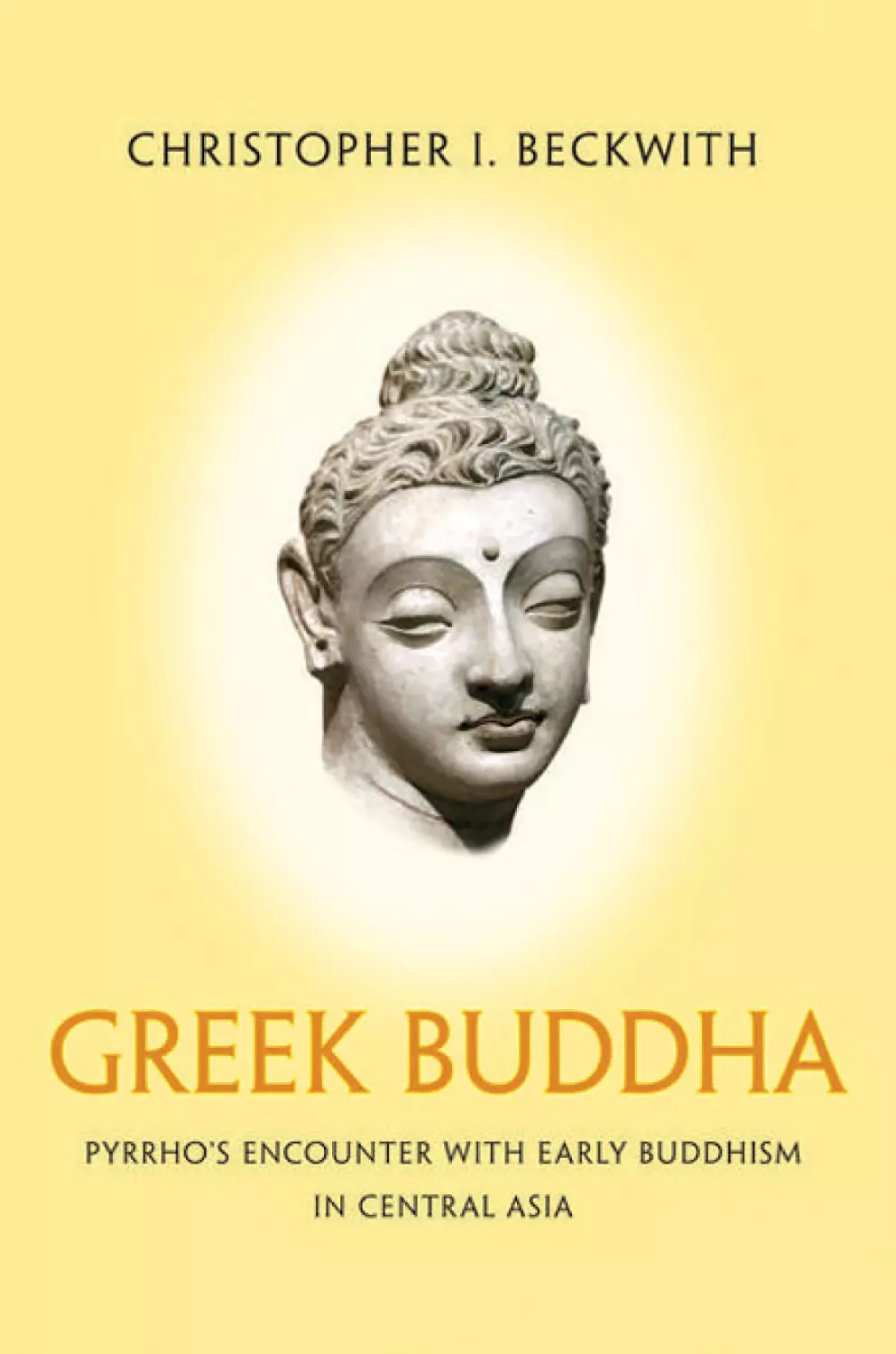


Author: Beckwith C.I.
Tags: religion buddhism spirituality central asia spiritual culture
ISBN: 978-0-691-16644-5
Year: 2015

Text
                    GREEK BUDDHA

GREEK BUDDHA
Pyrrho’s Encounter with Early Buddhism
in Central Asia

CHRISTOPHER I. BECKWITH

Pr i ncet o n U ni v er s i t y Pr es s
Pr i ncet o n and O x for d

Copyright © 2015 by Princeton University Press

Published by Princeton University Press, 41 William Street,
Princeton, New Jersey 08540

In the United Kingdom: Princeton University Press,

6 Oxford Street, Woodstock, Oxfordshire OX20 1TW
press.princeton.edu
All Rights Reserved
Library of Congress Cataloging-in-Publication Data
Beckwith, Christopher I., 1945–

Greek Buddha : Pyrrho’s encounter with early

Buddhism in Central Asia / Christopher I. Beckwith.
pages cm

Includes bibliographical references and index.
ISBN 978-0-691-16644-5 (hardback)

1. Pyrrhon, of Elis. 2. Buddhism—History—To ca. 100 A.D.

3. Buddhism—Influence. 4. Buddhism and philosophy. I. Title.
B613.B43 2015
186'.1—dc23
2014044329

British Library Cataloging-in-Publication Data is available
This book has been composed in Charis
Printed on acid-free paper. ∞
Printed in the United States of America
1 3 5 7 9 10 8 6 4 2

Contents

Preface

vii

Acknowledgements

xv

On Transcription, Transliteration, and Texts

xix

Abbreviations

xxi

Prologue

Scythian Philosophy: Pyrrho, the
Persian Empire, and India

Chapter 1

Pyrrho’s Thought: Beyond Humanity

22

Chapter 2

No Differentiations: The Earliest Attested
Forms of Buddhism

61

Chapter 3

Jade Yoga and Heavenly Dharma: Buddhist
Thought in Classical Age China and India

110

Chapter 4

Greek Enlightenment: What the Buddha,
Pyrrho, and Hume Argue Against

138

Epilogue

Pyrrho’s Teacher: The Buddha and
His Awakening

160

Appendix A

The Classical Testimonies of Pyrrho’s Thought

180

Appendix B

Are Pyrrhonism and Buddhism Both Greek
in Origin?

218

Appendix C

On the Early Indian Inscriptions

226

Endnotes

251

References

257

Index

269

1

Preface

I

n the past few decades a quiet revolution has been under way in the
study of the earliest Buddhism. Its beginnings lay in the discoveries
of John Marshall, the archaeologist who excavated the great ancient
city of eastern Gandhāra, Taxila (near what is now Rawalpindi), and
published his results in 1951. The evidence was incontrovertible: the
Buddhist monastery, the vihāra, with its highly distinctive architectural
plan, appeared there fully formed in the first century ad, and had been
preceded by the ārāma, a crude temporary shelter that was also found
there.1 Marshall openly stated that organized Buddhist monasticism
accompanied the appearance of monasteries then—in the Saka-Kushan
period—and had not existed before that time. This partly corresponded
to the traditional trajectory of the development of Buddhism, but in
delaying the appearance of monasticism for an entire half millennium
after the Buddha, it challenged practically everything else in the traditional account of Early Buddhism. Most scholars paid no attention
whatsoever to this. However, eventually others noticed additional
problems, particularly contradictions in the canonical texts themselves
that challenged many fundamental beliefs about the early development
of the religion. André Bareau, Johannes Bronkhorst, Luis Gómez, Gregory Schopen, and others challenged many of these traditional beliefs in
studies of the canonical texts viewed in the context of other material—
archaeological excavations (of which there were and are precious few),
material in non-Buddhist texts, and so forth. Their discoveries have
overthrown so many of the traditional ideas that, as so often in scholarship, those who follow the traditional view have felt compelled to
fight back. But the new views on Buddhism are themselves not free of
1

See now Beckwith (2014).

v III

•

P R Ef AC E

traditional notions, and these have prevented a comprehensive, principled account of Early Buddhism from developing.
The most important single error made by almost everyone in Buddhist studies is methodological and theoretical in nature. In all scholarly fields, it is absolutely imperative that theories be based on the
data, but in Buddhist studies, as in other fields like it, even dated,
“provenanced” archaeological and historical source material that controverts the traditional view of Early Buddhism has been rejected because it does not agree with that traditional view, and even worse,
because it does not agree with the traditional view of the entire world
of early India, including beliefs about Brahmanism and other sects that
are thought to have existed at that time, again based not on hard data
but on the same late traditional accounts. Some of these beliefs remain
largely or completely unchallenged, notably:
• the belief that Śramaṇas existed before the Buddha, so he became a
Śramaṇa like many other Śramaṇas
• the belief that there were Śramaṇas besides Early Buddhists, including Jains and Ājīvikas, whose sects were as old or older than Buddhism, and the Buddha even knew some of their founders personally
• that, despite the name Śramaṇa, and despite the work of Marshall,
Bareau, and Schopen, the Early Buddhists were “monks” and lived in
“monasteries” with a monastic rule, the vinaya
• that, despite the scholarship of Bronkhorst, the Upanishads and other
Brahmanist texts are very ancient, so old that they precede Buddhism,
so the Buddha was influenced by their ideas
• that the dated Greek eyewitness reports on religious-philosophical
practitioners in late fourth century bc India do not tally with the traditional Indian accounts written a half millennium or more later, so
the Greek reports must be wrong and must be ignored
• perhaps most grievously, the belief that all stone inscriptions in the
early Brahmi script of the Mauryan period were erected by “Aśoka”,
the traditional grandson of the Mauryan Dynasty’s historical founder,
Candragupta, and whatever any of those inscriptions say is therefore evidence about what went on during (or before) the time he is
thought to have lived
• we “know” what problematic terms (such as Sanskrit duḥkha ~ Pali
dukkha) mean, despite the fact that their meaning is actually contested by scholars, the modern and traditional dictionaries do not

PR E fA CE

•

IX

agree on their etymologies or what they “really” mean, and the texts
do not agree either2

These and other stubborn unexamined beliefs have adversely affected the work of even the most insightful scholars of Buddhism. Yet
no contemporaneous or near-contemporaneous hard evidence of any
kind affirms such beliefs. Moreover, it is bad enough that such ideas
have caused so much damage for so long within Indology, but the resulting misinformation has inflicted damage in other fields as well,
including ancient Greek and Chinese philosophy, where the traditional
construct has been used as the basis, once again, for rejecting the hard
data, forcing scholars in those fields to attempt to explain away what
seems to be obvious Indian Buddhist influence. This then helps maintain the traditional fiction of three totally unrelated peoples and traditions as “cultural islands” that had absolutely no contact of any kind
with each other until much later times, as used to be unquestioned
belief as recently as Karl Jaspers’s famous book on the Axial Age,3 and
continues, by and large, among those who follow in his footsteps.
Setting aside the traditional beliefs mentioned above, and much
other folklore, what hard data might be found on the topic at hand?
What sort of picture can we construct based primarily on the hard data
rather than on the traditional views? In the present book I present a
scientific approach, to the extent that I have been able to do so and
have not been mislead by my own unrecognized “views”.
It is important to note that this book is not a comparison of anything.
It is also most definitely not a critique or biobibliographic survey of
earlier research. Such a study would be great to have (and in fact, an
excellent bibliography on Pyrrhonism was published by Richard Bett in
2010), but I have cited only what I thought necessary to cite or what I
was able to find myself, with a strong preference for primary sources.4
Some of these problems are discussed in Chapter Three. See Appendix C for further
details.
3
Jaspers (1949; English translation 1953). I should stress, however, that Jaspers’s
book is nevertheless very insightful and is still worth reading today.
4
I have also paid some attention to recent traditional interpretations of “Early” Buddhism, and have in several instances cited them for Normative Buddhist reflections of
actual Early Buddhist thought.
2

X

•

PRE fACE

I have attempted to solve several major problems in the history of
thought. The most important of these problems involves the source
of Pyrrho’s teachings. I would like to call it philosophy, and I have
sinned—sometimes willfully—by doing so when I talk about Early Pyrrhonism’s more “philosophical” aspects, but in general to call it philosophy in a modern language is to seriously mislabel it. The same would be
true if I called it religion. It was to some extent both, and to some extent
neither, and it was science, too.
I first spent a great deal of time reexamining and rethinking the
Greek testimonies of Pyrrho’s thought, and in 2011 finally published
a long article on the topic in Elenchos (reprinted with minor revisions
in Appendix A). I then looked into the studies which claim—in accord
with statements of ancient authors—that Pyrrho acquired his unusual
way of thought in India. I also read studies that claimed the exact
opposite—that he did not learn anything at all of major importance
for his thought there—and other arguments which essentially claim
that Indian philosophy is basically Greek in origin. That forced me to
investigate Early Buddhism in depth, with the result that I discovered
the above problems, among others, and my study became much longer
and more involved than I had expected.
My research set out to determine whether Indian thought—
particularly Buddhism—had influenced Pyrrho’s thought. It ended up
delving very deeply into the problem of identifying genuine Early Buddhism: the teachings and practices of the Buddha himself, and of his followers for the first century or two after his death. As mentioned above,
in my view all scholarship, regardless of its subject matter, should follow the dictum “theories must accord with the data”, with the corollary
that the earliest hard data must always be ranked higher in value than
other data. In addition, theories and scholarly arguments must be based
on rational, logical thought. These are among the core principles of scientific work in general, and I have done my best to follow them.
One of the anonymous reviewers of the manuscript of this book has
different ideas about how I should have proceeded. He says, “A strong
case could be made that even relatively specific features of the history
of philosophy such as the Problem of the Criterion (relative, that is, to
the general phenomenon of skepticism) could be explained as a generic
motif rather than, so to speak, as a patented idea”. He contends that

PR E fA CE

•

XI

“two figures saying similar, or even identical, things in different parts
of the world is never enough to establish direct influence.”
This is a problematic claim with respect to philosophy and religious
studies. The field of biblical studies is founded on the ability and necessity to do text criticism. It is purely because textual near identity
is recognizable that textual scholars can identify interpolations, university teachers can recognize plagiarization—even cross-linguistic
plagiarization5—and so on. Is it really conceivable that, for example,
the famous statement of Protagoras, “Man is the measure of all things”,
is unrelated to the Greek original, or is not recognizable? The ancient
Greek πάντων χρημάτων μέτρον ἐστὶν ἄνθρωπος has exactly the same
meaning as the modern Chinese translation, 人是萬物的尺度, the modern Russian translation, Человек есть мера всех вещей, and so on. Assuming it is correctly translated, the quotation is famous, easily recognizable, and not liable to be confused with any other, whatever the
language, despite its brevity. But why? It is the highly distinctive content
of the text that makes it easily identifiable. Translation converts the
meaning expressed from one language to another. It does not do it perfectly because with perfect identity no translation occurs—the texts
are identical. The reviewer’s assertion denies the possibility of communication by language even in the same language (not to speak of the
possibility of understanding, say, a German translation of an English
textbook, or vice versa, as students manage to do every day), and the
necessity of intelligibility assumed by the very existence of the field of
linguistic typology.
Aristotle talks about exactly this topic in his Metaphysics. For example, no doubt many ancient Greeks, Indians, and Chinese said, “It’s a
nice day today,” and proceeded to take a walk somewhere to enjoy the
fine weather. Many people everywhere do that, and my wife is liable to
say the same thing to me when it is warm and sunny. So it is easy for
us to imagine that countless Greeks, Indians, and Chinese have said the
same thing. But to paraphrase Aristotle again, we can hardly imagine
that anyone in ancient India or China could then have said, “Let’s walk
to the Odeon in Athens!”
A student in one of my classes recently was guilty of such plagiarization in her paper
and admitted it—“Well, not all of it,” she said to me in her native language.
5

XII

•

P REf A C E

The reviewer instead compares the historical appearance of Pyrrhonism to that of “the widespread phenomenon of world-denying mendicants or for that matter cultural motifs of lycanthropy, unicorns, or
night-walking.” He proposes that “pan-Eurasian social dynamics could
be enough to explain the independent appearance of philosophical theories that deny the attainability of certain knowledge and that reject
all positive doctrine.”6 Yet Pyrrho’s declaration in the Aristocles passage has challenged not only the manuscript reviewer but a century of
scholars, who have not been able to explain it no matter what approach
they have adopted, thus demonstrating both how unique it is and how
difficult it has been for anyone to deal with it. This is only one part of
the actual, complex problem that needs to be discussed and explained.
Another of the reviewers of the manuscript of this book suggests that
I should discuss the controversial issue of the date of the foundation
of Jainism, its relationship to Buddhism, and so on, in greater detail.
I strongly agree that it would be great to have a careful, historically
sound study of this topic, and I have long encouraged other scholars to
undertake one. So far, however, Indologists, including Buddhologists,
have not examined the Jain dating issue carefully and thoroughly from
a historical point of view, and no such comprehensive study yet exists,
though the issue is mentioned by a number of scholars, including Mette
(1995), who though evidently pro-Jain concludes that Buddhism seems
to be in all respects earlier than Jainism. The earliest incontestable hard
evidence for the existence of Jainism is not earlier than the Saka-Kushan
period (first century bc to third century ad), about a half millennium
after the Buddha, as shown by the fact that none of the explicitly identified and datable Jain material listed in Ghosh’s authoritative register
of Indian archaeological sites is earlier than the Saka-Kushan period,
the earliest being caves dated (generously) to ca. 100 bc to ad 200.7
My approach in the book is to base all of my main arguments on hard
This is the view of dogmatic Academic Scepticism, not Pyrrhonism.
Ghosh (1990: 2:446a). A figurine mentioned by B. Lal is called the “earliest Jain figure found so far”, and is dated to “ca.” fourth to third centuries bc (Ghosh 1990: 2:32a),
but this is of course untenable, since there are no known statues of religious figures from
any sect before the Saka-Kushan period. Ghosh’s index lists ten sites with Jain artifacts
(mostly medieval), but by contrast about ninety sites with Buddhist materials, many of
them substantial and dated to the last three centuries bc. for Mathura, which is today an
important Jain site, Ghosh lists no Jain artifacts at all from archaeological work.
6
7

P R EfA CE

•

XIII

data—inscriptions, datable manuscripts, other dated texts, and archaeological reports. I do not allow traditional belief to determine anything
in the book, so I have necessarily left the topic out, other than to mention it briefly in a few places, with relevant citations. Here I quote a
century-old summary that remains the received view:
Jainism bears a striking resemblance to Buddhism in its monastic system, its ethical teachings, its sacred texts, and in the story of its founder.
This closeness of resemblance has led not a few scholars—such as Lassen,
Weber, Wilson, Tiele, Barth—to look upon Jainism as an offshoot of Buddhism and to place its origin some centuries later than the time of Buddha.
But the prevailing view today—that of Bühler, Jacobi, Hopkins, and others—is that Jainism in its origin is independent of Buddhism and, perhaps,
is the more ancient of the two. The many points of similarity between the
two sects are explained by the indebtedness of both to a common source,
namely the teachings and practices of ascetic, monastic Brahminism.

However, he then comments, “The canon of the White-robed Sect
consists of forty-five Agamas, or sacred texts, in the Prakrit tongue.
Jacobi, who has translated some of these texts in the ‘Sacred Books of
the East’, is of the opinion that they cannot be older than 300 b.c.8 According to Jainist tradition, they were preceded by an ancient canon of
fourteen so-called Purvas, which have totally disappeared . . .”.9 With
regard to the idea that any kind of monasticism, least of all Brahmanist
asceticism, could be the “common source”, it may be noted that monasteries per se in India cannot be dated earlier than the first century ad,
when they first appear in Taxila; they were introduced from Central
Asia, where Jainism was and is unknown.10 finally, my discussion here,
and throughout this book, is concerned only with issues of historical accuracy. In my opinion, all great religions have much that is admirable
in them, however old or new they may be.
I would like to emphasize that this book does not belong to any existing view, school, or field, as far as I am aware, so that it does not
subscribe to any tradition walled off from the rest of intellectual life.
This date is far too early. The oldest written texts in any Indian language are the
Major Inscriptions of the Mauryas, which are dated to the first half of the third century
bc and do not mention Jainism; see Chapter Three and Appendix C.
9
Aiken (1910).
10
Beckwith (2014).
8

XIv

•

P R Ef AC E

It therefore has no gatekeepers, clad in the traditional metaphorical
chain-mail armor and bearing the traditional metaphorical halberd,
proclaiming threats to their perceived enemies in archaic languages,
dedicated to keeping new knowledge out and stamping out all possible
threats to those inside its walls so that the residents can safely continue
their traditional beliefs without the necessity of thinking about them.
The book is also inevitably imperfect, though I have tried to make it as
correct as I could, despite the limitations of my own imperfections. So I
hope it is not the “last word” on the many topics it covers, but only the
“first word”. My goal throughout has been exclusively to examine the
evidence as carefully and precisely as possible, and to draw reasonable
conclusions based on it—while of course considering other studies that
shed light on the problems or in some cases argue for a different interpretation. This sounds like a rather un-Pyrrhonian enterprise, but ultimately, and somewhat unexpectedly, it is what Pyrrhonism is all about.

Acknowledgements

A

lthough for me this book represents almost entirely new research
on new ideas, it can also be said to go back to around 1967, when
I was an undergraduate major in Chinese at Ohio State University and
took a general philosophy survey class. The professor, Everett John
Nelson, devoted one lecture to what I remember as “Classical Scepticism”. I liked very much what I heard, and immediately went out and
read the works of Sextus Empiricus in translation. Shortly after I took
that course, I took Professor William Lyell’s class in Chinese philosophy, and wrote a term paper for it in which I compared the ideas of
Laotzu in the Tao Te Ching to the ideas of Sextus Empiricus. It never
occurred to me then that the similarities I perceived had a foundation
in anything historical—partly because at the time I had a strong dislike
for history in the usual sense. My two minor interests in Pyrrhonism
and Early Taoism remained just that for the following decades, until by
chance synergy happened and I found myself working on elements of
both for one or another research project, and ended up, to my surprise,
confirming the underlying perception in my long-ago undergraduate
term paper.
At that point I had the opportunity to spend over a year in 2011–
2012 as a visiting research fellow in the Käte Hamburger Kolleg “History of Religions between Europe and Asia”, at the Ruhr University in
Bochum, Germany. There I was faced with a challenging, high-level
research program involving regular colloquia, research group meetings, and, especially, workshops and conferences. After being quickly
drafted to give papers in half a dozen workshops, I realized that I would
not be able to write my planned book there unless my papers were on
topics related to the book. When, half a year later, that decision finally
began taking hold, I found myself investigating the problems of my
topic in unexpected ways, mostly because of the need to accommodate

Xv I

•

ACKNO WL E DG E ME N T S

myself to the particular theoretical approach of the given workshop or
conference in which I was to present my paper. It was not easy for me
to reorient myself in this way, but somehow I eventually managed, at
least in part, so that to a certain extent I looked at the sources with new
eyes and thought about them with a new mind. This turned out to be
extremely fruitful, as it led me to discover things that I had never noticed before, and that nobody else had noticed either, as far as I know.
It is partly for this reason that, I hope, this book makes a contribution
to the solution of some major problems in philosophy, religious studies, and intellectual history in general.
I must therefore first thank Professor Everett John Nelson and Professor William Lyell for trying to teach me philosophy many decades
ago when I was an undergraduate student at Ohio State, and for eventually succeeding—to my own amazement—in stimulating a genuine
interest in the subject, as well as Professor Helmut Hoffmann, my doctoral advisor, who taught me much about Buddhism and scholarship
in general.
I especially thank my friend and colleague Michael L. Walter, with
whom I have had countless amiable and enlightening discussions about
the history of Buddhism, including many points covered in this book.
Without his kindness, assistance, and critical mind I would never have
begun it.
I am also deeply indebted to Cynthia King for her very helpful comments on things Greek from beginning to end of this project, as well
as for reading and offering numerous corrections and suggestions on
an early draft of the manuscript; to Georgios Halkias for his unwavering support and also for his insightful comments on and corrections to
the manuscript;1 to Gregory Schopen for reading the manuscript and
Regarding this book’s main title, Greek Buddha, my colleague Georgios Halkias
kindly informs me (shortly before I sent the manuscript to the press) that “the same title
was used by Nikos Dimou, O Ellina Boudas, Athens: Nefeli Press, 1984. It is a study on
Pyrrho and the influences of Hellenism on Buddhism.” He also notes that the term appears to have been coined “by f. Nietzsche somewhere in his writings, again in reference
to Pyrrho.” A quick Internet search reveals that the term also has been used to refer to
Heraclitus, and for many other purposes. I hope my own usage does not mislead anyone
into thinking that it has anything to do with earlier usages. The title Greek Buddha occurred to me several years ago without my having the slightest knowledge of the fact that
it had previously been used by anyone else in any language.
1

A C KN O W L E D G E M E N T S

•

X vI I

offering helpful comments; and to the three anonymous reviewers of
the manuscript, whose observations led me to clarify many things.
I am also grateful for the above-noted fellowship awarded to me by
the Käte Hamburger Kolleg at the Ruhr-Universität Bochum, where I
wrote the first actual rough draft manuscript. for doing their very best
to make my stay in Bochum enjoyable and productive, and for their
input with respect to various parts of the book when they were still
research papers, I am much indebted to volkhard Krech, director of
the Käte Hamburger Kolleg; Nikolas Jaspert, director of the research
group to which I belonged within the Kolleg; Roman Höritsch and the
other staff members; and among the other members of the Kolleg at that
time, especially Anna Akasoy, Sven Bretfeld, Alexandra Cuffel, Licia Di
Giacinto, Adam Knobler, Hans Martin Krämer, Carmen Meinert, Zara
Pogossian, Jessie Pons, Peter Wick, Michael Willis, and Sven Wortmann.
In addition, I would like to thank Stefan Baums, Joel Brereton,
Johannes Bronkhorst, E. Bruce Brooks, Michael Butcher, Jamsheed
Choksy, Baohai Dang, Max Deeg, Michael Dunn, Andrew Glass, Luis
Gómez, Kyle Grothoff, Jens-Uwe Hartmann, Anya King, Boram Lee,
Natalia Murataeva, Richard Nance, Jan Nattier, Patrick Olivelle, Andrew Shimunek, Raphael Squiley, and all others who answered questions, commented on this book or parts of it in their various incarnations, or argued points with me.
for his unwavering enthusiasm and support for this book from
its very inception, I am deeply grateful to Rob Tempio, my editor at
Princeton University Press. I would also like to thank everyone else
involved in the production of this book.
As always I thank my wife, Inna, for encouraging me to begin,
continue, and finish the book, and for helping me in countless ways
throughout. I could not have done it without her.
Despite all of the valuable help of different kinds from family, friends,
and colleagues, I have sometimes ignored their advice for one reason or
another, or in some cases I might have misunderstood it, but in any case
I am, as always, responsible for any errors that might remain.
I never imagined that I would write a book on Greek philosophy,
even marginally—or on any kind of philosophy or religion—despite
my admiration for ancient Greek thought in general. I have no idea
how my son became interested in ancient Greek astronomy, which he

Xv III

•

ACKN OWL E DG E ME N T S

took up in the early years of elementary school when he was no more
than seven or eight years old and lugged the library’s huge copy of the
translation of Ptolemy’s Almagest there to read during recess. But I like
to think that there is a connection between us in our interest in things
Greek, and I hope that he will have the chance to follow it up again
some day. I dedicate this book, with all my love, to Didi my son, Lee
Beckwith.

On Transcription, Transliteration, and Texts

Chinese
I follow the traditional modified Wade-Giles system used by many
scholars—for example, Tao Te Ching, Chuang Chou—except for proper
names or derived words that have established traditional Anglicized
forms, such as Confucius, Laotzu, Taoism, Peking, and so on. Only
when citing Mandarin pronunciation per se do I use the Pinyin system
with tone marks. Unfortunately, there are no true critical editions of any
Chinese texts. I have done the best I could with what there is.

Greek
I follow convention as much as possible. I use the traditional transliteration system, with y rather than u for Greek υ upsilon except in the
digraph ου, which is transliterated as ou, though transcribed as u in
Latinized Greek. In general I have attempted to preserve recognizability
for words that have been borrowed into English, such as mythos (rather
than muthos) ‘word, story, fiction, myth’. for texts, in the most important cases I have consulted several editions, particularly the critical edition of Eusebius by Mras, the edition of fragments of Early Pyrrhonism
by Decleva Caizzi, and the recent critical edition of Strabo by Radt. for
other Greek works I have usually relied on the Loeb Library series.

Indic
I generally follow traditional Indological practice in converting the
often divergent Prakrit dialect spellings to Sanskrit, though Pali text
titles are cited in Pali, and other Prakrit forms verbatim. The respective

XX

•

TRANSC RIPT ION , T RA N SL I T E RA T ION , T E X T S

standard transcription systems are followed, except in transcription
of forms from early inscriptions. When Indic words, including proper
names, have become loanwords in English, even if only in Buddhological publications, I have normally adopted the usual spellings sans
diacritics, italicization, or recognition of morphophonological variations in the original, for example the words dharma, karma, Madhyamika, Mahayana, samsara. I have converted all variant transcriptions
of anusvāra to ṃ without comment except in proper names in which
ṅ has become customary (e.g., Kaliṅga). for texts of the early Indian
inscriptions, I have mainly relied on my own reading of the rubbings
and photographs that are clear enough for me to read.

Abbreviations

Bax.:

Baxter 1992.

CTP:

Chinese Text Project, http://ctext.org/.

D.L.:

Diogenes Laertius, ed. Hicks (Loeb) 1925, or via Perseus.

Enquiry:

Hume 1758.

Herodotus:

Herodotus, ed. Godley (Loeb) 1926, or via Perseus.

LSJ:

Liddell, Scott, Jones, Greek-English Lexicon 1968, or via
Perseus.

MChi:

Middle Chinese.

MSC:

Modern Standard Chinese (Mandarin).

OChi:

Old Chinese.

Perseus:

Perseus Digital Library, http://www.perseus.tufts.edu
/hopper/.

Praep. evang.: Eusebius, Praeparatio Evangelica, ed. Mras 1983.
Pul.:

Pulleyblank 1991.

Strabo:

Geography, ed. Radt 2002–2011, or via Perseus.

TLG:

Thesaurus Linguae Graecae, http://www.tlg.uci.edu/.

GREEK BUDDHA

Prologue

Scythian Philosophy
PYRRHO, THE PERSIAN EMPIRE, AND INDIA

I

n the eighth century bc, Scythian warriors pursuing the Cimmerians
rode south out of the steppes into the Near East in the area of northern Iran. They defeated the Cimmerians in the 630s and in the process
conquered the powerful nation of the Medes, their Iranic ethnolinguistic relatives. As allies of the Assyrians, the Scythians fought across the
Levant as far as Egypt. When they were defeated by the Medes in about
585 bc, they withdrew to the north and established themselves in the
North Caucasus Steppe and the Pontic Steppe north of the Black Sea.
They and their relatives built a huge empire stretching across Central
Eurasia as far as China, including most of urbanized Central Asia, and
grew fabulously rich on trade.1
The Scythians and other North Iranic speakers thus dominated Central Eurasia at the same time that their southern relatives, the Medes
and Persians, formed a vast empire based in the area of what is now
western Iran and Iraq. Though the Scythians were increasingly fragmented, and were probably weakened by the Persian capture of the
prosperous and populous Central Asian countries of Bactria, Sogdiana,
and others, they and other North Iranic–speaking relatives—including
Beckwith (2009: 61–62). The present chapter is an essay mainly intended to present some of the background and basic themes of this book. for citations, texts, and
detailed discussion of most arguments presented, please see the numbered chapters and
the appendixes.
1

2

•

P R OLOG U E

their eastern branch, the Sakas—continued to rule much of Central
Eurasia for many centuries.2
To their south the prophet Zoroaster “reformed” the traditional religion of Media, Mazdaism, evidently around the time of Cyrus the
Great, who was half Mede and half Persian. Although the Scythians
never adopted Zoroastrianism, they too were interested in religion and
philosophy. We know of not one but two great Scythian philosophers,
and both still have much to teach us.

Anacharsis the Scythian
Anacharsis was the brother of Caduida, king of the Scythians. He spoke
Greek because his mother was a Greek.3 In about the forty-seventh
Olympiad (592–589 bc), the age of Solon, he travelled to Greece and
became well known for his astute, pithy remarks and wise sayings. Of
the very brief quotations that are thought to go back to Anacharsis
himself, many consist of observations on the opposite character of this
or that cultural element among the Greeks as contrasted with the same
element among the Scythians. for example, “He said he wondered why
among the Greeks the experts contend, but the non-experts decide.”4
The Greeks regularly quoted this and other pithy sayings of Anacharsis, which taken together are unlike those of any other known figure,
Greek or foreign, in ancient Greek literature. Though he was considered to be a Scythian, the Greeks liked him, and he was counted as one
of the Seven Sages of Antiquity in Greek philosophy. His own literary
2
On the names of the Scythian peoples, see Szemerényi (1980); cf. Beckwith (2009:
377–380), where it is shown that the name Saka is an eastern Scythian dialect form of
the same word that gave us the name “Scythian”.
3
Diogenes Laertius i, 8.103 (Hicks 1925: 1:106–107). Alekseyev (2005: 40) says he
was the brother of Saulius, son of Gnurus.
4
Diogenes Laertius i, 8.103 (Hicks 1925: 1:106–107): “θαυμάζειν δὲ ἔφη πῶς παρὰ
τοῖς Ἕλλησιν ἀγωνίζονται μὲν οἱ τεχνῖται, κρίνουσι δὲ οἱ μὴ τεχνῖται.” There are several
versions of this saying. Kindstrand (1981: 119, 150–151) prefers a political context,
based on Plutarch’s version, but a generic comment seems most likely in view of the
usual presentation of Anacharsis in the earliest sayings attributed to him. This particular
saying is also directly comparable to the following quotation on the Criterion attributed
to him by Sextus Empiricus (cf. Kindstrand 1981: 49), which seems quite likely to have
been modeled on this evidently genuine short saying. See now Griffith (2013) on judging between contending experts in Aristophanes’ Frogs and in ancient Greek culture in
general.

S C Y T H I A N P HI L O S O P H Y

•

3

works are lost, but his fame was such that other writers used him as a
stock character in their own compositions.5i
Sextus Empiricus, in his Against the Logicians, quotes an otherwise unknown work attributed to Anacharsis, on the Problem of the Criterion:
Who judges something skillfully? Is it the ordinary person or the skilled
person? We would not say it is the ordinary person. for he is defective
in his knowledge of the peculiarities of skills. The blind person does not
grasp the workings of sight, nor the deaf person those of hearing. And
so, too, the unskilled person does not have a sharp eye when it comes
to the apprehension of what has been achieved through skill, since if we
actually back this person in his judgment on some matter of skill, there
will be no difference between skill and lack of skill, which is absurd. So
the ordinary person is not a judge of the peculiarities of skills. It remains,
then, to say that it is the skilled person—which is again unbelievable.
for one judges either a person with the same pursuits as oneself, or a
person with different pursuits. But one is not capable of judging someone
with different pursuits; for one is familiar with one’s own skill, but as far
as someone else’s skill is concerned one’s status is that of an ordinary
person. Yet neither one can certify a person with the same pursuits as
oneself. for this was the very issue we were examining: who is to be the
judge of these people, who are of identical ability as regards the same
skill. Besides, if one person judges the other, the same thing will become
both judging and judged, trustworthy and untrustworthy. for in so far as
the other person has the same pursuits as the one being judged, he will
be untrustworthy since he too is being judged, while in so far as he is
judging he will be trustworthy. But it is not possible for the same thing
to be both judging and judged, trustworthy and untrustworthy; therefore there is no one who judges skillfully. for this reason there is not
a criterion either. for some criteria are skilled and some are ordinary;
but neither do the ordinary ones judge (just as the ordinary person does
not), nor do the skilled ones (just as the skilled person does not), for the
reasons stated earlier. Therefore nothing is a criterion.6

On the origin and fate of Anacharsis, see Endnote i.
Sextus Empiricus, Adversus mathematicos vii, 1, 55–59, translation by Bett (2005:
13–14), courtesy Cambridge University Press, section numbers omitted. for explanation
of the traditional mistaken title (Adversus mathematicos) of this and other works by Sextus, see Bett (2005: x-xii). The passage begins with the comment by Sextus, “Anacharsis
the Scythian, they say, does away with the apprehension that is capable of judging every
skill, and strenuously criticizes the Greeks for holding on to it.”
5
6

4

•

P R OLOG U E

The focus of the text is the Problem of the Criterion, which is acknowledged not to have existed in Greek philosophy before the time of
Pyrrho,7 so it is clear that it cannot be an authentic work of Anacharsis,
as scholars have already determined on other grounds.8 Nevertheless, it
is modeled directly on the above brief, genuine quotation of Anacharsis
himself on the same topic—the problem of judging or deciding—and
other genuine quotations similar in nature.
The argument is also strikingly close to the second part of the argument about the Problem of the Criterion in the Chuangtzu. Exactly as
in the genuine saying of Anacharsis and in the argument attributed to
him by Sextus Empiricus, the Chinese argument specifically concerns
the ability to decide which of two contending individuals is right:
If you defeat me, I do not defeat you, are you then right, and I am not? If
I defeat you, you do not defeat me, am I then right, you are not? Is one
of us right, one of us wrong? Or are both of us right, both of us wrong? If
you and I cannot figure it out, then everyone will be mystified by it. Who
shall we get to decide who is right? We could get someone who agrees
with you to decide who is right, but since he agrees with you, how could
he decide it aright? We could get someone who agrees with me to decide
who is right, but since he agrees with me, how can he decide it aright?
Therefore, neither I nor you nor anyone else can figure it out.9

The first part of the argument is structured as a tetralemma.10
See Chapter One and Appendix A.
Kindstrand (1981).
9
既使我與若辯矣,若勝我,我不若勝,若果是也? 我果非也邪? 我勝若,若不吾勝,
我果是也?而果非也邪?其或是也,其或非也邪?其俱是也,其俱非也邪? 我與若不能相
知也,則人固受其黮闇。吾誰使正之? 使同乎若者正之,既與若同矣,惡能正之!使同乎
我者正之,既同乎我矣,惡能正之!使異乎我與若者正之,既異乎我與若矣,惡能正之!
使同乎我與若者正之,既同乎我與若矣,惡能正之!然則我與若與人俱不能相知也,而待
彼也邪? (Chuangtzu 2; text from CTP). The introductory remark, 既使我與若辯矣 “Since
(someone) has made me argue with you,” undoubtedly refers to Confucius; the last remark, 而待彼也邪 “So we’re waiting for him?”, is also probably a sarcastic reference to
Confucius, who is criticized mercilessly in the immediately preceding passage. These
remarks are outside the argument itself. Cf. the translations by Graham (1981: 60) and
Watson (1968: 48). I am indebted to Boram Lee and E. Bruce Brooks for a helpful discussion of this passage on the Warring States Workshop online forum.
10
On the tetralemma, see Chapter One and Appendix A. This one is a rather complex
example, and is followed by a short conclusion: “If you and I cannot figure it out, then
everyone will be mystified by it.”
7
8

S C Y T H I A N P HI L O S O P H Y

•

5

The explanation for the similarity of these two passages could well
be that the author of the “Anacharsis” quotation given by Sextus Empiricus had heard just such an argument, directly or indirectly, from a
Scythian. This would have been a simple matter during the Classical
Age because many Scythians then lived in Athens, where a number of
them even served as the city’s police force. If it was a stock Scythian
story, an eastern Scythian—a Saka—could have transmitted a version
of it to the Chinese, so that it ended up in the Chuangtzu, which is full
of stories and arguments of a similar character.
Whatever the explanation, the explicit Greek connection of this
story with a Scythian philosopher known for pithy sayings having a
clever argument structure clearly indicates that it is the kind of thing
Scythians were expected to say. In view of the Chinese testimony,
it seems likely that it was something that some Scythians actually
did say.

Gautama Buddha, the Scythian Sage
The dates of Gautama Buddha are not recorded in any reliable historical
source, and the traditional dates are calculated on unbelievable lineages
including round numbers such as one hundred, so they are not reliable either, as noted already by fleet, Hultzsch, and many others.11 His
personal name, Gautama, is evidently earliest recorded in the Chuangtzu, a Chinese work from the late fourth to third centuries bc.12 His
epithet Śākamuni (later Sanskritized as Śākyamuni), ‘Sage of the Scythians (“Sakas”)’, is unattested in the genuine Mauryan inscriptions13 or
the Pali Canon.14 It is earliest attested, as Śakamuni, in the Gāndhārī
Prakrit texts, which date to the first centuries ad (or possibly even the
fleet, in JRAS 1909: 333, 335, cited in Hultzsch (1925: xxxiii). Scholars’ continued
insistence on following such dates anyway led to a 1988 conference devoted specifically
to reconsideration of the dates of the Buddha, which however largely continued to take
the fanciful, ahistorical, traditional accounts as if they were actual historical accounts,
with the significant exceptions of the papers by Härtel (1995) and Bareau (1995).
12
See Chapter Three.
13
See Chapter Two and Appendix C.
11

However, it has been demonstrated that the caretakers of the Pali tradition systematically expunged references to various ideas and practices to which they objected,
especially things thought to be non-Indian (Sven Bretfeld, p.c., 2012).
14

6

•

P R OLOG U E

late first century bc).15 It is thus arguable that the epithet could have
been applied to the Buddha during the Śāka (Saka or “Indo-Scythian”)
Dynasty—which dominated northwestern India on and off from approximately the first century bc, continuing into the early centuries ad as
satraps or “vassals” under the Kushans—and that the reason for it was
strong support for Buddhism by the Sakas, Indo-Parthians, and Kushans.
However, it must be noted that the Buddha is the only Indian holy
man before early modern times who bears an epithet explicitly identifying him as a non-Indian, a foreigner. It would have been unthinkably odd
for an Indian saint to be given a foreign epithet if he was not actually a
foreigner. Moreover, the Scythians-Sakas are well attested in Greek and
Persian historical sources before even the traditional “high” date of the
Buddha, so the epithet should presumably have been applied to him already in Central Asia proper or its eastern extension into India—eastern
Gandhāra. There are also very strong arguments—including basic “doctrinal” ones—indicating that Buddhism had fundamental foreign connections from the very beginning, as shown below. It is at any rate certain
that Buddha has been identified as Śākamuni ~ Śākyamuni “Sage of the
Scythians” in all varieties of Buddhism from the beginning of the recorded
Buddhist tradition to the present, and that much of what is thought to be
known about him can be identified specifically with things Scythian.16
Moreover, it must not be overlooked that we have no concrete datable evidence that any other wandering ascetics preceded the Buddha.
The Scythians were nomads (from Greek νομάδες ‘wanderers in search
of pasture, pastoralists’) who lived in the wilderness, and it is thus quite
likely that Gautama himself introduced wandering asceticism to India,
just as the Scythians had earlier invented mounted steppe nomadism.17
Baums and Glass (2010), a work in progress, when checked in July 2013, included
three occurrences, each in a different manuscript. It also occurs in Sanskrit in much later
texts from Gandhāra, as well as once, in a fifth-century ad Bactrian Buddhist text, as σαοκομανο saokomano, without the characteristic -y- of the Sanskritized form of the name
(Sims-Williams 2010: 73).
16
Walter (2012). The tradition by which Buddha was from a local Nepalese Śākya
“clan” in the area of Lumbini is full of chronological and other insuperable problems, as
shown by Bareau (1987); it is a very late development.
17
Beckwith (2009: 58ff.). Considering the mostly Anatolian origins of Greek philosophy, and the long domination of that region by the Medes and Persians, it must be wondered if the peripatetic tradition in Greek philosophy also reflects the Iranic penchant
for wandering.
15

S C Y T H I A N P HI L O S O P H Y

•

7

One way or the other, it would seem that the Buddha’s teachings were
unprecedented mainly because they opposed new foreign ideas—the
Early Zoroastrian ideas of good and bad karma, rebirth in Heaven (for
those who were good), absolute Truth versus the Lie, and so on—which
were previously unknown in “India proper”. He did this because he
himself was foreign, and people actually understood and accepted that
by calling him Śākamuni.
Buddha therefore must have lived after the introduction of Zoroastrianism in 519/518 bc, when the Achaemenid ruler Darius I invaded
and conquered several Central Asian countries and then continued to
the east, where he conquered Gandhāra and Sindh, which were Indicspeaking, in about 517/516 bc.18 In the process of firming up his rule
over the new territories, he stationed subordinate feudal lords, or satraps, over them, and some of the army was garrisoned there. Darius
had come from conquering much of Central Asia proper, including
Bactria and Arachosia, as well as the Sakā Tigraxaudā ‘the Scythians
wearing pointed hats’, a nation of Scythians whose king, Skunkha, he
captured19 and is portrayed in a captioned relief accompanying the
Behistun Inscription. from then on Scythians formed the backbone of
the imperial forces together with the Medes and Persians,20 so some of
the soldiers in the Indian campaign must have been Scythians, that is,
Śākas. Herodotus details the dress and equipment of the Central Asian
and Indian troops, who are listed by nation including, among others,
Bactrians, Sakas (“that is, Scythians”), Indians (Indoi), Arians (more
correctly Hareians,21 neighbors of the Bactrians), Parthians, Khwarizmians, Sogdians, and Gandhārans.22
Gandhāra became an important part of the empire. It is regularly
included in the lists of provinces from the beginning of Darius’s reign
on to the end of the empire along with Bactria, Arachosia, the Sakas,
Shahbazi (1994). Although the exact date of his invasion of Gandhāra and Sindh
is unknown, it probably happened shortly after his Central Asian campaign, so around
517 (Briant 1996: 153). In any case, there is no doubt about the conquest of the region
during the early part of his reign (Kuhrt 2007: 182, 188–189). See also the extensive
complementary treatment in the Epilogue of the present book.
19
Kuhrt (2007: 157n122, 150, figure 5.3).
20
Briant (1996: 50).
21
Herat, in modern northwestern Afghanistan, preserves the ancestral name of the
region, Old Persian Haraiva.
22
Herodotus vii, 64.1 to vii, 66.1.
18

8

•

P R OLOG U E

and other neighboring realms.23 There was a Persian satrap in Taxila,
and official travellers went frequently between the Persian capital and
one or another provincial locality in India,24 as attested by accounts
preserved in the Persepolis fortification Tablets, which detail the payments in kind to the travellers.25 Moreover, “the Indians”, one of the
twenty financial districts of the Persian Empire recorded by Herodotus,
paid by far the greatest sum in “tribute”.26 The Achaemenid influence
in Gandhāra was strong and long-lasting.27
The conquest by Darius introduced the Persians’ new religion, reformed Mazdaism, or Early Zoroastrianism,28 a strongly monotheistic
faith with a creator God, Ahura Mazda, and with ideas of absolute
Truth (Avestan aša, Old Persian arta) versus ‘the Lie’ (druj), and of an
accumulation of Good and Bad deeds—that is, “karma”—which determined whether a person would be rewarded by “rebirth” in Heaven.
These ideas are all found in the Gāthās, the oldest part of the Avesta,
which are attributed to Zoroaster himself, and all are expressed openly
and repeatedly in the Old Persian royal inscriptions as well. Essentially
the same ideas occur in the Major Inscriptions of the Mauryas in the
third century bc in India.29 The traditional view30 is that the Buddha
reinterpreted existing Indian ideas found in the Upanishads, but the
Upanishads in question cannot be dated to a period earlier than the
Buddha, as shown by Bronkhorst31 and discussed below. Just as Early
Buddhism cannot be expected to be similar to the Normative Buddhism
of a half millennium or more later, so Early Brahmanism cannot be
Briant (1996: 50).
Briant (1996: 777, 370).
25
Meadows (2005: 186).
26
Meadows (2005: 183).
27
Briant (1996: 778).
28
I call it “Early Zoroastrianism” because it did not exist for very long in its pristine
state, but also because it was very different from fully developed Late Zoroastrianism
(one could call it “Normative Zoroastrianism”, following the terminology developed in
this book for Buddhism). Soudavar (2010: 119), emphasis added, remarks, “Zoroastrianism as we now know [it], with its complicated rituals and canonical laws, had not enough
time to develop between the lifetime of its prophet and the advent of Darius in the year
522 bc.”
29
See Chapters Two and Three.
30
E.g., Gombrich (1996: 51).
31
Bronkhorst (1986).
23
24

S C Y T H I A N P HI L O S O P H Y

•

9

expected to be similar to Late Brahmanism (not to speak of Hinduism),
attested even later. “Zoroaster was . . . the first to teach the doctrines
of . . . Heaven and Hell, the future resurrection of the body . . . , and life
everlasting for the reunited soul and body”,32 and Early Zoroastrianism
was the faith of the ruling nation of the Persian Empire. Both Early
Buddhism and Early Brahmanism are the direct outcome of the introduction of Zoroastrianism into eastern Gandhāra by Darius I. Early
Buddhism resulted from the Buddha’s rejection of the basic principles
of Early Zoroastrianism, while Early Brahmanism represents the acceptance of those principles. Over time, Buddhism would accept more and
more of the rejected principles.
Darius also sponsored the creation of a completely new writing
system—Old Persian cuneiform script, which is partly modeled on
Aramaic script, one of the main administrative scripts of the Persian
Empire—and the practice of erecting monumental inscriptions.33 In the
great Behistun Inscription at the top of Mount Bagastana,34 Darius I
repeats over and over how he achieved what he did because the early
Achaemenids’ monotheistic God of Heaven, Ahura Mazda ‘Lord Wisdom’, helped him. He insists that what he did was True, it was not a
Lie, and repeatedly says that those who opposed him “lied”. Druj ‘the
Lie’ made them rebel and deceive the people, they were “lie-followers”,
and so on. The obsessive repetition of this litany throughout the inscriptions is striking. Anyone familiar with these basic Zoroastrian concepts could hardly contend that Darius was not an Early Zoroastrian.
He could not have been anything else.
While, not surprisingly, the ordinary generic human contrast between truth and falsehood is found in the vedas, the specifically Early
Zoroastrian form of the ideas, including the result of following one
or the other path, is completely alien to them. In the early vedic religion, ritually correct performance of blood sacrifices was believed
Boyce (1979: 29).
In addition, he built imperial roads with rest houses provisioned for travellers.
These three actions were prominently imitated by the early rulers of the Mauryan Empire in India, the northwestern part of which had been part of the Persian Empire until
Alexander’s conquest.
34
This is the ancient name, which means ‘place of gods’ (Razmjou 2005: 153) or ‘the
place of God’.
32
33

10

•

PR OLOG U E

to be rewarded in this life, but the reward had nothing to do with
one’s virtuous actions or one’s future in the afterlife. These ideas thus
seem to have been introduced by the Achaemenid Persians into eastern
Gandhāra and Sindh, the western limits of the ancient Indic world and
southeastern limits of the Central Asian world, just as they were introduced into Near Eastern parts of the vast Persian Empire. In fact, Early
Zoroastrianism is attested in Achaemenid Central Asia and India in the
earliest Persian imperial written documents from the region.35ii
These specific “absolutist” or “perfectionist” ideas are firmly rejected
by the Buddha in his earliest attested teachings, as shown in Chapter One. In short, the Buddha reacted primarily (if at all) not against
Brahmanism,36 but against Early Zoroastrianism. At the lower end of the
chronological scale, the Buddha must have lived before the visit of the
two best known and attested Greek visitors of the late fourth century,
Pyrrho of Elis, who was in Bactria, Gandhāra, and Sindh from 330 to
325 bc with Alexander the Great and learned an early form of Buddhism there, and two decades later the ambassador Megasthenes, who
travelled from Alexandria in Arachosia (now Kandahar) to Gandhāra
and Magadha in 305–304 bc and recorded his observations on Indian
beliefs, including Early Buddhism and Early Brahmanism, in his Indica.37
The word bodhi ‘enlightenment’, literally ‘awakening’, is first attested in the Eighth Rock Edict of the Mauryan ruler Devānāṃpriya
Priyadarśi (fl. 272–261 bc), who says that in the tenth year after his
coronation he went to Saṃbodhi—now known as Bodhgayā (located
about fifty miles south of Patna, ancient Pāṭaliputra)—where according to tradition the Buddha achieved enlightenment under the Bodhi
Tree. The ruler says that after this visit he began to preach the Dharma
Benveniste et al. (1958: 4), based on two inscriptions in Aramaic. Cf. Bronkhorst
(2007: 358), who remarks, “In the middle of the third century bc, it was Mazdaism,
rather than Brahmanism, which predominated in the region between Kandahar and Taxila”. for Bronkhorst’s views on Brahmanism and early Magadha, see Endnote ii.
36
Cf. Bronkhorst (1986; 2011: 1–4), q.v. the preceding note. from his discussion it is
clear that even the earliest attested Brahmanist texts reflect the influence of Buddhism,
so it would seem that the acceptance of Early Zoroastrian ideas in Gandhāra happened
later than the Buddhist rejection of them, but before the Alexander historians and Megasthenes got there in the late fourth century bc.
37
See Chapter Two for a detailed study of the relevant fragments of his book preserved in Strabo’s Geography.
35

S C YT HI A N P H I L O S O P H Y

•

11

around his empire.38 The inscription thus can only refer to the ruler’s
acceptance of a form of the Early Buddhist Dharma—not the more familiar Normative Buddhism, which is attested several centuries later.
The inscription also establishes that reverence for the Buddha existed
by this time at Bodhgayā, in Magadha.39
The dates of Darius’s conquest of Gandhāra and Sindh (ca. 517 bc),
and the late fourth century—marked by the visit of Alexander (330–325
bc) along with his courtier Pyrrho, followed by Megasthenes two decades later—are the chronological limits bracketing the enlightenmentto-death career of Gautama Buddha. It is possible to further narrow this
down to some extent.
The shock of the introduction of new, alien religious ideas in the traditionally non-Persian, non-Zoroastrian environment of Central Asia,
eastern Gandhāra, and Sindh must have happened fairly soon after
Darius’s conquest and the establishment of his satrapies, when the satraps were undoubtedly still ethnically Persian and strongly Zoroastrian, and would have needed the ministrations of their priests. That
would place the most likely time for the Buddha’s period of asceticism
and enlightenment within the first fifty years or so of Persian rule,
meaning ca. 515 to ca. 465 bc, and his death after another forty years
or so—following the dubious tradition that he lived eighty years40—
making the latest date for his death ca. 425 bc. This chronology would
also leave enough time for Early Buddhism to spread from Magadha
(the region where Saṃbodhi, or Bodhgayā, is located)—assuming it
was first preached there by the Buddha—northwestward into western
Gandhāra, Bactria, and beyond, and (as shown in Chapter Three), for
his name Gautama and some of his ideas and practices to travel all the
way to China and become popular no later than the Guodian tomb’s
end date (terminus ante quem) of 278 bc. Among the things that the
scenario presented here explains are the striking alienness of Buddhism

Kalsi viii, 22–23 (Hultzsch 1925: 36–37). Cf. Chapter Three.
This makes it likely that the comment in Megasthenes’ account about the Śramaṇas
interceding between the kings and ‘the divine one’ also refers to reverence for the Buddha. See Chapter Two.
40
His traditional life span is undoubtedly fictitious, as 8, 80, 108, etc. are holy numbers in later, Normative Buddhism.
38
39

12

•

PR OLOG U E

in India proper,41 its earliness in Gandhāra and Bactria,42 and the difficulty of showing that the Buddha was originally from Magadha.
This brings up the problem of the Buddha’s birthplace. Not only are
his dates only very generally definable, his specific homeland is unknown as well. Despite widespread popular belief in the story that he
came from Lumbini in what is now Nepal, all of the evidence is very
late and highly suspect from beginning to end. Bareau has carefully
analyzed the Lumbini birth story and shown it to be a late fabrication.43
There are reasons to put the Buddha’s teaching period—most of his life,
according to the traditional accounts—somewhere in northern India, in
a region affected by the monsoons. In particular, the eventual development of the primitive ārāma, the temporary seasonal shelter of the Buddha’s lifetime, into the saṃghārāma (an ārāma specifically for Buddhist
monks)44—the received historical trajectory, based on tradition, the
“early” sutras, and archaeological data45—actually requires an original
location in the monsoon zone. That is to say, if ārāmas were necessary,
Independently mentioned to me by Michael L. Walter (p.c., 2010) and Michael
Willis (p.c., 2012).
42
This is one of several problems with Bronkhorst’s “Magadha” theory of the origin
of Buddhism. Though he points out that Gandhāra is one of the earliest regions in which
Buddhism is attested (Bronkhorst 2011: 20–21), it is actually attested there far earlier
than anywhere else; cf. above.
43
Bareau (1987). The lone piece of evidence impelling scholars to accept the Lumbini story has been the Lumbini Inscription, which most scholars believe was erected
by Aśoka. However, the inscription itself actually reveals that it is not by Aśoka, and
all indications are that it is a late forgery, possibly even a modern one. See Appendix C.
44
This is the traditional understanding. Later, in the Kushan period, the fully developed monastery (eventually called the vihāra) was introduced from Central Asia, as
known from the excavations at Taxila (Marshall 1951). The idea of the “monastery” must
have developed slowly within Buddhism—no other religious or philosophical system
anywhere is known to have developed it earlier. It clearly cannot be dated until well after
the time of Megasthenes’ account, which mentions explicitly where the śramaṇas lived
but says nothing about monasteries or anything similar. The earliest identifiable group
living centers, even if they were saṃghārāmas (unlikely, since the stories about them
are clearly ahistorical), are primitive affairs that can hardly be called “monasteries”, as
pointed out by Schopen (2004: 219; 2007: 61; cf. Bronkhorst 2011), partly on the basis
of the early donative inscriptions at Sāñcī, which—unlike later donative inscriptions—do
not mention vihāras, indicating that the monks lived in villages. It is now clear that fully
developed organized monasticism must have come first, and preceded any saṃghārāmas,
but it developed in Central Asia, whence it was introduced to India and China in the
Kushan period (Beckwith 2014; forthcoming-a). Cf. Chapter Two.
45
Dutt (1962); see Chapter Two and the discussion in Beckwith (2012c).
41

S C YT HI A N P H I L O S O P H Y

•

13

then monsoons were necessary too, meaning Early Buddhism must have
developed in a monsoon zone region of early India. However, that could
be almost anywhere from the upper Indus River in the west—including
ancient eastern Gandhāra—to the mouths of the Ganges in the east.
Of course, actual Early Buddhism (i.e., Pre-Normative Buddhism) did
not entirely disappear in later times, and constitutes a significant element in the teachings and practices shared by most followers of Normative Buddhism and thus by most Buddhist schools or sects known from
the Saka-Kushan period down to modern times. At the early end of the
spectrum, the doctrinal content of the Gāndhārī documents dating to
the early Normative period agrees closely with the doctrinal content of
what are believed to be the earliest texts of the Pali Canon,46 with the
main exception that some Mahayana texts have been found among the
materials from Gandhāra.47 However, one may safely assume that the
Buddha must have passed away well before 325 to 304 bc, the dates for
the appearance of the earliest hard evidence on the existence of Buddhism or elements of Buddhism. This is still three centuries before even
the earliest Gāndhārī texts and the traditional (high) date of the Pali
Canon. Despite widespread belief that the latter collections of material, both of which are from the Saka-Kushan period or later, represent
“Early Buddhism”, the work of many scholars has shown that even by
internal evidence alone it must be already quite far removed from the
earliest Buddhism—the teachings and practices of the followers of the
Buddha himself and the next few generations after him, up to the midthird century bc—which is referred to in this book as Early Buddhism.

Pyrrho’s Journey to
Gandhāra and Back Again
In or about the year 334 bc, Pyrrho of Elis (ca. 355–ca. 265 bc)48
met Alexander the Great and joined the Macedonian conqueror’s
46
Stefan Baums (p.c., 2012); I am of course responsible for any misunderstanding
about this.
47
for some of the best-preserved examples, see Braarvig and Liland (2010). Most are
however in Sanskrit and from about the fourth to the sixth century ad, approximately a
millennium after the Buddha.
48
He was actually from Petra, a small town near Elis (Pausanias vi, 24, 5; cf. Conche
1994: 16). It is not recorded when he—supposedly already with his teacher Anaxarchus

14

•

PR OLOG U E

entourage. It is unlikely that Pyrrho was over thirty years old when he
left on his trip, as the usual chronologies suggest.49 Pyrrho had been a
painter, and was—or more likely became on the trip—a student of the
philosopher and musician50 Anaxarchus (killed ca. 320 bc). Alexander
himself was only twenty-six years old when he left Persia to invade the
East, and most of his companions were equally young or younger, as
they needed to be to survive the rigors of the campaign. Anaxarchus
was famously close to Alexander,51 and they interacted personally in
such a way that it is difficult to believe he was over fifty years old at
the time—twice as old as Alexander. If it is assumed that Anaxarchus
was closer to Alexander in age, and thus ten to twenty years younger,
Pyrrho, who receives attention in the sources mainly as his student
rather than in his own right, must have been much younger still, perhaps twenty years old, at the time. It is significant that when Pyrrho is
mentioned in India, he is shown to be naïve or impressionable; both are
stereotypical characteristics of youth.52
(q.v. D.L. ix, 58–60; O’Keefe 2006)—joined Alexander’s court. Conche (1994: 28–30)
argues that Pyrrho most probably met Alexander in 332 bc, but as Clayman (2009: 16)
remarks the meeting must have been no later than 334, when Alexander, his court, and
the army crossed the Dardanelles. Cf. the following note.
49
Scholars (e.g., Bett 2000: 1n1; Clayman 2009: 16) have generally accepted the estimate of von fritz (1963: 90) that Pyrrho was born in ca. 365–360 and died in ca. 275–
270 bc, based primarily on the assumption that he was about thirty years old when he
joined Alexander’s campaign to conquer the Persian Empire. He was a painter (Clayman
2009), but he was unmarried, and it was normal for Greek men to marry by the age of
thirty. Although some sources suggest that he had previously studied with other teachers of philosophy, most of these comments are highly doubtful, especially the putative
connection with the Megarians in Diogenes Laertius, q.v. Bett (2000: 1–2, 165–169). It is
probable, as Clayman (2009) has suggested, that he learned philosophy from Anaxarchus
and the other philosophers Alexander brought with him in his court. In that case, he
should have been younger still at the beginning of the campaign, having been born closer
to 355, and thus died closer to 265 bc. At any rate, even following von fritz’s dates and
the tradition that he lived for almost ninety years, he would have lived some fifty more
years after his return from the East and therefore “was very much alive when Timon left
[Elis, to make a living as a travelling sophist], certainly not later than 276, but probably
much earlier” (Clayman 2009: 16).
50
So Plutarch, De Alex. fort. virt. 1, 331e.
51
Arrian, Anabasis iv, 9–11; see Romm and Mensch (2005: 103–106).
52
One of the big assumptions in the scholarly literature is that Pyrrho learned philosophy in Greece and was already a student of Anaxarchus when he joined Alexander’s
expedition. There is no good evidence for this, and some specific evidence against it. As

S C YT HI A N P H I L O S O P H Y

•

15

Toward the end of 330 bc Alexander and his followers reached
Kāpiśa, a principality in what is now east-central Afghanistan. After
campaigning in Central Asia, including the conquest of Bactria, Sogdiana, and western Gandhāra, they crossed the Hindu Kush into eastern
Gandhāra, the southeasternmost corner of Central Asia and the northwesternmost part of India. They spent over two years there—spring
327 to fall 325—before leaving by land and by sea to return to the
Near East.53
In their travels, Pyrrho and his teacher Anaxarchus met Iranic and
Indic philosophoi “philosophical-religious practitioners”.54 At some time
during Pyrrho’s attachment to the court, he wrote a poem in praise
of Alexander, who rewarded Pyrrho with a large sum of money—
according to Plutarch, ten thousand gold coins.55 Unfortunately, the
poem is lost.
far as we know, Pyrrho was a painter when he joined Alexander’s expedition, and also
a poet—his one known written work was a poem, which is unfortunately lost. He spent
a full decade as part of Alexander’s court, which included prominent philosophers from
different Greek schools, but also the famous Indian thinker Calanus, who according to
Arrian had a good number of students among the Greeks for the last two years of their fellowship. It is thus quite likely that Pyrrho was influenced—even if only negatively—by
other Greek thinkers, but it was as a member of Alexander’s expeditionary court that he
either learned Greek philosophy or perfected his knowledge of it. for discussion of the
“smorgasbord” approach to analyzing Pyrrho’s philosophy, see Appendix B.
53
Bosworth (1988), Cawthorne (2004), Holt (1989).
54
So in Megasthenes. Centuries later, Diogenes Laertius ix, 61 calls the thinkers Pyrrho met by their stereotypical Greek names, Gymnosophistai ‘naked wise-men (specifically of India)’ and Magoi ‘Magi’ (the stereotypical Greek term for ‘Persian wise men’).
The ancient Greek word philosophos (plural philosophoi) literally means ‘those who love
wisdom’, and includes a rough approximation of the modern idea of a ‘philosopher’, but
the Greek word equally meant ‘religious teacher-practitioner’; it certainly does not mean
the same thing as modern English philosopher. Moreover, on the more “philosophical”
side of things, philosophia meant something more like ‘science’ than is the case with modern English philosophy. The nearly universal custom of using the modern loan cognate
of an ancient Greek word as the equivalent of the ancient word has resulted in misrepresentation and misunderstanding of Antiquity by scholars as well as by laymen; cf. the
examples discussed in Appendix A.
55
Sextus Empiricus, M i.282: λέγεται γὰρ αὐτὸν καὶ ποίησιν εἰϛ τὸν Μακεδόνα Ἀλέξανδρον γράψαντα μυρίοιϛ χρυσοῖϛ τετιμῆσθαι (Bury 1933, Iv: 162–163); translated by
Bury as “for Pyrrho himself, it is said, wrote a poem for Alexander of Macedon and was
rewarded with thousands of gold pieces.” Unlike Plutarch, who does not give the reason,
Sextus explicitly says the coins were for the poem. for the Plutarch version, see the discussion of Narrative 1, Pyrrho in India, in Chapter One.

16

•

PR OLOG U E

This incident is explicitly given as the explanation for Pyrrho’s reaction to an event involving his teacher Anaxarchus. An Indian philosopher chastised Anaxarchus for pandering to kings—specifically
implying Alexander—and this reminded Pyrrho of his own behavior
in writing a poem in praise of the ruler and accepting money for it.
As a result, Pyrrho “withdrew from the world and lived in solitude.”56
Diogenes Laertius also says that Pyrrho’s encounter with the Iranic and
Indian philosophers led him to develop his “most noble philosophy”.57
Pyrrho undoubtedly returned to the Near East with the court and
returned home no later than the death of Alexander in 323. Back in
Greece he taught about ethics, specifically about the causes of pathē
‘passion, suffering’ and a way to be apatheia ‘without passion, suffering’, and thus achieve ataraxia ‘undisturbedness, calm’. His new way
of thinking and living focused on the logical point that our thought is
circular and imperfect and therefore cannot tell us anything absolute
about ethical matters.58 He urges us therefore to have no views, and
to have no inclinations for or against any interpretations or views on
ethical matters. If we follow his path, says his student Timon, we will
eventually achieve apatheia ‘passionlessness’ and then ataraxia ‘undisturbedness, calm’.59
Pyrrho practiced his teachings for the rest of his long life. He was
honored by the people of Elis, who erected a statue of him in the center of town and out of respect for him made philosophoi exempt from
taxation.60

Did Pyrrho Learn Anything
in Central Asia and India?
It has been argued by most Classicists that the thought of Pyrrho is
completely Greek in origin, with the possible exception of a few very
minor details that he might have picked up in India. However, upon
56
57

One.

D.L. ix, 63, trans. Hicks (1925: 2:477).
D.L. ix, 61, trans. Hicks (1925: 2:475); cf. the discussion of this narrative in Chapter

for the logic, see Chapter four.
See Chapter One and Appendix A.
60
See the discussion and citations in Chapter One.
58
59

S C YT HI A N P H I L O S O P H Y

•

17

closer inspection of the ancient testimonies on Pyrrho and Timon,61
and of other contemporaneous sources on the early Greek contact with
the “philosophers” of Central Asia and India, it appears that there are
far too many exceptions.
Most significantly, no one has been able to relate Pyrrho’s thought,
as a system, to any other European tradition. If Pyrrhonism were simply
a pastiche of Greek philosophical tidbits—as most Classicists have in
effect argued62—why would anyone have paid any attention to it, and
how could it possibly have revolutionized Hellenistic philosophy, as it
most certainly did? And if Pyrrho’s thought were fundamentally Greek,
or—as has also been argued—if Indian “philosophy” were fundamentally Greek,63 it would not be possible to explain why the ancient witnesses marvel at his teachings and practices,64 which they are mostly
baffled by, though at the same time they express admiration for his
incredible, unprecedented ethical achievements. Yet these and other
attempts to explain Early Pyrrhonism—and to dismiss any connection
with Buddhism—are based on fundamental misunderstandings of Pyrrho’s teachings and, especially, of the Buddha’s teachings attested in
On distinguishing Pyrrho from Timon in works by Timon, see the discussion by
Bett (2000: 6–12). It is clear from Aristocles’ comments elsewhere in his chapter on
Pyrrhonism as well as references by other writers that the Aristocles passage comes
from Timon’s Pythō (see Appendix A). Its introductory and concluding bits definitely
are Timon’s own work. Pyrrho’s section is highly artificial and extremely carefully constructed, so it must reflect the artistic hand of Timon too, but its strikingly distinctive
character and its consistency with other testimonies (pace Bett 2000), as shown in Chapter One, indicate it really does reflect Pyrrho’s own thought. Nevertheless, it is probable
that Pyrrho did not disagree with Timon, or vice versa, and that Timon simply expressed
some things in his prefatory and concluding remarks that Pyrrho might have preferred
to be left unsaid.
62
On the smorgasbord approach to the history of thought, see Appendix B.
63
This refers to the argument that the thought of Pyrrho derived from Greek tradition
even if Pyrrho adopted it from the Buddhist thinkers he met in Central Asia and India,
because their ideas are originally Greek. See Appendix B.
64
An anonymous peer reviewer of the manuscript of this book notes, “But this does
not mean that we have to postulate a non-Greek origin. The Cynics and the Cyrenaics
were also regarded as extraordinary, and this does not lead people to postulate non-Greek
origins for their ideas.” However, we cannot rule out a non-Greek origin either. Bett
(2000) shows that the unique, core teaching of Pyrrho—to reach ataraxia by having “no
views”—is unprecedented in Greek thought. He also notes that Pyrrho’s practice of a type
of early yoga is best explained as an artifact of his Indian experience. See Chapter One.
61

18

•

PR OLOG U E

the Early Buddhism of the late fourth century bc, as shown by the hard
data, unlike the late, traditional, fantasy-filled picture that too many
continue to think is “Early” Buddhism. Richard Bett has shown that
the key distinctive point of Pyrrho’s thought that is unprecedented in
Greece and sets it apart from all other Greek philosophy is that having
“no views” and choosing to “not decide” leads to the goal of undisturbedness, peace. He says that among Greek thinkers it belongs to Pyrrho
and the Pyrrhonists alone.65
How can Pyrrho’s teachings be briefly described as a system, then?
All accounts agree that ataraxia “undisturbedness, calm”, the telos or
‘goal’ for Pyrrho, is directly connected to the rest of his thought and
practice, which constitutes a coherent, consistent system. We must ask
then not only how it is connected to the rest of his thought but how it is
to be achieved. Pyrrho and Timon tell us that ataraxia is achieved “indirectly,” in a particular sequence, following a particular program of
thought and practice connected to three important fundamental logical points, as a consequence of which one should have “no views” and
“not incline (in either direction)” toward them—that is, one should “not
decide”.
Bett, like most other scholars, does not connect Pyrrho’s philosophicalreligious program to India. However, he does conclude that Pyrrho is
unique in Greek thought in saying that having no views and not deciding leads to undisturbedness. This “thread running most consistently
through the entire history of Pyrrhonism” is “a point that sets the Pyrrhonists apart from all other Greek philosophers”. Whereas others “who
adopt the goal of ataraxia, or some related form of tranquility, typically
aspire to achieve this goal as a result of coming to understand the nature
of things through painstaking enquiry, and being able to ascribe to them
some set of definite characteristics”, the Pyrrhonians renounce “any attempt at such understanding”.66 The idea that having no views leads to
undisturbedness is a well-known Early Buddhist idea.67

Bett (2000: 179, 219–221).
Bett (2000: 220).
67
Bett (2000) was apparently unaware of the scholarship on this; see the discussion
and references in Chapter One.
65
66

S C YT HI A N P H I L O S O P H Y

•

19

Bett also suggests that an Indian origin best explains Pyrrho’s practice of what appears to be yoga. In fact, it was specifically an early form
of yoga that involved not moving for extended periods, and enduring
pain, as described very well in the Alexander histories, in the testimonies on Pyrrho, and in the account of Megasthenes.68 furthermore,
Diogenes Laertius, and many modern scholars, credit Pyrrho with introducing the Problem of the Criterion to European thought. They do
not say it was introduced from India, but that is perhaps because of the
way Pyrrho himself states the problem in the best ancient source for
his thought that we have, the verbatim quotation by Eusebius of Aristocles’ version of Timon’s report of Pyrrho’s own statement, analyzed
in Chapter One alongside the parallel testimonies.69 Despite the widely
differing interpretations of Bett and other scholars interested in Pyrrho,
these elements have been recognized by them as key features of his
thought and practice. Any analysis of Early Pyrrhonism must therefore
account for them in a principled way, as a part of a complete system:
Early Pyrrhonism.
No specialist has been able to find a convincing systematic origin for
Early Pyrrhonism in Greek thought, and no one has suggested looking
to the Persians, Chaldeans, Egyptians, or Chinese, among many other
conceivable distant alternatives. However, a few scholars have taken
the ancient Greeks’ own remarks to heart. Citing some of the salient
features of Late Pyrrhonism, they have proposed that Pyrrho’s Indian
sojourn really did affect his thought, as Diogenes Laertius says it did
based on contemporaneous accounts of Pyrrho’s life and thought, which
he quotes. A small number of articles published over the last century
and a half discuss this issue, mostly comparing the Late Pyrrhonism of
Sextus Empiricus with the late Buddhist Madhyamika system, which
is thought to go back to the legendary sage Nāgārjuna (traditionally
dated to about the second century ad).70 They then conclude that the
comparison was after all unwarranted because one can still explain
the constituent elements of Pyrrhonism by picking and choosing from
68
Bett (2000: 169–170). On the characteristics of early yoga, see Bronkhorst (1986);
see further in Chapter One.
69
for a close study of the Greek text, see Appendix A.
70
for a partial bibliography of such comparative works, see Bett (2000, 2010a) and
Kuzminski (2010).

20

•

PR OLOG U E

the many ideas of ancient Greek philosophy. The ad hoc approach prevailed essentially unchallenged among Classicists up to the publication
a few years ago of a monograph by Adrian Kuzminski, which presents
a systematic comparison between Late Pyrrhonism and Madhyamika
Buddhism.71
The hitherto noted similarities of Pyrrhonism to Buddhism are on
the right track, including the similarity to Madhyamika, since it has already been pointed out long ago that the key elements of Madhyamika
are firmly attested in early works preserved in the Pali Canon.72 They
are essential elements or logical corollaries of the basic teachings of the
Buddha, as shown in Chapter One.
However, there is much more that can be said. In particular, it is
important to compare Pyrrho’s own thought with the thought of the
Buddhism of his own day as much as possible. Despite a large literature arguing for a sharp divide between the Early and Late forms of
Pyrrhonism, careful consideration reveals that Late Pyrrhonism hardly
deviates systemically in any significant way from Early Pyrrhonism: the
emphasis on epochē ‘suspension of judgement’ about matters of metaphysics, epistemology, and so on, derives directly from Pyrrho’s explicit exhortation to have no views and to be aklineis ‘uninclined’—to
not make judgements about such things, or ‘not decide’. Its connection with Late Pyrrhonism is explicit in a quotation of Timon’s Pythō,
where he states the attitude as “determining nothing and withholding
assent.”73 Even the revived Neo-Pyrrhonism of David Hume captures
many of the essential features of ancient Pyrrhonism, regardless of
Hume’s poor sources and their contamination by dogmatic Academic
Scepticism.74 As shown in Chapter four, this is due in final analysis
Kuzminski (2010); cf. his earlier article, Kuzminski (2007). I discovered his book
and article after my work on Pyrrho was already far advanced. His approach is based
mainly on comparing Late Pyrrhonism with the teachings of the fully developed Madhyamika school of late Normative Buddhism, so while philosophically interesting and
important in its own right, it is in general not relevant to the present work.
72
Gómez (1976). As shown in Chapter Two, the same elements are attested in the
account of Megasthenes, dated to 305–304 bc.
73
Diogenes Laertius ix, 76, translation by Bett (2000: 31); cf. Appendix A.
74
One of the anonymous reviewers of the manuscript of this book misunderstood
my use of the term “dogmatic” in connection with various philosophical views, in one
instance taking it as a criticism of the view of Richard Bett. However, I have simply taken
71

S C YT HI A N P H I L O S O P H Y

•

21

to the coherence of Pyrrho’s thought, which is in turn based on Early
Buddhist thought.
This book shows not only that Pyrrho’s complete package is similar to Early Buddhism, but also that the same significant parts and
interconnections occur in the same way in both systems. The earliest sources on Early Pyrrhonism and Early Buddhism are examined
closely, including in some cases determining what “Early” means.75
They show that the close parallel between Early Pyrrhonism and Early
(Pre-Normative) Buddhism is systemic and motivated by the same internal logic. Pyrrho’s journey to Central Asia and India with Alexander
thus had an outcome for the future of philosophy that has lasted down
to the present.
over the ancient Sceptics’ own terminology, using the term “dogmatic” as a way of distinguishing all other philosophical traditions from the true Pyrrhonian attitude, which is
explicitly and literally “nondogmatic”. I intend no criticism of any modern scholar by it.
75
See the Epilogue for a point-by-point summary of what attested Early Buddhism
was like in contrast to early Normative Buddhism.

Chapter 1

Pyrrho’s Thought
BEYOND HUMANITY

A

brief passage that derives ultimately from the lost dialogue Pythō
‘Python’1 by Timon of Phlius is accepted to be the single most important testimony for the thought of his teacher, Pyrrho.2 Because it is
preserved in a chapter of a history of philosophy by Aristocles of Messene (quoted verbatim in the Preparation for the Gospel by Eusebius),
it is generally known as “the Aristocles passage”. The text begins with
Timon’s short introduction, in which he says, “Whoever wants to be
happy must consider these three [questions]: first, how are pragmata
‘(ethical) matters, affairs, topics’ by nature? Secondly, what attitude
should we adopt towards them? Thirdly, what will be the outcome for
those who have this attitude?”3 Then Timon quotes4 Pyrrho’s own revelation of the three negative characteristics of all pragmata ‘matters,
affairs, questions, topics’. The ethical meaning of the word pragmata
is absolutely clear because other testimonies5 show that it meant for
Pyrrho exclusively ethical ‘matters, affairs, topics’. Accordingly, the
Based on remarks by Aristocles in his history of philosophy preserved by Eusebius;
see Appendix A.
2
See Appendix A for the Greek text, detailed point-by-point analysis, and full
references.
3
This is my slight revision of the translation by Long and Sedley (1987: 1:14–15). for
their original and my commentary, see Appendix A.
4
As normal in ancient Greek, this is done in oratio obliqua ‘indirect discourse’, so
it is not necessarily exact, but unlike the English equivalent, oratio obliqua in Greek is
explicitly marked grammatically as a quotation, even if indirect. Poetry, by contrast, is
virtually always quoted verbatim. for further examples and discussion, see Chapter Two.
5
Especially Narrative 5, “Pyrrho and the Dog”, below in this chapter.
1

PY R R H O ’ S THO UG H T

•

23

word will be so translated below, or given in Greek as pragmata (singular pragma).6
following these prefatory remarks, Timon says, “Pyrrho himself declares that”7
As for pragmata ‘matters, questions, topics’,8 they are all adiaphora ‘undifferentiated by a logical differentia’ and astathmēta ‘unstable, unbalanced, not measurable’ and anepikrita ‘unjudged, unfixed, undecidable’.
Therefore, neither our sense-perceptions nor our ‘views, theories, beliefs’
(doxai) tell us the truth or lie [about pragmata]; so we certainly should not
rely on them [to do it]. Rather, we should be adoxastous ‘without views’,
aklineis ‘uninclined [toward this side or that]’, and akradantous ‘unwavering [in our refusal to choose]’, saying about every single one that it no
more is than9 it is not or it both is and is not or it neither is nor is not.10

To paraphrase, Pyrrho says that ethical matters or questions are not
logically differentiated, they are unstable (or ‘unassessed and unassessable by any measure’), and they are unjudged, not fixed (or, undecidable). Therefore, our inductive and deductive reasoning cannot tell us
whether any ethical question is True or false, so we should not count
LSJ’s primary definitions of the word pragma are: ‘deed, act, thing, advantage, concern, affair, matter, matter in hand, question [i.e., subject, topic], fact, circumstances,
state-affairs, fortunes, business (“esp[ecially] lawbusiness”), trouble, annoyance’. In the
long entry in LSJ there is not a single glossed example of pragma (singular) ~ pragmata
(plural) in the meaning of a physical object, such as a stone, a tree, a dog, etc. The sense
“thing, concrete reality” listed in the LSJ entry does not in fact refer to “concrete physical
things” at all, as one should expect, but only to abstract “subjects” or “objects”. As I note
in Appendix A, the English in LSJ is sometimes peculiar, probably because it was first
published in the mid-nineteenth century. I also checked all linked source citations and
read them; none use the word in a physical or metaphysical sense.
7
There is no reflection of the word pephyke ‘by nature, really’ in Pyrrho’s statement,
despite most scholars’ interpretations. It has been used to further the “metaphysical” interpretation of Pyrrho’s statement, e.g., by Bett (2000). The word occurs only in Timon’s
introductory remarks, which Aristocles explicitly says are by Timon. In my 2011 article
reprinted in Appendix A, I unthinkingly followed the usual interpretation. I would like to
thank an anonymous reviewer of the manuscript for catching me on this. My translation
here corrects this error.
8
Literally, “Matters (pragmata) are equally . . .”, i.e., “All matters are . . .”.
9
Literally “(it) no more is or (it) is not”, making the symmetry complete. On the tetralemma, see below and the extended discussion in Appendix A.
10
Eusebius, ed. K. Mras (1983: xiv 18:1–5); Chiesara (2001: 20–21); see Appendix A
for the Greek text and commentary.
6

24

•

CHAPTE R 1

on them to tell us. Instead, we should have no views on ethical matters,
we should not incline toward any choice with respect to ethical questions, and we should not waver in our avoidance of attempts to decide
such matters, reciting the tetralemma formula—“It no more is than it
is not or it both is and is not or it neither is nor is not”—in response to
every single one of such ethical questions.
The Aristocles passage is crucially important, highly condensed, and
not easy to understand, as attested to by the fact that its basic meaning has been disputed by scholars of Classical philosophy for the past
century. It thus requires additional explanation.
To begin with, as the subject of Pyrrho’s entire declaration, the
meaning of pragmata is crucially important, so it needs a little further
clarification.
The Greek word pragma (singular) ~ pragmata (plural) is largely
abstract. In other words, it means ‘something, things’, but in the abstract logical sense of ‘an object of our cogitation or disputation’,11 so
translating pragmata as ‘things’—in the same general abstract logical
sense—is not wrong, but things in English are by default largely physical or metaphysical objects. As a result, scholars have let themselves
be misled by that default meaning into misinterpreting Pyrrho’s entire
message. When helpful below, pragmata will be translated as “ethical
things, matters (etc.)”.
Moreover, it must be emphasized that Pyrrho sees pragmata as disputed matters.12 If people agreed on pragmata or did not argue about
them, they would not be characterizable as Pyrrho says. They would
already be decided and no problem. Arguments about opposing or disputed “matters, topics” are ubiquitous in Greek philosophy, as for example in Plutarch, “They quarrel about whether the matter (pragma) is
good or evil or white or not white.”13
I.e., in the sense of Tugendhat: “What is meant by ‘objects’ in philosophy has its
basis in . . . what we mean by the word ‘something’. . . . There is a class of linguistic
expressions which are used to stand for an object; and here we can only say: to stand for
something. These are the expressions which can function as the sentence-subject in socalled singular predicative statements and which in logic have also been called singular
terms . . .” (Tugendhat 1982: 21–23), quoted in Laycock (2010).
12
Cf. the usage of Aristotle in Nicomachean Ethics 1094b, where it occurs in the singular and means ‘subject, topic (under discussion)’; v. LSJ, s.v. pragma.
13
Plutarch Adversus Colotem (Stephanus 1109D7, from TLG): διαμάχονται περὶ τοῦ
χρηστὸν ἢ πονηρὸν ἢ λευκὸν ἢ μὴ λευκὸν εἶναι τὸ πρᾶγμα.
11

PY R R H O ’ S THO UG H T

•

25

Based evidently on the general scholarly unclarity about pragmata,14
some have argued that the Aristocles passage represents a “dogmatic”
metaphysical position, on account of which they conclude that Pyrrho could not be the founder of Pyrrhonism. This idea has been much
criticized,15 mainly because the ancient testimonies overwhelmingly
say that the concern of Pyrrho is purely with ethics, and many modern
scholars agree.16 The very first significant word in his declaration is
adiaphora, a logical term, which is followed by inference after inference. Pyrrho’s way of skewering ethical issues is to use logic. How
would using metaphysics for ethical problems make sense?17 Pyrrho
never, in this or any other testimony, talks about physical or metaphysical issues (though he is said to have criticized other philosophers who
did talk about them), and in two testimonies—the Aristocles passage
and the narrative about the dog18—he explicitly mentions pragmata and
makes it very clear that he uses the word to refer to conflicting ethical
“matters, affairs”. In short, for Pyrrho, pragmata are always and only
ethical ‘topics, questions, matters, affairs’ which people dispute or try
to interpret with antilogies—opposed choices such as Good : Bad, or
True : false.
Pyrrho’s declaration may now be examined section by section.

The Three Characteristics
Pyrrho famously declares that all ethical “matters, questions” have
three characteristics which, oddly, are all negative, so his statement
is actually a declaration of what matters are not. That is, the positive
equivalent of each negative term is what Pyrrho negates, so we must
Scholars have given and discussed at length examples referring to hard physical
objects, including “a tomato”, “the earth”, and “rocks” (Bett 2000: 23, 117–120), “the
sun” and “an icy lake” (Thorsrud 2009: 21), etc.
15
See the survey of previous studies in Appendix A. An anonymous reviewer of the
manuscript of this book, like Bett, understands pragmata to mean physical or metaphysical “things”. The reviewer notes, also like Bett, that scholars “who favor the ‘metaphysical’ reading of Pyrrho’s thought . . . have had a hard time making their case to scholars
of Greek philosophy”.
16
The anonymous reviewer who favors the metaphysical interpretation (see the previous note) agrees with this too.
17
Cf. Stopper (1983) on the putative “zany inference” in the Aristocles passage.
18
See below in this chapter.
14

26

•

CHAPTE R 1

base our understanding of the terms on their positive forms, which
(unlike the negative ones) are all well attested in Classical Greek. His
declaration is presented as the foundation of his teaching, and modern
scholars’ intensive analysis of the entire passage and the other ancient
testimonies has confirmed that it is indeed the core of his thought:19
it is inseparable from his practical indirect path, via apatheia ‘passionlessness’, to ataraxia ‘undisturbedness, calm’. Because of its conciseness, the text requires interpretation based on the remaining part of the
Aristocles passage, other material in Aristocles’ chapter on Pyrrhonism,
and other testimonies, including in particular those containing statements attributed directly to Pyrrho himself.

1. Adiaphora ‘Without a Self-Identity’

The first term, adiaphora, is the negative of diaphora ‘differentiated by
a logical differentia’ and literally means ‘undifferentiated by a logical
differentia’,20 that is, ‘without a logical self-identity’: pragmata ‘matters,
affairs’ do not come supplied with their own self-identifying differentiae or other categorizing criteria. for example, someone’s expression
of anger is not automatically identified for us by a “thought balloon”
spelling out its genus (or superordinate category) “an emotion” and
further differentiating it as a “bad” emotion, thus distinguishing it from
“good” emotions (among other choices). In several testimonies Pyrrho
denies that pragmata are in fact differentiated from their contrasting
opposites, for example “the just” versus “the unjust”, or “the truth”
versus “a lie”. People dispute pragmata as to whether they are good or
bad, just or unjust, and so on, but any specific pragma, in order to be a
subject of philosophical discussion at all, must necessarily be discrete

See Bett (2000: 14–18) and Appendix A.
A differentia is a kind of categorization that distinguishes a genus from a species,
as explained by Aristotle (Metaphysics Δ 6 (1016a) 24–27, from Ross and Smith 1908):
19
20

λέγεται δ’ ἓν καὶ ὧν τὸ γένος ἓν διαφέρον ταῖς ἀντικειμέναις διαφοραῖς—καὶ ταῦτα λέγεται
πάντα ἓν ὅτι τὸ γένος ἓν τὸ ὑποκείμενον ταῖς διαφοραῖς (οἷον ἵππος ἄνθρωπος κύων ἕν τι
ὅτι πάντα ζῷα), translated by Apostle (1966:80) as “Also those things are called ‘one’

whose genus is one, although they differ by opposing differentiae; and all these are said
to be one in view of the fact that the genus underlying the differentiae is one. for example, a horse and a man and a dog are one in this sense: they are all animals” (Apostle
1966: 80). I.e., “horse”, “man”, and “dog” all belong to the genus “animal”, but are all
distinct species that “differ by opposing differentiae”.

PY R R H O ’ S THO UG H T

•

27

and differentiated from other pragmata by a logical differentia. Because pragmata themselves do not actually have differentiae (as Timon
says, “by nature”), we ourselves necessarily supply the differentiae. But
that makes the entire process strictly circular and therefore logically
invalid.21
A direct consequence of the teaching of adiaphora ‘without a logical
differentia, no self-identity’ is the explicit denial of the validity of opposed categories, or “antilogies”.

2. Astathmēta ‘Unstable, Unbalanced,
Not Measurable’

The second term, astathmēta, is an adjective from the stem sta- ‘stand’
with the negative prefix a-, literally meaning ‘not standing’. The word
is based on the noun stathmos ‘standing place, stable; a balance-beam,
measuring scale’. for example, Aristophanes, in The Frogs, has Aeschylus say, “what I’d like to do is take him to the scales (stathmos); That’s
the only real test of our poetry; the weight of our utterances will be the
decisive proof.”22 So astathmēta means ‘non-standing-place; no stathmos (a balance-beam, scale)’, thus, ‘unstable, unbalanced’.23 Since pragmata are unbalanced and unstable, they pull this way and that, and are
unsettling. They make us feel uneasy and susceptible to passions and
disturbedness.
This is a fundamental epistemological problem. In Antiquity it was generalized and
became known as the Problem of the Criterion. It was taken up again in the Enlightenment, most famously by Hume; see Chapter four.
22
Aristophanes, The Frogs 1365: ἐπὶ τὸν σταθμὸν γὰρ αὐτὸν ἀγαγεῖν βούλομαι,/ ὅπερ
ἐξελέγξει τὴν ποίησιν νῷν μόνον·/ τὸ γὰρ βάρος νὼ βασανιεῖ τῶν ῥημάτων. Text and
translation from Henderson (2002), emphasis added. Aeschylus and Euripides then go
over to the large measuring scales, and each speaks a line into his measuring pan. Dionysus, the judge, says (of the measuring scale pans), “Look, this one’s going much lower!”
Aeschylus wins a second attempt too, and Dionysus says, “His (side of the scale) went
down farther again, because he put in Death, the heaviest blow.” (Henderson 2002: 210–
215). Henderson (2002: 209n130) comments, “This weighing scene is probably modeled
on the scene in Aeschylus’ Weighing of Souls where Zeus weighs the souls of Achilles and
Memnon as they fight.” See Griffith (2013) for an extremely illuminating and important
discussion of this passage and of judging in general in ancient Greek culture.
23
LSJ online, s.v. stathmos. Cf. Bett (2000: 19) “astathmēta—derived from stathmos,
‘balance’—could mean ‘unstable’ or ‘unbalanced’ . . . [or] ‘not subject to being placed on
a balance’, and hence ‘unmeasurable’.” The interpretation ‘not measurable’ would follow
if pragmata are ‘not balanced’ or ‘unbalanced’.
21

28

•

CHAPTE R 1

3. Anepikrita ‘Unjudged, Undecided, Unfixed’

The third term, anepikrita, is a negative made from epikrisis ‘determination, judgement’,24 from the well-attested derived verb epikrinō ‘to
decide, determine; judge; select, pick out, choose’—as in Aristotle’s
usage “with what part of itself (the soul) judges that which distinguishes sweet from warm”25—which is based in turn on the verb krinō
‘to separate, distinguish; choose; decide disputes or contests; judge;
prefer’; krinō is the source also of the important word kriterion ‘criterion, means for judging or trying, standard’.26 Anepikrita thus means
‘unjudged, undecided, unchosen, unfixed’,27 so pragmata are not permanently decided or fixed.

The Three Characteristics—
The Buddha
Pyrrho’s tripartite statement is completely unprecedented and unparalleled in Greek thought. Yet it is not merely similar to Buddhism, it
corresponds closely to a famous statement of the Buddha preserved in
canonical texts.28 The statement is known as the Trilakṣaṇa, the ‘Three
Cf. Bett (2000: 19). One of its few occurrences is in D.L. ix, 92, where it means
‘judgement’ or ‘decision’. However, its positive verbal form is very well attested in Classical period Greek. See the following note.
25
Aristotle, De Anima 431a20 (text from TLG): τίνι δ’ ἐπικρίνει τί διαφέρει γλυκὺ καὶ
θερμόν. Cf. LSJ online, s.v. epikrinō.
26
LSJ online, s.v. krinō. Cf. Griffith’s (2013) illuminating discussion of judging between contestants in ancient Greek culture.
27
Cf. Bett (2000), who regularly refers to this characteristic as a lack of “fixity”,
though he interprets it metaphysically.
28
The canonical Nikāya texts of the Pali Canon are traditionally thought to reflect
Early Buddhism—meaning, in theory, the state of the teachings close to the time of the
Buddha. However, the actual dates of the Nikāya texts are unstated, and in general traditional studies do not reveal when they were composed, pace Wynne (2005) and many
others. Their acknowledged doctrinal similarity both to early translations of Buddhist
texts into Chinese and to the recently discovered Gāndhārī texts does not affirm the
picture of Buddhism presented in them as being close to the time of the Buddha because
these Chinese and Gāndhārī texts both date to the late Kushan period. Their similarity to
the “early” Pali canonical texts tells us only that all three sets of texts date to the same
period, thus confirming that traditional “early” Buddhist canonical literature reflects
Normative Buddhism (q.v. below), a product of the same Saka-Kushan period. Because
the Nikāya texts are also far from homogeneous in their representations of the teachings
24

PY R R H O ’ S THO UG H T

•

29

Characteristics’ of all dharmas ‘ethical distinctions, factors, constituents, etc.’ Greek pragmata ‘(ethical) things’ corresponds closely to Indic
dharma ~ dhamma ‘(ethical) things’ and seems to be Pyrrho’s equivalent of it.29
The Buddha says, “All dharmas are anitya ‘impermanent’. . . . All
dharmas are duḥkha ‘unsatisfactory, imperfect, unstable’. . . . All dharmas are anātman ‘without an innate self-identity’.”30

1. Anitya ‘Impermanent, Variable, Unfixed’

The first term, anitya (Pali anicca) is the negative form of nitya ‘eternal,
invariant, fixed (etc.)’ and means ‘impermanent, variable, unfixed’.31

2. Duḥkha ‘Uneasy; Unsatisfactory; Unsteady’

The meaning of the second term, duḥkha (Pali dukkha), is contested
by scholars and actually has no universally accepted basic meaning
or etymology. The standard Sanskrit dictionary and recent scholars’
interpretations of duḥkha include ‘unsatisfactory, imperfect’, and ‘uneasy, uncomfortable, unpleasant’,32 and so on, but the term is perhaps
the most misunderstood—and definitely the most mistranslated—in
Buddhism.33 However, at the very beginning of his definition, MonierWilliams says, “(according to grammarians properly written dush-kha
of the Buddha, scholars have determined that some elements are earlier or later, while
study of the inner logic of the Buddha’s own teachings (to the extent that it is agreed
what they were) also allows inclusion or exclusion of various elements.
29
I am indebted to Georgios Halkias (p.c., 2012) for this observation; I am of course
responsible for any misunderstanding. Cf. the discussion of dharma in Appendix C.
30
Anguttara-nikāya iii, 134. Mitchell (2008: 34) translates it: “all [the world’s] constituents are [1] transitory [S. anitya, P. anicca ‘impermanent’] . . . all its constituents are
[2] unsatisfactory [S. duḥkha, P. dukkha] . . . all its constituents are [3] lacking a permanent self [S. anātman, P. anattā ‘containing no permanent inner substance or self’].” His
“constituents” translates Sanskrit dharmā, Pali dhammā.
31
Monier-Williams (1988: 547), online edition, s.v. anitya and nitya.
32
Monier-Williams (1988), online edition, s.v. duḥkha.
33
Hamilton (2000: 12) says, “Until recent years, dukkha was usually translated as
‘suffering’, with ‘pain’ or ‘ill’ being common alternatives; now ‘unsatisfactory’ is more
usually used.” Despite Gethin’s (1998: 187) reasonable definition of duḥkha as “unsatisfactory and imperfect”, he still regularly mistranslates it as “suffering” in much of his
book. Note that Hamilton (2000), which is based on the Pali Nikāya texts, rightly treats
the Trilakṣaṇa as a key element of Early Buddhism. Nevertheless, her book presents a
solidly traditional Normative Buddhism, not Pre-Normative Buddhism or actual historical Early Buddhism.

30

•

CHAPTE R 1

and said to be from dus and kha [cf. su-khá] . . .)”.34 The opposite of
duḥkha is widely thought to be sukha ‘running swiftly or easily (only
applied to cars or chariots)’—a usage that occurs in the Rig veda.35 The
usual meaning of sukha is now simply ‘good’, so its apparent opposite,
duḥkha, should mean ‘bad’, but such an idea is explicitly refuted by the
third characteristic, anātman, as well as by complete agreement in attested Early Buddhism that antilogies such as “good” versus “bad” are
misconceived. Accordingly, although the sense of duḥkha in Normative
Buddhism is traditionally given as ‘suffering’, that and similar interpretations are highly unlikely for Early Buddhism. Significantly, MonierWilliams himself doubts the usual explanation of duḥkha and presents
an alternative one immediately after it, namely: duḥ-stha “‘standing
badly,’ unsteady, disquieted (lit. and fig.); uneasy,” and so on.36 This
form is also attested, and makes much better sense as the opposite of
the Rig Veda sense of sukha, which Monier-Williams gives in full as
“(said to be fr. 5. su + 3. kha , and to mean originally ‘having a good
axle-hole’; possibly a Prakrit form of su-stha37 q.v.; cf. duḥkha) running
swiftly or easily (only applied to cars or chariots, superl[ative] sukhátama), easy”. It would seem that there were two forms of each word;
Prakrit and Buddhist Hybrid Sanskrit chose the -kha forms instead of
the -stha forms, which survived nevertheless in a much smaller way.
The most important point here is that duḥ + stha literally means ‘dis-/
bad- + stand-’, that is, ‘badly standing, unsteady’ and is therefore virtually identical to the literal meaning of Greek astathmēta, from a- + sta‘not- + stand’,38 both evidently meaning ‘unstable’. This strongly suggests that Pyrrho’s middle term is in origin a simple calque.

3. Anātman ‘No (Innate) Self (-Identity)’

The third term, anātman (Pali anattā), means ‘no (innate) self (-identity)’.
As with the other characteristics, it is applied to all dharmas, including
Monier-Williams (1988: 483).
Monier-Williams (1988), online edition, s.v. sukha. Cf. below. The other meanings
are later.
36
Monier-Williams (1988: 483); Böhtlingk (1928), Cologne online edition.
37
Monier-Williams (1988: 1239) defines sustha as ‘well situated, faring well, healthy,
comfortable, prosperous, happy’.
38
The root of the verb in both languages (as in English) is a cognate inheritance from
Proto-Indo-European *stā- ‘to stand; place or thing that is standing’ (Watkins 2000: 84).
34
35

PY R R H O ’ S THO UG H T

•

31

humans, so it of course includes the idea of the human “self-identity”,
and much discussion in Buddhist texts and the scholarly literature on
them focuses on that idea.39 Nevertheless, Buddha explicitly says that
“all dharmas are anātman.” As Hamilton rightly points out, “In a great
many, one might almost say most, secondary sources on Buddhism”
anātman “has regularly been singled out as being the heart or core of
what Buddhism is all about.”40 Like all major Early Buddhist teachings,
this one is presented negatively. It rejects the idea of inherent absolutes
such as good and bad, true and false, and so on. The rejection is explicit also in Buddhist-influenced Early Taoist texts as well as in early
Normative Buddhist texts such as the Pratyutpanna Samādhi Sūtra, first
translated into Chinese between ad 178 and 189 by the Kushan monk
Lokakṣema, and the Sukhāvatīvyūha Sūtra (translated in the early third
century ad), both of which belong to the Pure Land school of Buddhism, traditionally classed as a branch of Mahayana.
The “three characteristics” are said to apply to “all dharmas”, that is,
everything, and are central in Buddhism.41 But for Buddha, as for Pyrrho, their reference is exclusively to ethical or moral matters, including
emotions and other conflicts. Like Pyrrho, the Buddha did not even
mention metaphysics. He is presented in early Normative Buddhist
texts as considering metaphysics to be distracting sophism, and refuses
39
Hamilton (2000) is one of the many extreme examples of this, but her book does
contain some unique insights on anātman.
40
Hamilton (2000: 19); cf. Gethin (1998), who devotes thirty pages to the topic “No
Self”.
41
Hamilton (2000) stresses the centrality of the concepts in the Trilakṣaṇa, but also
emphasizes the “four Noble Truths” and the “Eightfold Path”. It is significant that neither of the latter two lists mentions anitya ‘impermanent’ and anātman ‘lacking an inherent self-identity’, and the four Noble Truths are fixated on duḥkha alone. It is pointed out
by Bareau (1963: 178–181; cited in Bronkhorst 1986: 101–104), from contrastive study
of vinaya accounts of the Buddha’s first sermon with the accounts in the early sutras,
that the four Noble Truths are not even mentioned in the sutras. Moreover, it has since
been shown definitively by Schopen (2004: 94) that the vinaya versions we now have
are actually dated or datable only to the fifth century ad. Because the Trilakṣaṇa seems
to be attested in Pyrrho’s Greek version, it is datable to 330–325 bc, and is therefore
three centuries earlier than the otherwise earliest known Buddhist texts—the Gāndhārī
manuscripts—and nearly a millennium earlier than the attested vinaya. In any case, the
four Noble Truths and the Eightfold Path are clearly developments of late, standardized
Normative Buddhism, which spread far and wide and absorbed or replaced earlier forms
of Buddhism in the Saka-Kushan period.

32

•

CHAPTE R 1

to teach it,42 but that story has patently been concocted to explain why
a topic of concern in later times was not discussed by the Buddha.
Pyrrho’s version of the Trilakṣaṇa is so close to the Indian Buddhist
one that it is virtually a translation of it: both the Buddha and Pyrrho
make a declaration in which they list three logical characteristics of
all discrete “(ethical) things, affairs, questions”, but they give them
exclusively negatively, that is, “All matters are non-x, non-y, and nonz.” The peculiar way in which the characteristics are presented is thus
the same, the main difference being the order of the first and third
characteristics.43 This passage about the three characteristics is thus
the absolutely earliest known bit of Buddhist doctrinal text. It is firmly
dated three centuries earlier than the Gāndhārī texts.44
Now, the Trilakṣaṇa is not just any piece of Buddhist teaching. It is
at the center of Buddhist practice, which is agreed to be the heart and
soul of living Buddhism of any kind. Speaking of “insight meditation”,
evidently the oldest, but certainly the single most important of the
different kinds and stages of Buddhist meditation, Gethin (1998) says,
With the essential work of calming the mind completed, with the attainment of the fourth dhyāna, the meditator can focus fully on the development of insight. . . . 45 Insight meditation aims at understanding [that
Majjhima-nikāya i, 428. Discussed by Gethin (1998: 66–67).
In view of the three centuries separating Pyrrho’s version of the Trilakṣana from
the Gāndhārī texts (and probably still more centuries for the Pali texts), the probability
must be considered that the meaning of the word duḥkha (Pali dukkha) had changed so
much in that long interval that its Early Buddhist meaning has been lost in Indic. In that
case, Pyrrho’s version may preserve something closer to the Buddha’s own intentions. As
for the reversal of the first and third characteristics in Pyrrho’s version, it could similarly
represent the earlier tradition, or it could perhaps have been deliberate, due to Pyrrho’s
own stress on adiaphora, as discussed below.
44
The statement of the Trilakṣaṇa is attested in the earliest known Buddhist manuscripts, the Gāndhārī texts that are currently under intensive study, including one dated
to the first century ad, or possibly even the previous century. See Baums (2009: 251,
302, 406): “aṇica · dukha · aṇatva”, which he translates traditionally as “impermanent,
painful and without self”. It is currently thought that the Gāndhārī texts date to approximately the same time as the traditional date of the compilation of the Pali Canon, but
that the latter has been much altered in the following centuries.
45
Here Gethin (1998: 187) adds “and the wisdom that understands the four truths.”
This is no doubt relevant for practitioners of later, Normative Buddhism, but as noted
above it has been demonstrated that the four (Noble) Truths cannot be reconstructed to
Pre-Normative Buddhism.
42
43

PY R R H O ’ S THO UG H T

•

33

“things”] . . . are impermanent and unstable (anitya/anicca), that they
are unsatisfactory and imperfect (duḥkha/dukkha), and that they are not
self (anātman/anattā). The philosophical nuances of these three terms
may be expressed differently in the theoretical writings of various Buddhist schools, but in one way or another the higher stages of the Buddhist
path focus on the direct understanding and seeing of these aspects of the
world.46

This characterization is supported by the Mahāsaccaka Sutta, in
which the Buddha describes his final enlightenment, ending with his
achievement of the four dhyānas.47 In the last and highest of these,
the fourth, he says, “As a result of abandoning bliss, and abandoning pain, as a result of the earlier disappearance of cheerfulness and
dejection, I reached the fourth Dhyāna, which is free from pain and
bliss, the complete purity of equanimity and attentiveness, and resided
[there].”48 What the Buddha is abandoning here is the distinction between the opposite qualities or antilogies that are mentioned. This is Pyrrho’s adiaphora state of being ‘undifferentiated, without (an intrinsic)
self-identity’, which is identical to the Buddha’s state of being anātman
‘without (an intrinsic) self-identity’. It is equated with nirvana (nirvāṇa
or nirodha) ‘extinguishing (of the burning of the passions)’, and the
peace that results from it. In the terms of the Mahāsaccaka Sutta, ‘being
free from both pain and bliss’49 means the state of apatheia ‘passionlessness’, while “complete equanimity” is exactly the same thing as
ataraxia. As Timon says, the result of following Pyrrho’s program is
first apatheia ‘passionlessness’,50 and then ataraxia ‘undisturbedness,
equanimity’—nirvana.
Gethin (1998: 187). However, it must be emphasized that the Buddha did not teach
about metaphysics (or for that matter physics, etc.), as noted above.
47
Sanskrit dhyāna, Pali jhāna, has been borrowed into Chinese as Ch’an 禪, and into
Japanese via Chinese, as Zen 禪.
48
Mahāsaccaka Sutta, MN i, 247, translated by Bronkhorst (1986: 17), who adds that
the text’s “description of the Buddhist four Dhyānas . . . is standard, and recurs numerous times in the Buddhist canon.”
49
Bronkhorst’s “bliss” is his translation of Skt. sukha, and “pain” is his translation of
Skt. duḥkha. These are common late Normative Buddhist interpretations of the meanings
of the words, as discussed above.
50
See the passage quoted below in this chapter; apatheia is my textual emendation for
aphasia, as shown in detail in Appendix A, q.v.
46

34

•

CHAPTE R 1

We Know Neither the Absolute
Truth nor the Lie
Pyrrho next points out that the logical problem he has noted has specific implications for truth values of anything, and accordingly, for our
epistemology: “Therefore, neither our sense perceptions nor our doxai
‘views, theories’ tell us the (ultimate) truth or lie to us (about pragmata
‘matters’). So we certainly should not rely on them (to do it).” Because
differentiae and other criteria are provided by human minds,51 and
ethical “matters, affairs, topics” are by nature unstable and unfixed,
both our inductive knowledge (based on perceptions) and our deductive knowledge (views, theories, or arguments, even if based on purely
internal logical calculation) must be circular, and therefore logically
invalid and fatally defective in general.52 They are thus useless for determining any ultimate, absolute truth, or its converse, untruth—the
lie—about pragmata ‘matters’; so we certainly should not expect our
intrinsically flawed and imperfect sense perceptions and mental abilities to do that.53
Pyrrho’s rejection of the antilogy of the Truth versus the Lie hearkens
back to the fundamental antilogy, repeated over and over in the early
Avesta and the early Old Persian inscriptions, between Asha or Arta
‘the Truth’, supported by Heavenly God, Ahura Mazda ‘Lord Wisdom’,
versus Druj ‘the Lie’.54
Pyrrho’s point here is that humans want to know the ultimate, absolute Truth, but the ultimate or the absolute is a perfectionist metaphysical or ontological category created by humans and superimposed
on everything. The same people declare our task to be to learn the
Of course other animals—even the simplest ones—do the same thing.
See the discussion of the Problem of Induction in Chapter Four.
53
Pyrrho’s explicit mention of the converse of telling the truth indicates not only that
he was well aware of the Law of Non-Contradiction, but that he was aware of the deeper
implications of his negative “declaration” about things, q.v. Chapter four.
54
In the Gāthās, although Zoroaster vehemently rejects the daevas or daivas, the
old polytheistic gods, they are equated with druj only indirectly, via condemnation of
the priests who worship the daevas. Their worship was evidently too prevalent to be
stamped out, and the most important of the old gods were reintroduced under the later
Achaemenids.
51
52

PY R R H O ’ S THO UG H T

•

35

absolute, perfect truth, and to understand it, as if it really existed.55
Yet such categories cannot exist without humans, as pointed out in
the Buddha’s teaching of anātman—dharmas do not have inherent selfidentities—and in Pyrrho’s version of it, adiaphora.
In several famous Normative Buddhist sutra narratives the Buddha
is presented as steadfastly refusing to discuss metaphysics and other
forms of speculative philosophy, declaring that they are nonsense, and
harmful, because they lead one astray from one’s path to passionlessness and nirvana.56
The attitude of the Buddha in these texts is very clear:
Buddhism regards itself as presenting a system of training in conduct,
meditation, and understanding that constitutes a path leading to the cessation of suffering.57 Everything is to be subordinated to this goal. And
in this connection Buddha’s teachings suggest that preoccupation with
certain beliefs and ideas about the ultimate nature of the world [i.e.,
metaphysics] and our destiny in fact hinders our progress along this path
rather than helping it. If we insist on working out exactly what to believe
about the world and human destiny before beginning to follow the path
of practice we will never even set out.58

There has been much empty scholastic debate on why the Buddha did
not answer the metaphysical and other questions posed by the novice
monk Māluṅkyāputta in the sutra about him, including even whether
or not Buddha knew the answers.59 It must first be stressed that this
entire problem is purely a Normative Buddhist one, and cannot be projected back to the time of the Buddha. However, from the perspective
of that late form of Buddhism, the reason he did not answer is remarkably clear in the sutra itself: from the Buddhist point of view, the questions are irrelevant, but also, as the Trilakṣaṇa makes abundantly clear,
they are “unanswerable because they assume. . . absolute categories and
concepts—the world, the soul, the self, the Tathāgatha—that the Buddha and the Buddhist tradition does not accept or at least criticizes and
This is the goal of most of the major ancient Greek philosophical schools.
The most famous example is in the Cūḷa-Māluṅkya Sutta; see Gethin (1998: 66).
57
Gethin’s usual translation of duḥkha.
58
Gethin (1998: 65–66).
59
See Gethin (1998: 67–68) for a summary.
55
56

36

•

CHAPTE R 1

understands in particular ways. That is, from the Buddhist perspective
these questions are ill-formed and misconceived. To answer ‘yes’ or
‘no’ to any one of them is to be drawn into accepting the validity of
the question and the terms in which it is couched.”60 The Buddha’s
great insight, as stated in the Trilakṣaṇa, is that absolute, perfect categories and concepts61 conceived by humans are among the obstacles
to achieving passionlessness and nirvana; it is necessary to get rid of
them in order to progress.62 The questions of Māluṅkyāputta reveal
that some Buddhists did not understand the Buddha’s main overt teachings, let alone the covert ones.

What We Should Be Without
Based on the above considerations, Pyrrho advises, “So we should be
adoxastous ‘without views, theories’ [about pragmata ‘matters’], and
aklineis ‘uninclined’ [toward or against pragmata], and akradantous ‘unwavering’ [in our attitude about pragmata], saying about every single
one63 that it no more is than it is not, or it both is and is not, or it neither is nor is not.”

1. We Should Have No Views

Pyrrho says that we should have “no views, theories” because they force
us to be inclined in one direction or another with respect to pragmata.
They thus constitute an obstacle to our attainment of passionlessness or
unperturbedness—though Pyrrho does not say this himself, no doubt
because stating an explicit goal would violate the principles he has just
outlined. Instead, he must have taught his students to understand that
the goal can be attained only indirectly, because Timon does supply this
information at the end of his account, as quoted by Aristocles.
Gethin (1998: 68), emphasis added.
See Chapter Four.
62
As Gethin (1998: 68) puts it, “such views (dṛṣṭi/diṭṭhi) about the ultimate nature of
the world are, from the Buddhist perspective, the expression of a mental grasping which
is but one manifestation of that insatiable ‘thirst’ or ‘craving’ which Buddhist thought
regards as the condition for the arising of suffering”.
63
The phrase “every single one (of them)” here refers again to pragmata, explicitly echoing the beginning statement that pragmata are “equally”—i.e., “all”—
undifferentiated, etc.
60
61

PY R R H O ’ S THO UG H T

•

37

Pyrrho’s explicit enjoinment that we should have “no views” corresponds exactly to the Buddhist attitude attested in some of the earliest texts in the Pali Canon. In the Aṭṭhakavagga,64 several texts say
unambiguously that we should have “no views”. The teaching of “right
views” and “the highest knowledge” are rejected as “the false science
of those who are still attached to views. Moreover their attachment is
not deemed to be merely the attachment to wrong views, but to views
in general. Also, there is no question here of teaching the superior
dharma, rather the point is that the true follower of the path would not
prefer any dharma; he would make no claims to the possession of a
higher dharma.”65 Wise men are those who “fancy not, they prefer not,
and not a single dharma do they adopt.”66 Gómez points out further,
“This idea is in fact well known to us through the traditional doctrine
of the Middle Path—avoiding the two extremes. Thus, not to rely on
views is in a certain way a form of nondualism.”67 This connection is
explicit in Pyrrho’s next point.

2. We Should Be Uninclined to Either Side

Second, Pyrrho says we should be “uninclined”. One of the parallel
testimonies, a poem by Timon in praise of Pyrrho, says he was “not
weighed down on this side and that by passions (patheōn), theories
The fifth book of the Sutta Nipāta subsection of the Khuddaka Nikāya section of
the Pali Canon.
65
Gómez (1976: 139–140). I have silently changed his past tense verbs to present
tense and spelled out Aṭṭhakavagga here and below. Gómez (1976: 156) also notes,
“Some key passages from the Aṭṭhakavagga could be called ‘proto-Mādhyamika’ passages
in the sense that they anticipate some of the axial concepts of the Mādhyamika. . . .
[However], the theoretical framework of the Mādhyamika is totally absent from the
Aṭṭhakavagga. The twofold truth, emptiness, causation, and dependent origination, the
indeterminables, the tetralemma, the equivalence of saṃsāra and nirvāṇa, are conspicuous by their absence.” Note that by “the tetralemma” Gómez means the developed form
of it used conspicuously and even profligately in Madhyamika works. However, it is very
definitely odd that Madhyamika should have revived a dialectical fashion of the fourth
to third centuries bc (see Appendix A). Something thus seems to be wrong with the periodization here. D’Amato (2009) compares the early texts discussed by Gómez to the fully
developed Madhyamika system.
66
Aṭṭhakavagga 803 (Gómez 1976: 140). His comment on this being “a form of nondualism” is precisely correct. It is one aspect of the Buddha’s rejection of Early Zoroastrianism, which is permeated with an early kind of dualism focused on antilogies, opposed
ethical categorizations.
67
Gómez (1976: 141).
64

38

•

CHAPTE R 1

(doxēs), and pointless legislation”. This clarifies that we should maintain our balance in the middle, neither for nor against passions, doxai
‘views, theories’, and vain attempts to “fix” things (i.e., to make them
established, permanent).68 With the exception that they are not in the
same order, these three points correspond to the three injunctions of
Pyrrho presently under consideration, which also apparently correspond to the “three characteristics” of all pragmata in the first line of
Pyrrho’s declaration, namely adiaphora (there are no logically differentiated pragmata) : adoxastous (be without views or theories—which require differentiae—about pragmata); astathmēta (there are no balanced
pragmata) : aklineis (do not be unbalanced by inclining toward this one
or that one) ; anepikrita (there are no fixed pragmata) : akradantous (unwaveringly avoid trying to fix or “choose” them by fiat). The ancient
testimonies say that Pyrrho did not “choose.” He maintained a balance
between extremes, without views, and thus achieved ataraxia ‘undisturbedness, calm’.
One of the insights of Buddhism that appears to go back to the Buddha himself is that we should not have attachments (upādāna) or cravings (ṭṛṣṇā, taṇhā) with regard to material things, human relations,
views, and so on, in order to avoid disturbance. In normal daily life
“we become attached to things that are unreliable, unstable, changing, and impermanent.” Though we try to find something “that is permanent and stable, which we can hold on to and thereby find lasting
happiness, we must always fail.” The Buddha’s solution is, “Let go of
everything.” The goal of the Buddhist path is thus the cessation of craving, equated with the cessation of duḥkha.69
One who “does not grasp at anything in the world . . . craves no longer, and through not craving he effects complete nirvāṇa”.70 Although
this is expressed in Normative Buddhist language understood by modern
Normative Buddhist exegesis, the point is the same as in Pyrrhonism:
maintaining one’s balance by not clinging or being weighed down by
passions, which pull us, in one direction or another, away from the
balanced condition of having no views, no passions, no choices, and so
on. Buddhist mendicants are explicitly enjoined not to refuse whatever
See Appendix A for references and discussion of Timon’s poem.
Gethin (1998: 74); here as elsewhere, he translates duḥkha as “suffering”.
70
Dīgha Nikāya ii, 68, translation by Gethin (1998: 146).
68
69

PY R R H O ’ S THO UG H T

•

39

food is given them when begging, nor to refuse a robe given to them,
but to eat and wear whatever they may have without complaint—that
is, they should not be choosy or picky. It is precisely the attitude and
behavior of Pyrrho described in several narratives about him,71 and it
is precisely the attitude of the Buddha: according to the traditional account in the Mahāparinirvāṇa Sūtra, he died after eating spoiled food
given him by a pious donor.
This “not choosing” is thus one of the core teachings of Early Buddhism and Early Pyrrhonism both. It is expressed in exactly the same
words. The Paramattaka Sutta in the Suttanipāta, in stressing that holding particular views is a form of clinging, says, “One who isn’t inclined
toward either side—becoming or not-[becoming], here or beyond—who
has no entrenchment when considering what’s grasped among doctrines, hasn’t the least preconceived perception with regard to what’s
seen, heard, or sensed.”72 These points thus occur in exactly the same
systemic relationship in both Buddhism and Pyrrhonism.

3. We Should Be Unwavering

Pyrrho finally enjoins us to be “unwavering” in our disposition about
pragmata ‘(ethical) things, matters, affairs’, reciting the tetralemma formula in response to “every single one” of them so as to deny that they
have any validity whatsoever. “for Pyrrho declared no matter to be
good or bad or just or unjust, and likewise with regard to all matters,
that not one of them is (good or bad or just or unjust) in truth, but that
people manage all matters (prattein)73 by law and custom, because each
one is no more this than it is that.”74
See below in this chapter.
Paramattaka Sutta, Suttanipāta 4.5, trans. Thanissaro Bhikku (1994–2012) http://
www.accesstoinsight.org/tipitaka/kn/snp/snp.4.05.than.html, emphasis and clarification added. The sutra also emphasizes the importance of having no views: “Abandoning
what he had embraced, abandoning self, not clinging, he doesn’t make himself dependent even in connection with knowledge; doesn’t follow a faction among those who are
split; doesn’t fall back on any view whatsoever.”
73
The construction in Greek uses not the noun pragmata but its corresponding verb
prattein ‘to achieve, bring something to an end’, from prak-; it is a verbal form of pragma
and praxis that means something like ‘to “do” pragmata’, i.e., ‘to manage matters’.
74
D.L. ix, 61: οὐδὲν γὰρ ἔφασκεν οὔτε καλὸν οὔτ᾽ αἰσχρὸν οὔτε δίκαιον οὔτ᾽ ἄδικον: καὶ
ὁμοίως ἐπὶ πάντων μηδὲν εἶναι τῇ ἀληθείᾳ. Text by Hicks (1925: 474), but correcting the
erroneous printed form ἀλῃθείᾳ in his text from the text of Decleva Caizzi (1981: 29).
71
72

40

•

CHAPTE R 1

The denial that dharmas, or “(ethical) things”, exist “in Truth” is yet
another pervasive teaching of Buddhism.75 What both Pyrrho and the
Buddha deny is the idea of anything existing in some ultimate, absolute sense beyond that of our perceptions and thoughts, as opposed to
phenomenal appearance.76
Both Pyrrho and Buddha stress that the Way is not easy; one must
struggle against our natural human inclinations to waver back and
forth between this passion and that. We are not perfect beings living
in a perfect world, so we sometimes err. We must stick to the path,
despite occasional setbacks and other difficulties, as pointed out by
Pyrrho in his response to criticism related below in Narrative 5.
Pyrrho tells us that when we are confronted by a conflict, we should
recite the tetralemma, a four-part formula that negates all possible determinations. Doing this “unwaveringly” in every instance eliminates
the obstructions of pragmata one by one.
Although it has been argued that Pyrrho’s use of the tetralemma reveals that his thought derives from Buddhism, this has been shown to
be an untenable view because the tetralemma already occurs in earlier
Greek philosophical texts. Plato (428–347 bc) quotes a tetralemma in
the Republic spoken by Glaucon and responded to by “Socrates”, and
Aristotle too quotes a tetralemma in his discussion of those who deny
the Law of Non-Contradiction.77 It also occurs in the Chuangtzu (composed mostly of material put together in the fourth to third centuries
bc). In Normative Buddhist texts, the tetralemma is earliest attested in
works ascribed to the Madhyamika philosopher Nāgārjuna (traditionally dated to the second century ad), but the tetralemma also occurs in
sutras from the Pali Canon traditionally thought to reflect Early Buddhism. Moreover, as noted above, basic Madhyamika philosophy itself
is found in some of the early Pali sutras.
The apparent partial exception to this teaching taken by the Sarvāstivāda school
(‘those who say all [dharmas] exist’), an important subsect of Normative Buddhism in
Late Antiquity (q.v. Willemen, Dessein, and Cox 1998), was the cause of much creative
disputation, q.v. Beckwith (2012c).
76
See Chapter Four.
77
See Bett’s (2000: 123–131, 135–137) excellent discussion of their usage of the
tetralemma, bearing in mind his view of Pyrrho as a dogmatic metaphysician; see Appendix A for discussion and citations.
75

PY R R H O ’ S THO UG H T

•

41

Passionlessness, and Then
Undisturbedness— Pyrrho and Buddha
The Aristocles account ends with the quotation of Timon’s conclusion:
“Timon says that, for those who maintain this attitude, what is left is
first apatheia ‘passionlessness, absence of suffering’, and then ataraxia
‘undisturbedness, calm, peace’”. This translation is based on a hitherto
overlooked passage, later in Aristocles’ chapter on Pyrrhonism, which
explicitly paraphrases the long problematic—in fact, bewildering—
received text’s conclusion. In the received text the first of the two results is given as aphasia ‘unspeakingness’, rather than apatheia, which
is what the other ancient testimonies lead us to expect. In short, the
resulting textual correction totally vacates the extensive scholarly literature about what Pyrrho meant by aphasia because the word was
never in Aristocles’ text, which had apatheia.78
The passage as a whole is remarkable because once again it corresponds exactly to the Buddhist tradition. The last two of the Classical stages of realization in Buddhist “mindfulness” yoga (breath
meditation)79 are apraṇahita (Pali appaṇihita) ‘passionless’ and nirodha
‘extinguishing; nirvana’,80 which correspond precisely to what, according to Timon, are the two things “one is left with” after following Pyrrho’s “attitude” or path: “first apatheia ‘passionlessness’ and
then ataraxia ‘undisturbedness, peace’.”81 The earliest form of Buddhist meditation,82 which ends with the fourth Dhyāna and nirvana,
as discussed above, explicitly states that having abandoned antilogies
such as good and bad, one is free from them, that is, passionless, and

for detailed discussion of the textual error in the received text of Aristocles in Eusebius, and its emendation, see Beckwith (2011b)—now Appendix A.
79
In the Central Asian Buddhist yoga textbook (Schlingloff 2006), they are stages or
steps 15 and 16 of the first phase, Development for the Present, in chapter 2, Mindfulness
of Breathing. See the next note.
80
See Schlingloff (2006) on the Central Asian manuscript in Sanskrit; he compares it
to the standard lists in Sanskrit and Pali; see also Bretfeld (2003). The literal meaning of
both nirodha and nirvana is ‘the extinguishing (of the burning of passion)’.
81
See Note 78 and attendant text.
82
It seems to go back to Buddha himself. Bronkhorst (1986) shows that it is the earliest identifiable form of meditation in Buddhist literature.
78

42

•

CHAPTE R 1

one dwells in “indifference” and “mindfulness”.83 The first of these is
of course apatheia “passionlessness”, and the second is ataraxia “undisturbedness, calm”. In Buddhism, nirvana is regularly stated to be
inexpressible. Like all the rest of the basic teachings of Buddhism and
Pyrrhonism, it is expressed only negatively in both.84
In sum, Pyrrho points out that because pragmata ‘(ethical) things,
matters, questions’ are inherently undifferentiated by logically valid
criteria, there is no valid difference between good and bad, just and unjust, and so on. Therefore, neither sense perceptions nor doxai ‘views,
theories’ can either tell the truth or lie, as a consequence of which neither the absolute Truth nor an absolute Lie can “really” exist, nor is it
possible to determine “in truth” whether any pragmata exist. Therefore,
we should not expect our senses or our doxai ‘views, theories’ to be
able to tell the “real truth” or a “real lie” about anything. Instead, we
should have “no views” about pragmata, we should be uninclined toward any extreme with respect to pragmata, and we should be unwavering in our attitude about them, reciting about every single pragma
the tetralemma formula, “It no more is than it is not, or it both is and
is not, or it neither is nor is not”. This formula invalidates all dogmatic
arguments.85 What is left after maintaining this “attitude” or path, says
Timon, is first apatheia86 ‘passionlessness’, and then ataraxia ‘undisturbedness, peace’. According to Diogenes Laertius, Timon says suspending judgement “brings with it ataraxia ‘undisturbedness, calm’, like its
shadow”.87 Although suspending judgement is a feature specifically of
Late Pyrrhonism, essentially the same thing is already advocated by
Pyrrho himself in the Aristocles passage, and by Timon in his Pythō,
where he puts it as “determining nothing and withholding assent”.88
Pyrrho’s ataraxia “undisturbedness” is perfectly paralleled by the
early sutras’ accounts of Buddha’s enlightenment when he reached the
fourth Dhyāna. His enlightenment was equated with nirvana. It has
been shown conclusively that in the earliest sutras Buddha is shown
Bronkhorst (1986: 16–17, 82–83).
See also the discussion of Narrative 4, below.
85
Bett (2000: 30); he discusses this and other interpretations at length (29ff.).
86
See Appendix A for the long overlooked textual problem and its solution.
87
Diogenes Laertius ix, 107.
88
Diogenes Laertius ix, 76. See the discussion in Appendix A.
83
84

PY R R H O ’ S THO UG H T

•

43

as having attained nirvana in this lifetime, and did not lose it during
the decades before his death.89 Hundreds of years later, in Normative
Buddhism, the early picture of Buddha’s enlightenment as nirvana had
become increasingly modified, to the point that many came to consider
it impossible to attain nirvana in one lifetime. Nevertheless, this must
not mislead us into thinking that such was the view of the Buddha’s
followers in his lifetime, or soon after his death.90 It is logically necessary for the Buddha to have achieved nirvana and for his followers to
have believed that they could do the same thing if they imitated him,
in order for such later ideas to have developed in reaction to it. If the
Buddha had not achieved his remarkable, heroic breakthrough, there
would have been no Buddhism.91
The teachings in the Aristocles passage are paralleled and amplified by other ancient testimonies. Together, the corpus of material on
Pyrrho’s thought, though certainly quite limited, presents a very clear,
consistent, unambiguous picture of it. Moreover, the main teachings of
both Early (Pre-Normative) Buddhism and Early Pyrrhonism are the
same. Both have the same telos or ‘goal’, which is expressed negatively
and is explicitly said to be attained as an indirect result of following the
path, and both express specific details of the teachings in precisely the
same way, in several cases in the same words.

Pyrrho’s Declaration
and Early Buddhism
Pyrrho’s negative statement that all pragmata ‘discrete matters, objects
of cogitation’, are Not-x and Not-y and Not-z corresponds to the Buddha’s negative statement about all dharmā ‘discrete matters, objects
This is shown already by Bareau (1963: 72–77; cited in Bronkhorst 1986: 93).
Bronkhorst (1986: 93–95 et seq.), q.v. for analysis and citations.
91
Cf. Bronkhorst (2011: 10–11): “[T]he buddhist texts state repeatedly that the
Buddha taught something new, something that had not theretofore been known in the
world. . . . [The texts indicate that] the original teaching of the Buddha was in various
respects radically different from other teachings that were current in its time and region.
The buddhist texts themselves insist that the Buddha had discovered something new, and
that he therefore taught something new. Scholars have not always believed this, but their
scepticism was not justified.”
89
90

44

•

CHAPTE R 1

of cogitation, dharmas’. Both of them include the statement that individual pragmata ~ dharmas have no inherent self-identity. Logically,
then, we cannot say for certain if anything is “true” or “false”, and so
forth, so we should have “no views” (such as that a given pragma is
true or false), and we should “not incline” toward any choice. If we are
“unwavering” in this “attitude”, we will be passionless, and then calm.
No other Greek system proposes such a program as a coherent system, and no one has ever suggested that there is one. It is equally the
core of the Early Buddhist system. Pyrrhonism and Buddhism alone
propose it, and they match down to details.

Pyrrho’s Practice
Some of the most striking bits of information about Pyrrho make almost no sense in the Greek tradition, and have been treated with some
puzzlement by scholars, but they make very good sense as attestations
of Buddhist practice, and are completely consistent with Pyrrho’s—and
the Buddha’s—teachings.
The most literally solid statement of all is the remark by Pausanias
(fl. ca. ad 150–175) in his Description of Greece that the city of Elis
erected a statue in Pyrrho’s honor. “On the side of the roofed colonnade facing the marketplace stands a statue of Pyrrho, son of Pistocrates, a sage92 who would not give firm assent to any proposition.”93
Pausanias’s book is a travelogue or guidebook rather than a history,
but he has been shown to be a faithful and extremely accurate observer. He saw the statue himself, as well as Pyrrho’s tomb nearby in
his home village, Petra.94
The text has σοφιστοῦ. Greek σοφιστής is usually rendered into English as ‘sophist’,
even though it often does not have the negative meaning of the English word sophist. Considering what Pausanias says here about Pyrrho it is impossible to imagine that he could
have intended the meaning ‘sophist’. I have translated it as ‘sage’, one of the alternative
translations frequently used for instances when the Greek word is applied to people we
might properly call ‘philosophers’.
93
Pausanias vi, 24.5: κατὰ δὲ τῆς στοᾶς τὸ ἐς τὴν ἀγορὰν ἕστηκε Πύρρωνος τοῦ Πι92

στοκράτους εἰκών, σοφιστοῦ τε ἀνδρὸς καὶ ἐς βέβαιον ὁμολογίαν ἐπὶ οὐδενὶ λόγῳ καταστάντος. Text from Perseus online version of Spiro (1903); cf. Jones (1917: 3:148–151).
94
Pausanias vi, 24.5: ἔστι δὲ καὶ μνῆμα τῷ Πύρρωνι οὐ πόρρω τοῦ Ἠλείων ἄστεως:
Πέτρα μὲν τῷ χωρίῳ τὸ ὄνομα. “Not far from the town of the Eleans, at a place called
Petra, there is also a tomb of Pyrrho.”

PY R R H O ’ S THO UG H T

•

45

This accords very well with a report, on the authority of Nausiphanes, who had personally studied with Pyrrho: “So revered was he by
his home town that they appointed him high priest, and because of
him they voted to make all philosophers exempt from taxation.”95 The
veracity of this testimony has been doubted, and perhaps for a typical
Greek philosopher such consideration is difficult to imagine. But for
Pyrrho, who in his own lifetime was viewed by nearly everyone—even
those who did not agree with him—as a kind of holy man,96 much like
the Buddha, it is easy to understand. The agreement of this strand of
thought in the testimonies adds further support to the report of Nausiphanes. It should not be surprising then to learn that it also accords
very well with the historical treatment of Buddhist teachers.
It is well established from the earliest accounts of Normative Buddhism that monks, nuns, and their monasteries were not taxed in ancient India.97 The ancient Greek accounts of Early Buddhism do not
mention whether or not the Śramaṇas were taxed, but since they are
explicitly described as living extremely frugally, it is difficult to imagine
how they could have been taxed. The forest-dwelling Śramaṇas, in particular, essentially owned nothing and had no property—in fact, they
did not participate in economic activity of any kind, as noted in Chapter Two—while the Town-dwelling Śramaṇas, the Physicians, begged
for their food and stayed with people who would put them up in their
houses, so it would have been next to impossible to collect any taxes
from them.98 Not only does Megasthenes present this as the normal state
D.L. ix, 64: οὕτω δ’ αὐτὸν ὑπὸ τῆς πατρίδος τιμηθῆναι ὥστε καὶ ἀρχιερέα καταστῆσαι
αὐτὸν καὶ δι᾽ ἐκεῖνον πᾶσι τοῖς φιλοσόφοις ἀτέλειαν ψηφίσασθαι.
95

The testimonies contain repeated reference to such opinions by many well-known
contemporaries of Pyrrho who knew him personally, including some who are said to
have remarked that they did not agree with Pyrrho’s philosophy.
97
The tax-free status of religious foundations was one of the main reasons for their
proliferation. On the tax-free status of Buddhist vihāras, see Beckwith (2012c: 41–42)
and references. On the de facto continued ownership of vihāras by donors in India, see
Schopen (2004: 219–259); cf. the continued ownership by the Barmakids of the famous
Nawbahār (Nava vihāra) of Balkh and the lands that were donated to support it, surviving Islamization and several wars (van Bladel 2010).
98
The Brāḥmaṇas, by contrast, had extensive possessions, including land, so one
would imagine that they were taxed even during their ascetic stage, which according
to Megasthenes was thirty-seven years long. The period is given as forty years in the accounts of Calanus, but he was not a Brahmanist at all, based on Megasthenes’ description
of the beliefs and practices of his sect; cf. the Epilogue. The insistence of modern scholars
96

46

•

CHAPTE R 1

of affairs, the gymnosophistai ‘naked wise-men’ (or “Gymnosophists”) of
ancient Greek tradition—who were neither Śramaṇas nor Brāḥmaṇas—
are described in all accounts as having lived extremely frugally, and
they openly encouraged the Greeks to join them and live the same way
so as to learn their philosophy and practices. Did Pyrrho actually live as
a Śramaṇa for a while when he was in India? We do not know. But the
account of Megasthenes tells us that the “philosophers” or “holy men”
of ancient Gandhāra were undoubtedly not taxed; they were left alone
to practice and teach.99
In view of the high esteem, and even veneration, accorded him by
his contemporaries, it is not difficult to imagine the elderly Pyrrho—a
companion of Alexander, as well as an esteemed teacher—being honored by his fellow citizens in the way described, perhaps after suggestions and encouragement from Timon and others who had heard
Pyrrho’s stories about his experiences in India.
from Eratosthenes, reported by Diogenes Laertius, it is well established that Pyrrho also remained celibate.100 Diogenes Laertius, quoting
from Antigonus of Carystus’s book about Pyrrho, says, “He would withdraw from society and live as a hermit,101 rarely making an appearance
before his family.”102 Later in the same section of quotations Diogenes
says, “Often . . . he would leave his home and, telling no one, would
go roaming about with whomsoever he chanced to meet.”103 That is,
that Megasthenes’ description does not accord with what “we know” about ancient Brahmanism is based not on ancient Brahmanism (of which we have absolutely no record for
at least half a millennium after Megasthenes’ time, and typically much longer), but on
the imaginations of medieval to modern writers.
99
Plutarch makes this explicit, insofar as he quotes Alexander himself as having said
that the naked wise men of India did not even have a wallet, unlike Diogenes the Cynic,
whom Alexander had met in Corinth and had been impressed by. Plutarch’s account,
however, seems to have been influenced by Megasthenes’ account of the forest-dwellers.
The actual “philosophers” met by the Greeks when Alexander was there depended on
other people for many things, as the accounts make clear. See further in Chapter Three.
100
D.L. ix, 66: “He lived in fraternal piety with his sister, a midwife” (translation by
Jones 1933: 3:479).
101
Greek ἐρημάζειν; derived from ἐρῆμος ‘desolate, desert, solitary, lonely’, the source
of the English loanwords “eremitic”, “hermit”, etc.
102
D.L. ix, 63: ἐκπατεῖν τ᾽ αὐτὸν καὶ ἐρημάζειν, σπανίως ποτ᾽ ἐπιφαινόμενον τοῖς οἴκοι.
Text and translation by Jones (1933: 3:477); cf. Narrative 1 below.
103
Translation by Jones (1933: 3:477). The quotations are of course in oratio obliqua.

PY R R H O ’ S THO UG H T

•

47

he wandered. Both of these reports accord perfectly with the itinerant
wandering, hermetic life of the Buddha, according to the traditional
accounts, as well as with that of a Buddhist śramaṇa, particularly the
forest Śramaṇa type attested in the Indica of Pyrrho’s contemporary
Megasthenes.104

The Narratives about Pyrrho
The Greek version of the Trilakṣaṇa text and its parallels,105 some statements directly connected to them, and a number of verbatim quotes
of Timon’s poems praising Pyrrho are the most important testimonies
about Pyrrho’s teachings. By contrast, the most important testimonies
on his practices are narrative vignettes about his life. These “anecdotes”
typically describe him in the context of events involving other actors
and spectators, and conclude with a moral, or judgemental comment.
No previous attempt seems to have been made to organize these narratives106 and analyze their purpose.107 They are moralistic or didactic
stories. Regardless of their subject matter, the narratives are concerned
to show whether Pyrrho behaved in accordance with his teachings or in
violation of them. This is significant in the Greek context because “philosophers” were expected to follow their teachings in daily life.108 Most
strikingly, all of them show Pyrrho as an imperfect being living in an
imperfect world. In this respect they contrast sharply with the panegyrical verses of Timon that praise Pyrrho as a perfected being beyond ordinary men. Accordingly, the narratives cannot be attributed to Timon.
See Chapter Two.
Discussed above; for a detailed study of this material, see Appendix A.
106
This is a rather Aristotelian enterprise, fully un-Pyrrhonian, so I doubt Pyrrho
would approve of it as such, but I hope that the clarification of his teachings that results
from it would have met with his approval.
107
When they are discussed by scholars, they have usually been given ad hoc explanations, rather than ones that fit the points of the vignettes into the picture of Pyrrho’s
thought and practice known from other sources. Clayman (2009: 44–46) argues that the
“essentially Skeptical portrait” of Pyrrho in the narratives “was a deliberate creation of
Timon who embodies the principles of Skeptic practice in Pyrrho.” However, there is no
evidence for this claim. Bett (2000) notes the practical impossibility of distinguishing
Pyrrho from Timon in the sources; cf. Appendix A.
108
Cf. Clayman (2009: 35) on this Greek tradition.
104
105

48

•

CHAPTE R 1

As reports apparently written in most cases by non-Pyrrhonists who
were contemporaries of Pyrrho, the narratives are important for understanding what Greeks in general thought of Pyrrho’s teachings and
practice, and how Early Pyrrhonism contrasted with what might be
called “normal traditional Greek thought and behavior”.
The narratives begin with Pyrrho’s experiences as a member of Alexander’s court for over ten years, five years of which were spent in
Central Asia and India. According to all accounts, Pyrrho had an experience there that permanently changed him.

1. Pyrrho in India

The first narrative about Pyrrho survives in two pieces found as quotations or paraphrases in different works, though each piece assumes or
refers to the other. The main versions are in Diogenes Laertius, Sextus Empiricus, and Plutarch.109 The story relates that while in India,
“Pyrrho heard an Indian reproach [his teacher] Anaxarchus, telling
him that he would never be able to teach others what is good while
he himself danced attendance on kings in their courts. Since Pyrrho
himself had written a poem in praise of Alexander, for which he had
been rewarded with ten thousand gold pieces,110 he withdrew from the
world and lived in solitude, rarely showing himself to his relatives.”111
This narrative seems to go back ultimately to a personal account by
Pyrrho himself or someone very close to him. Its moral is simple and
clear, but the effects of the Indian’s remark on Pyrrho are stunning. As
Bett (2000: 1n4).
Sextus Empiricus, Adversus Mathematicos (“Against the Learned” = M), i, 282,
ed. and trans. Bury (1933: 4:162–163): λέγεται γὰρ αὐτὸν καὶ ποίησιν εἰς τὸν Μακεδόνα
Ἀλέξανδρον γράψαντα μυρίοις χρυσοῖς τετιμῆσθαι “for Pyrrho himself, it is said, wrote
a poem for Alexander of Macedon and was rewarded with thousands of [or ‘ten thousand’] gold pieces.” Plutarch has: Πύρρωνι δὲ τῷ Ἠλείῳ πρῶτον ἐντυχόντι μυρίους χρυσοῦς ἔδωκε “To Pyrrho of Elis he (Alexander) gave ten thousand gold pieces when he
first met him”. Plutarch, Moralia 331 E (“On the fortune of Alexander”), ed. and trans.
Babbitt (1927: 4:411). The significant difference in Plutarch’s version is his omission of
the reason for Alexander’s gift, as noted by Bett (2000: 1n4).
111
The first and third sentences are in chronologically reversed order in D.L. ix, 63,
the first being intended to explain the third, which reads in Hicks’s (1925: 2:477) translation, “He would withdraw from the world and live in solitude, rarely showing himself
to his relatives.”
109
110

PY R R H O ’ S THO UG H T

•

49

a result, Pyrrho not only ceased writing poetry, he adopted a “philosophy” that was unprecedented and bewildering (for a Greek). In particular, though, he “withdrew from the world”, and “lived in solitude”, and
“rarely showed himself to his relatives”.
These three things are stereotyped expressions for what a person
beginning Early Buddhist practice did, especially one following the
way of the Forest-dwelling śramaṇas. Buddhist texts regularly refer explicitly to śramaṇas as those who have “left their families (or homes)”
and have “withdrawn from the world”.112 The early śramaṇas who are
thought to have best preserved the original practices of the Buddha
before he achieved enlightenment are those who “lived in solitude”
in the forest and practiced greater austerities than the other śramaṇas.
Megasthenes, a contemporary of Pyrrho who gives an eyewitness
account of the Indian “philosophers”, tells us explicitly about these
Forest-dwelling śramaṇas and their austerities, thereby confirming the
antiquity of the Indian tradition in this case. Pyrrho himself is said to
have behaved as a hermetic ascetic.

2. Pyrrho’s Continuing Issue with Wealth

The first narrative tells us that Pyrrho took the Indian’s admonishment
to heart specifically because of his own acceptance of a fortune in gold
from Alexander. In the next story, from Athenaeus, Pyrrho says to a
host who has just lavishly entertained him, “I’m not going to visit you
in the future, if you entertain me that way, so that I don’t feel bad when
I see you wasting your money unnecessarily, and so that you don’t run
short of funds and suffer. Because it’s better to favor one another with
our company than with a large number of dishes, most of which the
servants consume.”113 The other quotations in that section of Athenaeus
are mostly dated to Pyrrho’s time, or slightly earlier or later, so it is quite
possible that Pyrrho actually said something like this, but even if he did
not, his statement is specifically Pyrrhonian and is certainly the kind
of thing he would have said to a friend. Pyrrho does not want either of
In Normative Buddhism, these expressions are specifically equivalent to saying
“became a monk”. Cf. Gethin (1998: 85, 87) on “becoming a Buddhist monk . . . : ‘going
forth’ (Sanskrit pravrajyā ~ Pali pabbajjā) . . . from the household life into homelessness”.
113
Athenaeus x, 419, d-e, translation by Olson (2008: 4:469).
112

50

•

CHAPTE R 1

them to feel distressed because of the banquet or, to put it in more Pyrrhonian terms, to become “disturbed” or “unbalanced” by excesses.
The narrative about the Indian’s reproach and the narrative about
the banquet could simply be written off as traditional morality—
either generic or, as Bett suggests, that of a specific Greek school, the
Cynics.114 But the point of the first text is that Pyrrho reacted to the
Indian’s remarks because he felt bad about having accepted a lavish
reward from Alexander. The second says explicitly that he wanted to
avoid being distressed by receiving the “gift” of a luxurious banquet.
In both cases his remarks are strictly about the effects of excess on the
individual. He says nothing at all about waste or unfairness themselves,
both of which have to do with social morality.
This focus on the individual is a specific characteristic of Early Buddhism, which encourages people to “leave the family” to pursue individual enlightenment, just as Pyrrho himself did. Both narratives are in
full accord with the Early Buddhist reason for not accepting wealth, or
anything luxurious: to avoid extremes and attachments to things, with
their attendant emotional disturbances.

3. Pyrrho’s Humility

A narrative in Diogenes Laertius, taken from Eratosthenes, presents
Pyrrho performing humble, everyday tasks without either complaint
or excessive enjoyment: “He lived in fraternal piety with his sister, a
midwife, . . . now and then even taking things for sale to market, poultry perchance or pigs, and he would dust the things in the house, quite
indifferent as to what he did. They say he showed his indifference by
Bett (2000: 64); he summarizes the account, saying, “Pyrrho goes to a sumptuous
dinner with a friend, and says that he will not see him again if he is received in this
fashion, because what is important is good company rather than a display of unnecessary
luxury.” He then remarks, “Here, as in some of the other anecdotes, Pyrrho’s behaviour
is reminiscent of that of the Cynics . . .”. This misses the point or moral of the story
(see the discussion above), which is given explicitly in Athenaeus, who has taken the
passage from the second century bc writer Hegesander (Bett 2000: 64). Certainly Pyrrho’s thought is sometimes reminiscent of Antisthenes (ca. 445–ca. 365 bc), a student of
Socrates who focused on ethics and is considered to be a forerunner of the Cynics, but
Antisthenes also promoted monotheism, among other interesting and non-Pyrrhonian
things. It is even more difficult to find much in common between Pyrrho and Diogenes
the Cynic (ca. 404–323 bc), the practical founder and model of the school.
114

PY R R H O ’ S THO UG H T

•

51

washing a porker.”115 This account twice uses the term adiaphora or a
derivative; Hicks translates them as “indifferent” and “indifference”,
and the text itself apparently suggests that meaning—in other words,
that Pyrrho did not care one way or the other what he did. However,
this is certainly an error, perhaps going back as far as Pyrrho’s own
day, when the original anecdotes may have been recorded, because in
the Aristocles passage, quoted and discussed at length above, Pyrrho
uses the word adiaphora as it was used by Aristotle, meaning “undifferentiated by a logical differentia”. Pyrrho does not refer to himself,
Timon, or any other person, as adiaphora or the like. He uses the term
explicitly in reference to pragmata “matters, affairs”—which almost exclusively meant for Pyrrho, as for Buddha, conflicting ethical or emotional matters, with attendant antilogies such as good versus bad, true
versus false, and so on. Moreover, neither Pyrrho nor the Buddha ever
hints at a metaphysics, or even an epistemology. To the contrary, Pyrrho says explicitly that we should have “no views” or theories, and the
Early Buddhist tradition says precisely the same thing.116 The concept
embodied in adiaphora, in the sense used by Pyrrho, is one of the characteristic and most important elements of his teachings. The comments
about Pyrrho’s behavior in this narrative are therefore technically inaccurate, and the narrative as we have it is perhaps not datable to
Pyrrho’s own time (though misunderstanding knows no chronological bounds). Nevertheless, the points made by the story are close to
those of Early Pyrrhonism. In the story Pyrrho shows graphically, in a
way anyone can understand, that conventional theories about what is
truly or ultimately or absolutely good or bad are logically unfounded and
therefore invalid. He also teaches those around him about humility,
simplicity, and morality, virtues that seem to have been expressed by
the Buddha, and by Buddhist teachers ever since.
Diogenes Laertius ix, 66. This narrative is strongly reminiscent of the story about
the Early Taoist master Liehtzu in Chuangtzu 7.5: “He went back home, and for three
years did not leave his house. He did the cooking for his wife; he fed the pigs as though
he were feeding people. He did not prefer one thing over another, from fine carving he reverted to the plain material. He took his place like a clod of earth. Amidst confusion, he
was secure.” Translation by Brooks and Brooks (2015: 195–196), emphasis added. See
Chapter Three on the influence of Early Buddhism on Warring States Chinese thought.
116
See the discussion above in this chapter.
115

52

•

CHAPTE R 1

4. The Seaworthy Pig

The association of Pyrrho with animals recurs in the fourth narrative.
This version of it is from Plutarch:117 “[When Pyrrho] was on a voyage,
and in peril during a storm, he pointed to a little pig contentedly feeding upon some barley which had been spilled near by, and said to his
companions118 that such passionlessness (apatheia) must be cultivated
through reason and philosophy by anyone wishing not to be thoroughly
disturbed by the things that happen to him.”119 Once again, Pyrrho is
shown in humble circumstances and uses them to teach the cultivation
of passionlessness “through reason and philosophy” in order to attain,
indirectly, ataraxia ‘undisturbedness’—which he explicitly refers to in
the text via a negative plus the word tarattesthai ‘to be disturbed’, a
positive verbal form of the same word, that is, ataraxia.

5. Pyrrho and the Dog

The next narrative is also set in everyday conditions that any audience could understand. It relates how Pyrrho responded upon being
attacked. “When a dog rushed at him and terrified him, he answered
his critic that it was not easy entirely to strip oneself of one’s human
nature, but one should strive with all one’s might against pragmata
‘(conflicting ethical) matters, events’, by deeds if possible, and if not,
then through reason.”120 The quotation of Pyrrho’s statement in this
Plutarch, Moralia 82 f (“Progress in virtue”), ed. and trans. Babbitt (1927: 1:441),
online version from Perseus, http://www.perseus.tufts.edu/hopper/text?doc=Perseus:
text:2008.01.0153:section=11&highlight=pyrrho. The other version is in D.L. ix, 68,
taken from Posidonius.
118
Babbitt’s (1927: 441) translation from this point on reads, “a similar indifference
must be acquired from reason and philosophy by the man who does not wish to be disturbed by anything that may befall him.”
119
This is my translation of καὶ πρὸς τοὺς ἑταίρους εἰπεῖν ὅτι τοιαύτην ἀπάθειαν πα117

ρασκευαστέον ἐκ λόγου καὶ φιλοσοφίας τὸν ὑπὸ τῶν προστυγχανόντων ταράττεσθαι μὴ
βουλόμενον, text from Babbitt (1927: 1:440).

D.L. ix, 66. I have revised the translation of Hicks, which reads, “When a cur
rushed at him and terrified him, he answered his critic that it was not easy entirely
to strip oneself of human weakness; but one should strive with all one’s might against
facts, by deeds if possible, and if not, in word.” The phrase “through reason” (or perhaps
“through logic”) here translates the last word in the Greek passage, λόγῳ, in the translation of Hicks, “in word”. Cf. Bett (2000: 66).
120

PY R R H O ’ S THO UG H T

•

53

narrative agrees very closely with the content of his statement quoted
in the Aristocles account.121 The dog narrative is vivid, and Pyrrho’s
words are characteristically idiosyncratic. The story thus seems to go
back ultimately to an actual event involving Pyrrho himself. It is particularly helpful for understanding the Aristocles account of his teaching about the three characteristics of pragmata—which word means for
Pyrrho conflicting ethical or emotional things.
Significantly, this narrative shows that Pyrrho behaved completely
according to normal human reactions. Aristocles’ version even has him
climb a tree to get away from the dog.122
Pyrrho also says one should struggle to free oneself of one’s human
nature. It is impossible to achieve undisturbedness if one is continually disturbed, but it is not easy to achieve undisturbedness, nirvana.
One must struggle against one’s own human nature, using deeds (that
is, the physical body), and if that does not work, reason (that is, the
mind). This corresponds exactly to the Buddhist use of yoga (or “meditation”), a method of physical training of the body as well as the mind
to overcome human nature. Timon and other ancient Pyrrhonists say
that it worked for Pyrrho and those who followed his path, and it apparently did for the Buddha before him. Pyrrho’s teaching in this narrative is identical in all essentials to the Buddha’s teaching, the way
of the śramaṇas. Pyrrho tells us straight out that to be disturbed is
ordinary human nature. It is thus in effect heroic—superhuman—to
achieve undisturbedness. And that is exactly how Timon praises Pyrrho
in his poems, as many Buddhist writers too have praised the Buddha
down through the ages.

Some Thoughts on the Narratives
It should by now be clear that none of the narratives about Pyrrho
are versions of the well-known, traditional, and late Normative Buddhist narratives about the Buddha.123 All of Pyrrho’s take place in his
See Appendix A and above in this chapter.
Bett (2000: 68n16).
123
As Bareau, Schopen, and other scholars have begun showing, the traditional stories, including even much of the canon, cannot be dated to anywhere near the time of
the Buddha himself. Even the epithet “Buddha” does not appear in the Greek sources
121
122

54

•

CHAPTE R 1

lifetime; they are about Pyrrho himself, who was a Greek “philosopher”
by training, and despite his Indian experience, still a Greek; and all but
one of them take place in Greece and are clearly Greek in color and
detail.124iii The narratives present Pyrrho as an ordinary man, somewhat ascetic and hermetic, who understood much about the human
condition and what one needed to do to overcome it. He does not
attempt to hide his lapses, but instead uses them as a way to explain
about imperfection and to teach others a practical way to ataraxia ‘undisturbedness, peace’.
Although the narratives are not versions of the later Indian stories of
Normative Buddhism, the didactic elements of the narratives provide
important clarification of Pyrrho’s teachings and practices, which are in
their intention thoroughly Early Buddhist in nature. Together with the
contemporary account of ‘India’ by Megasthenes, the texts relating to
Pyrrho provide us with valuable information about late fourth century
bc Buddhism, and show that it corresponds well to traditional accounts
of what it was like in the Buddha’s lifetime. One thing clear from Pyrrho’s teachings, from the account of Megasthenes, and from the portrayal
of Gautama in Early Taoism is that Buddhism had not yet become fixated
on the person of the Buddha as a kind of divinity. As recent research by
Gregory Schopen has shown, Buddhism had also not yet developed other
devotional and organizational elements that did eventually appear.125
The conclusion to be drawn from the evidence about Pyrrho’s
thought and practice is that he adopted a form of Early Buddhism
during his years in Bactria and Gandhāra, including its philosophicalreligious and pragmatic elements, but he stripped it of its alien garb and
until Clement of Alexandria (mid-second to early third century ad), though it does appear on a Kushan coin of Kanishka I (r. first half of the second century ad), where it is
written in Bactrian spelling ΒοΔΔο ‘Buddha’ http://www.bpmurphy.com/cotw/week2
.htm, and bodhi ‘awakening’ is attested in the early third-century ad Major Inscriptions of
king Devānāṃpriya Priyadarśi, q.v. Chapter Two and Appendix C. Megasthenes, Pyrrho’s
contemporary, refers to Buddhists as Sarmanes, the Sramanas of the Mauryan inscription
fragments in Greek. The word Śramaṇa was the unambiguous term for ‘Buddhists’, and
was still used exclusively in that sense in the Middle Ages, as shown in Chapter Two.
124
The poetic fragments of his disciple, Timon, praise Pyrrho, but they are not narratives; they are basically panegyrics. The most outstanding example of them is a poem in
which Timon compares Pyrrho to the Sun God. See Endnote iii.
125
In particular, the works collected in Schopen (1997, 2004, 2005).

PY R R H O ’ S THO UG H T

•

55

reconstituted it as a new ‘Greek Buddhism’ for the Hellenistic world,
which he presented in his own words to Timon and his other students.

The Problematic Narratives
Perhaps not surprisingly, the most popular and widely quoted narrative about Pyrrho is utterly spurious—it occurs already in Aristotle
and has been shown to have been wrongly applied to Pyrrho.126 It is
placed prominently by Diogenes Laertius at the very beginning of his
long, detailed account of Pyrrhonism, and perhaps for this reason it has
given far too many scholars the wrong impression about Pyrrho and his
thought. So as not to perpetuate the tradition, it and a textually corrupt narrative have been deliberately placed at the end of this chapter
rather than at the beginning.

1. The Topos of the Madcap Fool Philosopher
Applied to Pyrrho

Diogenes Laertius gives a succinct summary of Pyrrho’s teachings at the
beginning of his chapter on him.127 Referring to Pyrrho’s experiences
in India, he says, “he even forgathered with the Indian Gymnosophists
and with the Magi,” and he says, “This led him to adopt a most noble
philosophy, to quote Ascanius of Abdera. . . . He denied that anything
was honourable or dishonourable, just or unjust. And so, universally,
he held that . . . custom and convention govern human actions; for no
single thing is in itself any more this than that.”128
Immediately following this summary of his teachings, Diogenes
gives his first narrative about Pyrrho: “He led a life consistent with this
doctrine, going out of his way for nothing, taking no precautions, but
126
See Bett (2000: 67–69). The story was used as a criticism of Pyrrho already in
Antiquity.
127
His account of Pyrrho’s thought is unfortunately contaminated in part with features of Late Pyrrhonism and simple errors (some of which are discussed below), though
on the whole it is rather accurate. However, some scholars have unwittingly thought
that the entire long chapter is supposed to be about Pyrrho himself and his thought,
whereas the bulk of it is about the Late Pyrrhonism of Diogenes’ own times and shortly
before him.
128
D.L. ix, 61, translation of Hicks, from Perseus online.

56

•

CHAPTE R 1

facing all risks as they came, whether carts, precipices, dogs or what
not, and, generally, leaving nothing to the arbitrament of the senses;
but he was kept out of harm’s way by his friends who, as Antigonus of
Caristus tells us, used to follow close after him.”129 Diogenes himself
then remarks that this passage is contradicted by a sober comment of
Aenesidemus, a later Sceptic who adopted much of Pyrrho’s thought,
saying that Pyrrho “did not lack foresight in his everyday acts.” Diogenes concludes—significantly, in view of the life-threatening nature
of the philosopher’s supposed behavior in the anecdote of Antigonus—
that Pyrrho “lived to be nearly ninety.”130 Yet despite Diogenes’ correctives, the image of a batty eccentric has been painted from the outset
upon the unwary reader’s mind.
While other testimonies—including those in Diogenes Laertius—do
portray an unusual person, they do not show us a foolish or crazy one.
His actions all make a philosophical point. Moreover, this particular
narrative reveals its source. The main point, along with the example
of walking over a cliff, is found in Aristotle’s Metaphysics, in the discussion of what would happen to someone who denied the Law of NonContradiction.131 It has thus been applied to Pyrrho despite the fact
that he is not known to have denied the Law of Non-Contradiction, and
hardly could have done so, since that would have meant he held a doxa
‘view, theory, dogmatic belief’, among other violations of his teachings.
The statement of Diogenes Laertius in his introduction has often been interpreted to mean that Pyrrho denied anything exists, suggesting that the
behavior ascribed to him by Antigonus followed his beliefs, but Pyrrho
D.L. ix, 62, translation of Hicks, from Perseus online.
D.L. ix, 11.62.
131
Many scholars report this story as if it had some basis in fact. Clayman (2009: 35)
says that in it “Pyrrho is making himself a living example of the Skeptic view that appearances are not to be trusted”, but later in the same work she rightly notes and discusses the
Aristotelian parallel, as pointed out and briefly discussed by Bett (2000: 68, 88). There
are also points of textual similarity, most notably the expression ἐὰν τύχῃ ‘if he comes
to it’ in Aristotle (Metaphysics iv, iv, 40 [1008b], ed. and trans. Tredennick 1933: 1:178)
and εἰ τύχοι ‘as [= if] they came’ in Antigonus as quoted in D.L. ix, 11.62; they are used
the same way in both texts. Clayman (2009: 43–44) says, “This story comes not from
Pyrrho’s own life, but was invented by someone familiar with Aristotle’s Metaphysics. . . .
He is obviously not describing Pyrrho himself, who was a much younger contemporary”.
Unfortunately, she then suggests, “but it may also have been Timon who meant to capture
the charming simplicity of Pyrrho’s disposition.”
129
130

PY R R H O ’ S THO UG H T

•

57

does not and could not deny that anything exists—it makes absolutely
no sense on the basis of what we know about his philosophy and religious practices—and Diogenes does not actually make such a claim.132
Pyrrho is quoted by Timon as saying not to have any doxai “views, theories”, and Timon and others praise him repeatedly for his success in not
having any. More could be said, but all of the evidence tells us that this
particular narrative is spurious and must be eliminated from the corpus
of authentic information about Pyrrho and his teachings.
Having done that, one might then ask if we can determine to which
philosophical or religious tradition the topos of the devil-may-care philosopher who denies the Law of Non-Contradiction could belong.133
Although we do not of course have any information about the people
who proposed such a view (assuming that Aristotle got it right),134 it
would seem at least arguable that they correspond to the school of
Indian philosophy most familiar to the Greeks, namely the sect of men
exemplified by Calanus, an Indian philosopher from Taxila who joined
Alexander’s court there, left India with him, and after spending a year
in the West committed suicide at Pasargadae by burning himself to

132
See above and Appendix A for a correct translation of Diogenes’ parallel to the
Aristocles passage. Bett’s (2000: 51) argument that in a sense Pyrrho “does away with all
existing things” depends on accepting Bett’s thesis that Pyrrho’s thought is founded on
dogmatic metaphysical ideas; see Appendix A.
133
Bett discusses at length the identity of the unnamed opponents of Aristotle who denied the Law of Non-Contradiction (Bett 2000: 123–131). He rightly concludes that their
position “is not, in fact, particularly close” to Pyrrho’s, and “whoever are the people who
Aristotle is attacking [in Metaphysics iv], there is no serious basis for the belief that they
were associates of Pyrrho, or that they and Pyrrho were of like mind” (Bett 2000: 131).
134
An anonymous reviewer of the manuscript of this book states, “The idea that
Aristotle is addressing Indian ideas in his discussion of the Law of Non-Contradiction
in Metaphysics gamma is completely unsupported, and very unlikely. Aristotle names a
great many Greek thinkers as his opponents in these chapters; and, while we can hardly
doubt that he also has in mind other thinkers whom we can no longer identify, there is no
reason to think that they are not Greek. Pyrrho and others may have been open to influence from other cultures, but Aristotle was a determinedly chauvinist Greek.” However,
as he rightly notes, Aristotle does not give the slightest hint who these people were, and
there is no reason to think he could not have heard the idea from one of the many Greeks
who knew, or knew about, Calanus. Without insisting that the idea must have an Indian
source, I think it is better to present the data and an argument for the identification than
to ignore this particular motif.

58

•

CHAPTE R 1

death on a funeral pyre in 323 bc.135 The Indians made interesting comments to the Greeks about why his sect did this:136 “Megasthenes says
that suicide is not a dogma among the philosophers, and that those
who commit suicide are judged guilty of the impetuosity of youth; that
those who are tough by nature throw themselves against a blow or over
a cliff;137 whereas others, who shrink from suffering, plunge into deep
waters;138 and others, who are much suffering, hang themselves; and
others, who have a fiery temperament, fling themselves into fire; and
that such was Calanus, a man who was without self-control and a slave
to the table of Alexander; and that therefore Calanus is censured.”139
The accounts of this particular sect of Indians do not say much more
than this, but there is an exception, also in Megasthenes. As discussed
in Chapter Two, some Indians denied that there was any difference between good and bad—according to Aristotle’s misinterpretation, they
therefore denied the Law of Non-Contradiction. They also believed that
death was “birth”—that is, necessarily, rebirth—into the “true life”,
which is the “happy life”, so they devoted themselves to preparing for
death. This is what the sect of Calanus is said to have believed.140 The
identity of his sect within the Indian philosophical tradition is not certain, probably because all written evidence of such traditions in Indic
languages is very late, and scanty until even later, while not surprisingly, the sect seems to have died out very early. However, its teachings are similar in part to those of the early Pure Land sect of Buddhism
which is first attested when texts introduced from the Kushan Empire
to China in the mid-second century ad were translated into Chinese.141
135
Calanus reached Persia with Alexander the year before his suicide, so Aristotle outlived him by about a year. Since we know from Arrian that Calanus had a good number
of disciples among the Greeks, it is reasonable to assume that they learned something on
Indian beliefs and practices from him.
136
Strabo xv, 1, 68 (text from Radt 2005: 4:220).
137
The Greek here reads: τοὺς μὲν σκληροὺς τῇ φύσει φερομένους ἐπὶ πληγὴν ἢ κρημνόν, translated by Jones (1930: 7:118–119), “some who are by nature hardy rush to
meet a blow or over precipices”.
138
I.e., they drown themselves.
139
The text continues, contrasting Calanus with another Indian, Mandanis, who criticizes Calanus severely. However, Mandanis does not seem to have belonged to the same
sect, though the sources suggest they shared some values, at least.
140
Strabo xv, 1, 59, 64, 68.
141
It has been much noted that some Pure Land followers committed suicide by selfimmolation (Keown 1996: 9n2; Kleine 2006: 167n1). Most examples that have been

PY R R H O ’ S THO UG H T

•

59

This is the same sect that worshipped the Buddha Amitābha essentially
as a sun god, a belief that might be responsible for Timon’s similar
treatment of Pyrrho in some of his poems, as noted above. Moreover,
one of their key teachings mentioned by Megasthenes is that there is
no real difference between good and bad, a key teaching of Early Buddhism in general that is also attested in Early Taoism,142 as well as in
Pyrrhonism.
Nevertheless, with respect to the opponents of Aristotle who denied
the Law of Non-Contradiction, and the madcap behavior described in
the Metaphysics (and based on it, in Antigonus’s putative account of
Pyrrho), there is again no reason to connect such people to the Pre–
Pure Land practitioners in the early Greek accounts. The key point is
that in Aristotle and Antigonus, the individuals in question—because
of their philosophical position—do not care what happens to them.
However, that is simply not true of the Pre–Pure Land practitioners143
in Megasthenes, nor even of Calanus. Both cared very much, and spent
their entire lives preparing for death, which they considered rebirth
into a true, happy life. Pyrrho’s teachings and practices are all directed
specifically toward freedom from passion, and eventually undisturbedness, but that is hardly “uncaring”. Moreover, there is not a single suggestion in any authentic testimony that shows Pyrrho being “uncaring”
in this sense. His practice of being “uninclined” about “matters, affairs”
in order to be calm and undisturbed is ample proof that he cared, and is
further supported by the fact that, like Buddha, he went to the trouble
to teach others the secret of how to achieve the same passionlessness
and internal peace.

2. The Corrupt Account of Pyrrho
and His Sister’s Offering

Another problematic narrative is the story, also deriving from Antigonus, about Pyrrho losing his temper at someone who broke a promise
to help Philista, his sister, in connection with a temple sacrifice. As
cited, however, are medieval, so it is not at all certain that this was a feature of early
Pure Land Buddhism; a chronologically sensitive study would seem to be needed; cf.
Chapter Two.
142
See Chapter Three.
143
for discussion of theories about the possible non-Indic origins of Pure Land, see
Halkias (2012).

60

•

CHAPTE R 1

in the narrative about the dog, he is said to violate his own advice or
principles, though the main point seems to be, again, that he was not
perfect, he had to work to control his human nature, and he cared—in
this case, about his sister. As with the authentic and textually unproblematic narratives in general, this one also has a concluding statement
by Pyrrho explaining the event in the context of his philosophy.
However, although the narrative does seem to have been originally
as authentic as the others,144 something happened to the text very early
in Antiquity, so that the two surviving versions give significantly different concluding statements, one of which (the longer version in Aristocles) seems to support Pyrrho and the other (the shorter version in
Diogenes Laertius) to criticize him. Although Brunschwig has argued
cogently in favor of the former,145 in fact the texts of both accounts are
problematic and unclear, as concluded by Bett.146 They must therefore
be set aside until or unless someone is able to solve this problem.
144
I.e., excluding the fake “careless Pyrrho” story in Antigonus, which evidently derives from the same source drawn on by Aristotle (or more likely by an Aristotelian of his
school) for the argument in his Metaphysics discussed above in this chapter.
145
Brunschwig (1992).
146
See Bett (2000: 66n9).

Chapter 2

No Differentiations
THE EA RLIEST ATTESTED fORMS Of BUDDHISM

The earliest attested philosophical-religious system that is both historically datable and clearly recognizable as a form of Buddhism is Early
Pyrrhonism, the teachings and practices of Pyrrho of Elis and Timon
of Phlius, as shown in Chapter One. Its central features correspond
exactly to some of the central features of the traditional putatively
“early” form of Buddhism presented in Pali canonical texts. However,
the latter tradition of Buddhism also contains many elements—beliefs,
institutions, devotional practices, and so on—which developed at the
earliest in the Saka-Kushan period, three centuries after Pyrrho. They
spread throughout the ancestors of the attested forms of Buddhism,1
creating Normative Buddhism.
The elements that are attested only from approximately the SakaKushan period on—the exact time remains to be established—are far
from trivial. They include the Saṃgha, the community of monks; the
idea of the bhikṣu ‘monk’ per se, as well as of the bhikṣunī ‘nun’; the vihāra
or monastery;2 the vinaya, or Buddhist monastic code;3 worship of the

It appears that they had less influence on the highly divergent sect of Devadatta,
traces of which still existed in Hsüan Tsang’s day (Lamotte 1988: 517). Perhaps other
forms of Pre-Normative Buddhism also survived long enough to be recorded in the
Kushan period or afterward.
2
Beckwith (2014).
3
All extant versions of the vinaya date to the fifth century ad (Schopen 2004: 94).
1

62

•

CHAPTE R 2

Buddha;4 development of the idea of reincarnations of the Buddha, both
human and godlike; abhidharma or “Buddhist scholasticism”; and many
others. They are now considered to be essential elements of traditional
Buddhism, yet there is no historically sound evidence that they existed
at all5 (and some evidence that they did not yet exist) until long after
the visit of Pyrrho in 330–325 bc and that of Megasthenes in 305–304
bc. The lateness of the development of devotion for the Buddha and
Buddha incarnations, as well as reverence for the Buddha’s teachings
(the Dharma) and the community of monks (the Saṃgha), means that
the invention of the Triratna (‘Three Jewels’) formula is even later (perhaps as a “popular” substitute for the difficult Trilakṣana ‘Three Characteristics’ formula, which is phonetically similar.
While “genuinely Early” Buddhism (or Pre-Normative Buddhism) is
attested earliest and best in Early Pyrrhonism, it is also attested in
the travel account of the Greek ambassador Megasthenes, a Seleucid
envoy sent from Alexandria in Arachosia (today’s Kandahar) to the
court of Candragupta Maurya to negotiate a treaty that was agreed on
in 305–304 bc, only twenty years after Pyrrho’s departure from India.
The fragments of Megasthenes’ lost book Indica, which are preserved
as quotations in other works (most importantly Strabo’s Geography),
include his report on the “Indian” philosophoi ‘religious-philosophical
teachers and practitioners’, which include not just the distinction between Brahmanists and Buddhists but a half dozen other religiousphilosophical groups or “sects”. Megasthenes emphasizes some aspects
typical of a travel account, so he provides information that confirms
and supplements the picture of Pre-Normative Buddhism presented
by Early Pyrrhonism. Unfortunately, the explicit categorizations and
many of the details in his remarkable account have been treated extremely cavalierly, at best, in the scholarly literature.

It is now believed that he was first venerated as Bodhisattva “the one with a mind
set on enlightenment”, the Buddha before he achieved enlightenment (Schopen 2005).
Amitābha, the Buddha “Measureless Light”, is said to have originally been a monk,
Dharmakāra, who took the Bodhisattva vow (Halkias 2012: 16). He and related figures
venerated as “Buddhas” dwelling in their respective Heavens might also be dated to this
period, but see below.
5
See Chapter Three for detailed discussion of the Mauryan inscriptions.
4

N O DIf f E R E N T I A T I O N S

•

63

The Attested Early Indian Sects
Because of the existence of fragmentary reports by members of Alexander’s retinue, the fragments of Megasthenes, and still other sources
(including some in Chinese), Pyrrho’s teachings and practices are thus
not the only datable attestations of Early Buddhism that are known.
It seems to have been quite overlooked that the sources describe a
number of philosophical-religious systems, some of which are clearly
related to the type of Buddhism reflected in Early Pyrrhonism. Others
may be characterized as Buddhist, but different from Pyrrhonism, and
several are non-Buddhist. The five Buddhist varieties are as follows:
1. Early Pyrrhonism (Greek testimonies): things have no inherent selfidentity (no differentiations), they are unstable, and they are unfixed
(Trilakṣaṇa); both perceptions (induction) and views (deduction) are
unreliable; rejection of difference between absolute Truth and absolute Lying; “no views”; passionlessness; undisturbedness, calm; yoga;
celibacy; wandering; piety (eusebeia).
2. The Śramaṇas (Megasthenes’ account in Strabo): yoga; celibacy; piety
and holiness; special knowledge about the causes of things; women
study with them too, but without sex; there are two distinct lifestyles:
forest-dwellers and Town-dwelling “Physicians”; they are called
Śramaṇas ‘Buddhist practitioners’.6 Megasthenes further describes a
third group of Śramaṇas, “others, diviners and charmers experienced
with the rites and customs for the dead, who beg as mendicants in the
villages and towns” and teach about karma and rebirth.7

See the discussion below in this chapter.
Megasthenes says (Strabo xv, 1, 60) they repeat “common sayings about the afterworld . . . to promote piety (eusebeia) and holiness” among the people. Note that eusebeia
‘piety, holiness, reverence’ is regularly used to translate Dharma in the fragments of the
Greek version of the Major Inscriptions attributed to Aśoka, and Megasthenes was from
Alexandria in Arachosia (now Kandahar), where the fragments of the Greek translations
were found, so it is quite possible that it corresponds to Dharma here, too. See Halkias
(2013: 85–89). Megasthenes explicitly says “Hades”, which in itself would be unclear
because it refers to the shady world of the afterlife, neither Heaven nor Hell. However,
this remark in the Greek sources corresponds perfectly to the comments about Heaven
in the Mauryan inscriptions; its intention is clearly identical, and the conclusion must
be the same: some Buddhists by this time believed in karma and karmically determined
rebirth in Heaven or Hell.
6
7

64

•

CHAPTE R 2

3. Early Taoism: no differentiations; perceptions are like dreams; karma;
philosophers attain tranquility; the Tao “way” corresponds exactly to
the Dharma, the “way” of early Normative Buddhist texts; founding
teacher, “Laotzu”, named *Gautama.8
4. The Dharma (Greek eusebeia ‘piety, holiness’) of the Mauryan king
Devānāṃpriya Priyadarśi (fl. 272–261 bc, traditionally referred to as
“Aśoka”);9 accumulate good karma in order to win next life in Heaven,
bad karma suggested to lead to the opposite; gods mentioned but no God;
best to renounce possessions; obey parents and elders; honor Śramaṇas,
Brāḥmaṇas, and practitioners of other (unnamed) sects; no killing of
animals (an anti-Brahmanist measure); ruler’s Dharma inspired by visit
to Saṃbodhi (Bodhgayā), where the Buddha was enlightened.
5. Pre–Pure Land (accounts in Strabo from Megasthenes): no differentiations; perceptions are like dreams; karma; philosophers discipline
themselves to prepare for death; they are reborn to the true, happy
life (probably in Heaven, but where exactly is unstated).

The sect of Calanus, the Indian “Gymnosophist” or “naked wise
man” best known to the Greeks and most described in Greek sources,
is a non-Buddhist sect. Strabo refers to them as the Γυμνῆται Gymnetae
“the naked ones”.10 The sect is similar in some ways to the Pre–Pure
Land sect described in Megasthenes:11
See Chapter Three. “Tao” and “Taoism” are also spelled “Dao” and “Daoism”.
See the detailed discussion in Chapter Three.
10
Strabo xv, 1, 70.
11
Most of this capsule description is supported by accounts in the Alexander histories,
but Strabo, who calls them the Gymnetae, has a specific item on them: “The Gymnetæ,
as their name imports, are naked and live chiefly in the open air, practising fortitude for
the space of thirty-seven years; this I have before mentioned; women live in their society,
but without cohabitation. The Gymnetæ are held in singular estimation.” (Strabo xv, 1,
70, translation by Hamilton and falconer, from Perseus online). Strabo also notes, on
the authority of Nearchus, that “[t]he Brachmanes engage in public affairs, and attend
the kings as counsellors; the rest are occupied in the study of nature. Calanus belonged
to the latter class. Women study philosophy with them, and all lead an austere life.”
(Strabo xv, 1, 66). Some remarks about them stem from Onesicritus, whom Alexander
supposedly sent to talk to the gymnosophistai ‘naked wise men’. Although much of what
is attributed to Onesicritus is suspect (see Appendix B), and a careful examination of the
sources is needed, one part of his account reported by Strabo (xv, 1, 65) agrees with
other accounts and with the actual history of Calanus: “Disease of the body they regard
as most disgraceful, and he who apprehends it, after preparing a pyre, destroys himself
by fire; he (previously) anoints himself, and sitting down upon it orders it to be lighted,
remaining motionless while he is burning.”
8
9

N O DIf f E R E N T I A T I O N S

•

65

6. Gymnetae: go naked; believe disease in the body is bad; practice physical yoga; beg for food; women study with them; believe in karma;
study nature; practitioners expect to be reborn to a better and purer
life; believers commit suicide by funeral pyre.12

This sect is clearly distinguishable from Buddhism in several specific ways: the Gymnetae go completely naked; they commit suicide
by burning themselves to death;13 and they are not called Śramaṇas in
any ancient account.14iv According to Arrian, Calanus had “philosophy
students” among the companions of Alexander, including even Lysimachus, who is explicitly named as having been one of these students.15
The Brāḥmaṇas or “Brahmanists” constitute a well-known nonBuddhist sect. Described at some length by Megasthenes, and also mentioned (and regulated) in the Mauryan inscriptions, it contrasts sharply
with the other sects:
7. Brāḥmaṇas: followers are born householders (wealthy landlords),
who receive an aristocratic upbringing; for thirty-seven years16 they
remain unmarried, frugal, vegetarian,17 and celibate; after the thirtyseven years they retire to their estates, have many wives and children,
eat meat, wear jewelry, and so on; they try to prevent their wives
from learning philosophy; they believe God created the universe and

12
Although other methods are mentioned (see above in this chapter), all actual instances reported by the Greeks are of self-immolation.
13
On Chinese monks, including early Pure Land monks, committing suicide by selfimmolation, see Keown (1996: 9n2) and Kleine (2006: 167n1). However, Georgios
Halkias (p.c., 2013) astutely remarks, “A few instances of the Chinese interpreting the
Lotus Sūtra, who were also Pure Land practitioners, does not make self-immolation a
feature of Pure Land Buddhism.” This issue thus needs to be reexamined carefully. In any
case, it is quite clear that the sect of Calanus was not Buddhist, nor was the similar sect
described by Megasthenes.
14
Modern scholars have often referred to them as Śramaṇas (in one or another spelling), but no ancient writer does. See Endnote iv.
15
Arrian, Anabasis vii, 3:3–4.
16
Strabo reports on the authority of Megasthenes that Calanus said “he had completed the forty years of discipline which he had promised to observe” when he joined
Alexander’s court (Strabo xv, 1, 61), translation by Hamilton and falconer (Perseus
online). However, Calanus belonged to the Gymnetae sect, and despite remarks in the
Greek sources he was hardly a normal Brahmanist. Strabo adds that “Alexander made
presents to his children” (Strabo xv, 1, 61).
17
But they recline on straw mattresses and skins (Strabo xv, 1, 59).

66

•

CHAPTE R 2

regulates it and pervades the whole of it; they believe the soul is immortal and judged in Hades.18

This Brahmanism also contrasts sharply with the very late form of
it that is known from very late sources, nearly all of them medieval
or later. Scholars who specialize in ancient Indian philosophies or religions have founded their beliefs exclusively on these late sources.
Because of them they claim that the Greek sources, which are at least
a half millennium older than the earliest Indian sources (the Major
Inscriptions of the Mauryas scarcely tell us anything about Early Brahmanism except for the practice of ritual sacrifice of animals), describe
someone else, not Brahmanists. Since the fallacy behind their assumptions is evidently not obvious, it must be stated in plain words here:
Megasthenes describes what may be called “Early Brahmanism”. By
contrast, late sources describe “Late Brahmanism”. Some of the key
features of the Early Brahmanist system are belief in one universal
creator God, belief that the soul is immortal and judged in the world of
the afterlife, and therefore belief in karma and rebirth.
Although Vedic religion is generally thought to be the ancestor of
Brahmanism, these Early Brahmanist beliefs are unknown in the Rig
veda. But they are core beliefs of Early Zoroastrianism, which we know
was introduced to Central Asia and northwest India by the Achaemenid
Persians. Unlike the Buddha, the Brahmanists did not reject the Zoroastrian ideas, they accepted them.
The long Achaemenid rule over Gandhāra ensured that there were
Zoroastrians in the region at least during the early and middle period:
8. Early Zoroastrianism. Overtly attested practice: the custom of exposing dead human corpses to wild animals; covertly attested beliefs
(as rejected in Early Buddhism or accepted in Early Brahmanism): a
Heavenly God who created the world; the Truth versus the Lie; humans have an immortal soul; good or bad karma determines rebirth
in Heaven or Hell.

The non-Buddhist sects are better known than any of the Buddhist
sects. The simple reason seems to be that the Greeks were fascinated
18
In this case, Hades means simply “the afterworld” or “the afterlife”, neither positive
nor negative, but the element of judgement indicates that it leads to a positive or negative outcome, ergo Heaven or Hell.

N O DIf f E R E N T I A T I O N S

•

67

by the naked ascetics of the Gymnetae sect, and somewhat interested
in the Brāḥmaṇas, whose thought they considered to be somewhat like
their own tradition. Leaving aside the Zoroastrians, the Greeks also had
much more personal contact with the Brāḥmaṇas than with any of the
others, with the sole, outstanding exception of the Gymnetae, the sect
of Calanus; though of course Pyrrho’s contact with his Buddhist teacher
must have been quite intensive for him to have learned Early Buddhism
so well. While Megasthenes’ description of the early beliefs and way of
life of the Brāḥmaṇas is our best source of information on Early Brahmanism of any kind,19 the Gymnetae are better described because the
Greeks were interested in them, sought them out, and had the closest
interaction with them both in India and back home. Unfortunately,
they are nevertheless one of the most poorly known sects doctrinally.
They are discussed further below.

Attested Early Buddhism according to Megasthenes

The best known of the Buddhist systems is that of the Śramaṇas,20 whose
practices and beliefs, like those of Early Pyrrhonism, belong solidly to
Pre-Normative Buddhism. They are described most extensively in the
Greek account by Megasthenes in his book, Indica. Though it is lost, the
geographer Strabo preserves passages culled from it in his Geography.
Unfortunately, the version of Indica that Strabo used seems already to
have been interpolated and expanded by others, so that the text does
not always distinguish clearly between passages owing to Megasthenes
or to other authors Strabo cites. In addition, the typical Hellenisticperiod preference for light, chatty, titillating stories adversely affected
Strabo’s selection from and treatment of Megasthenes’ work. To make
for the scholarly literature on the Greek accounts of India, see the volumes by Karttunen (1989; 1997), which, however, contain many doubtful identifications. He says, for
example, that the Sarmanes of Strabo were generic ascetics: “There used to be a lively
discussion about the exact nature of the Sarmanes, whether they were Buddhist or Brahmanist, but now it seems clear that the word referred to wandering monks in general,
including different groups” (Karttunen 1997: 58). This conclusion should raise questions
about the recent scholarship upon which Karttunen’s remark is based. See the detailed
discussion of this issue below in this chapter. The bibliographical value of Karttunen’s
two volumes is undoubted, but very scant attention is paid in them to Megasthenes’ account of the Indian thinkers.
20
See below in this chapter for detailed analysis of the meaning of Śramaṇa in the
Pre-Normative Buddhist period.
19

68

•

CHAPTE R 2

matters worse, in the medieval process of scribal copying and transmission of ancient Greek texts, material on foreign nations—especially
proper names—typically suffered the most corruption.21 Nevertheless,
although the received version of Strabo is not perfect,22 it preserves
part of the earliest dated eyewitness account of Indian philosophicalreligious practices and ideas by far. It is therefore incalculably more
important than any of the other texts traditionally considered to represent or reflect Early Buddhism.23
Most importantly, Pyrrho learned a form of Early Buddhism in 330–
325 bc, when he was in Bactria and Gandhāra with the court of Alexander the Great. Because some knowledge of Early Buddhism reached
China via Bactria no later than the beginning of the third century bc,24
the Buddha’s teachings and practice must have been known in Bactria, through which country Buddhists had to travel to reach China,
and therefore they must already have spread throughout Gandhāra, the
country located southeast of Bactria in what is now eastern Afghanistan and northwestern Pakistan.
Megasthenes stresses that the Śramaṇas were divided into two basic
forms of practice: the “rural” Śramaṇas, who lived out in the open,
and whom he calls the Hylobioi ‘forest-dwellers’, and the “urban”
Śramaṇas, whom he calls the Iatrikoi ‘physicians, healers’. Little attention has been paid to this bifurcation, which could have originated
only when Buddhism spread outside the South Asian monsoon zone,
allowing the more ascetically inclined Śramaṇas to live in the open
for example, the word Sarman(es) is always misspelled “Garman(es)” in Strabo. The
mistake was made in or before the earliest extant Strabo manuscript, but is not an ancient error because the correct spelling is found in all other sources, most importantly
in Clement of Alexandria, whose account depends ultimately on Megasthenes. Clement
(Stromateis I, xv, 71, 3–5) gives the form correctly with S-. See Stählin (1906: 2:45–46).
The textual error, remarked already in the nineteenth century by McCrindle (1877: 98,
note), perhaps goes back to a medieval manuscript in which the initial S—written C in
ancient Greek—was misread as the similar Greek Γ G, due to ligature with the following α.
22
for perfection, see Chapter four.
23
It must be noted that Indologists in particular are wont to discount Greek sources
on early India, referring to all the above-noted problems. However, the same problems,
and much worse ones, affect Indian sources, which are mostly a millennium or more
younger, have never been properly edited, and consist largely of fantasy.
24
See Chapter Three.
21

N O DIf f E R E N T I A T I O N S

•

69

all year round. This division, originally, is specifically and exclusively
characteristic of Buddhism.25
In the Pali Canon, in Buddhist sutras thought to have been composed before the appearance of what is traditionally known as the Mahayana, there is a standard background story against which the Buddha’s lifetime and teachings are portrayed. We see mostly a quiet world
of agriculture, towns, and estates of the wealthy who offered Buddha
and his followers shelter and food during the monsoon season, when it
is necessary to take shelter in India.
Such a temporary shelter is called an ārāma.26 Individuals who practiced
Buddhism, including Buddha and his followers, were called Śramaṇas, a
term that specifically and exclusively meant ‘Buddhist practitioners’.27
Similarly, although the specifically Buddhist word bodhi ‘awakening, enlightenment’ occurs in the Major Inscriptions of the Mauryas
(early third century bc),28 and the Buddha’s personal name Gautama
is attested in Chinese sources, no references to the epithet Buddha are
attested in dated or datable sources before the Saka-Kushan period,
when many other names, terms, and features of Normative Buddhism
also appear, including the term saṃgha ‘the community of Buddhist
monks’, bhikṣu ‘monk’ and bhikṣunī ‘nun’, and the fully developed
vihāra ‘monastery’.29 After careful consideration of the archaeological
and literary evidence Schopen says,
25
Beckwith (forthcoming-a). Examples of non-Buddhist practitioners following similar practices, such as in the Taittiriya Āraṇyaka, are patently late and have nothing to do
with traditional Brahmanism; they are modeled on Buddhism. See Bronkhorst (1986),
who demonstrates conclusively that the Bṛhadāraṇyaka Upaniṣad (the only supposed
“vedic” text in which the term śramaṇa is not used specifically to mean ‘Buddhist practitioner’) imitates Buddhism and dates to well after the time of the Buddha.
26
One dedicated to Buddhist use eventually came to be called a saṃghārāma, but
this happened only after the development of the saṃgha, which means after the Major
Inscriptions of the Mauryas (q.v. Chapter Three and Appendix C).
27
See the detailed discussion below in this chapter.
28
See Chapter Three and Appendix C.
29
Schopen (2004: 74–79); see Dutt (1962) for the respective archaeological plans,
and cf. Beckwith (2012c and 2014) for the Central Asian origin of the vihāra plan. The
Kushans’ own word for the monastery-college must have been Aramaic dērā (not Sanskrit vihāra or a Prakrit form of it), which term is attested for certain in China in the
mid-second century ad but could well have been there already from the first century
(Beckwith 2014).

70

•

CHAPTE R 2

Marshall, again, noted some time ago that the vihāra that Lamotte seems
to have had in mind, the ordered “quadrangular, high-walled monastery
or vihāra . . . seems to have made its appearance in the saṃghārāmas of
the northwest during the first century a.d., and thence to have found its
way southward and eastward to the rest of India.” . . . The standardized,
ordered vihāra, then, began to appear almost everywhere in the archaeological record just before and just after the beginning of the Common
Era. . . . Marshall explained the observable change in type and construction of the vihāra by saying, in part, that the wide acceptance of the standard form “was probably due in large measure to the changing character
of the [Buddhist] church, which was everywhere tending to substitute
regular, settled monasticism for the wandering life.”30

As ascetics,31 the Śramaṇas owned little more than a simple robe
and a few other necessities. Thus did Gautama Śākamuni,32 ‘sage of the
Scythians’, wander, meditating and searching for answers, before his
“awakening”. He may well have met others doing the same thing, and
studied with some of them, but we have no remotely credible evidence that
he knew anything about Jains, Ājīvikas, or other non-Brahmanist sects.
The traditional view, which actually accepts this problematic notion
as dogma, has not been seriously questioned for a long time. Yet these
sects are unattested in any dated or datable Pre-Normative Buddhist
sources. It is because their teachings needed to be refuted and rejected
by much later Buddhists that they eventually appeared in the written
Buddhist tradition, but in works that are patently late doctrinally, full
of magic and other forms of fantasy, and unreliable in every other way.
Chronological incongruities reveal that the putatively “early” forms of
Schopen (2004: 79), quoting Marshall (1951: 1:233, 320, 324). Schopen (2004: 77)
also notes, “Even considerably after Aśoka, however, there are no references to vihāras.
In none of the hundreds of donative records from Bhārhut, Sāñcī, and Pauni does the
term occur.” See now Beckwith (2014).
31
The Major Inscriptions of the Mauryas regularly refer to “ascetics, religious mendicants”, but the term used is pravrajita- (variously spelled; literally “one who has gone
forth”); they never use for that purpose the word śramaṇa-, which the inscriptions repeatedly, explicitly, tell us is a term for members of a particular sect, in contradistinction to
the one other named sect, the Brāḥmaṇas “Brahmins”. See further in Chapter Three and
Appendix C.
32
This epithet (better known in later Sanskrit guise as Śākyamuni) is attested only
from the Saka-Kushan period on, the earliest examples to date having been found in the
Gāndhārī documents, but it is very difficult to imagine such an epithet being applied to
a native Indian. See also Appendix C.
30

N O DIf f E R E N T I A T I O N S

•

71

what eventually became identifiably Jain, Ājīvika, and so on, did not
yet exist as such anywhere near the time of the Buddha, but took on
recognizable forms only much later due to heavy influence from Normative Buddhism, therefore no earlier than the Saka-Kushan period.
After Gautama became Buddha ‘the Awakened One’, he wandered
the same region for many years during the dry season, teaching and
gradually acquiring a substantial following and a number of permanently donated ārāmas for use in the monsoon season, according to the
Normative Buddhist accounts. After his death, Buddhist practitioners
continued to do the same thing, wandering and acquiring new ārāmas
further and further afield. Archaeological finds show that these were
quite primitive, temporary affairs.33 Moreover, since the monsoons
seem to have been a determining factor in the eventual development
of the traditional bifurcation in Buddhism between the “rustic” and
the “urban” Śramaṇas, the division could not have occurred before
Buddhism spread over the Hindu Kush into western (Central Asian)
Gandhāra, where there were and are no monsoons. In any case, the
development of the bifurcation must have happened before the visit of
Megasthenes in the late fourth century bc. The fact that some Buddhist
thought made its way to China from Bactria by the late fourth to early
third centuries bc confirms this. One assumes that this bifurcation did
not spread southeastward into India itself before the appearance of the
vihāra in the Kushan period. Since Megasthenes describes premonastic
Śramaṇas who were already divided into the two types, his description
undoubtedly applies to Gandhāra, the northeastern neighbor of his political home, Arachosia (now southern Afghanistan).

The Account of Megasthenes
The earliest and richest eyewitness report on the ancient religiousphilosophical beliefs of Gandhāra, and perhaps as far east as Magadha,34
is that of Megasthenes, dated to 305–304 bc. Megasthenes is most
Schopen (2004: 74–80).
Except (partly) for Megasthenes, the Greeks were familiar only with the northwestern Indian region, eastern Gandhāra, but they referred to the entire subcontinent as
“India”. Unfortunately, the fragments of Megasthenes in Strabo do not tell us which city
is meant when the text simply says “the city”. Radt (2009: 195) quotes Jacoby’s question
about its location: “Palibothra?” A better-supported question would have been “Taxila?”
33
34

72

•

CHAPTE R 2

familiar with the northwest, so he must have spent much of his time
in Gandhāra. He does describe ancient Pāṭaliputra (Greek Palimbothra
~ Palibothra, modern Patna, in ancient Magadha, now the province of
Bihār) accurately and in some detail, so it is accepted that he did travel
across northern India as far as Magadha, but it is also clear from his description and from archaeology that the city seems to have been newly
and rapidly built by Candragupta. At the time of Megasthenes’ visit it
had wooden stockades and seems to have been primarily a military
camp, since most of his comments about it refer to the military and related political topics. He says nothing about philosophoi “philosophers”
there. His account of the latter transparently describes exactly the same
people noted by the companions of Alexander, revealing that he undoubtedly got his information in the same place—Taxila. Like other
ancient Greek writers, Strabo quotes only indirectly (oratio obliqua), no
doubt also modernizing the language of his source, though he usually
does tell us the name of the author he is quoting. However, as noted
above, the grammar of oratio obliqua in Greek clearly and explicitly
marks a passage as a quotation, even if it is technically an “indirect”
quotation.35 In this particular case, textual analysis shows that Strabo
collected his information about the “Indian” philosophoi ‘religiousphilosophical practitioners’ from different parts of Megasthenes and
then strung the bits together mechanically one after the other, usually
(but not always) in sections explicitly marked by Strabo’s own introductory or concluding words. It is clear that in at least one instance—a
short passage containing two quoted sentences—some material has
been wrongly placed by him in the Brāḥmaṇas’ section. This is clear
from the contents of the statements and the peculiar division of the text
following them. As a result, the correct attribution or attributions of
that short section must be established on the basis of its content.
Megasthenes’ account of the philosophoi ‘philosophical-religious
practitioners’ of India divides them, explicitly, into two sects:36 the
35
The variation in prose quotations among different ancient authors is due primarily
to the fact that they did not have the modern idea of quoting identically, except when
they quoted poetry.
36
Strabo xv, 1 (Jones 1930: 7:104–105; Radt 2005, 2009). The material Strabo presents from Megasthenes also describes several other kinds of practitioners. It deserves
much more careful and insightful attention. The most recent studies are Karttunen
(1989; 1997) and Parker (2008).

N O DIf f E R E N T I A T I O N S

•

73

Βραχμᾶνες Brachmanes, corresponding to Sanskrit (plural) Brāḥmaṇā
‘Brahmanists’;37v and the Σαρμᾶνες Sarmanes, corresponding to Northwestern Prakrit and Sanskrit Śramaṇā ~ Pali Samaṇā ‘Buddhists’.38vi
Strabo quotes Megasthenes:
He says that the most honored of the Sarmanes are called the Forestdwellers (ὑλοβίοι), who live in the woods on leaves and tree-fruits, wearing clothes of tree-bark, abstaining from sex and wine. (He says) that
they confer39 with the kings, who through messengers inquire (from the
forest-dwellers) about the causes of things, and through them they [the
kings] honor and pray to the divine one (τὸ θεῖον). (He says) that next
in honor after the forest-dwellers are the Physicians (ἰατρικόι), philosophers concerned about Man, (who are) frugal, but do not live in the wild,
and eat rice and barley that is offered to them by all from whom they
beg and who invite them into their homes. (He says) that they are able
to cause people to beget many children, both male and female, by use of
drugs; but (that) their medical treatment is accomplished mostly through
food, not through medicines; and (that), of their medicines, the most esteemed are their ointments and plasters, while the others contain much
that is evil. (He says) that both these and the others practice endurance,
both of pain and of immobility, such that they remain in a single position, unmoved, all day long. (He says) that there are also others, diviners
and charmers experienced with the rites and customs for the dead, who
beg as mendicants in the villages and towns; but though some of them
are more elegant and refined than these, they do not abstain from (using)
as many of the common sayings about Hades as seem best for promoting
piety (εὐσέβειαν)40 and holiness. (He says) that women also study philosophy with some of them, but they abstain from sex.41
Megasthenes’ description makes it certain that his Brachmanes are the ancient
Brāḥmaṇas, although it is important to examine the way quotations from his lost Indica
have been assembled by Strabo, who did not always get it right. On the Pramnae, see
Endnote v.
38
As previously noted, in manuscripts of Strabo the name Σαρμᾶνες Sarmanes is written Γαρμᾶνες Garmanes, long ago recognized as a copying mistake due to the similarity
of ancient Cα- (modern Σα-) to Γα- because Clement of Alexandria and all other ancient
texts have Σαρμαν- or Σαμαν- for this word. See Endnote vi.
39
Radt (2009: 8:198).
40
In the Greek fragments of the Thirteenth Rock Edict from Kandahar, the Greek
word εὐσέβεια “piety” translates the Indic word Dharma (Pali Dhamma).
41
Strabo xv, 1, 60: τοὺς δὲ Σαρμᾶνας τοὺς μὲν ἐντιμοτάτους ὑλοβίους φησὶν ὀνομά37

ζεσθαι, ζῶντας ἐν ταῖς ὕλαις ἀπὸ φύλλων καὶ καρπῶν ἀγρίων, *ἐσθῆτος* δὲ φλοιῶν δενδρείων, ἀφροδισίων χωρὶς καὶ οἴνου· τοῖς δὲ βασιλεῦσι συνεῖναι δι᾽ ἀγγέλων πυνθανομένοις

74

•

CHAPTE R 2

Megasthenes thus clearly divides all Śramaṇas into two distinct types.
The division begins by contrasting the places where the forest-dwellers
live—outdoors, in the woods—with the places where the Physicians
(or “Healers”) do not live. The Physicians do not live outdoors, in the
woods, and it is further indicated that they sleep indoors as guests of
donors. Therefore they live in villages or towns. This seems to be the
fundamental distinction, as no mention is made of any seasonal differences. The forest-dwellers are also said to live on wild food (“leaves
and wild fruit”) and to wear clothes made of bark. The wearing of bark
is mentioned as a practice of Forest-dwelling Buddhist ascetics in early
Normative Buddhism.42 The comment further establishes that they are
not Brahmanist ascetics, who are said by Megasthenes (correctly, according to Indian tradition) to wear clothing made of deer skin. Nothing
is said about precisely how the Forest-dwellers obtain their food and
clothing, but it comes from the wilderness itself, not from other people;
no economy is involved. By contrast, the Physicians obtain from others
cultivated food: “rice and barley”. The same is no doubt true of their
clothing, which is not mentioned.43 Significantly, the Śramaṇas are not
περὶ τῶν αἰτίων καὶ δι᾽ ἐκείνων θεραπεύουσι καὶ λιτανεύουσι τὸ θεῖον. μετὰ δὲ τοὺς ὑλοβίους δευτερεύειν κατὰ τιμὴν τοὺς ἰατρικοὺς καὶ ὡς περὶ τὸν ἄνθρωπον φιλοσόφους, λιτοὺς
μὲν, μὴ ἀγραύλους δέ, ὀρύζῃ καὶ ἀλφίτοις τρεφομένους, ἃ παρέχειν αὐτοῖς πάντα τὸν αἰτηθέντα καὶ ὑποδεξάμενον ξενίᾳ. δύνασθαι δὲ καὶ πολυγόνους ποιεῖν καὶ ἀρρενογόνους καὶ
θηλυγόνους διὰ φαρμακευτικῆς. τὴν δὲ ἰατρείαν διὰ σιτίων τὸ πλέον, οὐ διὰ φαρμάκων ἐπιτελεῖσθαι· τῶν φαρμάκων δὲ μάλιστα εὐδοκιμεῖν τὰ ἐπίχριστα καὶ τὰ καταπλάσματα, τἆλλα
δὲ κακουργίας πολὺ μετέχειν. ἀσκεῖν δὲ καὶ τούτους κἀκείνους καρτερίαν τήν τε ἐν πόνοις
καὶ τὴν ἐν ταῖς ἐπιμοναῖς, ὥστ᾽ ἐφ᾽ ἑνὸς σχήματος ἀκίνητον διατελέσαι τὴν ἡμέραν ὅλην.
ἄλλους δ’ εἶναι τοὺς μὲν μαντικοὺς καὶ ἐπῳδοὺς καὶ τῶν περὶ τοὺς κατοιχομένους λόγων
καὶ νομίμων ἐμπείρους—ἐπαιτοῦντας κατὰ κώμας καὶ πόλεις—, τοὺς δὲ χαριεστέρους μὲν
τούτων καὶ ἀστειοτέρους, οὐδ’ αὐτοὺς δὲ ἀπεχομένους τῶν καθ’ ᾄδην θρυλουμένων ὅσα
δοκεῖ πρὸς εὐσέβειαν καὶ ὁσιότητα· συμφιλοσοφεῖν δ’ ἐνίοις καὶ γυναῖκας ἀπεχομένας καὶ
αὐτὰς ἀφροδισίων. Text from Radt (2005: 4:210–212), deleting his two editorial addi-

tions and his suggestion of an omission. Cf. the passage on the Forest-dwellers in Clement
of Alexandria, discussed below in this chapter.
42
Schopen (1997: 92).
43
It is significant that unlike the nakedness—much noticed by the Greeks—of the
sect of Calanus, the Śramaṇas wore clothing. In fact, not only are the practitioners of
Buddhism throughout its long history never said to go naked—for the explicitly “nonBuddhist” character of nakedness see freiberger (2006: 237)—a robe of some sort is part
of the minimum equipment of a Buddhist practitioner in the earliest traditional Buddhist texts. The accounts of Devadatta and other radically ascetic practitioners mention

N O DIf f E R E N T I A T I O N S

•

75

said to abstain from eating meat (unlike the Brāḥmaṇas, who Megasthenes says abstain from it during their ascetic period). Because the
Physician Śramaṇas beg for their food, or are freely offered it, along
with shelter, by charitable people who are not Śramaṇas, the Physicians are part of a much larger economy involving several socioeconomic categories besides the Physicians themselves. Megasthenes does
not say that the Physicians receive payment for treating patients, but
obviously they do, even if indirectly, in the form of food and housing.
His account also reveals that there already were pious Buddhist laymen
who supported the full-time practitioners, the Śramaṇas.
Megasthenes not only explicitly remarks that the forest-dwellers
were more highly esteemed than the Physicians, his description contains
material indicating some specific ways in which the rustic Śramaṇas
were considered to be better, ethically, than the urban ones. The forestdwellers, who “abstain from sex and wine”, contrast with the Physicians
who by implication do not so abstain, though Megasthenes does not tell
us. Moreover, the Physicians not only “do not live outdoors”,44 they eat
cultivated food. While the Physicians are explicitly said to be frugal and
to beg for their food, they nevertheless live better and more easily than
the forest-dwellers. On the other hand, from a wider perspective, Megasthenes says that the forest-dwellers were in contact with the king,
though indirectly via his “messengers”, who were perhaps similar to the
mahāmātras mentioned in the Major Inscriptions of the Mauryas half a
century later. Significantly, these Śramaṇas “honor and entreat the divine one”—the word used here, to theion, is neuter and does not mean
disagreement about various things, including the robe, but no matter how extreme
Devadatta and his followers might have been, they did not go naked. The vinaya (which
of course in its attested forms is centuries later) contains rules regulating exactly what
can and cannot be worn.
44
Clement of Alexandria, Stromateis I, xv, 71, 3–5 (Stählin, Clemens, 2:45–46) says
specifically, “Those among the Sarmanas called forest-dwellers inhabit neither cities nor
houses.” Clement’s account of the Śramaṇas is ultimately derived from Megasthenes, either from the original work or, more likely, via an epitome of it or of Strabo, but Clement
does not cite his sources. His comments on the Sarmanai “Śramaṇas” are textually quite
different from those in Megasthenes. Thus, although his comment is perfectly supported
by the Indian tradition (which specifies that the forest-dwellers do not live under a roof,
not to speak of in cities), it is probable, but not entirely certain, that Megasthenes himself
mentioned this in his Indica.

76

•

CHAPTE R 2

‘God’ per se, but rather ‘the divine one’ or the like.45 The Physicians, by
contrast, were “philosophers of Man”, and performed the good work of
healing the sick and helping people conceive children, though Megasthenes adds the comment that many of the Physicians’ medicaments
“contain much that is evil”. As a whole, then, the text presents the picture of a more ascetic, noble, virtuous, and idealistic rustic group, the
forest-dwellers, and a less ascetic and less noble, but more practical and
helpful, urban group, the Physicians.
The distinctions Megasthenes notes between the two different types
of early Śramaṇas coincide with their presentation in traditional Buddhist literary accounts, in which precisely the same two types are contrasted in the same way.46 Most especially, he calls the “rustic” variety
the Hylobioi ‘forest-dwellers’, an exact calque translation of the Indic
equivalent, Araṇyavāsin ‘forest-dweller’.47 The higher ethical valuation
of this variety, a consistent theme throughout the text, replicates the
same valuation in Early Buddhist texts. Tambiah stresses the pervasiveness and importance in southern Buddhism of the “celebrated differentiation between the village dwellers ([Pali] gāmavāsin) and the forest
dwellers ([Pali] āraññavāsin). forest dwelling emphasizes living apart
from society and having minimal transactions with laity, while village/
town dwelling implies regular interaction, as for instance ensues from
teaching laymen the doctrine, performing rites for them”,48 and so
forth. “Throughout the history of the Buddhist polities of Sri Lanka,
Burma, and Thailand, one grand division of the saṃgha—that between
monastic fraternities and/or communities labeled as forest dwellers on
the one hand and as town/village dwellers on the other hand—has persisted . . .”.49 In Sri Lanka there was a formal “constitutional” division
of the saṃgha into two moieties, the Āraññikas or āraññavāsins ‘forestdwellers’ and the gāmavāsins ‘Town-dwellers’. However, the Sinhalese
As noted above, it is quite possible that this refers to reverence for the Buddha,
which becomes fully attested with the mention of Saṃbodhi (Bodhgayā) in the Major
Inscriptions of the Mauryas, q.v. Chapter Three and Appendix C.
46
On Araṇyavāsin ‘forest-dweller’ and Grāmavāsin ‘Town-dweller’ in early Buddhist
texts, and especially attitudes toward the former in the vinaya and early Mahayana
works, see Schopen (2004; 2005).
47
That is, the Greek is a literal translation corresponding part by part to the Indic
equivalent.
48
Tambiah (1984: 16).
49
Tambiah (1984: 2).
45

N O DIf f E R E N T I A T I O N S

•

77

chronicles “do not mention the Āraññikas before the tenth century,
and references to them in other sources are rare.”50 Why does this bifurcation appear so late in Sri Lanka, and by extension, in Southeast
Asia, to which Ceylonese Buddhism spread in the Middle Ages? Surely
the reason is that Sri Lanka is in the monsoon zone, and year-round
living in the forest would require the forest-dwellers to live in sheltered dwellings of some kind for at least part of the year, which would
have made them identical to the Town-dwellers—and in fact, that is
precisely what happened; both types lived in vihāras. The logical explanation is that the bifurcation arose in a non-monsoon zone, and only
later spread southward into the monsoon zone, where the ecological
distinction could not be maintained.51
According to the putatively early accounts in the Pali Canon, Buddha himself was a wandering rustic ascetic, and he definitely won the
high ground as far as virtue and enlightenment are concerned. Nevertheless, despite the difference in lifestyle (and perhaps partly in religious practice), which eventually developed after his time, the teachings of the two types of Śramaṇas, both in Megasthenes and in the later
Pali accounts, are not known to have differed in any substantial way.

Attested Early Brahmanism according to Megasthenes

Megasthenes clearly distinguishes the Śramaṇas from the Brāḥmaṇas,
though he does not compare the two sects explicitly item by item.52
Instead, he does it implicitly. At the very beginning of his discussion of
Indian religious-philosophical practitioners, Strabo says, “Megasthenes
makes another division in his discussion of the philosophers, asserting
that there are two kinds of them, one kind called Brachmanes and the
other Sarmanes; [and] that the Brachmanes, however, enjoy fairer repute, for they are more in agreement in their dogmas.”53 It is notable
Tambiah (1984: 56–57).
further study of this subject is needed by specialists in early Sri Lankan Buddhism.
52
The Brāḥmaṇas are in general not relevant to the present investigation, but they are
presented by Megasthenes partly in contrast to the Śramaṇas, and their sect, like Buddhism, formed partly in reaction to Zoroastrianism, so they are discussed briefly here.
The scholarship on this material has hitherto been devoted to finding ways to ignore it
and its significance for understanding actual Early Brahmanism. The scholarly fantasy
preferred by most modern scholars is based on the same kind of very late works that have
made a mess out of the history of Early Buddhism.
53
Strabo xv, 1, 59.
50
51

78

•

CHAPTE R 2

that the section in Strabo on the Śramaṇas does not have a subsection
specifically devoted to their ideas—a major omission in an account of
a sect of “philosophers” who, Megasthenes explicitly remarks, were
disunited in their views, and thus less esteemed than the more “united”
Brāḥmaṇas. In addition, again unlike the section on the Brāḥmaṇas, the
section on the Śramaṇas does not end with an explicit concluding statement by Strabo saying something like, “This is what Megasthenes says
about the Sarmanes.” These and other problems suggest that Strabo’s
collection of quotations from Megasthenes, at least in part, does not
represent their original arrangement in the Indica.
After telling us that the Brāḥmaṇas, unlike the Śramaṇas, are more
or less in agreement on their teachings, he says that the Brāḥmaṇas
practice a kind of “temporary” asceticism for thirty-seven years.54
Though he says nothing about them doing physical yoga or any other
demanding practices, he describes these “philosophers” as “leading a
frugal life, lying on straw mattresses and skins, abstaining from animal
food55 and from sex”, and talking “earnestly” about philosophical matters. Although during this period the Brāḥmaṇas do not eat meat or
Strabo xv, 1, 59. The number 37 is repeated later in Strabo, in the account of
Indian philosophoi taken from “other writers”, where he says “37 years, as I mentioned
before” (Strabo xv, 1, 70). As noted above, Megasthenes (in Strabo) quotes Calanus as
saying he had practiced asceticism for the required period of 40 years, but he clearly
belonged to a different sect than the Brāḥmaṇas, the mainstream Brahmanists. There
is no explanation for the discrepancy. The Greeks had plenty of contact with them, and
there is no reason to doubt the basic veracity of their reports. Of course, Megasthenes
and the companions of Alexander who mention the Indian philosophoi do not describe
all such groups wherever they existed in India, at all periods, including all Brāḥmaṇas.
If a scientific approach to early Indian history were conceivable here, the matter would
be treated in exactly the reverse order: Megasthenes gives us a sober, fantasy-free firstperson narrative account of some Brāḥmaṇas that is at least half a millennium earlier
than any account in any Indian source.
55
The fact that they lie on “skins” indicates that they were not strict vegetarians, or
that their vegetarianism did not have anything to do with ahiṃsā ‘not hurting (living
beings)’, or that they were hypocrites about it, or possibly all three. The account of the
Pramnae in Strabo says the mountain-dwellers wear clothes made of deer skin, a classic
Brahmanist trait and an indication that they were, in fact, Brahmanists, not Buddhists.
Moreover, the Major Inscriptions of the Mauryan period specifically prohibit the killing of most animals—despite the fact that animal sacrifice was a religious necessity for
Brahmins in Antiquity—and stress at some length that the law was an innovation of the
ruler himself.
54

N O DIf f E R E N T I A T I O N S

•

79

have sexual relations with women, they retain their possessions (which
are by implication considerable), and after their thirty-seven years they
abandon the restrictions: “They retire, each man to his own possessions, where they live more freely and under less restraint,” they eat
meat, and they marry as many wives as possible, with the aim of having many children. They also wear adornments of gold. Megasthenes
briefly describes some of the beliefs of the Brāḥmaṇas about the natural world, metaphysics, and ontology, among which the most significant are their beliefs about the immortality of the soul, the judgement
in the afterworld (“Hades”), and so on.56 finally, the Brāḥmaṇas are a
strictly male group, both during their ascetic training and afterward:
“The Brachmanes do not communicate their philosophy to their wives,
for fear they should divulge to the profane, if they became depraved,
anything which ought to be concealed or lest they should abandon
their husbands in case they [the wives] became good (philosophers)
themselves.”57
The Śramaṇas, unlike the Brāḥmaṇas, are described as permanent
ascetics. Much more importantly, again unlike the Brāḥmaṇas, there
are two different kinds of Śramaṇas.58 As discussed above, this dichotomy is solidly attested throughout the history of Buddhism. It is undoubtedly to this division—as well as the one between these Śramaṇas
and the “other” kind of Śramaṇas expert in funeral rites—that Megasthenes refers in his remark that the Śramaṇas are less united in their
beliefs than the Brāḥmaṇas. Although according to Megasthenes both
Brāḥmaṇas and Śramaṇas live frugally, the Brāḥmaṇas do not wander,
beg, or live in the wilderness. Their inherited land and other wealth
is more than sufficient to pay for their upper-class upbringing, their
many wives and children, and their gold jewelry, and to support them
Strabo xv, 1, 59, translations from Jones (1930: 7:103).
Strabo xv, 1, 59, translation by Hamilton and falconer (Perseus online). It is interesting that Megasthenes should mention this. The ancient Greeks were at least as androcentric as most human societies, and seem to have thought highly of the Brāḥmaṇas (in
any case, they thought better of them than they did of the Śramaṇas), so this practice
should presumably have been heartily approved by him. Instead, he goes out of his way
to give a lengthy explanation of why the Brāḥmaṇas do not share their philosophy with
their wives. Accordingly, Megasthenes’ account is rather critical of the Brāḥmaṇas in
this respect.
58
Cf. Beckwith (forthcoming-a).
56
57

80

•

CHAPTE R 2

in a life of ease before, during, and after their thirty-seven years. This
contrasts very sharply with the Śramaṇas, who all live frugally, deriving their livelihood from nature (for those who live outside, in the
forests) or from other people (for those who live inside, in towns).
His remark that even the more elegant and refined among the “other”
kind of Śramaṇas “do not refrain from using as many of the common
sayings about Hades as seem best for promoting piety and holiness”
suggests that unlike many Buddhist lay believers and also unlike
the Brāḥmaṇas, at least some Śramaṇas did not themselves believe in
“Hades”,59 and therefore did not believe in karma and rebirth. finally,
he explicitly says that the Brāḥmaṇas exclude their married women
from their “philosophical” studies, unlike the Śramaṇas: “Women, as
well as men, study philosophy with some of them [the Śramaṇas], and
the women also [like the men] abstain from sex.” Although he says
nothing about the Brāḥmaṇas’ relationships with women other than
their wives, it would appear that for the Brāḥmaṇas, women are wives,
and they attempt to acquire as many of them as possible. By contrast,
the Śramaṇas are unmarried and celibate lifelong, and include both
men and women aspirants.

The Pre–Pure Land Sect according to Megasthenes

Strabo does not include a separate section about the Śramaṇas’ views,
and says very little about their ideas in the section he explicitly marks
as devoted to the Śramaṇas. This contrasts with the preceding section
on the Brāḥmaṇas, which contains two subsections, the first on the
lives of the Brāḥmaṇas and the second on their views. He does have
two subsections on the Śramaṇas, but they are about the two subtypes’
practices, not about their ideas.
However, as noted above, his Brāḥmaṇas section is problematic because one subsection of it contains views that are diametrically opposed to well-known basic Brahmanist views, including those given by
Megasthenes himself in his section on the Brāḥmaṇas. The subsection is
therefore intrusive in that section, and must have been wrongly placed
there, by whom is unknown, though surely not by Megasthenes. The
misplacement probably occurred because the first topic seems to follow
59

The text uses the Greek word.

N O DIf f E R E N T I A T I O N S

•

81

the topic of the immediately preceding sentence in the genuinely Brahmanical section before it, while the second intrusive sentence also
seems to follow that section’s apparent contrast of pleasure and pain,
life and death.
The intrusive section shows specific textual signs of having been
put there by mistake. It is immediately followed by a completely unexpected new finite verb, where Strabo tells us that he (Megasthenes)
says what “they” say about nature, including well-known Brahmanical
teachings, the subject matter of which perfectly follows the material
preceding the evidently intrusive sentences, which are glaringly out of
place. If the problematic sentences were not intrusive, there would
have been no reason not to continue the laundry list of Brahmanical things to the very end of the section on Brahmanism, without this
odd comment. It seems that Strabo (or an interpolator) introduced the
problematic section and then felt the need to tell readers it was still
the same list.60 The preceding clearly Brahmanist subsection ends with
the comment that the Brāḥmaṇas “despise pleasure and pain as well as
life and death”.
The first sentence of the intrusive section says essentially the opposite: the unmentioned practitioners consider “this life to be like that
of babes still in the womb and death to be birth [therefore, rebirth]
into the true, happy life”. The second sentence says, “There is nothing
absolutely good or bad that happens to people, otherwise some would
not be annoyed and others pleased by the same things—which are,
after all, just dreamlike impressions—and the same individuals would
not sometimes be annoyed and at other times change and be pleased
by the very same things.”61 Precisely this idea is also prominent in the
teachings of Pyrrho, who denied there was any “absolute” difference
between good and bad, just and unjust, in human life.62 This is a logical
inference from his teaching of adiaphora—Buddha’s anātman—namely,
Radt (2009) seems not to have noticed this particular problem, since he says nothing about it.
61
Strabo xv, 1, 59 (text from Radt 2005: 4:208): ἀγαθὸν δὲ ἢ κακὸν μηδὲν εἶναι τῶν
60

συμβαινόντων ἀνθρώποις· οὐ γὰρ ἂν τοῖς αὐτοῖς τοὺς μὲν ἄχθεσθαι τοὺς δὲ χαίρειν ἐνυπνιώδεις ὑπολήψεις ἔχοντας καὶ τοὺς αὐτοὺς τοῖς αὐτοῖς τοτὲ μὲν ἄχθεσθαι τοτὲ δ’ αὖ χαίρειν
μεταβαλλομένους.
62

See Appendix A for the testimonies and discussion.

82

•

CHAPTE R 2

that “things” (including people) do not have inherent self-identities,
flatly contradicting one of the central doctrines of Brahmanism, which
teaches that everything does have its own immortal ātman “inherent
self-identity; soul”,63 as Megasthenes tells us twice. The intrusive passage thus cannot possibly represent an Early Brahmanist view. Quite
to the contrary, the idea that “things” are unstable, unfixed, dreamlike
impressions is specifically, famously Buddhist.
The Buddhist idea of anātman ~ adiaphora is expressed in this peculiar way, by denial of opposites, not only in the earliest dated testimonies to Buddhist beliefs—Pyrrho, Megasthenes, and Early Taoist
texts—but in what are considered to be some of the earliest texts in the
Pali Canon as well.64 Significantly, the ideas are also found in the very
earliest preserved texts of the Pure Land school of Buddhism, which
seems to have developed in Bactria and Gandhāra, right where both
Pyrrho and Megasthenes learned about Buddhism. for example, in the
Pratyutpanna Samādhi Sūtra, the earliest known Pure Land work, which
was first translated into Chinese by Lokakṣema, a Kushan monk,65 between ad 178 and 189,66 the Buddha presents negating antilogies.67
They are introduced by his rhetorical question, “On what sort of things
does one do mental concentration?”68 Among the many things listed
are a number of antilogies, including “not forsaking the people of the
ten quarters [of the world] : saving the lives of the people of the ten
quarters”69 and “regarding the people of the ten quarters as one’s own
: regarding the people of the ten quarters as not one’s own”.70 An item
toward the end the list is “everything being non-dual”.71 A slightly later
Cf. D’Amato (2009: 42): “We might understand . . . the tendency toward emphasizing the efficacy of removing all views whatsoever, as an extension of the fundamental
Buddhist doctrine of anātman—the absence of self.”
64
Gómez (1976).
65
More precisely, a Śramaṇa (沙門); see Nattier (2008: 73n165). for an English translation, see Harrison (1998).
66
Nattier (2008: 73), q.v. for discussion of his name.
67
In his chapter 2, on “Practice”.
68
Taishō 418, 12.0904b26: 何等爲定意.
69
Taishō 418, 12.0904c03–04: 不捨十方人 活十方人. Translation by Harrison (1998:
15).
70
Taishō 418, 12.0904c04–05: 十方人計爲是我所 十方人計爲非我所. Translation by
Harrison (1998: 15), substituting colons for his semicolons.
71
Taishō 418, 12.0904c26–27: 一切不二. Translation by Harrison (1998: 17).
63

N O DIf f E R E N T I A T I O N S

•

83

version of the text gives a long list of antilogies in the same chapter,
such as “Do not think of loveliness, do not think of ugliness; do not
think of evil, do not think of good”.72
This suggests an identification also for the first sentence in the intrusive (non-Brahmanist) sentence of Megasthenes’ account, which says,
“They converse more about death than anything else, for they believe
that the life here is, as it were, that of a babe still in the womb, and that
death, to those who have devoted themselves to philosophy, is birth
into the true life, that is, the happy life; and that they therefore discipline themselves most of all to be ready for death.”73 This again sounds
like Pure Land Buddhism, a branch of Mahayana that is practically
theistic in all but name and technical doctrinal details, with a monotheistic God, typically called Amitābha—he can differ in name and
attributes from text to text, but is functionally the same nevertheless—
and a Heavenly paradise, in which the faithful who devoutly recite his
name (or occasionally something else) are reborn. Although in recent
decades there has been much resistance to studying the origins of this
system, it was formerly thought that it originated in Central Asia (or at
least somewhere in Central Eurasia), and represents a mixture of Buddhist and other beliefs.74 This remains the most likely answer.75 Megasthenes’ account attests to the existence of a “Pre–Pure Land” complex
Taishō 417, 13.898b28–29: 勿念好, 勿念醜; 勿念惡, 勿念善. Another version of
the Pratyutpanna Samādhi Sūtra, Taishō 418, is accepted to be a genuine translation by
Lokakṣema (fl. ad 178–189), though it has been much revised since his time; see Nattier
(2008: 81–83, 119n25) for detailed discussion and references to the scholarly literature.
The verse section containing the passage translated above is from Taishō 417. It is missing from Taishō 418, and seems to be a later addition in Taishō 417, perhaps drawn from
the Sukhāvatīvyūha Sūtra translated by K’ang Seng Hui (fl. 247–280), which contains a
similar section, e.g., 設我得佛、國中人天、形色不同、有好醜者、不取正覺 (Taishō 360,
12.0267c23–24) “If I were to attain Buddhahood, but [were to perceive or think that]
people and nature in the land [still] had different shapes and colors, and some were
good[-looking] and some ugly, I would not have attained true enlightenment”. The negation of opposites is of course similar to Madhyamika, but as Gómez (1976) has shown,
most of the key elements of Madhyamika already appear in texts thought to be among
the earliest of the Pali Canon.
73
Strabo xv, 1, 59, trans. Jones (1930: 101).
74
Helmut Hoffmann (p.c., ca. 1975).
75
The problems are significant and need to be studied. See the interesting discussion
in Halkias (2012: 20ff.); cf. Beckwith (2011a).
72

84

•

CHAPTE R 2

of ideas in 305–304 bc, half a millennium before full-blown Pure Land
per se is attested in any written text. When it is finally attested in a
Buddhist text—in the second century ad—it is in a “Mahayana” work
translated into Chinese from Gāndhārī Prakrit by a Kushan monk.
Although it might seem odd that Megasthenes’ description of this
non-Brahmanist sect is preserved in the section of Strabo on the
Brāḥmaṇas, the Greeks’ interests might explain its location and the apparent identification with Brahmanism. As remarked above, the Greeks
were somewhat more interested in Brahmanism (with which they evidently sympathized, perhaps due to some shared ancestral beliefs) and
in the Gymnetae, the sect of naked Indian philosophers represented
most famously by Calanus, who committed suicide by funeral pyre in
front of them in 323 bc. The location of the two sentences on the
non-Brahmanist sect in Strabo’s subsection on Brahmanism then makes
sense, from the point of view of Greek interests,76 even though analysis
of its key ideas points to a Pre–Pure Land sect of Buddhism77 and specifically rules out identification with the Gymnetae.
To summarize the Pre–Pure Land sect, its followers believe in rebirth,
karma, the illusory or dream-like nature of existence, and anātman ‘no
inherent self-identity’. They discipline themselves to prepare for death,
which is for them the most important thing, because those who prepare
themselves properly (“philosophers”) are reborn to the true, happy life.
Based on the very similar beliefs in inscriptions by the Mauryan king
Devānāṃpriya Priyadarśi, who specifically and repeatedly mentions
that those who have accumulated good merit will go to Heaven, this
passage in Megasthenes refers to the practitioners’ belief in rebirth in
Heaven. It is supported further by Megasthenes’ remark about some of
the Śramaṇas using their simpler followers’ belief in Heaven and Hell
to “encourage” them to be pious, as discussed above. Belief in anātman
and in rebirth at the same time (as well as in anything being “true” or
“happy”) is obviously problematic philosophically.
76
However, since the intrusive passage appears to have been moved there from somewhere else in the Indica, it seems probable that Megasthenes did not indicate the sectarian affiliation of the people described in it.
77
Because Strabo’s text tells us so little about them, it is not possible to say more than
that they were evidently Pre–Pure Land Buddhists.

N O DIf f E R E N T I A T I O N S

•

85

Compared to the Brāḥmaṇas, the Śramaṇas struck the Greeks as odd,
if not alien. The fact that they are given their own subsection, evidently
by Megasthenes himself, suggests that the Śramaṇas were at least as numerous as the Brāḥmaṇas—as explicitly suggested by the usage in the
Major Inscriptions of the Mauryas a few decades after Megasthenes.78
It is significant that the followers of the suicide cult (Gymnetae) are
never called Śramaṇas ‘Buddhists’, despite scholars’ frequent, erroneous
claims to that effect,79 and the relatively full description of Śramaṇa
daily life given in a late Greek source is very clearly of garden-variety
Normative Buddhism, not of a Pure Land–type sect.80
In any event, Buddha’s teaching of anātman, Pyrrho’s adiaphora—
expressed commonly as the idea that there is no “difference” between x
and y—is recorded also in Megasthenes, as well as in the earliest texts of
the Pure Land and Madhyamika traditions. It is a non-Brahmanist view,
and at the same time a fundamentally Buddhist view. The fact that Aristotle (or, more likely, one of his students) argues about a similar idea
in his Metaphysics, despite his apparent misunderstanding of it, probably
indicates that it was known in Greece by the time of Pyrrho’s return from
Central Asia and India, or shortly beforehand. News of the spectacular
self-immolation of Calanus would have reached Greece before the death
of Aristotle in 322 bc, very likely via eyewitnesses to the event, no doubt
bringing with it some representations of Indian ideas, while at about
the same time the “philosophy” students of Calanus—who were present
at his public suicide—must have brought with them some information
about Indian views as well, including perhaps the very idea that Aristotle
or one of his students felt compelled to argue about in the Metaphysics.81

See Chapter Three.
The Indian envoy “Zarmanochegas” or “Zarmarus”, who committed suicide in Athens
in the first century ad (Strabo xv, 1, 73), is no exception. See Endnote iv.
80
The Indian ambassador Dandamis (whose name appears in many highly divergent
spellings), who was sent to the Roman emperor Elagabalus (r. 218–222), met Bardaisan
(Bardesanes) of Edessa, who is believed to have gotten his excellent description of life
in a Buddhist monastery (Beckwith 2014) from him. It is preserved in Porphyry, De
abstinentia (Patillon and Segonds 1995: 3: xxxviii–xlii, 28–30); cf. below. Note that this
Dandamis is to be distinguished from the earlier Indian Mandanis (also sometimes called
“Dandamis”), who lived at the time of Alexander.
81
See the discussion in Chapter One and Appendix A.
78
79

86

•

CHAPTE R 2

Our earliest sources on Buddhism thus unanimously agree on some
of the most basic teachings of Early Buddhism per se, and they also
show us that they were found in the Bactria-Gandhāra region at the
end of the fourth century bc.
The traditional analysis of the rise of the Mahayana claims that the
bodhisattva ideal, or Bodhisattvayāna, arose out of ‘popular’ Buddhist
practices and beliefs of non-monastic laymen and laywomen, in India.
However, little or no evidence has ever been found to support such a
connection, and the idea has lost favor. Recently, Schopen and Boucher
have presented arguments, based on textual evidence, that the bodhisattva ideal actually arose among rustic forest-dwelling Śramaṇas, who
objected to the abuses of the monks living comfortably in town, often
with wives and slaves, no different than any lay householder. The rustic
Śramaṇas called for a return to the pure Buddhism of the Buddha himself when he was still a bodhisattva ‘one with a mind bent on enlightenment’, as they saw themselves.82 This particular strand of the Mahayana
thus seems to have developed out of the reformist movement.
It is significant that the Bodhisattvayāna, Madhyamika, and Pure
Land traditions, which ended up being included among the constituent
elements of “Mahayana”, appeared on the Central Asian frontiers of
India and China around the second century ad in connection with the
expansion of the Central Asian empire of the Kushans.83 These three
pre-Mahayana traditions appear to have developed there as a result
of contact with ancient, similar Central Eurasian beliefs and recently
introduced Zoroastrian beliefs. The same region is also the home of
the vihāra, the Buddhist monastery, which is earliest attested at exactly
the same time as the appearance of the above-mentioned elements
of the later Mahayana, the first to second centuries ad.84 That is, the
ārāma or saṃghārāma existed earlier in India, but it was in architectural form and function (and probably all other details) nothing like
what we think of as a vihāra,85 or fully developed Buddhist monastery,
Schopen (2005: 16); Boucher (2008).
Cf. Halkias (2012: 12–15 and the very pertinent endnotes).
84
Beckwith (2014).
85
See Beckwith (2012c) for the later development of the vihāra as a monastic college,
and the growth of Buddhist scholasticism in Kushan Central Asia—mainly Bactria and
Gandhāra—evidently due in part specifically to lingering Greek influence there.
82
83

N O DIf f E R E N T I A T I O N S

•

87

which was introduced via the Kushans to both India86 and China and
therefore could have developed only in Central Asia.87 Accordingly,
the development of the rustic Śramaṇas’ path into the Bodhisattvayāna
in Central Asia was matched by the urban Śramaṇas’ development of
their communal dwellings into true monasteries, much as suggested
long ago by Marshall.88
As mentioned above, it would seem that the Śramaṇas’ differentiation by lifestyle was at least partly seasonal in origin. In the earliest
period they practiced seasonal “rustic” dwelling, wandering in the wilderness in the dry season, and “urban” dwelling communally in ārāmas,
which were originally, according to tradition, purely temporary shelters necessitated by the monsoons. The development of this seasonal
difference into two permanently distinctive year-round lifestyles therefore could not have taken place in the monsoon zone. It must have happened after Buddhism expanded outside the Indian subcontinent into
Central Asia, where there was no monsoon and Śramaṇas could live
outside all year-round. The two permanent types of śramaṇa practice
thus appear to have evolved in Central Asia.89
In any event, the two kinds of Śramaṇas were certainly in place as distinct types in Gandhāra no later than the end of the fourth century ad,
when Megasthenes visited and learned about them. Therefore, from the
beginning of the strictly historical, textual attestation of Buddhism—
which begins with Pyrrho and Megasthenes—the two types already
existed in what linguists call “complementary distribution”. The more
ascetically inclined, who were perhaps also less socially inclined and
more dedicated to pursuing their own enlightenment, favored the solitary, eremitic “rustic” ideal, according to which they had to fend for
See Dutt (1962) for discussion and plans.
The Central Asians’ own word for it was not Sanskrit vihāra or a Prakrit form of
that word, but rather Aramaic dērā, which is the source of the word for ‘monastery’ in
Chinese, Jurchen, Korean, and Japanese, as well as in many Middle Eastern languages.
See Beckwith (2014).
88
See above in this chapter.
89
Perhaps careful archaeological and palaeoclimatological work could throw some
light on the development of the two types of Śramaṇa practice. The theory appears to be
supported by the relative lateness of forest-dwelling monks (Āraññikas or Āraññavāsins)
in Sri Lanka, where they are attested in the chronicles only from the tenth century (Tambiah 1984: 56–57).
86
87

88

•

CHAPTE R 2

themselves, because in the wilderness between the urban centers there
was no one from whom they could beg food or clothing. The less ascetically inclined, more social Śramaṇas gravitated to a pre-monastic ideal,
in which they were provided with shelter, and—being in urban areas
with many other people—they could beg for their food and clothing,
or were provided with it by pious donors. The rustic Śramaṇas could
achieve greater success on the path to enlightenment, as bodhisattvas
in the original sense of the Buddha himself, and they achieved a reputation for saintliness, so that they were more highly honored by Buddhists as a whole. The urban Śramaṇas, who lived together in a sizeable group in any climate, maximized their ability to learn from each
other and to pass on what they learned to following generations.
Not only in Megasthenes’ report, but throughout recorded history,
the forest-dweller Śramaṇas seem to have been consistently valued
more highly than the Town-dweller Śramaṇas. Nevertheless, some
of the greatest teachers of Buddhism actually belong to the ‘urban’
category. Not surprisingly, then, the later development of the fullblown Mahayana tradition was also accompanied by the adoption of
a primarily urban-type monastic tradition, including the Central Asian
monastery,90 though not to the exclusion of the rustic ideal, which continued to exist.
It has recently been noted that the forest-dweller ideal might have
been just that, an ideal, which was only rarely followed in actual practice. Certainly, despite their ideal, many of its purported practitioners
too eventually adopted the vihāra, so that there came to be a distinction between “Forest vihāras” and “Town vihāras”, and in some instances—at least in the stories—the monks from the Town vihāras were
the ascetics, while those from the forest vihāras were spoiled by luxury.
The vinaya, the source of many such stories, also contains other critical, belittling remarks about forest-practitioners or monks of any kind
who were serious about meditating and achieving enlightenment.91 If
one considers that the vinaya is, essentially, the Buddhist monastic
It seems likely that the spread of the monastery from Central Asia coincided also
with the introduction of the early Mahayana tradition, even though the later Central
Asian vihāras were predominantly non-Mahayana.
91
Schopen (2004: 15, 25–26, 91–93).
90

N O DIf f E R E N T I A T I O N S

•

89

code, that is, a kind of law code, and its authors were therefore lawyers and administrators, it is hardly surprising that such people—who
were by their own descriptions pragmatic, worldly centered, politically
inclined individuals—disliked intellectuals, mystics, and holy men,
even though the lawyers and political administrators could hardly
have been unaware of the fact that the stated purpose of the vihāra,
the institution they governed, was to house intellectuals, mystics, and
holy men. Nevertheless, all this does not mean that laymen, and other
monks, agreed with such views, it means only that some of the authors
of the vinaya had such views. According to standard historiographical
analysis, the negative remarks in the vinaya are classic examples of the
criticisms, restrictions, and prohibitions of a legal code revealing what
people are really doing. In this case, the strongly worded criticisms
and sharp, sarcastic remarks of the vinaya authors constitute irrefutable evidence not only that some monks looked down on the forestdwelling monks and their ideal, but also that some monks really were
practicing that ideal even at the time these vinaya texts were finalized.
The dichotomy between the two Buddhist practitioner lifestyles
(and to some extent the tension between them) has continued down
to the present day. Although the number of Forest-dwellers has at
times dwindled to a handful, their tradition has survived. The two approaches to Buddhist practice are found in all of the major living Buddhist traditions—there are none in which only “rustic” practitioners
are known, and none in which only “urban” ones are known.
Returning to pre-monastic early Buddhism, we may note again that
Megasthenes’ account of the Śramaṇas in Strabo does not contain a section that explicitly describes their philosophical-religious views. However, careful analysis of Strabo’s section on the “philosophers” of “India”
as a whole makes it possible to ascribe the strictly Early Buddhist views
recorded by Megasthenes to two distinctive approaches: a conservative
and elitist group, versus a more popularly oriented group.
The system ascribed to the “more elegant and refined” Śramaṇas appears to include Dharma (Greek eusebeia ‘piety’), honoring and praying
to “the divine one”92 on behalf of the kings, the practice of strenuous
Perhaps already the Buddha, but in any case not “God” (ho theos), belief in whom is
explicitly mentioned, by contrast, in Megasthenes’ account of the Brāḥmaṇas.
92

90

•

CHAPTE R 2

unmoving yoga ‘meditation’, and knowledge about “the causes of
things”. The latter point may sound odd, but not for Buddhism, with
its highly distinctive central teachings about causation. The teaching,
generally speaking, must go back to the Buddha himself, since without it one can hardly make much sense out of his logic.93 Pyrrho too
taught about the causes of pathē ‘suffering, passion’ and a way to be
apathēs ‘without suffering’ and thus achieve ataraxia ‘calmness, nirvana’. Megasthenes’ description of the Śramaṇas also accords closely
with the descriptions of Pyrrho’s wandering, his physical yoga,94 and
his unmarried celibacy.95
The “popular” system ascribed to “other” Śramaṇas includes—
presumably in addition to the above practices and beliefs—expertise
in funeral rites and teaching about good and bad karma and its consequences for rebirth in Heaven or Hell.96 The approach of this group
of Śramaṇas is thus apparently identical to that of King Devānāṃpriya
Priyadarśi97 in the genuine Major Inscriptions of the Mauryas, which
were erected only two or three decades after the visit of Megasthenes.
It is significant that Megasthenes does not say that the Śramaṇas were
vegetarians This suggests a Buddhist explanation for Devānāṃpriya
Priyadarśi’s law prohibiting the killing of animals. Accounts of the Buddha’s death from food poisoning say he had eaten spoiled pork, but
this does not mean he was not a vegetarian from the Buddhist point of
view The explicit directions concerning vegetarianism are actually that
Buddhists should not intentionally kill any sentient being (human or
animal), which is what the law of Devānāṃpriya Priyadarśi expressly
prohibited.98 It is specifically anti-Brahmanist, because the Brahmanists
However, the scholarly consensus about the fully developed treatment of
pratītyasamutpāda (dependent origination, or dependent causation; the arising of dharmas ‘things’ in dependence upon conditions, etc.) is that it developed long after the Buddha’s lifetime. It seems most likely to have developed as part of Normative Buddhism.
94
The ancient testimonies specifically mention his tolerance of extreme pain; such
toleration was a characteristic of early yoga. See below.
95
The ancient testimonies on Pyrrho are silent about whether he did or did not practice vegetarianism.
96
This follows from the comment that these Śramaṇas teach the people about “Hades”
in order to urge them toward piety and holiness.
97
The Mauryan ruler traditionally identified with “Aśoka”; see Chapter Three.
98
See freiberger (2006: 241).
93

N O DIf f E R E N T I A T I O N S

•

91

needed to perform ritual blood sacrifices. In his first Rock Edict the
king actually uses the Brahmanist technical terms for “ritual slaughter
(ā-labh) and offering (pra-hu) for the ritual killing of animals”,99 making it absolutely clear that the Brahmanists were the specific target of
the law. The teachings of the second group of Śramaṇas thus apparently included ahiṃsā ‘not killing’ (literally, ‘not injuring’).
At the time of Pyrrho, Megasthenes, and Devānāṃpriya Priyadarśi,
Buddhism existed, but it was not called “Buddhism”, nor does it seem
likely that the Buddha himself was personally worshipped, though he
was venerated.100 The saṃgha is not mentioned because the saṃgha,
as an organized or regularized type of community that had a clear
monastic rule, did not yet exist. Buddhist practitioners were known as
Śramaṇas, as they apparently were from the Buddha’s day on, and as
they were called into the Middle Ages.101 Their teachings were above all
about Dharma, which is translated into Greek in the fragmentary texts
of the Mauryan inscriptions from Afghanistan as eusebeia ‘piety’, which
is mentioned also in Megasthenes’ account. The ‘forest-dwelling’ or
rustic Śramaṇas were considered to be more moral, or pious, than the
‘physician’ or ‘Town-dwelling’ Śramaṇas. The version of the Dharma
taught by the “popular” group of Śramaṇas held that pious behavior
in this life would be rewarded in the next life in Heaven; that is to say,
good people would be reborn in Heaven, not on Earth, thus indicating belief in karma, karmic retribution, and rebirth among some Buddhists.102 This is explicitly mentioned not only in Megasthenes’ account
but, repeatedly, in the Major Inscriptions of Devānāṃpriya Priyadarśi.
Olivelle (2012: 183n26).
The Chuangtzu refers, at about the same time, to the highly respected—but also not
yet worshipped—founder of Taoism, Laotzu ~ *Gautama (q.v. Chapter Three). Cf. above
on Megasthenes’ mention of the forest-dwellers venerating “the divine one”, which
could perhaps refer to an already deified Gautama.
101
At some point in late Antiquity or the Middle Ages the Jains began to copy the
Buddhists and say that they too had Śramaṇas, as well as many other once uniquely Buddhist features, such as vihāras. In modern times this has become endemic, causing much
confusion about the early history of both Buddhism and Jainism. See the discussion of
this problem in the Preface.
102
It is now generally believed that salvation for such people was to escape samsara,
the cycle of rebirth. This is, however, problematic. Indians are traditionally thought by
scholars to have believed in rebirth already long before the time of the Buddha, and
to have perhaps contributed the idea to early Greek thinkers, particularly Pythagoras.
99

100

92

•

CHAPTE R 2

What else did the Dharma teach? Neither Megasthenes nor the inscriptions tell us directly. fortunately, however, Pyrrho does. The most
important single element of the Early Buddhist teachings, known as the
Trilakṣaṇa, or ‘three characteristics’ (of dharmas ‘things’), was a slap at
authentic, attested Early Zoroastrianism and attested Early Brahmanism.103 He taught that pragmata ‘matters, affairs’—including people—do
not have their own innate self-identity (Skt. anātman, Greek adiaphora).
This denies the Zoroastrian and Brahmanist belief in the soul—explicitly
mentioned twice in Strabo’s account104—and suggests that the only connection between a person in this life and a person born in another life
was the good done in this life, the “merit” repeatedly mentioned by
Devānāṃpriya Priyadarśi, and perhaps also the causation mentioned by
Megasthenes in his section on the Śramaṇas. Although as noted above
he remarks that some Śramaṇas preach about the afterlife (“Hades”)
to try to influence people to be good, clearly other Śramaṇas taught
the Trilakṣaṇa and other more challenging things, as study of Pyrrho’s
thought reveals, and as is partly recorded by Megasthenes as well. The
approaches of the two different groups of Śramaṇas thus appear to represent two distinct Buddhist sects in the process of formation.
That brings us back to Pyrrho. Both he and Megasthenes visited
northwestern India, mainly Gandhāra, but Alexander—and perhaps his
court—apparently campaigned as far east as Magadha, though not all
the way to Pāṭaliputra. Their reflections of the Buddhism—or rather,
“Buddhisms”—they encountered are fully compatible, but there is
much more depth to what is reflected in Pyrrhonism, including some
However, it seems highly doubtful that these ideas existed in India much before the time
of Buddha. Even traditional Normative Buddhist accounts indicate that what motivated
Buddha to set out on the difficult path leading to his enlightenment was his perception
of sickness, old age, and death—or, simply, death—without any suggestion of the ideas
of rebirth or samsara. Belief in karma and rebirth is now generally thought to have appeared at about the same time as Buddhism. See the Prologue for discussion of its clear
Early Zoroastrian source.
103
I.e., the forms of these belief systems attested in contemporaneous or nearly contemporaneous texts.
104
Strabo xv, 1, 59. An additional passage that does not go back to Megasthenes—as
Strabo explicitly tells us—might not represent actual Indian beliefs: “And writers mention similar opinions of the Brachmanes about the seed and the soul, as also several other
opinions of theirs. And they also weave in myths, like Plato, about the immortality of
the soul and the judgments in Hades and other things of this kind.” (Jones 1930: 7:103).
However, the Brahmanists’ core belief in an immortal soul is separately and explicitly
attested in Megasthenes’ account.

N O DIf f E R E N T I A T I O N S

•

93

apparently isolated practices and comments in the ancient testimonies
best explained as artifacts of Pyrrho’s Buddhism, which clearly belongs
to the more “elegant” variety.
Pyrrho’s radically new philosophia taught about causes, specifically,
the causes of pathē ‘suffering, passion’ and a way to achieve apatheia
‘passionlessness; without suffering’ and ataraxia ‘undisturbedness,
peace’, exactly as Buddha had taught before him. Pyrrho also taught
that because nothing has its own logical self-identity, our inductive and
deductive faculties cannot tell us whether conflicting ethical matters
are just or unjust, good or bad, or true or false “absolutely”.
Like the Buddha, Pyrrho taught that his way was not easy: one
needed to struggle against pragmata ‘(conflicting) matters, affairs,
events’ with both the body and the mind. Accordingly, he practiced a
mild form of asceticism, including early yoga-meditation. Timon and
others repeatedly refer to Pyrrho as being “uniformly unmoved”, and
Diogenes Laertius remarks that he withstood extreme pain, such as
from caustic remedies or surgery on a wound, without even frowning.105
These descriptions accord perfectly with the account of the Śramaṇas
by Megasthenes and other early Greek witnesses, as well as with what
is believed to be the general thrust of early Indian yoga-meditation.106
Pyrrho, and also his student Philo of Athens, were both observed
“babbling” to themselves.107 Unfortunately, we do not know what exactly they were saying, or why, but when asked what he was doing,
Pyrrho replied that he was “practicing to be virtuous.”108 Could they
have been saying something in another language?109
Pyrrho was celibate. He also “would withdraw from the world
and live in solitude, rarely showing himself to his relatives,”110 and
D.L. ix, 67. Cf. Clayman (2009: 40), who like Bett (2000) suggests Pyrrho may well
have learned this “indifference” to pain from the Indians.
106
Bronkhorst (1986).
107
Pyrrho, in D.L. ix, 64, Καταληφθεὶς δέ ποτε καὶ αὑτῷ λαλῶν καὶ ἐρωτηθεὶς τὴν
αἰτίαν ἔφη μελετᾶν χρηστὸς εἶναι. Philo, in D.L. ix, 69.
108
Bett (2000: 94n67) discusses this from the point of view of a possible violation of
Pyrrho’s own philosophy, but as he notes, it does not have to be taken that way. Cf. the
discussion of Hume’s “sceptical solution” in Chapter four.
109
Most Greeks thought foreign languages sounded like “babbling”. Pyrrho liked
Homer and frequently quoted him (Bett 2000: 82), but Homer’s works were practically
sacred in ancient Greece, and well known; no Greek would ever have referred to someone reciting Homeric verses as λαλῶν “babbling”. Possibly they were reciting something
from memory, such as a Buddhist oral text Pyrrho had learned in Central Asia or India.
110
D.L. ix, 63.
105

94

•

CHAPTE R 2

frequently went off wandering. These practices accord with the wandering, solitary life of the Early Buddhist ‘forest-dwelling’ Śramaṇas,
according to tradition and later practice. The mention of “withdrawing from the world” and family reflects the stereotypical Buddhist expression “to leave the family”, which means in practice “to become
a Buddhist ascetic practitioner” (in Pyrrho’s day, a Śramaṇa; later, a
bhikṣu ‘monk’). It is mentioned again, with a full description of what
it entailed, in the later account of Buddhist monks in Porphyry’s De
abstinentia, discussed below.
Although Pyrrho himself practiced asceticism for long periods away
from people, Timon, his most important disciple, remained a layman.
He went off wandering sometimes with Pyrrho, but he was married, he
lived in the city, and he had children. We know that he taught his son
Xanthus medicine, and Diogenes Laertius remarks, “This son was a man
of high repute”.111 Although Pyrrho’s ascetic “rustic” path ultimately
did not survive in Greece, Timon’s “urbane” path did survive, and was
practiced by other physicians into Late Antiquity, as attested by Sextus
Empiricus, our most important source on Late Pyrrhonism. In this way,
and by his introduction of the Problem of the Criterion, Pyrrho had a
lasting effect on European thought, as discussed in Chapter four.

On the Meaning of Śramaṇa
in Premodern Sources
Until fairly recently, the traditional meaning of śramaṇa was clear and
uncontested, at least outside India: it meant ‘Buddhist practitioner’,
and later ‘Buddhist monk’. Unfortunately, its meaning has become
unclear due to the frequent, wholly unjustified misinterpretation of
the word in numerous works based on late attempts to project this
or that non-Buddhist system—most frequently Jainism—back to the
days of the Buddha, or even earlier. It has thus been widely claimed
that there were other ascetics in the Buddha’s day (or even before him)
and in Early Buddhism who were also called śramaṇas. The word has
D.L. ix, 109–110, citing “Sōtion in his eleventh book”, referring to Sotion of Alexandria, a second century bc doxographer who is one of Diogenes Laertius’s most important
sources; the work is undoubtedly Sotion’s lost Diadochē, which is on philosophical lineages.
111

N O DIf f E R E N T I A T I O N S

•

95

therefore been mistranslated, by too many, as “ascetic”. Although such
views are based on historically unreliable Indian accounts composed
and written down many centuries later, they are followed now by most
modern Indologists.112
Nevertheless, all of the dated or datable accounts of Indian religiousphilosophical beliefs (most of which are in foreign sources), from Antiquity well into the Middle Ages, use the word śramaṇa (also spelled
sarmana, samana, ṣaman, etc.) to refer specifically and exclusively to
Buddhist practitioners,113 often explicitly in distinction to Brahmanists.
The distinction is earliest made in the account of Megasthenes. The same
distinction is made in the Major Inscriptions of the Mauryan period,
both in the Brahmi script versions as well as those in Kharosthi script
and in Greek. The Major Inscriptions repeatedly mention the dichotomy
between Brāḥmaṇas and Śramaṇas or Śramaṇas and Brāḥmaṇas, who
are mentioned together in most of the inscriptions. The two are explicitly referred to as “sects”, and in several instances the existence of other
unnamed “sects” is mentioned.114 This is explicit in the Prakrit versions
of the synoptic inscriptions. The fragmentary Greek version of the Thirteenth Rock Edict from Kandahar also says, “And the King further considered that those living there, as many Brāḥmaṇas, Śramaṇas and others debating the dhamma, should keep in mind what are of interest to
the King.”115 The expression “others debating” the Dharma116 explicitly
means, in Greek, “members of other sects”.117
The idea was promoted already in the early nineteenth century by Colebrooke, who
is quoted at length in a footnote by McCrindle (1877: 105n1). There continue to be many
arguments in support of this view, e.g., “Like Buddhism, Jainism was born in Greater
Magadha. The Jina and the Buddha are supposed to have been contemporaries, and there
are indeed early buddhist text [sic] that mention Mahāvīra’s demise. The two movements
were aware of each other’s existence, and there are good reasons to believe that they influenced each other. This influence was, as far as the earliest period is concerned, largely
unidirectional: there is for this period much more evidence for jaina influence on Buddhism than the other way round” (Bronkhorst 2011: 130); cf. Bronkhorst (2009).
113
See further below in this chapter.
114
See the discussion of the Mauryan inscriptions in Chapter Three.
115
Halkias (2013), q.v. for the Greek text.
116
As Halkias (2013: 86) notes, the text uses Greek eusebeia “piety” to translate
dharma (Pali dhamma).
117
The inscription’s οἱ . . . διατρίβοντες means “the debaters; the sectarians (members
of sects)”.
112

96

•

CHAPTE R 2

finally, where the “Seventh Pillar Edict” on the Delhi-Topra pillar
mentions the sects, it gives them in the way they are mentioned in the
Major Rock Edicts—that is, “Śramaṇas and Brāḥmaṇas”, occasionally
adding “and other sects”, with two notable exceptions. It reads, “Some
(Mahāmātras) were ordered by me to busy themselves with the affairs
of the Saṃgha; likewise others were ordered by me to busy themselves
also with the Brāḥmaṇas (and) Ājīvīkas; others were ordered by me
to busy themselves with the Nirgranthas [Jains]; others were ordered
by me to busy themselves also with various (other) sects; (thus) different Mahāmātras (are busying themselves) specially with different
(congregations).”118 It is notable that this inscription explicitly mentions
the Buddhists, using the term Saṃgha for the expected Śramaṇa, showing explicitly that the inscription is the product of a much later age. By
using the term saṃgha ‘the community of Buddhist monks (bhikṣus) and
nuns (bhikṣunīs)’—referring specifically to Buddhist practitioners who
resided in monasteries under a monastic rule (however primitive)—
the inscription shows that the term śramaṇa had already passed out of
common usage to refer to Buddhist practitioners. It is now known that
organized monasteries (vihāras) did not exist anywhere—at least, outside of Central Asia—before the Kushan period, and were introduced
to India quite suddenly in the first century ad. The earlier ārāmas were
very primitive affairs and do not begin to suggest an organized conception of Buddhism.119 The new monastic ideal contrasts very sharply
with the earlier ideal, going back to the time of the Buddha himself,
of the solitary, wandering “forest” Śramaṇa and of the less ascetic, but
still solitary, “urban” Śramaṇa, as described by Megasthenes. It must
also be stressed that in none of the Major Inscriptions of the Mauryas is the term śramaṇa used in the generic sense “ascetic”. The term
used throughout the Major Inscriptions that is regularly translated by
Hultzsch as ‘ascetic’ is pavajita- (Sanskrit pravrajita-), which actually
means ‘wanderer, homeless one’. The word śramaṇa is never used in
“Seventh Pillar Edict” (Delhi-Topra), line 25, text and translation by Hultzsch
(1925: 132, 136), q.v. for a clear rubbing. On the spuriousness of this text (as a Major
Mauryan inscription) see Appendix C.
119
Pointed out already by Marshall (1951). As noted above, Schopen has established
that the vinaya does not reflect Early Buddhism, as once thought, but very late Normative Buddhism.
118

N O DIf f E R E N T I A T I O N S

•

97

ancient texts of any kind as a generic with the meaning ‘ascetic’ used
for practitioners of any and all traditions.120 It meant specifically and
only ‘Buddhist practitioner’.
However, a recent study argues that there is one exception to the
rule that śramaṇa always means ‘Buddhist practitioner’ in non-Indian
texts.121 The putative example is a passage from the fragmentary Greek
account of India by the Syriac writer Bardaisan (Bardesanes) of Edessa
(ad 154–222) quoted by Porphyry (ad 234–ca. 300) in his De abstinentia, a book promoting vegetarianism.122 Porphyry’s account of the
Indians begins with a very brief introductory remark in which he
notes that the Indian religious thinkers are divided into two kinds, the
Brachmanes or ‘Brahmins’ and the Samanaioi or ‘Śramaṇas’, followed
by his discussion proper, which includes a section on the Brachmanes,
a section on the Samanaioi, and a section on the ancient Indian sect
that practiced suicide by fire, the Gymnetae. The article claims that
the word samanaioi—an Aramaic-Greek hybrid plural123 of samana,
a Prakrit form of śramaṇa—refers in this account to Jain monks, not
Buddhists. It is further contended that the third section of the account,
in particular, reflects Jainism, not Buddhism. It is thus necessary to
discuss the argument in some detail.
To begin with, it must be remarked that even in the third part of
Porphyry’s account there is nothing specifically Jain in it except the
general idea of planned suicide, and that is described as being by fire,
It is also not so used even in more recent ones. The word śramaṇa occurs once in
the Āraṇyaka Brāḥmaṇa, a text on a Brahmanist practitioner who meditates in the forest.
This is an isolated occurrence, and an obvious imitation of the Buddhists’ forest-dweller
śramaṇa, yet it has been taken as “proof” that there were śramaṇas before the Buddha,
and so on. The Āraṇyaka Brāḥmaṇa is undated and undatable to any such early period,
and cannot prove anything about it. Bronkhorst (1986) has already shown that another
such “early” Brahmanist text, the Bṛhadāraṇyaka Upaniṣad, is later than Buddhism and
imitates it.
121
Deeg and Gardner (2009).
122
Porphyry, De abstinentia iv, 18.1–3. It is often noted that the text is also to be found
in Stobaeus, Eclogae i, 3.56 (Wachsmuth and Hense 1884: 1:66–70), but the references
therein to Indians have nothing to do with the section on the Śramaṇas in Porphyry’s De
abstinentia, and do not even mention any form of the word śramaṇa.
123
Winter (1999: 115) remarks that the ending -aioi of the Greek form Samanaioi is
basically a Greek rendering of the Aramaic plural ending -aijâ, seen in many names of
groups in the Near East.
120

98

•

CHAPTE R 2

which all scholars, including the authors, note is very un-Jain. The
other details are in general very un-Jain also, as the authors themselves
remark in several instances, and there are many other un-Jain things
elsewhere in the account. Moreover, the term Samanaioi is used only124
in the second section of Porphyry’s account, which is from Bardaisan,
who regularly repeats the word Samanaioi throughout the section. It is
an absolutely clear, unambiguous description of a day in a Normative
Buddhist monastery. This ought to be conclusive on its own, but there
is more, and it decisively rules out all speculation.
The third section—the part the authors contend is more similar to
Jainism than to Buddhism—was taken by Porphyry essentially word
for word from Josephus’s book Bellum Iudaicum ‘The Jewish War’, and
originally had nothing whatsoever to do with the account of the Samanaioi in Bardaisan.125vii The third section describes the ancient Indian
Gymnetae sect, which has been wrongly considered by most scholars to
belong to the Śramaṇa sect, despite the fact that its followers are never
called Śramaṇas.
The Josephus passage describes this distinctive ancient “Indian” sect
of people, men and women, who were so eager to enter the next life that
they often committed suicide, typically by burning themselves alive on
a funeral pyre. As noted above, Strabo describes them and calls them
the Gymnetae ‘the Naked ones’. The best-known Classical accounts of
them focus on Calanus, who joined Alexander the Great’s court when
the Greeks were in Gandhāra, accompanied him back to Pasargadae
in Persia, and committed suicide there in the presence of Alexander
and many others. This sect is thought to be unknown in Indian sources
(all of which are many centuries later than the Greek sources), despite
attempts to find it in them. It is quite clear that they were a nonBuddhist sect—a numerically very small one according to comments in
That is, leaving aside the mention of the Samanaioi in the introductory section.
Porphyry describes the Brachmanes, followed by the Samanaioi, and refers to both explicitly by name in their respective sections. In the third section, on the Indian Gymnetae sect, he does not mention them by name, nor does he explicitly distinguish them
from the other Indian thinkers he describes. He also does not mention that he has taken
his material from more than one source. This unclarity has led to modern scholars’
misinterpretations.
125
for details, see Endnote vii.
124

N O DIf f E R E N T I A T I O N S

•

99

the earliest sources—which died out before the end of Late Antiquity
and the beginning of the Middle Ages, at which time the Indians began
to write something very roughly approximating history.126
Unlike the third section, the second section—the immediately preceding paragraph in Porphyry’s text—is indeed from Bardaisan, who
does use the term śramaṇa, in the form samanaioi (a Greek form of
the Aramaic plural of Prakrit samana ~ Sanskrit śramaṇa) to refer to
the people he describes, who are certainly Buddhists.127 In fact, Bardaisan very strikingly repeats the word samanaioi “Śramaṇas” five
times in that short paragraph, which is unambiguously about life in a
Buddhist monastery,128 and he stops repeating the word samanaioi at
the point where the content no longer describes anything recognizably
Buddhist.129 Bardaisan’s text quoted by Porphyry clearly describes a
monastery and its inmates, monks, both late developments typical of
Normative Buddhism. In the much earlier account by Megasthenes,
he describes Śramaṇas, the ‘ascetic practitioners’ of Early Buddhism,
who were not “monks” and did not have monasteries,130 so the term
for ‘Buddhist’ in foreign sources had already become fixed as Śramaṇa
or a variant of that word. Half a millennium later, the term samanaioi
“Śramaṇas” in Bardaisan still unambiguously refers specifically and
only to Buddhist practitioners.
See above in this chapter on the similarities and differences between this sect and
the Pre–Pure Land sect.
127
Winter (1999: 120), though unaware that the third part of Porphyry’s section on
the Indians has been taken from Josephus, nevertheless correctly identifies the Samanaioi
of Porphyry with Buddhist monks, and explains the Syriac intermediary form, which
comes from Bardaisan. He also cites an interesting Zoroastrian inscription relevant to
the identification of the word Śramaṇa as the term for the practitioners of a particular
religion: “Auf Gleiches weist auch die verwendung des Terminus in der Inschrift des
Kartir, eines zoroastrischen Oberpriesters, . . . wo ṣmny neben der Brahmanen, Juden,
Judenchristen u. a. also Opfer der Religionsverfolgungen aufgelistet werden.”
128
Deeg and Gardner (2009) admit this in their discussion of the second part of
Porphyry’s text (which they clearly did not realize is unconnected to the third part).
129
In fact, just at that point the text explicitly mentions Brahmanists and the section
taken from Josephus begins.
130
The term Śramaṇa retained its original meaning in the Indian context even after the
development of Normative Buddhism. This semantic conservatism may be the reason
for the shift to the use of bhikṣu “monk” and bhikṣunī “nun” when Buddhist practitioners
mostly became inmates of monasteries.
126

100

•

CHA PT E R 2

Another mistaken argument about Śramaṇa has been made on the
basis of a passage in Clement of Alexandria (mid-second to early third
century ad),131 in which a long “laundry list” of examples of religious
practitioners among different peoples is given, including the “Indians”
and others in their vicinity. Clement mentions the Samanaioi, the “philosophers” of the Bactrians, meaning the Kushans (who in his day ruled
Central Asia and northern India);132 the Brachmanai and Sarmanai,133 including an account of the forest-dweller (Hylobioi) subtype of the Sarmanai, in a passage specifically dependent on Megasthenes’ account;134
and unnamed “people in India who revere Boutta ‘Buddha’ like a god
because of his remarkable sanctity.”135
The argument—already made by Colebrooke in the early nineteenth
century and noted by McCrindle in his translation of the fragments of
Megasthenes later in the century—is that the last-named group were
Buddhists, while the Sarmanai were Jains and others.136 In fact, the
text allows no such conclusion. Clement simply lists all “Indian philosophers” of any kind that he has found in his reading, and clearly has no
Clement of Alexandria, Stromateis I, xv, 71, 3–5 (Stählin 1906: 2:45–46): Φιλοσοφία τοίνυν, πολυωφελές τι χρῆμα, πάλαι μὲν ἤκμασε παρὰ βαρβάροις κατὰ τὰ ἔθνη διαλάμψασα, ὕστερον δὲ καὶ εἰς Ἕλληνας κατῆλθεν. Προέστησαν δ’ αὐτῆς Αἰγυπτίων τε οἱ
προφῆται καὶ Ἀσσυρίων οἱ Χαλδαῖοι καὶ Γαλατῶν οἱ Δρυΐδαι καὶ Σαμαναῖοι Βάκτρων καὶ
Κελτῶν οἱ φιλοσοφήσαντες καὶ Περσῶν οἱ Μάγοι (οἳ μαγείᾳ καὶ τoῦ Σωτῆρος προεμήνυσαν
τὴν γένεσιν, ἀστέρος αὐτοῖς καθηγουμένου εἰς τὴν Ἰουδαίαν ἀφικνούμενοι γῆν) Ἰνδῶν τε
οἱ γυμνοσοφισταί, ἄλλοι γε φιλόσοφοι βάρβαροι. διττὸν δὲ τούτων τὸ γένος, οἳ μὲν Σαρμᾶναι αὐτῶν, οἳ δὲ Βραχμᾶναι χαλούμενοι. καὶ τῶν Σαρμανῶν οἱ Ὑλόβιοι προσαγορευόμενοι
οὔτε πόλεις οἰκοῦσιν οὔτε στέγας ἔχουσιν, δένδρων δὲ ἀμφιέννυνται φλοιοῖς καὶ ἀκρόδρυα
σιτοῦνται καὶ ὕδωρ ταῖς χερσὶ πίνουσιν, οὐ γάμον, οὐ παιδοποιίαν ἴσασιν, ὥσπερ οἱ νῦν
Ἐγκρατηταὶ καλούμενοι. εἰσὶ δὲ τῶν Ἰνδῶν οἱ τοῖς Βούττα πειθόμενοι παραγγέλμασιν. ὃν
δι’ ὑπερβολὴν σεμνότητος ὡς θεὸν τετιμήκασι.
131

Clement’s spelling Samanaioi here derives specifically from Bardaisan’s Syriac
works, and so too does his identification of the Bactrians with the Kushans (whose proximal homeland was indeed Bactria).
133
Modern editors’ correction of the extant manuscripts of Strabo, which all have
“Garman-”, is due primarily to Clement’s text. The fragmentary Greek version of
“Aśoka’s” Thirteenth Rock Edict from Kandahar also has the expected S-. See the discussion above in this chapter.
134
The information is most probably from Megasthenes’ Indica, though whether
Clement took it directly from Megasthenes or indirectly from another source is unclear.
135
This passage, which is unique to Clement, contains the earliest reference to the
name Buddha in any Western source.
136
Colebrooke, cited in (McCrindle (1889: 98n1).
132

N O D If f E R E N T I A T I O N S

•

101

idea that any of them are or are not the same as any others, because he
is absolutely neutral on the point.137 Moreover, it must be stressed that
the three types (including the Kushans) in the “Indian” category belong
to three different sources and at least two different periods.
An additional problem with the view that there were many other
kinds of śramaṇas at the time of the Buddha is that it requires these putative other traditions to have ceased using the term not long after the
Buddha’s lifetime (or at any rate before the testimonies of Megasthenes,
the Major Inscriptions of the Mauryas, the early Chinese translations,
and the medieval Islamic sources, which contain no examples of such
putative non-Buddhist uses) and then, after a hiatus of over a millennium, to have resumed using the term. That is of course absurd. They
clearly began using the term for their own practitioners only after it had
become well established as a term for Buddhist practitioners, and after
Buddhism had become widespread and extremely influential in India.138
A recent discussion of the Greek sources by Wilhelm Halbfass presents the typical position to the effect that śramaṇa refers to all kinds of
ascetics. It then asks, “does Megasthenes mention Buddhism at all?”139
The answer, citing scholars’ confusion and creative attempts to overcome the resulting problem, is again negative. Yet the author asks
further,
The attempt of McCrindle to interpret the last statement in Clement’s account as
“ambiguous”, so that the last example could alternatively refer directly to the previous
one, is not correct. The text is not ambiguous, but it also does not tell us one way or the
other if the Boutta worshippers had anything to do with the Sarmanes. Unfortunately,
Clement does not identify his sources.
138
One must also take into account the fact that in several other attested instances
new Buddhist-like religious systems developed—including in China, Tibet, and Japan—
through the adoption of many of the trappings, practices, and beliefs of the Buddhists
by people who seem to have differed from them originally. The results—“religious” Taoism, Bon, and Shinto, respectively—vary in their degree of difference from Normative
Buddhism in the respective countries. Bon is unattested in any form during the Tibetan
Empire (Beckwith 1987/1993; 2012a), not to speak of even earlier, despite claims to that
effect in traditional Bonpo texts. from its earliest attestations in actual religious texts
(ca. tenth century ad), it is what may be called a variant form of the early Rnyingma
school of Tibetan Buddhism, which dates to the same period (Robert Mayer, p.c., 2011).
Likewise, modern Taoism is a system very similar to Chinese Buddhism, and Shinto is a
system similar to Japanese Buddhism.
139
Halbfass (1995: 204).
137

102

•

CHA PT E R 2

But how do we account for Megasthenes’ own apparent silence concerning Buddhism, in view of the fact that he visited Pāṭaliputra and should,
if we accept the traditions about this city, have noticed conspicuous Buddhist monuments and, moreover, have heard about Buddhist life and
thought? Dihle says that for Megasthenes the Buddhists were still too
insignificant to be mentioned separately (“. . . während für Megasthenes,
also vor Aśoka, die Buddhisten noch keine Rolle in Indien spielten, die
ihre eigene Erwähnung gerechtfertigt hätte”).140 However, this would be
rather strange—“chose étrange,” as Henri de Lubac notes141—if indeed,
Buddhism had already been alive and growing, and enjoying the patronage of various rulers in this area, for a period of two centuries. Could it
really have been that inconspicuous and insignificant that Megasthenes
either overlooked it or, provided that he heard about it, chose not to
mention it at all?142

Halbfass unfortunately then disregards his perceptive observation
and buries it in a mass of speculation buttressed by the citation of other
similar works.
In short, few, if any, scholars have carefully read and thought about
the contents of Megasthenes’ account on the one hand, and on the
other hand at least considered the possibility that Buddhism might
have changed somewhat over the many centuries of its existence, such
that what Megasthenes describes must be earlier forms of Buddhism
different from the forms of Buddhism attested many centuries later.
The remarkably unanimous testimony of all non-Indian sources, most
of which are far earlier than the actual dates of any Indian sources,
is that the term śramaṇa meant exclusively ‘Buddhist practitioner’ in
all early languages in which it is attested,143 including Chinese 沙門
(Mandarin shāmén),144 Sogdian šmn- (šaman-), Khotanese ṣṣamaṇa, and

140
Dihle (1964: 63); that is, “because for Megasthenes, that is before Aśoka, the Buddhists did not yet play any role in India that would have justified reference to them.”
141
Lubac (1952).
142
Halbfass (1995: 205).
143
Mayrhofer (1976: 3:387–388) cites the use of śramaṇa “in den buddh. Bereich und
indirekt nach dem Westen”, giving the examples cited here, among others; note that the
usual Tokharian A stem is ṣamn- (Poucha 1955: 337–338). Cf. Winter (1999: 120n486).
144
This is perhaps the most frequently used among a number of different early Chinese transcriptions of the word.

N O D If f E R E N T I A T I O N S

•

103

Tokharian B ṣamāne, Tokharian A ṣāmaṃ.145 Usages by other religious
traditions in India are not datable in any scientific way to a period earlier than at least a half millennium after the Buddha’s death around the
middle of the first millennium bc.
Observations by foreign visitors and the usage by the ruler
Devānāṃpriya Priyadarśi in the authentic Major Inscriptions of the
Mauryas in the early third century bc agree that there were Brāḥmaṇas,
Śramaṇas, and “other sects”. That unambiguously means that the followers of the “other sects” could not be Brāḥmaṇas or Śramaṇas. Moreover, the so-called Seventh Pillar Edict on the Delhi-Topra column
refers to the Jains and Ājīvīkas as pāsaṃḍā ‘(philosophical-religious)
schools, sects’, not as śramaṇas. All foreign sources too are unanimous in
saying the Śramaṇas were specifically Buddhist practitioners, as shown
above. The only conclusion that can be drawn is that the Śramaṇas in
Early Buddhism and in all dated early historical sources were Buddhists,
based on the unusually consistent, clear evidence, versus the lack of any
reliable, dated evidence whatsoever in support of the idea that the word
śramaṇa ever referred to “sects” or “ascetic practitioners” in general in
Antiquity. At some time in Late Antiquity or the Middle Ages—if not
even later—the Jains and other non-Buddhist religious practitioners in
India adopted the word to refer to their own ascetics and projected
themselves back to, or beyond, the time of the historical Buddha.146 Because in the Kushan period (at the earliest), or later, the Buddhists had
to defend themselves from the criticism by the Jains and others, and
because by the time all this happened Buddhism had become largely
Adams (1999: 649).
Modern scholars’ confusion about the word śramaṇa appears to be due above all to
the Jains’ creative attempts to assert their chronological and other priority over the Buddhists. As noted above, these efforts are strikingly similar to the attempts of modern Bon
adherents to do the same thing. No actual hard evidence, textual or other, has ever been
produced to support such claims in either instance. See the very careful comments of
Mette (1995), who, though evidently pro-Jain, essentially admits that Buddhism seems
to be in all respects earlier than Jainism. The Jains cannot be demonstrated to have
even existed before the date of the “Seventh Pillar Edict of Aśoka”, which is traditionally
treated as the last part of the Delhi-Topra pillar inscription, but is an obvious late addition
to the existing inscriptions on that monument; as noted above, the addition dates to the
Normative Buddhist period, evidently under the Kushans. See Appendix C for detailed
discussion.
145
146

104

•

CHA PT E R 2

monastic, the Buddhists included references to the founders of the other
religious-philosophical traditions as contemporaries of the Buddha so
that they could show how the Buddha was superior to them in wisdom
and in every other way and thus defeated them. The idea of linear chronology has long been thought to have been absent in early India, and
certainly there is no evidence of any conception of history per se there
until well into the Middle Ages, so the Buddhists did not realize that
by placing their opponents in the traditional Normative Buddhist background of Saka-Kushan period Magadha they were in effect legitimizing claims that the other religions’ followers would eventually make.
Scholars have been misled by this far too long. There is absolutely no
evidence for the usage of the word śramaṇa by any non-Buddhist traditions in sources actually attested and dated to Antiquity through the
early Middle Ages. The other traditions adopted the term—and much
else—from Buddhism, in the Saka-Kushan period or later times.
This is not an isolated point. There is also no evidence for the existence of the term bhikṣu ‘Buddhist monk’ (or its Prakrit analogues)
before the appearance of Normative Buddhism several hundred years
after the Buddha’s lifetime, suggesting that there was something that
distinguished those who were so named from those who were called
śramaṇas in the earlier sources. furthermore, there is no indication of
anything like a saṃgha ‘community of monks’ in Megasthenes’ account,
his use of the term śramaṇa contains no suggestion that the Buddhist
practitioners he describes were anything at all like “monks” per se, and
it has already been demonstrated that there were no monasteries, and
no monastic code either.
The logical conclusion to be drawn is that during the period reflected in the teachings of Pyrrho and the account of Megasthenes,
the late fourth century bc, and still in the early Mauryan period, there
was not yet a saṃgha, nor monks, nor monasteries, nor a vinaya, nor
full divinization of the Buddha. These all appeared as essential elements of Normative Buddhism, which flowered in the Saka-Kushan
period,147 when the old solitary ascetic ideal was replaced (though not
Although the vinaya texts are all dated or datable only to the fifth century ad,
as pointed out by Schopen (2004: 94), they are chronologically layered texts. It seems
likely that the earliest layers date back perhaps as far as the Saka-Kushan period, but not
earlier, because monasteries are not attested before the ones discovered at Taxila dated
to the first century ad.
147

N O D If f E R E N T I A T I O N S

•

105

completely) by the communal, organized monastic ideal, which was
then projected back to the time of the Buddha. However, this was not
done consistently or thoroughly, so that an older picture of Early Buddhism is sometimes preserved side by side with the newer picture of it.

The Ancient Indian Gymnetae
Sect and Early Buddhism
The Indian philosophical-religious teacher best known in Classical
sources is Calanus, who met the Greeks when Alexander of Macedon
invaded Gandhāra. He joined Alexander’s court and went with him to
Pasargadae in Persia, where he committed suicide in 323 bc, despite
Alexander’s pleas that he not do it. His chosen method was to cast himself onto a funeral pyre, as did several others noted in the West, apparently with the aim of going to Heaven in the quickest, most direct way
possible.148 This made a powerful impression on the Greeks.
The Buddha says not a word about God or about Heaven and going
there, he rejects the idea of inherent personal identities (including the
“soul”), and he talks about nirvāṇa instead, Pyrrho’s ataraxia—calm,
undisturbedness—here on earth, in this life. Buddha and Pyrrho say one
should have “no views” and just rely on custom and the phenomena, which
is what people actually do anyway. Timon says, “The phenomena149 are
omnipotent wherever they appear.”150 The Late Pyrrhonists and the NeoPyrrhonians say the same thing. But if we choose phenomena, what are
we not choosing? The converse of phenomena is “non-phenomena”. The
“non-phenomenal world” would be either the one in our minds (problematically conceived of as distinct from “the world”) or the world of God—
which is also problematically distinct from “the world”. So the Buddha,

Many Chinese and Japanese Buddhist monks committed suicide by burning themselves to death, from medieval to recent times, as shown very thoroughly and clearly by
Kleine (2006); but the participants’ motivations, which Kleine discusses, do not appear
to have anything in common with those of Calanus and the other followers of the ancient
Gymnetae sect.
149
In Greek phainomenon ‘the apparent, that which appears’; see the following note.
150
Timon, Indalmoi, quoted in D.L. ix, 105: ἀλλὰ τὸ φαινόμενον πάντη σθένει οὗπερ
ἂν ἔλθῃ ; text from Hicks (1925: 2:516–517), who translates it memorably, “But the apparent is omnipotent wherever it goes”. Bett (2000: 85) translates it more literally: “But
the appearance is powerful everywhere, wherever it comes.”
148

106

•

CHA PT E R 2

and Pyrrho following him, and two millennia later Hume once again,
were actually reacting against one or another theistic system.151viii
This would explain the apparent problem of the “missing God” and
related elements in Normative Buddhism. If the missing element were
put back in, one would have a monotheistic Central Eurasian Culture
Complex belief system, with the God of Heaven, the lord and his comitatus, suicide of the latter on the death of their lord, and rebirth for
them all in Heaven. This must seem rather close to the sect of Calanus,
but the Gymnetae cannot be identified with any known Buddhist group.
In the Greek sources the sect’s followers are never called Śramaṇas, they
go naked, and suicide makes absolutely no sense in nontheistic “elite”
Early Buddhism, which is openly devoted to achieving a satisfactory life
on earth. However, there are similarities between the ideas of the Gymnetae and “popular” Early Buddhism, including the system described
in the Major Inscriptions of Devānāṃpriya Priyadarśi. That raises the
question of theistic elements or trends in attested Early Buddhism.
The earliest historically attested theistic Buddhist sect is Pure Land.
The sect first appears in the Pratyutpanna Samādhi Sūtra, which was
translated into Chinese between ad 178 and 189. This is a text radically different not only from Early Buddhism but even from the putatively “early” Normative Buddhist texts of the Pali Canon and the
Gāndhārī documents, which mostly date to approximately the same
period. Pure Land obviously distinguishes its teachings from something
else that it strongly rejects—namely, attested Early Buddhism—in quite
the same way that attested Early Buddhism, including its Pyrrhonian
offshoot, distinguishes itself sharply from theistic belief systems. It is
thus no surprise that the followers of Pure Land and other related sects
eventually came to call themselves, collectively, Mahāyāna ‘the Great
vehicle’, in explicit contrast to what they derisively called Hīnayāna
‘the Little vehicle’.
The early Pure Land Buddhism of the Pratyutpanna Samādhi Sūtra
apparently (and effectively) has God (Amitābha), Heaven (Sukhāvatī),
and rebirth in Heaven. for a Central Eurasian, all of these are comfortable old Central Eurasian Culture Complex ideas, and for a Persian,
See Chapter Four for detailed analysis. On the possibility that he was reacting
against Greek theism, see Endnote viii.
151

N O D If f E R E N T I A T I O N S

•

107

they are (not coincidentally) comfortable old Early Zoroastrian ideas
too. Yet the text does explicitly reject antilogies,152 so it openly accepts
the Early Buddhist teaching of anātman ‘(things have) no (inherent)
self-identity’, Pyrrho’s adiaphora, and along with it the teaching of impermanence: Amitābha is actually, explicitly, not an eternal being. Several of the characteristic features of early Pure Land are mentioned in
Megasthenes’ description of the unnamed Pre–Pure Land sect inserted
into the description of Brahmanism in the received text of Strabo, as
discussed above.
Perhaps first there was the religious belief system of the Central
Eurasian Culture Complex, which reencountered the related system of
Early Zoroastrianism when the Achaemenid Persian Empire conquered
Central Asia. Zoroastrianism introduced the idea of the absolute opposition of the Truth and the Lie. Then the Buddha reacted against
absolutist-perfectionist distinctions and eternalism in general. When
the Pre–Pure Land sect developed, it restored God (as Amitābha or another “Buddha”, depending on the text) and rebirth in Heaven, while
nevertheless retaining the Trilakṣana teaching of anātman (philosophically expressed as the invalidity of antilogies) and the teaching of anitya ‘impermanence’, as well as the teaching of duḥkha ‘uneasiness’.
Although the Pre–Pure Land sect was clearly not the same as the
non-Buddhist sect of Calanus, in Megasthenes’ day it was evidently not
yet thought of as strictly Buddhist either. His description of Pre–Pure
Land, as preserved in Strabo, is in the section explicitly devoted to
Brahmanism, despite the explicit Pre–Pure Land belief in the invalidity
of antilogies, and thus in anātman. But the Brahmanists worshipped a
creator God and believed in an afterlife, so it is not totally unreasonable for the Pre–Pure Land sect to be described there. The Pre–Pure
Land sect is therefore, perhaps, still to be distinguished from Buddhism
in the very earliest sources.
However, most of the features of Pre–Pure Land are elements of
the system called the Dharma in the Major Inscriptions of King
Devānāṃpriya Priyadarśi, a mere half century after Megasthenes. It
thus appears that Pre–Pure Land became a minimally Buddhist sect,
The most famous Pure Land rejection of antilogies is in the “longer” Sukhāvatīvyūha
Sūtra (translated into Chinese as the Wu liang shou ching 無量壽經), a later work.
152

108

•

CHA PT E R 2

“proto-Pure Land”, by the time of that king. The features of this system
are discussed further in Chapter Three.
When the Pure Land we know is first attested in the late second
century ad, it includes several modified absolutist-perfectionist features, but it is nevertheless still a fully Buddhist sect, regardless of the
contradictions.
All of this is remarkably similar to the religious aspects of the Central
Eurasian Culture Complex and its core sociopolitical-religious element,
the comitatus.153 The main focus of the comitatus was Heaven.154 Its
young aristocrat warrior members needed to associate themselves with
a Lord to make sure they got to Heaven, because a real Lord had Divine
(“sacral”) ancestral blood, and swearing an oath or vow to be “friends”
with him in this life and the next ensured rebirth in Heaven. That the
comitatus and the lords would, for whatever reason, go to Heaven,
explains the persistence and strength of the comitatus system.155 It is
thus not surprising that the practice of burial at the stupas of Buddhist
holy men156 closely parallels the Central Eurasian practice at the burial
mounds of political lords, most famously among the Scythians.
The earliest Pure Land sutras, including the very first one translated
into Chinese, tell us that the Pure Land is the paradise of Amitābha
in the West—meaning the western sky, up in Heaven, but of course
also located above or over Central Asia, which was to the west of early
China. Pure Land thus reflects, in part, earlier pre-Buddhist Central
Eurasian Culture Complex teachings and practices of Central Asia.
Buddhism per se continued to develop its own “reformed” Early Buddhist teachings and practices in Central Asia and in India. Eventually,

Beckwith (1984; 2009: 1–28). Much written on the comitatus continues to be
uninformed and problematic.
154
Beckwith (2011a).
155
Beckwith (2009: 12–26). Unfortunately, it is rarely said precisely where the “home”
to which they would return upon death was. The major Early Old Tibetan historical
texts—the Zhol Inscription and the Old Tibetan Annals—tell us that the ruler, the btsanpo,
came from gnamgyi lha ‘the God of Heaven (gnam)’, but when he died, they say he gungdu
gśegs ‘went to Heaven (gung)’. for an early attempt to explain this terminological discrepancy, see Beckwith (2011a), which must be modified to make it clear that there was only
one God of Heaven (cf. Beckwith 2010a).
156
Schopen (1987).
153

N O D If f E R E N T I A T I O N S

•

109

a merger of the two in Central Asia produced developed “Buddhicized”
Pure Land, which spread to both India and China under the Kushans.
Mahayana may thus have developed partly under the influence of
native Central Eurasian-type beliefs accommodated to Buddhism.
The Buddha’s insight on anātman negates the theism of the Central
Eurasian Culture Complex, Zoroastrianism, Brahmanism, and some of
the Pre–Pure Land beliefs attested in Megasthenes. By the time fullblown Pure Land per se is attested in Chinese translations in the second
century ad, it is a kind of Normative Buddhism. Enough of Buddhism
had been adopted by “Old Believers” of pre-Buddhist Pre–Pure Land
such that they had become essentially indistinguishable from those followers of Early Buddhism who had adopted many of the absolutist
elements rejected by the Buddha. followers of the resulting Mahayana
tradition said that they were Buddhists too, though of course a better,
more evolved kind. Along with the merger some very old practices—in
particular the tradition of the wandering ascetic forest Śramaṇas—
were revitalized,157 and followers of the Mahāyāna ‘the Great vehicle’
claimed the moral high ground as the ultimate “renouncers”.

157

Boucher (2008).

Chapter 3

Jade Yoga and Heavenly Dharma
BUDDHIST THOUGHT IN CLASSICAL AGE
CHINA AND INDIA

I

n the Warring States period (ca. 450 bc–221 bc), which began
shortly after the death of Confucius, Chinese thought was in a nearly
constant state of flux, if not turmoil. Ideas related to the Early Buddhism attested in the fragments of Pyrrho and Megasthenes are quite
clearly present in Warring States writings, especially Early Taoist
texts,1 including the Laotzu (i.e., the Tao Te Ching) and even more so
the Chuangtzu, as well as the anonymous Jade Yoga Inscription.
Although the earliest text of the Laotzu does not mention Laotzu
老子 himself by name,2 the Chuangtzu attributes its enlightened ideas
primarily to Laotzu (Lao Tan 老聃), or to Chuangtzu 莊子 (Chuang
Chou 莊周), though other sages are also mentioned. Like the received
versions of many early Chinese literary texts, the Chuangtzu is a compilation of material representing various views and different periods
Despite the recent appearance of a few suggestive studies, most of the research that
needs to be done on this topic has not yet been done, and because of scholars’ preconceptions, academic fashion, and other factors, it may not be done for a long time to come.
Nevertheless, the material is relevant to the understanding both of Early Buddhism and
of Early Taoism, and does need to be discussed. I hope that the presentation in this book
will raise awareness about some of the material and encourage specialist scholars to
work on it.
2
He is also mentioned under the name Lao Tan 老聃 in Li Chi 7, where he is portrayed
as an expert on funeral rites; cf. Henricks (2006: 135).
1

J A DE YOG A A N D H E Av E N L Y DHA R M A

•

111

from Early Taoism on.3 In the case of the Chuangtzu, what seems to
be the earliest of the positions presented (in the text and in Taoism in
general) is very close, if not identical, to the anātman teaching of Early
Buddhism, with its concomitant features, notably the denial of antilogies, some examples of which are found in the Laotzu as well.
Chapter Two shows that the characteristic features of BactrianGandhāran Early Buddhism, as reflected in the teachings and practices
of Pyrrho and as described by Megasthenes, are also found in later Buddhist works that are usually considered to reflect “early” Buddhism,
but are datable only to about the first or second century ad or later
and in large part reflect developed Normative Buddhism. By contrast,
some of the Early Taoist material is approximately contemporaneous
with Pyrrho and Megasthenes. It seems that this material’s appearance
in China is connected to the fact that Central Asia, including Bactria
and Gandhāra, was part of the Achaemenid Persian Empire down to
Alexander’s invasion and conquest of the region in 330–325 bc.4 The
Early Taoist material would thus seem to be of great interest for the
history of Early Buddhism in Bactria and Gandhāra and its relationship
to Chinese thought during the Warring States period.

Things Change
Perhaps the most characteristic theme in the Laotzu and the Chuangtzu,
which are considered to be the two earliest Taoist classics, is their frequent treatment of opposing ideas or “antilogies”, mainly ethical ideas
such as beauty versus ugliness, approval versus disapproval, success
versus failure, and many others.
Stylistically and to a large extent conceptually, some of the text—particularly the
section known as the “Inner Chapters”—is evidently by the hand of one author, though
it has certainly been reworked, sometimes repeatedly, by later writers who were often
opposed to the ideas presented in it. Their changes seem in some cases to have started
out as glosses; in any case, they have mostly been incorporated into the text, which has
thus been altered to the point that some scholars argue it developed accretionally from
the beginning. In any event, as a result, it now actually represents several distinct views.
For the more radical proposal that the Chuangtzu is “a collection of short texts presenting
conflicting views”, see Robins (forthcoming). My understanding of this owes much to a
number of discussions with colleagues on the Warring States Workshop discussion list,
who are of course not responsible for any errors.
4
Beckwith (2013).
3

112

•

CHA PT E R 3

The Tao Te Ching, which is attributed to Laotzu, or Lao Tan, does
present many examples of antilogies, for example the beginning of
chapter 2 (Guodian manuscript A:9) on the “Theory of opposites”:5
When the whole world knows beauty as “beautiful”, “ugly” arises.
When all know “good”, “evil” arises.
“Existence” and “nonexistence” are born together.
“Difficult” and “easy” are achieved together.
“Long” and “short” are simultaneously formed.
“High” and “low” are simultaneously completed.
“Meaning” and “sound” agree with each other.
“Before” and “after” follow each other.6

In this passage, the antilogies in the Laotzu seem to be presented as
opposite concepts that are human creations, so it agrees with the Buddhist and Pyrrhonian approach. However, the citation of antilogies in
the text usually seems intended to focus on the relationship between the
two opposing things: the opposites exist together, or one leads to or
gives birth to the other. The most common approach to antilogies in the
text is thus presentation of opposing concepts mostly as different facets
of one thing, or as different extremes of a continuum that is not really
distinct, as in the above quotation. Often, one thing (though thought to
be undesirable) leads to success, while the other thing (though thought
to be desirable) leads to failure. The text thus recognizes the existence
of a debate about antilogies, yet it mostly rejects not only the antilogies
but the debate itself. This suggests that although the Laotzu is generally believed to represent an earlier stage or stages of Taoism (and
5
Brooks (2010: 144), referring to chapter 2 in the Guodian manuscript (before 278
bc), divides it into 2A “Theory of opposites; low profile” and 2B “Low-profile ruler gains
his ends”. The two parts of the chapter have little if anything to do with each other.
6
Laotzu 2A, or the first eight lines of Guodian chapter A:9 (text from Henricks 2000:
52): 天下皆知美之為美也惡已。皆知善則不善已。有無相生也,難易相成也,長短相形
也,高下相盈也,意聲相和也,先後相隨也。 I have emended the first character of line
7 in accordance with the reading in Mawangdui-a (from Henricks 2000: 149), which
makes slightly better sense, unlike the usual reading 音 “sound”, translated by Henricks
as “tone” (though it is possible that the Mawangdui-a redactor changed it for the same
reason). My own translation agrees fairly closely with that of Henricks for the first two
lines, but diverges from his and the others I have checked on the remaining lines (3
through 8), which have a difficult structure (q.v. Henricks 2000: 50); partly for that reason I have varied my translation even though the structure is exactly parallel in Chinese.

J A DE YOG A A N D H E Av E N L Y DHA R M A

•

113

this is possibly the case in some respects), its thought does not in fact
represent the earliest period of Taoism.7 This is not the general view,
but because of the much clearer layering of some of the examples in
the Chuangtzu, it seems difficult to deny. On the other hand, there are
still some striking passages in the Laotzu that immediately call to mind
Pyrrho’s understanding of Early Buddhism. for example,
Eliminate knowledge, get rid of distinctions,
And the people will benefit one hundredfold.8

In comparison with the Laotzu, the Chuangtzu (fourth to third centuries bc), attributed to Chuangtzu or Chuang Chou, preserves what
appear to be earlier stages of Taoism in the form of layers of thought
that are rejected by subsequent additions.9 In particular, the Chuangtzu
includes many examples of the same principle as Pyrrho’s adiaphora
and Buddha’s anātman ‘(all things have) no inherent self-identity’,10
such as this one about Beauty:
Mao Ch’iang and Li Chi were considered beautiful by men, but when
fish saw them, they plunged into the depths; when birds saw them, they
flew high in the sky; and when deer saw them, they ran away. Did any
of these four really know the true principle of beauty in the world? As I
see it, the principles of benevolence and righteousness and the paths of
right and wrong are tangled and confused. How should I know how to
distinguish them?11
7
Brooks and Brooks (p.c., 2007) comment, “The text must have had at least three
proprietors during the long period of its growth . . . , and two shifts in characteristic
emphasis may be discerned in the text, independently implying three compilers.” The
Guodian manuscript is dated to before 278 bc. See Henricks (2006) for presentation of
the Guodian text and translation in comparison with the traditional received text.
8
Laotzu 19, corresponding to Guodian A:1 (text from Henricks 2000: 30): 絕知棄辨,
民利百倍; translation by Henricks (2000: 28).
9
This is done in quite the same way as earlier Buddhist regulations are relaxed or
even completely rejected in successive layers of the very same text of the vinaya, as
shown in several studies by Schopen (2004).
10
See Chapter One.
11
毛嬙。麗姬。人之所美也。魚見之深入。鳥見之高飛。麋鹿見之決驟。四者 孰知天
下之正色哉。自我觀之。仁義之端。是非之塗。樊然殽亂。吾惡能知其辯。 Text from
http://ctext.org/zhuangzi/adjustment-of-controversies, q.v. for Legge’s translation; cf.
Watson (1968: 46). The passage is from Chuangtzu , chap. 2, “Discourse on the Equalization
of Things” (齊物論). Cf. the argument of Anacharsis the Scythian on judging art, quoted
and discussed in the Prologue.

114

•

CHA PT E R 3

The most famous single passage from the Chuangtzu, the story about
Chuang Chou and the butterfly, makes exactly the same point:
Once Chuang Chou dreamt he was a butterfly, a butterfly flitting and
fluttering around, happy with himself and doing as he pleased. He didn’t
know he was Chuang Chou. Suddenly he woke up and there he was, solid
and unmistakable Chuang Chou. But he didn’t know if he was Chuang
Chou who had dreamt he was a butterfly, or a butterfly dreaming he was
Chuang Chou.12

The story is strikingly Buddhist in at least two ways. It questions our
knowledge about the differentiation between a man and a butterfly,
and it questions whether there is a difference between a dream and the
“real” world.
However, two comments have been added at the end of the story:
“But between Chuang Chou and the butterfly there must be a distinction! This is what ‘Things change’ means.”13 The first comment14 says
there must be a difference (分) between Thing One (Chuang Chou) and
Thing Two (the butterfly), because after all the story talks about the
states of Things One and Two. The second comment argues that this
is what we mean when we say things change. The main Buddhist point
of the story that the first comment contests is anātman, which denies
the validity of antilogies. The second comment appears to be a simple
explanatory gloss,15 but the author apparently agrees, maintaining that
the story wrongly contends that antilogies do not exist, otherwise they
could not change. On the other hand, the story also seems to assert the
Buddhist principle of anitya “impermanence”, denying that things are
12

昔者莊周夢為胡蝶,栩栩然胡蝶也,自喻適志與。不知周也。俄然覺,則蘧蘧然周
也。不知周之夢為胡蝶與,胡蝶之夢為周與。周與胡蝶,則必有分矣。此之 謂物化。Text
from http://ctext.org/zhuangzi/adjustment-of-controversies, q.v. for Legge’s translation.
The translation here is by Watson (1968: 49).
13
周與胡蝶,則必有分矣。此之謂物化。Text from http://ctext.org/zhuangzi/adjust
ment-of-controversies, q.v. for Legge’s translation; cf. Watson’s (1968: 49) translation: “Between Chuang Chou and a butterfly there must be some distinction! This is what is called
the Transformation of Things.”
14
The final comments could well be by two later writers, one for the first sentence,
another for the second.
15
The existence of later glosses of this kind in the Early Taoist texts has long been
known.

J A DE YOG A A N D H E Av E N L Y DHA R M A

•

115

eternally fixed and unchanging, so the second comment could simply
be a reaffirmation of it.16
The text itself thus clearly points to two stages of its own
development.17ix The story proper presents Classical Buddhist ideas.
The first comment (much like Aristotle protesting against violation
of the Law of Non-Contradiction) seems not to understand what the
Chuangtzu voice is saying, namely that it is logically impossible to differentiate validly between Chuang Chou and a butterfly.18
The position in the story itself is very close to that in Pyrrho’s teachings and the report of Megasthenes, suggesting that the latter are approximately contemporaneous with the earlier layer of the Chuangtzu.

The Jade Yoga Inscription
At around the same time—the late fourth century bc,19 the period of
the earliest layer of the Chuangtzu and the Laotzu—an inscription was
carved on a jade staff finial, giving directions for yogic-meditational
breath control. Although yoga-meditation as a whole is generally considered to be stereotypically Indian, the earliest actual dates of Indian
texts on breath-control yoga-meditation are, as usual, very late. It is
frequently said that closely comparable passages are to be found in the
Upanishads—Brahmanist texts of which the earliest are traditionally
thought to be contemporary with the time of the Buddha—but there
is absolutely no concrete support for such belief, and in this particular
case it has been shown to be false.20 The practice of yoga by Pyrrho
(see Chapter One) and the well-known Greek description of the same
kind of yoga in India (see Chapter Two) agree with each other and
together solidly attest to the existence of early yoga in India. Neither
As with many passages in Early Taoist works, there are other interpretations.
See Endnote ix.
18
In other examples in the Early Taoist texts, the text voice goes one step further
(essentially taking the same step Nāgārjuna eventually took), by explicitly denying the
Law of Non-Contradiction in order to affirm a nondual mystical Unity. This later idea
seems to be the dominant position in the Laotzu as well. for the logical problems, see
Chapter Four.
19
Brooks and Brooks (2015: 175). The finial is not made up of ten pieces of jade, but
only one (E. B. Brooks, p.c., 2015), pace Mair (1990a: 159).
20
Bronkhorst (1986).
16
17

116

•

CHA PT E R 3

source explicitly mentions breath control, but in both cases extremely
few details are given, so that it is impossible to say anything about it
one way or another.
The text on the jade finial has been described and translated by
Helmut Wilhelm and Gil Mattos.21 Mattos translates it as follows:
Moving the Breath22
Ingest and then let it [i.e., air] accumulate.
When it accumulates, let it spread.
When it spreads, let it descend.
When it descends, let it stabilize.
When it stabilizes, let it firm up.
When it firms up, let it grow.
When it grows, let it mature.
When it matures, let it return.
When it returns, let it ascend to Heaven.
As for Heaven, its roots are on high.
As for the Earth, its roots are below.
When [this regimen] is adhered to, one lives.
When violated, one dies.23

It would be good to be able to discuss the Central Asian or Indian
doctrinal source (or sources) of this typically Buddhist yoga text,24 but
it seems not to have been identified more precisely.25 The Tao Te Ching
21
Wilhelm (1948), Mattos (1998); cf. Mattos (forthcoming) and Kuo Mo-jo’s translation, translated into English in Mair (1990a: 156).
22
Mattos (1998) gives the title as “Moving the Qi”—i.e., the ch’i 氣.
23
Mattos (1998) gives the Chinese text, in standard characters, as 行氣 : 吞則畜, 畜則
伸, 伸則下, 下則定, 定則固, 固則萌, 萌則長, 長則復, 復則天, 天其本在上, 地其本在下, 順則
生, 逆則死. The text is in verse, and rhymes in Old Chinese in a somewhat unusual way
(each line rhymes with at least one other line, with the apparent exception of the last
line, a threat), indicating in at least one case—伸 in lines 2 and 3, actually written 神
“god”—that the writer intended the character to be understood both as written and as
伸, a homonym (both in Old Chinese and in Mandarin, now pronounced shen). Mattos
has converted 神 to 伸 in both cases, but the rhyme scheme has this line rhyming with
line 9 復則天, which means literally “(When it) returns, then Heaven”, so although he is
surely right to interpret it as the homonym 伸 “spread”, it also means 神 “god”, so lines
2 and 3 would read literally “(When it) accumulates, then God” and “(When) God, then
descend”.
24
See Chapter Two on early yoga-meditation.
25
See the very interesting comparisons and comments in Brooks and Brooks (2015).

J A DE YOG A A N D H E Av E N L Y DHA R M A

•

117

includes similar passages, as does the slightly later text of the Chuangtzu.26 The date of the Jade Yoga Inscription text itself has been approximately established on the basis of palaeography.

Gautama ~ Laotzu
Ancient Taoist tradition ascribes the founding of Taoism to a man generally known as Laotzu (老子 lǎozǐ) or Lao Tan (老聃 lǎo dān). The most
well-known account, in the Shih Chi (ca. 135–90 bc),27 says that “when
the virtue of the Chou Dynasty declined”, he decided to leave China,
and reached the border post (關), where the border official (闗令) recognized him. The official, called in the story “Border Control Director
Hsi” (Kuan Ling Yin Hsi 闗令尹喜), noticed he was a sage, and asked
him to write down his wisdom before leaving. He did so, penning the
Tao Te Ching ‘Classic of the Way and the virtue’, and then left for parts
unknown28—in some other versions he went specifically to “the West”,
which the mere mention of the 闗 ‘border post; (mountain) pass’ suggests anyway. The border official is elsewhere called simply Kuan Yin
闗尹 (a typical Classical Chinese two-character abbreviation of a fourcharacter expression) ‘Border-post Director’. In several instances in the
Chuangtzu he is paired with Lao Tan, including one passage where they
are presented as historical personages: “Dwelling alone, peaceful and
placid, in spiritual brightness—there were those in ancient times who
believed that the ‘art of the Way’ lay in these things. The Border-post
Director and Lao Tan heard of their views and delighted in them. They
expounded them in terms of constant nonbeing and being.”29

Brooks and Brooks (2015); cf. Mair (1990a: 159).
Brooks and Brooks (2007).
28
Shih chi 63 (Peking 1959: 7:2139–2143):居周久之, 見周之衰, 迺遂去。至關, 關令尹
喜曰 :「子將隱矣, 彊為我著書。」於是老子迺著書上下篇, 言道德之意五千餘言而去, 莫知
其所終。 for a full translation of the account, see Henricks (2000: 133–134).
29
Chuangtzu 33 (Chinese Text Project online): 澹然獨與神明居,古之道術有在於是
者。關尹、老聃聞其風而悅之。建之以常無有。 Translation by Watson (1968: 371–372);
I have substituted “Border-post Director” for his “Barrier Keeper Yin” and reformatted
his text. Like many other passages in the Laotzu and the Chuangtzu, this one contains
phrases strikingly typical of Buddhism, but it is embedded in the unifying viewpoint
widespread in Early Taoism.
26
27

118

•

CHA PT E R 3

The story about Laotzu’s departure from China is much later than
the date of the oldest manuscripts of parts of the Laotzu that now constitute the received text of the Tao Te Ching, and the tale is undoubtedly legendary. However, it does tell us one very important, strikingly
unusual thing for a Chinese philosopher: even in Antiquity, Laotzu was
believed to be connected to foreign lands. Since it was virtually unthinkable that a native Chinese would want to leave China in old age,
he must have been thought to have originally come to China from
some other country, to which he then returned to die. There are very
good reasons for thinking that this ancient Chinese belief was accurate,
beginning with the Early Taoism attested mainly in the older layers of
the Chuangtzu,30 as discussed, and extending to Laotzu’s name and apparently the word dharma as well.
first, other than his foreign origin the only thing relatively concrete
known about Laotzu is that the full form of his name—in modern pronunciation, Lao Tan 老聃 lǎo dān—is very well attested in many instances in the Chuangtzu, where it is used interchangeably with the name
Laotzu, which appears to be simply a standard “philosopher” version of
his name. If so, it should be like those of many other ancient Chinese
philosophers such as K’ung-tzu 孔子 ‘Confucius’, formed by taking the
first syllable of his name, K’ung 孔 kǒng ‘a surname’, and adding tzu 子 zǐ
‘child; master, philosopher’ to it. However, Lao 老 is unique in that it is
not an ordinary surname or other proper name per se, but the ordinary
adjective meaning ‘old, aged’; partly for that reason Laotzu’s names have
been a fertile field for folk etymologies both Chinese and non-Chinese for
a very long time, right down to the present.31 Yet the name Lao Tan not
only occurs many times in the Chuangtzu as the full form of his name, it
is given without comment and treated in the text strictly as a name. That
means all the many folk etymologies proposed to explain the name, typically involving age and ears, are worthless. Moreover, its inexplicability
and the involvement of variant characters suggest that it may be a foreign
name—as the ancient Chinese thought too, and showed by their story of
his return to his foreign home late in life.
The oldest part of the Chuangtzu is generally thought to be the “Inner Chapters”,
1–7 (Brooks and Brooks 2015: 185), though as discussed here they also contain much
later thought.
31
E.g., Mair (1990b: 26ff.); cf. the discussion in Henricks (2000: 134–136).
30

J A DE YOG A A N D H E Av E N L Y DHA R M A

•

119

The name Lao Tan 老聃 ~ 老耽 MSC lǎo dān, from MChi ☆law2
☆ h
t am ~ ☆tǝm/☆tam32 can be reconstructed fairly clearly for Old Chinese. A Tang Dynasty Taoist commentator, Chang Chün-hsiang 張君相,
is quoted in the Peking edition of the Shih chi as saying Laotzu is not
the master’s name, but an epithet, and more significantly he says, “老,
考也.”33 ‘Lao is K’ao.’ Though not cited in the notes to this comment,
it is a verbatim quotation from the Shuo wen chieh tzu (ca. ad 100), a
famous and authoritative Han Dynasty work, which tells us that lao 老
MSC lǎo is the same as k’ao 考 MSC kǎo: “Lao 老 is k’ao 考,” and vice
versa. Similarly, the Shih ming (a later Han Dynasty work), says that lao
老 is pronounced like hsiu 朽 MSC xiǔ, the phonetic of which is k’ao 丂
MSC kăo. The two words are thus equated in sound and in meaning in
these early texts.34 Moreover, “from a study of its occurrences in ancient oracle bone and bronze inscriptions, we know that” the character
now written and pronounced lao 老 ‘old’ “was originally written with
another” character, k’ao 考 ‘old’, “that had a similar appearance but
faced in the opposite direction and is now pronounced k’ao” in Modern
Standard Mandarin. “The change from k’ao to lao has never been satisfactorily explained.”35 Therefore, the name could equally well have
ended up being written and pronounced today as K’ao Tan 老聃 MSC
kǎo dān, from Early Middle Chinese ☆khawtam or ☆khawtham. Because
the expected reconstruction of the onset of k’ao 考 in Old Chinese is
either an aspirated *kh- or a voiced *g-, the first syllable of the name
can be reconstructed for Central dialect Old Chinese as either *Khaw
Pulleyblank (1991: 184, 70–71).
Shih chi 63 (Beijing 1959: 2139n1).
34
The Shih ming says, 老,朽也。In the Shih ming the second character (here 朽) is
usually the text’s approximation of the pronunciation of the first character. This 朽 xiǔ
< OChi *x(r)juʔ (Bax. 798) rhymes once in the Shih ching (Shih No. 291), with 茂 mào <
*m(r)juʔ(s) (Bax. 776), which rhymes directly (in Shih No. 172) with an exact homonym
of 考 kăo, namely 栲 kăo < *khuʔ (Bax. 771), and with many other words in the Shih
ching belonging to the 幽 rhyme, which includes 老 lăo and 考 kăo. Karlgren (1957: 271)
gives the phonetic of 考 kăo as 丂 kăo, which is also the phonetic of the character 朽 xiǔ
“rot, decay”. The characters lao 老 and k’ao 考 are directly equated twice in Shuo wen
chieh tzu. One says: 老:考也。七十曰老。 “lao [老 ‘old, aged’] is k’ao [考’old, aged’]. 70
(years old) is called ‘old, aged’ (lao 老).” The other says 考:老也。从老省,丂聲。 “k’ao
[考 ‘old, aged’] is lao [老 ‘old, aged’]. It is based on the meaning lao [老 ‘old, aged’] and
the sound k’ao (丂) ‘to sob’.”
35
Mair (1990b: 26). This sentence is actually an exact quote except for my revision of
the bits not within quote marks to accord with the style of the present book.
32
33

120

•

CHA PT E R 3

or *Gaw. However, it is extremely unlikely that it had the aspirated
onset [kh] (which is difficult to justify reconstructing as a phoneme for
Old Chinese), and much more likely that it had the plain voiced onset
[g], as did countless other words before the Early Middle Chinese period, when they began to be devoiced and, often, aspirated, depending
on dialect and other factors. The most likely reconstruction, therefore,
is OChi *go ~ *gu ~ *gaw (or *gau) ~ for the first syllable,36 giving
Old Chinese *Gotam ~ *Gutam ~ *Gautam.37 With the recent discovery that many Old Chinese morphemes, even in the Late Old Chinese
period, were disyllabic and had a short final *a that was lost when
Chinese underwent canonical monosyllabicization of its remaining disyllabic morphemes in the process of becoming Early Middle Chinese,38
we can restore the expected final vowel *-a, giving us *Gotama ~ *Gutama ~ *Gautama or *Godama ~ *Gudama ~ *Gaudama, any one
of which is a good Chinese transcription of the personal name of the
Buddha, which is attested several centuries later in the early Gāndhārī
texts (from about the first century ad on) as Godama ~ Ghudama (and
later in Sanskrit as Gautama), bearing in mind that organized Buddhism was transmitted to China in the early centuries ad from Central
Asia, and the texts were in Gāndhārī.
The current traditionalist reconstruction of the vowel of this rhyme (Starostin
1989: 554, rhyme class III 幽 A 上) is *u, but it is somewhat problematic; for the time
being, I give Middle Chinese ☆aw plus *o, as well as the traditional *u, because the traditional OChi midvowels *o and *e are especially doubtful phonetically for the rhymes
in which they have been reconstructed, and because it appears that *aw and *o (or *ō)
were dialect forms of each other in Old Chinese. However, any one of the three (*aw,
*o, *u) corresponds perfectly to the probable sources of the late Old Chinese forms; see
below.
37
The second syllable, tan 聃 MSC dān ‘long pendulous ears’, is from Middle Chinese
☆ h
t am (Pul. 71). The word, which was and is written with two other characters, one of
which is 耽 EMC ☆tǝm ~ ☆tam (Pul. 70), has attracted many fanciful folk etymologies
because of the transcriptional character’s meaning, which explains the frequent but very
peculiar claim that Laotzu’s personal name was Erh 耳 ĕr ‘ear’. The transcriptional character happens to have a doublet too: tan 耽 dān ‘long pendulous ears’, from Middle Chinese ☆tǝm ~ ☆tam (cf. Takata 1988: 352 tam), from traditional Old Chinese *tam (OChi
*tə̄m in Starostin 1989: 590). Mandarin tan 聃 dān < EMC ☆tham “long pendulous ears;
ancient place name” (Pulleyblank 1991: 71) should go back to an Old Chinese *dam, as
argued above.
38
Beckwith (2014).
36

J A DE YOG A A N D H E Av E N L Y DHA R M A

•

121

The Chinese adjusted the peculiar semantics of the original transcription of his name by writing the same sounds—in Old Chinese—
with different characters to make more sense out of it as Chinese, despite the still unusual semantics, ‘Old Long-ears’.39
Does this mean that full Early Buddhism per se (i.e., approximately
as identified in this book) was known by the early third century in
Warring States China? Undoubtedly not. But the Chinese certainly did
obtain some knowledge about it, including the name of the Buddha and
his most important, distinctive, striking teaching, anātman, as well as
the idea and name of the Dharma, as discussed below.
Second, the Laotzu and the Chuangtzu contain much thought of a
character that had previously been unknown in China and long remained the “other” with respect to more accepted mainstream Chinese thought.40 It is rightly suspected by many to be “Indian” in origin, but such observations have been attended by needless speculation
about how it could possibly have reached China, a culture still wrongly
viewed by too many scholars as having been isolated throughout most
of its history. The same “Indian” way of thinking is attested, approximately contemporaneously, in Greek historical sources, both in the
Early Buddhism acquired by Pyrrho between 330 and 325 bc and in
the account of various “Indian” sects by the ambassador Megasthenes,
who visited the same region in 305–304 bc, as shown in Chapter Two.
It should thus not be so surprising to find such ideas in China at this
time as well.
The above material requires that we draw some conclusions if we are
to make sense out of it. Research on the early names of China and other
This process is characteristic for many known loanwords and transcriptions of foreign names from the Han Dynasty and later times that have been transcribed by Chinese
who spoke one or another (often unusual) frontier dialect. Before the invention of air
travel, and in the absence of much water transport in ancient northwestern China and
adjacent areas of Central Eurasia, the way most foreign words entered Chinese was by
land, so the frontier dialects were generally the ones to transmit foreign loans and transcriptions. When a word reached the Central dialects, its phonetic form was interpreted
or transformed, often in unexpected ways influenced by the semantics of the transcriptional characters.
40
Another striking feature of the Chuangtzu is the pervasive use of humor—including
sarcastic portrayals of non-Taoist philosophers (especially Confucius) similar to those in
Timon’s Silloi “Lampoons”—something practically absent in other early Chinese literature.
39

122

•

CHA PT E R 3

countries first recorded in the early Warring States period shows that a
current of what has been called “Indian” thought made its way to China
via Central Asia,41 with the result that the early Chinese were deeply
influenced by it.42x But the concepts in question are not “generic” Indian
ideas, they are demonstrably attested, known Buddhist ones, at least in
part. In order to have been able to transmit what are specifically Buddhist religious-philosophical ideas to China in the fourth century bc,
Bactria must already have been heavily influenced by them.
This Early Buddhist influence in China includes the explicit denial
of an intrinsic difference between antilogies, or opposites. Most strikingly, yogic breathing practices appeared, spread widely, and became
an integral part of Early Taoism—which also first appears at this time.
The concepts in question are characteristic of Early Buddhism, but not
of Brahmanism and the other attested early Indian sects. The influence
permeates the earliest known Taoist texts, but it also would seem to
have affected early Chinese “philosophical” culture as a whole, and possibly to have inspired its very inception, because it is found for a time
even in strictly “Confucian” works.43 Could this foreign “philosophical”
stimulus be responsible for the fixation of Confucius, the first Chinese
philosopher, on the Tao 道 or ‘Way’ of Heaven, the Tao of the Former
Kings, and so on? It appears so, based on the history of the word Tao.
Tao 道 MSC dào, from EMC ☆daw2, is from traditionally reconstructed OChi *dawʁ,44 but in view of the apparent coda *ʁ, the word
probably had a final short *a vowel that was deleted in Late Old Chinese times;45 restoring it gives us OChi *dawʁa, which could be a metathesized form of *daʁwa. In view of the alternation of *w and *m
in Old Chinese (well attested also in Middle Chinese and in Japanese
loanwords from Middle Chinese), this form is undoubtedly a Chinese
Beckwith (2013).
On the other routes, see Endnote x.
43
See Brooks and Brooks (2013). It must not be forgotten that Buddhist ideas were
unprecedented in India, too.
44
On coda *ʁ, which was heard by Japanese-Koguryoic speakers as an */r/, see Beckwith (2004/2007; 2006). On the impossible recent “traditional” reconstruction *ʔ for the
same phone, see Beckwith (2008: 171ff.).
45
Beckwith (2014). Because of mergers that took place in Late Old Chinese, it is at
present not possible to say for certain which words had the short final vowel *-a and
then lost it.
41
42

J A DE YOG A A N D H E Av E N L Y DHA R M A

•

123

loan-translation from Old Indic dharma. That is, assuming this still “experimental” reconstruction is correct, the Chinese word tao 道 OChi
*daʁwa ~ *daʁma, that is, /darma/, was chosen to transcribe the Indic
word dharma because its meaning “path, way” was evidently thought
to be close to the perceived meaning of the word dharma in its sense
“the Dharma”.
The new Chinese fascination with the Tao or Way calls to mind the
contemporaneous Indian concept of Dharma—which early became so
characteristically Buddhist that the word has come to be used synonymously to mean “Buddhism” right down to the present.
What lies at the heart of Buddhism, according to its own understanding
of the matter, is dharma. Dharma is not an exclusively Buddhist concept,
but one which is common to Indian philosophical, religious, social, and
political thought in its entirety. According to Indian thought Dharma is
that which is the basis of things, the underlying nature of things, the way
things are; in short, it is the truth about things, the truth about the world. More
than this, Dharma is the way we should act, for if we are to avoid bringing
harm to both ourselves and others we should strive to act in a way that is true
to the way things are, that accords with the underlying truth of things. Ultimately the only true way to act is in conformity with Dharma.46

This passage describes both Early Taoism from the Classical period and Early Buddhism equally well. The similarity of the Buddhist
Dharma to the Taoist Way is striking and obvious, as it certainly was to
the early translators of Normative Buddhist texts into Chinese in the late
second and early third centuries ad, because they too often used tao 道,
probably for the same reasons: at the time many Late Old Chinese words
demonstrably still retained a final short *a,47 so that tao could still have
been pronounced *daʁwa /darwa/, and possibly even *daʁma /darma/.
The only conceivable alternative is that at exactly the same time as the
Indians, the Chinese “independently” and “coincidentally” developed
Gethin (1998: 35), emphasis added to the passage that corresponds perfectly to
the presentation of the Tao in Early Taoist texts. Gethin says this in a section of his book
that deals specifically and only with putative Indian thought, making no reference to
anything foreign, not to speak of anything Taoist. Another major meaning of dharma that
derives from the points he makes is ‘law’, and significantly, the standard Chinese translation of the Buddhist term Dharma is fa 法 ‘law’.
47
Beckwith (2014).
46

124

•

CHA PT E R 3

the idea of the ātman ‘breath, self’ identified with the “soul”; the denial of it, and the denial that there is any absolute difference between
True and false, and so on; and yogic methods of physiologically based
meditation.48 The latter two ideas and practices are solidly attested
in Early Pyrrhonism and Megasthenes’ Indica, which are dated earlier
than the earliest manuscript of the Laotzu (terminus ante quem 278
bc). Their appearance in Early Taoism must be connected not to the
much later Upanishads, or other texts of later Brahmanism,49 which
were influenced by Early Buddhism, but to Bactrian-Gandhāran Buddhism, which is attested by the Greek sources to have existed no later
than the late fourth century bc.
The Achaemenids, in their earliest expansion, came into contact
with the Indians and the Greeks when parts of these cultures were
conquered and incorporated into the Persian Empire. Their empire
continued to be in intensive contact with these two cultures down to
its violent end brought about by Alexander the Great. Many ancient
Greeks believed that philosophy was first developed by the barbaroi
‘barbarians’,50 which term mainly meant ‘Persians’ and Scythians in
Antiquity. It seems that Jaspers’s theory of an Axial Age of philosophy
cannot be a fantasy after all, but it was not the result of some sort of
mystical ch’i that spread mysteriously over Eurasia, it was the result of
concrete contacts, on the ground, by known peoples.51

The Earliest Inscriptions
of Ancient India
Sometime after Alexander and his court left India for home in 325 bc, a
Mauryan Dynasty ruler called Devānāṃpriya Priyadarśi (fl. ca. 272–261

Complex cultural developments, both physical and otherwise, must have real-world
explanations. Miraculous “coincidences”, “parallel developments”, and other marvels
have no place in science. See the discussion in the Preface.
49
The putative Brahmanist influence discussed at length in Brooks and Brooks (2015:
169ff.) and ascribed to the sixth century bc is based on late texts such as the BṛhadĀranyaka Upaniṣad. The latter has been demonstrated conclusively by Bronkhorst (1986)
to be later than the Early Buddhist period, and to reflect Buddhist influence, not the
other way around.
50
D.L. i, 1–11 (edition and translation by Hicks 1925: 1:2–13).
51
Beckwith (2013).
48

J A DE YOG A A N D H E Av E N L Y DHA R M A

•

125

bc)52 erected a large number of Achaemenid-style monumental inscriptions, the first known written texts in India.53 In the Eighth Rock Edict
the ruler proclaims very clearly that after he went to Saṃbodhi (an old
name for Bodhgayā, where the Buddha is believed to have attained
enlightenment), he began to preach the Dharma, and among other
measures he instituted restrictions on Brahmanist sacrificial practices,
showing beyond question that his Dharma was definitely not Brahmanist in nature. It was, though, strikingly different from familiar Normative Buddhism, which developed two centuries later in the Saka-Kushan
period and spread far and wide, eventually subsuming or obliterating
most earlier forms of Buddhism. Although it has long been debated
whether his Dharma was “Buddhism”, a form of Brahmanism, or his
own idiosyncratic creation, the genuine inscriptions he erected, as the
earliest written texts in India, must first be carefully distinguished from
the spurious inscriptions erected much later, and then considered along
with the still earlier Greek evidence, in order to establish whether his
Dharma was a form of Buddhism or something else. Here only the genuine Major Inscriptions of the Mauryan king Devānāṃpriya Priyadarśi
are considered as sources for Indian religious thought and practice in
the mid-third century bc. The others are discussed in Appendix C.

The Dharma of King
Devānāṃpriya Priyadarśi
Hultzsch compares the king’s idea of Dharma with that in the Dhammapada.54 “If we turn to an examination of what he tells us about the
His name is spelled variously in the different inscriptions; I follow established convention and give the name (ahistorically) in its Sanskrit equivalent form.
53
He has been identified with the ruler known in traditional histories as Aśoka, but
this identification is ruled out by the inscriptions themselves. The date established by
Hultzsch (1925: xxxv) follows the Greek sources, but he correlates the ruler’s dates with
the Mahāvaṃsa, an early medieval Buddhist “history”. He gives the reign of the first Mauryan ruler, Candragupta, from 320 to 296 bc, followed by Candragupta’s son Bindusāra
(Greek Ἀμιτροχάτης [or -δης], q.v. Hultzsch 1925: xxiv–xxv) reigning from 296 to 268,
and the latter’s son Aśoka reigning from 264 bc on. Because of Hultzsch’s view that all
the inscriptions were erected by Aśoka, he proposes many changes in this or that source
or identification in order to ensure that Aśoka ruled during the dated period of the Greek
kings. However, this idea too is belied by the inscriptions themselves. See below in this
chapter and Appendix C.
54
Hultzsch (1925: li–liv).
52

126

•

CHA PT E R 3

nature of his Dharma, it appears that the latter is in thorough agreement with the picture of Buddhist morality which is preserved in the
beautiful anthology entitled Dhammapada, i.e. ‘words of morality’.”55
Hultzsch quotes Senart, “from the definitions or descriptions which the
king gives us, it follows that to him Dharma ordinarily implies what
we call the sum of moral duties.”56 This is not, however, what careful
analysis of the texts tells us.
In addition to proper courtesy and pious behavior in general—
including obedience to mother, father, and elders; telling the truth; reverence to one’s master—and not killing animals, King Devānāṃpriya
Priyadarśi specifically states what Dharma (Pali Dhamma) means:
“compassion, liberality, truthfulness, purity, gentleness, and goodness”; also: “few sins, many virtuous deeds, compassion, liberality,
truthfulness, (and) purity.”57 The inscriptions also list the evil passions:
“fierceness, cruelty, anger, pride, envy”.58 It is not surprising, then, that
Hultzsch translates Dharma throughout as “morality”, despite his conviction that the king was a Buddhist “convert”. There are in fact some
good reasons—including explicit data—to think that Devānāṃpriya
Priyadarśi did become favorably disposed toward Buddhism, but there
are no explicit references to the Saṃgha—that is, to developed Normative Buddhism—in the genuine Major Inscriptions. The Late Inscriptions attributed to “Devānāṃpriya” or “Devānāṃpriya Aśoka” do
contain explicit references to the Saṃgha, and thus to developed Normative Buddhism, but they are clearly much later in date, as shown in
Appendix C, and therefore of no direct relevance here.
After discussing “many and various vulgar and useless ceremonies”, the king says, “But the following practice bears much fruit, viz.
the practice of Dharma. Herein the following (are comprised), (viz.)
proper courtesy to slaves and servants, reverence to elders, gentleness to animals, (and) liberality to Brāḥmaṇas and Śramaṇas; these

Hultzsch (1925: xlix). In fact, Dhamma in the title is simply the Pali form of Dharma,
so it would have been more accurate for him to translate the title as “Words of Dharma”.
56
Senart (1891: 260).
57
Hultzsch (1925: l–li).
58
Delhi-Topra iii, 19–21; also partly in the first Separate Rock Edict, Dhauli 10–11,
Jaugaḍa 5–6.
55

J A DE YOG A A N D H E Av E N L Y DHA R M A

•

127

and other such (virtues) are called the practice of Dharma”.59 He also
proclaims that all pāsaṃḍā ‘(philosophical-religious) schools, sects’
should be honored, and no one should overly praise his own sect or
blame other sects.60
In the Eighth Rock Edict, he says, “But when king Devānāṃpriya
Priyadarśin had been anointed ten years, he went to Saṃbōdhi”.61
The place Saṃbodhi is identified by Hultzsch, on the basis of earlier
scholarship, with “Bōdh-Gayā, south of Paṭnā”,62 where the Bodhi Tree
was located. He interprets this as referring to the king’s “conversion to
Buddhism”.63 Most scholars who support the view that the ruler (almost universally identified with “Aśoka”) was a devout Buddhist do
not think that he took the vows of a full Buddhist monk, but from this
passage it is manifestly clear that he became favorably disposed to
Buddhism and therefore began preaching the “Dharma”. This is well
supported by the content of the text of the Eighth Rock Edict itself, in
which the quoted sentence is explicitly contrasted with earlier rulers’
practice of undertaking “tours”, which included hunting (and therefore killing) of animals. In the inscriptions the king also regrets having
killed many people (especially in his war with the Kaliṅgas), and repeatedly refers to his restrictions on the killing of animals, urging instead gentleness to them.64 The king specifically contrasts earlier rulers’
Girnar ix, 3–5; Hultzsch (1925: 16–17). I have throughout substituted the word
“Dharma” for Hultzsch’s (1925) usual translation, “morality”, both here and below. The
original has
dhaṃma (usually so spelled).
60
Hultzsch (1925: xlix).
61
[ ] Saṃbodh[i]
Written
Saṃbodhi (Girnar viii, 2; Hultzsch 1925: 14–15);
(Dhauli viii, 2; Hultzsch 1925: 89, 102);
Sa[ṃ]bodhi (Kalsi viii, 22; Hultzsch
1925: 36, 44).
62
Hultzsch (1925: 15n1); “Paṭnā” is ancient Pāṭaliputra, capital of Magadha.
63
Hultzsch (1925: xlvii).
64
The king’s specific emphasis on not killing animals, often repeated and explicitly
declared as a legal restriction, makes it quite clear that he was not a Brahmin. It is also
quite likely the source for the Jains’ belief that Candragupta was a Jain, or that Aśoka
started out as a Jain, though of course Buddhists also prohibit the killing of animals.
(Jains are not certainly attested historically till hundreds of years later, as noted above.)
The earliest source we have on religion in India is Megasthenes, who explicitly notes
that the Brāḥmaṇas eat meat after their thirty-seven years of training (and no doubt in
childhood too, though this is not mentioned); he says nothing about the Buddhists in this
respect, but they did not forbid consumption of meat, only killing for it. This restriction
appears to be Zoroastrian in origin (Boyce and Grenet 1991: 428–429).
59

128

•

CHA PT E R 3

“pleasure tours” of hunting with his own new practice of undertaking
“tours of Dharma”, in which the very first item mentioned is meeting
with “Śramaṇas and Brāḥmaṇas” and giving them gifts. The Eighth
Rock Edict reads,
In times past the Devānāṃpriyas65 used to set out on so-called pleasuretours. On these (tours) hunting and other pleasures were (enjoyed).
When King Devānāṃpriya Priyadarśin had been anointed ten years, he
went out to Saṃbōdhi. Therefore tours of dhaṃma (were undertaken)
here. On these (tours) the following takes place, (viz.) visiting Śramaṇas
and Brāḥmaṇas and making gifts (to them), visiting the aged and supporting (them) with gold, visiting the people of the country, instructing
(them) in dhaṃma, and questioning (them) about dhaṃma, as suitable for
this (occasion). This second period (of the reign) of king Devānāṃpriya
Priyadarśin becomes a pleasure in a higher degree.66

One of his most important statements on religion is in the Tenth
Rock Edict:
But whatever effort King Devānāṃpriya Priyadarśin is making, all that
(is) for the sake of (merit) in the other (world), (and) in order that all
(men) may run little danger. But the danger is this, viz. demerit. But it is
indeed difficult either for a lowly person or for a high one to accomplish
this without great zeal (and without) renouncing everything.67 But among
these (two) it is indeed (more) difficult to accomplish for a high (person).68

The king thus expresses his belief in karma and rebirth, components
of the “popular” version of Buddhism (taught by “some” Śramaṇas),
Here Hultzsch (1925: 37n3) comments, “Instead of this title of Aśōka’s predecessors
the Girnar and Dhauli versions have the word ‘kings’”.
66
Girnar viii, 1–5 (Hultzsch 1925: 14–15), Kalsi viii, 22–23 (Hultzsch 1925: 37); I
have again substituted the original text’s dhaṃma ‘Dharma’ for Hultzsch’s “morality”; cf.
Girnar viii, 2 (Hultzsch 1925: 14–15).
67
I give here the usual translation, “renouncing everything”, for Hultzsch’s doubtful
“laying aside every (other aim)”. There is no reason to assume
savaṃ “every” or “everything” here (Girnar x, 4; Hultzsch 1925: 17–18) refers to aims of any kind, whereas
the idea as expressed—renouncing all wealth, family connections, and other attachments
to the world—is reflected in the account of Megasthenes and the earliest traditional
Buddhist texts. The subsequent reference to the difficulty of a high-ranking person is
surely to be compared to the remarks in early Christianity, and, no doubt, other religious
cultures, on how difficult it is for a rich man to enter Paradise.
68
Girnar x, 3–4 (Hultzsch 1925: 18); cf. Kalsi x, 28–29 (Hultzsch 1925: 39–40).
65

J A DE YOG A A N D H E Av E N L Y DHA R M A

•

129

but not of Early Brahmanism, according to Megasthenes, as discussed
in Chapter Two.
In the Major Inscriptions the word Śramaṇa is always distinguished from Brāḥmaṇa. The normal word for a Buddhist practitioner,
Śramaṇa,69 occurs many times, always paired with its non-Buddhist
counterpart, Brāḥmaṇa “Brahmanist”, either as Śramaṇa-Brāḥmaṇa or
Brāḥmaṇa-Śramaṇa. This pairing of the two major systems of thought
and practice in India is found also in Megasthenes, as shown in Chapter Two. Both orderings of the terms occur almost equally frequently,
indicating that the compounding was purely ad hoc at the time and the
terms were still meaningful. This is clear not only from Megasthenes’
earlier description but from the spurious “Seventh Pillar Edict” added
much later to the Delhi-Topra column. It may be that the scribes who
produced the written text for each locality put their preferred sect first.
This would suggest that some areas were more strongly pro-Buddhist
than others.
In the Twelfth Rock Edict, the pair of terms pavajitāni cha gharastāni70
‘wanderers and householders’ occurs. Hultzsch translates: “King
Devānāṃpriya Priyadarśin is honoring all sects:71 both ascetics and
householders; both with gifts and with honours of various kinds he is
honouring them.”72 The main problem here is Hultzsch’s regular mistranslation of the word pavajita- (the equivalent of Sanskrit pravrajita-)
as “ascetic”. It actually means ‘wanderer, homeless one’ and is the explicit opposite of gharasta- ‘householder’. In the Major Inscriptions both
Śramaṇa and Brāḥmaṇa are the names of specific philosophical-religious
schools or sects, as spelled out in the Thirteenth Rock Edict, which refers to them both as nikāyā ‘sectarians’ and as pāṣa(ṃ)ḍā ‘schools; sects’:
“There is no country where these (two) classes, (viz.) the Brāḥmaṇas
This word śramaṇa always and only meant ‘Buddhist practitioner’ in Antiquity, as
shown in detail in Chapter Two. It is significant that in the Major Inscriptions the word
saṃgha does not occur at all. This is further evidence (see Chapter Two) that the institution had not yet formed.
70
The text (Girnar xii, 1) reads
. The letter 𑀧, which Hultzsch transcribes in brackets, “[pa]”, is absolutely clear in his rubbing (Hultzsch 1925: 21–22, plate
facing page 22).
71
The text of Girnar xii, 1 reads
sava-pāsaṃḍāni (Hultzsch: 1925: 20–22)
‘all sects (or schools)’; cf. Girnar vii, 1
(Hultzsch 1925: 13–14) “id.”
72
Girnar xii, 1 (cf. Kalsi xii, 31), translation of Hultzsch (1925: 20–21).
69

130

•

CHA PT E R 3

and the Śramaṇas, do not exist, except among the Greeks; and there
is no (place) in any country where men are not indeed attached to
some sect.”73 This passage, from the earliest and best Indian written
evidence, confirms that the word Śramaṇa (variously spelled) means
specifically and exclusively ‘Buddhist practitioner’ in all testimonies,74
including Indian sources as well as those in Greek, Chinese, Persian,
Sogdian, Tokharian, and Arabic, among others, from Antiquity on, well
into the Islamic Middle Ages, as shown in Chapter Two.
Devānāṃpriya Priyadarśi has further interesting things to say
about “schools, sects” in his Seventh Rock Edict: “King Devānāṃpriya
Priyadarśin desires (that) all sects75 may reside everywhere. for all
these desire self-control and purity of mind. But men possess various
desires (and) various passions. They will fulfil (either) the whole (or)
only a portion (of their duties). But even one who (practises) great
liberality, (but) does not possess self-control, purity of mind, gratitude,
and firm devotion, is very mean.”76 The king distinguishes between
two kinds of ceremonies or rituals. One kind, “other ceremonies”, he
elsewhere calls “vulgar and useless”, a comment that is partly connected to his specifically anti-Brahmanist prohibition of the killing of
animals as sacrifices;77 he contrasts it with the other kind, the “practice
of Dharma”:
But other ceremonies are of doubtful (effect). One may attain his object
(by them), but he may not (do so). And they (bear fruit) in this world
only. But that practice of dhaṃma is not restricted to time. Even if one
does not attain (by it) his object in this (world), then endless merit is
produced in the other (world). But if one attains (by it) his object in
this (world), the gain of both (results) arises from it; (viz.) the (desired)
object (is attained) in this (world), and endless merit is produced in the
other (world) by that practice of dhaṃma.78
Kalsi xiii, 38–39 (Hultzsch 1925: 44–47), translation of Hultzsch. I have changed
his “Yonas” (i.e., the “Ionians”) to its normal translation, “Greeks”.
74
It is exactly parallel to the word Brāḥmaṇa, which means ‘Brahmanist practitioner’.
75
In Prakrit, sava-[pāsa]ṃḍa ‘all schools, sects’.
76
Kalsi vii (Hultzsch 1925: 36).
77
Hultzsch (1925: l).
78
Kalsi ix (Hultzsch 1925: 38–39, 44). I have again substituted the original dhaṃma
for Hultzsch’s translation “morality” throughout.
73

J A DE YOG A A N D H E Av E N L Y DHA R M A

•

131

The king thus clearly states that if people do good deeds in this life
they will be rewarded in the next. In the Ninth Rock Edict he mentions Heaven explicitly: “Therefore a friend, or a well-wisher, or a
relative, or a companion should indeed admonish (another) on such
and such an occasion:—‘This ought to be done; this is meritorious.
By this (practice) it is possible to attain heaven.’”79 In the Sixth Rock
Edict he indicates that his own merit would help other living beings
attain Heaven in the next world: “And whatever effort I am making,
(is made) in order that I discharge the debt (which I owe) to living
beings, (that) I may make them happy in this (world), and (that) they
may attain heaven in the other (world).”80 Hultzsch remarks, “Instead
of ‘merit in the other world’ [the king] often uses the term ‘heaven’
(svarga). . . . The Dhammapada (verse 126), however, distinguishes
Nirvāṇa from Svarga . . .”.81 In this connection he also comments, “In
one important point [the king]’s inscriptions differ from, and reflect an
earlier stage in the development of Buddhist theology or metaphysics
than the Dhammapada: they do not yet know anything of the doctrine
of Nirvāṇa.”82 This is not quite correct. The nonmention of Nirvana is
of course unsurprising even in a Normative Buddhist context. But the
ideas of karma and, effectively, rebirth—that being good in this world
Girnar ix, 7–9 (Hultzsch 1925: 17). Cf. also the Second Separate Rock Edict at
Dhauli 9 (Hultzsch 1925: 99–100) and Jaugaḍa 13 (Hultzsch 1925: 118): “And if (you)
act thus, you will attain heaven, and you will discharge the debt (which you owe) to
me.” This corresponds exactly to the promise of the oath or vow taken by the lord of a
Central Eurasian comitatus in return for their oath to him (Beckwith 1984; 2009: 12–23).
Olivelle (2012: 175) claims, “Aśoka’s civil religion had also an other-worldly dimension;
abiding by his civil religion of Dharma assured ‘heaven’ after death. This heaven is a generic after-death beatitude, distinct from specific goals formulated by the religions of his
day.” He does not provide any support for this view, which does not agree with the contexts in which the promise of heaven for those who do good is mentioned in the Major
Inscriptions. However, he does argue that “Aśoka”—i.e., Devānāṃpriya Priyadarśi—was
inspired by Buddhism (Olivelle 2012: 179), and he rightly doubts Bronkhorst’s theory of
the “Magadhan” origin of belief in rebirth and karma (Olivelle 2012: 176).
80
Kalsi vi, 20 (Hultzsch 1925: 35), also in the other synoptic versions.
81
Hultzsch (1925: liv); I have substituted “[the king]” for his “Aśōka”.
82
Hultzsch (1925: liii), who adds that the inscriptions “presuppose the general Hindū
belief that the rewards of the practice of Dharma are happiness in this world and merit
in the other world”. However, it is now known that what is today called “Hinduism” did
not come into existence until hundreds of years after the inscriptions were erected. I have
again substituted “[the king]” for his “Aśōka”.
79

132

•

CHA PT E R 3

will be rewarded in the other world—are now generally considered
to be innovations in Indian thought which appeared at the same time
as Buddhism appeared.83 By 330–325 bc (when Early Buddhist teachings were transmitted to Pyrrho) to 305–304 bc (when Megasthenes
visited India), the ideas of karma and Heaven were apparently not yet
part of the teachings followed by the main two groups of Śramaṇas
he describes, but Megasthenes says that even the more “elegant” ones
among his other group of Śramaṇas, who specialized in funeral rites
and begged as mendicants in the villages in towns, taught about karma
and Heaven.84
Hultzsch is right that the overriding religious lesson of the Dharma
taught in the Major Inscriptions is that good deeds are rewarded in this
life, but especially—the word is stressed—in the next life, in Heaven.
That is, the king’s Dharma teaches about karma and rebirth, both essential points not only in Normative Buddhism but already in the account
of Megasthenes, who says that some other Śramaṇas teach such ideas to
the people in order to motivate them to behave better. The “Pre–Pure
Land” sect, too, which taught the same ideas, was apparently just about
to become Buddhist,85 and if it can be identified with the “popular”
sect of Śramaṇas, it seems to have become Buddhist by the time of
Devānāṃpriya Priyadarśi. Where did these beliefs come from?86
The inscriptions of the Achaemenid rulers of the Persian Empire
say, “The man who has respect for that law, which Ahuramazda has established, and worships Ahuramazda and Arta [truth] reverent[ly], he
both becomes happy while living, and becomes blessed when dead.”87
See the Prologue and Chapter One.
See Chapter Two.
85
The very earliest known actual Pure Land text (translated in the mid-second century ad) is of course Normative Buddhist in content.
86
Bronkhorst (2007) argues—certainly correctly—that karma and rebirth did not develop within vedic religion, and that they were unprecedented in India. However, he
proposes that they developed in “Greater Magadha”, an area where vedic religion did
not predominate, though we have no actual data to support this. He also proposes that
both Buddhism and Jainism developed in response to the ideas of karma and rebirth. This
may be the case for Jainism, but it is attested so late and is so full of ideas and practices
clearly derived from Buddhism—especially late, Normative Buddhism—that it is most
unlikely it even came into being until long after the Buddha’s lifetime. Cf. the Preface.
87
Razmjou (2005: 151), quoting an inscription of Xerxes (XPh 46–56), emphasis
added. Old Persian Arta “the Truth” is explicitly opposed to Druj “the Lie”.
83
84

J A DE YOG A A N D H E Av E N L Y DHA R M A

•

133

The outcome for good people who follow the law of Ahuramazda is that
they go to Paradise when they die. The Persian text sounds remarkably
close to the statements in the Major Inscriptions of the Mauryas in
Prakrit, and reminds us of the fact that one of the main meanings of
Indic dharma is “law”. for example, “By that practice of the law, the
desired object is attained in this world and endless merit is produced
in the other (world).”88 Comparing the two sets of inscriptions, one is
struck by the “missing God” in the Mauryan inscriptions. It is the most
distinctive sign of Buddhism that can be imagined.
The people of the Avesta were originally Western Old Indic speakers89 who had a religious system like the Eastern Old Indic people
of the Rig veda, but with Zoroaster’s “reforms” the people of the
Avesta ended up with a monotheistic sky god and karma,90 among
other things not found in the Rig Veda or in the attested materials on
pre-Avestan Western Old Indic.91 Since it is generally believed that
the idea of karma was newly introduced to India at about the same
time in both the Upanishads and the Buddha’s teachings, it must have
come in via Gandhāra, which was conquered by the Achaemenids in
the sixth century bc and formed part of the Persian Empire down to
Alexander’s conquest. This would seem to explain the most striking
characteristics of the inscriptions—the king’s sincerity, his genuine
earnestness, and his devotion to the Dharma—and their remarkable
similarity to the corresponding characteristics in the Achaemenid inscriptions of Darius.
In short, Devānāṃpriya Priyadarśi’s Dharma is a blend of two
elements. Much of it is “Buddhist-flavored”, but what kind of Buddhism does it reflect? He himself tells us in the Eighth Rock Edict
that he visited Saṃbodhi—Bodhgayā, where the Buddha achieved
88
Kalsi ix, 26–27 (Hultzsch 1925: 38–39), translating dharma in this instance as ‘law’;
Hultzsch translates the passage as “the (desired) object (is attained) in this (world), and
endless merit is produced in the other (world) by that practice of morality.”
89
Old Avestan (the language of the Gāthās) is an Iranicized Old Indic language. See
Beckwith (2007a; 2009: 365–369).
90
Cf. Soudavar (2010: 135).
91
Beckwith (2012b). There is of course very little remaining of early Western Old
Indic, but there does not seem to be any reason to think that the idea of karma is earlier
than Zoroaster.

134

•

CHA PT E R 3

enlightenment—and afterward renounced violence and began preaching “the Dharma”, which equally means ‘the law’; that is, Dharma ‘the
Buddha’s teachings’, were and are collectively called ‘the Law’. This
surely means that the king’s Dharma was, at least in his own mind,
Buddhist. The fragmentary Greek versions of the Major Inscriptions
translate dharma as eusebeia ‘piety, holiness, morality’, which is certainly a prominent explicit component of Devānāṃpriya Priyadarśi’s
Dharma. Megasthenes uses the same word for the same purpose (see
Chapter Two), and it is notable that Pyrrho is said to have lived eusebōs
“piously” with his sister.92 The Buddhist elements in the king’s Dharma
thus apparently include his choice of the word Dharma to designate it;
his institution of ahiṃsā ‘non-violence’ (he specifically says that killing
sentient beings, whether people or animals, is bad, and pays special attention to nonviolence toward animals); his remark that the best path
is to “renounce everything (wealth in particular)”; and his emphasis
on the importance of the accumulation of “endless merit [good karma]
in the other (world)”, Heaven. Since the latter element was already
part of the “popular” Buddhist teachings of some Śramaṇas, as well as
the “Proto-Pure Land” belief system (see Chapter Two), Buddhism accounts for these beliefs too.
All this suggests that the king’s Buddhism in general was an early,
pietistic, “popular” form perhaps akin to pre-Mahayana. The other aspects of his Dharma that are specifically mentioned in the Major Inscriptions are elements of what might be called “generic” piety and
morality: compassion, liberality, truthfulness, purity, gentleness, goodness, few sins, many virtuous deeds, proper courtesy to slaves and servants, reverence to elders, gentleness to animals, and avoidance of the
evil passions of fierceness, cruelty, anger, pride, and envy. It must be
emphasized that all of these virtues (and the vices to be avoided) are
found in Normative Buddhism, so they certainly do not argue against
his faith being Buddhism. The king also takes pains to emphasize that
practitioners of all sects should be respected. However, he does proclaim explicit restrictions on bloody sacrifices, which were at the time
a necessity for Brahmanists, and in his first Rock Edict he uses “the
Brahmanical technical terms for ritual slaughter (ā-labh) and offering
92

D.L. ix, 66 (Hicks 1925: 2:478–479).

J A DE YOG A A N D H E Av E N L Y DHA R M A

•

135

(pra-hu) for the ritual killing of animals”,93 so it is absolutely clear that
the Brahmanists were the specific targets of the new law. Megasthenes
tells us that the Brahmanist ascetics did not eat meat (though after their
ascetic period they did), but he does not tell us whether the Buddhists
(Śramaṇas) did or not.94 In short, of the two belief systems that are explicitly mentioned in the Major Inscriptions, the king definitely favored
a form of Early Buddhism—specifically, a “popular” form of it that was
close to the Pre–Pure Land sect discussed above.

The Author of the Major
and Minor Inscriptions
In addition to the Major Inscriptions, there are a good number of other
inscriptions in early Brahmi script, virtually all of which have also been
attributed to the ruler known as “Aśoka”. Most of them are explicitly
Normative Buddhist in content and very different in every other respect from the Major Inscriptions. Their authenticity and dating are
discussed in detail in Appendix C, but their very existence brings into
question the precise identity of the author of the Major Inscriptions,
which was established on very shaky grounds to begin with. It must
therefore be reopened.
One of the most doubtful points is the unlikely idea that Candragupta founded his empire the moment Alexander the Great died, if not
even earlier. This idea has been proposed to make the internal dates
of the inscriptions match the dates given in the traditional legendary
Buddhist “histories”. Candragupta is well known from Greek sources
and had much to do with the Greeks, but that activity took place two
decades after Alexander’s death, at the time of Megasthenes’ diplomatic
mission to his court on behalf of Seleucus I Nicator, who succeeded
in concluding a treaty with Candragupta in 305–304 bc. The inscriptions are datable on the basis of the names of the Hellenistic rulers
mentioned in the Second and Thirteenth Rock Edicts, though the possible identifications should be reexamined very carefully. for the present, the most conservative calculations give the shared date range of
93
94

Olivelle (2012: 183n26).
See Chapter Two.

136

•

CHA PT E R 3

272–261 bc,95 which is thus the floruit of Devānāṃpriya Priyadarśi.
Chronologically he hardly could have been Candragupta himself, but
he could have been his son, who is called Amitrochates (or Amitrochades) in the Greek sources, which record extensive contacts with
him as well.96 This is supported by several points about the Mauryan
monumental pillars.
To begin with, the explicit internal dates tell us that the Rock Edicts
were inscribed first, not the Pillar Edicts. Second, the fact that only
some of the pillars were inscribed indicates that they were all erected
blank,97 meaning that the ruler who erected them did not intend to
have inscriptions engraved on them. That would accord with the pillars’ Persian models, which are usually not inscribed. Third, the way
that the pillars are inscribed is quite peculiar. The texts are in “panels”
on one or more “faces”, an odd way to engrave inscriptions on cylindrical columns.98 This further suggests that the pillars were already
erected at their respective sites before they were inscribed, and the
scribal masons pasted the written texts on the pillars in order to cut
the texts. Megasthenes, who travelled across northern India as far east
as Magadha and visited Candragupta in Pāṭaliputra, specifically says
the Indians did not have writing. Since he must have taken the “royal
road” of the Mauryas along which many of the inscriptions are still
to be found today, if monumental inscriptions of any kind had been
erected by the time of his visit in 305–304 bc, he would certainly have
seen one or more of them and would not have made his comment on
the absence of writing in India.
95
Hultzsch (1925: xxi–xxxvi), who unfortunately bases his eventual choices of Hellenistic rulers and their known or estimated dates of rule on the traditional legendary
“histories” of later Indian literature.
96
In the late Buddhist “histories”, the son of Candragupta is called Bindusāra, Aśoka’s
father.
97
The spurious “Seventh Pillar Edict” mentions them. Though it is no source for the
early history of the inscriptions, its recognition that some pillars were still uninscribed
(as some pillars still are to this day) when the “edict” was added to the Delhi-Topra column makes it clear that they were all first erected without inscriptions.
98
The palaeographical oddities of the “Seventh Pillar Edict” could perhaps be explained in part by the difficulty the scribal masons apparently had in writing directly
onto the stone (i.e., before trying to inscribe the text). The argument of Norman (2012)
and others that they were written while horizontal, before erection, could theoretically
explain the separate faces, but the existence of blank pillars (see the previous note on the
“Seventh Pillar Edict”) vacates that argument.

J A DE YOG A A N D H E Av E N L Y DHA R M A

•

137

It is significant that the Early Buddhist “histories” that recount stories about Aśoka and others are not histories in any usual sense of the
word, and are not “early” at all—they were written many hundreds
of years after the inscriptions were erected. The inscriptions were still
there in the open for any literate person to read. The writers of the
legendary Buddhist “histories” no doubt did read them, because the
literary language and script were little changed until around the end of
the Kushan period in the mid-third century bc.99 They thus could very
well have mixed up two or more people with the author or authors
of the inscriptions. It was only in the following Gupta period, when
Brahmi script underwent major changes, that knowledge of its earlier
Mauryan form was lost and the texts written in it became unreadable
by people of the day.100
In sum, it seems most likely that the pillars were erected under Candragupta, founder of the Maurya Dynasty, who is well known to have
had much to do with the Greek successors of the Persian Empire, and
might even have had direct knowledge of the Persians before the coming of Alexander. The Major Inscriptions apparently belong to the reign
of Candragupta’s son, who also had much to do with the Greeks and
ruled at exactly the right time for the chronology revealed by the inscriptions themselves; he can thus be identified with Devānāṃpriya
Priyadarśi. Moreover, the king who ordered the creation of the Major
Inscriptions could not have been Devānāṃpriya Aśoka, the ruler mentioned in traditional histories as Candragupta’s grandson, because the
contents of the Buddhist Inscriptions explicitly attributed to Aśoka belong to Normative Buddhism. But the Normative Buddhist period began
two centuries or more after the Major Inscriptions were erected in the
early third century bc. The Buddhist Inscriptions attributed to Aśoka
could possibly be later forgeries, but it is perhaps more likely that in
the Saka-Kushan period (or even later) there was a “king of Magadha”
named Aśoka who was a patron of Buddhism and erected the apparently genuine Buddhist Inscriptions that bear his name.101
Deeg (2009); cf. Salomon (1998: 31).
Michael Willis (p.c., 2012).
101
Nevertheless, some of the inscriptions attributed to Aśoka are simply spurious. for
a preliminary study of the authenticity and dating of the Buddhist Inscriptions, including
the fakes, see Appendix C.
99

100

Chapter 4

Greek Enlightenment
WHAT THE BUDDHA, PYRRHO,
AND HUME ARGUE AGAINST

T

he argument known in Antiquity as the Problem of the Criterion
was introduced to Western thought by Pyrrho of Elis, who learned
it in Central Asia and India from Early Buddhism, as shown in the Prologue and Chapter One. The problem revolutionized ancient European
thought, such that from Pyrrho’s time onward ancient Graeco-Roman
philosophy was focused on the epistemological question, “Can we really know anything?” The problem remained unsolved throughout Antiquity, but with the ascendancy of Christianity and its Aristotelian
and Neoplatonic apologetics, it was sidelined and practically forgotten
during the Middle Ages.
When Pyrrhonism was reintroduced to Western Europe in the late
Renaissance, the problem once again revolutionized Western thought
and shifted the central focus of philosophy to epistemology. The Scottish philosopher David Hume (1711–1776) is responsible for what
may be called the problem’s modern incarnation, known today as the
“Problem of Induction”,1 which he presents in his book, An Enquiry
Hume himself does not use the expression “Problem of Induction”, and when he
does use the word induction, it does not have its modern meaning. I use the expression
as it is now generally understood and used in a considerable—and highly problematic—
literature of its own.
1

GRE E K EN L I G HT E N M E N T

•

139

Concerning Human Understanding (henceforth Enquiry).2xi “Hume’s
Problem” has been perhaps the most important single issue in Western
philosophy in the two and a half centuries since his day. All of the
major Western philosophers since Hume have grappled with it. Today
it is generally considered “unsolvable”. However, this does not mean
that it really is “unsolvable”—the idea is singularly inappropriate for
it—especially in view of the fact that philosophers seem not to have
appreciated the overwhelmingly important role of Pyrrhonism, which
Hume actually trumpets throughout his book,3 not to speak of the crucial covert arguments that are presented in it. This chapter is devoted
to analyzing these issues, which are fundamental to understanding not
only Hume but also Pyrrho, and in turn the Buddha.
As shown in Chapter One, Pyrrho and the Buddha before him taught
that things do not have their own absolute, inherent self-identities,
or ‘differentiae’. Therefore, our minds provide them. They are often
marked in speech by quality words, category words, and many others.4
2
The work was first published in 1748. The title given here is that printed in vol. 2
of the “new edition” published by Hume in 1772, the last of many that he himself saw
through the press. Hume also revised it in 1776, but did not live to see it published
in 1777 (Norton and Taylor 2009: 534). Hume wrote many other books, including an
earlier, much longer, more involved version of this work, the Treatise of Human Nature
(1739–1740), which has attracted most of the attention given by modern scholars to
Hume’s philosophical work, and is now generally considered to be his greatest contribution to philosophy. I understand other scholars’ wish to study Hume’s early work, but I
also respect Hume’s plea (q.v. Endnote xi) to take the Enquiry as the final, mature version
of his work, and base my discussion almost exclusively on it. I quote it from the 1772
edition, retaining his spelling and punctuation.
3
for example, the article on Hume in the Stanford Encyclopedia of Philosophy does not
even mention Pyrrho or Pyrrhonism (Morris and Brown 2014). It is now accepted that
Hume acquired most of his knowledge about Pyrrhonism from the Historical and Critical
Dictionary of Pierre Bayle (1740), not from Sextus Empiricus or other primary sources.
This accounts for his mixing of Pyrrhonism with Academic Scepticism at some points.
Nevertheless, despite the influence of Bayle, Hume clearly understood the significance
of the basic points raised by the Pyrrhonists, and overcame his sources. He contributed
much to the spread of Neo-Pyrrhonism and influenced many of the philosophers and
scientists who followed him.
4
The Problems of Induction, the Criterion, and the Differentia are very closely related
to each other and to the Problem of Universals, which concerns the existence or nonexistence of superordinate categories. Each problem has its own history and literature, and
I am not an expert on any of them. In this chapter I attempt only to focus on the issues
relevant to their Enlightenment reflex, Hume’s “Problem of Induction”.

140

•

CHA PT E R 4

for example, a child looks out the window and sees an animal. What is
it? Because things do not have their own inherent differentiae, the animal does not have a little sign or label growing in its fur that spells out
its genus, species, and so on, for our benefit. Accordingly, she applies
her stored knowledge about things and matches the animal up: it’s a
“bunny”. So far, so good. But did she get this category, bunny, and all
the things she knows about bunnies, from logic, from pure deductive
thinking? No, she got it from induction—from observing bunnies, or
from seeing pictures of them and being told about them. Because our
knowledge about the world comes from the world, it is perfectly circular. “Since induction is a contingent method—even good inductions
may lead from truths to falsehoods—there can be no deductive justification for induction. Any inductive justification of induction would, on
the other hand, be circular.”5 This is the Problem of Induction.
The problem is connected to the ancient Problem of the Criterion introduced by Pyrrho. In order to have absolutely correct true knowledge
about anything, it is necessary to have a criterion that distinguishes
perfectly between true and false ideas. In order to know if the chosen
criterion is correct, we need to use another criterion. But it too has the
same problem: it demands yet another criterion. And so on, ad infinitum. It is therefore impossible to have a criterion of truth.6 We have to
differentiate the category of bunnies from the category of birds, anger
from happiness, and many other things, in order to be able to think or
talk about them at all. Although dogmatic philosophers may claim that
they have reached a conclusion about something logically on the basis
of a, b, and c, we must agree with Pyrrho: because matters a, b, and c
are not themselves inherently differentiated—they do not have their
own differentiae or other criteria—the philosophers have supplied
them, thus determining everything themselves, consciously or unconsciously, before even starting, making nice, neat, circular arguments.
The problem is worse than it seems, because, as the Buddha and Pyrrho say, everything is also unfixed (variable, impermanent, undecided,
etc.) and unstable (unbalanced, uncomfortable, etc.).

5
6

vickers (2010), specifically discussing Hume’s version of the problem.
Cf. Appendix A.

GRE E K EN L I G HT E N M E N T

•

141

The views on epistemology held by the leading Western philosophers
from the early Enlightenment on are nearly all based ultimately on acceptance or rejection of the fundamental position of ancient Pyrrhonism,
as understood or misunderstood by them.7 Sceptical thought became
widely known in Europe following the Latin translation and publication in Paris in 1562 of the surviving works of Sextus Empiricus, a Late
Pyrrhonist who argues against the rationalists, who contend that truth
is obtained by reason (deduction), and equally against the empiricists,
who argue that truth is obtained by the senses (induction).8 Sextus argues that some of our perceptions, such as hallucinations, are accepted
to be creations of our minds, and thus faulty, while different people
often perceive the world differently, so our knowledge of the world as
a whole is uncertain. He argues that neither deduction nor induction is
reliable. According to Diogenes Laertius, Pyrrhonism’s founder, Pyrrho
of Elis, said that one must “suspend judgement”9 with respect to philosophical arguments about anything beyond the raw perceptions of our
senses. The technical expression “to suspend judgement” is now agreed
to have developed after Pyrrho, but Timon’s gloss on Pyrrho’s use of
the expression “no more” explicitly says it means “determining nothing,
and withholding assent”,10 which in practice would amount to more or
less the same thing. In any case, the underlying philosophical approach
is an intrinsic part of Pyrrho’s known position.
The dogmatic “Academic Sceptics” took the position that all knowledge is uncertain, therefore nothing can really be known and everything must be doubted. Although they are severely criticized by the
Pyrrhonists, from Pyrrho and Timon through Sextus Empiricus, their
view was revived in the Renaissance along with Pyrrhonism, and
perhaps because the Pyrrhonist position—or rather, nonposition—is
subtle and difficult to grasp directly, Academic Scepticism has been

Cf. Searle (1995: 149–150, 157–158, 168ff.). Searle presents innovative, convincing
arguments against the “anti-realist” position. Although he never refers to the issue discussed here as “the Problem of Induction”, he does mention that it stems from Enlightenment philosophers (Searle 1995: 154).
8
Bury (1933: xxxiii et seq.).
9
See Chapter One and Appendix A.
10
Bett (2000: 31).
7

142

•

CHA PT E R 4

the unsceptical, absolutist position of most European scepticism ever
since.11 Nevertheless, the ancient Pyrrhonist arguments about the imperfection and uncertainty of human knowledge had a revolutionary
influence on the Enlightenment philosopher-scientists, most especially
on the Scottish philosopher David Hume.
Hume was strongly influenced by Late Pyrrhonism, including the
ideas of Sextus Empiricus.12 In his Enquiry, Hume restates Pyrrho’s
view, as modified by the Late Pyrrhonists,13 and tells us repeatedly in
the book that he considers himself to be a “Pyrrhonian”. Hume applies
his formulation of one of the Pyrrhonists’ most important theoretical
points—that there is no philosophically valid justification for believing in the truth of knowledge acquired by induction—expressly to the
results of experimental science. He concludes that we have no logical
justification for believing in any knowledge acquired directly by induction or in inferences drawn from inductive knowledge. In fact, we
not only cannot attain absolute truth about the world, we cannot even
show by proper philosophical demonstration that the “real world” exists. Therefore, science, which may be roughly defined as the systematic search for correct knowledge about the world, is basically flawed
and unreliable. Hume says,
As to those impressions, which arise from the senses, their ultimate cause
is, in my opinion, perfectly inexplicable by human reason, and ‘twill
always be impossible to decide with certainty, whether they arise immediately from the object, or are produc’d by the creative power of the
mind, or are deriv’d from the author of our being.14
11
It also affected the position of Pierre Bayle (1647–1706), whose famous Dictionnaire
historique et critique (1740) includes an article on Pyrrho and one on Pyrrhonism. Bayle’s
Dictionnaire is now believed to have provided most of Hume’s knowledge of ancient Pyrrhonism (q.v. the following note). for a recent account of Bayle, see Lennon and Hickson
(2013).
12
On the sources of Hume’s knowledge of Pyrrhonism, see Popkin (1951); see also the
previous note and Note 3 in this chapter.
13
And of course modified again by post-Renaissance Europeans; I will not remark
further on this. Cf. the following note.
14
Hume, A Treatise of Human Nature (1739–1740), quoted in Norton (2009: 10).
Hume adds to this an instrumentalist “sceptical solution”: “Nor is such a question any
way material to our present purpose. We may draw inferences from the coherence of our
perceptions, whether they be true or false; whether they represent nature justly, or be

GRE E K EN L I G HT E N M E N T

•

143

The thought of Hume is well known, so none of this is really new to
anyone familiar with it. But surely we must ask why Hume has made
this and other difficult pronouncements, and why Pyrrho and Buddha
have done the same before him. Who or what are they arguing against?
If we can understand Hume’s modern version, we will understand Pyrrho’s better, too, and in turn Buddha’s. So let us take a closer look.
Hume contends that we live in the world almost completely on the
basis of instinct, emotion, and very elementary analysis of the things
we experience, in particular an inherent belief in causation.
We have said, that all arguments concerning existence are founded on
the relation of cause and effect;15 that our knowledge of that relation is
derived entirely from experience; and that all our experimental conclusions proceed upon the supposition, that the future will be conformable
to the past. To endeavour, therefore, the proof of this last supposition
by probable arguments, or arguments regarding existence, must be evidently going in a circle, and taking that for granted, which is the very
point in question.16

No amount of testing or observation or experiment can prove or
disprove this innate belief or feeling, the Principle of the Conformity
of Nature.17 Hume says, “It is only experience, which teaches us the
nature and bounds of cause and effect, and enables us to infer the
existence of one object from that of another.”18 So we cannot believe
in science, which he says depends on experiments that try to predict
mere illusions of the senses.” Hume eventually modified his view further to eliminate the
doctrinaire assertion of uncertainty.
15
This is identical in sense to many statements of the Buddha in canonical texts.
16
Hume, Enquiry (1772: 47). His analysis is strikingly close to that of the late Normative Buddhist pratītyasamutpāda “chain of causation; dependent origination”, the basic
point of which apparently goes back to the Buddha, but in any case is attested in the late
fourth century bc; see the discussion of Megasthenes’ reference to the Śramaṇas’ expertise in “the causes of things” in Chapter Two.
17
Or “Principle of the Uniformity of Nature”. We thus have no philosophical justification (according to traditional logic) for believing in scientific predictions because they
depend on inductive reasoning and are unavoidably circular from beginning to end. It
should perhaps be noted that Hume probably did not think science would be in any danger
of disappearing because of his arguments, which he no doubt thought would be violently
opposed and soon forgotten. They were certainly opposed, but have not been forgotten.
18
Hume, Enquiry (1772: 182).

144

•

CHA PT E R 4

the future. We do not know everything that could happen, and cannot
predict the future:19 “The falling of a pebble may, for aught we know,
extinguish the sun.”20 Therefore, we do not have any truly reliable
knowledge about the world.
With Hume’s argument, as with many arguments, the real problem
is their many assumptions and premises that are not openly stated or
simply unrecognized. The full scope of Hume’s argument becomes visible only if we look at the converse of his main assumptions and arguments—as Hume himself suggests we should do.21
first let us take one’s own imperfect self, and the irregularity and
imperfection of one’s knowledge, and consider the converse. What do
we get? A perfect being whose knowledge is perfect and does know
everything about the world, including about us, and therefore does
know everything that can possibly happen. So, unlike us, this being can
predict the future. The converse of Hume’s sceptical argument is belief
in a perfect being who is omniscient, omnipotent, uncaused, and so on.
Paul Russell remarks, “it is surprising to find that in the Treatise
Hume barely mentions our idea of God, much less provides any detailed account of the nature and origin of this idea.22 It would be a
mistake, however, to conclude from this that theological problems, as
they concern our idea of God, are far from his mind. On the contrary,
neglecting this topic, in face of the ongoing debate and its obvious
19
This particular argument is flawed because of unstated assumptions about time and
related issues. Because the future, by definition, does not exist, arguments that depend
on its existence would seem to be invalid.
20
Hume, Enquiry (1772: 182), q.v. for the context of this and the preceding quotation: “The existence, therefore, of any being can only be proved by arguments from its
cause or its effect; and these arguments are founded entirely on experience. If we reason
a priori, any thing may appear able to produce any thing. The falling of a pebble may,
for ought we know, extinguish the sun; or the wish of a man controul the planets in their
orbits. It is only experience, which teaches us the nature and bounds of cause and effect,
and enables us to infer the existence of one object from that of another.”
21
Hume says, “No negation of a fact can involve a contradiction. The non-existence of
any being, without exception, is as clear and distinct an idea as its existence. The proposition which affirms it not to be, however false, is no less conceivable and intelligible,
than that which affirms it to be” (1772: 182). This is the Law of Non-Contradiction. It is
interesting to compare Hume’s version to Searle’s (1995: 208ff.), where the issue is approached from a quite different direction.
22
It is surprising because Hume is widely considered to have been a firm atheist.

GRE E K EN L I G HT E N M E N T

•

145

relevance for Hume’s philosophy in the Treatise, plainly conveys a
(strong) sceptical message.”23 But Hume has not neglected the topic at
all. from the viewpoint of the converse, which he expressly suggests
we should consider, Hume’s “sceptical message”, his overt argument, is
the rejection of a covert argument about God.24 Accordingly, the overt
Problem of Induction could well be a red herring that Hume has laid in
our path to throw everyone off his covert Problem—very successfully,
as it turns out.
What it seems Hume might really have wanted to argue about may
be called the “Problem of Perfection”. If we had perfection in the world,
we would have a perfect being, who knows everything, and a perfect,
eternal, and unchanging world in which all events, if there were any,
would be perfect too. We would have God with his perfect attributes,
including his perfect knowledge of everything, and God’s world, where
everything is perfect, completely regular, eternal, and therefore ultimately the same. But do we have a perfect world like that? No. We
have a very imperfect world, full of imperfect beings with very imperfect knowledge, and things and events that are far from perfect too. As
Hume points out in his overt argument, because of our general imperfection we cannot acquire data perfectly with our senses, we cannot
understand or analyze what we have acquired perfectly, and so on.
Therefore, Hume declares, we cannot trust our senses, our inductions,
and even our deductions, to tell us the absolute truth about anything.
As a result we cannot trust the results of science, and our knowledge in
general is unreliable. He says this Pyrrhonian “sceptical conclusion” is
unavoidable at the philosophical level.
That would seem to be it, then. But Hume, following the ancient
critics of Pyrrho, goes on to tell us that, practically speaking, we cannot
live our lives according to Pyrrhonism, so we should not try to apply
it to actual daily life; we should just follow convention and habit.25 He
Russell (2012). Note that he cites the Treatise here.
Cf. Russell (2008) and the comments of McNabb (2009). It seems to be generally
unrecognized that there might be serious covert arguments (whether intended or not) in
the works of Hume.
25
This last part, Hume’s “sceptical solution”, is in origin simply the Late Pyrrhonist
recommendation for how a Pyrrhonian should deal with daily life, but it goes back directly to Pyrrho, the founder of Pyrrhonism, as discussed in Chapter One and Appendix A.
23
24

146

•

CHA PT E R 4

even blandly notes that everyday life seems to disprove Pyrrhonism
anyway. However, this appears to be more of Hume’s cleverness.26 Perhaps if we think about it a little more we can see through all the smoke
and mirrors, and avoid the traps he has laid for anyone hunting for the
solution.
Like Buddha and Pyrrho, then, Hume tells us that the world is irregular, unpredictable, and imperfect, our knowledge is imperfect, we
are imperfect. Compare that to the converse:
Imperfect being(s) ➤ imperfect knowledge : imperfect world ➤ variation
Perfect being(s) ➤ perfect knowledge : perfect world ➤ no variation

Which one do we have? Think of our chosen Modern form of government, think of our economy, think of science, think of anything.
Induction is our imperfect human way of acquiring and analyzing
imperfect knowledge about our imperfect world. It might not seem to
do well in comparison with God’s perfect knowledge, but our world
is not perfect, and not being gods, we cannot aspire to have perfect
knowledge. That is not all. Imperfect induction is actually better for us
than perfect induction.
Our imperfect world and everything in it, including ourselves, can only
be imperfect, so everything must be full of differences. That means everything is full of variation and gradable qualities. In order to deal with
our world, therefore, we need an epistemological tool full of variation
and gradable qualities, and that is what we actually have: induction. Because of induction, even philosophers can go on with their everyday lives
successfully—though of course, far from perfectly, as Searle demonstrates:
Hume’s description of the way of life a Pyrrhonian should follow may be basically
correct, but its philosophical motivation or justification appears to have been either misunderstood or deliberately misrepresented by him. The problem might go back to Sextus
Empiricus, who is overly defensive on this point, perhaps in reaction to the fact that the
Pyrrhonists were severely criticized in Antiquity because philosophers were supposed to
live their philosophy, and it was argued that Pyrrhonists could not. The existence of the
covert argument seems therefore not to have been realized by the Late Pyrrhonists, or
at least not by Sextus. It does not appear that Pyrrho himself had a problem with it, if
he recognized the issue at all; he seems to have been uninterested in such philosophical
niceties. It would seem that the Buddha did understand the issue, at least intuitively, and
did not see a problem with it.
26

GRE E K EN L I G HT E N M E N T

•

147

First there is the assumption that unless a distinction can be made rigorous and precise it is not really a distinction at all. Many literary theorists
fail to see, for example, that it is not an objection to a theory of fiction that it does not sharply divide fiction from nonfiction. . . . On the
contrary, it is a condition of the adequacy of a precise theory of an indeterminate phenomenon that it should precisely characterize that phenomenon as indeterminate, and a distinction is no less a distinction for
allowing for a family of related, marginal, diverging cases. . . . Second,
and equally positivistic, is the insistence that concepts that apply to language and literature, if they are to be truly valid, must admit of some
mechanical procedure of verification. Thus, for example, if one attempts
to characterize the role of intention in language, many literary critics immediately demand some mechanical criterion for ascertaining the presence and content of intentions. But, of course, there are no such criteria.
How do we tell what a person’s intentions are? The answer is, in all sorts
of ways, and we may even get it wrong in the apparently most favorable cases. But such facts as these . . . in no way undermine the concepts
of intention, fiction, and metaphor. Our use of these concepts and our
distinctions between the intentional and the unintentional, the literal
and the metaphorical, and between fictional and nonfictional discourse
[are] grounded in a complex network of linguistic and social practices.
In general these practices neither require nor admit of rigorous internal
boundary lines and simple mechanical methods of ascertaining the presence or absence of a phenomenon.27

To put it another way, none of our everyday thinking actually involves any genuine absolutes—whether perfect knowledge, perfect actions, perfect beings, or whatever. As Pyrrho says, all “matters, affairs,
events” are inherently undifferentiated—therefore we do our best to
provide them with differentiae—and because everything is also unstable and unfixed, we have to adjust our own stance on the ship of
thought and change our judgements to accord with the shifting seas.
We think by categorizing, and we have done it successfully enough to
have survived for several million years as hominids. The things we attempt to categorize, our categories themselves, our process of categorization, ourselves as categorizers,28 are all imperfect approximations;
27
28

Searle (1983).
On sublinguistic categories in language, see Beckwith (2007b).

148

•

CHA PT E R 4

they are not “absolutely” True or false, and they are not precise in any
way. But as a consequence, there are by definition differences in precision, including differences of quality of the differences, such that some
data (or samplings of things) can be more consistent than other data,
and the judgements that some people make can be more consistent
and conform more closely to the data than those made by others, and
the totality of judgements about something made so far by one group
of people can have more consistency than the totality of judgements
made by another group, and so on. That means we have gradability.
In short, Pyrrho disproves the absolutist-perfectionist approach of
Aristotle and others, but he leaves practical science possible, as Pyrrho’s
student Timon and the later Pyrrhonist physicians—including Sextus
Empiricus—showed. Nevertheless, it is strictly a science of phenomena
perceived by our senses; we cannot expect absolutes, and should not look
for them.
The logically valid converse of Hume’s overt “Problem of Induction”
is thus Hume’s covert “Problem of Perfection”, which is inapplicable
to us and our world because—as Hume points out so well in his overt
argument, the “Problem of Induction”—we and our world are not perfect, among other things. All of this “imperfection” is simply the way
that our world is, but because of its variety, gradability, changeability,
and so on we have developed gradably imperfect minds, and imperfect,
constantly changing languages, which allow us to deal with the gradable imperfection of everything in our gradable, imperfect world.
for example, it is possible for us to decide whether it is better to eat
at Maximilian’s Grand Gourmet Restaurant or Louie’s Little Country
Cafe. This is not exact, perfect knowledge. A lot depends on each of
us as different, gradable individuals, too. The fact that old Louie has
stayed in business for fifty years and is still going strong tells us that a
lot of people like his cooking. Although Maximilian’s has been in business even longer and serves a ritzier clientele, Louie’s customers feel
at home eating at his place, and they would not like the fancy food
at Maximilian’s, while the reverse is equally true. Some people think
that Leonardo da vinci was the “greatest” painter in Western art history, while others think that Rembrandt, or someone else, was “even
greater”. Even the same individual often makes different judgements
at different times, depending on many variable factors. for example,

GRE E K EN L I G HT E N M E N T

•

149

right now a keyboardist might like to play the Sarabande from Bach’s
french Suite No. 5 on the harpsichord, but at another time she might
like to play a Chopin Nocturne on the piano, or another piece of music
composed back when there was living Art. The fact that we can make
such judgements at all tells us not only that our minds are part of
this imperfect, variable, gradable world, it tells us that they have developed precisely to deal with it. Could a perfect mind, attuned to
its perfect self and its perfect world, even be able to comprehend our
imperfect world, with significant differences between individual paintings or compositions? Structural harmony in Western music is based
upon what are called “perfect” and “imperfect” intervals. Even though
none of them are really “perfect” in an absolute sense, the greatness of
a composition lies partly in the composer’s ability to use the imperfect
intervals to heighten appreciation of the perfect ones, and vice versa.
But in a perfect world, as far as we can conceive of one at all, there
could only be a single painting, a perfect one, which would probably
all be a single perfect color, and there could only be a single piece of
music, a perfect one, no doubt consisting of a single note. We would
probably not be able to recognize either one as art or music. A being
with perfect knowledge would actually be unable to comprehend our
imperfect world, just as we would not be able to comprehend its perfect one. There is no room for perfect, Divine knowledge in our world.
It would be useless. If Hume did not have imperfect (and thus gradable) knowledge of our imperfect (and thus gradable) world, it would
have been impossible for him to have written a single word.
If it be no longer simply assumed that perfection exists, either as God
and God’s world or our own world (either in our perceptual reality
or in the mind of God), or that scientists or other humans could have
“perfect” or “certain” knowledge of anything, then the only kind of
knowledge that can exist must by definition not be perfect or certain.
Could this “imperfect” or “uncertain” human scientific knowledge be a
problem? In fact, without the prior assumption of the existence of “perfect” knowledge, it is difficult or impossible to conceive of there being
any fundamental problem with human scientific knowledge, though it
is, to be sure, intrinsically “imperfect”.
Human knowledge is by definition different from God’s knowledge,
or “supernatural” knowledge, which by definition is “perfect”, and

150

•

CHA PT E R 4

therefore not gradable into different degrees of “perfection” (or vice
versa). Accordingly, human or “natural” knowledge is by definition not
“perfect”: it is necessarily gradable and therefore “imperfect”. If it be assumed to begin with that human knowledge is by definition imperfect,
the logical conclusion can only be that all “natural” knowledge can
only be imperfect, including all knowledge about the world obtained
by human scientists.
This circular argument corresponds to a less obviously circular argument: the one based on the assumption that the world is perfect and
perfect knowledge of it exists in the mind of God, and therefore human
knowledge, being imperfect by comparison, is worthless. The meaninglessness of such arguments ought to be apparent. Leaving aside God, if
no knowledge in our world is or can possibly be “perfect”, there could
not be anything intrinsically wrong with knowledge that is not “perfect”,
because it is the only kind that actually exists in our world, and in any
intrinsically imperfect world it is the only kind that could exist. As far as
we are concerned, it is just knowledge, plain and simple—it is the way
that it is—and, being natural, it is gradable, so some parts or aspects of
it are naturally more accurate than others. In scientific work it is necessary to work toward the highest degree of precision possible, and it is
the gradability of our knowledge which gives us the ability to do that.
Science, the attempt of humans to study the world we perceive, is
explicitly based on precise thinking. It thus requires the careful use
of logic, careful observation, careful experimentation, and so on. This
emphasis on precision represents recognition of the fact that most
thinking—and most language—is in actuality far from precise, the
most carefully constructed logical argument can be faulty, our abilities
to observe, test, record, and analyze are limited, flawed, and imprecise,
and so forth. Therefore, professional working scientists actually do recognize that our knowledge is unavoidably imperfect. That is why science as actually practiced is overwhelmingly concerned with precision,
protocols, replicability, and so forth. Science is method.29 The point of
science, then, is not to achieve the fantasy of perfect knowledge, or absolute truth, about anything. It is simply to understand the world to the
best of our abilities. That is what is meant when it is said that “the goal
On the origins of the medieval scientific method (the recursive argument method),
which was born not in Europe but in distant Central Asia, see Beckwith (2012c).
29

GRE E K EN L I G HT E N M E N T

•

151

of science is the truth.” If it were not a goal, we would already have attained what we seek, and it would therefore be perfect, absolute Truth,
we would be supernatural beings, we would already know everything,
and we would not need science. Any knowledge attainable by humans
is by definition imperfect, so if humans attain imperfect knowledge of
anything, it must be the truth as far as we know it. Because absolute,
perfect, true, Divine knowledge about anything must be totally perfect
as a whole, it cannot contain any degree of imperfection and therefore it could not represent the world as we perceive it, which is full
of imperfection, while if Divine knowledge corresponded to an imperfect world it could not be perfect knowledge either, and thus not Divine. Even if God suddenly decided to give us access to perfect, divine
knowledge, and also conferred on us the divine ability to understand
it, it would nevertheless be useless to us for understanding and dealing
with our graded, “imperfect” world.30
The Problem of Induction is thus on the whole not really a problem at
all, but simply a statement of the reality of our epistemological faculties.
The one real problem is its unmentioned background,31 which is not the
real world, but rather the traditional belief in absolutist-perfectionist assumptions about categorization. for at least the last couple of millennia
this belief has formed an unspoken frame of reference for nearly all consideration of epistemological questions, and perhaps for epistemology
itself. Instead of analyzing the problems of the absolutist-perfectionist
approach and its incompatibility with the known world, philosophers
have been obsessed with the many supposed obstacles which, they
claim, prevent anyone from accepting the ideas of Pyrrho, Sextus, and
Hume as “practical” philosophy. In fact, Hume’s reformulation of Pyrrhonism stands in stark, shocking contrast not to reality, but to the
wholly imaginary absolutist background, a construct built on fantasies
about perfect this and absolute that. What is perceived to be “problematic” about Hume’s formulation is its frank assessment of the “realworld” situation of humans, human cognitive abilities, and human experience of the phenomenal world. It is not a perfect assessment—some
This entire issue has long been understood intuitively by religious mystics, who
essentially assert the same thing. for them, the problem can be overcome only through
identification by the worshipper with God in the unio mystica.
31
I use this term in its literal, common-parlance sense here, not the “real-world” sense
of Searle (1995).
30

152

•

CHA PT E R 4

of its imperfections32 are pointed out here—but in the main it conforms
to the data, namely our knowledge about the phenomenal world, our
epistemological abilities, and so on. In itself it is really unremarkable
except insofar as anyone should have felt it necessary to state right up
front what the real world is actually like—to tell people facts of life
that they were, and generally still are, unwilling to accept. What makes
Hume’s Pyrrhonian view seem problematic is simply that most people
have been unaware of their absolutist fantasy—or perhaps unwilling to
give it up—right down to the present day.33
We should now reexamine the source of Hume’s argument. Bearing in mind what we have found out about his variant of the logical argument of Pyrrho, ultimately going back to the Buddha—that
is, nothing by nature has its own inherent self-identity—what can we
learn about the assumptions and unstated beliefs in the Trilakṣaṇa or
‘three characteristics’? Its converse might be, “The one perfect being or
world does have an inherent self-identity; it is perfectly stable; and it
is fixed.” Exactly as with Hume, the Trilakṣaṇa negates the characteristics of God (as well as God’s world, Heaven), presumably the Early
Zoroastrian and Early Brahmanist God: an uncaused, perfect, eternal
being, in—or the same as—a perfect world.34 The “background” of
The most important flaws (which are due directly to the absolutist-perfectionist
background) are Hume’s argument about the future, the dogmatic “Academic Sceptic”
conclusion in his Enquiry to the effect that we cannot really know anything, and his apologetic presentation of his “sceptical solution” (or the idea that there was a problem in
his argument that needed explaining by such a “solution”). All of this suggests that Hume
was not as consciously aware of the converse of the Pyrrhonist argument (which he has
adopted ultimately from Pyrrho, via Sextus Empiricus, via Bayle) as I have imagined, or
that he was much sneakier. I must admit that the second possibility is the more appealing, and might well be confirmed by careful research: Hume is said to have remarked late
in life that he was not confident enough to assert that atheism is correct, suggesting that
he was at heart a true Pyrrhonian.
33
It is true that many people have had great difficulty in understanding what it is that
the Buddha, Pyrrho, and Hume have taught us. That is certainly their problem. But there
is no “problem” with induction.
34
Megasthenes summarizes the Brahmanists’ view that “the universe was created
and is destructible”. He also says “that the god who made it and regulates it pervades
the whole of it” (Strabo xv, 1, 59, Jones 1930: 7:103; Radt 2005: 208–209). Radt (2009:
196) says that the latter is “eine stoische vorstellung”, citing his trusty old (but unreliable) source Stein (1931: 262, 9ff.), though he also notes that this might be an insertion in the text. Yet it does agree with the view of attested later Brahmanism, or early
32

GRE E K EN L I G HT E N M E N T

•

153

the Pyrrhonist position, and of Buddhism before it, is therefore also
absolutism-perfectionism, just as with Hume’s position.
However, if we start from God and his Godlike world, absolutely perfect and blissful in every respect, and then turn to the exact converse,
we do not actually get back to us and our world. Instead, we get the
exact opposite of a Godlike world, with absolute imperfection, total irregularity, and complete unpredictability from one instant to the next.
As it is a world where only absolute imperfection exists—and just as
in a perfect world, there is no possibility of gradation—so cognition
(at least as we know it) is actually impossible. This is not only not our
world, it is not even a possible world: it is an absolute chaos, an impossibility.35 And its exact, perfect opposite, a perfect eternal world, must
be impossible too. We are left with only one possibility: the imperfect
converse of these “absolute” worlds, namely our own non-absolute imperfect world and imperfect knowledge.
This brings up the question of why the Buddha expressed his insight
in the Trilakṣaṇa. Was he, too, expressing a veiled criticism of the dominant belief system known to him—Early Zoroastrianism or Brahmanism, or perhaps both—which like Christianity focused on an all-creating
divinity and the perfection of things? Or, since the Buddha would seem
really to have been by origin a Scythian (Saka), was it perhaps a Central
Eurasian belief system, with its monotheistic, all-powerful Heavenly
God and the belief that nobles went to Heaven after death? To the Buddha, either choice—the traditional perfectionist paradise (corresponding to the pursuit of pleasure) or its exact opposite, a hellish chaos
(corresponding to extreme asceticism)—must have seemed untenable.
The Buddha, Pyrrho, and Hume give the same solution for the problem
they only partly present: a Middle Path between the extremes. That fits
Hinduism, and it is part of a quite consistent account of the Brahmanists’ metaphysics.
Why should this one bit be a Stoic or any other kind of insertion? The traditional Central
Eurasian peoples’ concept of God and the universe was quite similar to this, and the
Greeks, the Indic peoples, and the Persians, being Indo-Europeans, all came from Central
Eurasia (Beckwith 2009: 29–57). This sort of view is an example of the ad hoc smorgasbord approach to the history of philosophy and religion, q.v. Appendix B.
35
The overly narrow, overly conceptualized ideas labeled “chaos” and discussed by
mathematicians, logicians, etc. are actually highly regularized and not cases of chaos at
all, but something else. I mean here simple common-parlance chaos, the variety defined
in encyclopedias of philosophy as ‘disorder’, and then largely ignored.

154

•

CHA PT E R 4

well with us and our world, because we are neither absolutely perfect
nor absolutely imperfect; we are somewhere in the middle.
Thus things are varied, though not absolutely, and events are not
certainly predictable, though they follow more or less regular natural
laws, which fit the nature of our somewhat regular world. People are
as varied in their abilities and other characteristics as everything else.
Accordingly, our minds too are not absolutely perfect or absolutely
imperfect, they are also in between. Because of all the variation, things
are gradable, so it is possible for us to think, and to analyze things—
not perfectly, but on a gradable scale between “rather bad” and “rather
good”, depending on factors such as who is doing the thinking, what
they are thinking about, under what conditions, with what data, how
“good” and “bad” are usually defined for the matters in question, and
so on. This Middle Path is exactly the one we see presented to us in the
Buddha’s Trilakṣaṇa, in Pyrrho’s version of it, and in Hume’s arguments
for, basically, the same thing.
Pyrrho’s teachings—which are manifestly based on Early
Buddhism—say that because our limited, imperfect sense perceptions and knowledge cannot give us perfect truth or its absolute opposite
about anything, we should not expect them to do it.36 Instead, we
should abandon belief in dogmatic views, resolutely follow the Middle
Path,37 and avoid the suffering that results from going to the extremes
advocated by philosophers and religious teachers. With a fair amount
of practice, we will eventually find ourselves free of the suffering of
the passions—undoubtedly not perfectly free, but free enough. Pyrrho
says we should be “unwavering”, that is, steadfast, meaning we will
still have to work at it. We will then experience that which follows
passionlessness “like its shadow”: calm, nirvana. This is also Buddha’s
teaching, as well as Hume’s “sceptical solution”, which now makes
perfect sense.

“Therefore (due to the problem [the Trilakṣaṇa] that he has just noted), neither our
sense perceptions nor our views or theories (doxai) tell us the (ultimate) truth or lie to
us (about pragmata ‘things’). So we certainly should not rely on them (to do that).” See
Chapter One; for detailed analysis of the Greek text see Appendix A.
37
The middle way that the world itself suggests to us, the middle path between the
extremes, which eventually leads to passionlessness.
36

GRE E K EN L I G HT E N M E N T

•

155

Non- rectilinear Logic
Pyrrho shows that traditional logic, which may be called “rectilinear
logic”,38 depends on a perfectionist-absolutist and logical impossibility:
the idea that things do have their own naturally innate self-identities.
Therefore, from the traditional point of view, all such supposedly valid
arguments are in fact circular and invalid, and the beliefs of their proponents are unsupported. Moreover, because there are no valid rectilinear arguments, there are no valid “perfect” absolutes, and vice versa.
This however suggests that the converse should be fine: what we
may call “non-rectilinear logic” should be valid if it is not rectilinear. Is
this possible, or even conceivable? Certainly Pyrrho seems to have considered his logic to have been impeccable. So did Timon and the Late
Pyrrhonists. In that case, having demonstrated the fundamental invalidity of all other “philosophy”, which was based on rectilinear logic,
was Pyrrho’s own argument merely a “purgative”, as the Late Pyrrhonists say, which expels itself along with the bad stuff? That would be
necessary, perhaps, if we accepted the absolutist view of everything; if
not, we must consider what it might mean.
First we must accept that Hume’s analysis of induction is largely
correct, and humans’ innate way of thinking is, in fact, essentially and
unavoidably—though not perfectly—“circular.” This is because we always necessarily start from preformed notions, terms, and so on, and
cannot think without them.39 One might object, “Surely there is a
way to argue which is not circular and invalid!” But we did not say,
“Because our thought is ‘circular’ it is invalid.” It is “circular” in its
The most natural terms to use here would perhaps be “linear logic” (for traditional
logic) versus “circular logic”. However, “linear logic” has been adopted by Jean-Yves
Girard and others as a term for a new variety of traditional logic; due to its use for computational purposes it has become widely known. The term “circular logic” would be
easily confused with “circular argument”, which is not always easy to distinguish from it.
Whereas a “circular argument” is invalid within traditional “rectilinear” logic, it would
evidently not necessarily be invalid in non-rectilinear (“circular”) logic. These problems
require serious study, and it is not certain that they can be easily ironed out. for this
reason I have coined the terms “rectilinear logic” and “non-rectilinear logic”. I would like
to thank Michael Dunn (p.c., 2014) for his helpful comments, though he is of course not
responsible for any errors.
39
This is of course Pyrrho’s point too.
38

156

•

CHA PT E R 4

underlying construction in our minds. That is not “bad”. It gives us
recursion—self-reflection. Most people think that is “good”. It gives us
the potential to do more than the primitive, reactive cognition done by
most non-hominid animals, and not a few hominids too.
The Buddha’s logic is “circular” as well.40 According to the Trilakṣaṇa,
things constantly change, and that change can only be conditioned
change. Why “only”? The necessity follows upon the assumption that
for anything to truly, absolutely exist as a discrete thing, it must have
a permanent inherent identity, which therefore cannot change, and as
a result causation—which involves change—is impossible. The Buddha
rejects this absolutist-perfectionist view. And as Hume shows so well,
causation is all around us and a fundamental feature of our mental
processes, so we can hardly deny that causation seems to exist as much
as anything else seems to exist. Moreover, if things do not have their
own innate identities, then they cannot be fixed, balanced, and so on
either. So they do constantly change, as the Buddha and Pyrrho both
say. Things also cannot change by themselves, so they must change in
connection with other things. As all things can appear to exist only in
relation to other things, they affect each other. This is Buddha’s “conditioned change”, another point at which we can see the “circularity”
in his thinking.41
Next we should consider what any valid logic might be like in a
human mind that is inescapably “circular,” or better, non-rectilinear, in
its internal workings. A valid non-rectilinear argument must of course
identify and define all points in the argument to the degree possible,
The Buddha and Pyrrho say that the problem is in the mind. We see all of this, or
our teachers tell us about it, and we worry about it and try to avoid it. But it is a mental
trap, and we should undo it. In order to do that, we must use the mind, the very thing
that is causing the trouble, and we must use the home of the mind, the body, to help too,
via what we call in English meditation and yoga. All this may be normal human logical
thought, but it is “circular.”
41
In traditional Normative Buddhism, the Buddha is thought to have seen the world
as a kind of circular trap, samsara (Sanskrit saṃsāra). It is understood not to have been
limited to this life, because of the widespread belief, perhaps based on inductive logic,
that just as nature changes in the cycle of the seasons—plant lives, animal lives, etc.—so
humans regularly die and are eventually reborn, their particular births having been determined by karma. However, the idea of samsara and this idea of rebirth (which is unlike the attested early form of the idea) is not mentioned or reflected in any hard data on
attested Early Buddhism. Cf. the Prologue.
40

GRE E K EN L I G HT E N M E N T

•

157

but in such a logic, delimiting the ends of the argument would make it
rectilinear, and thus invalidate it. To be valid human logic, it must refer
back to the beginning—it must be recursive somehow. We cannot cut
the circle. Is that illogical, or unscientific? Consider a famous example
of a model scientific argument. Einstein’s Theory of Relativity defines
mass and energy in terms of each other. It says, in effect, that mass
is “ultimately” indistinguishable from energy.42 It is a twice-“circular”
argument and the theory conforms well to the data, so it is “circular”
thrice over. The argument of the Buddha, Pyrrho, and Hume disproves
its apparent covert opposite, a rigid rectilinear argument based on the
fantasy of perfection, which is invalidated by its circularity. The Buddha, Pyrrho, and Hume also argue circularly, but their argument, like
Einstein’s, is inherently “circular” and thus conforms very well to the
way we actually do think. It is this that gives it its great power. Its dissolution of rectilinear arguments allows the Buddhist, Pyrrhonist, or
Pyrrhonian to be “left with” our native non-rectilinear logic, imperfection, and so on, and thus the realization that absolutism or perfectionism can lead only to unhappiness.
Conforming to the data as well as it is possible for anything to conform to anything else in our imperfect world is not only what “good”
science is about, it is what we do to the best of our abilities in everyday
life. That is why Hume’s “sceptical solution”, Pyrrho’s pragmatism, and
Buddha’s Middle Path are actually not “instrumental” exceptions to their
respective philosophies or religions after all. All three recommend that
we accept what our imperfect minds tell us about our imperfect world,
and accordingly reject absolutist-perfectionist thought of any kind.
If we reject absolutist-perfectionist thought, what do we do about
Science, or Art? It is difficult to define terms such as these, but if we
42
If the countless experiments done in nuclear particle physics show anything, they
show that there is no such thing as “matter”. Einstein’s theory necessarily assumes—
even if covertly—that there is a “real” difference between “mass” and energy. The “Big
Bang” theory is predicated upon the assumption that there must be absolute beginnings
and absolute endings, including the assumption that there had to be an event or a being
or something before the event or being or something. All of this sounds remarkably like
Aristotle’s Metaphysics, with its Prime Mover, or the medieval Neoplatonic, Aristotleinfluenced, Judeo-Christian-Islamic philosopher-theologians’ version of God; it does not
sound like science.

158

•

CHA PT E R 4

want to have those things we must do the best we can to define them
anyway. And it is not just a matter of these and a few other disputed
terms, such as Beauty, Purity, Truth, and so on: all of our words and concepts, our entire language faculty, our minds themselves, are equally
undifferentiated, unbalanced or unstable, and unfixed, as Pyrrho and
the Buddha said long ago. Why? Because we are not God, we are not
perfect, we do not have perfect knowledge, and we do not have a perfect world, in which everything would necessarily be perfectly differentiated (i.e., self-identified), perfectly balanced, and perfectly fixed
(i.e., eternal and unchanging). We are imperfect beings, with imperfect
minds, in an imperfect world. If we did not have imperfect minds, we
would not only be unable to define Beauty and other terms, however
imperfectly, we would not even be able to conceive of them, because
they necessarily exist and are defined strictly in the context of imperfection; there can be no absolute, perfect definition of them.
Critics of the idea of Beauty reject definitions of it because the
definitions are not perfect.43 But their rejection is based on absolutistperfectionist premises. In fact, Beauty is actually easy for us to imagine,
being as we are imperfect. It is also important (importance being a
graded, imperfect concept), and we need to deal with it. The consequences of not dealing with it, or even openly rejecting it, as has been
done for most of the past century, ought to be obvious by now, but they
still are not.
No perfect ideals are attainable. That is why they are ideals, goals.
That is why the great masterpieces of art are so few. Without the gradation made possible by our imperfect world, including our imperfect
minds, we would not notice such differences, and it would be impossible for us to appreciate art at all, so there would be no art, not to
speak of “great” art,44 which requires artists to aim at “perfection”—and

See Chapter Three for a discussion of Beauty in the Chuangtzu. Note that Kant considered it to be impossible to judge beauty according to any external criterion (Eichner
1970: 35–36, cited in Speight 2011). This is of course in line with the view of Pyrrho and
other ancient writers, q.v. the Prologue.
44
See Beckwith (2009: 263–302, 313–318) on Modernism’s destruction of the traditional tension between the Ancient and the Modern, old and new, which operated in the
“high art” tradition, and the failure of comparable new traditions to develop.
43

GRE E K EN L I G HT E N M E N T

•

159

only imperfect people in an imperfect world can possibly imagine what
that could mean.
Although Beauty is certainly not easy to define, we do have a definition of it, or many definitions, as we must have if we want to think
about it, talk about it, and most importantly, do something about it.
Not working seriously to come up with a better definition than the
ones we have, which are mostly based on folklore, impairs our ability
to deal with it. If we were to follow a human Middle Path in logic, our
category “Beauty” would be varied, imperfect, and ever-changing—
exactly as the Buddha and Pyrrho say everything is “by nature”. That
would mean we would have a “fuzzy category”. But, those are the only
categories we actually do have, all of them, as scholars who work on
human categorization have long ago shown.45 So we already have a
nice fuzzy, furry idea of Beauty. Though most people today deny having such an idea, or any idea of Beauty, it should by now be clear that
their denial simply confirms their acceptance of it. This is the vise of
Circular Logic (or more precisely, “Non-rectilinear” Logic).

Perfection, Imperfection,
and Definitions
God/God’s world ➤ Absolute Beauty : Beauty is out of this world
• Humans try to achieve absolute Beauty ➤ some Beauty
Humans/our world ➤ Imperfect Beauty : some Beauty
• Humans try to achieve or approximate some Beauty ➤ some
Beauty
Non-God ➤ Absolute non-Beauty : Rejection of Beauty
• Humans try to do without Beauty, or do the opposite ➤ nonBeauty = Ugliness

Defining our terms means thinking about them—something not
done very much these days, because admittedly thinking is hard to
do—but it is worth the effort if we want artists, poets, and musicians
to do Beauty again.

45

See Beckwith (2007b).

Epilogue

Pyrrho’s Teacher
THE BUDDHA AND HIS AWAKENING

I

t has long been a truism that history in India begins with Śākamuni
‘the Scythian Sage’, the Buddha.1 According to current scholarly
opinion, the Upanishads first appeared at about the time of the Buddha, somewhat after the Rig veda had become a fixed oral text.
In the Jainist view, Mahāvīra, the founder of the Jains, was a contemporary of the Buddha, and they knew each other, as did the founders of the other great ancient Indian sects.2xii This a wonderful story,
and there are many similar stories in Indian literature. Nevertheless,
scholars have demonstrated, piece by piece, in many studies of individual contradictory problems in Early Buddhism and other ancient
Indian belief systems, that the other traditions have reconfigured themselves so as to be as old as Buddhism,3 or in some cases, as with the
Jains, even older.4 They demonstrate as clearly as anyone could have
done that the story of the Buddha is the oldest of the lot. Although
some may wonder why the non-Buddhists made such claims, there are
Like the Prologue, this chapter is an essay intended to summarize some of the main
points touched on in the central chapters of this book and draw reasoned conclusions; it
is therefore mostly not annotated. for references, texts, and detailed discussion of topics
mentioned in this chapter, please see the chapters above and the appendices.
2
See the discussion in the Preface and in Endnote xii.
3
They and other scholars do not always seem to realize the implications of such
demonstrations.
4
See Mette (1995) and the discussion in the Preface.
1

P Y R R HO’ S TE A CH E R

•

161

actually many close parallels in recorded Asian religious history,5 and
many good reasons for them to want to imitate the Buddhists’ success.
That brings us back again to the Buddha, about whose biography we
know extremely little for certain. Though most Buddhologists accept
many, if not all, of the Normative Buddhist tradition’s ideas about him
and his genuine teachings, in fact we can say with confidence only that
his personal name was Gautama (or Gotama); that he was familiar with
Early Zoroastrianism and reacted against it; that he achieved a remarkable intellectual deed, as a result of which he became known as the
Buddha ‘the awakened (enlightened) one’; that he taught what he had
discovered to others; and that he died in a remote area of Magadha.
As shown by Bareau, Schopen, and others, we cannot believe most of
the traditional accounts of the Buddha’s life and teachings. However,
as with the historical Jesus, we can probably accept the nonmiraculous
and nonscripted parts of the account of his death as generally historical. After all, if Jesus had not been crucified, could the Christianity we
know have developed? Similarly, if Gautama had not achieved bodhi
“awakening” (or “enlightenment”)—whatever that meant to him and
others of his time—he would not have become known as the Buddha.
The Eighth Rock Edict of Devānāṃpriya Priyadarśi tells us that the
king went to Saṃbodhi (now Bodhgayā) in Magadha, where the Buddha is believed to have achieved enlightenment under the Bodhi Tree.
This firmly dates the story and the veneration of the particular place
where the Buddha’s enlightenment was thought to have happened, and
probably veneration of the person of the Buddha himself, to which
Megasthenes may refer.6 After his visit the king began preaching the
Dharma,7 so in view of the solid evidence, we can be sure that these
particular beliefs were widespread and apparently unquestioned by the
mid-third century bc, two centuries or more before the development of
Normative Buddhism.
During his life, the Buddha must have acquired enough followers, who revered him for his accomplishments, that they successfully
5
Most notably, systematized Chinese Taoism, Tibetan Bon, and Japanese Shinto, as
mentioned in Chapter Two, Note 140.
6
See Chapter Two.
7
Eighth Rock Edict: Girnar viii, 2 (Hultzsch 1925: 14–15). See further in Chapter
Three.

162

•

E PILOG U E

maintained, spread, and developed his teachings during his life and
after his death.
So we are back to the fundamental question: What did the Buddha
teach, why, and when?
first of all, actual Early Buddhism, as far as we can reconstruct it,
must be based on what is attested in the hard data: Greek, Chinese, and
Indic sources firmly dated to the fourth and third centuries bc. This
is not very long after the lifetime of the Buddha, according to recent
scholars’ estimates, though still at least a century intervenes.8 Therefore, what is attested sometimes is already quite different from what we
can determine was the state of affairs during the Buddha’s lifetime. In
addition, because many connecting bits are missing in these fragmentary early sources, when necessary they must be filled out from what
can be deduced from the earliest texts of later Normative Buddhism.
This section summarizes what this attested and explicit Early Buddhism looks like, based on the analysis and presentation of data in the
rest of the book.
It seems from the extant evidence that the Buddha started out teaching not only what he himself came to understand through his practice,
but also how to come to the same understanding by doing what he had
done. And in fact, the key elements of the story telling how Gautama
became the Buddha do correspond closely to reconstructable Early
Buddhist practices actually attested both in the Greek sources and in
the five tapas (ascetic practices)9 of the Early Buddhist practitioners.10

Attested Early Buddhism
Gautama “went out” from his family and for many years wandered, living in the forest, begging for food, wearing found or donated clothing,
and abstaining from sex. He did severe meditation-yoga under a tree
See the discussion of his dates in the Prologue.
The tapas belong to the earliest layer of the vinaya, and are increasingly qualified
and eventually rejected in the later layers. See Schopen (2004: 15, 25–26, 91–93); cf.
Chapter Two.
10
Points that are not explicitly stated in the sources, but are necessarily implied—
either as required assumptions or things negated, or as necessary conclusions—are included in square brackets.
8
9

P Y R R HO’ S TE A CH E R

•

163

until he reached bodhi “awakening” and thus became the Buddha “the
awakened one”.11
He taught that all ethical “things, matters” have no inherent selfidentity, so that there is no valid logical difference between true and
false, good and bad; ethical things are unstable, so they are a source of
emotional disturbance; and they are unfixed, so they change.12 [These
teachings negate the idea of an eternal perfect being, the idea of an eternal soul, the idea of an eternal afterlife in Heaven, the idea of a perfect
world (here or in Heaven or both), the idea of perfect knowledge, the idea
of perfect goodness or utter evil, the idea of ultimate truth or absolute
falseness, and the idea that the world, including Heaven, is eternal.13] Because we cannot say anything absolutely true or false about anything, we
should have “no views”, we should be unattached or uninclined toward
or against anything, and we should be unwavering in not “choosing”
anything. If we maintain this mental “attitude” or “disposition” we will
achieve passionlessness, after which nirvana, calm will follow by itself.
Having achieved this ‘awakening’, Buddha ‘the awakened one’ taught
others how to do the same thing. The Śramaṇas are those who “went out”
from their homes, leaving their families (including wives or husbands)
and their possessions and followed the Buddha, who as a good Scythian
wandered, living off the forest or by begging in towns. They strove to
emulate him in thought and in deed.

Much more than is given in the above summary can be deduced
by study of the logical implications and background of the Buddha’s
Traditionally translated freely as ‘enlightenment’ and ‘the enlightened one’
respectively.
12
This three-part logical statement, the Trilakṣaṇa, is not only attested in full or in
part in the earliest datable sources, it is still typically discussed in standard introductions
to Buddhism today as part of the religion’s early foundations, showing that it has been
retained as a fundamental part of Buddhism even after the great changes of the SakaKushan period.
13
The Buddha does not say anything overtly about metaphysics, ontology, epistemology, or other formal “philosophical” ways of trying to understand ourselves and our
world. This apparent lacuna in the Buddha’s teachings was noticed already in Antiquity.
Some Buddhists then wrote stories about how one or another questioner demanded that
the Buddha answer such questions, and how he declined to answer them. The reasons
are, no doubt, very good reasons from the Buddhist point of view, but the whole point
of the stories is, after all, to explain why there was nothing explicit in the tradition, as
recorded at that time, to explain why such topics were missing. for the Buddha’s logically implied covert teaching on such things, see Chapter four.
11

164

•

E PILOG U E

teachings, as shown in the Prologue and Chapter four. They are in
most cases inescapably present in his thought, even though they are
not explicitly stated in the sources.
In order to show more simply how the forms of Early Buddhism attested in chronologically early sources (late fourth century to mid-third
century bc) compare with related forms reconstructed on the basis of
critical study of Normative Buddhist texts, the elements found in the
two categories are placed in two columns below, with the source of
each element identified by an abbreviation. When terms occur in both
columns that are exactly equivalent they are italicized.14

Elements of Early Buddhism
In Early Buddhist period texts
Gautama [Chu]15
leave family [Pyr Meg]
wander [Pyr Meg Ins]
Śramaṇas [Meg Ins]
Forest-dwellers [Megf]
stay as guests of donors [MegP]
wear tree bark [Megf]
eat wild food [Megf]
beg for food [MegP]
abstain from sex [Pyr Megf]
abstain from wine [Megf]
frugal [Meg Ins]
yoga [Ale Pyr Meg]
good and bad karma [MegO, Ins]

In Normative period texts
Gautama Śākamuni [Can]
leave family [Can CanL]
wander [Can CanL]
Śramaṇas [Can]
Forest-dwellers [Can CanD CanL]
stay as guests of donors [Can CanL]
tree bark clothes [Can]
eat wild food [Can]
beg for food [Can CanD vin]
abstain from sex [Can Vin]
abstain from wine [Can vin]
frugal [Can vin]
yoga [Can CanL]
good and bad karma (Can)

Left column: The Greek accounts of Alexander’s visit to India [Ale], Early Pyrrhonist
teachings and practices [Pyr], Megasthenes’ Indica fragments [Meg, distinguishing when
relevant Megf (the forest-dwellers), MegP (the Physicians), and MegO (the “other”
Śramaṇas who repeated common sayings about “Hades” to scare the people into being
good)], the Guodian manuscript of the Tao Te Ching [Tao], the Chuangtzu [Chu], the
Major Inscriptions of Devānāṃpriya Priyadarśi [Ins]. Right column: The Pali and Chinese
Canon in general, including the early Gāndhārī texts [Can], the five tapas of Devadatta
from the Pali Canon [CanD], the Buddha’s life story in or derivable from Pali Canonical
texts [CanL], the earliest layer of regulations in the vinayas [vin], and meditation manuals such as the Yogalehrbuch from Central Asia [YogaL].
15
Also attested in the Li Chi (Henricks 2000: 135).
14

P Y R R HO’ S TE A CH E R

knowledge of causes [Meg]
all things are not-x not-y not-z [Pyr]
no self-identity (-x) [Pyr Meg Chu]
unstable, unbalanced (-y) [Pyr]
unfixed, undecided (-z) [Pyr]
no antilogies [Pyr Meg Tao Chu]
no views [Pyr]
no inclinations [Pyr Chu]
fight human nature [Pyr]
passionlessness [Pyr]
calm, undisturbedness [Pyr Tao Chu]

•

165

knowledge of causes [Can]
all things are not-x not-y not-z [Can]
no self-identity (-z) [Can]
unstable, uneasy (-y) [Can]
unfixed, impermanent (-x) [Can]
no antilogies [Can]
no views [Can]
no inclinations [Can]
fight human nature [Can vin]
passionlessness [Can, YogaL]
calm, nirvana [Can, YogaL]

It should be borne in mind that some of these elements belong to
very different Buddhist groups. Attested Early Buddhism was not a
monolithic system. Nevertheless, it would seem that most (but not all)
of the elements listed can be traced back to the Buddha himself.
In addition to the above list, there are some other things that are
attested archaeologically.
The stupa, the quintessentially Buddhist monument, is very early in
Buddhism. According to Normative Buddhist (Saka-Kushan period) tradition, it goes back to the time of the Buddha himself. It is possible that
the tradition is correct, because the stupa is archaeologically attested
quite early, and in its form and early purpose it corresponds exactly to a
Central Eurasian burial tumulus of the Scythian type.16 The traditional
epithet of the Buddha, Śākamuni (later Sanskritized as Śākyamuni)
‘Sage of the Sakas (Scythians)’ cannot therefore be easily dismissed,
despite its absence from the very scanty early written sources. It is extremely unlikely that any Indian would have been called a “Saka”—a
foreigner—as an epithet unless he really was a Saka. It seems, then,
that his epithet is part of the core story of the Buddha too.
One must also take note of “the surprising rarity of canonical texts
which locate the birth of the Blessed One at Lumbini”,17 as well as the
archaeological discovery that virtually none of the cities well-known
from canonical texts as the places frequented by the Buddha even

16
17

M. L. Walter (p.c., 2011).
Bareau (1995: 218).

166

•

E PILOG U E

existed as villages before about 500 bc,18 and did not become cities
for a long time afterward, if ever. Yet the background story of the
Buddha’s life that is portrayed in the Pali Canon takes place there,
in Magadha, and the Buddha is shown frequenting its kings, palaces,
rich merchants, pleasure groves, and cities. Therefore, something
must be wrong. One possibility is that the Buddha lived at the time of
Devānāṃpriya Priyadarśi or even later, in order to account for the urbanization of Magadha. However, the Buddha must have lived earlier
than him, as the Greek attestations require and the tradition agrees.
But this necessitates the Buddha having lived in a different region that
was already urbanized, such as Gandhāra, which also agrees with his
epithet “the Scythian (Saka) sage” and with his rejection of specifically
Zoroastrian ideas, which were hardly known in Magadha before the
Middle Ages. A third option, which applies to the others as well, is that
the places mentioned in the Pali Canon were much simpler and more
primitive than they are represented as having been.19 However, this
is evidently an example of trying to save one chosen part or aspect of
dubious source material already falsified by hard data, in an attempt to
hold onto a disproven theory. Bareau says,
The numerous canonical texts showing the Blessed One in close company
with powerful kings inhabiting splendid palaces situated in great cities,
and with wealthy merchants . . . , does not prove in the least that the
Buddha in fact lived in the midst of an urban and commercial civilization. Indeed, none of these texts had been fixed in writing, that we know
of, before the beginning of the Common Era; and thus, they all reflect
that which their authors saw at that time. . . . In order to glorify their
venerated Master . . . they invented accounts and transformed other,
older accounts . . . that had been transmitted by oral means only, by
adapting these naturally and naïvely to the conditions in which they
themselves lived. . . . [Thus] one must be extremely prudent if one
wishes to use the Buddhist canonical texts, in Pāli, Sanskrit or in Chinese
translation, as historical documents. In particular, one may not make use
of these as arguments . . . to prove that the Buddha lived at a time when
the middle basin of the Ganges already knew a very developed urban and

18
19

Härtel (1995); cf. Bareau (1995: 219).
Bareau (1995: 219).

P Y R R HO’ S TE A CH E R

•

167

commercial civilization—that which belonged to it during the last two or
three centuries before the Common Era.20

The point here is that the hard data, alongside Bareau’s careful
demonstration that the Lumbini birth story is a late fabrication, and
Schopen’s demonstration that much of the “frame story” information
found in the canonical sutras can be shown to have been fabricated as
well, invalidate the traditional picture. We thus have no good reason
to believe it. As a consequence, there is no reason to believe that the
descriptions in the sutras and other Pali texts—or in the traditional,
fantasy-filled attempts at chronology, including attempts to date the
Buddha—took place where and when they are said in such texts to
have occurred. That material therefore does not reveal the date or
birthplace of the Buddha.
However, as noted above, Devānāṃpriya Priyadarśi explicitly states
in his Eighth Rock Edict that he went to Saṃbodhi (now Bodhgayā), the
name of which refers directly to the Buddha’s enlightenment (bodhi).
As a result, the king began preaching the Dharma. Information elsewhere in the same inscriptions tells us that the king flourished in the
first half of the third century bc,21 so the Eighth Rock Edict constitutes
solid testimony from the Early Buddhist period that people in the early
third century bc already believed the Buddha had attained enlightenment in Magadha—specifically, at Saṃbodhi. And as in the story of
Jesus, the unusual details make it probable that there is some truth to
the traditional cause of the Buddha’s death—spoiled food—which according to the tradition in the Mahāparinirvāṇa Sūtra took place at or
in the vicinity of Kuśinagara.22
Bareau (1995: 219); he adds, “This would lead us to make the Blessed One at
least a contemporary of Aśoka, which is obviously impossible, as the two inscriptions
of Lumbinī and Nigālī Sāgar prove.” This last point is incorrect. The two inscriptions in
question prove nothing about the date of “Aśoka” and could not have been erected until
long after the mid-third century bc, as shown in Appendix C (cf. Chapter Three). But
the rest of Bareau’s argument is correct, because Buddhism must have existed no later
than the late fourth century bc—between 330–325 bc, when Pyrrho was in Bactria and
Gandhāra and learned the basics of Buddhism there, and 305–304 bc, when Megasthenes
was there and observed practicing Buddhists.
21
See Chapter Three; see Appendix C for the other inscriptions.
22
Bareau (1979). However, despite much searching and many claims to have found
Kuśinagara, its location remains doubtful and highly disputed.
20

168

•

E PILOG U E

If the Pali Canon is not a reliable guide to the life and times of the
Buddha, this question must surely then be raised: how reliable a guide
is it to his thought and practice?
To Bareau’s astute comments must be added the fact that “Aśoka”
and the many inscriptions assumed to have been authored by him are
the underpinning of nearly all proposed dates for the Buddha, including
Bareau’s. However, as Härtel has effectively shown—with extreme care
not to make the significance of his points easily grasped—the (Normative) Buddhist Inscriptions (including the Minor Rock Edicts, the only
texts to mention the name Aśoka) cited by nearly everyone as crucial
data are at best much later than the Major Inscriptions, and at worst
forgeries. In both cases they have been otherwise manipulated.23 Yet
even if they were genuine and unimpeachable, the fact remains that
the Buddhist Inscriptions themselves inadvertently tell us they are later
than the Major Inscriptions.24 In particular, the Lumbini Inscription
says it is an account, by someone else, about a supposed visit of Aśoka.
This is unlike all of the genuine inscriptions, which are narrated by the
king himself. To make matters worse, the language of the inscription is
Prakrit, but the epithet of the Buddha is spelled Sakyamuni, representing Sanskrit Śākyamuni rather than Prakrit Sakamuni (i.e., Śākamuni).
Sanskrit is not attested in datable written texts before the first century
ad, and literary Sanskrit did not begin its spread throughout Indian
culture at the expense of Prakrit before that time.25 The Lumbini Inscription cannot be earlier than that, let alone three centuries earlier.
Archaeology, alongside the careful, critical study of the Pali Canon,
essentially rules out the traditional picture of the world the Buddha
lived in, including the place where he was supposedly born, and when,
except that by the early third century bc it was believed that he had
attained enlightenment in Magadha. The context of his earliest attested teaching, the Trilakṣana, and the description of Buddhist practitioners in the eyewitness account of Megasthenes, reveals that the
Härtel (1995). To Härtel’s study must be added that several known, publicly exposed antiquities forgers were involved in the discovery (or creation) of some of those
very inscriptions (Phelps 2010). The men involved in the discovery of the Nigālī Sāgar
and Lumbini Inscriptions are the very same men involved in the fraud.
24
See Chapter Three and Appendix C.
25
Norman (1993).
23

P Y R R HO’ S TE A CH E R

•

169

Buddha must have achieved enlightenment after the Persian conquest
of Gandhāra and Sindh in ca. 518–517 bc, but before the conquest
by Alexander and the visit of Pyrrho in 330–325 bc. If the epithet
Śākamuni was given him because he really was a Saka, or Scythian,
and his teachings were recognized as having been introduced to “India
proper” by him, it raises the possibility—once widely considered—
that Buddha and Buddhism are not quite “Indian” in origin. This is
suggested by other points, including Buddhists’ peculiar, specifically
Central Eurasian practice of erecting stupas—huge burial tumuli for
saintly figures modeled explicitly on the usage for kings—beginning,
according to tradition, with the Buddha himself.
It has also long been noted by scholars that many beliefs and practices presented in the Pali Canon and in other Buddhist texts are doubtful purely on the basis of study of the contradictions found in the very
same texts. for example, it is widely accepted that the four Noble
Truths and the Eightfold Path are later inventions. But if this is so, all
of the sutra accounts of the Buddha’s “first Sermon” at vārāṇasī (Benares) are reflections of Normative Buddhism too.26
These and many of the other trappings of Normative Buddhism are
thus much later developments unknown to the Buddha or his immediate successors. This is not bad; it is the normal path of development of
all religions, and all human institutions. The idea that Buddhism has
always been essentially the same, which underlies most of the dubious
ideas presented in the traditional legendary historical accounts written
during (or more often, long after) the formation of Normative Buddhism,
no doubt satisfies many believers, but it has nothing to do with history.
What are some of these elements of Buddhism that are now thought
by many scholars to be part of the earliest Buddhism, but are not in fact
attested in the earliest sources? Some of them have already been excluded from the earliest Buddhism by scholars on the basis of inconsistencies and other problems in the early Normative Buddhist texts that
reveal the lack of a given feature, or its difference from its characteristics
The concepts of karma and rebirth are also not mentioned in Pyrrho’s teachings.
Their existence as popular Buddhist beliefs is attested by Megasthenes, but logical considerations indicate they could hardly have been part of the Buddha’s original teachings,
as discussed in Chapter One and Chapter Four.
26

170

•

E PILOG U E

in Normative Buddhism as a whole. Many features of Normative Buddhism are thus already thought to be centuries later than actual Early
Buddhism (that is, attested, Pre-Normative Buddhism).
The earliest dated Normative Buddhist texts are the recently discovered Gāndhārī manuscripts from the Saka-Kushan era (circa mid-first
century bc to mid-third century ad); the putatively “early” (though undated and mostly undatable) texts in the Pali Canon, which are traditionally dated to the first century bc, but are mostly much later;27 and
the earliest translations of Central Asian Buddhist texts into Chinese,
beginning in the late second century ad.
Besides the new, strictly Normative Buddhist teachings and practices that appear in these later sources, the teachings and practices of
attested Early (Pre-Normative) Buddhism are included too. This shows
that Normative Buddhist sources do contain solid confirmation for the
nature of Early Buddhism, or Pre-Normative Buddhism, but it is mixed
together with later Normative Buddhism, which in some sects dominates or even replaces most of the attested Early Buddhist teachings
and practices.28 Normative Buddhist teachings and practices thus developed over a long period of time among Buddhist practitioners and
devotees, partly as a result of the spread to India, under the Sakas and
Kushans, of Central Asian forms of Buddhism, the distinctive elements
of which were in many cases adopted by Normative Buddhism.29

Early Normative Buddhism
Siddhartha Gautama—known also as Śākamuni30 ‘Sage of the Scythians
(Sakas)’, the Buddha ‘the enlightened one’31—was born a prince, but
after witnessing the troubles of human life he left the palace and his
The manuscripts are later still. The oldest manuscript of what is arguably a Pali
Buddhist text is a fragment of the vinaya preserved in Kathmandu and dated to the
eighth or ninth century ad (Norman 1993). Most Pali texts are many centuries later
than that.
28
See Chapters One and Two.
29
The extent to which they were adopted by the tradition that is preserved as the Pali
Canon, why some elements were adopted but not others, and why some known elements
were later rejected, are unclear, though some scholars are now asking these questions.
30
In Sanskrit, Śākyamuni.
31
Literally, “the awakened one”.
27

P Y R R HO’ S TE A CH E R

•

171

family to become a śramaṇa and a bodhisattva ‘one set on achieving enlightenment’. After he finally achieved his goal under the bodhi ‘enlightenment’ tree, he taught the four Noble Truths, the Eightfold Path, and
the Chain of Dependent Origination (Pratītyasamutpāda), among other
things. His followers, members of the Saṃgha ‘the community of Buddhist practitioners who take vows’, were bhikṣus ‘monks’ and bhikṣuṇīs
‘nuns’, who mostly lived in highly distinctive structures called vihāras
‘monasteries’. They shared the possessions of the Saṃgha bestowed by
devotees, including by many of the monks and nuns themselves when
they joined the Saṃgha. A minority of the Saṃgha took the more ascetic
path of the forest monks and followed a number of more difficult and
demanding rules modeled on practices of the Buddha himself, if only for
a short time—these held out the promise of possibly achieving enlightenment in this lifetime.
The goal of the monks was, as before, to achieve nirvana, though
that was now generally interpreted to mean “liberation from samsara
(saṃsāra), the endless “circle of rebirth”. They mostly sought to do this
by accumulating good karma through following the Buddha’s path according to the monastic rules of the Prātimokṣa, which eventually developed into the Vinaya, the monastic code. The monks venerated the
Buddha as a godlike being for having achieved liberation in one lifetime,
a feat that they considered nearly impossible. As a sort of credo, an affirmation of faith, Buddhist devotees, including lay followers, recited the
pious formula of “taking refuge” in the Triratna ‘three jewels’: “I take
refuge in the Buddha (his venerated person), the Dharma (his teachings),
and the Saṃgha (the monks and nuns, his followers on the path).”

It must be at least mentioned that the changes from the Buddha’s
teachings in his own lifetime to those of attested Early Buddhism one or
two centuries later, and then to those of Normative Buddhism a further
three or four centuries later, were not the only ones that took place. Buddhism continued to change and spread, and has continued to do so down
to our own time. Many things thought to be typical of the forms of Buddhism we are now familiar with developed only in the Middle Ages, or
in still more recent times. The modern period has been extremely fruitful
for the development and spread of Buddhist thought and practices.
It is now necessary to try and explain why the Buddha taught what
he did. The answer to this question is to be found partly in the historical changes that took place before and during the Buddha’s lifetime,

172

•

E PILOG U E

partly in the attested Early Buddhist teachings, and partly in the Pali
Canon and other early texts.
The reason for the “negative presentation” of nearly everything in
Buddhism is that the path to Buddha’s enlightenment involved rejecting
things, so his teachings tell us what things are not, what we should not
do, and so on. That means if we determine what is negated, we can discover what the Buddha was reacting against, at least in some cases. This
analysis is given in Chapter four. It shows quite clearly that he rejected
the “absolutist-perfectionist” approach to understanding the way ethical “matters, questions” are, including especially opposed ideas such as
good and bad, true and false. Along with them he also rejected the ideas
of karma, rebirth, and Heaven (vs. Hell), which are typical of Early
Zoroastrianism, a religion introduced to Central Asia and northwestern
India by the Achaemenid Persians. Nevertheless, they later became typical of popular Buddhism as well, and of Brahmanism.32
This brings up the question of the social, political, economic, and religious background of the Buddha’s revolutionary thought. According to
tradition, the Buddha lived in about the sixth century bc. Some scholars
have recently down-dated his death to the fifth century or even the early
fourth century, but within Indian sources themselves the Buddha’s dates
are probably impossible to determine very precisely because whatever
they were, most of the rest of early Indian “history”, such as it is, depends
directly on the dates of the Buddha and must be moved along with them.
However, there are some indications that can help us to place historical
constraints on the Buddha’s dates, and that also tell us something about
his possible motivations. Considering the Greek attestations of Buddhism
in Gandhāra in the late fourth century bc, and the necessity of the Buddha’s contact with Early Zoroastrianism, which was introduced there
in or shortly after ca. 518–517 bc, a fifth century date for the Buddha’s
death would seem most likely, as a first hypothesis.

The Buddha’s Reaction
to Zoroastrianism
The most spectacular political-economic events in all of Eurasia in
the sixth century bc were the foundations of the Scythian Empire
32

See the Prologue and Chapter Two.

P Y R R HO’ S TE A CH E R

•

173

and the Persian Empire. The Persian Empire began as the Kingdom of
the Medes, which was taken over by Cyrus the Great, who was half
Mede and half Persian. He conquered a vast territory, including the
Assyrian Empire, most of the Near East, and part of Central Asia. He
is said to have died in battle against a Scythian-Saka people, the Massagetae, in 530 bc.33 After an unsettled succession finally disputed
by Gaumata and Darius I (r. 522–486 bc),34 the latter won. Darius
then reconquered the territory acquired by Cyrus and expanded it
even further, adding Egypt in the west and moving deeper into Central Asia and northwestern India in the east.35 The Persian Empire
became the world’s first superpower. It was in contact with all of the
great civilizations of the ancient world. The Persian Empire and the
contemporaneous Scythian Empire in the steppe zone together dominated the world of the Axial Age. But why, exactly, did the Persians
have such a pronounced effect on the peoples with whom they came
into contact?
The rebel Gaumata the Magus was a Mede36 (as Cyrus mostly was)37
and was based in the area of Media.38 When Darius defeated Gaumata,
he condemned the cult of daivas ~ daevas39 that Gaumata and many
Magi had promoted, and he “rebuilt the temples that had been destroyed” by them. These āyadana ‘temples’ were probably Early Zoroastrian fire temples40 (or in any case temples dedicated to Ahura
Mazda, whom Darius credits repeatedly for his success), since it has
been shown that a fair number of fire temples do date to the early

However, there are other accounts of his death; see Dandamayev (1993).
Shahbazi (2012).
35
for a careful study of contemporaneous records of Achaemenid rule over the territories in Central Asia and India, see Wu (2010); cf. Briant (1996).
36
Waters (2010: 70n19), citing the Akkadian version of the Behistun Inscription.
37
frye (2010).
38
Razmjou (2005: 151).
39
Old Persian daiva and Avestan daeva ‘demon’ are cognate to Sanskrit deva ‘god’.
See the close parallel in the “Daivā Inscription” of Xerxes, which exists in multiple copies (in Old Persian, Elamite, and Babylonian). It relates “how he suppressed a rebellion
(in unspecified lands) after he became the king and (again, in unspecified lands) put an
end to worship of a certain category of deities described as the Daivā, in places called
the Daivadāna, and how he replaced the worship of the Daivā with the worship of Ahura
Mazdā” (Abdi 2010: 280).
40
As suggested by frye (2010).
33
34

174

•

E PILOG U E

Achaemenid period.41 Whatever the truthfulness of Darius’s story about
Gaumata being a usurper, a political-religious struggle certainly took
place in the Persian Empire, and for some time Gaumata and his Median supporters—including the army—were in power.
It is clear that Gaumata’s actions centered on his attempted restoration of an earlier polytheistic cult, an “unreformed” variety of Mazdaism in which the god Mazdā (attested already in the Amarna Letters
from the fourteenth century bc) was venerated alongside many other
Western Old Indic gods. This is supported by the discovery of what
appears to be a Mazdaist fire altar in an archaeological site in Media
identified with the Medes.42
Gaumata’s rebellion was thus a reaction of the polytheistic “early
Mazdaism” of the Medes against the “reformed” monotheistic
Mazdaism—Early Zoroastrianism—supported primarily by the Persians. In Early Zoroastrianism, Ahura Mazdā ‘Lord Mazda’43 is a monotheistic Heavenly creator God; other gods are condemned, both in the
Achaemenid royal inscriptions and in the Gāthās of Zoroaster in the
Avesta.44xiii More than half of all Achaemenid royal inscriptions begin
with a formulaic declaration, “Ahuramazdā is the great god, who has
created this earth, who has created yonder heaven, who has created
happiness for mankind, who has made [Name] king, one king of many,
41
Choksy (2007). This is certainly the case in the western part of the empire; the eastern parts have mostly not been excavated, but there are still extensive Achaemenid ruins
in Sindh and Gandhāra (J. Choksy, p.c., 2013). The presence of Zoroastrian religious
ideas and practices in Indian Gandhāra is attested by Persian records and by a Greek account from the fourth century bc (see below).
42
J. Choksy (p.c., 2013).
43
The full name Ahura Mazda is first attested in an Assyrian god list from the seventh
century bc (Eckart frahm, p.c., July 2011). Although the Cyrus Cylinder (dated 539 bc)
does not mention Ahura Mazda, and presents Cyrus as a worshipper of Marduk, the god
of Babylon (Curtis and Razmjou 2005: 59), it was normal for the early Achaemenids—
like Central Eurasian rulers—to support the local gods throughout their realm (Razmjou 2005: 150, 153–154), at least publicly. In actual practice, they promoted their own
monotheistic beliefs as much as possible.
44
Soudavar (2010: 119) says, “Darius promoted a monotheistic ideology that exalted
the supremacy of Ahura Mazdā, the god that Zoroaster also favoured, and a god that
must have been popular among a certain group of Iranians. Moreover, Darius’ initial
fervour for Ahura Mazdā is accompanied by a total disdain for other deities. Similarly,
. . . other divine beings about whom Zoroaster speaks in the Gāthās are qualified as daevas or demoniac beings.” Cf. Endnote xiii.

P Y R R HO’ S TE A CH E R

•

175

one lord of many.”45 In addition, the inscriptions “speak about the law
that was established by Ahuramazda, and life after death and the happiness and blessing for those who worship Ahuramazda”.46 With the
backing of the Persian aristocracy, Darius defeated Gaumata and his
followers and restored the new religion. The “reformed” Mazdaist sect
of Zoroaster must therefore have suppressed the cult of daivas already
under Cyrus in order for Gaumata to feel the need to oppose it. The
tradition recorded in the Old Testament is that Cyrus was already a
Zoroastrian,47 but it is unknown if he was originally a Zoroastrian or
an unreformed Mazdaist, or if he had became a devotee of Zoroastrianism at some point shortly before his contact with the Jews. At any
rate, the overwhelming evidence in favor of the lateness of Zoroastrianism supports a date close to the traditional “low” date for the birth of
Zoroaster, ca. 600 bc, even though that date is based on the dubious
traditional reckoning.48
The rebellion thus definitely had more than mere religious “overtones”. It seems to have been motivated primarily by religious reasons,
since “[a]s his earliest act Gaumata started to demolish temples.”49
These may well have included the temples of other peoples, but it is
hard to imagine righteous indignation over such destruction being the
reason that Gaumata’s deed is so strongly condemned in the Old Persian
inscriptions. The reason the Persians were so angry must have been that
Gaumata destroyed “temples” of the Persians themselves—specifically,
those of the Zoroastrians. His rebellion against the new faith50 was
de Jong (2010: 87), changing his “that” to “yonder” and his “NN” to “[Name]”; cf.
similarly Razmjou (2005: 151). Note that “one king of many” refers to the expression
“king of kings”, and means “one king over many kings”, i.e., “emperor”: a specific concept with very important political ramifications.
46
Razmjou (2005: 151), emphasis added.
47
frye (2010) suggests that “the killing of the magi by Darius after attaining power
may well reflect the defeat of the Median party of Bardiya/Gaumata and those magi at
court who held on to old Aryan beliefs against the Zoroastrian convictions of Darius
and many Persians, as well as some magi among the Medes. After the elimination of old
beliefs the pro-Zoroastrian magi triumphed with Darius but later reconciled with those
magi who favoured Mithra and Anahita.”
48
See Soudavar (2010) on the recent near-consensus regarding a low date of this
kind; cf. Malandra (2009) on the tradition and the different theories and their problems.
49
Razmjou (2005: 151), citing the inscription of Darius DB I 63–4 and adding that
Darius rebuilt the “temples” the same year, after he defeated Gaumata.
50
Compare the histories of early Islam and early Christianity.
45

176

•

E PILOG U E

clearly one of “Old Believer” Mazdaists against the Zoroastrians, who
were no doubt viewed by the Old Believers as “heretics” or worse.
The religious dimension of Gaumata’s rebellion must therefore have
made it even more heinous to Persian followers of Zoroastrianism. This
might be thought to explain why the Persians accepted Darius’s story
about the rebellion and its suppression, but Gaumata had firm control
of the army,51 so Darius and his immediate supporters had to gather
and keep the support of the leaders of the Persian ruling class in order
to even attempt to defeat Gaumata. They would necessarily have been
involved from the beginning, and whatever the truth of the story Darius tells in the Behistun Inscription, his compatriots had helped craft it,
so they needed no convincing.52
The religious nature of the rebellion indicates that Zoroastrianism
was fairly new, and not firmly established, in the South Iranic world
(it was unknown among Scythians and other North Iranic peoples),
while Gaumata’s support for the worship of the daivas indicates that
the Medes followed “unreformed” or “pre-Zoroastrian” Mazdaism, in
which there were many gods.53 In view of the general cultural similarity between the world of the Avestan Gāthās and the world of the
Rig veda, as well as the extremely close dialect relationship between
the languages of the two texts, it appears that unreformed Mazdaism
was the continuation of the ancient West Old Indic-speaking people’s
belief system, just as the Rig vedic religion was the continuation of the
ancient East Old Indic-speaking people’s belief system. Both featured a
number of gods, among whom the names of the most important ones—
Indra, Mitra, varuna, and the Nasatyas—are attested in both Western
Old Indic and Eastern Old Indic.
Soudavar (2010: 126).
See Soudavar (2010: 126–128) on the Silver Plaque of Otanes, one of the key supporters of Darius (and the initator of the conspiracy, according to Herodotus), which
states right out, “By the support (vashnā) of Ahura Mazdā and with me, Darius is the
Great King.” In the same inscription Darius says, “I punish the liar (who is a) rebel,” making it absolutely unambiguous that the two men were followers of Early Zoroastrianism.
53
See the discussion by Razmjou (2005: 150–151). The neutral Old Persian word for
‘god’ is baga. Ahura Mazda is often called in the inscriptions “the greatest god” or “the
greatest of gods” (Razmjou 2005: 150–151), but his unique description as the creator of
the world and the one who made the victories of Darius possible make it quite clear that
he is the traditional monotheistic Heavenly God of the Central Eurasian Culture Complex
(Beckwith 2009; 2012b).
51
52

P Y R R HO’ S TE A CH E R

•

177

In Early Zoroastrianism, by contrast, there is only one true God, Ahura
Mazda, who created Heaven and Earth. Life is a struggle between the
good who follow Arta ‘the Truth’ and the bad (especially “rebels”) who
follow Druj ‘the Lie’. According to the Gāthās, when people die they
are judged, and those whose good deeds are dominant go to Paradise,
while those whose bad deeds are dominant go to Hell.
The texts Zoroaster produced were no doubt a version of the traditional ritual texts chanted for time out of mind, but he purged them of
all but one of the gods of early Mazdaism, Mazdā, whom he equated
with the Heavenly God of the Persians from the time when they were
Central Eurasians and, like other early Central Eurasian peoples, believed in a monotheistic God of Heaven. Zoroaster calls him Ahura
Mazdā ‘Lord Mazda’.
Early Zoroastrianism spread around the vast Persian Empire, including Central Asian Bactria and Gandhāra, as well as eastern Gandhāra
and Sindh—the latter two regions being linguistically Indic—no later
than the reign of Darius I.54 The intrusion of a new culture had a tremendous impact on the regions where Achaemenid armies and administrators settled, and constant contact via the Persian royal roads between
the satrapies and the court,55 as well as the movement of Magi and other
Persian subjects from central regions of the empire to the periphery
(attested as early as the reign of Cyrus56) ensured continued influence.
The impact of Zoroastrianism on northwestern India is attested in historical sources. One of the companions of Alexander, Aristobulus (ca.
375–301 bc), commenting on the burial customs of Taxila when the court
was there in 326–325 bc, says “the dead are thrown to the vultures.”57
This is an absolutely clear reference to the Zoroastrian custom58 already

54
for evaluation of historical, inscriptional, and especially archaeological evidence
for Achaemenid rule in Gandhāra, see Magee and Petrie (2010).
55
This activity is attested in detailed records of payments made to official travellers
by the government, recorded in the fortification Tablets dated to between 509–494 bc,
during the reign of Darius, which were found at Persepolis (Meadows 2005: 186, 197).
See also the discussion and notes in the Prologue.
56
Razmjou (2005: 153–154).
57
Strabo xv, 1, 62, text from Radt (2005: 4:212–214): καὶ τὸ γυψὶ ῥίπτεσθαι τὸν τετελευτηκότα. In this section Strabo explicitly quotes Aristobulus, who remarks twice that
he is talking about the Indians in Taxila (Strabo xv, 1, 61–62).
58
Cf. Razmjou (2005: 154).

178

•

E PILOG U E

recorded by Herodotus (ca. 485–425 bc).59 Aristobulus continues his discussion with a description of the well-known Indian custom of suttee,
which he (or Strabo) says is described by others, too.60 That means Indians at Taxila were also cremated in traditional Indian style. The Taxilan
custom of throwing the dead to the vultures therefore reflects the Persian
conquest of eastern Gandhāra by the Achaemenids, with the concomitant
stationing there of Persian officials, including a satrap, subordinate officials, and a military garrison, and the documented presence of Magi—
Zoroastrian priests—in non-Persian parts of the empire.61
As shown in Chapter four, the Buddha’s own teachings and practices,
to the extent that they can be reconstructed on the basis of the earliest
attested materials,62 resoundingly reject absolutist, perfectionist thought
of any kind, including the idea of a perfect, all-powerful, all-knowing
God and an absolute difference between good and bad, true and false—
core features of Zoroastrianism introduced to Central Asia and India
by the early Achaemenids. The Buddha also does not teach anything
explicitly about samsara, karma, or rebirth in a perfect, eternal world,
but he does reject the underpinnings of such beliefs with his explicit
rejection of any inherent personal self-identity (traditionally interpreted
as a “soul”)—a necessity for karma—and in his explicit rejection of the
idea that anything is eternal. His teaching is all about this life in this
imperfect world, the causes of uneasiness, and how to achieve peace.
Since the Buddha rejects the underpinnings of belief in God and the
soul—core beliefs of Early Brahmanism attested by Megasthenes—it
appears that he rejects Brahmanism, too.63
Herodotus (i, 140.1–2) says that “the dead bodies of Persians are not buried before they have been mangled by birds or dogs”, and adds, “That this is the way of the
Magi, I know for certain; for they do not conceal the practice” (translation of Godley
1926). However, the kings and many others were buried in the ground, indicating that
there were different burial rituals for the Magi (who were originally Medes) and for the
Persians (Razmjou 2005: 154–156). Because of the key religious role of the Magi, this
actually confirms the Zoroastrian nature of the custom.
60
Strabo xv, 1, 62.
61
Razmjou (2005: 153–154) cites examples from Cappadocia (Strabo xv, 3, 15),
Egypt, and Babylon.
62
See the presentation and analysis in Chapters One, Two, Three, and four.
63
Bronkhorst (1986) convincingly shows that Brahmanist belief in good and bad
karma, and in rebirth, was adopted from early Normative Buddhism, not Early Buddhism. However, belief in an eternal soul was introduced to India by Zoroastrianism, and
59

P Y R R HO’ S TE A CH E R

•

179

The Buddha hardly “coincidentally” invented concepts exactly
like those of Zoroastrianism purely in order to reject them. Because
the Early Zoroastrian beliefs in God (Ahura Mazda), an eternal soul,
Heaven, and karmically determined rebirth (the assignment of one’s
fate in the next life according to good and bad karma) first appear in
Buddhism as rejected beliefs—either explicitly or implicitly—it seems
clear that the Buddha reacted against Zoroastrianism, not Brahmanism. Nevertheless, the same sort of argument also applies to the preBrahmanists—they hardly invented the implicitly rejected concepts
(primarily belief in God, an immortal soul, and attendant ideas) just
to spite the Buddhists’ implicit rejection of the underpinnings of such
beliefs. Considering the difficulty scholars have had with all this for
a very long time, it is doubtful that the pre-Brahmanists would have
figured it all out. We know that some Early Buddhists did accept karma
and rebirth anyway, and the Brahmanists could then have adopted
those particular ideas from the Normative Buddhists, but the problem
of God, the soul, and other ideas remains.64
The most logical solution is that Zoroastrianism was introduced by
the Persians, and the local people in the occupied territories had to respond to it. Sooner or later, the Buddha reacted against the Zoroastrian
ideas, while others adopted them and became Early Brahmanists. Nevertheless, it is also clear that Buddhism became a widespread, powerful
influence on all religious thought in ancient India, so that it is undoubtedly the case that the Brahmanists did borrow very many things from
Buddhism, just as Bronkhorst has shown. Although it remains unclear
exactly when all this happened, the evidence of Megasthenes shows
that belief in karma and the soul, at least, had been accepted by some
Buddhists by the end of the fourth century bc.
it is attested as a Brahmanist belief already by Megasthenes, as is belief in one creator
God, so it would seem likely that these and some of the other ultimately Zoroastrian
beliefs in Brahmanism were adopted directly from that religion, rather than from Buddhism, where at least belief in God (per se) seems never to have been accepted. This
problem requires further study.
64
The few putatively early Upanishads (Brahmanist texts) in which these and other
Buddhist-associated ideas appear have been definitively shown by Bronkhorst (1986) to
be later than and modeled on Buddhism, and he is undoubtedly right about them; however, much further study of this important topic is needed. Cf. the discussion in Chapter
Three.

Appendix A
THE CLASSICAL TESTIMONIES
Of PYRRHO’S THOUGHT

L

ike Socrates a few generations earlier, Pyrrho himself left nothing in writing on his teachings.1 However, his student or disciple,
Timon of Phlius, wrote quite a lot on Pyrrho and his thought, and
fragments of Timon’s works are fortunately preserved. In addition,
some contemporaries of Pyrrho and Timon have left their own observations and comments on one or both men. Scholars have attempted
to reconstruct Pyrrho’s thought on the basis of these testimonies, but
a consensus has not been reached. This appendix discusses the major
testimonies—above all one testimony that goes back to Timon’s report of Pyrrho’s own statements—and the major recent studies of
them. Numerous difficult points are clarified and a new synthesis is
presented.
I am indebted to the editors of Elenchos for kindly giving me permission to present
here a revised version of my article “Pyrrho’s Logic” (Beckwith 2011b). The original
article treats the Greek sources on Pyrrho alone, making no reference to Greek sources
on Central Asia or India, nor to Indian or Chinese materials. (See Chapter One for a synthesis that includes discussion of materials not covered in the original article; see Chapter Two for additional Greek sources.) I have not changed the approach of the original
article here, but I have taken advantage of hindsight to correct a few details, and I have
made a few minor editorial changes. I have also added references to relevant chapters in
this book, and reformatted the text to match that of the rest of the book.
1

C L A SSIC A L SOUR CE S O N P Y R R HO

•

181

1. Aristocles’ Report of
Timon’s Account
The best strictly “philosophical” presentation of Pyrrho’s views, according to current scholarly opinion, is given by his student Timon
preserved in a book chapter by Aristocles of Messene copied verbatim by Eusebius.2 Despite much contention, it is now agreed that the
passage is the oldest, most genuine surviving testimony to Pyrrho’s
philosophy.3 However, it is also thought that the text has major internal problems, the nature and extent of which differ depending on
the interpreter.4 In addition, most believe that the view presented in
the Aristocles quotation is significantly different, at least in part, from
the otherwise consistent picture of Pyrrho’s thought presented by the
other ancient testimonies,5 to which much less attention has been paid.
It is widely believed that either a metaphysical or an epistemological
interpretation of the Aristocles text is called for, though it is not clear
Eusebius, Praep. evang. xiv, 18:1–5; Chiesara (2001: 20–21). Bett (2000: 61) notes
that Aristocles says his account is “of the key points (kephalaia)” of Pyrrho’s thought, but
this does not necessarily mean that Aristocles himself is the one who has summarized
them. It is possible that he has paraphrased or indirectly quoted a summary made by
someone else. The latter idea is pursued by Chiesara (2001: 126–136), who argues that
Aristocles has taken his text from Aenesidemus. However, this argument rests mainly on
the final comment “but Aenesidemus says hēdonē”, which Chiesara contends is evidence
that the text derives from a work by Aenesidemus. Cf. similarly Brunschwig (1999: 246–
247). Yet since the text notes explicitly that hēdonē is what Aenesidemus says, which is
different from what the preceding text (from Timon) says, Aristocles must have taken
the comment about Aenesidemus either from a separate work by him or from a separate
summary of his thought, not from the source—clearly Timon’s own work—in which he
(Aristocles) found his main account (see below, Notes 31 and 115).
3
Long and Sedley (1987: 1:16–17, 2:6), which work is cited here exclusively by page
numbers; Chiesara (2001: 108); Bett (2000: 15ff.; 2006). Two shorter, partly parallel
texts exist (Chiesara 2001: 87ff.), but little attention has been paid to them. They are
discussed below.
4
E.g., Brunschwig (1994: 196): “the received text is wholly puzzling as it stands . . .”.
5
This is true even of Brunschwig, who in several works argues vigorously that part
of the text reflects Timon’s own views, not Pyrrho’s. for texts and translations of a few
of the most important testimonies, see Long and Sedley (1987); Decleva Caizzi (1981),
which work is cited here exclusively by page numbers, gives most of them with Italian
translations and commentary; selected major testimonies are translated and discussed by
Bett (1994a; 2000).
2

182

•

APPEN DIX A

to many scholars which, if either, is correct. Others see both metaphysics and epistemology in it. Aristocles considered it to reject philosophy as a whole.6 An early overview of the literature on Pyrrho lists
eight different interpretations: (1) “epistemologico-phenomenalistic”,
(2) “dialectico-Hegelian”, (3) “scientistic”, (4) “practico-ethical”,
(5) “metaphysical”, (6) “antimetaphysical-nihilist”, (7) “orientalist”,
(8) “literary”.7 The latest list gives recent scholars’ positions: “sceptic
or dogmatic, guru or epistemologist aware of his philosophical heritage, Timon’s creation or authentic source of his student’s exposition.”8
It is thus not surprising that amid the recent flurry of publications on
Early Pyrrhonism and related topics,9 those which discuss the thought
of Pyrrho himself in some detail continue to argue for different Pyrrhos. The metaphysical interpretation of fernanda Decleva Caizzi, A. A.
Long, and D. N. Sedley is most thoroughly developed by Richard Bett
in his in-depth study of Early Pyrrhonism.10 He argues that Pyrrho was
more a dogmatic metaphysician than a Sceptic in the sense of the Late
Pyrrhonism of Sextus Empiricus. Svavar Svavarsson notes that the Aristocles passage seems to present “an epistemological and metaphysical
argument for an ethical conclusion.”11 He basically agrees with the traditional view of many older works that Pyrrho was an early Pyrrhonist,
Eusebius, Praep. evang. xiv, 30; Chiesara (2001: 30–31).
Reale (1981: 245–336), cited by Brunschwig (1999: 241n36); I have omitted other
authorial comments and bibliographic references.
8
Svavarsson (2010: 38).
9
This study focuses on Aristocles’ report of Timon’s account and only discusses other
testimonies about Pyrrho’s thought in connection with it. Accordingly, literature cited
here is largely restricted to the most recent studies that focus specifically on Pyrrho’s
own thought and include detailed analysis of the Aristocles passage. Citations are also
not comprehensive. In particular, Bett and Brunschwig repeat their views in several different publications; I have not attempted to find and cite all the parallels. Bett’s (2000)
book Pyrrho, by far the most detailed analysis of the thought of Pyrrho himself, discusses many of the major testimonies. Despite Bett’s arguments in favor of a dogmatic
metaphysical view as the foundation of Pyrrho’s thought, based on his interpretation
of the Aristocles text—and, thus, despite some dubious conclusions in the light of this
appendix—his analyses of the testimonies are generally insightful and often on the right
track. for an extensive, up-to-date bibliography of works on ancient Scepticism, including the earlier literature, see Bett (2010a); cf. Thorsrud (2009).
10
Decleva Caizzi (1981: 225–227), Long and Sedley (1987: 1:17–18, 2:6), Bett (2000;
2006); cf. Castagnoli’s (2002) review of Bett (2000).
11
Svavarsson (2010: 41).
6
7

C L A SSIC A L SOUR CE S O N P Y R R HO

•

183

arguing that the Aristocles text, together with what is known about
Pyrrho in general, supports a “subjective” or epistemological reading
which “preserves as fundamental the sceptical insight that one cannot
decide how things are by nature.”12 Jacques Brunschwig contends that
Pyrrho’s thought is essentially ethical in nature, but somewhat weak in
epistemology. According to him, Pyrrho’s student Timon modified his
teachings to make them epistemologically strong, as shown by the very
Aristocles quotation under discussion. That is, he argues Timon, not
Pyrrho, actually created what we know as “sceptical” Pyrrhonism.13
R. J. Hankinson’s position is similar to Bett’s with regard to the foundations of Pyrrho’s thought, but like Brunschwig he argues that it was
otherwise mainly ethical, and that much of Early Pyrrhonism is the
work of Timon, or “two Timons”.14 Harald Thorsrud argues that the
Aristocles text is best understood from the traditional “epistemological” point of view.15
While all of these works contain much of interest, the fact remains
that their interpretations of Pyrrho’s thought are strikingly, incompatibly
different, even though they are all largely based on the same short text.16
Because of the perceived difficulties of Aristocles’ report of Timon’s
account, some scholars, mostly in older works, have concluded that the
text per se is defective. Although strictly text-critical emendations of

Svavarsson (2010: 44).
Brunschwig (1994: 196–211; 1999: 247–251). Others argue, somewhat similarly,
that Aenesidemus performed the same task a century or so later. Both ideas are connected to the question of the continuity of Pyrrho’s thought into Late Pyrrhonism. Despite examination of that issue by a number of scholars, many serious problems remain.
This appendix shows that he was in some important respects closer philosophically to
Sextus Empiricus than to Aenesidemus, contra Bett (2000: 5–6, 214ff.), but the topic
requires reexamination in a specialized study.
14
Hankinson (1995: 61ff., 73).
15
Thorsrud (2009: 23ff.).
16
In his summary of the main points of his interpretation of Pyrrho’s thought, as
contrasted with later Pyrrhonism, Bett (2000: 40), says, “I have developed this interpretation of Pyrrho solely on the basis of an examination of the actual words in which
Aristocles summarizes Timon’s account.” He does of course consider the other evidence
quite carefully too, but his basic views about Pyrrho’s thought apparently do derive from
his reading of the Aristocles quotation—above all, his interpretation of the first words of
the first statement attributed to Pyrrho himself.
12
13

184

•

APPEN DIX A

it have recently been more or less universally rejected,17 Brunschwig,
as noted above, argues that the text itself reveals it represents Timon’s
modification of Pyrrho’s views. In response, Bett has argued convincingly that it is essentially impossible to show that Timon’s thought
was different from Pyrrho’s on the basis of either the Greek text of the
passage per se or its contents.18 Bett also notes that Timon unreservedly praises Pyrrho’s life and teachings and promotes them to the best
of his considerable abilities in his writings;19 it would not make sense
for Timon to have done this unless he agreed with Pyrrho’s philosophy.20 To this it may be added that Pyrrho lived a very long time and
was undoubtedly still alive when many of Timon’s works were written, making it unlikely that the two would have had any significant
philosophical differences. If there had been any, it is difficult to believe
that ancient critics would have ignored them. Some, such as Aristocles,
considered differences of any kind to be fatal philosophical flaws for
Pyrrhonism.21
In view of the above problems, a number of questions come to mind.
first, it is generally believed that Pyrrho’s section in the Aristocles
passage does not overtly refer to ethics, which is what all the other
ancient testimonies regard as the main point of his thought; the final
comments are clearly ethical, but they are explicitly attributed to
Timon. Therefore most scholars think that the text presents a doctrinaire theory or belief on either metaphysics or epistemology, depending on one’s interpretation of the beginning of the text. Yet it is undeniable that the very same text explicitly and emphatically enjoins us not
to have any doctrinaire theories or views.22 This is a serious problem
with all of the interpretations of the text published to date.
Second, we can understand why Aristocles, a dogmatic Aristotelian,
closely follows his school’s approach in portraying Pyrrho’s thought
Bett (2000: 25ff.).
Bett (2000: 8–12, 16–18); cf. similarly Long and Sedley (1987: 1:17). However, see
Chapter One.
19
On Timon’s writings as literature in the narrower sense, see Clayman (2009).
20
Bett (2000: 11–12).
21
See below on Aristocles’ criticisms.
22
This is one of the core elements of Pyrrho’s thought, and as noted by Bett (2000) it
distinguishes Pyrrho from all other Greek thinkers. As shown in Chapter One, “no views”
is also one of the key points of Early Buddhism.
17
18

C L A SSIC A L SOUR CE S O N P Y R R HO

•

185

as an extreme epistemological-metaphysical doctrine.23 But if his
summary from Timon actually represents an aberrant view of Pyrrho’s
thought, is it not odd that he discusses the text at great length without
ever remarking critically, if not sarcastically, on the difference between
its purported dogmatic metaphysical-epistemological views and the
very different kind of Pyrrhonism—an ethical philosophy—that is portrayed in all of the other genuine ancient testimonies, some of which he
himself quotes? The ethical element is an integral part of Aenesidemus’
later “reformed” Pyrrhonism as well, as it certainly is in the Late Pyrrhonism of Sextus Empiricus.
Third, according to the received view it would appear that there are
at least four early non–Academic Scepticisms in the surviving ancient
literature itself: two (“rustic” and “urbane”24) versions of the thought of
Pyrrho and Timon and their followers, the putative “dogmatic” position
of Pyrrho in Timon’s summary in Aristocles, and the non-Pyrrhonian
“sceptical” position against which Aristotle argues in his Metaphysics.25
finally, the usual contemporary reading of Timon’s text typically includes the choice of one of the two sharply differing “dogmatic” interpretations of Pyrrho’s initial inference. Because Aristocles’ approach is
It has been argued that Aristocles’ responses to Pyrrho’s initial statement about
pragmata in the text are modeled, point for point, on Aristotle’s response to the unnamed
“sceptical” philosophers discussed in Metaphysics Γ 4 (1008a 30–34); see Chiesara (2001:
93–94, 112–114). However, Bett (2000: 180–182) demonstrates that Aristotle’s opponents cannot be identified with Pyrrhonists. On the tetralemma, see Notes 28, 76, and 90.
24
This putative distinction goes back to Galen (Chiesara 2001: 125, 133).
25
One widely cited but spurious testimony, a passage in Diogenes Laertius (ix, 62)
from Antigonus of Carystus, requires comment. It claims Pyrrho was heedless or even
reckless and needed to be protected by his students from everyday dangers such as being
run over by wagons or falling off cliffs. The same stereotyped characterizations are found
in the arguments against the thinkers to whom Aristotle attributes “sceptical” positions
in his Metaphysics, but Pyrrho is nowhere mentioned, and the main position criticized—
denial of the Law of Non-Contradiction—is not one held by Pyrrho. In the original published version of this study (Beckwith 2011b), I remarked, “Diogenes Laertius’s story
is therefore that of a hypothetical straw man created by the Aristotelians or others to
demonstrate what would happen to someone who followed the position ascribed to them
by Aristotle. However, it is an impossible position for a Pyrrhonist (see below). See Bett,
Pyrrho [2000], pp. 67–9, and cfr. note 22.” Although the analysis per se is correct, I have
since discovered that the Antigonus story and its reflection in Aristotle’s Metaphysics both
could derive from the description of a specific Indian sect by the chroniclers of Alexander
the Great’s adventures in Gandhāra, and also by Megasthenes in his Indica, about two
decades later. for the people described, and their Gymnetae sect, see Chapter Three.
23

186

•

APPEN DIX A

followed by E. H. Gifford—who published the first modern edition and
English translation of the text of Eusebius over a century ago—it must
be wondered if the usual modern reading is not ultimately a continuation of Aristocles’ interpretation, transmitted by Gifford.
Let us therefore consider Timon’s text once again in some detail.

2. The “Aristocles Passage”
(Πύρρων ὁ Ἠλεῖος . . . αὐτὸς μὲν οὐδὲν ἐν γραφῇ καταλέλοιπεν, ὁ δέ γε μαθητὴς
αὐτοῦ Τίμων φησὶ) δεῖν τὸν μέλλοντα εὐδαιμονήσειν εἰς τρία ταῦτα βλέπειν·
πρῶτον μέν, ὁποῖα πέφυκε τὰ πράγματα· δεύτερον δέ, τίνα χρὴ τρόπον ἡμᾶς
πρὸς αὐτὰ διακεῖσθαι· τελευταῖον δέ, τί περιέσται τοῖς οὕτως ἔχουσι.
τὰ μὲν οὖν πράγματά φησιν αὐτὸν ἀποφαίνειν ἐπ’ ἴσης ἀδιάφορα καὶ ἀστάθμητα καὶ ἀνεπίκριτα, διὰ τοῦτο μήτε τὰς αἰσθήσεις ἡμῶν μήτε τὰς δόξας ἀληθεύειν ἢ ψεύδεσθαι. διὰ τοῦτο οὖν μηδὲ πιστεύειν αὐταῖς δεῖν, ἀλλ’ ἀδοξάστους
καὶ ἀκλινεῖς καὶ ἀκραδάντους εἶναι, περὶ ἑνὸς ἑκάστου λέγοντας ὅτι οὐ μᾶλλον
ἔστιν ἢ οὐκ ἔστιν ἢ καὶ ἔστι καὶ οὐκ ἔστιν ἢ οὔτε ἔστιν οὔτε οὐκ ἔστιν.
τοῖς μέντοι γε διακειμένοις οὕτω περιέσεσθαι Τίμων φησὶ πρῶτον μὲν ἀφασίαν, ἔπειτα δ’ ἀταραξίαν (Αἰνησίδημος δ’ ἡδονήν).26

This is translated by Long and Sedley as follows:27
(Pyrrho of Elis . . . himself has left nothing in writing, but his pupil Timon
says that) whoever wants to be happy must consider these three questions: first, how are things by nature? Secondly, what attitude should we
adopt towards them? Thirdly, what will be the outcome for those who
have this attitude?
According to Timon, Pyrrho declared that things are equally indifferent, unmeasurable and inarbitrable. for this reason neither our sensations nor our opinions tell us the truth or falsehoods. Therefore for this
reason we should not put our trust in them one bit, but we should be
unopinionated, uncommitted and unwavering, saying concerning each
Praep. evang. xiv, 18:2–4; cf. Long and Sedley (1987: 2:5), Chiesara (2001: 20),
Decleva Caizzi (1981: 54–55). The latter omits the final comment on Aenesidemus given
here in parentheses. My paragraphing follows Mras’s edition. I have put what I have
retained of Aristocles’ introductory comments in parentheses. The uncorrected textual
error at the end (ἀφασίαν) is disussed in detail in Section III below.
27
Long and Sedley (1987: 1:14–15). Long and Sedley’s translation is presented verbatim here, omitting only their section numbers, which do not correspond to Mras’s
paragraphing.
26

C L A SSIC A L SOUR CE S O N P Y R R HO

•

187

individual thing that it no more is than is not, or it both is and is not, or
it neither is nor is not.28
The outcome for those who actually adopt this attitude, says Timon,
will be first speechlessness, and then freedom from disturbance (and Aenesidemus says pleasure29).

Long and Sedley’s translation in general follows the usual modern
interpretation of the text—with the exception of their correct interpretation of ἀποφαίνειν, it differs very little in essence from E. H. Gifford’s
translation of Eusebius:
Timon says that the man who means to be happy must look to these three
things: first, what are the natural qualities of things; secondly, in what
way we should be disposed towards them; and lastly, what advantage
there will be to those who are so disposed.
The things themselves then, he professes to show, are equally indifferent, and unstable, and indeterminate, and therefore neither our senses
nor our opinions are either true or false. For this reason then we must
not trust them, but be without opinions, and without bias, and without
wavering, saying of every single thing that it no more is than is not, or
both is and is not, or neither is nor is not.

The more complex translations of the tetralemma that have been proposed—e.g.,
Brunschwig (1999: 245), Hankinson (1995: 60, 63ff.)—are not supported by the Greek
or by logic. Bett (2000: 16) gives it simply: “saying about each single thing that it no
more is than is not or both is and is not or neither is nor is not.” Cf. Svavarsson (2010:
41), Chiesara (2001: 103ff.). However, Bett’s (2000: 30–37, 173–178) contention that
the tetralemma is used specifically to affirm Pyrrho’s supposed dogmatic metaphysical
beliefs depends on accepting Bett’s premise that Pyrrho had such beliefs to begin with.
29
Despite Long and Sedley’s translation of ἡδονήν here as ‘pleasure’—the usual translation, followed also by Bett (2000: 16; 1994a: 173–175)—the word hēdonē is explicitly
given by Epicurus (who appears to have been influenced by Pyrrho’s ethics) as synonymous with “passionlessness and undisturbedness” (the usual words in the ancient testimonies for the outcome of Pyrrho’s program) together: “By pleasure [hēdonē] we mean
the absence of pain in the body and disturbance (tarachē) in the soul” (Ad Menoeceum,
in Diogenes Laertius x, 131–132), in the translation of Hankinson (1995: 323n14). This
agrees perfectly with the use of the equivalent pair of terms in the Aristocles passage, as
shown below. Since Epicurus’s tarattesthai (the actual textual form, corresponding to Hankinson’s “tarachē”) is positive (ataraxia is negative, ‘without disturbance’), the comment
attributed to Aenesidemus evidently includes both apatheia and ataraxia within a single
term, hēdonē, and suggests Epicurean influence on his thought (cf. Chiesara 2001: 108).
Pyrrho’s influence on Epicurus seems clear, but a detailed study of the issue is needed.
28

188

•

APPEN DIX A

To those indeed who are thus disposed the result, Timon says, will
be first speechlessness, and then imperturbability, but Aenesidemus says
pleasure.30

As discussed in Chapter One, it is highly significant that the core text
section attributed to Pyrrho himself by Timon is explicitly construed
in negatives from start to finish. Only the introductory and concluding
sections, both attributed to Timon, contain positive or neutral statements. It is therefore likely that the sometimes unusual and early terms
among the negative ones in the core text go back ultimately to Pyrrho
himself, who would seem to have coined them from positive ones. It
is worth emphasizing that the authorial attributions of the text given
by Aristocles are given explicitly in it: Aristocles says he reports what
Timon says (in the introductory section), what Timon says Pyrrho says
(in the exposition or main section), and again what Timon says (in the
concluding section). This and all other evidence indicate that Timon,
basing himself on the oral teachings of Pyrrho, composed the original
text, which is indirectly quoted, paraphrased, or summarized faithfully
by Aristocles.31

Gifford (1903: 2:816–817).
Eusebius says he quotes Aristocles verbatim, but the same is not true of Aristocles
on Timon (Long and Sedley 1987: 2:6); Bett (1994a: 172n82); cf. Note 2 in this appendix. Bett (1994a) remarks, “The passage as a whole is certainly not lifted verbatim
from Timon, since everything Timon says is presented in oratio obliqua . . .”. The text
is probably a close paraphrase, but Aristocles, like other ancient writers, does quote
poetry verbatim. He was a careful reporter of the views he discusses, as noted by Long
and Sedley and by Bett. There is no reason to attempt to divide the text differently, and
in fact, doing so would compromise its meaning. Brunschwig’s (1994 and elsewhere)
complex argument on this and other points is intended to solve the long-disputed meaning of the putative “zany” inference, q.v. Note 65; cf. Chiesara (2001: 99ff.). The idea of
Brunschwig (1994: 194n9), followed by Chiesara (2001: 92ff., 99ff.), that only the first
statement about pragmata is explicitly attributed to Pyrrho demands that every one of
the very short phrases in this very short passage should have repeated “he (Pyrrho) says”
or the like. As Decleva Caizzi (cited by Chiesara 2001: 99) remarks, this would be very
poor style and is extremely unlikely in Greek (or any other language). Moreover, the text
mentions Timon once again as the speaker when the final results are mentioned, thus
confirming that the text in between the introductory and concluding remarks reports the
statements of Pyrrho.
30
31

C L A SSIC A L SOUR CE S O N P Y R R HO

•

189

I

The introductory section, by Timon, tells us that in order to be happy
one must note three points:32 first, of what sort τὰ πράγματα pragmata
“things” are by nature (πέφυκε)—that is, the way pragmata are inherently, by themselves; second, what attitude we should have toward
them (pragmata); and finally, what the outcome is for those who have
that attitude (toward pragmata).
The first significant term in the text is thus pragmata, the plural of
πρᾶγμα pragma. The main section, the “declaration” of Pyrrho reported
by Timon, also begins with pragmata, which is the understood topic
of discussion throughout the entire passage. In view of the overriding
importance of the word pragmata for the meaning of the passage as a
whole, a loose approach will not do. In studies of the text the word pragmata has frequently been translated into English as “things”. Theoretically, this should be unobjectionable. The problem is with the primary
“default” meaning of things in English. The basic and usual meaning of
the Greek word in the plural is “human affairs, matters, business, troubles”, and the like.33 This “human” part of the Greek word’s definition
has largely been overlooked by most commentators. To be sure, Pyrrho
nowhere explicitly rules out physical objects from his logical analysis,
which is applicable to everything, and several scholars have so taken
it. for example, Bett suggests, “the tomato’s being not red (but, say,
green), or the earth’s being not spherical (but, say, cylindrical)”, and
The Greek says only “these three” (without a noun such as “points” or “questions”),
as noted by Halkias (2013: 76n31).
33
LSJ 1457b, s.v. πρᾶγμα; “deed, act (the concrete of πρᾶξις, but freq. approaching to
the abstract sense); occurrence, matter, affair, thing, concrete reality”; etc.; the plural form
(πράγματα) is defined as: “1. circumstances, affairs”; “2. state-affairs”; “3. fortunes, cause,
circumstances”; “4. business”; “5. trouble, annoyance”. The plural, πράγματα (pragmata)
thus differs significantly in its semantics from the singular, πρᾶγμα. The plural form occurs eight times in Eusebius’s chapter on scepticism. The singular form πρᾶγμα occurs
only once, in the sense “the topic currently in question”. The Aristocles passage in question thus in effect has only pragmata (the plural form), and the same is true of the other
ancient attestations. Nevertheless, the singular form also does not in fact mean a “concrete” thing. See also Note 45 in this appendix, and especially the extended discussion
of pragma ~ pragmata in Chapter One, which includes numerous additional corrections
and examples.
32

190

•

APPEN DIX A

Thorsrud states, “If things are really no more one way than another,
it becomes difficult to understand why the sun always seems warming
and an icy lake always seems cooling, or why heavy objects always
seem to fall to earth and very light ones to rise and float.”34 This interpretation of pragmata as “physical objects” appears to be one of the
main underlying (but unnoticed) supports behind the metaphysical interpretation of Pyrrho’s thought. Nevertheless, although things in the
sense of “physical objects” is the default meaning for some scholars,
“human things—problems, troubles, conflicts”, and so on, is clearly the
primary sense intended in the text, and by Pyrrho in general. We know
this because Pyrrho himself tells us what he means by pragmata.
In one of the most vivid of the ancient testimonies, which relates
an incident in which he was frightened by a dog that attacked him,
he is quoted as having said “that it was difficult to strip oneself of
being human;35 but one could struggle against circumstances, by means
of actions in the first instance, and if they were not successful, by
means of reason.”36 Long and Sedley’s “circumstances”, like Hankinson’s “affairs”,37 Bett’s “things” (the usual translation),38 and so on, is
supposed to translate the Greek text’s pragmata, but in this particular
case the word obviously means something closer to ‘troubling things,
difficulties’, and the like—things liable to cause pathē ‘passions, emotions, suffering’. Certainly pragmata here has little or nothing to do
with physical objects, metaphysics, or epistemology. According to Plutarch, Pyrrho was once on a storm-tossed ship in danger of sinking and
he pointed to a pig, which was not afraid at all, but was calmly eating
Bett (2000: 23), Thorsrud (2009: 21).
I.e., “It is difficult to rid oneself of one’s human nature”. Bett (2000: 66) translates
this as “it is difficult to ‘strip off humanity’ (ekdunai ton anthrōpon).” See Chapter One,
Narrative 5.
36
Long and Sedley (1987: 1:14), translating ὡς χαλεπὸν εἴη ὁλοσχερῶς ἐκδῦναι τὸν
34
35

ἄνθρωπον· διαγωνίζεσθαι δ’ ὡς οἶόν τε πρῶτον μὲν τοῖς ἔργοις πρὸς τὰ πράγματα, εἰ δὲ μή,
τῷ γε λόγῳ. The text (Long and Sedley 1987: 2:3–4; Decleva Caizzi 1981: 34) is from

Diogenes Laertius ix, 66–67; there is a shorter parallel to it, probably deriving from
the same source used by Diogenes Laertius, in Aristocles (Praep. evang. xiv, 18:26; cf.
Chiesara 2001: 28–31). As with several other striking remarks attributed to Pyrrho, this
one has the ring of authenticity. See Chapter One for the full text and detailed discussion.
37
Hankinson (1995: 66).
38
Bett (2000: 66); cf. Note 43 in this appendix.

C L A SSIC A L SOUR CE S O N P Y R R HO

•

191

its food. He said to his worried shipmates, “such apatheia [passionlessness] must be cultivated through reasoning and philosophy by anyone
wishing not to be thoroughly disturbed by the things that happen to
him”.39 Pyrrho specifically gives the example of the passengers’ fear
aroused by the danger of their ship sinking as an example of “what
happens to one”, which easily arouses passions such as fear and anger.
Pyrrho’s reference to such happenings as a source of the arising of the
passions is parallel and equivalent to his use of pragmata in the dog
anecdote. In an anecdote about Pyrrho’s sister, in which he is criticized
for having expressed the emotion of anger or annoyance, the word
used for the ideal he violated is apatheia ‘passionlessness’.40
The point in these examples is the same; the emotions or “passions”
(pathē) are the problem. The goal of Pyrrho’s program in general, as
frequently remarked in the ancient testimonies, is to achieve apatheia,
literally ‘passionlessness, lack of suffering’ or ataraxia ‘undisturbedness, peace’, or ‘freedom from worry’.41 To achieve it one obviously
must do something about the emotions or passions. The other ancient
testimonies further clarify the meaning of pragmata. The two brief parallels to the Aristocles passage both explicitly state that Pyrrho denied
there was any difference between honorable or dishonorable, just or
unjust, good or bad,42 and both follow with the same basic conclusions. Pyrrho’s pragmata are, thus, not merely abstract ‘matters, affairs,
events’, but conflicting ones, above all conflicting ethical distinctions. Like
the examples of troubles, difficulties, discussed above, such conflicts
for further discussion see Chapter One, Narrative 4. The quotation here is from the
version in Plutarch (Prof. virt. 82e-f), which text (from Decleva Caizzi 1981: 36) reads:
39

καὶ εἰπεῖν πρὸς τοὺς ἑταίρους ὅτι τοιαύτην ἀπάθειαν παρασκευαστέον ἐκ λόγου καὶ φιλοσοφίας τὸν ὑπὸ τῶν προστυγχανόντων διαταράττεσθαι μὴ βουλόμενον. Cf. Hankinson
(1995: 325n36) and Bett (2000: 66). Note that the ideal is called ataraxia in the version
of Posidonius quoted in Diogenes Laertius ix, 68 (Decleva Caizzi 1981: 35), but apatheia
in Plutarch’s version (cf. Bett 2000: 65), and that the word “things” in the English here
has no explicit equivalent in the Greek. Note also that διαταράττεσθαι “to be thoroughly
disturbed” is built on the same root as ataraxia “undisturbedness”.
40
So in Aristocles’ version (Praep. evang. xiv, 18:26). It is given (somewhat oddly)
as adiaphoria in Diogenes Laertius’s (ix, 66) version; cf. Bett (2000: 66 and n. 9), who
discusses the two versions and Brunschwig’s analysis of them. This anecdote has textual
problems; cf. Chapter One.
41
Bett (2000: 37).
42
Diogenes Laertius ix, 61. The parallels are discussed below.

192

•

APPEN DIX A

are causes of the arousing of pathē ‘passions, suffering’, and therefore
disturbance. Pyrrho thus specifies the basic problem he addresses, and
refers to it again in the present text in his recommendation that we
be “uninclined”, or neutral, toward pragmata. It is further clarified in
other testimonies, in particular Timon’s statement that Pyrrho was not
“weighed down on this side and that” by passions (pathē) and “views;
doctrinal theories” (doxai), as discussed below.
for Pyrrho, then, the term pragmata is primarily ethical in intent43
and refers to “troubling matters”, such as conflicts over whether something is “just” or “unjust”, “good” or “bad”, and so on. for Pyrrho
pragmata are significant mainly in the sense of matters connected to humans that may give rise to pathē, and thus derail one from the path he
prescribes to achieve freedom from them. In short, there is no reason
to think that here, or anywhere, Pyrrho refers to pragmata as neutral
physical objects, natural phenomena such as mountains, stars, and so
on, with no real connection to human beings, as in the “dogmatic”
approach to philosophy, which he explicitly and sharply criticizes.
Because the modern default meaning of the English word thing is in
fact ‘physical object’ (usually with no particular connection to human
emotions implied), using it without qualification in translations of this
particular text invariably leads readers to think, erroneously, that it is
about metaphysics or ontology. As shown below, the ancient attestations about Pyrrho—including the text under consideration—make it
quite clear that Pyrrho taught more or less exclusively about ethics.44
In the following discussion, the word pragma (singular) ~ pragmata
(plural) is generally left untranslated.45
Brunschwig (1994: 207–208) similarly argues that “the question about ‘the nature
of things (πράγματα)’, should be construed not as a properly ontological question, let
alone a physical one, but rather as a question about ‘things’ as related to our activity
(πράττειν), i.e. as goals or ends for our acts of choice and avoidance.” However, his proposed solution (199ff.) to the perceived problems of the text—“to suppose . . . that ‘our
sensations and beliefs’ are [kinds of] πράγματα”—is, as Decleva Caizzi remarked to him,
“hard to swallow” (199n15). Cf. below.
44
The general puzzlement about Cicero’s treatment of Pyrrho as an exclusively ethical teacher is thus unnecessary. Nevertheless, analysis of Pyrrho’s thought based on Cicero (e.g., Brunschwig 1994: 207ff.) or other late writers would seem risky at best.
45
The word thing or things can of course also be used indefinitely in English, as anything,
which is why it is very often found in English translations corresponding to the many
places in Greek texts where an indefinite noun is “understood”—i.e., when there is no
explicit word whatever in the Greek corresponding to thing or some other explicit English
43

C L A SSIC A L SOUR CE S O N P Y R R HO

•

193

II

The exposition, or main text attributed directly to Pyrrho, has a clear
logical structure of its own.
[1] He begins with an explicit statement of the topic, pragmata.
He says pragmata are46 “equally undifferentiated, unstable, and
undecided”.47 The first of the three key terms here is ἀδιάφορα, which
is usually translated as ‘undifferentiated’. However, it also means more
specifically ‘without a logical differentia’, and is used in this sense
in Aristotle’s Metaphysics along with its corresponding positive form
διάφορα.48 A differentia is a category marker that “truthfully” differentiates a species from a genus—that is, in distinguishing something
from something else it categorizes it.49 The second term is ἀστάθμητα
word, as happens in this very text. In addition, as pointed out in Chapter One, Pyrrho’s use
of pragmata is exactly equivalent to the Buddha’s use of dharmas; in both thinkers the reference is primarily to ethically or emotionally conflicting “things”, i.e., “matters”.
46
πέφυκε ‘by (their own) nature’ is usually understood here from Timon’s introductory summary of what Pyrrho says, and I culpably followed the traditional approach to
this in my original article. But it may be significant that Pyrrho himself does not mention
it, so I have taken it out.
47
Or “equally undifferentiated, both unstable and undecidable”. Hankinson (1995:
60) translates this as “equally indifferent (adiaphora: perhaps ‘undifferentiable’), unmeasurable (astathmēta), and undecidable (anepikritos)”; Brunschwig (1998) has “entirely
undifferentiated, undetermined and undecided”, but in Brunschwig (1999: 246) he has
“equally without difference, without balance, without decision”; Bett (2000: 16) has
“equally indifferent and unstable and indeterminate”; Chiesara (2001: 21, 102) has
“equally undifferentiated, unstable, and indeterminate”; Thorsrud (2009: 19) gives the
choices “equally undifferentiated and unstable and indeterminate” or “equally indifferentiable and unmeasurable and undecidable”; Svavarsson (2010: 41) has “equally indifferentiable and unmeasurable and undecidable”. I have eliminated any typographical
emphasis in these quotations. for the Buddhist parallel text, see Chapter One.
48
LSJ 22b: “[I.] not different” (Aristotle), “indistinguishable” (Epicurus); “2. in Logic,
ἀδιάφορα, τά individual objects, as having no logical differentia” (Aristotle). See examples
of this usage in the Metaphysics Δ 6, 1016a18–28, Δ 6, 1057b7–1058b25 (cf. LSJ 22b,
418b). The next entries are mainly Stoic terms (“indifferent”, “things neither good nor
bad”, etc.) that are patently due to influence from Pyrrho, who is older. Bett’s (2000: 16)
“indifferent” reflects Gifford’s translation (q.v. Note 26).
49
The term ἀδιάφορα is discussed briefly by Chiesara (2001: 94), who mentions Aristotle’s frequent usage of it in the meaning ἀόριστος ‘undefined’ (which amounts to the
same thing), notes Sextus Empiricus’s mention of “the Pyrrhonian saying πάντα ἀόριστα
(‘everything is undefined’),” and approves of Decleva Caizzi’s interpretation “without
any difference between things”. However, this is not supportable by the Aristocles text
or other testimonies, as shown below.

194

•

APPEN DIX A

‘unbalanced, unsteady, unstable, uncertain’,50 and the third term is ἀνεπίκριτα ‘undecided, undetermined, unjudged, unfixed’—analysis of the
parallels, including Pyrrho’s program in the Aristocles passage, indicates that it refers to pragmata not being already determined, decided,
or fixed in one particular way.51 If they do not have differentiae and
are thus adiaphora ‘undifferentiated (without differentiae)’, they are
also astathmēta ‘unbalanced, unstable’ as well as anepikrita ‘undecided,
unjudged, unfixed’. In other words, the first of the three adjectives tells
us that “by nature”—that is, intrinsically, or by themselves—pragmata
are “without a differentia”; the second tells us that pragmata are intrinsically “unbalanced, unstable”; and the third tells us they are intrinsically “undecided, unfixed”.
The crucial point is that Pyrrho says pragmata (such as “just or unjust”, “good or bad”) by definition cannot have their own differentiae.
The differentia is needed by humans trying to find the “real truth”
about anything, but nothing by itself reveals to us what category it
50
LSJ 260a: ‘unsteady, unstable; uncertain’. Bett (2000: 16) translates astathmēta as
‘unstable’. He mentions (19) that it also “could mean ‘not subject to being placed on
a balance’, and hence ‘unmeasurable’,” as some scholars (e.g., Brunschwig 1999: 246)
have indeed taken it. He says that this meaning is late, but the positive root form stathmos
is used already in Herodotus (2.65) with the clear meaning of ‘a balance’ for weighing
(LSJ online, s.v. σταθμός). Chiesara (2001: 95), citing Decleva Caizzi, says astathmēta
“originally had the objective meaning of ‘unstable’ in fourth-century authors such as
Plat. Lys. 214d.” In a passage from Demosthenes (LSJ) the context suggests ‘uncertain’
rather than ‘unstable’, and other examples use it to refer to the uncertainty of human life.
See now the discussion of astathmēta in Chapter One.
51
LSJ 134a. It is “derived from epikrisis, ‘arbitration’ or ‘determination’ . . .” (Bett
2000: 19), from the verb epikrinō. In connection with the differentia it would seem to
mean ‘undecided, unjudgeable’, in the sense of ‘without a criterion for judging’ whether
something is truly just or unjust, good or bad, etc.; cf. Brunschwig’s (1999: 246) “without
decision”. As noted by Bett, the negative form of the word (q.v. LSJ 641a) is attested late,
in sceptical, medical, and legal texts. However, the positive forms are solidly attested in
Classical texts. Diogenes Laertius (ix, 94–95), in a section of his account of Pyrrhonism
that is at points reminiscent of the Aristocles passage (and thus presumably of Timon,
whose works Diogenes explicitly quotes or cites in the chapter), uses ἄκριτος, an early,
very well attested word (LSJ 55b–56a) and a synonym of anepikrita, in the sense ‘not
critically determined’ (i.e., by a criterion), though his account at that point mainly represents Late Pyrrhonism. Most significantly, the short parallel (i.e., of Aristocles’ account
of Timon’s text) preserved in Sextus Empiricus, given above, includes a verbatim quote of
Timon that has the positive verbal form kekritai ‘judge, decide’, a word well attested from
early to late Greek, showing that a form of that word was in Timon’s original text or texts.

C L A SSIC A L SOUR CE S O N P Y R R HO

•

195

belongs to because nothing has such an intrinsic, inherent marker. All
differentiae are, by definition, humanly supplied to whatever is under
examination; using them entails full circularity and, therefore, logical invalidity—we supply the criteria and then talk about the things
affected based on those criteria. Linguistically, differentiae and other
criteria represent superordinate-level referents that necessarily do not
occur in their literal sense in nature, otherwise it would be nonsensical to predicate them of anything—that is, love and cats may occur in
nature, but not anything such as a “generic emotion” (or even a generic
“positive emotion”) or a “generic animal” (or even a generic “feline”);
nor are there any natural differentiae to narrow such superordinates
down for us.52 Pyrrho tells us that we impose strictly human determinations on pragmata and then state that they “truly” have such and
such characteristics, but they do not themselves have any such determinations.53 How, then, can there be any difference “in truth” between
“good” or “bad”, “justice” or “injustice”?
52
E.g., “love is love”, or “cats are cats” tells us nothing about love or cats; in order to
say something about them we must apply categorizing nonlove or noncat predicates to
them, for example, “a cat is a small, useful animal”. The predicates small size, usefulness,
and animal are metaterms that do not exist per se in nature, but only in human minds. If
they exist at all, they are at a superordinate level, unlike basic-level unanalyzed “things”
such as love and cats. Languages typically treat basic-level nouns very differently from
superordinate-level nouns (Beckwith 2007b: 111ff., 142ff.). Philosophically this is related to the well-known Problem of Universals.
53
Bett (2000: 73) notes that the phrase eikaiēs nomothēkēs might well refer to “baseless theorizing”. He remarks, “Indeed, if ‘pointless laying-down of the law’, in the . . .
fragment of Timon [quoted by Aristocles in Praep. evang. xiv, 18:19] does also refer,
as suggested, to theorizing about the world around us, the term is apt; from Pyrrho’s
standpoint, the problem with cosmology and related enterprises is that they attempt to
impose a fixity upon that which is inherently lacking in fixity” (Bett 2000: 77; cf. 50–51).
Although Bett’s argument is intended to support his metaphysical interpretation of Pyrrho’s first statement, it works even better as an explanation of a logical interpretation,
and there is no objection to it from that standpoint. The translation by Gifford (1903:
2:820) of this much-discussed poem suggests a more prosaic meaning: “O what a man
I knew, void of conceit / Daunted by none, who whether known to fame / Or nameless
o’er the fickle nations rule, / This way and that weighed down by passion’s force, / Opinion false, and legislation vain.” Pyrrho is compared by Timon to great rulers, whether
famous or infamous; unlike Pyrrho, they are weighed down by their passions, their false
theories, and their vain attempts to achieve their goals by legislation—one of the typical
things rulers do. However, in view of the other testimonies, including the Aristocles passage itself, this is clearly a reference to people “deciding” or “judging” things “according

196

•

APPEN DIX A

This brings up the two attested parallels to the Aristocles text. They
have been largely ignored, or at best their significance has been downplayed.54 Yet they are of some importance for clarifying the highly
compressed language of Timon’s text in Aristocles.
1. The most well-known parallel occurs at the very beginning of Pyrrho’s
biography in Diogenes Laertius: “for Pyrrho declared no matter to be
good or bad55 or just or unjust, and likewise with regard to all matters,
that not one of them is (good or bad, or just or unjust) in truth, but
that people manage all matters (prattein)56 by law (nomôi) and custom
(ethei), because each one is no more this than it is that.”57
2. The second parallel, from Sextus Empiricus, is a paraphrase of Timon
followed by an actual quotation of a fragment of his verse. Sextus
says, “Nothing is really (physei) good (agathon) or bad (kakon), but,
according to Timon, ‘among men these things are decided (kekritai)
by convention (no[m]ôi)’.”58

These are two different rewritings of the same text, which is ultimately related to the account of Timon recorded by Aristocles. All

to custom and habit”—i.e., they are not therefore “truly” or “ultimately” decided, and
cannot be, because of their intrinsic lack of differentiae.
54
Chiesara (2001: 87) quotes both parallels without discussion. Bett (1994b: 321–323)
discusses them briefly, but essentially dismisses them because they contradict his “metaphysical” interpretation of the Aristocles text, which he considers (rightly) to be of primary
importance. Here it is shown that the parallels do not in fact contradict the Aristocles text.
55
Or “beautiful or ugly”.
56
The construction in Greek uses not the noun pragmata but its corresponding verb
prattein ‘to achieve, bring something to an end’, from prak-; it is a verbal form of pragma
and praxis that means something like ‘to “do” pragmata’, i.e., ‘to manage matters’.
57
Diogenes Laertius ix, 61; the text is from Decleva Caizzi (1981: 29): οὐδὲν γὰρ

ἔφασκεν οὔτε καλὸν οὔτ᾽ αἰσχρὸν οὔτε δίκαιον οὔτ᾽ ἄδικον: καὶ ὁμοίως ἐπὶ πάντων μηδὲν
εἶναι τῇ ἀληθείᾳ, νόμῳ δὲ καὶ ἔθει πάντα τοὺς ἀνθρώπους πράττειν· οὐ γὰρ μᾶλλον τόδε ἢ
τόδε εἶναι ἕκαστον. Cf. Chiesara (2001: 87).
58
Text of Sextus Empiricus from Decleva Caizzi (1981: 62): ὅτι οὔτε ἀγαθόν τι φύσει
ἔστι οὔτε κακόν, ἀλλὰ πρὸς ἀνθρώπων ταῦτα νό[μ]ῳ κέκριται, κατὰ τὸν Τίμωνα. Cf. the
translation by Bett (1997: 140 [p. 24]), and cf. Chiesara (2001: 87). for the emendation, see the following note. As Bett (1997: 158–159) says, “Sextus implies that, prior
to this line [of verse], Timon also said something roughly to the effect that ‘there is not
anything either good or bad by nature’ . . .”. Certainly the parallels are far too close to
assume anything else.

C L A SSIC A L SOUR CE S O N P Y R R HO

•

197

three texts make the same main points59 about pragmata, and deciding
or judging them. Why should one want to decide or judge them? Because they are not already judged or decided. In Aristocles’ text Pyrrho
says, “As for pragmata, they are undifferentiated (adiaphora), unstable
(astathmēta), and unfixed, undecided (anepikrita).” The versions given
by Diogenes Laertius and Sextus Empiricus say that there is nothing
good or bad, just or unjust; such determinations do not really exist—
they are made by humans following convention or custom—so it is impossible to make any logically valid decisions about them.60 Several anecdotes about Pyrrho, which seem by their vividness to be true to life,
show that he deliberately did such unconventional, unexalted things as
washing a pig, taking chickens to market, and so on. He thus showed
that typical views—such as that washing a pig is disgusting work fit
only for a slave, or that it is unseemly for a philosopher to take chickens to market—are human judgements, which are made purely according to convention or custom; there is no way to justify them philosophically. Examples of just such conflicting ethical views—including many
that contrast local customary or national differences—are cited in the
works of Sextus Empiricus.
Pyrrho has pointed out that pragmata such as “just” or “unjust” do
not come already provided with their own differentiae, and then says
they are astathmēta ‘unbalanced, unstable’. Why does he say this? If,
like the dogmatists, one would attempt to establish whether something
is “truly just” or “truly unjust”, one would first have to determine what
the pragmata “just” and “unjust” really are in truth. In order to do that,
one would need a criterion or a judge external to or different from
each one. Because pragmata themselves are all undifferentiated, their
differentiae must be supplied by humans. But that makes any differentiation based on them strictly circular in nature, and thus logically
The emphasis on “convention and custom” in the above two texts (though not
explicitly in the Aristocles text) is further paralleled elsewhere in Diogenes Laertius’s
chapter on Pyrrho (ix.95, ix.108). Therefore, pace Decleva Caizzi (1981: 264–265), followed by Bett (1997: 159), the text of Timon (see the previous note) should, following
Hirzel (1883: 3:56n1), be emended after all, from the very peculiar nôi ‘by mind’ (which
would directly contradict Pyrrho’s statement that ‘things are not decided’) to nomôi ‘by
custom, convention, law’.
60
Of course, people do make decisions about them anyway. See below.
59

198

•

APPEN DIX A

invalid, so it is impossible to validly “stabilize” pragmata, to make them
“certain”—that is, to establish that there is, ultimately, some specific,
fixed identity for “just” and for “unjust”—by supplying the differentiae
for each. Since there cannot be any valid differentiae, we cannot logically distinguish anything (any pragma), and all is at best an unbroken
continuum of uncertain phenomena. Purely logically speaking, therefore, nothing can be shown certainly to exist in any absolute sense. The
textual parallels of the Aristocles passage in Diogenes Laertius (ix, 61)
and Sextus Empiricus (M. [= Adv. math.] xi.140, partly a direct quote
of Timon) both confirm the thrust of Pyrrho’s statements in the Aristocles text of Timon: they all say that pragmata are not differentiated,
and therefore do not really exist absolutely, “in truth”.61
The same analysis applies to anepikrita ‘undecided, unjudged,
unfixed’.62 How can anything be “decided, judged, or fixed” in one particular way if it does not have a logical differentia and is not certainly
either “this” or “that”? The problem is directly related to (if not the same
as) the Problem of the Criterion, the introduction of which into Greek
thought has been ascribed specifically to Pyrrho.63 The meaning of anepikrita here is clearly that pragmata are not decided, judged, fixed (or
judgeable, fixable) validly because, as noted, Timon explicitly states—
using the verbal form kekritai ‘decide, judge’ (a relative of epikrinō)—that
people do “decide” or “judge” pragmata, but on the basis of convention and
custom, not on the basis of logic or the theories of philosophers, and they
do it because nothing is “by nature” already “decided, judged, fixed”.
The parallel in Diogenes Laertius ix, 61 fully supports this.
The inference drawn by Pyrrho from this analysis is perfectly logical
and anything but “zany”.
[2] Pyrrho says, “Therefore (due to the logical problem he has just
noted), neither our sense perceptions nor our views, theories [doxai]
(either) tell us the (ultimate) truth or lie to us (about pragmata). So we
certainly should not rely on them (to do it).” This is because it is literally
impossible for them to do it; something would need to be “differentiated”
Cf. Bett (1997: 158–159).
See Note 51 on anepikrita and its relatives in the parallels to Aristocles’ version of
Timon.
63
See Section 4 below.
61
62

C L A SSIC A L SOUR CE S O N P Y R R HO

•

199

first via predication. But in the absence of uncontaminated differentiae,
nothing can be logically distinguished from anything else; “true” categorization is impossible. We cannot make logically correct (or absolutely true) predications of anything, whether it is perceived by us as
“noble” or “ignoble”, “just” or “unjust”, and so on. Pyrrho’s inference
is thus purely logical in origin. As Svavarsson notes, “The noun alētheia
can mean ‘truth,’ or ‘an account of reality,’ but also just ‘reality,’ ‘how
things really are,’ even ‘how they are by nature,’ as opposed to ‘how they
appear to be.’ On this conception, if one tells the truth, one gives a true
account, an account of the nature of things.”64 But without differentiae
it is logically impossible for either sense perception or theorizing to tell
the “real”, logically valid truth or untruth about anything whatsoever.
In fact, “truth-telling” and “lying” are Pyrrho’s own examples of a pair
of pragmata in the Aristocles passage. The logical conclusion that we
neither can nor cannot know anything “absolutely true” about anything
gives Pyrrho’s observation profound epistemological implications.65
A key term here is τὰς δόξας. As used in this and related texts, doxai
has been almost universally translated into English as ‘opinions’.66 The
translation is a convention going back at least to Gifford’s time, but
it is an unusually misleading convention for Pyrrhonism in general,
and for this text in particular. The term doxai is widely used in ancient Greek texts, with meanings that vary from author to author or
even text to text, but in this and other philosophical texts connected
to Pyrrho it very clearly means “theories, beliefs, views” or the like.
In modern English, by contrast, the word opinions has almost the opposite sense; it refers to ideas or interpretations, especially those based
Svavarsson (2010: 45), from his discussion of the verb alētheuein ‘to tell the truth’ in
the Aristocles passage. Note that Svavarsson’s discussion here is couched in metaphysical
terms.
65
This is the inference famously referred to by Stopper (1983), and many since,
as “zany”. See the apropos comments on Stopper’s observation by Hankinson (1995:
324n29).
66
LSJ 444b has for δόξα “II. after Hom., notion, opinion, judgement”, “2. mere opinion,
conjecture”, “3. fancy, vision”. The problematic use of modern English opinion is thus in
part perpetuated by LSJ. “Opinions” is almost unanimously used for doxai in the most recent works. Hankinson (1995: 60ff.) translates it variously as “opinions”, “judgements”,
or “views”. By contrast, perhaps the most common translation in earlier works on scepticism is “beliefs”, an accurate rendering for the present context.
64

200

•

APPEN DIX A

on personal judgement, that differ in unsubstantiatable or ultimately insignificant ways from those held by other people (however stubbornly
they might hold them), which is to say that opinions generally do not
really matter, unlike theories, beliefs, or philosophical views. Bett remarks
about a fragment of Timon on Pyrrho that “those thinkers who sought
to discover ‘what winds hold sway over Greece’, etc., are said to be
in a state of ‘servitude to opinions’ (latreiēs doxōn)”, unlike Pyrrho.
But what is meant by doxōn here cannot be anything like “opinions”,
which simply makes no sense in the context. Bett himself says that this
passage “makes clear that theorizing is what Pyrrho avoided.”67 The
sense “theorizing, theories, beliefs, philosophical views”—not “everyday opinions”68 or “mere opinion, conjecture”—is clearly the meaning
of doxai in the testimonies about Pyrrho and Timon. For simplicity’s
sake, the Greek word doxai is generally used below.
[3] In his third section, Pyrrho concludes by telling us what attitude we should have: “Rather, we should be ἀδοξάστους ‘without doxai’
(with respect to pragmata), ἀκλινεῖς ‘uninclined, balanced’ (toward or
against pragmata), and ἀκραδάντους ‘unwavering’ (in our attitude toward pragmata), saying about every single one (of them) that it no more
is than it is not or it both is and is not or it neither is nor is not.”
There are several key points in this section. The attitude of not
having doxai is known from other ancient testimonies about Pyrrho
as well. If we accept doxai, we must accept the invalid determinations
on which they are based, and that will inevitably give rise to the passions. Pyrrho logically says here that we should not have doxai because
they force us to be inclined in one direction or another with respect
to pragmata; they thus constitute an obstacle to our attainment of passionlessness or unperturbedness. Significantly, Timon says of Pyrrho
that he found a way out “from servitude to the opinions (doxōn) and
empty-mindedness of sophists”.69 Most importantly for the Aristocles
Bett (2000: 70, 73); he nevertheless regularly translates doxa as “opinion”, but
remarks that in other contexts doxa “may also have the sense ‘glory’,” though he adds,
“it is very possible that both senses are intended” here (Bett 2000: 75; cf. 77, 77n34, 78,
80). It is, however, extremely unlikely that the late meaning ‘glory’ is intended in the
Aristocles passage.
68
Bett (2000: 77n34).
69
Diogenes Laertius ix, 64–65; Long and Sedley (1987: 1:18, 2:10); Decleva Caizzi
(1981: 58). Translation by Bett (2000: 70; cf. 73–74).
67

C L A SSIC A L SOUR CE S O N P Y R R HO

•

201

passage, Timon praises Pyrrho for not being “weighed down on this
side and that by passions (patheōn), views, theories (doxēs), and pointless legislation”, that is, Pyrrho was not “inclined” toward or against
them.70 The phrase “weighed down on this side and that” in Timon’s
poetic text clarifies what Pyrrho says in the Aristocles passage we
should be “uninclined” toward or against: doxai, as well as pragmata
(the understood topic throughout the text). Timon adds “passions”
and (necessarily pointless) “decision-making” (about pragmata). As
shown above on the basis of other ancient testimonies, it is clear
that Pyrrho considered pragmata to cause the arising of pathē. In this
instance, the Aristocles text thus preserves an important detail of Pyrrho’s thought.
The ideal “attitude” outlined in this section is well attested for Pyrrho
himself in the ancient accounts. The younger Epicurean and Stoic traditions, which appear to have been influenced by some of Pyrrho’s ideas
(and are better attested in surviving ancient texts), support this analysis.
Praep. evang. xiv, 18:19; Long and Sedley (1987: 2:18); Decleva Caizzi (1981: 57)
gives the text as: βαρυνόμεν’ ἔνθα καὶ ἔνθα / ἐκ παθέων δόξης τε καὶ εἰχαίης νομοθήκης.
Long and Sedley (1987: 1:18) translate, “weighed down on this side and that with passions, opinion and futile legislation.” Cf. Bett (2000: 70, 81), who translates, “weighed
down on this side and that / By affections, opinion, and pointless laying-down of the
law”. On “the law” see Note 53 above. With regard to Long and Sedley’s “passions” here,
Bett (2000: 50n67) suggests “patheōn—perhaps ‘passions’, but perhaps more generally
‘affections’, including sensory experience”. He also mentions “. . . ‘affections’ (patheōn)
among the sources of disturbance” (Bett 2000: 74). The latter point is exactly right; however, the normal modern meaning of the English word “affections” is very far removed
from the meaning of patheōn here or in other related texts, despite its widespread use
as a calque in translations from Greek. Bett himself says the text under discussion “no
doubt refers, at least in part, to emotions or passions, the kinds of states called pathē by
the Stoics” but then adds, “it may also refer, more generally, to any kind of psychological
‘affection’, including sensory experience.” He says subsequently, “if pathē, ‘affections’, in
the same fragment, refers to sensory experience, there is another clear connection with
the Aristocles passage; for that passage groups ‘sensations and opinions’ together as what
one should not trust, because they are neither true nor false.” But one cannot equate
the pathē ‘passions’ of the fragment with aisthēseis ‘sense perceptions’. As for “pathē as
referring to passions”, he continues, “it is highly probable that this is at least part of
what is intended by the term” (Bett 2000: 77). To be sure, that is undoubtedly what it
means in all of the testimonies on Pyrrho, as Bett himself (77) indicates: “Pyrrho’s lack
of susceptibility to various forms of emotional disturbance was one major component of
the biographical material”, though the idea that Pyrrho lacked “susceptibility” to them
is belied by those very attestations, which show that he was susceptible to them. If he
were not, there would have been no point to his philosophy and its practical program.
70

202

•

APPEN DIX A

As Long and Sedley remark, “Epicurus, one of Pyrrho’s admirers, also
promises freedom from disturbance, and identifies the ‘empty desires’
which originate from ‘empty opinion’ as principal threats to its realization. The Stoic sage, like the Pyrrhonist, does not opine, and the passions, from which he is totally free, are false opinions or mistaken judgements, on Chrysippus’ analysis.”71 finally, we should also be ἀκραδάντους
“unwavering, unshaken”—according to Timon, Pyrrho was “uniformly
unmoved” (ἀκινήτως κατὰ ταὐτά)72—reciting in reaction to “every single
(pragma)” a formula, known as a tetralemma, which states the invalidity of all possible theoretical assertions. Much effort has been expended
in developing interpretations of this formula that would support one or
another general view of Pyrrho’s thought as a whole. As noted above,
discussions of the formula that claim it really has a two- or three-part
structure ignore the Greek, which has an explicit four-part structure,
with the same word, ἤ ‘or, than’, occurring between each part, namely:
“is ἢ is not ἢ both is and is not ἢ neither is nor is not”. It literally means,
“no more is or is not or both is and is not or neither is nor is not”.73
The fact that in the Metaphysics Aristotle criticizes unnamed opponents who use a full four-part tetralemma is a reflection of its use by one
or another school of dogmatic “sceptics”74 whose views are different
from Pyrrho’s and also from the position of the school represented by
Long and Sedley (1987: 1:22); I have deleted their coded source references. Cf. Bett
(2000: 37).
72
for the Greek text (Sextus Empiricus, M. [Adv. math.] xi.1), see Long and Sedley
(1987: 2:10); for translations, see Long and Sedley (1987: 1:19) and Bett (2000: 71;
1997: xi.1). This is a typical characterization of his teacher, who is also said to have
not even flinched when undergoing surgery. As Bett (2000: 169–170) suspects, “the notion that Pyrrho’s attitudes and outlook were shaped to some degree by his encounter
with Indian thinkers has something to recommend it”, and remarks that this has been
“widely accepted by scholars working on Pyrrho”. The Śramaṇas ‘Buddhist practitioners’
in the contemporaneous Greek accounts (the Sarmanes in Megasthenes) are described
as performing an early kind of meditation-yoga in which they would maintain the same
position unmoved for many hours, or even all day long; see Chapter Two.
73
The summaries in Diogenes Laertius and Sextus Empiricus have, more simply, that
one should say it is “no more this than that” (lit. “no more this than this”). These later
simplifications are perhaps a response to those who (like some modern commentators)
mistakenly considered the longer early formula to be needlessly verbose or redundant.
See the detailed analysis by Bett (2000: 30–37).
74
See Notes 23 and 25.
71

C L A SSIC A L SOUR CE S O N P Y R R HO

•

203

Socrates’ interlocutor Glaucon in Plato’s Republic, who says, “for these
things too equivocate, and it is impossible to conceive firmly any one
of them to be or not to be or both or neither.”75 Bett translates Plato’s
phrase with a tetralemma—“none of them can be fixedly (pagiōs) conceived as either being or not being or both or neither”—and comments,
“The parallel with Pyrrho’s recommended four-part way of speaking
in the Aristocles passage could hardly be closer.”76 The point of the
full tetralemma, as Bett explains, is “to exclude us from saying anything definite about anything”.77 Logically, Pyrrho’s tetralemma says
that “for the predicates under consideration, those predicates neither
apply nor fail to apply to the things in question—in other words, that
the things are purely indeterminate with respect to their possession or
non-possession of those predicates”.78 The tetralemma is not, however,
“a way of stating the inherent indeterminacy of things”,79 but rather a
formulaic way of stating that human determinations are noninherent in
things, with the implications noted above in the analysis of adiaphora.
The formula as given by Pyrrho begins with οὐ μᾶλλον ‘no more’.
In a fragment from his Pythō Timon says the expression “no more”
means “determining nothing, and withholding assent”.80 Even without Timon’s explanation there can hardly be any significantly different interpretation of the full formula’s implications,81 but the fragment
confirms that Aristocles’ report does closely follow Timon’s text, which
Plato, Republic v, 479c: 4–5, translation by Shorey (1937: 1:530–531), emphasis added.
Bett (2000: 135). There seems to have been a fashion for using the tetralemma in
the fourth and third centuries, if only to argue against it; see also the Chinese example in
the Prologue. The chronological precedence of the passages in Plato and Aristotle rules
out the possibility that the tetralemma was introduced to Greece by Pyrrho after his trip
to India. The dates do not, however, rule out the probability that the tetralemma was
introduced to Greece from the East.
77
Bett (2000: 35–36).
78
Bett (2000: 214–215).
79
Bett (2000: 214).
80
Diogenes Laertius ix, 76; translation by Bett (2000: 31); cf. Long and Sedley (1987:
1:15, 2:7), who translate this “determining nothing, and suspending judgement”, which
as Bett rightly notes is not the same thing. However, despite differences of detail in
expression of the respective positions (q.v. Bett 2000: 31ff.), “determining nothing and
withholding assent” would presumably have been quite similar in practice to “suspending judgement”. Cf. below.
81
Cf. Long and Sedley (1987: 1:17).
75

76

204

•

APPEN DIX A

seems to have been Pythō, as has been suggested.82 Moreover, it is at
the end of Diogenes Laertius’s discussion of ou mallon, after his quotation of Timon’s explanation, that the process of rejecting all dogmatic assertions is compared metaphorically to a purgative. Although
there is no explicit testimony that the process of rejection of doxai was
compared to a purgative by Pyrrho or Timon, the process described in
the Aristocles text seems to correspond to the well-known description
in Late Pyrrhonism of such rejection as a cathartic that cleanses the
body of the offending illness and (because the rejection is rejected too)
eliminates itself along with it. Thorsrud remarks, “In a passage probably from Timon’s Pythō, we find a metaphor that plays a central role
in later Pyrrhonism: the sceptic applies his characteristically sceptical
utterances to themselves, which shows how the utterances are like purgatives in driving out the offensive substance before eliminating themselves . . . Thus the expression ‘no more this than that’ applies to itself
and discharges the appearance that the sceptic has asserted something
definite. When he says that he determines nothing, he should not be
taken as having determined even that he determines nothing. Pyrrho’s
disposition is what is left after the sceptical purgatives perform their
function”.83 According to Diogenes Laertius, Timon “went to Pyrrho
at Elis with his wife, and lived there until his children were born; the
elder of these he called Xanthus, taught him medicine, and made him
his heir.”84 Since Timon must have known medicine himself, perhaps
(in view of the suggestion in the Aristocles passage) so too did Pyrrho.85
Bett (2000: 31ff.) argues that in this quotation the term ou mallon ‘no more’ is used
in its common parlance comparative sense, and cannot be connected to the Late Sceptical
use of it, but in that case one must ask why Timon went to the trouble of explaining it,
and why Sextus quoted it. Timon’s usage was not identical to that of Sextus, who wrote
many centuries later, but the fact of the term’s use in the Aristocles text (which Bett
agrees goes back to Timon himself), along with Timon’s explicit explanation, appears to
rule out Bett’s interpretation in this instance. On the other hand, Bett’s (2000: 132ff.)
extended discussion of the use of ou mallon by Plato is illuminating.
83
Diogenes Laertius ix, 76. Thorsrud (2009: 33), emphasis added. Thorsrud’s last
point is supported by the Aristocles text.
84
Diogenes Laertius ix, 109–110; Long and Sedley (1987: 1:521–522). The fact that
Pyrrhonism is known to have been popular among physicians—best known among them
being Sextus Empiricus himself—is further suggestive.
85
Exactly the same “purgative” comparison is made of Buddhism in the Pali Canon; see
Chapter One. The earliest description of Buddhism, by Megasthenes, specifies that there
were two varieties of Śramaṇas, one of whom he calls the “Physicians”; see Chapter Two.
82

C L A SSIC A L SOUR CE S O N P Y R R HO

•

205

Pyrrho thus says that pragmata ‘matters, affairs’ do not in fact by themselves have any differentiae, or criteria for categorizing or differentiating
them, and being by definition without differentiae, they are uncertain
and unfixed. Because differentiae and other criteria do not occur naturally together with whatever pragmata they are predicated of by humans,
but are supplied by humans, they are invalid, and because truth telling
or the opposite requires a criterion, which always invokes the same circular process, neither our sense perceptions nor our theories or views
can tell us the absolute truth or falsity of any analysis of anything. The
belief that Pyrrho did not address the Problem of the Criterion86 is therefore explicitly contradicted by the Aristocles passage.87 Diogenes Laertius says that if the criterion has not “been critically determined . . . it is
definitely untrustworthy, and in its purpose of distinguishing is not more
true than false.”88 This statement closely parallels Pyrrho’s in Aristocles’
account. In view of Pyrrho’s early date, and the influence he evidently
had on Epicurus, the Stoics, and some of the Academic Sceptics, it seems
clear that he introduced this particular problem into Greek thought.89
Accordingly, we cannot trust our sense perceptions or theories to
tell us “the ultimate Truth” because nothing is provided with criteria
by means of which we can say anything certain or indisputable about
it beyond its basic-level appearance. Theories about pragmata can therefore never be anything but a source of disputation (and thus emotional
disturbance). As a result of this strictly logical entailment, Pyrrho says
that we should be without doxai ‘theories or views’ (about pragmata);
we should be uninclined (toward any pragmata); and we should be unwavering (in our attitude about pragmata), reciting the tetralemma in
response to “every single one (of them)”.
Long and Sedley (1987: 1:16).
Cf. Note 49.
88
Diogenes Laertius ix, 94. for the alternative case see below.
89
Landesman (2002: 46–47) says, “Among the ideas that Diogenes attributes to Pyrrho is the most powerful general argument in support of global scepticism, the argument
from the criterion. . . . A criterion of truth is what helps us to distinguish between true
and false beliefs or between beliefs that are justified or reasonable to assert and those
that are not. . . . [I]t is unnecessary for us to examine the particular criteria that the various schools have offered because it is impossible to establish any criterion, whatever it
may be”. Landesman’s analysis is correct, but although Diogenes Laertius does discuss
the argument from the criterion in his chapter on Pyrrho, he does not explicitly say that
Pyrrho himself was its originator.
86
87

206

•

APPEN DIX A

Despite the criticism of “scepticism” by Aristotle and other “dogmatic” philosophers, who claim that “sceptics” would have to ignore
their own senses, it is significant that Pyrrho absolutely does not say,
either here or anywhere else in the ancient attestations, that we should
ignore our sense perceptions. It would have been bafflingly illogical
if he had urged us to ignore them, because his entire philosophy, as
reflected in this text and other ancient testimonies, is based upon recognition of the existence of sense perceptions, which put us in contact
with pragmata, conflicting and disputed “matters, affairs, questions,
events” that cause disturbance and prevent us from attaining peace.
Aristotle’s argument makes no sense as a criticism of Pyrrhonism,90 and
there is no evidence that it was aimed at Pyrrhonism in any case.

III

Timon’s conclusion tells us what those who follow Pyrrho’s way can
expect to achieve.
The received text says, “what remains for those who have this attitude is first unspeakingness (aphasia), and then undisturbedness
(ataraxia).”
The “attitude” or “disposition” to which Timon refers is Pyrrho’s
prescribed path—the process of being without doxai ‘views’, neutralizing “inclinations”, and being “unwavering” with respect to conflicting
pragmata, the source of pathē ‘passions’ and other disturbances. By following it, one stabilizes one’s disposition. Timon does not say that the
final outcome is something directly achieved by following the path, but
rather he says specifically that it is periesesthai ‘what is left’ or ‘what
remains’ after doing so. Similarly, Diogenes Laertius cites Timon and
Aenesidemus as saying that suspending judgement—the telos ‘goal’ of
(Late) Pyrrhonism, according to Diogenes—“brings with it tranquillity
[ataraxia] like its shadow”.91
See Chapter One. A considerable amount has been written, much of it taking an
Aristotelian approach, on the topic of the (im)practicability of Pyrrhonism as a way of
life; a number of recent studies are included in Bett (2010a); cf. his bibliography (2010a:
334–335) and Thorsrud (2009: 226). Aristotle’s sarcastic comments in connection with
the tetralemma do not point to anything specifically Pyrrhonian, since as noted the tetralemma apparently enjoyed a certain vogue at that time.
91
Diogenes Laertius ix, 107.
90

C L A SSIC A L SOUR CE S O N P Y R R HO

•

207

Timon says that what remains or is left at the end of the process
is ataraxia ‘undisturbedness, tranquility, calm’. This term is found in
other testimonies too, but another term used at least as often to refer to
what the Pyrrhonist achieved is ἀπάθεια, literally ‘passionlessness’, the
absence of πάθος ‘passion, suffering’. In view of the very careful terminological usage throughout Pyrrho’s section of the text, one assumes
he did not use any significant term randomly.92 So the question is, did
he himself prefer the term ataraxia or apatheia, did he use both, or is
ataraxia a later replacement for apatheia?
The argument that there was something about apatheia that caused
the dogmatists to make fun of the sceptics, who then substituted ataraxia for the term,93 is problematic. Pyrrho and Timon, at least, hardly
seem to have cared much what the dogmatists thought, and openly
scorned all of them and their beliefs. However, other questions have
been raised about the final sentence of the Aristocles quotation, and
there is little doubt that something is wrong with it.
To begin with, scholars have found it difficult to explain the unusual
logic, or rather, the total lack of it. The result of following Pyrrho’s path
is given as “first aphasia”, which is followed by the non sequitur, “but
then ataraxia”, and finally the addition by Aristocles, “but Aenesidemus
says hēdonē”. The other early testimonies unequivocally state that the
result of Pyrrho’s program was supposed to be apatheia or ataraxia.94
Moreover, while all of the other elements of Aristocles’ text have analogous or supporting testimonial support, nothing is mentioned about
Bett (2000: 83–84) basically equates “the terms adiaphoria, ‘indifference’, apatheia,
‘freedom from affections’, and ataraxia, ‘freedom from disturbance’, all reported in the
sources, as jointly describing Pyrrho’s ideal”. However, in the light of the discussion
above it may be taken as certain that Pyrrho did not equate the term adiaphoria, if he
ever used it, with the other terms, and as shown below, apatheia and ataraxia were not
equated either.
93
Chiesara (2001: 108, 133).
94
Arguing that the third term was originally εὐδαιμονία “happiness”, Brunschwig
(1994: 204) notes, “It would be strange indeed to promise us happiness at the beginning, and not to say at the end that if we follow the recipe we shall eventually get it.” Cf.
Chiesara (2001: 107). In fact, there is further support for Timon’s statement (which in
this case may not have been the same as that of Pyrrho, who is not referred to by Timon
or anyone else as “happy”) in a fragment quoted by Sextus Empiricus, “He is happy who
lives in calm and quietude” (Chiesara 2001: 129).
92

208

•

APPEN DIX A

aphasia or the like in any other testimony about Early Pyrrhonism.95
The term is certainly well established in Late Pyrrhonism, but it has the
specific, positively valued sense of ‘non-assertion’.
Most strikingly, although Aristocles, closely following Aristotle’s
sarcastic remarks in his Metaphysics, argues at length about the inability of “someone who denies the principle of non-contradiction” to say
anything,96 he never refers, either directly or indirectly, to aphasia in
Timon’s text. In fact, Aristocles does not discuss aphasia at all in his
entire chapter on Pyrrhonism.97 Yet it is hardly possible to believe that
he would not have discussed it if it had been in his text of Timon.98 In
addition, the received text’s statement that one experiences aphasia
‘speechlessness’ follows immediately after Pyrrho’s statement that one
should state the tetralemma “It no more is than is not,” and so on,
in response to every instance (of pragmata). Pyrrho has just required
the follower of his path to continue to speak. The immediately following mention of aphasia as the result is therefore a blatant contradiction, and has been so noted by modern scholars.99 One simply cannot
imagine Aristocles passing up the opportunity to satirize Pyrrho and

The Aristocles passage is the only text concerning Pyrrho himself that contains the
word aphasia, as noted by Brunschwig (1997: 298). His observation refers of course to
the received version of the text.
96
Long and Sedley (1987: 2:6) note the “striking similarity between what the Pyrrhonist should say about each thing and Aristotle’s characterization of the ἀφασία of
someone who denies the principle of non-contradiction Metaph. Γ 4, 1008a30–5”, though
they also note that it “is probably right to object to any formal rejection of the principle
of non-contradiction by Timon’s Pyrrho.” This might suggest that the substitution of
aphasia for apatheia was done under Aristotelian influence, though clearly not by Aristocles (see below). However, the specific word in question here, aphasia (Long and Sedley’s
ἀφασία), actually does not occur in the passage of Aristotle that has been cited—highly
misleadingly—by Long and Sedley.
97
That is, the word does not occur in the chapter of his work as originally quoted by
Eusebius in Praep. evang. xiv, as shown below.
98
Cf. Brunschwig (1997: 304).
99
E.g., Bett (2000: 37; 1994a: 164), observes, “It might be thought that, since we
have just been told what we should say about things, aphasia cannot be used here in its
literal sense of ‘speechlessness’.” He follows this with a long argument for his difficult
position on the issue.
95

C L A SSIC A L SOUR CE S O N P Y R R HO

•

209

Timon about such an absurdity. The word aphasia is thus undoubtedly
an error of one kind or another here.100
The possibility that the problem is strictly textual has already been
raised, on other grounds,101 but in view of the above discussion it must
be remarked that the word αφασια is extremely close to απαθεια graphically, and there is an attested variant, απαθια, that is even closer.102 The
possibility of a simple scribal error, or such an error plus a miscorrection, must therefore be seriously considered.103 One way or another, it
seems that we should have apatheia, the state that other early testimonies tell us Pyrrho attained, rather than aphasia here.
In fact, it appears to have been overlooked that in the very same
chapter of Eusebius, Aristocles’ own text tells us that it originally had
apatheia, not aphasia. In one of his diatribes against Pyrrho, Aristocles
paraphrases the crucial part of the last line of his summary of Timon’s
account of Pyrrho’s philosophy, remarking that “they themselves (Pyrrho and Timon) actually say” that “they are apatheis ‘passionless’ and
atarachoi ‘untroubled’.”104
It is worth mentioning that a notion of aphasia per se would not be problematic
for Pyrrho’s thought, even interpreted as “speechlessness” due to surprise or shock (Bett
2000: 37–39; 1994a: 164–165); “ineffability” or “the ineffable” is also the typical description of the result of achieving enlightenment in many religious systems, including
Indian ones, with which Pyrrho is acknowledged to have had personal contact in India.
Nevertheless, it seems to have been overlooked that the expected word for the outcome is,
after all, apatheia ‘passionlessness’, not aphasia, and that the latter term is not mentioned
in accounts of Early Pyrrhonism. for its use in Late Pyrrhonism, where it means “nonassertion”, see Bett (2000: 37–38).
101
Some have argued that the text is largely constructed around three-part statements, so that one should expect a three-part conclusion here. This idea has been examined critically, and rejected, by Bett (1994a: 173n84).
102
LSJ 174b.
103
In addition, both Pyrrho and Timon were from the Doric dialect region, and αφασια [aphasia] was αφατια [aphatia] in Doric. In the absence of other evidence, it would
thus be conceivable that αφασια [aphasia] ~ αφατια [aphatia] could be a scribally miscorrected form (by metathesis of the feature of aspiration) of an original απαθια [apathia] ~
απαθεια “passionlessness”. However, this is an unnecessary hypothesis, as shown below.
On the extremely unusual dialect of Elis—so odd that the Eleans were sometimes seen as
somehow “foreign”—see the magisterial study by Minon (2007).
104
Praep. evang. xiv, 18:18: . . . πῶς γὰρ οἵ γε ἀπαθεῖς καὶ ἀτάραχοι, καθάπερ αὐτοί
φασιν, ὄντες; The translations of Chiesara (2001: 26–27: “. . . for how could they, who
are free from emotions and troubles, as they say?”) and Gifford (1903: 2:820 [761d]:
“. . . for how should they, seeing that, as they themselves say, they are incapable of
100

210

•

APPEN DIX A

Aristocles’ key words ἀπαθεῖς apatheis and ἀτάραχοι atarachoi, ‘passionless’ and ‘untroubled, undisturbed’, are adjective forms corresponding to the related noun forms apatheia and ataraxia, ‘passionlessness’
and ‘untroubledness, undisturbedness’. They refer to the two sequential
results of Pyrrho’s program that must have been given at the end of
the passage before the corruption occurred. Aristocles’ version of the
text of Timon thus never had ἀφασίαν, but rather ἀπάθειαν (or possibly
the variant ἀπαθίαν). At some point in the subsequent transmission
of Aristocles’ text105 a copyist introduced the erroneous ἀφασίαν for
what Timon said is the outcome for those who follow Pyrrho’s way—
ἀπάθειαν ‘passionlessness’. This textual correction resolves the problem
with the final statement.
The text of Aristocles in Eusebius must therefore be emended106 to
read
πρῶτον μὲν ἀπάθειαν, ἔπειτα δ’ ἀταραξίαν. That is, “first passionlessness
(apatheia) and then undisturbedness (ataraxia).”

To summarize, there is no reference to aphasia anywhere else in
Aristocles’ chapter, or in other contemporaneous testimonies; there
is no evidence that Pyrrho practiced aphasia (whatever its meaning),
and in fact his statements are frequently quoted in the testimonies; in
the Aristocles passage he openly enjoins the practitioners of his way
to speak; the word aphasia does not actually occur in Aristotle’s discussion of “scepticism” in the Metaphysics; and examination of the received text of Aristocles in Eusebius shows that the word aphasia is a
feeling or of trouble?”) fully mask the parallelism of these key concepts in Aristocles’
chapter. The context is Aristocles’ criticism of the Pyrrhonists’ ability to be moral; they
are not afraid of law or punishment, etc., so they could hardly be good citizens, and indeed, “how could they [be good citizens], since they are apatheis and atarachoi, as they
themselves say?” Cf. Note 28 for the parallel in Epicurus.
105
The fact that the parallel occurs in the same chapter of Aristocles’ own work reveals that he himself had, and transmitted, a correct text of Timon, as Eusebius probably
did as well.
106
A textual problem is actually mentioned by Mras. According to his apparatus, the
variants in Aristocles’ report of Timon’s account in Eusebius are from manuscripts O and
N, which often derive (for this particular passage) from manuscript Ib. But for the word
in question Mras’s apparatus says: “ἀφασίαν (d.h. weder κατάφασις noch ἀπόφασις; s.,
worauf Giff[ord] hinweist, Sext. Emp. Pyrrh. hyp. I 192f.) ON, < Ib in einer Lücke von
etwa 10 bis 12 Buchstaben” (Praep. evang. 306).

C L A SSIC A L SOUR CE S O N P Y R R HO

•

211

textual error. Therefore, all of the scholarly discussion of aphasia in
Early Pyrrhonism is moot.107

3. The Logic of Pyrrho’s Thought
The elimination of inclinations toward or against pragmata is the key
part of Pyrrho’s method, as solidly attested by the ancient reports. In
Pyrrho’s concluding section, he outlines a specific program in which
the practitioner rejects all doxai and systematically and unwaveringly
eliminates or neutralizes inclinations with respect to pragmata ‘disturbing matters that happen to one, or conflicts one is faced with, which
arouse the passions’. The overt reason he gives for doing this is that we
cannot logically find out any eternal, absolute “truths” about anything—
the goal of many nonsceptical philosophical systems—because there is
no logically sound way of differentiating anything, including “true” and
“false”. All “dogmatic” theories are therefore by definition misleading
at best, and desiring to discover “truths” or believing in one or another
dogmatic view is a source of frustration and unhappiness. It is thus
perfectly logical to say that unwaveringly, steadfastly being without
theories or beliefs, and eliminating inclinations toward or against unavoidably “undifferentiated, unstable, and unfixed” pragmata—which
are therefore disputed and cause the arising of pathē ‘passions, suffering’ and accordingly, “disturbance”—leaves us with, first, apatheia ‘passionlessness, absence of suffering’ and then, ataraxia ‘undisturbedness,
peace’. In short, the text supports Brunschwig’s argument that Pyrrho
was primarily “a moralist, the inventor of a new art of happiness based
on impassibility and imperturbability”,108 which is to say, on apatheia
and ataraxia. Bett concurs: “The idea that one is better off, in practical
or emotional terms, adopting an attitude of mistrust or withdrawal
This is not to say that the meaning of aphasia in Late Pyrrhonism, ‘nonassertion’,
does not grow out of Early Pyrrhonism, but merely that we have no evidence of the
word aphasia being used for it in Early Pyrrhonism. The Aristocles passage itself clearly
indicates that the practitioner should not assent to anything dogmatically. On the sequence “first passionlessness” and “then” the final stage, “undisturbedness, calm”, note
the identical sequence at the end of the stages of meditation in the Yogalehrbuch; see
Chapter One.
108
Brunschwig (1999: 241).
107

212

•

APPEN DIX A

than if one persists with a conventional, optimistic attitude109 toward
enquiry belongs to the Pyrrhonists and to them alone.”110
It is Pyrrho’s demonstration of the invalidity of “dogmatic” philosophical analysis in general that leads him to urge us not to have any
theories or “views”. This is similar, though not of course absolutely
identical, to the “suspension of judgement” of later Pyrrhonism.111 As
noted above, neither Pyrrho and Timon nor the Late Sceptics advocate
abandoning judgement with regard to our sense perceptions or ordinary
commonsense “basic-level” cognition, both of which are necessary in
order for us to be able to follow the Pyrrhonist path. Pyrrho’s point is
that we cannot say anything logically valid about our sense perceptions
(induction) or views, theories (deduction). They do not provide us with
anything we can believe absolutely because nothing comes naturally
provided with its own differentia telling exactly what a potential matter of belief really is. We cannot state anything ultimately “true” or
“false” (logically valid) about anything because we cannot say anything
of that kind without imposing our own criteria, which depend in turn
on our own sense perceptions and cognition, a fully circular process.
Everyday basic-level cognition does not enter into this (and is therefore not a problem) because phenomena—whatever can be perceived
Bett seems to assign negative values (“mistrust”, “withdrawal”, the opposite of
“optimistic”) to the Pyrrhonian approach, but it would seem more accurate to characterize the Pyrrhonian ideal—at least from Pyrrho and Timon’s Pyrrhonian-internal
perspective—as “contentedly neutral”.
110
Bett (2000: 220–221), who also says, “What is unique about the Pyrrhonists . . .
is the connection they draw between these two elements” (the “goal of a trouble-free
existence” and “an attitude towards our prospects for understanding that can be broadly
described as sceptical”). He adds, “Others who adopt the goal of ataraxia, or some related
form of tranquility, typically aspire to achieve this goal as a result of coming to understand the nature of things through painstaking enquiry, and being able to ascribe to them
some set of definite characteristics—not through a renunciation of any attempt at such
understanding. . . . And none of the others who express some form of sceptical attitude
towards our prospects for understanding see ataraxia, or anything like it, as the result
(nor trouble and torment as the result of continuing to strive for such understanding).”
Bett (2000: 119–121) further points out that this same connection is to be found in the
Late Scepticism of Sextus Empiricus.
111
See also Note 80. The belief of most scholars in one or another “dogmatic” interpretation of Pyrrho’s thought, which has of course obscured this similarity, is founded
on belief in the validity or possibility of “ultimately” noncircular reasoning, as well as of
“ultimate” truth and so on; q.v. Chapter four.
109

C L A SSIC A L SOUR CE S O N P Y R R HO

•

213

or conceived of by our induction or deduction—are literally defined as
whatever seem to us to be. This kind of circularity is thus built into the
very definition of the phenomenal world, telling us once again that we
cannot logically investigate beyond it the way “dogmatists” attempt to
do, and that trying to do so can only be a source of dissatisfaction.112
Pyrrho concludes that because it is not possible to decide the truth
of anything without differentiae or other criteria, which can be supplied only by ourselves, invoking a vicious circle, our sense perceptions and theories are simply irrelevant to fantasies such as the “real
truth” about anything. We cannot make any logically valid assertions
about the “real nature” of anything because it is necessary for us to
use human cognitive tools to analyze or discuss anything beyond the
“basic level” of phenomena. Doing so imposes our human cognitive
conceptual criteria on the matter in question, contaminating the input,
further contaminating the analysis, and finally producing a contaminated output or statement of results. Pyrrho has therefore identified
the basic epistemological (and metaphysical) dilemma expressed by
Pyrrhonist sceptics in Antiquity, and faced once again by Descartes,
Berkeley, Hume, and many others down to the present.113
Despite the overriding interest of earlier Greek philosophers in “dogmatic” philosophy, Pyrrho taught that it is meaningless and should be
avoided. We should eliminate both views and inclinations with respect
to pragmata, and by steadfastly eliminating them, experience passionlessness and undisturbedness, which are equated with “happiness” by
his disciple Timon (and by Epicurus, who is said to have been influenced by Pyrrho). Aristocles’ explicit emphasis on epistemology and
metaphysics is a direct result of his own imposition of an Aristotelian
approach onto Timon’s text. We should not be led by it to believe that
Pyrrho himself focused on such topics, especially in view of the fact
that his main point—which he openly states—was precisely that we

This is not really a problem for ordinary science—as long as one accepts the premise that science is strictly the study of phenomena—but it is a serious issue for metaphysics. Several of Timon’s other comments indicate that Pyrrho was indifferent to “ordinary
science” too, but considering that in his day science included metaphysics, one can understand his attitude.
113
See Chapter Four.
112

214

•

APPEN DIX A

should not be concerned with them. It is by being without such meaningless concerns that we can achieve peace.
Pyrrho’s logic thus makes perfect sense “as is”. No major higher
textual or conceptual emendations are needed. His philosophy is also
not fundamentally metaphysical, nor even epistemological, despite the
claims to either effect by various scholars. The epistemology in the text
of Timon recorded by Aristocles is clearly a byproduct of Pyrrho’s own
logical “declaration”, which reveals the invalidity of traditional “dogmatic” philosophical analysis. His logical inference—that because, by
definition of a differentia, pragmata ‘ethical matters, affairs’ are not
themselves differentiated by differentiae, neither sense perceptions nor
theories or views can tell us any ultimate truth or falsity about them—
makes his thought fundamentally “Sceptical”. He says that people should
have “no views” and “not choose” between antilogies, thus adopting an
attitude that is “uninclined” or neutral with respect to pragmata. As he
showed by his own example, and as Timon tells us, those who did so
would achieve passionlessness, and then undisturbedness. Since these
are also the essential elements of Late Pyrrhonism, the ancient Sceptical tradition attested in the works of Sextus Empiricus, Pyrrho is the
founder of Pyrrhonism in every significant sense of the word after all.

4. Pyrrho’s Reception and Legacy
One would think that it was not any implication of Pyrrho’s thought for
epistemology and metaphysics, but rather its logical foundation, fortunately preserved for us in Aristocles’ account and its parallels, which
caused Pyrrhonism to be received with such opposition by Aristotelians
such as Aristocles.114 After all, logic is the topic on which Aristotle, one
of the most brilliant thinkers of all time, wrote what are arguably his
greatest and most influential works, and logic is the underpinning of
many of his other works as well, in particular his Metaphysics. Yet Aristocles declares explicitly at the beginning of his chapter that the reason he presents the Pyrrhonians’ views is to refute their epistemology.
Although most scholars have paid little or no attention to the rest of
114
Some Renaissance and Enlightenment philosophers in Western Europe, such as
Hume, evidently saw Pyrrhonism as an attack (which it certainly was, in part) on Aristotelian dogmatism, and welcomed it.

C L A SSIC A L SOUR CE S O N P Y R R HO

•

215

Aristocles’ chapter on Pyrrhonism (though it is quoted verbatim by Eusebius), it is manifestly the case that Aristocles had read at least two of
Timon’s own works, the Silloi and the Pythō, because amid his criticism
of them he expresses considerable explicit knowledge of details about
them as physical texts.115 Why, then, did he ignore all other aspects of
Pyrrho’s teachings and focus more or less exclusively on epistemology,
and to some extent on metaphysics? The main reason is surely that Pyrrho’s powerful logical argument does undermine Aristotelian epistemology, and therefore also Aristotelian metaphysics.
However, Aristocles also says that Pyrrhonist scepticism “destroys
the foundations of philosophy,”116 suggesting that he partly misunderstood the thrust of Pyrrho’s statements. While Pyrrho clearly had a
low opinion of most of what passed for philosophy in his day, and his
logical presentation does seem to be devastating to Aristotle (among
others), the ancient accounts indicate that Pyrrho intended to destroy
not philosophy per se, but only “dogmatism”, which he thought was

It has been argued convincingly that, by contrast, he clearly did not know Aenesidemus’s Outlines of Pyrrhonism firsthand (Long and Sedley 1987: 2:6), though Bett
(1994a: 179) contends we do not really know that for certain. In any case, it is hardly
possible to deny that Aristocles’ summary of Timon on Pyrrho is based on his reading
of Timon’s Silloi and Pythō; his comments about them indicate that he must have seen
and read the actual works themselves, as noted by “most scholars” (Chiesara 2001: 126),
including Bett (1994a: 173–174). Aristocles many times explicitly notes that his source
is Timon, whom he quotes verbatim in the case of poems, at least, and several times
mentions which of Timon’s works was the source for his information. The idea that
Aristocles based his treatment of Pyrrho on Aenesidemus (Chiesara 2001: 126–136),
whom he explicitly cites as “saying” anything only one other time in his entire chapter
on Pyrrhonism, is not believable. Bett (1994a; 2000; 2006) shows that Aristocles took
uncommon care to get the best available information on the topics he wrote about, and
also took care to quote or paraphrase them accurately. Why then would he take his
knowledge instead from what seems to have been a defective epitome of Aenesidemus’s
late book? Chiesara also cites the aphasia in Aristocles’ record of Timon’s report as an
example of Aenesidemus’s influence, but as shown above, the original text of Aristocles,
and its source—Timon—had apatheia. The mistake is late and cannot be blamed on
either Aenesidemus or Aristocles. Moreover, since the comment “and Aenesidemus says
hēdonē” cannot have been in the text of Timon that Aristocles has just given, it must
have been added by Aristocles on the basis of his reading of a different work—probably
Aenesidemus’s Outlines of Pyrrhonism, which Aristocles cites by name in the chapter, or
perhaps an account of Aenesidemus by someone else—which therefore could not be the
source of Aristocles’ copy of Timon’s text.
116
Praep. evang. xiv, 18:30; Chiesara (2001: 26).
115

216

•

APPEN DIX A

illogical nonsense.117 He clearly did think that other Greek philosophical traditions were at best worthless and at worst harmful, but a few
thinkers whose ideas sometimes approached Pyrrho’s are mentioned by
Timon somewhat more favorably.118
The power of Pyrrhonism, with respect to epistemology and metaphysics, at least, comes from its attack on the very heart of dogmatic
philosophy in general: in order to make any inferences it is necessary
to be able to predicate F of x. for that to be meaningful, the criteria distinguishing F from not-F, as well as x from not-x, must also be
specified, but in order to do so it is necessary to specify the criteria for
distinguishing them; and so on.119 As Brunschwig observes, Hellenistic
philosophy as a whole was radically changed by Pyrrho:
It is tempting to suppose that this reorientation was the effect of a radical questioning of the very possibility of knowledge, a questioning which
first appears in the two chief versions of Hellenistic scepticism which go
back to Pyrrho and to Arcesilaus (who was the younger by some fifty
years).120 After these men, the critical question [“Is there any knowledge?”] became the primary question to which every philosophical
school had to provide an answer.121 . . . The answer to the critical question usually took the form of a theory about the ‘criterion of truth’.122
Pyrrho nowhere says that philosophy is to be rejected. Plutarch (see Note 39) even
cites him as saying that “reason and philosophy” can be used in “the struggle” against
pragmata—matters conflicted with respect to their categorization as just or unjust, good
or bad, etc. This suggests that he distinguished sharply between philosophy in general on
the one hand, and on the other doxai, his regular term for ‘theories, beliefs’, including
“dogmatic” schools of philosophy that emphasized metaphysics and similar subjects while
also espousing fixed ideas on ethical concepts such as “the good”, “the honorable”, etc.
118
Long and Sedley (1987: 1:22ff.; 1987: 2:13ff.).
119
Diogenes Laertius ix, 94–95 gives an ancient presentation of the Problem of the
Criterion: “The criterion has either been critically determined or not. If it has not, it is
definitely untrustworthy, and in its purpose of distinguishing is no more true than false. If
it has, it will belong to the class of particular judgements, so that one and the same thing
determines and is determined, and the criterion which has determined will have to be
determined by another, that other by another, and so on ad infinitum.” See also Chapter 4.
120
Brunschwig thus oddly mentions Pyrrho and Arcesilaus as equally innovative,
even though he specifically remarks that Pyrrho was earlier by half a century.
121
Brunschwig (1999: 230).
122
Brunschwig (1999: 231), who adds, “either it was said that we have no access to
the truth at all, that is that there is no such criterion; or else it was maintained that we
do have one or more ways of discovering the truth, ways which must then be identified
and described (this was the task to which, each in their own manner, the Epicureans and
117

C L A SSIC A L SOUR CE S O N P Y R R HO

•

217

By demonstrating the general logical invalidity of “dogmatic”
philosophy—which claims that its attempts to make “ultimate” evaluations are built on logic—Pyrrho has shown there is also no way of demonstrating the “real existence” of anything, which appears to be “no
more this than that”, so “people do everything by custom and habit”.123
To conclude, Pyrrho points out that because pragmata are by definition undifferentiated by differentiae, there is no logically valid, formal
difference between “good” and “bad”, “just” and “unjust”, “true” and
“false”, and so forth. Therefore neither our sense perceptions nor our
doxai ‘views’ can tell the truth or lie, as a consequence of which neither
truth nor lying can “really” exist, nor is it possible to determine “in
truth” whether anything exists. Therefore, we should not depend on our
senses or theories to tell the “real” truth or lie about anything, because
it is impossible for them to do it. Instead, we should be without views,
both “uninclined” (toward any extreme) with respect to pragmata, and
unwavering in this attitude about them, saying about every single one,
“It no more is than it is not, or it both is and is not, or it neither is nor
is not”—this formula being intended to show the invalidity of all dogmatic arguments.124 What is left after maintaining this “attitude” is first
apatheia ‘passionlessness’, and then ataraxia ‘undisturbedness, calm’.
What is remarkable about Pyrrho’s thought is that he saw the identification of this logical problem as a kind of salvation from the conflicts of pragmata ‘conflicting questions, matters, events’ and from the
pathē ‘passions, suffering’ to which they can give rise. His teaching was
thus about ethics above all, as Brunschwig has convincingly argued.125
“His main, perhaps exclusive, interests were, again like Socrates, ethical . . . the scope of his scepticism is the fine and the disgraceful, the
just and unjust.”126 But Pyrrho did not minimize his demonstration of the
emptiness of dogmatic philosophy. He maximized it, and taught his followers to do the same, because by doing so they would achieve peace.
the Stoics dedicated themselves).” However, according to Pyrrhonism, the latter two
schools are “dogmatic”.
123
Diogenes Laertius ix, 61.
124
Bett (2000: 30); he discusses this and other interpretations at length.
125
Brunschwig (1998; 1999); but as shown above, the nonzaniness of the crucial inference vitiates Brunschwig’s theory about the text’s alteration by Timon; cf. Notes 5 and
31. Ausland (1989) and others have also noted the ethical basis of Pyrrhonism.
126
Hankinson (1995: 64).

Appendix B
ARE PYRRHONISM AND BUDDHISM
BOTH GREEK IN ORIGIN?

P

yrrho taught a way to achieve “undisturbedness, calm”. This sounds
like the telos ‘goal’ of Democritus and numerous other Greek thinkers as well as that of the Buddha and other Eastern thinkers. various
scholars have argued that one or the other tradition or school of thought
is the source of Pyrrho’s thought, with Classicist scholars almost unanimously deciding in favor of “other Greek thinkers”, except for minor
details. That is, although they agree that Pyrrho did in fact go to India,
nearly all of them reject any significant influence on Pyrrho’s thought
stemming from the experience, contending that the similarity of Pyrrho’s thought to Indian thought is coincidental or irrelevant.1 Three
arguments for this view have been presented at some length.
One argument is that the Greeks did not know or could not learn
foreign languages sufficiently well to be able to converse with the natives even after spending several years living in a foreign country.2
It is no doubt true that Pyrrho and the other Greek and Macedonian
courtiers did not know Persian, let alone Indian languages, when the
army first crossed the Dardanelles into the East, but they were on
The two significant exceptions in recent years are Kuzminski (2007), whose study
is devoted to the theory, and Clayman (2009: 43), who concludes, “While it seems likely
that Pyrrho developed his famous disposition in India, indeed, learned his Skepticism
there, elaborately argued justifications for it were applied after the fact, first by Timon
and later by others.”
2
Bett (2000: 176–178).
1

G RE E K O R I G I N T H E O R I E S

•

219

campaign in the Persian Empire for ten years, including five years in
Central Asia and India. It would seem difficult to accept the idea that
the Greeks and Macedonians of Alexander’s army and court were so
dense that they could not learn at least basic Persian or Gāndhārī after
years among their speakers, many of whom had been attached to the
court by Alexander himself. Moreover, while on campaign Alexander
recruited or otherwise incorporated into his army many soldiers and
courtiers of different origins—including local people (Persians, Central Asians, Indians, and others)—who of course must have been able
to communicate with the Greeks. Nevertheless, much has been made
about the necessity of communicating with the local people through bilingual traders or other uneducated interpreters, as Onesicritus claims
(see below), such that the very idea they “would have been capable of
communicating even a garbled account” of one of the philosophical
points Bett discusses3 “is simply too fantastic to entertain.”4 This is a
very strong claim.5 It is entertaining to imagine Alexander the Great
and his men as mental weaklings who bumbled their way around Asia
conquering a huge empire largely by accident, like Inspector Clouseau
solving a case, but the court was in the territory of the Persian Empire
for ten years, five of them in Persian-ruled Central Asia and India, and
the ancient Greeks were hardly mental weaklings. After years of exposure many must have learned Persian at least, and some undoubtedly
picked up other local languages, while the local people would have
been powerfully motivated to learn Greek, the language of the invaders, and many local people in formerly Persian-ruled “India” knew at
least some Persian.
This is not speculation. A number of impeccable sources contain references to bilingual speakers of Greek and of Persian (of both ancestries)
and other languages mentioned in ancient Greek works.6 Moreover, the
The tetralemma (his “quadrilemma”) has been argued by some to be an Indian
import in Greek philosophy, but this is problematic. See the discussion in the Prologue
and in Appendix A.
4
Bett (2000: 178).
5
Most scholars, not only Bett, have followed this view, which has not been seriously
challenged.
6
for a selection of such accounts—including that of Themistocles, who expected
to take about a year to learn Persian, and evidently did so; of Peucestas, a member of
3

220

•

APPEN DIX B

accounting records from Persepolis of emissaries to and from the Persian court from Central Asia and India reveal that there was already
an entire class of functionaries who must necessarily have been at least
bilingual within the Persian Empire before Alexander even set foot in
it.7 They necessarily included some who were bilingual in Persian and
in Anatolian dialects of Greek, which was the language of a major region of the empire. Even if most of the Greeks, as the dominant people
in the campaign, did not feel strongly compelled to learn the local languages, the local people certainly would have tried to learn Greek. The
most important part of Pyrrho’s basic teachings reported by Aristocles,
his strikingly unusual declaration about the three characteristics of all
things, is clearly his interpretation of the Buddha’s statement of the
Trilakṣaṇa ‘three characteristics’ of all dharmas. This fact indicates that
one way or another Pyrrho did learn something from the people he met
there—no doubt directly, not via interpreters, accounting for some of
the differences in his presentation of the ‘three characteristics’.
More to the problem at hand, Arrian’s account of Alexander includes
information about Calanus, a member of the Gymnetai sect from Taxila, in Gandhāra, who joined Alexander’s court there and travelled with
the Greeks to the West. When he became seriously ill in Pasargadae,
in Persia, he committed suicide in public view by self-immolation. Just
before he stepped onto the funeral pyre erected for him, he gave his
horse to Lysimachus, “who had been one of his pupils in philosophy”.8
This tells us that Lysimachus was not the only one, but the text explicitly adds that Calanus distributed “among his followers” the “cups and
rugs” Alexander had thrown on the pyre in honor of his friend. One way
or another these men had managed to communicate with each other
without serious problems. The much-overlooked comments of Arrian
confirm what must have happened: a Greek court with a full complement of philosophers meets an Indian community of philosophers, one

Alexander’s court who learned Persian and was appointed a satrap by him; and other
such examples—and accounts of interpreters, see Kuhrt (2007: 2:844–848).
7
Cf. the recently discovered Aramaic documents from Bactria dating to the period
immediately before, during, and after Alexander’s invasion (Naveh and Shaked 2012).
8
Arrian, Anabasis vii, 3:3–4; translation by Robson (1933: 2:210–213); cf. Romm and
Mensch (2005: 153), “he presented it to Lysimachus, one of his disciples.”

G RE E K O R I G I N T H E O R I E S

•

221

of whom joins them and is highly favored by Alexander. How could
they possibly have failed to learn something from him?9
This brings up the matter of Onesicritus.10 He is widely suspected of
having presented Cynical ideas as Indian ideas because he could not
understand the Indians. He was accused of lying even in Antiquity.
It is known that ancient Greek writers often accuse others of lying,
even though the accusation may be demonstrably untrue, but there is
reason to doubt Onesicritus in several instances. for example, according to Onesicritus’s own report,11 the Indian philosopher Mandanis (or
Dandamis) told him that because they had to communicate via three interpreters he doubted the Greek would be able to understand anything
useful about his philosophy.12 The target languages were Greek and
Gāndhārī. This account tells us that it was necessary for someone to
translate from Greek to language x, then for someone else to translate
language x to language y, then for someone else to translate language
y to Gāndhārī. That comes to four languages in all, even though eastern Gandhāra (a region of “India” in the Greek view) had been a part
of the Persian Empire for two centuries and was the immediate eastern neighbor of solidly Iranic-speaking Central Asia. Yet the instances
where interpreters are recorded as having been used during the campaign always mention only one. Alexander evidently conversed with
Taxiles via one interpreter, and “Nearchus had an interpreter among
the Ichthyophagi”.13 Moreover, if the translators’ understanding was as
poor as Onesicritus pretends, it would have been impossible for him
Romm and Mensch (2005: 153) comment, “The idea that an Indian ascetic would
have had ‘disciples’ and ‘followers’ among Alexander’s army is intriguing. Some scholars have suggested that developments of Greek philosophy at about this time, such
as the evolution of the Cynic and Skeptic movements, were influenced by the GrecoMacedonian encounter with Indian religion.”
10
See the useful comments on him by Clayman (2006: 38–39).
11
Preserved in Strabo xv, 1, 64.
12
Radt (2009: 201–202) quotes “Brown . . . 42” (the volumes of Radt available to me
contain no bibliographic references): “Mandanis’ remark about the three interpreters is a
curious one. Presumably, Onesicritus had brought them along, for had they been Indian
sophists Mandanis would not have said that they ‘knew no more than the rabble’. Onesicritus does well not to introduce them during the scene with Calanus, the liveliness of
which would thus have been lessened.”
13
Arrian, Anabasis v (“Indica”), 28:5. Karttunen (1997: 61) notes that the sources
typically do not mention interpreters, even when they must be assumed.
9

222

•

APPEN DIX B

to have understood so accurately and eloquently what Mandanis presumably told him. The scenario Onesicritus reports is thus extremely
unlikely. The account also assumes (no doubt correctly) his own ignorance even of Persian, but elsewhere he suggests (certainly falsely)
that he knew Persian cuneiform writing.14 Onesicritus’s ignorance of
languages is proverbial in the literature, and it is most unlikely that
he introduced any serious Indian ideas to the Graecophone world. In
short, the ancients were right: Onesicritus was a liar.
The mental weakness and untruthfulness of Onesicritus have unfortunately been extended to all Greeks, and used to argue against any Indian philosophical influence on the Greeks, including on Pyrrho.15 This
is an unsupportable assertion. Not only was Alexander’s court with
him in Central Asia and India for five years, the conqueror even introduced Persians and other local aristocrats into his entourage, actively
encouraging the Greeks and Macedonians to fraternize with them, and
some are explicitly said to have learned Persian, while some Persians
learned Greek, and at least one Indian philosopher actually joined the
court and taught philosophy to Greeks in the court. Pyrrho was still a
student, and no doubt a young man. He was one of the greatest of the
ancient Greek thinkers. Is it really possible to believe that in five years
he could not learn Persian or Gāndhārī, which are similar to each other
and related to Greek as well? Many young people who have visited the
same regions in modern times have become fluent in several months
without formal instruction, not to speak of several years.16 Or was he
so stupid that he alone could not learn anything from Calanus? The
“Greek monoglot” theory must be laid to rest.
The second argument is that Pyrrhonism can all be explained on the
basis of Greek thought. This is also highly problematic, and calls for
closer examination.
Strabo xv, 3, 7.
Bett (2000: 176–178); cf. Clayman (2009: 39–40).
16
I was in the region (what is now Afghanistan and northwestern Pakistan) when I
was in my mid-twenties and in about four months there managed to learn two unrelated
languages, one of which I had never studied at all, well enough that I could converse
in them, tell stories, interpret for others, and so on (but sadly, no longer). I met others
there who were far better at learning languages than I was, and I’ve met many more
since then. for someone who is young and quick with languages, two years is enough to
become quite fluent.
14
15

G RE E K O R I G I N T H E O R I E S

•

223

Most of the ancient sources on Pyrrho’s philosophy—usually referred
to as “testimonies”—have been treated quite cavalierly by scholars,
perhaps as a result of their goal of finding a Greek origin for each of the
elements of his strikingly unusual teachings. Yet by ancient accounts,
Pyrrho’s thought struck most Greeks as peculiar and inexplicable. The
treatment by Aristocles of Messene, an Aristotelian who considered
Pyrrho’s thought bizarre, is typical of the general ancient reaction.17
Why should the Greeks have thought it was so alien if it was thoroughly
Greek? Why would they have paid any attention at all to a rehash of
old Greek philosophy? The a priori assumption of an exclusively Greek
source for his teachings—that “Pyrrho’s thought can . . . plausibly be
accounted for in purely Greek terms”,18 does not make sense.
Now, searching for a possible Greek origin of each individual aspect
of his thought and practice is not necessarily a bad thing in itself,19 but
each particular point made in one or another fragment related to Pyrrho is analyzed essentially in isolation, and its putative source is identified in isolation too. The potential source can in practice be anything
stated anywhere by anyone in the entire history of Greek philosophy—
and it is by no means restricted to the period before Pyrrho’s lifetime.
Ancient Greek thought is very rich and varied, so that if one searches
See Chiesara (2001). Perhaps because both Sextus Empiricus, a famous Pyrrhonian,
and Diogenes Laertius, an important source for ancient Greek philosophy, are strongly
pro-Pyrrhonist, and modern scholars have based much of their understanding of Pyrrhonism on these two works, the oddity—to the Greeks—of Pyrrho’s teachings has been
overlooked. One of the anonymous reviewers of the manuscript of this book objects to
my remarks on how the Greeks viewed Pyrrho’s thought as extraordinary: “But this does
not mean that we have to postulate a non-Greek origin. The Cynics and Cyrenaics were
also regarded as extraordinary, and this does not lead people to postulate non-Greek
origins for their ideas.” But of course, we cannot rule out a non-Greek origin, either, and
the reviewer adds, “I do not mean to suggest that this puts into doubt Beckwith’s claims
about a substantial similarity between Pyrrho’s thought and Buddhism.”
18
Quoted from the criticism of my approach here by one of the anonymous reviewers
of the manuscript of this book who contends that Pyrrho himself followed a “smorgasbord approach” to the formation of his philosophical system, choosing various bits from
different Greek philosophical traditions.
19
Perhaps the best treatment of this kind is Bett (2000: 112–169), who methodically
considers each potential Greek source. In particular, he devotes ten pages to thoughtful
consideration of the hypothesis proposed by other scholars to the effect that Pyrrho’s
thought is fundamentally (or at least significantly) influenced by Indian thought. He concludes that it was not, though he does suggest that an Indian origin best explains Pyrrho’s
practice of yoga. This topic is discussed further in the Epilogue.
17

224

•

APPEN DIX B

hard enough for almost any particular point, most likely one can indeed find it in the system of one or another thinker. Not only Democritus, but Antisthenes, Socrates, Plato, and many other thinkers have
been cited as inspirations for elements of Pyrrho’s teachings. Perhaps
they did inspire him, but they cannot be shown to have taught a system
even remotely like his, and that is, after all, the real problem.
With a very few exceptions, scholars have not attempted to first
assemble the fragmentary testimonies of Pyrrho’s ethical philosophy
into a logical, internally consistent whole, and then try to discover
what relationship it might have with some other way of thought. The
few who have attempted anything like that have done so according to
their own preconceptions, established on rather questionable grounds,
and they have therefore ended up excluding known data relevant to
the problem.20 The smorgasbord approach to the history of religion or
philosophy is thus very difficult to justify.
In fact, it is normally accepted without question that systems of
thought must be understood and compared primarily as systems, that
philosophies or religions should make some kind of sense on their own
grounds, and that history of philosophy or religion (like history in general) ought to be based on careful examination of the sources, so we
must begin by comparing whole systems, which have their own internal logic, goals, and origins. We must therefore attempt to determine
the relationship of Pyrrho’s teachings to other teachings as whole systems first, and continue to do so throughout the process. If we cannot
find any system that is close to Pyrrho’s, as a system, perhaps we would
be justified in adopting the smorgasbord approach in order to explain
his thought as a more or less purely Greek pastiche, but we are not
permitted to pick and choose among the relevant data purely to satisfy
our own preconceptions.
The smorgasbord approach is not, however, the only questionable
approach that has been taken to the problem of the source of Pyrrho’s
teachings.
20
I would like to emphasize that I fully understand the concerns of these scholars, and
do see that many of the strands of Greek thought identified as sources or influences on Pyrrho’s thought appear to make good sense on their own merits. But most make sense only
if considered individually, with much argument; they do not fit together smoothly and
seamlessly to form the logically and ethically coherent system that is Early Pyrrhonism.

G RE E K O R I G I N T H E O R I E S

•

225

The third argument, which has been proposed in one form or another by several scholars, is that Indian philosophy itself is Greek in
origin, either in general or in selected details useful for the problem in
question. The most recent representative of this view21 concludes in essence that key elements of Indian thought are actually Greek in origin.
This view is, in effect, an extreme version of the Classicist consensus,
because if most Indian thought is “really” Greek, then Pyrrho’s thought
is ultimately Greek too, whether or not Pyrrho really was influenced
by Indian thinkers. The idea is, however, built on highly fragmentary,
contradictory, legendary, and in general massively problematic accounts
of Greeks in “India” centuries before the invasion of Alexander.22 It suggests that the people of ancient India were backward compared to the
Greeks, who kindly provided them with proper philosophy, and it is
unpleasantly Modern in too many other respects as well. Some ancient
writers do of course argue that the Greeks invented philosophia (and
everything else), but others considered philosophia—a combination of
religion, science, and philosophy—to have originated among the barbaroi ‘foreign peoples’,23 in particular, among the Persians, who were the
barbaroi ‘foreigners’ par excellence for the Greeks. There is in fact a lot
in favor of the latter view.
McEvilley (2002).
for a fairly thorough survey see Karttunen (1989); unfortunately, like other such
works it depends heavily on material from Indic traditional sources, most of which is
even more problematic, as is much of the scholarship on it.
23
Diogenes Laertius (i, 1) says, “philosophy had its beginnings among the barbarians” (translation by Hicks 1972: 1:3). He subsequently argues against that view, saying
that of course the Greeks invented philosophy (D.L. i, 3), but he seems to have deliberately given the “foreign origin” theory more prominence. It should be stressed that the
ancient Greek word barbaros (plural barbaroi) does not mean exactly the same thing as
the modern word “barbarian” and its analogues in other European languages. Already
in Antiquity its semantics began developing in the direction of the modern word, and
many Greeks did not like foreigners (barbaroi), but most ancient Greek writers still do
not have anything like the modern pejorative sense of “barbarian” in mind when they
say barbaros. for a lengthy discussion of the “problem of the barbarian”, though it only
scratches the surface and is far from perfect, see Beckwith (2009: 320–362).
21
22

Appendix C
ON THE EARLY INDIAN INSCRIPTIONS

T

he Major Inscriptions of the Mauryan period, which are explicitly
and repeatedly declared to have been erected by a king known
as Devānāṃpriya Priyadarśi,1 are the very first inscriptions known to
have been created in India. They are also the first datable examples of
actual Indian writing.2 The religious contents of these inscriptions are
very important sources for the “popular” variety of Early Buddhism
and are discussed at length in Chapter Three.
However, the Major Inscriptions are generally believed to be only
a subset of a much larger set of well over two dozen Mauryan inscriptions, large and small, most of which are explicitly concerned with
Buddhism—not Early Buddhism, but Normative Buddhism. virtually
all of them—that is to say, all inscriptions of any kind in early Brahmi
script and Prakrit language, including the Major Inscriptions and the
others—are now attributed not only to the Mauryan period, but specifically to a Mauryan ruler known from traditional Indian “histories”
as Aśoka.3 He is identified in these “histories” as the grandson of the
However, the so-called Seventh Pillar Edict on the Delhi-Topra pillar is spurious. It
is discussed at the end of this appendix.
2
It remains uncertain if the Harappan inscriptions represent writing. Even if they do,
they remain undeciphered and had no descendant in any later Indian writing system.
3
E.g., Norman (2012), Salomon (1998), falk (2006), Olivelle (2012), generally with a
few extremely minor quibbles at most. The most significant exception is falk (2006: 58),
who concludes regarding the “Second Minor Rock Edict” (one of the synoptic, explicitly
Buddhist edicts) that “analysis of its content . . . seems to indicate that it was not Aśoka
who produced this text.” (He takes the “first Minor Rock Edict” to be by Aśoka.) Olivelle
(2012: 158), following and citing falk, says that the Minor Rock Edicts “are problematic
1

T H E E A RL Y I N D I A N I N S CR I P T I O N S

•

227

dynasty’s founder, Candragupta. All of the inscriptions are thus usually
known today as the “Aśoka (or Aśokan) inscriptions”.
Unfortunately, this determination is extremely problematic at best.
Absolutely no careful scientific epigraphical or palaeographical study
of the inscriptions themselves has ever been done in the century and
a half since their first decipherment. No one knows what such a study
would reveal. Careful preliminary examination indicates that the traditional view is partly or even wholly incorrect. It is thus necessary to
determine why the inscriptions might have been erected, which among
them are genuine Mauryan inscriptions, which (if any) were authored
by “Aśoka”, and when they were erected.

The Background of the
Mauryan Inscriptions
There is unquestionable Old Persian influence on the Major Inscriptions,
including language (Old Persian ni-piš “to write”); textual formulae—
most notably the usual third-person introduction “King x says” followed
by the king’s proclamation in first person;4 the Kharoṣṭhī alphabet (derived from Persian Imperial Aramaic script) used in the northwestern
inscriptions, the area formerly under Achaemenid Persian rule; and the
in that they exist in many versions and were subjected to several editorial interventions
in different places”. He also questions whether all the texts had “the same author” or
“multiple authors”. Unfortunately he does not pursue these insights in any substantial
way in his article, and actually treats all the inscriptions as being by Aśoka. Just about
the only other hedges that have been expressed relate to a small number of short inscriptions, which have sometimes been ascribed to later authors. Aśoka’s grandson Daśaratha
is explicitly credited with the Nāgārjunī Hills inscriptions (Hultzsch 1925: xxviii; Salomon 1998: 76,n16; falk 2006: 276, q.v. for the texts and translations), as already
established by Prinsep in the nineteenth century (Salomon 1998: 208). Despite their
extremely close connection to the Barābar Hill Cave inscriptions of “king Devānampiya”
(Hultzsch 1925: xxvii), the latter are still generally attributed unquestioningly to Aśoka
(e.g., Salomon 1998: 140; falk 2006: 266–268), but Aśoka is actually never mentioned.
Both probably belong to Daśaratha—whose historicity and chronology, however, depend
wholly on the same pseudo-historical sources responsible for the questionable historicity
and chronology of Aśoka. It is probable that he needs to be downdated along with Aśoka,
as suggested below.
4
Olivelle (2012: 166). This is also noted by others arguing that the Mauryan edicts
were based on Persian models, e.g., Hultzsch (1925).

228

•

APPEN DIX C

“Persepolitan” (Achaemenid Persian) style of the pillars and the capitals that graced them. All of this goes back to the period when “Sindhu
and Gandhāra belonged to the Persian Empire.”5 One must add to these
points the simple fact of creating monumental inscriptions at all, which
was done for the first time in India, in blatantly Persian style, on both
rocks and columns. They were erected along royal roads built and provided with rest houses, exactly as the early Achaemenids had done.
On these roads Achaemenid royal emissaries made annual “tours of
inspection”6—exactly as the Mauryans were to do, as we know from
the Major Inscriptions themselves. Moreover, just as the inscriptions
of Darius are a litany of praise and thanks to Ahura Mazda (God),
the inscriptions of Devānāṃpriya Priyadarśi are a litany of praise and
thanks—not to Brahma (God),7 but to the Dharma.8 This is one of the
Hultzsch (1925: xlii). The Achaemenid Persian presence there is firmly established
by the Persian royal inscriptions and by provincial travel reports to and from Gandhāra
in the Persepolis fortification Tablets, as noted in the Prologue, as well as by numerous
Achaemenid sites in Sindh and Gandhāra (J. Choksy, p.c., 2013).
6
Xenophon (Cyropaedia viii, 6.16) says, “every year a progress of inspection is made
by an officer at the head of an army, to help any satrap who may require aid, or bring
the insolent to their senses . . .” (Meadows 2005: 185).
7
The earliest information on the Indian Brahmanists’ conception of God is given by
Megasthenes, q.v. Chapter Two.
8
Olivelle (2012: 174) says, “I propose that in the case of Aśoka’s civil religion, the
place of ‘God’ is taken by ‘Dharma’.” However, he then states that “like ‘God’, Dharma
was a vacuous concept into which individuals and groups could read whatever content
they desired.” This is highly unlikely, as are his and other scholars’ arguments in favor
of Aśoka’s view of Dharma as “civil religion”. Against it may be mentioned the regular
Greek translation of dharma as eusebeia “piety, holiness”, which he cites (Olivelle 2012:
175). Interestingly, Dharma is translated into Aramaic once as qšyṯᵓ (qaššīṭā) ‘truth’ in the
Kandahar II/III Inscription (Itō, 1966), and Clement of Alexandria says that Buddhists
(Śramaṇas) are those “who practiced the truth (tēn alētheian askousi)” (Parker 2012: 320).
Significantly, ‘my Dharma’ is translated in the Aramaic inscription from Taxila (Parker
2012: 325n24) as dty ‘my dāta’, using the Old Persian word for ‘divine law’ used by
Darius and others for the “Law of God”. Olivelle (2012: 170–171) states flatly, “we can
dismiss the early view that Asoka’s Dharma was, in fact, the Buddhist Dharma, and we
can agree fully with Romila Thapar . . . that ‘Aśoka’s Dhamma did not conform to the
religious policy of any one of the existing religions of his time’.” This claim is predicated
upon the belief that the “religions of his time” are in fact well known, but that is not the
case. The received view of “the existing religions of [‘Aśoka’s’] time” has hitherto been
based exclusively on the Normative Buddhism of Saka-Kushan or later sources, which
has been demonstrated to be, in large part, a development of those or later centuries.
5

T H E E A RL Y I N D I A N I N S CR I P T I O N S

•

229

strongest indications that the ruler’s Dharma was, in fact, a form of
Early Buddhism, in which the structural place for God is apparent, but
it is unoccupied.
It is well known that some of these Persian-style pillars of the Mauryas were left uninscribed. It seems not to have been noticed, however,
that those which were inscribed were done in a very curious fashion.
Specifically, the pillar inscriptions are not inscribed around the cylindrical columns, as might perhaps be expected, but are instead placed in
geographically oriented north, south, east, and west “faces”.9 Together
it is clear that the pillars were erected first, uninscribed, and that the
inscriptions were added later.
The so-called Seventh Pillar Edict on the Delhi-Topra pillar actually
mentions the existence of blank pillars. The existence of uninscribed
pillars has inexplicably been taken by Hultzsch, and evidently by subsequent scholars, to mean that the Buddhist Inscriptions—which are
overtly Normative Buddhist—are earlier than the Major Inscriptions.
The elaborate theory of Norman (2012) claims, among other things,
Hultzsch (1925: xvi, 119–137); e.g., the Delhi-Topra pillar, Edicts I–vI. The socalled Seventh Pillar Edict, most of which is inscribed all around the circumference of
the column, is found only on the Delhi-Topra column, and is in this and other respects
a glaringly obvious later addition to the authentic synoptic edicts already inscribed on
the stone. This is clearest in the rubbings in Hultzsch (1925), but is visible upon careful
inspection of available photographs in Sircar (1957: the second plate between pages 24
and 25) and falk (2006: 216 figure 4, 217 figure 6). Olivelle (2012: 160–161) says that
on the Allahabad Pillar, “the inscriptions were carved in a circular manner while the
pillar was erect; the same is true with regard to P[illar] E[dict] 7 at [Delhi-]Topra” (i.e.,
the pillar now in Delhi and known as the Delhi-Topra pillar). Unfortunately, neither the
very poor photographs in falk (2006) nor any posted online allow one to actually see
very clearly how the Allahabad Pillar is inscribed, but close examination of the rubbing
in Hultzsch (1925: 156) shows that the text does not in fact run circularly all around
the column, though it does go partway around (how far is unclear). There is a space
at the beginning and end of the lines in the rubbing, which shows that the lines do not
continue in a continuous string the way the “Seventh Pillar Edict” on the Delhi-Topra
column uniquely does. Salomon (1998: 139) remarks, “The Allahabad-Kosam pillar contains, in addition to the six principal edicts, two brief additional inscriptions”, namely
the “Queen’s Edict” and “the so-called Schism Edict, addressed to the mahāmātras at
Kosambi (Kauśāmbi), which refers to the punishment to be inflicted on monks or nuns
who cause schisms within the Buddhist saṃgha.” Examination of the rubbing in Hultzsch
(1925) of the “Queen’s Edict” on the same column clearly shows that it too was not written all the way around it, but in a panel with rather short lines.
9

230

•

APPEN DIX C

that the Pillar Edicts were inscribed while horizontal, before erection;
he does not mention the uninscribed pillars, nor the fact that such
uninscribed pillars are actually mentioned explicitly in the “Seventh
Pillar Edict” as still existing when that inscription was added to the
Delhi-Topra column, nor that some still exist today. He also claims
that the texts of all of the inscriptions were written out on perishable
material in the capital, Pāṭaliputra and sent out to the provinces with
“cover letters” that were supposedly “not meant to be published”,10
despite the fact that Megasthenes visited Pāṭaliputra in 305–304 bc
and remarked that the Indians in that country did not know writing,
and despite the fact that no “Aśokan Inscription” has ever been found
there; the written texts were then translated into local dialects, or for
the Pillar Edicts, copied verbatim.11 While the closeness of the synoptic
Pillar Edicts supports Norman’s idea of a written exemplar, the synoptic Major Rock Edict inscriptions at least were undoubtedly memorized
orally in sections (the “Edicts”) and inscribed in the local dialect or
language, thus accounting for most variations.
Now we must consider who first erected the pillars, and why, and
who ordered some of them to be inscribed.
The absolutely unprecedented, specifically Persian character of the
earliest Indian inscriptions,12 as well as the complete failure of postMauryan Indians to erect inscriptions that are even remotely similar to
them, as frequently noted by scholars, tells us that their creator must
have been impressed by things Persian through firsthand experience.
He must have personally seen monumental Persian inscriptions—which
are mainly on cliff faces or stone slabs—and either read them or heard
someone read aloud what they said.13 It would therefore seem likeliest by far that the pillars themselves were erected, uninscribed, by the
10
This is an ad hoc proposal based on speculation; the differences are surely there
in many cases because the texts were recast by the inscribers, while some of them are
clear forgeries.
11
Norman (2012: 53; 56–57).
12
This is obvious and unquestionable. See the excellent, careful overview in falk
(2006: 139–141), which is followed by a careful description of the pillars themselves,
their materials, mode of production and erection, etc.
13
If he had travelled from Gandhāra to Persepolis in the years before Alexander’s
invasion, he would have seen many impressive monuments.

T H E E A RL Y I N D I A N I N S CR I P T I O N S

•

231

dynastic founder Candragupta (in Greek, Sandracottos), who is known
from Greek historical sources to have had direct personal and diplomatic contact of different kinds with the Greeks and Persians, and was
undoubtedly influenced strongly by them, but they were inscribed by
one of his successors.
Contradictions in the texts themselves indicate that all of the Mauryan inscriptions could not have been erected by the same person,14
but it is clear—and explicit in those very texts—that all of the genuine
Major Inscriptions were in fact erected by one and the same Mauryan
ruler, Devānāṃpriya Priyadarśi. It is most plausible, on the basis of the
chronology inferrable from the inscriptions’ record of contemporaneous Hellenistic rulers’ names, and on other historical grounds, that he
is to be identified with Candragupta’s son, Amitrochates (according to
Greek sources) or Bindusāra (according to traditional Indian accounts).
He actually proclaimed the authentic edicts of the Major Inscriptions
on rocks and pillars and is responsible for the deeds recorded in them.
Both Amitrochates ~ Bindusāra and his father had close political relations with the Greeks, as we know very well from Greek sources; both
are historical and datable, if only somewhat roughly. The contents of
these genuine, dated inscriptions are discussed in Chapter Three.
As for the minor monuments henceforth referred to as the “Buddhist
Inscriptions”, including the Minor Rock Edicts and Minor Pillar Edicts,
a casual inspection of the inscriptional evidence and the scholarship on
them might indicate that they were inscribed by Candragupta’s grandson Aśoka, since the author of the first Minor Rock Edict is explicitly
named “Devānāṃpriya Aśoka” in two copies of the text.15 However, as
shown below, they could not in fact have been inscribed until much
later.16
Unfortunately, we do not have rich, reliable historical sources for
the Mauryas. We have only extremely tenuous information about
them—most of it about “Aśoka”—from very late Buddhist “histories”,
which are in large part fantasy-filled hagiographies having nothing to
do with actual human events in the real world. Moreover, as Max Deeg
falk (2006: 58), on the Second Minor Rock Edict; Olivelle (2012: 158).
Norman (2012: 41); see also the discussion by falk (2006: 58).
16
See below on this issue, and for which texts belong to which category.
14
15

232

•

APPEN DIX C

has argued, not only did the inscriptions remain in public view for
centuries, but their script and language remained legible to any literate person through the Kushan period (at least to ca. ad 250). This
strongly suggests that the inscriptions influenced the legendary “histories” of Buddhism that began to develop at about that time.17 That
would explain why the story of Devānāṃpriya Priyadarśi’s conquest of
Kaliṅga, his subsequent remorse, and his turning to the Dharma is all
repeated in the Buddhist “histories”, though they attribute the events
to “Aśoka”, who is said to be the grandson of Candragupta.
Despite the deep learning and care many scholars have taken with
the texts, some very striking irregularities in some of the inscriptions
appear not to have been noticed. Hultzsch, author of the classic monumental edition of the inscriptions, rightly notes that the Seventh Pillar
Edict on the Delhi-Topra column is “unique”18 because unlike all the
other Pillar Edicts, which (like the Major Rock Edicts) exist in synoptic
copies, it is only found in a single exemplar. Salomon correctly remarks
that it is “the longest of all the Aśokan edicts. for the most part, it summarizes and restates the contents of the other pillar edicts, and to some
extent those of the major rock edicts as well.”19 Hultzsch says nothing
at all about the inscription’s date except to note that “the seventh pillar
edict at Delhi-Topra was added in the next year” of Aśoka’s reign after
the inscription of the first six Pillar Edicts.20 Norman similarly remarks,
“The failure of this edict to reach other cities [than Topra] is one of the
great unsolved mysteries of the Aśokan administration.”21
Hultzsch’s unquestioning acceptance of the “Seventh Pillar Edict”
on the Delhi-Topra column is unlike his discussion of the AllahabadKosam Pillar, which he says has “four strata of literary records”, of
which the first consists of the “original inscriptions of Aśōka, viz.: (a)
the first six edicts of the Delhi-Tōprā pillar; (b) the so-called ‘Queen’s
edict’ . . . ; [and] (c) the so-called ‘Kauśāmbi edict’ . . .”.22 He also
mentions, “The Barābar Hill inscriptions record a grant of caves to the
Deeg (2009); cf. Salomon (1998: 31).
Hultzsch (1925: xvi).
19
Salomon (1998: 139).
20
Hultzsch (1925: xlviii).
21
Quoted by Olivelle (2012: 180n8).
22
Hultzsch (1925: xix).
17
18

T H E E A RL Y I N D I A N I N S CR I P T I O N S

•

233

Ājīvikas, but it is not absolutely certain whether the donor was identical to Aśōka.”23 Near the end of his chapter 4, “Asoka’s Conversion”, he
says, “It must still be noted that the Calcutta-Bairāṭ rock-inscription24
or ‘letter to the Saṃgha’ seems to be earlier than all the other rock and
pillar edicts. The references to a few Buddhist tracts in this inscription
suggest that after his visit to the Saṃgha, and before starting on tour,
he was engaged in studying the sacred literature.”25
Salomon comments that the unique text of the “Seventh Pillar Edict”
is an “important early instance” of an inscription shedding “some light
on the complex problems of the formation and history of the various
Buddhist canons.”26 Although he notes—as others have before him—
that the Nigālī Sāgar Inscription and the Lumbini Inscription “are different in content and character from Aśoka’s other edicts”, he ascribes
this to the ruler’s state of mind (much as is done by Hultzsch and nearly
everyone else since). He notes that the former inscription “records the
king’s visit to the site and his expansion of the stūpa of the Buddha
Konākamana there”, while the latter “celebrates the site as the birthplace of the Buddha and commemorates the king’s visit there.”27
The latter inscriptions thus have been used, and continue to be
used, as “proof” of this or that idea about “early” Buddhism, even by
careful scholars such as Bareau,28 but they have never been examined
critically with respect to their dating, authenticity, or practically anything else. All has been accepted on belief right down to the present,
and the false ideas embodied in them—at least as they are currently
understood—have thus insinuated themselves into the publications of
scholars whose work is otherwise very thoughtful.
Hultzsch (1925: (xlixn1).
formerly also known as the “Bhābṛā” or “Bhābṛū” inscription.
25
Hultzsch (1925: xlvii). These two sentences are more than usually astounding.
26
Salomon (1998: 138, 241–242).
27
Salomon (1998: 140).
28
Bareau (1995: 216–218). He concludes with another remark about “the surprising
rarity of canonical texts which locate the birth of the Blessed One at Lumbinī or which
mention the Buddha Konākamana”, and continues on about the diffusion of the legends
recorded on the stones. The accuracy and usefulness of his otherwise insightful article
has thus been negatively affected by the lamentable state of the field of Indian epigraphy.
The same is true of his even more insightful article on the Buddha’s supposed birth in
Lumbini (Bareau 1987), q.v. below.
23
24

234

•

APPEN DIX C

This is essentially the state of the field today, close to a century after
Hultzsch’s edition of the inscriptions was published. The archaeologist Anton führer had already been publicly exposed as a forger and
dealer in fake antiquities and expelled from his position in 1898,29 so
one might expect Hultzsch—and the legion of others who have written
on the inscriptions since führer’s day—to have at least mentioned the
possibility that one or more of the inscriptions that führer “discovered”
could be forgeries. But nothing of the kind has happened. Recent works
on Indian epigraphy say not one word about this scandal, nor about its
scholarly implications.30 Yet even a cursory inspection of the Lumbini
and Nigālī Sāgar Pillar Inscriptions—both of which were discovered by
führer, who was purportedly working on them when he was exposed—
shows that the Lumbini Inscription repeats exactly much of the phraseology of the Nigālī Sāgar Pillar’s text, but unlike the genuine “synoptic”
Major Inscriptions, the phrases are not identical or closely parallel. That
fact, plus the idea that an already divinized Buddha having been many
times “reborn” could go back as far as the third century bc, or that anyone in the vicinity of Lumbini could have been given a Sanskrit epithet
in the same period, centuries before Sanskrit is first attested in Indian
inscriptions, ought to have at least aroused suspicion. Instead, scholars
insist on the authenticity of all of the inscriptions, and also insist that
they must all be ascribed to the ruler known from traditional—very late,
fantasy-filled, pious, hagiographical—“histories”, as well as from the
Maski and Niṭṭūr Inscriptions, as “Aśoka”.31 Although the Maski Inscription and the Niṭṭūr Inscription are the only ones that support the view
Phelps (2010).
Major works on Mauryan period archaeology and Indian epigraphy usually mention führer but do not cite his works in their bibliographies, with the partial exception
of falk (2006: 25).
31
The name Devānāṃpriya Aśoka occurs only in the late Buddhist Inscriptions known
as the Minor Rock Edicts, specifically the Maski Inscription and the recently discovered
Niṭṭūr Inscription. According to Sircar (1975), the Gujarrā Inscription should be included
with them, but it is extremely problematic, and seems to be a crude forgery, as discussed
below. The rubbing of the Maski Inscription provided by Hultzsch (1925: 174) is very
poor. Hultzsch reads Asok[a]sa ‘of Aśoka’ without comment or explanation of the bracketed “[a]”, but in the rubbing the part that includes his Asok[a] is actually written very
clearly
[d]eva-na[ṃ]piyāsā Asokesā, with the name in an eastern dialect form.
29
30

T H E E A RL Y I N D I A N I N S CR I P T I O N S

•

235

that any inscriptions in Mauryan Brahmi script are by a ruler named
“Aśoka”, the text is generally close to the other somewhat synoptic
Buddhist Inscriptions,32 so Hultzsch concludes on the entire authorship
issue, “Every such doubt is now set to rest by the discovery of the Maski
edict, in which the king calls himself Devānāṃpriya Aśōka”.33 But this
is exactly the opposite of the logical conclusion: the Maski and Niṭṭūr
Inscriptions confirm that the texts of the Major Inscriptions (which explicitly and repeatedly say they are by Devānāṃpriya Priyadarśi) on the
one hand, and the Buddhist Inscriptions on the other, must have been
promulgated by different rulers, and Devānāṃpriya Aśoka is of course
responsible only for the Buddhist Inscriptions. It is time for Indologists
to seriously consider the recent scholarship which suggests that some of
the inscriptions are spurious.34
As Hultzsch himself notes, for Devānāṃpriya ‘Beloved of the gods’,
some versions of the synoptic Major Inscriptions have rājan ‘the king’.
It is thus accepted that Devānāṃpriya is an epithet used as the equivalent of ‘the King’, or more appropriately, ‘His Highness’ or ‘His Majesty’. As for Priyadarśi ‘He who glances amiably’, Hultzsch says that its
Pali equivalents “occur repeatedly in the Dīpavaṃsa35 as equivalents of
Hultzsch (1925: 228–229).
Hultzsch (1925: xxxi).
34
See now Phelps (2010). Some have objected that the Lumbini pillar itself—the
stone and its preparation—is unquestionably identical to the physical pillars used in the
acknowledged Major Inscriptions. This is certainly the case. However, it is well known
that there are a number of blank (uninscribed) pillars identical to pillars used in the
Major Inscriptions, and the scholars who first saw the inscription on the Lumbini pillar
remarked that it was remarkably clear, as if it had just been inscribed (Phelps 2010).
Cf. the suspicious remarks of Schopen about the Lumbini Inscription (2004: 76–77).
The inscription is also stunningly short. Even if the pillar was not recently inscribed
by führer, the text itself reveals that it belongs not to the authentic Major Inscriptions
of Devānāṃpriya Priyadarśi, but to a much later period, no doubt exactly the period in
which the legends about the Buddha’s supposed birth in Lumbini were being created,
as shown by Bareau (1987), who thus unknowingly—but brilliantly—demonstrates the
lateness of the Lumbini Inscription. If he had even suspected that the Lumbini Inscription is spurious, his article would have made its case even more effectively than it does,
and without the necessity of trying to explain what is patently an impossible historical
background, as he actually shows very clearly. However, this topic requires much further
specialized study.
35
This is one of the most famous of the above-noted Buddhist hagiographical “histories”. It is traditionally (and generously) dated to about the fourth century ad.
32
33

236

•

APPEN DIX C

Aśōka, the name of the great Maurya king.”36 However, Hultzsch immediately points out, “A limine, another member of the Maurya dynasty
might be meant as well; for, as stated above, the eighth rock-edict shows
that the king’s predecessors also bore the title Devānāṃpriya, and the
Mudrārākshasa applies the epithet Priyadarśana to Chandragupta”.37
Moreover, as remarked above, Deeg notes that the inscriptions stood in
the open for centuries after their erection, during which time anyone
could have read them, so that the above very late literary works cited
by Hultzsch, written as much as a millennium after the inscriptions
were erected, were undoubtedly based on legends derived at least in
part from the selfsame inscriptions. The only solution to this problem
is to study the inscriptions without contaminating the data with material deriving from supposed Buddhist “historical” works such as those
cited by Hultzsch.
If we set aside the “miscellaneous” inscriptions that have already
been shown not to belong with the others,38 as well as the Lumbini and
Calcutta-Bairāṭ Inscriptions, which are spurious as Mauryan inscriptions and were inscribed long after the Maurya Dynasty, apparently
in the Saka-Kushan period (see below), there would seem to be two
distinct sets of inscriptions in Mauryan Brahmi script.
The earlier set consists of the monumental synoptic rock and pillar inscriptions, referred to herein as the “Major Inscriptions”, including the “Major Rock Edicts” (Girnar, Kalsi, Shāhbāzgaṛhī, Mānsehrā,
Dhauli, Jaugaḍa, Bombay-Sopārā) and the “Major Pillar Edicts” (DelhiTopra I-vI, Delhi-Miraṭh, Lauṛiyā-Ararāj and Lauṛiyā-Nandargaṛh,
Rāmpurvā, Allahabad-Kosam). These all appear to be genuine Mauryan
inscriptions, and all are explicitly ascribed in the texts themselves to
the same ruler, Devānāṃpriya Priyadarśi.
The other set, referred to henceforth as the “Buddhist Inscriptions”,
consists of all of the other inscriptions, which are later chronologically
(in some cases explicitly), and are overtly Buddhist in content; most are
also short and of very poor quality.
Hultzsch (1925: xxx).
Hultzsch (1925: xxx–xxxi).
38
These include the Barābar Hill cave inscriptions and several inscriptions in Mysore
State (Hultzsch 1925: xxvi–xxvii, 175–181), which are (or perhaps should be) attributed
to Aśoka’s grandson Daśaratha (Hultzsch 1925: xxviii, 181–182).
36
37

T H E E A RL Y I N D I A N I N S CR I P T I O N S

•

237

The period of the Major Inscriptions is determinable on the basis of
explicit information in the texts themselves on Hellenistic historical
personages, whose common period of rule is 272–261 bc.39 The Buddhist Inscriptions do not contain any foreign chronological references,
but they do contain sufficient references to developed Normative Buddhism that they must be dated to one or more much later periods. In
any case, there is absolutely no principled way to justify lumping all
of the Mauryan Brahmi script inscriptions together as the work of a
single author.
If we were to believe Hultzsch and many other scholars, the Dīpavaṃsa,
a late Buddhist hagiographical “history”, is a reliable historical work
that can be trusted, so the author of the Major Inscriptions, who describes his remorse over his bloody war with the Kaliṅgas, must be identified with Aśoka. That would mean that the other set, the Later Inscriptions, which are sharply distinct in every respect, must be unidentified as
to their author or authors, although unlike the Major Inscriptions they
share the feature that they explicitly mention, and in most cases openly
promote, Normative Buddhism. Moreover, one of the “Minor Rock
Edicts”—preserved in two apparently genuine inscriptional copies—is
clearly, explicitly said to be by Devānāṃpriya Aśoka ‘His Majesty Aśoka’.
Accordingly, “Aśoka” is the author of at least some of the later Buddhist Inscriptions, while other Buddhist inscriptions (most notably the
Lumbini and Calcutta-Bairāṭ Inscriptions) were evidently composed and
erected even later. But in any case, the positive identification of Aśoka
as the author of the Maski and Niṭṭūr “Minor Rock Edict” inscriptions,
which are radically different from any of the highly distinctive Major
Inscriptions, makes it absolutely certain that “Devānāṃpriya Aśoka”
cannot after all be the author of the Major Inscriptions, which explicitly
and repeatedly say they are by Devānāṃpriya Priyadarśi ‘His Majesty
Priyadarśi’. Considering the fact that we have absolutely no reliable
historical information on “Aśoka”, and the fact noted by Deeg that the
Major Inscriptions stood in open view for centuries after their erection
Hultzsch (1925: xxxi–xxxvi) discusses this issue carefully and in some detail, but
because of his belief that all of the inscriptions are by Aśoka, he has ended up tainting the
evidence by use of medieval Buddhist literary “histories”. The dates given here are based
on the most conservative treatment of the Hellenistic references in the inscriptions.
39

238

•

APPEN DIX C

and must have influenced the later writers of the Buddhist “histories” in
question, it is most likely that “Aśoka” was not in fact a Mauryan ruler.
We do not really know when or where he ruled, if he existed at all; we
do not actually know that Daśaratha was the grandson of a Mauryan
ruler named Aśoka; and so on.
In view of the above considerations, it is necessary to reorganize the
inscriptions written in early Brahmi script into three groups:
1. The synoptic Major Inscriptions erected by the ruler called
Devānāṃpriya Priyadarśi. These include the Major Rock Edicts and
the Major Pillar Edicts. (But they exclude the nonsynoptic, later, and
clearly spurious “Seventh Pillar Edict”, q.v. below in this appendix.)
Their contents relevant to the reconstruction of Early Buddhism are
discussed in Chapter Three.
2. The Synoptic Buddhist Inscriptions erected by the ruler known simply
as Devānāṃpriya, or in two instances (the Maski and Niṭṭūr Inscriptions), as Devānāṃpriya Aśoka, whose historical identity is unclear.
His inscriptions pertain to Normative Buddhism, the mentioned elements of which are not attested to have come into existence until the
Saka-Kushan period, over two centuries later. These inscriptions are
discussed briefly in the following section.
3. A number of late, mostly spurious inscriptions that scholars have attributed to “Aśoka”. The most significant of these are the inscriptions
explicitly attributed to “Aśoka’s” grandson Daśaratha; the “Seventh
Pillar Edict”; the Lumbini Inscription; the Nigālī Sāgar Inscription; and
the Calcutta-Bairāṭ Inscription. These texts are not usable as sources
on religion in India during the Mauryan period and are not further
discussed here, with the exception of the “Seventh Pillar Edict”, the
Lumbini Inscription, and the Calcutta-Bairāṭ Inscription, which have
nevertheless been mistakenly used by many scholars as sources on
Mauryan period Buddhism. They are discussed below.

The Synoptic Buddhist Inscriptions
The second group of inscriptions in Mauryan Brahmi script consists almost entirely40 of the synoptic Buddhist Inscriptions.41 These
The exceptions are the dedications to the Ājīvikas, q.v. falk (2006).
A number of new inscriptional copies of texts belonging to this group have been
found since Hultzsch’s 1925 edition; see Salomon (1998: 138).
40
41

T H E E A RL Y I N D I A N I N S CR I P T I O N S

•

239

inscriptions, which mention the Saṃgha—the Normative Buddhist
term for the organized community of monks—and give more detail
about Buddhism, are all problematic as Devānāṃpriya Priyadarśi inscriptions for a number of other reasons, beginning with the significant,
much-overlooked fact that none of them say they are proclaimed by
Devānāṃpriya Priyadarśi, but by Devānāṃpriya or Devānāṃpriya
Aśoka, as discussed above.
These inscriptions are synoptic versions of one short text42 declaring
that the Saṃgha should not be divided—thus telling us definitively that
sectarian divisions had already happened. But once again their use of
the term Saṃgha to refer to the Buddhists, instead of Śramaṇa, is a clear
mark of a much later period, long after the Mauryas, when Buddhism
became overwhelmingly monastic in character, namely the Saka-Kushan
period.43 These texts thus can only belong to Normative Buddhism.
The texts are also in general quite different in character from the
Major Inscriptions, and have already been noted as calling for scholarly caution.44 Most of the remaining Minor Pillar Inscriptions, including the Kauśāmbi Pillar Edict (on the Allahabad-Kosam Pillar), the
Sāṃchi Pillar-Inscription, and the Sārnāth Pillar Inscription, as well as
the Minor Rock Inscriptions—the Rūpnāth Rock Inscription, the Sahasram Rock Inscription, the Bairāṭ Rock Inscription (not to be confused
with the Calcutta-Bairāṭ Inscription), the Maski Rock Inscription, and
so on—are versions of the same short text on the progress of the author, Devānāṃpriya (not Devānāṃpriya Priyadarśi) ‘His Majesty’, as an
upāsaka ‘Buddhist lay worshipper’.45 As noted, the Maski and Niṭṭūr Rock
Inscriptions give the author’s name as Devānāṃpriya Aśoka.46 Therefore,
these later and mostly much cruder Buddhist inscriptions were erected
not by Devānāṃpriya Priyadarśi,47 but by Devānāṃpriya Aśoka.
As Hultzsch (1925) already recognized.
for the linguistic and archaeological evidence, see Beckwith (2014).
44
Norman (2012: 60), whose discussion mentions a number of points that suggest at
least some of the inscriptions are spurious.
45
for this latter group, see Hultzsch (1925: 228–230).
46
Written Devana[ṃ]priya Aśokesa; the rest of the line is mostly damaged. Hultzsch
(1925: 175) translates it “[A proclamation] of Devānāṃpriya Aśōka.” The Niṭṭūr Inscription also mentions Aśoka, as noted above.
47
The Gujarrā Inscription, according to the brief account of falk (2006: 77), has
“devānāṃpiyasa piyadasino asāke rāja”, the last two words presumably “miswritten for
asoke rāja”. However, the many problems with this inscription noted by him (falk 2006:
42
43

240

•

APPEN DIX C

Who, then, really was Devānāṃpriya Aśoka? The evidence suggests
at least two possibilities. One is that he was imagined by the Kushan
period Normative Buddhists on the basis of their understanding of the
monumental Major Inscriptions erected by the Mauryas—evidently by
Amitrochates ~ Bindusāra. “Aśoka” was then projected back to the
glorious Mauryan period as an ideal for good Kushan rulers to follow. A more likely possibility is that Aśoka was a historical ruler of
Magadha in the Saka-Kushan period who was strongly pro-Buddhist,
and sought to connect his lineage with the great Mauryan Dynasty,
whose powerful rulers had left so many impressive monuments, including inscriptions, on the landscape of northern India. At any rate,
the inscriptions of this Devānāṃpriya Aśoka, the apparent author of
some of the Late Inscriptions, simply do not have anything in common
with the Major Inscriptions of the Mauryas decreed by Devānāṃpriya
Priyadarśi.
This very sketchy and preliminary study of the Buddhist Inscriptions indicates that they are much later than the Major Inscriptions—
evidently centuries later—and thus do not belong to the Mauryan period and cultural milieu. They must be removed from the corpus of
genuine Mauryan inscriptions. However, they are certainly of interest
as relatively early monuments from ancient India, which tell us some
interesting things about early Normative Buddhism. They deserve
study in their own right.
All of the early Indian inscriptions in Mauryan Brahmi script need to
be reexamined in detail in specialized studies intended to reveal what
the texts actually do tell us, rather than to repeat what scholars have
thought the texts should say.

77), including language, text (“saṃpe is miswritten for saṃghe”; “the beginning of this
line is completely distorted”; “upa was misread as ghā”), palaeography (“ḍha or ḍhi . . .
with missing inner coil”), and presentation (“the letters have not been incised very
deeply”), indicate that it is a late, crude forgery by someone who did not know the
Mauryan Brahmi script or Prakrit language very well. How could it be an edict by even
a minor king, let alone one of the greatest rulers in Indian history? It is certainly not an
authentic inscription of Devānāṃpriya Priyadarśi, or for that matter even an authentic
inscription of Devānāṃpriya Aśoka (whenever he lived). It should be removed from the
corpus entirely.

T H E E A RL Y I N D I A N I N S CR I P T I O N S

•

241

The Spurious Buddhist inscriptions
According to the traditional analysis, the single most important putative
“Aśoka” inscription for the history of Buddhism is the unique48 “Third
Minor Rock Edict” found at Bairāṭ, now known as the Calcutta-Bairāṭ
Inscription,49 in which “the king of Magadha, Piyadasa” addresses the
“Saṃgha” (community of Buddhist monks) directly, and gives the names
of a number of Buddhist sutras, saying, “I desire, Sirs, that many groups
of monks and (many) nuns may repeatedly listen to these expositions
of the Dharma, and may reflect (on them).”50 The problems with the inscription are many. It begins with the otherwise unattested phrase “The
Māgadha King Piyadasa”,51 not Devānāṃpriya Priyadarśi (or a Prakrit
version of that name). The omission of the title Devānāṃpriya is nothing short of shocking. Moreover, it is the only inscription to even mention Magadha.52 It is also undated, unlike the genuine Major Inscriptions, all of which are dated. In the text, the authorial voice declares
“reverence and faith in the Buddha, the Dharma, (and) the Saṃgha”.53
This is the only occasion in all of the Mauryan inscriptions where the
Triratna ‘Three Jewels’, the “refuge” formula well known from later devotional Buddhism, is mentioned. Most astonishingly, throughout the
text the author repeatedly addresses the Buddhist monks humbly as
bhaṃte, translated by Hultzsch as “reverend sirs”. The text also contains
a higher percentage of words that are found solely within it (i.e., not
also found in some other inscription) than does any other inscription.
from beginning to end, the Calcutta-Bairāṭ Inscription is simply incompatible with the undoubtedly genuine Major Inscriptions. It is also
evidently incompatible with the other Buddhist inscriptions possibly
attributable to a later ruler named Devānāṃpriya Aśoka.
Unlike the synoptic “edicts”, the text occurs only once, in this inscription.
Also known as the Bhābrū Inscription, among other names.
50
Hultzsch (1925: 174).
51
In the rubbing reproduced by Hultzsch, what is visible is
piyadasa la[
] māgadhe, translated by Hultzsch as “the king (lājā, dial. for rājā) of Māgadha, Piyadasi”
(Hultzsch 1925: 172–173).
52
This is taken by Hultzsch (1925: xxx) as evidence that the author of the Major Inscriptions, Devānāṃpriya Priyadarśi, was a king of Magadha.
53
Hultzsch (1925: 173).
48
49

242

•

APPEN DIX C

However, because the inscription is also the only putative Aśokan
inscription that mentions Buddhist texts, and even names seven of them
explicitly, scholars are loath to remove it from the corpus. It therefore
calls for a little more comment.
First, even if the Calcutta-Bairāṭ Inscription really is “old”, it is certainly much younger than the genuine inscriptions of Devānāṃpriya
Priyadarśi. If it dates to approximately the same epoch as the recently
discovered Gāndhārī documents—the Saka-Kushan period, from about
the late first century bc to the mid-third century ad—the same period
when the Pali Canon, according to tradition, was collected, it should
then not be surprising to find that the names of the texts mentioned in
the inscription seem to accord with the contents of the latter collections
of Normative Buddhist works, even though few, if any, of the texts (of
which only the titles are given) can be identified with any certainty.54
Second, as noted above, specialists have pointed out that the script
and Prakrit language of the Mauryan inscriptions continued to be used
practically unchanged down through the Kushan period,55 and though
the style of the script changed somewhat in the following period, it
was still legible for any literate person at least as late as the beginning
of the Gupta period (fourth century ad),56 so the inscriptions undoubtedly influenced the developing legends about the great Buddhist king,
Aśoka.57 Thus at least some of the events described in the Major Inscriptions, such as Devānāṃpriya Priyadarśi’s conquest of Kaliṅga, subsequent remorse, and turning to the Dharma, were perfect candidates
for ascription to Aśoka in the legends. In the absence of any historical
source of any kind on Aśoka dating to a period close to the events—
none of the datable Major Inscriptions mention Aśoka—it is impossible
However, it must be borne in mind that the Trilakṣaṇa text discussed in Chapter
One, though short, is by far the oldest known fragment of Buddhist text. It is thus possible that texts in the Pali Canon and the Gāndhārī documents that mention the Trilakṣaṇa
might themselves be older than the other texts in the same corpora.
55
falk (1993: 328), cited in Deeg (2009: 117). Numerous short donative inscriptions
in Brahmi script are dated (or archaeologically datable) to the end of the first millennium
bc or first centuries ad, showing that the language and script of the Mauryan inscriptions
continued to be used long after the dynasty fell (Michael Willis, p.c., 2012).
56
At that time the script underwent substantial changes that soon made older forms
of it unreadable.
57
Deeg (2009: 117).
54

T H E E A RL Y I N D I A N I N S CR I P T I O N S

•

243

to rule out this possibility. The late Buddhist inscriptions, such as the
Calcutta-Bairāṭ Inscription, may well have been written under the same
influence.58
Third, because the Calcutta-Bairāṭ Inscription only mentions the titles
of texts that have been identified—rather uncertainly in most cases—
with the titles of texts in the Pali Canon, the actual texts referred to may
have been quite different, or even totally different, from the presently
attested ones. Because the earliest, or highest, possible date for the Pali
Canon is in fact the Saka-Kushan period, the Calcutta-Bairāṭ Inscription
and the texts it names cannot be much earlier.
The inscription’s list of “passages of scripture” that “Priyadarśi, King
of Magadha” has selected to be frequently listened to by the monks so
that “the True Dharma will be of long duration” is translated by Hultzsch
as “the Vinaya-Samukasa, the Aliya-vasas, the Anāgata-bhayas, the Munigāthās, the Moneya-sūta, the Upatisa-pasina, and the Lāghulovāda which
was spoken by the blessed Buddha concerning falsehood.”59 Among
the texts considered to be identified are the Vinaya-samukasa and the
Muni-gāthā.
The Vinaya-samukasa has been identified with the Vinaya-samukase
‘Innate Principles of the vinaya’, a short text in the Mahāvagga of the
Pali Canon. After a brief introduction, the Buddha tells the monks what
is permitted and what is not.

vinaya- Samukase
Now at that time uncertainty arose in the monks with regard to this and
that item: “Now what is allowed by the Blessed One? What is not allowed?” They told this matter to the Blessed One, (who said):
“Bhikkhus, whatever I have not objected to, saying, ‘This is not allowable,’ if it fits in with what is not allowable, if it goes against what is
allowable, this is not allowable for you.
It is possible that the Maski and Niṭṭūr Inscriptions, in which Aśoka is mentioned by
name, were written at the same time, following the model of the other roughly synoptic
Buddhist Inscriptions.
59
Hultzsch (1925: 173–174). The rubbing reads (with my added punctuation and
capitalization), “Vinaya-samukase, Aliya-vasāṇi, Anāgata-bhayāni, Muni-gāthā, Moneyasute, Upatisa-pasine, e cā Lāghulovāde . . .”.
58

244

•

APPEN DIX C

“Whatever I have not objected to, saying, ‘This is not allowable,’ if it
fits in with what is allowable, if it goes against what is not allowable, this
is allowable for you.
“And whatever I have not permitted, saying, ‘This is allowable,’ if it
fits in with what is not allowable, if it goes against what is allowable, this
is not allowable for you.
“And whatever I have not permitted, saying, ‘This is allowable,’ if it
fits in with what is allowable, if it goes against what is not allowable, this
is allowable for you.”60

Although the Buddha’s own speech in this text is structured as a
tetralemma, which was fashionable in the fourth and third centuries
bc,61 it must also be noted that the tetralemma is a dominant feature
of the earliest Madhyamika texts, those by Nāgārjuna, who is traditionally dated to approximately the second century ad. But the problems
with the inscription are much deeper than this. The Vinaya per se cannot be dated back to the time of the Buddha (as the text intends),
nor to the time of Aśoka; it cannot be dated even to the Saka-Kushan
period. All fully attested vinaya texts are actually dated, either explicitly or implicitly, to the Gupta period, specifically to the fifth century ad: “In most cases, we can place the vinayas we have securely in
time: the Sarvāstivāda-vinaya that we know was translated into Chinese
at the beginning of the fifth century (404–405 c.e.). So were the Vinayas of the Dharmaguptakas (408), the Mahīśāsakas (423–424), and
the Mahāsaṃghikas (416). The Mūlasarvāstivāda-vinaya was translated
into both Chinese and Tibetan still later, and the actual contents of
the Pali vinaya are only knowable from Buddhaghosa’s fifth century
commentaries.”62 As Schopen has shown in many magisterial works,
the vinayas are layered texts, so they undoubtedly contain material
Mv. [Mahāvagga] vi 40.1. from “That the True Dhamma Might Last a Long Time:
Readings Selected by King Aśoka”, selected and translated by Thanissaro Bhikkhu, Access
to Insight, June 7, 2009, http://www.accesstoinsight.org/lib/authors/thanissaro/Aśoka
.html (punctuation modified to fit the style of the present book).
61
See Appendix A.
62
Schopen (2004: 94), who adds, “Although we do not know anything definite about
any hypothetical earlier versions of these vinayas, we do know that all of the vinayas as
we have them fall squarely into what might unimaginatively be called the Middle Period
of Indian Buddhism, the period between the beginning of the Common Era and the year
500 c.e.”
60

T H E E A RL Y I N D I A N I N S CR I P T I O N S

•

245

earlier than the fifth century, but even the earliest layers of the vinaya
texts cannot be earlier than Normative Buddhism, which is datable to
the Saka-Kushan period. It thus would require rather more than the
usual amount of credulity to project the ancestors of the cited texts
back another half millennium or more to the time of the Buddha.
The Muni-gāthā ‘Discourses on the Sage’ has been identified with
the Muni Sutta in the Sutta Nipāta. Its emphasis on the Forest-dwelling
sage certainly might support an argument for a relatively early date.
However, it could also support an argument in favor of identifying the
text with early Mahayana, a school of Buddhism thought to be contemporary with Nāgārjuna, which also insists on the superiority of the
Forest-dwelling śramaṇa.63
Note that the inscription does not mention reading the sutras.
As for other well-known but evidently spurious “Aśokan” inscriptions, note that the “Minor Pillar Inscription” at Lumbini not only mentions “Buddha” (as does, otherwise uniquely, the Calcutta-Bairāṭ Inscription), it explicitly calls him Śākyamuni ‘the Sage of the Scythians
(Sakas)’,64 who it says was born in Lumbini.65 The use of the Sanskrit
form of his epithet, Śākyamuni, rather than the Prakrit form, Sakamuni,
is astounding and otherwise unattested until the late Gāndhārī documents; that fact alone rules out ascription to such an early period. But
it is doubly astounding because this Sanskritism occurs in a text otherwise written completely in Mauryan Prakrit and Brahmi script. What is
a Sanskrit form doing there? Sanskrit is not attested in any inscriptions
or manuscripts until the Common Era or at most a few decades before
it.66 Significantly, the inscription also notes that the village of Lumbini
is exempted from tax and has to pay less in kind as well, yet not one of
the other Mauryan inscriptions includes such “benefice” information.
See Boucher (2008). The Muni Sutta reads strikingly like a passage from the Tao Te
Ching or the Chuangtzu (or vice versa). It appears that no one has ever done a scholarly
comparison of these Indian and Chinese texts.
64
The Lumbini Inscription, line 3, has Budhe jate Sakyamuni ti “the Buddha Śākyamuni
was born here” (Hultzsch 1925: 164).
65
See the discussion of this and other related issues in Phelps (2008).
66
Bronkhorst (2011: 46, 50), who cites Salomon (1998:86) on the existence of four
inscriptions ascribed by some, including Salomon, to the first century bc; otherwise the
earliest inscriptions in Sanskrit are from Mathurā in the first and second centuries ad
(Salomon 1998: 87).
63

246

•

APPEN DIX C

It is incredible that an avowedly Buddhist Inscription bestows imperial
largesse on a village (though the village of Lumbini has been shown
not to have existed yet in Mauryan times) rather than on a Buddhist institution.67 Perhaps most telling of all, the inscription is uniquely written in ordinary third person (not royal third person) and is in the past
tense. That means the text is narrated by some unknown person and
does not even pretend to have been proclaimed by its putative sponsor
Devānāṃpriya Priyadarśi, the king who authored the synoptic Major
Inscriptions (nor of course by Devānāṃpriya Aśoka, who may have authored the synoptic Buddhist Inscriptions). It says that it records events
that supposedly happened at some time in the past, but those events
have been shown to be fictitious.68 The inscription is strikingly unlike
the unquestionably authentic Major Inscriptions in general, and based
on its contents is much later in date than it evidently pretends to be. It
is a spurious inscription.69
finally, the Delhi-Topra pillar includes a good version of the six
synoptic Pillar Edicts, which are genuine Major Inscriptions, but it is
followed by what is known as the “Seventh Pillar Edict”. This is a section that occurs only on this particular monument—not on any of the
six other synoptic Pillar Edict monuments. It is “the longest of all the
Aśokan edicts. for the most part, it summarizes and restates the contents of the other pillar edicts, and to some extent those of the major
rock edicts as well.”70 In fact, as Salomon suggests, it is a hodgepodge
of the authentic inscriptions. It seems not to have been observed that
such a mélange could not have been compiled without someone going
from stone to stone to collect passages from different inscriptions, and
this presumably must have involved transmission in writing, unlike
with the Major Rock Edict inscriptions, which were clearly dictated
orally to scribes from each region of India, who then wrote down the
texts in their own local dialects—and in some cases, their own local
I am indebted to M. L. Walter (p.c., 2013) for this observation, which had escaped
me; cf. Schopen (2007: 61) and Bronkhorst (2011: 18). for a discussion of some nonreligious functions of later Buddhist monasteries, see Schopen (2006).
68
Bareau (1987).
69
The only question now is to determine when it was created—probably late in the
Saka-Kushan period, but see Phelps (2008).
70
Salomon (1998: 139).
67

T H E E A RL Y I N D I A N I N S CR I P T I O N S

•

247

script or language; knowledge of writing would seem to be required for
that, but not actual written texts.71 for the Delhi-Topra pillar addition,
someone made copies of the texts and produced the unique “Seventh
Pillar Edict”.72
Why would anyone go to so much trouble? The answer is to be
found in the salient new information found in the text itself. It mentions a category of mahāmātra officers unmentioned anywhere else,73
saying that they are in charge of the different sects: it names the Saṃgha
‘Buddhists’ and the Brāḥmaṇas ‘Brahmanists’, but also (uniquely) the
Ājīvikas and Nirgranthas (Jains), and “various other sects” who are
unnamed.74 Most incredibly, the Buddhists are called the “Saṃgha”
in this section alone, but it is a Normative Buddhist term; the Early
Buddhist term is Śramaṇa, attested in the genuine Major Inscriptions.
Throughout the rest of the “Seventh Pillar Edict” Buddhists are called
Śramaṇas, as expected in texts copied from genuine Mauryan inscriptions. There can be no doubt that this great pastiche was created for
71
Norman (2012: 56) notes that the Major Pillar Edicts, which are dated to a later
period of the reign of the king, are in the same dialect and are virtually identical, indicating that they were copied from a written exemplar, but on the following page he shows
(unintentionally) that the texts must have been oral. further study is needed.
72
The bilingual Aramaic and Prakrit (both in Aramaic script) fragment from Kandahar known as Kandahar II or Kandahar III, which is written in an extremely odd fashion
(falk 2006: 246), has been identified as representing a portion of the “Seventh Pillar
Edict” (Norman 2012: 43), but strong doubts remain about the reading of the text (falk
2006: 246). It is also by no means exactly like the “Seventh Pillar Edict”, not to speak of
the peculiar presentation of text and translation. In fact, it looks like a student exercise. It
is very similar to the content of the Taxila Inscription and the two Laghmān Inscriptions,
both of which are also highly problematic, q.v. falk’s (2006: 253) conclusion: “There is
no clear evidence for an Aśokan influence on this text [the Taxila Inscription]. Like the
two Laghmān ‘edicts’ this text as well could be of a rather profane nature, mentioning
Aśoka as king just in passing.” However, falk (2006: 241) also says of Kandahar II/III
that “Asoka must have ordered to bring his words to the public unchanged regarding
their sound and content. Presenting this text in two languages using one script for both
is a remarkable thought, aimed at avoiding flaws in the translation.” This is an unlikely
speculation. finally, the “Seventh Pillar Edict” shares some of the peculiarities of the
other minor inscriptions from Afghanistan. (I.e., they are to be distinguished from the
genuine fragments of a Greek translation of the Twelfth and Thirteenth Rock Edicts,
found at Kandahar, q.v. Halkias 2014.) C.f. Ito (1996), a study of the Greek and Aramaic
bilingual inscription from Kandahar. These texts all await detailed, serious study.
73
As noted by Senart in “(IA, 18. 305),” according to Hultzsch (1925: 136n5).
74
Hultzsch (1925: 136).

248

•

APPEN DIX C

a single purpose: to acquire “grandfathered” legal protection for two
sects—the Ājīvikas and Jains—which were perhaps under pressure by
the government of the day. Which government might that have been?
One imagines the Kushans, under whom Normative Buddhism developed and flourished.75
Yet it is not only the contents of the text that are a problem. It has
been accepted as an authentic Mauryan inscription, but no one has
even noted that there is anything formally different about it from the
other six edicts on the same pillar. At least a few words must therefore
be said about this problem.
The “Seventh Pillar Edict” is palaeographically distinct from the text
it has been appended to. It is obvious at first glance. The physical differences between the text of the “Seventh Pillar Edict”, as compared
even to the immediately preceding text of the Sixth Pillar Edict on
the East face, virtually leap out at one. The style of the script,76 the
size and spacing of the letters, the poor control over consistency of
style from one letter to the next,77 and the many hastily written, even
scribbled, letters are all remarkable. These characteristics seem not to
have been mentioned by the many scholars who have worked on the
Mauryan inscriptions.
The text begins as an addition to the synoptic Sixth Pillar Edict,
which occupies only part of the East face “panel”. After filling out
the available space for text on the East face, the new text incredibly
continues around the pillar, that is, ignoring the four different “faces”
already established by the earlier, genuine edicts. This circum-pillar
format is unique among all the genuine Mauryan pillar inscriptions.78
Another remarkable difference with respect to the genuine Major
Inscriptions on pillars is that the latter are concerned almost exclusively
with Devānāṃpriya Priyadarśi’s Dharma, but do not mention either
In the total absence of any studies at all on the problems of this text, or any other
significant issues involving it, little more can be said at present.
76
for an obvious example, compare the different shape of the syllable form ḍhi in
the first Pillar Edict (line 6) on the Delhi-Topra column and in the “Seventh Pillar Edict”
(lines 13 and 14) on the same column.
77
Note the many shapes of the letter (ja), including some that look like Greek ϵ
(e.g., line 26).
78
See Note 9 in this appendix for previous scholars’ discussion of the circum-pillar
format.
75

T H E E A RL Y I N D I A N I N S CR I P T I O N S

•

249

the Śramaṇas ‘Buddhists’ or the Brāḥmaṇas ‘Brahmanists’ by name.
This is strikingly unlike the Major Inscriptions on rocks, which mention them repeatedly in many of the edicts. In other words, though the
Pillar Edicts are all dated later than the Rock Edicts, for some reason
(perhaps their brevity), Devānāṃpriya Priyadarśi does not mention the
Śramaṇas or the Brāḥmaṇas in them. The “Seventh Pillar Edict” is thus
unique in that it does mention the Buddhists (Śramaṇas) and Brahmanists (Brāḥmaṇas) by name, but the reoccurrence of the names in what
claims to be the last of Devānāṃpriya Priyadarśi’s edicts suggests that
the text is not just spurious, it is probably a deliberate forgery. This
conclusion is further supported by the above-noted unique passage in
the inscription in which the Buddhists are referred to as the “Saṃgha”.
This term occurs in the later Buddhist Inscriptions too, but it is problematic because it is otherwise unknown before well into the SakaKushan period.79
The one really significant thing the text does is to add the claim that
Devānāṃpriya Priyadarśi supported not only the Buddhists and the
Brahmanists but also the Ājīvikas and Jains. However, all of the Jain
holy texts are uncontestedly very late (long after the Mauryan period).
The very mention of the sect in the same breath as the others is alone
sufficient to cast severe doubt on the text’s authenticity.80
The “Seventh Pillar Edict” claims that it was inscribed when
Devānāṃpriya Priyadarśi had been enthroned for twenty-seven years,
that is, only one year after the preceding text (the sixth of the synoptic Pillar Edicts), which says it was inscribed when Devānāṃpriya
Priyadarśi had been enthroned for twenty-six years. The “Seventh Pillar Edict” text consists of passages taken from many of the Major Inscriptions, both Rock and Pillar Edicts, in which the points mentioned
are typically dated to one or another year after the ruler’s coronation,
but in the “Seventh Pillar Edict” the events are effectively dated to the
same year. Most puzzling of all, why would the king add such an evidently important edict to only a single one of the otherwise completely
synoptic pillar inscriptions?81
This is one of the many reasons for dating all of the Buddhist Inscriptions to the
Saka-Kushan period at the earliest.
80
See the discussion in the Preface.
81
Cf. Norman (2012).
79

250

•

APPEN DIX C

Perhaps even more damning is the fact that in the text itself the very
same passages are often repeated verbatim, sometimes (as near the
beginning) immediately after they have just been stated, like mechanical dittoisms. Repetition is a known feature of Indian literary texts,
but the way it occurs in the “Seventh Pillar Edict” is not attested in
the authentic Major Inscriptions. Moreover, as Olivelle has noted, the
text repeats the standard opening formula or “introductory refrain”
many times; that is, “King Priyadarśin, Beloved of the Gods, says”82 is
repeated verbatim nine times, with an additional shorter tenth repetition. “In all of the other edicts this refrain occurs only once and at the
beginning. Such repetitions of the refrain which state that these are
the words of the king are found in Persian inscriptions. However, this
is quite unusual for Aśoka.”83 In fact, this arrangement betrays the actual author’s misunderstanding of the division of the authentic Major
Inscriptions into “Edicts”, and his or her consequent false imitation of
them using repetitions of the Edict-initial formula throughout the text
in an attempt to duplicate the appearance of the authentic full, multi“Edict” inscriptions on rocks and pillars.
In short, based on its arrangement, palaeography, style, and contents, the “Seventh Pillar Edict” cannot be accepted as a genuine inscription of Devānāṃpriya Priyadarśi. The text was added to the pillar
much later than it claims and is an obvious forgery from a later historical period. These factors require that the “Seventh Pillar Edict” be
removed from the corpus of authentic inscriptions of Devānāṃpriya
Priyadarśi.
The Calcutta-Bairāṭ Inscription, the Lumbini Inscription, and the
“Seventh Pillar Edict” of the Delhi-Topra pillar thus do not belong with
either the authentic Major Inscriptions of Devānāṃpriya Priyadarśi or
the possibly authentic inscriptions of Devānāṃpriya Aśoka.84 xiv
Olivelle (2012: 166), Norman (2012: 45).
Olivelle (2012: 180n8).
84
The next task is for scholars to study the spurious inscriptions to see when exactly
each was inscribed, and in some cases why, so as to be able to attribute the information
in them to approximately correct historical periods. See also Endnote xiv.
82
83

Endnotes

i. His fate upon returning to Scythia is not certainly known (Kindstrand 1981:
11), but the fact that Herodotus could not find anyone in Olbia who had heard of
him does not mean that Anacharsis never actually existed, as Kindstrand (1981: 16)
concludes—especially considering that Kindstrand cites copious evidence against
this view throughout his own book. Although Herodotus’s story of the fate of the
half-Greek Scythian prince Skyles and that of Anacharsis are very similar (Kindstrand 1981: 15), as Herodotus himself suggests, Szemerényi (1980) conclusively
shows that the name Skyles is actually just another form of the name Scythes ‘Scythian’; both derive from Old North Iranic *skuða ‘archer’. As a half-Greek who was
nevertheless a Scythian prince, Anacharsis would inevitably have been equated
with a prince called Skyles “the Scythian”, who was also half-Greek. There is no
reason to believe the story Herodotus tells of the death of Anacharsis (the lone point
of biographical similarity between the two, other than the fact that both are said to
have been half-Greek). Since the Scythians were at the time not literate, it is hardly
likely that they would have remembered a long-ago Scythian who had left Scythia
for a time and then came back. If he actually was killed almost upon arrival, it was
undoubtedly for political reasons, as he would have been seen as a potential contender for the throne.
ii. Bronkhorst (2007; 2011) also argues that Brahmanism was either unknown
or uninfluential in Gandhāra and Magadha during the time of the Buddha. While
this seems undoubtedly correct for Magadha, the eye-witness testimony of Megasthenes in 305–304 bc shows that Early Brahmanism (not, of course, Late Brahmanism, which had not developed yet) was known by his time in eastern Gandhāra
at least. Bronkhorst (2007) further contends that the ideas of karma and rebirth,
which are unknown in the Rig veda, appear in Indian thought at the time of the
Buddha because he lived in the area of “Greater Magadha” (essentially, the Ganges
basin), where the ideas were native to the region. However, he does not explain
why such ideas should have appeared in that region or have been native to it in the
first place, and much of his argument is based on accepting the traditional Indian
projection of great teachers, such as Mahāvīra, back to the time of the Buddha (e.g.,
Bronkhorst 2011: 130) or earlier. His argument that the ideas of rebirth and karma
are fundamental to Buddhism also forces him to argue the highly improbable position that the Buddha’s basic teaching of anātman, “no (inherent) self (-identity)”,

252

•

E NDNO T E S

does not really deny the “self” (Bronkhorst 2009: 22–25; 2011: 6–8). His theory also
does not account for the pervasive rejection of antilogies (absolute opposites such
as Truth and falsehood, Good and Bad) in Early Buddhism.
iii. The fragment of Timon’s panegyrical poem has some textual problems, but
it is attested in several sources and is certainly authentic: “You alone lead humans
in the manner of the god / Who revolves back and forth around the whole earth /
Showing the flaming circle of his well-turned sphere.” Translation of Bett (2000:
71), q.v. for the sources and discussion of the textual issues; cf. Clayman (2009)
for identification of the reconstitution, context, and significance of the fragments,
which have not been properly understood in their literary context. It is conceivable,
if perhaps unlikely, that Timon’s comparison could reflect the Pre–Pure Land school
of Buddhism partially described by Megasthenes (see Chapter Two), because one of
the very earliest Buddhist texts translated into Chinese, the Pratyutpanna Samādhi
Sūtra, is a fully developed Pure Land work in which the Buddha Amitābha is, in
effect, the Sun God dwelling in a radiant Heaven. for discussion of this long controversial topic, see Halkias (2013a: 20–24).
iv. An account of Nicolaus Damascenus reported by Strabo says that an Indian
envoy to the Roman emperor Augustus (63 bc–ad 14) burnt himself to death in
Athens, and an epitaph was inscribed on a memorial stone there, reading, Ζαρμανοχηγὰς Ἰνδὸς ἀπὸ Βαργόσης κατὰ τὰ πάτρια Ἰνδῶν ἔθη ἑαυτὸν ἀπαθανατίσας κεῖται. “Here
lies Zarmanochēgas the Indian from Barygaza, having immortalized himself following the customs of the Indians” (Strabo xv, 1, 73; text from Radt 2005: 4:226).
However, the supposed name Zarmanochegas is spelled Zarmarus in Cassius Dio 54,
9, 8–10 (cited in Karttunen 1997: 64n270). There is no reason to fantasize that
Zarmanochegas was a Śramaṇa, as Radt (2009: 195, 208) and many others claim,
without any basis in the ancient sources. Some have drawn this conclusion based
solely on a vague resemblance of the word to the man’s name, without taking into
consideration the fact that the spelling of uncommon foreign names in the received
(late medieval) text of Strabo is erratic and hardly a reliable basis for such ideas,
some of which have been repeated for nearly two centuries now, e.g., the translation of Strabo by de La Porte du Theil et al. (1805–1819), cited by Radt (2009: 195)
and others. Such approval usually is accompanied by acceptance of the doubtful
idea that the Gymnosophists were probably Jains. Although criticized briefly by
Karttunen (1997: 65), who says that for Jains “religious suicide was not rare, but
the only permitted means was fasting to death”, he does not criticize it on the basis
of any genuinely early Indian sources on them. See further below in Chapter Two.
v. It has long been thought that the Pramnae, described later in Strabo on the
basis of unnamed “writers” (obviously not Megasthenes; Strabo’s source or sources
for this are otherwise unnamed), are a subvariety of the Brahmanists (cf. the βραμεναι in the following note), despite the fact that the account explicitly opposes them
to the Brachmanes. It is possible that they were a distinct regional subsect of the
Brāḥmaṇas, but it is more likely that this is a pastiche taken from other writers Strabo
used as sources. In any case, the account clearly mixes up several different sects that
are distinguished by Megasthenes, so it is of little use for the present study.

ENDNOTES

•

253

vi. The point is recognized already in the edition and translation of McCrindle (1889: 98, note). The variants with and without the -r- reflect ancient Indian
dialects—examples of both can be seen in the Mauryan inscriptions, the texts of
which were evidently dictated orally and written down from memory in each location according to the local dialect of the time, and in some cases edited to reflect
sensitivity to local conditions. The fragmentary beginning of a Greek version of the
Thirteenth Rock Edict has been found in Alexandria in Arachosia (what is now Kandahar in Afghanistan), the westernmost region of the Mauryan realm. In it the word
is written σραμεναι Sramenai “Śramaṇas”, while “Brāḥmaṇas” is written, similarly,
βραμεναι (q.v. the previous note). for a study of the Greek inscriptions that puts
them in the context of religious history, see Halkias (2013b).
vii. Specifically it comes from Josephus’s Bellum Iudaicum vii, 8.352–357, as
pointed out by the editors of Porphyry’s De abstinentia, Patillon and Segonds (1995:
xxxviii–xlii; cf. 1995: 30n270), with discussion and references to the extensive
scholarship on it. Deeg and Gardner (2009) do not mention this textual problem
and were evidently unaware of it. The section of Porphyry that they give is taken
from Winter (1999), who is also clearly unaware of the extensive literature on the
identification of this passage as having been taken verbatim from Josephus. That
Josephus is the source of the section is mentioned also briefly by Clark (2000:
190n649), who used the Budé edition by Patillon and Segonds (Clark 2000: 22),
but nevertheless—like nearly all other translators of this popular work—adds “the
Samaneans” into this section of Porphyry’s text, thus misleading the unsuspecting
reader into thinking that the section mentions śramaṇas and has something to do
with them. But the word Samanaioi “Samaneans” is completely absent from this third
section, which has been solidly demonstrated by Patillon and Segonds as originally
having had nothing to do with the second section.
viii. An anonymous reviewer of the manuscript of this book objects, “The traditional Greek conception of gods and of the soul does not line up very well with the
Zoroastrian ideas against which Buddha, or the Christian ideas against which Hume,
are reacting; Greek religion does not have a clear heaven, and the soul does not
outlive the body in any significant sense. Pyrrho may be reacting against absolutist
philosophical views of one kind or another (e.g., Plato’s), which would include ideas
about God, heaven and the soul that would fit much better with the Zoroastrian and
Christian ones; but I see no reason to think that these topics were central to his thinking. This seems to be a case where Pyrrho is being assumed to go along with Buddhist thought, even when the evidence for this is not there.” However, after ten years
in Alexander’s “philosophical court” it would be unreasonable to think that Pyrrho
did not have a very good idea about the many Greek philosophoi ‘philosophicalreligious teachers’ who promoted belief in a creator God, including Plato. In my
opinion, the traditional “old gods” of the Greeks are a red herring. Nevertheless, the
implied reaction against theism in Pyrrho’s system seems to me an artifact of his
having taken over Early Buddhist ideas. See the detailed discussion in Chapter four.
ix. I am indebted to E. Bruce Brooks for his discussion of textual layering
throughout the Chuangtzu: “I . . . don’t see a warrant for assuming that the narrative

254

•

E NDNO T E S

voice is mistaken, any more than it is mistaken in the early, discursive parts of the
chapter. The narrative voice is presumably expressing the text’s view. The text then
seems to be saying that there must be some distinction between Jou [Chou] (note
the third person form) and the butterfly; it ends by giving a name to the difference,
or to the way of properly regarding the difference: 此之謂物化。 . . . I think there
is a sort of generic similarity between the positions that Jwang Jou [Chuang Chou]
holds, or is perplexed about, or . . . makes mistakes in, throughout the Jwangdz
[Chuangtzu] text. And that these positions have similarities to the positions in anecdotes where Jwangdz appears as the articulator of the text’s view. What I see in this
is a group of people who adopted Jwang Jou as their spokesman for a certain view,
and then grew beyond that view, while retaining Jwangdz (though now portrayed
as erroneous) as still holding a recognizable version of that view. The text grows,
but Jwangdz, at least in some chapters, does not grow with it, but remains identified with positions he was previously portrayed as articulating. In this [as] in every
textual enterprise I can imagine, I think we need to read the whole text, but we also
need to avoid assuming that it will say the same thing at every point.” (E. Bruce
Brooks, April 8, 2012, Warring States Workshop list posting, quoted by permission.)
x. It has been argued from time to time that in early Antiquity not only did
things Indian make their way to China, and things Chinese make their way to India,
via perilous trails through the high mountains and gorges separating the northeastern Indian subcontinent from southwestern China, known in the twentieth century
as “the Hump”, the trade also included influential ideas (e.g., Brooks and Brooks
2015). The theory cannot be ruled out because just such a trade route is thought to
have existed no later than the visit of Chang Ch’ien to Bactria in 128 bc. Nevertheless, Chang and the other Chinese of his time had never even thought of trying such
a route, which they had never heard of. When Chang did hear of it—to his great
surprise—the subsequent Chinese efforts to reach India that way failed, so they
continued using the Central Asian route. The once important trade route that went
from Szechuan via the Tsaidam Basin in northeastern Tibet to western Kansu and
along the “southern” route through the Tarim Basin is most likely the one referred
to by Chang Ch’ien’s informants, who were after all in Bactria, the center of which
in his time was to the north of both routes.
xi. The “Advertisement” on page A2 of the 1777 edition of the Enquiry contains
a comment on this by Hume himself, who says,
Most of the principles and reasonings, contained in this volume, were
published in a work in three volumes, called A Treatise of Human Nature:
A work which the Author had projected before he left College, and which
he wrote and published not long after. But not finding it successful, he
was sensible of his error in going to the press too early, and he cast the
whole anew in the following pieces, where some negligences in his former
reasoning and more in the expression, are, he hopes, corrected. Yet several writers, who have honoured the Author’s Philosophy with answers,
have taken care to direct all their batteries against that juvenile work,

ENDNOTES

•

which the Author never acknowledged, and have affected to triumph in
any advantages, which, they imagined, they had obtained over it: A practice very contrary to all rules of candour and fair-dealing, and a strong
instance of those polemical artifices, which a bigotted zeal thinks itself
authorised to employ. Henceforth, the Author desires, that the following
Pieces may alone be regarded as containing his philosophical sentiments
and principles.

255

xii. Much has been written attempting to identify putative ancient Indian “Sceptics” sometimes called “eel-wrigglers” with the Greek Sceptics. for example, Clayman (2009: 41) says, “Of particular note is the school of Sanjaya, a contemporary
of the Buddha who espoused complete skepticism on all issues.” She compares this
school to Pyrrho’s thought. However, this variant of the “smorgasbord” approach
to identifying sources of Pyrrhonism, as discussed in Appendix B, is vitiated by the
fact that the sources for this supposed “contemporary” of the Buddha and other
putative Indian sect founders are stories composed in Late Antiquity, the Middle
Ages, or even later. There is no source material on them that is remotely close
chronologically to that which we have for Early Buddhism and Early Brahmanism.
These teachers and their sects cannot possibly be projected back to the Buddha’s
own time, or even to the first few centuries afterward. The same is true for some
scholars’ comparisons with Madhyamika or even Hindu uses of the tetralemma, also
based on medieval texts (e.g., frenkian, cited in Clayman 2009: 42).
xiii. Soudavar (2010: 125–126) adds, “the monotheistic reverence of Darius and
Zoroaster for Ahura Mazdā stemmed from an ideology that must have been popular
among a small group of Iranians, and it is likely that some of Darius’ fellow conspirators, if not all, belonged to that group. Indeed, both Herodotus and Bisotun
[the Behistun Inscription] agree that the usurper magus, Gaumata, was in control of
the army and harshly suppressed any opposition. . . . It therefore seems logical . . .
that the conspirators needed to trust each other. Their trust was probably based on
common religious beliefs or affiliations.” Soudavar’s scenario is solidly confirmed
by the Silver Plaque of Otanes, on which see below in the Epilogue.
xiv. After the present book was already in page proofs, I learned (courtesy of
Michael L. Walter) of the existence of a book on spurious Achaemenid inscriptions, a topic of direct relevance to this Appendix. I therefore take advantage of the
available space on this page to give the reference: Schmitt, Rüdiger 2007. Pseudoaltpersische Inschriften: Inschriftenfälschungen und moderne Nachbildungen in altpersischer Keilschrift. vienna: Österreichischen Akademie der Wissenschaften.

References

Abdi, Kamyar 2010. The Passing of the Throne from Xerxes to Artaxerxes I, or How
an Archaeological Observation Can Be a Potential Contribution to Achaemenid
Historiography. In: John Curtis and St. John Simpson, eds., The World of Achaemenid Persia: History, Art and Society in Iran and the Ancient Near East. London:
I.B. Tauris, 275–284.
Adams, Douglas Q. 1999. A Dictionary of Tocharian B. Amsterdam: Rodopi.
Aiken, Charles francis 1910. Jainism. In: The Catholic Encyclopedia, vol. 8. New
York: Robert Appleton. http://www.newadvent.org/cathen/08269b.htm.
Alekseyev, A. Yu 2005. Scythian Kings and “Royal” Burial-Mounds of the fifth and
Fourth Centuries BC. In: David Braund, ed., Scythians and Greeks. Exeter: University of Exeter Press, 39–55.
Aristotle, Metaphysics. See Tredennick 1933–1935.
Ausland, H. 1989. On the Moral Origin of the Pyrrhonian Philosophy. Elenchos 10:
359–434.
Babbitt, frank Cole, ed. and trans. 1927. Plutarch: Moralia. vol. 1. London: William
Heinemann.
Bareau, André 1963. Recherches sur la biographie de Buddha dans les Sūtrapiṭaka et
les Vinayapiṭaka anciens: De la quête de l’éveil à la conversion de Maudgalyāyana.
Paris: École française d’Extrême-Orient (Publications de l’École française
d’Extrême-Orient, LIII).
——— 1979. La composition et les étapes de la formation progressive du
Mahāparinirvāṇasūtra ancien. Bulletin de l’École Française d’Extrême-Orient 66:
45–103.
——— 1987. Lumbinī et la naissance du futur Buddha. Bulletin de l’École Française
d’Extrême-Orient 76: 69–81.
——— 1995. Some Considerations Concerning the Problem Posed by the Date of
the Buddha’s Parinirvāṇa. In: Heinz Bechert, ed., When Did the Buddha Live? The
Controversy on the Dating of the Historical Buddha. Delhi: Sri Satguru Publications,
211–219.
Baums, Stefan. 2009. A Gāndhārī Commentary on Early Buddhist verses: British
Library Kharoṣṭhī fragments 7, 9, 13 and 18. PhD dissertation, University of
Washington.
Baums, Stefan and Andrew Glass 2010. A Dictionary of Gāndhārī. Berkeley and Seattle, October 27, 2010. http://Gāndhārī.org/a_dictionary.php.
Baxter, William H. 1992. A Handbook of Old Chinese Phonology. Berlin: Mouton de
Gruyter.

258

•

RE fER E N C E S

Bayle, Pierre 1740. Dictionnaire historique et critique. 5e édition. Amsterdam:
P. Brunel.
Beckwith, Christopher I. 1984. Aspects of the Early History of the Central Asian
Guard Corps in Islam. Archivum Eurasiae Medii Aevi 4: 29–43.
——— 1987. The Tibetan Empire in Central Asia: A History of the Struggle for Great
Power among Tibetans, Turks, Arabs, and Chinese during the Early Middle Ages.
Princeton: Princeton University Press. Rev. ed. 1993.
——— 2004. Koguryo, the Language of Japan’s Continental Relatives: An Introduction
to the Historical-Comparative Study of the Japanese-Koguryoic Languages, with a
Preliminary Description of Archaic Northeastern Middle Chinese. Leiden: Brill. 2nd
ed. 2007.
——— 2006. Old Tibetan and the dialects and periodization of Old Chinese. In:
C. I. Beckwith, ed., Medieval Tibeto-Burman Languages II. Leiden: Brill, 179–200.
——— 2007a. On the Proto-Indo-European Obstruent System. Historische Sprachforschung 120: 1–19.
——— 2007b. Phoronyms: Classifiers, Class Nouns, and the Pseudopartitive Construction. New York: Peter Lang.
——— 2008. Old Chinese Loans in Tibetan and the Non-uniqueness of “SinoTibetan”. In: C. I. Beckwith, ed., Medieval Tibeto-Burman Languages III. Halle:
IITBS GmbH, 161–201.
——— 2009. Empires of the Silk Road: A History of Central Eurasia from the Bronze
Age to the Present. Princeton: Princeton University Press. Rev. ed. 2011.
——— 2010a. A Note on the Heavenly Kings of Ancient Central Eurasia. Archivum
Eurasiae Medii Aevi 17: 7–10.
——— 2010b. Old Chinese Loanwords in Korean. In: Sang-Oak Lee, ed., Contemporary Korean Linguistics: International Perspectives. Seoul: Thaehaksa, 1–22.
——— 2011a. The Central Eurasian Culture Complex in the Tibetan Empire: The
Imperial Cult and Early Buddhism. In: Ruth Erken, ed., 1000 Jahre asiatischeuropäische Begegnung. frankfurt: Peter Lang, 221–238.
——— 2011b. Pyrrho’s Logic. Elenchos 32.2: 287–327.
——— 2012a. On Zhangzhung and Bon. In: Henk Blezer, ed., Emerging Bon. Halle:
IITBS GmbH, 164–184.
——— 2012b. The Origin of the Avesta and the Spread of Mazdaism in the “Axial
Age”. Paper presented at the conference “The Influence of Central Eurasian Religious Beliefs on the Cultures of the Periphery”, Ruhr-Universität, Bochum, April 25.
——— 2012c. Warriors of the Cloisters: The Central Asian Origins of Science in the
Medieval World. Princeton: Princeton University Press.
——— 2013. Sources of the Axial Age: Western Old Indic Elements in Old Persian
and Their Influence on China and Korea. Lecture 3. Seoul: AKS Lecture Series of
World Distinguished Scholars, 80–94.
——— 2014. The Aramaic Source of the East Asian Word for “Buddhist Monastery”: On the Spread of Central Asian Monasticism in the Kushan Period. Journal
Asiatique 302.1: 109–136.
——— forthcoming-a. forest Śramaṇas and Town Śramaṇas: On the Lifestyles of
Early Buddhist Ascetics. In: Nikolas Jaspert and Reinhard f. Glei, eds., Locating
Religions. Leiden: Brill.
——— forthcoming-b. Old Chinese “Boat.” Warring States Papers 2.

R Ef E R E N CE S

•

259

Beckwith, Christopher I. and Michael L. Walter 2010. On the Meaning of Old Tibetan
rje-blon during the Tibetan Empire Period. Journal Asiatique 298.2: 535–548.
Benveniste, Émile, et al. 1958. Une bilingue gréco-araméenne d’Asoka. Journal Asiatique 246: 1–48.
Bett, Richard 1994a. Aristocles on Timon on Pyrrho: The Text, Its Logic and Its
Credibility. Oxford Studies in Ancient Philosophy 12: 137–181.
——— 1994b. What Did Pyrrho Think about “The Nature of the Divine and the
Good”? Phronesis 39.3: 303–337.
Bett, Richard, trans. 1997. Sextus Empiricus, Against the Ethicists. Oxford: Clarendon.
——— 1999. On the Pre-history of Pyrrhonism. Proceedings of the Boston Area Colloquium in Ancient Philosophy 15: 137–166.
——— 2000. Pyrrho, His Antecedents, and His Legacy. Oxford: Oxford University Press.
——— 2005. See Sextus Empiricus 2005.
——— 2006. Pyrrho. In: E. Zalta, ed., Stanford Encyclopedia of Philosophy. www
.plato.stanford.edu/entries/pyrrho/.
——— ed., 2010a. The Cambridge Companion to Ancient Scepticism. Cambridge:
Cambridge University Press.
——— 2010b. Introduction. In: R. Bett, ed., The Cambridge Companion to Ancient
Scepticism. Cambridge: Cambridge University Press, 1–10.
Böhtlingk, Otto 1928. Sanskrit-Wörterbuch in kürzerer Fassung (St. Petersburg 1879–
1889) with Nachträge zum Sanskrit-Wörterbuch by Richard Schmidt (Leipzig
1928), from Cologne Digital Sanskrit Dictionaries online. http://www.sanskritlexicon.uni-koeln.de/scans/PWScan/disp2/.
Bosworth, A. B. 1988. Conquest and Empire: The Reign of Alexander the Great. Cambridge: Cambridge University Press.
Boucher, Daniel 2008. Bodhisattvas of the Forest and the Formation of the Mahāyāna:
A Study and Translation of the Rāṣṭrapālaparipṛcchā-sūtra. Honolulu: University
of Hawaii Press.
Boyce, Mary 1979. Zoroastrians: Their Religious Beliefs and Practices. London: Routledge & Kegan Paul.
Boyce, Mary and frantz Grenet 1991. A History of Zoroastrianism. vol. 3. Leiden: Brill.
Braarvig, Jens and fredrik Liland, eds. 2010. Traces of Gandhāran Buddhism: An
Exhibition of Ancient Buddhist Manuscripts in the Schøyen Collection. Oslo: Hermes.
Bretfeld, Sven 2003. visuelle Repräsentation im sogenannten “buddhistischen Yogalehrbuch” aus Qïzïl. Veröffentlichungen der Societas Uralo-Altaica 61 (Indien
und Zentralasien: Sprach-und Kulturkontakt): 168–205.
Briant, Pierre 1996. Histoire de l’Empire perse: de Cyrus à Alexandre. Paris: fayard.
Bronkhorst, Johannes 1986. The Two Traditions of Meditation in Ancient India. Stuttgart: franz Steiner verlag Wiesbaden.
——— 2007. Greater Magadha: Studies in the Culture of Early India. Leiden: Brill.
——— 2009. Buddhist Teaching in India. Boston: Wisdom.
——— 2011. Buddhism in the Shadow of Brahmanism. Leiden: Brill.
Brooks, E. Bruce 2010. The formation of the Dàu/Dv́ Jīng. Warring States Papers 1:
143–147.
Brooks, E. Bruce and A. Taeko Brooks 2007. An Overview of Selected Classical
Chinese Texts. May 12, 2013. http://www.umass.edu/wsp/resources/overview
.html#04c.

260

•

RE fER E N C E S

——— 2015. The Emergence of China: From Confucius to the Empire. Amherst: Warring States Project.
Brunschwig, Jacques 1992. Pyrrhon et Philista. In: M.-O. Goulet-Cazé, G. Madec,
and D. O’Brien, eds., Chercheurs de sagesse: Hommage à Jean Pépin. Paris: Institut
d’Études Augustiniennes, 133–146.
——— 1994. Papers in Hellenistic Philosophy. Cambridge: Cambridge University
Press.
——— 1997. L’aphasie pyrrhonienne. In: C. Lévy and L. Pernot, eds., Dire l’évidence
(Philosophie et rhétorique antiques). Paris: L’Harmattan, 297–320.
——— 1998. Pyrrho. In: E. Craig, ed., Routledge Encyclopedia of Philosophy. London:
Routledge. www.rep.routledge.com/article/A101.
——— 1999. Introduction: The Beginnings of Hellenistic Philosophy. In: Keimpe
Algra et al., eds., The Cambridge History of Hellenistic Philosophy. Cambridge:
Cambridge University Press, 229–259.
Bury, R. G., ed. and trans. 1933. Sextus Empiricus. vols. I–IX. Cambridge, Massachusetts: Harvard University Press.
Castagnoli, L. 2002. Review of Pyrrho: His Antecedents and His Legacy (Oxford: Oxford University Press, 2000) by R. Bett. Ancient Philosophy 22: 443–457.
Cawthorne, Nigel 2004. Alexander the Great. London: Haus.
Chiesara, M. L. 2001. Aristocles of Messene: Testimonia and Fragments. Oxford: Oxford University Press.
Choksy, Jamsheed K. 2007. Reassessing the Material Contexts of Ritual fires in
Ancient Iran. Iranica Antiqua 42: 229–269.
Clark, Gillian, trans. 2000. Porphyry: On Abstinence from Killing Animals. London:
Duckworth.
Clayman, Dee L. 2009. Timon of Phlius: Pyrrhonism into Poetry. Berlin: Walter de
Gruyter.
Clement of Alexandria. See Stählin 1906.
Conche, Marcel 1994. Pyrrhon, ou l’apparence. Paris: Press universitaires de france.
Curtis, John E. and Shahrokh Razmjou 2005. The Palace. In: John E. Curtis and
Nigel Tallis, eds., Forgotten Empire: The World of Ancient Persia. Berkeley: University of California Press, 50–103.
Curtis, John and St. John Simpson, eds. 2010. The World of Achaemenid Persia: History, Art and Society in Iran and the Ancient Near East. London: I.B. Tauris.
Curtis, John E. and Nigel Tallis, eds. 2005. Forgotten Empire: The World of Ancient
Persia. Berkeley: University of California Press.
D’Amato, Mario 2009. Why the Buddha Never Uttered a Word. In: Mario D’Amato,
Jay L. Garfield, and Tom J. f. Tillemans, eds., Pointing at the Moon: Buddhism,
Logic, Analytic Philosophy. Oxford: Oxford University Press, 41–55.
Dandamayev, Muhammad A. 1993. Cyrus II the Great. Encyclopaedia Iranica 6.5:
516–521.
Decleva Caizzi, fernanda 1981. Pirrone: Testimonianze. Naples: Bibliopolis.
Deeg, Max 2009. from the Iron-Wheel to Bodhisattvahood: Aśoka in Buddhist Culture and Memory. In: Patrick Olivelle, ed., Aśoka: In History and Historical Memory. Delhi: Motilal Banarsidass, 109–144.
Deeg, Max and Iain Gardner 2009. Indian Influence on Mani Reconsidered: The
Case of Jainism. International Journal of Jaina Studies 5.2: 1–30.

R Ef E R E N CE S

•

261

de Jong, Albert 2010. Ahura Mazdā the Creator. In: John Curtis and St. John Simpson, eds., The World of Achaemenid Persia: History, Art and Society in Iran and the
Ancient Near East. London: I.B. Tauris, 85–89.
de La Porte du Theil, f.J.G., D. Coray (Korais [Adamantios Koraēs]), A. J. Letronne,
and P.G.J. Gosselin, trans. 1805–1819. Géographie de Strabon. Paris: L’Imprimerie
impériale.
Dihle, A. 1964. Indische Philosophen bei Clemens Alexandrinus. In: Alfred Stuiber
and Alfred Hermann, eds., Mullus: Festschrift Theodor Klauser. Münster: Aschendorff, 60–70.
Diogenes Laertius, Lives of Eminent Philosophers. See Hicks 1925.
Dutt, Sukumar 1962. Buddhist Monks and Monasteries of India. London: George Allen
and Unwin.
Eichner, H. 1970. Friedrich Schlegel. New York: Twayne.
Eusebius 1983. Praeparatio Evangelica. Ed. K. Mras, Eusebius Werke, Achter Band:
Die Praeparatio Evangelica, Zweiter Teil: Die Bucher XI bis Xv, Register. Berlin:
Akademie-verlag.
falk, Harry 1993. Schrift im alten Indien—Ein Forschungsbericht mit Anmerkungen.
Tübingen: Gunter Narr verlag.
——— 2006. Aśokan Sites and Artefacts: A Source-book with Bibliography. Mainz:
Philipp von Zabern.
——— 2009. The Diverse Degrees of Authenticity of Aśokan Texts. In: Patrick
Olivelle, ed., Aśoka in History and Historical Memory. Delhi: Motilal Banarsidass,
5–17.
freiberger, Oliver, ed. 2006. Asceticism and Its Critics: Historical Accounts and Comparative Perspectives. Oxford: Oxford University Press.
frye, Richard N. 2010. Cyrus the Mede and Darius the Achaemenid? In: John Curtis
and St. John Simpson, eds., The World of Achaemenid Persia: History, Art and Society in Iran and the Ancient Near East. London: I.B. Tauris, 17–19.
Gethin, Rupert 1998. The Foundations of Buddhism. Oxford: Oxford University Press.
Ghosh, A., ed. 1990. An Encyclopaedia of Indian Archaeology. 2 vols. Leiden: Brill.
Gifford, Edwin H., trans. 1903. Preparation for the Gospel. vols. 1–2. Oxford: Clarendon. Reprinted, Eugene: Wipf and Stock, 2002.
Godley, A. D., ed. and trans. 1926. Herodotus. London: W. Heinemann. Perseus
online ed.
Gombrich, Richard 1996. How Buddhism Began: The Conditioned Genesis of the Early
Teachings. London: Athlone Press.
Gómez, Luis O. 1976. Proto-Mādhyamika in the Pāli Canon. Philosophy East and
West 26.2: 137–165.
Graham, A. C. 1981. Chuang-tzu: The Seven Inner Chapters and Other Writings from the
Book “Chuang-tzu”. London: George Allen and Unwin.
Griffith, Mark 2013. Aristophanes’ frogs. Oxford: Oxford University Press.
Halbfass, Wilhelm 1995. Early Indian References to the Greeks and the first Encounters between Buddhism and the West. In: Heinz Bechert, ed., When Did the
Buddha Live? The Controversy on the Dating of the Historical Buddha. Delhi: Sri
Satguru Publications, 195–209.
Halkias, Georgios 2012. Luminous Bliss: A Religious History of Pure Land Literature in
Tibet. Honolulu: University of Hawaii Press.

262

•

RE fER E N C E S

——— 2013. When the Greeks Converted the Buddha: Asymmetrical Transfers of
Knowledge in Indo-Greek Cultures. In: Peter Wick and volker Rabens, eds., Religions and Trade: Religious Formation, Transformation and Cross-Cultural Exchange
between East and West. Leiden: Brill, 65–115.
Hamilton, Sue 2000. Early Buddhism: A New Approach. Richmond, Surrey: Curzon.
Hankinson, R. J. 1995. The Sceptics. London: Routledge.
Harrison, Paul 1998. The Pratyutpanna Samādhi Sūtra, Translated by Lokakṣema,
Translated from the Chinese (Taishō Volume 13. Number 418). BDK English
Tripitaka 25–II, 1–116. Berkeley: Numata Center for Buddhist Translation and
Research.
Härtel, Herbert 1995. Archaeological Research on Ancient Buddhist Sites. In: Heinz
Bechert, ed., When Did the Buddha Live? The Controversy on the Dating of the Historical Buddha. Delhi: Sri Satguru Publications, 141–159.
Henderson, Jeffrey 2002. Aristophanes: Frogs, Assemblywomen, Wealth. Cambridge,
Massachusetts: Harvard University Press.
Henricks, Robert G. 2006. Lao Tzu’s Tao Te Ching: A Translation of the Startling New
Documents Found at Guodian. New York: Columbia University Press.
Herodotus. See Godley 1926.
Hicks, R.D., ed. and trans. 1925. Diogenes Laertius: Lives of Eminent Philosophers.
Cambridge, Massachusetts: Harvard University Press. Reprinted 1991.
Hirzel, Rudolf 1883. Untersuchungen zu Ciceros philosophischen Schriften. Vol. 3.
Leipzig: S. Hirzel.
Holt, frank Lee 1989. Alexander the Great and Bactria: The Formation of a Greek
Frontier in Central Asia. Leiden: Brill.
Hultzsch, E. 1925. Corpus Inscriptionum Indicarum, Vol. I: Inscriptions of Asoka. New
ed. Oxford: Clarendon.
Hume, David 1758. An Enquiry Concerning Human Understanding. In: David Hume,
Essays and Treatises on Several Subjects. A New Edition [vol. 1, Essays, Moral,
Political, and Literary. vol. 2, An Enquiry Concerning Human Understanding. A
Dissertation on the Passions. An Enquiry Concerning the Principles of Morals. The
Natural History of Religion]. London: Printed for A. Millar; Edinburgh: A. Kincaid
and A. Donaldson. Reprinted in 1760, 1764, 1767, 1768, 1770, and 1772 for
A. Millar or his successor, T. Cadell, in the Strand, London; and A. Kincaid, and
A. Donaldson, at Edinburgh.
Itō, Gikyō (伊藤義教) 1966. 阿育王のアラム語碑について (Aiku-ō no Aramugo hi ni
tsuite, On the Aramaic Inscriptions of Aśoka). オリエント (Oriento), Bulletin of
the Society for Near Eastern Studies in Japan 8: 1–24.
Jaspers, Karl 1949. Vom Ursprung und Ziel der Geschichte. Zürich: Artemis. Translated into English as The Origin and Goal of History. New Haven: Yale University
Press, 1953.
Jones, Horace Leonard 1930. Strabo: Geography, Books 15–16. London: William
Heinemann.
Jones, W.H.S., ed. and trans. 1917. Pausanias: Description of Greece. vol. 3. London:
William Heinemann.
Karlgren, Bernhard 1957. Grammata Serica recensa. Stockholm: Museum of far Eastern Antiquities. Reprinted from Bulletin of the Museum of Far Eastern Antiquities
29, 1972.

R Ef E R E N CE S

•

263

Karttunen, Klaus 1989. India in Early Greek Literature. Helsinki: finnish Oriental Society.
——— 1997. India and the Hellenistic World. Helsinki: finnish Oriental Society.
Keown, Damien 1996. Buddhism and Suicide: The Case of Channa. Journal of Buddhist Ethics 3: 8–31.
Kindstrand, Jan fredrik 1981. Anacharsis, the Legend and the Apophthegmata. Uppsala: Acta Universitatis upsaliensis.
Kleine, Christoph 2006. The Epitome of the Ascetic Life: The Controversy over SelfMortification and Ritual Suicide as Ascetic Practices in East Asian Buddhism. In:
Oliver freiberger, ed., Asceticism and Its Critics: Historical Accounts and Comparative Perspectives. Oxford: Oxford University Press, 153–177.
Korais. See de La Porte du Theil et al.
Kuhrt, Amélie 2007. The Persian Empire: A Corpus of Sources from the Achaemenid
Period. 2 vols. London: Routledge.
Kuzminski, Adrian 2007. Pyrrhonism and the Mādhyamaka. Philosophy East & West
57.4: 482–511.
——— 2010. Pyrrhonism: How the Ancient Greeks Reinvented Buddhism. Lanham,
MD: Lexington Books.
Lammenranta, Markus 2009. Epistemic Circularity. In: Internet Encyclopedia of Philosophy, May 20, 2009. http://www.iep.utm.edu/ep-circ/#H5.
Lamotte, Etienne 1988. History of Indian Buddhism: From the Origins to the Saka Era.
Louvain-la-Neuve: Université catholique de Louvain, Institut Orientaliste.
Landesman, Charles 2002. Skepticism: The Central Issues. Oxford: Blackwell.
Laycock, Henry 2010. Object. In: Edward N. Zalta, ed., The Stanford Encyclopedia of
Philosophy, Winter 2011 ed. http://plato.stanford.edu/archives/win2011/entries
/object/.
Lee, Mi-Kyoung 2010. Antecedents in Early Greek Philosophy. In: R. Bett, ed., The
Cambridge Companion to Ancient Scepticism. Cambridge: Cambridge University
Press, 13–35.
Lennon, Thomas M. and Michael Hickson 2013. Pierre Bayle. In: Edward N. Zalta,
ed., The Stanford Encyclopedia of Philosophy, Winter 2013 ed. http://plato.stanford
.edu/archives/win2013/entries/bayle/.
Liddell, H., R. Scott, and H. Jones 1968. Greek-English Lexicon. 9th ed. Oxford:
Clarendon.
Long, A. A. and D. N. Sedley 1987. The Hellenistic Philosophers. 2 vols. Cambridge:
Cambridge University Press.
Lubac, H. 1952. La rencontre du bouddhisme et de l’Occident. Paris: Aubier.
Magee, Peter and Cameron A. Petrie 2010. West of the Indus—East of the Empire:
The Archaeology of the Pre-Achaemenid and Achaemenid Periods in Baluchistan
and the North-West frontier Province, Pakistan. In: John Curtis and St. John
Simpson, eds., The World of Achaemenid Persia: History, Art and Society in Iran and
the Ancient Near East. London: I.B. Tauris, 503–522.
Mair, victor 1990a. [The] File [on the Cosmic] Track [and Individual] Dough[tiness]:
Introduction and Notes for a Translation of the Ma-wang-tui Manuscripts of the
Lao Tzu [Old Master]. Philadelphia: University of Pennsylvania (Sino-Platonic
Papers No. 20).
——— 1990b. Tao te ching: The Classic Book of Integrity and the Way, by Lao Tzu.
New York: Bantam.

264

•

RE fER E N C E S

Malandra, W.W. 2009. Zoroaster ii. General Survey. In: Encyclopaedia Iranica.
http://www.iranicaonline.org/articles/zoroaster-ii-general-survey.
Marshall, John Hubert 1951. Taxila: An Illustrated Account of Archaeological Excavations Carried Out under the Orders of the Government of India between the Years
1913 and 1934. Cambridge: Cambridge University Press.
Mattos, Gilbert L. 1998. Notes on a Warring States Period Jade Inscription: The
Xíng Qì Yù Inscription 行氣玉銘. Handout, Warring States Working Group 10,
April 25, 1998.
——— forthcoming. The Xing Qi Jade Inscription. Warring States Papers 2.
Mayrhofer, Manfred 1976. Kurzgefaßtes etymologisches Wörterbuch des Altindischen.
vol. 3. Heidelberg: Winter verlag.
McCrindle, J. W. 1877. Ancient India as Described by Megasthenês and Arrian. Calcutta: Thacker, Spink.
McEvilley, Thomas 2002. The Shape of Ancient Thought: Comparative Studies in Greek
and Indian Philosophies. New York: Allworth Press.
McNabb, J. W. 2009. Review of The Riddle of Hume’s Treatise: Skepticism, Naturalism, and Irreligion (New York: Oxford University Press, 2008) by Paul Russell.
Eighteenth-Century Fiction 22.1: 151–154.
Meadows, Andrew R. 2005. The Administration of the Achaemenid Empire. In:
John E. Curtis and Nigel Tallis, eds., Forgotten Empire: The World of Ancient Persia. Berkeley: University of California Press, 181–209.
Mette, Adalheid 1995. The Synchronism of the Buddha and the Jina Mahāvīra. In:
Heinz Bechert, ed., When Did the Buddha Live? The Controversy on the Dating of
the Historical Buddha. Delhi: Sri Satguru Publications, 179–183.
Minon, Sophie 2007. Les inscriptions éléennes dialectales (vie-iie siècle avant J.-C.). 2
vols. Geneva: Librairie Droz.
Mitchell, Donald W. 2008. Buddhism: Introducing the Buddhist Experience. 2nd ed.
New York: Oxford University Press.
Monier-Williams, Monier 1899. A Sanskrit-English Dictionary. New ed. Reprinted,
Delhi: Motilal Banarsidass, 1988.
Morris, William Edward and Charlotte R. Brown 2014. David Hume. In: Edward N.
Zalta, ed., Stanford Encyclopedia of Philosophy, Summer 2014 ed. http://plato
.stanford.edu/archives/sum2014/entries/hume/.
Nattier, Jan 2008. A Guide to the Earliest Chinese Buddhist Translations: Texts from the
Eastern Han 東漢 and Three Kingdoms 三國 Periods. Tokyo: International Research
Institute for Advanced Buddhology.
Naveh, Joseph and Shaul Shaked 2012. Aramaic Documents from Ancient Bactria
(Fourth Century bce) from the Khalili Collections. London: Khalili family Trust.
Nöldeke, Th. 1898. Kurzgefasste syrische Grammatik. Leipzig: Tauchnitz.
Norman, K. R. 1987. Aśoka’s “Schism” Edict. Bukkyōgaku seminā 46: 1–34.
——— 1993. Review of The Oldest Pāli Manuscript. Four Folios of the Vinaya-Piṭaka
from the National Archives, Kathmandu (Untersuchungen zur Sprachgeschichte
und Handschriftenkunde des Pāli II) by Oskar von Hinüber. Journal of the Royal
Asiatic Society, Third Series 3.2: 281–284.
——— 2012. The Languages of the Composition and Transmission of the Aśokan
Inscriptions. In: Patrick Olivelle, Janice Leoshko, and Himanshu Prabha Ray,
eds. Reimagining Aśoka: Memory and History. Oxford: Oxford University Press,
38–62.

R Ef E R E N CE S

•

265

Norton, David f. 2009. An Introduction to Hume’s Thought. In: David f. Norton and
Jacqueline Taylor, eds., The Cambridge Companion to Hume, 2nd ed. Cambridge:
Cambridge University Press, 1–39.
Norton, David f. and Jacqueline Taylor, eds. 2009. The Cambridge Companion to
Hume. 2nd ed. Cambridge: Cambridge University Press.
O’Keefe, Tim 2006. Anaxarchus (c. 380–c. 320 bc). In: Internet Encyclopedia of Philosophy. http://www.iep.utm.edu/anaxarch/.
Olivelle, Patrick, ed. 2009. Aśoka in History and Historical Memory. Delhi: Motilal
Banarsidass.
——— 2012. Aśoka’s inscriptions as text and ideology. In: Patrick Olivelle, Janice
Leoshko, and Himanshu Prabha Ray, eds., Reimagining Aśoka: Memory and History. Oxford: Oxford University Press, 157–183.
Olivelle, Patrick, Janice Leoshko, and Himanshu Prabha Ray, eds. 2012. Reimagining Aśoka: Memory and History. Oxford: Oxford University Press.
Olson, S. Douglas 2008. Athenaeus: The Learned Banqueters. Bks. 6–7. Cambridge,
Massachusetts: Harvard University Press.
Pai Yü-lan 白於藍 2012. 戰國秦漢簡帛古書通假字彙纂 Zhanguo Qinhan jianbo gushu
tongjiazi huizuan. fu-chou: fu-chien jen-min ch’u-pan-she.
Parker, Grant 2008. The Making of Roman India. Cambridge: Cambridge University
Press.
——— 2012. Aśoka the Greek, converted and translated. In: Patrick Olivelle, Janice Leoshko, and Himanshu Prabha Ray, eds., Reimagining Aśoka: Memory and
History. Oxford: Oxford University Press, 310–326.
Patillon, Michel and Alain Ph. Segonds 1995. Porphyre: De l’abstinence. Tome III,
Livre IV. Texte établi, traduit et annoté. Paris: Les belles lettres.
Pausanias. See Spiro 1903 and Jones 1917.
Phelps, T. A. 2010. The Lumbini and Piprahwa Deceptions & the Identification of the
Real Sites of the Buddha’s Birth and Death. N.p.: Terence Phelps (= T. A. Phelps,
Lumbini on Trial: The Untold Story, 2008). http://www.lumkap.org.uk/Lumbini%
20On%20Trial.htm#ref38.
Plato. See Shorey 1937.
Plutarch, Moralia. See Babbitt 1927.
Popkin, Richard H. 1951. David Hume: His Pyrrhonism and His Critique of Pyrrhonism. Philosophical Quarterly 1.5: 385–407.
Popper, Karl R. 1965. Conjectures and Refutations: The Growth of Scientific Knowledge. Rev. ed. New York: Basic Books.
Porphyry. See Patillon and Segonds 1995.
Poucha, Pavel 1955. Thesaurus linguae Tocharicae dialecti A. Prague: Státni Pedagogické Nakladatatelství.
Pulleyblank, Edwin G. 1991. Lexicon of Reconstructed Pronunciation in Early Middle
Chinese, Late Middle Chinese, and Early Mandarin. vancouver: UBC Press.
Radt, Stefan 2005. Strabons Geographika, Band 4. Buch XIV–XVII: Text und Übersetzung. Göttingen: vandenhoek & Ruprecht.
——— 2009. Strabons Geographika, Band 4. Buch XIV–XVII: Kommentar. Göttingen:
vandenhoek & Ruprecht.
Razmjou, Shahrokh 2005. Religion and Burial Customs. In: John E. Curtis and Nigel
Tallis, eds., Forgotten Empire: The World of Ancient Persia. Berkeley: University of
California Press, 150–180.

266

•

RE fER E N C E S

Reale, G. 1981. Ipotesi per una rilettura della filosofia di Pirrone di Elide. In:
G. Giannantoni, ed., Lo scetticismo antico. Naples: Bibliopolis, 245–336.
Robins, Dan, forthcoming. The Theme of Uselessness in the Jwāngdž. Warring
States Papers 2.
Robson, E. Iliff 1929–1933. Arrian. 2 vols. London: Heinemann.
Romm, James and Pamela Mensch 2005. Alexander the Great: Selections from Arrian,
Diodorus, Plutarch, and Quintus Curtius. Indianapolis: Hackett.
Ross, W. D. and J. A. Smith 1908. The Works of Aristotle. 12 vols. vol. 3, Meteorologica; De mundo; De anima; Parva naturalia; De spiritu. Oxford: Clarendon.
Russell, Paul 2008. The Riddle of Hume’s Treatise: Skepticism, Naturalism, and Irreligion. New York: Oxford University Press, 2008.
——— 2012. Hume on Religion. In: The Stanford Encyclopedia of Philosophy, Spring
2012 ed. http://plato.stanford.edu/archives/spr2012/entries/hume-religion/.
Salomon, Richard 1998. Indian Epigraphy: A Guide to the Study of Inscriptions in Sanskrit, Prakrit, and the Other Indo-Aryan Languages. New York: Oxford University
Press.
Schlingloff, Dieter 2006. Ein buddhistisches Yogalehrbuch. Unveränderter Nachdruck
der Ausgabe von 1964 unter Beigabe aller seither bekannt gewordenen fragmente Herausgegeben von Jens-Uwe Hartmann und Josef Röllicke. Düsseldorf:
Haus der Japanischen Kultur (EKO).
Schopen, Gregory 1987. Burial ad Sanctos and the Physical Presence of the Buddha
in Early Indian Buddhism: A Study in the Archaeology of Religions. Religion 17:
193–225. Reprinted in Schopen 1997: 114–147.
——— 1997. Bones, Stones, and Buddhist Monks: Collected Papers on the Archaeology, Epigraphy, and Texts of Monastic Buddhism in India. Honolulu: University of
Hawaii Press.
——— 2004. Buddhist Monks and Business Matters: Still More Papers on Monastic
Buddhism in India. Honolulu: University of Hawaii Press.
——— 2005. Figments and Fragments of Mahāyāna Buddhism in India: More Collected
Papers. Honolulu: University of Hawaii Press.
——— 2006. The Buddhist “Monastery” and the Indian Garden: Aesthetics, Assimilations, and the Siting of Monastic Establishments. Journal of the American
Oriental Society 126.4: 487–505.
——— 2007. Cross-Dressing with the Dead. In: Bryan J. Cuevas and Jacqueline
Ilyse Stone, eds., The Buddhist Dead: Practices, Discourses, Representations. Honolulu: University of Hawaii Press, 60–104.
Searle, John R. 1983. The Word Turned Upside Down. New York Review of Books.
October 27, 1983.
——— 1995. The Construction of Social Reality. New York: free Press.
Senart, Émile 1891. The Inscriptions of Piyadasi. Chapter Iv. The Author and the
Language of the Inscriptions, trans. G. A. Grierson. Indian Antiquary 20: 229–266.
Sextus Empiricus. See Bury 1933.
Sextus Empiricus 2005. Adversus mathematicos, trans. Richard Bett: Sextus Empiricus:
Against the Logicians. Cambridge: Cambridge University Press, 2005.
Shahbazi, Shapur A. 2012. Darius I the Great. Encyclopaedia Iranica 7.1 (1994): 41–
50, updated online edition.
Shih chi. See: Ssu-ma Ch’ien.

R Ef E R E N CE S

•

267

Shorey, Paul, ed. and trans. 1937. Plato: The Republic. London: William Heinemann.
Sims-Williams, N. 2010. A Bactrian Buddhist Manuscript. In: Jens Braarvig and
fredrik Liland, eds., Traces of Gandhāran Buddhism: An Exhibition of Ancient Buddhist Manuscripts in the Schøyen Collection. Oslo: Hermes, 72–73.
Sircar, D. C. 1975. Inscriptions of Aśoka. 3rd ed. New Delhi: Publications Division,
Ministry of Information and Broadcasting, Government of India.
Soudavar, Abolala 2010. The formation of Achaemenid Imperial Ideology and Its
Impact on the Avesta. In: John Curtis and St. John Simpson, eds., The World of
Achaemenid Persia: History, Art and Society in Iran and the Ancient Near East. London: I.B. Tauris, 111–138.
Speicht, Allen 2011. friedrich Schlegel. In: Edward N. Zalta, ed., Stanford Encyclopedia of Philosophy, Winter 2011 ed. http://plato.stanford.edu/archives/win2011
/entries/schlegel/.
Spiro, fridericus, ed. 1903. Pausaniae Graeciae descriptio. Leipzig: Teubner.
Ssu-ma Ch’ien 1963. Shih chi. 10 vols. Peking: Chung-hua shu-chü.
Stählin, Otto, ed. 1906. Clemens Alexandrinus, zweiter Band, Stromata Buch i–
vi. Leipzig: J.C. Heinrichs’sche Buchhandlung (Die Griechischen Christlichen Schriftsteller der ersten drei Jahrhunderte, herausgegeben von der
Kirchenväter-commission der Königl. Preussischen Akademie der Wissenschaften, Band 15).
Starostin, Sergei A. 1989. Реконструкция древнекитайской фонологической системы.
Moscow: Nauka.
Stein, Otto. 1931. Megasthenes. Paulys Real-Encyclopädie der classischen Altertumswissenschaft: neue Bearbeitung. Band Xv, Halbband 29: 230–326.
Stopper, M. R. 1983. Schizzi Pirroniani. Phronesis 28: 265–297.
Strabo, Geography. See Radt 2005, 2009 and Jones 1930.
Svavarsson, Svavar Hrafn 2010. Pyrrho and Early Pyrrhonism. In: R. Bett, ed., The
Cambridge Companion to Ancient Scepticism. Cambridge: Cambridge University
Press, 36–57.
Szemerényi, Oswald 1980. Four Old Iranian Ethnic Names: Scythian–Skudra–Sogdian–
Saka. vienna: Österreichischen Akademie der Wissenschaften.
Tambiah, Stanley J. 1984. The Buddhist Saints of the Forest and the Cult of the Amulet.
Cambridge: Cambridge University Press.
Thorsrud, Harald 2009. Ancient Scepticism. Berkeley: University of California Press.
Tredennick, Hugh, ed. and trans. 1933–1935. Aristotle: Metaphysics. London: William Heinemann. Perseus online ed.
Tugendhat, Ernst 1982. Traditional and Analytical Philosophy: Lectures on the Philosophy of Language. Cambridge: Cambridge University Press.
van Bladel, Kevin 2010. The Bactrian Background of the Barmakids. In: Anna Akasoy, Charles Burnett, and Ronit Yoeli-Tlalim, eds., Islam and Tibet: Interactions
along the Musk Routes. farnham: Ashgate, 43–88.
vickers, John 2010. The Problem of Induction. In: Stanford Encyclopedia of Philosophy, Online ed. http://plato.stanford.edu/entries/induction-problem/.
von fritz, Kurt 1963. Pyrrhon. Paulys Realencyclopädie der classischen Altertumswissenschaft 47: 89–106.
Wachsmuth, Curt and Otto Hense, eds. 1884. Ioannis Stobaei Anthologium, Bd. 1
(Books I–II). Berlin: Weidmann.

268

•

RE fER E N C E S

Walter, Michael L. 2013. All That Glitters Is Gold: The Place of the Yellow Metal
in the Brahmanic, Scythian, and Early Buddhist Traditions. In: Nepalica-Tibetica:
Festgabe for Christoph Cüppers. Andiast: International Institute for Tibetan and
Buddhist Studies, 2: 283–298.
Waters, Matt 2010. Cyrus and the Medes. In: John Curtis and St. John Simpson,
eds., The World of Achaemenid Persia: History, Art and Society in Iran and the Ancient Near East. London: I.B. Tauris, 63–71.
Watkins, Calvert 2000. The American Heritage Dictionary of Indo-European Roots. 2nd
ed. Boston: Houghton Mifflin.
Watson, Burton 1968. The Complete Works of Chuang Tzu. New York: Columbia
University Press.
Wilhelm, Helmut 1948. Eine Chou-Inschrift über Atemtechnik. Monumenta Serica
13: 385–388.
Willemen, Charles, Bart Dessein, and Collett Cox 1998. Sarvāstivāda Buddhist Scholasticism. Leiden: Brill.
Winter, franz 1999. Bardesanes von Edessa über Indien: Ein früher syrischer Theologe
schreibt über ein fremdes Land. Thaur: Druck- und verlagshaus Thaur.
Wu, Xin 2010. Enemies of Empire: A Historical Reconstruction of Political Conflicts
between Central Asia and the Persian Empire. In: John Curtis and St. John Simpson, eds., The World of Achaemenid Persia: History, Art and Society in Iran and the
Ancient Near East. London: I.B. Tauris, 545–563.
Wynne, Alexander 2005. The Historical Authenticity of Early Buddhist Literature: A
Critical Evaluation. Wiener Zeitschrift für die Kunde Südasiens 49: 35–70.

Index

Note: Inclusively-numbered pages include all relevant footnotes on those pages. Endnotes are numbered with lower case Roman numerals attached to their page numbers,
as in the text. frequently cited authors or works, when cited strictly as sources, are not
indexed.
absolutism, absolute categories or concepts. See perfection
Academic Scepticism, xii, 20, 139n3,
141–142, 152n32, 185, 205
Achaemenids. See Persian Empire
adiaphora ‘undifferentiated by a logical
differentia’, 23, 25, 26, 26n20, 27, 33,
35, 38, 50–51, 81–82, 85, 92, 107,
113, 139–140, 193, 193nn47–49,
194–195, 197–199, 203
Aenesidemus, 56, 181n2, 183n13, 185,
186n26, 187, 187n29, 188, 206–207,
215n115
Ahura Mazda, Ahuramazdā, 8–9, 34,
132–133, 173, 173n39, 174–175,
176nn52–53, 177, 179, 228, 255xiii
Ājīvikas, viii, 70–71, 96, 103, 233,
238n40, 247–249
Alexander the Great, 10–11, 13–14,
14nn48–49, 14n52, 15, 92, 111,
124, 135, 219–222; and Anaxarchus,
14–16; and the Gymnetae, 46, 46n99,
57–58, 58n125, 65, 65n16, 98, 105;
and Pyrrho, 13, 15, 15n55, 16, 21, 46,
48, 48n110, 49–50, 68, 253nviii
Amitābha, 59, 62n4, 83, 106–108, 252iii
Amitrochates ~ Amitrochades. See
Bindusāra
Anacharsis the Scythian, 2–5, 251i; quotation by Sextus Empiricus, 2n4, 3, 3n6,
4, 5
anātman, anattā ‘no–self’, 29–31, 31n41,
33, 35, 81–85, 92, 107–109, 121,
139, 251i–252ii; in Chuangtzu, 111,
113–114

Anatolia, 6n17, 220
Anaxarchus, companion of Alexander,
13n48, 14, 14n49, 14n52, 15–16, 48
anepikrita ‘unjudged, unfixed’, 23, 28, 38,
194, 194n51, 197–198
anitya, anicca ‘impermanent, unfixed’, 29,
31n41, 33, 107, 114
Antigonus of Carystus, 46, 56, 56n131,
59, 60n144, 185n25
antilogies, 25, 27, 30, 33, 34, 37n66, 41,
51, 82–83, 107, 107n152, 111–115,
122, 165, 199, 214, 252ii
Antisthenes, 50n114, 224
apatheia ‘passionlessness’, 16, 26, 33,
41–42, 52, 93, 187n29, 191, 191n39,
217, correction to the Aristocles passage, 207–211, 215n115
aphasia, 41, 206, 211n107; scribal error
in the Aristocles passage, 207–211,
215n115
Aramaic, 9, 10n25, 69n29, 87n57, 97,
97n123, 99, 220n7, 227, 228n8, 247n72
Aristobulus, 177–178
Aristocles of Messene, 17n61, 22, 23n7,
36, 41, 181, 181n2, 182, 182n9, 184,
185–186, 188, 188n31, 208–209,
209n105, 210n105, 213–215,
215n115, 223
Aristocles passage, the, xii, 17n61, 19, 22,
24–26, 42, 43, 51, 53, 60, 181–211;
epistemological interpretation, 181–
185, 214–217; ethical interpretation,
22–25, 184, and passim; metaphysical
interpretation, 181–185, 196; other
interpretations, 182–185, 214–217;

270

•

I NDEX

Aristocles passage (continued)
parallels, 57n132, 60, 191, 196–197,
197n59, 198; textual problems, 41,
207–208, 208n96, 209–210, 210n106,
211
Aristophanes, 2n4, 27, 27n22
Aristotle, 148–149, 214–215; De anima,
28; Metaphysics, xi, 26n20, 40, 51,
55–56, 56n131, 57, 57nn133–134, 58,
58n125, 59, 60n144, 85, 115, 157n42,
185, 185n23, 185n25, 193, 193n48,
202, 206, 206n90, 208, 208n96, 210;
Nichomachean Ethics, 24n12
art, 148, 157–158, 158nn43–44, 159
Ascanius of Abdera, 55
Aśoka, Devānāṃpriya Aśoka (‘His Majesty
Aśoka’) Normative Buddhist period
king of Magadha, viii, 12n43, 63n7,
64, 70n30, 102, 102n140, 103n146,
125n53, 126–127, 127n64, 128n65,
131n79, 135, 135n96, 137, 137n101,
167n20, 168, 226, 226n3, 227, 228n8,
230, 231–233, 233n31, 234, 234n31,
235–247, 250
Assyrians, Assyrian Empire, 1, 173,
174n43
astathmēta ‘unstable, unbalanced’, 23, 27,
27n23, 30, 38, 193–194, 194n50, 197
ataraxia ‘undisturbedness, peace’, 16,
17n64, 18, 26, 33, 38, 41–42, 52, 54,
90, 93, 105, 187n29, 191, 191n39,
206–207, 210, 211, 212n110, 217
attachments, cravings, 38–39, 50,
128n67. See also inclinations
Avesta, early, 8, 34, 133, 174, 176. See
also Gāthās
Bactrian Buddhism, 6n15, 10–12, 54,
54n123, 68, 71, 82, 86, 86n85, 100,
100n132, 111, 122, 124, 167n20. See
also Kushans
Bardaisan (Bardesanes) of Edessa, 85n80,
97–99, 99n128, 100n132
Bayle, Pierre, 139n3, 142n11, 152n32
beauty, 111, 112, 113, 157–159
Bett, Richard, 18–19, 57n132, 182,
182n9, 183, 183n16, 184
bhikṣu ‘monk’, bhikṣunī ‘nun’, 61, 69, 94,
96, 99n130, 104, 171
Bindusāra, 125n53, 136n96, 231, 240
Bodhgayā. See Saṃbodhi

Bodhisattva, the Buddha before achieving
enlightenment, 62n4, 86, 88, 171
Bodhisattvayāna ‘bodhisattva vehicle’,
and early Mahayana, 86–87
Brāḥmaṇa, Brāḥmaṇas, 45n98, 46, 64,
65–66, 67, 70n31, 72–73, 73n37, 75,
77, 77n52, 78, 78nn54–55, 79, 79n57,
80–81, 84, 85, 89n92, 95–96, 97n120,
103, 126, 127n64, 128–129, 130n74,
247, 249, 252v, 253vi. See also Early
Brahmanism
Buddha, Gautama: birthplace, 11–12,
156, 233n28; dates, 5–7, 11–13, 165–
169, 172; early reverence for, 10–11,
100; epithet Śākamuni or Śākyamuni
(see Śākamuni vs. Śākyamuni); life,
161–163; life according to Normative
Buddhism, 170–171; name Gautama,
5, 11, 69, 119–120, 161; reflection
in Early Taoism, 54, 64, 117; as a
Scythian, 5–7; teachings (see Early
Buddhism)
Buddhism: Early (see Early Buddhism);
Normative (see Normative Buddhism)
bunnies, 140
butterflies, 114–115, 254ix
Calanus, 45n98, 57–58, 58n135, 58n139,
59, 64, 64n11, 65n13, 65n16, 78n54,
84–85, 98, 105, 107, 220, 221n12,
222; Greek students of, 15n52, 65, 85,
105, 107; sect (see Gymnetae)
Candragupta, founder of Maurya Dynasty,
viii, 62, 72, 125n53, 127n 64,
135–137, 227, 231–232
categories, categorization, 26, 26n20, 27,
34–36, 37n66, 62, 75, 139, 139n4,
140, 147, 151, 159, 193–195, 195n52,
199, 205
cats, 195, 195n52
causation, conditioned change, 37n65,
63, 73, 90, 93, 143n16, 156, 165, 178,
192; in Normative Buddhism, 90n93,
143n16, 171
celibacy, 46, 46n100, 63, 65, 80, 90, 93, 94
Central Eurasian Culture Complex,
106–109, 176n53
Chuangtzu, Chuangtzu, 4, 4n9, 40,
51n115, 91n100, 110–111, 111n3,
113–115, 117, 117n29, 118, 121,
121n40, 245n63, 253–254ix

IN D E X
Cimmerians, 1
circularity, in human reason, 16, 27, 34,
140, 143n17, 150, 155, 155n38, 156,
156nn40–41, 157, 159, 195, 197, 205,
212, 212n111, 213
Clement of Alexandria, 54n123, 68n21,
73n38, 75n44, 100, 100nn132–135,
101n137, 228n8
comitatus, Central Eurasian oathsworn
guard corps, 106, 108, 131n79
conditioned change. See causation
Cyrus the Great, 2, 173–174, 174n43,
175, 177
daivas, daevas, 34n54, 173, 173n39,
174–176
Dao, Daoism. See Early Taoism
Darius Ist, 7–11, 133, 173–177, 228,
228n8, 255; conquest of Central Asia
and northwestern India, 7–8, 11;
and Early Zoroastrianism, 8, 8n28,
9, 173–174, 174n44, 175, 175n47,
175n49, 176–177, 228, 255xiii
Democritus, 218, 224
dērā, Aramaic word for ‘monastery’ outside India, 69n29, 87n87
Devānāṃpriya Priyadarśi (‘His Majesty
Priyadarśi’), Mauryan ruler, 10–11,
54n 123, 64, 84, 90, 92, 103, 106–
108, 124–125, 161, 226, 231–232,
235–242; dates, 125n53, 135–137,
166–167, 249; Dharma of, 10–11, 64,
125–135, 161, 228, 248–250
Dharma, ‘the Law, the teachings of the
Buddha’, 11, 37, 62, 63n7, 64, 89,
91–92, 123, 123n46, 132–133; according to Devānāṃpriya Priyadarśi,
10–11, 73n40, 95, 107, 125–135,
161, 167, 228, 228n8, 229, 232,
248; in Normative Buddhism, 171,
241–243
dharmas ‘constituents, factors, ethical
distinctions’, 29–31, 35, 40, 40n75,
43–44, 90n93, 92, 193n45, 220
differentia. See adiaphora
dogs, 23n6, 26n20, 52–53, 60, 190, 191
dhyānas, 32–33, 33n47, 41, 42
Druj ‘the Lie’, 8–9, 34, 132n87, 177
duḥkha, dukkha, ‘uneasy, unsteady’,
viii–ix, 29, 29n33, 30, 30n41, 32n43,
33n49, 38, 107

•

271

Early Brahmanism, viii, 8–10, 10n35,
46n98, 66–67, 77, 77n52, 78–80,
81–82, 84, 90–91, 109, 125, 179,
251ii, 255xii; and Early Buddhism,
107, 122, 129, 178, 178n63, 179,
179n64; and Early Taoism, 124; and
Early Zoroastrianism, 66, 92, 130,
134–135, 153, 179n63; Late Brahmanism, 69n25, 152n34, 172; summary
of, 65–66, 178–179
Early Buddhism, passim; and Early Zoroastrianism, 7–10, 37n66, 92, 109, 153,
161, 172, 178–179; new scholarly
interpretations of, vii–ix; summary of,
63, 67–77, 162–165
Early Pyrrhonism, passim; bibliographies
of, ix, 19, 182n9, 206n90; as a coherent
system, 16–21, 44, 211, 224n20; Greek
origin theories of, 16–17, 222–225; summaries of, 42, 63, 164–165, 211–214
Early Taoism, summary of, 64; Early
Buddhist elements of, 31, 54, 64, 82,
110–124, 245n63
Early Zoroastrianism, 8, 8n28, 9, 34n53,
37n66, 66, 107, 133, 153, 174–176;
basic beliefs, 8–9, 92, 172, 174,
174n44, 177–179; introduction into
Gandhāra, 7–12, 177–178; practices
in Taxila, 177–178; summary of, 66;
temples of, 173–174. See also Mazdaist
“Old Believers”
Eightfold Path, Normative Buddhist
teaching, 31n41, 169, 171
Elis, 13n48, 16, 44, 204; unusual dialect
of, 209n103
Eratosthenes, 46, 50
eusebeia ‘piety’, Greek translation of Dharma,
63, 63n7, 64, 89, 91, 116, 134, 228n8
Eusebius of Caesarea, 22, 41, 181,
186–188, 188n31, 208n97, 209, 210,
210nn105–106, 215
Forest-dwellers. See Śramaṇas
forgeries, 12n43, 137, 168, 168n23, 230n
10, 234, 234n31, 235n34, 240n47,
249–250. See also inscriptions
four Noble Truths, Normative Buddhist
teaching, 31n41, 169, 171
Gandhāra, 6, 6n15, 8–10, 10n36, 11,
12n42, 46, 54, 71n34, 72, 166, 178,

272

•

I NDEX

Gandhāra (continued)
220–221, 251; Achaemenid Persian
conquest of, 7, 7n18, 13, 15, 66, 133,
169, 177, 228, 228n5; Alexander and
court in, 10, 11, 13, 15, 68, 92, 98,
105, 169, 185n25; archaeology of, vii,
174n41, 177n54; Buddhism in, 9, 10,
12, 13, 46, 54, 68, 71, 82, 86, 86n85,
87, 111, 124, 167n20, 172. See also
Taxila
Gāndhārī, 5–6, 13, 28n28, 31n41, 32,
32nn43–44, 70n32, 84, 106, 120, 170,
219, 221, 242, 242n54, 245
Gāthās, 8, 34n54, 133n89, 174, 174n44,
176, 177
Gaumata the Magus, of Media, 173–176,
255xiii
Gautama, Gotama. See Buddha
Gifford, E. H., 186–187, 193n48, 195n53,
199, 209n104
gold, 15, 15n55, 48, 48n110, 49, 79, 128
gradability, 146, 148–150, 154
Greek monoglot theory, 218–222
Gupta period, 137, 242, 244
Gymnetae, non-Buddhist sect, 58, 58n139,
64, 64n11, 65, 65n16, 67, 74n43,
84–85, 97–98, 98n124, 185n25; and
Early Buddhism, 105–109. See also
Calanus
gymnosophistai ‘gymnosophists’, 15n54,
46, 55, 64, 64n11, 252iv. See also
Gymnetae
Heaven, 62n4, 63n7, 64, 66, 66n18,
83–84, 90–91, 105–108, 108n155,
116, 116n23, 122, 132, 152, 153, 163,
172, 174, 177, 179, 252iii, 253viii; in
the Achaemenid inscriptions, 174–175,
176n53, 177; in the inscriptions
of Devānāṃpriya Priyadarśi, 131,
131n79, 132, 134
Herodotus, 7, 8, 52, 178, 178n59, 251i,
255xiii
horses, 26n20, 220
Hume, David, 20, 27n21, 106, 138–140,
142–152, 152n32, 153, 154, 155–157,
213, 214n114, 253viii, 254–255xi
imperfection. See perfection
inclinations, 16, 18, 20, 23, 24, 36–39,
40, 42, 44, 59, 163, 165, 192,

200–201, 205, 206, 211, 213, 214,
217. See also attachments
inscriptions, spurious: Achaemenid,
255xiv; Indic, 96n118, 103, 125, 129,
136n97, 137n101, 226–250. See also
forgeries
instrumentalism. See sceptical solution
Jainism, Jains, chronology of, viii, xii–
xiii, 70–71, 91n101, 94, 96–98, 100,
101n138, 103, 103n146, 104, 127n64,
132, 160, 247–249, 252iv
Jaspers, Karl, ix, 124
Josephus, 98, 99n127, 253vii
judging, in Greek culture, 2n4, 3, 3n6, 4,
27n22, 28n26
Kaliṅgas, 127, 232, 237, 242
Kāpiśa, 15
karma, 7, 8, 63, 63n7, 64–66, 80, 84,
90, 91, 92n102, 128, 131, 131n79,
132, 132n86, 133, 134, 164, 169n26,
171–172, 178, 178n63, 179, 251ii
Kushans, Kushan Empire, 6, 12n44, 31,
54, 58, 69n29, 82, 84, 86, 86n85, 87,
100, 100n132, 101, 109, 170, 240,
248
Lao Tan. See Laotzu
Laotzu, Laotzu, 64, 91n100, 110–113,
115, 115n18, 121, 124; foreign origin
of, 117–118; name of, 117–121
Late Pyrrhonism, 19–20, 42, 55n127, 94,
105, 141, 142, 145n25, 146n26, 155,
182, 183n13, 185, 194n51, 204, 206,
208, 209n100, 211n107, 214. See also
Sextus Empiricus
Lie, absolute, 7, 8, 9, 23, 26, 34–36, 42,
66, 107, 132n87, 154n36, 177, 198,
217
Liehtzu, early Taoist master, 51n115
Lokakṣema, Kushan monk, 31, 82, 83n72
Lumbini, 12, 12n43, 165, 167, 167n20,
168, 168n23, 233, 233n28, 234,
235n34, 236, 237, 238, 245, 245n64,
246, 250
Lysimachus, philosophy student of Calanus, 65, 220, 220n8
Madhyamika, 19, 20, 20n71, 37n65, 40,
83n72, 85–86, 244, 255xii

IN D E X
Magadha, 10–12, 12n42, 71–72, 92,
95n112, 104, 127, 132n66, 136, 137,
161, 166–168, 240, 241, 241n51–52,
243, 251ii. See also Pāṭaliputra
Mahāparinirvāṇa Sūtra, 39, 167
Mahāvīra, founder of Jainism, 95n112,
160, 251ii
Māluṅkyāputta, 35–36
Mazdaist “Old Believers”, 175–176. See
also Gaumata the Magus
Medes, Median kingdom, 1–2, 6n17, 7;
defeat of Scythians, 1; religion of, 2,
173–176
meditation: in Buddhism, 32–35, 41–42,
90, 93, 156n40, 162, 164n14, 202n72,
211n107; in Warring States China,
115–117. See also yoga
Megasthenes, Seleucid ambassador, 10, 11,
49, 62, 63n7, 71–72, 78n54, 79n57,
87, 92, 101, 102n140, 121, 136, 230,
and passim; on the Early Brahmanists,
77–80; on the Early Buddhists, 67–77;
Indica, book by, 47, 62, 67, 73n37,
75n44, 78, 80, 84n76, 100n134, 124,
185n25; on the Pre-Pure Land sect,
80–84
monastery, Buddhist. See vihāra
money, wealth, 15–16, 48–50, 79–80
(see also gold); renunciation of, 128,
128n67, 134
monsoons, and impact on Early Buddhism,
12–13, 68–69, 71, 77, 87,
music, musicians, 14, 149, 159
Nausiphanes, 45
negation: in the Aristocles passage, 22,
25–28, 32, 42–44; in Early Buddhism,
29–31, 32, 42, 172
Neo-Pyrrhonism, 20–21, 105, 139n3. See
also Hume
Nirgranthas. See Jainism
nirvana (nirvāṇa or nirodha), 33, 35–38,
41–43, 53, 90, 105, 131, 154, 163,
154, 171
Non-Contradiction, Law of, 34n53,
40, 56–59, 115, 115n18, 144n 21,
185n25, 208, 208n96
non-rectilinear logic, 155–157, 159
Normative Buddhism, 8, 11, 13, 21, 28–
31, 31n41, 32n45, 35, 40n75, 43, 45,
49n112, 53n123, 54, 61–62, 69, 71,

•

273

74, 85, 90n93, 99, 99n130, 101n138,
104, 106, 109, 111, 125–126, 132,
134, 137, 156n41, 166–172, 226,
228n8, 237–240, 245, 248; summary
of, 169–171
not choosing, 38–39, 105
no views, 16–18, 20, 24, 36–37, 37n65,
38–39, 42, 44, 51, 63, 105, 163, 165,
184n22, 198–202, 205, 214, 217
Old Indic: Eastern (India), 123, 133, 176;
Western (Ancient Near East), 133,
174, 176
Old Persian, 7, 8, 9, 34, 132n87, 173n39,
175, 176n53, 227, 228n5, 228n8, 250,
255xiv
Onesicritus, 64n11, 219, 221–222
opinions. See no views
Otanes, 176n52, 255xiii
Pali canon, 5, 13, 20, 28n28, 32n44, 37,
40, 69, 77, 165–169, 170, 170n29,
172, 242–244
Pasargadae, city in Persia, 57, 98, 105, 220
Pāṭaliputra (modern Patna), capital of
Magadha, 10, 72, 102, 136, 230
pathē ‘passions’, 16, 90, 93, 190–192,
201, 201n70, 206, 211, 217
Patna. See Pāṭaliputra
Pausanias, 44, 44nn92–94
perfection, imperfection, perfectionist doctrines, 8–10, 34–36, 47, 54,
107–108, 142, 144–145, 148–153,
155–159, 172, 178; Greek, 253viii
peripatetics. See wandering
Persian Empire, 33, 124, 132–133,
172–174, 174n43; in Central Asia,
7–10, 107, 111, 173n35; finances, 8;
languages, 219–222; religion, 9–10,
132; rule over Gandhāra region, 7–11,
124–125, 133, 177–178, 227–228.
See also Alexander the Great; Early
Zoroastrianism
Petra, Pyrrho’s home village. See Pyrrho
of Elis
Philista, Pyrrho’s sister, 46n100, 50,
59–60, 134, 191
Philo of Athens, 93
philosophy, passim; in Alexander’s court,
253viii; definition of in antiquity, x,
15, 15n54, 225, 225n23

274

•

I NDEX

pigs, 50–52, 190, 197
Plato, 40, 92n104, 203, 203n76, 204n82,
253viii
poetry, 15, 15n51, 15n55, 16, 27, 37,
47, 48, 48n110, 49, 53, 54n124, 159,
195n53, 252iii
polytheism, 34n54, 173–176
Porphyry, De abstinentia, 85n80, 94,
97–99, 253vii
pragma(ta), 22–28, 34, 36–40, 42–44,
51–53, 92–93, 185n23, 188n31, 189–
202, 205–206, 208, 211, 213–214,
216n117, 217
Prakrit, 30, 73, 84, 95, 97, 99, 130n75,
133, 168, 226, 242, 245, 247n72
Pramnae, 78n55, 252v
Pratyutpanna Samādhi Sūtra, 31, 82,
83n72, 106, 252iii
Pre-Pure Land sect, 59, 64–65, 80–84,
105–109, 132, 252iii
Problem of Induction, 34, 138–140,
141n7, 145, 148, 151
Problem of the Criterion: in early Chinese
thought, 4; in Greek thought, 3–4,
19, 94, 138–140, 198, 205, 205n89,
216n119
Protagoras, xi
Pure Land sect of Buddhism, 31, 58–59,
65n13, 82,–86, 106–109, 252iii;
summary of, 64. See also Pre-Pure
Land sect
Pyrrhonism: Early (see Early Pyrrhonism);
Late (see Late Pyrrhonism); Neo- (see
Neo-Pyrrhonism)
Pyrrho of Elis, passim; and Alexander the
Great, 10, 13–14; in Central Asia and
India, 10, 14–19, 21, 48–49; dates,
14–15, 14n49, 218–222; in Elis, 44,
44nn92–94, 46, 134; narratives about,
47–60; practices, 19, 38–39, 46–53,
115; spurious accounts of, 55–56,
56n131, 57–59; thought of, passim
Pythō ‘Python’, by Timon, 17n61, 20, 22,
42, 203–204, 215, 215n115. See also
Aristocles passage
rebirth, 7–8, 58, 59, 63–66, 80–81, 84,
90–92, 106–108, 128, 131–132,
156n41, 169, 171, 172, 178–179,
251ii

rectilinear logic, traditional logic. See
non-rectilinear logic
recursion, 150n29, 156–157
Sakas. See Scythians
Śākamuni vs. Śākyamuni ‘the Scythian
Sage’, epithet of the Buddha, 5–7, 70,
160, 164, 165, 168–170, 245
Samana. See Śramaṇa
Saṃbodhi (modern Bodhgayā), 10, 11,
64, 76n45, 125, 127–128 133–134,
161, 167
Saṃgha (Saṅgha), 61–62, 69, 69n26, 76,
91, 96, 104, 126, 129n69, 171, 229n9,
233, 239, 241, 247–249
Sandracottos. See Candragupta
Sanskrit, 6n15, 13n47, 29, 30, 33n47,
41n80, 49n112, 69n29, 70n32, 73,
87n87, 96, 99, 120, 129, 156n41, 168,
170, 173n39, 234, 245, 245n66
sceptical solution, 56, 56n131, 93n108,
142n14, 145n25, 152n32, 154, 157,
213n112
Scepticism: Academic (see Academic Scepticism); Indian, 255xii; Pyrrhonian (see
Early Pyrrhonism; Late Pyrrhonism)
Scythians, Sakas, 1–6, 153, 165, 166, 169,
251i; in Athens, 5; and China, 1, 5;
empire, 1, 172–174; nomadism of and
Buddhism, 6–7, 163; in Persian army,
7; Sakas as eastern relatives, 1–2. See
also Anacharsis the Scythian; Buddha
Seleucus I Nicator, 135
self-immolation, suicide by fire, 58,
64n11, 65, 65n13, 84, 85, 97, 98, 105,
220. See also Gymnetae
Seventh Pillar Edict, 96, 103, 103n146,
129, 136nn97–98, 229, 229n9, 230,
232–233, 238, 246–247, 247n72,
248–250. See also inscriptions
Sextus Empiricus, 15, 19, 48, 94,
141–142, 146n26, 148, 182, 183, 185,
193n49, 196, 196n58, 197, 204n84,
212n110, 214, 223n17
Siddhartha. See Buddha
Skepticism. See Scepticism
smorgasbord approach, 15n52, 17,
153n34, 223n16, 224, 255xii
Socrates, 40, 50n114, 180, 203, 217, 224
Southern Route to Bactria, 254x

IN D E X
Śramaṇa, 253vi; Buddhist meaning of,
viii, 54n123, 65, 65n14, 69, 69n25,
85, 94–105, 129–130, 239, 247, 249,
253vii; Jain usage, chronology of, viii,
103–104; scholarly confusion about,
67n19, 94–95, 96–97, 101–102,
103n146, 252iv; transcription and
meaning of, in other Asian languages,
82n65, 102–103, 130
Śramaṇas, early Buddhist practitioners,
45–46, 49, 53, 63–64, 67–80, 85, 99
(Samanaioi), 99n127, 99n130, 126,
143n16, 163, 164, 202n72, 228n8, 247,
253vi; ecological-social bifurcation,
68–71, 87–89, passim; forest-dwellers,
45, 47, 49, 68, 73–77, 86–88, 164,
171; forest-dwellers and rise of the
Mahayana, 86–87, 109, 245; “other”
Śramaṇas, 63, 132; Physicians, 45,
68, 73–77; Town-dwellers, 68, 76–77,
86–88 (see also Physicians in this entry)
Strabo, Geography, 72, 78, 80–81, 84,
92n104, 252iv
stupas, 108, 165, 169, 233
Sukhāvatīvyūha Sūtra, 31, 83n72,
107n152
suspension of judgement, 20, 42, 141, 212
Tao, Taoism. See Early Taoism.
Taxila, 57, 71–72, 177, 177n57, 178, 220;
archaeology of, vii, 12n44, 104n147;
inscription, 228n8, 247n72; Persian
satrap in, 8
tetralemma, 24, 37n65, 39–40, 40n77,
42, 187, 187n28, 202–203, 203n76,
204, 205, 206n90, 208, 219n3, 244,
255xii; in Chinese, 4, 4n10
theories. See no views
Three Characteristics, 92, 152, 220; in
Early Buddhism (the Trilakṣaṇa),
28–33, 62; in Early Pyrrhonism,
25–28, 38, 53; Pyrrho’s version as a
translation, 32
Timon of Phlius, 14n49, 16, 17n61, 37, 47,
47n107, 94, 105, 141, 180, 207–209,
252iii, and passim; and the Aristocles
passage, 22, 23n7, 27, 33, 41–42, 46,
181, 181n2, 181n5, 188, 188n31,
189–192, 194n51. See also Pythō

•

275

Town-dwellers. See Śramaṇas
Trilakṣaṇa. See Three Characteristics: in
Early Buddhism
Triratna ‘the Three Jewels’, 62, 171, 241
truth, absolute, 7–8, 34–36, 42, 63, 66,
107, 132n87, 151, 158, 177, 205,
252ii
ultimate, the. See perfection
uninclined. See inclinations
unmoved, 73, 93, 202, 202n72. See also
yoga
unwavering, 23, 36, 39–40, 44, 154, 163,
187, 200, 202, 205–206, 217. See also
unmoved
Upanishads, chronology, 8–9, 115, 124,
124n49, 133, 160, 179n64
vedic religion, early beliefs and practices,
9–10, 66, 132n86, 133, 176, 251ii
vegetarianism, 65, 78, 78n55, 90, 90n95,
97, 127n64, 127–128
views. See no views
vihāra: appearance of, vii; early developments, 12, 12n44, 70, 70n30, 71,
77, 88; in Central Asia and India, 45,
45n97, 61, 69, 86–88; introduction to
India and China, 87, 96; later development, 88–89, 91, 171; word for, in
Central Asia and East Asia, 69n29,
87n87
vinaya: authors, 88–89; Normative
Buddhist monastic code, viii, 31n41,
61, 61n3, 75n43, 76, 96, 119, 104,
104n147, 113n9, 162n9, 170n27, 171,
243–244, 244n62, 245
wandering, 6, 6n17, 46–47, 63, 67n19,
70–71, 77, 87, 90, 93–94, 96, 109
wealth. See money
yoga, 17n64, 19, 19n66, 41, 41n79,
53, 63, 65, 78, 90, 93, 115–117,
162, 164, 202n72, 223n19. See also
meditation
Zarmanochēgas, Zarmarus, 85n79, 252iv
Zoroastrianism, Early. See Early
Zoroastrianism