/

Tags: military affairs engineering design handbook
Year: 1963
Similar




Text
                    CONFIDENTIAL
AMC PAMPHLET AMCP 706-211
RESEARCH AND DEVELOPMENT
OF MATERIEL
ENGINEERING DESIGN HANDBOOK
AMMUNITION SERIES
FUZES, PROXIMITY, ELECTRICAL
PART ONE (U)
8<e Imide back cov^r for information on previou» publication».
HEADQUARTERS, U. S. ARM/ MATERIEL COMMAND
JULY 1963
Thia malarial contain* Inlarmatlan
affecting th» national dalanaa al tha
Ualtad Stataa within tha moaning
•f tha Bapfuoaga Lawa, Titla 18,
U.S.C., Sac 793 and 794, tha «ran»*
mlaalan ar raoalatlan al which In
any Mannar to an onautharlcad par-
can la prahlbltad by law.
CONFIDENTIAL
GROUP 3
Downgraded at 12 year
intervals; not automat-
ically declassified.
SECURITY
MARKING
The classified or limited status of this report applies
to each page, unless otherwise marked.
Separate page printouts MUST he marked accordingly.
THIS DOCUMENT CONTAINS INFORMATION AFFECTING THE NATIONAL DEFENSE OF
THE UNITED STATES WITHIN THE MEANING OF THE ESPIONAGE LAWS, TITLE 18,
U.S.C., SECTIONS 793 AND 794. THE TRANSMISSION OR THE REVELATION OF
ITS CONTENTS IN ANY MANNER TO AN UNAUTHORIZED PERSON IS PROHIBITED BY
LAW.
NOTICE: When government or other drawings, specifications or other
data are used for any purpose other than in connection with a defi-
nitely related government procurement operation, the U. S. Government
thereby incurs no responsibility, nor any obligation whatsoever; and
the fact that the Government may have formulated, furnished, or in any
way supplied the said drawings, specifications, or other data is not
to be regarded by implication or otherwise as in any manner licensing
the holder or any other person or corporation, or conveying any rights
or permission to manufacture, use or sell any patented invention that
may in any way be related thereto.
CONFIDENTIAL
HEADQUARTERS
UNITED STATES ARMY MATERIEL COMMAND
WASHINGTON 25, D.C.
1 July 1963
AMCP 706-211 (C), Fuzes, Proximity, Electrical, Part One (U),
forming part of the Ammunition Series of the Army Materiel Command
Engineering Design Handbook Series, is published for the information
and guidance of all concerned.
SELV/YN D. SMITH, JR.
Brigadier General, USA
Chief of Staff
Chief, Administrative Office
DISTRIBUTION:
Special
CONFIDENTIAL
CONFIDENTIAL
FOREWORD
The Ammunition Series is part of a group of
handbooks covering the engineering principles
and fundamental data needed in the develop-
ment of Army materiel, which (as a group)
constitutes the Engineering Design Handbook
Series.
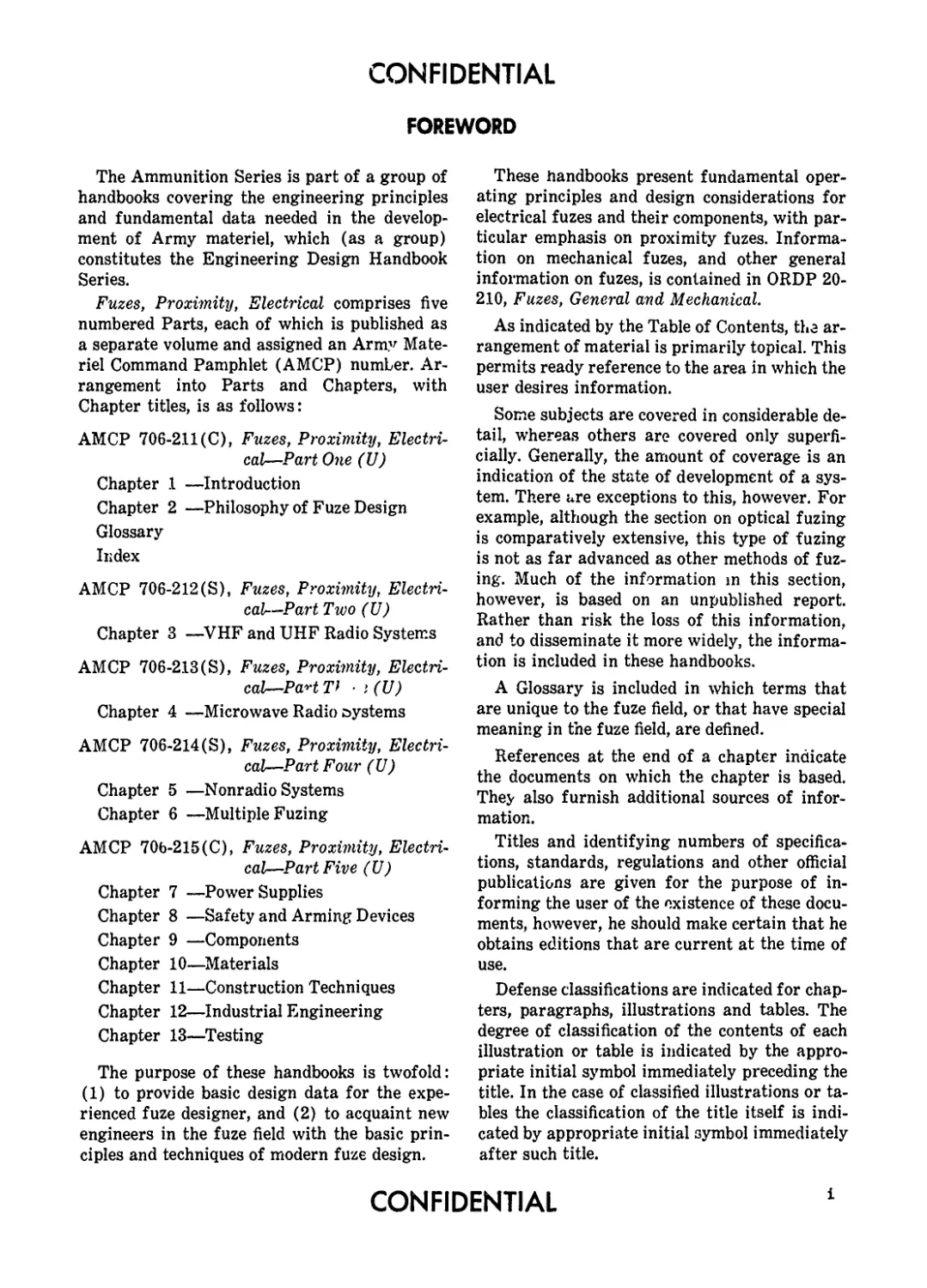
Fuzes, Proximity, Electrical comprises five
numbered Parts, each of which is published as
a separate volume and assigned an Army Mate-
riel Command Pamphlet (AMCP) number. Ar-
rangement into Parts and Chapters, with
Chapter titles, is as follows:
AMCP 706-211(0, Fuzes, Proximity, Electri-
cal—Part One (U)
Chapter 1	—Introduction
Chapter 2	—Philosophy of Fuze Design
Glossary
Index
AMCP 706-212(S), Fuzes, Proximity, Electri-
cal—Part Two (U)
Chapter 3	—VHF and UHF Radio Systems
AMCP 706-213(S), Fuzes, Proximity, Electri-
cal—РаЧ 77 • > (U)
Chapter 4	—Microwave Radio systems
AMCP 706-214(S), Fuzes, Proximity, Electri-
cal—Part Four (U)
Chapter 5	—Nonradio Systems
Chapter 6	—Multiple Fuzing
AMCP 706-215(C), Fuzes, Proximity, Electri-
cal—Part Five (U)
Chapter 7	—Power Supplies
Chapter 8	—Safety and Arming Devices
Chapter 9	—Components
Chapter 10—Materials
Chapter 11—Construction Techniques
Chapter 12—Industrial Engineering
Chapter 13—Testing
The purpose of these handbooks is twofold:
(1) to provide basic design data for the expe-
rienced fuze designer, and (2) to acquaint new
engineers in the fuze field with the basic prin-
ciples and techniques of modern fuze design.
These handbooks present fundamental oper-
ating principles and design considerations for
electrical fuzes and their components, with par-
ticular emphasis on proximity fuzes. Informa-
tion on mechanical fuzes, and other general
information on fuzes, is contained in ORDP 20-
210, Fuzes, General and Mechanical.
As indicated by the Table of Contents, the ar-
rangement of material is primarily topical. This
permits ready reference to the area in which the
user desires information.
Some subjects are covered in considerable de-
tail, whereas others are covered only superfi-
cially. Generally, the amount of coverage is an
indication of the state of development of a sys-
tem. There are exceptions to this, however. For
example, although the section on optical fuzing
is comparatively extensive, this type of fuzing
is not as far advanced as other methods of fuz-
ing. Much of the information in this section,
however, is based on an unpublished report.
Rather than risk the loss of this information,
and to disseminate it more widely, the informa-
tion is included in these handbooks.
A Glossary is included in which terms that
are unique to the fuze field, or that have special
meaning in the fuze field, are defined.
References at the end of a chapter indicate
the documents on which the chapter is based.
They also furnish additional sources of infor-
mation.
Titles and identifying numbers of specifica-
tions, standards, regulations and other official
publications are given for the purpose of in-
forming the user of the existence of these docu-
ments, however, he should make certain that he
obtains editions that are current at the time of
use.
Defense classifications are indicated for chap-
ters, paragraphs, illustrations and tables. The
degree of classification of the contents of each
illustration or table is indicated by the appro-
priate initial symbol immediately preceding the
title. In the case of classified illustrations or ta-
bles the classification of the title itself is indi-
cated by appropriate initial symbol immediately
after such title.
CONFIDENTIAL
i
CONFIDENTIAL
These handbooks were prepared under the
joint direction of the Harry Diamond Labora-
tories (formerly Diamond Ordnance Fuze Labo-
ratories) and the Engineering Handbook Office,
Duke University. Text material was prepared
by Training Materials & Information Services,
McGraw-Hill Book Company, Inc., under con-
tracts with both of these organizations. Mate-
rial for text and illustrations was made avail-
able through the cooperation of personnel of the
Harry Diamond Laboratories. The operation of
the Engineering Handbook Office of Duke Uni-
versity is by prime contract with the U. S. Army
Research Office, Durham.
Comments on these handbooks should be ad-
dressed to Commanding Officer, Army Research
Office, Durham, Box CM, Duke Station, Dur-
ham, N. C.-
ii
CONFIDENTIAL
CONFIDENTIAL
PREFACE
Part One of this handbook contains Chapters 1 and 2, with the Glossary and the Index
for all Parts. A Table of Contents for all Parts is also included. Chapter 1 introduces the vari-
ous types of electrical fuzes such as radio and nonradio proximity fuzes and contact fuzes, and
traces the development of electrical fuzes from 1941 to the present time. Chapter 2 presents
the basic philosophy involved in designing a fuze. Considerations such as countermeasures, en-
counter geometry, type of warhead, and costs are discussed. The Glossary defines terms that
are unique to, or that have special meaning in, the fuze field.
CONFIDENTIAL
iii
CONFIDENTIAL
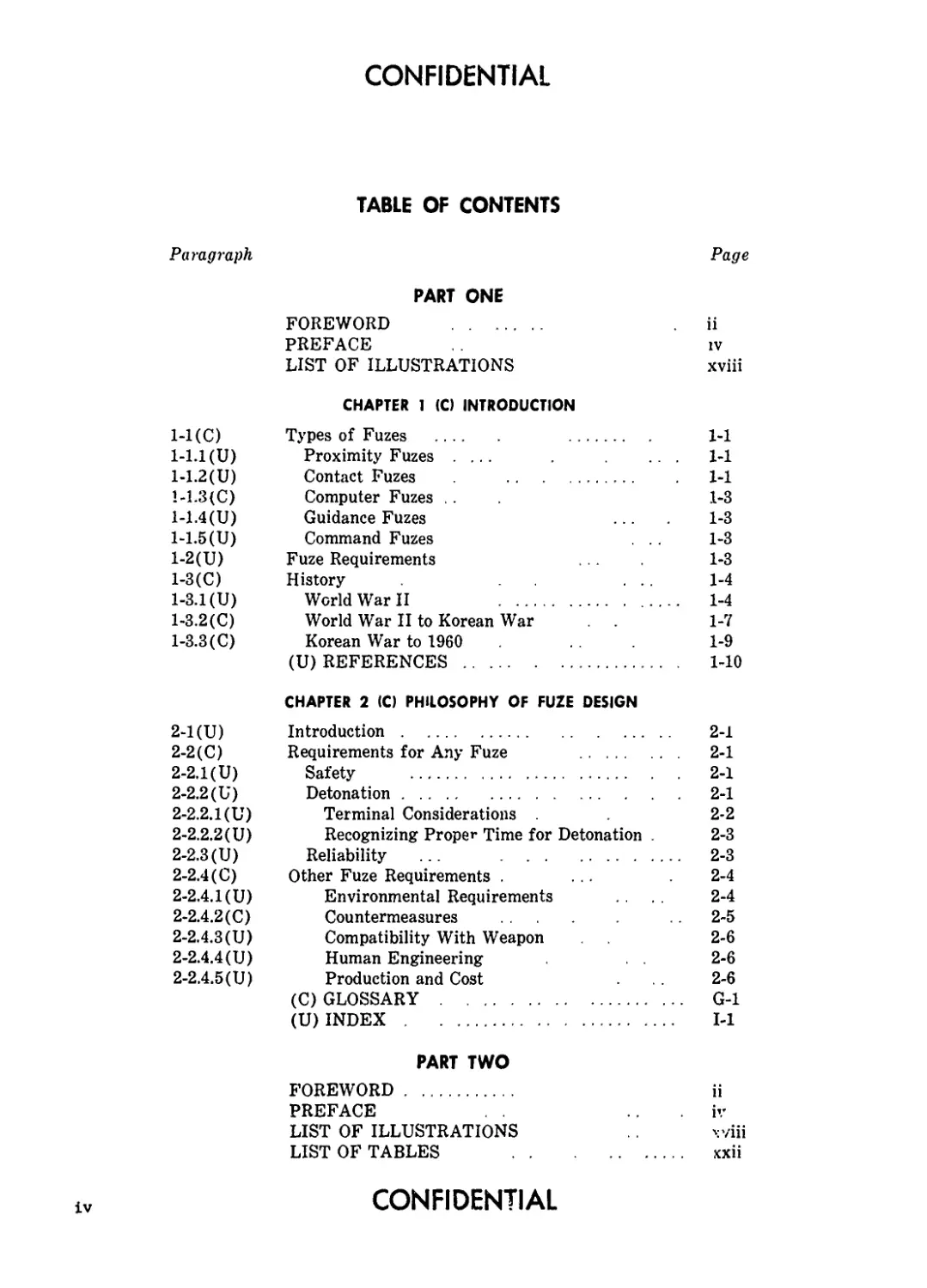
TABLE OF CONTENTS
Paragraph	Page
PART ONE
FOREWORD .................. ii
PREFACE	. .	iv
LIST OF ILLUSTRATIONS	xviii
CHAPTER 1 (C) INTRODUCTION
l-l(C) Types of Fuzes ...............................   1-1
1-1.1 (U) Proximity Fuzes ....	...	1-1
1-1.2(U)	Contact Fuzes	.............. 1-1
!-1.3(C)	Computer Fuzes ...	1-3
1-1.4(U) Guidance Fuzes	...	1-3
1-1.5(U) Command Fuzes	...	1-3
1-2(U) Fuze Requirements	...	1-3
1-3(C) History	...	1-4
1-3.1 (U)	World War II	.............. 1-4
1-3.2(C)	World War II to Korean War	1-7
1-3.3 (C) Korean War to 1960	...	1-9
(U) REFERENCES ........................... 1-10
CHAPTER 2 (C) PHILOSOPHY OF FUZE DESIGN
2-1 (U) Introduction................................... 2-1
2-2(C)	Requirements for Any Fuze .................. 2-1
2-2.1 (U)	Safety .................................. 2-1
2-2.2 (U)	Detonation............................... 2-1
2-2.2.1(LT) Terminal Considerations	2-2
2-2.2.2(U) Recognizing Proper Time for Detonation .	2-3
2-2.3 (U) Reliability ...	................... 2-3
2-2.4 (C) Other Fuze Requirements .	...	.2-4
2-2.4.1(U)	Environmental Requirements	2-4
2-2.4.2(C) Countermeasures ...	.2-5
2-2.4.3(U)	Compatibility With Weapon	2-6
2-2.4.4(U)	Human Engineering	2-6
2-2.4.5(U)	Production and Cost	2-6
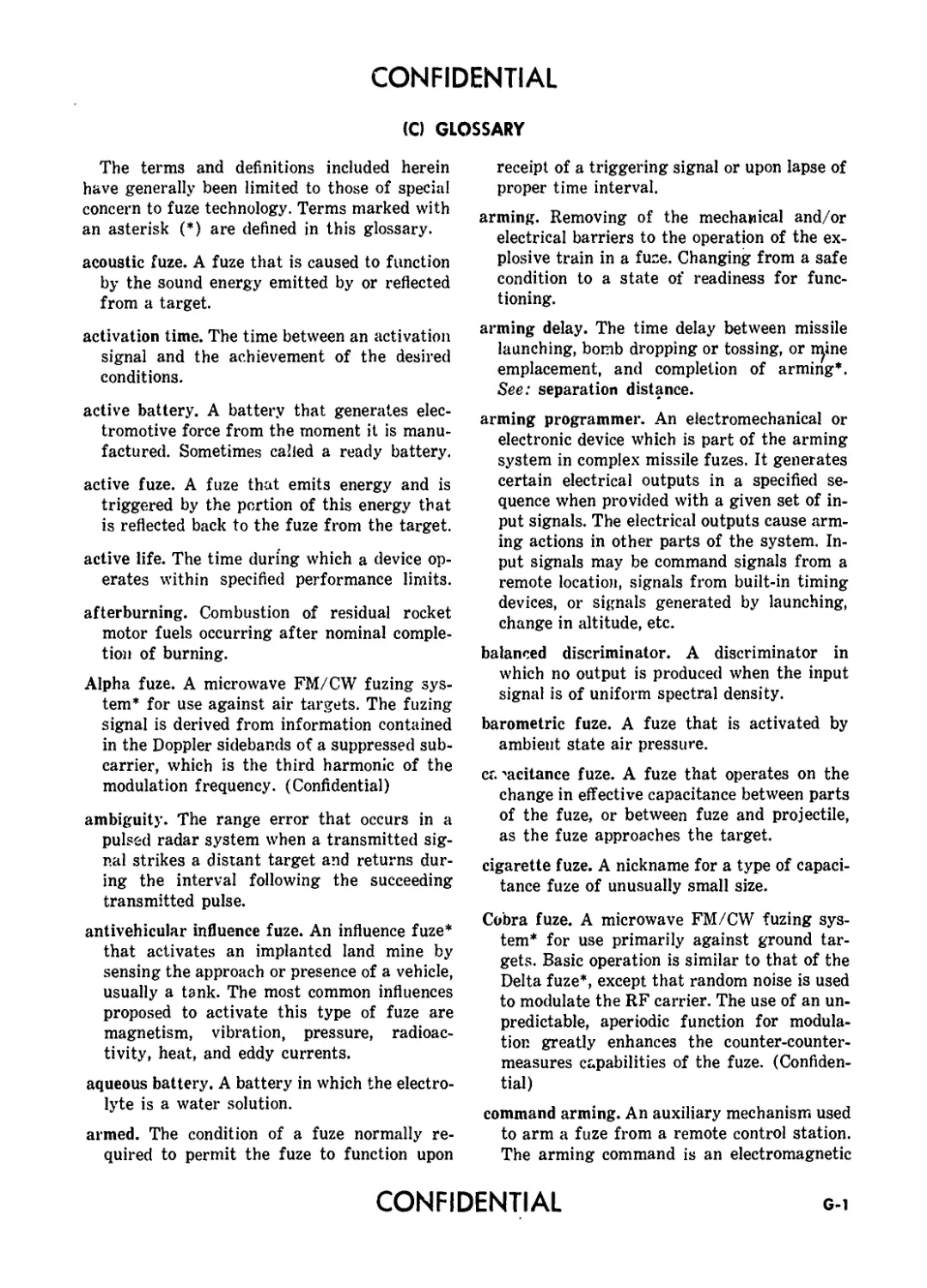
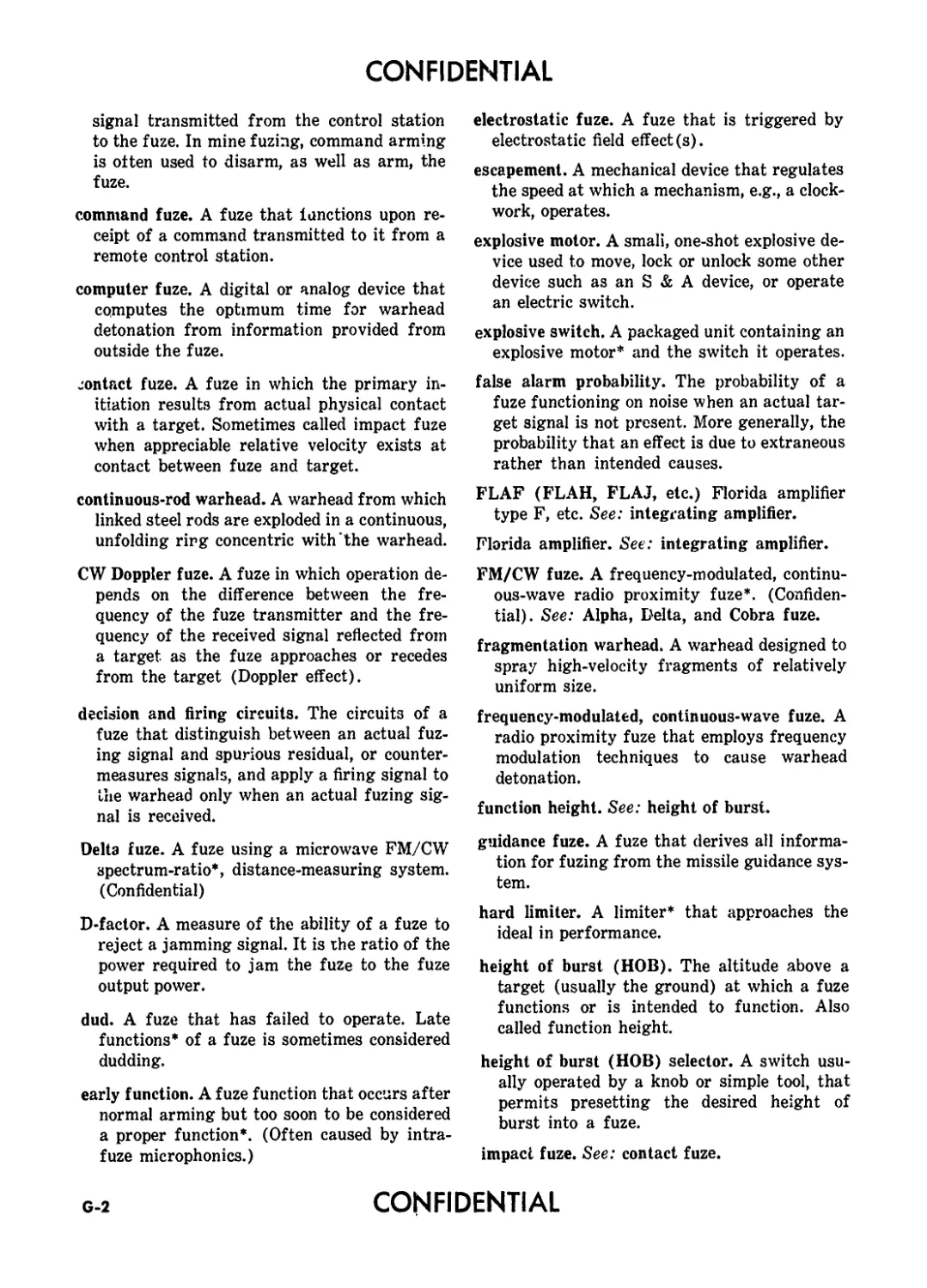
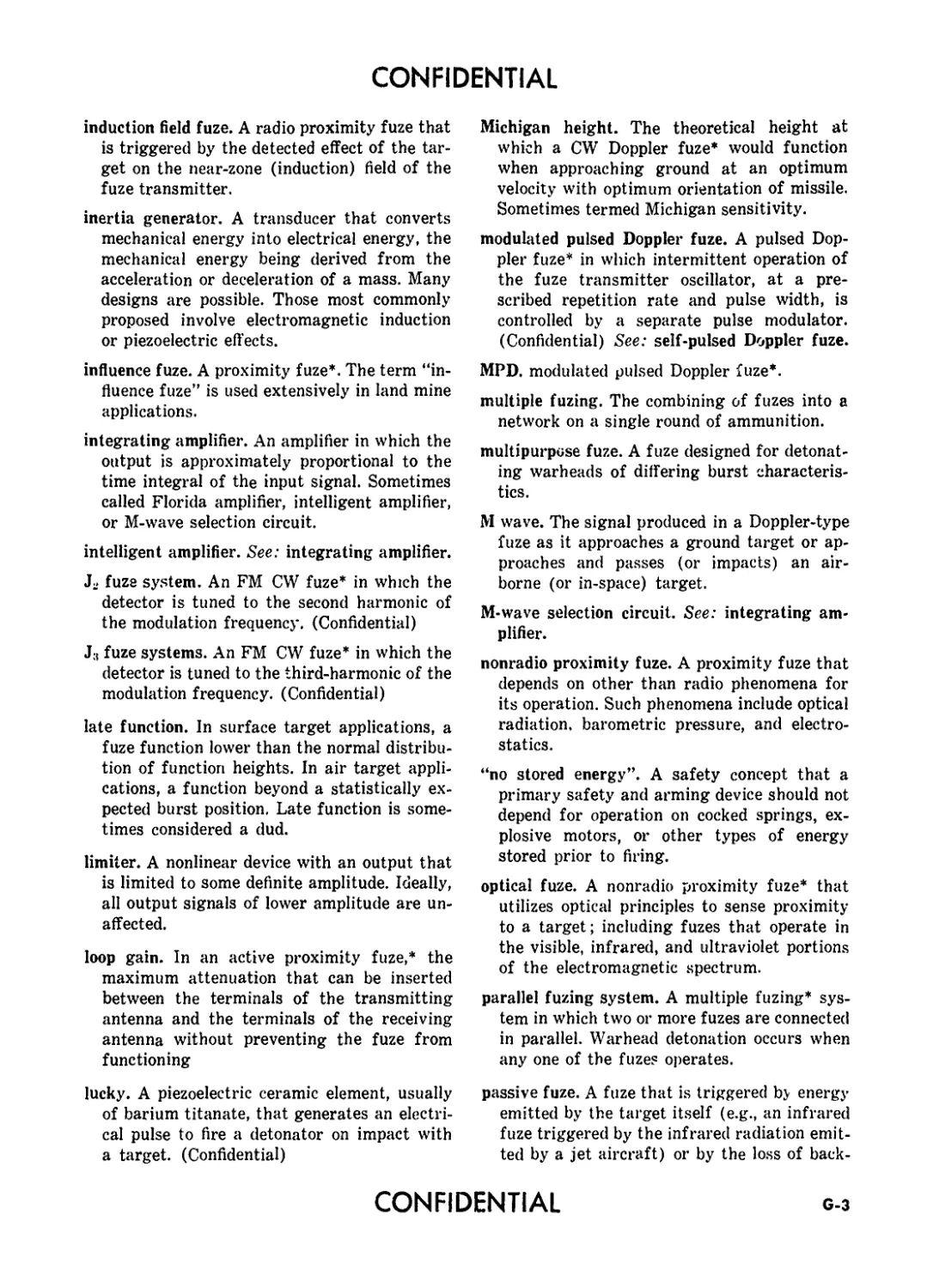
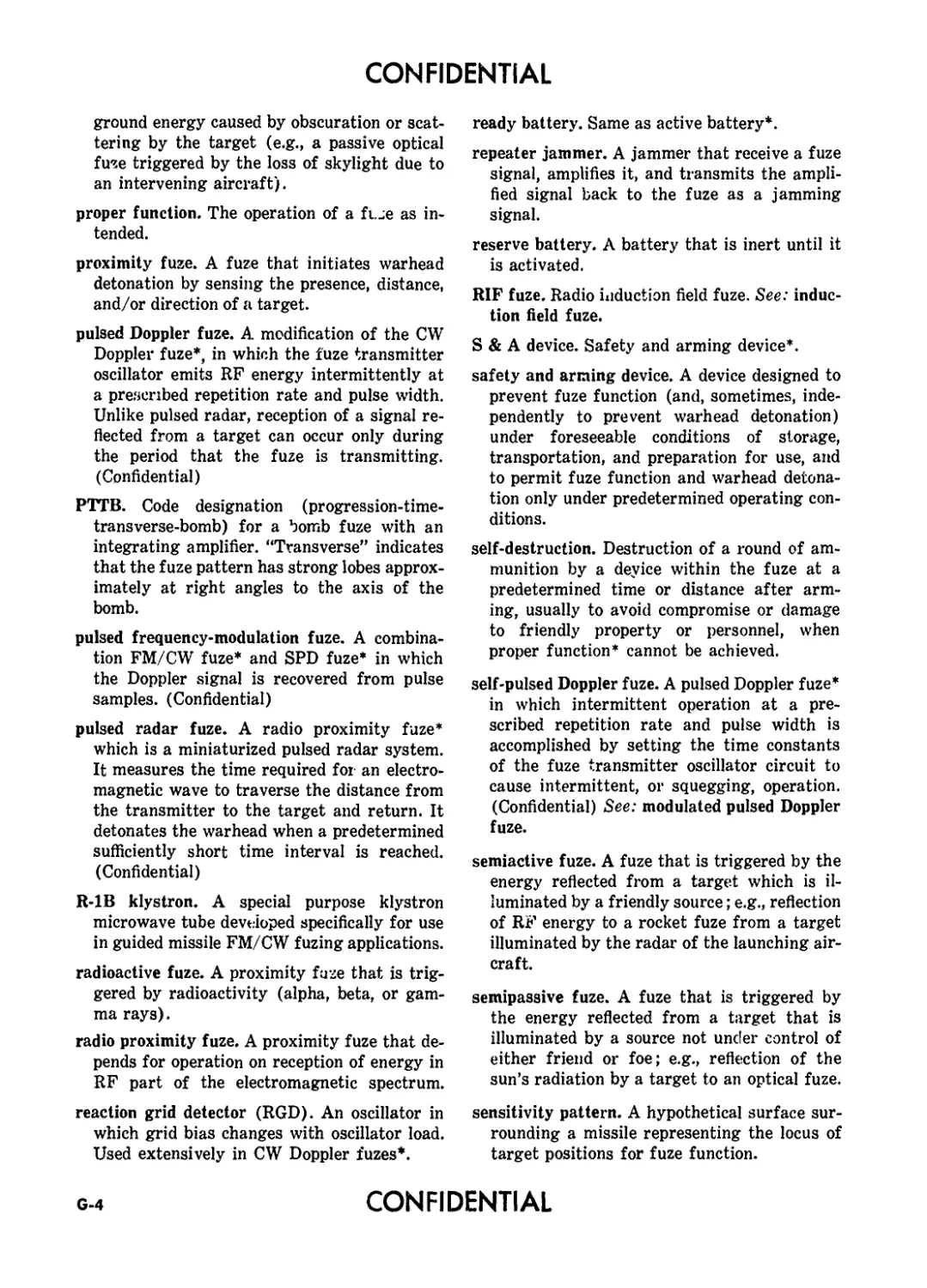
(C)	GLOSSARY ............................. G-l
(U)	INDEX ............................... 1-1
PART TWO
FOREWORD............... ii
PREFACE	iv
LIST OF ILLUSTRATIONS	. . xviii
LIST OF TABLES .......................... xxii
iv
CONFIDENTIAL
CONFIDENTIAL
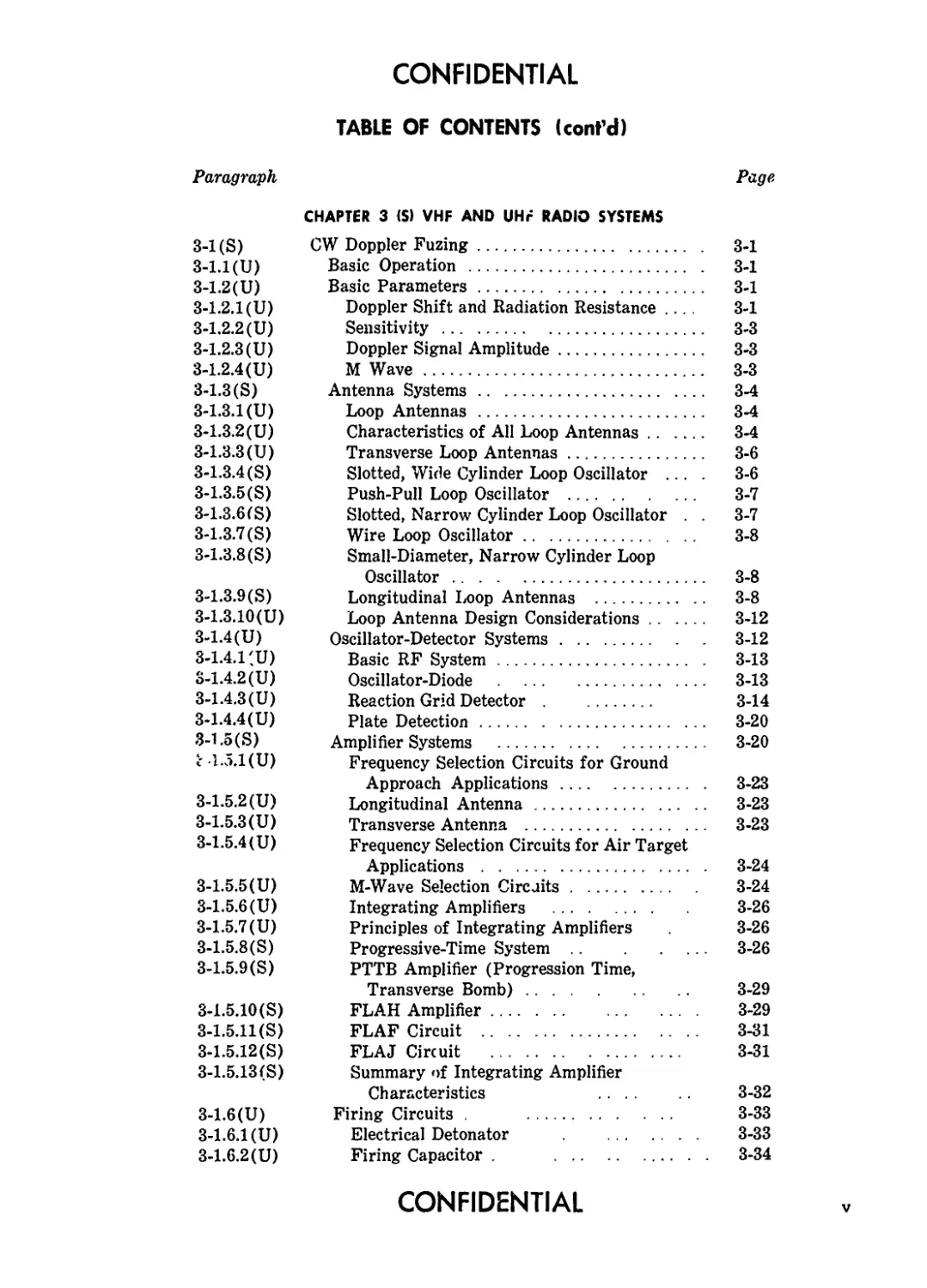
TABLE OF CONTENTS (cont’d)
Paragraph	Page
CHAPTER 3	(S) VHF AND UHr RADIO SYSTEMS
3-1 (S) CW Doppler Fuzing.................................... 3-1
3-1.1 (U)	Basic Operation ............................ 3-1
3-1.2 (U)	Basic Parameters............................ 3-1
3-1.2.1(U)	Doppler Shift and Radiation Resistance	...	.	3-1
3-1.2.2(U)	Sensitivity .................................... 3-3
3-1.2.3(U)	Doppler Signal Amplitude........................ 3-3
3-1.2.4(U)	M Wave ......................................... 3-3
3-1.3 (S)	Antenna Systems ............................ 3-4
3-1.3.1(U) Loop Antennas .................................... 3-4
3-1.3.2(U)	Characteristics of All Loop Antennas........	3-4
3-1.3.3(U)	Transverse Loop Antennas........................ 3-6
3-1.3.4(S)	Slotted, Wide Cylinder Loop Oscillator	... .	3-6
3-1.3.5(S)	Push-Pull Loop Oscillator ...................... 3-7
3-1.3.6(S)	Slotted, Narrow Cylinder Loop Oscillator	. .	3-7
3-1.3.7(S)	Wire Loop Oscillator............................ 3-8
3-1.3.8(S)	Small-Diameter, Narrow Cylinder Loop
Oscillator ................................. 3-8
3-1.3.9(S)	Longitudinal 1юор Antennas ..................... 3-8
3-1.3.10(U)	Loop Antenna Design Considerations..........	3-12
3-1.4(U) Oscillator-Detector Systems......................... 3-12
3-1.4.1'U)	Basic RF System ............................... 3-13
S-1.4.2(U)	Oscillator-Diode .............................. 3-13
3-1.4.3(U)	Reaction Grid Detector .	  3-14
3-1.4.4(U)	Plate Detection................................ 3-20
3-1.5(8)	Amplifier Systems ............................. 3-20
'< 1.5.1 (U)	Frequency Selection Circuits for Ground
Approach Applications...................... 3-23
3-1.5.2(U)	Longitudinal Antenna........................... 3-23
3-1.5.3(U)	Transverse Antenna ............................ 3-23
3-1.5.4(U)	Frequency Selection Circuits for Air Target
Applications .............................. 3-24
3-1.5.5(U)	М-Wave Selection Circuits...................... 3-24
3-1.5.6(U)	Integrating Amplifiers ........................ 3-26
3-1.5.7(U)	Principles of Integrating Amplifiers	3-26
3-1.5.8(S)	Progressive-Time System ....................... 3-26
3-1.5.9(S)	PTTB Amplifier (Progression Time,
Transverse Bomb)........................... 3-29
3-1.5.10(S)	FLAH Amplifier................................. 3-29
3-1.5.11 (S)	FLAF Circuit .................................. 3-31
3-1.5.12(S)	FLAJ Circuit .................................. 3-31
3-1.5.13(S)	Summary of Integrating Amplifier
Characteristics	....	3-32
3-1.6(U) Firing Circuits .	................. 3-33
3-1.6.1(U)	Electrical Detonator	............ 3-33
3-1.6.2(U)	Firing Capacitor .	.................. 3-34
CONFIDENTIAL
V
CONFIDENTIAL
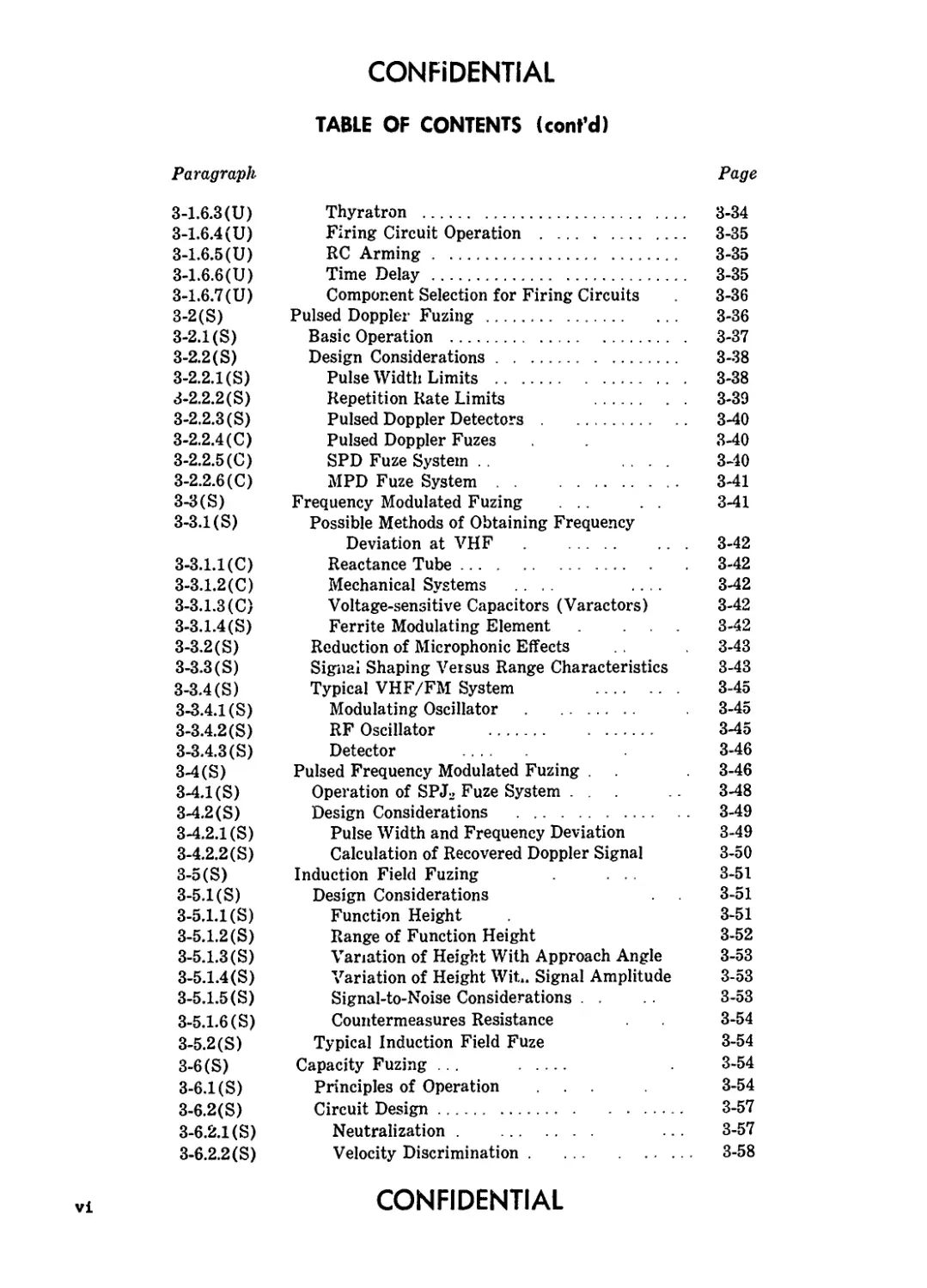
TABLE OF CONTENTS (cont’d)
Paragraph	Page
3-1.6.3(U)	Thyratron .................................... 3-34
3-1.6.4(U)	Firing Circuit	Operation ..................... 3-35
3-1.6.5(U)	RC Arming..................................... 3-35
3-1.6.6(U)	Time Delay ................................... 3-35
3-1.6.7(U)	Component Selection for Firing Circuits	3-36
3-2(S) Pulsed Doppler Fuzing.................................... 3-36
3-2.1 (S)	Basic Operation ................................ 3-37
3-2.2(S)	Design Considerations........................... 3-38
3-2.2.1(S)	Pulse Width Limits ........................... 3-38
3-2.2.2(S)	Repetition Kate Limits	  3-39
3-2.2.3(S)	Pulsed Doppler Detectors ..................... 3-40
3-2.2.4(C)	Pulsed Doppler Fuzes	3-40
3-2.2.5(C) SPD Fuze System . .	....	3-40
3-2.2.6(C)	MPD Fuze System	3-41
3-3(S) Frequency Modulated Fuzing ...	3-41
3-3.1 (S) Possible Methods of Obtaining Frequency
Deviation at VHF	...... ...	3-42
3-3.1.1(C)	Reactance Tube................................ 3-42
3-3.1.2(C)	Mechanical Systems ....	....	3-42
3-3.1.3(C)	Voltage-sensitive Capacitors (Varactors) 3-42
3-3.1.4(S)	Ferrite Modulating Element ...	3-42
3-3.2(S)	Reduction of Microphonic Effects	3-43
3-3.3(S)	Signal Shaping Versus Range Characteristics	3-43
3-3.4 (S)	Typical VHF/FM System	  3-45
3-3.4.1(S)	Modulating Oscillator	3-45
3-3.4.2(S)	RF Oscillator ..............................   3-45
3-3.4.3(S)	Detector ..................................... 3-46
3-4(S) Pulsed Frequency Modulated Fuzing .	3-46
3-4.1 (S)	Operation of SPJ2 Fuze System ...	3-48
3-4.2(S)	Design Considerations .......................... 3-49
3-4.2.1 (S)	Pulse Width and Frequency Deviation	3-49
3-4.2.2(S)	Calculation of Recovered Doppler Signal	3-50
3-5(S)	Induction Field Fuzing	...	3-51
3-5.1 (S)	Design Considerations	3-51
3-5.1.1(S)	Function Height	3-51
3-5.1.2(S)	Range of Function Height	3-52
3-5.1.3(S)	Variation of Height With Approach Angle	3-53
3-5.1.4(S)	Variation of Height Wit.. Signal Amplitude	3-53
3-5.1.5(S)	Signal-to-Noise Considerations . .	3-53
3-5.1.6(S)	Countermeasures Resistance	3-54
3-5.2(S)	Typical Induction Field Fuze	3-54
3-6 (S)	Capacity Fuzing ...	...... 3-54
3-6.1 (S) Principles of Operation ...	3-54
3-6.2(S) Circuit Design......................................... 3-57
3-6.2.1(S)	Neutralization .	............ ...	3-57
3-6.2.2(S) Velocity Discrimination.............................. 3-58
CONFIDENTIAL
CONFIDENTIAL
TABLE OF CONTENTS (cont’d)
Page
Paragraph
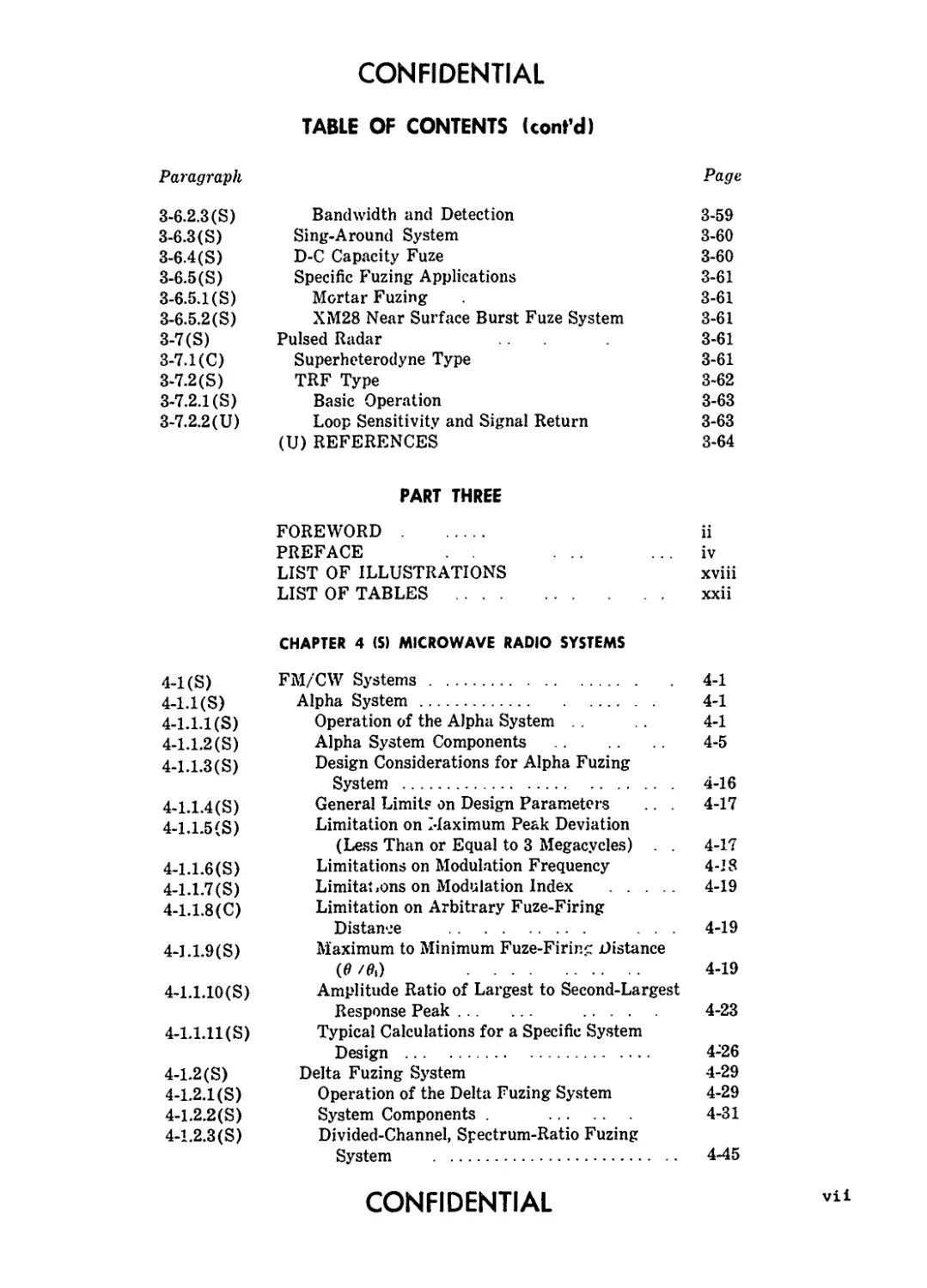
3-6.2.3(S)	Bandwidth and Detection	3-59
3-6.3 (S)	Sing-Around System	3-60
3-6.4(S)	D-C Capacity Fuze	3-60
3-6.5 (S)	Specific Fuzing Applications	3-61
3-6.5.1(S)	Mortar Fuzing	3-61
3-6.5.2(S)	XM28 Near Surface Burst Fuze System	3-61
3-7(S)	Pulsed Radar	...	3-61
3-7.1 (C)	Superheterodyne Type	3-61
3-7.2 (S)	TRF Type	3-62
3-7.2.1(S)	Basic Operation	3-63
3-7.2.2(U)	Loop Sensitivity and Signal Return	3-63
	(U)REFERENCES	3-64
PART THREE
FOREWORD......... ii
PREFACE	...	iv
LIST OF ILLUSTRATIONS	xviii
LIST OF TABLES................... xxii
CHAPTER 4	(S> MICROWAVE RADIO SYSTEMS
4-1 (S)
4-1.1(S)
4-1.1.1 (S)
4-1.1.2(S)
4-1.1.3(S)
4-1.1.4(S)
4-1.1.5(S)
4-1.1.6(S)
4-1.1.7(S)
4-1.1.8(C)
4-1.1.9(S)
4-1.1.10(S)
4-1.1.1KS)
4-1.2(S)
4-1.2.1(S)
4-1.2.2(S)
4-1.2.3 (S)
FM/CW Systems............................... 4-1
Alpha System............................. 4-1
Operation of the Alpha System	4-1
Alpha System Components	4-5
Design Considerations for Alpha Fuzing
System ..................................... 4-16
General Limit? on Design Parameters ..	.	4-17
Limitation on Maximum Peak Deviation
(Less Than or Equal to 3 Megacycles)	.	.	4-17
Limitations on Modulation Frequency	4-J8
Limitations on Modulation Index .......... 4-19
Limitation on Arbitrary Fuze-Firing
Distance .............................. ...	4-19
Maximum to Minimum Fuze-Firing Distance
(8 /ft)	.................... 4-19
Amplitude Ratio of Largest to Second-Largest
Response Peak.............	.......... 4-23
Typical Calculations for a Specific System
Design ..................................... 4-26
Delta Fuzing System	4-29
Operation of the Delta Fuzing System	4-29
System Components .	  4-31
Divided-Channel, Spectrum-Ratio Fuzing
System ..................................... 4-45
CONFIDENTIAL
vii
CONFIDENTIAL
TABLE OF CONTENTS (cont’d)
Paragraph		Page
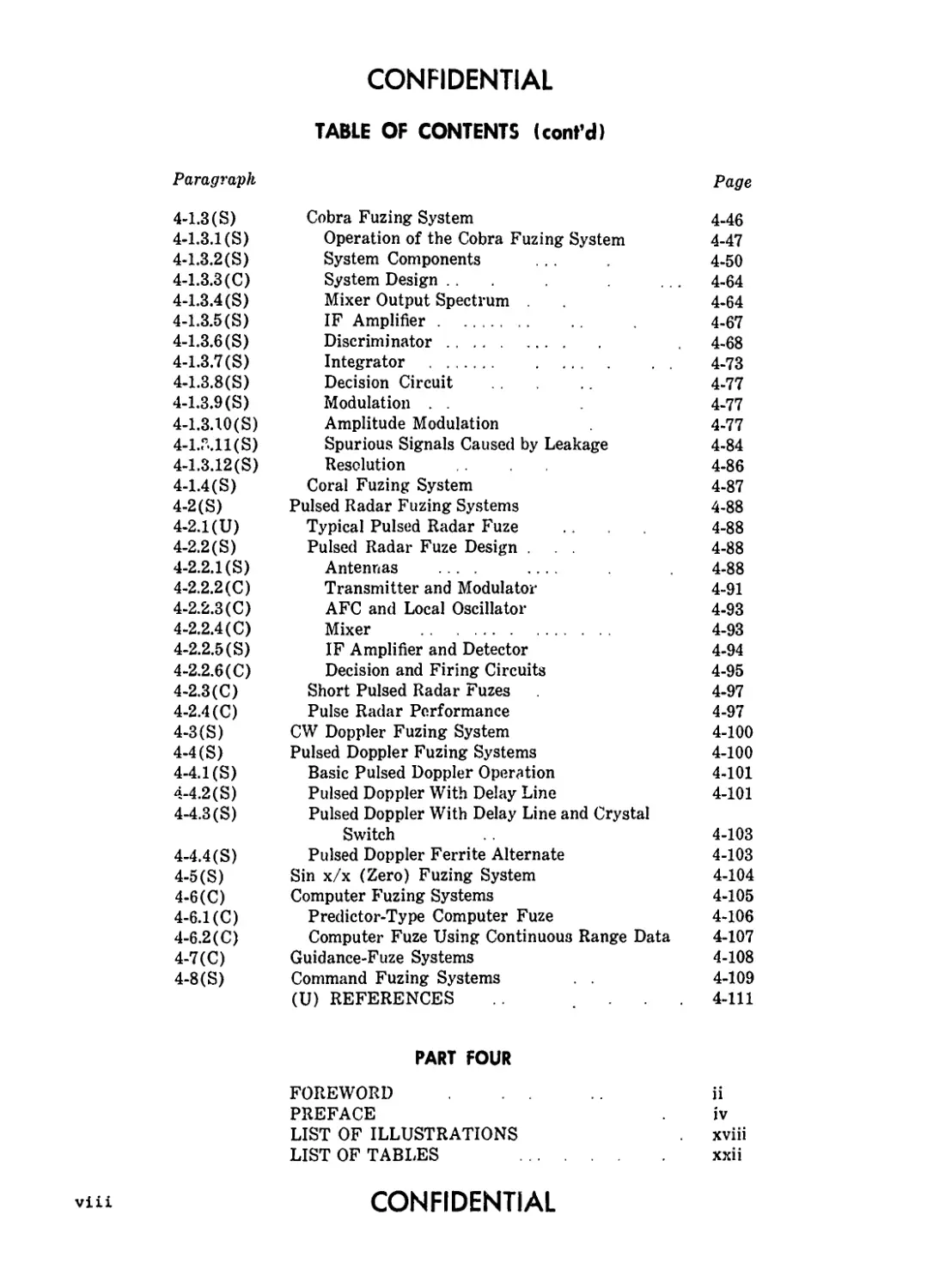
4-1.3(S)	Cobra Fuzing System	4-46
4-1.3.1(S)	Operation of the Cobra Fuzing System	4-47
4-1.3.2(S)	System Components	4-50
4-1.3.3(C)	System Design ...	4-64
4-1.3.4(S)	Mixer Output Spectrum .	4-64
4-1.3.5(S)	IF Amplifier		4-67
4-1.3.6(S)	Discriminator		4-68
4-1.3.7(S)	Integrator 		4-73
4-1.3.8(S)	Decision Circuit	4-77
4-1.3.9(S)	Modulation . .	4-77
4-1.3.10(S)	Amplitude Modulation	4-77
4-1.3.11(S)	Spurious Signals Caused by Leakage	4-84
4-1.3.12(S)	Resolution	4-86
4-1.4(S)	Coral Fuzing System	4-87
4-2(S)	Pulsed Radar Fuzing Systems	4-88
4-2.1 (U)	Typical Pulsed Radar Fuze	4-88
4-2.2 (S)	Pulsed Radar Fuze Design . . .	4-88
4-2.2.1(S)	Antennas ....	....	4-88
4-2.2.2(C)	Transmitter and Modulator	4-91
4-2.2.3(C)	AFC and Local Oscillator	4-93
4-2.2.4(C)	Mixer			4-93
4-2.2.5(S)	IF Amplifier and Detector	4-94
4-2.2.6(C)	Decision and Firing Circuits	4-95
4-2.3(C)	Short Pulsed Radar Fuzes	4-97
4-2.4(C)	Pulse Radar Performance	4-97
4-3(S)	CW Doppler Fuzing System	4-100
4-4 (S)	Pulsed Doppler Fuzing Systems	4-100
4-4.1 (S)	Basic Pulsed Doppler Operation	4-101
4-4.2(S)	Pulsed Doppler With Delay Line	4-101
4-4.3 (S)	Pulsed Doppler With Delay Line and Crystal
	Switch	4-103
4-4.4(S)	Pulsed Doppler Ferrite Alternate	4-103
4-5(S)	Sin x/x (Zero) Fuzing System	4-104
4-6(C)	Computer Fuzing Systems	4-105
4-6.1(C)	Predictor-Type Computer Fuze	4-106
4-6.2(C)	Computer Fuze Using Continuous Range Data	4-107
4-7(C)	Guidance-Fuze Systems	4-108
4-8(S)	Command Fuzing Systems	. .	4-109
	(U) REFERENCES	4-111
PART FOUR
FOREWORD ...	ii
PREFACE	iv
LIST OF ILLUSTRATIONS	xviii
LIST OF TABLES ................ xxii
viii
CONFIDENTIAL
CONFIDENTIAL
TABLE OF CONTENTS (cont’d)
Paragraph	Page
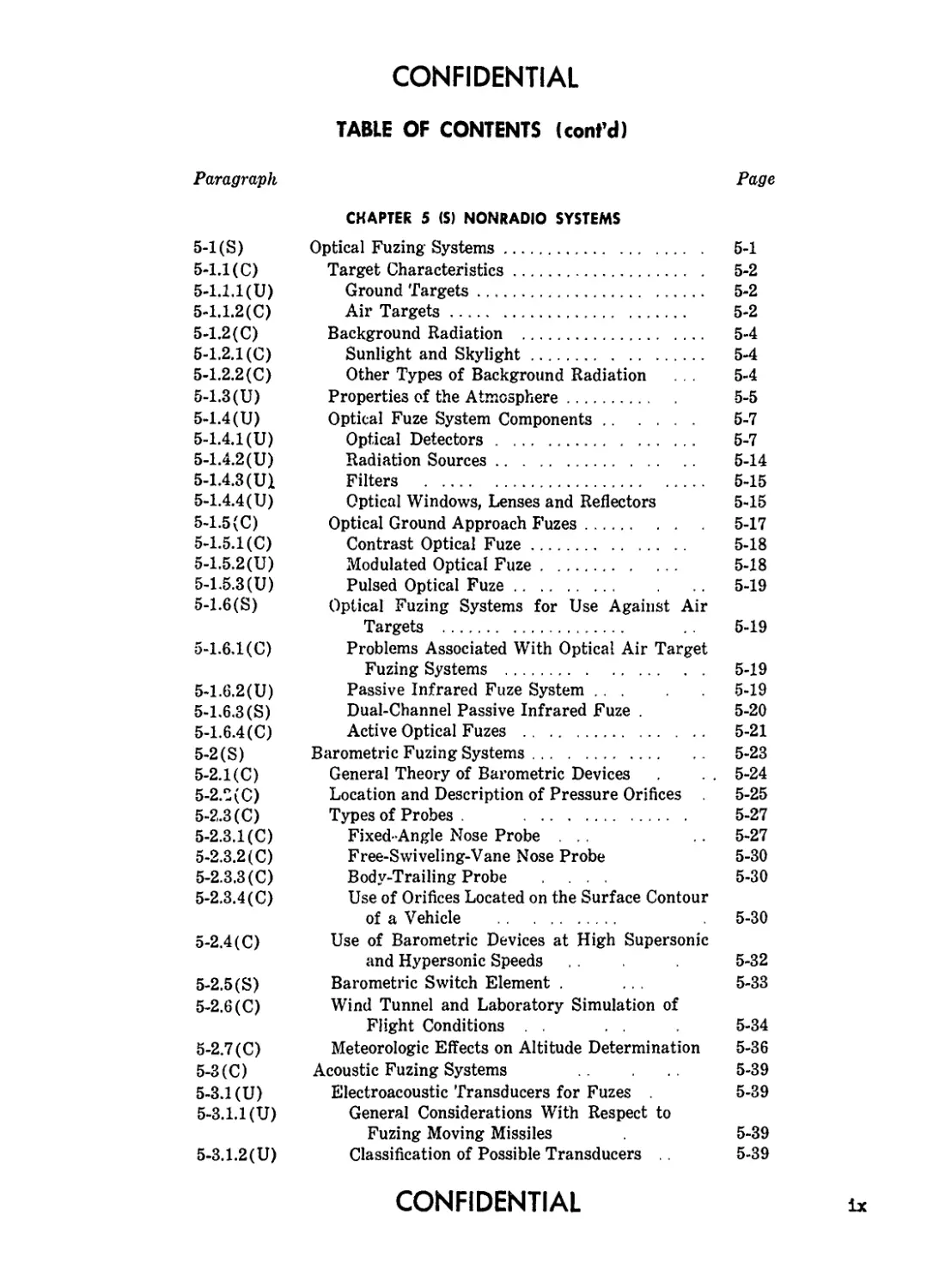
CHAPTER 5	(S) NONRADIO SYSTEMS
5-1 (S) Optical Fuzing-Systems.............................. 5-1
5-1.1 (C)	Target Characteristics..................... 5-2
5-1.1.1(U)	Ground Targets............................. 5-2
5-1.1.2(C)	Air Targets.............................. 5-2
5-1.2(C)	Background Radiation ...................... 5-4
5-1.2.1(C)	Sunlight and Skylight...................... 5-4
5-1.2.2(C)	Other Types of Background Radiation ...	5-4
5-1.3(U)	Properties of the Atmosphere............. 5-5
5-1.4 (U)	Optical Fuze System Components............. 5-7
5-1.4.1(U)	Optical Detectors.......................... 5-7
5-1.4.2(U)	Radiation Sources.......................... 5-14
5-1.4.3(Ul	Filters ................................... 5-15
5-1.4.4(U)	Optical Windows, Lenses and Reflectors	5-15
5-1.5(C)	Optical Ground Approach Fuzes.............. 5-17
5-1.5.1(C)	Contrast Optical Fuze.................... 5-18
5-1.5.2(U)	Modulated Optical Fuze................... 5-18
5-1.5.3(U)	Pulsed Optical Fuze.......... 5-19
5-1.6(S) Optical Fuzing Systems for Use Against Air
Targets ................................... 5-19
5-1.6.1(C)	Problems Associated With Optical	Air Target
Fuzing Systems ......................... 5-19
5-1.6.2(U)	Passive Infrared Fuze System...............5-19
5-1,6.3 (S)	Dual-Channel Passive Infrared	Fuze	.	5-20
5-1.6.4(C)	Active Optical Fuzes ...................... 5-21
5-2(S) Barometric Fuzing Systems............................ 5-23
5-2.1 (C)	General Theory of Barometric Devices	5-24
5-2.2(C)	Location and Description of Pressure Orifices	5-25
5-2.3 (C)	Types of Probes .	................... 5-27
5-2.3.1(C)	Fixed-Angle Nose Probe ...	5-27
5-2.3.2(C)	Free-Swiveling-Vane Nose Probe	5-30
5-2.3.3(C)	Body-Trailing Probe ....	5-30
5-2.3.4(C)	Use of Orifices Located on the Surface Contour
of a Vehicle .................. 5-30
5-2.4(C) Use of Barometric Devices at High Supersonic
and Hypersonic Speeds	5-32
5-2.5(S) Barometric Switch Element .	...	5-33
5-2.6 (C) Wind Tunnel and Laboratory Simulation of
Flight Conditions	5-34
5-2.7(C)	Meteorologic Effects on Altitude Determination	5-36
5-3(C) Acoustic Fuzing Systems	5-39
5-3.1 (U)	Electroacoustic Transducers for Fuzes	5-39
5-3.1.1(U) General Considerations With Respect to
Fuzing Moving Missiles	5-39
5-3.1.2(U) Classification of Possible Transducers . .	5-39
CONFIDENTIAL	ix
CONFIDENTIAL
TABLE OF CONTENTS (cont’d)
Paragraph	Page
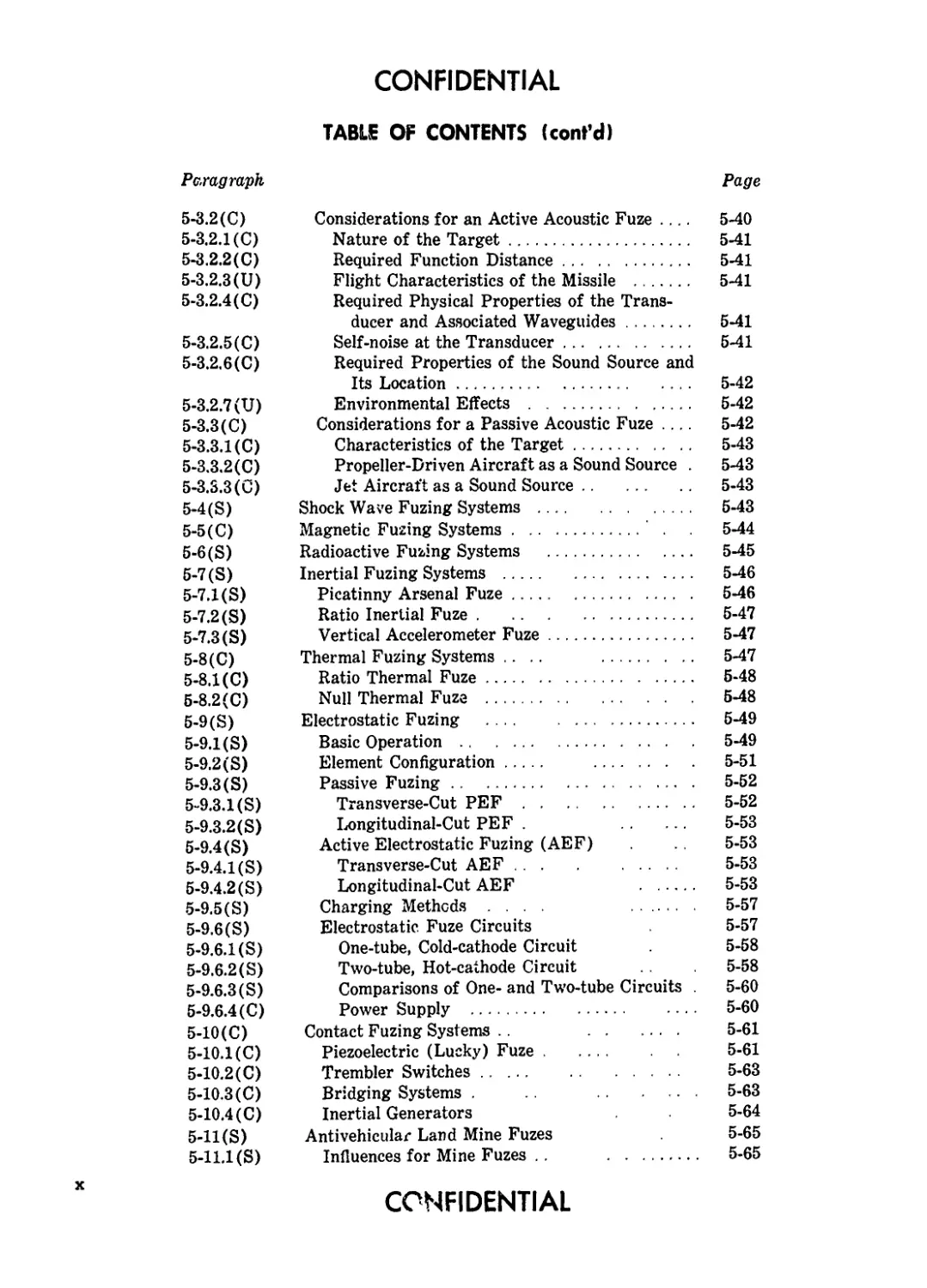
5-3.2(C) Considerations for an Active Acoustic Fuze ....	5-40
5-3.2.1(C)	Nature of the Target......................... 5-41
5-3.2.2(C)	Required Function Distance................... 5-41
5-3.2.3(U)	Flight Characteristics of the	Missile ....... 5-41
5-3.2.4(C) Required Physical Properties of the Trans-
ducer and Associated Waveguides.............................	5-41
5-3.2.5(C) Self-noise at the Transducer........................ 5-41
5-3.2,6(C) Required Properties of the Sound Source and
Its Location............................... 5-42
5-3.2.7(U)	Environmental Effects	5-42
5-3.3(C) Considerations for a Passive Acoustic Fuze ....	5-42
5-3.3.1(C)	Characteristics of the Target................ 5-43
5-3.3.2(C)	Propeller-Driven Aircraft as a Sound Source .	5-43
5-3.3.3(C)	Jet Aircraft as a Sound Source............... 5-43
5-4(S)	Shock Wave Fuzing Systems ...................... 5-43
5-5(C)	Magnetic Fuzing Systems......................... 5-44
5-6(S)	Radioactive Fuzing Systems ..................... 5-45
5-7 (S)	Inertial Fuzing Systems ........................ 5-46
5-7.1 (S)	Picatinny Arsenal Fuze.......................... 5-46
5-7.2 (S)	Ratio Inertial Fuze............................. 5-47
5-7.3 (S)	Vertical Accelerometer	Fuze..................... 5-47
5-8(C)	Thermal Fuzing Systems ....	  5-47
5-8.1 (C)	Ratio Thermal Fuze.............................. 5-48
5-8.2(C)	Null Thermal Fuze .............................. 5-48
5-9(S)	Electrostatic Fuzing ....	  5-49
5-9.1 (S)	Basic Operation................................. 5-49
5-9.2(S)	Element Configuration.......	  5-51
5-9.3(S)	Passive Fuzing.................................. 5-52
5-9.3.1(S)	Transverse-Cut PEF .......................... 5-52
5-9.3.2(S)	Longitudinal-Cut PEF .	....... 5-53
5-9.4(S) Active Electrostatic Fuzing (AEF)	. .	5-53
5-9.4.1(S)	Transverse-Cut AEF........................... 5-53
5-9.4.2(S)	Longitudinal-Cut AEF	  5-53
5-9.5(S)	Charging Methods ....	....... 5-57
5-9.6(S)	Electrostatic Fuze Circuits	5-57
5-9.6.1(S)	One-tube, Cold-cathode	Circuit	5-58
5-9.6.2(S)	Two-tube, Hot-cathode Circuit . .	5-58
5-9.6.3(S)	Comparisons of One- and	Two-tube Circuits .	5-60
5-9.6.4(C)	Power Supply ................................ 5-60
5-10(C)	Contact Fuzing Systems . .	............ 5-61
5-10.1 (C)	Piezoelectric (Lucky)	Fuze..........	5-61
5-10.2(C)	Trembler Switches.......	  5-63
5-10.3(C)	Bridging Systems .	  5-63
5-10.4(0	Inertial Generators	5-64
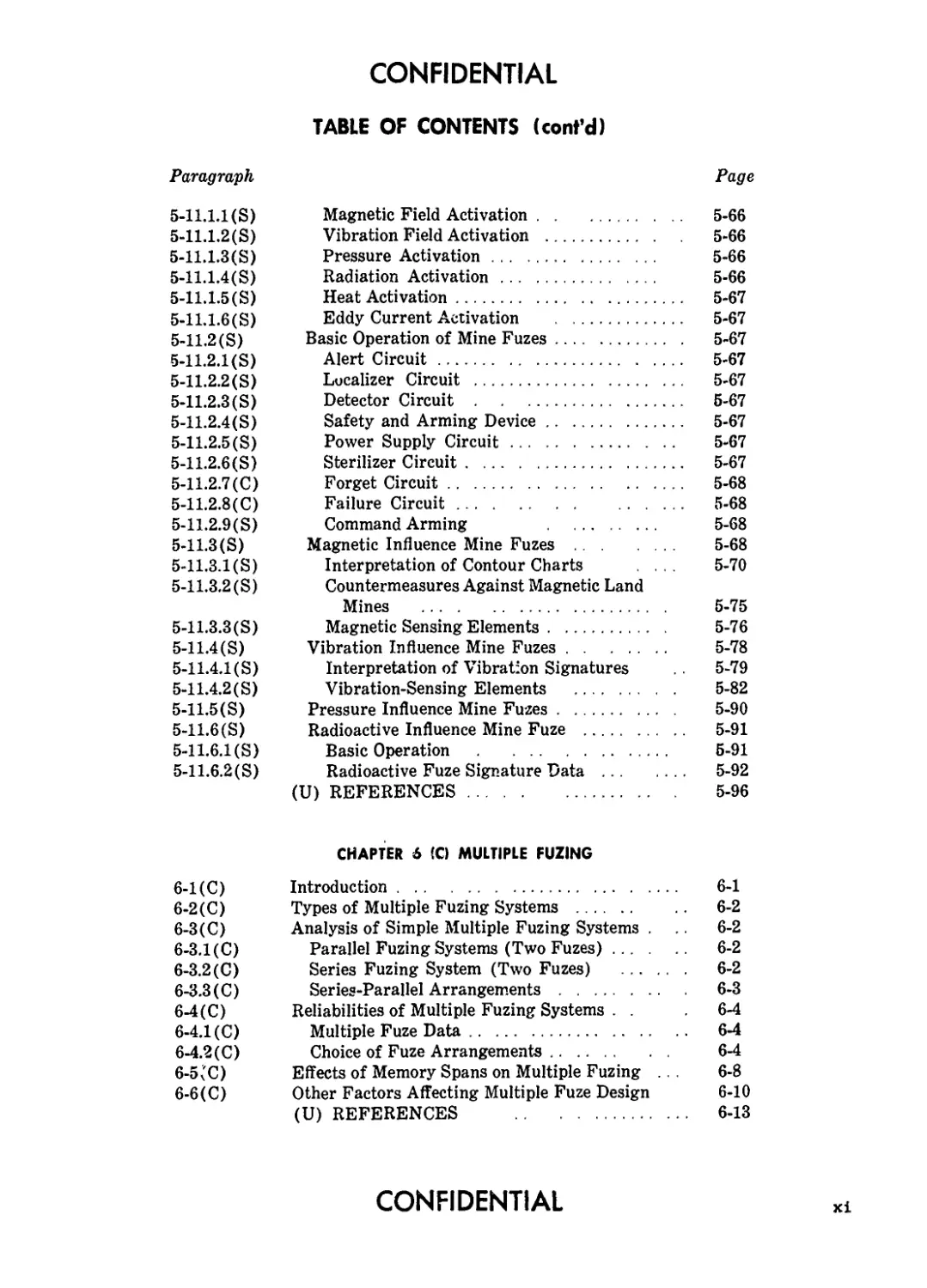
5-11 (S)	Antivehicular Land Mine Fuzes	5-65
5-11.1 (S)	Influences for Mine	Fuzes	. .	  5-65
x
CONFIDENTIAL
CONFIDENTIAL
TABLE OF CONTENTS (cont’d)
Paragraph	Page
5-11.1.1 (S)	Magnetic Field Activation................... 5-66
5-11.1.2(8)	Vibration Field Activation ................. 5-66
5-11.1.3(S)	Pressure Activation......................... 5-66
5-11.1.4(S)	Radiation Activation........................ 5-66
5-11.1.5(S)	Heat Activation............................. 5-67
5-11.1.6(S)	Eddy Current Activation .................... 5-67
5-11.2(S)	Basic Operation of Mine Fuzes.................. 5-67
5-11.2.1 (S)	Alert Circuit............................... 5-67
5-11.2.2(S)	Localizer Circuit .......................... 5-67
5-11.2.3(S)	Detector Circuit ........................... 5-67
5-11.2.4(S)	Safety and Arming Device.................... 5-67
5-11.2.5(S)	Power Supply Circuit........................ 5-67
5-11.2.6(S)	Sterilizer Circuit.......................... 5-67
5-11.2.7(0	Forget Circuit.............................. 5-68
5-11.2.8(C)	Failure Circuit...........................   5-68
5-11.2.9(S)	Command Arming	  5-68
5-11.3(S)	Magnetic Influence Mine Fuzes.................. 5-68
5-11.3.1(S) Interpretation of Contour Charts . ...	5-70
5-11.3.2 (S)	Countermeasures Against Magnetic Land
Mines ................................... 5-75
5-11.3.3(S)	Magnetic Sensing Elements................... 5-76
5-11.4(S)	Vibration Influence Mine Fuzes................. 5-78
5-11.4.1(S)	Interpretation of Vibration Signatures	5-79
5-11.4.2(S)	Vibration-Sensing Elements ................. 5-82
5-11.5(S)	Pressure Influence Mine Fuzes.................. 5-90
5-11.6(S)	Radioactive Influence Mine Fuze ............... 5-91
5-11.6.1(S)	Basic Operation	........................... 5-91
5-11.6.2(S)	Radioactive Fuze	Signature Data ........... 5-92
(U)	REFERENCES................................ 5-96
CHAPTER & (C) MULTIPLE FUZING
6-1 (C)	Introduction.................................... 6-1
6-2(C)	Types of Multiple Fuzing Systems ............... 6-2
6-3(C)	Analysis of Simple Multiple Fuzing Systems ...	6-2
6-3.1 (C)	Parallel Fuzing Systems (Two Fuzes)...........	6-2
6-3.2(C)	Series Fuzing System (Two Fuzes) ............... 6-2
6-3.3(С)	Series-Parallel Arrangements.................... 6-3
6-4(C)	Reliabilities of Multiple Fuzing	Systems . .	6-4
6-4.1 (C) Multiple Fuze Data................................... 6-4
6-4.2(C)	Choice of Fuze Arrangements..................... 6-4
6-5\C)	Effects of Memory Spans on Multiple Fuzing ...	6-8
6-6(C)	Other Factors Affecting Multiple Fuze Design 6-10
(U) REFERENCES ................................ 6-13
CONFIDENTIAL
xi
CONFIDENTIAL
TABLE OF CONTENTS (confd)
Paragraph
Page
PART FIVE
FOREWORD......
PREFACE LIST OF ILLUSTRATIONS LIST OF TABLES 			iv xviii XX
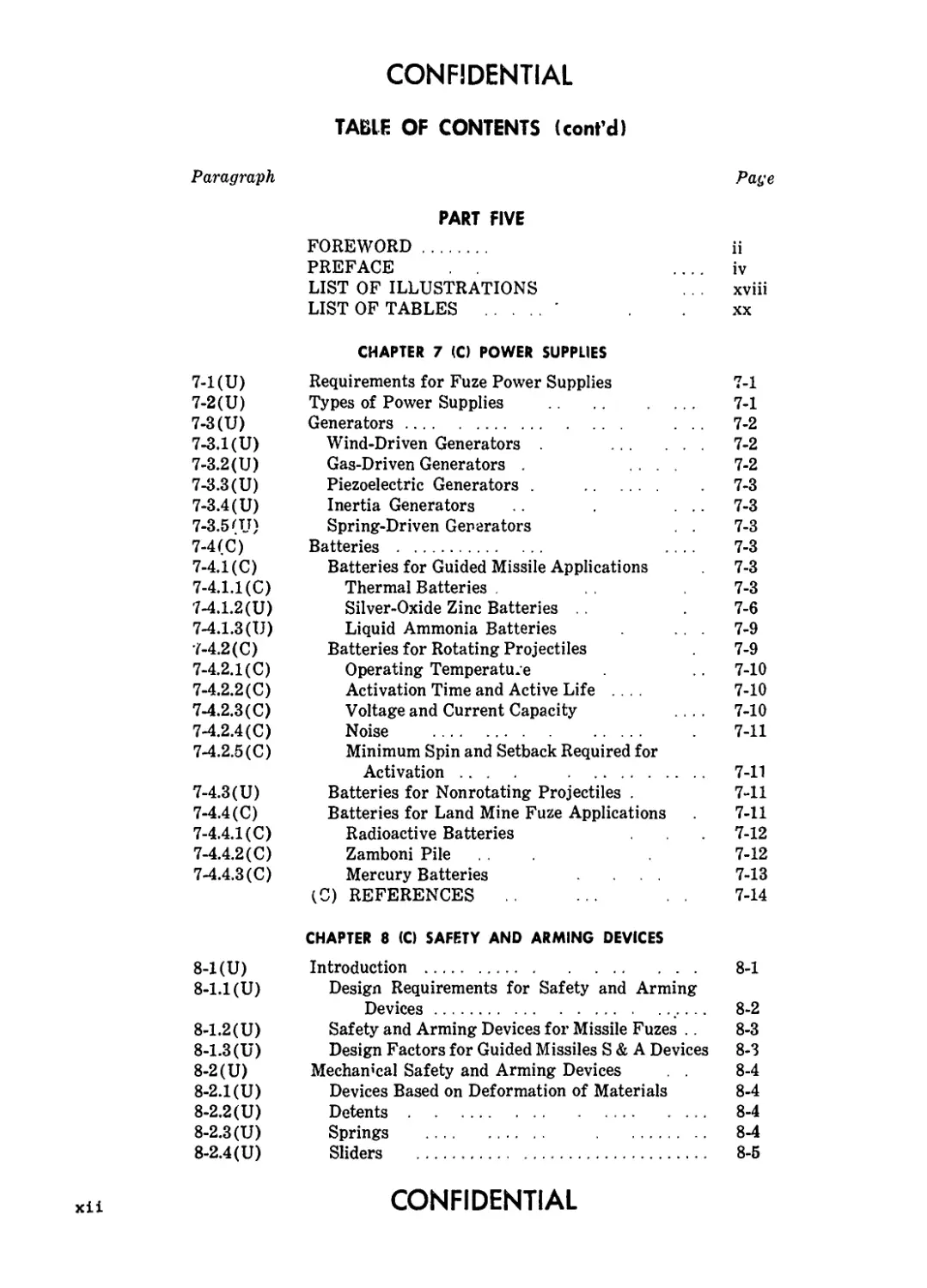
	CHAPTER 7 (C) POWER SUPPLIES
7-1 (U)	Requirements for Fuze Power Supplies	7-1
7-2(U)	Types of Power Supplies			7-1
7-3 (U)	Generators	 ...	7-2
7-3.1(U)	Wind-Driven Generators			7-2
7-3.2 (U)	Gas-Driven Generators .	....	7-2
7-3.3(U)	Piezoelectric Generators .			7-3
7-3.4 (U)	Inertia Generators	...	7-3
7-3.5 (U)	Spring-Driven Generators	. .	7-3
7-4(C)	Batteries 	 ....	7-3
7-4.1 (C)	Batteries for Guided Missile Applications	7-3
7-4.1.1(C)	Thermal Batteries .	7-3
7-4.1.2(U)	Silver-Oxide Zinc Batteries	7-6
7-4.1.3(U)	Liquid Ammonia Batteries	...	7-9
7-4.2(C)	Batteries for Rotating Projectiles	7-9
7-4.2.1(C)	Operating Temperature	7-10
7-4.2.2(C)	Activation Time and Active Life ....	7-10
7-4.2.3(C)	Voltage and Current Capacity	....	7-10
7-4.2.4(C)	Noise		 		7-11
7-4.2.5(C)	Minimum Spin and Setback Required for
	Activation ...			7-11
7-4.3(U)	Batteries for Nonrotating Projectiles .	7-11
7-4.4 (C)	Batteries for Land Mine Fuze Applications	7-11
7-4.4.1(C)	Radioactive Batteries	7-12
7-4.4.2(C)	Zamboni Pile ...	7-12
7-4.4.3(C)	Mercury Batteries	...	7-13
	(C) REFERENCES	7-14
	CHAPTER 8 (Cl SAFETY AND ARMING DEVICES
8-1 (U)	Introduction		8-1
8-1.1 (U)	Design Requirements for Safety and Arming
	Devices		8-2
8-1.2(U)	Safety and Arming Devices for Missile Fuzes ..	8-3
8-1.3 (U)	Design Factors for Guided Missiles S & A Devices	8-3
8-2 (U)	Mechan'cal Safety and Arming Devices	. .	8-4
8-2.1 (U)	Devices Based on Deformation of Materials	8-4
8-2.2(U)	Detents		8-4
8-2.3 (U)	Springs 	 		8-4
8-2.4 (U)	Sliders 		8-5
CONFIDENTIAL
CONFIDENTIAL
TABLE OF CONTENTS (cont’d)
Paragraph	Page
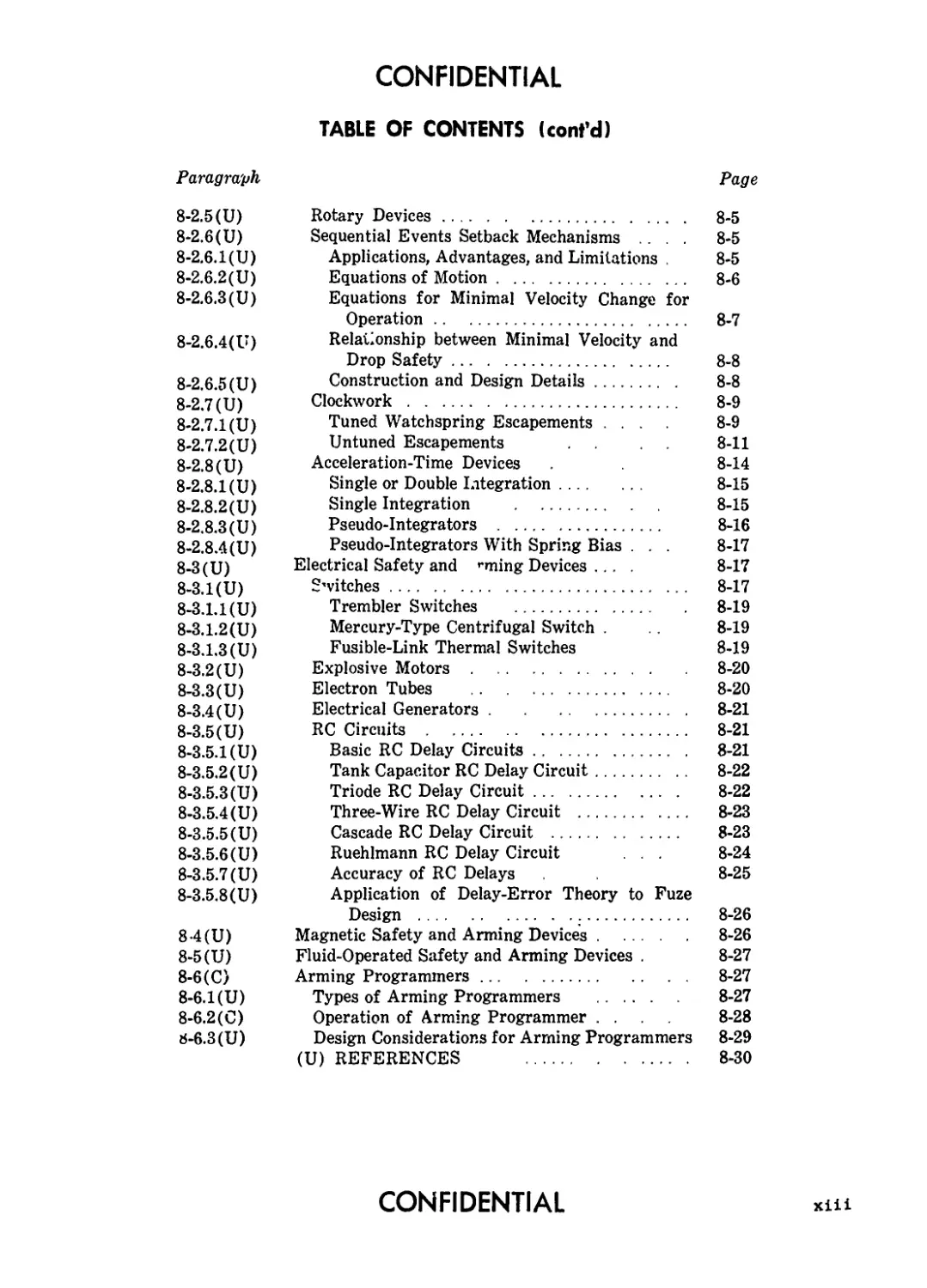
8-2.5(U)	Rotary Devices............................. 8-5
8-2.6(U)	Sequential Events Setback Mechanisms ....	8-5
8-2.6.1(U)	Applications, Advantages, and Limitations .	8-5
8-2.6.2(U)	Equations of Motion........................ 8-6
8-2.6.3(U) Equations for Minimal Velocity Change for
Operation................................................. 8-7
8-2.6.4(U) Relationship between Minimal Velocity and
Drop Safety............................................ 8-8
8-2.6.5(U)	Construction and Design Details............ 8-8
8-2.7 (U)	Clockwork ................................. 8-9
8-2.7.1(U)	Tuned Watchspring Escapements	....	8-9
8-2.7.2(U)	Untuned Escapements	8-11
8-2.8(U)	Acceleration-Time Devices	8-14
8-2.8.1(U)	Single or Double Integration.......... 8-15
8-2.8.2(U)	Single Integration ..................... 8-15
8-2.8.3(U)	Pseudo-Integrators ..................... 8-16
8-2.8.4(U)	Pseudo-Integrators With Spring Bias	.	.	.	8-17
8-3 (U) Electrical Safety and rming Devices .. . .	8-17
8-3.1 (U)	Switches................................... 8-17
8-3.1.1(U)	Trembler Switches ......................... 8-19
8-3.1.2(U) Mercury-Type Centrifugal Switch .	..	8-19
8-3.1.3(U)	Fusible-Link Thermal Switches	8-19
8-3.2(U)	Explosive Motors........................... 8-20
8-3.3(U)	Electron Tubes	8-20
8-3.4(U)	Electrical Generators...................... 8-21
8-3.5(U)	RC Circuits ............................... 8-21
8-3.5.1(U)	Basic RC Delay Circuits.................... 8-21
8-3.5.2(U)	Tank Capacitor RC Delay Circuit............ 8-22
8-3.5.3(U)	Triode RC Delay Circuit.................... 8-22
8-3.5.4(U)	Three-Wire RC Delay Circuit ............... 8-23
8-3.5.5(U)	Cascade RC Delay Circuit .................. 8-23
8-3.5.6(U) Ruehlmann RC Delay Circuit . . .	8-24
8-3.5.7(U)	Accuracy of RC Delays	8-25
8-3.5.8(U) Application of Delay-Error Theory to Fuze
Design ............................................... 8-26
8-4 (U)	Magnetic Safety and Arming Devices........... 8-26
8-5 (U)	Fluid-Operated Safety and Arming Devices .	8-27
8-6(0	Arming Programmers........................... 8-27
8-6.1 (U) Types of Arming Programmers ..................... 8-27
8-6.2(C)	Operation of Arming Programmer ....	8-28
8-6.3 (U)	Design Considerations for Arming Programmers	8-29
(U) REFERENCES .............................. 8-30
CONFIDENTIAL
xiii
CONFIDENTS AL
TABLE OF CONTENTS (cont'd)
Paragraph	Page
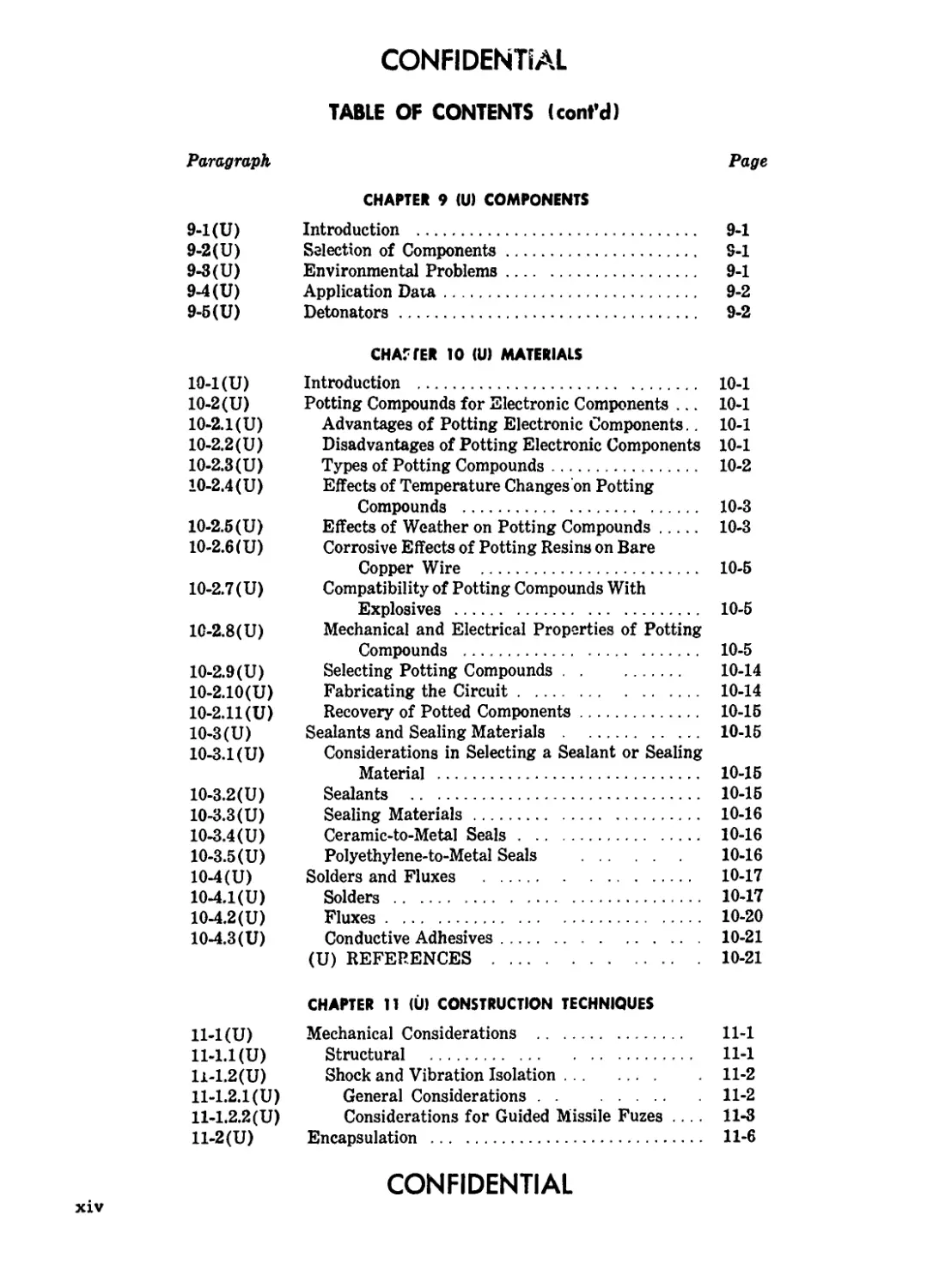
CHAPTER 9 (U) COMPONENTS
9-1 (U)	Introduction .................................. 9-1
9-2(U)	Selection of Components........................ 9-1
9-3 (U)	Environmental Problems......................... 9-1
9-4 (U)	Application Data............................... 9-2
9-5 (U)	Detonators .................................... 9-2
CHAFFER 10 (U) MATERIALS
10-1 (U)	Introduction ................................. 10-1
10-2(U)	Potting Compounds for Electronic Components ... 10-1
10-2.1 (U)	Advantages of Potting Electronic Components.. 10-1
10-2.2(U)	Disadvantages of Potting Electronic Components 10-1
10-2.3 (U)	Types of Potting Compounds................. 10-2
10-2.4(U)	Effects of Temperature Changes on Potting
Compounds ............................. 10-3
10-2.5 (U)	Effects of Weather on Potting Compounds.... 10-3
10-2.6(U)	Corrosive Effects of Potting Resins on Bare
Copper Wire ........................... 10-5
10-2.7(U)	Compatibility of Potting Compounds With
Explosives ............................ 10-5
10-2.8(U)	Mechanical and Electrical Properties of Potting
Compounds ............................. 10-5
10-2.9(U)	Selecting Potting Compounds............... 10-14
10-2.10(U)	Fabricating the Circuit................... 10-14
10-2.11 (U)	Recovery of Potted Components............. 10-15
10-3(U)	Sealants and Sealing Materials .............. 10-15
10-3.1 (U)	Considerations in Selecting a Sealant or Sealing
Material ............................. 10-15
10-3.2(U)	Sealants ................................. 10-15
10-3.3(U)	Sealing Materials......................... 10-16
10-3.4(U)	Ceramic-to-Metal Seals.................... 10-16
10-3.5(U)	Polyethylene-to-Metal Seals .............. 10-16
10-4 (U)	Solders and Fluxes .......................... 10-17
10-4.1(U)	Solders .................................. 10-17
10-4.2(U)	Fluxes.................................... 10-20
10-4.3(U)	Conductive Adhesives...................... 10-21
(U) REFERENCES............................. 10-21
CHAPTER 11 <U> CONSTRUCTION TECHNIQUES
ll-l(U) Mechanical Considerations ........................ 11-1
11-1.1 (U)	Structural ................................ 11-1
li-1.2(U)	Shock and Vibration Isolation.............. 11-2
11-1.2.1 (U)	General Considerations . .	............11-2
11-1.2.2(U)	Considerations for Guided Missile Fuzes .... 11-3
11-2(U) Encapsulation .................................... 11-6
CONFIDENTIAL
xiv
CONFIDENTIAL
TABLE OF CONTENTS (cont’d)
Paragraph	Page
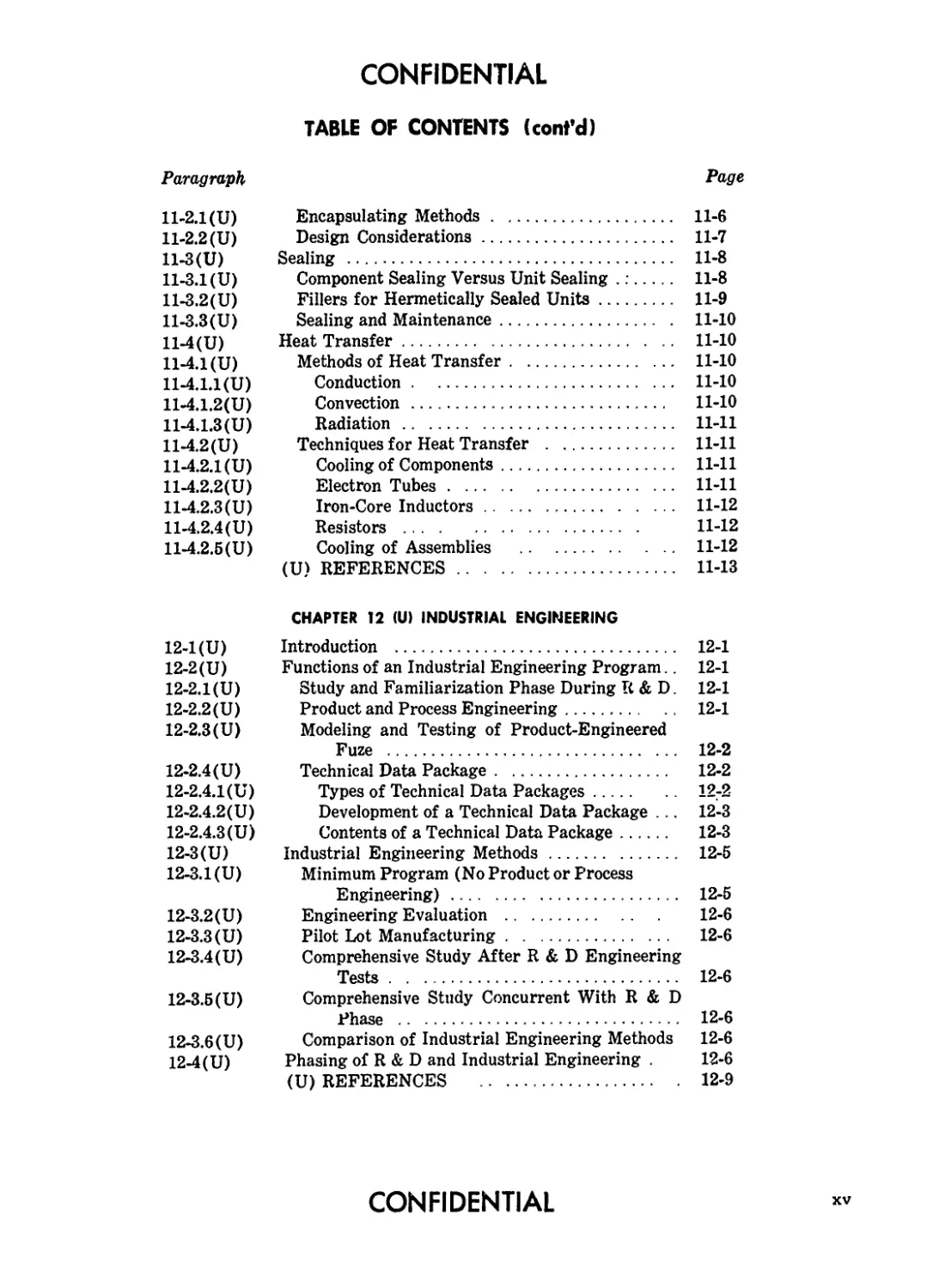
11-2.1 (U)	Encapsulating Methods..................... 11-6
11-2.2 (U)	Design Considerations..................... 11-7
11-3(U)	Sealing ..................................... 11-8
11-3.1 (U)	Component Sealing Versus	Unit Sealing .:.. 11-8
11-3.2 (U)	Fillers for Hermetically Sealed	Units..... 11-9
11-3.3(U)	Sealing and Maintenance................... 11-10
11-4(U)	Heat Transfer................................ 11-10
11-4.1 (U)	Methods of Heat Transfer.................. 11-10
11-4.1.1 (U)	Conduction................................ 11-10
11-4.1.2(U)	Convection ............................... 11-10
11-4.1.3(U)	Radiation ................................ 11-11
11-4.2(U)	Techniques for Heat Transfer ............. 11-11
11-4.2.1(U)	Cooling of Components..................... 11-11
11-4.2.2(U)	Electron Tubes............................ 11-11
11-4.2.3(U)	Iron-Core Inductors....................... 11-12
11-4.2.4(U)	Resistors ............................ 11-12
11-4.2.5(U)	Cooling of Assemblies .................... 11-12
(U) REFERENCES.............................. 11-13
CHAPTER 12 (U) INDUSTRIAL ENGINEERING
12-1 (U)	Introduction ............. 12-1
12-2(U)	Functions of an Industrial Engineering Program.. 12-1
12-2.1(U) Study and Familiarization Phase During R & D. 12-1
12-2.2(U)	Product and Process Engineering............. 12-1
12-2.3(U) Modeling and Testing of Product-Engineered
Fuze ................................. 12-2
12-2.4(U) Technical Data Package......................... 12-2
12-2.4.1(U)	Types of Technical Data Packages.......... 12-2
12-2.4.2(U) Development of a Technical Data Package ... 12-3
12-2.4.3(U)	Contents of a Technical Data Package......	12-3
12-3(U) Industrial Engineering Methods................... 12-5
12-3.1 (U) Minimum Program (No Product or Process
Engineering) ......................... 12-5
12-3.2(U)	Engineering Evaluation ................... 12-6
12-3.3 (U)	Pilot Lot Manufacturing................... 12-6
12-3.4 (U) Comprehensive Study After R & D Engineering
Tests................................. 12-6
12-3.5(U) Comprehensive Study Concurrent With R & D
Phase ................................ 12-6
12-3.6(U)	Comparison of Industrial Engineering Methods 12-6
12-4 (U)	Phasing of R & D and Industrial Engineering .	12-6
(U) REFERENCES ............................. 12-9
CONFIDENTIAL
XV
CONFIDENTIAL
TABLE OF CONTENTS (cont’d)
Paragraph
Page
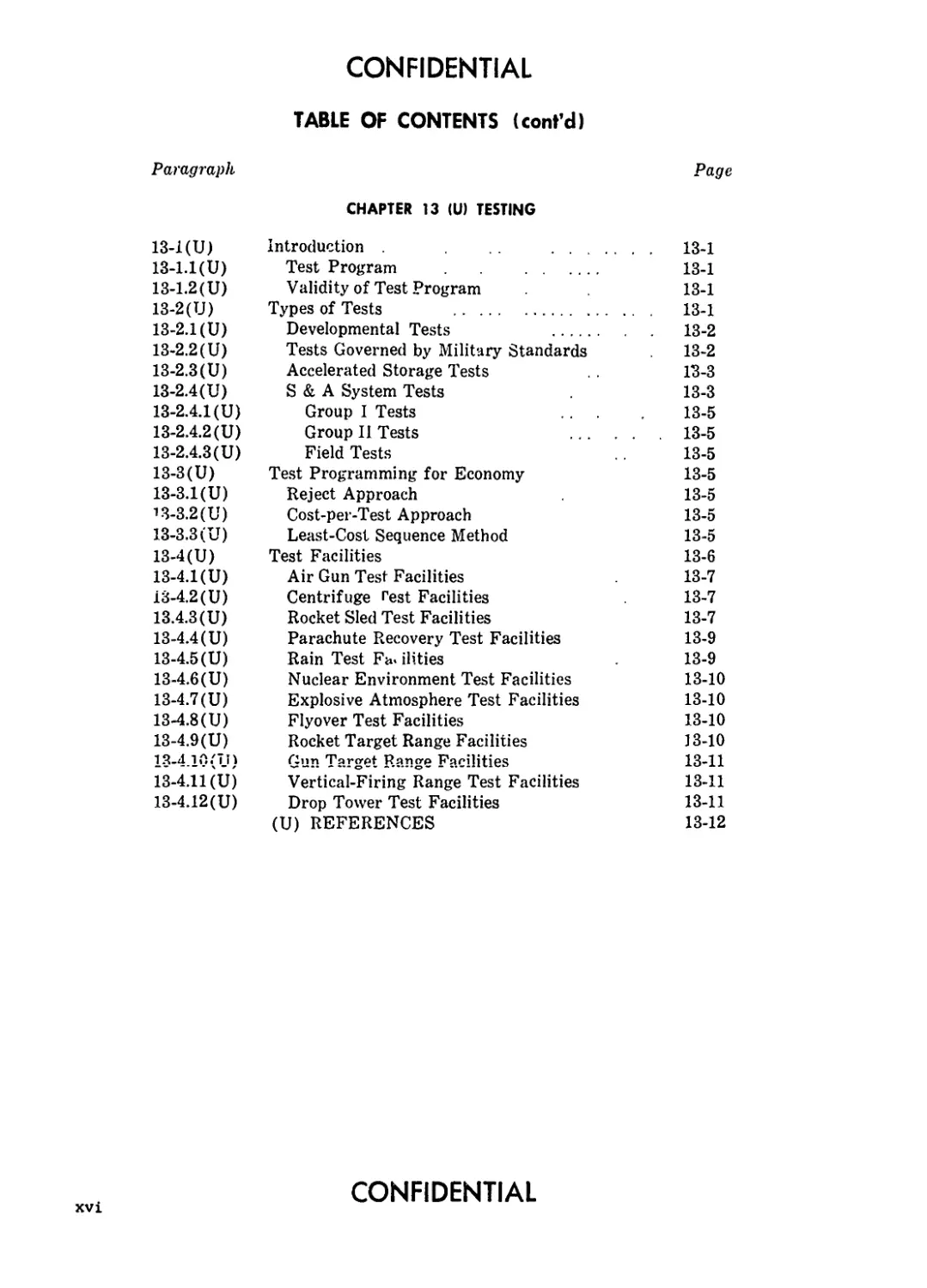
CHAPTER 13 (U) TESTING
13-1(U)	Introduction			13-1
13-1.1(U)	Test Program			13-1
13-1.2(U)	Validity of Test Program	13-1
13-2(U)	Types of Tests			13-1
13-2.1 (U)	Developmental Tests			13-2
13-2.2 (U)	Tests Governed by Military Standards	13-2
13-2.3(U)	Accelerated Storage Tests	13-3
13-2.4 (U)	S & A System Tests	13-3
13-2.4.1 (U)	Group I Tests	13-5
13-2.4.2 (U)	Group II Tests			. 13-5
13-2.4.3(U)	Field Tests	13-5
13-3(U)	Test Programming for Economy	13-5
13-3.1 (U)	Reject Approach	13-5
13-3.2 (U)	Cost-per-Test Approach	13-5
13-3.3 (U)	Least-Cost Sequence Method	13-5
13-4(U)	Test Facilities	13-6
13-4.1(U)	Air Gun Test Facilities	13-7
13-4.2(U)	Centrifuge Test Facilities	13-7
13.4.3(U)	Rocket Sled Test Facilities	13-7
13-4.4(U)	Parachute Recovery Test Facilities	13-9
13-4.5 (U)	Rain Test Fa. ilities	13-9
13-4.6(U)	Nuclear Environment Test Facilities	13-10
13-4.7(U)	Explosive Atmosphere Test Facilities	13-10
13-4.8(U)	Flyover Test Facilities	13-10
13-4.9(U)	Rocket Target Range Facilities	13-10
12-4.10.'TH	Gun Target Range Facilities	13-11
13-4.11 (U)	Vertical-Firing Range Test Facilities	13-11
13-4.12(U)	Drop Tower Test Facilities	13-11
	(U) REFERENCES	13-12
CONFIDENTIAL
xvi
CONFIDENTIAL
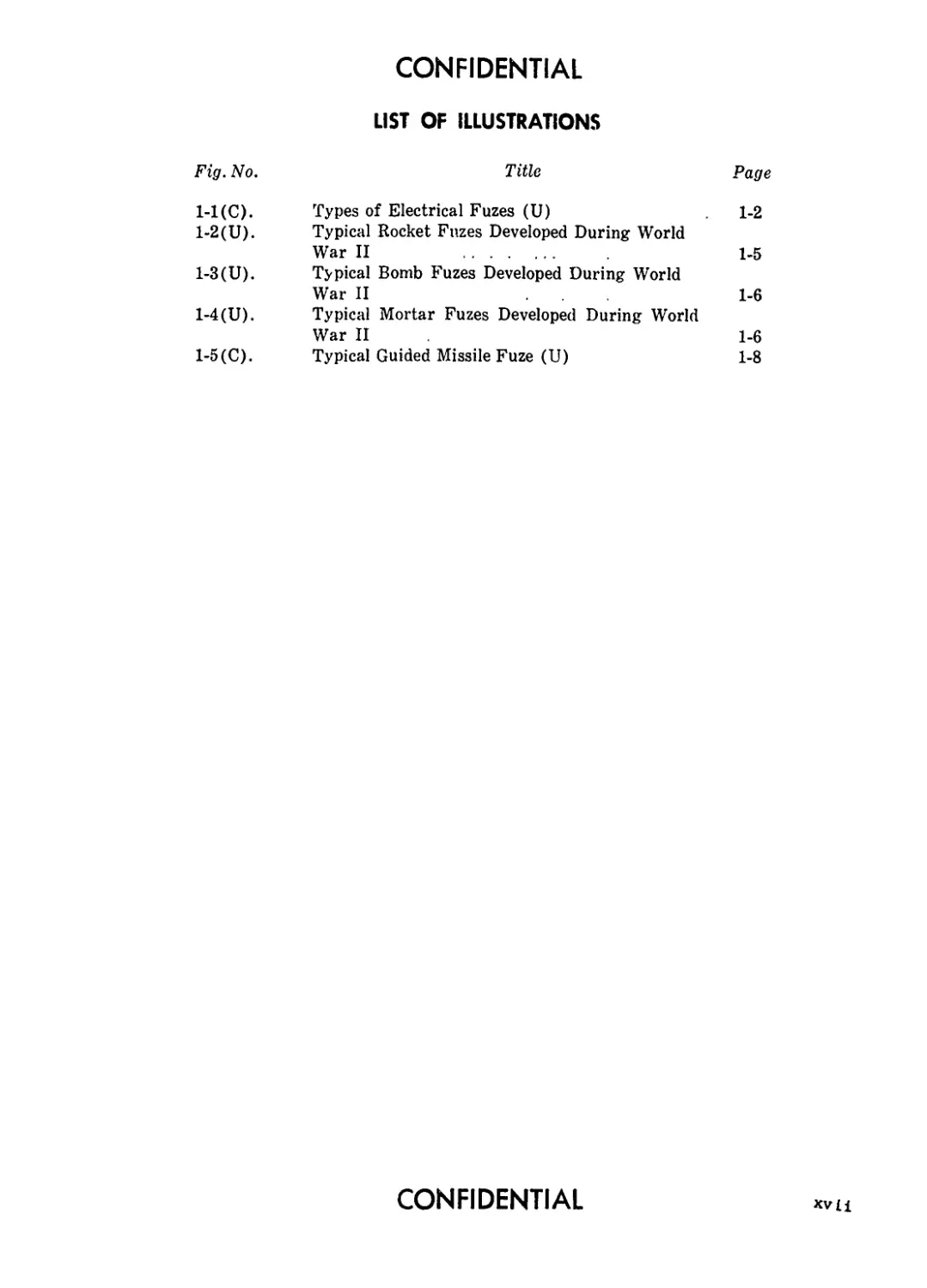
LIST OF ILLUSTRATIONS
Fig. No.	Title	Page
1-1(0-	Types of Electrical Fuzes (U)	1-2
1-2(U).	Typical Rocket Fuzes Developed During World War II			1-5
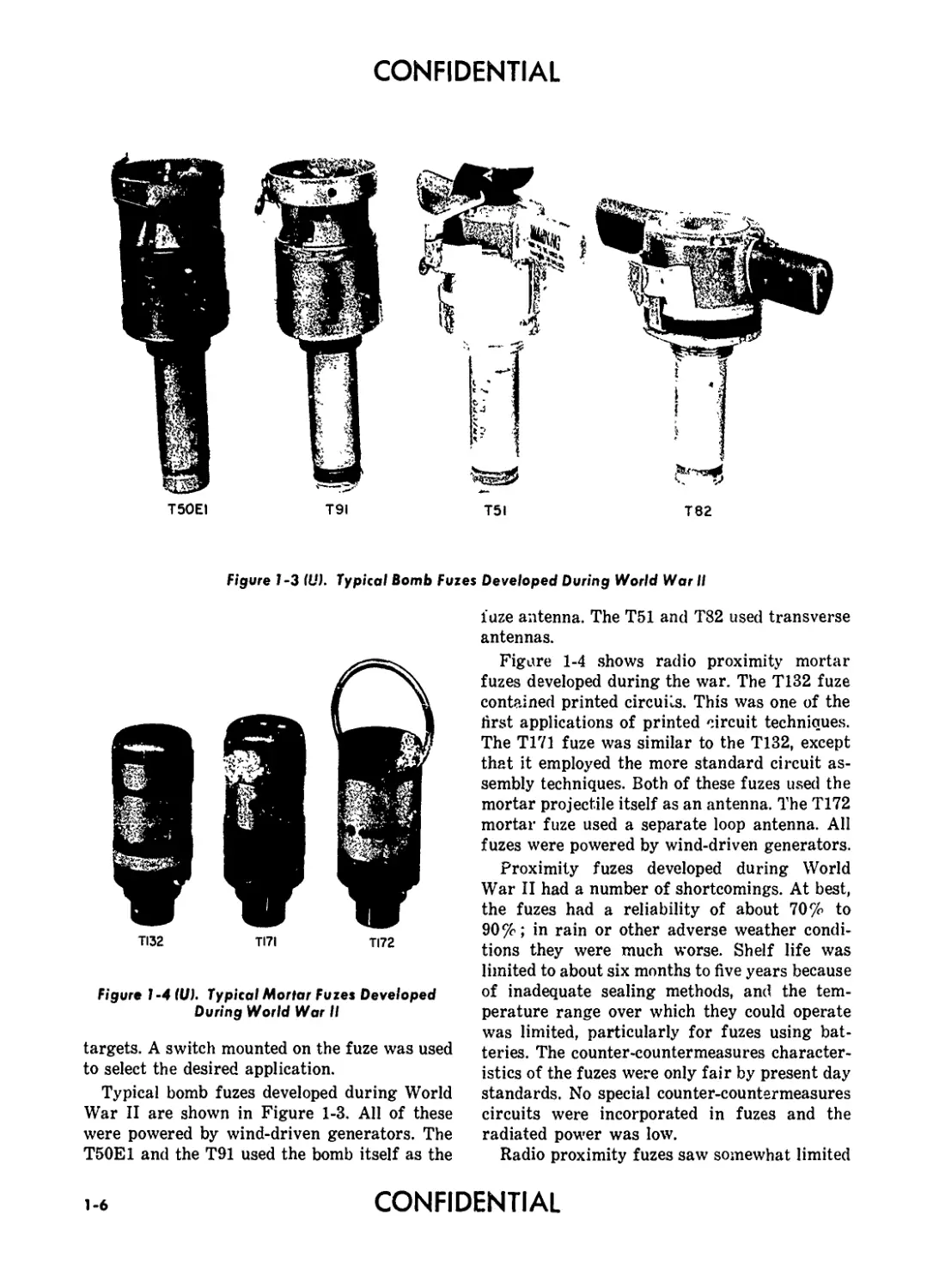
1-3 (U).	Typical Bomb Fuzes Developed During World War II	1-6
1-4(U).	Typical Mortar Fuzes Developed During World War II	1-6
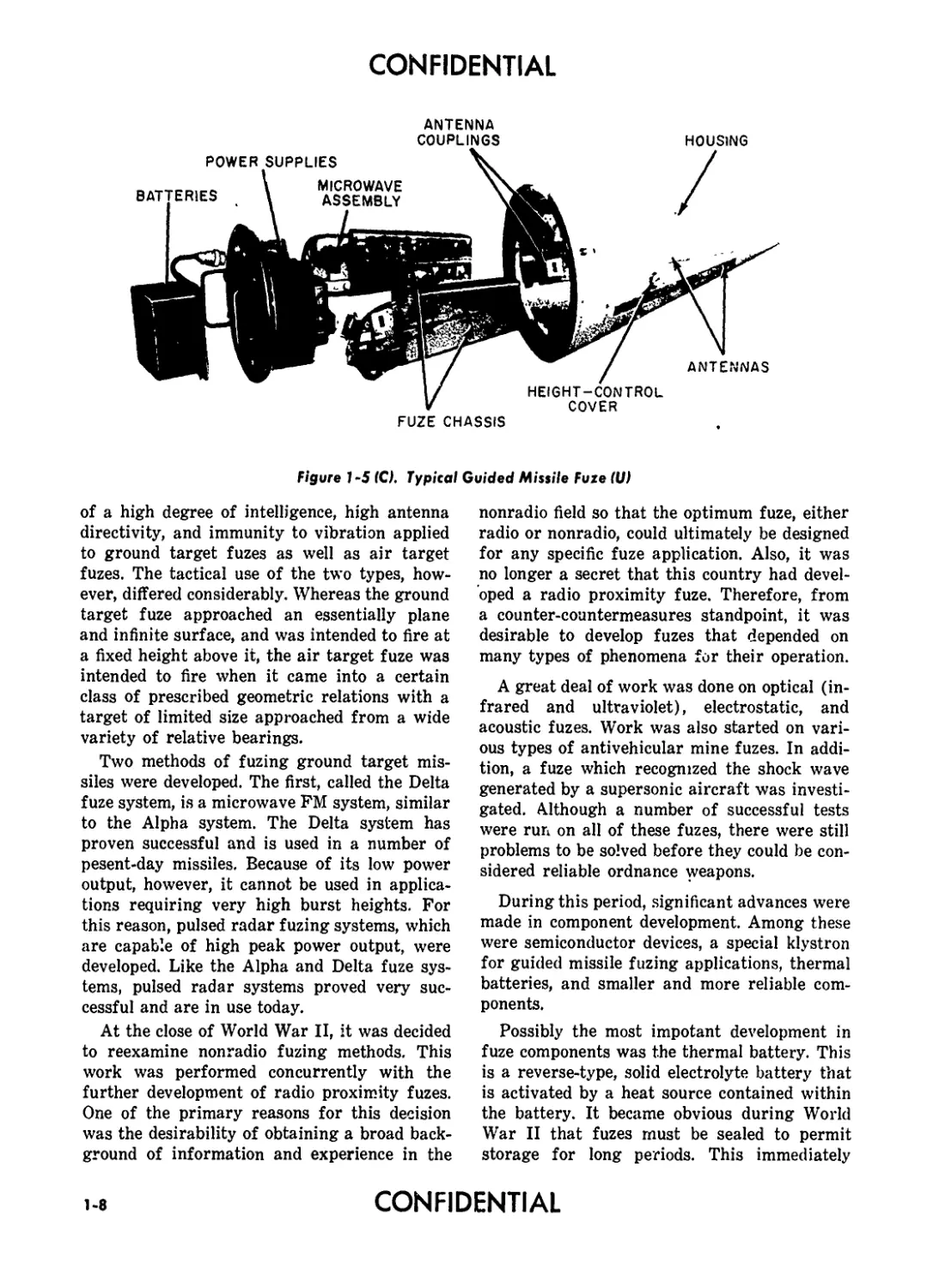
1-5(C).	Typical Guided Missile Fuze (U)	1-8
CONFIDENTIAL
XV Li
CONFIDENTIAL
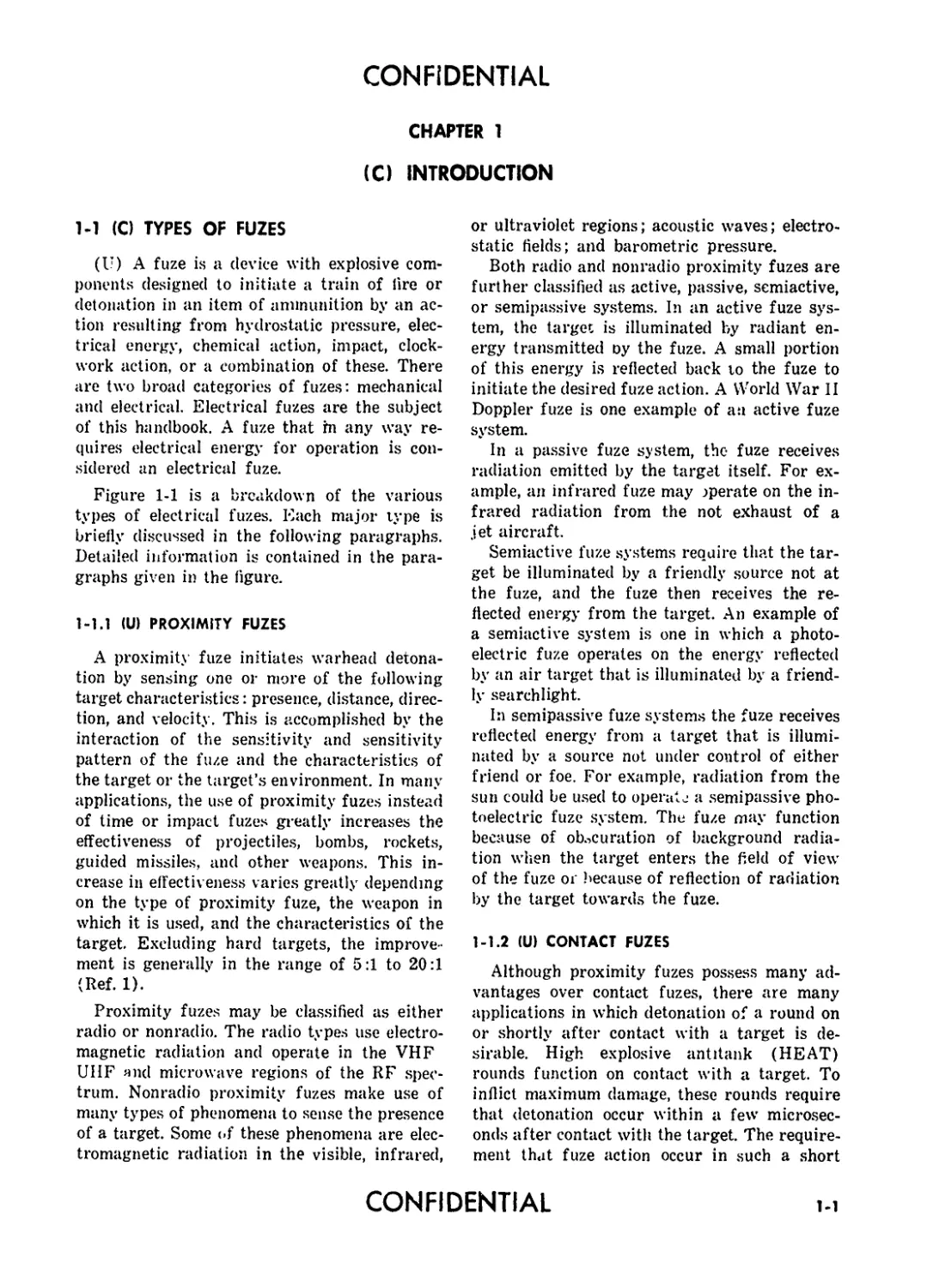
CHAPTER 1
(C) INTRODUCTION
1-1 (C) TYPES OF FUZES
(U) A fuze is a device with explosive com-
ponents designed to initiate a train of lire or
detonation in an item of ammunition by an ac-
tion resulting from hydrostatic pressure, elec-
trical energy, chemical action, impact, clock-
work action, or a combination of these. There
are two broad categories of fuzes: mechanical
and electrical. Electrical fuzes are the subject
of this handbook. A fuze that in any way re-
quires electrical energy for operation is con-
sidered an electrical fuze.
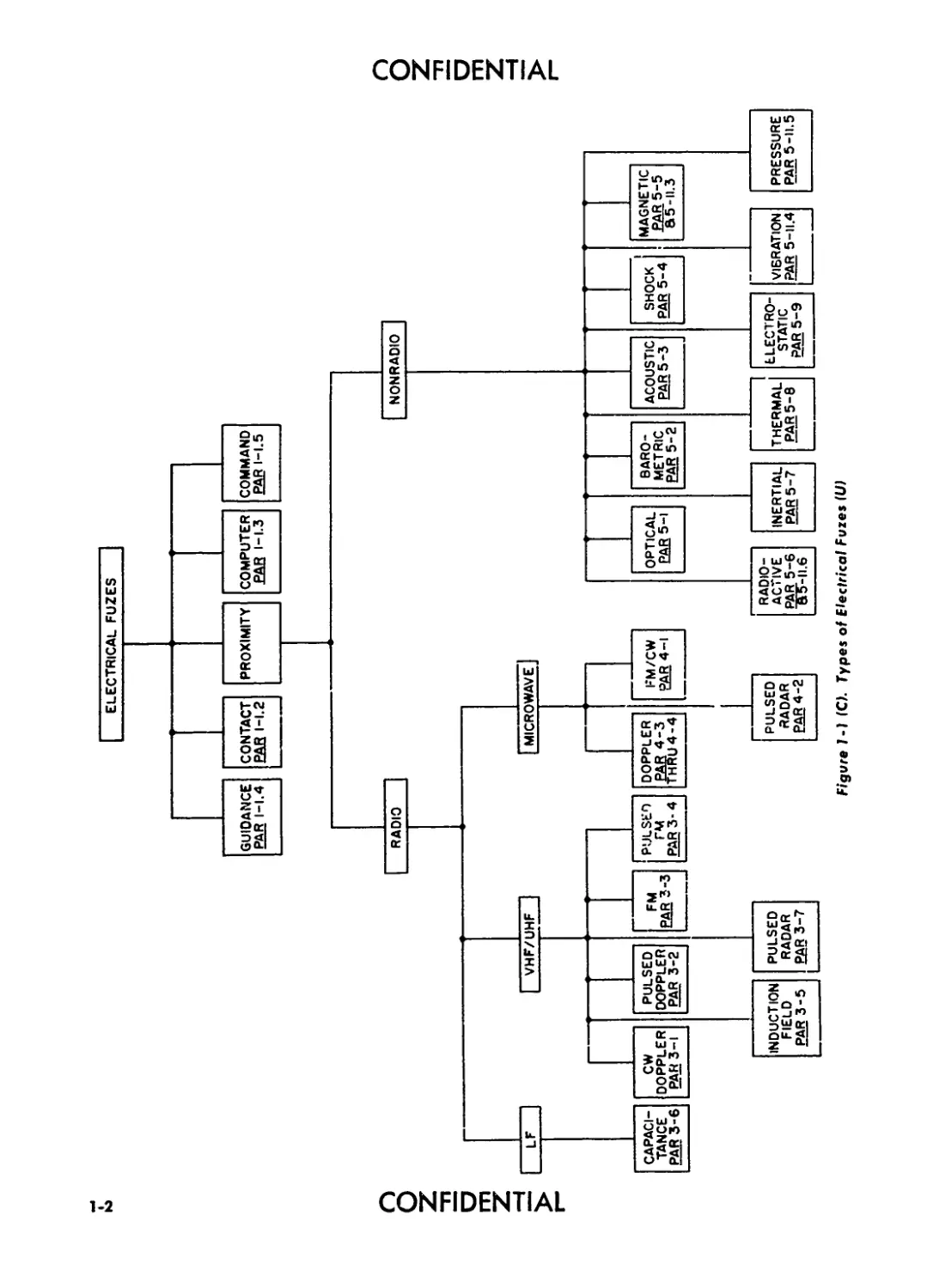
Figure 1-1 is a breakdown of the various
types of electrical fuzes. Each major type is
briefly discussed in the following paragraphs.
Detailed information is contained in the para-
graphs given in the figure.
1-1.1 (U) PROXIMITY FUZES
A proximity fuze initiates warhead detona-
tion by sensing one or more of the following
target characteristics: presence, distance, direc-
tion, and velocity. This is accomplished by the
interaction of the sensitivity and sensitivity
pattern of the fuze and the characteristics of
the target or the target’s environment. In many
applications, the use of proximity fuzes instead
of time or impact fuzes greatly increases the
effectiveness of projectiles, bombs, rockets,
guided missiles, and other weapons. This in-
crease in effectiveness varies greatly depending
on the type of proximity fuze, the weapon in
which it is used, and the characteristics of the
target. Excluding hard targets, the improve-
ment is generally in the range of 5:1 to 20:1
(Ref. 1).
Proximity fuzes may be classified as either
radio or nonradio. The radio types use electro-
magnetic radiation and operate in the VHF
UHF and microwave regions of the RF spec-
trum. Nonradio proximity fuzes make use of
many types of phenomena to sense the presence
of a target. Some <>f these phenomena are elec-
tromagnetic radiation in the visible, infrared,
or ultraviolet regions; acoustic waves; electro-
static fields; and barometric pressure.
Both radio and nonradio proximity fuzes are
further classified as active, passive, semiactive,
or semipassive systems. In an active fuze sys-
tem, the target is illuminated by radiant en-
ergy transmitted oy the fuze. A small portion
of this energy is reflected back to the fuze to
initiate the desired fuze action. A World War II
Doppler fuze is one example of an active fuze
system.
In a passive fuze system, the fuze receives
radiation emitted by the target itself. For ex-
ample, an infrared fuze may operate on the in-
frared radiation from the not exhaust of a
jet aircraft.
Semiactive fuze systems require that the tar-
get be illuminated by a friendly source not at
the fuze, and the fuze then receives the re-
flected energy from the target. An example of
a semiactive system is one in which a photo-
electric fuze operates on the energy reflected
by an air target that is illuminated by a friend-
ly searchlight.
In semipassive fuze systems the fuze receives
reflected energy from a target that is illumi-
nated by a source not under control of either
friend or foe. For example, radiation from the
sun could be used to operate a semipassive pho-
toelectric fuze system. The fuze may function
because of obscuration of background radia-
tion when the target enters the field of view
of the fuze or because of reflection of radiation
by the target towards the fuze.
1-1.2 (U) CONTACT FUZES
Although proximity fuzes possess many ad-
vantages over contact fuzes, there are many
applications in which detonation of a round on
or shortly after contact with a target is de-
sirable. High explosive antitank (HEAT)
rounds function on contact with a target. To
inflict maximum damage, these rounds require
that detonation occur within a few microsec-
onds after contact with the target. The require-
ment that fuze action occur in such a short
CONFIDENTIAL
i-i
CONFIDENTIAL
t
to
Figure 1 -I fC). Types of Electrical Fuzes (U)
CONFIDENTIAL
CONFIDENTIAL
period of time eliminates any mechanical fuz-
ing scheme. One type of electrical fuze pro-
posed for this application contains a firing
capacitor that is charged -by a magnetic impulse
generator when the round is fired. Upon impact
with the target, a pair of contacts at the nose
of the fuze closes and discharges the capacitor
through the detonator.
Another type, which is in present use, em-
ploys a piezoelectric crystal mounted in the nose
of the round. A wire connects the crystal to the
detonator, which is mounted in the base of the
round. Upon impact, the electrical energy that
results from deforming the crystal causes the
detonator to fire.
1-1.3 (C> COMPUTER F'JZlf
Computer fuzes compute the optimum time
for warhead detonation from information pro-
vided by the m.ssile target seeker. They have
been considered for use in a number of guided
mis^'e applications where omnidirectional
war! ads are employed. With this type of war-
head the optimum point of detonation occurs at
or ear the point of closest approach between
the missile and target. Fixed angle proximity
fuzes generally do not indicate the optimum
point of detonation for omnidirectional war-
heads.
Computer fuzes have not been used exten-
sively up to the present time. Although accu-
rate computer fuzes could probably be devel-
oped, they would be onl> as accurate as the tar-
get seeker from which they obtain informa-
tion. At present, the accuracy of missile target
s'<kers is r.ot sufficient to obtain the full bene-
fits omputer fuzing.
C i.-_ present-day missile, the Bomarc, uses a
computer fuze. It is used, however, as a second-
ary fuze and operates only when the primary
radio proximity fuze is inoperative because of
malfunctioning or enemy countermeasures.
1-1.4 (Lil GUIDANCE FUZES
Guidance fuzes derive all information for
fuzing action from the missile guidance system.
They contain no transmitter or receiver and are
essentially computers that utilize guidance sig-
nals for the operation. Guidance fuze systems
require no microwave antennas or plumbing,
generally require less power than missile prox-
imity fuze systems, but are no better than the
missile guidance system with respect to clutter
and countermeasures.
1-1.5 (U) COMMAND FUZES
A command fuze functions as a result of in-
telligence transmitted to it from a remote con-
trol station, usually a ground radar. In most
instances a computer, associated with the
ground radar, determines the optimum time to
trigger the fuze. Only a few components are
required in the missile, because the fuzing
problem is solved by the ground computer.
1-2 (U) FUZE REQUIREMENTS
In many instances, fuze requirements differ
considerably from those of conventional elec-
tronic equipment. For example, a fuze may be
stored for as long as 20 years and then be used
for only a few seconds before it is destroyed by
the detonation it initiates. In many cases, no
maintenance or preflight checkout of the fuze
is permissible.
The fuze designer must consider reliability
in a somewhat different manner than the con-
ventional equipment designer. Normally, the
fuze designer nr .ds “one-shot” reliability,
whereas the designer of conventional equip-
ment may consider “mean-time-between-fail-
ures” to determine the reliability of his equip-
ment.
Safety requirements for fuzes are extremely
stringent because many fuzes contain explo-
sive components. Fuzes must be safe during
manufacturing, storage, and handling. During
operational use, a fuze that prefunctions may
cause injury or death to friendly personnel,
and severe damage to equipment. Compatibility
of materials used in fuze construction must
also be considered. Particularly, the behavior
of explosives with adjacent materials must be
known before production begins. A reaction be-
tween noncompatible explosives and materials
might result in detonation of the fuze during
storage, causing loss of life and equipment.
Counter-countermeasures requirements for
fuzes are somewhat, different than for many
CONFIDENTIAL
1-3
CONFIDENTIAL
conventional electronic equipments. For exam-
ple, the designer of a search-type pulsed radar
may incorporate counter-countermeasures con-
trols in the equipment. These controls would
be used by the operator only when enemy coun-
termeasures are encountered. At all other times,
the equipment can operate at optimum gain,
sensitivity, power output, etc. When designing
a proximity fuze, however, the fuze designer
must assume that the fuze will be jammed at
all times. This means that compromises may
have to be made with respect to major fuze
parameters to eliminate or reduce the effects
of enemy countermeasures.
1-3 (C) HISTORY
(U) Electrical fuzes have been used in many
varied fuzing applications since about 1940.
The purpose of this section is to present factors
considered during the evolution of electrical
fuzes. Such factors include: why development
of the various types of fuzes was started; pres-
ent status of various programs; and why cer-
tain projects were discontinued. Because the
proximity fuze represents the most sophisti-
cated, and by far the most widely used type of
electical fuze, it is the type discussed in great-
est detail.
The history of proximity fuzing may be di-
vided into three periods: (1) World War II, the
period during which the basic proximity fuze
was developed; (2) the end of World War II to
the Korean War, the period during which many
new methods of proximity fuzing were investi-
gated, and guided missile fuzing was started;
and (3) Korean War to 1960, the period during
which considerations of the use of nuclear war-
heads created many new and difficult require-
ments for fuzing.
This chanter points out many of the high-
lights of tnese periods. A detailed history of
World War II fuzing is given in References 2
and 3, a detailed history from 1953 to 1960 is
given in Reference 4. Much of the information
in this section is based on these references.
1-3.1 (U) WORLD WAR II
Development of poximity fuzes was started
in 1940. Early in the development program the
Army was assigned the responsibility for fuz-
ing nonrotated, or fin-stabilized, projectiles and
the Navy was assigned the responsibility for
rotated, or spin-stabilized, projectiles. The
work on nonrotated projectiles was performed
at the National Bure-m of Standards under
sponsorship of the National Defense Research
Committee (NDRC). The development of ro-
tated projectiles was carried on at the Johns
Hopkins University Applied Physics Labora-
tory.
During World War II, many types of prox-
imity fuzes were investigated. The most impor-
tant of these were acoustic, pressure, electro-
static, optical, and radio.
The acoustic fuze operates on the noise gen-
erated by an aircraft in flight. It appeared that
a cheap and reliable antiaircraft fuze could be
designed and produced, provided that noise
generated by the missile carrying the fuze did
not introduce complications that could not be
tolerated.’ Tests conducted to evaluate the noise
genet ated by missiles in flight showed that the
self-noise of the missile exceeded the noise level
produced by an air target at distances at which
proximity operation was desired. Because the
velocity of sound was another major limitation
of an acoustic fuze, particularly in applications
involving high-speed missiles against high-
speed aircraft, the development of an acoustic
fuze was abandoned.
To explore the possibility of producing air-
burst bombs by means of barometric or pres-
sure-operated devices, a barotimer, which was a
combination barometric and time device, was
investigated. This device continually measured
the barometric pressure to determine the alti-
tude at which a bomber was flying and then set
a time fuze to the time required for a bomb to
fall the required distance to the target. Al-
though the barotimer proved reliable in labora-
tory tests, no field tests were conducted. It was
concluded that burst heights would be too vari-
able because of inherent limitations in predict-
ing atmospheric pressure and probable lack of
knowledge of atmospheric pressure over the
target.
A somewhat unique pressure-activated device
was developed by the British. It was called the
No. 44 Pistol fuze and contained a pressure-sen-
sitive diaphragm that caused detonation when
1-4
CONFIDENTIAL
CONFIDENTIAL
subjected to a sudden increase in pressue. Air
burst was obtained by dropping several bombs,
each containing a Pistol fuze, in a stick or train.
The first bomb exploded on contact with the
target, and the blast effect caused the other
bombs to burst in the air. This method, how-
ever, was only about half as effective as radio
proximity fuzing, and little effort was made to
develop this type of fuze any further.
During this same period, considerable re-
search was carried on concerning the possible
use of electrostatic methods to produce air
bursts, particularly for antiaircraft applica-
tions. This method of fuzing was appealing
primarily because of its simplicity. Operation
of an electrostatic fuze depends upon the elec-
trical charge on the target or missile, or on
both. At the time, it was concluded that charges
on an aircraft in flight and on the missile were
too variable to insure reliable proximity opera-
tion. Consequently, work on this program was
also abandoned.
A considerable amount of research and de-
velopment during World War II was devoted
to optical fuzing methods. A photoelectric opti-
cal fuze was developed by the British very early
in the war, and their work provided a starting
point for American developfent. A reasonably
successful passive photoelectric fuze was devel-
oped in this country in 1942.
Photoelectric fuzes were simple, and the
burst position with respect to the target could
be controlled very accurately. This fuze, how-
ever, had two major limitations: (1) its opera-
tion was restricted to daytime; and (2) it could
be prefunctioned by the light from the sun (see
Ref. 3).
Similarly, studies of infrared optical fuzing
systems were also initiated and halted during
this period. The main reason for discontinuing
research in this area was because IR detectors
available at that time were too slow, or too in-
sensitive, for fuzing applications. This fact,
coupled with the apparent practicability of
radio proximity fuzing, resulted in the aban-
donment of infrared fuzing.
In October 1943, all other types of proximity
fuzes were shelved in favor of developing the
radio proximity fuze. Although this type of fuze
was more complicated than the others investi-
gated, it possessed two important advantages:
(1) it provided performance day or night under
a variety of operating conditions; and (2) it
could be used against any target that reflected
radio waves. The second advantage meant that
a single basic principle could be used for both
air-target and ground-target applications.
During World War II, radio proximity fuzes
were developed, at the National Bureau of
Standards, for bomb, rocket, and mortar ap-
plications. All of these fuzes utilized the Dop-
pler effect, i.e., the difference in frequency be-
tween a transmitted wave and a received wave
due to relative motion between the fuze and
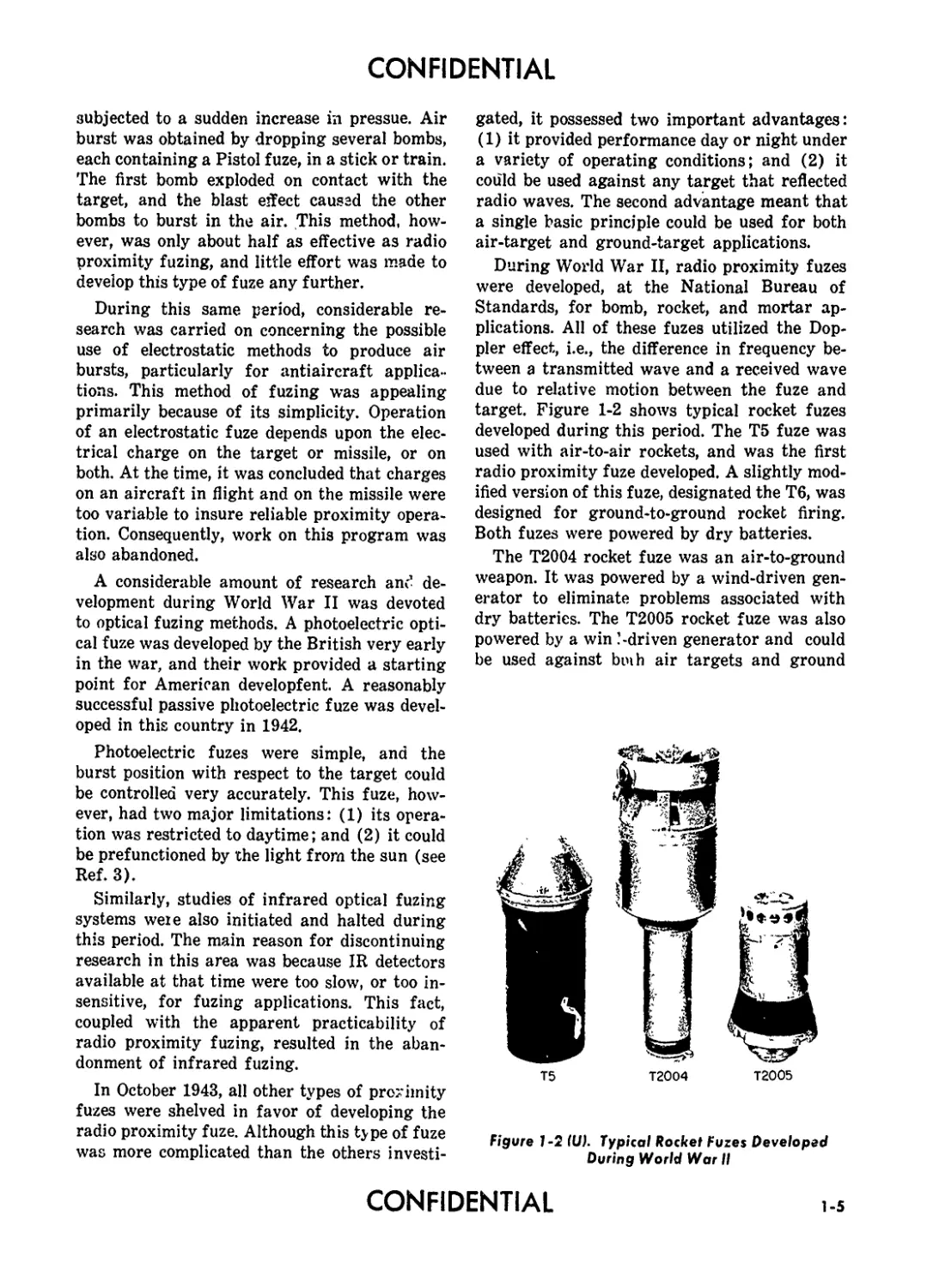
target. Figure 1-2 shows typical rocket fuzes
developed during this period. The T5 fuze was
used with air-to-air rockets, and was the first
radio proximity fuze developed. A slightly mod-
ified version of this fuze, designated the T6, was
designed for ground-to-ground rocket firing.
Both fuzes were powered by dry batteries.
The T2004 rocket fuze was an air-to-ground
weapon. It was powered by a wind-driven gen-
erator to eliminate problems associated with
dry batteries. The T2005 rocket fuze was also
powered by a win \driven generator and could
be used against both air targets and ground
Т5	T2004	T2005
Figure 1-2 (U). Typical Rocket Fuzes Developed
During World War II
CONFIDENTIAL
1-5
CONFIDENTIAL
T50EI	T9I
Figure 1-3 (U). Typical Bomb Fuzes Developed During World War II
Figure 1-4 IU). Typical Mortar Fuzes Developed
During World War II
targets. A switch mounted on the fuze was used
to select the desired application.
Typical bomb fuzes developed during World
War II are shown in Figure 1-3. All of these
were powered by wind-driven generators. The
T50E1 and the T91 used the bomb itself as the
fuze antenna. The T51 and T82 used transverse
antennas.
Figure 1-4 shows radio proximity mortar
fuzes developed during the war. The T132 fuze
contained printed circuits. This was one of the
first applications of printed circuit techniques.
The T171 fuze was similar to the T132, except
that it employed the more standard circuit as-
sembly techniques. Both of these fuzes used the
mortar projectile itself as an antenna. The T172
mortar fuze used a separate loop antenna. All
fuzes were powered by wind-driven generators.
Proximity fuzes developed during World
War II had a number of shortcomings. At best,
the fuzes had a reliability of about 70% to
90%; in rain or other adverse weather condi-
tions they were much worse. Shelf life was
limited to about six months to five years because
of inadequate sealing methods, and the tem-
perature range over which they could operate
was limited, particularly for fuzes using bat-
teries. The counter-countermeasures character-
istics of the fuzes were only fair by present day
standards. No special counter-countermeasures
circuits were incorporated in fuzes and the
radiated power was low.
Radio proximity fuzes saw somewhat limited
1-6
CONFIDENTIAL
CONFIDENTIAL
operational use during World War II, primarily
because they were introduced into action very
late in the war. Thus, a thorough analysis
of the effectiveness of the fuzes was not possi-
ble. The genera] reaction, however, was favor-
able. They proved highly effective in defending
the fleet against Japanese attacks, and in de-
fending London against buzz bombs.
1-3.2 (C) WORLD WAR II TO KOREAN WAR
During the years following World War II,
many significant advances were made in the
proximity fuze field. The radio proximity fuze
was greatly improved; many new types of
fuzes, including nonradio, were developed; and
fuze reliability was greatly increased by the
use of improved components and materials,
better production methods, and multiple fuzing
systems.
Immediately after the war, work was started
to improve the CW Doppler radio proximity
fuze. Loop antennas were developed to permit
fuze operation in missiles during the burning
of the rocket propellant. Prior to the develop-
ment of loop antennas the rocket body was used
as the fuze antenna. Ionized gases caused by
afterburning had the effect of continually
changing the effertive length of the antenna
and fuze performance was, therefore, quite
erratic and unreliable.
Sophisticated amplifiers were developed for
use in bomb, rocket, and mortar fuzes. These
amplifiers provided improved protection
against countermeasures, improved reliability
in the presence of noise caused by vibration,
and more uniform function heights under
varied field conditions.
Pulsed Doppler fuzes were also investigated
during this period. By pulsing the conventional
CW Doppler fuze, higher power output and
definite range cutoff, a distance beyond which
the fuze cannot “see,” were obtained. This
greatly improved the counter-countermeasures
capabilities of the Doppler fuze. Because of
problems associated with pulsed Doppler fuzes,
‘particularly in designing a suitable pulse modu-
lator, work was discontinued. The work per-
formed during this period, however, was the
basis for the pulsed Doppler fuze that was de-
veloped many years later.
In 1946, work was started on guided missile
fuzing. At the very beginning of the guided
missile fuze program it was obvious that it was
no longer possible to use a large number of
small explosive charges that would burst in
the general vicinity of a target. It was now
necessary, because of the high cost of guided
missiles and the limited fire power of launchers,
to insure that every missile that passed within
lethal range of the target effected maximum
target damage. This required a fuze with a
great deal more intelligence than the radio
Doppler fuze, and one with a highly directive
antenna pattern to resolve the target with
greater precision. It was also required that the
fuze withstand the vibrations that would be en-
countered in guided missiles.
These requirements led to the development
of frequency-modulated microwave fuze sys-
tems. A typical guided missile fuze and some of
its major components are shown in Figure 1-5.
The first FM microwave system developed,
the Alpha system, was intended for use against
air targets. This system is still in use today.
By operating in the microwave region, precise
antenna patterns were obtained and, therefore,
precise burst positions. Operation at microwave
frequencies also permitted the use of a very
narrow conical antenna pattern that could be
seen by the target for only a short time during
intercept. This made countermeasures very dif-
ficult. The combination of a high carrier fre-
quency and frequency modulation resulted in a
Doppler signal far above the microphonic fre-
quency region, thus making the fuze insensitive
to vibration.
An extremely difficult problem in the de-
velopment of this fuze wa< to design a highly
directive multielement antenna array I hat did
not protrude from the missile skin. Thi- prob-
lem was solved by using multiple slot a'ltenna-
coupled directly io waveguides within the nose
of the missile. This development has пне be-
come standard practice in microwave guided
missile fuzing.
Early in the guided missile fuze program it
became apparent that problems posed by air
targets and ground targets differed to such tin
extent that each required different approaches
and different solutions. The basic requirements
CONFIDENTIAL
1-7
CONFIDENTIAL
Figure 1-5 (Ci. Typical Guided Missile Fuze (U)
of a high degree of intelligence, high antenna
directivity, and immunity to vibration applied
to ground target fuzes as well as air target
fuzes. The tactical use of the two types, how-
ever, differed considerably. Whereas the ground
target fuze approached an essentially plane
and infinite surface, and was intended to fire at
a fixed height above it, the air target fuze was
intended to fire when it came into a certain
class of prescribed geometric relations with a
target of limited size approached from a wide
variety of relative bearings.
Two methods of fuzing ground target mis-
siles were developed. The first, called the Delta
fuze system, is a microwave FM system, similar
to the Alpha system. The Delta system has
proven successful and is used in a number of
pesent-day missiles. Because of its low power
output, however, it cannot be used in applica-
tions requiring very high burst heights. For
this reason, pulsed radar fuzing systems, which
are capable of high peak power output, were
developed. Like the Alpha and Delta fuze sys-
tems, pulsed radar systems proved very suc-
cessful and are in use today.
At the close of World War II, it was decided
to reexamine nonradio fuzing methods. This
work was performed concurrently with the
further development of radio proximity fuzes.
One of the primary reasons for this decision
was the desirability of obtaining a broad back-
ground of information and experience in the
nonradio field so that the optimum fuze, either
radio or nonradio, could ultimately be designed
for any specific fuze application. Also, it was
no longer a secret that this country had devel-
oped a radio proximity fuze. Therefore, from
a counter-countermeasures standpoint, it was
desirable to develop fuzes that depended on
many types of phenomena for their operation.
A great deal of work was done on optical (in-
frared and ultraviolet), electrostatic, and
acoustic fuzes. Work was also started on vari-
ous types of antivehicular mine fuzes. In addi-
tion, a fuze which recognized the shock wave
generated by a supersonic aircraft was investi-
gated. Although a number of successful tests
were run on all of these fuzes, there were still
problems to be solved before they could be con-
sidered reliable ordnance weapons.
During this period, significant advances were
made in component development. Among these
were semiconductor devices, a special klystron
for guided missile fuzing applications, thermal
batteries, and smaller and more reliable com-
ponents.
Possibly the most impotant development in
fuze components was the thermal battery. This
is a reverse-type, solid electrolyte battery that
is activated by a heat source contained within
the battery. It became obvious during World
War II that fuzes must be sealed to permit
storage for long periods. This immediately
1-8
CONFIDENTIAL
CONFIDENTIAL
eliminated wind-driven generators for power
supplies. Dry batteries and liquid-electrolyte
batteries used during the war were also elim-
inated because the dry batteries had a short
shelf life,, and the liquid electrolyte batteries
could not operate at the low ambient tempera-
tues specified for the new fuzing applications.
The thermal battery solved both of these prob-
lems. It has excellent shelf life, and because
heat is generated within the battery itself, the
low ambient temperature problem was solved.
1-3.3 (C) KOREAN WAR TO 1960
During this period, radio proximity fuzes for
bombs, rockets, and mortars were greatly im-
proved; new types of radio proximity fuzes
were investigated; nonradio proximity fuzes
were further developed; and the development
of guided missile fuzes was pursued with great
vigor. This was the beginning of the era of
ballistic missiles and nuclear warheads. Fuzes
of extremelv high reliability and very precise
burst heights were required.
With the advent of nuclear warheads small
enough to be carried in guided missiles, it ap-
peared at first that precision burst heights
would no longer be required. The great damage
capabilities of these warheads made it obvious
that any air burst in the vicinity of a target
would cause tremendous damage, and emphasis
was placed upon extremely high reliability
rather than burst height accuracy. After a
short time, however, it became apparent that
precise burst heights were more necessary than
ever. In many tactical situations, precise con-
trol of warhead detonation is desirable to pro-
vide close support of friendly forces in the
field. Also, nuclear tests indicated that there
is an optimum point of nuclear warhead detona-
tion for maximum destructiveness. A silght in-
crease in burst accuracy of a nuclear warhead
can result in a great increase in destruction.
Unquestionably, extremely high fuze relia-
bility was of paramount importance in nuclear
warhead applications. A reliability of .99, or
greater, was specified for most missile fuzes
being developed. Cost considerations for the
missile and warhead alone dictated this re-
quirement. Also, the damage that might result
from premature detonation of a nuclear war-
head made it mandatory that the probability
of prefunction be less than 1 in 100,000.
Improved versions of the microwave FM and
t'he pulsed radar fuze systems were used for
nuclear warhead applications. The difficulty of
building 99'/ reliability into these fuzes was
recognized immediately. Therefore, in many
applications it was decided to use dual fuzing
systems. When two independent fuzes are con-
nected in parallel, and each has a proper func-
tion reliability of 90'/, the reliability of the
combination with regard to dudding, assuming
that all malfunctions "are duds rather than
earlies, is 99%.
In some applications, two completely dissim-
ilar fuzes were used. Besides having greater
reliability, this provided additional counter-
measures protection.
A new microwave FM fuzing system, called
the Cobra system, was also developed during
this period. In contrast with the other micro-
wave FM systems, it employed nonperiodic
modulation, eliminating the problem of range
ambiguity and, by spreading the emitted energy
over a wide frequency band, greatly enhanced
the counter-countermeasures capabilities of the
system.
In addition, two proximity fuzes were devel-
oped for somewhat unique applications. These
fuzes, the induction field fuze and the capaci-
tance fuze, were designed to operate in very
close proximity to a target. For example, in
certain applications, it might be desirable to
have a nuclear warhead detonate at the ground
instead of in the air. Upon impact, however,
the nuclear warhead might become deformed
and function improperly. To prevent this, these
fuzes through proximity action detonate the
warhead a few inches to a few feet above the
ground.
Development of nonradio proximity fuzes
also continued during this period. Barometric
fuzes and infrared fuzes were developed to the
point where they were tested in operational
missiles. Although significant advances were
made in applying electrostatic fuzes to mortar
projectiles, the problem of obtaining proper
electrostatic fuze operation in inclement
weather still remained. Work on acoustic and
CONFIDENTIAL
1-9
CONFIDENTIAL
shock fuzes was terminated when it became
apparent that they would be ineffective against
very high-speed targets.
A great amount of work was done on anti-
vehicular influence fuzes for mines. Among the
types of fuzes investigated extensively were:
radioactive; pressure; vibration; and magnetic.
A number of these fuzes, particularly those
using both magnetic and vibration principles,
proved reasonably successful. There were still
problems to be solved, however, before influ-
ence fuzes for mines became a production item.
Component improvements continued along
with fuze development. Transistors were im-
proved to the point where an all-transistorized
mortar fuze was developed; thermal batteries
capable of producing 1 or 5 amperes up to 28
volts, and 150 millamperes up to 500 volts were
developed; and new and improved microwave
components became available. Also, a special
klystron, the R-1B, was perfected for micro-
wave FM fuze applications.
A new problem now arose in the fuze com-
ponent field. What would be the effect of nuclear
radiation on various types of components? Spe-
cial groups were set up to study this problem.
The characteristics of many components, par-
ticularly some semiconductor and magnetic de-
vices, were severely altered by nuclear radia-
tion. This problem is still being studied by a
great many military and nonmilitary organi-
zations.
(U) REFERENCES
1.	P. E. Landis, paper presented at Proximity
Fuze Symposium, Diamond Ordnance Fuze
Laboratories, 18 April 1956. (SECRET)
2.	Summary Technical Report of NDRC, Div.
4, Volume 1, Office of Scientific Research
and Development, 1956.
3.	Summary Technical Report of NDRC, Div.
4, Volume 3, Office of Scientific Research and
Development, 1946.
4.	B. Altmann, Part B, “Technical Develop-
ments,” Histories of Diamond Ordnance
Fuze Laboratories. (SECRET)
1-10
CONFIDENTIAL
CONFIDENTIAL
CHAPTER 2
(C) PHILOSOPHY OF FUZE DESIGN
2-1 (U) INTRODUCTION
This chapter discusses the basic philosophy
and considerations involved in the design of
proximity fuzes. Some of the problems that will
probably be encountered by the fuze designer
are also pointed out. Methods of solving these
problems are given in other sections of the
handbook.
2-2 (C) REQUIREMENTS FOR ANY FUZE
(U) Fuzes are designed for use with various
groups of ammunition items. For example, they
may be used with artillery projectiles, bombs,
mines, rockets, and guided missiles. Each of
these groups has its own set of tactical require-
ments and operational environments that gov-
ern the design of the fuze. Within each group,
a fuze i.» usually designed for a specific applica-
tion : e.g., a guided missile fuze or a rocket fuze
may be designed for use against air targets
or for use against surface targets. Considering
the diversity of inze applications, the prob-
ability of developing a universal fuze that can
be used in all fuzing applications is extremely
remote.
Generally speaking, however, the require-
ments for any fuze, regardless of its applica-
tion, are (1) it must be safe: (2) it must recog-
nize the proper time for detonation and must
initiate detonation at that time; and (3) it
must be reliable. The degree of safety, accu-
racy, and reliability is dictated by the specific
application of the fuze.
2-2.1 (Ш SAFETY
A fuze is unacceptable if it is not safe during
manufacturing, during storage and handling,
and during operational use. This is a funda-
mental concept of fuze design, and it is not
subject to compromise. An unsafe fuze can
become a subtle weapon of the enemy.
The safety and arming device in many fuzes
contains sensitive explosives. The explosives are
usually installed when the fuze is manufac-
tured or shortly thereafter. If a fuze becomes
armed during normal handling and transporta-
tion, the danger to the handler may be great.
Should the fuze become armed when it is in-
stalled in its associated ammunition item, a
condition of still greater danger exists.
There are two major safety requirements for
all U S. fuzes: (1) functioning of the detonator
alone must not initiate subsequent explosive
tram components; and (2) the primary fuze
safety and arming device must not depend upon
cocked springs, explosive motors, or other types
of energy stored prior to launching. This is the
“no stored energy” concept. Exceptions must
be approved by the using services.
All fuzes must be deemed safe for operational
use, but the safety requirements for some types
of fuzes are more stringent than others. No
fuze can be declared absolutely safe. It is logical
to assume, however, that the safety require-
ments for a missile or artillery projectile carry-
ing a nuclear-type warhead will be more
stringent than those for a conventional mortar
round.
New devices must be thoroughly tested and
proven. It is sometimes possible to use safety
devices that have proven successful in the past.
Environmental factors vary from application to
application, however, and some redesign will
probably be necessary. Still, the fuze designer’s
problem will be simplified because the adequacy
of the basic design has already been proven.
2-2.2 (U) DETONATION
To design a proximity fuze that will detonate
“proper,” the fuze designer must develop a fuze
that recognizes and processes certain charac-
teristics of the target or the target’s environ-
ment. To determine the proper conditions for
detonation, the fuze designer must know the
terminal ballistic characteristics of the projec-
tile in which the fuze is to be used, type of
CONFIDENTIAL
2-1
CONFIDENTIAL
encounter, nature of target, operational envi-
ronment, and the target’s military significance.
2-2.2.1 (U) Terminal Considerations
The requirements for a surface target prox-
imity fuze differ considerably from those for
an air target proximity fuze. The primary
function of a surface target fuze is to cause
detonation at a specified height above ground.
An air target fuze is required to cause detona-
tion when a target is within a specified distance
from the fuze.
Major considerations for surface target ap-
plications are height of burst, type or types of
warheads to be used, and required accuracy.
Each of these, to a large extent, determines tb<>
type of fuze that can be used. For exampk,
certain types of warheads require a burst
height of about 25,000 ft for maximum effec-
tiveness. Normally a high degree of accuracy is
not required for this type of operation. Con-
sidering the present state of the art, a ba-
rometric-type proximity fuze would be a logical
choice for this application. Radio-type prox-
imity fuzes probably would not have the re-
quired loop-gain capabilities to operate reliably
at this height.
If a high degree of accuracy is specified,
microwave fuzes are generally preferred over
VHF/UHF fuzes because of the precise an-
tenna patterns that can be obtained at micro-
wave frequencies.
In some surface target applications, different
types of warheads might be used with the same
missile. Because the warheads may have differ-
ent burst characteristics, the fuze designer
must decide whether to design a special fuze
for each warhead or to design a multipurpose
fuze that can be used with several of the war-
heads. Although a special fuze for each warhead
would probably be somewhat simpler than a
multipurpose fuze, it should be avoided if pos-
sible. If special purpose fuzes are used, separate
development programs for each may be re-
quired. The cost of the fuze program would,
no doubt, increase significantly. Special fuzes
would also increase problems involving flight
testing and logistics. ?/Iore flight tests would be
required, and more fuzes for a particular wea-
pon would have to be stockpiled.
The solution to the air target fuzing problem
is generally more involved than that of the
surface target case. The fuze designer requires
a thorough knowledge of the type of target,
the fuze-target encounter geometry, and the
warhead characteristics.
Typical target characteristics that must be
known are speed, shape, size, maneuverability,
and payload. Speed, shape, and size are prob-
ably the most important. Because the fuze is
to operate only in the presence of a proper tar-
get the nature of the return signal from the
target must be known. For radio-type fuzes,
the return signal is an electrical representa-
tion of the target. It contains such information
as Doppler frequencies generated by approach
velocities, and signal buildup and time dura-
tion due to target size and relative velocity.
From these data, the fuze designer must design
a fuze that responds to the proper target.
Target maneuverability must be known to
determine the encounter geometry. It is also
important in determining miss distance. The
payload must be known, because it may be the
most vulnerable part of the target.
A study of fuze-target encounter geometry
is difficult. Many variables make computation,
tabulation, and analysis a tedious and time con-
suming task. There яге encounter simulators
available, however, and the fuze designer
should make use of these devices whenever pos-
sible. The problem involves not only missile
and target trajectories, but also the character-
istics of the missile warhead. Different types of
warheads have different propagation character-
istics. A typical fragmentation-type warhead
produces a side spray of high velocity frag-
ments approximately normal to the missile axis.
Hence, the fuze is required to have a relatively
precise sensing pattern to utilize the concen-
trated-fragment beam to best advantage.
Some types of warheads have spherical frag-
mentation patterns and, therefore, require less
precise fuzing. Another type, the cluster war-
head, ejects a number of small bombs or bomb-
lets perpendicular to the axis of the missile.
This results in a slowly expanding ring of
bomblets, each with sufficient explosive capa-
bility to destroy a target.
2-2
CONFIDENTIAL
CONFIDENTIAL
2-2.2.2 (U) Recognizing Proper Time for
Detonation
There are many phenomena available that
may be used to recognize the proper time or
point of detonation. These phenomena are
given in Chapter 1 and are discussed in detail
in later chapters. Each has certain advantages
and disadvantages with respect to a particular
application. At the present time, most prox-
imity fuzes, particularly those considered for
guided missile and bomb applications, are of
the radio or barometric type. The reason for
this is simply that at the present state of the
art, these types appear to be the best that can
be made. For many other types of proximity
fuzes, for example, electrostatic, inertial, etc.,
sufficient data are not yet available to deter-
mine just how effective they may be; or they
cannot meet certain technical requirements
specified by the military. It is conceivable, how-
ever, that with advances in the state of the
art, these types may become practicable for
many fuzing applications.
A number of types of fuzes may appear
feasible for a particular fuzing application.
The fuze designer must normally base the de-
cision as to what type of fuze system to use on
the availability of the system and the desir-
ability of the system. Unfortunately, time and
money many times prohibit the fuze designer
from exploring untried methods of fuzing. He
must, if possible, use a previously developed
fuze if it fits his application. In these days of
telescoped development and production pro-
grams, this is particularly true.
If no existing type of fuze appears suitable
for a particular application, the fuze designer
must explore many possibilities to reach a de-
cision as to the type of fuze to use. He must be
wary, however, if his selection of a fuze is based
upon its immediate theoretical feasibilty. The
problems associated with operational faults,
production difficulties, and new components
cannot be dismissed lightly.
2-2.3 (U) RELIABILITY
The problem of achieving reliability is one
that constantly faces the fuze designer. The
fuze is an ammunition item; that is, it must be
ready for instant and automatic operation at
any time under any environmental conditions.
Normally, the military specifies the required re-
liability for a particular fuze. It will vary, de-
pending upon the particular fuze application. A
90% reliability may be specified for a mortar
or conventional bomb fuze; for fuzes used with
nuclear weapons, 99% or greater is typical.
Theoertically, 100% reliability is desirable in
all fuzes. Obviously, however, the present state
of art does not permit this
How does the fuze designer go about building
reliability into a fuze? First of all, reliability
is not an after thought, it must be considered
from the very beginning of a fuze development
program. Reliability will be affected by every
decision the fuze designer makes, from the
choice of circuits and components to the con-
tainer in which the fuze will be stored. Every
detail of design, whether electrical or mechani-
cal, affects reliability. Obviously, using proven
circuits and components where possible will
enhance reliability. It is sound practice to use
a system that requires a minimum number of
components consistent with the required per-
formance of the fuze, provided that the com-
ponents are not operated too near to their
ratings.
In the past, many radio proximity fuzes have
been built that had reliabilities of the order of
90%. In many present day applications where
nuclear warheads are used, however, reliabili-
ties of greater than 99%; are the rule. The fuze
designer should realize that, no matter how
attentive he is to his basic design and selection
of components, it is economically unfeasible,
if not nearly impossible, to design one fuze
with a reliability of 99%. The state of the art
simply has not progressed that far. The present
practice is to use dual fuze systems so con-
nected that if either fuze functions properly, a
firing signal will be sent to the warhead. By
connecting two fuzes in parallel, with each fuze
having a reliability of 90%, an overall relia-
bility of 99% is obtained. Most present-day
guided missiles use this method to achieve high
reliability.
Reliability improvement frequently increases
the cost of a fuze. There are many criteria upon
which the decision of whether or not to improve
reliability must be based. User safety, tactical
efficiency, and cost are just a few. Sometimes
CONFIDENTIAL
2-3
CONFIDENTIAL
the decision is rather obvious. For instance,
assuming that a fuze meets the specified mili-
tary reliability, it would probably be impracti-
cal for the fuze designer to double the cost of
the fuze to increase its tactical efficiency by
only a few percent. Other decisions, particularly
with respect to safety, are not that simple.
Unlike most other electronic equipment de-
signers, the fuze designer is concerned with a
device that will operate reliably only once or at
most a relatively few times if it is to be tested.
Reliability cannot be proven on the basis of
many devices operating for long periods of time.
In many cases it is impossible to test a suffi-
cient number of fuzes to prove their reliability.
This is particularly true in guided missile ap-
plications. Therefore, the fuze designer must
base reliability predictions to a great extent on
the basic design of the fuze and the reliability
of the components used. Also, data obtained
from laboratory and field tests must be utilized
to prove the reliability prediction.
2-2.4 (Cl OTHER FUZE REQUIREMENTS
Besides safety, proper detonation, and re-
liability there are ether factors that must be
considered when designing a fuze. Among these
are environment, countermeasures, compati-
bility of fuze and associated weapon, human
engineering, production, and costs.
2-2.4.1 (U) Environmental Requirements
Fuze environment is the aggregate of all en-
vironments that affect a fuze during its life-
time. These environments are experienced
throughout transportation, handling, storage,
checkout (if required), and operational use.
Shock, vibration, temperature variation, and
nuclear radiation are just a few of these en-
vironments. Most fuzes encounter the same
types of environments during storage, han-
dling, and transportation. That is, they might
be exposed to temperature and humidity vari-
ations, fungus, rain, corrosion, sand, and dust;
or they may be dropped, rolled, or tumbled. In
operational use, however, the type of environ-
ments that a fuze may encounter are governed
to a large extent by the characteristics of the
weapon with which it is used. For example, an
artillery projectile fuze is subjected to severe
shock when it is fired from a gun. A guided
missile fuze, however, is not subjected to this
type of shock at launching but encounters
severe vibration due to propulsion and aero-
dynamic force.
The military normally specifies the environ-
ments to which a fuze will be exposed. The fuze
designer’s job is to apply design techniques
that will protect the fuze from these antici-
pated environments. To do this, the designer
must understand the nature of the environ-
ments and tliei»' effect on materials and com-
ponents. He must also consider the effects of
combined environments that the fuze may en-
counter during its lifetime.
Nuclear environments have been of particu-
lar concern during the last few years. When
considering nuclear environments, the fuze de-
signer must ask two questions: ()) is there a
high probability that the fuze will be expose 1
to this type of environment, and (2) will a high
penalty be paid if the fuze does not operate
satisfactorily because of the environment? the
answer to one or both of these questions is
likely to be in the negative for hand grenade
fuzes and for short range surface-to-surface mis-
sile fuzes. For long range surface target guided
missiles, however, particularly in their termi-
nal flight phase, and for air target guided mi
siles, there is both a high probability of en-
countering a nuclear environment and a high
penalty for failure.
It should be noted that the radiation aspect
of a nuclear environment is of prime concern.
In any case where other features of the nuclear
environment, such as severe shock and heat,
are present, it is likely that the entire missile
will be destroyed or rendered inoperable; hence,
it is of no consequence to design the fuze to
withstand these other environmental features.
The possibility of a fuze encountering a
nuclear environment should not cause the de-
signer to preclude the use of transistors and
other solid state devices. No doubt in many in-
stances the characteristics of these devices are
greatly affected by nuclear radiation. In a cer-
tain test, one characteristic of a transistor
changed almost 800'/. During the same test,
however, a characteristic of an electron tube
2-4
CONFIDENTIAL
CONFIDENTIAL
used quite often in fuze circuits changed about
180c/<. In both cases, these changes would prob-
ably have caused a fuze to malfunction. There-
fore, using tubes instead of transistors is not
always the solution to the radiation problem.
The fuze designer must attempt to design cir-
cuits, using either electron tubes or transistors,
capable of operating in a nuclear environment.
The fuze designer should keep in mind that
there are groups whose main function is to
study nuclear vulnerability. In many instances,
they will be able to aid him in solving his radia-
tion problems.
2*2.4.2 (C) Countermeasures
The fuze designer must consider enemy coun-
termeasures from the very beginning of a fuze
development program. Counter-countermeas-
ures design normally cannot be separated from
the design of the fuze itself.
Countermeasures and counter-countermeas-
ures involve the f?lds of intelligence, security,
the technical art, and economics. As the tech-
nical art of fuzing grows in scope, counter-
countermeasures versus countermeasures be-
comes prims.ily an economic battle. As was
pointed out earlier, most present day proximity
fuzes are of the radio type. The fact is widely
recognized that any system that depends upon
reception of electromagnetic energy for opera-
tion can De jammed. Whether or not jamming a
fuze is feasible depends upon various fuze char-
acteristics, the special circumstances of fuze
operation, and many other factors. If the enemy
was able to blanket an area with extremely
large quantities of power over the entire radio-
frequency spectrum, no radio-type system could
operate properly. Obviously, however, the cost
to the enemy to do this would be prohibitive.
The fuze designer, therefore, can assume that
this is unfeasible.
To what extent should ''cunter-countermeas-
ures features be incorporated into a fuze?
Many factors, such as the weapon on which the
fuze is used, cost, schedules, complexity, space,
enter into this derision. Generally speaking,
the fuze should be made as immune to enemy
countermeasures as practicable within the limi-
tations set forth by the above factors. For ex-
ample, it would probably be unrealistic to in-
corporate a new counter-countermeasures fea-
ture in a conventional artillery projectile fuze
if, by so doing, the cost of the fuze would be
greatly increased. The cost of the fuze mig.it
become prohibitive with respect to the weapon
with which it is used.
It may be very desirable, however, to invest
extra time and funds to incorporate sophisti-
cated CCM features into guided missile fuzes.
The cost of a guided missile is great enough
that a more expensive and more sophisticated
fuze can be tolerated. Also, because of this high
cost of guided missiles and because of the lim-
ited fire power of missile launchers, missiles
will probably not be fired in barrages. There-
fore, everything must be done to ensure that
each missile performs its intended function.
With respect to guided missile fuzing, it
should be noted that although all of the missile
sjstem designers have countermeasures prob-
lems, the fuze designer’s problem is probably
the most severe. The reason for this is simple.
If the enemy can cause the warhead to detonate
prematurely, the missile will be destroyed. In
contrast, however, jamming the guidance sys-
tem may only result in deterioration uf missile
performance rather than complete failure. To
completely abort the missile, the guidance sys-
tem must be jammed for a considerable period
of time; otherwise it may be able to correct for
the interference.
There are a number of basic techniques that
the fuze designer can use to eliminate or reduce
the effects of enemy jamming. Among these are
frequency diversity, increased fuze power out-
put, use of unique fuze signals, dual fuzing, and
delayed arming. The extent to which these tech-
niques are implemented depends primarily on
the weapon to be fuzed, cost, ad'lad complexity,
etc.
The discussion, thus far, has been concerned
with radio-type proximity fuzes. Certain types
of nonradio proximity fuzes, such as barometric
and inertial, are, by the nature of the phe-
nomena on which they operate, difficult to jam.
Although these types of fuzes are not as ad-
vanced as radio-type fuzes at the present time,
it is conceivable that in the future they may be
developed to the point where they could be used
in many fuzing applications.
CONFIDENTIAL
2-5
CONFIDENTIAL
One other counter-countermeasures consid-
eration, though not a design factor, is security.
An enemy must not gain knowledge of a system
before it is used against him. If a new type of
fuze is developed and used in combat, the enemy
must first ascertain what kind of fuze it is and
what type of countermeasures will be effective
against it. He must then design proper jam-
ming equipment, get it into production, train
personnel in its use, and finally, get it into the
field. It is obvious that this can be greatly
speeded up if the enemy has prior knowledge
of a fuze before it is introduced into combat.
2-2.4.3 (d) Compatibility With Weapon
The fuze designer is part of the weapon sys-
tem team. To design a fuze for a particular
weapon, the designer must "'e thoroughly fa-
miliar with the requirements and characteris-
tics of the weapon.
Before the design of a fuze is started, such
things as the specific application of the weapon,
its ballistic c’naracistics,  .arhead characteris-
tics, environment, accuracy, reliability, and
safety requirements must be known. Also, the
dimensions and shape of the weapon, the loca-
tion and dimensions of the area allocated for
the fuze, and the maximum permissible weight
of the. fuze must be known. From these data,
the fuze designer must determine what type
of fuze is best suited for the weapon. In many
instances, an existing fuze with modifications
may be adequate. In other instances, a complete-
ly new fuze will have to be developed.
When considering fuzes for guided missile
applications, the fuze designer must be aware
of certain additional weapon characteristics.
For instance, the type of guidance system used
and its accuracy must be known. It is possible
that certain guidance information may be suit-
able for fuzing. The same applies for the missile
power sources. It may be possible to use the
missile power source to provide all or some of
the power required to operate tne fuze. The
fuze designer must also know the dimensions
and maximum movement of missile control sur-
faces. The movement of such surfaces may in-
terfere with the radiation pattern of the fuze,
causing spurious fuzing signals.
From the very beginning of a fuze develop-
ment program the fuze designer must always
keep the required characteristics of the weapon
in mind. Many times these requirements are
modified or changed. Therefore, constant com-
munication among the fuze designer and other
system designers is vital. The fuze designer’s
responsibility is to develop the best fuze pos-
sible witain the specified requirements for the
weapon, not simply the best fuze possible. It is
unrealistic to devote time and money to develop
a fuze that far exceeds the accuracy and reli-
ability of the weapon itself.
2-2.4.4 (U) Human Engineering
A fuze should not be designed on the basis
that a trained engineer will operate it. After
the fuze leaves the factory, it will be operated
by relatively less skilled personnel. This norm-
ally results in some deterioration of perform-
ance. Also, because a fuze is a combat weapon,
the operator will probably be under great stress
at the time he is using the fuze. What may be
a simple procedure in the laboratory, for exam-
ple, turning a knob to set a desired function
height, is not always a simple an4 automatic
task in the field.
Human engineering principles must also be
applied to the production of a fuze. Again, a
trained engineer will not perform the proce-
dure required to construct, align, and test the
fuze. These will be performed by relatively un-
skilled personnel doing simple, repetitive tasks.
The fuze designer should try to use circuits
that require simple and straightforward align-
ment or adjustment procedures. He should
avoid the “mystery” circuits, which when con-
structed, do not operate as the original design
indicated because of feedback path”, and dis-
tributed parameters that are not indicated on
the schematic or wiring diagrams.
2-2.4.5 (UJ Production and Cost
The fuze designer must consider production
from the very beginning of a fuze development
program. Early consideration of production
many times avoids costly redesign, delays, and
possibly the abandonment of a project in which
much time and effort have been invested. Be-
cause it is impossible for the fuze designer to
foresee every problem that may arise in manu-
facturing a new fuze, close liaison with the
production engineer is imperative.
2-6
CONFIDENTIAL
CONFIDENTIAL
The cost of a fuze is a complicated factor It
involves development costs, manufacturing
costs, maintenance costs, and user costs. All
of these costs are related and cannot be con-
sidered separately. For example, increased re-
liability may increase development costs but
lower user costs because fewer missiles may be
required to perform a tactical mission. More
time devoted to selection of ready available ma-
terials and components may reduce manufac-
turing costs considerably. Generally, the fuze
designer can keep the total cost of a fuze down
by using standard components, materials and
hardware, and simple straightforward circuits
as far as practicable.
CONFIDENTIAL
2-7
CONFIDENTIAL
(C) GLOSSARY
The terms and definitions included herein
have generally been limited to those of special
concern to fuze technology. Terms marked with
an asterisk (*) are defined in this glossary.
acoustic fuze. A fuze that is caused to function
by the sound energy emitted by or reflected
from a target.
activation time. The time between an activation
signal and the achievement of the desired
conditions.
active battery. A battery that generates elec-
tromotive force from the moment it is manu-
factured. Sometimes called a ready battery.
active fuze. A fuze that emits energy and is
triggered by the portion of this energy that
is reflected back to the fuze from the target.
active life. The time during which a device op-
erates within specified performance limits.
afterburning. Combustion of residual rocket
motor fuels occurring after nominal comple-
tion of burning.
Alpha fuze. A microwave FM/CW fuzing sys-
tem* for use against air targets. The fuzing
signal is derived from information contained
in the Doppler sidebands of a suppressed sub-
carrier, which is the third harmonic of the
modulation frequency. (Confidential)
ambiguity. The range error that occurs in a
pulsed radar system when a transmitted sig-
nal strikes a distant target and returns dur-
ing the interval following the succeeding
transmitted pulse.
antivehicular influence fuze. An influence fuze*
that activates an implanted land mine by
sensing the approach or presence of a vehicle,
usually a tank. The most common influences
proposed to activate this type of fuze are
magnetism, vibration, pressure, radioac-
tivity, heat, and eddy currents.
aqueous battery. A battery in which the electro-
lyte is a water solution.
armed. The condition of a fuze normally re-
quired to permit the fuze to function upon
receipt of a triggering signal or upon lapse of
proper time interval.
arming. Removing of the mechanical and/or
electrical barriers to the operation of the ex-
plosive train in a fuze. Changing from a safe
condition to a state of readiness for func-
tioning.
arming delay. The time delay between missile
launching, bomb dropping or tossing, or nyne
emplacement, and completion of arming*.
See: separation distance.
arming programmer. An electromechanical or
electronic device which is part of the arming
system in complex missile fuzes. It generates
certain electrical outputs in a specified se-
quence when provided with a given set of in-
put signals. The electrical outputs cause arm-
ing actions in other parts of the system. In-
put signals may be command signals from a
remote location, signals from built-in timing
devices, or signals generated by launching,
change in altitude, etc.
balanced discriminator. A discriminator in
which no output is produced when the input
signal is of uniform spectral density.
barometric fuze. A fuze that is activated by
ambient state air pressure.
ca 'acitance fuze. A fuze that operates on the
change in effective capacitance between parts
of the fuze, or between fuze and projectile,
as the fuze approaches the target.
cigarette fuze. A nickname for a type of capaci-
tance fuze of unusually small size.
Cobra fuze. A microwave FM/CW fuzing sys-
tem* for use primarily against ground tar-
gets. Basic operation is similar to that of the
Delta fuze*, except that random noise is used
to modulate the RF carrier. The use of an un-
predictable, aperiodic function for modula-
tion greatly enhances the counter-counter-
measures capabilities of the fuze. (Confiden-
tial)
command arming. An auxiliary mechanism used
to arm a fuze from a remote control station.
The arming command is an electromagnetic
CONFIDENTIAL	g-i
CONFIDENTIAL
signal transmitted from the control station
to the fuze. In mine fuzing, command arming
is often used to disarm, as well as arm, the
fuze.
command fuze. A fuze that functions upon re-
ceipt of a command transmitted to it from a
remote control station.
computer fuze. A digital or analog device that
computes the optimum time for warhead
detonation from information provided from
outside the fuze.
contact fuze. A fuze in which the primary in-
itiation results from actual physical contact
with a target. Sometimes called impact fuze
when appreciable relative velocity exists at
contact between fuze and target.
continuous-rod warhead. A warhead from which
linked steel rods are exploded in a continuous,
unfolding ring concentric with the warhead.
CW Doppler fuze. A fuze in which operation de-
pends on the difference between the fre-
quency of the fuze transmitter and the fre-
quency of the received signal reflected from
a target as the fuze approaches or recedes
from the target (Doppler effect).
decision and firing circuits. The circuits of a
fuze that distinguish between an actual fuz-
ing signal and spurious residual, or counter-
measures signals, and apply a firing signal to
the warhead only when an actual fuzing sig-
nal is received.
Delta fuze. A fuze using a microwave FM/CW
spectrum-ratio*, distance-measuring system.
(Confidential)
D-factor. A measure of the ability of a fuze to
reject a jamming signal. It is rhe ratio of the
power required to jam the fuze to the fuze
output power.
dud. A fuze that has failed to operate. Late
functions* of a fuze is sometimes considered
dudding.
early function. A fuze function that occurs after
normal arming but too soon to be considered
a proper function*. (Often caused by intra-
fuze microphonics.)
electrostatic fuze. A fuze that is triggered by
electrostatic field effect (s).
escapement. A mechanical device that regulates
the speed at which a mechanism, e.g., a clock-
work, operates.
explosive motor. A smali, one-shot explosive de-
vice used to move, lock or unlock some other
device such as an S & A device, or operate
an electric switch.
explosive switch. A packaged unit containing an
explosive motor* and the switch it operates.
false alarm probability. The probability of a
fuze functioning on noise when an actual tar-
get signal is not present. More generally, the
probability that an effect is due to extraneous
rather than intended causes.
FLAF (FLAH, FLAJ, etc.) Florida amplifier
type F, etc. See: integrating amplifier.
Florida amplifier. See: integrating amplifier.
FM/CW fuze. A frequency-modulated, continu-
ous-wave radio proximity fuze*. (Confiden-
tial). See: Alpha, Delta, and Cobra fuze.
fragmentation warhead. A warhead designed to
spray high-velocity fragments of relatively
uniform size.
frequency-modulated, continuous-wave fuze. A
radio proximity fuze that employs frequency
modulation techniques to cause warhead
detonation.
function height. See: height of burst.
guidance fuze. A fuze that derives all informa-
tion for fuzing from the missile guidance sys-
tem.
hard limiter. A limiter* that approaches the
ideal in performance.
height of burst (HOB). The altitude above a
target (usually the ground) at which a fuze
functions or is intended to function. Also
called function height.
height of burst (HOB) selector. A switch usu-
ally operated by a knob or simple tool, that
permits presetting the desired height of
burst into a fuze.
impact fuze. See: contact fuze.
CONFIDENTIAL
CONFIDENTIAL
induction field fuze. A radio proximity fuze that
is triggered by the detected effect of the tar-
get on the near-zone (induction) field of the
fuze transmitter.
inertia generator. A transducer that converts
mechanical energy into electrical energy, the
mechanical energy being derived from the
acceleration or deceleration of a mass. Many
designs are possible. Those most commonly
proposed involve electromagnetic induction
or piezoelectric effects.
influence fuze. A proximity fuze*. The term “in-
fluence fuze’’ is used extensively in land mine
applications.
integrating amplifier. An amplifier in which the
output is approximately proportional to the
time integral of the input signal. Sometimes
called Florida amplifier, intelligent amplifier,
or M-wave selection circuit.
intelligent amplifier. See: integrating amplifier.
J2 fuze system. An FM CW fuze* in which the
detector is tuned to the second harmonic of
the modulation frequency. (Confidential)
J;| fuze systems. An FM CW fuze* in which the
detector is tuned to the third-harmonic of the
modulation frequency. (Confidential)
late function. In surface target applications, a
fuze function lower than the normal distribu-
tion of function heights. In air target appli-
cations, a function beyond a statistically ex-
pected burst position. Late function is some-
times considered a dud.
limiter. A nonlinear device with an output that
is limited to some definite amplitude. Ideally,
all output signals of lower amplitude are un-
affected.
loop gain. In an active proximity fuze,* the
maximum attenuation that can be inserted
between the terminals of the transmitting
antenna and the terminals of the receiving
antenna without preventing the fuze from
functioning
lucky. A piezoelectric ceramic element, usually
of barium titanate, that generates an electri-
cal pulse to fire a detonator on impact with
a target. (Confidential)
Michigan height. The theoretical height at
which a CW Doppler fuze* would function
when approaching ground at an optimum
velocity with optimum orientation of missile.
Sometimes termed Michigan sensitivity.
modulated pulsed Doppler fuze. A pulsed Dop-
pler fuze* in which intermittent operation of
the fuze transmitter oscillator, at a pre-
scribed repetition rate and pulse width, is
controlled by a separate pulse modulator.
(Confidential) See: self-pulsed Doppler fuze.
MPD. modulated pulsed Doppler fuze*.
multiple fuzing. The combining of fuzes into a
network on a single round of ammunition.
multipurpose fuze. A fuze designed for detonat-
ing warheads of differing burst characteris-
tics.
M wave. The signal produced in a Doppler-type
fuze as it approaches a ground target or ap-
proaches and passes (or impacts) an air-
borne (or in-space) target.
M-wave selection circuit. See: integrating am-
plifier.
nonradio proximity fuze. A proximity fuze that
depends on other than radio phenomena for
its operation. Such phenomena include optical
radiation, barometric pressure, and electro-
statics.
“no stored energy”. A safety concept that a
primary safety and arming device should not
depend for operation on cocked springs, ex-
plosive motors, or other types of energy
stored prior to firing.
optical fuze. A nonradio proximity fuze* that
utilizes optical principles to sense proximity
to a target; including fuzes that operate in
the visible, infrared, and ultraviolet portions
of the electromagnetic spectrum.
parallel fuzing system. A multiple fuzing* sys-
tem in which two or more fuzes are connected
in parallel. Warhead detonation occurs when
any one of the fuzes operates.
passive fuze. A fuze that is triggered by energy
emitted by the target itself (e.g., an infrared
fuze triggered by the infrared radiation emit-
ted by a jet aircraft) or by the loss of back-
CONFIDENTIAL	g-з
CONFIDENTIAL
ground energy caused by obscuration or scat-
tering by the target (e.g., a passive optical
fuze triggered by the loss of skylight due to
an intervening aircraft).
proper function. The operation of a fi.je as in-
tended.
proximity fuze. A fuze that initiates warhead
detonation by sensing the presence, distance,
and/or direction of a target.
pulsed Doppler fuze. A modification of the CW
Doppler fuze*, in which the fuze transmitter
oscillator emits RF energy intermittently at
a prescribed repetition rate and pulse width.
Unlike pulsed radar, reception of a signal re-
flected from a target can occur only during
the period that the fuze is transmitting.
(Confidential)
PTTB. Code designation (progression-time-
transverse-bomb) for a bomb fuze with an
integrating amplifier. “Transverse” indicates
that the fuze pattern has strong lobes approx-
imately at right angles to the axis of the
bomb.
pulsed frequency-modulation fuze. A combina-
tion FM/CW fuze* and SPD fuze* in which
the Doppler signal is recovered from pulse
samples. (Confidential)
pulsed radar fuze. A radio proximity fuze*
which is a miniaturized pulsed radar system.
It measures the time required for an electro-
magnetic wave to traverse the distance from
the transmitter to the target and return. It
detonates the warhead when a predetermined
sufficiently short time interval is reached.
(Confidential)
R-1B klystron. A special purpose klystron
microwave tube developed specifically for use
in guided missile FM/CW fuzing applications.
radioactive fuze. A proximity fuze that is trig-
gered by radioactivity (alpha, beta, or gam-
ma rays).
radio proximity fuze. A proximity fuze that de-
pends for operation on reception of energy in
RF part of the electromagnetic spectrum.
reaction grid detector (RGD). An oscillator in
which grid bias changes with oscillator load.
Used extensively in CW Doppler fuzes*.
ready battery. Same as active battery*.
repeater jammer. A jammer that receive a fuze
signal, amplifies it, and transmits the ampli-
fied signal back to the fuze as a jamming
signal.
reserve battery. A battery that is inert until it
is activated.
RIF fuze. Radio induction field fuze. See: induc-
tion field fuze.
S & A device. Safety and arming device*.
safety and arming device. A device designed to
prevent fuze function (and, sometimes, inde-
pendently to prevent warhead detonation)
under foreseeable conditions of storage,
transportation, and preparation for use, and
to permit fuze function and warhead detona-
tion only under predetermined operating con-
ditions.
self-destruction. Destruction of a round of am-
munition by a device within the fuze at a
predetermined time or distance after arm-
ing, usually to avoid compromise or damage
to friendly property or personnel, when
proper function* cannot be achieved.
self-pulsed Doppler fuze. A pulsed Doppler fuze*
in which intermittent operation at a pre-
scribed repetition rate and pulse width is
accomplished by setting the time constants
of the fuze transmitter oscillator circuit to
cause intermittent, or squegging, operation.
(Confidential) See: modulated pulsed Doppler
fuze.
semiactive fuze. A fuze that is triggered by the
energy reflected from a target which is il-
luminated by a friendly source; e.g., reflection
of RF energy to a rocket fuze from a target
illuminated by the radar of the launching air-
craft.
semipassive fuze. A fuze that is triggered by
the energy reflected from a target that is
illuminated by a source not under control of
either friend or foe; e.g., reflection of the
sun’s radiation by a target to an optical fuze.
sensitivity pattern. A hypothetical surface sur-
rounding a missile representing the locus of
target positions for fuze function.
g-4	CONFIDENTIAL
CONFIDENTIAL
separation distance. The distance between a
round of ammunition and the person or de-
vice that fired, tossed, or dropped it, when
the fuze of the round becomes armed. See:
arming delay.
sequential events setback mechanism. A fuze
safety mechanism which is designed to pro-
vide safety by discriminating between firing
setback* and setback due to poor handling.
It consists essentially of interlocking ele-
ments that must be moved in a particular
sequence by a launching acceleration of ap-
propriate magnitude and duration to accom-
plish a particular final motion.
series fuzing system. A multiple fuzing* system
in which two or more fuzes are connected in
series. Warhead detonation occurs only if all
fuzes operate.
series parallel fuzing system. A multiple fuz-
ing* system in which two or more series
fuzing systems* are connected in parallel, or
two or more parallel fuzing systems* are con-
nected in series.
setback. The relative rearward movement (or
force) of component parts of a fuze under-
going forward acceleration at launching. These
phenomena are often used to cause or allow
events which participate in the arming and
eventual functioning of the fuze.
setback leaves. See: sequential events setback
mechanism.
shelf life. The storage time during which a fuze
or a fuze component remains operable and
safe. The specified shelf life for fuzes is
generally between 6 and 20 years.
shock-wave fuze. A fuze that is initiated by
shock-wave phenomenon. (Confidential)
short-pulse radar fuze. A pulsed radar fuze*
having a pulse duration of about 20 nanosec-
onds or less. (Confidential).
signature. The characteristic signal in a fuze,
peculiar to each type of target, which may
enable the fuze to sense and differentiate tar-
gets from background noise and from each
other.
“soft” limiter. A limiter* that is noticeably not
ideal in its operation. The output is somewhat
reduced even for signals below the nominal
limit, and the output increases somewhat for
signals greater than the limit.
slotted-waveguide antenna. A section of wave-
guide with slots cut in it to radiate micro-
wave energy into space.
SPD fuze. Self-pulsed Doppler fuze*.
spectrum-ratio fuzing system. A fuzing system
in which the discriminator circuit measure0
the shift in the probability distribution of the
instantaneous difference frequency between
transmitted and received signals to determine
when the target is at fuze-function distance.
(Confidential)
spin breaker. A mechanical device, operated by
centrifugal force, that breaks the electrolyte
ampule of one kind of reserve battery* to
permit flow of the electrolyte between the
battery plates.
springbok. A particular radio command arming
system* proposed for mine fuze applications.
squegging. The periodic self-quenching of an
oscillator.
thermal battery. A reserve battery* that is ac-
tivated by heat.
thermal fuze. A fuze that is triggered by a
change in temperature.
time delay computer. A computer used within
a fuze which, after receipt of a proper trig-
gering signal, computes the delay in war-
head activation that results in optimum war-
head effectiveness. Not considered a true
computer fuze.
transverse bomb fuze. An electronic proximity
fuze designed for nose mounting in a bomb;
it is distinguished by a dipole antenna normal
to the axis of the bomb.
trembler switch. A very sensitive resonant-type
electrical switch (using a mass-spring com-
bination) designed to operate on very small
forces of acceleration or deceleration.
TRUD. “Time remaining until dive” in missile
applications having appropriate trajectories.
white noise. Noise that contains constant en-
ergy per unit bandwidth throughout its fre-
quency spectrum.
CONFIDENTIAL
G-5
CONFIDENTIAL
INDEX
Acceleration-time S & A devices, 8-14—8-17
Acoustic fuze, G-l, 1-4
passive, 5-42—5-43
Acoustic fuzing systems, 5-39—5-43
design considerations, 5-40—5-43
sound source, 5-42—5-43
transducers, 5-39—5-40
Activation time, G-l
Active battery, G-l
Active electrostatic fuze (AEF), 5-53—5-57
Active fuze, G-l, 1-1, 5-1, 5-18, 5-40—5-42,
5-53—5 5?
Activfe life, G-l
Active optical fuzes, 5-21—5-23
Afterburning, G-l
Air target fuze, 1-8, 2-2
Air targets, 3-24, 5-2, 5-19
Alpha fuze, G-l
Alpha system, 1-7, 4-1—4-29
antennas, 4-5
components, 4-5—4-16
decision circuit, 4-14—4-16
design considerations, 4-16—4-17
design limitations, 4-17—4-19
firing range, 4-19—4-23
mixer, 4-12
modulation index, 4-19
modulator, 4-12
operation of, 4-1—4-5
receiver, 4-14
receiver noise figure, 4-18—4-19
servosystem, 4-12—4-14
spurious response, 4-19
system design, 4-26—4-29
transmitter, 4-5—4-12
Altitude determination, 5-36—5-39
Ambiguity, G-l
Amplifier systems, 3-20—3-33
integrating amplifiers, 3-26—3-27, 3-32
progressive-time system, 3-26—3-28
Antenna placement, 3-56
Antenna radiation patterns, 3-5—3-13,
3.15—3-19, 3-21, 3-23, 4-89—4-91
Antenna systems, 3-4—3-12, 4-88—4-91
loop antennas, 3-4—3-12
Antivehicular influence fuze, G-l
Antivehicular mine fuzes, 1-8. 5-65—5-95
Aqueous battery, G-l
Armed, G-l
Arming, G-l
Arming delay. G-l
Arming devices, 8-1—8-29
Arming Programmers, G-l, 8-27—8-29
design consideration, 8-29
operation of, 8-28—8-29
types of, 8-27—8-28
Atmospheric absorption, 5-3—5-7
Atmospheric properties, 5-5—5-7
Atmospheric thermal radiation, 5-4
Background radiation, 5-4
Balanced discriminator, G-l
Barometric fuzes, G-l, 1-4, 5-23—5-39
theory of operation, 5-24—5-25
supersonic and hypersonic speeds,
4-32—4-33
Barometric switch, 5-33
Batteries, 7-1, 7-3—7-13
carbon-zinc, 7-9—7-11
characteristics, 7-5
for guided missiles, 7-3—7-9
for land mines, 7-11—7-13
for non-rotating projectiles, 7-11
for rotating projectiles, 7-9—7-11
lead dioxide, 7-9—7-11
liquid ammonia, 7-9
mercury, 7-13
radioactive, 7-12
silver oxide zinc, 7-6—7-9
thermal, 7-3—7-76
Zamboni pile. 7-12—7-13
Bomb fuzes, 1-6. 3-62, 7-2
Bridging systems, 5-63—5-65
Capacity fuze, G-1. 1-3. 3-54—3-61
circuit design. 3-57 -3-60
CONFIDENTIAL
i-i
CONFIDENTIAL
design considerations, 3-57—3-60
operation of, 3-54—3-57
sing-around system, 3-60
specific applications, 3-61
Carbon-zinc batteries, 7-9
Cigarette fuze, G-l, 3-55
Cobra fuzing system, G-l, 1-9, 4-46—4-87
antenna, 4-50
components, 4-50—4-64
decision and firing circuits, 4-60—4-64,
4-77
design considerations, 4-64—*-87
discriminator, 4-57—4-60, 4-68—4-71
IF amplifier, 4-57, 4-67—4-68
integrator, 4-73—4-75
modulator, 4-50—4-52, 4-77—4-84
operation of, 4-47—4-49
repeller voltage supply, 4-52
servosystem, 4-52—4-57
transmitter, 4-50
Command arming, G-l
Command fuzes, 1-3, G-2, 4-109—4-110
Compatability, 2-6
Computer fuzes, 1-3, G-2, 4-105—4-108
advantages of, 4-105—4-106
predictor-type, 4-106—4-107
Computer fuzes using continuous range data,
4-107—4-108
Conductive adhesives, 10-21
Construction techniques, 11-1—11-12
encapsulation, 11-6—11-8
mechanical design, 11-1—11-6
sealing, 11-8—11-10
Contact fuzes, 1-1, G-2, 5-61—5-65
bridging systems, 5-63—5-64
inertial generators, 5-64—5-65
piezoelectric, 1-3, 5-61—5-63
trembler switches, 5-63
Continuous-rod warhead, G-2
Contrast optical fuze, 5-18
Coral fuzing system, 4-87—4-88
Cosmic radiation, 5-4
Cost considerations, 2-2—2-3, 2-5—2-7,
13-5—13-6
Counter-countermeasures, 1-3, 1-6, 2-5
Countermeasures, 1-4, 2-5—2-6, 3-36, 5-17,
5-75
CW Doppler fuze, G-2, 3-1—3-36, 4-101
amplifier systems, 3-20—3-33
antenna systems, 3-4—3-12
firing circuits, 3-33
operation of, 3-1
oscillator-detector systems, 3-12—3-20
parameters of, 3-1—3-4
sensitivity, 3-3
CW/FM fuze, 3-46
D-C capacity fuze, 3-60
D-factor, G-2
Decision and firing circuit, G-2
Delta fuze, G-2, 1-8, 4-29—4-46
analysis of, 4-43—4-45
antenna, 4-31
components, 4-31—4-43
D-C amplifier, 4-42
discriminator, 4-36—4-42
firing circuit, 4-42—4-43
IF amplifier, 4-36
modulator and power supply, 4-31—4-34
operation of, 4-29—4-30
servoamplifier, 4-34—4-36
transmitter, 4-31
Detector sensitivity, 3-3
Detectors, 3-59—3-60
Detonation, 2-1—2-3, 3-33—3-36
Detonators, 9-2
Dielectric constant, 10-6
Dielectric strength, 10-6
Dissipation factor, 10-6
Distance-measuring fuzing systems,
4-46—4-87, 4-87—4-88
Divided-channel, spectrum-ratio fuzing sys-
tem, 4-45
Doppler fuze, 1-1
Doppler shift, 3-1—3-3
Dud, G-2
Early function, G-2
Economics, 2-2—2-3, 2-5—2-7, 13-5—13-6
Eddy current activation, 5-67
Electrical detonator, 3-33
Electrical generators, 8-21
Electrical S & A devices, 8-17—8-26
electrical generators, 8-21
electron tubes, 8-20—8-21
mercury switches, 8-19
RC circuits, 8-21—8-26
switches, 8-17—8-20
thermal switches, 8-19—8-20
trembler switches, 8-19
Electroacoustic transducers, 5-39—5-40
carbon microphone, 5-39
1-2
CONFIDENTIAL
CONFIDENTIAL
condenser microphone, 5-40
dynamic microphone, 5-40
hot-wire microphone, 5-40
piezoelectric microphone, 5-40
ribbon microphone, 5-40
Electron tubes, 8-20—8-21
Electrostatic charging, 5-57
Electrostatic fuze, 1-5, 1-9, G-2, 5-49—5-61
active, 5-53—5-57
basic operation, 5-49—5-51
charging methods, 5-57
circuits, 5-57
passive, 5-52—5-53
Encapsulation, 11-6—11-8
design considerations, 11-7—11-8
Engineering evaluation, 12-6
Envelope detection, 3-26—3-28
Environmental conditions, 9-1—9-2,
11-1—11-6
Environmental effects, 4-11—4-12,
Ю-3—10-5
Escapement, G-2
Explosive motors, G-2, 8-20
Explosive switch, G-2
False alarm probability, G-2
Fibers, 5-15—5-18
Firing circuits, 3-33, 3-35
bridge detonator, 3-33—3-34
firing capacitor, 3-34
operation, 3-35
thyratron, 3-34—3-35
FLAF circuit, 3-32
FLAH amplifier, 3-29
circuits, 3-30—3-31
FLAJ circuit, 3-33
Florida amplifiers, 3-26—3-33
Fluid-operated safety and arming devices,
8-27
Fluxes, 10-20
FM/CW fuze, G-2, 4-1—4-88
Fragmentation warhead, G-2
Frequency-modulated, continuous, G-2
Frequency modulated fuzing, 3-41—3-46
modulation methods, 3-42
Frequency selection circuits, 3-20—3-24
Function distance, 5-41
Function height, G-2
Function probability, 6-10—6-12
Fuze components, 1-10, 9-1—9-2
Fuze environment, 2-4
Fuze requirements, 1-3—1-4, 2-1, 2-4—2-7
Fuze selection, 2-3
Gas-driven generators, 7-2—7-3
Generators, 7-1—7-3
gas-driven, 7-2—7-3
inertia, 7-3
piezoelectric, 7-3
spring-driven, 7-3
wind-driven, 7-2
Glitter pattern, 5-4
Ground target fuzes, 1-8
Ground targets, 3-23, 5-2
Ground thermal radiation, 5-4
Guidance fuze, G-2, 1-3
Guidance-fuze systems, 4-108—4-109
Guidance system computer, 4-109
Guided missile applications, 2-6
Guided missile fuzes, 1-8, 1-9, 2-5,11-3
Guided missile S & A devices, 8-3—8-9
Hard limiter, G-2
Heat activation, 5-67
Heat transfer, 11-10—11-12
conduction, 11-10
convection, 11-10
heat sinks, 11-12
radiation, 11-11
Height of burst (HOB), G-2
Hermetic sealing, 11-9
History of fuzes, 1-4—1-10
Human engineering, 2-6
Impact fuze, G-2
Incandescent light sources, 5-14
Induction field fuze, G-3, 3-51—3-54
design considerations, 3-51—3-54
Industrial engineering, 12-1—12-9
methods, 12-5—12-6
Inertial fuzing systems, 5-45—5-47
Picatinny Arsenal fuze, 5-46—5-47
ratio fuze, 5-47—5-48
vertical accelerometer fuze, 5-47
Inertial generators, G-3, 7-3, 5-64—5-65
Influence fuze, G-3
Influences, 5-65—5-67
eddy current, 5-67
heat, 5-67
magnetic field, 5-66
pressure, 5-66
radiation, 5-66—5-67
vibration, 5-66
CONFIDENTIAL
1-3
CONFIDENTIAL
Infrared fuzes, 1-9, 5-20—5-21
Infrared homing devices, 5-20
Inspection of fuzes, 12-4
Integrating amplifiers, G-3, 3-26, 3-27, 3-32
characteristics, 3-32—3-33
principles of, 3-26
J2 fuze system, G-3
J:i fuze system, G-3
Jamming, 2-5, 3-37
Klystrons, 4-5—4-6
Late function, G-3
Lead dioxide batteries, 7-9
Lead-sulfide photoconductive cells, 5-10
Lenses, 5-15
Limiter, G-3
Liquid ammonia batteries, 7-9
Longitudinal antenna, 3-23
Loop antennas, 3-4—3-12
characteristics of, 3-4—3-6
design considerations, 3-12
longitudinal loops, 3-8
transverse loops, 3-6
Loop gain, G-3
uucky, G-3
Luminescent light sources, 5-14—5-15
M wave, G-3, 3-3
M-wave selection circuits, 3-24—3-33
Magnetic contour charts, 5-70—5-79
Magnetic field activation, 5-66
Magnetic influence fuzes, 5-44, 5-68—5-78
sensing elements, 5-76—5-78
Magnetic safety and arming devices,
8-26—8-27
Magnetic sensing elements, 5-76—5-78
Mechanical design, 11-1—11-2
Mechanical S & A devices, 8-4—8-17
clockwork escapements, 8-9—8-14
detents, 8-4
rotary devices, 8-5
sequential-events setback mechanisms,
8-5—8-9
sliders, 8-5
springs, 8-4—8-5
Mercury batteries, 7-13
Meteorologic effects, 5-36—5-39
Michigan height, G-3
Microphonics, 3-43
Microwave fuzes, 2-2
Mine fuzes, 5-65—5-95
components, 5-67—5-68
Modeling and testing of product-engineered
fuze, 12-2
Modulated optical fuze, 5-18—3-19
Modulated-pulsed Doppler (MPD), 3-36
Modulated pulsed Doppler fuze, G-3
Mortar fuzes, 1-6, 3-61, 7-2, 11-2
Multiple fuzing, G-3, 6-1—6-12
function probability, 6-10—6-12
memory spans, 6-8—6-10
reliability, 6-4—6-8
selection of fuze arrangement, 6-4—6-8
types of, 6-2—6-4
Multipurpose fuze, G-3, 2-2
Noise-modulated fuzing systems, 4-46—4-87,
4-87—4-88
Nonradio proximity fuzes, G-3, 2-5
Nuclear environments, 2-4
Null thermal fuze, 5-48
Optical air target fuzing systems, 5-19
Optical fuzes, 1-5, 6-3, 5-1—5-23
advantages of, 5-1
components, 5-7
detectors, 5-7
modes of operation, 5-1
Optical ground approach fuzes, 5-17
Optical windows, 5-15
Oscillators, 3-6—3-8, 3-15—3-17, 3-45
Oscillator-detector systems, 3-12—3-20
oscillators and diodes, 3-13—3-19
plate detection, 3-20
reaction grid detector, 3-14—3-20
Oscillator-diode circuit, 3-22
Parallel fuzing system, G-3, 6-2
Passive acoustic fuze, 5-42—5-43
Passive electrostatic fuze (PEF), 5-52—5-53
Passive fuze, 1-1, G-3, 5-1, 5-23—5-39,
5-42—5-43, 5-52
Passive infrared fuze system, 5-19—5-21
Phasing of R & D and industrial engineering,
12-6—12-8
Photoconductive cells, 5-8—5-11
Photoconductive detectors, 5-12
Photoelectric fuzes, 1-5
Photoemissive cells, 5-13
Phototransistors, 5-11, 5-13
1-4
CONFIDENTIAL
CONFIDENTIAL
Phototubes, 5-13, 5-14
Photovoltaic cells, 5-7
Picatinny Arsenal fuze, 5-46
Piezoelectric generators, 7-3
Piezoelectric (Lucky) fuze, 1-3, 5-61—5-63
Potting, 11-6—11-7
advantages and disadvantages, 10-1—10-2
Potting compounds, 10-1, 11-6—11-8
environmental effects, 10-3—10-5
epoxy resins, 10-13—10-19
polyester resins, 10-2
properties, 10-5—10-14
silicone resins, 10-2
types of, 10-2—10-3
Potting materials, 10-3
Power oscillating detector (POD), 3-20
Power supplies, 4-8—4-11, 7-1—7-13
batteries, 7-3—7-13
generators, 7-2—7-3
requirements, 7-1
types of, 7-1—7-2
Predictor-type computer fuzes, 4-106—4-? 07
Г. h ° activation, 5-66
- fuzes, 1-4
; • "je influence mine fuzes, 5-90—5-91
"'•'-essure orifices, 5-24—5-27
Printed circuits, 1-6
Probes, 5-28—5-32
body-trailing, 5-30
fixed-angle nose, 5-27—5-30
free-swiveling vane nose, 5-30
Product and process engineering, 12-1—12-2
P; oduction and cost, 2-6—2-7
Progressive-time system, 3-26, 3-28
Proximity fuze, G-4, 1-1, 1-6—1-7, 1-9,
2-1—2-7, 3-1—3-63, 5-1—5-61
P'iTB, G-4
PTTB amplifier, 3-29
circuit, 3-30
Pulsed Doppler detectors, 3-40
Pulsed Doppler ferrite alternate, 4-103—4-104
Pulsed Doppler fuzing, G-4, 1-7, 3-36—3-41
advantages of, 3-36
basic operation, 3-37—3-38, 4-101
design considerations, 3-38—3-41
modulated-pulsed Doppler (MPD), 3-36,
3-41
operation cf, 3-37—3-38
self-pulsed Doppler (SPD), 3-36, 3-40—3-41
Pulsed Doppler with delay line, 4-101—4-103
Pulse; Doppler with delay line and crystal
switch, 4-103
Pulsed frequency-modulation fuze, G-4,
3-46—3-51
Pulsed optical fuze, 5-19
Pulsed radar fuze, G-4, 1-8, 3-61—3-63,
4-88—4-100
antennas, 4-88—4-91
decision and firing circuits, 4-95—4-96
design, 4-88
IF amplifiers, 4-94—4-95
modulator, 4-91—4-93
performance, 4-97—4-100
superheterodyne type, 3-61—3-62
transmitter, 4-91—4-93
TRF type, 3-62—3-63
Pulsed VHF/FM (SPJ); fuze system, 3-47
Radiation activation, 5-66
Radiation resistance, 3-3
Radiation sources, 5-14
Radiation transducers, 5-11
Radio proximity fuze, G-4, 1-5, 1-7, 3-1—3-63
Radioactive batteries, 7-12
Radioactive fuze, G-4
Radioactive fuzing systems, 5-4o—5-46
Radioactive influence fuze, 5-91
basic operation, 5-91—5-92
Radioactive signatures, 5-92—5-96
Ratio inertial fuze, 5-47
Ratio thermal fuze, 5-48
RC arming, 3-35—3-36
Reaction grid detector, G-4, 3-22
Ready battery, G-4
Reflectors, 5-15
Reliability, 1-3, 1-9, 2-3—2-4, 6-4—6-8
Repeater jammer, G-4
Research and development (R & D), 12-1
Reserve battery, G-4
Reynolds number, 5-28, 5-34
RIF fuze, G-4
Ruehlmann c.ccuit, 8-24—8-26
S & A device, G-4
S & A system tests, 13-3—13-5
Safety, 1-3, 2-1
Safety and arming device, G-4, 8-1—8-29
acceleration time, 8-14—8-17
design requ i ements, 8-2—8-3
electrical, 8 17—8-26
explosive motors, 8-20
fluid-operated, 8-27
magnetic, 8-26—8-27
mechanical, 8-4—8-17
programmers, 8-27—8-29
CONFIDENTIAL
l-S
CONFIDENTIAL
Sealants, 10-15—10-16
Sealing, 11-8—11-10
Sealing materials, 10-16—10-17
Seals, 10-16—10-17
Security, 2-6
Selenium photoconductive cells, 5-8—5-10
Self-destruction, G-4
Self-pulsed Doppler (SPD), 3-36, 3-46
Self-pulsed Doppler fuze, G-4
Semiactive fuze, 1-1, G-4, 5-1
Semipassive fuze, G-4, 5-1
Sensitivity pattern, G-4
Sequential events setback mechanism, G-5
Series fuzing system, G-5. b-2—6-3
Series-parallel fuzing cys<em, G-5, 6-3—6-4
Shock, 2-4, 11-2
Shock detectors, 5-44
Shock-wave fuze, G-5, 5-43—5-45
Short-pulse radar fuze, G-5
Shrinkage, 10-5
Signal-to-noise ratio, 3-53, 5-39
Silver-oxide zinc batteries, 7-6—7-9
Simulatioi, 5-34
Sin X X (zero) fuzing system, 4-104
Sing-around system, 3-60
Skylight, 5-4
Slotted-waveguide antenna, G-5
Soft limiter, G-5
Solders, 10-17—10-20
characteris.ics, 10-19
SPD fuze system, 3-40
Spectral absorption, 5-5—5-6
Spectral distribution, 5-4
Spectrum-ratio fuzing system, G-5,
4-46—4-87, 4-87—4-88
SPJ2 fuze system, 3-46—3-51
design considerations, 3-49—3-51
operation of, 3-48
Spring-driven generators, 7-3
Springbok, G-5
Sun’-ight, 5-4
Surface target fuze, 2-2
Target characteristics, 5-2, 5-41, 5-43
Target-encounter geometry, 2-2
Technical data package, 12-2—12-5
Test facilities, 13-6—13-11
parachute recovery, 13-..
rocket sled, 13-7—13-9
rain test, 13-9
nuclear environment, 13-10
explosive atmosphere, 13-10
flyover, 13-10
rocket target range, 13-10—13-11
gun target range, 13-11
vertical-firing range, 13-11
drop tower, 13-11
Test programs, 13-1, 13-5—13-6
Tests, 13-1—13-5
developmental, 13-2
MIL standard, 13-2—13-4
accelerated storage, 13-3
Thallous-sulfide photoconductive cells, 5-10
Thermal battery, G-5, 1-8, 7-3—7-6
Thermal detectors, 5-7
Thermal fuze, G-5
Thermal fuzing systems, 5-47—5-49
ratio fuze, 5-48
null fuze, 5-48—5-49
Time delay computer, G-5
Transverse antenna, 3-23
Transverse bomb fuze, G-5
Trembler switch, G-5, 5-63—5-64
Typical target characteristics, 2-2
Vehicular influence fuzes, 1-10
Vertical accelerometer fuze, 5-47
VHF FM system, 3-45
Vibration, 2-4
Vibration field activation, 5-66
Vibration influence fuzes, 5-78—5-90
sensing elements, 5-82—5-90
Vibration isolation, 11-2
Volume resistivity,-10-6
Weapon characteristics, 2-6
Weapon coinpatability, 2-6
Wind-driven generators, 1-5—1-6, 7-2
XM28 near surface burst fuze system, 3-61
Zamboni pile, 7-12—7-13
CONFIDENTIAL
CONFIDENTIAL.
ENGINEERING BESIGR HANDBOOK SERIES
The Engineering Design Handbook Series is intended to provide a compilation of principles and fundamental data
to supplement experience in assisting engineers In the evolution of new designs which will meet tactical and technical
needs while also embodying satisfactory produclbility and maintainability.
Handbooks dated through July 1962 were designated Ordnance Engineering Design Handbooks and published as
Ordnance Corps Pamphlets (ORDP 20-). Handbooks dated after July 1962 a.* designated Engineering Design Hand-
books and published as Army Materiel Command Pamphlets (AMCP ?0t>-). A final thr<“*-diglt number i j added in
each case to provide individual numerical designation for each handbook. Assignment <.a final numbers under both
numbering systems is consistent» Hence, a handbook previously announced for publication or cited as a reference
under the former system mt у be identified by the final number» even though published under the present system.
As of the date of this publication the handbooks listed below have been published or publication Is pending:
AMMUNITION SERIES	GENERAL (continued)
ORDP	20*210	Fuses, General and Mechanical	ORDP 20-134	Maintenance Engineering Guide
ORDP	20-244	Section 1, ArtiU.ry Ammunition-		for Ordnance Design
	General, with Table of Content., Glossary and Index for Series	ORDP 20-135	Inventions, Patents, and Related Matters
ORDP	20-245 (C) Section 2, Design for Terminal Effects (У)	ORDP 20-136	Servomechanisms, Section 1, Theory
ORDP ORDP	20-246	Section 3, Design for Control of Flight Characteristics 20-247 (C) Section 4, Dseignfor Projection(U)	ORDP 20-.37	Servomechanisms, Section 2, Measurement and Signal Con- verters
ORDP	20-248	Section 5, Inspection Aspects of Artillery Ammunition Design	ORDP 20-138	Servomechanisms, Section 3, Amplification
ORDP	20-249 (C) Section 6, Manufacture of Metallic Components of ArtlllsryAmmunltion (V>	ORDP 20-139	Servomechanisms, Section 4, Power Elements and System Design
ORDP	BALLISTIC MISSILE SERIES 20-281 (S-RD) Weapon System Effectiveness (U)	ORDP 20-170 (C)	A.rn'or and Its Application to Vehicles (U)
ORDP	20-282	Propulsion and Propellants	ORDP 20-270	Propellant Actuated Devices
ORDP	20-284 (0	Trajectories (U)	ORDP 20-29U (C)	Warheads-'Ganeral (U)
ORDP	20-286	Structures CARRIAGES AND MOUNTS SERIES	AMCP 706-Э55	'Flit Automotive Assembly ORDNANCE MATERIALS HANDBOOKS
ORDP	20-34!	Cradles	ORDP 20-301	Aluminum and Aluminum Alloys
ORDP	£0-342	Rocoil Systems	ORDP 20-302	Copper hr.d Copper Alloys
ORDP AMCP	20-343	Top Carriages 706-344	Bottom Carriages	ORDP 20-303	Magnesium and Magnesium Alloys
ORDP	20-345	Equilibrators	ORDP 20-305	Titanium and Titanium Alloys
ORDP	20-346	Elevating Mechanisms	ORDP 20-306	Adhesives
ORDP	20-347	Traversing Mechanisms	ORDP 20-307	Oasket Materials (Nonmetallic)
	EXPLOSIVES SERIES	ORDP 20-308	Glass
ORDP	20-175	Solid Propellants, Part One	ORDP 20-309	Pla.ll-.l
ORDP ORDP	20-176 (C) Solid Propellants, Part Two (U) 20-177	Properties of Explosives of Mili-	ORDP 20-310	Rubber and Rubber-Like Materials
ORDP	tary Interest, Section 1 20-178 (C)	Properties of Explosives of Mili- tary Interest, Section 2 (U)	ORDP 20 311 SURFACE-	Corrosion and Corrosion Pro- tection cd Metals TO-.'.IR MISSILE SERIES
	EXTERIOR BALLISTICS SERIES	ORDP 20-291	Part One, System Integration
ORDP	20-140	Trajectories, Differential Effects,	ORDP 20-292	Part Two, Weapon Control
	and Data for Projectiles	ORDP 20-293	Part Three, Computers
	FIKE CONTROL SERIES	ORDP 20-294 (S)	Part Four, Missile Armament (U)
ORDP	20-3’1	Compensating Elements	ORDP 20-295 (3)	Part Five. Countermeasures (U)
ORDP	GENERAL 20-106	Elements of Armament Engineering,	ORDP 20-296	Part Six, Structures and Power Sources
	Part I, Sources of Energy	ORDP 20-297 (S-RD)	Part Seven, Sample Problem (U)
ORDP	20-107	Elements of Armament Engineering,	TERMINAL BALLISTICS SERIES
ORDP	Part 2, Ballistics 20-108	Elements of Armament Engineering, Part 3, Weapon Systems and Com-	AMCP 706-l'jQ (S)	Elements of Terminal Ballistics, Part One, Introduction. К.Ч1 Mechanisms, and Vulnerability (U)
ORDP	ponents 20-110	Experimental Statistics, Section I, Basic Concepts and Analysis of	AMCP 706-161 (S)	Elements of Terminal Ballistics, Part Two, Collection and Analysis of Data Concerning Targets (U)
ORDP ORDP ORDP ORDP	Measurement Data 20-111	Experimental Statistics, Section 2, Analysis of Enumorative and Claaai- ficatory Data 20-112	Experimental Statistics, Section!, Planning and Analysis of Compara- tive Experiments 20-113	Experimental Statistics, Section 4, Special Topics 20-114	Experimental Statistics, Section 5, Tables	AMCP 706-162 (S-RD)	Elements of Terminal Ballistics, Part Three» Application to Missile and Space Targets (U)
CONFIDENTIAL
THIS REPORT HAS FEFN DELIMITED
AND CLEARED FOR PUBLIC RELEASE
UNDER DOD DIRECTIVE 3200,20 AND
NO RESTRICTIONS ARE IMPOSED UPON
ITS USE AND DISCLOSURE,
DISTRIBUTION STATEMENT A
APPROVED FOR PUBLIC RELEASE;
DISTRIBUTION UNLIMITED,