/
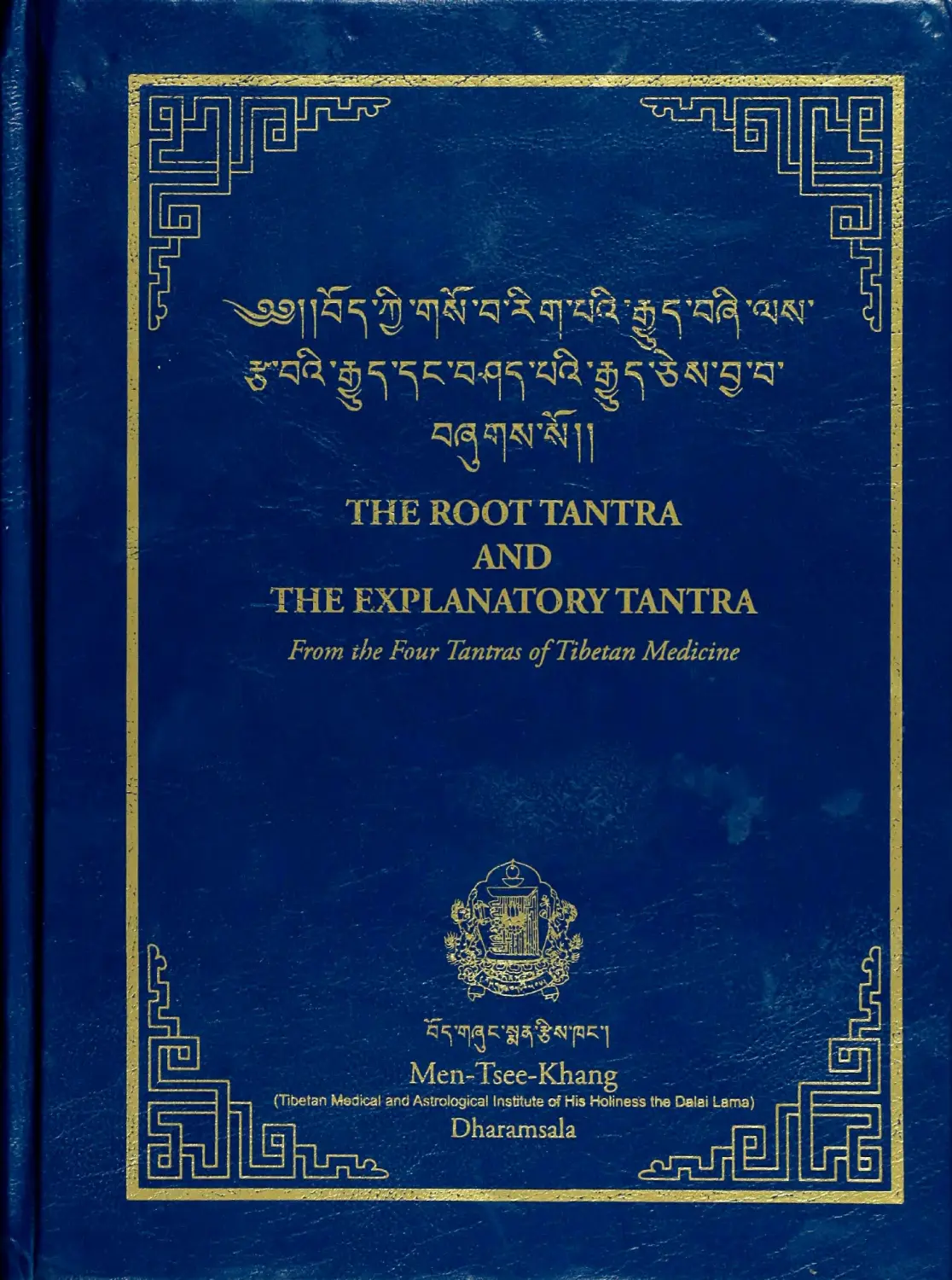


Author: Gonpo Y.Y.
Tags: religion buddhism culture spirituality alternative medicine
ISBN: 81-86419-62-4
Year: 2008
Text
imcT]
cv
-vr-
c\
^ •*
rqq
srg *q ’
qß^N’sT]]
THE ROOT TANTRA
AND
THE EXPLANATORY TANTRA
From the Four Tantras
of Tibetan Medicine
Men-Tsee-Khang
(Tibetan Medical and Astrological Institute of His Holiness the Dalai Lama)
~i
Dharamsala
rzr
1
-
,
.
•••■, ’
•
...
The upper part
of the Thangka depicts the eight different Medicine Buddha. Below the Medicine Buddha in clockwise are:
1. Yuthok Yonten
Gonpo-I 2. Desi Sangye Gyatso 3. Jangpa Namgyal Draksang 4. Guardian of Medicine
5. Surkhar
Nyamnyi Dorjee 6. Yuthok Yonten Gonpo- II
q^q^Njj
THE ROOT TANTRA AND THE EXPLANATORY
TANTRA FROM THE SECRET
QUINTESSENTIAL
INSTRUCTIONS ON THE EIGHT BRANCHES
OF THE AMBROSIA ESSENCE TANTRA
The Root Tantra and The
Explanatory Tantra from the
Secret Quintessential Instructions on the Eight
Branches of the Ambrosia Essence Tantra
by
Yuthok Yonten
Gonpo
Translated into
Translation
English by
Department, Men-Tsee-Khang, Dharamsala
Chief Translator
:
Dr.
Assistant Translators
:
Dr.
Thokmay Paljor
Passang Wangdu
Dr. Sonam Dolma
Members of Review Committee :1.
Dr.
2.
Dr. Pema
3.
Dr.
4.
Dr.
5.
Dr.
6.
Dr.
Namgyal Tsering, Cultural Director, Men-Tsee-Khang
Doijee, Director, Sorig Literary Research Department, Men-Tsee-Khang
Dawa Dolma, Director, Clinical Research Department, Men-Tsee-Khang
Tsewang Tamdin, Principal, Men-Tsee-Khang College
Doijee Rabten Neshar, CMO, Men-Tsee-Khang Branch Clinic, Bangalore
Penpa Tsering, Director, Sorig Literary Research Department, Men-Tsee-Khang
Men-Tsee-Khang Publications
Dharamsala, India
Published
by:
Men-Tsee-Khang
(Tibetan Medical and Astrological Institute of H.H. the Dalai Lama)
Dharamsala-176215
Himachal
Pradesh, INDIA
Tel.
0091-1892-223222, 307068, 307069
Fax
0091-1892-224116
E-mail
tmai@vsnl.com
www.men-tsee-khang.org
Website
Copyright© 2008 Men-Tsee-Khang
(Tibetan Medical & Astrological Institute of H.H. the Dalai Lama)
All
rights reserved. No portion of this book may be reproduced by
prior written permission of the publisher.
without the
First
Edition, India 2008 (1000 copies)
ISBN
:
81-86419-62-4
Second
Edition, India 2011 (1000 copies)
Printed
by : Vee Enn Print-O-Pac # vnprints@rediffinail.com
any means
DEDICATION
WE DEDICATE THIS TRANSLATION TO
HIS HOLINESS THE FOURTEENTH
DALAI LAMA
FOR HIS UNWAVERING
ENDEAVOR TOWARDS PROMOTING
UNIVERSAL LOVE, PEACE AND
HARMONY.
)
CONTENTS
Foreword
by H.H. the Dalai Lama
Publisher’s Note
Preface
PART ONE
:
THE ROOT TANTRA
Chapter 1:
The Basis of Discussion
Chapter 2:
The Enumeration
Chapter 3:
The Basis of Health and Disease
20
Chapter 4:
Diagnosis
26
Chapter 5:
The Therapeutic Methods
30
Chapter 6:
Enumeration using Metaphors
34
PART TWO:
on
on
Chapters of Discussion
the basis of Signs and Symptoms
3
10
THE EXPLANATORY TANTRA
Chapter 1 :
The Summary of the Explanatory Tantra
41
Chapter 2:
Embryology
45
Chapter 3 :
The Description of the Human Body through Similes
57
Chapter 4:
The Anatomical Structure of the Human Body
60
Chapter 5:
The Characteristic of the Human Body
69
Chapter 6 :
The Function and Classification of the Human Body
80
Chapter 7:
The Omens of Death
84
Chapter 8:
The Causes of Disorders
95
Chapter 9:
The Conditions of Disorders
99
Chapter 10: The Mode of Entrance of Disorders
107
Chapter 11: The Characteristic Features of Disorders
110
Chapter 12: The Classification of Disorders
118
Chapter 13: The Routine Behavioral Regimen
138
Chapter 14: The Seasonal Behavioral Regimen
147
Chapter 15: The Incidental Behavioral Regimen
153
Chapter 16: Dietetics
158
Chapter 17: Dietary Restrictions
176
Chapter 18: Dietary Precaution and Limitation
180
Chapter 19: The Taste and the Post-Digestive Taste
183
Chapter 20: The Efficacy of Medicinal Substances
194
Chapter 21 : The Group and the Method of Compounding Medicine 219
Chapter 22: The Medical Instruments
226
Chapter 23: Maintaining Health through Rejuvenation
235
Chapter 24: The Actual Diagnosis
240
Chapter 25: The Diagnosis through Indirect Skillful Means
246
Chapter 26: The Four Diagnostic Criteria of a Patient
250
Chapter 27: The General Therapeutic Principles
254
Chapter 28: The Particular Therapeutic Principles
261
Chapter 29: The Two Therapeutic Methods
270
Chapter 30: The Actual Therapeutic Methods
276
Chapter 31: Physician, the Healer
281
Glossary on Tibetan Terms
Glossary on Medicinal Ingredients
Glossary on Diseases
Glossary on Animals
301
3 09
317
325
Bibliography
329
Index
333
THE DALAI LAMA
FOREWORD
today's world because of environmental damage and the manifold increase of
pollutants, various diseases plague human society. Our past great
medical physicians have bequeathed to us, the people of the Land of Snows, with a
profoundly rich and comprehensive tradition of diagnosing by examining the urine
and pulse and treating diseases through blood extraction and moxibustion.
The Translation Department of the Tibetan Medical and Astrological Institute
(TMAI) has embarked on a laudable project to translate into English the Four
Treatises (Rgyud-bzhi) of Tibetan Medicine, which forms the nucleus of the Tibetan
Traditional Healing Science.
In
chemical and other
They have already translated the first two treatises of Rtsa-rgyud (The Root Treatise)
and Bshad-rgyud (The Explanatory Treatise), and are planning to publish these two
works in a bi-lingual (Tibetan and English) format. And, therefore unlike in the past,
when we alone benefited from this knowledge, the translations will be available to
the English-speaking medical world. It will also be a boon to the allopathic doctors
and scientists who are concerned about the physical wellbeing of human beings in
their efforts to use this knowledge and enhance their efforts to serve humanity more
effectively by introducing new knowledge and techniques in the world of medical
science. This translation work is indeed a laudable project and I would like to
commend all those who have been involved in the project.
With my prayers
25
June, 2008
and good wishes,
Tel.
: 0091-1892-307068/307069/223113/223222
Fax
: 0091-1892-224116
E-mail: tmai@men-tsee-khang.org
MEN-TSEE-KHANG
tmai@vsnl.com
www.men-tsee-khang.org
Website:
(Tibetan Medical & Astrological Institute ofH.H. the Dalai Lama)
Gangchen Kyishong, Dharamsala -176 215, H.P., INDIA
PUBLISHER’S NOTE
I would like to thank and commend the doctors in the Translation
Department of Men-Tsee-Khang for their hard-work and enthusiasm
in bringing out the English translation of the lind Edition of “The
Basic Tantra and the Explanatory Tantra from the Secret
Quintessential Instruction on the Eight Branches of the Ambrosis
Essence Tantra”.
I am happy that the 1st Edition was well acknowledged and
appreciated by our readers. I am confident that the Und edition will
further assist the readers to gain an in-depth insight on traditional
Tibetan Medicine.
There has
for
certainly been growing popularity and tremendous interest
Tibetan
worldwide.
Medicine
Students,
researchers
and
increasingly attracted to the study of
Tibetan Medicine. Many individuals and groups frequently visit
Men-Tsee-Khang to acquaint themselves with the art of this unique
practitioners worldwide
are
ancient science of healing.
an indispensable resour
study, reseach and practice of the ancient Tibetan system
healing as well as to one’s individual well-being.
I
am
confident that this book will become
in the
A
Tsewang Tamdin
Dharamsala
Dr.
January 14. 2011.
Director
Society registered under the Societies Registration Act XXI of 1860.
PREFACE
The Tibetan medical system, more popularly known as Sowa Rigpa (Knowledge
of Healing), is undoubtedly as old as Tibetan civilization itself. The earliest inhab¬
itants of Tibet
confronted with
host of difficulties due to the way
they had
during those ancient times. The only means of sustenance and survival was
to rely on the various natural resources around them. These early people gradually
learned the uses and medical efficacy of natural resources. The inherent discern¬
ment of these early people led them to discover natural remedies for various healthrelated problems. Their innate urge to overcome physical discomfort, combined
with their curiosity about the world around them, made them create some effective
natural remedies for many common illnesses. Drinking and sprinkling cold water
against fever, compressing cold stone on an inflamed swelling, using heated oil to
stop bleeding, drinking hot water for indigestion, eating boiled foods rather than
eating them raw - these insights1 and many others have proven their effectiveness
and have continued to be of use even to this day. The development of the Tibetan
science of healing is based on the wisdom of such ancient medical practices.
were
a
to live
The
application of a medical remedy against poisoning2 as
Karma Yolde to the first king of Tibet Nyatri Tsenpo (circa
pronounced by Tsiblha
300 B.C.) clearly dem¬
onstrates that the early inhabitants of Tibet had knowledge of the therapeutic value
of herbs and minerals even during that time. Medical knowledge continued to be
passed on by means of various oral traditions and has kept alive the knowledge of
numerous remedies over many centuries.
Before Buddhism and the present
Tibetan script were introduced to Tibet, the Bon
religious and cultural traditions flourished in the region of Shang Shung in south¬
western Tibet. The legendary Bon master and cultural founder Tonpa Shenrab
Miwoche was bom in Purang, Tibet, at the time of the Lord Buddha. The Bon mas¬
ter authored many important medical literatures such as Sojay Kyi Do Ghu, Sorig
Chegyud Daser, Sojay Nadbum Nagpo3, Sojay Manbum Karp4, Sothab Chedbum
1.
3.
Song Kundue Vol -1, Tibetan People’s Publishing House, 1990
Gangjong Sorig Tenpai Nyinjed Rimjon Gyi Namthar Chogdik, Men-Tsee-Khang, Dharamsala, 1991
Sichuan Minority Publishing House, 2003
4.
Sichuan
2.
Minority Publishing House, 2003
i
Trawo5, and Tsawa Thukbum Khangon6 and he established the foundation for the
development of the Bon medical tradition. His eldest son, Chebu Trishey, learned
the art of medicine from his father and later became a very important figure in the
development of the Bon medical system. At that time, Bon religion and culture
were at their height and shamanistic ways of
healing were very popular throughout
Tibet. They undoubtedly influenced the existing Tibetan medical knowledge and
practices.
The
Gyueshi (Four Tantras) which is the fundamental text of Tibetan medicine,
names of some medicinal substances, compounds, and
diseases in the original Bon language. This is a clear indication of the influence of
Bon on Tibetan medicine. We can therefore assume that there was knowledge and
practices of medicine before the reign of King Lha Thothori Nyentsen and before
the introduction of the present Tibetan script during the 7th century.
contains mantras and the
The
history of Tibetan Medicine took a very important turn during the reign of
Nyentsen, the 28th king of Tibet (254-374 C.E) when two Indian
physicians named Vijay Gaje and Bila Gaje visited Tibet7, and upon learning of the
successful treatments rendered by these physicians to a large number of patients,
the king summoned them to his palace (called Yumbu Lhakhang). He extended his
appreciation for their noble work and asked them to prolong their stay in Tibet to
promote and teach their practice and share their medical knowledge. In response
to their agreement to stay in Tibet, the king gave his daughter Yidkyi Rolcha as a
bride for Vijay Gaje. In the year, 309 A.D., the princess gave birth to a son, who was
named Dungi Thorchokchan. He began to learn medicine under the guidance of his
father at a very young age and was trained in pulse diagnosis, diet, pharmacology,
moxibustion, venesection and the treatment of wounds. He learned effortlessly by
virtue of his great intelligence and became the first court physician in Tibet. The
tradition of the son of an eminent physician becoming the court physician continued
from then until the time of the 31st king of Tibet.
Lha Thothori
Indigenous Tibetan medical knowledge and practices were first put into writing af¬
introduction of the modem Tibetan script during the reign of the 33rd king of
Tibet Songtsen Gampo (617-698 A.D.). At that time, cultural exchange with neigh¬
boring countries brought new medical knowledge that influenced the development
of Tibetan medicine. In the year 641 A.D., the Chinese princess
ter the
5.
Sichuan
6.
Sichuan
7.
Sorig Kundue Vol
Minority Publishing House, 2003
Minority Publishing House, 2003
-
1, Tibetan People’s Publishing House, 1990
Wungshing Kongjo of the Tang dynasty came to Tibet as a bride of king Songtsen
Gampo. She brought with her a great deal of Chinese medical texts8. Menched
Chenmo, one of the outstanding example of Chinese medical texts, was translated
into Tibetan by Hashang Maha Deva and Dharma Kokha. The king also invited
eminent physicians to Tibet, including Bharadwaja of India, Hanwan Hang of Chi¬
na, and Galeno9 of Greece. They brought with them various texts representative of
their medical traditions, which were later translated into Tibetan and together wrote
a seven-volume book on medicine called Mijigpai Tsoncha, which was presented
to the king. The king was very pleased and praised them for their wisdom and
knowledge. The Chinese and Indian physicians left Tibet with impressive gifts, but
Galeno stayed and was appointed as the court physician. He wrote many important
books, including the Rota Chingtrem Trulgyi Melong, Gochad Mashi Bugu and
Dacho Leu Shipa in addition to many others. He married and had three sons, all of
whom he trained in medicine. He sent his eldest
son
to the Northern Tibet to pro¬
mote the
lineage of Vijay Gaje, his middle son to Yorpo to promote the lineage of
Lhorong Amchi, and the youngest one to Central Tibet.
In the
early 8th century, king Mae Aktsom invited eminent physicians from India,
China, Nepal, Persia, and Dolpo to Tibet hoping that they can introduce and share
their medical knowledge and practices to further the development of Tibetan medi¬
cine. In the year 710 A.D., the Chinese princess Gim-shing Kong-jo came to Tibet
as a bride for Prince Jangtsa Lhawon and brought with her many Chinese medical
texts, which were translated into Tibetan by the Chinese physicians Hashang Maha
Kinda and Gyatuk Garkhen with the support of scholars of Tibetan medicine and
astrology, such as Khungpo Tsetse, Khungpo Damtsuk and Choglha Monbar. The
most important Chinese medical text brought to Tibet, entitled Manchad Dawai
Gyalpo, was translated by the Chinese Buddhist scholar Hashang Mahayana and
the Tibetan translator Vairocana. The work was preserved in the form of wooden
blocks and it is one of the earliest preserved medical texts in the history of Tibetan
medicine.
In the 8th century, during
797 A.D.), relations with
the reign of the 38th king of Tibet Trisong Deutsen (755neighboring countries were further established. The king
invited Shanti Garbha from India, Tongsum Gangwa, Hashang Bala and Hangti Pata
from China, Guya Benza from Kashmir, Hala Shinta from Persia, Sengdo Vochen
from Drugu, Khyol Marutse from Dolpo and Dharmashilaha from
8.
9.
Song Kundue Vol - 1, Tibetan People’s Publishing House, 1990
authenticity, read an article ‘The introduction of Greek medicine into Tibet in the seventh and
eight century, by Dr. Christopher Becwith, published by Journal of the American Oriental Society
For historical
Nepal to Tibet and initiated a discussion and exchange of medical knowledge and
practices. These scholars collectively wrote the Rinchen Pungpa, which is a work
that reflects the essences of various Asian medical systems, including the indig¬
enous Tibetan system. King
Trisong Deutsen invited the renowned Greek physician
Biji Tsenpa Shilaha and his disciples to Tibet in order to examine the doctor’s ex¬
pertise. The king was very pleased with the Greek physician’s extraordinary skills
and appointed him as his court physician. Biji Tsenpa Shilaha wrote many books
and translated many Chinese and Indian medical texts into Tibetan10, which he pre¬
sented to the king. These works were compiled into a book called Lhachekyi Shung
Tsowai Dho. Before returning to his homeland, Biji Tsenpa Shilaha wrote the work
Biji Poti Khaser on the treatment of disease, which he also presented to the king. It
was during this time that the great translator Vairocana visited India and received
important instructions11 from the Kashmiri Pandita Dawa Ngonga. Vairocana later
wrote the three works Nyamyig Thongwa Dhonden, Khyedpar Zappa Namsum and
Sojed Ngoi Menngag Ngobum, all of which are a combination of existing Tibetan
medical knowledge and the instructions that he received from Dawa Ngonga. In
order to establish a lineage of Tibetan physicians, he gathered many students of
high intelligence, irrespective of caste or status, and assigned them to the study of
Tibetan medicine.
The
sharing of knowledge by eminent physicians from neighboring countries, the
ancient Asian medical texts into Tibetan, and the integration of
this knowledge into the already existing wisdom of the Bon medical tradition took
Tibetan medicine to a new level of development. Tibetan medicine is therefore a
product of a creative combination of indigenous medical practices and knowledge
from many traditions developed over many centuries. The reason Tibetan medicine
is revered over many other systems of healing lies in the fact that it is enriched with
the knowledge and practices of many other Asian medical traditions.
translation of many
Buddhism had
a
great influence on Tibetan culture and also strongly affectedTi-
betan medicine. The
impact of Buddhism
on
Tibetan medicine is clearly evident in
Tibetan medical concepts as in the mention of the subtle consciousness during the
formation of the human body, the role of the three mental poisons in the develop¬
ment of
physical disorders, and the importance given to the cultivation of love,
philosophy is a necessary prerequisite to recognize the psychological element of
disorders and to find appropriate remedies. The nature and function of the mind,
10.
11.
Gangjong Song Tenpai Nyinjed Rimjon Gyi Namthar Chogdik, Men-Tsee-Khang, Dharamsala, 1991
Song Mengyi Khokbuk, Kensu Mirik Publishing House, 1982
iv
compassion, joy, and equanimity by Tibetan physicians. Understanding Buddhist
energies, the complex nature and
functions of the sensory consciousness, and the role of loong in health and illness
are some of the important aspects of Tibetan medicine that can only be understood
with the knowledge and wisdom provided by Tibetan Buddhist philosophy.
the subtle and intricate network of channels and
Yuthok Yonten
Gonpo-I (708 - 833 A.D.) is the most important figure in the history
was exceptionally gifted in his medical knowledge and was
admired for his intelligence at a very young age. King Trisong Deutsen summoned
him to his palace and asked him to debate with eminent Tibetan physicians, such as
Dangti Gyalnyen Kharphuk in addition to many others. The young doctor was wellversed in the theoretical and practical aspects of Tibetan medicine and was always
successful. His fame and excellence of medical knowledge spread far and wide, and
soon he became a renowned physician. The king was very pleased and appointed
him as his court physician. In order to enrich and make further the development of
the Tibetan medical system, Yuthok Yonten Gonpo-I, traveled to Nepal, Persia, Chi¬
na and India where he met with many eminent scholars and physicians and received
a great deal of invaluable medical knowledge and instructions of other medical
systems. Yuthok represented Tibet at the ‘First International Conference on Tibetan
Medicine’ held at Samye during the reign of king Trisong Deutsen. Many renowned
scholars and physicians of known medical systems of that time participated in this
historic conference. The active involvement by participants featured serious debate
and presentation on various subjects making this conference a great success. After
the conference, Yuthok wrote12 a book called ‘GyueshV (rgyud bzhi), which was
primarily based on the indigenous Tibetan medical knowledge with synthesis of
various Asian medical system added. This text was concealed inside a pillar of the
Samye monastery to be rediscovered later when the time would be ripe for this text
to be used and understood. After it was rediscovered from the pillar at Samye mon¬
astery in the 11th century AD, it was rewritten into the present form of the ‘GyueshV
by Yuthok Yonten Gonpo-II, a famous descendent of the previous Yuthok.
of Tibetan medicine. He
At the age of fifty-five, Yuthok Yonten Gonpo-I traveled to Kongpo with some of
his students and remained there for ten years. During his stay, he taught Tibetan
medicine to
grees
12.
than 300 students and at that time the tradition of awarding
de¬
began in Tibet. The prominent physician gathered more and more medical
more
Gangjong Song Tenpai Nyinjed Rimjon Gyi Namthar Chogdik, Men-Tsee-Khang, Dharamsala, 1991
V
Tanadug, the first monastic medical college13, at Kongpo
Menlung. His fame spread and he was respected throughout Tibet and in neighbor¬
ing countries. Some of his other notable works on medical theory and practice are
entitled Sojed Mutik Trengwau, Khekhyad Ngotsar Shituk, Khepar Zabpa Namsum,
Yangbe Gabpa Chogyad, and Khathor Rinchen Pungwa15. Until the end of his
life at the age of 125 years, he worked tirelessly for the development of Tibetan
medicine. His contribution towards the establishment and development of Tibetan
medicine is considered one of the greatest in the history of Tibetan medicine.
students and established
Like his
predecessors, king Tri Ralpachen (814-336 A.D.) continued to support the
expansion of Tibetan cultural and medical practices. The king invited the eminent
scholar Zina Mitra and others from India to support these efforts. These scholars,
together with Tibetan translators, standardized all works that had been translated
in the past and translated many new works in the field of medicine, mostly from
Sanskrit into Tibetan. Consequently, Tibetan medical knowledge became more ac¬
cessible. During this time, the religious and cultural traditions of Tibet reached new
heights in development and prosperity. This period lasted for over a century and is
called the ‘Golden Age’ in the history of Tibet. It ended when the minister Behtagna
and his associates dethroned king Tri Ralpachen, and his power was transferred
to Lang Dharma. The new king’s oppressive rule lead to large-scale protests, and
consequently Tibet was divided into many small states, each with its own ruler. The
fall of the Tibetan royal dynasty led to a period of anarchy that lasted more than a
century and resulted in the gradual decline of the then existing religion and cultural
heritage. This decline caused immense set back to the development of Tibetan cul¬
ture and led to great suffering to the people of Tibet.
During the period of Ngadag Vo Sung in the 10th century A.D, Lha Lama Yesheentrusted the great translator Lochen Rinchen Sangpo (958-1055A.D.) with
the translation of Yanlag Gyadpai Nyingpo Duspa16 (Skt. Astanga Hridaya Samhita) by the great Indian scholar Pawo (Skt. Vagbhata) and its commentary by the
Kashmiri Pandita Dawa Ngonga. This translation helped revitalize Tibetan medi
cine and served as an important tool for its promotion and development. It was
later carved into a wooden block and became an important part of the Buddhist
canon Tengyur. Lochen Rinchen Sangpo also trained many students and createddistinguished physicians like Mangmo Mentsun, Nyangde Sangeda, Sakya Yeshe
Jungnay to name only a few.
woe
13.
14.
15.
16.
Song Kundue Vol - 1, Tibetan People’s Publishing House, 1990
Men-Tsee-Khang, Dharamsala, 2000
Men-Tsee-Khang, Dharamsala, 2000
Beijing Publishing House, China, 2002
vi
Dapa Ngonshe (1012-1090 A.D.) rediscovered the
Gyueshi (.Four Tantras) from the pillar of Samye monastery following a vision
from the Medicine Deity and gave it to Geshe Upa Dardak. During this time, Rokton Konchok Kyab visited India and received the complete instructions on Sojed
Yenlag Gyepa from the eminent master Shintapa. At that time, Acharya Nagarjuna’s
Jorwa Gyapa11 and Kashmiri Pandita Dawa Ngonga’s Menming Dabyor Nyepa
were translated into Tibetan by the eminent translator Nyima Gyaltsen.
The treasure-finder Terton
Chakdum, a well-known court physician from Udiyana, visited Tibet in the
11th century A.D. He wrote the Nyengyud Bebum Nagpo, Chungphyed Bebum
Ngonpo, Bumkhutsur, Dokor Chinang Sangsum and other great works. He trained
many students and gave important instruction on all aspects of medical theories and
practices in different parts of Tibet.
Baro
Gonpo-II (1126-1202 A.D.) was the 13th descendent of Yuthok
Gonpo-I. He was bom at Tsang Nyangtoe. As a child, he was interested in
feeling the pulses of his playmates and in identifying various medicinal substances
around him. By virtue of his intellect, he became knowledgeable in all fields of
medicine and started treating patients at a very young age. At the age of fourteen
he met Rokton Konchok Kyab, who was traveling to Central Tibet and was suf¬
fering from Bamn. The young physician treated him successfully, and the traveler
was able to continue his journey. After two years in Central Tibet, Rokton Konchok
Kyab again suffered from a serious disease. This time he consulted the renowned
physician Upa Dardak. Not only was he successfully treated, he also received the
complete instructions on the Gyueshi (Four Tantras). On his return, Rokton Kon¬
chok Kyab again met the young Yuthok Yonten Gonpo and gave him the complete
instructions on the Gyueshi (Four Tantras). At the age of eighteen, Yuthok Yonten
Gonpo travelled to India, China, Persia, Nepal, and Sri Lanka, and met with many
renowned masters and physicians from whom he received important teaching and
medical knowledge. Some of the most important works by Yuthok Yonten Gonpo-II
are Gyadpa Chechung Gyi Nyingpo Duspa, Pawoi Nyingpo Duspai Do Nyekyi Delpa Thongwai Melong, Tsapyad Rigpa Rangsel Detsen Ngapa, Laglen Podchung,
Manngag Shokdril Korsum, Nyamyid Budonma and Chalag Chogyad19. Based on
the principles of the Gyueshi and the indigenous medical knowledge and practices
of Tibet, which was passed on to him through the last thirteen lineage holders, as
Yuthok Yonten
Yonten
well
17.
18.
19.
as
based
on
the instructions that he received from Indian masters
Paljor Publication, New Delhi, 1998
Combined disorder of loong and baekan featuring swelling of the
legs accompanied with intense pain.
Men-Tsee-Khang, Dharamsala, 2000
vii
and
physicians, he re-organized and rewrote the Gyueshi, making it more complete,
compatible, and comprehensive, and entitled it Dudtsi Nyingpo Yanlag Gyedpa
Sangwa Mengag Gigyue. To this date, the Gyueshi (Four Tantras) remains the main
foundation for Tibetan medical education, research, pharmacology, and clinical
practices. Yuthok Yonten Gonpo-II dedicated his entire life to the development and
promotion of Tibetan medicine and is revered as the second Medicine Buddha for
his exceptional efforts in eliminating the suffering of all beings.
One of the most
distinguished disciples of Yuthok Yonten Gonpo-II was Sumton
Zung. He not only continued the work of his great master in promoting the
benefits of the Gyueshi, but also trained many students and wrote many important
works, including a biography of his master, Kangbam Sowai Nyengyud Zindri,
Bumchung Seldron20 and Bumnag Seldron21.
Yeshe
During the reign of Mae Aktsom, with the commencement of the lineage of Dangti Gyalngen Kharphuk until the time of Dangti Dhama Nyingpo, many eminent
physicians contributed to the development and promotion of Tibetan medicine. The
collective works that contain all the important instructions on the theoretical and
practical knowledge of the Dangti lineage is called Dangti Podtra and Podmar.
Dangti Jampel Sangpo, Dangti Palden Tsojed, Dangti Palden Gyaltsen, Dangti
Doijee Palsang, and Dangti Palden Dhondup are some of the well-known physi¬
cians of the Dangti lineage who made notable contributions to the development and
promotion of Tibetan medicine.
During the thirteenth century, Ugyenpa Rinchenpal (1230-1309 A.D.) translated the
Nyulchu Dubpai Tenchoe into Tibetan. Later, he wrote three com¬
mentaries on this treatise. His principal disciple, Karma Rangjung Doijee (12841339 A.D.), wrote the Menming Gyatso, an outstanding work that describes the
therapeutic actions of more than three hundred medicinal substances. It is impor¬
tant to note that in addition to many prominent scholars and physicians, other less
known individuals have also made important contributions to the development of
treatise entitled
Tibetan medicine
over
time.
During the fifteenth century, Tibetan medicine flourished primarily through two im¬
portant regional medical traditions: the Jangpa tradition and the Zurkhar tradition.
The
Jangpa tradition was founded by Namgyal Dagsang (1395-1475 A.D.)
20.
Beijing Publishing House, 2005
21.
Beijing Publishing House, 1998
and
was
was
founded
practised mainly in the northern part of Tibet, while the Zurkhar tradition
by Nyamnyid Doijee (1439-1475 A.D.) and was practised in southern
Tibet. While both traditions were based on the theoretical concepts of the Gyueshi,
each developed a unique and a separate tradition with regard to the identification of
medicinal substances, the method of compounding medicines, and modes of treat¬
ment. Their unique developments can be attributed to the differences in environ¬
ment, climate, and lifestyle in the northern and southern parts of Tibet.
Jangpa Namgyal Dagsang learned the art of medicine from Bodong Chogle Namgyal and Panchen Nagkyi Rinchen, who were both renowned in the field of Tibetan
medicine. He wrote Yanlag Gyepa Thamchekyi Nyingpo Duepa Yidshin Norbu
Rinpoche, Gyuddon Selgye Dolma22 (a commentary on the Root Tantra), Dudtsi
Chugyun23 (a commentary on the Explanatory Tantra), Godod Jungwa (a commen¬
tary on the Subsequent Tantra), Tsigdon Nampar Selwa, Manshung Rinchen Dombu, Gyueshi Kathrang Munsel, Tsashed Selwai Donmai, Shedgyue deichen dudtsi
chugyun24 and Manngag Trulgyi Yigchung. He trained many students, and the most
outstanding of all was Mei Nyima Thongwa Donden, who wrote Sojedkyi Gyalpo,
Malayai Kadel Dodjo Chechung, Kodpa Namshi, Gyun Nampa Shi, Kyadphak Chimen, Ngotsar Chimen, Rimchoe Mila Sogjin, and other works. Another
outstanding student of Jangpa Namgyal Dagsang was Lhundingpa Lekduppal. He
trained his son Lhundingpa Sherab Palden and established the Lhundingpa lineage
of physicians. Lhundingpa Namgyal Dorjee was the most outstanding physician of
the Lhundingpa lineage. He learned and mastered the unique instructions, theoreti¬
cal knowledge, and practical experiences of his eminent father and forefathers and
was to a large extent responsible for the promotion and development of the Jangpa
tradition.
Zurkhar
Namnyid Dorjee, also known as Avo Choje, learned the art of medicine
Rigzin Phuntsok, as well as from Khrukhang Lotsawa, Shara Rabjampa, and Mandon Wangchuk Sangpo. He excelled in the field of medical studies
and served his suffering patients well. He authored the well-known works Mann
gag Jewa RingseP5, Gyueshi Deichen Podshel Khramo, Dritsik Ngulkar Melong,
Lekshed Nyizer, and others. He brought together the physicians of the Lhoka and
Dagkong regions and trained them to identify various medicinal substances and
their taste, potency, post-digestive taste, quality, and action. These teachings are
from his father
22.
Beijing Publishing House, 2004
23.
People’s Publishing House, 2004
24.
Sichuan
25.
Kansu Mirik
Minority Publishing House, 2001
Publishing House, 1993
example, the Rinchen Khrungpai, Rokor
Chagkyi Trengwa, Dudtsi Zingbu and Dudtsi Terzod. Zurkhar Nyamnyid Doijee
had four principal disciples. Kempa Tsebum Doijee, who was one of them, had a
very accomplished student named Kempa Tsewang. Kempa Tsewang wrote Mawa
Chokthob26 (a commentary on the Root Tantra), Tsikdon NyimcF (a commentary
on the Explanatory Tantra), Dewai
Dodjo1% (a commentary on Oral Instruction
Tantra), Laglen SeljecP9 (a commentary on the Subsequent Tantra), and Nyamyik
Gyatsa (a text on the practical application of external therapies). Along with his
disciple Jarpo Panchen, Kempa Tsewang strived to promote the medical tradition
of his father and forefathers and contributed substantially to the development of
contained in the texts that he wrote, for
Tibetan medicine at that time.
Lodoe
Gyalpo (1509-1572 A.D.), also known as Legshed Tsoi, is an important fig¬
history of Tibetan medicine of the Zurkhar tradition. He received medical
instructions from his father and Langbu Choeje, Mondup Lotsawa, Pontsang Phendar, and Wapa Tsering at a very young age. Later he wrote the Sheja Chi Khogbug30, Khepai Yidkhrog, Mangyi Ro Nue Shujes kyi Reumig, Karpo Chikthub bam
Wangpoi Lagnyal, Diwa Tsutai Trishing, Manui Dilen, Chikol Gyi Namshad, and
other important works. Later in life, he traveled to Nyangmed to explore the true
work ofYuthok Yonten Gonpo-I and came across the Gyueshi (Four Tantras). Hav¬
ing recognized the worthiness and importance of the Gyueshi, he wrote the Meipoi
Shellung31, which is a detailed commentary on the Root Tantra, the Explanatory
Tantra and part of the Subsequent Tantra. He then went to Lhoka Dathang, revised
the Gyueshi and published the most acclaimed edition, called the Dathang Gyueshi.
This publication made Tibetan medicine more accessible and helped to spread it
further, both inside Tibet and in neighboring countries.
ure
in the
The great fifth Dalai Lama, Jetsun Ngawang Lobsang Gyatso (1617-1682 A.D.),
took a personal interest in the development of Tibetan medicine. He instructed the
eminent masters
Dhondup Palwa, Darmo Menrampa Lobsang Choedak, and Namling Panchen to prepare a print block for the Dathang Gyueshi after a necessary ed¬
iting. The great fifth Dalai Lama also instructed Darmo Menrampa Lobsang Choe¬
dak to complete the unfinished work of Zurkhar Lodoe Gyalpo related to the Meipoi
Shellung. He quickly wrote Meipoi Shellung Lekshed Sergyen (a commentary on
the Oral Instruction Tantra) and Meipoi Shellung Kanad Dorjee Dudol (a commen¬
tary on the Subsequent Tantra, excluding the chapter on pulse), and
28.
Men-Tsee-Khang. Dharamsala, 1993
Men-Tsee-Khang. Dharamsala, 1993
27.
29.
Men-Tsee-Khang. Dharamsala, 1993
Men-Tsee-Khang. Dharamsala, 1993
30.
Men-Tsee-Khang, Dharamsala, 1992
31.
Sichuan Minority Publishing House, 2000
26.
X
prepared a print block. The great fifth Dalai Lama then established the first Dophenling medical school at the northern part of Drepung Photrang, then at Shiga
Samdup Tse, and later at Sharchenchog, Yugyal Chog, and Sangphu Nyima Thang
of the Potala palace. In the later part of the great fifth Dalai Lama’s life, he gathered
a large amount of invaluable precious substances for the compounding of specific
precious pills known as Rinchen Dangjor, Rinchen Tsajor, Wangril Tarima, Wangril Shelkar Choeten and Dugjom Wangril. A large number of sick people have
benefited from these precious pills which require exceptional skills, accuracy, and
practical experiences when manufacturing them.
Desi
Sangye Gyatso (1653-1706 A.D.) was a renowned scholar who, at the young
of eight, began to be educated in all the major fields of Tibetan studies by the
great fifth Dalai Lama. He soon became extraordinarily well-versed and knowledge¬
able. In his childhood, due to his karmic imprint, he would feel the pulses of his
playmates and try to identify plants that he came across. The great fifth Dalai Lama
was very pleased with his remarkable talent and entrusted him with the responsibil¬
ity of a regent. While memorizing the medical treatises, Desi Sangye Gyatso de¬
veloped doubts regarding the reliability of the Dathang Gyueshi edition of Zurkhar
Lodoe Gyalpo. He thoroughly revised it, added additional information and prepared
a new printing block for publication. Later, Kumbum Jampaling in the Amdo region
and the great printing house of Dege in Kham also published the Gyueshi based on
the printing block from Lhasa. Subsequently, following instructions by the great
fifth Dalai Lama, Desi Sangye Gyatso received various medical initiations, oral
transmissions, and important instructions from prominent scholars such as Khyabdak Khrasangpa, Zue Choeying Rangdol and Choegyal Terdak Lingpa and be¬
came one of the most renowned scholars in the history of Tibetan medicine. For
the benefit of humanity and in order to preserve the identity of Tibetan medicine,
he authored a detailed commentary on the Gyueshi entitled Sowa Rigpai Tenchoe
Menlai Gongyen Gyueshi Seljed Bendurya Nyonpo Mallika32, which became one
of the most famous commentaries. The seventy-nine excellent medical Thangka il¬
lustrations, which he prepared, portray visual explanations of the original meanings
of the Gyueshi. He also wrote the Manngag Lhenthab33 (a supplementary treatise
to the Oral Instruction Tantra) and the Khogbug Legshed Benduryai Melong Dangsong Gepai Gaton34 (a historical account of Tibetan medicine). In order to fulfill the
wishes of the great fifth Dalai Lama, Desi Sangye Gyatso established the Chagpori
medical college and monastery on top of the
age
32.
33.
34.
Men-Tsee-Khang, Dharamsala, 2007
Men-Tsee-Khang, Dharamsala, 2005
Kansu
People’s Publishing House, 1982
Iron Hill
adjacent to the Potala palace in Lhasa. He personally gave medical in¬
structions, taught spiritual practices related to healing, and transmitted the lineage.
Once every year, he accompanied doctors and students to the northeastern part of
Lhasa to teach identification of medicinal herbs and plants. Due to these efforts by
the great fifth Dalai Lama and his regent Desi Sangye Gyatso, Tibetan medicine
continued to develop and its popularity continued to spread and grow both in and
outside Tibet.
One of the most
outstanding figures in the history of Tibetan medicine is Deumar
(1672-?), who was trained in medicine and other subjects
direction of Kamtrul Kunga Tenzin and Kathog Rinzin Tsewang Norbu.
Geshe Tenzin Phuntsok
under the
His inherent inclination toward natural medicinal substances and his intrinsic drive
gain knowledge on materia medica took him to various important places in Tibet,
China, and India, where he was able to personally identify, analyze, and study the
nature, actions, and effects of the medicinal substances of Tibetan medicine. In the
year 1727, he wrote a book entitled DemedShelgong35, which details the therapeutic
potency of each medicinal substance, and Demed Shelteng36, which contained ex¬
planations on the type, nature, and action of medicinal substances. These two books
became the most acclaimed standard reference book for the study and research of
Tibetan materia medica. He also authored the Kunsel Nangzod, Tarkhai Dampa
Nyekhrud dung Jin, Maetsai Dampa Shelkar Melongf7, Dontsang Tsikdue38, Dudtsi
Shelkar Phrenwa and Dangsong Gyepai Zumteng39, and took Tibetan medicine to a
new level of development both in the context of materia medica and also
regarding
the theory and practice of Tibetan medicine.
to
In the
eighteenth century, Situ Choekyi Jungnay (1700-1774 A.D.) received his
Digung Pontsang Yeshe and Karma Tenpel.
He was exceptionally skilled in learning and became well versed in all fields of
Tibetan studies. He traveled far and wide to China, India, Nepal, and other neigh¬
boring countries and received special medical instructions from Adosi and Nimathi of India. Situ Choekyi Jungnay became renowned for his great knowledge and
authored many well-known works, the two most famous being Phende Jungnay40
and Migje Laglen. He established a medical school at Dege Palpung and took sole
responsibility for the theoretical and practical training of his students. He trained
many students and established a solid foundation for the development of Tibetan
medical and cultural instructions from
37.
Men-Tsee-Khang, Dharamsala, 1994
Tsongon People’s Publishing House, 1994
39.-
Tsongon People’s Publishing House, 1994
35.
36.
38.
40.
Tsongon People’s Publishing House, 1994
Tsongon People’s Publishing House, 1994
Men-Tsee-Khang, Dharamsala, 2000
Situ Pema
Nyinjed. His disciple was Karma Ngedon Tenzin Thinlay Rabgye
(1770-?). He authored Chemed Norteng41 one of the commonly used practical guides
for the compounding of medicines and for the treatment of various disorders. Also
worth mentioning are the contributions to the development of Tibetan medicine
made by Choedak Gyatso and Jamyang Khyentse Wangpo during this period.
was
In the nineteenth century,
Kongtrul Karma Ngawang Yonten Gyatso (1813-1899
A.D.) received instruction in medicine and other fields of Tibetan studies from
various eminent scholars, including Jamyang Khyentse Wangpo, Gyurmed Thutop
Namgyal and Situ Pema Nyinjed. He became learned at a young age and became
well-known throughout Tibet. He wrote Zintik Chetue Dudtsi ThikpaA2 (a practical
guide for the novice physician), Dudtsi Manzod, Tsojed Khepai Nyingchud (a prac¬
tical guide to compounding Tsotru Chenmo), Tsozed Khepai Khyednor (a practical
guide on the desiccation of iron compounds), and Sheja Kunkhab Zod (account on
the origin of Tibetan culture). Jumipham Gelek Namgyal Gyatso (1846-1912 A.D.)
was one of his most prominent disciples who had extensive knowledge and un¬
derstanding. Jumipham Gelek Namgyal Gyatso also studied under eminent schol¬
ars like Jamyang Khentse Wangpo, Khenchen Pema Beza, Lab Kyabgyon Garab
Doijee and Jigme Choekyi Wangpo and became very popular in his expertise and
outstanding ability to learn. He wrote many books on Tibetan medical theory and
practice, including Dodjung Norbu Melong (an abridged account of a difficult part
of the Gyueshi), Chetue Phendye Bangzod (a practical guide and abridged account
of important instructions), Tsachu Drelwa43 (a commentary on pulse and urine ex¬
amination), Manjor Dudtsi Thigle44 (a work on pharmacopeia), Lusla Nyerkho Kab
Gyepa, Zugnyu Kunel (a collection of secret instructions on theory and practice),
and Tsinta Mani. He transmitted his lineage by training eminent scholars like Situ
Choekyi Gyatso, Shechen Gyaltsab, and Khenchen Kunpel, all of whom have con¬
tributed immensely to the development of Tibetan medicine in the south-eastern
region of Tibet.Lama Thuptan Gyatso (1876-1933 A.D.). He designated Lobsang
Sangpo and Tenzin Gyatso as his personal physicians and entrusted them with the
overall development of Tibetan medicine, particularly in the context of giving new
life to the Chagpori Tibetan medicine school in Lhasa, which had experienced a
period of decline. He instructed Tenzin Gyatso to replace all the dilapidated print
blocks of the important medical texts and treatises with new ones. In the year 1892,
the Gyueshi was revised thoroughly by many
41.
43.
Men-Tsee-Khang, Dharamsala, 2004
People’s Publishing House, 1989
42.
44.
Beijing Publishing House, 2002
People’s Publishing House, 1989
renowned scholars after the thirteenth Dalai Lama identified
in the earlier edition. In 1897, the thirteenth Dalai Lama
some
shortcomings
appointed Tekhang Jampa
Thubwang (Zurkhar lineage holder) as the senior personal physician and Japhuk
Damchoe Palden (Jangpa lineage holder) as the junior personal physician. Thereaf¬
ter, he assigned both of them to train medical students according to the instructions
of their tradition. Under their tutelage and instruction, Lhundup Dakpa of Dhargyeling, Khenrab Norbu of Tsethang Ngachod monastery in the Lhokha region, and
Tsultim Nyendak of Dakwar monastery became greatly learned and well-known Ti¬
betan doctors. With approval from His Holiness the thirteenth Dalai Lama, Tekhang
Jampa Thubwang established the Men-Tsee-Khang (School of Medicine and As¬
trology) in Lhasa in the year 1916. Tekhang Jampa Thubwang designated his close
disciple Khenrab Norbu as the head of the Men-Tsee-Khang but took sole respon¬
sibility for its administration and overall development. The Men-Tsee-Khang was
open to monks and lay people alike and became quite popular. Realizing the poor
state of child health in Tibet, Tekhang Jampa Thubwang wrote Jepa Nyerchod Dophen Nyingnor in order to promote knowledge of health care practices for children.
He also made special medical compounds for the treatment and prevention of vari¬
ous pediatric illnesses. Tekhang Jampa Thubwang made a significant contribution
to the promotion and development of Tibetan medicine, and his greatest achieve¬
ment was the gradual improvement of children health, which reflected on the health
improvement of the society in general.
Tekhang Jampa Thubwang’s closest disciple was Khenrab Norbu (1883-1962 A.D.).
At a very young age Khenrab Norbu entered the Tsethang Ngachod monastery in
the Lhokha region and distinguished himself through his innate intelligence, learn¬
ing skills, and compassionate nature. He was selected among many young monks
to pursue Tibetan medical studies at the Chagpori medical school in Lhasa. He
started his medical studies under the great Sera physician Ngawang Choeden and
later sought instructions on medicine, astrology, and other fields of Tibetan studies
from distinguished scholars and physicians like Tekhang Jampa Thubwang, Doijee
Gyaltsen, Jampal Rolpai Lodoe, Lama Ugyen Tenzin of Sikkim, Lama Tenzin Gyaltsen of Kinnaur, Chikchar Dungzin Rinpoche of Tsari, and others. His exceptional
perseverance in his studies together with his firm determination and great sincerity
helped him to become well-versed and learned in Tibetan medicine, astrology, and
astronomy in a short period of time. In the year 1912, he became the main physi¬
cian of the Drepung monastery and his reputation grew. He did research on medical
literature and authored many texts in order to make it easier for students to under¬
stand Tibetan medicine. In the year 1913, while accompanying Shedra, a cabinet
minister to Shimla, India, Khenrab Norbu treated many Indians patients suffering
from various chronic problems. He interacted with eminent Indian physicians and
xiv
earned the
Tibetan physician. Upon returning to Tibet,
appointed him as his junior personal physi¬
cian. Khenrab Norbu was given the combined responsibility of looking after both
the Men-Tsee-Khang and the Chagpori medical school. In both establishments he
maintained the traditional system of teaching that had been initiated at the Chagpori
medical school by Desi Sangye Gyatso, while introducing innovations in course
materials, methods of theoretical and practical instructions, rules on examinations,
the collection of herbs, and the compounding of medicines. Due to his popular¬
ity, immeasurable knowledge, and great wisdom, students from various parts of
Tibet and the Himalayan regions of India, Nepal, Sikkim, and Bhutan sought his
instructions and training. Consequently, Tibetan medicine spread more extensively
to these various regions across the Himalayas.
reputation of being a skilled
His Holiness the thirteenth Dalai Lama
According to the instructions of His Holiness the thirteenth Dalai Lama, Khenrab
responsibility for supplementing and reproducing about half of
the seventy-nine colorful medical paintings in the Chagpori medical school which
had been lost or damaged over time. He wrote the Sorig Gyatsoi Nyingpo45 (a text
on the allegorical tree of the Root Tantra), Dashel Norbui Melong46 (a text on the
allegorical tree of the Explanatory Tantra), Norbu Benduryai Trengwa41 (a text on
the allegorical tree of therapeutic methods), Shungdon Gogya Phewai Demig4% (a
summary of the Subsequent Tantra), Chigyud Tsachui Lhenthab49 (a supplementary
text on pulse and urine examination), Shonui Ngaggyan50 (a synopsis of venesec¬
tion points), Dudtsi Bumzan51 (a text on pharmacopoeia), Phende Lekshay52 (a text
on the therapeutic actions of medicines), Kunphen Dawai Melongi3 (a text on a safe
child birth), Jipai Nyamyig54 (a text on the treatment of pediatric diseases), Tsojed
Shonui Nyingnor (a detailed exposition on medicinal plants), Ngotsar Sergyi Nyema
(a brief exposition on medicinal plants), Yidshin Dodjoi Bumzang55 (an exposition
on non-herbal medicinal substances), Ngojor Dudtsi Thigpa (a text on herbal com¬
pounds), Rinchen Trengwa, and others. He also prepared many editions of wooden
block prints for numerous important medical texts to make them available to schol¬
ars, physicians, and students. In order to keep up Desi Sangye Gyatso’s tradition
of the annual outdoor training on the identification of medicinal plants, Khenrab
Norbu accompanied his students to Dokde, Zimal la, Lungnag Shelkar, and Yerpa
lhari to instruct and guide them on the correct identification,
Norbu took the sole
45.
47.
49.
51.
53.
55.
46.
Men-Tsee-Khang, Dharamsala, 2001
Men-Tsee-Khang, Dharamsala, 2001
Men-Tsee-Khang, Dharamsala, 2001
Men-Tsee-Khang, Dharamsala, 2001
Men-Tsee-Khang, Dharamsala, 2001
Beijing Publishing House, 2002
48.
50.
52.
54.
xv
Men-Tsee-Khang, Dharamsala, 2001
Men-Tsee-Khang, Dharamsala, 2001
Men-Tsee-Khang, Dharamsala, 2001
People’s Publishing House, 1989
Men-Tsee-Khang, Dharamsala, 2001
tastes, and therapeutic actions of more than 300 medicinal plants.
Tibetan medi¬
whole, flourished in all aspects until the devastating Chinese take-over of
Tibet in March 1959. After the Chinese annexation, Tibetan medicine and all other
aspects of Tibetan culture and religion were affected immeasurably. The Chagpori
medicine school in Lhasa was completely destroyed by the Chinese army during the
Tibetan uprising against Chinese domination in 1959. Vast amounts of medical liter¬
ature were burned and practitioners of Tibetan medicine were attacked, imprisoned,
and persecuted. Thousands of Tibetans, some of them physicians, followed His
Holiness the fourteenth Dalai Lama into exile in 1959. In exile, Tibetan medicine
first spread in India and Nepal, and then gradually to the West. Though only a few
physicians could escape into exile, the medical literature they brought with them
proved to be of immense value. On account of the endeavors of these physicians,
together with the immaculate wisdom and exceptional kindness of His Holiness the
fourteenth Dalai Lama, the seed for the revival, preservation, and development of
cine,
as a
Tibetan medicine in exile
with the establishment of Men Jin
Lobkhang
(School of Medicine) in Dharamsala, Himachal Pradesh, India on March 23, 1961.
Initially, the Men Jin Lobkhang was set up in a small house called Chopra House,
above McLeod Ganj, which comprised a small dispensary and only a handful of
physicians. Later, on 7th August 1967, with the merge of Tibetan Astrology with
Tibetan medicine, it came to be known as Dophen Men-Tsee-Khang. However, in
time, it came to be popularly known as the Men-Tsee-Khang, the most renowned
Tibetan medical and astrological institution outside Tibet. The activities undertaken
by this institute include the training of students, the implementation of clinical and
herbal research programs, the production of medicines, and the provision of health
care to the general public. The purpose of these activities is to promote, preserve,
and develop the Tibetan medical tradition for the benefit of all humanity.
Prior to the failed
was sown
uprising by Tibetans against the Chinese take-over in March
1959, Tibetan medical practice was not accessible to foreign lands. Tibetan medi¬
cine
was
mainly practiced in Tibet, the Himalayan regions, Mongolia, and some
parts of Russia. Today, Tibetan medicine joins other traditional medical systems
of the world in the service of humanity.
In fact, Tibetan medicine has become very
popular among mind-body oriented systems of medicine and is increasingly gain¬
ing more attention all over the world. Tibetan medicine is one of the few medical
traditions of this time that offers a complete holistic health care model.
xvi
Contents of the
Gyueshi
Gyueshi contains four Tantras, namely Tsa Gyue (the Root Tantra), Shed Gyue
(the Explanatory Tantra), Man Nyag Gyue (the Oral Instruction Tantra) and Chima
Gyue (the Subsequent Tantra). The Root Tantra presents an overview of the es¬
sence of Tibetan medicine. In six chapters, it clearly outlines the basic principles
of health and disease, methods of diagnosis as well as therapeutic approaches. The
text begins with a sincere homage to the Medicine Buddha in both the Sanskrit and
Tibetan language, which shows respect and gratitude to all the great masters, who
contributed their knowledge to the Tibetan medical system. Beginning any treatise
with a homage in Sanskrit language was a popular style of Tibetan scholars during
that time. One reason for this style is that Sanskrit is considered the language of the
godly realms. The most important reason, however, is that Buddhism was brought
to Tibet in the form of Sanskrit texts. Following the homage is a description repre¬
senting the importance of the five auspicious aspects, namely the auspiciousness of
place, time, Dharma, the teacher and disciples. The sacredness of this classic medi¬
cal text is substantiated by the mentioning of Five Excellences. The auspiciousness
of place is depicted by an unimaginable palace called Tanadhug, which is surround¬
ed by four mountains that symbolize the characteristics and natural qualities of the
medicinal substances. The Excellence of Time is represented by the auspiciousness
of that moment in time. The auspiciousness of Dharma is represented by the sacred
teachings of the Gyueshi. The auspiciousness of the teacher is represented by the
Medicine Buddha. The auspiciousness of the disciples is represented by the four
retinues: the gods, the sages, the Buddhists and the non-Buddhists. The Root Tantra
is concluded with an enumeration of all topics in the form of a metaphor.
The
The
Explanatory Tantra addresses the theoretical foundation of Tibetan medical
a detailed and systematic manner. It begins with a description of the
formation of the human body and its relation to the theory of the five elements
( Jungwa Nga ), followed by a description of the anatomical structures, physiologi¬
cal characteristics, and the final disintegration of the function of the human body.
The second section contains a detailed explanation on the causes and conditions, lo¬
cations, characteristic, signs and symptoms, and the classification of disorders. The
dietary and behavioral principles that can be employed in the prevention and treat¬
ment of illnesses are also thoroughly explained. The
subsequent chapters describe
medicinal substances (their distinctive properties and their tastes and post-digestive
tastes), the compounding of medicines, and medical instruments. Distinctive means
of diagnosis, a range of therapeutic approaches, and the qualities and ethical prin¬
ciples of a physician are explained thoroughly. The Explanatory Tantra completely
integrates Tibetan medical philosophy and practice and is therefore considered the
science in
xvii
most valuable of the Four Tantras.
The Oral Instruction Tantra deals with
practical applications of theoretical prin¬
ciples with regard to the treatment of general and specific disorders. The cause, the
condition, the classification, the signs and symptoms, and the treatment of many
disorders are clearly revealed in ninety-two chapters. It begins with the diagnosis
and treatment of the three nyepa followed by abdominal disorders, febrile disor¬
ders, disorders of the upper part of body, disorders of the vital and vessel organs,
genital disorders, unclassified disorders, disorders characterized by the simultane¬
ous development of lesions, pediatric disorders, gynecological disorders, disorders
caused by evil spirits, wounds and other injuries, toxicosis, geriatric disorders, and
infertility. The comprehensiveness and reliability of this medical system is dem¬
onstrated by the fact that an effective treatment for every possible health-related
problem can be found in the Oral Instruction Tantra.
The
Subsequent Tantra presents the theoretical principles behind the major practical
techniques, including the compounding of medicines, the application of evacuative
therapies, and the use of mild and drastic external therapies. The Subsequent Tantra
begins with a detailed and systematic description of pulse and urine examinations.
The practical methods of compounding different forms of medicines (including de¬
coction, powder, pill, paste, medicinal butter, calcinated powder, concentrated de¬
coction, medicinal beverages, precious medicines and singular herbal compounds)
and their uses for specific disorders as well as hot and cold disorders, in general,
are comprehensively explained in great detail. A discussion of the administration
of evacuative therapies such as purgation, emesis, nasal medication, mild enema,
strong enema, and channel cleansing is followed by a description of the mild and
strong external therapies, including compression, medicinal bath therapy, massage,
moxibustion/cauterization, venesection, and surgical therapy. The Subsequent Tan¬
tra concludes with a summary of the important basic characteristics of the theory
and practice of Tibetan medicine, followed by an entrustment of the Gyueshi to
worthy students.
Gyueshi is based on the perspective that the nature of the body, disorders and
are all fundamentally similar. This perspective is one of the most out¬
standing features of Tibetan medicine, and based on this philosophical foundation
Tibetan medicine will continue to offer holistic treatment for the complete wellbe¬
ing of humankind. This text shows great precision and consistency while arranging
the topics sequentially. The description of medical theories and practices are based
entirely on the law of nature and are made very clear.
The
remedies
A Note
on
Translation
With the
growing popularity of Tibetan medicine worldwide and the need to pass
our medical system, we felt it was necessary to bring
out an English translation of the Gyueshi. The Gyueshi translation project was for¬
mally initiated in July 2001 by the administration of the Men-Tsee-Khang. The
responsibility of translation was entrusted to three doctors. A review committee
consisting of six senior doctors was also constituted to amend and review drafts of
on
correct information about
the translated text. Several rounds of reviews of the entire translated text have been
made in order to present this edition as authoritatively as possible. However, as the
rules of grammar, usage of idioms, and the writing conventions of the source and
the target languages are dissimilar, some shortcomings are unavoidable. We highly
regret any errors.
This edition of the
was
Gyueshi is based on the Chagpori printing block of 1892, which
prepared under the guidance of the young 13th Dalai Lama.
In order to avoid the dilution of the
original meaning, key technical terms of Ti¬
betan medicine, such as nyepa, loong, tripa, baekan, ein, chhuser, etc., as well as
names of medicinal substances, have been kept in phonetic Tibetan. These words
typed in italics and endnotes at the end of each chapter provide explanations
indulging in lengthy commentaries. We did not follow the standard system
of Tibetan transcription (Wylie 1959) in the main text with the sole aim to provide
easy reading for non-Tibetan readers. Wylie transcription along with the phonetic
versions of medical terms and other Tibetan words are provided in the appendix.
The botanical terms used in this text are based on the information procured from the
Materia Medica Department of this institute.
are
without
As mentioned earlier,
Tibetan medicine is deeply rooted in Buddhist philosophy and
strictly denounces causing harm to any being. The demand for Tibetan
medicinal substances in the past was very limited, and the use of animal products
was negligible. Presently, due to the increase in environmental awareness world¬
wide and the wide-spread popularity of vegetarianism, animal products in Tibetan
medicine have been completely substituted by equally effective herbal substances.
However, in order to reveal the richness of Tibetan medical knowledge and to pre¬
serve the understanding of the
therapeutic values of animal products, their poten¬
cies have been revealed in this translation as it is reflected in the Gyueshi.
Buddhism
In this
edition, we have tried our best to present a faithful translation of the first two
Gyueshi by retaining the accurate meaning of the original text without
Tantras of
xix
intensifying
or
undermining
any part
of it. Various commentaries which are
avail¬
accurate
the fact that the translation team includes Ti¬
able have been consulted whenever and wherever necessary to convey an
meaning of conflicting ideas. Due to
professional translators, it is likely that there are some omis¬
sions and errors for which we are entirely responsible. Nevertheless, it is for the
readers and scholars to judge how far we have succeeded. We hope that this edition
will inspire readers all over the world to explore the boundless ocean of Tibetan
medical knowledge. We are confident that readers will enthusiastically embrace this
ancient medical knowledge not only for the treatment of diseases but also for the
prevention of illnesses.
betan doctors and not
In the
beginning of the project, a team of three doctors were entrusted with the
Gyueshi. A year and a half later, two members of the team
translation work of the
were
transferred to work
as
residential doctors in various branch clinics due to
administrative
requirements. Thereafter, only one person completed the translation
project. This delayed the project considerably. However, with a change in the ad¬
ministration at Men-Tsee-Khang, the importance of the project was again realized
and the former team members were reunited. We worked with great enthusiasm to
complete the Root Tantra and Explanatory Tantra within a projected time frame. To
provide easy references for the readers we have included a series of appendixes on
medicinal plants, diseases, and animals at the end of book.
This translation of the Root Tantra and
Explanatory Tantra is meant to give the gen¬
public access to the ancient Tibetan wisdom of healing and is not intended to
used for diagnosis and treatment of any illnesses.
eral
be
Acknowledgements
It is
mainly due to the kind support of the successive chain of directors who chaired
Men-Tsee-Khang since the beginning of this work that this translation could be
completed. Dr. Tsewang Tamdin (former Cultural Director, Men-Tsee-Khang) de¬
serves the credit for reuniting our team for the successful completion of this work
and we thank him most sincerely for that. We are also thankful to all the members
of the review committee for editing our translations. We highly appreciated their
valuable advice, which undoubtedly increased the quality of this work. Our heart¬
felt thanks also go to Dr. Doxjee Rabten Neshar for his exceptional endeavor and
commitment in helping us with this work. His invaluable guidance has been an
immense contribution to the outcome of this book. Our heartfelt thanks also
go to
Mr. Tsering Tashi (Director, Amnye Machen Institute) for giving us priceless comthe
xx
merits. We also thank Ms.
Belle Matheson (USA) for the
proofreading. We were
greatly touched by the sincerity and enthusiasm that she put into our work during
her short stay in Dharamsala. We are also deeply grateful to Phurbu Lhamo (Herbal
Product Research Department, Men-Tsee-Khang), who helped us in the final layout
and formatting of the entire text. We also thank our other colleagues at the MenTsee-Khang for their kind help and support: Dr. Tsering Dorjee Dekhang (Materia
Medica Department), Dawa Tsering and Tenzin Kunsang (Computer Section), and
Lhamo Kyizom, (Sorig literary Research Department).
Translation
Department
Men-Tsee-Khang,
Dharamsala
District
-
176215
Kangra
Pradesh,
Himachal
INDIA
xxi
xxii
Note to the Second Edition
This edition of the
English translation of the Root Tantra and the Explanatory Tantra
first edition which appeared in 2008. We
are extremely encouraged to work on the urgent need to publish this revised second
edition of the book primarily because of the great demand of the first book which
was received well by our general readers. We are equally happy to receive valuable
feedback from different sources and these feedback have been incorporated in order
to improve the quality of this book.
of the Tibetan Medicine is done upon our
Few
changes that have appeared in this edition include enhanced meaning of some
technical terms, standardization of phonetic words, amendment of minor spelling
and grammatical errors, improvement of sentence structure and restructuring of the
appendices. Scientific and common names of the medicinal ingredients are obtained
from the Meteria Medica department of Men-Tsee-Khang. Otherwise, we have pre¬
served the text of the much loved and highly praised first edition. Along with these
changes, we have also tried our best to give a new look to this edition concerning
the entire content and the cover of the book. Nevertheless, over-sight may still have
occured unintentionally for which we are solely responsible. In order to bring out
an improved edition in the future, we would appreciate to receive valuable feedback
from our worthy readers.
Through this acknowledgment,
sincere gratitude to Diane Levy, a
helped us with her
professional editing of this edition. We extend our thanks to Dr. Florian Ploberger
of Austria who has provided us some valuable feedback crucial for improving the
quality of this book. Our sincere thanks also go to Dr. Jamyang Dolma, Dr. Namdol
Lhamo, Dr. Pema Tsetso, Dr. Norchung and Dr. Tenzin Choying of our department,
without whose kind co-operation and dedication, this edition would not have come
to this excellence. Equally dedicated, we would like to thank Ms. Phurbu Lhamo
of Herbal Product Research Department and Ms. Tenzin Kunsang of Computer
Department, Men-Tsee-Khang for helping us in indexing and computer setting. It
would be unfair not to thank Dr. Tsering Norbu, Materia Medical Department, MenTsee-Khang for the thangka painting which we have put on the front page of this
book. We would also like to thank Mr. Bhuchung of Materia Medica Department,
we express our
doctor of Chinese medicine of the United States of America who
Men-Tsee-Khang for his beautiful sketches of precious Arura in the bowl which we
have put at top of each chapter symbolizing offering and homage to the great ones.
Last but not the least, our deep appreciation and words of thanks go to Dr. Tsewang
Tamdin, Director of Men-Tsee-Khang for giving us much encouragement and sup¬
port to facilitate the smooth functioning of this department.
Finally, we express our thanks to all those people who have been associated
this project and have helped us with it and made it a worthwhile experience.
Translation Department
Men-Tsee-Khang
Dharamsala
District
-
176215
Kangra
Himachal Pradesh,
India
xxiv
with
^11
THE
FIRST PART
CALLED
THE
ROOT TANTRA FROM THE
SECRET
QUINTESSENTIAL
INSTRUCTIONS ON THE
EIGHT BRANCHES OF
THE AMBROSIA
ESSENCE
TANTRA
>S81
In Sanskrit
:
Amrita Hridaya Anga Ata
Guya Upadesha Tantra Nama
qy^’51
In Tibetan
The Secret
:
Dudtsi
nyingpo yanlag gyadpa sangwa manngag
gi gyud ehe jawa
Quintessential Instructions
on
the Eight Branches of the
Ambrosia Essence Tantra.
Homage to the Medicine Buddha, the Victorious Conqueror, the
Tathagatha, the Foe Destroyer, the Complete Enlightened, the King of
Aquamarine Light.
a^*i|
q^or|jqj
^
l
With compassion you
jsia^w•
^
serve
all sentient beings, O Victorious Conqueror.
3
Basic Tantra
Merely hearing
your name
relieves the sufferings of all lower realms.
poisons, the Medi¬
Buddha, the King of Aquamarine Light, I pay my homage before
Healer of the maladies of the three inborn mental
cine
you.
j
I have thus
qjq-qq\3^'<q'5^’
spoken these words at one time in the abode of the sages,
City of Medicine called Tanadhug (lit. beautiful to behold), where
there is an inconceivable palace made of five different precious sub¬
stances and is decorated with various types of precious medicinal jew¬
els. These precious jewels cure the four hundred and four disorders of
loong, tripa, baekan, dhenpa and dhuepa. They act as cool medicine
against hot disorders and warm medicine against cold disorders. They
eliminate the one thousand and eighty kinds of interfering forces and
the
fulfill all wishes and needs.
4
Basic Tantra
To the south of the
city lies a mountain
which is endowed with energy similar to
called Bigje (lit. penetrative)
that of the sun. On the moun¬
tain, a medicinal forest covered with Sedu, Nalaesham, Pipiling, Tsitaka, etc. is found. These medicines are hot, sour and salty in taste and
have hot and sharp potencies that cure cold disorders. The roots, trunk,
branches, leaves, flowers and fruits of the medicinal forest are rich in
fragrance, appealing and beautiful to behold. No cold disorders arise
wherever the fragrance pervades.
To the north of the
city lies a mountain called Gangchen (lit. snow
capped) which is endowed with energy similar to that of the moon.
On this mountain, a medicinal forest covered with Tsendhen, Gabur,
Agaru, Nimpa, etc. are found. These medicines have bitter, sweet and
astringent tastes with cool and blunt potencies to cure hot disorders.
The roots, trunks, branches, leaves, flowers and fruits of the medicinal
forest are rich in fragrance, appealing and beautiful to behold. No hot
disorders arise wherever the fragrance pervades.
5
Basic Tantra
^•w*w|«r«fà-aj*^arq|
^’^’q^’
^ST^’s3^!
To the east of the
city lies
which is covered with
a
a mountain called Poenyedhen (lit. fragrant)
forest of Arura. The roots, trunks, branches,
bark, leaves, flowers and fruits cure disorders of bone, muscle tissues,
channels and tendons, skin, vessel organs, sense organs and vital or¬
gans respectively. At the top of these trees ripen five kinds of Arura,
which
fully enriched with the six tastes, eight potencies, three post¬
digestive tastes and seventeen qualities that cure all kinds of disorders.
The medicines which grow there are fragrant, appealing and beautiful
are
to behold.
the
The four hundred and four disorders will not arise wherever
fragrance permeates.
To the west of the
city lies a mountain called Malaya (lit. garlanded)
superlative medicines grow. The mountain is endowed with
the five types of Chongshi, the five types of Drak shhun, the five types
of medicinal water and the five types of hot springs, which pacify all
where six
disorders.
6
Basic Tantra
3qT*w^cVar
3^'c^g^^’Ajc^5y'SJ'56'£^'^’^I^'-=Ä^3^',^^J'g^l''^i^]
]
The
city is surrounded by saffron meadows and is filled with the fra¬
grance of incense. All kinds of medicinal stones and salts are found in
the rocks. Peacocks, s hangshang, parrots and other birds sing melodi¬
ously at the top of the medicinal forest, while elephants, bears, musk
deer and others who have good medicinal value dwell on the grounds.
The place is fully adorned and enriched with all kinds of medicinal
substances, and there is no medicinal substance that does not grow there
or
is not accessible.
At the centre of the inconceivable
palace,
on
the jewel throne of lapis
lazuli, was seated the Medicine Buddha, the Master, the Victorious
Conqueror, the Supreme Healer, the King of Aquamarine Light.
^ ^ ’q-qjîr^ R’5
^
9£V^’q’ET5^q’'|
7
Basic Tantra
The master was surrounded by four retinues: a retinue of gods, a retinue
of sages, a retinue of non-Buddhists and a retinue of Buddhists. The
gods’ retinue include the celestial physician Praja Patidaksa, the Asvini
Kumaran, the divine sovereign Indra, the goddess Amrita Devi, etc.,
who sat with many other celestial beings.
=^’j
The retinue of sages
includes the great sages Atreya, Agni Vesa, Nimin
Dhara, Kasyapa, Caraka Pariv Rajika, Bharadvaja, Dhanwantari, Punarvasu, etc., who sat with many other sages.
The forefather
among
dhist.
Brahma, Shiva, Vishnu, Sadmukha Kumara, etc., were
the non-Buddhist retinues who sat with many other non-Bud¬
qcw|*r«rq^3r^«r^q’]
^q’|
g3^*T^*ï|*r^qq”gqy
'Tp’^q-q^q’l
The Buddhist retinue includes
Manjushri, Avalokiteshwara, Vajrapani,
8
Basic Tantra
Ananda, Kumara Jivaka, etc., who sat with many other Buddhists.
At that moment of that
derstood
time, each word taught by the Master
was un¬
by each of the four retinues in accordance with the tradition
of their own Master.
and system
This is called the ‘Tradition of the
Sage1’ as it rectifies one’s defects of
body, speech and mind, and balances the faults of others.
^li
This is the first
the basis of discussion, from the Secret
Quintessential Instructions on the Eight Branches of the Ambrosia Es¬
sence
chapter,
on
Tantra.
Notes:
1
Sage is here translated as it is commonly used; however, it has different meanings in different
medicine, it signifies an exceptionally eminent physician endowed with
all six requisite qualities, which competently employs various appropriate methods to correct
imbalances of psycho-physical energies in order to realize a state of perfect health through
contexts. In Tibetan
balance.
9
9^1 1
At that moment of that time the Medicine
torious
Buddha, the Master, the Vic¬
Conqueror, the Supreme Healer, the King of Aquamarine Light
entered into
a
meditative concentration called ‘the
King of Medicine’,
in order to alleviate four hundred and four disorders.
%*
Immediately after entering into this form of meditation, hundreds and
thousands of colored rays were emitted from his heart to all ten direc¬
tions, which eliminated the defects of negative emotions of all the
sentient beings of the ten directions. After having eliminated all the
disorders of the three mental poisons that originate from ignorance, the
rays were drawn back to his heart. The Emanated Master called Sage
Rigpai Yeshi then emanated from his heart and appeared in the space
and spoke these words to the assembled retinue of sages.
10
Basic Tantra
q]^q],q|^,q]?rq’'^q],cA,«J3j,i;q],aj’q*jq’«J^ÿÇj
l^gpr^^’3^
3)*j'^'q^’«A’SJ^’0]’q^ ’^’^q]
“O
friends, be
sure
|
to understand! Those who wish to remain healthy
cure others’ illnesses must learn the Quintessen¬
and those who wish to
tial Instructions
the Science of Healing;
those who wish to live long
Quintessential Instructions on the Science of Healing;
those who wish to practice Dharma, accumulate wealth and achieve
happiness must learn the Quintessential Instructions on the Science
of Healing, and those who wish to free themselves from the suffering
of illnesses and gain honors from others must learn the Quintessential
Instructions on the Science of Healing.”
on
must learn the
Having said these words, thereafter, at that moment of that time, the
Master, the King ofAquamarine light, emitted hundreds and thousands
of colored rays to the ten directions from his tongue and eliminated the
11
Basic Tantra
speech of all sentient beings in the ten directions.
all disorders and evil forces, the rays were again drawn
back to his tongue, emerged the emanation of Master’s speech called
Sage YidlayKye. He did prostrations, circumambulation and knelt down
in the lion’s posture in front of the Master and requested to him, on
behalf of the assembled retinue of sages with these words.
defects of negative
After pacifying
ST^’I
“O Master
Sage Rigpai Yeshi, how can one, desiring to work outstand¬
ingly for one and for others, learn the Quintessential Instructions on
the Science of Healing?” At this requests, the Heart Emanation Sage
Rigpai Yeshi replied with these words.
|sj^orq*]qw
“O great sages,
study the tantras, the branches, the sections, the catego¬
ries, the compendiums and the chapters of the Quintessential Instruc¬
tions on the Science of Healing.” Having said this, sage
Yidlay Kye
again made a request, “O Master, how can one study the Tantras of the
Quintessential Instructions on the Science of Healing?” To this request,
the Master replied, “O Great Sage, listen!
12
Basic Tantra
Learn and understand the Four
Tantras, which consists of the Root
Tantra, the Explanatory Tantra, the Oral Instruction Tantra and the
Subsequent Tantra.
^3i’5qV*i*re^'^ql
1
Learn and understand the
eight branches, which consist of the follow¬
ing: the body as a whole, pediatric disorders, gynecological disorders,
disorders caused by evil spirits, wounds, disorders caused by toxic
substances, geriatric disorders and infertility.
<w^*rc^,^j
Learn and understand the eleven
læ’
sections, which consist of the follow¬
ing: the basic summary, the formation of the body, the pathology, the
regimens, dietary regimens, pharmacology, medical instru¬
ments, the maintenance of health, diagnostic approaches, methods of
healing and the practicing physician.
behavioral
13
Basic Tantra
]^w^0Ë^^qfV*^ï
^^‘WIpV
p§’^^*T
^^^aTa^qj^q^qsij
q-q^Tq<V*jq*l| jq^vv^WV^qsjj
S7*!
1
Learn and understand the fifteen categories,
which consist ofthe follow¬
ing: healing the three nyepa, healing disorders of the visceral organs,
healing hot disorders, healing disorders ofthe upper part ofbody, healing
disorders of vital and vessel organs, healing disorders of the genitals,
healing unclassified disorders, healing disorders which simultaneously
develop lesions, healing pediatric disorders, healing gynecological dis¬
orders, healing disorders caused by evil spirits, healing wounds, healing
toxicities, healing geriatrics disorders and healing infertility
Learn and understand the four
compendiums, which consist of the fol¬
lowing: pulse and urine examination, pacifying medications, evacuative
therapies, and the mild and drastic external therapies.
14
Basic Tantra
^q’qVq^^q’j
V^’Sl
j^Y^^\g-’q%’|^'
1
Leam and understand the
one
hundred and
fifty six chapters. They
are
follows: basis of discussion, enumeration on chapters of discussion,
basis of health and disease, diagnosis, therapeutics and summary are
as
the six
chapters which constitute the principles of the Root Tantra.
jq3^g3^qy*jq’gq^
q^’q^ |q]^ai’1^q'^’q^^q^’qj^^| ]q]*rqq*r^q*r^q’£ja^
S^’l
The
Explanatory Tantra includes chapters on the summary of the Ex¬
planatory Tantra, embryology, description of the human body through
similes, anatomy, physiology, classification, the omens of death, causes
of disorders, conditions of disorders,
the modes of entrance of the dis¬
order, characteristics of disorders, classifications of disorders, routine
behavior, seasonal behavior, incidental behavior, dietary principles,
dietary restrictions, dietary limitations, tastes of medicines, effects of
medicines, methods of compounding medicines, medical instruments,
the maintenance of health, actual diagnosis of the nyepa, indirect ex¬
amination of the
condition for
patient, the four diagnostic categories of a patient’s
healing, general therapeutic principle, particular thera-
15
Basic Tantra
peutic principles, two therapeutic methods, actual therapeutic metho s
and the physician. The Explanatory Tantra covers the eleven sections.
There are three sections with one chapter each, four sections with three
chapters each, one section each with four chapters, five chapters and
six chapters. The addition of a chapter that provides a summary of the
Explanatory Tantra brings the total number of chapters to thirty-one.
^’^q’æ«^3'q§’§qr*îi
1^’^’
or^'j
i^q^’jj’aT^^R’aiq’
P§^fq^T
l*ï]%qi'q]%q|*
16
Basic Tantra
The Oral Instruction Tantra includes
chapters
on
the sincere request to
receive the Oral Instruction Tantra, loong disorders, tripa disorders,
baekan disorders and dhuepa disorder. The six chapters on chronic
disorders of the abdomen
indigestion, tumor, generalized edema,
localized edema, ascites and a chronic wasting disorder. The sixteen
chapters on hot disorder are on general hot disorder, deceptive state of
hot and cold disorders, borderline of hot disorder, unripe hot disorder,
acute hot disorder, empty hot disorder, hidden hot disorder, chronic
hot disorder, turbid hot disorder, dispersed hot disorder, disturbed hot
disorder, contagious hot disorder, small pox, dysentery, diphtheria and
inflammation of muscle tissue and the common cold. The six chapters
on the disorders of the upper part of the body are on disorders of the
head, the eyes, the ears, the nose, the mouth and the goitre. The eight
chapters on the disorders of the vital and vessel organs are on disorders
of the heart, lungs, liver, spleen, kidneys, stomach, small intestine and
colon. The two chapters on genital disorders are of male and female.
The nineteen chapters on unclassified disorders are on vocal obstruc¬
tion, anorexia, thirst, hiccups, asthma, abdominal cramps, disorders of
ein, vomiting, diarrhea, constipation, urine obstruction, chinyi, tropical
diarrhea, gout and arthritis, disorders of the chhuser, nerve disorders,
skin diseases and minor accidents.The eight chapters on disorders that
simultaneously develop lesions are cancer, piles, maevel, surya, disor¬
ders of the lymph nodes, swelling of the testes, kangbam and perineal
fistula. The three chapters on pediatric disorders are on neonatal care,
general pediatric disorders and disorders caused by evil spirits. The three
chapters on gynecological disorders are on general, specific and post¬
partum disorders. The five chapters on disorders caused by evil spirits
are on disorders caused by elemental spirits, psychosis, dementia, stroke
and leprosy. The five chapters on wounds are on general injuries, injuries
to the head, the neck, the chest and the limbs. The three chapters on toxicities are on compounded poison, food poison and natural poison. The
chapter on geriatrics is on rejuvenating therapies. The two chapters on
are on
17
Basic Tantra
infertility are concerning aphrodisiacs and restoring fertility in women.
such, the Oral Instruction Tantra contains fifteen categories. There is
one category with one chapter, two categories with two chapters each,
three categories with three chapters each, one category with four chap¬
ters, two categories with five chapters, two categories with six chapters,
two categories with eight chapters, one category with sixteen chapters
As
category with nineteen chapters. The addition of one chapter
for the request brings the total number of chapters to ninety-two.
and
one
The
Subsequent Tantra includes chapters on pulse examination, urine
analysis, liquid medicine, powder, pills, paste, medicinal butter, me¬
dicinal ash, khenda, medicinal chhang, precious medicines, herbal
compound, oil therapy, purgation, emesis, nasal medication, mild
enema, strong enema, channel cleansing, venesection, moxibustion,
compresses, medicinal bath, external application and surgical therapy.
The Subsequent Tantra contains four compendiums. There are two chap¬
ters on diagnosis, ten chapters on pacifying medicine, seven chapters
on evacuative medicine and six
chapters on external therapies, which
bring the total number of chapters to twenty-five.
^1
18
Basic Tantra
Thus, there
six chapters in the Root Tantra, thirty-one chapters in
Explanatory Tantra, ninety-two chapters in the Oral Instruction
Tantra and twenty-five chapters in the Subsequent Tantra, making a
total of one hundred and fifty-four chapters in the Four Tantras. In ad¬
dition, there is one chapter each on the conclusion, and entrustment of
the Four Tantras, bringing the total number of chapters to one hundred
are
the
and
fifty-six. These chapters can be condensed into eight branches.
There are seventy chapters on the aspects of the body as a whole, three
chapters each on pediatrics, gynecology and toxicology, five chapters
each on disorders caused by evil spirits and wounds, one chapter on
rejuvenation and two chapters on infertility from the Oral Instruction
Tantra. The other three Tantras also cover the eight branches in com¬
mon.” Thus it
was
This is the second
of discussion,
said.
chapter, which details the enumeration
from the Secret Quintessential Instructions
Branches of the Ambrosia Essence Tantra.
19
chapters
on the Eight
on
J^,q’5c;^^q]^,^,^,aj^^|
j^qq’
Sage YidlayKye then made this request to Sage Rigpai Yeshi, “O Master
Sage Rigpai Yeshi, among the Four Tantras of the Science of Healing,
how can one learn the Root Tantra? May the Supreme Healer, the King
of Physician, please explain.” At this request, the emanation ofthe heart
of the Medicine Buddha, Sage Rigpai Yeshi replied,
<*r<^ar^^^qj|
jarqc^*rq|^
j^wq^^’qgW^V§)^j |q^qy^q^^vij’^5]*r
1
“O Great
Sage, Yidlay Kye, first I will elucidate the section on the sum¬
mary of the Root Tantra. There are nine trunks extending from the three
roots, which further develop into forty-seven branches. On the branches,
two hundred and twenty-four leaves grow, two flowers blossom and
three fruits ripen. This is the synopsis of the Root Tantra.
20
Basic Tantra
If this is
elaborated, they are as follows: the three forces of wad (princi¬
pal energies), luzung (bodily constituents) and drima (waste products),
while in equilibrium and in disequilibrium, result in health and disease
respectively.
The
principal energies consist of three: loong, tripa and baekan. Life
sustaining, ascending, pervasive, fire-accompanying and descending
are the five types of loong. Digestive, color regulating, accomplishing,
sight and complexion clearing are the five types of tripa. Supporting,
decomposing, experiencing, satisfying and connective are the five types
of baekan. This totals fifteen types ofprincipal energies. Nutritional es¬
sence, blood, muscle tissue, fat, bone, marrow and regenerative fluids
are the seven bodily constituents, whereas feces, urine and perspiration
are the three waste products.
^^-q;vqq^’q] j
These twenty-five different components,
when maintained in a balanced
proportion by three means of suitable taste, potency and lifestyle, it
ensures proper development of the body. They harm the body when it
goes adverse.
21
Basic Tantra
^1
There
three
for
1
disorder to arise and four
auxiliary condi¬
tions to manifest. The disorder, after having entered the body through
six different entrances, remains in the upper, lower and the middle part
of the body. There are fifteen pathways through which a disorder moves,
and its progression is determined by nine features associated with age,
place and season. These ultimately ripen into nine fatal diseases. There
are
are
causes
a
twelve adverse effects. The context of all of these features
condensed into hot and cold nature. As such, there are
of disease, an object to be healed.
can
be
sixty-three aspects
Attachment, aversion and delusion are the three causes for subsequent
and baekan disorders respectively.
birth of loong, tripa
The four conditions of season, evil
and deficient nature of disorder.
spirits, diet and lifestyle bring excess
]-§r^-|;^c;-wan^3i-£r^E;j j^sj-arqqq^i
The disorder then enters the
skin, develops in the muscle tissues, circu22
Basic Tantra
lates
through the vessels, adheres to the bones, attacks the vital organs
and descends into the vessel organs.
Baekan is reliant upon the brain and is therefore located in the upper part
of the body, tripa is reliant on the liver and gall bladder and is therefore
located in the middle part ofthe body, and loong is reliant on the hip
waist region and is therefore located in the lower part of the body.
and
The
pathways of loong disorders are the bone, ears, skin, heart, life
(nerves and blood vessels) and large intestine. Blood, perspi¬
ration, eyes, liver, gall bladder and small intestine are the pathways of
tripa disorders. Baekan disorders moves through nutritional essence,
muscles, fats, marrow, regenerative fluid, feces, urine, nose, tongue,
lungs, spleen, stomach, kidneys and urinary bladder. These pathways
of loong, tripa and baekan disorders are identified on the basis of their
relation to bodily constituents, waste products, sensory organs, vital
organs and vessel organs.
channel
Elderly people are loong type, adults are tripa type and children are
baekan type. The body is more susceptible to the disorder related to
its type at specific age.
23
Basic Tantra
i
windy regions are the places where loong disorders
can arise, dry and extreme hot
region are the places where tripa disor¬
ders can arise and wet and humid regions are the places where baekan
Severe cold and
disorders
can
arise.
1
SH
Loong disorders manifest during summer, in the evening and at dawn.
Tripa disorders manifest during autumn, at noon and at midnight,
whereas baekan disorders manifest during spring, at dusk and in the
morning.
The nine fatal diseases
vival1,
are
the exhaustion of the three factors of
sur¬
complications that contradict every treatment, the nature
becoming identical, injury to the most
vulnerable part of the body, loong disorder beyond treatment that oc¬
curs when there is severe termination of the flow of
loong energy in
the life channel, a hot disorder beyond treatment, a deep rooted cold
disorder, extremely weak body resistance and the strong dominance of
evil spirits.
severe
of the treatment and the disease
24
Basic Tantra
The two state of pacification
and non-pacification of loong, tripa and
baekan disorders create two reactions,
each nyepa,
resulting in four reactions for
which totals twelve adverse effects.
Loong and baekan by nature are cold like the element Water, whereas
blood and tripa by nature are hot like the element Fire. The nature of
ein and chhuser can be either hot or cold, depending on the predomi¬
nance
of nyepa.
Thus, these eighty-eight aspects of classification help in comprehending
the
complete basis of health and diseases.” Thus it was said.
1
This is the third
chapter, on the basis of health and disease, from the
Secret Quintessential Instructions on the Eight Branches ofthe Ambrosia
Essence Tantra.
Notes:
1.
The three factors of survival
are
lifespan, karma and merit.
25
rtf
\h
wit
]£T5R’?F’®^
^'%ql
Then
1
again Sage Rigpai Yeshi spoke these word, “O Great Sage, lis¬
ten.
All aspects of disease can be fully understood with the help of diag¬
nostic techniques involving examination through visual, palpation and
interrogation.
|q^q]’q’Q^^’5jgq’q’U4a]’^’U)^|
The examination of visual involves
the urine. This
an
|
examination of the tongue
and
diagnostic method is visual observation.
Palpation is like receiving information transmitted by the messenger
pulse. This diagnostic method is an analytical study of the case.
jq^qyq^^^’q’ij^qyujäjj
Interrogation
means to
take the
case
26
I
history, understanding the signs
Basic Tantra
and evaluate the dietary factors. This diagnostic method
study the case from what is being heard.
and symptoms,
is to
The
loong tongue is reddish, dry, and rough in texture. The tripa tongue
is covered with a thick and light yellow coating, and the baekan tongue
is whitish, thick, lusterless, smooth and wet.
1
The
is
loong urine appears like water with large bubbles. The tripa urine
reddish-yellow with a lot of steam and a bad odor. The baekan urine
is white with little odor and steam.
1
pulse is floating, empty and halts irregularly. The
tripa pulse beats fast, overflowing and twisting in nature. The baekan
pulse is sunken, declining and slow in nature.
The nature of loong
i^lr
Interrogation regarding
a
loong disorders involves questions about
27
Basic Tantra
yawning, shivering, stretching of limbs and cold chills, as well as pain
on the hips, waist and
joints, uncertain shifting pain, empty emesis, dull¬
ness of senses, mental unrest and
pain when hungry due to excessive
intake of light and rough natured food and participation in a lifestyle
of a similar nature. If one feels better with an oily and nutritious diet,
it is undoubtedly a loong disorder.
j
Excessive intake of foods of a
sharp and hot nature and participation in
lifestyle of the same nature bring about a bitter taste in mouth, head¬
ache, fever, upper back pain and post-digestion pain. Amelioration of
the condition upon taking foods having cool nature and participating in
similar behaviors undoubtedly confirms a tripa disorder.
a
V"
rv^^i i
Excessive intake of foods having heavy and oily nature
and participation
lifestyle of a similar nature bring about loss of appetite, difficult
digestion, vomiting and losing the sense of taste. It also brings about
a feeling of fullness of the stomach, belching, heaviness of mind and
body, loss of body’s external and internal heat and discomfort after
eating. Amelioration of the condition upon taking foods having warm
nature and participating in similar behaviors undoubtedly confirms a
in
a
Baekan disorder.
28
Basic Tantra
I
thirty-eight methods of examination, all disorders
unquestionably diagnosed correctly.” Thus it was said.
With these
This is the fourth
can
be
chapter, on diagnosis on the basis of signs and symp¬
toms, from the Secret Quintessential Instructions on the Eight Branches
of the Ambrosia Essence Tantra.
29
w*]
Then
1
again Sage Rigpai Yeshi spoke these words, “O Great Sage, lis¬
ten.
The four therapeutic measures
and external therapy.
The recommended diet for
for disorders are diet, lifestyle, medicine
with a loong disorder consists of
the meat from horse, donkey, marmot, one-year-old meat, shachhen,
mustard oil, aged butter, molasses, garlic, onion, milk, and chhang made
from Chawa, Ra nye, jaggery and bone.
a
person
The recommended diet for
milk made from
cow
tripa disorders consists of curd and butteror goat milk, fresh butter, meat of game animals,
30
Basic Tantra
goat meat, fresh meat of kompo, porridge made from fresh barley, stew
Kyap and Khurmang soup, natural cool water and boiled
made from
cold water.
The diet for a person suffering from a baekan
disorder consists of mutton,
wild yak meat, the meat of carnivores, fish, honey, cooked warm dough
made from aged grain that grows in dry land, curd and buttermilk made
from female yak milk, concentrated chhang and hot boiled water.
Staying in
a warm place and enjoying the company of loved ones is
the recommended lifestyle for treating loong disorders, whereas relax¬
ing and staying in a cool place is the recommended lifestyle for tripa
disorders. Exercising and staying in a warm place is the recommended
lifestyle for baekan disorders.
Medicines having sweet, sour and salty tastes
and oily, heavy and smooth
potencies are helpful against loong disorders, whereas medicines hav¬
ing sweet, bitter and astringent tastes and cool, wet and blunt potencies
are helpful against tripa disorders. Medicines having hot, sour and as¬
tringent tastes and sharp, rough and light potencies are helpful against
baekan disorders.
31
Basic Tantra
potencies, two medicines of pacifying
Soups and medicinal butters are the two
pacifying medicine for treatment of loong disorders. Decoctions and
powders are the two pacifying medicine for treating tripa disorders,
whereas pills and calcinated powders are the two pacifying medicine
for treating baekan disorders.
On the basis of these tastes and
and evacuation
are
formulated.
The soups
include bone soup, four nutrient soup1 and broth from aged
sheep head. Medicinal butter is prepared from Zati, Gokya, the three
fruits2, the five roots3 and Menchhen as the main ingredients. Decoctions
are prepared from Manu, Laetae, Tikta and the three fruits. Medicinal
powders are prepared from Gabur, Tsendhen, Gurkum, and Chugang.
Pills are made from Tsendhug and various kinds of salts. Calcinated pow¬
ders are prepared from Sedu, Dali, Goema kha, salts and Chongshi.
The evacuafive
mild enema,
therapies against loong, tripa and baekan disorders are
purgation and emesis respectively. Types of mild enemas
32
Basic Tantra
lehjam, trujam and trumalen. Purgation is of general, specific,
strong and mild, whereas emesis is of strong and mild.
include
External therapies
comprises oil massage and horgi maetsa for treatment
loong disorders; and inducing sweat, venesection and cold water
therapy4 are used for treating tripa disorders, whereas, compress and
moxibustion are used for treating baekan disorders.
of
Practicing attentively these ninety-eight therapeutic methods with
respect and diligence will free beings from the quagmire of disease.”
Thus it
q*i
was
!
said.
This is the fifth
essential
chapter, on therapeutic methods, from the Secret Quint¬
Instructions on the Eight Branches of the Ambrosia Essence
Tantra.
Notes
1.
:
2.
Four nutrients soup is made from aged meat, butter,
The three fruits are Arum, Barura and Kyurura.
3.
The five roots
4.
Cold water
Ra nye,
jaggery and chhang.
Nye shing, Chawa, Bhatu andZema.
therapy refers to employing cold water for treating hot disorders. Sprink
ling cold water on the entire body, sprinkling cold water on specific parts of the body,
showering under cold water and showering under cold waterfalls are some ofthese techniques.
are
33
Then
again Sage Rigpai Yeshi spoke these words, “O Great Sage, lis¬
ten.
I
From the three roots
on
the basis of health and
disease, diagnosis, and
the nine trunks of the health, diseased, visual exami¬
nation, palpation, interrogation, diet, lifestyle, medicine and external
therapy.
treatment, grows
|g*'gw<^|y§^R-gt-g=^S!l
The trunk pertaining to the condition ofhealth has three branches which
includes nae, bodily constituents and waste products. The trunk of dis¬
ease
gives rise to nine branches ofthe cause, the conditions, the entrance,
34
Basic Tantra
the pathway, time of manifestation, the fatal consequence, the
adverse effects and the summary. The two branches of tongue analysis
and urine analysis grow from the trunk ofvisual examination, while the
the site,
of pulse.
Conditions, signs and symptoms and familiarity are the three branches
that grow from the trunk of examination by interrogation. Six branches
of food and drink grow on the trunk of diet, while the trunk of lifestyle
gives rise to three branches. The trunk of medicine has six branches,
comprising two branches each on taste and potency associated with the
loong, tripa and baekan. Six branches ofpacification and three branches
of evacuation on the method of compounding also grow on the trunk
of medicine. The trunk of external therapy gives rise to three branches.
This brings the total number of branches to forty-seven.
examination by palpation trunk gives rise to the three branches
The first trunk of healthy
leaves
condition has twenty-five leaves. Sixty-three
concise checklist of diseases grow on the trunk of diseased
condition. Six leaves grow on the branches of the trunk of visual ex¬
on a
amination, and three leaves of the pulse
the branches of the
through palpation. Twenty-nine leaves grow on
the branches of the trunk of examination through interrogation. Fourteen
leaves grow on the branch of the loong diet, while twelve leaves grow
on the branch of the
tripa diet and nine leaves grow on the branch of
the baekan diet. The branches on the trunk of lifestyle have six leaves.
trunk of examination
35
grow on
Basic Tantra
The trunk of medicine has nine leaves pertaining to the branches of tast<
and potency. There are three leaves on the branch of medicinal soup ant
five leaves
on
the branch of medicinal butter. Four leaves grow
each oi
the branches of decoction and powder, two leaves on the branch ofpills
five leaves of calcinated powder on the branch of pacification and nint
leaves of nine ultimate treatments grow on the evacuation branch. Sever
leaves grow on the branches of the trunk of external therapy. Therefore
the total number of eighty-eight leaves
grow on the root of the basis oi
health and disease, while thirty-eight leaves grow on the root ofdiagnosis
and
ninety-eight leaves grow on the root of treatment. This
total number of leaves to two hundred and twenty-four.
brings the
The two flowers of health and
longevity blossom and the three fruits of
Dharma, wealth and happiness ripen.
The Root Tantra which is like the condensed form of
essence
is
ex¬
plained metaphorically and enumerated. This can be comprehended
only by the wise and intelligent and cannot be understood by persons
of lesser intelligence. If one wishes to see a more elaborate exposition,
they should look into more extensive texts.”
*)] 1
36
Basic Tantra
Having said this, Sage Rigpai Yeshi dissolved into the heart of the
Medicine Buddha.
This is the sixth
chapter, on summary using metaphors, from the Secret
Quintessential Instruction on the Eight Branches of the Ambrosia Es¬
sence
Tantra.
¥li
This concludes the Root Tantra from the Secret
tions
on
the
Quintessential Instruc¬
Eight Branches of the Ambrosia Essence Tantra.
k
k
k
37
k
k
q
THE
SECOND
<^11
PART
CALLED
THE
EXPLANATORY TANTRA FROM
THE
SECRET
QUINTESSENTIAL
INSTRUCTIONS ON THE EIGHT
BRANCHES
OF
THE
AMBROSIA ESSENCE
TANTRA
nlh
Wit
<3^1 1
Then the Medicine
Buddha, the Master, the Victorious Conqueror, the
Supreme Healer, the King of Aquamarine Light, arose from medita¬
tive concentration and entered the
healing meditation called ‘Lion of
Eloquence’.
Immediately after entering into this healing meditation, hundreds and
thousands of colored rays radiated from the crown of his head to all
the ten directions, thereby eradicating the physical defilements of all
the sentient beings of the ten directions. After pacifying all disorders
of loong, tripa and baekan, the rays were drawn back to the crown of
his head.
41
Explanatory Tantra
body was emanated the Master, called Sage Rigpai Yeshi, v
appeared in the space in front of the retinues. The emanation of
Buddha’s speech, called Sage YidlayKye, prostrated before the Mas
circumambulated him and spoke these words, “O Master, Sage Rig
Yeshi, as you have already expounded the Root Tantra in a conden
form, now, how can one learn the Explanatory Tantra? May the Supre
Healer, the King of physicians, please explain.”
From his
Y^5v%*r<^r,crc^,j
After this request,
Sage Rigpai Yeshi, the emanation from the Buddh
body, said these words.
I Id’q]
“O Great
Sage Yidlay Kye, to learn the Explanatory Tantra, the sect
should understand the Science of Healing in order to ma
tain proper health, treat disorders and to attain long life, Dharma, we£
and happiness for the human being, who is considered the supre
among all the six types of beings.
Tantra,
one
42
Explanatory Tantra
complete meaning of the Science of Healing can be summarised
subject of healing, the means of healing, the
method of healing and the healer.
The
in four divisions of the
First, the subject of healing is revealed through the body for which the
healing is meant and the disorder that come from the body.
Lifestyle, diet, medicine and external therapies
that
are
used to treat
a
are
the remedial means
disorder.
The method of healing
is how to apply these remedial means to maintain
health, promote long life, and to treat the imbalance disorders.
^’q]^^'qj^wq]W^q^j
The latter
|
comprises the method of diagnosis, the modes of treatment
after confirming the disorder, the means of treatment and the healer.
43
Explanatory Tantra
The four roots that bear eleven branches
summarize the content o
Explanatory Tantra.” Thus it was said.
This is the first
chapter, which reveals the summary of the Explanatory
Tantra, from the Secret Quintessential Instructions on the Eight Branches
of the Ambrosia Essence Tantra.
44
wqfjj
|<s|srg*rw$lj
Sage Yidlay Kye then requested the Master Sage Rigpai Yeshi with these
words, “O Master Sage Rigpai Yeshi, how may one learn the section
on the human body? May the Supreme Healer, the King of the Physi¬
cians, please explain.” To this request, the Master replied, “O Great
Sage, listen.
First, the section on the human body, the basis of healing, are revealed
under seven headings: embryology, similes of the body, anatomy,
physiology, classifications and function of the body and the omens of
death.
First, embryology is elucidated under the three headings: the cause of
conception, the condition for fetal development and the signs of birth.
45
Explanatory Tantra
conception are the union of non-defective semen of the
father and ovum of mother, the consciousness of the being, imprint oi
past karma with the force of afflictive emotions and the assemblage oi
the five elements. For instance, it resembles the fire produced by the
The
of
causes
friction of two woods.
loong disorders are coarse, darkisl
astringent in taste. Those affected by the tripa disorders are sour ir
taste, yellowish and malodorous, whereas those affected by the baekar
disorders are pale, sticky, sweet and cool. The blood disorder causes the
semen and ovum to become putrid, whereas the baekan-loong disorders
cause them to fragment. Those affected by the combined disorder o:
blood and tripa appears like pus, and those affected by the baekantripa disorders appears knotted. The semen and ovum affected by the
loong-tripa disorders are dry, and those affected by the disorders o:
dhuepa gives a foul smell like feces and urine. If any of these defects
are present, the semen and the ovum cannot function as the seeds fo:
The
semen
and ovum affected by the
and
conception.
The absence ofkarmic imprint hinders the entrance of conciousness. With
46
Explanatory Tantra
out the
element Earth, no matter can be formed; without Water, there will
cohesion; without Fire, the fetus cannot mature; without Air, there
will be no growth, and without Space, there will be no room for growth.
be
no
The features of non-defective seeds that facilitate normal
conception
are semen that is white in color, heavy in nature, sweet in taste and
abundant in quantity, and the menstrual blood should be such that it
resembles the sap of Tsoe and hare blood, whose stain can easily be
cleaned with washing.
qjWqe'q] I
Every month, women from twelve to fifty years of age store blood,
synthesized from the nutritional essence, and is ultimately eliminated
out of cervix for three days in a form of black odorless blood through
the two channels by the action of loong.
The
signs of menstruation are a feeling of general weakness, pale
look, tenderness in the breasts and lower back, swelling of eyelids
and pelvis, and an increase in sexual desire.
47
Explanatory Tantra
Conception does not take place during the three days of menstruation
and the eleventh day after the menstruation. Thereafter, the cervix
opens and a child can be conceived till the twelfth day. If the child is
conceived on the first, third, fifth, seventh and ninth day it will be a
male child, whereas if conception takes place on the second, fourth,
sixth and eighth day it will result in a female child. The uterus will not
receive semen after the twelfth day as the cervix closes like that of the
lotus after the sunset.
1
predominates in quantity a baby boy will be bom,
whereas the predominance of the ovum produces a baby girl. An
equal number in the quantity of semen and ovum results in the birth
of a hermaphrodite, and if the seed splits twins will be bom. The birth
of non-human form or a human form with physical deformities is due
If the
semen
to the results of harmful influences.
The
signs of conception includes retaining the reproductive seed within
followed by lethargy and
the utems, the feeling of sexual contentment
heaviness of the body.
48
Explanatory Tantra
igqi^-|-ïr-§5|-£r|^
1|^-
mpg-q'apq^qysjq’q’Sjà^l
The
semen
|
|
from the father contributes to the formation of skeletal tis¬
the brain and the spinal cord, whereas the ovum from the mother
contributes to the formation of muscle tissues, blood and vital and
vessel organs. The conciousness of the being give rise to the sensory
sues,
ofthe element Earth forms the
flesh, bone, nose and sense of smell; Water forms blood, the tongue,
the sense of taste and the body fluids; Fire provides heat, determine
complexion, and forms the eye and visual sense; Air is responsible for
respiration, formation of the skin and the sense of touch and the Space
forms the various channels in the body, as well as the ear and the sense
of hearing. One engages in actions and perceives things in accordance
consciousness. The functional properties
with the actions to which
Thus the
one
is accustomed to in one’s former lives.
body is formed with the union of these causes, conditions and
the law of interdependence.
y^AS^’SjWW^’ä^q^q] |3^ar®4]Wqarq^|^^’q;|j jq’
To reveal the process of fetal
source of the development is
development after conception, the main
the umblical cord. Two specific chan¬
nels, one from the right and one from the left of the uterus, are con¬
nected to the umblical cord of the embryo and these channels are fur¬
ther connected to the ovary which is the main source of nourishment.
Therefore, the nutritional essence of the mother’s diet systematically
develops the fetus in the same way like the water drawn from a reser49
Explanatory Tantra
voir
through canals enriches
a
field.
Nine months of fetal
weeks of different
development is completed
loong function.
through thirty-eight
During the first week of the first month, the union of semen and ovum
takes place like the the mixture of milk with the fermenting agent. The
zygote thickens during the second week and eventually sets like curd
in the third week.
<|qj^,^,p,i^<wq^q$T^aràraij js^qyqq^q^q^’q’^^vâfà’^’jj
j^'3Tlfq^qSf3Tq3q,q^q,j !^%^T
Those who
long for a male child should follow the following sex
technique, at this stage, before the sex of the child is
determined. The technique is so effective that it can even change the
karmic force. During the domination of constellation Castor, make an
attractive male statue from different types of metals totaling in odd
transformation
numbers. Heat it
over a
hot iron in the milk of a
coal fire until it becomes red and immerse the
cow.
the number of metals that
Immerse it the
were
used. One
is offered to the pregnant woman to
50
same
number of times
as
cupped handful of that milk
drink, followed by an intake of
Explanatory Tantra
solar and lunar essences1. Then the ritual of wearing
neck
or
this statue
on
the
waist is observed.
Until the
completion of eight month, the pregnant woman must avoid
over-indulgence in sex, strenuous activities, sleepless nights, daytime
sleeping and suppression of natural urges. She must also avoid food
having hot, sharp and heavy inherent qualities, as well as a diet that
causes constipation. Performing enema, purgation and blood letting
should be also avoided as these may result in miscarriage or fetal death
or drying of the fetus.
During the fourth week, in accordance with the shape of the zygote
that has formed either in round, irregular and oblong shape, the sex of
the fetus will be transformed into male, female and the hermaphrodite
respectively.
The
signs at this stage are heaviness in the pelvic region, emaciation
loss of appetite, yawning and stretching of limbs, lethargy,
enlargement of breasts, as well as longing to eat sour and a variety of
other foods. Complete restriction of these desires
may cause abortion
of the body,
51
Explanatory Tantra
deformity. Hence, small amount of desired harmful food should
given mixed with wholesome foods.
and birth
be
^*rs$y«^q*rsq]*l|
I
During the fifth week in the second month of pregnancy, the first part
of embryo’s body,
the umblical cord is formed. From the umblical cord,
the central channel2 is formed during the sixth week. During the seventh
week, the visual sensory organ acquires its form and from that, the shape
of head is formed during the eighth week. During the ninth week, the
shapes of the upper and lower parts of the abdomen are formed.
vît
i
During the tenth week in the third month of pregnancy, protrution of
the shapes of two shoulders and two hips began. During the eleventh
week, nine orifices take form and during the twelfth week, the shape
of the five vital organs is formed. During the thirteenth week, the six
vessel organs
acquire their forms.
q^:qvqVf|q^qy'|’q;v^j
]q^’q^^^q'
52
Explanatory Tantra
During the fourteenth week in the fourth month of pregnancy, the shapes
and thighs are formed. During the fifteenth week, the
shapes of the lower arms and the legs acquire their forms, and in the
sixteenth week, the twenty digits acquire their forms. The superficial
and deep nerves and blood vessels are formed during the seventeenth
of the upper arms
week.
During the eighteenth, nineteenth and twentieth weeks in the fifth month
of pregnancy, the muscles and fats, ligaments and tendons, bones and
marrows are formed respectively. During the twenty-first week, the
body is encased with skin.
During twenty-second week in the sixth month of pregnancy, the nine
orifices begin to open completely. Hair, body hair and nails begin to
grow during the twenty-third week. The vital and vessel organs become
fully matured during the twenty-fourth week, and at this time the fetus
can experience the
feeling of pleasure and pain. During the twenty-fifth
week, the loong energy starts to flow. During the twenty-sixth week,
cognition becomes lucid.
53
Explanatory Tantra
Thereafter, from the twenty-seventh to the thirtieth weeks in the seventh
month of pregnancy, all organs and
body parts become prominent and
development is completed. Growth in size and strength takes place
during the thirty-first to the thirty-fifth weeks in the eighth month of
pregnancy. Mother and child alternately exchange a high and low radi¬
ance period.
During the thirty-sixth week in the ninth month of pregnancy, the fetus
experiences five feelings of detestation4. During the thirty-seventh week
the feeling to turns upside down arises, and during the thirty-eight week
the fetus actually turns its head down and leaves the womb.
However, the fetus will not develop normally ifthere is severe bleeding
and delivery will be difficult if the fetus has over grown. Delivery can
be delayed if the cervix is obstructed by the loong.
Thus, the time for delivery
ment with
comes when the fetus matures
the termination of nine month of
pregnancy.
54
its develop¬
Explanatory Tantra
^qy^q’SpJ’q^q^] ^’^’q^'W^q’qgq^j j^W=^q’&W
Signs of the birth of a male child are an elevated right side of the abdo¬
caused by the position of fetus, a feeling of lightness, dreaming
of male character and discharging milk from the right breast. Signs
of the birth of a female child are an increase in sexual desire, a newly
developed fondness for singing, dancing and jewelery and the opposite
of what has been mentioned above. Mixed signs can be the birth of a
hermaphrodite, and twins will be bom if the abdomen is lowered in the
men
centre
*1
and elevated
on
the sides.
1
Signs of an imminent delivery are a feeling of lethargy, dilation of the
cervix, heaviness in the lower part ofthe body, sudden pain in the pelvic
and lower back regions, recurrent pain in the lower abdominal region
and genital regions, complete dilation of the cervix, excessive urina¬
tion and the onset of uncontrollable labor pain. Being surrounded by
experienced midwives, the delivery should be assisted. Delivery being
a life
threatening condition should be handled by easing the pain and
restoring the mother with warm and nutritious diet.” Thus it was said.
55
Explanatory Tantra
This is the second
sential Instructions
chapter,
on
the
embryology, from the Secret Quintes¬
Eight Branches of the Ambrosia Essence
on
Tantra.
Notes:
1.
Solar and lunar
2.
Central channel is located between the
calcite and mineral exudate.
kyangma (Water) channel on the left and
right. It is the main channel through which loong energy
moves and facilitates all the vital functions of life. Hence, it is called the ‘life channel’.
Five sense of detestation are filthiness, stench, imprisonment, darkness and melancholy.
the
3.
essences are
roma
(Fire) channel
on the
56
^
Then
I
again Sage Rigpai Yeshi spoke, saying, “O Great Sage, listen.
^B
'
'^53
!5P]^\g^’Sj¥^j j
<*5|
g’3W3«rw5i
^5]
^
l»^^^q'ql*,,3^w51 l^’^T^TS^Y
^’^’qw^w^arq-q^ |aS^,«A^,^,^,|^^5]|
^q^W^^q’S^q^q’W^I
]§’
fiTB^’^T^’Sfi^l
1
The description of the physical body through similes1 is as follows. The
two hip bones are like the foundation of a wall. The vertebral column
is like a pile of gold coins. The main blood vessel is like a central pillar
made of agate. The sternum with its four comers is like the crossbeams
57
Explanatory Tantra
ceiling. The twenty-four ribs are like well-laid rafters. The costal
cartilage of the ribs resembles a bracket supporting the rafter. The
channels (nerves and blood vessels), ligaments and tendons are like
slender twigs over a rafter. The muscles and skin are like plasters. The
two clavicles are like the parapet to a palace. The two scapulas are like
the buttresses of the palace. The head is like a dome on a rooftop. The
apertures of the five sense organs are like windows. The skull is like a
covered roof. The aperture2 at the crown of the head is like an opened
chimney. The right and left ears are like highly raised head of the
Garuda. The nose is like a show of beauty gracing the top of the roof.
The tangled hair resembles the tiny male and female bricks arranged to
cover the roof. The two hands are like banners hanging outside a palace.
of a
The upper and lower abdomens are like the upper and lower
and the diaphragm is like a silk curtain drawn together.
corridors,
*11
The heart is like
king seated on his throne, whereas the five posterior
lungs are like his internal ministers and the five anterior
lobes of lungs are like his princes. The liver and spleen are like the
senior and junior consorts. The kidneys are like external ministers and
acts like a strongman that lifts a heavy beam to steady the house. The
seminal vesicle is like a treasury. The stomach is like a cooking
pot.
a
lobes of the
58
Explanatory Tantra
The colon and intestines
der is like
a
leather
are
like attendants to the queen. The gall blad¬
bag filled with spices. The urinary bladder is like
earthen pot filled with water. The two lower orifices are like fitted
drains. The two legs resemble horse-tethering posts beside an entrance.
an
The vulnerable parts
of the body
by the king.” Thus it was said.
are
like important
envoys
deployed
This is the third
chapter, on the description of the human body through
similes, from the Secret Quintessential Instructions on the Eight Branch¬
es
of the Ambrosia Essence Tantra.
Notes:
1.
2.
Simile is a descriptive comparison between an ancient Tibetan palace and a human
body in an upright sitting posture with the arms dangling loosely by the sides.
This aperture, though not physically apparent, is an important site of loong and is re¬
sponsible for sustaining life.
59
£p^%q]
Then
|
again Sage Rigpai Yeshi spoke, saying, “O Great Sage, listen.
is revealed under four headings: the presentation of
required amount of the bodily constituents, the presentation of the net¬
work of interconnecting channels, the presentation of the vulnerable
parts and the presentation of the various body passages.
Human anatomy
The
required amount of loong in a body equals to the capacity of one’s
urinary bladder. The required amount of tripa is equal to the ca¬
pacity of one’s own scrotum1, and the required amount of baekan is
equal to three nyimpa.
own
60
Explanatory Tantra
T’^ 1
Blood and feces, should be seven nyimpa each. Urine and chhuser in
the body should be four nyimpa each. Body oil and fats should be two
nyimpa each. Dhang and sperm should be equal to one kyorwa each.
Brain matter should be equal to one nyimpa. The muscle tissue in a
equal to five hundred fistfuls, while women have an additional
twenty fistfuls of muscle tissue on the breasts and thighs.
man
is
1
The bones
classified into
twenty-three types. Out of these, there are
twenty-eight vertibrae, twenty-four ribs and thirty-two teeth. The bones
consist of three hundred and sixty fractions. There are twelve major
joints and two hundred and ten minor joints.
There
are
are
sixteen
ligament and nine hundred tendons. The total number
of hairs is estimated to be twenty-one thousand, whereas the total num¬
bers of skinpore count to thirty-five million. There are five vital organs
and six vessel organs,
and nine orifices. The universal
61
average
height
Explanatory Tantra
body is one fathom square2 of an individual,
body measures only three and half cubits.
of the human
abnormal
whereas an
channels is presented under four main
headings: the manner in which channels are formed, the channels of
existence, the interconnecting channels and the life channels.
The network of interconnecting
q|^’W5^*rq’
In the formation of
channels, three main channels3 develop from the
fetal’s umbilical cord during its gestation. One channel extends upward
to form the brain. Delusion
being reliance upon brain is located in the
delusion, baekan is dominantly located
in the upper part of the body. Another channel extends in the middle
part of the body to form the aorta and its subsequent branches. Due to
anger being reliance upon blood in the vessel, and tripa arising from
anger, tripa is dominantly located in the middle part ofthe body. The last
brain. Since baekan arises from
channel branches downward to form the male and female secret organs.
Desire being reliance upon the secret organs and loong arising from
desire, loong is dominantly located in the lower part of the body.
j^qq^iworqæ^’q^^q4^ jäJ^xrarf^T
62
Explanatory Tantra
l^aJ%V%I^giY
g3^’q§*rq*jk|
ST^^l
q*jk|
jq^^’i^wq^'l^'q^j
^1
1
four types of channels of existence. In the brain there exist
five hundred channels of sensory functions that are responsible for
There
are
perceiving and grasping their respective objects. In the heart there exist
five hundred channels of memory functions that are responsible for the
clarity and development of the conciousness. In the navel there exist
five hundred channels of constructive functions that
responsible for
the formation and developments of the bodily systems. In the genitals
there exist five hundred channels of reproductive functions that are
responsible for progeny and for family lineage. These channels, which
exist above, below and paraded to the navel, relate and regulate the
functions of every body component to sustain life.
i«-g3,-wrq|-^'^-|wai5|!|
§'^1
The
interconnecting channels
are
of two: white (nerves) and black
(blood vessels) channels. The blood vessels having its main trunk branch
upward to form twenty-four major blood vessels. These channels are
responsible for the formation and development of blood components
are
63
Explanatory Tantra
twenty-four channels consists of eight major
deep blood vessels, which are connected to the vital and vessel organs,
and sixteen superficial blood vessels that are connected externally with
the head and limbs. These blood vessels further branch into seventyseven blood vessels that can be used for venesection and one hundred
and twelve vulnerable blood vessels, thus making a total of one hundred
and eighty-nine smaller vessels. These branch off to the outer, inner
and intermediate parts of the body with one hundred and twenty blood
vessels each to develop three hundred and sixty minor blood vessels.
They further branch to form seven hundred minute blood vessels, which
further branch out to form a network of innumerable capillaries and
vanules throughout the body.
and muscles tissues. These
The
brain, being the base of the nervous system, is like a vast ocean
of channels from which the
spinal cord descends like a descending
peripheral nerves which are responsible for all
physical mobility. Out ofthese, thirteen concealed nerves are connected
with the internal organs like suspended silk cords, whereas six visible
root. There are nineteen
nerves
which further branch into sixteen minor
nerves are
connected
with the outer limbs.
Human
beings have three life channels:
that circulates throughout
from head to toe; one that moves along with the breath
during respiration and the one that wanders in our body like the laa.
the body system
64
one
Explanatory Tantra
1
The entire network of nerves and blood vessels,
through which loong
and blood flow, connect the external and internal part of our body to
help in the process of growth and sustain the system. Since these are
the basis of our life, they are called tsa.
Presentation of the vulnerable parts of the body is grouped into seven
sections: muscle tisssue, fats4, bone, ligaments and tendons, vital organs,
vessel organs
and channels.
An
injury to the vulnerable parts of the muscle tissue will cause instant
swelling, while an injury to the vulnerable parts of the bone will give
excruciating pain. Similarly, an injury to the vulnerable parts ofthe liga¬
ments and tendons will result in deformity or paralysis, and an injury to
the vulnerable parts of the channels, fats and internal organs will lead
to loss of life. Due to the vulnerability of causing death, paralysis and
complications in treatment, they are called vulnerable points.
There
forty-five vulnerable points associated with the muscle tis¬
sue, eight vulnerable points associated with fats, thirty-two vulnerable
points associated with bone, fourteen vulnerable points associated
are
65
Explanatory Tantra
tendons, thirteen vulnerable points associated with the internal
organs and one hundred and ninety vulnerable points associated with
with
the channels.
There
are
sixty-two vulnerable points in the head, thirty-three in the
upper and lower trunk, and one hundred and
neck, ninety-five in the
twelve in the four limbs. This totals three hundred and two vulnerable
points on the body. Of these points, ninety-six are extremely vulnerable,
as major injury will result in the loss of life; even a competent doctor
will not be able to treat these injuries. The moderately vulnerable points
total forty-nine and can be treated only by an experienced doctor. Injuries
to the remaining points, although the points are classified as vulnerable,
are not that significant and can be treated by all.
The presentation of various body passage
deals with inner and outer pas¬
sages. The inner passage comprises of thirteen passages. They include
the passage for the movement of the life energy, the seven
passages for
the transportation of the seven bodily constituents, the three
passages
for the excretion of the three waste
products and the two passages for
66
Explanatory Tantra
food and
and two
lymph. The outer passage includes seven passages in the head
in the private region. In a female, two additional passages of
the cervix and the breasts are present.
shape of the passages is circular and thick, while some are thin and
long. They are interconnected like the veins on the back of a leaf.
The
The passages are the main passages that facilitate the storage and me¬
tabolism of nutrients. When the passages come into contact with an
unwholesome diet and improper lifestyle, these passages are affected.
This
causes
various disorders that result in
overflow, blockage, diver¬
sion and disturbance. Wholesome diet and
passages
and therefore preserve
lifestyle maintain healthy
good health.” Thus it was said.
This is the fourth
human
chapter, which reveals the anatomical structure of the
body, from the Secret Quintessential Instructions on the Eight
Branches of the Ambrosia Essence Tantra.
67
Explanatory Tantra
Notes:
1.
2.
Scrotum here is
signified for men; however, for women it should be equal to the volume
of a scrotum of a male who is
equal to her age, height and weight.
One fatham square is a measurement from head to toe and from right fingertip to
left
fingertip of outstretched arms.
3.
Three main channels describe the formation ofthree basic channels of life. The rough
estimation of the number of different channels in the body is 24,000 kyangma (Water)
channels, 24,000 roma (Fire) channels and 24,000 uma (Water) channels. This brings
72,000 channels. However, an exact count would have
the total number of channels to
included an innumerable number of channels
4.
forming a wide network throughout the
body.
Fats indirectly implies to the glands. As most ofthe glands are enveloped with fats, an
injury to the fat can result in the injury of glands.
68
^
i
Then again Sage Rigpai Yeshi spoke, saying, “O Great Sage, listen.
The physiological
characteristics ofthe body have two aspects: the basis
of affliction and the factors that afflict harm.
The body is
defined on the role ofprincipal energies, bodily constituents
and waste products; and these being interdependent in its nature and
functions acts as the base for birth, existence and the death.
First, the basis of affliction entails classification, function, digestive heat,
process of transformation and duration for complete transformation.
69
Explanatory Tantra
The classification of the basis of affliction is of two: the
bodily constitu¬
ents and the waste
products. The former includes nutritional essence,
blood, muscle tissues, fat, bone, bone marrow and regenerative fluid.
The latter includes feces, urine, sweat and etc.
r^i 1
The nutritional
essence
promotes the growth of other bodily constitu¬
ents. Blood moistens the
body and sustains life. Muscle tissues cover
body, whereas fat lubricates them. Bones serve as a framework
and bone marrow transforms its essence. Regenerative fluid serves the
purpose of conception. Feces hold undigested food particles and urine
helps to liquefy the matter and thus expel the waste substances. Sweat
enhances softness of the skin, and supports the body’s hair.
the
j^yy&r^y
70
Explanatory Tantra
Digestive heat is the basis of all digestive processes, and is particularly
refered to the digestive tripa. The functional heat associated with the
principal energy, bodily constituents and waste products is a part of
digestive heat. Digestive heat helps to maintain health and promotes
diligence, a healthy complexion and longevity while enhancing the
heat of other bodily constituents. It is located between the digested site
and the undigested site and acts as a guard for the movement of food
particles. Strong digestive heat will ensure proper digestion and will
allow the waste products to move downward for normal defecation and
urination. A weak digestive heat will not digest the food properly and as
such undigested food will be passed loosely. Digestive heat is the main
factor responsible for the synthesis of food into bodily constituents, the
complexion and physical strength. Indigestion will not facilitate the
synthesis ofnutritional essence and will harm the development of bodily
constituents. Therefore, if the digestive heat is diligently preserved
through adherence to a proper diet and lifestyle, such as partaking light
food and observing a warm lifestyle, health and longevity is assured.
The action of the
digestive heat in the process of digestion is as follows.
help of life sustaining loong, food and drink are swallowed in
the stomach. The liquid and the grease present in the food will
respec¬
tively break and soften the food particles for further digestion. Then,
the fire-accompanying loong help the
digestive tripa to increase its
heat. The process of digestion in the stomach resembles the
boiling of
medicinal ingredients in a pot.
With the
71
Explanatory Tantra
^,‘W|^’|c^^j
A
]
diet having any of the six tastes is broken down by the decomposing
baekan after ingestion, which then transforms it into a sweet, bubbly
state that
consequently generates baekan energy. In the middle, the di¬
gestive tripa further digests the food and its extremely hot nature trans¬
forms it into a sour chyle, which consequently generates tripa energy.
Finally, the fire-accompanying loong separates the chyle into essence
and waste, thereby transforming it into a bitter taste which ultimately
generates loong energy.
The
qualities of food endowed with the five cosmo-physical elements
develop the five elemental energies of our body.
The process
of transformation takes place after the food is properly
digested and converted into nutritional essence and waste matter, the
latter is again separated in the intestine into solids and liquids. The solid
part is turned into stool, whereas the liquid part is turned into urine.
72
Explanatory Tantra
^1 1
The nutritional essence is further matured by
the digestive heat of each
bodily constituent. The nutritional essence then passes from the stomach
towards the liver through nine intricate networks of absorbing and trans¬
porting channels. In the liver the refined part of the nutritional essence
is transformed into blood, and subsequently the refined part of blood is
transformed into muscle tissues, the refined part of muscle tissues are
transformed into fat, the refined part of the fat is transformed into bone,
the refined part ofbone is transformed into bone marrow and the refined
part of bone marrow is transformed into regenerative fluid.
The waste products
ofthe above transformation processes are the chyme
present in the stomach, bile, the orificial impurities1, body oil, teeth,
nails, body hairs, oily stool, and semen or ovum.
The end
product of the chain synthesis of bodily constituents beyond
the regenerative fluid is the dhang, which is the supreme vitality. Al¬
though, it resides in the heart, its energy pervades throughout the body
to sustain life and brings vigor and radiance.
73
Explanatory Tantra
days for the complete transformation of the bodily constitu¬
ents from the nutritional essence to regenerative fluid. However, certain
aphrodisiacs produce semen instantaneously while most medicines
complete their action in a day.
It takes six
explained through the eight topics:
the classification, the process of conception, the constitution, diges¬
tive heat, the nature of the bowel, the location, the functions and the
The factors that afflict harm
are
characteristics.
The classifications of the factors that afflict harm
are
of three:
Loong,
tripa and baekan. Their number and sequence are established on the
basis of their causes, their natures, their similes, their results, and their
remedies. Equilibrium ofthe three principal energies ensures sustenance,
whereas
disequilibrium brings forth destruction of the body.
|«ipî«r
The five types
of loong are life-sustaining loong, ascending loong,
pervasive loong, fire-accompanying loong and descending loong. The
74
Explanatory Tantra
of tripa are digestive tripa, color-transforming iripa, accom¬
plishing tripa, sight tripa and complexion-clearing tripa. The five types
of baekan are supporting baekan, decomposing baekan, experiencing
baekan, satisfying baekan and connecting baekan.
five types
ll’q^^[S'q,0iTarqlW 1^^’^]’
ofhow an embryo acquires these afflictive factors in the
is that the afflictive nature already exists in the father’s semen
An explanation
uterus
and the mother’s
from the onset of conception.
This symbiotic
relationship resembles to that of the poisonous parasites coexisting with
a host plant that serves as the source of their survival.
ovum
^11
The constitution is determined by the predominance
of afflictive factors
during its conception. The mother’s diet and lifestyle during pregnancy
will significantly influence the proportion of afflictive factors, giving
rise to seven different constitutions. A predominance of loong, tripa
and baekan produces a small, medium and large physique respectively.
The combination of all three afflictive factors in an equal proportion is
considered the best, whereas those with dual combinations will have
moderate physiques.
75
Explanatory Tantra
In the
same
way,
the
power
of digestive heat is of four types. The di¬
gestive heat of a person with a loong constitution is unstable, whereas
the digestive heat of a person with a tripa constitution is strong and the
digestive heat of a person with a baekan constitution is weak. A person
with a combined constitution will have a balanced digestive heat.
Bowel movements influenced
baekan have
by a predominace of loong, tripa and
hard, loose and medium consistency respectively.
Although, the afflictive factors are located in every part of the body,
they are more evidently located in an ascending order in the body from
below the
navel, in between the navel and heart, and above the heart in
corresponding to loong, tripa and baekan respectively.
1^13i'Tl'!i^fei'73r‘,fô‘i'
■FI
The functions of loong energy are the regulation of respiration, move¬
ment, actions of body, speech and mind, the delivery of waste products,
the smooth flow of bodily constituents, and the sharpening of all sense
A balanced loong sustains the body
whole. The functions of
tripa energy are to help enhance hunger and thirst, to assist in digesting
ingested food, to generate body heat, to clear the complexion as well
as to enhance
courage and intelligence. Baekan energy is responsible
organs.
76
as
Explanatory Tantra
giving stability of the body and mind, inducing sleep, connecting
joints, promoting physical and mental tolerance, smoothing the body
and lubricating the joints.
for
j^qsr
jq^q’q^^g^’^T^’q’q^’^’^j j
j^q'ßar^y|’^q^’W^j
j^q*T
]<fc’
s^R,q’q]^,q,q§^q’|]
|
Specifically, life-sustaining loong is located in the crown of the head
and moves through the throat and chest regions. It helps in the swal¬
lowing of food and drink, regulates breathing, expels saliva, activates
sneezes and burps, sharpens the mind and sensory organs and controls
the mind. Ascending loong is located in the chest region and moves
through the nose, tongue and larynx. It helps to produce speech and to
promote strength, complexion, color, diligence, as well as to sharpen
the memory. Pervasive loong is located within the heart and it pervades
throughout the body. It is responsible for the lifting and placing of the
legs while walking, stretching and contraction, and the opening and
closing of body orifices. Most activities that involve movement are
reliant on pervasive loong. Fire-accompanying loong is located in the
stomach and moves throughout the gastro-intestinal tract. It helps to
digests food, to separate nutrients from waste products and to mature
essential bodily constituents. Descending loong is located in the region
of the rectum and moves
through the large intestine, the urinary blad77
Explanatory Tantra
der, the genital
and the thigh. It is responsible for the release and
menstrual blood, stool, urine and the fetus.
area
retention of sperm,
Digestive tripa is located between the digested and undigested site. It
digests food, seperates nutrients from the waste and generates body
heat. It also assists in proper functioning of the remaining four types
of tripa, and promotes their strength. Color-transforming tripa is lo¬
cated in the liver and transforms the color of all bodily constituents.
Accomplishing tripa is located in the heart and induces courage, pride,
intelligence and the accomplishment of various desires. Sight tripa is
located in the eyes and enables one to perceive objects. Complexion¬
clearing tripa is located in the skin and is responsible for a healthy and
lustrous complexion.
qTTT^$Y9*’qrqlai*ri^l
j^TT
1^vW1F5£Y
j^,7T]3^§V
Supporting baekan is located in the chest region and supports the remain¬
ing four types of baekan in providing moisture and basis. Decomposing
baekan is located in the undigested site, and it breaks down food particles
78
Explanatory Tantra
into
very fine paste. Experiencing baekan is located on the tongue and
detects the taste. Satisfying baekan is located in the head and satisfies
a
the functions associated with the sensory organs. Connecting baekan
is located in all joints and is responsible for connecting the joints and
enabling stretching and retraction of the limbs.
The characteristic feature of the afflictive factors pertains to the charac¬
teristic of the three principal energies. Loong is rough, light, cold, subtle,
hard and mobile.
Tripa is slightly oily, sharp, hot, light, malodorous,
purgative and moist. Baekan is oily, cool, heavy, blunt, smooth, stable
and sticky.” Thus it was said.
This is the fifth
chapter, which reveals the characteristics of the human
body, from the Secret Quintessential Instructions on the Eight Branches
of the Ambrosia Essence Tantra.
Notes:
1.
The orificial
impurities include nasal discharge,
79
cerumen, eye
discharge and saliva.
^^11
Then
again Sage Rigpai Yeshi spoke, saying, “O Great Sage, listen.
The function of the
body pertains to the three actions of body, speech
and mind. These actions are categorized as virtuous, non-virtuous and
unspecified nature. Specifically, each ofthe five sensory organs perceives
its respective objects.
The
body is classified into four:
sex, age,
constitution and state of
health.
I
categorization ofthe human body on the basis of sex involves three:
male, female and hemophrodite.
The
80
Explanatory Tantra
The classification of age
is categorized from birth until sixteen years of
age as the period of childhood. From sixteen until the age of seventy
is considered the period of adulthood, as bodily constituents, sensory
complexion and physical strength develops during this period.
Thereafter, when the body begins to decline, it is said to be an old
power,
age.
^q’q^’^q’q’^’^q’q^rq’q^|
j
The constitution of body
dominance of
a
is classified into seven types in terms of the
single afflictive factor, combination of two afflictive
factors and combination of all three afflictive factors.
The characteristic features of a person
having loong constitution pos¬
stooped and thin physique, a bluish tinged complexion, talkative,
sensitive to cold and wind, and joints that make crackling sounds while
walking. They are believed to be poor, shortlived, light sleeper and short
in stature. They are fond of singing, laughing, fighting and archery. They
have strong desire for diets having sweet, sour, bitter and hot tastes.
Loong people are supposed to have characteristic features resembling
vultures, crows and foxes.
sess
81
Explanatory Tantra
constitution have excessive thirst and hunger, yellowish
complexion, and are intellegent and proud. They perspire a lot
and have a foul body smell. They generally have moderate lifespan,
wealth and stature. They have strong desire for diets having sweet, bitter
and astringent taste, and a cooling show. Their characteristic features
are likened to those of tigers, monkeys and evil spirits.
Person of tripa
hair and
Person of a baekan constitution has
relatively cool body, invisible joints,
complexion, straight body posture and exhibits great
endurance of hunger, thirst, mental sufferings and extreme climatic
conditions. They have strong physique, long life, much wealth, deep
sleep, great sense of tolerance, and are generous and noble. They have
strong desire for diets having hot, sour and astringent tastes, and a rough
quality. Their features are likened to those of lions and elephants.
obese with
a
fair
s^,^,q5^,q5^,<wi*rq;3',31 1
Person
can
be
having combined constitution of two or three afflictive factors
evaluated by the combination of characteristic features of a
person.
82
Explanatory Tantra
*i1
The classification based on the state of health is divided into the balanced
state
and the imbalanced state. The balanced state involves maintaining
healthy body without illness and leading a long life. The imbalanced
state is a body destroyed by illness and it should be restored back to a
healthy state.” Thus it was said.
This is the sixth
chapter, which reveals the function and classifications
of the human body, from the Secret Quintessential Instructions on the
Eight Branches of the Ambrosia Essence Tantra.
83
]
Then
The
again Sage Rigpai Yeshi spoke, saying, “O great Sage, listen.
omen
of
impending death is explained under four sections: the
distant, imminent, uncertain and certain.
The distant
omens are
observed
dream and sudden behavioural
on
three factors of the
changes.
^'3^’q^%^qy^'<WQrj^|
A remarkable messenger, a
monk
and amiable
omens
The
are
favorable
opposite of these
omens
messenger1, the
IT
or anyone
who is equally attractive
indicating recovery of the patient.
indicate non-recovery of patient. If the
84
Explanatory Tantra
approaches in a state of fright or gasping for breath, carry¬
ing a stone or a stick, calls from a distance or indulges in non-virtuous
action, and has put on inauspicious ornaments or utters inauspicious
words, these indicate that the messenger will not be able to accomplish
the task of helping the patient.
messenger
'5^
I
]]
1
If the messenger happens to arrive at the doctor’s place when the doctor
is in a state of mental disturbance or is uttering inauspicious words or is
cutting and dismantling any object or is offering torma and performing
articles for the dead, it is also considered as an omen
of an impending death.
rituals of burning
If the doctor
happens to set out for the patient’s home on the sixth,
day of the lunar calender, or on the day of solar or
lunar eclipses, unfavorable days or planetary influences or during the
night, it is considered as a bad omen. If on the way they happen to hear
or see
something being cut into pieces, or something being burnt or
broken, or someone crying or bewailing a murder, or if any animal like
cat, monkey, otter and snake crosses their path or they witness anything
unpleasant or inauspicious, it is considered as a bad omen.
fourth and ninth
85
Explanatory Tantra
R^ST^'q^ |^*^*^^’^,^’*13Êa^,a^|
While
the way to
]
just before entering the
patient’s home, if one sees a vessel full of grains, curds, ritual bells,
butter lamps being lighted, blossoming flowers, popped rice or cooked
tsampa, a statue of a God, someone in white clothes or ornaments,
people engaging in spiritual practices, the hoisting of a victory flag,
a blazing fire, horses, sheep or cows with their young ones, or if one
comes across pleasant sounds, food, drink, and ornaments, these are
good omens and indicate the patient’s recovery.
on
the patient’s home
While
or
entering the patient’s house, if a physician encounters curd or
other auspicious or precious articles being taken away from
the house, or if the physician comes across a lamp being blown out in
the absence of wind, or a vessel being broken, these are considered as
inauspicious omens.
trum or any
86
Explanatory Tantra
^qy^^%qyq^’§^j
|
dreams of riding a cat, monkey, tiger, fox or a corpse, it im¬
plies that the patient is ensnared by the Lord of death. Similarly, dream¬
ing of riding a buffalo, horse, pig, donkey or camel without clothing and
heading towards the south also indicates death. And if a patient dreams
of a willow tree with a bird nest growing from the crown of the head
or of palmyra or any thorny tree growing from one’s heart, of dislodg¬
ing a lotus from one’s heart, of falling down a precipice, of sleeping
at a cemetery, of injury to one’s head, of being encircled by crows, of
hungry ghosts or a person of lowly birth, of skin falling off the limbs,
of entering back into the mother’s womb, of being drowned, of falling
into quicksand, of being swallowed by a fish, of finding abundant iron
or gold or money, of loss in business transactions or fights, of being
pursued for non-payment of food, of bringing a bride, of being naked,
of cutting hair or shaving one’s beard, of drinking chhang with deceased
relative or being dragged by them, of wearing a dress or ornament of
red color and of dancing with a deceased relative, these signify that the
patient had gone under the control of the Lord of death.
If a patient
Such
inauspicious prognostic dreams
some
prayers.
experienced due to the ob¬
struction of the channel of consciousness by the disorder. If these bad
dreams appear continuously to a sick person, he will succumb to the
disease. However, if a healthy person gets these dreams, death will
not come, and the dream will
eventually cease to appear after offering
87
are
Explanatory Tantra
|gqxr3^,<W^c;^£^3T£r^l |5JsS3f
^,%,<wz^e^*r<*g*r^j^|
j
why dreams appear and these correspond to what
has been observed, heard, experienced, prayed, thought and because
of the disease. Dreams that appear in the early part of the night tend to
be forgotten and hence do not have any effect. Whereas, those dreams
which appear early in the morning and if recollected clearly will cer¬
tainly bear fruit.
There
are
six types
^,^T§,a^TB*rS’3ql*r^3il
Longevity, health and prosperity will be accomplished if a person dreams
of Gods, leaders of herds, holymen or famous people, a blazing fire,
a sea, one’s body being smeared with blood and filth, wearing white
clothes, hoisting religious flag and decorative umbrella, and obtaining
fruits. Dreams indicating positive results are climbing a high mountain
or a roof top of a beautiful building or a fruit laden tree; riding a lion,
an elephant, a horse, an ox; crossing a wide river or sea and heading
towards northeast; escaping from miserable conditions, defeating the
enemy and receiving praise and veneration from the parents and from
deities.
88
Explanatory Tantra
Despite the fact that one may appears to be healthy, sudden changes
in behavior indicate that death may be inevitable. If a patient, for no
apparent reason, begins to dislike the physician, the medicine, a spiri¬
tual master, friends and relatives or abruptly becomes more cultured,
attractive, wealthy and famous or vice versa, it indicates approaching
death.
]Q*rg*r
I
Death is inevitable if
depressed all th
one
physical radiance and is
when one’s ritual cake is declined when of¬
crows. While taking bath, if the water dries
quickly around
the heart or the water does not stay on the chest at all or the finger does
not make sound when snapped, death is inevitable. Death is certain if
health deteriorates in spite of a good diet, if body odor changes and if a
sudden increase or disappearance office and nits occurs. When there is
a sudden
change in attitude with regard to desire, hatred and delusion,
when the virtuous qualities of a person suddenly turns faulty without
any reason, and when flaws turn to virtuous qualities, this indicates that
the person is in the clutches of the Lord of death. Death is also inevi¬
table, if one cannot find one’s shadow in the morning sun or image in
a mirror, in still water or on a clear
sky, or even if the image appears
e
time,
continues to lose
or
fered to the
without head
or
limbs.
89
Explanatory Tantra
The imminent omens of death
are
of two kinds: imminent and extremely
imminent.
]^qqyq^W^,q,g,c6q]*r^R,j ]|’
Omens of imminent death include
bleeding from the nine orifices of
body without the influences of poison or weapons, completely for¬
getting what was just mentioned, retraction of the penis with a flaccid
scrotum or vice versa, experiencing an unusual sound while coughing
or sneezing, not smelling the smoke of a blown-out butter
lamp, not
being able to feel the hair being stroked, feeling as if the crown of the
head is greasy, the appearance of a new part in the hair and eyebrows,
the
90
Explanatory Tantra
the formation of
tsubkyil, the
appearance
of a crescent vein like the
shape of the new moon on the forehead and near genital region, sudden
disturbances in the five sensory organs resulting in wrong perception of
their respective objects, not being able to see the forearm while plac¬
ing one’s hand over the forehead, the absence of glowing light while
pressing the eyes, staring with fixed eyes like a frightened rabbit being
chased by a fierce enemy, retraction of the eyes into their sockets and
an instant loss of lustre in the pupils. The omen of an imminent death
also include the ears sticking towards the back, an absence of sound
from the covered ears, not being able to observe the shadow of escaping
vapor from the fontanel, the widening of the nostrils, the formation of
nasal crust, the darkening ofthe medial surface of the tongue, drying and
shortening of the tongue with the loss of speech, the lower lip dangling
with the upper lip raised, appearance of wan complexion, cooling of
one’s
breath, formation of black stains
exertion and
on
the teeth, breathlessness
on
total loss of body
heat. Feeling of high fever on a very
body, avoidance of heat while the body is struck with severe cold
and avoidance of cold while body is extremely hot, lack of response to
curative measures and a feeling of wellness when inappropriate treat¬
ment is given are also some omens of death.
a
cold
The
extremely imminent signs of death
can be observed through the
successive dissolution of the five elements and the degenerating func¬
tions of the five sensory
faculties.
When the element Earth dissolves into the element Water, one loses the
sense of sight. When the element Water dissolves into the element Fire,
91
Explanatory Tantra
all
body orifices get dry. When the element Fire dissolves into the ele¬
Air, it results in the loss of body heat. Finally, when the element
Air dissolves into the element Space, breathing stops.
ment
When the
faculty of sight degenerates, vision will be lost and it dis¬
solves into the sense of sound. When the auditory faculty degenerates,
hearing will be lost and it dissolves into the sense of smell. When the
olfactory faculty degenerates, smell will be lost and it dissolves into the
sense of taste. When the gustatory faculty degenerates, taste will be lost
and it dissolves into the sense of touch. Finally, when the tactile faculty
degenerates, the body ceases to experience the sense of touch.
The uncertain
of impending
death may appear in various forms
However, if the omens of impending death disappear once
the disorder is pacified, these omens are considered as uncertain omens
omens
of disorders.
of death.
92
Explanatory Tantra
]wsr|^
I
If the
omens
of death remain intact
even
after the disorder is pacified,
death is certain. Death is also certain, when a
patient loses the outer,
inner and vital life force which are represented by muscles, nutrients
and the channels respectively. Similarly, a patient invariably succumbs
to the disease if there is no response to any amount of therapeutic and
curative
measures.
&ia^! I
The aforementioned omens of death,
which reveal the ultimate destruc¬
tion of the human body, clearly show how the disturbance of afflictive
factors, bodily constituents and waste products ultimately disturb each
other’s balance resulting in death. The whole process of this degenera¬
tion resembles to the future annihilation of Mount Meru.
The
physician who is not endowed with the intimate knowledge of the
specific omens of death will fail to know whether to accept the patient
who has a hope of survival, or to refuse the patient who has no hope.
Without such knowledge, the physician will not acquire a good reputa¬
tion. Therefore, if one wishes to become a great physician, one should
know the
omens
indicative of death in detail.
93
Explanatory Tantra
}
The
of death which appear through dreams,
sudden behavioural
changes, distant and uncertain omens should not necessarily be con¬
sidered as definite. Their influence can be completely averted if merit
is accumulated, by reading holy scriptures, practising meditation and
tripling the offerings made to deities.
omens
ST]
I
impending death that is observed by the appearance of imminent and
certain death omens can be averted by saving the life of someone who
is about to be killed or by obtaining the long-life initiation. However,
there is no means to avoid death in the case of extremely imminent signs
of impending death.” Thus it was said.
An
This is the seventh
the Secret
chapter, which reveals the omens of death, from
Quintessential Instructions on the Eight Branches of the
Ambrosia Essence Tantra.
Notes
1.
:
Messengers
are
used, in ancient Tibet, to request
94
a
doctor for
a
home visit.
wl
jg^’q^q^q^qy
*1]
ÿ^\a*rq’q*j| *&3yq*rq|^q*rq| ]^’5^^’
è3j^3j’%^
Then
|
again Sage Yîdlay Kye made this request, “O Master, Sage Rigpai
Yeshi, how
can one
learn the section
on
the disorders which is charac¬
terized
by the excess, the deficient and the disturbed state? May the
Supreme Healer, the King of Physicians, please explain.” To this request
the Master replied, “O Great Sage, listen.
jqq<q^5)q’a^’q^*rarq^q^j jg’^’
The section
on
First, there
are two
the disorders that arise from the
body, can be learned
through seven headings: the cause, the conditions, the mode of entry,
the location, the characteristics, the classification and the individual
significance of a disorder.
types of causes of disorders: distant
mate.
95
and proxi¬
Explanatory Tantra
Distant
causes are
The innumerable
of two kinds:
causes
general and specific.
and conditions that disturb the balanced state
of health
give rise to innumerable forms and natures of disorder, which
body as a whole. Since, it is impossible to reveal each and
every cause for each and every disorder, the fundamental ignorance,
which does not understand the intrinsic reality of the lack of self, is
regarded as the general cause of all disorders. Just as the bird is never
separated from its own shadow, no matter how high it soars up in the
sky; likewise sentient beings will never be free from illness because
of ever present fundamental ignorance even though they may live with
joy and happiness.
affect the
The
specific causes are the three mental poisons of desire, hatred and
delusion that stem from fundamental ignorance and cause the
develop¬
ment of loong, tripa and baekan disorders
respectively.
96
Explanatory Tantra
proximate causes are loong, tripa and baekan. In their bal¬
anced states they are the potential causes of all disorders, whereas in
an imbalanced state, they manifest as the nature of disorder and cause
harm and suffering to one’s body and one’s life.
The three
The normal state of
tripa, if disturbed, bums the bodily constituents.
Like the nature of the Fire element with which it is associated, tripa is
hot and flares upward, though it is located in the lower part of the body.
There is no hot disorder which does not develop from tripa.
fT3l'ql5l*,'3R'§=i'5'fc'c,;vSEil
ig^-^^-<Wjr|*rà=i]
The normal state of
|
baekan, if disturbed, diminishes body heat. Since it
is heavy and cool, like the nature of the Earth and Water elements with
which it is
associated, it tends to flow downward, though it is located
of the body. There is no cold disorder which does not
in the upper part
develop from baekan.
13’W
]cS’9F,£^*r;J
Loong associates with both hot and cold disorders. When associated
with hot disorders, it assists in
burning and when associated with cold
97
Explanatory Tantra
throughout the upper, lower,
inner and outer parts of the body. It creates a disturbance and causes
both hot and cold disorders. Therefore, loong is the sole cause of all
disorders, it facilitates cooling. It
disorders.” Thus it
This is the
the Secret
was
moves
said.
eight chapter, which reveals the causes of disorders, from
Quintessential Instructions on the Eight Branches of the
Ambrosia Essence Tantra.
98
12T5R’?F®^
1
Then
There
again Sage Rigpai Yeshi spoke, saying, “O Great Sage, listen.
three main conditions that
help the cause of disorders to
They include the progressive condition, the accumulative
manifesting condition and the actual arousal condition. The condition
that causes the disorder to arise and spread is called the progressive
condition. The gradual accumulation of a disorder followed by its mani¬
festation is called accumulative manifesting condition. The immediate
factor which actually activates the disorder from its dormant state is
are
manifest.
called the actual arousal condition of a disorder.
i=ii
i
The progressive condition is explained in terms of seasons, sensory
organs and lifestyle. The inadequate, excess and adverse effects of all
Explanatory Tantra
these factors
The three
cause
all disorders to arise.
seasons are
hot, cold and rainy. An inadequate conditon ofthe
experiencing less heat during the summer, less cold during
the winter and less rainfall during the monsoon. On the other hand, an
excessive condition is when we experience an extremely hot summer,
an extremely cold winter and an extremely heavy rainfall. An adverse
state of the season means not experiencing heat during the summer,
cold during the winter and having no rainfall during monsoon.
season means
Regarding the engagement of the five sensory organs with their five
objects: too little use or refraining from complete use constitutes in¬
adequate engagement, whereas exercising intense contact with their
objects signifies excessive engagement. Extremely close or distant
contact, coming into contact with a very large or very tiny object or
observing an extremely fearful or extremely unpleasant object consti¬
tutes adverse
engagement.
Lifestyle includes physical, verbal and mental activities. An inadequate
engagement of lifestyle signifies participating little or completely ab100
Explanatory Tantra
staining from any activity. An excessive lifestyle consists of engaging
continuously with an activity. Forcibly restraining or forcing out the
body’s waste products, twisting the body and engaging in non-virtuous
activities are associated with an adverse lifestyle.
accumulation, manifestation and pacification of
expounded through their causes, natures and seasons.
The three factors of
disorders
are
When any diet or medicinal substance having a potency of rough, etc.
is taken along with those of a warm quality, it causes loong to accumu¬
late. It manifests when it
comes
into contact with cold, and the resulting
loong is pacified with oily and warm qualities.
^1
1
Similarly,
of sharp, etc., when taken with those of a cool
potency, causes tripa to accumulate. It manifests when it comes into
contact with hot, and the resulting tripa is pacified with blunt and cool
qualities.
A
a potency
potency of heaviness and oiliness, etc., when taken with those of a
cool potency, causes baekan to accumulate. It manifest when it comes
into contact with a warm quality and the
resulting baekan is pacified
with the
qualities of roughness, etc.
101
Explanatory Tantra
The nature of the accumulation of disorders refers to the
aggravation of
aggravation causes disturbance
in the state of health and leads to craving for opposite qualities. When
the disorder manifests, it overtakes the location of others and exhibits
its signs and symptoms. The restoration of a balanced state in its own
place is called the pacification of disorder.
the disorder in its
own
location. Such
The three
whereas
prominent seasons for loong start from the early summer,
tripa starts from monsoon and baekan starts from the lower
winter.
During early summer, when there is prevailing of light and rough quali¬
ties of the season, if it is further enhanced by the same qualities of place,
constitution, diet and lifestyle, it will lead to accumulation of loong. The
disorder will not manifest owing to the prevailing warm climate of the
season. However, during monsoon the
prevailing rain and wind brings
coldness to the atmosphere and cause the loong disorders to manifest.
It eventually is pacified, during autumn, due to oily and warm qualities
of the
season.
102
Explanatory Tantra
1
^
*wr^l
^
^ ’z^ar
I
During monsoon, the prevailing oily and cool qualities tend to accu¬
mulate tripa, however it does not manifest due to prevailing coolness
of the season. It manifests during autumn, when oily and warm quali¬
ties
prevail, and is pacified with the onset of cool quality of the
early
winter.
During late winter, prevailing of cool, oily and heavy qualities cause
accumulation of baekan, however due to it being frozen, the disorder
does not manifest. It manifests during spring when the sunlight brings
warmness and is pacified due to light and rough qualities of the early
summer.
However,
immediate accumulation, manifestation and pacification
disorder may take place instantaneously, due to strong dietary
and lifestyle influences, even though it may not fall in the
appropriate
of
an
a
season.
1
The actual arousal conditions
are
two:
103
general and specific. The general
Explanatory Tantra
arousal
conditions, which are responsible for the manifestation of all
disorders, include seasonal influences, evil spirits, poison, unwhole¬
some diets and
lifestyle, adverse treatment and ripening of bad karmic
influences.
•ail!
The
specific arousal conditions responsible for the manifestation of
loong disorders include an excessive intake of diet having bitter taste
and qualities of light and rough nature, exhaustion from over-indulgence
in sex, prolonged fasting, lack of sleep, undertaking strenuous physical
and verbal activities on an empty stomach, excessive bleeding, severe
diarrhea and vomiting, prolonged exposure to cold breeze, exhaustion
from prolonged crying, suffering extreme grief, indulging in excessive
mental or verbal activities, prolonged intake of innutritious foods and
forcibly retaining and forcing out the body’s waste product.
j^gay
104
Explanatory Tantra
The specific
arousal conditions responsible for the manifestation of tripa
disorders include excessive intake of hot taste
and sharp, hot and oily
qualities, harboring strong anger, sleeping during hot noon, undertaking
strenuous work abruptly after a rest, carrying too heavy load, digging
hard ground, pulling on a hard bowstring, engaging in a fierce fight,
running vigorosly, exhaustion from prolonged walking or working, be¬
ing thrown by a horse, falling down a precipice, being trapped under
debris, being beaten heavily with sticks and stones and the excessive
intake of meat, butter, jaggery, alcohol, etc.
3r*rg,§’srT«r«r»ï|
1
The
specific arousal conditions responsible for the manifestation of
baekan disorder, which is cold in nature, includes excessive intake of
bitter and sweet taste and the quality of heavy, cool and oily, relaxing
after a heavy meal, sleeping during the daytime, sleeping in a damp
place and being chilled due to prolonged stay in cold water or due to
light clothing. Other arousal conditions include the intake of fresh, raw
or stale wheat or beans;
eating frail meat of goat or kompo, eating fats,
seed oil, butter, putrid food, withered vegetable leaves, stale radish, wild
garlic and all other raw foods; eating undercooked food, burnt and stale
food, and drinking cold goat milk, curds, buttermilk, cold water and
tea; over eating and over drinking as well as ingestion of food before
the previous meal is digested.
105
Explanatory Tantra
The combination of these conditions result into two or more
disorders.” Thus it
was
said.
This is the ninth
from the Secret
combined
chapter, which reveals the conditions of disorders,
Quintessential Instructions on the Eight Branches of
the Ambrosia Essence Tantra.
106
m
^
Then
1
again Sage Rigpai Yeshi spoke, saying, “O Great Sage, listen.
of a disorder be¬
ing stimulated by the condition is similar to the target being shot by
the shooter having the four conditions with the action of it being hit.
Therefore, one should understand the interdependent nature between
the principal energies, bodily constituents and waste products.
The mode of entrance of
a
disorder, after the
cause
Loong reside in the bones, tripa reside in the blood and sweat glands,
and baekan reside in the remaining bodily constituents and waste
prod¬
ucts.
107
Explanatory Tantra
Because of the nature of interdependence between the
basis and the de¬
pendent, an imbalanced principal energies harm the bodily constituents
and these both eventually harms the waste
products.
When
food
having similar characteristics to any principal energ is
ingested, the pervasive loong spreads the characteristic qualities of
these foods to various body cavities. When the nutritional essence
began to collect in the particular body cavity the disorder accumulates
and progresses, like the gradual accumulation of clouds before the rain,
because of unhealthy cavities and one’s lifestyle at that time. Thereafter,
when the accumulated disorders come in contact with its manifesting
condition, it definitely manifest and coursing through its six pathways,
full-blown disorder ensues and causes suffering.
a
Once the disorder has set
in, loong disorders reside in the digested site,
the hip, bones, joints, skin, and ears. Loong disorders are more domi¬
nantly located in the colon, the digested site.
108
Explanatory Tantra
Tripa disorders are located between the
navel and the stomach, blood,
chhuser, eyes and skin. Tripa disor¬
glands, nutritional essence,
ders are more dominantly located between the digested and undigested
sweat
site.
Baekan is located in the
chest, throat, lungs, head, nutritional
muscle
marrow,
tissue, fat, bone
essence,
regenerative fluid, feces, urine, nose
Baekan disorders are more dominantly located in the un¬
digested site.” Thus it was said.
and tongue.
This is the tenth
chapter, which reveals the mode of entrance of the
disorders, from the Secret Quintessential Instructions on the Eight
Branches of the Ambrosia Essence Tantra.
109
Then
i
again Sage Rigpai Yeshi spoke, saying, “O Great Sage, listen.
The characteristic features of imbalanced nyepa are the three states
of the excess, the deficient and the disturbed. The state of excess and
deficient involve any of the three imbalanced state
constituents and waste products. Their features are
its
specific
The
causes
of nyepa, bodily
revealed through
and its signs and symptoms.
of either
deficient of nyepa are
dislike for the
liking the unfavourable food, and feeling
of discomfort with the favourable lifestyle and
feeling of comfort
with the unfavourble lifestyle.Giving up favorable means and
seeking
unfavourable conditions brings about an excess or deficient of the
causes
excess or
diet that is favourable and
nyepa.
110
Explanatory Tantra
|
qq^qWW^’il^3'^3']
Although digestive heat resides in its own place, a portion of its heat
is present in all bodily constituents. The decrease or increase in the
strength of heat causes an excess or deficiency of bodily constituents
respectively. The former bodily constituents are responsible for the
development and abatement of the latter bodily constituents.
deficiency of the waste products can be ascertained
from either the obstruction of waste products or from excessive evacu¬
The
excess
and
ation.
Signs and symptoms of an excess of loong are a thin physique with a
dark complexion, longing for warm things, tremors, abdominal disten¬
sion, constipation, loquaciousness, dizziness, loss of strength, loss of
sleep and impairment of the sensory organs.
^1
1
An excess of tripa causes
well
as
yellowing of the stool, urine, skin and eyes, as
body temperature,
increase in hunger and thirst, an elevation in
sleeplessness, and diarrhea.
Ill
Explanatory Tantra
An
of baekan features
indigestion, sense
body, a pale complexion, lethargy, a slackening
limbs, excessive saliva and sputum, heavy sleep and breathing
excess
a
decrease in body heat,
of heaviness in the
of the
problems.
|&arQ&war^,^,aq,q]W%q’|j|
An
excess
an excess
of nutritional
essence
of baekan. An
excess
is akin to the
of blood
signs and symptoms of
causes
maevel,
cancer
of the
viscera organs, disorders of the spleen, leprosy, tumors, disorders of
blood and tripa, jaundice, gingivitis, difficulty in physical movement,
as
well
reddening of the eyes, urine and skin. An excess of muscle
goitre, inflammation of the lymph glands and increase
body weight. An excess of fat causes tiredness, enlargement of the
tissues
in
as
causes
breasts and abdominal fat. An excess of bone causes supernumerary
bone and teeth. An excess of bone marrow leads to a sense of heaviness
in the
body, impaired vision and enlargement of the joints. An excess
of regenerative fluid
causes
seminal lithiasis and
desire.
112
an
increase in sexual
Explanatory Tantra
An
excess
of feces leads to
a sense
of heaviness in the body, abdominal
distension and intestinal rumbling. An excess
ofurine causes pain in the
urethral orifice and unsatisfactory voiding. An excess of perspiration
causes profuse sweating, unpleasant body odor and skin diseases. An
excess of the minor impurities results in a sense of heaviness, itching
and decomposition in their respective site.
A
deficiency of loong causes a lack of energy, loss of interest in talk,
physical discomfort, an unclear memory and the occurrence of signs
and symptoms similar to that of excess baekan.
A
deficiency of tripa causes the decline in body heat and complexion,
feelings of coldness and the appearance of dark
which result in the
skin.
I
deficiency of baekan leads to emptiness of its respective site, dizzi¬
ness, a trembling of the heart and a laxness of the joints.
A
113
Explanatory Tantra
A
deficiency of nutritional essence results in emaciation, difficulty in
swallowing food, rough skin and discomfort due to intolerence to loud
noise. A laxity of the blood vessels, rough skin and yearning for cool
and sour food signifies a blood deficiency. A deficiency of muscle tis¬
sues causes pain in the
joints of the limbs and adherence of skin to the
bone. Fat deficiency results in less sleep, emaciation and a pale bluish
complexion. Loss of hair, nails and teeth signifies a deficiency of bone.
A deficiency ofbone marrow causes a hollowness ofthe bone, giddiness
and hazy vision. A deficiency of regenerative fluid results in bleeding
and burning sensation in the genitals.
A deficiency
of feces causes intestinal flatulence with rumbling sounds
upward movement of loong that result in pain on the ribs and
the heart. A deficiency of urine leads to urine discoloration, difficulty
in urination and scanty urine. Cracking of the skin, raising or falling of
body hair signifies a deficiency of perspiration. A deficiency of minor
impurities can be identified by the feeling of emptiness and lightness
in their respective locations.
and the
Since the
bodily constituents are dependant on their respective waste
products, the excess and deficiency ofthe waste products causes disorder
to rise and affects the
physical strength.
114
Explanatory Tantra
^wq
i^^sr-f^-si3^!
1
dhang diminishes due to mental suffering. A person suffering from
diminished dhang experiences fear, emaciation, timidity, depression and
loss of physical radiance. Nutritious foods like milk and meat soup are
the remedies to restore vitality.
The
I S^\^k
^ ’q*/0] 'qgïjj
|^q*rq(qsj*r
äjyqjwq^^q^y&ysr*]
Signs and symptoms of a disturbed loong include an empty and float¬
ing pulse with transparent water-like urine that becomes lighter after
the process of transformation. A person suffering from disturbed loong
likes to move a lot and often sighs. They have an unstable and fluctuat¬
ing mental disposition, feel dizzy and experiences tinnitus. The tongue
is dry, reddish and rough, and an astringent taste lingers in the mouth.
There is shifting pain, a feeling of cold accompanied by shivering, pain
that spreads with movement, lassitude, rigidity and contraction of the
body, a feeling that the muscle or skin are being parted or the bones
breaking, a feeling as if the eyes are bulging, a feeling as if the body
were being
severely tethered, strong pain on movement, raising of body
hair, the appearance of goosebumps, sleeplessness, yawning, tremors, a
need to stretch one’s limbs and
irritability. There is also the feeling as if
115
Explanatory Tantra
one’s hips,
waist and other joints were being severely beaten, as well as
sharp pain in the region of nape, chest and jaws. Loong points opens up
and become tender when pressed. One has dry heaves, throws up soft
bubbly sputum at dawn and has distention and rumbling. The problem
becomes more apparent at dawn, dusk, and after food is digested.
qrièj
Signs and symptoms of a disturbed tripa include an overflowing,
thin, twisted and fast pulse with urine that is reddish-yellow in color,
foul smell and a lot of steam. One experiences headache, body heat, a
sour-bitter taste in mouth, a thick coating on the tongue, dry nostrils,
reddish-yellow sclera, localized pain, less sleep at night and uncontrol¬
lable sleep during the day, reddish-yellow sputum with a salty taste,
extreme thirst, the presence of blood and bile in diarrhea and vomitus,
profuse sweating with a very unpleasant smell and a reddish-yellow
complexion. Maturation of infection and decomposition take place
quickly. The problem becomes more apparent at noon, midnight, and
during the digestion of food.
116
Explanatory Tantra
Signs and symptoms of a disturbed baekan include a sunken, weak and
slow pulse with whitish urine of less odor and steam. Loss of sense of
taste, paleness of the tongue and the gums, whitening of the sclera, a
swollen face, excessive nasal discharge and sputum, confused mind,
heaviness of the mind and body, loss of appetite, loss of body heat, a
pain around the kidneys and waist, swelling ofthe body,
development of goitre, presence of undigested food and mucus in the
stool and vomitus, an unclear memory, heavy sleep, lethargy, itching,
tightness and stiffness of the joints, weight gain and procrastination.
The problem becomes more apparent during monsoon, at dusk, in the
poor digestion,
early morning and immediately after eating.
The characteristic features of the excess,
deficient and disturbed states,
explained through their specific signs and symptoms, cover all disorders
of the single nyepa. Combination of two or three nyepa can be under¬
stood by combining these signs and symptoms. There cannot be any
signs and symptoms that are not included here.” Thus it was said.
’qqj j
This is the eleventh
of
chapter, which reveals the characteristic features
disorders, from the Secret Quintessential Instructions on the Eight
Branches of the Ambrosia Essence Tantra.
117
là’5R,5F®^
i
Then
again Sage Rigpai Yeshi spoke, saying, “O Great Sage, listen.
The classification of disorders is of three: the cause,
and the
the gender and age,
general features.
explained under three
lifetime, disorders caused by past karmic
imprint and disorders arising out of a combination of these two.
The classification of disorders based
on cause
is
divisions: disorders of this
æ^’w^srq'u^j
I
Disorders of this lifetime arise
through the meeting of causes and con¬
by past karmic imprint have critical conse¬
quences without any apparent cause. An insignificant cause leading to
severe complications is the result of the combination of a disorder of
ditions. Disorders caused
118
Explanatory Tantra
this lifetime and past
karmic imprint.
\%%3(
First, disorders of this lifetime are classified into two:
nyepa
disorders of the
which inherently exist with our body and the sudden disorder
by external influences.
which is caused
The former includes the three disorders of
loong, tripa and baekan,
poison, weapons and
and the latter include the three disorders from
evil
spirits.
1^’ëF
The classification of disorder based
disorders
gender and age are five: the
of male, females, children, the elderly and general which is
common to
on
all.
The male disorders include two disorders associated with deficient
sperm and the discharge of excess sperm, six disorders associated
the swelling of the testicles1, and nine penile2 disorders,
making a
of seventeen disorders.
119
with
total
Explanatory Tantra
Gynecological disorders include five uterine disorders3, nine uterine
tumors4, two uterine disorders associated with active and enraged micro¬
organisms and sixteen disorders5 associated with abnormal menstrual
flow, making a total of thirty-two disorders.
Pediatric disorders include
eight types: minor, major and
common
disorders.
geriatric disorders are the general weakening of physical strength
due to decline of the cosmo-physical elements of the body.
The
General disorders that
nyepa,
are common
to all are
classified
on
the basis of
principal dominance, the location and the type.
The classifications of disorders
on
the basis of nyepa are
and baekan.
120
loong, tripa
Explanatory l antra
classified into two main categories: general and
specific. The general category is further classified into two subcategories:
type and location. There are twenty different loong disorders according
to type. The classification according to location includes each ofthe six
Loong disorders are
entrances
of disorders6 and
one
classification associated with the five
organs, totalling seven. The
five imbalanced states of the five
sense
specific category is comprised of the
subtypes of loong disorders and ten
combinations of each of the five types of tripa and
baekan disorders. These forty-two categories are loong disorders.
disorders that
are
lW^'
Üh§’^,a|Wre,'‘^l
Tripa disorders are classified into two main categories: general and spe¬
general category is further classified into two subcategories:
type and location. The four kinds of disorders based on type include
tripa that is in excess, the displacement of digestive tripa, the overflow
cific. The
of bile and the movement of bile in the blood vessels. The classification
based on its location includes each of the six entrances of disorders and
one classification associated with the five sense
organs, totalling seven.
The
specific category includes the five imbalanced states of the five
subtypes of tripa disorders and ten disorders that are combinations of
each of the five types of loong and baekan. These
twenty-six categories
are tripa disorders.
121
Explanatory Tantra
I■ q■xqiS]C-tn^K,-gsrsg■ q»11
^ ç \5^wra ;<; -ag srwq 5;*
|
|^^'|S'«^'ai-^^'£I-^iii-‘i5;trj^r.i|
l^’$»’§^«Feiy,'lai'ai‘M
Baekan disorders
|§jq]-
1
classified into two:
independent disorders and
dependent disorders. The independent category is further classified into
two subcategories: general and specific. The general category is again
classified into type and location. Baekan disorders such as Ihen are the
six categories according to type. The classification of baekan disorders
according to location includes each ofthe six entrances of disorders and
one classification associated with the five sense organs, totalling seven.
The specific category includes disorders of the five imbalanced states of
the five subtypes of baekan and ten disorders that are combinations of
each of the five types of loong and trip a. Dependent baekan disorders
are classified into two types: baekan serpo and baekan mukpo. Baekan
mukpo is of four types: dispersing, progressing, rupturing and distend¬
ing. These thirty-three classifications are the baekan disorders.
These
are one
are
hundred and
one
types of disorders
classified according
to nyepa.
Classification
sified into
on
the basis of the disorder’s principal
independent and dependent nature.
122
dominance is clas¬
Explanatory I antra
independent nature is a single disorder which manifests only the
related signs and symptoms. They are classified as increased, much in¬
creased, intensely increased, and accordingly with the same decreased
An
state.
Dependent nature is classified into three: dhenpa, dhuepa and laanyen.
three disorders which feature equal increase of two
nyepa simultaneously, and six disorders which feature a much increased
state of one accompanied by an intense increase of the other7.
The dhenpa include
^ 1
The dhuepa include one disorder with an equal
simultaneously, six disorders8 with
combined with
the third. There
a
an
increase of all three nyepa
intense increase of one nyepa
moderate increase of another and
are
also six disorders9 that feature
a
small increase of
an
increase of
one
combined with an intense increase of the other two nyepa. Cor¬
responding to the above, there are thirteen disorders10 in the manner of
decrease state thereby creating a total of twenty-six disorders. There
nyepa
six combined disorders11 that feature
balanced state of one nyepa
combined with an increased state of another and decreased state of the
third. There are three disorders12 that feature the decrease of one
nyepa
and the increase of the other two, and three disorders13 that are
are
a
exactly
123
Explanatory Tantra
the
opposite, making
Thus, there
to an
are
a
total of six disorders.
seventy-four14 classifications of disorders with regard
increased and decreased state of the nyepa.
Laanyen disorders are the development of an additional disorder on top
of an already existing disorder. The three types of such disorders are
infiltration, transformation and confrontation. The infiltration is when
one
disorder enters into the location of another disorder. Transforma¬
tion is when
a
disorder is transformed into another disorder before the
pacification of the previous disorder. The confrontation is when two
disorders are confronted. Each of these three categories has nine sub¬
categories. Thus, a total of one hundred and one disorders are classified
according to the principal dominance.
The classification of disorders
on
two: disorders of the mind and
the basis of their location includes
disorders of the
body. There are two
subcategories of disorders of the mind: psychosis and dementia.
Disorders of the
body
are
of four: the disorders located in the upper
124
Explanatory Tantra
body, the lower part of the body, the outer part of the body
of the body, and a fifth subcategory that includes the
a whole.
part of the
and the inner part
body
as
Disorders of the upper part of the body, which are located primarily in
the head and sense organs, include the disorders of the head, eyes, ears,
nose,
lips, teeth, tongue, palate, goitre and throat, as well as the disorder
region.
located above the thoracic
^11
There
the
are
four disorders located in the throat: the
general disorder of
throat, diphtheria, throat obstruction and vocal obstruction.
There
five disorders located at the
region above the thorax: thirst,
hiccups, asthma, anorexia and the common cold. In all, there are eigh¬
teen types of disorders.
are
The eleven types
of disorders located within the vital and vessel organs
125
Explanatory Tantra
disorders of the heart,
lungs, liver, spleen, kidneys, stomach, gall
bladder, small intestine, large intestine, urinary bladder and the seminal
are
vesicles
or
ovaries.
The six types
of disorders commonly located in both the vital and vessel
organs are indigestion, abdominal cramps, tumor, surya, tropical diar¬
rhea and dysentery. Vomiting and diarrhea are two disorders common
to all vessel organs. In all, there are nineteen types of disorders located
in the inner part
of the body.
^11
The five disorders located in the lower part of the body are piles, perineal
fistula, constipation, obstruction of urine and chinyi.
The disorders located
as
the disorders of the
on
the external part
of the body
are
categorised
skin, muscle tissue, channels and bone.
Vitiligo, baedagh, yanpa, langshu, zakong, eczema, venereal diseases,
wart, pigmentation and other disorders that spread over the skin are the
ten
types of skin disorders.
126
Explanatory Tantra
The three disorders of muscle tissue are
nodes and the
goitre, disorders of the lymph
development of other disorders in the muscle tissue.
The three disorders of channels include disorders of the nerves,
vessels and the entry
blood
of other disorders into the channels.
The three disorders of the bone
are
gout, kangbam and the adherance
of other disorders to the bone.
Arthritis is
a
disorder that affects
commonly on the muscle tissue, bones
and other related tissues.
In
all, there are twenty different types of disorders located on the outer
part of the body.
,q’1^’^
127
Explanatory Tantra
Disorders that affects whole parts
of the body consists of thirty-eight:
tripa, baekan mukpo, ascites, localized oedema, general oedema, chronic
wasting disorder, six types of hot disorders, dispersed hot disorder,
disturbed hot disorder, contagious hot disorder, small pox, muscle
inflammation, compounded poisoning, poisoning from polluted air,
poisoning from ultra-violet rays, vapor poisoning, meat poisoning, food
poisoning, poisoning from aconitum, rabies, insects bite, snake venom,
disorders caused by elemental spirits, stroke, leprosy, cancer, maevel,
ein disorder and injuries to the head, abdomen, limbs and neck. Thus,
the total numbers of disorders, classified according to location, are one
hundred and
one.
The disorders classified
visceral organs,
according to type are four: disorders of the
wounds, hot disorders and unclassified disorders.
Firstly, internal disorders are classified under two: indigestion, the cause
and the resultant chronic disorder.
Indigestion is classified into four: the nature, type, association and
stage. The chronic wasting disorders are classified into two: fresh and
chronic.
The fresh category of chronic
disorders is classified into four: the baekan
128
Explanatory Tantra
kyawo, the baekan mukpo,
the tripa disorders and chronic poisoning.
^ 1
The baekan kyawo
disorders are of six types: Ihen, chaagdek, mae nyam,
gulgag, dumbu karpo and jukhem.
*§1 1
The baekan
mukpo disorders are of ten types: dispersing, expanding,
erupting15, rupturing16, distending, twirling17, concealing18, confronting19,
descending and the persisting cold disorder20.
The overflow of bile,
the movement of tripa and bile in the blood ves¬
sels and the displacement of digestive tripa are the three classifications
of tripa disorders.
Chronic
poisoning is of two types: hot and cold compounds.
The five types of chronic disorders
are
tumors, ascites, localized edema,
general edema and extreme wasting of bodily constituents.
129
Explanatory Tantra
ii^%^€ii5fI^'qs=ïyqiEïi l
eight types of tumors are hematoma, cholelithiasis,
culus, loong tren, ein tren, tsa tren, chu tren.
The
Ihen tren, cal¬
of ascites are dispersing, descending, accumulating and
rupturing of the effusion.
The four types
Localized edema is of two types:
hot and cold.
of generalized edema are effusion of the lungs, heart,
liver, spleen and chhuser.
The five types
The four types of extreme wasting of bodily constutents are the
that are associated with loong, tripa, baekan and laanyen.
In
all, there
are
forty-eight disorders of the viscera
disorders
organs.
I
Wounds
are
classified into wounds that
disorder and wounds that
are
develop simultaneously with a
inflicted with external force.
130
Explanatory Tantra
j5Tc^<^’:Tj(^c/<T^i5T/f]C;'^3T3J5j3^C];V
^11
Wounds that
develop simultaneously with
a
disorder include
cancer,
lymphadenopathy, surya, maevel, piles, kangbam and perineal fistula.
Wounds that are inflicted with external conditions
are
classified accord¬
ing to the location and type. The classification of the wounds according
to the location includes injuries to the head, neck, torso and limbs. The
eight types of injuries are the laceration of the skin, cuts, amputation,
suspension injury, injury caused by falls, punctures, incisions and frag¬
mentation. In all, there are fifteen types of wounds.
^11
The six types
of hot disorders that are classified on their basis are the
unripened, the acute, the empty, the hidden, the chronic and the turbid.
The four types of hot disorder based on type are the dispersed, the dis¬
turbed, the contagious and the hot disorder associated with poisoning.
The
dispersed hot disorders
are
of two: external and internal.
131
Explanatory Tantra
The disturbed hot disorder has three types: acute, empty
The
and mild.
contagious hot disorder has five types: balnae, intestinal pain,
diptheria and inflammation of muscle tissue, and the com¬
small pox,
mon cold.
The hot disorder associated with poisoning has
three types: compounded
poisoning, incompatible food poisoning and natural poisoning.
The unclassified disorders
are
classified into nineteen types.
They in¬
clude vocal
obstruction, hiccup, anorexia, thirst, asthma, abdominal
cramps, ein disorders, diarrhea, vomiting, constipation, obstruction of
urine, chinyi, tropical diarrhea, gout, arthritis, chhuser disorders, nerve
disorders, skin disorders and problems associated with minor accidents.
In all, there are one hundred and one classifications of disorders accord¬
ing to their type.
^
132
^
’3^ ^ ÄJ
’5^1
’j j
Explanatory Tantra
«5*1 1
There are,
therefore, four hundred and four different kinds of disorders
according to the four main classifications of nyepa, principal dominance,
type and location. Disorders that are influenced by negative imprints
from the past life can be fatal despite administration of proper treat¬
ment. Disorders influenced by evil spirits can be cured by performing
rituals. Disorders of this lifetime that are caused by imbalanced nyepa
can be fatal if not treated, but the patient will survive if treated prop¬
erly. Patients with minor incidental disorders will recover even without
treatment. When we apply the four main classifications of disorders,
which include one hundred and one different types, to each ofthese four
categories, it results in four hundred and four types of disorders in each
of four categories, thus creating a total of one thousand six hundred
and sixteen disorders.
There
are
innumerable classifications of disorders in terms of their
general features.
133
Explanatory Tantra
The
twenty-five aspects of nyepa, bodily constituents and waste prod¬
ucts, when combined with each disorder of a single nyepa, dhenpa and
dhuepa, bring about innumerable disorders which are impossible to
name or specify to an exact number. Nevertheless, the nature of these
innumerable disorders can not be any other than the three nyepa and
the objects of affliction can not be none other than the ten basis of af¬
fliction. For example, no matter where a bird may fly, the expanse of
sky is the only limit for its flight. Similarly, no matter how varied the
classification of disorders may be, all disorders can be simply classified
as either hot or cold; baekan and loong being cold in nature, and blood
and tripa being hot in nature.
There
are
four sections
on
the individual
the cause, the dormant stage,
significance of each disorder:
the actual manifestation and the full-blown
stage of the disorder.
The
of the disorder
signifies the conditions which help illness to
develop. The dormant stage involves unclear signs and symptoms. The
actual manifestation of a disorder
produces clear signs and symptoms
of the specific disorder. The full-blown
stage of a disorder is marked
by the intense strength of the disorder in its own location.
cause
134
Explanatory tanna
These
can
be understood through
the classification, examination, prin¬
cipal dominance and strength of the disorder. The classification of a
disorder is to categorize each disorder within the group. The examina¬
tion of a disorder is to identify the specific disorder and enables correct
diagnosis. The principal dominance of a disorder is to determine whether
the disorder is independent or dependent in nature which is also termed
as the origin and laanyen respectively. The strength of a disorder can be
classified into two: mild or severe; based on the place, season, constitu¬
tion, age, nature of the disorder, diet and lifestyle.” Thus it was said.
This is the twelfth
chapter, which reveals the classifications of the disor¬
ders, from the Secret Quintessential Instructions on the Eight Branches
of the Ambrosia Essence Tantra.
Notes:
1.
The
swelling of the testicle
urine and small intestine.
2.
The nine
i)
ii)
iii)
iv)
v)
vi)
vii)
viii)
ix)
be caused by factors like loong, tripa, baekan, fats,
penile disorders are:
Drumpachen (pimples all around the penis)
Duepa dava (the outer skin unfolds and swells like a knot)
Bupjar (the outer skin closes its mouth and blocks the flow of urine)
Dramachen (feeling as if the penis is filled with the bristle of a cereal)
Associated with loong
Associated with tripa
Associated with baekan
Associated with blood and
Combination of all {loong, tripa, baekan and blood)
3.
Five uterine disorder
4.
Nine uterine tumors
i)
can
are
associated with
loong, tripa, baekan, blood and dhuepa.
are:
Chutren (a bubbly tumor of water
nature)
135
Explanatory Tantra
Tragtren rhempo (a hard mass of blood tumor)
Shatren bempo (a tumor of unrefined particles caused by a curved cervix)
Mentren (a tumor similar to the lymph node)
Photren rempa(the formation of dirt on the uterine wall)
Trenro nagpo{the accumulation of blood after delivery)
Tsatren (a blood vessel tumor in uterus after delivery)
Sabontren (a defective semen tumor) and
Zakhu (a tumor of blood due to dead fetus)
Sixteen menstrual disorders are ten acute problems that affect the lungs, heart, liver,
spleen, gall bladder, kidneys, small intestine, milk, breast and accumulation of menses
in the womb, and six chronic problems that affect the head, bone, heart, kidneys, stom
ii)
iii)
iv)
v)
vi)
vii)
viii)
ix)
5.
ach and small intestine.
6.
The six entrance of disorders
vital organs
7.
the skin, muscle tissue, blood vessels and nerves, bone,
and vessel organs.
Loong and tripa with equal increase
Tripa and baekan with equal increase
Baekan and loong with equal increase
Loong much increased with tripa intensely increased
Tripa much increased with baekan intensely increased
Baekan much increased with loong intensely increased
Tripa much increased with loong intensely increased
Baekan much increased with tripa intensely increased
Loong much increased with baekan intensely increased
-
-
-
-
-
-
-
-
-
8.
are
The
-
equal increase of all the three nyepa
combined with
An intense increase of loong
-
moderate increase of tripa and a small
a
increase of baekan
An intense increase of tripa
-
combined with a moderate increase of baekan and a small
increase of loong
An intense incease of baekan combined with a moderate increase of
-
increase of tripa
An intense increase of baekan combined with
a
-
loong and a small
moderate increase of tripa
and a small
increase of loong
An intense increase of tripa
-
combined with
a
moderate increase of loong and
a
small
increase of baekan
An intense increase of loong
-
combined with
a
moderate increase of baekan and a small
increase of tripa
9.
An increase of loong
with an intense increase of baekan and tripa
with an intense increase of baekan and loong
An increase of baekan with an intense increase of tripa and
loong
An increase of loong and tripa with an intense increase of baekan
An increase of baekan and tripa with an intense increase of
loong
An increase of baekan and loong with an intense increase of
tripa
-An equal decrease of all the three nyepa.
-An intense decrease of loong combined with a medium decrease of
tripa and
-
An increase of tripa
-
-
-
-
-
10.
a
least
decreade of baekan.
-An intense decrease of tripa
combined with
a
medium decrease of baekan and
a
least
decrease of loong.
-An intense decrease of baekan combined with
136
a
medium decrease of loong
and a least
Explanatory Tantra
decrease of tripa.
-An intense decrease
of baekan combined with
a
medium decrease of tripa and
a
least
decrease of loong.
-An intense decrease of tripa
combined with a medium decrease of loong and a least
decrease of baekan.
-An intense decrease of loong
combined with
a
medium decrease of baekan and
a
least decrease of tripa.
A decrease of loong
with intense decrease of baekan and tripa
with intense decrease of baekan and loong
A decrease of baekan with intense decrease of tripa and loong
A decrease of loong and tripa with intense decrease of baekan
A decrease of baekan and tripa with intense decrease of loong
A decrease of baekan and loong with intense decrease of tripa
Balanced loong with increased tripa and decreased baekan
Balanced tripa with increased baekan and decreased loong
Balanced baekan with increased loong and decreased tripa
Balanced baekan with increased tripa and decreased loong
Balanced tripa with increased loong and decreased baekan
Balanced loong with increased baekan and decreased tripa
Decreased loong with increased baekan and tripa
Decreased tripa with increased baekan and loong
Decreased baekan with increased loong and tripa
Decreased loong and tripa with increased baekan
Decreased baekan and tripa with increased loong
-Decreased baekan and loong with increased tripa
The eighteen classifications of single disorders
The eighteen classifications of dual combined disorders
The twenty- six classifications of triple combined disorders
-
-
A decrease of tripa
-
-
-
-
11.
-
-
-
-
-
12.
-
-
-
13.
-
-
14.
-
-
-
-
15.
The twelve classifications of mixed disorders
The eruptingl
baekan mukpo disorder develops in the stomach and features regurgitation
of dark brownish matte.
16.
17.
Rupturing baekan mukpo disorder mainly develops in the large intestine, featuring
bursting of dark blood in the form of diarrhoea.
Rolling baekan mukpo is a formation of tumor in liver, spleen, stomach, small
a
intestine and colon.
18.
19.
20.
Twirling baekan mukpo is an abdominal inflammation under the guise of cold disorder.
Confronting baekan mukpo is a complication of hot and cold disorders.
Persisting cold disorder is a ceasing of hot disorders and baekan mukpo at this phase is
totally cold in nature.
137
r(Pr\
m
^är^qqjSl]
Then
I
again Sage Yidlay Kye made this request, “O Great Sage Rigpai
Yeshi.
q]3Toq
j
learn the section
the behavioural
regimen? May the
Supreme Healer, the King ofPhysicians, please explain.” To this request,
the Master replied, “O Great Sage, listen.
How
can one
The section
on
the behavioural
regimen, which is one of the remedial
measures, can be learned through three divisions: the routine behavioral
regimen, the seasonal behavioral regimen and the incidental behavioral
regimen.
on
The routine behavioral
regimen include regular activities to prolong
138
Explanatory Tantra
life, worldly
The
activities and spiritual practices.
life are to fulfill the wish to maintain
permanently, thereby achieving long life.
regular activities to prolong
health
Supreme medicine, precious stones and secret mantras should be on
to prevent illness and ward-off negative influences from
the person
evil spirits.
Always be mindful and avoid the two conditions that cause arousal
of disorders. Vicious actions of the body, speech and mind should be
avoided and appropriate acts should be adopted. Engagement of the
tongue and other sensory organs should not be overused, underused
and misused.
One must avoid
sailing in unsafe boats, riding untamed animals, visit¬
ing places that may be life threatening, swimming in big water, heading
towards an inferno, climbing on a precipice
during summer and climbing
to the top of a tree in winter. One should check the
place before sitting
139
Explanatory Tantra
path before walking. One should be accompanied with
partner while travelling at night for important errands.
and examine the
a
stick
or a
^'11
One must
sleep comfortably as sleep deprivation in the night will leads
of rough characteristics in the body. If one has not slept
the previous night, skip breakfast the next morning and try to sleep
half the period of the deprived sleep. Those who are intoxicated, have
a weak
body, are depressed, are exhausted due to strenuous activities,
are loquacious, elderly or frightened may loose their physical strength
and cause loong disorder during early summer due to the predominance
of rough elemental characteristics and short nights. To overcome this,
one should take
nap during the daytime to enhance oily and heavy
characteristics in the body. Apart from this, sleeping during the daytime
can aggravate baekan and cause
swelling, dullness, headache, lethargy
and susceptibility to infection. To overcome excess sleep, it is recom¬
mended to induce vomiting, fast and to engage in sex. Drinking milk,
curds, chhang or meat broth; applying oil on the head and putting oil
in the ears are helpful treatments against insomnia.
to an increase
140
Explanatory Tantra
of others and people who are ugly,
pregnant, frail or menstruating. There are no restrictions on the frequency
of sex during winter due to the increase of sperm. However, during
autumn and spring, sex is recommended not more than once every two
days, while during monsoon and summer it is recommended only once
in a fortnight. Engaging in sex beyond these restrictions, may eventually
result in weak sensory organs, dizziness and an untimely death.
Avoid sex with non-humans, spouse
Regular oil massage, specially on the head, feet and ears, helps to over¬
come aging, fatigue and loong disorders.
SF31
1
Proper physical exercise produces lightness of the body, burning of fats,
good body figure, promoting digestive heat, improving muscle tone and
efficiency in the discharge of activities. Excessive exercise may prove
counterproductive. Therefore, the elderly, children, and those suffering
from loong and tripa disorders should avoid excess
physical exercises.
Proper exercise is recommended during the winter and spring times for
those who are physically
strong, habitual of consuming fats and who
have
a
baekan constitution.
141
Explanatory Tantra
SJS54] |
Scrubbing the body with grains powder after a thorough massage will
help against baekan disorders. It also bums excess fats, clears the com¬
plexion and makes the limbs firm.
^WST^'arf^l
I
Bathing promotes sexual potency, generates body heat, develops physi¬
cal strength, prolongs the life span, ensures a good complexion and
eliminates itching, excess perspiration, foul body odor, lethargy, thirst,
and excess body heat. However, washing the head with warm water
causes the weakening of the hair and
eyes. Bathing should be avoided
in cases of dysentery, a bloated abdomen, during the common cold,
indigestion, nasal or eye problems, and right after eating.
The eyes are
of the nature of fire and may impair the fluid produced
by baekan. In order to activate lacrimation, one should use eye drops
prepared from the concentrated decoction of Kyerpa once a week.
J-g^yÿ^5]-ar|<W£j^|
]
Supportive therapeutic means must always be applied against the enemy
of the five instant fatal disorders1.
142
Explanatory Tantra
One should not
always follow
a
rigid regime, but should follow all
healthy activities equally.
I
mindful¬
ness, throughout the day and night or even while seated or travelling.
In this way, one can
Virtuous
stave off suffering by adopting constant
wordly conducts
are
the foundation of all good qualities.
^TST^'^^'a^'SFl iSl-^'q^-l-Sl-g-qsi^g^143
Explanatory Tantra
Be true to one’s word and fulfill all commitments.
Negative actions,
though encouraged by others, should be avoided; noble actions, though
discouraged by others, should be undertaken. Think well in advance and
look for long-term benefits. Do not take every statement to be true, ac¬
cept them only after thorough analysis. Contemplate wisely before you
speak, and never reveal confidential matters. Do not listen to women2 nor
disclose your secrets to them. Speak candidly and politely to those who
care for you. One should always be calm in nature and should remain
cordial and affable to those with whom
one
needs to associate. Do not
let your enemies overpower you; subdue them patiently with skillful
means. One’s relatives and attendants should be cared for with affec¬
tion, and
the kindnesses that you owe. One’s teachers,
parents, relatives and elders should be regarded more highly than oneself
with due respect. Stay friendly with the people of your community and
friends. One should be cautiously diligent in accumulating wealth and
should spend generously when needed. Confess wrongdoings if found
guilty and be gratified in your victories. Shun the ego of being learned
and be content when you become wealthy. Do not underestimate your
subordinates and avoid being jealous of your superiors. Never associ¬
ate with notorious people nor create
enmity with those who practice
black magic. Do not crave others wealth, and be cautious of retribu¬
tion or swearing. In order to avoid regrets, one should be cautious in
all situations and never cede power to an evil
person. One must remain
honest, patient, openminded and determined, to enhance one’s mental
capability. It is important to accomplish a proposed task within the
given time frame.
one must repay
144
Explanatory Tantra
Even
a
lone
man
who adheres to this virtuous wordly conducts will not
lose power to others. Such a person will ultimately
of many, though living in a low social order.
become the leader
Now, to explain the spiritual practices; all beings engage in various
activities to achieve happiness as it is an innate desire of all beings.
However, without a proper spiritual approach, happiness itself can be¬
come the cause of suffering. Therefore, every effort must be made to
seek
spiritual guidance.
With
evil
devotion,
one
must seek an ideal
spiritual master and abandon
ones.
SF1 1
Refrain from
indulging in the ten non-virtuous actions of the body,
speech and mind. These include killing, stealing, sexual misconduct,
lying, slander, harsh speech, idle gosssip, covetousness, malicious intent
and wrong view.
Explanatory Tantra
compassion and render help to those who suffer from misery,
disease and poverty. Look upon every being, even the tiniest insect, as
being similar to one. With a relaxed mind and a smile, speak the truth
without deceit. Strive to help even one’s enemy who attempts to harm
you. Generate the two-fold minds of supreme Enlightenment3 with
loving-kindness.
Generate
r]
1
Remain calm physically, verbally and mentally and adopt a generous
attitude without any sense of stinginess. Consider the cause of others’
as being equal to one’s own. These are the ultimate conduct of an ideal
person.” Thus it was said.
This is the thirteenth
chapter, which reveals the routine behavioral regi¬
men, from the Secret Quintessential Instructions on the Eight Branches
of the Ambrosia Essence Tantra.
Notes:
1.
The five instant fatal disorders
are diptheria, abdominal
cramps, dislocation of the
ridges of the legs, inflammation of muscle tissue and heavy nose bleeding.
Women here refers only to those who are
cruel, deceitful, jealous and mentally
muscular
2.
unstable.
3.
Two-fold minds of supreme
and
enlightenment
engaging mind of enlightentment.
146
are
the aspiring mind of enlightentment
^
Then
1
again Sage Rigpai Yeshi spoke, saying, “O Great Sage, listen.
Secondly, seasonal behavior is the lifestyle that should correspond to
cycle of early winter1, late winter, spring, summer, monsoon and
the
autumn; each are of two months duration.
Kaychikma2, thang3, Yudtsam4, day, month,
standard to
measure
season
and
year are
time frame.
^5r=^’sr|^'3^’q’u)^ |qfT^*q§Tfrifql*r®cVCJ*;q§^l 1
The
the
and winter solstices
determined
by adding eight and
(eleven) days on to the previous year’s solstice dates. They can
also be roughly estimated to fall in the middle of the winter and sum¬
mer seasons. After the solstices the
path of the sun changes, moving
summer
are
three
147
Explanatory Tantra
southward and northward for the next three seasons and the
spring
equinox fall exactly halfway between the two extreme
movements of the sun. Eight days after the spring equinox and ten days
after the autumn equinox, the thunder begins and ceases respectively.
and the autumn
During the later phase of winter, when the sun moves towards the
north, the cosmic energy becomes extremely sharp, hot and rough. By
the dominant powers of the wind and the sun, the qualities of the moon
and the earth decrease and the powers of hot, astringent and bitter tastes
increase which lead to the decline of physical strength of all beings.
During monsoon, when the sun moves southward, the physical strength
of all beings is restored. The power ofthe cool moon increases while that
of the sun decreases. Due to rainfall and the winds, the heat on the earth
is pacified and the powers of sour, salty and sweet tastes increase.
The
physical strength of a person is at its peak during the winter, at its
during the summer and monsoon, and moderate during autumn
spring.
lowest
and
148
Explanatory Tantra
Having revealed the two aspects of solar movement, an appropriate
lifestyle for each of the six seasons are as follows.
During early winter, due to the severe cold, the body pore closes which
results in an elevation of internal body heat; this is further increased
by the action of loong. One may become physically weak if adequate
food is not taken. Therefore, one should eat food consisting of the first
three tastes2. Long nights can bring hunger and this will further make
the body weak. Therefore, massage with sesame oil, partaking of meat
broth and oily foods, putting on warm clothes and shoes, using hot
compresses, sitting close to the fire, basking in the sun, and staying in
a double walled, earthen house are recommended.
During late winter when the weather becomes extremely cold, the above
activities are highly recommended.
^T'yrqVl#T§'¥i‘'r£)'$l
l^y
149
Explanatory Tantra
Baekan accumulated in the
body during winter, is eventually broken
during the spring due to the warmth of the season. This causes
impairment of the digestive heat and the manifestation of a baekan dis¬
order. To pacify baekan one should rely on food having the last three
tastes3. Aged barley, the meat of animals that dwell in dry lands, honey,
boiled water, a decoction of ginger and food possessing rough quality
should be taken. Regular exercise and scrubbing with powdered grains
are recommended to pacify baekan disorder. One should relax under
the shade of a fragrant garden.
down
The intense heat of summer
depletes one’s physical strength and a diet
having a sweet taste and light, oily and cool qualities are recommended.
One must avoid a diet having salty, hot and sour tastes. One must avoid
physical exertion and basking in the sun. Taking a cool shower, drinking
chhang mixed with cold water, putting on thin clothes, living in a cool
and fragrant house and relaxing under a
shady tree with a cool breeze
and light drizzle are also recommended.
Monsoon
season
is characterised by a
150
cloudy sky and moist due to rain.
Explanatory Tantra
prevailing cool breeze and cold temperature brings humidity and
water contamination which harm the digestive heat. Hence, any means
that generate digestive heat should be undertaken. Diet containing the
first three tastes and light, warm and oily qualities are recommended.
Drinking chhang brewed from wheat harvested from dry land, staying
in the upper storey of a house, and avoiding cold conditions are recom¬
A
mended.
The
tripa that accumulates during the cold monsoon manifests when the
body is suddenly exposed to the intense heat of autumn. To overcome
this, one should take a diet having sweet, bitter and astringent tastes.
Putting
on
clothes and staying in a house that is sprinkled with cold
Gabur, Tsendhen, and Ushir are advised.
water and scented with
In
brief, food and drink with warm qualities should be taken during
the winter and monsoon, while those with rough qualities should be
taken during the spring, and those with cool qualities should be taken
during the summer and autumn seasons. The first three tastes should
be consumed during the winter and monsoon, whereas the last three
tastes should be consumed during the spring. Sweet tastes should be
taken during the summer, while sweet, bitter and astringent tastes are
recommended during autumn. Purgation, emesis and mild enemas are
151
Explanatory Tantra
recommended during
the autumn, spring and monsoon respectively.
deficient, excess and adverse conditions of the seasonal influences
occur, administer an appropriate measure accordingly.” Thus it was
If
said.
This is the fourteenth
chapter, which reveals the seasonal behavioral regi¬
men, from the Secret Quintessential Instructions on the Eight Branches
of the Ambrosia Essence Tantra.
Notes:
1.
The
2.
First three tastes
3.
early winter starts from the eleventh month of Tibetan lunar calender.
are sweet, sour and
salty.
Last three tastes are bitter, hot and astringent.
152
rih
Wh
i
Then again Sage Rigpai Yeshi spoke, saying, “O Great Sage, listen.
qj^q^^q^’l^wq^’q^j
jq^’|pg^,q,q|W^q,|^,q^q,jj
Thirdly, the incidental behavior shows the avoidance of suppressing
hunger, thirst, vomits, yawn, sneeze, breath, sleep, sputum, tears, feces,
flatulence, urine and sperm.
The
suppression of hunger causes emaciation, weakness, anorexia and
dizziness. To overcome these conditions, a diet having light, oily and
warm qualities should be introduced in small quantities.
^1 1
The
suppression of thirst causes a dry mouth, dizziness, heart disease
and insanity. Diet or behaviors having cool quality are helpful.
153
Explanatory Tantra
jg^q^qarq^a^’qgsr^’^]]
3^4y^'<q^'q,<^&W,3|fy<T^c^3''Y3'4^j
suppression of vomiting causes loss of appetite, breathing prob¬
lems, generalised edema, maevel, yenpa, cancer, leprosy, eye disorder,
sputum and contagious diseases. In order to overcome these problems,
fasting, inhaling fumes from herbs and gargling with an herbal decoc¬
The
tion
are
recommended.
leads to non clarity of sensory perceptions, head¬
aches, stiff neck, facial palsy and dysfunction of the jaw. One should
treat these problems with the inhalation of fume, nasal drops and by
looking at the sun.
Withholding
sneeze
Withholding yawn causes problems similar to those caused by sup¬
pression of a sneeze. Hence, the same remedial measures should be
employed. Measures to pacify loong disorder are also helpful.
^11
The
suppression of breathing after exertion causes the formation of tu¬
mors, heart disease and insanity. In order to overcome these problems,
resting and using the measures to cure loong disorder are helpful.
154
Explanatory Tantra
q^'qf*,V9'^^Ii'äi'qrc,äil
1
The
suppression of sleep causes frequent yawning, lethargy, heaviness
of the head, cataract and indigestion. Taking meat soup and chhang,
having a massage and inducing sleep are helpful.
I
Retaining sputum leads to an increase in sputum and causes asthma,
weight loss, hiccup, heart disease and anorexia. Every means to expec¬
torate should be employed.
Withholding tears
causes heart disease, headache, watery discharge
from nose, dizziness and anorexia. Drinking chhang, inducing sleep
and indulging in pleasant conversation are helpful.
|^3^=3oj^’ap^’^3^■
Suppressing flatulence
causes
pation, tumors, abdominal
hard stools, blockage of flatus, consti¬
cramps,
blurred vision, low body heat and
heart disease.
155
Explanatory Tantra
The
suppression of feces brings forth halitosis, headache,
calf muscle and the
that arise from
common
cold. It also
causes
the
same
of
problems
cramps
withholding flatulence.
formation of calculi as well as disorders of
the urethral orifice, male genital organ and the pelvis. It also results in
problems similar to those that arise from withheld flatulence. Adminis¬
tering a rectal suppository, taking medicinal baths, oil massage, using
compress and ingesting medicinal butter are recommended treatments
against the illnesses caused by withheld urine.
Withholding urine
causes
Retention of sperm causes
involuntary ejaculation, penile ache, urinary
obstruction, formation of calculi and impotency. These should be treated
with amild enema, a medicinal bath and sex. Sesame
and chhang should be taken.
156
oil, milk, chicken
Explanatory Tantra
qjsqj*q
j<5|*r^W*ij
|
Thus, due to the suppression and forcing out the natural urges, all kinds
of disorders arise and the instant aggravation of loong occurs. There¬
fore, the medicines, food and beverages that balance loong disorders
recommended. Although the diseases may subside through fasting
are
and
pacifying therapies, it is likely that relapse will occur if there are
the illness. To prevent a relapse, complete evacuation of
the disease is necessary. Therefore, disorders of a cold nature, which
accumulate during the winter time, should be eliminated in the spring.
Likewise, disorders that accumulate during the summer and monsoon
should be cleansed during the monsoon and autumn respectively. In
this way, proper evacuation of disorders will uproot the remnants and
help to maintain good health. The dietary principles and the behavioral
regimens, if followed strictly in accordance with the instructions from
an experienced physician, will
help one to stay free of illness. In order
to prevent disorders and to correct any imbalances, the incidental be¬
havioral regimen is highly recommended.” Thus it was said.
remnants of
This is the fifteenth chapter,
men,
which reveals the incidental behavioral regi¬
from the Secret Quintessential Instructions on the Eight Branches
of the Ambrosia Essence Tantra.
157
q^öp^aiq^] |ql:q*g^,5,ql^^,a,^,^^,q^q’zy^,qâl
Then
again Sage Yidlay Kye made this request, “O Great Sage Rigpai
Yeshi, how can one learn the section on dietary regimen? May the Su¬
preme Healer, the King of Physicians, please explain.” At this request,
the Master replied, “O Great Sage listen.
To learn the section
dietary regimen, which is one of the four remedial
measures, one should know that the proper intake of foods and drinks
sustain our body and life, whereas inadequate, excess or adverse intake
leads to disorders and may cause sudden death. Therefore, it is essential
to have a thorough knowledge of a
healthy diet.
This is
on
explained under the three divisions of general knowledge of
158
Explanatory Tantra
dietetics, dietary restrictions and the dietary limitations.
In order to
gain the general knowledge of dietetics there
are two
clas¬
sifications: food and drink.
classified into five types:
cooked foods.
Foods
Grains
are
are
classified into two types:
grains, meats, fats, vegetables and
awned and leguminous.
The awned category includes rice, foxtailed millet, millet, wheat, barley,
thick-shelled barley, pearl barley, etc. The taste and the post-digestive
taste of the awned
acts as a tonic
grains are sweet. They promote virility, pacify loong,
and increase baekan.
jjg’
159
Explanatory Tantra
Rice is
oily, smooth, cool and light in quality. It corrects the imbalances
of all three nyepa, promotes virility and stops diarrhea and vomiting.
Foxtailed millet is heavy and cool in quality; it enhances vigor and joins
fractured bone. Millet is cool,
light and rough in quality and is tasty.
heavy and cool in quality; it is nutritive and pacifies loong and
tripa disorders. Barley is heavy and cool in quality; it produces more
stools and is an excellent tonic. Thick-shelled barley and pearl barley
are cool and light in quality and relieve baekan and tripa disorders.
Wheat is
l*i’
Leguminous grains include peas and beans. These are astringent and
sweet in taste and cool, light and parched in qualities. They block the
openings of the channels, reduce hot disorder associated with baekan,
stop diarrhea, dissolves fats and when applied externally, they are help¬
ful against disorders of blood, tripa and excess fat. Broad beans relieve
combined disorders of baekan and loong, sputum, asthma, piles, spermolith but aggrevate blood and tripa disorders. Kidney beans relieve
loong disorders and increase baekan, tripa, and sperm counts. Lentils
are astringent and sweet in taste and
aggravate the three nyepa. When
used in a paste form it relieves maevel, gout and blood disorders. Sesame
seeds, which are heavy and warm in quality acts as an aphrodisiac and
pacify loong disorders. Linseeds are sweet and bitter in taste with oily
and smooth qualities and help against loong disorders. Buckwheats being
cool and light in quality heal wound but aggravate all three nyepa.
160
Explanatory Tantra
jt3^’
When fresh and moist, all
heavy in quality. However, when
they are ripened, dried and preserved for a long time they become light
in quality. Raw, boiled and cooked grains are successively lighter in
quality and easier to digest, and hence more agreeable to health.
There
on
grains
are
eight classifications of meats for animals and birds that dwell
dry land, in wet area, or in both places.
are
*'5'ïFlTg,^TS'âiIT=ic'l
j
peacock, Tibetan snowcock, partridge, red-billed chough, yellow¬
The
billed
which
chough and other mountain-dwelling birds are the group of birds
use their claws to dig for food.
The parrot,
cuckoo, pigeon, magpie, Tibetan lark and sparrow are the
group of birds which use their beak to dig for food.
The
deer, musk deer, gazelle, argali, rabbit and antelope are the group
goral, spotted deer, Himalayan tahr,
boar, buffalo, black rhinoceros, wild ass, wild yak and wild Zho are the
of herbivorous wild animals. The
161
Explanatory Tantra
group
of larger herbivorous wild animals.
tiger, leopard, black bear, Tibetan brown bear, snow leopard,
wolf, lynx, fox, dhole (Tibetan wild-dog) and monkey are the group of
The
canivorous wild animals.
The
vulture,
eagle, kite, raven, owl and hawk
by their hunting skills.
crow,
birds that survive
are
the
group
of
|5’<W$jq]üT
Sr$)*T^qy|=^j
I
The zho, yak, camel, horse, donkey, cow, kompo, goat, sheep, dog, pig,
hen and cat are the group of domesticated animals.
The marmot,
lizard and
porcupine, frog, snake, badger, lizard, mountain-dwelling
scorpion are the group of animals that live in burrows.
The crane, swan, duck, cormorant,
of aquatic animals.
heron, otter and fish
162
are
the group
Explanatory Tantra
The taste and post-digestive taste
of meats from the animals in the above
eight groups are sweet. The first three groups are those that dwell on dry
land, whereas the final two groups are those which dwell in wet places,
and the three intermediate groups are the ones which dwell in both dry
and wet places. The meat of animals that dwell on dry land is cool, light
and rough in quality. It brings down hot disorders associated with loong
and baekan. The meat of animals living in wet places is oily, heavy and
warm in quality. They relieve disorders of the stomach, kidneys and
waist, cold disorders, and loong disorders. The meat of animals that live
in both dry and wet places has all of the above-mentioned qualities.
Ijqy'Hràjai!
]5F§^
163
Explanatory Tantra
The meat of birds,
carnivorous animals and birds of prey that feed
meat has
on
rough, light and sharp qualities, and therefore generates
digestive heat, destroys tumors, increases weight and eliminates all
cold disorders. Mutton is oily and warm in quality. It gives energy,
develops bodily constituents, pacifies loong and baekan disorders and
improves appetite. Goat meat is heavy and cool in quality; it activates
all three nyepa and helps against venereal disease, small pox and bums.
Beef is cool and oily in quality and cures hot disorder associated with
loong. The meat of animals having rounded hoof like the horse, wild
ass, donkey etc., stops pus formation, relieves cold disorders of the
kidneys and waist, and helps against chhuser disorders. Pork is cool
and light in quality and heals wounds and baekan mukpo. The meat
of buffalo induces sleep and increases weight. Yak meat is oily and
warm in quality; it helps against disorders associated with cold nature
and increases blood and tripa. Chicken meat and meat from a sparrow
increase semen production and heals wounds. Peacock meat is good
for eye problems and a hoarseness of voice, and slows down ageing.
The meat of wild yak relieves cold disorders of the liver and stomach,
and generates digestive heat. The meat of herbivorous wild animals is
cool and light in quality. It helps to reduce hot disorder associated with
baekan. Rabbit meat is rough in quality. It helps generate heat and stops
diarrhea. Marmot meat is oily, heavy and warm in quality. It is good
against cancer, cold disorders associated with loong, stomach disorders,
kidney and waist pain, as well as headache. Otter meat is an aphrodisiac
and cures cold disorders of the kidneys and waist. Fish cures stomach
disorders, improves appetite, clears sight, and breaks down wounds,
raw
cancer
and baekan disorders.
164
Explanatory Tantra
l'srll
l~«'qc-q^rrrtl'^C'âc'aE'q'5i|
For all kinds of meats which are mentioned
above, the
upper
j
half of
male animals is heavier and the lower half of female animals is heavier.
However, meat of pregnant animals is always heavy. Meat of female
quadrupeds is lighter than that of the males, and the meat of all male
lighter than that of the females. The meat of the head, upper
back, chest, back, rump and lower back are successively heavier from
the head down. Similarly, the seven bodily constituents are successively
heavier. Fresh meats are cool in quality while old meats are warm and
nutritious. Aged meat is especially effective in pacifying loong and
generating digestive heat. Raw, frozen and roasted meats are heavy and
birds is
hard to
digest, whereas dried and cooked meats
are
light and easier to
digest.
^3W<W!q’qj$T^,arq^qj^j
Fats include
butter, seed oils,
in taste and are
|
marrows
and animal fat. These
are
sweet
successively heavier and cooler in quality. They cleanse
and lubricate the abdomen. Because of their blunt, subtle, pliant and
moist qualities, they are recommended for older people, infants, the
weak body,
emaciated, rough skin and those who are deficient in semen
They are also used after performing cleansing therapies, for
mental unrest and particularly for those who are vulnerable to loong
and blood.
disorders.
165
Explanatory Tantra
1^”^’
Fresh butter is cool in
quality and acts
aphrodisiac, improves the
complexion, generates strength and reduces hot disorders associated with
tripa disorders. Aged butter is effective against psychosis, dementia,
fainting and wounds. Clarified butter sharpens intelligence, enhances
memory, generates heat and physical strength and prolongs life. It is
supreme among the fats and has multiple benefits. Trumsar, trie, cheese
and other dairy products improve appetite, harden the stool and relieve
baekan disorders. Zomar helps against combined disorders of baekan
and loong, and generates digestive heat. Butter made from the milk of
female yaks or sheep have qualities similar to zomar and relieves cold
disorders associated with loong. Butter made from the milk of the zho
is neutral in quality, while that of cows or goats is cool and pacifies hot
disorder associated with loong disorders.
as an
Sesame oil is hot and
sharp in quality and helps to increase or reduce
weight when taken by an underweight or an obese person respectively.
It makes the body firm and relieves combined disorders of baekan and
loong. Mustard oil controls loong but aggravates baekan and tripa
disorders..
Bone
marrow
pacifies loong disorders and increases semen and baekan
166
Explanatory Tantra
disorders.
effective against joint pain, bums and loong disorders
for problems related to the ears, brain and uterus.
Animal fats
as
well
as
are
Those who
regularly consume fat enjoy more inner body heat, clear in¬
ternal disorders, instantly synthesize bodily constituents which results in
better physical strength and a fairer complexion. It is said to strengthen
sensory organs, stops aging and prolongs life.
|ÇôJR’
Vegetables having a hot taste like garlic, onion etc., or a bitter taste like
Khurmang, Gyakhur etc.,when collected from dry regions or when used
in a dried or cooked form, are warm and light in quality and help reduce
cold disorders. However, those same vegetables, when collected from
wet regions or used fresh or raw, are cool and heavy in quality and help
pacify hot disorders.
167
Explanatory Tantra
Onions induce
sleep; improve appetite and clears combined disorder
of baekan and loong. Garlic, being heavy and cool in quality, relieves
disorders caused by ein and hot disorder associated with loong. Fresh
radish is light and warm in quality and generates digestive heat, whereas
an older radish is heavy and cool in quality and aggravates baekan
disorders. Turnips have similar uses as radishes, and act as antidote
against all poisoning. All types of wild garlic are heavy in quality and
hard to digest but generate appetite. Chum and Chhulo relieve baekan
disorders and improve appetite.
All these
vegetables
cause
obstruction of the channels and thereby
minimize the effects of medicinal substances.
^ ’q^&I
5[*l
j
^1
p q^ ’Spq SI
j
aruj
q 'qç; *1
q q’
I
y
^
1
jl*rgq'q^^Wq^^’^^|j
168
Explanatory Tantra
iTS^^'q^'^1h’ii;,arsj3il
The section
on
|
cooked food includes rice porridge of light, medium,
heavy consistency and cooked rice, the former being lighter in qual¬
ity than the latter. Well-cooked rice porridge with a light consistency
quenches thirst, is refreshing and eradicates any remnant of a disorder.
It enhances digestion, balances bodily constituents, generates digestive
heat and makes the channels flexible. Rice
porridge having a medium
consistency generates body heat, satiates hunger, quenches thirst, treats
weakness and lethargy, helps in digestion, and eases constipation. Heavy
rice porridge cures diarrhea and is appetizing, and quenches thirst. As
such, the latter two are recommended for treating a weakness and the
first one is best after a cleansing therapy. Well-cooked rice boiled with
medicines having hot qualities is light and easy to digest, whereas rice
which is boiled either in consommé or milk is heavy in quality. Popped
rice helps stop diarrhea and joins fractured bone. Porridge made from
ripened grains and barley is constipating and weakens digestive heat.
Porridge of freshly popped rice that is split into pieces is light, smooth
and warm in quality and is suitable for stomach. Tsampa and cold tsampa
dough generate strength even though they are heavy in quality. Cooked
tsampa is light, smooth and easy to digest. All stale foods destroy di¬
gestive heat. Ajar is easy to digest, weakens strength but corrects all
imbalances. Zenchhang pacifies loong disorders and helps to generate
bodily heat. Sour zanchhang improves appetite and corrects all disor¬
ders, but the residue at the bottom of the container is detrimental to the
health. Consommé promotes physical strength, satiates hunger and helps
to overcomes loong disorders. Broth made with dried tsampa dough is
an excellent diet for treating loong disorders.
169
Explanatory Tantra
^•s^’a^’s^a^y^i
1^%
|0]^^
Cooked nettle leaves
help to treat loong disorders and generate heat, but
aggravate baekan and tripa disorders. Cooked Champa and Baekhur
generate heat and stop diarrhea. Cooked Dhawa pacifies loong disorders
and dries up abscesses, but it also aggravates baekan and tripa disorders.
Cooked Neu though harmful to the eyes, is effective against constipa¬
tion. Cooked Moennae marpo pacifies all three nyepa. Cooked Kyab and
Khurmang are cool in quality and treats hot disorders. Cooked Ngoga
cures hot disorders associated with tripa and headache. Cooked bean
leaves improve appetite but aggravates combined disorders of baekan
and loong. They eliminate fats and help in the absorption of undigested
seed oils. Vegetables with fresh leaves are neutral in quality, while those
with withered leaves aggravate combined disorders of baekan and loong.
Cooked mustard leaves disturb baekan and tripa disorders. Cooked
Chawa and Ra nye relieves baekan and loong disorders. Cooked radish
generates heat and stops diarrhea. Cooked common and wild garlic are
beneficial to treat hot disorder and loong disorders.
äiM-yj'gvär^s'ac'i
I
Salt enhances the flavor of all
dishes, generates heat, makes food easy to
digest, and aids in regulating proper bowel movements. Yherma opens
channels, but aggravates baekan and loong disorders. Ginger generates
170
Explanatory Tantra
Shingkun treats loong disorders. Spices in general add flavor
a dish and are appetizing.
heat while
to
Beverages include milk, water, chhang and others. These treat the nyepa
serially while aggravates the nyepa in a reverse order.
The taste and
post-digestive taste of most milk are sweet. Milk having
heavy and oily qualities develops bodily constituents, improves the com¬
plexion, pacifies combined disorders of loong and tripa, increases virility
and aggravates baekan because of its cool and heavy qualitites.
|qg’ui’q;5v]’
qeVTïl^l
^V5iajq*!j
I
Cow milk is beneficial in the
of hemoptysis,
chronic pulmonary
disorders, chronic infections, chinyi and it also sharpens mental ability
and is rejuvenating. Goat milk is good for treating asthma. Sheep milk
pacifies loong, but is harmful to the heart. The milk of the dri harms
baekan and tripa disorders. Horse and donkey milk strengthen the
lungs, but also cause mental dullness. Unboiled milk is heavy and cool
in quality and causes ein and baekan disorders. When boiled properly
case
171
Explanatory Tantra
lighter and warmer, whereas condensed milk is heavy and
digest. Warm, freshly collected milk is like nectar.
it becomes
hard to
Buttermilk is the
liquid left after separating butter from milk. It har¬
monizes digestive heat, fights the contagious common cold, relieves
dispersed and disturbed hot disorders and stops diarrhea. The taste and
post-digestive taste of all curds are sour. It is cool and oily in quality
and eases hard stool, clears hot disorder associated with loong and
stimulates appetite. Fresh buttermilk is astringent and sour in taste and
is light in quality. It generates digestive heat, destroys tumors, cures
spleen disorders and hemorrhoids and also clears undigested butter.
Curd water
causes
loose bowel movements,
dilutes stool and cleanses
the channels.
and
Whey treats baekan problems without aggravating loong
tripa disorders. Cooked curds harden the stools and help treat tropi¬
cal diarrhea.
Milk
products from sheep and dri
in quality and are nutri¬
tious, while those from cows and goats are cool and light in quality.
Milk products obtained from zho are neutral in quality.
are warm
172
Explanatory Tantra
Rain water, snow water, river water, spring water, well water, sea water
and forest water are the different types of water. In succession, the former
types of water are superior and the latter types are inferior.
Rain water is
tasteless, pleasant to drink, sustains bodily constituents
and is refreshing. Because of its cool and light nature it is like nectar.
Water from melted
snow
that flows with great force
and hits hard against
the rock-face is supreme in quality. Due to its cool nature, it is hard for
the digestive heat to withstand. Stagnant or slow moving water causes
disorders of ein,
kangbam and heart disease. Water from a clean area
having good sunlight, and fresh air is considered to be of good quality.
All sorts of disorders are caused by water from sources that are swampy
and muddy; are filled with algae, grasses and fallen leaves; are lying
under the thick shade of tree;
and their
salted seawater or are infested with insects
dropping.
173
Explanatory Tantra
Cool water is beneficial
against fainting, exhaustion, hangovers, dizzi¬
ness, vomiting, thirst, heat, disorders of the blood, tripa disorders and
poisoning. Hot boiled water generates heat and helps with digestion. It
instantly relieves hiccup, baekan disorders, distension of the stomach,
asthma, common cold and acute onset epidemics. Cooled boiled water
is good for tripa disorders and does not aggravate baekan disorders.
However, if left for a day, it becomes toxic and causes all sorts of dis¬
orders.
Chhang is generally sweet, sour and bitter in taste with a sour post¬
digestive taste. It is sharp, warm, rough and subtle in quality and causes
mild diarrhea. It generates heat, induces courage, increases sleep and
relieves combine disorders of baekan and loong.
][ZT3^
Excessive intake of chhang leads to mental aberration, indiscretion and
shamelessness. In the first stage of intoxication, one goes into the state
of indiscretion;
indifference towards emotional obligations and enjoying
an illusionary state of bliss. In the second stage, one begins to act reck¬
lessly, like a mad elephant, and indulges in non-virtuous acts, thereby
transgressing one’s moral discipline. In the final stage of intoxication,
one becomes senseless like a dead body and falls into state of oblivion
and
complete darkness.
174
Explanatory Tantra
<ig$Tc5^*rc6^,q]R,&r<|]
Fresh
chhang is heavy in quality, whereas matured chhang is light in
quality. Mellowed chhang generates digestive heat and is easy to digest.
Wheat chhang is heavier than rice chhang, while rice chhang is heavier
than barley chhang. Chhang made from thick shelled barley, pearl barley
and popped grains are much lighter. Long preserved chhang helps to
relieve disorders of blood, tripa and baekan.” Thus it was said.
This is the sixteenth
the Secret
chapter, on the understanding of dietetics, from
Quintessential Instructions on the Eight Branches of the
Ambrosia Essence Tantra.
175
T3^
Then
i
again Sage Rigpai Yeshi spoke, saying, “O Great Sage, listen.
Dietary restrictions are advocated to control the intake of poisoned
and incompatible foods. It is imperative to safeguard one’s health from
harmful foods as it may prove fatal or cause imbalances of the nyepa.
The palace of a king should have a learned court physician so that any
risk of food poisoning can be effectively averted.
5^^!^ I
Poisoned food is characterized
change in color, smell and taste.
burnt, the smoke takes the hue of the peacock’s neck, the tip of
the flame swirls to one side and sparks shoot off. If the poisoned food is
seen by a raven, it caws; if it is seen by a peacock, it becomes exhilarated
and if given to a dog, it throws up the food when digestion starts.
by
a
When
176
Explanatory Tantra
Poisoned meat remains red in color
stick to hot metal. The meat
steam
after
cooking and it does not
expands, and if heated with chhang, the
even
bums and irritates the eyes.
who poisoned the food experiences a dry mouth, perspira¬
tion, trembling, fearful and restlessness. He looks in every direction with
guilt. When discovered, one must avoid the poisoner and the poisoned
food as they can be harmful to all beings.
The person
S^’^’qgc^ 1j^’a^q^^*;arqlfsrq’
^STqqyq^q-j ]q^’q^q^’q^q^qyq^3y^3yq'yq’j
%qp-q^q’j
W^'S^j ][q73^’q^^:qsrqgq’q^q’'|j
When
incompatible foods are taken together, the effect is similar to
ingesting compounded poisons. Taking unset curds with fresh chhang,
fish with milk, milk with fruit, chicken eggs with fish, cooked
pulses
with jaggery and curds, mushrooms fried in mustard
oil, chicken mixed
with curds, and honey and grain oil in
equal proportion are some of the
177
Explanatory Tantra
incompatible foods. Foods that act like poisons include: fresh butter
preserved in a bronze vessel for more than ten days, meat of haritra1
roasted over a Kyerpa fire, mushrooms and dough taken after the inges¬
tion of calcite, drinking cold water immediately after taking clarified
butter, raw meat that is smeared with dairy products or sour food or
tsampa, cooked food which was kept in an airtight container for more
than seven days, and any sour food taken with milk. Eating any food
before the previous meal is digested, eating a large amount ofunfamiliar
food and irregular eating habits can also lead to food poisoning.
^1 1
who is accustomed to regular exercise and regularly
oily foods will not be affected. A person with strong digestive heat,
youth, strong body and those who are accustomed to any of the above
However,
a person
eats
foods also will not be affected.
If one wishes to eat unfamiliar food
abandon any habitual
foods, one
should do so by gradually increasing the unfamiliar food and slowly
giving up the familiar food. The immediate intake of an unfamiliar food
and the avoidance of regular food can cause an abrupt imbalance of
nyepa. Since the harmful diet reflects the nature of the object of afflic¬
tion, one should be wise enough to avoid anything that can eventually
cause harm to the body.” Thus it was said.
or
178
Explanatory Tantra
^$^11
This is the seventeenth chapter, on dietary restrictions, from the Secret
Quintessential Instructions
sence
on
the Eight Branches of the Ambrosia Es¬
Tantra.
Notes:
1.
There
are
different views
while others think of it
as
on
this
subject from different scholars. Some identify it as parrot
lion, rabbit, patridge etc.
179
i
^■^qi
Then
i
again Sage Rigpai Yeshi spoke, saying, “O Great Sage, listen.
yqz;
^•q^-^-l^lYai^l
I
“One should
always take food in appropriate quantities. All foods
qualities, like lightness or
heaviness. Light food can be taken until one’s stomach is full and heavy
food should be taken only halfthe stomach. The correct amount of food
intake is stressed to facilitate immediate and easy digestion. This helps
to sustain life and generate digestive heat.
should first be understood in terms of their
^y^s]*r^wsrowr|jy
^^’1^1
“If one falls short of the
1
required amount of food intake, strength and
complexion will not develop, and will give rise to all kinds of loong
disorders. If one overeats, it will lead to indigestion and excess forma180
Explanatory Tantra
If bloating of the stomach occurs due to indigestion,
should drink boiled hot water after meals. Those who wish to gain
amount of chhang.
one
weight should regularly drink a small amount of chhang after meals,
whereas those wishing to shed weight should drink honey mixed with
water on a regular basis. Should any problem occur after taking curd,
chhang, poisoned foods or honey, one should immediately drink cool
water. Drinking plain water between, after or before each meal will lead
to a medium, obese and thin physique respectively.
The correct amount of food intake
of func¬
tional energies, enhances digestive heat, gives lightness to the body,
promotes appetite, clears the sensory organs, develops physical strength
and eases the elimination of feces, urine and flatus.” Thus it was said.
ensures
This is the
cret
proper movement
eighteenth chapter, on the dietary limitations, from the Se¬
Quintessential Instructions on the Eight Branches of the Ambrosia
Essence Tantra.
182
q?V^q^q^^T^l j^’g^’^j ^’W^qWj
|Q’5^'5^'
Then
again Sage Yidlay Kye made this request, “O Master Sage Rigpai
Yeshi, how can one learn the section on the principles of compounding
the medicine? May the Supreme Healer, the King of Physicians, please
explain.” At this request, the master replied, “O great sage listen.
jtpvq^f^a^’orq^q^l
^srajsrq’g^qq^rq^l
To learn the section
|
the
principles of compounding medicine, which
there are four basic aspects: taste, post¬
digestive taste, potency and the method of compounding medicines.
is
one
The
of the
means
on
of healing,
principle of taste is revealed under five headings: basis, classifica¬
tion, nature, category and the action.
183
\
Explanatory Tantra
originates. The ele¬
the foundation, Water moistens, Fire generates heat,
Air is responsible for movement and growth, and Space provides room
for development. However, despite the requirement for the composite
The basis is the five elements from which the taste
ment Earth provides
of all the five elements
the dominance of its
as
the
basis, the taste differs due to variation in
particular elemental composition.
The combination of two
and
elements, like that of Earth and Water, Fire
Earth, Water and Fire, Water and Air, Fire and Air, and Earth and
Air forms the six tastes
successively.
Medicinal substances with
a
greater proportion of the Earth element
characterised
by heavy, stable, blunt, smooth, oily and dry qualities.
responsible for the firmness of the limbs, the growth of physical
strength, the aggregation of the body into a solid mass and cures loong
are
It is
disorders. Medicinal substances with
element
characterised
a
greater proportion of the Water
by having fluidity, cool, heavy, blunt, oily
qualities. It moistens the body, makes the physical body
smooth, aggregates the body into a solid mass and cures tripa disorders.
are
and flexible
184
Explanatory Tantra
Medicinal substances with
a
greater proportion of the Fire is character¬
ised
by hot, sharp, dry, rough, light, oily and mobile qualities. It gener¬
heat, matures bodily constituents, improves complexion and cures
baekan disorders. Medicinal substances with a greater proportion of
the Air element are characterised by light, mobile, cold, rough, parched
and dry qualities. It is responsible for physical firmness, movement
of limbs, distribution of nutritional essences throughout the body and
cures combined disorder of baekan and tripa. The Element
Space is
present in all medicinal substances that are composed of the other four
elements. Any substance which has greater proportion of the element
Space helps to provide room and cures dhuepa disorder as it is hollow
and spacious in nature.
ates
Any substance, if identified and used properly in its singular natural
form, or after being incorporated into a multiple compound, has a ben¬
eficial effect. Thus, there is no substance on this earth which is devoid
of any medicinal value. The medicinal substances that have upward
moving properties have the qualities of element Fire and Air, whereas
those with downward forcing properties have qualities of Earth and
Water element. Thus, most of the purgative medicines are from the first
taste, which is the sweet taste.
The classification of taste includes the sweet, sour,
salty, bitter, hot and
astringent tastes. The former ones are more potent than the latter ones
for sustaining and nourishing the physical body.
185
Explanatory Tantra
|[q,aj’ô5^|^c;’
’3?jaj3^8S,^]’3|,SS^,sfèar
j prq ’p ’S]^’gq’U|’oT^ joS’q’[r|’q$JT|’%q’^’^<^
^STWlj^’gj
*T<^|
]
^
The nature of taste is defined
contact
to the
with
a
by what is perceived by the tongue on its
a sweet taste is experienced, it clings
substance. When
mouth and
one craves
for
more
because of its lusciousness. A
puts the teeth on edge, puckers the face and makes the mouth
watery. When a salty taste touches the tongue, it gives a feeling of hot
and gathers saliva. A bitter taste cleanses bad smell of mouth and causes
aversion to food. A hot taste bums the mouth and tongue, and causes
the eyes to water. An astringent taste sticks to the tongue and palate,
sour
and
taste
gives
a
s^'V^i
l
feeling of slight roughness.
Following are the lists of medicinal substances belonging to each
category of the six tastes. Shingngar, Gundrum, Gurkum, Chugang,
Dongga, Ra nye, Nye shing, Chawa, sugar, molasses, honey, meat, but¬
ter and other similar substances form the group of medicinal substances
having a sweet taste.
Sedu, larbu, Seyab, Kyurura, Gyashug, Dhatig, curd, buttermilk,
186
Explanatory Tantra
chhang, yeast and other similar substances are the group of medicinal
substances having a sour taste.
iVa^-af^-afiwaf
Gyam tsha, Gya tsha, Che nyang tsha, Ra tsha, Kharu tsha, Tsabru
tsha, Ze tsha, Wa tsha1, Zae tsha2, Thai tsha2, Shing tsha4, Yabak khyara, Bultog and other similar substances are the group of medicinal
substances having a salty taste.
-â],?,--tKi*■■§!■*!u]’ïny ]3]%-si^w
Nimpa, Tikta, Bongnga karpo, Honglen, Sergyi metok, Dhungmo nyung,
La tsi, Tripa, Kyerpa, Bhashaka, Drak shhun, Kyiche, Rekon and other
similar substances are the group of medicinal substances having a bit¬
ter taste.
The group
of medicinal substances having a hot taste includes Nalaesham, Chaga, Pipiling, Gasher, Shingkun, Subka, Che tshawa, Dhawa,
onion, garlic and other similar substances.
The group
j
of medicinal substances having
187
an
astringent taste includes
Explanatory Tantra
Tsendhen, Arura, Bharura, Upel, Gadhur,
Mak, Moen chhara,
Vombu
and other similar substances.
The medicinal substances like Gabur,
endowed with two
or more
Chhuma tsi and etc.,
combined tastes, should be
which are
categorized on
the basic taste.
therapeutic action of each taste is as follows: sweet, sour, salty and
hot tastes pacify loong disorders. Bitter, sweet and astringent tastes re¬
lieve tripa disorders. Hot, sour and salty tastes cure baekan disorders.
The
being especially favourable to the body, helps to build
up bodily constituents and strength. It is particularly good for the elderly,
children, and the weak-bodied, and it relieves throat infection and cough.
It makes the body strong, acts as an antiseptic, brings a healthy glow
to the skin and clarity to the sense
organs. It also promotes longevity
and rejuvenation. In addition, it acts as an antidote against poison and
pacifies loong and tripa disorders. However, excess consumption ofthe
sweet taste increases baekan and fats, reduces
digestive heat, causes
obesity, urinary disorder, goitre and the enlargement of glands.
The sweet taste,
188
Explanatory Tantra
The
sour
taste
generates heat, improves appetite, satisfies the mind,
decomposes ingested food, disintegrates concentrated phlegm, aids
digestion, gives a cooling effect when applied externally and relieves
blocked loong. Iftaken in excess, it give rise to blood and tripa disorders,
a flaccid body, blurred vision, dizziness, generalised edema, localized
edema, maevel, yenpa, pimples, thirst and contagious diseases.
1
The salty taste relaxes stiffness of the body, clears bowel obstructions
and blocked energy channels. Compresses with heated salt induce
sweating, generates body heat and improves appetite. Excess intake of
salt increases baldness, grey hair and wrinkles. It also causes the loss of
physical strength, thirst, leprosy, maevel, blood and tripa disorders.
The bitter taste
improves appetite, relieves disorders caused by ein,
quenches thirst and acts as an antidote aginst poison. It also treats
leprosy, fainting, contagious infections, vomiting and tripa disorders.
It dries up mucous, fats, oils, bone marrow, feces and urine. It also
189
Explanatory Tantra
and obstruc¬
enhances mental alertness, relieves diseases of the breast
tion of voice. If taken in excess, it weakens the bodily constituents
and
aggravates loong and baekan disorders.
The hot taste relieves throat problem,
diphtheria, leprosy and localized
wounds, generates body heat, improves digestion and
increases appetite. It digests and dries up fats and decomposed matter,
cleanses and opens body channels. Excess ingestion of the hot taste
reduces sperm, weakens physical strength and causes contraction and
tremors of the body. It also causes fainting and pain in the waist and
edema. It heals
back.
1^1
1
The astringent taste pacifies tripa and blood disorders, dries up fats and
decomposed matter. It heals wounds and replenishes the color of fats
and skin. If taken in excess, it causes the accumulation of mucous in
the body, a decrease in the amount of feces, distention of the abdomen,
heart disorders, wasting of bodily constituents and
blockage of energy
_
channels.
190
Explanatory Tantra
Although the sweet taste relieves loong and tripa disorders, with the
exception of aged barley and the meat of animals from dry land, most
food with
the wild
a sweet taste
increase baekan disorders. However, the meat of
yak, fish, mutton and honey
are
good for baekan disorders.
taste pacifies baekan disorders and aggravates tripa
disorders. However, Kyurura cures blood, tripa and hot disorders.
lthough the
sour
Although the salty taste pacifies loong and baekan disorders, with the
exception of Che nyang tsha and Gyam tsha, all other salty substances
aggravate tripa disorders. However, excess intake of salt will aggravate
baekan disorder due to its heavy quality.
Although the bitter taste pacifies tripa disorders and increases baekan
and loong disorders, Karanza and Laetae pacify both baekan and loong
disorders.
jy^siar
pacifies loong and baekan disorders. With the exception of
Gokya and Pipiling all other substances having a hot taste cause tripa
The hot taste
191
Explanatory Tantra
disorders. However, excess intake of the hot taste also aggravates
disorders due to its light and rough qualities.
loong
The
astringent taste generally helps treat tripa disorders. With the excep¬
tion of Arura and Bharura, most of the substances with an astringent
taste harm both baekan and loong disorders.
The taste of any ingested substance, after coming in contact with diges¬
tive heat, and the successive digestive functions ofthe baekan, tripa and
loong, is converted into post-digestive taste. The post-digestive taste of
the sweet and salty tastes is sweet; whereas the sour taste remains the
same. Bitter, hot and astringent tastes changes into bitter post-digestive
taste. Each post-digestive taste harmonises two of the three nyepa.”
Thus it
was
said.
This is the nineteenth
chapter, which reveals the taste and post-digestive
taste, from the Secret Quintessential Instructions on the Eight Branches
of the Ambrosia Essence Tantra.
192
Explanatory Tantra
Notes:
extremely bad tasting salt found in northern Tibet. It looks like
1.
Wa tsha is
2.
sugar and cures and
Zae tsha is a white,
an
thereafter becomes
forms
3.
on
a
literally
of
soft, natural salt which when burnt, boils with
white
the cracked wet
Thai tsha
a mass
prevents goitre.
a hissing sound and
powder. It is of two types: superior and inferior. The former
caves
means
and the latter under mirabititum.
artificial ash salt. It is made by burning different kinds of
woods.
4.
Shing tsha literally means tree salt. It is obtained from the decayed roots or a log of a pine
tree. If not exposed to sun it becomes poisonous.
193
Then
i
again Sage Rigpai Yeshi spoke, saying, “O Great Sage, listen.
The potency
of medicine is of two kinds: Roe nuepa, the potency derived
expounded in general and ngowoe nuepa, the
potency derived from its natural quality is expounded specifically.
from the taste which is
The first type is explained under three sections:
the tob (strength) and the yonten (quality) of the
The
eight potency
are
the nuepa (potency),
medicinal substance.
the heavy, oily, cool, blunt, light, rough, hot and
Explanatory Tantra
sharp. The first four potencies cure loong and tripa disorders, whereas
potencies cure baekan disorders. Light, rough and cool
potencies give rise to loong disorders, whereas three potencies of hot,
sharp and oily give rise to tripa disorders. Four potencies of heavy, oily,
cool and blunt potency give rise to baekan disorders. These potencies
are the essence of all qualities. They are also refered as the power due
to these being endowed with exceptional therapeutic potency.
the last four
Gangchen and Bigjed represent the lunar and solar energies respectively.
Medicinal substances that grow in these places are said to possess op¬
timal powers of coolness and heat respectively, and as such they are
called the strength. Medicinal substances with the hot potency cure
cold
disorders, while medicinal substances with the cool potency
cure
hot disorders.
oily, stable, cold, blunt, cool, flexible, fluidity,
dry, parched, hot, light, sharp, rough and mobile are the seventeen quali¬
ties of medicinal substance. They are termed as qualities because they
overcome the twenty characteristics of disorders.
Smooth, heavy,
warm,
195
Explanatory Tantra
jq^^qq’q^orp’q^qq’q^ai]
The potency and quality are mostly derived from their corresponding
taste. As taste is dependent on cosmo physical elements like Earth and
qualities like heavy, oily etc.are also derived from the six tastes.
Accordingly, salty, astringent and sweet tastes are successively heavier
in quality. Similarly, salty, sour and sweet tastes are successively oilier
in quality. Astringent, bitter and sweet tastes are successively cooler in
quality, and bitter, astringent and sweet tastes are successively blunter.
The three taste of sour, hot and bitter are lighter and rougher progres¬
sively, while the three taste ofhot, sour and salty are successively hotter
and sharper.
so
on,
The actions of a medicinal substance
powerful if the taste, po¬
tency and post-digestive taste remain unaffected in their natural states.
However, despite having similar taste, the effect may vary depending
upon the distinct proportion of the dominant elemental basis, or by
transmutation of the effects of taste into potency and post-digestive
taste of the medicinal substances, or due to collective compounding of
are
most
medicinal substances in various forms that
can
outlast each other. If the
taste, potency and post-digestive taste do not agree
action of the
with each other, the
succeeding factor will overpower the preceding one.
] |*/<w
If they are
all compatible, the action of the taste will be dominant. Ow¬
ing to its taste, if a medicinal substance does not harm, it is because of
196
Explanatory Tantra
the action of its
post-digestive taste. In some cases, action of the taste
by the action of its potency. Therefore, medicinal sub¬
stances with similar taste, potency and post-digestive taste should be
combined together and then compounded accordingly.
will be reversed
The
therapeutic effect of the natural quality of an individual medicinal
substance is revealed under eight categories: Rinpoche men (precious
medicine), Sa men (soil medicine), Do men (stone medicine), Shing
men (wood medicine), Tsi men
(aromatic medicine), Thang men (shrub
medicine), Ngo men (herbal medicine) and Sokchag men (medicine
derived from animal product).
q,q<£T|’q]^Y5C,l,3i^^aj|
]54’5sl^^’
First to reveal the
efficacy of precious medicine: Gold promotes lon¬
gevity, is rejuvenating and acts as an antidote against precious metal
poisoning. Silver dries up chhuser, pus and impure blood. Copper dries
up pus and cures hot disorders of the lungs and liver. Iron cures hepatotoxicity, eye disorders and generalised edema. Turquoise is an antidote
against poison and cures hot disorders of the liver. Pearl stops cerebro¬
spinal fluid discharge and acts as an antidote against poison. -Shells has
Explanatory Tantra
the
same
potency as that of pearl. Conch dries up pus,
abscesses and
of the
cures
cures
hot disorders of the bone. Coral
breaks swollen
cures
hot disorders
liver, neuritis and fever associated with poisoning. Lapis lazuli
poisoning, disorders of the chhuser and leprosy.
ja^awiar
q’W3T^yq|^j
^*TWq’g^|
I
11
j^q’iwq’^’^'
^’c^^^iqSjqyarq^]
ja^’q’
^ar^q^qyTja^arq’q^j
S^’V^l
1
To reveal the efficacy of stone medicines: Mukpo balgyab is of twotypes: male and female. They dry up chhuser, protects spongy bone,
join fractured bones and stop cerebro-spinal fluid discharge. Karpo
balgyab, Karpo chhikthub and Mukpo chhikthub and etc. have potencies
similar to the Mukpo balgyab. Gangthik is also endowed with the same
potency as that of Mukpo balgyab, and cures hot disorders of the liver.
Khablen expels foreign bodies and cures disorders of the brain, bone and
198
Explanatory Tantra
Baenab joins
fractured bones, decreases the swelling of lymph
Manzira cures hot disorders
and drains out chhuser. Jego
gives the same therapeutic effect as Phag go and regenerates damaged
tissues. Ser dho and Ngul dho drain out chhuser. Tangzil, Serzil and
Ngulzil give color to bones. Dushi nourishes brain cells and drains out
chhuser. Choglama helps protect the nerves and spongy bone. Dho lae
stop cerebro-spinal fluid discharge and regenerates damaged muscle
nerves.
nodes and regenerates damaged tissues.
of the bone. Phag go restores weak bone
tissues. Lidri cleanses necrotic tissues and Dhochhu joins
bones. Dho
tri stops bleeding while Shakar facilitates healing of the muscle tissue.
Dong roe and Bhala heal gangrene of an inflammed lymph node. Dhosol
dissolves calculi and stops bleeding. Bhanu, Dhogyue and Thinggyue
heals ligament. Ti tsa serpo heals open wounds and eye disorders. Tsai
heals open wounds and cures hot disorders of the lungs, liver and blood
vessels. Ligbu mik, Tsag and Yug cure eye disorders and inflammation
of the bones and dries up chhuser. Chongshi is anti-diarrhea and cures
baekan and hot disorder. Dho thal dissolves consolidated mucous inside
the stomach. Ha shik cleanses disorders of the channels and Modhe
cures
calculus.
gayc^^’a^aw^ayor^j
To reveal the
1
efficacy of the soil medicines: Sergyi Jema cures kidney
disorders and obstruction of urine. Sindura
cures
hot disorders of the
channels, heals wounds of the vital organs, dries up pus and blood of
199
\
Explanatory Tantra
abscesses, and is good for bums. Zae tsha helps digests calculi and
dissolves small calculi. Yabak khyara generates heat and eliminates
tumors. Bultog heals gangrene and helps in the digestion of tsampa.
blood. Nag tshur
Bigpen dissolves
cancer and tumors and heals cataracts. Dhodek is an antidote against
poison and cures chronic hot disorders. Drak shhun is beneficial for
all types of hot disorder and is, particularly, effective in pacifying hot
disorder associated with the stomach, liver and the kidneys.
Musi serpo dispels evil spirits and dries up pus and
and Ser tshur heals gangrene and dissolves tumours.
Wood medicines
of ten different parts.
These include the roots,
stems, trunks, branches, pith, bark, resin, leaves, flowers and fruits.
Aromatic medicines are the one that is derived from herbs, trees and
animals. Shrub medicines are of the five: roots, petiole, leaves, flowers
are
and fruits.
200
Explanatory Tantra
efficacy of these medicinal substances for healing disorder is as
instantly brings down hot disorder and uproots chronic
hot disorder. Tsendhen karpo cures disturbed hot disorder of the lungs
and the heart. Tsendhen marpo cures fever of the blood. Agaru cures
The
follows: Gabur
hot disorder of the heart and the life channel. Giwam1
hot
cures
infectious
disorder, poisoning, hot disorder of the liver and the vessel
organs.
Chugang cures all the disorders of the lungs and hot disorder of the
wounds. Gurkum is effective against all hepatic disorders and stops
bleeding. Sugmel eliminates kidney problems and all kinds of cold
disorders. Zati pacifies loong and cures heart disorders. Lis hi cures
disorders related to the life channel and cold disorders associated with
loong. Kakola
tsi is
an
cures
cures cold disorders of the stomach and the spleen. La
antidote against poison and it cures disorders caused by ein and
disorder of the kidney,
bleeding, heals
gangrene
liver and infectious diseases. Dhomtri stops
and regenerates damaged muscle tissues.
cSg^’g^’j
201
1
Explanatory Tantra
^c;\^3T?}3^,^l^,^j j^,£W3^’5]R,|R,W^,'|^j j^'3^’
liver. Naga pukhpa, Naga gesar
of lungs, liver and heart respec¬
tively. Zira karpo cures hot disorder of the lungs. Zira nagpo cures
cold disorders of the liver. Lalapue cures stomach problems and cold
cures all disorders of lungs and
and Padma gesar cure hot disorders
Upel
disorders of skin and chhuser. Thalka
disorders. Soma
raza cures
disorders. Wosu
cures mucus
dorje
has the same action as Soma raza. Sergyi metok cures hot disorders of
the tripa and the vessel organs. Sergyiphuebu acts as emetic and bring
up tripa disorders. Dhungmo nyung clears tripa disorders and stops
tropical diarrhea. Gundrum cures lungs disorders and eliminates hot
is
an
of the stomach and hot disorders. Tarbu
expectorant, dilutes blood and controls production of phlegm.
Seyab
cures baekan and hot disorders. Sedu cures all the disorders of
the stomach. It generates digestive heat and cures baekan and cold dis¬
orders. Nalaesham
baekan and cold disorders. Pipiling is
effective
against all cold disorders. Men ga generates heat, increases appetite and
cures baekan and loong disorders. Gakya cures combined disorder of
baekan and loong and dilutes the blood. The effect of Tsitaka is like
a fire, thus it generates digestive heat. It cures localised edema,
piles,
ein disorder and leprosy. Shing tsha cures cold and loong disorders of
stomach and liver. Karanza generates digestive heat. Shingkun elimi¬
nates ein and
cures
cold
disorders, and heart disorders associated with
loong. Jitanga cures ein disorder and generates digestive heat. Maru tse
cures
cures
disorders of ein.
Goje destroys ein, heals gangrene and stomach
Gugul reduces harmful
infections. Poekar cleanses and dries chhuser.
202
Explanatory Tantra
influences from Earth
spirits, inflammation of muscle tissue and pain
from inflammation. Shelta dries up chhuser accumulated between the
spongy and compact bone.
j^’c^OTcEpT
iS'ojrrjj-q^-rsqrQEGya tsha is
an antidote against poison, destroys ein, and cleanses
orders of the channel. It also cures diptheria, removes dead skin
dis¬
and
acts as a diuretic. Gyam tsha cures the combined disorder of loong and
baekan, indigestion and cold disorders. Che nyang tsha has the same
potency as Gyam tsha, and treats eye problems. Kharu tsha and Tsabru
tsha generate heat; reduce flatulence, eructation, abdominal distension
and the combined disorders of baekan and loong. Ra tsha and Thai tsha
cure cold disorders of the vessel organs. Zae tsha dilutes blood and
drains out chhuser from wounds. Tsha la is an antiseptic, blood diluter
and purgative. Wa tsha eliminates goitre.
203
Explanatory Tantra
Except for salty taste, Anira possesses five different tastes. It is rejuvenative, generates heat, helps in digestion, and is suitable to the body. It
treats all disorders associated with the loong, tripa and baekan. There
are five types: Namgyal, Jigmae, Dhue tsi, PheljedandKempo. Namgyal
looks like the tail of a Knwa and cures all disorders of loong, tripa, bae¬
kan-, comprising both hot and cold disorders. It is considered auspicious
because it fulfills every wish. The five edged Jigmae is recommended
against eye disorders and problems related to the influence of an evil
spirit. Dhue tsi with a thick pulp helps the underweight to gain weight.
Vase-like rounded Pheljed is excellent for wounds. Kempo with many
creases cures tripa disorders in children. Barura cures the combined
disorder of baekan and tripa and chhuser disorders. Kyurura cures
combined disorders of baekan and tripa and blood related disorders.
^^’1^’gg’^i'^i<r]
iqvsj’^-tWßqysSY
204
Explanatory Tantra
^’!f ’3~c^’^1 j j
ST<W*W|
l^’^yfj'f^’^'^’f^’]
j^^l^’f^’^^’cB'^j jqg’qcVa^SJST
SS’SF’Sl^^^l
]
Nying shho sha, Khelma shho sha and Laagor shho sha cure hot dis¬
orders of the heart, kidneys and spleen respectively. Adre, Sa dre and
Jamdre cure kidney disorders. Dra go cures baekan mukpo, baekan
serpo and stomach disorders. Manu pata cures loong, blood and hot
disorder. Pukhar mula
cures
baekan and hot disorders. Ruta
cures
loong-blood disorders and flatulence. It also relieves cough, diptheria
and removes dead skin. Yungwa is an antidote against poison, heals
gangrene and reduces inflammation. Shudag cures indigestion, gen¬
erates heat and relieves diptheria and inflammation of muscle tissue.
Pushel is anti-emetic and
cures
hot disorders associated with baekan
disorders. White and brown Khyungdher cures
hot disorders associated
poisoning. Pawo karpo, Pawo serpo and Pagoe have the same
potency as Khyungdher. Bongnga karpo cures contagious diseases,
poisoning, and hot disorders associated with tripa disorders. Bongnga
marpo and Bongnga serpo cures meat poisoning and the poisonous ef¬
fect of Tsendhug. Shingngar cures lung disorders and the disorder of
with
the blood vessels. Laetae and Kanta kari
with
cure
hot disorders associated
loong. Ga dra possesses the same effect as Laetae and Kanta kari
and is effective against contagious diseases. Tikta cures all hot disor¬
ders associated with tripa, whereas Bhashaka cures all hot disorders
associated with blood. Bhaleka cures hot disorders of the lungs, liver
and vessel organs. Gadhur cures contagious diseases and hot disorders
of the lungs and blood vessels. Tab seng joins fractured bone and cures
hot disorders of the bone. Doen shing cures the combined disorder of
205
Explanatory Tantra
loong, and chhuser disorders associated with cold disorders.
Kyerpa and Saegoe neutralized poison and cure chhuser disorders.
Sengdeng dries up blood and chhuser. So chha brings up all disorders
and is an excellent emetic. Dhenrog and Shri khenda strongly purges
all disorders. Dhong ga cures liver disorders and is a mild purgative.
Kapae, Dhaiig, Mak and Moen chhara, stop all forms of diarrhea ir¬
respective of their being a hot or cold nature.
baekan and
To reveal the
efficacy of herbal medicines: Honglen dries up blood and
disturbed hot disorder and hot disorders of the vital organs. Pang
tsi dhowo cures infectious diseases, chronic hot disorder and is an anti¬
cures
dote
against poisoning. Rekon dries up blood, cures baekan mukpo and
Kyiche cures hot disorders of the vessel
organs and tripa. Sumchutik cures hot disorders of the gall bladder and
liver. Tiyangku cures hot disorder of the stomach and liver. Zangtik and
Chaagtik cure hot disorder associated with tripa. Solo and Sugdra cure
hot disorders of the lungs. Yakyima simultaneously pacifies and purges
tripa disorders.
hot disorder of the channels.
206
Explanatory Tantra
Gangga chhung cures poison and dysentery. Jagoepoe cures disorders
by evil spirits, poisoning and relieves contagious hot disorder.
Solgongpa heals fractured skulls and cures hot disorder associated
with poisoning. Yumo dejin expels dead fetuses and foreign bodies.
Dharyaken dries up the chhuser of the abdomen, joins fractured skulls
and preserves spongy bone. Tapak preserves spongy bone and dries
up chhuser. Abikha joins fractured skulls and hot disorder associated
with poisoning. Taksha heals wounds, is anti-inflammatory and acts as
an antidote against poison. Pang gyen
karpo cures laryngitis and hot
disorder associated with poisoning.
caused
Yugu shing joins cuts and cures hot disorder associated with poisoning.
Tsed, Guthup and Dhumtak are antidotes to poison. Ajak heals fractured
skulls and dries up chhuser. Tsher ngon heals fractured bone and protects
spongy bone. Muk chung dhenyon has the same efficacy as Tsher ngon.
Serkue cures hot disorders of the lungs, liver, channels and poisoning.
Lugru mukpo nutrilizes toxin and cures meat poison. Lugru serpo and
Chhurug dries up chhuser. Sewai metok cures tripa disorders and sup¬
presses loong. Busuhang heals wounds and cures lung disorders.
207
Explanatory Tantra
aSysfèaysë^’^l j^’q^^^arcy^’q'^j
Gongthokpa
cures meat poisoning and disturbed
hot disorder of the lungs. Tsharbong cures
hot disorder. Atong
fever of the larynx
and lung disorders. Tangkun cures hot disorder of the heart and is an
antidote against poison. Fruit of Saegoe cures hot disorder associated
with poisoning and the liver. Shugpa tsherchen cure hot disorder of the
kidneys and the inflammation of muscle tissues. The flower and the fruit
of Kyerpa stops diarrhea. Thangtrom and Langthang tsae cures disor¬
ders caused by ein. Fruit of Cinshing nama has the same therapeutic
effect as Thangtrom and Langthang tsae. Dremai gesar destroys ein
cures
and relieves abdominal cramps.
jqq’qytW^^qyyc^’^l !Tq<^’
jly^fy'^’g^’stf’ssrq^aq
I
Karpo chhikthub neutralizes poison and controls infection and ein
disorders. Awa is beneficial against wounds of the abdomen and eye
problems. Shhimthikle removes lingthok. Parpata cures epidemic, and
hot disorder assiciated with poisoning. The root of the Dhawa destroys
ein disorders and removes bone fragments from comminuted fractures.
208
Explanatory Tantra
Dhambu kara
hot disorder of the
lungs, liver, and channels. Drita
sazin drain pus, blood and chhuser. Jhapo tsitsi stops menstrual bleed¬
ing. Shumosa dries up lung abscesses and stops diarrhea. Nyiwa and
Lugmur cure heart bum and the common cold.
cures
Yhershingpa cures hot disorder associated with small pox. Metok Serchhen treats wounds and necrotic channels. Drakya hawo is an antidote
against poison and stops dysentery. Drakpoe treats wounds, dries up
pus and protects spongy bone. Gyapoe and Pangpoe cure chronic hot
disorder and hot disorder associated with poisoning. Nyang tsi tre dries
up chhuser and cures epidemic hot disorder. Gudue treats open wounds,
joins ruptured blood vessels and cures intestinal pains. Bampoe subsides
swelling and dissolves cancer of the visceral organs. Metok lugmig is
an antidote against poison and cures epidemic diseases. Khenpa stops
bleeding and reduces swelling of the limbs.
|*i?afor0*jy
209
\
Explanatory Tantra
Chhuma tsi drains out chhuser and ascites. Ji tsher
epidemic dis¬
eases, acts as an antidote against poison and eliminates hot disorder of
the kidneys. Dhewa cures epidemic and Tsa tri cures tripa disorders.
Rerel and Vombu cure meat poisoning and compounded poisoning. Shhu
khen, Tsoe and Tsod cure disorder of the lungs, kidneys and dispersed
hot disorder. Champa clears obstruction of urine, relieves thirst and
stops diarrhea. Drak cham closes wounds and Tamik seals the aperture
of channels. The root of the Drama
tissues and the channels. Zhomo is
a
cures
cures
hot disorder of the muscle
blood thinner and
cures
der associated with the blood. The fruit of Phangma cures
disorder and gynecological disorders.
1^1
Saekar is
a
diuretic which drains
hot disor¬
cardiac hot
1
generalized edema and ascites. Jeruk
prevents wound infections and cures rectal abscesses in children caused
by ein. Tshe dhum stops bleeding and cures hot disorder of the liver.
Drega cures hot disorder of the lungs and kidneys. Lugchung cures
epidemic poisoning, baekan mukpo and hot disorder of the channels.
Lukngal is an antidote against poison and reduces swelling of the limbs.
Zangtsi cures tripa disorders and jaundice. Nyalo cures hot disorder of
the vessel organs and particularly the hot disorder of the small and large
intestines. Shomang cures hot disorder of the wounds. The root of the
Pa yak heals lungs disorders and drains pus from the lungs.
210
Explanatory Tantra
|^'66^1
^'|pi'Q’gV j ]|j'qa;qg^’
^'3^wg3^’<^j
Jhew
laphuk cures meat poisoning. Ukchhoe cures problems ofthe ears
and eliminates distention of the abdomen. The fruit of the Kyiwa brings
tripa disorders. Sazika generates digestive heat. Subka heals necrosis,
generates heat and drains chhuser. Che tsha and E mong have the same
efficacy as the Subka. Bhalu eases the confrontation of hot and cold
baekan disorders. Go nyoe cures hot disorder associated with loong, is
an antidote against poison and treats eye disorders. Tharam, Naram and
Jhakang stops diarrhea. Sok kapa stops all forms of vomiting.
up
I|T^^’q SJ-q'jgq'j
Wangpo lagpa develops physical strength and increases seminal fluid. Ri
sho and Chang tsher withdraws tripa and baekan disorders respectively.
Dhurji and Tharnu purge all forms of hot and cold disorders. Ngonbu
cleanses chhuser disorders, while Tronbu cleanses tripa disorders. Chum
tsa is a laxative that cleanses hot disorder combined with poisoning, hot
disorder of the vessel organs and baekan disorders. Chhu tsa eliminates
infection and helps to dry abscesses. Rechagpa dissolves cancer and
cleanses infections.
211
Explanatory Tantra
q]|^'fieV3F,f^^l<5l! I^Vaw’qj^a^^srq’sifqara^^iaq |
Chawa
cures
disorders of the chhuser and cold disorders associated with
the
kidney and lower back. Nye shing and Ra nye prolong life and cure
chhuser disorders. Asho genda cures cold disorders of the lower body
and chhuser disorders. Zema cures difficulty of urination, arthritis and
kidney disorders.
There
thirteen medicinal substances derived from animals.
They
horn, bone, flesh, blood, bile, fat, brain, skin, nails, fur, urine,
feces and the entire body of an animal. Their specific therapeutic effect
against particular disorders is as follows.
are
are
the
ipva^-qa^.-uic-V^e-qqi
^evl‘Vai3i,3ievq^qi TO^’lT^^3W,3iev^arq*;lhl
1
Rhino horn dries up pus, blood and chhuser of the torso. The therapeu¬
tic effect of roe deer horn and common deer horn are similar to that
of rhino horn. The horns of antelopes
and gazelles cure diarrhea. The
and rams are ecbolic. WildyaA: horn generates
heat and dissolves tumors. The horn of the argali cures and control
epidemic diseases.
horns of serows/gorals
j^^,<war(3^£T
212
Explanatory Tantra
| ^5^ ’^’[3 ^
’<^ ’5^ &J j
jqqyqjsrqsi^ W
W^R’j
1|q^-^-C,ij,-5-q|ä1-|^1
q^rSB^’^waj^K^I
j
I
Miyi dhur thoe dry
up chhuser. Mirue tsama and Sokthal cure chronic
hot disorder embedded in the body. Miyi cherue cure inflammation of
the muscle tissue. Fossil of large
animals heals necrosis and glandular
abscesses. Tiger bone protects the spongy bone. Cowrie stops bleeding
and dries pus and chhuser. Thokgi saepai ruepa and Gyuser thoepa cure
colitis. Pig bone cures baekan mukpo. Sheep bone cures loong disorders.
The spherical head of the femur cures obstruction of urine. Porcupine
bone stops bleeding. Monkey bone is an ecbolic. Snail shell cures ein
disorders and drains ascites. The bone of animals with rounded hooves
cures
disorders of chhuser.
j|or^v^o];q^qyqq^srq,|^
Misha dissolves
cancer
and
cures
loong disorders, poisoning and infec¬
tions. Snake meat dissolves tumors, clears obstruction and is beneficial
for eye problems. Vulture meat generates heat and removes goitres.
Peacock meat
cures
tripa disorders and is
213
t
an
antidote against poison.
Explanatory Tantra
liver
cracked bone. Goat liver
is excellent for eye problems. Offal meat like lungs, heart, liver, spleen
Daji meat
cures
cures
cold disorders of the kidneys and waist. Otter
obstruction of urine. Marmot liver joins
and
kidneys cures disorders of the respective organs. Wolf stomach
generates digestive heat and helps the digestion of all undigested food
particles.
Wolf tongue
reduces swelling of the tongue. Pig tongue removes frag¬
Dog tongue heals wounds.
Donkey tongue cures diarrhea. Ram testicles are an aphrodisiac and
dog testicle help deliver placenta. The lungs of foxes and red-rumped
swallows stop haemoptysis. The meat ofpheasants stops vomiting. The
meat of sparrows and mountain-dwelling lizards increase semen. Duck
mented bones from comminuted fractures.
meat
cures
dislocation of the calf muscle.
j j&iqOTßqy
Deer blood
ein disorders and
stops menstrual bleeding. Goat
blood cures venereal diseases and smallpox. The blood of wild
yaks
and antelopes stop diarrhea. Pig blood assembles poison and baekan
mukpo. Donkey blood cures arthritis and an excess accumulation of
cures
214
Explanatory Tantra
chhuser in the joints. Blood from a rooster’s comb heals muscle tissue
and protects spongy bone. Menstrual blood stops bleeding and facilitates
the
growth of normal tissue.
^1 1
All kinds of bile stops
tissues, act as an
bleeding. They also heal necrosis and muscle
antidote against poisons, and are beneficial to eye
problems.
expels foreign bodies from the body. Deer fat cures ein disor¬
ders and protects from poisoning. Pig fat neutralizes poison and cures
eczema and pimples. Mitshil pacifies loong disorders and cures eczema
and pimples.
Snake fat
I’3] ¥j
Goat brain heals tom
ligaments and tendons. Sheep brain cures dizzi¬
reeling. The brain of herbivorous wild animals stops diarrhea.
Rabbit brain cures dysentery. Mileh reduces swelling and treats disorders
ness
and
of the chhuser.
215
Explanatory Tantra
^1
1
Snake skin
cures
the
small pox.
ox cure
vitiligo and langshu. The hide of the rhinoceros and
Rat skin drains out pus.
The claw of crocodiles
Donkey hooves
cure obstruction of urine, whereas horse hooves cure tumors and the
fetlock cures cramps of the calf muscle.
A
cures
hot disorder of the bone.
i
peacock’s crown feather cures poisoning and lung abscesses. A cor-
marant’s feather
cures
obstruction of urine. Owl feather
cures
ascites.
flying fox cures disorders of the uterus and aids in delivering
Bharal/Blue sheep fur cures poisoning. The pubic hair of billy
Fur of the
a
fetus.
goat cures inflammation of muscle tissues.
Human urine
cures
infections and ein disorders. It is also
a
prophylactic
against epidemic diseases. Cow urine cleanses chhuser disorders and
cures
chronic hot disorder.
216
Explanatory Tantra
^1 1
Vulture
droppings generate heat, dissolve tumors and suppurates inflammed swellings. Pig feces cure indigestion, epidemic and chole¬
lithiasis. Midruen cure cholelithiasis, act as an antidote against poisons
and reduces swelling. Horse dung cures ein disorder, combined disorder
of tripa and loong, and stops vomiting. Rabbit dropping drain ascites.
The feces of dogs, wolves and the Tibetan snow cock reduce swelling.
The droppings of birds and rats drain pus. Pigeon droppings suppurate
inflammed swelling.
jfrafà^[3^^’f^l]
'x?
1
Blister bettle cleanse disorders of the channels. Crabs and water beetles
cure
obstruction of urine. Dark beetles and wingless
cockroaches relieve
abdominal cramps. Tumai bu stops bleeding. Snails stop cerebrospinal
fluid discharge. The meat of water birds and white-throated dippers cure
meat
poisoning. Lizard cures ein disorders and poisoning.
q=^3^orqcV^
I
The medicinal vehicle for
curing cold and loong disorders is jaggery,
217
Explanatory Tantra
whereas sugar is the medicinal vehicle for curing blood, tripa and hot
disorders. Honey is the medicinal vehicle for curing disorders of the
chhuser and baekan.
These
the
therapeutic effects of each medicinal substance and all
Sages should regard these with the utmost importance.” Thus it was
are
said.
chapter, which reveals the efficacy of medicinal
substances, from the Secret Quintessential Instructions on the Eight
This is the twentieth
Branches of the Ambrosia Essence Tantra.
218
lâ’S^F’®3^
Then
i
again Sage Rigpai Yeshi spoke, saying, “O Great Sage, listen.
The methods of compounding
medicines are revealed through collec¬
tive grouping of medicines having similar actions, compounding of
medicines on the basis of similar taste and compounding of medicine
on
the basis of similar potency.
The groups
of medicines that cure specific disorders are revealed here¬
with; Gabur, Tsendhen karpo, Giwam, Chugang, Gurkum and Upel
ngonpo are the group of medicines that in general cure general hot
disorder.
Tikta, Sergyi metok, Dhungmo nyung, Bongnga karpo, Tsa tri, Yakyima,
Explanatory Tantra
Kyiche and Kyerpa
are
the
group
of medicines that cure
tripa disor¬
ders.
zhomo, Sengdeng, Honglen, Bhashaka, Kyurura,
Rekon, Pang tsi dhowo, Tsod and Tshoe are the group of medicines that
Tsendhen marpo,
cure
blood disorders.
‘è'-lf'TÀi^'li'îj'yii-ïî'c'cI py;'§■*>'S* y |
Sw'ft'Sj3T|’sl5ll I
Giwam, Sergyi metok, Bongnga karpo, Gadhur, Ji tsher, Dhewa, Parpata and Traagkang are the group of medicines that cure contagious
disorders.
|UJR’R^R’R|^R^R’R’Rai^R’|
La tsi,
Bongnga karpo, Bongnga serpo, Bongnga marpo, Khungdher
karpo and mukpo, Pawo karpo and serpo, Tsad, Nampar Guthup, Taksha, Havo, Yungwa, Gangga chhung, Rerel, Vombu, Pang gyen, Pang
tsi dhowo, Saegoe and Kyerpai barshun are the
group of medicines that
cure poisoning.
j*,qyq5220
Explanatory Tantra
ar^i^T£3^j
1
Chugang, Shingngar, Gundrum, Tarbu, Ruta, Gadhur, Atong, Solo
karpo and Sugdra are the group of medicines that cure disorders of the
lungs.
Laetae, Kanta kari, Agaru, Go nyoe, Ruta, Gugul and Gokya are the
group
of medicines that
cure
hot disorder associated with loong.
Seyab, Manu, Wosu, Tarbu, Upel, Sedu, Gakya and Kyurura are the
group of medicines that cure hot disorder associated with baekan.
Men ga, Gakya, Shingkun, Kharu tsha, onion and garlic are the group
of medicines that cure combined disorders of baekan and loong.
afS*J'iJf:Ya3'sa|'a3^*w1
]
Sedu, Phowari, Pipiling, Men ga, Tsitaka, Kakola, Sugmel, Shing tsha,
Jamdre, Jitanga, Dali, Zira nagpo, Lalaphue, E mong, Subka, Che tsha,
Tsabru tsha, Gy a tsha, Gy am tsha, Ra tsha and Thai tsha are the group
of medicines that cure cold disorders associated with baekan.
221
\
Explanatory Tantra
Zati, jaggery and various bones
are
the group of medicines
that cure
loong disorders.
Poekar, Thalka dorje, Soma
of medicines that
cure
raza,
Sengdeng and Kyerpa are the group
chhuser disorders.
La tsi,
Shingkun, Gokya, Soma raza, Thangtrom, Langthangtse, Jitanga,
dru, snail shell, Phur thal, Cinshingdru, Dhawa, Yherma and Tuma
the group of medicines that cures cm disorders.
Dre
are
'iyïl=^‘Tq-"y‘§n|W)-æ-y
ji^-gny
I
Kapae, Bilwa, Dhatig, Moen chhara, Mak, Tharam, Naram, Gya kyeg,
antelope’s blood and Jhakang are the group of medicines that cure diar¬
rhea.
g-ÇÿSJ-S-^'l-g-sr^-l
|
Gya tsha, Gyam tsha, Sergi Jema, Digsin, Sugmel and Nyiga
group of medicines that are diuretics.
222
are
the
Explanatory Tantra
Soenchha, Ri sho, Chang tsher, Shudag, Serphue, Drita sazin, Kyi dru,
Yakyima and white mustard seed are the group of medicines that are
emetics.
Arura, Dhenda, Dhong ga, Shri khenda, Dhurji, Thamu, Chum tsa,
Ngonbu, Tronbu, Tsi takmo, Rechagpa and Chhu tsa are the group of
medicines that
are
purgatives.
Methods of
compounding medicines are of two on the basis of taste
Compounding medicines on the basis of taste consist of
fifty-seven different combinations. The combination of two different
tastes includes five sweet-based taste1, four sour-based taste2, three
salty-based taste3, two bitter-based taste4 and one hot-based taste5. The
and potency.
combination of three different tastes includes ten sweet-based
taste6,
six sour-based taste7, three salty-based taste8 and one bitter-based taste9.
The combination of four different tastes includes ten sweet-based taste10,
four sour-based taste11 and
one
salty-based taste12. The combination of
223
Explanatory Tantra
five different taste includes five sweet-based taste13 and one
taste14. In all, there
are
sour-based
each of the four
of five combined taste,
fifteen different compounds in
and two combined taste, six different compounds
compound of
compounds of the individual six
twenty different compounds of three combined taste, one
six combined taste and six different
thereby making a total of sixty-three compounds. These com¬
pounds are to be employed against the seventy-four distinct classifica¬
tions of disorders derived from an excess and deficiency of nyepa.
tastes,
Methods of compounding
medicines on the basis of potency consist of
two main approaches: Shhije (pacification) and Jongje (evacuation).
The techniques of compounding pacifying medicine consist of five or
seven categories. Decoction, powder, pill, paste, medicinal butter are
the five categories. An addition of medicinal wine and khenda makes
seven categories.
^^g^^^^vg*.]
I
The
techniques of compounding evacuative medicines consist of mild
purgatives, emetics, strong enemas and nasal cleansing which
cleanse the disorders of loong, tripa, baekan, duepa and the head dis¬
orders, respectively. They are used against the four hundred and four
enemas,
distinct classifications of disorders.” Thus it
224
was
said.
Explanatory Tantra
twenty-first chapter, which reveals the groups and methods
of compounding medicines, from the Secret Quintessential Instructions
on the Eight Branches of the Ambrosia Essence Tantra.
This is the
Notes:
1.
Five sweet-based tastes
sweet and sour; sweet
are
and salty; sweet and bitter; sweet and
hot; and sweet and astringent.
2.
Four sour-based tastes
are sour
and
salty;
sour
and bitter;
sour
and hot;
sour
and astrin¬
gent.
3.
4.
5.
6.
Three
salty-based tastes
salty and bitter; salty and hot; salty and astringent.
hot; bitter and astringent.
One hot-based taste is hot and astringent.
Ten sweet-based tastes are sweet, sour and salty; sweet, sour and bitter; sweet, sour and
hot; sweet, sour and astringent; sweet, salty and bitter; sweet, salty and hot; sweet, salty
and astringent; sweet, bitter and hot; sweet, bitter and astringent; sweet, hot and astrin
Two bitter-based tastes
are
are
bitter and
gent.
7.
8.
Six sour-based tastes
are
sour,
salty and bitter;
sour,
salty and hot;
sour,
salty and astrin¬
gent; sour, bitter and hot; sour, bitter and astringent; sour, hot and astringent.
Three salty-based tastes are salty, bitter and hot; salty, bitter and astringent; salty, hot and
astringent.
9.
10.
11.
12.
13.
14.
One bitter-based taste is bitter, hot and
astringent.
salty and bitter; sweet, sour, salty and hot; sweet,
sour, salty and astringent; sweet, sour, bitter and hot; sweet, sour, hot and astringent;
sweet, sour, bitter and astringent; sweet, salty, hot and astringent; sweet, salty, bitter and
astringent; sweet, salty, hot and astringent; sweet, bitter, hot and astringent.
Four sour-based tastes are sour, salty, bitter and hot; sour, salty, bitter and astringent;
sour, salt, hot and astringent; sour, bitter, hot and astringent.
One salty-based taste is salty, bitter, hot and astringent.
Five sweet-based taste are sweet, sour, salty, bitter and hot; sweet, sour, salty, bitter and
astringent; sweet, sour, bitter, hot and astringent; sweet, sour, salty, hot and astringent;
sweet, salty, -bitter, hot and astringent.
Ten sweet-based tastes
are
sweet, sour,
One sour-based taste is sour,
salty, bitter, hot and astringent.
225
j^ST^TWSi] ^wq]S^*r*l|
è^’^a^q]
Then
|
again Sage Yidlay Kye made this request, “O Master Sage Rigpai
Yeshi. How
for external
can one
learn the section
on
the medical instruments used
therapies? May the Supreme Healer, the King of Physi¬
cians, please explain.” At this request the Master replied, “O Great
Sage, listen.
.Vwq*'§-HQ*-T-r-S^i 1 '®'gg■‘ira3^*3]I |^g=j-
,W,ïS‘ïS’®’S‘ï¥1'')'!#5,l
The section
on
the
medial measures,
uses
1
of medical
instruments, which is
one
of the re¬
is learned under two categories: the external therapies
and the medical instruments.
226
Explanatory Tantra
1
To eliminate
tion is known
of methods:
or
a disorder by means of any external interven¬
external therapy. It constitutes three different types
pacify
as an
mild, rough and drastic. The three mild therapies include
compresses, medicinal baths and oil massage. Three
include venesection, moxibustion and surgical therapy.
rough therapies
The four drastic
therapies include incision, amputation, extraction and expulsion.
The instruments of external
amine
therapies are those which are used to ex¬
pain and foreign bodies, forceps, lancets, surgical and minor
instruments.
First, the instrument used to examine pain is a rounded instrument
without any difference in thickness from tip to end and is six finger
breadths in length. This is called khabgo (needle head) and is used to
examine cranial fractures.
Godhum
(lit. rounded head), dhawo (buckwheat), tse kyok (curved head),
(bent head), drul mik (lit. snake eye) and zangdung khadra
(like the mouth of a copper trumpet) measure twelve finger breadths
in length, and is narrow and smooth in shape. They are used to locate
foreign bodies lodged in the limb.
tse gug
227
k
Explanatory Tantra
Veldhen
(sharp edge) is an instrument with a small window-like hole
tip, measuring eight finger breadths in lenghth and is used to
examine whether a swelling has festered or not.
at the
|3^q^q’<wqy
I
Bhub chen
(hollowed), shaped like a cow’s udder measuring three finger
length, five and six finger breadths in circumference in case
of male or female respectively, are used to examine internal piles. To
locate the specific site of an abscess, the bhuga nyipa (double-holed)
instrument is used and thereafter the lohkar chen (single-holed) is fixed
to the affected part. The former is used to examine internal piles and
breadths in
the latter is used to cut them off.
The
forceps that are used for expulsion of foreign bodies consists of
sengge kha (lit. lion’s mouth), kang ka (beak of heron) andjharog chu
(beak of crow) are eighteen finger breadths long and are fixed with
tough nails on the joined segment. The base is of an iron hook with
ring attached to the bar of the handle. These are used to expel foreign
bodies lodged within the bones.
228
Explanatory Tantra
Forcep with a shape similar to a red shank beak that measures eight
finger breadths in length are extremely thin and are used to remove
foreign bodies lodged within muscle tissues and tendons.
The twelve
finger breadths long hollow instrument that is straight and
strong and is tied with a thin metal from the inside is called the dam bui
chu (beak of martin). It is used to extract foreign bodies lodged deep
inside wounds.
The
tightly closed instrument with two thin tips tied with some adorn¬
ment at the
base is called tsumoti and is used to remove necrotic nerves,
blood vessels and tendons.
Lancet extracts blood
by piercing the flesh. These include a six finger
breadths long lancet that resembles a sparrow feather and is used on a
single vein in muscle tissue. The tak nyal (bent-nape) is very pointed and
is used to puncture cephalic and jugular veins. A lancet like the blade of
an axe is used on blood vessels located over the
bone., An instrument
229
i
Explanatory Tantra
(sharp knife as water) is very sharp and is
swellings. The sickle-shaped lancet which
eight finger breadths is used to cut swellings of the tongue. A
which looks like Chhu dri
used to level abscesses
measure
on
lancet like sizable knife is used to cut head wounds.
Surgical instrument used for piercing the flesh are six finger breadths
in length with varying heads and narrow necks supported with a big
base to facilitate the part under the head to pass easily.
surgical instrument called balgo (lit. frog head) with a hole at
the neck is mainly used to vent off accumulated pressure and to withdraw
hepatic and pericardial effusion. A hollow surgical instrument called
nyugu kha (lit.pen’s nib) withdraws ascites. A hollow surgical instru¬
ment like the beak of a sparrow is used to determine specific points of
A hollow
pus
accumulation in the abdomen.
A
barley shaped surgical instrument is used to remove tumors of the
spinal region. To remove tumors of the lungs, heart, small and large
intestine, and kidneys, the surgical instrument called balgo (lit. frog’s
head) is recommended. Sangthur drawo, a copper surgical instrument
with its head
resembling buckwheat is used to pierce the corneal layer
230
Explanatory Tantra
of the eye. A twelve finger breadths long surgical instrument shaped like
a female yak’s tongue withdraws tumors and fluids. A
spear headed-
like blade is used to
pierce and extract
pus
and fluid accumulated in
the limbs.
The minor
surgical intruments include the tekha sonyi (a small axe
blades), the belekha (a small axe with a slanting blade) and
the komai chu (a surgical instrument similar to the mouth of a weeding
tool). These instruments are six finger breadths long with a handle. They
have extremely sharp edges and are made of fine metal. They are used
with two
to cut
fractured cranial bones.
A surgical saw having two finger breadths
in width and ten finger breadths
long with sharp, thin spikes is used to cut off protruding bones.
Sharp-edged surgical scissors are used to cut off the severed nerves and
tendons of wounds.
A hollow
surgical instrument that is five finger breadths long with a
a saw having a wheel inscribed on it is used to make
blade similar to
circular holes in bone.
231
\
Explanatory Tantra
finger breadths long instrument like the belekha (a small axe
slanting blade), with a slightly bent point is used to cut pustules
The ten
with
a
of the ear, nose and throat.
A surgical
instrument used for the womb to remove dead fetus is twelve
finger breadths long. The surgical instrument drulgo (lit. snake’s head)
is used to remove urinary calculi.
I
The
hard, straight and smooth trul thur used to drain urinary retention
is twelve
finger breadths long with the thickness of a medium-sized
wheat stalk.
The ten
germs
finger breadths long tsekyok (lit. bended tip) is used to cauterize
in the teeth.
A hollow
instrument, ten finger breadths long with three parallel
that stem from the medial part of the five
finger breadths wide
which finally narrows at the tip is used to inhale medicinal
tubes
base,
steam or
fumes
through the mouth and nostrils.
232
Explanatory Tantra
A hollow
instrument, ten finger breadths long having
a
mouth like
a
funnel is used to administer medicine into the throat and to cauterise
the uvula.
I
Cheu is
a
conical instrument which is eight finger breadths long, having
accommodate a thumb at the base and a hole large enough
pass beans freely at the tip. It is encircled with a double ring at the
inner space to
to
middle and at the back. It is used to introduce mild and strong enemas.
A similar kit, but more slender, should be used for cleaning wounds.
(sucking horn) is five finger breadths long and three finger
breadths wide at the base. There is a small hole at the tip large enough
to allow mustard seed to pass through. It is used to drain chhuser.
Ngab
ra
1
Bum pa (vase for cupping) is eighteen fingers in
twelve finger breadths in height with a mouth having
circumference and
four finger breadths
wide. It is used to dissolve and to extract external tumor.
233
Explanatory Tantra
The
melongpudri (mirror like hair blade), resembles the crescent moon
long telpa (cautery), cauter¬
izes cancer, infection in muscle tissues and swellings.
and shaves the hair. The ten finger breadths
A
shiny, thin, smooth, slightly-curved needle is used to stitch lacera¬
tions of the muscle and skin.
These instruments should be used
disorder.” Thus it
was
accordingly with the need of each
said.
twenty-second chapter, on medical instruments, from the
Quintessential Instructions on the Eight Branches of the Am¬
This is the
Secret
brosia Essence Tantra.
234
j^srgw’aw]
j^TF’^F’s^’
T3^
l
Then again Sage Yidlay Kye made this request, “O Great Sage Rigpai
Yeshi, how can we learn the section on maintaining health? May the
Supreme Healer, the King ofPhysicians, please explain.” At this request,
the Master replied, “O Great Sage, listen.
While being
health and
in the unaltered state of a healthy body, one should maintain
prolong one’s life.
lïW^gsrq-q^-si-l^
1
Firstly, in order to maintain health, it is clearly important to understand
that all disorders arise due to conditions acting on the cause. Without
any contributing factor, there cannot be any consequence from the
cause alone. Therefore, one must avoid the
contributing conditions of
all disorders.
235
Explanatory Tantra
^qygV^^^a^xjcV^
q^Wa^^q^^STq^j
Disorders result due
|
inadequate, excess and adverse states of the
lifestyle, taste and the potencies of diet and
medicines. Proper adherence is the only means to lead a disease-free
life. Therefore, appropriate observance of the three aspects of lifestyle,
diet and medicine will bring about absolute health, which is free of all
to
seasons, sensory organs,
disorders.
With the
passing of time by months and years, bodily constituents and
physical strength gradually diminish resulting in shortening of the
lifespan and the onset of various geriatric problems. Prolonging the
lifespan by taking rejuvenation involves four factors: the benefit, the
place, the physical state and the procedures.
the
The benefits of
rejuvenation ensues long life, youthful appearance,
develops strength and complexion, and sharpens the senses.
The ideal
of any
place for taking rejuvenation is clean, quiet, pleasant and free
disturbances.
236
Explanatory Tantra
The
physical state for taking rejuvenation requires the person to be not
extremely old, who avoids sex, and is enthusiastic. It should be taken
during the time when the influence of the planets and stars are auspi¬
cious.
"ÎVI1
procedures for taking rejuvenation: primary and second¬
The primary procedure consists of two processes: the preliminary
There
ary.
are
two
and the actual.
1
The preliminary procedure entails administration of oil therapy fol¬
lowed by a bath. Subsequently, internal cleansing should be done with
three myrobalan fruits, Gyarn tsha, Pipiling, Chaga, Shudag, Yungwa,
Jitanga and jaggery compounded with cow urine. Without the internal
cleansing, the rejuvenation therapy will be of no benefit, it would be
like attempting to dye a dirty cloth.
The actual
procedure involves cooking Gokya into a paste, then adding
clarified butter and preserving it in a covered pot amidst a heap ofbarley
237
Explanatory Tantra
for three weeks. Take it
been preserved. It cures
orally for the same number of days that it has
loong disorders and promotes longevity.
Finely processed Drak shhun combined with the ash of gold, silver,
copper and iron should be compounded with compatible medicines in
an iron pot, and then taken
orally by gradually increased doses. This
cures all disorders and promotes longevity. Moen nae and Gyasen should
completely be avoided during the course of rejuvenation therapy.
powdered Tsitaka appropriately combined with butter and honey,
orally, will promote longevity, develop strength and will
increase digestive heat.
The
when taken
q^%^gq’q^\^q>T|*&]^3^<qj
If taken with
cow
urine, it
The medicinal butter
Kyurura clarifies
cures
j
vitiligo and leprosy.
prepared from the three fruits of Arura, Bharura,
organs, promotes strength and is rejuvenating.
sense
For all of the
rejuvenation therapies, a wholesome diet and proper
must be strictly observed in accordance with the nature of the
disorder. Avoid rotten and sour foods, raw
lifestyle
vegetables and unwholesome
238
Explanatory Tantra
foods and drinks.
^q^g^-q^g^*q*/3j*r*r3|3jj
j
Administration of rejuvenation for duration of three months, six months
and one year will definitely give good benefits. It even has the ability to
give temporary benefits, when taken occasionally and not on a regular
basis.” Thus it
was
said.
This is the twenty-third chapter, on maintaining health through rejuvena¬
tion, from the Secret Quintessential Instructions on the Eight Branches
of the Ambrosia Essence Tantra.
239
q^UT^qq^ ^’q^’^^^^51^’Oj''|;^^q5jq^^q^]
jqaf’5^'
s^q^orwq^^q^l j^’^’q’a^ ^’q^^p^l l^^’SF’
æ^’q^^q]
I
again Sage Yidlay Kye made this request, “0 Great Sage Rigpai
Yeshi, how can one learn the section on diagnostic approaches based
on the sign and symptom of a disorder? May the Supreme Healer, the
King of Physicians, please explain.” To this request, the Master replied,
“O Great Sage, listen.
Then
^•q^q’^srorqgjq’q^ ^q^q’5?q(^^|
q^qyqq*r&l^q‘<V^31’q'$|^ j^q^y^q^
qE^-q^qygqSTa^’qqyq^]
In order to leam the section
j
diagnostic approaches, it should be known
relationship between a disorder and its signs and symptoms is
like the relationship between a fire and smoke.
Accordingly, a disorder
should be identified on the basis of its related
signs and symptoms. Any
physician ignorant of the basic knowledge on diagnostic techniques will
not understand the definite
signs and symptoms of a disorder and its
true manifestations. It is like smoke
being mistaken for a steam or like
that the
on
Explanatory Tantra
predicting inevitable rainfall whenever clouds gather. Consequently,
these uncertain signs could be taken for a real one, resulting in a wrong
diagnosis. Therefore, the knowledge on the method of identifying signs
and symptoms is very important for every physician.
impart accurate diagnosis and to prescribe correct remedies,
the diagnostic principles that reveal the actual manifesting nyepa should
be employed. In order to earn public admiration and popularity, diag¬
nostic techniques based on indirect skillful means should be employed.
In order to determine whether to accept or to refuse a patient during
the course of treatment, four diagnostic criteria of a patient’s condition
should be employed.
In order to
Diagnostic techniques associated with the actual manifestation of nyepa
consists of
disorder,
an
an
disorder and
examination based
examination
an
on
examination
on
the
causes
and conditions of
a
the basis of the signs and symptoms of a
on
the basis of assessing
the benefit and
harmful effects of diet and behavior.
The
causes
and conditions of
a
disorder
241
can
be ascertained from the
Explanatory Tantra
food that
that one has indulged.
Specifically by knowing the arousal condition one will know the nature
of a disorder, as every cause must yield its corresponding effect.
^1
one
has taken and the kind of lifestyle
1
The characteristic features of signs
basis of investigation,
and symptoms consist of four: the
the objects of investigation, the basic criteria of
investigation and the method of investigation.
The bases of investigation are the three imbalanced states of loong, tripa
and baekan. Their characteristics are based on the signs and symptoms
of the excess, deficiency, accumulation, manifestation and the disturbed
states. The ultimate diagnosis has to be made by condensing all char¬
acteristics of disorder into hot and cold disorders.
The
objects of investigation include the five sensory organs, their re¬
spective objects and the five waste products. The sensory organs are the
eyes, ears, nose, tongue and the body. Their objects are form, sound,
smell, taste and touch. The impurities include sputum, stool, vomitus,
urine and blood.
242
Explanatory Tantra
TT!
1
The basic criteria of investigation
of a disorder
are
which enables correct identification
assessing the place, season, nature, age, arising time,
after-effects of foods and the location of a disorder.
Methods of examination involve visual examination,
palpation and
interrogation.
Objects of a physician’s visual examination include observing the size,
structure and color. Specifically, the tongue and urine should be exam¬
ined thoroughly. This diagnostic approach is the visual grasping of the
object of sight.
Objects of touch include feeling temperature, growth and softness of
the physical body. Specifically, the radial pulse is examined to receive
information that is transmitted by the messenger pulse. This diagnostic
approach is an analytic study of the nature of disorder.
243
\
Explanatory Tantra
I
Diagnosis through interrogation includes all objects ofhearing. Related
questions regarding which, how, where, when and what are asked. The
physician must specifically ask the cause and condition, site, signs and
symptoms of a disorder. The information on the causes and conditions
helps to ascertain the imbalanced state of nyepa, whereas knowing the
location of a disorder reveals its entrance and the signs and symptoms
determine the specific disorder. Therefore, interrogation forms a very
important part of an entire examination. This diagnostic approach is
called the analytical study of the case from what is being heard.
Diagnostic criteria based on the beneficial and harmful effect consists
of four: diet, lifestyle, medicine and external
therapy. All disorders
can
be identified
on
nature of disorder
or
the basis of whether the
whether
or
cause
not the diet and the
corresponds to the
medicine that was
prescribed had been favourable. One must persistently observe the dis¬
order
by mindfull investigation and not just by superficial appearance.
the physician will gain confidence and will understand the
best means for
treating the patient.” Thus it was said.
In this way,
244
Explanatory Tantra
This is the
twenty-fourth chapter, which reveals the diagnostic principles
based on the actual manifestation of nyepa, from the Secret Quintes¬
sential Instructions on the Eight Branches of the Ambrosia Essence
Tantra.
245
\
W*]
Then
i
again Sage Rigpai Yeshi spoke, saying, “O Great Sage, listen.
Diagnosis through indirect skillful means involves understanding char¬
acteristics of a disorders, digging up information, taking one’s time,
investigating prior treatments, voluntary disclosure, restricting the
patient from speaking, declaration and taking cover in an excuse.
è^ar*rq|$rq3q,q^*rq,u]q’'j
|
Firstly, understanding the characteristics of a disorder involves know¬
ing the general and specific signs and symptoms of all disorders. This
enables the physician to understand the presence of specific disorder
by merely knowing the location and nature of an illness. Therefore, it
is important to familiarize oneself with this
technique. For instance,
the proper identification of the
genuine and the fake precious stones
and other items depends not
only on theoritical knowledge but also on
246
Explanatory Tantra
practical knowledge.
Digging up information is collecting relevant information by befriend¬
ing the medical attendent or relatives. Information of what the disorder
is, how it hurts, the nature of treatment, who prescribed the medicine
and how long the treatment was taken should be skillfully asked and
assessed by the doctor well before the patient speaks.
1
Taking one’s time refers to sitting near the patient for a while, during
which time one should carefully listen to each word of the patient
without being distracted by one’s own mind and speech.
T^i
i
Investigating prior treatment involves discerning whether the patient
has been treated with venesection
or
moxibustion, and what kind of
prescription is being employed. By realising this,
whether the disorder is hot
or
cold in nature.
one can
understand
Explanatory Tantra
Voluntary disclosure refers to a situation when the patient refuses to
speak and the physician could not collect information. Under such cir¬
cumstances, as it might bring bad reputation to the physician, gently
advice the patient to refrain from unfavourable things. Inform the patient
that if a particular medicine is taken, after controlling the evil spirit that
could be helpful. Under the given situation, the patient will voluntarily
disclose all information.
Restricting the patient from speaking refers to a situation in which one
encounters a patient who says everything before being asked. After fully
understanding the disorder, restrict the patient from speaking further
by saying that the physician know what the patient is suffering from.
Speaking with such confidence will bring appreciation.
Declaration refers to a situation when one has completely understood
the patients’s disorder without any confusion. Declare that unlike other
physicians, who adopt various diagnostic techniques like reading pulse,
analyzing urine and studying signs and symptoms, you can diagnose a
disorder by adopting only one technique. This will earn
you the reputa¬
tion of being a capable physician who can
diagnose a disorder by merely
looking only once at a patient. Otherwise, one has to examine vigilantly
and thoroughly to
gain a reputation of being an expert in diagnosis.
248
Explanatory Tantra
refers to a situation in which the physician
fails to
any diagnosis despite employing all possible means.
In such a situation, a comparable diagnosis should be pronounced and
then one should escape with an excuse.
Taking
in
identify
cover
an excuse
The first of these relates to
declaring the cause of the disorder to an un¬
lifestyle or attributing it to the influence of an evil
spirit, having eaten rotten or sour food or having participated in strenu¬
ous activities combined with the intake of raw food. Give
prescriptions
wholesome diet and
that have neither beneficial
nor
adverse effects.
Escaping with an excuse refers to mentioning a type of disorder and a
medicine that is hitherto unknown. State that no one knows about this
medicine and that it is
something
understand the case, at least, a
achieved.” Thus it was said.
not
very
credit for
This is the
means,
special. Although
ones
one
could
skillfulness will be
twenty-fifth chapter, on diagnosis through indirect skillful
from the Secret Quintessential Instructions on Eight Branches
of the Ambrosia Essence Tantra.
249
\
Then
i
again Sage Rigpai Yeshi spoke, saying, “O Great Sage,
listen.
diagnostic criteria of refusing or accepting a patient for treatment
include: easily cured, hard to cure, barely curable and the case to be
given up.
Four
qj^q^«J3^qy«3^i;’|
1
easily cured condition is based on the availability of the essential
conditions for treatment, the nature of the patient and the nature of the
An
disorder.
An
easily cured condition which is based on the availability of the es¬
a physician, medicine and the attendant
the patient.
sential conditions consists of
to
250
Explanatory Tantra
1
^
A physician must have scaled the pinnacle of being learned, have theoritical expertise, have obtained complete practical experience and have
a
flawless character.
Medicine should be available in various forms, endowed with rich
qualities, possess all essential features1 and is compounded favourably
to gain an exceptional therapeutic effect.
The attendant to the patient
should be capable, compassionate, hygienic
and intelligent. If these twelve essential conditions are present, an easy
cure
is enabled.
patient for an easy cure should be young, well-mannered, coura¬
geous, capable of tolerating all types of treatment, who can afford the
medical expenses, obedient, capable to understanding the related aspects
of the disorder and its cure, and proficient in answering every question
related with the signs and symptoms of a disorder.
The
TOTS’
251
Explanatory Tantra
The nature of a disorder which is
easily cured consists of disorders which
insignificant cause and manner of manifestation,
and being characterised by insignificant signs and symptoms. A disorder
can be an
easily cured if the factors like the basis of affliction, place,
are
associated with
season
have
an
and the constitution
are
not of the same nature.
If the disorder
additional
complications, entered through only one passage,
single nyepa and is fresh, it can be an easily cured.
Contagious diseases that correspond with the place and season, urinary
retention accompanied by constipation, and chronic blood tumors, are
all said to be easily cured.
no
is involved with
a
The category
of a hard to cure condition comprises conditions hav¬
ing mixed features of an easily cured condition which require various
therapeutic techniques and a long-term treatment.
A barely
curable condition has features opposite to those of easily cured
cure condition. A
patient may temporarily feel benefitted
and hard to
because of a habituated diet and lifestyle, and may
the
lifespan is
Patient
tions.
to
not
possibly survive if
completely exhausted.
be refused is of two
types: curable and incurable condi¬
252
Explanatory Tantra
qyqg^qx^q’qcVI^] ]^’qW^^q’^q'q^q^ÿq'^l
Patients who detest one’s leader,
who
are
j
spiritual masters and human beings;
ungrateful to the physicians for their kindness and even de¬
spise them; who are devoid of time and money; who are disobedient
and whose lifespans have been exhausted; who are intensely depressed,
and those who are actively engaged in religious subversion should be
refused to be treated although the problem is curable as they will bring
defamation.
incurable conditions includes the presence of
an extremely irreversable condition, observing omens of imminent death
or having one or more of the nine fatal disorders.” Thus it was said.
Refusal of patient having
twenty-sixth chapter, which reveals the four diagnostic
categories of a patient’s condition for refusing or accepting, from the
Secret Quintessential Instructions on Eight Branches of the Ambrosia
This is the
Essence Tantra.
Notes:
1.
Medicinal
plants grown on its natural habit, plucked on the right season, dried and
chopped properly, well preserved, purified, medicinal potencies being smoothened and
compounded suitably
253
^ai^’q^^^’q]^] j^sn^rR’RWj «âg^srq^R^rRj j^'5^’5F’®5|’"^’
T3^
!
again Sage Yidlay Kye made this request, “O Great Sage Rigpai
Yeshi, how can one learn the section on methods of healing? May the
Supreme Healer, the King of Physicians, please explain.” To this request,
the Master replied, “O Great Sage, listen.
Then
The section
deals with how to treat a dis¬
order after it has been diagnosed. It is revealed in two categories: the
therapeutic principle and the methods of treatment.
on
the methods of healing,
First, therapeutic principle is revealed as under: although there is in¬
numerable healing methods, without a proper
therapeutic principle, it
254
Explanatory Tantra
is like
shooting an arrow in the darkness. There
principles: the general, specific and particular.
are
three
therapeutic
The
general therapeutic principle is revealed under three aspects: thera¬
peutic technique, remedial measures and the signs of recuperation.
1’arq]5^’^'|VW^]
]3^’
1
Firstly, most of the disorders such as loong disorder should be treated
during its accumulation stage. Since the manifestation and progression
of disorder disturbs other disorders, it should be treated with appropriate
compounds before it disturbs other disorder. If other disorder develops,
then
one
should treat the
Remedial
measures
one
which is
more
critical.
involve two forms of treatment;
evacuation. Pacification is recommended when
a
pacification and
disorder is in
a
state
of accumulation, whereas an aggravated disorder should be treated with
evacuative measure. Care on diet and lifestyle must be taken in order
to avoid
disturbing other disorder during the
course
of pacification.
However, due to certain immediate conditions, disorder may accumulate
and manifest
in
simultaneously at an inappropriate season. If not treated
time, it may eventually become chronic and will be difficult to cure.
255
Explanatory Tantra
Hence, it should be
treated immediatey.
j3ST[z3&r^$r5]äfolST^rsjfy'3’,^A,^R,j]
^^^•g^’lfqyqqq'er^q]
j^’<WS]’q^'<T^I’qtfy^ j |
of administering medicines based on factors like
the manifesting time of a day, dietary habit, and their relation to the
nature of disorder. The ten ways are medicines to be taken on an empty
stomach early in the morning, just before a meal, in-between meal, just
after a meal, with a meal, after the digestion of a meal, small doses but
given more often, mixed with food, right before and right after a meal,
and before bed. Administering medication only after digestion without
considering the nature of a disorder is an unwise practice, and is diffi¬
cult to affect the intended disorder. Therefore, the ability to administer
appropriate medication at an appropriate time for the disorder is like
identifying the correct pebble from a pile of stones.
There
are
ten ways
^,q]^]
In
spite of giving appropriate treatment, persistent formation of saliva
experiencing heaviness of the body, loss of appetite,
indigestion, constipation or loose bowel movements, irregular bowel
movements and urination,
physical weakness and low voice indicates
non -abatement ofthe
intensity of a disorder. Signs and symptoms which
are opposite to the above occur when
the disorder is cured. Treatment
and mucous,
should continue till the disorder is
fully cured and then no further rem256
Explanatory Tantra
edy should be given after the disorder is fully cured.
The
specific therapeutic principle is of three: treating disorders associ¬
indigestion, disorders of an independent nature and dependent
ated with
nature.
ar^sTaa^'a^^sr*^]
|
Firstly, weak digestive heat causes indigestion which eventually com¬
bines with either loong and other disorders or mingles with bodily con¬
stituents and waste products. For such nature of disorders, medicines
for ripening and promoting digestive heat should be employed in order
to control the severity of indigestion. Upon observing the signs of ma¬
turity, the disorders should be cleansed thoroughly depending on the
passage nearest to the location of the disorder. However, if cleansing
occurs of its own either through vomiting or diarrhea, no medication
should be administered to stop the flow. Immature disorders should
not be cleansed by medication as it will harm the bodily constituents
because the disorder adheres to them. It is like draining out liquid from
unfermented chhang.
257
Explanatory Tantra
independent nature are those which are not associated
either with indigestion or with any’ other disorders. These disorders
appear after encountering their specific causes, bringing in loong dis¬
order in the first phase, and often complementing with other disorders.
Disorders of an
Such disorders accumulate and remain at their
own
locations without
manifesting themselves, until coming into contact with the arising con¬
ditions of diet, lifestyle and time. It is similar to a weak person who,
after being defeated, would wait until he could secure support from
others for retaliation. In the same way, the accumulated disorders, once
coming into contact with their conditions will first secure strength and
then manifest from their locations. Since loong develops first and then
disturbs other disorders, a diet capable of decreasing the strength of
loong and promoting digestion should be administered to ensure that
the ripening of disorders does not occur.
Consequently, the loong that
disturbs a disorder should be subdued and other
dispersed disorders
should be gathered internally. It is like
subsiding wind prior to rainfall.
Thereafter, disorders should be cleansed from the passage nearest to
its locations. If the disorder could not be
gathered
disorders being located on the outer part of the
internally, due to
limbs, they should be
dislodged by cleansing from the
outer and inner channels.
258
Explanatory Tantra
|J,3T^*rà’§rql^3i,^^,CJ*Il
^qq^^q^qA’t’^^l
1
Dependent disorders are the ones which combine with additional dis¬
orders. In this case, the disorder leaves its own place and moves to an¬
place, and then retaliates and disturbs the disorder that occupies
previous place. If the disorder at the secondary place is less critical,
treat only the disorder which is in the primary place. If the succeeding
disorder is more critical, treat the additional disorder; this will make
the disorder at the primary place to settles in its own place and will be
cured without treatment. It is like over-powering the gang leader who
other
its
supports other burglers.
’q*^
§ 'OJ
|pi1*/oj *q
*q^N | |"R^1
5j ’q^1 **J ^ ’% R,£T|^
qisi ’^q^ j ]qî$s\
Tj ' *J
^jj
'3y^*1 '^’| |
|^q’q^’^’Oj^qq;qzM^5]’q^<q’
’^’gVqSTq^ j j^'q^^’qrq^’q’S^sr
^•q^q^q^3^v^qy^3TWq>§«l|
q^]
q^q’gqj
There
are
]5iÇ[qaj^q]pqj^-q^«jSÔ:«J,q^-q^5J|
nine particular therapeutic
|
principles. A disorder which is not
259
Explanatory Tantra
fully understood, appears doubtful and on which one is not confident;
these should be treated carefully on a trial basis like a stalking cat.
Disorders
having been understood fully, well determined and confi¬
dently assessed, these should be treated openly like hoisting a flag on a
mountain top. In a case where the remedy does not strike the intended
disorder, one must follow the pathway of the disorder carefully and
then treat it like overpowering a wild horse after trapping it within
narrow walls. When treating an old case previouly treated by someone
else, analyze the three faults of the inadequacy, the excessiveness and
the adverse treatment, and then treat the disorder accurately like a fish
being caught by a heron. Serious disorders should be treated simultane¬
ously with the four-fold application of medicine, external therapy, diet
and lifestyle; like confronting an enemy face to face at a narrow lane.
Minor disorders should be treated with lifestyle, diet, medicine and
external therapies successively, like climbing each rungs of a ladder. A
single disorder should be treated with a remedy that cures it specifically
without harming others, like a warrior conquering his enemy. While
treating the combined disorders, it is important to restore the dynamic
equilibrium like a chief resolving a family dispute. When treating every
disorder, the ten features should be applied to give a balanced remedy
like appropriately assigning a zho load to a zho and a sheep load to a
sheep.” Thus it was said.
This is the twenty-seventh
chapter,
tic principles, from the Secret
which reveals the general therapeu¬
Quintessential Instructions on the Eight
Branches of the Ambrosia Essence Tantra.
260
urîjsrqq^j
^•^•qq^j
|q^<^,n^^,^q;q^,q-P]^,^,q]¥q| |<à|*rg*r«rq*ij ^*
Wq^q*T«j| |â’5j;,®:;,®3i;^3i^ql 1
Then again Sage Yidlay Kye made this request, “O Master Sage Rigpai
Yeshi. What is the detailed
explanation of the nine concise particular
therapeutic principles? May the Supreme Healer, King of physicians,
please explain.” To this request the Master replied, “O Great Sage,
listen.
^’3^’q^’3^q%HTq,gi;,| j$^’q%’3^’q^y^q^qy^£!q’j
^q^^q^Sraf^]
^qyqgqy
J^’^’^q^Ss’SÏqy'Sa^q] jq^qq’3^^^^q’U]j |qj^’
261
Explanatory Tantra
The detailed
explanation of the particular therapeutic principle is as
doubt, despite thorough analysis of the signs and
symptoms of a disorder, verify them with an appropriate trial like ad¬
ministration of ankle bone soup, decoction of Tikta and three Gyam tsha
compound to verify loong, tripa and baekan disorders, respectively.
Jakhyung ngapa compound can be used to verify colon and stomach
pain caused by cm disorder. A decoction of Manu shi compound can
be used to verify whether the pain is due to blood disorder or loong
disorder. Congregating compound can be used to verify compounded
poisoning. Observing the effects of a particular compound for some
time can be done to verify the combined disorder of a hot and cold
nature. Nasel Trokthang1 can be used to verify the administration of
laxative. Hot oil compresses can be used to verify the administration
of moxibustion. Compresses of cold stones or sprinkling cold water
can be used to
verify the administration of venesection. The verifying
test of pus formation is to apply a hot surgical instrument with an eye¬
like hole at the tip. For disorders other than the above, on which one is
quite sure, verification can be achieved by administering the remedy in
small doses. Disorders of a suspicious nature should be compared and
analyzed with comparable signs and symptoms. It is important to treat
only those disorders that respond to medication, no hasty prognosis
should be made if there is uncertainty as it may prove wrong. During
the verification period, do not declare
anything openly; state everything
follows. If there is
in
a
general
manner.
262
Explanatory Tantra
If the
physician is fully confident about the identification of a disorder,
then clear statement should be made
what the disorder
is, what the
causes and manifesting conditions are, a description ofthe present state
and eventual transformation of the illness, the mode of treatment to be
on
employed and the period of recovery. If the disorder is not curable, de¬
clare the inevitable time of death. Pronounce this information loudly for
everyone to hear properly, like hoisting a flag on top of a mountain.
In the situation where the
remedy fails to strike an intended disorder and
proves hard to bring it under control, the following methods should be
adopted. If the remedy for an unripened hot disorder falls on its associ¬
ate, baekan and loong which are the associates of unripened hot disorder
should be first segregated using a decoction because the aggravation of
associate factor gives rise to the hot disorder. When diseased blood and
normal blood are mixed like milk mingled with water, segregate them
first with a decoction of the three myrobalan fruits and then perform
venesection. Failure of the segregation process will eventually harm the
disorder and the bodily constituents. The disorder of baekan and hot
disorder associated with poisoning, when in a dispersed state, should
first be arrested and then treated accordingly. Dispersed disorders, if
263
Explanatory Tantra
not
arrested, will not respond to
remedy and will cause further
dispersion. Uncover the cold nature with a warm remedy in the case
of a hidden hot disorder because without uncovering the cold nature, it
will not respond to its treatment. All disorders of indigestion should be
controlled by administering medicine to ripen and generate heat. Having
observed the signs of remission, the disorder should then be evacuated
from the passage nearest to its location. The preliminary approach for
purgation necessitates administering medications to activate the chronic
disorders; failing to do so is like spilling water on ice.
any
Deep analysis should be made to determine whether prior treatment
given by a previous physician was inadequate, contrary or in excess.
If the disorder is not appropriately treated due to inadequate prescrip¬
tion, one must increase the dose. If the problem has intensified due to
a
wrong prescription, one must change the compound. If an additional
problem arises due to an overdose, one must treat the condition that
has arisen.
’5]’3^ *1’Ip]I I
by employing the fourfold2 ap¬
simultaneously. Gabur based compounds and
Acute hot disorder should be treated
proach of cold therapy
puncturing of the jugular veins are the cold medication and cold natured
264
Explanatory Tantra
external therapy respectively. Being on a completely bland diet and
staying in a cool place constitute the cold nature of diet and of lifestyle.
In case of a severe cold disorder, the fourfold approach of hot
therapy
should be
applied simultaneously. Compounding all medicinal ingre¬
dients of warm potency and applying moxibustion are the hot medica¬
tion and hot natured external therapy respectively. Partaking of warm
and nutritious foods and
staying in
place with warm clothes
constitute the hot nature of diet and of lifestyle respectively. Failing to
administer these fourfold hot and cold therapies will cause deterioration
of the disorder and could prove fatal.
To treat
a
a warm
mild disorder, the first measure is the cautious observation of
appropriate lifestyle. Ifthis fails, treat with an alteration of diet based
on its harmful and beneficial properties. If this too fails, then treat the
disorder with medicines having cool and warm potentcy. In the failure
of all three measures, the disorder should be expelled from its location
by means of an appropriate external therapy.
an
jaa’g^’
265
Explanatory Tantra
Treat the
single disorders of loong, tripa and baekan individually in such
way that no other disorder arises. Failure to subdue the single disorder
effectively will cause twelve adverse effects. Inappropriate medication
will generate new disorder without effectively treating the first disorder.
If one takes bitter or hot tastes for
loong disorder, it will have an adverse
effect of bringing in baekan and tripa disorders without having treated
the loong. Partaking of salty or hot tastes for tripa disorders will have
an adverse effect of
bringing in baekan and loong disorders without
resolving the tripa disorder. Partaking of bitter or salty taste for baekan
disorders will have an adverse effect of bringing in loong and tripa
disorder without resolving the baekan disorder. If encountering with an
unfavourable condition, it could be transformed into combinnation of
loong, tripa and baekan disorder. Excess remedial measures will cure
the disorder but may cause other disorders to arise. Partaking of a diet
or medication having sweet or salty taste pacifies loong disorder but
causes baekan and tripa disorders respectively. Similarly, partaking of
a diet or medication having hot or sour tastes cures baekan disorders,
but causes loong and tripa disorders respectively. Partaking of a diet or
medication with sweet or bitter tastes cures tripa disorders but causes
baekan and loong disorders respectively.
a
iqi3i^£;,3i£v
^^^ ||R'OJ% ^ ^
266
]
|qey
Explanatory Tantra
The disorders of dhenpa
and dhuepa should be treated uniformly with
The supplementary
ingredients according to the location and the nature of each disorder are
Zati for the heart, Chugang for the lungs, Gurkum for the liver, Lis hi
for the life channels, Sugmel for the kidneys, Kakola for the spleen,
Sedu and Pipiling for the stomach, Tikta and Sergyi metok for tripa
disorders, and Zati, Laetae and the three nutritious bones soup3 are for
loong disorder. Administer Manu, Wosu and Seyab for baekan disorder,
while Bhashaka and Honglen for blood disorders. Poekar, Thalka dorje
and Soma raza should be added for chhuser disorder, while La tsi and
Gugul nagpo are added for infection and disorders caused by evil spirits.
These medicines should be employed as required, based on the signs
Arura and Drak shhun which balance all nyepa.
of a disoder. In cases where all the disorders mentioned
combined, supplements must be added.
and symptoms
are
| c -5 qi -g^ -or^si
The combination of two
disorders of an
equal strength should
strength of the remedies, whereas if one is more
aggravated, it should be subdued first using an appropriate remedy. The
disorders can also be treated in sequence or treated simultaneously by
prescribing alternating remedies. Control heat induced by tripa disor¬
ders at noon and at midnight. A cool diet and cool medication should
be employed during heat manifesting periods. Strengthen digestive
heat at dusk and in the morning. Warm diet and medication should be
or more
be treated with an equal
267
Explanatory Tantra
given during baekan manifesting periods to flush away the disorders of
a cold nature.
Appease loong in the evening and at dawn. A warm and
nutritious diet and warm medication should be
employed during loong
manifesting periods to arrest scattered mild loong.
jsr^q’ST
q^q,^qyc6^,àlc^A,c^&!|
That which is in
ers
of the
becomes hostiles like arguments between broth¬
father. That which is deficient is like a wicked wife
excess
same
who
requires additional care. Therefore, disorders should be treated
uniformly without any excess or deficiency. Bodily constituents are
like the raw materials for an industry and should not be squandered.
The stomach is like a field responsible for the growth of all bodily con¬
stituents and hence digestive heat should be strengthened. One who is
knowledgeable of the therapeutic methods and their uses is considered
an eminent
physician.
qq’q^q’j
|
Basis of affliction, place, season, basic
constitution, age, nature of dis¬
order, the location of the disorder, digestive heat, physical strength and
habitual practice are the ten-fold factors that determine the
severity of a
disorder. Analyze each subtle
signs and symptoms of a disorder. If all
the ten factors are
involved, the disorder is said to be very strong and
hence a strong
remedy should be applied. If otherwise,
an appropriate
prescription should be administered in accordance with the
strength of
268
Explanatory Tantra
the disorder.” Thus it
was
said.
twenty-eighth chapter, expounding in detailed the particular
therapeutic principles, from the Secret Quintessential Instructions on
the Eight Branches of the Ambrosia Essence Tantra.
This is the
Notes:
1.
Nasel Trokthang is a
preliminary compound used to determine the strength of the diges
tive power.
2.
3.
Fourfold implies to the medicine, external therapy, diet and lifestyle.
The three nutritious bones soup is prepared from ankle, coccyx and end part
269
of scapula.
Then
i
again Sage Rigpai Yeshi spoke, saying, “O Great Sage, listen.
are numerous methods of treatment,
marised into two methods: treating them in common
Although there
they can be sum¬
and treating them
particularly.
1
Common
healing modalities comprise two subjects and these include
techniques. These are the promotion of physical strength by build¬
ing up the body and losing the weight by fasting.
two
j^^,5^’Jsj,^’q>SVqq*r^|
I
Building up the body involves five topics: the basis, the means, the
benefits, the negative effects of excess medication and its treatment
270
Explanatory Tantra
The
patients in need of building up the body are people with excess
loong disorders, depleted bodily constituents, exhausted newly wed
couple due to overindulgence in sex, pregnant, postpartum women,
excessive bleeding, haemoptysis, the elderly, insomniacs, depressed and
exhaustion due to strenuous activity. Building up the body is primarily
recommended during the early summer season.
The diet recommended for building up the body includes nutritious
foods
and drinks like mutton, jaggery, sugar, butter, milk, curd, and chhang
etc. Medicinal butter prepared from various medicinal ingredients in ac¬
cordance with the nature of the disorder should be given. Mild enemas,
bathing and oil massages are the external therapeutic means for building
up the body, whereas sleeping comfortably, relaxing and being happy
are the recommended lifestyles for building the
strength.
The positive
effects of these will develop the physical strength and will
a weak but obedient person accquiring
the strength to overcome his enemy.
subdue all disorders. It is like
j
Excessive treatment will lead to
obesity,
271
cancer,
lymph node disorders,
Explanatory Tantra
mental dullness,
g=^-gi
chinyi, increase in sputum and baekan disorders.
1
problems, a diet and medication capable of reducing
fats and relieving baekan disorders are helpful. Gugul, Drak shhun
and the concentrated decoction of Kyerpa mixed with honey cures all
disorders of obesity. The three myrobalan fruits mixed with honey on
the compound of Chaga, Yabak khyara, Jitanga, Kyurura and barley
flour mixed with honey also cure obesity. It is preferable to be lean than
to be obese and hence treatment for building the body must be done
To alleviate these
with control.
Fasting involves five topics: the basis, the means, the benefit, the nega¬
tive effect of excess medication and its treatment.
The basis of slimming
include people who are suffering from indiges¬
tion, have taken excess fatty foods, stiff thigh syndrome,
contagious
diseases, chinyi, cancer of the visceral organs, gout, arthritis, as well
as disorders of the
spleen, larynx, brain or heart. Those with tropical
272
Explanatory Tantra
diarrhea, vomiting, lethargy, loss of appetite, constipation, obstruction
of urine, obesity, chhuser disorders, aggravated combined disorders of
baekan and tripa, and physically strong adults should be made to fast.
Treatment with fasting should be done during the winter season.
1
comprises of two: pacification and evacuation. Balancing an
imbalanced state of nyepa is termed as pacification and is undertaken
through diet, medication, lifestyle and therapies. A physically weak
person should undertake only fasting. Thereafter, small amount of light
and easily digestible foods and drinks should be introduced.
Medicine
with medium strength, decoctions and powdered com¬
pounds that generate heat and promote maturation can be taken.
For
a
person
I
sturdy person should undertake physical exercise day and night to
bring perspiration. They can be treated with external therapies like
moxibustion, compresses, medicinal baths and venesection.
A
273
Explanatory Tantra
q]3^’ar3^’ytW5R,|
Evacuation entails
I
activating the disorder and then evacuating it. The
technique for evacuating disorders located in the undigested region is
by emesis, whereas if the disorder is located in the digested region it
should be evacuated by a strong enema. Disorders located in the whole
body or those in the channels should be cleansed with purgation and
channel cleansing therapies respectively.
Shedding weight through proper pacification and evacuation techniques
gives benefits such as, clarity to sense organs, a physical sense of light¬
ness, a good appetite, enthusiasm to work, enhancing timely hunger and
thirst, and ensuring smooth bowel movements and loong energy.
Slimming therapy, if given excess leads to depletion of bodily constitu¬
ents, emaciation, giddiness, insomnia, poor complexion, and weakening
of voice and sensory functions. It also results in thirst, loss of
appetite
and pain in the calves, thighs, coccyx, ribs, heart and brain. One
may
becomes susceptible to contagious diseases, nausea and
loong disor¬
ders.
274
Explanatory Tantra
treating these problems, all
of building the body are benefi¬
cial. Specifically, eating the meat of carnivorous animals, administering
mild enemas and sleeping after a heavy meal will help develop a fatty
body like a pig. In general, there is nothing better than meat to build
one’s body and to sustain life.
For
means
brief, person in need of building the body should not be given slim¬
ming therapy. If evacuation is required, employ mild enemas. For
those who require slimming therapy, avoid all the means of building
the body.
In
loong and a simultaneous deficiency of other nyepa should
be treated with therapies that build the body, whereas the simultaneous
excess of baekan and tripa and a deficiency of loong should be treated
with fasting. The excess and deficiency of both the bases of affliction
and the objects that afflict are treated with the same methods. Thus it
An
excess
was
said.
This is the twenty-ninth chapter, which reveals the two therapeutic meth¬
ods, from the Secret Quintessential Instructions
of the Ambrosia Essence Tantra.
275
on
the Eight Branches
1
Then
again Sage Rigpai Yeshi spoke,
saying, “O Great Sage, listen.
^jj
R’RSTSR^R^^R’^y^^l I ’R ’RR $)
’R>^ ’^1 ^j j^’^ST
r^^w^’r^’R^S] ||[^w^f3RÇR%^wR^ï 1^’
^
^ ÇJ■^’q^I’R^ ] j 3 R
^
^|^’qa;^qÿR§ai’|R’R’g| ]R^’q^R’gR'^R’^R’^’^Wg|R,R^R''|j
i^’R^w^R^fj^R’gR] i«i^’
I^^q]^|i;'q]^-Si^«j3j^i
I
The
specific therapeutic methods for treating each ofthe three principal
energies are as follows: Sesame oil is the supreme medicine for loong
disorders, associated with both hot and cold disorders. A diet including
276
Explanatory Tantra
jaggery, chhang, aged butter, dried mutton, meat of marmot, horse,
donkey and human, garlic and onion which are heavy, oily, smooth
and warm in qualities should be consumed to treat loong. Lifestyle
such as staying in a dim and warm place, enjoying the companionship
of loved ones, listening to pleasant words, sleeping comfortably and
wearing warm clothes are recommended. The medications include the
three nutritious bones soup1, concentrated soup made from aged head of
a lamb, decoction of the four essence2, decoctions of Shingkun
sumpa,
powdered compounds of Zati or Shingkun as the main component, dairy
compound, broth compound, garlic compound and chhang compound,
and medicinal butter compound of Zati, Gokya, Tsendhug, Mirue, three
myrobylan fruits and the five roots. In short, loong disorders should be
treated with sweet, sour, and salty taste, and oily and warm qualities.
Mild enemas with aged butter and warm quality medicines are especially
recommended. External therapies include performing massage with aged
butter, compresses of oil on the site of pain and performing moxibustion
on specific loong points such as the crown of the head, etc.
Fresh butter is the supreme medicine for tripa disorders. Fresh beet
and other fresh meat of herbivorous animals, cool water, tea, curds or
buttermilk of the
cow or
goat, vegetables of Ky ab and Khurmang, plain
277
Explanatory Tantra
porridge made from fresh barley and wheat flour porridge are all cool in
quality and can be administered to treat tripa disorders. Lifestyle such
as staying in a place where there is cool
breeze, shade and a lush green
meadow or relaxing in a cool place like on the bank of river or lake are
recommended. Fragrant, cool and pleasant medicinal substances and
perfumes should be applied to the body. The medications include the
triple combination of herbs, shrubs and aromatic medicines. Gabur,
Tsendhen and Giwam as the principal ingredients are used for treating
acute, moderate and mild hot disorders respectively. In short, tripa dis¬
orders should be treated with sweet, bitter and astringent tastes, and cool
quality. Cleansing with sweet purgatives is specifically recommended.
External therapies include inducing sweat, cold water therapy, venesec¬
tion on inflated blood vessels and applying cool compresses.
supreme medicine for baekan disorders. Fish, lamb, the
meat of the wild yak, the meat of the lynx and vulture, warm dough made
Honey is the
aged grain, matured chhang, boiled hot water and ginger infusion,
light, rough and warm in qualities, should be taken in
small amounts to treat baekan disorders. Lifestyle such as keeping warm
with a fire or in the sun, putting on warm clothes, engaging in streneous
physical and mental activities in dry places and avoiding day time sleep
from
etc. which are
are
recommended. Medicinal treatments include decoctions made of
salty and hot medicinal substances, Sedu, and Dali in a powdered form
278
Explanatory Tantra
with calcinated
powder
the main component. In short, medicinal
tastes, and light, rough and sharp quali¬
ties should be administered. Emetics having sharp and rough qualities
are specifically recommended. External therapies include applying hot
compresses with heated salts, an earthen brick and warm fur. In severe
cases, moxibustion and surgical therapy should be performed.
substances with hot and
as
sour
brief, loong disorders should be treated with mild enemas and a
nutritious diet. Tripa disorders should be treated with purgation and
In
cool qualities, and baekan disorders should be treated
with emesis and medicines having warm qualities.
medicines having
WM] I
Combined disorders of loong and tripa
should be administered with cool
and nutritious foods and medications. Combined disorders of baekan
and
tripa should be treated with cool and light qualities, and combined
disorders of baekan and
loong should be treated with warm and nutri¬
qualities. The combined disorders of all the three nyepa should be
treated with cool, nutritious and light quality foods and medications.
tious
In
short, all hot disorders should be treated with cool remedies. All cold
279
Explanatory Tantra
disorder should be treated like baekan disorder. Treat loong disorders
with oily and warm qualities irrespective of whether it is associated
with
a
hot
or
cold disorder.” Thus it
was
said.
qq'ajq’^'W>5’qQ']j
This is the thirtieth
chapter, which reveals the actual therapeutic meth¬
ods, from the Secret Instructions on the Eight Branches of theAmbrosia
Essence Tantra.
Notes:
1.
2.
The three nutritious bones soup are prepared from ankle, cocyx
The four essences are meat, butter, jaggery and chhang.
280
and end part of scapula.
a^*raW|*J|
ga]^-q^^^^a)| j^sr<^wajs]|
j^R’lp’æ^
Then
again Sage Yidlay Kye made this request, “O Master Sage Rigpai
can one learn the section on practicing physician? May
the Supreme Healer, the King of Physicians, please explain.” To this
request, the Master replied, “O Great Sage Yidlay Kye, the section on
the practicing physician, the healer, one who heals, is revealed under
the six categories. They are the qualities, the nature, the definition, the
Yeshi, how
classification, the function and the reward.
I
The six
qualities of an eminent physician are being intelligent, being
compassionate, being committed, having dexterity, being diligent and
being proficient in social ethics.
Explanatory Tantra
Firstly, being intelligent means having the three virtues of broad¬
mindedness, mental stability and a discerning mind. The quality oi
being broad-minded facilitates the comprehension of the concise and
detailed treatises of medical science. Mental stability enables the phy¬
sician to implement all practices without any apprehension. A discern¬
ing mind helps in developing clairvoyance using analytical approach.
Intelligence is therefore supreme among all qualities for becoming an
eminent physician.
]|q]’
Being compassionate is to have a mind of enlightenment, the Bodhicitta.
To develop Bodhicitta, it necessitates three processes of the preliminary,
the actual practice and the engagement. The preliminary practice is to
realise the true nature of all suffering, to develop a true aspiration to
help all sentient beings, to have absolute faith in the Three Jewels1 and
to remain unbiased by avoiding discrimination between
good or evil.
Based on the four immeasurable thoughts of compassion, love, joy and
equanimity, generate the aspiration for enlightenment and engage in the
actual practice. Engagement implies continuous practice while
realizing
the virtuous qualities of the medical tradition and
imparting treatmenl
without favouring the ones who praise you and holding
grudge againsl
others. The attainment of these qualities ensures the
ability to make
easy cures and assists in a large number of recoveries.
282
Explanatory Tantra
Being committed involves the six mental obligations, two obligations
to be maintained and three obligations to be understood.
F®Y^TCJ'äi£T0TäF§qra|ll
Firstly the six mental obligations, which one has to maintain con¬
sistently, are to consider the master as the Buddha, the teachings
as the non-deceptive words of the Buddha, the medical text as the
authentic words of the Buddha, fellow students as friends or spiri¬
tual siblings, the patients as one’s own children and the pus and
blood of the patient as the dropping of one’s pet dogs and pigs.
Secondly, all eminent holderes of medical knowledge should be revered
preserved as protectors of Buddha’s words and the medical instru¬
and
ments
as
their emblems.
^
’q^
*1 ] I
Thirdly, medicines should be regarded as precious jewels, nectar and
substances for spiritual offerings. One should regard them as wish
fulfilling jewels which fulfill all needs; should also be looked upon as
nectar that cures every disorder and regard them as spiritual offerings
to the eminent holders of medical knowledge.
283
Explanatory Tantra
First, one should collect and keep various precious jewels and medicinal
substances.
Secondly, compound medicines properly and consecrate them, then
being the King of the Rays of Aquamarine Light.
Visualize the medicine as nectar and the container as the Buddha’s beg¬
ging bowl filled with nectar. Visualize that one is being surrounded by
different sages who utter these auspicious words.
visualize oneself as
O, Medicine Buddha, the Supreme Healer, the King of Physicians, the
Victorious
Conquerer,
The conquerer of the diseases of the three
The Enlightened Buddha of Medicine,
mental poisons,
To the
Your
sapphire blue body, emanates all pervading aquamarine light.
spiritually-manifested body is adorned with virtuous names and
marks,
For the
suffering caused by loong, tripa and baekan disorders,
Holds the Arura in the right hand and a begging bowl filled with nectar
in the left
I pay
hand;
homage before the divine Aquamarine Light.
284
Explanatory Tantra
^1^I|
^q]’q^’oT|
I
Well-versed in the
eighteen supreme Knowledges,
Supreme Attainment to command longevity,
And with divine premonition and compassion,
Bring harmony to the life of all supreme beings.
I pay homage before all sages, holder of this sacred lineage.
Receiver of Elixir and
^'S|
^%'il fpll *"âfptl
Like divine nectar to all
Like Crown-Jewels to
And like
an
Gods,
all Look2,
Elixir to all sages,
May this medicine be always with you.
Four hundred and four disorders caused
by loong, tripa and baekan
May those that endanger life be pacified.
One thousand eighty harmful obstacles,
And the three hundred sixty spirits of disturbing emotions3,
May all those that obstruct the mind be pacified.
Om Namo
Bhagawate Bhekhaze Guru Bendurya Prabha Razaya
285
Explanatory Tantra
Tatha
Ghataya Arhate Samyak Sam Buddhaya, Tayatha, Om
Bhekhaze, Bhekhaze, Maha Bhekhaze, Bhekhaze Razaya, Samung
Ghate Svaha4.
Recite this mantra
times and visualize the medicine
being
offering of it to the eminent holders
of medical knowledge. Placing a small amount of it on your tongue,
visualize acquiring spiritual attainment that cures all your disorders and
the negative influences of the evil spirits. Visualize that it overcomes
the impending death of the patient when taken by them. These spiritual
practices when undertaken with thoughtful commitment and blessing
will bring accomplishment of auspiciousness and the accumulation of
seven
transformed into nectar and make
as
a
merits.
Dexterity involves the role of the physician’s body, speech and mind.
expertise in preparing effective medicines,
in making excellent medical instruments and in performing effective
applications. Pleasant words enable the patient to be joyful. Intelligence
brings understanding without obscuration. Mastering these skills will
eventually gain expertise among all arts.
A skillful hand facilitates
286
Explanatory Tantra
q^g^^orq^g^^^g^gq’]
|
Diligence involves two aspects: fulfilling one’s own need and the needs
of others. Becoming a competent physician involves cultivating the
cause, seeking favourable conditions, generating devotion towards
one’s companions and employing incessant efforts to become familiar
with these practices.
Learning thoroughly the fundamentals of reading and writing is the
cause
and the determination of whether one can become learned
or not
depends entirely on this primary education.
W 1
Seeking favourable conditions means is to find a master. This has three
features: the qualities of the master, how to seek the master and the
objective of seeking the master.
^1
1
qualities of the master
_
The
_
having profound knowledge of differ¬
application, being enriched with various
medical instructions, having forbearance,
being non-materialistic,
compassionate and worthy of veneration.
ent medical
are
studies and their
287
Explanatory Tantra
The
right approach for seeking the master is to single-pointedly entrust
oneself to the master without any reservations in his teaching. Every
assignment should be performed without deceit. Conduct should be
in total compliance with the master’s aspirations. One should always
remember and remain indebted of the master’s gratitute.
The
objective of seeking the master is to enable oneself to quickly ab¬
knowledge and ultimately to become learned.
sorb the
^Yw^5]]
1
Generating devotion towards one’s companion means to obtain important
instruction and knowledge by means of intense discussion and debate
with one’s fellow companions. One should always bear the important
teaching in one’s mind and contemplate on its implication by avoiding
laziness as it is an enemy that hinders progress in learning.
1^1
1
Employing incessant effort to become familiar with these practices re¬
quires consistant practise and being mindful, of what one has acquired
either from seeing or hearing, until so integrated with the practice that
leaves
no room
for hesitation.
288
Explanatory Tantra
Diligence in the needs of others, primarily concerns service to the pa¬
tient. Any assignment related to treatment should never be delayed or
disrupted. Like a person who will be faced with an execution if he fails
to cross the high narrow wall carrying a cup full of melted butter on his
head without spilling even a drop of oil; one must always assiduously
endeavour to give timely treatments to patients with single-pointed
concentration.
Being proficient in social ethics entails three conducts: worldly, reli¬
gious and the combination ofboth. First, one must study hard to become
learned, treat everyone with a loving nature and then one should use
stronger measures if leniency does not help. Equipped with these three
qualities will fulfill the aspiration of wordly conduct. Complying with
spiritual conduct gives one a calm disposition, allowing one to be pleas¬
ant with others, provides contentment and eventually benefits oneself
and others. Conduct that is a combination of both pertains to taking care
of the sick and the destitute with extreme compassion. By doing so, your
superior will admire you and will fulfill your needs. Possessing all six
prerequisites for becoming an eminent physician will undoubtedly lead
one to reap the reward.
289
Explanatory Tantra
The nature of
a
learned
characteristics of every
physician is to fully understands all distinct
aspect of the principal energies and the basis
of affliction, and all characteristics of the remedial measures.
The definition of Menpa5
implies those who cure disorders and help the
ofthe body; those who are sensibly courageous in employing
various external therapies; those who are like a compassionate father
who saves all beings and those who are highly honored by kings to be
their king.
well being
There
and
are
three classifications of physicians:
unsurpassed, extraordinary
ordinary.
1
The unsurpassed physician is the highest of all who has conquered the
causes of the three mental poisons together with their corresponding
resultant disorders. The extraordinary physician is the one who has a
clairvoyant mind and being compassionate they righteously rectify the
defects of their body, speech and mind and harmonise all the imbalances
of others.The ordinary physician includes Nangrig Menpa6, Jejang
Menpa1 and Laegom Menpa8 and are the real friends of all suffering
290
Explanatory Tantra
beings. Those driven by greed and temporary gains and who merely
hold the medical instruments and a scripture are quacks and are the
agents of death.
However, only two types ofphysicians have been generally categorised:
the supreme and the inferior. The supreme physician is the one who
holds a genuine medical lineage; is intelligent, loyal and committed; is
well-versed in medical theories; is skilled in
employing instructional
therapeutic approaches; is well-acquainted with all practical applica¬
tions; is fully devoted to spiritual practice and has therefore forsaken
sensual desire; is serene; is skilled in producing medicines and making
medical instruments; is compassionate to all sentient beings; has un¬
wavering devotion to others’ needs and considers others’ need as one’s
own and is not ignorant in aspects of medical theory and their practical
approaches. They are the sole protectors of suffering beings and are
like the child who holds the lineage of the eminent medical knowledge
holders and the sages. They are believed to be the veritable emanation
of the Medicine Buddha, the King of Physicians.
The weaknesses of an inferior
without
an
physician
authentic lineage resembles
291
a
are as
fox
follows: A physician
on a
king’s throne, who
Explanatory Tantra
will not be honoured
by all.
A
physician being ignorant of the meaning of medical treatises is like
showing an object to a person who was bom blind. They will neither
be able to identify the particular disorder nor will they be able to dif¬
ferentiate between the various therapeutic approaches.
I
A physician who
is not acquainted with the experience of seeing patient
travelling on an unfamiliar road. They will face doubts
concerning the signs and symptoms of a disorder and its treatment.
is like
someone
1
A physician who does not know about the correct methods of diagnosis
is like someone wandering in a foreign land without any acquaintances.
There will be not a single disorder that he knows.
15'!WS'qffIV*rîl,5rq51
1
does not know about pulse diagnosis and urine analysis
is like a messenger at war who does not know how to convey the cor¬
rect message. They will not be able to give the correct identification of
A physician who
hot and cold disorders.
292
Explanatory Tantra
^
|
physician who does not know how to make a prognosis is like a
leader who is unable to speak wisely. It causes personal downfall due
to embarrassment and a bad reputation.
A
I
A physician who does not know the therapeutic principle properly is
like someone who shoots at a target in the dark. The remedy will not
correspond to the intended illness.
I
A physician who does not have knowledge about diet and lifestyle is
like making one’s own subjects the enemy. It will increase the intensity
of the disorder and will destroy the bodily constituents as well.
^1 1
_
A physician who
is like
a
does not know how to compound a pacifying medicine
farmer who does not know how to manage
give rise to additional disorders due to
compounding of medicines.
293
excess,
his field. It will
deficienct and adverse
Explanatory Tantra
ja^^q*aj«rgq*rsr^«r
^n
.
.
A
physician who does not know how to correctly employ evacuative
therapy is like someone spilling water on a mound of sand. It will ag¬
gravate the disorder and ruin the bodily constituents, simultaneously.
Srqq^j
A
I
physician without medical instruments and medicines is like a war¬
armour and weapons. He will not be able to
conquer the
illness which is like a mighty enemy.
rior without
I
A physician
who does not know how to perform venesection and moxibustion is like a burglar who steals without knowledge of the valuables
in the house. There will be mistakes in performing the external therapy
that appropriately corresponds to the nature of the disorder.
j^q’ajqyq^qyyq^qj ]
Such
incompetent physicians misapprehend every aspect of medical
knowledge and will ultimately give incorrect treatments. Such physi¬
cians are devils of death in the guise of physicians. They hold the whip
of the Lord of death and are a real threat to life. Hence they should not
294
Explanatory Tantra
be
engaged
or
they will ruin the lives of many others around you.
The functions of
physician are of two types: common and specific.
The first of these pertains to the actions of the body, speech and mind.
a
body involve making available essential medicines
and medical instruments and, at the same time, endeavouring to ac¬
complish every action related to the well being of the patient.
The actions of the
involve giving prognosis. When one fully under¬
condition, one must declare it openly like blowing a conch
in the marketplace. Give assurance about the recovery of the patient or
predict the time of death. When one is unable to fully apprehend the
situation, then declare the condition like a snake’s tongue by relying
on two possibilities and take leave while focusing on the one that is the
The actions of speech
stands the
more
favorable.
Other actions
of speech include stating clearly the
295
common
opinion,
Explanatory Tantra
complying with a patient’s opinion despite knowing the truth and not
excluding any possibility, one must take a safe exit.
'V'
^1 1
First, if the patient’s presumption and the physician’s understanding
correspond, pronounce it clearly.
Secondly, in the situation where the patient suspects poison and the
physician diagnosis is different; if the physician states that it is not poi¬
soning, the patient would say the physician is incompetent. Therefore,
while agreeing with patients’s opinion, one must treat the disorder as
it is required.
I
Thirdly, factors like the survival or death of a patient, the high or low
risk to the patient’s life appear to be uncertain. These factors being de¬
pendent largely on luck, karma, merit ofboth the patient and physician,
and on the condition of the patient’s diet and lifestyle, it is difficult to
make a clear prediction about one’s survival and death. In such situa¬
tions, one must say that a cure is possible even though the risk is high
296
Explanatory Tantra
and in the
case
of a lesser risk, say
that the patient should be treated with
great care. It is important to note that all predictions should be made in
accordance with social
principles and ethics.
The mental function involves
learning and practicing the medical obli¬
gations unerringly with intense enthusiasm and forethought.
The
specific function of a physician includes the view, meditation and
conduct.
The view of a physician is to
take all medical principles and their related
approaches on the middle way, thus avoiding the philosophical extremes
of deficient, excess and adverse thoughts and actions. The view which
perceives the middle way is the best of all.
implies cultivating the four immeasureables of love, com¬
passion, joy and equanimity. It is imperative not to indulge in the four
Meditation
contrary
reflections9.
297
Explanatory Tantra
The conduct of
a
physician includes actions that
are
and those actions to be observed. Abandon the ten
to be abandoned
non-virtuous ac¬
tions, insanity, nattering, unabashed, sinful action and evil conduct. The
perfections of generosity, ethical discipline, patience and enthusiasm
should be practised systematically.
There
two rewards of being a
are
physician: the transient and the ulti¬
mate.
"V
CV
The transient rewards
*N
CV
'V'
CV
happiness, power, wealth and prosperity in this
knowledge is the main source of all these ben¬
should impart this knowledge to others. Treat everyone with
are
life-time. Since medical
efits,
ease
one
and
affection, like one’s
has harmed you.
if it is someone who
Investigate thoroughly, be confident and give treatment
own
relatives,
even
according to the patient’s disposition. This enables
and
one to
gain merit
acclamation, and desired foods and means of livelihood will come
automatically. Be modest and accept only reasonable offerings. While
rendering service one should accept anything in kind for the service
but with the passage of time, the patient might forget the kindness that
298
Explanatory Tantra
was
rendered, and therefore, gift should not be expected.
]qaT3^’^'qq;garwq^’q’^l
The ultimate reward for those physicians who
abandon deceitfulness and
engaging themselves wholeheartedly in the service of
suffering patients, ultimately leads to the unsurpassed state of perfect
selfishness while
spiritual awakening of Buddhahood, as said by the Medicine Buddha,
King of Physicians.” Having said this, Rigpai Yeshi dissolved back
the
into the
crown
of the Medicine Buddha.
I
This is the thirty-first chapter, on the physician, the healer, from the Se¬
cret Quintessential Instructions on the Eight Branches of the Ambrosia
Essence Tantra.
ÏT^ll
11
This concludes the
Instructions
on
Explanatory Tantra from the Secret Quintessential
the Eight Branches of the Ambrosia Essence Tantra.
Notes:
1.
The Three Jewels are the Buddha, Dharma and Sangha
299
Explanatory Tantra
2.
Looh is the
3.
The three hundred
4.
5.
6.
7.
8.
9.
spirit that dwells in the water and land.
sixty spirits of disturbing emotions are the harmful spirits that are con
nected with 360 channels of the body.
May it be auspicious, I prostrate to Medicine Buddha symbolized by Acquamarine
Light, the King of Rays, who is fully accomplished and enlightened, the Foe Destroyer,
who has gone like the previous Buddhas. The Noble Physicians, Physicians, the Great
Physicians, the King ofPhysicians, the Fully Accomplished one, an auspicious action has started.
Menpa literally means to benefit. Since physician hepls the sick and benefits people, it
implies the same cannotation.
Nangrig Menpa is the one who hold an unbroken lineage of physicians and are exception
ally designated either by a supreme head or by a spiritual king.
Jejang Menpa is the one who have thoroughly learned the medical text under an eminent
physican and have become well-versed in all of the theoritical and practical aspects of
medical knowledge.
Laegom Menpa is the one who despite not being thoroughly educated in the medical sys
tem, but have familiarized themselves with the practical knowledge through constantly
working with a master.
The four contrary reflections are i) Loving those who are ungrateful, ii) Overdoing com
passion to those who hate religious doctrine and sentient beings, iii) Feeling joy when a
patient seen by other physician dies and iv) Showing equanimity on whether a patient
survives
or
dies.
*
*
*
300
*
*
Glossary on Tibetan Terms
Ajar (a sbyar)
A
Baedagh (bas ldags) :
Literally cow’s lick. It is a condition in which the skin
appears pale with patches as if licked by the tongue of a
light paste of tsampa mixed with hot water or black tea.
cow.
Baekan
(bad kan)
lbae'
means
water
and ‘kan
means
earth. It refers to the
combined elemental
energies of earth and water, and one
principle energies present in the body. This
energy is responsible for firmness of the body, stability of
the mind, flexibility of the joints, and providing fluidity in
the body. There are five specific types of baekan, each
with specific locations and functions.
of the three
Baekan
gulgaag
(bad kan mgul ’gags)
One of baekan disorders in which increased baekan in the
stomach, chest and lungs causes mucus accumulation in
and around the bronchioles, larynx and esophagus. This
narrowing of the throat, which results in difficulty
swallowing and inhaling, decrease of physical strength
and eventually death due to complete obstruction of the
esophagus.
leads to
in
chaagdek
(bad kan lchags dreg)
A
Baekan jukem
A baekan disorder characterized
(bad kan ’ju skems)
decreased
Baekan
digestive disorder characterized by an excess formation
leading to the buildup of layers
of plaited surfaces on the stomach.
of mucus in the stomach
by insatiable hunger,
physical strength, bulged stomach, trembling
calf and lassitude.
Baekan then
(bad kan lhen)
One of the baekan disorders characterized
by formation of
mucus in the stomach and
subsequent accumulation of
mucus
below the
301
xiphoid process, experiencing rolling
Glossary on Tibetan Terms
sensation, loss of appetite and indigestion.
by weakening in
strength of the digestive heat and the fire accompany
ing loong causing indigestion resulting in loose motion of
undigested food.
Baekan menyam
One of baekan disorders characterized
(bad kan me nyams)
the
Baekan
A combined disorder of loong,
mukpo
(bad kan smug po)
Baekan serpo
(bad kan
Balnae
ser
tripa, baekan, chhuser and
‘brown’ and is an indication of
combined colors of loong (bluish), tripa and chhuser (yell
owish), baekan (pale or whitish) and blood (reddish).
blood. ‘ Mukpo' denotes
A baekan disorder associated with
tripa.
po)
(bal nad)
A
severe
contagious disorder inflicted by the deity Balmo
Hele Barma.
Chhang (chang)
A Tibetan wine made from fermented
wheat, barley or
rice.
Chhuser
(chu ser)
A combined component of the
and the refined portion of bile.
waste material of the blood
This bodily fluid is found
throughout the body, and is specially concentrated in the
interstitial parts of the skin and the joints. It is tinged with
red and yellow color due to its association with blood and
bile. Thus it is named after its nature and color.
Chinyi (gcin snyi)
A disorder related with
broad category
one of them.
a
Chhu tren
sign of frequent urination. It has
within its classification, and diabetes is
a
(chu skran)
Literally ‘chhuser tumor’. The formation of excess fluid
on the walls of internal
organs due to indigestion; it event
ually causes a tumor filled with fluid.
Cin
An inborn
(srin)
tiny organism amounting to eighty four thou
that exist in the body. It helps to
digest food and generate physical strength with the pro
motion of glowing complexion. The location of the cin
sand different types
302
Glossary
on
Tibetan Terms
determines its classification. The external cin
nits. The internal cin
are
lice and
classified into four types
based
loong (colon), tripa (teeth, eye, skin, anus and genital),
baekan (stomach) and blood (blood vessel). When dis
turbed, it causes illness accompanied with unbearable
pain.
are
on
Cin tren
(srin skran)
:
Literally ‘cm tumor’. It is the condition of having
formed from cin in the stomach or large intestine.
a tumor
The supreme
vitality, which is the most refined and subtle
part of the bodily constituents. It is responsible for clear
Dhang (mdangs)
complexion, vitality, splendor, health and longevity. Alth
ough located in the heart, its effects spread throughout
the body.
Dho tren
(rdo skran)
:
Dri
(dur thod)
(’bri)
hard tumor in the stomach, primär
ily due to the lingering of undigested stuff and accumula
tion of stone in the kidney.
An imbalanced state of loong,
Dhuepa (’dus pa)
Dhu rthoe
A condition of having a
:
A human skull collected from the cemetery.
(dri ma)
The waste
such
Dumbu
karpo
(gram bu dkar po)
animal, peculiar to Tibet, often do
milk, meat, etc. Syn. female yak
A black haired female
mesticated for its
Drima
tripa and baekan together.
as
products which
are
excreted from the body
feces and urine.
One of baekan disorders characterized
by an aggravation
mainly affecting
stomach and liver. One experiences repulsion to any food
one takes, vomiting, diarrhea, pain in the muscular ridges
of arms and legs. Eventually it spreads to the joints and
of baekan disorder in its
own
location
turns in to cold natured arthritis.
Gyuser thoepa
(rgyu gzer thod pa)
Skull of a human who died of
dysentery.
303
Glossary
on
Tibetan Terms
Jakhyung
(bya khyung)
A
Kangbam
(rkang bam)
A disease characterized
Karenza
A
mythological bird ‘Garuda’.
by swelling in the legs due to
baekan and blood disorders.
Drukpa
(kar+ny+dza drug pa)
compound having optimum potency of heat. The
potency of this compound is related to a mythological
story, which relates the presence of a radiating fire crys
tal in the depth of the ocean. This radiating fire crystal re
semblés the shape of the mouth of a wild horse. Due to
the heat of the radiating fire crystal, no matter how much
water is flowed into the ocean through giant rivers, the
water in the ocean dries up and never causes the ocean to
overflow.
Kay chikma
(skad cig ma)
Khenda
An instant which is made up
of one hundred and twenty
mental reflections.
(khaN+Da)
:
Khyor (khyor)
:
A concentrated medicine
prepared by boiling the
ingredient until it becomes solid.
A unit of measurement which is
equivalent to
one
cupped
handful.
Kompo (skom po)
:
An
offspring of a
zho).
cow
and
a
zho
or an ox
and
a
zhomo (fe
male
Kuwa
Laa
(ku ba)
A synonym
(bla)
:
for Kapae.
The subtle energy of life force that moves and resides
the specific site of the body for a period of
on
time.
Laa nyen
(bla gnyan)
:
Laangshu (glang shu) :
The
development of an additional disorder
existing disorder.
A skin condition characterized
with
eruptions resembling the
304
by
over an
already
hard and thick skin
nape of an ox.
a
Glossary
Lehjam (sie ’jam)
Lhen tren
(lhen skran):
Lingthok (ling tog)
A mild
A tumor of the
Tibetan Terms
loong disorders.
epigastric region largely filled with
An eye
like
Loong (rlung)
used to eliminate
enema
on
disorder accompanied with
growth in the eyes.
appearance
mucus.
of pimple¬
One of the three
principle energies of the body and the
mind, which is associated with the nature of the air ele
Although, it is predominantly present in each and
component of the body, but it resides primarily in
the heart, brain, nerves and blood vessels. This energy go
vems the functioning of the central nervous system, which
involves subtle perception of various objects of consciou
sness. It is also responsible for all the functions of the
mind and body that involves movements. There are five
specific types of loong, each with specific locations and
ment.
every
functions.
stomach, the large intestine and the uterus,
Loong tren
(rlung skran)
Tumors of the
Luezung
(lus zungs)
The
Maeval
An infectious skin disease
(me dbal)
primarily caused by loong disorder.
bodily constituents which are responsible for
sustaining and supporting the body.
featuring intense burning
sensation.
Mi chhu
(mi chu)
Human urine
Mi drun
(mi brun)
Human excreta
Mi leh
(mi klad)
Human brain
Mi sha
(mi sha)
Human flesh
Mi tshil
(mi tshil)
Mirue tsama
(mi
rus
btsa’ ma)
Human fat
A withered human bone which remained under the earth
for a long time.
305
Glossary
on
Tibetan Terms
A human
Miyi chirue
(mi’i dpyi rus)
Nad
hip bone
Literally ‘disorder’. It is seldom used to represent the
energies of loong, tripa and baekan in
their balanced states as these three energies can bring
about severe health related problems and even untimely
(nad)
basic elemental
death.
An imbalanced state of loong,
Nyepa (nyes pa)
Nyimpa (snyim pa)
:
A unit of measurement that is
tripa and baekan.
equivalent to two cupped
handfuls.
Sha chhen
(sha chen)
Shang shang
(shang shang)
:
Flesh of a
healthy human killed in an accident.
mythological figure with a bird-like upper body and
human-like lower body. It possesses a melodious voice.
A
The ash of human
Sogthal (sog thaï)
Surya (sur ya)
:
scapula
A disorder characterized
round and red abscesses
ach and
large intestine.
Thang (thang)
A
Thog gi saepai ruepa :
(thog gis bsad pa’i rus pa)
Bone of a human who
Torma
(gtor ma)
trice, which is made up of sixty Kay chikrna.
(spri)
killed after
being struck by a
A conical
:
A
shaped ritual offering prepared from dough
symbolizes different objects.
cream
formed from
after birth of an
Tripa (mkhris pa)
was
thunderbolt.
which
Trie
by the sun-like appearance of
the lungs, liver, kidneys, stom
on
:
Tripa
and is
means
one
boiling the first milk produced
offspring.
‘burning’. It refers to the entire heat energy
principle energies present in the
of the three
body. It is associated with the fire element and carries the
functions such as generation of heat
energy and proper di
306
Glossary
on
Tibetan Terms
gestion of food and beverage. There are five specific types
of tripa, each with specific locations and functions.
A mild
Trujam (bkru ’jam)
used to eliminate
enema
tripa and loong combined
disorders.
Trum
A milk substance
(phrum)
prepared by boiling concentrated milk
with curd.
Trumalen
A mild
(bkru ma sien)
bined disorders.
A
(phrum gsar):
Trumsar
enema
used to eliminate baekan and
loong com
thick, soft substance that is formed when milk is boiled
whey.
with
Tsa
Short form of tsawa which
(rtsa)
literally
means root
in Tibet
an.
Tsa tren
Literally ‘blood vessel tumor’. It is the formation of a
(rtsa skran)
tumor
the
in the blood vessels of the stomach, the
diaphragm, the ureter and the uterus.
staple food prepared from roasted barley.
Tsampa (rtsam pa)
A Tibetan
Tsub
khyil
(rtsub ’khyil)
The formation of a whirled hair, as on
Yenpa (gyan pa)
A skin condition
Yud tsam
(yud tsam)
the
crown
of the
head.
accompanied with intense itching and
oozing of chhuser.
A moment,
:
which is made
up
of thirty thang.
A skin condition caused
Zakong (za kong)
in formation of pits
by excessive chhuser, resulting
in skin accompanied with intense itc¬
hing.
Zen
kidneys,
Wine
chhang
prepared from dough made of tsampa.
(zan chang)
307
v
Glossaiy on Tibetan Terms
Zen
(zan)
A
Zho
(dzo)
A male
preparation of tsampa
(zo mar)
flour cooked in water.
offspring from the crossbreed of either yak and a
cow or a
Zomar
or
bull and dri.
Cream formed
on
308
the rim of a
milking container.
Glossary
on
Phonetic
Medicinal Ingredients
Transliteration
Scientific Name
Common Name
A
Abikha
Adre
a bi Sha
a’bras
Agaru
Ajak
a
Fritillaria
Snake’s head lilies
Terminalia chebula
Mirabilis himalaica
Mango
Eagle or aloe wood
Ragwort
Chebulic myrobalan
Ashwagandha
delavayi
Mangifera indica
Aquilaria agallocha
Pyrethrum tatsienense
ga ru
abyag
Arura
a ru ra
Asho
genda
Atong
gan+d+ha
akrong
Tanacetum mutellinum
Awa
aba
Lloydia serotina
Lioydia
ba ru ra
ba le ka
ba lu
Bhampo
’bam po
Bhashaka
ba sha ka
ba spru
Terminalia belerica
Aristolochia friffithii
Rhododendron sp.
Heracluem millefolium
Justicia Adhatoda
Mirabilis himalaica
Belliric
Bhaleka
Bhalu
a
sho
B
Barura
Bhatu
Bilwa
bil ba
Aegle marmelos
Bongnga karpo bong nga dkar po Aconitum heterophyllum
Bongnga marpobong nga dmar po Aconitum sp.
Bongnga nagpo bong nga nag po Aconitum napellus
Aconitum lycoctonum
Bongnga serpo bong nga ser po
Medicago
lupulina L.
Busuhang
’bu su hang
myrobalan
Indian birthwort
NeesMalabar nut tree
Winter cherry
Bengal quinie
Indian atis
Indian aconite
Yellow wolfsbane
Blue clover
C
Chaga
Chaagtik
Champa
Chang tsher
Chawa
Che tsha
Chhuma tsi
Chhurugpa
Zingiber officinalis
Gentianopsus paludosa
Iron coloured
learn pa
Malva botka
Blue mallow
spyang tsher
lea ba
Ice tsha
Cryptothladia polyphylla
Angelica glauca
Ranunculus tanguticus
Thistel
bca’sga
lcags tig
chu
ma
rtsi
chu rug pa
Rheum nobile
Helerpestes cymbblar
309
Ginger
gentian
Buttercup
Himalayan rhubarb
Glossary
on
Medicinal Ingredients
Chhu tsa
Chum tsa
chu rtsa
lcum rtsa
Cinshingnama
srin
shing
Rheum emodi
Rheum palmatum
sna ma
L.
Jasminum officinale
Rhubarb
East asian rhubarb
White jasmine
D
Dali
da lis
Dhambu kara
’dam bu ka
Dhatig
Dharyaken
Dhawa
da trig
dar ya kan
dwa ba
Dhenda
dan+da
Dhenrog
dan rog
de ba
Corydalis melanochlora
Dhong ga
Dhugmo nyung
Dhumtag
Dhurji
Doen shing
dong ga
dug mo nyung
Cassia fistula
Golden shower tree
Holarrhena antidysenterica Conessi tree
Dra go
’bra go
Phoenin
Drakcham
Cortusa brother
Cortusa
Drakpoe
brag lcham
brag spos
Drama
bra
Lepisorus clathratus
Caragana gerardiana
Pea shrub
Drakya hawo
brag skya ha bo
Corallodiscus fem
Iris
Dhewa
Rhododendron laudandum Rhododendron
ra
Ricinus communis L.
ldum stag
dur byid
sgron
Hippuris vulgaris
Schisandra spenanthera
Lepidium apetalum
Arisaema j acquemontii
Croton tinglium
shing
ma
Strychnos nux-vomica
Euphorbia helioscopia
Pinus tabulaeformis
daetylifera
Dre dru
dres ’bru
Corallodiscus batalin
Iris nepalensis
Drega
bre ga
Thlaspi
Dremai
gesar
’bri ta
Iris ensata
Drita sazin
sa
’dzin
arvense
-
Chinese
magnolia vine
-
Snake
plant
-
Castor oil
plant
-
Nux vomica
Sun spurge
Pine tree
Dates
Pyrrosia leaf
L.
-
-
Fragaria nubicola
Wild
Clematis Montana
Mountain clematis
Cinnamomum
Camphor
Raspberry
strawberry
E
E mong
dbyi
mong
('
vJ
Gabur
Gadra
Gadur
Gakya
Gangga chhung
Gokya
Goje
Gongthokpa
Go nyoe
Gudue
bur
ga bra
li ga dur
sga skya
gang ga chung
sgog skya
go bye
gong thog pa
go snyod
rgu drs
ga
camphora
ellipticus
Bergenia stracheyi
Hedychium spicatum
Rubus
Gentiana umula
Allium sativum
-
Wild
ginger
-
Garlic
Senecarpus sp.
Erysimum melicentaea
Carum carvi
Senecio scandens
310
-
-
Caraway
-
Glossary
Gugul
Gundrum
Gurkum
Guthup
Gyakhur
Gyapoe
Gyasen
Gyashuk
gugul
’brum
gur kum
rgu thub
rgya khur
Commophora mukul
Vitis vinifera
rgun
Carthamus tinctorius
Peucedanum praeruptorum
Picris hieracioides
Melilotus officinalis L.
Dolichos bijlorus
rgya spos
rgya rsan
rgya
on
shug
Thysanolaena maxima
Medicinal Ingredients
Guggul
Grape
Saffron
Hog’s funnel
Hawkweed
Melilot
Chinese broad bean
Tiger grass
u
XX
Honglen
hong len
Picrorhiza kurrooa
Hellebore
bya rgod spos
bya rkang
byi rug
byi tsher
bya pho rtsi rtsi
byi’u la phug
byi tang ga
Delphinium brunonianum
Delphinium himalayi Munz.
Mentha longifolia
Larkspur
Larkspur
J
Jagoepoe
Jakang
Jeruk
Ji tsher
Jhapo Tsi tsi
Jhew laphuk
Jitanga
Xanthium strumarium
Pisum sativum
Torularia humilis
Embelia ribes
Horsemint
Cocklebur
Garden pea
Alpencress
Marsh nut
K
Kakola
Kanta kari
ka ko la
Amomum sabulatum
Black Cardamom
kaN+Da ka ri
Rubus biflorus
Rubus, blackberry
Lagenaria siceraria
Caesalpinia bonducella
Gourd
kaped
ka rAnya+dza
Karanza
Karpo chikthub kar po thig thub
Khache gurkum kha ehe gur kum
Kapae
Soroseris sp.
Crocus sativus
Khalma shho sha mkhal ma zho sha Phaseolus vulgaris
Artemisia vulgaris
mkhan pa
Khenpa
Uncaria Hook
khyung sder
Khyungdher
Taraxacum
officinale
khur mang
Khurmang
Kyiwa
skyi ba
Sophora moorcroftiana
Kuwa
kuba
Kyerpa
Kyiche
Kyurura
skyer pa
kyiIce
skyu ru ra
Curcubita pepo
Berberis aristata
Gentiana robusta
Emblica officinalis
Mysore thorn
-
Saffron
French bean
Mugwort
Indian barberry
Dandelion
-
Calabash gourd
Jaundice berry
-
Emblic
myrobalan
L
Laagor
Laetae
shho sha
gla
gor
sie très
zho sha
Mucuna monosperma
Stephania
sp.
Negro bean
-
Glossary
on
Medicinal Ingredients
Lalaphue
Langthangtse
la la
phud
lang thang rtse
Cnidium monnieri
Celery
Lishi
li shi
klu bdud rdo
Hyoscyamus niger L.
Syzygium aromaticum
Codonopsis thalictrifolia
Henbane
Clove
Aster strachei
Lesser starwort
Looh dhue
dorje
ije
Lugchhung
lug chung
Lugmur
lug mur
Lugnyal
lug ngal
Lugru mukpo
lug ru smug po
Lugru serpo
lug ru ser po
Phlomis
younghusbandii
Corydalis meifolia
Pedicularis siphonantha
Pedicularis longiflora
Mountain
turkeycom
Lousewort
Yellow lousewort
M
Mak
smag
Metroxylon
Manu
ma nu
Inula
Manu pata
Manzira
ma nu
Maru tse
ma ru rtse
Men ga
Metok lugmig
sman
Metok serchen
Moen chhara
man
me
Inula helenium
Amnoites
Butea monosperma
pa tra
dzi ra
sga
tok lug
sagu
racemosa
Hedychium spicatum
Aster himalaicus
Calendula officinalis
mig
tok ser can
mon cha ra
me
Elecampane
Elecampane
Bastard teak
Kind of ginger
Calendula, marigold
Quercus semecarpifolia
Meconopsis sp.
Oak tree
ga ge sar
nA ga pu+Sh+pa
na le sham
Bombax ceiba
Bombax ceiba
Nampar
mam
Senecio dianthus
Naram
na rams
Silk-cotton tree
Silk-cotton tree
Black pepper
White ragwort
Ribwort plantain
Mukchhung dhenyon
smug
chung
mdan yon
N
Naga gesar
Naga pukhpa
Nalaesham
Ngoga
Ngonbu
Nheu
Nimpa
Nyalo
Nyangtse trae
Nye shing
Nyiga
Nying shhosha
Nyiwa
na
par
sngo sga
sngon
sne’u
bu
nim pa
mya
lo
myang rtsi spras
nye shing
nyi dga’
snying zho sha
snyi ba
Piper nigrum
Plantago lanceolata
Dracocephalum heterophyllum Dragonhead
Cyananthus lobatus
Chenopodium album
Fat-hen
Azadirachta indica
Neem
.
Aconogonom campanalatum
Gold thread
Coptis teetoides
Wild asparagus
Asparagus adscendens
Malva botka
Marsh mallow
Choerospondias axillaris Hog plum
Codonopsis convolvulacea Bell flower
312
Glossary
Medicinal Ingredients
on
P
Pagoe
Curcuma zedoaria
dpa’ rgod
Pang gyen karpo spang rgyan dkar po Gentiana algida
Pangpoe
spang spos
Nardostachys jatamansi
Pang tsi dowo spang rtsi do po
Pterocephalus hookeri
Parpata
par pa ta
Hypecoum leptocarpum
Pawo karpo
dpa’ bo dkar po
Phytolacca acinosa
Pawo serpo
dpa’ bo ser po
Phytolacca acinosa
Lancea tibetica
Payak
pa yak
Bombax ceiba L.
Pema gesar
pad ma ge sar
phang ma
Lycium chinense
Phangma
Phowari
Piper nigrum
pho ba ris
Artemisia sp.
Phur thal
phur thal
Piper longum
pi pi ling
Pipiling
Boswellia carterii
Poekar
spos dkar
Pukhar mula
Pushel
puSh+kar+mu la
pu shel
Vladimira souliei
Dendrobium longicomu
Zeodany
Gentiana
Jatamansi
Meadow grass
-
Pokeberry
-
Tibetan lancea
Silk-cotton tree
Motherwort
Black pepper
Wormwood ashes
Long
pepper
Sal tree resin
-
Orchid
R
Ranye
Rechagpa
ra
mnye
re
lchag pa
Rekon
Rerel
re
skon
re
ral
Risho
ri sho
Ru-ta
ru
Polygonatum cirhifolium
Stellera chamaejasme
Corydalis nepalense
Polystichum squarros
Ligularia cymbulifera
Saussurea lappa
ta
Solomon’s seal
-
-
Fern
Sheathing groundel
Costus
S
Syzygium cummi
macrophylla
Oxytropis kansuensis
Ustilago nuda
Punica granatum L.
Black
seng
Acacia catechu
Catechu tree
gser gye
Herpetospermum pedunculosum Golden flower
Luffa aegyptiaca
Sponge gourd
’bras
Sa dre
sra
Saegoe
se
Sae kar
srad dkar
sa rdzi ka
se ’bra
Sazika
Sedu
Rosa
rgod
Sengdeng
Sergyi metok
Sergyi phuebu
ldeng
gser gyi me tog
Ser kue
gser
Sewai metok
se
Seyab
bse
Shelta
Shhimthikle
Shhu khen
shel ta
zhim thig le
zhu mkhan
Shingkun
shing kun
phud bu
skud
ba’i
me
tog
yab
-
Com ergot
Pomegranite
Lethariella semanderi
Golden dodder
Musk rose
Rosa branonii
Chaenomeles speciosa
Pinus sp.
Rabdosia ragosa
plum
Rose
Tibetan
quince
-
Rabdosia
Symplocus paniculata
Sapphire berry
Ferula asafetida
Asafoetida
313
Glossary
on
Medicinal Ingredients
Shingngar
Shing tsha
Shomang
Shri khenda
Shudag
Shugpa tserchen
sho mang
shri khan da
shu dag
shug
pa
tsher
Shumoza
So chha
shu
Sok
sog
Solo
sol gong pa
sro lo
kapa
Solgongpa
Solo
karpo
Soma
raza
Licorice
Glycyrrhiza glabr
Cinnamomum zeylannicum Cinnamon
Field sorrel
Rumex nepalensis
shing mngar
shing tsha
so
Rhus vemiciflua
Acorus calamus L.
can
mo za
cha
ka pa
lo dkar po
ma ra dza
sro
so
Juniperus communis
Trigonella foenum
Sesbania sp.
Capsella bursa-pastoris
Sophora hookeriana
Fenugreek
Inkberry, sesban
Shephard’s purse
Yellow soroseris
Himalayan stonecrop
Pegaeophyton sacapiflorum
Abelmochus manihot
Anemone tatrasepala
sub ka
Sugdra
Sugmel
’dra
sug smel
sum cu tig
Phaeonychium parryoides
Tab seng
Tak sha
rtab seng
Tamig
Tangkun
Tangzil
Tapak
rmig
tang kun
stang zil
rta lpags
Tarbu
Thalka
star bu
rhynchophylla
Oxytropis microphylla
Caltha palustris
Angelica sinensis
Corydalis sp.
phlomis ro ta ta
Hippophae tibetana
dorje
Thangtrom
thal ka rdo
Cassia tora L.
Tharam
Thamu
Tikta
tha
Sumchutik
Flag
Juniper
Rhodiola crenulata
Subka
sug
-
Sweet
Musk Okra
Androsace
-
Elettaria cardamomum
Cardamom
Saxifraga umbellalata
Sanijraga
Fraxinus
Chinese ash
T
Tiyangku
Traagkang
stag sha
rta
tje
thang khrom
rams
thar
nu
tig ta
pri yang ku
khrag rkang
Tronbu
khron bu
Tsa tri
rtsa mkhris
Tsendhen marpo tsan dan dmar po
Tsendhen karpo
tsan dan gkar po
Tshar
bong
Tshe dhum
Tsher ngon
tshar bong
mtshe ldum
Tsoe
tsher sngon
tsi tra ka
btsod
Tukar
spru
Tsitaka
dkar
Crazyweed
marigold
Hog fennel
Marsh
-
Wick weed
Seabuckthom
Sickle
pod
thomapple
Greater plantain
Datura
Hyocyamus niger
Plantago depressa
Wallichi’s spurge
Euphorbia wallichii
Swertia chirayta
Dracocephalum tanguticum Dragon head
Coptis teetordes chinensis Mamira
Euphorbia stracheyi
Spurge
-
Cicerbita macrorhiza
Pterocarpus santalinus
Santalum album
Artemesia dracunculus
Ephedra saxatilis
Meconopsis horridula
Capsicum annum
Rubia manijith
Heracleum candicans
314
Sow thistle
Red Sandalwood
White Sandalwood
Little dragon mugword
Ephedra
Blue poppy
Red pepper
Indian Madder
Hogweed
Glossary
on
Medicinal Ingredients
U
Ukchhoe
Upal
Upal
ngonpo
Ushir
chos
ut+pal
ut+pal sngon po
ug
au
shir
Incarvillea
younghusban
Meconopsis sp.
Meconopsis sp.
Cymbopogon citrates
Light blue
poppy
Lemon grass
V
Vombu
’om bu
Myricaria elegans
W
Dactylorhiza hatagirea
Dactylorhiza
Coriandrum sativum
Coriander
Guinea pepper
gyer
Chrysoplenium camosum
Zanthoxylum armatum
Scrophularia decomposita
yu gu
Sambucus adnata
Wangpo lagpa dbang po lag pa
Wosu
’u
su
Y
Yakyima
gya’ kyi
Yherma
gyer ma
Yhershingpa
Yugu shing
Yumo dejin
Yungwa
ma
shing pa
shing
yu mo mde ’byin
yung ba
Paraquilegia anemonoides
longa
Curcuma
Figwort
Turmeric
Z
tig
rtsi
Zangtik
Zangtsi
zangs
Zema
gze ma
dzA ti
Zhati
Zira karpo
Zira nagpo
zangs
zi
ra
dkar po
zi
ra
nag po
Gentianella moorcroftiana
Copper coloured gentian
Galium aparine
Tribulus terrestris
Bedstraw
Small calthreps
Myristica fragrans
Cuminum cyminum
Nigella sativa
Nutmeg
315
White Cumin
Black cumin
ri
Glossary
Tibetan
on
Script
Diseases
Transliteration
Phonetic
English
1
klad pa ’dzag
klu nad
skad ’gags
skom dad
ïw
Laepa zaak
Looh
nae
Kyae
gaag
Komdhae
skya rbab
skyigs bu
skyugs
Kya bab
Kyikbu
Kyuk
CSF
discharge
Leprosy
Throat obstruction
Thirst
Generalized edema
Hiccup
Vomiting
Grey hair
skra dkar
Tra kar
skra
’byi
skrangs
Traji
Traang
Hair fall
skran
Tren
Tumor
Swelling
P
SWI
BT^l
sjraq’a^]
^1
kha yo
kha ru mi gtsang
khu rde
Kha yo
Kharu Mi tsang
Khu dhe
Facial
khyi dug
Khyi dhug
Rabies
kha’i nad
Khai
Oral disorders
khong snyoms
khong nad
khrag skran
khrag nad
khrag ’byung
khrag zad
mkhal nad
mkhris skran
mkhris pa kha lud
mkhris pa gnas gyur
mkhris pa’i nad
mkhris pa rtsa rgyug
mkhru nad
nae
Khong nyom
Khong nae
Traag tren
Traag nae
Traagjoong
Traag zae
palsy
Halitosis
Spermolith
Lethargy
Disorders of visceral organs
Hematoma
Blood disorders
Bleeding
Anemia
Khelnae
Renal disorders
Tri tren
Cholelithiasis
Tripa Khalue
Tripa Nhaegyur
Tripai nae
Tripa Tsa gyug
Tru
317
nae
Overflowing bile
Displacement of gallbladder
Tripa disorders
Bile in blood vessel
Diarrhea
Glossary
on
Diseases
“’I
TPI
SF'E^l
F'^'l
f^’^1
^'51
qrw
a^qjSXj
qg&ræti]
TOI
I'^l
ij^l
Gaagpa
gag pa
Diphtheria
Abdominal cramp
Laang thab
glang thabs
Chronic lung disorder
Loh chong
glo gcong
Loh
dhoel
Hemoptysis
glo rdol
Loh wai nae
Lung disorders
glo ba’i nad
Food poisoning
Gyur dhug nae
gyur dug nad
Drae nae
Throat disorder
gre nad
grang ba lhing chad Drangwa Lhing chhae Persistent cold disord
Cold disorders
grang ba’i nad
Drangwai nae
Drambu
Arthritis
gram bu
brgyal
Gyal
Fainting
Go khor
Dizziness
mgo ’khor
Go
nae
Head disorders
mgo nad
Dram
Jaw dysfunction
’gram chag
chhag
Gae nae
Geriatric disorders
rgas nad
Disorder of intestine
rgyu ma’i nad
Gyumai nae
rgyu gzer
Gyuzer
Dysentery
Eructation
sgreg pa
Drekpa
2;
^ri
ngo khab
dngos dug nad
Ngo khab
Ngoe dhug
gcin ’gags
gcin nyung
gcin snyi
gcong chen
Chin gaag
Chin nyung
Urinary obstruction
Scanty urination
Chin
nyi
Chong chhen
Diabetes
Chronic wasting
chang nad
Chhang nae
Chhampa
Hangover
Chhu tren
Chhuser
Chhin dhug
Cyst
Lymph
nae
Freckle
Natural poisoning
3
’pyi
"iMi
Ô6
®^1
c6&r£jj
cham pa
chu skran
chu ser
mchin dug
318
Common cold
Hepato-toxicity
disorder
Glossary
on
Diseases
mchinpa’inad
mcher pa’i nad
Chhinpai nae
Chher pai nae
Liver disorders
brjedbyed
Jaejhe
Dementia
’gyur
nyer spyod nad
gnya’ rengs
gnyid yal
myil nad
snying chu
snying nad
snying tshad
Nya gyur
Nyer choe nae
Nya reng
Nyi yel
Nyerma
Nyil nae
Nying chhu
Nying nae
Nying tshae
lto sbo
Tobo
thor nad
thor pa
Thor
Thorpa
Pimples
dug nad
Dhug
nae
Toxicosis
don nad
Dhon
nae
gdon nad
Dhoen
’dar
Dhaar
dri
Spleen disorders
*
wi
nya
gnyer ma
1^1
1^1
Dislocation of calf muscle
Neo-natal disorders
Stiffness of neck
Insomnia
Wrinkle
Gingivitis
Pericardial effusion
Heart disorders
Hot disorder of the heart
1
Wi
Abdominal distension
g
Twi
^i
T’^l
nae
nae
Unclassified disorders
Disorder of vital organs
Disorder of evil
Tremor
’gags
dreg nad
Drima gaag
Constipation
Dreg nae
Gout
rdo skran
Dho tren
Calculus
ma
319
spirits
Glossary
on
Diseases
nu
Nu mai nae
Nah wai nae
Nah wur
ma’i nad
ma
ba’i nad
nrna
‘ur
snod
kyi nad
Nhag
Nah yi nae
Nhoe kyi nae
pags
pa’i nad
Pag pai
mag
sna’i nad
Breast disorders
Ear disorders
Tinnitus
Pus
Nasal disorders
Skin disorders
Disorder of vessel organs
q
gq^'tfà’3^
nae
14
2T«lj
ä5)'#'3^!
Pho wai
Stomach disorders
pho ba’i nad
pho’i gsang nad
phol
phran bu’i nad
’phyen ’gags
Phren bui nae
Chhen gaag
Minor disorders
be snabs
bad kan gyi
Bhaenab
Mucus
Baekan
nae
Phoi sang nae
Phoel
Male
genital disorders
Rectal abscess
Blockage of flatus
q
fVW^l
1«!'3£1
^qq]«sl'«J'q<j-q|
qgqgcV^]
#V^
^1
by is nad
dbang po’i nad
dbugs mi bde ba
’byung po’i nad
dbyig dug
’bras
’brum pa
lba ba
SPl
1
ryi
nad
sbyar dhug nad
sbrul dug
Jhi
kyi
nae
nae
Baekan disorders
Pediatric disorders
Disorders of senseorgans
Asthma
Wangpoi nae
Oog midhe wa
Joong poi nae Disorders of elemental spirits
Ik dhug
Gem poisoning
Dre
Cancer
Dmmpa
Bawa
Small pox
Goiter
Jardhug nae
Dml dhug
Compounded poisoning
Snake poisoning
Ma
Impotency
51
ma
ning ’gyur
320
ning
gyur
Glossary
sra-q]
ma
zhu ba
Mashuwa
mi
Wl'S^l
$)qy*R’5^j
5^1
*531
’phrod pa’i dug Mitroe pai dhug
mig gi nad
Mig gi nae
mig grib
Mig drib
mig ser nad
Mig ser nae
me ’tshig rma
Mae tshig maa
mo
nad
mo’i gsang
dmu chu
rmen
Mo
nad
bu
nad
smug po gab
smug po ’gyings
rmyo
I'TT’FI
iqy£]'q|^|
5^5
smug po rgyas
’dril
rdol
smug po ’thab
smug po ’byer
smug po ’or lhung
smug po ral
smug po
idy^F^I]
’qj'^qq]
iqy'Hrq^j
’^■rjn^'i^'i
’qy^aj]
smug po
btsan dug
rtsa dkar nad
rtsa skran
rtsa
’gags
rtsa tshad
nae
Moi sang nae
Mu chhu
Menbu
on
Diseases
Indigestion
Food poisoning
Eye disorders
Cataract
Jaundice
Bum
Gynecological disorders
Female genital disorders
Ascites
Nyo nae
Mukpo gab
Mukpo ghing
Mukpo gae
Mukpo dril
Mukpo dhoel
Mukpo thab
Mukpo j er
Mukpo worlhung
Mukpo rel
Lymph node
Psychosis
Concealed Mukpo
Stagnated Mukpo
Expanded Mukpo
Twirled Mukpo
Erupted Mukpo
Confronted Mukpo
Dispersed Mukpo
Descended Mukpo
Ruptured Mukpo
Tsendhug
Aconite
Tsakar
Nerve disorders
nae
Tsa tren
Fibroid
Tsa gaag
Tsa tshe
Neuritis
poisoning
Constipation
aS
cS-q'^arsi^j
ÿ’JTjsrej]
^’11
aJ-q-ST^l
tsha ba ’khrugs pa
tsha ba gal mdo
tsha ba ’grams pa
tsha ba rgyas pa
tsha ba gab pa
tsha ba myings pa
tsha ba myogs pa
tsha ba spyi
tsha ba ma smin
tsha ba stong pa
Tshawa
Tshawa
Tshawa
trukpa
gael dho
drampa
Tshawa gyaepa
Tshawa ghabpa
Tshawa nyingpa
Tshawa nyokpa
Tshawa chi
Tshawa mamin
Tshawa tongpa
321
Disturbed hot disorder
Deceptive hot disorder
Dispersed hot disorder
Acute hot disorder
Hidden hot disorder
Chronic hot disorder
Turbid hot disorder
General hot disorder
Unripened hot disorder
Empty hot disorder
Glossary
on
Diseases
tsha ba’i nad
tsha ba ri
Tshawai
Hot disorders
nae
thang mtshams Tshawa rithang tsham Borderline of hot disorder
Tshae tru
Tropical diarrhoea
tsad ’khru
mthsan bar rdol ba
mtshon rma
Tshen bar dhoel
Tshoenma
mdzer pa
rdzi dhug
Zher pa
Zhi dhug
Wart
Air poisoning
gzhang’brum
Shangdrum
Piles/hemorrhoid
Perineal fistula
Wounds inflicted
by weapons
<
5
Zer dhug
dhug
gz’a nad
Za
’or
Wor
zer
nae
Sun poisoning
Stroke
■
Localized edema
«J
u^s^l
’^1
yi ga ’chus
gy’a
rab rib
rims
rims gsar
rims raying
rul nad
pa
Yiga chuepa
Anorexia
Yah
Itchiness
Rab rib
Rim
Rim sar
Rim nying
Rul nae
322
Blurred vision
Contagious disorder
Newly contracted contagious disorder
Chronic contagious disorder
Gangrene
Glossary
WcB'Tj
rus
rus
rus
*’^1
on
Diseases
chag
pa’i nad
Rue
chag
Ruepai nae
Fracture
mdzer
Rue
Comminuted fracture
Venereal disease
reg dug
ro tsa’i nad
zer
Reg dhug
Ro tsai
rlangs dug
nae
Bone disorders
Infertility disorders
Poisoning from vapor
Stiff thigh syndrome
Swelling of testes
brla rengs
Laang dhug
Laareng
rlig rlugs
Likluk
rlung nad
Loong nae
rlon
Loen
lus ’khums
lus stod nad
lus sbom
Lue khum
Contraction of body
Luetoe
Disorders of upper
Loong disorders
Vomiting
<*1
<W<WWj
<w|j*]|
Lue bom
Obesity
nae
Colon disorders
dhug
Meat poisoning
Vitiligo
^1
long nad
Long
sha
Sha
fl’^1
sha bkra
^'1l
<1^1
dug
nae
body
shu ba
sha’i nad
Sha tra
Shuwa
Shai nae
bshang sri
Shang si
Constipation
srin bu
Cinbu
Insect bite poisoning
gsang
Sang
dug
nad
dhug
nae
Eczema
Muscular disorders
Genital disorders
“7
lhan
skyes
lhog pa
rma
Lhenkae ma Disorder with simultaneous lesion
Lhokpa
Inflammation of muscle
323
Glossary
Tibetan
on
Animals
Phonetic
Common Name
Scientific Name
Birds
S'V
Kyaga
Kyarmo
Kyungka
Pica pica
Magpie
Heron
Egretta garzetta garzetta L.
Pyrrhocorax pyrrhocorax
Corrus macrorhynchos
Êbl
Khata
S’§0
Khujhuk
Red-billed
Crow
Cuckoo
15011
01
Khukta
Red-rumped Swallow
Tra
Falcon
Troong troong
Ghongmo
Crane
930
Laak
Eagle
Haliaectus
Swan
Duck
Anser domestica greese
Sjèoj’q]
Ngangpa
Ngurpa
Chhilpa
Sparrow
Passer moutanus S.
Jolmo
Tibetan Lark
Melanocorypha himaculata
Thiwa/Phugron Pigeon
Red-Shank
Thing ril
*0*>’S1
Dhambu
3*i
si
3101
s-p
3*0
3^1
I$1
S'il’
s*si
30^1
*31
510^1
Nele
Netso
Jha
Jhagoe
Jhanag
Jharog
Jhawang
Jhew
Bhaji
Mahja
Woogpa
So jha
Segpa
Cuculus
canorus
Hirundo smithii
Circus cyaneus
Grus nigricollis
Tibetan Snowcock
^1 gqyXafl
35
Chough
Tetraogallus himalayensis
leucorhyphus
Tadorna ferruginea
Pallas
Columba rupestris
Martin
Kite
Tringa ochropus linnaeus
Riparia paludicola Baker
Milvus migrans
Parrot
Psittacula alexandri Linnaeus
Hen
Gallus domesticus
Vulture
Yellow-billed
Chough
Raven
Pheasant
Sparrow
White-throated
Peacock
Owl
Cormorant
Patridge
325
Dipper
Aegypius monachus Brisson
Pyrrhocorax graculus
Corrus corax tibetanus Hudgon
Crossoptilon crassoptilon
Passer domesticus Hodgon
Cinclus cinclus
Paro muticus Linnaeus
Bubo bubo
Phalacrocorax carbo
Perdix nodgsoniae
Glossary
on
Animals
Mammals
$*'1
F11
Bl
FF
sf'®3)1
^'l
W\}
F
Kyang
Wild Ass
Kha sha
Khyi
Spotted Deer
Dog
Laawa
Musk Deer
Laangchen
Drumpa
Ngamong
Nyen
Elephant
Badger
Tah
^’91
9’*>’931
I’F
l’S*l qF*Ti
^1
*^1
Oris ammon hodgsoni
Equus caballus orientalis Maack
Panthera tigris L
Argali
Horse
Tiger
Tibetan Brown bear
Ursus arctos
Dhom
Black Bear
Wolf
Ursus thibetanus
Canis
Monkey
Macacamulatta Zimmermann
Chhiwa
q-aiR-j
Camel
Dred
Tae
^S’ql
Mustelidae meles
Camelus bactrianus L.
Taag
Changki
fMi
li
Equus kiang
Capreolus capreolus L.
Canis familiaris L.
Moschus chrysogaster
Elephas maximus Linnaeus
Bhalang
Bongbu
Jhama jhew
Jhila
Jhithur/Zemo
Dri
Lupus
Marmot
Marmota caudate
Cow
Bos Taurus domestica Gmelin
Donkey
Flying Fox
Aquus asinus Linnaeus
Pteromys volans L
Cat
Felis domestica Brisson
Porcupine
yak
Hystrix hodqsoni
Bos grunniens
Mahae
Female
Buffalo
Dhambu
Martin
Bubalus bubalis L.
Riparia paludicola
W1
qq]
Nha
Phak
^1
Pig
Pseudois nayaur
Sus scrofa domestica
Phakgoe
Boar
Sus
vr
1
*p
Pharwa
Tsoe
Zho
*!<’*]]
Zho
IL
Wa
T*V
TW1
T>1
\
mo
Zik
Sheep
Brisson
scrofa L.
Dhole (Tibetan wild dog) Cuon alpinux
Antelope
Pantholops hodgsoni Abel
Hybrid of Yak & Cow Poephagus gtunnieus
Female Zho
Poephagus gtunnieus
Fox
Vulpes vulpes
Panthera pardus Linnaeus
Leopard
Yak
Yak
Yak goe
Wild
Bos domesticus mutus
yak
Yhi
Ra
Lynx
Ragoe
Himalayan Tahr
Billy Goat
Rathuk
T1
Bharal/Blue
Ribong
Lug
Goat
Bos
grunniens
Lynx lynx
Capra hircus Linnaeus
Hemitragus jemlahicu
Rabbit
Lepus iostclus Hodgson
Sheep
Oris aries Linnaeus
326
Glossary
TO15!
Lug thuk
Ram
H
Shawa
Deer
Sengye
Sah
Semuk
Lion
Snow
Cervus
Leopard
on
Animals
elapnus
Panthera Leo L.
Uncia uncial
Black Rhinoceros
Rhinoceros
Rhinoceros bicornis L.
Rhinoceros imus Burchell
Drul
Snake
Zaocys dhumnades
Mikpa
Tsangpa
Lizard
Eremias argus peters
Mountain-Lizard
Agama himaiayana scora smith
Fish
Ptychobarbus kazzakori Nikolsky
Seru
Reptiles
f^l
Acquatic Animals
Nya
91
Insects
Nabun bhumo
Jangpa
Jingjing Thulu
9*^1
'S
1
Snail
Blister Beetle
Wingless Cockroach
Sebur
Dark Beetle
Belpa
Frog
Chhu ein
Crocodile
Daji
Dikpa
Snow
Eulota similalis Farussa
Mylabris phalerata pall
Eupolypnaga sinensis walker
Amphibians
3^1
|^1
S«!
Dikcin
Sam
Bufo bufo gargarizans Cantor
Crocodylus L.
Batrachuporus
Butnus martensi kansc pinchonii
Charybdis japonica
Frog
Scorpion
Crab
Lutra luta Linnaeus
Otter
327
BIBLIOGRAPHY
TIBETAN SOURCES
Dadhul at el. Bhod-luk
so-rig tsik-zod chen-mo. 2006. Beijing : Minority Pub¬
lishing House
Goldstein, Melvyn C. The New Tibetan-English Dictionary of Modem Tibetan.
2004. New Delhi: Munshiram Manoharlal Publishers Pvt. Ltd.
Lingmen, Tashi Bhum. So-wa rig-pai ten-choe chen-po pal-den gyud-shi ka-drel
khe-pai shel-lung shai-ja-wa shuk-so.2002. Amdo: Minority Publishing House
Troru, Tsenam. So-rig gyud-shi drel-chen drang-song
Sichuan:
shel-lung(Vol. I). 2000.
Minority Publishing House
Yuthog Yonten Gonpo. Men-shung cha-lak cho-gye. 2000. Dharamsala: MenTsee-Khang, TMAI.
Jäschke, H.A. A Tibetan-English Dictionary. 1998. New Delhi: Munshiram Mano¬
harlal Phublishers Pvt. Ltd.
Arya, Passang Yonten Dictionary of Tibetan Materia Medica. 1998. New Delhi:
.
Motilal Banarsidass
Kempa Tsewang. Tsa-shed drel-pa nying-po nang-va dang tsik-dhon nyi-ma.
1997. Dharamsala: Men-Tsee-Khang, TMAI
Bhod-ki so-rig lok-dep (Vol. I). 1997.Dharamsala:
Men-Tsee-Khang, TMAI
Tsepak Rigzin. Tibetan-English Dictionary of Buddhist Terminology. 1997.
Dharamsala: Library of Tibetan Works & Archives
329
BIBLIOGRAPHY
Trung-pai dri-mai shel-gyi mae-long. 1995. Beijing : Minority Publishing House
Sangye Gyatso. So-wa rig-pai ten-choe men-lai gong-gyen gyud-shi sel-jai
bai-dur-ya ngon-poi ma-li-ka shai-ja-wa shuk-so (Vol. I). 1994. Dharamsala: MenTsee-Khang, TMAI
Desi
Bhod-gya tsik-zod chen-mo. 1993. Beijing: Minority Publishing House
Gyalpo. Gyud-shi drel-wa mai-poe shel-lung (Vol. I). 1992.
Men-Tsee-Khang, TMAI
Zurkhar Lodoe
Dharamsala:
Bhod-ki
so-wa
rig-pa(Vol.I). 1990. Lhasa: Tibet People Publishing House
Das, Sarat Chandra. Tibetan-English Dictionary. 1985. Jalandhar : Gaurav Pub¬
lishing House
Wangdu. So-wa rig-pai tsik-zod yu-thog
lishing House
gong-gyen.
1982. Beijing: Minority Pub¬
ENGLISH SOURCES
Dekhang ,Tsering Dorjee. A Handbook of Tibetan Medicinal Plants. 2008.
Dharamsala: Men-Tsee-Khang, TMAI
Fowler’s Modem
English Usage. 1st Indian Edition. 2006. New Delhi: Oxford
University Press
The
Endangered Mammals of Tibet. 2005.Dharamsala: Department of Informa¬
tion & International Relation, CTSA
Oxford Advanced Learner’s
Dictionary. 7th Edition. 2005. New Delhi: Oxford
University Press
Pfister ,Otto. Birds & Mammals of Ladakh. 2004. New Delhi: Oxford
Press
Reader’s
Reader’s
University
Digest Great Dictionary of the English Language. 2003. U.S.A. : The
Digest Association, Inc.
330
BIBLIOGRAPHY
Mosby’s Medical, Nursing, and Allied Health Dictionary. 6th Edition. 2002.
Mosby, Inc.
U.S.A.:
Waugh, Anne & Grant, allison. Anatomy and Physiology in Health and Illness. 9th
Edition. 2002. Spain: Churchill Livingstone
Concise Oxford Dictionary. 10th Edition. 2001. New Delhi: Oxford University
Press
The New
Penguin Thesaurus. 2000. Finland: W.S. Bookwell Ltd.
Acharya Karma Monlam. The New English-Tibetan
sala: Department of Education, CTSA
Roget’s Thesaurus. Indian
Dictionary. 2000. Dharam-
Edition. 1997. New Delhi: Jai Press
Food that Harms, Food that
Heals. 1996. London: The Reader’s Digest Associ¬
ated, Inc.
Berry Clark. The Quintessence Tantras
of Tibetan Medicine. 1995. U.S.A. : Snow
Lion Publication
Dhongthog,T. G. The New Light English-Tibetan
Dictionary. 1995.Rajpur: Sakya
Center
The Oxford
Paperback Dictionary. 1994. Great Britain: Clays Ltd.
Webster’s Third New International
Dictionary. 1993.Germany: Könemann Ver¬
lagsgesellschaft
The Random House Thesaurus. 1992. U.S.A.: Random House, Inc.
Tibetan Medical
Paintings. 1992. U.S.A.: Harry N. Abrams
& Leu tai Chun .English-Tibetan-Chinese Dictionary. 1988. New
Sherig Parkhang Sonam Tsering
Tashi Tsering
Delhi:
331
[
J
INDEX
A
abdominal cramps
17, 126, 132, 146,
155, 208,217
abdominal distension 111, 113, 203
Abikha 207
Acute hot disorder
264, 302
Adre 205
Agaru 5,201,221
Ajak 207
Ajar 169
anorexia 17,125,132,153, 155
antelope 161,222
argali 161,212
arthritis 17, 132,212,214,272
Arura 6, 33, 188, 192, 204, 223, 238,
ascites
Asho
267, 284
17, 128, 129, 130, 210, 213, 216,
217, 230, 302
genda 212
asthma 17, 125, 132, 155, 160, 171, 174
Atong 208,221
Awa
208, 302
B
Bhampo 209
Chhurug 207
Bhanu 199
chhuser 17, 25, 61, 109, 130, 132, 164,
Bharal 216
Bigje 5
Bigpen 200
billy goat 216
chinyi 17,126,132,171,272
Choglama 199
black bear 162
cholelithiasis 130,217
black rhinoceros 161
Chongshi 6, 32, 199
bleeding 54, 90, 104, 114, 146, 199,
201,209,210,213,214,215,
chronic hot disorder 17,
217, 271
205,206,210,213,214
baekan serpo
Baenab 199
balgo 230
balgyab 198
balnae 132
Bhala 199
Bhaleka 205
Bhalu 211
122,205
wasting disorder 17,128
Chugang 32, 186, 201, 219,221, 267
Chum
blockage of flatus 155
blood disorders 160, 190,
blurred vision 155,189
205, 220, 267
boar 161
168,211,223
Chum tsa 211,223
ein 17,25, 128, 130, 132, 168, 171,
Bongngakarpo 187,205,219,220
Bongnga marpo 205, 220
Bongnga serpo 205, 220
173, 189, 201,202,203,208,
210,213,214,215,216,217,
222, 262
Cinshing nama 208
borderline of hot disorder 17
ein tren 130
buffalo
cold disorder 24, 97, 137,265,
colitis 213
87, 161, 164
bum 209
285
201, 206, 209,
213,216
chronic
Blister beetle 217
baekan 4, 17, 21, 22, 23, 24, 25,27, 31,
kyawo 128,129
baekan mukpo 137
baekan mukpo 122,128,129,137, 164,
chhutren 130
Chhutsa 211,223
Bilwa 222
Bultog 187,200
Bum pa 233
baekan
213,214,215,216,218,222,
233,267,273
Bhatu 33
badger 162
baedagh 126, 302
32, 33,35,41,46,60, 62, 72,
74, 75, 76, 78, 79, 82, 96, 97,
101, 102, 103, 105, 107, 112,
113, 117, 119, 120, 121, 122,
128, 129, 130, 134, 135, 136,
137, 140, 141, 142, 150, 159,
160, 163, 164, 166, 168, 170,
171, 172, 174, 175, 185, 188,
190, 191, 192, 195, 199, 202,
203,204, 205,206,210,211,
213,214,218,221,224,242,
262, 263, 265,266, 267, 272,
273, 275, 278, 279, 280,284,
197, 198, 199, 202, 203,204,
206, 207,209,210,211,212,
Bharura 188, 192,238
Bhashaka 187,205,220,267
comminuted fractures
common
279,280
208, 214
cold 17, 125, 132, 142, 156,
172, 174, 181,209
Busuhang 207
compounded poisoning 128,132,210,
C
262
conch 295
calculus 130, 199
constipation 17,51, 111, 126, 132, 155,
camel 87, 162
cancer
17, 112, 128, 131, 154, 164,200,
209,211,213,234, 271,272
cardiac hot disorder 210
cataract 155
169, 170, 252, 256, 273
contagious diseases 154, 189,205, 272,
274
contagious hot disorder 17, 128, 132,
207
cerebro-spinal fluid discharge 197, 198,
199
chaagdek 129
Chaagtik 206
Chaga 187,237,272
Champa 170, 210
Chang tsher 211, 223, 303
Chawa 30,33, 170, 186,212
Chenyangtsha 187,191,203
Chetsha 211,221
contraction of the body 115
copper 227,
Coral 198
cormorant
230, 238
162
Cowrie 213
cows
86, 166, 172
Crabs 217
crane
162
crows
81,87,89
cuckoo 161
Cheu 233
chhang 18,30,31,33,87,140,150,
151, 155, 156, 171, 174, 175,
177, 182, 187,257, 271,277,
D
Daji 214
Chhulo 168
Dali 32,221,278
Dark beetles 217
Chhuma tsi 188, 210, 303
dementia 17, 124, 166
278, 280
333
INDEX
Dhambu 209
drul mik 227
Gudue 209
Dhambu kara 209
Drumpachen 135
Dhang 61
Dharyaken 207
Dhatig 186,206,222
Dhawa 170,187,208,222
Duck 214
Gugul 202,221,267,272
gulgaag 129
Gundrum 186,202,221
Gurkum 32, 186, 201, 219, 267
Guthup 207, 220
Gyakhur 167
Gyakyeg 222
Gyam tsha 187, 191, 203, 221, 222,
237,262
Gyapoe 209
Gyasen 238
Gyashug 186
Gyatsha 187,203,221,222
gynecological disorders 13, 14, 17, 210
dumbu
karpo 129, 305
Dushi 199
dysentery 17, 126, 142, 207, 209, 215
Dhenda 223
dhenpa 4, 123, 133, 266
Dhenrog 206
Dhewa
210,220
Dhochhu 199
eczema
126, 215
spirits 17,128
elephants 7, 82
E mong 211, 221
empty hot disorder 17
Dhogyue 199
Dho lae 199
dhole 162
eructation 203
Dhomtri 201
ga 206,
Dhosol 199
eagle 162
elemental
Dhodek 200
Dhong
E
223, 304
eye
disorders 197, 199, 204, 211
F
halitosis 156
Dho thaï 199
Dho tri 199
dhuepa 4, 17,46, 123, 134, 135, 185,
266
facial
palsy 154
fainting 166, 174, 189, 190
Dhue tsi 204
fish 31,87, 162, 177, 191,260
flatulence 114,153,155,156,203,205
Dhugmo nyung 187, 202, 219
Dhurji 211,223
flying fox 216
food poisoning 128, 132, 176, 178
dhur thoe 213
foxes 81, 214
diarrhea
frog 162,230
17, 104, 111, 116, 126, 132,
160, 164, 169, 170, 172, 174,
199, 202,206, 208, 209,210,
211,212,214,215,222, 257,
273
diphtheria 17, 125, 190
disorder of the vessel organs 210,211
disorders of the visceral organs 14, 128
disorders of the vital organs 206
dispersed hot disorder 17, 128, 210, 305
disturbed hot disorder 17, 128,
132,201,
206, 208, 305
dizziness 111, 113, 141, 153, 155, 174,
189,215
Doen shing 205
Domen 197
Dong roe 199
donkey 30, 87, 162, 164, 171, 277
Dra go 205
Drak cham 210
Drakpoe 209
Drak shhuen 6,
187, 200, 238, 267, 272
Drakya hawo 209, 305
Dramachen 135
Drega 210
Dremai 208, 305
Dremai gesar 208
dri 171, 172, 230
drima 21
Drita sazin
drul 227
drulgo 232
209, 223
Hashik 199
Havo 220
headache
28, 116, 140, 155, 156, 164,
170
hematoma 130
hemoptysis 171
hepatic disorders 201
hepato-toxicity 197
heron 162,228,260
hiccups 17, 125
G
hidden hot disorder 17, 264
Gabur
Gadhur
5,32,151,188,201,219,264,
Himalayan tahr 161
278
hoarseness of voice 164
188,205,220,221
Honglen 187,206,220,267
Ga dra 205
Horse 171,217
Gakya 202,221
Gangchen 5, 195
Gangga chhung 207, 220, 306
gangrene 199,200,201,202,205
Gangthik 198
hot disorders 4, 5, 14, 33, 97, 128, 131,
137, 163, 166, 167, 170, 172,
191, 195, 197, 198, 199, 200,
202, 205, 206, 207,218,278,
279
Gasher 187
gazelle 161
general hot disorder 17,219
generalized edema 17,130,210
genital disorders 17
geriatric disorders 13,120
gingivitis 112
Giwam
219,220,278
goat 30,31, 105, 162,216,277
Godhum 227
Goema kha 32
goitre 17, 112, 117, 125, 127, 188, 193,
drawo 230
Dre dru 222
H
203
I
impotency 156
indigestion 17, 112, 126, 128, 142, 155,
180, 182, 203,205,217, 256,
257, 258, 264, 272
inflammation of muscle 17,132,146,
203,205,208,216
insomnia 140,274
iron 50, 87, 228, 238
itching 113, 117, 142
J
Goje 202
Gokya 32, 191, 221, 222, 237, 277
gold 57, 87, 238
Gongthokpa 208
Go nyoe 211, 221
goral 161
gout 17, 127, 132, 160,272
grey hair 189
334
Jagoepoe 207
Jakhyung 262, 307
Jakhyung ngapa 262
Jamdre 205, 221
jaundice 112,210
Jego 199
Jejang Menpa 300
INDEX
Jeruk 210
Lidri 199
Jhakang 211,222
Jhew laphuk 211
Jitanga 202, 221, 222, 237, 272
lingthok 208
Lishi
Ji tsher 210, 220, 307
lizard 162
K
localized edema 17, 129, 189, 190
Looh 300
Kakola 201,221,267
loong 4, 17, 21, 22, 23, 24,25,27, 28,
30,31,32,33,35,41,46,47,
kangbam 17,127,131, 173
kangka 228
Lion 41
201,267
Kapae 206, 222
Karanza
191,202
karma 25,46, 296
Karpo balgyab 198
Karpo chhikthub 198, 208
khabgo 227
Khablen 198
187,203,221
Khelma shho sha 205
khenda
18,206,223,224
Khenpa 209
Khurmang 31, 167, 170,277
Khyungdher 205
kidney disorders 199, 205, 212
kite 162
komai chhu 231
kompo 31, 105, 162
Kuwa 204
kyangma 56, 68
Kyap 31
Kyerpa 142, 178, 187, 206, 208, 220,
222, 272
Kyiche 187,206,220
Kyi dru 223
Kyiwa 211
Kyurura 33, 186, 191,204,220,221,
Musi 200
50, 53, 54, 56, 59, 60, 62, 65,
71,72,74,75,76, 77,81,96,
97, 98, 101, 102, 104, 108, 111,
113, 114, 115, 119, 120, 121,
122, 130, 134, 135, 136, 137,
140, 141, 149, 154, 157, 159,
160, 163, 164, 165, 166, 167,
168, 169, 170, 171, 172, 174,
180, 181, 184, 188, 189, 190,
191, 192, 195,201,202, 203,
204,205,206, 207,211,213,
215,217,221,222, 224,238,
242, 255, 257, 258, 262, 263,
265,266, 267, 268, 271,274,
275, 276, 277, 279, 280, 284,
Kantakari 205,221
Kharutsha
206,207,210,213,214, 220
Mukpo balgyab 198
Mukpo chhikthub 198
285
loong tren 130
lugmig 209
Lugmur 209
Lugru 207
Lugru mukpo 207
Lugru serpo 207
lung disorders 205, 207, 208
luzung 21
lymph 17, 67, 112, 127, 136, 199, 271
lymph node 136,199,271
lynx 162,278
M
238, 272
maenyam 129
maevel 17, 112,
L
laa
64, 308
Laagor shho sha 205
laangshu 126,216
laanyen 123, 130, 135
Laegom Menpa 300
Laetae
32, 191,205,221,267
Lalaphue 221
Langthangtse 222
laryngitis 207
lassitude 115
Latsi 187,201,220,222,267
lehjam 33
leopard 162
leprosy 17, 112, 128, 154, 189, 190, 198,
202, 238
lethargy 48,51,55, 112, 117, 140, 142,
155, 169, 273
lhen 122, 129, 130
lhentren 130
Manzira 199
Naga
gesar
202
Nagapukhpa 202
Nag tshur 200
Nalaesham
5, 187,202
Namgyal 204
NamparGuthup 220
Nangrig Menpa 300
Naram
211, 222
Nasel
Trokthang 269
natural poisoning 132
neonatal
care
17
disorders 17,132
neuritis 198
nerve
Ngoga 170
Ngomen 197
Ngonbu 211,223
Ngul dho 199
Ngulzil 199
Nimpa 5, 187
Nyalo 210
Nyang tsi tre 209
nyepa 14,15,25,110,117,119,120,
122, 123, 124, 133, 134, 136,
160, 164, 170, 171, 176, 178,
192, 224, 241,244, 245,252,
267, 273, 275, 279
Nyeshing 33, 186,212
Nyiga 222
Nying shho sha 205
Nyiwa 209
nyugu kha 230
O
obesity 188,271,272,273
Otter 164, 214
164,214
Owl 216
martin 229
Mam tse 202
meat
N
128, 131, 154, 160, 189
magpie 161
Manu 32,205,221,262,267
Marmot
Musi serpo 200
musk deer 7, 161
P
poisoning 128, 205,208,210,211,
202,221
Menpa 300
Pagoe 205
Pang gyen karpo 207
Pangpoe 209
Pang tsi dhowo 206,220
Parpata 208, 220
Men tren 136
parrot 161, 179
Metok
patridge 179
Pawo karpo 205, 220
Pawo serpo 205
Pa yak 210
217
melongpudri 234
Menchhen 32
Men ga
lugmig 209
Minor disorders 260
Moen chhara
188,206,222
monkey 85, 87, 162
mucus
117, 181, 202
mukpo 122, 128, 129, 137, 164,205,
335
Peacock 164, 213
Pearl 197
INDEX
Pediatric disorders 120
shangshang 7
Shatrenbempo 135
sheep 32, 86, 162, 166, 172, 216, 260
Photren 136
shho sha 205
Thangtrom 208, 222
Tharam 211,222
Thamu 211, 223
Thinggyue 199
thirst 17, 76, 82, 111, 116, 125, 132,
142, 153, 169, 174, 181, 189,
210, 274
Phowari 221
Shhu khen 210
Tibetan brown bear 162
Phurthal 222
Shingkun 171, 187, 202, 221, 222, 277
Shing men 197
Shingngar 186,205,221
Shing tsha 193,202,221
Shomang 210
Tibetan lark 161
Shri khenda
Tiyangku 206
pericardial effusion 230
perineal fistula 17,126,131
Phaggo 199
Phangma 210
Pheljed 204
Pig 213,214,215,217
Pigeon 217
piles 17,126,131,160,202,228
pimples 135,189,215
Pipiling 5, 187, 191, 202,221, 237, 267
Poekar 202, 222, 267
Porcupine 213
psychosis 17, 124, 166
Pukharmula 205
pus
46, 164, 197, 198, 199, 200, 209,
210,212,213,216,217, 230,
231,262,283
Pushel 205
shell 213, 222
Shelta 203
Shhimthikle 208
164,215,217
rabies 128
rams
212
Ranye 30,33, 170, 186,212
Ratsha 187,203,221
raven
162, 176
Rechagpa 211,223
red-billed chough 161
red-rumped swallows 214
red shank 229
Rekon
187,206,220
Rerel 210,220
rhinoceros 161,216
Risho 211,223
roma 56, 68
Ruta 205, 221
S
tob 194
Shumosa 209
torma 85
silver 238
toxicities 14, 17
Sindura 199
skin disorders
small pox
Snail 213
126,132
17, 128, 132, 164, 209, 216
Traagkang 220
Tragtren 135
Trenro nagpo 136
trie 166
Snake 213,215,216
leopard 162
tripa 4, 17, 21, 22, 23, 24, 25, 27, 28, 30,
31,32,33, 35,41,46, 60, 62,
Soma
raza
202, 222, 267
161,164,229,230
spermolith 160
spleen disorders 172
spotted deer 161
stiff thigh syndrome 272
sparrow
stomach disorders
Sedu 5, 32, 186, 202, 221, 267, 278
Sengdeng 206, 220, 222
Serdho 199
SergyiJema 199
Sergyimetok 187,202,219,220,267
Sergyi phuebu 202
Serkue 207
Sertshur 200
Serzil 199
Sewai metok 207
Seyab 186,202,221,267
shachhen 30
Shakar 199
207,210,211,213,217,218,
220, 224, 242,262, 265, 266,
267, 273, 275, 277, 278, 279,
164,205
stroke 17, 128
Subka 187,211,221
Tronbu
284, 285
211,223
Sugdra 206, 221
Sugmel 201,221,222,267
tropical diarrhea 17, 126, 132, 172,202,
Sumchutik 206
trujam 33
272
surya
17, 126, 131
trul thur 232
swan
162
trumalen 33
swelling 17, 47, 65, 117, 119, 135, 140,
199, 209,210,214,215,217,
228
swelling of the testes 17
T
tsa
65, 130, 199,211,223
Tsag 199
Tsampa 169
tsatren
Tsatri
Tab seng 205
tak nyal 229
130
210,219,313
Tsed 207
tse gug
Taksha 207,220
Tamik 210
tse
227
kyok 227
Tsendhen 5, 32, 151, 188, 201, 219,
Tangkun 208
Tangzil 199
Tapak 207
Tarbu
Trumsar 166
Tsabru tsha 187, 203, 221
Sazika 211
scorpion 162
71,72,74, 75, 76, 78, 82, 96,
97, 101, 102, 103, 105, 107, 111,
112, 113, 116, 119, 120, 121,
122, 128, 129, 130, 134, 135,
136, 137, 141, 151, 160, 164,
166, 170, 171, 172, 174, 175,
184, 185, 188, 189, 190, 191,
192, 195,202, 204, 205,206,
Sokkapa 211
Solgongpa 207
Solokarpo 221
Sa dre 205
Saegoe 206,208,220
cock 217
tinnitus 115
So chha 206
Rabbit
snow
tiger 87, 162
Tikta 32, 187, 205, 219, 262, 267
Shugpa tsherchen 208
snow
R
206, 223
Tibetan
220, 278
Tsendhug 32,205,277,314
186,202,221
telpa 234
Thalka doije 202,222,267
Thai tsha
193,203,221
Thang men 197
336
Tsha la 203
Tsharbong 208
Tshe dhum 210
Tshel
199
Tsherngon 207
Tshoe 220
INDEX
Tsimen 197
Tsitaka
5,202,221,238
Yumo
dejin 207
Yungwa 205,220, 237
Tsi takmo 223
Tsoe
47,210
tsubkyil 91
tsumoti 229
Tumai bu 217
tumors
112, 129, 130, 135, 154, 155,
164, 172, 200,212,213,216,
217, 230, 231,252
turbid hot disorder 17
Turquoise 197
Z
Zaetsha 193,200,203
Zakhu 136
zakong 126
Zenchhang 169
zangdung khadra 227
Zangtik 206
Zangtsi 210,315
Zati 32,201,222,267,277
Zema
U
33, 212
Ze tsha 187
Ukchhoe
211,314
unclassified disorders
14, 17, 128, 132
unripened hot disorder 263
Upel 188,202,219,221
Upelngonpo 219
urinary obstruction 156
zho 162, 166, 172, 260
Zhomar 166
Zhomo 210
Zira
202,221
Zirakarpo 202
Ziranagpo 202,221
Ushir 151
V
venereal diseases 126,214
vitiligo 216,238
Vombu
188,210,220
vomiting 17,28, 104, 132, 140, 154,
160, 174, 189,211,214,217,
vulture
257, 273
162, 278
complexion 91
Wangpo lagpa 211
wan
wart 126
Watsha 193,203
wild
yak 31, 161, 164, 191,278
wolf 162
Wosu
202,221,267
13, 14, 17, 19, 128, 130, 131,
164, 166, 190, 199, 201,203,
204, 207, 208,209,210,214,
229, 230, 231,233,314
wounds
Y
Yabak
khyara 187,200,272
yak 31, 161, 162, 164, 191, 210, 212,
231,278
Yakyima 206,219,223
yellow-billed chough 161
yenpa 154, 189
Yherma
170,222
Yhershingpa 209
Yidlay Kye 12, 20, 42, 45,95, 138, 158,
183,226,235,240, 254, 261,
281
Yug 199
Yugu shing 207
337
J
strongly believe that our medical system is one of the L
by which we Tibetan can contribute to the well being
of others, even while we ourselves live as refugees.”
“I
means
-
H.H.The 14th Dalai Lama
age-old tradition which is based on a set of established theories; most
admirably written through a series of 5900 verses; so intricately interwoven
with a yam of metaphors and similes; reflecting the wisdom of one of the
world's oldest and untouched civilization, is today, revealed to the world to
be cherished and appreciated by every single citizen of this planet.
An
Tibetan Medicine is an art because it shows how to live a life
skillfully.
Tibetan Medicine is a science too, as it can be empirically proven through
debate and practical application. Tibetan medicine can also be claimed to
it shares a deep connection with
is the ultimate solution in answering
to many present-day crises of psychological and psychosomatic problems,
as this system is an integrated science.
be a philosophy, on the ground that
Buddhist philosophy. Tibetan Medicine
This multi-faceted wisdom, which comes
in a single pack, is called
'Gyueshi', the fundamental text of Tibetan medicine. Gyueshi contain four
tantras, namely Tsa Gyue (The Root Tantra),
Shed Gyue (The Explanatory
Tantra), Man Ngag Gyue (The Oral Instruction Tantra) and Chima Gyue
(The Subsequent Tantra). The former two tantras encompass the
foundation on which the entire principles of Tibetan Medicine rest. The latter
two tantras elaborate more on the classification
of disorders, as well as in
practical application of diagnosis and therapeutic aspects of Tibetan
Medicine.
This edition on the translation of the Root Tantra and the Explanatory Tantra
is a testimony of Tibetan people's sincerity in sharing their wisdom with
others and in undertaking the responsibility to provide health to all human
beings.
ISBN él-êUMll-k?-*