/






Text
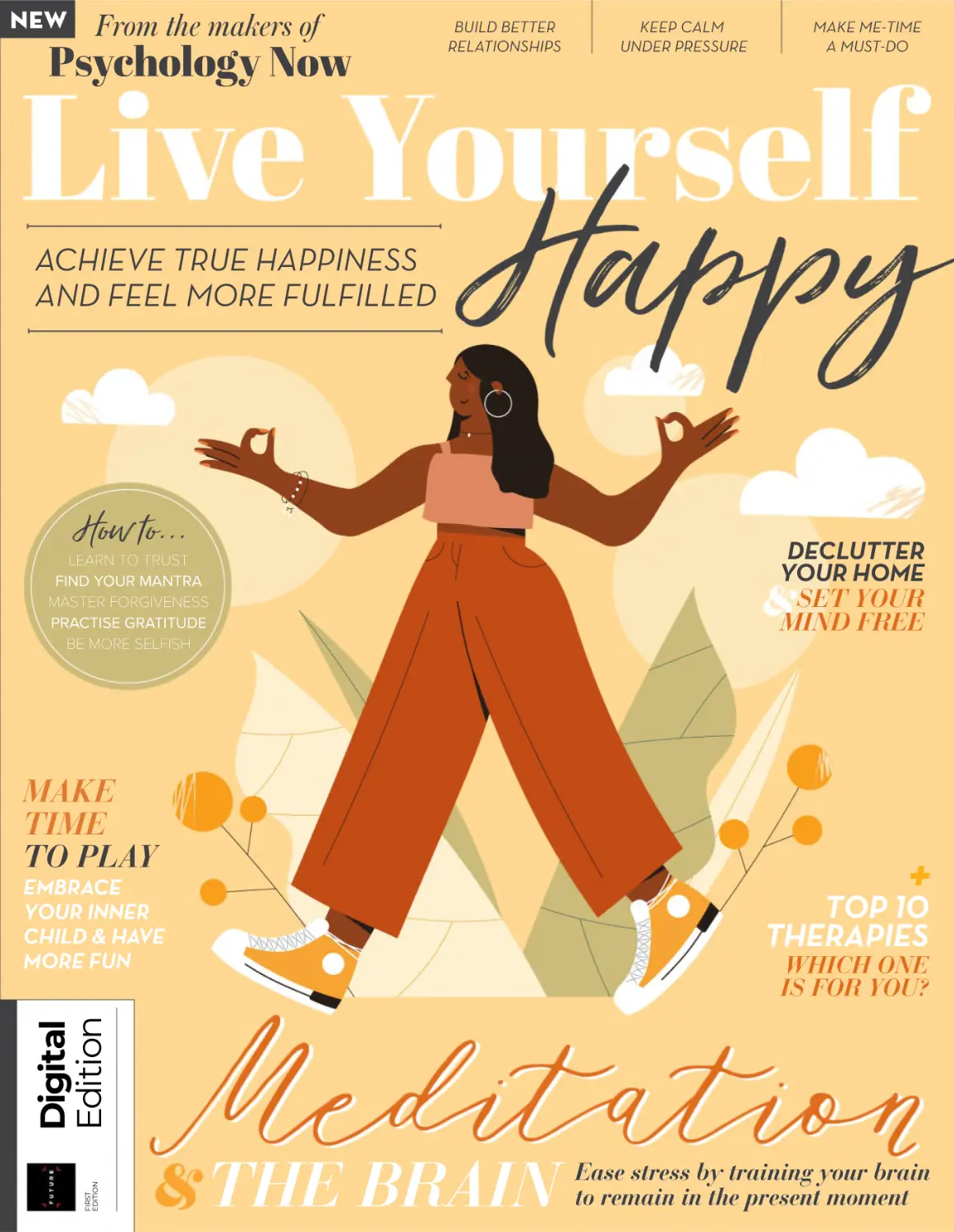
NEW
From the makers of
Psychology Now
BUILDBETTER
RELATIONSHIPS
KEEPCALM
UNDERPRESSURE
MAKEME-TIME
AMUST-DO
ACHIEVETRUEHAPPINESS
ANDFEELMOREFULFILLED
How to...
LEARN TO TRUST
FIND YOUR MANTRA
MASTER FORGIVENESS
PRACTISE GRATITUDE
BE MORE SELFISH
MAKE
TIME
TO PLAY
DECLUTTER
YOURHOME
SET YOUR
MIND FREE
TOP
EMBRACE
YOURINNER
CHILD&HAVE
MOREFUN
THERAPIES
FIRST
EDITION
Digital
Edition
WHICH ONE
IS FOR YOU?
THE BRAIN
Ease stress by training your brain
to remain in the present moment
WELCOMETO
Live Yourself
ACHIEVETRUEHAPPINESS
ANDFEELMOREFULFILLED
Happiness means different things to different people – what makes
one person happy might make another feel unhappy, and vice versa.
However, science has shown that there are some fundamental things we
can all do to ensure we start living our happiest lives. The decisions we
make, our behaviour and, most importantly, our mindset all contribute
towards this end goal. Gaining a greater understanding of ourselves will
help us to make the right choices so we can avoid negativity, be more
authentic, and start living more content and fulfilled lives.
Why do we feel certain emotions in specific situations? Why do we
behave in particular ways? And what can we do to overcome the things
that hold us back? Learn all this and more by delving into the world
of psychology to build a better relationship with your mind. Packed
full of expert guidance from psychologists, counsellors and other
professionals, in the pages that follow, we look at how to build better
relationships, the benefits of having fun, and why decluttering can be
great for our wellbeing. We also look into ways to stress better, how to
forgive, the thrill of anticipation and more.
The mind is a powerful tool. Learn how to take control of
your own mind today for a happier tomorrow.
CONTENTS
6
YOURMENTALHEALTH
MASTERCLASS
25
FINDYOUR
MANTRA
26
12
WHICHTHERAPY
ISFORME?
16
HOWTO
STRESSBETTER
18
PANICKED?
PRESSPAUSE
22
MAKEME-TIME
AMUST-DO
WHYWESHOULDALLBE
MORESELFISH
28
THEGIFTOF
COMPASSION
29
WHYIT’S
GOODTOCRY
30
REDISCOVER
YOUROPTIMISM
34
SURVIVALOF
THEKINDEST
4
38
GRATITUDE
ANDWELLBEING
42
I’m sorry
ACHIEVING
FORGIVENESS
44
LEARNINGTOTRUST
46
REGRETS
AREGOOD
FORYOU
48
YOUCAN’T
CONTROLEVERYTHING
50
WHAT’SHOLDING
YOUBACK?
LIVE YOURSELF HAPPY
CONTENTS
70
BEATTHECURSE
OFCOMPARISON
108
76
55
WHENGOSSIPISGOOD
56
WHYDON’TWE
PLAYMORE?
60
WAYSTOMAKE
LIFEMOREFUN
62
THEGREAT
ESCAPE
64
THETHRILLOF
ANTICIPATION
66
THEWANDERINGMIND
LIVE YOURSELF HAPPY
MEDITATIONAND
THEBRAIN
THEGOOD
ARGUMENTGUIDE
78
BUILDBETTER
RELATIONSHIPS
84
MODERN
MEDITATION
112
LETTHETREES
TREATYOU
114
EMBRACETHEBLUE
THEPOWER
OFFRIENDSHIP
90
118
96
122
THECOURAGETO
BEVULNERABLE
THEMAGIC
OFHUGGING
98
BOOSTHAPPINESSWITH
DIETANDEXERCISE
COULDCOLOUR
BETHECURE?
WHYDECLUTTERING
CANBOOSTYOUR
WELLBEING
© Gey Images, Shuerstock
52
WHATIS
LOVE?
102
128
BREAKUP
WITHSOCIALMEDIA
5
YOUR MENTAL HEALTH MASTERCLASS
6
LIVE YOURSELF HAPPY
YOUR MENTAL HEALTH MASTERCLASS
YOUR
We look after our physical health, but our
emotional wellbeing often gets neglected.
It’s time to make it a priority
WORDS NATALIA LUBOMIRSKI
D
espite a staggering one
in four people in the UK
experiencing a mental health
problem each year, the
invisible nature of it means
there’s oen a tendency to ignore problems
and just get on with it. But, as Stephen
Buckley, head of information at mental
health charity Mind, says, “Mental health
is just like our physical health: everybody
has it and we need to take care of it.”
He adds, “Thankfully, we’ve seen the
national conversation on mental health
move forward, but those with mental
health problems still face barriers.” The
topic remains taboo, especially for older
the invisible nature of it
means there’s a tendency
to ignore problems
LIVE YOURSELF HAPPY
7
YOUR MENTAL HEALTH MASTERCLASS
generations – a YouGov survey revealed
25% of over-55s think it’s more difficult for
them to discuss mental health than younger
people. Some 71% felt this was because, in the
e
past, anxiety and depression were seen as
weaknesses, rather than health conditions.
ROAD TO
RECOVERY
These figures are no surprise, especially
aer the recent pandemic. But it’s how we
deal with it that’s important. Thankfully,
there are things we can do. “Eating healthily,
sleeping well, exercising and seeking
help are all key,” says Stephen. “Different
treatments work for different people and the
journey to recovery won’t always be easy.”
Here, Mind shares its advice on three
common mental health issues.
DEPRESSION
What is it? In its mildest form, it
means being repeatedly in low spirits
– at its most severe, it can be lifethreatening, making you feel suicidal.
The impact? Symptoms can include “feelingg
low, numb, worthless or without hope,” says
Stephen. “You may sleep too much or too
little, and withdraw from social contact.”
Help yourself List activities, people
and places that make you feel good,
and try to find ways to bring these
things into your daily routine.
Do something new This can boost your
mood and break unhelpful patterns of
thinking. You could try volunteering – it
makes you feel better and less alone.
Try self-help Explore cognitive
behavioural therapy.
ANXIETY
What is it? Feeling anxious is a natural
response when we feel under threat.
But if you regularly experience anxiety,
including panic attacks, which are
strong, last a long time and are difficult
to control, you may need help.
The impact? You avoid situations
that may make you feel anxious.
You’ll find it hard to go about your
everyday life or do things you enjoy.
Help yourself focus on breathing,
especially during a panic attack. Inhale
through your nose and out through your
mouth, counting from one to five.
Try complementary and alternative
therapies, including meditation,
aromatherapy, massage, yoga and
reflexology, to aid relaxation.
Not sure if you have a problem?
Read on to find out more about
the secret signs of anxiety.
OBSESSIVE
COMPULSIVE
DISORDER (OCD)
What is it? An anxiety disorder with
obsessions (unwelcome thoughts, urges and
worries that appear in your mind, making
you feel anxious) and compulsions (repetitive
activities to reduce anxiety, such as checking
a door is locked or repeating phrases).
The impact? You might avoid situations that
trigger it, including work or seeing friends
or family. You may feel ashamed of your
thoughts or feel the need to hide your OCD.
Help yourself Talk to someone you trust
or write down feelings to discuss together.
Learn to relax Manage stress
COULD YOU BE SAD?
Does your mood and energy dip in the winter months? SAD is a
mood disorder or depression that comes and goes in a seasonal
paern. Symptoms, including a persistent low mood, anxiety, loss of
interest in everyday activities, irritability, feeling lethargic, sleeping
for longer, craving carbs and gaining weight, are more apparent
during winter. What helps? When it comes to SAD, “the same rules
apply as to general depression,” says Dr Jeff Foster (drjeoster.
co.uk). He suggests exercise, a healthy diet, reducing alcohol intake,
socialising and keeping mentally active as ways to reduce symptoms,
as well as geing outside as much as you can during daylight hours.
8
It’s
thought that
around three
million people
in the UK have
an anxiety
disorder
and try techniques such as deep
breathing or mindfulness.
Try peer support This brings together
people who have had similar experiences.
It helps you feel accepted and confident.
NO MORE
FEELING
ANXIOUS!
Millions of us are experiencing anxiety,
oen without even realising it. Most of us
probably think we know what anxiety feels
like. Your heart races, you’re short of breath,
and your body is bathed in a sheen of
sweat. But there are plenty of hidden signs,
too. Follow this advice on how to spot the
hidden signs and do something about it.
“Anxiety is what we feel when we are
worried, tense or afraid,” says Nicky
Lidbetter, CEO of Anxiety UK. It can be
caused by a number of factors, including
feelings of uncertainty, physical health
problems, stress, and your childhood
experiences. It’s thought that around
three million people in the UK have an
anxiety disorder, and while clammy
hands and a pounding heart could
signal anxiety, some signs are less
obvious. Here are the more subtle
symptoms to look out for . . .
YOUOVER-DRAMATISE
SMALLFAILURES
“There’s a catastrophising
nature to anxiety that makes
you perceive things being
much worse than they actually
are,” says Nicky. If you’re
overdramatic, you may have an
over-the-top reaction to a small
failing, which could lead to a
meltdown or cause you to stay
at home for the next few days,
unable to face the world.
–
LIVE YOURSELF HAPPY
YOUR MENTAL HEALTH MASTERCLASS
WHAT IS
STRESS?
Being under pressure is part
of life, and it can help you
take action, feel energised
and get results. But if you are
overwhelmed, these feelings
could be a problem. While stress
isn’t a psychiatric diagnosis, it’s
closely linked to mental health.
Manage external pressures and
develop your emotional resilience
so you’re beer at coping,
including looking aer physical
health, giving yourself a break
and building support networks.
YOUOVERTHINK
“When you’re anxious, you’re
desperately trying to make sense
of a situation. Overthinking and
labouring over every eventuality is
a way of protecting yourself and
gaining control,” says Nicky.
–
YOU’REAFRAID
TOTAKERISKS
Sticking to your ‘comfort zone’
means you won’t have to face
frustration, embarrassment, sadness,
YOU’RECRITICALOF
YOURSELFANDOTHERS
“Being anxious leads to you
being hard on yourself. It thrives
on the lack of self-esteem you
have for yourself and, as a result,
you become self-critical and
critical of those around
you,” says Nicky.
–
YOUCAN’TSLEEP
When we’re in an anxious state,
it can be hard for our body
and mind to relax, and we can
have trouble sleeping, which can
lead to bouts of insomnia.
–
YOU’REDISTRACTED
“We may be preoccupied with
our thoughts and easily
distracted,” says Nicky.
Experiencing racing thoughts
is common with anxiety, but
this attention to the ‘inner
dialogue’ can result in others
perceiving us as distant.
–
Being anxious
thrives on the lack of
self-esteem you have
LIVE YOURSELF HAPPY
anger or disappointment – all
extreme feelings for someone with
anxiety. “When we’re anxious,
we want to protect ourselves and
can see risks as threats, so we
become risk-averse,” says Nicky.
–
YOUTALKTOOMUCH
You may be in a ‘high-functioning’
state when you’re anxious, meaning
your mind is going at 100mph. As
a result, your actions – such as
talking a lot – may follow suit.
YOUR MENTAL HEALTH MASTERCLASS
trying to hide
symptoms from
others can impact
physical health
YOU’REUNWILLING
TOMAKEFRIENDS
Opening yourself up emotionally
can make you feel vulnerable and
exposed. You may already be
imagining losing that friendship
before it’s even started. “Anxiety
may isolate us by way of
protecting ourselves from
unknown territory,”
says Nicky.
–
YOUFEELUNWELL
Constant anxiety has
a big effect on the
immune system, and trying
to hide symptoms from others can
impact physical health. “Anxiety
can make us fatigued and even
sick. Plus, adrenaline released can
have a negative impact on our
stomachs, as well as other parts
of the body,” explains Nicky.
When it’s more serious . . .
Seek additional help and support
if anxiety is disrupting your day-today life and stopping you from doing
activities you previously enjoyed.
SHORTCUTS
TO SERENITY
These quick tips can help, so make
sure you practise them daily:
A person who feels they are
not worth listening to will speak
quickly, because they don’t want
to keep others waiting on
something not worth listening to.
A person in authority speaks
slowly; even if you don’t feel
LIVE YOURSELF HAPPY
YOUR MENTAL HEALTH MASTERCLASS
LIVE YOURSELF HAPPY
Keep talking. Having a chat with
a loved one, sending a text
to a friend, or asking your
colleague to go for a walk is the
best tonic for a low mood.
–
Standing tall and straight
makes you feel better about
yourself. Imagine a piece of
string is pulling the top of your
head towards the sky, and
the rest of your body
straightens accordingly.
–
Immerse yourself in nature.
So-called ‘green therapy’,
being outdoors is a powerful
mood-lifter. A Stanford
University study showed that
a 90-minute walk in nature
reduced ruminations, which is a
risk factor for mental illness.
HOW TO BE CALM
“If you’re feeling anxious, there are ways you can step back and take control
before the symptoms build up and take over,” says Nicky.
DOABREATHINGEXERCISE
Breathe in through the nose for three seconds, hold for four seconds,
breathe out through the mouth slowly for five seconds.
© Gey Images / Rudzhan Nagiev / miakievy / invincible_bulldog / everything bagel / Olga Tsareva / Aleksei Naumov / dar woto
very confident, try slowing
down and see how it feels.
–
Too much to do? Write down each
task you can’t do right now on a
separate piece of paper. Then, every
other day, take a random one and do
it. You’ll soon get through the list.
–
Learn to recognise negative selftalk (‘I can’t run any more, I’ve got
to stop’). Visualise it as an irritating
bug, stamp on it, kill it, then replace
it with a positive one (‘Come on, I
can do this! Only half a mile left!’).
–
Laugh often. Watch a funny film
or a YouTube video and have a
good belly laugh. Science shows it
helps to lower the stress hormone
cortisol and can shift a low mood.
–
You are what you do, so if you
change what you do, you change
what you are. Act in a positive
way, take action instead of telling
yourself you can’t. Talk to people
in a positive way. You’ll soon
start to notice a difference.
–
If you choose to say ‘no’ to
something, mentally rehearse the
conversation beforehand, saying it
simply and directly, giving no more
than one key reason. Do not get into
explaining or arguing: just repeat
‘No, because...’ quietly and firmly.
–
Before always saying ‘yes’ to
demands, take a deep breath, so
you can touch base with yourself
to discover what you would
truly, honestly prefer to do.
–
Have a list of useful apps that
benefit your mental health. Try
Headspace, Stress & Anxiety
Companion, and Catch It.
–
Don’t aim too high. Set a goal
you know you can achieve, then
achieve it. You’ll feel good. Now
set another and achieve that.
Soon you’ll be setting bigger
goals and achieving those, too.
–
Visualise yourself at your most
confident, then link this feeling to
a physical action, such as pinching
your thumb and forefinger together.
Next time you need to feel confident
in a situation, pinch your thumb
and finger together to get back
to that positive mental state.
–
USEADISTRACTIONTECHNIQUE
Try the 5, 4, 3, 2, 1 technique – acknowledge five things you can see, four
things you can hear, three things you can touch, two things you
can smell, and finally one deep breath in and out.
TRYPOSITIVEAFFIRMATIONS
Tell yourself, ‘I am safe, I am in control, this feeling is anxiety’, and
repeat until you feel more in control of your feelings.
MAKEDIETARYCHANGES
Small changes to your diet can make a difference to anxiety
symptoms. Try eating less processed food, drinking less alcohol,
and cuing back or stopping caffeine. Don’t forget that caffeine
can be present in chocolate and so drinks, too.
GETENOUGHSLEEP
Maintain a regular sleeping paern by going to bed at the same time
each night, switching off screens at least one hour before bedtime, and
ensuring your bedroom is dark and the right temperature.
11
WHICH THERAPY IS FOR ME?
WHICH
IS FOR ME?
There’s a multitude of
problems therapy can
help with and just as
many approaches to take.
How do you know which
is right for you?
12
LIVE YOURSELF HAPPY
WHICH THERAPY IS FOR ME?
WORDS SARA NIVEN
PSYCHODYNAMIC
PSYCHOTHERAPY
Stemming from Sigmund Freud’s
psychoanalysis, Freud believed that
psychological problems are rooted in the
unconscious mind, and experiences from
a person’s past can influence their thoughts
and behaviour in later life. Positive change is
seen as happening as a result of uncovering
repressed events and linking them to present
difficulties. You might spend significant
time discussing your childhood or recalling
dreams, with your therapist suggesting
connections. This approach also emphasises
the idea and exploration of transference,
where feelings you experienced in previous
relationships may be projected onto your
therapist – for example, you view them as a
critical teacher or favourite uncle.
Suitable for A wide range of issues,
including depression and anxiety.
Considerations Some people might
prefer to focus on the present than
revisit their childhood. Therapy may
take place over a longer time frame
than some other approaches.
PERSONCENTRED
THERAPY
This form of therapy falls into a category
called ‘humanistic’, where the client is seen as
able to solve difficulties themselves, given the
right conditions. Developed by psychologist
Carl Rogers in the 1940s, there is an emphasis
on the counsellor showing unconditional
positive regard (UPR), which refers to nonjudgemental warmth and acceptance. The
therapist aims to ensure a client feels heard
and understood, and enables them to lead
the session and set the pace. Compared to a
psychodynamic counsellor, a person-centred
one is more likely to occasionally reveal their
own experiences (self-disclosure) if they see it
as helpful for emphasising understanding.
Suitable for All ages and a wide range of issues,
including grief, depression, anxiety and stress.
Considerations The outcome of personcentred therapy depends on what a client
chooses to talk about in sessions. Some
people might want more directive help than
this form of counselling typically provides.
GESTALT
THERAPY
Gestalt therapy is another form of
humanistic therapy based on the belief
in a client’s natural ability to achieve
healthy balance and growth. Developed
by psychotherapists Fritz and Laura Perls,
it places a strong focus on immediacy in
addition to the client/counsellor relationship.
Although any skilled therapist will pay
attention to your body language, a Gestalt
therapist is more likely to comment on this.
They might tell you they notice you tapping
your feet when discussing a particular
topic, for instance, and encourage you to
Some prefer
to focus on
the present
than revisit
childhood
LIVE YOURSELF HAPPY
13
WHICH THERAPY IS FOR ME?
A CBT
therapist
will be more
directive and
encourage you
to challenge
negative
beliefs
consider what that means. There might also
be aspects of role playing and creativity,
using pebbles or other objects. The ‘empty
chair’ is a well-known Gestalt technique
where a client is encouraged to address
a chair as though someone they have an
unresolved issue with is sitting there.
Suitable for Issues including
anxiety, depression, low self-esteem
and relationship problems.
Considerations Some people enjoy
the more creative techniques used in
Gestalt therapy, while others might feel
uncomfortable. As with any form of
counselling, feeling safe and having a good
level of trust with your therapist is key.
COGNITIVE
BEHAVIOURAL
THERAPY (CBT)
CBT falls under the category of behavioural
therapy and is goal orientated. A CBT
therapist will be more directive and
encourage you to challenge and change
negative or outdated beliefs that are
causing difficulties. They might also set
‘homework’ to do between sessions.
This could be a good approach for
conquering a specific fear, such as starting
to drive again aer a road accident. While a
person-centred counsellor would focus on
empathy and understanding, a CBT therapist
would be aiming to uncover the beliefs and
fears you have about this, challenge these
and take steps towards overcoming them.
Suitable for In addition to depression
and anxiety, CBT can be used to treat
obsessive compulsive disorder (OCD),
phobias and substance abuse issues.
14
Considerations Therapy tends to be
focused on specific goals and outcomes
and is oen relatively short term. Exposure
therapy (where you confront situations
you generally avoid) can be challenging.
DIALECTICAL
BEHAVIOURAL
THERAPY (DBT)
An adaptation of CBT, which uses some of
the same skills, DBT was developed in the
1970s and is aimed at people who struggle
with very intense emotions. For this reason,
it is the therapy of choice for treating people
diagnosed with borderline personality
disorder (BPD). Like CBT, it focuses on
change but there is more of an emphasis on
mindfulness and learning how to regulate
emotions and tolerate distress without
turning to harmful coping mechanisms.
Suitable for Mental health conditions,
including BPD, self-harm, eating
issues, addiction and PTSD.
Considerations People undergoing DBT
might be asked to commit to more
than just one-to-one sessions – group
skills training, phone coaching and
homework could also be involved.
TRANSACTIONAL
ANALYSIS (TA)
Transactional analysis focuses on the way
you relate to others, be that your partner,
your boss or a family member. Developed
by psychiatrist Eric Berne in the late 1950s,
it divides the human personality into three
basic ego states: parent (with nurturing
and critical sides), adult and child. This
aims to increase our understanding of
interacting with others and the responses
we get, such as regularly being in critical
parent mode when speaking to your
partner, which then results in conflict.
TA therapists also look at our beliefs in
terms of ‘scripts’ and help a client re-evaluate
any unhelpful ones formed while growing
up, which are impacting negatively on them,
for example, ‘I must never make a mistake’.
Suitable for A range of issues, including
relationship difficulties, low self-esteem and
workplace challenges. TA is oen applied
outside of the therapy room, for example
in coaching or educational situations.
Considerations Supporters of TA cite the
simple models and language, which are much
easier than some other theories for clients to
understand and apply to everyday situations.
EYE MOVEMENT
DESENSITISATION
REPROCESSING
THERAPY (EMDR)
Developed by a psychologist called
Francine Shapiro in the late 1980s, EMDR
aims to help the brain to reprocess
traumatic memories. Clients won’t lose
the memory but ideally it should not
continue to trigger such strong emotions.
EMDR has a specific structure, with
eight stages that a therapist works
through with you. Aer the initial stages,
therapy involves activating a disturbing
memory while introducing what is called
bilateral stimulation (BLS) involving eye
movements, physical tapping or other
stimuli to activate both sides of the brain.
Suitable for EMDR is recognised by the
World Health Organization (WHO) as a
treatment for post-traumatic stress disorder
(PTSD). It can also be used for a range of other
issues, such as unresolved grief and mental
illnesses, including personality disorders.
Considerations Talking about difficult
memories in detail isn’t seen as a significant
part of the process, which could be helpful
for people keen to avoid that, although
they will be asked to recall experiences.
This therapy isn’t considered suitable for
clients with substance abuse issues.
ART THERAPY
As the name suggests, this form of
psychotherapy uses art as a form of
communication and way of addressing
difficult emotions. Complex emotions can
be put onto paper or canvas, and creating
and discussing the resulting art with a
therapist can help give clients clarity
over intense but confused feelings and
connect with their unconscious mind.
Suitable for Art therapy can be used by
people in a wide range of situations,
including physical illnesses, such as
cancer, learning disabilities, eating
disorders and dementia. It can
also be used with children.
Considerations You don’t need to be
a budding Michelangelo or Monet to
have art therapy – no artistic skills
are necessary; however, some people
may feel less comfortable than others
expressing themselves in this way. A
skilled therapist should provide plenty
of opportunity to work through the
emotions the art session brings up.
LIVE YOURSELF HAPPY
WHICH THERAPY IS FOR ME?
INTEGRATIVE
THERAPY
HYPNOTHERAPY
Hypnotherapy isn’t a theoretical approach or
considered a traditional talking therapy that
falls under the remit of the British Association
of Counselling and Psychotherapy or
the American Counseling Association.
However, there is evidence that it can be
an effective form of treatment for anxiety
and anxiety-related disorders, such as
headaches and irritable bowel syndrome,
while others report finding it helpful in
addressing a range of other difficulties.
During sessions, hypnosis combined
with talking therapy aims to work on both a
conscious and subconscious level, to bring
about positive change while adjustments
can be made to limiting beliefs that have
influenced or directed the client’s life.
Suitable for Anxiety, phobias,
addictions, low self-esteem, insomnia
and stress-related conditions.
Considerations Hypnotherapy isn’t advised
if you have psychosis or a personality
disorder. As with any form of therapy, it
is important to ensure a hypnotherapist
is suitably trained and check them out
with the relevant regulatory body.
Whatever therapy you opt for, it is essential
your therapist is properly qualified and
works to professional standards. In the
UK, the best way to establish this is via
the British Association for Counselling and
Psychotherapy (BACP) (www.bacp.co.uk/
about-therapy/how-to-find-a-therapist),
and in the US, the American
Counseling Association (ACA).
(ACA)
(www.counseling.org/aca-community/
learn-about-counseling/what-iscounseling/find-a-counselor)
© Gey Images / SpicyTruffel
Rather than specialising in one, many
therapists now train in a range of different
therapeutic approaches and use these like
tools in a toolbox, to be taken out according
to what seems most useful at the time.
One week they might work in an entirely
person-centred way, allowing the client to
lead the session. Another time, they might
outline the ego states that are part of TA
theory to help the client gain insight into
a relationship difficulty, or draw on Gestalt
training to suggest the ‘empty chair’ exercise.
Suitable for Integrative therapy is increasingly
common and seen as suitable for many
issues including bereavement, relationship
difficulties and eating disorders.
Considerations This is a more ‘bespoke,’
form of therapy with less structure than
some others, but shouldn’t be experienced
as confusing or completely random.
Integrative therapists work to tailor their
approach to a client’s needs, not use
different ones just for the sake of variety.
LIVE YOURSELF HAPPY
15
HOW TO STRESS BETTER
HOW TO
You can’t escape it
entirely, but stress isn’t
all bad, and there are
ways to harness it to
your advantage
HOW TO STRESS BETTER
WORDS JENNY ROWE
A helping hand
“Stress is the brain’s threat detection system
preparing us to deal with danger,” says Dr
Burnett. It mostly feels unpleasant, but on
a fundamental level it keeps us safe. “While
it is usually the consequence of a negative
situation, there may be positive outcomes,”
says Caron. This is more likely if we are
working towards a goal that we believe is
positive too, such as interviewing for a new
job, getting married or running a race.
Ultimately, an optimal dose of stress
can help us perform better. “The stress
response increases muscle tension and
raises heart and breathing rate, which
makes you more focused, less distractible
and more motivated,” says Dr Burnett.
Whatever you’re feeling stressed about,
this physiological reaction means you
KNOW YOUR STRESSORS
To stress beer (and less), we need to know our triggers. Stress
trackers monitor things like heart rate variability (the variation in time
between each heart beat) to measure stress levels and help us identify
our personal triggers – so we can come up with solutions. The key to
successful stress tracking is to ensure you’re asking, ‘Why am I stressed?’,
not the less useful question, ‘How stressed am I?’, says Dr Burne.
TRY IT Most fitness wearables now have stress tracking capabilities,
or you can try the StressScan app for free (Apple, Google Play). At its
simplest, stress tracking could just mean keeping a stress diary. “Rate
the stress from 1-10 as it happens,” says Caron. “This will help you feel in
control of the stress rather than the stress controlling you.”
are more likely to complete the task to
the best of your ability. This is stress in its
positive form, which is known as eustress.
Striking a balance
“Countless studies have shown that, up to
a point, a person’s performance increases
directly in proportion to how much stress
they’re experiencing,” says Dr Burnett.
However, if stress levels continue past this
point, we start to struggle. “This increases
our stress levels again and we can get
stuck in a stress cycle,” says Caron.
The main issue with stress is when you
have too much of it for too long – this is
when acute stress morphs into chronic,
more harmful stress. “When stress is
constant, it’s like keeping your foot on the
accelerator,” says Caron. “It leads to burnout.”
Breaking point
Stress is sneaky. It can be easy to keep
cruising through life, not realising you’re
approaching burnout – until you’re there. “Our
brains aren’t particularly good at noticing
changes that happen over long periods,” says
Dr Burnett. “But it can be done, particularly if
the changes caused by stress are marked.”
You may be struggling to sleep, have low or
high appetite, headaches, low sexual desire
or high blood pressure. If you are unable
to finish tasks, feel tearful, worry all the
time or snap at people when you normally
wouldn’t, then stress may be affecting
your wellbeing and it’s time to get help.
It’s important to recognise that there is
a difference between coping with stress
and dealing with it. “Dealing with stress
involves processing stressful emotions
and actively bringing about changes that
address the cause of stress,” says Dr Burnett.
“Coping is just putting up with the stressful
situation and carrying on, which is not a
great long-term strategy, as our capacity for
tolerating stress will max out eventually.”
How to stress better
So can we become better at dealing with
stress and stop it tipping us over the edge?
In short, yes. Like musicians, dancers
and actors who are taught to reinterpret
their nerves as excitement, it’s possible
to change our emotional reactions to
stressful experiences into something
more positive – though obviously this
depends on the situation, and mainly
applies to small-scale day-to-day dramas.
Optimists who choose to see potential
daily stressors (such as traffic jams and
chores) as challenges rather than threats
before emotions flare up, reduce the
negative impact of stress, as shown in
a recent two-decade-long study**.
You can also try to increase your
threshold for stress. “By taking on new
challenges and pushing yourself beyond
your comfort zone – but in ways that
you feel OK with – you could gradually
increase the amount of stress you’re
capable of dealing with,” says Dr Burnett.
© Gey Images / treety
A
s the cost of living crisis
spirals, our stress levels
are following suit. One
in five people in the UK
say they feel stressed
more than they don’t, and money worries
are one of the primary causes*. But we
shouldn’t be scared of stress. “It’s normal,”
says psychotherapist Caron Barruw, cofounder of The Niche Group. “It’s how we
manage it that makes the difference.”
We can learn to turn stress into
something more useful – helpful even,
adds neuroscientist and author of PsychoLogical, Dr Dean Burnett. Sound good? Here’s
how to harness and not hate all stress.
We can learn to turn stress
into something more useful
*Ciphr. **The Journals of Gerontology
17
PANICKED? PRESS PAUSE
18
LIVE YOURSELF HAPPY
PANICKED? PRESS PAUSE
It’s easier than you think to take back control
when you’re having a panic attack
WORDS ROSE GOODMAN
A
pounding heart, crushing
chest pain and debilitating
terror may sound like the
signs of a heart attack, but
for those who suffer from
panic attacks, these scary symptoms are
all too common. Sound familiar? You’re
not alone – up to a third of people will
experience at least one panic attack in their
lifetime*, while others will have regular
attacks or several in a short space of time.
Whatever your experience, there are ways
to bring a panic attack under control. Here,
our experts explain what could help…
What happens?
“A panic attack is an intense emotional and
physical response to a sense of dread or fear,”
says psychologist Dr Alison McClymont.
“It may have an obvious trigger (such as
being under stress), but it may also come
on seemingly unprovoked and can make
you feel as if your health – or, in extreme
situations, your life – is under threat.”
LIVE YOURSELF HAPPY
Spot the signs
The overwhelming symptom of a panic
attack is a sense of impending doom or
anxiety. “This may be accompanied by
difficulty breathing (hyperventilating),
sweaty palms, a racing heart or muscle
pain,” explains Dr McClymont. Trembling,
dizziness and feeling detached from
reality are also common symptoms.
The physical symptoms can be so
extreme that some sufferers may go to
A&E, believing they are having a heart
SUPPORTING A LOVED ONE
If you’re with someone who is experiencing a panic aack, it can be difficult
to know how to help. But there are some simple ways you can help make
them feel safe and at ease. “Don’t touch them. Speak calmly and slowly,
remind them where they are, that they are safe, and that you are there,”
says Dr McClymont. “Try modelling slow, calm breathing (in for four and
out for eight), get them some water and keep reminding them that this will
pass, and that breathing is the key.”
19
PANICKED? PRESS PAUSE
5 WAYS TO PREVENT
AN ATTACK
These daily habits can help to reduce future panic aacks, says the
Mental Health Foundation:
Practise beer breathing (do the 4-7-8 breathing technique daily).
Take regular exercise, such as walking or yoga.
This will help to reduce stress and improve your mood.
Eat frequent meals to stabilise blood-sugar levels.
Avoid caffeine, alcohol and smoking.
Try mindfulness to bring you back to the present moment.
Download the Calm app (£7.99/$14.99 per month, iOS and Android).
attack. However, while panic attacks
are frightening, they’re not dangerous
and won’t cause you physical harm.
Stay calm
If you feel a panic attack developing, try
to think of it like a big wave. You cannot
stop it, but you can ride it. “Distract yourself
from catastrophic thoughts and don’t
buy into them,” says Dr Paul McLaren,
consultant psychiatrist for the Priory
Group. There are also things you can
do to take back a feeling of control.
JUST BREATHE
“Try to slow your breathing, even
though you will feel that you
need to breathe harder,” says Dr
McLaren. This 4-7-8 breathing
exercise will help activate your
parasympathetic nervous system,
which is responsible for relaxation.
1. Close your mouth and inhale
through your nose for a count of four.
–
2. Now hold your breath
for a count of seven.
–
3. Exhale completely out of
your mouth, making a ‘whoosh’
sound, for a count of eight.
–
4. Inhale again and repeat the cycle
three more times, or more if needed.
GROUNDYOURSELF
Try the 5,4,3,2,1 grounding
technique, which will bring you
20
back to the present moment. This
exercise requires you to engage
all of your senses by naming:
Five things you can see.
–
Four things you feel, such as
the texture of a chair or the
temperature of the room you’re in.
–
Three things you can hear.
–
Two things you can smell.
–
One thing you can taste.
If you can’t taste anything,
name a taste you like.
NOTICEYOURBODY
A body-scan exercise can release
tension you’re not even aware you’re
holding. Practising this technique
regularly can help reduce anxiety,
depression and fatigue. During a
panic attack, doing this exercise can
help to bring you back to your body
and feel safe within it. Give it a go:
Sit or lie down in a comfortable
spot and position.
–
Start with the breathing strategy
described in the previous column
and then focus on your toes.
–
Check in with what you can
feel and how they feel. Give
them a little wiggle.
–
Move on to the soles of your
feet. Keep breathing slowly and
gradually move up through your
body, checking in, moving and
relaxing each part as you go.
–
When you’ve completed this,
gradually go back down your body
in the same order whilst continuing
your slow and steady breath
style. This can be a really useful
activity to help you de-stress and
be more mindful and body aware.
IMAGINEASAFESPACE
Also known as visualisation, this
technique requires you to imagine
that you’re in a calm, safe and
soothing place. “Think about what
you can see, hear, taste, smell and
feel,” says clinical psychologist Dr
Marianne Trent, creator of The Feel
Better Academy. “Know that you
can revisit this place in your mind
whenever you choose.” Your safe
space could be anywhere – from a
tropical beach or your garden in the
summer, to a relaxing bubble bath.
BEAWARE
Feeling stressed out? Integrative
counsellor Katharina Wolf suggests
using a technique called AWARE,
which works to move your brain
from a state of high anxiety to
a place of calm, and helps to
avoid creating further triggers.
Accept the anxiety/panic.
Fighting it will only heighten it.
–
Watch and scale your panic/
anxiety from one to ten (with ten
being maximum panic/anxiety).
–
Act normally, while
imagining yourself calm.
–
Repeat the above three steps.
–
Expect the best. Use positive
statements such as, ‘This can’t
harm me’; ‘I can master this’;
‘This will go away soon’.
Rest and recover
It’s common to feel exhausted and emotional
aer suffering a panic attack. “Go to a calm
and quiet place. Play some music and take
time to comfort yourself and re-engage with
your surroundings,” advises Dr McClymont.
“Drink water and, if you feel dizzy, try eating
a small amount of sugar. The most important
thing is to be still, breathe, and show yourself
LIVE YOURSELF HAPPY
PANICKED? PRESS PAUSE
Panic attack or anxiety attack?
While these terms are oen used
interchangeably, the symptoms of a panic
attack and an anxiety attack do differ
slightly. “An anxiety attack is usually not
accompanied by such a sense of impending
doom or death,” says Dr McClymont. “The
physical symptoms are similar, but in a panic
attack the threat response is more highly
elevated and things such as hyperventilating
or chest pain are more likely to occur.”
Stop the cycle
Talking therapies such as cognitive
behavioural therapy (CBT) are oen used
to treat panic attacks. “It is likely that panic
developed for an important reason to protect
you from something painful or difficult, says
Dr Trent. “Working through these reasons
and learning more about why you respond
in the way you do can be incredibly useful,
and enable you to enjoy your life more fully.”
LIVE YOURSELF HAPPY
It’s common to feel
exhausted and emotional after
suffering a panic attack
Is it panic disorder?
If you experience panic attacks, it doesn’t
necessarily mean that you have panic
disorder. As Dr McClymont explains,
panic disorder is classified as having at
least one panic attack and subsequent
fear or intrusive thoughts about
having another, across one month.
If you’re resorting to unhealthy coping
mechanisms or ways of preventing an
attack – for example, avoiding certain
situations that have caused you anxiety
in the past – you may be diagnosed with
panic disorder. However, this can only be
diagnosed by a professional and may require
both medication and therapy to treat it, so
visit your doctor if you are concerned.
‘I BEAT
THE FEAR’
Dr Sophie
Mort, clinical
psychologist and
the author of A
Manual For Being
Human** (£14.99/$18.50, Simon &
Schuster), shares her experience of
overcoming panic aacks…
“I had my first panic aack
aged 18, when I was on holiday.
I kept telling myself I had
sunstroke, which was why I
overheated and my heart was
racing. Then the next day it came
back, over and over. I knew then
that it wasn’t the sun.
My panic aacks then escalated
to the point where I didn’t leave
the house for nearly three
months, as everything I did
set them off. I quit university
and didn’t see friends.
I finally saw a therapist and she
taught me techniques to manage
the panic. Aer a month, I noticed
that the aacks had lessened
enough for me to leave the house.
I haven’t had a panic aack in
years, and I manage my anxiety
with yoga, mindfulness and
breathing exercises.
My favourite technique is saying
‘bring it on’ whenever I feel the
physical sensations of anxiety or
panic building. That’s been the
most important part of my journey,
because when I say it and really
mean it, it removes the fear cycle
that kept the panic alive.”
*Bupa UK. **Follow Dr Soph on Instagram @_drsopH
© Shuerstock / GoodStudio
compassion for the intense and frightening
experience you have just endured”
21
MAKE ME-TIME A MUST-DO
MAKE
A MUST-DO
Feeling frazzled? By making a small
amount of time for yourself, you’ll be
instantly refreshed – and happier
WORDS SHARON WALKER
W
hen did you last
have time to
yourself? When
‘mum’s taxi’ went
on strike? The
laundrette was off duty? The café you
run alongside your actual job shut
up shop? If that’s the sound of your
frazzled laugh, we’re not surprised.
But this is no laughing matter. Time to
unwind is “like fuel in the tank,” says
We’re not
meant to
be doing and
thinking all
of the time;
we’re not
machines
psychologist Dr Jessamy Hibberd. “You need
‘self-care’ to function at your best,” she adds.
“We’re not meant to be doing and thinking all
of the time; we’re not machines.”
Me-time isn’t sitting in a bath surrounded
by candles (although it can be). Self-care
means going for a walk, meeting a friend or
staying in bed; whatever you need to reboot.
“Tune in to how you feel and go with it,”
suggests life coach Jayne Morris. The key is
little and often.
Research shows that the resting brain is
anything but idle. Downtime gives us time
to process unresolved tensions and to gain
perspective. Most of us can’t simply down
LIVE YOURSELF HAPPY
MAKE ME-TIME A MUST-DO
me-time hack if you’re standing in a queue
or on public transport. “Smell is a powerful
mood alchemist,” says psychologist
Suzy Reading.
DRJESSAMYHIBBERD
Dr Hibberd is a psychologist and coauthor of the This Book Will… series.
TIP
Follow your hand massage with
a simple breathing exercise,
recommends Dr Hibberd. Breathe in
for the count of four, hold for five,
and out for six… and repeat.
10 minutes
JAYNEMORRISR
Jayne is a life coach and author
of Burnout to Brilliance.
SUZYREADING
Suzy is a psychologist and author of
The Self-Care Revolution.
tools and nip off to a spa. But it is possible
to carve out time for yourself. Here’s how.
How to build your ‘me-time muscle’
in one minute
If you have one minute to spare at the bus
stop or between work calls, put your phone
on airplane mode and recharge with a hand
massage. Stash a tube of your favourite
lotion in your handbag and grab a moment
whenever you can. First, rub a few drops
into your hand to soften the skin. Use your
thumb to work into the fleshy heel of your
hand, palm side up, then flip your hand
over and work into the web of tendons
between your thumb and fingers, moving
gently up and down to release tension.
Next, move on to the joint at the base of
each finger, massaging all the way to the
tip. A hand massage is a really good stressbuster for anyone who taps away on a
keyboard all day, but it’s also the perfect
Carve out 10 minutes for yourself by
turning any daily activity into a meditation,
whether that’s taking a shower or getting
ready for work. A simple shower can feel
like a full spa treatment if you immerse
yourself in the experience rather than
worrying about to-do lists. Concentrate on
the drops of water hitting your skin and
use a deliciously uplifting body scrub to
add extra zing. Reading suggests you can
turn getting dressed into an act of self-care
too. Forget grabbing a bunch of scrunchedup clothes from the back of your wardrobe
– instead, take ten minutes to lay out your
outfit carefully, picking out colours that lift
your spirits.
TIP
For a relaxing break, eat a square
of dark chocolate with a cup of hot
tea – and don’t do anything else.
Focus on the taste, texture and
smell, relishing the experience –
and no multi-tasking! If you really
must do something, write a list of
the experiences, relationships and
emotions you are grateful for.
20 minutes
Perhaps you’re sitting on the train or waiting
for an appointment – now’s your chance to
master the art of savouring. This is a lovely
mind-wandering trick that Suzy Reading
recommends, where you simply start to
anticipate everything you’re looking forward
to, whether that’s a coffee with a friend, a
party or a holiday. You might also want to
dip in to your mental archives to unleash
some sunny memories. Researchers at
Southampton University found that the odd
detour down memory lane can significantly
lift your spirits, and those who wrote about
it’s the perfect
me-time hack if you’re
standing in a queue or
on public transport
LIVE YOURSELF HAPPY
23
MAKE ME-TIME A MUST-DO
Pick something that’s
special to you and will take
your mind off your worries
shattered (another of Morris’s 40-winks
tricks). “Just warn the teacher you’re taking
a rest, so they don’t worry there’s
something wrong,” she says. If you work
near a swimming pool, Morris recommends
a dip as the most nurturing exercise.
“There’s an association with the womb,
when all our needs were catered for, so
it feels very soothing.”
happy memories were happier after the
exercise than those who didn’t. But you
don’t need a notebook to do this, as the
biggest mood spikes come by replaying
happy memories in your head. “This kind of
nourishment is accessible anywhere, at any
time,” says Reading. Focus on how positive
you felt at the time of the experience, rather
than how it’s over now to stop the memories
from feeling too poignant.
TIP
Make a ‘happy times’ photo album.
Try to think about what happened
outside the frame, before and after
the photograph was taken – research
shows that this gives the most
uplifting effect. And share the album
with the family and friends you were
with. This will spark an opportunity
to reminisce and boost the bond that
already exists between you.
© Gey Images / Holaillustrations
One hour
If you’re at home, or work for a forwardthinking company, take a nap. That extra
40 winks will reduce anxiety, boost
concentration and increase your energy.
You’ll also make wiser food choices, improve
your memory and think more clearly. Jayne
Morris recommends keeping a small pillow
in your desk drawer (she used to bed down
in empty meeting rooms when she worked
for the BBC), and setting an alarm so you
don’t ‘oversleep’. 15 minutes is best,
according to sleep researcher Professor Jim
Horne; any longer and you could descend
into deep sleep and wake up groggy. If you
can’t make this happen, move your body
instead. Go for a walk or try a yoga class in
your lunch hour. You can always take a nap
in the back row of the class if you’re really
24
TIP
Block out an hour before bed
to create a wind-down routine.
Log out from social media, have
a bath, listen to music or read. “I
write a list of the good things that
have happened,” says Dr Hibberd.
“It reminds you of what you have
and helps you appreciate your life
instead of worrying about what you
don’t have or haven’t achieved.”
An afternoon
If you’re thinking you’ll use your free
afternoon to clear that email backlog – stop!
See a friend instead; it will be better for your
health and happiness. “Making time for
friends and family is an important part
of self-care,” says Dr Hibberd. We’re social
creatures and need relationships like we
need air and water. Don’t want company?
Go somewhere green – and take your shoes
off. Yes, really. There’s nothing like walking
barefoot on the grass to put a spring in your
step, believes Morris. “The moment we put
our feet on the earth we become more aware
of our breath. The deeper we breathe, the
clearer we can think.” And there’s science
to back this up. According to research at
Harvard Medical School, breathing deeply
helps re-oxygenate our cells, which in turn
regulates our hormones.
A day
Take a quiet moment, close your eyes and
focus inwards. Now ask yourself what would
be the most beneficial way for you to spend
your day. “Just see what comes,” says Morris.
You might want to connect with a friend,
or if you’re always with people – as working
parents often are – solitude might be what
you need. Dr Hibberd suggests planning a
fun adventure, perhaps a day out to see a
new art exhibition or a trip to the seaside.
Pick something that’s special to you and will
take your mind off your worries. You might
want to use the time to reset your priorities.
Morris recommends taking five Post-its and
writing down the five things most important
to you, whether that’s work, friends, family
or hobbies. Put them in order of importance,
then reorder according to the time you spend
on each. “People often find work is number
one in terms of time, but that might be the
least important of their priorities,” says Morris.
“This shows where things are out of whack
and you can spend some time thinking about
how you can change your situation.”
TIP
Block this time out in your diary
and tell work and family that
you’ll be out of reach except
for emergencies. That way
– hopefully – they’ll
think twice before
disturbing you.
TIP
Too many worries running around in
your head? “Go to the cinema,” says
Dr Hibberd. “It’s virtually impossible
to do anything else at the same
time; you can properly switch off and
become absorbed in the film.”
LIVE YOURSELF HAPPY
FIND YOUR MANTRA
FIND YOUR
Focus your mind and learn how to
reverse negative thought patterns by
repeating powerful phrases
WORDS ALI HORSFALL
P
ositive affirmations have
the power to transform
your thinking. Mindfulness
practitioner and author of
And Breathe… Sarah Rudell
Beach shows us how to make a mantra
work for you.
Words of wisdom
Mantras are words and phrases that can
focus your mind and reverse negative
thought patterns. “You can silently repeat
them in your head whenever you need
them throughout the day, or say them
out loud if you find it helpful,” says Sarah.
“Once you discover the mantras that most
resonate with you, write them down on a
Post-it, or on your favourite stationery, and
put them where you’ll see them regularly
such as on a mirror or your fridge.”
TRY THESE POWER
PHRASES DURING
YOUR DAY
MORNINGAFFIRMATION
‘I’ll handle what today brings’
“When we get upset because things don’t go to plan, it’s oen
because we weren’t aware of our plan in the first place,” says Sarah.
Think about what you’re expecting today, so you can skilfully meet
the moments that don’t deliver.
Say it with ease
When choosing an affirmation it should
feel comfortable and appropriate for the
internal thoughts that you want to quieten.
‘I don’t need to be perfect’, ‘I will look for the
good’, or ‘I will focus on what I can control’,
are good examples. “If a mantra doesn’t feel
right to you,” says Sarah, “modify it.”
discover
the mantras
that resonate
with you
LIVE YOURSELF HAPPY
MIDDAYREMINDER
‘I can do this’
When things get tough during your day, repeat this mantra. “You’ve
done hard things before. Know that whatever it is you’re facing, you
already have everything you need to handle it,” Sarah explains. “You
have your presence, your aention, and your breath. You’ve got this.”
EVENINGMANTRA
‘I did my best today’
Use this mantra before bed. “Reflect on what was good,” says Sarah,
“what was hard, and who you helped or who helped you.”
25
WHY WE SHOULD ALL BE MORE SELFISH
WHY WE SHOULD
ALL BE MORE
Putting yourself first has more benefits to you and
even the people around you than you might realise
WORDS SARAH BANKES
F
rom a very young age, we’re
told to be kind, to share, to see
things from other people’s
viewpoints, to put others first
and to be polite, amongst
many other life lessons. And while these
are important skills to learn – equipping
us with qualities that turn us into decent
human beings – taking these instructions
to the extreme can actually be detrimental
to our own mental health and wellbeing.
As children, we probably remember our
parents coming out with the following sorts
of phrases (and as parents we’re probably
guilty of repeating these to our own children):
“Give Grandpa a kiss goodbye,
go on, don’t be rude…”
prioritising
your needs
can benefit
everyone
involved
26
“I know you don’t like mushrooms,
but we’re guests, so eat up…”
Telling kids to do things they really don’t
want to do doesn’t make us bad parents –
nor does it make our parents wicked for
doing the same – but it does send out a
message that other people’s feelings are
more important than our own. Coupled
with the idea that to be selfish is a negative
trait, we’re brought up to believe that to be a
good person, we must at all times be selfless,
altruistic and self-sacrificing, and these
beliefs lead to a whole host of problems.
We can’t blame our parents for
everything, though. A study carried
out in 2016/17 by a team from
University of California, Los
Angeles suggests that altruistic
behaviour might actually be the
default option in our brains.
According to their research, an
area of the prefrontal cortex
can be specifically affected
to make people less giving.
What’s wrong with
being selfless?
Excessive selflessness leads to
an inability to say no. We live
in fear of appearing rude and upsetting or
offending people. As we go about our lives
pleasing everybody else, if we don’t burn out
first, we run the risk of ultimately becoming
bitter, resentful and pretty unhappy, as
prioritising everybody else leaves little
time to do the things we want to do.
Perhaps a distinction needs to be
made between good and bad versions
of selfishness. A total disregard for other
people’s feelings isn’t always necessary
when it comes to putting yourself first.
However, being aware of your needs
and being assertive enough to prioritise
them can benefit everyone involved.
For example, a friend asks you to go
shopping and, even though you already
have a busy schedule and want to say no,
you say yes because you don’t want to let
her down. What happens? You end up being
late because you’re squeezing it in around
other things. Consequently you’re stressed
before you’ve even stepped foot inside a
shop; you spend the entire trip annoyed
with your friend for ‘dragging you along’,
when actually you could have said no; and
you’re anxious about the next commitment
in your jam-packed diary! What would the
outcome have been if you’d said no? You’d
feel less stressed, for sure, you’d have more
time to focus on the other things you’re
doing that day, and you wouldn’t resent
your friend. And the friend? She might
initially feel somewhat put out, but she
wouldn’t have to put up with a late, grumpy,
stressed-out shopping companion! Being
supposedly ‘selfless’ isn’t always beneficial
to the people you think you’re helping out.
More oen than not, the issue goes
far deeper than wanting to please other
people for their sake. If you’d considered the
shopping situation rationally and truthfully,
the friend could probably have found
someone else to go with, so the real issue
was perhaps not so much not wanting to
let her down, but more about not wanting
her to be disappointed in you. Being a
people-pleaser is usually a result of seeking
approval or wanting to be liked, which is
oen a consequence of previous life events.
Stress and anxiety are just two of the
consequences of being excessively selfless.
If you don’t start prioritising your needs, you
become ineffective at what you’re trying to
be, whether that’s a good friend, a reliable
employee or a good parent. This can then
lead to low self-esteem, depression and
burnout. Taking time out from the kids might
feel like an indulgence but if a one-hour
bubble bath is what you need to unwind
and destress, your kids are going to be much
happier with a relaxed parent than one who
is trying to do everything for everyone, and
not giving themselves a well-earned break.
Over the coming days and weeks,
try to focus on prioritising your
needs and setting boundaries.
© Gey Images / BRO Vector
WHY WE SHOULD ALL BE MORE SELFISH
THE GIFT OF COMPASSION
THE GIFT OF
Many of us find it hard to treat ourselves with
the kindness and compassion we willingly give
to others, but it’s essential we do it
C
ompassion is the willingness
to help others, show kindness
and caring when they are
suffering, and try to help relieve
their pain. ‘Self’-compassion
is offering that kindness to yourself.
We are our own worst enemy. Blaming and
criticising ourselves, telling ourselves we
should be better/do more/achieve more. If we
don’t match up to our standards and rules
of living, the self-bullying only gets worse.
We understand that beating ourselves up
is counterproductive. Yet we reserve our
understanding for others. We consider selfnurturing as indulgent, and worry we may
take our foot off the pedal and let ourselves
go. No one can convince us that we too
are worthy of love. No new job, another
person, or attaining our ‘ideal’ weight is going
to change how we feel about ourselves.
Offering ourselves self-compassion can
help to relieve us from the self-defeating
messages. Follow these steps to get started.
We
reserve our
understanding
for others.
we consider
self-nurturing
as indulgent
28
NOTICEANDACKNOWLEDGE
YOURSUFFERING
Be mindful of your default patterns,
habitual behaviours and thoughts.
Recognising, ‘Ah these are my
negative thoughts again’ helps
break the cycle of believing them.
–
OFFERKINDNESSTOYOURSELF
Let go of self-criticism, and offer
yourself the sort of kindness
you would give to others if they
were struggling. Ask ‘What do
I really need right now?’
–
WIDENYOURPERSPECTIVE
When we struggle we feel alone,
resentful, inward looking. Seeing
ourselves as part of this flawed,
imperfect, complex human
race can be comforting.
–
LIBERATEYOURSELFFROM
EXTERNALVALIDATION
Let go of the craving for approval
and validation – try not to align
your future inner happiness with
how you are perceived by others.
–
HAVECOURAGEANDRELINQUISH
SELF-JUDGEMENT
Self-compassion demands courage
to do hard things. You may have
reacted a certain way in the past;
allow yourself the possibility of
going down a different path.
© Gey Images / Rudzhan Nagiev
WORDS CLAIRE CANTOR
WHY IT’S GOOD TO CRY
TAKING
CONTROL
IFIT’SNOTA
GOODTIMETOCRY…
WORDS DEBRA WATERS
I
f you’ve ever found yourself crying
at an advert or a scene in a soap
opera, for example, you may have
been accused of being a tad too
emotional. But we cry for a reason
and, as the saying goes, it’s better out than
in. In fact, it can do us the world of good.
Surprisingly, scientists don’t really know
what goes on inside us when we cry. “We
know that crying is a parasympathetic
reaction [the parasympathetic nervous
system is our rest-and-digest function], but
we’re not yet certain whether this activity
is the cause or the result of the crying,”
says clinical psychologist Professor Ad
Vingerhoets. Here’s what we do know
about crying’s ability to help and heal…
Release the pressure
The power of tears
It helps to heal
Aside from the fact that crying makes us
feel better – one study found that 50% of
participants reported an improvement in
their mood aer shedding tears – people
are more likely to reach out to us, and
even like us more, if they see us upset.
“It stimulates empathy in others, so
that they’re more willing to provide
support and comfort,” says Professor
Vingerhoets. “To put it differently, tears
connect.” Research reveals that tearful
people are seen as warmer, nicer, more
reliable and honest. “They are the kind
of people we want as friends, neighbours
and colleagues,” he says. “We consider
them as fit for ‘reliable’ professions such
as doctor, teacher and police officer.”
Have you noticed how, aer crying,
you feel calmer and more clear headed?
Or that shedding a few tears aer
stubbing your toe makes the pain
go away more quickly? This is
because of your body’s response
to crying. “By letting tears go,
you are welcoming a release of
happy hormones – endorphins
and oxytocin – which can
induce anti-stress-like effects,
such as a reduction of blood
pressure and cortisol levels,” says
Anna. “These endorphins also
interact with receptors in your
brain, which can even reduce
your perception of pain.”
LIVE YOURSELF HAPPY
Although one in ten people will feel
worse aer crying, and some will get
a headache or sore eyes, many of
us benefit from the experience.
“Crying is our body’s way of releasing
emotion – a feeling, a pressure, something
you’ve been holding in,” explains
psychotherapist Anna Mathur, author
of Know Your Worth ((£14.99/$18.50,
£14.99/$18.50,
Waterstones).). “When we hold a lot of
Waterstones
emotions, we can become like a pressure
cooker, until our body finds a way to
let things go. You might feel tempted to
rationalise tears when they flow over
something seemingly insignificant, but
try to respect this feeling until it passes.”
DON’TFEELBETTER?
If you’re crying more than feels
cathartic, or your emotions feel
overwhelming for more than two
weeks, see your doctor, says Anna.
Persistent tearfulness can be a sign
of depression or anxiety.
© Gey Images / CSA Images
Sometimes a proper
blub is the best thing we can do
to improve our mood
It’s not unusual for us to feel
embarrassed when we cry. “If we’re
afraid that observers don’t consider
crying an appropriate reaction to a
situation, we experience distress,”
says Professor Vingerhoets.
. Try not to panic – instead, focus
on breathing in through your
nose, holding for two seconds,
then breathing out slowly through
pursed lips. This will steady your
breath and help you regain control.
. Touching the roof of your mouth
with your tongue or pinching
yourself may also curb crying.
REDISCOVER YOUR OPTIMISM
Worn out by worrying and dwelling on the
negative? It’s time to turn things around
WORDS EVA GIZOWSKA
I
t can be hard not to let negativity
seep in to your day, especially
during stressful periods of life. A
dose of optimism not only makes
you feel better, but it’s also good for
your physical and emotional health – even
if initially you need to force yourself to
feel more positive. “An optimistic person is
always looking for the best in any situation
and expecting good things to happen,” says
Kimberly Reed, author of Optimists Always
Win (£10.95, Health Communications Inc.).
“Even if something negative happens, such
as the loss of a job, an optimist sees the
silver lining. For example, the chance to
pursue a more fulfilling career or hobby,
or take a much-needed break. Optimists
believe their actions result in positive
outcomes, that they are responsible for
their own happiness, and that they can
expect more good things in the future.”
If you’re an optimist you try to look for
good in every situation. “An optimist views
adverse events (such as your car being
broken into, redundancy and so on) as a
result of something outside of themselves,”
explains Kimberly. “But, even if it’s something
that happened as a result of an action they
took, an optimist will always try to see what
they can learn from the experience. They
think of an unfortunate event as a temporary
setback – not a permanent way of life. Even if
something awful happens, a positive thinker
believes good things will come again.”
“Optimists look on the bright side,”
reveals psychologist Dr Sandra Wheatley
(potentpsychology.com). “They emanate
a hopeful positivity. But, being optimistic
doesn’t mean you go into denial and
pretend everything is fine when it’s not.
It’s a frame of mind where you hope for
the best but prepare for the worst.”
She adds that an optimist can look at
a situation squarely in the eye and plan
what to do if things go wrong. “By having a
contingency plan, this makes it easier to turn
things around before there’s a huge problem.”
Get the optimistic mindset
“Optimists tend to share several
positive characteristics that can lead to
greater happiness and promote good
health,” says Kimberly. An optimist:
Thinks about, reflects on and
emphasises the good things in life
An optimist thinks of
an unfortunate event as a
temporary setback rather than
a permanent way of life
30
Tries not to waste time and energy
on complaining when something goes
wrong, but focuses on what they do
to change or learn from a situation
–
Feels that nothing can hold them
back from achieving success
and reaching their goals
–
Sees challenges and obstacles
as opportunities to learn
–
Feels gratitude for the good bits
– even in a negative situation
–
Has a positive attitude towards
themselves and others
–
Is tenacious and carries on
when the going gets tough
–
Doesn’t let one bad
experience colour their
expectations of the future
–
Accepts responsibility for mistakes
but doesn’t dwell on them
–
Is always looking for ways to make
the most of any opportunities
that come their way
There’s a common assumption that
optimism is the same as happiness, but
that’s not the case. “While optimism can
lead to greater happiness, it’s actually to
do with how you view the world,” says Dr
Wheatley. “Optimists experience difficulties
LIVE YOURSELF HAPPY
REDISCOVER YOUR OPTIMISM
LIVE YOURSELF HAPPY
31
REDISCOVER YOUR OPTIMISM
optimists
have more
effective
coping
strategies
and problems like anyone else. To be an
optimist doesn’t protect you from feeling
negative emotions. If something bad
happens, you still feel the pain, upset, grief,
betrayal or disappointment. It’s just that an
optimistic mindset helps you cope better.”
In a recent Indian study* it was
shown that optimists tend to have more
effective coping strategies, which helps them
to feel less stressed. Pessimists, on the other
hand, have a tendency to dwell on stressful
feelings, which can make them feel worse.
So, what makes some people more
optimistic than others? “Some people are
just born naturally optimistic, it’s part of their
genetic make-up,” explains Dr Wheatley. “But
your upbringing also has an impact. If you
grew up in an environment where there was
a focus on the positive, the likelihood is that
this would have had an effect on your own
attitude to life.” Likewise, research shows
that if you had a parent who was pessimistic
or depressed, you’re far more likely to have
a pessimistic outlook on life as an adult. But,
ultimately, optimism is a choice, and anyone
can acquire a more optimistic mindset
that will help you to face life’s challenges
32
and feel confident that you can expect
positive things to happen in the future.
HEALTH
BENEFITS
OF BEING AN
OPTIMIST
Latest research shows that optimism
is associated with a number of physical
and psychological benefits.
published in the Journal of Psychosomatic
Research in 2014, it was shown that
optimism is associated with reduced pain
and symptoms aer heart surgery.
You’re more likely to live longer
Optimists are more likely to live a longer life
– 11-15% longer – and have a greater chance of
reaching 85 years of age, compared to those
who have a more pessimistic disposition.
These are the findings of a study by the
Boston University School of Medicine in 2019
that followed nearly 70,000 women and
1,500 men over a timespan of 10 to 30 years.
It’s good for your heart
In a recent US review of 15 studies
that looked at 200,000 people** it was
shown that optimists had a 35% lower
risk of developing heart disease and a
14% reduced incidence of early death.
It lowers your stress hormones
A study at Concordia University, Canada,
asked participants to measure their daily
stress levels. Optimists were found to
have lower levels of stress hormones
(such as cortisol). Pessimists, who were
shown to go into ‘fight or flight’ mode more
frequently, triggered by negative thinking
that exacerbated stress, had higher stress
hormones. When cortisol remains constantly
elevated, this can lead to health problems.
You’ll recover better from illness
A positive mindset can help you to cope
better with disease and recover better. In a
recent study*** it was shown that optimists
had less inflammation and recovered more
quickly aer a stroke than those who had
a more negative outlook. In another study,
It can help you to manage pain
According to a recent review, optimists
who expect positive outcomes are better
able to cope with and manage pain. It
seems that a positive attitude can help to
reduce the perception of pain. Whereas
feeling negative, pessimistic and depressed
appears to have a more adverse effect on
someone’s experience of pain; for example,
they find it more difficult to manage.
It’s an antidote to depression and
makes you more resilient to stress
Another study, in the Natural Medicine
Journal in 2017, showed that people who
are optimistic consider themselves as
inherently protected (not vulnerable) and
think about the world as a generally good
place. They tend to be happier, have a lower
chance of facing depression, and manage
stress more effectively. They’re more likely
to practise healthy habits such as exercising,
following a healthy diet and not smoking.
And they are more likely to seek help if
they need it than a pessimist would.
LIVE YOURSELF HAPPY
REDISCOVER YOUR OPTIMISM
7 WAYS TO BE MORE OPTIMISTIC
“This doesn’t mean you feel positive all the time; it’s
having the confidence to know you can cope with
whatever life throws your way,” says Dr Wheatley. “It
means acknowledging the negative, while making a
conscious effort to think optimistically. For example,
it can be as simple as choosing to smile when you
feel glum. It’s your choice to feel down, or to do
something positive to take your mind in a different
direction. You can’t control everything, but if there’s
one thing you can control, it’s what you think.”
BEMINDFULOFNEGATIVETHINKING
Next time you catch yourself having a
negative thought, swap it for a positive one.
“This might take some practice but aer a
while it will start to feel more natural,” says Dr
Wheatley. “If you’ve had a bad day, tell yourself,
‘Tomorrow will be beer’ and plan on what
you can do to make it that way. Or, if you know
you’ve got a Zoom meeting with a tricky
client, rather than approaching it
with dread, prepare for the challenge and
do your best, but aerwards let it go.”
PRACTISEGRATITUDE
“Gratitude allows you to redirect your focus,”
says Kimberly. “When you feel grateful, your
mind shis your focus from what you should
have more of, to what’s good in your life
right now. Practising gratitude is a process
of trying your best to see and be thankful for
the positives in your life, even in the midst of a
difficult situation.”
TURNOFFTHENEWS
How oen do you wake up in a perfectly good
mood, only to turn on the news and you end up
feeling angry, disappointed, fed up, fearful or
depressed with everything that’s going on in the
world? “Limit yourself to anything that makes
LIVE YOURSELF HAPPY
you feel bad,” says Dr Wheatley. “If that includes
watching the news, then watch something
upliing instead and let in the information that
supports you.”
BEMINDFULOFWHO
YOUSPENDTIMEWITH
“When you surround yourself with people
who make you feel happy and relaxed, this
automatically makes you feel more positive,”
explains Dr Wheatley. “That doesn’t mean
you can’t share problems, or have off days, it’s
just that if you’ve got a good circle of friends,
who upli and inspire you, it’s easier to feel
optimistic.” She adds that negativity oen comes
from spending too much time on your own and
overthinking things. “That’s why it’s important
to make time for your friends – even if it’s just to
meet for a walk or talk on the phone.”
GETACTIVE
“Rather than complaining, moaning and feeling
sorry for yourself, take a walk, go for a bike
ride, or hit the gym,” says Kimberly. “The idea
is to get your body moving. Physical activity
releases endorphins and you’re less likely to feel
pessimistic with these feel-good neurochemicals
circulating in your body. If you don’t know where
to start, download a fitness app.”
REFRAMEPASTSETBACKS
If you find your mind wandering to a past
disappointment, such as a job or relationship
that didn’t work out, think of all the details you
can remember, trying to be as objective as you
can. “In what way would you have wanted the
situation to turn out beer? Now reframe the
situation by leing go of what you wanted to
happen and write a paragraph about what good
came out of it,” says Kimberly. Perhaps you got a
beer job, or made a new circle of friends.
*International Journal of Indian Psychology, 2016 **Journal of the American Medical Association, September, 2019 ***American Stroke Association, 2020
© Gey Images / Elena Solodovnikova
RECOGNISEOPTIMISMISACHOICE
YOUCANMAKEEVERYDAY
33
SURVIVAL OF THE KINDEST
In a dog-eat-dog world
where animals battle
daily for survival,
how did kindness ever
evolve? What stops
selfishness from taking
over? And what are the
benefits of being kind?
WORDS LAURA MEARS
N
ature is violent. In a world where
only the fittest survive, animals
must engage in deadly battles to
pass their selfish genes to the next
generation. But, there’s a wrinkle
in this tale of teeth and claws. Sometimes, it’s the
kindest that survive.
Biologically speaking, our primary goal as
animals is to maximise our evolutionary fitness –
our chances of passing on our genes to the next
generation. And, in theory, every act of kindness
comes at a cost. By putting the needs of others
above our own, we reduce our evolutionary ‘fitness’
and increase theirs.
Imagine a society where everyone is kind – if
you do something nice for someone, they’ll do
something nice for you. You sacrifice some of your
evolutionary fitness for them, but they pay you
back. The evolutionary scales are balanced.
What happens if someone cheats the
system? You do something
nice for them, but they do
nothing kind in return.
They improve their
SURVIVAL OF THE KINDEST
Kindness
makes us feel
good, even
when no one
is looking
own chances of success and leave you in
the dust. If evolution were governed by a
simple balance sheet that pitted the selfish
against the selfless, kindness would rapidly
disappear. Luckily, it’s not that simple.
Better together
The truth is, the evolutionary scales don’t
operate on a purely individual basis.
Families that are kind to each other have
an evolutionary advantage. If your goal is
to pass your genetic code on to the next
generation, being kind to your sister, who
shares your genes, helps to outweigh your
own evolutionary sacrifice. Unrelated groups
that are kind to each other also fare better. A
group of individuals who work together can
easily outcompete a group of individuals
who care only for themselves. And, when we
cooperate, something magical happens – we
become more than the sum of our parts.
Human civilisation is built on kindness
among complete strangers. We work
together in groups to share favours on a
scale completely unmatched in the animal
kingdom. We divide tasks among individuals
to achieve more than any one of us ever
could alone. We’re kind to strangers, not
because we want something from them as
an individual, but because we all benefit from
the kindness of society as a whole.
Being kind is so important to our survival
that it’s become hard-wired. We might not
repay every act of kindness immediately, but
we feel guilt and shame when we don’t treat
others well. When we see someone suffering,
we feel their pain. When we stop to help,
we’re rewarded with a rush of endorphins.
Kindness makes us feel good, even when
no one is looking, and this is the secret to
humanity’s success.
You get what you give
When it comes to kindness, you get back
almost as much as you put in, with every
altruistic action making you happier and
healthier than before. Pure kindness comes
from a place of selflessness. But whether you
do a favour because you want something in
return, or out of the goodness of your heart,
you can’t help but reap the rewards. Every act
of kindness you perform has subtle effects
LIVE YOURSELF HAPPY
on your physiology. Your heart rate
slows down, feel-good chemicals
flood your system, and your outlook
on the world starts to change. Being
kind is more than just a gi to those
around you – it changes your internal
chemistry, making you happier and
healthier from the inside out.
Load up on happy hormones
Every act of giving releases feel-good
chemicals that change your physiology
for the better. Oxytocin is the body’s
most powerful chemical signal of social
connection. Produced by the brain, it
travels through the bloodstream and
floods every corner of the body. It has
antidepressant-like effects, boosting
feelings of empathy, increasing trust,
suppressing fear, and making us more
generous. It also dampens the release
of the stress hormone, cortisol, and even
seems to decrease inflammation, helping
wounds to heal faster.
Heal your neighbour
Some acts of kindness have a health benefit
for others, as well as for yourself. When
you put your hand on someone’s shoulder
and gently stroke their forearm, you are
doing something called ‘affective touch’.
This soothing type of physical kindness
activates specific nerve fibres that respond
only to gentle stroking. These nerve fibres
trigger a release of opiates, the body’s natural
morphine, relieving both physical and
emotional pain. Slow touches from people
we trust tell us that we’re safe, and it’s going to
be okay.
Reduce everyday stress
Helping others doesn’t make hard days
harder. In fact, on stressful days, making the
effort can make all the difference. Research
shows that even the tiniest acts of kindness
can help to keep negative emotions at bay.
Try something small, like holding open a
door for someone.
Start a happiness spiral
Research shows that counting kindnesses
is a simple way to get more happiness out of
your day. Just bringing attention to kindness
in your life can instantly improve your
mood. Then, a little magic starts to happen.
When we feel happy, we are more likely to
be kind. And, when we are kind, we are more
likely to have positive social interactions.
This strengthens our social connections,
which makes us happy, and the upward
cycle continues.
Feel more connected
Comparing yourself to others can lead
to feelings of disconnection, but you can
ANIMAL
INSTINCTS
Cases of animals performing
selfless acts suggest that the
trait of kindness isn’t exclusive
to humans. A famous example
took place in the summer of
1996, when a three-year-old
boy slid over the railings at
Brookfield Zoo, Illinois, tumbling
into a gorilla enclosure. The fall
broke his arm and knocked him
unconscious. But in an incredible
act of animal kindness, eightyear-old Binti Jua came to
his aid. The 150-pound gorilla
looped her arm around the
boy’s waist and lied him to
safety. She positioned herself
between the infant and six other
adult gorillas, cradled him gently,
and delivered him to paramedics
waiting at the door to
her enclosure.
counteract this with kindness. Research
shows that wishing others well, even just
in your head, can increase your sense of
connection. Thoughts of ‘loving kindness’
lower anxiety and boost happiness.
35
SURVIVAL OF THE KINDEST
Buffer a low mood
We oen judge ourselves more harshly
than we judge others, amplifying feelings
of isolation, loneliness and rejection.
Replacing that judgement with self-care
and self-compassion is sometimes all it
takes to li a low mood. Remember to be
kind to yourself, too.
return the favour. But kindness can also be
its own reward. Even when we practise pure
altruism, with no expectation of receiving
anything in return, we still get that same
rush of dopamine. The feel-good chemical
is a reward in itself, a ‘helper’s high’, and the
sensation can be addictive.
Heal a broken heart
Relax and live longer
Being kind and sharing your time for the
benefit of others seems to reduce your
risk of dying. The reasons for this aren’t
completely clear, but one explanation is
happiness: positive emotions make you
healthier. Kindness makes people feel more
connected, and this affects the vagus nerve,
which controls the ‘rest’ modes of the heart,
lungs and guts. The vagus nerve also opposes
the ‘fight or flight’ response. Building social
connections can help the vagus nerve to
work better, taking the body out of threat
mode and back into rest mode.
Help a whole community
Receiving an act of kindness makes people
more likely to perform an act of kindness
themselves, triggering a chain reaction. Your
kindness not only improves your own health,
but the health of everyone who chooses to
pass that kindness on.
Get high on helping
© Gey Images / Treety / Cienpies
Kindness isn’t always selfless, and the brain’s
reward pathway knows it. It lights up when
we do something kind, because it knows
that when we help someone else, they oen
36
The hormone surge generated by random
acts of kindness has the power to protect
your heart. Oxytocin acts on the heart and
blood vessels, lowering blood pressure,
slowing the heart rate, and reducing
inflammation. It might also be able to help a
broken heart to heal.
Relieve physical pain
According to brain-scan research, being kind
can numb physical pain. The parts of the
brain involved in pain-processing seem to dial
down their activity when we act altruistically.
In the study, participants received small
electric shocks while researchers monitored
their brains. Not only did the volunteers feel
less pain when they had done something
kind for someone else, but the effect also
scaled according to how kind they felt
they had been. The kinder they were, the
less it hurt.
Even the
tiniest acts
of kindness
can help to
keep negative
emotions
at bay
ON SALE NOW!
Track your feelings
and identify patterns
Build a complete picture of the mood influences in your life – record information on
your sleep, diet, physical health, mental health and much more. Look at how these
factors affect how you feel in order to make small changes to improve your moods.
Ordering is easy. Go online at:
WWW.MAGAZINESDIRECT.COM
Or get it from selected supermarkets & newsagents
GRATITUDE & WELLBEING
WELLBEING
The simple act of focusing on the positives
in your life can have a huge impact on
your physical and mental wellbeing
WORDS JULIE BASSETT
S
ometimes life has a habit of
getting you down. There’s no
need to feel bad – it happens
to us all from time to time. The
everyday routine can become
mundane, and we can feel so busy that
time seems to fly by without anything really
seeming to happen. It can be hard to look at
the positives in your life, but there are real
benefits, both physical and mental, if you take
the time to harness the power of gratitude.
Recognising things and people in your
life that you’re grateful for can have a huge
impact on your wellbeing. “Being grateful
for people, things and situations in our lives
can create a balanced view in our mindset
and lead us to experience the abundance
in our lives, rather than feeling closed,
deprived and constantly striving to better
38
our lives,” explains clinical psychologist Dr
Sarah Maynard (www.wildandpreciousminds.
com). “Learning to feel grateful shows us what
there is to appreciate and be thankful for in
our lives right now, and can create a sense of
contentment and fulfilment, without actually
changing anything. This in turn can be
something that lowers our stress levels and
affects us physically.”
This feeling of gratefulness can impact
different areas in your life. For example,
instead of constantly focusing on what
you don’t like about your body, remind
yourself what it can do from a non-aesthetic
perspective. You might be grateful to it for
enabling you to walk along the beach, bend
down to pick up a child, or take part in an
exercise class. By turning your attention to
these positives, you are far more likely to feel
motivated to look aer your body through
exercise, healthy eating and mindfulness.
Barriers to gratitude
It can be difficult to show gratitude in our
lives if it’s new to us. It’s not uncommon to
be stuck in a negative mindset, seeing the
downside and struggling to embrace the
good. So, how can we introduce gratitude into
our daily lives? Dr Maynard says: “The best
way to develop a gratitude habit is to practise
little and oen. This helps build the neural
pathways in our brain so the habit becomes
more automatic. A great exercise is the ‘tenfinger gratitude practice’ (finding something
we are grateful for, for each finger), which
stretches our thinking so we realise how
much there is around us to be grateful for,
both the big stuff and the small stuff.”
LIVE YOURSELF HAPPY
GRATITUDE & WELLBEING
KEEP A GRATITUDE DIARY
A gratitude diary is a great way of helping you to focus on the things you are grateful for. There is no set format
for you to start a diary, though there are some you can buy with handy headers and ideas to prompt your
thoughts. All you really need, though, is five minutes a day with a notepad and pen.
You really should try and write in your gratitude diary every day, which helps to establish a good habit. Write
down anything good that happens in your day. You could carry it with you and journal something as soon as it
happens, or you could make it a regular part of your pre-bedtime routine.
There is no limit to the things you can cover. Did you have a nice walk into work? Write it down. Did you manage
a task for the first time? Write it down. It can be big things and small things. A gratitude diary is only for noting
down the positives, to build up a resource that you can pull out whenever you feel down so you can look back on
all the good things that have happened to you.
If you prefer a more structured approach, you could work to a set format in your gratitude diary. You could list
five things that you were grateful for today, one person you were grateful for today, and one personal skill you
were grateful for today. This can really help to streamline your thoughts, if that’s how you work.
The key thing to remember is that this is purely personal – it is what you are grateful for. What makes you happy
is very individual, and your diary is a reflection of that.
Give it a try and see if you can isolate those
first ten things that you’re grateful for in your
life right now. If you find it difficult, you’re not
alone. Dr Maynard explains that there is a
psychological reason why this happens: “The
brain is typically able to hold on to negative
thoughts (so-called ‘velcro thoughts’) because
it determines that these may be important
to our survival, whereas positive thoughts
(including areas like gratitude) are so-called
‘teflon thoughts’ because they more easily
slip right out of our minds and off our radar
unless they are consciously practised.”
There are barriers to overcome to embrace
a life of gratitude. Dr Maynard says that
when we’re in a negative mindset, “it’s easy to
convince ourselves there is nothing good in
our lives worth being grateful for, or anything
significant to include.” This is limiting our
ability to show gratitude and it takes practise
to let go of this negativity: “If we buy into
this thought, we stay stuck. If we get a bit of
distance from this thought and recognise
‘this is just a thought’, we become free to look
for things we are grateful for, regardless of
whether such thoughts are present or not.”
Start to feel grateful
If you would like to introduce gratitude into
your life, Dr Maynard has some tips: “Look
around you; there is always something to
LIVE YOURSELF HAPPY
be thankful for what you
have; you’ll end up having
more. If you concentrate on
what you don’t have, you will
never, ever have enough
- OPRAH WINFREY 39
GRATITUDE & WELLBEING
be grateful for. Maybe it’s simply the fact we
are alive. Anything or anyone that brings
pleasure and wonder into your life, be it the
blue sky, or your committed partner, can be
something to be grateful for.”
Once you start consciously seeking things
you are grateful for, you suddenly start to
realise how much good there is around you.
It can be worth starting a gratitude diary
(see the box below) to list the things you are
grateful for each day.
There are so many benefits to being
grateful. Those who practise gratitude
daily might experience better sleep – one
technique is to run through all of the things
you are grateful for or everything that was
good about your day just before you go to
sleep. This puts you in a positive mindset
for a good night’s sleep, so you can wake
up feeling refreshed and ready to face a
new day.
As you practise gratitude daily and start
to feel the benefits, pass it on by showing
your gratitude towards others.
“Demonstrating and voicing gratitude
towards others can take them by surprise!”
says Dr Maynard. “However, it opens up the
opportunity to show others how much we
value them, and in turn cultivate a more
reciprocal exchange of appreciation towards
each other. Being grateful also creates a
ripple effect; if someone has been the
recipient of gratitude, they may be more
likely to pass this on in their interactions
with others.” Whether it’s through writing
letters, sending flowers or a verbal
expression of appreciation, it’s well worth
sharing your gratitude.
Make today the first day you consciously
show gratitude for the good things and
people in your life, and see how it impacts on
your wellbeing.
Once you
consciously
seek things
you are
grateful for,
you realise
how much
good there is
around you
WRITE DOWN ALL THE THINGS
YOU ARE GRATEFUL FOR
40
LIVE YOURSELF HAPPY
ON SALE NOW!
Acknowledge life’s positives
for a happier mindset
This 52-week guide has space for you to record the things that make you feel
grateful. With prompts and activities to encourage you to appreciate yourself, your
home, friends, family, health and much more, see how quickly your mindset improves.
Ordering is easy. Go online at:
WWW.MAGAZINESDIRECT.COM
Or get it from selected supermarkets & newsagents
ACHIEVING FORGIVENESS
Closing doors on
our painful pasts
can open those
to the future
WORDS AILSA HARVEY
I’m
ry
sor
F
orgiving someone isn’t an
acceptance of the person who
has wronged you, and doesn’t
have to mean that you’re
now okay with whatever has
happened. To forgive someone means you’re
simply crossing the line between being
stuck focused on the past and accepting the
present. You no longer want revenge, and the
negative feelings that you accumulated
in the aermath are decreasing.
Forgiveness is accepting the fact that it
did happen, rather than torturing your brain
with thoughts of the alternatives. When you
are ready to move on and live in the moment,
you are ready to forgive.
This sounds much simpler than the
reality, especially when circumstances
can be complex and range in severity.
LIVE YOURSELF HAPPY
ACHIEVING FORGIVENESS
LIVE YOURSELF HAPPY
HOW TO FORGIVE
If you have found it challenging to forgive those who mistreated
you in the past, that doesn’t mean you can’t train yourself to
forgive. Psychologists oen work with those desperate to leave
their painful pasts behind them and have discovered that those
who struggled beforehand were able to achieve forgiveness with
some guidance. One of the main factors standing in the way of this
closure was overthinking. When the trauma is revisited regularly
and in a negative way, this is called rumination. Whether these are
angry, sad or anxious ruminations, they can continue to jeopardise
mental wellbeing for as long as they persist. By keeping the neural
signals for negative emotions firing in the brain, there’s not enough
space between these thoughts for the forgiving process to develop.
The best way to enable forgiveness is to try to empathise with the
perpetrator, as hard as it may seem. Only when you try to understand
the true reasons and stop demonising the ‘enemy’ can you begin to
get clarity and aempt acceptance.
Negative emotions oen can’t be controlled easily, so when they do
occur, acknowledging your feelings is the best step to take. Actively
telling yourself ‘I feel angry’ will force you to remain aware of your
feelings in order to learn from them. Almost like you’re an outsider
witnessing your thoughts, your psychological distancing will enable
you to eventually regain some power over your mind.
forgive. Rather than focusing on the betrayal,
these people are more likely to dwell on the
positive aspects of that person. In a romantic
relationship, the victim might be inclined to
forgive their long-term partner as they think
they have more to lose if they don’t attempt
to forgive. Those who have experienced a
betrayal early on in a relationship might be
less willing to mend their connection.
Studies analysing the reasons behind
people’s reluctance to forgive show that most
of the time they are avoiding coming across
as weak. This is a common misconception.
It might feel like you are backing down from
your corner during what, in your head, is
a fight for justice, but in actuality forgiving
someone takes much more power. Finding
the mental strength to prevent the disloyalty
from taking over your thoughts also
empowers your mental health. Not only have
you fought the challenge they presented, but
you have fought your own misplaced pride.
It’s also crucial to acknowledge that even
though there are professional psychologists
and useful methods available to help you
catalyse the process of forgiveness, two
people’s brains won’t work identically in
the same scenario. For example, those with
smaller insular cortices have been found to
be more likely to be forgiving. This is part of
the brain that is also responsible for providing
feelings of disgust, indicating that those
with a tendency of being easily offended
may also struggle to forgive. If you find that
forgiveness doesn’t seem to come naturally
to you and it’s starting to impact your quality
of life, there are mental health professionals
who can advise you of the best steps to take.
It’s a process that takes time, but this time
can be essential for healing. When your
brain completes this process, the energy it
once used to cause pain can now be utilised
to keep moving past, through and most
importantly forward.
how can we
and why should
we learn to
leave the past
behind us?
43
© Gey Images / Lyubov Ivanova
We might think we are ready to move on
when our minds have actually just buried
the pain, ready for it to resurface later.
Human beings are sensitive creatures. Our
brains are complex machines, home to a
range of emotions, and each one is wired
slightly differently. As it rapidly fires signals
in response to the events around you,
people quickly learn which actions bring
them happiness or flood them with dread.
Designed to protect your social wellbeing,
emotions can keep you away from things
that have previously caused heartache, and
encourage you to strive for potential rewards.
Some of the most powerful emotions come
from betrayal and can have a lasting impact.
The strength of the anger, upset and fear
that traumatic events can have on us oen
leaves our minds lacking the trust it may
have once held in an individual. Knowing
that someone has been the cause of the pain
that is affecting our daily life can leave our
thoughts of them tinted with resentment. So
when should we try to let go of this blame?
How can we – and why should we – learn to
leave the past behind us?
The truth is there’s no quick fix, and
beginning the act of forgiveness can’t be
forced. You might be the type of person who
will firmly wedge a barrier between you and
an old friend for that one time they let your
secret slip, or you may be able to forgive a
stranger who has committed a despicable
crime. Could you ever forgive someone who
had taken the life of someone you love? For
some people, it’s the only option if they are to
move on. It’s a process that victims of crime
are regularly offered through the criminal
justice system. Bringing the victim and the
offender face to face can give closure to those
who beforehand felt only resentment.
Readiness to forgive varies based on the
mindset of the victim and the status of the
original relationship. Forgiving a serious and
personal crime usually takes more time, as it
presents sensitive consequences. However,
for smaller acts of offence, we are less likely
to need to forgive a stranger. As the person
isn’t previously known to us, the event seems
less personal and can be quickly forgotten,
but it’s more likely to play on the mind when
it involves someone we have collected data
on. Your brain knows your best friend well,
but this added bit of information taints your
overall view of them. To return to the feelings
you previously held, you need to forgive and
erase this data anomaly.
Coming from someone who was so highly
regarded can make betrayals more painful.
How could they have done this? Are they the
person you originally thought they were?
For some, the closer the person is, and the
more serious their offence, the harder it can
be to forgive the intent behind it. For others,
though, this close bond is what helps them
LEARNING TO TRUST
TO
Trust is a powerful emotion that
builds relationships and connections,
but our lived experiences feed into
our ability to trust
WORDS JULIE BASSETT
T
rust is a key part of good relationships
and friendships, yet it doesn’t come
as easily to some of us as it does
to others. It’s hard to define what
trust is. Sure, there is the dictionary
definition – ‘a firm belief in the reliability, truth or
ability of someone or something’ – but real trust is
far less tangible than that. Our ability to trust in the
people around us is influenced by our experiences,
our past, our instincts and our personality.
Trust is something that is at the heart of our
daily life in many ways. We have to put our trust
in people at work, when commuting, for our
medical health and so on. Every time you order a
taxi, you’re putting your trust in the driver to get
you safely from A to B. When you hire someone
to deliver a service (a tradesperson, for example,
or a babysitter), you have to trust that they will
do a good job. When you have a confidential
business conversation with a new client, you
need to trust that they won’t pass knowledge on.
You need to have trust in medical professionals,
government bodies and employers to have your
best interests at heart. Trust is a thread that runs
through all our connections, from the closest
relationships to people we meet only fleetingly.
When trust is broken, it can be hard to
restore, and it can influence how
we trust in the future.
44
LEARNING TO TRUST
5 WAYS TO BUILD TRUST
If you want to develop trust in a new relationship or
friendship, try these top tips.
LISTEN
When someone you’re with is talking, listen to them properly
and intently. Trust is a two-way connection and as they open up to
you, you’ll feel more confident about opening up in return.
COMMUNICATEYOURWORRIES
If you find it hard to trust due to a specific past experience, then
don’t be afraid to explain this, and that you’re trying to learn to
trust again. Honesty breeds trust.
TAKEYOURTIME
Don’t rush into anything. Take a lile time to build a new relationship and
the trust that comes with it, and stick to your boundaries.
DON’TASSUME
Set aside your doubts for a period of time; it can be easy to fall into
a trap thinking that a person is going to let you down in some way
that you’ve experienced before, but you need to give each fresh
connection a chance to flourish (or not) on its own terms.
TAKEARISK
Be bold! Put yourself into a situation where you need to put a lile
trust into the other person. Book an activity to do together, or arrange to
go somewhere new, puing you both outside of your comfort zone a
lile and therefore needing to have faith in each other.
it’s an emotion, and like any emotion it
can be hard to control or question.
There is also, potentially, a chemical
element to trust. The working theory is
that trust can be linked to oxytocin, which
we already know plays a key role in social
bonding and love. One study* suggests
that oxytocin plays a role in a person’s
willingness to accept social risks – choosing
to trust someone does require taking a risk.
Whether you’re someone who trusts too
easily, or someone who is very distrustful,
there are ways that you can manage to
develop a healthy level of trust. It starts
with being able to set your own boundaries
and values, rather than being influenced
Our ability to trust is
influenced by our experiences
LIVE YOURSELF HAPPY
by society, family or belief. Focus on what
you believe in, what values you hold close to
your heart and who you are. This will help
you to live your life in a way that’s true to
you as a person, and these new experiences
will then feed into your instincts and trust,
helping you build new relationships. When
you meet people, explore your feelings and
gut instinct over whether you trust them –
question why you feel that way and what
could be feeding into those emotions. Over
time, you’ll learn to trust your instincts,
finding a balance between being able to trust
and being open to new relationships, and
protecting your boundaries and wellbeing.
If your inability to trust comes from a
significant past trauma, you may need
professional help to move forward. Talking
to someone through therapy, for example,
can help you to face your experiences and
give you the support you need to move
forward, helping you to learn to trust again.
*Kosfeld, M., Heinrichs, M., Zak, P. et al. Oxytocin increases trust in humans. Nature 435, 673–676 (2005)
45
© Gey Images / Liubov Mahda
When it comes to meeting people for the
first time, we unknowingly take a lot of cues
from the environment around us, as well as
the behaviour and appearance of the person
we’re meeting. Not only that, cultural and
societal influences have a large part to play
in our ability to trust. Think back to your
childhood: how oen were you told not to
speak to strangers? How many stories have
you read over the years where terrible things
have happened to victims at the hands of
people they trusted? How many times have
you heard of people falling for scam emails or
phone calls because they trusted what they
were told? Everything we have heard, seen
and experienced in our life feeds into our
ability to trust people now. If you’ve had your
heart broken, you may find it hard to trust
a new partner. If a friend spills your secrets,
you won’t be able to trust them in the future.
If you’re passed over at work for a promotion
you were promised, you might not be able to
trust your boss is looking out for you. If you’re
misdiagnosed by a medical professional,
you may always distrust doctors. There are
hundreds of scenarios throughout our lives
that contribute to the way we trust. The
deepest trust is developed over time, whether
that’s with our partners, our family or our
oldest friends. Those people who we feel
comfortable around, share our secrets and
fears with, and feel safe among. But we need
to be able to build trust with new people too.
Trust is complex. Without knowing it, we
subconsciously apply all of these learnings
and experiences to situations in which we
need to trust someone. Oen this manifests
itself as instinct; when we meet someone
new, we get a ‘feeling’ about whether we
can trust them or not. We also need to trust
our own instincts; if we’ve been burned
once by someone we put trust into, we
may then not trust ourselves to not make
the same mistakes again and question
our ability to read situations or people.
How much these past experiences
influence future trust varies hugely from
person to person, depending on our
personalities. Some people can dissociate
past experiences from future experiences
– they understand that because one person
treated them in a particular way, doesn’t
mean that another person will be the
same. Others find it harder to let go and
project past trauma into present situations.
Some people are naturally more cynical
about the world around them; some are
incredibly open and accepting for new
possibilities. Trust is more than a feeling;
REGRETS ARE GOOD FOR YOU
ARE
GOOD FOR YOU
Stuck in a rut of
wishing you’d
done things
differently?
It’s hard to
break free,
but processing
regrets can help
us move forward
LIVE YOURSELF HAPPY
REGRETS ARE GOOD FOR YOU
WORDS CLARE BOWIE
ACKNOWLEDGE
REGRETS
Regrets are a common experience
and it’s unrealistic to believe that
life can, or should, be devoid of
them. The sorrow over ‘fundamental regrets’
(relationships, work, health, life choices and
so on) can “run deep and feel very intense,”
says Karin Sieger. The key is to acknowledge
their existence and then learn how to manage
them. Nobody can sashay through life getting
it correct every time, making all the right
decisions at exactly the right moments. Of
course, there may well be a job or relationship
that you still dwell on but, by acknowledging
that these feelings exist, you can learn to
rationalise their impact by choosing the level
of emotional pull they have over you.
DO IT Take back control by giving yourself
permission to acknowledge that the regret
exists, but detach from the emotional impact
you are feeding it with. “Regrets can make
us feel stuck and block us from growing and
fulfilling our potential,” says Sieger. Remind
yourself that regrets are human – we all
have them.
ACCEPT THE PAST
Inflexible thinking can trap us in a
cycle of regretting past decisions,
according to Windy Dryden. “We
blame ourselves for what has
happened rather than seeing our behaviour
in a wider context and understanding why
we took the path we did, based on the
information we had at the time.” We may
have spent years regretting a decision like
not going for a new job, deciding not to
breastfeed or emigrating to the other side of
the world, when the truth is that that decision
probably made sense at the time. It’s only
with hindsight it perhaps falls short of the
romantic fixed narrative we had constructed
for ourselves; the impossible standards we
have set in our personal or professional lives.
DO IT Dryden suggests we try switching
the negative conversations in our heads to
productive ones. Instead of ‘I should have
done that’, self-berating, try asking the harder
questions, ‘I wonder why I did/didn’t do that?’.
The answers will help you to remove your
blinkers, accept your past self and open the
door to repair.
BREAK THE HABIT
Okay, so you’ve realised that
regrets can be persistent and
very convincing. Sieger refers to
them as “slippery and seductive,”
because they draw you in and exhaust your
emotional reserves. To help you move on
and break the cycle of ruminative regret,
Dryden suggests the next step is to “neither
engage nor try to eliminate them.” Try
thinking of something you regret, like a
conversation with a friend where you
gossiped too much. Don’t dwell on all the
details, fuelling your frustration and shame.
Instead, allow the memory to exist but not
consume or rule you.
DO IT If you feel the familiar negative thought
pattern seeping in, breathe slowly inwards and
think to yourself, ‘What can I learn from this?’.
Remind yourself of Dryden’s words: ‘I thought
it was right at the time I did it. It may have
been bad, but I’m not bad’. Breathe deeply,
exhale the negative emotion and choose not to
re-engage with it.
4
LEARN FROM
REGRETS
Regrets represent our conscience
and they can motivate us to
take corrective action in the
future. Pinpoint what it is that makes you
feel regretful, and what traps you keep falling
into. Perhaps you drink too much, overspend,
or speak without thinking first. Aim to
tweak your future responses. Making a poor
decision does not mean that you are doomed
to permanent failure. As Sieger reminds us,
“Regrets can turn into the experiences that
help you unfold your potential.”
DO IT Practise mindful strategies like
counting to ten before reacting in triggering
situations. Be aware of the impact of your
words. Focus on things you can control, like
starting a spending diary or monitoring your
alcohol intake.
Regrets can motivate us
to take corrective action
LIVE YOURSELF HAPPY
KARINSIEGER
Karin is a psychotherapist, writer and
podcaster. She specialises in help with
transitions, anxiety, grief and lifechanging illnesses. karinsieger.com
WINDYDRYDEN
Emeritus professor of psychotherapeutic
studies at Goldsmiths University, Windy
specialises in single-session and very
brief interventions. He’s wrien many
books, including Ten Steps to Positive
Living (Routledge).
CANDIWILLIAMS
Candi is the author of How to be
Perfectly Imperfect (Summersdale).
5
LET YOURSELF
OFF THE HOOK
Sieger’s most powerful message
is that we should forgive
ourselves and step away from
negative thought patterns by “acting on
regrets, responsibly and fairly towards
others and most of all towards ourselves.”
Remind yourself that it’s never too late and,
if handled correctly, many an important
life lesson and positive change can grow
out of regrets. Candi Williams reiterates this
thought process and describes how
limiting it is to try to live a life where
everything is ‘perfect’. She recommends
that we focus on living purposefully rather
than perfectly, so that we can reach a place
where we no longer “magnify flaws and
play down strengths.”
DO IT Williams advises us to conserve our
energy for positivity rather than wasting
energy holding on to pain. “Learn to let go of
things that hurt you, no longer serve you or
make you question your worth.” The release
you feel will “give you more time and space
to focus on things that really matter – things
that bring you happiness, joy and self-love.”
47
© Gey Images / nadia_bormotova
E
ver wish you’d le the house
earlier, reworded that email
or stopped short of being
cajoled into a full head of
highlights? We all have regrets,
big and small, and the good news is that
we should be giving ourselves permission
to have them. No more ruminating over
what we did or didn’t do – the new goal
is not to be a victim of the past, and to
learn to accept ourselves just as we are.
YOU CAN’T CONTROL EVERYTHING
EVERYTHING
…but that is okay, because there is joy and magic to
be found when you free your thoughts, says former
Buddhist monk Björn Natthiko Lindeblad
48
LIVE YOURSELF HAPPY
YOU CAN’T CONTROL EVERYTHING
WORDS FAITH HILL
A
2020 study revealed that we
humans have a staggering
6,200 thoughts per day*.
But being able to let go of at
least some of these helps
us to reduce anxiety and stress, making
our lives feel lighter and less complicated.
1
Listen to your
inner wisdom
Learning to listen to yourself, to
your innate voice of inner wisdom
or intuition, is a valuable life tool. Björn
calls it “the intelligence of the moment”
and describes it as a finely honed, quiet
compass inside you. Other voices may
get in the way of your inner wisdom,
such as when you seek advice from
others. Your ego has a voice too – “It oen
drowns out everything else with its noisy
demands,” says Björn. These extra voices
shut off access to your own intelligence.
DO IT Create moments of stillness to
allow your inner wisdom to speak up.
Choose a quiet room and pick a time
when you won’t be distracted. Björn
advises tracking your breathing to
find stillness. Follow each inhale, each
exhale and any pauses in between.
2
Practise
empathy
You may be annoyed by people’s
behaviour or have opinions
about how they should or shouldn’t be,
but developing empathy will allow you
to let go of unhelpful thoughts. Björn
lived closely with many different people
and all their quirks throughout his
monastic journey. “It’s only human to find
other people annoying. But it can be an
unnecessary drain on your resources,”
he says. Accepting others, just as they are,
makes life easier and relaxes you both.
The same goes when you feel accepted,
just as you are; you feel welcome, without
judgement, and are able to move forward
with all of your strengths and talents.
DO IT To build empathy for other people,
Björn suggests visualising yourself and
everyone around you as pebbles on a beach.
“When we get to the beach, we’re all rough
and jagged pebbles. Then the waves of life
roll in. And if we can find it in us to stay there
and let the other pebbles on the beach jostle
us and rub against us and wear us down,
our sharp edges will slowly but surely fade.”
3
Accept you
may be wrong
It can cause suffering if you hold
too tightly to fixed thoughts,
beliefs or opinions. They may stop you
from moving forward when you want to
make a change in your life, or means you
don’t truly listen to someone else in the
middle of a disagreement. Being able to
let go of a thought or opinion, even if you
believe it to be right, can be liberating.
DO IT A wise senior monk shared a
valuable mantra with Björn 20 years ago,
which has helped him to let go ever since.
The mantra is: ‘I may be wrong. I may be
wrong. I may be wrong’. The next time
you sense a conflict brewing, repeat this
mantra to let go of fixed thoughts and
to become more open to other ideas.
4
Leave room
for miracles
When you think about the
future, your mind might spiral
into unhelpful negative thought patterns,
especially if you have a tendency to imagine
worst-case scenarios. For example, if an
investment goes south, you might think
you’ll never recoup the loss. But just because
one unwelcome thing happens, it does not
mean another will follow. “Loosening our
grip on these types of convictions is a sign
of wisdom,” says Björn. “Trying to direct and
predict everything just makes life hard.”
DO IT Leave room for miracles to happen,
advises Björn. Don’t overpack your diary to
ensure you have a little time and space each
day to ‘just be’. A valuable idea or wondrous
thought could come at such a moment.
5
Let go of
‘should’
Over time, you develop ideas
on how things should be, how
tasks should be done, or how people
should behave. This mindset reduces
your flexibility and narrows the chance
of you learning something new.
BJÖRNNATTHIKO
LINDEBLAD
Swedish public speaker and
meditation teacher Björn Nahiko
Lindeblad spent 17 years as a
Buddhist monk in Thailand, England
and Switzerland. He is the author
of I May Be Wrong: And Other
Wisdoms from Life as a Forest
Monk (Bloomsbury, £16.99 ($19.65)).
Björn witnessed his own ‘should’ thoughts
when he joined a new monastery, which
to him was rather disorganised, where
“things weren’t done in a proper way.”
DO IT Practise Björn’s simple hand
movement to let go of ‘should’ thoughts:
“Clench your fist really hard and then let
it unfold into an open hand. It’s a good
illustration of how we can let go of things we
cling to too hard, like feelings or convictions.”
6
Balance control
with trust
The phrase ‘trust the universe’
holds wisdom – it not only
encourages positive thinking, but it also
helps you to relinquish control. While
Björn says there is a place for control in
certain circumstances, such as organising
your taxes or choosing childcare, there’s
value in learning to trust, especially if some
aspects of life are outside of your control.
“My guiding star on my journey back
to work was trust,” says Björn who had
to navigate re-entry into ‘normal’ life and
find a job aer 17 years as a monk.
DO IT “Trying to control everything
makes life lonely, tough, fraught and
anxious. Trust life a bit more!” says Björn.
Ask yourself if trust or control is best for
you in a certain situation – perhaps a
balance of both is required. You can
plan a holiday, but you may have
to trust that you will enjoy it.
LIVE YOURSELF HAPPY
© Gey Images / dane_mark
Create moments of
stillness to allow your
inner wisdom to speak up
* Queen’s University, Kingston, Canada
49
WHAT’S HOLDING YOU BACK?
WHAT’S
YOU
Want to clear away the obstacles that are
stopping you from moving forward?
The answer is in your hands – here’s how
WORDS FAITH HILL
L
ife can feel like a game of chess
– do we make this move or that
one? Do we take a risk or play
it safe? Sometimes we know
what is holding us back from
taking a step forward; sometimes we have
no idea. Oen it is something within us that
we have the power to change. Performance
psychologist Gerry Hussey gives us six tips
for moving past those mental roadblocks.
1
Let go of fear
Fear – of change, failure, rejection
or the unknown – can really hold
you back. Yet fear is just a thought,
created in your mind. When faced with fear,
you can easily overestimate the challenge
ahead and underestimate your abilities.
You unconsciously set limits to what is
possible, which in turn perpetuates the fear.
DO IT Knowing what is – and isn’t – within
your control helps you to reduce the
intensity of fear. “Control that which is
within your control and let everything else
go,” advises Gerry. For example, if you have
50
fear about attending a new social event,
remember what you are in control of – for
example, what you wear, who you talk to, how
much you spend and what time you leave.”
2
Don’t get stuck
in the past
Each time you think about an
event from your past, such as an
unresolved trauma or business failure, your
brain doesn’t know if the event is happening
again or if you are just remembering
it. It creates the same physical, mental,
emotional and physiological responses as
the original experience. “This is the state of
the ‘frozen present’,” says Gerry. “As long as
you are trapped and imprisoned in it, your
thinking and happiness can be no different
than they were at the time of trauma.”
DO IT The practice of forgiveness is
extremely helpful in order to move on.
Gerry suggests writing a letter to someone
involved to say they are forgiven. Maybe it
is even a self-addressed letter,
forgiving yourself.
GERRYHUSSEY
is a performance psychologist
who has worked in the fields of health
and performance for 20 years.
He shares his personal journey in
Awaken Your Power Within
(£14.99/$18.50, Hache e Books Ireland).
3
Live your
best life
Just like living in the past,
worrying about the future can
stop you from living your best life now, in
the present. “We get caught up in
the immediate,” says Gerry. “We
never reflect and make the required
changes to the important things.”
DO IT Gerry has a daily mantra that
will help to draw you back to the
present. Ask yourself, ‘What’s
Important Now?’ Use the memorable
acronym: ‘WIN’.
LIVE YOURSELF HAPPY
WHAT’S HOLDING YOU BACK?
4
Realise your
potential
Most of your adult beliefs about
yourself were developed during
the first eight years of your life. These beliefs
determine what you do in adulthood.
You are capable of achieving the life you
want. “Most of us don’t take time to ask
the bigger questions,” reflects Gerry.
DO IT Make a vision board – a collage of
images, words and ideas that represents the
best version of you and your aspirations for
life. Take a large sheet of paper and on it glue
pictures and quotes cut from magazines.
Put it up in a visible place to inspire you.
“Visualisation is a powerful practice to
build greater inner resilience, motivation
and performance, and helps manifest your
goals, dreams and desires,” says Gerry.
Your brain creates labels to help it to organise
your thoughts, experiences and memories.
Without awareness, you label yourself in an
unhelpful manner, such as being uncreative,
the quiet type or a bad sleeper. You say
phrases such as ‘This is just the way I am’
or ‘That’s my personality type’. These selfcreated labels hold you back. “We dismiss
and suppress our true self in the fear that it
is not enough and, in doing so, we suppress
our dreams, our passions, and we deny
ourselves the life we deserve,” says Gerry.
DO IT Gerry has three self-enquiry
questions to help you break free from
self-limiting labels: ‘Are these stories and
beliefs serving me well? Are they opening
my mind and my heart or are they closing
them? And are these the stories I want
to spend the rest of my life listening to,
and living from, or is it time to change the
record?’ The answer is in your hands.
LIVE YOURSELF HAPPY
6
Accept and
love yourself
The starting point of positive
transformation is loving
yourself for who you are right now. It
creates a basis of love and acceptance,
rather than one of fear and rejection.
From a young age, your brain learns
mind-based skills such as comparison
with others and self-judgement, which
can have a negative effect on your sense
of self-worth. However, you also have the
ability to learn more helpful, positive skills
such as self-compassion and self-love.
“It is important we ask ourselves from
time to time which part of ourselves
Control
that which is
within your
control
we are rejecting and which part of our
uniqueness we are strangling,” says Gerry.
DO IT Face yourself in the mirror every
day. Take a deep breath in and a nice
slow exhale out. Look into your eyes and
repeat loving affirmations such as ‘I am a
kind person’, ‘I honour my caring heart’, ‘I
love and respect myself’, ‘I am willing to
love myself’ and ‘I am enough’. “The very
act of being able to look in the mirror and
feel love and pride towards the person
you see is the single most transformative
step you will ever take,” says Gerry.
© Shuerstock / 365daysStudios
5
Change the
personality
‘labels’ you
give yourself
51
BEAT THE CURSE OF COMPARISON
BEAT
THE
OF
COMPARISON
Exhausted trying to keep up with the Joneses?
Our experts explain why it’s time to stop
contrasting your life with others
WORDS ROSE GOODMAN
F
eel like you’re trying to keep pace
with your more adventurous
friends? Envious of the
colleagues who can afford to
retire early while you’re still
slogging away? Comparing yourself to others
is something that we all do – it’s human
instinct. “Comparison has been hardwired
into our DNA for thousands of years,”
explains therapist Marisa Peer (marisapeer.
com). “Previously, in order to stay alive, we
learnt how to do things by watching others.
It really was the survival of the fittest.”
However, fast forward to the current day
and pitting ourselves against our peers
has become a measuring stick for material
worth, personal success and life satisfaction,
oen breeding low self-esteem, jealousy and
depression as a result. One study* found that
we tend to overestimate the happiness and
success of others, while failing to notice any
negatives about their lives – so it comes as no
surprise that people can get stuck feeling ‘less
than’ when comparing themselves to others.
52
The drive to compare
It’s not only the younger generation who are
in the grip of ‘comparison culture’. There’s
no doubt that social media exposure plays
a huge part, thanks to all those manipulated
lifestyles and filtered photos, but seeing how
we stack up against others isn’t just a modern
or digital phenomenon. The idea,
coined ‘social comparison theory’, was
first developed by social psychologist
Leon Festinger in 1954, and it refers
to how we evaluate our abilities and
attitudes, in comparison with others.
“We compare our personal attributes
to those that are accepted within society
and use this comparison to identify where
we fit in and how valuable we are to it,”
says positive psychologist Dawn Baxter
(beyondthedawnblog.com). So, whether
you’re checking out your neighbour’s new
kitchen extension, or scrolling through a
friend’s birthday party photos, you may find
yourself asking questions about the people
in your social space and analysing how their
situations relate to you. You might think,
‘How does she keep her home so beautiful
while I struggle to stay on top of housework?’
or, ‘Why does she look much younger than
me when she’s actually five years older?’
Coming up short
Everyone compares themselves to others
to a certain extent, but some of us are
more prone to it. “Lack of confidence,
insecurity and anxiety can lead to a
greater tendency to make comparisons,”
says Marisa. “Without a baseline of
our own self-worth or success, we
can perceive everyone around us to
be thriving, and feel frustrated and
saddened that we aren’t measuring up.”
Marisa explains that not getting
enough support, praise or approval
from those close to us as a child, leads
to low self-worth as an adult. The result?
Desperately seeking validation in later
life, through career or personal
achievements – and using others as a
LIVE YOURSELF HAPPY
BEAT THE CURSE OF COMPARISON
Tick the statements that you agree with to see if comparing yourself
to others is having a negative impact on your mental health.
benchmark for this success. The pull of
comparison can feel stronger when you’re
going through difficult times too. For
example, if you’ve recently lost your job,
it might feel like everyone else’s careers
are soaring. “Try to be strict with yourself
about this,” says Dawn. “Comparing what
you’ve just lost to what others have
is self-inflicted emotional torture.”
If someone achieves something I’m working towards, I feel like a failure.
The dark side of comparison
ARE YOU STUCK IN THE
COMPARISON TRAP?
I use Facebook to check up on old friends to see if they’re
happier and more successful than me.
I put on a ‘brave face’ to others and rarely share my problems.
It can feel like everyone is having a beer time than me.
I mentally measure my body and aractiveness against other women.
It makes me feel sad and jealous when others have what I want.
My life is very routine and I don’t have exciting experiences.
It can feed a cycle of
anxiety and self-loathing
LIVE YOURSELF HAPPY
When used in a positive way, comparison
can actually help us become better
people. “Throughout our lives, we assess
where our peers are on their journey
compared to us and this motivates us to
make changes, improve our learning or
try out new things,” says Marisa. However,
the damage happens when we also use
this assessment to determine how we fall
short – for those struggling with low selfesteem, comparison is used in an unhealthy
way to fuel feelings of inadequacy.
“We may wonder why we are unable
to do the same as those who appear to
have it all,” says Marisa. “It’s common to
wear a ‘mask’ of success when trying to
stay on track with everyone else, which
can lead to even more pressure – feeding
a cycle of anxiety and self-loathing.”
53
BEAT THE CURSE OF COMPARISON
FREE YOURSELF FROM THE CYCLE
Here’s how to prevent comparison and feelings of
insecurity from sabotaging your wellbeing
Ask yourself, ‘What am I feeling?’ and ‘Where does
this stem from?’ Almost all reactions of this type
come down to fear and lack of self-esteem.’
STAYINYOURLANE
Focus on your own goals and work on achieving them
in your own time. “Put together a plan, map it out, set
realistic timelines, and stay consistent,” says Marisa.
“Avoid geing distracted by the ‘noise’ of what others
are doing, as this can be demotivating and you’ll be
less likely to achieve your targets.”
SPEAKYOURFEELINGS
Aer spending the evening with a loved-up couple,
would you question whether your own relationship
is on the rocks? If you notice negative spiralling
thoughts such as these, say them out loud to yourself,
suggests Dawn. “What we accept from our internal
voice oen sounds ridiculous when spoken.” This trick
will help you to snap out of rumination.
GETCURIOUS
Look out for ‘emotional landmines’. Having strong
emotions when comparing yourself to others is
your brain’s way of sending you an important
message, says Dawn. “When you have that twinge of
comparison, bring it to the conscious and challenge it.
PRACTISEAUTHENTICITY
Aim to be true to yourself both in person and online.
“This is important, as comparison encourages a
competitive ‘keeping up with the Joneses’ aitude,”
says Dawn. Be aware of your role in this cycle and
try to live your life unapologetically as you are – it
will then become easier to recognise when you are
piing yourself against others.
UNFOLLOWUNHELPFUL
SOCIALMEDIA
Is scrolling old school friends on Facebook your
guilty pleasure? Do you oen dig for info about your
neighbours to see how they stack up? “Recognise
this behaviour for what it is and shut down
opportunities to spiral into comparison-led self-pity,”
says Dawn. “It’s very easy to search for self-esteemsabotaging evidence.” Unfollow or mute unhelpful
social media accounts, and question your motivation
when being nosy about others.
BEYOUROWNCHEERLEADER
Write down a list of your strengths and positive
qualities. “This can seem an alien concept as we’re
hardwired to be humble and celebrating yourself
may feel like ‘bragging’ – but it’s not,” says Marisa.
“It boosts your self-esteem and reminds you why
you are a wonderful human being and how you
contribute to the world.” At times when comparing
yourself to others makes you doubt your
worth, come back to this list.
People oen only share positive highlights, which is
what you may be comparing yourself to. So, if you’re
feeling envious or disheartened by the fantastic lives
of others, Marisa encourages you to remember that
you’re likely only seeing a snapshot – not the full
picture. Everybody has a ‘behind the scenes’ version
of their life, complete with good and bad days.
54
*Personality and Social Psychology Bulletin
LIVE YOURSELF HAPPY
© Shuerstock / GoodStudio
BEREALISTIC
WHEN GOSSIP IS GOOD
IS
HOW TO
KEEP IT
POSITIVE
It can be surprisingly helpful for
your mental health
To stop your gossip geing out of
control, follow these tile-tale tips:
BEASOUNDINGBOARD
WORDS NATALIA LUBOMIRSKI
Social super glue
Gossiping is one of the easiest ways to
connect with others, as confiding in someone
provides the ultimate binding tool. “It’s a great
way to demonstrate common values and
sense of humour, as well as share worries
and seek support,” says counsellor Chloe
Ward. “And having a mutual dislike creates
a stronger bond than sharing similar likes.”
It can also help us build personal
relationships. “Humans have an innate
desire to know about other people’s lives,”
explains Chloe. “People are motivated
to engage in gossip in order to bond, to
entertain themselves, to vent emotions
and to maintain social order within a
group.” It builds a sense of belonging.
It can
help us
build personal
relationships
LIVE YOURSELF HAPPY
Stress relief
Feel like a weight has been lied off your
shoulders aer a good session? “This is
because the frustration that caused you to
gossip in the first place has been released,”
explains Chloe. Having a stressful day?
Gossiping with someone and venting your
annoyances – even for just five minutes a day
– can help to reduce stress levels. Gossiping
causes our levels of oxytocin (the love
hormone) to increase, while decreasing levels
of the stress hormone, cortisol.
ASKFORFEEDBACK
When discussing a person or
relationship, ask your fellow
gossiper to listen with the goal
of providing opinions, ideas and
techniques to help you approach
the situation in a different way.
Self-improvement
It may seem counterintuitive, but gossiping
can sometimes improve your feelings of
empathy. “It may allow people to understand
a difficult personal situation that another
is facing,” explains Chloe. And hearing
positive stories about others provides
motivation for self-improvement.
STAYPOSITIVE
If your chaer oen spirals into
backstabbing and bitchiness, make
a point of saying nice things behind
people’s backs instead, and note
how it makes you feel.
© Gey Images / titami29
F
ew of us can resist sharing a bit
of chit-chat about other people
– according to the experts, 60%
of adult conversations are about
someone who isn’t there. But now
we can enjoy this guilty pleasure, because
science says that there are benefits to having
a good blabber behind closed doors.
Provide a confidential outlet for
your friend or colleague to vent.
It will stop things festering and
potentially allow them to come to
terms with the problem.
WHY DON’T WE PLAY MORE?
WHY DON’T
WE
It’s time to embrace our inner child and bring more
playfulness into our lives! And in the process, give
our health and relationships a boost
WORDS JOSEPHINE HALL
M
ost of us spent many
hours playing as
children, whether it was
daydreaming on our own,
acting out scenes with
toys, or chasing each other during breaks at
school. We shrieked with laughter, covered
our eyes and counted to ten, created entire
imaginary worlds… and we oen didn’t need
much instruction, or persuasion that play
was a worthwhile and necessary activity.
But as we grow up, we place less and
less importance on play. It starts to seem
silly, a waste of precious time, or maybe
even a little embarrassing.
However, in recent years, there seems
to have been a shi in thinking, with
adult play becoming more popular.
The video game industry, which has
adults in their 20s, 30s and 40s as
its primary consumers, has grown.
Role-playing games have also
increased in popularity, and game
conventions worldwide have reported
56
LIVE YOURSELF HAPPY
WHY DON’T WE PLAY MORE?
record attendance numbers. In 2007, Real
Escape Game was developed in Japan by
35-year-old Takao Kato and since then ‘escape
rooms’ – where teams of adults solve puzzles
to escape a locked room within a time limit –
have had increasing commercial success. In
November 2019, there were estimated to be
more than 50,000 escape rooms worldwide.
In a 2020 article for the British
Psychological Society, researcher and board
game designer Dave Neale wrote, “It has been
claimed that we are in a golden age for board
games. I would go further: we are in a golden
age of play for adults.”
What is ‘adult play’?
Over the years, there have been many
attempts to define what play is, but there are
five characteristics that are widely agreed
upon. Author and research professor Dr
Peter Gray explained in 2013, “An activity
It starts
to seem silly,
a waste of
precious time,
or maybe even
embarrassing
LIVE YOURSELF HAPPY
HOW DOES PLAY
PROMOTE LEARNING?
In 1964, Dr Marian Diamond, a pioneering scientist and educator who would
go on to be considered one of the founders of modern neuroscience, and
her colleagues, published an exciting paper about brain growth in rats. The
scientists separated pairs of rat siblings shortly aer birth, placing one in an
exciting, toy-filled colony and the other in solitary confinement.
They discovered that the rats raised in a playful environment had thicker
cerebral cortices than the others. Subsequent research confirmed it – the rats
raised in stimulating environments had bigger brains, and were able to find their
way through mazes more quickly. In other words, they were more intelligent.
Ethical considerations prevent similar experiments on humans, but it seems likely
that our brains respond to play in similar ways. Some circumstantial evidence
suggests similar: Chinese and Japanese students are among the best achievers
in the world, and they take regular breaks every 50 minutes.
can be characterised as play, or described
as playful, to the degree that it contains the
characteristics listed here: Play is activity
that is self-chosen and self-directed;
intrinsically motivated; guided by mental
rules; imaginative; and conducted in an
active, alert, but relatively non-stressed frame
of mind.”
Dr Stuart Brown is an author, psychiatrist,
doctor and founder of the National Institute
for Play in the United States. He is reluctant
to define play, comparing the idea to overanalysing a joke and taking the joy out of
it. Instead, in his 2010 book Play: How It
Shapes the Brain, Opens the Imagination, and
Invigorates the Soul
Soul,, he asks the reader to
57
WHY DON’T WE PLAY MORE?
IDEAS TO TRY
TRYANEWSPORT
Give a new, fun, non-competitive sport a try. Pick something you
would have enjoyed as a child, which is difficult to take too seriously,
such as hula-hooping, rollerblading, rock-climbing, paddle-boarding,
skipping with a rope or jumping over makeshi hurdles. Yoga is
a form of exercise that encourages play, especially acro-yoga – a
combination of yoga and acrobatics!
consider what the world would be like without
play: “It’s not just an absence of games or
sports. Life without play is life without books,
without movies, art, music, jokes, dramatic
stories. Imagine a world with no flirting, no daydreaming, no comedy, no irony.” He goes on to
compare play to oxygen, writing “…it’s all around
us, yet goes mostly unnoticed or unappreciated
until it is missing.”
EXPERIMENTWITHATHEME
A themed night/day/hour could be a solo activity or something you
do with your partner, family or group of friends. Choose a theme,
such as a country or a time in history, and get into character. Pick the
food you eat, the music you play, the clothes you wear, the activity
you do, all according to the chosen theme.
How do we play?
In his TED Talk, Play is more than just fun
fun,, Dr
Brown outlines the five play archetypes that he
has observed during his years of research:
Rough-and-Tumble Play
Such as tug-of-war, scavenger hunts
or dodge ball. Through this form of
play, we develop emotional regulation
as well as cognitive, emotional and
physical mastery.
Ritual Play
Activities or sports with set rules and
structures. It’s through these activities
that people come together for a
common purpose or goal.
Imaginative Play
Colouring, storytelling, crafting or
even improvisation classes or standup comedy. Imaginative play is about
living out fantasies and honouring our
instinctual creative nature.
Body Play
Dr Brown describes body play as “a
spontaneous desire to get ourselves
out of gravity.” It includes activities
like hiking, yoga, snorkelling or even
just dancing around your home.
Object Play
This describes anything involving
manipulation of objects, building
or designing, such as playing
with Lego, building fortresses
or snowball fights.
58
DANCE
Make a playlist of your favourite songs to dance to. If you’re unsure,
you could search in places like Spotify or YouTube to find dancing
playlists, or ask a friend. Clear some space, dim the lights, close the
curtains or wear headphones if it’ll help you to switch off the outside
world. Then just let loose and go for it! Dance as if your life depends
on it and, most importantly, enjoy yourself!
GETARTY
Encourage your inner child by engaging in creative play that involves
self-expression. This could be drawing, painting or colouring in – the
end result is not what’s important, but the process itself. Collaging
can be a therapeutic activity. Use whatever you have around the
house, get cuing and sticking, and have some fun! Or get out and
about and take some photographs – you could even make a short
film, or learn a new instrument.
WALKBAREFOOTOUTSIDE
As kids, we didn’t think twice about running around without shoes.
Barefoot walking has lots of proven mental and physical health
benefits, and it encourages both mindfulness and playfulness. When
we are in a state of play, we are fully existing in the present, rather
than worrying about the past or the future. Of course, sometimes
it’s not safe or sanitary to do so. But if it is, throw off your shoes and
embrace any urges for ‘oohhs’ and ‘aahhs’ as your toes sink into the
feel of different textures and surfaces.
LIVE YOURSELF HAPPY
WHY DON’T WE PLAY MORE?
Playing is widely credited as a vital part of
children’s development, important for their
general health and wellbeing. But we don’t
always realise how much these benefits
continue into adulthood. Here are just some
of the reasons play is good for us, at any age:
Reduces stress
The more stressful our lives become,
the more crucial it is to make time
for play. It can release endorphins
– the body’s natural chemicals –
that relieve pain, boost wellbeing,
promote happiness and relieve stress.
Stimulates creativity and
general brain function
Play has been shown to improve
memory, stimulate the growth
of the cerebral cortex and even
trigger the secretion of brain-derived
neurotrophic factor (BDNF), a
substance essential for the growth
of brain cells. Playing also increases
our imagination, which helps us to
create new things, learn new skills,
and problem solve. Just as young
children learn best when playing,
adults do too.
Improves social skills
and connection to others
Playing with others tends to be
fun. It can also increase our levels
of empathy, trust, compassion and
intimacy. It doesn’t have to be a
specific activity – adopting
a playful state of mind could
help us to cooperate, break the
ice with strangers, or maintain
existing relationships.
Increases productivity and
reduces burnout at work
Google is well known for its inclusion
of play in the workplace. Plenty of
wall space to doodle on, and even
staff play areas, help Google staff
to be more productive. Regularly
playing can help relieve the stress
of deadlines and other work-related
activities that cause tension.
Helps to keep us young
Play can boost energy levels and
even improve our resistance to
disease. As the playwright George
Bernard Shaw once said, “We don’t
stop playing because we grow old; we
grow old because we stop playing.”
there are steps we can take
to create more play time
the Rights of the Child, but there’s not
an equivalent for adults. Although the
mainstream popularity of intentional adult
play seems to be increasing, it can still be
seen as a luxury that many people feel they
don’t have the time, money or even right to
partake in.
Also, as we gain more responsibilities and
life begins to feel more serious, we tend to
become more self-conscious or afraid of
embarrassing ourselves.
At the 2008 Serious Play conference,
designer Tim Brown spoke about the
powerful relationship between creative
thinking and play. He began his talk by
doing an exercise that Bob McKim, a
creativity researcher, used to do with his
students. He asked them to draw the person
who sat next to them, in just 30 seconds.
There was a lot of laughter as Brown’s
audience showed each other their drawings,
as well as a lot of ‘I’m sorry’, which Brown said
happens every time this experiment is done
with adults.
With children, on the other hand, it’s a
different story: “If you try the same exercise
with kids, they have no embarrassment at all,”
Brown explains. “But as they learn to become
adults, they become much more sensitive
to the opinions of others, and they lose that
freedom… And in studies of kids playing, it’s
been shown time aer time that kids who
feel secure, who are in a kind of trusted
environment – they’re the ones that feel most
free to play.”
The same goes for adults. If somebody is
experiencing difficult living circumstances,
then taking time out to play could well feel
impossible. Dr Stuart Brown spoke on the On
Being podcast in 2014, and described how
play “emerges innately and spontaneously if
the individual… is safe and well fed.”
Encouragingly, there are organisations such
as Clowns Without Borders who bring their
playful performances and activities to places
around the world where day-to-day life is a
tremendous struggle, such as refugee camps
and crisis zones.
How can we insert more playfulness
into our lives?
For most of us, there are simple steps we can
take to create more play time:
Give yourself permission
Remember that play is important
for our health and wellbeing.
Allow yourself to do it, in
some way, every day.
It’s all about perception
You might need to change how you
think about play. Play could be
something like talking to your dog
while cooking as if you’re presenting
a cookery show, or making up a silly
song while you shower each morning.
Learn about your own play history
In his book Play, Dr Brown suggests
that readers “mine [their past] for
play memories.” Think about what
you did for fun as a child, consider
whether you did it alone or with
others. How can you re-create
something similar today?
Play with your loved ones
Insert playfulness into your
interactions with your friends
and family, and in romantic
relationships, and see how it changes
how you feel about each other and
your time together. If you have kids
in your life, follow their lead! As Dr
Brown writes, “Play is the purest
expression of love.”
Let play refresh your life
We all deserve to forget about
our work, responsibilities and
troubles for some time each day.
Play can help us to do that. Follow
your instincts and your curiosities,
and let play insert a fresh sense of
energy and wonder into your life.
© Gey Images / Invincible_bulldog
The benefits of adult play
Why don’t adults play?
The right to play for children is specifically
protected by the UN Convention on
LIVE YOURSELF HAPPY
59
15 WAYS TO MAKE LIFE MORE FUN
15 WAYS TO MAKE
WORDS ALI HORSFALL
W
hether you’re feeling
run down or life
feels a little bit like
Groundhog Day, you
might be wondering
how you can feel lighter and have more
fun. But don’t worry, there’s no need to
make any drastic changes. In fact, according
to research published in the Review of
General Psychology, at least 40% of our
happiness is down to our day-to-day
choices and activities. Here are 15 surefire ways to bring a smile to your face.
Boredom got you down?
Try these happiness hacks to
boost your wellbeing
1
Go for a walk
followed by
a sprint
A brisk ten-minute walk can
increase self-esteem while reducing anxiety
and stress, according to the Mental Health
Foundation. Exercise decreases stress
hormones while increasing mood-enhancing
ones. And, if you add a 30-second sprint at
the end, this doubles the endorphins and
improves your mood for up to 90 minutes.
2
Mow the lawn
3
Do something
spontaneous
Chemicals released by a freshly
mowed lawn enhance happiness and
could even fight cognitive decline,
according to researchers from the University of
Queensland. Spending at least 15 minutes a day in
the open air will also help you to keep vitamin D
levels topped up, lowering your risk of depression.
Book a last-minute holiday or
head for an unplanned night out.
Changing our normal routine reminds us to
prioritise happiness and that we have the
freedom and power to do such things.
4
5
Pucker up
Apart from being good for your
relationship, kissing your other
half can make you feel happier. It
releases the feel-good hormones dopamine and
serotonin – the latter helps regulate our emotions.
Take a sniff
Vanilla is anything but bland
when it comes to boosting your
mood. Studies have revealed that
breathing in its scent can elevate feelings of joy
and relaxation. Choose candles and diffusers
with essential oils and breathe in deeply.
60
LIVE YOURSELF HAPPY
15 WAYS TO MAKE LIFE MORE FUN
You may already reach for a bar
of chocolate when you’re feeling
low, but there is some science behind it. The
feel-good sensation of chocolate is due to
a natural chemical found in cocoa called
phenylethylamine, which researchers
believe can create a feeling of mild euphoria,
similar to the experience of being in love.
7
Go on a day trip
According to psychologists at San
Francisco State University, experiences
make us happier than new objects,
because the excitement of buying something
new fades faster than memories. So skip the
shopping and go on a short break instead.
8
Get appy
Taking note of how you feel daily
can give you a more positive frame
of mind. The Daylio Journal app
(free with in-app purchases, iOS and Android)
lets you track your mood using emojis. You
can also match your mood to daily activities
and with the ‘Statistics and Calendar’ you can
spot patterns in your moods and behaviour.
9
Fake a smile
Flashing your gnashers could help
li your mood. Experts say that
how we act physically can affect
how we feel emotionally. The act of smiling
can tilt your emotions towards being happy
and is likely to prompt a smile in return.
LIVE YOURSELF HAPPY
10
Achieve
a goal
Whether it’s submitting
that work on time or simply
getting that scrunched-up piece of paper
into the bin, successes have a big impact
on your mood. Set yourself a realistic and
specific goal to help give you a boost.
11
Express
yourself
“Self-expression involves
engaging in an activity that
allows us to transfer the energy harboured
in our thoughts and feelings into that practice,
such as through words by writing journals,
poems or stories,” says neuroscientist Dr
Lynda Shaw. “Self-expression can also
be depicted in the clothes we wear or
the music we choose to listen to.”
12
Connect
with others
Aer the COVID-19 pandemic,
we’re more aware about the
importance of staying connected. “And not
only can lack of socialising affect our mental
health but scientists using brain imaging also
found that when people experience social
exclusion and social distress, some areas of
the brain are similarly activated as if they were
experiencing physical pain,” says Dr Shaw.
13
Laugh
out loud
14
Take a selfie
15
Dance with
abandon
Many studies have proved
that laughing can improve
our mental health. “According to an article
in the Tohoku Journal of Experimental
Medicine, dopamine and serotonin levels can
be altered by laughter,” says mental health
therapist Miyume McKinley. “They directly
impact our mood and it’s believed that these
levels are correlated with depression.”
A study by researchers at
the University of California
asked students involved to
take a smiling selfie every day for four weeks
and found they enjoyed a surge in happiness,
and became more confident on camera. Don’t
worry, you don’t have to show them to anybody!
© Gey Images / Vectornation
6
Savour some
chocolate
Put on your favourite song
and dance like nobody’s
watching. Research at Australia’s University
of New England found that participants
who learnt to tango reported lower levels
of anxiety, stress and depression.
61
THE GREAT ESCAPE
THE
Escapism is often denounced as a waste
of time, but are there hidden benefits
that are being overlooked?
WORDS EMMA GREEN
E
verywhere we turn, we are
bombarded by negativity.
Whether it be from a 24-hour
news cycle, divisive politics,
economic worries or the
pressure to balance an increasing workload
with a personal life, it comes as little surprise
that depression and anxiety cases are
growing at an alarming rate. No wonder then
that people are more desperate than ever to
escape in order to maintain their own sanity.
This is not a new phenomenon either.
Humans have immersed themselves in some
form of escapist activity for thousands of
years, whether it be through storytelling, song
or live theatre. The only difference now is that
technology provides us with a vast selection
of choices to enjoy. Entire industries, such as
Hollywood, are dedicated to catering to the
public’s insatiable need for escapism.
Escapism can be defined as anything that
detaches somebody from their immediate
reality, usually through an activity that
involves imagination or entertainment. The
most obvious forms of this include watching
TV, scrolling through social media, playing
games, shopping, reading and listening to
music. Even activities that are a vital part
of our daily existence, such as eating food,
having sex and exercising, can become
outlets for escapism.
So why is it important? Because escapism
is a deep-seated human need. Imagination
is what sets humans apart from animals.
Without it, humans would not be able to
delve into their deeper consciousness,
dream, re-live memories, create art or imagine
new possibilities of being.
Escapism is also a powerful coping
mechanism for dealing with negative
emotions such as anxiety and sadness. It is a
healthy outlet that temporarily removes us
from an existence that can sometimes be too
painful to bear. Without it, humanity would
plunge into a persistent state of hopelessness
and cynicism.
There is much comfort to be found in being
able to escape into a world that provides a
guarantee that things will turn out okay in
the end and that the good guys will always
prevail. Reality, however, is unpredictable and
offers no such promise.
Escapism is a powerful
coping mechanism for dealing
with negative emotions such
as anxiety and sadness
62
That is not to say that escapism cannot be
used as a form of catharsis. Watching sports
or listening to music can provide us with
a platform to vent our emotions in a safe
space without risking harm to ourselves or
others. Video games, in particular, enable us
to discharge tensions without any real-life
consequences, and to flush out negative
emotions through fantasies of invincibility
and theatrical outrage.
It is important to know when to engage
with an emotion and when to ignore it.
Emotions are oen fleeting, and it can be
more helpful to distract ourselves from a
negative emotion rather than to focus on it.
Emotions are notoriously cyclical in their
nature, and sometimes ruminating on them
can strengthen the emotion and end up
making us feel worse.
By allowing ourselves to detach for a while
and shut off our emotions, we can give our
minds a chance to reset and process matters
more effectively. When we are overwhelmed,
we can become blindsided by our problems
and lose sight of the bigger picture. Indulging
in some light-hearted escapism can remind
us of the positive things in life. We are then
better equipped to face reality from a fresher
and more balanced perspective.
Escapism provides us with a boost of
feel-good hormones such as serotonin and
dopamine, an essential replenishment of
the same neurochemicals that we lose
when we are feeling stressed. This can help
to dramatically improve mood and keep
anxiety and depression at bay.
LIVE YOURSELF HAPPY
THE DOSE MAKES
THE POISON
LIVE YOURSELF HAPPY
seriousness and negativity can fry our
nervous systems. Without escapism, we
would burn out much more easily.
The great thing about escapism is that
there is little effort involved and the benefits
are oen immediate. Recent studies have
shown that escapism can increase levels
of restorative sleep, awareness and social
connections while significantly reducing
stress. Paradoxically, it can also boost our
levels of productivity. Escapism can provide
a much-needed respite for our brain by
encouraging easier thinking and a lower need
for cognition. This means that when we do
need to work hard, we can learn and focus
better as our brains are not so exhausted.
Escapism essentially is about embracing
‘mindlessness’. The concept of mindfulness
and ‘living in the present’ has been all the
rage in recent years, and while they are
important for our mental health, so is the
ability to switch off. Our society’s obsession
with achievement, success and busyness
means that we can feel pressured to use
our downtime constructively through goaloriented pursuits such as learning a new
hobby. But trying to be productive all the
time is not good for us. Allowing ourselves to
engage in a ‘mindless’ or relaxing activity for
no other purpose than to unwind activates
our parasympathetic nervous system, which
slows down our breathing and heart rate. This
can reduce anxiety and stress by creating a
sense of calm within us, which can help to
reduce blood pressure and strengthen our
immune system.
So the next time guilt creeps in about
spending all day binge-watching Netflix,
remember that ‘practising mindlessness’ is a
crucial part of our mental wellbeing toolbox.
63
© Gey Images/ Overearth
Escapism can also give us back a muchneeded sense of control. By projecting
ourselves through the personas we see on
the big screen or in books, we can become
the masters of our own domain and enjoy
the sense of power, security and freedom
that comes with it. Imagining ourselves as
somebody who possesses something that
we may lack, whether it be beauty, money or
success, can be a powerful antidote against
the disappointment of our own existence.
Furthermore, escapism can be a form of
low-effort relaxation. Instead of viewing it as
laziness or as a waste of time, we should look
at it as ‘refuelling’. According to Dr Michael
Hurd, a psychotherapist, and writer for the
website ‘The Daily Dose of Reason’, refuelling
“refers to things of secondary importance that
we do in order to mentally or psychologically
recharge our spirits so that we can better
handle the primary commitments of career,
relationships or family.”
Comparing our brains to computers
can help to override the guilt associated
with taking time out for ourselves. Just
as a computer can overheat, too much
Escapism is a powerful coping method, but it can easily become
a defence mechanism for protecting ourselves against feeling
any discomfort at all. Too much escapism can lead to behavioural
addictions, such as gambling or binge-eating.
It is important to differentiate between healthy escapism and
avoidance. Positive escapism is a form of self-care, temporarily
disengaging us from problems to re-energise, whereas avoidance can
become a habitual way of ignoring our problems.
Avoidance is being so consumed by our chosen form of escapism that
it becomes our primary purpose in life, rather than as a means of
‘refuelling’. It can lead to problems at work, alienate us from our loved
ones and cause us to stagnate in our personal growth.
We must recognise what it is we are trying to avoid through chronic
escapism. It could be feelings of loneliness or boredom, or using it to
compensate for a lack of interpersonal interaction.
According to Norwegian psychologist Frode Stenseng, two forms of
escapism exist, depending on the motivation that lies behind each
activity. Self-suppression (numbing activities such as abusing alcohol
and drugs) comes from a desire to avoid unpleasant feelings, whereas
engaging in self-expansion (activities such as meditation and creating
art) are motivated by wanting to gain positive experiences and
discover new aspects of the self.
It is vital that we strike the balance between using ‘avoidant’ coping
strategies such as temporary distraction, and ‘approach-oriented’
techniques such as tackling challenges head on. Escapism is
an important weapon in our wellbeing arsenal, but it is not
the only one that we have to hand.
THE THRILL OF ANTICIPATION
THE
OF
Anticipation is
an automatic emotion
when thinking about future
positive (or negative) events, but
how can we harness its power to
improve our wellbeing?
WORDS JULIE BASSETT
H
ave you ever felt that buzz
of excitement when waiting
eagerly for something to
happen? That’s anticipation.
It can make you feel jittery or
nervous, excited or euphoric. You might feel
it in the build-up to a big event – Christmas, a
birthday, a special party. You may experience
it waiting for a concert or film to start, before
you enter a bar for a first date, or as you step
on a plane to jet off somewhere exotic. Our
lives are full of small moments of anticipation,
and you probably don’t even pay much
attention to your emotional response. But
you should; anticipation can be one of the
best feelings you experience.
First, what is anticipation? It’s an emotion
involved in awaiting an expected future
event, and it can be both negative and
64
positive. Negative anticipation is experienced
as anxiety or dread, a feeling of unease,
worry or fear about a future event. Positive
anticipation is excitement, of ‘looking
forward’ to something. Our body responds to
anticipation both mentally and physically –
that feeling of ‘butterflies’ in your stomach or
a ‘shiver’ of excitement when thinking about a
future event and its potential outcome.
Anticipatory thinking is another facet of
anticipation. This is the act of anticipating
how a future event might play out, which
in turn helps us to prepare for it. We might
anticipate various outcomes and scenarios,
both negative and positive. You can harness
this power to your benefit; by taking time
to anticipate outcomes, it can help you feel
more in control and calm about a future
event. Our past experiences can help us to
anticipate the future too, as we draw on what
we know and have learned to anticipate
the most likely outcomes to events. It’s
not hyperbole to say that anticipation is
important to human survival – it enables us
to anticipate danger and threat, and make
preparations to avoid or deter these threats.
You also
need to
find ways
to engineer
Anticipation
LIVE YOURSELF HAPPY
Anticipation is an important function
in our brains too. Research shows that
anticipation in the brain produces dopamine,
a neurotransmitter that’s key to motivating
behaviour and is released in situations where
there is a possible ‘reward’. We’re more likely
to anticipate positive future events than
negative ones. When we have an underlying
mental health condition, such as anxiety or
depression, this may inhibit our ability to
anticipate positive future events.
Studies show that positive anticipation
can have great benefits on our mental health
and wellbeing. One study showed that
the bilateral medial prefrontal cortex was
activated when anticipating positive future
events, in comparison to neutral future
events. The enhanced activity in the bilateral
medial prefrontal cortex is associated with
a higher level of wellbeing. Anticipation can
be a very intense emotion, even more so
than retrospect – the act of looking back at
past events. According to one 2007 report,
participants in the study showed greater
‘evocativeness’ of anticipation because they
reported future events in more detail than
the way they reported past emotional events.
How can you use this information to help
you live a happier, more positive life? Well,
by engaging the thrill of anticipation through
REIGNITE YOUR
ANTICIPATION
Have you lost that thrill of excitement in your life when waiting for future
events? One problem with anticipation is that sometimes the thought of a
future event is beer than the event itself. This means that next time we’re
presented with a similar event, we don’t anticipate it with as much joy, or we
do the same things over and over again to the point where we know what to
expect and therefore don’t anticipate any different outcomes.
So how can you bring back that pleasurable feeling of anticipation? You need
to mix things up! As adults, we’re less inclined to try new things or break out of
comfortable routines, but doing something new – or something we haven’t done
in a while – can reignite those feelings of anticipation.
It doesn’t have to be big gestures; booking a meal at a restaurant you’ve never
been to before can be enough to give you something to look forward to. Or
you might be looking for a bigger hit by planning that dream holiday, trying a
new hobby or joining a club. Pushing outside of your comfort zone reintroduces
some anticipation and all the benefits it has for your wellbeing.
LIVE YOURSELF HAPPY
ensuring you have future
events to look forward
to. Grab your diary and
start making some dates.
It doesn’t always have to
be big holidays and grand
parties. Small, regular doses
of anticipation could have an
upliing effect on your wellbeing.
This is very much personal to you
and what you look forward to. It
could be a coffee date with a friend
you haven’t seen for a while, or a spa
day at your favourite hotel.
Anticipation can also be trickled
into your daily life too. Is there a
particular book you are enjoying at
the moment? Plan a time in your day
to switch off, sit down and spend time
reading. Then you will look forward to that
slice of ‘you time’ all day, triggering those
feel-good anticipation feelings. What do you
enjoy doing and look forward to? Make sure
you plan plenty of these small moments into
your life, whether that’s preparing to cook a
favourite meal, settling down to watch the
latest episode of a TV series you love, or
arranging a date night with your partner.
You also need to find ways to engineer
anticipation. In the modern world, instant
gratification is much easier to come by.
Everything is at our fingertips. But if you
want to harness the powerful anticipatory
response, you need to become accustomed
to delaying gratification. None of us like
waiting for something good to happen, but
if you can wait a little longer than usual, you
can flood your brain and body with far more
anticipation. The reward is much sweeter if
you have to wait a little longer to get it. At the
same time, learning to wait a little can help us
to refine our skills of patience and focus.
Why not try bringing a little more
anticipation into your life and see if it can
help you to feel more positive, happy and
generally fulfilled?
65
© Gey Images/ Aleksey Sergienko/ Tetiana Lazunova
THE THRILL OF ANTICIPATION
THE WANDERING MIND
THE
WANDERING
Discover how daydreaming
can in fact be good for you
WORDS AGATA BLASZCZAK-BOXE
D
aydreaming sometimes gets
a bad reputation: students
who don’t pay attention in
class end up having trouble
completing coursework,
and workers who spend meetings thinking
about winning the lottery are probably
not the most productive. But research has
shown that not all daydreaming is bad.
“Daydreaming motivates people to work
toward accomplishing their goals,” says Dr
Matthew Lorber, acting director of child
and adolescent psychiatry at Lenox Hill
Hospital in New York City. “For example,
if a high school student daydreams
about getting into a good college, such
daydreaming may motivate him or her to
actually study more during high school in
order to get into a good college,” he adds.
Here are a few other surprising
facts about daydreaming.
research
has suggested
that people
zone out
on purpose
66
We daydream
on purpose
Though people may think of
daydreaming as something they
do unintentionally, research has
suggested that people sometimes zone out
on purpose. Moreover, the circumstances
in which such intentional mind-wandering
occurs may be different from those in which
people unintentionally daydream, according
to findings published in March 2016 in the
journal Psychological Science
Science.
In the study, researchers asked people to
complete an easy cognitive task, and found
that the participants tended to let their
minds wander on purpose and not pay
much attention to what they were doing.
But when the participants were asked to
complete a task that was more challenging
and required more focus, the people
reported more unintentional mindwandering, compared with intentional
mind-wandering.
The researchers said they think that
people intentionally let their minds wander
during easy tasks because they know they
can get away with not paying attention to
what they are doing — it won’t hurt their
performance. But when they complete a
difficult task, they know they need to focus to
complete it well, and therefore are less likely
to zone out on purpose.
LIVE YOURSELF HAPPY
THE WANDERING MIND
LIVE YOURSELF HAPPY
67
THE WANDERING MIND
Blinking
and thinking
Mind-wandering may go hand
in hand with more frequent
eye blinking, research suggests.
In a study published in 2010 in the journal
Psychological Science
Science,, researchers asked
people to read a passage from a book and
tracked their eye movements as they read.
The researchers also tracked whether the
people’s minds wandered at random intervals
throughout the experiment, or whether they
remained focused. For this part of the study,
the researchers asked the people from time
to time whether they were paying attention
or letting their minds wander from the task.
On completing the research, they
found that people in the study tended to
blink more during the moments when
their minds wandered, compared with the
moments in which they were more focused
on the task.
3
Daydreaming
can help with
problem-solving
If you are stuck on a problem,
letting your mind wander for
a bit may help you get unstuck. Research
published in 2009 in the journal Proceedings
of the National Academy of Sciences ((PNAS
PNAS))
suggested that the brain areas that allow
people to solve complex problems become
more active during daydreaming.
“Mind-wandering is typically associated
with negative things like laziness or
inattentiveness,” lead study author Kalina
Christoff, a psychologist at the University of
British Columbia, said in a statement. “But this
study shows our brains are very active when
we daydream – much more active than when
we focus on routine tasks.”
The findings suggest that daydreaming
may serve to distract our attention from
immediate tasks to solve other, more
important problems, the researchers said.
Daydreaming
amnesia
For some people, letting
their mind wander makes
it tough to remember what
they were doing right before their mind
dried. Research has suggested that such
‘daydreaming amnesia’ is exacerbated if
your mind dris further from your current
moment. For example, it’s more common
when your mind dris to memories of an
overseas trip rather than a staycation, or to a
memory of an event that occurred five years
ago as opposed to two days ago.
In the study, researchers asked people
to look at lists of words. They then asked
some of the people to think about their
own homes and where they had been that
morning, whereas they asked other people
to think about their parents’ homes, which
they had not visited in several weeks. The
researchers then asked all the people in the
study to recall as many words from the lists
as possible.
The participants who were asked to
think about their own homes were able to
recall more words, on average, than those
in the other group, according to the findings,
published in 2010 in the journal
Psychological Science
Science.
© Gey Images / Angelina Bambina
5
68
You can be
zapped into
a daydream
Zapping a certain brain area may
actually increase how oen people
daydream, according to a study published in
2015 in the journal Proceedings of the National
Academy of Sciences (PNAS
PNAS).). In the study,
researchers found that when they stimulated
people’s frontal lobes with a mild electrical
current, the people reported experiencing
more daydreams than usual. The frontal lobe
is the part of the brain that regulates our selfcontrol, planning and logical thinking.
“Our results go beyond what was achieved
in earlier studies,” study co-author Moshe Bar,
a neuroscientist at the Multidisciplinary Brain
Research Center at Bar-Ilan University in
Israel, said in a statement. “They demonstrate
that the frontal lobes play a causal role in the
production of mind-wandering behaviour.”
LIVE YOURSELF HAPPY
ON SALE NOW!
Take control of your mind
for a happier, healthier life
Why do we feel certain emotions in specific situations? Why do we behave in
particular ways? And what can we do to overcome the things that hold us back?
Delve into the world of psychology and build a better relationship with your mind.
GET ALL 6 VOLUMES SO FAR!
Ordering is easy. Go online at:
WWW.MAGAZINESDIRECT.COM
Or get it from selected supermarkets & newsagents
WHAT IS LOVE?
70
LIVE YOURSELF HAPPY
WHAT IS LOVE?
From biochemical addiction to
evolutionary perks, discover the science
behind our most powerful emotion
WORDS AILSA HARVEY
T
he word ‘love’ is oen thrown
around and associated with
almost anything we feel drawn
to. Whether it is a person, an
object or an abstract idea,
you can love them all. But what does it
really mean to love? Films oen feature
romantic love as part of the main plot. Its
unpredictability, intensity and power make
for an exciting storyline – just as it does in
reality. While fiction oen plays with an
overly simplified, romanticised view of it,
love is more than a fairy-tale dream. Love
experienced in real life is a complex affair.
Where in the body do you feel love? It can
feel like it is taking over your entire being, and
most of your body does actually experience
physical changes. Your heart is just one of the
impacted organs, but it is also the one that we
romanticise the most. As we come to terms
LIVE YOURSELF HAPPY
with the uncontrollable feelings of initial
attraction to another person, our hearts can
get overstimulated. At the core of our being, it
is one of the most obvious effects we notice.
The heart has become the symbol of love,
dating back as far as the Middle Ages.
The first feeling we may associate with
being in love is usually euphoria, but from
the moment you discover an attraction to
someone to the latter stages of love, a range of
sensations take over. From compassion and
desire to obsession and anxiety, both positive
and negative emotions can come into play.
What makes this feeling even more
overwhelming is its uncontrollable factor.
Love is felt subconsciously, to the extent
that some people who are in love don’t
even realise they are. But love doesn’t exist
purely to add a touch of excitement to your
life. Your body responds to further meaning
71
WHAT IS LOVE?
relationships in order to keep the human
race alive.
Although less important in our modern
world of 7.8 billion people, when survival
was more of a priority before the dawn of
civilisation, the human body evolved to keep
reproduction levels high. The ability to form
this intense connection and attachment to
another human being led to procreation
and a parental team who were able to work
happily together to protect their offspring and
ensure that they thrive.
While the science behind love is intriguing
to study, translating these reactions in the
body into feelings is likely different for each
person based on their body and unique
experiences. Love has connotations of
eternal happiness, but not everyone is built
to manage these feelings. For two people to
establish a trusting and growing relationship,
being open to accepting love is essential.
In the early stages, the body becomes
vulnerable as physical and chemical changes
induce a ‘fight-or-flight’ response. This
72
is due to emotional strain being outside of
comfortable levels. In some people who
have experienced trauma, this fight-or-flight
function becomes overdeveloped, as their
bodies are used to danger. Each individual’s
brain needs to get used to rewarding the
body with the chemicals of love. From there,
connections with other humans can grow
and be explored.
What happens to our bodies?
When we experience feelings of love, the
following hormones and chemicals get to
work in our bodies:
TESTOSTERONE
The male sex hormone
During lust, this hormone is found
to be at high levels in males, while
during the latter stages levels are
reduced to normal. This chemical,
which increases desire for
physical connection, is essential
for reproduction.
ADRENALINE
The heart-racer
Released in the body to prepare
you for ‘fight or flight’, this natural
stimulant is responsible for the
rapid heart rate you may develop.
Produced during times of
excitement, it causes more blood to
flood to the heart.
OXYTOCIN
The contentment creator
This chemical establishes a deeper
connection. Skin-to-skin contact
causes the neurotransmitter to be
released and creates the close bond
long-term partners share. This isn’t
exclusive to romantic love, and is also
used to create a connection between
parents and children.
NORADRENALINE
The attention-setter
Similar to adrenaline, noradrenaline
gets the heart beating faster and
induces feelings of excitement.
However, it also increases your
attention on one person and
prioritises your short-term memory to
keep you living in the moment
through love.
VASOPRESSIN
The monogamy maker
Similar to oxytocin, vasopressin
establishes part of the attachment
phase. This particular chemical has
been linked to loyalty
between couples.
OESTROGEN
The female sex hormone
Produced by the ovaries as well as
the adrenal glands and fat cells,
oestrogen increases a woman’s desire
for physical contact during the lust
stage. Abnormally low levels of this
hormone can negatively impact
general mood.
DOPAMINE
The rewarder
This neurotransmitter is used by your
nervous system to send messages
through the body. When in love, this
chemical activates the reward circuit
and creates a sense of pleasure from
being in love.
SEROTONIN
The under-performer
During the attraction phase,
production of this chemical has been
shown to reduce. Creating a chemical
LIVE YOURSELF HAPPY
WHAT IS LOVE?
you will find yourself
attracted to those who
don’t smell like you
SNIFFING
OUT THE
PERFECT
PARTNER
You might discover a lover
based on initial visual araction,
their beaming personality that
comes through during the first
conversation you share or maybe
even through a recommendation
from a mutual friend. However,
what you may not have known
is that you are subconsciously
analysing their genetic make-up.
This might not be the first thing
you grow to love about someone,
but your sense of smell creates
an araction to people with a
different immune system to your
own. As an incredibly beneficial
evolutionary tool, our bodies aim
to partner up with someone with
the potential to create offspring
with the best chance of survival.
This is possible because a
person’s unique smell is created
by the same sets of genes that
make up their immune system,
enabling us to detect differences
in genes through scent. The
saying ‘opposites aract’
couldn’t be more applicable in
this situation. While you may
not notice the subtle scents of
everyone around you, your brain
does. More oen than not, you
will find yourself aracted to
those who don’t smell like you.
LIVE YOURSELF HAPPY
balance similar to someone with
Obsessive Compulsive Disorder
(OCD), this could be the reason
some people show obsessive
qualities during love.
ENDORPHINS
The painkillers
Released to create
a soothing feeling,
these are the body’s
natural painkillers.
During physical
contact with a loved
one, endorphins increase and
create a positive mood. Long-term
relationships are thought to rely on
this chemical.
PHENYLETHYLAMINE
The love drug
Released by the brain, this molecule
stimulates the entire central nervous
system. Naturally creating addictive
properties similar to those found
in the drug MDMA and coffee, this
chemical creates the initial, intense
feelings during lust.
The science of monogamy
When we think of monogamous creatures,
we tend to think of scarlet macaws or
swans, although despite swans forming
monogamous bonds that last for many
years (sometimes for life), they have been
known to ‘divorce’. Of the 5,000 species of
mammal on the planet, between 3% and 5%
are monogamous. This statistic means that
species that remain faithful to only one mate
or partner are in the minority. So why do so
many of us fall in love for life?
We are not as monogamous as some
animals, such as geese, who may not mate
for the rest of their life if their partner were to
die. However, with a significant proportion of
our population looking to ‘find the one’, what
happens in our bodies to keep us going back
to the same person? Oxytocin, the hormone
oen referred to as ‘the love hormone’, is
responsible for strengthening monogamous
relationships. Creating a bond to the person
you have connected romantically with, the
hormone is used to reward the brain. The
more intense response created makes any
interaction with that one person feel better
than interaction with anyone else.
Cases of a broken heart
Love can be the most upliing
feeling, flooding the body with feel-good
chemicals and creating a strengthening
bond of trust and infatuation. While these
feelings can emotionally connect two
people, it still doesn’t change the fact that
they are two independent bodies. Love can’t
be forced, and as many cases prove, it doesn’t
always last.
Heartbreak may be used to describe the
emotional rollercoaster that is rejection, but
broken heart syndrome is much more than
simply feeling low; it’s brought on by severe
emotional trauma or a physical event of high
intensity. While causes include some of the
downfalls of love, such as divorce, infidelity,
the death of a loved one and serious
arguments, the syndrome isn’t limited to love.
When the body is exposed to these
situations, an influx of stress hormones take
over. These are thought to cause the heart’s
main arteries to constrict in size, reducing
the flow of blood in the heart. The effects of
this usually include pain in the chest and
difficulty breathing, but in a small number of
cases this heartbreak can lead to death.
Q&A
DRMICHAELMERZENICH
As a pioneering neuroscientist,
Dr Merzenich has been granted
close to 100 patents. Using five
decades of research into brain
plasticity, he explains the brain’s
key role during love.
Is love a real feeling, or a concept
based on a series of strong feelings
in the brain?
Love is the real convergence of powerful
neurological effects that distort your
emotional balance in a wonderful form.
Our brains are designed to support that
progression to love, of course. That critical
progression to procreation and loyal
partner support is key to the survival of
73
WHAT IS LOVE?
HOW DOES LOVE AFFECT THE BODY?
Love takes over our entire body, from the
chemicals in our head to the position of our toes
1
3
6
PUPILDILATION
When you like what you see, your pupils get wider
to allow more light in. This feature is part of the
‘fight-or-flight’ response to help evaluate potential
threats. However, the love of your life oen isn’t
a threat, and this response is usually linked to the
production of oxytocin and dopamine, which are
direct inducers of pupil dilation.
6
MENTALHEALTH
Flooding the brain with an unfamiliar and complex
combination of hormones and other chemicals, it comes
as no surprise that love alters aspects of our mental
health. Possessing a strong connection to someone else
oen enables people to manage stress, and can help
reduce symptoms of anxiety and depression.
1
7
7
2
QUICKENINGHEART
When you feel physically or emotionally
stressed, hormones called catecholamines
are sent into the bloodstream. At the
beginning of a relationship, people oen
feel nervous excitement before seeing
their partner. In this higher emotional state,
the hormones released are responsible for
increasing your heart rate and can cause your
senses to be on high alert.
PHEROMONEFEELS
Unlike the majority of hormones your body
releases, pheromones are released outside the
body. While you are secreting these chemicals,
produced in your sweat, saliva and urine, you
are also picking them up from other people.
Detected in the nasal cavity, pheromones
can act as chemical messengers, making
you aracted to someone nearby. It is this
phenomenon that may explain some people’s
belief in love at first sight.
2
5
3
9
PAINREDUCTION
8
Love is sometimes referred to as a drug,
as it can quite literally act as a painkiller.
When thinking of or spending time with
a loved one, changes occur in areas of
the brain that are impacted by morphine
and cocaine. These effects usually happen
during the early stages.
4
4 EXPERIENCING
BUTTERFLIES
Conjuring the romantic imagery of
delicate fluery creatures, the saying ‘I’ve
got buerflies’ refers to the connection
between mind and stomach instigated
by love. Cranial nerves help link the brain
to other areas of your body, and being the
longest of these, the vagus nerve connects to
the gut. To create this feeling, the nerve triggers
involuntary contractions in the stomach, caused
by the brain’s chemical response to nervousness.
While it’s not entirely known what the main
purpose of this is as a survival mechanism, it could
be the body’s way of forcing out harmful toxins.
5
HORMONEPRODUCTION
8
Many of the hormones produced during love, while triggered
by your brain, are produced by your adrenal glands. These
are then released into the blood and pumped around
your body in order to carry out their specific roles. During
different stages of love, the brain is sending high volumes of
signals to these glands, keeping them busy.
74
SWEATYPALMS
Through a combination of the hormones
noradrenaline and adrenaline, your palms
can turn into a clammy mess in nervous
anticipation. Oen you sweat when your body
increases in temperature as evaporation works
to cool you down. In these cases, your veins get
larger. However, in the case of excitement or
nervousness your veins constrict, as no cooling
process is required. The built-up emotional
stress that comes with seeing a love interest
causes the body to prepare for a range of
eventualities. Sweaty hands can increase
friction, tactile sensitivity and skin toughness.
9
SYNCHRONISATION
Observations of two people in love have shown
that we subconsciously mimic those we are
aracted to. Whether we turn our feet to face them
or mirror their body language, this demonstrates the
empathy and unity being created between two people,
a lile like a pair of dancers. In some cases couples in love
have even synchronised their breathing rates naturally by
being in each other’s presence.
10
10
LOWERBLOODPRESSURE
High blood pressure can increase the chances of having a
heart aack or stroke, so you could think of love as a health
benefit. Although many see the early stages as particularly
stressful at times, aer falling in love people generally
respond with less stress. Social bonds with a partner reduce
stress, and with this comes a lower blood pressure.
LIVE YOURSELF HAPPY
WHAT IS LOVE?
Through the brain’s reward process,
is all happiness capable of developing
into love?
‘Love’ is a sloppy word. I might ‘love’ football
because I’ve seen my team have so many
wonderful successes and celebrated them
so cheerfully many times in my past. I have
learned to associate football with rewarding.
I may ‘love’ my garden or my pub or my
job. This use of ‘love’ explains neurological
attachment, but this is quite a different thing
from the love of another person, where
there are more physical and chemical
factors in play.
That person has a rich array of ways to
interact with me – by voice, touch and
emotion – that reward and surprise me. It is
this combination that can excite me. And
every kindness I deliver to them that they
respond to also excites me through the
same neurological processes. When two
individuals do this well, that mutual co-
THE 3 STAGES OF
FALLING IN LOVE
LUST
During the lust phase, men and women release the hormones
testosterone and oestrogen. Oestrogen is released by women and
initiates a feeling of longing for physical closeness. Testosterone is
produced by men, but females also produce it in smaller amounts.
This hormone, like oestrogen, increases sex drive and establishes the
first stage of falling in love. At the beginning, the purpose is to have a
physical relationship, rather than an emotional connection, which is yet
to be built upon.
ATTRACTION
The second stage continues some of the feelings felt through lust, but
incorporates more of the emotional impacts. You will know if you have
reached the second stage if you find your heart beating faster when
around the person, you begin to feel nervous upon meeting them and
you start to channel almost all of your aention on them. If you hear
someone refer to being in the ‘honeymoon phase’ or saying that they
have ‘caught feelings’, they are likely to be in this stage. This point in
the process can instigate feelings of euphoria, but unfortunately it
usually only lasts for a maer of months.
ATTACHMENT
As the relationship becomes more established, hormones responsible
for human bonding come into play. Oxytocin is the main hormone
responsible for the differentiation in this final stage of falling in love.
Working to create a strong emotional aachment, this hormone
is released along with dopamine – the hormone responsible for
happiness. As you have continuous contact with one partner, the levels
of dopamine released alongside the oxytocin provide a sense of reward
and keep couples returning back to the same person. This stage also
establishes a sense of security and a need to protect the other.
LIVE YOURSELF HAPPY
excitation is just about the most powerful
way that your brain can be engaged.
Are some brains more susceptible
to love than others?
Sure. The machinery in the brain is
constantly developing. Its health and
powers are a product of their historic use.
We ‘exercise’ them as we live a hopefully
stimulating and rewarding life – and some
lives are a lot more positively stimulating
than others. A person who has had a terribly
non-rewarding life will take longer to find
themselves smitten. In addition, a kind and
generous person is exercising their brain in
ways that help set them up for love.
What do you find the most fascinating
about the brain’s role in love?
It’s all rather miraculous. And yet, it’s still all
blood-and-guts biology. As a scientist, I’ve
been very interested in how our evolution
of these processes can come at a price. The
rewarding and stimulating processes can
go awry, creating a major source of human
suffering. Sometimes this can cause issues
with mental illness, addiction, criminality and
violence. How can a person both love and
beat their partner?
We are a long way down the path to
answering questions like that one. We are
working to evolve strategies for helping
individuals to drive their brain out of the
kinds of ditches they can fall into – back to
the thriving, loving human mainstream.
How much more is there to learn
about love and the brain – do we
have it all sussed?
Like many things in brain science, we
have a pretty good understanding of it
as a complex sequence of processes. We
can see it happening in the brain through
its major steps. At the same time, truly
experiencing love is not the same as
describing it through all of this organic
biology, and it comes in diverse forms. I
was very lucky to experience it as a young
man – in my case with a mate for life – then
with our progeny and their progeny and
with my own parents. I have found love of
different sorts, such as with a beloved
friend and a dog or two.
© Getty Images / Cienpies / Anastasia Usenko / Trigubova /
Vector Artist / Ekaterina Zirina / Olga Ubirailo / Grafissimo
our social species. Love is more than lust or
procreation. It’s also about stable bonding and
enduring attachments.
At the
beginning, the
purpose is to
have a physical
relationship
75
THE GOOD ARGUMENT GUIDE
THE
It might not feel that way at the
time, but a good row can have a
positive effect – if you stick to a
few basic rules
WORDS EVA GIZOWSKA
A
n argument that has gone too
far can feel like hell. One of
you makes what seems like
a fairly innocuous comment:
‘On the phone again?’ or
‘What do you mean, you forgot?’ Then, before
you know it, you’re in a full-scale showdown.
There may or may not be shouting, tears,
eye rolling or passive aggressive, snippy
comments. You can feel your anxiety levels
and blood pressure rocket. Things are getting
heated – or chillingly frosty – yet, you’re no
closer to reaching a truce.
“If you’ve got a good strong relationship
with someone, whether it be a partner,
sibling, friend or a work colleague, the
occasional argument can be a good thing,”
says clinical psychologist Dr Michael Drayton.
“In a healthy relationship, arguments enable
people to learn from each other. Once you’ve
both had a chance to calm down and reflect,
an argument can give you a better insight into
how someone thinks or feels.”’
“Not all arguments are constructive though,”
says Dr Drayton. “There are a few golden
76
rules and if you break them, that’s
when things get toxic. It’s fair play
to criticise someone’s behaviour
or disagree with their opinion. But,
it’s not alright to attack someone on
a personal level – ‘No wonder you’re
such a loser’. Once you start going
down that rabbit hole, things never
end well.”
“There’s some interesting research
by psychologist Dr John Gottman that
shows there is a magic relationship
ratio of 1:5,” explains Dr Drayton. “In a
healthy relationship, for every negative
interaction, there are also at least five
positive interactions, such as showing
appreciation, interest, affection and
empathy. This can also be applied to
friendships. We all have good and bad sides.
So, even if you have the odd argument, as
long as the good bits outweigh the bad, that’s
the mark of a solid relationship.”
“We all have our own different ideas, views
and experiences,” says consultant clinical
psychologist Dr Claudia Herbert. “So, it’s
it’s how
you express
your opinion
that counts
practically unavoidable to have arguments
at times. Having different opinions is what
makes us grow. A good argument can help
you to see things from a different
perspective. But, it’s how you express your
opinion that counts. There needs to be
respect. It’s also very important to have
personal boundaries.”
“It’s one thing to have an argument where
you strongly disagree,” adds Dr Herbert. “But,
if someone is being forceful, aggressive or
intimidating, you’ve got every right to walk
away. We all have a ‘window of tolerance’.
This is a term used by psychologists to
describe the zone of arousal in which
you can feel your emotions and bodily
sensations, but still feel centred. But, once
someone pushes you beyond your window
of tolerance, perhaps by being bullying,
forceful and abusive, you may either go into
hyperarousal – a highly stressed fight-or-flight
response – or hypoarousal, where you just
freeze and feel numb. If you find yourself
going into either state, you start to get out
of your comfort zone. You’re no longer
able to process or deal with the
situation and your best tactic is to
take time out.”
How to have a healthy argument
Next time things get fiery, remember
these rules…
What do you want
to achieve?
“If someone upsets you,
don’t respond with a
knee-jerk reaction,” says
Dr Drayton. “Consider
exactly why you feel
so angry or hard
done by. For
example, you
might say ‘you’re
always on the
phone’, but what
you mean is you
want them to pay
you more attention.
That opens up a new
conversation, rather than
just arguing about how
your partner is always on
the phone.”
Take time out
“In one study, people
were instructed to take a
break from an argument.
When they came back, in
85% of cases, they found a
resolution,” says Dr Drayton.
“The time out gave them time to
reflect and reconsider. Meanwhile,
those who carried on arguing failed
to resolve things in 85% of cases.”
Ask why they feel a certain way
“Ask them to explain their opinion
in more detail,” says Dr Drayton.
“This is a useful negotiation tactic
– it takes the emotion out of the
situation and allows them to feel
they are being heard. Hopefully, in
turn they’ll reciprocate.”
Don’t try to change someone
“No one has the right to dictate how
other people behave or think,” says
Professor Macaskill. “So, if you’re
having an argument, it’s important to
remember all you can do is negotiate.
It’s very easy to say hurtful things,
but you can’t un-say them. The main
thing is to try and treat people the
same way you would like them to
treat you.”
Take responsibility for
your own emotions
“You might feel angry with
someone – but, it’s down to you to
choose your emotional state,” says
Professor Ann Macaskill at Sheffield
Hallam University. “Remember, you’re
only ever one thought away from
feeling differently.”
Really listen
“Try and put yourself in their
shoes,” says Dr Drayton. “Most
people, when they’re in the middle of
an argument, stop listening. You’ve
got two parties where no one is
hearing what the other is saying.
Sometimes when you show you
understand where someone is coming
from, this helps to create a shift.”
Be aware of your own
non-verbal signals
“If you’re angry with someone, even if
you seem calm on the surface, you’ll
still be giving off non-verbal signals
that you’re angry or resentful,”
explains Dr Herbert. The other person
will pick up on these signals. “It helps
to stay as calm as you can. If you
can’t, be honest and tell them that
you feel upset and need some space
to think. Sometimes people trigger
emotions in us that are nothing to do
with the actual situation. If that’s the
case, just explain that this argument
has brought stuff up for you, but it’s
actually not to do with them.”
Be quick to apologise
“If you feel you’ve upset someone
during an argument, do apologise,
and do it quickly,” says Professor
Macaskill. “Sometimes, all someone
wants is an apology and by doing
so, and meaning it, it makes it
easier to move on.”
77
© Gey Images / Maria Voronovich
THE GOOD ARGUMENT GUIDE
BUILD BETTER RELATIONSHIPS
BETTER
You may not have the ability to change other
people but you do have the power to improve
your relationship with them
78
LIVE YOURSELF HAPPY
BUILD BETTER RELATIONSHIPS
WORDS SARA NIVEN
H
ow do you get on with those
around you – your partner,
children, parents, siblings,
even colleagues at work?
Would you describe your
relationships as good in the main or do
things oen feel strained with definite room
for improvement?
Although when we talk about relationships
in general, romantic ones first tend to
spring to mind, but our attachments and
interactions with other people in our life can
be similarly significant.
“Relationships are key to our health and
happiness and give meaning and purpose
to our lives,” confirms chartered clinical
psychologist and author Dr Jessamy
Hibberd. “We’re highly social beings and early
humans needed to live together and get on
in a group to ensure survival. This means
we have a deep need for social inclusion
and research shows that a lack of social
support is as bad for you as smoking. Social
isolation is associated with heightened risk
of disease and early death, whereas warm
and supportive relationships have long-term
benefits for health and longevity.”
If a relationship isn’t going well, we may
find ourselves harbouring feelings of
anger, resentment, guilt or general sadness,
depending on the situation and how it
impacts on us. For a relationship that has
seriously broken down, be this due to a
betrayal, major disagreement or other
factors such as drug or alcohol addiction,
professional help may be the best option
to try to work through it, either by seeing a
counsellor alone or ideally in the form of
couples or family therapy. Unfortunately
though, even with the best will in the world,
sometimes it can be healthier to walk away
(easier with some types of relationships than
others, of course).
The good news is that when it comes to
the daily niggles and gripes everyone has
or unhelpful patterns of communication we
may have fallen into with our nearest and
dearest, a lot can be done to improve matters.
Here we look at five factors to bear in mind
for building better relationships.
Lend an ear
Possibly one of the most powerful tools in
the relationship improvements box, active
listening is very different from sitting nodding,
wondering when you will get your chance
WHEN TO SEEK PROFESSIONAL HELP
However hard one person tries, sometimes it’s not enough to get a relationship back on track,
and it can be worth seeking professional help if you want to try to salvage it.
“Every relationship has ups and downs, and arguments in themselves aren’t necessarily a bad or unhealthy thing
if they lead to issues being resolved,” says Dee Holmes of Relate. “When something seems to be continually
looping around however, and arguments become less about practicalities and more of a personal aack with
insults and resentment building, that is a red flag warning sign. Counselling with a qualified couple or family
therapist can provide a safe space, free from distractions for people to start to get to the boom of what the
real issues are and how to work through them. It ensures a discussion doesn’t escalate into just another row and
the counsellor can reflect back what they are seeing going on to help additionally.”
To find out more about Relate and the services offered, visit www.relate.org.uk.
LIVE YOURSELF HAPPY
79
BUILD BETTER RELATIONSHIPS
to speak or carry on with whatever you
were doing. And it is the complete opposite
of muttering ‘Uh huh,’ while browsing your
phone as someone tries to tell you about
their day.
“We have so many pressures, distractions
and pulls on our attention that it can be
difficult to be fully present even with those
closest to us but ensuring someone feels
heard and understood is really important,”
active
listening can
take practice
but is worth
the effort
80
confirms Dr Hibberd, author of The Imposter
Cure,, (Octopus, £12.99).
Cure
Pointers for active listening include good
eye contact (not staring intently, which can be
intimidating), open body language (leaning
towards the other person and avoiding
crossed arms and legs), and an awareness of
when to respond and when to stay quiet.
It’s important not to interrupt or
immediately override someone’s story with
one of your own – ‘You think that was a bad
day, that’s nothing – wait ’til you hear mine!’.
Instead, when they finish speaking, try
showing that you have been listening by
summing up what they’ve been saying
without judgement and with an invitation for
them to continue. ‘So, it sounds as though you
felt disappointed today because you didn’t
get the feedback you were hoping and had
worked hard for?’.
For something seemingly so simple, active
listening can take practice (it is a learned skill
when people train to become counsellors,
for instance) but is definitely worth the effort
in terms of the difference it can make in any
kind of relationship.
A balancing act
Relationship expert, therapist and author Dr
John Gottman extensively researched the
secret of lasting, healthy relationships and
noted that the couples with these clock up
five positive interactions for every negative
one. Dr Gottman even claimed to be able to
predict the marriages heading for divorce
based on this magic 5:1 ratio.
“The bottom line: even though some
level of negativity is necessary for a stable
relationship, positivity is what nourishes your
love,” his website states.
An interaction can be as simple as a loving
touch or gesture such as reaching for our
partner’s hand or simply an experience of
being listened to attentively, as described
previously. A negative one can include
something neutral like failing to make a
LIVE YOURSELF HAPPY
BUILD BETTER RELATIONSHIPS
CHILD’S PLAY
If you are a parent, building a healthy and trusting relationship with your child is probably
one of the most important things you will ever do. You are effectively helping to shape another
human being’s self-esteem, and providing them with a good grounding for later life.
“When you communicate well with your child, it leads to a strong relationship, greater cooperation,
and feelings of worth,” confirms therapist Zinny Perryman, who has specialised in working with
children and family interventions. “If the opposite is the case, it can lead to your child switching off,
conflict and feelings of worthlessness. They are far less likely to open up about any difficulties or worries
and it can be easy to lose touch with what is going on for them.”
She advises:
Be as courteous to your child as you would a close friend. If you regularly interrupt them
halfway through a story or break off to pay aention to something else, you are sending the
message that what they have to say isn’t important.
Unless other people are specifically meant to be included in the discussion, hold
important conversations with your children in private. Embarrassing them or puing them
on the spot in front of others will lead only to resentment and hostility.
Avoid towering over younger children. Physically get down to their level to talk face to face.
Use ‘door opener’ statements like ‘That’s really interesting’ or ‘Tell me more about that’ to
encourage your child to share ideas and feelings and show you are interested and respect what
they have to say. Your tone needs to be genuine and your focus on them.
If you are very angry about something, unless it is an emergency that needs addressing
immediately, wait until you feel calmer and more objective. Address the behaviour rather than
labelling the child – they may have done something you view as stupid or bad but they are not
a stupid, bad child. Your child needs to feel accepted even if their behaviour isn’t.
LIVE YOURSELF HAPPY
81
BUILD BETTER RELATIONSHIPS
comment on something our partner shows us
as well as dismissive or critical statements such
as shrugging our shoulders to indicate we don’t
care or rolling our eyes sarcastically.
Dr Gottman stresses that couples need to
regularly demonstrate appreciation and respect
for one another, something that sometimes
gets lost over time. Although his balance theory
has been developed to apply specifically to
couples, there may be lessons that can be taken
on board for other relationships given that
everyone has a need for appreciation and we
can all be guilty of taking others for granted.
Make the time
Without quality time together, it’s easy to
lose touch with what’s going on in someone
else’s life, even when we’re living under the
same roof. We also have less shared, positive
experiences to cushion the difficult times or
negative experiences, becoming ships that
pass in the night, or even ships set on a clear
collision course whenever the sea gets stormy!
“Quality time doesn’t have to involves hours,
it could be as little as half an hour or even
ten minutes in some cases,” explains family
and couples counsellor Dee Holmes, who is
a senior practice consultant for Relate. “It is
about managing that time and keeping it free
from distractions. If your partner or child wants
A FRIEND INDEED
A good friend is worth their weight in gold but when life is busy,
how oen do you manage a catch up? With some people boasting
hundreds of ‘friends’ on Facebook, it can be all too easy for
friendships to become more virtual than real. Perhaps you used to
send cards but now it is much easier to post a quick ‘Happy Birthday,’
or you’ve been messaging a friend for months but neither of you
have actually spoken on the phone for a year, let alone met up
to see each other in person.
If this sounds familiar, it really can be worth making a lile effort
to bring a friendship back to (real) life. An unexpected phone call
just to ask how they are, a card or ideally an arrangement to
meet (that doesn’t get postponed or cancelled so many times it
never happens) can make all the difference, as will taking a genuine
interest in what is going on in their life as opposed to only wanting
to tell them about what is going on in yours.
You never know when you will need your friends so it is worth
cultivating them and showing them how much they mean to you
rather than leaving them feeling you only ever reach out in a crisis.
82
your company or attention and you have
no choice but to take an urgent call or dash
off for an appointment then be honest and
let them know when you will be available
for them later. But it is a good idea to build in
pockets of regular time for family members –
perhaps you decide that for half an hour aer
your child comes home from school you will
spend that time uninterrupted with them or
when your partner gets back from work you
make a habit of having a cup of tea together.”
While quality time can involve watching
TV or a film together, Holmes stresses that an
important aspect is the togetherness of an
activity rather than simply people’s proximity.
“I see children walking to school glued to
their phones like zombies when previously
they would have been chatting to friends
walking alongside them,” she observes.
“Similarly, families can oen be in the same
room, all on different devices without any
communication and it is something we hear
complaints about in the counselling room. It
can be a good idea to set healthy boundaries
regarding the use of social media, such as
no phones at the dinner table or during a
certain time of day. These boundaries will be
different for each family.”
Dr Hibberd agrees on the significance of
time and how it is spent. “Having experiences
together is important in relationships,
whether that’s something major or something
as simple as sharing a meal or a joke.”
LIVE YOURSELF HAPPY
BUILD BETTER RELATIONSHIPS
Explanations and understanding
Have you ever experienced a situation where
someone stomps around, slamming doors
with a pained, angry expression on their face,
leaving you unsure if you have upset them,
and feeling it is best to stay out of the way?
Later you discover they were stressed over
something completely unrelated to you, or
alternatively they thought they were sending
out a clear message they were tired and
needed help but you had no idea.
“When difficulties arise in a relationship, I
oen ask people if they have told those close
to them how they feel and am oen told
they would expect that person to already
know,” explains Relate’s Dee Holmes. “But we
can’t assume others, even those closest to
us, will be mind readers. They may interpret
a situation completely differently or not
Role play
If you’ve ever noticed that your interactions
with different people vary and they seem to
bring out different sides of you, welcome to
the world of Transactional Analysis, or TA.
This is a theory developed in the 1950s
that is used by some therapists to help
explain why we think, feel and behave the
way we do, particularly when it comes to our
relationships with others. Very simply put,
the theory involves three sub personalities
known as ego states – Parent, Adult and Child
– that we regularly switch between (with
some further divisions within these, such as
Nurturing Parent and Critical Parent).
It explains that we take on different roles
depending on who we are dealing with and
how we feel at that time, and it can be easy
to fall into unhelpful patterns and roles.
Realising we are doing this provides the
opportunity to shi gears into a response that
can improve interactions and relationships.
For example, if you are regularly annoyed
with your partner about not doing their share
of household chores, it can be easy to assume
the role of Critical Parent and come out with
an angry, judgemental statement.
Switching into our rational Adult ego state
means we might say something like ‘I feel I’ve
been doing most of the chores this week and
am really tired. I know you’re working hard
too but I’d appreciate help tonight’.
This invites the other person to (hopefully)
respond as an adult as opposed to taking on
the role of sulky child or becoming critical
themselves and telling you all the things they
feel you haven’t done that week, with the risk
of the conversation escalating into a row.
Our relationships, whether with relatives,
partners, children, friends or colleagues, are
wonderful things and enrich our lives. By
being more aware of them, we should all get
more out of our own relationships.
LIVE YOURSELF HAPPY
83
© Gey Images
we can’t
assume others,
even those
closest to
us, will be
mind readers
have a clue you see something as a problem
as it hasn’t been the case in a previous
relationship. You can’t underestimate the
power of explaining.”
She points out that it is also easy for
miscommunication to arise when using
text or WhatsApp, where there is no tone
of voice or body language to help with
communication. However, there may be
times when writing things down can be
useful in opening up lines of communication.
“For a situation in a family that continues to
cause issues or arguments, you might suggest
everyone writes down three things they feel
would be helpful in resolving it and then sit
and discuss them. Sometimes writing a letter
to a partner, parent or friend could be a useful
exercise if you find something very difficult to
broach face to face or think they may not let
you finish what you want to say.”
84
LIVE YOURSELF HAPPY
THE POWER OF FRIENDSHIP
THE
OF
Strong personal connections in our lives can provide
much more than simply companionship; friendship can
shape who we are and enhance our overall wellbeing
WORDS JULIE BASSETT & LAURIE NEWMAN
F
riendship is the hardest thing
in the world to explain. It’s not
something you learn in school.
But if you haven’t learned the
meaning of friendship, you
really haven’t learned anything.”
Those are the wise words of Muhammad
Ali, who understood both the importance
of friendship in our lives, as well as the
difficulty of putting what ‘friendship’ means
into words. It’s a mutual affection shared
between two people who care for and
respect one another. Your closest friends are
those you can rely on in times of need, who
you can laugh with, whose company you
enjoy and who you communicate with on
a regular basis.
Our concept of friendship changes
over time. As small children, it’s
not uncommon to make friends
with strangers in the park aer
just minutes of sharing the
slide. Best friends can
change at school with
dizzying regularity.
In the social peak
of our teenage
years and
early twenties, friendships can be extensive,
part of a larger network of acquaintances and
connections to have fun with. And then, as
we get older, it shis again. Our friendships
are refined as we navigate through our
working lives, marriages, children and
reduced social time. If we’re really lucky, there
might even be friends that make it through all
these stages of life, their stories interwoven
tightly with our own.
How we make friends
All of these different friendships that we
forge throughout our lives play a purpose,
and ultimately help to shape the person
we become. But they will all have certain
elements in common. We usually form
friendships based on two key factors: our
environment and our individual preferences.
We tend to make friends by being in the
same place, both literally and figuratively.
Our first friends tend to be those people that
we are at nursery or preschool with, or the
children of our parents’ friends. Throughout
school, most of our friends are also our
classmates, and later college friends, room
mates and work colleagues. We might meet
people through clubs and hobbies we take
part in. We are drawn to people who share
the same interests and who have similar life
experiences to ourselves, which is why most
of our friends are in the same environment
as us and broadly the same age. We also
gravitate towards friends who share our
ideologies and beliefs.
In addition, we select some friends based
on our own individual preferences. This can
overlap with our environmental situations,
especially if we’re actively pursuing an
interest and hoping to meet others in the area
who share the same interest. But thanks to
the internet, we can also ‘meet’ people who
share these same interests online, and over
time they can become true friends.
Types of friendship groups
Many studies have investigated the
different models of friendship that we may
experience. One such study, by Dartmouth
sociology professor Janice McCabe, found
that there were three distinct models of
friendship types. While her research related
to college students, it’s thought to likely be
representative of the wider population.
First there is the ‘Tight-knitter’, who is
someone with a very dense group of friends,
85
THE POWER OF FRIENDSHIP
who all know each other and are all closely
connected. It’s thought that this type of group
is excellent for social support, but can be
quite fragile, with disputes between members
of the group affecting everyone and changing
the dynamics.
Second is the ‘Compartmentaliser’, who
has several clusters of different friendship
groups. Most of us probably identify with
this category, having groups of friends
we’ve known since school, work friends and
friends from our clubs or hobbies. This can
be a useful setup, as we turn to the different
clusters to meet different needs.
Last is the ‘Sampler’, who tends to have
one-on-one friendships with a number of
individuals, rather than groups of people.
This can make a Sampler feel somewhat
socially isolated and lacking a sense of
belonging. That said, Samplers are oen quite
independent, not reliant on a group for their
self-worth or personal success.
Whether you prefer group interactions and
events, or one-to-one chats over coffee, when
it comes to your personal style of friendships,
the group that you most identify with can
tell you a lot about yourself. The type of
friendship style we’re drawn to is linked to
our own personality and behaviour, and
identifying the types of friendships that we
have can reveal a lot.
Someone who is quite introverted is less
likely to have big groups of friends, preferring
instead to have meaningful one-on-one
connections. These can be less draining and
more manageable for those who like the
company of others in calmer environments
and who feel lost in big groups – even those
made up of friends. For someone who is
more extroverted, having the chance to meet
up with lots of friends at one time is exciting
and pleasurable, energising and enjoyable.
It might be that you like a bit of both – large
social engagements and smaller meet ups
with friends individually. Being true to
ourselves means that we can get the most
out of our friendships.
How many friends can we handle?
There may be limits to how many friends
we can sustain. According to British
anthropologist Robin Dunbar, we’re
hardwired to only be able to process a
social network of a specific size. He set the
number of people we can meaningfully have
a connection with at 150. Through extensive
studies of both contemporary and historical
data, Dunbar found that 150 was consistently
the maximum number a social group would
reach before it either collapsed or split off into
different factions.
Good friendships might
even help you to live longer
DIGITAL RELATIONSHIPS:
A NEW MODEL OF
FRIENDSHIP?
If Dunbar is right and we can only handle 150 personal connections
at any one time, then where does social media fit in? We might have
hundreds or even thousands of connections on these networks. It’s
thought that the brain can differentiate between the online chats we
have with acquaintances and our face-to-face social interactions,
but it still requires some of our cognitive power. This means that we
could be expending some of our ‘friendship energy’ on these online
connections, rather than nurturing our physical friendships.
Being online also takes up valuable time, leaving us with fewer
opportunities to invest in our real-life relationships. This could, over
time, erode the strength of our face-to-face friendships. While social
media certainly has its place to help us feel connected, ensure that it
isn’t taking away from your real-world relationships, as these bonds
have the greatest positive effects on your wellbeing.
THE POWER OF FRIENDSHIP
with more social support in their lives are
more likely to make it to an older age. The
results of some studies even suggest that
breast cancer survival rates are higher in
patients who have large social networks they
can depend on for support.
Friends with benefits
There are practical benefits to having friends
that can also impact your overall health and
This might seem a lot, and you’d probably
struggle to name 150 people off the top of
your head, but this is the total number of
personal connections that you could have in
your life. This figure comprises an estimated
five loved ones (such as immediate family
or best friends), 15 close friends, a further
50 friends, and our more casual friendships
make up the total of 150 meaningful contacts.
Taking the theory further, you then might
have some 500 acquaintances and 1,500
faces you can recognise. This is a range of
values, and depending on personality type,
you might have much lower numbers, or
have more people in the early circles and
far fewer as you expand outwards. This
whole theory is related to the ‘social brain
hypothesis’. Dunbar argues that the reason
primates have unusually large brain sizes in
relation to body size is in order to manage
these complex social systems – friendships
are cognitively demanding.
The matter of who falls into which of
these social circles oen comes down to our
frequency of communication with them.
Those you make time for are likely to be your
closest friends. The less you communicate
with someone, the further outside your
meaningful contacts they are likely to be.
“What determines these layers in real life,
in the face-to-face world… is the frequency at
which you see people,” says Dunbar. “You’re
having to make a decision every day about
how you invest what time you have available
for social interaction, and that’s limited.”
Impact on health and wellbeing
Dunbar also stated in a later review that:
“Friendship is the single most important
factor influencing our health, wellbeing and
happiness.” It’s no surprise then that those
who are lonely are more prone to depression
and other mental health conditions.
But how can something as simple as
friendship have such a profound effect on
us? In part, it’s down to our brain chemistry.
LIVE YOURSELF HAPPY
Oxytocin is a hormone secreted by the
brain’s pituitary gland. This molecule is
oen referred to by the somewhat twee
nicknames ‘the cuddle hormone’ or ‘the
love hormone’. Its effects are better known
in women, as oxytocin is essential in the
process of childbirth and nursing, as well
as helping to form the mother-child bond.
The same hormone is released in men too,
which is one of the reasons that skin-to-skin
contact is so encouraged when their child
is born. Oxytocin is an important factor in
building strong relationships, and enhances
bonding and loyalty to our partners. It is
also very important to our social bonding
and friendships as it plays a role in the
development of trust.
Another hormone that plays a role in our
friendships is progesterone. It’s also thought
when you feel emotionally close to a friend,
your progesterone levels are increased,
which leads to improved wellbeing, and
reduced stress and anxiety. It also helps to
create strong bonds between friends, which
is why you and your friends feel protective
of one another. According to the NHS UK,
stress can cause physical symptoms (such
as headaches, muscle tension and stomach
problems); mental symptoms (difficulty
concentrating, feeling overwhelmed,
worrying); and changes in behaviour
(irritability, sleep problems, changes in
appetite, avoiding people). Therefore, having
strong friendships in your life can help us
to manage these symptoms by improving
our stress control. The simple act of having
someone you trust to talk to when you are
worried or overwhelmed can have a big effect
on your wellbeing.
One study found that strong social bonds
can also help you to stay sharper as you get
older. Improved cognitive function in later life
has been observed in those with high-quality
social relationships and friendships. Added
to that, good friendships might actually help
you to live longer too. It’s thought that those
MALE VS
FEMALE
FRIENDSHIP
In general, there are some
differences between male and
female friendships, though the
overall benefits on our health
and wellbeing are much the
same. Male-to-male friendships
are oen formed more around
a shared activity and tend to be
less intimate. However, they are
more robust, as male friends are
more likely to retain friendships
aer a disagreement, for example.
Male groups of friends can be
more tribal, meeting up in larger
groups rather than one on one.
Female-to-female friendships
however, tend to be based more on
support, intimacy and connection.
Women are more likely to want
to spend one-on-one time with a
friend, to have time to chat and
communicate their thoughts and
feelings. Women tend to require
more communication with each
other to maintain a friendship,
and these relationships can be
more fragile if there is a dispute.
However, female connections are
emotionally stronger and the bond
is greater. This doesn’t apply to all
friendships, of course, since all our
connections are unique, but these
common traits have been observed
in a number of studies.
87
THE POWER OF FRIENDSHIP
wellbeing. For example, if you want to start a
new exercise regime, you are far more likely
to stick to it if you have a friend by your side.
Or if we see a friend getting positive results
from a new diet, we may feel more motivated
to follow their example. We’ve already
established that our brains are hard-wired
to release hormones that promote trust and
bonding in friendships, which means that
we’re more likely to mimic behaviours in
those closest to us.
This can have a significant effect on our
lifestyle. Whether the goal is to lose weight,
get stronger, eat better or engage in more
self-care activities, we’re far more likely to
succeed if we’re doing it with our friends. In
turn, these positive behaviours can help to
keep our stress levels in check, lower blood
pressure, maintain a healthy weight, sleep
better and much more. All of which improves
our health, wellbeing and mental state.
Of course, the flipside to this is that we are
just as likely to mimic negative behaviours
in our friends. If this is the case, it’s worth
considering whether such friendships are still
healthy – or do the negative habits they bring
into our lives inhibit our personal goals?
Another positive benefit of friendships is
that they teach us a lot about ourselves. We
oen recognise certain traits in our friends
that we find attractive, and from that we can
start to build a picture of the kind of person
that we are or that we want to be. We oen
select friends who represent the same values
as us, which helps us to validate our thoughts,
opinions and beliefs, giving us confidence
and self-esteem. Our friends see us as who we
truly are, as we’re less likely to put up barriers
or adopt a persona around those we feel most
comfortable with, which is very liberating.
With such positive effects to having good
friendships, it’s important then to nurture
those bonds with the people closest to us. It’s
said that losing a good friendship is akin to
the grief of losing a loved one or a break-up
with a romantic partner. Spend time with
your friends, message them to check they are
okay and show how much you value them,
and you will continue to reap the rewards of
the strong, positive friendships that you have
forged over the years.
LETTING GO OF FRIENDS
As we embark on life’s journey, we meet a lot of people along the way,
but having too many friends can be exhausting
Too often
we hold on
to friendships
that no longer
serve us
O
ver the course of your
lifetime you will, without a
doubt, meet a lot of people. As
we navigate our way through
life, some of these people
we meet will end up becoming our friends.
Friendships can form when we meet people
at various stages of our lives, including when
we go to school and university, when we
start a new job, or when we participate
in hobbies. But what really defines a true
friend? What are the differences between
acquaintances and life-long companions?
And why should you hold on to some and
not others?
The three types of friendships
According to Aristotle we have three types of
friendships: friendships of utility, friendships
of pleasure and friendships of virtue.
Friendships of utility are relationships that
have a mutual benefit to both parties and
they are the more functional out of the three.
For example, these could be a neighbour
GET TO KNOW YOURSELF
The one person who you need to get to know the most is yourself.
Spending some quality time in your own company is one of the best
ways that you can truly understand what makes you happy and what
makes your soul sing. When we have too many friends, we frequently
neglect our own problems as we become overwhelmed with everyone
else’s. We put our own problems and worries on the backburner – but
this is wrong and this is when things can get a bit too much. Take
a moment to organise and reflect on your own journey, and stop
worrying about everyone else. Why not take a walk to your local park
or spend an hour doing something you love solitary, such as baking or
making music.
LIVE YOURSELF HAPPY
THE POWER OF FRIENDSHIP
LET IT
FIZZLE
OUT
Time to let go
Maybe you can identify a relationship that is
not making you happy and you frequently
leave their company feeling sad. Perhaps you
have a toxic friendship that leads to
arguments and constant negativity. We hold
on to certain friends for a number of reasons,
but a common one is because of time. If
we have invested significant time into a
relationship, we stick with it. But whether
you’ve been friends for one month or ten
years, if that relationship isn’t adding anything
to your life, why waste any more time trying
to fix it? Maybe you make an effort with
someone and this isn’t reciprocated – these
one-sided friendships can leave you feeling
exhausted. Like unnecessary objects in your
home, it is possible and even recommended to
cull your friends.
Less is more
Focusing on the people that matter the most
is a step in the right direction. We need to free
ourselves of the stress that is caused by
trying to people-please, and instead focus on
those people who make us happy. Choosing
to have fewer, more valuable friends leaves
LIVE YOURSELF HAPPY
you free from the unwanted pressure of
trying to juggle your time between too many
people. Pause for a moment and think about
how you feel. Do you feel as though you are
spreading yourself too thin? Do you want to
invest more energy and time into people that
matter to you? Then it’s time to have a reshuffle
within your friendship circle and direct your
attention to the people who actually benefit
your life.
The numbers game
When considering Dunbar’s stance that we
have 150 meaningful connections, 50 friends,
15 close friends and five loved ones, your true
friends who are there for you through thick
and thin are those you would include in this
magic number five.
Take a moment and think about these five
ultimate best friends, and ask yourself
whether you are spending enough time with
them. Dunbar believes that one of the main
reasons we should declutter and refine our
friendships is so that we can ensure our time
is being shared in an effective and manageable
way. Having a small, intimate group of friends
means that you can hone in on why these
friends make you happy and concentrate
on building stronger bonds. Focus on these
small, intimate groups of friends and be
confident when you decide to walk away
from the relationships that are no longer
working. You will find you will become
happier, more energised and better at
managing your time.
AVOID TOXIC PEOPLE
At some stage in our lives, we will inevitably meet someone toxic.
Toxic people are draining and negative, and oen the kinds of people
who require too much energy and time. They are easy to identify
because they can leave you feeling anxious and sad. These are
the friends that we need to step away from. You can tell them your
intentions by simply explaining to them face to face your reasons and
walking away with your head held high. Be clear in the direction you
are going in and walk away from people who don’t make you happy.
© Gey Images / cienpies
that feeds your dog or a customer at work.
Friendships of pleasure form when someone
shares the same interests as you. Finally,
friendships of virtue are based on mutual
respect and compassion, and usually form
over a long period of time. These friendships
are based on the idea that you share similar
values and aspirations, and they can develop
from as early as school years. But how are
we meant to lead a balanced lifestyle with so
many friendship circles? And is it possible to
have too many friends?
Too oen we hold on to friendships that no
longer serve us, which is why it is important
to take a step back every now and again to
re-evaluate and ask yourself whether that
friendship is of benefit to you. You have
to ask yourself some key questions: Is this
friendship making me happy? Is this person
worthy of my precious time?
Ending a friendship is never
an easy task, but if you have
identified a friendship that is no
longer serving you, then it’s one
that needs to be accomplished.
One way of cuing someone out
of your life is by slowly reducing
contact and the amount of time
you are spending with that
person. Start by not organising
to meet up as frequently, and
avoid texting back as oen.
It might not be easy and you
will inevitably miss that person
from time to time, but just keep
reminding yourself of why you’ve
decided to let go.
89
THE COURAGE TO BE VULNERABLE
THE
TO BE
VULNERABLE
How can we embrace vulnerability to
live more fulfilling lives?
WORDS JULIA WILLS
H
umans have always needed
to connect with one another.
Indeed, for most of our
history, fitting in with the
group has been essential to
survival by greatly improving our chances
against food shortage, predators and enemies
through co-operating. A safety in numbers.
But even today in our modern, sophisticated
and technologically savvy world, that instinct
remains strong. We’re still social animals.
From the moment we’re born, we appeal
to our parents for food, warmth, love and
shelter. As babies we need our carers to
respond to our every need to stay alive. We
are vulnerable. We don’t pretend – we let
others know what we need by crying and
demanding attention. We’re real. Authentic
to our feelings. But as we grow up, we
become more aware of what others might
think of us when we share our true needs
and feelings, and we learn to respond to
signals of how we’re loved best – perhaps
by showing good manners, being kind,
liking certain things or achieving high
grades at school; in short, by becoming the
‘nice person’ that people will like. In doing
so, we oen showcase the best side of
ourselves to friends, family and colleagues,
choosing to keep our less ‘likeable’ feelings
to ourselves. In this way, we learn to forfeit
being wholly true to ourselves in order to fit
in. But is that the most fulfilling way to live?
Brené Brown, a research professor at the
University of Houston, thinks not. For the last
two decades she has studied vulnerability,
shame, courage and empathy. She’s written
six New York Times bestsellers, hosted the
podcasts Unlocking Us and Dare to Lead
and shared some of her discoveries in
Netflix’s The Call to Courage.
Courage. Refreshingly,
she simply describes herself in three
we learn to forfeit being
wholly true to ourselves in
order to fit in
90
words: researcher, storyteller, Texan. In her
TED Talk, ‘The Power of Vulnerability’, she
candidly shares how she was drawn to social
work, leaving a career in management at
AT&T to search for a way to mend people’s
lives and fix the systems supporting them.
Instead, she discovered that social work
was about “leaning into the discomfort” and
allowing others to find their own way. As a
born ‘fixer’, it wasn’t for her. Instead, armed
with the knowledge from her academic
studies that connection gives meaning
to our lives, she chose to research that.
However, what she discovered was that her
research subjects insisted on talking about
disconnection instead: broken hearts, being
let down by others, isolation and shame.
Not good enough
Shame is something we all feel – save for
those individuals who are unable to feel any
human empathy – and it can eat away at us,
telling us that we are simply not thin enough,
rich enough, smart enough, fashionable
enough, young enough, mature enough,
pretty enough, athletic enough – anything at
all enough – to be part of the group. Of
course, our modern world is complicit in
making us feel our perceived shortcomings.
LIVE YOURSELF HAPPY
THE COURAGE TO BE VULNERABLE
Every day, advertisements suggest what
we might need to worry about before
promising that their product is all we need
to fix us, make us better and help us fit in
more happily. Social media offers us the
golden opportunity to play the comparison
game 24/7, enabling us to measure our
own lives against posts of others pictured
in their best moments, encouraging us to
fret about how we square up against our
friends and celebrities. Not to mention the
way we crave ever more likes on our posts
as more proof of acceptance, but cringe
when someone publicly disagrees with
us or, worse, calls us wrong or stupid.
Brown says that shame nurtures an
“excruciating vulnerability” within us. It’s
a psychological barrier that stands in the
way of truly connecting with others. In
continuing her research, she has become
a world expert on vulnerability and,
moreover, in revealing that by choosing to
nurture and share it with others, we can live
better. It’s this groundbreaking work that
she shares in her TED Talk ‘The Power of
Vulnerability’ and her book, Daring Greatly:
How the Courage to be Vulnerable Transforms
the Way We Live, Love, Parent and Lead.
Lead
91
THE COURAGE TO BE VULNERABLE
Shame resilience
Some of us are more resilient to the shame
we feel, a discovery that prompted Brown
to investigate why. She called these shameresilient people “wholehearted” and found
that whilst they understood shame and its
impact on us, what set them apart was their
sense of feeling worthy of love and belonging
despite this. Moreover, wholehearted people
kept that sense of worthiness alive inside
them no matter what life threw at them. She
summed up their way of living as believing,
‘Yes, I am imperfect and vulnerable and
sometimes afraid, but that doesn’t change the
truth that I am also brave and worthy of love
and belonging’. Essentially, ‘I am enough’.
Of course, as she points out, this doesn’t
just magically happen. It’s something we
have to work at. Wholehearted people, she
discovered, lived their lives with courage,
compassion and connection each day.
The courage to be who they really are, the
compassion they show to themselves and
others and the commitment to building
genuine connections. Importantly, they
“identify vulnerability as the catalyst.”
However, these findings weren’t without
personal cost to Brown. Comparing
how she was living her own life to the
way wholehearted people lived theirs
unravelled her and she sought therapy.
How to develop resilience to shame
VULNERABILITY IS NOT…
WEAKNESS
Brown defines vulnerability as “uncertainty, risk, and emotional
exposure.” So, it’s lile wonder that sharing feelings like sadness might
make us feel uncomfortable and somehow ‘less than’ others. Yet that
same vulnerability enables us to feel happy things too, like love. Aer all,
falling in love definitely comes with plenty of uncertainty, risk and
emotional exposure. But just look at what it can bring in return.
Whilst Brown believes that shame is
simply too powerful to be overcome,
developing a resilience to it is possible.
Her research highlighted four things
that can help us to do this:
Becoming mindful of shame
and aware of what sets it off
–
Listening to what it’s telling you. Are
its messages about who you are and
what you’re doing really accurate?
––
Connecting with others to share
your feelings
––
Talking about it
OVERSHARING
Vulnerability isn’t about aention seeking. It’s not in the blaring
headlines of another newspaper exclusive about a celebrity’s broken
heart. Brown explains that vulnerability is about sharing our true
feelings with those people who deserve to know.
ASOLOEFFORT
We need the support of others to help nurture our vulnerability. But the good
news is that sharing is contagious. Research done by Fuda & Badham (2011)
revealed that showing our vulnerability to others inspires them to do the same.
92
As Brown points out, these things feel like
the opposite of what you want to do. You’re
more likely to want to hide or appease or
get angry. Her answer, however, is to “trust
the process.” She shares how she deals
with her own shame attacks: talking to
someone she trusts, treating herself with
the same compassion she’d treat someone
she loved and “owning the story” – that is,
accepting what’s happened and choosing
her way through it. By talking to people
close to you, by asking them to listen, you
may find them sharing similar experiences,
therefore making that essential connection
LIVE YOURSELF HAPPY
THE COURAGE TO BE VULNERABLE
of showing empathy, and reminding you that
you’re not on your own. But it’s in starting
the conversation that takes the ‘daring
greatly’ of her book title; the deep breath, the
willingness to drop the façade and step out.
So, vulnerability is a good thing?
Most of us have come to regard vulnerability
as a bad thing. A sign of weakness. Our
Achilles’ Heel. The Kryptonite that drains
Superman’s powers. The sunlight that
turns Dracula to dust. The flaw that
ultimately brings us down, whether
warrior, superhero or immortal creature.
Yet Brown has discovered through
both her research and her own personal
life that engaging with our vulnerability
brings us all the good things we really do
want to have in our world – things like joy
and love and contentment. Vulnerability,
she concludes, is “the source of hope,
empathy, accountability, and authenticity.”
Daring to show up
Brown readily acknowledges that showing
our vulnerability makes us uncomfortable.
How could it not when it grows from
emotions like sadness or disappointment or
perhaps having done something wrong? All
the things we’d prefer to keep tucked away
to remain looking great on the outside.
Yet listening to her talk about
vulnerability is empowering; the idea of
“daring to show up and let ourselves be seen.”
She makes the point that, essentially, unless
we engage with our vulnerability and the
uncertainty, risk and emotional exposure
that it’s comprised of, then we cannot truly
engage with others. And we need to start
now. We simply don’t have time to wait until
things are absolutely right for us to take up
the challenges in our lives, start a relationship
with someone, change jobs or have that
difficult conversation. In waiting, she says,
“We ultimately sacrifice relationships and
opportunities that may not be recoverable.”
For her, stepping into those situations,
without guarantees, without knowing what
will happen and risking the possible hurt,
is a measure of courage: courage through
vulnerability. So, how can we do it?
Becoming vulnerable
The answer, Brown says, is to lose the
‘‘vulnerability armoury,’’ and to drop
our weaponry. That’s easier said than
done, so it’s heartening to know that she
struggles too. Yet, by persevering she has
found strategies that work, including:
BELIEVE‘IAMENOUGH’
Recognising that we’ve had
enough of comparing, ranking
and endlessly trying to do better
than others is a great first step.
LIVE YOURSELF HAPPY
engaging with vulnerability
brings us all the good things
we really do want
We can then allow ourselves to
be seen and heard and know that
we are enough just as we are.
–
DROPTHEPERFECT
Perfect doesn’t exist. So, aiming for
it, as a perfectionist, sets us up to
failure and disappointment and – yes,
you’ve guessed it – more shame.
–
NURTURESELF-COMPASSION
This is about accepting that we’re
human, that we have flaws and
choosing to show ourselves the
same understanding and support
that we’d give a good friend.
Sure, we mess up, but we are still
worthy of love and connection.
–
LETYOURSELFFEEL
YOUREMOTIONS
Don’t try to numb the bad stuff in
order to feel better. Whether it’s
food, gambling, alcohol, shopping
or medication drugs that take the
edge off feeling down, disappointed
or fearful, the problem is that
numbing doesn’t differentiate. We
can’t numb the emotions we don’t
want and still hang on to the ones
we do, like joy and happiness and
feeling grateful for all the good
things that are in our lives.
–
EMBRACEJOY
Living with a sense of not being
good enough can make us wonder
if we actually deserve joy when it
SHAME
ON YOU
Although nearly everybody feels
shame, Brown discovered some
clear differences in what sparks
the feeling in men and women.
For women, it’s about how
they look, with feelings around
motherhood coming close behind
(something that affects nonmothers too). Worse, however
well women are accomplishing
the things in their life, there’s still
the unspoken need to be natural
and modest about it all. Don’t
show off. Stay sweet. For men,
it’s about being seen as strong
– everywhere. The necessity to
not show weakness, to ‘man up’
starts early in life and goes on to
permeate adulthood at home, at
work, in sport and romance. In
fact, one particular shame trigger
for men was sexual rejection.
THE COURAGE TO BE VULNERABLE
if we are
prepared to
drop our masks
and share the
real us, our
lives can be
much richer
they know they mess up; Joseph’s authentic
people “recognise (instead) that different
people have different strengths, talents and
abilities and are all equal as human beings.”
Vulnerability in the wider world
turns up. Brown calls it “foreboding
joy” – not being able to delight in
a moment without wondering what
the catch might be. The trick is
to feel gratitude in that moment.
Joy doesn’t have to last forever.
In fact, it won’t. But by spotting
those moments, those little things
and allowing ourselves to really
experience them, we enrich our lives.
Vulnerability and authenticity
Becoming vulnerable is about jettisoning
who we think we should be for who we
really are. Another area of study that
resonates with this is the authenticity
research done by Professor Stephen Joseph
of Nottingham University in the UK. He is
a leading voice in positive psychology and
his book Authentic: How to Be Yourself and
Why It Matters explains how we can flourish
in choosing to live true to ourselves.
In his book, Professor Joseph
shares his ‘authenticity formula’.
It comprises three things:
Knowing yourself
–
Owning yourself
–
Being yourself
As with putting Brown’s findings into
practice, none of these things is easy to
do. However, Joseph’s book shares lots
of practical exercises across all three
areas to help us become authentic.
The first step, that of getting to know
ourselves, is about understanding the things
94
we do to deceive ourselves. This includes
behaviours like defence mechanisms, for
example, denial (‘Of course I’m not drinking
too much’) or rationalising our reactions (‘I
didn’t really want that promotion anyway’).
Other behaviours that can stand in the way
of seeing ourselves clearly include acting
out (throwing our toys out of the pram)
and displacement (shouting at the dog
when you’re angry with your partner).
Although defence mechanisms can be
useful at times, perhaps getting us through
tough times, they can stop us from really
seeing how things are. It’s not always easy
to do this by ourselves and sometimes we
might need help in finding our way. But, by
noticing how our self-fooling behaviours
can get in our own way and by listening
to our inner wisdom instead, we can take
that second step. We can choose to take
genuine responsibility for the way we act.
Finally, it’s about putting it all into practice,
moment by moment. We begin to use what
we’ve found out in the first two steps to
re-build a more genuine self-image and live
differently – say, putting in the boundaries
we need, becoming more assertive with
others and accepting ourselves for who we
actually are. In this way, as with Brown’s
vulnerability, we can drop the constant
ranking and comparing with others. Whilst
Brown talks of “shame resilience,” Joseph
goes a step further in talking about “shame
resistance,” but both becoming vulnerable
and living authentically share that same
willingness to take a stand against shame
doing its thing and holding us back from
living better. Brown’s wholehearted people
believe that they are enough even though
It’s true that the world of late hasn’t been
any easier to live in. Wars, the pandemic,
political wrangling, recessions – they all
undermine our sense of feeling secure in
our lives. And as Brown points out in her
book, “rather than coming together to heal
(which requires vulnerability), we’re angry
and scared and at one another’s throats.” She
discovered this dynamic in play at work,
in schools, at home, in politics and in the
community at large, with the three factors of
shame, comparison and disengagement at
their heart. It’s there in the workplace when
we don’t share the good idea we have for
fear of it being dismissed. It’s there in the
classroom where the student doesn’t feel able
to challenge the teacher because they want
to keep getting good grades. And it’s in the
home where parents want to do their best for
their children but are still battling with their
own sense of worth and inadvertently send
messages to their kids about what makes
them more or less loveable. If we look, we’ll
see shame, comparison and disengagement
at work amongst our family, friends and
colleagues, in our media reporting and
communities, from the people we meet each
day to those in the highest reaches of power.
However, it doesn’t have to be this way.
Shame in organisations can be tackled
head-on if we are honest enough to seek it
out and expose it and talk to one another.
Brown sees feedback as essential and that
it ‘fosters growth and engagement’. Again,
most of us might cringe about opening up
in such a way, particularly in a professional
setting, and Brown admits that people need
training in how to give and receive it. Feeling
discomfort is natural. But, instead of shying
away from it, we can learn to normalise
it as a part of the process. And that way,
change is possible. The big challenge for
LIVE YOURSELF HAPPY
THE COURAGE TO BE VULNERABLE
GUILT
Guilt is about doing something bad. For example, someone
who steals something can learn that they did something wrong
and can change their behaviour in future.
SHAME
Shame is about being something bad. Here, someone who steals something
comes to believe that they are a thief and so has far less incentive to
behave differently next time. For Brown, “Shame corrodes the very part
of us that believes we can change and do beer.”
VULNERABLE
According to the Merriam-Webster dictionary the word ‘vulnerable’
comes from the Latin vulnus (‘wound’) and means being able to be physically
wounded or having the power to wound others. More recently,
its meaning has widened to include defencelessness against all forms
of aack – physical, emotional and psychological.
AUTHENTIC
Authentic means genuine. In terms of human psychology, being
authentic is about choosing to be honest with ourselves and
living according to who we really are.
HUMILIATION
Humiliation is being made to feel ‘less than’ by others. It can make us
uncomfortable, can hurt us and is oen embarrassing. However, psychologist
Donald Klein believes that humiliation is less damaging than shame and
maintains that we can choose not to internalise it and that instead, by
seeing the problem as lying with the humiliator, we can remain robust.
leaders of all communities as Brown says,
is “to teach the people around us how to
accept discomfort as a part of growth.”
Again in the wider world, Professor Joseph
points out that whilst there is no one style of
leadership to fit all, what works well against
a toxic workplace is an authentic leader who
can see different sides of a problem, several
perspectives and understand information
in a balanced way. They can then express
themselves without seeming manipulative.
It’s something we can all be a part of. We
can all learn to actively listen to “people
inquiring about what is happening in their
lives and speaking truthfully about our own
experiences while staying in the present
moment,” which accords with Brown’s
hope for the shame-resilient feedback that
can bring about change for the better.
LIVE YOURSELF HAPPY
At home, being aware of
shame can help us not to use
it in moulding our children’s
behaviour. However, they’re
still going to encounter it when
they walk out the front door:
Not being picked for the team or
invited to the party, or being belittled
or teased. However, Brown maintains
that as long as children know they can
talk to their carers about what happened,
then shame resilience can be nurtured and
children can develop a sense of their own
worth. A feeling of belonging to
the family is central here –
that in the family they can
be who they are and they
are loved for it. Of course,
there will be behaviours
The courage to be vulnerable
The research shows us that if we are prepared
to drop our masks and share the real us, our
lives can be much richer. So can those of our
children, our communities and workplaces.
Our world can change for the better. Of
course, neither becoming vulnerable nor
taking the steps needed to live authentically
are easy. Both take courage. We must dare to
show up. And that’s scary. But not, as Brown
concludes in her talk (‘The Call to Courage’)
as scary as “getting to the end of our lives and
having to ask ourselves, ‘What if I would’ve
shown up?’” Perhaps it’s time for us to find out.
© Gey Images / Rudzhan Nagiev
GLOSSARY OF TERMS
that need changing, but the children know
that they are wholly accepted. They are
loved and belong unconditionally.
For Joseph, unconditional love is the
balancing act between supporting children
in developing their own agency and letting
them know that they are valued just the
way they are. Of course, children will still
pick up ideas about what make them more
attractive to others but parents can help
children build a sense of true worth in the
way that they praise them. For example,
Joseph explains, telling a child that they are
pretty or smart – qualities that the child has
no control over – is less helpful than praising
them for what they do have control over,
for example, their effort or commitment.
“Authentic parents,” he says, “offer their
children the freedom to be themselves and
to remain loved for being themselves.” Of
course, parenting authentically depends on
how authentic one is as a person and, just
as in Brown’s work, actions speak louder
than words. As she shares, you can’t tell your
child that stealing is wrong and then joke
with them about how the cashier forgot to
ring one of your cans of beans through.
THE MAGIC OF HUGGING
THE
OF
Long periods of time without physical interaction
can play havoc with our mental health – and
there’s a big reason why
WORDS FAYE M SMITH
T
he COVID-19 pandemic changed
many things about daily life,
especially in relation to social
contact. In fact, more than a
third* of British people said they
would never take hugging for granted again.
And there’s good reason why staying a metre
or two away from our loved ones hit hard and
felt more than just inconvenient. “The reality
is that hugging – an action humans have
done instinctively forever – has a very real
impact that reaches far beyond closeness,”
says psychotherapist and couples therapist
Audrey Stephenson. “Through touch we
soothe emotionally, regulate neurologically,
rest cardiovascularly and connect soulfully.
That’s a whole lot of loss.” Here’s why a simple
hug can be an instant healer…
Watch out for any warning signs
Oxytocin is also known to boost your mood,
while reducing stress and depression. Signs
you’ve been lacking an essential oxytocin
release can be subtle, such as a change to
your usual eating or drinking habits. “You
may also experience sleep disturbances,
lack of concentration and irritability,” says
Dr Meg Arroll, a chartered psychologist with
Healthspan. “So, if restrictions mean you
cannot hug loved ones, make sure to at least
talk about how you’re feeling with close
friends and family.”
The impact on mental health
80%** of adults in the UK said social
distancing, or ‘physical distancing’, as the
World Health Organization refers to it,
negatively impacted their mental health.
Yet hugging, if we’re allowed to, could be
a quick, cost-free solution. “Hugging has
many benefits to our wellbeing,” says Dr
Rachel Chin, a clinical psychologist from
the Pennine Care NHS Foundation Trust.
“It triggers the release of the hormone
and neurotransmitter oxytocin into our
body, higher levels of which are
associated with increased feelings of
relaxation and security.”
hugging has an impact that
reaches far beyond closeness
96
Why timing is everything
Most of us have felt it – that awkward
moment when a hug lasts a fraction longer
than we wanted, resulting in a negative
feeling. “Our nervous systems respond to a
hug, either with complete bodily relaxation
(if we have a trusting relationship with the
hugger), or we can feel rigid and trapped
(if we don’t),” says Audrey. Yet sadly, while
there’s no research to indicate the optimum
hug duration, the length can affect the depth
of the benefits received. “A quick social hug
may act as a connector and bridge to feeling
‘we’re connected’ and ‘I exist’,” says Audrey.
“Yet as you relax into a long hug, you may
even align breath or heartbeat with the other
person, which can bring inner peace.”
It all stems back to childhood
There’s another reason why a cuddle
makes you feel safe and secure. “Being
hugged can tap into muscle memory from
being comforted as a child,” says Audrey.
This is why not being given physical
affection in early years can oen impact
adult relationships. “Human contact is vital
over a lifetime,” says Dr Arroll. “Without
this bonding,we can grow to be insecure in
adult relationships, or simply avoid them
altogether. But the human mind is open to
LIVE YOURSELF HAPPY
THE MAGIC OF HUGGING
blood pressure by 10%, and help with
Alzheimer’s and heart disease. Prefer
cats? Sphynx and Ragdoll came out as
two of the top depression-beating breeds,
possibly due to the affection
they demand.
© Gey Images / Johanna Svennberg
*Higgidy Simple Pleasures Study May 2020. **Superdrug
and My Online Therapy survey. ***Tombola
EMBRACING
THE FUTURE
be the best dog breeds to improve anxiety
levels in their owners***. “Stroking and
cuddling a pet triggers a flood of oxytocin,
so physical touch with pets can help,” says
Dr Arroll. The study also found that petting
a dog for 15 minutes could lower
With fears of other pandemics
surging into society, the future
of being able to hold loved ones
close or giving a quick hug to
welcome strangers is uncertain.
“Other countries and cultures
have different greetings, so it’s
not the only way to welcome
others and show affection,” says
Dr Arroll. “As humans, we are
very adaptable. What feels
awkward now, such as an elbowto-elbow bump, could, in time,
become part of our physical
narrative. However, research
shows that although something
like a virtual hug may be a nice
gesture, it’s unlikely to have the
same psychological impact.”
change – so if you didn’t grow up with
a secure attachment, you can still develop
one later in life through self-awareness
or therapy.”
Fight off a cold
Ironically, while limiting human contact
stops germs from spreading, hugging can
actually help you fight off illness. “There’s
evidence that hugging can build your
immune system,” says Dr Arroll. “One
study of over 400 healthy adults found
that hugging boosted protection against
contracting a cold. In those who did develop
a cold, greater frequency of hugs led to
less severe symptoms.” Although this
shouldn’t be a reason to ignore any
government guidelines.
Get that ‘feel good’ factor back
There are some alternatives to
hugging. “Smiling, making eye
contact and gesturing, in addition
to warm verbal expressions, can
have similar benefits,” says Dr Chin.
“Try cuddling a pillow – spraying a
calming scent onto the fabric may
also help you to feel soothed.”
Pets can make a difference
Own a Labrador, Vizsla or
Poodle? They were found to
LIVE YOURSELF HAPPY
9
7
BOOST HAPPINESS WITH DIET AND EXERCISE
BOOST HAPPINESS
WITH
Finding foods that fuel your brain and body, and
moving in a way that feels good, can contribute a
great deal to your mental wellbeing
WORDS JULIE BASSETT
L
ifestyle plays a huge role in
the way that we feel – not just
physically, but mentally too.
What we eat and how much we
move can impact positively or
negatively on our mental wellbeing, which is
why it’s so important to be mindful around
diet and exercise. However, there is no one
lifestyle template that suits everyone and has
the same impact; there is an element of trial
and error to learn what makes you feel happy.
Food and mood
There are two key ways in which our diet can
make us feel happier: by eating nourishing
foods that are packed with mood-boosting
nutrients that directly impact on our brain
chemistry; and by indulging in foods that
we enjoy with people we feel connected to.
Aiming to maintain a healthy, balanced
diet has a huge number of well-researched
and evidenced benefits, which includes a
boost to our mental wellbeing. It doesn’t need
to be complicated either – there is no need
for restrictive diets or expensive regimes.
It’s best to eat regularly throughout the
day, which keeps your blood sugar levels
on an even keel. If your blood sugar drops
too much between meals, this can have a
negative impact on your mood. You’re likely
to feel irritable and weak, ‘hangry’ even. Try
to include plenty of fruits and vegetables
– as many varieties as possible throughout
a week – wholegrains and protein, which
are all packed with vitamins, minerals and
amino acids that help to nourish your body,
fuel your brain and regulate your mood. It’s
also very important to have a good amount
It doesn’t need to be complicated
- there is no need for restrictive
diets or expensive regimes
98
LIVE YOURSELF HAPPY
BOOST HAPPINESS WITH DIET AND EXERCISE
GUT HEALTH
AND HAPPINESS
We’re learning more all the time about the gut microbiome and its
connection with other functions in our body, including our brain and mental
health. One review* explored the link between gut health and mental
health, which suggested that the use of gut-boosting probiotics in those
with anxiety or depression (as an addition to conventional treatment, not
independently of) may be of benefit. While further research is needed, what
we do know is that looking aer the gut has a whole host of benefits, from
beer heart health and digestive function, to a stronger immune system
and increased energy – which in turn will help with mental wellbeing. So, it’s
worth including plenty of gut-friendly foods in your diet, such as live yogurts
and fermented foods like kimchi or sauerkraut.
LIVE YOURSELF HAPPY
of healthy fats, as this is essential to your
brain function, so make sure that you include
things like oily fish, avocados, olive oil, eggs
and olives regularly. It’s oen cited that the
Mediterranean way of eating is optimal, and
actually this is fairly achievable for many
of us. Meals can be simple, colourful and
based around veg and good fats, plus it’s
easy to adapt for all dietary preferences.
A colourful plate of food looks appetising
and makes us feel happier too, and if there
are lots of different colours in a meal, then
there are lots of different nutrients too.
Ideally, we want to limit ultra-processed
foods that don’t nourish our minds and
bodies, and focus on those wholefoods that
have inherent benefits. For example, tyrosine
and tryptophan play an important role in
the production of dopamine, which makes
us feel good, and serotonin, which regulates
our moods. You can find these in foods
like chicken, turkey, milk, bananas, cheese,
pumpkin seeds and eggs. Other key nutrients
include folate, which helps with brain function
and is found in Brussel sprouts, broccoli and
leafy green vegetables; vitamin C, which
can improve or regulate mood and energy
levels, found in citrus fruits and bell peppers;
and B-12, which is linked to the regulation
of our mental state, found in meat, sardines,
tuna, dairy products and fortified products.
99
BOOST HAPPINESS WITH DIET AND EXERCISE
DON’T
OVERDO IT
Once you start to feel the effects
of an improved diet or new
exercise regime, it can be easy
to take it too far. It’s important
not to become too restrictive
in your diet, or exercise too
hard too oen – this can start
to have a negative effect on
your mental health, which is the
opposite of what we’re trying
to achieve. There is a balance
to find where lifestyle positively
impacts on wellbeing. This means
enjoying your food, eating those
things that are less healthy in
moderation, and looking at your
nutrition over a whole week
and not just a single day. It also
means ensuring that you’re
taking enough rest between
harder exercises sessions, and
taking time for gentler activities
like walking, yoga or swimming.
Your body will tell you if you’re
overdoing it, so learn to listen
and find the right balance of
movement and rest that suits you.
The social side to eating
Eating is about so much more than just
the nutritional value though. It’s a social,
connective experience that can make us feel
happy. So many global traditions have food
at their core. For many people, Christmas
means the whole family eating together,
sharing roast turkey with all the trimmings,
for example. Certain foods become
linked in our conscious with happiness,
and that comes from the experience
itself as much as the specific foods.
Sharing meals with people has a lot of
benefits. There is the celebratory aspect,
bringing friends and family together to enjoy
a meal for a special occasion, which can
boost your mood. However, it’s also important
in other ways. The Mental Heath Foundation
says that sharing meals with others regularly
“has many psychological, social and
100
biological benefits. They give us a sense of
rhythm and regularity in our lives, a chance
to reflect on the day and feel connected to
others.” Where possible, sitting down to eat
one meal a day with others can be hugely
beneficial to your mental wellbeing.
Different foods can also make us feel
happy – and it’s not always the foods that
are nutritionally good for us. We’ve all
experienced that blissy, relaxed sensation
when savouring a bar of our favourite
chocolate, or a feeling of contentment
when ordering a takeaway for a cosy
night in. These foods trigger the release
of certain hormones in the brain, which
is why we want more of them.
Eating a good meal makes us feel happy
through the release of dopamine – the
feel-good hormone. In fact, one German
study** suggests that we actually get two
different dopamine hits from a meal. The
first comes when we actually eat the food,
which triggers the reward and sensory areas
of the brain – this hit is higher with foods
that we really enjoy eating, which makes us
crave and want more. The second comes
later, once the food hits the stomach, which
is linked to higher cognitive functions. Two
happy hormone hits for the price of one?
Sounds great, doesn’t it? However, as always,
moderation is key. The study also found
that the bigger the craving for a food (and
hence the bigger release of the initial rewardbased dopamine), the less of the second,
cognition-boosting dopamine was released.
The message here is that most of the food
we eat should be healthy and balanced, with
a wide variety to ensure we get all those
mood-boosting nutrients and that slowreleased dopamine burst, ideally eaten with
LIVE YOURSELF HAPPY
BOOST HAPPINESS WITH DIET AND EXERCISE
others some of the time. But there’s also a
little room to enjoy foods that hit the sweet
spot and give a more immediate burst of joy.
Adding in exercise
The other part of the lifestyle equation
when it comes to mental wellbeing is
exercise. There is so much evidence to
show that exercise can have a huge impact
on our mental health. It can help you to
sleep better at night, which in itself can
help to enhance your mood. It can help
with stress, worry and anxiety, as well as
all-important headspace and time doing
something you love away from work and
home life. Regular exercise can help prevent
mental health conditions like depression,
as well as lower the risk of some physical
health conditions too. People who exercise
regularly may also have higher self-esteem,
more confidence and increased energy
levels, which all help to boost your mood.
When you exercise, your body produces
more endorphins – your happy hormones.
This is why you oen hear about the ‘runner’s
high’, but don’t worry that you can only
get this ‘high’ from running. Any form of
aerobic exercise will have the same effect,
as long as it’s something you enjoy. This
is the key part of any exercise routine – it
has to be something that you do actually
want to do. Forcing yourself into exercise
that you find a chore isn’t going to help
your mental wellbeing. The point is to find
something that makes you feel energised,
happy and engaged. You’re then more likely
to want to do it, creating a productive and
positive routine that you can stick to.
Exercise doesn’t have to be running or
going to the gym or liing weights or playing
a sport. Anything that gets you moving
counts, so if you love to dance, do that! Or
maybe try a long hike in the mountains,
walk instead of drive to commute, jump
on a trampoline, hula hoop or skip in the
garden… there is no limit to what you can
do. Part of the fun is trying something new
and seeing what you like. For most adults,
it’s recommended to try and aim for about
150 minutes of moderate activity every
week, or 75 minutes of vigorous activity.
You don’t have to do this all in one go – you
could look to do three ten-minute exercise
bursts each day, for five days a week, and
you’d meet that minimum guideline.
You may find that you prefer to exercise
alone, as that can give you time to yourself
to relax and re-energise. Or you might
prefer to exercise with a friend or group,
which can boost your social connections
– another aspect linked to happiness.
Mindful exercise
Not all exercise has to get your heart rate
up. There are huge mental health benefits to
including more mindful, relaxing exercise in
your life. Yoga, for example, has been shown
in numerous studies to help relieve stress,
anxiety and depression when practised
regularly. It also helps with boosting your
mood, increasing your energy, improving
flexibility and building strength – so it’s an all-
round winner! There is a style of yoga to suit
everyone, so it’s worth giving it a go, whether
that’s in a group environment, or at home
following online tutorials. Yoga also focuses
on the mind-body connection, teaching you
to breathe with your movements and tune in
to your body – this is something that many of
us neglect, so even just one session a week
can help you to switch off and feel energised.
Whatever exercise you enjoy can be
done mindfully. The goal isn’t always to go
faster, or further, or li heavier or burn lots
of calories – you will reap far more benefits
if you focus on what makes you feel good.
On your next run, for example, hide the
stats on your watch, and instead think about
your surroundings. Combining the huge
mental health benefits of being outside
with exercise can really give you a li.
The great thing is that no matter where
you are in your lifestyle right now, even
the smallest positive change to your
diet and exercise can start to boost your
happiness. You don’t have to set huge
goals; it can be as simple as a short walk
aer dinner each day or an extra vegetable
on your normal dinner plate to start on
the path to improved mental wellbeing.
LIVE YOURSELF HAPPY
© Shuerstock/ maybealice
People
who exercise
regularly
may also have
higher selfesteem, more
confidence
and increased
energy
* Clapp M et al. Gut microbiota’s effect on mental health: The gut-brain axis. Clin Pract. 2017 Sep 15
** Cell Press. “Your brain rewards you twice per meal: When you eat and when food reaches your stomach.” ScienceDaily. ScienceDaily, 27 December 2018
101
MEDITATION AND THE BRAIN
THE BRAIN
Training the brain to remain in the
present moment can ease stress, reduce
anxiety and even lower blood pressure.
But how does it work?
WORDS LAURA MEARS
T
he English word ‘meditation’
comes from the Latin meditari,
which means to think or to
ponder. But the practice has its
roots much further east than
Rome. It originated in India as early as 4,000
years ago, before spreading eastwards to
China and Japan, and westwards along the
Silk Roads into Europe. Now, as brain scans
begin to pinpoint the neurophysiology of
meditative experiences, and research trials
explore the effects meditation practices can
have on our wellbeing, what began as a step
on a spiritual path towards enlightenment is
fast gaining a reputation as a panacea.
Neural rewiring for health
and wellbeing
There are hundreds of different ways to
practice meditation, but at their core, most
use a form of focused awareness to calm and
balance the mind. Though research is still
in its early stages, trials are starting to reveal
the difference that even a short meditation
practice can make to health problems like
depression, anxiety and insomnia.
It’s important to note at this stage some
of the challenges inherent in unpicking
the effects of meditation on the mind. It is
notoriously hard to design studies that truly
measure subjective effects on mood and
wellbeing, and due to the sheer number
of different meditation practices, it’s oen
difficult to compare the results from one trial
to the next. The meditation experience of
102
study participants can be variable, as can the
length and duration of the practices they’re
asked to perform as part of each trial.
The absolute gold standard in medical
research are randomised controlled trials.
In these studies, participants are randomly
separated into two groups: one receives the
experimental treatment, while the other
receives a different treatment or placebo as
a ‘control’. This enables researchers to really
measure the difference that the experimental
treatment makes. But designing a control for
meditation trials is tricky.
When researchers at Johns Hopkins
University trawled through more than 18,500
meditation research studies in 2014, they
found only 47 that met their strict criteria for
proper study design and control. But within
those 47 high-quality research papers, there
were some clear psychological benefits: an
eight-week meditation practice showed to
improve symptoms of anxiety, depression,
stress and pain.
This pattern of improvement in mental
health problems is mirrored elsewhere in the
meditation literature. Separate studies have
found that meditation helps to boost lifespan,
improve quality of life, li mood and decrease
anxiety for people with cancer. It helps to
prevent relapse in people experiencing
repeated bouts of depression. And, it can
help people to cope with the symptoms of
menopause and irritable bowel syndrome.
Meditation also has positive effects on
wellbeing in people without underlying
LIVE YOURSELF HAPPY
MEDITATION AND THE BRAIN
meditation
helps to
boost lifespan,
and decrease
anxiety
LIVE YOURSELF HAPPY
103
MEDITATION AND THE BRAIN
h Wilks-Harriso
ara
n
©S
LEARNING TO LET GO
Steve Harrison dedicated his life to the practice and teaching of yoga aer a
transformational experience with a yoga master. We asked him why learning to meditate
is so hard, and what we can do to make it easier.
“I think for me the first thing to understand is that meditation is a state, rather than a
practice. It’s convenient to say ‘I practice meditation’, but it’s not really the case. We can
create an internal environment that is conducive to slip into a meditative state, but you
can’t actually do meditation because meditation is where doing ceases to happen.”
WHYISITSOHARDTOLEARNTOGETINTOAMEDITATIVESTATE?
“In a modern world, it can be unrealistic to ask a mind to be able to focus. The obstacle that most people
encounter almost straight away is their own bodies. Physical discomfort is, for a lot of people, a distraction
from leing go into meditation. Sore knees, sore hips, backache… the body just keeps interfering.
Focus techniques are an incredibly subtle device that require an immense amount of willpower. It can turn
into a fight with ourselves to try to calm the mind when the body is not agreeing.”
WHATCANWEDOTOMAKEITEASIER?
“The ancients spent thousands of years devising ways to help people manoeuvre into a
meditative state. It wasn’t only the mind that was worked on. If you can do simple things to
work with your body and your breathing, it will do a lot of work on the mind without the fight.
But the biggest thing for me, and I think the least spoken about, is our own psychology. Most
of us are incredibly identified with our thoughts and our sense of individuality. In order to
not constantly be pulled back into a thought stream about ourselves, we need to have a
genuine interest in finding a space or an experience that’s beyond our usual constructs of
who we think ourselves to be.
“Ask yourself, how would it be if I just let go of myself for a moment?
We don’t disappear as a result of slipping into meditation, we expand.”
health problems. It seems to improve working
memory, focused attention and emotional
regulation. In one study, participants listened
to either a guided meditation or a language
lesson. Then they were challenged with
disturbing images. Those who had meditated
were much quicker to recover from the
emotional hit.
A quiet space and a comfortable seat
So how does meditation change the way
our minds work? Many other tools that help
us with emotional control usually work on
the parts of the brain involved in conscious,
rational thought. But meditation practices
work differently. Rather than actively trying to
control our thinking, meditation techniques
104
train us to draw our attention away from
the parts of the brain involved in reasoning
and judging, and towards the more ancient
structures that are involved in awareness of
the present moment.
The brain constantly monitors incoming
signals from the outside world, passing
them through a structure just above the
brainstem called the thalamus. It works like
a comms relay, taking in sensory signals and
forwarding them on to other parts of the
brain for processing. Filtering this stream
of information is an active process; we
constantly and consciously have to choose
what to focus on.
Our focus decisions are complicated by
an additional stream of information, the
LIVE YOURSELF HAPPY
MEDITATION AND THE BRAIN
meditation
techniques
draw attention
away from
reasoning
and judging
sensations from inside our bodies. These are
detected by the insula, the part of the brain
responsible for interoception, or internal
self-awareness. It responds to feelings like
pain, hunger and thirst, but also has a role in
emotional awareness, and links in with other
parts of the brain involved in attention.
Deciding what sensation to focus on
falls to a wide circuit of connected brain
regions called the ‘salience network’. It uses
the anterior insula (the internal sensor),
the anterior cingulate cortex (the attention
allocator) and the amygdala (the fear
centre), to listen in on external and internal
sensations, before then working out where
we should put our focus. And it changes
when we meditate.
Meditation practices almost always begin
by taking a comfortable seat in a quiet space.
This helps to minimise the internal and
external sensations fighting for our attention
and, over time, starts to change the way the
salience network operates.
During meditation, the thalamus remains
active, still passing signals into the brain.
But, with fewer distractions, the mind has
room to focus in on sensations that oen go
unnoticed, like the feeling of the breath.
In experienced meditators, the connections
in the internal-sensing insula change and
strengthen, improving internal awareness,
and grey matter in the attention-allocating
anterior cingulate cortex increases, aiding
focus and flexible thinking. Meanwhile, the
prefrontal cortex, which makes decisions,
weakens its connection to the fear-inducing
amygdala. One study found that aer just
eight weeks of meditation, the amygdala even
started to shrink in size.
On a whole-brain scale, imaging studies
have discovered even more widespread
changes. Measures of white matter
thickness show that meditation can boost
connections in the front of the brain, which
contains areas involved in attention and
emotional regulation. Simultaneously,
regular meditation practice seems to prune
connections towards the back of the brain, in
areas that are involved in self-referencing and
egocentric processing.
LIVE YOURSELF HAPPY
TRY THIS AT HOME
Yoga teacher Steve Harrison shares a simple four-step meditation
practice for beginners. This is an indirect method to do a lot of
work on the mind without actually having to fight with the mind. Sit
down, get comfortable, take some long, deep breaths, and create
an environment inside in which the mind can actually start to focus.
BRINGTHEBODYINTOA
COMFORTABLESPACE
The one key is to be comfortable. Any form of physical movement
or intuitive stretch can make sure that the body is as fluid as
possible. Then ensure that the body is in the most conducive state
to relax, without falling asleep. Sit on a chair, or in an armchair, but
always ensure you have a straight spine in order to keep the brainbody connection alert.
SORTOUTYOURBREATHING
If you’re looking for the quickest way to create an equilibrium in
your system, the breathing is the key. The state of the breathing
reflects the state of the mind. If the breathing is agitated, the mind
is agitated. If the breathing is calm, the mind will also become
calm. Just gently start to control and deepen and steady the
breathing in order to calm the mind without directly trying to
control the mind.
FOCUSONDEEPBREATHS
It’s unrealistic to sit down and try to just watch your natural breath.
Don’t go too subtle too quickly – you will last seconds and then
you’ll be off. You’ll have this constant ping-pong inside of returning
to focus on your breath and then geing pulled back out again. So,
deepen your breathing, because deep breathing is much easier to
focus upon.
KEEPPRACTICING
You can slip into a meditative state by accident, but to slip into
it at will requires lots of training. The mind that’s not trained will
generally be quite dissipated and unable to hold aention. But it’s
not necessary for the health benefits and the wellbeing to achieve
the meditative state. Commit to regular, patient practice and just
reach towards the point of meditation; there are a whole host of
benefits that come with the journey.
105
MEDITATION AND THE BRAIN
Cutting out external interruptions and
turning inwards during meditation rewires
and reshapes the mind.
Focused attention in a wandering mind
Minimising distraction and internalising the
mind is just one part of a meditation practice.
The other major component is attention
training. Many practices have a particular
point of focus upon which to fix the attention;
the breath, a word or maybe a sensation.
Depending on the focal point, different
parts of the brain light up. Mantra meditations
activate the auditory cortex. Moving
meditations activate the motor cortex and
cerebellum. And visual-focus meditations
activate the visual cortex. But studies on
blood flow in the brain have shown that,
rather than direct the attention outside of the
body, this kind of activity in a meditative state
actually helps us to look inside.
Focusing on a single external sense, like
sight, can activate the areas of the brain
involved in internal sensing and, while this
is happening, a part of the brain called the
medial prefrontal cortex slows down.
The medial prefrontal cortex is part of the
brain’s ‘default mode network’, the circuits
responsible for our sense of self. The network
lights up when we daydream, when we think
about others, when we ruminate on the past,
and when we project into the future. It tends
to become active when we withdraw from
the world into a resting state, but meditation
practice changes how it operates.
Inexperienced meditators oen notice that
the mind tends to wander during meditation:
that’s the default mode network activating.
It’s the brain’s way of planning, processing
and thinking about itself, and it can run away
with us when our senses are internalised. But,
with practise, people seem to become better
THE MEDITATING BRAIN
2
4
7
9
1
8
3
5
6
1PREFRONTALCORTEX
This part of the default mode network is
responsible for decision making and
self-referencing. Alpha wave activity
(representing a relaxed brain state)
increases here during meditation.
2PARIETALLOBE
The parietal lobes process sensory
information, spatial orientation and
awareness of the body in 3D space.
Changes in activity here are linked to
spiritual meditative experiences.
3THALAMUS
The brain’s sensory relay lights up during
meditation as aention turns to specific
sensations, like the feeling of the breath
in the lungs.
4FRONTALLOBE
Activity in the large lobes at the front of
the brain will increase as the meditator
starts to consciously control the focus of
their aention.
106
7ANTERIORCINGULATECORTEX
Meditation increases grey maer in the part of
the brain that handles aention allocation. This
may aid focus and flexible thinking.
5AMYGDALA
Activity in the brain’s fear centre
decreases. With prolonged meditation
practice, this part of the brain may even
shrink in size.
6HIPPOCAMPUS
The part of the brain responsible for
memory storage rewires in long-term
meditators. The right hippocampus
increases in size, affecting spatial memory
and planning.
8INSULA
Repeated meditation practice increases the
connections inside the brain’s internal
sensation monitor, strengthening the brain’s
awareness of the body.
9THOUGHT-FEARCONNECTION
The link between the prefrontal cortex and the
amygdala weakens with meditation practice,
helping to stop fear and emotion interfering
with aention and concentration
LIVE YOURSELF HAPPY
MEDITATION AND THE BRAIN
at noticing when the mind starts to wander,
and can learn to gently bring it back into
focus. And, with experience, the default mode
network actually starts to slow down.
A study of the brains of experienced
versus novice meditators at Yale University
found that repeated meditation practice
re-tunes the default mode network. But
rather than switch off, the network rewires.
The connections in the network that control
self-referencing and emotion weaken, while
those involved in awareness of the present
moment get stronger. This could explain why,
in a meditative state, we are able to witness
sensations, noticing the breath, the body or
the thoughts without trying to interfere.
Losing your self in the moment
Body-mind connection and your
physical health
Meditation has obvious effects on the
mind, but can also induce changes to the
body. Our psychology is powerfully linked
to our physiology. Mental stress floods the
body with a trio of fight or flight hormones:
adrenaline, noradrenaline and cortisol. Their
role is to prepare us to fight, freeze or flee.
They raise the heart rate, quicken breathing
and alter the metabolism.
Addressing feelings of stress using
meditation can change the state of the body
by transitioning the mind out of its ‘fight or
flight’ mode and into its opposite ‘rest and
digest’. It flips off the sympathetic nervous
system, which governs the stress response,
and flips on the parasympathetic nervous
system, thereby easing the strain placed on
the heart and lungs.
LIVE YOURSELF HAPPY
Studies examining meditation in people
with anxiety, anger and high blood pressure
have found that meditation not only makes
people feel better, but it also reduces physical
markers of stress. Stress hormones drop,
inflammation markers fall, heart rate lowers,
breathing slows down, and blood pressure
decreases. For some, a single meditation
session was enough to see a positive change.
Molecular studies suggest that the effects
of meditation go deep into our physiology. In
a small study at Harvard University, scientists
found that 15 minutes of meditation every
day for eight weeks could change patterns
of gene expression. Our cells each carry an
entire copy of the human genome, but they
only need to use a handful of genes at any
one time. So, they turn sets of genes on and
off depending on what’s happening around
them. A regular meditation practice flipped
the switch on 172 genes linked to the body
clock, sugar metabolism and inflammation.
Beginning your own practice
Meditation is an active area of research and
debate in the scientific community, and there
is still much work to be done to understand
how it affects the brain and how best to use it
to improve health and wellbeing. But one of
the best ways to learn more about the mental
meditation
makes people
feel better,
reducing
physical stress
markers
and physical impact of a regular practice is to
experience it for yourself.
It can be difficult to know where to
begin, but although there are hundreds of
techniques, they can all lead to the same
tranquil state. It’s just a case of finding the
methods that work for you. A good place to
start is guided meditation. Allowing someone
else to take you through your practice –
whether at a class, or via an app, video or
podcast – can help to keep you focused when
your mind starts to wander. And you don’t
have to commit to a long session. Research
suggests that just a short period of regular
training is enough for noticeable effects. Be
consistent, start small, and build slowly.
107
© Gey Images / Lisitsa / Pikovit44
The yogic scholar Patanjali described
meditation more as a state of mind than
an activity. The practices of removing
distraction, internalising the thoughts and
focusing the attention all serve to bring
the mind to a place where it can enter an
effortless meditative state. In this state, known
in Sanskrit as dhyana, the sense of self
dissolves, and the senses of space and time
also fall away.
This type of experience is one of the most
challenging to study because it is hard to
conjure up on demand, but scans of Tibetan
Buddhist meditators revealed that it might
be associated with a decrease in activity
in the parietal lobes. These brain regions
handle the processing involved in picturing
the body in 3D space, working out what’s
you and what isn’t, and keeping track of time.
Changes here seem to have the power to alter
our perception of ourselves, not only during
meditation, but also following other powerful
out-of-body or loss-of-self experiences. In
another study, which asked nuns to relive
past spiritual experiences, the parietal lobes
also showed shiing patterns of activity.
MODERN MEDITATION
Didn’t think meditation was for you? You
might think again once you’ve tried one of the
many new ways to find your inner zen…
WORDS LOUISE PYNE
M
editation is nothing
new. Humans have
been paying attention
to the breath and
practising selfawareness for centuries, and for many
years researchers have been exploring the
benefits of meditation on both our physical
wellbeing and our minds, with the body
of scientific evidence steadily growing.
The list of benefits is pretty impressive.
Slowing down racing thoughts has been
shown to slash the risk of depression (or
help treat it if you’re already struggling with
your mental health), by altering the release
of mood-altering cytokines (inflammatory
chemicals that are thought to lead to the
development of chronic depression). It’s
also been shown to improve focus and
attention, and help to beat insomnia.
“Meditation has been shown to reduce
stress and anxiety, enhance self-awareness
and increase the ability to self-regulate
emotions. It helps you to get to know
yourself, process what you are going
through in life and puts some space
between learned behaviours and knee jerk
reactions,” explains meditation expert and
founder of Lunar Living, Kirsty Gallagher.
If traditional methods of meditation don’t
appeal, there are other meditation techniques
that promise a chill fix. Here are some nontraditional ones you might want to try. . .
Walk your way to zen
Reconnecting with nature on a weekly
basis helps to boost physical and mental
wellbeing according to a recent study
conducted by scientists at the University of
Plymouth, and there’s probably no better
way to lower the stress scales than with a
walking meditation. This involves bringing
full presence and awareness into walking,
something that many of us do all day
every day without even thinking about it.
A separate study commissioned by the
National Trust found that soaking up the
sounds of nature relaxes us more than if
we listen to a voiced meditation app, and
results from tests showed that it reduced
feelings of stress and anxiety by over a fih.
Connect with your senses on a mindful level
Reconnecting with nature on
a weekly basis helps to boost
physical and mental wellbeing
108
LIVE YOURSELF HAPPY
MODERN MEDITATION
LIVE YOURSELF HAPPY
109
MODERN MEDITATION
to experience all that new seasons have
to give, from crunching leaves, crackling
fires and the pitter patter of a rainy day.
“Begin by simply standing and bringing
your awareness into your body, where you
feel the weight, how you’re standing on the
earth, bring full awareness and presence
into your body. Then begin to walk slowly
and feel each step mindfully. Put your
awareness fully and completely into how it
feels to be walking; fully experience the act
of walking,” shares Kirsty. Every time you
notice your mind wandering, stop, bring
your attention back into your body and
begin walking again. Try to be truly present
in that moment in the act of walking.
3 MEDITATION TIPS
FOR NEWBIES
MAKEASCHEDULE
Try to set a meditation goal for two weeks or a whole month. Even if
you feel like you won’t have time, once you see the benefits you’re
likely to want to find the time to practise. Allocating roughly the same
time for your practice each day will help with consistency.
Harness the power of crystals
Semi-precious stones and crystals
have been used for thousands of years
to cure ailments and support emotional
wellbeing. During the first lockdown of
2020, there was a surge in Google searches
for ‘healing crystals’. Crystal enthusiasts
claim that these powerful gemstones
hold energetic and healing frequencies
that can be a helpful aid to meditation.
“For example, rose quartz will help
amplify love, self-love, healing of the heart
and energies of compassion and
acceptance. Citrine will help with
abundance and happiness. Amethyst
will help bring calm and relaxing vibes,
and something like black tourmaline will
KEEPAJOURNAL
Scribble down how you feel before and aer each session.
Even joing down a short sentence or two will help you to
keep track of how the sessions are helping you.
SETANINTENTION
Not to be confused with a goal, an intention is something you want to align
with in your life such as a purpose or aitude you’d like to commit to. Before
each practice, set a specific intention to help focus your mind and heart.
It could be to ‘release fear’ or ‘to practise being kinder to yourself and to
others’, anything that is connected to your values and life principles.
these
gemstones
hold energetic
and healing
frequencies
that can be a
helpful aid
help you to feel grounded and protected,”
claims Kirsty. “As you meditate with your
crystal, it will emit these vibrations to
you so that you can more easily begin
to tune in to these things in yourself.”
Some people find crystals useful as they
provide a ‘touchstone’ through a meditation
practice to help focus your intentions.
“So, you can program your chosen crystal
with what you would like to bring more
of into your life and each time you sit and
meditate with your crystal it will bring
you back to your intention,” Kirsty adds.
110
LIVE YOURSELF HAPPY
MODERN MEDITATION
Sound baths
alter theta
and delta
brain waves,
which trigger
healing and
relaxation
With the pressure of work and family
commitments, it can be a challenge to
quieten your mind aer a busy day so
that you dri off to sleep. As many as
16 million of us suffer from poor sleep
with a third confessing to insomnia
according to one study by Aviva.
Sleep has a huge impact on long-term
physical and mental wellbeing, and while
how much we need per night varies from
person to person, around seven to eight
hours is the recommended amount.
A study published in JAMA Internal
Medicine journal, which compared two
groups of adults with sleeping troubles,
found that practising a mindful meditation
program was more effective at improving
insomnia than a sleep education class
that taught ways to improve sleep habits.
And furthermore, if your goal is to improve
sleep, practising meditation before hitting
the hay (a technique called beditation)
could possibly improve snoozing
time more effectively than meditating
during the day. “Beditation is the act of
consciously releasing your day helping
you to de-stress, relax and let go ready
for a good night’s sleep,” explains Kirsty.
The great thing is that you can practise
beditation from the comfort of your
bed. “Close your eyes and take a few
long, slow, deep breaths. Take a mental
scan of your physical body and also
how you feel energetically, mentally
and emotionally. Notice anywhere that
you feel tightness or as though you
are gripping or holding on. This could
be physical or emotional tension.”
She goes on to add that with each
long, slow, deep breath, simply let go.
“Feel as though you are processing and
releasing your day ready for a restful sleep.
Stay here for as long as you need to, simply
exhaling and letting go until you feel a sense
of becoming more relaxed and present.”
LIVE YOURSELF HAPPY
Meditate to music
If sitting in silence doesn’t do it, try a sound
bath. This ancient therapy uses the sound
of crystal singing bowls and chimes to ignite
a relaxed, meditative state. Music makes
us feel good, so it’s no wonder that 88% of
us turn to music when we need a boost.
Sound baths work by altering the theta and
delta brain waves, which trigger healing and
relaxation. All you have to do is lie back, get
comfy and listen. Advocates maintain that
the repetitive sounds and frequencies vibrate
through your body creating a sense of peace.
Gaze at the moon
Celestial believers maintain that the
lunar cycle affects our mood and energy
levels, and we can tune in to its powers for
guidance. “Usually we would use a new
moon to meditate on what we want to
create and bring into our lives and a full
moon to do the work of releasing what
we no longer need,” believes Kirsty.
Living by lunar cycles is a centuriesold concept, but harnessing its purported
mystical powers is something that we can
bring into modern life, as Kirsty describes.
“On the night of a new moon, make a list of
your new moon intentions and what you
would like to create in your life over the
next lunar cycle. Then take a meditation
where you visualise all of this coming easily
and effortlessly to you. See yourself as
though you already have all that you want
and how that would feel. Sit in gratitude
for all of your intentions coming true.”
Once the full moon arrives, you can
meditate under the moonlight. “Make a list
of all that stands in your way and all you
would like to let go of. Then lie on your back
and begin to breathe slowly and deeply.
With each deep exhale, feel as though you
are gently breathing away anything that
you no longer need. Feel yourself relax and
surrender into the earth beneath you as you
just let go with every breath,” instructs Kirsty.
111
© Gey Images / Rudzhan Nagiev / Vectormine
Boost sleep with beditation
LET THE TREES TREAT YOU
From boosting mood to immunity, forest bathing is
fantastic for improving our wellbeing. Grab your
coat, get outside and enjoy the wonders of woodland
WORDS SARA NIVEN
W
e know fresh air
is good for us and
natural surroundings
are an obvious
choice for getting
that, but while the coast can be calming, it
is a well-established fact that wooded areas
and forests are the most powerful places
when it comes to restorative effects.
The idea of forest bathing, or Shinrinyoku as it is known in Japan, where
the idea first originated in the 1980s,
has become increasingly popular and
is supported by professionals in both
medical and psychological fields.
“With over half the world’s population
now living in urban areas, we have become
more removed from nature, but numerous
studies show the mental health benefits
of reconnecting, specifically by immersing
yourself in a forest or woodland atmosphere,”
confirms Professor Stephen Palmer, founder
director of both the International Centre
for Ecopsychology and also the Centre
for Stress Management. “Overall, forest
bathing induces relaxation and enhances
wellbeing while research has found
specific reductions in levels of anxiety,
depression, stress and even selfishness.”
Come to your senses
To get the most from an experience and truly
‘bathe’, Professor Palmer explains that you
should use all your senses – sight, smell, touch,
hearing and, if safe to do so, taste. (The latter
should only ever be undertaken with expert,
professional guidance if tasting plants.)
112
the palm of your hand. Reflect on
what you notice. Smell the bark
of the tree. Appreciate the time
it has taken the tree to grow.
To prevent distractions if walking with
your friends and family, he advises staying
a safe distance apart and avoiding
conversation. Give each other plenty of
space and it is best to turn your mobile
phone off too. Then try these suggestions:
Forest bathing benefits
Walk slowly through the forest
or wood, avoiding rushing.
Listen to the sound of your
footsteps. Take the opportunity
to stop and look all around you.
If you go at different times of the
day, you will notice changes in
the light. Your experience will also
vary depending on the seasons.
On your next forest bathing
session, when you stop, listen to
the birdsong. Focus on a particular
bird. Look up at the tree canopy.
On your following trip, you may
wish to take a rug with you for this
exercise. In the forest, assuming that
it is safe to do so, find a flat area
where you can lay down and gaze
upwards. Look at the leaves.
Notice the different shades of green.
You may notice that you have started
to relax. If so, slowly breathe in and
out and taste the freshness of the
air. Become aware of the natural
wood fragrance found in forests.
On another occasion, softly touch
a tree with your fingers, then with
Forest bathing can boost your mood.
It’s been shown to help reduce negative
emotions such as anger and fear, while
increasing feelings of happiness and general
wellbeing. Inje University in Seoul, South
Korea, carried out a study of patients with
major depressive disorder, treating some
in a forest environment and others in
hospital. Results showed that the fourweek forest programme improved the
patients’ depressive symptoms and
generated remission in patients taking
medication for at least three months.
Incredibly, the physical benefits of forest
bathing don’t stop there. It can also improve
your immune system and reduce levels
of stress-related hormones such as cortisol
and adrenaline. Western studies have
tended to focus on the visual and, to
a secondary extent, the auditory impact
of forest environments. However, Shinrinyoku also places an emphasis on smell.
Dr Qing Li, a leading forest bathing expert,
immunologist and author of Into The
Forest: How Trees Can Help You Find
Health And Happiness,
Happiness, reports that when
people walk through a forest, they inhale
organic compounds called phytoncides.
These compounds actively boost our
immune system and have even been
studied for anti-cancer properties.
LIVE YOURSELF HAPPY
LET THE TREES TREAT YOU
housing who were surrounded by greenery
felt a stronger bond with neighbours than
tenants in buildings without trees, and they
also felt safer and better adjusted to their
environment. There was a reduced risk of
street crime and lower levels of aggression
between domestic partners. The residents
with trees reported using “more constructive,
less violent ways of dealing with conflicts.”
So what are you waiting for? Head for the
forest! Your body and mind will thank you.
BRING THE
OUTDOORS IN
Even when indoors, you can still
experience some of the benefits
that forest bathing and nature
provide. A study in the Journal
of Physiological Anthropology
shows that simply touching and
smelling indoor plants can lower
stress levels, while a US study of
patients recovering after surgery
found that those staying in rooms
overlooking trees were able to
leave hospital sooner than those
with views of a brick wall.
Berlin-based artist Libby Page
specialises in large-scale
paintings of trees, including
forest scenes and canopies, and
says clients often tell her they
notice their mood improves
after hanging her art.
“I choose to paint trees and
woodland scenes because
I personally find them very
relaxing and am aware of
research showing that even
looking at pictures of them can
be beneficial,” she says. “I like to
think my pictures bring some of
the benefits of forest bathing
into people’s homes.”
forest
bathing induces
relaxation
and enhances
wellbeing
LIVE YOURSELF HAPPY
113
© Gey Images / Jorm Sangsorn
Forest bathing has also been known to
make us kinder to ourselves, and others.
Recent research by Yasuhiro Kotera and Dean
Fido reported an increase in self-compassion,
common humanity and mindfulness in
students who participated in a three-day
Shinrin-yoku retreat in Fukushima.
Other field studies have confirmed that
time spent in nature improves our connection
with others. Research by the University of
Illinois revealed that residents in city public
EMBRACE THE BLUE
EMBRACE THE
Could spending time near
water be the key to feeling
healthier and happier?
114
LIVE YOURSELF HAPPY
EMBRACE THE BLUE
WORDS ALI HORSFALL
I
f you’ve ever fallen asleep to the
sound of the sea or been brave
enough to take an invigorating,
wild skinny-dip, you can’t deny
the positive effects of being in
and around water. The ancient Greeks
soaked in mineral-rich thermal springs
to help them feel better, and seaside trips
were oen prescribed by doctors during
Victorian times. And it seems they were on
to something, because now there’s a body
of science-led evidence to prove that water
can indeed heal. Keen to learn more? Here’s
how to ride the wave of ‘blue therapy’.
Join the blue gym
The great outdoors is a healthy place
to relax and recharge, as many of us
discovered when embracing the goodness
of green spaces during the pandemic. But
along with fields, forests and our favourite
parks, natural water is an element of
mother nature that offers similar wellbeing
benefits. “The term ‘blue space’ is used
to refer to our oceans, seas, rivers, lakes,
ponds, streams and waterfalls – but can
actually include all kinds of water, and
research is increasingly showing how these
watery spaces can help us physically and
psychologically,” explains Dr Catherine
Kelly, geography academic and author of
Blue Spaces: How & Why Water Can Make
You Feel Better (£14.99 ($17.50), Welbeck).
The concept of spending time in blue
space was introduced over a decade ago in
the UK as an initiative by the Department
of Health and Peninsula Medical School in
Plymouth, and it’s since been championed
by wellness experts and water-lovers as a
very valid way to feel good. The overarching
idea is that coastal and natural water
environments – dubbed the ‘blue gym’ – can
be used specifically to increase physical
coastal and natural water
environments can be used to increase
physical activity and reduce stress
LIVE YOURSELF HAPPY
115
EMBRACE THE BLUE
activity, reduce stress and build stronger
communities. One study* found that living
near blue spaces, visiting them, or even
just enjoying a nice waterscape view, is
associated with a lower risk of depression,
anxiety and other mental health disorders,
as well as encouraging relaxation.
A space to switch off
Ocean advocate Lizzi Larbalestier says
she feels deeply attached to the Cornish
coastline, where she lives and works as a blue
health coach – helping others discover the
wellbeing benefits of the sea (goingcoastal.
blue). “I see people arrive anxious and
stressed by the daily pressures of city life
and the digital world. Stepping into blue
space enables them to slow down, breathe
and awaken their senses, connecting with
a wider, more analogue world that has
light, shade, colour and form,” she says.
The environment proves to be the perfect
antidote to time-pressured, device-driven
lifestyles. “Blue space is a sensory landscape,
meaning we engage all of our senses when
we are in it,” says Catherine Kelly. “We hear
the sounds of the water ebbing and flowing,
we notice the colours of the sea or stream,
we can feel the sandy beach beneath our
toes, smell the sea air or the wildflowers
along a canal bank, and we can taste the
salt on our skin aer a dip in the ocean.”
The outcome is positive. Busy minds
will quieten without effort and it’s possible
to have tangible and tactile experiences
that are not mediated by technology.
“Water is medicine and in our fast-paced
world, the sense of peace and presence it
provides is undervalued and underutilised,”
says Lizzi. “You soon realise that we are
part of an ecosystem, far from being
disconnected and isolated, and that we
each have a contribution to make.”
Body benefits of blue
Research reveals that spending time by
water also encourages us to be more active,
whether that’s surfing the waves or having a
riverside stroll. “We then get all the physical
benefits associated with exercise, such as
improved cardiovascular health, combating
osteoporosis and endorphin releases.
Being next to a large body
of natural water inspires
a sense of awe. Gazing at
the horizon gives a sense of
perspective on daily life
EMBRACE THE BLUE
Plus, the happy hormones, serotonin and
dopamine, rise when moving on, in or near
water,” says Catherine. Tempted to take a
dip? Studies show that swimming in natural
water may help with anxiety and depression,
digestive issues and menopause symptoms.
“Cold-water swimming stimulates the vagus
nerve in the body, and this can induce an antiinflammatory response, which researchers
are linking to improved health,” says
Catherine. Visit outdoorswimmingsociety.
com for tips on doing it safely.
Water for mental wellness
There’s a biological reason why respite and
reflection become possible in blue spaces.
“Levels of the stress hormones adrenaline
and cortisol in the body
can drop, breathing
regulates and the heart
rate slows, so in essence
we feel calmer and our
mood improves,” says
Catherine. In this blue
mind state, it’s easier to
practise mindfulness – water’s
meditative quality brings us into
the present moment and allows
us to press pause on our worries.
“Being next to a large body of natural
water inspires a sense of awe. Gazing at
the horizon gives a sense of perspective
on daily life and there’s a feeling of being
part of something bigger,” says Catherine.
5 WAYS TO SOAK
UP BLUE SPACE
Get the feel-good benefits of water with these
easy ideas to work into your day
SWITCHUPYOURWALKS
Blue space walking is a simple way you can connect with water. “Check an
online map to find your nearest water sources such as a river, lake or canal,
and factor them into your weekly walks,” says Catherine.
Not near the sea? Get a city fix
Listening to water inspires calmness, focus and creativity. Even the
smallest garden or balcony has room for a baery-powered water
feature, or download an app that has sounds of the ocean.
Try Naturespace (free on App Store and Google Play).
HAVEARESTORATIVEBATH
A relaxing dunk in the tub will deliver benefits, says Catherine.
Add healing minerals that are found in seawater.
TAKEANENERGISINGSHOWER
As advocated by Wim Hof, aka The Ice Man, turn your shower to cold for an
invigorating blast that will stimulate anti-inflammatory action in the body.
“Start with 30 seconds for a few days, then build up to one minute, until you
can handle two or three minutes of completely cold water,” says Catherine.
ENJOYAWATER-BASEDHOBBY
You don’t have to sail, surf or swim to have fun
around water. Try stand-up paddleboarding (SUP) – you can
do this on lakes and canals. Sketch or paint a sea view,
or take regular bike rides along a blue route.
LIVE YOURSELF HAPPY
Urbanites can still seek refuge in blue space.
“In towns and cities, you can walk by a
river or canal on the way to work, or find an
outdoor fountain to sit by as you eat lunch,”
suggests Catherine. “If you deliberately notice
the sight and sounds of moving water, you’ll
learn to tune out other stimuli. Focus on
relaxing your breathing and enjoy a moment
of peace.” Many cities also have great outdoor
lidos, which offer the ‘fresh-air experience’
while boosting social and physical wellbeing.
swimming in
natural water
may help with
anxiety and
depression,
and menopause
symptoms
*International Journal of Hygiene and Environmental Health
117
© Gey Images / fitie, Shuerstock / Good Studio
SOOTHEWITHSOUNDS
COULD COLOUR BE THE CURE?
118
LIVE YOURSELF HAPPY
COULD COLOUR BE THE CURE?
BE THE CURE?
Discover how immersing yourself
in the right tones can work wonders
for your wellbeing
WORDS FAYE M. SMITH
D
o you oen have more
confidence when wearing a
certain shade, or feel more
positive aer walking in
green spaces? It could be
that colour is having a much bigger effect
on your wellbeing then you realise.
“Colour is a quintessential part of life,”
says colour specialist Mark Wentworth
(colourforlife.com). “Each colour creates a
different physical and emotional response
and, as we have evolved as a species, so
has our understanding of the depths and
intricacies of human emotion and behaviour.”
But how we respond to the effects
of certain hues, whether positively or
negatively, can be very personal – there
isn’t a one-colour-fits-all when it comes
to colour therapy. “On one level, colour is
instinctual, and on another it connects
us to our own personal memories and
experiences,” explains Wentworth. “Most
people love something, such as sky blue,
as it has an overall calming effect, maybe
it reminds us of summer holidays and
times of carefree daydreaming, and yet for
some it’s depressing, cold and detached.”
Hertfordshire University fashion psychologist
Professor Karen Pine, working with Comfort
UK, agrees: “We may love or hate the colour
of our old school uniform, for example,
LIVE YOURSELF HAPPY
depending on whether we have strong
positive or negative memories of school.”
With such personal responses to colour,
there might be some trial and error when
finding what’s right for you, before you reap
the benefits. “Be brave, experiment,” says
Wentworth. “Learn to understand your own
colour language and how it reflects the highs
and lows of your life story. Love your colours
and watch your life transform.” Here’s how…
A wardrobe of personality
Whether you’re dedicated to fashion or
not, the colour of your clothing can have a
significant impact on your mental health.
You don’t have to go head to toe – just a pop of
colour will work, which is good news, as 34%*
of women are scared to change the way they
look. “Dressing for how you feel promotes an
overall confidence and authenticity, which
creates a positive approach from other people,”
Dressing
for how you
feel promotes
confidence
119
COULD COLOUR BE THE CURE?
says Wentworth. “If you have a goal, you can
booby-trap your wardrobe with colour to attract
what you want.” He suggests the following…
YELLOW
is sunshine, brightness and fun.
There’ll never be a dull moment
when you’re wearing yellow.
PURPLE
says ‘I am my own person and
I’ll stand out from the crowd’.
Wearing it inspires creativity
and commands respect.
BLUE
conveys trust and openness.
We’d probably sit down and
share our hopes and dreams
with someone wearing blue, as
blue overall tends to make us
feel safe, whatever the shade.
GREEN
brings freshness and the impression
that everything will happen in its own
good time. When we wear green, we
offer a level-headed approach to life.
BLACK
is sophistication and elegance –
it adds style and class due to its
ability to highlight everything else
around it. It makes other colours
appear bolder and stronger,
and it conveys mystery.
Love a PATTERN?
You’ll still benefit from the colours,
but mixing them can dilute the
effects, as intricate or repetitive
detailing can pull focus.
Worried about wearing red?
Although a lot of people talk about feeling
brave when wearing red, it can have negative
connotations. “According to a study, men thought
women were more interested in sex if they
wore a red rather than a white T-shirt,” says
Professor Pine. “Evolutionary psychologists
have shown that men ask women more intimate
questions if they are wearing red. Women rate
men who wear red as being more attractive.”
DID YOU KNOW?
Many banks use the colour blue in their logos, as do Facebook,
LinkedIn and Twier, because it helps companies seem trustworthy.
Blondes really do have more fun
Feel more positive aer a trip to the salon?
You’re not alone. A study by Nottingham Trent
University and Clairol found that women who
dyed their hair blonde had increased levels of
confidence. It’s thought that a strong and bold
hair colour is similar to what we had as children,
and therefore exudes a feeling of youthfulness.
“Colouring your hair may seem like an art to
most people, but there is actually a lot of science
behind it,” says Dr Mark Sergeant, who led
120
64% of Brits believe how they dress can make them feel beer about
themselves and boost their mood, says a study by Comfort UK.
Comfort UK’s white paper, Long Live Clothes
A shade of pink called Baker-Miller has been used to reduce violence
in hostile environments, due to the colour’s calming properties.
LIVE YOURSELF HAPPY
COULD COLOUR BE THE CURE?
Although a lot of people
talk about feeling brave
when wearing red, it can have
negative connotations
the research. “Not only were their confidence
and mood levels elevated, but many reported
feeling more attractive and sexually exciting.”
Colour in the home
When it comes to the walls or decorations at
home, following the trends can be a bad idea.
“We should be wary of doing so when
painting in our homes,” says Professor Pine.
“Our environment is an expression of our
individuality – it needs to resonate with our
emotions and provide a haven to return to. We
will feel more at home in a colour scheme that
chimes with our personality than one dictated
by a trend.” Don’t have the same taste as your
partner? “Choosing colours can be a minefield
for couples so agree at the start that you may
need to compromise,” says expert Georgina
Burnett, from homeimprovementmonth.co.uk.
“If you like orange and he/she isn’t keen, maybe
this needs to be an accent colour in the room,
against something more neutral like grey.”
or visual problems, there may not
be enough of a contrast between
the food and the white plate, so
you want the food to stand out
against a coloured plate.”
Don’t want to add extra spice?
University of Valencia scientists found
that those who ate from a white plate
found food 13% more flavourful.
Researchers from the University
of Oxford have discovered that if you
eat from a red plate, you will
eat less. “What you serve food
on turns out to have more of an
impact on our taste and flavour
perception than any of us realise,”
says Dr Spence. “You end up
eating a little bit less because
red on a plate seems to trigger
some sort of avoidance signal.”
Flower power
The right colourful bouquet of blooms can help
give a much-needed boost. “It’s no accident
that we buy people flowers to cheer them up
or to express our love,” says Professor Pine.
“The attractive and fragrant colours produced
by nature have an upliing effect on our
emotions.” Not sure what to pick? “Yellow
chrysanthemums are perfect for someone
facing a new challenge,” says floral designer Lara
Sanjar, working with funnyhowflowersdothat.
co.uk. “While purple anemones can help to
keep you inspired for creative projects.”
Immerse yourself outside
During the summer months, it’s worth swapping
the treadmill for walking outdoors in fields or
woodlands. Experts at the University of Essex
found that doing any exercise outside can boost
your mood in just five minutes. “People have
been soaking up the healing power of nature
for centuries, but it is only in recent years that
scientists have produced peer-reviewed evidence
that there are measurable benefits to our bodies
when we spend time among the trees,” explains
Beth Kempton, author of Wabi Sabi: Japanese
Wisdom for a Perfectly Imperfect Life (Piatkus,
£12.99). “These include increased mental wellness;
boosted immune systems; and reduced stress
levels, heart rate and blood pressure, which
has led to the concept of ‘shinrin-yoku’ (forest
bathing) being recognised as a kind of therapy.”
Boost your sex life
The colour of your bedroom walls and
bedding could make a difference in
how much sex you have each week,
found a survey by littlewoods.com:
Purple – 3.49 times
Red – 3.18 times
Sky blue – 3.14 times
Pink – 3.02 times
Black – 2.99 times
Grey – 1.8 times
Green, beige and white are
best avoided. “Dark green is a
stop sign,” says Georgina.
Kitchen overhaul
Had the same set of crockery for years? The
colour of your plates could affect how you eat…
LIVE YOURSELF HAPPY
© Gey Images / ma_rish
If you’re caring for someone with
health issues, avoid serving food on
white plates. “They are the worst
colour for hospitals,” says professor
of experimental psychology Dr
Charles Spence. “With dementia
* Mark Wentworth is working with Valspar’s Love Your Colour Guarantee. It lets you change your mind
about paint colour – if you don’t love your first choice, Valspar will swap it completely free of charge.
121
WHY DECLUTTERING CAN BOOST YOUR WELLBEING
122
LIVE YOURSELF HAPPY
WHY DECLUTTERING CAN BOOST YOUR WELLBEING
WHY
CAN BOOST YOUR
WELLBEING
We explore the link between clutter and mental health, and
how reordering your environment can help with everything
from your stress levels to your relationships
WORDS JULIE BASSETT
T
ake a minute and look at the
space around you right now.
How does it make you feel? Is
everything neat and ordered?
Tidy and organised? Or are
there piles of things that need to be put
away? Clutter on the table, shelves filled to
the brim and out-of-place items? Catch the
thoughts and feelings running through your
head when you observe your surroundings,
whether that’s calmness and happiness or an
overwhelming feeling of worry and stress.
Our environment can change the way
we feel, even if we’re not completely aware
of it. An untidy desk can make it hard to
find the materials you need for the day’s
work, which can leave you feeling frustrated
and unprepared. You might have an outfit
planned for a special occasion, but when it
comes to the time to wear it, you can’t find
what you’re looking for or it’s not clean, which
creates panic. Are you always having to find
your house keys, the remote control or that
book you promised to give to a friend?
Clutter can build up in our lives without
us realising it. We make plans for a big spring
clean, a wardrobe sort-out or donating
old toys, but when life is busy, we just
don’t find the time. However, living in an
LIVE YOURSELF HAPPY
environment that’s not ordered in the way
that’s right for you can have a huge impact
on your mental health and wellbeing.
We don’t mean creating a show home
that dazzles in the art of minimalism and
sparkles and shines on every surface. That’s
great if that’s what makes you happy, but
it’s not for everyone. You want your living
space to work in a way that makes your
life a little easier and creates a safe space
where you feel truly relaxed. To the outside
eye, your home might seem tidy enough,
but if you’re fed up with the clutter and
not being able to find what you need when
you need it, it might be time for a change.
What is clutter?
What do we mean by ‘clutter’? It’s a selection
of things that are placed in an untidy or
disorganised way, things that are out of place
or things that don’t have a place. It’s oen those
items that we don’t quite know what to do
with, stuff we’ve been given but don’t really
need, or objects we can’t quite seem to get
rid of because they might come in handy
one day. Sometimes, items have a certain
emotional attachment, even if they don’t
have an immediate purpose in our lives.
It might seem harmless enough to
have a little clutter lying around, but if it’s
starting to take a toll on your mental health,
then it needs to be dealt with. Clutter can
increase your stress levels by acting as
a constant reminder of things you need
to sort and do, like a visual to-do list that
never gets ticked off. It can also make it
harder to focus and concentrate, or relax
and unwind. Clutter in a shared home
can also cause strain on relationships,
particularly if there are arguments about
finding things or different expectations of
what constitutes clutter. We oen judge
Clutter can increase your
stress levels by acting as a
constant reminder
123
WHY DECLUTTERING CAN BOOST YOUR WELLBEING
HOW TO
DECLUTTER SUSTAINABLY
One of the hardest parts of decluering is figuring out what to do with the
things you don’t want. Sending lots of things to a landfill isn’t environmentally
friendly, and puing things in the bin can cause a lot of anxiety and guilt
for many of us who are trying to live more sustainably. However, when you
choose to decluer responsibly, this can make it a positive experience and
boost your mental health. For example, if you have a lot of food that’s in date
but you’ll never use it and it’s geing in the way, why not take it to your local
food bank? Clothes that are good as new that you won’t wear can be sold
or donated to a charity shop, helping to keep them out of a landfill and in
circulation on the second-hand market. Try to be creative, too – something
that doesn’t work for you right now could be reused in another way or
upcycled – turning something unloved into something loved can give you a
real sense of purpose and fulfilment.
ourselves around clutter, too, worrying about
the impression our home might give to others,
or wondering why we can’t get on top of it
when it seems like an easy task on paper.
It’s not that simple, though. When we’re
already getting pulled in so many different
directions with work, family, exercise,
socialising and household tasks, the
thought of spending time dealing with
clutter can feel draining. And the more it
builds up, the more it starts to affect us. If
you feel like your home isn’t the relaxing
space you need it to be, it’s time to make a
plan to get on top of the clutter bit by bit.
124
The opposite of clutter is order. It’s not
necessarily the same as thinking in terms
of tidy and untidy, or neat and messy.
The point is to find a system of order
that works in your life, where you have
the things you need, where you need
them and when you need them. This can
reduce strain, stress and worry, which in
turn can improve your mental health.
How clutter can impact mental health
The physical impact of clutter is obvious. You
can see the junk drawer starting to overflow,
piles of old clothes gathering at the bottom
of the wardrobe, broken toys that need
repairing, or a garage packed with things that
need clearing out. The mental impact can be
less immediately obvious, and not everyone
is affected in the same way. We all have a
different tolerance for how much clutter we
can take. However, there are some signs that
clutter is beginning to affect your wellbeing.
Ideally, your home environment should
be a place away from the stress of work,
somewhere you feel relaxed and calm.
This isn’t always easy if you share a home
with a flatmate, partner or children – more
people in a space equals more items to
manage. Having high levels of clutter can
increase your stress levels; according to
some studies, cortisol levels are higher in
those who live in a cluttered environment.
Having clutter in your way can also make
it harder to focus on tasks. Work duties can
be more complex to complete if your desk
is piled high with papers and books, and it
can be difficult to keep on top of cleaning
a space if there is a lot of clutter around.
One study* found that ‘clutter problems
led to a significant decrease in satisfaction
with life among older adults’, while also
looking at the link between procrastination
and clutter across different generations.
You’re more likely to procrastinate on a
job you need to do when there is clutter
in the way – imagine you need to pay the
bill that came through the other day but
can’t find the details when you need them,
so the job gets delayed or forgotten.
If you live with a partner, you may find
their clutter particularly hard to deal with,
as it could be intruding into your space
and make you feel like you have no control
over your environment. Many parents also
feel this way, as their children require more
items that can end up cluttering surfaces
over time, as well as toys everywhere. If your
home makes you feel uncomfortable, to the
point where you don’t want to invite people
over, this can also impact your friendships
and other relationships, as well as increase
your sense of judgement and shame.
There have also been links found
between clutter and lack of sleep, bad
eating habits and lower self-esteem.
Clearly, getting a handle on clutter can
improve many different areas in your life.
How does clutter build up?
It’s easy to pass off clutter as a result of
laziness – surely it’s not that hard to just
put something in its proper place? But
this is very rarely the case. Even the
most organised and tidy of people can
end up with a cluttered environment.
It affects some people more than others,
which can depend on our own personality
type. For those with more perfectionist
tendencies, clutter can feel distressing. There
LIVE YOURSELF HAPPY
WHY DECLUTTERING CAN BOOST YOUR WELLBEING
We all
have a
different
tolerance
for how
much clutter
we can take
are those who find it difficult to sort and
order, which makes it hard to get on top of
clutter in the first place. For some, it can be
impossible to focus on one task at a time,
looking at the clutter as a whole and feeling
overwhelmed, not knowing where to start.
It can also make a difference as to the
kind of environment that you were brought
up in. If you grew up in a home that was
disordered and cluttered, you might either
copy that in your own home in later life
or rebel against it and seek strict order. If
you try to maintain a neat and uncluttered
home at all times, even a small amount of
clutter can feel like it’s hard to cope with.
Clutter builds up for a lot of different
reasons. An overwhelming feeling, as we’ve
mentioned, is oen a big factor. It can feel
like there’s just too much to do – it’s not just
the act of deciding that something has to
go, but it’s finding a way of getting rid of it.
This is why many of us start the process
and sort through the clutter, but then end
up with piles of things to sell, repair or
donate in another location. The prospect
of seeing decluttering through from start
to finish can seem very daunting.
Sometimes, we keep things for other
reasons. Items might have sentimental
value, but no real place to live in our
home. These might be things that
have been given to us by relatives
or handed down through the family.
Maybe it’s items that belonged to
children who have le home, or older
relatives who have passed away. This
attachment can create conflict – we
don’t necessarily want or need the
item, but we feel obliged to keep it or
feel like it’s just too hard to give it away.
We all keep things ‘just in
case’ too. Those old clothes
that no longer fit, but might
one day; all those cables for
long-disposed-of tech that
may come in handy again; a
huge assortment of obscure
batteries and bulbs. We
LIVE YOURSELF HAPPY
DIGITAL CLUTTER
When we think of cluer, we usually think of physical belongings geing
in the way. However, in this modern age, we also need to consider our
digital cluer. If you have hundreds of unread emails, every text message
you’ve ever sent, 30 versions of the same photo in your camera roll and a
computer desktop full of downloaded files and random folders, this can also
have an impact on your mental health. It can make it much harder to find
things when you need to, which increases stress levels and anxiety. Try to
organise emails as they come in – reply straight away, flag up for a future
response, store in a labelled folder to refer back to, or delete any that are
irrelevant. Archive chat conversations that haven’t been active in more than
six months, and do a social media audit to remove yourself from groups that
you don’t engage in. It can be quite a mammoth task at first, but you will find
it easier to put systems in place for a fresh start once you’ve decluered.
sometimes attach meaning to items too,
that may help to define who we want to
be and are part of the identity we want to
create for ourselves. These could be things
that we feel we ‘should’ have in our home,
even if we don’t need to, just to convey a
certain impression. Or it might be something
that we want to be part of our lifestyle, but
never find time to engage with – a new
hobby that we had an interest in starting,
workout equipment that we purchased to
get fit at home or the latest kitchen gadget.
The problem is that we live in a throwaway
culture – there’s always something new
to buy that promises to solve an issue or
change our lives. So we buy it, full of hope
and promise, but it’s forgotten about just as
fast as something else comes along. Fast
fashion, for example, makes it easy to keep on
top of trends, but styles pass and the clothes
just sit there, unworn and unloved. Oen
the quality of these cheaper items is low
too, so they’re harder to pass on or donate,
cluttering up our homes with no real value.
Other items that we hang on to bring us a
sense of comfort and joy, and that’s a good
thing. Decluttering isn’t about ruthlessly
getting rid of everything we own and living
in a stark, possession-free home. It’s about
learning what we want and love in our
homes, and what is causing us extra stress
and anxiety. The answer isn’t about having no
clutter at all; it’s about reorganising your items
and giving those things you want to keep a
125
WHY DECLUTTERING CAN BOOST YOUR WELLBEING
proper place in your environment, finding
that important balance between clutter and
comfort. Some people will want to display
lots of items that are important to them;
others will want a more minimalist finish.
Benefits of decluttering
Deciding that you need to get on top of your
clutter is the first step. Acknowledging that
something needs to be done and that it’s
having an impact on your mental health
is a powerful motivator in itself. The aim
is to create a sense of pride in your home,
where everything is where you want it to
be, where you feel comfortable and safe,
and where you are happy to invite friends
or family to share in your environment.
There are many benefits to decluttering
your home. The act of sorting, organising
and getting rid of items can help you to feel
a sense of real achievement and confidence
in your ability to create an environment that
suits you. As you start to sort out one area,
you will feel a boost to help you carry on
126
to other areas. And in time, you will be less
likely to introduce new clutter in the future.
It can also help to reduce your stress
levels and anxiety, giving you back a safe
and controlled space where you can relax,
away from other life stressors. You may
also find that you focus better around
the home and are able to complete tasks
more easily. Cooking, for example, is a
lot more enjoyable if you can find all the
equipment and ingredients you need with
no effort. You may find that you enjoy the
process of getting dressed in the morning
more with a curated and tidy wardrobe
to look through, boosting self-esteem.
Decluttering can also improve your energy
levels, removing unnecessary obstacles in
your daily life. When you know where things
are, you can save time. Plus, you don’t have to
use your brain power to think and remember
how to find something, freeing up some
decision-making capacity for other things.
It can improve your relationships with the
other people in your home, as long as the
decluttering process is worked on together
to find a happy balance that suits everyone.
How to remove clutter
Getting started with decluttering can be
hard, but there are some things you can do
to make it less imposing. It’s important to
understand that you’re not going to be able
to do it overnight. It takes time to build up
clutter – over many years in most cases – so
it’s not going to be solved straight away.
Start by thinking about where you need
to start. Which area of your home causes
you the most conflict? For some people,
the entrance to the home sets the scene. If
you feel stressed as soon as you walk in the
door, maybe your hallway is your starting
point. Or if you’re struggling to relax and
sleep, it could be that decluttering your
bedroom and creating a calm environment
in there will improve your sleep, restore
your energy and give you the motivation
to continue decluttering throughout your
home. What will have the biggest impact
on your mental health right now?
Also, think about your goals – what are
you hoping to achieve? Do you want to
create a system where everything has its
place, to save you time and energy in your
daily life? Or do you want to free up some
space to open up your home and make it
easier to clean and keep tidy? Or maybe
you feel that certain items are reminders
of a past you’re trying to move on from
and want a fresh start? Whatever your
motivations, it’s important to have a clear
goal to drive you through the process.
Once you have a starting point and a goal,
you can begin decluttering. Set yourself
an amount of time – it’s easy to get carried
away, but you don’t want this to take over
your life. You might set aside a day at the
weekend for bigger tasks, or try a mini
15-minute job every evening. Breaking the
overall task down into smaller chunks
makes it more achievable and can stop it
from becoming quite so overwhelming.
Don’t be afraid to take a break from it too,
especially if it’s starting to create more stress.
Think about what items you really want to
keep and that you need to find a home for.
For everything else, decide whether it has to
be thrown away, repaired, sold or donated,
and keep these in different piles. You can
then tackle each pile one at a time. You may
need to plan a trip to a local landfill site, list
items on a local Facebook marketplace or free
sharing site, or pop into your local charity
shop. This process can be quite cathartic;
you are physically letting go of things that
have caused you stress, but if you can donate
items to help others too, then this can give
you a sense of satisfaction. It makes it easier
to give items away if you know that they are
going to a good place to help someone else.
LIVE YOURSELF HAPPY
WHY DECLUTTERING CAN BOOST YOUR WELLBEING
There are times when cluer builds up to an unsustainable level and you
feel that you’re unable to get on top of it. This is the time to get help from a
professional, who can help you to get to the boom of why you have cluer
and what is stopping you from dealing with it. This may be treated with a
form of cognitive behavioural therapy (CBT), which can help you to explore
your thoughts, feelings and actions around cluer. It can also help you to talk
through things like an emotional aachment to items, guilt around clearing
things out, or any stress and anxiety that might be holding you back.
For some people, however, cluer is a by-product of another issue or
disorder. Hoarding disorder is not the same thing as having a lot of cluer. It
is a mental health condition where a person acquires an excessive number of
things, with no space to store them and an inability to get rid of them. Some
people with hoarding disorder are not aware that they have a problem and
feel unaffected by the cluer. Others, however, find it too overwhelming to
deal with and may feel a lot of shame and guilt, while being unable to clear
the cluer themselves. Oen it is a family member or friend who notices the
signs of a hoarding disorder and tries to help.
Hoarding disorder becomes a problem when the level of cluer is significant
enough to interfere with everyday life or is causing a lot of distress. It’s not
known what causes hoarding disorder, but it can be triggered by stressful life
events, having a family history of hoarding, having had a lack of possessions
growing up, or never having learnt the skills to sort and order items.
Hoarding disorder can also be associated with other mental health
conditions, such as severe depression, obsessive-compulsive disorder (OCD),
aention deficit hyperactivity disorder (ADHD) or psychotic disorders.
It takes time to build up
clutter, over many years in
most cases, so it’s not going
to be solved straight away
When you have decluttered, spend some
time organising the space so that it works
for you. Think about the objects you oen
need to have to hand and ensure they are
placed in the most accessible, easy-to-locate
places, and don’t be afraid to display those
things that mean something to you. If
you’ve decided to keep an item, it has a
purpose, whether that’s because it’s useful
or because it brings you joy in another way.
Every time you finish a space, take the
time to reflect on the process and how you
feel. Do you find the space more inviting
now? Do you want to spend more time in
it? Do you feel calmer and happier? Hold
LIVE YOURSELF HAPPY
on to those feelings, as this will help you
to reduce your clutter going forward.
Moving forward with a new mindset
Once you’ve completed your initial
declutter, the challenge is in maintaining
it going forward and not allowing a
state of clutter to build up again. This
will mean changing your mindset and
scheduling regular check-ins with
yourself to ensure that your environment
remains the way you need it to be.
You may find it helpful to routinely
check areas for clutter. Knowing what
we do about the link between clutter
and mental health, a quick declutter
from time to time is an act of self-care,
proactively dealing with a known stressor
before it becomes too much to handle.
You may also find it helpful to set some
rules for yourself around what you bring
into your home in the future. Try to practise
a more mindful approach to purchasing.
When you want to buy a new item, take a
moment to consider where it will go, whether
it fits in with your style, whether you really
need it and if you already have something
similar. It can be helpful to set yourself a
24-hour cooling-off period where you walk
away, or log off if you’re online, to consider
the purchase, then if you still want it the next
day, you can go back for it. This helps to cut
down on impulsive spending, which can
result in new clutter and ensures that you
only buy things that you really love or need.
You may have some lapses in your
journey. If you feel yourself getting stressed
or overwhelmed again by clutter, remember
that you have been through this process
before and focus on the improvements that
you felt in your mental health when you
were on top of things. This can be enough
to motivate you to get back on track.
By changing your mindset towards
clutter and the items in your home,
you are showing respect for your
environment and for your own mental
health, which makes decluttering an
empowering choice for your wellbeing.
*Ferrari, J.R., Roster, C.A. Delaying Disposing: Examining the Relationship
between Procrastination and Cluer across Generations. 2018
127
© Shuerstock / GoodStudio, Gey Images / Rudzhan Nagiev / Quarta_ / Irina_Strelnikova / Kudryavtsev Pavel
WHEN TO ASK FOR HELP
BREAK UP WITH SOCIAL MEDIA
Step away from the Likes, the intrusive algorithms
and the life comparisons, and discover the benefits of
disconnecting from your digital life
WORDS JULIE BASSETT
F
ebruary 2020 marked 16 years
since Facebook was launched.
Originally called TheFacebook,
the service was designed to
be used by Mark Zuckerberg
and his fellow Harvard students. It then
expanded to other colleges and universities,
and eventually, in 2006, to everyone over the
age of 13 with an email address. Today, there
are around 2.5 billion monthly active users.
Nearly 1.7 billion people log in to Facebook on
a daily basis, and there’s a good chance that
you’re one of them. Add to that Instagram and
WhatsApp (also members of the Facebook
family) and you’re giving over a lot of your
time to the hugely influential conglomerate.
There are many reasons why you may use
social media: to catch up with friends, to read
news from your favourite brands, to send
Reclaim the
time to do
something for
yourself
128
messages, to interact with common interest
groups or to keep up to date with events
in your local area. These are all perfectly
good reasons to use social media, but how
oen do you pick up your phone with no
real intention and scroll mindlessly through
your news feed out of habit? These social
networks keep you coming back for more.
The ‘reward’ system of a Like gives value to
the content you post, which in turn feeds
an in-built desire to put out more posts and
garner more Likes.
And yet, for all its benefits, there is a darker
side to social media, one that can have a
significant impact on our mental health and
wellbeing. The question is: do the positives
outweigh the negatives? Is it time to take a
step back from social media and find out?
One of the biggest problems with social
media is that it can overwhelm us – do we
really need so much information available
at our fingertips all the time? According to
the website NetAddiction.com, information
overload is described as ‘when you are trying
to deal with more information than you are
able to process to make sensible decisions’.
This is in no way helped by Facebook and
Instagram’s algorithms, which detect your
browsing habits and ‘helpfully’ suggest other
things you might like to see. Read one article
on a subject you want to know about, and
within minutes you’ll be bombarded with
suggestions of related pages, products and
articles. It can be mentally exhausting trying
to process all these different options and
tangents, to the point where you find yourself
unsure of what to do next, what to buy and
even how to think and respond. This ‘social
media fatigue’ is leading to more and more of
us opting to take a break from these networks.
A US survey from 2018 found that 42%
of Facebook users had taken a break from
checking Facebook for at least a few weeks or
more, and a quarter had deleted the app from
their phone. And in the UK, data showed a
slight decrease in the number of UK residents
who used Facebook between November 2019
and December 2019.
There are further negatives to our constant
social media interaction. For a start, our
online profiles aren’t truly reflective of our
real selves. We tend to curate the information
we post and only present the version of
ourselves that we want people to see. This
can be quite isolating; of our many hundreds
of online friends or people we follow, few
of them know us intimately in a way that
we can connect with them and share our
LIVE YOURSELF HAPPY
BREAK UP WITH SOCIAL MEDIA
SLIM YOUR
SOCIAL
ACCOUNTS
LIVE YOURSELF HAPPY
the gym, paint a picture… all those things you
have probably said you don’t have time for,
despite spending an hour or more a day on
Facebook. These things will li your spirits
and nurture your soul. Make actual real-life
dates to see friends and catch up over a good
meal. Phone people and have a chat, write
long letters, visit family – it can be refreshing
to step away from digital communication and
build strong, personal connections instead.
Having strong relationships and friendships
can help ease the symptoms of stress,
depression and anxiety.
When you’re on social media, you spend
a lot of time thinking about the lives of
other people, whether you know them or
not, which can inflame negative self-talk. By
stepping away from social media, you can
return focus to your own life. It gives you a
chance to think about your priorities and to
focus on your goals.
Of course, there may be genuine reasons
why you can’t or don’t want to give up social
media completely. You can still take a step
back and reap some of the benefits. For a
start, delete the apps from your phone so
your feeds are more than just a tap away.
Track the time you spend on social media
and set a personal goal to reduce your usage.
Turn off your notifications so you don’t have
the constant update alerts, and set aside
some days that are free from all social media.
Give it a go and see how it feels – there’s
a real world out there, waiting for you to
rediscover it.
129
© Gey Images / yokunen
thoughts and worries. We’re more connected
than ever digitally, and yet far more
disconnected personally.
And then there’s the problem of
comparison. It can be much harder to feel
content and happy in your own life when
you’re presented with picture-perfect daily
insights into the lives of other people, who
always seem to be richer, happier, thinner
and so on. Despite being hyper-aware of
how much we want to control our own
online appearance, it’s easy to forget that
everyone is doing the same, and what we’re
comparing ourselves to is just someone else’s
presentation of how they want to be seen.
If you do make that conscious decision
to break away from social media, then what
can you expect? Well, at first, a kind of loss; a
worry that you’re missing out on something
(FOMO!), the fear that you won’t get invited
to events, or might miss out on the latest
work gossip. It will take a little time to build
personal connections back up outside of
social media, but the benefits of leaving social
media behind will surely compensate.
For a start, it frees up time. Rather than
mindlessly scrolling apps on your phone,
why not reclaim the time to do something
for yourself? Read a book, go for a run, hit
Not quite ready to break up
with social media completely?
There are ways you can gently
step away while also keeping a
digital anchor. It’s important to
remember that you are in control
of your social media; you can
curate your own feed.
Facebook, for example, has
lots of controls. Set up a Close
Friends list and opt for any of
your updates to only be shared
with those contacts. Similarly, set
up a Restricted list, where you
can pop all those colleagues and
family members you feel obliged
to befriend, but don’t want to
engage with. Next, do a good
cull of your Friends list so you’re
only connected to people you
really want to hear from. You can
also opt to Unfollow (but remain
friends with) people. ‘Unlike’ the
Pages you’re no longer interested
in, and leave all the Groups you
don’t participate in. All this will
seriously slim down your news
feed and can help to make it feel
less overwhelming.
Similarly, on Instagram you can
create a Close Friends list. If
following an account makes
you feel bad, stop following it.
You are under no obligation to
do anything on social media –
only follow accounts that add
something to your day, and that
you enjoy seeing content from.
Live Yourself
ACHIEVETRUEHAPPINESS
ANDFEELMOREFULFILLED
Happy
Future PLC Quay House, The Ambury, Bath, BA1 1UA
Editorial
Group Editor Sarah Bankes
Art Editor Madelene King
Head of Art & Design Greg Whitaker
Editorial Director Jon White
Managing Director Grainne McKenna
Contributors
Sarah Bankes, Julie Bassett, Agata Blaszczak-Boxe,
Clare Bowie, Claire Cantor, Eva Gizowska, Rose Goodman,
Emma Green, Josephine Hall, Ailsa Harvey, Faith Hill, Ali Horsfall,
Natalia Lubomirski, Laura Mears, Laurie Newman, Sara Niven, Louise Pyne,
Jenny Rowe, Faye M Smith, Sharon Walker, Debra Waters, Julia Wills
Cover images
© Getty Images
Photography
All copyrights and trademarks are recognised and respected
Advertising
Media packs are available on request
Commercial Director Clare Dove
International
Head of Print Licensing Rachel Shaw
licensing@futurenet.com
Circulation
Head of Newstrade Tim Mathers
Production
Head of Production Mark Constance
Production Project Manager Matthew Eglinton
Advertising Production Manager Joanne Crosby
Digital Editions Controller Jason Hudson
Production Managers Keely Miller, Nola Cokely,
Vivienne Calvert, Fran Twentyman
Printed in the UK
Distributed by Marketforce, 5 Churchill Place, Canary Wharf, London, E14 5HU www.
marketforce.co.uk – For enquiries, please email:
mfcommunications@futurenet.com
Live Yourself Happy (LBZ5624)
© 2023 Future Publishing Limited
Most of the content in this bookazine has previously appeared in Psychology Now.
áƺƏȸƺƬȒȅȅǣɎɎƺƳɎȒȒȇǼɵɖɀǣȇǕȅƏǕƏɿǣȇƺȵƏȵƺȸɯǝǣƬǝǣɀƳƺȸǣɮƺƳǔȸȒȅȸƺɀȵȒȇɀǣƫǼɵȅƏȇƏǕƺƳًƬƺȸɎǣˡƺƳ
forestry and chlorine-free manufacture. The paper in this bookazine was sourced and produced from
sustainable managed forests, conforming to strict environmental and socioeconomic standards.
All contents © 2023 Future Publishing Limited or published under licence. All rights reserved. No part
of this magazine may be used, stored, transmitted or reproduced in any way without the prior written
permission of the publisher. Future Publishing Limited (company number 2008885) is registered
ǣȇ0ȇǕǼƏȇƳƏȇƳáƏǼƺɀِ«ƺǕǣɀɎƺȸƺƳȒǔˡƬƺيªɖƏɵRȒɖɀƺًÁǝƺȅƫɖȸɵً ƏɎǝ ÈِǼǼǣȇǔȒȸȅƏɎǣȒȇ
contained in this publication is for information only and is, as far as we are aware, correct at the time of
going to press. Future cannot accept any responsibility for errors or inaccuracies in such information.
You are advised to contact manufacturers and retailers directly with regard to the price of products/
services referred to in this publication. Apps and websites mentioned in this publication are not under
our control. We are not responsible for their contents or any other changes or updates to them. This
ȅƏǕƏɿǣȇƺǣɀǔɖǼǼɵǣȇƳƺȵƺȇƳƺȇɎƏȇƳȇȒɎƏǔˡǼǣƏɎƺƳǣȇƏȇɵɯƏɵɯǣɎǝɎǝƺƬȒȅȵƏȇǣƺɀȅƺȇɎǣȒȇƺƳǝƺȸƺǣȇِ
Future plc is a public
company quoted on the
London Stock Exchange
(symbol: FUTR)
www.futureplc.com
Chief executive Jon Steinberg
Non-executive chairman Richard Huntingford
!ǝǣƺǔˡȇƏȇƬǣƏǼƏȇƳɀɎȸƏɎƺǕɵȒǔˡƬƺȸ Penny Ladkin-Brand
Tel +44 (0)1225 442 244
1a3g2es
p
RT
OFEXPE
E
IC
ADV
Live Yourself
9001
ACHIEVETRUEHAPPINESS
ANDFEELMOREFULFILLED
Happiness means different things
to different people – what makes
one person happy might make
another feel unhappy, and vice
versa. However, science has shown
that there are some fundamental
things we can all do to ensure
we start living our happiest lives.
The decisions we make, our
behaviour and, most importantly,
our mindset all contribute towards
this end goal. Gaining a greater
understanding of ourselves will
help us to make the right choices
so we can avoid negativity, be
more authentic, and start living
more content and fulfilled lives.
9000
From the makers of Psychology Now