/




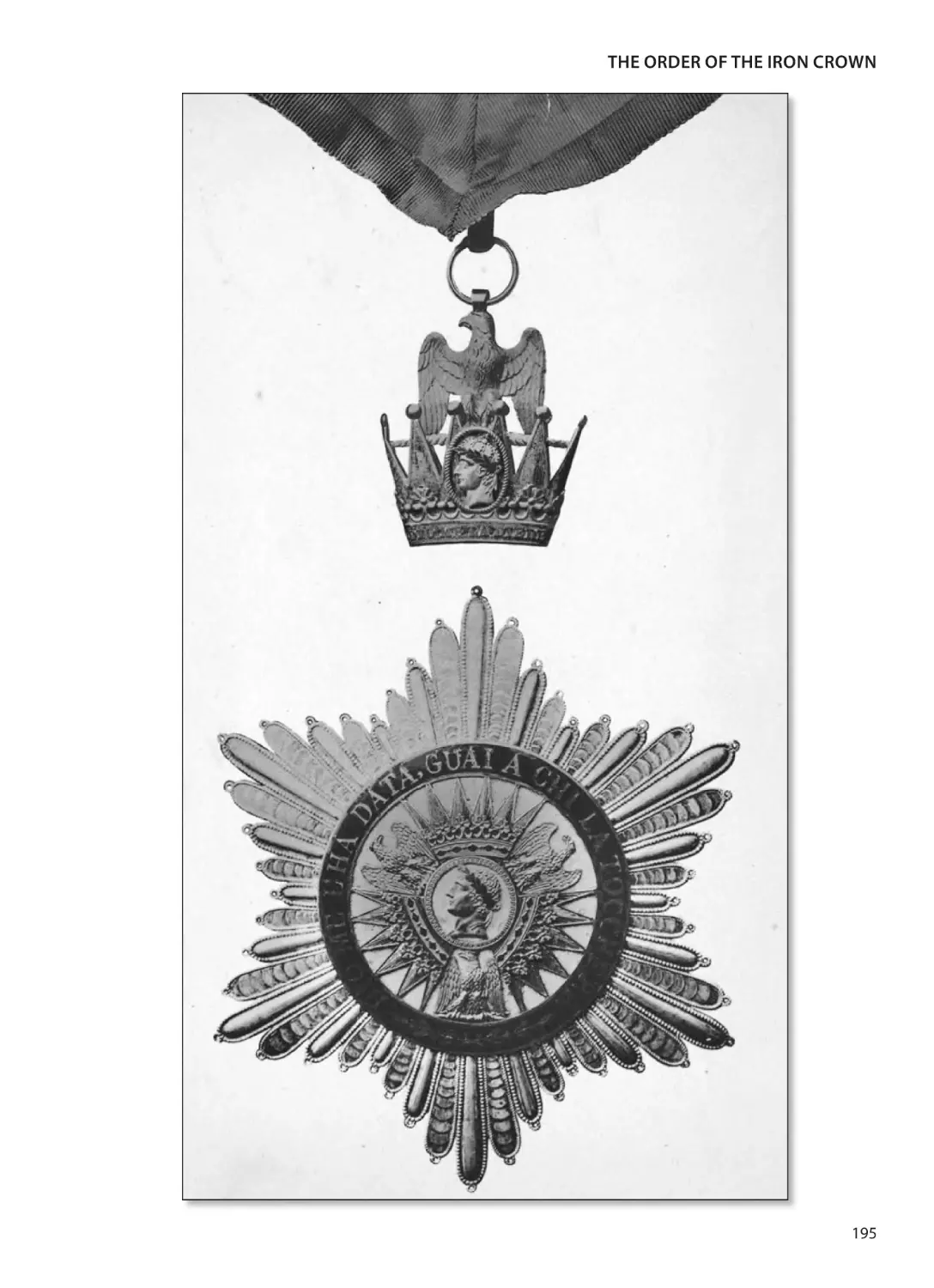
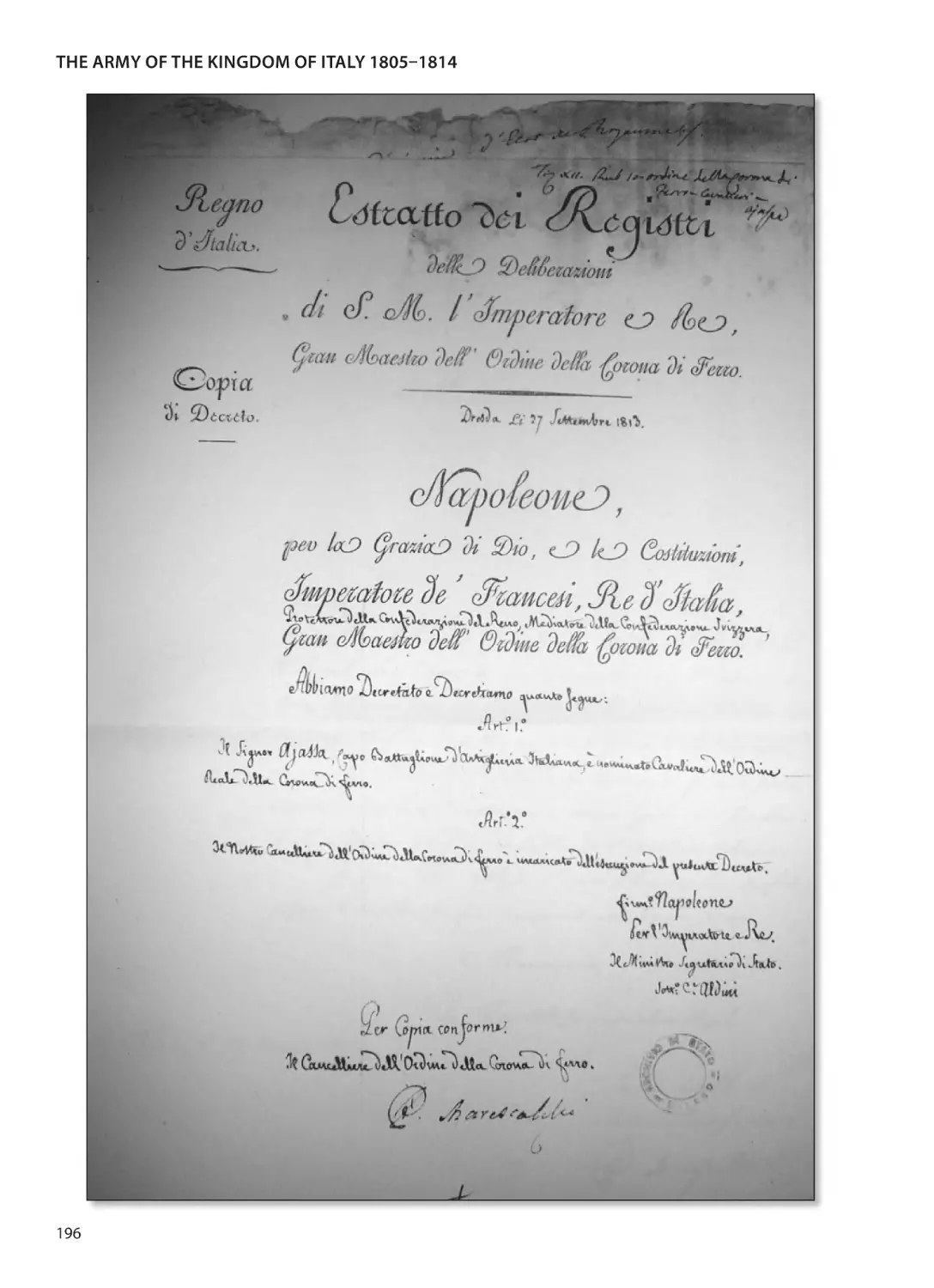
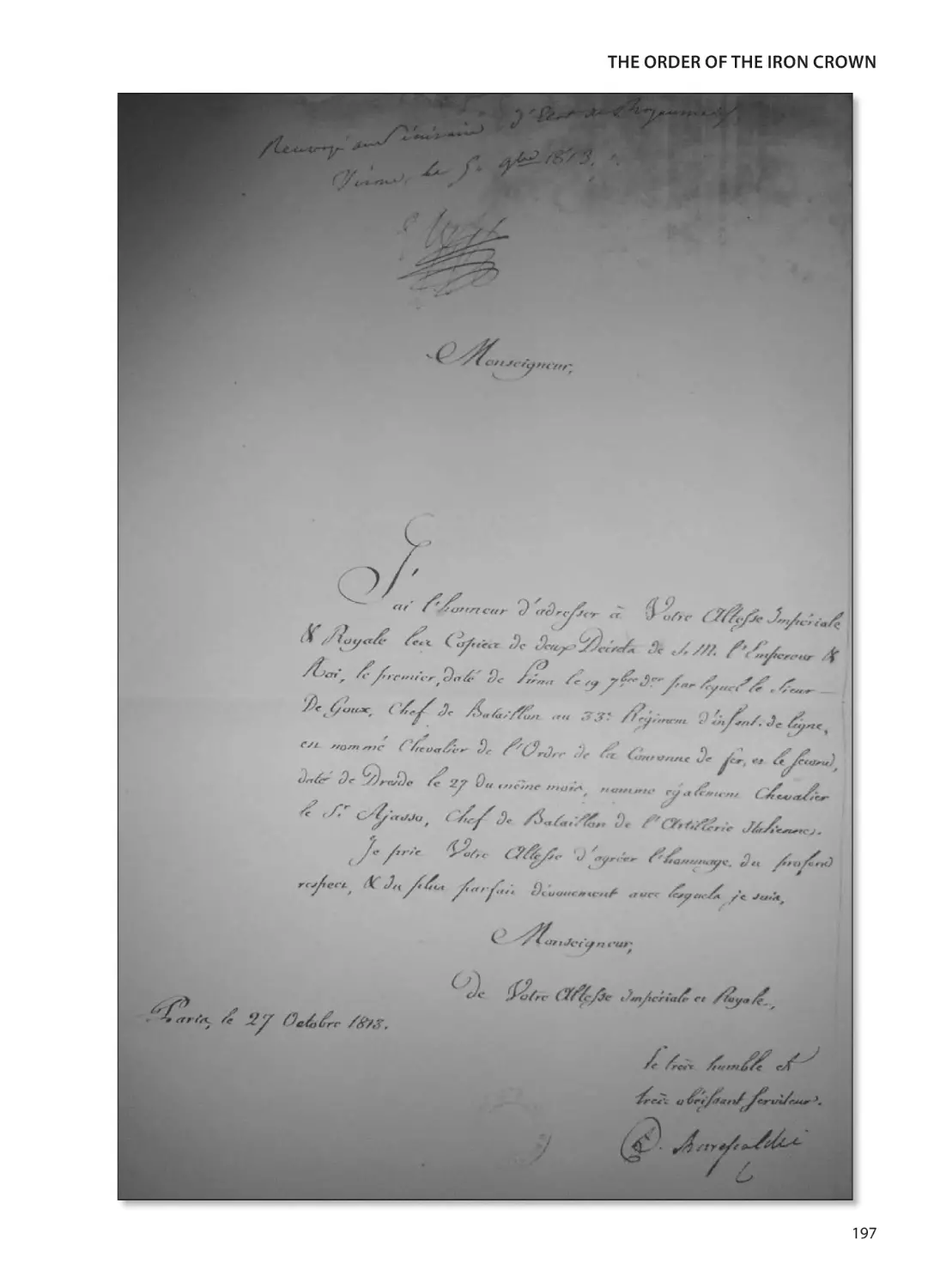
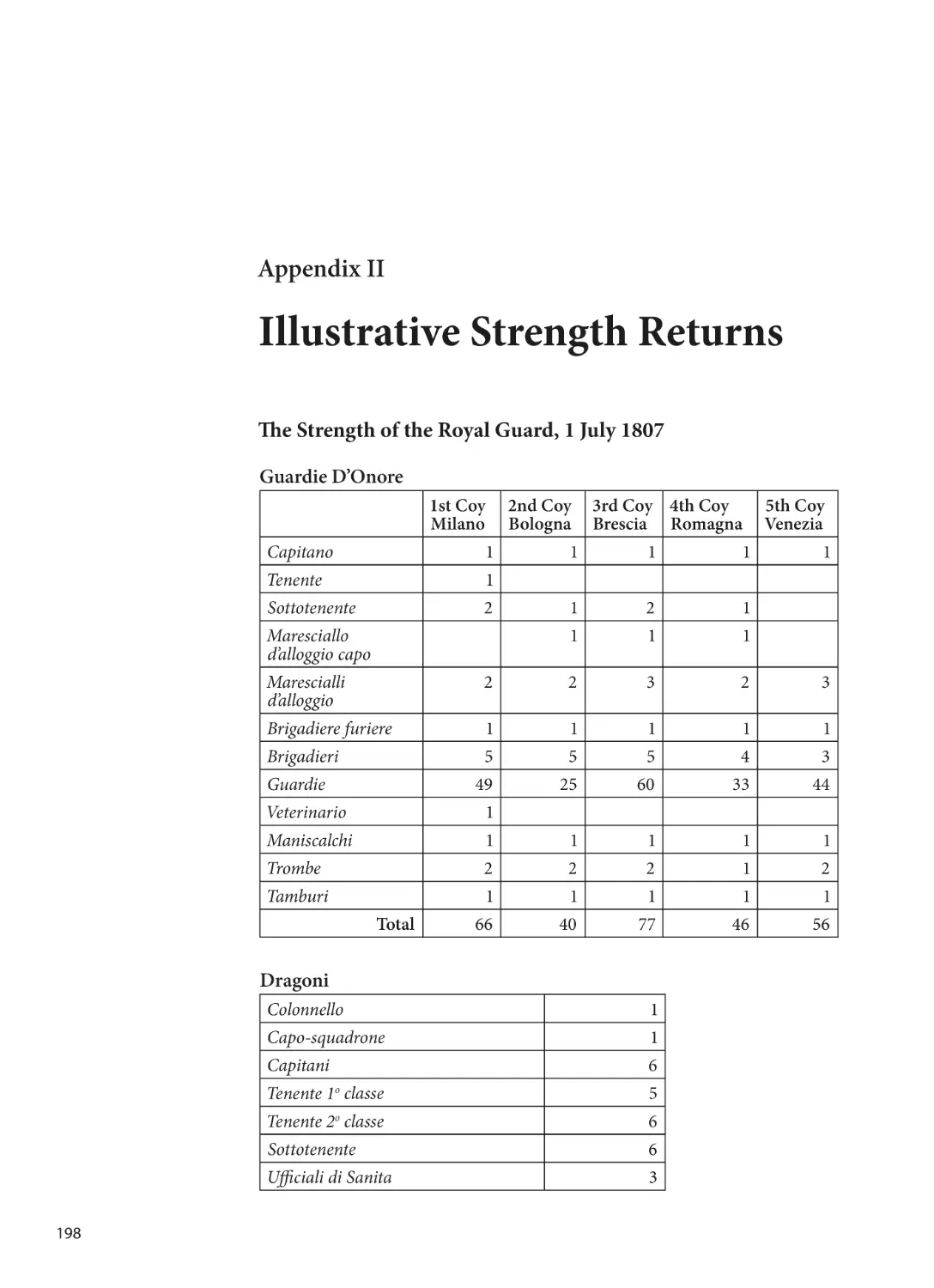

Author: Ede-Borrett Stephen
Tags: military history army history uniforms italy
ISBN: 978-1-804512-75-3
Year: 2022



Text
The Army of the Kingdom of Italy
1805–1814
Uniforms, Organisation, Campaigns
Stephen Ede-Borrett
Helion & Company
This book is respectfully dedicated to
Bridget Bentley, Kesh Kotecha, Sarah Thompson, Juliet Bugby
My friends. They were good times, thank you.
And to my partner Mary
Without whose encouragement it would probably never have been finished.
Helion & Company Limited
Unit 8 Amherst Business Centre
Budbrooke Road
Warwick
CV34 5WE
England
Tel. 01926 499 619
Email: info@helion.co.uk
Website: www.helion.co.uk
Twitter: @helionbooks
Visit our blog http://blog.helion.co.uk/
Published by Helion & Company 2022
Designed and typeset by Serena Jones
eBook by Mach 3 Solutions Ltd (www.mach3solutions.co.uk)
Cover designed by Paul Hewitt, Battlefield Design (www.battlefield-design.co.uk)
Text © Stephen Ede-Borrett 2022
Images © as individually credited
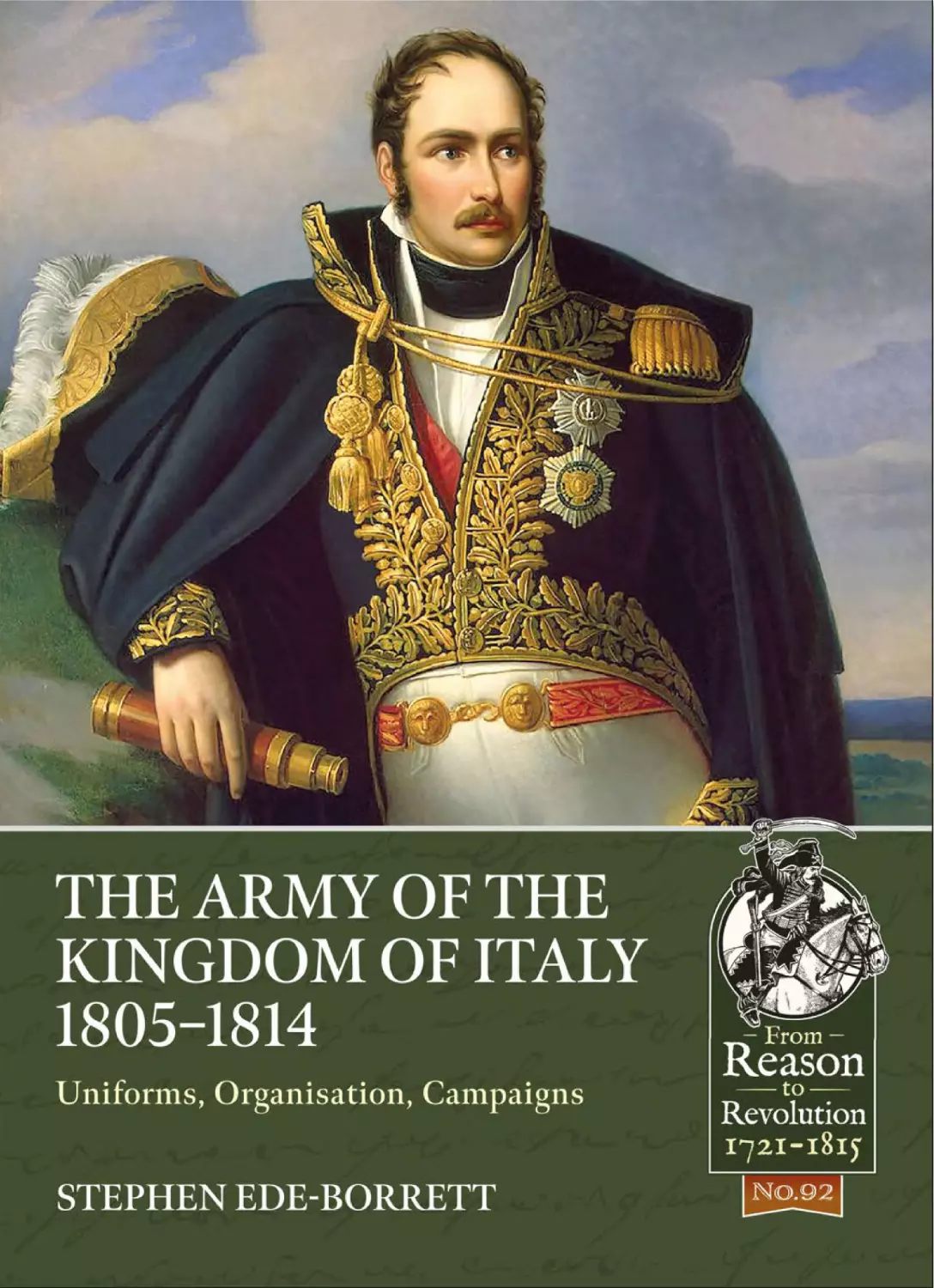
Front cover: Prince Eugène de Beauharnais, by Johann Heinrich Richter. Hermitage Museum, St Petersburg.
Every reasonable effort has been made to trace copyright holders and to obtain their permission for the
use of copyright material. The author and publisher apologise for any errors or omissions in this work, and
would be grateful if notified of any corrections that should be incorporated in future reprints or editions of
this book.
eISBN 978-1-804512-75-3
British Library Cataloguing-in-Publication Data.
A catalogue record for this book is available from the British Library.
All rights reserved. No part of this publication may be reproduced, stored in a retrieval system, or
transmitted, in any form, or by any means, electronic, mechanical, photocopying, recording or otherwise,
without the express written consent of Helion & Company Limited.
For details of other military history titles published by Helion & Company
Limited, contact the above address, or visit our website: http://www.helion.co.uk
We always welcome receiving book proposals from prospective authors.
Contents
Prefaceiv
vi
Introduction: The Napoleonic Kingdom of Italy, 1805–1814
Italy in the Napoleonic Period, 1796–1814 (Encyclopaedia Britannica 1911)
x
xxii
Note on Terminology and Unit Titles
1. General Officers and Staff
2. Guardia Reale (Royal Guard)
3. Cavalleria di Linea (Cavalry of the Line)
4. Fanteria di Linea (Infantry of the Line)
5. Artigleria di Linea, etc. (Line Artillery and Support Units)
6. Naval Units
25
44
92
118
162
188
Appendix I: The Order of the Iron Crown
Appendix II: Illustrative Strength Returns
Appendix III: The Armée d’Italie at the Battle of the Mincio, 8 Febr. 1814
Appendix IV: Glossary of Uniform Patterns and Types
194
198
204
207
220
Colour Plate Commentaries
Bibliography243
iii
Preface
This work is not intended to be a detailed study of the service and history of the
Army of the Kingdom of Italy, although they are both covered superficially.
Neither is it intended as an history of Italy or even the Kingdom during this
period.1 It is primarily a work of uniformology – a study of the changes in
the uniforms and equipment of the units of the Army of the Kingdom of
Italy (not, in Napoleonic terms, the Army of Italy, on which see below), and
for completeness those parts of the navy who served alongside that army in
land campaigns.
The format for each unit that I have chosen to use is that formulated by
the late W.J. Rawkins in his books published by Anschluss Publishing. Over
the years I have seen many ways of presenting this information but his is, in
my opinion, undoubtedly the best and, in the vein of Isaac Newton, I readily
acknowledge the debt that I owe him in copying his format.
I have tried not to be pedantic over many details of a uniform and state
that this source is right and this one wrong – uniformology is not such an
exact science. In many cases it is highly probable that both original sources
may be correct and that variations in many aspects of a uniform changed
from issue to issue, or even tailor to tailor, and may thus have often been seen
alongside each other. This may have been the period of elegant uniform but
Colonels still followed their personal whims on many things, strict precise
uniformity simply did not exist in most units and many old or outdated
items of uniform or equipment continued to be issued until stocks were
exhausted. What are given here are, therefore, both the regulations – when
they existed, the Kingdom’s army seemed remarkably lax on such things,
which were usually, although not always, quite clear – and many of the
numerous recorded variations to them.
Whilst there are brief overviews of each unit’s organisational changes
during the period these were frequent and, particularly in the Royal Guard,
were at best barely completed before the next was ordered. It is also worth
noting that the theoretical establishments were rarely achieved, as some of
the actual strengths quoted will amply show.
Many obsolete patterns of uniforms from the Army of the abolished
republics continued to be worn, again particularly in the Royal Guard,
1
iv
For this the author would highly recommend Juan Carlos Carmigniani and Gilles Boué (MarieFrance Renwick trans.), Napoleon and Italy: A Military History of Napoleonic Italy, 1805–1815
(Paris: Histoire & Collections, 2016).
Preface
until 1806/1807 whatever the new regulations might say (a similar situation
existed in almost all armies of almost every era). I have not tried to cover
these ‘older’ uniforms since to do so would increase the size of this work
exponentially to no real effect and they are thus mentioned only in passing.
It is, however, hoped that these earlier uniforms may be covered in a later
volume on the Armies of the Italian Republics.
Whilst much of this material has been collected over many years my
thanks must go particularly to those authors whose works are cited in the
bibliography, especially Piero Crociano, whose series in the long-gone and
much lamented English-language Tradition Magazine first sparked my
interest in the Kingdom of Italy and whose work provided the skeleton for me
to build on. Also to Art Etchells and to Laurent Claudet for sharing the fruits
of their researches and their libraries, to Peter Heath of Anschluss Publishing,
the publisher of W. J. Rawkins’ books, and to Fabrice and Sophie Dalamare
of Uniformologie who found so many of the illustrations and sources that I
have used. My thanks also to my partner Mary who has patiently read the
manuscript and corrected many of my errors.
Lastly my apologies to native speakers of Italian, my own Italian is very
basic and I apologise if I have mangled your language at any point.
Stephen Ede-Borrett
April 2022
v
Introduction: The Napoleonic
Kingdom of Italy, 1805–1814
The Kingdom of Italy came into being on 17 March 1805, when the Italian
Republic was dissolved, and Napoleon, who had been President of the
Republic, was elevated to the throne as the new Kingdom’s monarch. The
24-year-old Eugène de Beauharnais, Napoleon’s stepson, was nominated as
viceroy. Napoleon was crowned with the Iron Crown of Lombardy in Milan
Cathedral on 26 May 1805 and took the full title of ‘Emperor of the French
and King of Italy’.
The Republic ceased to exist upon the creation of the Kingdom but its
constitution was never formally abolished although a series of constitutional
statutes completely altered it:
The first, proclaimed on 19 March just two days after the creation of the
Kingdom, when Napoleon was declared King, established that the monarchy
was to be hereditary and the King’s sons would succeed to the throne, even
if the French and the Italian crowns were separated after Napoleon’s death.
The second, dated 29 March, regulated the Regency, the major officials
of the Kingdom, and the oaths to be taken by the army, the civil service, and
the populace.
In practice, however, the third statute of 5 June 1805 was the new
Constitution of the Kingdom: the King was to be head of state, and had the
full powers of government; in his absence, his powers were in the hands of
the viceroy; respectively these were Napoleon and Eugène de Beauharnais.
The Consulta, Legislative Council, and speakers, were all merged into a new
council of state, whose recommendations and motions were advisory only,
and not binding on either the head of state or the viceroy. The legislative
body, the old parliament, theoretically remained in being or at least was not
formally abolished, but after 1805 it was not called again.
By a statute of 16 February 1806 the proclamation of 19 March of the
previous year was amended and Eugène and his heirs were nominated as the
heirs to the Kingdom upon Napoleon’s death.
The last of the important statutes was that of 21 September 1808, which
created a new nobility of dukes, counts and barons; and two further statutes,
of 15 March 1810, established an annuity for the members of the Royal Family.
The Kingdom of Italy initially comprised the territories of the old Italian
Republic: the former Duchies of Milan, Mantua, and Modena, with the western
part of the Republic of Venice, part of the Papal States in The Romagna, and
vi
IntroductIon: thE naPolEonIc KIngdom of Italy, 1805–1814
Italy in 1810 showing the Kingdoms’ boundaries. The Principality of Lucca (see main text) stands
out as an obvious anachronism. (Created by Aibdescalzo, Mapmaster via Wikimedia Commons)
vii
THE ARMY OF THE KINGDOM OF ITALY 1805–1814
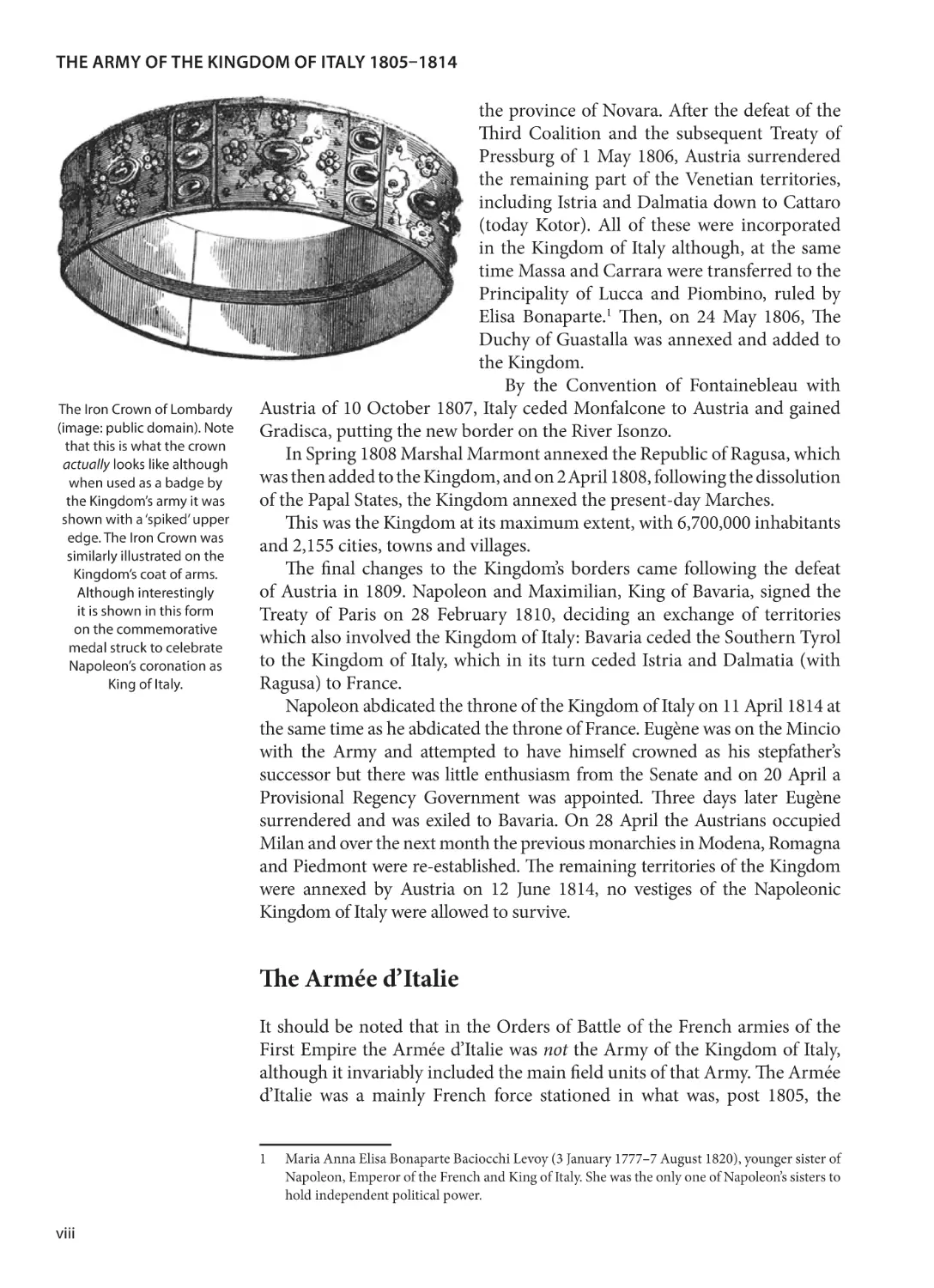
The Iron Crown of Lombardy
(image: public domain). Note
that this is what the crown
actually looks like although
when used as a badge by
the Kingdom’s army it was
shown with a ‘spiked’ upper
edge. The Iron Crown was
similarly illustrated on the
Kingdom’s coat of arms.
Although interestingly
it is shown in this form
on the commemorative
medal struck to celebrate
Napoleon’s coronation as
King of Italy.
the province of Novara. After the defeat of the
Third Coalition and the subsequent Treaty of
Pressburg of 1 May 1806, Austria surrendered
the remaining part of the Venetian territories,
including Istria and Dalmatia down to Cattaro
(today Kotor). All of these were incorporated
in the Kingdom of Italy although, at the same
time Massa and Carrara were transferred to the
Principality of Lucca and Piombino, ruled by
Elisa Bonaparte.1 Then, on 24 May 1806, The
Duchy of Guastalla was annexed and added to
the Kingdom.
By the Convention of Fontainebleau with
Austria of 10 October 1807, Italy ceded Monfalcone to Austria and gained
Gradisca, putting the new border on the River Isonzo.
In Spring 1808 Marshal Marmont annexed the Republic of Ragusa, which
was then added to the Kingdom, and on 2 April 1808, following the dissolution
of the Papal States, the Kingdom annexed the present-day Marches.
This was the Kingdom at its maximum extent, with 6,700,000 inhabitants
and 2,155 cities, towns and villages.
The final changes to the Kingdom’s borders came following the defeat
of Austria in 1809. Napoleon and Maximilian, King of Bavaria, signed the
Treaty of Paris on 28 February 1810, deciding an exchange of territories
which also involved the Kingdom of Italy: Bavaria ceded the Southern Tyrol
to the Kingdom of Italy, which in its turn ceded Istria and Dalmatia (with
Ragusa) to France.
Napoleon abdicated the throne of the Kingdom of Italy on 11 April 1814 at
the same time as he abdicated the throne of France. Eugène was on the Mincio
with the Army and attempted to have himself crowned as his stepfather’s
successor but there was little enthusiasm from the Senate and on 20 April a
Provisional Regency Government was appointed. Three days later Eugène
surrendered and was exiled to Bavaria. On 28 April the Austrians occupied
Milan and over the next month the previous monarchies in Modena, Romagna
and Piedmont were re-established. The remaining territories of the Kingdom
were annexed by Austria on 12 June 1814, no vestiges of the Napoleonic
Kingdom of Italy were allowed to survive.
The Armée d’Italie
It should be noted that in the Orders of Battle of the French armies of the
First Empire the Armée d’Italie was not the Army of the Kingdom of Italy,
although it invariably included the main field units of that Army. The Armée
d’Italie was a mainly French force stationed in what was, post 1805, the
1
viii
Maria Anna Elisa Bonaparte Baciocchi Levoy (3 January 1777–7 August 1820), younger sister of
Napoleon, Emperor of the French and King of Italy. She was the only one of Napoleon’s sisters to
hold independent political power.
Introduction: The Napoleonic Kingdom of Italy, 1805–1814
Kingdom of Italy, primarily to keep a ‘watch’ on the Austrian Empire who,
Great Britain excepted, between 1791 and 1815 spent a greater period at war
with France than any other country.
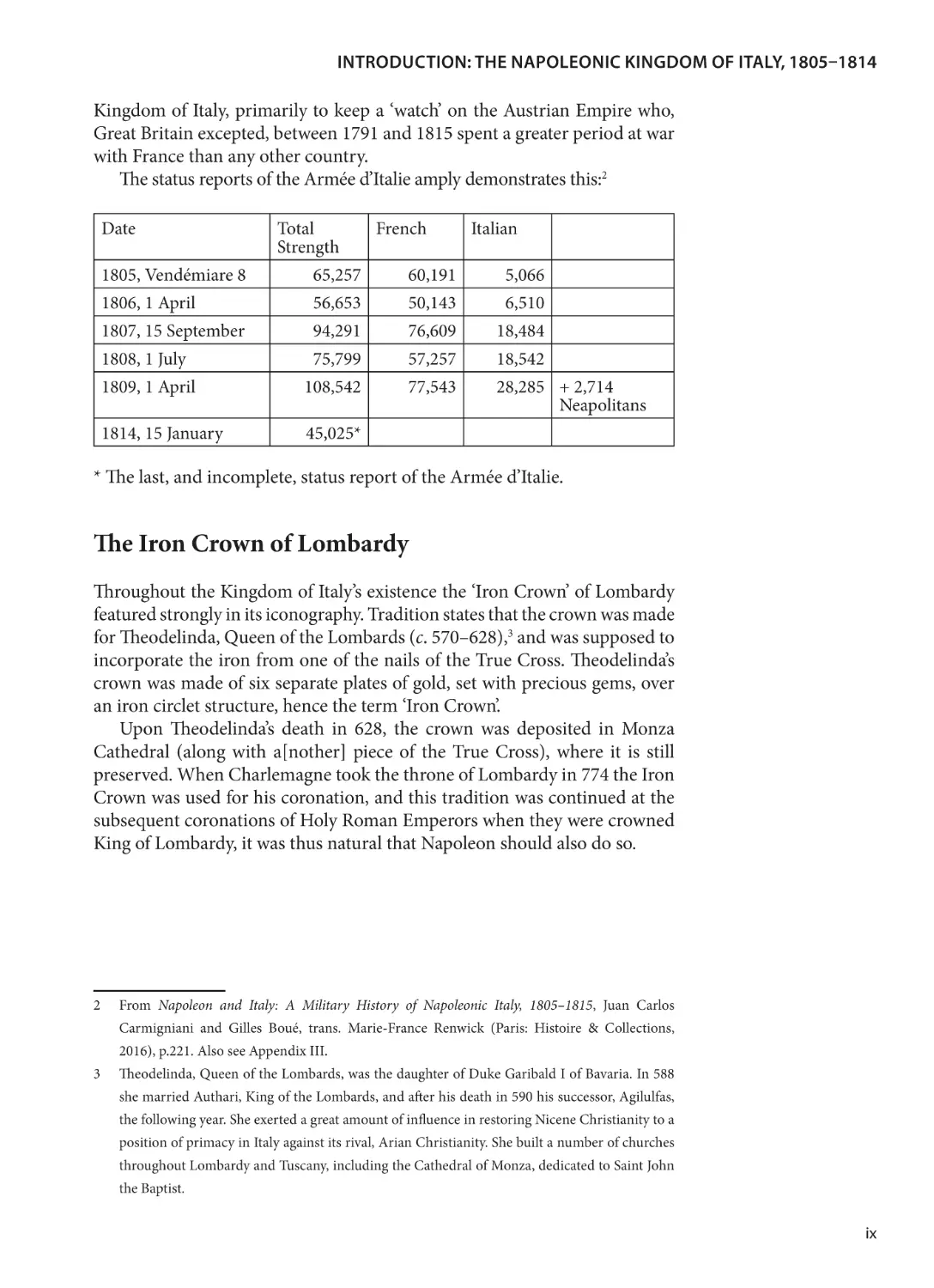
The status reports of the Armée d’Italie amply demonstrates this:2
Date
Total
Strength
French
Italian
1805, Vendémiare 8
65,257
60,191
5,066
1806, 1 April
56,653
50,143
6,510
1807, 15 September
94,291
76,609
18,484
1808, 1 July
75,799
57,257
18,542
1809, 1 April
108,542
77,543
28,285 + 2,714
Neapolitans
1814, 15 January
45,025*
* The last, and incomplete, status report of the Armée d’Italie.
The Iron Crown of Lombardy
Throughout the Kingdom of Italy’s existence the ‘Iron Crown’ of Lombardy
featured strongly in its iconography. Tradition states that the crown was made
for Theodelinda, Queen of the Lombards (c. 570–628),3 and was supposed to
incorporate the iron from one of the nails of the True Cross. Theodelinda’s
crown was made of six separate plates of gold, set with precious gems, over
an iron circlet structure, hence the term ‘Iron Crown’.
Upon Theodelinda’s death in 628, the crown was deposited in Monza
Cathedral (along with a[nother] piece of the True Cross), where it is still
preserved. When Charlemagne took the throne of Lombardy in 774 the Iron
Crown was used for his coronation, and this tradition was continued at the
subsequent coronations of Holy Roman Emperors when they were crowned
King of Lombardy, it was thus natural that Napoleon should also do so.
2
From Napoleon and Italy: A Military History of Napoleonic Italy, 1805–1815, Juan Carlos
Carmigniani and Gilles Boué, trans. Marie-France Renwick (Paris: Histoire & Collections,
2016), p.221. Also see Appendix III.
3
Theodelinda, Queen of the Lombards, was the daughter of Duke Garibald I of Bavaria. In 588
she married Authari, King of the Lombards, and after his death in 590 his successor, Agilulfas,
the following year. She exerted a great amount of influence in restoring Nicene Christianity to a
position of primacy in Italy against its rival, Arian Christianity. She built a number of churches
throughout Lombardy and Tuscany, including the Cathedral of Monza, dedicated to Saint John
the Baptist.
ix
Italy in the Napoleonic Period,
1796–1814 (Encyclopaedia
Britannica, 1911)
The campaign of 1796 which led to the awakening of the Italian people to a
new consciousness of unity and strength is detailed in the article ‘Napoleonic
Campaigns’. Here we can attempt only a general survey of the events, political,
civic and social, which heralded the Risorgimento in its first phase. It is
desirable in the first place to realise the condition of Italy at the time when
the irruption of the French and the expulsion of the Austrians opened up a
new political vista for that oppressed and divided people.
For many generations Italy had been bandied to and fro between the
Habsburgs and the Bourbons. The decline of French influence at the close of
the reign of Louis XIV left the Habsburgs and the Spanish Bourbons without
serious rivals. The former possessed the rich duchies of Milan (including
Mantua) and Tuscany; while through a marriage alliance with the house
of Este of Modena (the Archduke Ferdinand had married the heiress of
Modena) its influence over that duchy was supreme. It also had a few fiefs
in Piedmont and in Genoese territory. By marrying her daughter, Maria
Amelia, to the young duke of Parma, and another daughter, Maria Carolina,
to Ferdinand of Naples, Maria Theresa consolidated Habsburg influence in
the north and south of the peninsula. The Spanish Bourbons held Naples
and Sicily, as well as the Duchy of Parma. Of the nominally independent
states the chief were the kingdom of Sardinia, ruled over by the house of
Savoy, and comprising Piedmont, the isle of Sardinia and nominally Savoy
and Nice, though the two provinces last named had virtually been lost to the
monarchy since the campaign of 1793. Equally extensive, but less important
in the political sphere, were the Papal States and Venetia, the former torpid
under the obscurantist rule of pope and cardinals, the latter enervated by
luxury and the policy of unmanly complaisance long pursued by doge and
council. The ancient rival of Venice, Genoa, was likewise far gone in decline.
The small states, Lucca and San Marino, completed the map of Italy. The
worst governed part of the peninsula was the south, where feudalism lay
heavily on the cultivators and corruption pervaded all ranks. Milan and
Piedmont were comparatively well governed; but repugnance to Austrian
rule in the former case, and the contagion of French Jacobinical opinions in
the latter, brought those populations into increasing hostility to the rulers.
x
ITALY IN THE NAPOLEONIC PERIOD, 1796–1814
The democratic propaganda, which was permeating all the large towns of
the peninsula, then led to the formation of numerous and powerful clubs
and secret societies; and the throne of Victor Amadeus III, of the house of
Savoy, soon began to totter under the blows delivered by the French troops
at the mountain barriers of his kingdom and under the insidious assaults of
the friends of liberty at Turin. Plotting was rife at Milan, as also at Bologna,
where the memory of old liberties predisposed men to cast off clerical rule
and led to the first rising on behalf of Italian liberty in the year 1794. At
Palermo the Sicilians struggled hard to establish a republic in place of the
odious government of an alien dynasty. The anathemas of the pope, the
bravery of Piedmontese and Austrians, and the subsidies of Great Britain
failed to keep the league of Italian princes against France intact. The grandduke of Tuscany was the first of the European sovereigns who made peace
with, and recognized the French republic, early in 1795. The first fortnight of
Napoleon’s campaign of 1796 detached Sardinia from alliance with Austria
and England. The enthusiasm of the Italians for the young Corsican ‘liberator’
greatly helped his progress. Two months later Ferdinand of Naples sought
for an armistice, the central duchies were easily overrun, and, early in 1797,
Pope Pius VI was fain to sign terms of peace with Bonaparte at Tolentino,
practically ceding the northern part of his states, known as the Legations. The
surrender of the last Habsburg stronghold, Mantua, on the 2nd of February
1797 left the field clear for the erection of new political institutions.
Already the men of Reggio, Modena and Bologna had declared for a
democratic policy, in which feudalism and clerical rule should have no place,
and in which manhood suffrage, together with other rights promised by
Bonaparte to the men of Milan in May 1796, should form the basis of a new
order of things. In taking this step the Modenese and Romagnols had the
encouragement of Bonaparte, despite the orders which the French directory
sent to him in a contrary sense. The result was the formation of an assembly
at Modena which abolished feudal dues and customs, declared for manhood
suffrage and established the Cispadane Republic (October 1796).
The close of Bonaparte’s victorious campaign against the Archduke
Charles in 1797 enabled him to mature those designs respecting Venice. On
a far higher level was his conduct towards the Milanese. While the French
directory saw in that province little more than a district which might be
plundered and bargained for, Bonaparte, though by no means remiss in
the exaction of gold and of artistic treasures, was laying the foundation
of a friendly republic. During his sojourn at the castle of Montebello or
Mombello, near Milan, he commissioned several of the leading men of
northern Italy to draw up a project of constitution and list of reforms for
that province. Meanwhile he took care to curb the excesses of the Italian
Jacobins and to encourage the Moderates, who were favourable to the
French connexion as promising a guarantee against Austrian domination
and internal anarchy. He summed up his conduct in the letter of the 8th
May 1797 to the French directory, ‘I cool the hot heads here and warm the
cool ones’. The Transpadane Republic, or, as it was soon called, the Cisalpine
Republic, began its organized life on the 9th July 1797, with a brilliant festival
at Milan. The constitution was modelled on that of the French directory, and,
xi
THE ARMY OF THE KINGDOM OF ITALY 1805–1814
lest there should be a majority of clerical or Jacobinical deputies, the French
Republic through its general, Bonaparte, nominated and appointed the first
deputies and administrators of the new government. In the same month it
was joined by the Cispadane Republic; and the terms of the treaty of Campo
Formio (October 17, 1797), while fatal to the political life of Venice, awarded
to this now considerable state the Venetian territories west of the river Adige.
A month later, under the pretence of stilling the civil strifes in the Valtelline,
Bonaparte absorbed that Swiss district in the Cisalpine Republic, which thus
included all the lands between Como and Verona on the north, and Rimini
on the south.
Early in the year 1798 the Austrians, in pursuance of the scheme of
partition agreed on at Campo Formio, entered Venice and brought to an end
its era of independence which had lasted some 1100 years. Venice with its
mainland territories east of the Adige, inclusive of Austria and Dalmatian,
went to the Habsburgs, while the Venetian isles of the Adriatic (the Ionian
Isles) and the Venetian fleet went to strengthen France for that eastern
expedition on which Bonaparte had already set his heart. Venice not only
paid the costs of the war to the two chief belligerents, but her naval resources
also helped to launch the young general on his career of eastern adventure.
Her former rival, Genoa, had also been compelled, in June 1797, to bow
before the young conqueror, and had undergone at his hands a remodelling
on the lines already followed at Milan. The new Genoese republic, French in
all but name, was renamed the Ligurian Republic.
Before he set sail for Egypt, the French had taken possession of Rome.
Already masters of the papal fortress of Ancon, they began openly to
challenge the pope’s authority at the Eternal City itself. Joseph Bonaparte,
then French envoy to the Vatican, encouraged democratic manifestations;
and one of them, at the close of 1797, led to a scuffle in which a French
general, Duphot, was killed. The French directory at once ordered its general,
Berthier, to march to Rome: the Roman democrats proclaimed a republic
on the 15th February 1798, and on their invitation Berthier and his troops
marched in. The pope, Pius VI, was forthwith hauled away to Siena and a
year later to Valence in the south of France, where he died. Thus fell the
temporal power. The ‘liberators’ of Rome thereupon proceeded to plunder
the city in a way which brought shame on their cause and disgrace (perhaps
not wholly deserved) on the general left in command, Masséna.
These events brought revolution to the gates of the Kingdom of Naples,
the worst-governed part of Italy, where the boorish king, Ferdinand IV (il
rè lazzarone, he was termed), and his whimsical consort, Maria Carolina,
scarcely held in check the discontent of their own subjects. A British fleet
under Nelson, sent into the Mediterranean in May 1798 primarily for their
defence, checkmated the designs of Bonaparte in Egypt, and then, returning
to Naples, encouraged that court to adopt a spirited policy. It is now known
that the influence of Nelson and of the British ambassador, Sir William
Hamilton, and Lady Hamilton precipitated the rupture between Naples and
France. The results were disastrous. The Neapolitan troops at first occupied
Rome, but, being badly handled by their leader, the Austrian general, Mack,
they were soon scattered in flight; and the Republican troops under General
xii
ITALY IN THE NAPOLEONIC PERIOD, 1796–1814
Championnet, after crushing the stubborn resistance of the lazzaroni, made
their way into Naples and proclaimed the Parthenopaean Republic (January
23, 1799). The Neapolitan Democrats chose five of their leading men to be
directors, and tithes and feudal dues and customs were abolished. Much good
work was done by the Republicans with his army beyond the river Mincio,
ten days earlier during their brief tenure of power, but it soon came to an end
owing to the course of events which favoured a reaction against France. The
directors of Paris, not content with overrunning and plundering Switzerland,
had outraged German sentiment in many ways. Further, at the close of 1798
they virtually compelled the young king of Sardinia, Charles Emmanuel IV,
to abdicate at Turin. He retired to the island of Sardinia, while the French
despoiled Piedmont, thereby adding fuel to the resentment rapidly growing
against them in every part of Europe.
The outcome of it all was the War of the Second Coalition, in which
Russia, Austria, Great Britain, Naples and some secondary states of Germany
took part. The incursion of an Austro-Russian army, led by that strange
but magnetic being, Suvarov, decided the campaign in northern Italy. The
French, poorly handled by Schérer and Sérurier, were everywhere beaten,
especially at Magnano (April 5) and Cassano (April 27). Milan and Turin
fell before the allies, and Moreau, who took over the command, had much
difficulty in making his way to the Genoese coast-line. There he awaited the
arrival of Macdonald with the army of Naples. That general, Championnet’s
successor, had been compelled by these reverses and by the threatening
pressure of Nelson’s fleet to evacuate Naples and central Italy. In many parts
the peasants and townsfolk, enraged by the licence of the French, hung
on his flank and rear. The republics set up by the French at Naples, Rome
and Milan collapsed as soon as the French troops retired; and a reaction in
favour of clerical and Austrian influence set in with great violence. For the
events which then occurred at Naples, so compromising to the reputation of
Nelson, Sir William Hamilton was subsequently recalled in a manner closely
resembling a disgrace, and his place was taken by Paget, who behaved with
more dignity and tact.
Meanwhile Macdonald, after struggling through central Italy, had
defeated an Austrian force at Modena (June 12, 1799), but Suvarov was
able by swift movements utterly to overthrow him at the Trebbia (June
17–19). The wreck of his force drifted away helplessly towards Genoa. A
month later the ambitious young general, Joubert, who took over Moreau’s
command and rallied part of Macdonald’s following, was utterly routed by
the Austro-Russian army at Novi (August 15) with the loss of 12,000 men.
Joubert perished in the battle. The growing friction between Austria and
Russia led to the transference of Suvarov and his Russians to Switzerland,
with results which were to be fatal to the allies in that quarter. But in Italy
the Austrian successes continued. Melas defeated Championnet near Coni
on the 4th November; and a little later the French garrisons at Ancona and
Coni surrendered. The tricolour, which floated triumphantly over all the
strongholds of Italy early in the year, at its close waved only over Genoa,
where Masséna prepared for a stubborn defence. Nice and Savoy also seemed
at the mercy of the invaders. Everywhere the old order of things was restored.
xiii
THE ARMY OF THE KINGDOM OF ITALY 1805–1814
The death of the aged Pope Pius VI at Valence (August 29, 1799) deprived the
French of whatever advantage they had hoped to gain by dragging him into
exile; on the 24th March 1800 the conclave, assembled for greater security on
the island of San Giorgio at Venice, elected a new pontiff, Pius VII.
Such was the position of affairs when Bonaparte returned from Egypt
and landed at Fréjus. The contrast presented by his triumphs, whether real
or imaginary, to the reverses sustained by the armies of the French directory,
was fatal to that body and to popular institutions in France. After the coup
d’état of Brumaire (November 1799) he, as First Consul, began to organize
an expedition against the Austrians (Russia having now retired from the
coalition), in northern Italy. The campaign culminating at Marengo was the
result. By that triumph (due to Desaix and Kellermann rather than directly
to him), Bonaparte consolidated his own position in France and again laid
Italy at his feet. The Austrian general, Melas, signed an armistice whereby
he was to retire on the 4th June, Masséna had been compelled by hunger
to capitulate at Genoa; but the success at Marengo, followed up by that of
Macdonald in north Italy, and Moreau at Hohenlinden (December 2, 1800),
brought Emperor Francis to sue for peace which was finally concluded at
Lunéville on the 9th February 1801. The Cisalpine and Ligurian Republics
(reconstituted soon after Marengo) were recognized by Austria on condition
that they were independent of France. The rule of Pius VII over the Papal States
was admitted; and Italian affairs were arranged much as they were at Campo
Formio: Modena and Tuscany now reverted to French control, their former
rulers being promised compensation in Germany. Naples, easily worsted by
the French, under Miollis, left the British alliance, and made peace by the
treaty of Florence (March 1801), agreeing to withdraw her troops from the
Papal States, to cede Piombino and the Presidii (in Tuscany) to France and
to close her ports to British ships and commerce. King Ferdinand also had to
accept a French garrison at Taranto, and other points in the south.
Other changes took place in that year, all of them in favour of France. By
complex and secret bargaining with the court of Madrid, Bonaparte procured
the cession to France of Louisiana, in North America, and Parma; while the
duke of Parma (husband of an Infanta of Spain) was promoted by him to the
duchy of Tuscany, now Italy, renamed the Kingdom of Etruria. Piedmont
was declared to be a military division at the disposal of France (April 2 1801);
and on the 21st September 1802, Bonaparte, then First Consul for life, issued
a decree for its definitive incorporation in the French Republic. About that
time, too, Elba fell into the hands of Napoleon. Piedmont was organized in
six departments on the model of those of France, and a number of French
veterans were settled by Napoleon in and near the fortress of Alessandria.
Besides copying the Roman habit of planting military colonies, the First
Consul imitated the old conquerors of the world by extending and completing
the road-system of his outlying districts, especially at those important
passes, the Mont Cenis and Simplon. He greatly improved the rough track
over the Simplon Pass, so that, when finished in 1807, it was practicable for
artillery. Milan was the terminus of the road, and the construction of the
Foro Buonaparte and the completion of the cathedral added dignity to the
Lombard capital. The Corniche road was improved; and public Works in
xiv
ITALY IN THE NAPOLEONIC PERIOD, 1796–1814
various parts of Piedmont, and the Cisalpine and Ligurian Republics attested
the foresight and wisdom of the great organizer of industry and quickener of
human energies. The universities of Pavia and Bologna were reopened and
made great progress in this time of peace and growing prosperity. Somewhat
later the Pavia canal was begun in order to connect Lake Como with the
Adriatic for barge-traffic.
The personal nature of the tie binding Italy to France was illustrated by a
curious incident of the winter of 1802–1803. Bonaparte, now First Consul for
life, felt strong enough to impose his will on the Cisalpine Republic and to set
at defiance one of the stipulations of the treaty of Lunéville. On the pretext
of consolidating that republic, he invited 450 of its leading men to come to
Lyons to a consulta. In reality he and his agents had already provided for
the passing of proposals which were agreeable to him. The deputies having
been dazzled by fétes and reviews, Talleyrand and Marescalchi, ministers of
foreign affairs at Paris and Milan, plied them with hints as to the course to
be followed by the consulta; and, despite the rage of the more democratic
of their number, everything corresponded to the wishes of the First Consul.
It remained to find a chief. Very many were in favour of Count Melzi, a
Lombard noble, who had been chief of the executive at Milan; but again
Talleyrand and French agents set to Work on behalf of their master, with
the result that he was elected president for ten years. He accepted that office
because, as he frankly informed the deputies, he had found no one who ‘for
his services rendered to his country, his authority with the people and his
separation from party has deserved such an office’. Melzi was elected vicepresident with merely honorary functions. The constitution comprised a
consulta charged with executive duties, a legislative body of 150 members
and a court charged with the maintenance of the fundamental laws. These
three bodies were to be chosen by three electoral colleges consisting of (a)
landed proprietors, (b) learned men and clerics, (c) merchants and traders,
holding their sessions biennially at Milan, Bologna and Brescia respectively.
In practice the consulta could override the legislature; and, as the consulta
was little more than the organ of the president, the whole constitution may be
pronounced as autocratic as that of France after the changes brought about
by Bonaparte in August 1802. Finally we must note that the Cisalpine now
took the name of the Italian Republic, and that by a concordat with the pope,
Bonaparte regulated its relations to the Holy See in a manner analogous to
that adopted in the famous French concordat promulgated at Easter 1802. It
remains to add that the Ligurian Republic and that of Lucca remodelled their
constitutions in a way somewhat similar to that of the Cisalpine.
Bonaparte’s ascendancy did not pass unchallenged. Many of the
Italians retained their enthusiasm for democracy and national Kingdom
independence. In 1803 movements in these directions took place at Rimini,
Brescia and Bologna; but they were sharply repressed, and most Italians
came to acquiesce in the Napoleonic supremacy as inevitable and indeed
beneficial. The complete disregard shown by Napoleon for one of the chief
conditions of the treaty of Lunéville (February 1801) – that stipulating for
the independence of the Ligurian and Cisalpine Republics - became more
and more apparent every year. Alike in political and commercial affairs they
xv
THE ARMY OF THE KINGDOM OF ITALY 1805–1814
were for all practical purposes dependencies of France. Finally, after the
proclamation of the French empire (May 18, 1804) Napoleon proposed to
place his brother Joseph over the Italian state, which now took the title of
kingdom of Italy. On Joseph declining, Napoleon finally decided to accept
the crown which Melzi, Marescalchi, Serbelloni and others begged him
to assume. Accordingly, on the 26th May 1805, in the cathedral at Milan,
he crowned himself with the iron crown of the old Lombard kings, using
the traditional formula, ‘God gave it me: let him beware who touches
it’. On the 7th June he appointed his stepson, Eugène Beauharnais, to be
Viceroy. Eugène soon found that his chief duty was to enforce the will of
Napoleon. The legislature at Milan having ventured to alter some details
of taxation, Eugène received the following rule of conduct from his stepfather: ‘Your system of government is simple: the emperor wills it to be thus’.
Republicanism was now everywhere discouraged. The little republic of Lucca,
along with Piombino, was now awarded as a principality by the emperor to
Elisa Bonaparte and her husband, Bacciocchi. In June 1805 there came a
last and intolerable affront to the Emperors of Austria and Russia, who at
that very time were seeking to put bounds to Napoleon’s ambition and to
redress the balance of power. The French Emperor, at the supposed request
of the doge of Genoa, declared the Ligurian Republic to be an integral part
of the French empire. This defiance to the sovereigns of Russia and Austria
rekindled the flames of war. The third coalition was formed between Great
Britain, Russia and Austria, Naples soon joining its ranks. While Masséna
pursued the Austrians into their own lands at the close of 1805, Italian forces
under Eugène and Gouvion St Cyr held their ground against allied forces
landed at Naples. After Austerlitz (December 2, 1805) Austria made peace
by the treaty of Pressburg, ceding to the Kingdom of Italy her part of Venetia
along with the provinces of Istria and Dalmatia. Napoleon then turned
fiercely against Maria Carolina of Naples upbraiding her with her ‘perfidy’.
He sent Joseph Bonaparte and Masséna southwards with a strong column,
compelled the Anglo-Russian forces to evacuate Naples, and occupied the
south of the peninsula with little opposition except at the fortress of Gaeta.
The Bourbon court sailed away to Palermo, where it remained for eight
years under the protection afforded by the British fleet and a British army
of occupation. On the 15th February 1806 Joseph Bonaparte entered Naples
in triumph, his troops capturing there two hundred pieces of cannon. Gaeta,
however, held out stoutly against the French. Sir Sidney Smith with a British
squadron captured Capri (February 1806), and the peasants of the Abruzzi
and Calabria soon began to give trouble. Worst of all was the arrival of a small
British force in Calabria under Sir John Stuart, which beat off with heavy loss
an attack imprudently delivered by General Réynier on level ground near
the village of Maida (July 4). The steady volleys of Kempt’s light infantry
were fatal to the French, who fell back in disorder under a bayonet charge
of the victors, with the loss of some 2700 men. Calabria now rose in revolt
against King Joseph, and the peasants dealt out savage reprisals to the French
troops. On the 18th July, however, Gaeta surrendered to Masséna, and that
Marshal, now moving rapidly southwards, extricated Réynier, crushed the
Bourbon rising in Calabria with great barbarity, and compelled the British
xvi
ITALY IN THE NAPOLEONIC PERIOD, 1796–1814
force to re-embark for Sicily. At Palermo Queen Maria Carolina continued
to make vehement but futile efforts for the overthrow of King Joseph. It is
more important to observe that under Joseph and his ministers or advisers,
including the Frenchmen Roederer, Dumas, Miot de Melito and the Corsican
Saliceti, great progress was made in abolishing feudal laws and customs, in
reforming the judicial procedure and criminal laws on the model of the Code
Napoléon, and in attempting the beginnings of elementary education. More
questionable was Joseph’s policy in closing and confiscating the property of
213 of the richer monasteries of the land. The monks were pensioned off,
but though the confiscated property helped to fill the empty coffers of the
state, the measure aroused widespread alarm and resentment among that
superstitious people.
The peace of Tilsit (July 7 1807) enabled Napoleon to press on his projects
for securing the command of the Mediterranean, thenceforth a fundamental
axiom of his policy. Consequently, in the autumn of 1807 he urged on Joseph
the adoption of vigorous measures for the capture of Sicily. Already, in the
negotiations with England during the summer of 1806, the emperor had
shown his sense of the extreme importance of gaining possession of that
island, which indeed caused the breakdown of the peace proposals then being
considered; and now he ordered French squadrons into the Mediterranean in
order to secure Corfu and Sicily. His plans respecting Corfu succeeded. That
island and some of the adjacent isles fell into the hands of the French (some
of them were captured by British troops in 1809–10); but Sicily remained
unassailable. Capri, however, fell to the French on the 18th October 1808,
shortly after the arrival at Naples of the new King, Murat.
This ambitious Marshal, brother-in-law of Napoleon, foiled in his hope of
gaining the crown of Spain, received that of Naples in the summer of 1808,
Joseph Bonaparte being moved from Naples to Madrid. This arrangement
pleased neither of the relatives of the Emperor; but his will now was law on
the continent. Joseph left Naples on the 23rd May 1808; but it was not until
the 6th September that Joachim Murat made his entry. A fortnight later his
consort Caroline arrived, and soon showed a vigour and restlessness of spirit
which frequently clashed with the dictates of her brother, the emperor and
the showy, unsteady policy of her consort. The Spanish national rising of
1808 and thereafter the Peninsular War diverted Napoleon’s attention from
the affairs of south Italy. In June I809, during his campaign against Austria,
Sir John Stuart with an Anglo-Sicilian force sailed northwards, captured
Ischia and threw Murat into great alarm; but on the news of the Austrian
defeat at Wagram, Stuart sailed back again.
It is now time to turn to the affairs of central Italy. Early in 1808
Napoleon proceeded with plans which he had secretly concerted after the
treaty of Tilsit for transferring the Infanta of Spain who, after the death of
her consort, reigned at Florence on behalf of her young son, Charles Louis,
from her kingdom of Etruria to the little principality of Entre Douroe of
Portugal. Etruria reverted to the French empire, but the Spanish princess
and her son did not receive the promised indemnity. Elisa Bonaparte and her
husband, Bacciocchi, rulers of Lucca and Piombino, became the heads of the
administration in Tuscany, Elisa showing decided governing capacity. The
xvii
THE ARMY OF THE KINGDOM OF ITALY 1805–1814
last part of the peninsula to undergo the Gallicizing influence was the papal
dominion. For some time past the relations between Napoleon and the pope,
Pius VII, had been severely strained, chiefly because the emperor insisted
papacy, on controlling the church, both in France and in the kingdom of Italy,
in a way inconsistent with the traditions of the Vatican, but also because
the pontiff refused to grant the divorce between Jerome Bonaparte and
the former Miss Patterson on which Napoleon early in the year 1806 laid
so much stress. These and other disputes led the emperor, as successor of
Charlemagne, to treat the pope in a very highhanded way. ‘Your Holiness
(he wrote) is sovereign of Rome, but I am its Emperor’; and he threatened
to annul the presumed donation of Rome by Charlemagne, unless the pope
yielded implicit obedience to him in all temporal affairs. He further exploited
the Charlemagne tradition for the benefit of the continental system, that
great engine of commercial war by which he hoped to assure the ruin of
England. This aim prompted the annexation of Tuscany, and his intervention
in the affairs of the Papal States. To this the pope assented under pressure
from Napoleon; but the latter soon found other pretexts for intervention,
and in February 1808 a French column under Miollis occupied Rome, and
deposed the papal authorities. Against this violence Pius VII protested in
vain. Napoleon sought to push matters to an extreme, and on the 2nd April
he adopted the rigorous measure of annexing to the Kingdom of Italy the
papal provinces of Ancona, Papal Urbino, Macerata and Camerina. This
measure, which seemed to the pious an act of sacrilege, and to Italian patriots
an outrage on the only independent sovereign of the peninsula, sufficed
for the present. The outbreak of war in Spain, followed by the rupture with
Austria in the Spring of 1809, distracted the attention of the emperor. But
after the occupation of Vienna the conqueror dated from that capital on the
17th May 1809 a decree virtually annexing Rome and the Patrimonium Petri
to the French empire. Here again he cited the action of Charlemagne, his
‘august predecessor’, who had merely given ‘certain domains to the bishops
of Rome as fiefs, though Rome did not thereby cease to be part of his empire’.
In reply the Pope prepared a bull of excommunication against those who
should infringe the prerogatives of the Holy See in this matter. Thereupon
the French general, Miollis, who still occupied Rome, caused the Pope to be
arrested and carried him away northwards into Tuscany, thence to Savona;
finally he was taken, at Napoleon’s orders, to Fontainebleau. Thus, a second
time, fell the temporal power of the papacy. By an imperial decree of the
17th February 1810, Rome and the neighbouring districts, including Spoleto,
became part of the French empire. Rome thenceforth figured as its second
city, and entered upon a new life under the administration of French officials.
The Roman territory was divided into two departments – the Tiber and
Trasimenus; the Code Napoléon was introduced, public works were set on
foot and great advance was made in the material sphere. Nevertheless the
harshness with which the emperor treated the Roman clergy and suppressed
the monasteries caused deep resentment to the orthodox.
There is no need to detail the fortunes of the Napoleonic states in Italy.
One and all they underwent the influences emanating from Paris; and in
respect to civil administration, law, judicial procedure education and public
xviii
ITALY IN THE NAPOLEONIC PERIOD, 1796–1814
works they all experienced great benefits, the results of which never wholly
disappeared. On the other hand, they suffered from the rigorous measures
of the continental system, which seriously crippled trade at the ports and
were not compensated by the increased facilities for trade with France which
Napoleon opened up. The drain of men to supply his armies in Germany,
Spain and Russia was also a serious loss. A powerful Italian corps marched
under Eugène Beauharnais to Moscow, and distinguished itself at MaloJaroslavitz, as also during the horrors of the retreat in the closing weeks of
1812. It is said that out of 27,000 Italians who entered Russia with Eugène,
only 333 saw their country again. That campaign marked the beginning of
the end for the Napoleonic domination in Italy as else-where. Murat, left in
command of the Grand Army at Vilna, abandoned his charge and in the
next year made overtures to the allies who coalesced against Napoleon. For
his vacillations at this time and his final fate, here it must suffice to say that
the uncertainty caused by his policy in 1813–1814 had no small share in
embarrassing Napoleon and in precipitating the downfall of his power in
Italy. Eugène Beauharnais, viceroy of the kingdom of Italy, showed both
constancy and courage; but after the battle of Leipzig (October 16–19, 1813)
his power crumbled away under the assaults of the now victorious Austrians.
By an arrangement with Bavaria, they were able to march through Tirol
and down the valley of the Adige in force, and overpowered the troops of
Eugène whose position was fatally compromised by the defection of Murat
and the dissensions among the Italians. Very many of them, distrusting both
of these kings, sought to act independently in favour of an Italian republic.
Lord William Bentinck with an Anglo-Sicilian force landed at Leghorn
on the 8th March 1814, and issued a proclamation to the Italians bidding
them rise against Napoleon in the interests of their own freedom. A little
later he gained possession of Genoa. Amidst these schisms the defence of
Italy collapsed. On the 16th April 1814 Eugène, on hearing of Napoleon’s
overthrow at Paris, signed an armistice at Mantua by which he was enabled
to send away the French troops beyond the Alps and entrust himself to the
consideration of the allies. The Austrians, under General Bellegarde, entered
Milan without resistance; and this event precluded the restoration of the old
political order.
The arrangements made by the allies in accordance with the treaty of Paris
(June 12, 1814) and the Final Act of the congress of Vienna (June 9, 1815),
imposed on Italy boundaries which, roughly speaking, corresponded to those
of the pre-Napoleonic era. To the Kingdom of Sardinia, now reconstituted
under Victor Emmanuel I, France ceded its old provinces, Savoy and Nice;
and the allies, especially Great Britain and Austria, insisted on the addition
to that monarchy of the territories of the former republic of Genoa, in respect
of which the king took the title of Duke of Genoa, in order to strengthen it
for the duty of acting as a buffer state between France and the smaller states
of central Italy. Austria recovered the Milanese, and all the possessions of the
old Venetian Republic on the mainland, including Istria and Dalmatia. The
Ionian Islands, formerly belonging to Venice, were, by a treaty signed at Paris
on the 5th November 1815, placed under the protection of Great Britain.
By an instrument signed on the 24th April 1815, the Austrian territories
xix
THE ARMY OF THE KINGDOM OF ITALY 1805–1814
in north Italy were erected into the kingdom of Lombardo-Venetia, which,
though an integral part of the Austrian empire, was to enjoy a separate
administration, the symbol of its separate individuality being the coronation
of the Emperors with the ancient iron crown of Lombardy (‘Proclamation
de l’Empereur d’Autriche, &c.’, April 7, 1815, State Papers, ii. 906). Francis
IV, son of the Archduke Ferdinand of Austria and Maria Beatrice, daughter
of Ercole Rinaldo, the last of the Estensi, was reinstated as duke of Modena.
Parma and Piacenza were assigned to Marie Louise, daughter of the Austrian
emperor and wife of Napoleon, ‘on behalf of her son, the little Napoleon’,
but by subsequent arrangements (1816–1817) the duchy was to revert at
her death to the Bourbons of Parma, then reigning at Lucca. Tuscany was
restored to the grand-duke Ferdinand III of Habsburg-Lorraine. The Duchy
of Lucca was given to Marie Louise of Bourbon-Parma, who, at the death
of Marie Louise of Austria, would return to Parma, when Lucca would be
handed over to Tuscany. The Pope, Pius VII, who had long been kept under
restraint by Napoleon at Fontainebleau, returned to Rome in May 1814, and
was recognized by the congress of Vienna (not without some demur on the
part of Austria) as the sovereign of all the former possessions of the Holy
See. Ferdinand IV of Naples, not long after the death of his consort, Maria
Carolina, in Austria, returned from Sicily to take possession of his dominions
on the mainland. He received them back in their entirety at the hands of the
powers, who recognized his new title of Ferdinand I of the Two Sicilies. The
rash attempt of Murat in the autumn of 1815, which led to his death at Pizzo
in Calabria, enabled the Bourbon dynasty to crush malcontents with all the
greater severity. The reaction, which was dull and heavy in the dominions
of the pope and of Victor Emmanuel, systematically harsh in the Austrian
states of the north, and comparatively mild in Parma and Tuscany, excited
the greatest loathing in southern Italy and Sicily, because there it was directed
by a dynasty which had aroused feelings of hatred mingled with contempt.
There were special reasons why Sicily should harbour these feelings
against the Bourbons. During eight years (1806–1814) the chief places of
the island had been garrisoned by British troops; and the commander of
the force which upheld the tottering rule of Ferdinand at Palermo naturally
had great authority. The British government, which awarded a large annual
subsidy to the king and queen at Palermo, claimed to have some control
over the administration. Lord William Bentinck finally took over large
administrative powers, seeing that Ferdinand, owing to his dullness, and
Maria Carolina, owing to her very suspicious intrigues with Napoleon, could
never be trusted. The contest between the royal power and that of the Sicilian
estates threatened to bring matters to a deadlock, until in 1812, under the
impulse of Lord William Bentinck, a constitution modelled largely on that
of England was passed by the estates. After the retirement of the British
troops in 1814 the constitution lapsed, and the royal authority became once
more absolute. But the memory of the benefits conferred by ‘the English
Constitution’ remained fresh and green amidst the arid waste of repression
which followed. It lived on as one of the impalpable but powerful influences
which spurred on the Sicilians and the democrats of Naples to the efforts
which they put forth in 1821, 1830, 1848 and 1860.
xx
ITALY IN THE NAPOLEONIC PERIOD, 1796–1814
This result, accruing from British intervention, was in some respects
similar to that exerted by Napoleon on the Italians of the mainland. The
brutalities of Austria’s white coats in the north, the unintelligent repression
then characteristic of the house of Savoy, the petty spite of the duke of
Modena, the medieval obscurantism of pope and cardinals in the middle
of the peninsula and the clownish excesses of Ferdinand in the south, could
not blot out from the minds of the Italians the recollection of the benefits
derived from the just laws, vigorous administration and enlightened aims of
the great emperor. The hard but salutary training which they had undergone
at his hands had taught them that they were the equals of the northern races
both in the council chamber and on the field of battle. It had further revealed
to them that truth, which once grasped can never be forgotten, that, despite
differences of climate, character and speech, they were in all essentials a
nation.
xxi
Note on Terminology and Unit
Titles
Throughout, this work uses Italian military terminology for ranks and
titles and section headings, although occasionally not in the body text but
only when exact equivalents exist (i.e. you will sometimes find ‘captain’ not
‘capitano’ and ‘1st Regiment’ and not ‘1o Reggimento’, etc.)
The reason for doing this is to maintain a consistency that is usually lacking
in English-language works on the Italian Army whereby ‘sottotenente’ would
become ‘second lieutenant’, ‘fanteria’ would become ‘infantry’ (or even ‘foot’)
but ‘Cacciatori a cavallo’ would at best become simply ‘chasseurs a cheval’, in
itself a French term not an English one … it is thus easier and clearer to use
the original Italian.
An anomaly worth mentioning is that the French term ‘sabre-briquet’
is used for the infantry pattern short sword. There is no really accurate
translation of this term and the weapon was a direct and exact copy of that in
use by the French Army, so the French term seems appropriate.
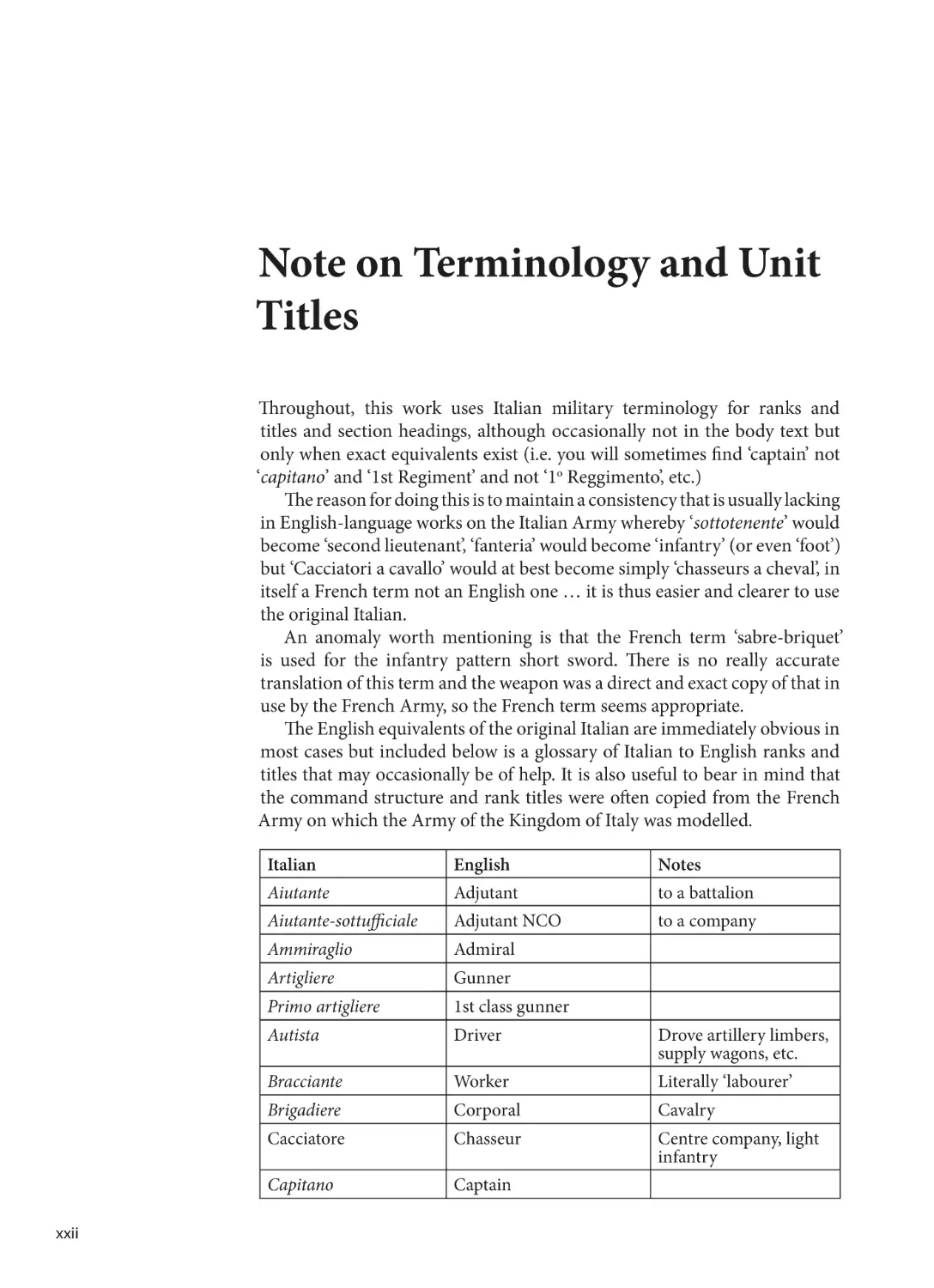
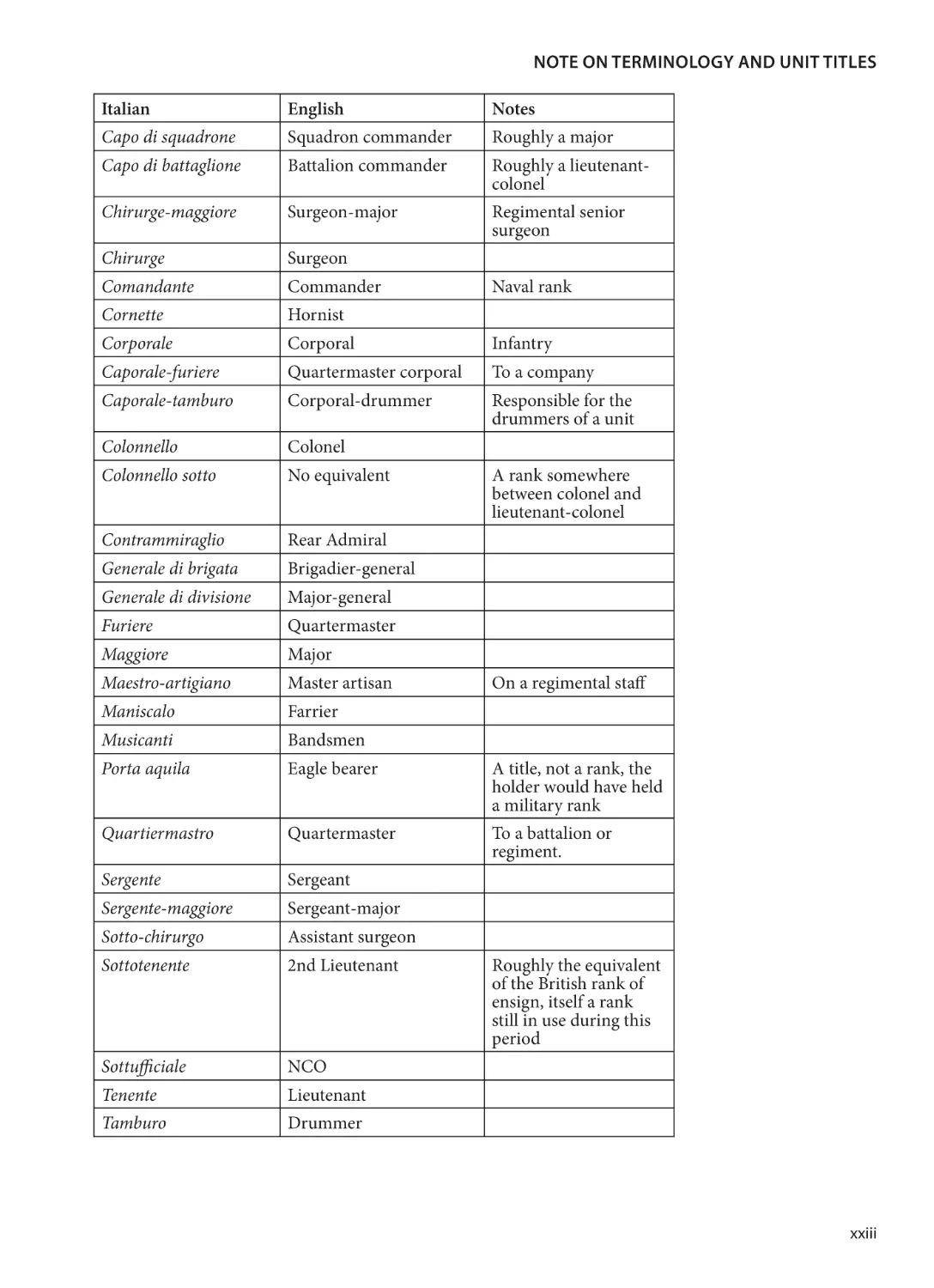
The English equivalents of the original Italian are immediately obvious in
most cases but included below is a glossary of Italian to English ranks and
titles that may occasionally be of help. It is also useful to bear in mind that
the command structure and rank titles were often copied from the French
Army on which the Army of the Kingdom of Italy was modelled.
xxii
Italian
English
Notes
Aiutante
Adjutant
to a battalion
Aiutante-sottufficiale
Adjutant NCO
to a company
Ammiraglio
Admiral
Artigliere
Gunner
Primo artigliere
1st class gunner
Autista
Driver
Drove artillery limbers,
supply wagons, etc.
Bracciante
Worker
Literally ‘labourer’
Brigadiere
Corporal
Cavalry
Cacciatore
Chasseur
Centre company, light
infantry
Capitano
Captain
Note on Terminology and Unit Titles
Italian
English
Notes
Capo di squadrone
Squadron commander
Roughly a major
Capo di battaglione
Battalion commander
Roughly a lieutenantcolonel
Chirurge-maggiore
Surgeon-major
Regimental senior
surgeon
Chirurge
Surgeon
Comandante
Commander
Cornette
Hornist
Corporale
Corporal
Infantry
Caporale-furiere
Quartermaster corporal
To a company
Caporale-tamburo
Corporal-drummer
Responsible for the
drummers of a unit
Colonnello
Colonel
Colonnello sotto
No equivalent
Contrammiraglio
Rear Admiral
Generale di brigata
Brigadier-general
Generale di divisione
Major-general
Furiere
Quartermaster
Maggiore
Major
Maestro-artigiano
Master artisan
Maniscalo
Farrier
Musicanti
Bandsmen
Porta aquila
Eagle bearer
A title, not a rank, the
holder would have held
a military rank
Quartiermastro
Quartermaster
To a battalion or
regiment.
Sergente
Sergeant
Sergente-maggiore
Sergeant-major
Sotto-chirurgo
Assistant surgeon
Sottotenente
2nd Lieutenant
Sottufficiale
NCO
Tenente
Lieutenant
Tamburo
Drummer
Naval rank
A rank somewhere
between colonel and
lieutenant-colonel
On a regimental staff
Roughly the equivalent
of the British rank of
ensign, itself a rank
still in use during this
period
xxiii
THE ARMY OF THE KINGDOM OF ITALY 1805–1814
Italian
English
Notes
Tamburo-maggiori
Drum-major
Responsible for
both drummers and
musicians within a unit.
The next in line above
the caporale-tamburo
Tromba-maggiori
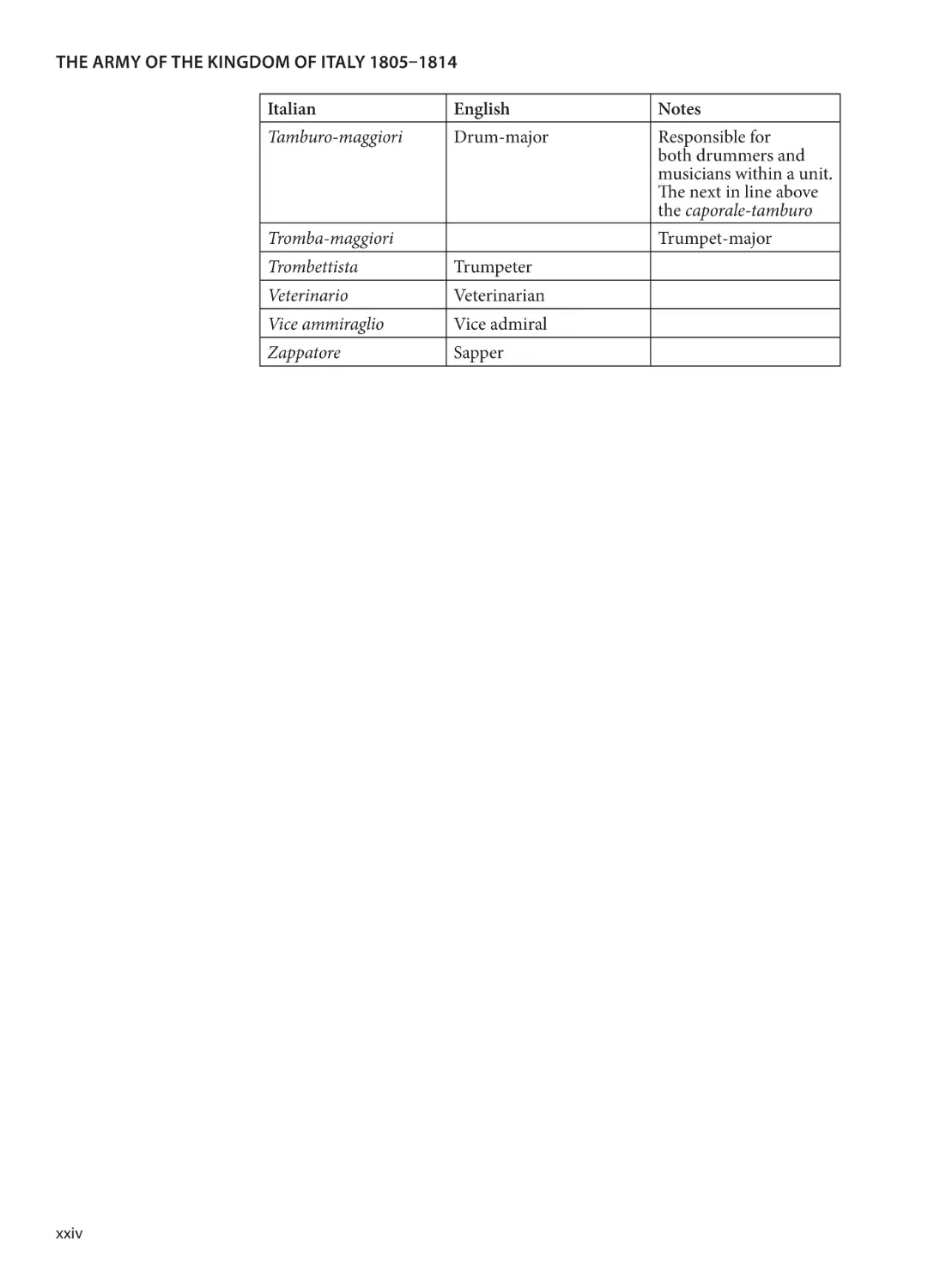
xxiv
Trumpet-major
Trombettista
Trumpeter
Veterinario
Veterinarian
Vice ammiraglio
Vice admiral
Zappatore
Sapper
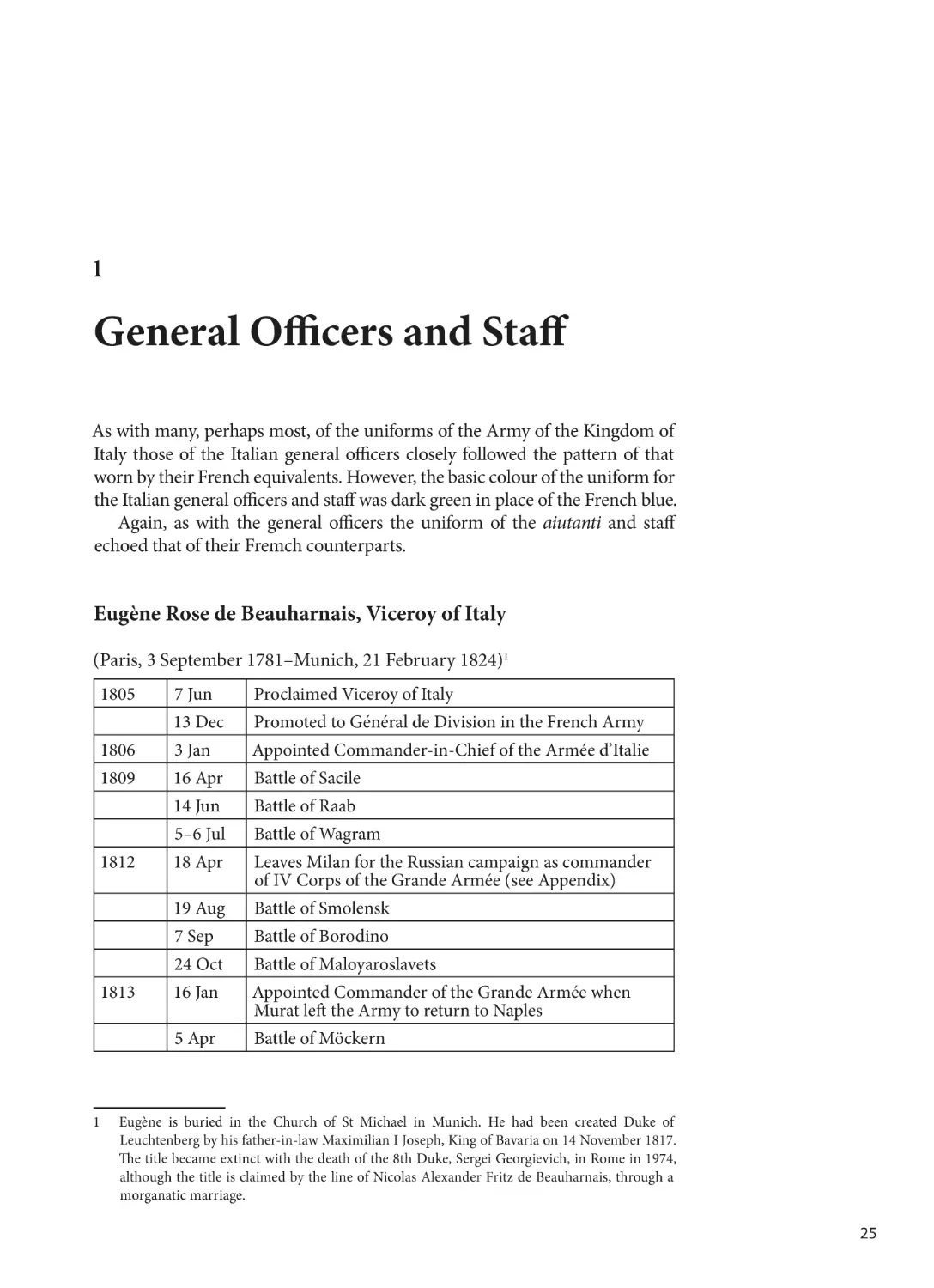
1
General Officers and Staff
As with many, perhaps most, of the uniforms of the Army of the Kingdom of
Italy those of the Italian general officers closely followed the pattern of that
worn by their French equivalents. However, the basic colour of the uniform for
the Italian general officers and staff was dark green in place of the French blue.
Again, as with the general officers the uniform of the aiutanti and staff
echoed that of their Fremch counterparts.
Eugène Rose de Beauharnais, Viceroy of Italy
(Paris, 3 September 1781–Munich, 21 February 1824)1
1805
7 Jun
Proclaimed Viceroy of Italy
13 Dec
Promoted to Général de Division in the French Army
1806
3 Jan
Appointed Commander-in-Chief of the Armée d’Italie
1809
16 Apr
Battle of Sacile
14 Jun
Battle of Raab
5–6 Jul
Battle of Wagram
18 Apr
Leaves Milan for the Russian campaign as commander
of IV Corps of the Grande Armée (see Appendix)
19 Aug
Battle of Smolensk
7 Sep
Battle of Borodino
24 Oct
Battle of Maloyaroslavets
16 Jan
Appointed Commander of the Grande Armée when
Murat left the Army to return to Naples
5 Apr
Battle of Möckern
1812
1813
1
Eugène is buried in the Church of St Michael in Munich. He had been created Duke of
Leuchtenberg by his father-in-law Maximilian I Joseph, King of Bavaria on 14 November 1817.
The title became extinct with the death of the 8th Duke, Sergei Georgievich, in Rome in 1974,
although the title is claimed by the line of Nicolas Alexander Fritz de Beauharnais, through a
morganatic marriage.
25
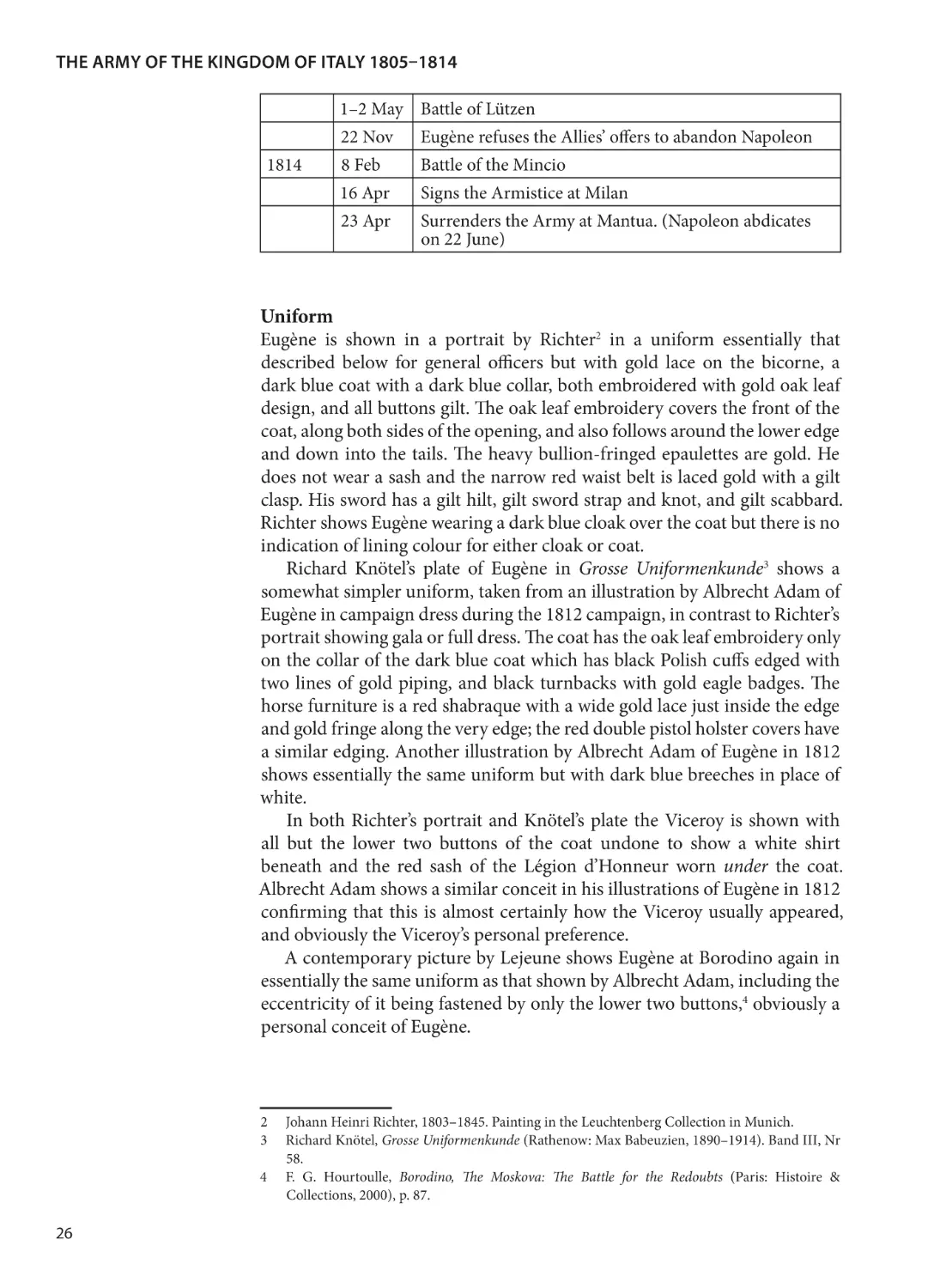
THE ARMY OF THE KINGDOM OF ITALY 1805–1814
1–2 May Battle of Lützen
1814
22 Nov
Eugène refuses the Allies’ offers to abandon Napoleon
8 Feb
Battle of the Mincio
16 Apr
Signs the Armistice at Milan
23 Apr
Surrenders the Army at Mantua. (Napoleon abdicates
on 22 June)
Uniform
Eugène is shown in a portrait by Richter2 in a uniform essentially that
described below for general officers but with gold lace on the bicorne, a
dark blue coat with a dark blue collar, both embroidered with gold oak leaf
design, and all buttons gilt. The oak leaf embroidery covers the front of the
coat, along both sides of the opening, and also follows around the lower edge
and down into the tails. The heavy bullion-fringed epaulettes are gold. He
does not wear a sash and the narrow red waist belt is laced gold with a gilt
clasp. His sword has a gilt hilt, gilt sword strap and knot, and gilt scabbard.
Richter shows Eugène wearing a dark blue cloak over the coat but there is no
indication of lining colour for either cloak or coat.
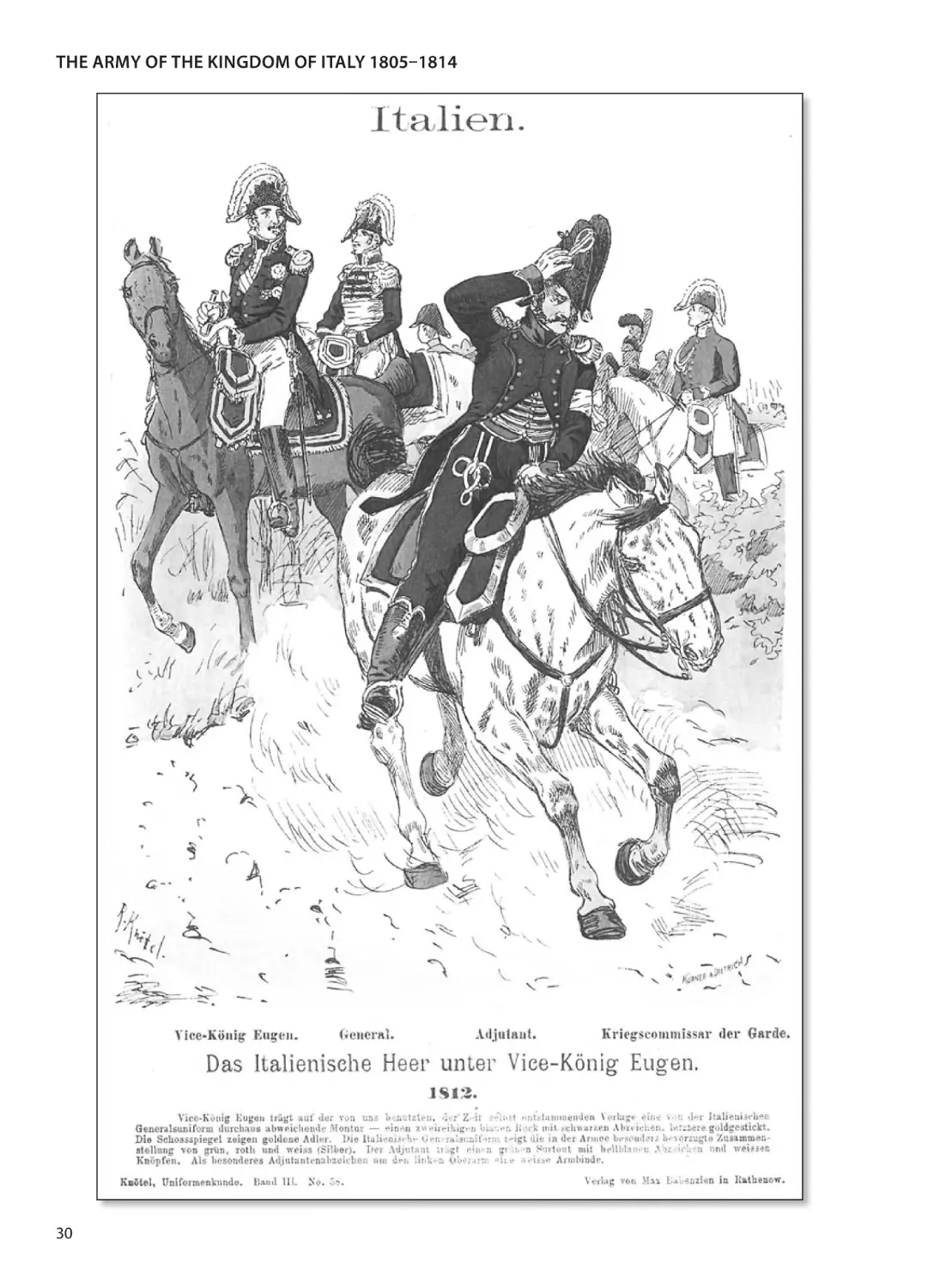
Richard Knötel’s plate of Eugène in Grosse Uniformenkunde3 shows a
somewhat simpler uniform, taken from an illustration by Albrecht Adam of
Eugène in campaign dress during the 1812 campaign, in contrast to Richter’s
portrait showing gala or full dress. The coat has the oak leaf embroidery only
on the collar of the dark blue coat which has black Polish cuffs edged with
two lines of gold piping, and black turnbacks with gold eagle badges. The
horse furniture is a red shabraque with a wide gold lace just inside the edge
and gold fringe along the very edge; the red double pistol holster covers have
a similar edging. Another illustration by Albrecht Adam of Eugène in 1812
shows essentially the same uniform but with dark blue breeches in place of
white.
In both Richter’s portrait and Knötel’s plate the Viceroy is shown with
all but the lower two buttons of the coat undone to show a white shirt
beneath and the red sash of the Légion d’Honneur worn under the coat.
Albrecht Adam shows a similar conceit in his illustrations of Eugène in 1812
confirming that this is almost certainly how the Viceroy usually appeared,
and obviously the Viceroy’s personal preference.
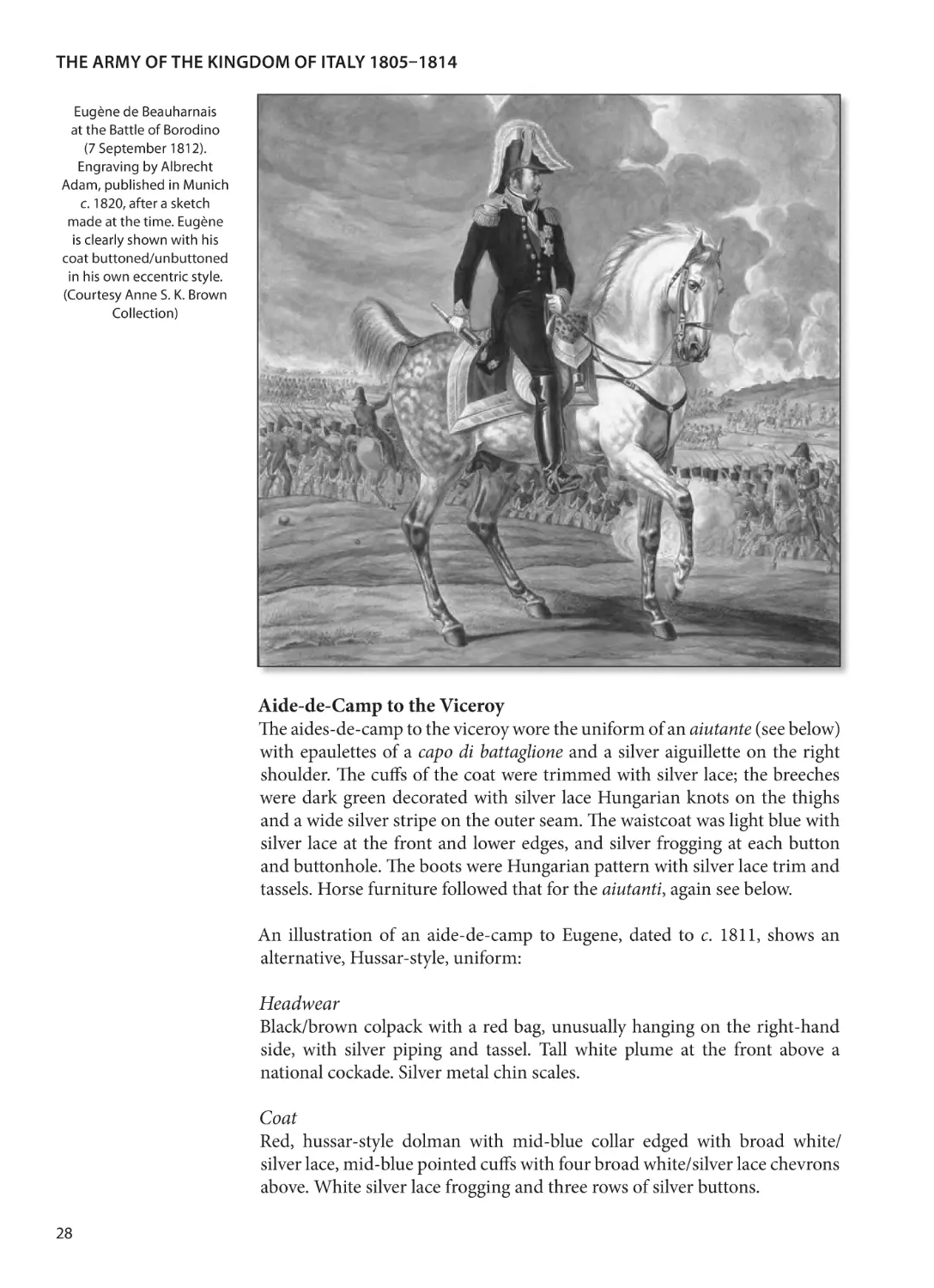
A contemporary picture by Lejeune shows Eugène at Borodino again in
essentially the same uniform as that shown by Albrecht Adam, including the
eccentricity of it being fastened by only the lower two buttons,4 obviously a
personal conceit of Eugène.
2
3
4
26
Johann Heinri Richter, 1803–1845. Painting in the Leuchtenberg Collection in Munich.
Richard Knötel, Grosse Uniformenkunde (Rathenow: Max Babeuzien, 1890–1914). Band III, Nr
58.
F. G. Hourtoulle, Borodino, The Moskova: The Battle for the Redoubts (Paris: Histoire &
Collections, 2000), p. 87.
gEnEral offIcErS and Staff
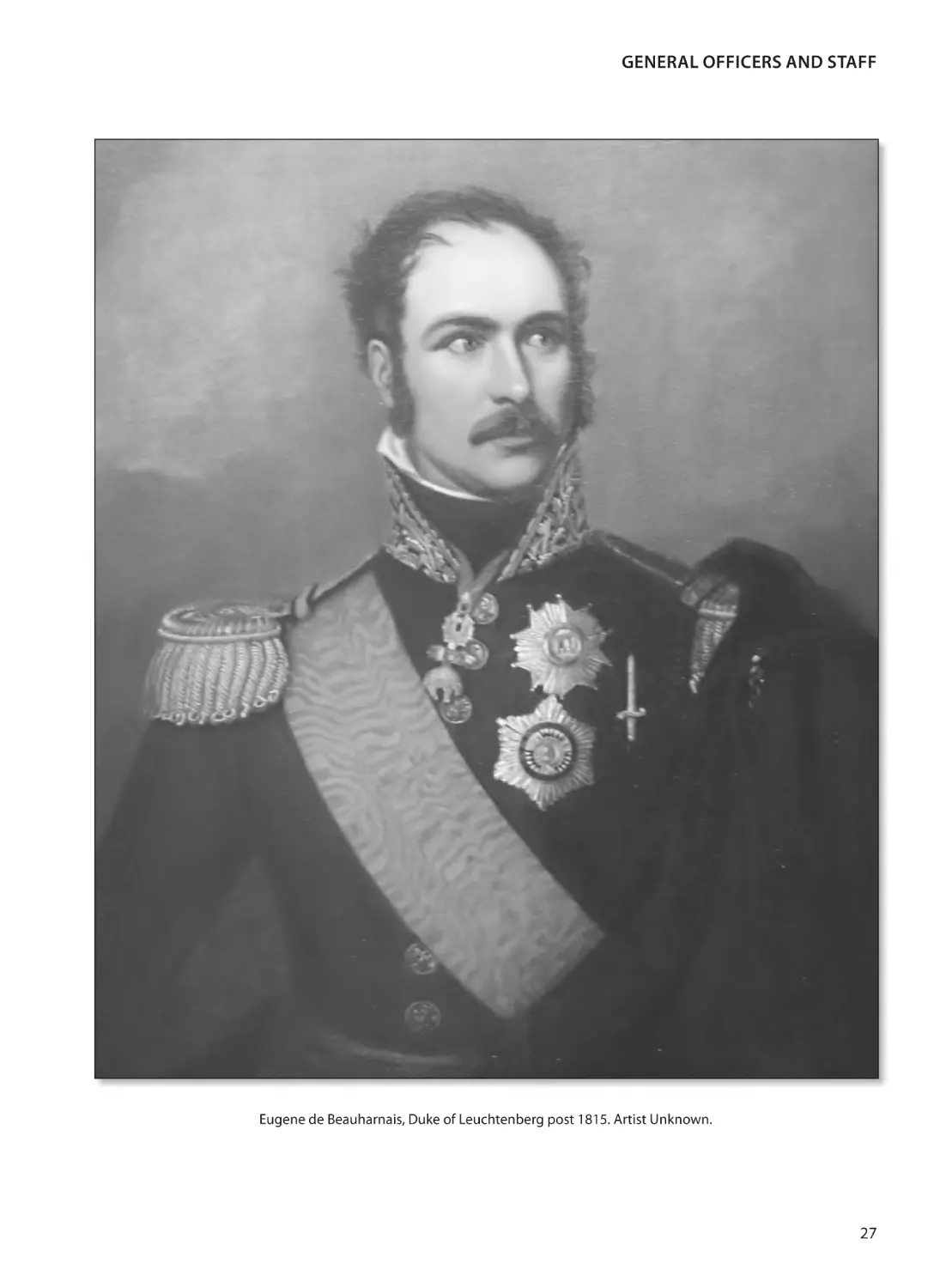
Eugene de Beauharnais, Duke of Leuchtenberg post 1815. Artist Unknown.
27
thE army of thE KIngdom of Italy 1805–1814
Eugène de Beauharnais
at the Battle of Borodino
(7 September 1812).
Engraving by Albrecht
Adam, published in Munich
c. 1820, after a sketch
made at the time. Eugène
is clearly shown with his
coat buttoned/unbuttoned
in his own eccentric style.
(Courtesy Anne S. K. Brown
Collection)
Aide-de-Camp to the Viceroy
The aides-de-camp to the viceroy wore the uniform of an aiutante (see below)
with epaulettes of a capo di battaglione and a silver aiguillette on the right
shoulder. The cuffs of the coat were trimmed with silver lace; the breeches
were dark green decorated with silver lace Hungarian knots on the thighs
and a wide silver stripe on the outer seam. The waistcoat was light blue with
silver lace at the front and lower edges, and silver frogging at each button
and buttonhole. The boots were Hungarian pattern with silver lace trim and
tassels. Horse furniture followed that for the aiutanti, again see below.
An illustration of an aide-de-camp to Eugene, dated to c. 1811, shows an
alternative, Hussar-style, uniform:
Headwear
Black/brown colpack with a red bag, unusually hanging on the right-hand
side, with silver piping and tassel. Tall white plume at the front above a
national cockade. Silver metal chin scales.
Coat
Red, hussar-style dolman with mid-blue collar edged with broad white/
silver lace, mid-blue pointed cuffs with four broad white/silver lace chevrons
above. White silver lace frogging and three rows of silver buttons.
28
General Officers and Staff
Red pelisse edged in white fur, four white/silver broad lace chevrons on
the sleeves. White/silver frogging and silver buttons.
Blue and white barrel sash with white/silver cords.
Breeches etc.
Mid-blue overalls with two broad white/silver stripes down the outside and
blue straps under the boot. Note, there is no evidence of leather inserts.
Equipment
Black boots, but because they are worn underneath overalls the pattern is
unknown. Dark red cartouche box strap edged in a broad silver lace worn
over the left shoulder. On the front is a silver heart-shaped plate with silver
chains attaching the plate to another higher up. The cartouche box cannot
be seen, but speculation would suggest that this would have been the small
cavalry style, perhaps in fashionable red leather rather than black.
Straight cavalry sabre with a brass, single-bar hilt carried in an all-steel
scabbard from a white waist belt, mainly hidden by the barrel sash, and white
suspension straps. White sword knot and tassel.
Horse Furniture
Because the figure is shown dismounted there is no evidence of horse
furniture. This may have been a similar pattern to that used by the aiutante,
which appears to have been of a general style used throughout the Staff.
A list of Eugène’s eight aides at Borodino, together with short biographies of
each, is given by Dr F. G. Hourtoulle in Borodino, The Moskova: The Battle
for the Redoubts.5
Generali (General Officers)
Headwear
General officers wore a black bicorne, often velvet faced in full dress, trimmed
at the upper edge with elaborate silver lace, which usually incorporated a
laurel and oak leaf design, and with silver tassels at the outer tips. Beneath
the large national cockade was a silver rosette secured by a wide, deep silver
cockadestrap which almost reached the lower edge of the hat and was
finished with a silver button. The outer edges of the bicorne were trimmed
with a feather trim, silver for the viceroy, white for general of division and
black for general of brigade. For parade dress the hat was further decorated
with a tall white feather plume with short red and green feathers at the base.
Coat
The coat was of a cut similar to that of the regulation coat of French Generals:
single-breasted, surtout style with high upright collar, plain squared cuffs
5
F. G. Hourtoulle, Borodino, The Moskova: The Battle for the Redoubts (Paris: Histoire &
Collections, 2000), p. 87.
29
thE army of thE KIngdom of Italy 1805–1814
30
General Officers and Staff
and long tails without turnbacks but open at the rear with a double vent.
This coat was dark green lined red, with red collar and cuffs. It was closed
at the front with nine silver buttons embossed with the Imperial eagle. The
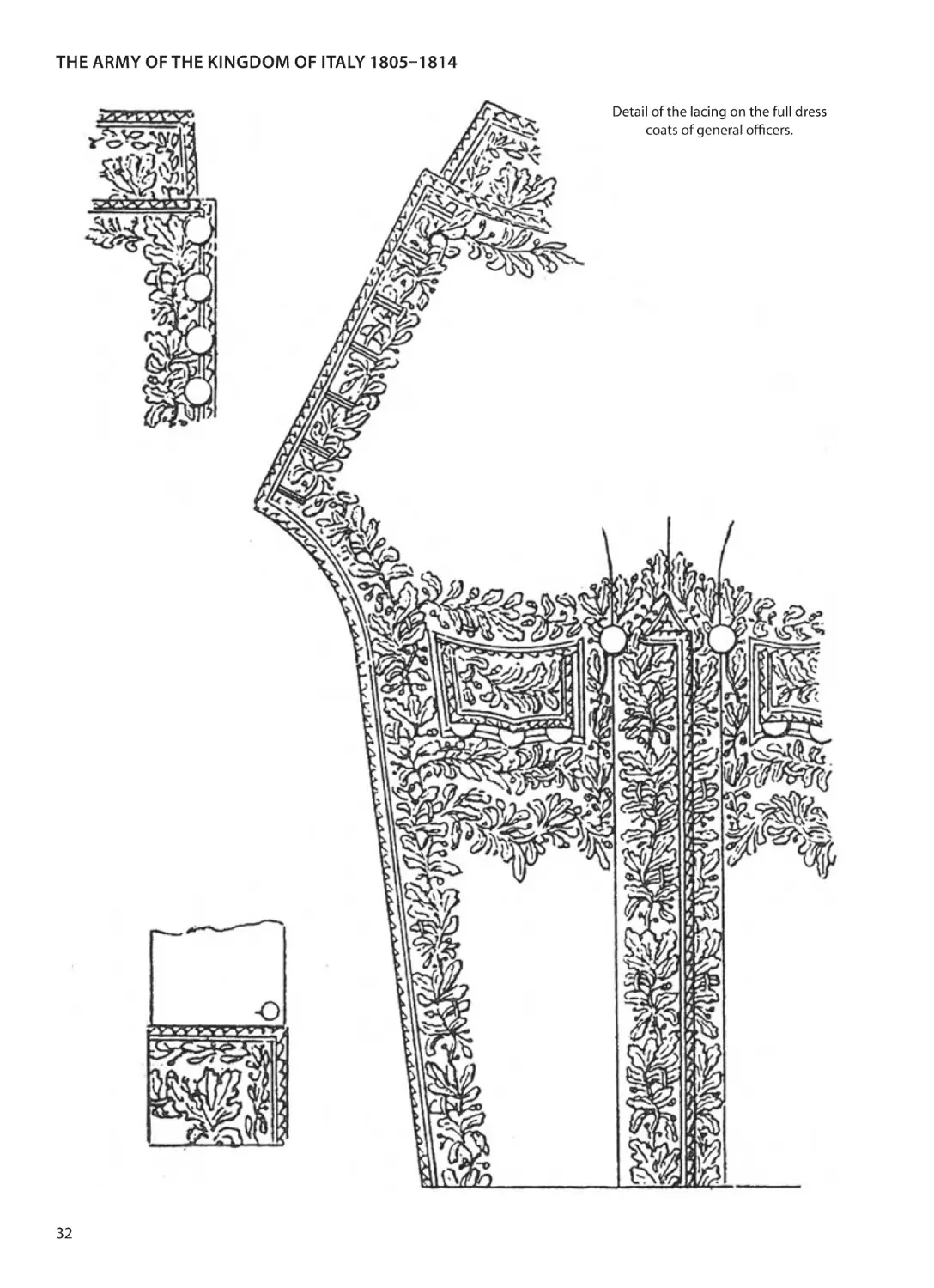
front of the coat was trimmed with elaborate silver embroidery extending
down to the edge and a similar embroidery decorated both sides of the rear
vents. The same embroidery embellished the upper and front edge of the
collar and upper edge of the cuffs. Nine batons of the embroidery sometimes
also appeared on the coat’s breast, each baton running out from a button
or buttonhole. Epaulettes were silver with thick crescents and heavy bullion
fringe; the straps were lace embroidered and decorated with two stars for
generale di brigata and three for generale di divisione.
The silver silk waist sash was knotted at the left hip and ended with heavy
silver bullion tassels for both the viceroy and for general officers. The silver
sash for generale di divisione was worked through with diagonal red stripes,
which for generale di brigata showed light blue stripes.
Facing page; Knötel Plate
III/58. Eugène, general
officers and staff of the Army
of Italy. From left: Eugène,
general officer, adjutant,
military commissary
attached to the Royal Guard.
Colouring as in the text.
(Author’s collection)
Breeches etc.
Breeches were white and worn with high, cuffed heavy cavalry–style boots
with brass spurs. General officers’ dark green, high-collared greatcoats were
of the cavalry pattern with silver lace on the edges of the collar and shoulder
straps.
Equipment
Waist belts were the light cavalry pattern in black leather edged with silver
braid and with a silvered ‘S’ buckle and silver fittings. The regulation sword
had a gilded hilt (when worn, many officers wore privately purchased swords
of their own choice of style, as in the French Army the ‘Mameluke style’ was
popular), the sword knot followed the colouring of the waist sash. Scabbards
were silver-plated steel, or black leather with gilt fittings.
Horse Furniture
General officers’ shabraques were similar to those of dragoon officers and of
dark green cloth with a double wide silver lace trim piped silver at the outer
edge, each stripe separated by a welt of dark green, the triple pistol holster
covers were decorated in the same way. The viceroy used a shabraque of the
same pattern but with the addition of a heavy bullion fringe at the very outer
edge. Saddles and harness were black leather, the latter trimmed with silver
lace. All buckles and fittings were silver-plated.
General Pino
Pino is shown in an unpublished study by Louis de Beaufort ‘after Boisselier’, in
an otherwise unique uniform, but its very uniqueness makes it worth recording.
Headwear
A brass dragoon pattern helmet with brown fur turban and a black shiny
leather peak bound in brass and with brass chinscales. The houpette is white
and the helmet has a tall red plume at the left side mounted in a brass socket.
31
THE ARMY OF THE KINGDOM OF ITALY 1805–1814
Detail of the lacing on the full dress
coats of general officers.
32
General Officers and Staff
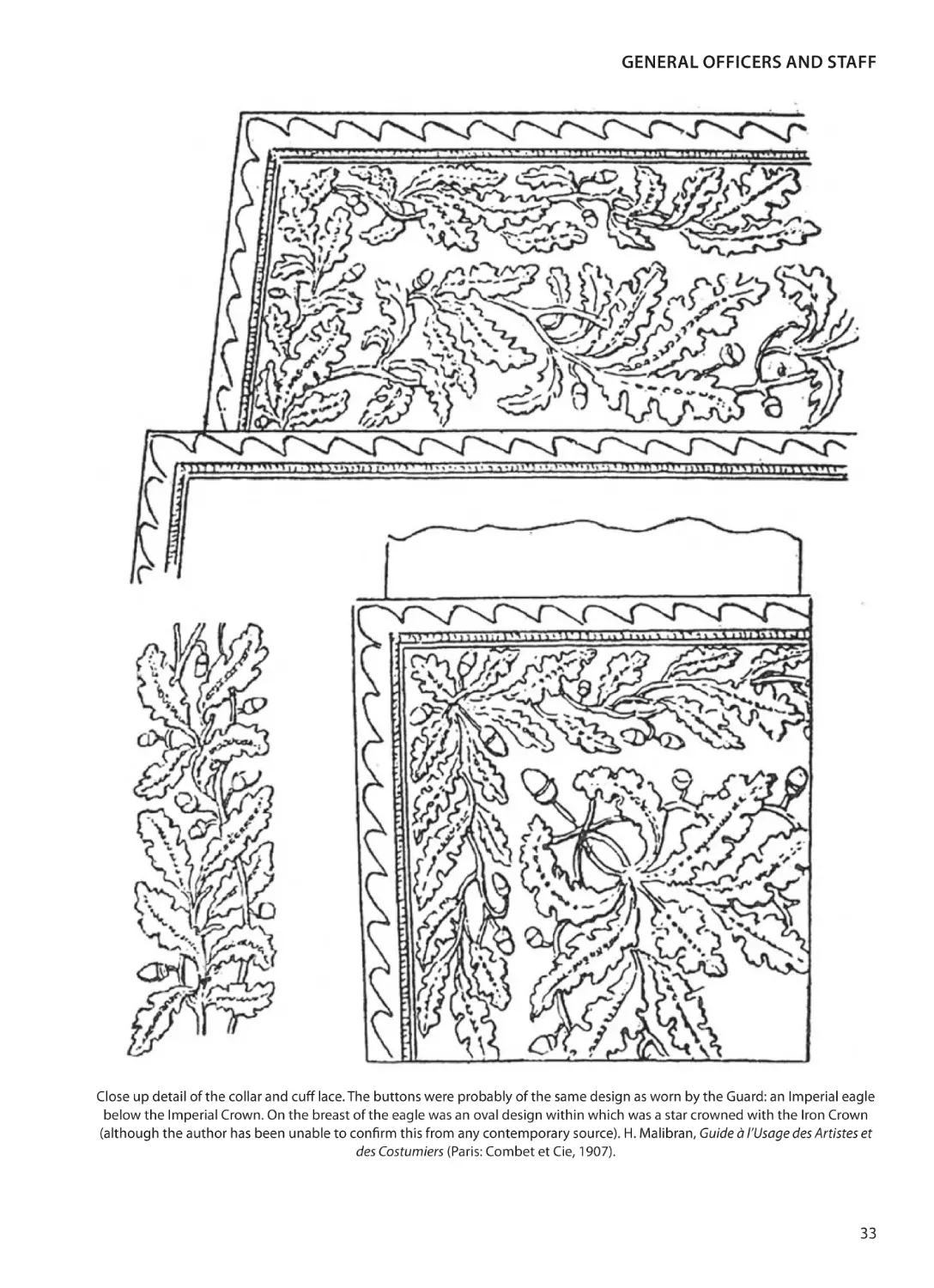
Close up detail of the collar and cuff lace. The buttons were probably of the same design as worn by the Guard: an Imperial eagle
below the Imperial Crown. On the breast of the eagle was an oval design within which was a star crowned with the Iron Crown
(although the author has been unable to confirm this from any contemporary source). H. Malibran, Guide à l’Usage des Artistes et
des Costumiers (Paris: Combet et Cie, 1907).
33
THE ARMY OF THE KINGDOM OF ITALY 1805–1814
Coat
Dark blue habit style with white squared lapels, white collar and white
turnbacks, all piped white. The cuffs cannot be seen in the illustration because
Pino is wearing white gauntlet-cuffed gloves. All buttons are brass and the
epaulettes are full, heavy-fringed pattern in gold. Over his right shoulder he
is wearing the red silk sash edged green of the Légion d’Honneur.
Breeches etc.
White waistcoat with brass buttons, white breeches and black heavy cavalry
pattern boots
Equipment
White waist belt over the waistcoat with a large square buckle. Heavy-cavalry
pattern sword with brass hilt and a gilt sword knot and tassel in an all steel
scabbard carried from white slings with brass buckles.
Aiutante-Comandante (Aide-de-Camp Commandant)
Headwear
Black bicorne edged silver with cockade and cockade strap as for general officers.
Coat
In full dress aiutante-comandante wore a dark green long-tailed habit with
pointed lapels and plain cuffs without cuff flaps. The coat had dark green
facings, piped silver and red unpiped turnbacks. The collar was decorated
with two horizontal batons of lace, each with a small button at the front; the
cuffs had similar batons of vertical lace with a silver button at the top.
On campaign the above coat was usually replaced with the undress coat:
the usual pattern surtout with facings as above. This coat was also worn when
not on duty and for ‘walking-out dress’. A full colonnello’s silver epaulettes
were worn on both patterns of coat.
Breeches, etc.
Breeches and waistcoats were white for parade and full dress and dark green
for campaign dress; buttons were silver. Boots were of the cuffed heavy
cavalry pattern with silvered spurs. Greatcoats were of the dark green cavalry
pattern with silver batons on the collar, as on the coat.
Equipment
Light cavalry sabre with silvered or gilded hilt, silver sword knot and tassel,
black leather scabbard with gilt fittings. The sword was worn from a hussarstyle belt of black leather with silver lace trim and silvered fittings.
Horse Furniture
Was the same pattern as that used by general officers with a double, wide
silver band at the edge of the shabraque.
34
General Officers and Staff
Aiutanti (Aides-de-Camp)
Headwear
Black bicorne hat with nationa1 cockade and silver cockade strap and tassels.
The plume was coloured to indicate the staff level to which the officer was
assigned (see below).
Coat
The full dress coat was a dark green short-tailed habit-veste, with pointed
lapels, Polish cuffs and ‘a la Soubise’ pockets. The coat had collar, cuffs and
lapels of sky blue and turnbacks of dark green piped sky blue, the pockets
were piped sky blue.
In undress and on campaign aiutanti wore a dark green surtout coat with
collar, cuffs, turnbacks and piping as on the full dress coat.
Epaulettes of rank were worn on both patterns of coat and the arm sash of
an aiutante was tied above the elbow on the left arm with the tassels hanging
on the outside of the arm. This sash, and the bicorne plume, was coloured to
denote the staff level to which the aide-de-camp was assigned (note not the
officer’s actual, personal rank).
Sash
Plume
Brigade
Sky blue trimmed silver
Sky blue over green
Division
Red trimmed silver
Sky blue over red
Corps/Army
White trimmed silver
Sky blue over red
Breeches etc.
The breeches were green with silver Hungarian knots on the thighs and a
silver stripe along the outer seam. The waistcoat was sky blue with silver
lace ‘frogging’ and trim for parade, and plain dark green for undress and
campaign. The boots were Hungarian pattern with silver lace and tassel.
Equipment
Waist belts were black leather and sabres were of the pattern used by officers
of the light cavalry, with a silver sword knot and tassel.
Horse Furniture
As for the aiutante-comandante but with a single wide silver lace band.
Revisori Militari (Military Auditors)
Revisori militari, who were exclusively officers, were a part of the General
Staff and were, as the name implies, responsible for checking the accounts
of the Army.
35
THE ARMY OF THE KINGDOM OF ITALY 1805–1814
Headwear
Black bicorne with national cockade and a silver cockade strap and tassels
Coat
The coat was of the same cut as that of the general officers but was bright red,
with dark green collar and plain round cuffs and piping to the horizontal
pockets. There was a single line of silver lace at the edge of the collar and
the cuffs and on the pockets. Like the generals’ coat it had no turnbacks. All
buttons were silvered. Inspectors wore a light blue sash, with silver fringe,
around the waist over the coat. Sub-inspectors had a green sash with a gold
fringe. Revisiori attached to the Guard wore a silver aiguillette on the right
shoulder.
Breeches etc.
Breeches and waistcoats were white for parade and full dress and dark green
for campaign dress; again buttons were silver. Boots were of the cuffed heavy
cavalry pattern with silvered spurs.
Equipment
Officers’ pattern sword with silvered or gilded hilt, silver sword knot and
tassel, black leather scabbard with gilt fittings. The sword was carried on a
black leather waist belt with silver lace trim and silvered fittings, worn under
the coat and over the waistcoat.
Horse Furniture
The shabraque and pistol holsters were of the same pattern as that used by
general officers but in red with wide silver lace edge.
Revisore Capo (Chief Auditor)
The uniform was generally the same as above but with some minor additional
decoration.
Headwear
As above with the addition of silver lace along the edge and white plumes.
Coat
The coat was of the same colouring and cut as the auditors but had double
silver lace on the collar and a silver ‘oak leaf ’ design lace down the front of
the coat and around the cuffs and the edges of the coat’s tails. His sash was
red with a silver fringe.
Commissari di Guerra (Military Commissaries)
Commissari di Guerra were responsible for arranging and organising
quarters and the supply services for the Army both on campaign and during
36
General Officers and Staff
peacetime. Note, the uniform was generally similar in cut and style to the
revisori militari.
Headwear
Black bicorne with national cockade and a silver cockade strap and tassels.
Coat
The coat, of the same cut as that of the general officers, was light blue with a
bright red collar and plain round cuffs and piping to the horizontal pockets.
Like the generals’ and the auditors’ coats it had no turnbacks. The coat
fastened with nine silvered buttons.
Commissari on the General Staff had a double silver lace edge to the collar,
cuffs and pockets and the silver oak leaf pattern lace on the front of the coat
and around the tails; commissari attached to divisions had a single silver lace
on the collar, cuffs and pockets, whereas commissari ‘ordinari’ had silver lace
only on the collar and cuffs. Commissari aiutanti had silver lace only on the
collar but with a narrow dark green lace inside it.
As with the revisori, commissari attached to the Guard had a silver
aiguilette at the right shoulder.
Breeches etc.
Breeches and waistcoats were white for parade and full dress and dark green
for campaign dress; again buttons were silver. Boots were of the cuffed heavy
cavalry pattern with silvered spurs.
Equipment
Officers’ pattern sword with silvered or gilded hilt, silver sword knot and
tassel, black leather scabbard with gilt fittings. The sword was carried on a
black leather waist belt with silver lace trim and silvered fittings, worn under
the coat and over the waistcoat.
Horse Furniture
The shabraque and pistol holsters were of the same pattern as that used by
general officers and auditors but were light blue with silver lace.
37
thE army of thE KIngdom of Italy 1805–1814
The following full-page engravings (the originals are hand coloured) portray the Army of Italy in review
in 1805, 1807 and 1812. These engravings are three of the five (the remaining two show the Armies
of the various pre-Kingdom Republics) that were published in Sulla Milizia Cisalpino-Italiana. Cenni
Storico Statistici dal 1796 al 1814: Alesandro Zanoli (Milan: Borroni e Scotti, 1845). They are remarkably
38
gEnEral offIcErS and Staff
accurate and are perhaps the first post-Napoleonic celebrations of the Kingdom’s army. The Milan
Fireman of the Pompieri Della Città di Milano (centre of the engraving on the following page, with his
back to the viewer) was copied essentially unchanged by Knötel on his III/45 (see notes that follow).
Most other units can also be identified on these plates. Colouring as described in the text.
39
thE army of thE KIngdom of Italy 1805–1814
40
gEnEral offIcErS and Staff
41
thE army of thE KIngdom of Italy 1805–1814
42
gEnEral offIcErS and Staff
43
2
The Guardia Reale (Royal
Guard)
The Guardia Reale of the Kingdom of Italy came into existence by a royal
decree of 20 June 1805. Outwardly it appears to have been organised
on the same lines as the French Garde Impériale with most of the units
corresponding with those of that body although this superficial similarity is
illusory albeit that the Guardia Reale was, like the Garde Impériale, a selfcontained force of all arms.
The decree creating the Guardia Reale gave it an initial structure of three
defined parts:
Guardie d’Onore (Guards of Honour)
Guardie Veliti (Velite Guards)
Guardie della Linea (Guards of the Line)
Facing page: the units
of the Royal Guard. Plate
48 of Dr Lienhart & R.
Humbert, Les Uniformes de
l’Armée Française. Recueil
d’Ordonnances de 1690 à
1894, Volume 5 (Leipzig: Ruhl,
1894). (Author’s collection)
44
More detail on each individual unit is given below under the appropriate
section but it should be noted that the first two were essentially training
schools for officers whereas only the latter followed the French Imperial
Guard system of recruiting veterans from the line, albeit that its title suggests
it is the least prestigious of the three.
To be eligible for admission to the regiments of the Guardie della Linea a
recruit was supposed to have had five years’ service and a good disciplinary
record but as these units absorbed the Presidential Guard units (see below)
initially at least they were composed of men who had no service record and
had simply joined the latter direct from civilian life.
Throughout its existence the Guardia Reale, and to a lesser extent the
line regiments, contained a number of French officers. Initially these French
officers were considered senior to any Italian officer of the same rank,
regardless of length of service. However by a decree of 21 May 1808 Eugène
set out that French and Italian officers were to be considered equal with
seniority determined only by length of service of rank.
thE guardIa rEalE
45
THE ARMY OF THE KINGDOM OF ITALY 1805–1814
Cavalry of the Royal Guard
Organisation
The cavalry of the Royal Guard comprised:
Guardia Reale d’Onore of 4, later 5, companies
Dragoni Della Guardia Reale, of 2 squadrons
Gendarmeria Scelta Della Guardia Reale of 1 company strength
The personal escort for the viceroy was customarily provided by the
Dragoni Della Guardia Reale and not by the Guardia Reale d’Onore as might
have been expected – an unkind observer might perhaps suggest that Eugène
felt safer if his escort was provided by the regular army proper …
Guardia Reale d’Onore (Royal Guards of Honour)
History and Organisation
The unit1 had its origins in the City Guards of Honour that had escorted
Napoleon on his entry into Italy even before the Kingdom was proclaimed.2
These aristocratic bodies were not strictly military units in any sense but
were akin to the local landed classes dressing in military uniform to feel
important for the day. Napoleon disbanded these local groups with the
intention of using their manpower to form the Royal Guards of Honour and
tie himself closer to the aristocracy of his new Kingdom.
The four, later five, companies of the Guardia Reale d’Onore of the Royal
Guard were each recruited from one of the four principal departments of the
Kingdom and bore the subsidiary title of that department. The recruiting
departments were:
1st Company ‘Milano’:
2nd Company ‘Bologna’:
3rd Company ‘Brescia’:
4th Company ‘Romagna’:
Olona, Agogna, Lario, Adda
Reno, Crostolo, Panaro, Mincio
Serio, Alto Po, Mella, Adige
Rubicone, Basso Po
In 1806, when the Venetian territories were absorbed into the Kingdom
of Italy, a 5th company, ‘Venezia’ was raised from the departments created
within the new territory.
1
2
46
It is not technically correct to refer to the companies as a ‘unit’ before 1806, or even perhaps 1808,
since they existed as separate companies, but it is so much more convenient to do so, for which
the author asks the reader’s indulgence.
Similar local Gardes d’Honneur existed throughout France and even in the Netherlands. They
frequently seized the honour of escorting the Emperor when he was in their area, though they
were militarily insignificant.
THE GUARDIA REALE
The regiment3 was considered as a training school for officers and the
other ranks as ‘officer cadets’ who could be promoted into the line cavalry
regiments with the rank of 2o Tenente after two years’ service.
All rank and file were required to be literate in both Italian and French
and have a private income of at least 1,200 Milan Lira per year, which, as
in the Velites, was to be paid to the State. The initial voluntary enlistment
from the sons of the wealthy proved to be unpopular and enlistment was
therefore subsequently made compulsory for any who fulfilled the criteria.
Discipline and duties were light and the companies even had their own
grooms, probably for this reason the unit proved less than successful when it
participated in the 1809 and 1812 campaigns.
The officers of Guardia Reale d’Onore, as with the officers of the French
Imperial Guard, held a double rank of grading over the line officers, thus a
sottotenente of the Guardia Reale d’Onore ranked as a capitano in the line, etc.
The company establishment was laid out in a decree of 6 August 1805 as:
1 capitano 1 tenente
1 sottotenente 1 maresciallo d’alloggio capo
4 marescialli d’alloggio
1 brigadiere furiere
8 brigadieri 1 maniscalo
2 trombettieri 1 tamburino
86 guardie
Within this establishment three brigadieri, 36 guardie, and the tamburo
were to be dismounted.
The trombettieri, the tamburo and the maniscalo were recruited from the
line cavalry and were not ‘guards’ in the same sense as the troopers.
All companies were commanded by their own officers and there was
no form of regimental organisation or overall command, a situation that
added to the chaotic affairs and lack of discipline of the unit, or more
strictly, units. To overcome this the ‘Regolamento di Disciplina Interna ed
Administrazione Della R. Guardie d’Onore’4 were issued on 7 August 1806
and Gaetano Battaglia, the capitano of the 1st Company ‘Milano’, was given
overall command of the five companies with the acting rank of maggiore and
with the intention that they should be commanded as a single unit.
On 30 March 1807 a company of grooms was formally added to the
regimental establishment. The company was formed as five squads of 25,
each under a head groom and each squad assigned to a specific company.
Finally, on 14 March 1808 a small regimental staff of chirurge, assistant
chirurge and a veterinario was created, and then later in the same year a second
tenente was added to the 1st Company allowing Battaglia to command the
regiment with less responsibility for his own company. At the same time it
was decided that all of the companies were to be mounted which also resulted
in the tamburo being removed from the company establishments.
3
4
Whether the companies should ever truly be considered as a ‘regiment’, even after the creation
of the staff in 1808, is arguable but again it is a convenient shorthand to refer to them as such.
‘Regulations of Internal Discipline and Administration…’
47
THE ARMY OF THE KINGDOM OF ITALY 1805–1814
Despite all of these theoretical establishments, in 1809 the unit could only
raise enough personnel for a single composite company to accompany the
army into the field. In July 1807 the Guards mustered a strength of only 374
all ranks against an establishment of 535 (see Appendix II for the illustrative
strength of the Guard). However when the Army of Italy joined the Grand
Armée for the Russian campaign of 1812 the five companies were essentially
at establishment.
In 1813 the Guards who returned from the campaign in Russia were
transferred into the line as officers of the reformed Army, and only a single
company was raised for the new army. This single company had a new
establishment of:
1 capitano 2 tenente
2 sottotenente 1 maresciallo d’alloggio capo
1 brigadiere furiere
6 marescialli d’alloggio
10 brigadieri 2 maniscalo
1 brigadiere trombettiere
3 trombettier
124 guardie
It was uniformed as the 4th Company ‘Romagna’.
On 16 May 1814, the Guardie d’Onore were the first unit of the Royal
Guard to be formally disbanded, having already transferred the majority of
its personnel to other units.
In the 10 years of its existence a total of 895 men had passed through
its ranks, of whom 450 were promoted to officers in other units, 106 were
discharged for wounds or illness, and 193 were killed or taken prisoner
(mainly in Russia).
Service
1805
Nov
1809
Observation Corps against Venice
One composite company drawn from all troops
joined the Army after the Battle of Sacile on 16
April.
8 May
Battle of the Piave
14 Jun
Battle of Raab
5 Jul
Battle of Wagram (108 officers and men)
No officer casualties, killed or wounded, are
recorded during the campaign
1812
48
7 Sep
Battle of Borodino
24 Oct
Battle of Maloyaroslavetz
16 Nov
Battle of Krasnoi
28 Nov
Battle of the Beresina?
THE GUARDIA REALE
1812
During the campaign Martinien records as ‘Killed
or Disappeared’:
5 capitani
13 tenenti (2 of whom were killed in action)
1 chirurge (killed in action)
1813–1814
Various skirmishes during the defence of the
Kingdom but no officers are recorded as killed or
wounded during these campaigns
1814
8 Feb
Battle of the Mincio (119 officers and men)
Uniform
From late 1805 until 1810,5 at the very latest, each company of the Guards
had a unique uniform. Whilst much of the general equipment was the same
as that in use post 1810, and described below, the 1805 coats were:
1st Company ‘Milano’: Red coat with blue collar, lapels cuffs and turnbacks,
silver buttons and eagles on the turnbacks
2nd Company ‘Bologna’: White coat with blue facings
3rd Company ‘Brescia’: Blue coat with crimson facings
4th Company ‘Romagna’: Green coat faced red
5th Company ‘Venezia’: Green coat faced orange
Initially buttonholes were piped silver although this distinction was
officially abolished in August 1806. Horse furniture appears to have been
of the company facing colour, piped silver. Trombettieri generally wore
reversed colours but a contemporary illustration shows a trombettista in a
yellow coat faced light blue and with a white helmet crest, unfortunately the
company is not recorded, although ‘Bologna’ would seem the most likely
and it is possible that the illustration is c. 1811 and not from the early period.
The ‘traditional’ uniform was introduced as a cost reduction exercise as
many families were unwilling to pay the high cost of equipping their sons,
resulting in the Guards being severely understrength even at the beginning of
1809. The new uniform was laid down by decree and thus is more completely
documented. Since the coats were issued annually the ‘change’ would have
been fairly swiftly effected.
Headwear
The helmet was brass (similar in appearance to that worn by the French
carabiniers after the 1810 dress regulations) with a black woollen caterpillar
crest, the lower portion of the helmet, excluding the peak, was a steel ‘band’
with a crowned6 ‘N’ in brass at the front. The peak, chin scales and plume
holder were brass and in full dress a white plume was worn at the left-hand
5
6
Alain Pigeard, ‘Les Gardes d’Honneur du Royaume d’Italie’, Tradition No.117, Janvier 1997
(Paris: Tradition, 1996), pp. 12–16. gives a date of 1812 for this change but all other sources
consulted put it much earlier.
‘Crowned’ in any reference to the Kingdom of Italy’s Army means, of course, with the Iron
Crown of Lombardy, not the French Imperial Crown.
49
thE army of thE KIngdom of Italy 1805–1814
Right, and facing page: Trooper’s
helmet, Guardia Reale d’Onore.
Brass skull, steel turban edged
in brass, brass ‘N’ and crown,
black woollen caterpillar crest,
brass crest holder and chin
scales, black leather peak bound
in brass. (Private collection,
photo © and courtesy of Laurent
Claudet)
50
thE guardIa rEalE
side. The brass crest holder comb was in the form of an eagle with swept back
wings; the wings formed the side of the crest, the chest the front of the crest
and the eagle’s head protruded forward below the caterpillar crest. Whilst
some examples of this elaborate helmet actually survive it is arguable how
widespread its use really was after 1807, however at some point before 1812
this helmet with its elaborate crest holder had definitively been replaced with
the more usual plain brass one. This change may have been at the same time
as the change of coat colour but would, no doubt, have taken some time to
‘work through’ the whole unit since helmets, unlike coats, were not replaced
annually.
The ‘Pokalem’ pattern fatigue caps were dark green with piping of the
company colour. After 1808 a unique pattern of fatigue cap seems to have
come into use; it was similar in appearance to the German feldmutz with
soft crown and wide headband and a small patch at the crown from which a
short cord and tassel hung, the colouring being the same as for the Pokalem.
Coat
The full dress coat was the uniform pattern dark green habit, with the lapels,
cuffs and turnbacks of the facing colour, a dark green collar and dark green
three-pointed cuff flaps piped with the company facing colour, pockets
51
THE ARMY OF THE KINGDOM OF ITALY 1805–1814
Facing page: Knötel Plate
III/29. Guardia Reale d’Onore
1812. From left: guard,
officer, trombettista, guard,
officer. Colouring as in the
text. (Author’s collection)
were piped in the company facing colour. The collar and cuffs both had two
narrow white horizontal bars of lace batons. There were similar lace bars on
the lapel buttonholes. Red contra-epaulettes were worn on both shoulders
with brass-scaled straps, and with a white aiguillette on the right shoulder.
All buttons were pewter.
The undress uniform, also worn on campaign for everyday wear (although
the regiment would have worn full dress coats into action), was a dark green
surtout coat with collar, cuffs, turnbacks and piping as for the habit coat.
Epaulettes, etc were the same as those worn on the full dress coat and were
probably simply transferred from that coat.
Company facings and distinctive colour:
1st Company ‘Milano’: Pink
2nd Company ‘Bologna’: Yellow
3rd Company ‘Brescia’: Buff
4th Company ‘Romagna’: Red
5th Company ‘Venezia’: Orange
Breeches etc.
Breeches and waistcoats were white and boots were of the cuffed, heavy
cavalry pattern with blackened iron spurs. White overall trousers were worn
with the fatigue coat and after 1810 heavy grey cloth overall trousers with
black leather inserts and cuffs and a single row of cloth covered buttons on
the outer seam were worn with the surtout coat in campaign dress order.
The dark green greatcoat had a facing colour lining and trim to the edge
of the collar and cape, and white metal buttons. Gauntlets were whitened
leather.
Equipment
The cartridge box was worn on a white leather belt over the left shoulder and
had a large, open brass buckle behind the left shoulder. The cartridge box lid
was decorated with a brass crowned eagle badge. The waist belt was white
with a closed brass buckle, embossed with a grenade badge. The regiment’s
sabres were of a unique pattern having a brass, three bar hilt with the Iron
Crown in pierced relief at the side of the basket and had white sword straps
and knots. Scabbards were polished steel.
Officers and NCOs
An NCO’s rank was indicated by diagonal bars worn above the cuff in the
same way as those worn throughout the Army:
Trombetta-maggiori: two silver bars, piped red
Maresciallo d’alloggio capo: two silver bars, piped red
Marescialli d’alloggio: a single silver bar, piped red
Brigadieri: two white woollen bars piped red
The aiguillette was mixed silver and red for the senior grades.
52
thE guardIa rEalE
53
thE army of thE KIngdom of Italy 1805–1814
Trooper’s sword, Guardia
Reale d’Onore. Buff hilt
bound with brass wire. Steel
guard and scabbard. Red
cloth ‘pad’ below the hilt
where it rests against the
scabbard. (Private Collection,
photo © and courtesy of
Laurent Claudet)
Officers’ helmets were gilt with a silver-plated base, the crowned ‘N’ was
also in gilt. The coat was the same cut as the rank and file but of finer cloth and
with silver rank epaulettes and aiguillettes. All lace was silver. Senior officers
used the silver oak leaf design on the collar, cuffs and lapels. Surtouts and
stable jackets were as for the men with officers’ rank distinctions. Breeches
and waistcoats were white. Belts were white in full dress and black leather for
campaign. The cartridge box was decorated with silver lace. The sabre was of
the same pattern as the troopers with a gilded hilt and the brass scabbard had
black leather inserts. Officers’ greatcoats were dark green with wide silver
lace trim to the cape and silver piping on the body.
Musicanti
Initially at least trombettieri probably wore coats of reversed colours with
white lace on the collar and cuffs and white aiguillettes, although it should
be pointed out that this is based on very slight information. The helmet was
the same as that for the troopers with a red crest and a plume of either red
or facing colour.
Trumpets were brass with silver cords (mixed sky blue and silver for the
2nd and 5th Companies). Trumpet banners were of a ‘swallow-tail’ design of
the troop facing colour with silver fringes. On the obverse the banners had
the Iron Crown and laurels all in silver; on the reverse was a laurel wreath
encircling the motto ‘GUARDIE REALI / D’ONORE’, again all in silver.
By 1810/early 1811 however the trombettieri had adopted a new uniform.
Although this was broadly similar to the above and the new uniform coat was
still in ‘reversed colours’, it had sky blue facings and plain white aiguillettes,
the helmet had a white crest (one illustration shows a trombettista of the 5th
Company ‘Venezia’ with an orange crest) and a white plume.
54
thE guardIa rEalE
The tamburi were uniformed the same as trombettieri although a
contemporary illustration shows the tamburo of the Modena company
wearing below-knee black gaiters. It appears likely that this was repeated
across the other companies.
Horse Furniture
Troopers’ shabraques were of the 1805 pattern as used by both the Guard
and the line dragoons. These were dark green with a wide outer lace inside
which was narrow white piping. The rear corners were decorated with white
crowns. The dark green square valise and the double pistol holsters were
both trimmed the same as the shabraque. When not in use, the greatcoat was
strapped to the top of the portmanteau with the red lining uppermost, except
on full dress parades when it seems not to have been carried.
Trombettieri’ shabraques were either of the same pattern as the troop or,
as some contemporary illustrations show, facing colour; both edged white
with an outer piping of facing colour.
Officers’ shabraques were dark green with a double wide silver lace stripe
along the edge, with narrow dark green piping along the edges of each stripe.
The crowns in the rear corners were of silver embroidery. The pistol holster
covers were triple layer and dark green, trimmed in the same manner as the
shabraque.
Each company rode a distinctive colour of horse:
Bivouac of the Guardia
Reale d’Onore, Marienpol
26 June 1812. Engraving
after a contemporary sketch
by Albrecht Adam et al.,
from Voyage Pittoresque Et
Militaire De Willenberg En
Prusse Jusqu’à Moscou Fait En
1812: Pris Sur Le Terrain Même
(Munich: Hermann & Barth,
1828). Note the mixture of
practical service dress and
the full dress of the guard,
who has obviously just come
off duty. (Public domain)
1st Company:
blacks
2nd Company:
bays
3rd Company:
blacks
4th Company:
bays
5th Company:
chestnuts with white socks
Trombettieri of all companies rode the customary greys
55
thE army of thE KIngdom of Italy 1805–1814
Bivouac of the Guardia Reale
d’Onore. Note the unique
pattern of the fatigue cap.
Contemporary engraving
from Albrecht Adan et
al., Voyage Pittoresque Et
Militaire De Willenberg En
Prusse Jusqu’à Moscou Fait En
1812: Pris Sur Le Terrain Même
(Munich: Hermann & Barth,
1828). (Public domain)
Dragoni Della Guardia Reale (Dragoons of the Royal Guard)
History and Organisation
The Dragoni Della Guardia Reale was actually raised by the merging of the
two existing cavalry units of the Presidential Guard, the Horse Grenadiers
(who formed the first two companies of the Dragoni) and the Chasseurs a
Cheval (who formed the second two), although the decree7 that created the
regiment ordered that it was to be recruited from men of the line cavalry of
at least five year’s service and an unblemished record.
The constituent units of the regiment were in France when Napoleon was
crowned Emperor (then organised as a single squadron of four companies)
and when they returned to Italy in late 1805 they were organised with a
small regimental staff and two squadrons each of two companies. The formal
establishment of the regiment was, however, not laid down until 21 May
1808, although it may actually have been similar, if not identical, since 1805.
See Appendix II for actual strength return in July 1807, which is illustrative
of some part of the establishment.
The May 1808 order set out the regiment’s establishment as:
Regimental Staff
1 colonnello
1 aiutante maggiore
7
56
Dated 20 June 1805.
1 capo-squadrone
1 quartiermastro tesoriere
THE GUARDIA REALE
1 sottoaiutante maggiore
1 portastendardo
2 ufficiali di sanita
1 sottotenente istruttore
1 veterinario 1 vammastro
1 trombetta-maggiori
1 brigadiere trombetta
6 maestro-artigiani (master craftsmen: bootmaker, tailor, breeches maker,
armourer, saddler, (?8)
Company Establishment
1 capitano 2 tenente (1 1o classe, 1 2o classe)
2 sottotenente 1 maresciallo d’alloggio capo
4 marescialli d’alloggio
1 ottantadue dragoni
8 brigadieri 1 maniscalo
2 trombettieri 1 tambure
82 dragoni
Initially the maniscalo on the staff, and the tambure and 22 dragoni of each
company, were to be dismounted. By August 1811 the dismounted section
had disappeared at which time all ranks are recorded as being mounted and
a fifth company was added to the establishment in that month to act as a
depot (although the author has not found the exact date). On 18 November
of the same year the company establishment for all companies was raised to
140, including 40 dragoni 2o classe.
In 1813, after returning from the Russian campaign, the regiment was
reformed with a reduced establishment of four companies.
An order of 11 August 1808 set out that the regiment should be mounted
on bay horses, except for the trombettieri who were to ride greys.
Service
1809
1812
Joined the Army after the Battle of Sacile on 16
April
8 May
Battle of the Piave
14 Jun
Battle of Raab (1 capitano wounded)
5 Jul
Battle of Wagram (248 officers and men)
7 Sep
Battle of Borodino
24 Oct
Battle of Maloyaroslavetz
16 Nov
Battle of Krasnoi
28 Nov
Battle of the Beresina?
During the campaign Martinien records ‘Killed
or Disappeared’:
2 capitani
5 tenenti
1 chirurge
13 Dec
8
Skirmish near Kowne (1 tenente wounded)
The author has not found the profession of this sixth individual, although all records of the
establishment agree that there were six.
57
THE ARMY OF THE KINGDOM OF ITALY 1805–1814
Facing page: Knötel Plate
III/18. Dragoons of the Royal
Guard, 1812. Colouring as in
the text. (Author’s collection)
1813–1814
Defence of the Kingdom of Italy
1813
16 Sep
Skirmish at Weisselburg (1 captain, 2 tenenti
wounded)
1813
27 Nov
Skirmish at Leguano (2 tenenti wounded)
1814
8 Feb
Battle of the Mincio (289 officers and men; 2
capitani, 2 tenenti wounded)
Uniform
The uniform of the Dragoni Della Guardia Reale was formally laid down in
a decree dated 15 April 1806, prior to which they had worn the uniform of
their old units of the Presidential Guard, but as items needed replacement
these were of the new Dragoni Della Guardia Reale patterns when the
older was not in store. The resultant appearance must have been somewhat
‘untidy’ to say the least. A single contemporary painting records an otherwise
unrecorded simplification of the uniform in 1813 but, in the absence of any
other confirmation it is not repeated here.
Headwear
The helmet worn by the Dragoni Della Guardia Reale was of the same
pattern as that of the French and Italian line dragoon regiments. The
helmet was brass, with a brass crest embossed with a ‘shell’ design at the
side and embossed on the front with an Italian eagle bearing a star, with an
‘N’ surmounted by the Crown of Lombardy at its centre. The horsehair tail
and houpette were black and the turban was leopard skin, extending over
the peak which was trimmed with a narrow brass edging. Chin scales were
brass and the full dress plume was red. Fatigue caps were dark green with
red piping and grenade badge. Although usually of the Pokalem pattern the
older line pattern is also illustrated suggesting that, as so often, older stocks
continued to be used and issued.
Coat
The dark green coat was the usual pattern in the Army and of the same cut
as that worn by the two line dragoon regiments. It had a dark green collar
without piping, white lapels and red ‘Brandenburg cuffs’ with white threepointed cuff flaps.9 The turnbacks were red with white grenade badges
mounted on a green cloth backing that showed as a narrow edge to the
badge, but by 1812 however (and the present author has been unable to find
a date for the change) the turnback badges were a white ‘Iron Crown’. Red
contra-epaulettes were worn on both shoulders with brass-scaled straps and
with a white aiguillette on the right shoulder. All buttons were pewter and
embossed with a crowned ‘N’ (the crown was, of course, the Iron Crown of
Lombardy).
9
58
A surviving coat has dark green cuffs and cuff flaps, both unpiped. This variation is not recorded
anywhere except for this coat.
thE guardIa rEalE
59
THE ARMY OF THE KINGDOM OF ITALY 1805–1814
To protect and preserve the expensive full dress coat, on campaign the
regiment wore a dark green surtout coat with a green collar piped red, all
other facings and details were as for the habit.
Breeches etc.
The breeches and waistcoat were white with pewter buttons (smaller versions
of those on the coat). The boots were of the cuffed heavy cavalry pattern with
steel spurs. Greatcoats were dark green, with a dark green collar, all lined
red. The greatcoats are sometimes shown with red piping at the edges and
along the edge of the collar, although this could be simply the lining showing.
Buttons were white metal. Gauntlets were whitened leather.
Equipment
A whitened leather pouch belt was worn over the left shoulder supporting a
black leather cartridge box; the belt had a large, open, brass buckle behind
the shoulder. The cartridge box lid was decorated with a brass crowned
eagle badge. The waist belt was white with a closed brass buckle, embossed
with a grenade badge. The straight heavy cavalry sword had a three bar hilt
and a white sword knot and tassel; it was carried in a brass scabbard with
black inserts on double slings from the waistbelt. On campaign the belt was
often worn over the right shoulder, and with the pouch belt, thus gave the
appearance of cross belts.
The musket was simply a shorter version of the same weapon as that
carried by the infantry, and was of the same bore, thus it was a true musket
and not a cavalry carbine. The infantry musket was bound and fitted in steel
but it appears that the Dragoni Della Guardia Reale had a variant bound and
fitted with brass, it had a whitened leather sling with a brass buckle. When
mounted, the Dragoni carried their muskets in a bucket, butt downwards, on
the right side of the saddle.
Officers and NCOs
An NCO’s rank was indicated by diagonal bars worn above the cuff in the
same way as those worn throughout the Army:
Trombetta-maggiori: two silver bars, piped red
Maresciallo d’alloggio capo: two silver bars, piped red
Marescialli d’aloggio: a single silver bar, piped red
Brigadieri: two white woollen bars piped red
The aiguillette was mixed silver and red for the senior grades.
The officer’s helmet was the same pattern as the troopers’ but all brass was
gilded.
The coat was of the same cut as the rest of the unit with silver epaulettes
of rank, silver aiguillettes and turnback badges and silver cords worn on the
right shoulder. Belts were white for full dress and black leather for campaign
wear. Officers’ greatcoats were dark green, double breasted and trimmed
with silver lace on the collar and edge.
60
THE GUARDIA REALE
Officers wore silver epaulettes to show ranks in a sequence identical
throughout the Army:
Colonello/colonello-sotto: two silver bullion-fringed epaulettes
Maggiore: as above but with gold straps
Capo di battaglione: silver bullion-fringed epaulette on the right shoulder,
contre-epaulette on the left
Capitano: as above but fine-fringed epaulette
Tenente: as above but with a narrow red stripe along the straps
Sottotenente: as above but with two red stripes
The aiutante, usually (although not necessarily) a capitano, wore the
capitano epaulettes of rank but on opposite shoulders
Trombettieri
The trombettieri’ helmets were the same pattern as that of other ranks but
with a red mane, black houpette and sky blue plume. Fatigue caps were sky
blue with white piping and white grenade badge.
The trombettieri wore a sky blue habit with red collar, lapels, turnbacks,
cuffs and cuff flaps. The epaulettes were the same as worn by the troopers
with a mixed red and white aiguillette. The collar, lapels and cuffs were
trimmed with 3 cm of silver lace and the buttonholes were edged with silver
lace with small tassels on the inside ends. The pockets were piped red. The
two buttons at the rear waist of the coat had a silver lace ‘trefoil’ pattern
around them. The pockets were piped red. The turnbacks badge was a white
grenade. All buttons were pewter.
For campaign dress trombettieri used a sky blue surtout with all facings as
for the habit and narrow silver lace on the collar and cuffs.
Breeches and boots were as for the other ranks, waistcoats were white
with pewter buttons
The trumpets were brass with white or mixed white and crimson cords,
and the crimson trumpet banner was square with silver fringes at all four
edges embroidered with an Imperial eagle surrounded by a laurel, all in silver.
Belts and swords were the same as those used by the troopers but the
sword knot was red. Greatcoats were sky blue with a white lining.
Horse Furniture
The dark green shabraque was the 1805 pattern used by the line dragoni,
with double pistol holster covers and black leather saddle. The shabraque
had white lace piped in dark green, and the pistol holsters were decorated
the same. The rear corners of the shabraque had a white grenade badge. The
valise was dark green with white lace, and when not in use, the greatcoat was
strapped to the top of the portmanteau with the red lining uppermost.
Officers’ shabraques were dark green with a double silver lace edging
each piped red, the outer twice the width of the inner.
Trombettieri’ shabraques were the same as those of the officers but with
white lace in place of the silver. The valise was sky blue trimmed with white.
By an order of 11 August 1808 the regiment was to be mounted on bays
with trombettieri on the traditional greys.
61
THE ARMY OF THE KINGDOM OF ITALY 1805–1814
Gendarmeria Scelta Della Guardia Reale (Elite Gendarmes of
the Royal Guard)
History and Organisation
The Gendarmeria Scelta was organised as only a single, very weak, company
and was formally raised by a decree of 6 September 1808 for police and
security duties within the Royal Palace, and the Royal Guard’s Camp when
on campaign. From the creation of the Kingdom until 1807 the unit’s duties
had been carried out by a detachment of the Gendarmerie d’Elite of the
French Imperial Guard but when these were recalled to France at the end
of 1807, Eugène retained two officers and 25 gendarmes in Italy and these
became the nucleus of the Gendarmeria Scelta.
The Gendarmeria’s full establishment was three officers (sources vary as
to the commander’s rank, either a capo di squadrone or a capitano), three
sergenti,10 four brigadieri, one trombettista, one maniscalo and 55 gendarmi.11
For administrative purposes the Gendarmeria Scelta were attached to the
Guard Dragoons as a ‘sub-division’.
Service
The Gendarmeria Scelta was not a field combat unit although it was present
with the army at most, if not all, of its actions even if it generally served at
Headquarters. However Tenente Durand of the Gendarmeria was wounded
at Raab on 14 June 1809, but this is the only recorded officer casualty during
any of the Army’s campaigns.
Uniform
The uniform of the company of Gendarmeria was not laid down in the
1808 decree and, almost by default, they were initially uniformed almost
identically to their counterparts of French Garde Impériale, whose men had
provided the original cadre of the unit.
Headwear
The headwear was a black-peaked bearskin without front plate; the chin scales
were brass and the shiny leather peak was bound in brass. The patch at the rear
was crimson with a white grenade. The full dress cords were white and the
plume, worn above the national cockade on the left of the cap, was red.
For service on foot the Gendarmeria Scelta wore the black bicorne with
national cockade and red carrot-shaped pompom. Fatigue caps were dark
blue with crimson piping and tassels.
Coat
The dark blue habit had crimson collar, lapels, cuffs, cuff flaps and turnbacks,
all piped dark blue. The pockets were piped in crimson and the turnback
devices were white grenades. A white, fringed epaulette was worn on the
10 Literally ‘deputy marshals’, equivalent in effect to sergeants.
11 Originally recruited one from each of the 30 departments, plus the 25 French gendarmes.
62
THE GUARDIA REALE
right shoulder and a trefoil epaulette and an aiguillette on the left. All buttons
were pewter. Before 1813 (perhaps when the unit was reformed after the
campaign in Russia?) the coat had changed to dark green in place of the blue
but all other details remained the same.
Breeches etc.
Waistcoats were buff coloured cloth but the breeches were soft buff leather.
Boots were of the high, heavy cavalry pattern with steel spurs. On foot the
Gendarmeria Scelta wore high, black gaiters with cloth covered buttons.
Greatcoats were dark blue with white metal buttons and crimson lining.
The author has not come across any confirmation that the greatcoats changed
to dark green in line with the coat, but given the longevity of such items, even
if intended it is unlikely that it came into effect before the fall of the Kingdom.
Gauntlets were white with buff cuffs.
Equipment
Equipment was of the same pattern as that in use by the Dragoni Della
Guardia except that the Gendarmeria wore the light cavalry pattern waist
belt and carried the light cavalry pattern sabre, with a white sword knot and
tassel. All belts were buff leather edged white, again in the same manner as
the Gendarmes of the French Imperial Guard.
Officers and NCOs
All rank distinctions and badges were the same as those used by the Royal
Guard’s infantry. Officers’ belts were buff leather edged silver and their dark blue
greatcoats were trimmed silver along the edge of the cape and perhaps on the
cuffs. Officers carried the light cavalry pattern sabre with a silver sword knot and
tassel. The sub-division’s commander wore a white plume in his bearskin.
Musicanti
The trumpeter’s uniform was generally of the same appearance as that of the
rest of the unit although of a different colouring. The cords of the bearskin were
mixed crimson and white and the plume was crimson tipped white. The coat
was crimson with crimson collar, light blue cuffs, lapels, turnbacks and piping
on the pockets and silver lace on the collar lapels and turnbacks. The aiguillette
and epaulette were mixed light blue and white. The trumpeter’s cloak was light
blue lined crimson. Trumpets were brass with mixed crimson and white cords.
Horse Furniture
The dark blue shabraques were of the Dragoni Della Guardia pattern with
triple holster covers; both holster covers and shabraque were edged with
a wide white lace piped crimson and the shabraque had white grenades at
the rear corners. The valise was dark blue with white trim. The trombettieri’
shabraques were of the same pattern and were crimson with white edging
piped dark blue. Officers had silver lace piped dark blue in place of the white
63
THE ARMY OF THE KINGDOM OF ITALY 1805–1814
Facing page: Knötel Plate
III/59. Infantry of the Royal
Guard, 1812. Colouring as in
the text. (Author’s collection)
piped crimson and silver grenades in the rear corners. It is possible12 that
the dark blue changed to dark green at the same time as the regiment’s coat
colour changed.
Infantry of the Royal Guard
Reggimento di Fanteria della Guardia Reale (The Infantry
Regiment of the Royal Guard)
History and Organisation
The senior regiment of infantry of the Royal Guard was created by the decree
of 26 June 1805 and was created from and absorbed the units of Granatieri
and Cacciatori della Guardia del Presidente13 (Presidential Guard) of the
defunct Italian Republic.
Although often considered as two units the Granatieri and Cacciatori
were officially the 1st and 2nd battalions respectively of the same regiment
and shared a single regimental staff.
The regimental strength was laid down as a regimental staff and two
battalions, each of five companies, and an order of 14 March 1808 confirmed
the establishments as:
Regimental Staff
1 colonnello 1 maggiore
2 capo di battaglione
2 aiutanti-maggiori
2 sottoaiutanti-maggiori
1 quartiermastro
2 ufficialo di santa 2 aquile-alfiori
1 vammastro14 1 tamburo-maggiore
30 musicanti
1 caporale-tamburo
4 maestro-artigiani (master craftsmen: bootmaker, tailor, breeches maker,
armourer)
Company Establishment
1 capitano 1 tenente 1o classe
1 tenente 2o classe 1 sottotenente
1 sergente-maggiore 4 sergenti
1 quartiermastro 8 caporali
3 tamburi 2 zappatori
82 soldati
A decree of 16 October 1808 increased the company establishment to 140
officers and men.
12 Aesthetically it would seem more pleasing to the eye, and that was often important, particularly
in elite units.
13 These two battalions each had an establishment of eight companies totalling 546 men, making them
somewhat larger than the new Royal Guard units, and provided an excess of officers and NCOs.
14 Apparently unique to the Guard, this was an NCO in charge of the regimental wagons.
64
thE guardIa rEalE
65
THE ARMY OF THE KINGDOM OF ITALY 1805–1814
On 12 April 1811, an artillery company was added to the regiment, with
two 3-pdr pieces, drawn by eight horses each.
In the rebuilding and reorganisation of the Royal Guard in 1813 following
its near-complete destruction in Russia the Carabinieri battalion (ex
Cacciatori) was disbanded. The survivors were drafted into the Granatieri
and the Carabinieri battalion itself was replaced in the establishment with a
second battalion of Granatieri, the regiment then formally became Granatieri
a Pieda della Guardia Reale.
Throughout the regiment’s existence the 5th Company appears to have
existed as essentially a depot company, rather than a field company.
It is perhaps worth noting that the uniform of this regiment was not laid
down in the initial decrees and at first it continued to wear the uniform of the
old Presidential Guards although the uniform quickly evolved into a copy of
that worn by the French Imperial Guard. Most of the differences, particularly
for the Granatieri, could have been achieved simply by altering current
equipment rather than the expense of issuing new. The old Presidential
Guard uniform of the Cacciatori was replaced by one resembling that of the
Granatieri by an Order dated 15 April 1806.
Granatieri a Piedi Della Guardi Reale (Foot Grenadiers of the
Royal Guard)
Service
1805
14 Oct
Surrender at Ulm
2 Dec
Battle of Austerlitz
1809
Joined the Army after the Battle of Sacile on 16
April
27–30 Apr Battle of Caldiero
8 May
1812
Battle of the Piave
14 Jun
Battle of Raab
5 Jul
Battle of Wagram (343 officers and men)
7 Sep
Battle of Borodino
24 Oct
Battle of Maloyaroslavetz
16 Nov
Battle of Krasnoi
28 Nov
Battle of the Beresina?
During the campaign Martinien records ‘Killed or
Disappeared’:
1 capitano
11 tenenti
2 chirurgi
1813–1814
66
Defence of the Kingdom of Italy
1813
5 May
Skirmish at Gesdorf (1 capitano wounded)
1814
8 Feb
Battle of the Mincio (522 officers and men)
16 Feb
Skirmish at Salo (2 capitani and 2 tenenti wounded)
THE GUARDIA REALE
Uniform
Headwear
From at least mid 1806 the Granatieri wore a black bearskin of a pattern
identical to that of the grenadiers of French Imperial Guard but with a white
metal plate embossed with the Imperial eagle with the letters R and I on either
side. The patch at the rear of the bonnet was red with a white cross, replaced
from 1809–10 with a white grenade. The full dress cords and flounders were
white. The national cockade was worn on the left side of the bearskin and, in
full dress, this was surmounted by a tall red plume.
When the regiment was created in 1805 it continued to wear the bearskin of
the previous Presidential Guard, which was similar to the above but had a shiny
black leather peak, a brass plate embossed with a grenade and double cords.
Given the usual contemporary habit of the re-use of obsolete equipment, so
far as it was possible, it is probable that many of these bearskins were ‘adapted’
to reflect the new pattern and continued in use until they were worn out or
lost. Perhaps it would not be unrealistic to have seen some companies with the
peakless bearskin and others wearing bearskins with peaks throughout 1805
and early 1806 as the ‘updating’ of these proceeded throughout the regiment
until eventually everyone had the new version, or something that equated
to it closely. The Weiland Manuscript, dated to c. 1806, shows a grenadier of
the Royal Guard15 in the new pattern of bearskin, the single cords of the new
regulations but the Presidential Guard pattern plate – suggesting it was an old
pattern bearskin which had been ‘adapted’.
Fatigue caps, of the French pattern, were dark green with red piping and
tassels and had a red grenade on the front.
Coat
The dark green habit16 was of the same pattern as that worn by the French
Army and the majority of the Italian Army, although if the French Guard
is a guide it was made from a finer cloth. It had a red collar, cuffs and turn
backs, white lapels and three-pointed cuff flaps, all unpiped. The turnback
device was a white grenade and the vertical pockets were piped red. The
full-fringed epaulettes were red and all buttons were pewter. For campaign
wear the regiment wore a dark green surtout with all details the same as the
full dress coat.17
15 Alain Pigeard (ed.), Le Manuscrit de Weiland: Uniformes de l’Armée Français et de ses Alliés de
1806 à 1815 (Paris: Tradition, 1998), p. 28.
16 It is worth noting that Weiland’s work, published in 1807, although probably compiled the
previous year, shows a grenadier of the Italian Guard still wearing what was probably a coat of
the previous Presidential Guard pattern with white fringed epaulettes and red lapels piped white.
Alain Pigeard (ed.), Le Manuscrit de Weiland: Uniformes de l’Armée Français et de ses Alliés de
1806 à 1815 (Paris: Tradition, 1998), p. 28. As with all such things, coats would be issued from
the depot until stocks were exhausted whatever new regulations were promulagated since they
had been made.
17 The French Imperial Guard infantry famously donned their full dress uniform before battle, and
there is some evidence that the Royal Guard did the same.
67
THE ARMY OF THE KINGDOM OF ITALY 1805–1814
Breeches etc.
Breeches and waistcoats were white, with pewter
buttons; the over-the-knee gaiters were white for
full dress and black for campaign wear, both had
white metal buttons. Dark green overall trousers
were also issued for campaign wear with the surtout
coat and bicorne hat. The greatcoat was dark blue,
possibly surplus from the French Guard, double
breasted with two rows of white metal buttons and
worn with epaulettes transferred from the coat.
Coat button of the pattern
used throughout the Royal
Guard. Note the design
of the breast of the Eagle
(compare to the pouch
badge below). (Private
Collection, photo © and
courtesy of Laurent Claudet)
Equipment
All equipment was of the same design as that of the
elite companies of the line infantry with whitened
leather belting and brass buckles and fittings.
Cartridge boxes were black leather with a white
metal royal eagle18 surmounted by the Iron Crown
on the flap and a small grenade in each corner. In 1805 the flap is often shown
as decorated with a simple brass grenade, presumably the older pattern from
the Presidential Guard. The sabre-briquet was of the usual pattern with a
brass hilt and carried in a black scabbard fitted in brass, the sword strap was
white with a red knot and tassel. The bayonet was carried in a brown leather
scabbard fitted in either iron or brass.
NCOs
Unsurprisingly the Italian Army followed the French system of rank
distinctions; the senior grades of non-commissioned officers having silver
or gold thread worked through the bearskin cords and epaulette fringes. The
knot of the sabre-briquet was mixed silver and red.
Rank was indicated by diagonal bars worn above the cuff, in exactly the
same form as those of the French Army:
Sergente-maggiore: two diagonal silver bars, piped with the regimental
colour
Sergente: a single bar as above
Caporale: two white woollen bars piped with the regimental piping colour
Caporale-furiere: as above, with the addition of a silver lace inverted
chevron on the upper right sleeve
The aiutante-sottufficiale wore the uniform of a sottotenente with the
epaulettes reversed, although without a gorget plate and with the sabre strap
as for an NCO.
Corporali were uniformed, armed and equipped identically to the
remainder of their company, their rank indicated only by their rank stripes.
18 The Italian royal eagle faced to its right while the French Imperial eagle customarily faced to its
left.
68
thE guardIa rEalE
Large eagle badge of the
pattern used throughout
the Royal Guard, probably
from the lid of a cartridge
box. Note the design of the
breast of the eagle. (Private
Collection, photo © and
courtesy of Laurent Claudet)
Officers
Officers’ bearskins were of the same pattern as that of the other ranks but the
cords were silver.19 The plate was also often silvered.
Staff officers, capo di battaglione and all field officers wore white plumes,
company officers wore plumes of the same colour as the rank and file of their
company.
As with the line infantry (see below), in undress and for campaign officers
are often shown with dark green waistcoats and breeches with the surtout.
Officers’ rank was indicated by their epaulettes, viz.
Colonello/colonello-sotto: two silver bullion-fringed epaulettes
Maggiore: as above but with gold straps
Capo di battaglione: silver bullion fringe epaulette on the right shoulder,
contre-epaulette on the left
Capitano: as above but fine fringed epaulette
Tenente: as above but with a narrow red stripe along the straps
Sottotenente: as above but with two red stripes
19 If the Army of Italy followed the formula of other nations (and of the British and Danish Guards
even today) then officers’ bearskins were made of a finer fur than that of the men’s. The officers’
bearskins used the fur of the female bear, those of the rank and file used the fur of the male.
69
THE ARMY OF THE KINGDOM OF ITALY 1805–1814
The aiutante, usually a capitano, wore the same uniform with the epaulettes
of rank on opposite shoulders
Musicanti
Tamburi wore the uniform of the other ranks but two variations of the coat
are recorded. The first is the same as the rank and file with the addition of red
and white tamburi lace on the collar, cuffs, lapels and pockets. The second
has silver lace in place of the red and white and also has silver lace on the
buttons and buttonholes. Other details of equipment, etc. were as for the
tamburi of the line infantry. The brass barrel of the drums was embossed
with steel grenade badges and is often shown with blue in place of red and
white hoops.
Tamburo-maggiori c. 1809: black bicorne with white feather edging trimmed
with a silver scallop-edged lace and tassels, a tall white plume with two red
and one green ostrich feathers at the base, national cockade. The coat was
dark green with a dark green collar, but otherwise the same colouring as
the rank and file. The collar, lapels, cuffs, cuff flaps and turnbacks were all
edged with silver lace, and the buttons and buttonholes had silver lace trim.
The fringed epaulettes were silver and the rank stripes were silver piped in
red (the turnback badges, not visible in the illustration, were silver). The
waistcoat had silver trim to the pockets and edge. All buttons were silver. The
breeches had silver spearheads on the thighs and the short black ankle-boots
had silver fringing around the top. The drum major’s baldric was red edged
with silver and with a silver drumstick plate on the chest, the waist belt was
the same colour with a silver buckle plate embossed with the Imperial eagle.
The sword was the infantry officer’s sabre with silver hilt, sword knot and
tassel, carried in a black leather scabbard fitted in silver. The gauntlets were
white with silver scallop-edge lace on the cuffs. The baton was brown wood,
fitted in silver with silver cords.
Musicanti c. 1809: Similar uniform to the tamburo-maggiore but with silver
trefoil epaulettes in place of the full-fringed ones, no shoulder belt, a plain
white waist belt supporting an infantry officer’s epée and English pattern
boots.
Zappatori
The sappers wore the same basic uniform as the rank and file but with the
addition of a red badge on the upper of both sleeves. This badge was in the
form of crossed axes with a red grenade above. Sappers had the usual white
leather apron, and the smaller cartridge box worn on the right hip. The
musket was of the same calibre as those of the rank and file but of a shorter,
lighter pattern. In all Guard regiments muskets were bound and fitted with
brass. The axe had a black wooden shaft and a brass heel. All other details
and equipment were as for the line regiments.
70
THE GUARDIA REALE
Regimental Artillery Company
Very little information survives on the dress of the regimental artillery
companies of the Guard beyond a brief note by Prince Eugène of 27 April
1811 which states that they were to have a bearskin, dark green coat with
dark green collar, cuffs and lapels piped red, red turnbacks and cuff flaps. The
company probably had dark green breeches and a mid to dark grey greatcoat.
Eugène ordered that this uniform was also to be that of the artillery
companies of the other foot regiments of the Guard, although probably with
the shako replacing the bearskin as appropriate.
Cacciatori/Carabinieri a Piedi Della Guardia (Foot Chasseurs/
Carabiniers of the Royal Guard)
History and Organisation
Originally titled Cacciatori, the battalion’s title was changed to Carabinieri
Della Guardi Reale in 1810. As mentioned above the battalion was disbanded
in 1813 following the 1812 campaign in Russia. The survivors were drafted
into the grenadiers.
Service
1805
14 Oct
Surrender at Ulm
2 Dec
Battle of Austerlitz
1806
20 Mar–2 Jun
Siege of Colberg
1807
15 Jan–20 Aug
Siege of Stralsund
1808
1809
1812
Dalmatia
27–30 Apr
Battle of Caldiero
14 Jun
Battle of Raab
5 Jul
Battle of Wagram (349 officers and men)
7 Sep
Battle of Borodino
24 Oct
Battle of Maloyaroslavets
16 Nov
Battle of Krasnoi
28 Nov
Battle of the Beresina?
Martinien records no casualties from this battalion at any action although
it is more than possible that some of its casualties are recorded under the
Granatieri and perhaps in 1812 are recorded under the Coscritti (who from
1813 carried the same regimental name).
Uniform Until April 1806
Before it was changed by the Order of 15 April 1806 the battalion continued
to wear the uniform it had been using at its raising in May 1804, and had
worn as part of the Presidential Guard. This consisted of a leather helmet,
similar to that worn by the Austrian Army of the period although without
the crest, a red coat, with all facings in green, white waistcoat and breeches
71
THE ARMY OF THE KINGDOM OF ITALY 1805–1814
and short black gaiters. The only known illustration of this uniform is by
Hoffmann when the battalion was in Paris for the Imperial coronation in
1804, he shows the red coat but with a green waistcoat and a shako.
The new uniform of 1806 appears to have come into use fairly swiftly
however and no vestiges of this uniform remain by the time painter/compiler
of the ‘Otto Manuscript’ made his observations in 1807.20
Uniform from the 1806 Regulations
Headwear
The bearskin was of the line light infantry pattern; black fur without a front
plate and with a red patch decorated with either a white hunting horn or
possibly a simple white cross. The full dress cords were white and the plume
was dark green tipped red, above the national cockade. Fatigue caps were
dark green with red piping and tassel with a red bugle horn at the front.
Coat
The dark green habit coat had pointed lapels and cuffs. The lapels were white
and the collar, turnbacks and cuffs red. Turnbacks were decorated with white
bugle horn patches and the pockets were piped red. The epaulettes were
originally yellow with a green fringe and crescent but this was swiftly altered
(by 1806) to green straps with red crescents and fringes. All buttons were
pewter. The surtout was the same pattern as that of the grenadiers but with
pointed cuffs and bugle horn badges on the turnbacks.
Breeches etc.
The same details as for the grenadiers. When the greatcoat was worn, as was
customary, the epaulettes were transferred from the coat and worn on it.
Equipment
Of the same pattern as used by the grenadiers but with a green sword knot
with red tassel on the sword.
Officers and NCOs
NCO rank stripes were in the form of chevrons, in keeping with the pointed
‘Polish’ cuffs. All other details and variations were as used in the Granatieri a
Piedi Della Guardi Reale (see above).
Musicanti
Tamburo-maggiori c. 1809:21 black bicorne with short white feather edging
trimmed with silver edged lace, figured with a zigzag pattern along the edge,
and silver tassels. national cockade secured with a silver strap and button. The
coat was dark green with a red collar, green (pointed) lapels, green cuffs and
20 The best modern version of the manuscript is that edited by Guy C. Dempsey Jr, Napoleon’s
Soldiers: The Grande Armée of 1807 as Depicted in the Paintings of the Otto Manuscript (London:
Arms and Armour, 1994). This is an absolutely invaluable guide to the actual appearance of the
Grande Armée as opposed to what it was supposed to look like.
21 This description is based upon a plate that appeared in ‘Le Briquet 3/88’.
72
THE GUARDIA REALE
red cuff flaps. The turnbacks cannot be seen but as the coat has a red lining it
may be assumed that they are red with silver devices. The collar, lapels, cuffs,
and turnbacks(?) are all edged with a wide silver lace, the cuff flaps with a
narrow silver piping. The fringed epaulettes are silver but noteably no rank
stripes are shown. The waistcoat and breeches are white without decoration.
All buttons are silver. The drum major’s baldric is red edged with wide silver
lace and, outside that, a short silver fringing. A zigzag pattern of wide silver
lace runs along the complete length of the baldric. The sword is the infantry
officer’s straight sword with a gilt hilt, but no sword knot or tassel, carried
in a black leather scabbard fitted gilt. No waistbelt is visible. The gauntlets
are white and the officer wears standard pattern ‘jockey boots’. The baton is
brown wood, fitted in silver with silver cords.
Tamburi of the Carabinieri had the same distinctions as the Granatieri but
with the brass drum barrels embossed with bugle horns in place of the
grenades of the latter.
Zappatori
Zappatore distinctions were the same as those for the grenadiers.
Veliti Della Guardia Reale (Velites of the Royal Guard)
History and Organisation
The decree which created the Royal Guard specified that recruits for the
Veliti should be at least 5ft 2in (Paris = 5 ft 5 in Imperial or 1.65 m metric),
between 18 and 25, be able to read and write, and have an annual income of
200 Milanese Lira to be paid to the State for their training and maintenance.
After two years service Velites could be transferred to the line with the rank
of sergente.
Initially it was planned to raise three battalions of Veliti, one of Veliti
Granatieri and two of velite Cacciatori, each of four companies. The initial
plan for there to be departmental recruiting areas was abandoned by
the formal regulations of 19 August 1805, and this regulation set out the
establishments as:
Regimental Staff
1 colonnello 1 maggiore
3 capo di battaglione
3 aiutanti-maggiori
2 sottoaiutanti-maggiori
1 quartiermastro
2 chirurge-maggiori
1 vammastro
1 tamburo-maggiore
2 caporale-tamburo
22
30 musicanti
2 maestro-artigiani (master craftsmen: bootmaker, armourer)
22 Including a Head of Music and two deputies.
73
THE ARMY OF THE KINGDOM OF ITALY 1805–1814
Company Establishment
1 capitano 2 tenenti
4 sergenti
1 sergente-maggiore
1 quartiermastro 1 furiere
8 caporali 3 tamburi
80 soldati
In the autumn of 180623 a fifth cacciatore company was raised. Then on
10 June 1807 a sixth cacciatore company and a fifth granatiere company
were added to the regiment, at the same time a sottotenente was added to
the establishment of each company. By 1813 the establishment was back to
five companies per battalion with the 5th company essentially working as a
depot company.
On 14 March 1808 the establishment was increased again when one subadjutant, one medical officer and two craftsmen were added to the staff, each
company formally gained two sappers and the rank-and-file strength was
increased to 97. On 16 October of the same year the rank and file was further
increased to 122.
When, in 1809, the senior regiment changed its designation from
Cacciatori to Carabinieri, the Velites followed suit and the battalion became
Velite Carabinieri.
From 17 January 1811 it was decided that veliti with five years’ service
who had not been transferred to the line would no longer have to pay the
annual fees.
Problems with recruitment meant that the 3rd Battalion was not actually
raised until 9 March 1808 and even then only with an establishment of one
granatiere and one cacciatore company. On 15 November 1810, however, the
lack of recruits caused the 3rd Battalion to be disbanded and its personnel
transferred into the two other battalions. Thereafter the regiment constituted
only two battalions.
In 1813 the majority of the men who returned from Russia were passed
into the line as NCOs and the regiment took the field as a single battalion,
almost all new recruits.
During the 10 years of its existence 3,679 men passed through the
regiment, a large percentage of whom actually did progress into the line as
NCOs.
Service
Skirmish at Cattaro: 1 capitano killed, 1 wounded
1806
29 Sep
1807
15 Jan– Siege of Stralsund
20 Aug
1808 (Dalmatia)
1 battalion
1808 (Spain)
1 battalion
23 The author has not found the exact date for this increase.
74
THE GUARDIA REALE
18 Jun
Skirmish at St Paul (1 tenente wounded)
2 Sep
Skirmish at San-Roy (1 capitano, 3 tenenti killed)
12 Oct
Skirmish at St-Golgat (1 tenente wounded)
1809 (Germany)
1 battalion
16 Apr
Battle of Sacile (1 capitano killed)
30 Apr
Skirmish at Illasi:
1 capo di battaglione killed
1 tenente died of wounds
3 capitani and 3 tenenti wounded
8 May
Battle of the Piave
14 Jun
Battle of Raab (1 tenente wounded)
5 Jul
Battle of Wagram (610 officers and men)
1809 (Spain)
1 battalion
5 May
1 officer wounded on advance guard duty at
Caldiero
Jun
Siege of Gerona (610 officers and men)
8 Jul
Storm of Mountjoie:
1 tenente killed
1 capo di battaglione wounded
1 tenente died of wounds
1 capitano and 2 tenenti wounded
1810 (Spain)
1 battalion
1811 (Spain)
1 battalion
1812 (Spain)
1 battalion
1813 (Spain)
1 battalion
1812
7 Sep
Battle of Borodino
24 Oct
Battle of Maloyaroslavetz:
2 capo di battaglione killed
2 capitani killed
2 chirurgi killed
1 capo di battaglione wounded
3 capitani wounded, 2 subsequently died
11 tenenti wounded, 3 subsequently died
14 Nov
Smolensk (1 tenente wounded)
16 Nov Battle of Krasnoi
28 Nov Battle of the Beresina (1 capitano killed, 1 tenente
wounded)
1813–1814
Defence of the Kingdom of Italy
1813
8 Sep
Skirmish at Leybach (1 capitano, 3 tenenti
wounded)
1813
12 Sep
Skirmish at San-Marein (1 capitano killed, 2
tenenti wounded)
1814
8 Feb
Battle of the Mincio (638 officers and men)
75
THE ARMY OF THE KINGDOM OF ITALY 1805–1814
Uniform
Headwear
In full dress the velite battalions wore the grenadier or chasseur pattern
bearskin as appropriate, as used by the senior regiments, except that by at
least 1808, and possibly even from 1805, the velite grenadiers’ plate was brass
in place of white metal. On campaign the regiment often wore the infantry
pattern shako with a white metal crown and Imperial eagle plate on the
front and the usual national cockade secured by a white cockade strap. The
shako cords were white and plumes followed the pattern of those worn on
the bearskin. The white fatigue caps had grass green piping and either the
grenade or bugle horn badge as appropriate on the front.
Coat
The white habit coats of the 1st Battalion, the Veliti Granatieri, had square
grass green lapels, and grass green collars, cuffs24 and three-pointed cuff flaps,
all piped white. The turnbacks were grass green, unpiped, and the turnback
ornaments were white grenades (changed to yellow by 1808/9). Pockets were
piped in grass green. All buttons were initially pewter but by 1808/9 had
changed to brass, and full-fringed red epaulettes were worn. By 1811 the
cuffs of the coats had been changed to white piped in grass green.
The coats of the 2nd Battalion, Veliti Carabinieri, had pointed lapels, Polish
cuffs and bugle horn insignia but were otherwise the same as those of the 1st
Battalion. Epaulettes were the same pattern as worn by the Guard Carabinieri.
Breeches etc.
Breeches and waistcoats were white and the high gaiters were black with
white metal buttons. White overall trousers were issued for campaign. The
dark grey greatcoats were of the ‘guard double breasted pattern’, with white
metal buttons and were worn with the epaulettes transferred from the coat.
Equipment
All equipment was identical to that of the appropriate Granatieri and
Cacciatori companies of the senior guard regiment although the cartouche
box crowned eagle badge was brass.
Officers and NCOs
All distinctions and rank badges were the same as those of the Granatieri and
Carabinieri except with gold differencing in place of silver, and a surviving
officer’s coat has gold grenades on red cloth backing on the turnbacks.25 The
Officer’s gorget was gold with silver details (an Imperial eagle or a crowned ‘N’).
On campaign officers frequently wore a dark green surtout with grass
green collar and cuffs, piped white, white cuff flaps, grass green piping to
the pockets and grass green turnbacks with the same badges as on the habit.
24 When first formed the cuffs were white piped green, but these had been replaced by green piped
white before the end of 1806.
25 Museo del Risorgimento in Bologna.
76
THE GUARDIA REALE
The regimental colonnello is shown c. 1810 wearing a regulation uniform
with the square lapels of the 1st Battalion. His headwear is a black bicorne
with silver scalloped-edge lace and cords and a silver cockade strap, no plume.
He carries a straight infantry-style epée with silver hilt and a gold sword knot
and tassel in a plain black scabbard. Unusually he does not appear to be
wearing a waist belt. His boots are black heavy cavalry pattern and his horse
furniture is a dark green shabraque edged with a broad silver (outer) and a
narrow silver (inner) lace, with silver grenades in the outer corners. The dark
green double pistol holster covers are edged with two rows of wide silver lace.
Musicanti
Tamburi wore a coat of the same pattern and colour as the rank and file but
with the addition of gold lace on the collar, lapels, buttonholes and cuffs. The
drums had the customary brass barrel with blue hoops decorated with white
grenades between the cords.
One source for 1812 gives the lace as red and white and only on the collar
and cuffs and with all other details as for the senior guard regiments.
In 1812 a contemporary illustration of tamburi on campaign shows
exactly the same uniform as the rank and file without differencing in any way.
Tamburo-maggiori, Veliti Granatieri c. 1809: black bicorne with white feather
edging trimmed with a gold scallop-edged lace and tassels, a tall white plume
with two red and one grass green ostrich feathers at the base, national cockade
with a gold cockade strap. White coat with a grass green collar, lapels and
turnbacks, all laced with gold and with gold lace around the buttons and
buttonholes, gold fringed epaulettes, gold rank stripes and gold lace on the
seams of the sleeves and back of the coat. The waistcoat had gold trim to the
pockets and edge. All buttons were gold. The breeches had gold Hungarian
knots and the boots were the cuffed English pattern. The baldric worn by the
tamburo-maggiore was red edged with gold with gold grenades and embroidery
along its length and with a gold drumstick plate on the chest, the waist belt was
the same colour with a gilt buckle plate. The sword was the infantry officer’s
sabre with gilt hilt, sword knot and tassel, carried in a black leather scabbard
fitted in gold. The gauntlets were white with gold scallop-edge lace on the cuffs.
The baton was brown wood, fitted in gold with gold cords.
Musicanti, Veliti Granatieri c. 1809: The same uniform as above but with gold
trefoil epaulettes, plain waist belt with brass buckle, straight-bladed epée,
and plain breeches. No baldric.
Zappatori
All distinctions were the same as those in use in the Granatieri and Carabinieri
battalions, although Boisselier shows the zappatore with a red collar.
77
THE ARMY OF THE KINGDOM OF ITALY 1805–1814
An axe sold at auction in 1916 had its head engraved ‘Reggimento Veliti’
and must have been from this regiment.26
Regimental Artillery Company
See the notes above for the senior regiment.
Marinai Della Guardia Reale (Sailors27 of the Royal Guard)
History and Organisation
Although the Marinai Della Guardia Reale (Sailors of the Royal Guard)
traditionally date from 1806 when Venice was absorbed into the Kingdom28
there is no firm evidence for their existence before an order of August 1807,
and they were only formally attached to the Guard by an Order of 13 June 1808.
The Order of 13 June 1808, by which the sailors became a part of the
Guard, set out an establishment for the unit of
1 comandante tenente 1 luogoenente
1 primo mastro 1 secondo mastro
1 quartiermastro 1 mapo timoniere
2 aiutante timonieri
1 mastro cannoniere
2 cannonieri 1 pilota
40 marinai
On 14 February 1811, the establishment was increased by the addition
of 14 NCOs, 60 marinai 1o classe, 60 marinai 2o classe and six ‘boys’, two of
whom were listed as tamburi (presumably in training since European armies
have never customarily used ‘drummer boys’). It is doubtful if the unit ever
reached its full establishment strength.
The unit was raised mainly in the Venetian provinces and throughout its
existence remained in garrison in that locality.
Service
Carmignani gives no campaign service for the sailors except that they were with
the Grande Armée in the campaigns of 1806–1807 and thus almost certainly
at the Siege of Colberg (20 March to 2 June 1806) and the Siege of Stralsund
(15 January to 20 August 1807). In 1809 they remained in Venice but in 1812
a detachment of three officers and 103 NCOs and other ranks were with the
Grande Armée in Russia. Additionally it is almost certain that the unit would
26 Piero Crociano, Massimo Fiorentino and Alfred Umhey, ‘À Propos de l’Esponton des “Dragoni
Napoleone…”’, Soldats Napoleoniens: Les Troupes Françaises, Alliés et Coalisées. Hors-série No. 1,
Avril 2003 (Paris: Éditions de la Revue Napoléon, 2003), pp. 78–84.
27 As with the French unit this is often translated as ‘marines’, correctly it should be sailors and
indeed they were naval personnel, not combat marines.
28 Piero Crociano, L’Esercito Italico 1805–1814: Guardia Reale (Parma: Albertelli, 2005), p. 42.
78
THE GUARDIA REALE
have been involved in the defence of the Kingdom in 1813–1814, probably
alongside larger units such as the Reggimento Guardia Alla Città di Venezia.
Martinien records no casualties, wounded or killed, amongst the unit’s officers
at any point.
Uniform
The unit wore two distinctly different uniforms, the earlier one is not
recorded officially but illustrations29 show it to have essentially been a dark
green version of the full dress uniform of the Sailors of the French Imperial
Guard, with red cuffs and all piping, braid and frogging in white and a ‘top
hat’ as worn with the post-1810 uniform. The later, simpler version was
ordered by Eugène in a letter dated 6 March 1810.
Post-March 181030
Headwear
Post-1810 the regiment wore a hat that resembled a top hat with a wide,
curled-up brim; the same pattern as the hat worn by the navy. This top hat
had a brass lozenge plate embossed with an anchor at the front. Above the
plate was the national cockade secured with a white cockade strap, in turn
surmounted by an elongated carrot-shaped plume; the plume was red for 1st
class sailors and green for 2nd class. The dark green fatigue cap was piped red
and almost certainly had a red anchor badge at the front, although this is not
always shown on illustrations.
Coat
The short-tailed coat was of a similar cut to the surtout and was dark green
with red collar and cuffs, and dark green turnbacks piped red. The fringed
epaulettes were red or dark green, following the pompom colour. All buttons
were white metal.
Breeches etc.
The unique pattern of waistcoat was double breasted and either red or dark
green, as appropriate for 1st or 2nd class sailors, with white metal buttons.
Breeches were dark green, with ‘Hungarian’ pattern gaiters trimmed with red
or green lace and tassels, and with white metal buttons. For campaign wear
dark green overall trousers were issued with a red or dark green stripe on the
outer seam. The dark green infantry pattern greatcoats had a red collar and
white metal buttons and the epaulettes from the coat.
Equipment
All equipment was of the same pattern used by the line infantry elite companies,
the sword strap was white with a red tassel, and the cartridge box flap had a white
metal lozenge-shaped plate bearing an anchor beneath the Iron Crown.
29 Including an unpublished watercolour by Boisselier, regrettably without a source given on it.
30 There is a superb study of sailors in this uniform in the Collection of HM The Queen and
reproduced (sadly in monochrome) in Napoleon’s Italian and Neapolitan Troops: Otto von Pivka
(Digby Smith) (London: Osprey, 1979), p.15.
79
THE ARMY OF THE KINGDOM OF ITALY 1805–1814
Officers and NCOs
An NCO’s distinctions and rank stripes were the same as those used by the
rest of the Royal Guard infantry regiments. In addition senior NCOs added
silver lace to the brim and edge of the crown of the hat.
Officers wore the same hat as the rank and file with any metalwork
silvered and silver lace on the brim and upper edge of the crown of the hat.
The carrot-shaped pompom was red over white over green but in full dress
officers used a red over white plume with a green ball pompom at the base.
Officers’ coats were the long-tailed surtout pattern, with silver epaulettes
of rank in the same system as those of the Granatieri a Piedi. Waistcoats
were red with silver lacing on the front. Breeches were dark green with silver
Hungarian knots on the front thigh and silver piping on the outer seam,
although on campaign it appears that officers wore plain dark green breeches.
Boots were Hungarian pattern with silver lace and tassels. All officers carried
the curved, light cavalry pattern sabre suspended from a black leather light
cavalry pattern waist belt.
Tamburi
The uniform was that of the rank and file with the addition of red and white
lace on the collar and cuffs. All other variations of uniforms, equipment, etc.
were the same as those of the tamburi of the line infantry regiments.
Coscritti Della Guardia Reale (Conscripts of the Royal Guard);
from 1813, Cacciatori Della Guardi Reale (Cacciatori of the
Royal Guard)
History and Organisation
The Coscritti Della Guardia Reale were raised in 1810 following an initiative
by Eugène to increase the size of the Guard31 along the same lines as the
increase in the strength of the French Imperial Guard effected by the raising
of the ‘Young Guard’ regiments.32 Like these latter French Regiments the
Coscritti Della Guardia Reale was to be recruited from the best of the
conscripts, with a height of at least 5ft 5in.33 The intention was, as in the
French Imperial Guard, that suitable candidates from the rank and file would,
after two years, be transferred into the line regiments as NCOs.
The regiment was raised at a strength of two battalions, each of five
companies, and a regimental staff. Companies were to be of the same
establishment as those of the Velites.
31 The first mention of the raising of the unit is in a letter from Eugène to Napoleon dated
13 September 1810. Napoleon gave his approval in a reply of 4 October.
32 Piero Crociano actually refers to the Conscriti as ‘the Italian Young Guard’, in ‘Napoleon’s Italian
Army, Part V’, Tradition No. 46 (London: Belmont Maitland, 197?), pp. 29–32; and No. 47, No. 48
(London, Belmont-Maitland 197?)
33 This is 5ft 5in Paris, equal to 5ft 8in Imperial (1.72 m metric). These were most definitely the
tallest of the recruits.
80
THE GUARDIA REALE
On 4 February 1811 the regiment was augmented with an artillery and
support company comprising two 3-pdr guns and caissons, a four horse
ambulance, 4 six-horse caissons for supplies, two caissons for ammunition
of musket cartridges, a four-horse wagon for the administrative papers etc.
and a field forge to be drawn by three horses.
As with the other foot regiments of the Guard, the 5th company of each
battalion appears to have performed as a depot company forwarding trained
personnel to the regiment, rather than serving as a field company in itself.
In the re-establishment and reorganisation of the Guard in 1813, a decree
from Eugène, dated 26 February, abolished the title ‘Coscritti’ and retitled the
regiment as Cacciatori Della Guardi Reale (Cacciatori of the Royal Guard),
traditionally in recognition of the regiment’s service in Russia. By the same
decree the regiment was reformed as four battalions, each of five companies,
as previously.
The regiment’s depot was, throughout its existence, at Milan.
Service
1812
1813
1814
7 Sep
Battle of Borodino
24 Oct
Battle of Maloyaroslavets:
1 colonnello wounded
1 major wounded
1 capitano subsequently died of wounds, 4 others wounded
2 tenenti killed, 27 others wounded of whom 7 subsequently
died of wounds
6 Sep
Skirmish at Laybach (3 capitani wounded)
12 Sep
Skirmish at St Marein (3 tenenti killed)
13 Sep
Skirmish at St Marein
16 Sep
Skirmish at St Marein (2 capitani and 5 tenenti wounded)
19 Sep
Skirmish at Tchernütz
25 Sep
Skirmish at Tchernütz (4 capitani wounded, 4 tenenti
wounded, 1 subsequently died of wounds)
27 Sep
Skirmish at Tchernütz
8 Feb
Battle of the Mincio
16 Feb
Skirmish at Salo (1 capo di battaglione wounded, 3 capitani
killed, 1 wounded, 4 tenenti wounded)
Uniform
Headwear
The Coscritti wore the infantry pattern shako with a white upper band and
a brass Italian Imperial eagle plate. The national cockade at the front was
secured with white cockade strap. Shako cords were white and the full dress
plume was green with a black tip; on campaign the plume was replaced with
a black over green ball pompom. Chin scales were brass. The dark green
fatigue caps had white piping and tassel and white Imperial eagle badge at
the front.
81
THE ARMY OF THE KINGDOM OF ITALY 1805–1814
Coat
The habit was dark green with square lapels, dark green lapels, cuffs, and
turnbacks, all piped white. The collar and three-pointed cuff flaps were red
piped white, and the pockets were also piped white. The turnbacks were
red piped white, with a white Imperial eagle turnback badge. Full-fringed
epaulettes were green with a red crescent (although Boisselier in his 1955 study
shows green shoulder straps piped white). All buttons were white metal.
The two additional battalions raised in 1813 wore the short-tailed habitveste with square lapels but all facings and other details were as for the 1810
pattern habit. Some illustrations show green shoulder straps piped white
in place of the full epaulettes, and red cuffs with white cuff flaps are also
sometimes shown on this coat.
Breeches etc.
Breeches and waistcoats were white, with white metal buttons. Gaiters were
black over-knee pattern, also with white metal buttons. On campaign white
overall trousers were issued. Greatcoats were the same pattern as worn by the
Velites and worn with the fringed epaulettes of the coat when these were used.
By 1812 the regiment had adopted the short, below-knee pattern gaiters, as
always these were black with either white metal, or black cloth covered, buttons.
Equipment
Equipment was of the same pattern as that used by the senior regiments. The
sword strap was red with white knot and tassel, or white with a red knot and
tassel.
Officers and NCOs
All distinctions and rank badges were the same as those used by the Granatieri
a Piedi Della Guardi Reale (as above). The officers’ turnback devices were in
silver. A print dated to 1812 shows an officer in service dress wearing a green
surtout and green breeches with silver Hungarian knots on the thighs.
Musicanti
All distinctions and equipment was as used by the Veliti. Musicians were also
uniformed the same as those of the Veliti but with silver distinctions in place
of gold.
Zappatori
All distinctions and equipment was as used by the Veliti but one contemporary
source shows the bearskin with a brass plate, red cords and tassels and a
green plume.
Regimental Artillery Company
There is little information on the regimental artillery beyond that recorded
for the senior regiment, except that the coat turnbacks had a white eagle
badge and the company wore a shako with red cords, in place of the bearskin.
82
THE GUARDIA REALE
Artigliera Della Guardia Reale (Artillery of the Royal Guard)
History and Organisation
The decree of 20 June 1805 that raised the Royal Guard also disbanded the
majority of the artillery of the Presidential Guard retaining only a 64-strong
Horse Artillery Company commanded by Capitano Comandante Raspi.
However the need for logistical support forced the raising of a train
company on 30 June 1806 with a strength of:
1 tenente 1 sottotenente
1 maresciallo d’alloggio capo
2 marescialli d’alloggio
1 brigadiere furiere
2 brigadieri
1 tromba 2 maniscachi
1 sellaio
21 1o classe soldati
53 2o classe soldati
A decree of 1808 set out a new establishment to the Horse Artillery
(although the train establishment remained unchanged):
1 capitano comandante
1 capitano
1 1o tenente 2 2o tenenti
1 veterinario 1 custode d’artiglieria34
1 operaio35 1 maresciallo d’alloggio capo
1 brigadiere furiere
6 marescialli d’alloggio
6 brigadieri 2 tromba
1 maniscalco
24 1o classe cannonieri
36 2o classe cannonieri
By a decree of 4 February 1811 the Guard’s artillery arm was strengthened
again with the addition of a company of foot artillery of:
1 capitano comandante
1 capitano
1 1o tenente 2 2o tenenti
1 sergente-maggiore
4 sergenti
1 caporale-furiere 8 caporali
6 artificieri 2 tamburi
40 1o classe cannonieri
60 2o classe cannonieri
A second train company, with each company with an increased
establishment of:
1 tenente 1 sottotenente
1 maresciallo d’alloggio capo
4 marescialli d’alloggio
1 brigadiere furiere
4 brigadieri
34 Literally a ‘warder of artillery’.
35 Literally ‘worker’ but obviously a professional artisan.
83
thE army of thE KIngdom of Italy 1805–1814
84
THE GUARDIA REALE
1 tromba 2 maniscachi
1 sellaio
40 1o classe soldati
60 2o classe soldati
And a staff for the whole artillery arm of:
1 capo di battaglione
1 sotto aiutante maggiore
1 ufficiale di santa
1 guardia d’artiglieria
Facing page: Knötel Plate
III/17. Horse and Foot
Artillery and train of the
Royal Guard, 1812. (Author’s
collection)
1 tenente aiutante maggiore
1 quartiermastro
1 veterinario
4 capi operai
In Moscow, on 4 October 1812, Napoleon brought together the artillery
companies of the Guard’s infantry regiments into a second, provisional, foot
artillery company and a captain, a brigadiere trombettista and 14 bracciante
were added to the Staff.
Artiglieria a Cavallo (Horse Artillery)
Headwear
The uniform was modelled on, and almost identical to, that worn by the
French Guard Horse Artillery. The headwear was a black colpack but without
a bag, and at the left side the national cockade surmounted by a red plume.
A number of contemporary drawings show a red bag to the colpack but the
decree of 15 April 1806 is definite in stating ‘without bag’.36 By 1811, however,
it appears that the colpack had, regulations or not, gained a red bag. Cords
were red and the chin scales brass. Fatigue caps were as for the foot battery
but blue.
Coat
For full dress uniform was a dark blue hussar-style dolman and pelisse with
dark blue collar and cuffs, both edged red, 18 rows of red frogging and five
rows of brass buttons. The pelisse was edged with black fur. The hussar-style
barrel sash was red and blue.
On campaign the dolman and pelisse were replaced with a dark blue
surtout, or a habit with pointed lapels, the sources are unclear. The coat
(whichever pattern it was) had a black collar piped red, red Polish cuffs and
red turnbacks with a dark blue grenade badge. A red, fringed epaulette was
worn at the right shoulder and red trefoil epaulette and aiguillette on the left.
All buttons were brass.
In 1811 a basic uniform colour change from dark blue to dark green was
projected and this was in use by 1813 but when the actual changeover was
actually effected is unknown, perhaps in the rebuilding of the Army after
the 1812 campaign. The dark green surtout/habit coat was certainly issued
and in use in 1813–14 but whether the dark green hussar-style full dress
36 Cf. Piero Crociani’s L’Esercito Italico 1805–14: Guardia Reale (Parma: Albertelli, 2005), p. 95.
85
THE ARMY OF THE KINGDOM OF ITALY 1805–1814
uniform ever got further than the projected stage and some officers’ privately
purchased versions is unknown.
Breeches etc.
Breeches were dark blue with red Hungarian knots on the thighs and a red
stripe on the outer seam and were worn with Hungarian boots with red lace
and tassel. The waistcoat worn with the surtout was dark blue with brass
buttons. Greatcoats were of the cavalry pattern with red lining and piping at
the edge of the collar and cape and white metal buttons. A red and dark blue
barrel sash with red cords was worn with the dolman and pelisse.
In the ‘new’ uniform of 1813 all of the dark blue items were replaced with
green and the barrel sash became green and red.
Equipment
The basic equipment was the same as that used by the senior infantry
regiments of the Guard, with a brass grenade badge on the cartridge box
lid. The sword strap was white with a red knot and tassel. Additionally the
sabretaches were blue edged red with a brass crossed cannon badge below
an Imperial eagle, also in brass. From 1813, after the return from Russia, the
rebuilt unit adopted a green field to their sabretaches but all other details of
the design were unchanged.
Officers and NCOs
The officers and NCOs rank badges and distinctions worn on the surtout
were the same as those used by the foot regiments of the Guard, with all lace,
epaulettes, etc. in gold or yellow.
Officers’ rank badges on the hussar-style dolman were in the form of
chevrons above the cuffs; the first chevron trimmed the upper edge of the
cuff and was 14 mm wide.
Capitano comandante: four gold chevrons alternately 14 mm and 23 mm37
Capitano: three gold chevrons, two of 14 mm with one of 23 mm in between
Tenente: two gold 14 mm chevrons
Sottotenente: one gold 14 mm chevron
The same sequence and colouring was used for the spearheads on the
breeches.
All officers’ lace and braid were gold, the barrel sash was blue and gold,
and belts were red leather with gold edging and fittings (at least in full dress,
whether such finery was much used in the field is debatable). Sabretaches were
dark blue edged gold and with a gilt design of crossed cannon surmounted
by the Imperial eagle. With the undress uniform all belts were black leather
with gilt fittings.
As with the rank and file after 1812 green replaced the dark blue.
37 The author has not seen the capitano comandante’s rank badges laid down anywhere. As the
Horse Artillery had a capitano as second in command it is likely that the commander used the
rank badges of a squadron commander in the cavalry.
86
THE GUARDIA REALE
Musicanti
There are two recorded variations of the trombettieri’ uniforms, both from
contemporary illustrations. Given that a new uniform might expect to be
issued each year there is no reason why both cannot have been worn at
different time periods.
A variant, dated to c. 1806, shows a white colpack with a white plume
tipped sky blue, gold cords and a sky blue bag piped red, with a gold tassel.
Red dolman and pelisse with sky blue collar and cuffs, both piped gold.
Black fur on the pelisse. Mixed gold and sky blue frogging and aiguillette.
Red and sky blue barrel sash. Sky blue breeches with red and gold lace and
decorations. Hungarian boots edged red and gold. The sabretache has a sky
blue face with the usual gold lace border and brass badges. Brass trumpet
with mixed red and gold cords.
The second illustration repeats the white colpack but with a red bag piped
dark blue, white plume and mixed red and white cords. Red dolman and
pelisse with dark blue facings, white lace and frogging, and brass buttons.
White fur on the pelisse. White cords for the trumpet and a red sabretache
edged yellow. The trumpet is brass with red cords.
The surtout was red with black (possibly dark blue) collar piped red and
red cuffs and turnbacks piped dark blue. Epaulettes and aiguillettes were
mixed red and white.
Horse Furniture
Gunners’ shabraques were of the same pattern as those of the line in dark
blue with a wide red edge and red grenades in the rear corners. Trombettieri’
shabraques were of reversed colours and the officers had a double gold
edging with red piping at the extreme edge.
Artiglieria a Piedi (Foot Artillery)
The 1811 decree that ordered the raising of the Regiment of Foot Artillery
made no mention of a uniform for it. However there is a letter in the State
Archives of Milan asking for information about the new regiment’s uniform,
and the same document packet contains the following answer:
The Foot Artillery will have the same uniform as the Artillery of the Line, except
for having vertical pockets [to the coat] as in the other Guard Corps. Officers and
Artiglieri will have the bearskin of the Gendarmerie.38
Headwear
Unsurprisingly the foot artillery of the Royal Guard had a uniform similar to
that of their French counterparts. Headwear was a black bearskin of the same
model as that of the Gendarmerie (although a contemporary illustration
shows it without the peak) with a white grenade on the red rear patch. In full
38 Piero Crociano, L’Esercito Italico 1805–1814: Guardia Reale (Parma: Albertelli, 2005), p. 74.
87
THE ARMY OF THE KINGDOM OF ITALY 1805–1814
dress this cap had red cords and a red plume above the national cockade; on
campaign the cap’s only decoration was the cockade. The fatigue caps were
dark green with red piping and tassel and a red grenade badge at the front.
Coat
As laid down in the Milan Archives document mentioned above the dark
green habit was of the same pattern as that of the line artillery, with black
collar and lapels piped red and red cuffs, turnbacks and cuff flaps piped dark
green. Turnbacks were decorated with dark green grenade badges and the
vertical pockets were piped red. All buttons were white metal. All rank and
file wore red full-fringed epaulettes.
In 1813 a dark green surtout was ordered for the artillery but it seems
unlikely that this was issued before the fall of the Kingdom the following year.
Breeches etc.
Breeches and waistcoats were dark green with white metal buttons and the
black over-the-knee gaiters had white metal buttons for parade dress and
cloth covered buttons on campaign. The dark green greatcoats were of the
Guard infantry pattern and worn with the epaulettes from the coat.
Equipment
As with the Horse Artillery the equipment was of the same basic pattern as
that used by senior infantry regiments of the Royal Guard, with either a brass
grenade badge or a brass badge of crossed cannon barrels on the cartridge
box lid. The sword strap was white with red knot and tassels.
Officers and NCOs
Officers’ and NCOs’ distinctions and rank insignia were the same as those
of the rest of the Guard’s foot regiments. Officers’ bearskins had the grenade
badge in silver and silver cords for parade dress. Officers’ belts were white for
full dress and a more practical black leather for campaign, and all dismounted
officers wore English pattern boots, mounted officers wore the high-cuffed
heavy cavalry pattern boots.
Musicanti
The tamburi of the Foot Artillery wore the basic uniform prescribed for their
company but with the addition of broad white lace trim, inside the piping, to
the lapels, collar and cuffs.
Drum aprons and the drum carriage belts were white leather with brass
buckles and the carriage belt was decorated with a brass drumstick plate on
the upper front. The drums had brass barrels and the hoops were painted
with diagonal stripes of green–white–red–white.
Treno d’Artiglieria di Guardia (Artillery Train of the Guard)
Headwear
The Guards train of artillery wore the czapska similar, if not essentially
identical, to that originally issued to the line horse artillery. This had a black
88
THE GUARDIA REALE
upper part, piped black at the top and red down the vertical edges. The lower
part was a black fur turban with a brass lozenge plate at the front bearing a
device of crowned crossed cannon barrels over a pyramid of cannonballs.
The national cockade had a white cockade strap and was surmounted by a
light green carrot-shaped pompom.
There is one interesting and notable aspect of the czapska as it was worn
throughout the Kingdom’s army: in most armies, including the French and
Polish, the czapska was designed in such a way that, when worn, a corner of
the flat top was central at the front. In the Army of Italy all illustrations of the
czapska show it designed and manufactured in a different way, so that when
worn the corners of the top were square to the front and the flat top parallel
to the peak. This peculiarity is shown throughout the Army wherever the
czapska was in use.
In 1811 the shako was introduced to replace the czapska, whilst some
illustrations show this as the line artillery peakless pattern others show
the more traditional style worn throughout much of the army. The latter
certainly seems the more likely of the two. It had the same plate, cockade
and pompom as the czapska but, for parade dress, had light green cords
and plume.
Fatigue caps were mid-grey with light green piping and tassels.
Coat
The mid-grey coat was of the surtout style with short tails. The collar, Polish
cuffs and turnbacks were light green and the vertical pockets and front of
the coat leading down into the turnbacks were piped in the same colour. The
front of the coat had lace batons in the same form as the coats of the Horse
Artillery and there were two similar batons on the cuffs. The coat had light
green, fringed epaulettes. All buttons were white metal. In 1811 the battalion
serving the Foot Artillery made changes to their coats (how far, if at all, these
changes were reflected by the Horse Artillery battalion is unknown): the
epaulettes were replaced by mid-grey shoulder straps piped in light green
and the cuffs were changed to the Brandenburg pattern with cuff flaps, all
still in light green, with two light green batons, worn one above the other
but both on the cuff, although a painting in the collection of HM The Queen
shows the cuffs without these lace batons.
When the Army was reformed after the 1812 campaign the regiment was
given coats of the same cut as above but in green with red facings and red
lace batons.
Breeches etc.
Waistcoats were mid-grey with white metal buttons and breeches were soft
buff leather with white metal buttons on the outer seams and were worn
with high, cuffed riding boots with steel spurs. Members of the regiment
who were not mounted wore mid-grey breeches and black gaiters as for the
infantry. Whitened leather gauntlets were worn for parade and buff gauntlets
on campaign. The light grey greatcoats were of light cavalry pattern, with a
light green collar and lining.
89
THE ARMY OF THE KINGDOM OF ITALY 1805–1814
In 1813, when the regiment was reformed after the disastrous Russian
campaign, the breeches and waistcoats were changed to dark green.
Equipment
The drivers wore a pouch belt and cartridge box of the line light cavalry
pattern, with a brass crossed cannon badge on the cartridge box lid. The
second shoulder belt supported an infantry pattern sabre-briquet in a black
leather scabbard with light green sword strap and a white knot with light
green tassel. Short, dragoon pattern muskets were carried on the saddle.
Officers and NCOs
Insignia was the same as that used by the light cavalry and brigadiere
were equipped as for the drivers. Senior NCOs and all officers carried
the light cavalry sabre worn from a waist belt, and on campaign both
favoured the bicorne hat with silver lace and tassels, although the official
headwear after 1811 was the shako like the troop. An illustration by
Brandani shows an officer c. 1811 with a shako with a silver upper band
and a triple inverted chevron of silver lace at the sides, the point of the
chevron just touching the upper band.39 After 1813 officers’ uniforms
followed the pattern of the officers of the Horse Artillery. Greatcoats
were dark grey with a light green collar.
Musicanti
The regiment’s trombettieri were uniformed as for the rank and file with the
addition of white lace to the edges of the collar and cuffs and red cords and
plume to both the czapska and shako. Trombettieri carried the light cavalry
sabre with a red sword strap and tassel. Trumpets were brass with green or
red cords.
Tamburi had the same distinctions as the trombettieri but wore mid-grey
breeches and black gaiters and all equipment was as for the tamburi of the
line infantry.
Horse Furniture
All draft horse harness was plain mid-brown leather with brass buckles and
fittings. The outriders’ saddles were brown leather with a plain grey saddle
blanket and a round mid-grey valise, piped light green at the ends.
Sergenti and other senior NCOs were mounted and used a mid-grey
version of the 1805 pattern dragoon shabraque, with wide light green lace
at the edge, piped mid-grey. The pistol holsters were light green laced white
and piped light green.
In 1811 the half-shabraque was introduced; the cloth was the same
colouring as the 1805 pattern and the dogtooth edging to the white sheepskin
was light green. The valise was changed to a square pattern and was mid-grey
with light green lace on the ends.
39 Piero Crociani, L’Esercito Italico 1805–14: Guardia Reale (Parma: Albertelli, 2005), p. 75. Neither
Crociani nor his artist give the source for this, but with Crociani’s reputation the present author
is loathe to discount it.
90
thE guardIa rEalE
Trombettieri’ shabraques were mid-grey (possibly green from 1813) with
red trim, the sheepskin was black with a red dogtooth edging.
Officers’ shabraques were of the 1805 dragoon officers’ pattern in midgrey with silver lace decorations and grenades, the silver lace was piped with
light green. This pattern continued in use by officers after the half-shabraque
was introduced for other ranks.
All ordnance, halter collars, etc. were painted dark green (not the olive
green of the French artillery but a true dark green).
Elements of the Army of Italy
moving past a small group
of Italian and/or French
general officers. The unit
leading is, as with many
of Adam’s drawings, the
Guardia Reale d’Onore
Engraving after a
contemporary sketch
by Albrecht Adam from
Voyage Pittoresque Et
Militaire De Willenberg En
Prusse Jusqu’à Moscou Fait
En 1812: Pris Sur Le Terrain
Même. Albrecht Adam et al,
Munich: Hermann & Barth,
1828. (Public Domain). The
illustration bears the date 27
June 1812
91
3
The Cavalleria di Linea
(Cavalry of the Line)
Organisation
When the Kingdom of Italy was created in 1805 the new Kingdom’s mounted
arm comprised only two regiments of dragoni (dragoons, converted from
the two regiments of hussars of the former Cisalpine Republic by an Order
of 5 February 1805) and a single regiment of Cacciatori a cavallo (‘chasseurs
a cheval’/light horse).1 Subsequently a further three regiments of Cacciatori
a cavallo were raised in 1806, 1810 and 1811 and numbered consecutively as
the 2nd, 3rd and 4th Regiments.
The internal organisation of all cavalry regiments, both heavy and light,
was broadly similar. A regiment consisted of a regimental staff, four field
squadrons and a depot. A squadron comprised of two companies and, as
with much of the Kingdom’s army, was organised along the lines of the
French cavalry regiments.
Regimental Staff
1 colonnello 2 colonnello sotto
1 maggiore 2 capo-squadrone
2 aiutante 1 quartiermastro
1 capo di battaglione
2 chirurgo-sotto
1 aquile-alfiori
8 aiutante-sottoufficiale
1 tromba-maggiori
1 veterinario2
1 furiere
5 maestro-artigiani (master craftsmen: bootmaker, tailor, breeches maker,
armourer, saddler)
1
2
92
The term Cacciatori a cavallo in Italian or ‘chasseurs à cheval’ in French is literally ‘hunters on
horseback’, and it is found in the military of many European nations of the era. Light horse is the
nearest English-language equivalent, although not quite conveying the same ‘feel’.
A second veterinario was added to the wartime establishment of the regiment by an order of 11
April 1812.
The Cavalleria di Linea (Cavalry of the Line)
Company Establishment
1 tenente
1 capitano
2 sottotenente 1 sergente-maggiore
1 caporale-furiere
2 sergente
4 caporali 1 maniscalo
2 tromba 1 tamburo3
75 soldati
Additionally all regiments had a ninth depot company with a permanent
establishment of officers and NCOs and varying numbers of rank and file as
they came in, were trained, and were forwarded to the regiment.
Reggimenti de Dragoni (Regiments of Dragoons)
Service
1st Regiment ‘Regina’
1805 Italy
Nov
1806 Naples
‘Venice Observation Corps’
Conquest of the Kingdom of Naples
1809 Austria
5–6 Jul
Battle of Wagram (Capo-Squadrone
Charpentier wounded)
1812 Russia
1 Nov
Battle of Wiasma (4 officers killed)
1 Nov
Battle of Krasnoi (1 officer killed)
1 Nov
Battle of the Beresina (4 officers mortally
wounded; Capitano Pessina killed near the
Beresina the following day)
10 Dec
Skirmish at Wilna (1 officer killed)
1813 Germany 16 Sep
1 capitano killed on reconnaissance near
Laibach
1814
Battle of Mincio (7 officers wounded, including
Colonello Narboni and Colonello Sotto
Charpentier
8 Feb
2nd Regiment ‘Napoleone’
1805 Italy
Nov
1806 Naples
1808 Spain
1809 Italy/
Austria
3
‘Venice Observation Corps’
Conquest of the Kingdom of Naples
Oct
One tenente wounded ‘escorting a courier to
the frontier’
6 Dec
‘Skirmish in Catalonia’ (1 officer wounded)
18 Apr
Battle of Sacile (2 officers wounded)
14 Jun
Battle of Raab (2 officers wounded)
Only in the dragoon regiments.
93
THE ARMY OF THE KINGDOM OF ITALY 1805–1814
1810 Spain
1811 Spain
5 Nov
Skirmish at Brixen in the Tyrol (1 officer
wounded)
28 Feb
Skirmish in Catalonia (1 officer killed, 1
wounded)
30 Dec
Skirmish at Boria-Blancas, Catalonia (1 officer
killed, 6 wounded)
3 Jan
Two officers wounded while ‘on a
reconnaissance’
29 Sep
Skirmish at Tarrés (1 officer wounded)
25 Oct
Battle of Sagunto: strength of 466 officers and
men (1 officer wounded)
1812 Spain
11 Aug
Skirmish at Guadarrama (1 officer wounded)
1813 Spain
24 Mar
Skirmish at Castro-Cordiala (1 officer killed, 6
wounded)
Germany
2 May
Battle of Lützen (3 officers wounded)
21 May
Battle of Würschen (1 officer wounded)
27 May
1 officer killed, 10 wounded (one mortally) ‘on
reconnaissance near Goldberg’
1813 Italy
26 Aug
Battle of Dresden (1 officer wounded)
12 Sep
Skirmish at Weissenfeld (1 officer wounded)
16–18 Oct
Battle of Leipzig (3 officers killed, 9 wounded)
30 Oct
Battle of Hanau (1 officer wounded)
9 Nov
Skirmish at Roveredo (1 officer wounded)
On 23 December 1813 the regiment mustered
only 10 officers and 111 men with a total of 82
horses at its depot in Milan
Uniform
Headwear
The Italian dragoon regiments wore the French pattern of heavy cavalry helmet,
brass with a high brass comb crest and a black horsehair tail and houpette.
The front of the crest was embossed with a stylised head of Medusa at the
top directly below the houpette. The helmet was trimmed with a turban of
black-brown fur, except in the 1st Squadron of the ‘Regina’ regiment where
the turban was leopard skin, the upper and lower edges of the turban appear as
being trimmed with a narrow line of brass, although actually this was a part of
the helmet and the turban sat between these two lines of brass. The peak was
of shiny black leather trimmed with brass. From 1808 the regiment ‘Napoleone’
wore a brass metal crowned ‘N’ at the front of the fur turban.4 The chin scales
were brass. In full dress the small brass socket at the left side above the chinscale boss held a tall, dark green plume with a facing colour tip or plain dark
4
94
This ‘N’ is sometimes shown as being white metal, although this seems unlikely and is probably
no more than an error of observation.
The Cavalleria di Linea (Cavalry of the Line)
green in the 1st Squadron of the ‘Regina’. A variation of a facing colour plume
with a green tip is shown by André Jouineau for the ‘Regina’ in 1812.5
Fatigue caps were of the same pattern as used by the infantry but from
about 1811 the cavalry regiments began to use the ‘Pokalem’-style cap, a
round cloth cap with soft top. Both patterns of cap were dark green with
facing colour piping.
Following the form of French dragoon regiments (indeed, all French
line and light mounted regiments),6 the first company of the first squadron
was designated as an elite company and wore the bearskin in place of the
helmet, again in the same manner as the French dragoons (and the grenadier
companies of the infantry). The bearskin was of black-brown fur, with a red
cloth patch at the rear with a white cross, from around 1808–09 the cross was
replaced with a white grenade. Two patterns of bearskin were in use, the first
was of the infantry style without front plate and the other, apparently more
common and of an older pattern, had a black leather peak bound in brass and
a brass front plate embossed with a grenade. Given the extreme longevity of
bearskins it is unlikely that the older pattern totally disappeared until perhaps
1810 or even 1812/1813. The cords on the bearskin were either white (1st
Regiment) or red (2nd Regiment) and the plume, worn at the left side of the
bearskin, was red with a national cockade at its base. There is some evidence
that from c. 1809 the elite companies replaced their bearskin on campaign with
the dragoon helmet with either a red, or a dark green tipped red, plume.
Coat
The dark green habit had the collar,7 lapels, turnbacks and cuffs in the
regimental facing colour, and dark green three-pointed cuff flaps piped
in the regimental facing colour. The vertical pockets were piped with the
regimental facing colour. The turnbacks had dark green grenade badges.
The elite company wore red, fringed epaulettes with brass-scaled straps; the
centre companies had dark green shoulder straps piped in the facing colour.
All buttons were of white metal and two designs are known, both have a
crowned ‘N’ but the crown could be either the Iron Crown or the Frenchstyle Imperial Crown.8
Facing Colours:
1st Regiment ‘Regina’: Pink
2nd Regiment ‘Napoleone’: Crimson (red from 1812?)
5
6
7
8
Borodino The Moskova: The Battle for the Redoubts: F. G. Hourtoulle (Paris: Histoire & Collections,
2000), p. 91.
The French Army designated the regiments of chasseurs à cheval and hussars as ‘light’, the
regiments of dragoons (and later the chevau-léger-lanciers) as ‘line’, and the carabinier and
cuirassier regiments as ‘heavy’.
A contemporary painting in Castel St Angelo in Rome is recorded by Rene North in the notes
to his ‘Paint Your Own Cards, set 106’ as showing the 2nd with green collar and cuffs. All other
sources however record these as of the facing colour, an option that the author would favour.
The author’s feeling, and it is emphatically no more than that, is that the latter are French ‘stocks’
perhaps sent to Italy to cover a shortage for whatever reason.
95
thE army of thE KIngdom of Italy 1805–1814
Dragoons of the Kingdom of Italy c. 1812. Drawings
by René North from various contemporary sources.
(Author’s collection)
96
thE cavallErIa dI lInEa (cavalry of thE lInE)
97
THE ARMY OF THE KINGDOM OF ITALY 1805–1814
Given the state of dyes in the early nineteenth century there may have
been little actual difference between ‘crimson’ and ‘red’, and any such
‘change’ could possibly have been no more than a change in dye batch or the
interpretation of the individual observer.
In 1813 the dragoons adopted the ‘Spencer’ habit-veste with short tails
and lapels closed to the waist, the same cut as that adopted by the French
Army under the so-called ‘Bardin Regulations’. With the new coat the
facing colours remained unchanged, as did their placement on the coat. On
this new pattern of coat however the regulations gave the elite companies’
standard cloth shoulder straps although the previous fringed epaulettes may
well have been retained at the discretion of the colonnello – certainly such
things were usual in most contemporary armies. It should perhaps be noted
that given the stocks of coats held in the depots it is possible that the new
coat may not have actually been evident in the Army until late 1813, or even
1814 (something that applies throughout the Army).
During the campaign in Spain the exigencies of war, and the problems
of supply, forced the regiment ‘Napoleone’ to have coats made in the locally
available dark brown, or mid red-brown, cloth. These coats were nonetheless
made to the regulation cut and retained their original facings although of
a colour nearer claret than the original crimson, buttons were transferred
from the original coats, as were elite company epaulettes.
An unusual button in a private collection is traditionally from the 2nd
Regiment ‘Napoleone’ and is embossed with a cursive ‘N’ below an Imperial
or royal crown (not the Iron Crown). It is possible that this pattern of button
was the first used by the dragoon regiments. Given the longevity of such
items, these buttons could have remained in use in many cases throughout
the life of the regiments.
Breeches etc.
Breeches were white, and the regiments wore the high-cuffed heavy cavalry
boots with steel spurs. On campaign the breeches were replaced with, or
worn underneath, grey overall trousers with cloth covered buttons at
the outer seam (these were also made in the local brown cloth when the
regiments were in Spain). Waistcoats were white with white metal buttons.
White leather gauntlets were worn for parade, replaced by gauntlets of buff
leather on campaign. In Spain there is some evidence of the use of brown
trousers in place of grey.
Greatcoats were very light grey, almost white, with a lining of the
regimental facing colour, and with a light grey shoulder length cape at the
shoulders. The front of the greatcoats and the capes were closed with large,
cloth covered buttons, and they had deep, turned back cuffs.
Equipment
The whitened leather pouch belt was worn over the left shoulder and
supported a black leather cartridge box against the right hip; the belt had
a large, open, brass buckle behind the shoulder. The cartridge box lid was
decorated with a brass grenade for the elite company, but was plain for all
other companies. The waist belt was white with a closed brass buckle and
98
The Cavalleria di Linea (Cavalry of the Line)
supported the straight heavy cavalry sword on double slings. On campaign
the belt was often worn over the right shoulder, and with the pouch belt it
thus gave the appearance of cross belts. Swords had a brass three bar hilt and
the scabbards were black leather with brass fittings. The sword knot was red
in the elite company and white for the centre companies.
The musket was a shorter version of the same weapon as that carried by
the infantry, and was of the same calibre, thus it was a true musket and not a
cavalry carbine. Like the infantry musket it was bound and fitted in steel and
had a whitened leather sling with a brass buckle. When mounted, dragoons
carried their muskets in a bucket, butt downwards, on the right side of the
saddle.
Officers and NCOs
As might be expected, the NCOs’ insignia and rank badges were the same as
those of the infantry, in silver or white and with a narrow regimental facing
colour piping along the edge. Senior NCOs of the elite companies had mixed
silver and red fringes on their epaulettes and mixed silver and red cords on
the bearskin. The sword knots were mixed silver and company colour, or
mixed silver and red in the elite company.
Officers’ helmets were gilded brass with gilded brass chin scales and leopard
skin turbans. Field officers’ helmets had the leopard skin extended down to
cover the peak. On campaign, and when not in action, many officers wore
the bicorne with silver lace trim to the upper edges and national cockade with
silver lace cockade strap. Field officers used white plumes while those of the
company officers were white with a tip of the regimental facing colour. Officers
of the elite company wore the bearskin with silver cords, white plumes tipped
red and the grenade on the rear patch was in silver.
Officers’ coats were of the same cut as those of the rank and file but of a
finer cloth, all buttons silver-plated, and the turnback badges were silver. The
epaulettes of rank, which followed the same sequence as the infantry, were
silver. On campaign officers customarily wore a dark green surtout coat with
collar, cuffs, turnbacks and piping as on the habit.
Breeches and waistcoats were white, gauntlets were whitened leather and
spurs were usually silvered. Greatcoats were dark green and of the same
pattern as those of the troopers with white metal, sometimes silvered, buttons.
Officers’ pouch-belts and waist belts were white leather for parade and
black leather for campaign, all buckles and fittings were silvered. Swords
were of essentially the same pattern as those of the other ranks but had gilded
hilts, and were carried in a black leather scabbard with gilt fittings and silver
sword knot and tassel.
Musicanti
The trombettieri of dragoons wore the same pattern of helmet as the other
ranks with a white horsehair tail and houpette and a facing colour plume
with dark green tip. The coat was of reversed colours, that is either pink or
crimson, with dark green facings. The trombettieri of the elite companies
had white full-fringed epaulettes. The collar, cuffs and lapels were trimmed
with either plain white or mixed white and facing colour lace. Trumpets were
99
THE ARMY OF THE KINGDOM OF ITALY 1805–1814
brass and had either green or mixed green and facing colour cords.
The tamburo wore the same uniform as the trombettieri but with black
gaiters instead of the riding boots of his mounted colleague. The drummer’s
apron and drum carriage belt were whitened leather with brass buckles, the
carriage belt was decorated with a brass drumstick plate on the breast. The
drums had brass barrels and the hoops were painted with diagonal stripes
of green–white–red–white. Sword knots and tassels were of the regimental
facing colour.
The tromba-maggiori wore the same uniform as the rest of the musicanti
with the addition of the usual rank insignia and the silver, or mixed silver
and facing colour lace to the collar, cuffs, and lapels. The bicorne had silver
lace edging silver tassels and the plume was of the regimental facing colour
tipped green.
1o Reggimentto
Trombettista, 1806–1807: a sky blue coat of the same cut as that worn by the
light horse regiments with white lace batons on the breast, a crimson collar
and crimson Polish cuffs, both edged with a wide white lace. White fringed
epaulettes with brass-scaled straps and crescents. Usual dragoon pattern
helmet with white mane and houpette. Light grey overalls with crimson lace
to the seams and pockets. Black leather sword scabbard fitted with brass.
Trombettista, elite company, 1810–1812: pink habit with pink collar and dark
green lapels, both edged with wide white lace. White fringed epaulettes with
brass-scaled straps and crescents. White gauntlets. Black-peaked bearskin
with brass chin scales, peak binding and plate embossed with a grenade
badge, white plume tipped pink. Dark green early pattern shabraque with
white laced edging, edged again with a narrow pink lace, and a white grenade
badge in the rear corners, dark green double-holster covers with the same
lace as the shabraque and a dark green square portmanteau again with the
same lace. Plain white trumpet cords.
2o Regimentto
Trombettista, 1810: crimson habit coat with dark green collar, lapels and
turnbacks, all edged with wide white lace. White fringed epaulettes with
brass-scaled straps and crescents. Usual dragoon pattern helmet with brown
fur turban, white houpette and white plume tipped crimson, and white
mane. Buff gauntlets with white cuffs. Dark green half-shabraque with white
lace edging piped dark green and a white grenade badge in the rear corners,
brown sheepskin with crimson dogtooth edging. Plain white trumpet cords.
Tamburo, 1810: coat as above but with crimson collar, laced white, crimson
Brandenburg cuffs piped dark green and plain green cuff flaps. Plain white
fringed epaulettes. Dragoon pattern helmet with black fur turban with
brass crowned ‘N’ on the front, black houpette, crimson mane, white plume
tipped crimson. Black gaiters. Brass drum with the hoops diagonally striped
in red–white–green–white–red–etc. Brown wooden drumsticks and brass
drumstick plate on the cross-belt.
100
The Cavalleria di Linea (Cavalry of the Line)
Zappatori
Two regimental zappatori were attached to the elite company and wore the
regulation uniform of that company with the addition of the usual zappatore
insignia and equipment. The buff leather apron was slightly shorter than that
of the infantry sappers and when mounted the apron was rolled up and held
at the waist by a wide waist belt with brass buckle plate, embossed with a
grenade. The zappatori may have carried the lance after the fashion of the
French dragoon sappeurs, possibly with a facing colour over white pennon
– this is shown in some modern illustrations (e.g. those of Lucien Rousselot)
but no contemporary sources are given.
In the Museum der Bundeswehr in Dresden is a halberd identified as
being from the 2o Regimentto ‘Napoleone’ and taken at the Battle of Dresden
on 27 August 1813. Dr Gerhard Bauer has suggested that this is from the
Eagle Guard of the regiment. The head is similar in style and size to that of
the zappatore axe but on a shaft approximately six feet 11 inches in length. It
seems an incredibly impractical weapon to carry on horseback, and assuming
that the head has not been remounted onto a longer shaft (for which there is
no evidence), it may be simply a parade item.9
Horse Furniture
In 1805 the shabraque used by the dragoon regiments was dark green with
squared rear corners and a brown leather saddle with black leather rubbing
patches. The shabraque and pistol covers had a wide white band around the
outer edge and white grenades decorated the rear corners of the shabraque.
The dark green valise was square and dark green with white edging at the
ends. When not worn the cloak was folded with the facing colour lining on
the outside and strapped on top of the valise.
Trombettieri’ shabraques were of the same pattern with white trim and
were of the regimental facing colour.
Officers’ shabraques were of a similar pattern; dark green but with triple
holster covers and a double silver stripe, the outer stripe twice the width
of the inner, in place of the white. The rear corners of the shabraque were
devoid of the grenade decoration.
In 1808 the dragoon troopers and trombettieri adopted the French-style
half-shabraque with white sheepskin saddle cover edged with a dark green
dogtooth cloth. The dark green cloth was decorated the same as the 1805
pattern. As in the French Army the officers continued to use the 1805 pattern
shabraque.
9
For a full discussion of this item see ‘Comme Les Licteurs Romains’, in Dr Gerhard Bauer,
Soldats Napoleoniens: Les Troupes Françaises, Alliés et Coalisées. Hors-série No. 1, Avril 2003
(Paris: Éditions de la Revue Napoléon, 2003), pp. 60–62.
101
thE army of thE KIngdom of Italy 1805–1814
102
The Cavalleria di Linea (Cavalry of the Line)
Cacciatori a Cavallo (Light Horse Regiments)
Service
1o Regimentto, ‘Reale Italiano’ (‘Royal Italian’)
1805 Italy
Nov–Dec
Venice Observation and then Blockade
Corps
1807 Germany
1 Jun
Engagement on the Passarge (7 officers
killed, including Colonnello Zapetti, and six
more wounded)
7 Jun
Storm of Guttstadt. After this engagement
the regiment left the Army to return to Italy.
1808 Spain
No engagements of note although one
officer was wounded in June (location and
exact date unrecorded)
1809 Austria
6 Jul
Battle of Wagram (1 officer wounded)
1809 Spain
3 Dec
Skirmish at Girona (1 officer wounded)
1810 Spain
10 Apr
Skirmish at Mora (Colonnello Villeta
wounded)
1811 Spain
10 Dec
One officer wounded on patrol in Catalonia
4 Jan
Action near Lerida (1 officer mortally
wounded)
26 Oct
Combat at Daroca (1 officer killed, 2
wounded)
1812 Spain
1813 Germany
1814 Italy
Facing page: Knötel Plate
VI/42. The two regiments of
dragoons of the Kingdom
of Italy, 1812. (Author’s
collection)
No memorable actions recorded
26 Aug
Battle of Dresden (2 officers wounded)
29 Aug
Battle of Culm (11 officers wounded, 1
mortally)
3 Oct
One officer wounded on patrol in Saxony
30 Oct
Battle of Hanau (1 officer wounded)
3 Mar
Battle of Parma (7 officers wounded)
5 Mar
Battle of the St-Maurice Bridge (1 officer
wounded)
2o Regimentto, ‘Reale Prince’ (‘Royal Prince’)
1808 Spain
8 Nov
Skirmish at Sana (1 officer wounded)
1809 Austria
6 Jun
Skirmish at Klagenfurt (1 officer wounded)
1812 Russia
22 Jul
Skirmish at Rechenkevitchi (3 officers
wounded)
29 Jul
Skirmish at Welissa (3 officers killed, 7
wounded, 1 mortally)
9 Aug
Skirmish at Janoyotschi (1 officer wounded)
7 Sep
Battle of Borodino (1 officer killed, 2
wounded)
103
THE ARMY OF THE KINGDOM OF ITALY 1805–1814
1813 Germany
22 Sep
One officer wounded on outpost duty ‘near
Moscow’
24 Oct
Battle of Maloyaroslavets (1 officer
wounded)
3 Nov
Skirmish at Wiasna (colonnello killed, 2
other officers wounded)
10 Dec
Skirmish before Wilna (3 officers missing, 2
wounded)
13–14 Dec
Skirmishing at Kowno (2 officers wounded,
1 mortally)
4 Mar
One officer wounded during the retreat
from Berlin
26–27 Aug
Battle of Dresden (3 officers wounded)
Two further officers were killed and 10
wounded, 1 mortally, during the defence of
Dresden up to 13 October
1813 Italy
15 Nov
Battle of Caldiero (1 officer wounded)
1814 Italy
8 Feb
Battle of the Mincio (1 officer killed, 1
wounded)
7 Sep
Battle of Borodino (1 officer killed, 2
wounded)
7 Oct
1 officer killed in a nameless skirmish ‘near
Moscow’
24 Oct
Battle of Maloyaroslavets (1 officer killed, 2
wounded)
3 Nov
Skirmish at Wiasna (1 officer killed, 5
wounded, 2 mortally)
9 Nov
One officer killed in a minor skirmish near
Smolensk
4 Mar
One officer wounded in a skirmish ‘near
Berlin’.
1813 Germany
5 Apr
Skirmish on the Elbe (1 officer wounded)
1813 Italy
3 Sep
One officer killed while on reconnaissance
‘in Italy’.
21 Oct
Skirmish at Ceneda (1 officer killed)
22 Oct
One officer wounded while on outpost duty
near Ceneda
3 Dec
Battle of Rovige (10 officers wounded,
including Colonnello Ramboure)
8 Feb
Battle of the Mincio (6 officers wounded)
23 Feb
Skirmish near Mantua (1 officer wounded)
3 Mar
Battle of Parma (1 officer wounded)
11 Mar
Skirmish near Guestalla (1 officer wounded)
3o Regimentto
1812 Russia
1814 Italy
104
The Cavalleria di Linea (Cavalry of the Line)
31 Mar
One officer wounded on reconnaissance
near Milan
4o Regimentto
1813 Germany
1813 Italy
1814 Italy
(began the campaign with a strength of 433
officers and men)
22 Feb
Skirmish at Münchberg (9 officers
wounded)
20 May
Battle of Bautzen (2 officers wounded)
26 Aug
Skirmish of Liegnitz (2 officers wounded)
13 Oct
1 officer wounded while on outpost duty
near Leipzig
10 Nov
1 officer wounded while on patrol ‘in Italy’
13 Nov
Skirmish at Caldiero (1 officer wounded)
8 Feb
Battle of the Mincio (strength of 261 officers
and men, 12 officers wounded in the battle)
10 Mar
Skirmish at Roverbella (1 officer wounded)
Uniform
Headwear
Although the regiment was formed in 1805 the new regulation uniforms
were not issued to the 1o Regimentto until the following year, until then the
regiment continued its earlier uniform from the Cisalpine Republic.10 Even
with the 1806 issue, although the regiment should then have been equipped
with the shako it seems that the older Polish-style czapska remained in use.
The box of the cap was black trimmed at the edges with black cord and with
a black fur turban. The national cockade with white cockade strap was worn
at the front left upper edge and was surmounted by a dark green over yellow
plume or ball pompom. The peak was black leather with brass edging and
the chin scales were also brass. Some companies of the regiment may have
continued wearing the czapska until as late as 1808 or 1809 (this could simply
have been because such things take a decade to wear out and replacement
was thus not a priority).
The 2o Regimentto may also have been issued with the czapska but it is more
likely that it received the shako of black felt with black leather reinforcement
to the upper and lower edges and a white metal lozenge plate embossed with
regimental number within a bugle horn. The shako had white metal chin
10 This may be for no other reason than that there was already supply still in stores. A similar
delay happens in any change of uniform, military prudence always dictates that whatever is in
store is used first, thus contemporary illustrations often show a mix of old and new patterns of
equipment. Modern research has shown that even after the disaster of 1812, much of the new
Grande Armée of 1813 were issued with the older style of coat, so great was the number of coats
in store. Records for the French Army indicate that the depot may have held enough coats at the
end of any year to re-equip the whole regiment.
105
THE ARMY OF THE KINGDOM OF ITALY 1805–1814
scales and a national cockade, with white cockade strap, surmounted by a
green ball pompom or plume. By 1810 both the 1o and 2o Regimentti were
definitely wearing the shako and the 3o and 4o Regimentti were issued the
shako from their raising in 1811 (see below for notes on the headwear of
the 3o Regimentto however). For parades the centre companies wore white
shako cords and a dark green plume with a pompom of regimental colour at
the base and a tip of the same colour.
A variation to the above known to have been worn by the 1o Regimentto
was that the shako had a large national cockade with long white cockade
strap at the front in place of the lozenge plate. Knötel shows this shako with
a white inverted ‘V’ of lace at the sides.
The elite companies11 of all regiments wore the black fur hussar-style
colpack with facing colour bag piped white for the 1o Regimentto, dark
green for the 2o and 4o Regimentti, and probably also for the 3o. Cords were
white for the 1o Regimentto and red for the 2o, 3o and 4o Regimentti, with red
pompoms or plumes in all four regiments.
It has been suggested that all companies of the 3o Regimentto initially
wore the black fur colpack, without the customary bag, with white metal
chin scales, white cords and regimental colour pompom, or plume as
above. However in his article on the 3o Regimentto12 Ricardo Papi presented
definitive arguments that this is simply a misinterpretation of the sources
and that the centre companies wore the shako, with the colpack reserved for
the elite company, the same as the other three regiments.
In 1814 the regiments officially adopted the cylindrical shako as regulated
for the French light cavalry in the ‘Bardin Regulations’. This was of black felt
with the national cockade at the front upper edge, white cords and the upper
edge trimmed with yellow. Chin scales were white metal and the peak and
rear cuff of black leather. Whether this was ever issued in any quantity before
the dissolution of the Kingdom at the end of 1814 is open to doubt.
The fatigue caps of the chasseurs were dark green with facing colour
piping and tassel and may, in some cases, have been decorated with the bugle
horn insignia at the front of the headband.
Coat
The first coat pattern of the 1o and 2o Regimentti was a dark green surtout
with the collar, pointed cuffs and turnbacks of the regimental colour and the
vertical pockets piped in the regimental facing colour. The coat was closed with
a single row of eight white metal buttons and each button and buttonhole had a
broad white lace baton with pointed end. Each side of the collar was decorated
with a similar baton of white lace and there were two similar batons on the
lower sleeves, one above and one below the cuff edge. The 3o were initially
issued with the same pattern of coat as the 1o and 2o Regimentti.
11 As in the dragoon regiments the 1st Company of the 1st Squadron was designated as the elite
company.
12 ‘Le 3e Régiment de Chasseurs à Cheval Italiens’, Ricardo Papi, Soldats Napoleoniens: Les Troupes
Françaises, Alliés et Coalisées. No. 26, Juin 2010 (Paris: Éditions de la Revue Napoléon, 2010),
pp. 58–63.
106
The Cavalleria di Linea (Cavalry of the Line)
The 4o Regimentto wore a ‘a la Kinski’ pattern coat, which was similar in
cut to the surtout but with short tails (with horizontal pockets?), all other
details as for the first three regiments although this coat did not have the lace
batons. This pattern of coat was adopted by the other three regiments in 1812,
apparently before the Russian campaign.
For service dress all regiments wore the surtout or habit-a-Kinski. In
most respects this appeared the same as the full dress coat but was without
the lace batons on the breast or cuffs.
The regimental facing colours were:
1o Regimentto ‘Reale Italiano’, yellow
2o Regimentto ‘Reale Principale’, red
3o Regimentto (untitled), orange
4o Regimentto (untitled), crimson
Before 1810 the centre companies of the 1o and 2o Regimentti wore
facing colour contre-epaulettes with white metal scales on the straps, the
elite companies wore full-fringed versions of the same epaulettes with white
fringes. From 1810 dark green bastion ended shoulder straps with facing
colour piping were adopted by the centre companies; the elite companies
continued the fringed epaulettes of the previous pattern but now with red
crescents and fringes; note, this pattern may never have been taken into use
in the 1o Regimentto the sources are somewhat contradictory.
The 3o Regimentto, although wearing a Kinski pattern coat as above for
campaign wear, is recorded as having equipped its elite company with an
hussar-style full dress uniform. The hussar-style dolman and pelisse were
dark green with white lace trim to the edge, white lace ‘trees’ on the rear
seam and orange collar and pointed cuffs edged with white lace. The pelisse
was trimmed with black fur. Braiding on both dolman and pelisse was white
and all buttons on both dolman and pelisse were white metal.
By 1814, shortly before the dissolution of the Kingdom, the 1o Regimentto,
and possibly the 2o Regimentto as well, also appear to have adopted the full
hussar-style uniform for their elite companies with 16 rows of white braid
on the breast of the pelisse and dolman and three rows of small white metal
buttons, the collar and cuffs were of facing colour and the barrel sash was red
and white for all regiments.
Breeches etc.
Breeches and waistcoats were dark green, the former having facing colour
spearheads on the thighs and a wide facing colour stripe (white in the 2o
Regimentto) on the outer seam.
Boots were of the ‘Hungarian’ pattern with shaped tops and white, red for
the elite companies, lace trim and tassel.
Dark green or grey overall trousers with black leather inserts and cuffs
were issued for campaign wear in 1811. These had a wide facing colour stripe
on the outer seam, a double stripe in the 3o Regimentto, and a single row of
either white metal or cloth covered buttons.
107
THE ARMY OF THE KINGDOM OF ITALY 1805–1814
Greatcoats were dark green greatcoats, of the same pattern as those of the
dragoons and with facing colour lining and collar as on the coat, all buttons
were white metal.
On full dress parades all ranks wore white wrist gloves but these were
replaced by white leather gauntlets on campaign.
Equipment
The pouch belt was whitened leather and the cartridge box was black leather
with a plain lid in the centre companies but with a brass bugle horn badge
for the elite companies. The narrow white waist belt fastened with a brass ‘S’
clasp/buckle, all other fittings were also brass.
The sabre was of the curved light cavalry pattern, with brass hilt (both
single bar and triple-bar hilt variants were in use)13 and a white sword knot
and tassel, or red in the elite companies. The sabre was carried in a black
leather scabbard, fitted in brass, suspended from twin white leather slings.
Pistols, carried in holsters at the front of the saddle and hidden beneath
the shabraque, were copies of the French Year IX light cavalry model, but
made within the Kingdom, not in France.
In 1809 the French light cavalry carbine of Year IX pattern, fitted in brass,
was issued to all regiments. This was suspended from a whitened leather
carbine bandolier fitted with brass, with a steel carbine clip, and worn over
the pouch belt. Although of French pattern the carbine was again actually
manufactured in arsenals within the Kingdom.
The 3o Regimentto wore a facing colour sabretache suspended from the
waist belt on white slings. The face of the sabretache had a white edging and
bore the regimental number in white at its centre.
Officers and NCOs
The NCOs had the same basic distinctions as the infantry with the sleeve
insignia in the form of lace chevrons above each cuff. Sergenti and senior
NCOs did not carry the carbine.
Officers’ headwear followed the pattern worn by the regiment and was
trimmed with the normal silver lace and had silvered cords. The sword knots
were silver. Plumes were white for field and staff officers and white with a tip
of the facing colour for company officers.
As with so much in the Kingdom’s army many officers imitated their
French counterparts and, even when serving in the centre companies, wore
the black fur colpack. Elite company officers and senior field and company
officers are also sometimes recorded wearing variants of the hussar-style
uniform with facings of the regimental colour, silver braid and black or white
fur on the pelisse. Many of these ‘fantasies’ were quite individual, particularly
for the field officers.
The officers’ surtouts and Kinski coats had silver lace batons, and breeches
were decorated with silver lace Hungarian knots or spearheads on the thighs
13 The author has not found confirmation as to whether the two variants were issued differently to
different regiments, different companies within the same regiments, or even entirely randomly
as stocks were available.
108
thE cavallErIa dI lInEa (cavalry of thE lInE)
Officer, Cacciatori a cavallo
c. 1807. Colours as in the
text. (Courtesy General
Research Division, The
New York Public Library.
‘Italy, 1805–1808’ The New
York Public Library Digital
Collections, 1910)
and silver stripes on the outside seams. Boots had silver lace and tassels and,
at least on parade, silver-plated spurs were worn. Silver epaulettes were worn
on the surtout and Kinski coat and followed the same sequence as that of the
dragoon regiments.
Officers’ rank badges on the hussar-style dolman were in the form of
chevrons above the cuffs; the first chevron trimmed the upper edge of the
cuff and was 14 mm wide.
Colonello: five silver chevrons, three of 14 mm alternating with two of
23 mm
Maggiori: as for the colonello but with the centre 14 mm chevron in gold
Capo di squadrone: four silver chevrons alternately 14 mm and 23 mm
109
THE ARMY OF THE KINGDOM OF ITALY 1805–1814
Capitano: three silver chevrons, two of 14 mm with one of 23 mm in
between
Tenente: two silver 14 mm chevrons
Sottotenente: one silver 14 mm chevron
The same sequence and colouring was used for the spearhead-shaped
lace on the front of the breeches.
A plate by Guglielmo Aimaretti for Luca Cristini’s study of the Army14 shows
an officer, dated 1813, wearing the cylindrical shako that was introduced into
the French Army by the ‘Bardin Regulations’. The shako is scarlet with a black
leather peak, upper and lower bands. The upper band has a silver ‘chain effect’
braid and below the band is a wide band of silver lace. The plume is a white
feather ‘falling’ style. The same plate shows the officer wearing a green pelisse
with silver braid and brown fur and scarlet lancer-style trousers with a broad
silver stripe down the seam. He is armed with a heavily curved ‘Mameluke’
sword in place of the normal sabre (again a highly-fashionable affectation in
the French and British Armies as well as the Italian).
Musicanti
Trombettieri generally wore the same pattern coat as the troop but in reversed
colours, that is a facing colour coat with green facings, but with white lace
as for the regiment. The fringed epaulettes were white and trumpet cords
either white or mixed white and facing colour. Headwear was as for the rest
of the regiment with a facing colour plume, tipped white. Swords etc. were
the same as for the troop although trombettieri were not issued with carbines.
1o Regimentto
Trombettista, elite company, c. 1811: yellow hussar-style dolman and pelisse
with white braid and yellow collar and cuffs, both trimmed with white lace.
A black colpack with yellow bag, laced white with a white tassel, and a green
plume with yellow tip. The breeches were green with white lace and a red
sabretache edged white with a central white wreath encircling a white ‘R’.
Saddlery was a white sheepskin with yellow dogtooth edging.
Note, Boisselier illustrates an almost identically dressed trumpeter under
the date of 1805. The only noticeable difference is that the colpack is more
noticeably brown-black, the thigh decorations on the breeches are Hungarian
knots, and, unusually, the trumpet cords are mixed red and yellow.15
Trombettista, 1812: a yellow coat of the same pattern as in use by the rank
and file, with green collar and cuffs, both trimmed with white lace. Plain
black shako with national cockade but no plate, brass chin scales and a white
over yellow plume. Green breeches with white Hungarian knots and lace to
the outer seam. Green cloth covered cartridge box belt trimmed with white
14 Luca Stefano Cristini and Guglielmo Aimaretti, L’Esercito Del Regno Italico 1805–1814. Volume
2: La Cavalleria (Lodigliano: Soldiershop, 2011), plate A.
15 Plate 5 by Henri Boisselier published in Le Sabretache, Paris 1957.
110
thE cavallErIa dI lInEa (cavalry of thE lInE)
lace. Mixed green and yellow trumpet cords.
Trombettista, 1813: a sky blue uniform as for
the rank and file, with yellow collar, cuff-flaps
and turnbacks, white lace and blue cuffs piped
yellow. Red epaulettes with brass-scaled straps.
Breeches were sky blue with yellow Hungarian
knots and stripes. A white colpack with red bag
piped yellow, and yellow cords and plume. Black
sheepskin shabraque with yellow dogtooth
edging. Mixed green and yellow trumpet cords.
2o Regimentto
Trombettista, 1812: red coat of the same pattern
as the rank and file with green collar and
cuffs, both trimmed with white lace, white
lace batons on the breast collar and cuffs and
a wide piping of green down the front seam of
the coat continuing into the green turnbacks.
White full-fringed epaulettes. Plain black shako with national cockade but
no plate, brass chin scales and a white over red plume above a white over red
ball. Green breeches with white lace and Hungarian knots. Black Hungarian
boots trimmed silver. Plain white trumpet cords.
Boisselier shows a (undated) variant of this uniform with red decorations
on the breeches and a plain red ball at the base of the plume.
Officer’s belt buckle, 3o
Cacciatori a Cavallo. Date
unknown. Brass with eagle,
cornet and number in steel.
(Private Collection, photo
© and courtesy of Laurent
Claudet)
Trombettista, 1812–13: white colpack with red plume and red bag piped
white, white tassel. Sky blue coat with red collar, turnbacks and Polish cuffs
all piped white. White breast lace and white metal buttons. Brass covering
on the epaulette straps with white crescent and fringe. Buff yellow gauntlets.
Grey overalls fitted and cuffed in black leather and with a broad red stripe at
the outer seam. Black sheepskin shabraque with red dogtooth edging. Dark
green portmanteau with red lace and a red ‘2’ on the ends. Brass trumpet
with red cords.
3o Regimentto
Tromba-maggiori, 1810: orange coat of the same cut as the rank and file, with
green facings, white epaulettes with mixed orange and white fringes, white
lace and six white lace chevrons on each sleeve. Buff breeches with orange
stripe and spearheads and an orange czapska with white fur turban, piping
and cordon, with tricolour plume, red, over white, over green surmounting
a white pompom. Orange cloth shabraque with a wide dark green lace piped
orange and with a white horn below the Iron Crown in the rear corners.
Green portmanteau with orange lace at the ends and a white horn badge.
White cords on the brass trumpet.
Trombettista, elite company, 1810: orange coat of the same cut as the rank
and file, with green facings edged with white lace, epaulettes with green
111
THE ARMY OF THE KINGDOM OF ITALY 1805–1814
Facing page: Knötel Plate
II/45. Mounted Chasseurs,
Gendarmes, etc of the Army,
1812. (Author’s collection)
straps and white fringing. Dark green breeches with orange stripe on the
outer seam. Black colpack, with white cords and a white over orange plume.
Trumpet and shabraque as above except for the omission of the badge on the
shabraque and portmanteau.
Trombettista, elite company, 1810: orange surtout coat with orange collar and
Polish cuffs and plain green turnbacks. Both the collar and cuffs had a wide
white lace edge, itself in turn trimmed with a wide dark green lace. The collar
had a single dark green bastion tipped baton from the front edge. White
fringed epaulettes. Black colpack without a bag, brass chin scales, and a
white over orange plume above a white over orange ball. Dark green overalls
with orange lace trim. Black sheepskin shabraque trimmed orange, orange
portmanteau with green lace. Brass trumpet with white cords.
Trombettista, elite company, 1813: orange pelisse16 with white lace batons, as
worn on the rank and files’ coats, and white fur trim, orange cuffs laced white,
and white lace at the rear seams. White colpack with orange bag and a red
ball pompom. Dark green overalls with a double orange stripe. Orange cloth
shabraque with green lace edge and a white horn badge in the rear corners.
Orange portmanteau, laced green and with white ‘3’ on the ends. The black
leather sabretache is plain except for a large white horn badge below a white
iron crown. Brass trumpet with white cords. See also the colour plates in this
work.
4o Regimentto
1811–1812: crimson coat of the same pattern and style as the rank and file
with dark green collar and Polish cuffs, both trimmed in wide white lace,
itself trimmed with wide dark green lace and a wide dark green piping down
the front of the coat, dark green turnbacks piped crimson. White fringed
epaulettes with mixed white and crimson fringes. Plain shako with national
cockade but no plate and a white over crimson plume with a crimson ball
pompom base. Dark green breeches with crimson Hungarian knots and lace.
White sheepskin with crimson dog’s tooth edging. Dark green portmanteau
with the ends laced in the appearance of a cockade of crimson (outer) then
white then dark green. Brass trumpet with white cords.
Zappatori
The two zappatori attached to the regiment’s elite company wore the uniform
of the company with red epaulettes and white crossed axe badges on the
sleeves of the coat, but they did not wear the traditional zappatore apron.
They wore the hussar-style colpack of the same pattern as the regiment’s elite
company.
16 The trombettista is illustrated wearing the pelisse, presumably over the dolman but this is
speculation.
112
thE cavallErIa dI lInEa (cavalry of thE lInE)
113
THE ARMY OF THE KINGDOM OF ITALY 1805–1814
1o Regimentto, 1807: Cacciatori-style infantry bearskin with white cords and
red plume.17 Dark green hussar-style dolman with white lace and braid and
white crossed axe badges on the sleeves. The zappatore of the 1o had worn
this uniform at least as early as 1801 and it is recorded again in 1807.
3o Regimentto, 1807: Essentially the same uniform as that described for the
1o but with the colpack of their regiment with white cords, red plume and
a yellow patch with a green cross, similar to that on the bearskins of the
infantry grenadiers, in place of the more usual bag.
1812: Coat of the same cut as the rank and file but with a dark green
collar with an orange ‘patch’ at the front edge, at the rear of which is a single
white button, and the sapper’s crossed axes badge in white on the upper arms.
Red epaulettes with brass-scaled straps. Black colpack without bag but with
an orange patch in the manner of the bearskin, with a green cross; and a
red ball pompom. Green overalls with orange stripe and white buttons. Buff
gauntlets with black leather cuffs. White sheepskin shabraque with orange
dog’s tooth edging, dark green portmanteau with white lace ends, trimmed
orange, and a white ‘3’ at the centre.
Horse Furniture
The full dress shabraque was dark green with rounded front and pointed
rear corners and trimmed with a wide white band piped at the outer edge
with the regimental distinctive colour. The rear corners may have been
decorated with a white bugle horn in some regiments. The rubbing patch,
girth strap and all leatherwork were of black leather. On campaign the above
was replaced with a plain white sheepskin saddle cover with dogtooth edging
of the regimental facing colour. From 1811 this shabraque replaced the cloth
one described above for all orders of dress. The round portmanteau was dark
green with a broad white band, piped in the facing colour, around each end.
Trombettieri’ cloth shabraques were of the same pattern as the rank and
file but of facing colour edged and piped green. On campaign, like the men,
they used white sheepskin shabraques with facing colour dog’s tooth edging.
However, the sheepskins of trombettieri of the 2o Regimentto were black.
Officers’ shabraques were as for the men with silver lace trim and piping
and a silver bugle horn badge. Officers used the full cloth shabraque for
campaign as well as for parades, although officers of the elite companies
of the both the 1o and 4o Reggimenti are recorded using a leopard skin
shabraque trimmed yellow and crimson respectively, of the same pattern
as the rank and file’s sheepskins, although these were almost certainly for
parade use only.
17 Around 1803–1804 this had a yellow rear patch with a green cross.
114
The Cavalleria di Linea (Cavalry of the Line)
Gendarmerie Legione (Gendarme Legion)
The Gendarmerie was originally raised in 1806 as a single legion,18 but by
1808 it had increased to three legions; each with a strength of two mounted
squadrons and two foot companies. The squadrons were of two company
strength, each with the normal cavalry establishment. The companies of
dismounted Gendarmeri had a similar establishment to the line infantry but
with only 100 rank and file.
The Gendarmerie Legione were charged with policing the borders of the
Kingdom as well as apprehending deserters and ‘draft dodgers’ and although
not designated as a part of the field army certainly experienced combat in the
fighting within the Kingdom in 1813 and 1814.
Headwear
The Gendarmerie wore the black felt bicorne trimmed with white lace at
the upper edge and with white tassels at the outer tips. The bicorne had the
national cockade with a white cockade strap and white metal buttons and a
tall red plume for parades, this latter replaced by a carrot-shaped pompom
for all other orders of dress. Fatigue caps were dark green with crimson
piping and tassel.
Coat
The coat was the regulation pattern habit in dark green with crimson collar,
cuffs, turnbacks and lapels, and dark green three-pointed cuff flaps and
pockets piped crimson. The turnbacks were decorated with white grenade
badges and all buttons were white metal. A white, fringed epaulette was worn
on the right shoulder and a white trefoil epaulette and aiguillette on the left.
Breeches etc.
For the mounted companies breeches were initially of buff leather, later
replaced with cloth, with white waistcoats and buff leather gauntlets. The
boots were of the same heavy cavalry pattern as worn by the dragoons.
Greatcoats were light grey with crimson lining and collar.
In the foot companies the breeches and waistcoats were white, gaiters
were black over-the-knee pattern with white metal buttons and from 1810
white overall trousers were issued for everyday wear. Greatcoats were again
as issued to the line infantry.
Equipment
The equipment of the mounted companies was of the same pattern as that
used by the dragoon regiments but with the light cavalry waist belt and sabre
with a white sword knot and tassel.
The dismounted companies used equipment of the same pattern as that
issued to the elite companies of the line infantry, although the flap of the
18 The term ‘legion’ for a military unit had re-emerged during the eighteenth century to designate
a unit which was composed of both horse and foot – and sometimes artillery.
115
thE army of thE KIngdom of Italy 1805–1814
116
The Cavalleria di Linea (Cavalry of the Line)
cartridge box was undecorated. The sabre-briquet had a white sword knot
and tassel.
Officers and NCOs
An NCO’s rank distinctions were as for the dragoons and the line infantry,
senior NCOs had silver trim on the bicorne.
Officers had white plumes and silver trim to the bicorne and plume.
Buttons and turnback badges were silvered. Rank epaulettes were the same
as those worn in the line infantry and dragoons. All belts were of buff leather
edged with silver and the light cavalry sabre had a silver sword strap and tassel.
Facing page: Knötel Plate
III/25. Infantry of the Army
of Italy. From left: Brescia
Rifle Battalion, Departmental
Reserve Battalion, fusilier
and voltigeur of the line
infantry, line infantry
grenadier, light infantry
carabiner. Colouring as in
the text. (Author’s collection)
Musicanti
Trombettieri and tamburi were uniformed essentially the same as the
Gendarmerie but with the addition of red and white lace on collars and
cuffs. Trombettieri had crimson plumes and are shown, as sometimes are the
tamburi, with mixed red and white fringing on the epaulette.
Trumpets were brass with mixed crimson and white cords. Drums were
of the same pattern as used by the line infantry. Trombettieri’ and tamburi’
equipment was the same as that of the dragoons and the line infantry
respectively.
Tamburo, 1812–1814:19 Black bicorne trimmed with white scalloped lace,
pink plume with a green tip above the national cockade. Pink coat with green
collar, lapels, and cuffs all trimmed white, green turnbacks, green epaulettes
with white fringes. Breeches, gaiters, equipment, etc. as above. Brass drum
with red–white–green–white, diagonally striped hoops.
Musicante, 1812–1814: The same plate shows a musician in a uniform
differing only in the sabre-briquet being worn on a waist belt.
Zappatori
The same source as mentioned above shows a zappatore of the Legion in a
regulation coat with crimson crossed axes on the upper arms. Black bearskin,
without plate, with white cords and a red plume, and the usual zappatore
equipment of apron, axe, etc.
Horse Furniture
The Gendarmerie used the 1805 pattern of horse furniture described for the
dragoon regiments. The shabraque had white trim and grenade badge, or
silver for officers.
19 Unpublished watercolour by Henri Boisselier
117
4
The Fanteria di Linea (Infantry
of the Line)
History and Organisation
When the Kingdom of Italy was created in 1805, it had five regiments of
line infantry inherited from the dissolved Cisalpine Republic. A sixth
regiment was raised in July 1806, and in June 1808 a seventh regiment was
created from troops of the disbanded Papal Army.1 Napoleon had entrusted
Eugène, as viceroy, with the organisation of the Army, and he had planned an
eventual establishment of 12 line infantry regiments, however the continuing
recruitment difficulties for even the existing seven regiments meant that
there was never an expansion beyond these seven.
In 1805 the regimental establishment was two battalions, each with an
establishment of seven fuciliere (fusilier or centre companies) and two elite
companies, one granatiere (grenadier) company and one Volteggiatore
(voltigeur/light) company. In 1808, in line with the changes to the French
establishment, the battalions were reorganised as four centre and two elite
companies. At the same time a third battalion was authorised for each
regiment and the disbanded companies were used as the cadre for this
battalion – by 1809 all regiments had raised the third battalion. In 1811
the strength of the infantry regiments was further increased to four field
battalions, a regimental artillery company (again in line with the French
establishment) and a depot battalion of four fusilier companies only. The
establishment of a regiment was identical to that of the French line infantry
and conformed to the Order of 18 February 1808:
Regimental Staff
1 colonnello 1 colonnello sotto
1 maggiore 3 capo di battaglione
5 aiutanti 10 aiutanti-sottufficiale
2 quartiermastri 1 chirurge-maggiore
1
118
Initially this regiment continued to wear the uniforms of its constituent units but by the
beginning of 1809 the records indicate that it had been re-uniformed and re-equipped in line
with the rest of the Kingdom’s infantry regiments.
The Fanteria di Linea (Infantry of the Line)
4 chirurgo-sotto
1 aquile-alfiore2
1 tamburo-maggiore
1 caporale-tamburo
8 musicanti
4 maestro-artigiani (master craftsmen: bootmaker, tailor, breeches maker,
armourer)
Additionally, from June 1808, two ‘sergente porta aquila’ (secondo
portatore d’aquila and terzo portatore d’aquila)3 were added to the staff. They
carried the rank of sergente but were paid as a sergente-maggiore – as with so
much of the Kingdom’s army this is a direct reflection of the French Army’s
practice.
Company Establishment
1 capitano 1 tenente
1 cottotenente 1 sergente-maggiore
4 sergenti 1 caporale-furiere
8 caporali 2 tamburi/cornette
121 soldati
Regimental Artillery Company Establishment
1 capitano 1 tenente
1 sottotenente 4 sergenti
4 caporali 1 tamburo
58 soldati
The company was armed with two 4-pdr guns. This company was also
responsible for the transportation of the regimental baggage and supplies.
Service
(If no location is given for a regiment/battalion it was in the Kingdom)
1o Regimentto
1807 Germany
1 Feb
Skirmish at Neugarten (4 officers
wounded)
Mid Mar– Siege of Colberg (5 officers killed, all
2 Jul
on 18 May, and 14 officers wounded)
1809 Italy/Austria
16 Apr
Battle of Sacile (2 officers killed, 15
wounded)
30 Apr
Battle of Castel-Cerino (4 officers
wounded)
8 May
Battle of the Piave
21 May
Battle of Pressburg
Initially a sergeant or a sergente-maggiore, from a decree of 27 June 1808 he was to be a tenente
or sottotenente and was termed ‘Primo Portatore d’Aquila’.
3 These were added to the regiments by a decree of 27 June 1808 to guard the regimental eagle. At
the same time the battalion eagles were withdrawn to be replaced with a single regimental eagle
– as so often, this is a reflection of the changes in the French Army.
2
119
THE ARMY OF THE KINGDOM OF ITALY 1805–1814
13 Jun
2 officers wounded on outpost duty
near Raab
14 Jun
Battle of Raab (4 officers wounded)
4 Nov
Skirmish at Nieder-Basen, Tyrol (1
officer wounded)
7 Oct
One officer wounded at an unknown
location
25 Oct
Battle of Sagunto (1 officer killed, 7
wounded)
Oct
Siege of Sagunto (2 officers killed, 2
wounded)
7 Nov
Battle near Valencia (2 officers killed, 7
wounded)
25 Dec–9
Jan
Siege of Valencia (1 officer killed, 2
wounded)
1810 Spain
1811 Spain
1812 Spain
No actions of note
2o Regimentto
1805 Italy
Battle of Caldiero (3 officers wounded)
Nov–Dec
Venice Observation and Blockade
Corps
1806 Naples
26 Feb–18 Siege of Gaeta (2 officers wounded;
Jul
strength of 533 men at the start of the
siege)
22 Jul
Storm of Capua (1 officer wounded)
1809 Italy/Austria
16 Apr
Battle of Sacile (1 officer wounded)
8 May
Battle of the Piave (1 officer wounded)
21 May
Battle of Pressburg
14 Jun
Battle of Raab
Oct
One capitano was killed at an undated
and unnamed engagement in Croatia
1810 Ionian Islands
Apr
One officer was killed and another
wounded in the defence of the islands
against a British raid
1812 Russia
24 Oct
Battle of Maloyaroslavets (Capo di
Battaglione Zampa and 6 other officers
killed, 19 officers wounded including
the colonel, 4 of whom subsequently
died of their wounds)
30 Nov
Capitano Reugeot wounded in
skirmishing near Borisov
27 Feb
Tenente Vigaud wounded on the roads
between Magdeburg and Berlin
7 Sep
Battle of Lippa (3 officers killed and 4
wounded, one mortally)
1813 Germany
120
30 Oct
The Fanteria di Linea (Infantry of the Line)
15 Sep
Skirmish near Lippa (2 officers killed
and 11 officers wounded)
7–8 Nov
4 officers wounded in skirmishes in
North Italy
9 Nov
Skirmish near Goriza (1 capitano
mortally wounded)
Jan
Siege of Ancona, 2nd Battalion was
part of the garrison
1805 Italy
Nov
Venice Observation Corps
1806 Naples
26 Feb–18 Siege of Gaeta (strength of 531 men at
Jul
the start of the siege)
1813 Italy
1814 Italy
3o Regimentto
4o Regimentto
1805, Italy
Nov–Dec
Venice Observation and Blockade
Corps
1808 (1st Bn), Spain
1808 (2nd and 4th Bns),
Germany
1808 (3rd Bn), Italy
1809, Spain
1810, Spain
1811, Spain
1812 (1st and 3rd Bns),
Germany
(2nd Bn), Spain
1813 (2nd Bn),
Germany
1814, Italy
Returned to Italy to join the other
battalions of the regiment during the
Armistice (2 June to 10 August)
8 Feb
Battle of the Mincio
Nov–Dec
Venice Observation and Blockade
Corps
5o Regimentto
1805 Italy
1807 (1st Bn), Spain
1808 (1st and 2nd Bns),
Spain
1808 (3rd and 4th Bns),
Germany
1809 (1st and 2nd Bns),
Spain
1810 (1st and 2nd Bns),
Spain
121
THE ARMY OF THE KINGDOM OF ITALY 1805–1814
1811 (1st and 2nd Bns),
Spain
1812 (1st Bn), Germany
(2nd Bn), Spain
1813 (2nd Bn),
Germany
1814 Italy
Returned to Italy to join the other
battalions of the regiment during the
Armistice (2 June to 10 August)
8 Feb
Battle of the Mincio
8 May
Battle of the Piave
14 Jun
Battle of Raab
8 Jul
Skirmish at Pressburg (503 men
present, 2 officers wounded)
1810, Italy
2 Jan
A capitano was mortally wounded at
an otherwise unrecorded skirmish or
action ‘near Mantua’ (he died on the
7th)
1811, Spain
17 Oct
Fight at Ayerbe during the Siege of
Sagunto (3 officers killed, 4 wounded)
1812, Spain
6 Jan
Capo di Battaglione Ruse wounded
while on patrol
6o Regimentto
1805 (1st Bn), Spain
1806 (1st and 2nd Bns),
Spain
1807 (1st and 2nd Bns),
Spain
1808 (1st, 2nd and 3rd
Bns), Spain
(4th Bn), Germany
1809 (1st, 2nd and 3rd
Bns), Spain
1810 (2nd Bn), Spain
(3rd Bn), Germany
1811 (2nd Bn), Spain
(3rd Bn), Germany
7o Regimentto
1805 (1st Bn), Spain
1806 (1st Bn), Spain
1807 (1st Bn), Spain
1808, Spain
1809, Italy/Austria
122
The Fanteria di Linea (Infantry of the Line)
8 Feb
2 officers killed, 3 wounded in an
unnamed action
5 May
Capo di Battaglione Ruse wounded in
an action against guerrillas
26 May
Battle of Molino Del Rey (2 officers
wounded)
19 May
Battle of Königswartha (Capo di
Battaglione Ventura and 5 other
officers killed, 8 wounded)
18 Aug
Assault on Lahn (1 officer killed)
6 Sep
Battle of Jutterboek (1 officer killed, 12
wounded)
16 Oct
Battle of Leipzig (1 officer wounded)
1813, Spain (probably
only one bn or perhaps
a provisional bn)
7 Jun
Defence of Tarragona (1 officer
wounded)
1814, Italy
8 Feb
Battle of the Mincio (1 officer
wounded)
2 Mar
Attack on Parma (1 officer wounded)
6 Mar
Skirmish near Reggio (3 officers
wounded)
1813, Germany
Uniforms
Headwear
In 1805 all companies wore supposed to wear the black felt bicorne, with the
national cockade of (from the outside) white, red and green at the upper left
held in place by a white cockade strap, fastened with a white metal button.
The regulations laid down that the bicorne was to have a carrot-shaped
pompom above the cockade; green over white for the Fucilieri, red for the
Granatieri and green for the Volteggiatori. Interestingly however, a series
of contemporary illustrations of the 1o to 5o Fanteria di Linea in the Anne
S. K. Brown collection show the Fucilieri of all five regiments with white
disc pompoms edged red. The same illustrations also show the grenadier
companies to have been wearing black bearskins with red cords and plume
and a brass plate embossed with a grenade device. The author senses that
these illustrations are probably correct as to what the grenadier companies
were actually wearing, even in 1805, despite the regulations…
Note: even after the introduction of the shako, all companies continued
to wear the bicorne in undress uniform and on the march.
By 1808 the Fuciliere and Volteggiatore companies should have received
the French-style shako, of black felt with black leather peak and top,
reinforcing trim at the upper and lower edges, and a wide V of reinforcing
leather at the sides. The front of the shako was decorated with a white metal
lozenge-shaped plate (brass in the 1o Regimentto until at least 1809/10)
embossed with the regimental number surmounted by the ‘Iron Crown of
Lombardy’. The national cockade, as above, was worn above the plate and
123
THE ARMY OF THE KINGDOM OF ITALY 1805–1814
fastened with a white cockade strap and white metal button. The chin scales
were of white metal with plain round bosses.
A surviving plate of the 2o Regimentto from c. 1808 recently sold by
Bertrand Malvaux of Paris is of the regulation lozenge pattern, showing a
hunting horn with ‘2’ in the loop of the horn and the Iron Crown above.
The horn almost certainly indicates that the plate is from the Volteggiatore
company. However, interestingly the plate is brass not the regulation white
metal. There is currently no evidence as to whether this pattern was repeated
across the other companies or even other regiments.
The grenadier companies wore bearskins of the same pattern as the
French elite companies with a brass plate at the front embossed with the
traditional flaming grenade motif, again as used in the French Army. The
red cloth patch at the back of the bearskin bore a white cross, later probably
replaced with a white grenade. On campaign, grenadiers sometimes wore
a shako of the same pattern as those of the fusiliers, with a lozenge-shaped
plate embossed with a grenade above the regimental number. In 1811 the
bearskins were formally withdrawn from all line regiments, although as in
the French infantry, the evidence suggests that this order was widely ignored.
Fatigue caps were of the French ‘bonnet-de-police’ pattern and were
white (green prior to 1808) with piping and tassel of the regimental facing
colour and the front of the headband decorated with the regimental number
for the fusilier, and a grenade or bugle horn for the elite companies. When
not worn the cap was rolled and strapped beneath the cartridge pouch.
During inclement weather both the shako and the bearskin could be
fitted with a black cloth or oilskin cover with a neck-flap at the rear, often
with the regimental number painted in white on the front. Contemporary
illustrations also show white cloth covers in use on the shako with the
regimental number stencilled in black on the front.
Coat
In 1805 the coat was a dark green habit, of the same pattern as used in the
French Army, with either white piped red or red piped white tails and white
square-cut lapels piped white. The upright red collar, sometimes shown
with white piping, was open in a ‘V’ at the throat to expose the black stock.
The coat’s red piped white ‘Brandenburg’ pattern cuff had a dark green
three button cuff-flap piped white, both square and three-pointed variants
are recorded (although it is possible that square cuff flaps are simply poor
observation by the artists). Suhr shows a fusilier of the 1st Regiment c. 1807,
in a green coat without cuff flaps but with three buttons, in a vertical row, on
the cuff. The lapels were fastened each side with six white metal buttons plus
a further button at each shoulder point. The red-piped vertical pockets had
three white metal buttons.
In 1808 the green coats were replaced with almost identical coats of
white with regimental facings, as below. As with all such things with the level
124
thE fantErIa dI lInEa (Infantry of thE lInE)
Coat buttons of the 1st
and 6th Infantry. Although
the example from the 6th
Infantry is fairly crude, the
author has seen examples
that are quite delicately
made. (Author’s collection)
of stock of coats at regimental depots it no doubt took some time for this
change to work through the army.4
Some modern writers have stated that in 1812 infantry regiments which
formed part of the Grande Armée for the invasion of Russia were partially
re-uniformed with the new style habit-veste or ‘Spencer’ coat, with lapels
closed to the waist and short tails. However the author has not found a
contemporary source for this assertion, or a contemporary illustration of it,
and very few of these coats were ever issued to the Italian line regiments; at
best they were probably worn only by small numbers of the elite companies,
and certainly the great majority of the Kingdom’s infantry continued to wear
the habit until the fall of the Kingdom in 1814. There is no doubt, however,
that the ‘project of 1812’ intended the Army of the Kingdom to be reunifomed along the lines of the French ‘1812 Bardin Regulations’.
Regimental Facings 1808–18145
Number Lapels
Collar
Cuffs
Cuff
Flaps
Turnbacks
& Pockets
1
White
piped Green
Green
White
piped Green
Red
White
piped
Green
2
Red
piped White
White
piped Red
White
piped Red
Green
White
piped Red
3
Green
Red
piped
Green
Green
Red
White
piped
Green
4
White
piped Red
Red
White
piped Red
Green
White
piped Red
4
5
In the French Army many regiments were still issuing the pre-1812 pattern coat as late as 1814.
A series of manuscript drawings of the Army of the Kingdom of Italy by ‘CM’ in the Anne S.K.
Brown collection, dated to c. 1809, agrees with the colours in this table but appears to show no
piping on collar, lapels or cuffs for any of the regiments.
125
THE ARMY OF THE KINGDOM OF ITALY 1805–1814
5
Red
piped Green
Green
Red
piped Green
Green
White
piped
Green
6
Green
piped Red
Green
piped Red
White
piped Red
Red
White
piped Red
7
Red
piped Green
Red
piped
Green
Green
Green
White
piped
Green
The Otto Manuscript’s illustration of a grenadier of the 1st Regiment
c. 1807/08 shows a green coat with red collar and cuffs, both piped white.
Suhr shows the same colourings for the green coat.
Fucilieri Distinctions
The pompom worn on the shakos of the Fucilieri was of the ball pattern
with a tufted top; usually coloured green over white with a green tuft.
Several versions of the pompom are noted giving distinctions between the
companies of Fucilieri either by the white lower half of the pompom being
coloured for the 2nd, 3rd and 4th companies or decorated with a coloured
ring; the distinctive colours appear to have followed the French system of
green for the 1st company, sky blue for the 2nd, orange for the 3rd and violet
for the 4th. The regulations of 14 January 1809 replaced this pompom with
a flat disc pompom of green, red and white, the white centre having the
company number in black, Faber du Faur shows shakos without pompoms
of either type, albeit that he shows the regiments in the field. For full parade
dress, white shako cords and flounders were worn. The coat was as described
above with bastion tipped shoulder straps of coat colour piped with the lapel
colour or lapel piping colour. Turnbacks are recorded both as plain and with
a badge of a green star, although Boisselier shows a crowned red ‘N’ and the
2nd as using a silver crown on a green patch, but unusually does not give his
sources.6
Granatieri Distinctions
In full dress both the bearskin and the shako had red cords and plume, the
Otto Manuscript shows both the line and light ‘grenadiers’ to have had double
cords falling on the right side rather than the more usual left.7 On campaign
the bearskin was worn without decorations, the shako without cords and
with the plume replaced with a red carrot-shaped pompom. The habit had
red, fringed epaulettes, or red with white crescents, and the turnback badges
were red grenades, although one of Suhr’s illustrations shows the turnbacks
to be undecorated.
6
7
126
Unpublished watercolours in the author’s collection.
Guy C. Dempsey Jr, Napoleon’s Soldiers: The Grande Armée of 1807 as Depicted in the Paintings
of the Otto Manuscript (London: Arms & Armour, 1994), various plates.
thE fantErIa dI lInEa (Infantry of thE lInE)
4o Infanteria di Linea, c. 1812.
A copy of the contemporary
illustration in the Anne S. K.
Brown Collection. (General
Research Division, The New
York Public Library. ‘Italy,
1812’, The New York Public
Library Digital Collections.
1910)
Volteggiatore Distinctions
The full dress plume could have been of any of several green/yellow colour
combinations; plain green or yellow, green tipped yellow or the reverse and
the carrot-shaped pompom worn on campaign could be either green or
yellow. Shako cords were green, yellow or a mixture of both and the coat had
epaulettes of all green, green with yellow crescents and fringes or the reverse.
In all of these there could even be variations in the combinations between
battalions of the same regiment although the 1o di Linea is known to have
used green epaulettes with a yellow crescent across all of its battalions. The
turnbacks were decorated with green bugle horn badges.
Breeches etc.
Breeches and waistcoat were white for all regiments, and for parade dress
white cloth, over-the-knee gaiters with white metal buttons were worn; on
campaign these were replaced by black gaiters with cloth covered buttons.
After 1810 shorter knee-length gaiters were issued with overall trousers
of white, grey or brown worn on campaign. Albrecht Adam shows Italian
infantry, both officers and men, of Pino’s Division in Russia in 1812 wearing
linen trousers over their breeches, which was the practice in the French
Army and obviously copied in the Italian.
Greatcoats were of French pattern, single-breasted and either grey or
brown. The front was closed with six or eight white metal buttons, presumably
127
THE ARMY OF THE KINGDOM OF ITALY 1805–1814
depending on the height of the wearer.8 The coat came down to the mid-calf
and had an upright collar and deep, turned-back cuffs. The greatcoats of the
elite companies were decorated with the epaulettes from the tunic. When not
in use the greatcoat was folded and strapped on top of the pack.
Equipment
The equipment of the Italian line infantry was of the same pattern, usually
with the same variations, as that used by the French Army. Fucilieri wore a
single, whitened leather shoulder belt with white metal buckles and fittings,
over the left shoulder to support the black leather cartridge pouch. The lid of
the pouch was usually plain but on campaign was often covered with a white,
or very occasionally black, cloth cover; sometimes with the regimental,
battalion and company number, painted on it, for example –
… Rgt di Fanteria
… Battalione
… Compagnia
– or simply the regimental number. Use of such a cover was not in any
regulations and, again as in the French Army, was simply a company or
battalion convention.
The bayonet scabbard was black leather with brass heel and fittings and
was carried in a frog attached to the lower front of the pouch belt.
The elite companies wore twin shoulder belts, the first supporting the
cartridge pouch identical to that of the fusiliers but with a brass grenade or
bugle horn badge on the lid as appropriate. The second belt supported the
French pattern sabre-briquet in a double frog with the bayonet. The sabrebriquet had a brass hilt and its black leather scabbard had brass fittings;
sword straps and knots were red for the grenadiers and green, green with a
yellow knot, or white with green knot and tassels for the Volteggiatori.
Packs were of brown hide with white leather straps and brass buckles and
fittings.
Muskets were Italian-made copies of the French Year IX pattern with iron
fittings and whitened leather sling. The Volteggiatore companies were initially
armed with the shorter dragoon pattern musket, however, these appear to
have been almost entirely replaced with the normal infantry pattern musket
by the end of 1811. The author has come across no mention of rifles in use
by the Volteggiatori of the Italian Fanteria di Linea, even though they were
in use by French voltigeurs during the early Empire.
NCOs
The Italian Army adopted the French system of rank distinctions and the
senior grades of non-commissioned officers had silver or gold thread worked
through the shako cords and epaulette fringes. NCOs in the elite companies
8
128
A similar variation in the number of buttons depending on the wearer’s height was standard in
the uniform coat of the Austrian Army of this period.
The Fanteria di Linea (Infantry of the Line)
had silver epaulette crescents. The Fusiliere NCOs wore the shoulder straps
of the company rank and file but had the twin shoulder belts of the elite
companies. The knot of the sabre-briquet was mixed silver and white for the
fusilier and mixed silver and company colour in the elite companies.
Diagonal bars worn above the cuff, as in the French Army, indicated rank:
Sergente-maggiore: two diagonal silver bars, piped with the regimental
colour
Sergente: a single bar as above
Caporale: two white woollen bars piped with the regimental piping colour.
Caporale-furiere: as above, with the addition of a silver lace inverted
chevron on the upper right sleeve
The sergente-maggiore had silver lace trim to the upper edge of the shako.
The aiutante-sottufficiale wore the uniform of a sottotenente with the
epaulettes reversed, although without a gorget plate and with the sabre strap
as for an NCO. Additionally, like the sergente-maggiore he had silver lace
trim to the upper edge of the shako.
Corporali were uniformed, armed and equipped identically to the
remainder of their company, their rank indicated only by their rank stripes.
Officers
Officers’ shakos were of the same pattern as that of the other ranks but
with all metalwork silvered and the shako cords in silver. The upper edge
of the shako, and often the ‘V’ reinforcing at the sides, was decorated with
silver lace, frequently embroidered with stars, oak-leaves or similar fanciful
patterns; this lace was of varying widths indicating the rank of the wearer
(see below). The lace at the sides of the shako of the senior field officers
sometimes formed a solid ‘wedge’ shape.
After 1810 a prescribed pattern of lace was laid down for the officers
of the French Army and this appears to have been adopted by the Italian
army, although a number of more ‘individual’ patterns continued to be used,
probably not least because any replacement of existing items was expensive.
Colonello/colonello sotto: gold band of 35 mm above a second 15 mm gold
band
Maggiore: silver band of 35 mm above a 15 mm gold band
Capo di battaglione: silver band of 35 mm
Capitano: silver band of 30 mm
Tenente: silver band of 25 mm
Sottotenente: silver band of 20 mm
The field officers and capo di battaglioni wore white plumes. Company
officers’ plumes followed those of the rank and file in the elite companies, or
white tipped green in the centre companies, however, fusilier officers often
wore only the pompom without the plume.
129
thE army of thE KIngdom of Italy 1805–1814
On campaign many officers preferred the
bicorne with silver lace trim to the upper edges,
national cockade, silver lace cockade strap and
company colour pompom.
Officers’ full dress coats were the same cut
and colour as the other ranks but the cloth was
of a finer quality and all buttons were silverplated. The silver epaulettes of rank followed
the French system and the silver-plated gorget,
worn when on duty, was embossed with a gilt
Imperial eagle.
The turnback badges on company officers’
coats were the same as those of their men but
in silver. Field officers often had Imperial eagle
Belt Buckle, probably from
an officer of the line infantry.
(Private Collection, photo
© and courtesy of Laurent
Claudet)
badges on their turnbacks.
For undress and on campaign officers often wore the single-breasted
nine-button ‘surtout’ with long tails and square cuffs, usually without cuff
flaps. The collar, turnbacks, and piping were either the same as on the habit
coat or were of the colour of the coat. These coats could be either dark green
or white (or even dark blue) and were usually worn with epaulettes of rank.
Colonello/colonello-sotto: two silver bullion-fringed epaulettes
Maggiore: as above but with gold straps
Capo di battaglione: silver bullion fringe epaulette on the right shoulder,
contre-epaulette on the left
Capitano: as above but fine fringed epaulette
Tenente: as above but with a narrow red stripe along the straps
Sottotenente: As above but with two red stripes
The aiutante, who was usually a capitano, wore a capitano’s epaulettes of
rank on opposite shoulders.
Officers’ breeches were white and usually worn with boots of the ‘English’
pattern (also known as jockey pattern) with turned-over tops exposing the
buff lining. However, officers of Volteggiatori often wore the ‘Hungarian’,
hussar-style, boots with shaped tops, silver lace and tassels. On campaign
officers customarily wore either green breeches or white overall trousers
similar to those of their men. The paintings of ‘CM’ in the Anne S. K. Brown
Collection show officers in parade dress wearing white or black gaiters as
for the men, thus following the custom in the French Army of the period,
where the regulations called for company officers to wear gaiters for full
dress parade.
Waist belts were whitened leather for parade and black leather for
campaign, both had a large brass buckle plate embossed with either the
Imperial eagle9 or, in the elite companies, the company badge. On campaign
9
130
The fact that the Iron Crown does not appear suggests that such buckles were perhaps imported
from France.
The Fanteria di Linea (Infantry of the Line)
the belt was often worn over the right shoulder in emulation of a baldric. The
officers of Fusiliere and Granatiere companies carried the straight-bladed
epée and those of the Volteggiatore Company the curved sabre. Scabbards
were black leather with brass heel and fittings, sword hilts were brass and
the sword straps were silver for parade and white leather edged silver on
campaign. The gorget, worn when on duty, was silver with a gilt badge.
Officers
1o Regimentto, c. 1807. The Otto Manuscript10 illustrates an officer of the
Granatiere company of the 1o Regimentto wearing a green surtout with collar
cuffs and cuff flaps all in red, piped white, a bearskin with gold bearskin
cords, and gold epaulettes of rank, in place of the expected silver.
Another plate in the same manuscript depicts an officer of Volteggiatori
of the same regiment with a ‘V’ of silver lace, with a third vertical strip of the
same running from the point of the ‘V’ at the sides and both the upper and
lower bands of the shako laced silver, the shako plate is a very large lozenge
embossed with a ‘1’ below the Iron Crown. The surtout is the same as for the
grenadier officer but again the epaulettes and gorget are gold in place of silver.
The mounted field officers’ shabraques were dark green with squared
front and rear corners. The extreme edge of the shabraque was piped in silver,
inside which was a wide silver lace, separated from the piping by a welt of
dark green. The knee-patches were black leather. The pistol holster covers
were dark green with wide silver lace trim. The girth strap and the horse
harness were black with brass buckles and fittings.
Musicanti
The tamburi of the Fusiliere and Granatiere companies and the cornetti of
the Volteggiatori companies wore the uniform prescribed for their company
with the addition of broad lace trim to the lapels, collar and cuffs, and
sometimes to the cuff flaps, of the coat. This lace was usually of either red and
white diagonal stripes or red and white triangles. After 1809, the tamburi of
the fusilier companies are often shown with ‘swallows’ nests’ of red with the
above musicians’ lace. The tamburi and cornetti of the elite companies wore
the epaulettes of the company.
Tamburi aprons and drum carriage belts were whitened leather with brass
buckles, the carriage belt was decorated with a brass drumstick plate on the
breast. The drums themselves had brass barrels and the hoops were painted
with diagonal stripes of green–white–red–white or, occasionally simply
red and white. The barrels of the drums for the grenadier companies were
sometimes embossed with the grenade motif.
The cornetti of the Volteggiatori had brass bugle horns with green or
mixed green–red–white cords.
The tamburo-maggiori of infantry regiments were dressed according to
the taste and whim of the regimental colonel, however the Italian Army
10 The best published version of the manuscript is that of Guy C. Dempsey Jr, Napoleon’s Soldiers:
The Grande Armée of 1807 as Depicted in the Paintings of the Otto Manuscript (London: Arms &
Armour, 1994). Dempsey’s text is first class!
131
THE ARMY OF THE KINGDOM OF ITALY 1805–1814
developed a greater degree of uniformity than in many other armies of the
era (or perhaps simply did not exist long enough for there to be a greater
divergence?) Headwear was normally the black bicorne with silver lace
trim to the upper edges and a silver cockade strap surmounted by a feather
plume of either white, red and white or red, white and green. The coat was
identical to that worn by the regiment with the addition of silver lace trim
to the collar, cuffs, cuff flaps, turnbacks, lapels, pockets, the seams of the
sleeves and the seams at the rear of the coat. The buttonholes were also often
decorated with silver lace batons and the coat had heavy silver epaulettes. The
tamburo-maggiore wore the rank insignia of the sergente-maggiore on both
sleeves. Tamburo-maggiore shoulder belts (sometimes referred to as sashes)
were red, often embroidered with a zigzag pattern, and with a heavy silver
fringing at the outer edges. The front of the belt carried a silver drumstick
plate. The white breeches were normally worn with ‘Hungarian’-style boots
of either black or red with silver lace trim and tassels. A Boisselier study of
the tamburo-maggiore of the 4th Infantry shows him with a wide gold lace
along the outer seam of his breeches and gold lace trim and tassels on his
boots.11 Waist belts were the same pattern as worn by officers, and supported
the straight epée with an NCO’s sword strap.
Bandsmen wore a similar uniform, again with silver lace to the collar and
cuffs and trefle-knot epaulettes in place of fringed epaulettes. The bicorne
was as for the tamburo-maggiore without the silver trim and the boots were
‘English’-style jockey boots. Bandsmen, in common with company tamburi
and cornetti, wore a single shoulder belt supporting the sabre-briquet with
a white sabre strap. Bandsmen are also sometimes shown wearing a singlebreasted coat, similar to the officers’ surtout, with regimental facings.
Unidentified Regiment
Tamburo-maggiori, 1810:12 black bicorne with gold lace trim and tassels and
a white plume with a green, a white and a red ostrich feathers at the base.
White coat, of the same cut as the rank and file, with green lapels, collar,
turnbacks, cuffs and cuff flaps, all edged with a double gold lace. Gold rank
stripes piped green, gold bullion-fringed epaulettes. All buttons are gold for
both coat and the plain white waistcoat. Plain white breeches and English
pattern boots. Green tamburo-maggiore sash, edged with a broad gold lace
and with a brass drumstick badge. The sword is unclear but appears to be a
light cavalry pattern sabre with brass hilt and a brass scabbard. Brown mace
with silver head and silver cords plaited along its length.
1o Regimentto
Tamburo-maggiori, 1809:13 brown colpack with a green bag piped in silver
and a white plume with a green and a red ostrich feather at the base. Green
coat, of the same cut as the rank and file, with white lapels, green collar, and
11 Private collection.
12 Study by Boisselier after a contemporary illustration. The figure is positively identified as of a
regiment of line infantry even though the overall pattern suggests the Velites of the Royal Guard.
13 Unpublished plate by Boisselier in the author’s collection, based on a contemporary illustration.
132
The Fanteria di Linea (Infantry of the Line)
red cuffs, all piped silver and silver lace on the buttonholes, the silver lace on
the collar is piped red at the outer edge and the cuff flaps are plain white. Silver
rank stripes and two silver long-service stripes, all piped red, on the left arm
and silver bullion-fringed epaulettes. The waistcoat is red with silver lace on
the pockets and edges. All buttons are silver for both coat and waistcoat. The
breeches are green with silver spearhead lace on the thigh and silver stripes
on the outer seam. Boots are hussar-style edged and tasselled silver. The sash
is red edged in silver lace, a silver lace zigzag pattern along its length and
silver fringe and silver drumstick badge. Light cavalry pattern sabre with
silver hilt in a black scabbard fitted silver carried from a red shoulder belt
edged with wide silver lace. Brown mace with silver head and silver cords
plaited along its length.
A similar unpublished Boisselier watercolour shows the 1808 uniform to
be identical except that he wears, in place of the colpack, a black bicorne with
a silver lace edging and tassels and three white feathers.
Musicanti, 1809:14 black bicorne with silver scalloped lace and tassels and
white plume. The national cockade has a silver strap. Green surtout style
coat with collar as for the tamburo-maggiore, red Polish cuffs laced silver,
plain white turnbacks, silver piped vertical pockets, wide silver lace on the
front buttonholes, and silver trefoil epaulettes. All buttons silver. Waistcoat,
breeches and boots as for the tamburo-maggiore.
Tamburo of Fucilieri, c. 1807:15 black bicorne as for the rest of the regiment.
Dark green coat with red collar and cuffs, and dark green cuff flaps without
piping, white lapels piped red. The cuffs are edged with gold braid and the
red swallows’ nests have three narrow lines of gold piping, around the edges
the red cloth of the wings is clearly visible between the two inner lines. All
buttons are white metal and the drum plate on the shoulder belt is brass. The
drum itself is brass with red and white diagonally striped hoops. All other
details are as for the rank and file with white gaiters, even though the fusilier
shown alongside the tamburo wears black.
Tamburo, c. 1807:16 shako with a white upper edge, a dark green plume
tipped white above a disc pompom of national colours, itself above a
national cockade. Mixed red and white cords and racquets. Dark blue coat
with red collar and cuffs edged with red and white lace (note, no cuff flaps
are apparent, but if present they would have been dark blue with red and
white lace), and white lapels with plain red lace, red swallows’ nest epaulettes
with red and white lace. Brass drum with diagonally striped red–white–blue
hoops. All other details as above.
14 Unpublished plate by Boisselier in the author’s collection.
15 Illustration in the Suhr ‘Bourgeois de Hambourg’ collection.
16 For the source for both the tamburo and the cornette, see Luca Stefano Cristini and Guglielmo
Aimaretti, L’Esercito Del Regno Italico 1805–1814, Volume 1: La Fanteria (Lodigliano, Italy:
Soldiershop, 2010).
133
THE ARMY OF THE KINGDOM OF ITALY 1805–1814
Cornette of Volteggiatori, c. 1807: bicorne with a national cockade topped by
a green tipped yellow carrot-shaped pompom. Dark blue coat with red cuffs,
yellow collar and cuff flaps, all edged with red and white lace, and white
lapels with plain red lace. Green, fringed epaulettes with yellow crescents.
Brass horn with green cords. All other details as above.
4o Regimentto
Tamburo-maggiore, 1809:17 black bicorne with silver scallop-edged lace,
tassels and cockade strap and white feather fringing along the edge, no
plume. White coat, of the same cut as the rank and file, with white lapels and
red collar, all piped silver and silver lace on the buttonholes, the silver lace
on the lapels and collar is piped green at the outer edge. White turnbacks
piped green. The cuffs and cuff flaps are hidden under white gauntlets. Silver
bullion-fringed epaulettes although no rank badges are in evidence. All
buttons are silver for both coat and waistcoat. Waistcoat and breeches plain
white. Boots are English pattern. The sash is red edged in silver lace and with
a silver zigzag of lace along its length, no drumstick badge. Light cavalry
pattern sabre with silver hilt in a black scabbard fitted silver. Brown mace
with silver head and without cords.
Tamburo, c. 1807:18 shako with white cords, a silver lozenge plate and red over
white over green carrot-shaped pompom and usual national cockade. White
coat with red collar and white cuffs edged with silver lace. White lapels and
cuff flaps, both piped green, as was the outer edge of the collar lace. White
shoulder straps piped green with red swallows’ nests laced silver. All buttons
silver. Drumstick plate in brass and brass drum with green hoops.
5o Regimentto
Tamburo-maggiore, c. 1809:19 black bicorne with wide gold lace, gold tassels
and cockade strap, white plume with a red and a green falling ostrich feathers
at the base. Red coat, of the same cut as the rank and file, with red cuffs and
dark green lapels, collar and cuff flaps. The lapels, collar, buttonholes, cuffs
and cuff flaps have a wide gold lace edge and the collar has a single baton
of gold lace at the front. White turnbacks with the same wide gold lace as
the rest of the coat. White wrist gloves. Mixed dark green and gold, fringed
epaulettes. Gold rank stripes on the lower sleeve, possibly piped dark green.
All buttons are gilt for both coat and waistcoat. Waistcoat and breeches white,
the latter with a broad gold lace trim to the outer seam and a deep gold ‘V’ of
lace on the thighs. Hussar pattern boots with gold lace and tassel. The sash
is dark green with a wide gold lace along the edge and gilt drumstick badge.
The sword pattern is indiscernible but is worn in a brass scabbard. Brown
mace with gilt head and tip and with gold cords twisted along its length.
17 Unpublished plate by Boisselier in the author’s collection.
18 Unpublished plate by Boisselier in the author’s collection.
19 Unpublished plate by Boisselier, private collection.
134
The Fanteria di Linea (Infantry of the Line)
Tamburo of Granatieri, 1813:20 shako with white cords, a brass lozenge
plate and red pompom with a green tuft and usual national cockade. White
coat with red lapels and cuffs and dark green collar and cuff flaps, white
turnbacks. The lapels and turnbacks are edged with dark green lace and the
collar and cuffs with red and white lace. Red, fringed epaulettes. All buttons
gilt. Drumstick plate in brass and brass drum with green/white/red hoops.
Black musician, 1811:21 a white turban with a brass crescent fastening at
the front around a short conical mid-green flat-topped cap with a gold
scalloped-edge lace around the edge. White short-sleeve coat with red lapels
and turnbacks(?) and a dark green collar, all edged with a broad gold lace and
the buttonholes are also gold laced. Gold, fringed epaulettes. The coat sleeves
end above the elbow to show the waistcoat sleeves below. The waistcoat was
dark green with plain red cuffs and gilt buttons, it had broad gold lace along
the cuffs, edges and down the front and gold lace batons at each button, the
ends of which are covered by the coat’s lapels. The red trousers were of the
baggy ‘Turkish style’, with gold spearhead design lace on the thighs and gold
lace on the outer seam. The trousers ended above the ankle to show dark
green ‘socks’ worn with yellow ‘Turkish slippers’.
Zappatori
The sappers of the infantry wore the uniform of the grenadier companies
and, as was the tradition in most armies of the period, all sappers wore a full
beard. The bearskin had white cords and a red plume. Note, the bearskin
had no front plate. A red, crossed axe badge was worn on both upper sleeves,
sometimes surmounted by a red grenade, similarly the crossed axe badge
also appeared on the turnbacks of the coat. The traditional sappers’ apron
was covered at the waist by a broad white leather belt, fastened with a square
brass buckle plate embossed either with a grenade or a crossed axe motif.
Aprons were usually whitened leather, although sometimes shown as natural
tan-brown colour. Pouch-belts were the same as those of the grenadiers with
the addition of a brass grenade or crossed axe badge (or both) on the front.
The second belt officially supported either the sabre-briquet or, more often
the long sappers’ sword, both had a red sabre strap and knot, and the bayonet.
The sabre-briquet or sappers’ sword (which was the same pattern as carried
by the sergente – see below) was worn in a black scabbard, the bayonet in a
brown scabbard, both were fitted in brass. A wide, whitened leather shoulder
belt was worn over the pouch belt to support the axe in a black leather case
with a small pouch on the outside to hold the sapper’s sharpening tools.
Sappers carried muskets of the short dragoon pattern, which were of infantry
calibre, with whitened leather slings. From surviving examples the exact
design of the axe seems to have varied from regiment to regiment. An axe
that was sold at auction in 1916 had its head engraved with ‘7’ surmounted
20 Unpublished plate by Boisselier, private collection.
21 Unpublished plate by Louis de Beaufort ‘after Boisselier’, private collection.
135
thE army of thE KIngdom of Italy 1805–1814
Sapper’s sword, modern
high-quality re-enactment
reproduction. (Author’s
photograph)
by the Iron Crown of Lombardy and must have been from the 7th di Linea.22
The sergente zappatore wore the same uniform, with the normal rank
distinctions but did not carry the axe, and always carried the long heavy
sappers’ sword with a brass cocks-head pommel and a broad blade with
serrated back edge. The sword was carried in a black scabbard fitted in brass.
1o Regimentto
Zappatore, c. 1807: a contemporary illustration in the Otto Manuscript, dated
to c. 1807, shows a zappatore of the 1st di Linea23 wearing a tall white colpack
with a red bag on the right and double cords and racquets also on the right;
on the left is a tall red plume above a national cockade. The coat is white with
white lapels and collar but no evidence of piping, red crossed axe badges on
the upper arms and red, fringed epaulettes. The waistcoat is white with white
metal buttons. The long, almost ankle-length, apron is natural-coloured buff
leather, and the gauntlets are a similar colour. The black cartridge box is worn
at the centre front on a black waist belt. The musket is fitted in brass and the
sword appears to be longer than a sabre-briquet so is probably of the heavy
sapper’s pattern as carried by sergenti. All belts have brass fittings.
Zappatore sergente, c. 1807: Suhr24 shows the sergente zappatore in essentially
the same uniform as above but with a red collar on the coat, gold rank stripes
piped red on the sleeves and red piping to the edge of the buff leather apron
(which extends upwards over the lapels). The cuffs are white piped red and
the cuff flaps red piped white. The left shoulder belt has a brass grenade on a
red base at the front.
22 Piero Crociano, Massimo Fiorentino, and Alfred Umhey, ‘À Propos de l’Esponton des “Dragoni
Napoleone…’”, Soldats Napoleoniens: Les Troupes Françaises, Alliés et Coalisées. Hors-série No.1,
Avril 2003 (Paris: Éditions de la Revue Napoléon, 2003), pp. 78–84.
23 Guy C. Dempsey Jr, Napoleon’s Soldiers: The Grande Armée of 1807 as Depicted in the Paintings
of the Otto Manuscript: (London: Arms & Armour, 1994), pp. 234–235.
24 Illustration in the ‘Bourgeois de Hambourg’ collection. The illustrations are by Christian Suhr
(1771–1842), although the actual engraving was the work of his younger brothers, Cornelius
(1781–1857) and Pierre (1788–1857). The work shows the units that passed through Hamburg
between 1806 and 1815 and is known variously as either ‘Suhr’ or the ‘Bourgeois de Hambourg’.
The present author has used the term ‘Suhr’ throughout.
136
The Fanteria di Linea (Infantry of the Line)
Line infantry, 1809–1812.
‘Sketch’ watercolour by
Henry Boisselier. (Author’s
collection)
137
THE ARMY OF THE KINGDOM OF ITALY 1805–1814
Sapper, c. 1808:25 regulation black-brown bearskin without plate, with white
cords and red plume. The bearskin patch is not visible but was presumably
red with a white grenade badge. The coat is white with white lapels and a
green collar but again with no evidence of piping, red crossed axe badges
on the upper arms and red, fringed epaulettes, the cuffs and cuff flaps are
hidden by the white gauntlets. White apron and standard black gaiters.
5o Regimentto
Zappatore, c. 1809: bearskin without plate and with white cords and a red
plume with the national cockade at its base. White coat with red lapels and
collar, both without piping, the cuffs are hidden by white gauntlets. Red
fringed epaulettes but no rank badges or zappatore badges are shown on the
sleeve. All buttons are brass. Plain white breeches and sapper’s apron.
Regimental Artillery Companies
The artillery companies attached to each regiment of line infantry from 1811
were divided into 24 artiglieri, 32 drivers and two maniscalos who wore the
same uniform as the artiglieri, with the addition of the appropriate rank badges.
Artiglieri wore the infantry shako with brass lozenge plate embossed
with the crossed cannon motif and crown. The cords and the carrot-shaped
pompom were of red and chin scales were brass. Coats were of the usual
infantry pattern of dark green with metal buttons, and all facings were red
piped dark green. The horizontal pockets were piped red and had a single
button at each point and the turnbacks were decorated with dark green
grenade badges. Waistcoat and breeches were dark green and the gaiters
black with white metal buttons. Equipment was as for the regiment’s elite
companies with a brass grenade badge on the pouch lid and red sabre-straps
on the sabre-briquet. The musket was of the short dragoon pattern.
Drivers wore a shako as above with green pompom and cords but their
coats were the single-breasted ‘habit a la Kinski’ style; a short-tailed tunic
with double turnbacks of dark green with red facings on the collar, plain
round cuffs and shoulder straps all piped dark green. The front of the coat
was piped red, extending around the base of the coat and the dark green
turnbacks. Breeches were buff leather and worn with high-cuffed riding
boots with steel spurs. Drivers and maniscalos were armed only with the
sabre-briquet, carried on a single shoulder belt. The sabre strap was white
with green knot.
The sergente-maggiore of the company wore the usual rank distinctions
plus black riding boots and was armed with the heavy cavalry pattern sword
with a black leather scabbard with brass heel and fittings.
All officers were mounted and officers’ distinctions were as used in the
line infantry.
Shabraques were as for the infantry officers although that of the sergentemaggiore had white lace and grenade badges in place of silver.
25 A Joineau, ‘L’Infanterie de la Ligne Italienne 1804–1808’, Figurines No. 20, Mars 1988 (Paris:
Tradition, 1988), p. 26.
138
The Fanteria di Linea (Infantry of the Line)
Reggimento Coloniale (Colonial Regiment)
History and Organisation
The Reggimento Coloniale was originally raised in 1803 as the Legione
Italiana from vagrants, suspect foreigners and beggars fit for work; in 1805
it was renamed as the Battaglione Coloniale. The battalion was essentially a
penal unit, even if not titled as such, and was recruited from prisons and the
‘draft dodgers’ brought in by the Gendarmeria. In 1808 the single battalion
was expanded to a regiment of two battalions, each with an establishment
of six centre companies, not surprisingly there were no elite companies as
was usual with similar units. The battalion and, after l808, the regiment was
stationed on the Isle of Elba in order to deter desertion (although Elba was
actually part of France, not Italy). In 1811 the unit was absorbed into the 6o
Fanteria di Linea. Rawkins, who is usually very reliable, states that in 1813 a
new Reggimento Coloniale of two battalions was raised but the author has
been unable to confirm this from any other source,26 and Carigniani and
Boué27 have no entry from the regiment after 1808.
Service
Although some elements of the regiment certainly served in Spain, the author
has found nothing to confirm a formed battalion and it seems likely that they
served only as separate and independent companies. The evidence is that
they actually proved quite reliable despite their origins.
Uniform
Headwear
Light infantry pattern shako with a brass lozenge-shaped plate, embossed
with a crown above the ‘RC’ cipher, and brass chin scales. The carrot-shaped
pompom was light green. No source mentions the wearing of shako cords,
again perhaps not surprising for what was essentially a ‘penal regiment’.
Fatigue caps were steel-grey with light green tassel and piping.
Coat
The coat was the short-tailed habit-veste as worn by the light infantry
regiments and was steel-grey with light green collar and cuffs. The lapels,
turnbacks, cuff flaps, shoulder straps and pockets were all steel-grey piped in
light green. All buttons were white metal.
Breeches etc.
Breeches and waistcoats were steel-grey and the short gaiters were black with
white metal buttons. The dark grey greatcoats were standard infantry pattern.
26 W. J. Rawkins, The Italian Army, 1805–1814 (Aylsham: Anschluss Publishing, nd), no pagination.
27 Juan Carlos Carmigniani and Gilles Boué, trans. Marie-France Renwick, Napoleon and Italy: A
Military History of Napoleonic Italy, 1805–1815 (Paris: Histoire & Collections 2016), p. 242.
139
THE ARMY OF THE KINGDOM OF ITALY 1805–1814
Equipment
All equipment was as for the fuciliere companies of line infantry.
Officers and NCOs
All rank distinctions were as for the line infantry. NCOs wore the twin
shoulder belts of the infantry elite companies.
Officers wore surtouts of steel-grey with all belts of black leather. They were
armed with the straight epée, carried in a black leather scabbard fitted in steel
or brass. The shabraques of the field officers were steel-grey with silver lace.
Tamburi
As for the rank and file of the regiment, with usual distinctions.
Zappatori
The regiment did not have zappatori.
Reggimento Guardia Alla Città di Venezia (City of
Venice Guard Regiment)
History and Organisation
The regiment was originally raised on 17 January 1808 as a single battalion
with the title ‘Guardia Sedentaria di Venezia’, for local defence duties in the
City of Venice and surrounding districts. In November 1810 the battalion was
expanded to a two battalion regiment and took the title Reggimento Guardia
Alla Città di Venezia. Each battalion had the usual infantry establishment of
four centre and two elite companies and was presumably of the regulation
establishment. In 1811 a regimental artillery company was added.
Service
The regiment did not see active service until the 1813–14 campaigns in the
Po Valley against the British and Austrian forces, when it is recorded as being
amongst the army’s most reliable units.
Uniform
Headwear
All companies wore the infantry pattern shako with the national cockade at the
front and a white metal lozenge plate embossed with the cipher ‘GV’. Company
distinctions were the same as those used in the Fanteria di Linea: white cords
with green and white pompoms for Fucileri, red cords and plumes for the
Granatieri, and yellow cords and plumes for the Volteggiatori. Chin scales
were white metal. The fatigue caps were dark green with red piping and tassels.
Coat
The Guard wore dark green coats of the same cut as those worn by the line
infantry, but with a red collar, red cuffs and red turnbacks, and all buttons
were of white metal. The lapels, three-pointed cuff flaps and shoulder straps
140
The Fanteria di Linea (Infantry of the Line)
of the Fuciliere companies were dark green piped red, the horizontal pockets
were also piped in red. The elite companies wore full-fringed epaulettes of
red for the Granatieri and yellow and green for the Volteggiatori. It should
be noted that the facing colour of this regiment was a dull red rather than the
bright red of the line infantry.
Breeches etc.
Breeches and waistcoats were white and the gaiters were black over-the-knee
gaiters with white metal buttons. In 1811 the regiment adopted the shorter,
below the knee, pattern of gaiters, again black but with black cloth covered
buttons. Greatcoats were dark grey and of the regulation line infantry pattern.
Equipment
All equipment was the same as that used by the line infantry.
Officers and NCOs
Officers and NCOs used the same badges of rank and distinctions as in the
line infantry regiments. Officers’ greatcoats were dark green with white
metal buttons.
Musicanti
Tamburi’ distinctions were the same as those used in the regiments of line
infantry.
A Boisselier study of two musicians of the Guard c. 181228 show them in a
black bicorne with silver lace, tassels and cockade strap (securing the national
cockade), and a white over green over red plume. The coat is red with sky blue
‘plastron style’ lapels, collar, Polish cuffs, lining and turnbacks; all edged with
wide silver lace – the collar is laced along both the upper and lower edges and
there is a diamond of silver lace at the junction of the turnbacks at the back. The
buttonholes of the coat have fringed silver batons and the shoulder ornaments
are silver full-fringed epaulettes, the turnbacks are plain and there are no pockets
visible, or at least none that are laced or piped. All buttons are silver. The breeches
are white and the hussar-pattern boots have silver lace and tassels.
Zappatori
Zappatori do not appear in the regiment until 1810; thereafter they were
uniformed the same as the Granatieri but with the addition of the usual
zappatore uniform distinctions and equipment as used by the zappatori of
the line infantry regiments.
Regimental Artillery Company
The regimental artillery company had the same establishment as that of
the line infantry and was uniformed as the rest of the regiment but with all
facings dark green piped red and the addition of artillery distinctions as used
by the line infantry’s artillery companies.
28 Unpublished watercolour in the author’s collection.
141
THE ARMY OF THE KINGDOM OF ITALY 1805–1814
Battaglione Guardia Alla Città di Milano (The City of
Milan Guard Battalion)
History and Organisation
The original battalion was formed from the Milan National Guard of the
old Cisalpine Republic and although certainly in existence at the beginning
of 1807 when it is recorded as being in Germany, at this point its history
becomes rather vague and the unit would seem to have been disbanded, or
at least put into abeyance, shortly afterwards. The battalion was, however,
reformed as the garrison and police force of the Kingdom’s capital by an
order of 10 December 1811.
The battalion was organised as a standard infantry battalion of six companies,
four centre and two elite, with presumably the standard battalion strength and
organisation – although the author has found no contemporary confirmation
of this. Only one officer and 72 other ranks from the battalion returned from
the 1813 campaign in Germany29 but the battalion was reformed during the
winter of 1813/14 incorporating reinforcements drafted from the Pompieri
Della Città di Milano, although given the low establishment of that unit (see
below) it may have been that the whole unit had been absorbed.
Service
Although the battalion is recorded as being in Germany in 1807, it saw no
recorded action until 1813 when, as Napoleon scoured the Empire and
its satellites to reform the Grande Armée after the disaster of the Russian
campaign, the battalion was called up as part of the Italian contingent. It left
Milan under the command of Capo di Battaglione Varesi (or Varesio) with
a strength 787 men and served in the 15th Division of Bertrand’s IV Corps.
1813, Germany
1814, Italy
2 May
Battle of Lützen
19 May
Ambush at Königswartha
20 May
Battle of Bautzen
23 Aug
Gross-Beeren
6 Sep
Battle of Dennewitz
3 Oct
Battle of Wartenburg
16–18 Oct
Battle of Leipzig
30 Oct
Battle of Hanau.
Nov?
Returned to Italy
10 Mar
Battle of Pescheira (as part of Palombini’s
Division in the Po Valley)
29 This seems to be an incredibly low strength but is that given in Italian sources and it may be that
some officers and men had been drafted into other Italian units in Germany.
142
The Fanteria di Linea (Infantry of the Line)
Uniform
Headwear
The black felt infantry pattern shako had a brass lozenge plate embossed with
either ‘GM’ or, possibly the Imperial eagle,30 surmounted by the national
cockade and a carrot-shaped pompom of red over white over green. The
chin scales were brass and the black leather peak was trimmed with brass.
The fatigue caps were sky blue piped red.
Coat
The coat was a sky blue habit of the pattern worn by the line infantry with
squared lapels, three-pointed horizontal pockets, and Brandenburg cuffs
with plain cuff flaps. The collar and cuffs were red; the lapels, cuff flaps and
shoulder straps were sky blue piped red (based on an illustration in the
collection of HM The Queen at Windsor Castle dated to c. 1807). Another
source, however, records the cuffs as sky blue piped red and a yet a third
shows both the collar and cuffs as sky blue piped red. It seems likely that all
sources may be correct and the variations are simply differences in issues.
The turnbacks were white, piped red, with red grenade badges. All buttons
were white metal.
Breeches etc.
Breeches and waistcoats were white and the gaiters were black with white
metal buttons.
Equipment
All equipment was the same as that for the fusiliers of the line infantry
regiments, although the abovementioned illustration at Windsor shows
the bayonet being worn at the left of the pouch rather than with the sabrebriquet. This arrangement is unknown apart from this watercolour but is
also recorded as being used by the Milan Company of Firemen (Pompieri
Della Città di Milano, see below) and thus may well simply be a variation
manufactured in the city.
Officers and NCOs
All details of uniform variation, rank insignia, etc. are as for the line infantry.
An illustration, copied from a contemporary source, in the New York Public
Library’s (hereafter NYPL) Vinkhuizen Collection shows an officer in sky
blue breeches and English pattern ‘jockey boots’.
Musicanti
Tamburi had red epaulettes but all other details and variations are as given
above for tamburi of the line infantry.
30 Since both are cited by different sources, the author’s suggestion would be that the GM plate was
the earlier, and later changed to the Imperial eagle.
143
thE army of thE KIngdom of Italy 1805–1814
Battaglione Guardia Alla
Città di Milano c. 1812. A
copy of the contemporary
illustration in the Anne S. K.
Brown Collection. (General
Research Division, The New
York Public Library. ‘Italy,
1812’, The New York Public
Library Digital Collections.
1910)
The NYPL illustration referred to above shows a tamburo with four
double-width, red batons across the chest of his coat
Fanteria Leggera (Light Infantry)
History and Organisation
In 1805 when the organisation of the Army of the new Kingdom was
formally established there were to be two regiments of Fanteria Leggera; a
third regiment, with the honorary title of ‘Real Bresciano’, was raised in 1806
and a fourth regiment in 1811.
The battalion and company establishments of the Fanteria Leggera were
identical to those of the Fanteria di Linea except that the title Fucilieri was
replaced by Cacciatori and that of Granatieri by Carabinieri.31 However, these
were simply a change in titles reflecting those in the French Infanterie Légère
on which the Italian Fanteria Leggera was modelled; it had no influence on
the tactical usage of the companies. The post 1805 changes in the internal
organisation of the Fanteria di Linea were reflected change for change in
the Fanteria Leggerra. Likewise the 1808 changes that changed the status of
the aquile-alfiori and added the two ‘sergente-aquile’ were repeated in the
Fanteria Leggera.
Regulations formally setting out the uniform of the Fanteria Leggera were
not issued until 25 January 1811 when the 4o Regimentto was raised. Prior
31 Again, as with so many things concerning the Army of the Kingdom, this is a reflection of the
titles used in the French Régiments Légère where the centre companies were ‘chasseurs’ and the
elite companies ‘carabiniers’ and ‘voltigeurs’.
144
The Fanteria di Linea (Infantry of the Line)
to this date although the basic colouring was fairly standard across all three
regiments the details of the uniforms were subject to a number of regimental
variations. The uniform regulations laid down in 1811 were based on dress
of the 1o Regimentto at that time.
Service
1o Regimentto
1806, Germany (end of year)
1807 (1st Bn) Germany
1807 (2nd Bn) Spain
1808 (1st and 2nd Bns, perhaps also the 3rd Bn) Spain
1809 (1st and 2nd Bns) Spain
1809 (3rd and 4th Bns) Germany
1810 (1st and 2nd Bns) Spain
1811 (1st and 2nd Bns) Spain
1812 (1st Bn) Spain
1812 (2nd and 3rd Bns) Germany
1813 (1st Bn) Spain. Probably returned to Italy by the summer of 1813
2o Regimentto
1806, Germany (end of year)
1807 (1st Bn) Germany
1807 (2nd Bn) Spain
1808 (1st and 2nd Bns) Spain
1809 (1st and 2nd Bns, and possibly the 3rd) Spain
1809 (4th Bn) Germany?
1810 (1st and 2nd Bns) Spain
1811 (1st and 2nd Bns) Spain
1812 (1st Bn) Spain
1812 (2nd Bn) Germany
1813 (1 Bn) Spain. Probably returned to Italy in the summer of 1813
3o Regimentto
1812 (1st, 2nd and probably 3rd Bns) Russia
4e Regimentto
No recorded deployments outside of the Kingdom
145
THE ARMY OF THE KINGDOM OF ITALY 1805–1814
5o Infanteria di Linea, 1809–1812,
A ‘sketch’ watercolour by Henry
Boisselier. (Author’s collection)
146
The Fanteria di Linea (Infantry of the Line)
Uniform
Pre-January 1811
These details are taken almost entirely from contemporary illustrations since,
as stated above, there were no official regulations and it is almost certain that
many of the recorded variations would have continued throughout 1811 and
1812. It should be noted that any dated statement is really only ‘good’ for the
year of the illustration – we have no way of knowing whether it holds true for
any prior or later period.
Headwear
In 1809 the Cacciatori and Volteggiatori companies were wearing the low
early pattern of shako that did not have the reinforcing ‘V’ of leather at the
sides and had less of a bell shape than later patterns. The shako had a white
metal lozenge plate at the front embossed with the regimental number, and a
national cockade surmounted by green ball pompom (Cacciatori) or plume
(Volteggiatori) at the side. Both had white cords but the ‘CM paintings’ in
the Anne S. K. Brown Collection show these cords as only at the back of the
shako although still with the flounders at the right side.
The Carabinieri wore the light infantry pattern bearskin without front
plate and with red cords and a red plume above the national cockade at the
left side, but again the CM paintings of c. 1809 show the cords only at the
back of the bearskin although with the usual flounders at the right side.
There is no evidence for the fatigue caps of the light infantry although,
since they were almost certainly issued, the author’s speculation is that these
would have been dark green, piped with the regimental colour and decorated
with the company insignia as in the line infantry.
In 1807/08 the Carabinieri of the 1st Regiment are shown wearing a black
busby with a red bag, piped yellow at the right side, a red falling plume (falling
towards the front) and red cords. The same source shows Volteggiatori of the
regiment with a yellow over green falling plume and mixed green and yellow
cords, their shako had a brass lozenge plate with a hunting horn badge and
the regimental number in the loop of the horn.32 Weiland shows a similar
busby for the Carabinieri in 1806 but it lacks the bag and the tassels and
racquets hang on the right-hand side.33
Coat
The coat was similar to that of the line infantry but with pointed lapels and
pointed ‘Polish’ cuffs. Coats were dark green with green lapels and turnbacks
and regimental facing colour collar and cuffs. The ‘CM paintings’ show these
without piping but other sources indicate that the lapels and turnbacks
were piped in the regimental facing colour as were the vertical pockets. All
buttons were white metal. There are no turnback decorations shown for any
32 Guy C. Dempsey Jr, Napoleon’s Soldiers: The Grande Armée of 1807 as Depicted in the Paintings
of the Otto Manuscript (London: Arms & Armour, 1994).
33 Alain Pigeard (ed.), Le Manuscrit de Weiland: Uniformes de l’Armée Français et de ses Alliés de
1806 à 1815 (Paris: Tradition, 1998), p. 28.
147
THE ARMY OF THE KINGDOM OF ITALY 1805–1814
companies on the ‘CM paintings’
Regimental facing colours:
1o Regimentto:
Yellow
2o Regimentto:
Red then Sky Blue34
o
3 Regimentto:
White35
In 1809 all companies of the three regiments are shown wearing fringed
epaulettes – green for the Cacciatori and Volteggiatori and red for the
Carabinieri. The wearing of fringed epaulettes by ‘centre’ companies is
another conceit apparently taken from the French Army where the chasseur
companies of the Infanterie Légère habitually did so.
In 1807 the 1o Regimentto is shown with red square ‘Brandenburg’ cuffs
with red cuff flaps, both piped yellow.
Weiland portrays a Carabinier c. 1806 wearing the above uniform, with a
sky blue waistcoat, but with sky blue ‘Brandenburg’ cuffs and cuff flaps, both
piped red and red piping on the sky blue coat collar. The gaiters also have a
red lace and tassel in place of facing colour. The bearskin has the traditional
form of cords but in white. It seems likely that these variations were those
of the Carabinier company alone, although perhaps the gaiters were also
worn by other companies. The painting is titled ‘… troisieme regiment des
chasseurs Italienne’ but the sky blue points to this being a Carabinier of the
2nd Regiment, not the 3rd.
Waistcoats were in the regimental facing colour with white metal buttons.
Breeches etc.
Breeches were dark green and worn with black under knee gaiters. These
were of the light infantry pattern, which imitated the hussar-pattern boots
having piping around the top edge and a tassel at a ‘V’ cut at the front. In
1809 the 1o Regimentto is shown without the lace and tassel whereas the 2o
and 3o Regimentti had these in their facing colour. Carabinieri appear to
have had red lace and tassel in all regiments. The buttons were of white metal
or covered in black cloth on campaign. Greatcoats were almost certainly of
the same pattern as worn by the line infantry.
Equipment
Equipment was of the same pattern as that carried by the Infanteria di Linea
except that all companies carried the sabre-briquet, with a green knot and
tassel for the Cacciatori and Volteggiatori and in red for the Carabinieri.
There is no evidence of any decoration on the cartridge box lid for any
companies.
34 In 1805 the regiment had red facings and this is usually cited in most modern works, but by
1806/7 it was already using sky blue and when the uniforms were regulated by an order of
1 July 1807 the sky blue was confirmed; however there is some evidence that red may have been
restored in 1811.
35 In the 1811 regulations the 3rd were given orange as their facing colour but in 1809 they are
shown still using white.
148
thE fantErIa dI lInEa (Infantry of thE lInE)
Officers and NCOs
All rank distinctions were as for the Infantria di Linea with rank lace silver
or white. Officers of all companies carried the curved sabre with silver sabre
strap either on a white leather shoulder strap or from a white waist belt.36
Officers habitually wore hussar-pattern boots with silver lace and tassel. ‘CM’
shows an officer of the 1o Regimentto in 1809 wearing laced and tasselled
hussar boots even though the rank and file did not use laced gaiters.
The Weiland Manuscript37 shows a capitano of the 1o Regimentto, c. 1806/07
in a regulation pattern uniform (with hussar boots, laced and tasselled silver)
but with a triple inverted chevron of wide silver lace at the sides of the shako,
the point of the outermost chevron resting against the black leather upper band.
1 Fanteria Leggera c. 1808.
Contemporary illustration by
‘CM’. (Reproduced courtesy
of the Anne S K Brown
Collection)
1811 Regulations
Headwear
The Cacciatori and Volteggiatori companies wore the shako of the same
pattern as the line regiments (by 1811, this would have been of the later
pattern – slightly taller with slightly more of a bell shape) with a white metal
36 Suhr shows a capitano of the 1o Regimentto in the regulation uniform, but with his sword
supported from a white waist belt with silver buckle
37 Alain Pigeard (ed.), Le Manuscrit de Weiland: Uniformes de l’Armée Français et de ses Alliés de
1806 à 1815 (Paris: Tradition, 1998).
149
THE ARMY OF THE KINGDOM OF ITALY 1805–1814
lozenge plate at the front embossed with the regimental number, sometimes
within a bugle horn. Cockade and strap were as for the line infantry and
shako cords were white for the Cacciatori and green for the Volteggiatori
with pompoms as for the line infantry. The Carabinieri wore the light
infantry pattern bearskin without front plate and with decorations as for the
grenadiers, or shakos with red cords and pompom were worn for campaign.
Fatigue caps were dark green, piped with the regimental colour and were
decorated with the company insignia as for the line infantry. A contemporary
illustration of a Carabinieri in Germany in 1807 shows a red ‘falling’ plume
on his shako.38
Coat
The habit coat was similar to that of the line infantry but with pointed lapels
and Brandenburg cuffs prior to 1812, after that date it was of the shorttailed habit-veste pattern. Coats were dark green with collar and cuffs of
the regimental facing colour and with the lapels, turnbacks and pockets
in dark green piped with the distinctive colour. Cuff flaps were dark green
and all buttons were white metal. The turnbacks of the elite companies were
decorated with insignia as for the line regiments of facing colour.
Regimental facing colours:
1o Regimentto:
Yellow
2o Regimentto:
Sky Blue
3o Regimentto:
Orange
4o Regimentto:
Crimson
The epaulettes of the elite companies were the same as used by the
Fanteria di Linea and the shoulder straps of the Cacciatori were dark green
piped in the facing colour.
Waistcoats were dark green, often with non-regulation regimental colour
piping at the edge and around the pockets.
Breeches etc.
Breeches were dark green and worn with black knee-length gaiters with white
metal buttons, usually with the top shaped in imitation of hussar boots and
trimmed with company colour lace with a similar colour tassel at the front.
A contemporary illustration of a Carabinieri in full dress c. 1807 uniquely
shows white gaiters with a yellow trim at the top and a red tassel.39 Overall
trousers were issued for campaign and were white or dark green, the latter
often with a facing colour stripe on the outer seam. Greatcoats were as for
the Fanteria di Linea.
38 The illustration is annotated as the 2nd Regiment but the yellow facings confirm that it is of a
soldier of the 1st.
39 This is almost certainly no more than a regimental or even just a company variation. The author
has seen no confirmation from any other source, but the distinction is unique and unusual
enough to be what the artist actually saw.
150
thE fantErIa dI lInEa (Infantry of thE lInE)
Equipment
Equipment was identical to that of the Fanteria di Linea, although the
regulations laid down that only the elite companies were to carry the sabrebriquet there is evidence that many of the centre companies did so as well.40
Officers and NCOs
All rank distinctions were the same pattern as those of the line infantry with
rank lace silver or white. Officers of all companies carried the curved sabre
with silver sabre strap, usually worn from a white waist belt with a silver
buckle. Officers’ greatcoats were dark green and double breasted with two
rows of white metal buttons. Although not strictly regulation, many officers
wore hussar pattern boots with silver lace and tassels in imitation, as with
so much of the Kingdom of Italy’s Army, of their allies in the French Army.
3 Fanteria Leggera c. 1809.
Contemporary illustration by
‘CM’ (reproduced courtesy
of the Anne S. K. Brown
Collection). Though almost
identical to the previous
Illustration, there are enough
small differences to indicate
that the artist was drawing
from life.
Musicanti
The uniforms of tamburi and cornetti were essentially the same as those of
the regiment’s rank and file but with the addition of red and white lace trim
to the collar and cuffs and the other uniform variation worn by the musicanti
of the line infantry. Volteggiatore cornetti are sometimes shown wearing the
colpack with facing colour bag and company colour cords, and tassel.
40 Yet again an emulation of the practice in the French Régiments Légère.
151
THE ARMY OF THE KINGDOM OF ITALY 1805–1814
Prior to 1811 some tamburi and cornetti may have worn coats of reversed
colours, although this was never a widespread practice.
1o Regimentto:
Tamburo-maggiore c. 1807:41 black bearskin without plate with double gold
cords and racquets falling at the right side. A tall red plume with, either side,
three dark green falling feathers. Dark green coat of the same cut as the rest
of the regiment with a dark green collar and cuffs piped with a wide gold
lace. Yellow lapels edged with a wide white lace and laced in white across
the front. The rank stripes on the cuff are gold, piped in red and the coat has
gold, fringed epaulettes. Yellow waistcoat with pockets and edge laced white.
Yellow breeches with white spearheads on the thighs. The boots are English
pattern with buff turned-over tops. The black waist belt has a brass buckle
embossed with a grenade badge in silver and supports an infantry officer
style sabre fitted silver with a gold sword knot and strap and a black scabbard,
also fitted silver. The tamburo-maggiore’s baton was brown wood with a silver
top and ferrule and silver cords plaited along its length and ending in silver
tassels (the illustration does not allow for any bearskin patch or cuff flaps to
be seen and, remarkably, the figure is not wearing a sash).
2o Regimentto:
Tamburo-maggiori c. 1810:42 black colpack with red bag piped silver and
silver cords and racquets falling on the right-hand side. A tall white plume
with a group of white ostrich feathers at the base and a single red and a
single green ostrich feather at the front. Dark green coat of the same cut
as the regiment with a red collar edged with a wide silver lace. Dark green
lapels edged with a wide silver lace and with a similar lace on the buttonholes.
The turnbacks appear to be dark green edged silver. The rank stripes on
the cuff are silver and the seams of the coat’s sleeves have wide silver lace.
Silver fringed epaulettes. Red waistcoat with pockets and edge laced silver.
All buttons on both coat and waistcoat are silver. Red breeches with silver
Hungarian knots on the thighs and silver lace on both inside and outside
seams. Yellow Hungarian boots with silver lace and tassel. The black waist
belt has a brass buckle embossed with a grenade badge in silver and supports
an infantry officer’s style sabre fitted brass with a silver sword knot and strap
and a black scabbard. His baton is brown wood with a silver top and bottom
and silver cords plaited along its length ending in silver tassels. The tamburomaggiore sash is red with silver lace edge and silver fringe along the edges,
silver drumstick badge (the illustration does not allow for the cuffs or cuff
flaps to be seen).
Zappatori
The zappatori of the light infantry wore the uniform of the Carabinieri
company with the usual badges and equipment of the position added.
41 Guy C. Dempsey Jr, Napoleon’s Soldiers: The Grande Armée of 1807 as Depicted in the Paintings
of the Otto Manuscript (London: Arms & Armour 1994), pp. 246–247.
42 Unpublished watercolour by Henri Boisselier.
152
The Fanteria di Linea (Infantry of the Line)
1o Regimentto: a zappatore of the 1o Leggera, c. 1807,43 is with a lower than
standard, flat-topped bearskin (looking like a cross between a bearskin and
the colpack), without plate but with a red falling plume at the front, red
double cords with racquets at the left. No national cockade is in evidence
but it may have been at the front and thus covered by the falling plume. The
coat is dark green with dark green lapels and collar, piped in a buff colour
(from other evidence in the manuscript this may once have been a fairly
bright yellow), and with a red crossed axe badge on each upper arm, and red,
fringed epaulettes. The waistcoat is the same buff as the piping and the apron,
of a buff colour close to that of the waistcoat, reaches almost to the ankles.
The gauntlets are the same colour as the apron. The cartridge box is worn on
the stomach on a black waist belt. All belts have brass fittings.
4o Regimentto sergente zappatore, c. 1811.44 Boisselier illustrates the sergente
zappatore in a uniform that reflects the custom in the French Army, and
although the illustration is credited as the 4o Regimentto, the colouring
would seem to be more suitable for the 2o. The sergente has a black colpack
with no apparent bag but with a scarlet falling plume at the front and no
other visible decoration. The coat is sky blue with dark green collar and lapels
but neither the cuffs (covered by the gauntlets) nor the turnbacks are visible
– although it may be assumed that both are dark green. Buttons are white
metal. The rank stripes are silver edged with red as is the sappers’ badge on
the upper arm. The epaulettes have brass straps and crescent and a red fringe.
The gauntlets are white with black cuffs. The zappatore carries two pistols in
his waistbelt. Breeches are green and the short light infantry pattern gaiters
are white with a red braid and tassel. The usual sapper’s apron is white. The
cartouche box belt has a large brass grenade badge on the breast where the
two belts cross. The sword cannot be seen but is probably the heavy sapper’s
sword illustrated above.
Regimental Artillery Companies
All details are as for the artigleria companies of the Fanteria di Linia, but the
coat was of Infanteria Leggera pattern with pointed ‘Polish’ cuffs.
Legione Reale Dalmata/Reggimento Reale Dalmata (Royal
Dalmatian Legion/Regiment)
In 1806 the Kingdom of Italy annexed parts of Dalmatia and subsequently
raised the Legione Reale Dalmata (Royal Dalmatian Legion), although
there is no record that it ever comprised anything except infantry so was
technically not a ‘legion’.45 In 1808 the legion was redesignated as the
43 Guy C. Dempsey Jr, Napoleon’s Soldiers: The Grande Armée of 1807 as Depicted in the Paintings
of the Otto Manuscript (London: Arms & Armour 1994), pp. 244–245.
44 Unpublished watercolour by Henri Boisselier in the author’s collection.
45 ‘Legions’ were a mid-eighteenth century eccentricity that continued into the nineteenth. They
supposedly contained both horse and foot units and often artillery as well. Almost all European
153
THE ARMY OF THE KINGDOM OF ITALY 1805–1814
Reggimento Reale Dalmata (Royal Dalmatian Regiment). Following the
tradition of the Venetian Republic, from whom the area had been annexed,
the unit was recruited from the native Slavs. In 1808 the unit was reformed,
or more accurately redesignated again, as a light infantry regiment with the
same establishment as that of the other reggimenti leggera of the Kingdom of
Italy. The uniform changed at the time to bring it in line with the rest of the
Kingdom’s army, although no doubt the somewhat dramatic changes took
some time to fully carry through the whole regiment.
Service
1809, Tyrol
1812 (1st, 2nd, 3rd Bns) Russia
Headwear
In 1806 the regiment was equipped with the ‘Corsican hat’: a wide-brimmed,
black felt hat with a stovepipe crown and the left side of the brim turned up.46
The turned-up side was decorated with the national cockade and cockade
strap surmounted by a carrot-shaped pompom in red for the Carabinieri,
green for the Volteggiatore and yellow for the Cacciatori.
In 1808, when the Legione was reformed and renamed, the Corsican hat
was replaced by a regulation pattern shako, which had a white metal lozengeshaped plate embossed with the Iron Crown above the letters ‘RD’.47 Shako
cords and pompom were of the same colouring as previously worn on the
Corsican hat. The Volteggiatore companies continued to wear the Corsican
hat until around 1811, as is so often the case, probably wearing out old depot
stocks.
Coat
The coat was the light infantry pattern as worn previously by the regiments
of the Cisalpine Republic. This was a hip-length single-breasted coat cut
square along the bottom and with the turnbacks at the front in the manner
of the 1790s Austrian Army coat. The upright collar was closed at the throat
and cuffs were of the pointed ‘Polish’ pattern. The coat was dark green with
red collar, cuffs and turnbacks. The front was closed with eight white metal
buttons. Shoulder straps were dark green piped red for the centre companies
and the elite companies wore red, for the Carabinieri, or yellow, for the
Volteggiatore, fringed epaulettes. It appears that in 1808 the coat changed to
the usual light infantry cut in the same colours.48
Nations adopted the concept for many their ‘non-mainstream’ units.
46 This style of headwear echoed that of the post 1806 Austrian Jaeger Regiment.
47 A modern reproduction of the uniform on display in the Museo di Risorgimento in Milan has a
brass plate but the contemporary sources all show white metal.
48 The author has never found formal confirmation of this although Cristini also follows this line
(Volume 1, plates L and M). Perhaps it was simply that depot stocks of the old pattern of coat had
been exhausted?
154
The Fanteria di Linea (Infantry of the Line)
Breeches etc.
In 1806 the regiment wore breeches of the tight fitting ‘Hungarian’ pattern,
similar to those worn by the Hungarian and Grenzer regiments of the
Austrian Army. The breeches were dark green with a tight cuff that fitted
over the top of the boot and laced beneath the instep. These breeches were
worn with the Dalmatians’ national-style ‘Opanker’ shoes; essentially these
were leather open sandals, cross-gartered to mid-calf. In 1808 the regiment
adopted the more usual pattern of infantry breeches in dark green, with
black knee-length gaiters and the normal pattern of boots.
Equipment
All equipment was as for the Infanteria Leggera, however prior to c. 1808, the
sabre/bayonet shoulder belt of the elite companies was often replaced with
a waist belt. The sword strap of the elite companies was either red or yellow
as appropriate.
Officers and NCOs
The NCOs of the Reggimento Reale Dalmata wore the same uniform as
the rank and file with the addition of the silver rank badges, in the form of
inverted chevrons, above each cuff.
Officers, except for full dress, usually wore the surtout with regimental lace
and the rank badges of the light infantry. For full dress officers wore the habit
with pointed lapels and Polish cuffs, with red facings as for the rank and file.
Musicanti
The regiment’s musicanti were uniformed the same as the rank and file but
with the addition of red and white lace trim to the collar and cuffs. Whether
this continued after 1808 the author has been unable to confirm.
Battalione Cacciatori d’Istria (Istrian Light Infantry Battalion)
History and Organisation
The fairly short-lived Battalione Cacciatori d’Istria was raised in 180849 and
then absorbed into 3o Infanteria Leggera at the end of 1810. It was recruited
in the Trieste region ostensibly only from men of Slavic origin, although it
seems likely that others were accepted.
Service
The battalion does not feature in any of the Orders of Battle of the Army of
the Kingdom during the period of its existence and Martinien50 records no
casualties amongst its officers.
49 Cristini, however (Volume 1), records its raising as 1806.
50 Aristide Martinien, Tableaux Par Corps et par Batailles des Officiers Tués et Blessées Pendant les
Guerres de l’Empire (1805–1815) (Paris: Henri-Charles Lavauzelle, 1899).
155
THE ARMY OF THE KINGDOM OF ITALY 1805–1814
Uniform
The Battalione Cacciatori d’Istria was uniformed along the same lines as
the Reggimento Leggero Dalmata (see above) except with the regimental
pattern of shako in place of the latter’s hat. The dark green coats had midblue facings replacing the red of the Leggero Dalmata. The d’Istria are also
recorded wearing dark grey breeches in place of the green of the Leggero
Dalmata, and one illustration shows silver-white Hungarian knots on the
thighs.51
Musicanti
The uniform was essentially that of the rank and file although only a single
shoulder belt was worn to support the sabre-briquet of regulation pattern
with initially a white sword knot and tassel but by 1809 a green one. The
drums had a brass barrel with the hoops painted in white–red–white–midblue–white diagonals.
Compagnie Dipartmentali di Riserva (Departmental Reserve
Companies)
History and Organisation
A decree was issued on 11 October 1811 ordering the raising of ‘reserve
companies’ in each of the Kingdom’s 22 departments, along the lines of those
that existed in France.52 Milan and Venice were excluded from this decree
since both already had their own guard battalions (as described above) and
which served a similar function to that for which the new companies were
intended. The companies were organised along the same lines as the fusilier
companies of the line infantry, however the strength of the company varied
according to the population of the department and thus the rank and file
numbered anywhere from 120 to close to 250. Each company also had a
small administrative staff and was customarily commanded by a maggiore.
Service
The companies saw no active service but were drafted wholesale into the Army
in 1814, either as complete companies or broken up and their manpower
used to bring the regular regiments up to strength.
Uniform
Headwear
The shako was of the usual regulation infantry pattern with a white metal
lozenge plate bearing either the company number (the companies were
numbered consecutively 1 to 22) or the letter ‘R’ for ‘Riserva’. Two patterns
of pompom appear to have been used by the companies, the first, of green
51 Cristini , Volume 1, plate N.
52 There is some evidence that similar companies had existed earlier and until at least 1805/06 but
their uniform was not regulated, except by department, and they seem to have been less than
effectively organised.
156
The Fanteria di Linea (Infantry of the Line)
and white, identical to that in use by the Fucilieri of the Infanteria di Linea,
and the second a carrot-shaped pompom of red over white over green. Shako
cords were white and the chin scales white metal. Fatigue caps were dark
green with white piping.
Coat
The habit was dark green with white piped red lapels and turnbacks, the latter
decorated with red grenade badges. The collar and cuffs were red piped dark
green, the cuff flaps were white and unpiped. Shoulder straps were dark
green piped red.53 The horizontal pockets were piped in red. All buttons were
white metal.
Breeches etc.
Breeches and waistcoats were white. Gaiters were black over-the-knee
pattern with white metal or cloth covered buttons. The grey greatcoats were
of regulation infantry pattern.
Equipment
All equipment was the same as that used by the elite companies of the
Infaneria di Linea, and the sword knot on the sabre-briquet was white.
Officers and NCOs
Rank badges and distinctions were as used by the line infantry.
Musicanti
Essentially the uniform was that of the musicanti of the line infantry with
the addition of white swallow’s nest epaulettes edged with red and white lace.
Reggimento Veterani e Invalidi (Veterans and Invalids
Regiment)
History and Organisation
The regiment was formed in November 1811 by the amalgamation of the preexisting Army and the Navy veteran battalions.54 The regiment initially had
an establishment of two battalions; 1o Invalidi Battalion of 480 men and a 2o
Veterani Battalion of 1,440 men. By 1813 the establishment had increased to
one invalidi battalion of four companies, and two veterani battalions, each of
six companies.
53 Although a sketch illustration in Pier Giorgio Franzoni’s Napoleone in Italia: Soldati e Uniformi
shows red full-fringed epaulettes (Rome: Rivista Militare, 1987, p. 17).
54 Prior to this date the two ‘units’ existed separately with a strength of one battalion each. Their
uniform had been the same except that both battalions wore the bicorne and the naval veterans
wore a green waistcoat and green breeches. Similarly there is no evidence that the units ever
participated in the field.
157
THE ARMY OF THE KINGDOM OF ITALY 1805–1814
Service
There is no record of any field service by the regiment or its constituent
battalions and it does not feature in any of the Italian Army’s orders of battle.
Uniform
Headwear
The shako was the same model as that worn by the Fucilieri of the Infanteria
di Linea with a white metal lozenge plate embossed ‘VR’, and with white
shako cords. There is no evidence of a pompom being worn by the regiment,
although with white cords being recorded a plain white pompom would
seem probable.
Coat
The dark green habit had a white collar and cuffs, both piped red, red lapels
and dark green cuff flaps without piping. The turnbacks and shoulder straps
were dark green with red piping, the horizontal pockets were piped red, all
buttons were white metal.
Breeches etc.
Waistcoats and breeches were white and the over-the-knee gaiters were white
for full dress parades in summer, and black for campaign dress and winter,
with cloth covered buttons. Greatcoats were of the same pattern as those of
the line infantry, probably steel-grey.
Equipment
Equipment was the same pattern as that used by the Fucilieri of the Infanteria
di Linea with a single cross-belt supporting both the black leather cartridge
box, with a plain lid, and the bayonet in a brown scabbard. There were no
elite companies in the regiment and sabre-briquets were not worn.
Officers and NCOs
All rank badges, uniform variations, etc. were the same as those of the officers
and NCOs of the Fucilieri of the Infanteria di Linea. Officers’ plumes were
white.
Tamburi
Again, all uniform variations, equipment, etc. were as for the tamburi of the
Fucilieri of the Infanteria di Linea.
158
thE fantErIa dI lInEa (Infantry of thE lInE)
Battaglione Franca di Bersaglieri
also termed
Bersaglieri di Brescia (Volunteer Rifle
Battalion or Brescia Rifle Battalion)
History and Organisation
The Battaglione Franca di Bersaglieri was raised
by an order of 30 August 1813, and was to be
recruited from the men of the Forestry Department
skilled in the use of rifles (there were attempts,
with various levels of success, to raise similar
units in other Napoleonic armies). The battalion’s
establishment was set as four companies, each with
a strength of 140 all ranks, but by 13 December the
Battalion numbered only 142 men, 60 of whom
deserted a month later at the first hint of the unit
being deployed (suggestive that the men were
conscripted, or at least recruited under some sort
of ‘pressure’, and not actually volunteers). With
ongoing recruitment difficulties the unit never
went beyond organising a single company, and
it seems to have ‘faded away’ rather than being
formally disbanded although it was listed amongst
the units of the Army that were formally disbanded
at the fall of the Kingdom in 1814.
Service
There is no record of the unit taking part in any
actions, or even actually joining the army in the
field.
Uniform
Headwear
The battalion wore a black felt Corsican hat, perhaps
in imitation of the Austrian Jaegers who may have
been the inspiration for the battalion.55 The hat was
turned up at the left side, which was decorated with
a wide ‘v’ of green lace. The national cockade, at
the upper edge of the turned up left side, was secured by a green cockade
strap and surmounted by a green carrot-shaped pompom. The hat had a
black leather chinstrap.
Bersaglieri di Brescia,
c. 1813. Illustration by
Henri Boisselier. (Author’s
collection)
55 Although it should also be noted that the French Imperial Guard raised two similar battalions
around the same time – the Flanquers Grenadiers and the Flanquers Chasseurs, both of which
were originally intended, it appears, to be rifle armed.
159
THE ARMY OF THE KINGDOM OF ITALY 1805–1814
Coat
The dark green coat was of a similar cut to the 1812 pattern ‘Spencer’ habitveste, with short tails and lapels closed to the waist. The lapels, collar, pointed
cuffs and short turnbacks were mid-green, the lapels and cuffs piped dark
green. The shoulder straps were dark green piped mid-green, the pockets
were also piped mid-green. All buttons were of white metal.
Breeches etc.
Breeches were dark green with a facing colour stripe on the outer seam;
the short gaiters were black with cloth covered buttons. On campaign the
battalion wore grey overall trousers with a mid-green stripe on the outer
seam. The pepper-grey greatcoats, of the regulation infantry pattern, had a
mid-green collar.
Equipment
According to the regulations the rank and file were to have a black leather
waist belt supporting the cartridge pouch at the centre front and the sabrebriquet and bayonet on the left hip. However there are references to the use
of a white shoulder belt to support a sabre-briquet with green sword knot
and bayonet, as for the infantry. It is improbable that both variations existed
given the small size of the unit and it may be that the latter variation reflects
what was available and issued as opposed to what was intended.
It had initially been planned to arm the battalion with rifles, but these
were never issued and instead the unit was armed with the short dragoon
pattern musket, although many of the men are known to have carried their
own hunting rifles.
Officers and NCOs
NCOs wore the uniform of the rank and file with the usual distinctions and
stripes, in the form of inverted silver chevrons above the cuff. Senior NCOs
had a silver trim to the upper edge of the hat. The sword knot was mixed
green and silver.
Officers wore a bicorne hat with silver trim and green plume or pompom.
The coat was of a similar pattern to that of the rank and file but with long tails.
Epaulettes were as worn in the line infantry but all officers carried the curved
sabre with silver sword knot and tassel.
Musicanti
The regiment had no tamburi, only cornetti. These wore the uniform of the
other ranks with the addition of white lace trim to the hat, collar and cuffs.
The horns were brass with green cords.
Corpo Delle Guardia di Finanza (Customs Guards Corps)
History and Organisation
The Customs Department was not formally a part of the army, however, the
unit was in constant action while performing its primary duty of patrolling
160
The Fanteria di Linea (Infantry of the Line)
the borders of the Kingdom and maintaining the blockade against imported
British goods under the ‘Continental System’ aimed at ruining Britain
economically. In 1814 the unit was drafted wholesale into the Army during
the campaign in the Po Valley.
Uniform
Headwear
The corps wore a plain black bicorne hat with national cockade and white
cockade strap.
Coat
Coats were light blue-grey single-breasted ‘surtout’ style, fastened with nine
brass buttons. The collar, round cuffs (without cuff flaps), turnbacks and
shoulder straps were light blue-grey piped white.
Breeches etc.
Breeches and waistcoats were light blue-grey. The plain-topped black leather
boots reached between ankle and calf, and were apparently worn without
gaiters. Greatcoats were of the same pattern as those of the Infanteria di Linea.
Equipment
All equipment was the same as that used by the centre companies of the
Fanteria di Linea. The cartridge box lid carried a brass plate with the
inscription ‘Regno d’Italia Guardia di Finanza’.
NCOs
NCOs of the Corpo Delle Guardia di Finanza used the same rank badges
as the Fanteria de Linea but the actual titles of the ranks were unique to the
corps:
Capo di I classe (sergente-maggiore – sergeant-major)
Capo di II classe (sergente – sergeant)
Sotto capo (brigadiere/caporale – corporal)
Their uniform was the same as that of the rank and file although all NCOs
additionally wore the sabre-briquet with a white sword knot and tassel from
a second cross-belt.
Officers
There were two grades of officer in the corps: ispettori (inspectors) and
subispettori (sub-inspectors) but as they were technically not a part of the
military, they did not wear military epaulettes of rank. Their rank was instead
indicated by, respectively, a double and single edging of silver lace on the
collar and turnbacks. Coats and waistcoats had all buttons silvered. Officers
wore Hungarian pattern boots with silver lace and tassel. Armament was the
straight, infantry pattern epée, worn in a black leather scabbard, fitted silver,
and suspended from a yellow-leather waistbelt fastened with a silver buckle
covered by a square silvered plate.
161
5
The Artigleria di Linea, etc.
(Line Artillery and Support
Units)
History and Organisation
The Artillery of the Kingdom of Italy was created from that of the Cisalpine
Republic in November 1805 and organised into two regiments. The
Reggimento di Artiglieria a Cavallo (Horse Artillery), which comprised both
the Horse Artillery companies and the artillery train, and the Reggimento di
Artiglieria a Piedi (Foot Artillery), which supplied the great majority of the
Kingdom’s artillery needs. The organisation was basically along the lines of
the artillery regiments of the French Army and the guns and equipment were,
mainly, the older French ‘Gribeauval’ pieces although there is some evidence
that, at least in the earlier period, some captured Austrian pieces were used.
Reggimento di Artiglieria a Piedi (Regiment of Foot Artillery)
The Reggimento di Artiglieria a Piedi was created in November 1805 with
two field battalions, each of 10 companies and numbered 1 to 20 straight
through both battalions. Initially there were 10 artillery companies in each
battalion but the following year companies 17 to 20 were disbanded and the
artillery support companies integrated into the battalions. Thereafter the
first battalion comprised eight companies of artiglieri (company Nos 1 to 8)
plus a company each of braccianti (company No. 9) and artificer armourers
(No. 10). The second battalion again had eight companies of artiglieri
(companies 11 to 18) but with a company each of bridge engineers (No. 19)
and bombardieri (No. 20).
On 20 August 1807, a small depot battalion was authorised with a
permanent establishment of one maggiore, five other officers, 21 NCOs and
two tamburi. The depot was responsible for processing recruits and passing
them through to the field battalions.
162
LINE ARTILLERY AND SUPPORT UNITS
Artiglieria a piedi. A ‘sketch’
watercolour by Henri Boisselier
showing various ranks of the
regiment. (Author’s collection)
163
THE ARMY OF THE KINGDOM OF ITALY 1805–1814
By an order of 16 January 1808 Eugène reorganised the regiment into
two battalions of artillery (the 1st and 2nd battalions) and a third battalion,
which contained the support companies and had an establishment of:
2 bracciante companies
2 bridge engineer companies
1 artificer armourer company
1 bombardiere company
1 depot ‘company’1
On 7 March 1808 the regiment absorbed the Compagnia di Artiglieria
a Piedi of the Tuscan Army and on 7 May the two companies of the Roman
Army.
The last reorganisation of the regiment was ordered on 4 February 1811,
which increased the 1st and 2nd battalions’ establishments to 10 companies
of artillery and the 3rd battalion to:
3 bracciante companies
3 bridge engineer companies
1 artificer armourers company
1 depot ‘company’
The companies of the field battalions each had eight guns: either six
12-pdr artillery pieces and two eight inch howitzers or six 8-pdr2 artillery
pieces and two short-barrelled six-inch howitzers, the latter establishment
being the most common.
The number of men required to serve a gun varied according to the
type of piece; a 12-pdr field gun or eight inch howitzer had a crew of 15
men of whom eight were specialist gunners; an 8-pdr field gun or six-inch
howitzer required a crew of 13 men, again eight were specialists, and the
4-pdr field guns of the horse batteries had an eight man crew of whom five
were specialists. The non-specialists were usually temporarily detached from
infantry regiments for the duration of a battle, occasionally it appears that
such draftees could serve with a gun for longer periods.
Regimental Staff
1 colonnello 1 colonnello sotto
1 maggiore 3 capo di battaglione (foot artillery)
2 aiutante
6 aiutante-sottufficiale
1 quartiermastro 1 aquile-alfiori
2 sergente-aquile
1 tamburo-maggiore
1
2
164
Although titled as a ‘company’, the depot had an inflated officer and NCO establishment (see
above) and a fluctuating rank and file strength as recruits came in or were passed out to the field
battalions.
This was the French ‘pound’, not the British. A French 8-pdr gun actually used a shot slightly
heavier than the British 9-pdr.
LINE ARTILLERY AND SUPPORT UNITS
Company Establishment
1 capitano 1 tenente
1 sottotenente 1 sergente-maggiore
4 sergenti 8 caporali
1 tambure
1 caporale-furiere
46 artiglieri
64 primo artiglieri
Over the first couple of years of the regiment’s existence there were a
number of minor alterations to the initial establishment, mainly in the
number of gunners.
At the general disbandment of the Army of Italy in 1814, the Reggimento
di Artiglieria a Piedi (and parts of the artillery of the Royal Guard) was
incorporated into the Austrian Infantry Regiment IR 2 Erzherzog Ferdinand,
despite it being theoretically a ‘Hungarian Regiment’!3
Service
The Army’s artillery, medical and support units fought alongside the rest of
the Army at almost every engagement and skirmish and to list them all here
would seem a particularly pointless exercise. Except in Russia none of these
units suffered particularly heavy casualties.
An indication of the service of the regiment can perhaps be seen in a
snapshot of the locations of the Reggimento di Artiglieria a Piedi in the
summer of 1807:4
3
4
1st Battalion
1st Company
2nd Company
3rd Company
4th Company
5th Company
6th Company
7th Company
8th Company
Mantua
Grande Armée
Verona
Army of Naples
Istria
Ancona
Dalmatia
Dalmatia
2nd Battalion
9th Company
10th Company
11th Company
12th Company
13th Company
14th Company
Ragusa
Civitavecchia
Pavia
Pavia
Dalmatia
Dalmatia
The infantry regiments of the Austrian Army of the period were designated either ‘Hungarian’,
recruited (theoretically) only from Hungary, or ‘German’, recruited from all other provinces of
the Empire.
Jean-Pierre Perconte, ‘Organisation et Uniformes de l’Artillerie à Pied du Royaume d’Italie, 2e
Partie’, Soldats Napoleoniens: Les Troupes Françaises, Alliés et Coalisées, No. 4, Décembre 2004
(Paris: Éditions de la Revue Napoléon, 2004), pp. 37–44.
165
THE ARMY OF THE KINGDOM OF ITALY 1805–1814
15th Company
16th Company
Grande Armée
Venice
Bracciante coy
Blacksmith coy
Bridging coy
Maintenance coy
Pavia
Brescia, Milan, Verona
Grande Armée
Venice
A comparison of the company locations on 1 February 18135 demonstrates
that the companies of the battalion rarely served together:
5
166
1st Battalion
Company No. 1
Company No. 2
Company No. 3
Company No. 4
Company No. 5
Company No. 6
Company No. 7
Company No. 8
Company No. 9
Company No. 10
Mantua
Grande Armée
Illyria
Corfu
Palmanova
Trieste
Grande Armée
Spain
Spain
Spain
2nd Battalion
Company No. 11
Company No. 12
Company No. 13
Company No. 14
Company No. 15
Company No. 16
Company No. 17
Company No. 18
Company No. 19
Company No. 20
Venice
Corfu
Mantua
Grande Armée
Venice
Chioggia
Ancona
Ancona
Peschiera
Osopo
3rd Battalion
Bracciante Coy No. 1
Bracciante Coy No. 2
Bracciante Coy No. 3
Armourers Coy
Bridging Coy No. 1
Bridging Coy No. 2
Bridging Coy No. 3
Depot Company
Venice
Pavia
Mantua
Brescia
Grande Armée
Grande Armée
Grande Armée
Pavia
Jean-Pierre Perconte, ‘Organisation et Uniformes de l’Artillerie à Pied du Royaume d’Italie, 2e
Partie’, pp.37–44.
LINE ARTILLERY AND SUPPORT UNITS
Uniform
Headwear
In 1805 the regiment wore a black bicorne with national cockade, white
cockade strap and carrot-shaped red pompom, but by an order of 17 February
1808 this was replaced by a black shako, without peak and possibly even
without the leather reinforcing top and bottom although one source shows the
shako as having a red band around the upper edge. The front of the shako was
decorated with a large brass crossed cannon badge, the shako cords and the
carrot-shaped pompom were both red. The shako seems to have had variations
with both brass chin scales and a black leather chinstrap being recorded.
By 1812 this unusual pattern of shako6 had been replaced by the more
conventional infantry pattern, with a brass lozenge plate embossed with
crossed cannon below the Iron Crown or the Imperial eagle. The shako had
the national cockade at the front above the plate and for full dress a red plume
and cords, replaced when on campaign with a carrot-shaped red pompom.
The fatigue caps were dark green, piped red with a red tassel.
Coat
The coat for all of the Regiment of Foot Artillery was a dark green habit,
with dark green shoulder straps piped red, red piped horizontal pockets,
red turnbacks with dark green grenade badges. Details of other facings, etc.
varied for each arm, viz.:
Artiglieri: black lapels and collar piped red. Red cuffs and cuff flaps piped
dark green.
Braccianti: black collar piped red, red lapels with no piping. Red cuffs and
cuff flaps piped dark green.
Bridge workers: black collar piped red, sky blue lapels with no piping. Black
cuffs and cuff flaps piped red.
Blacksmiths: ‘Aurore’7 collar piped black, black lapels piped red.8 ‘Aurore’
cuffs, cuff flaps and turnbacks, all piped black. Shoulder straps and
pockets were dark green piped red.
Boisselier’s drawings show a gunner for the period 1812–14 in a dark
green ‘Spencer’ coat with the same colours as the habit coat except that the
turnbacks are green piped red and without badges, and the shoulder straps
have been replaced with red, fringed epaulettes. This would appear to follow
the styles adopted in the French Foot Artillery regiments although it may not
have ever been a widely issued uniform.
6
7
8
The present author makes a guess that this shako was ‘old stock’ from a warehouse somewhere
and used, until stocks ran out, to save costs.
‘Aurore’, literally ‘dawn’, is a bright orange-red colour.
A project of April 1806 projected steel-grey lapels but there is no evidence that this was ever put
into effect.
167
THE ARMY OF THE KINGDOM OF ITALY 1805–1814
Breeches etc.
Breeches and waistcoat were dark green with white metal buttons. Black
over-the-knee gaiters with white metal buttons for parade and cloth covered
buttons on campaign. If the ‘Spencer’ coat mentioned above came into use it
would be expected that the gaiters were replaced by the shorter, below-knee,
pattern. The greatcoats were the same pattern as used by the infantry and
are shown as dark blue in 1807 in an illustration by Massimo Fiorentino,9
although other sources show grey, including by Fiorentino for 1812 – it may
be that, as in the French Army, they were often intended to be blue but the
exigencies of war caused them to be made in whatever suitable cloth was
available (which would include all shades of grey and even brown).
Equipment
Equipment was of the same pattern as that used by the elite companies of the
line infantry, with a brass grenade badge on the cartridge box lid. The sword
strap was white with red knot and tassels.
Officers and NCOs
All rank distinctions and badges were the same as those used by the line infantry.
Primo artiglieri wore the stripe of a caporale in white on the left cuff only.
Officers’ distinctions and badges were the same as those used by the
line infantry. Officers’ greatcoats were dark green with a black collar and
silver buttons. All belts were black leather with brass fittings. Field officers’
shabraques were of infantry officers’ pattern, of dark green with silver trim
and a grenade badge in the rear corners.
Musicanti
Tamburi had the same lace and uniform differencing as the tamburi of the
line infantry. Drums, equipment, etc. were also the same as those used by the
line infantry.
Reggimento di Artiglieria a Cavallo (Regiment of Horse
Artillery)
The regiment was created by a decree of 1 November 1805 and comprised
a regimental staff, two companies of horse artillery and four companies of
train, which had the been the strength of the similar regiment in the Army
of the Cisalpine Republic.
The 1805 decree laid down the establishments as:
Regimental Staff
1 colonnello 2 capo-squadrone
2 aiutante-maggiore
1 quartiermastro
9
168
Jean-Pierre Perconte, ‘Organisation et Uniformes de l’Artillerie à Pied du Royaume d’Italie, 2e
Partie’, pp. 37–44.
LINE ARTILLERY AND SUPPORT UNITS
1 chirurge-maggiore
1 tromba-maggiori
8 aiutante-sottoufficiale
1 veterinario
3 maestro-artigiani (master craftsmen: bootmaker, tailor, saddler)
Horse Artillery Company
1 capitano comandante
1 sottocapitano
1 tenente 2 sottotenente
1 capo maresciallo
6 maresciallo delle case
1 furiere caporale 6 caporali
2 trombettieri
1 sellaio (not mounted)
1 marshal-ferratura (not mounted)
30 primo cannoni 60 cannoni di 2o classe (40 not mounted)
Train Company
1 tenente 2 sottotenente
1 capo maresciallo 4 maresciallo delle case
1 furiere caporale 4 caporali
2 trombettieri 2 sellai (not mounted)
28 primo soldati 54 soldati di 2o classe
There were some minor adjustments to this organisation over time,
including the addition of a maggiore to the Staff on 2 February 1807, and
an aiutante chirurgo and a chirurgo secondario-principale to the staff on
23 February of the same year. However aside from the increase to six train
companies on 31 December 1807 none were significant until the train was
moved off into a seperate regiment in February 1811.
Service
Perconte10 gives a table for the period 1807–1810, which is reproduced here
and is indicative of the service of the regiment during this period. The later
service of the regiment would have been similar.
Date
Men
Horses
Establishment of 2 companies of horse artillery and 4 of train: 624 men and
656 horses*
1807, 15 October
789
1808, 16 January
716
1,012 444 men with 709 horses were
outside Italy
847
Establishment of 2 companies of horse artillery and 6 of train: 824 men and
1,320 horses
1808, 31 May
803
1808, 1 July
780
872
1,109 47 men were outside of Italy
10 Jean-Pierre Perconte, ‘Artillerie à Cheval et Train d’Artillerie du Royaume d’Italie 1805–1814, 2e
Partie,’ Soldats Napoleoniens: Les Troupes Françaises, Alliés et Coalisées, No. 15, Décembre 2007.
(Paris: Éditions de la Revue Napoléon, 2007), pp. 61–69.
169
THE ARMY OF THE KINGDOM OF ITALY 1805–1814
1808, 16 September
796
1,008 244 men at Perpignan
1808, 1 October
784
996 250 men with 351 horse at
Perpignan
1808, 16 December
789
995 250 men with 342 horses in Spain
1809, 1 February
936
1,291 252 men with 345 horses in Spain
1809, 1 March
934
1,328 253 men in Spain (horses not
recorded)
1809, 1 November
913
1,270 246 men with 327 horses in Spain
515 men with 793 horses in
Germany
1810, 16 February
848
1,140 245 men with 327 horses in Spain
1810, 16 March
905
1,102 241 men with 327 horses in Spain
1810, 1 April
901
1,120 241 men with 327 horses in Spain
1810, 1 June
869
766 220 men with 144 horses in Spain
1810, 16 August
806
746 152 men with 139 horses in Spain
1810, 1 September
805
741 149 men with 139 horses in Spain
1810, 16 October
813
712 160 men with 157 horses in Spain
and Dalmatia
*No explanation is given in the document as to why the regiment was actually,
and highly unusually, over establishment!
The regimental depot was at Pavia.
Uniform
Headwear
The first headdress issued to the Reggimento di Artiglieria a Cavallo was a
lancer-style czapska with the lower part a black fur turban and the upper part
black, trimmed with dark green along the edge and across the top. The trim
was changed to red by a regulation of 1807 but this change would have taken
some time to appear in the regiment. The chin scales were brass and the peak
was black leather edged in brass. At the left front upper edge of the czapska
was the national cockade, secured by a white cockade strap and surmounted
by a red plume, in later issues the plume had a white over red ball pompom
at its base. Below the cockade was a brass badge of crossed cannon with a
crown above and a small pyramid of six cannonballs below. On campaign
the plume was replaced with a red carrot-shaped pompom.
In 1811 the czapska was officially replaced with the infantry pattern of
shako, identical to that in use by the foot artillery, although the czapska may
have remained in use by some companies until at least the end of 1812.
The the fatigue caps of the Reggimento di Artiglieria a Cavallo fatigue
caps were dark green with red piping, often shown with a red crossed cannon
badge.
170
LINE ARTILLERY AND SUPPORT UNITS
Artiglieria a Cavallo.
officer and gunner,
c. 1812. Watercolour by
Henri Boisselier. (Author’s
collection)
171
THE ARMY OF THE KINGDOM OF ITALY 1805–1814
Coat
In 1805 the regiment was uniformed in a dark green hussar-style dolman
with red collar (Weiland11 shows a dark green collar, piped red) and ‘Polish’
cuffs and red frogging with five rows of brass buttons. By the end of 1806
this uniform had been replaced by a dark green coat of the same cut as that
worn by the regiments of light horse. The new coat had a black collar and
‘Polish’ cuffs both piped red, red turnbacks with dark green grenade badges,
and red lace batons on the front. The dark green shoulder straps and the
pockets were both piped in red. Some illustrations show red epaulettes in
place of the shoulder straps and it may be that, like the French horse artillery
regiments, these were taken into use quite unofficially. From 1812 the
regiment seems to have adopted the short-tailed habit-veste with pointed
lapels and Brandenburg cuffs with all facings identical to those of the 1st
Regiment (Reggimento di Artiglieria a Piedi).
Breeches etc.
Waistcoats were dark green with white metal buttons. The breeches were also
dark green, with red Hungarian knots on the thighs and a red stripe on the
outer seam. The Hungarian boots had red lace and tassel and steel spurs.
From at least 1811 dark green overalls with black leather inserts and cuffs
were issued for campaign wear. The overalls had a wide red stripe and white
metal buttons on the outer seam. Greatcoats were dark green with black
collar and red lining, and were of the same pattern as used by the light cavalry.
White gloves were worn for parades and white gauntlets on campaign.
A watercolour by Henri Boisselier in his series of studies of the Army of the
Kingdom of Italy shows gunners, dated to 1807 in both sky blue and dark blue
breeches with red side stripes and Hungarian knots on the thigh. A subsequent
plate dated 1811 shows the more commonly illustrated green breeches.12
Equipment
All equipment was the same as that used by the light horse regiments and the
cartridge box lid carried either a brass crossed cannon badge or a lozengeshaped plate embossed with a crowned crossed cannon device. All belting
was white and the sword strap was white with a red knot and tassel.
Artiglieri were not routinely issued with the carbine although dragoon
pattern muskets and cartridge boxes of infantry pattern were available for
picket duties. Artiglieri were armed with a brace of pistols, carried in the
usual design of holster on the saddle.
Officers and NCOs
All rank distinctions and badges were the same as those used by the light
cavalry. Additionally the primo artiglieri wore the white stripe of a caporale
on the left cuff only.
11 C. F. Weiland published his work in Weimar in 1807. The best modern reprint is Alain Pigeard
(ed.), Le Manuscrit de Weiland: Uniformes de l’Armée Français et de ses Alliés de 1806 à 1815
(Paris: Tradition, 1998).
12 Unpublished watercolours by Henri Boisselier in the author’s collection.
172
LINE ARTILLERY AND SUPPORT UNITS
Officers’ distinctions and badges were also the same as those used by
the light cavalry. The lace batons on the 1806 coat were often piped silver,
apparently an individual conceit and preference and not a regulation.
Fiorentino13 shows a capitano with the batons and breeches decoration in
silver, which again may be a personal conceit albeit that it looks impressive.
Officers’ greatcoats were dark green with black collar and silver buttons. All
belts were white (black on campaign) leather with brass fittings.
Trombettieri
Even after the adoption of the shako trombettieri continued to wear the
czapska. The upper part was dark green with black piping and the lower
turban was of white fur. Trombettieri plumes are shown as both black and
dark green,14 both with a red tip. Trombettieri are later sometimes shown
wearing the colpack with a red bag piped dark green and with the crossed
cannon badge at the front. Coats were trimmed with mixed red and white
lace at the collar and cuffs with a similar lace being used on the front of
the 1806 coat. The fringed epaulettes were white with mixed red and white
fringes and crescents. Trumpets were brass with red cords.
Fiorentino15 shows a variation reconstructed from a description
c. 1807–11. The czapska is trimmed red and has a red plume from the white
over red pompom described for the troop. The coat is red with black collar
and cuffs, both trimmed with wide silver lace, silver batons at the front, a
single baton on the collar and two on each cuff. Silver, full-fringed epaulettes.
Horse Furniture
The dark green 1805 pattern shabraque was of the same pattern as used by
the light horse regiments with a wide red stripe piped dark green. The rear
corners were decorated with red grenade badges. The dark green valise was
round with red lace on the ends. When not worn the greatcoat was strapped
on top of the valise with the lining uppermost.
In 1811 the shabraque was replaced, for campaign dress, with a white
sheepskin with a red dogtooth cloth edging. The battery number in white
was added to the ends of the valise at around the same time.
Trombettieri’ shabraques were red with white lace and grenades and when
the sheepskin shabraque was introduced in 1811, it was black with red edging.
Officers’ shabraques were of the same pattern as the men with the
addition of a wide silver trim, piped red and silver grenades in the rear
corners. Officers did not adopt the sheepskin shabraque but retained the
cloth for all orders of dress.
13 Jean-Pierre Perconte, ‘Artillerie à Cheval et Train d’Artillerie du Royaume d’Italie 1805–1814, 2e
Partie’, pp. 61–69. An unpublished watercolour by Henri Boisselier in the author’s collection also
shows an officer with silver batons.
14 It is possible, perhaps even probable, that the black plume is simply a misinterpretation of the
dark green.
15 Jean-Pierre Perconte, ‘Artillerie à Cheval et Train d’Artillerie du Royaume d’Italie 1805–1814, 2e
Partie’, pp. 61–69.
173
THE ARMY OF THE KINGDOM OF ITALY 1805–1814
Treno di Artiglieria (Train of Artillery)
Headwear
The Treno d’Artiglieria wore the czapska, similar to that originally issued to
the Reggimento di Artiglieria a Cavallo. This had a black upper part, piped
black at the top and red down the vertical edges. The lower part was a black
fur turban with a brass lozenge plate at the front bearing a device of crowned
crossed cannon barrels over a pyramid of cannonballs. The national cockade
had a white cockade strap and was surmounted by a light green carrotshaped pompom.
In 1811 the artillery pattern peakless shako was introduced to replace the
czapska. It had the same plate, cockade and pompom as the czapska but had
light green cords and plume for parade dress.
Fatigue caps were mid-grey with light green piping and tassels.
Coat
The mid-grey coat was of the surtout style with short tails. The collar, Polish
cuffs and turnbacks were mid-green and the vertical pockets and front of the
coat leading down into the turnbacks were piped in the same colour. The
front of the coat had green lace batons of the same design as the coats of the
Reggimento di Artiglieria a Cavallo, and there were two similar batons on the
cuffs (one above and one below the actual cuff). The full-fringed epaulettes
were mid-green, and all buttons were white metal. In 1811 the companies
serving the Reggimento di Artiglieria a Piedi made some changes to their
coats (how far, if at all, these changes were reflected by the other companies is
unknown): the epaulettes were replaced by mid-grey shoulder straps piped in
mid-green and the cuffs were changed to the Brandenburg pattern with cuff
flaps, all still in mid-green, with two mid-green batons, worn one above the
other but both on the cuff, although a painting in the collection of HM The
Queen shows the cuffs without these lace batons.
Breeches etc.
Waistcoats were mid-grey with white metal buttons and breeches were soft
buff leather with white metal buttons on the outer seams and were worn
with high, cuffed riding boots with steel spurs. Members of the regiment
who were not mounted wore white or mid-grey breeches and black gaiters as
for the infantry. Whitened leather gauntlets were worn for parade and buff
gauntlets on campaign. The light grey greatcoats were of light cavalry pattern,
with a light green collar and lining.
Equipment
The drivers wore the light cavalry pattern pouch belt and cartridge box with
the crossed cannon badge, and the twin shoulder belts supported an infantry
pattern sabre-briquet in a black leather scabbard with light green sword strap
and a white knot with light green tassel. Short dragoon pattern muskets were
carried on the saddle.
174
LINE ARTILLERY AND SUPPORT UNITS
Treno di Artiglieria c. 1812.
Tenente (left) and driver
(right). Watercolour by
Henri Boisselier. (Author’s
collection)
175
THE ARMY OF THE KINGDOM OF ITALY 1805–1814
Officers and NCOs
Insignia was as the same as that used by the light cavalry and brigadieri were
equipped as for the drivers. Senior NCOs and all officers carried the light
cavalry sabre and waist belt, and on campaign both favoured the bicorne
hat with silver lace and tassels. Officers’ uniforms followed the style of the
officers of the Reggimento di Artiglieria a Cavallo. Greatcoats were dark grey
with a light green collar.
Musicanti
The regiment’s trombettieri were uniformed as for the rank and file but with
the addition of white lace to the edges of the collar and cuffs and red cords
and plume to both the czapska and shako. Trombettieri carried the light
cavalry sabre with a red sword strap and tassel. Trumpets were brass with
green or red cords.
Tamburi had the same distinctions as the trombettieri but wore mid-grey
breeches and black gaiters. All equipment, drums, etc. were the same as that
of the tamburi of the line infantry regiments.
Horse Furniture
All draft horse harness was plain brown leather with brass buckles and
fittings. The outriders’ saddles were brown leather with a plain grey saddle
blanket and a mid-grey round valise piped in light green at the ends.
Sergenti and other senior NCOs were mounted and used a mid-grey
version of the 1805 pattern dragoon shabraque, with wide light green edging
piped mid-grey. The pistol holsters were also light green edged white, in turn
piped light green.
In 1811 the half-shabraque was taken into use; the cloth was the same
colouring as the 1805 issue and the white sheepskin had a light green
dogtooth edge.
The square valise was mid-grey with a light green lace on the ends.
Trombettieri’ shabraques were mid-grey with red trim and the sheepskin
was black with a red dogtooth edging.
Officers’ shabraques were of the 1805 dragoon officers’ pattern in midgrey with silver lace decorations and grenades, the silver lace was piped with
light green.
All wooden items – ordnance, caissons, limbers, halter collars, etc. – were
painted dark green (not the olive green used by the French artillery).
Guardiacosta Artiglieri Compagnia (Coast Guard Artillery
Companies)
History and Organisation
The Guardiacosta Artiglieri Compagnia were commissioned on 7 July 1810,
initially with an establishment of seven batteries, but an eighth battery was
raised in 1811. Ostensibly recruited locally to their location, the Guardiacosta
Artiglieri were intended to offer some defence against raids by the Royal Navy.
The batteries were equipped with heavy ‘fixed position’ guns, often of naval
176
LINE ARTILLERY AND SUPPORT UNITS
pattern and battery establishments varied according to the crew requirement
of the particular gun or guns.
Service
The Guardiacosta Artiglieri was, of course, sedentary and saw little action
although Capitano Riron of the battery of Goro was killed by unspecified
enemy action on 2 October 1813.
Uniform
Headwear
The headwear was a black felt bicorne hat with national cockade and white
cockade strap, the plume and pompom were of the national colours of red
over white over green, although the reverse is also shown. Fatigue caps were
dark green with white piping and tassels.
Coat
The dark green habit was the same as that worn by the Foot Artillery Regiment,
with dark green collar, cuff flaps and shoulder straps and black lapels and
cuffs. The turnbacks, pocket piping and shoulder strap piping were mid-grey
and the turnback badges were dark green grenades. All buttons were white
metal.
Breeches etc.
Breeches and waistcoats were mid-grey and worn with black over-the-knee
gaiters with white metal or cloth covered buttons. Greatcoats were of the
regulation infantry pattern and usually grey.
Equipment
The sabre-briquet, with a white sword strap and tassel, was the gunners’ only
personal weapon and was worn on a single shoulder belt. As always the
sabre-briquet hilt was in brass and the scabbard was of black leather, fitted
with brass. Highly unusually there is no record of the Guardiacosta Artiglieri
being issued with muskets.
Officers and NCOs
The uniform was of the same colouring as that of the rank and file with all
rank badges and distinctions of the same pattern as those used by the foot
artillery.
The coastal artillery does not appear to have had either tamburi or musicians
and arguably there would have been no purpose for them.
Battaglioni dei Transporti (Transport Battalions)
Uniform
Headwear
The 1st Battalion was initially issued with the Corsican hat of black felt with
national cockade, white cockade strap and red over white over green carrot177
THE ARMY OF THE KINGDOM OF ITALY 1805–1814
shaped pompom. In 1809 this was replaced with the infantry pattern shako
with brass lozenge plate embossed with the letters ‘TM’ surmounted by the
Iron Crown. Cockade and cockade strap were as on the Corsican hat and the
pompom was tricoloured, and both carrot-shaped and round examples are
recorded. Fatigue caps were red-brown with crimson piping and tassel for
the 1st Battalion and yellow for the 2nd.
Coat
The coat was the short-tailed habit-veste in red-brown, it had square
lapels and Brandenburg cuffs with three-pointed cuff flaps. The collar and
turnbacks were crimson and the lapels, cuffs, cuff flaps and shoulder straps
were all red-brown piped in crimson.
The coat of the 2nd battalion, raised in 1811, was identical to that of the
1st but substituted yellow for crimson as the facing colour.
Breeches etc.
Waistcoats and breeches were buff leather for the 1st battalion and red-brown
for the 2nd battalion. Outriders wore high-cuffed riding boots and the
drivers who sat upon the wagons wore black gaiters and infantry boots. The
2nd battalion’s cloth breeches had black leather inserts. The men assigned
to duties with the oxen teams walked beside their charges and had black
gaiters but also often white or red-brown overall trousers. The red-brown
greatcoats were of the cavalry pattern for the mounted troops with facing
colour lining and collar. The dismounted men wore the infantry pattern in
grey with facing colour lining and collar. Buff leather gauntlets were worn by
the drivers and mounted troops.
Equipment
All rank and file wore pouch-belts and cartridge boxes of the light cavalry
pattern. The belt was of whitened leather with brass fittings and the pouch
is often shown decorated with a brass plate of the same design as that of the
shako. Mounted men carried the light cavalry belt and sabre and the wagon
drivers and foot conductors carried the infantry pattern shoulder belt with
sabre-briquet and bayonet; both sabres and sabre-briquets had white sword
straps and knots. Mounted men were armed with the light cavalry carbine
carried on a light cavalry pattern white leather carbine belt, and dismounted
men carried infantry pattern muskets.
Officers and NCOs
NCO rank stripes were as used by the infantry but all equipment was that of
the light cavalry.
Officers almost invariably wore the bicorne with silver lace and cockade
strap and white plumes. The officers’ coat was the long-tailed habit of the
same colouring as the men’s coats. Waistcoats and breeches were either redbrown or white and worn with cuffed riding boots with silvered spurs. All
rank distinctions were as used by infantry officers and all equipment was
as used by light cavalry officers, with all leatherwork in black. Officers’
178
LINE ARTILLERY AND SUPPORT UNITS
greatcoats were of cavalry pattern and were dark brown with a facing colour
collar.
Musicanti
The trombettieri of the transport battalions wore the same uniform as the
other ranks with the addition of mixed facing colour and white lace to the
collar and cuffs and white epaulettes with mixed facing colour and white
crescents and fringes. Shako plumes were white tipped with the facing colour
or red. The trombettieri of the 1st battalion had brass trumpets with green
cords and tassels, those of the 2nd battalion used brass infantry-style bugle
horns with green cords.
2nd Battalion trombettista c. 1812/1813: headwear was a czapska but the
illustration shows it covered with its oilskin protection so any colours are
unknown. The coat was yellow with a red-brown collar and cuffs, edged with
red and white lace, and plain red-brown turnbacks. The overalls were redbrown with white metal buttons and all belting was black. Horse furniture
was the black sheepskin without any apparent edging.
Horse Furniture
Outriders’ saddlery was of the same pattern as used by the artillery train.
Those mounted conductors acting as attendants to heavy draft animals that
could not be ridden had red-brown shabraques and sheepskins of the pattern
used by the artillery train. The edgings were of facing colour. Sheepskins
were white with facing colour dogtooth edging. The square valise was redbrown with facing colour lace on the ends.
Trombettieri had black sheepskins with facing colour edge and the
shabraques were facing colour with white lace.
Officers’ shabraques were of the 1805 officers’ pattern in red-brown with
silver trim, piped with the regimental colour.
Harness for the heavy draft animals was plain brown leather and the
wooden halter collars were painted the same dark green as the ordnance.
Battaglione d’Zappatore e Minatore del Genio (Sappers and
Miners Battalion)
History and Organisation
The Battaglione d’Zappatore e Minatore was raised in 1807 with an
establishment of seven companies of sappers and two companies of
miners. Despite its relatively small size the battalion was responsible for
all engineering work for the Army but, as required, would draw additional
labour from any nearby infantry unit.
Uniform
Headwear
All companies wore the black bicorne with national cockade, white cockade
strap and carrot-shaped pompom, in yellow for the zappatore companies
179
THE ARMY OF THE KINGDOM OF ITALY 1805–1814
Treno di Genie, officers
c. 1812. Watercolour by
Henri Boisselier. (Author’s
collection)
180
LINE ARTILLERY AND SUPPORT UNITS
and red for the minatore. In 1812 the battalion adopted the infantry pattern
shako. This lacked the usual front plate, but had white metal chin scales,
national cockade and carrot-shaped pompom as had been worn on the
bicorne; the full dress cords were of the pompom colour. Fatigue caps were
dark green with yellow piping for the zappatori and red for minatori.
Coat
The dark green habit had black lapels, collar, cuffs and three-pointed cuff
flaps, all piped red, the red turnbacks had dark green grenade badges.
The horizontal pockets were piped red. All companies wore full-fringed
epaulettes, the zappatori in yellow and the minatori in red.
Breeches etc.
Breeches and waistcoats were dark green. Gaiters were of the over-knee
pattern in black with cloth covered buttons. Greatcoats were standard
infantry pattern in grey.
Equipment
All equipment was of the same pattern as that used by the foot artillery. Sword
knots were yellow for the zappatore companies and red for the minatori
companies, following the company distinctive colour.
Officers and NCOs
All rank, badges, distinctions, etc. were as used by the foot artillery. The capo
di battaglione and the company capitani were mounted with shabraques of
infantry pattern in dark green, edged with a single wide silver lacing edged
with red.
Musicanti
The company tamburi were uniformed the same as the rank and file but with
red and white lace on the collar and cuffs. All other details and equipment
was the same as for the tamburi of the infantry.
Treno di Genie (Engineers’ Train)
History and Organisation
Raised in 1807, at the same time as the Battaglione d’Zappatore e Minatore,
the Treno di Genie had an establishment of a single company and the sole
(and obvious) function of moving the engineering equipment. The initial
strength was two NCOs and 15 drivers but by 1812 this had expanded to
an establishment of three officers, including the capitano commander, 17
NCOs, two trombettieri and 56 conductors with 35 specialist wagons. Of the
56 other ranks, 32 were mounted and 24 dismounted, although they actually
marched and moved on the wagons. In 1813 when the Army was reformed
after the Russian campaign the company was absorbed into the artillery train
and the uniform changed to conform to that regiment.
181
THE ARMY OF THE KINGDOM OF ITALY 1805–1814
Uniform
Headwear
The company wore the bicorne with national cockade and white strap, white
tassels and a yellow carrot-shaped pompom. The fatigue cap was dark green
with yellow piping and tassel.
Coat
The coat was a dark green, long-tailed surtout, with black collar and Polish
cuffs and dark green turnbacks; the turnbacks and vertical pockets were
piped black. The front of the coat was decorated with eight yellow lace batons
and the collar and cuffs had narrow yellow batons as for the artillery train.
The coat had yellow full-fringed epaulettes.
Breeches etc.
Waistcoats were dark green with white metal buttons and the breeches were
buff leather. Mounted troops wore high-cuffed riding boots with steel spurs,
dismounted men had black over-the-knee gaiters with cloth covered buttons.
Gauntlets were buff leather and the grey greatcoats were of cavalry pattern.
Equipment
Mounted rank and file carried the light cavalry pattern sabre with a yellow
sword strap with white knot and yellow tassel, and the light cavalry pattern
cartridge box. Dismounted rank and file were armed with the infantry
pattern sabre-briquet and bayonet with the dragoon pattern musket and the
infantry pattern cartridge box. The dismounted troops’ sabre-briquet sword
knot was the same as that of their mounted comrades,
Officers and NCOs
All badges and rank distinction were the same as those used by the Treno di
Artiglieria.
Musicanti
The two trombettieri were uniformed the same as the rank and file but with
white lace edging to the collar and cuffs and they did not wear the pouch belt.
The plume on the bicorne was red with a yellow tip. Trumpets were brass
with green cords.
Horse Furniture
Outriders’ saddles were the same as those of the Treno di Artiglieria and
the mounted conductors’ shabraques were of the later dragoon pattern halfshabraque of a white sheepskin with yellow dogtooth edging over a dark
green cloth with white edging. The dark green valise was square, trimmed
white and with the letters ‘TG’ on the ends.
Officers’ shabraques were of the 1805 pattern with a silver lace edge piped
dark green.
182
LINE ARTILLERY AND SUPPORT UNITS
Pompieri Della Città di Milano (City of Milan Company of
Firemen)
History and Organisation
In 1811 a single company of pompieri was raised in Milan to assist with
engineering and to combat fires in the event of the city coming under siege.
Although privately financed, as so often with such units the company was
organised and uniformed as a military unit of 85 officers and men. In 1813
the company provided drafts to the Milan city guard.
As a small side note, today titled as the Corpo dei Vigili del Fuoco di
Milano, this is the only unit of the Army of the Kingdom of Italy still in
existence (insofar as it actually was a part of the Army of Italy).
Company Establishment
1 capitano 1 tenente
4 sergente 2 caporale
2 tamburi 75 pompieri
Service
The company saw no formal field service although in 1814 it was attached to
the Battaglione Guardia Alla Città di Milano and may therefore have been
present with that unit at the Battle of Pescheira.
Uniform
Headwear
The company wore a brass dragoon-style helmet without the black fur turban
or horsehair crest and with a red houpette and plume. The front of the helmet
was embossed with the unit’s title. The chin scales were brass and fitted with
sun-burst bosses. Fatigue caps were light blue with red trim.
Coat
The coat was a light blue, short-tailed habit-veste, as worn by the light infantry,
with light blue lapels and turnbacks, both piped red, turnback ornaments
were red grenades. The collar and ‘Polish’ cuffs were red and the pockets
were piped red. All buttons were brass. The company wore red full-fringed
epaulettes.
Breeches etc.
Breeches and waistcoats were light blue. Gaiters were black and knee length,
with white metal buttons.
Equipment
All rank and file wore twin white leather shoulder belts. The first supported
the cartridge pouch, with a brass badge of a grenade superimposed upon
crossed axes on the lid, against the right hip, with the bayonet frog attached
to the left side of the pouch; the only other unit recorded using this unusual
placement of the bayonet is the Battaglione Guardia Alla Città di Milano
(The City of Milan Guard Battalion, see above). The second belt supported
183
THE ARMY OF THE KINGDOM OF ITALY 1805–1814
the sabre-briquet, which had a red sword strap and tassel. The company
carried short, dragoon pattern, muskets.
Officers and NCOs
All rank badges and distinctions were the same as those of the line infantry
but the NCO rank stripes were, as was usual with the Polish cuff, in the form
of inverted chevrons.
Officers carried the light infantry-style curved sabre and customarily had
all belts of black leather.
Tamburi
Tamburi coats were of the same pattern as the rank and file but in red with
sky blue facings, and with white lace trim to the collar and cuffs. All other
details as for the infantry.
Corpo di Medicina & Ambulanza Compagnia (Medical Corps
and Ambulance Companies)
The Italian Army had an organised medical corps as early as 1802 and with
the formation of the Kingdom’s army in 1805 the corps was reorganised as
part of the new army.
The corps was commanded by a director general and consisted of three
departments: medici (physicians/doctors), chirurgi (surgeons), and farmacisti
(apothecaries), with 1st, 2nd and 3rd class grades and cadet officers.
Following the French example, four ambulance companies were raised on
27 August 1811, each with an establishment of two administrative officers, one
trombettista and 79 ‘attendants’. The companies were equipped with the French
pattern two-wheeled ambulances, each drawn by two horses, harnessed inline. The author speculates that these were painted the same dark green as the
artillery, though having seen no confirmation.
Medico Ufficiali (Medical Officers)
Uniform
Headwear
All medical officers wore the black bicorne with national cockade and silver
cockade strap.
The hat of the ispettore generale (inspector general) was faced with black
velvet and had silver lace edging and tassels.
Coat
The dark green full dress surtout closed with nine silver-plated buttons,
embossed with the words ‘SANITA MILITARE’ around the edge. The collar
and cuffs were of departmental colour, red for the chirurgi, black for the
medici and dark green velvet for the farmacisti. The ispettore generale had
the collar and cuffs of his coat in black velvet. Turnbacks were dark green
184
LINE ARTILLERY AND SUPPORT UNITS
and the coat had horizontal pockets with three buttons. The cuffs were plain
but had three buttons horizontally at the front and outside. The full dress
waistcoats were red for chirurgi and dark green for the other officers and all
had silvered buttons.
On campaign all officers wore the dark green surtout with turned-over
‘Swedish’ collar of departmental colour and pockets ‘a la Soubise’ piped in the
same. All buttons were silver. Waistcoats were white or dark green.
Rank Insignia
The coats of the ispettori generali were heavily embroidered with nine 32 mmwide silver laurel leaf lace batons, with pointed ends, across the front. The
collar and cuffs were trimmed with the same lace, 20 mm wide, and a further
5 mm strip outside that – the two separated by a narrow piping of the cuff
colour. The pockets and the edges of the waistcoat were trimmed with 5 mm
of the lace. The undress surtout was trimmed only on the collar and cuffs.
Senior departmental officers wore the same uniform as the ispettore
generale but with lace batons only 20 mm wide.
The coats of 1st class officers of all three departments again had the same
lace batons but 10 mm wide and extending approximately 150 mm each
side of the front. The collar was decorated with four 15 mm-wide horizontal
batons and the cuffs and pockets each had three vertical batons of the same
width. The undress coat was decorated with only the cuff and collar batons.
The full dress coats of 2nd class officers had only three batons on the
collar and cuffs. The undress surtout was laced only on the collar.
The full dress coat of 3rd class officers had two batons of the lace on the
collar and cuffs, and the undress tunic was decorated with two batons of lace
on the collar only.
Medical officer cadets wore the undress surtout without lace but with
departmental colour collar, dark green cuffs and turnbacks and white metal
buttons.
Breeches etc.
Dark green breeches were worn in full dress and white or dark green for
undress uniform and on campaign, although white or dark green trousers
were more common for campaign wear. All officers wore English pattern
boots, which had turned-over tops showing the buff leather lining. The dark
green greatcoats were of the cavalry pattern and were lined in the facing
colour, the collar was in the dark green of the coat. White gloves were worn
for full dress.
Equipment
The waist belts were in black leather and supported the straight bladed epée
with embossed silvered hilt, carried in a black leather scabbard with brass
fittings. The sword strap was gold with a heavy bullion fringe for the ispettore
generale and the same but in silver for the senior officers. 1st class officers
had silver sword straps with finer fringe on the tassel, as worn by infantry
officers. The 2nd class officers had the same but with a narrow red stripe in
the knot and the 3rd class officers had the same but with two stripes. Officer
185
THE ARMY OF THE KINGDOM OF ITALY 1805–1814
cadets had sword straps of mixed white silk and wool with silver fringing.
Horse Furniture
The dark green shabraques were of the Dragoni della Guardia pattern with
brown leather saddles and a wide silver edging piped dark green. The edging
was 55 mm wide for the ispettore generale, 45 mm for the senior officers,
40 mm for 1st class officers, 35 mm for 2nd class, and 30 mm for 3rd class.
Cadets had the same shabraque with a 20 mm-wide lace. Pistol holsters were
dark green and trimmed in the same way as the shabraque. Girth straps were
grey and all harness was black leather with brass fittings.
Ambulanza Compagnia (Ambulance Companies)
Headwear
The companies wore the regulation infantry pattern shako, with a white ball
pompom, black leather chinstrap and the national cockade with a white
cockade strap. The shako plate was a white metal lozenge shape, embossed
with the latter ‘A’. Fatigue caps were red-brown, piped grey with a grey tassel
and a white, or just possibly grey, ‘A’ at the front.
Coat
The coat was a red-brown habit-veste with squared lapels and Brandenburg
cuffs. The collar, cuffs, turnbacks and shoulder straps were red-brown with
grey piping and the lapels and cuff flaps dark grey piped red-brown. All
buttons were white metal.
Breeches etc.
Breeches and waistcoats were dark grey and the high gaiters black with white
metal buttons. The infantry pattern greatcoats were dark grey.
Equipment
The single white shoulder belt supported the infantry sabre-briquet with a
white sword strap.
Officers and NCOs
The two sergenti and four corporali of each company wore rank insignia as
used by the line infantry.
The company was commanded by an officer known as the ‘centurione’,
assisted by a ‘sottocenturione’; for unknown reasons these did not rank
as commissioned officers and were not allowed the privilege of wearing
epaulettes of rank or sword straps. The centurione was distinguished by a
wide silver lace band around the top of the cuff and on the collar and the
sottocenturione had the same lace but only on his cuffs. Coats were redbrown surtout style with red-brown collar, cuffs of plain round pattern, and
turnbacks all piped dark grey. All buttons were white metal. The bicorne
was decorated with the cockade and silver cockade strap only. Breeches and
waistcoats were white and the boots were of the English pattern. A straight
186
LINE ARTILLERY AND SUPPORT UNITS
epée was carried on a black leather waist belt in a scabbard of black leather
fitted in white metal. Officers’ shabraques were of the infantry pattern and
red-brown with a wide silver edging.
Musicanti
The shakos of the trombettieri had a white plume tipped red and the coat
was as for the rank and file with white and red lace on the collar and cuffs.
Trombettieri were mounted and wore the light cavalry sabre and their
shabraque was as for the officers but with white lace. The infantry pattern
bugle horn was brass with green cords.
187
6
Naval Units
The small navy of the Kingdom of Italy saw almost constant, albeit smallscale, service in the Mediterranean from its creation with the Kingdom in
1805 until it, and the Kingdom, were dissolved in 1814 when the remaining
personnel passed into the service of the Austrian Empire. Whilst it is not the
purpose of this study to cover the ships and personnel of the navy a number
of naval units served with the Army.1 These units were:
Navale Artiglieri Battaglione (Battalion of Naval Gunners)
Navale Bracciante Compagnia (Naval Workers Companies)
Compagnia Due Militari Guardaciurme (Military Company of Ships
Guards)
Navale Verterani Battaglione (Naval Veterans Battalion)
These units were often commanded by, or in part at least officered by, naval
officers so it is worthwhile to cover the uniform of the capitaine and other
ranks of the Navy. Even when serving on land or with the Army, naval officers
appear to have retained their full naval uniform, probably as much out of pride
as for any other reason (British Royal Navy officers did the same).
Naval Officers
Officers wore the bicorne, usually ‘fore and aft’, with the national cockade
held by a silver cockade strap on the left side, and silver tassels.
Two patterns of coat were in use by naval officers: The first was of a surtout
style in dark green with red collar, turnbacks and cuffs and seven batons of
white lace with pointed ends, across the breast. All buttons were silvered and
silver epaulettes following the system set out below.
The second pattern of coat, which seems to have been service dress, was
again a dark green surtout but with all facings dark green piped silver. Rank
was again indicated by silver epaulettes.
1
188
Similarly the French Navy supplied a number of units, particularly artillery, for service with the
French army.
Naval Units
The system of naval officers’ rank epaulettes was:
Capitano (3 years’ service): two full heavy-fringed epaulettes2
Capitano (under 3 years’ service): as above, but on the right shoulder only
Comandante: as above, but on the left shoulder only
Tenente: as for comandante but with a thinner fringing
Officers’ breeches were dark green for parade and white for wear onboard
ship and for service dress on land (this appears the reverse of what would be
intuitive but it is what the sources indicate …) The green breeches had silver
Hungarian knots on the thigh and the full dress boots were of Hungarian
pattern with silver trimmed lace along the top and silver tassels. On board
ship officers wore either sea boots or shoes and white stockings, for service on
land they may have worn either the Hungarian boots or perhaps English-style
‘jockey boots’.
Navale Artiglieri Battaglione (Battalion of Naval Gunners)
History, Organisation and Service
The battalion was raised to defend the coast between Rimini and the
marshes of the delta of the River Po.3 Its organisation was as four companies
of gunners, one ordnance company, one apprentice company and one
bombardier company. Each company comprised one sergente-maggiore, four
sergenti, four corporali, a caporale-furiere, two tamburi and 95 other ranks.
The absence of any officers on the company establishment as it is recorded is
almost certainly an error and it should perhaps be expected that there were
three officers in addition to the above.
By definition the battalion was sedentary but Martinien records Tenente
Santolini as wounded in the Battle of Lissa on 13 March 1811, although
this was a naval action so he may have been serving on board, perhaps ‘on
attachment’?
Uniform
Headwear
The hat was a narrow-crowned leather ‘top hat’ with a curled and polished
brim and with black fur roll forming an inverted V trim to the front and rear
of the crown. The front of the hat was decorated with a large triangular brass
plate embossed with crossed cannon superimposed over an anchor between
two grenades. A red carrot-shaped pompom with tufted tip was worn at the
left side, above the national cockade secured by a white strap with a white
metal button. The dark green fatigue cap was the same pattern as that of
infantry, with red piping and tassel, and a red grenade badge.
2
3
Higher ranks in the navy had their rank indicated by varying numbers of stars on a similar
pattern of epaulettes. Capitano and below had plain straps.
Why this battalion should have been a part of the navy, and not a coastguard artillery unit of the
army, is unknown.
189
THE ARMY OF THE KINGDOM OF ITALY 1805–1814
Coat
The coat was a dark green Spencer tunic, with dark green collar, lapels and
cuffs piped red and red turnbacks and cuff flaps, both piped dark green.
Turnbacks could be either plain or decorated with a dark green grenade
badge. Pockets were piped red. The Bombardiere Compagnia and primo
artiglieri wore red, fringed epaulettes, all other personnel had red contreepaulettes. All buttons were white metal.
Breeches etc.
The Hungarian-style breeches were dark green, full length and tight fitting
with a cuff that fitted over the top of the shoes and strapped beneath the
instep. The buttons at the sides of the calf were white metal. The infantry
pattern greatcoat was dark grey.
Equipment
All equipment was of the same pattern as that used by the foot artillery of the
line. The cartridge box lid was decorated with a brass crossed cannon and
anchor badge.
Officers and NCOs
NCOs wore rank badges the same as those of the foot artillery. Corporali had
red, fringed epaulettes; other NCOs had epaulette fringes of mixed red and
silver with a plain red strap.
Officers’ distinctions would probably have been the same as those used
by the Army.
Tamburi
All tamburi distinctions were the same as those in the Army, as was their
equipment, drums, etc.
Navale Bracciante Compagnia (Naval Workers Companies)
History, Organisation and Service
The original purpose of these companies was for shipbuilding but in 1813
two companies were sent to Germany as bridge-builders for the Italian
Army. Each company had, besides officers, four sergenti, four corporali, one
tamburo and 96 braccianti (literally ‘labourers’, which says much for their
original function).
Headwear
The Bracciante Compagnia wore the infantry pattern shako with a brass
lozenge plate embossed with crossed axes and the anchor. Chin scales
were brass and the national cockade, worn at the front above the plate, was
surmounted by a red carrot-shaped pompom. Braccianti 1o classe may have
had a red trim to the upper edge of the shako. Fatigue caps were dark green
with red piping.
190
Naval Units
Coat
The dark green ‘Spencer’ habit-veste had a black collar, black lapels and cuffs
piped red, red turnbacks and red cuff flaps. All buttons were white metal.
One source shows dark green turnbacks piped red with white crossed axes
and anchor badges.
1o classe bracciante wore red, fringed epaulettes, 2o classe red contreepaulettes and the 3o classe had dark green shoulder straps piped red.
Breeches etc.
The dark green breeches were worn with black knee-length gaiters that had
white metal buttons. The grey greatcoat was of the usual infantry pattern and
worn with epaulettes the same as those worn on the coat.
Equipment
All as for the elite companies of the line infantry with white sword strap and
red knot and tassel.
Officers and NCOs
The NCOs wore the uniform of the company with badges and distinctions as
for the line infantry.
The companies were commanded by naval officers.
Musicanti
Tamburi wore the uniform of the company with equipment and distinctions
as for the army.
Compagnia Di Militari Guardaciurme (Military Company of
Ships Guards)
Compagnia Di Militari Guardaciurme was originally raised as a unit of the
Venetian Navy to guard galley slaves but by the time that the Venetian Navy was
absorbed into the Italian Navy in 1806 it had become simply a unit of marines
supplying guards to the docks and the ‘sharpshooters’ for service on warships.4
The unit was commanded by naval officers and had an establishment
of two tamburi, eight sergente-maggiori, 14 sergenti, and 14 corporali,
commanding 200 marines organised into eight squads.
Uniform
Headwear
The Guardaciurme had a black shako with a white metal lozenge plate at the
front embossed ‘MG’ (for Militari Guardaciurme). It had white metal chin
scales and national cockade above the plate but, unusually, no pompom. The
fatigue caps were dark green with light grey piping.
4
The use of such ‘sharpshooters’ was usual in the navies of most nations. For example the French
navy used selected infantry regiments onboard its ships – see Stephen Ede-Borrett, Swiss
Regiments in the Service of France 1798–1815 (Warwick: Helion & Co, 2019).
191
THE ARMY OF THE KINGDOM OF ITALY 1805–1814
Coat
The infantry pattern dark green habit had collar, lapels, turnbacks and cuff
flaps of light grey and cuffs and shoulder straps of dark green with light grey
piping. All buttons were white metal and the pockets were piped light grey.
Breeches etc.
Breeches and waistcoats were light grey and the knee-length black gaiters
had white metal buttons. Greatcoats were grey and of the same pattern as
the infantry.
Equipment
As for the elite companies of infantry with brass anchor on the cartridge box
lid, white sword knot.
Officers and NCOs
The NCOs had infantry rank badges on uniforms following the pattern of the
rank and file. Officers were naval personnel.
Musicanti
Tamburi had distinctions as for the infantry.
Navale Veterani Battaglione (Naval Veterans Battalion)
The battalion was raised in 1807, and merged into the Reggimento Veterani
e Invalidi (Veteran and Invalids Regiment) in 1811 but, in the interim, was
responsible for the guarding of the Navy’s bases.
Uniform
Headwear
Black felt bicorne with national cockade surmounted by a carrot-shaped
pompom of red over white over green. Fatigue caps were dark green with
white piping.
Coat
The coat was a dark green habit with white collar, plain round cuffs, red
lapels, turnbacks and shoulder straps piped dark green. The pockets were
piped red. All buttons were white.
Breeches etc.
White waistcoats and white breeches worn with black over-the-knee gaiters
with white metal buttons. Greatcoats were the infantry pattern of grey.
Equipment
All as for the elite companies of the Fanteria di Linea. Sword knots were
white with a red tassel.
192
Naval Units
Officers and NCOs
All distinctions and rank badges as for the Fanteria.
Tamburi
All distinctions as for the Fanteria di Linea.
193
Appendix I
The Order of the Iron Crown
The Order of the Iron Crown was instituted as Article VIII of the original
Constitution of the Kingdom on 5 June 1805 and was conceived as an Italian
equivalent of the French Légion d’Honneur. The Order was to be in three
classes and by its initial rules it was to comprise a maximum of 20 Grand
Cross Dignitaries, 100 Commanders and 500 Knights. The Order was also
to be available to French Citizens who had fought in Italy as well as citizens
of the Kingdom of Italy, indeed the nominees for the first 20 Grand Cross
Dignitaries on 25 March 1806 were all French Generals (although the list
included, unsurprisingly, Prince Eugène himself).
When the Kingdom was annexed by Austria in 1815 the Order was, very
surprisingly, not abolished as all the other Napoleonic institutions were but
became the Imperial Order of the Iron Crown, in which form it survived
until 1918 and the fall of the Habsburg Monarchy.
Facing page: The Order of the Iron Crown ‘medal’
(top) and breast star (bottom). The medal ribbon
was aurora bordered in dark green.
Overleaf: Covering letter and confirmation of the
appointment of Giuseppe Ajassa of the Royal
Guard Artillery as Chevalier of The Order of the Iron
Crown. Dated 27 September 1813. Ajassa served
until the fall of the Kingdom but (at present) his
subsequent career is unknown.
Note that Napoleon, even on such documents,
terms himself ‘Imperatori de Francesi, Re d’Italia’
(Emperor of the French, King of Italy)
Photograph courtesy of Patrick T. del C. Nisbett, a
descendant of the family.
194
thE ordEr of thE Iron croWn
195
thE army of thE KIngdom of Italy 1805–1814
196
thE ordEr of thE Iron croWn
197
Appendix II
Illustrative Strength Returns
The Strength of the Royal Guard, 1 July 1807
Guardie D’Onore
1st Coy
Milano
Capitano
1
Tenente
1
Sottotenente
2
Maresciallo
d’alloggio capo
Marescialli
d’alloggio
2
2nd Coy
Bologna
3rd Coy 4th Coy
Brescia Romagna
1
1
1
1
2
1
1
1
1
2
3
2
1
3
Brigadiere furiere
1
1
1
1
1
Brigadieri
5
5
5
4
3
49
25
60
33
44
Guardie
Veterinario
1
Maniscalchi
1
1
1
1
1
Trombe
2
2
2
1
2
Tamburi
Total
1
1
1
1
1
66
40
77
46
56
Dragoni
Colonnello
1
Capo-squadrone
1
Capitani
6
Tenente 1o classe
5
Tenente 2 classe
6
Sottotenente
6
Ufficiali di Sanita
3
o
198
5th Coy
Venezia
Illustrative Strength Returns
Maresciallo d’alloggio capo
5
Veterinario
2
Maestro-artigiani
23
Brigadieri
37
Mariscalchi
4
Musicanti
12
Dragoni
300
Total
411
Granatieri & Cacciatori and Veliti
Granatieri &
Cacciatori
Veliti
Colonello
Maggioro
1
Capo di battaglione
1
2
2
12
14
Tenente 1o classe
10
15
Tenente 2 classe
9
16
10
12
Capitano
o
Sottotenente
Ufficiali di Sanita
3
2
Aiutante-sottuficiale
8
10
Sergenti and artigiani
47
28
Caporali and zappatori
116
96
Tamburi
19
30
Musicanti
29
30
770
1,029
1,036
1,255
Soldati
Total
The Italian Division at Kolberg, 1 April 1807
1o Fanteria di Linea: 58 officers and 1,508 men. Plus 297 in hospital, 1
under arrest, 9 in prison, 19 missing
1o Fanteria Leggera: 52 officers and 1,428 men. Plus 365 in hospital, 23
under arrest, 15 in prison, 16 missing
2o Fanteria Leggera: 65 officers and 1,568 men. Plus 265 in hospital, 2
under arrest, 9 in prison, 19 missing
199
THE ARMY OF THE KINGDOM OF ITALY 1805–1814
4o Compagnia d’Zappatore: 3 officers and 78 men. Plus 16 in hospital, 1
under arrest.
2 Compagnie di Artiglieria1: 5 officers and 54 men, plus 4 in hospital.
These companies had 2 x 12-pdr guns, 8 x 6-pdr guns, 2 howitzers and a
mortar.
Granatieri a Piedi & Carabinieri a Piedi Della Guardia in 1811
and 1812
1811, August: 50 officers, 1,086 NCOs and men, 32 NCOs and men in
hospital, 26 in prison, 6 under arrest, 10 invalids.
1812, September, Moscow: 1,078 officers and men, plus 56 in the depot,
25 in hospital, 6 prisoners of war, 28 ‘lost en route’.
The Italian Contingent in IV Corps, 25 June 1812
Officers
Men
Officers’ Men’s
Horses Horses
Train
Horses
Royal Guard Division
Gardes d’Honneur, 5
coys
17
274
40
Granatieri and
Carabinieri, and artillery
coy
45
1,137
3
54
Veliti, 1st and 2nd
Battalions and artillery
coy
43
1,105
3
52
Coscritti, 1st and 2nd
Battalions and artillery
coy
40
1,084
3
49
Dragoni, 1st and 2nd
squadrons
19
392
49
371
8
1o Dragoni di Linea
(‘Regina’), 1st–4th
squadrons
37
616
86
595
8
Artiglieria, 1st (foot) and
2nd (horse) battalions
Treno d’Artiglieria
10
373
11
70
327
Zappatore battalion, 4th
Company (line)
3
81
1o Transporti Militari, 1st
and 3o coys
3
239
1
200
269
16
6
4
The author has been unable to identify which companies these were.
352
Illustrative Strength Returns
Officers
Sailors
Men
Officers’ Men’s
Horses Horses
Train
Horses
3
99
220
5,400
1o Leggera, 4th Battalion
22
742
3 Leggera, 1st, 2nd,
3rd, 4th Battalions and
artillery company
87
3,039
3
61
2o di Linea, 1st, 2nd,
3rd, 4th Battalions and
artillery company
86
2,690
4
61
3o di Linea, 1st, 2nd,
3rd, 4th Battalions and
artillery company
89
2,892
3
62
Reale Dalmata, 1st,
2nd, 3rd Battalions and
artillery company
65
1,681
3
53
Artiglieria a Piedi, 14th
Company
Artiglieria a Cavallo, 2nd
Company
Treno d’Artiglieria, 3rd
and 4th Companies
Braccianti, 2nd Company
13
406
20
Total
199
1,305
872
15th Infantry Division
o
8
87
290
Zappatori, 6th Company
3
101
Transporti Militari, 2nd
Company
2
152
6
367 11,703
39
87
827
Total
6
286
15th Light Cavalry Brigade
2o Cacciatori a Cavallo,
1st, 2nd, 3rd, 4th
squadrons
39
608
89
587
8
3o Cacciatori a Cavallo,
1st, 2nd, 3rd, 4th
squadrons
33
601
76
590
8
72
1,209
165
1,177
16
Total
201
THE ARMY OF THE KINGDOM OF ITALY 1805–1814
The Strength of the Royal Guard, Late 1812 / February 1813 (Germany
in late 1812, Italy in February 1813)
Guardie D’Onore
Germany
Italy
Officers
Men
Officers
Men
Staff
4
1
1st Coy Milano
3
54
1
30
2nd Coy Bologna
1
49
2
20
3rd Coy Brescia
3
53
4th Coy Romagna
1
67
5th Coy Venezia
4
60
16
283
Total
21
1
17
28
5
116
Dragoni & Gendarmeria
Germany
Italy
Officers
Men
Officers
Men
Staff
7
5
2
4
1st Squadron, 1 Company
4
104
1
15
1st Squadron, 3 Company
4
109
12
2nd Squadron, 2 Company
4
107
16
2nd Squadron, 4 Company
4
106
12
23
431
3
59
9
1
30
Total
Gendarmeria
Granatieri
Germany
Italy
Officers
Men
Staff
12
31
1st Battalion, 1 – 4 Coy
14
521
1st Battalion, 5 Coy
2nd Battalion, 1 – 4 Coy
17
Total
202
Men
1
4
3
54
3
45
7
103
526
2nd Battalion, 5 Coy
Detached
Officers
1
48
44
1,126
Illustrative Strength Returns
Veleti
Germany
Italy
Officers
Men
Staff
11
32
1st Battalion, 1 – 4 Coy
15
482
16
506
Officers
1st Battalion, 5 Coy
2nd Battalion, 1 – 4 Coy
2nd Battalion, 5 Coy
Detached
Total
2
47
44
1,067
Men
1
6
2
204
2
186
5
396
Cacciatori
Germany
Italy
Officers
Men
Officers
Staff
1st Battalion, 1–4 Coy
15
15
Total
2
3
29
2
299
7
330
524
2nd Battalion, 5 Coy
Detached
2
545
1st Battalion, 5 Coy
2nd Battalion, 1–4 Coy
Men
2
101
32
1,170
Artiglieria
Germany
Italy
Officers
Men
Officers
Staff
6
3
1st Company (Horse)
5
75
Men
1
Depot (Horse)
2
4
1st Company (Foot)
4
102
2nd Company (Foot)
3
94
1st Company (Train)
3
94
2nd Company (Train)
2
93
4
Depot (Train)
12
Total
23
461
1
22
203
Appendix III
The Armée d’Italie at the Battle
of the Mincio, 8 February 18141
This is an illustrative and typical order of battle of the Army of Italy and it
can be seen that, even in 1814, the French still provided the majority of the
combat troops of the field army. This order of battle also shows the relative
weakness of the Italian units by this time.
Commander-in-Chief: Prince Eugène de Beauharnais, Viceroy
of The Kingdom of Italy.
First Army Corps: Général de Division Paul Grenier
2e Division Rouyer
Brigade Schmitz
9e de Ligne
52e de Ligne
67e de Ligne
Brigade d’Arnaud
35e de Ligne
1er Régiment Étranger
1 horse battery
1 foot battery
1
204
2,266
1,010
1,042
2,144
2,144
Juan Carlos Carmigniani and Gilles Boué, trans. Marie-France Renwick, Napoleon and Italy:
A Military History of Napoleonic Italy, 1805–1815 (Paris: Histoire & Collections, 2016), p. 269.
The unit titles show that even at this late stage the majority of the Amy of Italy in the field was
actually French.
The Armée d’Italie at the Battle of the Mincio, 8 February 1814
4e Division Marcognet
Brigade Jeanin
6e de Ligne
20e de Ligne
102e de Ligne
Brigade Deconchy
131e de Ligne
132e de Ligne
36e Légère
102e de Ligne
106e de Ligne
2 foot batteries
863
1,242
849
1,149
518
813
1,712
2,136
6e Division Zucchi
Brigade Saint Paul
1o Fanteria Leggera
885
2o Fanteria Leggera
752
Volontari2 555
Brigade Paolucci
4o Fanteria di Linea
5o Fanteria di Linea
1 horse battery (Italian)
560
869
Cavalry Divison: Général de Division Julien Mermet
Brigade Perrymond
1o Dragoni Regina
308
er
1 Hussards 795
Brigade Bonnemain
31er Chasseurs à Cheval
4o Cacciatori a Cavallo
1 horse battery
2
819
261
The author has no further information on whom exactly these ‘voluntari’ comprised. Their
numbers preclude them being the Battaglione Franca di Bersaglieri.
205
THE ARMY OF THE KINGDOM OF ITALY 1805–1814
Italian Royal Guard: Général de Division Giuseppe Lecci
Infantry Brigade
Granatieri a Piedi della Guardia
Carabinieri a Piedi della Guardia
Veliti della Guardia Reale
522
1,324
638
Cavalry Brigade
Dragoni della Guardia Reale
289
119 (1 company)
Guardia Reale d’Onore
2 horse batteries (Italian)
1 foot battery (Italian)
Second Army Corps: Major-Général Jean-Antoine Verdier
1er Division Quesnel
Brigade Campi
92e de Ligne
1er Légère
14e Légère
10e de Ligne
Brigade Soulier
35e de Ligne
84e de Ligne
1 horse battery
1 foot battery
2,795
1,319
830
1,772
765
2,319
3e Division Fressinet
Brigade Forestier
1er de Ligne
16e de Ligne
62e de Ligne
42e de Ligne
Brigade Pegot
7e de Ligne
53e de Ligne
1 foot battery
206
519
731
597
1,891
1,037
1,912
Appendix IV
Glossary of Uniform Patterns
and Types
There are some uniform patterns and styles that were essentially identical
throughout the Army so, rather than endlessly repeat the same description
the illustrations and descriptions below will cover most of these.
It is always worth noting that the colour of many items such as greatcoats,
shako/bearskin covers, etc. often depended on the availability of materials.
Thus although greatcoats may be stated as being ‘grey’ or ‘dark blue’, these
were often issued in other ‘neutral colours’ such as various shades of brown,
darker shades of grey, etc. The same stricture applies to items like shako
covers that are seen in many other colours than the prescribed black, even
in Guard units. In Spain the problems of supply produced local solution
whereby even coats were made in the local brown cloth.
The other consideration to bear in mind has already been mentioned,
that of older patterns of uniform and equipment continuing to be issued
from store well after they had officially been replaced. Equipment, of course,
lasted much longer than cloth items such as coats. For example, although the
helmets of the Guards of Honour may have been simplified it is unlikely that
existing members ever needed to replace theirs, although, of course, new
recruits would receive the new pattern and thus both patterns would have
been seen alongside each other for a number of years, and this continuation
and longevity of helmets probably accounts for the initial use of the czapska
by the light horse regiments.
Incidentally, the national cockade, as used by the military, had a white
outer ring, then red, and green at the centre, in other word it was the same as
the French with the centre simply substituting green for blue.
207
THE ARMY OF THE KINGDOM OF ITALY 1805–1814
Above, right: Two alternate patterns of fatigue cap in use by the
Army of the Kingdom of Italy.
The left-hand illustration shows the most common pattern, here
illustrated with the badge of a granatiere on the front.
The right-hand image shows the less usual ‘Pokalem’ style with a
regimental ‘5’ on the front.
Below: Infantry pattern bearskin with early style ‘cross rear
patch’. Plume omitted for clarity.
208
Glossary of Uniform Patterns and Types
Upper: full dress shako with plume and cords of a grenadier company of the 5o
di Linea. The leather reinforcing ‘V’ can be clearly seen although it is actually less
clear on surviving examples. The ball and tuft pompom is sometimes shown for
campaign use.
Lower: shako of a fusilier of the 4o di Linea, devoid of all decoration as used on
campaign. The ‘disc’ pompom is of the type shown in the illustration from the
Anne S. K. Brown collection and in use from c. 1809, see colour plates.
209
THE ARMY OF THE KINGDOM OF ITALY 1805–1814
Left to right, this page and facing page: later pattern helmet
of the Gardes d’Honneur (the crown on the front may have
been the Iron Crown rather than the Imperial Crown shown
here); helmet of dragoon officers’ pattern; helmet of dragoon
troopers’ pattern. The ‘houpette’ is the small tuft at the front
of the crest, it should be noted that the lower ‘melon-shaped’
part of this was the brass mount.
210
Glossary of Uniform Patterns and Types
211
THE ARMY OF THE KINGDOM OF ITALY 1805–1814
212
Glossary of Uniform Patterns and Types
Left, and facing page: the habit coat as worn by most of the
units of the Army, at left is that of a line grenadier c. 1805,
note the square lapels and the epaulette retaining strap, the
plain cuff flaps and the early-style turnbacks. At right is that
of a grenadier of the Royal Guard c. 1812 with Guard pattern
three-pointed cuff flaps and the later ‘false’ turnbacks.
The smaller inset illustrations show, upper, the turnbacks
badges of a grenadier and of a voltigeur; lower, the three
pocket styles, left to right, horizontal, vertical and ‘soubise’.
213
THE ARMY OF THE KINGDOM OF ITALY 1805–1814
Habit coat with pointed lapels as
used by the Fanteria Leggera. Note
the late period false turnbacks on this
coat and that on the facing page.
214
Glossary of Uniform Patterns and Types
Surtout coat with Polish cuffs.
These coats often had vertical
pockets even when the unit’s
habit coats used horizontal.
215
THE ARMY OF THE KINGDOM OF ITALY 1805–1814
Cuff Patterns. The top row at left shows the square ‘Brandenburg’ cuff pattern with plain cuff flap of the line units; the first two also show an NCO stripe and the next two
drummer’s lace. The lower row at left shows the three-pointed flap of the Guard units, again the right-hand example shows a laced cuff, although this has the extra lace of,
perhaps, the drum major.
The right hand illustration shows how the cuff opened.
The centre illustration shows the ‘Polish’ style of cuff with an NCO’s stripe on the upper row and drummer’s lace on the lower.
216
Glossary of Uniform Patterns and Types
Below: Cross belts. The left-hand belt is that of the Fucilieri, the
right-hand belt is that of the Granatieri and Volteggiatori elite
companies of the Fanteria di Linea, and all companies of the
Fanteria Leggera.
Above: Sword and waist belt as used by
many officers as well as bandsmen and, on
occasion, drum majors.
217
THE ARMY OF THE KINGDOM OF ITALY 1805–1814
Cavalry pattern overalls worn by most
mounted units. The inner part of the
legs and the cuffs are black leather. The
outer cloth part was of regimental colour,
although dark green was commonly used
by all regiments, and the outer seam,
pockets and zigzag divide between the
cloth and leather were of the regimental
facing or piping colour.
218
Glossary of Uniform Patterns and Types
Sheepskin shabraque with the round portmanteau
of the light cavalry regiments. The pistol holsters are
hidden under the front of the saddlecloth in front of
the saddle.
Half shabraque with square portmanteau, as used by
the line dragoon regiments after about 1808.
Cloth shabraque of the pattern used by the Guard
dragoons, by the line dragoons 1805–c. 1808 and by
mounted officers of infantry regiments. The cavalry
regiments would have used the same portmanteau
as shown above.
219
Colour Plate Commentaries
All plates except Plate P are from a previously unpublished series of
watercolours of the Army of the Kingdom of Italy 1805–1814 by Henri
Boisselier (1881–1959), © the author’s collection. Boisselier painted a similar
series devoted to the pre-Kingdom Italian Republics and a smaller third
series on the post 1805 Italian principalities.
Born in Paris on 13 April 1881, Henri Boisselier was the son of a veteran
of the Franco-Prussian War of 1870–1871. He studied art at the Boulle
school and, a lover of militaria, he rubbed shoulders with the collector
Léonce Bernardin and the uniformologists Eugène Louis Bucquoy and Louis
Fallou; ‘It was the chance of a meeting around 1908 in a small postcard store
in the Rue de Richelieu that met and got to know Boisselier, and right from
the first, we ‘clicked …’ All of the collections of the period contain some of
Boisselier’s innumerable unpretentious watercolors …’ Bucquoy entrusted
Boisselier with the illustration of a great many of the plates and cards of his
famous series.
He was also in contact with Herbert Knötel, the son of the German
standard setter Richard Knötel, and for whom he painted a number of the
plates for the ‘Neue Folge’ (‘new series’, issued after the end of the First
World War) of the Grosse Uniformenkunde that Herbert Knötel published to
complete his father’s work.1 In the late 1940s and into the 1950s, Boisselier
painted to order a great many plates for numerous collectors. After the
Second World War, he collaborated with the Society of Historical Figurine
Collectors (publishers of Le Sabretache). He was still active in the late 1950s,
participating in a SCFH meeting on September 12, 1959, but three days later,
while working on some plates for the Society, he died suddenly.2
Plate A. Eugène de Beauharnais, Viceroy of Italy, Duke of
Leuchtenberg (1781–1824)
Son and heir of Alexandre de Beauharnais and Joséphine Tascher de la
Pagerie, later the wife of Napoleon. Eugène became Napoleon’s adopted son
and heir to the Kingdom of Italy, although not to the Imperial title, although
officially known as ‘His Imperial Highness’ from 1804. He was created ‘Prince
1
2
220
Richard Knotel died in 1913 having published eighteen series of Grosse Uniformenkunde. Sadly
the ‘New Series’ ran to only two volumes.
<https://fr.wikipedia.org/wiki/Henri_Boisselier>. Author’s translation and editing.
Colour Plate Commentaries
de Venise’ on 30 March 1806, and heir to the Grand Duchy of Frankfurt
in 1810 thus nominally became the Grand Duke when Karl von Dalberg,
Archbishop of Regensburg and Grand Duke abdicated on 26 October 1813.
Although as the Grand Duchy was by then occupied by the Allies the title
was no more than nominal.
In 1806 Eugène married Augusta, the daughter of Maximilia, King of
Bavaria, and was created Duke of Leuchtenberg by his father-in-law. The
title became extinct in 1974 with the death of Sergei, the 8th Duke, although
it is claimed (disputed) by the de Leuchtenberg family through a morganatic
marriage.
He is buried in St Michael’s Church in Munich.
Top: Eugène from a contemporary illustration by Albrecht Adam in a
simplied version of full dress. As always with the Prince he is shown with his
distinctive affectation of buttoning his coat. The orange, edged green, sash
visible below the coat is that of the Grand Cross of The Order of the Iron
Crown, as is the star on the left breast. The medal on a red ribbon is the
Légion d’Honneur. The coat tails are decorated with gold Imperial eagles. The
baton in his right hand whilst resembling that of a Marshal is not formally so
although it does appear near identical.
Bottom Left: Eugène in the full dress uniform as Viceroy of Italy. See above
for comments on the sash, etc.
Bottom Right: Eugène, again from an illustration by Albrecht Adam, in a
simplified campaign dress in Russia in 1812. Again note the distinctive coat
fastening and the sash of the Order of the Iron Crown. His right hand holds a
telescope, not a baton. Note also the simplification of the shabraque from the
full dress version.
Plate B. Dragoni Della Guardia Reale, 1812
Left: Officer in full dress as described in the text.
Centre: Trumpeter in full dress. The appearance of this trumpeter is virtually
identical to that of a trumpter of the French Imperial Guard, save only the
red mane to the helmet – which may be (and this is pure speculation) the
reason for its adoption. The absence of turnback badges is probably an error
on the artist’s part.
Right: Dragoon in stable dress wearing the greatcoat/cape. Note the absence
of the coat, the pattern of fatigue cap and the fullness of the greatcoat which,
when worn mounted, would also protect the flanks of the horse.
221
THE ARMY OF THE KINGDOM OF ITALY 1805–1814
Plate C. 2o Dragoni, Napoleone, 1811–1812
Left: colonel. The absence of turnback badges is probably simply an error on
Boisselier’s part.
Centre: officer. Note, Boissselier has illustrated the epaulettes incorrectly, the
epaulette on the right shoulder should be fringed.
Right: dragoon.
All details as in the main text.
Plate D. 2o Dragoni, Napoleone, c. 1810
Left: drummer. Right: trumpeter of the elite company, indicated by the white
full-fringed epaulettes. Note the trumpeter’s sword hooked directly to the
belt for ease when dismounted – this practice was customary throughout
the Army (and other armies of the period). Also notable is the otherwise
unrecorded red mane on the drummer’s helmet.
Plate E. 1o Cacciatoria a Cavallo ‘Reale Italiano’. Senior officer,
full dress, c. 1808.
The full dress leopardskin shabraque is also recorded as being used by all
officers of the elite company of both the 1o and 4o Regimentti. The white
plume indicates an officer on the regimental staff, elite company officers used
either the same yellow plume with a dark green tip as for the rest of the
regiment, or possibly a red plume.
Plate F. 1o Cacciatoria a Cavallo ‘Reale Italiano’. Colonel (left)
and troopers, c. 1810.
Uniformed according to the regulations, except for the oddity of no thigh
decorations for the colonel and the left-hand trooper, and the Hungarian
Knots in place of spearheads on the right-hand trooper. All are recorded
variations, although the simplicity of the colonel’s uniform suggests perhaps
campaign wear. Note also the ‘inverted V’ leather reinforcements on the righthand trooper’s shako. This style seems to have been common throughout the
Kingdom’s Army and may have more to do with the manufacturer’s methods
than any deliberate variation from the usual French style of a simple ‘V’ shape.
222
Colour Plate Commentaries
Plate G. 2o Cacciatoria a Cavallo ‘Reale Principale’. Trumpeter
(centre) and troopers, c. 1812.
Noteble is the unusual shape of the thigh decoration lace, essentially a hybrid
between true Hungarian Knots and the plain spearhead style. The lack of
any shako plate on all three figures is also unusual, but the left-hand figure
does give a good (and rarely shown) rear view of the carbine and cartridge
box belts.
Plate H. 2o Cacciatoria a Cavallo ‘Reale Principale’. Elite
company trooper, campaign dress, Russia 1812.
Based on contemporary eyewitness description and illustrations, this shows
how far, in many instances, what should have been worn was adapted in the
field. Note the unadorned colpack, apparently without even its bag, but the
use of the cloth shabraque in place of the regulated sheepskin. The trooper
also appears to have dispensed with the carbine belt but may have kept the
carbine itself, perhaps attached to the shabraque or saddle as many French
units did.
Plate I. 3o Cacciatoria a Cavallo elite company trumpeters. Full
dress c. 1806 (top left), campaign dresss c. 1810 (top right);
campaign dress c. 1813 (bottom).
Trumpeters uniforms varied almost from year to year, as each issue may
well have varied from the previous simply at the whim of the colonel or
the availability and cost of particular items. The white breeches with white
decorations on the 1806 trumpeter are particularly striking. As mentioned
in the text, the trumpeter of 1813 is probably wearing a dolman below his
pelisse, although this is by no means certain.
Plate J. 3o Cacciatoria a Cavallo. Sapper (top) and trooper,
campaign dress, 1812.
Notable is the plain surtout-style coat of the trooper and the retention of the
baton-laced coat of the sapper, although otherwise he is uniformed pretty
much the same as the trooper. The lance was commonly carried by sappers in
mounted regiments although the small national flag pennon is unusual and
definitely non-regulation. Also notable is the lack of a bag on the sapper’s
colpack, which has a red patch with a green lace cross, suggesting that the
bag has not just been removed for campaign wear but in fact does not form
a part of the colpack even in full dress.
223
THE ARMY OF THE KINGDOM OF ITALY 1805–1814
Plate K. 4o Cacciatoria a Cavallo. Trooper, campaign dress,
Russia 1812 (left); colonel in full dress 1813–14 (centre);
trooper in full dress 1813 (right).
The trooper at left wears overalls and has an oilskin cover to his shako (with
a highly practical neck cover). He appearance is probably typical of that of
most troopers on campaign.
The colonel might often have been expected to wear this sort of almost
‘tenue de fantasie’ even on campaign. He has adopted the cylindrical shako
and whilst overall the unform reflects that of the regiment, it has too many
unique aspects to list them all. However, notably he has taken to the hussar
style of his elite company. All lace, braid etc. on the colonel’s uniform would
have been silver. Note the sabreatche design of the Imperial eagle under the
Iron Crown of Lobardy.
The trooper at right wears essentially an earlier French Chasseur à Cheval
uniform not otherwise recorded in any sources that the author has seen, but
perhaps he has been equipped from obsolete French stocks in the absence of
supply from the Kingdom’s arsenals and depots. Cerainly the facings etc. are
those of the Italian 3rd.
Plate L. 1o Fanteria di Linea. Mounted colonel and fusilier, full
dress 1811–1812
Uniformed according to regulations, but note the lack of turnback badges
(although on the back of the plate Boisselier notes that a green crowned ‘N’
badge is a possibility). Note also the colonel’s heavy cavalry-pattern boots
which would have made service on foot highly difficult, and may have been
replaced on campaign with the more practical English ‘jockey-boots’ style
(even a colonel can lose his horse in action).
Plate M. 2o Fanteria di Linea, grenadier (rear view), grenadier
(front view), sapper, grenadier company drummer, full dress
c. 1808–09
Uniformed entirely according to regulations, although note that the
grenadier’s sword knot is shown white on the rear view and red on the front
view. The author has been unable to ascertain whether this is an actual
variation or simply a colouring error.
Plate N. 4o Fanteria Leggera, drum major, drummer, cornet,
c. 1810
As with the French Army, the fact that these uniforms are shown as ‘c. 1810’
does not mean that they matched how the individuals appeared in 1809 or
1811. Coats, as with the rank and file, were issued annually and each issue
could vary with the whim of the colonel, or simply due to what cloth was
available at whatever price he wanted to pay.
224
Colour Plate Commentaries
Plate O. 3 Fanteria Leggera, officer of chasseurs and chasseurs,
c. 1806–07
The unforms conform to that described in the text, although the officer’s
hussar-cut boots without tassels are unusual and the lack of lace or tassel on
the light infantry pattern gaiters is also unusual. These may simply represent a
variation, although of course an error in the original source is not impossible.
Plate P. Guardia d’onore Milano 1809 (top); Guardia Reale
Dragon 1809 (bottom).
These two illustrations are typical of the series of plates by ‘CM’ in the Anne
S. K. Brown Collection in Providence, Rhode Island, and are reproduced
with their kind permission. The illustrations are all dated ‘c. 1809’ although
many have attributes that suggest that the uniforms they show are actually
1807–08. However the Kingdom of Italy’s Army almost certainly continued
to issue coats etc. that were in the regimental depot long after patterns or
designs had changed. This was customary practice in every army of the era
(cf. the debates as to when the 1812 ‘Belgic’ shako was actually issued to
Wellington’s Army, or when the 1812 pattern ‘Spencer coat’ arrived with
much of the French Army).
225
Plate A
Eugène de Beauharnais, Viceroy of Italy, Duke of Leuchtenberg (1781-1824)
(Illustration by Henri Boisselier (1881–1959))
See Colour Plate Commentaries for further information.
227
Plate B
Dragoni Della Guardia Reale, 1812
L–R: Officer in full dress; trumpeter in full dress; dragoon in stable dress
(Illustration by Henri Boisselier (1881–1959))
See Colour Plate Commentaries for further information.
228
Plate C
2o Dragoni, Napoleone, 1811–1812
L–R: colonel; officer; dragoon
(Illustration by Henri Boisselier (1881–1959))
See Colour Plate Commentaries for further information.
229
Plate D
2o Dragoni, Napoleone, c. 1810
L–R: Drummer; trumpeter of the elite company
(Illustration by Henri Boisselier (1881–1959))
See Colour Plate Commentaries for further information.
230
Plate E
1o Cacciatoria a Cavallo ‘Reale Italiano’
Senior officer, full dress, c. 1808
(Illustration by Henri Boisselier (1881–1959))
See Colour Plate Commentaries for further information.
231
Plate F
1o Cacciatoria a Cavallo ‘Reale Italiano’
Colonel (left) and troopers, c. 1810
(Illustration by Henri Boisselier (1881–1959))
See Colour Plate Commentaries for further information.
232
Plate G
2o Cacciatoria a Cavallo ‘Reale Principale’
Trumpeter (centre) and troopers, c. 1812
(Illustration by Henri Boisselier (1881–1959))
See Colour Plate Commentaries for further information.
233
Plate H
2o Cacciatoria a Cavallo ‘Reale Principale’
Elite company trooper, campaign dress, Russia 1812
(Illustration by Henri Boisselier (1881–1959))
See Colour Plate Commentaries for further information.
234
Plate I
3o Cacciatoria a Cavallo
Elite company trumpeters full dress c. 1806 (top left), campaign dress c. 1810 (top
right), campaign dress c. 1813 (bottom)
(Illustration by Henri Boisselier (1881–1959))
See Colour Plate Commentaries for further information.
235
Plate J
3o Cacciatoria a Cavallo
Sapper (top) and trooper, campaign dress, 1812
(Illustration by Henri Boisselier (1881–1959))
See Colour Plate Commentaries for further information.
236
Plate K
4o Cacciatoria a Cavallo
L–R: Trooper, campaign dress, Russia 1812; colonel in full dress 1813–14; trooper in
full dress 1813
(Illustration by Henri Boisselier (1881–1959))
See Colour Plate Commentaries for further information.
237
Plate L
1o Fanteria di Linea. Mounted colonel and fusilier, full dress 1811–1812
(Illustration by Henri Boisselier (1881–1959))
See Colour Plate Commentaries for further information.
238
Plate M
2o Fanteria di Linea. Grenadier (rear view), grenadier (front view), sapper, grenadier
company drummer, full dress c. 1808–09
(Illustration by Henri Boisselier (1881–1959))
See Colour Plate Commentaries for further information.
239
Plate N
4o Fanteria Leggera. Drum major, drummer, cornet, c. 1810
(Illustration by Henri Boisselier (1881–1959))
See Colour Plate Commentaries for further information.
240
Plate O
3o Fanteria Leggera. Officer of chasseurs and chasseurs, c. 1806–07
(Illustration by Henri Boisselier (1881–1959))
See Colour Plate Commentaries for further information.
241
Plate P
Guardia d’onore Milano 1809 (top); Guardia Reale Dragon 1809 (bottom)
Typical of the series of plates by ‘CM’ in the Anne S. K. Brown Collection in Providence, Rhode Island.
Reproduced with their kind permission.
See Colour Plate Commentaries for further information.
242
Bibliography
Publications
Adam, Albrecht, et al.,Voyage Pittoresque Et Militaire De Willenberg En Prusse Jusqu’à Moscou Fait
En 1812: Pris Sur Le Terrain Même (Munich: Hermann & Barth, 1828)
Ales, Stefano, L’Esercito del Regno Italico: Uniformi, Equipaggiamento, Armamento (Milan: Intergest
1974)
Brandani, Massimo, Pietro Crociani and Massimo Fiorentino, Le Uniformi Militari Italiane Del 800
– Periodo Napoleonico (Rome: Rivista Militaire, 1984)
Carmigniani, Juan Carlos and Gilles Boué, trans. Marie-France Renwick, Napoleon and Italy: A
Military History of Napoleonic Italy, 1805–1815 (Paris: Histoire & Collections, 2016)
Cristini, Luca Stefano and Guglielmo Aimaretti, L’Esercito Del Regno Italico 1805–1814. Volume 1:
La Fanteria (Lodigliano: Soldiershop, 2010)
L’Esercito Del Regno Italico 1805–1814. Volume 2: La Cavalleria (Lodigliano: Soldiershop, 2011)
L’Esercito Del Regno Italico 1805–1814. Volume 3: Corpi Speciali (Lodigliano: Soldiershop, 2011.
Crociano, Piero, L’Esercito Italico 1805-1814: Guardia Reale (Parma: Albertelli, 2005)
Currie, James, The Kingdom of Italy: Infantry, 1805-1814, Napoleonic Association, no date or place
of publication
Dempsey, Guy C. Jr, Napoleon’s Soldiers: The Grande Armée of 1807 as Depicted in the Paintings of
the Otto Manuscript (London: Arms & Armour, 1994)
Franzoni, Pier Giorgio, Napoleone in Italia: Soldati e Uniformi (Rome: Rivista Militaire, 1987)
Galliani, G., G. R. Parisini, G. M. Rocchiero, La Cavalleria di Linea Italica, 1796–1814 (Genova:
Interconair, 1970)
Gibellini, Valerio, I Soldati Del Primo Tricolore: Le Uniformi (Rome: Rivista Militare, 1993)
Hourtoulle, F. G., Borodino, The Moskova: The Battle for the Redoubts (Paris: Histoire & Collections,
2000)
Hourtoulle, F. G., Wagram: The Apogee of the Empire (Paris: Histoire & Collections, 2002)
Hourtoulle, F. G., From Eylau to Friedland: 1807 The Polish Campaign (Paris: Histoire & Collections,
2007)
Hourtoulle, F.G., The Crossing of the Berezina : A Victory During the Retreat (Paris: Histoire &
Collections, 2012).
Knötel, Richard, Mittheilungen zur Geschichte der Miltärischen Tracht, No.5 Mai 1892 (Rathenow:
Max Babeuzien, 1892)
Knötel, Herbert, Richard Knötel, Herbert Sieg, Handbuch der Uniformkunde (Hamburg:
Diepenbroick-Grüter & Schulz 1937)
Lienhart, Dr, and R. Humbert, Les Uniformes de l’Armée Française. Recueil d’Ordonnances de 1690 à
1894, Volume 5 (Leipzig: Ruhl 1894)
Malibran, H., Guide à l’Usage des Artistes et des Costumiers (Paris: Combet et Cie, 1907)
243
THE ARMY OF THE KINGDOM OF ITALY 1805–1814
Martinien, Aristide, Tableaux Par Corps et par Batailles des Officiers Tués et Blessées Pendant les
Guerres de l’Empire (1805–1815) (Paris: Henri-Charles Lavauzelle, 1899)
Nafziger, George and Marco Gioannini, The Defense of the Napoleonic Kingdom of Northern Italy,
1813–1814 (Westport, Connecticut, USA: Praeger, 2001)
Nafziger, George (trans.), Historical Account of the Military Operations of the Army in Italy in 1813
and 1814 (Pisgah, Ohio, USA: Nafziger Collection, 2005)
North, Jonathan, Napoleon’s Army in Russia: The Illustrated Memoirs of Albrecht Adam, 1812
(London: Leo Cooper, 2005)
Oliver, Michael, and Richard Partridge, Napoleonic Army Handbook, Volume 2: The French Army
and her Allies (London: Constable, 2002)
Oman, Carola, Napoleon’s Viceroy: Eugene de Beauharnais (London: Hodder & Stoughton, 1966)
Pigeard, Alain (ed.), Le Bourgeois de Hambourg : Représentation des Uniformes de Toutes les Troupes
qui ont été Casernées à Hambourg, de l’Année 1806 à l’Année 1815 (Paris: Tradition, 1998)
Pigeard, Alain (ed.), Le Manuscrit de Weiland: Uniformes de l’Armée Français et de ses Alliés de 1806
à 1815 (Paris: Tradition, 1998)
Pivka, Otto von (Digby Smith), Napoleon’s Italian and Neapolitan Troops (London: Osprey, 1979)
Rawkins, W. J., The Italian Army, 1805–1814 (Aylsham: Anschluss Publishing, ND)
Schneid, Frederick C., Soldiers of Napoleon’s Kingdom of Italy: Army, State, and Society, 1800–1815
(Boulder Co., USA: Westview Press, 1995)
Smith, Digby, The Napoleonic Wars Data Book (London: Greenhill 1998)
Smith, Digby, Armies of 1812 (Staplehurst: Spellmount, 2002)
Zanoli, Alessandro, Sulla Milizia Cisalpino-Italiana. Cenni StoricoSstatistici dal 1796 al 1814 (Milan:
Borroni e Scotti, 1845
Journals
Bauer, Dr Gerhard, ‘Comme Les Licteurs Romains’, Soldats Napoleoniens: Les Troupes Françaises,
Alliés et Coalisées. Hors-série No.1, Avril 2003 (Paris: Éditions de la Revue Napoléon, 2003),
pp. 60–62
Bauer, Dr Gerhard, ‘Les “Dragoni Napoleone” en 1813: Beacoup de Pistes à Éclaircir…’, Soldats
Napoleoniens: Les Troupes Françaises, Alliés et Coalisées. Hors-série No. 1, Avril 2003 (Paris:
Éditions de la Revue Napoléon, 2003), pp. 62–63
Boisselier, Henri, ‘L’Infanterie de la Garde Royal Italienne sous Napoléon’. Bulletin de la Société des
Collectionneurs de Figurines Historiques No.3, Mai 1955 (Paris: SCFH, 1955), pp. 45–47 and
plates 157–164
Carles, Lt-Col P., ‘Trompettes des Gardes d’Honneur du Royaume d’Italie, 1810–1814’, Carnet de la
Sabretache No. 31 (Paris : SCFH, 1971) pp. 81–82 and plate 59
Carles, Lt-Col P., ‘Trompettes des Dragons de la Garde Royale Italienne’, Carnet de la Sabretache No.
9 (Paris: SCFH, 1976), pp. 7–8 and plate 3
Crociano, Piero, ‘Napoleon’s Italian Army’. Tradition Magazine No. 43, No. 44, No. 46, No. 47, No. 48
(London, Belmont-Maitland 197?)
Crociano, Piero and Massimo Fiorentino, ‘La Garde Royale Italienne: Les Velites 1805–1814’,
Tradition Magazine:
No. 153, Février 2000 (Paris: Tradition, 2000), pp. 17–22
No. 162, Décembre 2000 (Paris: Tradition, 2000), pp. 16–22
Crociano, Piero and Massimo Fiorentino, ‘Les Dragons de la Garde Royale Italienne, 1805–1814’,
Tradition Magazine:
244
Bibliography
No. 177, Avril 2002 (Paris: Tradition, 2002), pp. 19–22 and 30–31
No. 178, Mai 2002 (Paris: Tradition, 2002), pp. 11–18
Crociano, Piero and Massimo Fiorentino, ‘“Dragoni Napoleone”, Un Nom Porté Avec Honneur’,
Soldats Napoleoniens: Les Troupes Françaises, Alliés et Coalisées. Hors-série No. 1, Avril 2003
(Paris: Éditions de la Revue Napoléon, 2003), pp. 51–54
Crociano, Piero, Massimo Fiorentino and Alfred Umhey, ‘À Propos de l’Esponton des “Dragoni
Napoleone…”’, Soldats Napoleoniens: Les Troupes Françaises, Alliés et Coalisées. Hors-série No. 1,
Avril 2003 (Paris: Éditions de la Revue Napoléon, 2003), pp. 78–84
Crociano, Piero and Massimo Fiorentino, ‘Dragoni Napoleone, Un Nom Porté Avec Honneur’,
Soldats Napoleoniens: Les Troupes Françaises, Alliés et Coalisées. Hors-Série No. 1, Avril 2003
(Paris: Éditions de la Revue Napoléon, 2003), pp. 55–65
Crociano, Piero, Fiorentino, Massimo and Umhey, Alfred, ‘À Propos de “l’Esponton” des Dragoni
Napoleone’, Soldats Napoleoniens: Les Troupes Françaises, Alliés et Coalisées. Hors-Série No. 2,
Octobre 2003 (Paris: Éditions de la Revue Napoléon, 2003), pp. 78–84
Crociano, Piero and Massimo Fiorentino, ‘Les Italiens en Allemagne, 1806–1808’, Soldats
Napoleoniens: Les Troupes Françaises, Alliés et Coalisées. No. 10, Juin 2006 (Paris: Éditions de la
Revue Napoléon, 2006), pp. 55–65
Darbou, Lt-Col René, ‘La Cavalerie de la République Cisalpine et du Royaume: Italie, 1797–1814’,
Bulletin de la Société des Collectionneurs de Figurines Historiques No. 5, Septembre 1957 (Paris:
SCFH, 1957), pp. 61–69 and plates 2–11
Fiorentino, Massimo, ‘Eugene de Beauharnais, Prince de Venise 1807’, Tradition No. 174, Janvier
2002 (Paris, Tradition 2002), pp. 11–14
Mangin, Jean-Marie (ed.), Soldat No. 12: Les Italiens de Napoléon (Paris: Editions Heimdal, 2019)
Papi, Ricardo, ‘Les Chasseurs à Cheval du Royaume d’Italie, 1805–1814’, Carnet de la Sabretache
No. 107 (Paris: SCFH, 1991), pp. 44–52 and plates 4–7
Papi, Ricardo, ‘Le 3e Régiment de Chasseurs à Cheval Italiens’, Soldats Napoleoniens: Les Troupes
Françaises, Alliés et Coalisées. No. 26, Juin 2010 (Paris: Éditions de la Revue Napoléon, 2010),
pp. 58–63
Perconte, Jean-Pierre, ‘Les “Napoleone” en 1813’, Soldats Napoleoniens: Les Troupes Françaises,
Alliés et Coalisées. Hors-série No. 1, Avril 2003 (Paris: Éditions de la Revue Napoléon, 2003),
pp. 54–55
Perconte, Jean-Pierre, ‘Les Uniformes des “Napoleone” en 1813’, Soldats Napoleoniens: Les
Troupes Françaises, Alliés et Coalisées. Hors-série No. 1, Avril 2003 (Paris: Éditions de la Revue
Napoléon, 2003), pp. 56–60
Perconte, Jean-Pierre, ‘Organisation et Uniformes de l’Artillerie à Pied du Royaume d’Italie, Soldats
Napoleoniens: Les Troupes Françaises, Alliés et Coalisées:
1er Partie, No. 2, 2eme Trimestre 2004 (Paris: Éditions de la Revue Napoléon, 2004), pp. 37–45
2e Partie, No. 4, Décembre 2004 (Paris: Éditions de la Revue Napoléon, 2004), pp. 37–44
Perconte, Jean-Pierre, ‘Artillerie à Cheval et Train d’Artillerie du Royaume d’Italie 1805–1814’,
Soldats Napoleoniens: Les Troupes Françaises, Alliés et Coalisées:
1er Partie No. 7, Septembre 2005 (Paris: Éditions de la Revue Napoléon, 2005), pp. 45–52
2e Partie, No. 15, Décembre 2007 (Paris: Éditions de la Revue Napoléon, 2007), pp. 61–69
Pigeard, Alain, ‘Les Gardes d’Honneur du Royaume d’Italie’. Tradition No.117, Janvier 1997 (Paris:
Tradition, 1996) pp. 12–16
Viotti, Andrea, ‘The Veliti of the Italian Royal Guard, 1805–1815 [sic]’, Campaigns Magazine No. 29,
July/August 1980 (Los Angeles: Campaigns, 1980), pp. 52–54
245
THE ARMY OF THE KINGDOM OF ITALY 1805–1814
Uniform Plates
Anonymous series of watercolours of the Army of the Kingdom of Italy in the Collection of HM
The Queen at Windsor Castle1
Boisselier, Henri, Unpublished series of watercolours and plates on the Army of the Kingdom of
Italy, all in various private collections
Knötel, Richard, Grosse Uniformenkude (Rathenow: Max Babeuzien, 1890–1914). Plates: III/17,
III/18, III/25, III/29, III/45, III/58, III/59, VI/42, XVI/45
Lelièpvre, Eugene, Notes and paintings to accompany the Historex model kits of Italian infantry
North, Rene, ‘North’s Paint Your Own Cards’ (London: self-published, c. 1980). Set 106.
Rigondaud, Albert, ‘Rigo, Le Plumet’ (Paris: self-published, 1960–1980). D Series D.8, D.11, D.15,
D.17, D.23, D.27, D.31, D.35; Pl Series 107.
Websites
Napitalia. The Eagle in Italy, <http://napitalia.org.uk/eng>
Le Règlement du 1er juillet 1807, <http://www.histunif.com/italie/italie2/RGT1807/ital002.htm>
1
The author first became aware of these through Otto von Pivka’s (Digby Smith’s) book and
extends his gratitude to him.
246