/




Text
IGOE. У РЕГОУ
1УЛГШШЗ У1ЖГ
DISCO/ЕЖЛ Ш
THE TEIHilTOIIY
о_п' тиа п’о гмугт: г<
30/ж шпон
Dedicated to
the memory of
Viktor Ivanovich Stepanov
VI. Stepanov
IGORV. PEKOV
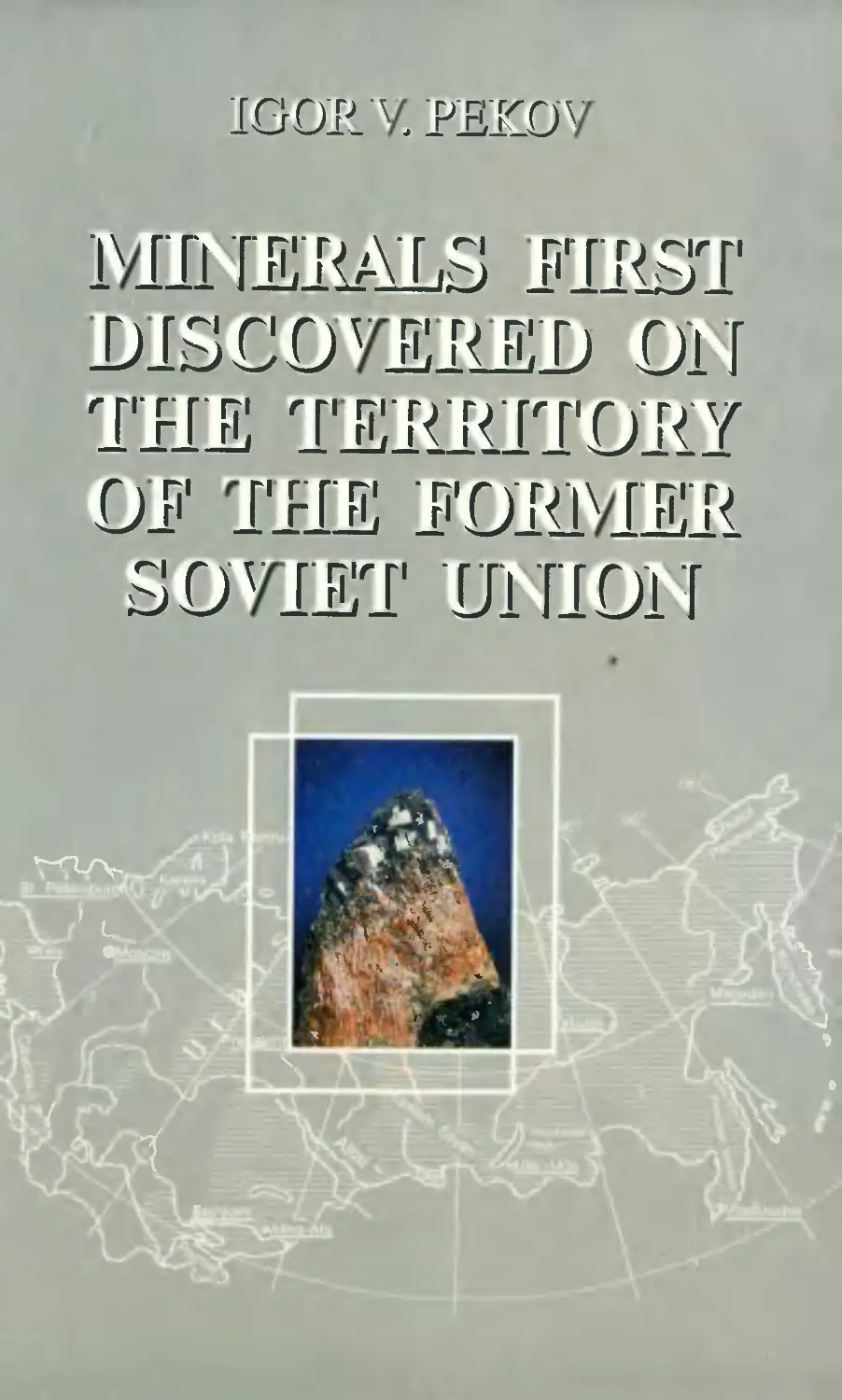
MINERALS FIRST
DISCOVERED ON
THE TERRITORY
OF THE FORMER
SOVIET UNION
Q Ocean Pictures
P Moscow 1998
ISBN-5-900395-16-2
Igor V. Pekov
Minerals First Discovered on the Territory of the former Soviet Union.
Moscow, Ocean Pictures Ltd, 1998, pp. 369, color illustrations 184.
In this book, information about the type localities and the history of the discoveries of al)
new minerals found on the territory of the former Soviet Union (582 mineral species,
from 1766 to 1997) is availablefor the first time. The book also contains information on
the type specimens of the minerals that are kept in Russian museums; data on the persons
for whom the minerals were named; portraits of discoverers of new minerals; 146 colour
photographs and 68 SEM-photographs of minerals; 24 geographical schemes and 38 colour
pictures showing the type localities; a complete index of place names; and 761 references.
The book is intended for mineralogists, museum curators, specialists in the history of
geology, and mineral collectors.
Executive Editor
Editor
Design, layout
Minerals Photos
Editor (style, English)
Translators
Production Manager
Ludmila A. Egorova
Levon V. Oganesyan
Dmitriy A. Kilpio
Nataliya A. Pekova, MichaelA. Bogomolov, Michael B. Leybov.
Deborah K. Howard (Nikolaeva)
Mark Fed’kin. Michael Girfanov, Valerii Gerasimovskii
Nikolai O. Parlashkevich
© Igor V. Pekov
© Photos belongs to authors
© Design Ocean Pictures Ltd.
Published by Ocean Pictures Ltd.
P.O. Ocean Pictures Ltd.
Box 368, Moscow 103009 Russia
Phone/fax (7-095) 203 3574
e-mail oceanpicture@glasnet.ru
All rights reserved. No part of this publication may he reproduced in any material form
(including photocopying or storing it in any medium by electronic means and whether or not
transiently or incidentally to some other use of this publication) without the written permission
of the copyright owners.
Отпечатано с готовых диапозитивов
в типографии ОАО «Внешторгиздат». Заказ № 295
Content
Introduction................................................ 7
About this book..............................................9
Acknowledgments.............................................13
Abbreviations...............................................15
Part 1. Minerals First Discovered on the Territory
of the Former Soviet Union..................................19
Part 2. Geography of Discoveries...........................253
Part 3. Chronology of Discoveries..........................286
References.................................................294
Index of place names.......................................331
Persons in whose honour the minerals were named............359
Appendix...................................................368
In the past decade, many new names of young mineralogists have
appeared and fine mineralogical editions have been published in Russia.
First of all one should mention the journal World of Stones and the
mineral reviews published in it devoted to the deposits of the Kola
Peninsula, the Urals, and Siberia. A complete summary of discoveries
of uranium minerals in Russia is given in Proceedings of the Russian
Mineralogical Society, 1997, 4. This book is the first and the most
comprehensive bookabout 582 new minerals discovered in Russia (within
its former and modem boundaries). The author of this book, Igor V.
Pekov (Moscow University), is a young but well-known mineralogist.
He is famous, in particular, for his work at the alkaline massifs of the
Kola Peninsula and Greenland and as a discoverer and investigator of
several new minerals. His publications show that he,is a very serious,
accurate, and conscientious author. One can be certain that this book
contains very reliable facts and precise data and therefore that will it
provide trustworthy and long-term service to mineralogists of many
countries.
Professor Andrei G. Bulakh,
Chairman of the Commission
on New Minerals and Mineral Names
of the Russian Mineralogical Society,
Saint Petersburg University
INTRODUCTION
In recent years, interest in history of mineralogy has grown significantly.
This is reflected in serious books and articles presently published all over
the world. The history of the discovery of new minerals, precise definition
of their type localities, and compilation of data on type specimens
preserved in museums are very important and deserve primary attention.
Such work is regularly performed in many countries, because the
description of a new mineral, even if it is very rare and microscopic, is a
fundamental discovery in the field of natural sciences and a contribution
not only to mineralogy and geology, but also to solid-state physics,
chemistry, and crystallography. The number of minerals discovered in a
country is a quantitative indicator of mineralogical progress, a parameter
that one can really be proud of.
This book presents a summary of minerals discovered on the territory of
the former Soviet Union, covering one sixth of the Earth’s land mass.
The number of mineral species discovered from this area is now
approaching 600, which is approximately 15% of all known minerals.
Only in the United States have more mineral species been discovered.
Although the USS R no longer exists as a state, the territory of the former
Soviet Union is a unified area with respect to its geological study. In due
time, the USSR replaced the Russian Empire, where certain traditions
and methods of geographic, geological, and mineralogical studies had
developed over more than two centuries of the history of this area. The
most intense geological exploration was carried out in the Soviet period:
large scientific and production associations were founded; many
outstanding scientists and high-potential research groups worked, and
some of them continue working to the present day; and detailed maps and
bulletins were compiled. Common rules of geological surveying and data
presentation, including the ill-known secrecy system, were accepted
throughout the USSR for many years. It is in the last 50-70 years that most
of the mineral deposits in all of the Soviet republics were discovered. The
mining i ndustry developed actively. The same goes for mineralogy: only 46
mineral species, i.e., less than 8% of the total number, had been discovered
in Russia in the pre-Soviet period (before 1917-1921). An analysis of the
Publications showed that most of the mineralogical studies in the USSR.
especially reports of new minerals, were performed by scientists from several
institutions concentrated in large scientific centers of the USSR (mainly
in Russia). The results of these studies were mostly published in Russian
journals. Thus, the territory ofthe former USSR is asingle object for regional
mineralogical studies and should be considered as a whole in reviews of
this kind.
Within this book, the author intended to embrace all the mineral species
discovered on the territory of the former Soviet Union. You will not find
here, with rare exceptions, physical and chemical constants of minerals—
there are special reference books for that. The present summary is more
likely to be a historical and geographic review. This work was dictated to
a great extent by the incompleteness, inconsistency, and even absence
or fallibility of data on type localities of minerals discovered on the
territory of the former Soviet Union cited in comprehensive reference
books. The authors of these remarkable books [44,118,462, etc.] can
not be accused of incompetence; unfortunately, there are many objective
factors that have caused serious blank spots in the history of mineralogy
ofthe USSR. First, most mineralogical studies were published in Russian;
only some of them were translated into European languages, and the
geographic details were often missed in abstracts. Many studies were
published in limited or regional editions, which were not abstracted and
were hardly accessible to foreign readers. Second, a great negative role
was played by the strict secrecy system for geographic information used
in geological surveying, which was introduced in the USSR in 1945-
1947 and sustained for nearly half a century. It primarily concerned the
objects containing so-called «strategic stock»: rare, radioactive, and
precious metals, boron, etc. Publication of geographic locations of
minerals of these elements, even those found at non-economic locali-
ties, was not allowed. That is why such phrases as «one of the USSR
deposits,» «found in Kazakhstan,» etc., appeared in the Russian papers.
In non-Russianpublications, the reference «unspecified locality, USSR»
was rather common. Third, it would be unfair to ignore such an important
factor as the immense area of the USSR. This is especially important
combined with the poor availability of large-scale geographic maps
(because ofthe same secrecy). Thus, even if a small occurrence, stream,
or hill was used as reference, it was very difficult, almost impossible, to
define correctly its location in the area. The above-listed factors and
others caused many gaps in the history of mineral discoveries in the
USSR. To fill these gaps is one of the main aims of this work. From the
aforesaid peculiarities and since it requires the refinement of many
details, this work can and should be done only in Russia. It should be
done at the present, because many important facts are based on
information that was not published for any one of several reasons, but is
still kept in memory of the immediate participants of the events.
Of course, summaries on minerals discovered in Russia, the USSR, or
in their divisions were previously published as well. In Russia this work
was first initiated by D.I. Planer, who published several reviews on new
minerals in «Gornyi zhurnal» (Mining Journal) in [518-522] and later
prepared a comprehensive summary in [516]. This book was most likely
the first in the world summary on new minerals. Bulletins on newly
discovered minerals were regularly issued in the USSR since the 1930s
in the form of current information in «Zapiski Vsesoyuznogo
Mineralogicheskogo Obshchestva» (Proceedings of the All-Union
Mineralogical Society) or brochures [53]. Special bulletins on minerals
discovered in the USSR [127,163, etc.] or its regions [ 154,229,329,684,
etc.] were also published. This book continues and supplements these
works. However, an emphasis was made on features that are less
elucidated in the aforementioned studies—the history and detailed
geography of mineral discoveries and complete references. This book
also includes data on type specimens, an index of place names, and
illustrations, elements absent in earlier reviews.
The author began to collect detailed information on type localities and
type specimens of minerals discovered in the USSR in 1990, following
the advice of his teacher Viktor Ivanovich Stepanov (1924-1988), an
outstanding Russian encyclopedist mineralogist. V.I. Stepanov was
probably the first in the USSR who comprehended the importance of
this kind of information and who accumulated the data in the catalog of
his systematic mineralogical collection.
Data for the present summary were primarily drawn from the following
sources:
(1) Published materials;
(2) Fund materials: special reports, dissertations, etc.;
(3) Personal communications of the authors of mineral discoveries, other
researchers involved in these studies, and specialists in the history of
geology;
(4) Museum collections (when type specimens were used).
To refine a details, the author personally visited some objects in the
European territory of the former Soviet Union, the Urals, Kazakhstan,
and Central Asia, where many new minerals were discovered^
ABOUT THIS BOOK
As mentioned above, the present book was intended as a reference review
with historical and geographic character. Preference was given to
information that is usually missed or poorly presented in the majority of
mineralogical publications. The main section of this book is a list of the
582 mineral species discovered on the territory of the former Soviet
Union, with description of their type localities and the historical data on
discovery. The histories of the most recently discovered minerals include
references to no more than one (the first) or a few publications, while
the discoveries of others were related to some events in the past, which
are of historical interest, in the author’s opinion. Some minerals were
described as newly discovered several times, were called different names,
etc. This summary basically embraces the minerals approved by
CNMMN IMA, which are included in the «Glossary of Mineral Species»
by M. Fleischer and J.A. Mandarino [162], and minerals recently
discovered and approved by CNMMN IMA that have already been
published data. In addition, sixteen more minerals supported by reliable,
in the author’s opinion, evidence fortheir individuality are also included.
Some of these— allanite-(La), gutsevichite, tinnunculite, and volfsonite
—are present in «Glossary...,» but are not defined as full-status mineral
species. In the author’s opinion, published data on ten other minerals
included — calcioursilite, calcybeborosilite-(Y), dashkesanite (chloro-
potassic-hastingsite), ferriphlogopite, lomonosovite-beta, magnioursilite,
nenadkevite, polarite-(Pb), tadzhikite-(Y), and trichalcite— allow these
to be distinguished as individual mineral species. Loranskite-(Y),
turanite, and zinalsite, which are present in «Glossary...,» are not
included in the present review, since there is considerable evidence for
the identification of these minerals with other minerals. The individuality
of arsenosulvanite, carbonate-cyanotrychite, saryarkite-(Y), and
sergeevite and the natural origin of tantalcarbide and kafehydrocyanite
are being discussed now; however, a revision of holoty pe specimens is
necessary to make ultimate conclusions. Therefore, these minerals are
also included in the review as mineral species.
Thus, the article on each mineral contains information on the type lo-
cality and the history of the first discovery; the chemicql formula, group,
a brief description of the first find (morphology, size, color, occurrence
conditions, and associated minerals), the name origin, the place of
preservation of type specimens, and references are also given.
THE TYPE LOCALITIES are the most important information in this
section. To characterize geographic locations most precisely, no
«superfluous» details were omitted. The names of ore-bearing and
pegmatite bodies, the numbers of mines, the depths of sampling in
boreholes, etc., are indicated whenever this information has been possible
to obtain. Most of the type localities are attributed to deposits, mines,
mountains, intrusive massifs, or other objects corresponding to the
concept of «a spot on the map.» The geographic locations often include
data drawn from different sources; in these cases, no reference is given
for each particular source. If a mineral was described as a new mineral
species simultaneously from several localities, all of them are chara-
cterized, but not all of them are always considered as the type locality.
This depends on the degree of study of the specimens from one or site
another. For example, lavrentievite was simultaneously reported from
Arzak and Kadyrel’ occurrences. The original paper presents the
chemical composition, properties, and detailed description of this
mineral from both localities; thus, both Arzak and Kadyrel’ can equally
be regarded as type localities. The original description of vinogradovite
indicates 12 points within the Lovozero and Khibiny massifs where this
mineral was found; however, the chemical composition and X-ray data
(the most important characteristics) are presented only for the speci-
mens from Takhtarvumchorr Mt. (Khibiny) and Lepkhe-Nel’m Mt.
(Lovozero). Thus, only these two sites of the known twelve can be
regarded as the type localities of vinogradovite. If a mineral was
simultaneously described as a new mineral species from deposits located
both within and beyond the territory of the former Soviet Union, only
the former are considered.
There is a problem in translating Russian, Turkic, and other names into
nglish. Unfortunately, there is no agreement between the terms used in
i erent publications. Well-known geographic names were translated as
th^ аГе un'versa^V used 'n the modem English publications and maps;
names of minor objects were transliterated according to the commonly
Pted rules of English-Russian transliteration. In recent years, many
geographic names in the territory of the former Soviet Union were changed;
nevertheless, the names of the Soviet period were preferred in the present
1 book, as those more are familiarto readers worldwide. As a rule, the names
are accompanied by relevant explanations. Moreover, the geographic index
contains original Russian transcriptions of geographic names in addition
to the English terms. The type localities are typed in bold in the index.
MINERAL NAMES. The origin of mineral names is described briefly.
Such information has previously published been for most mineral species
[44,445]. The section «Name» was introduced principally to give more
information about the persons for whom the minerals were named. The
full name, life period, activities, and primary (or the most recent) job
are indicated for each of them (the cities later renamed are given as they
were named at the time when the person worked there). The index at the
end of the book includes both Russian and English transcriptions of
people’s names. The information about the people for whom the minerals
were named was obtained with the kind help of the associated of the
Division of the History of Geology, Vernadsky State Geological Museum,
Russian Academy of Sciences.
TYPE SPECIMENS (TS) are those material in which a new mineral was
first studied. There is no need to speak again about the importance of
TS for some kinds of mineralogical studies, especially revisions aimed
at the refinement of mineralogical nomenclature. Large museums are
the perfect place for TS keeping. According to CNMMN IMA
requirements (unfortunately, introduced only recently), authors should
submit the thoroughly studied specimens of new minerals to museums,
where they are kept as «standard samples» of these mineral species. In
addition to their scientific importance, TS are also of great historical
value. In this book, TS are meant to be a studied specimen (piece, grain,
* polished section, etc.) of a new mineral from its type locality presented
to a museum by the discoverer. TS may also include the material of
revisional studies that confirms (neotype) or discredits (nekrotype) the
individuality of a mineral species in doubt. At present, the Commission
on Museums of IMA pays primary attention to the registration of TS;
such work is underway in many countries.
Most of TS of the minerals discovered in the USSR are preserved in
museums of Russia. The richest collections belong to the Fersman
Mineralogical Museum of RAS, Moscow (385 mineral species), and
the Mining Museum, St. Petersburg Mining Institute (225 mineral
species). From 1993 to 1997, the author of this book made the work on
the systematic registration of the TS of the minerals discovered in the
USSR kept in these two museums and in the GeologicaLMuseum of the
Geological Institute of Kola Scientific Center of RAS, Apatity (64
species), the Mineralogical Museum of St. Petersburg University (27
species), and the Natural Science Museum of the Ilmeny Natural
Reserve, Miass (25 species). The author’s efforts were actively supported
by the collaborators of these museums. All information collected,
including data on the TS from the collection of the Vernadsky State Geo-
logical Museum, Moscow (40 species) kindly presented by E.L. Minina,
is cited in the main section of the book in the TS paragraphs, which
follow the mineral descriptions. Other museums have few TS, as a rale,
no more than ten mineral species (except the Central Siberian Geological
Museum, Novosibirsk). The TS paragraphs indicate the museums in
which the specimens are preserved (for abbreviations, see below) and
specimen numbers according to the catalogue record. In some cases,
only the museum name is given without a specimen number. This implies
that the specimen has been submitted to the museum only recently and
has not yet been recorded in the main fund. In some cases, data were
drawn from the original descriptions of minerals, and the TS numbers
are unknown. TS were not found for one hundred minerals of 582
included in the summary; these are mostly «old» minerals (18th -19th cen.).
REFERENCES are listed at the end of the book. Complete references
to the original descriptions are given for most of the minerals. Other
publications that seem to be important with respect to the history or
classification are also referred to when it is necessary. Unfortunately,
some of the oldest studies have not been found; the references to them
are not complete and were drawn from other publications. The
abbreviations of the periodicals used in the references are given below.
ILLUSTRATIONS in this book include color and black-and-white
(SEM) photos of mineral specimens, crystal drawings, pictures of some
type localities, schematic maps, and portraits of scientists whose
contributions to the study of new minerals have been most significant.
Gf 146 color photos of mineral specimens, 37 were taken by M.A. Bogo-
molov (Nos. 2, 4, 5, 8, 13, 19, 21, 22, 25, 29, 37-39, 42, 44, 49, 59, 62,
об, 73, 75-77, 85,97, 104, 112, 115-117, 119, 126, 128, 134, 135, 138,
2), 5 were taken by M.B. Leybov (Nos. 6, 27, 30, 140, 144), and the
remaining 104—by N.A. Pekova. Most of the specimens are frcfh the
author’s collection; in other cases, the collection to which a specimen
belongs is indicated in the figure caption. Specimens from type localities
are largely shown in the pictures; in some cases, similar specimens
from other localities were used. Most of the SEM-photos were made
by Prof. V.N. Sokolov (Moscow University) and the author with
specimens from the author’s collection and type specimens from the
Fersman Mineralogical Museum of RAS, Moscow, and the Mining
Museum, St. Petersburg Mining Institute. Some SEM-photos were
kindly presented by other authors. The crystal drawings were mostly
borrowed from the publications and are given as they were originally
published. The crystals of some minerals were measured by the author
with a two-limb goniometer G D-1; these drawings are published here
for the first time. The schematic locality maps were compiled with
different scales for different regions, depending on the density of objects
within the area. For the objects not precisely located, the environs of
mineral occurrence is indicated with a circle instead of a point.
ACKNOWLEDGMENTS
This work could not have been done without the help of many people,
who provided unpublished information, valuable consultations on
history and geography, specimens for the pictures, illustrations, and
assistance in work with archives and museum collections. The author
is grateful to all who helped him in the preparation of this book, namely,
L.K. Yakhontova, E.M. Spiridonov, R.A. Vinogradova, LA. Bryzgalov,
A.A. Ul’yanov, Q.V. Yakubovich, V.N. Kalachev, and N.N.Morozova
(Moscow University); M.L Novgorodova, E.I. Semenov, M.D. Dorf-
man, D.L Belakovskii, M.A. Smirnova, M.B. Chistyakova, S.N. Nena-
sheva, A.B. Nikiforov, and D.V. Abramov (Fersman Mineralogical
Museum, Moscow); N.N. Devnina, E.E. Popova, O.A. Golynskaya,
E.S. Svirina, and N.Yu. Pitomtseva (Mining Museum, St. Petersburg
Mining Institute); G.F. Anastasenko, M.D. Evdokimov, A.R. Nesterov,
and E.P. Reguir (St. Petersburg University); A.D. Genkin, T.L. Evsti-
gneeva, V.A. Kovalenker, L.N. Belova, A.A. Chernikov, A.G. Mochalov,
P.M. Kartashov, V.N. Apollonov, S.F. Sluzhenikin, V.I. Kudryashova,
G.N. Muravitskaya, and A.P. Khrenov (IGEM, Moscow); S.V. Ma-
linko, A.E. Lisitsyn, G.A. Sidorenko, E.P. Shpanov, LI. Kupriyanova,
N.V. Skorobogatova, and Yu.V. Yashunskii (VIMS, Moscow);
Acknowledgments
AP.Khomyakov (IMGRE, Moscow); V.D. Begizov (Moscow Geo-
logical Exploration Institute); N.S. RudashevsRii (Institute of
Mechanical Processing of Mineral Stock, St. Petersburg); V.I. Vasil’ev
(Institute of Geology, Novosibirsk); O.K. Ivanov (Ural Mining and
Geological Academy, Yekaterinburg); Yu.P. Men’shikov, E.M. Kalinina,
N.V. Sorokhtina, S.N. Britvin, G.Yu. Ivanyuk, V.N. Yakovenchuk, and
R.P. Liferovich (Geological Institute, Apatity); B.V. Chesnokov,
V.A. Popov, V.I. Popova, A.F. Bushmakin, L.A. Pautov, V.Yu. Karpenko,
and A.A. Agakhanov (Institute of Mineralogy and Ilmeny Natural
Reserve, Miass); V.M. Bocharov (IGN, Alma-Ata); S.I. Konovalenko
(Tomsk University); L.I. Bochek (TsNIGRI, Moscow); E.L. Minina,
Z.A. Bessudnova, and V. V. Matias (Vernadsky State Geological Museum,
Moscow); S.M. Aleksandrov (GEOKhI, Moscow); P.Yu. Petrov (Geo-
logical Instiute, Moscow); N.V. Chukanov (Institute of Chemical Phys-
ics, Chernogolovka); and the collectors A.S. Podlesnyi, M.N. Mu-
rashko, V.G. Grishin, and V.V. Levitskii. The author specially thanks
Prof. A.V. Voloshin (Geological Institute, Apatity) for active and all-
round support; A.A. Evseev, senior scientist of the Fersman Minera-
logical Museum, for consultation on geography of the discoveries; and
Prof. A.G. Bulakh, Chairman of the Commission on New Minerals
and Mineral Names of the Russian Mineralogical Society, for valuable
remarks and discussion. Particular thanks to Prof. V.N. Sokolov, who
made the SEM-photos, and M.A. Bogomolov, M.B. Leybov, and
N.A. Pekova, who performed the color photography of mineral speci-
mens. The help of N.A. Pekova in the preparation of other materials for
this book was of inestimable value. In conclusion, the author thanks
S.V. Fedyushchenko (Moscow University), whose assistance made pos-
sible the publishing of this book.
ABBREVIATIONS
I. MUSEUMS
CSM - Central Siberian Geological Museum, Novosibirsk
FM - Fersman Mineralogical Museum, Russian Academy of Sciences, Moscow (specimen
numbers: ordinary No. - systematic collection, m-No. - collection of deposits; r-No. -
record numbers; vis-No. - V.I. Stepanov’s collection; if no number indicated, the
specimen is held in the special collection «New minerals»).
1R - Natural Science Museum, Ilmeny State Reserve, Miass
KSC - Geological Museum, Geological Institute, Kola Scientific Center, Russian
Academy of Sciences, Apatity.
PMM - Mining Museum, St. Petersburg Mining Institute (specimen numbers: No. -
systematic collection; rec. No. - record numbers of recently coming specimens)
PU - Mineralogical Museum, St. Petersburg University.
VG M - Vernadsky State Geological Museum, Russian Academy of Sciences, Moscow.
YM - Geological Museum, Institute of Geosciences, Yakutsk Scientific Center, Russian
Academy of Sciences, Yakutsk.
II. OTHER INSTITUTIONS
CNMMN IMA - Commission on New Minerals and Mineral Names of International
Mineralogical Association.
GEOKhI - Vernadsky Institute of Geochemistry and Analytical Chemistry, Russian
—Academy of Sciences, Moscow.
IGEM - Institute of Geology of Ore Deposits, Petrography, Mineralogy, and Geochemistry,
Russian Academy of Sciences, Moscow.
IGN - Institute of Geosciences (institutes with such names have been existing in different
cities of the USSR; city is indicated in the text).
IMGRE - Institute of Mineralogy, Geochemistry, and Crystallography of Rare Elements,
Russian Academy of Sciences, Moscow.
Mingeo - Ministry of Geology of the USSR
RAS - Russian Academy of Sciences (before 1991, AN USSR - Academy of Sciences of
the USSR).
TsNIGRI - Central Institute of Geological Exploration for Base and Precious Metals,
Moscow.
VIMS - All-Union (now Russian) Research Institute of Mineral Resources, Moscow.
VSEGEI - Karpinskii All-Union (now Russian) Research Institute of Geology, St.
Petersburg.
III. RUSSIAN PERIODICALS
PAN - DokladyAkademii Nauk SSSR (since 1992- Doklady Rossiiskoi Akademii Nauk)
(Transactions of Russian Academy of Sciences) *
DAN UzSSR - Doklady Akademii Nauk Uzbekskoi SSR (Transactions of Academy of
Sc.ences of Uzbek SSR)
Ged. i geofiz. - Geologiya i geofizika (Geology and Geophysics)
Geol. Zh. - Geologicheskii Zhumal (Geological Journal)
GZh - Gomyi Zhumal (Mining Journal)
GRM - Geologiya rudnykh mestorozhdenii (Geology of Ore Deposits)
Izv. AN - Izvestiya Akademii Nauk SSSR (since 1992 - Izvestiya Rossiiskoi Akademii
Nauk) (Repons of Russian Academy of Sciences)
Min. Zh. - Mineralogicheskii Zhumal (Mineralogical Journal)
Tr. IMG RE - Trudy J nstituta Mineralogii, Geokhimii i Kristallografii Redkikh Elementov
(Proceedings of Institute of Mineralogy, Geochemistry, and Crystallography of Rare
Elements)
Tr MM - Trudy Minerak>gicheskogo Muzeya im. A.E. Fersmana (Proceedings of Fersman
Mineralogical Museum, Acad. Sci. USSR) [in some years this journal had additional
titles: «Novye dannye о mineralakh»(New Data on Minerals) or «Novye dannye о
mineralakh SSSR» (New Data on Minerals of USSR)]
Tr. TsNIGRI - Trudy Tsentral’nogo Nauchno-Issledovatel’skogo Geologo-Raz-
vedochnogo Instituta (Proceedings of Central Institute of Geological Exploration for
Base and Precious Metals)
Tr. VN1IG - Trudy Vsesoyuznogo Nauchno-Issledovatel’skogo Proektnogo Instituta
Galurgii (Proceedings of All-Union Research and Projecting Institute of Halurgy)
Vestn. MGU - Vestnik Moskovskogo Universiteta (Proceedings of Moscow University)
ZVMO - Zapiski Vserossiiskogo Mineralogicheskogo Obshchestva (1933-1947 and since
1992), Zapiski Rossiiskogo Mineralogicheskogo Obshchestva (1923-1932), and Zapiski
Vsesoyuznogo Mineralogicheskogo Obshchestva (1948-1991) (Proceedings of the
Russian Mineralogical Society)
IV. NON-RUSSIAN periodicals
Amer.Miner. - American Mineralogist
Bull.Soc.Nat.Moscou - Bulletin de la Societe des Naturalistes de Moscou
C.R.Ac.Sci. - Comptes Rendus de l’Academie des Sciences de Paris
Can.Miner. - Canadian Mineralogist
Eur.J.Miner - European Journal of Mineralogy
Prakt.Chem. - Journal fur Praktische Chemie
Miner. Mag. - Mineralogical Magazine
N.Jb.Miner.Mh. - Neues Jahrbuch fur Mineralogie. Monatshefte
Pogg.Ann.Phys.Chem. - Poggendorfs Annalen der Physikund Chemie
Tscherm.Min.Petr.Mitt. - Tschermaks Mineralcgische und Petrographische Mitteilungen
Zs.Krist. - Zeitschrift fur Kristallographie und Mineralogie.
E - eastern
W - western
S - southern
N - northern
SE - southeastern
SW - southwestern
NE - northeastern
NW - northwestern
•
geol. - geological
in-t - institute
izv - izvestiya (reports)
L - published in Leningrad (now St. Petersburg)
M - published in Moscow
mater. - materialy (materials)
Mt. - Mountain
Mts. - Mountains
p - page
pt. - part
sb. - sbomik (collected articles)
SEM - scanning electron misroscopy •
ser. - series
tr. - trudy (proceedings)
vol. - volume
zh - zhumal (journal)
(Rus.) - publication in Russian
° - color photo is given
* - SEM photo is given
Part 1
Minerals First Discovered
on the Territory of the
Former Soviet Union
ACETAMIDE, CH3CONH2
Acetamide was found in a burning dump of a coal mine in the town of
Chervonograd, Lvov-Volyn coal basin, Lvov district, W Ukraine. This
mineral fills small cavities in sal ammoniac enriched zones and occurs
as colorless transparent hexagonal prismatic crystals to 5 x 2 mm in size,
grainy aggregates, and small stalactites. It is water-soluble and evaporates
on exposure to sunlight (so-called «season» mineral) [659].
Name: from the chemical composition: acetic acid amide.
TS: FM 77109; PMM 1086/1
AESCHYNITE-(Ce), (Ce,Ca,Th)(Ti,Nb)2O6
'Aeschynite-(Ce)
was discovered in
the Ilmeny Mts.,
.S Urals. The type
locality’ of this min-
eral is exactly deter-
mined as the group
°f pits presently
known as Pits nos.
75-76 («pits behind
the Dolgiye Mosty,»
as c*ted in the issues
of the 19«h cen )
AESCHYNITE-(Ce) crystals, after Kokscharow
* >. «
г —-----------------------------------------------
А Minerals First Discovered on the Territory of the Former Soviet Union
this mineral was found here in 1825 by J.N. Menge [437] and was
rnistaken for gadolinite:«... In this granite... (with feldspar, silver-white
mica, and zircon), I discovered Gadolinite occurring as twisted prisms
fotuse on sharp lateral edges and all vertices ... Gadolinite crystals are
fare and are typically present in specific vugs in granite with abundant
fetica and red feldspar. I have some Gadolinite crystals with lateral faces
overgrown with zircon. All Gadolinite crystals were found in the dumps
of old stone quarries...» [438]. In 1860, N.I. Kokscharow noted that
«...the hole being worked for aeschynite is still called the Gadolinite Pit...»
[335]. Menge’s gadolinite specimens were analyzed by J.J. Berzelius,
who identified it as a new mineral and gave it the name «zirconia titanate»
(1828) [35], and, later, aeschynite. «..Aeschynite was so named by
Berzelius; this term originates from lam ashamed, since titanium acid
could not be properly distinguished from zirconia that time...» [335]. In
these pits, aeschynite-(Ce) occurs with feldspar, micas, nepheline,
magnetite, zircon, and pyrochlore in an alkaline pegmatite. It forms well-
shaped prismatic crystals. Kokscharpw wrote: «The largest (aeschynite)
crystal that I have ever seen is kept in P.A. Kochubei’s collection. It is
about 6 cm in length and about 2 cm on the brachydiagonal axis...» [335].
At present, aeschynite-(Ce) is known at many localities ofthe Ilmeny
Mts., however the specimens from Pits nos. 75-76 (crystals to 10 cm)
still remain the best ones.
Name: from Greek aeschyne, shame, alluding to the inability of chemists
at the time of its discovery to separate some of its constituents.
AESCHYNITE-(Nd), (Nd,Sm..)(Ti,Nb)2O6
Aeschynite-(Nd) was distinguished as a mineral species by A.A. Levinson
in 1966 [394] on the basis of the detection of the Nd-maximum in
aeschynite REE spectrum described by Е.1. Semenov and R.L. Barinskii
in 1958 (the first published analysis of Nd-dominant aeschynite [605]).
This specimen (I.P. Tikhonenkov’s collection) came from an alkaline
syenite pegmatite of the Tatarskii Massif, Tatarka River, Enisei Range,
Krasnoyarsk Territory, Siberia. The lantanoids ratio was determined as
La22Ce13Pr67Nd22Sm17Gd13Tb25DyllHol5Er55Tm8Yb22Lu5[605].
Name: Nd-dominant analogue of aeschynite-(Ce).
AIKINITE, PbCuBiS3
Aikinite was discovered at the Berezovskoye gold deposit, Middle Urals,
where it is the most typical ore mineral of gold-bearing quartz veins. It
was probably first noted by P.S. Pallas in 1786 as «fahlerz-like fluidal
matter». B. Hermann described it ins 1789 as «radiant bismuth» [215];
this publication should be regarded as the date of aikinite discovery. Later,
aikinite from the Berezovskoye was repeatedly described by different
names: «Nadelerz» (needle ore) by F. Mohs (1804), «Bismuth sulfure
plumbo-cuprifere» by R.J. Hauy (1809), etc. The present-day name was
proposed by E.J. Chapman in 1843. For a long time the Berezovskoye
supplied aikinite samples to mineral collectors all over the world; here,
aikinite needles up to 14 cm in length ingrown in quartz (often
transparent) were found. The Berezovskoye is still being worked now,
and aikinite can still be found here. The place of aikinite discovery in
the Berezovskoye ore field is now impossible to establish exactly.
A.A. Smirnov [444] believes that the Preobrazhenskii and Klyuchevskii
mines were the sources of the first aikinite finds. However, this suggestion
is not plausible, since the Preobrazhenskii mine was opened only in 1797
[791, i.e., ten years after the first reports of this mineral.
Name: after Arthur AIKIN (1773-1854), English chemist and
mineralogist, a founder of the Geological Society of London.
AKDALA1TE, 4A12O3 • H2O
Akdalaite was found in the dump of the prospecting Hole no. 9 at the
Solnechnoye («Sunny») fluorite deposit, 2 km west of the famous Kara-
Oba tungsten deposit, Betpakdala Desert, Central Kazakhstan (earlier
the Solnechnoye was known as the Western Area of the Kara-Oba
Deposit). Akdalaite is present as bundles of white translucent tabular
crystals to 0.8 x 1 mm in size, which occur in the axial parts of the fluorite-
muscovite veinlets crossing the amesite-muscovite-fluoite rock formed
after dolomitized limestone [626|.
Name: fortype locality area, Akdala («white steppe», Kazakh.), Kazakh
name of vicinity of Kara-Oba, the part of Betpakdala Desert.
TS: FM 72120
AKHTENSKITE0, e-MnO2
Akhtenskite was first described in 1982 [111] without a name, as a natural
analogue of synthetic e-MnO2, which was obtained in 1951 [338] and is
now industrially produced for Leclanche cell production. The mineral
was identified in an old (19th cen.) specimen no. 307/5 from the
collection ofthe Mining Museum of the St. Petersburg Mining Institute;
1 was taken from the Akhtenskoye brown iron ore deposit north of the
l°wn °f Magnitka, Zlatoust district, S Urals. This specimen, which is
died «psilomelane,» appears as a massive fine-grained dark gray q a
Sgregate composed of cryptomelane, nsutite, and E-MnO2-phase(lIl]i •
j|he name «akhtenskite» was approved by CNMMN IMA in 1983; a
detailed description of the mineral was given by F.V. Chukhrov etal., in
089 [112].
feme: for type locality.
IgS: PMM 307/5
AKSAITE, MgB6O7(OH)$ • 2H2O
Aksaite was found in 1956 in the core of a
borehole in the Aksai Valley at the giant
Chelkarsalt dome, Uralsk district, W Ka-
zakhstan. Aksaite occurs as colorless, white,
or grayish flattened crystals no more than a
few millimeters in size (rarely 1.5 cm) in
halite and bischofite-halite rock with
boracite, ginorite, halurgite, strontioborite,
metaborite, etc. [45,411].
Name: for type locality •
AKTAS H ITE °, Cu6Hg3As4S]2
Aktashite was discovered at the Aktash
mercury deposit, southern slope of the
western margin of the Kurai Range, Kosh-
Agach district, Gorny Altai. Aktashite
crystals appear as small (typically < 1 mm)
elongated tetrahedra or trigonal pyramids
or black grains embedded in quartz or
calcite. The mineral is a constituent of
polysulphide ores together with pyrite,
sphalerite, stibnite, cinnabar, fahlore,
chalcostibite, luzonite, enargite, etc. [675].
Name: fortype locality.
TS:CSMIII-14/1
ALACRANITE0*, As8S9
Alacranite was first noted by A. Clark as
alpha-arsenic sulphide (a-AsS) from the
barite-quartz-calcite veins of the Alacran
silver deposit, Chile, in 1970 [117]. «The
alpha-arsenic sulphide» was later mentio-
ned in 1977 by A. V. Zotov, who found it in
the products of present hydrothermal
activity at the Uzon caldera, Kamchatka
(Central thermal field and gryphons of the
Euinarol’noye Lake) [761]. As a result of
the analysis of the samples collected by
VA. Popov in the Central thermal field
(Uzon) in 1980, this mineral was compre-
hensively studied, and its exact formula was
derived: AsgS9. At the Uzon, alacranite is
precipitated from low-temperature post-
volcanic hydrothermal solutions. Together
with realgar and uzonite, it cements loose
sand-gravel material and yields the crusts
ALACRANITE crystal,
after Popova et al., 1986
of small (1 mm) isometric bright orange crystals with strong lustre [536]
Name: for locality of discovery of natural oc-AsS.
TS: FM
ALARSITE, AlAsO„
Alarsitc was found in the fumarole products of the Second scoria cone of the
Northern Breakthrough of the Tolbachik Main fracture eruption(1975-1976),
Kamchatka. Crusts composed of colorless, white, or cream-colored isometric
alarsite crystals and grains to 0.3 mm in size are associated with fedotovite,
klyuchevskite, lammerite, tenorite, nabokoite, atlasovite, langbeinite, and
hematite. Alarsite is a structure analogue ofberlinite (Al PO4) and quartz [613].
Name: from the chemical composition: aluminum arsenate
ALEKSITE, PbBi,Te2S2
Aleksite was found at the Alekseevskoye gold occurrence, Sutam region,
Stanovoi Range, SE Yakutia. The mineral occurs as light steel-gray plates to
1 mm in size in sulphide-quartz veins where it associates with galena, gold,
altaite, tetradymite, tsumoite, rucklidgeite, etc. [396].
Name: for type locality.
TS. FM79060; Museum of the Earth Research, Moscow University.
ALLANITE-(La), (REE,Ca)2(Al,Fe)3(SiO.)3OH,
ere REE=(La,Nd,Ce ...), Epidote group
anitc-(La) was set aside as a mineral species by A. A. Levinson in 1966 on
e basis of the REE composition of allanite (orthite) from N Karelia
determined by K.K. Zhirov et al. (1961), which was the first published
Analysis of La-dominant allanite [394]. The specimen was «black resinous
unaltered orthite» from a granite pegmatite vein in the Olenchik Island,
p hupa Bay, N Karelia [760]. The atomic ratios of main REE calculated
from data [760] are La:Nd:Ce:Pr = 1.36:1:0.68:0.42. According to
A.N. Labuntsov, the pegmatite vein is 120 m in length and 20 m thick
and is mostly composed of microcline, quartz, and oligoclase. Biotite,
muscovite, almandine, allanite, zircon, xenotime, monazite, etc. are
present in subordinate amounts [384].
Name: La-dominant analogue of allanite-(Ce).
ALLUAIVITE, Na19(Ca,Mn)6(Ti,Nb)3Si26O74Cl • 2H2O
Alluaivite was found in the hyperagpaitic pegmatoid rock at the Alluaiv
Mt., Lovozero alkaline massif, Kola Peninsula. The rock is largely
composed of nepheline, sodalite, and K-feldspar and also contains
aegirine, arfvedsonite, cancrisilite, Mn-eudialyte, lamprophyllite,
kazakovite, etc. Alluaivite occurs as rare colorless or rose-tinted
transparent grains to 1 mm in size in intergrowths with eudialyte [295].
Name: for type locality.
TS: FM; PMM 1993/1-2
ALTAITE, PbTe
Altaite was discovered in the Second Zavodinsk Mine, W Altai, now -
E Kazakhstan territory (for more detailed description of the deposit see
HESSITE). The first specimens (containing future hessite also) were
delivered by G. Rose from his trip across the Urals and Altai in 1829.
The analysis performed by Rose yielded the composition Те 38.37%, Pb
60.35%, and Ag 1.28%. In 1830, the scientist published the results and
named the new mineral «Tellurblei» [572]. Altaite got its present name
in 1845. N.I. Kokscharow wrote: «The mineral was discovered and first
described by Gustav Rose, who named it «lead telluride» ... Haidinger
gave it the name «altaite,» which is more expressive, since lead telluride
is known only at the Altai...» [333]. Altaite was found with hessite as
small tin-white massive aggregates with indistinct cubic cleavage [572].
Name: for discovery locality at the Altai.
ALTISITE, Na3K6Ti2Al2SiljO26Cl3
Altisite was found in the core of a borehole (depth 470 m) in the vicinity
of the Olenii Ruchei («Reindeer’s Stream») apatite deposit, southeastern
Minerals First Discovered on the Territory of the Former Soviet Union
Khibiny alkaline massif, Kola Peninsula. Altisite occurs as colorless
transparent grains to 3 mm in size, similar to nepheline visually, in
hvperagpaitic pegmatoid rock largely composed of sodalite, nepheline,
K-feldspar, and pectolite; aegirine, shcherbakovite, nefedovite,
villiaumite, natrite, rasvumite, etc. [294]. jb
Name: from the chemical composition: Al, Ti, Si.
TS: FM pl345/1
ALUMINIUM, Al
Native aluminum was first discovered in 1978 in some Siberian gabbro-
dolerite massifs, where grains up to 1 mm in size were found in grindings
together with moissanite and grains of other native elements: copper,
zinc, tin, lead, cadmium, iron, and antimony. In 1984, aluminum was
described in detail as a new mineral. It was first found in the grindings of
anorthositic gabbro-dolerites of the Billeekh Intrusion, and somewhat
later in similar rocks of Dike OB-255 (samples for chemical analysis
were collected), the Tsepochechnyi Intrusion (Vilyui-Markha Zone),
the Ust’-Khann’ya Intrusion (Vilyui River basin), and the
Nizhnefokinskii Intrusion (Norilsk district) [477, 478[. Evidently, the
Billeekh Intrusion (first find) and Dike OB-255 (first analysis) should
be regarded as the type locality of native aluminum.
Name: native Al.
TS:YM
ALUMOHYDROCALCITE °*,
CaAl2(CO3)2(OH)4 • 3H2O
Alumohydrocalcite was discovered in 1925
in the oxidized zone of the Cu-V-ore
occurrence near Potekhina village, 40 km
northeast of town of Sorsk, Khakassia,
Siberia. The mineral forms massive fine-
Porous white, pale blue, violet, or gray
aggregates on limestone together with
a ophane, volborthite, wad, malachite,
cuPnte, native copper, and limonite [42[.
/ Л001 cbemical composition: Al,
(Hydro-), Ca.
Alumohydrocalcite crystals.
Potekhina, Khakassia.
SEM-photo, 9000х.
Specimen: FM 77088.
Al.lMOKLYUCHEVSKITE, K(Cu3A1O2(SO4)4
&umoklyuchevskite was found in fumarole products at the Second scoria
Cpne of the Northern Breakthrough of the Tolbachik Main fracture
Eruption (1975-1976), Kamchatka, where it occurs as dark green
transparent prismatic crystals to 1 mm in length with fedotovite,
langbeinite, tenorite, and lammerite [199].
Name: Al-dominant analogue of klyuchevskite.
TS: PMM 2072/1
ALUMOTANTITE, AlTaO,
Alumotantite was discovered in granite pegmatites at the Vasin-Myl’k
Mt., Voron’i Tundry, Kola Peninsula. The mineral occurs in the segments
of pegmatite veins composed of blue albite. It is present as fine-grained
(typically < 1 mm) colorless crystals and fringes replacing simpsonite and
associates with microlite, cesstibtantite, stibiotantalite, sosedkoitc,
pollucite, lepidolite, etc. |703].
Name: from the chemical composition: Al, Ta.
TS: FM;KSC5518
ALVANITE crystal,
after Ankinovich, 1959
ALUSHTITE, seeTOSUDITE
ALVANITE0,
(Zn,Ni)Al4(VO3)2(OH)12 -2H2O
Alvanite was discovered in 1954 in the
oxidized zone of the V-bearing clay-
anthraxolite horizon at the Kurumsak and
Balasauskandyk vanadium deposits,
NW Karatau Range, S Kazakhstan. The
mineral occurs as bluish green transparent
crystals, hexagonal tables in habit and a few
millimeters in size. The crystals are usually
splitted and grouped in rosettes and crusts,
which line fracture walls in schists near the
subterranean water level. The mineral was originally described with the
formula A13(VO4)(OH)6 • 2.5H2O [9], but later studies revealed that it
contains 7.6% ZnO and 4.2% NiO and corresponds to the formula
(Zn,Ni)Al4(VO3)2(OH)12 • 2H2O 1128].
Name: after its composition: Al, V.
TS: FM 65614; PMM 1249/2
AMAKINITE, Fe(OH)2
Amakinite was found at a depth of300 rh in the Udachnaya-Vostochnaya
j <=. .d-bearing kimberlite pipe, W Yakutia. The mineral occurs as light
green grains and rough-rhombohedral crystals to 2 cm in size and
compose veinlets to 2 cm thick and nests together with serpentine and
carbonate [363].
Name: after the Amakinskaya Geological Expedition, which discovered
Yakutian diamonds; «Атака» is bear (Yakut.).
TS: FM 69547
ANAPAITE0, Ca2Fe[POJ2 • 4H2O
Anapaite was discovered in the small iron
mine at the Zheleznyi Rog («Iron Horn»)
Cape, Taman Peninsula, western extremity
of the Caucasus. The mineral was inde-
pendently studied by A. Sachs (Breslau)
and S.P. Popov (Moscow). The first spe-
cimen was found by Popov during the
Tainan excursion in 1899. Grudging the
single small specimen of the new mineral,
Popov postponed his studies until he
collected additional material in 1902. The
ANAPAITE crystal
new mineral sample that Sachs purchased
from Krantz’s firm was referred as «Zheleznyi Rog Cape, Taman, near
Anapa»; thus, he named it anapaite in his work published in 1902 [588].
A paper by Popov that proposed to call the new mineral tamanite was
published a year later [529]. Anapaite from the oolite iron ores of the
adjacent Kerch Peninsula, Crimea, which was first found there by
•V. Chukhrov in 1934, is now more famous. However, Taman still yields
remarkable specimens, e.g. groups of transparent anapaite crystals in
the stems of fossil trees.
Name, for discovery locality near Anapa.
ANCYLlTE-(La) *, Sr(La,Ce)(CO3)2OH • H2O
ncy ite-(La) was found at the Marchenko Peak, northern part of
minerV|UrnCh°rr Khibiny alkaline massif, Kola Peninsula. The
to 2 occurs as elongated dipyramidal-prismatic pale yellow crystals
mm ln s'ze a,1d its clusters in cavities of a natrolite-feldspar-
pheline-aegirine cross vein in ristschorrite. Ancylite-(La) associates
irith astroph-
yllite, eudial-
yte, biotite,
catapleite,
ilmenite, ap-
atite, loren-
zenite,etc.[742].
Name: La-
dominant
analogue of ANCYLITE-(La) crystal,
drawed from the data
ancyllte-(Ce). by Yakovenchuk et al., 1997
TS: PMM 2092/1
ANYUIITE, AuPb2
Anyuiite was found in the slime obtained by concentration ofthe platinum-
and gold-bearing alluvium of the tributaries of the Bol’shoi Anyui River,
Chukot Peninsula. The mineral occurs as silver-white elongated plates to
D.9 mm in size in intergrowths with native gold, native lead, chromite, Ti-
magnetite, etc. [554].
Name: for type locality.
TS: FM
ARCTITE °, Na5BaCa7(PO4)6F3
Arctite was discovered as a single grain 3 x 3 cm in the core of a borehole
in the Vuonnemiok River valley, Khibiny alkaline massif, Kola Peninsula.
The colorless transparent mineral occurs in an hyperagpaitic veinlet. The
arctite grain contains numerous ingrowths of rasvumite, villiaumite,
aegirine, umbite, and wadeite [54]. The formula Na2Ca4(PO4)3F [272]
was initially derived for this mineral, but later studies of its crystal structure
showed its composition corresponding to Na5BaCa7(PO4)6F3 [643].
Name: for discovery in Arctic Region.
TS: FM82132; PMM 120/1; KSC 5708/2
ARGENTOPENTLANDITE, Ag(Fe,Ni)gS8, Pentlandite group
Argentopentlandite was firstly described in 1971 as «silver-bearing
pentlandite,» (Fe,Ni,Ag)9S8, which was found at the Oktyabr’skoye and
Talnakh Cu-Ni-deposits, Norilsk district, Krasnoyarsk Territory, and
the Khovu-Aksy Ni-Co-deposit, Tuva; Siberia. The composition ofthe
/, -mhest varieties from the Talnakh and Khovu-Aksy deposits are
(Fe548Ni274Ag116Cu.0i)9.39SR and (Fe4.51Ni3.37Agi.09Cu.0i)8.98S8’ respectively
[624]- И was subsequently established that Ag occupies an independent
site in the mineral structure. This fact gave the reason to distinguish
argentopentlandite as an individual mineral species with the formula
Ag(Fe,Ni)8Sg [579]. In the deposits of Norilsk district, it typically occurs
as rims and microveinlets and replaces pentlandite in massive pyrrhotite
and cubanite ores with chalcopyrite, talnakhite, mooihoekite, etc. In
the Khov.i Aksy Deposit, microscopic argentopentlandite grains were
I found m sulphide veinlets in pyroxene-garnet skarn with chalcopyrite,
। galena, sphalerite, and pyrite 1624].
I Name: Ag-bearing mineral close to pentlandite.
TS: FM 74159
ARGENTOTENNANTITE, (Ag,Cu)10(Zn,Fe)2(As,Sb)4Sl3,
(Tetrahedrite group
A gentotennantite was discovered at the Southern Area of the
Kvartsitovye Gorki («Quartzite Hills») gold deposit, Aksu ore field,
Akmola district, Kazakhstan. The mineral was found in quartz veins with
stibnite, berthierite, zinkenite, jamesonite, chalcostibite, bournonite,
etc. It yields grains to 0.1 mm in pyrite, calcite, and Pb-sulfosalts and
zones in fahlore crystals heterogeneous in composition 16561.
Name: Ag-dominant analogue of tennantite.
TS: FM 84396
ARSENOSULVANITE, Cu3(As,V)S4
Arsenosulvanite was discovered by N.V. Petrovskaya in 1938 at the
ebedinoyc gold deposit (former Nezametnyi Mine) near the city of
Idan, S Yakutia, and described as sulvanite in 1940 [152], and then
escribed in more detail in 1941. However, these analyses show a marked
andd°m'nanCe °* arsen'c over vanadium (As:V = 1.35 [512]). This fact
an K.A. Ncnadkcvich’sdataonthediscoveryofamineralwithasimilar
(jj>,|TlpOS't'on ,n Mongolia later gave A.G. Betekhtin a reason to
Lcbed'U'S’1 arsenosu’van'te as an individual mineral species [37]. At the
4uartz'n°ye ^epos'1’ tF*s mineral occurs as bronze-yellow grains in
veins- Associated minerals include ankerite, hematite, pyrite,
i
«
Chalcopyrite, galena, tetrahedrite, scheelite, pyrrhotite, sphalerite,
bismuth, bismuthinite, galenobismuthite, etc. [512]. It should be noted
that arsenosulvanitc is very close in composition to colusite, and these
two minerals probably represent the same species.
blame: As-dominant analogue of sulvanite.
ARSENURANYLITE *, Ca(UO2)4(AsO4)2 (OH)4 -6H2O
Arsenuranylite was discovered in 1954 in the oxidized zone of the
Cherkasar uranium deposit, foothills of the
Chatkal Range, 30 km northwest of the
town of Pap, E Uzbekistan. The mineral
yields lichen-like orange-yellow aggregates
composed of thin scales; occurs with
paraschoepite and calcite and replaces
uranospinite and metazeunerite [31].
Name: from the chemical composition:
uranyl arsenate.
TS: FM 64434
ARZAKITE, Hg3S2(Br,Cl)2
Arsenuranylite crystals.
Cherkasar, Uzbekistan.
SEM-photo, 450х.
Arzakite was found in cavities in the hydrothermally altered rhyolite-
dacite porphyries of the Arzak mercury occurrence, eastern branches of
the Uyuk Range, Pii-Khem district, Tuva, Siberia. The groups of small
(<0.2 mm) complex-formed greenish yellowish to brown arzakite crystals
grow on the corderoite covering cinnabar; occurs with calomel,
eglestonite, kuznetsovite, and native mercury [680,683].
Name: for type locality.
TS: PMM 1677/1; CSM YI-24/4
ATLASOVITE, Cu6Fe3"BiO4(SO4)5 • KC1
Atlasovite was found in sublimates in the Central fumarole field of the
southern side of the Second scoria cone of the Northern Breakthrough
of the Tolbachik Main fracture eruption (1975-1976), Kamchatka. The
mineral occurs as dark brown tabular crystals to 1 mm and zones in
nabokoite, which forms a isomorphous series with atlasovite. Atlasovite
associates with dolerophanite, euchlorine, hematite, piypite, anglesite,
chalcocyanite, etc. [535].
Name: after Vladimir Vksil’evich ATLASOV (1661 (1664?)-1711), the
Russian traveller who first described najure and population of Kamchatka
in 1701.
TS: FM
AURICHALCITE, (Zn,Cu)5(CO3)2(OH)6
Aurichalcite was first analyzed and described in detail in 1839 by T.
Boettger, who used specimens from the Loktevskii Mine, upper Loktevka
River, W Altai [48]. However, this mineral is widespread in the oxidized
zone of the Altai ore deposits and was mentioned in earlier studies as
well. E. Patrin seems to have been the first to note this mineral; he
decribed it as «Mine de Laiton» in his overview of Siberian ore deposits
in 1788 |514], In 1807, VM. Severgin wrote about the discovery at the
Altai of «wash-basin copper ore, Cuprum aurichalcum Linn, which is
composed of copper and zinc, partially of a yellowish and green-brown
color» [615]. Nevertheless, it is the Loktevskii Mine that should be
accepted as the type locality of aurichalcite. According to Boettger, this
mineral «occurs here as middle-sized columnar pieces, which form
angular grains ingrown with calcareous spar or brown iron stone or druses
,overgrown by calcareous spar crystals. ...It is of a copper-green color,
pearly luster, always translucent, and has a low hardness (almost equal
to that of talc)... The mineral is in Loktevsk now ... it was put at my
disposal by Professor Gustav Rose for investigation, which 1 have
accomplished in Heinrich Rose’s laboratory... Decomposition yielded
the following results (two specimens, respectively): 100 parts contain
28.1920 and 28.3569 copper oxide, 45.8388 and 45. 6198 zinc oxide,
16.0560 and 16.0772 carbon dioxide, 9.9505 and 9.9328 water; total
100.0573 and 99.9807» [48]. Calculation of these analyses results in the
general formula (Zn3 07Cu195)r5 02(CO3)2 00(OH)6 03, i.e., practically
tuentical to (Zn,Cu)5(CO3)2(OH)J In conclusion, Boettger noted:
«—copper and zinc oxides in this compound can be considered to be
components that substitute for one another. I gave this mineral the name
aurichalcite, which reflects both metals whose oxides are its
constituents...» |48],
Name, after aurichalcum — «golden copper» (Lat.), i. e., brass, an alloy
copper and zinc, the main components of this mineral.
AURICUPRIDE crystal
JURICUPRIDE °, Cu3Au
Buricupride was discovered at the gold deposit of Karabash Mts., Soimon
felley, S Urals. At present, this deposit is called Zolotaya Gora («Golden
Mountain») and is located on the outskirts of the town of Karabash.
aTiis worked-out object is unique in its kind: intermetallic compounds
if the Au-Cu system, which were concentrated in rodingite veins in
serpentinites, were the main ore minerals here. The first description of
the deposit and the «cuprous gold» was made by A. Nikolaev in 1908:
«At the beginning of this century, a large primary gold deposit (named
Mine no. 9) was discovered in the Karabash
Mountains, between the Alekseevskii and
Novyi ravines... It is located almost at the
very crest of the mountain. The mine-
ralogical composition of the vein is com-
plicated ... it is largely composed of
pyroxene, garnet, and pennine with some
admixture of serpentine, magnetic iron ore,
calcite, apatite, native copper, chrysocolla,
and gold. The pyroxene, which here
accounts for a dominant fraction, is
represented by diopside... Gold from this
deposit is of particular interest due to its
high copper content... Chemical analysis of the cuprous gold was
performed by K.A. Nenadkevich in the Laboratory of the Geological
Museum, Academy of Sciences (Au 74.33, Ag 4.49, Cu 20.39, total
99.21%). Concentration of copper in gold is accompanied by
displacement of silver, a typical associated element of gold... (Cuprous
gold) is present as large skeletal or massive grains up to 23 zolotnik (= 98
g - author’s note) in weight»[465], A detailed mineralogical description
of the «cuprous gold» from Karabash was performed in 1935 and 1939
by M.P. Lozhechkin [403,404], who is rightly acknowledged to be the
discoverer of auricupride. From polished section studies and X-ray
analysis, Lozhechkin found that the «cuprous gold» was composed of
two phases: a reddish Cu-rich matrix and thin ingrowths of ordinary
gold, in which all the silver was concentrated. Hence, as Lozhechkin
correctly noted, the mineral formula cannot be derived from
Nenadkevich’s bulk analysis. The X-ray study showed that the matrix
composition varies from Cu3Au to CuAu2, and the minerals have cubic
symmetry. By analogy with synthetic Cu3Au, Lozhechkin proposed to
i
name the main phase of the Karabash «cuprous gold» cuproauride [403 ].
In 1950, P. Ramdohr changed this name to auricupride [544]. [
Name: from the chemical composition: Au, Cu.
AVERIEVITE, Cu5O2(VO4)2 • n(Cs,Rb,K)Cl
Averievite was first found in the fumarole products of the Northern
Breakthrough of the Tolbachik Main fracture eruption (1975-1976),
Kamchatka, where it occurs as black hexagonal lamellar crystals to
0.3 x 0.1 cm associated with piypite, tenorite, etc. [662].
Name: after Valerii Viktorovich AVER’EV (1929-1968), volcanologist,
special'", in geothermy of volcanic regions: Institute of Volcanology,
Pctropav lovsk-Kamchatskii.
TS: PMM 2102/2
AVICENNITE, Т1Д
Avicennite was discovered in 1956 by
Kh.N. Karpova in ancient mines near
Dzhuzumli village, Zirabulak Mts., 25 km
southwest of Zirabulak railway station,
Samarkand district, W Uzbekistan. This
mineral occurs as tiny (no larger than a few
tenths of mm) black, in shades of brown,
cubic crystals similar to perovskite embed-
ded in banded limonite in carbonate veins
in limestone [261,337].
AVICENNITE crystal,
drawed from the data by
Kon’kovaand Savel’ev, 1960
Name: after AVICENNA (Abu Ali ibn
Sina) (980-1037), Tadzhik naturalist, philosopher, and healer, the author
of a book on mineralogy, worked in Bukhara and Iran.
TS: FM vis5689
AZOPROITE, (Mg,Fe2+)2(Fe3+,Ti,Mg)BO5, Ludwigite group
Pro*tc was discovered in 1966 during the preparation of the excursion
fo'tu e$ess’on °fInternational Geological Association
1969 CptU^yo^^eeP Zonesofthe Earth’s Crust (in Russian: AZOPRO),
ma • m'ncra' was found in the apopericlase brucite marble and
It oec S,a'-1 S*5arn Tazheran alkaline massif, Western Baikal Region.
20 x Г 'onS prismatic schorl-like, often skeletal, crystals to
Cm lns*zc associated withTi-ludwigite, spinel, forsterite, geiRielite,
baddeleyite, perovskite, clinohumite, etc. [341].
Name: after the Russian acronym: AZOPRO.
TS: FM 72890-92: PMM 1481/1-3
BABEFPH1TE, BaBe(PO4)F
Babefphite was found in the heavy fraction of eluvium slime from
the Aunik fluorite-rare metals deposit, Buryatia, Transbaikal Region.
This mineral is present as white aggregate grains to 1.5 x 1 mm in
size associated with zircon, ilmenorutile, fluorite, phenakite, and
scheelite [451].
Name: from the chemical composition: Ba, Be, F, P.
TS: FM 72021
BABKINITE, Pb2Bi2(S,Se)3
Babkinite was found in several specimens collected at the Nevskoye W-
Sn-deposit, 25 km northwest of Omsukchan, Magadan disctrict. This
mineral forms nests to 1-2 mm composed of variously oriented silver-
gray plates in arsenopyrite matrix. Associated minerals include stannite,
tetrahedrite, wittite, laitakarite, and Se-cosalite [67].
Name: after Petr Vasil’evich BABKIN (1929-1977), who first studied
the mineralogy of the Nevskoye Deposit; Northeast Regional Geological
Administration of Mingeo, Magadan.
TS: FM p806/l
34
BAKSANITE, Bi6(Te2S3)
Baksanite was discovered in 1989 in the dump of Adit no. 14, which
enters the skarn body of Anomaly no. 3 at the Northern Area of the
Tyrnyauz W-Mo-deposit, left bank of the Baksan River valley,
Kabardino-Balkaria, N Caucasus. The mineral forms spherical
aggregates to 13 mm in diameter, occasionally in intergrowths with
joseite A, ingodite, bismuthinite, and gold, in chlorite-calcite nests
among andradite-magnetite skarn. Steel-gray baksanite is ma-
croscopically indistinguishable from other bismuth sulpho-
tellurides [502].
Name: for Baksan River valley where Tyrnyauz Deposit is situated.
TS: FM pl 112/1; PMM 2082/1
t BALYAKINITE, CuTeO3
Bafyakinite was found in the oxidized zone of the Pionerskoye
I ca' m Sayan, Siberia) and Aginskoye (Central Kamchatka) gold
| (jeposi!s. The mineral occurs as grayish and bluish green short prismatic
crystals and clusters to 0.5 mm in size and grainy aggregates. Together
with tellurite, bogdanovite, and bilibinskite, it composes thin veinlets
$ й in aggregates of chalcopyrite, tetrahedrite, and quartz and replaces
» - tellurides |645].
| Name: after Tat’yana Stepanovna BALYAKINA (1906-1986), an
r education organizer at the Geological Faculty of Moscow University.
t . TS: FM 80669
’ BARATOVITE, KCa7(Ti,Zr)2Li3Si12O36F2
1 Baratovitc was found in the moraine of the Dara-Pioz Glacier at the
f southern slope of the Alai Range, Tadjikistan. It was first found as pearl-
white plates to 5 x 2 x 0.5 cm and fine-scaled aggregates associated with
miserite, titanite, and ekanite group mineral in quartz-albite-aegirine
pegmatoid veinlets and albitite associated with qiartz-aegirine syenite
Ц31].
t ^Name: after Rauf Baratovich BARATOV (b. 1921), petrologist,
^Academician, Academy of Sciences of Tadjikistan; Institute of Geology,
Dushanbe.
, ^TS: FM 76077, 77839, vis5062; PU 16250-52
llBARENTS,TE’ Na7AlH2(CO3)4F4
4 Wx arents‘te was discovered in the core of the borehole at the Restin’yun
Mt., eastern Khibiny alkaline massif, Kola Peninsula. A few colorless
transparent barentsite grains 3-5 mm in size were found in natrolite-
a ’te-shortite cross veinlets in foyaite. It associates with trona, natrite,
> Vllhaumite, burbankite, bonshtedtite, neighborite, etc. [287].
Name, after Willem BARENTS (1550-1597), Dutch seafarer for whom
;C, Barents Sea was named.
$
FS: FM 82753; PMM 2046/1
f^hJaRXrxOLAMPROPHYLL,TE °.
^®arytol 2(Ba’Sr’K)2<T’’Fe.Mn)3(SiO ) (O,°H,F)
м“ Khmpr°phyl,ite was detected in a specimen from Kukisvumchorr _ _
1 my alkaline massif, Kola Peninsula, that was passed to the 35
[M iiseum of Peking University by E.I. Semenov. Originally [503], the
gpecimen was mistakenly attributed to the Lovbzero Massif, according to
Bemenov’s personal communication. In this specimen, baryto-
femprophyllite is present as brown plates associated with lamprophyllite,
hegirinc, nepheline, feldspar, cancrinite, and apatite.
Name: Ba-dominant analogue of lamprophyllite.
TS: Museum of Peking University
BASTNAESITE-(La), (La,Ce)CO3F
Bastnaesite-(La) was distinguished as a mineral species in 1966 by
A.A. Levinson [394] on the basis of the analysis of bastnaesite from the
late ankerite carbonatites of the Belaya Zima («White Winter») REE-
Nb-deposit, Eastern Sayan, Siberia, published by E.E. Vainshtein etal.,
in 1961: La:Ce:Nd = 3.1:2.9:1 [673]. ,
Name: La-dominant analogue ofbastnaesite-(Ce). я
BASTNAESITE-(Y), (Y,Ln)CO3F
Bastnaesite with an yttrium maximum in its REE-spectrum was first
noted in 1963 by E.I. Semenov, who called it «Y-bastnaesite». The '
specimens were from two localities: as a product ofgadolinite weathering
in granite pegmatites from the vicinity of Baotou, Inner Mongolia,
China, and as a product of britholite-(Y) alteration from the Western
Keivy, Kola Peninsula [594|. However, D.A. Mineev etal. (1970) pointed
out that Y was not directly detected in Semenov’s bastnaesites; hence,
these could hardly be referred to as Y-dominant varieties [442]. The <
study just cited presents a detailed characterization of bastnaesite from
a microcline-quartz pegmatoid vein in the alkaline metasomatites
(apogranites) of the Verkhnee Espe Massif, Tarbagatai Range,
E Kazakhstan. The name bastnaesite-(Y) was proposed for this mineral,
according to Levinson’s rule [394]. Bastnaesite-(Y) in significant
amounts is present in pseudomorphs on large (to 8 cm) hexagonal prisms I
of gagarinite-(Y) and forms red (brick to carmine) fine-grained D
aggregates together with hematite, fluorite, quartz, and microcline. Its Я
REE composition is Y4(.DyHEr75Ce7Gd7Nd(.Yb5Sm5Ho3Lu2... [442]. 9
Name: Y-dominant analogue of bastnaesite-(Ce). я
36 TS: FM vis 1961-62 I
Minerals First Discovered on the Territory of the Former Soviet Union
|H rATISITE, (Ba,K)2NaTi2Si4Ol4
I B< dsite was discovered in 1957 in the Inagi i
p massif, 30 km northwest of the city
of Alcan, S Yakutia. The mineral occurs as
brown prismatic crystals to 10 x 5 x 2 cm in
r size in aegirine-amphibole-microcline
| pegmatite veins cross-cutting dunite [366].
Name: from the chemical composition:
Ba, Ti, Si.
j ; TS: FM 61316, vis3299, VGM 46244
, t BAURANOITE0,
Ba’J2O7 • 4-5H2O
as Bauranoite was discovered at the Oktyabr’skoye Mo-U-deposit,
tfW Strei’tsovskoye ore field, 12 km southeast of the town of Krasnokamensk,
, Eastern Transbaikal Region. The mineral is present as massive fine-
st, grained reddish brown aggergates replacing nasturan at deep levels of
* the oxidized zone 1564].
J1 J
j Name: from the chemical composition: Ba, U, O.
icl TS: FM 76547-48
1
h
BAZHENOVITE °, CaS5 • CaS2O3 • 6Ca(OH)2« 20H2O
Bazhenovite was discovered in 1984 in a burnt dump at the grinding
sector ofthe Korkinskii coal quarry, Korkinotown, Chelyabinsk district,
S Urals. The mineral occurs as bright orange to yellow tabular crystals
to 5 mm and aggregates to 1 cm in diameter inside the «black nodules»
mostly composed of iron, oldhamite, troilite, and carbonaceous matter.
These nodules are the products of roasting
Pyritized sideritic rock and are embedded
<<*)asa’t>> resulting from the melting
jy le of carbonate-terrigenous rocks in the
owning dump [103].
а^ег Alfred Georgievich BA-
r । OV (b. 1931), petrologist, mine-
p„ .81st’ and goochemist, and Lyudmila
Morovna BAZHENOVA (b. 1938), che-
Rp ’ rniner;,l analyst; Ilmeny Natural
reserve, Miass.
TS- FM: Pmm 1956/1; IR 5873-75
------------------------------,
1EARSITE *, Be2 (As(),)()! I • 4H2O
Bearsite was discovered at a depth of 15 m in the oxidized zone of the
ota-Burum uranium deposit, 15 km south of the Alakol’ Lake,
Northeastern slope of the Chu-lli Mts., Southwestern Balkhash Region,
Kazakhstan. Bearsite forms fibrous masses and spherulites composed of
White thin prismatic crystals (< 1 mm in length). These crystals grow
over pharmacosiderite and arseniosiderite films lining fracture walls in
felsite-porphyries. Bearsite associates with conichalcite, tyrolite,
scorodite, sodium uranospinite, and metazeunerite [348].
Name: from the chemical composition:
beryllium arsenate.
TS: FM 647120
BELKOVITE °*, Ba3(Nb,Ti)6(Si2O7)2O,2
Belkovite was found in drillcore samples
from the central part of the Vuoriyarvi
alkaline-ultrabasic massif, N Karelia, near
the boundary with Kola Peninsula. Belko-
vite crystals are typically brown, splitted
trigonal prisms in habit, and up to 1 mm in
length. They occur with magnetite, pyro-
chlore, pyrite, pyrrhotite, apatite, barite,
alstonite, etc. in dissolution cavities of
dolomite-calcite carbonatite [724,725].
Name: after Igor’ Vladimirovich BEL’KOV
(1917-1989), mineralogist, researcher of
the Kola Peninsula, Director of the Geo-
logical Instititute, Kola Scientific Center,
Apatity (1961-1985).
TS: FM p584; PMM 2036/1; KSC 6014
BELOVITE-(Ce),
Sr3NaCe(PO4)3(F,OH), Apatitegroup
Belovite-(Ce) was discovered in 1950 by L.S. Borodin in a large ussingite
pegmatite on the eastern slope of the Malyi Punkaruaiv Mt., Lovozero
alkaline massif, Kola Peninsula. It was originally described as yellow
prismatic crystals up to 2 cm in length ingrown in an ussingite mass with
«erikite,» murmanite, sodalite, steenstrupine, schizolite, etc. [57]. This
t
• ral caused much confusion. For example, in 1962, E.I. Semenov
i takenly identified hexagonal belovite with the orthorhombic habit
v ?»(597], which was described by V.I. Gerasimovskyatthesame
locality m 1937 [181] and which is now proved to be the pseudomorph
after vitusite [496]. Originally [57], the belovite formula was determined
as (Sr Ce,Na,Ca)l0[P6OMJ[OH,O]2. Later studies of its structure showed
the ordered distribution of cations, and the formula was modified to
NaSr CeP3Ol2OH. A recent study of a big collection of belovite
specimens, including the holotype kept in the Fersman Mineralogical
Museum, Moscow (no.564
40), indicated the stable pre-
dominance of F over OH and
provided the final belovite-
(Ce) formula:
Sr,NaCe(PO4)3(F,OH) [497].
Name: after Nikolai Vasil’-
evich BELOV (1891-1982),
crystallographer, Academi-
cian, Academy of Sciences of
the USSR; Moscow Uni-
BELOVITE-(Ce) crystals, after Pekov, 1996
versity.
TS: FM 56440
001
____110
BELOVITE-(La), Sr,Na(La,Ce)(PO4)3(F,OH), Apatitegroup
Belovite-( La) was found in two localities of the Khibiny alkaline massif,
Kola Peninsula. The first is a natrolite vein at the Kirovskii apatite mine,
Kukisvumchorr Mt., where belovite-(La)
associates with gaidonnayite, gerasi-
moyskite, pectolite, Ba-lamprophyllite,
aegirine, etc. The second is Eveslogchorr
\ Va"ey °fthe fourth left tributary of
e uonnemiok River; small greenish
ae belovite-(La) crystals occur with
Ci'me’ murmanite, and safflorite in a
natrohte veinlet |499],
101
ofMXite-(Ce)d°minant anal°8Ue
TS- FM pl523; PMM 3026/24
BELOVITE-(La) crystal,
after Pekov etal., 1996
BELYANKINITE °, Ca,_2(Ti,Nb),OI2• nH2O ?
Belyankinite was discovered in 1936 in the Medvezh’ya Berloga («Bear’
s
Den») pegmatite (Pegmatite no. 13 according to E.I.Semenov), left bank
of the Tyul’bnyunuai River, Lovozero alkaline massif. Kola Peninsula.
Hie mineral is present as yellowish plates to 20 x 15 x 0.5 cm in size
associated with microcline, arfvedsonite, nepheline, eudialyte,
lorenzenite, etc. in the cavernous aegirine zone of a naujaite-pegmatite.
Belyankinite forms as a result of lomonosovite and murmanite alteration
and replaces the lamellar crystals of these minerals [186].
Name: after Dmitrii Stepanovich BELYANKIN (1876-1953), petrologist
and mineralogist, Academician, Academy of Sciences of the USSR;
IGN, Moscow.
BERBORITE crystal,
after Nefedov, 1967
BERBORITE °, Be2(BO3)3(OH,F) • H2O
Berborite was discovered in the dumps of
old mines at the Lupikko Deposit in the
vicinity of Pitkyaranta, Northeastern
Ladoga Region, SW Karelia. Berborite
grains were first found in a thin section
among fluorite grains; later, colorless
transparent isometric berborite crystals
were found in cavities of magnetite skarn
with vesuvianite, sphalerite, hydromica,
calcite, helvite, etc. In fluorite cavities,
berborite associates with hambergite,
pyrite, goethite, and smithsonite. The first
crystals found at this locality did not exceed 0.5 mm in size [453]. Later,
crystals and clusters up to 1 cm were met in cavities of fluorite-chlorite
rock together with minerals of schoenfliesite-wickmanite series.
Berborite from type locality is berborite- IT.
Name: from the chemical composition: beryllium borate.
TS: FM 69274; PMM 1003/1-5; PU 15180
BEREZANSKITE, KLi3Ti2Si|2O30, Osumilite group
Berezanskite was found in moraine of the Dara-Pioz Glacier, southern
slope of the Alai Range, Tadjikistan. It forms nests of colorless and white
grains several centimeters in diameter. In pegmatite of alkaline
granosyenite, berezanskite associates with microcline, aegirine, quartz,
polylithionite, cesium-kupletskite, tienshanite, pyrophanite, etc. [484]-
Minerals
ime. after Anatolii Vladimirovich BEREZANSKII (b. 1948), specialist
• „-ology of Central Asia; South Kyrgyzian Geologic Expedition, Osh.
16; PMM 2100/1
BERYLL ITE *, Be3SiO4(OH)2 • H2O
Peryllite was discovered in 1951 [380] in the Natrolite Stock pegmatite,
hortheastern part of the Karnasurt Mt. (Pegmatite no. 61 according to
E I Semenov |596]), Lovozero alkaline massif, Kola Peninsula. The
mineral occurs as soft white spherulites to 3 mm in diameter and
encrustations to 2 mm thick on epididymite and albite in cavities in the
natrolite-albite core of the pegmatite [380].
Name: Be-bearing mineral.
TS: FM 57361
BITI’AKDAiriF °*,
HJ K(H2O)J4|Ca(H2O)6]8[Mo32Fe|2As8O|48] • 8H2O
Beipakdalite was discovered in 1954 in the upper part of the oxidized
^oneofVfeinno. 1 at the Kara-Oba tungsten deposit, Betpakdala Desert,
Central Kazakhstan. The mineral was found at the intersection of this
molybdenite-bearing wolframite-quartz vein with a late huebnerite-
quartzvein rich in pyrite and arsenopyrite. Betpakdalite occurs as lemon-
yellow powdery aggregates, as a rule, in pyrite dissolution cavities. Here
it associates with jarosite, ferrimolybdite, opal, hydromica, limonite,
and gypsum [141].
Name: for discovery locality in Betpakdala Desert.
TS: FM 62532-33
BEZSMERTNOVITE, Au4Cu(Te,Pb)
ezsmennovite was discovered in the oxidized zone of the Aginskoye
Bo^d-tellnride deposit. Central Kamchatka. This mineral occurs as
. Thmm gntins ar|d rims around gold grains. Associated minerals are
Und ln^’te’ ^°6^anovite, and tellurites. Bezsmertnovite is similar to gold
er oth visual and microscopic examination [648].
toede|-after Marianna Sergeevna BEZSMERTNAYA (1914-1991),
BEZSMF*11 mineraeraPhy; IMGRE, Moscow, and Vladimir Vasil’evich
Union l> j NYI (b.1912), specialist in geology of ore deposits; All-
edagogy Institute, Moscow.
‘S: FM 79408
BILIBINSKITE, Au3Cu2PbTe2 |
Specimens from the oxidized zones of the Aginskoye (Central
Kamchatka) and Southern Dzhelambet (Central Kazakhstan) gold
deposits were described. At Aginskoye, it is present as grains and clusters
to 0.5 mm associated with bogdanovite, gold, chalcopyrite, and Cu, Pb, i
arid Fe tellurides and forms rims around gold grains. At Southern
Dzhelambet, it replaces sylvanite and krennerite. Bilibinskite is light
brown to bronze; under the microscope, it is very similar to rickardite,
with which it can be easily confused [647].
Name: after Yurii Aleksandrovich BILIBIN (1901-1952), specialist in
geology of gold deposits; VSEGEI, Leningrad.
TS: FM 78385, vis207; PMM 101/1-2 i
BINDHEIMITE, Pb2Sb2O7 1
Bindheimite was discovered and analyzed in 1792byJ.J. Bindheim [43].
In 1800, this mineral was called «bleiniere» by D.I.G. Karsten; in 1868, I
J.D. Dana named it «bindheimite». The type locality of this mineral is
one of the numerous Ag-Pb-Zn deposits in the vicinity of Nerchinskii
Zavod, Eastern Transbaikal Region, Siberia. In some publications, the
location of the bindheimite discovery is often referred to as «Nikolaevskii
Mine, Nerchinskii region». However, this designation is not correct, since
all the Nikolaevskii mines near Nerchinskii Zavod were founded later,
in 19lh century [638]. The confusion was probably caused by the mistaken
interpretation of V.M. Severgin’s report on the mineral localities ।
published in 1807: «Yellow loose lead ground ... appears as incrustation
in Nerchinsk.., jasper-like solidified soil in the Nikolaevskii Mine in
Kolyvan and some Nerchinsk mines...» [615]. For almost 200 years, a i
later bindheimite find from the Nikolaevskii Mine, Kolyvan district, Ц
W Altai, was evidently confused with the first find from the Transbaikal
Region. In oxidized zones of many deposits near Nerchinskii Zavod,
bindheimite is widespread as the product of boulangerite alteration:
yellow ocherous crusts mixed with cerussite [638]. Specimens of
bindheimite can still be found here.
Name: after Johann Jacob BINDHEIM (1750-1825), German chemist
who performed the first analysis of this mineral.
BISMUTOCOLUMBITE, Bi(Nb,Ta)O4 "
Bismutocolumbite was found in the Danburitovaya pegmatite vein»
Malkhan pegmatite field, Malkhan Range, Central Transbaikal Region»
Cvhich was developed for colored tourmaline. This mineral is present as
к knrismatic crystals to 2 mm associated with elbaite, danburite, albite,
Ь :Hzinamiarole[505],
Name: Bi-analogue of stibiocolumbite.
TS: FM p767/l; PMM 2075/1; IR 3604, 3619
BISMUTOHAUCHECORNITE, Ni9Bi2S8, Hauchecornite group
Bismutohauchecornite was distinguished as a mineral species in 1980
on the basis of previously published analyses of hauchecornite from three
localities, including the Oktyabr’skoyc Cu-Ni-deposit, Norilsk district,
Krasnoyarsk Territory, Siberia [239]. The specimen from this locality
was described in 1978 as the first find of hauchecornite in the USSR.
This mineral occurs here as small grains in veinlet-disseminated sulphides
ore with chalcocite, galena, bornite, pentlandite, heazlewoodite,
parkerite, Au-silver, and Pb-, Ag-, Pd-, and Pt-tellurides [355].
.Bismutohauchecornite from Oktyabr’skoye is close in composition to
jthe end-member Ni9Bi2S8 [239].
lName:bismuthian end-member of the Hauchecornite group of minerals.
ITS: FM 77168
BOGDANOVITE, (Au,Te,Pb)3(Cu,Fe)
Bogdanovite was discovered in the oxidized zone of the Aginskoye gold
j ye posit, Central Kamchatka. This mineral forms nests and radial aggregates
o 1 mm in diameter; color varies from rose-brown to bronze; occurs in
fcssembalge with bilibinskite, gold, tellurites, and limonite [649].
yiame: after Aleksei Alekseevich BOGDANOV (1907-1971), specialist
tectonics, Chairman of the International Commission on Tectonic
aps, Moscow University.
TS: FM 79408; PMM 1115/1
’ |p°eK1 TE *’ Fe3+)7(V5+,V4+,Fe3+)40O|00 • 37H2O.
desc ъ £,?S ^r°m severa' localities of S Kazakhstan were simultaneously
[ *anadiu ^aratau ^an8c (Ran, Kurumsak, and Balasauskandyk
I Southea1*111 ^eP°s'ts; most of specimens were delivered from the
Dzheba^T Eart 'atter which *s accepted as type locality) and
cavities $ S’’."Fa'ass Alatau Range. Bokite was found in fractures and . ~
ln t e oxidized zone of V-bcaring carbonaceous-siliceous shales. 43
Il yields black radial reniform concretions to 4 mm in diameter and
encmstations to 3 mm thick similar to pyrolusite. Associated minerals
include corvusite, hewettite, jarosite, allophane, gibbsite, rusakovite
steigerite, etc. [6J.
Name: after Ivan Ivanovich BOK (1898-1983), geologist and petrologist,
specialist in mineral deposits, Academician, Academy of Sciences of
Kazakhstan, IGN, Alma-Ata.
TS: FM 65612; PMM 1253/2; VGM 49847
BONSHTEDTITE, Na3Fe(PO4)(CO3)
Bonshtedtite was first found in drillcore samples from Khibiny and
Kovdor alkaline massifs, Kola Peninsula. At Khibiny, this mineral occurs
in hyperalkaline carbonate veinlets in
ristschorrites and ijolite-urtites of Suoluaiv,
Kukisvumchorr, Partomchorr, and Res-
tin’yun mountains and in the Vionnemiok
River valley (best studied specimen).
Bonshtedtite is confined to the axial parts
of the veinlets and is present as colorless,
transparent tabular crystals to
5 x 2 x 0.5 mm associated with trona,
thermonatrite, shortite, neighborite, etc. At
Kovdor, it associates with siderite and forms
white fine-grained (0.1-1 mm) veinlets in
shortite groundmass at a depth of > 1740 m
within the area of phoscorite occurrence. Here, it is also present in
phlogopitized pyroxenites near the contact with a nepheline syenite
dike [270].
Name: after El’za Maksimilianovna BONSHTEDT-KUPLETSKAYA
(1897-1974), encyclopedist mineralogist, specialist in methods of
mineral analysis and mineralogy of alkaline massifs; IGEM, Moscow.
TS: FM 81589, 81634; PMM 1198/1; KSC 5713/5, 5723/1
BONSHTEDTITE crystal,
after Khomyakov et al., 1982
BORCARITE, Ca4MgB4O6(OH)6(CO,)2 \
Borcarite was discovered at the Snezhnoye boron deposit, IzvestkovY1
Stream, Tas-Khayakhtakh Range, Polar Yakutia. A borcarite nest 0.5 h1
in diameter was found in calciphyre, where this mineral occurs in clo®6
assemblage with szaibelyite, serpentine, magnetite, calcite, and spin6 •
First Discovered on the Territory of the Former Soviet Union
Minerals гид
ields dense fine-grained mass and parallel and radial-cohimnar
' 'egates of bluish green to sky-blue qolor [508].
,e- fr< the chemical composition: carbonate-borate. •
TS: FM 68747-48; VGM 48151 |
BORISHANSKIITE, Pd|+x(As,Pb)2?
Borishanskiite was found in pentlandite-cubanite, pentaindite-
chalcopyrite, and magnetite-chalcopyrite ores of the Talnakh and
pyrrhotite-chalcopyrite ores of the Oktyabr’skoye Cu-Ni-deposits,
Norilsk district, Krasnoyarsk Territory, Siberia. This mineral occurs as
dark steel-gray isometric grains to 0.15 mm associated with Pd-Ni
arsemoes, zvyagintsevite, atokite, Au-silver, etc. [551].
Name: after Serafima Samoilovna BORISHANSKAYA (1907-1988),
specialist in mineragraphy, one of pioneer researchers of minerals of
p'atinum-group elements in Norilsk deposits; Moscow University.
BORNEMANITE °, Na4BaTi2NbSi4O|7(F,OH) • Na3PO„
Bornemanite was found in the natrolite zone of the Yubileinaya
pegmatite, Karnasurt Mt., Lovozero alkaline massif, Kola Peninsula.
The mineral was originally described as light yellow lamellar grains
10 x 8 x 0.2 mm in size growing along cleavage planes in lomonosovite
and groups of curved flakes in rose natrolite. Bornemanite associates
with raite, zorite, mountainite, mangan-neptunite, leucosphenite,
etc. [432].
Name: after Irina Dmitrievna BORNEMAN-STARYNKEVICH
( 891-1988), mineralogist and chemist who performed complicated
analyses of minerals of rare elements, including many minerals from
i ibiny-Lovozero alkaline complex; IGEM, Moscow.
FS: FM 75318; PMM 1057/3; KSC 3274, 3308
£?DAEVITE’. A8s(Bi.Pb,Fe)g(Sb,Bi)2S17
Vicin fae'rIC ^as discovered at the Alyaskitovoye Sn-W deposit in the
crystal °fn ^era’ Indigirka River basin, Yakutia. Elongated lamellar
matildtf° b°r°daeviteto 1.2 x 0.5 mm occur in quartz veins with galena,
e, aramayoite, and Sb-gustavite [458].
^’neragra^h Aur'' $ergeevich BORODAEV (b. 1923), specialist in
Те P У and mineralogy of ore deposits; Moscow University.
1 FM 87992
IqROVSKITE, Pd3SbTe4
Borovskite was discovered at the Khautovaara Cu-Ni-ore occurrence
10 km southeast of Suoyarvi, SW Karelia. Dark gray isometric
Borovskite grains to 0.2 mm in pyrrhotite and chalcopyrite associate
feith altaite [747].
Name: after Igor’ Borisovich BOROVSKII (1909-1985), specialist in
electron probe method, who first in the USSR applied electron probe
for determination of mineral compositions; IGEM and Institute of
Metallurgy, Moscow.
BROCHANTITE, Cu4(SO4)(OH)6
Brochantite was discovered by A. Levy in 1824 in the oxidized zone of
the Mednorudyanskoye (Nizhne-Tagil’skoye) copper deposit, city of
BROCHANTITE crystals, after Kokscharow
Nizhnii Tagil, Urals. It is an in-
teresting fact that in 1826 Levy
found the same mineral at the
Gumeshevskoye copper depo-
sit, Polevskoi Zavod, Urals,
considered it as another new
mineral, and named it «koeni-
gine». In 1858, N.I. Kokscha-
row described brochantite
from the Mednorudyanskoye
deposit: «In the Nizhne-
Tagil’skii Mine, brochantite
grows over red copper ore. The
crystals are typically tabular
and occasionally occur in aggregates with needle-shaped malachite
crystals» [334].
Name: after Andre Jean Francois Marie BROCHANT de VILLIERS
(1772-1840), French mineralogist and geologist, Professor of Mineralogy
1’Ecole pratique des Mines, Paris.
BURPALITE, Na?CaZrSi?O7F2
Burpalite was found in the upper Trekhozernyi Stream within the Burpala
alkaline massif, Maigunda River, Mama River basin, 120 km northcast
of the northern coast of the Lake Baikal, Siberia. This mineral was foun
in aposandstone contact metasomatic rocks, where it is present as
46 colorless and yellowish rectangular tabular crystals to 3-5 x 0.5-1 mt11
, ciret Discovered on the Territory of the Former Soviet Union
Minerals nw____________________________________________________
r fan-shaped clusters. Burpalite occurs
°r '.albite nepheline,aegirine,amphibole,
:pleiite, astrophyllite, loparite,
and fluorite. It was originally mistaken for
hiortdahlite, then was described as «phase
А» [305], and, finally, afterdetailed analysis
of its crystal structure, was defined as
burpalite [440].
Name: for type locality.
TS: FM n400; PMM 2042/l;Museodi
Storia Naturale dell’ Universita di Pisa
BURPALITE crystal,
after Mandarine, 1997
BYELORUSSITE-(Ce),
NaMnBa2Ce2Ti2SigO26(F,OH) • H2O, Joaquinite group
A tew crystals ofthis mineral were found in the core of Borehole no. 827
(depth 177.8 m) at the Diabazovoye REE-Be-deposit near Zhitkovichi,
Gomel district, S Belarus. The yellowish-brown tabular crystals of
bvf'lorussite-(Ce), the largest of which is 25 x 20 x 4 mm in size, occur
with magnesioriebeckite, aegirine, microcline, albite, leucophane, and
titanite in the selvages of a quartz vein cross-cutting altered
granosyenite [625].
Name: for discovery locality in Belarus (Byelorussia) Republic.
TS: FM 88051
BYSTRITE0, Ca(Na,K)7(Si6Al6O24)(S3)15-H2O, Cancrinite group
ystrite was discovered in 1976 at the Malo- Bystrinskoye lazurite deposit,
km west of Slyudyanka, Southwestern Baikal Region, Siberia. It
?UFS aS yeHow lamellar crystals to 5 mm in size and aggregates
unte-bearing metasomatic rocks; associated minerals are lazurite,
dl°Psidc, and calcite [592].
Nanie: for type locality.
TS: FM
£X,TE° Pd-s"c“
deposit N S described from the massive Cu-Ni-ores of the Oktyabr’skoye
orilsk district, Krasnoyarsk Territory, Siberia. It was first found
С
. 1
bs grains to 0.2 mm closely associated with paolovite, sperrylite
lobolevskite, and polarite [148].
piamc: after Louis J. CAB RI (b. 1934), mineralogist, specialist jn
minerals of platinum-group elements; Centre for Mineral and Energy
Technology, Ottawa.
CADMIUM, Cd
Native cadmium was found as grains to 0.2 mm in the gabbro-dolerite
crushrock of the Ust’-Khann’ya Intrusion, lower Khann’ya River (left
tributary of the M arkha), Vilyui basin, W Yakutia. It associates with grains
of native Fe, Cu, Pb, Sn, Zn, Al, and Sb, also Cu-Sn- and Zn-Sn-alloys,
moissanite, pyrope, corundum, rutile, sulphides, etc. [476].
Name: native Cd.
CADMOSELITE, CdSe
Cadmoselite was discovered $t the Ust’-
Uyuk V-Se-U-deposit, Tuva, Siberia. It
occurs as black hexagonal pyramidal
crystals to 0.1 mm in size and grains in
sandstone cement. Associated minerals
include calcite, laumontite, ferroselite,
clausthalite, selenium, Cd-sphalerite, and
pyrite [77].
Name: from the chemical composition:
cadmium selenide.
TS: FM 72553
CAFETITE °, CaTi2(),(OH);
Cafetite was discovered at the Afrikanda
alkaline-ultrabasic massif, Kola Peninsula;
the first find is assigned to 1938. It occurs
as acicular crystals up to 15 x 0.3 mm in size
and ocher-yellow felted and mossy ag-
gregates filling cavities in phlogopite-
magnetite rock in a jacupirangite «ore
pegmatite» vein. Associated minerals
include ilmenite, perovskite, baddeleyite,
titanite, apatite, kassite, chlorite, iron
CADMOSELITE crystal,
drawed from the data by
Byr’yanova et al., 1957
CAFETITE crystal.
after Kukharenko et al., 1$
I Г
als First Discovered on the Territory of the Former Soviet Union
droxides, etc. The initial formula was (Ca,Mg)(Fe,Al)2Ti4O|2 • 4H2O
। V74| The mineral, identical to kassite in composition CaTi2O4(OH)2,
I t vi рй the cafetite X-ray pattern, was recently found by Yu.P. Men’-
hikox “ v Khibiny alkaline massif, Kola Peninsula. This fact suggests
the mistaken detection of Fe in the cafetite from Afrikanda and testifies
to possible dimorphism ofkassite and cafetite. In 1995, a revision alstudy
of Afrikanda holotype cafetite and kassite specimens from the
Mineralogical Museum of St. Petersburg University was performed
(Yu P. Men’shikov, I.V. Pekov, l.M. Kulikova, and N.V. Chukanov). The
electron microprobe analyses indicated the complete identity of chemical
composition of cafetite and kassite holotypes CaTi2O4(OH)2 and thus
corrobo aed the suggestion of their dimorphism. In aggregates, cafetite
is intimalely intergrown with iron hydroxides, which evidently caused
the mistake in the old gravimetric analysis.
Name: from the chemical composition: Ca, Fe, Ti (as now found, «Fe»
was included by mistake).
TS: FM 72024; PU 13420-21
CALCIBORITE, CaB2O4
Calciborite was found in core of a borehole at the Novofrolovskoye
copper deposit, Tur’insk ore field, Krasnotur’insk town, N Urals. It was
originally described as Ca5BsO17 [510], but the later study ofa holotype
specimen established the composition CaB2O4 [412]. This mineral occurs
as colorless transparent prismatic crystals to 15 mm in size, often grouped
in radial clusters and bundles. Patches composed of calciborite, calcite,
and dolomite with some admixture of garnet, magnetite, and pyroxene
are confined to the contact zone between limestone and quartz diorite.
Name, from the chemical composition: calcium borate.
TS: FM 64943; PMM 1297/1
t
CALClO-ANCYLlTE-(Ce),
Thehist 'Се^С°3УОн)х* nH2O, x =1—1.5
locaHtS ca'c'°'aricyhte-(Ce) is unusual and dramatic. The type
inthe ne V 'S m'nera' 's unknown and will most likely not be established
ancylite» Г UtUre’,l was described without a name. The term «calcio-
(Ce) whn^ Proposed later for another mineral, Ca-variety of ancylite-
of calcic *C brouBht about much confusion. The first characterization
~ancylite-(Ce) was reported by G.P. Chernik (1904): «During
my manyyear’sbuilding practice in Western land, ...we used stone gravel
made from cleaving of boulders collected by peasants in their fields. I
often took notice of interesting fragments... Such pieces were studied
closely at leisure... This mineral stood out as well-shaped octahedron-
like crystals grown in flesh-colored feldspar ... together with colorless
quartz and colorless plates of mica... The crystals are very small, from
0.5 to 1.5 mm..., flattened and with brilliant, salient (convex) faces which
are well seen by means of a magnifying glass. 23 crystals were dark brown
and 12 other crystals were brownish yellow...» Chernik performed
chemical analyses of both crystal types and found that the closest
analogue of those among known minerals is the Greenland ancylite:
«The difference of these crystals from ancylite is not dramatic, if the
substitution of calcium for strontium is tolerated... They appear to be
calcium varieties of ancylite (brown—iron-calcium-ancylite, yellow—
manganese-calcium-ancyilite), and this is their only distinction from
strontian ancylite...» [88]. The type locality of this mineral is still
unknown; the granite or granite pegmatite boulders mentioned by
Chernik were evidently delivered by glacier from the north, from the
Baltic Shield. The «Western land» could imply the vast areas that were
included in the Russian Empire that time: present-day Finland, Eastern
Baltic States, a part of Poland, etc. In the early 1920s, ancylite was found
in many alkaline pegmatites at the Khibiny Massif, Kola Peninsula. The
first description of the Khibiny ancylite was also made by Chernik; in
particular, analyses of one specimen from Kukisvumchorr Mt. were
reported. Strangely, it was the Khibiny ancylite with Sr/Ca = 1.5 (Ca-
variety of ancylite-(Ce)) that Chernik named calcio-ancylite [87] rather
than the mineral from the «Western land» he described before. Just then,
this name came into the mineralogical nomenclature. This confusion
caused the erroneous reference of the type locality of calcio-ancyhte-
(Ce) to the Khibiny Massif, where only ancylite with Sr>Ca is known.
In 1951, it was proposed that the name «calcio-ancylite» should be
applied only to the mineral with Ca>Sr [483].
Name: Ca-dominant analogue of ancylite-(Ce).
CALCIOCOPIAPITE,
CaFe3+4(SO4)6(OH)2 • 19H2O, Copiapite group
Calciocopiapite was discovered in the oxidized zone of the Dashkesa
iron deposit, Minor Caucasus, Azerbaidzhan. It is the interesting >a
that the authors of the first description proposed two names for t
i- calciocopiapite and tusiite (after Magomet NareddiriTusi,
'H-biidzhanian naturalist and astronomer, 13,h cen.). However, the
v accepted, because it fitted the copiapite group nomenclature.
This mineral occurs as grayish white fine-grained crusts, powdery masses,
and efflorescence [264].
Name: Ca-dominant analogue of copiapite.
CALCIOTANTITE *, СаТаД,
Calciotantite was discovered in granite pegmatites at Vasin-Myl’k Mt.,
Vbron’i Tundry. Kola Peninsula. It occurs as colorless isometric crystals
to 0.05 n.ui and winlets to 0.3 mm. Calciotantite grains are present in
microlite matrix in the blue albite zone with spodumene relics. Associated
minerals include quartz, muscovite, scheelite, apatite, manganotantalite,
and wodginite [717].
Name: from the chemical composition: Ca, Ta.
TS: FM 81392; KSC 5702/1
CALCIOURANOITE, (Ca,Ba,Pb)LJ2O7* 5H2O
Caiciouranoite was discovered at the Oktyabr’skoye Mo-U-deposit,
Strel’tsovskoye ore field, 12 km southeast of Krasnokamensk, Eastern
Transbaikal Region. Brown and orange-brown massive aggregates of
caiciouranoite and metacalciouranoite replace nasturan at deep levels
of the oxidized zone of the deposit [565].
Name: from the chemical composition: Ca, U, O.
TS: FM 81272
j 2itSrSIL,yEO’ Ca4(UO2)4(Si2O5)5(OH)6.15H2O
1 . ге|те was discovered in the oxidized zone of the Oktyabr’skoye
КЬосГ?1 ^eP°s't’ Kyzyltyube-Sai, 10 km northeast of Leninabad (now
aciculZ еП1)’ $am^ar Steppe, N Tadjikistan. It occurs as lemon-yellow
earthvarCrySta^SevCra' m''l*meters’п length, spherulites, and pale yellow
kaolinite aSSfS-'° crac'<s 'n granite-porphyry. Associated minerals are
and kasof3 C'te’£yPsum’ magnioursilite, uranophane, skolodowskite,
‘ describedlte Calcioursilite and magnioursilite were together
Presented To 3S <<urs'''te>>’ analyses Ca»Mg and Mg»Ca were
magnioursT '$58, two mineral species, calcioursilite and
of these ir> lte’ Were ^c^ned instead of ursilite [91]. Additional studies
’nerals were performed in 1977 [96]. Identification of
ealcioursilite with haiweeite is incorrect: their X-ray patterns and
Symmetry are different.
•lame: from the chemical composition: uranyl and calcium silicate.
(CALCIUMCATAPLEIITE, CaZrSi3O9«2H2O
Calcium catapleite was discovered in pegmatites in syenites at the
northwestern contact of the Burpala alkaline massif, Maigunda River
Mama basin, 120 km northeast of the northern margin of Lake Baikal,
Siberia. It occurs in axial parts of veins as light yellow to cream grains
and lamellar crystals a few centimeters in size. Associated minerals-
include microcline, pyrophanite, pyrochlore, leucophane, lavenite,
loparite-(Ce), kupletskite, apatite, and Ca-seidozerite [537].
Name: Ca-analogue of catapleiite. ТЦ
TS: FM 72035
CALCJARLITE, Na(Ca,Sr]TJAl3(F,OH)16
Calcjarlite was discovered in 1963 in a fluorite vein at the issue (the second
tributary) ofthe Pravaya Noiba River (tributary of the Teya), northeastern
Enisei Range, Krasnoyarsk Territory, Siberia. Originally, it was described
as «calcium variety of jarlite» with Ca:Sr = 2.87 [475]. Later,
A.S. Povarennykh proposed the name calcjarlite [543]. This mineral
occurs as white tabular grains to 2 mm and nests to 1.5 cm in fluorite
and usovite. Associated minerals include muscovite, thorite, chlorite,
phillipsite, erionite, and halloysite [475].
Name: Ca-dominant analogue ofjarlite.
TS: Mineralogical Museum of Tomsk
Polythechnical Institute.
CALCURMOLITE *,
Ca(UO2)3(MoO4)3(OH)2« 11H2O
Calcurmolite was discovered in the Sokh-
Karasu area of the Kadzharan molybdenum
deposit, upper Okhcha River, Kafan dis-
trict, Armenia. In 1955, this mineral was
briefly characterized by L.S. Rudnitskaya
with the tentative name «kadzharanite»
[89]. In 1959, more detailed study of this
mineral was performed, and it was des-
i Calcurmolite crystals. КугУ1*3
I Kazakhstan. SEM-photo,
j 18000". Specimen: FM 74®-> ’
c
1 । d as «calcium uranium molybdate» with the formula
C no ) (MoO4)3(OH)2 • 8H2O [584]. When A.S. Povarennykh
Mineralogical Tables» by H. Strunz into Russian in 1962,
11 ade some additions. In particular, this mineral was added, with
-16 name modified as calcurmolite [665], as it is cited in reference
?tS 'ks Calcurmolite occurs as deep yellow honey-tinted prismatic
«rystals to 1.5 mm in size grouped in bundles and radial aggregates.
Wb was found in chalcedony veins with nasturan and uranium
'hydroxides in the lower part of the oxidized zone of the deposit [584].
jThe information about first discovery of calcurmolite at the Kyzylsai
Ямо-l'-deposit, Kazakhstan, which recently appeared in different
sources, is incorrect. It is the second locality where this mineral was
fou nd, in 1959. Specimens from Kyzylsai were only used to refine its
Jchcmical formula [153].
«Name: from the chemical composition: Ca, U, Mo.
CALCYBEBOROSILITE-(Y),
(P FE,Ca)(B,Bc)SiO4(OH,O), Gadolinite group
|Calcybeborosilite-(Y) was found in specimens from the moraine of the
Dara-Pioz Glacier, southern slope of the Alai Range, Tadjikistan. It was
first described in 1963 by E.I. Semenov et al. as «yttrium-beryllium
mineral of the datolite group from Tadjikistan» [610]. In 1966,
jA S. Povarennykh named itcalcybeborosilite [542]. The crystal structure
f1 lb's mineral was recently solved, its affinity to gadolinite structural
type was confirmed, and the disordered distribution of cations (REE-Ca)
Vnd (В-Be) was established [548]. The formula of calcybeborosilite-(Y)
or the neotype specimen [548] was determined as
»F'2* °r lhe
jkhe • ° vanant (REE,Ca)(B,Be)SiO4(OH,O). The first analysis of
T minera> showed a similar composition, but with a more
^1 ,aoi'nced Predominance of boron over beryllium:
аП(] «)Fe|2(B65Be45)[SiO4](OHsO4). Thus, from the relations REE>Ca
be ident F^^^^’^ (EEE,Ca)(B,Be)SiO4(OH,O) cannot
(Y) 'r'Be's'iG W'^ var'et'cs datolite CaBSiO4OH nor hingganite-
8Pecies i/ ant^ sbou*d be regarded as an individual mineral
dark gray °CCUrs 'n a,kaline granosyeite pegmatites as greenish gray,
’ or colorless grains up to 5 mm in size associate4 with UO
microcline, quartz, aegirine, arfvedsonite, minerals of bafertisite.
hejtmanite series, pyrochlore, zektzerite, astrophyllite, titanite, etc.
Name: from the chemical composition: Ca, Y, Be, B, Si.
TS: FM vis 5178 (holotype), гб 15/256 (neotype) 'I
CALZIRTITE0, CaZr3TiOg
The complicated history of the mineral that
laterbecame calzirtite began in 1945 when
it was mentioned by A.A. Kukharenko in
heavy concentrate from the Kotui River
basin, Krasnoyarsk Territory, Siberia
(«unknown zirconium mineral») [74]. In
1957, it was found at the Sebl’yavr alkaline-
ultrabasic massif, Kola Peninsula, and
described without a name by A.G. Bulakh
and N.B. Abakumova [70]. Independent
detailed description was performed for the
CALZIRTITE crystal, after
Bulakh and Shevaleevskii, 1962
material from the Gornoye Ozero («Mountain Lake») alkaline-ultrabasic
massif, Yakutia, where it was found in 1959 by T.B. Zdorik. It was then
that the mineral was named calzirtite. This massif is considered the type
locality of this mineral. Here it is present in calcite-forsterite-magnetite
rock as complex tabular clusters 4x3x1 mm in size of dark brown color
associated with Nb-perovskite, apatite, rutile, and anatase [756]. At
Sebl’yavr, calzirtite occurs in altered ijolites and calcite carbonatites; it
accounts for as much as 3 vol % of carbonate-amphibole rock, where it
associates with phlogopite, Ti-andradite, titanite, etc. [74].
Name: from the chemical composition: Ca, Zr, Ti.
TS: FM 61743, 62363; PU 13409 (Sebl’yavr)
CANASITE °, (Na,K)6Ca5Si|2O30(OH,F)4
Canasite was discovered in a giant pegmatite entered by the Material’naf3
Adit, Yukspor Mt., Khibiny alkaline massif, Kola Peninsula. It occurs as
greenish yellow transparent grains to 3 cm in size in the block zone
the pergmatite. Associated minerals include orthoclase, fenaksite’
nepheline, pyroxene, titanite, eudialyte, and lamprophyllite [126]. j
Name: from the chemical composition: Ca, Na, Si.
TS: FM 61128029; KSC 801 ‘ i
I
N( RINITE, Na6Ca2[AlSiO4]6(CO3)2, Cancrinite group t
' ute was discovered in the Ilmeny Mts., S Urals. The Jiame
V ,1Cinite was originally given to the mineral found by the expedition
C A von Humboldt and G. Rose in 1829 but later proved to be sodalite.
°* I Kokscharow described the cancrinite from the Ilmeny Mts.:
Previously, the name cancrinite was applied to the blue mineral from
the ilmeny Mountains that was subsequently identified with sodalite.
Gustav Rose wished to perpetuate in science the name of Egor
Frantsevich Kankrin, who contributed much to Mining and
Mineralogy, and suggested calling the new mineral cancrinite... It has
its distinctive chemical composition and occurs in the vicinity of Miass
Zavod in small aggregates with eleolite and in miascite with blue
sodalite, zircon, etc. Its perfect three-dimensional cleavage is parallel
to the faces of rectilineal hexagonal prism. Its color is pale rose-red...»
13 32|. Officially, the discovery of cancrinite should be assigned to 1839,
when it was described by G. Rose [568,570].
Name: after Count Egor Frantsevich KANKRIN (Georg CANCRIN)
(1774-1845), Russian Minister of Finance (1823-1844), supported the
development mineralogy, in particular, A. von Humboldt’ and G.
Rose’s expedition in the Urals.
TS: Humboldt-Museum, Berlin
CANCRISILITE crystal
CANCRISILITE0, Na7|Al5Si7OJCO3-3H2O, Cancrinite group
Na-rich cancrinite with Al/Si ratio close to Al5Si7 was found in 1964
У E.I. Semenov in the Chinglusuai River valley, Lovozero alkaline
massif, Kola Peninsula [602]. In 1984, this
mineral was described as «carbonate-
vishnevite» from Karnasurt Mt. and
uaiv Mt., the same massif [612]. At last,
was recently described from Alluaiv Mt.
h "ewminera,~cancrisilite 1312]. In the
camraT‘tlC peSmatites of Alluaiv Mt.,
grain? “е occurs as lilac transparent
doselvT ‘° 3 mm and nests up to 1.5 cm
ite arf SS?Ciated with nepheline, sodal-
lampronh mnite’ aegirine’ e^ialyte,
y de, etc. Cancrisilite veinlets
up to 3 cm thick and pseudomorphs after hackmanite were found in
other spots of the Lovozero Massif [312].
Name: Si-rich analogue of cancrinite.
TS: FM p503/l
CARBOCERNAITE *,
(Ca,N a)(Sr, REE, Ba)(CO3)2
Carbocemaite was discovered at the Vuori-
yarvi alkaline-ultrabasic massif, N Karelia,
boundary with Kola Peninsula. It was first
reported in 1959 as «ambatoarinite» from
the core of Boreholes nos. 88 and 101,
where it is present as dingy yellow tabular
crystals to 4 mm (only optical properties are
CARBOCERNAITE crystal,
after Bulakh et al. ,1961
given) [364J. Carbocemaite was characterized as a new mineral in 1961,
when colorless tabular crystals and grains of this mineral to 1.5 mm in
size were found with chlorite in dolomite-calcite and calcite
carbonatites [72].
Name: from the chemical composition: Ce-Na-carbonate.
TS: FM 64100
CARBON ATE-CYANOTRICH ITE,
Cu4A12(CO3,SO4)(OH)I2 • 2H2O ?
The mineral was discovered in 1944 at the Balasauskandyk vanadium
deposit, NWKaratau Range, S Kazakhstan, and was indentified as
cyanotrichite. The predominance of CO3 over SO4 was at first inferred
from the higher refractive indexes and then confirmed by chemical
analysis. The Balasauskandyk Deposit is considered the type locality0^
carbonate-cyanotrichite. It was pointed out in the original paper [Hl
that this mineral was later found at the Kurumsak vanadium deposit,
and Ran, and Taldyk (NW Karatau Range), Dzhebagly (Talass Alatau
Range), and Sarydzhas (Terskii Alatau Range, Kyrgyzstan) vanadium
occurrences. Carbonate-cyanotrichite is present in the crust о
weathering of black schists as thin scaly crystals, crusts to 3 mm, an
cavity-filling aggregates to 3 cm in size. The color ranges from light blue
to azure. Associated minerals are volborthite, malachite, pseudo
malachite, spangolite, azurite, gibbsite, allophane, and aurichalcite [1
N.V. Chukanov recently analyzed type specimens of carbonate
4
itrichite from the Fersman Mineralogical Museum, Moscow, and
c ' „ • Museum, St. Petersburg. According to these data (personal
the lyllUl* » * ....... . _
nication\ carbonate-cyanotrichite is the intimate intergrowth
Cf °'• notrichitc and azurite. This study casts doubt on the stafus of
carbonate-cyanotrichite as a mineral species. J
Name: CO3-dominant analogue of cyanotrichite.
TS: FM 65618-19; PMM 1396/2-3; VGM 49844
CASSEDANNEITE, Pb5(VO4)2(CrO4)2 • H2O
Cassedanneite was discovered in an old specimen from the oxidized zone
of the Berezovskoye gold deposit, Middle Urals. This specimen was held
in the Museum of the Superior Mining School, Paris (no. 16569), and
came from L. Vesignie’s collection, where it was labelled «jossaite (?)
avec crocoite». It occurs as fine orange-red flattened pseudohexagonal
crystals (twins) associated with embreyite in a crack in massive crocoite
[85]. The Preobrazhenskii Mine (Berezovskoye ore field) is the most
probable type locality of this mineral.
Name: after Jacques P. CASSEDANNE (b. 1923) Professor of
Mineralogy, University of Rio de Janeiro.
TS: Musee de Mineralogie de 1’Ecole superieure des Mines de
Paris #16569
CESIU M - KU PLETSKITE,
(Cs. К, Na) / M n, Fe)?(Ti, Nb)2Si8O24(O,OH, F)7, Astrophyllite group
esium-kupletskite was discovered during the revision of astophyllitc group
minerals for Li, Rb, and Cs content. It was found in a specimen from the
Tict'k’16 °^^le Dara-Pioz Glacier, southern slope of the Alai Range,
‘ J> istan. This mineral occurs as golden-brown plates, rosettes, and scaly
Pegrrnr^ tO Sevcra' cent'meters in diameter in alkaline granosyenite
Dvro<-h|lteS ^soc'atecl minerals include microcline, quartz, aegirine, albite,
ore, stillwellite-(Ce), tienshanite, sogdianite, etc. [134].
-Ц. dominant analogue of kupletskite.
S: FM 74170; PU 16537
f essl‘btantite^Ic nE’ (Cs’Na>Sb3+Ta4°i2’ Pyrochlore group
^°ron’i Tund S.7lscovered in granite pegmatites ofVasin-Myl’k Mt., __
ry, Kola Peninsula. It occurs in the albitized zone of 57
I
pegmatites as colorless and gray grains to 3 mm and replacement rims
after simpsonite. Cesstibtantite is closely associated with pollucite
stibiotantalite, simpsonite, microlite, wodginite, manganotantalite'
etc. [705].
Name: from the chemical composition: Cs, Sb, Ta. fl
TS: FM 80827,81058,vis6317; PMM 1324/1; KSC 5518 fl
CHAROITE °, K(Ca,Na)2Si4O|0(OH,F) • H2O ?
Charoite was discovered at the Murun alkaline complex, SW Yakutia,
on the boundary with Irkutsk district, Siberia. It was described as a new
mineral in 1978 [566], but was first mentioned by V.G. Ditmar in 1949
as «lilac cummingtonite» [146]. In 1962, charoite was found in agreat
amount by Yu.G. Rogov, who had taken it for canasite at first study.
Charoite occurs as thin-fibrous and scaly aggregates and is present
as the main mineral (up to 90 vol %) of the specific rock—charoitite.
Associated minerals include K-feldspar, quajtz, aegirine, tinaksite,
etc. [566].
Name: for Chara River (west of Murun Complex) and from Russian
chary, magic or charms, for the beauty of the charoite rock: color and
iridiscence.
TS: FM >
CHATKALITE, Cu6FeSn2S8
Chatkalite was discovered at the Kochbulak gold deposit, Kuraminskii
Range, Angren district, E Uzbekistan. Chatkalite grains to 0.1 mm were
found enclosed in tetrahedrite in a sulphide-quartz vein. Associated
minerals include pyrite, hemusite, cassiterite, chalcopyrite, galena,
sphalerite, hessite, etc. [357].
Name: for discovery locality in Chatkal-Kuraminskii Region.
TS:FM 81595 •
CHEKHOVICHITE, Bi2Te4Ou
Chekhovichite was simultaneously described from three gold deposl1^
At the Zod Deposit (14 km east ofVardenis, Armenia), it was found i
ancient mines with fire traces and remnants of burnt wood exposed У
quarry. At the Northern Aksu and Zhana-Tyube deposits (Kazakhs®
chekhovichite was found in the oxidized quartz veins with tellur1
ineral occurs as grayish white and yellowish grains to O.Emm,
Th’s ates and pseudomorphs after tellurobismuthite [655]. i*
ne. after Sergei Konstantinovich CHEKHOVICH (1917-1997),
mineralogist and geologist, teacher of mineralogy in Alma-Ata
Polytechnical Institute. ц
TS: FM 88052; PMM 1945/1
kt
CHELKAR1TE, CaMgB2O4Cl2• 7H>O?
Chclkarite was discovered in the drillcore from the giant Chelkar salt dome,
Uralsk district, W Kazakhstan. This mineral was found in the unsoluble
residuum of halite-carnallite-bischofite rock as colorless long prismatic
crystals to 15 mm. It is similar to hydroboracite in appearance. Associated
minerals include hilgardite, boracite, anhydrite, etc. [16].
Name: for type locality.
CHEREMNYKHITE, Pb3Zn3Te6+O6(VO4)2
Cheremnykhite was discovered in 1976 in the Delbe orebody at the
Kuranakh gold deposit near the city of Aldan, S Yakutia. This mineral
occurs as greenish yellow lamellar crystals to 0.5 mm in cavities of gangue
calcite with fine-disseminated Hg-Au-Ag-Te-mineralization. It closely
associates with smectites, gold, descloizite, V-Si-dugganite, kuksite, and
yafsoanite [324|.
Name: after I.M. CHEREMNYKH (b. 1928), geologist, one of the
discoverers of the Kuranakh Deposit.
TS.YM mk-113
CHEREPANOV1TE, RhAs
Рек Гр 1<inov'le was f°ur|d in the placer of the Northern Pekul’nei River,
mine *|ei ^апце’ eastern Chukot Peninsula. Only two grains of this
in tiie^f WerC °riginal,y f°und- Cherepanovite occurs as 0.05-mm grains
Ки-р1аиГГ0П1С'<е’Р^ПиГП л™ overan growth of rutheniridosmine with Ir-
^hercas'11111)! ,^udte an^ 'rarsite are present as associated minerals. In the
,c erepanovite occurs as ingrowths to 0.1 mm in cooperite [582].
^meraloeH Vladimir Aleksandrovich CHEREPANOV (1927-1983),
Vs EG Fl |S a'ld geologist, specialist in local methods of mineral study;
^tl, Leningrad.
Рмм 2ЮЗ/1
CHERNIKOV1TE, (H3O)2(UO2)2(PO4)2 • 6H2O,
Meta-autunite group
Chernikovite was discovered in the oxidized zone of the Karakat uranium
deposit, 60 km northwest of the city of Leninabad (now Khodzhent)
Karamazar Mts., Tadjikistan. It was first found in 1952 by G.S. Gritsa-
enko and was described by A.A. Chernikov in 1958 as «hydrogen
autunite» [91]. This mineral is present as light yellow lamellar crystals to
several millimeters together with autunite and torbernite in cracks of
volcanic rock near an orebody confined to a fault [90]. In 1988
D. Atencio studied specimens of this mineral from Brazil and proposed
the name «chernikovite» [15].
Name: after Andrei Andreevich CHERNIKOV (b. 1927), mineralogist,
specialist in mineralogy of uranium hypergene deposits; IGEM, Moscow.
TS: FM 88655
CHERNOVITE-(Y), YAsO.
Chernovite-(Y) was discovered in 1966 at the issue of the Nyarta-Syu-
Yu River (left tributary of the Shchugor), east from Tel’pos-Iz Mt., Near-
Polar Urals. This mineral is present as crystals to 0.65 mm with colorless
cores and light yellow rims. It occurs with Mo-scheelite, quartz, and
albite in piemontite veinlets cross-cutting rhyolite-porphyry [195]. t
60
Name: after Aleksandr Aleksandrovich CHERNOV (1877-1963)-
geologist and paleontologist, explorer ofthe Polar Urals, the discover^
of the Pechora coal basin; Institute of Geology, Syktyvkar.
TS: PMM 1013/1
rHEK YKHITE0, (Ba,Na)(V,Al)2(Si,Al)4O|0(OH)2, Mica group
* . _ i»-» oai/arnl 1 rrPO I itloC
•„ . |U iite was found in several localities
Vtiie NW Kara! m Range, S Kazakhstan:
° lasauskandyK and Kurumsak vanadium
deposits, Koskul’ and Osobyi Uchastok
(«Special Area») vanadium occurrences.
Only Balasauskandyk should be regarded
as the type locality of this mineral, because
specimens from this locality were studied
in detail. Chernykhite occurs as olive to
dark green leafs to 5 mm and nests to 10 cm
in the quartz veinlets cross-cutting
carbonate layers among V-bearing black
CHERNYKHITE crystal,
drawed from the data
by Ankinovich et al., 1972
schists [12].
Name: after Viktor Vasil’evich CHERNYKH (1889-1941), mineralogist,
curatorofthe Mining Museum and Head ofthe Mineralogy Department
of Leningrad Mining Institute.
TS: FM 72369,vis5548; PMM 1056/1-2; VGM 49845
( HEVKINITE-(Ce) °, (Ce,La,Ca)4(Fe24,Mg)(Ti,Fe3+)4Si4O22
Chevkinite-(Ce) was discovered in the Ilmeny Mts., S Urals. It was
described by G. Rose in the specimens presented by K.I. Lisenko; the
analysis was performed by H. Rose [567]. G. Rose wrote: «1 obtained
this mineral from Major Lisenko, when he came to Berlin last summer.
had a large piece of the mineral, and 1 was permitted to split off a
M icient amount for analysis. This piece was found in the Ilmeny
К vTu' 'nS • new т*пега1was named after Russian General-Major
- nv »» j
C hevkin, Chief of
,he Headquarters of
'hc Mining- Engineer
"TN to whom I owe
fX"1' l11;i,erials I had
^rill>Tudies...»[570].
Precise address of
< llkos specimens is
un.4ue for rCmained
4 f°rmanyyears
CH EVKlNITE-(Ce) crystals:
' 1. after Labuntsov; 2. after Boldyrev, 1924
Slier. N.I. Kokscharow wrote: «Only a few chevkinite pieces are known
fb date; in particular, one in the Museum of the Mining Institute (S'
Petersburg, note by the author), one in the Royal Berlin Collection, and
two or three in private collections in Petersburg and Moscow...>>[333]
©nlyonce was chevkinite found again: V.I. Kryzhanovskii described it
fe 1916 in the Ilmeny Mts. as abundant well-shaped crystals. These
specimens (Pit no. 17) were used for goniometric study and thorough
chemical analysis [372].
Name: after General Konstantin Vladimirovich CHEVKIN (1802-
1875), Chief of the Headquarters of the Russian Mining- Engineer Corps,
who supported mineralogy in Russia.
CHIOLITE crystal,
after Kokscharow
CHIOLITE, Na5Al3F|4
Chiolite was discovered in Pit no. 69
(G.I. Gasberg’s Topaz-Cryolite Pit),
Ilmeny Mts., S Urals. It was first found in •
1845 by R.H. Hermann and J. Auerbach
during the development of the «cryolite» (in
fact, cryolite-cryolithionite) nest in the
central part of an amazonite pegmatite vein.
The properties of this mineral were studied
by F.I. Woerth and A. I. Chodnew, who
proposed to call it «chiolite» [732]. Chiolite
was studied in detail, including chemical
analysis, by R.H. Hermann [222]; the
crystals were measured by N.I. Kokscharow [331]. Chiolite occurs at
this locality as colorless and white fine-grained aggregates (crystals to
1 mm), sometimes similar to snowballs. It forms as a result of
hydrothermal alteration of cryolite and is closely associated with
cryolithionite, thomsenolite, prosopite, ralstonite, pachnolite,
gearksutite, and green fluorite [664].
Name: from chion — snow (Greek), for snow-like appearance and color
of the aggregates.
TS: VGM 18270-71
CHKALOVITE0, Na2BeSi2O6
Chkalovite was discovered in 1936 in two ussingite pegmatites hosted
sodalite foyaites at the eastern slope of M alyi Punkaruaiv Mt., LovoZ
c
. - massif, Kola Peninsula. This
3 ral is present in ussingite as colorless
Г,'^parent gT.ms to 10 cm associated with
‘i/olite, sphalerite, murmanite, mangan-
neptunite, steenstrupine-(Ce), eudialyte,
etc. 1180].
Name: after Valerii Pavlovich CHKALOV
(1904-1938), Russian aviator, test pilot who
made the first flight from the USSR to USA
over the North Pole (1936).
CHKALOVITE crystal,
after Yakovlevskaya
and Semenov, 1963
TS: FM 40001; VGM 18767
CHLORITOID, (Fe,Mg)Al2SiO5(OH)2
Chloritoid was found by C. Fiedler in emery mines near the village of
Kosoi Brod, MramorskiiZavod, Middle Urals [159]. Kokscharow wrote:
«...Chloritoid was accidentally discovered by Fiedler while searching for
a diaspore deposit... in 1830 in the vicinity of the Mramorskii Zavod,
owing to directions by A. von Humboldt and G. Rose. Fiedler noticed
in many diaspore pieces... the blackish green curved conchoidal scales
of a mineral that seemed to be chlorite at first sight, but was much harder.
Fiedler originally named it «chloritspath;» later, Breithaupt proposed
the name chloritoid...»| 333]. This term was first mentioned in the book
by G. Rose published in 1837 [567].
Name: for visual similarity to chlorite.
CH LORMAGALUMINITE, (Mg,Fe) Al (OH) (CL,CO ) • 2H,O,
Manasseite group
Chlormagaluminite was first found by L.N. Klyuchanskii in two core
KanaeSLfrOm Borehole no- 24 (depth 1024.5 and 1024.6 m) in the
ninerT P'Pe’ m'ddle Angara River, Irkutsk district, Siberia. This
diPyramid<lUrS 35 co'or'ess’ ye"ow, and brown hexagonal lamellar and
wasoriei' a..Crysta‘s to $ mni in cavities of chlorite-magnetite rock. It
Phase 115 s 1 ь enote^ <<chlormanasseite» by analogy with the synthetic
chiormana ' ater’ ** WaS ^ound to differ in structure from synthetic
sseite and was named chlormagaluminite |263].
TS: FMez??!*16ChemiCal^""Position: Cl, Mg, Al.
r
PHLOROMENITE, Cu9O2(SeO3)4Cl6
Chloromenite was discovered in the sub-
limates of the Novaya («New») Fumarole,
Second scoria cone of the Northern Break-
trough of the Tolbachik Main fracture
uption (1975-1976), Kamchatka. This
mineral occurs as tobacco-green trans-
parent lamellar crystals smaller than
0.1 mm associated with melanothallite and
sofiite [367].
Name: Cl- and Se-bearing mineral; mene
CHLOROMENITE crystal,
after Krivovichev, 1997
— moon (Greek), the term «selenum» has
its origin in another Greek word meaning «moon».
TS: PMM; PU
CHLORO-POTASSIC-HASTINGSITE, see DASHKESANITE
CHROMDRAVITE, NaMg3(Cr,Fe3+)6(BO3)3Si6Olg(OH)4,
Tourmaline group
Chromdravite was discovered at the Velikaya Guba uranium occurrence,
Zaonezhskii Peninsula, S Karelia. It occurs as dark green pyramidal
crystals to 0.1 mm in micaceous metasomatites with quartz, dolomite,
taeniolite, and Cr-V-micas [586].
Name: Cr-dominant analogue of dravite.
TS: FM 82811; PMM 1239/1
CHROMFERIDE, Fe3Cr, x
Chromferide was described from the gold occurrence of the Efim Area,
Kumak ore field, 110 km east of the city of Orsk, S Urals. It occurs
as light gray lamellar polycrystal masses no more than 0.01 mm thick,
closely intergrown with ferchromide, native iron, native chromium,
and micas in amphibolized gabbroid containing gold-bearing quartz
veinlets [470].
Name: from the chemical composition: Cr, Fe.
TS: FM
CHROMITE, FeCr2O4, Spinelgroup
Chromite was first described in specimens from the Vyazga River (in
another description—Vyazka), Urals. In 1797, L.N. Vauquelin discovered
t
in the Ural crocoite a new element—chromium. The analyses of the new
mineral (in the future chromite), with «chromium acid» also determined,
were published a year later. V.M. Severgin wrote in 1798: «...Count
A.A. Musin-Pushkin presented to Academician Lovitz the new massive
black mineral from the Vyazka River (Siberia), in which Lovitz detected
chromium acid combined with iron...» [616]. At the same time, in 1798,
p. Meder named the mineral from the Vyazga «Eisenchrom» [427]. This
name was changed to «chromite» by W. Haidinger in 1845.
iV.M. Severgin described the original chromite: «Ferrous chromium ...
Eisenchrom ... is a mineral from the Vyazga banks (Urals). Its color
ranges between steel and iron; it occurs as masses or veinlets in talc
slates or soapstones... It cuts glass, is fragile, and has a specific weight
4.0326. It has no effect on a magnetic needle.,.»[615]. A high-quality
analysis of chromite from the type locality was performed in 1805.
N.I. Kokscharow:«.. .in 1805, Logie decomposed a relatively pure piece
of chromite from the Vyazka River; the analytical results are as follows
[percent): ferrous oxide 34, chromium oxide 53, alumina 11, silica 1,
Hid manganese oxide l...»[333]. Calculation of this analysis yields the
•ormula FeI 03(Сг, 5|A147)E19gO4, i.e., an almost ideal composition of Al-
earing chromite.
ame: Cr-bearing mineral.
DHROMPHYLL1TE, KCr2[AlSi3O)0](OH,F)2, Mica group
L'hromphyllite was discovered in the Kaber’s Pit, left bank of the
Pokhabikha River valley, vicinity of Slyudyanka town, Soithern Baikal
Region. It occurs as emerald-green lamellar crystals to 0.4 mm in thin
Cr-enriched layers in quartzites. Chrompyllite closely associates with
chromite, eskolaite, Cr-muscovite (forms an isomorphous series with
:hromphyllite), phlogopite, uvarovite, chromdravite, etc. [560].
'lame: Cr-bearing mineral with a layered structure (Greek phyllon is leaf).
S: FM 88658
'HUKH ROVlTE-(Ce), Ca3(Ce,Y)Al2(SO4)F13
hukhrovite-(Ce) was discovered at the Yaroslavskoye tin deposit, 50 km
Dl|th of Khanka Lake, Primorsk Territory. It occurs as milky-white
uboctahedral crystals to 1.5 mm and their groups to 5 mm in cavities of
3urmaline-fluorite aggregate. Associated minerals are gearksutite,
j^stonite, yaroslavite, muscovite, and jarosite. REE-composition in
<jhukhrovite-(Ce): Lag.9Ce27JPr6_3NdK8Sm7,0Gd6.6Dy4i0Er2.2YbI;Y20_7 [472].
Name: Се-dominant analogue of chukh-
rt)vite-(Y).
3ES: Mineral collection of VIMS
£
CHUKHROVITE-(Y), Ca3YAl2(SO4)F]3
Chukhrovite-(Y) was discovered in 1950 at
the Kara-Oba tungsten deposit, Betpakdala
Desert, Central Kazakhstan. This mineral
was found in different parts of the deposit,
in the oxidized zone and lower it in levels
to a depth of 40 m. Chukhrovite-(Y) occurs
as colorless and white cuboctahedral
crystals to 1 cm or grainy aggregates in
CHUKHROVITE-(Ce) crystal,
drawed from the data
by Novikova, 1973
cavities. Associated minerals
include halloysite, gearksutite,
fluorite, creedite, anglesite,
and limonite [ 140 [.
Name: after Fedor Vasil’evich
CHUKHROV (1908-1988),
mineralogist, specialist in hy-
pergene minerals, Academi-
cian, Academy of Sciences of
the USSR; IGEM, Moscow.
TS: FM 61518-19;
VGM 46354
CHUKHROVITE-(Y) crystals,
after Ermilova et al., 1960
CHURSINITE, Hg+Hg2+(AsO4)
Chursinite was found in the oxidized zone of the Khaidarkan mercury
deposit, northern slope of the Alai Range, Fergana Valley, S Kyrgyzstan.
It occurs as light brown to orange grains to 0.2 mm in size, radial
aggregates, and rosettes associated with calomel, eglestonite, terlinguaite,
shakhovite, montroydite, kuznetsovite, corderoite, poyarkovite, native
mercury, etc. [677].
Name: after Lyudmila Alekseevna CHURSINA (b. 1941), Russian
theater and film actress, Moscow.
66 TS: PMM 1678/1; CSM XI-41/1
CHVILEVAITE, Na(Cu,Fe,Zn)2S2 *
»*<hvilevaite was discovered in old sphalerite specimens from the Akatui
pb-Zn-deposit within the town of Akatui, Eastern Transbaikal Region,
• Siberia (specimens from the collection of the Fersman Mineralogical
Museum, Moscow). This mineral was found as 0.5-mm bronze-colored
grains embedded in sphalerite together with covellite, galena, chalcocite,
arsenopyrte, and quartz [241].
(Name: after Tat’yana Nikiforovna CHVILEVA (b. 1925), specialist in
ore minerals; IMGRE, Moscow.
TS: FM 88050
CLER1TE, MnSb2S4
Clerite was discovered in two drillcore samples from the Vorontsovskoye
gold deposit, Tur’insk ore field, Serov district, N Urals. This mineral
occurs as black grains to 0.2 mm associated with pyrite, realgar, orpiment,
stibnite, cinnabar, alabandite, aktashite, routhierite, zinkenite,
chalcostibite, sphalerite, gold, etc. in silicified limestone [447].
Name: after George Onesim CLERC (1845-1920), geologist, President
of Ural Society of Natural Sciences Amateurs, Yekaterinburg.
TS: Ural Geological Museum, Yekaterinburg
CLINOBEHOITE*, Be(OH)2
Clinobehoite was discovered by A.V. Volo-
shin in specimens from the Malyshevskoye
Deposit, Izumrudnye Kopi («Emerald
Mines»), Asbest district, Middle Urals. This
mineral occurs as white lamellar crystals to
1 mm grouped in radial aggregates and
growing on bavente in cavities in desilicified
granite pegmatites. Associated minerals
include Cs-analcime, bityite, phillipsite,
and albite [715]. A.V. Voloshin noted that
the «beryllium hydroxide» from Pitkya-
| Clinobehoite aggregate.
5 Izumrudnye Kopi, Urals.
•* SEM-photo, 15х. Specimen
and photo: A.V. Voloshin.
ranta, Northeastern Ladoga Region,
SW Karelia, studied by E.I. Nefedov, is closer in optical properties to
cinobehoite than to behoite.
Name: monoclinic analogue of behoite.
TS: FM
CLINOHOLMQUISTITE, Li2(Mg,Fe)3Al2[Si8O22](OH)2,
Amphibole group
Clinoholmquistite was discovered at the Tastyg spodumene deposit, Tuva,
Siberia. Long prismatic to acicular clinoholmquistite crystals occur wit li
plagioclase and calcite at the endocontact of granite pegmatite with a
diabase dike. The original analysis indicated the Mg/Fe2+ ratio
corresponding to Mg]93Fe68 [191].
Name: monoclinic analogue of holmquistite.
TS:67493
CLINOKURCHATOVITE, CaMgB2O5
Clinokurchatovite was discovered in the wetsren part of the Sayak-IV
copper deposit, Northeastern Balkhash Region, Kazakhstan. It was first
described in 1977 as «monoclinic kurchatovite» [197], and in 1983, it
was characterized as an individual mineral species, clinokurchatovite
[416]. This mineral occurs as colorless crystals to 2 mm in calcite at the
contact between garnet skarn and skarned carbonate rock. Associated
minerals include harkerite, garnet, magnetite, and ludwigite.
--- Name: monoclinic analogue of kurchatovite.
TS: FM 82777
CLINOPHOSINAITE, Na3CaPSiO7
Clinophosinaite was found in hyperagpaitic pegmatites at two points of
the Khibiny alkaline massif, Kola Peninsula: in the dump of the
Material’naya Adit, Yukspor Mt., and in the core of a borehole near
Koashva Mt. This mineral occurs as rose transparent grains to 2 mm
embedded in zirsinalite [306].
Name: monoclinic analogue of phosinaite.
TS: FM 81592
CRAWFORDITE, Na3Sr(PO4)(CO3)
Crawfordite was first found at a depth of300 m in a borehole near Koashva
Mt., Khibiny alkaline massif, Kola Peninsula. This mineral occurs as
colorless grains to 1 mm, scaterred in the hyperagpaitic pegmatite
composed of K-feldspar, nepheline, sodalite, aegirine, etc. [302].
Name: after Adair CRAWFORD (1748-1795), Scotland chemist and
doctor, discoverer of Sr-salts (1790).
68 TS: FM pl346/l
CROCOITE °, PbCrO4
Crocoite was found in specimens from the Tsvetnoi Mine, Uspenskaya
Mt., Berezovskoye gold deposit, Middle Urals. Crocoite is believed to
be the first mineral discovered on the terrirory of the USSR. As a new
mineral, it was reported by J.-G. Lehmann June 9, 1766, at the Session
of Russian Academy of Sciences; on June 22, this report had already
been published as a letter to the famous naturalist Buffon [393]. Such
(irgency was explained by the fact that some
crocoite specimens had flown abroad, and
foreign mineralogists were bound to be
ahead with the first publication [79] J.-G.
Lehmann called his find «Nova minera
Plumbi» and described it as «golden-
orange, sometimes saffron because of dust
coating, acute lustrous, translucent on
edges, crystals» [393]. Three years before
Lehmann’s study, this mineral was noted
by M.V. Lomonosov: «Red lead ore has a
brick-like and foliated structure and
CROCOITE crystals,
after Kokscharow
contains no silver» [402]. This description
is evidently related to crocoite from the
same locality; in fact, the Tsvetnoi Mine was
originally opened in 1752 [79|. However, VI. Vernadsky believed this
part of Lomonosov’s book was reprinted without any additions from the
manuscript of 1742, while mining at Berezovskoye did not begin until
1745, when gold was discovered there. If this was the case, the first
crocoite specimens came, on Vernadsky’s opinion, from the pits of
Tochil’naya Mt., 80 versts from Yekaterinburg, Urals. Crocoite from this
locality became known in 1770, after the find reported by P.S. Pallas
[700]. However, Vernadsky’s viewpoint is supported by no factual
evidence; therefore, the type locality of crocoite is right referred to the
Tsvetnoi Mine of the Berezovskoye Deposit. In 1797, L.N. Vauquelin
discovered in the «red lead ore» from Berezovskoye a new element—
chromium. The name crocoite was given to the mineral in 1841 by
J-A. Breithaupt, who had modified the term «Crocoise» proposed in 1832
by ES. Beudant. At the Tsvetnoi Mine, crocoite occurs in the oxidized
zone of galena-bearing quartz veins surrounded by listwanite aureole. It
ls Present as crusts of remarkable orange-red crystals several centimeters
,n length in cracks of oxidized listwanite and in cavities of quartz veins.
г
Iissociated minerals include vauquelinite, pyromorphite, cerussite,
old, galena relics, pseudomorphs of limonite after pyrite, and-Pb-
nd Cu-arsenates. Wonderful crocoite specimens are still found at
jspenskaya Mt.
Jame: for streak color, krokos—saffron (Greek).
CUPALITE, (Cu,Zn)Al
Cupalite was first found in the heavy concentrate from the weathered
serpentinite at Listvenitovyi Stream, Chetkinvaiam tectonic melange,
lomrautvaam Massif, Khatyrka ultrabasic zone, Koryak Upland,
Magadan district. This mineral occurs as grains 0.03 mm insize
intergrown with khatyrkite and phases of ZnAl2 and Zn2Al compositions
[553].
Name: from the chemical composition: Cu, Al.
TS: PMM 1688/1
CUPROIRIDSITE, CuIr2S4
Cuproiridsite was discovered in platinum-bearing placers associated with
several Siberian and Far East ultrabasic and alkaline-ultrabasic massifs:
Mount Filipp, N Kamchatka; Konder and Chad massifs, Khabarovsk
Territory; and Inagii, Aldan Region, S Yakutia. This mineral occurs iron-
- black ingrowth to 0.15 mm in isoferroplatinum together with osmium,
laurite, erlichmanite, malanite, sperrylite, etc. [578].
Name: from the chemical composition: Cu, Ir, S.
TS: PMM 1686/1
CUPRORHODSITE, CuRh2S4
Cuprorhodsite was first reported without a name in 1975 from the
Gusevogorskii Massif, Urals [25]; later it was also found in other regions.
As a new mineral, cuprorhodsite was reported from the placers associated
with two Far East tltrabasic massifs. At Mount Filipp, N Kamchatka, it
was found as an intergrowth with bornite in isoferroplatinum matrix. At
Chad Massif, Khabarovsk Territory, cuprorhodsite grains to 0.15 mm
occur in intergrowths with isoferroplatinum, osmium, erlichmanite,
laurite, cooperite,etc. [578].
Name: from the chemical composition: Cu, Rh, S.
70 TS: PMM 1685/1
j DARAPIOSITE, KNa2LiMnZnZrSi]2O30,
’ Osumilite group ‘
Tarapiosite was found in the moraine of the Dara-Pioz Glacier,
. southern slope of Alai Range, Tadjikistan. The mineral occiirs as
| colorless or white, brown, and bluish isometric grainy nests to 5 mm
' in alkaline granosyenite pegmatites. Associated minerals are aegirine,
quartz, microcline, eudialyte, polylithionite, etc. [609].
Name: for type locality.
TS:FM 76078; PL 16248
. DASHKESANITE
1 (CHLORO-POTASSIC-HASTINGSITE),
(K,Na)Ca2(Fe2+,Mg)4Fe3+[Si6Al2O22](Cl,OH)2, Amphibole group
T Dashkesanite was discovered in 1936 by G.A. Krutov in the
Northeastern Area of the Dashkesan Co-Fe-deposit, Minor Causacus,
Azerbaidzhan. Dashkesanite is a main component of the dark gray-
green amphibole skarn at the contact of a magnetite body with volcanic
and terrigeneous rocks. The skarn band, which was revealed by adits
and boreholes, extends for 200 m and is 0.5-0.75 m thick and 20-30
thousand m2 in area. Dashkesanite was studied in detail by G.A. Krutov,
who established its affinity to the amphibole group and determined its
main differences from hastingsite (C1>OH, K>Na) [371]. Later,
dashkesanite was unfairly discredited as a mineral species [391,461].
A recent revised study of the holotype dashkesanite specimen preserved
in the Vernadsky Geological Museum, Moscow, which included an
interpretation of the crystal structure of this mineral, corroborated
Krutov’s data on dashkesanite’s individuality. From electron probe
analysis, its average composition is
2^)MNa(i.32)io<)5Ca|95(Fe2+3|9FeJ+]O4Mg()67Ti()()8Mn CC5Al0()l)2.5()4[Si5g]Al219O22]
' n.32OH055F(1(|5O()()I)Z|93 [500,549]. This mineral at last deserved its
°wn place in the amphibole classification. In terms of the new
designation system for this mineral group [391], dashkesanite can be
denoted as chloro-potassic-hastingsite.
Name: for type locality; chloro-potassic-hastingsite is a Cl-K-
dominant analogue of hastingsite.
TS. FM rl810 (neotype); VGM b '
71
DATA NITE, K2TiSi6O,5
Davanite was found in the upper Davan Stream, southeastern exOcontact
zone of the Murun alkaline complex, southwestern Yakutia, on the
boundary with Irkutsk district, Siberia. This mineral occurs as rare
colorless grains hexagonal in cross section, to 5 mm in size, in quartz-
feldspar-carbonate rock near the contact with carbonatite. Associated
minerals are aegirine, pectolite, and titanite [388].
Name: for type locality. ,<
TS: FM 82768; YM mk-124
DELAFOSSITE, CuFeO2
Delafossite was discovered in the oxidized ores of the Mednorudyanskoye
deposit, Nizhnii Tagil, Middle Urals. This mineral was first found as
black spherical concretions by V.V. Nefedov, who passed the specimens
to P. I. Evreinov for investigation. The data ofthe analyses were published
in 1847 [147]. Another find*of this mineral at the same locality was
reported by G.l. Shurovskii in 1871. This specimen was analyzed by
C. Friedel [165], and the mineral was named delafossite (1873). At
present, the Mednorudyanskoye deposit is located within the city of
Nizhnii Tagil.
Name: after Gabriel DELAFOSSE (1796-1878), French mineralogist
and crystallographer.
DELONEITE-(Ce), NaCa2SrCe(PO4)3F, Apatite group
Deloneite-(Ce) was discovered at Koashva Mt., Khibiny alkaline massif,
Kola Peninsula. It occurs as yellow grains to 1.5 mm in size in parallel
growths with fluorcaphite and belovite-(Ce) in the natrolite core of an
hyperagpaitic pegmatite. These clusters of apatite-like minerals range
up to 5 mm in size. Associated minerals are pectolite, lomonosovite,
fluorite, sitinakite, etc. [288].
Name: after Boris Nikolaevich DELONE (1890-1980), crystallograph61-
mathematician, and geometrician; Mathematics Institute, Moscow:
TS: FM
DENISOVITE0, (K,Na)Ca2Si3O8(F,OH)
Specimens from two points of Khibiny alkaline massif, Kola Penins
were described. At Eveslogchorr Mt., in the valley of the Third tribu
Vuonnemiok River (holotype), denisovite composes a vein 25 cm
hC which contains pectolite, titanite, nepheline, feldspar, aegirine,
x KJporite, etc. At Yukspor Mt., it occurs as monomineral
bl0>rnents 20 x 20 x 15 cm in size. Denisovite forms white and light gray
thin-fibrous aggregates [430].
Name: after Aleksandr Petrovich DENISOV(1918-1972), specialist
in X-ray study of minerals; Geological Institute, Kola Scientific
Center. Apatity.
TS: FM 82762, vis4773, PMM 1295/1-2; KSC 5774/1-2; 1R 5392
'U/kSPORE, A1OOH
’ si.i'pore was discovered in specimens from
e;,ien pits near Kosoi Brod village in the
, .ciniiy of Mramorskii Zavod («Marble
1 actory»), Middle Urals. This mineral was
11. -. noted by С. H. Lelievre, who purchased
some specimens at a Paris market, without
ar, reference to their origin. In 1801,
RJ. Hauy studied these specimens and
named the new mineral diaspore [214]. The
precise locality was established 20 years
later by C. Fiedler [159]. His story, which
" н ietold by N.I. Kokscharow, is certainly
"I interest: «In the spring of 1830, Berg-
meister Foelkner... reported that the only
stxcimcn of this mineral came from the
DIASPORE crystals,
after Kokscharow
•mvient pits of Kosoi Brod, but it is still unknown from which one in
meular. 1 went to the little village of Kosoi Brod, 35 versts south of
' nn'1o'ri^UrS’ ancl searched all known pits in the area, but all was in
lk‘ar Пк|1е ^ay ' ^earnt — that nests of iron ore had been noted
111 nn 1<аГ. C ^'s brought me to the marble quarry located a few versts
1 1с1," у°м' ВГО^‘ While the Director of Yekaterinburg Stone-Cutting
111,11 mie of K°k°v*n, quarried emery at this site, I noted with delight
11 klw.wT 1^е exhausted veins contained brown iron ore, mica, and
°' diaspore...» [334].
Ьтр^ХГ?е/" ~scatter <Greek) for
У to crack on heating.
n
! < J
bJOPTASE0, Cu6Si6O18-6H2O
bioptase was discovered at the Altyn-Tyube copper occurrence
Karaganda district, Central Kazakhstan. In old Russian issues, this regiOlJ
Jvas mentioned as «Kyrgyzian steppe». This term was adopted in
Inineralogical publications all over the world and is improperly used to
describe the dioptase type locality to this day. This point should be
commented upon. Back in the 19"1 century, almost all steppe areas of
Kazakhstan were called the «Kyrgyzian steppe» in the Russian Empire
and the Kaza-
khs were call-
ed «Kyrgyzi-
ans» or «Mid-
dle-Horde
Kyrgyzians»;
this region is
unrelated to
the territory of
present-day
Kyrgyzstan.
The first finds
of dioptase
known to date are assigned to the last two decades of the XVIII century,
when this mineral was believed to be emerald. N.I. Kokscharow wrote:
«In 1785, General Bogdanov brought to St. Petersburg one specimen
that was taken by Academician Ferber for emerald» [330]. Dioptase was
characterized as a new mineral in 1801 by RJ. Hauy, who gave it its
present name [214]. The whole history of discovery and the first study of
this mineral and its type locality is interesting and dramatic; it was told
in detail by Shangin in his report to the XII Session of the Russian
Mineralogical Society in St. Petersburg in 1821: «In the 1790s,.. Gran
Prince Potemkin ordered Brigadier Bentam to enter the heartlands I
the Middle Kyrgyz Horde as far as possible (with a small escort so as not
to arouse suspicion of the neighbouring Siberian peoples) and comP1
a map ... the best as he could... At the Koryakovskii outpost, ^5^1Г(0
Bukhara presented copper ore pieces with fine green crystals s’m*'aran
emerald to Bentam and anounced that he had collected them Ш
ancient ore mine on the Kyrgyzian steppe, 300 versts
Koryakovskii... Brigadier Bentam took the stones fortrue emerald--
the same time, examination of the deposit could serve as a good re
ssing the border and a perfect disguise for executing the governor’s
1 "when they arrived at the deposit.', Bentam opened a small pit. At
c ... , ningofwork, one of the Kyrgyzians accompanying Bentam
ч -u and the next day, several hundred armed Kyrgyzians arrived
Va'thc dismay of the travellers. They forced them to stop the work and
t0 n to the Russian border as soon as possible... Bentam succeded in
Folketing only a few small crystals of the mineral... which he considered
to be of little value... Mineralogists, who had received several specimens
of the pseudoemerald from Bentam, valued them as a miser gold or a
Eg\ pt ian a mummy, hardly dared touch the treasures with their fingers,
much ' , test ... them by some chemical analysis. Thus, this mineral
taken by almost all European mineralogists for an emerald variety
cun :>v color resemblance. The Russian Academy of Sciences called it
Asim ite after Ashir of Bukhara, who first found it. It was a fair decision
t:. a did not reject other opinions and made no ultimate conclusions
belote some reliable data were obtained to identify ashirite in terms of
all v mventional classifications... The renowned scientist Hauy... named
this stone Dioptase and postulated by the name and other characteristics
the • .dical difference of dioptase or ashirite from emerald... Vauquelin
pet loi med a chemical analysis of several crystals... and found that ashirite
was 25.57 copper oxide, 42.85 carbonate lime, and 25.87 silica.
A.B. Kaemmerer considered the first of Vauquelin’s analyses unsatis-
factory and sent a significant amount of pure fragments of this mineral
to Viuquelin with a request to repeat the study. The repeated
decomposition yielded the following results: 38 silica, 40 copper oxide,
л"1ег, 8 carbonate lime, and 4 iron oxide. As Vauquelin reported,..
^topi.isc seemed to be siliceous copper hydrate, while iron and calc
।', .°aa,e were Present occasionally. Thus, the mineral composition was
Dio ' ' l° 43181 silica, 45.455 copper oxide, and 11.365 water...
not и1,4 °CCurs *n a small mount near the Altyn-Su River. Bentam did
the t|l(V)eaproPermaPandmistookAltyn-Su for the upper Ishim, hence
This siieL1Se C'C,loslt has been referred to as the upper Ishim to date,
he v Im kn 011'*' nOt ^ave been rediscovered (Ashir died, and it was only
l '1 vl'i th 116 Way’ belng scarcely rewarded, never told anybody)
"''"'•’l iesofT001111^^ clqance... The Altyn-Su Riveris one of
111,11 hincsto * 6 NUfa- Ah°ut 49“ north latitude and 72° east longitude;
"llL’lc win u и10™*3'11 separates the two ore deposits, which comprise
4‘" "ig /one an$'.ng an<1 lying sides are composed of limestone,., ore- _ _
ennsists of copper green, azure, and, rarely, copper glance
and red copper ore mixed with clay;... ore-bearing zone b is much riche
iil copper ores ... and contains more copper glance and red copper 0Г£Г
flioptases ... lie scattered on the mound of zone b... Dioptase of bett
quality and in greater amounts is present in talus of another hili of thjs
mountain...» [618]. In conclusion, it should be noted that the Altyn-Tybe
occurrence, discovered more than 200 years ago, still yields excellent
dioptase specimens.
Name: dia—through and optasia —vision (Greek), cleavage planes maybe
seen on looking into the crystal.
DM1STEINBERGITE, CaALSi/)^,
Feldspargroup
Dmiste i nbergite was found in 1987 in a bur-
ning dump of coal Mine no. 45, Kopeisk,
Chelyabinsk district, S Urals. This mineral
occurs as colorless hexagonal tabular
crystals growing on fracture walls in
charcoal (carbonized railway sleeper)
together with svyatoslavite, anorthite,
troilite, and cohenite [100].
Name: after petrologist Dmitrii Sergeevich
STEINBERG (b. 1910); Institute of Geo-
logy and Geochemistry, Yekaterinburg.
I
DMISTEIN BERG1TE crystal,
after Chesnokov etal., 1990
TS: FM p418/l; 1R 16301 vr
DORFMAN ITE °, Na2HPO„ • 2H,O
Dorfmanite was studied in detail and named by Yu.L. Kapustin in 1980.
It was found in many places in the Khibiny (Yukspor, Kukisvumchorr-
and Koashva mountains) and the Lovozero (Karnasurt and Alli131'
mountains) alkaline massifs, Kola Peninsula. This mineral forms powdeO
aggregates on the surface of weathered lumps and drillcore of h igh-alkal'1*
rocks. Its type locality should be attributed to the two points of the Khi
massif where the purest dorfmanite accumulations were found
analyzed: the giant pegmatite of the Material’naya Adit, Yukspor
(pseudomorphs after natrophosphate—aggregates to 2 cm), and KoJ
Mt. (crusts to 5 mm thick on lomonosovite in drillcores) [256]. The rni|1L
was first described in 1963 by M.D. Dorfman and K.K. Abrasho^
«hypergenic sodium phosphate» on the surface of a ristchorrite dn
Rasvumchorr Mt., Khibiny [123]. In 1979, it was characterized by
1 ,T1- |.pn"'akov and Yu.P. Men’shikov as «phosphate 2» replacing
' ate at several points in the Lovozero and Khibiny massifs
‘1 (yOrj manite occurs as snow-white powdery aggregates (grain size
t lic -lly no more than 1 usua"y 'n mixtures with soda minerals.
i||1L.. after Moisei Davidovich DORFMAN (b. 1908), mineralogist,
- • trcher of alkaline massifs, discoverer of the mineral; Fersman
Mineralogical Museum, Moscow.
IS: FM 8'1173
l>l ,:..\TOV1TE °, K(K,Na)Mn2(Zn,Li)3Si12Ow, Osumilite group
.m iovite was found in the moraine of the Dara-Pioz Glacier,
slope of the Alai Range, Tadjikistan. It occurs as dark blue to
violet-brown grains which form accumulations 5 x4 cm in size in an
aik- line granosyenite pegmatite. Associated minerals are quartz,
microcline aegirine, cesium-kupletskite, polylithionite, hyalotekite,
tau/hikite-(Y), etc. [485].
Ib. iiie: after Vyacheslav Dzhuraevich DUSMATOV (b. 1936),
mineralogist, one of the pioneer researchers of the Dara-Pioz Massif;
Institute of Geology, Dushanbe.
TS: FM 88474; 1R 4946
I>/HAI INDITE, In(OH)3
I > 'halinditc was found in specimens from
• (|. Betekhtin’s collection from the
' J,-'halinda tin deposit, Malyi Khingan
‘. Khabarovsk Territory. This mineral
in is। yellow-brown orange-tinted pseudo-
• cr microscopic indite grains in
с,,ц,1./ "latrix and reniform aggregates of
cassiterite [175].
'or type locality.
s 1 M 65279; PMM 106a/l
DZHARKENITE crystals,
after Yashunskii er fl/., 1995
^"ARKENITE,
b/i''iikfn7/e^oz/p
kensk WaS d'SCovered at the Suluchekinskoye Se-U-deposit,
аУа Depression, middle Hi River, SE Kazakhstan.
E^zharkenite is present as black octahedral crystals to 0.5 mm in qUart
Sandstone with goethite and ferroselite,[749].
I^anie: for type locality. 4
FM 84860 il
EFREMOVITE, (NH4)2Mg2(SO4)3
Efremovite was found in the burning dumps of coal mines nos. 43-bis
and 47, Kopeisk, Chelyabinsk district, S Urals. This mineral yields
solidified concrete-like gray and white crusts to 3 cm thick (grain size to
15 pm), which are deposited from hot gases. Associated minerals are
sulfur, kladnoite, mascagnite, and boussingaultite [620].
Name: after Ivan Antonovich EFREMOV (1907-1972), paleontologist,
geologist, and science fiction writer; Institute of Paleontology, Moscow.
TS: FM;IR5895
EKATERINITE0, Ca2B4O7(Cl,OH) • 2H2O
Ekaterinite was found in three boreholes at depths 820 to 1260 m at the
Korshunovskoye skarn iron deposit, Irkutsk district, Siberia. It forms
white and pink veinlets to 2 cm thick composed of thin-scaled and felted
aggregate of tabular crystals no more than 25 jam in size in carbonate or
carbonate-anhydrite rock. Associated minerals are halite, calcite, and
szaibelyite [410].
Name: after mineralogist Ekaterina Vladimirovna ROZHKOVA(hS%
1979); VIMS, Moscow. (
TS: FM 80173; PMM 1224/1 i
EMBREYITE, Pb5(CrO4)2(PO4)2 • H2O
Embreyite was discovered m old specimens from the oxidized zone
the Berezovskoye gold deposit, Middle Urals. This mineral was 1
found in 1963 in a specimen from J. Jago’s collection, later, in two
P. Sainfeld’s specimens, and most recently, in 12 specimens from
collection of the British Museum of Natural History. Embreyite o<
as pale orange (henna-colored) crusts composed of fine tabular cry '
Associated minerals include crocoite, phoenicochroite, vauque
and cerussite. A very similar mineral was described from ,
Berezovskoye by J.F.L. Hausmann in 1813. From the mineral assem
described by S.A. Williams [731], it is likely that the specimen5
have their origin at the Preobrazhenskii Mine within
e’nbre figid This locality was opened in 1797 and produced
crocoite specimens and associated chromates added to
European collections during the 19"1 century.
Name- after mineralogist Peter Godwin EMBREY (b. 1929); British
Museum of Natural History, London.
IS British Museum of Natural History, London, ##36704, 39314-16,
40448, 58876, 60384. 60387, 60638-39, 94718, 94723
FRSHO'- J E, Na4K3(Fe,Mn,Ti)2Si8O20(OH)4 • 4H2O
। r.,;U, не was discovered in hyperagpaitic rocks at two points of the
ь uibr \ alkaline massif, Kola Peninsula. At Rasvumchorr Mt., it occurs
a-J’.xnm grains in thermonatrite and nacaphite aggregate. At Koashva
Mt., elongated grains (to 10 x 5 mm) and parallel-fibrous aggregates (to
3< л) of this mineral were found with aegirine, feldspar, nepheline,
so«пнmagnesium astrophyllite, vuonnemite, phosinaite, villiaumite,
rasvumite, etc. [291].
Name: after Vadim Viktorovich ERSHOV (1939-1989), specialist in
applied geology, Head of Geology Department and founder of the
Mineralogical Museumofthe Mining Institute, Moscow.
lS:FMp723/3
VEN KITE, C24H5(1, (n-tetracosane)
u nkite was discovered at the Khavokiperskiye Rocks polymetallic
‘a i inrence at the left bank of the Nizhnyaya Tunguska River, 40 km
I ' 11han Turatown, Evenkia, Siberia. This mineral occurs as colorless
i,i , ^|Xlrent P^tes to 3 cm growing on quartz and chalcedony in cavities
t ikiie'1,nCra''Ze^ we^ded tuff mostly composed of glass and labrador.
а"">саке0У[Г633|^УГГ^°1'1е’ ga^ena’ sPhalerite, and chalcopyrite are also
3.'"’C: f°r discovery locality in Evenkia.
IS ' MM 924-1/1-3
r'S?asdi^Na4CySi’A1)|^(OH)4 ’ 6H2°
'' ’linsul COVered by E.I. Nefedov in the alkaline complex of the
a' L°h>i less a' So.u^ern shore of Kola Peninsula. This mineral occurs
r crimson-pink hexagonal tabular crystals to sever...
IB
jfoillimeters in size composing veinlets in fenitized sandstone. It associates
with narsarsukite, quartz, and apophyllite [375].
Same: after Evgraf Stepanovich FEDOROV (1853-1919), crystallo-
grapher, mineralogist, petrographer, and geometrician, one the founders
pf modem crystallography, Academician, Russian Academy of Sciences;
Mining Institute, St. Petersburg.
TS: FM 73038-40,7337l-72,vis5121; PMM 1507/2-3; KSC 1873
FEDOROVSKITE, Ca2(Mg,Mn)2(OH)4[B4O7(OH)2]
Fedorovskite was discovered in the drillcore from the Solongo boron
deposit, Buryatia, Transbaikal Region. It occurs as brown and yellowish-
brown elongated grains and fibrous aggregates in boron-bearing skarn
with sakhaite and other borates, garnet, calcite, magnetite, etc [417].
Name: after Nikolai Mikhailovich FEDOROVSKII (1886-1956),
mineralogist and geologist, the founder and first Director of VIMS.
Moscow.
TS: FM 76926,77482,77659; PMM 1223/1; IR4239
FEDOTOVITE, K,Cu3O(SO4)3
Fedotovite was discovered in the fumarole products of the Second scoria
cone of the Northern Breakthrough of the Tolbachik Main fracture
eruption (1975-1976), Kamchatka. This mineral occurs as aggregates
— of emerald-green poorly-shaped crystals and crusts to 2 mm thick.
Associated minerals include dolerophanite, chalcocyanite, tolbachite,
piypite, melanothallite, and tenorite [692].
Name: after Sergei Aleksandrovich FEDOTOV (b. 1931), volcanologist
and seismologist, Director of the Institute of Volcanology, Petropavlovsk-
Kamchatskii.
TS: PMM 1890/1
FENAKSITE, KNaFeSi4O|0
Fenaksite was found in a giant pegamtite in the Material’naya Adit,
Yukspor Mt., Khibiny alkaline massif, Kola Peninsula. This mineral
occurs as light rose transparent grains to 4 cm in the coarse-blocked zone
of the pegmatite with orthoclase, canasite, nepheline, pyroxene, t tanite,
eudialyte, and lamprophyllite [125].
Name: from the chemical composition: Fe, Na, K, Si.
80 TS: FM 61123-24,62013; VGM 46626; KSC 1780
JfERCHROMIDE, CrJ;e| x
berchromide was described from the gold occurrence at the Efim Area,
Kumak ore field, 110 km east of the city of Orsk, S Urals. This mineral
Occurs as light gray scaly polycrystal grains no more than hundredths of
L millimeter in size intimately intergrown with chromferide, iron, native
Chromium, and micas in amphibolized gabbroid with gold-bearing
^veinlets [470].
Iame: from the chemical composition: Fe, Cr.
S: FM
ERGUSONITE-(Ce), (Ce, Nd,Y)NbO4 (tetragonal)
on-metamict tetragonal fergusonite-(Ce) was first described in 1976
om the carbonatites ofthe Chernigovskaya Zone, Novopoltavskii Massif,
aporozh’e district, Azov Sea Region, Ukraine. This mineral occurs as
right red and orange-red opaque (unlike transparent metamict
rgusonite) grains to 1 cm growing around calcite, phlogopite, magnetite,
id U-pyrochlore. It is rarely present as bipyramidal-prismatic crystals to
x 0.1 mm. The REE-spectrum for fergusonite-(Ce) was determined as
]4&30Pr6Nd20Sm3.4EU5Gd4.7Tb.4E)y3.1HO.4Er2.8Yb2.3Yl8.4[250]-
^Name: Се-dominant analogue offergusonite-(Y).
1 TS: FM 79595
IF ERGUSONITE-BETA-(Ce), (Ce,Y)NbO4 (monoclinic)
Fergusonite-beta-(Ce) was discovered in 1960 in Pit no. 13 («Hornblende
»it»), llmeny Mts., S Urals. This pit was founded by P.N. Barbot-de-
Mami in 1826. It reveals a body mostly composed of giant edenite crystals
Mid with selvages containing phlogopite, quartz, feldspar, and actinolite.
Fergusonite-beta-(Ce) occurs here as brown-gray and dark gray flattened
•’dipyramidal crystals up to 15x8 mm, aggregates up to 8 g in weight,
^and as grains. Associated minerals include apatite, zircon, titanite,
monazite-(Ce), and rutile. Crystal morphology indicates that the
symmetry is monoclinic. Fergusonite-beta-(Ce) from llmeny Mts. is a
/netamict mineral, but heated crystals yield an X-ray pattern
(corresponding to monoclinic fergusonite-beta [405].
Name: Се-dominant analogue offergusonite-beta-(Y).
T$:FM66215
81
FERGUSONITE-BETA-(Y), YNbO4 (monoclinic)
Non-metamict monoclinic fergusonite-beta-(Y) was found as an
accessory mineral in apical zone of small leucocratic granite stocks at
Asht-Sai, Shaidan Massif, Kuraminskii Range, Tadjikistan. It occurs as
light yellow long prismatic crystals to 0.2 mm associated with zircon,
thorite, fluorite, and gadolinite-(Y) [200].
Name: monoclinic analogue offergusonite-(Y).
TS: FM 66756
FEROXYHYTE, 5-FeOOH
The original description indicates several localities where this mineral
was identified: Fe-Mn-concretions of the Pacific Ocean and Baltic,
White, and Kara Sea floors; soils in Moscow, Ryazan, and Smolensk
districts, Central Russia. However, the type locality of feroxyhyte should
be referred to the vicinity of Kolopiyyatown, Ivanovo-Frankovsk district,
W Ukraine, where this mineral was first found and studied in gleyed
soils as concretions to 5 mm in size [114].
Name: from the chemical composition: jferrum, oxygen, Aydroxyl.
TS: 1R4680
~ FERRIHYDRITE, 5Fe2O3 • 9H2O ?
Ferrihydrite was described as a new mineral in 1973 [115]. It was
previously mentioned as the «Towe-Bradley phase» (K.M. Towe and
W.F. Bradley established the structural individuality of this phase in 1967)
[116]. Ferrihydrite was first described in 1939 by F.V. Chukhrov as
«ferrisilica gels» on the walls of an adit (Level 11, between crosscuts nos.
12 and 13) at the Ridder Pb-Zn-deposit (now Leninogorsk), Rudnyi
Altai, E Kazakhstan. At similar conditions, it was later discovered in
mines of the Belousovsk (Level 9), Sokol’noye, and Berezovskoye
deposits, Rudnyi Altai [109]. However, only the Ridder (Leninogorsk)
and Belousovsk Mines should be regarded as the type localities of
ferrihydrite, since the specimens from these two localities were studied
in detail [ 109,115,116]. Ferrihydrite occurs as a brown fine-grained mass
resulting from the oxidation of Fe-bearing minerals.
Name: from the chemical composition: Fe3+, H2O.
82 TS: FM 76642; VGM 51508
FERRIMOLYBDITE, Fe3+2(MoO4)3 • nH2O
Ferrimolybdite was described in detail in 1913byP.P. Pillipenko [5131,
Л'Гю studied specimens from the Alekseevskii Mine, Khakassia, Siberia.
Fie performed a comprehensive comparison of all available data on
«molybdenum ochers» (first of all, W.T. Schaller’s materials) and
proposed to name this mineral «ferrimolybdite» instead of «molybdite,»
the term applied previously by D.L.G. Karsten (1808) to molybdenum
oxide, as it was believed to be then. Some citations from Pilipenko’s
brochure may be interesting: «...The Alekseevskii Mine belongs to the
system of copper deposits of the Karysh River basin (flowing in Itkul’
Lake). It is situated 6 versts south of Itkul’ Lake, 1 versts northeast of
1 Domozhakovo Lake, and about 10 versts southwest of Shiro Lake...
Molybdite (molybdenum ocher) was kindly presented to me by
S.M. Chugunov in summer 1912, and later by M.B. Feigin, the manager
of the Yuliya Mine. This mineral occurs in garnet rock with molybdenite
in a yellow-ocherous layer. Molybdite is a member of the assemblage:
brown and red-brown gamet-molybdenite-powellite-molybdite-turgite-
limonite. Molybdite is present... as a thin crust... in cracks of garnet
rock... several centimeters apart from molybdenite. The molybdite crust
is 1/4 mm thick; the color is sulfur-yellow, occasionally with greenish
shade. Under the microscope, the crust is seen to be of thin-fibrous
structure ... with the fiber up to 1/2 mm in length... Chemical analysis:
MoO358.0, Fe2O317.4, FeO not detected, CaO not detected, H2O 18.8,
insoluble residuum 5.4, total 99.6%. The molybdites studied by Shaller
(1907, 1908) are from 1. New Hampshire; 2. Telluride, Colorado; 3.
California; 4. Renfrew, Ontario; 5. Hortense, Colorado. The average of
six analyses, including the Alekseevskii Mine are MoO, 59.5-63.0, Fe2O3
18-5-21.9, H2O 16.8-20.2%. Corresponding formula: 4MoO3 • Fe2O3 •
10H2O. Shaller proposed to retain the name «molybdite» until the
molibdenum ocher with a MoO3 composition was discovered. However,
the term «ferrimolybdite» would be more convenient and clearer in the
context of mineralogical nomenclature, by analogy with «ferritungstite»
Proposed by Shaller for similar salts of tungsten acid...» [513].
l^arne: from the chemical composition: Fe3+-molybdate.
FERRIPHLOGOPITE, KMg3[Fe3+Si3O|C](OH,F)2, Micagroup
logopite with Fe3+ predominance over Al in tertahedral sites of crystal
structure was described by O.M. Rimskaya-Korsakova and E.P. Sokolova
|n 1964 as «tetraferriphlogopite» from the Sebl’yavr alkaline-ultrabasic
tnassif. Kola Peninsula. This red-brown mica occurs here in carbonatized
pyroxenites. It is 16.01% Fe2O3 and 0.65% A12O3; the mineral
Composition corresponds to the formula:
Р^86^аиб)£92(^?2.70^ .ЗО^ПО|)а.О1^'з.ОЗ^
|5611. In 1985, M.V. Skosyreva and coauthours proposed to name this
•mineral «ferriphlogopite» [632], which is more convenient, by analogy with
«ferriannite,» ferrous end-member K(Fe2+,Mg)3[(Fe3',Al)Si3O|0](OH)2.
The «manganophyll» descirbed by J. Jacob in 1924 from Langban,
Sweden, [235] is evidently the Mn-variety of ferriphlogopite.
Name: Fe3+ -analogue of phlogopite.
FERRI PYROPHYLLITE, Fe3+Si4O|0(OH)2
Ferripyrophyllite was described as a new mineral from two localities:
Strassenschacht hematite deposit, south of Eibenstock, Germany, and
Tulagai Pb-Cu-occurrence neAr Akchatau town, Central Kazakhstan.
At the latter locality, this mineral was found in the core of Borehole no.
15 (depth 350 m) (specimen from V.I. Stepanov’s collection).
Ferripyrophyllite is present as waxy yellowish-greenish scaly aggregates
(individual scales no larger than 0.01 mm) growing with pyrite on comb
quartz and composing veinlets to 3 mm in hornfels [113].
Name: Fe3+-analogue of pyrophyllite.
TS: FM 79071, vis5430-31
FERROHEXAHYDRITE, Fe2+SO4 • 6H2O, Hexahydrite group
Ferrohexahydrite was discovered in 1930 in the Sofiya Mine, in the
present-day oxidized zone of the Nikitovka mercury deposit within the
city of Gorlovka, Donetsk district, Ukraine. This mineral forms bluish
greenish stalactites in adits and veinlets in oxidized ore-bearing
sandstone. It was described as «ferrohexahydrite» (Fe,Mg)SO4 • 6H2O
with Fe/Mg ratio ranging from 42.28 to 3.54 [260].
Name: Fe2+-dominant analogue of hexahydrite.
FERRONICKELPLATINUM, Pt2FeNi
Ferronickelplatinum was described as a new mineral from the placer of
the Northern Pekul’nei River, Pekul’nei Range, eastern Chukot
Peninsula. This mineral was originally found in a single rutheniridosmine
„rain as small irregular grains intergrown with laurite, irarsite, and
cherepanovite [5811. The «nickel platinum» described in 1935 by
д G. Betekhtin from the Gosshakhta platinum deposit (foniferly,
Gospodskaya Shakhta), Nizhnii Tagil ultrabasic massif, Middle Urals,
corresponds in composition to the copper-rich variety of ferronick-
elplatinum. This mineral occurs as rims of Ir-platinum grains and is
closely associated with «cuproplatinum» [36J (future tulameenite).
Name: from the chemical composition: Fe, Ni, Pt.
TS: PMM 1306/1
FERRONORDlTE-(Ce), Na3SrCeFeSi6Ol7
Ferronordite was discovered at two pointsof the Lovozero alkaline massif,
Kola Peninsula. The holotype was found in the Chinglusai River valley.
It is an old specimen from V.I. Stepanov’s collection (No. 4725, labelled
«nordite»), which is now kept in the Fersman Mineralogical Museum,
Moscow. In this specimen ferronordite-(Ce) is represented by brownish
tabular crystals to 8 x 5 x 1 mm, grouped in fan-shaped clusters to I cm
in diameter. It occurs in small cavities of pegmatoid naujaite together
with sodalite, aegirine, ussingite, lomonosovite, eudialyte, hisingerite,
etc. In 1995, this mineral was found at Karnasurt Mt. in the wasterock
from deep levels ofthe working mine. It is present in an ussingite veinlet
as spherulites to 5 mm composed of colorless transparent lamellar
crystals. Associated minerals are vuonnemite, natisite, serandite,
steenstrupine-(Ce), thorosteenstrupine, kazakovite, Co-loellingite, etc.
[491,495].
Name: Fe2+-dominant
analogue of nordite-(Ce).
TS:FM
88828,vis4725,vis4742
FERROSELITE,
FeSe2, Marcasite group
Ferroselite was discovered at
the Ust’-Uyuk V-Se-U-depo-
Slt> Tuva, Siberia. It occurs as
^teel-gray prismatic crystals to
5 mm in length in sandstone
FERROSELITE crystals,
after Kashenova, 1959
cement. Associated minerals include calcite, laumontite, cadmoselite,
clausthalite, and chalcopyrite [76].
Kame: from the chemical composition: Fe, Se.
TS’ FM 69853; PMM 46-2/1
FERROTYCHITE, Na6Fe2(CO3)4(SO4)
Ferrotychite was discovered in the core of Borehole no. 1337 (depth
539 m), Olenii Ruchei («Reindeer’s Stream»), Khibiny alkaline massif,
Kola Peninsula. It occurs as colorless and yellowish transparent grains
to 1 mm together with shortite and bonshtedtite in an analcime veinlet
cross-cutting ijolite-urtite [289].
Name: Fe2+-dominant analogue of tychite.
TS: FM 81590; PMM 1301/1; KSC 5708/1
FERSMANITE0, (Ca,Na)4(Ti,Nb)2Si2On(F,OH)2
Fersmanite was first found near
the mouth of the third left
tributary of the Vuonnemiok
River, Eveslogchorr Mt., Khi-
biny alkaline massif, Kola Pe-
ninsula. The first two spe-
cimens were found here in
1922, but the mineral was
originally mistaken for titanite.
A.N. Labuntsov noticed the
extraordinary habit of the
«sphene» and in 1926 collected
material for additional study of”
the new mineral. Fersmanite was described as brown and yellowish brown
dipyramidal-pinacoidal crystals to 1.2 cm and grains occurring in an
aegirine-nepheline-microcline pegmatite vein with lamprophyllite,
pectolite, and apatite [385].
FERSMANITE crystals:
1) after Labuntsov, 1929; 2) after Yakovlevskaya
Name: after Aleksandr Evgen’evich FERSMAN (1883-1945), Russian
mineralogist, geochemist, research organizer, one of the founders of
geochemistry', Academician, Academy of Sciences of the USSR.
86 TS: FM 33193-94
4
FERSMITE crystals, after
Bonshtedt-Kupletskaya and Burova, 1946
’’’
FERSMITE, CaNb2O6
Fersmite was found in two pegmatite Veins near Buldym Lake, northern
Visni'Cvye («Cherry») Mts., S Urals. Vein no. 37-A, which yielded the
specimens for detailed studies,
is the type locality of this
mineral. Fersmite occurs here
as black and dark brown grains
to 15 mm, pseudomorphs after
pyrochlore, and, rarely, short
prismatic crystals in a biotite-
microcline syenite pegmatite.
Associated minerals include
amphibole, titanite, apatite,
pyrochlore, pyrite, quartz,
magnetite, muscovite, zircon,
xenotime-(Y), and allanite-
(Ce) |54J.
Name: after Aleksandr Evgen’evich FERSMAN (see FERSMANITE).
TS: FM 44383-84
FLORENSOVITE, Cu(Cr,Sb)2S4, Linnaeite group
Florensovite was discovered in the Pereval marble quarry, vicinity of
Slyudyanka town, Southern Baikal Region, Siberia. This mineral is
present as black grains to 0.8 mm intergrown with kalininite in the matrix
composed of Cr-V-diopside and garnet of the goldmanite-uvarovite
series in the Cr- and V-enriched zones of the silica-carbonate
metamorphic complex. Associated minerals include quartz, calcite, Cr-
V-tremolite, karelianite-eskolaite minerals, magnesiochromite,
ilmenite, franklinite, chalcopyrite, pyrite, barite, etc. [556].
Name: after Nikolai Aleksandrovich FLORENSOV (1909-1986), geologist,
founder and Director of the Institute of the Earth’s Crust, Irkutsk.
TS: PMM 2077/1-2
FLUOCERITE-(La), (La,Ce)F3
Fluocerite-(La) was found at the Zhanuzak Area, Kent granite massif,
Central Kazakhstan. It occurs as greenish yellow hexagonal tabular cry-
stals to 7 cm across and 3 mm thick in the quartz zone of quartz-
hicrocline metasomatite bodies with riebeckite, ilmenite, hematite,
jjrcon, thorite, monazite-(Ce), and fluorite. Chemical composition:
p.oCe39Pro4Ndo4Ca02Th01)L|00(F255022)[108].
feme: La-dominant analogue offluocerite-(Ce).
|S: FM 68285,vis 1051,vis 1053
FLUORCAPHITE, Ca(Sr,Na,Ca)(Ca,Sr,Ce)3(PO4)3F,
Apatitegroup
Fluorcaphite was discovered at Koashva
Mt., Khibiny alkaline massif, Kola Penin-
sula. It occurs as pale yellow prismatic
crystals to 5 mm and grainy aggregates to
15 mm in the natrolite core of an hyper-
agpaitic pegmatite. Associated minerals
include belovite-(Ce), deloneite-(Ce),
pectolite, lomonosovite, sitinakite, sazy-
kinaite-(Y), fluorite, etc. [284J.
Name: from the chemical
composition: F, Ca, P.
TS: FM
FLUORELLESTADITE °, Ca5(SiO4,SO4)3F
Fluorellestadite was discovered in 1982 at the Northern dump of coal
Mine no. 44, Kopeisk, Chelyabinsk district, S Urals. This mineral forms
blue grainy aggregates to 7 x 2 x 0.5 cm in the cores of burnt fossil wood
pieces. It associates with lime, periclase, srebrodolskite, hematite,
magnesioferrite, spurrite, larnite, anhydrite, etc. [98].
Name: fluorine-rich end-member of ellestadite series.
TS: FM; PMM 711/1; IR 5900
FLUORRICHTERITE,
Na2Ca(Mg,Fe)JSi(jO22](F,OH)2, Amphibole group
Fluorrichterite was described as a rock-forming mineral from Ilmeny
and Vishnevye Mts., S Urals. At Ilmeny Mts., it was found in two
localities: (1) in the fenite zone in the gravel quarry at the western slope
ofthe Ilmeny Range (1976) as 2-mm grains associated with microcline,
albite, and phlogopite and (2) in Pit no. 97 as a mineral of apo-ultrabasite
alkaline metasomatites. At the latter locality, it occurs as light green
prismatic crystals to 10 cm in length associated with magnetite, chromite,
r1onazite-(Ce), etc. In Vishnevye («Cherry») Mts., fluorrichterite was
f >,:nd in 1988, in carbonatites of the Buldym Massif. It occurs here as
crystals to 10 cm in length associated with calcite, dolomite, pyrochlore,
zircon, apatite, magnetite, etc. [23].
Name: F-dominant analogue of richterite. "
TS: FM; PMM rec2854; IR iz5023
FLUORTHALENITE-(Y)*, Y3Si3O10F
Fluorthalenite was discovered in a giant
amazonite pegmatite at Ploskaya Mt.,
Western Keivy, Kola Peninsula. It occurs
A s colorless isometric crystals to 1 mm in
size and aggregates in fluorite cracks
1 together with kuliokite-(Y) and keiviite-
Ж|Y). This assemblage includes also albite,
quanz, xenotime-(Y), hingganite(Y), and
bastnaesite-(Ce) [707].
Name: F-dominant analogue ofthalenite-(Y).
TS: FM Г1495/1
Fluorthalenite-(Y) crystal.
Ploskaya Mt., Kola Peninsula.
SEM-photo, 150". Specimen
and photo: A.V.Voloshin.
1 RANKAMENITE °, K3Na3Ca5(Si12OJ0)F3(OH) • H2O
Frankamenite was found in the charoite rocks of the Murun alkaline
complex, SW Yakutia, on the boundary with Irkutsk district, Siberia. It
was described as a new mineral in 1996 [464], but was previously studied
in detail by the same authors (1992) as a F-rich triclinic variety of canasite
[463]. Data on this «canasite» from Murun were first published in 1981
1387]. Frankamenite occurs as prismatic board-shaped crystals to 15 cm
m length; the color is gray-lilac, bluish gray, or green. It closely associates
with charoite, K-feldspar, quartz, aegirine, and tinaksite [387,463,464].
Nante: after Viktor Al’bertovich FRANK-KAMEN ETSKII (1915-
•994), crystallographer and mineralogist, specialist in X-ray study of
minerals; St. Petersburg University.
TS: PMM rec3025; CSM XII-301/1; YM mk-11, rnk-12
FROLOVITE °, Ca[B(OH)4]2
r°lovite was found in the drillcore from the Novofrolovskoye copper
ep°sit, Tur’insk ore field, Krasnotur’insk town, N Urals. It occurs in
skarncd limestone as nests and veinlets several centimeters thick
composed of colorless transparent scaly or fibrous aggregates. Associated
minerals include calcite, garnet, magnetite, calciborite (pseudomorphs
of frolovite after calciborite are mentioned), etc. [511].
Name: for type locality.
TS: Collection of the Institute of Mining-Chemical Stock,
Moscow #1317a.
GAGARINITE-(Y), NaCaYF6
Gagarinite-(Y) was discovered in 1958 in albitized granite and associated
quartz-microcline veins and albitized shales at the contact with the
granite, Verkhnee Espe Massif, Tarbagatai
Range, E Kazakhstan. Gagarinite-(Y)
occurs as colorless, cream-colored, and
rose hexagonal prismatic crystals to
several centimeteres in length and grains
in assembalge with riebeckite, aegirine,
zircon, pyrochlore, and bastnaesite
[663].
Name: after Yurii Alekseevich GAGARIN
(1934-1968), Russian cosmonaut, the first
man in space (1961).
TS: FM 62341-43; VGM 47307
GALKHAITE crystals, after
Gruzdev et al., 1972
GALKHAITE °, (Cs,Tl)(Hg,Cu,Zn)6(As,Sb)4S12
Galkhaite was discovered simultaneously at the Gal-Khaya As-Hg-Sb-
deposit, NE Yakutia, and Khaidarkan mercury deposit, northern slope
of the Alai Range, Fergana Valley, Kyrgyzstan. This mineral occurs as
transparent orange crystals and grains to 1 cm in size associated with
cinnabar, stibnite, metacinnabar, wakabayashilite, realgar, fluorite,
quartz, calcite, etc. [206].
Name: for type locality.
TS: FM 73879-80, 74177; PMM 1052/1-2
GEORGBOKIITE, Cu5O2(SeO3)2Cl2
Georgbokiite was found in the fumarole field and scoria cone ofthe
Southern Breakthrough of the Tolbachik Main fracture eruption (1975'
1976), Kamchatka. This mineral occurs as chestnut-brown to dark Brown
short prismatic crystals up to 0.3 mm long in fumarole sublimates.
Associated minerals are ilinskite, halite, and A1-, Mg-, and Na-sulphates.
The name «bokiite,» which was later changed to georgbokiite (CNMMN
1MA approved), was originally suggested [696].
Name: after Georgii Borisovich ВОКП (b. 1909), crystallochemist;
[GEM, Moscow.
TS: PMM 2091/1
GERASIMOVSKITE, (Mn,Ca)(Nb,Ti)5Ol2 • nH2O
~ Gerasimovskite was firstly noted by V.I. Gerasimovsky as Mineral no. 1
from the ussingite pegmatites of the eastern slope of Malyi Punkaruaiv
Mt., Lovozero alkaline massif, Kola Peninsula. It was described as a
new mineral, gerasimovskite, by E.I. Semenov [604], who studied
specimens from the same pegmatites. At type locality, gerasimovskite
i occurs as white, gray, or brownish scaly aggregates and pseudomorphs
1 after epistolite plates up to several centimeters accross. Semenov also
mentioned finds of this mineral from Sengischorr and Karnasurt
mountains, Lovozero Massif [604].
Name: after Vasilii Ivanovich GERASIMOVSKY (1907-1979),
1 mineralogist and geochemist, researcher of alkaline massifs; GEOKhI,
* Moscow.
TS: FM 62290; VGM 46315
f GERMANOCOLUSITE, Cu,,V,(Ge,As),S„, Colusite group
tjermanocolusite was distinguished as a new mineral species in 1992 by
E-M. Spiridonov et al., who studied specimens from four sulphide
deposits, including the Urup copper deposit, Karachaevo-Cherkessk
district, N Caucasus (holotype), and Maikain gold deposit, Pavlodar
district, NE Kazakhstan [652]. This mineral was previously found in
Sernianite ores of the Tsumeb, Namibia, and was identified as
«ёегтапке-З,» «yellow germanite,» «vanadium-, or vanadium-arsenic-
6ermanite,» and «vagearsite». At Urup, it was described in 1975 as
germanium sulphide from the colusite-arsenosulvanite group»[240],
was found here as grains to 0.08 mm with renierite and mawsonite
1 embedded in bornite, tennantite, sphalerite, barite, and pyrite. At
•kain, it is present as elongated grains and crystals to 0.04 mm
i
associated with bornite, sphalerite, tennantite, galena, chalcocite,
Chalcopyrite, mawsonite, renierite, luzonite, barite, etc.
Same: Ge-dominant analogue of colusite.
|S: FM; PMM 2050/1-2
w
GIRVASITE, NaCa2Mg3[PO4]2[PO2(OH)2]CO3(OH)2 • 4H2O
Girvasite was found in the quarry of the Zheleznyi («Iron») Mine,
Kovdor, Kola Peninsula. This mineral occurs as cream-white spherulites
to 1.5 mm in diameter composed of prismatic crystals 1 x 0.07 mm in
size. The groups of these spherulites fill to capacity small cavities in
dolomite carbonatite veins. Girvasite associates with bobierrite and
pyrite [65].
Name: after Girvas Lake near Kovdor.
TS: FM 87981; PMM 2025/1; KSC 5948
GLUCINE*, CaBe4(PO4)2(OH)4 • 0.5H2O
Glucine was discovered at the Boevskoye phenakite-beryl deposit
(=Severnoye beryllium deposit, Boevskoye ore field), 35 km southwest
of Kamensk-Ural’skii, Middle Urals. The mineral occurs as white and
yellowish oval nodules tp 10 x 5 cm in loose fluorite-kaolinite-muscovite
mass in the upper part of greisen bodies. Associated minerals are
moraesite and uralolite [203].
Name: Be-bearing mineral (old name ofberyllium is glucinium, «sweet,»
Greek; some Be-salts have a sweet taste).
TS: FM 65901-02; PMM 118/1; IR 11344vr
GLUSH1NSKITE, Mg(C2O4) • 2H2O
Glushinskite was discovered in 1956 by P.L Glushinskii in core of
Borehole no. 944, Chai-Tumus coal deposit, Lena River, 200 km up from
estuary, Bulun district, Polar Yakutia, and described by E.I. Nefedov
[759]. This mineral occurs in the permafrost zone as veinlets in brown
coal impregnated with natural acetic acid. Associated minerals are
calcite, dolomite, stepanovite, zhemchuzhnikovite, weddellite,
whewellite, etc. [328].
Name: after Petr Ivanovich GLUSHINSKII (b.1908), specialist in coal
geology, researcher of deposits of Polar Yakutia; Institute of Geology of
Arctic, Leningrad.
3ODLEVSKITE, (Ni,Fe)7S6
Specimens from several points within the Norilsk group of Cu-Ni-
и nosits, Norilsk district, Krasnoyarsk Territory, Siberia, were described.
Norilsk Deposit, it was found in selvages of a chalcopyrite body at
ihe Zapolyamyi Mine and in a chalcopyrite vein at Mine no. 8. At
lalnakh Deposit, godlevskite was found at the Mayak Mine in
disseminated bornite ores among gabbro-dolerite and sandstone near
the contact with a sulphide orebody. Godlevskite grains to 1 mm associate
{with chalcopyrite, bornite, millerite, and pentlandite [376].
Name: after Mikhail Nikolaevich GODLEVSКП (1902-1984), geologist
and mineralogist of wide specialization, researcher of Norilsk ores;
T NIG RI, Moscow.
TS: FM 73000
(GODOVIKOVITE, NH4(Al,Fe)(SO4)2
Godovikovite was found in several burning dumps of coal mines near
Kopeisk, Chelyabinsk district, S Urals. This mineral is a main constituent
of alumino-ammonia crusts of sulphate «fumaroles,» where it occurs as
white massive or porous chalky aggregates. Godovikovite was first found
and identified as basic aluminum sulphate in 1982 by B.V. Chesnokov and
late was studied in detail by E. P. Shcherbakova [621].
Name: after Aleksandr Aleksandrovich GODOVIKOV (1927-1995),
encyclopedist mineralogist, Director of the Fersman Mineralogical
Museum, Moscow.
TS: FM 87566; IR 5894
GRECHISHCHEVITE, Hg3S2(Br,Cl,J)2
Grechishchevite was found in the oxidized zone of the Arzak and
Kadyrel’ mercury occurrences, Tuva, Siberia. Kadyrel’ is on the right
bank of the Oorash-Khem River valley (tributary of Bayan-Kol River),
Pii-Khem district. At Arzak (see ARZAKITE for geographic location),
accumulations of grechishchevite grains to 0.2-mm in size and prismatic
crystals occur in oxidized cinnabar ore hosted by silicified rhyodacite.
At Kadyrel’, it occurs as clusters to 0.3 mm and powdeiy aggregates in
sulphide dissolution cavities in calcite veins. Orange grechishchevite
associates with minerals of calomel-kuzminite series, eglestonite,
Vrentievite, corderoite, native mercury, etc. [685]. Й
93
Name: after Oleg Konstantinovich GRECHISHCHEV (b. 1936),
engineer geologist, researcher of mercury ores of Tuva; Institute of
Geology, Novosibirsk.
TS: FM 87988-90; PMM 503/1-2; CSM VI-31/1
GROSSULAR crystal
GROSSULAR0,
Ca3AlJSiO4]3, Gametgroup
The first grossular specimens, in the form of
perfectly shaped yellow-green crystals, were
collected in 1790 by the Russian traveller
and mineralogist E. Laxmann in Siberia, in
the place where the Akhtaragda River flows
into the Vilyui River. V.M. Severgin studied
these specimens in 1802 and proposed to
call the new mineral viluite for the place
of the first find. However, another name-
grossular—was generally accepted later.
This was suggested by A.G. Verner for the
similarity of these crystals to gooseberries.
In 1807 Severgin wrote: «...yellowish-green venisa (garnet, old Russian
name) was found at the Akhtaragda mouth in gray tuff...» [615]. The
_ skamoid rocks in the contact zone between marls and diabases, rich in
grossular, andradite, vesuvianite (this variety of vesuvianite is named
viluite), and the enigmatic pseudomorphs (akhtaragdite), crop out on the
banks of the Vilyui in several places and still yield remarkable specimens.
Name: after Ribes grossularia, gooseberry, Lat., for the similarity of
grossular crystals from the type locality to gooseberries.
GRUMANTITE, NaHSi2O5« H2O
Grumantite was found in the dump of the Severnaya Mine, Alluaiv Mt.,
Lovozero alkaline massif, Kola Peninsula. Grumantite occurs as snow-
white fine-grained agregates, which are likely pseudomorphs after
natrosilite or makatite. It forms veinlets to 3 mm thick and nests to 5 mm
in diameter in hyperagpaitic pegmatoid rock. Associated minerals are
ussingite, sodalite, kazakovite, nordite, and sphalerite [282].
Name: after Grumant, the old Russian name for the Spitsbergen.
94 TS: FM 87576; PMM 2065/1-2; PU 17070; KSC 5924
GRUZDEVITE, Cu6Hg3Sb4S|2
Gruzdevite was discovered at the ChauVai Sb- Hg-deposit, northern slope
ofthe Alai Range, Fergana Valley, S Kyrgyzstan. The mineral forms the
cores of zonal crystals whose rims are composed of aktashite
Cu Hg3As4S12. Black tetrahedral aktashite-gruzdevite crystals to 4 mm
in size grow on stibnite and cinnabar in cavities of quartz veinlets, which
also contain fluorite, barite, calcite, metacinnabar, and wurtzite [653].
Name: after Vyacheslav Sergeevich GRUZDEV (1938-1977),
mineralogist, researcher of As-Sb-Hg-deposits; IMGRE, Moscow.
TS: FM 80668
GUTSEVICHITE *, (Al,Fe)3(PO4,VO4)2(OH)3 • 8H2O
Gutsevichite was found at Kurumsak (in the bank of the valley of one
ofKurumsak River tributaries) and Ran (right bank of the Ran River)
vanadium deposits, NW Karatau Range, S Kazakhstan. Gutsevichite
forms yellow, tobacco-green, and dark brown concretions and dense
encrustations on cleavage planes in V-bearing coal-clay schists (depth
more than 3 m). It is replaced by steigerite, metahewettite, and satpaevite
[4]
Name: after Vasilii Petrovich GUTSEVICH (1893-1956), geologist,
Head of the Department of Mineral Deposits, Mining and Metallurgy
Institute, Alma-Ata.
TS: FM 67259; PMM 1252/2
halurgite ♦,
Mg2[B4O5(OH)4]2 • H2O
Halurgite was discovered in 1959 in core of
boreholes at the giant Chelkar salt dome,
Uralsk district, W Kazakhstan. Halurgite
°ccurs as colorless transparent lamellar
rhombus-like crystals to 3 mm in size and
fine-grained sugar-like aggregates in halite
r°ck- This mineral was found in various
assemblages: together with boracite, kali-
borite, pinnoite, and anhydrite; hilgardite
and ginorite; bischofite [16,398].
^ame: after Institute of Halurgy, St. Petersburg.
S: FM 69833; PMM1488/1
Halurgite crystals.
Chelkar, Kazakhstan.
S EM-photo. 300х.
HESSITE, Ag2Te
Hessite was discovered at the Second Zavodinsk Mine, W Altai (now -
E Kazakhstan territory), which was developed in 1818-1894. Its location
Was clearly described by RP. Pilipenko: «Zavodinsk Mine no. 2 is 39
Vfersts west of the Zyryanovsk Mine, southeastern slope of the Oblaketnaya
Mountain, right bank of the Bukhtarma, about seven versts northeast of
Talovka (Kondrat’eva) village...» [514]. N.I. Kokscharow gave a slightly
different location of this mine in his history of the mineral discovery:
«Telluric silver occurs in Russia in the Altai Mountains, at the Zavodinsk
Mine, which is 10 versts from the Zyryanovskii Mine on the Bukhtarma
River. We owe the discovery of this rare silver compound to Gustav Rose.
In 1829, Rose found two large pieces of silver ore in the Barnaul
Museum,., which were taken at the site for antimonial silver because of
silver luster. After his return to Berlin, Rose subjected the ore to complete
chemical decomposition and discovered that it was an interesting silver
and tellurium compound. Tellyric silver occurs in the Zavodinsk Mine
as nests and veinlets in greenish gray talc schists...»[333], It should be
noted that the «large pieces» of hessite from the Barnaul Museum
exceeded 200 kg (!). Rose published the results of his studies in 1830 and
named this mineral «Tellursilber» [572]. Later, it was named
«savodinskite» (Huot, 1841) for the place of its discovery, but at last it
was commonly accepted as «hessite,» named by Froebel in 1843 after
G.H. Hess, a chemist from St. Petersburg, who studied this mineral in
detail. Hessite specimens from the Second Zavodinsk Mine are truly
unique in their size. The St. Petersburg Mining Museum possesses
sped mens wighing more than 20 kg, which were brought by Rose himself.
Pieces of massive hessite from this locality weighing up to 1 kg were
common in old collections. The first locality of hessite was described by
Pilipenko with reference to Miklashevskii [441]: «The only hessite
deposit in the Western Altai is the Zavodinsk Mine no. 2... Hessite was
first found on the second floor of the Koz’modem’yanskii shaft as nests
and veinlets in «talcy clay» filling a crack to 4 vershoks wide. Among the
associated minerals were altaite, black sphaleirite, and rarely chalcopyrite
and pyrite...» [514].
Name: after Germain Henry HESS (1802-1850), Swiss chemist,
Professor of St. Petersburg Mining Institute, who first analyzed this
mineral.
96 TS: PMM
• I I
Minerals First Discovered on the Territory of the Former Soviet Union I I
I HEXAHYDROBORITE0, Ca[B(OH).|2 • 2H.0 |
F Цеха hydrobo rite was found in core of boreholes at the Solongo boron
i deposit, Buryatia, Transbaikal Region, where it forms small lenses
I composed of colorless flat prismatic crystals to 0.5 mm in axial zone of
frolovite-pentahydroborite veinlets cross-cutting kurchatovite-sakhaite
rock [630].
Name: from the chemical composition: borate with 6 (hexa-, Greek)
water (hydro-) molecules: simplified formula— CaB2O4 • 6H2O.
TS: FM 80438
HINGGANITE-(Yb), (Yb,Y)BeSiO4OH, Gadolinite group
Hingganite-(Yb) was found in a giant amazonite pegmatite at Ploskaya
Mt., Wfestem Keivy, Kola Peninsula. This mineral occurs as colorless
' acicular crystals grouped in spherulites to 2 mm in diameter which grow
on the faces of plumbomicrolite crystals in the quartz-albite zone.
Hingganite-(Yb) is also present in the white hydromica mass that resulted
from Y-fluorite alteration [713].
Name: Yb-dominant analogue of hingganite-(Y).
TS: FM 84278-80; PMM 1590/1; KSC 5768
HYDROBORACITE, CaMg[B3O4(OH)3] • 3H2O
Hydroboracite was discovered in 1834byG.H. Hess. Unfortunately, the
type locality of this mineral is unknown, and will probably never be found.
As is known from the original description, the specimen analyzed by
Hess was from the «mineral collection from the Caucasus». D.l. Planer
characterized the first finds of hydroboracite in 1840: «Academician Hess
Performed the complete decomposition of this mineral and published
die results in 1835... The mineral was found in the Caucasus and for a
'O|ig time was mistaken for gypsum. It occurs in porous masses similar
to wood eaten by worms. It has a scaly radial structure and ranges from
white to colorless» [518]. The specimens that Hess studied were lost,
owever, it is clear from this description that this locality does not refer
to the USSR, where such borate specimens were never found. There are
twp Possible localities from which these specimens could have originated
e suppositions are based on the fact that in the early 19th century,
aucasus» was a general name for the areas to the south of Russian
roPe and was applied to a larger territory than now). The first is the
11 er boron deposit, lower Ural River, W Kazakhstan. This deposit was
discovered 100 years later (in 1934), and it is the only place in the USSR
^here large hydroboracite crystals can be found at the surface. The
Second is Turkish borate deposits. However, both assumptions are merely
guesswork not supported by factual evidence, and the now-lost locality
probably exists somewhere in the Caucasus...
Name: hydrous borate similar to boracite in composition.
HYDRODELHAYELITE, KCa/USi^/OH), • 6H2O
Hydrodelhayelite was found in the Apatitovyi Tsirk («Apatite Circus»),
Rasvumchorr Mt., Khibiny alkaline massif, Kola Peninsula. It forms
silver-white and gray pseudomorphic aggregates after delhayelite crystals
in pegmatites of ijolite-urtite complex [ 124] and pegmatoid veinlets
cross-cutting ristschorrites. Associated minerals are hisingerite,
lamprophyllite, eudialyte, nepheline, aegirine, orthoclase, etc.
Name: hydrous mineral formed as a result of delhayelite alteration.
TS: FM 79785; PMM 1178/1 *
HYDROGLAUBERITE*, Nal0Ca3(SO4)8 • 6H2O
Hydroglauberite was discovered at the Kushkanatau salt deposit, lower
Amu Darya River, Kara-Kalpakia, Uzbekistan. This mineral occurs as
snow-white felted aggregates (libra to 0.1 mm) replacing glauberite or
growing on thenardite crystals in the clays underlying and covering the
salt body (depth 80-95 m) [636].
Name: hydrous mineral similar to glauberite in composition.
TS: FM 72170-71
HYDROXYCANCRINITE,
Nag[Al6Si6O24](OH)2 • 2H2O, Cancrinite group
Hydroxycancrinite was discovered at Karnasurt Mt., Lovozero alkaline
massif, Kola Peninsula. It was found as blue grains to 1.5 cm present in
axial zone of pegmatoid veinlets with selvages composed of natrolite
with steenstrupine dissemination. Hydroxycancrinite also associates
with vuonnemite, ilmajokite, mountainite, and nastrophite [292]-
Previously, this mineral was briefly described with the name «hydroxyl'
vishnevite» [612].
Name: hydroxyl-analogue of cancrinite.
98 TS: FM r503/2
px l)ROXYLBASTNAESlTE-(Ce), (Ce,La)CO3(OH,F)
Дд specimen of actual OH-dominant bastnaesite was described in 1964 [326J.
jt was found i n the carbonatites of the Vuoriyarvi alkaline-ultrabasic massif,
ysj Karelia, near the boundary with the Kola Peninsula in 1962. Colorless
and yellowish tabular hydroxylbastnaesite-(Ce) crystals up to 0.5 mm and
I reniform aggregates grow on cavity walls in late calcite-dolomite carbonatite
I veins cross-cutting pyroxenites. This mineral formed as a result ofburbankite
dissolution and associates withbarite, strontianite, ancylite, fluorite, quartz,
sulphides, etc. The composition of hydroxylbastnaesite-(Ce) from Vuoriyarvi
corresponds to the formula (REE9gTh0|)CO3(OHg6F|4) where REE =
Ce53La3g(Nd,Pr)sSm2(Y,HREE)2 [325,326]. In 1929, V.A. Silberminz
described bastnaesite from Mochalin Log, Kyshtym district, S Urals,
(«kyshtymo-parisite» by Korovaev, 1861, = «kischtimit» by Brush, 1863)
that contained only 2.24% F and 1.83% H2O [629], i. e. OH/F=1.72. H.
Strunz’s conclusion (Russian translation, 1962, A.S. Povarennykh, Ed.)
was probably based on this analysis: «Kyshtymite is bastnaesite with OH
instead of Fand relatively high La content» [665]. E.I. Semenov established
that bastnaesite from Mochalin Log has the REE composition
CeS0La39NdgPr3 [594], and recent analyses of this mineral indicated its high
F content. Since the question about the
composition of the specimens analyzed by
Silberminz is ambiguous, both Vuoriyarvi
and Mochalin Log can be regarded as the
type localities for hydroxylbastnaesite-(Ce).
Name:hydroxyl-analogue
ofbastnaesite-(Ce).
ILINSKITE, NaCu5O2(SeO3)2Cl3
Hinskite was found in 1979 in the Glavnoye
fumarole field of the Southern Break-
through, and at the Second scoria cone of
the Northern Breakthrough of the Tolbachik Main fracture eruption
(1975-1976), Kamchatka. It occurs as bright emerald-green lamellar
crystals to 0.35 mm and radial aggregates to 1.2 mm in fumarole
w sublimates; associates with georgbokiite, sofiite, and cotunnite [697].
^ате: after Georgii Alekseevich IL’INSKII (1927-1996), mineralogist,
1 Spec>alist in physical properties of minerals; St. Petersburg University.
’ TS: PMM 2090/1; PU 1/18304.
HYDROXYL-
BASTNAESITE-(Ce)
crystal, after Kirillov, 1964
JlMAJOKITE, Na2TiSi3O5(OH)lc • nH2O
femajokite was found by A.N. Mer’koy and A.P. Nedorezova in
fiibilcinaya pegmatite, Karnasurt Mt., Lovozero alkaline massif к
peninsula. This mineral occurs as bright yellow grainy aggr-gatea
Incrustations, and clusters of rhombus-like tabular crystals (to 2 mn.
in cavities in natrolite. Associated minerals are raite, mountainite, halit
etc. [81]. ’ e’
Name: after the Ilmaiok (Il’majok) River which flows by the western
slope of Karnasurt Mt.
TS: FM 74041, 74080, 74490-91; PMM 1061/1-2; KSC 3152-53,
3223
ILMENITE0,
FeTiO3, Ilmenite group
Ilmenite was first studied in
detail with specimens from Hie
Ilmeny Mts., S Urals, although
it was certainly known earlier
(first of all, «manaccanite»
from Cornwall, England, de-
scribed by W. Gregor in 1791).
However, some confusion was
associated with the term «ilme-
ILMENITE crystals:
1) after Doby and Melczer, 1904;
2-3) after Kokscharow
nite». The first specimens from
the Ilmeny Mts. collected in
tn;
Hl
1824byJ.N. Menge,naturalist
and mineral dealer, were mistakenly called «tantalite» [437]. Gustav Ro®
analyzed Menge’s «tantalite» and showed that it contains titanium a'
iron. Rose and A.T. Kupffer proposed to call the new mineral ilmeny
[569]. However, this name was later applied to columbite from the I -
Mts. first by Menge in 1830 [438] and laterby G.J. Brooke in 183
The crystal drawings from the latter publication show exact у
columbite habit. In the Ilmeny Mts., ilmenite and columbite
occur in different settings. Ilmenite is a common mineral of }crlS
and its pegmatites; some ilmenite accumulations range up to seve^( c;tn
of kilograms. Groups of well-formed ilmenite crystals are rare
100
still be found.
Name: for type locality.
Discovered on the Territory of the Former Soviet Union
Mineral^____________________________________________
MENORUTILE, (Ti,Fe,Nb.Ta)3O6
rutile was discovered tn several
' : ""'tpo^nd topaz pits (near the present-
j7) umeny Mts., S Urals. It was
d‘' r')Glld by N. I. Kokscharow in 1854 and
'in’ ,ribed in detail with more specimens in
S- «When 1 was at the Urals in summer
856 I struck several holes near the
phenakite and topaz pits... I quarried a
I ,|llticant amount ofsmall black crystals... From the decomposition that
r | lermann performed on my request and from my own measurements,
it pn > ! to be a new rutile variety. Since this variety from the Ilmeny
''louilli’insdi-
Uei' hom ru-
lilclrom other
k-posits, I pro-
pose to call it
li-ae noruti-
le»... llmeno-
riitile occurs
in the Ilmeny
Mountains
together with
1LM ENORUTILE: I) crystal, after Kokscharow;
2-5) twins on (101), after Eremeev
phenakite, topaz, and green feldspar (Amazon stone). It is rare and is
°"1' present as crystals about 1 cm in size. In the Urals, I called this
mineral naumannite, but this name can not be retained, because
f/'i'^mgergave it to silver selenide...» (333]. Ilmenorutile can still be
i^s'r*" waste rock no- 59 and other amazonite pegmatite
Mv h'S m'nera'was also found later in syenite pegmatites of the Ilmeny
s- as large nests edged by titanite and ilmenite.
^•nne: fortvnp __________— -................
,n’"'JrkcIIh- Na'2Ca3Fe3+21Si6°iJ2’ Lovozerite group
:irCtl Khh’ Olscoverec' ’n core ofboreholes in the Vuonnemiok River
alkaline massif, Kola Peninsula. It is present in
Ir''"''Parent h Pegmat°id ^inlets as rims around eudialyte composed of
"l "r,hoci °ney-yell°w grains to 3 mm in size. Associated minerals
h a?e’ ae8*rine, shcherbakovite, fenaksite, zirsinalite,
I nite>etc.[276].
!
fe
Mame: after Imandra Lake, western of Khibiny Mts.
TS: FM 80181; PMM 1298/1; KSC 5530 '
1MGREITE, NiTe, Nickeline group
Imgreite was discovered in 1958 at the Nittis-Kumuzh’ya Ni-Cu-deposit
hear Monchegorsk, Monche-Tundra, Kola Peninsula. It occurs as
inclusions up to 0.1 mm insize in hessite and associates with sylvanite
and calaverite [750].
Name: after IMG RE (Moscow), the institute where this mineral was
examined.
INAGLYITE, PbCu3(Ir,Pt)8S|6
Inaglyite was found as a component of late platinoid assemblage in two
ultrabasic massifs. At Inagli massif (Aldan Region, S Yakutia), this
mineral occurs as inclusions 0.15 mm in size in isoferroplatinum together
with erlichmanite, cuproiridsite, osmium, and laurite. At the
Aleksandrov Log platinum deposit (Solov’eva Mt., NizhniiTagil Massif,
Middle Urals) steel-gray inaglyite grains to 0.12 mm were found in
intergrowths with Pt-iridium, osmium, and kashinite [580].
Name: for type locality.
TS: PMM 1499/1
INDERBORITE0, CaMg[B3O3(OH)5]2 • 6H2O
Inderborite was found in 1940by Ё. E. Vashman and V.I. Semenova at Deposit
no. 6, Inder boron deposit, W Kazakhstan. In 1941, this mineral was
simultaneously and independently described
by different authors: G.S. Gorshkov (as
inderborite [ 198]) and N.Yu. Ikornikovaand
M.N. Godlevskii (as metahydroboracite
[226]). The papers were presented to
Doklady AN SSSR two months apart, but
the editors decided to publish them to-
gether. Gorshkov’s description was done
earlier and was more comprehensive;
therefore, priority was given to the name
inderborite. Inderborite was found as
colorless and white coarse-grained aggre-
IN DERBORITE crystal,
after Gorshkov, 1941
gates and well-formed elongated crystals up to 2 cm. It occurs with
inyoite, colemanite, and ulexite in boeate bodies in the caprock of the
ljr lersalt dome.
Name: for type locality and chemical composition (borate from Inder).
frS: FM 43443-47
i
NDERITE, MgB3O3(OH)5 • 5H2O
nderite was discovered in the specimens collected by D.I. Savel’ev in
1935 in Trench no. 7, Deposit no. 7, Kzyl Tau Mt., Inder boron deposit,
Л Kazakhstan. It occurs as white nodules to 1.5 cm in diameter in red
Juvial clay at a depth of 10-20 cm [50,51].
Name: for type locality.
JNDIGIRITE, Mg2Al2(CO3)4(C)H)5 • 15H2O
Indigirite was discovered in the oxidized zone of the Sarylakh Au-Sb-
’eposit, upper Indigirka River, NE Yakutia. It wasfound in Mine no. 1 at a
depth of 17 m and in core of Borehole no. 105 at a depth of 43 m. I ndigirite
ccurs as white loose mass filling cracks in brecciated siltstone [227].
Name: for Indigirka River near type locality.
S: FM 76565-66; YM mk-192
NDITE, FeIn2S4, Linnaeite group
Indite was discovered in specimens from A.G. Betekhtin’s collection
rom the Dzhalinda tin deposit, Malyi Khingan Range, Khabarovsk
erritory. It occurs as 0.5-mm grains in the groundmass composed of
uartz and colloform cassiterite [175].
Mame: In-bearing mineral.
TS: FM 62579; PMM 106a/l
INDIUM, In
Native indium was described in 1963 by N.E. Zalashkova and V.V. Ivanov
at the Orlovskoye tantalum deposit, Eastern Transbaikal Region. It occurs
as gray yellow-tinted grains to 1 mm in size closely associated with native
lead in greisen and albitized granite [234].
Name: native In.
TS:FMvis54
INGOD1TE, Bi2(S,Te)2
Ingod ite was discovered during the revision of museum specimens of
gfsmuth sulphotellurides, including a specimen of «joseite with
tetradymite» from the Verkhne-Ingodinskoye tin deposit, Ingoda River,
Central Transbaikal Region (Museum of IMGRE, Moscow) [752]. This
fmneral, labelled as «joseite» in 1955, is present as steel-gray plates to
1 mm in intergrowths with tetradymite, bismuthinite, and gold in felspar-
quartz veins and greisen [202].
Name: for type locality.
TS: FM visl803
INNELITE, (Ba,K)4(Na,Ca)3Ti3(Si2O7)2(SO4)2O4
Innelite was found in two alkaline massifs of S Yakutia: Inagli and
Yakokut. In the former, yellow to brown-yellow innelite plates to several
centimeters in size and radial clusters occur in natrolite-albite nests.
Associated minerals include megnesioarfvedsonite, lorenzenite, and
batisite. In Yakokut, innelite was found in the shonkinite debris of the
Shchelochnoi («Alkaline») Spring [366].
Name: after Inneli (Yakut name of the Inagli River).
TS: PMM 846a/l-2
INTERSILITE, Na6MnTi[Si|0O24(OH)](OH)3 • 4H2O
Intersilite was found at Alluaiv Mt., Lovozero alkaline massif. Kola
Peninsula. It occurs as bright yellow and pink grains to 2 mm in an
ussingite veinlet with makatite, villiaumite, aegirine, lomonosovite,
serandite, steenstrupine-(Ce), etc. [307].
Name: after inter-between (Lat.) and its chemical class:.silicate with a
structure intermediate between layer and chain silicates.
TS: FM |
IRIGINITE0*, (UO2)Mo2O7 • 3H2O
Iriginite was discovered in 1951 by G.Yu. Epshtein at the Aleksandrovskii
Golets Mo-U-ore occurrence, upper Chetkanda River, Udokan Range,
Chara area, Northern Transbaikal Region. It forms fine-grained
aggregates in cracks in brannerite-bearing albitite with moluranite
104 and opal [139,641].
Mame: The name iriginite is unique in the history of mineralogy. It means
othing! G.Yu. Epshtein, the author of the mineral desciription, gave
the mineral this name just because she liked the word sound (personal
communication).
S: PMM 1257/2
TYSHITE, Na2(Ta,Nb)4On.
yshite was found in a granite pegmatite at the Ungursai tantalum
posit, Kalba Range, E Kazakhstan. It was found in two different
semblages: (1) colorless transparent veinlets 0.2 x 0.03 mm in
oreaulite with lithiotantite, calciotantite, manganotantalite, and
iterite (old specimen no. 43776 from the Fersman Mineralogical
tuseum, Moscow) and (2) grains 0.05 mm in size at the contacts
elween ixiolite and lithiotantite grains [710].
lame: after Irtysh River, the largest river in E Kazakhstan.
S: FM 43776
iSOLUESHlTE, (Na,REE)(Nb,Ti)O3,
erovskite group
solueshite was found in the Kirovskii
patite mine, KukisvumchorrMt., Khibiny
kaline massif, Kola Peninsula. It occurs
s brown-black crystals to 0.3 mm in a
pegmatoid vein cross-cutting ijolite-urtites.
<•. sociated minerals are microcline, soda-
lite, aegirine, arfvedsonite, and lampro-
phyllite [86].
Name: cubic (isometric)
analogue of lueshite.
|TS: PMM 2095/1; PU 1/18271
lEDWABlTE, Fe7(Ta,Nb)3
Jedwabite was found in the concentrate largely composed of tantalcarbide
trains (0.2 mm) [469] (for more details about this extraordinary
Concentrate see TANTALCARBIDE). According to [469], this
I c°ncentrate was obtained on industrial platinum production from placers
°f Middle Urals (Avrorinskii Placer, Solov’eva Mt., Nizhnii Tagil и _
• trabasic massif, or Baranchinsk district, northwest of Nizhnii Tagil). Wb
Jed wabite forms grayish yellow porous aggregates to 0.15 mm composed
Of hexagonal plates 2 pm in size and inclusions in tantalcarbide grains.
Ыате: after Jacques JEDWAB, mineralogist, professor, University Libre
de Bruxelles.
IS: FM 88656, 88704
JEREMEJEVITE, A1JBO3]5(F,OH)3
A few jeremejevite crystals up to 10 cm in length were found in granite
debris under sod at Soktui Mt., northern (southwestern according to
A.A. Damour [119]) Adun-Cholon Range,
Eastern Transbaikal Region. These crystals,
mistaken for yellowish beryl, were supplied
by YL Eichwald, Director of the Nerchinsk
Mines, to P.V. Eremeev. The first report
about this mineral was published in the
Protocol of the Session of Russian Minera-
logical Society (St. Petersburg) of February
15, 1868: «P.V. Eremeev ... presented
specimens from Nerchinsk district. He
demonstrated the sections of yellow beryl
that showed biaxiality in the core, while the
rims remained uniaxial...» [617]. Eremeev
understood that he was dealing with a new
JEREMEJEVITE twin
on (110), after Vtebsky, 1883
mineral and sent the specimens, sections, and drawings to A. E. Arzruni,
an expert in Russian minerals, who passed them on to M. Websky (Berlin)
and A.A. Damour (Paris). In 1883, Damour published the result of
chemical analysis and the formula (Al2O3,Fe2O3)B2O3. He wrote in
conclusion: «Together with Arzruni and Websky, I suggest this natural
compound should be named jeremejevite for the scientist and engineer
who first attracted mineralogists’ attention to it...» [119]. In 1883, the
detailed crystallographic description of the new mineral was published
by Websky [730]. It was proposed to apply the name jeremejevite to the
uniaxial optical zone of the crystals and to name the biaxial core, divided
in six sectors, eichwaldite after Y.I. Eichwald. The identity ofjeremejevite
and eichwaldite was conclusively proved by LI. Shafranovskii et al. in
1952 [617]. The find of remarkable jeremejevite crystals at Soktui still
remains a mystery. Any attempts to repeat it were unsuccessful: not even
traces of the mineral were found. Perhaps jeremejevite originated in one
of the numerous small granite pegmatites of the Adun-Cholon.
i
(
geographic names in this region have changed many times, and nobody
knows whether one of the Soktui Mountains shown in the present day
is that one...
Name: after Pavel Vladimirovich EREMEEV (JEREMEJEV) (1830-
1899), mineralogist and crystallographer, outstanding researcher of
Russian minerals, Academician of Russian Academy of Sciences,
Director of the Russian Mineralogical Society, St. Petersburg.
TS: PMM 412/1
JUONNIITE °*, CaMgSc(PO4)2(OH) • 4H2O, Overite group
Jnonniite was discovered firstly by S.N. Britvin in the quarry of the
.Zheleznyi(«lron») Mine, Kovdor, Kola Peninsula. It occurs as colorless,
light yellow, and brown spherulites to 1 mm in cavities in dolomite
carbonatite veins with bobierrite, kovdorskite, manasseite, pyrite,
magnetite, rimkorolgite, etc [395].
Name: after the Yona River (Juonni, Fin.) near Kovdor.
TS: PMM; KSC 6096
KADYRELITE, Hg4(Br,Cl)2O
Kadyrelite was found in the oxidized zone of the Kadyrel’ mercury
occurrence, right bank of the Oorash-Khem River valley (tributary of
the Bayan-Kol), Pii-Khem district, Tuva, Siberia. It occurs as deep
orange grains to 0.5 mm in sulphide dissolution cavities and as core of
zonal aggregates («spots») to 3 mm in size with eglestonite rims. Calomel,
kuzminite, Br-corderoite, and lavrentievite are typical associated
minerals [674].
Name: for type locality.
TS: PMM 1992/1-2; CSM VI-29/1
KAFEHYDROCYANITE, K4Fe2+(CN)6 • 3H2O
Kafehydrocyanite was discovered by L.D. Rusakova in the young
oxidized zone of a number of Siberian and Ural gold and polymetallic
deposits. It was first found as stalactites at a depth of 55 m in a hole at
the Medvezhii Log («Bear’s Ravine») gold deposit, Ol’khovskoye ore
held, Eastern Sayan, Siberia, and was mistaken for copiapite. The first
rePort by Rusakova was performed in 1969 on the Hydrogeological
Conference of Tomsk University. Apart from in the Medvezhii Log, a r\-r
kafehydrocyanite, the natural counterpart of potassium ferrocyanide I U (
I
t«yellow blood salt»), was also reported from the Ol’khovskoye (Eastern
Sayan), Saralinskoye and Kaliostrovskoye (Kuznetsk Alatau), and
Sinyukhinskoye (Gorny Altai) ore deposits (Siberia) and from the
ioxidized zone of the Blyava copper deposit, S Urals. This mineral occurs
as lemon-yellow tabular crystals to 1 mm, clusters, nests, and veinlets in
rock matrix. It was characterized in detail in 1973 byA.S. Povarennykh
and L.D. Rusakova, who studied specimens from the Medvezhii Log.
This deposit should be considered the type locality of this mineral.
A.S. Povarennykh paid special attention to the justification of the natural
origin of kafehydrocyanite. The primary evidence for this point is the
finds of this mineral in deposits where cyanides were never used for gold
extraction [541].
Name: from the chemical composition: hydrous potassium ferrocyanide.
TS: FM 74834, 75061-62
KALBORSITE °, K6[Al4Si6O20][B(OH)4]Cl
Kalborsite was discovered at the Apatitovyi Tsirk («Apatite Circus»)
quarry, Rasvumchorr Mt., Khibiny alkaline massif, Kola Peninsula. It
occurs inhyperagpaiticpegmatitesascolorlessgrainsto 1 mm in pectolite
fringes around lovozerite pseudomorphs after eudialyte. Associated
minerals are orthoclase, nepheline, lomonosovite, lamprophyllite,
aegirine, shcherbakovite, etc. [308].
Name: from the chemical composition: К, B, Si.
108 TS: FM 81596; PMM 1300/1
KALIFERSITE, (K,Na)5FeJ+7[Si20O50(OH)6] • 12H2O
Ralifersite was found in the core of a borehole (depth 202 m) at
Kukisvumchorr Mt., Khibiny alkaline massif, Kola Peninsula. It Occurs
as clusters of pink-brown fibra to 5 mm in length and aggregates to 1 cm
in cavities in hyperagpaitic pegmatoid rock. Associated minerals include
aegirine, fenaksite, sodalite, K-feldspar, nepheline, aenigmanite,
lomonosovite, lamprophyllite, shcherbakovite, pectolite, loparite,
natisite. paranatisite, and sphalerite [156].
Name: from the chemical composition: K, Fe, Si.
TS: Museo Regionale di Storia Naturale, Torino
KAL1NINITE, ZnCr2S4, Linnaeite group
Kalininite was discovered at the Pereval marble quarry, vicinity of
Slyudyanka. Southern Baikal Region. It is present as black grains to 5 mm
in matrix composed of Cr-V-diopside and garnet of goldmanite-
uvarovite series in the Cr- and V-rich zones of the silica-carbonate
metamorphic complex. Associated minerals are quartz, calcite, Cr-V-
tremolite, members of karelianite-eskolaite series, magnesiochromite,
florensovite, pyrite, etc. [557].
Name: after Pavel Vasil’evich KALIN IN (1905-1981), mineralogist and
petrologist, researcherof Southern Baikal Region, the authorofthe book
«Minerals of the Slyudyanka Region»(1939); Moscow Geological
Exploration Institute.
TS: FM 88049; PMM 1098/1
KAL1STRONTITE, IC,Sr(SO4)2
Kalistrontite was found at a depth of 447 m in Borehole no. 30 near
Alshtan village, Sterlitamak district, Bashkiria, SW Urals. It occurs as
colorless transparent elongated or flattened crystals to 22 mm in
anhydrite rock with some admixture of halite, dolomite, and clay
minerals [728].
t*arne: from the chemical composition: K, Sr.
Is FM 69943; PMM 1397/1
f Me HATKITE, KCu3(SO4)2OCl
pamchatkite was discovered in sublimates of the Yadovitaya
I*Poisonous») Fumarole, Second scoria cone of the Northern
Breakthrough of the Tolbachik Main fracture eruption (1975-1976),
Kamchatka. It is present in a cavity as greenish yellowish-brown brick-
shaped crystals to 3 x 0.5 mm asscociated with hematite, klyuchevskite,
tolbachite, and ponomarevite [694].
Name: for discovery locality at Kamchatka Peninsula.
TS: PMM 1947/1
KARASUGITE, SrCaAl[F,(OH)]7
Karasugite was found in 1961 by A.P. Khomyakov at the Karasug Fe-
REE-barite-fluorite deposit, Western Tannu-Ola Range, Tuva, Siberia.
It occurs in the oxidized zone of the deposit as colorless elongated
lamellarcrystalsto0.25 mm in length and aggregates to 1.5 mm in cracks
of limonite-hematite ore. Associated minerals include tikhonenkovite,
gearksutite, celestine, quartz, fluorite, etc. [509].
Name: for type locality.
TS: Geological Museum, CopeAhagen
KARNAS URTITE-(Ce) °,
(Ce,La,Th)(Ti,Nb)(Al,Fe)(Si,P)2O7(OH)4 • 3H2O?
Karnasurtite-(Ce) was discovered in 1947 by S.I. Kozhanov at the
Hackmanite Stock (Pegmatite no. 62 according to E.I. Semenov),
northeastern Karnasurt Mt., Lovozero alkaline massif, Kola Peninsula.
In 1956, L.L. Shilin proposed to call this mineral «kozhanovite».
Description of this mineral was performed in 1959 [382]. It occurs as
yellow hexagonal plates (pseudomorphs?) to 1 cm and groups to 10 cm
in the natrolite zone of the pegmatite with hackmanite, polylithionite,
epididymite, and psilomelane.
Name: for type locality.
TS: FM 59412, vis3348
KARPATITE, CMH|2 (coronene)
Karpatite was found in specimens collected by E.K. Lazarenko near
Olenevo village, Transcarpathian Region, W Ukraine. It occurs as yellow
acicular crystals to several millimeters in length and radial and fibrous
aggregates in cracks and calcite veins at the contact of andesibasalt with
flysch. Associated minerals include calcite, barite, quartz, cinnabar,
metacinnabar, curtisite, and amorphous bitumens [515].
Name: for discovery locality in Carpathians (in Russian: Karpaty).
KASHINITE, (Ir,Rh)2S.
Kashi nite was discovered at the Aleksandrov Log primary platinum
(jcKisit, Solov’eva Mt., Nizhnii Tagil ultrabasic massif, Middle Urals
^S.A- Kashin’s specimens) and in the placers ofthe Baimka River fright
tributary of the Bol’shoi Anyui) associated with the Aluchinskii Massif;
Western Chukot Region. This mineral occurs as grayish black elongated
grains to several tenths of millimeter in size intergrown with
isoferroplatinum, Os-Ir-series minerals, laurite, erlichmanite, and
chromite [30].
Name: after Stepan Aleksandrovich KASHIN (1900-1981), researcher
of Pt-deposits in Nizhnii Tagil district; TsNIGRI, Moscow.
TS: VGM 52458
KASSITE, СагП2ОДОН)2
Kassite was discovered at the Afrikanda
alkaline-ultrabasic massif, Kola Peninsula.
It occurs as pale yellow transparent lamellar
crystals to 1 mm and pseudomorphs after
perovskite and ilmenite in cavities of
jacupirangite «ore pegmatites». Associated
minerals are cafetite, Ti-magnetite, titanite,
chlorite, calcite, and goethite [375]. Kassite
from this locality was previously reported
(1959) as «unknown mineral, hydrous
calcium titanate» [374].
KASSITE crystal, after
Kukharenko et al., 1965
Name: after Nikolai Grigor’evich KASSIN (1885-1949), geologist, the
discoverer of the Afrikanda Massif (1917), Academician, Academy of
Sciences of Kazakhstan, Leningrad and Alma-Ata.
TS: PU 17402
KazakhstanIte, Fe3+5v4i3v5+l2o39(OH)9 • 9H2o
Kazakhstanite was found in the weathered zone of the V-bearing black
schists at the NW Karatau Range (Kurumsak, Balasauskandyk, and Ran
Vanadium deposits) and Dzhebagly Mts. (Talass Alatau Range),
S Kazakhstan. It occurs as black grains 0.01 mm in size, veinlets, and
kidneys. Kazakhstanite-bokite crusts 15x5 mm in size are present in
schist fissures [10].
Name: for discovery localities in Kazakhstan.
TS: FM p457/l 111
KAZAKOVITE, Na6MnTi(Si6O|g), Lovozerite group
Kazakovite was discovered in 1971 in ussingite veinlets at Karnasurt Mt.,
Lovozero alkaline massif, Kola Peninsula. It occurs as light yellow
fliombohedral crystals to 2 mm associated with nordite-(Ce), belovite-
£Ce), vuonnemite, and aegirine [310].
к
Name: after chemist Mariya Efimovna KAZAKOVA (1913-1982), who
first analyzed many new minerals; I MG RE, Moscow.
TS: FM 75513, 76106, vis3466; PMM 1081/2
KEIVIITE-(Y) *, (Y,Yb)2Si2O7
Keiviite-(Y) was found in the giant amazonite
pegmatite of Ploskaya Mt., Western Keivy,
Kola Peninsula. It occurs as colorless and
white thin prismatic crystals to 1 x 0.5 mm
in cracks in quartz and fluorite together with
fluorthalenite-(Y), xenotime-(Y), bast-
naesite-(Ce), and kuliokite-(Y). As a later
mineral, keiviite-(Y) sometimes grow over
keiviite-(Yb) crystals [719].
Name: Y-dominant analogue
of keiviite-(Yb).
TS: FM; PMM 1343-1/1; KSC 5958/6
IKeiviite-(Y) crystals.
Ploskaya Mt., Kola Peninsula,
t SEM-photo, 180*. Specimen
and photo: A.V.Voloshin.
KEIVIITE-(Yb) °, Yb2Si207
Keiviite-(Yb) was discovered in the giant amazonite pegmatite of
Ploskaya Mt., Western Keivy, Kola Peninsula. It occurs as colorless
lamellar and prismatic crystals typically grouped in radial aggregates to
1-2 mm embedded in fluorite. Associated minerals include hingganite-(Y),
bastnaesite-(Ce), etc. [718].
Name: for discovery locality in Keivy Upland.
TS: FM 82998; PMM 1343/1; KSC 5769
KELDYSHITE0, Na2 xH ZrSi2O7 • nH2O
Keldyshite was discovered in 1958 in the core of several boreholes at the
western part of the Lovozero alkaline massif, Kola Peninsula: valleys of
the Tavaiok and Angvundasiok rivers and Alluaiv Mt. Originally it was
described in foyaites as white grains to 4 mm with eudialyte, lorenzenite,
lomonosovite, murmanite, lamrophyllite, loparite-(Ce), etc. [182].
V
4ame: after Mstislav Vsevolodovich KELDYSH (1911-1978),
mathematician, President of Academy of Sciences of the USSR.
pi: FM 64710-11
CELYANITE, Hg36Sb3(Cl,Br)9O28
telyanite was found in the oxidized stibnite-cinnabar ore of the Kelyana
mercury deposit, middle Kelyana River (right tributary of the Muya),
southern slope of the North-Muya Range, Baunt district, Buryatia,
Transbaikal Region. This mineral occurs as reddish brown grainy
aggregates to 2 mm associated with calomel, eglestonite, native mercury,
cinnabar, quartz, and barite [678].
Name: for type locality.
TS: FM81063; PMM 1203/1-2; CSM VI-20/1
KESTER1TE, Cu2(Zn,Fe)SnS4
Kesterite was discovered by А.1. Kiselev at the Kester Deposit, Arga-
Ynnakh-Khai granite massif, Yana-Adycha region, Yana basin, Yakutia.
It was first described in 1948 as «silver-zinc stannite», although the
presented analysis indicated only 0.005% Ag and corresponded to the
composition Cu2 l5(Zn 77Fe 14)(Sn 9fSb03)S4 [327]. The name kesterite was
proposed in 1956 by V.N. Soboleva. This mineral occurs as iron-black
isometric crystals and grains to several centimeters. It associates with
chalcopyrite, chalcocite, fahlore in a quartz-sulphide veinlet cross-cutting
greisenized alaskite and in a vein composed of light green amblygonite.
Carrie: for type locality.
TS: PMM 163a/2; PU 16188,16324-26,16351-52
KHAMRABAEVITE, (Ti,V,Fe)C
Khamrabaevite was described from two localities. It was found in
aiT|ygdulesofbasalt porphyrite in the Ir-Tash Stream basin, Arashan Mts.,
southern slope of the Chatkal Range, Uzbekistan. Khamrabaevite occurs
nere as dark gray skeleton cubic crystals to 0.3 mm embedded in suessite;
calcite and graphite are associated minerals. Khamrabaevite was also found
the endocontact zone of the Chinorsai granodiorite massif, central
favshan Range, Tadjikistan. At this locality, khamrabaevite occurs with
Hative iron, magnetite, and carbonaceous matter in the «magnetic balls»
ln silicified rock containing gold, tellurides and scheelite [471].
garner after Ibragim Khamrabaevich KHAMRABAEV (b. 1920),
geologist, researcher ofCentralAsianore deposits, Academician, Academy
of Sciences of Uzbekistan; Institute of Geology and Geophysics, Tashkent,
|S: FM 84286
KHARAELAKHITE, (Pt,Cu,Pb,Fe,Ni)9S8
Kharaelakhite was found at the Komsomol’skii Mine, Talnakh Cu-Ni-
deposit, Norilsk district, Krasnoyarsk Territory, Siberia. Kharaelakhite
grains to 0.12 x 0.03 inteigrown with braggite and cooperite occur in
veinlet-type millerite-bornite-chalcopyrite ore [174].
Name: for Kharaelakh Plateau, where the Komsomol’skii Mine is situated.
TS: FM 84282
KHATYRKITE, (Cu,Zn)Al2
Khatyrkite was discovered in the concentrate from the weathered
serpentinite at Listvenitovyi Stream, Chetkinvaiam tectonic melange,
lomrautvaam Massif, Khatyrka ultrabasic zone, Koryak Upland,
Magadan district. This mineral occurs as crystals to 0.3 x 0.2 mm and
their growths; it closely associates with cupalite and ZnAl2 and Zn2Al
phases [553].
Name: for type locality.
TS: PMM 1687/1
KHIBINSKITE, K2ZrSi2O7
Khibinskite was discovered in the core of Borehole no. 214 (depth
555 m), Hackmann Valley, Khibiny alkaline massif, Kola Peninsula. This
mineral occurs as white or cream-colored grainy aggregates (grains to
3 mm) that compose the intermediate zones in ovoids (up to 1 cm in
diameter) with zircon cores and eudialyte rims. These ovoids are present
in altered amphibole ijolite [321].
Name: for type locality.
TS: FM 76326-28,vis4369; PMM 1078/1; KSC 5089
1
KHRISTOVITE-(Ce),
(Ca,REE)REE(Mg,Fe)AlMnSi3O„(OH)(F,O), Epidotegroup
Khristovite-(Ce) was discovered at the rhodonite occurrence of the
Muzeinyi Sai («Museum Valley»), Lesistyi Area, Trudovoye tin deposit,
northern slope of Inyl’chek Range, E Kyrgyzstan. This mineral occur5
. J
Ls dark brown prismatic crystals and grains to 1.5 mm associated with
I rhodonite, tephroite, rhodochrosite, hyalophane, barite, hejtmanite, and
I huebnerite (489].
Name: after Evgenii Vladimirovich KHRISTOV (1933-1993), geologist,
I researcher of lien Shan tectonics: Institute of Seismology, Bishkek
I (former Frunze).
ITS: FM rl338/1
I KLYUCHEVSKITE, K3Cu3Fe3tO2(SO4)4
I Klyuchevskite was discovered in the fumarole sublimates of the Northern
Breakthrough of the Tolbachik Main fracture eruption (1975-1976),
I Kamchatka. It was found as clusters of dark green to olive-green long
I prismatic and acicular crystals to 0.5 mm filling cracks in kamchatkite
I aggregate. Associated minerals include ponomarevite and hematite [688].
i Name: for discovery locality, at the Tobachik Volcano, one of the
I Klyuchevskaya Group of volcanoes.
ITS: PMM 979/1
KOASHVITE, Na6CaTiSi6O|S, Lovozerite group
I Koashvite was discovered in 1965 in the core of a borehole on the eastern
I slope of Koashva Mt., Khibiny alkaline massif, Kola Peninsula. It occurs
I as light yellow grains, aggregates of flattened crystals to 0.5 mm, and fringes
I and veinlets replacing lomonosovite in anorthoclase-nepheline-aegirine
pegmatoid rock. Koashvite associates with lamprophyllite, zirsinalite,
villiaumite, natrophosphate, etc. [259].
I Name: for type locality.
ITS: FM75148
[KOCHKARITE, PbBi4Te7
I Kochkarite was first found at the Kochkar’ gold deposit, Plast town,
I $ Urals. It occurs as silver-gray lamellar to tabular grains and scaly
I aggregates to 1 x 1 x 0.3 cm in size. Kochkarite is present in galena nests
I m sulphide-poor quartz veins with aleksite, rucklidgeite, wittite, pyrrhotite,
land gold [651]. Previously, a mineral with a similar composition was
Imported from the Alekseevskoye gold occurrence, Stanovoi Range,
|SE Yakutia [396].
I Name for type locality
Ts: FM 88708; PMM 2038/1 1 1 5
KOLFANITE, Ca2Fe3+3O2(AsO4)3 • 2H2O
Kolfanite was discovered in 1976 in the hydrOthermally altered zone of a
granite pegmatite at Vasin-Myl’k Mt., Voron’i Tundry, Kola Peninsula. It
bccurs as red to orange thin scaly crystals to 1.5 cm associated with altered
jholtite incracks of pegmatite. Typical mineral assemblage includes
mitridatite, arseniosiderite, laueite, apatite, members of eosphorite-
childreniteseries, etc. [706].
Name: after the Kola Division, Academy of Sciences of the USSR
(KolFAN is the acronym for «Kol’skii Filial AkademiiNauk», in Russian).
TS: FM 82769; PMM 1654/1; KSC 5537
KOLOVRATITE, hydrous Ni and Zn vanadate
Kolovratite was first described in 1922 by V.I. Vernadsky: «...discovered in
1916 by B.A. Lindener and Bogoslovskii in Fergana ... as abundant fine
yellow plates... in siliceous brecciated rocks over at least 120 versts from
Iski-Naukat village on the east toCharku village (Isfara district) on the
west... The mineral is up to 12.22% NiO and 6.20% V2O5...» [699]. The
mentioned points are located within the area covering the southern and
southwestern parts of the Fergana Valley, the territory of present-day
Kyrgyzstan, Uzbekistan, and, probably, Tadjikistan. The richest material
came from the vanadium occurrence at Kara-Chagyr Mt., 38 km southeast
of Fergana, Kyrgyzstan. The specimens from this locality examined by
P.N. Chirvinskii contained 6.5-12.2 % NiO and 5.4% V2O5 [107,530].
Evidently, Kara-Chagyr should be regarded as the type locality of
kolovratite. The analyses of two specimens from this locality performed
in 1962 indicated the composition 15% ZnO, 12% NiO, and 12% V2O5,
and made it possible to define kolovratite as an individual mineral species-
hydrous ZnNi-vanadate [236]. The electron microprobe analysis recently
performed by E.A. Ankinovich for kolovratite from the Agalyk U-V-
locality, Kara-Tyube Mts., Uzbekistan, (specimen from the Fersman
Mineralogical Museum, Moscow) showed the composition 9.1-10.7%
NiO, 4.9-7.4% ZnO, 0.5-0.8% CuO, and 29.1-31.5% V2O5. Thus,
kolovratite certainly exists as an mineral species, but requires further
investigation.
Name: after Lev Stanislavovich KOLOVRAT-CHERVINSKII (1884-
1921), Russian physicist-radiologist, researcher of the Tyuya-Muyun
uranium deposit, Fergana Valley; Laboratory of M. Sklodowska-Curie,
Paris University (1906-1911), and Mineralogical Laboratory, Russian
Academy of Sciences, St. Petersburg (since 1914).
KOLYMITE, Cu7Hg6 > t
gnlymite was first found at the Krokhalinoye Au-Sb-ore occurrence,
oO km of the town of Yagodnoye, southeastern side of the Ih’yali-
Debinskii Megaanticlinorium, Kolyma River basin, Magadan district.
This mineral occurs as grains to 0.8 mm with copper ingrowths in
hydrothermally altered quartz porphyries. Associated minerals are
pyrite, arsenopyrite, stibnite, and berthierite [421].
Name: for type locality.
TS: FM 80178, vis 176
KOMAROVITE0, (H,Ca)2Nb2Si2O10(OH,F)2 • H2O
Komarovite was discovered at the Natrolite Stock (Pegmatite no. 61
according to E.I. Semenov), northeastern part of Karnasurt Mt.,
Lovozero alkaline massif, Kola Peninsula. This mineral occurs in the
natrolite matrix as coarse pale rose plates and veinlets to 2 mm thick
with albite [272]. Well-shaped komarovite plates, firmly identified as
pseudomoprhs after vuonnemite, were later found at this locality by
the author of this book.
Name: after Vladimir Mikhailovich KOMAROV (1927-1967), Russian
cosmonaut who died during the emergency landing April 23, 1967.
TS: FM 73302
KOMKOVITE *, BaZrSi3O, • 3H2O
Komkovite was first found in the core ofboreholes (depth 80-90 m) in
the carbonatites of the Vuoiyarvi alkaline-ultrabasic complex,
N Karelia, near the boundary with Kola Peninsula. This mineral occurs
in cavities as brown isometric crystals to 5 mm growing on dolomite
with barite, strontianite, georgechaoite, and pyrite [712].
^me: after Aleksandr Ivanovich KOMKOV (1926-1987), mineralogist
ar,d crystallographer, specialist in X-ray study of minerals; VSEGEI,
Leningrad.
Ts- FM p462/l; PMM 2037/1; KSC
KONDERITE, PbCu,(Rh,Pt,lr) S
Ко я 3 ’ ’ '8 16
^nuente was discovered in the Pt-bearing placer near the Konder
kaline-ultrabasic massif, Khabarovsk Territory. This mineral occurs
as grains to 0.1 x 0.03 mm embedded in isoferroplatinum matrix.
Associated minerals are erlichmanite, m'alanite, chromospinelide.
and aegirine-diopside [583].
Name: for type locality.
J'S: PMM 1500/1
KORAGOITE, Mn3(Nb,Ta),(Nb,Mn)2W2O2C
Koragoite was discovered in Vez-Dara River valley, Shakhdara Range,
SW Pamirs, Tadjikistan. This mineral occurs in granite pegmatite as
red and brown-red flat crystals to 3 mm associated with microcline,
quartz, albite, tourmaline, W-stibiocolumbite, W-pyrochlore, W-
columbite, W-ixiolite, and zircon [709].
Name: after Aleksei Aleksandrovich KORAGO (1942-1993), mine-
ralogist, specialist in biogenic minerals; Mingeo, St. Petersburg.
TS: FM pl494/1
KORSHUNOVSKITE, Mg2Cl(OH)3 • 3.5-4H2O
Korshunovskite was discovered at a depth of 700 m in a prospecting
borehole at the Korshunovskoye iron deposit, Irkutsk district, Siberia.
This mineral occurs as veinlets to 2 mm thick composed of colorless
parallel-fibrous aggregate in dolomite marble with magnetite and
serpentine [415].
Name: for type locality.
TS: FM 81597
KORZHINSKITE, СаВД • 11,0
Korzhinskite was first found in the core of a borehole at the
Novofrolovskoye copper deposit, Tur’inskore field, Krasnotur’insk,
N Urals. Together with sibirskite, colorless transparent prismatic
korzhinskite grains replace calcite, calciborite, anhydrite, and
dolomite in skarned marble [407].
Name: after Dmitrii Sergeevich KORZHINSKII (1899-1985).
petrologist, the founder of physicochemical petrology, Academician,
Academy of Sciences of the USSR; IGEM, Moscow.
118 TS: FM 72025; VGM 48612
I KOSTYLEVITE, K2ZrSi3O9 • H2O
I Kostylevite was discovered in the core'of a
I hjn iiole in the Vuonnemiok River valley,
I Khibiny alkaline massif, Kola Peninsula. It
I occurs as colorless prismatic crystals to
0.5 mm growing on umbite plates in an
| hyperagpaitic pegmatoid veinlet. Kos-
’ tylevite associates also with rasvumite,
i villiaumite, arctite, etc. [318].
I Name: after Ekaterina Evtikhievna
I KOSTYLEVA-LABUNTSOVA (1894-
I 1974), mineralogist, researcher of Khibiny
I Massif; IGEM, Moscow.
I TS: FM 82757; PMM 1634/1
j KOTULSKITE, Pd(Te,Bi)
Kotulskite was discovered in 1962 in the upper part of Vein 16,
V Monchegorsk Cu-Ni-deposit, Monche-Tundra, Kola Peninsula,
f Kotulskite grains occur with chalcopyrite, moncheite, and michenerite
in magnetite veins [178].
Name: after Vladimir Klement’evich KOTLJL’SKII (1879-1949),
| geologist, specialist in sulphide deposits, explorer of Monchegorsk ore
’ field; Geological Committee and Mining Institute, Leningrad.
TS: KSC 5966
!
KOVDORSKITE °,
Mg2(PO4)OH • 3H2O
Kovdorskte was discovered in
1969 in the carbonatites of iron
deposit in Kovdor alkaline-
ultrabasic massif, Kola Peni-
nsula. It was first found as
clusters (to 1 cm) of colorless
and light rose columnar-pris-
matic crystals occurring with
magnesite, hydrotalcite, ma-
nasseite, pyrite, collinsite, and
bobierrite in cavities of dolomite nests [254].
Name: for type locality.
TS: FM 81408
KRASNOVITE °, Ba(Al,Mg)(PO4,CO3)(OH), • H,O
Krasnovite was discovered in a specimen from N.I. Krasnova’s
collection from the quarry of the Zheleznyi («Iron») Mine, Kovdor
alkaline-ultrabasic massif, Kola Peninsula. This mineral forms blue
spherulites to 3 mm composed of tiny fibra. It was found in a cavity of
dolomite patch with magnetite, manasseite, barite, crandallite, and
carbonate-fluorapatite [62].
Name: after Natal’ya Ivanovna KRASNOVA (b. 1941), mineralogist,
researcher of Kovdor Massif; St. Petersburg University.
TS: PMM 2044/1
KRYZHANOVSK1TE, Mn2+Fe3+2(PO4)2(OH)2 • H2O
Ktyzhanovskite was found as a constituent of large (to 60 cm) altered
triphylite concretions at a depth of 7 m in the Ak-Kezen’ granite
pegmatites near Belogorskii town, Kalba Range, E Kazakhstan. This
mineral is present as massive brown and greenish brown insets up to
3 cm, which compose the «dark brown» zone of the zonal concretions.
The concretion core is unaltered triphylite which is gradually replaced
towards the rims by ferrisicklerite, rockbridgeite, and hureaulite, then
kryzhanovskite, and at last heterosite and carbonate-apatite [189].
Name: after Vladimir Il’ich KRYZHANOVSKII (1881-1947),
mineralogist, curator of the Mineralogical Museum of Academy of
Sciences of the USSR (now Fersman Mineralogical Museum), Moscow.
TS: FM 50109-15
KUKHARENKOITE-(Ce) °, Ba2Ce(CO3)3F
While studying specimens of «zhonghuacerite-(Ce)» from Russian and
Canadian alkaline massifs, A.N. Zaitsev found that the mineral with the
composition Ba2Ce(CO3)3F always preserves monoclinic symmetry. This
fact provided the basis for distinguishing it as an individual mineral
species—kukharenkoite-(Ce). It was found at the Vuoriyarvi alkaline-
ultrabasic massif, N Karelia near the boundary with the Kola Peninsula,
and at two points of the Khibiny alkaline massif: the Tuliylukht Bay area
(drillcore) and Kirovskii apatite mine, Kukisvumchorr Mt. This mineral
I
occurs as yellow and reddish brown flattened prismatic crystals up to
В 1 mm, usually twinned and grouped in aggregates up to 3 mm in size.
В At , uoriyarvi, kukharenkoite-(Ce) was found with vaterite, alstonite,
В ancylite-(Ce), cordylite-(Ce), mckelveyite, fluorapatite, and barite in
cavities of dolomite-calcite carbonatite. At Khibiny, Tuliylukht Bay
area, it was found in carbonatites and siderite-ankerite-natrolite rock
with synchysite-(Ce), ewaldite, cordilite-(Ce), mckelveyite, sulphides,
В etc. At Kukisvumchorr Mt., kukharenkoite-(Ce) is present in the late
' assemblage of alkaline pegmatite: natrolite, belovite, fluorite, ancylite,
calcite, ewaldite, etc. [751].
Name: after Aleksandr Aleksandrovich KUKHARENKO (1914-1993),
.^meralogist and petrologist, researcher of alkaline-ultrabasic and
J carbonatite complexes; St. Petersburg University.
В TS- PU 1/18303; KSC 6097; Canadian Museum of Nature,
’ Ottawa 81531
KUKISVUMITE °*, Na6ZnTi4SigO2g • 4H2O
Kukisvumite was first found in 1988byA.S. Podlesnyi at the Kirovskii
apatite mine, Kukisvumchorr Mt., Khibiny alkaline massif, Kola
Peninsula. This mineral forms pseudomorphs after lamprophyllite
and white, silvery, or colorless prismatic and acicular crystals to
7 x 1 mm in cavities of an arfvedsonite-microcline vein. Kukisvumite
associates with albite, analcime, calcite, labuntsovite, donnayite,
strontianite, etc. [743].
Name: for type locality.
TS: FM87091; PMM 2020/1; KSC 5972
। . KUKSITE, Pb.Zn,TeO,(PO.k
J Kuksite was discovered in 1976 in the Delbe orebody, Kuranakh gold
deposit, Aldan Region, S Yakutia. It is a secondary mineral. Gray
lamellar kuksite crystals to 0.3 mm occur in cavities of calcite veins
Wlth fine-disseminated primary Hg-Au-Ag-Se-Te-minerals. It
associates with smectites, gold, descloizite, V-Si-dugganite,
cheremnykhite, and yafsoanite [324].
' ^ame: after A.I. KUKS (b. 1906), geologist, one of the discoverers
0 die Kuranakh Deposit.
TS;YMmk-112 jp^4r121
I w
KULIOKITE-(Y), Y4Al(SiO4)2(OH)2F5
Kuliokite-(Y) was discovered in a giant pegmatite body at Ploskaya Mt.,
Western Keivy, Kola Peninsula. It occurs as colorless lamellar crystals to
0.5 mm embedded in violet fluorite or growing in cracks with thalenite-
(¥), xenotime-(Y), kainosite-(Y), and bastnaesite-(Ce) [722].
bfame: after Kuliok River in Western Keivy.
TS: FM 85666, 85670; PMM 945/2; KSC 5958/7
KUPLETSKITE0,
(K,Na)3(Mn,Fe)7(Ti,Nb)2SigO24(O,OH)7,
Astrophyllite group
Kupletskite was found in four pegmatite
bodies and host rocks at Kuivchorr and
Lepkhe-Nel’m mountains, Lovozero
alkaline massif. Kola Peninsula. It occurs
as dark brown lamellar and acictflar crystals
to several centimeters in length and scaly
aggregates in natrolite. Associated minerals
include microcline, aegirine, eudialyte,
lorenzenite, lamprophyllite, etc. [598].
KUPLETSKITE crystal,
after Yakovlevskaya
Name: after Boris Mikhailovich KUPLETSKII (1894-1965),
petrologist and geologist; IGN, Moscow, and El’za Maksimilianovna
BONSHTEDT-KUPLETSKAYA (see BONSHTEDTITE). g
TS: FM 58869; VGM 47963; KSC 1035 1
KURAMITE, Cu3SnS4, Stannite group
Kuramite was discovered at the Kochbulak gold deposit, Kuraminskii
Range, Angren district, E Uzbekistan. Kuramite grains to 0.08 mm are
disseminated in fahlore and famatinite in a pipe-shaped orebody
Associated minerals include hessite, petzite, sylvanite, altaite, gold,
chalcopyrite, emplectite, and chalcostibite [358].
Name: for discoveiy locality. .J
TS:80176 ’
KURANAKHITE, PbMn4+Te6+O6 I
_ Kuranakhite was discovered in the oxidized zone of the Kuranakh gold
122 deposit, Aldan Region, S Yakutia. This mineral occurs as brown to black
i
f
к
1
I 1
fine-grained aggregates to 0.09 mm and films on gold in oxidized quailz-
I limonite and quartz-hematite ores [734].
’ Name: for type locality.
TS: 76494 |
KURCHATOVITE, Ca(Mg,Mn)B2O5
Kurchatovite was first found in 1964 at the Solongo boron deposit,
Buryatia, Transbaikal Region. It occurs as light gray tabular grains to
4 mm in vesuvianite-garnet skarn with magnetite, minerals of
turncaurite-johnbaumite series, sphalerite, calcite, szaibelyite, and
chlorite [414].
Name: after Igor’ Vasil’evich KURCHATOV (1903-1960), nuclear
physicist, Academician, Academy of Sciences of the USSR, Institute of
Nuclear Energy, Moscow.
TS: FM 68617, 72769; PMM 998/2, 4; VGM 49712
KURNAKOVITE0, MgB3O3(OH)5 • 5H2O
Kurnakovite was discovered in 1938 in two prospecting pits at Deposit
no. 33, Inder boron deposit, W Kazakhstan. It occurs as colorless and
white fine-grained aggregates, which form as lenses within szaibelyite
matrix in the gypsum cap of Inder salt dome [193].
Name: after Nikolai Semenovich KURNAKOV (1860-1941), mine-
ralogist and chemist, Academician, Academy of Sciences of the USSR; •
Institute of General and Inorganic Chemistry, Moscow.
TS: FM 61590; Chernyshev TsNIGR Museum, VSEGEI, i
St. Petersburg. ,*
KURUMSAKITE*, (7п^),Си)8А1^5+2815О35 • 27H2O
Kurumsakite was discovered at the Kurumsak vanadium deposit,
N W Karatau Range, S Kazakhstan. It occurs as thin greenish yellow and
Yellow crusts and radial aggregates to 0.5 mm. Single crystals are 0.2 mm /
*n size and appear as elongated hexagonal scales. Kurumsakite is present ' t
ln fractures in the oxidized zone of the V-bearing bitumenous schists at
a depth of no more than 10 m [5].
Name: for type locality.
TS: PMM 1273/1 j* ’* I* 1 23
KUZMINITE, Hg2(Br,Cl)2
Kuzminite was discovered in the oxidized zone of the Kadyrel’ mercury
occurrence, right bank of the Oorash-Khem River valley (tributary of
the Bayan-Kol), Pii-Khem district,Tuva, Siberia. Minerals of the
calomel-kuzminite isomorphous series occur as clusters to 2 mm and
powdery aggregates in cavities of cinnabar, pyrite, and Cd-metacinnabar
dissolution. Associated minerals include lavrentievite, Br-eglestonite,
Br-corderoite, native mercury, etc. [679].
KUZNETSOVITE crystal
Name: after mineralogist Aleksei Mikhailovich KUZ’MIN (1891-1980);
Tomsk Polytechnical Institute.
TS: PMM 1908/1-2; CSM VI-28/1
_ KUZNETSOVITE, Hg3Cl[AsO4]
Kuznetsovite was discovered in the oxidized
zone of the Khaidarkan mercury deposit,
northern slope of the Alai Range, fergana
Valley, S Kyrgyzstan, and at the Arzak
mercury occurrence, eastern branches of
the Uyuk Range, Pii-Khemdistrict, Tuva,
Siberia. This mineral occurs as tetrahedral
crystals to 1 mm, grains, and aggregates of
light brown to honey color. At Khaidarkan,
it was found in oxidized cinnabar ore with livingstonite, galkhaite, realgar,
and orpiment. At Arzak, kuznetsovite occurs with kaolinite in cinnabar
nests in rhyolite-dacite porphyries. Calomel, eglestonite, native mercury,
and corderoite are associated minerals typical of both localities [676].
Name: after Valerii Alekseevich KUZNETSOV(1906-1985), geologist,
specialist in mercury deposits, Academician, Academy of Sciences of
the USSR; Institute of Geology and Geophysics, Novosibirsk.
TS: FM 81062; PMM 1122/1; CSM VI-18/1
KYZYLKUMITE, V/fi,Ol;
Kyzylkumite was discovered at the Koscheka uranium deposit,
Auminzatau Mts., Central Kyzylkum Region, Uzbekistan. It occurs as
black grains to 0.2 mm in albitized carbonaceous-siliceous rocks and
quartz veins, where it associates with chlorite, pyrite, and rutile [640].
Name: for discovery locality in Kyzylkum Desert.
124 TS:PMM 1197/1; PU 17408
LABUNTSOVITE crystals, after Labuntsov
I
t
LABUNTSOVITE °*, Na4(K,Na)(K,B3)4.2x[Tig(O,OH)g] [(Mn,Fe)x
(H,O)J [Si4O12]4, • 8 H2O, where x=0-2.
labuntsovite was first found in 1925 by A.N. Labuntsov in talus at the
western part of the Yum’egor Pass, Khibiny alkaline massif, Kola
peninsula. Optical properties, semiquantitative analysis, and goniometry
of this mineral were published
in [386]. A.N. Labuntsov poin-
ted out that this mineral was
very similar in crystal habit to
elpidite, but showed a signi-
ficant predominance of Ti over
Zr. From this fact, Labuntsov
proposed to call this Khibiny
mineral «titanium elpidite».
' The mineral from Yum’egor
I occurs as clusters of brownish
or rose-yellow columnar cry-
’ stals in cavities of nepheline
I
I
syenite with albite and manganese oxides
[386]. E.I. Semenov found this mineral in
1949 at several points of the Lovozero
alkaline massif, Kola Peninsula, and named
it labuntsovite, having shown it to differ
significantly from elpidite. A detailed study
of this mineral, including chemical ana-
lysis, was performed with specimens from
Kuftn’yun Mt. (Pegmatite no. 19, ac-
cording to Semenov). At this locality,
labuntsovite is present as yellow and rose
prismatic crystals up to 12x3x2 mm in
cavities with albite, natrolite, analcime,
Labuntsovite crystals.
Koashva Mt., Khibiny.
SEM-photo, 140х.
mangan-neptunite, elpidite, epididymite, etc. [607]. Evidently, two
Points should be regarded as type locality’ of labuntsovite: Yum’egor
(Khibiny) and Kuftn’yun (Lovozero).
Name: after Aleksandr Nikolaevich LABUNTSOV (1884-1963),
mineralogist, discoverer of the Khibiny apatite deposits and discoverer of
this mineral (Fersman Mineralogical Museum, Moscow), and Ekaterina
Evtikhievna KOSTYLEVA-LABUNTSOVA(see KOSTYLEVITE).
TS: FM 62556; VGM 46311
125
Lamprophyllite °, Na2(Sr,Ba)2Ti3(Sio4)4(OH,F)2
Lamprophyllite was first fou-
nd in 1890 by W. Ramsay in
the lujavrites of the Lovozero
alkaline massif, Kola Penin-
§»la, and was initially chara-
cterized as «a lavenite-like
mineral» [545]. It was exa-
mined in more detail in 1894
by V. Hackmann, in chibinite
specimens from the Khibiny
alkaline massif, Kola Penin-
sula. Hackmann called this
mineral at first «astrophyllite-
like mineral» and then lamprophyllite [212,546]. Lamprophyllite is
widespread at Lovozero and FQtibiny, where it is present in most of
agpaitic rocks and pegmatites. Gold-brown prismatic lamprophyllite
crystals range up to several tens of centimeters in length and often form
beautiful radial clusters.
Name: for strong luster and perfect cleavage: lampros — lustrous and
phyllon — leat (Greek).
LANDAUITE °, NaMnZn2(Ti,Fe)6Ti12O3!j, Crichtonitegroup
Landauite was discovered in 1963 at the northwestern contact zone of
the Burpala alkaline massif, Maigunda River, Mama River basin, 120 km
northeast of the northern margin of Lake Baikal, Siberia. Clusters of
black landauite grains and elongated crystals to 1 mm occur in albite
veinlets cross-cutting syenite and syenite pegmat ites. Associated minerals
are murataite, brookite, chabazite, polylithionite, etc. [539].
Name: after Lev Davidovich LAN DAU (1908-1968), physicist-theorist,
Academician, Academy of Sciences of the USSR, Moscow.
TS: FM 67187, vis 5882-83
LAPLANDITE-(Ce), Na4CeTiPSi?O22 • 5H2O
Laplandite-(Ce) was discovered in 1971 in the Yubileinaya pegmatite,
Karnasurt Mt., Lovozero alkaline massif, Kola Peninsula. It occurs as
light gray radial-fibrous aggregates to 1 cm in diameter and fan-shaped
scaly aggregates in pink natrolite. Sometimes, laplandite-(Ce) was found
« Ч-: X-:
I
4
»
as a constituent of pseudomorphs after s(eenstrupine-(Ce). It associates
wjth belovite-(Ce), sazhinite-(Ce), nordite-(Ce), serandite, mangan-
eptunite, leucosphenite, raite, sphalerite, etc. [143].
Mame: after discovery locality in Lapland, historical name for nor-
thern Fennoscandia.
TS: FM 75512,76312
LAVRENTIEVITE, Hg3S2(Cl,Br)2
Lavrentievite was discovered in the oxidized zone of the Arzak and
Kadyrel’ mercury occurrences, Tuva, Siberia (formore detailed reference
of this locality see ARZAKITE and KADYRELITE). Lavrentievite
occurs as groups of growths (to 0.2 mm) of crystals of greenish, yellow,
and brownish color to colorless. At both localities, it associates with
calomel, eglestonite, and native mercury. At Arzak, lavrentievite grows
on the corderoite coating of cinnabar grains and occurs in cavities of
silicifies rhyolite-dacites with arzakite, kuznetsovite, and kaolinite. At
Kadyrel’, it is present in calcite veins in dissolution cavities aftercinnabar,
pyrite, and Cd-metacinnabar [680,683].
Name: after Mikhail Alekseevich LAVRENT’EV (1900-1980),
matematician and physicist, Academician, Academy of Sciences of the
USSR, founder of the Siberian Division of Academy of Sciences of the
USSR; Institute of Hydrodynamics, Novosibirsk.
TS: FM 84398, 87989; PMM 1676/1; CSM VI-24/3
LAZARENKOITE *, (Ca,Fe2+)Fe3+As3O7 • 3H2O
Lazarenkoite was found at deep levels
(about 40 m) of the oxidized zone of the
Khovu-Aksy Ni-Co-deposit, Tuva, Siberia.
This mineral occurs as fine-crystal orange
crusts to 1 mm thick in cavities of smaltite-
loellingite aggregate. Annabergite is a
typical associated mineral [737].
Name: after Evgenii Konstantinovich
LAZARENKO (1912-1979), mineralogist,
organizer of mineralogical research in
Ukraine, Academician, Academy of Scien-
068 of Ukraine; Lvov University.
Ts-FM81172; PMM 1263/1
i
^ENAITE, AgFeS2, Chalcopyrite group
jenaitc was discovered at the Khachakchan silver occurrence, southern
>art ofthe Verkhoyansk Range, Lena River basin, Yakutia. It forms grainy
Aggregates to 0.2 mm, typically in goethite matrix after gangue Mg.
inderite, and inclusions in silver amalgam. Associated minerals include
ithlore, chalcopyrite, and acanthite [3].
Name: for discovery locality in Lena River basin.
TS: YM
LENINGRADITE, PbCu3(VO4)2Cl2
Leningradite was found in fumarole products at the Second scoria cone
of the Northern Breakthrough of the Tolbachik Main fracture eruption
(1975-1976), Kamchatka. This mineral occurs as dark red-brown
rhombus-like tabular crystals to 0.3 mm, clusters, and spherulites to
0.6 mm in tolbachite matrix with anglesite, hematite, and lammerite [689].
•
Name: after the city of Leningrad (formerly and again, St. Petersburg);
many new minerals of volcanic exhalations were studied in Lenin-
grad University.
TS: PMM 2003/1
LERMONTOVITE, U(PO4)OH • H2O
Lermontovite was discovered in 1948byV.G. MelkovintheGremuchka
ore zone, Beshtau uranium deposit near Pyatigorsk, N Caucasus. This
find was reported at the 1 United Nations International Conference on
the Peaceful Uses of Atomic Energy, Geneva, 1955 [428]. Detailed
description of this mineral was published in 1983 [429]. It was found as
greenish gray earthy masses and grape-shaped spherulitic aggregates to
1.5 mm in size in cracks of a marcasite vein cross-cutting granite-
porphyry. Associated minerals include hydrous Mo-sulphate, nasturan,
vrbaite, lorandite, opal, evansite, halloysite, pyrite, etc. [429].
Name: after Mikhail Yur’evich LERMONTOV (1814-1841), Russian
poet and writer, who many times visited Pyatigorsk and was killed here
on duel.
LESUKITE, A12(OH)5C1 • 2H2O
Lesukite was found in zones of the Northern and Southern Break-
throughs of the Tolbachik Main fracture eruption (1975-1976),
к amchatka. This mineral originates as a result of the interaction of
Simarole gases with igneous rocks at a temperature about 50° C. It forms
,i lt clotted aggregates of yellow-orange to yellowbrown color in craters
nd scoria cones [698].
ч ame: after Grigorii Ivanovich LESLI KE (1935-1995), who participated
n X-ray study of new minerals; Crystallography Department,
4. Petersburg University.
IfS: PMM 2094/1; PU
[1INT1SITE, Na3LiTi2Si4O]4-2H2O
I intisite was found in hyperagpaitic pegmatites at Alluaiv Mt., Lovozero
H kali ne massif, Kola Peninsula. It forms colorless or light yellow fibrous
h id parallel-columnar aggregates to 5 x 0.5 mm replace lorenzenite.
К sociated minerals include K-feldspar, sodalite, aegirine, ussingite,
Eudialyte, terskite, serandite, villiaumite, etc. [301].
Name: from the chemical composition: Li, Na, Ti, Si.
tTS: FMp503/3
LITHIOPHOSPHATE, Li3PO4
.Lithiophosphate was discovered in 1953 in a granite pegmatite at
I» khmyl’k Mt., Voron’i Tundry, Kola Peninsula. This mineral occurs as
hite to pink nests to 9 x 5 x 4 cm in size in the coarse-blocked quartz-
I icrocline core of pegmatite body, with spodumene, lepidolite, elbaite,
lollucite, tantalite, and cassiterite [425].
Name: from the chemical composition: lithium phosphate.
TS: FM 58501; VGM 48601; KSC 3347
LlTHIOTANTITE, Li(Ta,Nb)3Og
1ithiotantite was discovered at the Ognevka tantalum deposit, Kalba Range,
** Kazakhstan. It occurs as colorless grains to 0.4 mm on edges of altered
thoreaulite plates from the albitized zone of a granite pegamtite. Apart from
lithiotantite, thoreaulite is replaced with cassiterite and rankamaite. These
specimens also contain quartz, lepidolite, and apatite [716].
Name: from the chemical composition: Li, Ta.
TS: FM 82543; PMM 1655/1 h
JTHIOWODGIN1TE0, LiTa3Og
jthiowodginite wasdiscovered at the Ognevka and Yubileinoye tantalum
eposits, Kalba Range, E Kazakhstan. It occurs as intergrowths with
rodginite in albitized zones of granite pegmatites. Yellow or dark pink
0 red lithiowodginite typically forms cores or intermediate zones 2-
.5 cm thick in drusy wodginite aggregates. Ixiolite and simpsonite relics
are occasionally noted as associated minerals [708].
Name: Li-dominant analogue of wodginite. J
TS: FM; PMM 2052/1
LITHOSITE, K3[HAl2Si4Ol3]
Lithosite was found in hyperagpaitic pegmatoid rock in the Vuonnemiok
River valley, Khibiny alkaline massif, Kola Peninsula. It occurs as
colorless transparent grains to 3 mm in interstices of coarse-grained
crystallized orthoclase and sodalite aggregate. Lithosite associates with
aegirine, pectolite, lomonosovite, catapleite, koashvite, zirsinalite,
villiaumite, etc. [275].
Name: for lithos — stone (Greek), because this mineral consists of the
most abundant elements of the Earth’s crust.
TS: FM 82751; PMM 1633/1; PU 17073
LOMONOSOVITE °, Na2Ti2Si2O, • Na3PO4
Lomonosovite was discovered in 1936 by V.L Gerasimovsky in a
pegmatite of sodalite syenites (Pegmatite no. 65 according to
E.I. Semenov), left bank of the Chinglusuai River valley, Lovozero
alkaline massif, Kola Peninsula. This mineral occurs as dark brown plates
to several centimeters associated with ussingite, hackmanite,
lamprophyllite, eudialyte, arfvedsonite, microcline, lorenzenite,
aegirine, etc. [183].
Name: after Mikhail Vasil’evich LOMONOSOV (1711-1765), Russian
encyclopedist scientist, naturalist, mineralogist, and poet, the founder
of Moscow University (1755).
LOMONOSOV1TE-BETA,
Na4Ti4Si4Olg • Na,[PO3(OH)PO2(OH)2]
Lomonosovite-beta was discovered by V.L Gerasimovsky in two
pegmatites on the left and right banks of the Tyul’bnyunuai River valley,
Lovozero alkaline massif, Kola Peninsula. It occurs as yellowish-brown
Min
->lates to 5 x 4 x 0.3 cm asso-
rted with microcline, aegi-
Hiie, arfvedsonite, eudialyte,
lorenzenite, lamprophyllite,
sodalite, etc. Originally, this
mineral was described with
the formula Na2Ti2Si2O, •
(Na,H)3PO4 [ 187]. At pre-
sent, lomonosovite-beta is
unfairly discredited as a mi-
neral species. Lomonosovite -
beta is not a partially hydra-
ted lomonosovite but a mineral with its own specific structural features
and stable composition of the sodium-phosphate component.
Lomonosovite-beta differs from lomonosovite in structure, and its
complete crystal chemical formula is
Na2Ti2[Na2Ti2Si4]O|8- Na3[PO3(OH)][PO2(OH)2] [550].
Name: for similarity to lomonosovite.
LOMONOSOVlTE-BETAcrystals,
after Yakovlevskaya
TS: FM 64712
LOPARlTE-(Ce) °, (REE,Na)(Ti,Nb)O3, Perovskite group
Loparite-(Ce) was first reported in 1890 from Lovozero alkaline massif,
Kola Peninsula, by W. Ramsay as «new mineral no. 1» [545]. The
«perovskite» mentioned from this massif in 1894 [546] was probably
LOPARITE-(Ce) twins on (1П), after Bonshtedt-Kupletskaya
l°Parite too. The first description of this mineral as loparite was
accomplished in 1921 forthe specimens from Malyi Mannepakhk Mt.,
Khibiny alkaline massif, Kola Peninsula. Here it was found in the
&
bntact zone between khibinite and volcanic sedimentary rocks [383]
s dark brown to black crystals of cubic and cuboctahedral habit twinned
у fluorite law. Associated minerals include feldspar, aegirine
jrenzenite, eudialyte, etc.
4ame: from Russian «Lopar’», a Lapplander or Saami; the Lapps are
fie indigenous people of the Kola Peninsula.
TS: FM 21043-45
LOVDARITE0, KNa3Be2Si7O18 • 4H2O
Lovdarite was discovered in the Yubileinaya
pegmatite, Kamasurt Mt., Lovozero alkaline
massif, Kola Peninsula. This mineral replaces
chkalovite to form white fringes to 2 cm thick
or complete pseudomorphs. It also forms
groups of colorless prismatic ciystals (to
2 mm) in cavities of natrolfte mass.
Associated minerals include ilmajokite,
serandite, mountainite, raite, leucosphenite,
etc. [433].
Name: From Russian dar Lovozera,
meaning gift of Lovozero.
TS: KSC 3208
LOVOZERITE0, Na2CaZrSi6(O,OH)|g, Lovozerite group
Lovozerite was first reported in 1934 as «mineral no. 7» by P.N. Chir-
vinskii, who studied thin sections of eudialyte-rich rocks from
Strashempakhk and Vavnbed
mountains, Lovozero alkaline
massif, Kola Peninsula [106].
In 1935, this mineral was
found by V.I. Gerasimovsky
in porphyric lujavrite from the
left bank of the Muruai River
(the same massif). Later,
Gerasimovsky determines
lovozerite as rock-forming
mineral of some lujavrite
LOVOZERITE crystals, after
Yakovlevskaya and Sokolova, 1976
M
varieties (up to 20% of rock) from Lovozero. It was found at Vavnbed,
Лp’va'fimpor, Flora, Alluaiv, Kedykverpakhk, Angvundaschorr,
Л parguaiv, and Mannepakhk mountains. However, the type locality of
lovozerite should be referred to the upper El’maraiok River (in
original paper— «Elemaraik»), where the material was collected for
the detailed studies and chemical analyisis [184].
Name: for type locality.
TS:FM 42701
lUN’OKITE*,
Л (Mn,Ca)(Mg,Fe,Mn)Al(PO4)2(OH) • 4H2O,
Д Overite group
Lun’okite was discovered at Vasin-Myl’k
«Mt., Voron’i Tundry, Kola Peninsula. It
Л occurs as yellowish spherulites and grainy
aggregates to 1 mm in cracks of granite
M pegmatite. Associated minerals include
mitridatite, fairfieldite, eosphorite, kings-
mountite, and other late phosphates [720].
I Name: after Lun’ok River
Л near Vasin-Myl’k Mt.
TS: FM 82541-42; PMM 1340/1; KSC 5771
Lun’okite aggregate.
Vasin-туГк Mt.,
Kola Peninsula.
SEM-photo, 60х.
Specimen and photo:
A.V.Voloshin.
MAGNESIOCOULSONITE, MgV2O4, Spinel group
, I Magnesiocoulsonite was found in the Pereval marble quarry, vicinity of
Л Slyudyanka, Southern Baikal Region, Siberia. It forms black grains and
octahedral crystals to 0.3 mm, often heterogeneous in composition
(series with magnesiochromite, MgCr2O4). Magnesiocoulsonite occurs
Дln quartz-tremolite rock with CrV-diopside, calcite, goldmanite,
.chlorite, muscovite, karelianite, and pyrite [558].
^ame: Mg-dominant analogue of coulsonite.
|TS: FM 88235-37
Magnesium astrophyllite, °
Д^a>K)4Mg2(Fe2+,Mn,Fe3+)5Ti2Si8O24(O,OH,F)7, Astrophyllitegroup
I Magnesium astrophyllite was first describbed in 1959 by E.I. Semenov . _ «
' Жas <<unusual light yellow and greenish fibrous astrophyllite». This mineral 1 О <5
was found as felted aggregates in microcline and natrolite at
KukisvumchorrMt., Khibiny alkaline massif, Kola Peninsula. It differed
From ordinary astrophyllite in magnesium content (6.39% MgO), which
suggetsed the existence of «magnesium astrophyllites» [599]. In 1963
analysis of the specimen brought by Semenov from Yukspor Mt., Khibiny
to Peking revealed the monoclinic symmetry of this mineral and confirmed
its chemical and structure distinctions from astrophyllite: «the examined
astrophyllite is a magnesium rich variety, which can be denoted Mg-
astrophyllite» [504]. Evidently, both points of Khibiny massif should
be considered as the type locality of magnesium astrophyllite.
Name: Mg-rich mineral close to astrophyllite. f
TS: Museum of Peking University
MAGNIOTRIPLITE °, (Mg,Fe,Mn)2PO4F
Magniotriplite was discovered in 1949 in the Karasu and Kyrk-Bulak
granite pegmatites, Turkestan Rdnge, Kyrgyzstan. This mineral is present
as abundant red-brown garnet-like grains to several centimeters in the
quartz and feldpsar zones of the pegmatites. Associated minerals are
muscovite, tourmaline, and triphyilite [190].
Name: Mg-dominant analogue of triplite.
TS: FM 50653-58
MAGNIOU RSILITE, Mg4(UO2)4(Si2Os)5(OH)6 • 20H2O
Magnioursilite was found in the oxidized zone of the Oktyabr’skoye
uranium deposit, Kyzyltyube-Sai, 10 km northeast of Leninabad (now
Khodzhent), Samgar Steppe, N Tadjikistan. This mineral occurs in
cracks of granite porphyry as yellow aggregates associated with
calcioursilite, kaolinite, calcite, gypsum, uranophane, sklodowskite, and
kasolite [91]. Magnioursilite and calcioursilite were first described
together in 1957 as «ursilite», and the analyses Ca»Mg and Mg»Ca were
presented [94]. In 1958, magnioursilite and calcioursilite were
distinguished as two independent mineral species instead of ursilite [91 ]•
Additional study was performed in 1977 [96].
Name: from the chemical composition: uranyl and magnesium silicate-
MAGNOCOLUMBITE °, MgNb2O6
Magnocolumbite was first found in 1958 by A.N. Shostatskii in the
Muzeinaya («Museum») pegmatite vein, which crosses dolomite marble
MAGNOCOLUMBITE
crystal, after Matias et al., 1963
wjthin the well-known Kukhilal gem
spin’' deposit, Pyandzh River valley,
5W Pamirs, Tadjikistan. This mineral
forms black, with red-brown reflexes,
short prismatic crystals associated with
oligoclase, quartz, dravite, cordierite,
andalusite, ilmenorutile, etc. [426].
Name: Mg-dominant analogue of
ferrocolumbite and manganocolumbite.
MAJAKITE, PdNiAs,
Majakite (mayakite) was discovered at the
Mayak Mine, Talnakh Cu-Ni-deposit, Norilsk district, Krasnoyarsk
Territory, Siberia. This mineral occurs as rounded grains several tenths
of millimeter in size in chalcopyrite and talnakhite ores with polarite,
stannopalladinite, ferroplatinum, and magnetite [170].
Name: for type locality.
TS: Laboratory of Mineragraphy, IGEM
MAKAROCHKINITE, (Ca,Na)2(Fe2+,Fe3+,Ti,Mg)(Si,Be,Al)6OM,
Aenigmatite group
Makarochkinite was discovered and firstly identified as spinel by
V.O. Polyakov in a specimen from B.A. Makarochkin’s collection from
Pit no. 400, eastern slope of Ishkul’ Mt., Ilmeny Mts., S Urals. In 1986,
it was repeatedly found at the same locality and characterized as a new
mineral. Makarochkinite occurs as black grains to 5 cm in granite
Pegmatite. Associated minerals include feldspar, quartz, hastingsite,
allanite-(Ce), samarskite-(Y), ferrocolumbite, helvite, phenakite,
gadolinite-(Y), and zircon [528,746].
Name: after Boris Aleksandrovich MAKAROCHKIN (1907-1988),
geologist and mineralogist, Head of Geological Survey of Ilmeny Natural
Reserve, Miass, for more than 20 years.
TS: FM; PMM 2529/2; VGM 56018; IR iz5662
JJANAKSITE, KNaMnSi4O|()
Manaksite was first found in hyperagpaitic pegmatites at Alluaiv Mt.
U^ozero alkaline massif. Kola Peninsula. It occurs as colorless, cream
I
nd rose grains to 3 mm and aggregates to 5 mm closely associated with
sancrisilite, K-feldspar, nepheline, sodalite, arfvedsonite, serandite
omonosovite, etc. [286].
Name: from the chemical composition: Mn, Na, K, Si.
"S:FMp575/3
MANGANBABINGTONITE, Ca2(Mn,Fe2+)Fe3+Si5O14OH
Manganbabingtonite was discovered in the core of Borehole no. 580
(depth 67 m), Eastern Area of the Rudnyi Kaskad («Ore Cascade»).
Deposit, Krasnokamensk ore field, Kuragan district, Eastern Sayan,
Krasnoyarsk Territory, Siberia. Black grains of this mineral (to 3 mm)
are present with epidote, calcite, and quartz in veinlets cross-cutting
amphibolizedgamet-pyroxene-magnetite skarn [701].
Name: Mn-dominant analogue of babingtonite.
TS: FM 72039
MANGAN BELYANK INITE, (Mn,Ca)(Ti,Nb)5O12 • nH2O?
Manganbelyankinite was discovered at Kedykverpakhk Mt. (Pegmatite
no. 31 according to E.I. Semenov), Lovozero alkaline massif, Kola
Peninsula. This mineral occurs in the aegirine zone of the pegmatite as
brownish black lamellar pseudomorphs after murmanite to several
centimeters across [604].
Name: Mn-dominant analogue of belyankinite.
TS: FMvis6437
136
MANGANESE-SHADLUNITE,
(Mn,Pb,Cd)(Cu,Fe)gSg, Pentlandite group
M anganese-shadlunite was discovered at two Ci-Ni-deposits of Norilsk
district, Krasnoyarsk Territoiy, Siberia. It was found in pentlandite-
cubanite-talnakhite ores in the Mayak Mine of the Talnakh Deposit and
in pentlandite-cubanite-mooihoekite ores at the Oktyabr’skoye Deposit.
M anganese-shadlunite occurs as fine grains and veinlets associated with
valleriite, alabandite, etc. This mineral was originally called «manganese-
bearing shadlunite» and «Мп-shadlunite», but later was characterized
as an individual mineral species [151].
Name: Mn-dominant analogue of shadlunite.
MAN G AN - N EPTUN ITE crystals,
after Yakovlevskaya
vfANGAN-NEPTUNITE, KNa2Li(Mn,Fe)2Ti2Si8O24
vjangan-neptunite was first
f< und in pegmatite veins at
jvlalyi Mannepakhk Mt., Khi-
biny alkaline massif, Kola
Peninsula. It occurs as dark
red prismatic crystal to 7 cm
in length associated with
aegirine, analcime, and
microcline [379].
Name: Mn-dominant ana-
logue of neptunite.
MANGANONORDITE-(Ce),
Na3SrCeMnSi6O17
Manganonordite-(Ce) was found in three points of the Lovozero alkaline
massif, Kola Peninsula. The holotype specimen came from the ussingite
zone of a pegmatite at the right bank of the Second Eastern Stream,
northern slope of Karnasurt Mt. (Pegmatite no. 60 according to
E.I. Semenov). At this locality, manganonordite-(Ce) forms spherulites
and rosettes to 2.5 cm in diameter composed of tabular crystals to
1 x 1 x 0.2 cm in size. Associated minerals include steenstrupine-(Ce),
umbozerite, murmanite, chkalovite, sphalerite, epistolite, gerasi-
movskite, etc. In adits of Karnasurt and Kedykverpakhk mountains,
rosettes of tabular manganonordite-(Ce) crystals to 5 mm were found
in selvages of ussingite veinlets with natrolite, sodalite, vuonnemite,
steenstrupine-(Ce), phosinaite-(Ce), mangan-neptunite, villiaumite,
etc. Manganonordite-(Ce) is typically colorless transparent, but
occasionally yellow or brown varieties are noted [491,496].
Name: Mn-dominant analogue of nordite-(Ce).
TS: FM 88827
^ANGANOSEGELERITE,
^n,Ca)(Mn,Fe2+,Mg)Fe3+(PO4)2OH • 4H2O, Overitegroup
anganosegelerite was discovered at Vasin-Myl’k Mt., Voron’i Tundry,
Peninsula. It occurs as yellow and yellow-green fine-grained . — _
ag§regates and pseudomorphs after lun’okite to 2 mm in fractures of i v f
[ranite pegmatite. Associated minerals include mitridatite, lun’okite
[osphorite, kingsmountite, and mangangordonite [721].
|ame: Mn-dominant analogue of segelerite. j
fS: FM; PMM 1592/1 j
MANGANOTYCHITE, Na6Mn2(SO4)(CO3)
Manganotychite was first found in hyperagpaitic pegmatites at Alluaiv
Mt., Lovozero alkaline massif, Kola Peninsula. This mineral occurs as
pale rose and cream nests to 5 cm in the axial zone of aegirine-cancrinite-
feldspar veins with villiaumite, cryolite, kogarkoite, trona, shortite,
sidorenkite, etc. [271].
Name: Mn-dominant analogue of tychite.
TS: FM p545/2; PMM 2023/1
MASLOVITE, (Pt,Pd)(Bi,Te)t, Pyritegroup
Maslovite was discovered at the Oktyabr’skoye Cu-Ni-deposit, Norilsk
district, Krasnoyarsk Territory, Siberia. Maslovite grains to 0.12 mm
occur in galena aggregates in cubanite-chalcopyrite and mooihoekite
ores. Associated minerals include altaite, sobolevskite, moncheite,
michenerite, hessite, froodite, and sperrylite [354].
Name: after Georgii Dmitrievich MASLOV (1915-1968), geologist, one
of the discoverers of the Talnakh ore field.
TS: FM 80177
MEGACYCLITE, Na8KSi9Ols(OH)9 • 19H2O
Megacyclite was first found at Rasvumchorr Mt., Khibiny alkaline
massif, Kola Peninsula. It occurs as colorless grains to 3 mm, aggregates
to 5 mm, and intergrowths with revdite in hyperagpaitic pegmatoid
veinlets composed of K-feldspar, fenaksite, and delhayelite [299].
Name: megacyclite structure includes extraordinary large cyclic radical
consisting of 18 SiO4-tetrahedra: mega — large and kyklos —cyclic
(Greek).
TS: FM p733/2; PMM 2066/1
MELKOVITE *, CaFe3+H6(MoO4)4(PO4) • 6H2O 4
Melkovite was discovered in 1963 in the oxidized zone of U-Mo-ore
occurrence in Shunak Mts., 60 km west of Mointy railway station.
Central Kazakhstan. This mineral fornjs veinlets 3x5 mm composed of
lemon-yellow and brownish yellow powdery aggregate. Associated
minerals are ferrimolybdite, iriginite, hematite, quartz, molybdenite,
and fluorite [136].
]4ame: after Vyacheslav Gavrilovich MELKOV (1911-1991), mine-
ralogist, specialist in uranium minerals; VIMS, Moscow.
TS:FM 72716
METABORITE0, HBO2
Metaborite was independently found by
V. V. Lobanova and bl. P. Avrova in drillcore
samples from the giant Chelkar salt dome,
Uralsk district, W Kazakhstan. This mine-
ral occurs as colorless or brownish isometric
’ crystals to 1 cm in halite layers in halite-
bischofite rock. Associated minerals include
anhydrite, boracite, aksaite, ginorite, and
kieserite [397].
Name: from the chemical composition: a
natural cubic modification of metaboric acid.
TS: FM 69825; PMM 1015/1
METABORITE crystal
METACALCIOURANOITE, (Ca,Na,Ba)U2O7 • 2H2O
Metacalciouranoite was discovered at the Oktyabr’skoye Mo-U-deposit,
Strel’tsovskoye ore field, 12 km southeast of Krasnokamensk, Eastern
Transbaikal Region. This mineral forms dense orange masses and,
together with caiciouranoite, replaces nasturan at deep levels of the
oxidized zone of the deposit [564].
Name: analogue of caiciouranoite with a lower H2O-content.
TS: FM 76549-50
MlNEEVITE-(Y), Na25Ba(Y,Gd,Dy)2(CO3)„(HCO3)4(SO4)2F2Cl
Mineevite-(Y) wasdiscovered in an hyperagpaitic pegmatite vein at Alluaiv Mt.,
. Lovozero alkaline massif, Kola Peninsula. Only two mineevite-(Y) grains were
' f°und (1 and 0.5 cm in diameter), pale green, associated with K-feldspar,
cancrinite, aegirine, nahcolite, trona, thermonatrite, sidorenkite,
nianganotychite, neighborite, albite, rouvilleite, and sphalerite [304]. P
м
|Mame: after Dmitrii Andreevich MINEEV (1935-1992), mineralogist and
geochemist, specialist in REE geochemistry; Moscow Geological
Exploration Institute.
TS:FMp575/l
I
^MITRIDATITE*, Ca2Fe3+3(PO4)3O2 • 3H2O
Mitridatite was discovered in the oxidized ores of the Kamysh-Burun
sedimentary iron deposit, Kerch Peninsula, Crimea. This mineral was first
reported without a name in 1911 by S.P. Popov, who performed the first
chemical analysis of this mineral: «Among the phosphates from Kamysh-
Burun, there was... a light green substance that differed markedly from
other oxidation products of vivianite by its high calcium content. Most
likely,... it formed after another mineral... It appears to be homogeneous
under the microscope» [531]. In 1914, P.A. Dvoichenko named this
mineral mitridatite: «Mitridatite (Ca,Mg,Fe)O.2Fe2O3.P2O5.nH2O; we
propose to apply this name to the pawdery phosphate of iron and calcium
oxides discovered in the ore beds of Kamysh-Burun and first described
by S. Popov...» [132].
Name: after Mitridat Mt. within the city of Kerch, near the type locality.
MOHITE, Cu2SnS3
Mohite was discovered at the Kochbulak gold deposit, Kuraminskii
Range, Angren district, E Uzbekistan. Mohite grains to 0.08 mm are
present in goldfieldite-famatinite rock. Associated minerals include
kuramite, cassiterite, mawsonite, emplectite, etc. [361].
Name: after Gunter Harald MOH (1929-1994), Professor of University
of Heidelberg, who first synthesized the compound Cu2SnS3.
TS: FM 81594
140
MOLURANITE, H4U4+(UO2)3(MoO4)7 • 18H2O
Moluranite was first found in 1951 by G.Yu. Epshtein at the
Aleksandrovskii Golets Mo-U-ore occurrence, Udokan Range, Chara
area, Northern Transbaikal Region. This mineral occurs as black veinlets
and crusts growing on molybdenite, chalcopyrite, and galena in cracks
of brannerite-bearing albitite. Moluranite associates with iriginite
[139,641].
Name: from the chemical composition: uranyl molybdate.
fv|ONAZITE-(Ce) °, CePO4, Monpzite group
yionazite-(Ce) was discovered in 1824-1826 by J.N. Menge in the
11П1спу Mts., S Urals. The first study (goniometry, without chemical
analysis) was performed by J.A. Breithaupt in 1829: «It was impossible
to define this mineral exactly, but I hope this report will attract
mineralogists’ attention, especially Russians..,»[61]. The history of
MONAZITE-(Ce) crystals, after Kokscharow
monazite discovery was narrated by N. I. Kokscharow: «Monazite was
discovered in
1826 in the Il-
meny Moun-
tains by Men-
ge, who mis-
took it for zir-
con. In 1829,
Menge delive-
red several cry-
stals to Gustav
RoseandA Bre-
ithaupt... The
first scientific description was published by Breithaupt, who named this
mineral monazite. Later (in 1831), Brooke characterized the same
mineral as «mengite.» At last in 1842, Gustav Rose published a detailed
monazite study. Rose described monazite discovery as follows: «...in
1829, before our Ural journey, Menge handled to me a few single
crystals... I failed to find this mineral in Miass Zavod, but then met
several crystals in Sobolevskii’s collection of Ural minerals and took
them for investigation. Dr. Fiedler, who visited the Urals later, paid
special attention to monazite and was happy to discover its deposit.
According to his observations, monazite occurs in a thick granite vein
(rich in beef-red feldspar) on the southern continuation of the Ilmeny
Mountains...» [335]. Judging by this description, Fiedler found
Monazite in syenite pegmatite. It is difficult to say now from what point
ln the Ilmeny Mts. Menge’s specimens originated, since monazite-
(Ce) is widespread in this area. Remarkable monazite-(Ce) crystals
are being quarried from the Ilmeny granite and syenite pegmatites to
№e present day.
Name: monazein — to be solitary (Greek), alluding to its rare occurrence
as ^olated crystals. ।
L
MONAZITE-(La), (La,Ce)PO4, Monazite group
Monazite-(La) was identified as an individual mineral species in 1966
(by A.A. Leninson [394] on the basis of the analysis of monazite from
granite of Kounrad Massif, fjorthern Balkhash Region, Central
Kazakhstan, published by LB. Borovskiiand V.I. Gerasimovsky in 1945.
The main REE ratio is La:Ce:Nd = 1.10:1:0.24 [59].
Name: La-dominant analogue of monazite-(Ce).
MONCHE1TE, (Pt,Pd)(Te,Bi)2, Melonite group
Moncheite was found in the upper part of Vein 16, Monchegorsk Cu-
f Ni-deposit, Monche-Tundra, Kola Peninsula. This mineral occurs as
0.2-mm grains in chalcopyrite nests among gangue magnetite. Associated
minerals include kotulskite and michenerite [178].
Name: for type locality.
TS: FM 64852; KSC 5966
MONOHYDROCALCITE, CaCO3 • H2O
Monohydrocalcite was found in present-day sediments in a bay near the
western Issyk Kul Lake coast, Kyrgyzstan. In 1935, V.P. Matveev noticed
so-called «lime encrustation» on the bottom in the coastal zone of the
Issyk Kul Lake. The analysis performed in 1948 showed it to be hydrous
calcium carbonate. This mineral was described in 1959 by D.G. Sapo-
zhnikov and A.I. Tsvetkov (chemical composition and X-ray data) as
«hydrous calcuim carbonate» [593]. In 1964, E.I. Semenov named this
mineral monohydrocalcite [603]. It occurs as hard porous gray aggregate
forming «caps» on boulders on the bottom.
Name: from the chemical composition: calcite-like mineral with one
H2O molecule per formula unit. »
TS: FM 72027
MOURITE *, U4+Mo6+5OI2(OH)10
Mourite was discovered in the oxidized zone of the Kyzylsai Mo-U-
deposit, Chu-Ili Mts., Southwestern Balkhash Region, Kazakhstan. И
forms dark violet concretions to 4 cm, crusts, and scaly aggregates
associated with molybdenite, umohoite, and pyrite [350].
Name: from the chemical composition: Mo, U.
142 TS: FM 65196, 67299; PMM 999/1
jvUJKHINITE, Ca2Al2V3+(SiO4)3OH, Epidoteproup
Mukhinite was discovered in a borehole at the Tashelginskoyfc iron
deposit, near the Tashelga River mouth, Gomaya Shoria, Kemerovo
district, SW Siberia. This mineral occurs as black crystals to 2.5 x 1mm
and aggregates to 5 mm in marble with goldmanite, muscovite, pyrite,
pyrrhotite, sphalerite, and galena [622]. ]
Name: after Aleksei Stepanovich MUKHIN (1910-1974), geologist who
contributed much to the study of iron deposits of Gomaya Shoria; West-
Sjberian Geological Administration of Mingeo, Kemerovo.
TS: FM 71421
MURMANITE crystal, after
Gutkova, 193D (pseudomorph
after lomonosovite?)
MURMANITE0, Na2(Ti,Nb)2Si2O9 • nH2O
Murmanite was found at several points of the Lovozero alkaline massif,
Kola Peninsula. In 1890, it was first described in brief by W. Ramsay as
«new mineral no. 3» [545]. In 1923, this
mineral was found by participants of
A.E. Fersman’s expedition and was menti-
oned as «violophyllite.» As a new mineral,
murmanite, it was studied in detail by
N.N. Gutkovain 1930: «The expeditions of
1924-26 discovered abundant murmanite
accumulations in the Chinglusuai Valley
and Raslak Circuses, from which many
specimens were collected for exami-
nation...» [211 ]. Thus, these two places can
be regarded as the type localities of mur-
manite. According to Gutkova. murmanite
is widespread at Lovozero and is occasionally found at Angvundaschorr
Mt. This mineral occurs as violet, rose, silvery, and yellowish plates to
several centimeters in nepheline syenites and associated pegmatites
together with sodalite, lorenzenite, eudialyte, lamprophyllite,
arfvedsonite, etc.
Name: for discovery locality in Murmansk district; Murmansk is the
administrative center of the Kola Region.
TS: FM 25852-54, 25862-63
JJURUNSKITE, K2Cu3FeS4
Murunskite was discovered in charoite rock at the Murun alkaline A
complex, SW Yakutia, boundary with Irkutsk disctrict, Siberia], This I 40
niineral, similar to bornite in color, occurs as fine-grained aggregates to
0Й mm in charoite, aegirine, and feldspaf. Idaite, chalcopyrite, and
sphalerite are typical associated minerals [121].
Name: for type locality.
IS: FM 81604
MUSHISTONITE, (Cu,Zn,Fe)Sn(OH)6, choenflisitegroup
Mushistonite was first described from the Mushiston tin deposit, Kaznok
Valley, 35 km south of Pendzhikent, northern slope of the Zeravshan
Range, Tadjikistan. This mineral forms yellow-brown fine-grained
aggregates as porous pseudomorphs after stannite. The oxidized ore-
bearing veins contain quartz, varlamoflite, cassiterite, and mushistonite,
which closely associates with malachite, azurite, goethite, rosasite,
acanthite, and stromeyerite. Up to 40% Sn of these ores can be
concentrated in mushistonite [422].
•
Name: for type locality.
TS: FM 81069; PMM 1999/1
NABAPHITE0, NaBaPO4 • 9H2O
Nabaphite was first found in 1980 in ijolite -
urtite pegmatite blockin the Material’naya
Adit, Yukspor Mt., Khibiny alkaline massif,
Kola Peninsula. This mineral occurs here
as colorless grains to 5 mm in natrolite-
lined cavities of the rock composed of
microcline, nepheline, and pyroxene and
containing eudialyte, lamprophyllite,
biotite, wadeite, shcherbakovite, etc. [283].
NABAPHITE crystals
Name: from the chemical composition:
Na, Ba, P.
TS: FM 80819; PMM 1635/1; KSC 5713/2
NABOKOITE, Cu7Te4+O4(SO4)5 • KC1
The mineral was found by S.I. Naboko and S.E Glavatskikh in the
sublimates of the Central fumarole field, southern part of Second scoria
cone, Northern Breakthrough of the Tolbachik Main fracture eruption
(1975-1976), Kamchatka. Nabokoite occurs as yellow-brown tabular
crystals to 1 mm in size, occasionally with atlasovite zones. Associated
minerals include dolerophanite, euclj-
lorine, hematite, piypite, anglesite, chai-
с.cyanite, etc. [535].
Name: after Sofya Ivanovna NABOKO (b.
1909). volcanologist, researcher of post-
volcanic processes; Institute of Volca-
nology, Petropavlovsk-Kamchatskii.
TS: FM 87577
NACAPHITE °*, Na2CaPO4F
Nacaphite was discovered in 1977 in the
adit (level 530 m) entering an apatite body
at Rasvumchorr Mt., Khibiny alkaline
massif, Kola Peninsula. It occurs as colo-
rless rounded grains to 0.1 mm in the-
rmonatrite nests. Nacaphite is a member
of the late assemblage of ijolite-urtite peg-
matites, which also includes villiaumite,
aegirine, barytolamprophyllite, natrolite,
pectolite, etc. [280].
NABOKOITE crystal,
after Popova etal., 1987
Nacaphite ciystals.
Koashva Mt., Khibiny.
SEM-photo, 80х.
Name: from the chemical composition:
Na, Ca, P.
TS: FM 79854; PMM 1116/2; KSC 5534
NAFERTISITE, Na7(Fe2+,Fe3+)6[li2Sil2OM](O,OH)7 • 2H2O
Nafertisite was discovered in the core of a borehole (depth 224 m) at
Kukisvumchorr Mt., Khibiny alkaline massif, Kola Peninsula. This
mineral forms dark green parallel-fibrous (asbestos-like) aggregatesand
nests (to 15 mm) and fills interstices between feldspar crystals in
hyperagpaitic pegmatite. Associated minerals include amphibole,
aegirine, nepheline, sodalite, pectolite, cancrinite, etc. [277].
Name: from the chemical composition: Na,Fe,Ti,Si.
TS: FM pl487/1
NAMANSILITE, NaMnSi2O6, Pyroxenegroup
Namansilite was discovered in 1981 at the Dzhavodi and Zaoblachnyi
Areas, Irnimi manganese deposit, interfluve of the Ir and Nimi rivers
(tributaries of the Uda), northwestern slope of the Taikan Range,
♦
Khabarovsk Territory. This mineral occurs as dark red to orange-red
prismatic crystals to 0.6 mm in length in veinlets cross-cutting braunite
fees. Associated minerals include taikanite, strakhovite, pectolite, Mn-
fcnphiboles, orthoclase, phlogopite, etc. [243]. Pyroxene of similar
Composition was structurally studied in a specimen from Vai di Vara,
fe Appenines, Italy [21].
Name: from the chemical composition: Na, Mn, Si.
TS:FM
NASLEDOVITE, PbMn3Al4(CO3)4(SO4)O5 • 5H2O?
Nasledovite was found in the oxidized zone of the Sardob polymetallic
deposit, eastern Altyn-Topkan ore field, Kuraminskii Range,
N Tadjikistan. This mineral forms small white concretions (to 3 mm),
which occur with cerussite in the loose pyrolusite and limonite mass
filling cracks in granodiorite-porphyry [138]. Nasledovite requires further
investigation. *
Name: after Boris Nikolaevich NASLEDOV (1885-1942), geologist,
explorer of Chatkal-Kuraminskii Region, the author of the book «Kara-
Mazar» (1935); Central Asian Administration of the Geological
Committee of the USSR, Tashkent, and Karamazar Research Institute,
Leninabad.
NASTROPHITE °, Na(Sr,Ba)PO4 • 9H2O
Nastrophite was found at two points of the Lovozero alkaline massif,
Kola Peninsula. At Karnasurt Mt., it is present in the axial zone of
natrolite-hydroxycancrinite veinlets with vuonnemite, steenstrupine-
(Ce), ilmajokite, and mountainite. At Alluaiv Mt., nastrophite was found
NASTROPHITE crystals, after Pekov, 1996
4
N
in pegmatite cavities with К-feldspar, sodalite, analcime, aegirine,
tc. Nastrophite occurs as colorless grains and isometric crystals to
cm in size [279].
ante: from the chemical composition: Na, Sr, P.
S: FM 81405; PMM 1194/1-2; KSC 5529
ATALYITE, Na(V,Cr)Si2O6, Pyroxenegroup
______ atalyite was discovered in the Pereval marble quarry, vicinity of
MHsiyudyanka town, Southern Baikal Region, Siberia. It occurs as bright
^^green grains to 1 x0.3 mm in quartz matrix and typically associates with
MBtriinerals of karelianite-escolaite and goldmanite-uvarovite series, Cr-
-tourmaline, pyrite, and apatite. Natalyite is a component of the
metamorphic rock composed of Cr-V-diopside, calcite, and quartz
♦
tf559].
rName: after Nataliya Vasil’evna FROLOVA (1907-1960), geologist,
researcher of Siberian Precambrian complexes; Aldan Expedition,
iSibgeolnerud Trust, Irkutsk, and Irkutsk University.
Sts. fm 84160
NATANITE °, FeSn(OH)6, Schoenfliesitegroup
Natanite was found in the oxidized zones of three Central Asian tin
deposits: in 1969, Tashkoro Area, Trudovoye deposit, Inyl’chek Range,
E Kyrgyzstan; later, Mushiston Deposit, Kaznok Valley, 35 km south of
Pendzhikent, northern slope ofthe Zeravshan Range, Tadjikistan; and
Chat-Karagai Deposit, NW Kyrgyzstan. Natanite forms zones in the
banded vismimovite-natanite pseudomorphs after stannite in oxidized
sulphide-quartz veins at the Trudovoye (with varlamoftite, brochantite,
malachite, azurite, goethite, etc.) and Mushiston deposits. At Chat-
Karagai, natanite replaces hocartite. It usually occurs as massive fine-
grained aggregates (grains 2 pm) of green-brown color [423].
Name: after Natan (Anatolii) Il’ich GINZBURG (1917-1984),
mineralogist and geologist, specialist in rare-metal deposits and
mineralogy of granite pegmatites; VIMS, Moscow.
TS: FM 81651; PMM 1998/1
ЯKATISITE °*’ Na2(Ti°)SiO4 <tetr)
^atisite was discovered at Karnasurt Mt., Lovozero alkaline massif,
If^ola Peninsula. Only four natisite samples were originally found: grains
find rosettes composed of yellowish-
greenish or greenish gray transparent plates
to 1.5 mm in size in a natrolite-ussingite
veinlet with chkalovite, aegirine, vuo-
Bnemite, and tetranatrolite [435].
Name: from the chemical
composition: Na, Ti, Si.
TS: KSC 3393
NATRITE Na CO I Natisite crystals. Kamasurt,
... ’ 2 3, , , ... _ I Lovozero. SEM-photo, 200"
N atnte was discovered at three localities of I
the Khibiny-Lovozero alkaline complex,
Kola Peninsula. At Kamasurt Mt. (Lovozero), a natrite veinlet 1 cm thick
was found in foyaite with villiaumite, vinogradovite, and troilite (material
for detailed studies). At Rasvumchorr Mt. (Khibiny), natrite from an
apatite body entered with an adit (level 530 m) was described. Here this
mineral is a member of the late assemblage in urtite pegmatite, together
with natrolite, pectolite, aegirine, natrophosphate, delhayelite,
villiaumite, rasvumite, etc. At Olenii Ruchei (Khibiny), natrite was found
in the core of a borehole (depth about 800 m) in veinlets with villiaumite,
shortite, nacaphite, apatite, etc. This mineral is colorless to yellowish or
rose, transparent, similar to calcite [266].
Name: Na-bearing mineral.
TS: FM 82761; PMM 1200/1; KSC 5710/1
NATROFAIRCHILDITE, Na2Ca(CO3)2
Natrofairchildite was found in the drillcore (depth >70 m) of the late
burbankite-calcite carbonatite of the Vuoriyarvi Massif, N Karelia, near
the boundary with Kola Peninsula. It occurs as white plates to 2 mm in
size and fan-shaped aggregates in calcite matrix [249].
Name: Na-analogue of fairchildite.
NATRONIOBITE, NaNbO3
Natroniobite was discovered in the carbonatites of two alkaline-ultrabasic
massifs: Lesnaya Varaka, Kola Peninsula, and Sallanlatvi, N Karelia,
near the boundary with Kola Peninsula. At both localities, it occurs at
. _ similar conditions: in dolomite carbonatites with apatite, Nb-perovskite,
148 lueshite, pyrochlore, and phlogopite. Natroniobite forms yellow and
Lrown fine-grained aggregates, skeletal, dendritic, and vesicular
Ljxstals, and pseudomorphs after cubic crystals of Nb-perovskite and
1 ctahedral crystals of pyrochlore [73].
Warne: from the chemical composition: Na, Nb.
Ls: PU 17401
LaTROPHOSPHATE0, Na7(PO4)2F • 19H2O
Watrophosphate was discovered in I960 in
rthe giant pegmatite of the Material’naya
Adit, Yukspor Mt., Khibiny alkaline massif,
Kola Peninsula. This mineral occurs as
colorless grainy aggregates 5x3 cm with
k'illiaumite fringe. Natrophosphate is a
Constituent of the late hyperagpaitic
Assemblage and is confined to the zones
with green aegirine, natrolite, lomo-
mosovite, etc. [253].
Name: from the chemical composition: natrophosphate
sodium phosphate. ciysta1’ Pekov’1996
TS: FM 74383; VGM 51117
INATROSILITE °, Na2Si2O5
Natrosilite was discovered in hyperagpaitic pegmatoid rock at Kamasurt
Mt., Lovozero alkaline massif, Kola Peninsula. It occurs as colorless
[transparent hexagonal thick tabular crystals to 6 x 6 x 4 cm in size and
[grains associated with ussingite, microcline, analcime, natrolite,
[Arfvedsonite, lomonosovite, and vuonnemite [671].
[Name: from the chemical composition: sodium silicate.
RS: FM vis5123, vis5147; PMM 1087/1; KSC 3394
NATROTANTITE, NaTa3O8
Natrotantite was found inagranite pegmatite at Vasin-МуГк Mt., Voron’i
Tundry, Kola Peninsula. This mineral occurs as colorless irregular grains
to 0.1 rnm in simpsonite together with microlite, alumotantite, and
Wodginite [703].
I Name: from the chemical composition: Na, Ta.
LTS: KSC 5518 В
NATROXALATE °, Na2C2O4
hlatroxalate was found in a hydrothermally altered pegmatite at Alluaiv
|ilt., Lovozero alkaline massif, Kola Peninsula. It occurs as yellow.sh
fensparent crystals to 5 x 1 mm, radial clusters, veinlets to 5 mm thick
№d nests to 2 cm in diameter in cavernous significantly aegirine
aggregate. Associated minerals include natron, albite, sphalerite,
elpidite, nenadkevichite, taeniolite, pyrite, and galena [267].
Name: from the chemical composition: sodium oxalate. 1
TS: FM pl522; PMM 2080/1
NEFEDOVITE, Na,Ca4(PO4)4F
Nefedovite was found in 1978 in two points of the Khibiny alkaline
massif, Kola Peninsula. In the dump of the Material’naya Adit,
Yukspor Mt., white fine-grained nefedovite aggregates together with
nacaphite replace apatite crystals in the urtite pegmatite composed
of nepheline, orthoclase, aegirine-diopside, eudialyte, titanite,
lamprophyllite, delhayelite, etc. In the core of a borehole (depth about
600 m) in the Kuniok Valley, nefedovite was found in pegmatoid urtite
with rasvumite, djerfisherite, canasite, delhayelite, etc. [293].
Name: after Evgenii Ivanovich NEFEDOV (1910-1976), ency-
clopedist mineralogist, discoverer of many new minerals;
VSEGEI,Leningrad.
TS: FM 82759; PMM 1302/1
NEKRASOVITE, CuJ6V2Sn6S32, Colusite group
Nekrasovite was discovered at the Kairagach gold deposit, 5 km east
of the Kochbulak gold deposit, northern branches of the Kuraminskii
Range, Angren district, E Uzbekistan. Nekrasovite grains to 0.1 mm
occur in sulphide-carbonate aggregates. Associated minerals include
calcite, quartz, barite, fahlore, minerals of luzonite-famatinite series,
pyrite, cassiterite, galena, etc. [352].
Name: after Ivan Yakovlevich NEKRASOV (b. 1929), mineralogist
and geochemist who contributed much to the experimental study of
sulphide systems; Institute of Experimental Mineralogy, Cher-
nogolovka, Moscow district.
150 TS: FM 84283
nenadkevichite,
(Na,K)UNb’'r,>2fSi4Ol2K°>OH)2 • 2-4H2°
’ nadkevichite was discovered in 1947 in the Natrolite Stock (Pegmatite
nO. 61 accordingto E.E Semenov), northeastern part of Kamasurt Mt.,
Lovozero alkaline massif, Kola Peninsula. Pink and brown nenad-
kevichite plates 4 x 2.5 x 0.4 cm composed of fine-grained aggregate
(pseudomorphs after vuonnemite) occur in the aegirine-microcline zone
of the pegmatite with natrolite, and altered steenstrupine-(Ce) and
serandite [381].
Name: after Konstantin Avtonomovich NENADKEVICH
(see NENADKEVITE).
TS: FM 57260, 59411, vis4521; PMM 183a/4
NENADKEVITE, U(SiO4),_x(OH)4x • nH2O
Nenadkevite was discovered at the Zheltorechenskoye («Yellow River»)
Fe-U-deposit, Zheltye Vody town, Dnepropetrovsk district, Ukraine.
Il was first found in 1948 by A.V. Gulyaeva and was identified as
«gummite;» then this mineral was studied in detail in 1956 and was named
nenadkevite [527]. At this locality, nenadkevite is present as black, brown,
and yellow elongated prismatic crystals in albitites formed after banded-
iron formation. Associated minerals are zircon, Y-titanite, uraninite,
brannerite, and alkaline amphibole. In 1960, nenadkevite was shown to
correspond to the monazite structure type [628]. The later discredilation
of nenadkevite as a mineral species seems premature. In 1990,
«gummites» from North-Karelian granite pegmatites were studied in
detail (Yubileinoye, Tedino, Vos’mogo Marta, Malinovaya Varaka,
Khetolambina, Chernaya Salma, and Karel’skoye pegmatite mica
deposits) [587]. These results indicated that the monoclinic uranium
silicate, nenadkevite is isostructural to monazite and huttonite. It is the
main component of the dark brown and amber-yellow «gummites,»
which were described by A.N. Labuntsov as early as in 1939 [384]. Thus,
nenadkevite (monazite structure type) is an individual mineral,
dimorphic to tetragonal coffinite U(SiO4)] x(OH)4x (zircon structure
type). Coffinite and nenadkevite are the uranium structure analogues of
thorite and huttonite, respectively.
Name: after Konstantin Avtonomovich NENADKEVICH (1880-1963),
mineralogist, geochemist, and analytical chemist who studied the Ту uya-Muyun
Uranium deposit in detail; Fersman Mineralogical Museum, Moscow.
TS: FM 67033-34?
151
I
pEVSKITE, Bi(Se,S)
llevskite was discovered at the Nevskoye W-Sn-deposit, 25 km northwest
of Omsukchan, Magadan district. It occurs as steel-gray 1-mm grains in
Jangue quartz with wolframite, cassiterite, laitakarite, Se-cosalite,
’syeibull ite, guanajuatite, and Se-bismuthinite [452].
Name: for type locality.
TS: FM 82673
NICKEL-BOUSSINGAULTITE °,
(NH4)2(Ni,Mg)(SO4)2 • 4H2O, Picromerite group
Nickel-boussingaultite was discovered in the underground ore storage in
Norilsk, Krasnoyarsk Territory, Siberia. It forms emerald-green and light
green grainy crusts on and around a wood timber at the place where
oxidizing pentlandite-chalcopyrite ore is piled. Nickel-boussingaultite was
also found growing on limonite, the product of ore oxidation [739].
Name: Ni-dominant analogue of boussingaultite.
TS: FM 83533
NICKELHEXAHYDRITE, (Ni,Mg,Fe)SO4 • 6H2O,
Hexahydrite group
Nickelhexahydrite was discovered in 1959 in the open pit of the Severnyi
Mine, Norilsk-I Cu-Ni-deposit, Norilsk district, Krasnoyarsk Territory,
Siberia. This mineral occurs as bluish green crusts to 1 cm thick composed
ofO.Ol-mm lamellar aggregates. Nickelhexahydrite crystallizes from mine
water [479].
Name: Ni-dominant analogue of hexahydrite.
TS: Mineralogical Museum of Tomsk Polytechnical Institute.
NIERITE, Si3N4
Nierite was found in several meteorites, including Indarch enstatite
chondrite (weight 27 kg, fall 8.10 pm, April 7, 1891, near Shusha,
Azerbaidzhan). Nierite occurs as prismatic crystals 2 x 0.4 pm in size [392].
Name: after Alfred Otto Carl NIER (1912-1994), chemist, a founder of
mass spectrometry; University of Minnesota, Minneapolis.
N1FONTOVITE, Ca3B6O6(OH)|2 • 2H2O
Nifontovite was found in a single specimen from a borehole at the
Novofrolovskoye copper deposit, Tur’inskore field, Krasnotur’insktown,
jsj Urals. This mineral is present as colorless isometric grains to I mm
and veinlets in skarned limestone. Nifontovite is confined tp the
periphery of garnet nests [413]. s
Name: after Roman Vladimirovich NIFONTOV (1901-1960), geologist,
researcher of sedimentary and placer deposits; VIMS, Moscow.
TS: FM 64942; VGM 48611
NININGERITE, (Mg,Fe,Mn)S
Niningerite was found in several enstatite chondrites, including Indarch
meteorite (weight 27 kg, fall 8.10 pm, April 7, 1891, near Shusha,
Azerbaidzhan). This mineral occurs as small irregular grains and growths
with Ni-iron and troilite in enstatite matrix [265].
Name: after Harvey Harlow NININGER (1887-1986), who promoted
the concept that Canyon Diablo Crater is a meteorite impact structure;
Sedonia, Arizona.
NIOBO-AESCHYNITE-(Ce), (REE,Ca)(Nb,Ti)2(O,OH)6
Niobo-aeschynite-(Ce) was discovered at the Vishnevye («Cherry»)
Mts., S Urals. It occurs as black prismatic crystals growing on cavity
walls in quartz-arfvedsonite veinlets cross-cutting fenite in the contact
zone of the Vishnevogorskii alkaline massif. Titanite and calcite are
typical associated minerals. The ratio of main REE is Ce:Nd:La =
1.68:1:0.56 [758].
Name: Nb-dominant analogue ofaeschynite-(Ce).
TS: FM vis6310
NIOBOCARBIDE, (Nb,Ta)C
Niobocarbide was discovered by M.I. Novgorodova et al. [468] in a
concentrate largely composed of 0.2-mm tantalcarbide grains (see
TANTALCARBIDE). The origin of this concentrate is not clearly
defined, although its specimens have been available in many European
Mineralogical museums since 1910. It was purchased from Krantz’s firm
at die beginning of the century and is inferred to come from P. Walther’s
collection, who referred this material to Ural gold placers [729; see
TANTALCARBIDE for Walther’s description]. According to Nov-
gorodova et al., this concentrate formed on industrial platinum
Production at Middle Ural placers: Avrorinskii Placer, Solov’eva Mt.,
izhnii Tagil ultrabasic massif, or Baranchinsk district, nortlnyjst of
N
Bizhnii Tagil. Niobocarbide forms an isomorphous series with
tantalcarbide and occurs as cuboctahedral, often skeletal, crystals and
ipinsupto0.2 mm in size. It is very fragile; its color ranges from bronze
Ip straw-yellow. In the concentrate, niobocarbide and tantalcarbide
associate and often intergrown with gold, iron, nickel, jedwabitc,
graphite, microlite, unidentified tantalo-niobates, etc. [468].
Name: from the chemical composition: niobium carbide.
TS: FM 88657
NORDITE-(Ce) °, Na,SrCeZnSi6O|7
Nordite-(Ce) was first found in the ussi-
ngite pegmatite (Pegmatite no. 66 acco-
rding to E.l. Semenov) on the left bank of
the Motchisuai River valley (lower course),
southeastern branch of Sengischorr Mt.,
Lovozero alkaline massif, Kola Peninsula.
REE-ratio for nordite with Ce>La
(Ce^Nd^r? was first published in
1958 [605], and a detailed description of the
mineral was published in 1961 [601].
Nordite-(Ce) forms brown tabular crystals
in ussingite associated with epistolite,
steenstrupine-(Ce), chkalovite, Ca-serandite, belovite-(Ce), and
sphalerite. Nordite-(La) and nordite-(Ce) were distinguished as
individual mineral species by A. A. Levinson in 1966 [394].
Name: Се-dominant analogue of nordite-(La).
TS: FM 59393
NORDlTE-(La) °, Na,Sr(La,Ce)ZnSi6Ol7
Nordite-(La) was characterized as a new
mineral by V.L Gerasimovsky in 1941. The
specimens were taken in talus (Pegmatite
no. 65 according to E.l. Semenov) at the
left bank of the Chinglusuai River valley
(upper course), Lovozero alkaline massif,
Kola Peninsula [185]. This mineral was
previously described by the same author in
1937 as «mineral no. 10» in a specimen
NORDITE-(La) crystal,
after Gerasimovsky, 1941
found in 1935 [443]. Zinc was missed jn the initial chemical analysis,
and the nordite-(La) formula was originally determined as 2(NaLO) »
\Sr,Ca,Mn,Mg)O • 0.7TR2O3 • 8SiO2 [185]. The established
predominance of La over Ce was subsequently corroborated by
independent study [188]. In 1961, E.l. Semenov determined 4.22%;ZnO
in Gerasimovsky’s nordite [601], and the mineral formula was modified
to Na3Sr(La,Ce)ZnSi6O17. In 1966, nordite-(La) (Gerasimovsky’s
mineral, Chinglusuai River, 1941) and nordite-(Ce) (Semenov’s mineral,
Motchiusai River, 1961) were distinguished by A.A. Levinson [394] as
different mineral species on the basis of [369, 370, 372]. Nordite-(La)
occurs as light brown lamellar crystals 10x5x1 mm in size and radial
clusters in pegmatoid zones of naujaite. Associated minerals include
hackmanite, ussingite, lomonosovite, sphalerite, lamprophyllite,
aegirine, microcline, eudialyte, etc. [185].
Name: for discovery locality on the north (Nord, in German) region.
ODINTSOVITE, K2Na4Ca3Ti2Be4Si|2O38
Odintsovite was discovered in dump of the Uranium Adit in the northern
part of the Malyi Murun alkaline massif (Murun Complex), northeastern
Irkutsk district, boundary with Yakutia, Siberia. This mineral was found
in three veinlets of different composition as isometric grains of pink
brown-tinted to cherry color or colorless. Odintsovite grains to 7 mm in
size are occasionally grouped to aggregates up to 10 cm in diameter.
Associated minerals include aegirine, barytolamprophyllite, strontianite,
titanite, K-feldspar, and wadeite [345].
Name: after Mikhail Mikhailovich ODINTSOV (1911-1979),
geologist, explorer of Siberia, the founder of the Institute of the Earth’s
Crust, Irkutsk.
TS: FM pl496/1; PMM 2081/1
OLEKMINSKITE, Sr(Sr,Ca,Ba)(CO3)2
Olekminskite was discovered at the Kedrovyi alkaline massif, 5 km
southeast of the charoite occurrences of the Murun alkaline complex,
Yakutia, boundary with Irkutsk district, Siberia. This mineral occurs
111 thin carbonate-quartz veins crossing eruptive breccia with paralstonite,
which forms isomorphous series with olekminskite. Clusters and
spherulites (to 0.15 mm) composed of hexagonal prismatic crystals are
Occasionally noted. Olekminskite and paralstonite aggregates are white,
i-
gave porous structure, and often form pseudomorphs after barytocalcite.
Associated minerals include barite, calcite, ancylite-(Ce), narsarsukite
Sphalerite, and galena [344].
Baine: after Olekminsk, the administrative center of the district where
(Ie massif is located.
TS: FM p461/l; PMM 2071/1
OLENITE, NaAl3Al6(BO3)3Si6O|8(O,OH)4, Tourmaline group
Olenite was discovered at the Olenii Range, Voron’i Tundry, Kola
Peninsula. It composes the rims of pink tourmaline crystals (3 x 0.5 mm)
with elbaite core. These crystals occur with albite and quartz in cross
veins in diabase [642].
Name: for type locality. 4
OLGITE crystal,
after Khomyakov et al., 1980
TS: FM 87568; PMM 580-8/1
OLGITE0, Na(Sr,Ba)PO4
Olgite was first found in 1976 in an adit at
Kamasurt Mt., Lovozero alkaline massif,
Kola Peninsula. It occurs as bright blue and
bluish green transparent prismatic crystals
to 2 mm and grains to 1 cm embedded in
natrosilite and analcime in hyperagpaitic
pegmatite mostly composed of microcline,
nepheline, sodalite, amphibole, loren-
zenite, and eudialyte. Olgite was also des-
cribed from a borehole in the Vuonnemiok
River valley at the neighboring Khibiny alkaline massif; however, olgite
specimens from Lovozero, studied in moradetail, should be regarded as
holotype [313].
Name: after Olga Anisimovna VOROB’EVA (1902-1974), petrologist
and mineralogist, researcher of alkaline rocks, one of the discoverers of
the loparite deposits of the Lovozero Massif; IGEM, Moscow.
TS: FM 80179
OLKHONSKITE, (Cr,V)2Ti3O9
Olkhonskite was found in the outcrop of Cr- and V-rich quartzitic schists
Minerals First Discovered on the Territory of the Former Soviet Union О
i_______ "at!--------
I * *
L *
K- «
К *
Vorota Strait, Irkutsk district, Siberia. This mineral occurs as black
lamellar inclusions (to 0.15 mm) in rutile, in some cases with schreyerite,
eskolaite, karelianite, berdesinskiite, etc. [346].
Name: for discovery locality in Ol’khonskii division of Irkutsk district.
TS: FM rlOOl I
OLSHANSKYITE °, Ca3B4(OH)|8
Olshanskyite was discovered at the Titovskoye boron deposit, Tas-
Khayakhtakh Range, Polar Yakutia. It occurs as colorless cross-fibrous
veinlets to 3 mm thick in sakhaite rock [49].
Name: after geochemist Yakov Iosifovich OL’SHANSKII (1912-1958),
who contributed much to the study of hydrothermal processes; I GEM,
Moscow.
TS: FM 71541-44; PMM 1493/1
OLYMPITE, LiNa5(PO4)2
Olympite was first found in an adit at Rasvumchorr Mt., Khibiny alkaline
massif, Kola Peninsula. Colorless transparent olympite grains to 5 mm
occur in hyperagpaitic pegmatite in urtite with villiaumite, sidorenkite,
shafranovskite, aegirine, etc. At first, lithium was missed during the
chemical analysis of the mineral, and its formula was determined as
Na3PO4 [273]. Later structure solution for the holotype olympite
specimen and material from the Lovozero alkaline massif clearly
indicated the composition LiNa5(PO4)2 [418,547].
Name: for the first in the USSR Olympic Games, Moscow, 1980.
TS: FM 80180; PMM 1208/1; KSC 5533
OULANKAITE, (Pd,Pt)s(Cu,Fe)4SnTe2S2
Oulankaite was found in sulphide nests among the pegmatoid pyroxenites
°f the Lukkulaisvaara basic-ultrabasic massif, Oulanka complex,
’ N Karelia. This mineral occurs as plates 0.2 x 0.1 mm in size closely
associated with chalcopyrite, bornite, millerite, pentlandite, moncheite,
kotulskite, telargpalite, etc. [ 18]. It was first reported from the same locality
1,1 1978 as «an unknown sulphotelluride of Pd, Cu, Sn, and Fe» |24],
Name: after Olanga (Oulanka - Fin.) River, which flows in the region.
Ts- Cl« Swr- , ---4
PADMAITE, PdBiSe, Cobaltite group
Padmaite was discovered in Srednyaya Padma U-V-dep6sit, Zaonezhskii
peninsula, S Karelia. It occurs as light yellow irregular grains to 0.2 mtn
associated with clausthalite, paraguanajuatite, bogdanovichite,
iobolevskite, frooditc, gold, bismuth, roscoelite, dolomite, etc. [526].
Name: after Padma River near the deposit.
TS: FM; PMM 2043/1
PALARSTANIDE, Pd,(Sn,As)2
/ Palarstanide was first found at the Mayak Mine, Talnakh Cu-Ni-deposit,
Norilsk district, Krasnoyarsk Territory, Siberia. This mineral occurs as
steel-gray 1.5-mm grains in cubanite-talnakhite and cubanite-
chalcopyrite ores with pentlandite, tetraferroplatinum, minerals of
atokite-rustenburgite series, polarite, sperrylite, majakite, etc. [29].
Name: from the chemical composition: Pdj As, Sn.
TS: FM 81391
•158
PALLADQARSENIDE, Pd?As
Palladoarsenide was discovered in veinlet-disseminated pentlandite-
chalcopyrite ores at the Komsomol’skii Mine, Oktyabr’skoye Cu-Ni-
deposit, Norilsk district, Krasnoyarsk Territory, Siberia. This mineral
forms steel-gray irregular inclusions (0.4 mm) in chalcopyrite and
associates with sperrylite and gold [26].
Name: from the chemical composition: Pd, As.
PALYGORSKITE, (Mg,Al)2Si4Ol0(OH) • 4H2O
Palygorskite was described as a new mineral from the Second Mine on
the Popovka River, Palygorskaya Distance of Perm Railways, Perm
district, Ural foothills. This mineral was first found in 1860; the brief
characterization of the copper deposit in sandstone and general
description ofthe mineral were performed by D. I. Planerin 1861 [5171-
The chemical analysis and mineralogical description were published in
1862 by TV. Saftschenkow [589]. A.E. Fersman noted that Saf-
tschenkow’s analysis was the first chemical data for minerals of the group;
similar minerals from many localities were previously described as
«mount skin,» «mount flesh,» «mount cork,» etc., and the composition
of such material was unknown [157]. Fersman cited the record he found
,n the hand-written catalog of the collection of Perm ores and- rocks
presented in the late 1860s by Usterovskii to the Mineralogical Study of
Moscow University: «No. 50. Palygorskite, new mineral, discovered in
i860 at the Second Mine on the Popovka River, Palygorskaya Distance
(for which it was named). The mineral occurred as an asbestos-like matter
building up a steep vein between sandstone and smetnik (red stratified
sandstone with spots of light red clay, Fersman’s note). This vein was 2
sazhens in length, 1/2 arshins wide, and up to 1 vershok thick.»
Palygorskite from this locality is snow-white, thin-fibrous, and soft,
however, massive aggregates are also found [157].
Name: for type locality.
TS: VGM ?
PAOLOVITE0, Pd2Sn
Paolovite was discovered in cubanite-chlacopyrite, cubanite-talnakhite,
and cubanite-mooihoekite ores of the Oktyabr’skoye Cu-Ni-deposit,
Norilsk district, Krasnoyarsk Territory, Siberia. It forms growths with
rustenburgite, sperrylite, and native silver ranging up to 2 mm in size
and occasionally grows on magnetite [172].
Name: from the chemical composition: Pd, Sn
(olovo is the Russian name for tin).
TSLFM 75509
PARA-ALUMOHYDROCALCITE, CaAl2(CO3)2(OH)4 • 6H2O
Para-alumohydrocalcite was distinguished as a new mineral in 1974 by
B-E Srebrodol’skii, who studied a large collection of «alumo-
hydrocalcite» specimens from several localities [660]. The name «para-
alumohydrocalcite» was proposed by the same author in 1977 [661 ]. This
mineral was found in the oxidized zone of two native sulfur deposits: at
the Central and Western quarries of the Vodinskoye Deposit, Samara
district, Volga Region, and at Mine no. 3, Gaurdak Deposit,
Turkmenistan. In both cases, para-alumohydrocalcite formed as a result
°f allophane decomposition and occurred as white loose clotted
a6gregates. At the Vodinskoye Deposit, it forms crack fillings with
gypsum, quartz, and opal in massive clays among weathered sulfurized
'm estone. At Gaurdak, it forms thin veinlets in halloysite and associates
^ith gypsum and calcite [660]. In 1972, this mineral was reported from
ai|rdak by V.S. Popov as «alumohydrocalcite» [533]. *
Name: from Greek para — near, and alumohydrocalcite, because of its
similarity to this mineral.
TS: FM 81064
/
PARA KELDYSHITE °, Na2ZrSi2O7
Parakeldyshite has a complicated history of identification. This mineral
was evidently found in 1945-1947 by O.M. Glazova, A.S. Sakharov, and
E.P. Sal’dau during the study of thin sections of rocks of the Lovozero
alkaline massif, Kola Peninsula. In 1962, V.L Gerasimovsky described
keldyshite as a new mineral with the composition (Na,H)2ZrSi2O7 [182].
Later, keldyshite-like Zr-silicates were studied in detail by A.P. Kho-
myakov, who revised the keldyshite holotype and established that
Gerasimovsky’s specimen contained some amount of Na2ZrSi2O7-phase
[319]. This pure-sodium Zr-silicate had several tentative names in
Khomyakov’s studies: 1969, «structure modification of keldyshite» and
«new crystalline phase» [281]; 1973, «new natural modification of
Na2ZrSi2O7» and «Mineral no. 1» [317]; 1975, «phase II» [319]. In 1976,
CNMMN IMA approved the following proposal: the name «keldyshite»
should be applied to the mineral Na3HZr2(Si2O7)2, which dominates in
Gerasimovsky’s specimen, while the mineral Na2ZrSi2O7, discovered by
Khomyakov, should be named «parakeldyshite» [269]. As a new mineral,
parakeldyshite was reported from several localities. Two of those from
where the specimens were collected for detailed analysis (Molybdenum
Mine, Takhtarvumchorr Mt., Khibiny alkaline massif, Kola Peninsula,
and Alluaiv Mt., Lovozero alkaline massif, Kola Peninsula) should be regarded
as type localities . At Takhtarvumchorr Mt., parakeldyshite was found in
pegmatoid khibinite to be replaced by keldyshite, NaHZrSi2O7 • H2O-phase
(«hydrokeldyshite» or Mineral M34 by Khomyakov), and zircon. At Alluaiv
Mt., it occurs in foyaite and foyaite pegmatites with eudialyte,
lorenzenite, lamprophyllite, K-feldspar, nepheline, sodalite, aegirine,
etc. Some finds of parakeldyshite were reported from the Tavaiok River
valley (Lovozero), pegmatoid ijolite of Hackmann Valley (Khibiny), and,
later, alkaline pegmatites of S Norway [269,319]. This mineral is ।
colorless, transparent, and similar to feldspar. It was originally reported |
as grains no more than 1-3 cm in size, but in recent years, parakeldyshite
grains and crystals up to 20 cm were found in an eudialyte matrix. J
Name: anhydrous mineral close to keldyshite.
TS: FM 78461-62; PMM 1079/1-2, vis4361, vis4367; VGM 517151 Я
KSC 3270, 4457.
PARANATIS1TE, Na2(TiO)SiO4 (orthorhombic) “
paranatisite was first found in hyperagpaitic pegmatites at two points of
Khibiny alkaline massif, Kola Peninsula: dump of Material’naya Adit,
Yukspor Mt. (holotype), and Rasvumchorr Mt. This mineral occurs as
yellow to orange-brown grains 0.5 -1 mm in size and aggregates to 5 mm
intimately intergrown with natisite (tetragonal modification of
Na2(TiO)SiO4). Associated minerals also include nepheline, K-feldspar,
delhayclite, eudialyte, aegirine, shcherbakovite, villiaumite, etc. [303].
Name: mineral dimorphic to natisite.
TS: FM 545/3; PMM 2055/1-2
PARALMBITE*, К,Н2гДО|8 • nH2O
Paraumbite was discovered in 1978 at the
southern branch of Eveslogchorr Mt.,
Khibiny alkaline massif, Kola Peninsula. It
occurs as colorless lammelae to 3 mm
associated with gaidonnayite and wadeite,
which replace eudialyte grains in rist-
chorrite pegmatite, also with natrolite,
pectolite, barytolamprophyllite, etc. [320].
Name: mineral close to umbite in
composition.
TS: FM 82760, vis3464, vis4544-45,
I Paraumbite crystals.
Yukspor Mt., Khibiny.
SEM-photo, 600х.
&
vis5045; PMM 1630/1; PU 17065; KSC 5842-43; IR 13095vr
PENKVILKSITE °*, Na4Ti2Si8O22 • 5H2O
Penkvilksite was discovered in the Yubileinaya pegmatite, Kamasurt Mt.,
Lovozero alkaline massif, Kola Peninsula. It occurs as white concretions
similar to cauliflower heads in cavities with natrolite, raite, zorite,
mountainite, mangan-neptunite, etc. Penkvilksite nodules to 3 cm were
originally described [83], but later, concretions to 6-7 cm in diameter
were found.
Name: from Lapps penk — curly, vilkis — white, referring to color and
shape of the aggregates.
TS: FM 75126, 75316; PMM 1065/1; KSC 3244, 3781
PENTAHYDROBORITE, Ca[B,O(OH)J • 2H2O
Pentahydroborite was found in the core of a borehole at the Novo-
frolovskoye copper deposit, Tur’insk ore field, Krasnotur’insk town,
К Urals. This mineral occurs as colorless transparent scaly grains to
several centimeters in late borate veinlets in skamed limestone [409]
kame: borate with 5 H2O-molecules; original formula CaB2O4 • 5H2O.
S: Mineral collection of VIMS
PENZHINITE, (Ag,Cu)4Au(S,Se)4 *
Penzhinite was first found at the Sergeevskoye Au-Ag-occurrence,
60 km northeast of Pervorechenskii town, northern part of the Penzhina
Bay, N Kamchatka, boundary with Chukot. This mineral occurs as
0.007-mm grains and their aggregates associated with gold, chal-
copyrite, galena, and aguilarite [47].
Name: after Penzhina River near the deposit.
TS: FM 82766
PERLIALITE0, K9Na(Ca,Sr)[Al|2Si24672] • 15H2O, Zeolite group
Perlialite was found in pegmatites in gneiss-like ristchorrites at two
points of the Khibiny alkaline massif, Kola Peninsula: on the left side
of the Loparskaya Valley, Yukspor Mt., and in the valley of the fourth
left tributary of the Vuonnemiok River, southern slope of Eveslogchorr
Mt. Perlialite occurs as colorless and white thin-fibrous aggregates
composing reaction fringes to 2 cm thick along the contacts between
nepheline and chalcedony-like microcline (Yukspor). At Eveslogchorr,
perlialite occurs in sodalite-microcline and nepheline-microcline
aggregates [431].
Name: after Perekrest Ezliya Л/ekseevna (b. 1928), teacher of
mineralogy in the Mining College of Kirovsk, Murmansk district.
TS: FM 83417; PMM 1675/1-2; VGM 57643; PU 17945, 17953;
KSC 5773/1-2; IR4971
PEROVSKITE °, CaTiO3, Perovskite group
Perovskite was discovered in the Akhmatovskaya Pit, Nazyamskiye
Mts., Zlatoust district, Urals. The Akhmatovskaya Pit, developed since
1820 for magnetite ore, yielded many specimens with crystals of
grossular (hessonite), diopside, vesuvianite, magnetite, clinochlore,
etc., for mineralogical collections. Perovskite was first found in 1839
л by A. B. Kaemmerer, whose specimens were studied in 1840 by Gustav
I OZ Rose: «Perovskite occurs as crystals. The crystals... are cubes... It grows
I PEROVSKITE crystals, after Kokscharow
on a matrix of chlorite schist with fine chlorite and magnetite crystals.
Druses of this kind are found in the Akhmatovskaya Pit near Zlatoust
Zavod, Southern Urals. The mineral... was presented to me by Ober-
Bergmeister Kaemmerer ... and was named after Hofmeister and
Senator of Russian Court Mr. Perovskii, amateur mineralogist... The
mineral contains titanium and lime...» [570]. Perovskite from thfe
Akhmatovskaya Pit was described by N.I. Kokscharow: «For a long
time, perovskite has been known only as a cubic habit. The combination
of cubic, octahedral, and rhombic dodecahedral planes was first
determined by me in 1844. The crystals are largely iron-black, but
brown and hyacinth-red varieties are occasionally found. The latter
are small and, as a rule, occur in calc spar...» [332].
Name: after Count Lev Alekseevich PEROVSKII (1792-1856),
hofmeister and senator, Minister of Provinces, passionate collector;
St. Petersburg.
PETROVSKAITE, AuAg(S,Se)
Pctrovskaite was found in the lower levels of the oxidized zone (depth
60-65 m) of the Maikain «С» gold deposit, Pavlodar district,
NE Kazakhstan. Petrovskaite and chlorargyrite form coatings to
0-02 mm thick of the gold grains occurring in barite-quartz gruss, which
also contains aggregates of native sulfur and hypergene Cu- and Ag-
sulphides [459].
Name: after Nina Vasil’evna PETROVSKAYA (1910-1991), specialist
ln gold mineralogy; IGEM, Moscow.
TS: PMM 2006/1; PU 17109; CSM III-70/1 «
l
PHENAKITE0, Be,SiO.
’24
Phenakite was discovered in Izumrudnye Kopi («Emerald Mines»)
on the Tokovaya River (Tokovaya is an incorrect spelling), Middle
Urals (now the outskirts of the city of Asbest). The first specimens
were found by Ya. V. Kokovin, Director of the Yekaterinburg stone-
cutting factory, and were referred to as «kolovinite» («kakovinite»).
D.I. Planer wrote: «Phenakite (formerly, kakovinite) was discovered
... in the Ural Emerald Mine on the Tokovaya River, which drains
into the Bol’shoi Reft...» [521]. Phenakite was described as a new
mineral from the same locality by N.G. Nordenskiold in 1833: «The
mineral was sent to me from Petersburg, thanks to Vice-President
Perovskii, together with other Ural minerals collected by Mr.
Perovskii during his inspection journey over the Urals. Although the
mineral was denoted quartz, which it surprisingly resembles, it
seemed to me to deserve a detailed examination. The analyses
convinced me that the aforementioned mineral was not quartz...»
[467, translation into Russian by N.I. Kokscharow]. The Izum-
rudnye Kopi still yield remarkable phenakite specimens. The well-
shaped transparent phenakite crystals from this locality, which are
colorless or tea-colored, range up to 20 cm in size. These crystals
occur in chlorite, phlogopite, and talc metasomatites and associate
with chrysoberyl, fluorite, plagioclase, etc.
Name: from phenax — deceiver (Greek), for similarity to quartz.
TS: PMM 617/22
PHOENICOCHROITE*, Pb2(CrO4)O
Phoenicochroite was found in the oxidized zone of the galena-bearing
quartz veins with listwanite aureole in the Preobrazhenskii Mine,
Berezovskoye gold deposit, Middle Urals.
This mineral was discovered in 1833 by
R.H. Hermann, who analyzed it and named
it «melanochroite» [220]. The name «phoe-
nicochroite» was proposed by E.F. Glocker
in 1839. This mineral was characterized by
D.l. Planer [519] and N.I. Kokscharow
[335]: «...Hermann, a chemist from Mos-
cow, decomposed different varieties of red
lead ore from Berezovskoye and discovered
that one of those might be an individual
kind of rock. He called it melanochroite.
The crystals are formed as oblique-angled
j Phoenicochroite crystal.
| Berezovskoye, Urals.
I SEM-photo, 4000х.
Specimen: FM 2577.
prisms and apparently differ from the red lead ore having a rhomboidal
prismatic habit...» [519]. «...Phoenicochroite occurs as small purple
almost rectangular tabular crystals occasionally grouped to fan-shaped
or cellular aggregates. It is commonly present in small amounts as masses
or druses of irregular crystals growing on lead glance enclosed in quartz.
Red lead ore isatypical associated mineral...» [335]. The Preobrazhenskii
Mine is situated «at Preobrazhenskaya Mt., four versts from the
Bcrezovskii Zavod,» which began was operation in 1797 [79]. It is this
locality that produced the best specimens of chromates from the
Berezovskoye which were supplied to all museums in the 19th century.
All phoenicochroite finds are referred to this mine. Now, the
Preobrazhenskii Mine is completely destroyed. Phoenicochroite was not
found in the recently mined specimens with crocoite and vauquelinite
from Uspenskaya Mt. Thus, phenicochroite from Berezovskoye is now
preserved only in old collections.
Name: from phoenix — reddish and chroma — color (Greek).
PHOSINAITE-(Ce) °, Na13Ca2Ce[Si4O12](PO4)4
Phosinaite-(Ce) was simultaneously described from the hyperagpaitic
Pegmatites of Khibiny and Lovozero alkaline massifs, Kola Peninsula.
It was found at Khibiny by Yu.L. Kapustin in the drillcore from the
eastern slope of Koashva Mt. Phosinaite-(Ce) occurs here as colorless
and light rose grains to 5 mm in veinlets cross-cutting ristchorrite with
anorthoclase, nepheline, aegirine, lomonosovite, barytolamprophyllite,
catapleiite, lovozerite, shcherbakovite, villiaumite, etc. At Lovozero,
Phosinaite-(Ce) was found by A.P. Khomyakov at Karnasurt Mt. in
ussingite veinlets in malignite and foyaite.
It occurs here as brown-pink columnar
crystals to 5 x 1 mm and radial clusters
associated with nordite-(Ce), belovite -
(Ce), neptunite, and vuonnemite [255].
Name: from the chemical
composition: P, Si, Na.
TS: FM 76195; PMM 1210/1; KSC 4456
PIYPITE, K?Cu2(SO/r)/)
Piypite was discovered in the fumarole
products of the Second scoria cone of the Northern Breakthrough of
the Tolbachik Main fracture eruption (1975-1976), Kamchatka. This
mineral yields mossy aggregates and druses of prismatic or acicular
crystals up to 3 x 0.1 cm in size. The color ranges from green to black.
Associated minerals include aphthitalite, euchlorine, chalcocyanite,
dolerophanite, and tenorite [693].
Name: after Boris Ivanovich PIYP (1906-1966), volcanologist; Institute
of Volcanology, Petropavlovsk- Kamchatskii.
TS: PMM 1331/1
PLANERITE0, A16(PO„)2(PO3OH)2(OH)8 • 4H2O, Turquoise group
Planerite was discovered in the quartz veins of Chemovskaya Mt.,
Chernaya («Black») River, 5 km of Verkhnyaya Sysert’, Middle Urals. It
was first found by D.I. Planer in 1860 and described by R.H. Hermann
in 1862 [216]. N.I. Kokscharow characterized planerite as «a mineral
occurring as thin grapelike crusts on quartz. The color ranges from green
to olive-green» [335]. However, IS.I. Kokscharow mistakenly noted the
place where planerite was found as the Gumeshevskii copper mine within
the town of Polevskoi, which is much to the west of Sysert’.
Unfortunately, this mistake was repeated in most mineralogical reference
books and it is the Gumeshevskii Mine that is considered the type locality
of planerite. This confusion was probably caused by the fact that Planer
was the manager of the Gumeshevskii Mine. In 1867, Planer pointed
out this mistake: «Planerite was found on the Chernaya River, in a lofty
steep mountain ... 5 versts from Sysert’ Zavod and 49 versts south of
Yekaterinburg..., but not at the Gumeshevskii Mine» [516].
Name: after Dmitrii Ivanovich PLANER(1821-1882), mineralogist and
mining engineer, the author of the first Russian reference book of new
minerals («Minerals Newly Discovered and Newly Studied at the Present
lime», 1867 [516]). g
TS' FM 5404
1
plumbobetafite,
(Pb,U,Ca)(Ti,Nb)2O6(OH,F), Pyrochlore group
Plumbobetafite was distinguished as a mineral species in 1977 by
D.D. Hogarth in the development of the pyrochlore group classification
[224] on the basis of the analyses published by A. A. Ganzeev et al. [ 169].
This mineral was first found in 1964 at the Burpala alkaline massif on the
Maigunda River, Mama River basin, 120 km northeast of the northern
margin of Lake Baikal, Siberia. Plumbobetafite grains to 3 mm occur in
an aegirine-riebeckite-quartz-feldspar dike, cross-cutting nepheline
syenite. Associated minerals include zircon, thorite, astrophyllite,
bafertisite, neptunite, cryolite, etc. The actual composition of the mineral
is(Pb44U25Cal8Na|2REE12)£|1JNbll2Ti78FeOTTa03)I2(O,OH,F)7[169].
Name: Pb-dominant analogue of betafite.
PLUMBOPALLADINITE, Pd,Pb2
Plumbopalladinitc was first found at the Mayak Mine, Talnakh Cu-Ni-
deposit, Norilsk district, Krasnoyarsk Territory, Siberia. Plu-
mbopalladinite grains to 0.15 mm associate with polarite, stan-
nopalladinite, native silver, sometimes, galena and sphalerite in cubanite-
talnakhite and talnakhite ores [173].
Name: from the chemical composition: Pb, Pd.
TS: FM 72999
PLUMBOPYROCHLORE, Pb2 Nb2(O,OH)7, Pyrochlore group
Plumbopyrochlore was discovered at the Tai-Keu REE-Nb-occurrence,
40 km west of Post 106 km of the Vorkuta-Labytnangi railroad, Polar Urals.
It occurs as red, yellow, and brown octahedral crystals and grains to 2 mm
in apogranitogneiss albitites. Associated minerals include quartz,
fergusonite-(Y), cassiterite, columbite, Fe-thorite, zircon, etc. [631].
Name: Pb-dominant analogue of pyrochlore.
TS: FM 67255-56, vis5970;VGM 48596 i
167
i
BLUMBOTELLURITE, a-PbTeO3
Plumbotellurite was found in the lower part of the oxidized zone of
the Zhana-Tyube gold deposit, N Kazakhstan. It forms grayish yellow
and light brown fine-grained fringes and pseudomorphs after altaite
ipi:
Name: from the chemical composition: lead tellurite.
TS: FM 81598
POKROVSKITE, Mg2(CO3)(OH)2 • 0.5H2O
Pokrovskite was discovered in 1974 in Borehole no. 93 (depth 116 m) in
the Dunite Lens, Zlatogorsk ultrabasic intrusion, vicinity of Zlatogorka
village, 90 km west-southwest of Kokchetav, N Kazakhstan. This mineral
occurs as white spherulites and clusters grouped to aggregates to 5 mm,
which account for up to 90 vol % of a veinlet 3-5 mm thick. Associated
minerals include dolomite, magnesite, magnetite, and a sjogrenite-like
mineral [232]. •
Name: after Pavel Vladimirovich POKROVSKII (1912-1979),
mineralogist, researcher of Ural deposits; Institute of Geology and
Geochemistry, Sverdlovsk.
POLYPHITE, Na|7Ca3Mg(Ti,Mn)4[Si2O7]2[PO4]6O2F6
Polyphite was discovered at Alluaiv Mt., Lovozero alkaline massif, Kola
Peninsula. Brown polyphite plates to 3 x 2 mm occur as epitaxial growths
with lomonosovite and sobolevite in hyperagpaitic pegmatoid rocks
composed of K-feldspar, sodalite, nepheline, arfvedsonite, aegirine,
cancrisilite, etc. [298].
Name: from «much phosphorus» (Greek); it is the phosphorus-richest
mineral of the lomonosovite family.
TS: FM r545/4
POLARITE-(Bi), Pd(Bi,Pb)
POLARlTE-(Pb), Pd(Pb,Bi)
As a new mineral with the formula Pd(Pb,Bi), polarite was first described
in 1969 in chalcopyrite ores of the Mayak Mine, Talnakh Cu-N i-deposit,
Norilsk district, Krasnoyarsk Territory, Siberia. Polarite grains up to
0.3 mm are associated with zvyagintsevite, stannopalladinite, native
silver, sphalerite, talnakhite, and cubanite. Even the first study of this
jninerai included analyses with both Pb>Bi and Bi>Pb. The Pb- and
Bi-richest members correspond to Pd 94(Pb 62Bi 43)‘and Pd96(Bis9Pb44)
respectively. It was noted that Pb and Bi are isomorphic, and the polarite
grains are zonal: core enriched with Bi, and rim with Pb (171]. Thus,
polarite is evidently the solid solution of two minerals which can be
denoted polarite-(Pb) Pd(Pb,Bi) and polarite-(Bi) Pd(Bi,Pb). This fact
was repeatedly confirmed by later analyses. Polarite is likely to have been
first noted as «an unnamed mineral Pd(Bi,Pb)» by L.J. Cabri and
R.J. Trail in 1966 during the study of Norilsk specimens from the
collection of the Mining Museum of Leningrad Mining Institute [84].
Name: for discovery locality in polar region.
TS: FM 73002
PONOMAREVITE, K;Cu4OCl|0
Ponomarevite was found in the fumarole products of the Tolbachik Main
fracture eruption (1975-1976), Kamchatka. This mineral forms red gold-
tinted crusts to 2 cm cementing early minerals. Associated minerals are
halite, sylvite, tenorite, tolbachite, dolerophanite, piypite, and
chalcocyanite [691].
Name: after Vasilii Vasil’evich PONOMAREV (1940-1976), volca-
nologist, one of the pioneer researchers of the sublimates of the
Tolbachik Main fracture eruption; Institute of Volcanology, Petro-
pavlovsk- Kamchatskii.
TS: PMM 1483/1
POSNJAKITE, Cu4(SO4)(OH)6 • H2O
Posnjakite was discovered by E.I. Nefedov at the Nura-Taldy tungsten
deposit, Central Kazakhstan. It occurs as greenish blue tabular crystals
to 0.5 mm associated with aurichalcite and fluorite in a crack of a quartz
vein. This mineral forms as the product of chalcopyrite oxidation.
Posnjakite was simultaneously found by M.E. Mrose and L.E. Reichen
in Herrengrund, Hungary; however, it is the specimens from Kazakhstan
that were studied in detail [336]. Therefore, the type locality of this
mineral is assigned to Nura-Taldy.
Name: after Eugene Valdemar POSNJAK (1888-1949), geochemist,
researcher of copper sulphates; Carnegie Institute, Washington.
TS: PMM 1386/1 Г
POYARKOV ITE, Hg3C10
Poyarkovite was discovered in the oxidized zone of the Khaidarkan
mercury deposit, northern slope of the Alai Range, Fergana Valley,
S Kyrgyzstan. This mineral occurs as dark red (very similar to pyrargyrite)
grains and aggregates to 1 mm associated with calomel, eglestonite,
terlinguaite, shakhovite, montroydite, kuznetsovite, corderoite, and
native mercury [681].
Name: after Vladimir Erastovich POYARKOV (1907-1975), geologist,
specialist in Central Asian mercury deposits, one of the discoverers of
the Khaidarkan Deposit; Sredaztsvetmetrazvedka Trust, Tashkent (1941-
1957), and Institute of Mineral Resources, Alma-Ata.
TS: PMM 1205/1; CSM VI-19/1
PREOBRAZHENSKITE °,
Mg3[BnOl4(OH)8] • H2O
Preobrazhenskite was discovered in 1953 in
the core of the boreholes entering the salt
strata under the Inder boron deposit,
W Kazakhstan. This mineral was first
described as white and yellowish grainy
nodules to several centimeters in size which
occur in halite mass with polyhalite and
kaliborite [748]. As mining works at Inder
were developed, it was established that
preobrazhenskite is widespread in zones of
recrystallization of boron salts, which are
confined to the faults within the Inder salt dome. Splendid crystals of
preobrazhenskite to 3-4 cm were found in such zones [411, 494].
Name: after Pavel Ivanovich PREOBRAZllENSKII (1874-1944),
geologist, researcher of salt deposits, one of the discoverers of the Inder
Deposit; Institute of Halurgy, Leningrad, and Institute of Mining and
Chemical Stock, Moscow
TS: FM 57015; PMM 1497/1-2,5
PREOBRAZHENSKITE
crystal, after Gorbacheva
and Dorokhova
PRZHEVALSKITE, Pb(UO2)2(PO4)2 • 4H2O
Przhevalskite was discovered in 1946byV.G. Kruglova in the upper part
of the oxidized zone of the Dzherkamar uranium deposit, 10 km
southeast of Adrasman, Karamazar Mts., N Tadjikistan. This mineral
occurs as bright yellow tabular crystals and scaly aggregates associated
with torbernite, autunite, dumontite, renardite, uranophane, kaolinite,
halloysite, wulfenite, etc. [369,641]. ।
Mame: after Nikolai Mikhailovich PRZHEVAL’SKII (1839-1888),
Russian geographer, explorer of Central Asia.
PSEUDO-AUTUNITE, (H3O)4Ca2(UO2)2(PO4)4 • 5H2O
Pseudo-autunite was found in the fenitized rocks at the exocontact of
the Vuoriyarvi alkaline-ultrabasic massif, N Karelia, near the boundary
with Kola Peninsula. This mineral occurs as pale yellow or white
elongated hexagonal lammelae to 0.1 mm, spherulites, scaly crusts, and
films on calcite, aegirine, oxonium-pyrochlore, and limonite in cavities
of albite-aegirine veins. Pseudo-autunite differs in X-ray pattern and
optical properties from autunite group minerals [614].
Name: for visual similarity to autunite.
PUTORAN ITE, Cu16.18(Fe,Ni)1819S32
Putoranite was discovered at the Oktyabr’skoye Cu-Ni-deposit, Norilsk
district, Krasnoyarsk Territory, Siberia. It is abundant in some zones of
mooihoekite ores, where its grains to 2 cm, similar to mooihoekite,
associate with talnakhite, cubanite, pentlandite, magnetite, galena,
sphalerite, alabandite, etc. Putoranite was characterized as a new mineral
in 1980 [160]; in 1974, it was reported from the same locality as «cubic
chalcopyrite» and «anomalous anisotropic cubic chalcopyrite» [161].
Name: after Putorana Plateau, east of Norilsk.
TS: FM 81312
PYATENKOITE-(Y),
Na5(Y,Dy,Gd)TiSi6O18 • 6H2O
Pyatenkoite-(Y) was discovered at Alluaiv
Mt., Lovozero alkaline massif, Kola Peni-
nsula. It occurs as colorless rhombohedral
crystals to 0.5 mm and aggregates to 1 mm
growing on altered lomonosovite in hydro-
thermally transformed pegmatite. Asso-
ciated minerals include albite, natrolite,
tetranatrolite, aegirine, neptunite, and
fluorite [296].
PYATENKOITE-(Y) crystal,
drawed from the data
by Khomyakov et al., 1996
Name: after Yurii Andreevich PYATENKO (b. 1928), specialist in crystal
chemistry of minerals; IMGRE, Moscow.
J’S: FM
|yRO PHYLLITE °, Al2Si4O10(OH)2
Pyrophyllite was discovered in specimens from the Staro-Pyshminskoye
Deposit, 2 km north of the present-day town of Berezovskii, Bere-
zovskoye gold ore field, Middle Urals. It was analyzed and described as
a new mineral in 1829 by R.H. Hermann [217]. The type locality of this
mineral was originally unclear. It was later established by C. Fiedler.
N.L Kokscharow wrote: «Pyrophyllite occurs in the Urals, between the
Berezovskii and Pyshma Zavods. In the Urals,'it was originally called
«radiant talc,» and its locality had been lost. As an individual mineral
species, it was identified in 1829 by Hermann... In 1830, Fiedler
discovered a pyrophyllite deposit in the quartz veins 1 ’/ versts north of
Pyshma... Pyrophyllite crystals (to 1 inch in length) are falt-columnar
in habit, grouped to radial clusters ... growing in quartz as spheres or
coarse-grained aggregates. Color ranges from apple-green to greenish
and yellowish-white» [333].
Name: from pyr— fire and phyllon — leaf (Greek), alluding to exfoliation
when heated.
QUADRUPHITE, Na14CaMgTi4[Si2O7]2[PO4]4O4F2
Quadruphite was discovered at Alluaiv Mt., Lovozero alkaline massif,
Kola Peninsula, It occurs as brown plates to 3 x 2 mm in epitaxial
intergrowths with lomonosovite and sobolevite. These intergrowths were
found in hyperagpaitic pegmatoid rocks composed of K-feldspar,
sodalite, nepheline, arfvedsonite, aegirine, cancrisilite, etc. [298].
Name: from the number of phosphate groups in the formula: quadruplex
(multiplied by four) and «phosphorus».
TS: FM p545/5
RAITE0*, Na4Mn4Si8(O,OH)24 • 9H2O
Raite was discovered in the Yubileinaya pegmatite, Kamasurt Mt., Lovo-
zero alkaline massif, Kola Peninsula. It occurs as golden-brown acicular
crystals to 2-3 mm in length, typically grouped to spherulites, rosettes,
and crusts. Raite is present in numerous cavities with zorite, mountainite,
penkvilksite, aegirine, natrolite, mangan-neptunite, etc. [439].
Name: after the successful international scientific expedition on the
papyrus ship «Ra» (1969-1970) captained by Thor Heyerdahl.
TS’ FM 74489; PMM 1060/1-4; PU 19047; KSC 3206, 3271 i
I
RASVUMITE, KFe2S3
Rasvumite was discovered in 1963 at two points of the Khibiny alkaline
massif, Kola Peninsula: in an adit (level 600 m) at the Apatitovyi Tsirk
(«Apatite Circus»), Rasvumchorr Mt., and in holes at the Kirovskii
apatite mine (level 322 m), Kukisvumchorr Mt. Rasvumite occurs as
dark steel-gray prismatic and acicular grains to 1.5 cm in highly alkaline
pegmatites with djerfisherite, aegirine, K-feldspar, nepheline, villiaumite,
lomonosovite, etc. [644].
Name: for type locality.
TS: FM 73142-43, 73584, 73975; PMM 1095/1; KSC 3672
RAVATITE, C]4H ^(phenanthrene)
Ravatite was found in the sublimates of a burning brown-coal bed at the
place of the former Ravat village, left bank of the Yagnob River valley,
northern slope of the Gissar Range, NW Tadjikistan. This mineral occurs
as colorless and white lamellar crystals to 0.1 mm, aggregates, and crusts
in loose soil near the burning bed. Ravatite is one of the low-temperature
sublimate minerals, forming at T<50-60°C; it associates with other
hydrocarbons (crystalline and amorphous) and, rarely, with native sulfur
and selenum [450]. As a natural compound, phenanthrene was first
identified here in 1987 by D.I. Belakovskii and I.V. Moskalev from the
X-ray powder data.
Name: for type locality.
TS: Mineral Collection of the Freiberg Mining Academy #74120
REVDITE*, Na16[Si4O6(OH)5]2[Si8O15(OH)6](OH)10 • 28H2O
Revdite was discovered in 1976 at Kamasurt Mt., Lovozero alkaline
massif, Kola Peninsula. It is present as colorless or white massive or loose
rounded nests to 2 cm in the central part of an ussingite veinlet with
villiaumite [274].
Name: after Revda town near the Lovozero Massif, where the mining
factory was built for the development of loparite deposits.
TS: FM 81394; PMM 1204/1; KSC 5531
173
♦
RHODIZITE, (K,Cs)Al4Be4(B,Be)12O28 ?
Rhodizite was discovered in the red tour-
hialine pits near Shaitanka and Sarapulka
villages, Middle Urals. Near Shaitanka
(Rezh district), this mineral was found in
the Mor’s Pits, and near Sarapulka (Mur-
zinka district)—in the Ministerskaya Yama
(«Minister’s Hole») Pit. Rhodizite from
both localities was described by Gustav
Rose in 1834: «...All the properties of the
Shaitanka rhodizite (except the behavior
under blowpipe) are very similar to those of
the Sarapulka mineral..,»[571], D.I. Planer wrote about this mineral:
«Rhodizite ... was found by G. Rose as growing on the Sarapulka
crimson schorl; it commonly occurs on Shaitanka schorls as well... It
is occasionally found as regular rhombic dodecahedra ... of white
color...»[520],
Name: from rhodizein — rose-colored (Greek), alluding to the red
tinges it gives in a blowpipe flame.
RHODIZITE cry stal,
after Kokscharow
I
RHODPLUMSITE, Rh3Pb2S2
Rhodplumsite was found in a small «platinum» (isoferroplatinum ?)
nugget (A.G. Betekhtin’s collection) from the Omutninskaya platinum-
bearing placer, Omutnaya River, 20 km south of Polevskoi town, Sysert'
district, Middle Urals. The placer is related to the Omutninskii gabbro-
pyroxenite-dunite massif. Four rhodplumsite grains 0.07 x 0.05 mm
occurred in the tulameenite fringes and veinlets with chromite, laurite,
and minerals of the iridium-osmium series [177].
Name: from the chemical composition: Rh, Pb, S.
TS: Laboratory of Mineragraphy, IGEM
RIMKOROLGITE °*, (Mg,Mn)5(Ba,Sr,Ca)(PO4)4 • 8H2O
Rimkorolgite was discovered in 1986 in the quarry of the Zheleznyi
(«Iron») Mine, Kovdor alkaline-ultrabasic massif, Kola Peninsula. This
mineral forms prismatic crystals (to 0.02 x 0.03 x 0.07 mm), crusts, and
pseudomorphs after bobierrite. The color ranges from yellow-brown to
pale rose. Rimkorolgite occurs in cavities of dolomite carbonatite veins
with bobierrite, collinsite, apatite, strontiowhitlockite, and pyrite [63].
J
I
Name: after Ol’ga Mikhailovna RIMSKAYA-KORSAKOVA (1914-
1987), mineralogist, teacher, researcher of the Kovdor Massif; Leningrad
University.
TS: PMM 2035/1
ROEDDERITE, (Na,K)2(Mg,Fe)5Si12O30, Osumilite group
Roedderite was discovered in the Indarch enstatite chondrite (weight 27
kg, fall 8.10 pm, April 7,1891, near Shusha, Azerbaidzhan). Roedderite is
present as small grains and fragmets of colorless crystals. Associated minerals
are enstatite, clinoenstatite, troilite, Ni-iron, etc. [167].
Name: after Edwin Woods ROEDDER (b. 1910), researcher of
inclusions in minerals, who first synthesized the phase with such
composition; U.S. Geological Survey.
RORISITE crystal, after
Chesnokov et al., 1990
RORISITE, CaFCl
Rorisite was discovered in 1988 in the
burning dump of coal Mine no. 45, Ko-
peisk, Chelyabinsk district, S Urals. This
mineral was present as colorless lamellar
crystals to 1 mm in cracks of a piece of fossil
wood burnt at reducing conditions. Rorisite
associates with fluorite, periclase, troilite,
and carbonaceous matter [102]. The
natural compound CaFCl, identical to
rorisite, was first determined from X-ray
. „ , , .... . RORISITE crystal, after
data and characterized Without a name in Chesnokov etal., 1990
1982. Its crystal 0.12 mm in size was found
as a constituent of a multiphase inclusion in fluorite from the Tyrnyauz
W-Mo-deposit, N Caucasus [377].
Name: from roris — dew (Greek) for hygroscopicity; in moist air this
mineral evolves transparent drops.
TS: FM r460/l; PMM 2073/1; IR 5880
ROSHCHINITE, Ag19Pbl0Sb5|S96
Roshchinite was discovered at the Northern Area (depth 290-350 m) of
the Kvartsitovye Gorki («Quartzite Hills») gold deposit, Aksu ore field,
Akmola district, Kazakhstan. It occurs as silver-gray to lead-gray short
Prismatic crystals to 4 mm in calcite. Associated minerals include
ROSHCH1N ITE crystal,
after Spiridonov et al„ 1990
tetrahedrite, gold, fueloeppite, zinkenite,
stibnite, andorite, chalcostibite, and
jamesonite [654].
Name: after Yurii Vladimirovich ROSH-
|PHIN (1934-1979), geologist and geo-
chemist, researcher of Kazakhstan; Cen-
tral-Kazakhstan Geological Administ-
ration, Karaganda.
TS: FM; PMM 2053/1
RUCKLIDGEITE, (Bi,Pb)3Te4
Rucklidgeite was discovered in the revi-
sional study of Bi-tellurides in specimens
from two gold deposits. This mineral was visually identified with
tetradymite in a specimen from the Pokrovskaya Vein (level 160 m),
Kochkar’ Deposit, Plast town, S Urals. This specimen, the growth of
rucklidgeite with gold 13x9 mm in size embedded in gangue quartz, is
held in V.I. Stepanov’s collection. It was Stepanov who noted the
difference between the X-ray patterns of this telluride and tertradymite.
Rucklidgeite was also found in a specimen of «tellurobismuthite» from
ithe Zod Deposit, 14 km east of Vardenis, Armenia. At this locality,
rucklidgeite tables to 0.5 mm occur in a crack in dolomite with
arsenopyrite and boulangerite. Visulaly, rucklidgeite is indistinguishable
from other Bi-tellurides; scaly, steel-gray, with strong luster [753]. The
phase corresponding to rucklidgeite in composition was first mentioned
in 1969 by J.C. Rucklidge as «a new РЬ-Bi-telluride» from the Robb
Montbray Deposit, Canada [574].
Name: after John Cristopher RUCKLIDGE (b. 1938), the mineralogist
who first found the mineral; University of Toronto.
TS: FM 83005, 87446, vis245, vis247; VGM 50743
RUSAKOVITE, (Fe3+,A1)5(VO4,PO4)2(OH)9 • 3H2O
Rusakovite was discovered in 1955 at the Balasauskandyk vanadium
deposit, NW Karatau Range, S Kazakhstan. This mineral occurs in the
oxidized coaly-clay shales as yellow-orange to ocher fine-grained
aggregates to 2 cm, crusts, and veinlets. Associated minerals include
amorphous Al-Fe-phosphates, allophane, and iron hydroxides [7].
Jame: after Mikhail Petrovich RUSAKOV (1892-1963), geologist,
iscoverer of several mineral deposits, Academician, Academy of
ciences of Kazakhstan; IGN, Alma-Ata.
S: FM 62758; PMM 1250/2-3; VGM 49848
AKHAITE, Ca3Mg(BO3)2(CO3) • nH2O,(n<l)
akhaite was first found in 1959 at the Titovskoye boron deposit, Tas-
Ihayakhtakh Range, Polar Yakutia, andwasoriginallytakenforharkerite
506]. As a new mineral, it was described from the same locality in 1966.
Colorless light gray sakhaite grains compose 80% of the lenticular bodies
eplacing kotoite marbles. The sakhaite rock contains subordinate
mounts of ludwigite, kotoite, clinohumite, forsterite, suanite, spinel,
nd sphalerite [482].
•Jame: from Sakha, Yakutian name of Yakutia.
'S: FM 67237
AKHAROVAITE, (Pb,Fe)(Bi,Sb)2S4
lakharovaite was discovered at the Ustarasai bismuth deposit, northern
outskirts of Brichmulla village, Pskem Range, NE Uzbekistan. It was
first decribed in 1955 by M.S. Sakharova as «bismuth jamesonite.» The
precalculation of the analysis from this study yields the formula
Phj |5Cu02Fe |7Bi, 07Sb, 00S4 04; the X-ray pattern is close to jamesonite.
This sulfbsalt occurs as lead-gray hairlike crystals to 1 cm in length,
typically grouped to clusters, in cavities of quartz veins and, rarely,
carbonate veinlets cross-cutting arsenopyrite ore. Associated minerals
include realgar, cinnabar, and native antimony [590]. In 1959,1. Kostov
identified it as an individual mineral species and proposed to name it
sakharovaite [352].
Name: after Marina Sergeevna SAKHAROVA (b. 1917), mineralogist,
specialist in gold and silver deposits, first described this mineral;
Moscow University.
TS: FM 72022
SAMARSKITE-(Y), (Y,Ln,U)FeNb2O8?
Samarskite-(Y) was discovered in the Blyumovskaya Pit (Pit no. 50
^cording to the presently adopted numeration), Ilmeny Mts., S Urals.
This mineral was first described in 1840 by Gustav Rose as «urano-
SAMARSKITE-(Y) crystal,
after Nordenskiold
tantalite» or «uranotantal.» «It occurs as flat grains... commonly no larger
than a pine kernel in size... I received the uranotantalite from Evreinov,
Russian Major of Mining Engineer Corps... This mineral was embedded
in reddish brown feldspar...» [570]. In 1843-1844, samarskite was studied
by R.H. Hermann, who erroneously determined a new chemical element
(«ilmenium») in it and identified this mineral with yttrotantalite [218].
G.P. Barsanov wrote: «In 1843, R.H. Hermann, pharmacist from
Moscow, reported the discovery of a new metal, «ilmenium,» in the
mineral from the llmeny Mountains that he called yttroilmenite.
Repeated analysis (1844) showed the
f presence of tantalum, and Hermann
referred to this mineral as yttrotantalite,
similar to the mineral discovered in Ytterby
by A. Ekberg in 1802. G. Rose established
that Hermann’s «ilmenium acid» is a
mixture of niobium, tantalum, and tun-
gsten acids. However, Hermann persisted
in proving the existence of the ilmenium
acid and obtained it from aeschynite. Only
in 1867, did C. De Marignac prove that
«ilmenium acid» from aeschynite is the
mixture of niobium and titanium acids...»
_ [19]. Gustav Rose established the identity
of «uranotantalite» that he described with Hermann’s «yttrotantalite.»
In 1847, his brother, Heinrich Rose, carried out the thorough chemical
analysis of the specimens presented by V. E. Samarskii-Bykhovets, Chief
of the Headquarters of the Mining Engineer Corps, and determined it
as an individual mineral—samarskite:«.. .Neither the name «uranotantal»
r proposed by my brother when the niobium and tantalum acids were not
distinguished..., nor the name «yttroilmenite» by Hermann are now
suitable for this remarkable mineral. It could be called uranoniobite,
but this name is not good because it was applied by Haidinger to
columbite from Bavaria and North America. I suggest that the name
«uranotantal» should be changed to «samarskite» after Mr. Samarskii,
whom I owe for the specimens that enabled this study to be completed.
Mr. Samarskii contributed much to Siberian Mining...»[573]-
Samarskite-(Y) from llmeny Mts. played an important part in the
development of chemistry: two rare-earth elements (samarium [Lecoq
178 de Boisbaudran, 1879] and gadolinium [De Marignac, 1880]) were
s
minerals First Discovered on the Territory of the Former Soviet Union КЛ
I
discovered in it. Another peak of the intense study of this mineral took
place at the beginning of this century: «The interest in the llmeny
samarskite rose at the beginning of the 20,h century due to radioactivity
studies. In 1911-1914, V.I. Kryzhanovskii, a participant of the Radium
Expedition, collected about 16 kg of samarskite from the richest deposit
(Pit no. 50)» [19]. Pit no. 50, founded in 1835 by F.E Blyum at athick
amazonite pegmatite vein, yielded many beautiful topaz crystals.
Samarskite-(Y) is largely concentrated in the western part of the
pegmatite; a small pit dug by the Radium Expedition (1911-1914)
especially for this mineral is called Samarskite Hole. Samarskite from
the Blyumovskaya Pit was described in most detail in 1949 by
G.P. Barsanov [19]. As a rule, samarskite occurs as crystals up to 4 mm
in size and grains embedded in feldspar in the vein selvage. Parallel
growths of samarskite-(Y) with fcrrocolumbite («anncrodite») are rather
common. Associated minerals include quartz, biotite, muscovite, garnet
of spessartite-almandine series, magnetite, and ilmenorutile.
Name: after Vasilii Evgrafovich SAMARSKII-BYKHOVETS (1803- *
1870), Russian mining engineer-colonel, who supported the develo-
pment of geology and mining in the Urals.
SARYARKITE-(Y), Ca(Y,Th)Al5(SiO4)2(PO4)2(OH)7 • 6H2O ?
Saryarkite-(Y) was discovered in 1962 at the Akkuduk («White Well»)
rare-metal ore occurrence, near Mointy railway station, Central
Kazakhstan. This mineral occurs as white translucent fine-grained
aggregates and veinlets in propylitized and silicified zones of acid effusive
rocks and granitoids with thorite, barite, molybdenite, pyrite, hematite,
goethite, rockbridgeite, galena, and zircon. It was originally described
[368] as tetragonal, but later detailed X-ray study [623] indicated a
hexagonal symmetry. In 1993, one museum saryarkite specimen was
examined and found to be a mixture of xenotime and brockite [608].
However, this result is not a peremptory reason for saryarkite-(Y)
discreditation, since xenotime and brockite are phosphates, whereas the
Previous analyses showed much Si and Al. Saryarkite calls for further
revisional studies.
Name: from Saryarka, Kazakh name for steppe areas of Central
Kazakhstan.
TS: FM 72018-19; PMM 978/1
BATIMOLITE0, KNa^BgO^Cl, • 13H2O
Satimolite was found in 1964 in the boron-bearing clayLhalite-polyhalite
sock in the Satimola salt dome, North Caspian Region, W Kazakhstan.
This mineral occurs as white rounded fine-grained aggregates to 8 mm
Associated with boracite, kaliborite, kieserite, and magnesite [46].
Name: for type locality.
TS: FM 69941; PMM 1023/1
SATPAEVITE *, AI|2V4+2V5+6O„ • 30H2O
Satpaevite was discovered at the Kurumsak and Balasauskandyk
vanadium deposits, NW Karatau Range, S Kazakhstan. It forms fine-
grained loose aggregates (individual grains to 0.05 mm) of saffron-yellow
color in the oxidized V-bearing coaly-clay shales at a depth of no more
than 1.5 m. Associated minerals include gypsum, steigerite, hewettite,
and delvauxite [9].
Name: after Kanysh Imantaevich SATPAEV (1899-1964), geologist,
researcher of mineral deposits of Kazakhstan, Academician, Academy
of Sciences of Kazakhstan; IGN, Alma-Ata.
TS: FM 62760; PMM 1251/1; VGM 49850
SAZHINITE-(Ce)0, Na2CeSi6O14OH • 1.5H2O
Sazhinite-(Ce) was discovered in the Yubileinaya pegmatite, Kamasurt
Mt., Lovozero alkaline massif, Kola Peninsula. This mineral occurs as
white tabular crystals to 5 x 5 x 1 mm, fine-grained aggregates, and as a
constituent of pseudomorphs after steenstrupine-(Ce). Associated
minerals include laplandite-(Ce), vitusite-(Ce), belovite-(Ce), mangan-
neptunite, natrolite, serandite, leucosphenite, narsarsukite, nordite-
(Ce), etc. [144].
Name: after Nikolai Petrovich SAZHIN (1898-1969), metallurgist,
the founder of the rare-earth industry in the USSR, Academician,
Academy of Sciences of USSR; Mendeleev Chemical Technology
Institute, Moscow.
TS: FM 75511, 75838, 76105; PMM 1082/1; KSC 3386
SAZYKINAITE-(Y) °*, Na5YZrSi6Ol8 • 6H2O
Sazykinaite-(Y) was found at Koashva Mt., Khibiny alkaline massif,
Kola Peninsula. It occurs as greenish and yellowish rhombohedral
crystals to 2-3 mm in size growing in cavities in the aegirine zone of a
I Q
Minerals First Discovered on the Territory of the Former Soviet Union
large hyper-
agpaitic peg-
matite body.
Associatedmin-
erals include
natrolite,amph-
ibole, lampro-
phyllite, albite,
sitinakite, pec-
tolite, etc.
[297].
Name: after
SAZYKINAITE-(Y) crystal,
drawed from the data
by Khomyakov etal., 1993
SAZYKINAITE-(Y) crystal.
Koashva Mt., Khibiny.
SEM-photo, 80х.
Lyudmila Borisovna SAZYKINA (b. 1934), mineralogist and artist, the
author of pictures made of colored stones; Apatity.
TS: FM Г1600/1; PMM 2068/1
SEDOVITE*, U4+(MoO4)2?
Sedovite was found in the oxidized zone of the Kyzylsai Mo-U-deposit,
Chu-lli Mts., Kazakhstan. It occurs as reddish brown thin crusts, clusters,
and radial aggregates composed of prismatic crystals a few tenths of
millimeter in size. Sedovite is common as growing on nasturane and
sulphide aggregates. Associated minerals include wulfenite, powellite,
iriginite, mourite, calcurmolite, autunite, phosphuranylite, gypsum, and
barite [634].
Name: after Georgii Yakovlevich SEDOV (1877-1914), Russian Arctic
explorer.
TS: FM 67300, 72032; PMM
1000/1
SEIDOZERITE °,
(Na,Ca)4MnTi(Zr,Ti)2
(Si2O7)2O2(F,OH)2
Seidozerite was found in a
Pegmatite vein in poikilitic
nepheline syenite (Pegmatite
no. 58 according to E.L Se-
menov), Muruai River valley
near Seidozero Lake, Lovo-
tero alkaline massif, Kola Peninsula. This mineral forms brownish red
prismatic crystals and fan-shaped clusters to 5 x 1 cm in size associated
with nepheline, microcline, aegirine, lavenite, apatite, magnetite,
ilmenite, etc. [611].
[Name: for type locality.
TS: FM 59965, vis4318-19; VGM 45148
SELENOSTEPHANITE, Ag5Sb(Se,S)4
Selenostephanite was discovered at the Rudnaya Sopka («Ore Hill»)
volcanogenic Au-Ag-deposit, Central Chukot. This mineral occurs as
0.08-mm grains embedded in quartz, adularia, or miargyrite. Other
associated minerals include pyrite, pyrargyrite, fahlore, sphalerite,
chalcopyrite, clausthalite, naumannite, acanthite, and argyrodite [60].
Name: Se-dominant analogue of stejrhanite.
TS: FM 82774
SERGEEVITE, Ca2Mg,1(CO3)13.x(HCO3)x(OH)x • nH2O?
Sergeevite was found in the oxidized zone of the sulphide-rich altered
pyroxene-garnet skarn of the Malyi Mukulan tin deposit, southern part
of the Tymyauz ore field, left side of the Baksan River valley, Kabardino-
Balkaria, N Caucasus. This mineral occurs as white fine-grained massive
veinlets and concretions to 0.5 cm [446] associated with huntite,
epsomite, chalcanthite, brochantite, malachite, gypsum, limonite, etc.
Sergeevite was inferred to be hydrated huntite and requires further
investigation [738].
Name: after Evgenii Mikhailovich SER-
GEEV (1924-1997), specialist in engi-
neering geology, Academician, Academy of
Sciences ofthe USSR; Moscow University.
TS: FM 80181, 82947; PMM 1262/1
SHABYNITE *,
Mg5(BO3)(Cl,OH)2(OH)5 • 4H2O
Shabynite was found in the drillcore from
the Korshunovskoye skarn iron deposit,
Irkutsk district, Siberia. This mineral forms
Shabynne aggregate.
Korshunovskoye, Siberia,
SEM-photo, 50х.
veinlets to 1 cm thick composed of white, thin-fibered aggregate in
dolomite marble [507].
Mame: after Leonid Ivanovich SHABYNIN (b. 1909), geofogist,
specialist in skarn deposits; IGEM, Moscow. ।
TS: FM 80672; PMM 1225/1 irAii
SHADLUNITE, (Pb,Cd)(Cu,Fe)gS8, Pentlandite group
Shadlunite was discovered at the Mayak Mine, Talnakh Cu-Ni-deposit,
Norilsk district, Krasnoyarsk Territory, Siberia. This mineral occurs
as 0.4-mm grains in pentlandite-cubanite-talnakhite and pentlandite-
cubanite-mooihoekite ores, where it is confined to cubanite veinlets
and associated with galena, sphalerite, plumbopalladinite, and native
silver [151].
Name: after Tat’yana Nikolaevna SHADLUN (1912-1996), specialist
in mineralogy of ore deposits and mineragraphy; IGEM, Moscow.
TS: FM 75510
SHAFRANOVSKITE, (Na,K)6(Mn,Fe)3Si9O24 • 6H2O
Shafranovskite was simultaneously described from hyperagpaitic
pegmatites of the Khibiny and Lovozero alkaline massifs, Kola
Peninsula. At Khibiny, it was found at Rasvumchorr Mt. in an adit
(level 530 m) entering a thick pegmatite. Shafranovskite is present as
olive and yellowish-green fine-grained aggregates (grains to 0.1 mm;
nests to 5 mm) with lomonosovite, phosinaite-(Ce), shcherbakovite,
delhayelite, villiaumite, natrite, olympite, sidorenkite, rasvumite, etc.
At Lovozero, it was found in the Yubileinaya pegmatite (Karnasurt Mt.).
Massive powdery shafranovskite occurs as a constituent of pseudo-
morphs after eudyalite largely composed of terskite. The two aforesaid
Pegmatites are the type locality of shafranovskite. As was pointed out
rn the original description, this mineral was also diagnosted by X-ray
Pattern in pegmatoid veinlets entered by boreholes at Niorkpakhk,
Koashkar, and Koashva mountains, Khibiny [322].
Name: after liarion Ilarionovich SHAFRANOVSKII (1907-1994),
Crystallographer, mineralogist and science historian; Mining Institute,
St. Petersburg.
TS: FM 81593; PMM 1202/1; VGM 57772; KSC 5713/1 f 183
SHAKHOVITE, Hg+Sb5+O3(OH)3
Shakhovite was simultaneously described from two mercury deposits.
It was found at the Kelyana Deposit, middle Kelyana River (left
tributary of the Muya), southern slope of the North-Muya Range,
Baunt district, Buryatia, Transbaikal Region, where it occurs with
calomel, eglestonite, native mercury, etc. in oxidized stibnite-cinnabar
ores. At the Khaidarkan Deposit (northern slope of the Alai Range,
Fergana Valley, S Kyrgyzstan), shakhovite occurs with calomel,
eglestonite, terlinguaite, montroydite, kuznetsovite, native mercury,
etc. It forms grains to 1 mm and veinlets to 2 mm of bright lettuce-
green or olive color [682].
Name: after Feliks Nikolaevich SHAKHOV (1894-1971), specialist in
ore deposits; Institute of Geology and Geophysics, Novosibirsk.
TS: FM 81603; PMM 1212/1-2; CSM VII-30/1
SHCHERBAKOVITE °, (K,Ba)2Na?Ti,Nb)2Si4O14
Shcherbakovite was discovered in 1950 in the Apatitovyi Tsirk («Apatite
Circus»), Rasvumchorr Mt., Khibiny alkaline massif, Kola Peninsula.
It was first described as brown prismatic crystals to 5 cm in length
SHCH ERBAKOVITE crystals:
I 1) after Es’kova and Kazakova, 1954; 2) after Yakovievskaya
occurring in the central zone of a high-alkaline pegmatite vein cross-
cutting ristchorrite. Associated minerals include natrolite, pectolite,
apatite, feldspar, sphalerite, etc. [142].
Name: after Dmitrii Ivanovich SHCHERBAKOV (1893-1966),
geochemist and mineralogist, Academician, Academy of Sciences of
the USSR; IGEM, Moscow.
184 TS: FM 57256
Q
SHCHERBINAITE °*, V2O5
Shcherbinaite was found in a fumarole at the southwestern slope bf the
Novyi («New») andesite dome (formed in 1966-1967) at Bezymyannyi
(«Unnamed») Vblcano, Kamchatka. This mineral was first described in
1970 as «crystalline V2O5» [56] and was determined as a new mineral
(shcherbinaite) in 1972 [55]. It occurs as yellow-green thin acicular
crystals to 1.5 x 0.1 mm growing on the fumarole walls at the issue of the
gas jet (T 500-550° C) [55,56].
Name: after geochemist Vladimir Vital’evich SHCHERBINA (1907-
1978); GEOKhl, Moscow.
TS: FM vis6272
SHKATULKALITE °, Na10MnTi3Nb3(Si2O7)6(OH)2F • 12H2O
Shkatulkalite was found in the Shkatulka («Casket») pegmatite at Alluaiv
Mt., Lovozero alkaline massif. Kola Peninsula. The Shkatulka is the
world-largest ussingite pegmatite. Shkatulkalite is present as 1-mm
tabular crystals in cavities among ussingite, aggregates of mica-like flakes,
and partial pseudomorphs after vuonnemite. Shkatulkalite is typically
colorless, white, or cream-colored. It is closely associated with aegirine,
lomonosovite, mangan-neptunite, eudialyte, terskite, steenstrupine-
(Ce), belovite-(Ce), serandite, umbozerite, etc. [434],
Name for type locality
TS: PMM rec.2869/2, rec.3051/3
SHOMIOKITE-(Y) °,
Na3Y(CO3)3 • 3H2O
Shomiokite-(Y) was discovered at Allu-
aiv Mt., Lovozero alkaline massif, Kola
Peninsula. It was first found as a few
colorless columnar crystals 2 mm in size
and rosettes to 3 mm in the axial zone
of two hyperagpaitic pegmatites with
albite, cancrinite, kogarkoite, villia-
umite, neighborite, and sidorenkite
[315]. In 1996, a shomiokite-(Y) segre-
gation of several tons was found by the
author of this book in the core of a giant
Pegrnatiie at Alluaiv Mt. Shomiokite-(Y)
SHOMIOKITE-(Y) crystals,
after Pekov, 1997
yas present here as pink crystals and grains to 30 cm in trona nests
Associated minerals include aegirine, albite, sphalerite, quartz, elpidite
patron, natroxalate, etc. [493].
Name: for Shomiok River, Lovozero Massif.
|S: FM r545/l
SHUBNIKOVITE*, Ca2Cug(AsO4)6Cl(OH) • 3H2O?
Shubnikovite was discovered by E.I. Nefedov at the Northern Area of
the Khovu-Aksy Ni-Co-deposit, Tuva, Siberia. It forms aggregates of
fine (<1 mm) blue lamellar crystals in oxidized copper-bearing ores
[454]. This mineral requires further investigation.
-Name: after Aleksei Vasil’evich SHUBNIKOV (1887-1970), crystallo-
grapher, Director of Institute of Crystallography, Moscow.
TS: FM 57262; PMM 456/1-3
SHUISKITE °,
Ca2(Mg,Al)(Cr,Al)2(SiO4)(Si2O7)(OH)2 • H2O, Pumpellyite group
Shuiskite was described from the Biserskoye chromium deposit, 5 km
north of Laki railway station, Perm district, Urals. This mineral was first
found in 1968 in the dumps of the neighboring Saranovskii Mine;
however, the Biserskoye Deposit, which yielded material for study in
1974, is considered the type locality. Sh uiskite occurs as dark brown, with
violet shade, coarse board-shaped crystals to 6 x 1.5 x 1 mm and
columnar and radial aggregates to 10 x 5 x 0.5 cm in size. This mineral
grows together with uvarovite, Cr-clinochlore, Cr-titanite, and calcite
on crack walls in chromite [231].
Name: after Vadim Prokofevich SHUISKII (b. 1936), lithologist,
researcher of Ural sedimentary deposits; Institute of Geology and
Geochemistry, Yekaterinburg.
TS: FM 81684; PMM 1227/1
SIBIRSKITE, CaHBO3
Sibirskite was discovered at the Yuliya Svintsovaya Pb-Zn-deposit, 20 km
east-northeast of Son railway station, Khakassia, W Siberia. It occurs as
colorless fine-grained aggregates composing pseudomorphs after
isometric crystals of an unknown mineral. These pseudomorphs are
present in the altered calc skarn and also contain chlorite, calcite,
vesuvianite, and garnet [686].
K aine: for discovery locality in Siberia.
TS: FM 64709
SIDORENKITE crystals,
after Pekov, 1996
SIDORENKITE °, Na,Mn(PO4)(CO3)
Sidorenkite was found at Alluaiv Mt., Lovozero alkaline massif, Kola
Peninsula. It was characterized as a new mineral in 1979; pale pink
transparent grains to 2 cm occur in vein and schlieren-like hyperagpaitic
pegmatites with villiaumite, kogarkoite, thermonatrite, aegirine, etc.
[311]. Sidorenkite was first mentioned from
this locality in 1964 by E.L Semenov as
«pink NaMn-carbonate» [603]. Recently,
well-shaped sidorenkite crystals were found
at Alluaiv Mt. [492].
Name: after Aleksandr Vasil’evich SIDO-
RENKO (1917-1982), geologist, President
of All-Union Mineralogical Society, the
founder of the Kola Scientific Center,
Academician, Academy of Sciences of the
USSR, Minister of Geology of the USSR.
TS: FM 79775; PMM 1110/1-2; VGM
51718; KSC 5198, 5271
SIMFERITE, Li(Mg,Fe3+,Mn3+)2(PO4)2
Simferite was first found by V. V. Bairakov in the core of a borehole (depth
15 m) in the contact zone of a granite pegmatite body in the
Radionovskoye pegmatite field, middle Berda River, Zaporozh’e district,
Azov Sea Region, Ukraine. In 1989, the data on the crystal structure of
this mineral were published [745]. After this study, the name «simferite»
Was introduced to many publications (e.g. [162]), but no detailed
descriptions of simferite were reported. To this end, some data on
simferite communicated by one of the authors of the above-mentioned
study should be presented here. Two names of this mineral, simferite
and simferopolite, are used in [745], but we prefer the former as that
already adopted in publications. The original mineralogical description
°f simferite was performed by V.V. Bairakov, O.V. Yakubovich,
^•A. Simonov, S.E. Borisovskii, andT.A. Ziborova. Simferite was found
at the contact of Li-type granite pegmatite with altered ultrabasite,
transformed to carbonatized and phlogopitized tremolitic rock with relics
°f olivine replaced by carbonates, chrysotile, chlorite, and tremolite.
(The phlogopite zone 20 cm thick with tourmaline and apatite is confined
to the contact. Grainy simferite aggregates up to 6 mm in size occur in
the pegmatite 3 cm apart from this zone. These aggregates are composed
bftabulargrainsupto3 mmin size; rare crystalsare no more thanO.l mm
|n size and shaped by forms: {001}, {010}, {110}, and poorly-developed
1120); twins are occasionally found. Simferite associates with muscovite,
quartz, oligoclase, albite, phlogopite, tourmaline, and apatite. The color
ranges from dark red to almost black (visually similar to garnet), glassy
to greasy luster, brown streak, and stepped or uneven fracture. Optical
properties: biaxial, positive, 2V = 54-60°, strong dispersion of optical
axes, r>v; pleochroic: from yellow and reddish yellow (Ng) to brownish
yellow, brown (Nm), light brown, and red (Np); optical orientation:
a = N , b = N , c = N ; refractive indexes vary with composition:
Np = L690-1.704, Nm =”1.702-1.716, and Ng = 1.712-1.726. Micro-
indentation hardness is 457(30) kg/cm3 under a 100 g load. Measured
density 3.22-3.27; calculated density for the composition
Li(Mgt 0Fe6Mn4)(PO4)2 3.25 g/cm3. Chemical composition, wt % (for
two specimens): Li2O 5.45, 5.35; CaO 0.00, 0.08; MgO 15.78, 12.36;
Fe2O3 16.87, 17.39; Mn2O39.84, 14.83; P2O5 51.90, 51.00; Total 99.84,
101.61. The formulae calculated from these analyses are
L'i.o(/Mg। одFe 57МП 34)j;2.oo^2.o2®8) an<^ Li^MggsFe 60Mn 52)zl 97
(P199O8), respectively; ideal formula: Li(Mg,Fe3+,Mn3+)2(PO4)2.
Orthorhombic symmetry, space group Pbnm or Pbn2t, Z = 4. Unit cell
parameters: a = 4.747(1), b = 10.101(2), с = 4.900(1)А, V = 282.5 A3.
Strongest reflexes in the powder pattern (d-I (hkl)): 4.30-9(110); 3.85-
6(021); 3.45-6(120); 2.93-8(002); 2.74-5(130); 2.48-10(131); 2.42-
6(112); 2.23-6(140); 2.14-5(220); 1.727-5(240). According to [745], the
simferite crystal structure is assigned to the olivine-triphylite type and
most closely corresponds to sicklerite and ferrisicklerite.
Mame: after Simferopol city, Crimea, where this mineral was studied.
SITINAKITE °*, Na2KTi4Si2O13(OH) • 4H2O
Sitinakite was found at Kukisvumchorr and Yukspor Mts., Khibiny
alkaline massif, Kola Peninsula. The holotype specimen came from the
Kirovskii apatite mine, Kukisvumchorr Mt., where sitinakite is present
in cavities of a hydrothermal vein with vinogradovite, natrolite, aegirine,
and apartite. The first study also includes the description of sitinakite
from the aegirine zone of another pegmatite (found in the dump ofthe
Kirovskii Mine). In this specimen, it occurs as a constituent of
i 4
inerals First Discovered on the Territory of the Former Soviet Union
seudomorphs after lomonosovite and
ssociates with vinogradovite, aegirine,
agnesium astrophyllite, shcherbakovite,
renzenite, etc. At Yukspor Mt., this
ineral was found in a pegmatite with
ectolite, biotite, nenadkevichite, vil-
iaumite, rinkite, lamprophyllite, and K-
eldspar. In all three cases, sitinakite is
presented by light brown to colorless
etragonal prismatic (occasionally cuboid)
rystals to 2 mm, grains, and aggregates to
mm in size [436].
ame: from the chemical composition: Si, Ti, Na, K.
S: PMM 2021/1
MIRNITE, Bi2TeO5
mirnite was simultaneously described from three localities: Zod gold
eposit, 14 km east of Vardenis, Armenia; Northern Aksu gold deposit,
akhstan; and the Bi-telluride occurrence in acid effusive rock near
1’kovtsy village, Vygorlat-Gutinsk Range, Transcarpathian Region,
Ukraine. In all three cases, smirnite resulted from the oxidation of
i-tellurides and sulphotellurides. The holotype specimens were
ollected at the ancient mines with fire traces and remains of burnt woods
xposed by the Zod quarry. Smirnite is present here as colorless, light
y, or yellowish lamellar crystals and aggregates up to 2 mm in cracks
f quartz veins with relics of tellurobismuthite, tetradymite, volynskite,
nd galena; in some cases, smirnite crystals replace tellurides. In the
uartz veins of the Northern Aksu Deposit, smirnite was determined as
constituent ofthe yellow ochers aftertetradymite and tellurobismuthite,
n the Transcarpathian Region, it forms transparent encrustations on
ilsenite [650].
ame: after Vladimir Ivanovich SMIRNOV (see VISMIRNOVITE).
• TS: FM 82767
MOLIANINOVITE, (Co,Ni,Mg,Ca)3(Fe,Al)2(AsO4)4 • 11H2O?
niolianinovite was described as a new mineral from the oxidized zone
fthe Khovu-Aksy Ni-Co-deposit, Tuva, Siberia. It forms ocher-yellow . _ _
Seudomorphs after smaltite and safflorite composed of microfibrous I О У
J|lted aggregate and is closely associated with erythrite. Smolianinovite
is a main constituent of E.I. Nefedov’s «tuvife» and, probably a
constituent of the «yellow earthy cobalt» first reported from Schneeberg
apd other deposits of Ore Mountains, Germany [736].
f|ame: after Nikolai Alekseevich SMOL’YANINOV (1885-1957),
mineralogist and teacher; Moscow Univeristy.
TS: FM 64823, 64826; PMM 1286/1
SOBOLEVITE, Na14CaMgTi4[Si2O7J2[PO4]4O4F2
Sobolevite was discovered in 1980 at Alluaiv Mt., Lovozero alkaline
massif, Kola Peninsula. It occurs as light brown plates to 5 mm in
parallel growths with lamprophyllite and lomonosovite in the
hyperagpaitic pegmatites mostly composed of K-feldspar, nepheline,
and sodalite [285].
Name: after Vladimir Stepanovich SOBOLEV (1908-1982), mineralogist
and petrologist, specialist in physicochemical petrology, researcher of
Siberia, Academician, Academy of Sciences of the USSR; Institute of
Geology and Geophysics, Novosibirsk.
TS: FM 82754; PMM 1303/1; KSC 5778/2
SOBOLEVSKITE °, Pd(Bi,Te), Nickeline group
Sobolevskite was discovered at the Oktyabr’skoye Cu-Ni-deposit, Norilsk
district, Krasnoyarsk Territory, Siberia. Sobolevskite veinlets and grains
to 0.1 mm occur in mooihoekite, chalcopyrite, and troilite-pyrrhotite-
chalcopyrite-cubanite ores. Associated minerals are polarite, paolovite,
sperrylite, native silver, etc. [149].
Name: after Petr Grigor’evich SOBOLEVSKII (1781-1841), Russian
metallurgist and mining engineer, one of the pioneer researchers of Ural
platinum deposits.
TS: Laboratory of Mineragraphy, IGEM
SODIUM AUTUNITE °, Na2(UO2)2(PO4)2 • 8H2O, Autunite group
Sodium autunite was discovered at the Western Area of the Kuruk ura-
nium deposit, 15 km northeast of Leninabad (now Khodzhent), Samgar
Steppe, N Tadjikistan. This mineral occurs in the oxidized zone as te'
mon-yellow and greenish yellow tetragonal lamellar crystals to 5 x 3 n1171
associated with kaolinite, schoepite, gypsum, and limonite [92].
jslame: Na-analogue of autunite.
TS: FM 67809-12
SODIUM BETPAKDALITE *,
(Na,Ca)3Fe3+2(As2O4)(MoO4)6 • 15H2O
Sodium betpakdalite was discovered in the
oxidized zone of the Kyzylsai Mo-U-
deposit, Chu-Ili Mts., Southwestern Bal-
khash Region, Kazakhstan. It occurs as
lemon-yellow fine-grained aggregates
associated with goethite, natrojarosite,
gypsum, halloysite, opal, and ferrimo-
lybdite [635].
Name: Na-dominant analogue of
betpakdalite.
Sodium betpakdalite aggregate.
Kyzylsai, Kazakhstan.
SEM-phoio, 10000х.
TS: FM 74275-76; PMM 1883/1
SODIUM BOLTWOODITE, (H3O)(Na,K)(UO2)SiO4 • H2O
Sodium boltwoodite was first found at an unnamed uranium occurrence
within the Kyzylsai ore field, Chu-Ili Mts., Southwestern Balkhash
Region, Kazakhstan. It forms pale yellow radial aggregates and powdery
films within the surface part of the oxidized zone of the deposit, where it
associates with clay minerals, calcite, limonite, manganese oxides, and
gypsum [95].
Name: Na-dominant analogue of boltwoodite.
SODIUM URANOSPINITE,
(Na2,Ca)(UO2)2(AsO4)2 • 5H2O, Meta-autunite group
Sodium uranospinite was first found at the Bota-Burum uranium deposit,
15 km south of Alakol’ Lake, northeastern slope of the Chu-Ili Mts.,
Southwestern Balkhash Region, Kazakhstan. This mineral occurs as yellow-
green to lemon-yellow tabular crystals to 2 cm, radial aggregates,
Pseudomorphs after metazeunerite in the oxidized nasturan-sulphide ores,
and crusts in cracks of felsite-porphyry. Associated minerals include
^tazeunerite, troegerite, scorodite, mansfieldite, arseniosiderite, etc. [349].
Name: Na-dominant analogue of uranospinite.
TS: FM 72124-26 f
SOF1ITE, Zn2(SeO2)Cl2
Sofiite was found in the fumarole products
of the First and Second scoria cones of the
Northern Breakthrough of the Tolbachik
Main fracture eruption (1975-1976),
Kamchatka. It occurs as colorless trans-
parent tabular crystals to 5 mm associated
with tenorite, cotunnite, ponomarevite,
halite, sylvite, and gold [690].
Name: after Sofya Ivanovna NABOKO
(see NABOKOITE).
TS: PMM 1550/1
SOGDIANITE °, (K,Na)2(Li,Fe3+)3(Zr,Ti,Fe)Si12O30,
Osumilite group
Sogdianite was discovered in 1964 ifl the moraine of the Dara-Pioz
Glacier, southern slope of Alai Range, Tadjikistan. This mineral is present
as lilac and pink plates 10x7x4cm in size in alkaline granosyenite
pegmatites composed of quartz, microcline, and aegirine [130].
Name: after Sogdiana, the ancient state in Central Asia.
TS: FM 72028,74962,vis3595; PU 16246
SOLONGOITE, Ca2[B3O4(OH)4]Cl
Solongoite was discovered in 1972 in the core of a borehole (depth about
400 m) at the Solongo boron deposit, Buryatia, Transbaikal Region. This
mineral forms colorless transparent grains to 0.2 mm and aggregates to
6x2 mm in a single veinlet composed of Mn-szaibelyite and carbonate
cross-cutting kurchatovite rock [408].
Name: for type locality.
TS: FM 74785
SOPCHEITE, Ag4Pd3Te4
Sopcheite was discovered at Sopcha Mt., Monchegorsk group of Cu-
Ni-deposits, Monche-Tundra, Kola Peninsula. It occurs as grains to
_ _ 0.02 mm and aggregates to 0.1 mm in massive chalcopyrite ores with
192 mackinawite, merenskyite, quartz, calcite, etc. [481].
%
MINERALS AND
THEIR TYPE
LOCALITIES
1. Akhtenskite. Dendrite (30 x 16 mm),
composed of akhtenskite together with other
manganese oxides; Akhtenskoye, S Urals.
4. Alumohydrocalcite. Rosette, 2 mm;
Aksu River, Altai.
2. Aktashite-Gruzdevite. Black zonal
crystal (0.7 mm): the core consists of
gruzdevite, the marginal zone is composed of
aktashite; on cinnabar, within a cavity in a
quartz veinlet; Chauvai, Kyrgyzstan.
5. Alvanite. Rosette, 1 mm; Kurumsak,
S Kazakhstan.
3. Alacranite. Druses of orange—yellow
crystals (fragment of a specimen 6x9 mm);
Uzon, Kamchatka.
6. Anapaite. Clusters of crystals within a
fissure in a fossil wood (specimen 13x9 cm);
Zheleznyi Rog Cape, Taman Peninsula,
W Caucasus. The specimen of the FM
collection.
7. Arctite. Scalenohedral crystal (1.5 mm)
on natrol ite; Koashva Mt., Khibiny.
10. Bauranoite. Brown-yellow,
replaces nasturan (specimen 12x9 mm);
Strel'tsovskoye, Eastern Transbaikal
Region.
8. Auricupride. Lamellar segregation (3mm)
within a fissure in diopside rodingite;
Zolotaya Gora, S Urals.
11. Bazhenovite. Yellow crystals (up to
0.5 mm) within a cavity in oldhamite;
Korkino, S Urals.
12. Belkovite. Growth (0.7 mm) of
splitted crystals; Vuoriyarvi, N Karelia.
®arytolamprophyllite. Aggregate of
mellae, with villiaumite and aegirine
ragnient ofaspecimen 15 x 10 mm);
Kasvumchorr Mt., Khibiny.
16. Berborite. Group of crystals (up to
1 mm) on clinochlore; Lupikko,
Pitkyaranta, S Karelia.
13. Belovite-(Ce). Crystal (13 x 3 mm) in
ussingite; Alluaiv Mt., Lovozero.
17. Betpakdalite. Nest (15 x 10 mm) in
quartz; Kara-Oba, Central Kazakhstan
14. Belovite-(La). Crystal (6x5x5 mm)
on natrolite; Kirovskii Mine,
Kukisvumchorr Mt., Khibiny.
15. Belyankinite. Plate, 2x2 cm;
Tyitl'bnyunuai River valley, Lovozero.
18. Bornemanite. Nest (15x9 mm) in
natrolite; Yubileinaya pegmatite,
Kamasurt Mt., Lovozero.
19. Bystrite. Yellow segregations with
lazurite and calcite (fragment of a
specimen 9x6 mm);
Malo-Bystrinskoye, Baikal Region.
22. Calcioursilite. Aggregates of
acicular crystals within a fissure in granite
(fragment of a specimen 2.0 x 1.4 cm);
Oktyabr'skoye, Tadjikistan.
20. Cabriite. Roundish segregation (4 mm)
in magnetite-sulfide ore, polished
section; Oktyabr'skoye deposit, Norilsk
district
23. Calzirtite. Crystal, 1.5 mm;
Afrikanda, Kola Peninsula.
21 Cafetite. Spherulites within a
cavity in natrolite, with astrophyllite
(fragment of a specimen 10x7 mm);
fr^vumchorr Mt., Khibiny.
24. Canasite. Nest (7x6 mm) in
ijolite pegmatite; Material'naya Adit,
Yukspor Mt., Khibiny.
25. Cancrisilite. Grains in feldspar-
sodalite pegmatoid rock (fragment of a
specimen 15x10 mm); Alluaiv Mt.,
Lovozero. P.M. Kartashov collection
28. Chernykhite. Aggregate of leaflets
in quartz (fragment of a specimen 2 x 1 crtij,
Balasauskandyk, S Kazakhstan.
26. Cancrisilite. Prismatic crystals up
to 2 mm long, within a cavity in an
ussingite vein; Alluaiv Mt., Lovozero.
29. Chevkjnite-(Ce). Crystal (6x2 mm)
in feldspar; Ilmeny Mts., S Urals.
27. Charoite. Polished section, 9x9 cm;
Murun alkaline complex, Yakutia.
M.D. Evdokimov collection.
30. Chkalovite. Crystal (1 cm) in
ussingite; Kamasurt Mt., Lovozero.
31. Crocoite. Group of crystals
(fragment of a specimen 20 x 14 mm);
Uspenskaya Mt., Berezovskoye, Middle
Urals.
34 Dorfmanite. Segregation (3 mm)
within a cavity in ussingite;
Kedykverpakhk Mt., Lovozero.
32. Denisovite. Slightly weathered
fibrous aggregate (fragment of a
specimen 10x7 mm); Eveslogchorr Mt.,
Khibiny.
35. Dusmatovite. Nest (4x2 mm)
in microcline, with polylithionite;
Dara-Pioz, Tadjikistan.
Dioptase Crystal, 9x4 mm;
tyn-Tyube, Central Kazakhstan.
36. Ekaterinite Massive segregation,
2.0 x 1.2 cm; Korshunovskoye,
Irkutsk district.
40. Frankamenite Green grain among cl J10
ite (fragment of a specimen 3.0 x 1.5 cm);
Murun alkaline complex, Yakutia.
37. Fersmanite. Group of crystals (fragment of
a specimen 15x15 mm); Eveslogchorr Mt.,
Khibiny
41. Frolovite Veinlet in gray kurchatovite;
light brown fedorovskite is developed around
the frolovite veinlet (fragment of a specimen
18 x 12 mm); Solongo, Buryatia.
38. Fersmanite. Crystal, 6x6 mm; Eveslog-
chorr Mt., Khibiny. P.M. Kartashov collection.
42. Galkhaite. Twinned cubic crystals
(0.5-0.6 mm) on quartz; Chauvai, Kyrgyzstan.
39. Fluorellestadite. Blue segregations with
black srebrodolskite (fragments of a specimen
1.5 x 1.0 cm); Kopeisk, S Urals.
46. Ilmenite. Crystal, 12 mm;
Ilmeny Mts., S Urals.
43. Grossular Crystal, 1 cm; mouth
ofthe Akhtaragda River, Yakutia.
44. Hexahydroborite Nest (3x2 mm)
within a fissure in sakhaite rock;
Solongo, Buryatia.
47. Ilmenorutile. Black segregations
with a titanite rim (specimen 5x4 cm);
Ilmeny Mts., S Urals.
5- Ilmajokite. Crystals (up to 0.2 mm) on
Natrolite; Yubileinaya pegmatite,
karnasurt Mt., Lovozero.
48. Inderborite. Group of crystals
(specimen 4.0 x 2.5 cm); Inder,
W Kazakhstan.
49. Iriginite. Pseudomorphs after
umohoite prismatic crystals (fragments of
a specimen 2.5 x 1.5 cm); Kyzylsai,
S Kazakhstan. P.M. Kartashov collection.
52. Karnasurtite-(Ce). Nest
(13x11 mm) in natrolite; Hackmanite
Stock, Kamasurt Mt.. Lovozero.
50. Juonniite. Spherulite (0.4 mm) on
dolomite; Kovdor, Kola Peninsula
53. Keiviite-(Yb). White prismatic crystal
(1.5 x 0.6 mm) in fluorite with amazonite,
Ploskaya Mt., W Keivy, Kola Peninsula
51. Kalborsite. Group (2 mm) of
three crystals on a merlinoite crust;
Kirovskii Mine, Kukisvumchorr Mt.,
Khibiny.
54. Keldyshite. White pseudomorph
(14x3 mm) after a parakeldyshite
55. Komarovite. Pseudomorph after
avuonnemite crystal (30 x 25 x 2 mm)
in natrolite; Natrolite Stock,
Kamasurt Mt., Lovozero.
58. Kukharenkoite-(Ce). Twins within a
cavity in carbonatite (fragment of a specimen
5x3 mm); Tuliylukht Bay, Khibiny.
56. Kovdorskite. Crystal,
9x6x4 mm; Kovdor, Kola
Peninsula.
59. Kukisvumite. Spray of acicular crystals
(2 mm in length) on labuntsovite; Kirovskii
Mine, Kukisvumchorr Mt., Khibiny.
Krasnovite. Aggregate of bluish
ntellae, with brownish manasseite
ragment of a specimen 9x6 mm);
ovdor, Kola Peninsula.
60. Kupletskite. Crystal
(20 x 15 x 10 mm) on feldspar;
Lepkhe-Nel'm Mt, Lovozero.
61. Kurnakovite. Crystal,
7x7x4 mm; Inder,
W Kazakhstan
64. Landauite. Growth (0.7 mm) of
crystals on albite; Burpala, North
Baikal Region.
62. Labuntsovite. Crystals (4 mm in
length) on natrolite; Kirovskii Mine,
Kukisvumchorr Mt., Khibiny.
65 Uthiowodginite. Yellow grained aggregate,
with wodginitc (fragment of a specimen
15 x 15 mm); Ognevka, E Kazakhstan
66. Lithiowodginite. Brown-red columnar
aggregate, with wodginite crystals (specimen
3x2 cm); Ognevka, E Kazakhstan.
P.M. Kartashov collection.
63 Lamprophyllite. Group of
spherulites (specimen 7x6 cm);
SengischorrMt., Lovozero.
ft. Lomonosovite. Lamellar crystals in ussingite
(fragment of a specimen 20 x 14 mm);
Shkatulka pegmatite, Alluaiv Mt., Lovozero.
68. Loparite-(Ce). Twin (7 mm) in
albite; Niorkpakhk Mt., Khibiny.
70. Lovozerite. Yellow rims around
eudialyte grains (specimen 5.5 x 4.5 cm);
RasvumchorrMt., Khibiny.
71. Magnesium astrophyllite. Aggregate of
lamellar crystals (fragment of a specimen
5x3 mm); Rasvumchorr Mt. Khibiny.
_• Lovdarite. Growths of crystals
Within a cavity (fragment of a specimen
.Ux 7 mm); Yubileinaya pegmatite,
1'amasurt Mt., Lovozero.
72. Magniotriplite. Skeleton crystals
in feldspar (specimen 5x3 mm);
Karasu, Turkestan Range, Kyrgyzstan.
76. Monazite-(Ce). Crystal (2 mm)
on feldspar; Ilmeny Mts., S Urals.
73 Magnocolumbite. Crystal,
6.0 x 4.5 mm; Kukhilal, SW Pamirs,
Tadjikistan.
74. Mangan-neptunite. Crystal (12 x 5 mm)
in ussingite; Malyi Punkaruaiv Mt.,
Lovozero V.G. Grishin collection.
77 MurmAite Crystal (20 x 11 x 1 5 mm)
in albitite; Flora Mt., Lovozero.
75. Metaborite. Crystal, 7 mm;
Chelkar, W Kazakhstan
78. Nabaphite. Growth (1.5 mm) of
tetrahedral crystals; Kirovskii Mine,
Kukisvumchorr Mt., Khibiny.
79. Nacaphite. Isometric crystal (2 mm)
on feldspar, with lamprophyllite
and aegirine; Koashva Mt., Khibiny
82. Natisite. Cone-shaped growths within a
cavity in a ussingite vein (fragment ot a spe-
cimen 10x7 mm); Kamasurt Mt., Lovozero.
83. Natrophosphate. Crystal, 9 mm;
Kedykverpakhk Mt., Lovozero.
80. Nastrophite. Crystal (4 mm) on
albite, with aegirine; Alluaiv Mt.,
Lovozero.
84. Natrosilite. Tabular segregation in
ussingite (specimen 28 x 20 mm);
Kedykverpakhk Mt., Lovozero.
Natanite. Massive pseudomorph after
annite, with quartz, malachite, and azurite
"Pecimen 25 x 17 mm); Trudovoye, Kyrgyzstan.
85. Natroxalate. Crystal, 22 x 12 x 8 mm,
Kirovskii Mine, Kukisvumchorr Mt.,
Khibiny.
88. Nordite-(La). Spherulite 1 cm in
diameter in natrolite; Eveslogchorr Mt
Khibiny.
86. Nickel-boussingaultite. Crust on
sulphide ore (specimen 8x5 mm);
Norilsk, Siberia.
89. Olgite. Yellow grain, with villiaumite
(fragmenbof a specimen 6x4 mm);
Rasvumchorr Mt., Khibiny.
87. Nordite-(Ce). Group (6 mm) of
crystals within a cavity in natrolite, with
mangan-neptunite; Yubileinaya pegmatite,
Karnasurt Mt., Lovozero.
90. Olshanskyite. Veinlets cross-
cutting massive sakhaite rock
(specimen 7x5 cm); Titovskoye, Yakut i
94. Perlialite. Fibrous aggregates on
microcline (fragment of a specimen
20x 14mm), Eveslogchorr Mt., Khibiny.
91. Paolovite. Irregular and roundish pinkish
segregations in chalcopyrite, with gray sperry-
lite (fragment of a polished section 25x2.0 cm);
Oktyabr'skoye deposit, Norilsk district.
95. Perovskite. Crystal (4 mm) in calcite;
Akhmatovskaya Pit, S Ural,
M.N. Murashko specimen.
92. Parakeldyshite. White prismatic
crystal (4 x 1 mm) in eudialyte;
Alluaiv Mt., Lovozero.
93. Penkvilksite White nodule
x 1 cm) on zorite; Yubileinaya
RUhatite, Karnasurt Mt., Lovozero.
96. Phenakite. Crystal, 30 x 17 x 15 mm;
Izumrudnye Kopi, Middle Urals.
97. Phosinaite-(Ce). Crystals in
natrolite (fragments of specimen
9x6 mm); Kedykverpakhk Mt., Lovozero.
100. Pyrophyllite. Radiated growths
in quartz (fragment of a specimen
2.5 x 1.5 cm); Berezovskoye, Middle Urals
98. Planerite. Crust on quartz
(fragment of a specimen 4x3 cm);
Verkhnyaya Sysert', Middle Urals.
101. Raite. Radiated growths on natrolite
(fragmem of a specimen 25 x 15 mm); Yubilei-
naya pegmatite,Kamasurt Mt., Lovozero.
102. Rimkorolgite. Crystals encrusting a
cavity in dolomite carbonatite (fragment ofa
specimen 6x4 mm); Kovdor, Kola Peninsula
99. Preobrazhenskite. Crystal
7 x 7 x 4.5 mm; Inder,
W Kazakhstan.
103. Satimolite. White nodules in clay-halite
rock (fragment of a specimen 2.5 x 1.5 cm);
Satimola, W Kazakhstan.
104. Sazhinite-(Ce). Prismatic crystals (the
largeone is 3 x 1 mm) in natrolite and mangan-
neptunite aggregate; Yubileinaya pegmatite,
Karnasurt Mt., Lovozero.
JOS- Sazykinaite-(Y)
Onibohedral crystals (2 mm) within a
avity jn natrolite; Koashva Mt., Khibiny
106. Seidozerite. Sheaf-shaped
growth in feldspar, with arfvedsonite
(fragment of a specimen 3x2 cm);
Suoluaiv Mt., Lovozero.
107. Shcherbakovite. Crystal (13x6 mm) in
natrolite; Koashva Mt. Khibiny.
108. Shcherbinaite. Group of crystals
(up to 0.5 mm) within a cavity in
volcanic glass; Bezymyannyi Volcano,
Kamchatka, P.M. Kartashov collection
109. Shkatulkalite. Aggregate of light-cream
leaflets with crimson tugtupite (fragment of a
specimen 3.5 x 2.5 cm); Shkatulka pegmatite,
Alluaiv Mt., Lovozero.
112. Sidorenkite. Crystal (3.5 x 3.0 mm)
within a cavity in albite, with
epididymite; Alluaiv Mt.,Lovpzero.
113. Sitinakite.
110. Shomiokite-(Y). Crystal
(13x3 mm), with thermonatrite;
Alluaiv Mt., Lovozero.
ill. Shuiskite. Growths of acicular
crystals on uvarovite (fragment of a
specimen 3.5 x 2.5 cm); Biserskoye,
Urals.
Druse encrusting a cavity (fragment of a
specimen 9x6 mm); Koashva Mt., Khibiny.
114. Sobolevskite. Irregular
crimson grains, with chalcopynt
(fragment of a polished section 9x6 mm);
Oktyabr’skoye deposit, Norilsk district
118. Syngenite. Crystal
55 x 30 x 8 mm; Kalush, Ukraine.
115. Sodium autunite. Growth of splitted
crystals (0.7 mm) on partially oxidized pyrite;
vicinity of the city of Uchkuduk, Uzbekistan.
EM. Kartashov collection.
116 Sogdianite. Fragment
(1.5 x 1.0 cm) of a tabular grain;
Dara-Pioz, Tadjikistan.
119. Tadzhikite-(Y). Curved crystal
(2.5 x 0.8 mm) in quartz; Dara-Pioz,
Tadjikistan.
*7- Strontiopyrochlore.
seudomorph after a loparite twin
Ч; Vavnbed Mt., Lovozero.
120. Tangeite. Green rim between
barite and white calcite (specimen
6x4 cm); Tyuya-Muyun, Kyigyzstan.
121. Tausonite. Group of crystals up to
1 mm; Tausonitovaya Gorka, Murun
alkaline complex, Irkutsk district, on the
boundary with Yakutia.
124. Tienshanite. Crystal (5 x 1 mm)
in quartz; Dara-Pioz, Tadjikistan.
122. Ternovite. Aggregate of fibrous crystals
within a cavity in dolomite carbonatite (spe-
cimen 15x8 mm); Kovdor, Kola Peninsula.
125. Tinaksite. Group of crystals on
feldspar, with aegirine (fragment of a
specimen 3.5 x 2.5 cm); Murun alkaline
complex,Yakutia. M.N. Murashko collection.
123. Terskite. Lilac fine-grained
aggregate, with serandite (fragment
of a specimen 2.5 x 2.0 cm);
Alluaiv Mt., Lovozero.
126. Tisinalite. Crystal (1 mm) within
a cavity in feldspar-sodalite pegmatoid
rock; Alluaiv Mt., Lovozero.
127. Tosudite (Alnshtite). Nest of blue color
in a quartz veinlet (fragment of a specimen
4x3 cm); the town of Nauchnyi, Crimea.
128. Tsaregorodtsevite. Crystal
4 mm; Yaruta Mt., Man'-Khambo
Range, Near-Polar Urals.
'^9. Hiliokite. Growth of two crystals (4 mm)
On cancrinite, with villiaumite; Kirovskii
"fine,Kukisvumchorr Mt., Khibiny.
S. Podlesnyi collection.
130. Dmdrite-(Ce). Growths of yellow
acicular crystals, with titanite and
vinogradovite (fragment of a specimen
9x6 mm); Lepkhe-Nel'm Mt., Lovozero.
131. Dmgusite. Radiated aggregates filling,
together with analcime, cavities in basalt
(fragment of a specimen 3.5 x 2.5 mm);
Tura, Nizhnyaya Tunguska River, Siberia.
N.V. Chukanov collection.
132. Turkestanite. Crystal (4 mm)
in calcite; Dara-Pioz, Tadjikistan.
133- Turkestanite. Crystal
18x8 mm; Dzhelisu, Kyrgyzstan.
136. Umbozerite. Radiated growth
in ussingite (fragment of a specimen
4.5 x 3.0 cm); Kamasurt Mt., Lovozero
134. Tusionite. Aggregate of lamellae (5x4 mm)
in the quartz albite zone of a pegmatite;
Tusion River valley, SW Pamirs, Tadjikistan.
137. Uvarovite. Growth of two
crystals (1 mm) on kaemmererite;
Biserskoye, Urals.
135. Tyuyamunite Yellow crystals on
calcite (fragment of a specimen 2.5 x 1.5 cm);
Tyuya-Muyun, Kyrgyzstan.
138. Uzonite Druse (fragment of a
specimen 7x4 mm); Uzon, Kamchatka
139 Vauquelinite. Growths of crystals
within a fissure in weathered listwanite
142. Vistepite. Growth (2.0 x 1.5 cm)
of yellow columnar crystals in
rhodonite, with galena; Trudovoye,
Kyrgyzstan. L.A. Pautov collection.
(fragment of a specimen 15 x 10 mm);
Berezovskoye, Middle Urals.
140. Vinogradovite Yellow crystal (15x7 mm),
epitaxically overgrowing lorenzenite; in
natrolite; Kirovskii Mine, Kukisvumchorr Mt.,
Khibiny. V.N. Yakovenchuk collection.
P*1 Vishnevite. Specimen 6x4 cm;
Kurochkin Log, Vishnevye Mts., S Urals.
143. Vuonnemite. Crystal (3 mm) in
ussingite; Kamasurt Mt., Lovozero.
144. Zakharovrte. Yellow nest (2 cm)
in crimson tugtupite among ussingite;
Shkatulka pegmatite, Alluaiv Mt.,
Lovozero. VN. Yakovenchuk collection.
145. Zirconolite. Growth of two
crystals (1 mm each) on calcite;
Afrikanda, Kola Peninsula.
146. Zorite. Group of spherulites up
to 3 mm in diameter; Yubileinaya
pegmatite, Kamasurt Mt., Lovozero.
Mineral photos of Nataliya A. Pekova,
except Nos. 2,4, 5, 8, 13, 19, 21, 22, 25, 29, 37-39, 42,44,49, 59, 62,
66,73,75-77,85, 97,104, 112, 115-117, 119, 126, 128, 134, 135, 138, 142
of Michael A. Bogomolov
Nos. 6, 27, 30,140, 144 of Michael B. Leybdv.
Kola Peninsula. Seidozero Lake in
the central part of Lovozero massif; on the
left (the northern coast), Kuivchorr Mt.,
on the right, Lepkhe-Nel'm meeting
Photo: N.A. Pekova, 1995.
Kola Peninsula. Ussingite pegmatite at
Malyi Punkaruaiv Mt., Lovozero massif;
chkalovite, belovite-(Ce), and gerasimovskite
неге discovered here.
Photo: N.A Pekova, 1994.
Kola Peninsula. Lovozero massif:
Yubileinaya pegmatite at Kamasurt Mt.
(fragment of the wall of an adit 1.5 x 1.0 m);
twelve new minerals were discovered
in this pegmatite. Photo: N.A. Pekova, 1997.
Kola Peninsula. Khibiny massif:
Vuonnemiok River valley with giant
dumps of Koashva apatite open-pit mine
Photo: N.A. Pekova, 1997.
Kola Peninsula. Voron'i Tundry:
dump of old prospecting hole on
Okhmyl'k Mt.. Photo: N.A. Pekova, 1995.
Kola Peninsula.
Khibiny massif: Kukisvumchorr Mt..
Photo: N.A. Pekova, 1992.
Kola Peninsula. Western Keivy:
amazonite quarry at Ploskaya Mt.;
six new minerals were discovered here.
Photo: N.A. Pekova, 1996.
Kola Peninsula. Monche-Tundra:
Sopcha Mt. and buildings of the mining
complex. Photo: N.A. Pekova, 1997.
Northern Karelia. Vuoriyarvi Lake.
Photo: N.V Sorokhtina, 1995.
Kola Peninsula. Old perovskite
quarry at Afrikanda.
Photo: N.A. Pekova. 1995.
Kola Peninsula. The open-pit of
Zheleznyi (“Iron”) Mine at Kovdor
Photo: N.A. Pekova, 1995.
Southern Karelia. A shaft at
Srednyaya Padma uranium deposit
Photo: I.V. Pekov, 1996.
Southern Karelia. Remains of
old shaft at Lupikko near the town of
Pitkyaranta. Photo: I.V. Pekov, 1996.
Middle Urals. Old emerald
quarry at Izumrudnye Kopi
Photo: N.A.Pekova, 1995.
The westernmost end of the
Caucasus: Zheleznyi Rog Cape at Taman
Peninsula. Photo: A.A. Evseev, 1987
Northern Caucasus. The
northern area of Tyrnyauz tungsten-
molybdenum deposit.
Photo: VN.Kalachev, 1991.
Middle Urals. Uspenskaya Mt. in
the outskirts of the town of Berezovskii:
the first Russian new minerals, crocoite
and vauquelinite, were discovered here.
Photo: N.A. Pekova 1994.
Near-Polar Urals. Yaruta Mt..
karegorodtsevite was discovered in this
trench. Photo: L.A. Pautov, 1992.
Southern Urals. Vishnevye Mts.:
old adit at pegmatite vein no. 5.
Photo: N.A. Pekova, 1994.
Southern Urals Exposed quartz
vein at Kumak gold deposit.
Photo: D.V Abramov, 1990.
Southern Urals. Old dump of Pit
no. 69 in the Ilmeny Mts.: chiolite was
discovered here. Photo: N.A. Pekova,1995.
Southern Urals. The burnt dump
of the Mine no. 45 in the town of Kopeisk
Photo: N.A. Pekova, 1995.
Western Kazakhstan. Quarry no. 100
at Inder bofon deposit.
Photo: A. A. Evseev, 1991.
Southern Urals Zelenaya
(“Green”) Mine at Kochkar' gold deposit
Photo: N.A. Pekova, 1994.
Eastern Kazakhstan. View of the
Kalba Range. Photo: P.B. Sokolov.
Western Uzbekistan. View of the
foothills of Zirabulak Mountains
and Zeravshan River valley.
Photo: P.Yu. Petrov, 1988.
Tadjikistan. Moraine ofDara-Pioz
Glacier. Photo: V.Yu. Karpenko, 1992.
Eastern Uzbekistan. Old mine at
Ustarasai bismuth deposit.
Photo: VYu. Karpenko, 1990.
Tadjikistan. Yagnob River valley:
exposed coal-bearing rocks near Ravat.
Photo: P.Yu. Petrov, 1988.
^•gyzstan. Turkestan Range in
vic>nity of Karasu pegmatite field.
°t°: A.A. Agakhanov, 1994.
Southwestern Pamirs, Pyandzh River
valley. On the right (the eastern bank), the
mine at Kukhilal gem spinel deposit in
Tadjikistan; on the left, the Afghanistan
territory. Photo: V.N. Kalachev, 1989.
Siberia. Norilsk district:
Komsomofskii Mine in the city of
Talnakh. Photo: S.F. Sluzhenikin, 1983.
Siberia. Tazheran massif at the
western shore of Lake Baikal
Photo: A.A. Koneva, 1984.
Siberia. Southern Baikal Region:
the quarry at Malo-Bystrinskoye lazurite
deposit. Photo: V.V. Levitskii, 1995.
Siberia. Adun-Cholon Range in Eastern
Transbaikal Region. Photo: S.N. Britvin.
Siberia. The Malyi Murun Mt.
on the boundary between Yakutia and Irkutsk
district. Photo: G.Yu. Ivanyuk.
Kamchatka. Tolbachik Volcano.
Photo:*P.M. Kartashov, 1985.
Kamchatka. First, Second, and Third
(from the left to the right) scorea cones of ihe
Northern Breakthrought of the Tolbac
Main fracture eruption (1975-1976), Tolbachik
Volcano. Photo: P.M. Kartashov, 1985.
Name: for type locality.
TS: KSC 5709/1
SOSEDKOITE, (K,Na)5Al2(Ta,Nb)22O6n
Sosedkoite was discovered at Vasin-Myl’k Mt., Voron’i Tundry, Kola
Peninsula. This mineral occurs as a product of simpsonite alteration in
granite pegmatite. It is present as colorless acicular crystals to 0.1 mm
in length closely associated with microlite, cesstibtantite, simpsonite,
stibiotantalite, alumotantite, and natrotantite [704].
Name: after Aleksandr Fedorovich SOSEQKO (1901-1957), mine-
ralogist and geochemist, researcher ofgranite pegmatites, includi ng those
ofVoron’i Tundry; 1GN, Moscow.
TS: FM; PMM 2099/1; KSC 5518
SREBRODOLSKITE*, Ca2Fe2O5
Srebrodolskite was discovered in 1982 in
several burning dumps of coal min^s,
Kopeisk, Chelyabinsk district, S Urals.
This mineral forms aggregates of black
tabular crystals (typically smaller than
1 mm). It occurs in the burnt fossil wood
pieces with calcite, periclase, Ca-silicates,
fluorellestadite, etc. [97]. srebrodolskite crystal,
after Chesnokov et al., 1985
Name: after Boris Ivanovich SREBRO-
DOL’SKII (b. 1927), mineralogist, researcher of coal burning sublimates;
Institute of Geology and Geochemistiy of Caustobioliths, Lvov.
TS: FM 84277,vis6221; PMM 1943/1; IR 5887
STANNOPALLADINITE, (Pd,Cu)3Sn2?
Stannopalladinite was found in the eluvial placer of the Ugol’nyi Ruchei
(«Coal Stream»), Norilsk district, Krasnoyarsk Territory, Siberia. It was
originally described as rolled elongated cubic crystals and inclusions in
ferroplatinum with the ideal formula Pd3Sn2 and with a significant copper
admixture [424]. Later stannopalladinite was established to be a
widespread Pd-mineral of Cu-Ni-deposits of Norilsk district.
Name: from the chemical composition: Sn, Pd.
“493
STELLERITE, CaAl2Si7Ol8 • 7H2O, Zeolitegroup
JStellerite was discovered at the Northwestern Cape ofthe Meo
(«Copper») Island, Commander Islands, Bering Sea. The aggregate'
pink to beef-red stellerite crystals occur in hydrothermally altered diaba '
tuff with analcime, calcite, native copper, and, occasionally, hemati^
- ч
Name: after Geotg Wilhelm STELLER (1709-1746), German naturalist
zoologist, the discoverer of the Commander Islands.
STEPANOVITE (synlhetic)
crystal, after Nefedov
STEPANOVITE,
NaMgFe3+(C2O4)3 • 8-9H2O
Stepanovite was found in 1942 by P.I. Glu-
shinskii at the Tyllakh brown coal deposit,
Lena River estuary (left bank of Ole-
nekskaya Channel near its mouth), Bulun
district, Polar Yakutia. Stepanovite speci- ‘
mens collected in 1959 were studied in
detail by E.I. Nefedov. It occurs as green
transparent grains and thin veinlets in coal
impregnated with natural acetic acid in the
permafrost zone. Associated minerals
include calcite, dolomite, whewellite, and weddellite [454]. .
Name: after Pavel Ivanovich STEPANOV (1880-1947), geologist,
specialist in coal geology, Academician, Academy of Sciences of the
USSR; VSEGEI, Leningrad, and IGN, Moscow.
TS: PMM 1659/1
STIBIOCOLUSITE, CU26V2(Sb,Sn,As)6S32, Colusite group
Stibiocolusite was found at the Kairagach gold deposit, 5 km eaS*0
Kochbulak gold deposit, northern branches of the Kuraminskii
Angren district, E Uzbekistan, and at Chelopech Deposit, Bulga1™^
the Kairagach sulphide-quartz veins, it occurs as 0.08-mm gra^
nekrasovite and mawsonite rims embedded in BiTe-tetrahednte
Name: Sb-dominant analogue of colusite.
TS: FM; PMM 2076/1
41lS1AlTE, SnSb
C, siaite was discovered in 1968 in the
1’icentrate washed by M.M. Posokhova
Ifroni the placers of right tributaries of the
fclkiaidai Stream, eastern margin of the
Northern Nuratau Range, W Uzbekistan.
•This mineral was found as light gray cubic
Crystals to 0.15 mm with ingrowths of native
Xin and natural bronze of
Scti9SFe02)(Sn88Sb12) compostion [466].
same: from the chemical
Composition; Sb, Sn.
ST1STA1TE crystal
ETRAKHOVITE, NaBa3(Mn2+,Mn3+)4Si6O„(OH)3
fctrakhovite was found at the Dzhavodi and Zaoblachnyi Areas of the
Brnimi manganese deposit, interfluve of the Ir and Nimi Rivers
^tributaries of the Uda), northwestern slope of the Taikan Range,
Khabarovsk Territory. This mineral occurs as dark olive grains to
€.7 mm in braunite ores near the contact with dikes of alkaline rocks.
Associated minerals include taikanite, namansilite, pectolite, and Mn-
amphibole |244],
Name: after geologist Nikolai Mikhailovich STRAKHOV (1900-
1978), who contributed much to the study of sedimentary manganese
ores. Academician, Academy of Sciences of the USSR; Geological
Institute, Moscow.
TS: FM
StMkinh 1NITE’ Na2(UO2)2V2O8 • 6H2°
It w is Г 6 WaS Simullaneous'y described from two uranium occurrences.
СегпгаГк ^°LlnC' 'n । ^5 'n cracks of coaly shales in the Kendyktas Mts.,
^'saraloc^ ^иГП ^e^'on’ Uzbekistan; however, specimens from the
Ala koi’ Lav'1™06 (10 km north ofthe Bota-Burum uranium deposit near
®u|khash RC nortkeastern slope of the Chu-Ili Mts., Southwestern
latter loc .eg'On’ Kazakhstan) should be regarded as holotype. At the
^гох^ Л’strelkmite is associated with quartz, calcite, and Fe-
a,i(J Powa»„ orrns£°ld- and canary-yellow lamellar crystals to 1.5 mm
егУ aggregates [2]. Г.
Same: after mineralogist Mikhail Fedorovich STRELKIN (1905-1965),
vho studied uranium minerals; IGEM, Moscow.
TS: FM 74783-84
(STROMEYERITE, AgCuS
Stromeyerite was discovered at the Zmeinogorsk («Snake Mountain»)
Mine, one of the oldest and most famous in the Western Altai, which was
developed from 1745 until 1871. The mine was situated on the right bank
z * of the Zmeevka Stream (left tributary of the Korbalikha River, Aley River
basin) [514], present-day Altai Territory. This mineral was first noted in
1782 by H. Renovantz, who characterized it as «...copper ore with sulfuric
silver—silvergloss...» [555]. The complete chemical analysis ofthe mineral
from Zmeinogorsk was performed by E Stromeyer in 1816; at the same
time, J.E.L. Hausmann and F. Stromeyer proposed the name «Silber-
kupferglanz» (copper-silver glance) [194]. Th&name «stromeyerite» was
introduced by F.S. Beudant in 1832. According to G. Rose, it is one of the
most abundant silver ore minerals at the Zmeinogorsk Deposit. It occurs
as «finger-thick» veinlets in hornfels or, rarely, in barite and occasionally is
disseminated in a barite matrix, independently or with chalcopyrite and
gold. According to Renovantz, galena, sphalerite, and other ore minerals
are rarely associated. Stromeyerite occurs only as massive aggregates of
lead-gray color and with strong metallic luster [514].
Name: after Friedrich STROMEYER (1776-1835), chemist who
performed the first chemical analysis for this mineral; University of
Goettingen.
t
196
STRONTIOBORITE *, Sr[B8On(OH)4]
Strontioborite was discovered in 1959 in
drillcore from the giant Chelkar salt dome,
North Caspian Region, Uralsk district,
W Kazakhstan. A nest composed of colo-
rless mica-like strontioborite scales was
found in the unsoluble remainder of halite.
Associated minerals include ginorite,
boracite, halurgite, and anhydrite [399].
Name: from the chemical composition:
strontian borate.
TS: FM 69851
Strontioborite crystal.
Chelkar Kazakhstan.
SEM-photo, 7500х.
Specimen: FM 69851.
strontiopyrochlore0*, 4 I
Sr„Mg(PO3OH)(PO4)6, Pyrochlore group J
Strontiopyrochlore was first described in 1979 by A.V. Voloshin and
L j. Polezhaeva as «strontian hydropyrochlore» from Vavnbed Mt.
(Pegmatite no. 24 according to E.I. Semenov), Lovozero alkaline mas-
sif, Kola Peni-
nsula. This mi-
neral occurs as
brown fine-gr-
ained pseudo-
morphs after
large (to 12-
mm) loparite
twins in albi-
tized alkaline
pegmatite with
microcline, al-
Strontiopyrochlore crystals.
Vavnbed Mt., Lovozero.
SEM-photo, 1700х.
STRONTIOPYROCHLORE
twin on (111)
bite, aegirine,
zircon, and Mn-ilmenite. The chemical analysis performed in the first
study corresponds to the formula:
(Sr4|Cai2LREEIIBa02)M6^Nbl4/Ti47Ta07)i:Z(|0(O,OH)7[723].
Name: Sr-dominant analogue of pyrochlore.
TS: KSC 5536
STRONTIOWHITLOCKITE, Sr9Mg(PO3OH)(PO4)6
Strontiowhitlockite was found in the quarry of the Zheleznyi («Iron»)
Mine, Kovdor alkaline-ultrabasic massif, Kola Peninsula. It forms white
spongy aggregates to 2 mm composed of rosettes of small lamellar crystals
in cavities of dolomite carbonatite veins. Collinsite and pyrite are
associated minerals [64].
Name: Sr-analogue of whitlockite.
TS: FM r558; PMM 2022/1
STRONTIUM-APATITE, (Sr,Ca)5(PO4)3(F,OH), Apatitegroup
trontium-apatite was first found in 1957 by S.M. Kravchenko and
Vlasova at the Inagli alkaline massif, 30 km northwest of the city of
^dan, S Yakutia, and was tentatively defined as «Ba- and Sr-bearing . _ _
aPatite». As a new mineral, strontium-apatite was characterized i1И962. 197
STRONTIUM-APATITE
crystal
This mineral occurs as pale green hexa-
gonal prismatic crystals to 4 cm in length
in schlieren pegmatites largely composed
of microcline, magnesioarfvedsonite, and
SUbite. Batisite, innelite, lorenzenite, and
SUdialyte are present as associated mine-
rals [135].
Name: Sr-dominant analogue of apatite.
TS: FM 63197,66210; VGM 48010
SUDOVIKOV1TE, PtSe2,
Melonite group
Sudovikovite was discovered in Srednyaya Padma U-V-deposit,
Zaonezhskii Peninsula, S Karelia. This mineral occurs as yellowish-white
grains to 0.18 mm associated with clausthalite, bogdanovichite,
insizwaite, padmaite, sobolevskite, froodite, gold, native bismuth,
hematite, roscoelite, dolomite, etc. [525].
Name: after petrologist Nikolai Georgievich SUDOVIKOV (1903-
1966); Leningrad University.
TS: PMM 2096/1 J
SULPHOTSUMOITE, Bi3(Te,S)
Sulphotsumoite was discovered during a revisional study of bismuth
tellurides in specimens from two deposits. The specimen from Adit no.
1 of the Burgagylkan Ag-Au-deposit (in some papers we can find
incorrect spelling «Burchagykan»), upper Chelomzha River, Magadan
district, was held in the collection of the Mining Museum of the
t Leningrad (now St. Petersburg) Mining Institute with the label
«tetradymite»(no. 31/7; after reidentification the number was changed
to 1369/1). In this specimen, sulphotsumoite forms the rim (1 mm thick)
of a tsumoite plate. The specimen from the Eigelyakh Deposit, Indigirka
River basin, Yakutia, was passed by M.S. Bezsmertnaya to the
Mineragraphy Study (IMGRE) as «bismuth telluride». This specimen
is an aggregate composed of Bi-sulphotellurides plates 6x3 mm in size
and quartz grains. Sulphotsumoite is indistinguishable from other Bi'
sulphotellurides in appearance: steel-gray, scaly, highly lustrous [754].
Name: S-bearing analogue of tsumoite. i
198 TS: FM 87246; PMM 1369/1 1
Q
MJIinerals First Discovered on the Territory of the Former Soviet Union
SVYATOSLAVITE,
CaAl2Si2O8, Feldspargroup
kvyatoslavite was discovered in 1986 in the
burning dump of coal Mine no. 45, Ko-
foeisk, Chelyabinsk district, S Urals. It
Occurs as colorless prismatic crystals to
ft.8 mm in cracks of charcoal pieces (frag-'
jnents of carbonized railway sleeper) with
anorthite, troilite, cohenite, fayalite,
'titanite, and graphite [101].
Name: after geologist Svyatoslav Nes-
terovich IVANOV (b. 1911); Ural Scientific
Center, Yekaterinburg.
TS: FM;IR16243vr
SVYATOSLAVITE crystal,
after Chesnokov et aL, 1989
SVYAZHINITE, (Mg,Mn)(Al,Fe)(SO4)2F • 14H2O
Svyazhinite was discovered in 1981 in the
gravel quarry near the Chernaya Rechka
(«Black Small River») reserve-guard sta-
ion, outskirts of Miass city, western slope
of the Ilmeny Mts., S Urals. It forms
elongated crystals to 0.5 mm grouped to
yellowish cavernous aggregates to 3 cm in
diameter occurring in a crack in pyroxene-
amphibole fenite. Associated minerals
include gypsum, pickeringite, melanterite,
copiapite, epsomite, jarosite, limonite, and
earlier pyrite and fluorite [99].
Name: after Nikolai Vasil’evich SVYAZHIN (1927-1967), mineralogist,
researcher of Ural alkaline complexes; Ural Mining Institute, Sverdlovsk.
TS: FM 82772; PMM 1509/1; VGM 53493; IRiz4524
SYNGENITE0, K2Ca(SO4)2 • H2o
Syngenite was discovered at the Kalush salt deposit. At present, this
locality is in the Ivanovo-Frankovsk district, Ukraine, but in the last
century, it was in the territory of Galicia (E Poland), which that time
Was a part of Russian Empire. It is an interesting fact that syngenite from . — _
lhis locality was independently described by two researchers as l У У
«syngenite» (V. Zepharovich [757]) and «kalushite» (J. Rumph [585])
in 1872. For a long period, both names were used equally. Syngenite
occurs with halite and sylvite in a clay rock. Its colorless transparent
tabular crystals (to 10 cm) often splitted and form groups.
Name: from syngenes — related (Greek), alluding to chemical
resemblance with polyhalite.
TADZHIKITE-(Ce), Ca3(Ce,Y,Nd)2(Ti,Al,Fe)B4Si4O22
Tadzhikite-(Ce) was found in alkaline granosyenite pegmatite boulders in
the moraine of the Dara-Pioz Glacier, southern slope of the Alai Range,
Tadjikistan. Two types of tadzhikite were described in the original paper
[133]. One of the two analyses performed («tadzhikite-П») shows a Ce-
maximum in its REE spectrum. It is this tadzhikite variety that can be
assigned to tadzhikite-(Ce), unlike «tadzhikite-I» which hasaY-maximum
in its REE spectrum. The composition of tadzhikite-П was determined as
4.5Ce25.4P^Nd15.8Sm3.8Gd6.0Dy6.7HOL0Er4.2Tm2^.6LU.1Y24.0l133].ThiS
mineral forms dark brown flattened prismatic crystals in polylithionite-
quartz aggregate. Associated minerals include alkaline amphibole,
pyrochlore, tienshanite, and stillwellite-(Ce) [133].
Name: for discovery locality in Tadjikistan.
TADZHIKITE-(Y) °, Ca3(Y,Nd,Ce)2(Ti,Al,Fe)B4Si4O22
Tadzhikite-(Y), like tadzhikite-(Ce), was found in the moraine of the
Dara-Pioz Glacier, southern slope of the Alai Range, Tadjikistan. With
reference to the original description [133], the «tadzhikite-I» analysis
with a pronounced Y-maximum in its REE spectrum corresponds to
►
I
tadzhikite-(Y): «
La2 3Cen 5Pr3.1Nd13.0Sm6.3Eu.7Gd9.0Tb.8Dy6.4Ho.9E?3.6Tm.7Yb1.6Y401 I1 33K
«Tadzhikite-I» was found in albitized rock in the external zone of an
alkaline granosyenite pegmatite. This mineral forms spherulites up to
1.5 cm in diameter composed of light grayish brown scaly crystals and
occurs as veinlets in fine-grained quartz-aegirine-albite aggregate. It
associates with an ekanite group mineral, eudialyte, and titanite [133].
According to recent data (personal communication by V. Yu. Karpenko),
tadzhikite-( Y) is much more abundant at Dara-Pioz than tadzhikite-(Ce);
the latter was found in only one of numerous new specimens.
Name: Y-dominant analogue of tadzhikite-(Ce).
TS: FM 73374,74575,74965,vis3328 («tadzhikite»)
TAIKANITE, BaSr2Mn3+2O2(Si4O,2)
Taikanite was discovered in 1982 at the Dzhavodi Area of the Imimi
manganese deposit, interfluve of the Ir and Nimi Rivers (tributaries of
the Uda), northwestern slope oftheTaikan Range, Khabarovsk Territory.
This mineral forms emerald-green to dark green grains to 1.6 mm in
late veinlets in braunite ores. Associated minerals include Mn-
amphiboles, strakhovite, namansilite, etc. [242].
Name: for type locality.
TS: FM 84394
TA1MYRITE, (Pd,Cu,Pt)3Sn ?
Taimyrite was discovered in the Mayak Mine, Talnakh Cu-Ni-deposit,
Norilsk district, Krasnoyarsk Territoiy, Siberia. It occurs in talnakhite
and mooihoekite ores as 3-mm grains intimately intergrown with
polarite, froodite, sobolevskite, and native silver. This mineral was
originally described briefly in 1976 [27] and was studied in more detail
in 1982 (28].
Name: after Taimyr Peninsula, north of Norilsk.
TS: FM 81390
TALNAKHITE, Cu9(Fe,Ni)8S]6
Talnakhite was first mentioned from the Norilsk-I Cu-Ni-deposit,
Norilsk district, Krasnoyarsk Territory, Siberia, in 1963 as «cubic
chalcopyrite» [68]. As a new mineral, talnakhite was described in 1968
from the same and Talnakh deposits [69]. This mineral is a main
constituent of the specific-rype ores in the Cu-Ni deposits of Norilsk
district and forms zones to 12 m thick. Talnakhite ores typically contain
subordinate amounts of chalcopyrite, cubanite, pentlandite, magnetite,
valleriite, etc. Talnakhite is similar to chalcopyrite in appearance, but of
darker yellow color and rose-tinted 168,69].
Name: for type locality.
TS: FM 69836-39; PMM 103а/1-5
TANGEITE0*, CaCuVO4OH, Adelite group
Tangeite was discovered at the Tyuya-Muyun Cu-V-U-deposit, southern
Fergana Valley, northern foothills of the Alai Range, Kyrgyzstan. It was
characterized as a new mineral by K.A. Nenadkevich and PA. Volkov
in 1926 1457]. The name was proposed by A.E. Fersman. Tangeite and
tyuyamunite are the two most abundant vanadates in the deposit. The
richest tangeite accumulations were found In the upper levels of the
hydrothermalf?) karst cave system, which was worked with the Tyuya-
Muyun radium mine in the 1920s. The Zelenaya («Green») Cave should
be especially noted. Tangeite occurs here as dark green massive crusts
and spongy aggregates on the walls and as massive accumulations with
tyuyamunite in so-called «ore marbles.» In 1924, an accumulation of
olive-green fibrous crystals and radial aggregates of tangeite growing with
barite on the surface of marbled limestone was found in the Glavnaya
(«Main») Vein of the deposit al a depth of 76 m. Three morphologic
varieties of this mineral proved to have the same composition:
2CuO • 2CaO • V2O5 • H2O [457]. The authors of the description
noted that this mineral was identical to the «Turkestan volborthite»
described in 1908 by A.I. Antipov from the Tyuya-Muyun [ 13] and close
in composition to calciovolborthite from Gbrmany [457]. The name
«calciovolborthite» given in 1883 by A. D’Achiardi to the Ca-Cu-
vanadate discovered in 1848 by H. Credner at the Friedrichsroda
(Thuringia) had been applied as the species name, while «tangeite» had
been regarded as its later synonym. In 1994, at R. Basso and L. Zefiro’s
suggestion, CNMMN IMA approved the name «tangeite» for this
species, since the mineral from Tyuya-Muyun was better known, while
the identification of the original calciovolborthite was ambiguous.
Moreover, the name «calciovolborthite» was inadequate for a mineral
so different from volborthite [22].
Mame: after Tange Gorge, which crosses the Tyuya-Muyun Ridge.
TS: FM m6065-66,m6068
TANTALCARBIDE *, (Ta,Nb)C
The tantalcarbide problem occupies a special place in the history of
mineralogy. There are many challenging questions, some of which have
already been resolved. Others are still open, especially the primary
question—the origin oftantalcarbide. Perhaps an unambiguous solution
to this problem will never be found... But let us consider all the facts in
older. In 1909, a little article by P. Walther about the discovery of a new
mineral (native tantalum) was published in «Nature» in the section
«Letters to the Editor» [729]. Since all further discussions are based on
this publication, we cite it entirely, word forward: «ANew Mineral from a
Gold-washing Locality in the Ural Mountains. Some time ago I acquired
through a friend two small glass tubes, together containing about 5 grams
of a bright greyish-yellow crystalline powder. The manager of the gold
working in question noticed several years ago in his troughs minute „
quantities of the dust referred to, and commenced to collect it, but in
spite of the greatest care he was not able to find more than about 10
grams during the subsequent years. The separation of the dust been made
easier through the specific gravity of the microscopic crystals being =9.
Various analyses made proved the dust to consist of about 98.5 per cent,
tantalum and about 1.5 per cent, niobium, with 0.001 per cent,
manganese. We have therefore a new mineral, namely, native tantalum.
During the last six months no more traces of the mineral have been found,
notwithstanding the greatest possible care taken to find more. It seems
to have been here an instance of an isolated formation, but it is not
impossible that the same mineral may be found elsewere, associated with
№ld and platinum, but is overlooked owing to the small quantity and
the fact that is has a lower specific gravity than gold or platinum. Perhaps
this information may be of interest to those associated with gold or
Platinum workings, and may induce them to look out for this new
mineral, when it is not improbable there may be found other native metals
as well. P. Walther, Newcastle-upon-Tyne.» No more than a year later, in
'910, a short notice «Native tantalum» by W. John appeared in the same
section of the same magazine. The author announced that he had studied
«several tens of grams» (!) of a material very similar in properties and
composition to that described by Walther. This powder, which consisted
crystals up to 0.1 mm in size, came from a private collection and. as
IK
was pointed out, was found somewhere at the Altai Mts. John correctly
ttoted the density of this substance (11.2 g/cm3) to be much lower than
[hat of tantalum and inferred that the crystals contained «air bubbles»
[238]. In 1926, V.M. Goldschmidt suggested that the «native tantalum»
Studied by Walther and John was in fact tantalum carbide and was very
fikcly, «a laboratory product» [196]. In 1962, C. Frondel performed an
X-ray study of Walther’s mineral and showed that it was indeed tantalum
carbide, TaC [166]. The name «tantalcarbide» was proposed by H. Strunz
in 1966. In recent years, this material has been intensively studied by
J. Jedwab [237] and M.I. Novgorodova [468,469], who established by
microanalytical methods the presence of many other phases in a
predominantly tantalcarbide concentrate: metals (Au, Ru, Fe. Ni),
alloys, carbides, oxides, etc., including some substances that had never
been found in nature before. Thus, the mineralogy of tantalcarbide is
well studied to date, and the associated minerals are being analyzed. It is
much more difficult to solve the «birth puzjle». Novgorodova etal. [468]
put forward evidence for the natural origin of tantalcarbide and the
associated phases, in spite of their exotic compositions. They suggested
that the tantalcarbide concentrate studied by Walther was obtained at
the beginning of this century during industrial platinum extraction from
the Middle Ural placers (Avrorinskii Mine, Solov’eva Mt., Nizhnii Tagil
ultrabasic massif, or perhaps from the Baranchinsk district, northwest
--------- of Nizhnii Tagil). Most probably, the concentrate studied by John [238]
also came from this region, rather than from the Altai (the words Altai
and Actai (a river in the Baranchinsk district) could be confused) [468].
On the other hand, there is considerable evidence in favor of
Goldschmidt’s point of view, which implies the artificial origin of
tantalcarbide. It is suspicious that the material is very homogenous and
exists in such a large amount. The author of this book saw the tubes with
«native tantalum» (each containing several grams of pure concentrate)
from the collections ofthe Fersman Mineralogical Museum, Moscow
and the Mining Museum, St. Petersburg Mining Institute. Both museums
acquired the concentrate in 1912 from Krantz’s firm, which also supplied
the material for Jedwab [237] and Novgorodova (468,469]. As mentioned
above, Walther had about 10 g of the substance, and John had several
tens ofgrams [729,238]. This material is also available in some European
museums. The total is a very significant amount, which appeared for a
short period of time (note that such minerals were not described either
204 before or after the discovery). The references to the type locality °*
__
tantalcarbide by Walther and John are very vague. These authors had
no idea of the origin of this material and made no secret of it. Finally,
there are the morphology and physical properties of tantalcarbide...
The concentrate from the Fersman Mineralogical Museum, which was
selected by the author for investigation by electron microscope, is
dominated by well-shaped cuboctahedral tantalcarbide crystals up to
0.1 mm (see SEM-photo) with sharp edges and vertices. There are
many skeleton crystals and growths up to 0.2 mm. Tantalcarbide is very
friable and easily breaks when even slightly touched with a needle. It is
known that platinum production in Nizhnii Tagil district was primarily
conducted by washing the buried placers. It remains unclear where,
how, and who managed to wash up such a great quantity of tantalcarbide
concentrate consisting of absolutely unrolled crystals and skeleton
growths. Thus, the origin of tantalcarbide remains a mystery. What is
it: a wonderful mineral that formed under exotic conditions or a
laboratory product, which by chance appeared for mineralogists’
consideration or was deliberately passed off as a natural material al the
beginning of this century. No one can provide a conclusive answer.
Perhaps some high-precision modem methods, such as determination
ofthe absolute age of carbon, will help to solve this problem?..
Name: from the chemical composition: tantalum carbide.
TANTITE, Ta2O5
Tantite was found in granite pegmatites at Vasin-Myl’k Mt., Voron’i
Tundry, Kola Peninsula. It occurs as colorless transparent veinlets to
0.5 x 0.02 mm and lenses to 0.05 mm in microlite. Holtite, stibiotantalite,
and calciotantite are associated minerals [714].
Name: Ta-bearing mineral.
TS: FM 82545; PMM 1683/1 KSC 5770
TARAMITE,
Na2Ca( Fe2*, Mg)3Al2(Sif AI,O22)(O H ,F)2, Amphibole group
Taramite was discovered in the Vali-Tarama Valley, Mariupol’
(^Oktyabr’skii) alkaline massif, Azov Sea Region, Ukraine. This mineral
forms laige black prismatic crystals i n albitized nepheline syenite 1446,447].
^anie: for type locality.
i
TATARSKITE, Ca6Mg2(SO4)2(CO3)2Cl4(OH)4 • 7H2O
Tatarskite was discovered in the drillcore (depth 850-900 m) from the
giant Chelkar salt dome, North Caspian Region, Uralsk district
W Kazakhstan. This mineral forms aggregates of transparent colorless
and yellowish grains to 3 cm in size in significantly anhydrite rock with
halite, bischofite, magnesite, hilgardite [400J.
Name: after Vitalii Borisovich TATARSKII (1907-1993), mineralogist,
crystallographer, petrographer, lithologist, specialist in crystal optics;
St. Petersburg University. Unfortunately some publications contain
mistaken information that this mineral was named after Tatarka River
in Siberia.
TS: FM 79820; PMM 948/1-2
TAUSONITE0*, SfIiO3, Perovskitegroup
Tausonite was found in several points within
the Murun alkaline complex, northeastern
Irkutsk district, boundary with Yakutia,
Siberia. It was originally found in two
mineral assemblages: in kalsilite-aegirine
rock with K-feldspar, lamprophyllite,
titanite, magnetite, galena, pyrite, and
yuksporite—«tausonite-I» and in aegirine -
K-feldsparfenites withwadeite, anatase, and
batisite—«tausonite-П» [727]. It occurs as
isometric (cuboid) and flattened crystals to
3 mm and irregular grains. The color is
variegated: red and brown crystals dominate;
gray, black, and colorless ones are
subordinate. Tausonite is described in detail
in a special monography [726]. Among
previously published analyses, the data points
of «strontian perovskite» from the same
massif [168] and «strontian loparite» from
Srambi (Paraguay) [213] fall within the
tausonite composition field.
Name: after Lev Vladimirovich TAUSON
(1917-1989), geochemist, Academician,
TAUSON ITE crystal
I TAUSONITE crystal.
Murun, Siberia.
SEM-photo, 40х.
Academy of Sciences of the USSR; Institute of Geochemistry, Irkutsk.
TAZHERANITE, (Zr,Ti,Ca)O2 4
Tazheranite was discovered in 1966 at the Tazheran alkaline massif*
Western Baikal Region. It is present as orange to red isometric grains up
to 1 -5 mm across- Tazheranite is an accessory mineral of calciphyre
xenoliths trapped in alkaline and nepheline syenites. Associated minerals
include calcite, dolomite, spinel, forsterite, pyrrhotite, calzirtite,
baddeleyite, geikielite, rutile, zircon, etc. [342].
Name: for type locality.
TS: FM 72602,vis5748; PMM 1094/1
TELARGPALITE, (Pd,Ag)3Te?
Telargpalite was discovered at the Komsomol’skii Mine, Oktyabr’skoye
Cu-Ni-deposit, Norilsk district, Krasnoyarsk Territory, Siberia. Its grains
to 0.2 mm occur in growths with kotulskite, native silver, braggite, and
clausthalite in bornite-millerite-chalcopyrite ores [359].
Name: from the chemical composition: Те, Ag, Pd.
TS: FM 76575
TERNOVITE0, (Mg,Ca)Nb4O„ • nH2O
Ternovite was discovered at the Vuoriyarvi alkaline-ultrabasic massif,
N Karelia, near the boundary with Kola Peninsula. It occurs as white
spherulites to 0.5 mm composed of elongated lamellae in cavities of
dolomite-calcite carbonatite veins. Associated minerals include
magnesite, serpentine, barite, pyrite, ancylite-(Ce), belkovite, etc.
[666,667].
Name: after Vladimir Ivanovich TERNOVOI (1928-1980), geologist,
specialist in methods of search for mineral deposits; Mining Institute,
Leningrad.
TS: FM
TERSKITE °, Na4ZrSi6O15(OH)2 • H2O
Terskite was described from two points of the Lovozero alkaline massif,
Kola Peninsula. In the Yubileinaya pegmatite (Kamasurt Mt.), it is
Present as white or ivory fine-grained fringes and pseudomorphs after
eudialyte (to 10 cm); associated minerals are natrolite, mangan-
nePtunite, mountainite, etc. At Alluaiv Mt., this mineral was found as — _
bright lilac fine-grained aggregates (grains to 0.1 mm) in the pegmatoid Z-U t
адск consists of K-feldspar, sodalite, and arfvedsonite. Aegirine
eudialyte, and parakeldyshite are also associated minerals [314]. д
rtiineral close to terskite was first described by E.I. Semenov as «white
Zr-silicate» from the Ilimaussaq alkaline complex, SW Greenland [595].
The first description of terskite from Yubileinaya was published in 1974,
although it was erroneously identified as «white lovozerite» [82].
Name: after the Tersk Shore, southeastern Kola Peninsula, where the
first in the region Russian settlements appeared.
TS: FM 82755; PMM 1304/1; VGM 57773; PU 17090; KSC 5778/1
THALCUSITE, Tl2(Cu,Fe)4S4
Thalcusite was found in the Mayak Mine, Talnakh Cu-Ni-deposit,
Norilsk district, Krasnoyarsk Territory, Siberia. Thalcusite grains
0.15 x 0.04 mm in zise occur in pentlandite-cubanite-chalcopyrite ores
with altaite, galena, djerfisherite, sphalerite,^nd Pt-Pd-minerals [360].
Name: from the chemical composition: Tl, Cu, S. _
TS: FM 77165
THALFENISITE, Tl6(Fe,Ni,Cu)25S26Cl
Thalfenisite was discovered at the Oktyabr’skoye Cu-Ni-deposit, Norilsk
district, Krasnoyarsk Territory, Siberia. This mineral occurs as 0.1 -mm
grains and aggregates to 0.3 mm in massive pentlandite-galena-
chalcopyrite ores with pyrrhotite, argentopentlandite, native silver,
hessite, altaite, paolovite, kotulskite, moncheite, etc. [575].
Name: from the chemical composition: Tl, Fe, Ni, S.
TS: PMM 1128/1
THORBASTNAESITE, Th(Ca,Ce)(CO3)2F2 • 3H2O
Thorbastnaesite was discovered in 1956 at the Pichikhol’ alkaline massif,
Balygtyg-Khem River, Sangilen Upland, Tuva, Siberia. It occurs as
rounded nests to 3 cm in albitite and quartz-muscovite veinlets with
rinkite, zircon, pyrochlore, euxenite-(Y), thorite, etc. [490].
Name: Th-carbonate similar to bastnaesite.
208 TS: FM 72030
THOROSTEENSTRUPINE, ,
Na0.5Ca,.3(Th,REE)6(Mn,Fe,Al,Ti)4_5
[Si6Olg]2[(Si,P)O4]6(OH,F,O)0.2 • nH2O
Thorosteenstrupine was found at the Chergilen REE-occurrence on the
southeastern slope of the Turana Range, left bank of the Verkhnii Mel’gin
River, 60 km northwest of Chekunda town, Khabarovsk Territory,
E Siberia. This mineral occurs as dark brown lamellar grains to 1 cm in
alkaline metasomatite veins. Associated minerals include microcline,
albite, aegirine-augite, quartz, fluorite, miserite, and thorite. The
thorosteenstrupine formula was originally determined as
(Ca,Th,Mn)3Si4(O,OH)l2F • 5.3H2O [378]. Many researchers call into
question the individuality of thorosteenstrupine and its relation to
steenstrupine-(Ce). Thorosteenstrupine was recently found at Kamasurt
Mt. (Lovozero alkaline massif, Kola Peninsula) by the author of this
book, and the complete steenstrupine-(Ce)-thorosteenstrupine series
was established. A revisional study of the holotype thorosteenstrupine
specimens from Chergilen (Specimen no. 64285 from the collection of
the Fersman Mineralogical Museum, Moscow) showed the similarity
of these specimens to the material from Lovozero. Thus, thoro-
steenstrupine actually is an individual mineral species, and its name
adequately corresponds to its real composition: it is a Th-dominant
phosphorus-poor analogue of steenstrupine-(Ce) with the formula:
Na0 5Ca13(Th,REE)6(Mn,Fe,Al,Ti)4 5[Si6O|8]2[(Si,P)O4]6(OH,F,O)0 2 •
nH2O [498].
Name: Th-dominant analogue of steenstrupine-(Ce).
TS: FM 64285
THORUTITE, ThTi2O6
Thorutite was discovered in 1947 at the Kutyur-Tyube (another version of
this name is Kattar-Tyube) thorium occurrence nearthe Urusai Peak, Sokh
River basin, northern slope of the Alai Range, S Kyrgyzstan. This mineral
occurs as black short prismatic crystals to 2 x 1 cm and grains in microcline-
Ocphelinc veins hosted by muscovitized syenite. Associated minerals include
thorite, zircon, calcite, barite, andgalena [201].
hame: from the chemical composition: Th, U, Ti.
TS: Mineral collection of VIMS
209
TIENSHAN1TE0, Na2BaMnTiB2Si6O2()
lienshanite was found in the moraine of the Dara-Pioz Glacier, southern
Slope of the Alai Range, Tadjikistan. This mineral occurs as green and 1
greenish yellow grainy aggregates to 5 x 6 cm in a alkaline syenite !
pegmatite vein mostly composed of microcline, aegirine, and quartz,
«ssociated minerals include pyrochlore, astrophyllite, stillwellite-(Ce),
danburite, datolite, titanite, etc. [129].
Name: for discovery locality within the Tien Shan Mts.
TS: FM 70146,vis3329; PU 16249
TIETTAITE, (Na,K)17FeTiSi16O29(OH)30 • 2H2O 1
Tiettaite was found in two points of the Khibiny alkaline massif (Kola
Peninsula) in hyperagpaitic pegmatites of similar composition: Koashva
(holotype) and Rasvumchorr mountains. This mineral occurs as gray
fine-grained rounded aggregates to 1 cm across (grains to 0.5 mm) with
К-feldspar, nepheline, sodalite, aegirine,Villiaumite, phosinaite-(Ce),
and rasvumite. Tiettaite also associates with ershovite, vuonnemite,
kazakovite, and koashvite at Koashva, and with sidorenkite, djerfisherite,
shafranovskite, and zirsinalite at Rasvumchorr [300].
Name: from Lappish tietta — science, knowledge. The first scientific
station of Academy of Science of the USSR founded by A.E. Fersman
___ in 1930 at Khibiny Mts. was named «Tietta».
TS: FM r723/l
T1KHONENKOVITE, SrAlF4(OH) • H2O
Tikhonenkovite was found in the dumps of two adits and one trench at
the Karasug Fe-REE-barite-fluorite deposit, Western Tannu-Ola Range,
210
TIKHONENKOVITE crystals, after Smol’yaninova, 1966
Tuva, Siberia. This mineral occurs in the oxidized siderite veins as
elongated colorless transparent crystals to 5 mm, rosettes to 2 cm, and
crusts in cracks in limonite-hematite ore. Associated minerals include
barite, gearksutite, celestine, quartz, fluorite, etc. [316]. [
Name: after Igor’ Petrovich TIKHONENKOV( 1927-1961), mineralogist
and petrologist, researcher of alkaline massifs; IMGRE, Moscow.
TS: FM 67133-34,visl209-12; PMM 994/1
TIN, Sn
Native tin was first identified reliably in 1844 by R.H. Hermann in a
placer on the Miass River near the town of Miass, S Urals. The first
specimen, analyzed by Hermann, was a light gray tin grain covered by a
thin film intergrown with gold grains and containing an admixture of
lead. This grain was given to Hermann by G. Fischer von Waldheim,
who, in turn, got it from Major Wangenheim. However, Hermann
published the data on native tin only after additional analyses of similar
i Pb-bearing tin grains, which were found together with osmiridium by
’ H. Wagner in the Miass River placer [219].
Name: native Sn.
TINAKSITE °, K2Na(Ca,Mn)2TiSi7O|9OH
Tinaksite was discovered in 1960 at the Murun alkaline complex,
SW Yakutia, on the boundary with Irkutsk district. It was originally
described as light yellow prismatic crystals and rosettes to 5 cm enclosed
in rock 50-80% composed of light lilac «canasite» (in future, charoite)
j and containing K-feldspar, quartz, and aegirine [563].
f Name: from the chemical composition: Ti, Na, K, Si.
TINNUNCULITE, C10H12N8O8
Tinnunculite was first found in 1982 in a small cave at the top of the
Northern dump of coal Mine no. 44, Kopeisk, Chelyabinsk district,
S Urals. Yellowish-white fine-grained tinnunculite aggregate composes
Plates to 4 x 3 x 0.3 cm in size. Tinnunculite forms as a result of the
thermic transformation of excrements of kestrel exposed to hot gas flows
Produced by coal burning [104].
Name: from Lat. Falco tinnunculus L., a kestrel.
TS:FM;IR5903 21 1
jlSINALITE0,
Na3H3(Mn,Ca,Fe)TiSi6(O,OH)Ig • 2H2O, Lovozerite group
Tisinalite was discovered in 1965 in the drillcore (depth >120 m) from
Koashva Mt., Khibiny alkaline massif, Kola Peninsula. It occurs as
yellow-orange flattened crystals to 1 x 0.5 mm and grainy aggregates
lorming rims (to 1 cm) of koashvite grains. Tisinalite was found in an
hyperagpaitic pegmatite with aegirine, villiaumite, natrophosphate,
shcherbakovite, rasvumite, phosinaite-(Ce), etc. [257]. In 1977, a similar
mineral was described by A.P. Khomyakov as «hydrokazakovite,» the
product of kazakovite alteration from the hyperagpaitic rocks of Yukspor
Mt. (Khibiny) and Kamasurt Mt. (Lovozero) [268].
Name: from the chemical composition: Ti, Si, Na.
TS: FM 81407
TOCHILINITE, 6Fe09S • 5(Mg,Fe)(OH)2
Tochilinite was discovered in 1966 by S.P. Molotkov in the core of several
boreholes entering the Nizhnii Mamon Cu-Ni-deposit near Nizhnii
Mamon village, 45 km southeast ofthe city of Pavlovsk, upper Don River,
Voronezh district. This mineral occurs as dark bronze acicular crystals
to 2 mm in length, radial clusters, druses, and aggregates to 6 mm in
veinlets in the ultrabasic rocks of the Nizhnii Mamon Intrusion. These
veinlets are composed of serpentine and calcite and contain troilite,
pyrrhotite, and sphalerite [480].
Name: after Mitrofan Stepanovich TOCHILIN (1919-1968), mine-
ralogist and geologist, specialist in banded-iron formation deposits:
Voronezh University.
TS: FM 73415-16
9
TOERNEBOHMITE-(La), (La,Ce)2Al(SiO4)2OH
The lanthanum maximum in REE spectrum in toemebohmite was first
discovered in 1962 by N.V Svyazhin in a specimen from Mochalin Log,
Kyshtym district, S Urals. REE composition in this mineral was
determined as La48 ,Ce4] 6Pr29_32Nd70_75Sm0 2.04Gd01.02Tb() ,_02 [669].
From this analysis, A.A. Levinson defined toernebohmite-(La) as an
individual mineral species in 1966 [394]. Toemebohmite was first found
. at Mochalin Log in 1928 by V. A. Silberminz. It is present at this locality
1c- as a constituent of zonal aggregates of rare-earth minerals in the granite
pegmatites among fenites. Toernebohmite-(La>occurs as green ishgray
and dark green grains to 3 mm enclosed in cerite, which reptaces
bastnaesite and is replaced by allanite-(Ce) [669].
Name: La-dominant analogue oftoernebohmite-(Ce).
TOKKOITE, K2Ca4Si7O17(O,OH,F)4
Tokkoite was discovered at the Magistral’nyi Area on the right bank of
the Davan Stream, southeastern Murun alkaline massif, SW Yakutia,
on the boundary with Irkutsk district. This mineral occurs as radial and
columnar aggregates in charoite rocks and occasionally forms veins to
0.5 m thick. The color is pale yellow or light brown. Almost monomineral
tokkoite aggregates contain some admixture of charoite, tinaksite,
miserite, aegirine, and K-feldspar [343,389].
Name: for the Tokko River east of the Murun Complex.
TS:YMmk-13
TOLBACHITE, CuCl2
Tolbachite was discovered in the fumarole products of the First and
Second scoria cones of the Northern Breakthrough of the Tolbachik
Main fracture eruption (1975-1976), Kamchatka. This mineral forms
brown felted and mossy aggregates and crusts. Associated minerals
include melanothallite, dolerophanite, tenorite, euchlorine, chal-
cocyanite, etc. Tolbachite is one of the main copper minerals of the
fumaroles at the Northern Breakthrough. However, it quickly changes
to eriochalcite on air [687|.
Name: for type locality.
TS: PMM 1290/1
TOLOVKITE, IrSbS, Cobaltite group
Tolovkite was discovered in the Tolovka River placer associated with the
Ust’-Bel’skiibasic-ultrabasic massif, Koryak Upland, Magadan district.
Tolovkite aggregates are composed of steel-gray 0.07-mm grains
occurring with laurite, pentlandite, and heazlewoodite as inclusions in
If-Os series minerals [552].
Name: for type locality.
TS: FM 72030 r 213
r
i
214
*OSUDITE (ALUSHTITE) °, dioctahedral 1:1 chlorite-smectite
IbsLidite has a complicated identification history. It was first noted by
|LE. Fersman in 1907 in specimens from the vicinity of Kuru-Uzen’
tillage (now Solnechnogorskoye), on the southern shore of the Crimea
peninsula, and was named alushtite. A brief description of this mineral
was given in 1914 by P.A. Dvoichenko: «Alushtite—A. E. Fersman
proposed such a name for the new aluminosilicate similar to kaolinite,
bluish white, with 13.7% H2O and some Mg, occurring with nacrite in
black shales near Alushta and farther to the east to Kuru-Uzen’ village,
where we collected the specimens for Fersman’s studies. This mineral is
expected to be widespread over those areas of the Southern Shore of
Crimea where the black Jurassic-Triassic shales occur... Small nests,
veinlets, and films of this mineral are confined to the quartz veins cross-
cutting the shales...» [132]. A thorough chemical analysis of alushtite
was first conducted by S.P. Popov in 1950 [532]. In 1955, N.V. Log-
vinenko and V. A. Frank-Kamenetskii noted that alushtite was a mixture
of dickite and hydromica [401]. The fallibility of this point of view was
shown by G.A. Bulkin, who in 1961 studied the alushtite specimens from
Privetnoye village (former Uskyut), situated to the east of Kuru-Uzen’
[75]. The results of detailed a crystal chemistry study of alushtite from
Privetnoye (Specimen no. 13545, Fersman Mineralogical Museum,
Moscow, came to the Museum in 1918 as «alushtite») were published by
Yu.M. Korolev in 1962. Korolev established the main phase of this
material to be dioctahedral interstratified chlorite-montmorillonite and
suggested it was the phase that should have been called alushtite [351].
In 1963, V.A. Frank-Kamenetskii et al. also studied the dioctahedral
chlorite-montmorillonite from Privetnoye and proposed a new name
for this mineral—tosudite [164]. Debates between the proponents of
alushtite and tosudite continued for some tifne. The history of this
problem was reported in detail by P.M. Kartashov in 1989 [262]. At
present, the term «tosudite» is commonly adopted in the nomenclature
of clay minerals, in spite of the undoubted priority of «alushtite» (for
both the time of discovery and completeness of study). It is the author’s
opinion, that «alushtite» needs rehabilitation.
Name; Tosudite—after Toshio SUDO (b. 1911), mineralogist, specialist
in phyllosilicates; University of Tokyo, Japan. Alushtite— for type
locality.
TS: FM 13545
TOUNKITE,
(Na,Ca,K)g(Al6Si6O24)(SO4)2Ci • H2O, Cancrinite group
Tounkite was found at two lazurite deposits in the vicinity of the town of
Slvudyanka, South Baikal Region, Siberia. At the Malo-Bystrinskoye
Deposit (35 km west of Slyudyanka), tounkite was found replacing
lazurite in diopside-lazurite rocks. At the neighbour Tultui Deposit
(watershed between Tultui and Malaya Bystraya rivers), it occurs as
columnar crystals to 1 cm in calciphyres with diopside, pyrite, and
apatite. The color is typically bottle-green [233].
Name: for Tunka (Tounka) Valley, near the Slyudyanka.
TS: FM
TRICHALCITE, Cu3(AsO4)2 • 4-5H2O
Trichalcite was first described and analyzed in 1858 by R.H. Hermann.
It was found in the Tur’insk Mines near the city of Serov, N Urals, and
at the Berezovskoye gold deposit, Middle Urals. Trichalcite occurs as 4
small bluish green rosettes in oxidized copper-bearing ores [ 221 ]. Further
investigations (optical. X-ray, etc.) used very different specimens, which
were not even chemically analyzed. For instance, «trichalcite» from the
Liberal King Mine, Utah, USA, which was optically studied by E. Larsen
in 1921, proved to be langite [209]; «trichalcite» from the Tur’insk Mines
studied by W. Wolfe (also without chemical analysis) was close to tyrolite
in unit cell parameters [733]. At last, in 1956, C. Guillemin performed
an X-ray analysis of a «trichalcite» specimen attributed to the «Utkinskii
Mine, Berezovskoye Deposit, Urals» and found it to be identical to
tyrolite; this was confirmed by the presence of Ca and SO3 in its
composition. Based on these facts, trichalcite was discredited as a mineral
species [209]. H owever, the arguments for trichalcite discreditation are
unconvincing because none of these studies dealt with typical material.
L.K. Yakhontova and coauthors correctly noted that «after Hermann,
none ofthe researchers studied true trichalcite...» [741]. Moreover, the
locality of Guillemin’s specimen is unclear, since the Utkinskii Mine is
unrelated to the Berezovskoye ore field. A reliable find of trichalcite was
described by L.K. Yakhontova from the oxidized zone of the Khovu-
Aksy N i-Co-deposit, Tuva, Siberia. At this locality, trichalcite occurs as
aPple-green fine-grains crusts up to 1 mm thick associated with malachite
and azurite in cracks of tennantite-bearing carbonatized sandstone. The _ .
discovery of this mineral at Khovu-Aksy was described in detail by 215
Yakhontova et al. in 1972; the paper contains the chemical analysis
X-ray powder data, electron microscopy and microdiffraction data and
is devoted to the rehabilitation of trichalcite as an individual mineral
species [741 ]. The first chemical analysis performed by R.H. Hermann
for the trichalcite from the Tur’insk Mines yielded the following results
|wt %): CuO 44.19, P2O5 0.67, As2O5 38.73, H2O 16.41, total 100.00,
which corresponds to the formula: Cu327[(As92P03)O4]2 • 5.39H2O. The
composition of trichalcite from Khovu-Aksy (wt %): CuO 43.11, As2O
39.73, SiO2 0.92, А1Д, 3.02, H2O 12.81, total 99.59; admixtures of Ca’
Mg, P, and S not detected [741 J; corresponding formula (excluding Al and
Si):Cu324[As95OJ2 • 4.27H2O.Thesimilarityoftheoldandrecentanalyses
is apparent; no other arsenates of such composition are known; the X-ray
pattern of the mineral from Khovu-Aksy is unique [741]. Thus, trichalcite
was unfairly discredited and must take its place in the system of mineralogy.
Considering the two above-mentioned analyses, a simplified trichalcite
formula can be written as: Cu3(AsO4)2 • 4-5H2O. The type locality should
be referred only to the Tur’insk Mines, where the first analyzed specimens
came from, while the sample from Khovu-Aksy studied by Yakhontova
should be regarded as neotype.
Name: mineral with three copper atoms in the formula.
TS: FM 74535 (neotype)
TSAREGORODTSEVITE °, N(CH3)4[Si2(Si05Al05)O6]2
Tsaregorodtsevite was found at YarutaMt., Man’-Khambo Range, upper
Shchugor River, Near-Polar Urals. This mineral was present as colorless
and white isometric crystals to 1 cm in a crack of muscovite-chlorite
schists. Associated minerals include chlorite, quartz, anatase, brookite,
and monazite-(Ce). Tsaregorodtsevite was
, first identified in a specimen from S.V. Tsa-
regorodtsev’s collection labelled «sodalite»
[488].
Name: after Sergei Vasil’evich TSARE-
GORODTSEV (1953-1986), amateur
mineralogist and mineral collector from
Sverdlovsk, in whose collection this mineral
was discovered.
TS: FM 87949; PMM 2054/1; VGM
216 59719,59859; IR 3303,3374,5121
TSAREGORODTSEVITE
crystal» after Pautov et al., 1993
I
J
TSNIGRIITE, Ag9SbTe3(S,Se),
Tsnigriite was found at the Vysokovol’tnoye («High Voltage») Au-Ag-
deposit, foothills of the Bel’tau Mts., Central Kyzylkum Region,
Uzbekistan, and at the Bethumi polymetallic occurrence, Rajasthan.
India. At the former locality, it occurs in quartz veinlets as 0.1 -mm grains
closely associated with hessite, Hg-gold, Te-canfieldite, miargyrite, and
fahlore [591].
Name: after 50th anniversary of TsNIGRI, Moscow.
TS: FM
TUGARINOVITE*, MoO2
Tugarinovite was discovered at the Lenskoye (another name is Novoye)
Mo-U-deposit, Amur district, E Siberia. It occurs as dark lilac-brown
prismatic crystals to 1.5 mm in quartz, and feldspar-quartz metasomatic
rocks with uraninite, molybdenite, zircon, and galena [370].
Name: after Aleksei IvanovichTUGARINOV(1917-1977),geochemist,
specialist on geochemistry of rare and radioactive elements and isotope
geochemistry; GEOKhl, Moscow, and Moscow Univeristy.
TS: FM 81395
TULIOKITE °, Na6BaTh(CO,)6 • 6H2O
Tuliokite was first found by A.S. Podlesnyi at the Kirovskii apatite mine,
Kukisvumchorr Mt., Khibiny alkaline massif, Kola Peninsula. This
mineral occurs as gray prismatic crystals to 4 mm in several high-alkaline
pegmatoid veinlets. Tuliokite was found in two assemblages: (1 ).nepheline,
cancrinite, aegirine, microcline, vino-
gradovite, sidorenkite, etc. and (2) natrolite,
shortite, pirssonite, trona, villiaumite,
thermonatrite, etc. [744].
Name: for the Tuliok River, Khibiny.
TS: FM r430/2; PMM 2024/1; KSC 5947
TUNDRITE-(Ce) °, Na3Ce4(Ti,Nb)2
(SiO4)2(CO3)3O4(OH) • 2H2O
Tundrite-(Ce) was found in three peg-
matites at Lepkhe-Nel’m Mt., (in the
original description—«Nepkha,» incorrect
TULIOKITE crystal
217
spelling), Lovozero alkaline massif,
Kola Peninsula. This mineral occurs as
greenish yellow acicular crystals to
5 mm in length and spherulites to
15 mm in diameter. Associated mine-
fials include aegirine, lamprophyllite,
lorenzenite, etc. Originally, tundrite-
(Ce) was mistakenly described as a
phosphate-silicate with the formula
Ce2Ti(Si,P)(O,OH)7 • 4H2O [594],
«titanorhabdophanite» [600].
Name: for discovery locality in Lovozero
Tundras.
TS: FM 72020
TUNGUS ITE °, Ca4Fe2+2Si6O15(OH)6
Tungusite was found in the right bank of the Nizhnyaya Tunguska River,
2 km upper than Tura town, Evenkia, Siberia. This mineral forms
aggregates of green scales to 5 mm on amygdule walls in basalt pillow
lavas. Associated minerals include analcime, apophyllite, quartz, and
calcite [373].
Name: for type locality.
4 V’
TURKESTAN ITE °, Th(C;i,Na))K|xSi,O2(! • nH20
As a new mineral, turkestanite was simultaneously described from two
Central Asian alkaline massifs. At the Dzhelisu Massif, upper
Khodzhaachkan River, northern slope of the Alai Range, Kyrgyzstan, it
was found as light brown long prismatic crystals to 3-4 cm in aegirine-
218
TURKESTANITE crystals, drawed from the data by Pautov
^nerals First Discovered on the Territory of the Former Soviet Union I
........ " ' 1 г" ......
I
albite metasomatite. In the moraine of the Dara-Pioz Glacier, southern
slope of the Alai Range, Tadjikistan, turkestanite was found in the
pegmatites and metasomatites related to alkaline granosyenites. At this
locality, it occurs as green short prismatic, often cuboid, crystals to 1 cm
and grains to 5 cm associated with calcite, fluorite, pectolite, titanite,
albite, quartz, aegirine, microcline, etc. [486]. Evidently, it was
turkestanite that was noted by A. N. Labuntsov in 1928 as «green crystals
of a rare thorite variety from the Alai Range.» In 1965, it was described
from the Dara-Pioz as «alkali-rich crystalline ekanite» [192].
Name: from Turkestan — old Russian name for this part of Central Asia.
TS: FM 88472; PMM 2101/1
TUS1ONITE0, MnSn(BO3)2
Tusionite was discovered in 1981 on the upper Tusion River, Shakhdara
Range, SW Pamirs, Tadjikistan. It occurs as yellow and yellow-brown
plates to 15 mm and rosettes in a granite pegmaite vein of plagioclase-
orthoclase composition. Associated minerals include quartz, tourmaline,
danburite, hambergite, and tetrawickmanite [347].
Name: for type locality.
TS: FM 82546; PMM 1661/1; PU 17096
TVALCHRELIDZEITE, Hg3(Sb,As)S3
Tvalchrelidzeite was discovered at the Gomi As-Sb-Hg-deposit near the
Gomi village, 12 km northeast of the town of Oni, Rioni River valley,
Georgia. This mineral occurs as lead-gray grains (to 1 cm) with red
reflexes associated with cinnabar, metacinnabar, realgar, and dickite in
silicified sandstones. Tvalchrelidzeite is a main ore mineral in some areas
of the deposit [205].
Name: after Aleksandr Antonovich TVALCHRELIDZE (1881-1957),
mineralogist and petrographer, the founder of Georgian school of
mineralogy and petrography, Academician, Academy of Sciences of
Georgia; Tbilisi University.
TS: FM 77110
TYRETSKITE, Ca2B5O9OH • H2O
Tyretskite was discovered in 1952 in the drillcore (depth 1233 m) from
the vicinity of the Tyret’ railway station, Lena-Angara salt basin, Irkutsk оно
district, Siberia. As a new mineral, it was described in 1964 [339]. In Zl У
|954, this mineral was mentioned without a name (as «Tyret’ borate»)
tn the description of the boron occurrence [228). White spherulitic
lyretskite aggregates composed of lamellae 4 x 2 x 0.2 mm in size fill a
fevem (4x2 cm) in saline dolomitic rock containing sylvite, halite
fernallite, and anhydrite [228,339]. This mineral is tyretskite-1 A.
Name: for type locality.
TS: FM 76340
1 i I
TYUYAMUNITE
crysial, after Dolivo-
Dobrovol’skii, 1925
TYUYAMUNITE °, Ca(UO2)2V2Og • 5-8H2O
Tyuyamunite was first found in 1912 at the
Tyuya-Muyun Cu-V-U-deposit, southern
Fergana Valley, northern foothills of the
Alai Range, Kyrgyzstan. This mineral was
discovered [456] during a repeat study by
K.A. Nenadkevich of «ferganite,» which
was described in 1908 by I.A. Antipov as
«hydrous uranium vanadate» [13]. Nenad-
kevich wrote: «The assemblage ofthe upper
oxidized zone of the Tyuya-Muyun Deposit
comprises ... Cu and Ca uranovanadates;
two of those, turanite and ferganite (ura-
nium orthovanadate described by Antipov),
are most abundant. The ferganite-type minerals are very similar in
appearance (crystal habit and lemon-yellow color), hence, the name
«ferganite» was applied to all the minerals of this kind found at this
deposit. However, this was a mistake. I analyzed several specimens of
this mineral and always observed a violent reaction to calcium...» [456].
K.A. Nenadkevich called this mineral tyuyamunite and proposed the
formula V2O5 • 2(UO3)CaO • nH2O. «The mineral described by Prof.
Antipov as «ferganite» is probably the same tyuyamunite, as indicated
by a slight discrepancy (106 %) in the analysis and the subsequent
constrained recalculation of U3O8 to UO assumed by I.A. Antipov.. »
[456]. The material from Tyuya-Muyun has been repeatedly studied since
then, and none of the analyses have confirmed the existence of calcium-
free uranyl vanadate. This fact supports Nenadkevich’s idea that a
mistake was made in the first «ferganite» analysis. Tyuyamunite is the
only economic uranium mineral at the deposit. It occurs as powdery
crack fillings and druses of bright yellow lamellar crystals up to several
UKLONSKOVITE crystals,
after Yakovlevskaya, 1966
n1j|limeters in cavities in calcite and barite. Associated minerals include
tangeite and malachite.
Name: for type locality.
TS: FM 3575-77
UKLONSKOVITE,
NaMgSO4F • 2H2O
Uklonskovite was discovered in the drillcore
(depth 80 m) at the Kushkanatau salt deposit,
lower Amu Darya River, Kara-Kalpakia,
Uzbekistan. This mineral occurs as colorless
flattened prismatic crystals to 2 mm lining
the walls of cavities in clays above the salt
strata. Associated minerals include glau-
berite, polyhalite, bloedite, etc. [637].
Name: after Aleksandr Sergeevich
UKLONSKII (1882-1972), mineralogist,
researcher of Central Asian deposits, Academician, Academy of Sciences
of Uzbekistan; Tashkent University and Tashkent Polytechnical Institute.
TS: FM 67132,67135
UMBITE*, K2ZrSi.O,. • H2O
Umbite was found in the drillcore from the
Vuonnemiok River valley, Khibiny alkaline
massif, Kola Peninsula. It occurs as color-
less lamellar crystals 3x0.1 mm in size and
parallel and fan-shaped clusters embedded
together with kostylevite, rasvumite, and
villiaumite in arctite nest in an hyper-
agpaitic pegmatoid veinlet [320].
Name: for Umbozero Lake situated bet-
ween the Khibiny and Lovozero massifs.
TS: FM 82758; PMM 1631/1; PU 17072
UMBITE crystal, after
Khomyakov etal., 1983
NMBOZERITE, Na3Sr4ThFeSi8O24OH
Nmbozerite was discovered in 1971 at Karnasurt Mt., Lovozero alkaline
Massif, Kola Peninsula. It occurs as bottle-green to greenish brown grains
to 4 mm and poorly-formed tetragonal prismatic crystals to 3 x 1 щщ
Umbozerite was found in the selvages of ussingite veinlets with
yuonncmite, belovite-(Ce), and sphalerite [145].
Name: for Umbozero Lake situated between the Khibiny and
Lovozero massifs.
TS: FM 75150; PMM 992/1 ;
URALBORITE, Ca2[B4O4(OH)g]
Uralborite was found in the drillcore from the Novofrolovskoye copper
f deposit, Tur’insk ore field, Krasnotur’insk town, N Urals. This mineral
forms radial aggregates of colorless transparent columnar crystals several
centimeters in length, growing on garnet and magnetite in calc skam [409].
Name: borate from Urals.
TS: FM 64944,vis3597; VGM 48613
URALOLITE, Ca2Be4(PO4)3(OH)2 • 5H2O
Uralolite was discovered at the Boevskoye phenakite-beryl deposit
(=Sevemoye Be-deposit, Boevskoye ore field), 35 km southwest of the
city of Kamensk-Ural’skii, Middle Urals.
This mineral forms white concretions to
540 g in weight composed of spherulites
to 3 mm in diameter. It also occurs as
clusters of elongated crystals in loose
kaolinite-muscovite mass in the upper
zone of greisen bodies. Associated mine-
rals include moraesite, glucine, fluorite,
apatite, and crandallite [204].
Name: for discovery locality in Urals.
TS: 75439; IR 5523
Uralolite crystals. Boevskoye,
Urals. SEM-photo, 430х.
URAMPHITE, (NH4)2(UO2)2(PO4)2 • 6H2O, Meta-autunitegroup
Uramphite was discovered in 1950 in the oxidized zone of the Tura-
Kavak uranium-coal deposit, Kyrgyzstan. It occurs as green and
yellowish-green tetragonal tables to 0.2 mm, rosette-like aggregates, and
crusts. This mineral was found in coal cracks at a depth of20-50 m [455]-
ООО ^ате: from the chemical composition: uranyl and u/nmonium
C-C-C- phosphate.
URVANTSEVITE, Pd(Bi,Pb)2 *
Urvantsevite was discovered at the Mayak Mine, Talnakh Cli-Ni-
deposit, Norilsk district, Krasnoyarsk Territory, Siberia. It occurs as
0.4-nim grains in complex growths with atokite, froodite, paolovite,
altaite, galena, and native silver in massive pentlandite-chalcopyrite-
cubanite ores 1576]. ?
Name: after Nikolai Nikolaevich URVANTSEV (1893-1985), geologist
and Arctic explorer, one of the discoverers of the Norilsk ore group;
Sevmorgeo, Leningrad.
TS: PMM 1176/1
USHKOVITE, MgFe’*2(PO4)2(OH)2 • 8H2O, Paravauxite’group
Ushkovite was discovered in 1979 in Pit no.
232, southern coast of Bol’shoi Tatkul’
Lake, llmeny Mts., S Urals. This mineral
was found as yellow and orange elongated
ciystals to 2 mm in the alteration products
of the triplite composing a nest near the
quartz core of a granite pegmatite vein. It
is closely associated with carbonate-apatite,
mitridatite, and braunite [105].
Name: after naturalist Sergei L’vovich
USHKOV (1880-1951); llmeny Natural
Reserve, Miass.
TS: FM 82364; PMM 1293/1;
VGM 53492; IRiz4523
USOVITE, Ba2CaMgAl2F|4
Usovite was discovered in 1963 in a fluorite vein at the issue (the second
tributary) of the Pravaya Noiba River (tributary oftheTeya), northeastern
Enisei Range, Krasnoyarsk Territory, Siberia. This mineral occurs as
brown grains to 3 mm and aggregates to 10 cm associated with calcjarlite,
muscovite, thorite, chlorite, phillipsite, erionite, and halloysite [474].
Name: after Mikhail Antonovich USOV (1883-1939), encyclopedist
geoloist, researcher of Siberia, Academician, Academy of Sciences of
E1SSR; VS EG EI, Leningrad.
TS: FM 69852,76161,visl 194; PMM 1089/1; CSM VI-15/1 I
223
USTARASITE, PbBiS.n?
Ustarasite was discovered at the Ustarasai bismuth deposit at the northern
Outskirts of Brichmulla village, Pskem Range, NE Uzbekistan. It occurs
as silver-white to gray prismatic crystals in quartz veins with bismuthinite
native bismuth, and Pb-Bi-sulphosalts [590]. This mineral requires
further investigation.
- Name: for type locality.
UVAROVITE crystal
UVAROVITE0,
Ca3Cr2(SiO4) ,, Garnet group
Uvarovite was discovered at the Saranov-
skii Mine, 12 versts north of the Biserskii
Zavod, Perm district, Urals (now Bise-
rskoye chromite deposit, 5 km north of Laki
railway station, Perm district). Uvarovite
was described as a new mineral «close to
garnet» in 1832 by G.H. Hess, who named
it uvarovite [223]. This mineral was ori-
ginally mistaken for dioptase; as a con-
sequence, a large lot of chromite ore (which was mistaken for magnetite
ore) was transported to the Yugo-Kamskii factory, where they attempted
- to smelt copper. N. Lavrov recalled (1867) that uvarovite was previously
studied by E Woerth, who recognized it as a new mineral, and then
analyzed by Hess [230]. Uvarovite was also described by N.I. Kok-
scharow: «... Occurs in the vicinity of Saranovskaya vil lage, 12 versts north
of the Biserskii Zavod at the Northern Urals. The crystals (the largest
are no more than 2 mm across) are commonly lustrous and rhombic
dodecahedra in habit... The color of the unaltered mineral is dark
, emerald-green, typically verybright...» [334]. Uvarovite druses occurring
in cracks in chromite ores (with chlorite, calcite, etc.) are still abundant
in the deposits of the Saranovskaya Group.
Name: after Count Sergei Semenovich UVAROV (1786-1855),
historian, President of Russian Academy of Sciences, Minister of
Education of Russia.
UYTENBOGAARDTITE, Ag,AuS2
Uytenbogaardtite was discovered on samples from several ore deposits,
including an old specimen from the Zmeinogorsk («Snake Mountain»)
I
I
V
l^ine, which was situated on the right bank of the Zmeevka Stream (left
tributary of the Korbalikha River, Alei River basin), W Altai (now Altai
Territory). The specimen from the Zmeinogorsk Mine comprise
aggregate (to 1 cm) composed of acanthite, electrum, chlorargyrite, and
naumannite growing on quartz crystals. Uytenbogaardtite forms grains
to 0.1 mm in electrum and at the contacts of electrum with other minerals
[20J.
Name: after Willem UYTENBOGAARDT, geologist, specialist in ore
microscopy; Technical University of Delft, Netherlands.
UZONITE crystal, after
Popova and Polyakov, 1985
UZONITE0*, As4S5
Uzonite was found in specimens collected
in 1980 at the Central thermal field of the
Uzon Caldera, Kamchatka. This mineral
occurs as bright yellow prismatic crystals to
0.5 mm growing with realgar and alacranite
in the precipitate of thermal springs at a
depth of 0.1-0.4 m [534].
Name: for type locality.
TS: FM 87574; IR 3911 -
VANALITE, NaAlgV|0O3s • 30H2O
Vanalite was found in several localities of
the NW Karatau Range, S Kazakhstan.
The detailed study of this mineral was carried out with the specimens
collected on the right bank of the Kurumsak River valley, where an
accumulation of vanalite crystals 2 x 2 x 1 cm in size was found in an old
adit. This mineral typically forms yolk-yellow orange-tinted films,
powdery crusts, veinlets, and concretions. It occurs in the upper
weathering zone of V-bearing schists with halloysite, gypsum, alunite,
metahewettite, gutsevichite, and steigerite [8].
Name: from the chemical composition: aluminium vanadate.
TS: FM 85613; PMM 1271/1
VANURANYLITE, (H3O)2(UO2)2V2Og • 4H2O
Vanuranylite was discovered in 1955 at the Ust’- Yuk V-Se-U-deposit,
Tuva, Siberia, where it is a typical mineral of oxidized zone, Vanuranylite
occurs in cracks in sandstone as thin bright yellow crusts and films
composed of hexagonal lamellar crystals to 0.03 mm in size. Associated
minerals are uranophane and soddyite [78].
Name: from the chemical composition: uranyl vanadate.
VAUQUELINITE crystal,
after Kokscharow
VAUQUELINITE °*, Pb2Cu(CrO4)(PO4)(OH)
Vauquelinite was discovered in specimens from the Tsvetnoi Mine,
Uspenskaya Mt., Berezovskoye gold depo-
sit, Middle Urals. Evidently, vauquelinite
was first found here by E. Laxmann in 1773,
though L. McQuart noted in 1789 that this
mineral was known to J.-G. Lehmann, who
died in 1767. The first analysis of vau-
quelinite was performed by L.N. Vauquelin,
after whom JJ. Berzelius named this
mineral «vauqueline» in 1818. At the
Tsvetnoi Mine, vauquelinite occurs as
flattened crystals up to 5 mm, grainy
aggregates, nodules, and crusts. Its color
varies from yellow-green to almost black.
Vauquelinite is confined to the oxidized zones of galena-bearing quartz
veins surrounded by listwanite aureoles. Associated minerals are crocoite,
pyromorphite, cerussite, mimetite, beudantite, duftite, limonite, gold,
etc. Specimens with vauquelinite can be found at Uspenskaya Mt. to
the present day.
Name: after Louis Nicolas VAUQUELIN (1763-1829), French chemist,
Professor of the University of Paris, who analyzed many minerals,
including vauquelinite.
VELIKITE, Cu2HgSnS4, Stannite group
Velikite was found by V.Yu. Volgin at the Khaidarkan mercury deposit,
northern slope of the Alai Range, Fergana Valley, S Kyrgyzstan, and
studied by V.S. Gruzdev with coauthors. Data on velikite crystal structure
were published in 1977 [248], and its mineralogical description—in 1988
[207]. However, without CNM MN IMA consideration this mineral was
not officially acknowledged (1980) untill the materials on velikite were
sent to the Commission by E.M. Spiridonov in 1996 (approved by
CN M MN 1 MA, no. 96-052). Velikite occurs as grains and tetragonal-
bcalenohedral crystals to 1 mm associated with quartz, fluorite, native
entimony, Hg-sphalerite, metacinnabar, cinnabar, pyrite, aktashite, and
livingstonite [208J.
Name: after Aleksandr Semenovich VELIKII (1913-1970), geologist,
researcher of Central Asian ore deposits; IMGRE, Moscow.
TS: FM 83006; PMM 2097/1 s
VERNADITE, 6-MnO2 • nH20
Vernadite was first noted as a new mineral in 1937 by A.G. Betekhtin,
who called it «manganese dioxide hydrate». The specimen originated
from the Kusimovskoye manganese deposit, 25 km west-northwest of
the city of Magnitogorsk, S Urals [39]. In 1940, Betekhtin proposed the
name «vernadite» for this mineral and published its mineralogical
description: black films and crusts in fissures in oxidized bustamite-
rhodonite rock [38]. In 1978, vernadite was shown to be identical to the
hydrated variety of synthetic 5-MnO2 [110].
Name: after Vladimir Ivanovich VERNADSKY (1863-1945), Russian
geochemist, mineralogist, and philosopher; one of geochemistiy
founders; Academician, Academy of Sciences of the USSR.
TS: FM 43441-42
VESIGNIEITE, BaCu3(VO?)2(OH)2
Vesignieite was discovered during the revision of old specimens of copper
vanadates from L. Vesignie’s collection, including «volborthite» from
Perm district, Ural foothills, and «kolovratite» from Agalyk, W Uzbe-
kistan. Vesignieite occurs as yellow-green to dark olive-green lamellar
crystals and hexagonal polysynthetic twins to 0.5 mm [210]. In Ural
specimens, the mineral fills cracks in sandstone. The Agalyk U-V-ore
occurrence is in the Kara-Tyube Mts., 15 km south of the city of
Samarkand. «Kolovratite» together with tyuyamunite was found here
«in fractures in fetid coal limestone at the contact with granite...»[627].
Name: after Louis VESIGNIE (1870-1954), French mineral collector,
President of the Mineralogical Society of France, 1932.
VIMSITE, CaB2O2(OH)4
Vimsite was discovered in S.V. Malinko’s specimen from the Novo-
frolovskoye copper deposit, Tur’insk ore field, Krasnotur’insk town,
N Urals. The specimen was designed for X-ray study of uralborite.
Vimsite is present as prismatic crystals to 2 mm in length grouped in
&
227
radial aggregates. Together with dimorphic uralborite, vimsite grows
over garnet (andradite-grossular) and magnetite in skarned
limestone [411,619].
Name: after 50,h anniversary of VIMS, Moscow.
Ji’S: Mineral collection of VIMS
VINOGRADOVITE crystal,
after Yakovlevskaya
VINOGRADOVITE °*, NaTi AlSi.O OH • 2H,O
’ 4 4 6 23 l
Vinogradovite was discovered in 1950. The
first description was made for specimens
from 12 pegmatite bodies at Lepkhe-Nel’m
(in original «Nepkha,» incorrect), Kuf-
tn’yun, Kitkn’yun, Karnasurt, and Man-
nepakhk mountains, Lovozero alkaline
massif, and Takhtarvumchorr and Kuki-
svumchorr mountains, Khibiny alkaline
massif. Chemical analyses and X-ray data
were obtained for specimens from Takh-
tarvumchorr and Lepkhe-Nel’m moun-
tains, which should be regarded as type
locality ofthe mineral. Vinogradovite occurs
as colorless transparent lamellar and acicular
crystals, occasionally grouped in spherulites to 1 cm, aggregates to 5 cm
in size, and epitaxial intergrowths with lorenzenite. Vinogradovite is a late
hydrothermal mineral from alkaline pegmatites, where it associates with
natrolite, analcime, aegirine, neptunite, apatite, etc. [606].
Name: after Aleksandr Pavlovich VINOGRADOV (1895-1975),
geochemist, Academician, Academy of Sciences of the USSR; Director
ofGEOKhl, Moscow.
TS: FM 57962, vis4737, vis4739; VGM 44801
VISHNEVITE °,
(Na,Ca,K)6(Si,Al)|2O24(SO4,CO3,Q2)2 4 • H2O, Cancrinite group
Vishnevite has a long and tangled history of discovery. M.S. Afanas’ev
believes it was vishnevite that J.N. Menge found in the llmeny Mts.,
S Urals, as early as the 1820s. Then it was mistaken for «dichroite»
(cordierite) [1]. This light violet or light blue mineral was analyzed by
Ch.G. Gmelin, who noted that «in acid, hydrogen sulphide emanates
in faintly noticeable amounts». From this observation, Gustav Rose,
who originally called Menge’s blue mineral cancrinite, concluded that
" i
f
Ch.G. Gmelin had studied blue sodalite and^ reserved the name
«cancrinite» for a rose-red mineral from the llmeny Mts. (it is so called to
the present day) [1]. However, A.N. Zavaritskii supposed that «sulphate
cancrinite,» which he described here in 1929 [755] and the blue minerals
studied by Menge, Gmelin, and Rose were the same mineral. In 1931. it
was studied in detail and named vishnevite by D.S. Belyankin', who
analyzed specimens from Kurochkin Log, Vishnevye («Cherry») Mts.,
S Urals [33]. The subsequent debates regarding the mineral name—
«vishnevite» or «sulphate cancrinite»—concluded in favor of Belyankin
[34]. However, both the Vishnevye Mts. and llmeny Mts. should be
regarded as the type locality of this mineral.
Name: for type locality.
VISM1RNOVITE, ZnSn(OH)6, Schoenfliecite group
Vismirnovite was found in the oxidized zone of two Central Asian tin de-
posits: Tashkoro Area of Trudovoye Deposit, Inyl’shek Range, E Kyrgyzs-
tan, and Mushiston Deposit, Kaznok Valley, 35 km south of Pendzhikent,
northern slope of Zeravshan Range, Tadjikistan. This mineral yields bands
to 1.5 mm thick in banded vismirnovite-natanite pseudomorphs after
stannite in oxidized sulphide-quartz veins. Vismirnovite aggregates are pale
yellow and have a dense fine-grained (grains 2 pm) structure [423].
Name: after Vladimir Ivanovich SMIRNOV (1910-1988), specialist in
geology of mineral deposits, research organizer, Academician, Academy
of Sciences of the USSR; Moscow University.
TS: FM 81651; PMM 1997/1
VISTEPITE0, MnsSnB2Si5O2(1
Vistepite was discovered in 1987 at the rhodonite occurrence of Muzeinyi
Sai («Museum Valley»), Lesistyi Area, Trudovoye tin deposit, northern
slope of Inyl’chek Range, E Kyrgyzstan. The studied specimen is a fine
radial cluster 15 mm in diameter composed of orange-yellow prismatic
crystals. The vistepite aggregate fills a cavity in rhodonite and associates
with quartz, tephroite, galena, and huebnerite [487].
Name: after Viktor Ivanovich STEPANOV (1924-1988), encyclopedist
mineralogist, mineral collector, the owner of the largest in the USSR
Private systematic mineral collection; IMGREand Fersman Mineralogical
Museum, Moscow.
TS: FM 88595; VGM 57721 f 229
VlTUSITE-(Ce) ♦, Na3Ce(PO4)2
In 1979, vitusite specimens from the Ilimaussaq alkaline massif
SW Greenland, and Lovozero alkaline massif, Kola Peninsula, were
described. The latter was found in the natrolite zone of the Yubileinaya
pegmatite, Kamasurt Mt., and pegmatoid rock at Sengischorr Mt. In
Yubileinaya pegmatite, this mineral is present as pale pink grains up to
1 mm associated with belovite-(Ce), mangan-neptunite, sazhinite-(Ce),
leucosphenite, etc. It also forms rounded aggregates and pseudomorphs
after steenstrupine-(Ce) [562]. In 1973, vitusite from Yubileinaya was
referred to as «pink phosphate Na3Ce(PO4)2» [309]. It is an interesting
fact that the habit of vitusite crystals, which were discovered only recently,
was described many years ago by erikite pseudomorphs after vitusite
found at Ilimaussaq and Lovozero [496].
Name: after Vitus BERING (1681-1741), Danish-Russian explorer of
the Arctic seas.
TS: PMM 1209/1; KSC 5544
VLADIMIRITE*, Ca5H2(AsO4)4 • 5H2O
Vladimirite was found at the Vladimirovskoye cobalt deposit, Gomy
Altai, and Khovu-Aksy Ni-Co-deposit, Tuva, Siberia. Both finds were
reported by E.L Nefedov, who briefly described this mineral and gave it
its present name in 1953 |454], Vladimirite
from Khovu-Aksy was laterstudied in more
detail by L.K. Yakhontova. This mineral
occurs in oxidized zones of arsenide-
carbonate veins as thin cross-fibrous
veinlets, spherulites to 1 mm in diameter,
and crusts of colorless prismatic crystals;
associated minerals are aragonite and
picropharmacolite [735,740].
Name: for type locality.
TS: FM 57263; PMM 1220/1
Vladimirite crystals.
Khovu-Aksy, Tuva.
SEM-photo, 1300х.
Specimen: PMM 1220/2.
VLASOVITE, NaZrSi ,O
’ 2 4 11
Vlasovite was discovered in 1958 at Vavnbed Mt., northeastern contact
zone of the Lovozero alkaline massif, Kola Peninsula. It is present as
colorless transparent grains of irregular shape (1.5 x 1 x0.5 cm) and
accumulations in albitized zones of eudialyte-microcline fenites and
pegmatoid nepheline syenites; associated minerals are aegirine, apatite,
and fluorite [670].
Name: after Kuz’ma Alekseevich VLASOV (1905-1964), geochemist
and mineralogist, author of the book «Lovozerskii shchelochnoi
jnassiv» («Lovozero Alkaline Massif»), 1959, founder and Di rector of
IMG RE, Moscow.
TS: FM 83207, vis5052; PMM 1037/1
VLODAVETSITE,
AlCa2(SO4)2F2Cl • 4H2O
Vlodavetsite was found at the Second scoria cone of the Northern
Breakthrough of the Tolbachik Main fracture eruption (1975-1976),
Kamchatka. The mineral occurs as small tetragonal scales associated
with gypsum, sellaite, and bischofite and as a constituent of the light
yellow soft «paste,» the product of low-temperature hydration of minerals
on fracture walls at fumarole issues [695].
Name: after Vladimir Ivanovich VLODAVETS (1893-1993), organizer
of Russian volcanology, founderofthe Kamchatka volcanological station
(1935), Director of the Institute ofVolcanology (1953-1963).
TS: PMM 2078/1
VOLBORTHITE, Cu3V2O7(OH)2 • 2H2O
Volborthite was first noted by A.F. von Volborth in a single specimen
from D. P. Salomirskii’s collection that came from an unknown locality
in the Ural foothills. Volborthite was present as olive-green lamellar
crystals grouped in clusters and spherical aggregates [702,335]. It was
described in more detail as «knaufite» from the Sofronovskii coppermine
on the Talitsa River, 6 km from the Yugovskii Zavod, in the vicinity of
Perm, Ural foothills (this place is now almost on the outskirts of the city
of Perm). The name «volborthite» was proposed in 1837 by G.H. Hess
1702]. D.I. Planer described this event: «...The mineral determined by
Mr. Volborth as copper vanadate came from an unknown locality. A
mineral called knaufite was discovered in the Sofronovskii Mine on the
Talitsa River on the lands of the private manufacturer Knauf... The
mineral is star-shaped and sometimes occurs as loose masses. The color
is siskin, from pistachio-green to straw-yellow. It sometimes occurs as
msets in sandstone impregnated with a copper blue and green pigment.
The volborthite was probably brought from the same locality as knaufite
4
4 since a very similar mineral, identified then as copper arsenate, was
previously found in the Perm cuprous sandstone...»[522].
Name: after Aleksandr Fedorovich von VOLBORTH (1800-1876),
Russian paleontologist who first noticed this mineral.
VOLFSONITE, Cu„Fe3Sn3S|6
Volfsonite was found at the Kairagach gold deposit, 5 km east of the
Kochbulak gold deposit, northern branches of Kuraminskii Range,
Angren district, E Uzbekistan. Volfsonite grains to 0.1 mm occur in
sulphide-carbonate rock with calcite, quartz, barite, fahlore, pyrite,
chalcopyrite, mawsonite, nekrasovite, etc. [362].
Name: after Fedor Iosifovich VOL’FSON (1907-1986), specialist in
geology of ore deposits; IGEM, Moscow.
TS: FM
VOLKONSKOITE,
Ca03(Cr,Mg,Fe)2(Si,Al)4O]0(OH)2 • 4H2O, Smectite group
Volkonskoite was first found (by peasants?) in 1829 and described by
A. P. Volkov, whose materials were the basis for the first publication on
this mineral [120]. N.L Kokscharow [332] believes that volkonskoite
was discovered by A. В. Kaemmerer, contrary to N.A. Ignat’ev’s opinion
-----[225]. Kokscharow described the locality of this mineral: «Volkonskoite
occurs in Perm Guberniya, Okhansk Uyezd, villages of Chastinskii
Prikaz, Efimyatskaya Mt. It is present as nest-like veinlets in ferruginous
sand; grass-green to pistachio, emerald, and black-green» [332]. The
present-day geographic reference of volkonskoite type locality is as
follows: Efimyatskaya Mt. near Efimyaty village on the Kama bank,
vicinity of Okhansk, Perm district, foothills of Urals. Volkonskoite forms
massive pseudomorphs after wood up to 1 dm in length, which are found
in alluvial deposits (Upper Permian fluvial sandstone and conglomerate).
Name: after Prince Petr Mikhailovich VOLKONSKII (1776-1852),
Minister of the Russian Court and patron of the natural sciences.
VOLKOVSKITE ♦, KCa4[B5O8(OH)]4[B(OH)3]2Cl • 4H2O
Volokovskite was discovered in 1960 by A. I. Voikovskaya in salt drillcore
from the depth of 70-76 m at the Inder boron deposit, W Kazakhstan.
__ _ In 1966, it was described as monoclinic mineral Ca[B О (OH) ] • 2H,O.
232 At this locality, volkovskite is present as colorless triangular or rhombus-
like lamellar ciystals to 1.5 mm, often
splitted to yield roses or books. These
volkovskite aggregates grow in halite and
associate with anhydrite, sylvite, hilgardite,
and boracite [340]. In 1990, detailed study
of volkovskite from New Brunswick,
Canada [420], and Nepskoye Deposit,
Siberia [14] indicated that this mineral
contains К and Cl and has a triclinic
symmetry; volkovskite formula was refined
asKCa4[B5O8(OH)]4[B(OH)3]2Cl • 4H2O.
Name: after A.I. VOLKOVSKAYA, petro-
logist, discoverer of this mineral; Inder Geologic Exploration Expe-
dition; Inderborskii town, W Kazakhstan.
VOLYNSKITE, AgBiTe2
Volynskite was first described in 1963 as «a new bismuth and silver
telluride» from the Zod gold deposit, 14 km east of Vardenis, Armenia
[40] (the name volynskite was proposed later [41]). This mineral occurs
as fine-grained inclusions in tellurobismuthite and associates with gold,
altaite, hessite, galena, and arsenopyrite [40,41].
Name: after Igor Sergeevich VOLYNSKII (1900-1962), specialist in
mineralogy of ore deposits and mineragraphy; IMG RE, Moscow.
TS: FM 72064, vis249; PMM 3lg/1
VOZHMINITE, (Ni,Co)4(As.Sb)S2
Vozhminite was found in core of the borehole (depth 406.5 m) entering
the sulphide-bearing serpentinite of the Vozhma Massif, Segezha district,
Central Karelia. Vozhminite replaces heazlewoodite grains in
serpentinite, forming brownish yellow rims to 0.3 mm thick composed
°f 0.05-mm grains. Associated minerals are magnetite, tucekite,
geversite, native copper, and native nickel [577].
Name: for type locality.
TS: PMM 1139/1
VCONNEMITE°, NasNb3Ti(Si2O7)3O2F2 • 2Na3PO4
Specimens from two Kola alkaline massifs were described. At Lovozero,
Vuonnemite was found in two points at Karnasurt Mt.: in 1969—three
L
I
Small scales in foyaite with
idlliaurnite and in 1970—one
specimen from the Yubileinaya
pegmatite. At Khibiny, vuon-
feemite was found in 1970 in
Йоге of Borehole no. 620 in the
Vuonnemiok valley, south-
-eastern slope of Eveslogchorr
Mt. (holotype). At this locality,
it occurs as light yellow trans-
parent plates 18 x 15 x 1.5 mm
in size in albitized lyavocho-
rrite with lorenzenite, cancri-
nite, serandite, and villiau-
mite [80].
Name: for type locality.
TS: PMM 1058/2; KSC 3255
VUONNEMITE crystals, after
Khomyakov, 1990
VUORIYARVITE, (K,Na)2(Nb,Ti)2Si4O|2(O,OH)2 • 4H2O
Vuoriyarvite was found i n drillcore from the central part of the Vuoriyarvi
alkaline-ultrabasic massif, N Karelia, near the boundary with Kola
Peninsula. This mineral occurs as white tabular crystals to 0.5 x 2 x 3 mm
in cavities in dolomite-calcite carbonatite. Associated minerals are
serpentine, apatite, strontianite, ewaldite, pyrite, pyrrhotite, chalco-
pyrite, and sphalerite [668].
Name: for type locality.
TS: FM 88344
VYACHESLAVITE, U4+(PO4)(OH) • 2.5H2O
Vyacheslavite was found at the Dzhantuar and Rudnoye uranium
deposits, Auminzatau Mts., Central Kyzylkum Region, Uzbekistan. It
is present as tiny (to 8 pm) lamellar to isometric crystals, green powdery
films on quartz and pyrite in carbonaceous-siliceous schists, and small
nests in phyllites. Associated minerals are nasturan, ningyoite, sphalerite,
covellite, and chalcocite [32].
Name: after Vyacheslav Gavrilovich MELKOV, see MELKOVITE.
234 TS: FM 82773; PMM 1692/1
VYALSOVITE, FeS • Ca(OH)2 • A1(OH)3 „ f
Vyalsovite was found in the Komsomol’skii Mine, Talnakh Cii-Ni-
deposit, Norilsk district, Krasnoyarsk Territory, Siberia. At this locality
jt forms aggregates to 0.15 mm in size similar in color to bornite.
Vyalsovite occurs in assembalge with valleriite, diaspore, djerfisherite,
serpentine, and magnetite in forsterite skarn, where it replaces forsterite,
spinel, and chalcopyrite [150].
Name: after Leonid Nikolaevich VYAL’SOV (b. 1939), specialist in
mineragraphy; IGEM, Moscow.
TS: FM 87986
VYSOTSKITE, (Pd,Ni)S
Vysotskite was discovered in 1949 in chalcopyrite-millerite ores of the
Norilsk-I Cu-Ni-deposit, Norilsk district, Krasnoyarsk Territory, Siberia.
At this locality, silver-white vysotskite grains to 0.07 mm occur with Ni-
pyrite and linnaeite [179].
Name: after Nikolai Konstantinovich VYSOTSKII (1864-1932),
geologist, researcher of LJrals platinum deposits, discoverer of platinum
mineralization in Norilsk deposits.
TS: FM 64853; PMM 93a/l
Vyuntspakhkite-(Y) crystal.
Ploskaya Mt., Kola Peninsula.
SEM-photo, 400х. Specimen
and photo; A.V.Voloshin.
VYUNTSPAKHKITE-(Y) *, Y4Al2AlSi,O18(OH)5
Vyuntspakhkite-(Y) was found in a giant amazonite pegmatite at
Ploskaya Mt., Western Keivy, Kola Penin-
sula. This mineral occurs as colorless
prismatic crystals to 0.7 x 0.2 mm in
cavities in fluorite. Associated minerals are
albite, xenotime-(Y), bastnaesite-(Ce),
keiviite-(Yb), etc. [711].
Name: after Vyuntspakhk Mt., 5 km south-
east of Ploskaya Mt.
TS: FM 82544; PMM 1341/1; KSC 5767,
5958/1
yAFSOAN1TE *, Ca3Zn3(Te6+O6)2
Yafsoanite was found at the Kuranakh gold deposit nearthe city of Aldan,
$ Yakutia. This mineral occurs as rhombic dodecahedral and £.
YAFSOANITE crystals, drawed from the
data by Kim et al., 1982
Г
IYafsoanite aggregate.
Kuranakh, Yakutia.
SEM-photo, 12000х.
... . „ _ . . Specimen: FM 84397.
cuboctahedral crystals to 0.5 mm, grains, and
radial aggregates associated with gold in gangue calcite [323].
Name: after Russian acronym YaFSOAN, Yakutskii Filial Sibirskogo
Otdeleniya Akademii Nauk (Yakutian Filfal of Siberian Branch of
Academy of Sciences of the USSR, Yakutsk).
TS: FM 84397; YM mk-111 j
YAKHONTOVITE,
(Ca,Na)05(Cu,Fe,Mg)2Si4O]0(OH)2 • 3H2O, Smectite group
Yakhontovite was found in the oxidized zone of the Pridorozhnoye
(«Roadside») tin deposit, right bank of the Silinka River, 9 km from the
place where it flows into the Amut, vicinity of Komsomol’sk-on-Amur,
Khabarovsk Territoiy. This mineral occurs as veinlets to 5 mm thick and
crusts composed of pistachio-green fine-grained aggregate in oxidized
sulphide-cassiterite ores. Associated minerals include malachite,
pseudomalachite, chrysocolla, limonite, and quartz [540].
Name: after Liya Konstantinovna YAKHONTOVA (b. 1925),
mineralogist, specialist in hypergene minerals and researcher of
interactions between living organisms and mineral substance; Moscow
University
TS: FM 84395
YAROSLAVITE, Ca3Al2F|0(OH)2 • H2O
Yaroslavite was discovered in 1964 at the Yaroslavskoye tin deposit, 50 km
south of Khanka Lake, Primorsk Territoiy. It occurs as spherulites to
т
i
3 mm in cavities of sellaite-tourmaline-fluorite rock with gearksutite and
chnkhrovite-(Ce) [473].
ame: for type locality: Yaroslavskoye Deposit near the Yaroslavskii
wn, about 120 km north of Vladivostok city.
S: Mineral collection ofVIMS
•FTISITE-(Y), Y4(Ti,Sn)O(SiO4)2(F,OH)6
he first brief characterization of yftisite-(Y) was reported in 1965 by
u.V. Shipovalov and A.V. Stepanov, who studied specimens from the
I ' apogranite alkaline metasomatic rocks of the Verkhnee Espe Massif,
Tarbagatai Range, E Kazakhstan. The material from the El’ozero REE-
ccurrence, Western Keivy, Kola Peninsula, was studied in more detail,
ncluding crystal structure solution [ 17,523,524]. Thus, both sites can
e regarded as the type locality of this mineral. At El’ozero, yftisite-
Y) occurs as yellow, orange, and brown-yellow flattened prismatic
rystals and grains to 6 mm associated with thalenite-(Y), zircon,
alena, and cassiterite in silicified zones of alkaline granite [524].
Name: from the chemical composition: Y, F, Ti, Si.
:FM81673; KSC 4631
YTTROBETAFITE-(Y)
(Y, U,Ca)2 x(Ti,Nb,Ta)2(O,OH,F)7, Pyrochlore group
Yttrobetafite-(Y) was distinguished as a mineral species in 1977 by
D. D. Hogarth in the development of the pyrochlore group classification
[224] based on the analyses previously performed by A.P. Kalita. In
1961, the name «yttrobetafite» was applied by Kalita to specimens from
Alakurtti granite pegmatites, N Karelia, and Nuolainiemi, North-
eastern Ladoga Region, SW Karelia [245]. However, none of the
Published analyses exactly corresponds to the formula (Y,U,Ca)2 x
(Ti,Nb,Ta)2(O,OH,F)7; the main cation relations are quite different:
either (Y,Ln)>Ca,U at Nb»Ti (i.e. yttropyrochlore, see below) or
Ca»(Y,Ln) at Nb>Ti (YTi-pyrochlore). The most Ti-rich mineral
(Vein no. 1, Alakurtti, see [245, p.53]) corresponds to the formula
(Y68U2|Ca|Jh02Na02Pb0|)I109(Nb%Ti87Ta17)r200(O,OH,F)7 (lanth-
anoids were evidently determined in combination with Y). According
to Hogarth’s classification [224], this mineral is yttrobetafite-(Y). It
°ccurs as massive greenish patches in the albite zone of the pegmatites 00-7
and associates with brown yttropyrochlore-(Y), muscovite, quartz,
b.
r
I-
*
Uolumbite, microcline, spessartine, etc. Yttrobetafite-(Y) was first
found here in 1956 by Kalita and was reported as «rare-earth
'}etafite»[246J. According to Hogarth’s classification, another specimen
from the same vein (for analysis, see [245, p.54]) should also be referred
bo as yttrobetafite-(Y); it shows the following cation relations-
RLE:Ca:U:Na = 1.75:1:0.65:0.3 and Nb:Ti:Ta = 1.5:1:0.2. Thus, the
type locality of yttrobetafite-(Y) should be assigned only to Vein no. 1,
Alakurtti pegmatite field.
Mame: Y-dominant analogue of betafite.
TS: FMvis337
YTTROPYROCHLORE-(Y),
(Y,Na,Ca,U)2 x(Nb,Ta,Ti)2(O,OH)7, Pyrochlore group
Yttropyrochlore-(Y) was distinguished as a mineral species in 1977 by
D.D. Hogarth [224] on the basis of the analyses performed by A. P. Kalita
[245]. The type locality of this mineral is granite pegmatite Vein no. 1,
Alakurtti, N Karelia, and the Nuolainiemi pegmatites near Pitkyaranta,
Northeastern Ladoga Region, SW Karelia. The histoiy of yttro-
pyrochlore-(Y) is rather complicated. It was first found in 1945 by
E.L Nefedov in Vein no. 1, Alakurtti, and was identified as «ellsworthite».
Later, it was studied by A.A. Beus, who called it «obruchevite». This
name was used by Kalita, who performed the most detailed and correct
analyses and description of this mineral. In 1957, Kalita published two
analyses of «obruchevite» from Vein no. 1, Alakurtti, which indicated
(Y,Ln)>Na>Ca [247]. At this locality, yttropyrochlore-(Y) occurs as
massive brown patches up to 5 cm in size in the albite and block quartz
zones ofthe pegmatite. Associated minerals are microcline, muscovite,
spessartine, fergusonite-(Y), columbite, allanite-(Ce), yttrobetafite-(Y),
Zircon, monazite-(Ce), etc. Among the minerals of the Nuolainiemi
pegmatite, the «Та-U-Y-pyrochlore variety» is closest to the ideal
yttropyrochlore-(Y). Calculation of this analysis [245, p.52] yields the
formula: (Y^Ca^U l9Na17)xl47(Nb93Ta79Ti2g)n00(O,OH,F)7. This
mineral was discovered during the examination of the collection of so-
called «wiikites» (metamict titano-tantalo-niobates). These are known
to occur in pegmatites of the Pitkyaranta area since 1889, when the
specimens were collected by G.R. Lisitsyn and identified as euxenite.
The term «wiikite» was proposed in 1895 by W. Ramsay. Since then, this
material has been was studied repeatedly, and up to nine wiikite types
jave been distinguished. Among those, Kalita characterized euxenite,
«obruchevite,» «yttrobetafite,» and «tantalum betafite» [245]. Asa matter
pf fact, the «obruchevite» and «yttrobetafite» corresponded in
Composition to Y- and YTi-pyrochlore, respectively, and only the analysis
described above can be properly assigned to yttropyrochlore-( Y). At this
locality, it occurs as brown nests in red microcline together with biotite,
olumbite, etc. |245].
чате: Y-dominant analogue of pyrochlore.
S: FM 62258
fUKSPORlTE, (K,Ba)NaCa2TiSi4O12(OH,F,O)2?
i uksporite was discovered in 1922 by E. E. Kostyleva at several localities
>f the Khibiny alkaline massif, Kola Peninsula. At first, this mineral was
nistaken for pectolite [158]. In 1925, it was described in detail in a study
ledicated to the Khibiny pectolite, but this time as an individual mineral
named yuksporite |353]. The type locality of yuksporite is referred to the
three points of Khibiny that yielded the material studied by E.E. Kos-
tyleva: (1) middle part of the Hackmann Valley (right bank); (2)
Yuksporlak Pass; and (3) upper Vuonnemiok River. At all three localities,
yuksporite occurs as veinlets up to several centimeters thick in gneiss-
like ristchorrites (gneisslike nepheline syenites, according to E. E. Kost-
yleva). These veinlets mainly consist of pink fibrous yuksporite and
contain biotite, pectolite, aegirine, titanite, and astrophyllite [353].
Name: for discovery localities at the Yukspor Mt. and its vicinity.
TS: FM 25847
YUSHKINITE, V] xS • n(Mg,Al)(OH)2
Yushkinite was found near the Dolgozhdannyi («Long-awaited»)
Waterfall, middle Silova-Yakha River, Pai-Khoi Range (Arctic extention
°fthe Urals), Yugorskii Peninsula. This mineral occurs as pink-violet
(similar to bornite in color) scaly agregates to 8 mm and veinlets to
0-5 mm thick in quartz-calcite veins. Associated minerals are Cd-
sPhalerite, fluorite, and sulvanite [406].
Name: after Nikolai Pavlovich YUSHKIN (b. 1936), encyclopedist
Mineralogist, researcher of Polar Urals, Academician, Russian Academy
°f Sciences, Director of Institute of Geology, Syktyvkar.
TS: FM 84284; PMM 1501/1 'f
T 11
'AKHAROVITE °, Na4Mn%Si|0O24(OH)6 • 6H2O
Specimens from two Kola alkaline massifs were'described. Lovozero
dassif, Kamasurt Mt.: zakharovite occurs as bright yellow thin-scaled
Crystals to 0.1 mm) aggregate composing nests to 1 cm together with
pididymite in an ussingite veinlet. Khibiny Massif, Yukspor and
Soashkar mountains: zakharovite occurs in pegmatites and hydro-
thermalites with feldspar, aegirine, delhayelite, shcherbakovite,
. lomonosovite, villiaumite, etc. [278].
Name: after Evgenii Evgen’evich ZAKHAROV (1902-1980) specialist
in geology of ore deposits; Moscow Geological Exploration Institute.
TS: FM 81688; PMM 1199; KSC 5713/6
Й
ZAVARITSKITE, BiOF
Zavaritskite was discovered during the study of oxidized bismuthinite
specimens from the Sherlova Gora greisen W-Sn-deposit, Transbaikal
Region, collected by K.A. Nenadkevidh and now held in the Fersman
Mineralogical Museum, Moscow. Togetherwith bismutite, zavaritskite
forms dark gray fine-grained massive pseudomorphs after bismuthinite
crystals with ingrowths of bismuth and gold [122].
Name: after Aleksandr Nikolaevich ZAVARITSKII (1884-1962),
petrographer, Academician, Academy of Sciences of the USSR; 1GN,
Moscow.
TS: FM 64103, 64254-56
ZEMKORITE, Na2Ca(CO,)2
Zemkorite was found at a depth of 400-450 m at the Udachnaya-
Vostochnaya diamond-bearing kimberlite pipe, W Yakutia. Zemkorite
occurs as colorless transparent grains and aggregates to 4 mm and fills
* cracks in kimberlite. Associated minerals are shortite and halite [137].
Name: after the Institute ofthe Earth’s Crust (Russian akronym: «Institut
Zemnoi Kory»), Irkutsk, where this mineral was studied.
TS: FM 87573
ZHARCHIKHITE ♦, A1F(OH)2
Zharchikhite was found at the Zharchikha hydrothermal molybdenum
deposit, 60 km south-southwest of Ulan-Ude, Buryatia, Transbaikal
Region. It occurs as colorless crystals to 2.5 mm in cavities in quartz
z
stuary, Bulun district, Polar Yakutia. This mineral yields thin veinlets
h brown coal impregnated with natural acetic acid in.the permafrost
one. It occurs as smoky green acicular to fibrous crystals in assembalge
vith calcite, dolomite, and stepanovite. This mineral was first described
riefly by E.I. Nefedov in 1960 [759] and in more detail [328].
Чате: after Yurii Apollonovich ZHEMCHUZHNIKOV (1885-1957),
Pecialist in coal geology and petrology; VSEGEI, Leningrad.
fS: PMM 1955/1
-INCOCHROMITE, ZnCr2O4, Spinel group
-incochromite was discovered at the Velikaya Guba uranium occurrence,
-aonezhskii Peninsula, S Karelia. It occurs as brown-black octahedral
crystals to 0.05 mm in Cr- and V-rich metasomatites confined to the
fracture zones in metamorphosed sedimentary rocks. Associated
minerals include quartz, feldspar,
Cr-V-micas, tourmaline, etc. [460].
^ame: Zn-dominant analogue of chromite.
'S: PMM 1238/1
Z1NCSILITE, Zn3Si4O10(OH)2 • 4H2O ?
Zincsilite was found in 1954 by V.I. Stepanov in the weathered zone of
the Batystau polymetallic deposit, Central Kazakhstan. This mineral
occurs as white and blue massive pseudomorphs after diopside in the
weathered diopside-garnet skarn containing the chalcopyrite-galena-
sphalerite mineralization. Associated minerals include chrysocolla,
fluorite, opal, and manganese oxides [639].
Name: from the chemical composition: zinc silicate.
TS: FM 61517,80068,vis5396; VGM 46337
ZIRCONOLITE °, CaZrTi2O7
Zirconolite was discovered at the Afrikanda alkaline-ultrabasic massive,
Kola Peninsula. It occurs as 1 -cm grains or flattened pseudooctahedral
crystals associated with perovskite and titanite in calcite-pyroxene-
amphibole metasomatites. Zirconolite was described as a new mineral by
L.S. Borodin etal. in 1956 [58]. In 1960, A.G. Bulakh ct о/. suggested that
the mineral from Afrikanda should be considered identical to zirkelite
[71]; however, the presently accepted classification distinguishes these two
minerals [162]. The mineral from Afrikanda is zirconolite-2M.
Name: Zr-bearing mineral.
TS: FM 59249-5l,vis6008, vis6012, vis6018
ZIRCOPHYLLITE,
(K,Na,Ca)3(Mn,Fe)7(Zr,Nb)2Si8O27(OH,F)4, Astrophyllite group
Zircophyllite was discovered in 1964 at the Korgeredaba alkaline
massif, Sangilen Upland, SE Tuva, Siberia. This mineral forms radial
clusters of dark brown twinned lamellar crystals to 2 cm. It occurs in
the natrolite zone of a pegmatite with albite, aegirine, leucophane,
fluorite, apatite, and apophyllite [251].
Name: Zr-bearing mineral with a layered structure
(Greekphyllon is leaf).
1RCOSULFATE, Zr(SO4)2 • 4H2O
jicosulfate was discovered in 1963 at the Korgeredaba alkaline massif,
pngilen Upland, SE Tuva, Siberia. It was found as white powder filling
a cavity 2 cm in diameter in a weathered sulphide-bearing pegmatite
with hisingerite, smithsonite, and limonite. This mineral probably
brmed as a result of alteration of eudialyte by sulphate solutions [252].
ame: from the chemical composition: zirconium sulphate.
S: FM 72031
7.1RS1NALITE, Na6(Ca,Mn,Fe)ZrSi(O|g, Lovozerite group
irsinalite was first found in 1965 in the drillcore (depth 180 m) from
he eastern slope of Koashva Mt., Khibiny alkaline massif, Kola
ninsula. It is present as colorless and yellowish-gray grains 7x5 cm
in size and pseudomorphs after eudialyte in hyperagpaitic pegmatite
einlets cross-cutting ristchorrite. Associated minerals include
northoclase, nepheline, aegirine, lomonosovite, Ba-lamprophyllite,
ovozerite, catapleite, and shcherbakovite [258].
Name: from the chemical composition: Zr, Si, Na.
S: FM 75149
ZLATOGORITE, CuNiSb2
Zlatogorite was discovered in the old dump of the Zolotaya Gora
(«Golden Mountain») gold deposit, Karabash town, eastern side of the
Soimon Valley, S Urals. This mineral was found as silver-white grains to
mm growing in a single nest of native antimony (3 x 2 cm) in
istwanitized rodingite. Associated minerals are cuprostibite, seina-
jokite, nisbite (zonal zlatogorite-nisbite crystals), ullmannite,
gudmundite, and calcite [657].
Name: for type locality: «Zlataya Gora» («Golden Mountain», old
Russian).
TS: FM p854
ZOR1TE °*, Na2TiSi3O9 • nH2O
Norite was found in the Yubileinaya pegmatite, Karnasurt Mt., Lovozero
alkaline massif, Kola Peninsula. This mineral occurs as bright pink druses
^and spherulites composed of prismatic to acicular crystals 2-3 mm in q/i n
ength and pseudomorphs after vuonnemite plates (10 x 6 x 0.5 cm).
Norite occurs in assemblage with raite, mountainite, penkvilksite
Iftangan-neptunite, bomemanite, natrolite, etc. [439].
&ame: after «zor’ka» (the rose radiance of the sky at dawn, Russian) -
Alluding to color.
J'S: FM 74486-88; PMM 1059/1-5; PU 15286,18102, 18155; KSC , i
3144,3207 A
ZVYAGINTSEVITE, (Pd,Pt)3(Pb,Sn)
Zvyagintsevite was discovered at the Zapolyamyi and Taimyrskii Mines,
Norilsk district, Krasnoyarsk Territory, Siberia. It was found as grains to
0.3 mm, often with tetraferroplatinum rims, in chalcopyrite, cubanite,
and pentlandite groundmass [176]. This mineral from the Norilsk was
simultaneously characterized as «Pd3Pb» (without name) [84].
Name: after Orest Evgen’evich ZVYAGINTSEV (1894-1967),
geochemist and chemist, researcher of platinum metals, one of the
founders of platinum industry in the USSR; Institute of General and
Inorganic Chemistry, Moscow.
TS: FM 73001
j ^metrical crystals of alacranite with
prismatic crystals of realgar. Uzon,
Kamchatka. SEM-photo, 300’.
2. Bearsite crystals. Bota- Burum,
Kazakhstan. SEM-photo, 18000х.
Specimen: FM 64270.
h. Beryllite aggregate. Karnasurt Mt.,
1. Lovozero. SEM-photo. 1200х.
54. Betpakdalite crystals. Kara-Oba,
Kazakhstan. SEM-photo, 3000’.
[5. Bokite aggregate. Balasauskandyk,
Kazakhstan. SEM-photo, 200/2000’.
1 Specimen: PMM 1253/2.
6. Calciotantite crystals. Ungursai,
Kazakhstan. SEM-photo, 90".
Specimen and photo: A.V.Voloshin
7. Carbocemaite crystals. Vuonyarvi
N Karelia. SEM-photo. 100".
Specimen and photo: A.V.Voloshin.
8. Glucine aggregate. Boevskoye,
Urals. SEM-photo, 300'.
9. Gutsevichite crystals. Kurumsak,
Kazakhstan. SEM-photo, 1400".
10. Hydroglauberite crystals.
Kushkanatau, Uzbekistan.
SEM-photo, 9000".
Specimen: FM 72170.
11 llmajokite crystals.Yubileinaya peg-
matite, Lovozero. SEM-photo, 360'.
12 Iriginite crystals. Aleksandrovskii
Golets.Transhaikal Region.
SEM-photo, 200’.
Specimen: PMM 1257/2.
13 Juonniitc aggregate. Kovdor.
Kola Peninsula. SEM-photo, 140'.
Specimen and photo: R.P.Liferovich.
14 Komkovite crystals. Vuoriyarvi,
N Karelia. SEM-photo, 100’.
Specimen and photo: A.V.Voloshin.
15 Kukisvumite crystals. Kukisvum-
chorr Mt., Khibiny.
SEM-photo, 8000’.
I 11
12
I 13
14
15
16 Kurumsakite crystals. Kurums ik.
Kazakhstan. SEM-photo, 3600'
Specimen: PMM 1273/1.
17 . Melkovite crystals. Shunak,
Kazakhstan. SEM-photo, 32000'
Specimen: PMM, 1693/1.
18 . Mitridatite aggregate. Kamysh-Bunin.
Crimea. SEM-photo, 20000'.
19 . Mourite crystals. Kyzylsai.
Kazakhstan. SEM-photo, 23000'.
Specimen: PMM 999/1.
20 . Paraumbrte twins. Yukspor Mt.,
Khibiny. SEM-photo. 1500'.
jl Penkvilksite crystals. Yubileinaya
pegmatite, Lovozero.
SEM-photo, 1800'.
2. Raite crystals. Yubileinaya pegmatite,
Lovozero. SEM-photo, 15000'.
23 Revdite aggregate. Karnasurt Mine,
Lovozero. SEM-photo, 2000'.
>4. Rimkorolgite crystals. Kovdor,
Kola Peninsula. SEM-photo, I 10'
Specimen and photo: S.N.Britvin.
25. Satpaevite crystals. Kurumsak.
Kazakhstan. SEM-photo, 2700'.
21
26
26. Sedovite crystals. Kyzylsai, Kazakh
stan. SEM-photo, 10000'.
Specimen: FM 72032.
27. Shcherbinaite crystals. Kronotskii
Volcano, Kamchatka.
SEM-photo. 1100х.
Specimen: P. M. Kartashov.
28. Shubnikovite aggregate.
Khovu-Aksy, Tuva.
SEM-photo, 2300'.
Specimen: PMM 456/1.
29. Sitinakite crystal. Kukisvumchorr Mt.,
Khibiny. SEM-photo, 640'.
30. Sitinakite crystals. Koashva Mt.,
Khibiny. SEM-photo, 360х.
i
29 30
II Srebrodolskite crystals. Kopeisk,
Urals. SEM-photo, 1300х.
32. Tangeite crystals. Tyuya-Muyun,
Kyrgyzstan. SEM-photo, 3600х.
33. Tantalcarbide crystals. Urals?
SEM-photo, 360*.
Specimen: FM 21298.
34. Tugarinovite crystals. Kudryavyi
Volcano, Iturup Island, Kuril'skiye
Islands. SEM-photo. 3500х.
Specimen: P.M.Kartashov.
35 Umbite crystal. Koashva Mt.,
Khibiny. SEM-photo, 1000'.
31
32 33
36. Uzonite crystals. Uzon, Kamchatka
SEM-photo, 450х.
37 Vauquelinite twins. Berezovskoye,
Urals. SEM-photo, 200х.
Specimen and photo: A.F.Bushmakin
38 Vinogradovite crystals.
Lepkhe-Nel’m Mt.,
Lovozero. SEM-photo, 150х.
39. Vitusite-(Ce) twin. Koashva Mt.,
Khibiny. SEM-photo. 230х.
40. Bunches of zoritc crystals.
Yubileinaya pegmatite,
Lovozero. SEM-photo, 90х.
39
40
Part 2
>
Geography of Discoveries
From among the above-considered 582 mineral species discovered in the area
of ihe former Soviet Union, the type localities are known for 580. New mineral
discoveries are distributed between the states (in their recent bounders) as follows:
Armenia 5
Azerbaidzhan 5 Russia 448
Belarus 1 Tadjikistan 26
Georgia 1 Turkmenistan 1
Kazakhstan 61 Ukraine 12
Kyrgyzstan 19 Uzbekistan 18
It is easy to calculate that the sum is 597, not 580. This difference is caused by
the fact that 16 of these minerals possess several type localities each, situated in
two or three republics: rucklidgeite (Russia and Armenia): bilibinskite,
germanocolusitc, and yftisite-(Y) (Russia and Kazakhstan); galkhaite,
kuznetsovite. and shakhovite (Russia and Kyrgyzstan): para-alumohydrocalcite
1 Russia and Turkmenistan); vesignieite (Russia and Uzbekistan); khamrabaevite
(Tadjikistan and Uzbekistan); vismirnovite, natanite, and turkestanite
(Tadjikistan and Kyrgyzstan); strelkinite (Kazakhstan and Uzbekistan);
chekhovichite (Kazakhstan and Armenia); and smirnite (Kazakhstan, Armenia,
and Ukiaine).
Let us consider tn greater detail the geographical distribution of the minerals
discovered on the territory of the former Soviet Union, that is, list the type
localities with their mineral inventories. For convenience, the most detailed
addresses of the type localities are not presented here in many cases: if orebodies,
mountains, etc., represent pans of an integrated object (a mineral deposit or
massif), their minerals are grouped together (for example, all minerals of the
Khibiny massif). For each republic of the former Soviet Union, the mineral
localities are grouped according to its large administrative divisions: districts
(oblast in Russian), Territories (krai in Russian), and others, where this is re-
quired; for Russia, geographical names of some regions have been given
ddditionally which are mentioned in the section Minerals'. Urals, Siberia,
Northern Caucasus, etc. The bold type indicates the type localities
numbers of minerals first discovered there. The location of the h
illustrated by schematic geographical maps. For convenience in us' '
maps, the states and regions within Russia are considered from the northV^6**
the south and east rather than in alphabetic order. e 1,0
RUSSIA
MURMANSK DISTRICT
The Murmansk district occupies the whole
Kola Peninsula and the adjacent polar
segment of Karelia; some authors identify
the term Murmansk district with the term
Kola Peninsula.
Afrikanda, alkaline massif (3): cafe-
tite, kassite. zirconolite.
Alakurtti, pegmatite field (2): yttro-
betafite-(Y), yttropyrochlore-(Y).
El’ozero, occurrence (1): yftisite-(Y).
Khibiny, alkaline massif (61): altisite,
ancylite-(La), arctite, barentsite,
barytolamprophyllite, belovite-(La),
bonshtedtite, canasite, clinophosina-
ite, crawfordite, deloneite-(Ce),
denisovite, dorfmanite, ershovite,
fluorcaphite, hydrodelhayelite, imandrite.
Evgenii Ivanovich SEMFNOVom/
Vasilii Ivanovich GERASIMOVSKY
(on the right) in 1Hmaussaq, Greenland,
1964 (photo from the article History of
Exploration of the 1 limaussaq Alfalim
Intrusion, South Greenland, by H.Soen.mts'
fenaksite, ferrotychite, fersmanite.
isolueshite, kalborsite, kalifersite, khibinskite,
koashvite, kostylevite, kukharenkoite-(Ce),
kukisvumite. labuntsovite, lamprophyllite,
lithosite, loparite-(Ce), magnesium astro
phyllite, mangan-neptunite, megacyclite,
nabaphite, nacaphite, nafertisite, natrite,
natrophosphate, nefedovite, olympite, para-
keldyshite, paranatisite, paraumbite, perlialite,
phosinaite-(Ce), rasvumite, sazykinaite-(Y),
shafranovskite, shcherbakovite, sitinakite,
tiettaite, tisinalite, tuliokite, umbite, vinogra-
dovite, vuonnemite, yuksporite, zakharovite,
zirsinalite.
Kovdor, alkaline massif and deposit (7): bon-
shtedtite, girvasite, juonniite, kovdorskite,
krasnovite, rimkorolgite, strontiowhitlockite.
Aleksandr Petrovich
KHOMYAKOV
Lesnaya Varaka, alkaline massif (1): natroniobitc.
Lovozero, alkaline massif (66): alluaivite, belovite-(Ce), belyankinite, ® ^jic.
bornemanite, cancrisilite, chkalovite, ferronordite-(Ce), gerasi
grumantite, hydroxycancrinite, ilmajokite, intersilite, karnasur
, te keldyshite, komaro-
* 11 kupletskite, labuntsovite.
: '^oropnMHte, laplandite-(Ce),
M’ lomonosovite, lomo-
"П ovite-beta, lovdarite, lovo-
'rite, manaksite, manganbelyan-
nitc, manganonordite-(Ce), man-
.. motychite, mineevite-(Y), mur-
m nite, nastrophite, natisite. natritc,
i, itrosilite, natroxalate, nenad-
k;/ichite. nordite-(Ce), nordite-
(la), olgite, parakeldyshite. pen-
I ,-ilksite, phosinaite-(Ce), poly-
phite, pyatcnkoite-(Y), quadruph-
w, raite, revdite, sazhinite-(Ce).
.•idozerite. shafranovskite, shkatul-
| diie.shomiokite-(Y), sidorenkite,
abolevite, strontiopyrochlore. tersk-
tundritc-(Ce), umbozerite, vinog-
radovitv, vitusite-(Ce), vlasovite,
suonnemita zakharovite, zorite.
Monchegorsk, ore group (4):
mgrcite, kotulskite, moncheite,
opcheite.
Ploskaya Mt. (6): fluorthalenite-(Y),
VOLOSHIN
'uiuganite-(Yb), keiviite-(Y), keiviite-(Yb), kuliokite-(Y), vyuntspakhkite-(Y).
Sallanlatvi. alkaline massif (I): natroniobite.
Sebl’yavr, alkaline massif (I): ferriphlogopite.
Iurii, peninsula and alkaline massif(l): fedorite.
Voron'i Tundry, pegmatite field: 11 new miner-
the are:
Okhmyl'k, Mt. (1): lithiophosphate.
Olenii, range (I): olenite.
tsin-Myl’k, Mt. (9): alumotantite, calcio-
,‘*niite, cesstibtantite, kolfanite, lun’okite,
manganosegelerite. natrotantite, sosedkoite,
•antiic.
1,"<a,'ne massif(9): belkovim carbo-
hydroxylbastnaesite-(Ce). komkovite,
•Шип-Ге,Пк0'1е"(Ge), natrofairchildite, pseudo-
t ternovite, vuoriyarvite.
Ц...’'0,ne researchers have considered the
°n^ lovozero massifs as an integrated
Lovozero alkaline complex; the total
. 1 e ,nineral species discovered at these two
K 48 (as of year 1W7).
Yurii Pavlovich
MEN’SHIKOV
REPUBLIC OF KARELIA
Khautovaara. occurrence (1): borovskite.
Lukkulaisvaara, massif (1): oulankaite.
Lupikko, deposit (1): bcrborite.
Nuolainiemi, pegmatite field (1): yttropyro-
chlore-(Y).
Olenchik, island (1): allanite-(La).
Srednyaya Padma, deposit (2): padmaite,
suoovikovite.
Velikaya Guba, occurrence (2): chromdravite.
zincochromite.
Vozhma, massif (1): vozhminite.
VORONEZH DISTRICT
Yurii Leonidovich
KAPUSTIN
Nizhnii Mamon, massif and deposit (1): tochilinite.
SAMARA (former KUIBYSHEV) DISTRICT
Vodinskoye, deposit (1): para-alumohydrocalcite.*
NORTHERN CAUCASUS
KRASNODAR TERRITORY
Zheleznyi Rog, cape (1): anapaite.
STAVROPOL TERRITORY
Beshtau, deposit (1): lermontovite.
Lirup, deposit (l):germanocolusite.
KABARDINO-BALKARIA
REPUBLIC
Tyrnyauz, ore field (2): baksanite,
sergeevite
URALS
The geographical term Urals, to which
so much of the history oj the Russian
mineralogy is related, refers to a system
of mountain ranges stretched almost
strictly in a south—north direction,
along the 60’E meridian, from the
Baidarotskaya Guba Bay of the Kara
Sea on the north flat. 69’N) to the city
of Orsk on the south (lat.~ 51‘NJ. In
addition, the territories adjacent to the
Gustav ROSE
lira! mountain system in the west (the Ural foothills)
are usually assigned to the Urals as well. Recently, it
has become conventional to use the following division
of the Ural mountain system (from the north to the
south): The Polar Urals, to the north of b5‘40'N; the
Near- Polar Urals, 65'40'—64'00'N; the Northern
Urals, 65'40'—59'20'; the Middle Urals, 59'20'—
56'00': and the Southern Urals, to the south of 56 'N.
The Ural Mountains and Ural foothills occupy the
territory of the following administrative divisions: the
Republic of Komi (in its eastern part), the Tyumen’
district (northwest), the Penn district, the Sverdlovsk
district (west), the Chelyabinsk district, the Republic
of Bashkortostan (former Bashkiria, east), and the
Orenburg district (east). The Pai-Khoi Range (the
Yugorskii Peninsula in the Arkhangelsk district) and
the Mugodzhary mountains (Northern Kazakhstan)
are often considered as polar and southern extensions
of the Urals, respectively. Up to the beginning of the 19
'* century, the terms Urals and Siberia were confused
in publications, particularly in the foreign publications,
and we can encounter the address Siberia for many
old Ural deposits in works ofthat period of time, which
is incorrect with respect to the modem geographical
concept of these regions.
ARKHANGELSK DISTRICT
Silova-Yakha, river (1): yushkinite.
REPUBLIC OF KOMI
Nyarta-Syu-Yu, river (1): chernovite-(Y).
Tai-Keu, occurrence (1): plumbopyrochlore.
Yaruta, Mt. (1): tsaregorodtscvitc.
Boris Valentinovich
CHESNOKOV
perm district
Biserskoye, deposit (former Saranovskii Mine) (2): shuiskite, uvarovite.
Efiniyaty, village (1): volkonskoite.
Perm city (vicinity) t2): vesignieite, volborthite.
Popovka. river (1): palygorskite.
SVERDLOVSK DISTRICT
(Sverdlovsk city now named Yekaterinburg but official name of its environs is
Sverdlovsk district).
Berezovskoye, ore field (7): aikinite, cassedanneite, crocoite, embreyite.
Phoenicochroite, pyrophyllite, vauquelinite.
Boevskoye, deposit (2): glucine, uralolite.
Chernovskaya, Mt. (1): planerite.
Izumnidnye Kopi, group of mines (2): clinobehoite, phenakite.
Kosoi Brod, village (2): chloritoid, diaspore.
Mednorudyanskoye, deposit (2): brochantite, delafossite.
Nizhnii Tagil, massif (Solov’eva Mt.) (2 or 5?): inaglyite, jedwabite?, kashinite,
niobocarbide?, tantalcarbide?.
Novofrolovskoye, deposit (7): calciborite, frolovite, korzhinskite, nifontovite,
pentahydroborite, uralborite, vimsite.
Omutnaya, river (1): rhodplumsite.
Sarapulka, village (1): rhodizite.
Shaitanka, village (1): rhodizite.
Thr’insk, mines (1): trichalcite.
Vorontsovskoye, deposit (1): clerite.
CHELYABINSK DISTRICT
Akhmatovskaya, pit (1): perovskite.
Akhtenskoye, deposit (1): akhtenskite.
llmeny, Mts. (14): aeschynite-(Ce), cancrinite, chevkinite-(Ce), chiolite.
fergusonite-beta-(Ce), fluorrichterite, ilmenite, ilmenorutile, makarochkinite,
monazite-(Ce), samarskite-(Y), svyazhinite, ushkovife, vishnevite.
Kochkar’, deposit (2): kochkarite. rucklidgeite.
Kopeisk, town (8): dmisteinbergite, efremovite, fluorellestadite, godovikovite,
rorisite, srebrodolskite, svyatoslavite, tinnunculite (and a number of other new
phases).
Korkino, town (1): bazhenovite (and a number of other new phases).
Kusimovskoye, deposit (1): vemadite.
Miass, river (placers in the vicinity of the city of Miass) (1): tin.
Mochalin Log, river (2): hydroxylbastnaesite-(Ce), toernebohmite-(La).
Vishnevye, Mts. (4): fersmite, fluorrichterite, niobo-aeshynite-(Ce), vishnevite.
Zolotaya Gora, deposit (Karabash Mt.) (2): auricupride, zlatogorite.
REPUBLIC OF BASHKORTOSTAN (BASHKIRIA)
Alshtan, village (1): kalistrontite.
ORENBURG DISTRICT
Kumak, ore field (2): ferchromide, chromferide.
OBJECTS WITH UNCERTAIN LOCATIONS
Vyazga. river (1): chromite.
SIBERIA AND FAR EAST
In modem usage, the term Siberia denotes practically the whole Russian territory to the
east and southeast of the Urals, with the exception only of the Magadan and Kamchatka
districts, the Khabarovsk and Primorsk Territories, and the Sakhalin district, which are
usually unified under the name of Russian Northeast and Far East. Therefore, the
following administrative divisions can be assigned to Siberia proper: the Tyumen ’district
(exceptfor its west part); the Kurgan, Omsk, Tomsk, Novosibirsk, Kemerovo, Irkutsk,
Chita, and Amur tricts; the Krasnoyarsk and Altai Territories; the republics fTuva,
Buryatia, andSai (Yakutia); and the eastern Sverdlovsk district. Several large region^
are traditionallsstinguished within Siberia, they are Altai (the Altai Territory
Tadministrativelyfmaya ("Mountain ”) Shoria (spatially coincident with the Kemerovo
district); and themsbaikal Region (Chita district; the south and east of Buryatia).
ALTAI TERRbRY
Aktash, deposii): aktashite.
Loktevskii, mill): aurichalcite.
Zmeinogorsk iosit (2): stromeyerite, uytc-
nbogaardtite.
KEMEROVO STRICT
Tashelginskoye:posit (1): mukhinite.
KRASNOYAK TERRITORY
Alekseevskii, re (1): ferrimolybdite.
Khavokipersk Rocks, occurrence (1):
evenkite
Medvezhii Logposit (1): kafehydrocyanite.
Norilsk, ore gp (Norilsk, Talnakh, Oktya-
br’skoye depa) (30): argentopentlandite,
bismutohauchmite, borishanskiite, cabriite,
godlevskite, kaelakhite, majakite, nickel-
boussingaultitnanganese-shadlunite, mas-
lovite, nickelhhydrite, palarstanide, palla-
doarsenide, jlovite, plumbopalladinite,
polarite-(Bi), arite-(Pb), putoranite, shad-
lunite, soboleite, stannopalladinite, taim-
yrite, talnaks, telargpalite, thalcusite,
thalfenisite, urtsevite, vyalsovit;, vysotskite,
zvyagintsevite
Pionerskoye, osit (1): balyakimte.
Potekhina, vn; and occurrence (1): alumo-
hydrocalcite.
Pravaya Noiba'er (2): calcjarlite, usovite.
Rudnyi Kask:deposit (1): manganbabin-
gtonite.
Tatarskii, masl): aeschynite-(Nd).
Ibra, town (png resite.
Yuliya SvintsoL deposit (1): sitirskite.
Aleksandr Dmitrievich
GENKIN
Tat'yana L'vovna
EVSTIGNEEVA
-------^"'on
REPUBLIC OF TUVA
Arzak, occurrence (4): arzakite, grechish-
chevite, kuznetsovite, lavrentievite.
Kadyrel’, occurrence (4): grechishchevite,
kadyrelite, kuzminite, lavrentievite.
Karasug, deposit (2): karasugite. tikhonenkovite.
Khovu-Aksy, deposit (6): argentopentlandite,
lazarenkoite, shubnikovite, smolianinovite,
trichalcite (neotype), vladimirite.
Korgeredaba, alkaline massif (2): zircophyllite,
zircosulfate.
Pichikhol’, alkaline massif (1): thorbastnaesite.
Tastyg, deposit (1): clinoholmquistite.
Ust’-Uyuk, deposit (3): cadmoselite, ferroselite,
vanuranylite.
IRKUTSK DISTRICT
Belaya Zima, deposit (1): bastnaesite-(La).
Kapaevskaya, pipe (1): chlormagaluminite.
Korshunovskoye, deposit (3): ekaterinite,
korshunovskite, shabynite.
Malo-Bystrinskoye, deposit (2): bystrite,
tounkite.
Murun, alkaline complex: the northwestern
segment af Murum Complex situated in Irkutsk
district is given together with another area in pan
of “Republic of Sakha (Yakutia) ”.
Ol’khonskiye Vorota, strait (shore) (1):
olkhonskite.
Slyudyanka, town (vicinity) (5): chromphyllite,
florensovite, kalininite, magnesiocoulsonite,
natalyite.
Tazheran, alkaline massif (2): azoproite,
tazheranite.
Tultui, deposit (1): tounkite.
lyret’, railway station (1): tyretskite.
REPUBLIC OF BURYATIA
Aunik, deposit (1): babefphite.
Burpala, alkaline massif (4): burpalite, calcium
catapleiite, landauite, plumbobetafite.
Kelyana, deposit (2): kelyanite, shakhovite.
Solongo. deposit (4): fedorovskite, hexahydro-
Evgenii Ivanovich
NEFEDOV
Vladimir Ivanovich
VASILEV
Svetlana Vyacheslav°vn
MALIN KO
I . kurchaiovite. solongoite.
^ikha, deposit (1): zharchikhite.
c IJITADISTRK T
Akatui. deposit (1): chvilevaite.
^ebandrovskii Golets, occurrence (2):
irieinite, moluranite.
Malkhan, pegmatite field (1): bismuto-
columbite. . . . .
Nerchinskii Zavod, town (vicinity) (1): bind-
heimite.
Orlovskoye, deposit (1): indium.
Sherlova Gora, deposit (1): zavaritskite.
Soktui, Mt. (1). jeremejevite.
Strel’tsovskoye, ore field (Oktyabr’skoye deposit)
(3): bauranoite, caiciouranoite, metacalcio-
uranoite.
Verkhne-Ingodinskoye, deposit (1): ingodite.
AMUR DISTRICT
Lenskoye, (=Novoye) deposit (1):
tugarinovite.
REPUBLIC OF SAKHA
(YAKUTIA)
Akhtaragda, river (mouth of) (1):
gi «.solar.
Alekseevskoye, occurrence (1):
aleksite.
Alyaskitovoye, deposit (1):
borodaevite.
Bdleekh, intrusion (1): aluminium.
^"ai-Tumus, deposit (2):
kushinskite, zhemchuzhnikovite.
‘'•Belyakh, deposit (1):
^Iphotsumoite.
Сот^аУ3’ deP°sit (1): galkhaite.
’alziniu ®Zcro- a'kaline massif (1):
1гц^.а1ка,'Пе massif (4): batisite,
Kedr.L,-’ innel'te> strontium-apatite.
^inskite alkaline mass|f (1): olek-
Ssfct (1): kesterite.
-«-nan, occurrence (1): lenaite.
Aleksei Andreyanovich
KONEV with students
Kuranakh. deposit (4): cheremnykhite, kuksite, kuranakhite, yafsoanite
Lebedinoye deposit (1): arsenosulvanite.
Murun, alkaline complex (Malyi Murun massif, including a fragment of the Irkutsk
district) (8): charoite, davanite, frankamenite, murunskite, odintsovite, tausonite
(inaksite, tokkoite.
OB-255, dike (1): aluminium.
Sarylakh deposit (1): indigirite.
Snezhnoye, deposit (1): borcarite.
Titovskoye, deposit (2): olshanskyite, sakhaite.
Tyllakh deposit (1): stepanovite.
Udachnaya-Vostochnaya, pipe (2): amakinite, zemkorite.
Ust’-Khann’ya, intrusion (1): cadmium.
Yakokut, alkaline massif (1): innelite.
MAGADAN DISTRICT
Baimka, river (1): kashinite.
Bol’shoi Anyui, river (1): anyuiite.
Burgagylkan, deposit (1): sulphotsumoite.
Krokhalinoye, occurrence (1): kolymite.
Listvenitovyi, stream (2): cupalite, khatyrkite.
Nevskoye, deposit (2): babkinite, nevskite.
Northern Pekul’nei, river (2): cherepanovite,
ferronickelplatinum.
Rudnaya Sopka, deposit (1): selenostephanite.
Tolovka, river (1): tolovkite.
KHABAROVSK TERRITORY
Chad, alkaline massif (2): cuproiridsite, cupro-
rhodsite.
Chergilen, occurrence (1): thorosteenstrupine.
Dzhalinda, deposit (2): dzhalindite, indite.
Imimi, deposit (3): namansilite, strakhovite, taikanite.
Konder alkaline massif (2): cuproiridsite, konderite.
Pridorozhnoye, deposit (1): yakhontovite.
Nikolai
Semenovich
RUDASHEVSKII
KAMCHATKA DISTRICT
Aginskoye, deposit (4): balyakinite, bezsmertnovite, bilibinskite, bogdanovite.
Bezymyannyi, volcano (1): shcherbinaite.
Mednyi, island (1): stellerite.
Mount Filipp, occurrence (2): cuproiridsite, cuprorhodsite.
Sergeevskoye, deposit (1): penzhinite.
Tolbachik, volcano (18): alarsite, alumoklyuchevskite, atlasovite, averievite.
chloromenite, fedotovite, georgbokiite, ilinskite, kamchatkite, klyuchevskite,
leningradite, lesukite, nabokoite, piypite, ponomarevite, sofiite, tolbachite,
vlodavetsite.
Uzon( caldera (2): alacranite, uzonite.
PRIMORSK TERRITORY
Yaroslavskoye, deposit (2): chukhrovite-(Ce), yaroslavite. *
B1LARUS
(iOMEL DISTRICT
Diabazovoye, deposit (1): byelorussite-(Ce).
UKRAINE
DNEPROPETROVSK DISTRICT
orechenskoye, deposit (1): nenadkevite.
DONETSK DISTRICT
Nikitovka, deposit (1): ferrohexahydrite.
Vali-Tarama, valley (1): taramite.
TRANSCARPATHIAN DISTRICT
Il’kovtsy, village (vicinity) (1): smimite.
ZAPOROZH’E DISTRICT
Novopoltavskii, massif (1): fergusonite-(Ce).
Radionovskoye, pegmatite field (1): simferite.
IVANOVO-FRANKO VS К DISTRICT
Kalush, deposit (1): syngenite.
Kolomyya, city (vicinity) (1): feroxyhyte.
CRIMEA DISTRICT
Kamysh-Burun, deposit (1): mitridatite.
Kuru-Uzen’ (now Solnechnogorskoye), village (1): alushtite (tosudite).
LVOV DISTRICT
Chervonograd, town (1): acetamide.
Olenevo, village (vicinity) (1): karpatite.
GEORGIA
Gomi, deposit (1): tvalchrelidzeite.
ARMENIA
Kadzharan, deposit (1): calcurmolite.
Zod, deposit (4): chekhovichite, rucklidgeite, smimite, volynskite.
azerbaidzhan
Pashkesan, deposit (2): calciocopiapite, dashkesanite.
Indarch, meteorite (fall in 1891, near the village of Shusha) (3):
niningerite, roedderite.
KAZAKHSTAN
AKMOLA (former
TSELINOGRAD) DISTRICT
Kvartsitovye Gorki, deposit (2):
argentotennantite, roshchinite.
Northern Aksu, deposit (2): chek-
hovichite, smirnite.
Southern Dzhelambet, deposit (1):
bilibinskite.
ATYRAU (former GUR’EV)
DISTRICT
Inder, deposit (5): inderborite,
inderite, kurnakovite, preobra-
zhenskite, volkovskite.
Ekaterina Aleksandrovna
ANKINOVICH
EASTERN-KAZAKHSTAN DISTRICT
Ak-Kezen’, pegmatite field (1): kiyzhanovskite.
Belousovsk, deposit (1): ferrihydrite.
Leninogorsk (former Ridder), deposit (1): ferri-
hydrite.
Ognevka, deposit (2): lithiotantite, lithio-
wodginite.
Ungursai, deposit (1): irtyshite.
Yubileinoye, deposit (1): lithiowodginite.
Zavodinsk Second, mine (2): altaite, hessite.
DZHAMBUL (now ZHAMBYL) DISTRICT
Basaral, occurrence (1): strelkinite.
Bota-Burum, deposit (2): bearsite, sodium
uranospinite.
Kyzylsai, deposit (4): mourite, sedovite, sodium
betpakdalite, sodium boltwoodite.
(Fedor Vasil'evich
CHUKHROV
DZHEZKAZGAN (now ZHEZKAZGAN) DISTRICT
Akkuduk, occurrence (1): saryarkite-(Y).
Batystau, deposit (1): zincsilite.
Kara-Oba, deposit (2): betpakdalite, chukhrovite-(Y).
Kounrad massif (1): monazite-(La).
Nura-Taldy, deposit (1): posnjakite.
Sayak-lV, deposit (1): clinokurchatovite.
Shunak, Mts. (1): mclkovite.
Solnechnoye, deposit (1): akdalaite.
Tulagai, occurrence (1); ferripyrophyllite.
KARAGANDA DISTRICT
Altyn-Tyube, occurrence (1): dioptase.
Kent, massif (1): fluocerite-(La).
KOKCHETAV (now KOKSHATAU)
DISTRICT
Zhana-Tyube, deposit (2): chekhovichite,
plumbotellurite.
Zlatogorsk, intrusion (1); pokrovskite.
PAVLODAR DISTRICT
Maikain, deposit (2): germanocolusite,
petrovskaite.
SEMIPALATINSK DISTRICT
Fl
Verkhnee Espe, massif (3): bastnaesite-(Y). gagarinite-(Y), yftisite-(Y).
TALDY-KURGAN DISTRICT
Suluchekinskoye, deposit (1): dzharkenite.
URALSK DISTRICT
Chelkar, salt dome (6): aksaite, chelkarite, halurgite, metabolite, strontioborite,
tatarskite.
Satimola, salt dome (1): satimolite.
CHIMKENT DISTRICT
Dzhebagly, Mts. (1): kazakhstanite.
Vanadium deposits of the Northwestern Karatau Range (Balasauskandyk,
Kurumsak, and Ran): 10 new minerals, among them:
Balasauskandyk (7): alvanite, bokite, carbonate-cyanotrichite, chernykhite,
kazakhstanite, rusakovite, satpaevite.
Kurumsak (6): alvanite, gutsevichite, kazakhstanite, kurumsakite, satpaevite,
vanalite.
Ran (2): gutsevichite, kazakhstanite.
UZBEKISTAN
BUKHARA DISTRICT
Dzhantuar, deposit (1): vyacheslavite.
Kendyktas, Mts. (1): strelkinite.
Koschrka, deposit (1): kyzylkumite.
Rudnoye, deposit (1): vyacheslavite.
Vysokovol’tnoye, deposit (1): tsnigriite.
R PUBLIC OF KARA KALPAKIA
Kushkanatau, deposit (2): hydroglauberite,
*,lonskovite.
NAMANGAN DISTRICT
Cherkasar, deposit (1): arsenuranylite.
SAMARKAND DISTRICT
Agalyk, deposit (1): vesignieite.
Dzhuzumli, village (1): avicennite.
SYRDAR’YA DISTRICT
Elkiaidai, stream (1): stistaite.
Vladimir Aleksandrovich
KOVALENKER
TASHKENT DISTRICT .
Ir-Tash, stream (1): khamrabaevite.
Kairagach, deposit (3): nekrasovite, stibiocolusite, volfsonite.
Kochbulak, deposit (3): chatkalite, kuramite, mohite.
Ustarasai, deposit (3): sakharovaite, ustarasite.
TURKMENISTAN
CHARDZHOU DISTRICT
Gaurdak, deposit (1): para-alumohydrocalcite.
TADJIKISTAN
GORNO-BADAKHSHAN DISTRICT (PAMIRS)
Kukhilal, deposit (1): magnocolumbite.
Tiision, river (1): tusionite.
Vez-Dara, river (1): koragoite.
DISTRICTS OF THE REPUBLICAN SUBORDINATION
Dara-Pioz, glacier and alkaline massif (11): baratovite, berezanskite,
calcybeborosilite-(Y), cesium-kupletskite, darapiosite, dusmatovite, sogdianite,
tadzhikite-(Ce), tadzhikite-(Y), turkestanite, tienshanite.
KHODZHENT (former LENINABAD) DISTRICT
Chinorsai, massif (1): khamrabaevite.
Dzherkamar, deposit (1): przhevalskite.
Karakat, deposit (1): chemikovite.
Kuruk, deposit (1): sodium autunite.
Mushiston, deposit (3): mushistonite, natanite, vismirnovite)
Oktyabr’skoye, deposit (2): calcioursilite, magnioursilite.
Ravat, village (1): ravatite.
Sardob, deposit (1): nasledovite.
Shaidan, massif (Asht-Sai valley) (1): fergusonite-beta-(Y).
KYRGYZSTAN
ISSYK KUL DISTRICT
Chat-Karagai, deposit (1): natanite.
Issyk Kul, lake (western bay) (1): monohydro-
calcite.
Trudovoye, deposit (4): khristovite (Ce),
natanite, vismirnovite, vistepite.
Tiira-Kavak. deposit (1): uramphite.
OSH DISTRICT
Chauvai, deposit (1): gruzdevite.
Dzhelisu, alkaline massif (1): turkestanite.
Kara-Chagyr, Mt. (1): kolovratite.
Karasu, pegmatite field (1): magniotriplite.
Khaidarkan, deposit (6): chursinite, galkhaite,
I kuzhetsovite, poyarkovite, shakhovite, velikite.
Kutyur-iyube, occurrence (1): thorutite.
Kyrk-Bulak, pegmatite field (1): magniotriplite.
ТУиуа-Миуип, deposit (2): tangeite, tyuya-
I munite.
Leonid Anatol'evich
PAUTOV
MINERALS WITH UNKNOWN TYPE LOCALITIES-.
There exist 2 such minerals: hydroboracite (“Caucasus”, 1834) and calcio-
ancylite-(Ce) (“Western land” of the Russian Empire, 1904).
1. Territory of the former Soviet Union. The shaded regions are
those specified in the schemes 2-24.
2. Kola Peninsula and the polar segment of Karelia
(the Murmansk district territory).
3. Khibiny massif.
(1) Apatitovyi Tsirk (2) Vuonnemiok River (3) Hackmann Valley (4) Kirovskii Mine
(5) Kuniok River (6) Loparskaya Valley (7) Marchenko peak (8) Material’naya Adit
(9) Yuksporiak Pass (10) Yum’egor Pass (11) Olenii Ruchei
4. Lovozero massif.
(1) Karnasurt Mine; Yubileinaya pegmatite (2) Second Eastern Stream; Natrolite
Stock and Hackmanite Stock pegmatites (3) Western and Eastern Raslak Circuses
(4) Lepkhe-Nel'm Mt. (5) Angvundasiok River (6) H'maiok (Ilmajok) River
5. Karelia (except for its
polar segment).
7. Ukraine and Southern Belarus.
271
u)
hmyaty
CO
Biserskoye
Tur'insk Mines
A Novofrolovskoyi i
AVorontsovskoe
° Serov
A Mednorudyanskoye
A Solov'eva Mt.
A Sarapulka
AShaitanka
60°
58°
Alzumrudnye Kopi
«nA Berezovskoye
Yekaterinburg^
56°
AKosoi Brod
Omutnaya River ^Chernovskaya Mt.
"O ABoevskoye
30km
56°
62°
13. Western Uzbekistan
and the southwestern
segment of Turkmenistan.
12. Western Kazakhstan
(Northern Caspian Region).
ч
14. Northern, Central, Eastern, and Southern Kazakhstan.
15. Chatkal-Kuraminskii Region and the Fergana Valley.
277
278
19. Mid-Siberian Plateau (the middle and lower
reaches of the Enisei River, Krasnoyarsk Territory).
20. Tuva and southern segment of the Krasnoyarsk Territory.
21. The Baikal and Transbaikal regions:
Buryatia, Irkutsk district, and Chita district.
2 la. Environs of the town of Slyudyanka, Southwestern Baikal Region
(after E.P. Vasil'evand L.Z. Reznitskii, 1993).
282
East S i be r ian Sea
22. Republic of Sakha (Yakutia).
23. Magadan district and Kamchatka.
283
120km
24. The Russian Far East: Khabarovsk Territory and Primorsk Territory-
distribution of the minerals DISCOVERED on the
TERRITORY OF THE FORMER
SOVIET UNION BY CHEMICAL COMPOUND CLASSES
Class Number of minerals Percentage of the total
number of this class
Native elements 4 12%
Alloys 28 32%
Carbides 3 43%
Nitrides 1 20%
Antimonides 1 11%
Arsenides 1 5%
Tellurides and sulphotellurides 17 27%
Selenides and sulphoselenides 8 13%
Sulphides 57 14%
Fluorides 13 27%
Chlorides and sulphochlorides 6 8%
Bromides and sulphobromides 4 80%
Oxides and hydroxides 74 16%
Silicates 169 17%
Borates 36 26%
Carbonates 26 14%
Sulphates 23 9%
Phosphates 47 12%
Arsenates 12 5%
Vanadates and complex oxides of V 16 19%
Molybdates 9 43%
Chromates 5 50%
Selenites and selenates 4 25%
Oxygen compounds of tellurium 8 15%
Organic compounds 10 29%
Total 582 -15%
286
This section presents all the mineral species discovered on the territory of the
former Soviet Union listed in the chronological order. The year of discovery is
commonly defined as the year when the first description of a mineral was
published. The year when a mineral was first correctly identified is indicated in
ambiguous cases: the year of the report that provided for a clear identification for
«old» discoveries (18th cen.) and the year of the first detailed publication for
«recent» discoveries. Figures in bold indicate the number of minerals discovered
in a specific year.
1766 -1: crocoite
1773 - 1: vauquelinite
1782 - 1: stromeyerite
1789 - 1: aikinite
1790 -1: grossular
1792 - 1: bindheimite
1798 - 1: chromite
1801 - 2: diaspore, dioptase
1824 - 1: brochantite .
1826 - 1: ilmenite
1828 -1: aeschynite-(Ce)
1829 - 2: monazite-(Ce), pyrophyllite
1830 - 4: altaite, chloritoid, hessite, volkonskoite
1832 - 1: uvarovite
1833 - 2: phenakite, phoenicochroite
1834 - 2: hydroboracite, rhodizite
1838 - 1: volborthite
1839 - 2: cancrinite, chevkinite-(Ce)
1840 - 2: perovskite, samarskite-(Y)
1843 - 1: aurichalcite
j
1844 - 1: native tin
1845 -1: chiolite
1856 - 1: ilmenorutile
1858 - 1: trichalcite
1862 - 2: palygorskite, planerite
J 1872 - 1: syngenite
1873 - 1: delafossite
1883 - 1: jeremejevite
1894 -1: lamprophyllite
1902 -1: anapaite
1904 -1: calcio-ancylite-(Ce)
1909 - 2: stellerite, tantalcarbide
1911-1: mitridatite
1912-1: tyuyamunite
1913-1: ferrimolybdite
1914- 1: alushtite
1922 - 1: kolovratite
1923 - 1: mangan-neptunite
1924 - 1: taramite
1925 - 2: loparite-(Ce), yuksporite
1926 - 2: alumohydrocalcite, tangeite
1929 - 1: fersmanite
1930 - 2: ferrohexahydrite, murmanite
1931 -1: vishnevite
1936 -1: dashkesanite
1937 - 1: inderite
1939 - 2: auricupride, chkalovite
1940 - 3: kurnakovite, lovozerite, vernadite
1941 - 3: arsenosulvanite, inderborite, nordite-(La)
1945 - 1: monazite-f La)
1946 - 1: fersmite
1947 -1: stannopalladinite
1948 - 2: kesterite, przhevalskite
1950 - 2: belyankinite, lomonosovite
1951 - 2: kryzhanovskite, magniotriplite
1953 - 4: evenkite, shubnikovite, stepanovite, vladimirite
1954 - 4: belovite-(Ce), beryllite, kurumsakite, shcherbakovite
1955 - 9: calciborite, ferroselite, karpatite, labuntsovite, lermontovite,
nenadkevichite, sakharovaite, ustarasite, vesignieite
1956 - 6: kupletskite, nenadkevite, preobrazhenskite, smolianinovite,
vinogradovite, zirconolite
1957-11:cadmoselite, calcioursilite, frolovite, gerasimovskite,
lithiophosphate, magnioursilite, manganbelyankinite, sodium autunite,
sodium uranospinite, uramphite, yttropyrochlore-(Y)
1958 - 8: aeschynite-(Nd), arsenuranylite, avicennite, calcurmolite
chernikovite, nasledovite, seidozerite, thorutite
1959 - 12: alvanite, cafetite, canasite, fenaksite, gutsevichite, iriginite
kamasurtite-(Ce), magnesium astrophyllite, moluranite, monohydroca[cite
satpaevite, yttrobetafite-(Y)
1960 - 10: batisite, calciocopiapite, chukhrovite-(Y), glushinskite,
natroniobite, niobo-aeschynite-(Ce), rusakovite, strontioborite,
zhemchuzhnikovite, zincsilite
1961 - 13: allanite-(La), bastnaesite-(La), betpakdalite, calzirtite,
carbocernaite, fergusonite-beta-(Y), gagarinite-(Y), innelite, nifontovite
nordite-(Ce), pentahydroborite, uralborite, vlasovite
1962 - 15: aksaite, amakinite, bearsite, halurgite, kalistrontite, keldyshite
lomonosovite-beta, mourite, sibirskite, strontium-apatite. thorosteenstrupine
toemebohmite-(La), vanalite, vysotskite, zavaritskite
1963 - 13: bokite, calcybeborosilite-(Y), carbonate-cyanotrichite,
dzhalindite, glucine, indite, korzhinskite, kotulskite, magnocolumbite,
moncheite, tatarskite, tundrite-(Ce), volynskite
1964 - 12: calcium catapleite, ferriphlogopite, hydj-oxylbastnaesite-(Ce),
imgreite, native indium, metaborite, pseudo-autunite, saryarkite-(Y),
tikhonenkovite, tyretskite, uklonskovite, uralolite
1965 - 12: barytolamprophyllite, borcarite, clinoholmquistite, fedorite,
fergusonite-beta-(Ce), kassite, nickelhexahydrite, sedovite, thorbastnaesite,
tinaksite, vanuranylite, zircosulfate
1966 - 11: babefphite, kurchatovite, landauite, manganbabingtonite,
plumbopyrochlore, roedderite, sakhaite, tungusite, volkovskite, yaroslavite,
zvyagintsevite
1967 - 6: berborite, chemovite-(Y), niningerite, posnjakite, tienshanite, usovite
1968 - 5: aktashite, chelkarite, sogdianite, talnakhite, vimsite
1969 - 12: azoproite, fluocerite-(La), hydroglauberite, godlevskite,
melkovite, mukhinite, olshanskyite, plumbobetafite, polarite-(Bi).
polarite-(Pb), satimolite, tazheranite
1970 - 9: akdalaite, bastnaesite-(Y), calcjarlite, plumbopalladinite,
rasvumite, shcherbinaite, stistaite, tadzhikite-(Ce), tadzhikite-(Y)
1971-8: argentopentlandite, cesium-kupletskite, indigirite, komarovite,
natrofairchildite, sodium betpakdalite, tochilinite, yftisite-(Y)
1972 - 6: chemykhite, embreyite, galkhaite, ilmajokite, natrophosphate,
zircophyllite
1973 - 13: bauranoite, borovskite, calciouranoite, chukhrovite-(Ce),
ferrihydrite, kafehydrocyanite, lovdarite, manganese-shadlunite.
metacalciouranoite, raite, shadlunite, vuonnemite, zorite
1974 -15: kazakovite, khibinskite, koashvite, laplandite-(Ce),
palladoarsenide, paolovite, para-alumohydrocalcite, penkvilksite,
phosinaite-(Ce), sazhinite-(Ce), solongoite, strelkinite, telargpalite,
umbozerite, zirsinalite
- 11" acetamide, baratovite, borishanskiite, bomemanite, darapiosite,
Kinakhite, natisite, natrosilite, sobolevskite, sodium boltwoodite,
tvalc‘«'elidzeite
1976 - 8: fedorovskite, fergusonite-(Ce), feroxyhyte, majakite, nickel-1
boussingaultite, taimyrite, thalcusite, urvantsevite
1977 - 4: hexahydroborite, parakeldyshite, rucklidgcite, velikite
1978 - 7: aleksite, native aluminium, bilibinskite, bismutohauchecornife,
charoite, chlormagaluminite, uytenbogaardtite
1979 - 12: bezsmertnovite, bogdanovite, native cadmium, ferripyrophyllite,
hydrodelhayelite, imandrite, kuramite, maslovite, sidorenkite,
strontiopyrochlore, thalfenisite, vitusite-(Ce)
1980 - 17: balyakinite, dorfmanite, ekaterinite, kalborsite, kolymite,
kovdorskite, kuznetsovite, nacaphite, olgite, olympite, putoranite, revdite,
sergeevite, shabynite, shakhovite, tisinalite, tugarinovite
1981 -18: alumotantite, arctite, cesstibtantite, chatkalite, clinophosinaite,
ferrotychite, ingodite, kyzylkumite, lazarenkoite, murunskite, nastrophite,
natanite, natrotantite, palarstanide, poyarkovite, shuiskite, tolovkite, vismirnovite
1982 - 16: akhtenskite, bonshtedtite, calciotantite, kelyanite, kolfanite,
korshunovskite, mohite, nabaphite, plumbotellurite, shafranovskite,
sopcheite, sosedkoite, sulphotsumoite, vozhminite, yafsoanite, zakharovite
1983 - 23: barentsite, cabriite, chromdravite, clinokurchatovite,
ferronickelplatinum, hingganite-(Yb), keiviite-(Yb), kostylevite, lithiotantite,
lithosite, lun’okite, natrite, nefedovite, paraumbite, rhodplumsite, sobolevite,
tantite, terskite, tolbachite, tusionite, umbite, ushkovite, vyuntspakhkite-(Y)
1984 - 21: arzakite, chursinite, davanite, denisovite, inaglyite,
khamrabaevite, konderite, lavrentievite, mushistonite, nekrasovite, nevskite,
penzhinite, perlialite, petrovskaite, piypite, pokrovskite, svyazhinite, smimite,
tausonite, vyacheslavite, yushkinite
1985 -15: cherepanovite, cupalite, cuproiridsite, cuprorhodsite, irtyshite,
kalininite, kashinite, keiviite-(Y), kharaelakhite, khatyrkite, natalyite,
selenostephanite, srebrodolskite, taikanite, uzonite
1986 - 11; alacranite, argentotennantite, chromferide, ferchromide,
Uhokite-(Y), kuzminite, makarochkinite, olenite, tokkoite, volfsonite,
yakhontovite
1987 - 8: atlasovite, bazhenovite, chekhovichite, fluorellestadite,
Bmmantite, kadyrelite, nabokoite, zincochromite
1988
° - у: cassedanneite, chvilevaite, fedotovite, godovikovite, gruzdevite,
b 19ro at^te’ P°nornarevlte< zemkorite, zharchikhite
flor ' anYu>»te, byelorussite-(Ce), clinobehoite, efremovite,
ensOvjte, kazakhstanite, klyuchevskite, kochkarite, namansilite, simferite,
dm;st ? alluaivite, belkovite, burpalite, cheremnykhite,
inbergite, girvasite, grechishchevite, komkovite, kuksite,
Minerals First Discovered on the Territory of the Former Soviet Union
——-----------------------------------------------------------—,
leningradite, lintisite, lithiowodginite, manganotychite, rorisite,
roshcljinite, tuliokite
1991 - 7: bystrite, cancrisilite, kukisvumite, olekminskite, padmaite,
strontiowhitlockite. tinnunculite
1992 - 18: bismutocolumbite. borodaevite, frankamenite, germanocolusite,
hydroxycancrinite, manaksite, manganosegelerite, mineevite-(Y),
paranatisite, polyphite, quadruphite, shomiokite-(Y), sitinakite.
stibiocolusite, tounkite, tsnigriite, vistepite, vyalsovite
1993 - 8: ershovite, fluorrichterite, khristovite-(Ce), megacyclite, ravatite,
sazykinaite-(Y), tiettaite, tsaregorodtsevite
1994 6: alarsite, altisite, crawfordite, karasugite, olkhonskite, strakhovite
1995 - 11: alumoklyuchevskite. dzharkenite, lenaite, magnesiocoulsonite,
nafertisite, nierite, odintsovite, rimkorolgite, sudovikovite, vlodavetsite,
zlatogorite
1996 - 16: babkinite, baksanite, belovite-(La), clerite, deloneite-(Ce),
dusmatovite, georgbokiite*, ilinskite, intersilite, kalifersite*, krasnovite,
kukharenkoite-(Ce), natroxalate, oulankaite, pyatenkoite-(Y), shkatulkalite
1997 - 18: ancylite-(La), averievite*, berezanskite?, chloromenite*,
chromphyllite, ferronordite-(Ce)*, fluorcaphite, fluorthalenite-(Y),
isolueshite, jedwabite, juonniite, koragoite, lesukite, manganonordite-(Ce)*,
niobocarbide, temovite, turkestanite, vuoriyarvite
- minerals recently approved by the CNMMN IMAfor which only preliminary data
are published at the present (as a rule abstracts at conferences).
It is interesting to note some events and historical facts related to discoveries of
some mineral groups on the territory of the Former Soviet Union.
1745 - Discovery of gold in Russia. Bedrock gold was found on the territory of
the present Berezovskoye ore field in the Middle Urals. From the beginning,
intensive mining works were developed here, which caused immediate
discovery of a number of new minerals - crocoite, vauquelinite, aikinite, and
later some other minerals - pyrophyllite and phoenicochroite. Even up to the
present, discoveries of new minerals are continuing in Berezovskoye samples
from old collections - embreyite (1972), cassedanneite (1988).
1824-26 - Journeys of German naturalist and mineral dealer J.N. Menge to the
Ilmeny Mts., Southern Urals. He brought samples from there which provided
material for the first description of ilmenite, aeschynite-(Ce), and monazite-
(Ce). This was the beginning of mineralogical investigation of the Ilmeny Mts.
1829 Journey in the Urals and Altai of German naturalist A. von Humboldt and
mineralogist Gustav Rose. Rose not only discovered in his collected samples a
number of new minerals (hessite, altaite, rhodizite, cancrinite) but also made
close contacts with Russian scientists, mining engineers, and stone collectors, who
afterwards sent to him in Berlin unknown minerals for study; chevkinite-(Ce),
perovskite, and samarskite-( Y) were discovered in that way.
1904-20s - First study of radioactive ores in Russia and the USSR
(V.l. Vernadsky, A.E. Fersman, K.A. Nenadkevich, D.I. Shcherbakov,
etal.). The most intensive works were carried out in the Fergana Valley,
Central Asia. Tyuyamunite, tangeite, and kolovratite were discovered during
J these works.
1920-30s - Investigation of the Khibiny and Lovozero alkaline massifs on
the Kola Peninsula by expeditions headed by A. E. Fersman
(A.N. Labuntsov, B.M. Kupletskii, E.E. Kostyleva, E.M. Bonshtedt,
N.N. Gutkova, O.A. Vorob’eva, P.N. Chirvinskii, V.L Gerasimovsky,
et al.). Mangan-neptunite, loparite-(Ce), yuksporite, fersmanite, and
murmanite were discovered in the first years of the study and a little later
chkalovite, lovozerite, and nordite-(La) were described.
1934- Discovery ofthe Inder boron deposit in Western Kazakhstan. New borates-
I inderite, kurnakovite, and inderborite - were described here (1937-1941).
End of 1940s-50s - Intensive prospection, exploration, and investigation
of uranium deposits in relation to creation of atomic weapons and nuclear
energetics in the USSR. In this period and a little later were discovered
many uranium and associated minerals, predominantly in the oxidized
zones of uranium deposits - przhevalskite, lermontovite, ferroselite,
cadmoselite, calcioursilite, magnioursilite, sodium uranospinite,sodium
" autunite, uramphite, arsenuranylite, calcurmolite, chernikovite, iriginite,
moluranite, vanuranylite, sedovite, etc. (V.G. Melkov, K.V. Skvortsova,
E.V. Kopchenova, A.A. Chernikov, L.N. Belova, E.Z. Bur’yanova,
V.G. Kruglova, G.Yu. Epshtein, M.A. Alekseeva, etal.).
1950s - Detailed investigation of the Lovozero alkaline massif by a group
of researchers headed by K.A. Vlasov, 1MGRE, Moscow
(M.V Kuz’menko, I.P. Tikhonenkov, E.L Semenov, E.M. Es’kova, et al.),
who made descriptions of the following minerals: belovite-(Ce), beryllite,
labuntsovite, nenadkevichite, vinogradovite, kupletskite, gcrasimovskite,
seidozerite, karnasurtite-(Ce), tundrite-(Ce), vlasovite, nordite-(Ce), etc.
1950-60s - First mineralogical study of vanadium deposits in the Karatau
Range, Southern Kazakhstan. Here, E.A. Ankinovich discovered kurumsakite,
alvanite, gutsevichite, satpaevite, rusakovite, vanalite, bokite, and carbonate-
cyanotrichite.
End of 1950-60s - Detailed study of boron, beryllium, and lithium deposits in
relation to the problem of creation of thermonuclear and rocket weapons and
development of nuclear investigations. During this period, boron-bearing salt
deposits provided material for the discovery of preobrazhenskite, strontio-
borite, aksaite, halurgite, tatarskite, metaborite, tyretskite, volkovskite,
chelkarite, andsatimolite (V.V. Lobanova, N.V Avrova, V.V. Kondrat’eva,
Ya.Ya. Yarzhemskii, VM. Bocharov, etal.) and skarn boron deposits provided
for the discovery of nifontovite, pentahydroborite, uralborite, sibirskite,
korzhinskite, borcarite, kurchatovite, sakhaite, vimsite, and olshanskyite
(S.V. Malinko, N.N. Pertsev, I.V. Ostrovskaya, etal.). Study of beryllium
deposits caused the discovery of glucine, uralolite, babefphite, and berborite
(N.A. Grigor’ev, A.S. Nazarova, E.I. Nefedov).
End of 1950s-beginning of 1960s - Detailed investigation of a set of alkaline-
tdtrabasic and caibonatite massifs ofthe Kola Peninsula and Nothem Karelia
by a group of Leningrad researchers headed by A.A. Kukharenko
(O.M. Rimskaya-Korsakova, A.G. Bulakh, G.A. Il’inskii, M.P. Orlova,
E.I. Nefedov, A.S. Sergeev, etal.). They discovered cafetite, natroniobite,
carbocemaite, hydroxylbastnaesite-(Ce), pseudo-autunite, kassite, ferri-
phlogopite, and fedorite.
1960s-beginning of 1970s - First study of the peculiar alkaline massif Dara-
Pioz, Tadjikistan (V.D. Dusmatov, A.F. Efimov, E.I. Semenov, etal.) and
discovery of calcybeborosilite-(Y), tienshanite, sogdianite, tadzhikite-(Ce),
tadzhikite-(Y), cesium-kupletskite, baratovite, and darapiosite.
End of 1960s-1970s - Beginning of wide introduction of electron probe
microanalysis to investigation of minerals in the USSR and relevent extensive
growth of a number of discovered ore minerals. Tips period is characterized by
intensive study of platinum and associated minerals ofthe Norilsk deposits,
Siberia (A.D. Genkin, V.A. Kovalenker, T.L. Evstigneeva, N.S. Rudashevskii,
V.D. Begizov, etal.), minerals of gold-bearing deposits (E.M. Spiridonov),
minerals of antimony-mercury deposits (V.S. Gruzdev), and bismuth tellurides
(E.N. Zav’yalov), etc.
1970 - Unique Yubileinaya pegmatite lode was found in an adit at the Kama-
surt Mt., Lovozero massif. Twelve new minerals were described in this pegma-
tite 26 m in length (exposed part) and 0.6-0.8 m (average) in thickness:
ilmajokite, raite, zorite, lovdarite, vuonnemite, sazhinite-(Ce), laplandite-(Ce),
penkvilksite, bomemanite, vitusite-(Ce), shafranovskite, andterskite. One
might consider that the Yubileinaya truly provided a new stage of mineral study
at the Lovozero and Khibiny massifs: the investigation of fresh hyper-
agpaitic rocks and pegmatites mainly from mines and boreholes. As regards a
number of discovered minerals, hyperalkaline formations ofthe Lovozero and
Khibiny massifs set up an absolute record: 84 new mineral species were des-
cribed here in the period from 1970 to 1997. Most of them were discovered by
A.P. Khomyakov, and a noticeable contribution was also made by
Yu.P. Men’shikov, I.V. Bussen, Yu.L. Kapustin, etal.
End of 1970s-80s - V.I. Vasil ’ev investigates mineralogy of hypergene zone of
the mercury deposits of Siberia and Central Asia: he established 10 new
mercury minerals here.
End of 1970s-beginning of 1990s - Detailed study of mineralogy of rare metal
type granite pegmatites and amazonite pegmatites of the Kola Peninsula
(Voron’i Tundry and Western Keivy) and Eastern Kazakhstan by A.V. Voloshin
andYa.A. Pakhomovskii, which resulted in the discovery of 18 new minerals
T
including 2 minerals of ytterbium and 9 tantalum minerals.
Beginning of 1980s-1990s - Works of B.V. Chesnokov, E.R Shcherbakova,
et al. on mineralogy of burnt rocks in dumps of mines in the Chelyabinsk coal
basin, Southern (J rals. The number of new phases in these formations is rather
large: the CNMMN IMA has approved until now 8 minerals from burnt dumps
ofthe Southern Urals.
Beginning of 1980s-1990s - Intensive investigation of exhalation
mineralogy of the Main fracture eruption (1975-1976) ofthe Tolbachik
Volcano, Kamchatka (L.R \fcrgasova, S.K. Filatov, V.I. Popova, etal.): 18 new
minerals were found here in the products of fumarole activity during the period
mentioned.
End of 1980s-90s - Detailed study of late mineralization in the carbonatites
massifs: Kovdor, Kola Peninsula, and Vuoriyarvi, Northern Karelia
(S.N. Britvin, V.V. Subbotin, A.V. Voloshin, etal.): 10 new minerals were found
in these formations in the period from 1990 to 1997.
Number of
new minerals
Discoveries of new minerals in the former Soviet U nion territory
throughout the last 50 years (during this period, a total of 512 new
mineral species have been described)
REFERENCES
I
1. Afanas’ev, M.S. Sulphate cancrinite. //Mineraly Il’menskogo zapovednika
(Minerals of the llmeny Reserve). M.-L., 1949,183-185 (Rus.).
2. Alekseeva, M.A., Chernikov, A.A., Shashkin, D.P., etal. Strelkinite, a newuranyl
vanadate. //ZVMO, 1974,103, 5, 576-580 (Rus.).
3. Amuzinskii, V.A., Zhdanov, Yu.Ya., Zayakina, N.V., Leskova, N.V. Lenaite,
f AgFeS2, a new mineral species. //ZVMO, 1995, 124, 5, 85-91 (Rus.).
4. Ankinovich, E.A. A new mineral, gutsevichite. //Geologiya. Sb. nauchnykh tr.
Kazakhskogo gornometollurgicheskogo in-ta (Geology. Proceedings of Kazakh
Mining and Metallurgy Institute). 1963, 18, 125-130 (Rus.).
5. Ankinovich, E.A A new mineral, kurumsakite. //Izyestiya Akademii Nauk
Kazakhskoi SSR ( Proceedings of Academy ofScience of Kazakhstan), ser. geol.,
1954, 134, 18, 116-117 (Rus.).
6. Ankinovich, E.A. A new vanadium mineral, Bokite. //ZVMO, 1963,92, 1,51-
59 (Rus.).
7. Ankinovich, E.A. A new vanadium mineral, rusakovite. //ZVMO, 1960, 89,
4, 440-447 (Rus.).
8. Ankinovich, E.A. A new vanadium mineral, vanalite. I/ZVMO, 1962, 91, 3,
307-314 (Rus.).
9. Ankinovich, E.A. New vanadium minerals, satpaevite and alvanite. //ZVMO,
1959,88, 2, 157-164 (Rus.).
10. Ankinovich, E.A., Bekenova, G.K., Podlipaeva, N.I. A new hydrous ferro-
vanadium mineral, kazakhstanite, Fe3T5V4+,V5+ |2OW(OH)9 • 8.55H2O, from
carbonaceous-silica formation of NW Karatau (Southern Kazakhstan).//
ZVMO, 1989, 118, 5, 95-100 (Rus.).
11. Ankinovich, E.A, Gekht, 1.1., Zaitseva, R.l. A new variety of cyanotrichite,
carbonate-cyanotrichite. //ZVMO, 1963, 92, 4, 458-463 (Rus.).
12. Ankinovich, S.G., Ankinovich, E.A., Rozhdestvenskaya, I.V., Frank-
Kamenetskii, V.A Chemykhite, a new vanadium-barium mica from North-
Western Karatau. UZVMO, 1972, 101, 4.451-458 (Rus.).
13. Antipov, LA. Minerals oftheTyuya-Muyun deposit in Fergana district. //GZh,
1908, vol.IV, 12, 255-263 (Rus.).
14. Apollonov, V.N., Dolinina, Yu.V., Egorov-Tismenko, Yu.K., et al.
Volkovskite from the Nepskoye deposit of potassium salts.//ZVMO, 1990,
119, 5, 27-31 (Rus.).
15. Atencio, D. Chemikovite, a new mineral name for (H3O)2(UO2)2(PO4)2 • 6H2O
superseding “hydrogen autunite”. //Mineralogical Record, 1988, 19, 4,
249-252.
16. Avrova, N.P., Bocharov, V.M., Khalturina, I.I., Yunusova. Z.R. Mineralogy
of borates i n halogenic deposits. // Geologiya i razyedka mestorozhdenii tverdykh
. л poleznykh iskopaemykh Kazakhstana (Geology and Exploration of Solid Mineral
Imr Deposits of Kazakhstan. Alma-Ata. 1968, 169-173 (Rus.).
17.
18.
Ч
19.
® 21.
>«
22.
23.
г
24.
Balko, V.I., Bakakin, V.V. Crystal structure of natural fluorine-titanium silicate
of yttrium and rare earth elements, (Y,TR)4(F,OH>6TiO(SiOJ2 (yftisite). //
Zh. struktumoi khitnii, 1975, 16, 5, 837-842 (Rus.).
Barkov, A.Yu., Men’shikov, Yu.P., Begizov, V.D., Lednev, A.I. Oulankaite, a
new platinum group mineral from the Lukkulaisvaara layered intrusion,
Northern Karelia, Russia. //Eur.J.Miner., 1996, 8, 2, 311-316.
Barsanov, G.P. Samarskite. //Mineraly Il’menskogo zapovednika (Minerals of
the llmeny Reserve). M.-L., 1949, 450-459 (Rus.).
Barton, M.D., Kieft, C., Burke, E.A.J., Oen, J.S. Uytenbogaardtite, a new
silver-gold sulfide. //Can.Miner., 1978,16,4, 651-657.
Basso, R., Lucchetti, Palenzona, A Crystallographic and crystal chemical study
on natural C2/c ordered Na-Mn-clinopyroxene from Vai di Vara (Northern
Apennines, Italy) //N.Jb.Miner.Mh., 1989, H.2, 59-68.
Basso, R., Zefiro, L. Mineral nomenclature: Status of calciovolbortite and
tangeite. //N.Jb.Miner.Mh., 1994, 5, 205-208.
Bazhenov, A.G., Nedosekova, I.L.,Petersen, E.U. Fluorrichterite,
Na?Ca(Mg,Fe)5[SigO22](F,OH)2, a new mineral species of amphibole group. //
ZVMO, 1993,122, 3, 98-102 (Rus.).
Begizov, V.D., Batashev, E.V. Platinum minerals of the Lukkulaisvaara pluton.
//DAN, 1978, 243, 5, 1265-1268 (Rus.).
Begizov, V.D., Borisenko, A.F., Uskov, E.D. Sulphides and natural solid
solutions of platinoids from ultrabasites of the Gusevogorskii massif (the Urals)
//DAN, 1975, 225, 6, 1408-1411 (Rus.).
Begizov, V.D., Meshchankina, V.N., Dubakina, L.S. Palladoarsenide, Pd2As, a
new natural palladium arsenide from copper-nickel ores of the Oktyabr’skoye
deposit. //ZVMO, 1974, 103, 1, 104-107 (Rus.).
Begizov, V.D., Sluzhenikin, S.F. On composition of some platinum munerals
from north-western and northern areas of the Talnakh ore field. // Tr. TsNIGRI,
1976, 122, 107-113 (Rus.).
Begizov, V.D., Zav’yalov, E.N., Pavlov, E.G. New data on taimyrite,
(Pd,Cu,Pt)3Sn, from copper-nickel ores ofthe Talnakh deposit. //ZVMO, 1982,
111, 1,78-83 (Rus.).
Begizov, V.D., Zav’yalov, E.N., Pavlov, E.G. Palarstanide, Pd8(Sn,As)3, a new
mineral. //ZVMO, 1981,110, 4, 487-492 (Rus.).
Begizov, V.D., Zav’yalov, E.N., Rudashevskii. N.S., Vyal’sov, L.N. Kashinite,
(Ir,Rh)2S3, a new sulphide of iridium and rhodium. //ZVMO, 1985, 114, 5,
617-622 (Rus.).
Belova, L.N. Arsenuranylite, an arsenic analogue of phosphuranylite. I/ZVMO,
1958, 87, 5, 598-602 (Rus.).
Belova, L.N., Gorshkov, A. I., Ivanova, O.A., etal. Vyacheslavite, U4+(PO4)(OH)
• nH2O, a new uranium phosphate. //ZVMO. 1984, 113,4, 360-365 (Rus.).
Belyankin, D.S. On mineralogy and chemistry of one feldspathoid from
Vishnevye Mts. //Izy. Glavnogo geologo-razvedochnogo upravleniya (Reports of
the Central Geological Prospecting Administration), 1931, 50, 47, 747-752
Belyankin, D.S. Vishnevite but not sulphate cancrinite. //DAN, 1944, 44, 7,
318-320 (Rus.).
Berzelius, J. About zirconia titanate. //GZh, 1829, vol.2, vol.5, 285-287 (Rus.)
(also: Berzelius, J. Jahresberg Fortschrifte Phys. Wissenschaft, 1828,9, 195).
Betekhtin, AG. Platinum and Other Metals of Platinum Group. M., 1935,148p,(Rus.).
I
►
37. Betekhtin, A.G. A new mineral, arsenosulvanite. //ZVMO, ser.2,1941,2,16|_
164 (Rus.).
38. Betekhtin, A.G. Manganese deposits of South Urals as raw material source for
Magnitogorsk metallurgical factory. //Tr. In-tageol. nauk ANSSSR,ser. rudnykh
mestorozhdenii (Proceedings of Institute of Geosciences, Ore Deposits part), 1940
30,4, 1-62 (Rus.).
39. Betekhtin, A.G. On new mineral species of manganese hydroxide group
//ZVMO, 1937,66,4, 703-712 (Rus.).
40. Bezsmertnaya, M.S., Soboleva, L.N. A new telluride of bismuth and silver
determinated by new micro-methods. //Tr. IMGRE, 1963, 18, 70-84.
41. Bezsmertnaya, M.S., Soboleva, L.N. Volynskite, a new telluride of bismuth
and silver. //ExperimentaTno-metodicheskiye issledovaniya rudnykh mineralm
(Experimental and methodical investigations of ore minerals). M., 1965, 129-
141 (Rus.).
42. Bilibin, G.A. Alumohydrocalcite, a new mineral. //ZVMO, ser.2, 1926, 55,2,
243-258 (Rus.).
43. Bindheim, J.J. Schr'ften Gesellschaft Naturforsch.Freunde. Berlin, 1792,10, 374.
44. Blackbum, W. H., Dennen, W. H. Encyclopedia of Mineral Names. Can. Miner.,
Special Publication, 1997, 360p.
45. Blazko, L.R, Kondrat’eva V.V., Yarzhemskii Ya.Ya. Aksaite, a new hydrous
magnesium borate. //ZVMO, 1962, 91,4, ^47-454 (Rus.).
46. Bocharov, V.M., Khalturina, 1.1., Avrova, N.R, Shipovalov, Yu.V. A new mineral,
satimolite, hydrous chlorine-bearing borate of aluminium and akalies. //Tr. MM.
1969, 19, 124-126 (Rus.).
47. Bochek, L.I., Sandomirskaya, S.M., Chuvikina, N.G., Khvorostov, V.R
Penzhinite, (Ag,Cu)4Au(S,Se)4, anew selenium-bearing sulphide ofsilver, gold
and copper. //ZVMO,\9M, 113, 3, 356-360 (Rus.).
48. Boettger, T. Chemical investigation of aurichalcite, a new Altai copper ore.
//GZh, 1843,pt.3, vol.8,266-27l(Rus.) (also: Boettger.T Pogg.Ann.Phys.Chem..
1839,48,495).
49. Bogomolov, M.A., Nikitina 1.В., Pertsev N.N. Olshanskyite, a new calcium
borate. //DAN, 1969, 184,6, 1398-1400 (Rus.).
50. Boldyreva, A.M. Investigation ofinderite and its country rock. //ZVMO, 1937,
64, 4, 651-672 (Rus.).
51. Boldyreva, A.M., Egorova, E.N. Inderite, a new hydrous magnesium borate.
//Tr. TsNIGRJ, obshchaya sen, 1937,2,46-52 (Rus.).
52. Bolokhontseva, S.V., Baturin, S.V., U’nienev, E.S., et al. Zharchikhite,
A1F(OH)2, a new mineral. //ZVMO, 1988,117, 1,79-83 (Rus.).
53. Bonshtedt-Kupletskaya, E.M., Arbuzova, O.A. New Minerals. 1954-1972. M., 1
1974, 96p (Rus.).
54. Bonshtedt-Kupletskaya, E.M., Burova, T.A. Fersmite, a new calcium |
niobate from pegmatites of Vishnevye Mts. (Middle Urals). //DAN, 1946,
52, 1,69-72 (Rus.).
55. Borisenko, L.E A new mineral, shcherbinaite.//ZUMO, 1972,101,4,464(Rus.).
56. Borisenko, L.F., Serafimova, E.K., Kazakova, M.E., Shumyatskaya, N.G.The
first find of crystalline V2O5 in the products of Kamchatka volcanic eruptions.
//DAN, 1970, 193, 3, 683-686 (Rus.).
57. Borodin, L.S., Kazakova, M.E. Belovite, a new mineral from alkaline
pegmatites. //DAN, 1954, 96, 3, 613-616 (Rus.).
58. Borodin, L.S., Nazarenko, I.I., Rikhter, T.L. On a new mineral zirconolite,
complex oxide of AB3O7type. //DAN, 1956,110, 5, 845 848 (Rus.).
59. Borovskii, I.B., Gerasimovsky, V.l. Rare earths in'-minerals. //DAN, 1945,49,
5, 362-365 (Rus.).
60. Botova, M.M., Sandomirskaya, S.M., Chuvikina, N.G. Selencstephanite,
AgsSb(Se,S)4, a new mineral. //ZVMO, 1985, 114, 5, 627-630 (Ras.).
61. Breithaupt, A. On monazite, a new species in mineral realm. //GZh, 1829, pt.4,
vol. 10, 1-4 (Rus.).
62. Britvin, S.N., Pakhomovskii, Ya.A., Bogdanova, A.N. Krasnovite,
Ba(AI,Mg)(PO4,CO3)(OH)22 • H2O, a new mineral. //ZVMO, 1)96, 125, 3,
110-112 (Rus.).
63. Britvin, S.N., Pakhomovskii, Ya.A., Bogdanova, A.N., et al. Rmkorolgite,
(Mg,Mn)5(Ba,Sr,Ca)(PO4)4 • 8H2O, a new mineral from Kovdor iron deposit,
Kola Peninsula. HZVMO, 1995,124, 1, 90-95 (Rus.).
64. Britvin, S.N., Pakhomovskii, Ya.A., Bogdanova, A.N., Skiba, V.l. Stron-
tiowhitlockite, Sr9Mg(PO3OH)(PO4)6, a new mineral species from the Kovdor
deposit, Kola peninsula, USSR. //Can.Miner., 1991, 29, 1, 87-93.
65. Britvin, S.N., Pakhomovskii, Ya.A., Bogdanova, A.N., Sokolova, E V Girvasite,
a new carbonate-phosphate of sodium, calcium, and magnesium //Min.Zh.,
1990,12, 3, 79-83 (Rus.).
66. Brooke, H.J. limenit. //Annales des mines. 1834, 6, 235-236.
67. Bryzgalov, I.A., Spiridonov, E.M., Petrova, I.V., Sakharova, M.S. Babkinite,
Pb2Bi2(S,Se)3, a new mineral. //DAN, 1996, 346, 5, 656-659.a
68. Bud’ko, I.A., Kulagov, E.A. A natural cubic chalcopyrite. //DAU, 1963, 152,
2, 408-410 (Rus.).
69. Bud’ko, 1.А., Kulagov, E.A. A new mineral talnakhite, cube variety of
chalcopyrite. //ZVMO, 1968, 97, 1, 63 (Rus.).
70. Bulakh, A.G., Abakumova, N.B. Rare metal mineralization of tie Sebl’-Yavr
massif. //Mater, godichnoi sessiipo rezul’tatam robot 1958g. VSEGEI(VSEGEI
session, 1958, abstracts), L., 1960, 132 (Rus.).
71. Bulakh, A.G., Il’inskii, G.A., Kukharenko, A.A. Zirkelite font the Kola
Peninsula deposits. //ZVMO, 1960, 89, 3, 261-273 (Rus.).
72. Bulakh. A.G., Kondrat’eva, V.V, Baranova, E.N. Carbocemaife, a new rare
earth carbonate. //ZVMO, 1961,90, 1,42-49 (Rus.).
73. Bulakh, A.G., Kukharenko, A.A., Knipovich, Yu.N., etal. Somenewminerals
in the Kola Peninsula carbonatites. //Mater, godichnoi sessii Uthenogo soveta
VSEGEIpo rezul’tatam robot 1959g(VSEGEIsession, 1959, abstrccts). L., 1960,
114-116 (Rus.).
74. Bulakh, A.G., Shevaleevskii, I.D. Mineralogy and crystallograply of calzirtite
from alkaline rocks and carbonatites. //ZVMO, 1962,91,1, 14-!9 (Rus.).
75. Bulkin, G.A About alushtite from the Crimea. HZVMO, 1961,90,6, "40-747 (Rus.).
76. Bur’yanova, E.Z., Komkov, A.I. Ferroselite, a new mineral.//D/N, 1955, 105,
4, 812-813 (Rus.).
77. Bur’yanova, E.Z., Kovalev, G.A., Komkov, A.I. A new mineral, <admoselite//
ZVMO, 1957, 86, 5,626-628 (Rus.).
78. Bur’yanova, E.Z., Strokova, G.S., Shitov, V.A. Vhnuranyilite, a lew mineral /
/ZVMO, 1965, 94, 4, 437-443 (Rus.).
79. Bushmakin, A.E Crocoite from the Berezovsk gold mines. //(Zh, 1993, 11, _ _
116-119 (Rus.). 297
t
80. Bussen, I.V, Denisov, A.P., Zabavnikova, N.I., et al. Vuonnemite, a new
mineral. //ZVMO, 1973, 102, 4, 423-426 (Rus.).
81. Bussen. I.V.. Gannibal, L.E, Goiko, E.A, etal. llmajokite, a new mineral from
the Lovozero tundras. //ZVMO, 1972,101, 1,75-79 (Rus.).
82. Bussen. I.V, Kul’chitskaya, E.A., Latysheva, L.G., Men’shikov, Yu.P. Coarse-
lamellar elpidite and white lovozerite from the Lovozero massif. I I Mater, po
i mineralogii Kol’skogo poluostrova (Materials on the Mineralogy of Kola Peninsula),
1974, 10, 99-104 (Rus.).
83. Bussen, I.V, Men’shikov, Yu.P., Mer’kov, A.N., et al. Penkvilksite, a new
hydrosilicate of titanium and sodium. //DAN, 1974,217, 5, 1161-1164 (Rus.).
84. Cabri. L.J., Trail. R.J. New palladium minerals from Norilsk, Western Siberia
//Can.Miner., 1966, 8, 541-550.
85. Cesbron, E, Giraud, R., Pillard, E, Poullen, J.-E La cassedanneite, nouveau
chromo-vanadate de plomb de Beresovsk (Oural). //C.R.Ac.Sci., 1988, ser.II,
306, 2, 125-127.
86. Chakhmouradian, A.R., Yakovenchuk, V.N., Mitchell, R.H., Bogdanova, A.N.
Isolueshite: a new mineral of the perovskite group from the Khibina alkaline
complex. //Eur.J.Miner., 1997,9, 3,483-490.
87. Chernik. G. P. Chemical examination of calcian ancylite and associated minerals
from the Khibiny tundras, //Izy. AN, ser. 6, 1923. 17, 81-94 (Rus.).
88. Chernik. G.P. The nature and chemical composition of a new cerian ancylite-
like mineral. //Zapiski Imperatorskogo Mineralogicheskogo obshchestva
(Proceedings of the Russian Mineralogical Society), 1904, 41, I, 43-54 (Rus.).
89. Chernikov, A.A. Hypergene zone of uranium deposits. D.Sc. thesis. M., VIMS,
1971, 352 p (Rus.).
90. Chernikov,AA Uranium Behavior in the Hypergene Zone. M., 1981,207p (Rus.).
91. Chernikov, A.A. New data on some uranium and uranium-bearing minerals .
//Proceedings of 2nd United Nations International Conference on the Peaceful
Uses of Atomic Energy, 1958,2, 298-299.
-— -92. Chernikov, A.A., Krutetskaya, O.V, Organova, N.I. Sodium autunite.//
Atomnaya Energiya (Atomic Energy), 1957, 8, 135-140 (Rus.).
93. Chernikov, A.A., Krutetskaya, O.V, Sidel’nikova, V.D. Calcioursilite and
magnioursilite. New data on uranium minerals of the USSR. // Proceedings of
2nd United Nations International Conference on the Peaceful Uses of Atomic Energy,
1959, vol. 3, 174-177 (Rus.).
94. Chernikov, AA., Krutetskaya, O.V, Sidel’nikova, V.D. Ursilite, a new uranium
silicate. // Voprosy geologii urana(Problems of the Uranium Geology). M., 1957,
73 (Rus.).
95. Chernikov, AA., Shashkin, D.P., Gavrilova, LN. Sodium boltwoodite. //DAN,
ser. geol., 1975, 221, 1, 195-197 (Rus.).
96. Chernikov, A.A, Sidorenko. G.A., Valueva, AA. New data on uranyl minerals
ofthe ursilite-weeksite group. I/ZVMO, 1977,106, 5, 553-564 (Rus.).
97. Chesnokov, B.V, Bazhenova, L.E Srebrodolskite, Ca2Fe2O5, a new mineral. /
/ZVMO, 1985, 114,2, 195-199 (Rus.).
98. Chesnokov, B.V, Bazhenova. L.F., Bushmakin, A.E Fluorellestadite,
Ca,0[(SO4),(SiO4)l6F2, a new mineral. //ZVMO, 1987,116,6,743-746 (Rus.).
99. Chesnokov, B.V, Bazhenova, L.E, Kamentsev, N.E., et al. Svyazhinite,
(Mg,Mn,Ca)(Al,Fe3+)(SO4)2F • 14H2O, a new mineral. //ZVMO, 1984,113,
3, 347-351 (Rus.).
100. Chesnokov, B.V., Lotova, E.V., Nigmatullina, E.N., et al. Dmisteinbergite,
CaAl2Si2Og (hexagonal), a new mineral. //ZVMO, 1990, 119, 5,43-46 (Rus.).
101. Chesnokov, B.V., Lotova, E.V., Pavlyuchenko, V.S., etal. Svyatoslavite, CaAIjSijOg
(orthorhombic), a new mineral. //ZVMO, 1989,118,2, 111-114 (Rus.).
102. Chesnokov, B.V., Nishanbaev, T.P., Bazhenova, L.E Rorisite, CaFCl, a new
mineral. //ZVMO, 1990,119, 3, 73-76 (Rus.).
103. Chesnokov, B.V., Polyakov, V.O., Bushmakin, A.F. Bazhenovite, CaS5 • CaS2O3
• 6Ca(OH)2 20H2O, a new mineral. HZVMO, 1987,116.6,737-743 (Rus.).
104. Chesnokov, B.V., Shcherbakova, E.P The Mineralogy of Burnt Dumps in the
Chelyabinsk Coal Basin. M., 1991, 152p(Rus.).
105. Chesnokov, B.V., Vilisov, V.A., Cherepivskaya, G.E., Gorskaya, M.G.
Ushkovite, MgFe3+2(PO4)2(OH)2 • 8H2O, a new mineral. //ZVMO, 1983,112,
1,42-46 (Rus.).
106. Chirvinskii, P.IN. Advances in the mineralogy of the Kola Peninsula.
// Khibinogorskii rabochii (Khibinogorsk Worker, a newspaper).
Khibinogorsk, 1934, no. 253 (Rus.).
107. Chirvinsky, P.N. Tyuyamunite from the Tyuya-Muyun Radium mine in
Fergana///Miner.Mag., 1925, 20, 287-295.
108. Chistyakova, M.B., Kazakova. M.E. Fluocerite from Kazakhstan. //7r. MM,
1969, 19, 236-238 (Rus.).
109. Chukhrov, F.V. Recently formed minerals from some deposits of Kazakhstan.
//ZVMO, 1945,74,3, 189-199 (Rus.).
110. Chukhrov, F.V., Gorshkov, A.I., Rudnitskaya, E.S., etal. On vernadite. //Izy.
AN, ser. geol., 1978, 6, 5-19 (Rus.).
HI. Chukhrov, F.V, Gorshkov, A.L, Sivtsov, A.V., et al. A natural analogue of
synthetic e-MnO2. ///zv. AN, ser. geol., 1982, 1, 56-65 (Rus.).
112. Chukhrov, F.V., Gorshkov, A.I., Sivtsov, A.V., et al. Akhtenskite, a natural
analogue of e-MnO2. //Izy. AN, ser. geol., 1989,9, 75-80 (Rus.).
113. Chukhrov, F.V., Zvyagin, B.B., Drits, VA., etal. Ferripyrophyllite and related
phases. //Izy. AN, ser. geol., 1979,2, 5-20 (Rus.).
114. Chukhrov, F.V., Zvyagin, B.B., Gorshkov, А.1., et al. Feroxyhyte, anew
modification of FeOOH. //Izy. AN, ser. geol., 1976, 5. 5-24 (Rus.).
115. Chukhrov, F.V.. Zvyagin, B.B., Gorshkov, A.I., etal. On ferrihydrite. //Izy. AN,
ser. geol., 1973,4, 23-33 (Rus.).
116. Chukhrov, F.V., Zvyagin, B.B., Gorshkov, A.I., et al. The Towe-Bradley
phase, a product of hypergene alteration of ores. //Izy. AN, ser. geol., 1971,
1,3-13 (Rus.).
117. Clark, A.H. Alpha-arsenic sulfide from mine Alacran, Pampa Larga, Chile.
//Amer.Miner., 1970, 55, 1338-1344.
118. Clark, A.M. Hey’s Mineral Index (3rded.). London, 1993,852р.
119. Damour, A. Note sur un borate d’alumine cristallise, de la Siberie. Nouvelle
espece minerale. //Bulletin de la Societe mineralogique de France, 1883, U.S, 6,
N 1,20-23.
120. Description ofthe occurrence of green mineral discovered in landed property
of the Perm Guberniya and named after Mr. Minister of Emperor Court as
volkonskoite. //GZh, 1830, pt.2, vol.2, 261 (Rus.).
121. Dobrovol’skaya, M.G., Tsepin, A.I., Evstigneeva, T.L., et al. Murunskite,
K,Cu3FeS4, a new sulphide of potassium, copper, and iron. //ZVMO, 1981.
110,4. 468-473 (Rus.).
122. Dolomanova, E.I., Senderova, V.M., Yanchenko, M.T. Zavaritskite, BiOF, a
new mineral of the oxyfluoride group. //DAN, 1962,146, 3, 680-682 (Rus.).
123. Dorfman, M.D., Abrashev, K.K. Hypergene sodium phosphate in nepheline
syenites of the Khibina massif. //Tr.MM, 1963,14, 226-230 (Rus.).
124. Dorfman, M.D., Chiragov, M.I. Hydrodelhayelite, a product of hypergene
alteration of delhayelite. //Tr.MM, 1979, 28, 172-175 (Rus.).
125. Dorfman, M.D., Rogachev, D.L., Goroshchenko, Z.I., Mokretsova, A.V.
Fenaksite, a new mineral. //Tr.MM, 1959,9, 153-157 (Rus.).
126. Dorfman, M.D., Rogachev, D.L., Goroshchenko, Z.I., Uspenskaya, E.I.
Canasite, a new mineral. //Tr. MM, 1959,9, 158-166 (Rus.).
127. Dorfman, M.D., Vasil’eva, S.V., Arbuzova, O.A. New minerals discovered at
the USSR from 1917 till 1966. //Tr.MM, 1968, 18, 50-79 (Rus.).
128. Dunn, P.J., Roberts, A.C., Pertlik, F. Alvanite from Kazakhstan.S.R.: new
crystallographic and chemical data. //Miner.Mog., 1990, 54, 609-611.
129. Dusmatov, V.D., Efimov, A.F., Alkhazov, V.Yu.. etal. Tienshanite, a new mineral.
//DAN, 1967,177, 3, 678-683 (Rus.).
130. Dusmatov, V.D., Efimov, A.F., Kataeva, Z.T., etal. Sogdianite, a new mineral.
//DAN, ser.geol., 1968, 182, 5, 1176-1177 (Rus.).
131. Dusmatov, V.D., Semenov, E.I., Khomyakov, A.P., et al. Baratovite, a new
mineral. //ZVMO, 1975,104, 5, 580-582 (Rus.).
132. Dvoichenko, P.A. The minerals of Crimea» //Zapiski Krymskogo obshchestva
estestvoispytatelei (Proceedings of the Crimea Society of Naturalists), 1914,4,chast’
neofitsial’naya, 1-208 (Rus.).
133. Efimov, A.F., Dusmatov, V.D., Alkhazov, V.Yu., et al. Tadzhikite, a new
rare earths borosilicate ofthe hellandite group. //DAN, 1970, 195, 5,1190-
1193 (Rus.).
134. Efimov, A.F., Dusmatov. V.D., Ganzeev, A.A., Kataeva, Z.T. Cesium-
kupletskite, a new mineral. //DAN, 1971, 197,6, 1394-1397 (Rus.).
135. Efimov, A.F., Kravchenko, S.M., Vasil’eva, Z.V. Strontium-apatite, a new
mineral. //DAN, 1962, 142, 2, 439-442 (Rus.).
136. Egorov, B.L., Dara, A.D., Senderova, V.M. Melkovite, a new phosphate-
molybdate from oxidized zone. //ZVMO, 1969, 98,206-212 (Rus.).
137. Egorov, K.N., Ushchapovskaya, Z.F., Kashaev,A.A, etal. Zemkorite, a newcaibonate
from the kimberlites of Yakutiya. //DAN, 1988,301,1,188-193 (Rus.).
138. Enikeev, M.R. Nasledovite, a new mineral from the Altyn-Topkan ore field.
//DAN UzSSR, 1958, 5, 13-17 (Rus.).
139. Epshtein, G.Yu. On moluranite and iriginite, uranium molybdates. //ZVMO,
1959, 88, 5, 564 570 (Rus.).
140. Ermilova, L.P., Moleva, V.A., Klevtsova, R.F. Chukhrovite, a new mineral from
Central Kazakhstan. //ZVMO, 1960, 89, 1, 15-25 (Rus.).
141. Ermilova, L.P., Senderova, V.M. Betpakdalite, a new mineral from the
oxidized zone of the Karaoba wolframite deposit. //ZVMO, 1961, 90, 4,
425-430 (Rus.).
142. Es’kova, E.M., Kazakova, M.E. Shcherbakovite, a new mineral. //DAN, 1954,
99,5, 837-840 (Rus.).
143. Es’kova, E.M., Semenov, E.I.,Khomyakov, A.P., et al. Laplandite, a new
mineral. //ZVMO, 1974, 103, 5, 571-575 (Rus.).
144. Es’kova, E.M., Semenov, E.I.,Khomyakov, A.P., etal. Sazhinite, anewsilicate
of sodium and rare earths. //ZVMO, 1974, 103, 3, 338-341 (Rus.).
145. Es’kova, E.M., Semenov, E.I., Khomyakov, A.P., et al. Umbozerite, a new
mineral. //DAN, 1974, 216, 1, 169-171 (Rus.).
146. Evdokimov, M.D. Charoite: an unique mineral from an unique occurrence. //
World of Stones, 1995, 7, 3-11.
147. Evreinov. An analysis of black boulders and black copper found in the district
of the Nizhnii Tagil factories at the Urals. //GZh, 1847, pt.l, 369-373 (Rus.).
148. Evstigneeva, T.L., Genkin, A. D.Cabriite, Pd2SnCu, a new species in the mineral
group of palladium, tin and copper compounds. //Can.Miner., 1983, 21,481-
487.
149. Evstigneeva, T.L., Genkin, A.D., Kovalenker, V.A. Sobolevskite, a new
palladium bismuthide, and nomenclature for minerals of the system PdBi-PdTe-
PdSb. UZVMO, 1975,104, 5, 568-579 (Rus.).
150. Evstigneeva, T.L., Genkin, A.D., Sandomirskaya, S.M., Trubkin, N.V.
Vyalsovite, a new sulfide-hydroxide of iron, calcium, and aluminium.//
Amer. Miner., 1992, 77, 201-206.
151. Evstigneeva, T.L., Genkin, A.D., Troneva, N.V, et al. Shadlunite, a new
sulphide of copper, iron, lead, manganese, and cadmium from copper-nickel
ores. //ZVMO, 1973, 102, 1, 63-74 (Rus.).
152. Fastalovich. A.I., Petrovskaya, N.V. The mineralization features of the
Lebedinoye gold deposit. //Sovetskaya geologiya (Soviet Geology), 1940,2,54-
65 (Rus.).
153. Fedorov, O.V The second find of calcium uranium molybdate in the USSR.//
ZVMO, 1963, 92, 4, 464-465 (Rus.).
154. Fedotova, M.G., Pisareva, T.M. New Minerals of Kola Peninsula. Apatity, 1984,
60p (Rus.).
155. Feoktistov, G.D., Ivanov, S.I., Kashaev, A.A., et al. On the find of chlor-
manasseite in the USSR. UZVMO, 1978, 107, 3, 321-325 (Rus.).
156. Ferraris, G., Khomyakov, A.P., Soboleva, S.V., Belluso, E. Polysomatism, a
key to characterize the new silicate kalifersite from Kola Peninsula (Russia).//
Acta Mineralogica-Petrographica, XXXVII. Suppiementum. Mineralogy
and Museums 3 International conference, abstracts. Szeged, 1996, 36.
157. Fersman, A E. Investigation of magnesian silicates: the zillerite, zermattite, and
palygorskite groups. 1913. //Izbrannye trudy(Selected Works byA.E. Fersman),
vol. 1, 124-564 (Rus.).
158. Fersman, A.E. Results of expeditions to the Khibiny and Lovozero tundras. //
DAN, ser. A, 1922, 59-62 (Rus.).
159. Fiedler, K.G. Lagerstatten des Diaspor, Chloritspath, Pyrofillit und Monazit,
aufgefunden im Ural. // Pogg.Ann.Phys.Chem., 1832, 25, 322-323.
160. Filimonova, A.A., Evstigneeva, T.L., Laputina. I.P. Putoranite and nickel-
bearing putoranite, new minerals of the chalcopyrite group. //ZVMO. 1980,
109, 3, 335-341 (Rus.).
161. Filimonova, A.A., Murav’eva, I.V., Evstigneeva, T.L. The chalcopyrite group
minerals in copper-nickel ores of the Norilsk deposits. // GRM, 1974,16,5,
36-45 (Rus.).
162. Fleischer, M., Mandarine, J.A. Glossary of mineral species. Tucson,
1995, 280p.
163. Frank-Kamenetskii, V.A., Bulakh, A.G., Golynskaya, O.A. Discoveries of new
minerals in the USSR during the period from 1973 to 1983. //Min.Zh., 1984,6,
3, 14-23 (Rus.).
164. Frank-Kamenetskii, V.A., Logvinenko, N.V., Drits, V.A. Tosudite, a dioctahedral
interstratificated clay mineral. HZVMO, 1963,92,5,560-565 (Rus.).
165. Friedel, C.C. Sur la une combinaison naturelle des oxydes de cuivre et mer sur
la reproduction l’atacamite. //C.R.Ac.Sci., 1873, 77, N2, 211-214.
166. Frondel, C. Non-existence of native tantalum. //Amer.Miner., 1962,47,5/6,786-787.
167. Fuchs, L.H., Frondel, C., Klein, C. Roedderite, a new mineral from Indarch
meteorite. I I Amer. Miner., 1966, 51, 949-955.
168. Ganzeev, A.A., Bykova, A.V. A strontian variety of perovskite. //DAN, 1973,
210. 1. 180-182 (Rus.).
169. Ganzeev, A.A.,Efimov, A.E, Lyubomilova, G.V. Plumbobetafite, a new mineral
variety of the pyrochlore group. //Tr.MM, 1969, 19, 135-137 (Rus.).
170. Genkin, A.D., Evstigneeva, T.L., Troneva, N.V., Vyal’sov, L.N. Majakite,
PdNiAs, a new mineral from copper-nickel sulphide ores. Ц7УМО, 1976,105,
6, 698-703 (Rus.).
171. Genkin, A.D.. Evstigneeva, T.L., Troneva, N.V., Vyal’sov, L.N. Polarite,
Pd(Pb,Bi), a new mineral from copper-nickel sulphide ores. //ZVMO, 1969,
98, 6, 708-715 (Rus.).
172. Genkin, A.D., Evstigneeva, T.L., Vyal’sov, L.N., etal. Paolovite, Pd2Sn, a new
mineral from copper-nickel sulphide ores. //GRM, 1974, 16, 1,98-103 (Rus.).
173. Genkin, A.D., Evstigneeva, T.L., Vyal’sov, L.N., et al. Plumbopalladinite,
Pd3Pb2, a new mineral from copper-nickel sulphide ores. //GRM, 1970,12, 5,
63-68 (Rus.).
174. Genkin, A.D., Evstigneeva, T.L., Vyal’sov, L.N., Laputina LP. Kharaelakhite,
(Pt,Cu,Pb,Fe,Ni)9S8, a new sulphide of platinum, copper and lead. //Min.Zh.,
1985,7, 1,78-83 (Rus.).
175. Genkin, A.D., Murav’eva, I.V. Indite and dzhalindite, new indium minerals//
ZVMO, 1963, 92,4, 455-457 (Rus.).
176. Genkin, A.D., Murav’eva, I.V., Troneva, N.V. Zvyagintsevite, a natural
intermetallic compound of palladium, platinum, lead, and tin. //GRM, 1966,
8, 3,94-99 (Rus.).
177. Genkin, A.D., Vyal’sov, L.N., Evstigneeva, T.L., et al. Rhodplumsite, Rh:tPb2S2, a
new sulphide of rhodium and lead. //Min.Zh., 1983,5,2,87-91 (Rus.).
178. Genkin, AD., Zhuravlev, N.N., Smirnova, E.M. Moncheite and kotulskite, new
minerals, and michenerite composition. //ZVMO, 1963,92, 1,33-50 (Rus.).
179. Genkin, A.D., Zvyagintsev, O.E. Vysotskite, a new sulphide of palladium and
nickel. //ZYMO, 1962, 91, 6, 718-725 (Rus.).
180. Gerasimovsky, VI. Chkalovite. //DAN, 1939, 22, 5. 263-267 (Rus.).
181. Gerasimovsky, V.L Erikite from the Gwozero Tundra //Tr.Lomonosovskogo
in-ta geokhimii, kristallogrofii i mineralogii AN SSSR (Proceedings of
Lomonosov Institute of Geochemistry, Crystallography, and Mineralogy),
1937, 10, 29-36 (Rus.).
182. Gerasimovsky, V.L Keldyshite, a new mineral. //DAN, 1962, 142, 4, 916-
918 (Rus.).
183. Gerasimovsky, V.L Lomonosovite, a new mineral. //DAN, 1950, 70, 1,
83-86 (Rus.).
184. Gerasimovsky, VI. Lovozerite, a new mineral from the Lovozero Tundras.//
Tr.In-ta geol.nauk, 1940,31,9-15 (Rus.).
185. Gerasimovsky, V.L Nordite, a new mineral from the Lovozero Tundras. //DAN,
1941, 32, 7,496-498 (Rus.).
186. Gerasimovsky, V.I., Kazakova, M.E. Belyankinite, a new mineral.//TMA, 1950,
71, 5, 925-927 (Rus.). *
187. Gerasimovsky, V.L, Kazakova, M.E. Betalomonosovite. //DAN, 1962, 142, 3,
670-673 (Rus.).
188. Gerasimovsky, V.L, Turanskaya, N.V. High contents of lantanum and cerium
in the minerals of agpaitic nepheline syenites of the Lovozero massif (Kola
Peninsula). //Geokhimiya, 1957, 4, 334-336 (Rus.).
189. Ginzburg, A. I. Triphylite in pegmatites of the Kalba Range and products of its
alteration. //Tr.MM, 1951,33, 37-72 (Rus.).
190. Ginzburg, A.I., Kruglova, N.A., Moleva, V.A. Magniotriplite, a new mineral
of the triplite group. //DAN, 1951,77, 1, 97-100 (Rus.).
191. Ginzburg, I.V. Holmquistite and its structural variety, clinoholmquistite. //
Tr.MM, 1965, 16, 73-80 (Rus.).
192. Ginzburg, I.V., Semenov, E.I., Leonova, L.L., etal.Alkalies-enrichedcrystalline
ekanite from Central Asia. //Tr.MM, 1965, 16, 57-72 (Rus.).
193. Godlevskii, M.N. Kurnakovite, a new borate. //DAN, 1940, 28, 7, 639-
641 (Rus.).
194. Goettingsche gelehrte Anzeigen. 1816, II, 1249.
195. Goldin, B.A., Yushkin, N.P., Fishman, M.V. Chernovite, a new yttrium
mineral //ZVMO, 1967,96, 6, 699-704 (Rus.).
196. Goldschmidt, V.M. Geochemische Verteihingsgesete des Elemente. //Skr.
Norske Vidensk. Akad. Oslo. 1. Matem.Naturvid., 1926,1, 8, 1-45.
197. Gorshenin, A.D., Pertsev, N.N., Organova, N.I., etal. Occurrence of
monoclinic kurchatovite and silicon-poor cubic harkerite in the Balkhash
Region. //DAN, 1977, 236, 5, 1203-1206 (Rus.).
198. Gorshkov, G.S. A new mineral from the Inder district. //DAN, 1941, 33, 3,
254-256 (Rus.).
199. Gorskaya, M.G., Vergasova, L.P., Filatov, S.K., et al. Alumoklyuchevskite,
K,CuA1O2(SO4)4, a new oxysulphate of K, Cuand Al from volcanic exhalations,
Kamchatka, Russia. //ZVMO, 1995,124, 1,95-100.
200. Gorzhevskaya, S.A., Sidorenko, G.A., Smorchkov, I.E. A new modification of
fergusonite, /З-fergusonite. //Geologiya mestorozhdenii redkikh elementov
(Geology of Rare Elements Deposits). 1961,9, 28-29 (Rus.).
201. Gotman, Ya.D., Khapaev, LA. Thorutite, a new mineral from the group of
thorium titanates. //ZVMO, 1958,87, 2, 201-202 (Rus.).
202. Grigor'ev, I.E, Dolomanova, E.L Joseite from greisen tin deposit ofthe Central
Transbaikal Region. //Tr.MM. 1955, 7, 154-157 (Rus.).
203. Grigor’ev, N.A. Glucine, a new beryllium mineral. //ZVMO, 1963,92,6, 691-
696 (Rus.).
204. . Grigor’ev, N.A. Uralolite, a new mineral. //ZVMO, 1964, 93, 2, 156-
162 (Rus.).
205. Gruzdev, V.S., Mchedlishvili, N.M., Terekhova, G.A., etal. Tvalchrelidzeite,
Hg|2(Sb,As)8S|5, a new mineral from the Gomi arsenic-antimony-mercury
deposit (the Caucasus). //DAN, 1975,225,4,911-913 (Rus.).
206. Gruzdev, VS., Stepanov, V.L, Shumkova, N.G., etal. Galkhaite, HgAsS2, a
new mineral from the arsenic-antimony-mercury deposits ofthe USSR. //DAN,
\4T1, 205, 5, 1194-1197 (Rus.).
207. Gruzdev, V.S., Volgin, VYu., Spiridonov, E.M., et al. Velikite, Cu2HgSnS4. a
mercury member ofthe stannite group. //DAN, 1988,300, 2,432-435 (Rus.).
208. Gruzdev, V.S., Volgin, V.Yu., Spiridonov, E.M., etal. Velikite, Cu2HgSnS
mercury member of the stannite group), a new mineral. //ZWWO 1997 A*a
4, p71-75 (Rus.). ' ’
209. Guillemin, C. Contribution a la mineralogie des arsenites, phosphates
vanadates de curve. 1. Arsenites de curve. //Bull.Soc.Fr.Miner., 1956 7^
Nl/3, 7-95. ’ ’ ’’
210. Guillemin, C. Une nouvelle espece minerale: la vesigneite Cu,Ba(VO ) (OH1
//C.R.Ac.Sci., 1955,240,24,2331-2333. 4 2 'r
211. Gutkova, N.N. Murmanite, a new titanium silicate from the LovozeroTundras
I/DAN, 1930, ser.A, 731-736 (Rus.).
212. Hackmann, V. Petrographische Beschreibung des Nephelinsyenites vom
Umptek. //Fennia, 1894,11,2, 119-130.
213. Haggerty, S.E., Mariano, A.N. Strontian loparite and strontiochevkinite: two new
minerals in rheomorphic fenites from the Parana Basin carbonatites,
South America. // Contributions to Mineralogy anti Petrology, 1983,84,4,365-381.
214. Hauy. Traite de Mineralogie. Paris, 1801.
215. Hermann, B.F. Versuch einer mineralogishen Beschrebung des Uralischen
Erzgebirgen. Berlin, 1789.
216. Hermann, R. Bull.Soc.Nat.Moscou, 1862, 35(2), 240.
217. Hermann, R. An analysis of pyrophylite, a nj;w mineral. //GZh, 1830, vol.9,
452-460 (Rus.) (also: Hermann R. Pogg.Ann.Phys. Chern., 1829,15, 592).
218. Hermann, R. Mineralogische Bemerkungen. Ueberdas \brkommen von Ytterotantalit
in Ilmen-Gebirge. //Bull.Soc.Nat.Moscou, 1844.17,4,873-876.
219. Hermann, R. Mineralogische Bemerkungen. Ueber des Vorkommen von
gediegen Zinn in den Uralschen Goldseiffen. //Bull.Soc.Nat. Moscou, 1844,17,
4 876-877.
220. Hermann,R. Ueber der Melanochroit, ein neues Mineral.
//Pogg.Ann.Phys.Chem., 1833,28, 162-164.
----— 221. Hermann, R. Ueber Trichalchit. Ueber einige neue Mineralien. //Ibid, 1858,
63, 212-213.
222. Hermann, R., Auerbach, J. Untersuchunden russischer Mineralien. Ueber
Chiolith, ein neues Mineral. //J. Prakt. Chern., 1846, 37, 188-190.
223. Hess. H. Ueber der Uwarowit, ein neue Mineralspecies.
//Pogg.Ann.Phys.Chem., 1832, 24, 338-339.
224. Hogarth, D.D. Classification and nomenclature of the pyrochlore group.
t //Amer.Miner., 1977, 62, 403-410.
225. Ignat’ev, V.A. Volkonskoite: the history of discovery and study. Part 2. //Udtenyi
zapiski Permskogo universiteta (Proceedings of Perm University), 1964,121,
150 (Rus.). N
226. Ikomikova, N.Yu„ Godlevskii, M. N. Metahydroboracite, a new borate. /
1941,33, 3,257 (Rus.). f
227. Indolev, LN., Zhdanov, Yu.Ya., Kashirtseva, K.I., etal. Indigirite, hydrocarbonse
magnesium and aluminium, a new mineral.//ZEWO, 1971,100,2,178-183 (R^.^
228. Ivanov, A.A., Yarzhemskii, Ya.Ya. The boron occurrence in salt stratum о
Lena-Angara basin. //Tr. VNIIG, 1954, 29, 210-214 (Rus.). aI1(j
229. Ivanov, О. K. Minerals first discovered in the Urals. Approved, unnecessary^
discredited mineral names. //Mineraly iparagenezisy mineralovmesto
_ _ . Urala (Minerals and Mineral Parageneses of the Ural Deposits). Sverdlov ,
304’"’-' 107-123 (Rus.).
230 Ivanov, O.K. Uvarovite from the Urals. //GZh, 1993, 11, 112-116 (Rus.).
231 Ivanov, O.K., Arkhangel’skaya, V.A., Miroshnikova, L.D., Shilova, T.A.
Shuiskite, a chromium analogue of pumpellyite from the Biserskoye deposit,
the Urals. HZVMO, 1981,110,4, 508-512 (Rus.).
232 Ivanov, O.K., Malinovskii, Yu.A., Mozzherin, Yu.V. Pokrovskite,
Mg |(CO3)(OH)J • 0.5H2O, a new mineral from the Zlatogorsk layered
intnision (Kazakhstan). //ZVMO, 1984,113, 1,90-94 (Rus.).
233. Ivanov, V.G., Sapozhnikov A.N., Piskunova L.F., Kashaev A.A. Tounkite,
(Na,Ca,K)8( Al6Si6O24)(SO4)2Cl • H2O, a new cancrinite-like mineral. //ZVMO,
1992, 121, 2,92-95 (Rus.).
234. Ivanov, V.V Native indium. //Geokhimiya, mineralogiya i geneticheskiye tipy
mestorozhdenii redkikh elementov (Geochemistry, Mineralogy and Genetic Types
of Deposits of Rare Elements). M., 1964. vol.2, 568-569 (Rus.).
235. Jacob, J. Beitrage zur Chemischen Konstitution der Glimmere. I. Mitteilung:
Die Schwedischen Manganophylle. //Zs.Krist., 1924, 61,1/2, 155-163.
236. Jambor, J.L, Lachance, G.R. On kolovratite. //Can.Miner., 1962, 7, 311-314.
237. Jedwab, J., Pineau, E, Boulegue,J. Lecarburede tantale de NijniTaguil(Oural),
ses inclusions et ses mineraux associes. //Bulletin de liaison de la Societe francaise
de Mineralogie et de Cristallographie, 1992, 4/2, 30-31.
238. John. W. Native tantalum. ЦNature, 1910, 83, N2118, 398.
239. Just, J. Bismutohauchecornite - new name: hauchecornite redefined.
HMiner.Mog., 1980,43, N331, 873-876.
240. Kachalovskaya, V.M., Osipov, B.S., Kukoev, V.A., Kozlova, E.V. Germanium-
bearing minerals from the bornite ores ofthe Urup deposit. //ZVMO, 1975,
104, 1,94-97 (Rus.).
241. Kachalovskaya, V.M., Osipov, B.S., Nazarenko, N.G., et al. Chvilevaite,
Na(Cu,Fe,Zn)2S2, a new alkaline sulphide. 1/ZVMO, 1988,117,2,204-207 (Rus.).
242. Kalinin, V.V., Dauletkulov, A.B., Gorshkov, А.1., Troneva, N.V. Taikanite, a
new silicate of strontium, barium and manganese. HZVMO, 1985,114,5,635-
640 (Rus.).
243. Kalinin, V.V., Marsii, I.M., Dikov, Yu.P, et al. Namansilite, NaMnSi2O6, a
new silicate. HZVMO, 1992, 121, 1, 89-94 (Rus.).
244. Kalinin, V.V., Pushcharovsky, D.Yu., Yamnova, N.A., et al. Strakhovite,
NaBa3(Mn2+, Mn3+)4Si6O19(OH),, anew sodium-bearing silicate ofbarium and
manganese. HZVMO, 1994, 123,4, 94-97 (Rus.).
245. Kalita, A. P. Rare Earth Pegmatites ofthe Alakurtti and Ladoga Region. M., 1961,
119p. (Rus.)
246. Kalita, A.P. New data on some minerals of the Vein no. 1, Alakurtti.
HTr.lMGRE, 1959, 2, 164-172 (Rus.).
247. Kalita, A.P. On composition of obruchevite, hydrated uranium-yttrium variety
of pyrochlore. //DAN, 1957,117, 1, 117-120 (Rus.).
248. Kaplunnik, L.N., Pobedimskaya E.A., Belov N.V. Crystal structure of velikite,
Cu,.75Hg,,75Sn2Sg. // Kristallografiya, 1977, 21, 1, 175-177 (Rus.).
49. Kapustin, Yu.L. The Mineralogy of Carbonatites. M., 1971,288p. (Rus.)
0- Kapustin, Yu.L. New occurrence of accessory cerium fergusonite in
carbonatites. //Tr.MM, 1976,25, 166-172 (Rus.).
1- Kapustin, Yu.L. Zircophyllite, zirconium analogue of astrophyllite. //ZVMO,
1972, 101,4,459-463 (Rus.).
Kapustin, Yu.L.Zircosulphate, a new mineral.//ZkMO, 1965,94,5,530-532 (Rus.).
253. Kapustin, Yu.L., Bykova, A.V, Bukin VI. Natrophosphate, a new mineral. //
ZVMO, 1972, 101, 1, 80-86 (Rus.).
254. Kapustin, Yu.L., Bykova, A.V., Pudovkina, Z.V. Kovdorskite, a new mineral
UZVMO, 1980, 109, 3, 341-347 (Rus.).
255. Kapustin, Yu.L., Khomyakov, A.P., Semenov, E.I., etal. Phosinaite, a new rare
earth mineral. UZVMO, 1974, 103, 5, 567-570 (Rus.).
256. Kapustin, Yu.L., Pudovkina, Z.V., Bykova, AV. Dorfmanite, a new mineral.
UZVMO, 1980, 109, 2,211-216 (Rus.).
257. Kapustin, Yu.L., Pudovkina, Z.V, Bykova, A.V. Tisinalite,
Na3H3(Mn,Ca,Fe)TiSi6(O,OH)lg • 2H2O, a new mineral of the lovozerite
group: UZVMO, 1980, 109, 2, 223-229 (Rus.).
258. Kapustin, Yu.L., Pudovkina, Z.V, Bykova, A.V. Zirsinalite, a new mineral. //
ZVMO, 1974, 103, 5, 551-558 (Rus.).
259. Kapustin, Yu.L., Pudovkina, Z.V, Bykova,A.V, Lyubomilova,G.V Koashvite,
a new mineral. UZVMO, 1974,103, 5, 559-566 (Rus.).
260. Kamitskii, VA, Nekrasova, 0.1. Secondary minerals of the Nikitovka mercury
deposit. // Mineral’noye syr’e (Mineral Resources), 1930, 1, 135-138 (Rus.).
261. Karpova, Kh.N., Kon’kova, E.A., Larkin, E.D., Savel’ev VE Avicennite, a
new thallium mineral. //DAN UzSSR, 1958, 2, 23-25 (Rus.).
262. Kartashov, P.M. Li-bearing alushtite from Crimeg and its position in the tosudite
group. //Tr.MM, 1989,36, 67-83 (Rus.).
263. Kashaev, A.A., Feoktistov, G.D., Petrova, S.V Chlormagaluminite,
(Mg,Fe)4Al2(OH)|2(ClJ/2CO3)2 • 2H2O, a new mineral of the manasseite-
sjogrenite group. //ZVMO, 1982, 111, 1, 121-127 (Rus.).
264. Kashkai, M.A., Aliev, R.M. Calciocopiapite (tusiite), a new mineral of the
copiapite group, and characteristics of this group. // Tr.Azerbaidzhanskogo
geograjicheskogo obshchestva (Proceedings of the Azerbaidzhan Geographical
Society). Baku, I960, 49-76 (Rus.).
265. Keil,K.,Snetsinger,K.G.Niningerite:anewmeteoriticsulfide.//Science, 1967,
155, 451-453.
266. Khomyakov, A P. Natrite, Na2CO3, a new mineral. //ZVMO, 1982,111,2,220-
225 (Rus.).
267. Khomyakov, A.P. Natroxalate, Na2C2O4, a new mineral. //ZVMO, 1996, 125,
1, 126-132 (Rus.).
268. Khomyakov, AP. New data in the lovozerite group mineralogy. //DANA’)'!!,
237, 1, 199-202 (Rus.).
269. Khomyakov, A. P. Parakeldyshite, a new mineral. //DAN, 1977,237, 3,703-
705 (Rus.).
270. Khomyakov, A.P., Aleksandrov, V.B., Krasnova, N.I., et al. Bonshtedtite,
Na3Fe(PO4)(CO3), a new mineral. //ZVMO, 1982, 111, 4,486-490 (Rus.).
271. Khomyakov, A.P., Bakhchisaraitsev, A.Yu., Martynova, AV, Parashchenko,
T.M. Manganotychite, Na6Mn2(SO4)(CO3), a new mineral. //ZVMO, 1990,
119, 5,46-49 (Rus.).
272. Khomyakov, A.P., Bykova, AV, Kurova, T.A. Arctite, Na2Ca4(PO4)2F, a new
mineral. //ZVMO, 1981, 110,4, 506-508 (Rus.).
273. Khomyakov, A.P., Bykova, AV, Malinovskii, Yu.A. Olympite, NajPO4, a new
mineral. //ZVMO, 1980, 109, 4, 476-479 (Rus.).
274. Khomyakov, A.P., Cherepivskaya, G.E., Kurova, T.A., Vlasyuk, VP. Revdite,
Na2Si2O5 • 5HjO, a new mineral. //ZVMO, 1980, 109, 5, 566-569 (Rus.).
275. Khomyakov,A.P., Chemitsova, N.M., Chistyakova,N.I. Lithosite, K6Al4Si8O25
• 2H2O, a new mineral. //ZVMO, 1983, 112,2, 218-222 (Rus.).
276. Khomyakov, A P, Chemitsova, N.M., Sandomiiskaya,S.M., Vasil’eva, G.L Imandrite,
a new mineral ofthe lovozerite family. //Min.Zh., 1979,1,1,89-93 (Rus.).
277. Khomyakov, A.P., Ferraris, G., Ivaldi, G., etal. Nafertisite, Na3(Fe2+,Fe3+)6
[Ti2Si|2O34] (0,0H)7 • 2H2O, a new mineral with the new type ofbande-
shaped silicon-oxygene radical. UZVMO, 1995, 124, 6, 101-107 (Rus.).
278. Khomyakov, A.P., Kazakova, M.E. Vrublevskaya, Z.V., et al. Zakharovite,
Na4Mn2+sSi10O24(OH)6 • 6H2O, a new sodium and manganese hydrosilicate.
UZVMO, 1982, 111, 4, 491-495 (Rus.).
279. Khomyakov, A.P., Kazakova, M.E., Popova, G.N., Malinovskii, Yu.A.
Nastrophite, Na(Sr,Ba)PO4 • 9H2O, a new mineral. //ZVMO, 1981, 110, 5,
604-607 (Rus.).
280. Khomyakov, A.P., Kazakova, M.E., Pushcharovsky, D.Yu. Nacaphite,
Na2CaPO4F, a new mineral. UZVMO, 1980,109. 1, 50-52 (Rus.).
281. Khomyakov, A.P., Kazakova, M.E., Voronkov, AA. New data on keldyshite.
//DAN,\%9,189,1, 166-168 (Rus.).
282. Khomyakov, A.P., Korobitsyn, M.F., Kurova, T.A., Cherepivskaya, G.E.
Grumantite, NaHSi2O3 • H2O, a new mineral. //ZKAfO, 1987, 116, 2, 244-
248 (Rus.).
283. Khomyakov, A.P., Korobitsyn, M.F., Men’shikov, Yu.P., Polezhaeva, L.I.
Nabaphite, NaBaPO4 • 9H2O, a new mineral. //EMA,1982, 266, 3, 707-
710 (Rus.).
284. Khomyakov, A.P., Kulikova, I.M., Rastsvetaeva, R.K. Fluorcaphite,
Ca(Sr,Na,Ca)(Ca,Sr,Ce)3(PO4)3F, a new mineral with the apatite structural
motive. I/ZVMO, 1997, 126, 3, 87-97 (Rus.).
285. Khomyakov, A.P., Kurova, T.A., Chistyakova, N.I. Sobolevite,
Na14Ca2MnTi3P4Si4O34, a new mineral. //ZFAfO, 1983,112,4,456-461 (Rus.).
286. Khomyakov, A.P., Kurova, T.A, Nechelyustov, G.N. Manaksite, NaKMnSi4O10,
a new mineral.//ZFAfO, 1992, 121, 1, 112-115 (Rus.).
287. Khomyakov, A.P., Kurova, T.A., Nechelyustov, G.N., Piloyan, G.O.
Barentsite, Na7AlH2(CO3)4F4, a new mineral. //ZFAfO, 1983, 112,4,474-
479 (Rus.).
288. Khomyakov, A.P., Lisitsyn, D.V., Kulikova, I.M., Rastsvetaeva, R. K. Deloneite-
(Ce), NaCa2SrCe(PO4)3F, a new mineral with abelovite-like structure. //ZFAfO,
1996, 125, 5, 83-94 (Rus.).
289. Khomyakov, A.P., Malinovskii, Yu.A, Sandomirskaya, S.M. Ferrotychite,
Na6Fe2(SO4)(CO3)4, a new mineral. //ZkTWO, 1981, 110, 5, 600-603 (Rus.).
290. Khomyakov, A.P., Men’shikov, Yu.P Identification of Na2HPO4andNa2HPO4
• 2H2O in the alteration products of natural natrophosphate. //DAN, 1979,248,
5, 1207-1211 (Rus.).
291. Khomyakov, A.P., Men’shikov, Yu.P., Rastsvetaeva, R.K., Nechelyustov, G.N.
Ershovite, Na4K3(Fe,Mn,Ti)2SigO20(OH)4 • 4H2O, a new mineral. //ZVMO,
1993,122, 1, 116-120 (Rus.).
292. Khomyakov, A.P., Nadezhina, T.N., Rastsvetaeva, R.K., Pobedimskaya, E.A.
Hydroxycancrinite, Na[j|AI(SifO)4](OH)2 • 2H2O, a new mineral. //ZVMO,
1992, 121, 1, 100-105 (Rus.).
293. Khomyakov, A.P., Nechelyustov, G.N., Dorokhova, G.L Nefedovite,
NasCa4(PO4)4F, a new mineral. //ZVMO, 1983,112,4,479-483 (Rus.).
294. Khomyakov, A.P., Nechelyustov, G.N., Ferraris, G., and Ivaldi, G. Altisite,
Na^^TijAljSij.O^Cl,, a new mineral. HZVMO, 1994, 123, 6, 82-86 (Rus.).
295. Khomyakov, A.P., Nechelyustov, G.N., Rastsvetaeva, R.K. Alluaivite,
Nal9(Ca,Mn)6(Ti,Nb)3Si26O74Cl • 2H2O, anew titanosilicate with an eudialyte-
like structure. HZVMO, 1990,119, 1, 117-120 (Rus.).
296. Khomyakov, A.P., Nechelyustov, G.N., Rastsvetaeva, R.K. Pyatenkoite-
(Y), Na5(Y,Dy,Gd)TiSi6O,g • 6H2O, a new mineral. HZVMO, 1996, 125,
4, 72-79 (Rus.).
297. Khomyakov, A.P., Nechelyustov, G.N., Rastsvetaeva, R.K. Sazykinaite-(Y),
Na5YZrSi6Olg • 6H2O, a new mineral. HZVMO, 1993,122, 5, 76-82 (Rus.).
298. Khomyakov, A.P., Nechelyustov, G.N., Sokolova, E.V., Dorokhova, G.l.
Quadruphite, Na|4CaMgTi4[Si2O7]2[PO4]4O2F2, and polyphite,
Na]7Ca3Mg(Ti,Mn)4[Si2O7]2[PO4]6O2F6, new minerals of the lomonosovite
family. HZVMO, 1992,121, 1, 105-112 (Rus.).
299. Khomyakov, A.P., Nechelyustov, G.N., Yamnova, N.A., Pushcharovsky, D.Yu.
Megacyclite, Na8KSi,Olg(OH), • 19H2O, a new mineral. HZVMO, 1993,122,
1, 125-128 (Rus.).
300. Khomyakov, A.P., Pavlov, V.P., Rogachev, D.L., etal. Tiettaite,
(Na,K),7FeTiSi|6O2,(OH)M • 2H2O, a new mineral. HZVMO, 1993, 122, 1,
121-125 (Rus.). a
301. Khomyakov, A.P., Polezhaeva, L.I., Merlino, S., Pazero, M. Lintisite,
Na,LiTi2Si4Ol4 • 2H2O, a new mineral. HZVMO, 1990, 119, 3, 76-80 (Rus.).
302. Khomyakov, A.P., Polezhaeva, L.I., Sokolova, E.V. Crawfordite,
Na,Sr(PO4)(CO3), anew mineral ofthe bradleyite family. I/ZVMO, 1994,123,
3, 107-111 (Rus.).
303. Khomyakov, A.P., Polezhaeva, L.I., Sokolova, E.V. Paranatisite, Na2TiSiOs, a
new mineral. HZVMO, 1992,121,6, 133-137 (Rus.).
304. Khomyakov, A.P., Polezhaeva, L.I., Yamnova, N.A., Pushcharovsky, D.Yu.
— Mineevite-(Y), NaBBa(Y,Gd,Dy)2(CO3), r(HCO3)4(SO4)2F2Cl, a new mineral.
HZVMO, 1992,121,6, 138-143 (Rus.).
305. Khomyakov, A.P., Pushcharovsky, D.Yu., Kulikova, I.M., Kuz’min, V.l. A new
representative of the hiortdahlite-lavenite group. H^estn- MGU, ser.4, geol.,
1988, 1, 87-92.
306. Khomyakov, A.P., Pushcharovsky, D.Yu., Roensbo, J.G. Clinophosinaite,
Na3CaPSiO7, a new mineral. HZVMO, 1981, 110, 3, 351-355 (Rus.).
307. Khomyakov, A.P., Roberts, A., Nechelyustov, G.N., et al. Intersilite,
Na6MnTi[Si|0O24(OH)](OH)3 • 4H2O, a new mineral with a new type of the
band-layered sihcon-oxygene radical. HZVMO, 1996, 125,4, 79-85 (Rus.).
308. Khomyakov, A.P., Sandomirskaya, S.M., Malinovskii, Yu.A. Kalborsite,
K,BAl4Si6O20(OH)4Cl, a new mineral. //PAM 1980,252,6, 1465-1468 (Rus.).
309. Khomyakov, A.P, Semenov, E.I., Es’kova, E.M., etal. On the chemical formula
and paragenesis of nordite. //Mineralogjcheskie issledovaniya (Mineralogical
Research), no.3. M., 1973, 121-124 (Rus.).
310. Khomyakov, A.P., Semenov, E.I., Es’kova, E.M., Voronkov, A.A.
Kazakovite. a new mineral of the lovozerite group. HZVMO, 1974, 103,
3, 342-345 (Rus.).
311. Khomyakov, A.P., Semenov, E.I., Kazakova, M.E., Shumyatskaya.
N.G. Sidorenkite, Na3MnPO4CO3, a new mineral. HZVMO, 1979, 108,
? 1, 56-59 (Rus.).
312. Khomyakov, A.P., Semenov, E.L, Pobedimskaya, E.A., et al. Cancrisilite,
Na7[AlsSi7O2JCO3 • 3H2O, a new mineral ofthe cancrinite group. HZVMO,
1991, 120, 6, 80-84 (Rus.).
313. Khomyakov, A.P., Semenov, E.L, Shumyatskaya, N.G., et al. Olgite,
Na(Sr,Ba)PO4, anew mineral.HZVMO, 1980, 109, 3, 347-351 (Rus.).
314. Khomyakov, A.P., Semenov, E.L, Voronkov, A.A., Nechelyustov, G.N. Terskite,
Na4ZrSi6O|() • 2H,O, a new mineral. HZVMO, 1983,112, 2, 226-232 (Rus.).
315. Khomyakov, A.P., Shumyatskaya, N.G., Polezhaeva, L.l. Shomiokite-(Y),
Na3Y(CO,)3 • 3H2O, a new mineral. //ZIWO, 1992, 121, 6, 129-132 (Rus.).
316. Khomyakov, A.P., Stepanov, V.I., Moleva, V.A., Pudovkina, Z.V.
Tikhonenkovite. SrAlF4(OH) • H2O, a new mineral. //IMA, 1964, 156,
2, 345-347 (Rus.).
317. Khomyakov, A. P., Voronkov, A.A. New zirconium silicates from the Lovozero
and Khibiny massifs. //7r. MM, 1973, 22, 215-218 (Rus.).
318. Khomyakov, A.P., Voronkov, A.A. Polezhaeva, L.L, Smol’yaninova, N.N.
Kostylevite, K„Zr2[Si6O,5] • 2H2O, a new mineral.//ZkTWO, 1983,112,4,469-
474 (Rus.).
319. Khomyakov, A.P., Voronkov, A.A., Kazakova, M.E., et al. An examination of
mineralsofthe keldyshite group. //Tr. MM, 1975,24, 120-131 (Rus.).
320. Khomyakov, A.P., Voronkov, A.A., Kobyashev, Yu.S., Polezhaeva, L.I. Umbite
and paraumbite, new potassium zirconosilicates from the Khibiny alkaline
massif. HZVMO, 1983, 112, 4, 462-469 (Rus.).
321. Khomyakov, A.P., Vbronkov, A.A., Lebedeva, S.I., et al. Khibinskite. a new
mineral. HZVMO. 1974, 103, 1, 110-116 (Rus.).
322. Khomyakov, A.P., Vrublevskaya. Z.V, Zvyagin, B.B., etal. Shafranovskite,
(Na,K)6(Mn,Fe)3Si9O24 • 6H2O, a new mineral.//ZPAfO, 1982,111,4,475-
480 (Rus.).
323. Kim, A.A., Zayakina, N.V, Lavrent’ev, Yu.G. Yafsoanite, (Zn, ^Ca. ^Pb^ 26)3
Те,О6, a new tellurium mineral.//ZPAfO, 1982, 111, 1,118-121 (Rus.).
324. Kim, A.A., Zayakina, N.V., Makhotko, V.E Kuksite, PbjZn^feO^POJj, and
cheremnykhite, Pb]Zn3TeO6(VO4)2, new tellurates from the Kuranakh gold deposit
(Central Aldan, Southern Yakutia).//ZFMO, 1990, 119,5,50-57 (Rus.).
325. Kirillov, A.S. Hydroxylbastnaesite, a new mineral variety. //ZVMO, .1966, 95,
1,51-59 (Rus.).
326. Kirillov, A.S. Hydroxylbastnaesite, a new variety of bastnaesite. //DAN, 1964,
159, 5, 1048-1050 (Rus.).
327. Kiselev, A. I. Silver-zinc-bearing stannite from the deposit of the Arga-Ynnakh-
Khaiskaya intrusion in Yana River basin. //Mater, po geologii i poleznym
iskopaemym severo-vostoka SSSR (Geology and Minerals of northeastern USSR).
1948, 3, 113 (Rus.).
328. Knipovich, Yu.N., Komkov, A.L, Nefedov, E.L On stepanovite and a new
mineral, zhemchuzhnikovite. //Tr.VSEGEI, 1963, 96, mineralogicheskii
sb. no. 3, 131-135 (Rus.).
329. Kobyashev, Yu.S., Polyakov, V.O. The minerals of Ilmeny Mts. Miass, 1994,
73p (Rus.).
330. Kokscharow, N. Materialen zur Mineralogie Russlands.W. St.-Petersburg,
1870, 408p.
331. Kokscharow, N. Einige notizen ueber das Kristallsystem des chioliths. //
Verhandlungen der Mineralogischen Gesellschaft zu St.Petersburg. Jahrgang
1850-51, 1-6.
!
332. Kokscharow, N.I. Materials for Mineralogy of Russia. Pt.l. 1852-55,
412p(Rus.).
333. Kokscharow, N.I. Materials for Mineralogy ofRussia. Pt.2.1855-56,339p(Rus.).
334. Kokscharow, N.I. Materials for Mineralogy of Russia. Pt.3. 1858, 426p (Rus.).
335. Kokscharow, N.I. Materials for Mineralogy of Russia. Pt.4. 1862, 515p (Rus.).
336. Komkov, A.I., Nefedov, E.I. Posnjakite, a new mineral. HZVMO, 1967,96, 1,
58-62 (Rus.).
337. Kon’kova, E.A., Savel’ev, VF. On newthallium mineral, avicennite. HZVMO,
1960, 89, 3, 316-320 (Rus.).
338. Kondrashov, Yu.D., Zaslavskii, A.l. Crystal structure of manganese dioxide
modifications. //Izv.AN SSSR, ser.phys., 1951, 15,2, 179-186 (Rus.).
339. Kondrat’eva, V.V. X-ray study of some minerals of the hilgardite group. //
Rentgenograftyamineral’nogosyr'ya (X-ray Study of Minerals), 1964,4,10-18 (Rus.).
340. Kondrat’eva, V.V., Ostrovskaya, I.V., Yarzhemskii, Ya.Ya. Volkovskite, a new
hydrous calcium borate. HZVMO, 1966,95, 1,45-50 (Rus.).
341. Konev, A.A., Lebedeva, V.S., Kashaev, A.A., Ushchapovskaya Z.F.
Azoproite, a new mineral of the ludwigite group. //ZVA/O, 1970, 99, 2,
225-231 (Rus.).
342. Konev, A.A., Ushchapovskaya, Z.F., Kashaev, A.A., Lebedeva,VS. Tazheranite,
a new calcium-titanium-zirconium mineral. J/DAN, 1969, ser.geol., 186, 4,
917-920 (Rus.).
343. Konev, A.A., Vorob’ev, E.I., Lazebnik, K.A. The Mineralogy of Murun Alkaline
Massif. Novosibirsk, 1996, 222p(Rus.).
344. Konev, A.A., Vorob’ev, E.I., Piskunova, L.F., etal. Olekminskite,
Sr(Sr,Ca,Ba)(CO3)2, a new mineral, and new olekminskite-paralstonite an
isomorphous series. //ZVMO, 1991, 120, 3, 89-96 (Rus.).
345. Konev, A.A., Vorob’ev, E.I., Sapozhnikov, A.N., et al. Odintsovite,
KjNa^ajTijBe^i^Ojg, a new mineral from the Murun massif. //ZVMO, 1995,
124, 5, 92-96 (Rus.).
346. Koneva, A.A., Piskunova, L.F., Ushchapovskaya, Z.F., Konev, A.A.
Olkhonskite, (Cr,V)2Ti3O9, a new mineral from the Ol’khon district, Western
Baikal Region. HZVMO, 1994, 123,4,98-103 (Rus.).
347. Konovalenko, S.I., Voloshin, A.V., Pakhomovskii, Ya.A., et al. Tusionite,
MnSn(BO3)2, a new borate from the granite pegmatites of South-Western
Pamirs. //DAN, 1983, 272, 6, 1449-1453 (Rus.).
348. Kopchenova, E.V, Sidorenko, G.A. Bearsite, an arsenic analogue of moraesite.
HZVMO, 1962, 91, 4, 442-446 (Rus.).
^49. Kopchenova, E.V, Skvortsova, K.V. Sodium uranospinite. //DAN, 1957,114,
3, 634-636 (Rus.).
350. Kopchenova, E.V, Skvortsova, K.V, Silant’eva, N.I., etal. Mourite,
a new hypergene uranium-molybdenum mineral. //ZVMO, 1962, 91,
1, 67-71 (Rus.).
351. Korolev,Yu.M.X-raydataforallevarditeandalushtiteandsomeconsiderations
concerning classification of layered silicates. //Bulletin of IV Plenum on clay
study. M., 1963,85-97 (Rus.).
352. Kostov, 1. Bismuth jamesonite or sakharovaite, a new mineral species. //
Tr.MM,\959, 10, 148-149 (Rus.).
353. Kostyleva, E.E. Pectolite from the Khibiny Tundras. //Izv.AN, 1925, 383-
404 (Rus.).
t
•к
w*
i
354. Kovalenker, V.A., Begizov, V.D., Evstigneeva, T.L., etal. Maslovite, PtBiTe, a
new mineral from the Oktyabr’skoye copper-nickei deposit. //GRM, 1979,21,
3,94-104 (Rus.). ‘
355. Kovalenker, V.A., Evstigneeva, T.L., Begizov, V.D., et al. Hauchecornite from
copper-nickei ores of the Oktyabr’skoye deposit: first find at the USSR. //
Tr.MM, 1978, 26, 201-205 (Rus.).
356. Kovalenker, V.A., Evstigneeva, T.L., Malov, V.S. Nekrasovite, Cu26V2Sn6S32, a
new mineral of the colusite group. //Min.Zh., 1984, 6, 2, 88-97 (Rus.).
357. Kovalenker, V.A., Evstigneeva, T.L., Malov, VS., Vyal’sov, L.N. Chatkalite,
Cu6FeSn2Sg, a new mineral. //Л/й.2й.,1981, 3, 5, 79-86 (Rus.).
358. Kovalenker, V.A., Evstigneeva, T.L., Troneva, N.V, Vyal’sov, L.N.
Kuramite, CUjSnS4, a new mineral of the stannite group. //ZVMO, 1979,
108, 5, 564-569 (Rus.).
359. Kovalenker, V.A., Genkin, A.D., Evstigneeva, T.L., Laputina, I.P. Telargpalite, a
new mineral of palladium, silver and tellurium from copper-nickei ores of the
Oktyabr’skoye deposit. HZVMO, 1974,103, 5, 595-600 (Rus.).
360. Kovalenker, V.A., Laputina, I.P., Evstigneeva, T.L., Izoitko, V.M. Thalcusite,
Cu3 xTl2Fe1+xS4, a new sulphide of thallium from copper-nickei ores of the
Talnakh deposit. HZVMO, 1976, 105, 2, 202-206 (Rus.).
361. Kovalenker, VA, Malov, V.S., Evstigneeva, T.L., Vyal’sov, L.N. Mohite, CiijSnSj, a
new sulph ide oftin and copper. //ZVMO, 1982, 111, 1,110-114 (Rus.).
362. Kovalenker, V.A., Nekrasov, I.Ya., Malov, V.S. Mineralogy and parageneses of
sulphostannates of copper and iron in gold-silver deposits. //GRM, 1986, 28,
2,67-84 (Rus.).
363. Kozlov, 1.Т., Levshov, P.P. Amakinite, a new mineral ofthe brucite-pyrochroite
group. HZVMO, 1962, 91, 1, 72-77 (Rus.).
364. Kozyreva, L.V, Il’inskii, G.A. Mineralogy of the dolomite carbonatites of the
Vuori-Yarvi massif. //Mater, pomineralogii Kol’skogopoluostrova, 1959,1,69-
76 (Rus.).
365. Kravchenko, S.M., Vlasova, E.V, Kazakova, M.E., etal. Innelite, a new barium
silicate. //DAN, 1961,141,5, 1198-1199 (Rus.).
366. Kravchenko, S.M., Vlasova, E.V, Pinevich, N.G. Batisite, a new mineral. //
DAN, 1960, 133, 3,657-660 (Rus.).
367. Krivovichev, S.V. Crystal chemistry of minerals with oxo-centered tetrahedra
[OMJ. Ph.D. thesis. St. Petersburg University, 1997, 16p (Rus.).
368. Krol’, O.F., Chernov, V.I., Shipovalov, Yu.V, Khan, G.A. Saiyarkite, a new
mineral. //ZVMO, 1964,93, 2, 147-155 (Rus.).
369. Kruglova, V.G. Minerals of oxidized zone of the Dzher-Kamar deposit
(Kara-Mazar, Tadjik SSR).//Report; VIMS, Moscow, 1948 (not
published) (Rus.).
370. Kruglova, V.G., Poteryaikina, A.A., Sidorenko, G.A., et al. Tugarinovite,
MoO2, a new hypogene molybdenum mineral. //ZVMO, 1980, 109,4,465-
468 (Rus.).
371. Krutov, G.A. Dashkesanite, a new chlorine-bearing amphibole of the hastingsite
group. //Izv.AN, ser.geol., 1936, N2-3, 341-373 (Rus.).
372. Kryzhanovskii, V.I. Chevkinite from the Ilmeny Mts. //Izv-AN, ser. geol., 1924,
NI2-I8, 321-326 (Rus.).
373. Kudryashova, V.I. Tungusite, a new mineral from the group of hydrous calcium
silicates. //DAN, 1966, 171, 5, 1167-1170 (Rus.).
if
374. Kukharenko, A.A., Kondrat’eva, VV, Kovyazina, V.M. Cafetite, a new hydrous
titanate of calcium and iron. UZVMO, 1959, 88,4,444-453 (Rus.).
375. Kukharenko, A.A, Orlova, M.P., Bulakh, A.G., et al. Caledonian Complex qf
Ultrabasic, Alkaline Rocks and Carbonatites of the Kola Peninsula and Nothern
Karelia. M., 1965, 772p(Rus.).
376. Kulagov, E.A., Evstigneeva, T.L., Yushko-Zakharova, O.E. Godlevskite, a new
t nickel sulphide. //GRM, 1969,11,3,115-121 (Rus.).
377. Kulikov; I.V., Devyatov, V.E., Gromov, A.V. Anew natural compound, calcium
fluoride-chloride. ///zv.vuzov, Geologiya i razvedka (Geology and Prospecting)
1982, 7, 120-122 (Rus.).
378. Kupriyanova, I.I., Stolyarova, T.I., Sidorenko, G.A. Thorosteenstrupine, a new
thorium silicate. UZVMO, 1962,91, 3, 325-330 (Rus.).
379. Kurbatov, S.M. An analysis of mangan-neptunite from the Khibiny Tundras.
//DAN, 1923, ser.A, 59-60 (Rus.).
380. Kuz’menko, M.V Beryllite, a new mineral. //DAN, 1954,99,3,451-454 (Rus.).
381. Kuz’menko, M.V., Kazakova, M.E. Nenadkevichite, a new mineral. //DAN,
1955, 100, 6, 1159-1160 (Rus.).
382. Kuz’menko, M.V., Kozhanov, S.I. Kamasurtite, a new mineral. //Tr.IMGRE,
1959, 2, 95-98 (Rus.).
383. Kuznetsov, I.G. Loparite, a new rare earth mineral of the Khibiny Tundras.
//Izv.Geol.komiteta (Reports of Geological Committee), 1925, 44, 6, 663-
682 (Rus.).
384. Labuntsov, AN. Pegmatites of Nothern Karelia and their minerals (vol. 2 of the
series “Pegmatites of the USSR”). M.-L., 1939, 260p (Rus.).
385. Labuntsov, A.N. Fersmanite, a new mineral from the Khibiny Tundras. //DAN,
1929, ser.A, 12, 297-301 (Rus.).
386. Labuntsov, AN. Titanium elpidite fromthe Khibiny Tundrasandits paragenesis.
//DAN, 1926, ser.A, 39-42 (Rus.).
_ 387. Lazebnik, K.A., Lazebnik, Yu.D. Rare silicates: miserite, canasite.andfedorite,
in charoitic rocks. //Mineralogiya igeokhimiya ul’traosnovnykh i bazitovykh porod
Yakutii (Mineralogy and Geochemistry of Ultrabasic and Basic Rocks of Yakutia).
Yakutsk, 1981, 32-50 (Rus.).
388. Lazebnik, K.A., Lazebnik, Yu.D., Makhotko, V.F. Davanite.K;TiSi6O15j a new
alkaline titanosilicate. //ZVMO, 1984, 113, 1, 95-97 (Rus.).
389. Lazebnik, K.A., Nikishova, L.V,Lazebnik, Yu.D. Tokkoite, a new mineral of
charoitites. //Min.Zh.,\9if>, 8, 3, 85-89 (Rus.).
390. Leake, B.E. Nomenclature of amphiboles. //Amer.Miner., 1978,63,1025-1052.
391. Leake, B.E. Nomenclature of amphiboles; report of the Subcommittee
< on Amphiboles of the International Mineralogical Assotiation
Commission on New Minerals and Mineral Names. //Eur.J.Miner., 1997,
9,3,623-651.
392. Lee, M.R., Russell, S.S., Arden, J.W., Pillinger, C.T. Nierite (Si3N4), a
new mineral from ordinary and enstatite chondrites. //Meteoritics, 1995,
30, 387-398.
393. Lehmann, J.-G. De nova minerac plumbi, specie cristallisata rubra. Epistoia
,• ad virum illustr. et excell. Dominium de Buffon. //Petropol.Ueberselze in den
min.Bebestigungen, 1766. 36.
394. Levinson, A.A. A system of nomenclature for rare-earth minerals. //
Amer.Miner., 1966, 51,152-158.
395. Liferovich, R.P.. Yakovenchuk, V.N., Pakhomovskii, Ya.A, et al. Juonniite,
CaMgSc(PO4)2(OH) • 4H2O, a new mineral of scandium from the dolomite
carbonatites of the Kovdor massif. UZVMO, 1997, 116, 4, 80-88 (Rus.).
396. Lipovetskii, A.G., Borodaev, Yu.S., Zav’yalov, E.N. Aleksite, PbBi2Te2S2, a new
mineral.]/ZVMO. 1978, 107, 3, 315-321 (Rus.).
397. Lobanova, V.V., Avrova, N.P. A new mineral metabolite, natural metaboric acid.
//ZVMO, 1964,93, 3, 329-334 (Rus.).
398. Lobanova, V.V. Halurgite, a new borate. //DAN, 1962, 143,3,693-696 (Rus.).
399. Lobanova, V.V. Strontioborite, a new borate. //DAN, 1960,135,1,173-175 (Rus.).
400. Lobanova, V.V. Tatarskite, a new mineral. //ZVMO, 1963,92,6,697-702 (Rus.).
401. Logvinenko, N.V., Frank-Kamenetskii,V.A. About so-called alushtite.//ZVW,
1955,105, 3, 554-557 (Rus.).
402. Lomonosov, M .V. First Foundations of Metallurgy, 1763,1,416p (Rus.).
403. Lozhechkin, M.P. New data on chemical composition of «copper-bearing gold».
//DAN, 1939,24. 5,454-457 (Rus.).
404. Lozhechkin, M.P. The Karabash Deposit of copper-bearing gold. //Tr.
Ural’skogo filiala AN SSSR (Proceedings of the Ural Division of RAS), 1935, 4,
35-45 (Rus.).
405. Makarochkin, B.A., Mineev, D.A., Aleksandrov, V.B. Cerium variety of
fergusonite. //Tr.MM, 1965, 16, 252-258 (Rus.).
406. Makeev, A.B., Evstigneeva, T.L., Troneva, N.V, et al. Yushkinite, V|xS •
n[(Mg,Al)(OH)2], a new hybrid mineral. //Min.Zh., 1984, 6, 5, 91-98 (Rus.).
407. Malinko, S.V. Korzhinskite, a new calcium borate. //ZVMO, 1963,92,5,555-
559 (Rus.).
408. Malinko, S.V. Solongoite, a new boron mineral. //ZVMO, 1974, 103, 1, 117-
121 (Rus.).
409. Malinko, S.V. Uralborite and pentahydroborite, new boron minerals. //ZVMO,
1961,90, 6,673-681 (Rus.).
410. Malinko, S.V., Fitsev, B.R, Kuznetsova, N.N., Cherkasova, L.E. Ekaterinite, a
new boron mineral. //ZVMO, 1980, 109,4,469-476 (Rus.).
411. Malinko, S.V, Khalturina, l.L, Ozol, A.A.. Bocharov, V.M. The Boron Minerals.
M., 1991, 230p (Rus.).
412. Malinko, S.V., Kuznetsova, N.N., Pensionerova, V.M., Rybakova, L.L New
data on calciborite. //ZVMO, 1963,92, 6, 684-690 (Rus.).
413. Malinko, S.V, Lisitsyn, A.E. Nifontovite, a new boron mineral. //DAN, 1961,
139, 1, 188-190 (Rus.).
414. Malinko, S.V., Lisitsyn, A.E., Dorofeeva, K.A., et al. Kurchatovite, a new
mineral. //ZVMO, 1966, 95, 2, 203-209 (Rus.).
415. Malinko, S.V., Lisitsyn, A.E., Purusova, S.P., et al. Korshunovskite,
Mg2Cl(OH)3 • nH2O, a new hydrous magnesium chloride. //ZVMO, 1982,
111, 324-329 (Rus.).
416. Malinko, S.V, Pertsev, N.N. Clinokurchatovite, a new structural modification
of kurchatovite. //ZVMO, 1983, 112, 483-487 (Rus.).
417. Malinko, S.V., Shashkin, D.P., Yurkina, K-V. Fedorovskite, a new boron
mineral, and an roweite-fedorovskite isomorphous series. //ZVMO, 1976,105,
1,71-85 (Rus.).
418. Malinovskii, Yu.A., Genkina, E.A. Crystal structure of olympite,
LiNa5[PO4)2. //Kristallografiya, 1992,37, 1429-1436 (Rus.).
419. Mandarine, J.A. New Minerals, 1990-1994. Tucson, 1997, 220p. t
ч
t
314
420. Mandarine, J.A., Rachlin, A.L., Dunn, P.J., et al. Redefinition of volkovskite
and its description from Sussex, New Brunswick. I/Can. Miner., 1990, 28, 2,
351-356.
421. Markova, E.A., Chemitsova, N.M., Borodaev, Yu.S., etal. Kolymite, Cu;Hg6,
a new mineral. HZVMO, 1980,109, 2, 206-211 (Rus.).
422. Marshukova, N.K., Pavlovskii, A.B., Sidorenko, G.A. Mushistonite,
(Cu,Zn,Fe)Sn(OH)6, a new tin mineral. HZVMO, 1984, 113, 5, 612-
617 (Rus.).
423. Marshukova, N.K., Pavlovskii, A.B., Sidorenko, G.A., Chistyakova, N.I.
Vismimovite, ZnSn(OH)6, and natanite, FeSn(OH)6, new tin minerals. //
ZVMO, 1981, 110,4,492-500 (Rus.).
424. Maslenitskii, I.N., Faleev, P.V., Iskyul’, E.V. Tin-bearing minerals of the
platinum group in sulphide copper-nickel ores. //DAN, 1947, 58, 6, 1137-
1140 (Rus.).
425. Matias, V.V., Bondareva, A.M. Lithiophosphate, a new mineral. //DAN, 1957,
112, 1, 124-126 (Rus.).
426. Matias, V.V, Rossovskii, L.N., Shostatskii, A.N., Kumskova, N.M.
Magnocolumbite, a new mineral. //DAN, 1963,148, 2,420-423 (Rus.).
427. Meder, P. Crell’s Annales, 1798,1,500.
428. Melkov, V.G. Additional explanations (on discovery of new uranium minerals
in the USSR).// Proceedings of United Nations International Conference on the
Peaceful Uses of Atomic Energy (8-20 August 1955). M., 1958, voL6,
966 (Rus.).
429. Melkov, V.G., Belova, L.N., Gorshkov, A.I., et al. New data on lermontovite.
//Min.Zh., 1983, 55, 1, 82-87 (Rus.).
430. Men’shikov, Yu.P. Denisovite, Ca4(K, 4Na0 6)2Si6O]6(F,OH)2, a new mineral
from the Khibiny massif. //ZVMO, 1984, 113, 6, 718-723 (Rus.).
431. Men’shikov, Yu. R ftrlialite, K9Na(Ca,Sr)[Al12Si24O72] • 15H20,anewpotassianzeolite
from the Khibiny massif. //ZVMO, 1984,113,5,607-612 (Rus.).
432. Men’shikov, Yu.P., Bussen, I.V., Goiko, E.A., et al. Bornemanite, a new
silicophosphate of sodium, titanium, niobium a nd barium. //ZVMO, 1975,104,
3, 322-326 (Rus.).
433. Men’shikov, Yu.P., Denisov, A.P., Uspenskaya, E.I., Lipatova, E.A. Lovdarite,
a new hydrous alkaline beryllosilicate. //DAN, 1973,213,2,420-432 (Rus.).
434. Men’shikov, Yu.P., Khomyakov, A.P., Polezhaeva, L.I., Rastsvetaeva, R.K.
Shkatulkalite, Na1(|MnTi3Nb3(Si2O7)6(OH)2F • 12H2O, a new mineral. //
ZVMO, 1996, 125, 1, 120-126 (Rus.).
435. Men’shikov, Yu.P., Pakhomovskii, Ya.A., Goiko, E.A., etal. Natisite, a natural
tetragonal titanosilicate of sodium. //ZVMO, 1975, 104, 3, 314-317 (Rus.).
436. Men’shikov, Yu.P., Sokolova, E.V., Egorov-Tismenko, Yu.K., et al.
Sitinakite, Na2KTi4Si2O13(OH) • 4H2O, a new mineral. //ZVMO, 1992,
121, 1, 94-99 (Rus.).
437. Menge, J.N. Geognostic observations of the Urals and especially of the Ilmeny
Mts. in the vicinity of the Miass Zavod. //GZh, 1826, pt.4, vol. 11,9-20 (Rus.).
438. Menge, J.N. Mineralogical observations made by l.N.Menge during his journey
in the Urals (lectured in 1827). //Tr. Mineralogicheskogo obshchestva
(Proceedings of the Russian Mineralogical Society), 1830, 1, 232-237 (Rus.).
439. Mer’kov, A.N., Bussen, I.V., Goiko, E.A., etal. Raite and zorite, new minerals
from the Lovozero Tundras. //ZVMO, 1973, 102, 1, 54-62 (Rus.).
440. Merlino, S., Perchiazzi, N., Khomyakov, A.P., et al. Burpalite, a new mineral
from Burpalinskii massif, North Transbajkal, USSR: its crystal structure and
OD character. //Eur.J.Miner., 1990, 2, 2, 177-185. 1
,. 441. Miklashevskii. The Second Zavodinsk Mine at Altai. //GZh, 1871, pt.2, vol.4,
193-208 (Rus.).
, 442. Mineev, D.A, Lavrishcheva, T.I., Bykova, A.V. Yttrium bastnaesite, a product
of gagarinite alteration. //ZVMO, 1970,99, 3, 328-332 (Rus.).
443. Minelals of Khibiny and Lovozero Tundras. M.-L., 1937, 563p (Rus.).
444. Minerals of the USSR, vol.2, M.-L., 1940, 490-496 (Rus.).
445. Mitchell, R.S. Mineral Names: What Do They Mean ? New York, 1979.
446. Morozewicz, J. Kilku amfibolach zelazisto-alcalicznych. //Spravt.Pol.Inst.Geol.,
1924,2, 1,5-15.
447. Morozewicz, J. Uebereinige Eisenkalkamphibole. //Tscherm.Min.Petr.Mitt.,
Neue Folge, Bd.XXXVIII, 1925, 210-215.
448. Morozewicz, J. Ueber Stellerit, ein neues Zeolithmineral. //Bulletin de
I’Academie de Science de Cracoviae, 1909, 344-359.
449. Murzin, V.V., Bushmakin, A.F., Sustavov, S.G., Shcherbachev, D.K. Clerite,
MnSb2S4, a new mineral from the Vorontsovskoye gold deposit (the Urals). //
i ZVMO, 1996, 125, 3, 95-101 (Rus.).
450. Nasdala, L., Pekov, I.V. Ravatite, C|4Hl0, a new organic mineral species from
Ravat, Tadzhikistan. //Eur.J.Miner., 1993, 5,4, 699-705.
451. Nazarova, A.S., Kuznetsova, N.N., Shashkin, D.P. Babefphite, barium-
beryllium fluoride-phosphate. //DAN, 1966,167,4, 895-897 (Rus.).
452. Nechelyustov, G.N., Chistyakova, N.I., Zav’yalov, E.N. Nevskite, Bi(Se,S), a
new bismuth selenide. j/ZVMO, 1984, 113, 3, 351-355 (Rus.).
453. Nefedov, E.L Berborite, a new mineral. //DAN, ser.geol., 1967, 174, 1, 189-
192 (Rus.).
454. Nefedov, E.L, Mokievskii, V.A. Information about discovery of new minerals
at the Scientific session of the Fedorov Institute together with the All-Union
Mineralogical Society. //ZVMO, 1953, 82, 4, 311-317 (Rus.).
455. Nekrasova, Z.A. Hydrous phosphate of uranyl and ammonium (uramphite),
NH4(UO2)[PO4] • 3H2O. //Voprosy geologii urana (Problems of Uranium
Geology). M., 1957,67-72 (Rus.).
456. Nenadkevich, K.A. Tyuyamunite, a new mineral species. //Izy.AN, 1912, ser.B,
15,945-946 (Rus.).
457. Nenadkevich, K.A., Volkov, P.A. Tangeite, a new mineral fromTyuya-Muyun.
//DAN, ser.A, 1926,43-46 (Rus.).
458. Nenasheva, S.N., Efimov, A.V., Sivtsov, A.V, Mozgova, N.N. Borodaevite,
(Ag5(Fe,Pb), Bi7]13(Sb,Bi)2S17, a new mineral. //ZVMO,\<№,121,4,113-120
(Rus.).
459. Nesterenko, G.V., Kuznetsova, A.L, Pal’chik, N.A., Lavrent’ev, Yu.G.
Petrovskaite, AuAg(S,Se), a new selenium-bearing sulphide of gold and silver.
//ZVMO, 1984, 113, 5, 602-607 (Rus.).
460. Nesterov, A.R., Rumyantseva, E.V. Zincochromite, ZnCr2O4, a new mineral
from Karelia. //ZVMO, 1987, 116, 3, 367-371 (Rus.).
461. Nickel, E.H., Mandarine, J.A. Procedures involving the IMA Commission on
New Minerals and Mineral Names, and guidelines on mineral nomenclature.
//Can.Miner., 1987, 25, 353-377.
462. Nickel, E.H., Nichols, M.C. Minerals reference manual. New York, 1991,250 p.
463. Nikishova, L.V., Lazebnik K.A., Rozhdestvenskaya, I.V, etal. Triclinic canasite
from charoitites of Yakutia. //Min.Zh., 1992, 14, I, 71-77 (Rus.).
464. Nikishova, L.V., Lazebnik K.A., Rozhdestvenskaya, I.V, etal. Frankamenite,
K3Na3Ca5(Si12O30F3(OH) • H2O, a new mineral, triclinic analogue of canasite
from charoitites. //ZVMO, 1996, 125, 2, 106-108 (Rus.).
465. Nikolaev, A. Bedrockgold deposits oft he Soiman Villey at Kyshtym Dacha, the Urals.
Ц Mater. dlyageologii Rossii (Geology of Russia), 1908,23,492-534 (Rus.).
466. Nikolaeva, E.P., Grigorenko V.A., Gagarkina, S.D., Tsypkina, P.E. New natural
intermetallic compounds of tin, antimony, and copper. //ZVMO, 1970, 99, 1,
68-70 (Rus.).
467. Nordenskiold, N. Der Phenakit, ein neues Mineral. //Pogg.Ann.Phys.Chem.,
1833, 28, 6,420.
468. Novgorodova, M L, Generalov, M.E., Trubkin, N.V. A new TaC-NbC
isomorphous series and niobocarbide, a new mineral from platinum-bearing
placers ofthe Urals. //ZVMO, 1997, 126, 1,76-95 (Rus.).
469. Novgorodova, M.I., Generalov, M.E., Trubkin, N.V. Jedwabite, Fe7(Ta,Nb)3,
a new mineral in paragenesis with carbides of tantalum and niobium from
platinum-bearing placers. //ZVMO, 1997, 126, 2, 100-104 (Rus.).
470. Novgorodova, M.I., Gorshkov, A.I., Trubkin, N.V. Chromferide and
ferchromide, new natural intermetallic compounds of iron and chromium. //
ZVMO, 1986, 115, 3, 355-360 (Rus.). *
471. Novgorodova, M.I., Yusupov, R.G., Dmitrieva, M.T, etal. Khamrabaevite,
(Ti,V,Fe)C, a new mineral. //ZYMO, 1984,113, 6,697-703 (Rus.).
472. Novikova, M.L Occurrence of chukhrovite in Siberia. //ZVMO, 1973, 102,2,
200-202 (Rus.).
473. Novikova, M.L, Sidorenko, G.A., Kuznetsova, N.N. Yaroslavite, a new
aluminium-calcium fluoride. //ZVMO, 1966,95, 1, 39-44 (Rus.).
474. Nozhkin, A.D., Gavrilenko, V.A., Moleva, VA. Usovite, a new barium
__ fluoraluminate. //ZVMO, 1967, 96, 1, 63-66 (Rus.).
475. Nozhkin, AD., Moleva, V.A., Chubkova, TP. First find ofjarlite in the USSR.
//ZVMO, 1970,99,4, 458-462 (Rus.).
476. Oleinikov, B.V, Okrugin, A.V., Leskova, N.V. Native cadmium in the trapps of
the Siberian platform. //DAN, 1979, 248, 6, 1426-1428 (Rus.).
477. Oleinikov, B.V, Okrugin, A.V, Leskova, N.V. Petrological significance of
occurrences of native aluminium in basites. //DAN, 1978, 243, 1, 191-
194 (Rus.).
478. Oleinikov, B.V, Okrugin, AV, Novgorodova M.L, et al. Aluminium, a new
• mineral ofthe native elements class. //ZVMO, 1984, 113, 2, 210-215 (Rus.).
479. Oleinikov, B.V., Shvartsev. S.L., Mandrikova, N.T., Oleinikova, N.N.
Nickelhexahydrite, a new mineral. //ZVMO, 1965, 94, 5, 534-547 (Rus.).
480. Organova, N.L, Genkin, A.D., Drits, V.A., et al. Tochilinite, a new sulphide-
hydroxide of iron and magnesium. //ZVMO, 1971,100,4,477-487 (Rus.).
481. Orsoev, D.A., Rezhenova, S.A., Bogdanova, A.N. Sopcheite, Ag4Pd1Te4, a new
mineral from copper-nickei ores the Monchegorsk intrusion. //ZVMO, 1982,
111. 1, 114-117 (Rus.).
482. Ostrovskaya, I.V, Pertsev, N.N., Nikitina, LB. Sakhaite, a newcarbonate-borate
of calcium and magnesium. //ZVMO, 1966, 95, 2. 193-202 (Rus.).
л rx 483. Palache, C., Berman, FL, Frondel, C. Dana’s system of mineralogy. 7thed. vol. IL
OJO New York, 1951, 1124 р.
484. Pautov, L.A., Agakhanov, A.A. Berezanskite, KLi3Ti2Si12OM, a new mineral.
//ZVMO, 1997, 126, 4, 75-80 (Rus.). k
485. Pautov, L.A, Agakhanov; AA., Sokolova, E.V., Ignatenko, KJ. Dusmatovite, a new
mineral ofthe milarite group. I/Vestn.MGU, ser.4, geol., 1996,2 54-60 (Rus.).
486. Pautov, L.A, Agakhanov, A.A., Sokolova, E.V, Kabalov, Yu.K. Turkestanite,
ThfCa.Na)/^ x M)SiBO20 • nH2O. a new mineral with doubled four-members
silica rings. HZVMO (in press) (Rus.).
487. Pautov, L.A., Belakovskii, D.I., Skala, R., etal. Vistepite, Mn5SnB2SisO20,
a new borosilicate of manganese and tin. //ZVMO, 1992, 121. 4, 107-
112 (Rus.).
488. Pautov, L.A., Karpenko, V.Yu., Sokolova, E.V., Ignatenko, K.I.
Tsaregorodtsevite, N(CH3)4[Si2(Si0 5Al0 S)O6]2, a new mineral. //
ZVMO, 1993, 122, I, 128-135 (Rus.).
489. Pautov, L.A., Khvorov, P.V., Ignatenko, K.I., et al. Khristovite-(Ce),
(Ca,REE)REE(Mg,Fe)AlMnSi3Ou(OH)(F,O), a new mineral ofthe epidote
group. HZVMO, 1993,122, 3, 103-111 (Rus.).
490. Pavlenko, A.S., Orlova, L.P., Akhmanova, M.V., Tobelko, K.I. About
thorbastnaesitc, thorium fluorcarbonate. //ZOfO, 1965, 94, 1, 105-
113 (Rus.).
491. Pekov, I.V. Mineralogy of rare earth elements in high-alkaline pegmatites and
hydrothermalites. Ph.D. thesis. Moscow University, 1997, 237p(Rus.).
492. Pekov, I.V. Crystal morphology of phosphate minerals from hyperagpaitic
pegmatites of Khibina-Lovozero complex (Kola peninsula). Abstract. //Acta
Mineralogica-Petrographica, Szeged, XXXVII, Suppiementum. Mineralogy and
Museums 3 International conference, abstracts. 1996, 91.
493. Pekov, I.V. Yttrium mineralization in the Khibiny-Lovozero alkaline complex
(the Kola Peninsula). //ZVMO, 1997, 126 (in press) (Rus.).
494. Pekov, I.V, Abramov, D.V Boron deposit ofthe Inder and its minerals. //World
of Stones, 1993, I, 23-30.
495. Pekov, I.V., Chukanov, N.V., Konenkova, N.N., et al. Ferronordite-(Ce) and
manganonordite-(Ce), new minerals from the Lovozero massif. Kola Peninsula.
//ZVMO(in press) (Rus.).
496. Pekov, I.V, Chukanov, N.V, Roensbo, J.G., Soerensen, ,H. Erikite - a
pseudomorph after vitusite. //N.Jb.Miner.Mh., 1997, 3, 97-112.
497. Pekov, I.V, Chukanov, N.V, Yeletskaya, O.V. etal. Belovite-(Ce): new data,
specified formula, and relation to other minerals of the apatite group. //ZVMO,
1995, 124, 2, 98-110 (Rus.).
498. Pekov, I.V, Ekimenkova, LA., Konenkova, N.N. Thorosteenstrupine from
the Lovozero massif and steenstrupine-(Ce) - thorosteenstrupine an
isomorphous series. //ZVMO, 1997, 126, 6, 35-44 (Rus.).
499. Pekov, I.V, Kulikova, I.M., Kabalov, Yu.K., et al. Belovite-(La),
Sr3Na(La,Ce)(PO4)3(F,OH), anew rare earth mineral ofthe apatite group.
//ZVMO, 1996, 125, 3, 101-109 (Rus.).
500. Pekov, I.V, Nefedova, M.E., Chukanov, N.V, Pushcharovsky, D.Yu.
Dashkesanite (K,Na)Ca,(Fe2+,Mg)4Fe3+[Si6Al2O22](Cl,OH)2: confirmation of
mineral species status and new data. //Vestn.MGU, ser.4, geol., 1998 (in
press) (Rus.).
501. Pekov. 1. V, Pavlov, N.V. The Yubileinaya pegmatite - a reserve of rare minerals.
//World of Stones, 1995,5/6, 17-25. 2
502. Pekov, I.V., Zav’yalov, E.N., Fedyushchenko, S.V., etal. Baksanite, Bi6(Te2Sj),
a new mineral from Tyrnyauz (Northern Caucasus). //DAN, 1996,347,6,787-
791 (Rus.).
503. Peng, Tze-Chung, Chang, Chien-Hung. New varieties .of lamprophyllite -
barytolamprophyllite and orthorhombic lamprophyllite. //Scientifica Sinica,
1965, 14,12, 1827-1840.
504. Peng, Tze-Chung. Ma Cher-Sheng. Discovery of a new type double chain of
silica tetrahedra: study of crystal structure of astrophyllite. //Scientifica Sinica,
1963, 12, 2, 272-276 (Rus.).
505. Peretyazhko, I.S., Zagorskii, V.E., Sapozhnikov, A.N., etal. Bismutocolumbite,
Bi(Nb,Ta)O4, a new mineral from miarolitic pegmatites. //ZVMO, 1992, 121,
3, 130-134 (Rus.).
506. Pertsev, N.N. Harkerite and kotoite from the skarn formations of the Polar
Yakutia. //Geol. igeof., 1961, 7, 102-105 (Rus.).
507. Pertsev, N.N., Malinko, S.V, Vakhrushev, V.V., et al. Shabynite, a new hydrous
borate-chloride of magnesium. //ZVMO, 1980, 109, 5, 569-573 (Rus.).
508. Pertsev, N.N., Ostrovskaya, I.V., Nikitina, I.B. Borcarite, a new mineral. //
ZVMO, 1965,94, 2, 180-186 (Rus.).
509. Petersen, O.V., Khomyakov, A.P., Leonardsen, E.S., et al. Karasugite,
SrCaAl[F,(OH)]7, a new mineral species from the Karasug Fe-REE-barite-
fluorite deposit, Tannu-Ola Range, South SiBferia, Russia. //N.Jb.Miner.Mh.,
1994, H.5, 209-216.
510. Petrova, E.S. Calciborite, a new mineral. //Geologiyagomo-khimicheskogosyr’ya
(Geology of Mining and Chemical Raw Materials). M., 1955, 218-223 (Rus.).
511. Petrova, E.S. Frolovite, a new hydrous calcium borate. //ZVMO, 1957, 86, 5,
622-625 (Rus.).
512. Petrovskaya, N.V. Sulvanite from the Lebedinoye gold deposit (Aldan). //DAN,
1941,32, 6,427-429 (Rus.).
513. Pilipenko, RP. Mineralogy oftheAlekseevskiimine ofMinusinsk district. M., 1913,
26p (Rus.).
514. Pilipenko, P.P. Mineralogy of Western Altai. //Izy. Imperatorskogo Tomskogo
Universiteta (Proceedings af Tomsk University), vol. 1, XII, 1915, 1-763 (Rus.).
515. Piotrovskii, H.L. Karpatite, a new organic mineral from Transcarpathian
Region. //Mineralogicheskii sb. L ’vovskogo geol. obshchestva (Mineralogical
Bulletin of the Lvov Geological Society), 1955, 9, 120-127.
516. Planer, D.l. Minerals newly discovered and newly studied in the latest time.
St. Petersburg, 1867, 171p(Rus.).
517. Planer, D.l. New mineral «palygorskite». //Permskiye gubernskiye vedomosti
(Perm district gazette), 1861, 8, 126-127 (Rus.).
518. Planer. Minerals newly discovered and newly studied, since 1832. //GZh, 1840,
pt.2, vol.4, 356-391 (Rus.).
519. Planer. Mineralsnewly discovered and newly studied, since 1832. //GZh, 1840,
pt.2, vol.5, 162-164 (Rus.).
520. Planer. Minerals newly discovered and newly studied, since 1832. //GZh, 1840,
pt.3, vol.8, 256-275 (Rus.).
521. Planer. Minerals newly discovered and newly studied, since 1832. //GZh, 1840,
pt.3, vol.9,412-427 (Rus.).
522. Planer. Minerals newly discovered and newly studied, since 1832. //GZh, 1840,
'• pt.4, vol.7 (Rus.).
523. Pletneva, N.I., Denisov, A.P., Elina, N.A. A new variety in the group of rare
earth fluorsilicates. //Mater, po mineralogii Kol’skogo poluostrova, 1971,8,1 Тб-
179 (Rus.).
524. Pletneva, N.I., Polezhaeva, L.L Description ofyftisite from the Kola Peninsula.
//Novye dannye о mineralakh Kol’skogo poluostrova (New Data on Minerals of
the Kola Peninsula). Apatity, 1979,62-70 (Rus.).
525. Polekhovskii. Yu.S., Tarasova, I.P., Nesterov, A.R., etal. Sudovikovite, PtSe2, a new
platinum selenide from metasomatitesofthe Southern Karelia. //DAN, 1997,354,1,
82-85 (Rus.).
526. Polekhovskii, Yu.S., Voloshin, A.V., Tarasova, I.P., etal. Padmaite, PdBiSe, a
new selenide of palladium and bismuth from metasomatites of the Southern
Karelia. //ZVMO, 1991, 120, 3, 85-88 (Rus.).
527. Polikarpova, V.A. Nenadkevite, a new uranium silicate. //Atomnaya energiya
(Atomic Energy), 1956, 3, 132-134 (Rus.).
528. Polyakov, V.O., Cherepivskaya, G.E., Shcherbakova, E.P. Makarochkinite, a
new beryllosilicate. //Novye i maloizuchennye mineraly i mineral ’nye assotsiatsii
Urala (New and Insufficiently Studied Minerals and Mineral Assemblages of the
Urals). Sverdlovsk, 1986, 108-110 (Rus.).
529. Popoff, S.P. UeberTamanit, einneues Eisenkalciumphosphat.//Zs.Krist., 1903,
B.37, H.5,438-441.
530. Popov, P.l. Preliminary information concerning exploration of the kolovratite
deposit of the Kara-Chagyr Mt. //Iz protokolov Ceologicheskogo otdeleniya
Turkestanskogp nauchnogo obshcestva (Reports of the Geological Department of
Turkestan Scientific Society). Tashkent, 1925,185-187 (Rus.).
531. Popov, S.P Minerals of the ore strata of the Kerch and Taman peninsulae. //Tr.
Geologicheskogo muzeya AN (Proceedings of Geological Museum of Russian
Sciences Academy), 1911,4, 7, 188-198 (Rus.).
532. Popov, S.P. New data on alushtite. //ZVMO, 1950, 79.4, 298-300 (Rus.).
533. Popov, V.S. Alumohydrocalcite from t he Gaurdak deposit of native sulfur. // Uzfiekskii
geologicheskii zhuma! (Uzbek Geological Journal), 1972,2,65-69 (Rus.).
534. Popova, V.I., Polyakov, VO. Uzonite, As4S5, a new arsenic sulphide from
Kamchatka. //ZVMO, 1985, 114, 3, 369-373 (Rus.).
535. Popova, V.I., Popov, V.A., Rudashevskii, N.S., et al. Nabokoite,
Cu?TeO4(SO4)s • KC1, and atlasovite, Cu6Fe3,BiO4(SO4)5 • KCI, a new
minerals from volcanic exhalations. //ZVMO, 1987,116, 3, 358-367 (Rus.).
536. Popova, V.I., Popov,V.A., Clark, A., et al. Alacranite, AseS,, a new mineral. //
ZVMO, 1986, 115, 3, 360-368 (Rus.).
537. Portnov, A.M. Calcium catapleiite, a new catapleiite variety //DAN, 1964,154,
3, 607-609 (Rus.).
538. Portnov, A.M., Krivokoneva, G.K., Stolyarova, TL Komarovite, a new calcium
and manganese niobosilicate. //ZVMO, 1971, 100,5, 599-602 (Rus.).
539. Portnov, AM., Nikolaeva, L.E., Stolyarova, T.I. Landauite, a new titanium
mineral. //DAN, 1966, 166, 6, 1420-1421 (Rus.).
540. Postnikova, VP, Tsipuiskii,S.I.,Sidorenko,GA, Mokhov;A.VYakhontovite,anew
copper-bearing smectite. //Min.Zh., 1986,8,6,80-84 (Rus.).
541. Povarennykh, A.S. , Rusakova, L.D. Kafehydrocyanite, a new mineral. //
Geol.zh., 1973, 33, 2, 24-30 (Rus.).
542. Povarennykh, A.S. Crystal Chemical Classification ofMineral Species. Kiev, 1966,
547p (Rus.).
I
543. Povarennykh, A.S. Calcjarlite, a new mineral species. //Konstitutsiya i svoistva
mineralov (Constitution and Properties of Minerals), 1973, 7, 131-135 (Rus.).
544. Ramdohr, P. Neue Erzmineralien. //Fortshrifte Miner., 1950, 28, 1, 69-70.
545. Ramsay, W. Petrographische Beschreibung der Gesteine des Lujavr-urt. //
Fennia, 1890,3,7, 1-52.
546. Ramsay, W., Hackman, V. Das Nephelinsyenitgebiet auf der Halbinsel Kola.
//Fennia, 1894, 11, 2, 1-225.
547. Rastsvetaeva, R.K., Khomyakov, A.P. Comparison crystal chemical studies of
Li,Na-phosphates of the lithiophosphate-nalipoite-olympite-Na3PO4 series.
//Kristallografiya, 1996,39, 1, 43-49 (Rus.).
548. Rastsvetaeva, R.K., Pushcharovsky, D.Yu., Pekov, I.V., Voloshin, A.V. Crystal
structure of calcybeborosilite and its position in the datolite-gadolinite
isomorphous series. //Kristallografiya, 1996,41, 2, 235-239 (Rus.).
549. Rastsvetaeva, R.K., Pushcharovsky, D.Yu., Vinogradova, R.A., Pekov, I.V
Crystal structure of dashkesanite. //Kristallografiya, 1996,41,1,65-69 (Rus.).
550. Rastsvetaeva, R.K., Sirota, N.I., Belov, N.V Crystal structure of beta-
lomonosovite. //Kristallografiya, 1975, 20, 2,259-264 (Rus.).
551. Razin, L.V., Dubakina, L.S., Meshchankina, VI., Begizov, V.D. Borishanskiite,
a new palladium plumboarsenide from copper-nickel ores of the Talnakh
differentiated intrusion. //ZVMO, 1975,104, 1*57-61 (Rus.).
552. Razin, L.V.. Rudashevskii, N.S., Sidorenko, G.A. Tolovkite, IrSbS, a new
iridium sulfoantimonide from the northeastern Soviet Union. //ZVMO, 1981,
110,4,474-480 (Rus.).
553. Razin, L.V., Rudashevskii, N.S., Vyal’sov, L.N. Khatyrkite, CuA12, cupalite,
CuAl, new natural aluminium, copper, and zinc intermetallic compounds and
zinc aluminides from ultramafites of the dunite-harzburgite association
//ZVMO, 1985, 114, I. 90-100 (Rus.).
554. Razin, L.V, Sidorenko, G.A. Anyuiite, AuPb2, a new gold and lead
intermetallide. //Min.Zh., 1989, 11, 4, 88-96 (Rus.).
555. Renovantz, H. Bemerkungen ueber verschiedene Altaische Erze und andere
mineralogische Gcgenstaende. //Neue fiord. Beitrage, 1782, III, 402-407.
556. Reznitskii, L.Z., Sklyarov, E.V, Piskunova, L.F., Ushchapovskaya, Z.E
Florensovite, Си(СГ[ 5Sbc 5)S4, a new natural sulphospinel from the Baikal
Region. //ZVMO, 1989,118, 1, 57-65 (Rus.).
557. Reznitskii, L.Z., Sklyarov, E.V., Ushchapovskaya, Z.F. Kalininite, ZnCr2S4, a
new natural sulphospinel. //ZVMO, 1985, 114, 5, 622-627 (Rus.).
558. Reznitskii, L.Z., Sklyarov, E.V., Ushchapovskaya, Z.F. Magnesiocoulsonite,
MgV2O4, a new mineral species of the spinel group. / /ZVMO, 1995, 124, 4,
91-98 (Rus.).
559. Reznitskii, L.Z., Sklyarov, E.V, Ushchapovskaya, Z.F. Natalyite, Na(V,Cr)Si2O6,
a new chromium-vanadium pyroxene from Slyudyanka. //ZVMO, 1985, 114,
, 5, 630-635 (Rus.).
560. Reznitskii, L.Z., Sklyarov, E.V, Ushchapovskaya, Z.F., era/. Chromphyllite,
KCr2[AlSi3O10](OH,F)2,anewdioctahedralmica.//ZFA/0,1997,126,2,110-
119 (Rus.).
, 561. Rimskaya-Korsakova, O.M., Sokolova, E.P. On iron-manganese micas with
an inverse scheme of absorption. //ZVMO, 1964, 93,4,411-423 (Rus.).
562. Roensbo, J.G., Khomyakov, A.P., Semenov, E.L, et al. Vitusite - a new
phosphate of sodium and rare earths from the Lovozero alkaline massif, Kola,
and the Ilimaussaq alkaline intrusion, South Greenland. //Neues Jahrbuch fur
Mineralogie. Abhandlungen. 1979, 137, 1, 42-53. '
563. Rogov, Yu.G., Rogova, V.P., Voronkov, A.A., Moleva, V.A. Tinaksite,
NaK2Ca2TiSi7Ol9(OH), a new mineral. //DAN,\965, 162, 3, 658-661 (Rus.).
564. Rogova, V.P, Belova, L.N., Kiziyarov, G.P., Kuznetsova, N.N. Bauranoite and
metacalciouranoite, new minerals of the uranium hydroxide group. //ZVMO,
1973, 102, 1, 75-81 (Rus.).
565. Rogova, VP, Belova, L.N., Kiziyaroy G.P., Kuznetsova, N.N. Caiciouranoite,
a new uranium hydroxide. //ZVMO, 1973, 102,1, 108-109 (Rus.).
566. Rogova, V.P., Rogov, Yu.G., Drits, V.A., Kuznetsova, N.N. Charoite, a new
mineral, and new gemstone. //ZVMO, 1978,107, 1, 94-100 (Rus.).
567. Rose, G. Mineralogische-geognostische Reise nach dem Ural, dem Altai und dem
Kaspischen Meere. Berlin, 1837, 1, 614p; 1842, 2, 606p.
568. Rose, G. Pogg.Ann.Phys.Chem., 1839, 47, 379.
569. Rose, G. About so-called ilmenite. //GZh, 1827, vol.10, 151-158 (Rus.).
570. Rose, G. Description of some minerals newly discovered in the Urals. //GZh,
1840, pt.l, vol.3, 359-392 (Rus.).
571. Rose, G. On rhodizite, a new mineral. //GZh, 1835, vol.2, 383-388 (Rus.),
(additionally: Rose G. Pogg. Ann. Phys. Chern., 1833, 33, 253) (Rus.).
572. Rose, G.UeberzweineueTellurerzevomAltai. //PoggAnn.Phys.Chem., 1830,18,68.
573. Rose, H. The composition of uranotantal and columbite from the Ilmeny
Mountains. //GZh, 1847, vol.4, 104-122 (Rus.).
574. Rucklidge, J. Frohbergite, montbrayite, and a new Pb-Bi-telluride. //
Can.Miner, 1969, 9, 5, 709-716.
575. Rudashevskii, N.S., Karpenkov, A.M., Shipova, G.S., et al. Thalfenisite, a
thallium analogue of djerfisherite. //ZVMO, 1979, 108, 6, 696-701 (Rus.).
576. Rudashevskii, N.S., Makarov, V.N., Medvedeva, E.M., etal. Urvantsevite,
Pd(Bi,Pb)2, a new mineral in the Pd-Bi-Pb system.//ZVMO, 1976,105,6,704-
709 (Rus.).
577. Rudashevskii, N.S., Men’shikov, Yu.P., Lentsi, A.A., et al. Vozhminite,
(Ni,Co)4(As,Sb)S2, a new mineral. //ZVMO, 1982, 111, 4,480-485 (Rus.).
578. Rudashevskii, N.S., Men’shikov, Yu.P., Mochalov, A.G., etal. Cuprorhodsite,
CuRh2S4, and cuproiridsite, CuIr2S4, new natural thiospinels of platinum-group
elements. //ZVMO, 1985, 112, 2, 187-195 (Rus.).
579. Rudashevskii, N.S., Mitenkov, G.A., Karpenkov, A.M., Shishkin, N.N. Silver-
containing pentlandite, Ag(Fe,Ni)gSg, an individual mineral species,
argentopentlandite. //ZVMO, 1977,106, 6, 688-691 (Rus.).
580. Rudashevskii, N.S., Mochalov, A.G., Begizov, V.D., et al. Inaglyite,
PbCu3(Ir,Pt)gS|6, a new mineral //ZVMO, 1984, 113,6, 712-717 (Rus.).
581. Rudashevskii, N.S., Mochalov, A.G., Men’shikov, Yu.P., Shumskaya, N.I.
Ferronickelplatinum, Pt2FeNi, a new mineral species. //ZVMO, 1983,112,4,
487-494 (Rus.).
582. Rudashevskii, N.S., Mochalov, A.G., Trubkin, N.V. etal. Cherepanovite, RhAs,
a new mineral. //ZVMO, 1985, 114,4,464-469 (Rus.).
583. Rudashevskii, N.S., Mochalov, A.G., Trubkin, N.V., et al. Konderite,
Cu,Pb(Rh,Pt,Ir)gS16, a new mineral. //ZVMO, 1984, 113, 6, 703-712 (Rus.).
584. Rudnitskaya, L.S. Calcium uranium molybdate. //Proceedings of 2nd United
Nations International Conference on the Peacefill Uses of Atomic Energy, 1959,
vol. 3, paper 2060, 160-161 (Rus.).
585. Rumph, J. Ueber das Kaluszit, ein neues Mineral von Kalusz. //Tscherm. Min.
Petr. Mitt., 1872, 3.
586. Rumyantseva, E.V. Chromdravite, a new mineral from Karelia. HZVMO, 1983,
112, 2, 222-226 (Rus.).
587. Ryzhov, B.I., Rudnitskaya, E.S., Vishnev, A.I., et al. Multicomponent
pseudomorphs of gummite after uraninite from pegmatites of Northern Karelia.
//Izy. AN, ser. geol., 1990, 11,88-93 (Rus.).
588. Sachs, A. Ueber Anapait, ein neues Kalkeisenphosphat von Anapa am
Schwarzen Meere. // Sitzungsberichte der Preuss. Akademie der Wissenschaften.
1902, H.l, 18-21.
589. Saftschenkow, T. Ueber Palygorskit. //Verhandlungen dertrussischen
mineralogischen Gesellschaft zu St. Petersburg, 1862, 102-104.
590. Sakharova, M.S. On bismuth sulfosalts ofthe Ustarasai deposit. //Tr. MM, 1955,
7, 112-126 (Rus.).
591. Sandomirskaya, S.M., Arifulov, Ch.Kh., Botova, M.M., et al.. Tsnigriite,
AgsSbTe3(S,Se)3, a new mineral. //ZVMO, 1992, 121,5,95-101 (Rus.).
592. Sapozhnikov, A.N., Ivanov, V.G., Piskunova, L.F., et al. Bystrite,
Ca(Na,K)7(Si6Al6O24)(S3)15 • H2O, a new cancrinite-like mineral. //
ZVMO, 1991, 120, 3, 97-100 (Rus.).
593. Sapozhnikov, D.G. Tsvetkov, А.1. Formation of hydrous calcium carbonate on
the Lake Issyk Kul bottom. //DAN,\959, 124, 2,402-405 (Rus.).
594. Semenov, E.I. The Mineralogy of Rare Earths. M., 1963,412 p (Rus.).
595. Semenov, E.I. The Mineralogy ofthe Ilimaussaq Alkaline Massif. M., 1969,
165 p (Rus.).
596. Semenov, E.I. The Mineralogy of the Lovozero Alkaline Massif. M., 1972,
307 p (Rus.).
597. Semenov, E.I. Apatite-group minerals in pegmatites of the Lovozero alkaline
massif. //Tr. IMGRE, 1962, 9, 36-54 (Rus.).
598. Semenov, E.I. Kupletskite, a new mineral of the astrophyllite group. //
DAN, 1956,108, 5, 933-936 (Rus.).
599. Semenov, E.I. Lithium micas and hydromicas and other ones in alkaline
pegmatites of the Kola Peninsula. //Tr. MM, 1959, 9, 107-137 (Rus.).
600. Semenov, E.I. Minerals ofthe rhabdophane group in alkaline massifs. //Mater,
po mineralogii Kol’skogo poluostrova (Materials on the Mineralogy of Kola
Peninsula), 1959, 1, 91-101 (Rus.).
601. Semenov, E.I. New data on nordite. //Tr. MM, 1961, 11,199-201 (Rus.).
602. Semenov, E.I. On cancrinite of alkaline pegmatites. //Mineralogiya i
geneticheskie osobennosti shchelochnykh massivov (The Mineralogy and Genetic
Features of Alkaline Massifs). Moscow, 1964, 29-32 (Rus.).
603. Semenov, E.I. On hydrous carbonates ofcalcium and sodium. //Kristallografiya,
1964,9, 1, 109-110 (Rus.).
604. Semenov, E.I. Oxides and hydroxides of titanium and niobium in the Lovozero
alkaline massif. //Tr. IMGRE, 1957,1,41-59 (Rus.).
605. Semenov, E.I., Barinskii, R.L. Peculiarities of the rare-earth composition of
minerals. //Geokhimiya, 1958,4, 314-333 (Rus.).
606. Semenov, E.I., Bonshtedt-Kupletskaya, E.M., Moleva, V.A., Sludskaya, N.N.
Vinogradovite, a new mineral. //DAN, 1956,109, 3,617-620 (Rus.).
607. Semenov, E.I., Burova, T.A. On labuntsovite, a new mineral and so-called
f titanium elpidite. //DAN, 1955, 101,6, 1113-1116 (Rus.).
608. Semenov, E. I., Doinikova, O.V., Sivtsov, A.V., Konoplev, A. D. Cerium oxidation
and lanthanoids fractionation in the weathering crust of carbonatites. //
Otechestvennaya Geologiya (Russian Geology), 1993, 7, 95-97 (Rus.).
609. Semenov, E.I., Dusmatov, V.D., Khomyakov, A.R, et al. Darapiosite, a new
mineral. HZVMO, 1975, 104, 5, 583-585 (Rus.).
610. Semenov, E.I., Dusmatov, V.D., Samsonova, N.S. Yttrium-beryllium minerals
ofthe datolite group. // Kristallograflya. 1963, 7, 4, 677-679 (Rus.).
611. Semenov, Е.1., Kazakova, M.E., Simonov, V.I.. Seidozerite, a new zirconium
mineral and other minerals of the woehlerite group in alkaline pegmatites. //
ZVMO, 1958, 87, 5, 590-597 (Rus.).
612. Semenov, Е.1., Khomyakov, A.P., Cherepivskaya, G.E., Ugryumova, N.G.
Sodium cancrinites of the Lovozero alkaline massif. //Min.Zh., 1984, 6,
2, 50-54 (Rus.).
613. Semenova, T.F., Vergasova, L.P., Filatov, S.K., Anan’ev, V.V. Alarsite,
A1AsO4, a new mineral from volcanic exhalations. //LUA, 1994, 338, 4,
501-505 (Rus.).
614. Sergeev, A.S. Pseudo-autunite, a new hydrous uranyl-calcium phosphate. //
Mineralogiya i Geokhimiya (Mineralogy and Geochemistry), L., 1964,1, 31-39 (Rus.).
615. Severgin, V The Comprehensive Mineralogical Dictionary Containing a Detailed
Explanation of All Terms and Names Used in Mineralogy as Well as All Recent
Discoveries Made in This Science. St. Petersburg, 1807. \bl. 1, 668 p.; Vol. 2,
616 p (Rus.).
616. Severgin, V. The First Foundations ofMineralogy or Natural History of Minerals.
St. Petersbuig, 1798, vol. 2,437p (Rus.).
617. Shafranovskii, I.I., Mikheev, VI., Mokievskii, V.A. Towards the problem of
the eichwaldite existence inside of jeremejevite. ZVMO, ser. 2, 1952, 81. 1,
28-40 (Rus.).
618. Shangin. Historical announcement on the discovery of dioptase with brief
description of its locality. //Tr. Mineralogicheskogo obshchestva (Proceedings of
the Russian Mineralogical Society). St. Petersbuig, 1830, 1, 390-399 (Rus.).
619. Shashkin, D.P., Simonov, M.A., Chernova, N.I., et al. Vimsite, a new natural
borate. //ОЛАД968, 182, 6, 1402-1405 (Rus.).
620. Shcherbakova, E.P, Bazhenova, L.F. Efremovite, (NH4)2Mg2(SO4)3, a new mineral,
an ammonia analogue of langbeinite. //ZYMO, 1989,118,3,84-87(Rus.).
621. Shcherbakova, E.P., Bazhenova, L.E, Chesnokov, B.V Godovikovite,
NH4(Al,Fe)(SO4)2, a new ammonia-bearing sulphate. //ZVMO, 1988,117, 2,
208-211 (Rus.).
622. Shepel’, A.B., Karpenko, M.B. Mukhinite, a new vanadium variety of epidote.
//ZWV.1969, 185, 6, 1342-1345 (Rus.).
623. Shtpovalov, Yu.V., Krol’, O.F. X-ray investigation of saryarkite. //
Rentgenografiya mineral’nogo syr’ya (X-ray Study of Minerals), 1971, 8,
41-44 (Rus.).
624. Shishkin, N.N., Mitenkov, G.A., Mikhailova, VA., etal. Silver-rich variety of
pentlandite. //ZVMO, 1971, 100, 2, 184-191 (Rus.).
625. Shpanov, E.P., Nechelyustov, G.N., Baturin, S.V., Solntseva, L.S. Byelorussite-
(Ce), NaMnBa2Ce2Ti2SigO26(F,OH) • H2O, a new mineral of the joaquinite
group. //ZVMO, 1989, 118, 5, 100-107 (Rus.).
626. Shpanov, E.P., Sidorenko, G.A., Stolyarova, T.I. Akdalaite, a new hydrated
modification of alumina. //ZVMO, 1970,99, 3, 333-339 (Rus.).
£
627. Shubnikova, O.M. Minerals of Rare Elements and their Diagnostics. M.-L.,
1945, 176p (Rus.).
628. Sidorenko, G.A. Reference-book for the X-ray Identification of Uranium and
Uranium-containing Minerals. M., 1960, 116p(Rus.).
629. Silberminz, V. Sur le gisement de cerite, de bastnaesite et d’un mineral nouveau
la lessingite daus le district minier de Kychtym (Oural). HComptes Rendus de
I’Academie des Sciences de Russia, A, 1929, 3, 55-60.
630. Simonov, M.A, Malinko, S.V., Belov, N.V., et al. Hexahydroborite, a new
mineral. UZVMO, 1977, 106, 6, 691-697 (Rus.).
631. Skorobogatova, N.V, Sidorenko, G.A., Dorofeeva, K.A, Stolyarova, T.l. On
plumbopyrochlore. //Geologiya mestorozhdenii redkikh elementov
(Geology of Rare Elements Deposits), 1966, 30, 84-95 (Rus.).
/ 632. Skosyreva, M.V., Vlasova, E.V, Zhukhlistov, A.P., and Bagdasarov, Yu.A. The
first find of natural mica (ferriphlogopite) with magnesium in the tetrahedral
site. //ОЛА,1985, 285, 1, 208-211 (Rus.).
633. Skropyshev, A.V. Paraffin from a polymetallic vein. //DAN,\953, 88, 4,
717-719 (Rus.).
634. Skvortsova, K.V, Sidorenko, G.A. Sedovite, a new hypergene mineral of
uranium and molybdenum. //ZVMO, 1965, 94, 5, 548-554 (Rus.).
635. Skvortsova, К. V., Sidorenko, G.A., Nesterova, YuS., et al. Sodium betpakdalite and
its formational conditions. //ZYMO, 1971,100,5,603-611 (Rus.).
636. Slyusareva, M.N. Hydroglauberite, a new mineral of the hydrous sulphate group.
//ZVMO, 1969, 98, 1, 59-62 (Rus.).
637. Slyusareva, M.N. Uklonskovite, a new mineral. //£M/V, 1964, 158, 5, 1093-
1095 (Rus.).
638. Smirnov, S.S. Polymetallic deposits of the Eastern Transbaikal Region. //Tr.
Vsesoyuznogo Geologorazvedochnogo Ob’edineniya (Materials of All-Union
Geological-Exploration Association), 1933,327,491 p (Rus.).
-—639. Smol’yaninova, N.N., Moleva, V.A., Organova, N.I. A new aluminium-
free member of montmorillonite-sauconite an isomorphous series.
//Doklady к sobraniyu Mezhdunarodnoi komissiipo izucheniyu glin (Papers
for Session of the International Commission for Study of Clays), 1960, 45-
52 (Rus.).
640. Smyslova, I.G., Komkov, A.I., Pavshukov, V.V, Kuznetsova, N.V. Kyzylkumite,
V2Ti3O9, a new mineral of the vanadium and titanium complex oxide group. //
, t ZVMO, 1981, 110, 5, 607-612 (Rus.).
641. Soboleva, M.V, Pudovkina, I.A. Mineraly urana (Uranium Minerals). M., 1957,
408 p(Rus.).
642. Sokolov, P.B., Gorskaya, M.G., Gordienko, V.V, et al. Olenite,
Na, <AlJAl6BJSi6O27(O,OH)4, a new high-aluminium mineral ofthe tourmaline
group. //ZVMO, 1986, 115, 1, 119-123 (Rus.).
643. Sokolova, E.V, Yamnova, N.A., Egorov-Tismenko, Yu.K., Khomyakov, A.P
Crystal structure of arctite, Na5BaCa7(PO4)6F3, a new Na, Ca, and Ba
phosphate. //DAN, 1984, 274, 11, 78-83 (Rus.).
644. Sokolova, M.N., Dobrovol’skaya, M.G., Organova, N.I., etal. Rasvumite,
a new mineral, potassium and iron sulphide. //ZVMO, 1970, 99, 6, 712-
720 (Rus.).
_ _ . 645. Spiridonov, E.M. Balyakinite, CuTeO3, a new mineral from oxidized zone. //
324 DAA,1980, 253,6, 1448-1450 (Rus.).
646. Spiridonov, E.M., Badalov, A.S., Kovachev, V.V. Stibiocolusite,
Cu26V2(Sb,Sn,As)6S32, a new mineral. //DAN, 1992,324, 2,411-414 (Rus.).
647. Spiridonov, E.M., Bezsmertanaya, M.S., Chvileva, T.N., Bezsmertnyi, V.V.
Bilibinskite, Au3Cu2PbTe2, a new mineral of gold-telluride deposits. //ZVMO,
1978, 107, 3,310-315 (Rus.).
648. Spiridonov, E.M., Chvileva, T.N. Bezsmertnovite, Au„Cu(Te,Pb), a newmineral
from the oxidized zone of the ore deposit in the Russian Far East. //DAN, 1979,
249, 1, 185-189 (Rus.).
649. Spiridonov, E.M., Chvileva, T.N. Bogdanovite, Au5(Cu,Fe)3(Te,Pb)2, a new
mineral of the gold intermetallic compound group. //Vestn. MGU, 1979, ser.4,
geol., 1,44-52 (Rus.).
650. Spiridonov, E.M., Demina, L.A, Dolgikh, V.A., et al. Smimite, Bi2TeO5, a
new mineral. //DAN. 1984, 278, 1, 199-202 (Rus.).
651. Spiridonov, E.M., Ershova, NA, Tananaeva, O.I. Kochkarite, PbBi4Te7, a newmineral
of contact-metamorphosed ores. //GRM, 1989,31,4,98-102 (Rus.).
652. Spiridonov, E.M., Kachalovskaya, V.M., Kovachev, V.V, Krapiva, L.Ya.
Germanocolusite, Cu26V2(Ge,As)6S32, a new mineral. //Vestn. MGU, 1992, ser.4,
geol., 6, 50-54 (Rus.).
653. Spiridonov, E.M.. Krapiva, L.Ya., Gapeev, A.K., et al. Gruzdevite,
Cu6Hg3Sb4S|2, a new mineral from the Chauvai antimony-mercury deposit
(Central Asia). //DAN, 1981, 261,4,971-976 (Rus.).
654. Spiridonov, E.M., Petrova, I.V., Dashevskaya, D.M., etal. Roshchinite,
Ag)9Pb|0Sb5]S96, a new mineral of the andorite group. //ZVMO, 1990,119, 5,
32-43 (Rus.).
655. Spiridonov, E.M., Petrova, I.V, Demina, L.A., etal. Chekhovichite, Bi2Te4OH,
a new mineral. //Vestn. MGU,\987, ser. 4, geol., 6, 71-76 (Rus.).
656. Spiridonov, E.M., Sokolova, N.F., Gapeev, A.K., et al. Argentoiennantite, a
new mineral. //DAN,\9%(>, 290, 1, 206-210 (Rus.).
657. Spiridonov, E.M., Spiridonov, F.M., Kabalov, Yu.K., etal. Zlatogorite, CuNiSb2,
a new mineral of listwanitized rodingites from the Zolotaya Gora deposit (Middle
Urals). //Vestn. MGU, 1995, ser.4, geol., 5, 57-64 (Rus.).
658. Spiridonov, E.M.,Tananaeva,O.I. Plumbotellurite,a-PbTeO3,anewmineral.
//DAN,\982, 262, 5, 1231-1235 (Rus.).
659. Srebrodol’skii, B.I. Acetamide, CH3CONH2, a new mineral. //ZVMO, 1975,
104. 3, 326-328 (Rus.).
660. Srebrodol’skii, B.I. Onalumohydrocalcites.///zv. ЛЛ, ser. geol., 1974, 10,88-
96 (Rus.).
661. Srebrodol’skii, B.I. Para-alumohydrocalcite, a new mineral. //ZVMO, 1977,
106, 3, 336-337 (Rus.).
662. Starova, G.L., Krivovichev, S.V, Fundamensky, V.S., Filatov, S.K. Crystal
structure of averievite Cu5O2(VO4)2 • MCI and its comparison with related
compounds. // Miner. Mag., 1997,61.456-461.
663. Stepanov, A.V, Severov, E.A. Gagarinite, a new rare-earth mineral. //
DAN,\9f>\, 141, 4, 954-957 (Rus.).
664. Stepanov, VI., Moleva, VA. On ralstonite from the llmeny Mountains,
Central Kazakhstan, and Kamchatka. //ZVMO, 1962, 91, 5, 566-
572 (Rus.).
665. Strunz, H. Mineralogical Tables, with additions by A.S. Povarennykh. M., 1962,
532 p (Rus.). ,
325
666. Subbotin, V.V., Voloshin, A.V., Pakhomovskii, Ya.A., et al. Temovite,
(Mg,Ca)Nb4Ou • nH2O, a new mineral from carbonatites of'the Vuoriyarvi
massif, Kola Peninsula. I/ZVMO, 1997,126, 3, 98-104 (Rus.).
667. Subbotin, V.V., Voloshin, A.V., Pakhomovskii, Ya.A., et al. Ternovite,
(Mg,Ca)Nb4O,, • nH2O, a new mineral and other hydrous tetraniobates from
I carbonatitesofthe Vuoriyarvimassif, Kola Peninsula, Russia. //NJb.Miner.Mh.,
1997, 2, 49-60.
668. Subbotin, V.V, Voloshin, A.V, Pakhomovskii, Ya.A., et al. Vuoriyarvite,
(K,Na)2(Nb,Ti)2Si4O|2(O,OH)2 • 4H2O, a new mineral from carbonatites of
the Vuoriyarvi massif, Kola Peninsula. //Л4А(in press) (Rus.).
669. Svyazhin, N.V Toemebohmite from the Ural alkaline province. I/ZVMO, 1962,
91, 1, 97-99 (Rus.)
670. Tikhonenkova, R.P., Kazakova, M.E. Vlasovite, a new zirconium silicate from
the Lovozero massif. //ОЛА,1961,137,4, 944-946 (Rus.).
671. Timoshenkov, 1.М., Men’shikov,Yu.P., Gannibal, L.E, Bussen, l.V. Natrosilite,
a natural sodium silicate from the Lovozero massif. //ZVMO, 1975, 104, 3,
317-321 (Rus.).
672. Unique Geological Localities Around Lake Baikal. Novosibirsk, 1993, 160p.
673. Vainshtein, E.E., Pozharitskaya, L.K., Turanskaya, N.V. Behaviour of rare
earths in the process of carbonatite formation.//(ie<>k/nmlya, 1961, 11, 1031-
1034 (Rus.).
674. Vasil’ev, V.L Kadyrelite, Hg4(Br,Cl)2O, a new oxyhalogenide of mercury from
Kadyrel’ occurrence (Tuva). //ZVMO, 1987, 116, 6, 733-737 (Rus.).
675. Vasil’ev, V.L New minerals of mercury deposits of Gomy Altai and their
parageneses. // Voprosy metallogenii rtuti (Problems of Mercury Metallogeny). M.,
1968, 111-129 (Rus.).
676. Vasil’ev, V.L, Lavrent’ev, Yu.G. Kuznetsovite, Hg6As2Cl2O9, a new mercury
mineral. //DAN, 1980, 255,4, 963-968 (Rus.).
677. Vasil’ev. V.L, Lavrent’ev, Yu.G., Pal’chik, N.A. Chursinite, (Hg2)3(AsO4)2, a
new natural mercury arsenate. //ZVMO, 1984,113, 3, 341-347 (Rus.).
678. Vasil’ev. V.L, Lavrent’ev, Yu.G., Pal’chik, N.A. Kelyanite, Hg36Sb3(Cl,Br)9O2g,
a new mineral. //ZVMO, 1982, 111, 3, 330-334 (Rus.).
679. Vasil’ev, V.L, Lavrent’ev, Yu.G., Pal’chik, N.A. Kuz’minite, Hg/Br.Cl)^ a new
natural mercury halogenide. //ZVMO, 1986,115, 5, 595-598 (Rus.).
680. Vasil’ev, V.L. Lavrent’ev, Yu.G., Pal’chik, N.A. New data on arzakite and
. lavrentievite. //DAN, 1986, 290, 4, 948-951 (Rus.).
681. Vasil’ev, V.L, Lavrent’ev, Yu.G., Pal’chik, N.A. Poyarkovite, Hg3ClO, a new
natural mercury oxychloride. //ZVMO, 1984,110,4, 501 -506 (Rus.).
682. Vasil’ev, V.L, Lavrent’ev, Yu.G., Pal’chik, N.A. Shakhovite, HggSb2O13, a new
hypergene mineral. //Geol. igeof, 1980, 11, 128-132 (Rus.).
683. \hsil’ev,V.l.,Lhl’chik, N.A.Grechishchev.O.K. Lavrentieviteandarzakite,newnatural
sulphohalogenides of mercury. //Geol. igeof, 1984,7,54-63 (Rus.).
684. Vasil’ev, V.L, Prugova, l.V. New minerals of Siberia and Far East. //Geol. igeof.,
1977, 12, 60-72 (Rus.).
685. Vasil’ev; V.L, Usova, L.V., Pal’chik, NA Grechishchcvite, Hg3S2(Br,Cl,I)2, a new
hypetgene mercuty sulphohalogenide. //Geol. igeof., 1989,7,61-69 (Rus.).
686. Vasil’kova, N.N.Anewcalciumborate,sibirskite. //ZYMO, 1962,91,4,455-464(Rus.).
— _ _ 687. Vergasova, L.P., Filatov, S.K. Anew mineral, tolbachite, CuCl2. //DAN, 1983,
326 -«-V 270,2,415-417.
688. Vergasova, L.P., Filatov, S.K., Gorskaya, M.G., et al. Klyuchevskite,
K3Cu3Fe5+O2(SO4)4, a new mineral of volcanic exhalations. HZVMO, 1989,
118, 1,70-73 (Rus.). »
689. Vergasova, L.P., Filatov, S.K., Semenova, T.F., Anan’ev, V.V. Leningradite,
PbCu3(VO4)2Cl2, a new mineral of volcanic exhalations. //DAN, 1990, 310, 6,
1434-1437 (Rus.).
690. Vetgasova, L.P., Filatov, S.K., Semenova, T.F., Filosofova, T.M. Sofiite,
Zn,(SeO3)Cl2, a new mineral of volcanic exhalations. //ZVMO, 1989,118,1,
65-69 (Rus.).
691. Vergasova, L.P., Filatov, S.K., Serafimova, E.K., Semenova, T.F. Ponomarevite,
K4Cu4OCl|0, a new mineral of volcanic exhalations. //DAN, 1988, 300, 5,
1197-1200 (Rus.).
692. Vergasova, L.P., Filatov, S.K., Serafimova, E.K., Starova, G.L. Fedotovite,
K2Cu,O(SO4)3, a new mineral of volcanic exhalations. //DAN, 1988, 299, 4,
961-964 (Rus.).
693. Vetgasova, L.P, Filatov, S.K., Serafimova, E.K., Starova, G.L. Piypite, K2Cu2O(SO4)2,
a new mineral ofvolcanic exhalations. //DAN, 1984,275,3,714-717 (Rus.).
694. Vergasova, L.P., Filatov, S.K., Serafimova, E.K., Varaksina, T.V. Kamchatkite,
KCu3OCl(SO4)2 a new mineral ofvolcanic exhalations. //ZVMO, 1988,117,4,
459-461 (Rus.).
695. Vergasova, L.P., Filatov, S.K., Starova,G.L.,etal.Vlodavetsite,AlCa2(SO4)2F2Cl
4H2O, a new mineral of volcanic exhalations. //DAN, 1995,343, 3, 358-360
(Rus.).
696. Vetgasova, L.P.,Semenova,ТЕ, Filatov, S.K.,etal. Bokiite,Cu5O2(SeO3),Cl2, anew
mineral of volcanic exhalations. //International conference «Evolution Regularities of
the Earth’s Crust», abstract. St. Petersburg, 1996, vol.2,231 (Rus.).
697. Vergasova, L.P., Semenova, T.F., Shuvalov, R.R., et al. Ilinskite,
NaCu5O2(ScO3)2Cl3, a new mineral of volcanic exhalations. //DAN, 1997,
353, 5, 641-644 (Rus.).
698. Vergasova, L.P., Stepanova, E.L., Serafimova, E.K., Filatov, S.K. Lesukite,
A12(OH)5C1 • 2H2O, a new mineral of volcanic exhalations. //ZVMO, 1997,
126, 2, 104-110.
699. Vernadsky, VI. Kolovratite, a new nickel mineral. //DAN, ser.A, 1922,37 (Rus.).
700. Vernadsky, V.l. On discovery of crocoite. //Lomonosovskii sb. St.Petersburg,
1911,345-354 (Rus.).
701. Vinogradova, R.A., Sychkova, VA, Kabaloy Yu.K. Manganese babingtonite from
the Rudnyi Kaskad deposit (Eastern Sayan). //DAN, 1966,169,2,434-437.
702. Volborth, A., Hess, H. Lieber den Volborthit, ein neues vanadinhaltiges Mineral.
//J.Prakt.Chem., 1838, 14, 52-53. (Also: Hess H. Bulletin I’Academie des
Sciences, St.Petersburg, 1837,4,22.
703. Voloshin, A.V., Men’shikov, Yu.P., Pakhomovskii, Ya.A. Alumotantite and
natrotantite, new tantalum minerals ingranite pegmatites. //ZVMO, 1981,110,
3, 338-345 (Rus.).
704. Voloshin, A.V., Men’shikov, Yu.P., Pakhomovskii, Ya.A. Sosedkoite,
(K,Na)5AI2(Ta,Nb,Sb)22O60, a new mineral from granite pegmatites. //DAN,
1982, 264, 2,442-445 (Rus.).
705. Voloshin, A.V, Men’shikov, Yu.P., Pakhomovskii, Ya.A., Polezhaeva, L.L
Cesstibtantite, (Cs,Na)SbTa4012, a new mineral from granite pegmatites. //
ZVMO, 1981,110, 3,345-351 (Rus.). F
715.
—— 716.
717.
718.
719.
720.
721.
706. Voloshin, A.V, Men’shikov, Yu.P., Polezhaeva, L.I., Lentsi, A.A. Kolfanite
new mineral from granite pegmatites of the Kola Peninsula. 11 Min.Zh 19s/
4,2,90-95. ' ’’ ’
707. Vtloshin, AV.. Pakhomovskii, YaA. Fluortalenitc-(Y), a new mineral from amazonite
randpegmatitesofthe Kola Peninsula. //DAN, 1997,354,1,77-78 (Rus.).
708. Voloshin, A.V, Pakhomovskii, Ya.A., Bakhchisaraitsev, A.Yu. Lithiowodginite
a new mineral of wodginite group from granite pegmatites of Eastern Kazakh'
stan. //Min.Zh., 1990,12, 1, 94-100 (Rus.).
709. \bloshin, A.V., Pakhomovskii, Ya.A., Bakhchisaraitsev, A.Yu., etal. Koragoite
a new mineral from granite pegmatites of SW Pamir, Tadjikistan. //DAN, 1997’
353,4, 516-518 (Rus.).
710. Vtloshin, A.V, Pakhomovskii, Ya.A., Bulgak, L.V., Perlina, G.A. Irtyshite a 1
new mineral from granite pegmatites. //Min.Zh., 1985,7, 3, 83-87 (Rus.).
711. Voloshin, A.V, Pakhomovskii, Ya.A., Men’shikov, Yu.P., et al.
Vyuntspakhkite, Y4Al,AlSi5O|g(OH)5, a new yttrium-aluminium
silicate from amazonite pegmatites of the Kola Peninsula. //Min.Zh.
1983, 5, 4, 89-94 (Rus.).
712. Voloshin, A.V., Pakhomovskii, Ya.A., Men’shikov, Yu.P., et al. Komkovite, a
new hydrous barium zirconosilicate from carbonatites of the Vuoriyarvi (Kola
Peninsula). //Min.Zh., 1990, 12, 3,69-73 (Rus.).
713. Voloshin, A.V, Pakhomovskii, Ya.A., Menishikov, Yu.P., etal. Ytterbium
<' hingganite, a new mineral from amazonite pegmatites of the Kola Peninsula.
//DAN, 1983, 270, 5, 1188-1192 (Rus.).
714. Voloshin, A.V, Pakhomovskii, Ya.A., Perlina, G.A. Tantite, Ta2O5, a new
! — mineral from granite pegmatites ofthe Kola Peninsula. //Min.Zh., 1983,5,3,
90-93 (Rus.).
Voloshin, A.V, Pakhomovskii, Ya.A., Rogachev, D.L. Clinobehoite, a new
natural modification of Be(OH)2 from desilicated pegmatites. //Min.Zh., 1989,
11, 5, 88-95 (Rus.).
V oloshin, A.V, Pakhomovskii, Ya.A., Stepanov, V.I., Tyusheva, F.N.
Lithiotantitc, Li(Ta,Nb)3Og, a new mineral from granite pegmatites of Eastern
Kazakhstan. //Min.Zh.. 1983,5, 1,91-95 (Rus.).
V oloshin, A.V, Pakhomovskii, Ya.A., Tyusheva, F.N. Calciotantite, CaTa4On,
a new mineral from granite pegmatites of the Kola Peninsula. //Min.Zh., 1982,
4, 3, 75-79 (Rus.).
V oloshin, A.V, Pakhomovskii, Ya.A., Tyusheva, F.N. Keiviite, Yb2Si2O7, a new
ytterbium silicate from amazonite pegmatites ofthe Kola Peninsula. //Min.Zh.. 1
1983, 5, 5, 94-99 (Rus.).
V oloshin, A.V., Pakhomovskii, Ya.A., Tyusheva, F.N. Keiviite-(Y), a new J
yttrium diorthosilicate, and thalenite from amazonite pegmatites of the
Kola Peninsula. Diortho- and triorthosilicates of yttrium. // Min.Zh., 1985,
7, 6, 79-94 (Rus.). Я
Voloshin, A.V, Pakhomovskii, Ya.A., Tyusheva, F.N. Lun’okite, a new
phosphate, manganese analogue of overite from granite pegmatites ofthe Kot
Peninsula. //ZVMO, 1983, 112, 3, 232-237 (Rus.).
Voloshin, A.V, Pakhomovskii, Ya.A., Tyusheva, F.N. Manganoscgelente-
(Mn,Ca)(Mn,Fe,Mg)FeJ+(PO4)2OH • 4H2O, a new phosphate of the overt e
group from granite pegmatites of the Kola Peninsula. //ZVMO, 1992, 121, ’
95-103 (Rus.).
722. Voloshin, A.V, Pakhomovskii, Ya.A., Tyusheva, F.N., etal. Kuliokite-(Y), a
new yttrium-aluminium fluorsilicate from amazonite pegmatites of the Kola
Peninsula. //Min.Zh., 1986, 8, 2, 94-99 (Rus.). *
723. Voloshin, A.V, Polezhaeva, L.I. A study of composition of strontian
hydropyrochlore. //Konstitutsiyaisvoistvamineralov (Constitution and Properties
of Minerals). Kiev, 1979, 13, 18-25 (Rus.).
724. Voloshin, A.V, Subbotin, VV, Pakhomovskii, Ya.A., et al. Belkovite,
1 k Ba3(Nb,Ti)4(Si2O7)2Ol2, a new mineral from carbonatites of the Vuoriyarvi massif
(Kola Peninsula). //DAN, 1990, 315, 5, 1218-1220 (Rus.).
725. Voloshin, A.V., Subbotin, VV, Pakhomovskii, Ya.A., etal. Belkovite - a new
barium-niobium silicate from carbonatites of the Vuoriyarvi massif (Kola
Peninsula, USSR). //N.Jb.Miner.Mh., 1991, H.l, 23-31.
726. Vbrob’ev, E.I., Konev, A.A., Malyshonok, Yu.V, etal. Tausonite: geological conditions
' . ojformation and mineralparagenares. Novosibirsk, 1987,143p (Rus.).
A, 727. Xbrob’ev, Е.1., Konev, A.A., Malyshonok, Yu.V, et al. Tausonite, SrTiO3, a
* new mineral of the perovskite group. //ZVMO, 1984, 113, 1, 86-89 (Rus.).
728. Voronova, M.L. Kalistrontite, a new sulphate of potassium and strontium. //
4 ZVMO, 1962,91,6,712-717 (Rus.).
, 729. Walther, P. A new mineral from a Gold-washing Locality in the Ural Mountains.
//Nature, 1909,81, N2081, 335.
730. Websky, M. Ueber Jeremejewit und Eichwaldit worn Berge Soktuj in
Daurien. //Sitzungsber.d.Koen.Preuss.Akad.d.Wissensch. Berlin, 1883,
XXVIII-XXIX, 671-684.
731. Williams, S.A. Embreyite, a new mineral from Berezov, Siberia. //Miner.Mag.,
1972,38, N299, 790-793.
732. Woerth, E, Chodnew, A. Mineralogische und Chemische Untersuchung des
Chioliths aus Miask. //Verhandlungen der Mineralogischen Gesellschaft zu
i St.Petersburg. Jahrgang 1845-46, 208-220.
s 733. Wolfe, W. Classification of Minerals of the type A,[XO4]2 • nH2O. //
i Amer.Miner., 1940, 25, 799.
734. Yablokova, S.V, Dubakina, L.S., Dmitrik, A.L., Sokolova, G.V Kuranakhite,
a new hypergene mineral oftellurium. //ZVM0, 1975,104, 3, 310-313 (Rus.).
735. Yakhontova,L.K.Magnesium-calciumandcalciumarsenatesfromtheoxidized
zone of the arsenide deposit. //Tr. MM, 1968, 18, 154-167 (Rus.).
r- 736. Yakhontova, L.K. Smolianinovite, a new mineral. //DAN,\95fs, 109,4, 849-
л 850 (Rus.).
737. Yakhontova, L.K., Plyusnina, 1.1. Lazarenkoite, a new mineral. //Min.Zh. 1981,
3, 3,92-96 (Rus.).
738. Yakhontova, L.K., Plyusnina, I.I., Stolyarova, T.L, etal. Sergeevite, a new
magnesium and calcium hydrous carbonate. //ZVMO, 1980, 109, 2, 217-
223 (Rus.).
}. ТУ). Yakhontova, L.K., Sidorenko, GA, Stolyarova, T.L, et al. Nickel-bearing sulphates
from the oxidized zone of the Norilsk deposits. //ZVMO, 1976,105,6,710-720 (Rus.).
740. Yakhontova, L.K., Stolyarova, T.L New data on vladimirite. //ZVMO, 1970,
99, 3, 362-364 (Rus.).
741. Yakhontova, L.K., Stolyarova, T.L, Dubinchuk, V.T., Sidorenko, G.A. The find
of trichalcite. //ZVMO, 1972,101, 1,91-96 (Rus.).
742. Yakovenchuk, V.N., Men’shikov, Yu.P., Pakhomovskii, Ya.A., Ivanyuk, G.Yu.
Ancylite-(La), SrLa(CO3)2(OH) H2O, a new carbonate from hydrothermal
«
к
vein at the Kukisvumchorr Mt. (Khibiny massif) and its relation to ancylite-
(Ce). //ZVMO, 1997,126, 1,96-108 (Rus.).
743. Yakovenchuk, V.N., Pakhomovskii, Ya.A.,Bogdanova,A.N. Kbkisvumite, anew
mineral from alkaline pegmatites of the Khibiny massif, Kola Peninsula. //
Min.Zh., 1991, 13, 2, 63-67 (Rus.).
744. Yakovenchuk, V.N., Pakhomovskii, Ya.A., Voloshin, A.V., et al. Tuliokite,
Na6BaTh(CO3)6 • 6H2O, a new sodium, barium, and thorium hydrous
carbonate from alkaline pegmatites of the Khibiny massif, Kola Peninsula. //
Mzn.ZA.,1990,12, 3,74-78 (Rus.).
745. Yakubovich, O.V., Bairakov, V.V., Simonov, M.A. Crystal structure of simferite.
//Д4А,1989, 307, 5, 1119-1122 (Rus.).
746. Yakubovich, O.V., Malinovskii, Yu.A., Polyakov, V.O. Crystal structure of
makarochkinite. //Kristallograpfiya, 1990, 35, 6, 1388-1390 (Rus.).
747. Yalovoi, A.A., Sidorov, A.F., Rudashevskii, N.S., and Bud’ko, I.A. Borovskite,
Pd,SbTe4, anew mineral. UZVMO, 1973, 102,4,427-431 (Rus.).
748. Yarzhemskii, Ya. Ya. Preobrazhenskite, a new borate from the salt strata of the
Inder height. //£MA, 1956, 111, 5,1087-1090 (Rus.).
749. Yashunskii, Yu.V, Ryabeva, E.G., Abramov, M.V., Rasulova, S.D. Dzharkenite,
FeSe2, a new mineral. UZVMO, 1995, 124, 1, 85-90 (Rus.).
750. Yushko-Zakharova, O.A. Anew mineral, nickel telluride. //ZMA,1964,154,3,
613-614 (Rus.). •
751. Zaitsev, A.N., Yakovenchuk, V.N., Chao, G.Y, et al. Kukharenkoite-(Ce),
Ba2Ce(CO3)3F, a new mineral from Kola Peninsula, Russia, and Quebec,
Canada. //Eur.J.Miner, 1996, 8, 6, 1327-1336.
752. Zav’yalov, E.N., Begizov, V.D. Ingodite, Bi2TeS, a new bismuth mineral. //
ZVMO, 1981,110, 5, 594-600 (Rus.).
753. Zav’yalov, E.N., Begizov, V.D. Rucklidgeite, (Bi,Pb)3Te4, a new mineral from
the Zod and Kochkar' gold deposits. //ZVMO, 1977, 106, 1,62-68 (Rus.).
754. Zav’yalov, E.N., Begizov, V.D. Sulphotsumoite, Bi3Te2S, a new bismuth mineral.
UZVMO, 1982, 111, 3, 316-320 (Rus.).
755. Zavaritskii, A.N. Sulphate cancrinite from the llmeny Mts. //ZVMO, 1929,
58, 201-207 (Rus.).
756. Zdorik, T.B., Sidorenko, G.A., Bykova, A.V. Calzirtite, a new calcium
titanozirconate. //DAN, 1961,137, 3, 681-684 (Rus.).
757. Zepharovich, V. Vorlaufige Notiz Ueber den Syngenit, ein neues Mineral der
Salzlagerstatten. //Verhandlungen geologische Reichsanstalt, 1872, 11.
758. Zhabin, A.G., Mukhitdinov, G.N., Kazakova, M.E. Assemblages of accessory
minerals of rare elements in fenitized rocks of exocontact zone of miascite
intrusion at the Vishnevye Mts. //Tr.IMGRE, 1960, 4, 51-73 (Rus.).
759. Zhemchuzhnikov, Yu.A., Ginzburg, A.I. The Principles of Coal Petrology. M.,
1960, 400p (Rus.).
760. Zhirov, K.K, Bandurkin, G.A., Lavrent’ev, Yu.G. Geochemistry of rare earth
elements in pegmatites ofthe Northern Karelia.//Geokhimiya, 1961,11,995-
1004 (Rus.).
761. Zotov, A.V., Volchenkova, V.A., Kotova, Z.Yu., Mironova, G.D. Physico-
chemical conditions of present mineral formation of arsenic sulphides at the
Uzon caldera at Kamchatka. //Sowemennyegidrotermy imineraloobrazovaniye
(Present Hydrotherms and Mineral Formation). M., 1977,77-103 (Rus.).
V
INDEX OF PLACE
NAMES
if-
Names given in boldface type indicate type localities of minerals
discovered on the territory of the former Soviet Union. Names in italics
indicate foreign localities.
Adrasman, town Адрасман 170
Adun-Cholon, range Адун-Чолон 106
Afrikanda, alkaline massif Африканда 48, 111,242,254
Agalyk, deposit Агалык 116, 227 , 266
Aginskoye, deposit Агинское 35, 41-43, 262
Ak-Kezen’, pegmatite field Ак-Кезень 120, 264
Akatui, deposit and town Акатуй 67,261
Akchatau, town Акчатау 84
Akhmatovskaya, pit Ахматовская копь 162, 258
Akhtaragda, river Ахтарагда 94,261
Akhtenskoye, deposit Ахте некое 21,258
Akkuduk, occurrence Аккудук 179, 264
Akmola Акмолинская
(former Tselinograd) (Целиноградская)
district область 29, 175, 264
Aksai, valley (Chelkar salt dome) Аксай 22
Aksu, ore field Аксу 29, 175
Aktai (Actai), river Актай 204
Aktash, deposit Акташ 22, 259
Alai, range Алайский 35,40,53,57,66, 71,77,90,95, 124, 170, 184, 192, 200, 202,209-210, 218-219,220,226
Alakoi’, lake Алаколь 38, 191, 195
Alakurtti, pegmatite field Алакуртти 237-238, 254
Aldan, city and district Алдан 29,37,59,70, 102, 121-122,197,235
Alei, river Алей 196, 224
Aleksandrov Log, deposit Александров Лог 102, 111
104, 140,
261
Aleksandrovsk» Golets, occurrence Александровский
Голец
Minerals First Discovered on the Territory of the Former Soviet Uni0
Alekseevskii, mine (Khakassia) Алексеевский 83, 259
Alekseevskii, ravine рудник Алексеевский 32 z
(Karabash, S Urals) лог ч
Alekseevskoye, occurrence Алексеевское 23, 115, 261
(Stanovoi Range) Alluaiv, Mt (Lovozero) Аллуайв 24,55,76,94. КМ
Alshtan, village Алплан П2,129, 133,135’ 138-139,146,150,’ 160,168,171-172’ 185, 187,190,207’ 109, 258
Altai Алтай 24, 31,42, 82,96,
Altai Territory Алтайский край 196, 204, 224 196, 224, 259
Altyn-su, river Алтын-су 75
Altyn-Topkan, ore field Алтын-Топкан 146
Altyn-Tyube, occurrence Алтын-Тюбе 74-76, 265
Aluchinskii, massif Алучинский 111
Alushta, town Алушта * 214
Alyaskitovoye, deposit Аляскитовое 45, 261
Amu Darya (Amudar’ya), river Амударья 98-221
Amur district Амурская область 217, 261
Amut, river Амут 236
Anapa, city Анапа 27
Angara, river Ангара 63
Angren district Ангренский район 58, 122, 140, 150,
Angvundaschorr, Mt. (Lovozero) Ангвундасчорр 194, 232 133, 143
Angvundasiok, river (Lovozero) Ангвундасйок 112
Anomaly no. 3, (Tymyauz) Аномалия №3 34
Apatitovyi Tsirk, Апатитовый Цирк 98, 108, 173, 184
, у circus and quarry (Khibiny) Arashan, Mts. Арашанские горы 113
Arga-Ynnakh-Khai, massif Арга-Ыннах- 113
Arkhangelsk district Хайский Архангельская 257
Armenia область Армения 52, 58, 176, 189»
Arzak, occurrence Арзак 223, 263 30,93,124,127,260
Asbest, city Асбест 67, 164
Asht-Sai, occurrence Ашт-Сай 82
Atyrau (former Gur’ev) district Атырауская 264 . _
332 (Гурьевская) область в
Auminzatau, Mts. Ауминзатау 124,234 'ф
index of Place Names
1 Aunik, deposit Ауник 34,260 V
• Avrorinskii, placer Авроринский 105,152,204
прииск k
F Azerbaidzhan Азербайджан 50,71, 152-153, 175,263-264
Azov Sea Region Приазовье 81, 187, 205
| Baikal Region Прибайкалье 33,47,87, 109, 147
I Baikal, lake Байкал 46,52,65, 126, 133, 156, 167,207,215
Baimka, river Баимка 111,262
Baksan, river Баксан 34, 182
г Balasauskandyk, deposit Баласаускандык 26,43,56,61,111, 176, 180,265
Balkhash Region Прибалхашье 38,68, 142,191,195
Baltic Sea Балтийское море 82
Balygtyg-Khem, river Балыггыг-Хем 208
Baranchinsk district Баранчинский 105, 153, 204
район
Basaral, occurrence Басарал 195, 264
Bashkortostan (=Bashkiria) Башкортостан 109, 258
(Башкирия)
Batystau, deposit Батыстау 242, 264
Baunt district Баунтовский район 113,184
Bayan-Kol, river Баян-Кол 93, 107, 124
Bel’tau, Mts. Бельтау 217
Belarus (=Byelorussia) Беларусь 47, 263 .i
(Белоруссия)
Belaya Zima, deposit Белая Зима 36,260
Belogorskii, town Белогорский 120
Belousovsk, deposit Белоусовское 82,264
Berda, river Берда 187
Berezovskoye, deposit Березовское 82
(Rudnyi Altai) Berezovskoye, deposit and ore Березовское 20-21, 57 , 69,
field (= Berezovsk mines, (Березовские 78-79, 165, 172,
the former name; рудники, 215, 226, 257
Berezovskii Zavod, Березовский
now the town of Berezovskii, Middle Urals) Завод)
Bering Sea Берингово море 194
Beshtau, deposit Бештау 128, 256
Betpakdala, desert Бетпакдала 21,41,66
В Bezymyannyi, volcano Безымянный 185, 262
К иШеекЬ, intrusion |M Biserskii Zavod, factory Биллээхский 25, 261 333
Бисерский Завод 224 !
Alekseevskii, mine (Khakassia) Алексеевский 83,259
Alekseevskii, ravine рудник Алексеевский 32
(Karabash, S Urals) лог
Alekseevskoye, occurrence Алексеевское 23, 115,261 S |
(Stanovoi Range) Alluaiv, Mt. (Lovozero) Аллуайв 24,55,76,94,104
Alshtan, village Алштан П2, 129, 133,135’ 138-139, 146,150,’ 160,168, 171-172’ 185, 187, 190,207’ 109, 258
Altai Алтай 24, 31,42, 82,96,
Altai Territory Алтайский край 196, 204, 224 196, 224, 259
Altyn-su, river Алтын-су 75
Altyn-Topkan, ore field Алтын-Топкан 146
Altyn-Tyube, occurrence Алтын-Тюбе 74-76, 265
Aluchinskii, massif Алучинский 111
Alushta, town Алушта * 214
Alyaskitovoye, deposit Аляскитовое 45, 261
Amu Darya (Amudar’ya), river Амударья 98-221
Amur district Амурская область 217, 261
Amut, river Амут 236 .
Anapa, city Анапа 27
Angara, river Ангара 63
Angren district Ангренский район 58, 122, 140, 150,
Angvundaschorr, Mt. (Lovozero) Ангвундасчорр 194, 232 133, 143 л
Angvundasiok, river (Lovozero) Ангвундасйок 112
Anomaly no. 3, (Tyrnyauz) Аномалия №3 34
Apatitovyi Tsirk, Апатитовый Цирк 98, 108, 173,184
circus and quarry (Khibiny)
Arashan, Mts. Арашанские горы из
Arga-Ynnakh-Khai, massif Арга-Ыннах- 113 W
Хайский
Arkhangelsk district Архангельская 257
Armenia область Армения 52, 58, 176, 189>
Arzak, occurrence Арзак 223, 263 30,93,124,127,260
Asbest, city Асбест 67,164
Asht-Sai, occurrence Ашт-Сай 82
Atyrau (former Gur’ev) district Атырауская 264 Л .
(Гурьевская) область в
Aumihzatau, Mts. Ауминзатау 124, 234
Aunik, deposit Ауник 34,260
Avrorinskii, placer Авроринский прииск * 105,152,204
Azefbaidzhan Азербайджан 50,71,152-153, 175,263-264
Azov Sea Region Приазовье 81, 187, 205
Baikal Region Прибайкалье 33,47,87, 109, 147
Baikal, lake Байкал 46,52,65, 126, 133, 156,167,207,215
Baimka, river Баимка 111,262
Baksan, river Баксан 34, 182
Balasauskandyk, deposit Баласаускандык 26,43,56,61,111, 176, 180,265
Balkhash Region Прибалхашье 38,68,142,191,195
4? Baltic Sea Балтийское море 82
; Balygtyg-Khem, river Балыгтыг-Хем 208
Baranchinsk district Баранчинский район 105, 153, 204
( Basaral, occurrence Басарал 195, 264
? Bashkortostan (=Bashkiria) Башкортостан (Башкирия) 109, 258
Batystau, deposit Батыстау 242, 264
Baunt district Баунтовский район 113,184
Bayan-Kol, river Баян-Кол 93, 107, 124
Bel’tau, Mts. Бельтау 217
Belarus (=Byelorussia) Беларусь (Белоруссия) 47,263
Belaya Zinia, deposit Белая Зима 36,260
Belogorskii, town Белогорский 120
Belousovsk, deposit Белоусовское 82,264
Berda, river Берда 187
Berezovskoye, deposit Березовское 82
(Rudnyi Altai)
Berezovskoye, deposit and ore Березовское 20-21,57, 69,
field (= Berezovsk mines, (Березовские 78-79, 165, 172,
the former name; Berezovskii Zavod, рудники, Березовский 215, 226, 257
now the town of Berezovskii, Завод)
Middle Urals)
Bering Sea Берингово море 194
Beshtau, deposit Бештау 128, 256
Betpakdala, desert Бетпакдала 21,41,66
Bezymyannyi, volcano Безымянный 185, 262
Billeekh, intrusion Биллээхский 25,261 ООО 224 s ООО &
Biserskii Zavod, factory Бисерский Завод
Biserskoye, deposit Бисерское 186, 224
Blyava, deposit Blyumovskaya, pit Boevskoye, deposit and ore field Bol’shoi Anyui, river Bol’shoi Reft, river Bol’shoi Tatkul’, lake (Ilmeny Mts.) Bota-Burum, deposit Brichmulla, village Bukhara district Bukhtarma, river Buldym, lake and massif Блява Блюмовская копь Боевское Большой Анюй Большой Рефт Большой Таткуль Бота-Бурум Бричмулла Бухарская область Бухтарма Булдым 108 177-179 92, 222, 257 28, 111, 262 164 223 38, 191, 195, 264 177, 224 265-266 96 87,89
Bulun district Burgagylkan, deposit Burpaia, alkaline massif Buryatia Caspian Region Caucasus Central fumarole field of the Northern Breakthrought (Tolbachik volcano) Central thermal field Булунский район 92, 194,241 Бургагылкан 198,262 Бурпала 46,52, 126, 167,260 Бурятия 34,80,97, 113, 123, 184, 192, 240, . 260-261 Прикаспий 180, 196, 206 Кавказ 27,34,50,71,91, 97-98, 128, 175, 182, 256 Центральное 27, зо, 144 фумарольное поле Северного прорыва Центральное 23,225
(Uzon caldera) Chad, massif Chai-Tumus, deposit Chara, river and area Chardzhou district Charku, village термальное поле Чад Чай-Тумус Чара Чарджоуская область Чарку 70, 262 92, 241,261 58, 104, 140 266 116
334 Chastinskii Prikaz, area Chat-Karagai, deposit Chatkal, range Chauvai, deposit Chekunda, town Chelkar, salt dome Chelomzha, river Chelyabinsk district Частинский приказ Чат-Карагай Чаткальский Чаувай Чекунда Челкар Челомжа Челябинская область 232 147 , 267 30, 113 95, 267 209 22, 59,95, 139, 196, 206, 265 198 37, 76, 78, 88, 93, 175,193,199,211, 258
Chergilen, occurrence Cherkasar, deposit Chernaya, river Chernaya Rechka, reserve-guard Чергилен Черкасар ‘ Черная Черная Речка 209, 262 30, 266 166 199
station (Ilmeny Mts.)
Chernaya Salma, deposit Черная Салма 151
(N Karelia)
Chernigovskaya, carbonatite zone Черниговская 81
Chernovskaya, Mt Черновская 166, 257
Chervonograd, town Червоноград 19, 263
Chetkanda, river Четканда 104
Chetkinvaiam, tectonic zone Четкинвайамская 70, 114
Chimkent district Чимкентская 265
Chinglusuai, river (Lovozero) область Чинглусуай 55,85, 130, 143, 154
Chinorsai, massif Чинорсайский 113,266
Chita district Читинская область 261
Chu-Ili, Mts. Чу-Илийские горы 38,142,181,191,195
Chukot, peninsula Чукотка 28, 59, 84, 111,
Chupa, bay Чупинский залив 162, 182 24
Commander Islands Командорские 194
Crimea, peninsula and district острова Крым 27,140,188,214,263
Danburitovaya, vein Данбуритовая 42
Dara-Pioz, glacier Дара-Пиоз 35,40,53,57,71,
and alkaline massif 77, 192,200-201,
Dashkesan, deposit Дашкесан 210,219,266 50, 71, 263
Davan, stream Даван 72, 213
Delbe, orebody Делбе 59, 121
Diabazovoye, deposit Диабазовое 47,263
Dnepropetrovsk district Днепропетровская 151,263
Doigiye Mosty, reserve-guard область Долгие Мосты 19
station (Ilmeny Mts.)
Dolgozhdannyi, waterfall Долгожданный 239
Domozhakovo, lake Доможаково 83
Don, river Дон 212
Donetsk district Донецкая обл. 84,263
Dunite Lens Дунитовая линза 168
(Zlatogorsk intrusion) (Златогорский
Dzhalinda, deposit интрузив) Джалинда 77, 103, 262
Dzhambul (now Zhambyl) district Джамбулская 264 г
(Жамбылская) область
Dzhantuar, deposit Джантуар 234, 265
Dzharkenskaya, depression Джаркенская 77
Dzhavodi, area Джаводи 145, 195, 201
Dzhebagly, Mts. Джебаглы 43, 56, 111, 265
Dzhelisu, alkaline massif Джелису 218, 267
Dzherkamar, deposit Джеркамар 170, 266
Dzhezkazgan (now Zhezkazgan) Джезказгане кая 264-265
district (Жезказганская)
область
Dzhnzinnli, village Джузумли 33,266
Eastem-Kazakhstan district Восточно-Казах- 264
станская область
Eastern Sayan Восточный Саян 35,36, 107-108,136
Efim, area Ефим 64, 81
Efimyatskaya, Mt. Ефимятская гора 232
Efimyaty, village Ефимяты 232, 257
El’maraiok (=Elemaraik), river Эльмарайок 133
(Lovozero) (Элемарайк)
El’ozero, occurrence Ельозеро 237, 254
Elkiaidai, stream Елкиайдай 195, 266
Enisei, range Енисейский кряж 20, 52, 223
Ergelyakh, deposit Эргелях 198, 261
Evenkia Эвенкия 79, 218
Eveslogchorr, Mt (Khibiny) Эвеслогчорр 39, 72, 86,
161-162,234
Far East of Russia, giant region Дальний Восток 258, 262-263
Fergana, city Фергана 116
Fergana, valley Ферганская 66, 90, 95, 116,
долина 124, 170, 184, 202,
220, 226
First scoria cone of the Первый 192, 213
Northern Breakthrough! шлаковый конус
(Tolbachik volcano) Северного прорыва
Flora, Mt. (Lovozero) Флора 133
Fumarol’noye, lake Фумарольное 23
(Uzon caldera) озеро
Gal-Khaya, deposit Гал-Хая 90, 261
Galicia Галиция 199
Gaurdak, deposit Гаурдак 159, 266
Georgia Грузия 219, 263
Gissar, range Гиссарский 173
Glavnaya, vein (Tyuya-Muyun) Главная 202
Glavnoye fumarole field of the Главное 99
Southern Breakthrought фумаролыюе поле
(Tolbachik volcano) Южного прорыва
Gomel district Гомельская область 47,263
Gomi, deposit and village Гоми 219, 263
Gorlovka, city Горловка 84
Gornaya Shoria, district Горная Шория 143
Gorno-Badakhshan district Горно- Бадахшанская область 266
Gornoye Ozero, alkaline massif Горное Озеро 54, 261
Gomy Altai, district Горный Алтай 22, 108, 230
Gosshakhta (=Gospodskaya Гос шахта 85
shakhta), deposit (Господская шахта)
Gremuchka, ore zone Гремучка 128
Gumeshevskoye, deposit Гумешевское 46, 166
Gusevogorskii, massif Гусевогорский 70
Hackmanite Stock, pegmatite Гакманитовый НО
(Lovozero) Шток
Hackmann, valley (Khibiny) долина Гакмана 114, 160, 239
B’kovtsy, village Ильковиы 189
Il’maiok (Ilmajok), river (Lovozero) Ильмайок 100
Hi, river Или 77
Ilmeny, Mts. a. Ильменские горы 19-20,55,61-62, 81,88, 100-101, 135,141,177-179, 199,223,228-229,258
Imandra, lake Имандра 102
In’yali-Debinskii, megaanticlinorium Иньяли- Дебинский 117
Inagli, alkaline massif Инагли 37 , 70, 102, 104, 197,261
Indarch, meteorite Индарх 152-153, 175, 264
Inder, deposit and salt dome Индер 97, 102-103, 123, 170, 232, 264
Indigirka, river Индигирка 45, 103, 198
Ingoda, river Ингода 104
Inyl’chek, range Иныльчек 114, 147, 229
lomrautvaam, massif И омраутваамский 70, 114
Ir, river Ир 145, 195, 201
Ir-Tash, stream Ир-Таш 113, 266
Irkutsk district Иркутская область 58,63,72,78,89, 118, ИЗ, 155, 157,
182,206,211,213,
219,260
-337
Irnimi, deposit Ирнимийское 145, 195, 201, 262
Irtysh, river Иртыш 105
Isfara, town Исфара 116
Ishim, river Ишим 75
Ishkul’, Mt, (Ilmeny Mts.) Ишкуль 135
Iski-Naukat, village Иски-Наукат 116
Issyk Kul, lake and district Иссык-Куль 142, 267
Itkul’, lake (Khakassia) Иткуль 83
Ivanovo-Frankovsk district Иваново- 82, 199, 263 Франковская область
Izumrudnye Kopi, group of deposits Изумрудные Копи 67, 164, 258
Izvestkovyi, stream Известковый 44
Kabardino-Balkaria, republic Кабардино- Балкария 34, 182, 256
Kaber’s, pit копь Кабера 65
Kadyrel’, occurrence Кадырэль 93, 107,124,127, 260
Kadzharan, deposit Каджаран 52, 263
Kafan district Кафанский район 52
Kairagach, deposit Кайра гач 150, 194, 232, 266
Kalba, range Калба 105, 120, 129, 130
(Калбинский хребет)
Kaliostrovskoye, deposit (Kuznetsk Alatau Range) Калиостровское 108
Kalush, deposit Калуш 199, 203
Kama, river Кама 232
Kamchatka, peninsula and district Камчатка 23,26,30,35,
41-43,64,70,80,
91,99,110,115,
128-129,144, 162,
166, 169,185,192,
Kamensk-Ural’skii, city Kamysh-Burun, deposit 213,224,231,262 Каменск-Уральский 92,222 Камыш-Бурун 140,263
338 Kapaevskaya, pipe Kara Sea Kara-Chagyr, Mt. Kara-Kalpakia, republic Kara-Oba, deposit Kara-Tyube, Mts. Karabash, Mt. (Mts.) Karabash, town Karachaevo-Cherkessk, district Karaganda district Капаевская 63,260 Карское море 82 Кара-Чагыр 116,267 Каракалпакия 98,221, 266 Кара-Оба 21,41, 66,264 Кара-Тюбе 116,227 Карабаш 32 Карабаш 32,243 Карачаево-Черкесия 91 Карагандинская 74,265 область
Karakat, deposit Каракат 60,266
Karamazar, Mts. Карамазар * 60, 146, 170
Karasu, pegmatite field Карасу 134, 267
Karasug, deposit Карасуг ПО, 210,260
Karatau, range Каратау 26,43, 56, 61,95, 111, 123, 176, 180, 225, 265
Karel’skoye, deposit (N Karelia) Карельское 151
Karelia, republic Карелия 23-24, 38, 40, 46, 56, 64, 67, 99, 117, 120, 148, 151, 157-158, 171, 198, 207, 233-234, 237-238,241, 254-256
Karnasurt, Mt. (Lovozero) Карнасурт 41,45, 55,76, 85, 91,98, 100, ПО, 112, 117, 126, 132, 137, 146-149, 151, 156, 161, 165, 172-173, 180, 183, 207,209, 212,221, 228, 230, 233-234, 240, 243
Karysh, river Карыш 83
Kazakhstan Казахстан 21-22, 24, 26, 29, 36, 38 , 41-43, 53, 56,58-59,61, 66, 68 , 74, 77, 82 , 84, 87,90-91,95-96, 102-103, 105, 111, 120, 123, 129-130, 139, 142, 163, 168-170, 175-177, 180-181, 189, 191, 195-196, 206, 225, 232, 237, 242, 264-265
Kaznok, valley Казнок 144, 147, 229
Kedrovyi, alkaline massif Кедровый 155, 261
Kedykverpakhk, Mt. (Lovozero) Кедыкверпахк 133,136-137
Kelyana, deposit and river Келяна 113, 184, 260
Kemerovo district Кемеровская область 143, 259
Kendyktas, Mts. Кендыктас 195, 265
Kent, massif Кент Я7-265 140 j 339 к
Kerch, city Керчь
Kerch, peninsula Керченский 27,140
A Kester, deposit Khabarovsk Territory Khachakchan, occurrence Khaidarkan, deposit Khakassia Khanka, lake Khann’ya, river Kharaelakh, plateau полуостров Кестер Хабаровский край Хачакчанское Хайдаркан Хакассия Ханка Ханнья Хараелахское плато 113,261 70,77,103,117,146, 195,201,209,236, 262 128, 261 66, 90, 124, 170, 184, 226, 267 25, 83, 186 65, 236 48 114
I (Norilsk district) Khatyrka, ultrabasic zone Khautovaara, occurrence Khavokiperskiye Rocks, occurrence Khetolambina, deposit (N Karelia) Khibiny, alkaline massif Khodzhaachkan, river Хатырская Хаутоваара Хавокиперские Скалы Хетоламбина Хибинский массив (Хибины) Ходжаачкан 70, 114 46, 256 79, 259 151 25,27-28,35,39, 44,49-50,54,68, 72,76-77,79-80, 86,88,98,101, 105, 108-109,114-115, 119-121,125-126, 130-131,134, 137- 138,144-145,148- 150,156-157,160- 162, 165,173,180, 183-184, 188,210, 212,217,221-222, 228,234,239-240, 243,254 218
340 Khodzhent, city (=Khudzhand Ходжент = city of Leninabad) and district (Худжанд) Khovu-Aksy, deposit Хову-Аксы Kirovskii, mine (Khibiny) Кировский рудник Kitkn’yun, Mt. (Lovozero) Киткньюн Klyuchevskaya, group of volcanoes Ключевская Klyuchevskii, mine Ключевский (Berezovskoye deposit) рудник Koashkar, Mt. (Khibiny) Коашкар 51, 60, 134, 190, 266 29, 127, 186, 189, 215-216, 230, 260 39, 105, 120-121, 173, 188,217 228 115 21 183, 240
I
Koashva, Mt (Khibiny) Коашва * 68, 72, 76 , 79, 88, 115, 165, 180, 183, 210, 212, 243
Kochbulak, deposit Кочбулак 58,122,140,150, 194,232,266
Kochkar’, deposit Кочкарь 115, 176, 258
Kokchetav, city (now city of Kokshatau) and district Кокчетав 168, 265
Kola, peninsula Кольский полуостров 24-28,35,38-41, 44-45,48-51, 54-57,63,68,72, 76,79-80,84-86, 88-89,91-92,94, 97-102, 104-105, 107-112,114-117, 119-122,125-126, 129-139,142-151, 154,156-157, 160-162, 165, 168, 171-174,180, 182- 185,187-188, 190, 192-193,197,205, 207,209-210,212, 217-218,221,228, 230, 233-235,237, 239-240,242-243, 254-255
Kolomyya, town Коломыя 82, 263
Kolyma, river Колыма 117
Kolyvan district (Rudnyi Altai) Колыва некий район 42
Komi Republic республика Коми 257
Komsomol’sk-on-Amur, city Комсомольск-на- Амуре 236
Komsomol’skii, mine (Norilsk district) Комсомольский рудник 114, 158, 207, 235
Konder, alkaline massif Кондер 70, 117, 262
Kondrat’eva, village Кондратьева 96
Kopeisk, town Копейск 76,78,88,93, 175, 193, 199,201,258
Korbalikha, river Корбалиха 196, 224
Korgeredaba, alkaline massif Коргередаба 242-243, 260
Korkino, town Коркино 37, 258
Korkinskii, coal quarry Коркинский разрез 37
Korshunovskoye, deposit Коршуновское 78, 118, 182, 260
Koiyak, upland Корякское нагорье 70,114,213 - . .
Koscheka, deposit Косчека 124, 266 04- 1
Kosh-Agach district Кош-Агачский 22
Koskul’, occurrence Kosoi Brod, village ? Kotui, river Kounrad, massif Kovdor, alkaline massif and town Koz’modem’yanskii, schaft Krasnodar Territory Krasnokamensk, ore field (Eastern Sayan) Krasnokamensk, town (Transbaikal Region) Krasnotur’insk, town Krasnoyarsk Territory Krokhalinoye, occurrence Kuftn’yun, Mt (Lovozero) Kuivchorr, Mt. (Lovozero) Kukhilal, deposit район Коскуль 61 Косой Брод 63,73,258 Котуй 54 Коунрадский 142,264 Ковдор 44,92,107,119-120, 174, 197,254 Козьмодемьянский 96 гезенг Краснодарский край256 Краснокаменская 136 группа Краснокаменск 37,51,139 Краснотурьинск 49, 89, 118, 152, 161, 222, 227 Красноярский 20, 29, 43, 45,47, край 52,54,93,114, * 135-136, 138, 152, 158-159,167-168, 171, 183, 190, 193, 201,207-208,223, 235,244,259 Крохалиное 117,262 Куфтньюн 125, 228 Куйвчорр 122 Кухилал 135,266
1 Kukisvumchorr, Mt. (Khibiny) Kumak, ore field Kuniok, river (Khibiny) Kuragan district Кукисвумчорр 27,35,39,44,50, 76, 105, 109,120- 121, 134,145,173, 188, 217,228 Кумак 64, 81, 258 Куниок 150 Кураганский район 136
342 Kurai, range Курайский 22 Kuraminskii, range Кураминский 58, 82, 122, 140, 146, 150, 194, 232 Kuranakh, deposit Куранах 59,121,122,235,262 Kurochkin Log, pegmatite group Курочкин Лог 229 Kuru-Uzen’, village (now the town Куру-Узень 214,263 of Solnechnogorskoye) (Солнечногорское) Kuruk, deposit Курук 190,267 Kurumsak, deposit and river Курумсак 26,43,56,61,95, 111,123,180,225,265 Kushkanatau, deposit Кушканатау 98,221, 266
Kusimovskoye, deposit Кусимовское 227, 258
Kutyur-Tyube (=Kattar-Tyube), occurrence Кутюр-Тюбе (Каттар-Тюбе) 209, 267
Kuznetsk Alatau, range Кузнецкий Алатау 108
Kvartsitovye Gorki, deposit Кварцитовые Горки 29, 175, 264
“Kyrgyzian steppe” “Киргизская степь” 74
(now Kazakhstan)
Kyrgyzstan Киргизстан (Киргизия) 56, 66, 74, 90, 95, 114, 116, 124, 134, 142, 147, 170, 184, 202, 209, 218, 220, 222, 226, 229, 267
Kyrk-Bulak, pegmatite field Кырк-Булак 134, 267
Kyshtym district Кыштымский район 99, 212
Kyzylkum, desert Кызылкум 124, 195, 217, 234
Kyzylsai, deposit Кызылсай 53,142,181,191,264
Kyzyltyube-sai, valley Кызылтюбе-сай 51, 134
Kzyl-Tau, Mt (Inder salt dome) Кзыл-Тау 103
Labytnangi, town Лабытнанги 167
Ladoga Region Приладожье 40, 67, 237-238
Laki, railway station Лаки 186, 224
Lebedinoye, deposit Лебединое 29, 262
Lena, river Лена 92, 128, 194, 241
Lena-Angara, salt-bearing basin Лено-Ангарский бассейн 219
Leninabad, city (now city of Khodzhent, or Khudzhand) Ленинабад 51,60, 134, 190, 266
and district
Leninogorsk, deposit Лениногорское 82,264
Lenskoye, deposit (=Novoye) Ленское 217, 261
Lepkhe-Nel’m, Mt. (Lovozero) Лепхе-Нельм 122, 217, 228
Lesistyi, area (Trudovoye deposit) Лесистый 114, 229
Lesnaya Varaka, alkaline massif Лесная Барака 148, 254
Listvenitovyi, stream Лиственитовый 70, 114, 262
Loktevka, river Локтевка 31
Loktevskii, mine Локтевский рудник 31, 259
Loparskaya, valley (Khibiny) Лопарская 162
Lovozero, Ловозерский 24,36,38,40-41,
alkaline massif массив (Ловозеро) 45,55-56,62,76-77, 85,91,94,98,100,
104,110,112,117,
122, 126, 129-133,
135-139,143,146-151,
154,156-157, 160-
161,165,168,171-
173,180-183, 343
185-187, 190, 197,
207,209,212,218,
221-222,228,230,
233-234,240,243,
254-255
Lukkulaisvaara, massif Луккулайсваара 157,256
z Lvov district Львовская область 19,263 Lvov-Volyn, coal basin Львовско- 19 Волынский бассейн Magadan district Магаданская 34,70, 114, 117, Область 152, 198, 213, 262 Magistral’nyi, area (Murun) Магистральный 213
участок Magnitka, town Магнитка 21 Magnitogorsk, city Магнитогорск 227 Maigunda, river Майгунда 46,52, 126, 167 Maikain, deposit Майкаин 91, 163,265 Malaya Bystraya, river Малая Быстрая 215 Malinovaya Varaka, deposit Малиновая*Варака 151 (N Karelia)
If Malkhan, pegmatite field Малханское 42,261 Malkhan, range Малханский 42 Malo-Bystrinskoye, deposit Мало-Быстринское 47,215,260 Malyi Khingan, range Малый Хинган 77,103 Malyi Mannepakhk, Mt. (Khibiny) Малый Маннепахк 131,137 Malyi Mukulan, deposit Малый Мукулан 182
V Malyi Murun, alkaline massif Малый Мурун 155,262 Malyi Punkaruaiv, Mt. (Lovozero) Малый Пункаруайв 38,62,91 Malyshevskoye, deposit Малышевское 67 , Mama, river Мама 46,52, 126, 167 Man’-Khambo, range Мань-Хамбо 216 Mannepakhk, Mt. (Lovozero) Маннепахк 133, 228 Marchenko, peak (Khibiny) Марченко 27
344 Mariupol’, alkaline massif Мариупольский 205 Markha, river Mapxa 48 Material’naya, adit штольня 54,68,76,80, 144, (Khibiny) Материальная 149-150,161 Mayak, mine Маяк 93, 135, 136, 158, (Norilsk district) 167-168, 183, 201 208, 223 Mednorudyanskoye, deposit Меднорудянское 46, 72,258 Mednyi, island Медный 194,262 Medvezh’ya Berloga, pegmatite Медвежья Берлога 40 (Lovozero) Medvezhii Log, deposit Медвежий Лог 107-108,259
Miass, city Миасс 55, 141, 199, 211
(former Miass Zavod town) *
Miass, river Миасс 211,258
Mine no. 8 (Norilsk district) Рудник № 8 93
Ministerskaya Yama, pit Министерская Яма 174
Minor Caucasus Малый Кавказ 50,71
Mitridat, Mt. Митридат 140
Mochalin Log, river Мочалин Лог 99, 212, 258
Mointy, railway station Моинты 138, 179
Molybdenum Mine (Khibiny) Мол ибденовый рудник 160
Monche-Tundra Монче-Тундра 102, 119, 142, 192
Monchegorsk, city Мончегорск 102
Monchegorsk, deposit and ore group Мончегорское 119, 142, 192, 255
Mor’s, pits копи Мора 174
Moscow district Московская область 82
Motchisuai, river (Lovozero) Мотчисуай 154-155
Mount Filipp гора Филиппа 70, 262
Mramorskii Zavod, town (now the town of Mramorskoi) Мраморский Завод (Мраморской) 63,73 .
Murmansk district Мурманская область 143, 254-255
Muruai, river (Lovozero) Муруай 132, 181
Murun, alkaline complex Мурун 58, 72, 89, 143, 155,206, 211,213, 260, 262
Murzinka district Мурзинский район 174
Mushiston, deposit Мушистон 144, 147, 229, 267
Muya, river Муя 113, 184
Muzeinaya, pegmatite Музейная 134
(Kukhilal deposit)
Muzeinyi Sai, valley Музейный 114, 229
(Inyl’chek Range)
Namangan district Наманганская область 266
Natrolite Stock, pegmatite (Lovozero) Натролитовый Шток 41,117, 151
Nazyamskiye, Mts. Назямские горы 162
Nepskoye, deposit Непское 233
Nerchinskii Zavod, town Нерчинский Завод 42, 261
Nevskoye, deposit Невское 34, 152, 262
Nezametnyi, mine (now the Lebedinoye deposit) прииск Незаметный 29
Nikitovka, deposit Никитовка 84’ 263 « 345
4
Nikolaevskii, mine Николаевский 42
(Rudnyi Altai) рудник
Nikolaevskii, mine (Transbaikal Region) Николаевский РУДНИК 42
Nimi, river Ними 145, 195, 201
Niorkpakhk, Mt. (Khibiny) Ньоркпахк 183
Nittis-Kumuzh’ya, deposit Ниттис-Кумужья 102
Nizhne-Tagil’skoye, deposit (= Mednorudyanskoye) Нижнетагильское 46
Nizhnefokinskii, intrusion Нижнефокинский интрузив 25
Nizhnii Manion, deposit and village Нижний Мамон 212, 256
f Nizhnii Tagil, city Нижний Тагил 46, 72, 105, 111, 154,204-205
Nizhnii Tagil, massif Нижнетагильский 85, 102, 105, 153, 204, 258
Nizhnyaya Tunguska, river Нижняя Тунгуска 79, 218
Norilsk, city Норильск 152
Norilsk district Норильский район * 25, 29, 43, 45, 47, 93, 114, 135-136, 138, 152, 158-159, 167-168, 171, 183, 190, 193, 201-202, 207-208,223,235,244
Norilsk, ore group Норильская группа месторождений 93, 169, 259
Norilsk-I, deposit Норильск-1 152, 201, 235, 259
North-Muya, range Северо-Муйский 113, 184
Northern Aksu, deposit Северное Аксу 58, 189, 264
Northern Breakthrought Северный прорыв 23,26,30,33,64,
of the Tofoachik Main Большого 80,99, 109-110,
fracture eruption (1975-1976) трещинного 115,128, 144, 166,
(Tolbachik volcano) извержения 192,213,231
. * Northern Nuratau, range Северный Нуратау 195
Northern Pekul’nei, river Северный Пекульней 59, 84, 262
Novaya, fumarole (Tolbachik volcano) Новая 64
Novofrolovskoye, deposit Новофроловское 49,89,118, 152, 161,222,227,258
Novopoltavskii, massif Новополтавский 81, 263
Novoye, deposit (=Lenskoye, Amur district) Новое 217, 261
Novyi, andesite dome Новый 185
(Bezymyannyi volcano)
Novyi, ravine (Karabash, S Urals) Новый лог 32
Nuolainiemi, pegmatite field Нуолайниеми? 237-238, 256
Nura, river Нура 75
Nura-Taldy, deposit Нура-Талды 169, 264
Nyarta-Syu-Yu, river Нярта-сю-ю 60, 257
OB-255, dike ОБ-255 25, 262
Oblaketnaya, Mt. Облакетная 96
Ognevka, deposit Огневка 129-130, 264
Okhansk, town Оханск 232
Okhansk, uyezd (now Okhansk district) Оханский уезд 232
Okhcha, river Охча 52
Okhmyl’k, Mt. (Voron’i Tundry) Охмыльк 129, 255
Oktyabr’skii, alkaline massif (= Mariupol’) Октябрьский 205
Oktyabr’skoye, deposit Октябрьское 28,43,45,47,136,
(Norilsk district) 138, 158-159, 171. 190, 207-208, 259
Oktyabr’skoye, deposit (Strel’tsovskoye ore field) Октябрьское 37, 51, 139, 261
Oktyabr’skoye, deposit (Tadjikistan) Октябрьское 51, 134, 267
Ol’khonskii, division (Irkutsk district) Ольхонский район 157
Ol’khonskiye Vorota, strait пролив 156-157,260
Ольхонские Ворота
Ol’khovskoye, deposit and ore field Ольховское 107-108
Olanga (Oulanka), river Оланга 157
Olekminsk, town Олекминск 156
Olenchik, island Оленчик 24, 256
Olenekskaya, channel (Lena River) Оленекская , протока 194
Olenevo, village Оленево 110,263
Olenii, range (Voron’i Tundry) Олений 156, 255
Olenii Ruchei, stream (Khibiny) Олений ручей 24, 86, 148
Omsukchan, town Омсукчан 34, 152
Omutnaya, river Омутная 174, 258
Omutninskaya, placer Омутнинская россыпь 174
Omutninskii, massif Омутни некий 174
Oni, town Они 219
Oorash-Khem, river Оораш-Хем 93, 107, 124
Orenburg district Оренбургская область 258
Orlovskoye, deposit Орловское 103, 261
fe
347
Orsk, city Орск 64,81
Osh district Ошская область 267
Osobyi Uchastok, occurrence Особый участок 61
Oulanka, complex Оланта 157
P’yalkimpor, Mt. (Lovozero) Пьялкимпор 133
Pacific Ocean Тихий океан 82
Padma, river Падма 158
Pai-Khoi, range Пай-Хой 239
Palygorskaya Distance, Палыгорская 158-159
railway division дистанция
Pamirs, Mts. Памир 118, 135, 219, 267
Pap, town Пап 30
Parguaiv, Mt. (Lovozero) Партуайв 133
Partomchorr, Mt. (Khibiny) Партомчорр 44
Pavlodar district Павлодарская область 91, 163, 265
Pavlovsk, city Павловск 212
Pekul’nei, range Пекульней 59,84
Pendzhikent, city Пенджикент • 144, 147, 229
Penzhina, bay залив Пенжинская 162
губа \
Penzhina, river Пенжина 162
Pereval, quarry Перевал 87, 109, 133, 147
Perm, city Пермь 231
Perm district Пермская область 158, 186, 224, 227, 232, 257
Pervorechenskii, town Первореченский 162
Pichikhol’, alkaline massif Пичихоль 208, 260
Pii-Khem district Пий-Хемский район 30, 93, 107, 124
Pionerskoye, deposit Пионерское 35, 259
Pit no. 13 (Ilmeny Mts.) копь №13 81
Pit no. 17 (Ilmeny Mts.) копь №17 62
Pit no. 50 (= Blyumovskaya pit, копь №50 . 177-179
Ilmeny Mts.) (Блюмовская копь)
Pit no. 59 (Ilmeny Mts.) копь №59 101
Pit no. 69 (Ilmeny Mts.) копь №69 62
Pit no. 75-76 (Ilmeny Mts.) копь №75-76 19-20
Pit no. 97 (Ilmeny Mts.) копь №97 88
Pit no. 232 (Ilmeny Mts.) копь №232 223
Pit no. 400 (Ilmeny Mts.) копь №400 135
Pitkyaranta, town Питкяранта 40, 67 , 238
Plast, town Пласт 115, 176
Ploskaya, Mt. Плоская 89, 97, 112, 122, 235, 255
Pokhabikha, river Похабиха 65
Pokrovskaya, vein Покровская ‘ 176
(Kochkar’ deposit)
Polevskoi Zavod, town Полевской Завод 46, 166, 174
(now city of Polevskoi)
Popovka, river Поповка 158-159,257
Potekhina, village Потехина 25, 259
Pravaya Noiba, river Правая Нойба 52, 223, 259
Preobrazhenskaya, Mt. (Berezovskoye deposit) Преображенская гора 165
Preobrazhenskii, mine (Berezovskoye deposit) Преображенский рудник 21, 57, 79, 164-165
Pridorozhnoye, deposit Придорожное 236, 262
Primorsk Territory Приморский край 65, 236, 263
Privetnoye, village Приветное 214
Pskem, range Пскемский 177, 224
Putorana, plateau Путорана 171
Pyandzh, river Пяндж 135
Pyatigorsk, city Пятигорск 128
Pyshma Zavod, town (now town of Pyshma) Пышминский Завод (Пышма) 172
Radionovskoye, pegmatite field Радионовское 187 , 263
Ran, deposit and river Ран 43,56,95,111,265
Raslak, circuses (Lovozero) цирки Раслака 143
Rasvumchorr, Mt. (Khibiny) Расвумчорр 77,79,98, 108, 138, 145,148,157,161, 173, 183-184,210
Ravat, village Рават 173, 267
Restin’yun, Mt. (Khibiny) Рестиньюн 35
Revda, town Ревда 173
Rezh, city Реж 174
Ridder, deposit (now Leninogorsk) Риддер 82
Rioni, river Риони 219
Rudnaya Sopka, deposit Рудная Сопка 182, 262
Rudnoye, deposit Рудное 234, 266
Rudnyi Altai Рудный Алтай 82
Rudnyi Kaskad, deposit Рудный Каскад 136, 259
Ryazan’ district Рязанская область 82
Sallanlatvi, alkaline massif Салланлатви 148, 255
Samara, city Самара 159, 256
Samarkand, city Самарканд 227
Samarkand district Самаркандская область 33, 266
Samgar Steppe, lowland Самгарская степь 51, 134, 190
Sangilen, upland нагорье Сангилен 208, 242-243 34 9
Saralinskoye, deposit Саралинское 108
(Kuznetsk Alatau Range) t
Saranovskaya, village and Сарановская 224
ore group Saranovskii, mine Сарановский 186, 224
рудник
Sarapulka, village Сарапул ка 174, 258
Sardob, deposit Сардоб 146, 267
Sarydzhas, occurrence Сарыджас 56
(Terskii Alatau Range)
Sarylakh, deposit Сарылах 103, 262
Satimola, salt dome Сатимола 180, 265
Sayak-IV, deposit Саяк-IV 68,264
Sebl’yavr, alkaline massif Себльявр 54, 84, 255
Second Eastern, stream Второй 137
(Lovozero) Восточный ручей
Second scoria cone of the Второй шлаковый 23,26,30,64,80,99,
Northern Breakthrought, конус Северного 109, 128, 144,
(Tolbachik volcano) прорыва , 166, 192, 213, 231
Segezha district Сегежский район 233
Seidozero, lake (Lovozero) Сейдозеро 181
Semipalatinsk district Семипалатинская 265
область
Sengischorr, Mt. (Lovozero) Сенгисчорр 91, 154, 230
Sergeevskoye, occurrence Сергеевское 162, 262
Serov, city Серов 67, 215
Severnaya, mine (Lovozero) Северная шахта 94
Sevemoye, deposit Северное 92, 222
(Boevskoye ore field) Sevemyi, mine (Norilsk district) Северный рудник 152
Shaidan, massif Шайданский 82, 267
Shaitanka, village Шайтанка 174, 258
Shakhdara, range Шахдаринский 118, 219
> Shchelochnoi, spring Щелочной 104
(Yakokut Massif)
Shchugor, river Щугор 60, 216
Sheriova Gora, deposit Шерлова Гора 240, 261
Shiro, lake Широ 83
Shkatulka, pegmatite (Lovozero) Шкатулка 185
Shomiok, river (Lovozero) Шомиок 186
Shunak, Mts. Шунак 138, 265
Shusha, town Шуша 152-153, 175, 264
Siberia Сибирь 1 20, 25, 29-30, 35-36, 42-43, 45-
350 48, 52, 54, 58, 63, 67-68, 72, 79, 82,
85, 87, 93-94,
Silinka, river * Силинка 107-108, ПО, 118, 124, 126-127, 133, 135-136, 138, 143, 146, 152, 155, 157-159, 167-168, 171, 182-183, 186- 187, 189-190, 193, 201,207-209, 211, 215, 217-219, 223, 225, 230, 233, 235, 242-244, 258-262 236
Silova-Yakha, river Силова-Яха 239, 257
Simferopol, city Симферополь 188
Sinyukhinskoye, deposit Синюхинское 108
Slyudyanka, town Слюдянка 47, 65, 87, 109,
Smolensk district Смоленская 133, 146, 215, 260 82
Snezhnoye, deposit область Снежное 44, 262
Sofiya, mine София 84
Sofronovskii, mine Софроновский 231
Soimon, valley рудник Соймоновская 32, 243
Sokh, river Сох 209
Sokh-Karasu, area Сох-Карасу 52
Sokol’noye, deposit Сокольное 82
Soktui, Mt. Соктуй 106-107,261
Solnechnogorskoye, town Солнечногорское 214, 263
Solnechnoye, deposit Солнечное 21, 265
Solongo, deposit Солонго 80, 97, 123, 192,
Solov’eva, Mt. Соловьева 260-261 102,105,111,153,204
Son, railway station Сон 186
Sopcha, Mt. Сопча 192
Sorsk, town Сорск 25
Southern Breakthrough! of the Южный прорыв 90, 99, 128
Tolbachik Main fracture eruption Большого трещинного
(1975-1976) (Tolbachik volcano) извержения
Southern Dzhelambet, deposit Южный Джеламбет 42,264
Srednyaya Padma, deposit Средняя Падма 158, 198, 256
Stanovoi, range Становой 23, 115
Staro-Pyshminskoye, deposit Старо- 172
Пышминское 351
Stavropol Territory , Ставропольский 256
Sterlitamak district край Стерлитамакский 109 '
Strashempakhk, Mt. (Lovozero) район Страшемпахк 132
Strel’tsovskoye, ore field Стрельцовское 37, 51, 139, 261
Suluchekinskoye, deposit Сулучекинское 77, 265
Suoluaiv, Mt. (Khibiny) Суолуайв 44
Suoyarvi, town Суоярви 46
Sutam district Сутамский район 23
Sverdlovsk district Свердловская 257-258
$yrdar’ya district область Сырдарьинская 266
Sysert’ Zavod, town область Сысертский Завод 166, 174
(now the city of Sysert’) Tadjikistan (Сысерть) Таджикистан 35,40,51,53,57,
< Tai-Keu, occurrence * Тай-Кеу 60,71,77,82, ПЛЗ, 116,118,134-135, 144,146-147, 170, 173, 190, 192, 200, 210,219,229,266-267 167, 257
Taikan, range Тайканский 145, 195, 201
Taimyr, peninsula Таймыр 201
Taimyrskii, mine Таймырский 244
(Norilsk district) » Takhtarvumchorr, Mt. (Khibiny) рудник Тахтарвумчорр 160, 228
Talass Alatau, range Таласский Алатау 43,56, 111
Taldy-Kurgan district Талды-Курганская 265
Taldyk, occurrence < область Талдык 56
Talitsa, river Талица 231
Talnakh, deposit Талнахское 29,45, 93, 114,
Talovka, village месторождение Таловка 135-136, 158, 167- 168,183,201-202, 208,223, 235,259 96
Taman, peninsula Таманский 27
Tange, gorge полуостров Танге 203
Tannu-Ola, range Танну-Ола 110, 210
Tarbagatai, range Тарбагатай 36, 90, 237
Tas-Khayakhtakh, range Тас-Хаяхгах 44, 157, 177
Tashelga, river Ташелга 143
352 Tashelginskoye, deposit Ташелгинское 143, 259
Tashkent district Ташкентская 266
Tasbkoro, area область t Ташкоро 147, 229
(Trudovoye deposit) Tastyg, deposit Тастыг 68, 260
Tatarka, river Татарка 20, 206
Tatarskii, massif Татарский 20, 259
Tavaiok, river (Lovozero) Тавайок 112, 160
Tazheran, alkaline massif Тажеран 33, 207, 260
Tedino, deposit (N Karelia) Тэдино 151
Tel’pos-Iz, Mt. Тельпос-из 60
Tersk Shore (Kola Peninsula) Терский берег 208
Terskii Alatau, range (Kyrgyzstan) Терский Алатау 56
Teya, river Тея 52, 223
Tien Shan, Mts. Тянь-Шань 210
Titovskoye, deposit Титовское 157, 177, 262 '
Tochil’naya, Mt. Точильная 69
Tokko, river Токко 213
Tokovaya, river Токовая 164
Tolbachik, volcano Толбачик 23, 26, 30, 33, М,
Tolovka, river Толовка 80,90,99, 110,115, * 128, 144, 166, 169, 192, 213, 231, 262 213,262
Transbaikal Region Забайкалье 34, 37,42, 51,67,
Transcarpathian Region Закарпатье 80,97,103-104, 106, ИЗ, 123, 139, 140, 184, 192,240 ПО, 189, 263
Trekhozemyi, stream (Burpala) Трехозерный 46
Trudovoye, deposit Трудовое 114, 147, 229, 267
Tsepochechnyi, intrusion Цепочечный 25
Tsvetnoi, mine интрузив Цветной рудник 69, 226
(Berezovskoye deposit) Tulagai, occurrence Тулагай 84, 265
Tuliok, river (Khibiny) Тулиок 217
Tuliylukht, bay (Khibiny) Тульилухт 120-121
Tultui, deposit and river Тултуй 215, 260
Tunka (Tounka), valley Тункинская долина 215
Tur’insk, ore field Турьинская группа
(= Tur’insk Mines, the old name) месторождений 49,67, 89, 118, 152, 161,215-216, 222, 227, 258 79, 218, 259 353
Tura, town (Турьинские рудники) Тура
Tura-Kavak, deposit Тура-Кавак 222, 267
Turana, range Турана 209
Turii, peninsula Турий полуостров 79, 255
Turkestan, range Туркестанский 134
Turkmenistan (Turkmenia) Туркменистан (Туркмения) 159, 266
Tusion, river Тусион 219, 266
Tuva ' Тува 29-30,48 , 68, 85, 93, 107, 110, 124, Ш27, 186, 189,208, 211,215,225,230, 242-243,260
Tyllakh, deposit Тыллах 194, 262
Tyret’, railway station Тыреть 219, 260
Tymyauz, deposit and ore field Тырныауз 34, 175, 182, 256
Tyul’hnyunuai, river (Lovozero) Тюльбнюнуай 40, 130
Tyuya-Muyun, deposit and ridge Тюя-Муюн 116, 151,202-203, 220, 267
Uda, river Уда а 145, 195, 201
Udachnaya-Vostochnaya, pipe Удачная-Восточная 27 , 240, 262
Udokan, range Удокан 104, 140
Ugol’nyi Ruchei, stream (Norilsk district) Угольный ручей 193
Ukraine Украина 19, 81-82, 84, ПО, 151, 187, 189, 199, 205, 263
Ulan-Ude, city Улан-Удэ 240
Umbozero, lake Умбозеро 221-222
Ungursai, deposit Унгурсай 105, 264
Urals, Mts. and giant region Урал г 19-21, 32, 37,46, 49,55,57,60,63-65, 67,69,72-73,76, 78,81,85,87-89, 92-93,99-102, 105,
* • 108-109,111,115, 118, 135, 141, 153, 158, 162, 164-167, 172,174-179, 186, 193, 199,203-205, 211-212,215-216, 222,224,226-229, 231,239,243,256-258
Uralsk district (Kazakhstan) Уральская область 22, 59, 95, 139, 196, 206, 265
Uranium Adit (Murun) Урановая Штольня 155
354 ^rup’ dePosit Уруп 91, 256
Urusai, peak Урусайский пик 209
Uskyut, village Ускют * 214
(now the village of Privetnoye)
Uspenskaya, Mt Успенская гора 69-70, 165, 226
(Berezovskoye deposit)
Ust’-Bel’skii, massif Усть-Бельский 213
Ust’-Khann’ya, intrusion Усть-Ханньинский 25, 48, 262
интрузив
Ust’-Nera, town Усть-Нера 45
Ust’-Uyuk, deposit Усть-Уюк 48, 85, 225, 260
Ustarasai, deposit Устарасай 177, 224, 266
Utkinskii, mine Уткинский рудник 215
Uyuk, range Уюкский 30, 124
Uzbekistan Узбекистан 30,33,58,98, 113,
Uzon, caldera У зон 116, 122,124, 140, 150,177, 194-195, 217,221,224,227, 232,234,265-266 23, 225, 262
Vali-Tarama, valley Вали-Тарама 205, 263
Vardenis, town Варденис 58, 176, 189, 233
Vasin-МуГк, Mt Васин-мыльк 26,51,57,116,133,
(Voron’i Tundry) Vavnbed, Mt. (Lovozero) Вавнбед 137,149,193,205,255 132-133, 197,230
Velikaya Guba, occurrence Великая Губа 64, 241, 256
Verkhne-Ingodinskoye, deposit Верхне- 104, 261
Verkhnee Espe, alkaline massif Ингодинское Верхнее Эспе 36, 90, 237, 265
Verkhnii Mel’gin, river Верхний Мельгин 209
Verkhnyaya Sysert’, town Верхняя Сысерть 166
Verkhoyanskii, range Верхоянский 128
Vez-Dara, river Вез-дара 118,266
Vilyui, river Вилюй 25,48,94
Vilyui-Markha, Вилюйско- 25
geostructural zone Vishncvogorskii, alkaline massif Мархинская Вишневогорский 153
Vishnevye, Mts. Вишневые горы 87-89,153,229,258
Vladimirovskoye, deposit Владимировское 230
Vladivostok, city Владивосток 237
Vodinskoye, deposit Водинское 159, 256
Volga Region Поволжье 159
Vorkuta, city Воркута 167
Voron’i Tundty Вороньи тундры 26,51,57, 116, 129,
133, 137, 149, 193, 205 255 355
Voronezh district Воронежская 212, 256
область
Vorontsovskoye, deposit Воронцовское 67, 258
Vos’mogo Marta, deposit (N Karelia) Восьмого Марта 151
Vozhma, massif Вожминский 233, 256
Vuonnemiok, river (Khibiny) Вуоннемиок 28, 39,44,73, 86, 101, 119,130,156, 162,221, 234,239
Vuoriyarvi, alkaline massif Вуориярви 38,56,99, 117, 120-121,148,171, 207,234,255
Vyazga (Vyazka), river Вязга (Вязка) 64-65, 258
Vygorlat-Gutinsk, range Выгорлат- Гутинская гряда 189
Vysokovol’tnoye, deposit Высоковольтное 217, 266
Vyuntspakhk, Mt. Вюнцпахк 235
Western Keivy, upland Западные Кейвы • 36,89,97,112, 122, 235,237
White Sea Белое море 82
Yadovitaya, fumarole (Tolbachik volcano) Ядовитая 109
Yagnob, river Ягноб 173
Yagodnoye, town Ягодное 117
Yakokut, alkaline massif Якокут 104, 262
Yakutia Якутия 23,27,29,37,44-45,
(Republic of Sakha (Yakutia)) (республика Саха (Якутия)) 48, 54, 58-59, 70, 72, 89-90, 92, 102-104, 113, 115, 121-122, 128, 143, 155, 157, 177, 194, 197-198,206,211, 213, 235, 240-241, 261-262
* ' Yana, river Яна 113
Yana-Adycha, region Яно-Адычанский район 113
Yaroslavskii, town Ярославский 237
Yaroslavskoye, deposit Ярославское 65, 236-237, 263
Yaruta, Mt. Яруга 216, 257
Yekaterinburg, city Екатеринбург 69, 73, 166, 257
Yona (Juonni), river Ёна 107
Yubileinaya, pegmatite (Lovozero) Юбилейная 45,100,126,132,161, 172,180,183,207-208, 230,234,243
Yubileinoye, deposit (E Kazakhstan) Юбилейное 130, 264
Yubileinoye, deposit (N Karelia) Юбилейное 151
Yugo-Kamskii, factory and town Юго-Камский Завод 224
Yugorskii, peninsula Югорский 239
Yugovskoi Zavod, town (now the town of Yug) Юговской Завод (Юг) 231
Yukspor, Mt (Khibiny) Юкспор 54, 68, 73, 76, 80, 134, 144, 149-150, 161-162, 188-189, 212, 239-240
Yuksporlak, pass (Khibiny) Юкспорлак 239
Yuliya Svmtsovaya, deposit Юлия Свинцовая 186, 259
Yum’egor, pass (Khibiny) Юмъегор 125
Zaoblachnyi, area Заоблачный 145, 195
Zaonezhsldi, peninsula Заонежский 64, 158, 198, 241
Zapolyamyi, mine (Norilsk district) Заполярный рудник 93, 244
Zaporozh’e district Запорожская область 81, 187, 263
Zavodinsk Second, mine Заводинский Второй рудник 24, 96, 264
Zelenaya, cave (Tyuya-Muyun) Зеленая пещера 202
Zeravshan, range Зеравшанский 113, 144, 147, 229
Zhana-Tyube, deposit Жана-Тюбе 58, 168 , 265
Zhanuzak, area Жанузак 87
Zharchikha, deposit Жарчиха 240, 261
Zheleznyi, mine (Kovdor) Железный рудник 92,107,119,174,197
Zheleznyi Rog, cape and mine Железный Рог 27, 256
Zheltorechenskoye, deposit Желтореченское 151, 263
Zheltye Vody, city Желтые Воды 151
Zhitkovichi, town Житковичи 47 .
Zirabulak, Mts. Зирабулакские горы 33
Zirabulak, railway station Зирабулак 33
Zlatogorka, village Златогорка 168
Zlatogorsk, intrusion Злато горе кий интрузив 168, 265
Zlatoust district Златоустовский район 21, 162
Zmeevka, stream Змеевка 196, 225
Zmeinogorsk, mine Змеиногорский рудник 196, 224-225, 259
Zod, deposit Зод 58,176,189,233,263
Zolotaya Gora, deposit Золотая Гора 32, 243, 258
Zyryanovsk, mine Зыряновский 96
рудник
357
Alacran, Chile 22 <
Baotou, Inner Mongolia, China 36
Bethumi, Radjasthan, India 217
Chelopech, Bulgaria 194
Friedrichsroda, Thuringia, Germany 202
Herrengrund, Hungary 169
Hortense, Colorado, Canada 83
Ilimaussaq, SW Greenland 208, 230
Langban, Sweden 84
Liberal King, Utah, USA 215
New Brunswick, Canada 233
Renfrew, Ontario, Canada 83
Robb Montbray, Canada 176
Schneeberg, Erzgebirge, Germany 190
Sratnbi, Paraguay 206
Strassenschacht, Eibenstock, Germany 84
Telluride, Colorado, USA 83
Tsutneb, Namibia * 91
Vai di Vara, Italy 146
Ytterby, Sweden 178
PERSONS IN WHOSE
HONOUR THE MINERALS
WERE NAMED
Aikin, Arthur aikinite
Atlasov, Vladimir Vasil’evich Атласов, Владимир Васильевич atlasovite
Aver’ev, Valerii Viktorovich Аверьев, Валерий Викторович averievite
Avicenna (Abu Ali ibn Sina) Авиценна (Абу Али ибн Сина) avicennite
Babkin, Petr Vasil’evich Бабкин, Петр Васильевич babkinite
Balyakina, Tat’yana Stepanovna Балякина, Татьяна Степановна balyakinite
Baratov, Rauf Baratovich Баратов, Рауф Баратович baratovite
Barents, Willem Bazhenov, Al’fred Georgievich Баженов, Альфред Георгиевич barentsite bazhenovite
Bazhenova, Lyudmila Fedorovna Баженова, Людмила Федоровна bazhenovite
Bel’kov, Igor’ Vladimirovich Бельков, Игорь Владимирович belkovite
Belov, Nikolai Vasil’evich Белов, Николай Васильевич belovite-(Ce)
Belyankin, Dmitrii Stepanovich Белянкин, Дмитрий Степанович belyankinite
Berezanskii, Anatolii Vladimirovich Березанский, Анатолий Владимирович berezanskite
Bering, Vitus Bezsmertnaya, Marianna Sergeevna Безсмертная, Марианна Сергеевна vitusite bezsmertnovite
Bezsmertnyi, Vladimir Vasil’evich Безсмертный, Владимир Васильевич bezsmertnovite
Bilibin, Yurii Aleksandrovich Билибин, Юрий Александрович bilibinskite 359
Bindheim, Johann Jacob bindheimite 5 aV
Bogdanov, Богданов,
Aleksei Alekseevich Bok, Ivan Ivanovich Bokii, Geoigii Borisovich Bonshtedt-Kupletskaya, El’za Maksimilianovna Borishanskaya, Serafima Samoilovna Bomeman-Starynkevich, Irina Dmitrievna Borodaev, Yurii Sergeevich Borovskii, Igor’ Borisovich Brochant de Villiers, Andre Jean Francois Marie Cabri, Louis J. < Cassedanne, Jacques P. Chekhovich, Sergei Konstantinovich Cheremnykh, I.M. Cherepanov, Vladimir Aleksandrovich Chernikov, Andrei Andreevich Chernov, Aleksandr Aleksandrovich Chernykh, Viktor Vasil’evich Chevkin, Алексей Алексеевич bogdanovite Бок, Иван Иванович bokite Бокий, Георгий Борисович georgbokiite Бонштедт-Куплетская, bonshtedtite, Эльза Максимилиановна kupletskite Бори шанская, Серафима Самойловна borishanskiite Борнеман-Старынкевич, Ирина Дмитриевна bomemanite Бородаев, Юрий Сергеевич borodaevite Боровский, Игорь Борисович borovskite brochantite * cabriite cassedanneite Чехович, Сергей Константинович chekhovichite Черемных, И.М. cheremnykhite Черепанов, Владимир Александрович cherepanovite Черников, Андрей Андреевич chemikovite Чернов, Александр Александрович chemovite-(Y) Черных, Виктор Васильевич chemykhite Чевкин,
( Konstantin Vladimirovich Chkalov, Valerii Pavlovich Chukhrov, Fedor Vasil’evich Chursina, Lyudmila Alekseevna Chvileva, Tat’yana Nikiforovna Clerc, George Onesim QCH (Onisim Egorovich) OOI) Crawford, Adair Константин Владимирович chevkinite-(Се) Чкалов, Валерий Павлович chkalovite Чухров, Федор Васильевич chukhrovite-(Y) Чурсина, Людмила Алексеевна chursinite Чвилева, Татьяна Никифоровна chvilevaite Клер, Онисим Егорович clerite crawfordite
Delafosse, Gabriel delafossite
Delone, Делоне, . t
Boris Nikolaevich Борис Николаевич deloneite-(Ce)
Denisov, Aleksandr Petrovich Денисов, Александр Петрович denisovite
Dorfman, Moisei Davidovich Дорфман, Моисей Давидович dorfmanite
Dusmatov, Vyacheslav Dzhuraevich Дусматов, Вячеслав Джураевич dusmatovite
Efremov, Ivan Antonovich Ефремов, Иван Антонович efremovite
Embrey, Peter Godwin embreyite 8
Eremeev, Еремеев,
Pavel Vladimirovich Павел Владимирович jeremejevite
Ershov, Vadim Viktorovich Ершов, Вадим Викторович ershovite
Fedorov, Федоров, A
Evgraf Stepanovich Евграф Степанович fedorite 3
Fedorovskii, Федоровский,
Nikolai Mikhailovich Николай Михайлович fedorovskite
Fedotov, Федотов,
Sergei Aleksandrovich Сергей Александрович fedotovite
Fersman, Ферсман, fersmanite, &
Aleksandr Evgen’evich Александр Евгеньевич fersmite
Florensov, Nikolai Aleksandrovich Флоренсов, Николай Александрович florensovite
Frank-Kamenetskii, Viktor Al’bertovich Франк- Каменецкий, Виктор Альбертович ftankamenite
Frolova, Фролова, t
Nataliya Vasil’evna Наталия Васильевна natalyite
Gagarin, Yurii Alekseevich Гагарин, Юрий Алексеевич gagarinite-(Y)
Gerasimovsky, Vasilii Ivanovich Герасимовский, Василий Иванович gerasimovskite
Ginzburg, Natan (Anatolii) Il’ich Гинзбург, Натан (Анатолий) Ильич natanite
Glushinskii, Petr Ivanovich Глушинский, Петр Иванович glushinskite
Godlevskii, Годлевский, J
Mikhail Nikolaevich Михаил Николаевич godlevskite 'I
Godovikov, Aleksandr Aleksandrovich Годовиков, Александр Александрович godovikovite .i
Grechishchev, Oleg Konstantinovich Гречищев, Олег Константинович grechishchevite
Gruzdev, Груздев, 361
Vyacheslav Sergeevich Вячеслав Сергеевич gruzdevife
M.
Gutsevich, Гуцевич, 5 Kupletskii, Куплетский,
Vasilii Petrovich Hess, Germain Henri Il’inskii, Georgii Alekseevich Ivanov, Svyatoslav Nesterovich Jedwab, Jacques Kalinin, Pavel Vasil’evich Kankrin (Cancrin), Egor Frantsevich Kashin, Stepan Aleksandrovich Kassin, Nikolai Grigor’evich Kazakova, Mariya Efimovna Keldysh, Mstislav Vsevolodovich Khamrabaev, Ibragim Khamrabaevich Khristov, Evgenii Vladimirovich Kolovrat-Chervinskii, Василий Петрович Ильинский, Георгий Алексеевич Иванов, Святослав Нестерович Калинин, Павел Васильевич Канкрин, Егор Францевич Кашин, Степан Александрович Кассин, Николай Григорьевич Казакова, Мария Ефимовна Келдыш, Мстислав Всеволодович Хамрабаев, Ибрагим Хамрабаевич Христов, Евгений Владимирович Коловрат-Червинский, gutsevichite hessite ilinskite svyatoslavite jedwabite kalininite cancrinite kashinite kassite kazakovite keldyshite khamrabaevite khristovite-(Ce) Boris Mikhailovich Kurchatov, Igor’ Vasil’evich Kumakov, Nikolai Semenovich Kuz’min, Aleksei Mikhailovich Kuznetsov, Valerii Alekseevich Labuntsov, Aleksandr Nikolaevich Landau, Lev Davidovich Lavrent’ev, Mikhail Alekseevich Lazarenko, Evgenii Konstantinovich Lermontov, Mikhail Yur’evich । Lesuke, Grigorii Ivanovich Lomonosov, Mikhail Vasil’evich Makarochkin, Борис Михайлович kupletskite Курчатов, Игорь Васильевич kurchatovite Курнаков, Николай Семенович kurnakovite Кузьмин, Алексей Михайлович kuzminite Кузнецов, Валерий Алексеевич kuznetsovite Лабунцов, , Александр Николаевич labuntsovite Ландау, Лев Давидович landauite Лаврентьев, Михаил Алексеевич lavrentievite Лазаренко, Евгений Константинович lazarenkoite Лермонтов, Михаил Юрьевич lermontovite Лесюк, Григорий Иванович lesukite Ломоносов, Михаил Васильевич lomonosovite Макарочкин,
II > * 362 Lev Stanislavovich Komarov, Vladimir Mikhailovich Komkov, Aleksandr Ivanovich Korago, Aleksei Aleksandrovich Korzhinskii, Dmitrii Sergeevich Kostyleva- Labuntsova, Ekaterina Evtikhievna Kotul’skii, Vladimir Klement’evich Krasnova, Natal’ya Ivanovna Kryzhanovskii, Vladimir Il’ich Kukharenko, Aleksandr Aleksandrovich Лев Станиславович kolovratite Комаров, Владимир Михайлович komarovite Комков, Александр Иванович komkovite Кораго, Алексей Александрович koragoite Коржинский, Дмитрий Сергеевич korzhinskite Костылева-Лабунцова, kostylevite, Екатерина Евтихиевна labuntsovite Котульский, Владимир Клементьевич kotulskite Краснова, Наталья Ивановна krasnovite Крыжановский, Владимир Ильич kryzhanovskite Кухаренко, Александр Александрович kukharenkoite-(Ce) Boris Aleksandrovich Maslov, Georgii Dmitrievich Melkov, Vyacheslav Gavrilovich Mineev, Dmitrii Andreevich 1 Moh, Gunter Harald Mukhin, | Aleksei Stepanovich Naboko, Sofya Ivanovna Nasledov, , Boris Nikolaevich ; Nefedov, Evgenii Ivanovich Nekrasov, Ivan Yakovlevich Nenadkevich, Борис Александрович Маслов, Георгий Дмитриевич Мелков, Вячеслав Гаврилович Минеев, Дмитрий Андреевич Мухин, Алексей Степанович Набоко, Софья Ивановна Наследов, Борис Николаевич Нефедов, Евгений Иванович Некрасов, Иван Яковлевич Ненадкевич, makarochkinite maslovite melkovite, vyacheslavite mineevite-(Y) mohite mukhinite nabokoite, soflite nasledovite nefedovite nekrasovite nenadkevichite, 363
Kuks,A.I. Кукс, А.И. kuksite Konstantin Avtonomovich Константин Автономович nenadkevite
Nier, Alfred Otto Carl nierite
Nifontov, Roman Vladimirovich Нифонтов, Роман Владимирович nifontovite
Nininger, Harvey Harlow Odintsov, Mikhail Mikhailovich Одинцов, Михаил Михайлович niningerite odintsovite
Ol’shanskii, Yakov Iosifovich Ольшанский, Яков Иосифович olshanskyite
Perekrest, Liliya Alekseevna Перекрест, Лилия Алексеевна perlialite
Perovskii, Lev Alekseevich Перовский, Лев Алексеевич perovskite
Petrovskaya, Nina Vasil’evna Петровская, Нина Васильевна petrovskaite
Piyp, Boris Ivanovich Пийп, Борис Иванович piypite
Planer, Dmitrii Ivanovich Планер, Дмитрий Иванович planerite
Pokrovskii, Pavel Vladimirovich Покровский, Павел Владимирович pokrovskite
Ponomarev, Vasilii Vasil’evich Пономарев, Василий Васильевич ponomarevite
Posnjak, Eugene Valdemar posnjakite
Poyarkov, Vladimir Erastovich Поярков, Владимир Эрастович poyarkovite
Preobrazhenskii, Преображенский,
Pavel Ivanovich Павел Иванович preobrazhenskite
Przheval’skii, Nikolai Mikhailovich Пржевальский, Николай Михайлович przhevalskite
Pyatcnko, Yurii Andreevich Пятенко, Юрий Андреевич pyatenkoite-(Y)
> Rimskaya-Korsakova, Ol’ga Mikhailovna Римская- Корсакова, Ольга Михайловна rimkorolgite
Roedder, Edwin Woods roedderite
Roshchin, Yurii Vladimirovich Рощин, Юрий Владимирович roshchinite
Rozhkova, Ekaterina Vladimirovna Рожкова, Екатерина Владимировна ekaterinite
Rucklidge, John Cristopher Rusakov, Mikhail Petrovich Русаков, Михаил Петрович rucklidgeite rusakovite
Sakharova, Marina Sergeevna Сахарова, Марина Сергеевна sakharovaite
364 Samarskii- Bykhovets, Vasilii Evgrafovich Самарский-Быховец, Василий Евграфович samarskite-(Y)
Satpaev, Kanysh Imantaevich Сатпаев, * Каныш Имантаевич satpaevite
Sazhin, Сажин,
Nikolai Petrovich Николай Петрович sazhinite-(Ce)
Sazykina, Сазыкина,
Lyudmila Borisovna Людмила Борисовна sazykinaite-(Y)
Sedov, Седов,
Georgii Yakovlevich Георгий Яковлевич sedovite
Sergeev, Сергеев,
Evgenii Mikhailovich Евгений Михайлович sergeevite
Shabynin, Шабынин,
Leonid Ivanovich Леонид Иванович shabynite
Shadlun, П1 адлун,
Tat’yana Nikolaevna Татьяна Николаевна shadlunite
Shafranovskii, Шафрановский,
Ilarion Ilarionovich Иларион Иларионович shafranovskite
Shakhov, Шахов,
Feliks Nikolaevich Феликс Николаевич shakhovite
Shcherbakov, Щербаков,
Dmitrii Ivanovich Дмитрий Иванович shcherbakovite
Shcherbina, Щербина,
Vladimir Vital’evich Владимир Витальевич shcherbinaite
Shubnikov, Шубников,
Aleksei Vasil’evich Алексей Васильевич shubnikovite
Shuiskii, Шуйский,
Vadim Prokof evich Вадим Прокофьевич shuiskite
Sidorenko, Сидоренко,
Aleksandr Vasil’evich Александр Васильевич sidorenkite
Smirnov, Смирнов, smimite,
Vladimir Ivanovich Владимир Иванович vismimovite
Smol’yaninov, Смольянинов,
Nikolai Alekseevich Николай Алексеевич smolianinovite
Sobolev, Соболев,
Vladimir Stepanovich Владимир Степанович sobolevite
Sobolevskii, Соболевский,
Petr Grigor’evich Петр Григорьевич sobolevskite
Sosedko, Соседко,
Aleksandr Fedorovich Александр Федорович sosedkoite
Srebrodol’skii, Сребродольский,
Boris Ivanovich Борис Иванович srebrodolskite
Steinberg, Штейнберг,
Dmitrii Sergeevich Дмитрий Сергеевич dmisteinbergite i
Steller, Georg Wilhelm stellerite
Stepanov, Степанов,
Pavel Ivanovich Павел Иванович stepanovite ООО
Stepanov, Степанов,
Viktor Ivanovich Виктор Иванович vistepite
Strakhov, Страхов,
Nikolai Mikhailovich Николай Михайлович strakhovite
Strelkin, Стрел кин,
Mikhail Fedorovich Михаил Федорович strelkinite
Stromeyer, Friedrich stromeyerite
Sudo, Toshio Sudovikov, Судовиков, tosudite
Nikolai Georgievich Николай Георгиевич sudovikovite
Svyazhin, Свяжин,
Nikolai Vasil’evich Николай Васильевич svyazhinite
Tatarskii, Татарский,
Vitalii Borisovich Виталий Борисович tatarskite
Tauson, Таусон,
Lev Vladimirovich Лев Владимирович tausonite
Temovoi, Терновой,
Vladimir Ivanovich Владимир Иванович temovite
Tikhonenkov, Тихоненков, •
Igor’ Petrovich Игорь Петрович tikhonenkovite
Tochilin, Точилин,
Mitrofan Stepanovich Митрофан Степанович tochilinite
Tsaregorodtsev, Царегородцев,
Sergei Vasil’evich Сергей Васильевич tsaregorodtsevite
Tugarinov, Тугаринов,
Aleksei Ivanovich Алексей Иванович tugarinovite
Tvalchrelidze, Твалчрелидзе,
Aleksandr Antonovich Александр Антонович tvalchrelidzeite
Uklonskii, Уклонский,
Aleksandr Sergeevich Александр Сергеевич uklonskovite
Urvantsev, Урванцев,
Nikolai Nikolaevich Николай Николаевич urvantsevite
Ushkov, Ушков,
Sergei L’vovich Сергей Львович . ushkovite
Usov, Усов,
Mikhail Antonovich Михаил Антонович usovite
Uvarov, Уваров,
Sergei Semenovich Сергей Семенович uvarovite
Uytenbogaardt, Willem uytenbogaartitite
Vauquelin, Louis Nicolas Velikii, Великий, vauquelinite
Aleksandr Semenovich Александр Семенович velikite
Vernadsky, Вернадский,
366 Vladimir Ivanovich Vesignie, Louis Владимир Иванович vemadite vesignieite
Vinogradov, Aleksandr Pavlovich Vlasov, Kuz’ma Alekseevich Vlodavets, Vladimir Ivanovich Виноградов, Александр Павлович Власов, Кузьма Алексеевич Влодавец, Владимир Иванович vinogradovite vlasovite vlodavetsite
Vol’fson, Fedor Iosifovich Вольфсон, Федор Иосифович volfsonite
Volborth, Aleksandr Fedorovich Фольборт, Александр Федорович volborthite
Volkonskii, Petr Mikhailovich Волконский, Петр Михайлович volkonskoite
Voikovskaya, A.I. Волковская, А.И. volkovskite
Volynskii, Igor’ Sergeevich Волынский, Игорь Сергеевич volynskite
Vorob’eva, Ol’ga Anisimovna Воробьева, Ольга Анисимовна olgite
Vyal’sov, Leonid Nikolaevich Вяльсов, Леонид Николаевич vyalsovite
Vysotskii, Nikolai Konstantinovich Высоцкий, Николай Константинович vysotskite
Yakhontova, Liya Konstantinovna Яхонтова, Лия Константиновна yakhontovite
Yushkin, Nikolai Pavlovich Юшкин, Николай Павлович yushkinite
Zakharov, Evgenii Evgen’evich Захаров, Евгений Евгеньевич zakharovite
Zavaritskii, Aleksandr Nikolaevich Заварицкий, Александр Николаевич zavaritskite
Zhemchuzhnikov, Yurii Apollonovich Жемчужников, Юрий Аполлонович zhemchuzhnikovite
Zvyagintsev, Orest Evgen’evich Звягинцев, Орест Евгеньевич zvyagintsevite
APPENDIX.
New minerals discovered in the burnt dumps of the mines
of the Chelyabinsk brown-coal basin, Southern Urals.
The compounds forming in burning dumps of coal mines and quarries of the Chelyabinsk
Basin (Kopeisk, Korkino, and Krasnogorsk, S Urals) have been actively studied for
the past 15 years by the mineralogists of the Laboratory of Technogenic Mineralogy,
Institute of Mineralogy, Ural Division of RAS (Miass), under the leadership of
Prof В. V. Chesnokov. The problem of whether these substances are minerals or arti-
» ficial compounds is being debate; at present CNMMN IMA does not consider propos-
als concerning new minerals from burnt dumps, though it does not discredit those
approved previously. At the same time, the phases found under such conditions are
very interesting in many respects, especially in crystal chemistry. The names of new
phases from the burnt dumps of Chelyabinsk Basin studied by Chesnokov and co-
authors and their type localities are listed below without any consideration of their
mineralogical status. An asterisk (*) denotes the minerals mentioned in the main
section of this book.
Aciculite, CaFe2O4, orth., Dump of Mine no. 45, Kopeisk [2].
Afanasievaite, CaE[Si2O7]2Cl2O, cub.. Dump of Mine no. 45, Kppeisk [5].
Albovite, CaJSiOJ • CaCl2, mon., Dump of Mine no. 42, Kopeisk [5].
Amminite, [Zn(NH3),]Cl2, hex., Dump of Mine in Gomyak (“Miner”) town, Kopeisk [2].
Aquacidite, CaCL,, orth., Dump of Mine no. 45, Kopeisk [7].
* Bazhenovite.
Beiosharite, Mg4(OH)6(SO4) • 7H2O, orth., Dump of Mine no. 45, Kopeisk [5].
Caldecahydrite, CaAl2O4 • 10H2O, hex., Dump of Mine no. 45, Kopeisk [7].
Chelyabinsklte, Ca6Si2(OH)12(SO4,CO3)4 • 18H2O, orth., Ettringite group, Dump of
. Korkinskii Quarry, Korkino [1].
Chesofiite, Ca,[Si2O7J3 • CaG2, mon., Dumps of Mines nos. 45, 42, Kopeisk [6].
Chlorosiderite, 4Fe!+(OH)2 • Fe’+OCl • nH,O, trig., Dump of Mine no. 47, Kopeisk, [8].
Chlorozincite, ZnCl2 • Zn(OH)2, hex., Dump of Mine in Gomyak (“Miner”) town,
Kopeisk [2].
Demidovskite, Ca^Fe’^jAlS^O^Clp cub., Dump of Mine no. 45, Kopeisk [8].
*Dmisteinbergite.
*Efremovite.
' *Fluorellestadite.
Fluormagnesiohastingsite, (K,Ca,Na)l xCa2(Mg,Fe”,Al)JSi<iAl2O23]F2, mon.,
Amphibole group. Dump of Mine no. 45, Kopeisk [3).
Fluormagnesiohorblende, (Na,K), 1Ca2Mg5[Si7AlO22]F2, mon., Amphibole group,
Dump of Mine no. 45, Kopeisk [3].
‘Godovikovite
Grandiferrite, CaFe4O7, trig., Korkino and Kopeisk [3].
Ignicolorite, FeS2 • 0.7CaCO, • 2.8H2O, hex., Dump of Korkinskii Quarry, Korkino [4].
Igumnovite, Ca3Al2[SiO4]2Cl4, cub., Cl-analog of hibschite, Garnet group, Dump of
Mine no. 45, Kopeisk [6).
Korkinoite, Ca4(SO4)2(CO3)2 • 9H2O, orth., Dump of Korkinskii Quarry, Korkino [7].
о q Krasnogorite, WO3, orth., Dump of Krasnosel’skaya Mine, Krasnogorsk [I].
DO Krasnoselskite, CoWO4, mon., Dump of Krasnosel’skaya Mine, Krasnogorsk [1].
Kruzhevite, Ca4Al6O12(SO4), cub., Dump of Mine no. 47, Kopeisk, [6].
Kutyukhinite, 2Ca2[SiO4) • CaF2, mon., Dump of Mine no. 44, Kopeisk [4].
Leucorhoenite, Ca2(Mg,Fe3+^M)6(Si,Al)6O20, trie., Aenigmatite group. Dumps of Mines
nos. 45, 42. 204, Kopeisk [6].
Malakhovite, Ca2(Fe3t,Mg,Ca)6(Fe3+,Si,AI)6O20, trie., Aenigmatite group. Dump of
Korkinskii Quarry, Korkino [5].
Mesohydrite, CaCl2 • 4H2O, trie., Dump of Mine no. 45, Kopeisk [6].
Ovchinnikovite, 4FeS • FeO • 3CaO • CaCO3, tetr, Dump of Korkinskii Quarry, Korkino [4].
Perkovaite, Ca2Mg,(SO4)5, cub., Dump of Tsentral’naya (“Central”) Mine, Kopeisk [4].
Podnoginite, Y-Ca2[SiO4), orth., Dump of Mine no. 44, Kopeisk [4].
Redikortsevite, NH4MgCl, • 6H2O, orth., Dump of Mine no. 50, Kopeisk [1].
Rhytmite, Ca4[SiO4]2 • 3CaCl2, orth., Dump of Mine no. 45, Kopeisk [6].
*Rorisite.
Rukavishnikovite, Ca4[SiO4]2 • CaSO4, orth., Dump of Mine no. 45. Kopeisk [5].
Shelkovite, Mg,(CO3)5(OH)4 • 24H2O, mon., Dump of Mine no. 47, Kopeisk [7].
‘Srebrodolskite.
Steklite, KA1(SO4)2, trig., Dump of Mine no. 47, Kopeisk (7).
‘Svyatoslavite.
Terriconite, NH4Fe3+(SO4)2, trig., Dump of Mine no. 45. Kopeisk [5].
‘Tinnunculite.
Torbakovaite, Ca4Fe2O6Cl2, tetr., Dump of Mine no. 45, Kopeisk [4].
REFERENCES
1. Chesnokov B.V., Bazhenova L.F., Shcherbakova E.P., et al. New minerals from
burnt dumps of the Chelyabinsk coal basin. // Mineralogiya Tekhnogeneza i
Mineral’no-Syrievye Kompleksy Urala. Sverdlovsk, 1988, 5-31 (Rus.).
2. Chesnokov B.V., Bazhenova L.F., Bushmakin A.F., et al. New minerals from
burnt dumps of the Chelyabinsk coal basin (the 2th report). // Novye Dannye
po Mineralogii Endogennykh Mestorozhdenii i Zon Tekhnogeneza Urala.
Sverdlovsk, 1991, 5-14 (Rus.).
3. Chesnokov B.V., Bazhenova L.F., Vilisov V.A., Kretser Yu.L. New minerals
from burnt dumps of the Chelyabinsk coal basin (the 3th report). // Mineraly i
Mineral’noye Syrie Urala. Yekaterinburg, 1992, 127-136 (Rus.).
4. Chesnokov B.V., Bazhenova L.F., Bushmakin A.F., et al. New minerals from
burnt dumps of the Chelyabinsk coal basin (the 4th report). // Ural’skii
Mineralogicheskii Sb., 1993, 1, 3-25 (Rus.).
5. Chesnokov B.V., Vilisov V.A., Bazhenova L.F., et al. New minerals from
burnt dumps of the Chelyabinsk coal basin (the 5th report). 11 Ural’skii
Mineralogicheskii Sb., 1993, 2, 3-36 (Rus.).
6. Chesnokov B.V., Vilisov V.A., Bushmakin A.F., et al. New minerals from
burnt dumps of the Chelyabinsk coal basin (the 6th report). // Ural’skii
Mineralogicheskii Sb., 1994, 3, 3-34 (Rus.).
7. Chesnokov B.V., Bazhenova L.F., Bushmakin A.F., et al. New minerals from
burnt dumps of the Chelyabinsk coal basin (the 7th report). // Ural’skii
Mineralogicheskii Sb., 1995, 4, 3-28 (Rus.).
8. Chesnokov B.V., Rochev A.V., Bazhenova L.F. New minerals from burnt
dumps of the Chelyabinsk coal basin (the 9th report). // Ural’skii
Mineralogicheskii Sb., 1996, 6, 3-25 (Rus.).
Igor V. Pekov
Minerals First Discovered on the Territory of the Former Soviet Union.
This book is the first and the most comprehensive book about
582 new minerals discovered in Former Soviet Union (within
its former boundaries) since 1766 .The book contains infor-
mation about the type localities and the type specimens of the
minerals that are kept in Russian museums; data on the per-
sons for whom the minerals were named; portraits of discove-
rers of new minerals; 184 color plates, 68 SEM-photographs
of minerals; 24 maps; complete locality index; and 761 refere-
nces. This book contains veryTeliable facts and precise data
and therefore will it provide trustworthy and long-term service
to mineralogists of many countries.
The author of this book, Igor V. Pekov ( Lomonosov Moscow
State University), is a young but well-known mineralogist. He
is famous, in particular, for his work at the alkaline massifs of
the Kola Peninsula and Greenland and as a discoverer and in-
vestigator of new minerals.