/
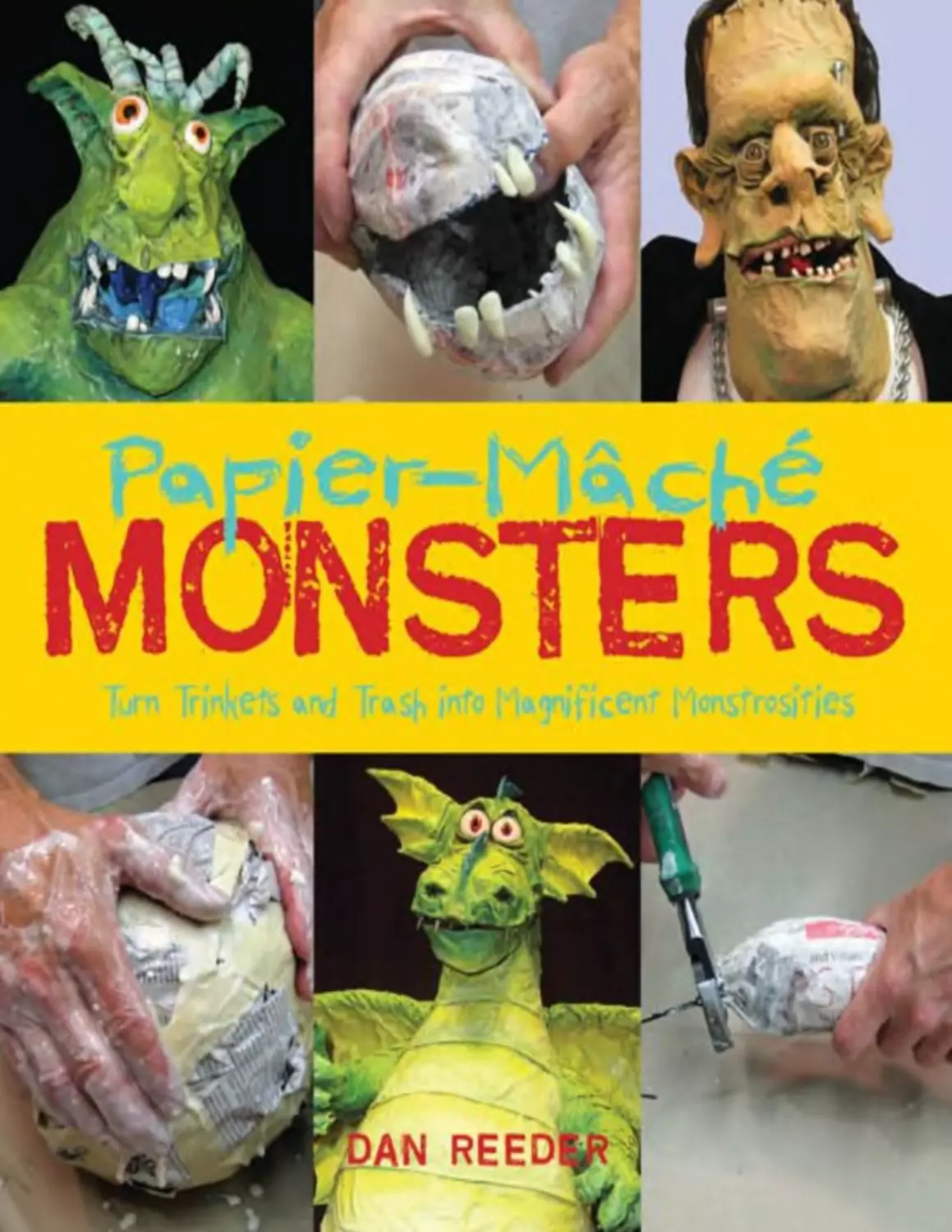


Author: Reeder D.
Tags: art do it yourself handicrafts papier-mache
ISBN: 978-1-4236-1264-3
Year: 2009
Similar
Text
                    Papier-Mâché Monsters
Turn Trinkets and Trash into Magnificent
Monstrosities
Dan Reeder
Photographs by Julie, Jeff, and Dan Reeder

PAPIER-MÂCHÉ MONSTERS
TURN TRINKETS AND TRASH INTO MAGNIFICENT MONSTROSITIES
WARNING! The projects in this book are not intended for children to do on their own.
Children should be under adult supervision at all times when attempting these
projects.
Digital Edition v1.0
Text © 2009 Dan Reeder
Photographs © 2009 Julie Reeder, Jeff Reeder, and Dan Reeder
All rights reserved. No part of this book may be reproduced by any means whatsoever
without written permission from the publisher, except brief portions quoted for purpose of
review.
Gibbs Smith, Publisher
PO Box 667
Layton, UT 84041
Orders: 1.800 .835.4993
www.gibbs-smith.com
ISBN: 978-1-4236-1264-3

To Julie, Allison, and Andrea. Thank you for putting up with me!

Papier-Mâché Monsters
Table of Contents

Introduction

What You Need to Know Before You Begin

Basic Projects

Delightful Monster Details

More Monsters

About the Author

Acknowledgments

Introduction
Perhaps the most common question I’ve gotten about my art over the years
is, “Where do you get your ideas?” My usual answer has been, “I dunno.”
Now, after years of deep introspection, I’ve realized that monsters speak to
me—literally. In fact, I’m convinced that I channel them. Kinda like the
infamous J. Z. Knight, who claims that a warrior who lived thirty-five
thousand years ago speaks through her. (From what I gather, her warrior
friend tells her to charge people lots of money for his wisdom and then buy
thoroughbred horses with it.) My channeling is slightly different. No old
geezer trying to take over my body. I just notice some little voices inside
my head, usually when I’m quiet, just before I fall asleep. Mostly they say,
“Let us out!” although sometimes it’s, “Wouldn’t a Milky Way candy bar
taste great right now?” And I do let the monsters out. You will see some of
them in this book. Some of them I’ve kept tied up, or caged, for your safety
and mine.
And I think it’s about time you let your inner monster out too. There is no
greater thrill in the world[1] than taking a few simple materials, making a
big mess, and then watching a monster, or a dragon, or even a fish or piggy,
pop out. I’m here to testify that thousands of people who have used my
papier- and cloth-mâché methods have had this happen to them, and they
have fallen in love with their little beasts. Some have told me that the
experience changed their lives forever[2]and that they love their monster
even more than their husbands, wives, and children.[3]
The truth is that even after thirty-five years of doing papier-mâché, I’m still
in love with the work. And I think everyone should be doing it. It’s the
perfect 3-D medium for novices and accomplished artists alike. It’s
supremely forgiving. You can make mistakes and fix them. You can create
really fun sculptures without entering the realm of wood or stone, arenas
usually reserved for skilled artisans. If you begin your 3-D art experience
by making a monster following the instructions in this book, then I
guarantee your success. I’ll give you tried-and-tested, goof-proof methods.

Now, I realize that some of you may have already bought one or both of my
previous books. For the sake of truth in advertising, I need to tell you that
the techniques you see in this book are not new. Since I last talked to you, I
did explore some other papier-mâché methods. But in the end, I decided
that I liked my own the best. So you might want to know how this book will
be different. Well, this time, I’m going to give away all of my secrets. Yes,
you heard that right. I’ll share with you my vast reservoir of secret papier-
mâché knowledge, whether you want it or not. And I’ll slip in some
information that’s not so secret, but useful, as well as some fairly non-
profound helpful hints and details that will make your papier-mâché-
monster-making-life much easier. Finally, I’ll pass along some interesting
facts about life that have nothing to do with papier-mâché but might give
you something to talk about over dinner. How’s that for jam-packed?
For those of you who need such information, perhaps we should begin with
abrief...
History of Papier-Mâché[4]
Papier-mâché has been around for a very long time. Most papier-mâché
historians agree that it started in China around the second century. Or
maybe it was India. It seems that waste paper was molded into all kinds of
things, including pen holders and jewelry. Amazingly, the Chinese also used
it to make spears and helmets. I would guess that such weapons were used
to fight bands of marauding puppets.
Apparently, papier-mâché wandered into Europe around the sixteenth or
seventeenth century. The French coined the term “papier-mâché,” which
literally means “chewed paper.” I guess there is some evidence that people
actually chewed the paper, then squished it into stuff called “French art.”
Around the same period some Germans decided to make furniture out of
papier-mâché. It was cheaper than using wood. I’ve managed to procure a
couple authentic papier-mâché artifacts to illustrate such uses.

French Papier-Mâché Art
Papier-Mâché Table and Chair

Eventually, papier-mâché furniture factories disappeared. No one knows
why. And papier-mâché art sort of faded away as well until sometime in the
1950s when a small papier-mâché renaissance began. Somewhere in
America, a really cool third-grade teacher (Mrs. Sullivan, I think her name
was) decided to have her students make papier-mâché piggies. They took
strips of paper, dipped them into flour-and-water paste, and applied them to
balloons. Two weeks and thirty identical piggies later, papier-mâché was
born anew, although no one seems to know how that process came to be
called papier-mâché since there was nothing chewed or French about it.
Still, such a process is what most adults remember when papier-mâché is
mentioned.
Of course, this is a book about monsters. I’d be remiss if I didn’t also give
youabrief...
History of Monsters[5]
Speaking of the French, the word “gargoyle” is derived from the French
word “gargouille,” which means “throat.” The English words “gargle” and
“gurgle” share the same root. Gargoyles were the beasts that “spit” the
water that came off buildings when it rained. A “grotesque” is a gargoyle
that doesn’t spit. Perhaps the most famous gargoyle is the “Spitting
Gargoyle” on the Notre Dame Cathedral, although he is actually a grotesque
because he doesn’t really spit.
One of the definitions of “monster” according to Dictionary.com is “any
animal or human grotesquely deviating from the normal shape, behavior, or
character.” I suppose that if monsters deviate grotesquely, then they must
not be spitters.
Folklore suggests that monsters and gargoyles were added to buildings to
frighten away evil spirits. This seems a bit strange to me—kind of like
taping candy bars to your forehead to protect yourself from sugar.
Considering the French connection between these two historical
perspectives, it’s pretty clear that . . .
Monsters and Papier-Mâché

. . . are related, hence the need for this book.
How to Use This Book
One thing I’ve learned over my long life is that many people genuinely
think differently than I do. This realization has been very enlightening! I
now understand that I must at least acknowledge other viewpoints despite
the fact that my opinion is correct almost all of the time. Still, I think that
this realization has made me wiser and has helped me to become a more
socially responsible monster maker. In this section I’ve decided to tailor my
remarks to the various learning and thinking and living styles of people I
have encountered. This may appear to some as blatant stereotyping. Rather,
try to think of it as an innocent attempt to meet the needs of all the crazy
people on this big planet.
So please, find the phrase that best describes you and read that section.
1) You are not too literate but are fun loving.
I know that you couldn’t care less about all the words in this book. You just
want to get to work. Good for you. Just look at the pictures and go! I’ve
attempted to create a very complete photo chronology (pictures in order) for
monster making. Start at the beginning of the project. Look at each picture.
Thank you for reading this far!
2) You are literate but lazy.
I know you like words. They give you inspiration, even if they don’t
necessarily compel you to actually do anything. For you, I’ve added some
completely useless commentary along with my simple, goof-proof
instructions for monster making. Make sure that you read this book very
carefully and think deeply about each instruction before you decide to begin
making your monster. And please know that even if you don’t end up
making a monster, you will undoubtedly grow as an artist and as a person
by reading this book.
3) You are highly intellectual and critical.

I realize that not only do you like the written word, but also you are
intellectually gifted and probably could have written a much better monster-
making book than this one. I understand that you like to dive deeply into the
history and philosophical significance of any topic you are reading about.
For you, I’ve made a concerted effort to add some intellectually meaty
information, some robust papier-mâché philosophy,[6] as well as some hard
papier-mâché science.[7] I fully expect that you might vehemently disagree
with my art methods and what I have to say. Feel free to write to somebody
and complain. Meanwhile, get your lawyer and start testing my claim that
my methods are “goof proof.”
4) You are fun-loving, kind, forgiving, and you like world peace.
First let me say that I love you dearly. I truly appreciate that you understand
where I’m coming from and that my heart is pure even if my humor seems a
little quirky. You will see a number of cats throughout this book. Please
know that none of them were harmed in the making of this book. (I didn’t
really make Eddy eat only hard food for a week. Actually, he only likes that
expensive soft food that comes in the little dark green cans that say
“Exquisite Taste” on them.) Make sure as you embark on this monster-
making journey that you treat yourself with kindness and respect as you
work the steps. Make sure when you make your flour paste that you add
water that is between 82 and 85 degrees. Considering the significant work
you’ve done on behalf of the planet today, you deserve only warm water in
your paste. Work at your own ergonomically correct pace. Know that all my
monsters are really smiling, in their hearts. Well, they would be if they had
hearts.
5) You are fairly normal (at least on the outside), smart (but not too
smart for your own good), and hard working.
Look at the basic steps for making a monster. Don’t have too much of a
preconceived idea of how it should turn out. Be loose. Let the piece evolve
as you work. Know that the very things that seem like mistakes early on in
the process will become part of the charm and personality of the finished
monster. The basic little green monster profiled in the main part of the book
grew in just such a fashion. As I was making it for the book, I simply let it
become the monster it was supposed to be. Of course, if it hadn’t, I could

have cut it up and used the parts for a monster I did like. That’s what I mean
by papier-mâché being a “forgiving” medium.
6) You are “special.”
Don’t make a horse on your first attempt. It’s really hard to get the legs
right.
[1] The absolute truth.
[2] A bit exaggerated.
[3] Totally made up.
[4] Not necessarily accurate.
[5] Think of this history as a kind of Wikipedia entry, with only one
contributor . . . me.

[6] Make sure you argue about this with your snooty friends.
[7] I’m preparing to submit this information to JAMMA (The Journal of the
American Monster-Making Association).

What You Need to Know Before
You Begin
When most people think of papier-mâché, they think of applying strips of
paper over a balloon. On a larger scale, they think of molding a shape out of
chicken wire and then applying a “skin” of papier-mâché. If you think about
it, this is sculpting with balloons and chicken wire. As you will see, I make
papier-mâché balls and limbs, cut them up, and assemble a monster out of
the pieces using masking tape. I truly sculpt with papier-mâché. Then I
apply a skin of torn-up bedsheets dipped in Elmer’s glue. I suppose that this
is my claim to fame, this use of cloth in combination with papier-mâché. I
coined the phrase “cloth-mâché” when I first started doing this thirty-five
years ago, even though there was no more chewing with the cloth than there
was with the paper. This cloth-and-glue coating gives amazing strength to
papier-mâché art and offers endless possibility for detail. A few well-placed
wrinkles, scales, lips, and eyelids, and your monster will come alive!
While the process is pretty straightforward, there are a few tips I will share
in advance that will make your monster making easier and more efficient.
About Paper Strips
When you made papier-mâché in elementary school, my guess is that you
used thin strips of paper. Let’s put an end to that practice right now. In fact,
if you’ve ever considered being politically active and are looking for a good
cause, this is it. Or maybe consider a tattoo with the words “No Thin Strips”
written across a broken heart on your chest (listen, I’ve seen worse).

1. We want w i d e strips. Take sections of newspaper and tear them down
the middle, starting on the folded side.

2. Newspaper has a “grain” and will tear surprisingly straight.

3. Also tear off the folded end. Turn the section on edge to find the middle
fold and tear it.

4. A perfect stack of wide paper strips.
About Cloth Strips
As far as cloth-mâché is concerned, the best cloth to use is an old bedsheet.
In fact, the older and more threadbare the sheet, the easier it will be to use.
You can use any kind of cloth, but newer, stiffer cloth will tend to lift up at
the edges or unfold when you make scales or eyelids. Since most people in
the world sleep on cloth sheets, you shouldn’t have much trouble finding
one for your monster. Ask around or get one at a secondhand store. If you
are a kid, just go ahead and use your own sheet. I’m sure your mom won’t
mind. If she gets mad, remind her that you are “gifted.”
Once you’ve put your hands in the glue, the last thing you want to do is to
stop and cut cloth. It’s best to create a pile of various-sized cloth strips and
pieces beforehand.

1. Start by tearing the edges off your sheet (you might need to use scissors
to start the tears). Then tear the sheet into strips of various widths.

2. Fold the strips in half, then in half again, and maybe in half again after
that (depending upon how long your strip of cloth is to begin with). Of
course you can only fold eight times at the most, although that would
certainly be overdoing it. (You did know that it is impossible to fold
anything nine times, right? It’s true. Proven beyond a doubt
mathematically. Look it up!) Grab the strings on each side and pull them
off.

3. Cut the folded strips into various-sized pieces of cloth. One last note: If
you tear the strips in this manner, two sides of these pieces of cloth will be a
little frayed. Frayed is good. Frayed edges are less likely to show as seams
after they have been dipped in glue and painted. Just a thought for those of
you who lose sleep because of pesky monster cloth seams.
About Tape and Glue
As I said, I sculpt with papier-mâché pieces held together with masking
tape. I love masking tape. I love the way it holds stuff together. I love how
strong it is under my cloth and glue skin. I would marry masking tape if it
were a woman and if my wife didn’t mind.
I like white glue too. But not enough to marry it. I use Elmer’s glue. You
can use a generic version of white glue as well. You will need a couple of
quarts for an average sized monster. As is many times the case, you can buy
a gallon at a large hardware store for less than a couple of quarts at a hobby
store.

If you look carefully at the photos of me assembling my monster, you’ll
notice that I have pieces of tape stuck all over the place. If you tear a lot of
tape strips first and keep them within arm’s reach, sculpting will be much
easier. This is particularly true if you are holding two parts tightly together
and you need several pieces of tape quickly.

Even though masking tape is the most wonderful product on the planet,
sometimes it loosens a bit if you store your unfinished project in a warm
place for a long period of time. If you need to leave your monster (or pig’s
foot) unfinished for a few days, wipe it down with Elmer ’s glue. This will
hold the tape tightly in place.
About Recycling
I would never presume to take credit for reducing global warming or for
cleaning landfills or reducing our dependence on foreign oil. But I’ve taken
a pretty big stack of newspaper over the years and recycled it into monsters.
And I take some credit for reducing our dependence upon foreign monster
making.
While I’m on the topic of recycling newspaper, I want to make sure that you
know how to recycle your recycled newspaper. Look for opportunities to
reuse the wads of crumpled newspaper inside the papier-mâché balls that
you cut up. Usually the crumpled balls inside will pop out perfectly shaped
to re-mâché. Just wrap some masking tape around the wad and put it aside
for your next project. With some of my larger art pieces, I’ve repeated this
process nine or ten times with the ball getting a bit smaller each time! [8]

Piggy’s belly provides another precious monster body.

This head begets another head.
About Wire Clothes Hangers and Big Projects
I’ve made some pretty large papier-mâché art over the years. In fact, I don’t
know any other medium so well suited for big art. That said, the larger the
project, the more “infrastructure” is needed. For this I use wire clothes
hangers. In fact, you will soon notice that I use wire clothes hangers in
virtually all of my art projects. So a note about them is in order. There was a
time when these were omnipresent. Unfortunately, like everything else in
modern society, wire clothes hangers gave way to plastic ones. (Remember
when cars were made of metal? Toothbrushes?) Luckily, wire clothes
hangers are still used in dry cleaning. And over the years, at least a zillion
were produced and are still floating around out there for you to find. You
don’t need that many to make a monster. Six will do. You’ll need more if
you intend to make something big. Again, ask around. Many people still
have them in their closets. You can always find them at thrift stores for a

very cheap price. And you can easily buy them on eBay and other places. If
you get totally stuck, contact me and I’ll send you some.
Back to big projects. I simply put two or even three hangers together as I
make arms and legs and tails and other appendages that need to hold
weight.
For basic big torsos, I depend upon hangers surrounding the crumpled body
balls. Stretch hangers into big circles. Put two together as shown, one
rotated 90 degrees from the other.
Stuff a crumpled ball into the hangers and wrap with tape. You can cut off
the excess wire later, but sometimes it’s useful to use that wire to connect to
other balls. Meanwhile, use the hooks to hang the balls for drying after you
mâché.

Tyrannosaurus eatalotacus (below) is over five feet tall. I built it by
connecting many balls with wire around them. You can see the balls if you
look carefully at the stomach. I added paper and tape between the balls to
smooth the surface. I also doubled up on the hangers I used in the legs,
arms, and tail. Between the use of cloth and glue on the outside and the
additional wire hangers on the inside, the amount of weight that can be
supported is amazing. So go ahead and make something big. I dare you to
make it bigger than yourself.

About Personality
Some of my art is very deliberate. I want something a certain way and I
work like a dog to make it so. But almost everything in this book was made
with the “go with the flow” philosophy that I’ve been espousing.

Particularly if this is your first papier-mâché experience, you should make
body pieces that look like the pictures in the book and then just sit back and
watch your monster evolve. Try this little personality experiment. I
chronicled my possible choices for the eyes on my marionette (see photos,
right). Watch the personality change as I change eyes and position. One of
them simply felt right. My advice? Play with all of your body parts until
everything feels just right.
About Safety
Has your mom ever told you not to run with scissors? I’ll bet you didn’t
listen to her. You just figured that adults worry too much. So don’t think of

me as just another paranoid adult when I tell you to be careful using the
tools of this art form. Think of me as your own personal accident-prone
monster-maker trainer. I say “accident-prone” because I’ve injured myself
on every tool I’m telling you to use. Even if you use a dull but serrated
knife to cut your papier-mâché balls, it is still a knife, and you should take
care with it (duhhh!). Cut with the blade moving away from you. Use the
serrations to cut, not massive pressure on the blade. And, if you are a kid,
get a parent or older sister (not an older brother—he will cut himself) to do
your cutting for you. Use the “low melt” setting on your hot glue gun. And
don’t even think about running with the scissors!
[8] Plus or minus eight.

Basic Projects
This section is the heart of the book. It describes in detail how to make five
different kinds of papier- and cloth-mâché projects. I’ve tried to give you
some variety. The Basic Monster will work for any potential monster
maker. The Monster Marionette is a variation of the Basic Monster for those
of you who feel that art should be functional as well as pretty. The Monster
Trophy is perfect if you want something amazing over the mantel. If
monsters aren’t your thing (maybe this book was a gift—someone gave it to
you because you are a little “quirky” and “artistic”), and you want
something a little more traditional, go for the Monster Traditional Piggy. If
you are one of those mischievous young boys who love to bug Little Sister
(but you don’t want to put forth too much effort), the Monster Ugly Doll
project is for you. I’ve also added a “Special Halloween Section” for those
of you who want art pieces for that particular season.
So pick one of these projects and launch yourself into the world of papier-
mâché. If you are new to this art form, think of your first project as a means
to learn the fundamentals. Don’t get overly ambitious on your first attempt
with any new art medium. Make the project as the book instructs. Trust me
— your monster will naturally develop a personality and flavor that is
distinctly its own even if you attempt to copy the exact monster I’ve
illustrated. You will be wonderfully successful. Note that I’m not saying the
task will be easy. Doing this art requires some hard work and tenacity.
Remember, great art is always worth great effort.
Making your first monster is rather like buying the “stripped down” version
of a new car. It’s going to be really great. You are going to love and cherish
your finished piece. But as your proficiency with the art medium increases,
you will start seeing additional possibilities. You are going to want some
monster “bells and whistles.” Or maybe you are an accomplished artist
already and you feel totally comfortable attempting a more elaborate project
right out of the chute. Take a look at the “Delightful Monster Details”
section of the book. A few simple embellishments will move your great
monster into the realm of great monster squared. Once you’ve had a bit of
practice with paper and cloth-mâché, look closely at the photos in “More

Monsters.” You’ll begin to recognize the various techniques I’ve described
and, hopefully, become inspired to try a second monster, one that is really
you. Of course, once you have two monsters around the house, you might
as well go ahead and fill the entire house with monsters. Welcome to my
world.

Basic Monster
For those of you ready to jump into the monster-making world, here is a
complete list of supplies you will need for your monster.
Supplies
8-inch stack of newspaper
1 roll wide masking tape
1 roll thin masking tape
Wire clothes hangers
White flour
Oven bake clay, such as Fimo or Sculpey
1 bedsheet (as old and worn as you can get)
2 quarts white glue (safe, hobby type)
Latex paint in primary colors, and black, and white
Anything round for the eyes, such as marbles or clay balls (for
especially great eyes, use taxidermy eyes. Just look online under
Taxidermists.)
Tools
Serrated knife
Scissors
Wire cutters
Bowls for paste and glue

Baking sheet
Hot glue gun
Wide paintbrush
Thin paintbrush
Crumpling

For this section you will need:
Newspaper
1-inch-wide masking tape
Wire clothes hangers
Wire cutters
To relax
Remember, this is supposed to be simple. Let’s keep it that way. You are
going to crumple newspaper until it is “body” sized and “head” sized. For
many of you, this will seem too vague. Some of you might already be
worried about how your first monster will turn out. Listen to me: Let it go.
Let it flow. Everything will turn out as it should. You are going to love this!

1. Get Max off the newspaper! (More about cats and papier-mâché
throughout the book. Much more.)

2. Unfold a stack of newspaper. Crumple one sheet into a ball.

3. Continue crumpling one sheet over the other until you get a ball that is
“body” sized.[9]

4. Wrap with tape.[10]

5. Use the same procedure to make a smaller “head” ball. Then make a few
smaller balls to use for details: ears, nose, cheeks (both kinds), etc.

6. For arms, legs, and tails, we will use clothes hangers.

7. Bend the hangers as shown. The bows in the hangers will hold the bicep
and forearm of an arm, or the calf and thigh of a leg.

8. Bend a hanger for each leg and arm, and one for a tail if you want one.
The tail is just pulled into a point. (A tail is a great idea if you want your
monster to stand.)

9. Crumple a “thigh” sized ball to put into the top part of the hanger and
wrap with tape.

10. Similarly, stuff a “calf” sized ball into the lower half of the hanger and
tape. An arm looks exactly like a leg (maybe a bit smaller), except that the
top crumple is the bicep and the bottom crumple is the forearm.

11. For a tail, tightly twist a couple sheets around the top of part of a
hanger.

12. Add another sheet of paper midway down the tail, twisting tightly as
you go. Snip off the end of the hanger so that you can twist the end into a
point.

13. To add some movement to the tail, bend the tail in the middle.

14. Add waves or a curl.

15. Since my monster will stand up, I’ll bend the tail so that the end will lay
flat on the table.

16. Now you are ready to papier-mâché. You should have a body, a head,
two arms, two legs, a tail, and several extra balls to use for sculpting.

Papier-mâché
For this section you will need:
Cheap white flour
Stack of wide newspaper strips
Your body parts
A mixing bowl
A childlike attitude
DO NOT buy premixed papier-mâché paste, no matter how it’s advertised.
Plain inexpensive white flour—the kind with all the nutrients removed and
then added back—is what you want. One might argue that we shouldn’t

take grain out of the food chain, but making monster art with it is certainly
better than making gasoline, don’t you think?
This is the place in the book to let your inner kid out. (Unless of course you
are a kid, in which case you don’t want to let your kid out, because then
there would be nothing left of you.) Enjoy making a gigantic mess. Revel in
the spirit of all the crazy artists who have come before you. Don’t shave or
brush your hair for a week before starting this. Quit your job and just let go.
I am going to sound like a papier-mâché tyrant here. I’m going to tell you
exactly what to do. And I want you to follow my instructions to the letter.
Believe me—it’s for your own good. If you want to be creative, do it when
you’re adding appendages.

1. Pour flour into the bowl and add water. Mix with your hands. Continue to
add water until you get the consistency of thick soup. In other words, don’t
worry too much about the ratio. It will work just fine. Use warm water just
because it feels soooo nice.

2. This might be the most important instruction ever given to you. More
than not talking to strangers? More than not drinking and driving? More
than not chasing after cars (if you are a dog)? More important than not
touching that tractor after the workers went home? Yep, more important.
Wet your hands and rub paste onto the ball. PUT ONLY YOUR HANDS
INTO THE PASTE! Hands only. Only hands. NOT THE PAPER!
There will be a test on this later.
For those of you who want reasons with your rules, this one is simple. Your
wet hands will soak each paper strip and ensure that it binds completely to
the one underneath it. As you smooth the ball with your hands, the air
bubbles will be pushed out. You’ll be amazed by how hard the ball will be
when it’s dry.
When you put strips of paper into the paste, the paste gets spread unevenly.
Air bubbles form. Globs of paste don’t dry. The ball doesn’t get hard, and it
begins to stink. Your mom tells you to throw it away. You won’t. It comes

down to it or you. You decide to run away from home and join the circus.
It’s bad.
RandomQ&A
Q: Can I stick my paper strips into the paste?
A: Only if you never mention my name or this book, ever.
3. Put one piece of paper on the ball at a time, smoothing and soaking each
piece with your hands. Make sure that each strip of paper is completely
soaked before adding a new strip.

4. Work your way around the ball until you’ve added three or four layers.

5. Use pretty much the same procedure on the arms and legs. Use your
hands to wet the entire leg.

6. Wrap a paper strip around the top, thoroughly wetting the paper as you
wrap. Keep your hands really wet.

7.Workyourwaydowntheleg...

8. . . . squeezing out the bubbles.

9. Do the same with the tail, working top to bottom. Put the parts someplace
warm to dry. I like places around heating vents. Hang the arms and legs and
tails by the wire hooks. Turn the balls over after a day or so, so that they dry
evenly on all sides.
RandomQ&A
Q: I’m sixteen and my mom won’t let me make a monster till my homework
is done. What should I do?
A: Remember, adults in general, and your parents specifically, are out to get
you. They are always trying to keep you down. So tell her, “You have
enough trouble controlling Dad . . . so quit trying to control me!” Then,
make your monster while you are grounded.

Fingers, Toes, Tongue, Horns
For this section you will need:
Some more wire clothes hangers
Wire cutters
Tape (any size will do)
Newspaper strips or, better yet, an old phone book
Arms like Popeye (not really, but that’s what you’ll have after you
make enough of these things)
Making these appendages isn’t particularly creative. Making them in
advance, however, will make the monster-building process much more
efficient and fun. We will essentially wrap paper around pieces of wire

clothes hanger. Having wire inside the paper allows you to bend the fingers
and toes into the shapes you want.

1. Cut lengths of hangers that are a bit longer than the fingers and toes you
intend to make. It would be wise to remember that for monsters, and
cartoon characters, four fingers look more like five than five fingers.

2. Here we have wire for (bottom row) four fingers, another four fingers,
three toes, three toes, and (top row) three horns and two parts of a tongue.
Note: Consider a few extras, just in case.

3. Tear off half a piece of telephone-book paper.

4. Pinch one end of the paper strip with the end of a piece of hanger. Twist
the paper around the wire, rotating it over the top of the wire (like the
throttle on your motorcycle, for you Hell’s Angels out there).

5. Here’s another trick. Put the roll of tape between your legs and pull out a
length of tape with the sticky side down.

6. Pinch the end of the tape and the end of the finger.

7. Turn the finger with the same motorcycle rotation, keeping the tape taut.
Twist the paper tighter, tapering it to a point before you get to the end of the
wire. This process will make the fingers and toes tight.

8. Tear the tape. Note that one end is round and could be used for either a
finger or toe, and the other end is pointed and could be used as a horn or
tentacle.

9. Pictured here are (bottom row) four fingers, four more fingers, three toes,
three more toes, and (top row) two parts of a tongue and a bunch of horns (I
added a few since we talked last . . . I told you to make extras).

10. For a cool pointed tongue, put two tapered pieces together like this.

11. Put one strip of tape across the two pieces. This will be the bottom of
the tongue.

12. Turn it over and squish it so that the tongue is somewhat flat.

13. Add some bends. By only taping one side, you get a nice tongue-like
crease.

Arms & Legs & Hands & Feet
For this section you will need:
More newspaper
1-inch-wide masking tape
Wire cutters
Your arms and legs
Your fingers and toes
A good night’s sleep
Up until this point you have been making only parts of a monster. Not
exactly a thrill a minute. I’m pretty sure that tilling the soil, watering,

weeding, and planting can be pretty unrewarding for a gardener as well. But
this is all going to change right now. Your seeds are going to start to sprout.
Parts of your monster are going to start to take shape. Your heart is going to
flutter. (Of course if that continues, you might want to see a doctor.)

1. Crumple a sheet of newspaper into a “hand” sized ball.

2. Put a finger in the middle of the crumpled wad. Attach by adding pieces
of tape on both sides, in crisscross fashion.

3. Similarly, add fingers on either side of the first finger.

4. For a bit more realism, put the “thumb” on the other side of the crumpled
wad of paper and tape.

5. Cut off the end of the clothes hanger on the arm but leave a little of the
wire to push into the hand. The small pieces of excess wire make for an
excellent wrist—strong yet flexible.

6. Push the wire ends of the arm into the hand. Tape the wrist by stretching
the tape diagonally from the arm to the hand.

7. There are only a few differences between making a hand and a foot. For a
foot, start with a larger wad of paper than you used for the hand. I like to
crumple feet into a more elongated shape.

8. Add toes the same way you added fingers. I prefer three-toed monsters,
but you may want to make a strange looking four- or five-toed monster.
Turn the foot over and compress the wad of paper to make an arch for the
foot. Add tape.

9. When connecting the leg to the foot, use pliers to bend the excess wire
into a 90-degree angle.

10. Push these bent pieces of wire into the top of the foot so that the foot
comes off the leg at a 90-degree angle.

11. Again, stretch tape diagonally from the leg to the foot and vice versa
until the foot is securely attached.

12. The finished arms and legs. For foot and hand embellishments, see
“Gnarly Monster Hands & Feet.”

Jaws & Claws
For this section you will need:
Teeth material[11]
The papier-mâché ball you made for the head
Hot glue
A serrated knife[12]
The good sense your mother gave you

Here are the basic instructions for making your monster’s jaws. You might
want to check out “More About Jaws and Tongues” in the “Delightful
Monster Detail” section of the book before starting your jaws.

1. To make a tooth, roll a small piece of clay in your palm or between your
fingers until you get a point.

2. Make as many teeth as you want. Interestingly, teeth and claws pretty
much have the same shape. Make claws of various sizes. I chose to use
black Fimo for these claws, but color really doesn’t matter. Bake the clay
according to the package directions.

3. Get your glue gun, knife, and papier-mâché ball.

4. If it helps you, draw a line around the ball to use as a guide for cutting
the ball in half. Cut the ball all the way around. I prefer wavy cuts to
straight cuts.

5. Tear the ball apart and take out the wad of paper inside. Play around with
the two halves until you recognize the mouth you want.

6. Put a dab of hot glue on the shell.

7. Attach a tooth or two.

8. I like to have gaps between my monsters’ teeth. And I try to put teeth on
one jaw opposite a gap on the other (another trade secret that has been
passed down through the centuries).
Important Note:
You may not know it, but you are standing at one of those crossroads in
your life. The question is, do you go directly to the Assembly stage right
now, before you’ve put the cloth skin and paint on your jaws? Or do you
follow my advice and cloth-mâché and paint them first?
Let’s think about this. You’ve worked hard to get to this point and all you
have to show for the effort is a pile of body parts. You desperately want to
see your monster take shape and have no interest in doing more prep work.
But it will be much harder to get the cloth around the teeth and the
paintbrush into the mouth once the jaws have been inserted into the body—
unless, of course, you want a monster with a wide open mouth (a fine
option; I’ve made many such “screamers”). So, take my advice and apply

the cloth-mâché and paint to the jaws first. This is called “delayed
gratification,” doing something now that will make your life easier later.
This is something we don’t do much in America. Want a car? No money?
No problem. Borrow and buy it now. Need to finish your homework or
business report or chores? No, watch “Deadliest Catch” instead. But I dare
you to turn over a new leaf. Start small. Eat a cupcake upside down,
frosting last. I know, I know, you are dying to know how many crabs the
fishermen caught. But finish your important tasks first. Better yet, start
your new resolution by completing your jaws first. It’s easy. Just follow the
next steps.

Pre-Cloth- Mâchéing Jaws
For this section you will need:
Your jaws
White glue
Scissors
Cloth strips
A bright horizon
If you’re following my advice and doing this before assembly, then good
for you! If you are coming back to do this after assembly, good luck!

1. Use a small strip of cloth.

2. Soak it in glue, squeeze out the excess, and fold it in half lengthwise.

3. Put strips in crisscross fashion around each tooth. Keep the folded edge
of the strip against the tooth. This will make a nice gum ridge.

4. Sometimes when I have teeth close together, I wrap a strip on the outside
ofacluster...

5. . . . and then fold a strip on both sides and lay it in the middle. Wrap all
the teeth in this manner. Use wider strips of cloth where there are wider
gaps between the teeth.

6. To finish off the jaw, use a piece of cloth that is bigger than the jaw, soak
itinglue...

7. . . . and lay it inside. Press the wet cloth against the sides of the jaw.
Wrinkles will form naturally.

8. If you’ve made a tongue, this is a good time to wrap it loosely in glue-
soaked cloth. Use a knife to accentuate the crease in the middle.

9. Lay the tongue into the lower jaw while it is still wet. I used a pencil here
to keep the tongue raised. Put these jaws somewhere warm to dry.

Pre-Painting Jaws
For this section you will need:
Your jaws
Latex paint (see more about this in the “Painting” section)
Brushes
A hot cup of coffee and a donut
You are doing well. Again, you can stop here, assemble, and paint the jaws
later. I’m not going to lecture you anymore about the need for discipline in
your life. If you think you can paint the insides of your mouth after it’s
attached, then go for it. But don’t blame me if you find that you can’t even
see inside that mouth, much less paint it once it’s stuck inside the body of

your monster. Nope. I paint all my jaws in advance. I go to bed knowing my
mouths are painted and ready to go. I’m a happy man.
If you want this same peace of mind, then follow these simple painting
steps. This will be a cursory look at painting. You will get a more thorough
treatment in the “Painting” section of the book.

1. Pick a dark color and paint the top of the tongue. Add a little paint inside
the mouth as well.

2. While your brush is still wet, dip it into a lighter color and paint the
inside of the jaw.

3. The idea is to avoid ending up with one color. Keep adding dark and light
color. Blend them together minimally.

4. Don’t get carried away with blending. Leave some of the colors swirled
together.

5. Do the same with the upper jaw. Let these dry before the next step.

6. This step is actually optional at this point. Learn more about
blackwashing in the “Painting” section. Water down some black paint. Paint
the jaw quickly.

7. Before the black paint has a chance to dry, wipe the paint off. This is nice
for monster mouths.
NOW, go to the “Assembly” section and watch your monster grow.

Assembly
For this section you will need:
All your body parts
Your serrated knife
1-1/2-inch-wide masking tape
Wire cutters
Claws
To expect the amazing
This is where all the labor of making body parts begins to pay off. Your
monster is about to be born. If you’re the sensitive type, you might want a

box of tissues around in case you burst into tears. I think I’m going to cry
just telling you about this . . . oh wait, it’s just something in my eye.
Note: I followed my own advice and finished my jaws before assembly.
You still have time.

1. Cut a hole in the body that you think is about the diameter of your jaws.
Don’t worry—you can make adjustments if you make it too big or too
small.

2. Punch in the hole.

3. Fit the lower jaw into the hole. If the hole is too small, cut it bigger. If it’s
too big, just add more tape on the next step.

4. When taping, start on the jaw and pull the tape diagonally onto the body.
Then add another strip of tape, pulling it in the other direction. This will
add tension and hold the jaw firmly in place.

5. Place the top jaw over the bottom. Move it around until you catch an
expression you like.

6. Use enough tape to secure both jaws.

7. Cut a hole for a leg. Ideally, the hole will be slightly smaller than the leg
so that you get a tight fit when you push the leg in.

8. Cut the end of the hanger off the leg.

9. Stuff the leg into the hole. Don’t worry yet about whether the leg is in
exactly the right position.

10. Use the diagonal taping procedure to secure the leg. Always keep the
tape taut when applying it. Run the last few strips of tape in the opposite
direction.

11. Cut the other leg hole. Stick in the leg and tape it to the body.

12. To make adjustments in the legs, partially cut the knees with the knife.

13. Partially break the legs and bend them into the position you want. This
is where you thank me for having you put clothes hangers inside the
appendages. You’re welcome.

14. Tightly crumple a small “kneecap.”

15. Push it into the break in the leg and add tape.

16. Cut a hole for the tail.

17. Stand the monster up and make necessary adjustments for balance to the
legs, tail, and all the joints. Add more tape when you’ve got it right.

18. Use pliers or wire cutters to bend some fingers on each hand.

19. Cut an arm hole and stuff the arm into it. Remember, don’t plan this too
carefully. Let the shape surprise you.

20. Tape the arm securely to the body. Cut the elbow and bend the arm into
the position you want. Make an elbow in the same way you made the
kneecap.

21. Add the other arm. Experiment with both arms and hands and fingers
and toes until your monster finds its “personality.”

22. Time to make a face. We’ll start with a nose. Take one of your extra
balls and cut it open.

23. See how it looks on top of the head. This is the time to mix and match
various pieces of extra balls as you make the monster’s face. Have fun with
this. Try different looks. Try pinching the nose.

24. Use the knife to add appropriate nostrils.

25. Add tape to finish off the nostrils.

26. Cut open a small mâché ball and empty it out to use for the ears.

27. Shape the ears with scissors.

28. Tape the ears onto the head.

29. Use the knife to cut ear holes.

30. Finally, play around with various eyes and different positions for the
eyes. I’ve chosen to use Super Sculpey eyes for my monster. This position?
No.

31. A little better.

32. Yes!

33. Add a few horns. Or many. Or none. Note that in the monster world, the
difference between “horns” and “tentacles” is subtle, like the difference
between french fries and spaghetti.

34. Bend the horns or tentacles as you wish.

35. Finally, use hot glue to add some claws, if you made them. You are now
ready for the cloth-mâché skin.

36. One day I caught Eddy reading the paper. I thought I was going to be
rich, put him on TV. The wonder cat! But then I realized he was just
looking at Britney Spears. What a disappointment! I gave him only dry food
for a week for trying to trick me.

Cloth-mâché
For this section you will need:
Your cool-looking monster
White glue
Scissors
Cloth strips
The right half of your brain
Time to put some skin on your beast. This process takes a bit of getting
used to. It will seem awkward at first, and there will be times when you
really don’t want to put your hands into the glue one more time. But trust
me, this will be worth it. You will be amazed at the strength and detail you

can achieve with this step. Be brave. Be persistent. It’s understandable to be
reluctant to start. Go ahead and make yourself a sandwich first and think
about it. After that, get going!

1. It’s easiest to do this in stages. I like to cloth the bottom of a monster
first. Find a way to prop your beast upside down. A box works well.

2. Unlike the papier-mâché steps, you do put the cloth strips into the glue.
Soak the strips and squeeze out the excess.

3. To emphasize the fingernails and claws, fold a strip of cloth . . .

4. . . . and wrap the folded edge around the claw.

5. Wrap other unfolded pieces of cloth around the toes.

6. Add other various-sized pieces of cloth to the rest of the foot. Wrap
larger strips around the ankles and the rest of the leg.

7. Use small pieces to cover any last spots that don’t have cloth.

8. Starting at the end of the tail, wrap longer strips of cloth around the tail,
working your way up to the monster’s bottom. Finish covering the
underside of the project and let it dry overnight.

9. Once the underside of the monster is dry, turn it over and put cloth on the
hands and arms. Then it’s time for some real fun—finishing the face. Start
with the lips. Fold a long strip of cloth.

10. Wrap it around the mouth with the folded edge up. (This will make full
lips. You do want full lips on your monster, right?)

11. Pat down the torn edge against the face. Pull the lip out in some places
and push it in in others. Experiment with a smile or a pout.

12. Similarly, add an upper lip. Perhaps put a crease under the nose. Or pull
the lips back to expose more teeth. As I’ve said many times, have fun with
your face. Play with these lips until you get the perfect expression. You’ll
know it when you have it.

13. For the nose, take square or rectangular pieces of cloth, soak them in
glue...

14. . . . and stick them in the nostrils. Cover the rest of the nose with small
pieces of cloth.

15. Do the same with the ears: Use square pieces of cloth.

16. Push them into the ear canals. Fold the rest of the cloth around and
behind the ears. Wrinkles will naturally form inside the ear exactly where
wrinkles should be. It’s amazing.

17. Fold another piece of cloth to use for an eyelid.

18. Pull it around the eye. Putting a square piece of cloth around a round
eye will always create nice wrinkles and bags, characteristic of all monsters
(and old monster makers).

19. Do the same for the top of the eye.

20. I wanted to add something special to my horns, so once again I folded a
long strip of cloth and wrapped it around from top to bottom. The fold
added a spiral to the horn, which I emphasized with paint later.

21. Finish adding cloth to the rest of your monster, then put it somewhere
warm to dry.

22. Eddy the cat says, “Whaaaaaa, I want attention now!”
RandomQ&A
Q: My 3- and 4-year-old children are afraid now that I’ve filled the house
with monsters. What do I do?
A: Tell them that it is your house until they turn eighteen and that you are
an adult and can do whatever you want.

Painting
For this section you will need:
Paint (see below)
A wide paintbrush
A thin paintbrush
A life
I use a painting method that is technically called “fast and furious.” It
essentially involves painting a second (or even a third) color while the first
coat is still wet. We didn’t use balloons because we didn’t want too much
symmetry when we built the monster, and we don’t want a monochrome
paint job. At least for monsters, it’s just more interesting if the colors are
smeared together. Now, you are going to get some paint on your hands,

particularly during the “blackwash” stage. Don’t worry, though; it will give
you that cool “artist at work” look. But leave your ear on.
I prefer latex paint when it comes to painting sculptures this size. The cloth-
and-glue combination will soak up latex paint beautifully. It will make
dragon wings feel like leather and will also give enough waterproofing to
put a monster in a bathroom. I have a dragon over my bathtub. (Don’t you?)
You can get quarts of latex paint that are very close to the primary colors at
big hardware stores. If you can’t get latex paint, any water-based paint will
work. Buy red, yellow, blue, and, of course, black and white.
Eddy wants to paint too.

1. I like to start with some dark color. Turn the monster upside down and
slap some paint underneath the feet, on the underside of the arms, legs, and
tail, and under the chin.

2. Turn the monster back over, then dip the wet brush into a lighter color
and slap some of that paint on the areas that aren’t covered in the dark paint.
Err on the side of too much paint rather than too little.

3. Work fast, travel light, slobber the light paint everywhere.

4. Where you bump into the darker paint, blend the two colors together.

5. Don’t get too carried away with the blending. You don’t want to turn it
all into one even color. Be brave enough to leave splotches of paint. You
will want to keep blending, but stop. Stop!

6. Add whatever color you want to the horns or other appendages. Let dry
overnight.

Blackwashing
For this section you will need:
Black paint
Paintbrushes, one wide and one thin
Water
A damp rag
A heart of gold
I call this part of the painting process “blackwashing” because I wash the
monster with black paint and then wipe it off before it dries. You might fall
in love with the bright and vibrant colors of your newly painted monster.
You might not want to cover the cute little guy with black. I can only

remind you of what Arlo Guthrie used to say: “You can’t have a light
without a dark to stick it in.” Of course, that quote might have nothing to do
with painting. I just like Arlo Guthrie. Trust me one more time—once you
blackwash, the colors will seem even more intense and beautiful, like that
“endless skyway and that golden valley” (Arlo’s dad).

1. Pour some black paint in a container. Add enough water to loosen it up. I
would tell you exactly how much, but I’ve never measured. Experiment—it
will work no matter what. Quickly paint a section of your monster.

2. Before it dries, wipe off the black paint. While you are doing this, think
of shadows. Leave more black on the undersides of the monster.

3. I like doing the face last. No particular reason.

4. You have to admit, he looks much better.

5. The black paint may dry too quickly in places. Or it just might end up
darker than you prefer. If this happens, put a small amount of paint on your
brush and add back some color.

6. Hold your breath. Add a little white here . . .

7. . . . and a little white there.

8. Add a couple irises and pupils.

9. And your monster awakens! He says, “Peace, monster makers.”
RandomQ&A
Q: I now make monsters night and day and my grades are falling. What
should I do?
A: Eat lots of candy.

Oh, by the way, here’s my bathroom dragon.

Monster Marionette
Many people ask me why I don’t make monsters like they do in Hollywood
— monsters that move. Simply put, I like to find a certain look, an attitude,
a pose, and then freeze it. I like sculpture. But I make an exception with
puppets and marionettes. I still insist that this particular monster have a
frozen facial expression. But I don’t mind if he wants to dance.
The secret to a great marionette is in the joints. They must be supremely
loose and flexible. By now you know that I’m a big fan of wire clothes
hangers. Having them inside your papier-mâché is ideal for making
marionettes. These instructions will not be presented in the usual beginning-
to-end order. I want you to see where you are headed before you start the
early steps. These instructions are meant to complement the Basic Monster
instructions. If you skipped to this part of the book, go back and look at that
section first.

This is what your basic marionette body will look like after you’ve
completed the papier-mâché. Essentially, you’ll mâché the pieces of the
arms and legs separately and then hook them together using the clothes
hangers.

I’ve decided to put kid’s clothes on this marionette. I’ll use the sleeves and
pant lengths to guide my decisions about the size of the pieces.

1. If you choose to use clothes as well, start by crumpling balls that fit
inside the pants . . .

2....andtheshirt.

3. Bend two clothes hangers to fit the ball, but leave little loops at the end.

4. Stuff the ball inside the hangers and tape it to the hangers. Orient the
hangers like you see in the picture, one a little rotated on the ball from the
other.

5. Cover the ball with papier-mâché. After you’ve covered it, you can bend
the loops outward. You will be hooking the monster’s legs onto these loops
later.

6. Use pliers to curl the hangers on the top side of the ball. You will be
hooking the monster’s arms to these later.

7. Usually, we would use whole hangers for each arm and leg. This time
we’ll stretch them lengthwise and cut them in half.

8. Crumple a “thigh” and stick it inside the half hanger. Wrap with tape.

9. Cross the wires sticking out of the bottom.

10. Use pliers to twist the wires together . . .

. . . likethis.

11. Bend the twisted wire into a loop. The bigger you can make these loops,
the better. If you are making a large puppet, consider using a whole hanger
instead of a half for these parts.

12. Crumple a “calf” and put it into the other half of the clothes hanger.

13. Leave the closed end of the wire without paper. This is where you will
hook the calf and thigh together. You will use the other ends of the hanger
for a foot.

14. Use the wire hooks to attach the thigh and the calf together.

15. Repeat steps 7–14 to make the other leg and both arms. You will hook
the upper and lower parts of the arm as shown.

Note: You will probably want to add hands and feet before you close the
loops.

16. Don’t forget to make the head. Put the jaws between the wire loops and
build the face.

17. You will need a string attached to the top of the head. To support the
puppet’s weight, connect the string to a wire that runs entirely through the
marionette. Cut a hanger at an angle to make a sharp point. Push it into the
head and through the body until it comes out the bottom.

18. Cut off the excess hanger and bend the wire into a hook. At this point
you can push this hook partially back into the head. This will poke the wire
out the bottom even further. I hook this bottom wire as well so that I can
also attach a string to the bottom of the marionette.

19. I use the hook on the top of the head to hang the marionette while I
make finishing touches.

20. If you study marionettes, you’ll find that there are many variations for
string placement. For this one, I chose to connect strings to the head and the
bottom (so you can tilt him), the wrists (I poked wire through the wrists and
made loops), and the knees.

21. Hand-control schemes vary greatly as well. Basically, you just need
some pieces of wood arranged in a way that will connect with the strings. In
this marionette I’m using a double “T.” I attached a hook in the middle of
the T that connects to the head. The bottom of the T connects to the bottom
of the marionette. The two T-crosses control arms and legs. I made it so that
the crosses on the T can be removed so that the arms and legs can be
controlled separately.

22. Take your little guy out for a walk. Tell the neighbors that you couldn’t
afford a dog.

Trophies
I think most people who have animal trophies consider bigger to be better.
Haven’t seen too many mounted squirrel heads. Other people don’t want
anything to do with a moose over the fireplace. But what about a relatively
big dragonish looking thing? Something you didn’t have to hunt down and
kill (luckily). Interested?

1. Since you want larger jaws than usual, put two or more crumpled balls
together.

2. Tape the balls together and add papier-mâché.

3. Make yourself a set of imposing jaws and a long tongue. See “More
About Jaws and Tongues” for help with these larger jaws. To make this
trophy, you will need a few clothes hangers and extra mâché balls, along
with the jaws.

4. Hold the jaws up to a wall to get a sense of how you want your trophy to
hang.

5. Measure the distance from the wall to the end of the lower jaw.

6. Using a cardboard box, slide the jaw up until you match this
measurement. Tape the jaw to the box.

7. Put the top jaw over the bottom and add just enough tape to keep the ends
of the two jaws together.

8. If you want the jaws to be open, prop something between them for
support while you perform the next steps.

9. Cut a papier-mâché ball in half to augment the base (where the trophy
will meet the wall).

10. Push the half-ball under the end of the jaws. You might end up crushing
one edge of the ball. That’s okay. You are just trying to fill out the neck.

11. Add some tape.

12. Cut additional pieces as needed and tape them to the base.

13. Tape other pieces under the jaw. Here I used a half ball to make a gullet.

14. Use clothes hangers to provide structure and to help with the weight of
the head. Stretch a hanger.

15. Bend the hanger to conform to the profile of the upper jaw.

16. Tape the hanger to the jaw. Wide tape works best here. Add several
more hangers—in fact, the more hangers, the better. When we are finished,
we will use the ends of these hangers to hang the trophy on the wall.

17. Use more papier-mâché balls to add ears, horns, bulges, and all things
dragon-like. Note that I replaced the box with a stick for support.

18. Begin the cloth-mâché phase: Fold large strips of cloth dipped in glue . .
.

19. . . . and rim the base where the trophy will meet the wall.

20. Definitely add scales and other details (see “Delightful Monster
Details”). After the cloth-mâché is dry, the head will be strong enough that
you can pull out the stick supports. Paint the trophy using the techniques
described in the Basic Monster instructions.

21. I use a pretty low-tech method to hang trophies. Put a long screw into
the wall (it’s good to hit a stud). Loop the ends of the hangers that you put
inside the trophy over the screw.
RandomQ&A
Q: I notice you only make monsters. Can you make something “cute” out of
papier-mâché?
A: No.

Try your hand at something a little bigger next time.

Papier-Mâché Piggy
In the world of woodworking, making the perfect box is a sort of rite of
passage. I think in the papier-mâché world, it’s creating the traditional
piggy. I really don’t know why, but virtually every papier- mâché artist I
know has made one or two. There is some deep-seated need to test
ourselves with this particular subject matter. I think it might have to do with
previous lifetimes. Maybe we were piglets and our mothers were taken off
to be made into bacon and somewhere deep in our subconscious we are
determined to re-create them.
Either way, if you are serious about papier-mâché, you are going to make a
piggy sooner or later. Now, for those of you who are inexplicably drawn to
this particular project, I’ve decided to test my little reincarnation theory.
I’ve written many of these instructions in “Pig.” (Of course, I’ve also added
some commentary in “Human,” just in case you’re a bit rusty.)
Oink oink oink oink: Oink oink. Oink.[13]
Oink oink oink (oink oink oink, “Oink”).

Mom

1. Oink oink oink oink, oink oink.

2. Oink oink oink oink. Oink oink oink oink oink. (Yes! Fatter legs!)

3.Oinkoinkoinkoink...

4. . . . oink oink oink oink oink oink.

5. Oink oink oink oink oink.

6. Oink oink oink oink oink oink oink oink oink oink oink oink oink oink
oink. (Save the piece you cut off for jowls.)

7. Oink oink oink, oink oink, oink, oink, oink oink.

8. Oink oink.

9. Oink!!! (Max!!!)

10. Oink oink oink oink oink oink oink oink oink oink oink oink oink oink
oink. (Push the top part of the head into the hole as well.)

11. Oink oink oink oink oink oink oink oink oink oink oink. (Cut the front
leg at an angle, like you did for the back legs.)

12. Oink oink oink oink oink oink oink oink oink oink oink oink oink oink
oink. Oink oink oink oink oink oink oink oink oink oink oink oink oink
oink oink.

13. Oink oink oink oink: oink . . . (Use the piece you saved from the back
leg...)

14. . . . oink oink oink oink oink. (. . . and another piece of a ball for the
chin.)

15. Oink, oink, oink oink oink. Oink oink oink. Oink oink oink oink. Oink
oink oink oink . . . (Roll pieces of paper. Wrap with them with tape. Use
them wherever you want rolls of excess pig. Above the thigh . . .)

16....oinkoink.(. . .thetail.)

17. Oink oink oink oink oink oink oink oink oink. (Cut another piece of
mâché ball and use it for a nose.)

18. Oink oink oink oink oink. (Use masking tape to create nose holes.)

19. Oink oink oink oink oink oink oink oink oink oink oink.

20. Oink oink oink oink oink.

21. Oink oink oink.

22. Oink oink oink oink. (Start cloth-mâchéing at the feet and work up.)

23. Oink oink oink oink oink oink oink!

24. Oink. (Lips.)

25. Oink oink oink, oink oink oink, oink. (Push cloth inside the nose.)

26. Oink oink. (Paint pink.)

27. Oink. (Blackwash.)

28. Oink oink, oink oink oink oink oink (oink oink oink). (Add back some
highlights [where it got too dark].)

29. Oink oink, oink.
RandomQ&A
Q: Can you keep your monsters outdoors?
A: Certainly, but you must build a little monster door so that they can come
and go.

Oink Oink Oink

Monster Doll
There is nothing quite so satisfying as taking something cute and
transforming it into something monster-ugly. Don’t tell me you haven’t
done it. Never erased the eyes out of a model in a magazine and drawn your
own ugly eyes in? Or twisted Barbie’s head around? Or put a talking
Barney into a vise and squeezed his head? Sure you have.
I’m sorry—I should explain that these remarks are primarily aimed at my
younger audience. Okay, so I’m really talking to teens and preteens. Okay,
preteen and teenage boys in particular. And immature adults, like me. Let’s
face it, altering dolls is a wonderful, semi-harmless outlet to relieve stress . .
. and bug people. I must warn any normal people who might be reading this,
if the piggy project was the cutest section in the book, then this is certainly
the ugliest, so much so that my wife and children won’t even be in the same
room with this finished “thing.”

1. To do this you need a cute doll. If you can’t find one at home, there are
many at secondhand stores. Be brave and buy one. Say that you are buying
it for your little sister. No papier-mâché this time. We jump right to the
details and cloth-mâché stage.

2. Take off her pretty dress and hair. Note that she still looks cute.

3. Take out the brains and the eyes. Now we’re getting somewhere.

4. You’ll want some telephone-book paper, tape, glue gun, and small Fimo
teeth for this part of the transformation.

5. Basically, we are going to sculpt with small pieces of paper and then
cover with a cloth-and-glue skin. Start twisting pieces of the phone book
paper.

6. Wrap them with tape. I will use this piece to make a chin.

7. Use hot glue to attach the paper chin to the doll’s face.

Strong chin, empty head. Know anyone like that?

8. Add another piece to build up the nose.

9. Maybe another. Don’t worry too much about how this is going to turn
out. It will definitely be scary.

10. Make some brows and glue them to the forehead.

11. Add ears, cheeks, whatever looks ugly. Put some hot glue on the lip . . .

12. . . . and add bottom and top teeth. You don’t need too many.

13. Use hot glue to attach eyes. I decided to use glass “bird” eyes.

14. Time for glue and cloth strips. When you are working small, it’s best to
use your most worn cloth, because it will stay put. Start with a folded piece
of cloth for the lips. Accentuate the fold to make Angelina Jolie lips.

15. Fold another strip for under the eyes. Use a knife to manipulate the
cloth.

16. Fold more pieces of cloth to put over the eyes.

17. You can make nostrils by putting a large piece of cloth over the nose.
Then fold the excess and pull it toward the lips. This might take a couple of
tries.

18. Do the same to make wrinkles at the temples: Use a square piece of
cloth...

19. . . . and crinkle it at the corner of the eye.

20. Once again, do the same for the ears: Use a large piece of cloth . . .

21. . . . and fold it around the edges of the paper ear. Ignore the temptation
to smooth the cloth. Leave the wrinkles as they form.

22. Use a bigger piece of cloth under the chin. Crimp the cloth for more
wrinkles on the neck.

23. Use your knife to flatten loose edges and to make final adjustments on
the face. I added a couple horns after painting.

24. It was easy to remove this doll’s hands. I cut the cloth and pulled them
out. Later, I reattached them by squirting hot glue on the arm and pulling
the cloth sleeve back over it.

25. This doll’s face and hands were a ceramic-type plastic. I decided to
make the cute hands ugly by applying Super Sculpey on them and baking
them in the oven at a low temperature.

26. I squished some Sculpey onto the arms and hands. I then attached some
fingers. Finally, I pinched some wrinkles. These hands painted beautifully
after baking and made a nice addition to an ugly art project.

27. Make sure the shoelaces on those pretty red shoes are messed up.
Details matter!

28. Paint the face and hands. Let dry, then put the dress back on. If you
want to add back the hair, first dip it into glue, hang it upside down, and let
it dry. This will uglify it. Then hot glue it into place. There, a perfect
makeover.
[9] If this is too vague for you, then crumple exactly 8 sheets of newspaper,
which will match the monster I’m making.
[10] Exactly 6 feet. If you are rich and your manservant is actually making
the monster for you, tell him to use the entire roll, just for fun.
[11] I recommend an oven baked polymer material like Fimo (shown here)
or Super Sculpey. For more about this, check out “More About Jaws and
Tongues.”
[12] You don’t need a sharp knife to cut up papier-mâché balls. In fact, it’s
probably better to have a fairly dull knife (less chance for an accident). It is

important to have a knife that is serrated. Those little saw-like teeth will cut
the papier-mâché beautifully. An old steak knife works great. Kids—
remember to have an adult do the cutting for you.
[13] Oink oink oink oink oink oink oink. Oink oink oink. (Make sure you
look over the Basic Monster steps first!)

Delightful Monster Details
I’ve heard it said that “the devil is in the details.” Maybe so. But since we
like monsters, that’s not a bad thing, is it? In fact, for monster makers,
maybe the cool devil details are in the details. Maybe the devilish monster
details are in the monster’s details. Maybe I should stop writing.
Thousands of people have used just the Basic Monster instructions with
fantastic results. I know because they send me pictures of their monsters. I
have boxes of them. I see them in my sleep. So the details I’m going to give
you are completely optional. And I know that adding these details takes
additional time—time you don’t have unless you call in sick from work or
skip school or skip your afternoon nap. And adding details takes patience—
patience you don’t have unless you meditate or do yoga or are just born that
way. It is true, there are people in the world who are just patient. I call them
“patient people.” Sometimes they come across as just slow. They drive the
speed limit. They probably live longer. They can’t understand why we
impatient people are in such a hurry. Well, let’s all snatch a little time away
from our busy lives and practice a little patience. Let’s add some scales to
our monsters.

Scales
Scales have become one of my trademarks. I put scales on lots of my art.
They are so simple to make, and they add a level of detail that enhances
almost any monster. They are particularly nice on monster fish. And, of
course, what would a dragon be without scales? (Well, yes, probably a
worm.) One of the side benefits of scales is the strength they add to the art
piece. Since they are just folded pieces of cloth dipped in glue, you end up
having two or three or four layers of cloth wherever you have scales. Very
strong. Which is why dragons grow them. I’ll show you how to make two
different types of scales.

1. Cut a pile of small square pieces of cloth for scales. Dip one square into
glue. Then fold the cloth into a point.

2. Place the scale somewhere on the beast. Repeat to make a row of scales.

3. Add the next row by putting a new scale in between the scales of the first
row.

4. Continue in the same way with each successive row.

5. This is rather like a bricklayer adding bricks, each scale straddling the
ones underneath. By the way, adding patches of scales is often as visually
effective as putting scales over the entire monster.

Another kind of scale
1. You will need to start with a larger piece of cloth for this kind of scale.
Instead of folding it into a point, fold the cloth on all sides, making some
polygonal shape.

2. Fold another slightly different polygon.

3. Match the length of a side of your new polygon with the previous one.
Leave a little space between the scales.

4. It can be a bit challenging, but continue to fold shapes that fit next to and
in between the others. Work your way outward until you’ve filled the space.

Two Kinds of Scales

More Dragon Scales
Fish Scales

Webbing
This is a great technique to use for dragon wings, big ears, fish tails, and
other monster adornments. When you use this for wings and then paint with
latex paints, you get the wonderful added benefit that they actually feel like
leather. You could swear that you were touching dragon wings (just like you
did when you were a kid).

1. To web anything, start with spines or horns or tentacles or long fingers.

2. Cut a piece of cloth that is larger than the area you want to web. Soak the
piece of cloth in glue and squeeze out the excess. Drape the cloth over the
spines. Let the cloth dip in between the spines. If you want it to be really
billowy, push the cloth deeply between the spines.

3. With some old scissors, cut off any excess cloth while it is still wet.

4. Let the cloth dry overnight before trimming again.

5. Use a good pair of scissors (sharp, with no glue on them) to trim the cloth
when it is dry.

6. In this case, I cut very deeply between the spines. You will see different
examples of trimming on projects throughout the book.

Dragon Wing Webbing

Gnarly Monster Hands & Feet
For this section you will need:
An old phone book
Narrow masking tape
Claws, if you want them
Forgiveness
Are you dissatisfied with your monster’s plain old hands? Most monsters
will look just fine with regular hands and feet like the ones pictured here.
But what if you want a tricked-out monster? What if your monster is going
on a date and needs to look fantastic? Don’t worry, a few wads of paper and
some masking tape and your monster will look like a million bucks. (Note:
I didn’t say it would be worth a million bucks).

1. Once again, telephone-book paper is the ideal material for adding this
kind of detail. It compresses perfectly into small balls. Tear a few half-
sheets to get started.

2. Start by embellishing the palms of the hands: Crumple a piece of the
telephone-book paper into a tight little ball. Tape it to the inside of the hand.

3. Put another piece under the thumb and add tape.

4. Add some claws at this point, if you like. Either use hot glue or just wrap
masking tape around the claw and onto the finger.

5. Make another little ball for a bone at the wrist.

6. Similarly, add smaller balls to the fingers for knuckles.

7. You can stop right here and have pretty great hands.

8. Or you can take it a step further by adding additional knuckles. I suppose
you could continue to add lumps and bumps over the entire hand, but I
think you should know when to stop. How about right here? Magnificent
hands, don’t you think?

9. Of course, now the feet look kind of plain. A little embellishment would
help them as well. I suppose that’s why people who get manicures also end
up getting pedicures.

10. Add a few balls just like you did with the hands.

11. Put as many knuckle-like balls as you like onto the foot.

12. Maybe even add some ankles.

13. Perhaps these feet became a bit too gnarly. You can always remove
lumps and bumps as well as add them. Yes, like that pedicure. You decide.
Either way, you’ll have great-looking monster feet.

Hair & Tentacles
What would monsters be without tentacles? You’re right—bald! Tentacles
are the equivalent of monster hair. Such little items can make a big
difference to your monster. There is not much to explain here. You make a
tentacle the same way you make a finger or toe, except that you twist less
paper around the piece of hanger and you try to taper the end to a point. In
fact, if you want a sharp point, don’t have any paper around the wire at the
end, just tape.

1. After twisting the paper and taping, bend the tentacles into various
shapes.

2. I use lots of different sizes and shapes of tentacles for most monsters.
These are the tentacles I used for the Marionette.

3. To make life easier later, wrap the tentacles with cloth-mâché strips
before putting them on a monster. Stick the ends into an extra papier-mâché
ball for drying.

Drool
For this section you will need:
Clear fiberglass casting resin
Catalyst for the casting resin (it usually comes with the resin)
A glass jar for mixing
An old paintbrush (expect to throw it away afterwards)
Safety glasses and latex or rubber gloves (Make sure to read the “very
important note about the supplies” below.)
Newspaper or cardboard to catch the drips
A big ego

Drool is cool. Maybe not if you are half asleep, sitting at your desk at work
or in the front row of the classroom at school, and it starts flowing. But in
the monster world, drool is definitely cool. Please note: This detail is not
for the faint of heart—or for kids. It’s potentially very dangerous if you
use the materials I suggest. If you decide to go ahead, it should be done
by a competent adult, preferably a non-smoker.
A very important note about the supplies: You can buy clear fiberglass
casting resin at some craft stores. Sometimes you can get it at hardware
stores. Make sure that it is “clear” casting resin. I bought mine at a plastic
store (I mean, they sell plastic, not that the store is plastic). Note that you
can make drool with materials that are less toxic, like clear caulk. It’s a lot
safer but doesn’t look nearly as droolish. The catalyst for the casting resin
is actually much more dangerous than the resin. If you get it in your eyes,
you can do great damage. DO NOT do this unless you have safety glasses
and gloves. You should also do it outside. DO NOT do it indoors. The
fumes are strong and flammable. I repeat, DO NOT do it in the house. If
you have a pilot light going for your furnace or water heater, you could
blow up your house. Yes, you read that right!

1. Pour some casting resin into the glass jar. Add two or three times the
recommended amount of catalyst. I just kind of squirt a bunch in there. Stir
until it is thoroughly mixed. The color will actually change a little. Note my
safety gloves. I’m wearing safety glasses too.

2. If you used clay eyes that you painted, a coat of casting resin will make
them look very eye-like. Paint the resin onto the eyes first while the resin is
still fluid.

3. Also paint the mouth with the resin before the resin starts to congeal.
Usually, you have about 10 minutes before the mixture starts to get thick
and gooey.

4. This is the most important part of the process: Stir the resin slowly. After
about 5 minutes you’ll notice substantial thickening. The catalyst has
accelerated the hardening of the plastic. The trick is knowing exactly when
to add more resin to the tongue and teeth.
As soon as you notice that the resin is running off the brush slowly, start
painting it onto the teeth, tongue, and lips. You must work fast. You will
only have about 10 seconds to work before the resin becomes too thick to
apply.

5. There is an element of luck here. Some drool will slowly drip off. And
some will pull back into wonderful long drips.

Examples of Perfect Drool

More about Jaws & Tongues
Making jaws is an art all by itself. You should make a few to have around
the house just in case you need them (see note after “Jaws & Claws”).
Having a bunch of jaws around is like Leonardo da Vinci having a bunch of
sketches around (except that you aren’t a famous artist and mouths aren’t
like drawings).
I promised to share with you all of my accumulated knowledge about my
own papier- and cloth-mâché methods. I’m sure that some of this will
appear to be much ado about nothing. I would argue that the difference
between my work and that of a novice boils down to relatively small, subtle
things. Like how I place teeth into some of my jaws. So, in the interest of
complete artistic disclosure, here are some additional hints that can improve
the quality of your work. Of course, feel free to ignore all of this if you
have already developed methods that work for you.
A Sidebar about Teeth
I’ve used many things to make teeth and claws. I’ve used regular clay that I
fired in a kiln. I’ve made molds that I poured melted plastic into. I’ve used
low-melt plastic. I’ve even carved teeth out of wood, like someone did for
George Washington. I’ve decided that the best material for making teeth
and claws is some sort of oven bake plasticene clay. Super Sculpey works
pretty well, but I think, overall, Fimo is the product I prefer. It comes in
many colors, it’s easy to mold, and it doesn’t smell too bad. And if you paint
over it with latex paint you can peel the paint off later. So if you use tooth-
colored Fimo to begin with, you don’t have to worry about getting paint on
the teeth. Just peel it off afterwards. (I did not get paid to say this about
Fimo. Although, if Super Sculpey sends me a big check, I might change my
mind about the “best” material.) Of course, if you can get them, human or
animal teeth make the best teeth. Know any dentists? I do.
I know—these are kind of gross. In fact, the jaw on the bottom also has
some cow teeth that my meat-cutter brother got for me (it’s a long story).

As you’ve seen, I use hot glue to put teeth onto jaws initially. This is only
meant to hold the teeth until they are wrapped with cloth strips. Hot glue
alone isn’t sufficient to hold the teeth permanently. Often I will use masking
tape to put the teeth onto the jaw. Masking tape is actually sufficient to hold
the teeth forever, especially if you paint afterwards. Stretch pieces of tape
on either side of each tooth. As always, pull on the tape to achieve tension.
If you do this right, you might not even need the cloth-mâché inside the
mouth. Just make sure that you’ve added enough tape to cover the inside of
the mouth completely and then paint.

You can get a really nice effect by alternating the placement of teeth, one
inside the jaw and the next outside. This is very much like an alligator ’s
jaw.
And it’s worth reiterating that placing teeth on one side of the jaw opposite
a gap on the other will provide for an excellent full mouth of teeth. The fact
is, if you fill a jaw completely with teeth, it will look very overcrowded
(although that’s okay if that is the look you want).

Of course, long jaws require long tongues. Cloth-mâché the tongue and
jaws at the same time so that they stick together.
Paint the teeth (or peel the paint off the teeth if you used tooth-colored
Fimo) and blackwash. Recall that detailed steps for making jaws are in the
“Jaws and Claws” section of Basic Monster making.

Put the jaws into some cool beast!

Some Cool Beast

More Monsters
The title of this section might be misleading, although no more so than the
rest of the book. There are obviously pieces of art in the book that are not
“technically” monsters. I mean, a piggy is probably not a monster, unless
it’s trying to eat you (I’ve heard that some try). And this final group of
monsters will have a couple non-monsters in it. I’m not completely sure if a
vampire or a creepy pumpkin are “monsters.” I suppose someone has a
lawyer on this right now.
The point of this last section is to give you something to look at now that
you’ve had some experience with papier- and cloth-mâché techniques. Once
you’ve made a project or two, you will see the features of this gallery in a
new way. You’ll recognize subtle variations of the techniques and feel
confident applying them in your own future work. Hopefully these art
pieces will spur some creativity and a desire to make some additional art
pieces. So take a look around—and good luck on your next project!
Let’s start with a few simple monster variations.

Twins
A Simple Screamer

Tongue Tied

Screamer on a Rope

Downward Facing Doug.
Even though you are a monster maker, I think at some point you’ll need to
make a fish or two.
As you can tell, I like to make things eating other things. (You have to look
really closely to see what the bug in Four Basic Food Groups is eating.)

A Little Fish and A Medium Fish

Big Fish and Half a Medium Fish and a Fishwichwich

Four Basic Food Groups
Birds are nice too. I didn’t put “Adding Feathers” as a detail, mostly
because they are so much hassle. They fly everywhere. They stick to your
glue gun. Pieces of them float into every orifice of your body. Still, if you
are determined, you can make a nice bird using feathers purchased at craft
stores. Use hot glue to put them on. Start low and work up, covering the top
of each previous feather as you go. Good luck! (Don’t do it!)

Polly Got a Squawker

One Tough Bird
As you were looking at the birds, you might have noticed the props. Here is
a special extra hint just for you. If you draw a blank when thinking about
your next project, I suggest you take a trip to the secondhand store. Aside
from getting old sheets and excellent cute dolls to ruin, you’ll undoubtedly
find all kinds of interesting trinkets guaranteed to inspire. Kid’s clothes are
the perfect size for monsters. You saw some thrift store clothes on the

marionette. With thrift store kids’ shoes comes the special treat of not
having to make toes. Just stick the little shoes on the end of your monster’s
legs. Don’t want to cloth-mâché the body? Pull a sweatshirt over it.
The Tough Bird got a flail. Yes, I found a flail at a thrift shop! I can hardly
wait to stick something in the meat grinder I found. I also found a great bird
cage...
Bye Bye Birdie

. . . and a cool kid’s leather vest. And a wig.
Ned and Max
While I’m on the subject of secondhand stuff, I’m one of those people who
can’t walk by a garage sale without seeing if there is something to use for
art. Recently, I found this really terrific little samurai outfit. I don’t know
what it was used for before I got to it, but I realized that all I needed was a
little monster person to fill it up.

Samurai Suit + Naked Little Monster

Monster Samurai
In the end, may I suggest that you make a dragon. Dragons are not quite
monsters, although I think that a dragon could beat a monster in a fair fight.
On the monster meter, you’ll find dragons at the way cool end. I have them
all over the house. You’ve seen the one in my bathroom. The one below
hangs over my bed. Where are you going to put yours?
Here are a few of my other dragon favorites.

Sea Dragon

Sky Dragon

The Two Sides of William
As you’ve seen, I’ve spent a fair amount of time observing cat behavior,
especially around papier-mâché. For reasons that only cat lovers and dragon
artists (and maybe crazy people) will understand, I’ve come to the
conclusion that cats and dragons have a lot in common. So it seemed only
fitting to make a few catlike dragons. I started by making a couple kitten-
like baby dragonlets.
Of course, baby kitten-like dragons need a mother doing something cat-like.

“Kittens”

Mother Dragon Scratching Her Eye

A Little Dragon Pride

After deciding to add a Halloween section to this book, I made another trip
to the thrift shop. I picked up two more jackets, one pink and black and one
black velvet. You’ll see how I used these and two of the wigs from my
previous trip in my . . .
Special Halloween Section
For people who write and buy monster books, monsters have no season. For
people like us, monster love extends throughout the year. But our ranks
grow for a few days at the end of every October. Many people who would
never consider making a monster in July find themselves considering it
right before Halloween. I’d be remiss as a monster artist if I didn’t include a
section on basic Halloween art. “Basic” means a couple heads to look out
the window (ideally into your neighbor’s house), a cute little bat to hang
above the porch or on the wall in the baby’s room, and, of course, a
pumpkin—one on the creepy side.

Busts
Remember, these instructions are meant to augment and extend the other
instructions in the book. Before you cloth-mâché or paint, review the
appropriate sections of “Basic Monster” making. Note that I’ll be moving
back and forth between two busts, a Vampire, and Frankenstein.

1. Start with a stack of mâché balls. Most sizes will work.

Cut up other balls to make shoulders.

2. Add pieces to the base if you want . . . or not. As I’ve said throughout the
book, don’t worry about these shapes. Everything will work out fine. Let
the project surprise you.

Cut a hole in the face for the jaws.

3. Since one of these heads will be a vampire, I made the canines longer and
pointed.

Put the jaws into the hole and tape. Use another piece of a mâché ball to
make a chin.

4. Use any “nose shaped” balls for a nose. Sometimes I twist a piece of
newspaper and wrap it with tape to make features. In this case it’s a heavy
brow.

5. Fashion ears and nostrils out of excess mâché pieces. Add some eyes and
then cloth-mâché.

For Frank’s famous split forehead, I folded a long piece of cloth and put it
above the forehead.

6. I then put another piece on the top of the head. I used metal electrical
staples for the “stitching.” Add some nice accessories—a bolt here, a bar
there. Perhaps a nice chain necklace. Again, look for old wigs and clothes at
a local thrift store. Cut them up and hot glue them in place.

Fab Frank

Dapper Dracula
RandomQ&A
Q: I’ve heard that it looks better to have four fingers on a monster’s hand
than five. Is this true?
A: Yes. Unfortunately, it forces monsters to use base 8 when they count.
Q: Are there any other problems with using four fingers?
A: Well, they have to give each other “high fours” when they win at
basketball.
Q: With so many problems with four fingers, why don’t you just use five
fingers instead?
A: When teaching teenagers how to make monsters it’s best not to have
middle fingers.

A Cute Little Bat
1. Use a body with hangers inside for this project (review “About Wire
Clothes Hangers”). You will also want some extra hangers and a couple
small balls for the jaws and appendages.

2. Like the vampire in the previous section, I made jaws with long, pointed
fangs.

3. Make some cute little feet.

4. Tightly twist paper around hangers and wrap with tape. Tape these
together to form a structure for the wings. Use smaller pieces for a tail and
the bat’s skinny legs.

5. Assemble the bat’s body. Poke the wings, legs, and tail into the body and
tape. Cut a hole in the top of the body (you will need to cut out pieces of the
hanger) and put in the jaws.

These wings are large and require a variation of the webbing techniques I
showed you earlier. I taped strings to the ends of the “fingers.” I also
exposed part of the hanger inside the body and tied a string to it. I used
these strings to hang the little guy from the ceiling. Dip the cloth in glue
and drape it over the wings.

6. Trim the wings when they are dry. Again, use pieces of smaller mâché
balls to make ears and a nose.

Add eyes. Finish the cloth-mâché on the face, the back, and the rest of the
body.

A Little Batty
7. Paint with latex paints. I used primarily black. While it was still wet, I
splashed on some brown. (Well, actually, I used yellow, blue, and red to
make the brown.) I wanted a few tufts of hair on the bat, so after the paint
was dry, I smeared white glue on the belly, behind the ears, and on the top
of the head. I then cut some hair off an old wig and pressed it onto the glue.
Since there are hangers in the body, expose a part of one on the back. Tie a
string to it for hanging. Or punch a hole in the back and hang it on a screw
in the wall.

Pumpkin
1. Start with a papier-mâché ball. Twist a sheet of newspaper. Twist tighter
at the ends to create a taper. Wrap this in wide tape. Make a pile of these
(how many you make depends upon the size of your pumpkin.)

2.Tape these pieces all the way around the ball.

Cut open the back and pull out the paper wad.

3. Cut out a mouth and eyes just like you would any normal pumpkin. Wrap
the holes with tape. Hot glue some teeth onto the pumpkin if you like.

For a great effect, make some eyes to put into the eye sockets. Use the half
shells of a small mâché ball. Dip cloth in glue and fill the sockets. Leave the
wrinkles, of course. Put eyeballs into the middle. Paint the sockets and eyes
after they are dry.

4. I put cloth around the teeth and painted part of the face while the
pumpkin was open. Hot glue the two eye sockets to the inside of the
pumpkin. Tape the pumpkin back together.

For a stem, cut off the ends of another small mâché ball and tape it to the
top. Add small wads of tape around the stem.

A Slightly Creepy Pumpkin
5. Cloth-mâché as you would any other monster. Note that I wrinkled the
cloth as I wrapped it around the stem. I noticed that the eyes are not always
visible from every angle. This adds an eerie touch to the traditional
Halloween pumpkin. Of course, if you don’t want to scare the kids, have
them close their eyes.

About the Author
I’ve been making papier- and cloth-mâché sculpture for many years. I made
my first monster with my fifth-grade students in 1972. I required that they
make monsters so that their success would be guaranteed. After all, no one
can say, “Hey, that horn is in the wrong place!” I also told my students that
painting inside mouths would be much easier if their monsters’ mouths
were open wide. My students noticed that our monsters all appeared to be
screaming, and these monsters came to be known as “screamers.” Hence the
title of my first book, The Simple Screamer: A Guide to the Art of Papier
and Cloth Mâché. And since we only made monsters, our motto became,
“Make something ugly, for a change,” which inspired my sequel book,
Make Something Ugly for a Change: The Definitive Guide to Papier and
Cloth Mâché.
My motto has become simpler after all these years. Nowadays it’s just,
“Make art!” It’ll make the world a better place.
Visit me at www.PaperMacheMonsters.com.

Dan with his Dragons

Acknowledgments
I just have to thank Julie, who spent countless hours taking pictures of my
hands and countless more standing around while I did “just one more thing”
beforehand.
And I must also thank Allison and Andrea for all of their help. If you saw
my last book, you will remember the photo of my little girls “chewing
paper” to make papier-mâché for dad. Despite being older and wiser, they
are still very helpful. When I needed a batch of papier-mâché balls for this
book, they were right there. And it only cost me a handful of cash and the
car for the weekend.