/



Text
                    MEAP Edition
Manning Early Access Program
Modern C
Third Edition
Revised for C 23
Version 4
2023 Jens Gustedt has released the manuscript of this work under a Creative Commons
license for non-commercial use (CC BY NC). Jens Gustedt has granted to Manning
Publications the exclusive commercial right to publish this work in print and electronic
formats throughout the world.
For more information on this and other Manning titles go to
manning.com

About the Third edition
Modern C was originally published as "Modern C" on Feb 13, 2018. Manning published the revised
edition under the name “Modern C, First Edition” on Dec 2, 2019. With this new version, we are
reconciling the edition numbers as "Modern C, Third Edition"

Acknowledgments
Special thanks go to the people that encouraged the writing of this book by providing me
with constructive feedback, including
colleagues and other interested readers, Cédric Bastoul, Lucas Nussbaum, Vincent Loech-
ner, Kliment Yanev, Szabolcs Nagy, Marcin Kowalczuk, Ali Asad Lotia, Richard Palme,
Yann Barsamian, Fernando Oleo, Róbert Kohányi, Jean-Michel Gorius, Martin Uecker ...
Manning’s staff Jennifer Stout, Nitin Gode and Tiffany Taylor, Frances Buontempo, ...
.. . a nd the impressive number of reviewers provided by Manning for both editions that
they managed.
Many others have contributed to the success of this book, my sincerest thanks to all of
you.

About this book
The C programming language has been around since the early seventies (see Ritchie [1993]).
Since then, C has been used in an incredible number of applications. Programs and sys-
tems written in C are all around us: in personal computers, phones, cameras, set-top boxes,
refrigerators, cars, mainframes, satellites ... basically in any modern device that has a pro-
grammable interface.
In contrast to the ubiquitous presence of C programs and systems, good knowledge
of and about C is much more scarce. Even experienced C programmers often appear to
be stuck in some degree of self-inflicted ignorance about the modern evolution of the C
language. A likely reason for this is that C is seen as an "easy to learn" language, allowing
a programmer with little experience to quickly write or copy snippets of code that at least
appear to do what it’s supposed to. In a way, C fails to motivate its users to climb to higher
levels of knowledge.
This book is intended to change that general attitude, so it is organized in levels that
reflect familiarity with the C language and programming in general. This structure may
go against some habits of the book’s readers; in particular, it splits some difficult subjects
(such as pointers) across levels in order to not swamp readers too early with the wrong
information. We’ll explain the book’s organization in more detail shortly.
Generally, although many universally applicable ideas will be presented, that would also
be valid for other programming languages (such as Java, Python, Ruby, C# or C++) the
book primarily addresses concepts and practices that are unique to C or are of particular
value when programming in the C language.

C revisions
As the title of this book suggests, today’s C is not the same language as the one originally
designed by its creator. Right from the start, C has been in a continuous process of adjust-
ment and improvement. Usually, early C is referred to as K&R C (Kernighan and Ritchie
C) after the first book that made the language popular Kernighan and Ritchie [1978]. Since
then, it has undergone an important standardization and extension process, now driven by
ISO, the International Standards Organization. This led to the publication of a series of
C standards in 1989, 1999, 2011, 2018 and 2024, commonly referred to as C89, C99,
C11, C17 and C23. The C standards committee puts a lot of effort into guaranteeing
backward compatibility such that code written for earlier revisions of the language, say
C11, should compile to a semantically equivalent executable with a compiler that imple-
ments a newer revision. Unfortunately, this backward compatibility has had the unwanted
side effect of not motivating projects that could benefit greatly from the new features to
update their code base. To emphasize on this progress of revisions, we indicate for newer
features which standard revision introduced them.
This edition
This edition presents a considerable rework in view of the latest revision, C23, of the C
standard. A lot of new material has been added and many expositions have been straight-
ened out to reflect the new capabilities of the C programming language. So, in this book
we will mainly refer to C23, as defined in C23, but at the time of this writing compilers
don’t yet implement this standard completely. If you want to compile the examples in this
book, you will need at least a compiler that implements most of C17. For the novelties that
C23 introduces we provide a compatibility header and discuss how to possibly generate
a suitable C compiler and C library platform on POSIX systems as a fallback in annex 4.
Beware, that this is not meant as a permanent tool, but only a crutch while platforms adapt.
C and C++
Programming has become a very important cultural and economic activity, and C remains
an important element in the programming world. As in all human activities, progress in
C is driven by many factors: corporate or individual interest, politics, beauty, logic, luck,
ignorance, selfishness, ego, sectarianism, ... (add your primary motivation here). Thus the
development of C has not been and cannot be ideal. It has flaws and artifacts that can only
be understood with their historical and societal context.
An important part of the context in which C developed was the early appearance of its
sister language, C++. One common misconception is that C++ evolved from C by adding
its particular features. Although this is historically correct (C++ evolved from a very early
C), it is not particularly relevant today. In fact, C and C++ separated from a common
ancestor more than 30 years ago and have evolved separately ever since. But this evolution
of the two languages has not taken place in isolation; they have exchanged and adopted
each other’s concepts over the years. Some new features, such as the addition of atomics

and threads, have been designed in close collaboration between the C and C++ standard
committees.
Nevertheless, many differences remain, and generally all that is said in this book is about
C, not C++. Many code examples that are given will not even compile with a C++ compiler.
So we should not mix sources of both languages.
Takeaway #1 C and C++ are different: don’t mix them, and don’t mix them up.
Note that when you are working through this book, you will encounter many lines marked
like that one. These are takeaways that summarize features, rules, recommendations, and
so on. There is a list of these takeaways toward the end of the book, which you might use
as a cheat sheet.
Requirements
To be able to profit from this book, you need to fulfill some minimal requirements. If you
are uncertain about any of these, please obtain or learn them first; otherwise, you might
waste a lot of time.
First, you can’t learn a programming language without practicing it, so you must have a
decent programming environment at your disposal (usually on a PC or laptop), and you
must master it to some extent. This environment can be integrated (an IDE) or a collection
of separate utilities. Platforms vary widely in what they offer, so it is difficult to advise on
specifics. On Unix-like environments such as Linux and Apple’s macOS, you will find
editors such as emacs and vim, and compilers such as c99, c17 gcc, and clang.
You must be able to do the following:
1 Navigate your file system. File systems on computers are usually organized hierarchi-
cally in directories. You must be able to navigate through these to find and manipulate
files.
2 Edit programming text. This is different from editing a letter in a word processing
environment. Your environment, editor, or whatever it is called should have a basic
understanding of the programming language C. You will see that if you open a C file
(which usually has the file extension .c). It might highlight some keywords or help
you indent your code according to the nestedness of {} brackets.
3 Execute a program. The programs you will see here are very basic at first and will
not offer you any graphical features. They need to be launched in the command line.
An example of such a program that is launched that way is the compiler. On Unix-like
environments, the command line is usually called a shell and is launched in a (or the)
console or terminal.
4 Compile programming text. Some environments provide a menu button or a key-
board shortcut for compilation. An alternative to that is to launch the compiler in the

command line of a terminal. This compiler must adhere to recent standards; don’t
waste your time with a compiler that does not conform.
If you have never programmed before, this book will be tough. Knowing some of the
following will help: Basic, C (historical revisions), C++, Fortran, R, bash, JavaScript, Java,
MATLAB, Perl, Python, Scilab, and so on. But perhaps you have had some other pro-
gramming experience, maybe even without noticing. Many technical specifications actually
come in some sort of specialized language that can be helpful as an analogy: for example,
HTML for web pages and LaTeX for document formatting.
You should have an idea of the following concepts, although their precise meanings may
be a bit different in C than in the context where you learned them:
1 Variables — Named entities that hold values
2 Conditionals — Doing something (or not) subject to a precise condition
3 Iteration — Doing something repeatedly for a specified number of times or until a
certain condition is met
Source code
Many of the programming code snippets that are presented in this book are publicly avail-
able, see https://inria.hal.science/hal- 03345464/document. This allows
you to view them in context and to compile them and try them out. The archive also con-
tains a Makefile with a description of the components that are needed to compile these
files. It is centered around Linux or, more generally, POSIX systems, but it may also help
you to find out what you need when you are on a different system.
Exercises and challenges
Throughout this book, you’ll see exercises that are meant to get you thinking about the
concepts being discussed. These are probably best done directly along with your reading.
Then there is another category called “challenges.” These are generally more demanding.
You will need to do some research to even understand what they are about, and the solu-
tions will not come all by themselves: they will require effort. They will take more time,
sometimes hours or, depending on your degree of satisfaction with your work, even days.
The subjects covered in these challenges are the fruit of my own personal bias toward “in-
teresting questions” from my personal experience. If you have other problems or projects
in your studies or your work that cover the same ground, they should do equally well. The
important aspect is to train yourself by first searching for help and ideas elsewhere, and
then to get your hands dirty and get things done. You will only learn to swim if you jump
into the water.
Organization
This book is organized in levels, numbered from 0 to 3. The starting level 0, named "En-
counter," will summarize the very basics of programming with C. Its principal role is to
remind you of the main concepts we have mentioned and familiarize you with the spe-

cial vocabulary and viewpoints that C applies.1 By the end of it, even if you don’t have
much experience in programming with C, you should be able to understand the structure
of simple C programs and start writing your own.
The "Acquaintance" level 1 details most principal concepts and features such as control
structures, data types, operators, and functions. It should give you a deeper understanding
of the things that are going on when you run your programs. This knowledge should be
sufficient for an introductory course in algorithms and other work at that level, with the
notable caveat that pointers are not yet fully introduced.
The "Cognition" level 2 goes to the heart of the C language. It fully explains pointers,
familiarizes you with C’s memory model, and allows you to understand most of C’s li-
brary interface. Completing this level should enable you to write C code professionally;
it therefore begins with an essential discussion about the writing and organization of C
programs. I personally would expect anybody who graduated from an engineering school
with a major related to computer science or programming in C to master this level. Don’t
be satisfied with less.
The "Experience" level 3 then goes into detail about specific topics, such as performance,
reentrancy, atomicity, threads, and type-generic programming. These are probably best
discovered as you go, which is when you encounter them in the real world. Nevertheless,
as a whole, they are necessary to round off the discussion and to provide you with full
expertise in C. Anybody with some years of professional programming in C or who heads
a software project that uses C as its main programming language should master this level.
Author
Jens Gustedt completed his studies of mathematics at the Univer-
sity of Bonn and Berlin Technical University. His research at that
time covered the intersection between discrete mathematics and ef-
ficient computation. Since 1998, he has been working as a senior
scientist at the French National Institute for Computer Science and
Control (INRIA), first in the LORIA lab, Nancy, and since 2013 in
the ICube lab, Strasbourg, where he is a deputy director since 2023.
Throughout his career, most of his scientific research has been
accompanied by the development of software, at the beginning
mostly in C++, and then later exclusively in C. He serves for
AFNOR (the French standards organization) as an expert on the ISO committee
JTC1/SC22/WG14 and was co-editor for the C standard document C17 and for the ini-
tial phase of C23. He also has a successful blog that deals with programming in C and
related topics: https://gustedt.wordpress.com.
1One of C’s special viewpoints is that indexing starts at 0, and not at 1 as in Fortran.

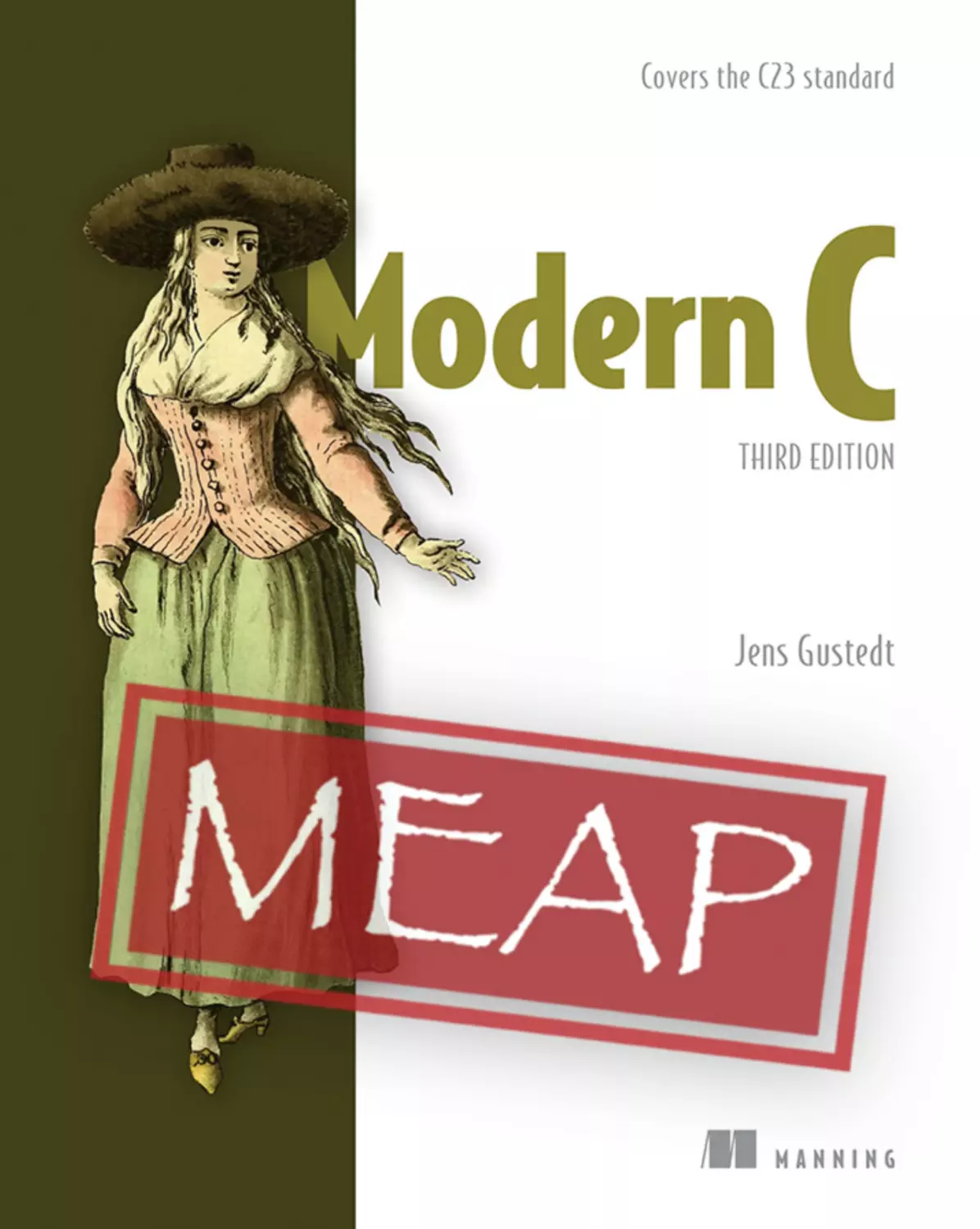
About the cover illustration
The figure on the cover of Modern C is captioned “Femme Dalmate” or woman from Dal-
matia. The illustration is taken from a collection of dress costumes from various countries
by Jacques Grasset de Saint Sauveur (1757-1810), titled “Costumes de Différents Pays”, pub-
lished in France in the late 18th century. Each illustration is finely drawn and colored by
hand. The rich variety of Grasset de Saint Sauveur’s collection reminds us vividly of how
culturally apart the world’s towns and regions were just 250 years ago. Isolated from each
other, people spoke different dialects and languages. In the streets or in the countryside, it
was easy to identify where they lived and what their trade or station in life was just by their
dress.
The way we dress has changed since then and the diversity by region, so rich at the time,
has faded away. It is now hard to tell apart the inhabitants of different continents, let alone
different towns, regions, or countries. Perhaps we have traded cultural diversity for a more
varied personal life—certainly for a more varied and fast-paced technological life.
At a time when it is hard to tell one computer book from another, Manning celebrates
the inventiveness and initiative of the computer business with book covers rich diversity
of regional life of more than two centuries ago, brought back to life by Grasset de Saint
Sauveur’s pictures.

welcome
Thank you for purchasing the MEAP edition of Modern C, Third Edition.
After over 40 years of development, C is still among the major programming languages,
ubiquitously used in basically all modern electronic devices, ranging from a small music chip in
a birthday greeting card, your refrigerator, your phone, your laptop, to mainframes or satellites.
This book is meant to provide you with a leveled approach in learning and mastering C. The
previous edition already has been largely successful and is considered by some as one of the
reference books on the subject.
This new edition has been the occasion to overhaul the presentation in many places, but its
main purpose is the update to the new C standard, C23. The goal is to publish this new edition
of Modern C at the same time as the new C standard goes through the procedure of ISO
publication and as new releases of major compilers will implement all the new features that it
brings.
Among the most noticeable changes and additions that we handle are those for integers:
there are new bit-precise types coined _BitInt(N), new C library headers <stdckdint.h> (for
arithmetic with overflow check) and <stdbit.h> (for bit manipulation), possibilities for 128 bit
types on modern architectures, and substantial improvements for enumeration types.
Other new concepts in C23 include a nullptr constant and its underlying type, syntactic
annotation with attributes, more tools for type generic programming such as type inference with
auto and typeof, default initialization with {}, even for variable length arrays. and constexpr for
name constants of any type. Furthermore, new material has been added, discussing compound
expressions and lambdas, so-called “internationalization”, a comprehensive approach for
program failure.
During MEAP we will also add an appendix and a temporary include header for an easy
transition to C23 on existing platforms, that will allow you to start off with C23 right away.
We also encourage you to post any questions or comments you have about the content in
the liveBook Discussion forum. We appreciate knowing where we can make improvements and
increase your understanding of the material
— Jens Gustedt

brief contents
LEVEL 0: ENCOUNTER
1 Getting started
2 The principle structure of a program
LEVEL 1: ACQUAINTANCE
3 Everything is about control
4 Expressing computations
5 Basic values and data
6 Derived data types
7 Functions
8 C library functions
LEVEL 2: COGNITION
9 Style
10 Organization and documentation
11 Pointers
12 The C memory model
13 Storage
14 More involved processing and IO
15 Program failure
LEVEL 3: EXPERIENCE
16 Performance

17 Function-like macros
18 Type-generic programming
19 Variations in control flow
20 Threads
21 Atomic access and memory consistency
APPENDIXES
Technical Annex
Appendix A. Transitional code
Appendix B. C Compilers
Appendix C. C Libraries

Level 0
Encounter
Our mascot for this level is the magpie, one of the most intelligent nonhuman species on earth. They
are capable of elaborate social rituals and usage of tools.
This first level of the book may be your first encounter with the programming language
C. It provides you with a rough knowledge about C programs, their purpose, their struc-
ture, and how to use them. It is not meant to give you a complete overview, it can’t and it
doesn’t even try. On the contrary, it is supposed to give you a general idea of what this is all
about, open up questions, and promote ideas and concepts. These then will be explained
in detail in the higher levels.

1Getting started
This section covers
Introduction to imperative programming
Compiling and running code
In this section, I will introduce you to one simple program that has been chosen because
it contains many of the constructs of the C language. If you already have programming
experience, you may find that parts of it feel like needless repetition. If you lack such
experience, you might feel overwhelmed by the stream of new terms and concepts.
In either case, be patient. For those of you with programming experience, it’s very
possible that there are subtle details you’re not aware of, or assumptions you have made
about the language that are not valid, even if you have programmed C before. For those
approaching programming for the first time, be assured that after approximately 10 pages
your understanding will have increased a lot, and you should have a much clearer idea of
what programming represents.
An important bit of wisdom for programming in general, and for this book in particular,
is summarized in the following citation from the Hitchhiker’s Guide to the Galaxy by Douglas
Adams Adams [1986]:

Takeaway 1 #1 Don’t panic.
It’s not worth it. There are many cross references, links, and bits of side information in
the text, and there is an index at the end. Follow those if you have a question. Or just take
a break.
Programming in C is about having the computer complete some specific tasks. A C pro-
gram does that by giving orders, much as we would express such orders in the imperative
tense in many human languages; thus the term imperative programming for this particular
way of organizing computer programs. To get started and see what we are talking about,
consider our first program in listing 1.0 .1, which corresponds to the getting-started.c
source file in the source directory.
Listing 1.0 .1 A first example of a C program
1 /* This may look like nonsense, but really is -*
-
mode: C -*
-
*/
2 #include <stdlib.h>
3 #include <stdio.h>
4
5 /* The main thing that this program does. */
6 int main(int argc, [[maybe_unused]] char* argv[argc+1]) {
7
// Declarations
8
double A[5] = {
9
[0] = 9.0,
10
[1] = 2.9,
11
[4] = 3.E+25,
12
[3] = .0 0007,
13
};
14
15
// Doing some work
16
for(size_ti =0;i<5;++i){
17
printf("element %zu is %g, \tits square is %g\n",
18
i,
19
A[i],
20
A[i]*A[i]);
21
}
22
23
return EXIT_SUCCESS;
24}
1.1 Imperative programming
You probably see that this is a sort of language, containing some weird words like main,
include, for, and so on, which are laid out and colored in a peculiar way and mixed
with a lot of strange characters, numbers, and text (“Doing some work”) that looks like ordi-

nary English. It is designed to provide a link between us, the human programmers, and a
machine, the computer, to tell it what to do: to give it “orders.”
Takeaway 1.1 #1 C is an imperative programming language.
In this book, we will not only encounter the C programming language, but also some
vocabulary from an English dialect, C jargon, the language that helps us to talk about C. It
will not be possible to immediately explain each term the first time it occurs. But I will
explain each one in time, and all of them are indexed so you can easily cheat and jumpC
to more explanatory text, at your own risk.1
As you can probably guess from this first example, such a C program has different
components that form some intermixed layers. Let’s try to understand it from the inside
out. The visible result of running this program is to output 5 lines of text on the command
terminal of your computer. On my computer, using this program looks something like
this:
Terminal
0
> ./getting-started
1
element 0 is 9,
its square is 81
2
element 1 is 2.9,
its square is 8.41
3
element 2 is 0,
its square is 0
4
element 3 is 7e-05,
its square is 4.9e-09
5
element 4 is 3e+25,
its square is 9e+50
We can easily identify within our program the parts of the text that this program out-
puts (printsC , in C jargon): the part of line 17 between quotes. The real action happens
between that line and line 20. C calls this a statementC , which is a bit of a misnomer.
Other languages would use the term instruction which describes the purpose better. This
particular statement is a callC to a functionC named printf:
getting-started.c
17
printf("element %zu is %g, \tits square is %g\n",
18
i,
19
A[i],
20
A[i]*A[i]);
Here, the printf function receives four argumentsC , enclosed in a pair of parenthesesC ,
(...):
The funny-looking text (between the quotes) is a so-called string literalC that serves
as a formatC for the output. Within the text are three markers (format specifiersC )
1Such special terms from C jargon are marked with a C, as shown here.

that indicate the positions in the output where numbers are to be inserted. These
markers start with a % character. This format also contains some special escape charactersC
that start with a backslash: \t and \n .
After a comma character, we find the word i. The thing i stands for will be printed
in place of the first format specifier, %zu .
Another comma separates the next argument A[i]. The thing this stands for will be
printed in place of the second format specifier, the first %g.
Last, again separated by a comma, appears A[i]*A[i], corresponding to the last
%g.
We will later explain what all of these arguments mean. Just remember that we identified
the main purpose of the program (to print some lines on the terminal) and that it “orders”
the printf function to fulfill that purpose. The rest is some sugarC to specify which
numbers will be printed, and how many of them.
1.2 Compiling and running
As shown in the previous subsection, the program text expresses what we want our com-
puter to do. As such, it is just another piece of text that we have written and stored some-
where on our hard disk, but the program text as such cannot be understood by your com-
puter. There is a special program, called a compiler, that translates the C text into something
that your machine can understand: the binary codeC or executableC . What that translated
program looks like and how this translation is done are much too complicated to explain
at this stage.2 Even this entire book will not be able to explain most of it; that would be the
subject of another whole book. However, for the moment, we don’t need to understand
more deeply, as we have the tool that does all the work for us.
Takeaway 1.2 #1 C is a compiled programming language.
The name of the compiler and its command-line arguments depend a lot on the platformC
on which you will be running your program. There is a simple reason for this: the target
binary code is platform dependentC : that is, its form and details depend on the computer
on which you want to run it. A PC has different needs than a phone, and your refrigerator
doesn’t speak the same “language” as your set-top box. In fact, that’s one of the reasons for
C to exist: C provides a level of abstraction for all the different machine-specific languages
(usually referred to as assemblerC ).
2In fact, the translation itself is done in several steps that go from textual replacement, over proper compi-
lation, to linking. Nevertheless, the tool that bundles all this is traditionally called a compiler and not a translator,
which would be more accurate.

Takeaway 1.2 #2 A correct C program is portable between different platforms.
In this book, we will put a lot of effort into showing you how to write “correct” C programs
that ensure portability. Unfortunately, there are some platforms that claim to be “C” but
do not conform to the latest standards; and there are conforming platforms that accept
incorrect programs or provide extensions to the C standard that are not widely portable. So,
running and testing a program on a single platform will not always guarantee portability.
It is the job of the compiler to ensure that the little program shown earlier, once trans-
lated for the appropriate platform, will run correctly on your PC, your phone, your set-top
box, and maybe even your refrigerator.
That said, if you have a POSIX system (such as Linux or macOS), there is a good chance
that programs named c99 or c17 might be present and that it is in fact a C compiler. You
could try to compile the example program using the following command:
Terminal
0
> c17 -Wall -o getting-started getting-started.c
-lm
The compiler should do its job without complaining and output an executable file called
getting-started in your current directory.[Exs 3] In the example line,
c17 is the compiler program.
-Wall tells it to warn us about anything that it finds unusual.
-o getting-started tells it to store the compiler outputC in a file named getting-started.
getting-started.c names the source fileC , the file that contains the C code we
have written. Note that the .c extension at the end of the filename refers to the C
programming language.
-lm tells it to add some standard numerical functions if necessary; we will need those
later on.
Now we can executeC our newly created executableC . Type in
Terminal
0
> ./getting-started
and you should see exactly the same output as I showed you earlier. That’s what portable
means: wherever you run that program, its behaviorC
should be the same.
If you are not lucky and the compilation command didn’t work, you will have to look
up the name of your compilerC in your system documentation. You might even have to
[Exs 3]Try the compilation command in your terminal.

install a compiler if one is not available. 4 The names of compilers vary. Here are some
common alternatives that might do the trick:
Terminal
0
> clang -std=c2x -Wall -lm -o getting-started getting-started.c
1
> gcc -std=c2x -Wall -lm -o getting-started getting-started.c
2
> icc -std=c2x -Wall -lm -o getting-started getting-started.c
Here the option -std=c2x names the standard version “C2x” which was meant for C23
before we actually knew that it would be finished in 2023.
Some of these compilers, even if they are present on your computer, might not compile
the program without complaining.[Exs 5]
With the program in listing 1.0.1, we presented an ideal world: a program that works
and produces the same result on all platforms. Unfortunately, when programming yourself,
very often you will have a program that works only partially and that may produce wrong
or unreliable results. Therefore, let us look at the program in listing 1.2.1. It looks quite
similar to the previous one.
Listing 1.2 .1 An example of a C program with flaws
1 /* This may look like nonsense, but really is -*
-
mode: C -*
-
*/
2
3 /* The main thing that this program does. */
4 void main() {
5
// Declarations
6
int i;
7
double A[5] = {
8
9.0,
9
2.9,
10
3.E+25,
11
. 000 07,
12
};
13
14
// Doing some work
15
for(i=0;i<5;++i){
16
printf("element %d is %g, \tits square is %g\n",
17
i,
18
A[i],
19
A[i]*A[i]);
20
}
21
4This is necessary in particular if you have a system with a Microsoft operating system. Microsoft’s native
compilers are now catching up with C17, but I don’t know about their plans for C23. Many features that we
discuss in this book might not work. For a discussion on alternative development environments, there, Chris
Wellons’ blog entry “Four Ways to Compile C for Windows” (https://nullprogram.com/blog/2016/
06/13/) might still be of interest.
[Exs 5]Start writing a text report about your tests with this book. Note down which command worked for you.

22
return 0;
23}
If you run your compiler on this program, it should give you some diagnosticC infor-
mation similar to this:
Terminal
0
> gcc -std=c2x -Wall -o bad bad.c
1
bad.c:4:6: warning: return type of 'main' is not 'int' [-Wmain]
2
4 | void main() {
3
|
^~~~
4
bad.c: In function 'main':
5
bad.c:16:6: warning: implicit declaration of function 'printf' [-Wimplicit-function-decl ...
6
16|
printf("element %d is %g, \tits square is %g\n", /*@\label{printf-start-bad ...
7
|
^~~~~~
8
bad.c:1:1: note: include '<stdio.h>' or provide a declaration of 'printf'
9
+++ |+#include <stdio.h>
10
1 | /* This may look like nonsense, but really is -*
-
mode: C -*
-
*/
11
bad.c:16:6: warning: incompatible implicit declaration of built-in function 'printf' [ ...
12
16|
printf("element %d is %g, \tits square is %g\n", /*@\label{printf-start-bad ...
13
|
^~~~~~
14
bad.c:16:6: note: include '<stdio.h>' or provide a declaration of 'printf'
15
bad.c:22:10: warning: 'return' with a value, in function returning void [-Wreturn-type]
16
22 | return 0;
/*@\label{main-return-ba ...
17
|
^
18
bad.c:4:6: note: declared here
19
4 | void main() {
20
|
^~~~
Here we had a lot of long “warning” lines that are even too long to fit on a terminal
screen. In the end, the compiler produced an executable. Unfortunately, the output when
we run the program is different. This is a sign that we have to be careful and pay attention
to details.
clang is even more picky than gcc and gives us similar diagnostics:

Terminal
0
> clang -std=c2x -Wall -o bad bad.c
1
bad.c:4:1: error: 'main' must return 'int'
2
4 | void main() {
3
| ^~~~
4
| int
5
bad.c:16:6: error: call to undeclared library function 'printf' with type 'int (const ch ...
6
16|
printf("element %d is %g, \tits square is %g\n", /*@\label{printf-start-badly}*/
7
|
^
8
bad.c:16:6: note: include the header <stdio.h> or explicitly provide a declaration for ' ...
9
bad.c:22:3: error: void function 'main' should not return a value [-Wreturn-type]
10
22 | return 0;
/*@\label{main-return-badly}*/
11
|^
~
12
3 errors generated.
Notice how clang, unlike gcc, did not produce an executable. It considers all three
problems that it detected to be fatal errors and refuses to carry on. Consider this to be a
feature.
Both gave us three diagnostics: they expect a different return type for main, they ex-
pected us to have a line such as line 3 from listing 1.0 .1 to specify where the printf
function comes from, and they detect that the return in line 22 is not correct for the
specification of main as it is given.
Depending on your platform, you can force your compiler to reject programs that pro-
duce such diagnostics. For gcc, such a command-line option would be -Werror and then
it would behave as we have seen for clang.
So there are two differences between listings 1.0.1 and 1.2.1, and these two modifi-
cations turned a good, standards-conforming, portable program into a bad one. We also
have seen that the compiler is there to help us. It nailed the problem down to the lines in
the program that cause trouble, and with a bit of experience you will be able to understand
what it is telling you.[Exs 6] [Exs 7]
Takeaway 1.2 #3 A C program should compile cleanly without warnings.
[Exs 6]Correct listing 1.2 .1 step by step. Start from the first diagnostic line, fix the code that is mentioned there,
recompile, and so on, until you have a flawless program.
[Exs 7]There is a third difference between the two programs that we didn’t mention yet. Find it.

Summar y
C is designed to give computers orders. Thereby it mediates between us (the pro-
grammers) and computers.
C must be compiled to be executed. The compiler provides the translation between
the language that we understand (C) and the specific needs of the particular platform.
C gives a level of abstraction that provides portability. One C program can be used
on many different computer architectures.
The C compiler is there to help you. If it warns you about something in your program,
listen to it.

2
The principal structure of a
program
This section covers
C grammar
Declaring identifiers
Defining objects
Instructing the compiler with statements
Compared to our little examples in the previous section, real programs will be more com-
plicated and contain additional constructs, but their structure will be very similar. List-
ing 1.0.1 already has most of the structural elements of a C program.
There are two categories of aspects to consider in a C program: syntactical aspects (how
do we specify the program so the compiler understands it?) and semantic aspects (what do
we specify so that the program does what we want it to do?). In the following subsections,
we will introduce the syntactical aspects (grammar) and three different semantic aspects:
declarative parts (what things are), definitions of objects (where things are), and statements
(what things are supposed to do).

2.1 Grammar
Looking at its overall structure, we can see that a C program is composed of different types
of text elements that are assembled in a kind of grammar. These elements are:
Special words In listing 1.0.1, we used the following special words:1
#include, int, maybe_unused, char, void, double, for, and return.
In program text in this book, most of them will be printed in black bold. These special
words represent concepts and features that the C language imposes and that cannot be
changed.
PunctuationC C uses several types of punctuation to structure the program text.
Therearesixkindsofbrackets:{...},(...),[...],[[...]],/*...*/,and<...>.
Brackets group certain parts of the program together and should always come in pairs.
Fortunately, the < . . . > brackets are rare in C and are only used as shown in our ex-
ample, on the same logical line of text. The other five are not limited to a single line;
their contents might span several lines, as they did when we used printf earlier.
There are two different separators or terminators: comma and semicolon. When we
used printf, we saw that commas separated the four arguments of that function; and
on line 12 we saw that a comma also can follow the last element of a list of elements.
getting-started.c
12
[3] = .00007,
One of the difficulties for newcomers in C is that the same punctuation characters are
used to express different concepts. For example, the pairs{} and [] are each used for
three different purposes in listing 1.0 .1 .[Exs 2]
Takeaway 2.1 #1 Punctuation characters can be used with several different meanings.
CommentsC The construct /* . . .*/ that we saw earlier tells the compiler that everything
inside it is a comment; see, for example, line 5:
getting-started.c
5 /* The main thing that this program does. */
1In C jargon, these are directivesC
, keywordsC
, attributesC
, and reservedC identifiers.
[Exs 2]Find these different uses of these two sorts of brackets.

Comments are ignored by the compiler. It is the perfect place to explain and doc-
ument your code. Such in-place documentation can (and should) greatly improve
the readability and comprehensibility of your code. Another form of comment is the
so-called C++-style comment, as on line 15. These are marked with //. C++-style
comments extend from the // to the end of the line.
LiteralsC Our program contains several items that refer to fixed values that are part of the
program: 0, 1 , 3, 4 , 5, 9.0, 2.9, 3.E+25, .00007, and
"element %zu is %g, \tits square is %g\n". These are called literalsC .
IdentifiersC These are “names” that we (or the C standard) give to certain entities in the pro-
gram. Here we have A, i, main, printf, size_t, and EXIT_SUCCESS. Identifiers
can play different roles in a program. Among other things, they may refer to
Data objectsC (such as A and i). These are also referred to as variablesC .
TypeC aliases, such as size_t, that specify the “kind” of a new object, here of i.
Observe the trailing _t in the name. This naming convention is used by the C
standard to remind you that the identifier refers to a type.
Functions, such as main and printf.
Constants, such as EXIT_SUCCESS.
FunctionsC Two of the identifiers refer to functions: main and printf. As we have already
seen, printf is used by the program to produce some output. The function main in
turn is definedC : that is, its declaration
C int main(void) is followed by a func-
tion bodyC (indicated by{ . . .} of a compound statement) that describes what that
function is supposed to do. In our example, this function definitionC goes from line 6
to 24. main has a special role in C programs, as we will encounter: it must always be
present, since it is the starting point of the program’s execution.
OperatorsC Of the numerous C operators, our program only uses a few:
= for initializationC and assignmentC ,
< for comparison,
++ to increment a variable (to increase its value by 1), and
* to multiply two values.
AttributesC Attributes such as [[maybe_unused]] are placed into double square brackets
as shown and provide some supplemental information to the principle structure of
the program.C23
Just as in natural languages, the lexical elements and the grammar of C programs that
we have seen here have to be distinguished from the actual meaning these constructs con-
vey. In contrast to natural languages, though, this meaning is rigidly specified and usually
C23 This feature is new in C23, so your compiler might not yet implement it.

leaves no room for ambiguity. In the following subsections, we will dig into the three main
semantic categories that C distinguishes: declarations, definitions, and statements.
2.2 Declarations
Before we may use a particular identifier in a program, we have to give the compiler a
declarationC that specifies what that identifier is supposed to represent. This is where
identifiers differ from keywords: keywords are predefined by the language and must not
be declared or redefined.
Takeaway 2.2 #1 All identifiers in a program have to be declared.
Several of the identifiers we use are effectively declared in our program: main, argc,
argv, A, and i. Later on, we will see where the other identifiers (printf, size_t, and
EXIT_SUCCESS) come from. We already mentioned the declaration of the main func-
tion. All five declarations, in isolation as “declarations only,” look like this:
int main(int, char*[]);
int argc;
[[maybe_unused]] char* argv[];
double A[5];
size_t i;
These five follow a pattern. Each has an identifier (main, argc, argv, A, or i) and a
specification of certain properties that are associated with that identifier:
i is of typeC size_t .
argc is of type int.
main is additionally followed by parentheses, ( . . . ), and thus declares a function of
type int.
A is followed by brackets, [ . . . ], and thus declares an arrayC . An array is an aggregate
of several items of the same type; here it consists of 5 items of type double. These 5
items are ordered and can be referred to by numbers, called indicesC , from 0 to 4.
argv is also followed by brackets, and so it also has properties of an array. The attribute
[[maybe_unused]] indicates that it is possibly unused, and indeed we don’t see the
word argv elsewhere in this program code. There are argc+1 elements of a type de-
noted by char*.

Each of these declarations starts with a typeC , here int, char*, double, and size_t .
We will see later what that represents. For the moment, it is sufficient to know that this
specifies that four of the identifiers (main, argc, A, and i), when used in the context of a
statement, will provide some sort of “numbers.” For the other, argv, the * at the end of
char* indicates that it is a pointerC ; pointers, though a principal feature of the C language,
will only appear much later in this book.
The declarations of argc, i and A declare variablesC , which are named items that
allow us to store valuesC . They are best visualized as a kind of box that may contain a
“something” of a particular type:
argc
int ??
i
size_t ??
A
[0]
double ??
[1]
double ??
[2]
double ??
[3]
double ??
[4]
double ??
Conceptually, it is important to distinguish the box itself (the object), the specification (its
type), the box contents (its value), and the name or label that is written on the box (the
identifier). In such diagrams, we put ?? if we don’t know the actual value of an item.
For the other three identifiers, printf, size_t, and EXIT_SUCCESS, we don’t see
any declaration. In fact, they are predeclared identifiers, but as we saw when we tried to
compile listing 1.2.1, the information about these identifiers doesn’t come out of nowhere.
We have to tell the compiler where it can obtain information about them. This is done
right at the start of the program, in lines 2 and 3: printf is provided by <stdio.h>, <stdio.h>
whereas size_t and EXIT_SUCCESS come from <stdlib.h>. The real declarations of <stdlib.h>
these identifiers are specified in .h files with these names somewhere on your computer.
They could be something like:
int printf(char const format[static 1], ...);
typedef unsigned long size_t;
#define EXIT_SUCCESS 0
Because the specifics of these predeclared features are of minor importance, this infor-
mation is normally hidden from you in these include filesC or header filesC . If you need
to know their semantics, it is usually a bad idea to look them up in the corresponding files,
as these tend to be barely readable. Instead, search in the documentation that comes with
your platform. For the brave, I always recommend a look into the current C standard, as
that is where they all come from. For the less courageous, the following commands may
help:

Terminal
0
> apropos printf
1
> man printf
2
> man 3 printf
A declaration only describes a feature but does not create it, so repeating a declaration
does not do much harm but adds redundancy.
Takeaway 2.2 #2 Identifiers may have several consistent declarations.
Clearly, it would become really confusing (for us or the compiler) if there were several
contradicting declarations for the same identifier in the same part of the program, so gen-
erally this is not allowed. C is quite specific about what “the same part of the program” is
supposed to mean: the scopeC is a part of the program where an identifier is visibleC .
Takeaway 2.2 #3 Declarations are bound to the scope in which they appear.
These scopes of identifiers are unambiguously described by the grammar. In listing 1.0.1,
we have declarations in different scopes:
A is visible inside the definition of the function main, starting at its declaration on
line 8 and ending with the closing } on line 24 of the innermost{ . . .} compound
statement that contains that declaration.
i has more restricted visibility. It is bound to the for construct in which it is de-
clared. Its visibility reaches from that declaration on line 16 to the end of the{ . . .}
compound statement that is associated with the for on line 21.
main is not enclosed in any other compound statement, so it is visible from its dec-
laration onward until the end of the file.
argc and argv are not enclosed inside{ . . .} , but they are inside the ( . . . ) that
marked main as being a function. They are the parametersC of the function and
their scope starts at their respective declaration and then spans whole{ . . .} body of
their function, here of main.
The first two and the last types of scope are called block scopeC with a blockC being a struc-
ture in the grammar that encapsulates such declarations. A function like main together
with its parameter list (enclosed in () ) and the whole body (enclosed in{} ) forms a sin-
gle block of its own. The for construct forms a primary blockC and additionally the loop
body (usually also given with surrounding { . . .} ) forms a so-called secondary blockC .

You can see that blocks are nestedC : the block of main contains the primary block of the
for-loop, which in turn contains its secondary block.
The third type of scope, as used for the name main itself which is not inside a ( . . . ) or
{ . . .} pair, is called file scopeC . Identifiers in file scope are often referred to as globalsC .
So our seemingly simply program has four nested levels of scopes: file scope and the
three nested blocks we talked above.
2.3 Definitions
Generally, declarations only specify the kind of object an identifier refers to, not what
the concrete value of an identifier is, nor where the object it refers to can be found. This
important role is filled by a definitionC .
Takeaway 2.3 #1 Declarations specify identifiers, whereas definitions specify objects.
We will later see that things are a little more complicated in real life, but for now we can
make the simplification that we will always initialize our variables. An initialization is a
grammatical construct that augments a declaration and provides an initial value for the
object. For instance,
size_t i
=
0;
is a declaration of i such that the initial value is 0.
In C, such a declaration with an initializer also defines the object with the corresponding
name: that is, it instructs the compiler to provide storage in which the value of the variable
can be stored.
Takeaway 2.3 #2 An object is defined at the same time it is initialized.
Our box visualization can now be completed with a value, 0 in this example:
i
size_t 0
A is a bit more complex because it has several components:
getting-started.c
8
double A[5] = {
9
[0] = 9.0,
10
[1] = 2.9,
11
[4] = 3.E+25,

12
[3] = .0 0007,
13
};
This initializes the 5 items in A to the values 9.0, 2.9, 0.0, 0.000’07, and 3.0E+25,
in that order:
A
[0]
double 9.0
[1]
double 2.9
[2]
double 0.0
[3]
double 0.000’07
[4]
double 3.0E+25
The form of an initializer that we see here is called designatedC : a pair of brackets with
an integer designate which item of the array is initialized with the corresponding value. For
example, [4] = 3 .E+25 sets the last item of the array A to the value 3.E+25. As a
special rule, any position that is not listed in the initializer is set to 0. In our example, the
missing [2] is filled with 0.0 .4
Takeaway 2.3 #3 Missing elements in initializers default to 0.
You might have noticed that array positions, indicesC , do not start with 1 for the first
element, but with 0. Think of an array position as the distance of the corresponding array
element from the start of the array.
Takeaway 2.3 #4 For an array with n elements, the first element has index 0, and the last has
index n-1 .
For a function, we have a definition (as opposed to only a declaration) if its declaration is
followed by braces{ . . .} containing the code of the function:
int main(int argc, [[maybe_unused]] char* argv[argc+1]) {
...
}
In our examples so far, we have seen names for two different features: objectsC , i and A,
and functionsC , main and printf. In contrast to object or function declarations, where
several are allowed for the same identifier, definitions of objects or functions must be
unique. That is, for a C program to be operational, any object or function that is used
must have a definition (otherwise the execution would not know where to look for them),
and there must be no more than one definition (otherwise the execution could become
inconsistent).
4We will see later how these number literals with dots (.) and exponents (E+25) work.

Takeaway 2.3 #5 Each object or function must have exactly one definition.
2.4 Statements
The second part of the main function consists primarily of statements. Statements are in-
structions that tell the compiler what to do with identifiers that have been declared so far.
We have
getting-started.c
16
for(size_ti =0;i<5;++i){
17
printf("element %zu is %g, \tits square is %g\n",
18
i,
19
A[i],
20
A[i]*A[i]);
21
}
22
23
return EXIT_SUCCESS;
We have already discussed the lines that correspond to the call to printf. There are
also other types of statements: for and return statements, and an increment operation,
indicated by the operatorC ++ . In the following subsection, we will go a bit into the de-
tails of three categories of statements: iterations (do something several times), function calls
(delegate execution somewhere else), and function returns (resume execution from where a
function was called).
2.4 .1 Iteration
The for statement tells the compiler that the program should execute the printf line
a number of times. This is the simplest form of domain iterationC that C has to offer. It
has four different parts.
The secondary block (here, a compound statement marked by{ . . .} ) that follows the
for ( . . . ) is the code that is to be repeated; it is also called the loop bodyC . The other
three parts are those inside the ( . . . ) part, divided by semicolons:
1 The declaration, definition, and initialization of the loop variableC i, which we al-
ready discussed. This initialization is executed once before any of the rest of the entire
for statement.
2 A loop conditionC , i < 5 specifies how long the for iteration should continue. This
tells the compiler to continue iterating as long as i is strictly less than 5. The loop
condition is checked before each execution of the loop body.
3 Another statement, ++i , is executed after each iteration. In this case, it increases the
value of i by 1 each time.
If we put all of these together, we ask the program to perform the code in the secondary
block five times, setting the value of i to 0, 1 , 2, 3, and 4, respectively, in each iteration.

The fact that we can identify each iteration with a specific value for i makes this an iteration
overthedomainC0, ...,4.ThereismorethanonewaytodothisinC,butforisthe
easiest, cleanest, and best tool for the task.
Takeaway 2.4 .1 #1 Domain iterations should be coded with a for statement.
A for statement can be written in several ways other than what we just saw. Often, people
place the definition of the loop variable somewhere before the for or even reuse the same
variable for several loops. Don’t do that: to help an occasional reader and the compiler
understand your code, it is important to know that this variable has the special meaning of
an iteration counter for that given for loop.
Takeaway 2.4 .1 #2 The loop variable should be defined in the initial part of a for.
2.4 .2 Function calls
Function calls are special statements that suspend the execution of the current function (at
the beginning, this is usually main) and then hand over control to the named function. In
our example
getting-started.c
17
printf("element %zu is %g, \tits square is %g\n",
18
i,
19
A[i],
20
A[i]*A[i]);
the called function is printf. A function call usually provides more than just the name
of the function, but also arguments. Here, these are the long chain of characters, i, A[i],
and A[i]*A[i]. The values of these arguments are passed over to the function. In this
case, these values are the information that is printed by printf. The emphasis here is
on “value”: although i is an argument, printf will never be able to change i itself. Such
a mechanism is called call by value. Other programming languages also have call by refer-
ence, a mechanism where the called function can change the value of a variable. C does
not implement pass by reference, but it has another mechanism to pass the control of a
variable to another function: by taking addresses and transmitting pointers. We will see
these mechanism much later.
2.4 .3 Function return
The last statement in main is a return. It tells the main function to return to the state-
ment that it was called from once it’s done. Here, since main has int in its declaration,

a return must send back a value of type int to the calling statement. In this case, that
value is EXIT_SUCCESS.
Even though we can’t see its definition, the printf function must contain a similar
return statement. At the point where we call the function on line 17, execution of the
statements in main is temporarily suspended. Execution continues in the printf func-
tion until a return is encountered. After the return from printf, execution of the state-
ments in main continues from where it stopped.
int main(int argc , [[maybe_unused]] char∗ argv[argc+1]) {
// Declarations
double A[5] = {
[0]=9.0,
[1]=2.9,
[4]=3.E+25,
[3] =
.00007,
};
// Doing some work
for(size_ti=0;i<5;++i){
printf ( "element %zu is %g, \tits square is %g\n" ,
i,
A[i],
A[i]∗A[i]);
}
return EXIT_SUCCESS ;
}
int printf(char const fmt[], ...) {
return something;
}
P
r
o
c
e
s
s
s
t
a
r
t
u
p
C
l
i
b
r
a
r
y
Progam code
C
a
l
l
C
a
l
l
main();
R
e
t
u
r
n
R
e
t
u
r
n
Figure 2.4.1 Execution of a small program
Figure 2.4.1 shows a schematic view of the execution of our little program: its control
flow. First, a process-startup routine (on the left) that is provided by our platform calls
the user-provided function main (middle). That, in turn, calls printf, a function that is
part of the C libraryC , on the right. Once a return is encountered there, control returns
back to main; and when we reach the return in main, it passes back to the startup
routine. The latter transfer of control, from a programmer’s point of view, is the end of
the program’s execution.

Summary
C distinguishes the lexical structure (the punctuators, identifiers, and numbers), the
grammatical structure (syntax), and the semantics (meaning) of programs.
All identifiers (names) must be declared such that we know the properties of the
concept they represent.
All objects (things that we deal with) and functions (methods that we use to deal with
things) must be defined; that is, we must specify how and where they come to be.
Statements indicate how things are going to be done: iterations (for) repeat varia-
tions of a certain tasks, functions calls (printf(...)) delegate a task to a function,
and function returns (return something;) go back where we came from.

Level 1
Acquaintance
Our mascot for this level, the common raven, is a very sociable corvid and known for its problem-
solving capacity. Ravens organize in teams and have been obser ved playing even as adults.
This level will acquaint you with the C programming language: that is, it will provide
you with enough knowledge to write and use good C programs. “Good” here refers to a
modern understanding of the language, avoiding most of the pitfalls of early dialects of C,
and offering you some constructs that were not present before and that are portable across
the vast majority of modern computer architectures, from your cell phone to a mainframe
computer. Having worked through these sections, you should be able to write short code
for everyday needs: not extremely sophisticated, but useful and portable.

Buckle up
In many ways, C is a permissive language; programmers are allowed to shoot themselves
in the foot or other body parts if they choose to, and C will make no effort to stop them.
Therefore, just for the moment, we will introduce some restrictions. We’ll try to avoid
handing out guns in this level, and place the key to the gun safe out of your reach for the
moment, marking its location with big and visible exclamation marks.
The most dangerous constructs in C are the so-called castsC , so we’ll skip them at this
level. However, there are many other pitfalls that are less easy to avoid. We will approach
some of them in a way that might look unfamiliar to you, in particular if you learned your
C basics in the last millennium or if you were introduced to C on a platform that wasn’t
upgraded to current ISO C for years.
Experienced C programmers If you already have some experience with C programming, what fol-
lows may take some getting used to or even provoke allergic reactions. If you happen
to break out in spots when you read some of the code here, take a deep breath and
try to relax, but please do not skip these pages.
Inexperienced C programmers If you are not an experienced C programmer, much of the follow-
ing discussion may be a bit over your head: for example, we may use terminology that
you have not yet even heard of. If so, this is a digression for you, and you may skip
to the start of section 3 and come back later when you feel a bit more comfortable.
But be sure to do so before the end of this level.
Some of “getting used to” our approach on this level may concern the emphasis and or-
dering in which we present the material:
We will focus primarily on the unsignedC versions of integer types.

We will introduce pointers in steps: first, in disguise as parameters to functions (sec-
tion 6.1 .4), then with their state (being valid or not, section 6.2), and then, on the
next level, (section 11), using their entire potential.
We will focus on the use of arrays whenever possible, instead.
You might also be surprised by some style considerations that we will discuss in the fol-
lowing points. On the next level, we will dedicate an entire section (section 9) to these
questions, so please be patient and accept them for the moment as they are.
We bind type modifiers, qualifiers and attributes to the left. We want to separate identifiers
visually from their type. So we will typically write things as
char* name;
where char* is the type and name is the identifier. We also apply the left-binding
rule to qualifiers or attributes and write
char const* const path_name[[deprecated]];
Here the first const qualifies the char to its left, the * makes it to a pointer, and
the second const again qualifies what is to its left. The attribute [[deprecated]]
clearly attaches to the identifier path_name.
We do not use continued declarations. They obfuscate the bindings of type declarators.
For example:
unsigned const*const a, b;
Here, b has type unsigned const: that is, the first const goes to the type, and
the second const only goes to the declaration of a. Such rules are highly confusing,
and you have more important things to learn.
We use array notation for pointer parameters. We do so wherever these assume that the
pointer can’t be null. Examples:
/* These emphasize that the arguments cannot be null. */
size_t strlen(char const string[static 1]);
int main(int argc, char* argv[argc+1]);
/* Compatible declarations for the same functions.
*/
size_t strlen(const char *string);
int main(int argc, char **argv);
The first stresses the fact that strlen must receive a valid (non-null) pointer and will
access at least one element of string. The second summarizes the fact that main
receives an array of argc+1 pointers to char: referring to the program name, to
argc-1 program arguments, and to one null pointer that terminates the array.
The second set of declarations only adds additional equivalent declarations for fea-
tures that are already known to the compiler. Because these are declarations and not

definitions, such a redeclaration is allowed, but it doesn’t add new information in this
case.
We use function notation for function pointer parameters.Along the same lines, we do so
whenever we know that a function pointer can’t be null:
/* This emphasizes that the ``handler’’ argument cannot be null. */
int atexit(void handler(void));
/* Compatible declaration for the same function.
*/
int atexit(void (*handler)(void));
Here, the first declaration of atexit emphasizes that, semantically, it receives a
function named handler as an argument and that a null function pointer is not
allowed. Technically, the function parameter handler is “rewritten” to a function
pointer much as array parameters are rewritten to object pointers, but this is of minor
interest for a description of the functionality.
Note, again, that the previous code is valid as it stands and that the second declaration
just adds an equivalent declaration for atexit.
We define variables as close to their first use as possible. Lack of variable initialization,
especially for pointers, is one of the major pitfalls for novice C programmers. This is
why we should, whenever possible, combine the declaration of a variable with the first
assignment to it: the tool that C gives us for this purpose is the definition: a declaration
together with an initialization. This gives a name to a value and introduces this name
at the first place where it is used.
This is particularly convenient for for loops. The iterator variable of one loop is
semantically a different object from that in another loop, so we declare the variable
within the for to ensure it stays within the loop’s primary block.
We use prefix notation for code blocks. To be able to read a code block, it is important to
capture two things about it easily: its purpose and its extent. Therefore:
–
All { are prefixed on the same line with the statement or declaration that intro-
duces them.
–
The code inside is indented by one level.
–
The terminating } starts a new line on the same level as the statement that intro-
duced the block.
–
Block statements that have a continuation after the } continue on the same line.
Examples:

int main(int argc, char* argv[argc+1]) {
puts("Hello world!");
if(argc>1){
while (true) {
puts("some programs never stop");
}
}else{
do{
puts("but this one does");
} while (false);
}
return EXIT_SUCCESS;
}
We use digit separators for numbers.
The human eye is not very good in perceiving the magnitude of numbers that have
many digits. In running text we therefore use a comma as thousands separator for
large decimal numbers and we even extend this form of notation to digits after the
period, for example as in 10, 035.677,789. A notable exception from this are years,
where we do not apply a thousands separator.
Since C23 there is also a digit separator for number literals, namely a ’ that appears
directly between two consecutive digits, such as in 10’035.677’789. We use that
for all number literals by grouping together 3 decimal digits (for thousands), 4 hex-
adecimal digits (for double bytes) and 8 binary digits (for the bits in a byte).

3
Everything is about control
This section covers
Conditional execution with if
Iterating over domains
Making multiple selections
In our introductory example, listing 1.0.1, we saw two different constructs that allowed us to
control the flow of a program’s execution: functions and the for iteration. Functions are
a way to transfer control unconditionally. The call transfers control unconditionally to the
function, and a return statement unconditionally transfers it back to the caller. We will
come back to functions in section 7.
The for statement is different in that it has a controlling condition (i < 5 in the ex-
ample) that regulates if and when the secondary block ({ printf(...) } ) is executed.
C has five conditional control statements: if, for, do, while , and switch. We will look
at these statements in this section: if introduces a conditional execution depending on a
Boolean expression; for, do, and while are different forms of iterations; and switch is
a multiple selection based on an integer value.
C has some other conditionals that we will discuss later: the ternary operatorC , denoted
by an expression in the form cond ? A : B (section 4.5), the compile-time prepro-
cessor conditionals #if, #ifdef, #ifndef, #elif, #elifdef, #elifndef, #else,

#endif (section 8.1.5), and type generic expressions denoted with the keyword _Generic
(section 18).
3.1 Conditional execution
The first construct that we will look at is specified by the keyword if. It looks like this:
if(i>25){
j=i
-
25;
}
Here we compare i against the value 25. If it is larger than 25, j is set to the value i - 25 .
In the example, i > 25 is called the controlling expressionC , and the part in{ ... }
is called the secondary blockC .
On the surface, this form of an if statement resembles the for statement that we
already encountered. But it works differently than that: there is only one part inside the
parentheses, and that determines whether the secondary block is run once or not at all.
There is a more general form of the if construct:
if(i>25){
j=i
-
25;
}else{
j=i;
}
It has another secondary block that is executed if the controlling condition is not fulfilled.
Syntactically, this is done by introducing another keyword else that separates the two
secondary blocks.
The if (...)
...
else ... is a selection statementC . It selects one of the two
possible code pathsC according to the contents of ( ... ) . The general form is
if (condition) secondary-block0
else secondary-block1
The possibilities for condition (the controlling expression) are numerous. They can
range from simple comparisons, as in this example, to very complex nested expressions.
We will present all the primitives that can be used in section 4.4 .2.
The simplest of such condition specifications in an if statement can be seen in the
following example, in a variation of the for loop from listing 1.0.1:
for(size_ti =0;i<5;++i){
if(i){
printf("element %zu is %g, \tits square is %g\n",
i,
A[i],
A[i]*A[i]);
}
}

Here the condition that determines whether printf is executed is just i: a numerical
value by itself can be interpreted as a condition. The text will only be printed when the
value of i is not 0.[Exs 1]
There are two simple rules for the evaluation of a numerical condition:
Takeaway 3.1 #1 The value 0 represents logical false.
Takeaway 3.1 #2 Any value different from 0 represents logical true.
The operators == and != allow us to test for equality and inequality, respectively. a = = b
is true if the value of a is equal to the value of b, and false otherwise; a != b is false if a is
equal to b, and true otherwise. Knowing how numerical values are evaluated as conditions,
we can avoid redundancy. For example, we can rewrite
if(i!=0){
...
}
as:
if(i){
...
}
Which of these two versions is more readable is a question of coding styleC and can be
subject to fruitless debates. While the first might be easier for occasional readers of C code
to read, the latter is often preferred in projects that assume some knowledge about C’s type
system.
The type bool should be used to store truth values. Its values are false and true.
Technically, false is just a value 0 of type bool and true the value 1. It’s important to
use false and true (and not the numbers) to emphasize that a value is to be interpreted
as a condition. We will learn more about the bool type in section 5.7.4. Note that, before
C23, to use bool and its literals false and true you had to use the <stdbool.h> header. <stdbool.h>
This is now merely obsolete and you should only use it if you suspect that your code may
be compiled on an older platform.
Redundant comparisons quickly become unreadable and clutter your code. If you have
a conditional that depends on a truth value, use that truth value directly as the condition.
Again, we can avoid redundancy by rewriting something like
[Exs 1]Add the if (i) condition to the program, and compare the output to the previous.

boolb=
...;
...
if ((b != false) == true) {
...
}
as
boolb=
...;
...
if(b){
...
}
Generally:
Takeaway 3.1 #3 Don’t compare to 0, false, or true.
Using either the truth value directly (such as i above) or the negation (denoted as !i in
C) makes your code clearer and illustrates one of the basic concepts of the C language:
Takeaway 3.1 #4 All scalars have a truth value.
Here, scalarC types include all the numerical types such as size_t, bool, and int that
we already encountered, and pointerC types; see table 3.1.1 for the types that are fre-
quently used in this book. We will come back to them in section 6.2.
3.2 Iterations
Previously, we encountered the for statement to iterate over a domain; in our introduc-
tory example, it declared a variable i that was set to the values 0, 1 , 2, 3, and 4. The
general form of this statement is
for (clause1; condition2; expression3) secondary-block
This statement is actually quite generic. Usually, clause1 is an assignment expres-
sion or a variable definition. It serves to state an initial value for the iteration domain.
condition2 tests whether the iteration should continue. Then, expression3 updates
the iteration variable used in clause1. It is performed at the end of each iteration. Some
advice:
Because we want iteration variables to be defined narrowly in the context for a for
loop (cf. Takeaway 2.4.1 #2), clause1 should in most cases be a variable definition.

Table 3.1 .1 Scalar types used in this book
Level
Name
Other Category
Where
printf
0
size_t
Unsigned
<stddef.h>
"%zu" "%zx"
0
double
Floating
Built in
"%e" "%f" "%g" "%a"
0
signed
int
Signed
Built in
"%d"
0
unsigned
Unsigned Built in
"%b" "%o" "%u" "%x"
0
bool
_Bool Unsigned Built in (since C23) "%d" as 0 or 1
1
ptrdiff_t
Signed
<stddef.h>
"%td"
1
char const*
String
Built in
"%s"
1
char
Character Built in
"%c"
1
void*
Pointer
Built in
"%p"
2
unsigned char
Unsigned Built in
"%hhu" "%02hhx"
Because for is relatively complex with its four different parts and not easy to capture
visually, the secondary block should usually be a compound statement indicated by
{...}.
Let’s see some more examples:
for (size_t i
= 10;i;--i){
something(i);
}
for (size_t i
= 0, stop = upper_bound(); i < stop; ++i) {
something_else(i);
}
for (size_t i
= 9;i<=9;--i){
something_else(i);
}
The first for counts i down from 10 to 1, inclusive. The condition is again just the
evaluation of the variable i; no redundant test against value 0 is required. When i be-
comes 0, it will evaluate to false, and the loop will stop. The second for declares two
variables, i and stop. As before, i is the loop variable, stop is what we compare against
in the condition, and when i becomes greater than or equal to stop, the loop terminates.
The third for looks as though it would go on forever, but actually it counts down from
9 to 0. In fact, in the next section, we will see that “sizes” in C (numbers that have type
size_t) are never negative.[Exs 2]
Observe that all three for statements declare variables named i. These three variables
with the same name happily live side by side, as long as their scopes don’t overlap.
There are two more iterative statements in C, while and do:
while (condition) secondary-block
do secondary-block while(condition);
[Exs 2]Try to imagine what happens when i has value 0 and is decremented by means of the operator-- .

The following example shows a typical use of the first. It implements the so-called Heron
approximation to compute the multiplicative inverse 1
x
of a number x.
#include <tgmath.h>
constexpr double ε = 1E-9;
// Desired precision
...
double const a = 34.0;
double x = 0.5;
while (fabs(1.0
-
a*x)>=ε){
// Iterates until close
x *= (2.0
-
a*x);
// Heron approximation
}
It iterates as long as the given condition evaluates true, namely as long as the absolute
value of the difference between 1.0 and the computed product is smaller than a named
constant called ε which represents the desired minimum precision of the computation.3
The do loop is very similar, except that it checks the condition after the secondary block:
do{
// Iterates
x *= (2.0
-
a*x);
// Heron approximation
} while (fabs(1.0
-
a*x) >= ε);
// Iterates until close
This means if the condition immediately evaluates to false, a while loop will not run its
secondary block at all, but do loop will unconditionally run its block at least once before
every looking at the condition. As with the for statement, with do and while it is ad-
visable to use the{ ... } variants. There is also a subtle syntactical difference between
the two: do always needs a semicolon after the while (condition) to terminate the
statement. Later, we will see that this is a syntactic feature that turns out to be quite useful
in the context of multiple nested statements; see section 10.2.1.
All three iteration statements become even more flexible with break and continue
statements. A break statement stops the loop without reevaluating the termination con-
dition or executing the part of the secondary block after the break statement:
while (true) {
double prod = a*x;
if (fabs(1.0
-
prod)<ε){
// Stops if close enough
break;
}
x *= (2.0
-
prod);
// Heron approximation
}
This way, we can separate the computation of the product a*x, the evaluation of the
stop condition, and the update of x. The condition of the while then becomes trivial.
The same thing can be done using a for, and there is a tradition among C programmers
to write it as follows:
for (;;) {
double prod = a*x;
if (fabs(1.0
-
prod)<ε){
// Stops if close enough
3We will see the details of C23’s constexpr construct in section 5.6 .5 .

break;
}
x *= (2.0
-
prod);
// Heron approximation
}
for(;;) here is equivalent to while(true). The fact that the controlling expression
of a for (the middle part between the ;;) can be omitted and is interpreted as “always
true” is just a historical artifact in the rules of C and has no other special purpose.
The continue statement is less frequently used. Like break, it skips the execution
of the rest of the secondary block, so all statements in the compound statement after the
continue are not executed for the current iteration. However, it then reevaluates the
condition and continues from the start of the secondary block if the condition is true:
for (size_t i
= 0; i < max_iterations; ++i) {
if(x>1.0){ //Checksifweareonthecorrectsideof1
x = 1.0/x;
continue;
}
double prod = a*x;
if (fabs(1.0
-
prod)<ε){
// Stops if close enough
break;
}
x *= (2.0
-
prod);
// Heron approximation
}
In these examples, we use a standard macro fabs, which comes with the <tgmath.h> <tgmath.h>
header4 . It calculates the absolute value of a double. Listing 3.2.1 is a complete program
that implements the same algorithm, where fabs has been replaced by several explicit
comparisons against certain fixed numbers: for example, eps1m24 defined to be 1−1 ·2
−24
,
oreps1p24as1+1·2
−24
. We will see later (section 5.3) how the literals 0x1P-24
(standing for the value 2−24 ) and similar used in these definitions work, and how these
interact with the constexpr construct (section 5.6.5).
Listing 3.2.1 Computing multiplicative inverses of numbers
2 #include <stdio.h>
3
4 /* lower and upper iteration limits centered around 1.0 */
5 constexpr double eps1m01 = 1.0
-
0x1P-01;
6 constexpr double eps1p01 = 1.0 + 0x1P-01;
7 constexpr double eps1m24 = 1.0
-
0x1P-24;
8 constexpr double eps1p24 = 1.0 + 0x1P-24;
9
10 int main(int argc, char* argv[argc+1]) {
11
for(inti=1;i<argc;++i){
// process args
12
double const a = strtod(argv[i], nullptr); // arg -> double
13
double x = 1.0;
14
for (;;) {
// by powers of 2
4“tgmath” stands for type generic mathematics and provides interfaces to numerical functions.

15
double prod = a*x;
16
if (prod < eps1m01) {
17
x *= 2.0;
18
} else if (eps1p01 < prod) {
19
x *= 0.5;
20
}else{
21
break;
22
}
23
}
24
for (;;) {
// Heron approximation
25
double prod = a*x;
26
if ((prod < eps1m24) || (eps1p24 < prod)) {
27
x *= (2.0
-
prod);
28
}else{
29
break;
30
}
31
}
32
printf("heron: a=% .5e,\tx=%.5e,\ta*x=%.12f\n",
33
a, x, a*x);
34
}
35
return EXIT_SUCCESS;
36}
In the first phase, the product of the current number under investigation a with the
current estimate x is compared to 1.5 and 0.5, and then x is multiplied by 0.5 or 2 until
the product is close to 1. Then, the Heron approximation as shown in the code is used in a
second iteration to close in and to compute the multiplicative inverse with high accuracy.
The overall task of the program is to compute the inverse of all numbers that are pro-
vided to it on the command line. An example of a program execution looks like this:
Terminal
0
> ./heron 0.07 5 6E+23
1
heron: a=7 .00000e-02, x=1 .42857e+01, a*x=0 .999999999996
2
heron: a=5 .00000e+00, x=2 .00000e-01, a*x=0 .999999999767
3
heron: a=6 .00000e+23, x=1 .66667e-24, a*x=0 .999999997028
To process the numbers on the command line, the program uses another library function
strtod from <stdlib.h>.
[Exs 5][Exs 6][Exs 7]
<stdlib.h>
Challenge 1 (Sequential sorting algorithms) . Can you do
1 A merge sort (with recursion)
2 A quick sort (with recursion)
[Exs 5]Analyze listing 3.2 .1 by adding printf calls for intermediate values of x.
[Exs 6]Describe the use of the parameters argc and argv in listing 3.2.1.
[Exs 7]Print out the values of eps1m01, and observe the output when you change them slightly.

on arrays with sort keys such as double or strings to your liking?
Nothing is gained if you don’t know whether your programs are correct. Therefore, can
you provide a simple test routine that checks if the resulting array really is sorted?
This test routine should just scan once through the array and should be much, much faster
than your sorting algorithms.
3.3 Multiple selection
The last control statement that C has to offer is the switch statement and is another
selectionC statement. It is mainly used when cascades of if-else constructs would be
too tedious:
if (arg == ’m’) {
puts("this is a magpie");
}elseif(arg== ’r’){
puts("this is a raven");
}elseif(arg== ’j’){
puts("this is a jay");
}elseif(arg== ’c’){
puts("this is a chough");
}else{
puts("this is an unknown corvid");
}
In this case, we have a choice that is more complex than a false-true decision and that
can have several outcomes. We can simplify this as follows:
switch (arg) {
case ’m’: puts("this is a magpie");
break;
case ’r’: puts("this is a raven");
break;
case ’j’: puts("this is a jay");
break;
case ’c’: puts("this is a chough");
break;
default: puts("this is an unknown corvid");
}
Here we select one of the puts calls according to the value of the arg variable. Like
printf, the function puts is provided by <stdio.h>. It outputs a line with the string that <stdio.h>
is passed as an argument. We provide specific cases for characters’m’, ’r’, ’j’, ’c’
and a special case labeled default. The default case is triggered if arg doesn’t match
any of the case values.[Exs 8]
Syntactically, a switch is as simple as
switch (expression) secondary-block
[Exs 8]Test the example switch statement in a program. See what happens if you leave out some of the break
statements.

and its semantics are quite straightforward: the case and default labels serve as jump
targetsC . According to the value of the expression, control continues at the statement
that is labeled accordingly. If we hit a break statement, the whole switch statement
in which it appears is terminated, and then program control is transferred to the next
statement after the switch.
By that specification, switch statements can be used much more widely than iterated
if-else constructs:
switch (count) {
default:puts("++++ ..... +++");
case 4: puts("++++");
case 3: puts("+++");
case 2: puts("++");
case 1: puts("+");
case 0:
// prior to C23 this needed an extra “;”
}
Once we have jumped into the secondary block, execution continues until it reaches a
break or the end of the block. In this case, because there are no break statements, we
end up running all subsequent puts statements. For example, the output when the value
of count is 3 is a triangle with three lines:
Terminal
0
+++
1
++
2
+
The structure of a switch can be more flexible than if-else, but it is restricted in
other ways:
Takeaway 3.3 #1 case values must be integer constant expressions.
Takeaway 3.3 #2 case values must be unique for each switch statement.
In section 5.6 .2, we will see what these expressions are in detail. For now, it suffices to know
that these have to be fixed values that we provide directly in the source, such as the 4, 3,
2, 1 , 0 in the previous example. In particular, variables such as count are only allowed
in the switch part, not in the individual case s.
With the greater flexibility of the switch statement also comes a price: it is more error
prone. In particular, we might accidentally skip variable definitions:

switch (x) {
unsigned tmp = 45;
...
case 0: printf("the temp is %u\n", tmp); // tmp may be uninitialized
}
Such variables are valid, but their initializer may not have been seen, for the example
when ‘x‘ is zero. So in this case a program execution where ‘x‘ happens to be zero would be
erroneous. Initialization (or lack thereof) will be discussed in more detail in section 5.5.
Takeaway 3.3 #3 case labels must not jump beyond a variable definition.
Prior to C23 the placement of the case labels was even more restricted. They necessarily
had to mark a statement: labels that were in front of declarations or just in front of the
closing brace } of a compound statement were not valid.
Challenge 2 (Numerical derivatives) . Something we’ll deal with a lot is the concept of
numerical algorithms. To get your hands dirty, see if you can implement the numerical
derivative double f(double x) of a function double F(double x).
Implement this with an example F for the function that you use for this exercise. A good
primary choice for F would be a function for which you know the derivative, such as sin,
cos, or sqrt. This allows to check your results for correctness.
Challenge 3 (π ) . Compute the N first decimal places of π?

Summary
Numerical values can be directly used as conditions for if statements; 0 represents
“false,” and all other values are “true.”
There are three different iteration statements: for, do, and while . for is the pre-
ferred tool for domain iterations.
A switch statement performs multiple selection. One case runs into the next, if it
is not terminated by a break.

4
Expressing computations
This section covers
Performing arithmetic
Modifying objects
Working with booleans
Conditional compilation with the ternary opera-
tor
Setting the evaluation order
We’ve already made use of some simple examples of expressionsC . These are code snippets
that compute a value based on other values. The simplest such expressions are arithmetic
expressions, which are similar to those we learned in school. But there are others, notably
comparison operators such as == and !=, which we saw earlier.
4.1 Operands and operators
Here, the values and objects on which we will do these computations will be mostly of
the type size_t, which we have already met. Such values correspond to “sizes,” so they
are numbers that cannot be negative. Their range of possible values starts at 0. What
we would like to represent are all the non-negative integers, often denoted as N, N0 , or
“natural” numbers in mathematics. Unfortunately, computers are finite, so we can’t directly

represent all the natural numbers, but we can do a reasonable approximation. There is a
big upper limit SIZE_MAX that is the upper bound of what we can represent in a size_t .
Takeaway 4.1 #1 The type size_t represents values in the range [0, SIZE_MAX].
The value of SIZE_MAX is quite large. Depending on the platform, it is one of
216−1
=
65,535
232−1
=
4, 294 , 967, 295
264−1
=
18,446, 744,073,709,551, 615
The first value is a minimal requirement; nowadays, such a small value would only occur on
some embedded platforms. The other two values are much more commonly used today:
the second is still found on some PCs and laptops, and the large majority of newer plat-
forms have the third. Such a choice of value is large enough for calculations that are not
too sophisticated. The standard header <stdint.h> provides SIZE_MAX such that you
<stdint.h>
don’t have to figure out that value yourself, and such that you do not have to specialize
your program accordingly.
The concept of “numbers that cannot be negative” to which we referred for size_t cor-
responds to what C calls unsigned integer typesC . Symbols and combinations like + and
!= are called operatorsC , and the things to which they are applied are called operandsC ;
so, in something like a + b, + is the operator and a and b are its operands.
For an overview of all C operators, see the following tables:
table 4.1.1 lists the operators that operate on values,
table 4.1.2 lists those that operate on objects, and
table 4.1.3 lists those that operate on types.
To work with these, you may have to jump from one table to another. For example, if
you want to work out an expression such as a + 5, where a is some variable of type
unsigned, you first have to go to the third line in table 4.1.2 to see that a is evaluated.
Then, you can use the third line in table 4.1.1 to deduce that the value of a and 5 are
combined in an arithmetic operation: a + . Don’t be frustrated if you don’t understand
everything in these tables. A lot of the concepts that are mentioned have not yet been
introduced; they are listed here to form a reference for the entire book.
4.2 Arithmetic
Arithmetic operators form the first group in table 4.1 .1 of operators that operate on values.
4.2.1 +, -, and *
The arithmetic operators + , - , and * mostly work as we would expect by computing the
sum, the difference, and the product, respectively, of two values:

Table 4.1 .1 Value operators: The Form column gives the syntactic form of the operation, where @ rep-
resents the operator and a and possibly b denote values that serve a s operands. For arithmetic and bit
operations, the type of the result is a type that reconciles the types of a and b. For some of the operators ,
the Nick column gives an alternative form of the operator, or lists a combination of operators that has spe-
cial meaning. Most of the operators and terms will be discussed later.
type restriction
Operator
Nick
Form
a
b
Result
a
Narrow
Wide
Promotion
+-
a@b
Pointer
Integer
Pointer
Arithmetic
+-*/
a@b
Arithmetic
Arithmetic Arithmetic Arithmetic
+-
@a
Arithmetic
Arithmetic Arithmetic
%
a@b
Integer
Integer
Integer
Arithmetic
~
compl
@a
Integer
Integer
Bit
&
bitand
a@b
Integer
Integer
Integer
Bit
|
bitor
^
xor
<< >>
a@b
Integer
Positive
Integer
Bit
==
<><=>=
a@b
Scalar
Scalar
0,1
Comparison
!=
not_eq
a@b
Scalar
Scalar
0,1
Comparison
!!a
a
Scalar
0,1
Logic
!a
not
@a
Scalar
0,1
Logic
&& ||
and or
a@b
Scalar
Scalar
0,1
Logic
.
a@m
struct
Value
Member
*
@a
Pointer
Object
Reference
[]
a[b]
Pointer
Integer
Object
Member
->
a@m
struct Pointer
Object
Member
()
a(b ...) Function pointer
Value
Call
sizeof
@a
None
size_t
Size, ICE
alignof
_ Alignof
@(a)
None
size_t
Alignment, ICE

Table 4.1 .2 Object operators: the Form column gives the syntactic form of the operation, where @ repre-
sents the operator, o denotes an object, and a denotes a suitable additional value (if any) that ser ves as
an operand. An additional * in the Type column requires that the object o be addressable.
Operator
Nick
Form
Type
Result
o
Array*
Pointer
Array decay
o
Function
Pointer
Function decay
o
Other
Value
Evaluation
=
o@a
Non-array
Value
Assignment
+=
-=
*= /=
o@a
Arithmetic
Value
Arithmetic
+=
-=
o@a
Pointer
Value
Arithmetic
%=
o@a
Integer
Value
Arithmetic
++ --
@o o@ Arithmetic or pointer Value
Arithmetic
&=
and_eq
o@a
Integer
Value
Bit
|=
or_eq
^=
xor_eq
<<= >>=
o@a
Integer
Value
Bit
.
o@m
struct
Object
Member
[]
o[a] Array*
Object
Member
&
@o
Any*
Pointer
Address
sizeof
@o
Data Object, non -VLA
size_t Size, ICE
sizeof
@o
VLA
size_t size
alignof
_ Alignof @(o) Non-function
size_t Alignment, ICE
Table 4.1 .3 Type operators: these operators return an integer constant (ICE) of type size_t . They have
function-like syntax with the operands in parentheses.
Operator
Nick
Form
Type of T
sizeof
sizeof(T)
Any
Size
alignof
_Alignof
alignof(T)
Any
Alignment
offsetof
offsetof(T,m)
struct Member offset

size_t a = 45;
size_t b
=
7;
size_t c = (a - b)*2;
size_t d
=
a-b*2;
Here, c must be equal to 76, and d to 31. As you can see from this little example, sub-
expressions can be grouped together with parentheses to enforce a preferred binding of
the operator.
In addition, the operators + and - have unary variants. -b gives the negative of b: a
value a such that b + a is 0. +a simply provides the value of a. The following gives 76
as well:
size_t c = (+a + -b)*2;
Even though we use an unsigned type for our computation, negation and difference
by means of the operator- are well definedC . That is, regardless of the values we feed
into such a subtraction, our computation will always have a valid result. In fact, one of
the miraculous properties of size_t is that +-* arithmetic always works where it can.
As long as the final mathematical result is within the range [0, SIZE_MAX], then that
result will be the value of the expression.
Takeaway 4.2 .1 #1 Unsigned arithmetic is always well defined.
Takeaway 4.2 .1 #2 The operations + , - , and * on size_t provide the mathematically correct
result if it is representable as a size_t .
When the result is not in that range and thus is not representableC as a size_t value,
we speak of arithmetic overflowC . Overflow can happen, for example, if we multiply two
values that are so large that their mathematical product is greater than SIZE_MAX . We’ll
look how C deals with overflow in the next section.
4.2 .2 Division and remainder
The operators / and % are a bit more complicated, because they correspond to integer
division and the remainder operation. You might not be as used to them as you are to the
other three arithmetic operators. a/b evaluates to the number of times b fits into a, and
a%b is the remaining value once the maximum number of b s are removed from a. The
operators/ and%comeinpairs:ifwehavez = a / b,theremaindera % bcanbe
computed as a - z*b:

Takeaway 4.2 .2 #1 For unsigned values, a == (a/b)*b + (a%b).
A familiar example for the % operator is the hours on a clock. Say we have a 12-hour
clock: 6 hours after 8:00 is 2:00. Most people are able to compute time differences on
12-hour or 24-hour clocks. This computation corresponds to a % 12: in our example,
(8 + 6) % 12 == 2 .[Exs 1] Another similar use for % is computation using minutes in
anhour,oftheforma % 60.
There is only one value that is not allowed for these two operations: 0. Division by zero
is forbidden.
Takeaway 4.2 .2 #2 Unsigned / and % are only well defined if the second operand is not 0.
The % operator can also be used to explain additive and multiplicative arithmetic on un-
signed types a bit better. As already mentioned, when an unsigned type is given a value
outside its range, it is said to overflowC . In that case, the result is reduced as if the % oper-
ator had been used. The resulting value “wraps around” the range of the type. In the case
of size_t, the range is 0 to SIZE_MAX, and therefore
Takeaway 4.2 .2 #3 Arithmetic on size_t implicitly computes modulo SIZE_MAX+1.
Takeaway 4.2 .2 #4 In the case of overflow, unsigned arithmetic wraps around.
This means for size_t values, SIZE_MAX + 1 is equal to 0, and 0 - 1 is equal to
SIZE_MAX .
This “wrapping around” is the magic that makes the - operators work for unsigned
types. For example, the value -1 interpreted as a size_t is equal to SIZE_MAX; so
adding-1 to a value a just evaluates to a + SIZE_MAX, which wraps around to
a + SIZE_MAX
-
(SIZE_MAX+1) = a - 1 .
The operators / and % have the nice property that their results are always smaller than or
equal to their operands:
[Exs 1]Implement some computations using a 24-hour clock, such as 3 hours after 10:00 and 8 hours after 20:00.

Takeaway 4.2 .2 #5 The result of unsigned / and % is always smaller than the operands.
And thus
Takeaway 4.2 .2 #6 Unsigned / and % can’t overflow.
4.3 Operators that modify objects
Another important operation that we have already seen is assignment: a = 42. As you
can see from that example, this operator is not symmetric: it has a value on the right and
an object on the left. In a freaky abuse of language, C jargon often refers to the right side
as rvalueC (right value) and to the object on the left as lvalueC (left value). We will try to
avoid that vocabulary whenever we can: speaking of a value and an object is sufficient.
C has other assignment operators. For any binary operator @, the five we have seen all
have the syntax
an_object @= some_expression;
They are just convenient abbreviations for combining the arithmetic operator @ and
assignment; see table 4.1.2 . A mostly equivalent form is
an_object = (an_object @ (some_expression));
In other words, there are operators += , -= , *= , /= , and %= . For example, in a for loop,
the operator += can be used:
for (size_t i
= 0;i<25;i+=7){
...
}
The syntax of these operators is a bit picky. You aren’t allowed to have blanks between
the different characters: for example, i + = 7 instead of i += 7 is a syntax error.
Takeaway 4.3 #1 Operators must have all their characters directly attached to each other.
We already have seen two other operators that modify objects: the increment operatorC
++ and the decrement operatorC -- :
++i is equivalent to i += 1 .
- -i is equivalent to i -= 1.

All these assignment operators are real operators. They return a value (but not an object!):
the value of the object after the modification. You could, if you were crazy enough, write
something like
a=b
=
c += ++d;
a=(b=(c+=(++d)));//Same
But such combinations of modifications to several objects in one go is generally frowned
upon. Don’t do that unless you want to obfuscate your code. Such changes to objects that
are involved in an expression are referred to as side effectsC .
Takeaway 4.3 #2 Side effects in value expressions are evil.
Takeaway 4.3 #3 Never modify more than one object in a statement.
For the increment and decrement operators, there are even two other forms: postfix
incrementC and postfix decrementC . They differ from the one we have seen, in the result
they provide to the surrounding expression. The prefix versions of these operators (++a
and--a ) do the operation first and then return the result, much like the corresponding
assignment operators (a+=1 and a- = 1) ; the postfix operations return the value before the
operation and perform the modification of the object thereafter. For any of them, the effect
on the variable is the same: the incremented or decremented value.
All this shows that evaluation of expressions with side effects may be difficult to follow.
Don’t do it.
4.4 Boolean context
Several operators yield a value 0 or 1, depending on whether some condition is verified;
see table 4.1.1. They can be grouped in two categories: comparisons and logical evaluation.
4.4 .1 Comparison
In our examples, we already have seen the comparison operators ==, !=, <, and >. Whereas
the latter two perform strict comparisons between their operands, the operators <= and
>= perform “less than or equal” and “greater than or equal” comparisons, respectively. All
these operators can be used in control statements, as we have already seen, but they are
actually more powerful than that.

Takeaway 4.4 .1 #1 Comparison operators return the value false or true.
Remember that false and true are nothing more than fancy names for 0 and 1 , respec-
tively. So, they can be used in arithmetic or for array indexing. In the following code, c
will always be 1, and d will be 1 if a and b are equal and 0 otherwise:
size_tc=(a<b)+(a==b)+(a>b);
size_t d
=
(a<=b)+(a>=b)-1;
In the next example, N is a big number and the array element sign[false] will hold
the number of values in largeA that are greater than or equal to 1.0 and sign[true]
those that are strictly less:
double largeA[N] = { };
...
/* Fill largeA somehow */
size_t sign[2] = { 0, 0 };
for (size_t i
= 0;i<N;++i){
sign[(largeA[i] < 1.0)] += 1;
}
sign
[false]
size_t
[true]
size_t
Finally, there also is an identifier not_eq that may be used as a replacement for != .
This feature is rarely used. It dates back to the times where some characters were not
properly present on all computer platforms. To be able to use it, you’d have to include the
file <iso646.h> .
<iso646.h>
4.4 .2 Logic
Logic operators operate on values that are already supposed to represent a false or true
value. If they do not, the rules described for conditional execution (Takeaway 3.1 #1) ap-
ply first. The operator ! (not) logically negates its operand, operator && (and) is logical
and, and operator || (or) is logical or. The results of these operators are summarized in
table 4.4.1 .
Table 4.4 .1 Logical operators
a
not a
false true
true
false
aandb
false true
false
false false
true
false true
aorb
false true
false false true
true
true
true
Similar to the comparison operators, logic operators return truth values.

Takeaway 4.4 .2 #1 Logic operators return the value false or true.
Again, remember that these values are nothing more than 0 and 1 and can thus be used
as indices:
double largeA[N] = { };
...
/* Fill largeA somehow */
size_t isset[2] = { 0, 0 };
for (size_t i
= 0;i<N;++i){
isset[!!largeA[i]] += 1;
}
Here, the expression !!largeA[i] applies the ! operator twice and thus just ensures
that largeA[i] is evaluated as a truth value (Takeaway 3.1 #4). As a result, the array
elements isset[0] and isset[1] will hold the number of values that are equal to 0.0
and unequal, respectively.
isset
[false]
size_t
[true]
size_t
The operators && and || have a particular property called short-circuit evaluationC .
This barbaric term denotes the fact that the evaluation of the second operand is omitted
if it is not necessary for the result of the operation:
// This never divides by 0.
if(b!=0&&((a/b)>1)){
++x;
}
Here, the evaluation of a/b is omitted conditionally during execution, and thereby a divi-
sion by zero can never occur. Equivalent code would be
if(b){
// This never divides by 0.
if(a/b>1){
++x;
}
}
4.5 The ternary or conditional operator
The ternary operator is similar to an if statement, but it is an expression that returns the
value of the chosen branch:
size_t size_min(size_t a, size_t b) {
return(a<b)?a:b;
}

Similar to the operators && and ||, the second and third operand are evaluated only if
they are really needed. The macro sqrt from <tgmath.h> computes the square root of a <tgmath.h>
non-negative value. Calling it with a negative value raises a domain errorC :
#include <tgmath.h>
#ifdef __STDC_NO_COMPLEX__
# error "we need complex arithmetic"
#endif
double complex sqrt_real(double x) {
return (x < 0) ? CMPLX(0, sqrt(-x)) : CMPLX(sqrt(x), 0);
}
In this function, sqrt is called only once, and the argument to that call is never negative.
So, sqrt_real is always well behaved; no bad values are ever passed to sqrt.
Complex arithmetic and the tools used for it require the header <complex.h>, which is <complex.h>
indirectly included by <tgmath.h>. They will be introduced later, in section 5.7.8 .
<tgmath.h>
In the previous example, we also see conditional compilation that is achieved with pre-
processor directivesC . The #ifdef construct ensures that we hit the #error condition
only if the macro __STDC_NO_COMPLEX__ is defined.
4.6 Evaluation order
Of the operators so far, we have seen that &&, ||, and ?: condition the evaluation of some
of their operands. This implies in particular that for these operators, there is an evaluation
order for the operands: the first operand, since it is a condition for the remaining ones, is
always evaluated first:
Takeaway 4.6 #1 &&, ||, ?:, and , evaluate their first operand first.
The comma (,) is the only operator we haven’t introduced yet. It evaluates its operands
in order, and the result is the value of the right operand. For example, (f(a), f(b))
first evaluates f(a) and then f(b); the result is the value of f(b).Be aware that the
comma character plays other syntactical roles in C that do not use the same convention
about evaluation. For example, the commas that separate initializations do not have the
same properties as those that separate function arguments.
The comma operator is rarely useful in clean code, and it is a trap for beginners: A[i, j]
is not a two-dimensional index for matrix A, but results in A[j].
Takeaway 4.6 #2 Don’t use the , operator.

Other operators don’t have an evaluation restriction. For example, in an expression such
as f(a)+g(b), there is no pre-established order specifying whether f(a) or g(b) is to
be computed first. If either the function f or g works with side effects (for instance, if f
modifies b behind the scenes), the outcome of the expression will depend on the chosen
order.
Takeaway 4.6 #3 Most operators don’t sequence their operands.
That order may depend on your compiler, on the particular version of that compiler, on
compile-time options, or just on the code that surrounds the expression. Don’t rely on any
such particular sequencing: it will bite you.
The same holds for function arguments. In something like
printf("%g and %g\n", f(a), f(b));
we wouldn’t know which of the last two arguments is evaluated first.
Takeaway 4.6 #4 Function calls don’t sequence their argument expressions.
The only reliable way not to depend on evaluation ordering of arithmetic expressions
is to ban side effects:
Takeaway 4.6 #5 Functions calls within expressions should not have side effects.

Summar y
Arithmetic operators do math. They operate on values.
Assignment operators modify objects.
Comparison operators compare values and return 0 or 1.
Function calls and most operators evaluate their operands in a nonspecific order.
Only &&, ||, and ?: impose an ordering on the evaluation of their operands.

Challenge 4 (Union-Find) . The Union-Find problem deals with the representation of
partitions over a base set. We will identify the elements of the base set using the numbers
0, 1, . .. and will represent partitions with a forest data structure where each element knows
a “parent” that is another element inside the same partition. Each set in such a partition
is identified by a designated element called the root of the set.
We want to perform two principal operations:
A Find operation receives one element of the ground set and returns the root of the
corresponding set.
A Union
a
operation receives two elements and merges the two sets to which these
elements belong into one.
Can you implement a forest data structure in an index table of base type size_t called
parent? Here, a value in the table SIZE_MAX would mean a position represents a root
of one of the trees; another number represents position of the parent of the corresponding
tree. One of the important features to start the implementation is an initialization function
that makes parent the singleton partition: that is, the partition where each element is the
root of its own private set.
With this index table, can you implement a Find function that, for a given index, finds
the root of its tree?
Can you implement a FindReplace function that changes all parent entries on a path
to the root (including) to a specific value?
Can you implement a FindCompress function that changes all parent entries to the
root that has been found?
Can you implement a Union function that, for two given elements, combines their trees
into one? Use FindCompress for one side and FindReplace for the other.
a
C also has a concept called a union, which we will see later, and which is completely different
than the operation we are currently talking about. Because union is a keyword, we use capital letters to
name the operations here.

5
Basic values and data
This section covers
Understanding the abstract state machine
Working with types and values
Initializing variables
Using named constants
Binary representations of types
We will now change our focus from “how things are to be done” (statements and expressions)
to the things on which C programs operate: valuesC and dataC . A concrete program at an
instance in time has to represent values. Humans have a similar strategy: nowadays we use a
decimal presentation to write numbers on paper using the Hindu-Arabic numeral system.
But we have other systems to write numbers: for example, Roman numerals (i, ii, iii, iv, and
so on) or textual notation. To know that the word twelve denotes the value 12 is a nontrivial
step and reminds us that European languages denote numbers not only in decimal but also
in other systems. English and German mix with base 12, French with bases 16 and 20. For
non-native French speakers like myself, it may be difficult to spontaneously associate quatre
vingt quinze (four times twenty and fifteen) with the value 95.
Similarly, representations of values on a computer can vary “culturally” from archi-
tecture to architecture or are determined by the type the programmer gave to the value.

Therefore, we should try to reason primarily about values and not about representations
if we want to write portable code.
If you already have some experience in C and in manipulating bytes and bits, you will
need to make an effort to actively “forget” your knowledge for most of this section. Think-
ing about concrete representations of values on your computer will inhibit you more than
it helps.
Takeaway 5 #1 C programs primarily reason about values and not about their representation.
The representation that a particular value has should in most cases not be your concern;
the compiler is there to organize the translation back and forth between values and repre-
sentations.
In this section, we will see how the different parts of this translation are supposed to
work. The ideal world in which you will usually “argue” in your program is C’s abstract
state machine (section 5.1). It gives a vision of the execution of your program that is mostly
independent of the platform on which the program runs. The components of the state of
this machine, the objects, all have a fixed interpretation (their type) and a value that varies in
time. C’s basic types are described in subsection 5.2, followed by descriptions of how we
can express specific values for such basic types (subsection 5.3), how types are assembled in
expressions (subsection 5.4), how we can ensure that our objects initially have the desired
values (subsection 5.5), how we can give names to recurrent values (subsection 5.6), and
how such values are represented in the abstract state machine (subsection 5.7).
5.1 The abstract state machine
A C program can be seen as a sort of machine that manipulates values: the particular values
that variables of the program have at a given time, and also intermediate values that are
the result of computed expressions. Let us consider a basic example:
double x = 5.0;
double y = 3.0;
...
x=(x*1.5)-y;
printf("x is \%g\n", x);
Here we have two variables, x and y, that have initial values 5.0 and 3.0, respectively.
The third line computes some expressions: a subexpression
x
that evaluates x and provides the value 5.0;
(5.0 * 1.5)
that results in the value 7.5;

y
that evaluates y and provides the value 3.0;
7.5
-
3.0
that results in 4.5;
x=4.5
that changes the value of x to 4.5;
x
that evaluates x again, but that now provides the value 4.5; and
printf("x is \%g\n", 4.5)
that outputs a text line to the terminal.
Not all operations and their resulting values are observable from within your program.
They are observable only if they are stored in addressable memory or written to an output
device. In the example, to a certain extent, the printf statement “observes” what was
done on the previous line by evaluating the variable x and then writing a string represen-
tation of that value to the terminal. But the other subexpressions and their results (such
as the multiplication and subtraction) are not observable as such, since we never define a
variable that is supposed to hold these values.
Your C compiler is allowed to shortcut any of the steps during a process called
optimizationC only if it ensures the realization of the end results. Here, in our toy ex-
ample, there are basically two possibilities. The first is that variable x is not used later in
the program, and its acquired value is only relevant for our printf statement. In that
case, the only effect of our code snippet is the output to the terminal, and the compiler
may well (and will!) replace the whole snippet with the equivalent
printf("x is 4.5\n");
That is, it will do all the computations at compile time and, the executable that is produced
will just print a fixed string. All the remaining code and even the definitions of the variables
disappear.
The other possibility is that x might be used later. Then a decent compiler would either
do something like
double x = 4.5;
printf("x is 4.5\n");
or maybe
printf("x is 4.5\n");
double x = 4.5;

because to use x at a later point, it is not relevant whether the assignment took place before
or after the printf.
For an optimization to be valid, it is only important that a C compiler produces an
executable that reproduces the observable statesC . These consist of the contents of some
variables (and similar entities that we will see later) and the output as they evolve during
the execution of the program. This whole mechanism of change is called the abstract state
machineC .
To explain the abstract state machine, we first have to look into the concepts of a value
(what state are we in), the type (what this state represents), and the representation (how state
is distinguished). As the term abstract suggests, C’s mechanism allows different platforms
to realize the abstract state machine of a given program differently according to their needs
and capacities. This permissiveness is one of the keys to C’s potential for optimization.
5.1 .1 Values
A value in C is an abstract entity that usually exists beyond your program, the particular
implementation of that program, and the representation of the value during a particular
run of the program. As an example, the value and concept of 0 should and will always
have the same effects on all C platforms: adding that value to another value x will again be
x, and evaluating a value 0 in a control expression will always trigger the false branch
of the control statement.
So far, most of our examples of values have been some kind of numbers. This is not an
accident, but relates to one of the major concepts of C.
Takeaway 5.1.1 #1 All values are numbers or translate to numbers.
This property really concerns all values a C program is about, whether these are the char-
acters or text we print, truth values, measures that we take, or relations that we investigate.
Think of these numbers as mathematical entities that are independent of your program
and its concrete realization.
The data of a program execution consists of all the assembled values of all objects at a
given moment. The state of the program execution is determined by:
The executable
The current point of execution
The data
Outside intervention, such as IO from the user
If we abstract from the last point, an executable that runs with the same data from the same
point of execution must give the same result. But since C programs should be portable
between systems, we want more than that. We don’t want the result of a computation to
depend on the executable (which is platform specific) but ideally to depend only on the

program specification itself. An important step to achieve this platform independence is
the concept of typesC .
5.1 .2 Types
A type is an additional property that C associates with values. Up to now, we have seen
several such types, most prominently size_t, but also double and bool.
Takeaway 5.1.2 #1 All values have a type that is statically determined.
Takeaway 5.1.2 #2 Possible operations on a value are determined by its type.
Takeaway 5.1.2 #3 A value’s type determines the results of all operations.
5.1 .3 Binar y representation and the abstract state machine
Unfortunately, the variety of computer platforms is not such that the C standard can com-
pletely impose the results of the operations on a given type. Things that are not com-
pletely specified as such by the standard are, for example, how the sign of a signed type is
represented the (sign representation), and the precision to which a double floating-point
operation is performed (floating-point representation).1 C only imposes properties on rep-
resentations such that the results of operations can be deduced a priori from two different
sources:
The values of the operands
Some characteristic values that describe the particular platform
For example, the operations on the type size_t can be entirely determined when in-
specting the value of SIZE_WIDTH in addition to the operands.
2 We call the model to
represent values of a given type on a given platform the binary representation
Cofthe
type.
1Other international standards are more restrictive about these representations. For example, the POSIX
standard enforces a particular sign representation, and ISO/IEC/IEEE 60559 [2011] normalizes floating-point
representations.
2Prior to C23, this value was not available. We needed the value of SIZE_MAX, see above. This value can be
deduced from SIZE_WIDTH . Similarly by knowing that the sign representation now is fixed to two’s complement,
the minimal and maximal values can be deduced for all integer types.

Takeaway 5.1.3 #1 A type’s binary representation determines the results of all operations.
Generally, all information we need to determine that model is within reach of any C pro-
gram: the C library headers provide the necessary information through named values (such
as SIZE_MAX), operators, and function calls.
Takeaway 5.1.3 #2 A type’s binary representation is observable.
This binary representation is still a model and thus an abstract representation in the sense
that it doesn’t completely determine how values are stored in the memory of a computer or
on a disk or other persistent storage device. That representation is the object representation.
In contrast to the binary representation, the object representation usually is not of much
concern to us, as long as we don’t want to hack together values of objects in main memory
or have to communicate between computers that have different platform models. Much
later, in section 12.1, we will see that we can even observe the object representation, if such
an object is stored in memory and we know its address.
As a consequence, all computation is fixed through the values, types, and their binary
representations that are specified in the program. The program text describes an abstract
state machineC that regulates how the program switches from one state to the next. These
transitions are determined by value, type, and binary representation only.
Takeaway 5.1.3 #3 (as-if) Programs execute as if following the abstract state machine.
5.1 .4 Optimization
How a concrete executable manages to follow the description of the abstract state ma-
chine is left to the discretion of the compiler creators. Most modern C compilers produce
code that doesn’t follow the exact code prescription: they cheat wherever they can and only
respect the observable states of the abstract state machine. For example, a sequence of
additions with constant values such as
x+=5;
/* Do something else without x in the meantime. */
x+=7;
may in many cases be done as if it were specified as either
/* Do something without x. */
x+=12;

or
x+=12;
/* Do something without x. */
The compiler may perform such changes to the execution order as long as there will be no
observable difference in the result: for example, as long as we don’t print the intermediate
value of x and as long as we don’t use that intermediate value in another computation.
But such an optimization can also be forbidden because the compiler can’t prove that
a certain operation will not force program termination. In our example, much depends
on the type of x. If the current value of x could be close to the upper limit of the type,
the innocent-looking operation x += 7 may produce an overflow. Such overflows are
handled differently according to the type. As we have seen, overflow of an unsigned type
is not a problem, and the result of the condensed operation will always be consistent with
the two separate ones. For other types, such as signed integer types (signed) and floating-
point types (double), an overflow may raise an exception and terminate the program. In
that case, the optimization cannot be performed.
As we have already mentioned, this allowed slackness between program description and
abstract state machine is a very valuable feature, commonly referred to as optimization.
Combined with the relative simplicity of its language description, this is actually one of the
main features that allows C to outperform other programming languages that have a lot
more knobs and whistles. An important consequence of this discussion can be summarized
as follows:
Takeaway 5.1.4 #1 Type determines optimization opportunities.
5.2 Basic types
C has a series of basic types and means of constructing derived typesC from them that we
will describe later, in section 6.
Mainly for historical reasons, the system of basic types is a bit complicated, and the
syntax to specify such types is not completely straightforward. There is a first level of
specification that is done entirely with keywords of the language, such as signed, int,
and double. This first level is mainly organized according to C internals. On top of that
is a second level of specification that comes through header files, and we have already seen
examples: size_t and bool. This second level is organized by type semantics, specifying
what properties a particular type brings to the programmer.
We will start with the first-level specification of such types. As we discussed earlier
(Takeaway 5.1 .1 #1), all basic values in C are numbers, but there are different kinds of
numbers. As a principal distinction, we have two different classes of numbers, each with
two subclasses each: unsigned integersC , signed integersC , real floating-point numbersC ,
and complex floating-point numbersC . Each of these four classes contains several types.

Table 5.2 .1 Base types according to the four main type clas ses . Types with a gray background don’t
allow for arithmetic; they are promoted before doing arithmetic. Type char is special since it can behave
like unsigned or signed, depending on the platform. All types in this table are considered to be distinct
types , even if they have the same class and precision.
Class
Systematic name
Other name
Rank
Integers
Unsigned
bool
_ Bool
0
unsigned char
1
unsigned short
2
unsigned int
unsigned
3
unsigned long
4
unsigned long long
5
[Un]signed char
1
Signed
signed char
1
signed short
short
2
signed int
signed or int
3
signed long
long
4
signed long long
long long
5
Floating point
Real
float
double
long double
Complex
float _Complex
float complex
double _Complex
double complex
long double _Complex
long double complex
They differ according to their precisionC , which determines the valid range of values that
are allowed for a particular type.3 Table 5.2.1 contains an overview of the 18 base types.
As you can see from the table, there are six types that we can’t use directly for arithmetic,
the so-called narrow typesC . They are promotedC to one of the wider types before they
are considered in an arithmetic expression. Nowadays, on any realistic platform, this pro-
motion will be a signed int of the same value as the narrow type, regardless of whether
the narrow type was signed.
Takeaway 5.2 #1 Before arithmetic, narrow integers are promoted to signed int.
Observe that among the narrow integer types, we have two prominent members: char
and bool. The first is C’s type that handles printable characters for text, and the second
3The term precision is used here in a restricted sense as the C standard defines it. It is different from the
accuracy of a floating-point computation.

holds truth values, false and true. As we said earlier, for C, even these are just some
sort of numbers.
The 12 remaining, unpromoted, types split nicely into the four classes.
Takeaway 5.2 #2 Each of the four classes of base types has three distinct unpromoted types.
Contrary to what many people believe, the C standard doesn’t prescribe the precision of
these 12 types: it only constrains them. They depend on a lot of factors that are imple-
mentation definedC .
One of the things the standard does prescribe is that the possible ranges of values for the
signed types must include each other according to their rank:
signed char short int long long long
But this inclusion does not need to be strict. For example, on many platforms, the set of
values of int and long are the same, although the types are considered to be different.
An analogous inclusion holds for the six unsigned types:
bool
unsigned
char
unsigned
short
unsigned
unsigned
long
unsigned
long long
But remember that for any arithmetic or comparison, the narrow unsigned types are pro-
moted to signed int and not to unsigned int, as this diagram might suggest.
The comparison of the ranges of signed and unsigned types is more difficult. Obviously,
an unsigned type can never include the negative values of a signed type. For the non-
negative values, we have the following inclusion of the values of types with corresponding
rank:
Non-negative signed values Unsigned values
That is, for a given rank, the non-negative values of the signed type fit into the unsigned
type. On any modern platform you encounter, this inclusion is strict: the unsigned type
has values that do not fit into the signed type. For example, a common pair of maximal
values is 231 − 1 = 2,147,483,647 for signed int and 232 − 1 = 4,294,967,295 for
unsigned int.
Because the interrelationship between integer types depends on the platform, choosing
the “best” type for a given purpose in a portable way can be a tedious task. Luckily, we
can get some help from the compiler implementation, which provides us with typedef
s such as size_t that represent certain features.

Takeaway 5.2 #3 Use size_t for sizes, cardinalities, or ordinal numbers.
Remember that unsigned types are the most convenient types, since they are the only
types that have an arithmetic that is defined consistently with mathematical properties:
the modulo operation. They can’t raise signals on overflow and can be optimized best.
They are described in more detail in subsection 5.7.1 .
Takeaway 5.2 #4 Use unsigned for small quantities that can’t be negative.
If your program really needs values that may both be positive and negative but don’t have
fractions, use a signed type (see subsection 5.7.5).
Takeaway 5.2 #5 Use signed for small quantities that bear a sign.
Takeaway 5.2 #6 Use ptrdiff_t for large differences that bear a sign.
If you want to do fractional computation with a value such as 0.5 or 3.771’89E+89,
use floating-point types (see subsection 5.7.8).
Takeaway 5.2 #7 Use double for floating-point calculations.
Takeaway 5.2 #8 Use double complex for complex calculations.
The C standard defines a lot of other types, among them other arithmetic types that model
special use cases. Table 5.2.2 list some of them. The second pair represents the type in
which the preprocessor does any of its arithmetic or comparison. Prior to C23 these were
the types of maximal width that the compiler supported, but this constraint has been re-
laxed; under certain circumstances there may be so-called extended integer types that are
wider, see section 5.7.6.

Table 5.2 .2 Some semantic arithmetic types for specialized use cases
Type
Header
Context of definition
Meaning
size_t
<stddef.h>
type for “sizes” and cardinalities
ptrdiff_t
<stddef.h>
type for size differences
uintmax_t
<stdint.h>
unsigned integer type of prepro-
cessor
intmax_t
<stdint.h>
signed integer type of preproces-
sor
time_t
<time.h>
time(0), difftime(t1, t0) calendar time in seconds since
epoch
clock_t
<time.h>
clock()
processor time
The two types time_t and clock_t are used to handle times. They are semantic
types, because the precision of the time computation can be different from platform to
platform. The way to have a time in seconds that can be used in arithmetic is the function
difftime: it computes the difference of two timestamps. clock_t values present the
platform’s model of processor clock cycles, so the unit of time is usually much less than a
second; CLOCKS_PER _SEC can be used to convert such values to seconds.
5.3 Specifying values
We have already seen several ways in which numerical constants (literalsC ) can be speci-
fied:
123 Decimal integer literalC . The most natural choice for most of us.
077 Octal integer literalC .This is specified by a sequence of digits, the first being 0 and
the following between 0 and 7. For example, 077 has the value 63. This type of
specification merely has historical value and is rarely used nowadays. Only one octal
literal is commonly used: 0 itself.
0xFFFF Hexadecimal integer literalC . This is specified by starting with 0x followed by a
sequence of digits between 0, . . . , 9 and a . . . f . For example, 0xbeaf has the value
48,815. The a .. f and x can also be written in capitals, 0XBEAF.
0b1010 Binary integer literalC . This is specified by starting with 0b followed by a sequence
of 0 or 1 digits. For example, 0b1010 has the value 10. The leading 0b may also be
written as 0B, instead. Binary literals were introduced in C23.
1.7E-13 Decimal floating-point literalsC . Quite familiar as the version that has a decimal
point. But there is also the “scientific” notation with an exponent. In the general
form, mEe is interpreted as m · 10
e
.
0x1.7aP-13 Hexadecimal floating-point literalsC . Usually used to describe floating-point values
in a form that makes it easy to specify values that have exact representations. The

general form 0XhPe is interpreted as h · 2
e
. Here, h is specified as an hexadecimal
fraction. The exponent e is still specified as a decimal number.
’a’ Integer character literalC . These are characters put between ’ apostrophes, such
as ’a’ or ’?’ . These have values that are only implicitly fixed by the C standard.
For example, ’a’ corresponds to the integer code for the character a of the Latin
alphabet.
Among character literals, the \ character has a special meaning. For example, we
already have seen ’\n’ for the newline character.
"hello" String literalsC . They specify text, such as that needed for the printf and puts
functions. Again, the \ character is special, as with character literals.4
All literals, but the last, are numerical constants: they specify numbers.
5 String literals are
an exception and can be used to specify text that is known at compile time. Integrating
larger text into our code could be tedious, if we weren’t allowed to split string literals into
chunks:
puts("first line\n"
"another line\n"
"first and "
"second part of the third line");
Takeaway 5.3 #1 Consecutive string literals are concatenated.
The rules for numbers are a little bit more complicated.
Takeaway 5.3 #2 Numerical literals are never negative.
That is, if we write something like-34 or-1.5E-23 , the leading sign is not considered
part of the number but is the negation operator applied to the number that comes after it.
We will see shortly where this is important. Bizarre as this may sound, the minus sign in
the exponent is considered to be part of a floating-point literal.
We have already seen (Takeaway 5.1.2 #1) that all literals must have not only a value
but also a type. Don’t mix up the fact of a literal having a positive value with its type, which
can be signed.
4If used in the context of the printf function, another character also becomes “special”: the % character. If
you want to print a literal % with printf, you have to duplicate it.
5You may have observed that complex numbers are not included in this list. We will see how to specify them
in subsection 5.3.1.

Takeaway 5.3 #3 Decimal integer literals are signed.
This is an important feature: we’d probably expect the expression-1 to be a signed, neg-
ative value.
To determine the exact type for integer literals, we always have a first fit rule.
Takeaway 5.3 #4 A decimal integer literal has the first of the three signed types that fits.
This rule can have surprising effects. Suppose that on a platform, the minimal signed
value is −215 = −32
′
768 and the maximum value is 215 − 1 = 32
′
767. The literal 32′768
then doesn’t fit into signed and is thus signed long. As a consequence, the expression
- 32’768 has type signed long. Thus the minimal value of the type signed on such
a platform cannot be written as a literal.[Exs 6]
Takeaway 5.3 #5 The same value can have different types.
Deducing the type of a binary, octal or hexadecimal literal is a bit more complicated. These
can also be of an unsigned type if the value doesn’t fit for a signed type. In the earlier exam-
ple, the hexadecimal literal 0x7FFF has the value 32, 767 and thus is type signed. Other
than for the decimal literal, the literal 0x8000 (value 32′768 written in hexadecimal) then
is an unsigned, and expression-0x8000 again is unsigned.[Exs 7]
Takeaway 5.3 #6 Don’t use binary, octal or hexadecimal literals for negative values.
As a consequence, there is only one choice left for negative values.
Takeaway 5.3 #7 Use decimal literals for negative values.
[Exs 6]Show that if the minimal and maximal values for signed long long have similar properties, the smallest
integer value for the platform can’t be written as a combination of one literal with a minus sign.
[Exs 7]Show that if the maximum unsigned is 216 − 1, then-0x8000 has value 32 ,768, too.

Table 5.3 .1 Examples for literals and their types, under the supposition that signed and unsigned
have the commonly used representation with 32 bits
Literal x
Value
Type
Value of −x
2’147’483’647 +2 , 147, 483 ,647 signed
− 2,147,483,647
2’147’483’648 +2 , 147, 483 ,648
signed long
− 2,147,483,648
4’294’967’295 +4 , 294 , 967,295
signed long
− 4,294,967,295
0x7FFF’FFFF +2 , 147, 483 ,647 signed
− 2,147,483,647
0x8000’0000 +2 , 147, 483 ,648
unsigned
+2, 147, 483 , 648
0xFFFF’FFFF +4 , 294 , 967,295
unsigned
+1
1
+1 signed
−1
1U
+1 unsigned
+4,294,967,295
A common error is to try to assign a hexadecimal literal to a signed with the expec-
tation that it will represent a negative value. Consider a declaration such as int x =
0xFFFF’FFFF. This is done under the assumption that the hexadecimal value has the
same binary representation as the signed value −1. On most architectures with 32-bit signed,
this will be true (but not on all of them); but then nothing guarantees that the effective
value +4, 294 , 967, 295 is converted to the value −1. Table 5.3.1 has some examples of
interesting literals, their values and their types.
So a possible prefix (0, 0b or 0x) not only specifies the base in which an integer literal
is read, but indirectly may also have an influence for the deduced type. This deduced type
can be changed by a suffix that is appended to the literal.
Table 5.3 .2 Suffixes for integer literals and their types.
suffix
type
lorL
at least long
ll or LL long long
wb or WB _BitInt(N ) for sufficiently large N
uorU
force unsigned
For example, 1U has value 1 and type unsigned, 1L is signed long, and 1ULL has
the same value 1 but type unsigned long long.[Exs 8] Note, that we are representing
C literals such as 1ULL in type-writer font and distinguish them from their mathematical
value 1 which is in normal font.
So with suffixes integer literals can be forced to have a type with minimal rank: for a
decimal integer literal, if there is one l or L the type is long if the value fits and long
long otherwise. If there are two (ll or LL) the type is fixed to long long. For prefixed
[Exs 8]Show that the expressions-1U ,-1UL , and-1ULL have the maximum values and type as the three non-
promoted unsigned types, respectively.

integer literals (0, 0b or 0x) these suffixes still may be unsigned long or unsigned
long long depending on the value. To force an unsigned type, we can add u or U to the
suffix.
The suffix wb or WB that was introduced in C23 forces the literal to have a specific bit-
precise type. With a possible combination of u or U it is the only suffix that can guarantee
a type of a specific signedness regardless of the base. We will see these types a bit later in
section 5.7.7.
Remember that value 0 is important. It is so important that it has a lot of equivalent
spellings: 0, 0x0, and ’\0’ are all the same value, a 0 of type signed int. 0 has no
decimal integer spelling: 0.0 is a decimal spelling for the value 0 but is seen as a floating-
point value with type double.
Takeaway 5.3 #8 Different literals can have the same value.
For integers, this rule looks almost trivial, but for floating-point literals it is less obvious.
Floating-point values are only an approximation of the value they present literally, because
binary digits of the fractional part may be truncated or rounded.
Takeaway 5.3 #9 The effective value of a decimal floating-point literal may be different from its
literal value.
For example, on my machine, the literal 0.2 has the value
0.200,000,000,000,000,011,1
and as a consequence the literals 0.2 and 0.200’000’000’000’000’011’1 have the
same value.
Hexadecimal floating-point literals have been designed because they better correspond
to binary representations of floating-point values. In fact, on most modern architectures,
such a literal (that does not have too many digits) will exactly correspond to the literal
value. Unfortunately, these beasts are almost unreadable for mere humans. For example,
consider the two literals
0x1.9999’9AP-3 and 0xC.CCCC’CCCC’CCCC’CCDP-6 .
They correspond to
1.600,000,023,84 ∗ 2
− 3 and 12.800,000,000,000,000,000,2 ∗ 2
−6;
thus, expressed as decimal floating points, their values are approximatively
0.200,000,002,98 and 0.200,000,000,000,000,000,003.
So the two literals have values that are very close to each other, whereas their representation
as hexadecimal floating-point literals seems to put them far apart.

Finally, floating-point literals can be followed by the letter f or F to denote a float
or by l or L to denote a long double. Otherwise, they are of type double. Be aware
that different types of literals generally lead to different values for the same literal. Here is
a typical example:
float
double
long double
literal
0.2F
0.2
0.2L
value
0x1.9999’9AP-3F 0x1.9999’9999’9999AP-3 0xC.CCCC’CCCC’CCCC’CCDP-6L
Takeaway 5.3 #A Literals have value, type, and binary representations.
5.3 .1 Complex constants
Complex types are not necessarily supported by all C platforms. This fact can be checked
by inspecting __STDC_NO_COMPLEX__ .
To have full support of complex types, the
header <complex.h> should be included. If you use <tgmath.h> for numerical functions,
<complex.h>
<tgmath.h>
this is already done implicitly.
Unfortunately, C provides no literals to specify literals of a complex type. It only has
several macros9 that may ease the manipulation of these types.
The first possibility to specify complex values is the macro CMPLX, which comprises two
floating-point values, the real and imaginary parts, in one complex value. For example,
CMPLX(0.5, 0.5) is a double complex value with the real and imaginary part of
one-half. Analogously, there are CMPLXF for float complex and CMPLXL for long
double complex.
Another, more convenient, possibility is provided by the macro I, which represents a
constant value of type float complex such that I*I has the value −1 . One-character
macro names in uppercase are often used in programs for numbers that are fixed for the
whole program. By itself, it is not a brilliant idea (the supply of one-character names is
limited), but you should definitely leave I alone.
Takeaway 5.3 .1 #1 I is reser ved for the imaginary unit.
I can be used to specify constants of complex types similar to the usual mathematical nota-
tion. For example, 0.5 + 0.5*I would be of type double complex and 0.5F + 0.5F*I
of float complex. The compiler implicitly convertsC the result to the wider of the types
if we mix, for example, float and double literals for real and imaginary parts. Another
way to encode complex constants are complex literals. These are floating point literals with
9We will only see in subsection 5.6 .3 what macros really are. For now, just take them as names to which the
compiler has associated some specific property.

an extra i, for example 0.5i or 0.5IF. Although widely supported nowadays, unfortu-
nately this form of literals is not (yet) standardized and so you may not rely on it.
Challenge 5 (complex numbers) . Can you extend the derivative (Challenge 2) to the
complex domain: that is, functions that receive and return double complex values?
5.4 Implicit conversions
As we have seen in the examples, the type of an operand has an influence on the type of an
operator expression such as-1 or-1U : whereas the first is a signed int, the second is
an unsigned int. The latter might be particularly surprising for beginners, because an
unsigned int has no negative values and so the value of-1U is a large positive integer.
Takeaway 5.4 #1 Unary - and + have the type of their promoted operand.
So, these operators are examples where the type usually does not change. In cases where
they do change, we have to rely on C’s strategy to do implicit conversions: that is, to move
a value with a specific type to one that has another, desired, type. Consider the following
examples, again under the assumption that −2 , 147, 483 , 648 and 2, 147, 483 ,647 are the
minimal and maximal values of a signed int, respectively:
double
a= 1;
// Harmless; value fits type
signed short
b=
-1;
// Harmless; value fits type
signed int
c = 0x8000’0000; // Dangerous; value too big for type
signed int
d=
- 0x8000’0000; // Dangerous; value too big for type
signed int
e=
- 2’147’483’648; // Harmless; value fits type
unsigned short g = 0x8000’0000; // Loses information; has value 0
Here, the initializations of a and b are harmless. The respective values are well in the
range of the desired types, so the C compiler can convert them silently.
The next two conversions for c and d are problematic. As we have seen, 0x8000’0000
is of type unsigned int and does not fit into a signed int. So c receives a value that
is implementation-defined, and we have to know what our platform has decided to do in
such cases. It could just reuse the bit pattern of the value on the right or terminate the
program. As for all implementation-defined features, which solution is chosen should be
documented by your platform, but be aware that this can change with new versions of your
compiler or may be switched by compiler arguments.
For the case of d, the situation is even more complicated: 0x8000’0000 has the value
2,147,483 ,648, and we might expect that-0x8000’0000 is just the negative value. But
since effectively-0x8000’0000 is again 2,147,483 ,648, the same problem arises as for
c.[Exs 10]
[Exs 10]Under the assumption that the maximum value for unsigned int is 0xFFFF’FFFF, prove that
- 0x8000’0000 == 0x8000’0000 .

Then, e is harmless, again. This is because we used a negated decimal literal-2’147’483’648 ,
which has type signed long and whose value effectively is as intended (shown earlier).
Since this value fits into a signed int, the conversion can be done with no problem.
The last example for g is ambiguous in its consequences. A value that is too large for an
unsigned type is converted according to the modulus. Here in particular, if we assume that
the maximum value for unsigned short is 216 − 1, the resulting value is 0. Whether
or not such a “narrowing” conversion is the desired outcome is often difficult to tell.
Takeaway 5.4 #2 Avoid narrowing conversions.
Takeaway 5.4 #3 Don’t use narrow types in arithmetic.
The type rules become even more complicated for operators such as addition and multi-
plication that have two operands, because these then may have different types. Here are
some examples of operations that involve floating-point types:
1
+ 0.0 // Harmless; double
1
+I
// Harmless; complex float
INT_MAX + 0.0F // May lose precision; float
INT_MAX + I
// May lose precision; complex float
INT_MAX + 0.0 // Usually harmless; double
Here, the first two examples are harmless: the value of the integer literal 1 fits well into the
type double or complex float. In fact, for most such mixed operations, whenever
the range of one type fits into the range of the other, the result has the type of the wider
range.
The next two are problematic because INT_MAX, the maximal value for signed int,
usually will not fit into a float or complex float. For example, on my machine,
INT_MAX + 0.0F is the same as INT_MAX + 1.0F. The last line shows that for an oper-
ation with double, this would work fine on most platforms. Nevertheless, on an existing
or future platform where int is 64 bit, an analogous problem with the precision could
occur.
Because there is no strict inclusion of value ranges for integer types, deducing the type
of an operation that mixes signed and unsigned values can be nasty:
-1
<0
// True, harmless, same signedness
-1L<0
// True, harmless, same signedness
- 1U < 0U // False, harmless, same signedness
-1
< 0U // False, dangerous, mixed signedness
-1U <0
// False, dangerous, mixed signedness
- 1L < 0U // Depends, dangerous, same or mixed signedness
- 1LL < 0UL // Depends, dangerous, same or mixed signedness

The first three comparisons are harmless, because even if they mix operands of different
types, they do not mix signedness. Since for these cases the ranges of possible values nicely
contain each other, C simply converts the other type to the wider one and does the com-
parison there.
The next two cases are unambiguous, but perhaps not what a naive programmer would
expect. In fact, for both, all operands are converted to unsigned int. Thus both negated
values are converted to large unsigned values, and the result of the comparison is false.
The last two comparisons are even more problematic. On platforms where
INT_WIDTH < LONG_WIDTH ,
0U is converted to 0L, and thus the first result is true. On other platforms with
INT_WIDTH == LONG_WIDTH ,
- 1L is converted to -1U (that is, UINT_MAX), and thus the first comparison is false.
Analogous observations hold for the second comparison of the last two, but be aware that
there is a good chance the outcome of the two is not the same.
Examples like the last two comparisons can give rise to endless debates in favor of or
against signed or unsigned types, respectively. But they show only one thing: that the se-
mantics of mixing signed and unsigned operands is not always clear. There are cases where
either possible choice of an implicit conversion is problematic.
Takeaway 5.4 #4 Avoid operations with operands of different signedness.
Takeaway 5.4 #5 Use unsigned types whenever you can.
Takeaway 5.4 #6 Chose your arithmetic types such that implicit conversions are harmless.
5.5 Initializers
We have seen (subsection 2.3) that the initializer is an important part of an object defini-
tion. Initializers help us to guarantee that a program execution is always in a defined state:
that whenever we access an object, it has a well-known value that determines the state of
the abstract machine.

Takeaway 5.5 #1 All variables should be initialized.
The only exception to that rule should be made for code that must be highly optimized.11
For most code that we are able to write so far, a modern compiler will be able to trace
the origin of a value to its last assignment or its initialization. Superfluous initializations or
assignments will simply be optimized out.
For scalar types such as integers and floating points, an initializer just contains an expres-
sion that can be converted to that type. We have seen a lot of examples of that. Optionally,
such an initializer expression may be surrounded with{} . Here are some examples:
double a = 7.8;
doubleb=2*a;
doublec={7.8};
doubled={0};
Initializers for other types must have these{} . For example, array initializers contain
initializers for the different elements, each of which is followed by a comma:
double A[] = { 7.8, };
doubleB[3]={2*A[0],7,33,};
doubleC[]={[0]=6,[3]=1,};
A
[0]
double 7.8
B
[0]
double 15.6
[1]
double 7.0
[2]
double 33.0
C
[0]
double 6.0
[1]
double 0.0
[2]
double 0.0
[3]
double 1.0
As we have seen, if there is no length specification the array is said to have an incomplete
typeC . The type is then completed by the initializer to fully specify the length. Here, A
has only one element, whereas C has four. For the first two initializers, the element to
which the scalar initialization applies is deduced from the position of the scalar in the list:
for example, B[1] is initialized to 7. The form as for C are called designated initializers.
These are by far preferable, since they make the code more robust against small changes
in declarations.
11Since C23, even variable-length arrays (VLA), see subsection 6.1.3, may be initialized by a default initial-
izer.

Takeaway 5.5 #2 Use designated initializers for all aggregate data types.
If you don’t know how to initialize a variable of type T, the default initializerC T a =
{ } will always do.
Takeaway 5.5 #3 { } is a valid initializer for all objects.
This feature has only been introduced in C23, before we had to use {0} and there was
a relatively complicated reasoning that made this work. This default initializer may also
be used for variable-length arrays see subsection 6.1.3, which previously had no initializer
syntax.
In initializers, we often have to specify values that have a particular meaning for the
program.
5.6 Named constants
A common issue even in small programs is that they use special values for some purposes
that are textually repeated all over. If for one reason or another this value changes, the pro-
gram falls apart. Take an artificial setting as an example where we have arrays of strings,12
on which we would like to perform some operations:
char const*const bird[3] = {
"raven",
"magpie",
"jay",
};
char const*const pronoun[3] = {
"we",
"you",
"they",
};
char const*const ordinal[3] = {
"first",
"second",
"third",
};
...
for(unsignedi=0;i<3;++i)
printf("Corvid %u is the %s\n", i, bird[i]);
...
for(unsignedi=0;i<3;++i)
printf("%s plural pronoun is %s\n", ordinal[i], pronoun[i]);
12This uses a pointer, type char const*const, to refer to strings. We will see later how this particular
technique works.

Here we use the constant 3 in several places, and with three different “meanings” that
are not very correlated. For example, an addition to our set of corvids would require two
separate code changes. In a real setting, there might be many more places in the code
that depend on this particular value, and in a large code base this can be very tedious to
maintain.
Takeaway 5.6 #1 All constants with a particular meaning must be named.
It is equally important to distinguish constants that are equal, but for which equality is just
a coincidence.
Takeaway 5.6 #2 All constants with different meanings must be distinguished.
At the start, C had surprisingly little means to specify named constants, and its terminol-
ogy even causes a lot of confusion about which constructs effectively lead to compile-time
constants. So we first have to get the terminology straight (subsection 5.6.1) before we
look into the only proper named constants that C provided until C23: enumeration con-
stants (subsection 5.6 .2). The latter will help us to replace the different versions of 3 in our
example with something more explanatory. A second, generic, mechanism complements
this feature with simple text replacement: macros (subsection 5.6.3). Macros only lead to
compile-time constants if their replacements are composed of literals of base types, as we
have seen. Finally we distinguish a concept of unnamed temporary objects called com-
pound literals (subsection 5.6.4) and C23’s new constexpr objects that also can serve
as proper named or unnamed constants (subsection 5.6.5).
5.6 .1 Read-only objects
Don’t confuse the term constant, which has a very specific meaning in C, with objects that
can’t be modified. For example, in the previous code, bird, pronoun, and ordinal
are not constants according to our terminology; they are const-qualified objects. This
qualifierC specifies that we don’t have the right to change this object. For bird, neither
the array entries nor the actual strings can be modified, and your compiler should give you
a diagnostic if you try to do so:
Takeaway 5.6 .1 #1 An object of const-qualified type is read-only.
That doesn’t mean the compiler or run-time system may not perhaps change the value
of such an object: other parts of the program may see that object without the qualification

and change it. The fact that you cannot write the summary of your bank account directly
(but only read it) doesn’t mean it will remain constant over time.
There is another family of read-only objects that unfortunately are not protected by
their type from being modified: string literals.
Takeaway 5.6 .1 #2 String literals are read-only.
If introduced today, the type of string literals would certainly be char const[], an array
of const-qualified characters. Unfortunately, the const keyword was introduced to the
C language much later than string literals, and therefore it remained as it is for backward
compatibility.13
Arrays such as bird also use another technique to handle string literals. They use a
pointerC type, char const*const, to “refer” to a string literal. A visualization of such
an array looks like this:
bird
[0]
char const*const
[1]
char const*const
[2]
char const*const
↓
↓
↓
"raven"
"magpie"
"jay"
That is, the string literals themselves are not stored inside the array bird but in some
other place, and bird only refers to those places. We will see much later, in subsections 6.2
and 11, how this mechanism works.
Since C23 there is another construct indicated by the keyword constexpr, that results
in read-only objects. But in contrast to objects that are simply const-qualified, constexpr
are guaranteed to never change and their value is known at compile time. The main dif-
ference can be seen in the following example.
extern double const factor;
constexpr double π = 3 .141’592’653’589’793’238’46;
The declaration of factor only tells us (and the compiler) that somewhere there is a
double object that we don’t have the right to change. When and where is value is deter-
mined is unspecified. On the other hand, the value of π is given together with the declara-
tion and will be stable for the whole compilation of the program. We will see constexpr
in more detail later.14
5.6 .2 Enumerations
C has a simple mechanism to name small integers as we needed them in the example,
called enumerationsC :
13A third class of read-only objects exist: temporary objects. We will see them later, in subsection 13.2.2.
14Note also that using a non-Latin character such as π should be supported on modern platforms. Consider
upgrading to a newer one if your compiler does not support this.

enum corvid { magpie, raven, jay, corvid_num, };
char const*const bird[corvid_num] = {
[raven] = "raven",
[magpie] = "magpie",
[jay]
=
"jay",
};
...
for (unsigned i = 0; i < corvid_num; ++i)
printf("Corvid %u is the %s\n", i, bird[i]);
This declares a new integer type enum corvid for which we know four different values.
As you might have guessed, positional values start from 0 onward, so in our example we
have raven with value 0, magpie with 1, jay with 2, and corvid_num with 3. This
last 3 is obviously the 3 we are interested in.
Takeaway 5.6 .2 #1 Enumeration constants have either an explicit or a positional value.
bird
[magpie]
char const*const
[raven]
char const*const
[jay]
char const*const
↓
↓
↓
"magpie"
"raven"
"jay"
Notice that this uses a different order for the array entries than before, and this is one
of the advantages of the approach with enumerations: we do not have to manually track
the order we used in the array. The ordering that is fixed in the enumeration type does
that automatically.
Now, if we want to add another corvid, we just put it in the list, anywhere before
corvid_num:
Listing 5.6 .1 An enumeration type and related array of strings
enum corvid { magpie, raven, jay, chough, corvid_num, };
char const*const bird[corvid_num] = {
[chough] = "chough",
[raven] = "raven",
[magpie] = "magpie",
[jay]
= "jay",
};
As for most other narrow types, there is not really much interest in declaring variables of
an enumeration type as given here; for indexing and arithmetic, they would be converted
to signed or unsigned, anyhow. Even the enumeration constants themselves aren’t
necessarily of the enumeration type:

Takeaway 5.6 .2 #2 If all enumeration constants of a simple enumeration type fit into signed
int, they have that type.
So for small values, the interest really lies in the constants, not in the newly created type.
We can thus name any signed int constant that we need, without even providing a tagC
for the type name:
enum{p0=1,p1=2*p0,p2=2*p1,p3=2*p2,};
To define these constants, we can use integer constant expressionsC (ICE). Such an
ICE provides a compile-time integer value and is much restricted. Not only must its value
be determinable at compile time (no function call allowed), but also no evaluation of an
object must participate as an operand to the value:
signed const
o42 = 42;
constexpr signed c42 = 42;
enum {
b42 = 42,
// Ok: 42 is a literal.
c52 = o42 + 10, // Error: o42 is an object.
b52=b42+10,//Ok:b42isnotanobject.
d52 = c42 + 10, // Ok: c42 is a named constant.
};
Here, o42 is an object, const-qualified but still, so the expression for c52 is not an
“integer constant expression.” With c42 we see that constexpr in turn can be used freely
in such a context.
Takeaway 5.6 .2 #3 An integer constant expression must only evaluate objects that are declared
with constexpr.
So, principally, an ICE may consist of any operations with integer literals, enumeration
constants, constexpr objects, alignof15 and offsetof subexpressions, and eventu-
ally some sizeof subexpressions.16
Before C23, even if the value was an ICE, to be able to use it to define an enumeration
constant, we had to ensure that the value fits into a signed int. This has changed with
C23.
15Since C23, previously _Alignof.
16We will handle the latter two concepts in subsections 12.7 and 12.1.

Takeaway 5.6 .2 #4 If enumeration constants do not fit into signed int, if possible, the enu-
meration type is adjusted such that it can store all enumeration constants.
Takeaway 5.6 .2 #5 If enumeration constants do not fit into signed int, the constants have
the enumeration type.
Note, that it may actually happen that there is no type that can hold all the values for the
constants.
enum tooLarge { minimus = LLONG_MIN, maximus = ULLONG_MAX, };
Unless the compiler finds an extended integer type that is wider than signed long
long, this line will likely not compile.
The fact that enumeration types are adjusted can be convenient when we are not really
interested in the type.
enum wide { minimal = LONG_MIN, maximal = LONG_MAX, };
typedef enum wide wide;
Here it depends on the platform if long is wider than signed and so the underlying type
of wide may be either of them, depending on the circumstances. C23 also introduced
new syntax to force the underlying type to a specific one.
enum wider : long { minimer = LONG_MIN, maximer = LONG_MAX, };
typedef enum wider wider;
A colon followed by an integer type indicates the underlying type and also forces that the
enumeration constants have the type of enumeration, even if the values would fit into
signed:
enum narrow : unsigned char { zero, one, };
typedef enum narrow narrow;
The property that an enumeration type is adjusted such that it fits all its constants could
have surprising effects for the users of the type and should probably not be abused. So it
is preferable to specify the underlying integer type explicitly, whenever that is possible.
Takeaway 5.6 .2 #6 If the enumeration constants potentially do not all fit into signed int,
specify the underlying integer type of an enumeration type .
This is particularly important if the underlying type could be a signed or an unsigned type,
as in the following:

enum large { down = 0, up = 0xFFFF’FFFF, }; // ambigouous, don’t use
typedef enum large large;
Here, depending on the width of signed int, the constant 0xFFFF’FFFF could
have any of types signed, unsigned, signed long, unsigned long, signed long
long, or unsigned long long, and thus the underlying integer type could become any
of those. For an occasional reader it would be better to clearly state the intent.
enum eInt : signed int { dInt = 0, uInt = 0xFFFF’FFFF, };
typedef enum eInt eInt;
enum eSig : typeof(4’294’967’295) { dSig = 0, uSig = 4’294’967’295, };
typedef enum eSig eSig;
enum e32 : uint32_t { d32 = 0, u32 = 0xFFFF’FFFF, };
typedef enum e32 e32;
Here, the first definition for eInt would only compile if signed int has a width of
more than 32. The second for eSig uses the typeof feature (which will be introduced
in more detail much later in section 18) to state explicitly that we want the type to be the
one of the decimal constant. That type is always signed. The third for e32 uses the type
definition uint32_t, see below, to indicate that the sought type is an unsigned type of a
width of at least 32.
5.6 .3 Macros
Prior to C23 there was no other mechanism to declare constants in the strict sense of
the C language of other types than signed int. Instead, C proposes another powerful
mechanism that introduces textual replacement of the program code: macrosC . A macro
is introduced by a preprocessorC #define:
# define M_PI 3.141’592’653’589’793’238’46
This macro definition has the effect that the identifier M_PI is replaced in the following
program code by the double constant. Such a macro definition consists of five different
parts:
1 A starting # character that must be the first non-blank character on the line
2 The keyword define
3 An identifier that is to be declared, here M_PI
4 The replacement text, here 3.141’592’653’589’793’238’46
5 A terminating newline character
With this trick, we can declare textual replacement for constants of unsigned, size_t,
and double. In fact, the implementation-imposed bound of size_t, SIZE_MAX, is de-
fined, as well as many of the other system features we have already seen:
EXIT_SUCCESS, not_eq, complex . . .
Here, in this book, such C standard macros are generally printed in dark red.

The spelling of these examples from the C standard is not representative for the con-
ventions that are generally used in a large majority of software projects. Most of them have
quite restrictive rules such that macros visually stick out from their surroundings.
Takeaway 5.6 .3 #1 Macro names are in all caps.
Only deviate from that rule if you have good reasons, in particular not before you reach
level 3.
5.6 .4 Compound literals
For types that don’t have literals that describe their constants, things get even more com-
plicated. For macros, we have to use compound literalsC
on the replacement side. Such a
compound literal has the form
(T){ INIT }
That is, a type, in parentheses, followed by an initializer. Here’s an example:
# define CORVID_NAME /**/
\
(char const*const[corvid_num]){ \
[chough] = "chough",
\
[raven] = "raven",
\
[magpie] = "magpie",
\
[jay] = "jay",
\
}
With that, we could leave out the bird array and rewrite our for loop:
for (unsigned i = 0; i < corvid_num; ++i)
printf("Corvid %u is the %s\n", i, CORVID_NAME[i]);
Whereas compound literals in macro definitions can help us to declare something that
behaves similarly to a constant of a chosen type, it isn’t a constant in the sense that we have
discussed above.
Takeaway 5.6 .4 #1 A compound literal defines an object.
Overall, this form of macro has some pitfalls:
Compound literals as introduced so far aren’t suitable for ICE.
For our purpose here, to declare named constants, the type T should be const-
qualifiedC . This ensures that the optimizer has a bit more slack to generate good
binary code for such a macro replacement.

There must be at least one space character between the macro name and the () of the
compound literal, here indicated by the /**/ comment. Otherwise, this would be
interpreted as the start of a definition of a function-like macro. We will see these much
later.
A backspace character \ at the very end of the line can be used to continue the macro
definition to the next line.
There must be no ; at the end of the macro definition. Remember, it is all just text
replacement.
Takeaway 5.6 .4 #2 Don’t hide a terminating semicolon inside a macro.
Also, for readability of macros, please pity the poor occasional reader of your code:
Takeaway 5.6 .4 #3 Right-indent continuation markers for macros to the same column.
As you can see in the example, this helps to visualize the entire spread of the macro defi-
nition easily.
5.6 .5 The constexpr construct
All these techniques are not much helpful in contexts in which we would need named
constants for complicated types that are to be used as an initializer in file scope, say. Here,
an initializer has to be a constant expression. C23 introduced the constexpr construct,
which may be applied to declarations and also to compound literals. A declaration that is
equivalent to our macro M_PI above is the following:
constexpr double π = 3 .141’592’653’589’793’238’46;
Using such a constexpr has the advantage that the constant is checked at compile time
where it is declared: a conversion that leads to a change of value is an error. For example,
constexpr unsigned πflat = 3 .141’592’653’589’793’238’46; // error
results in a compiler error, because significant digits after the decimal point on the right
are lost when converting to the type unsigned on the left.
Takeaway 5.6 .5 #1 The initializer of a constexpr must fit exactly.
constexpr can also be used for compound literals.

# define CORVID_NAMES /**/
\
(constexpr char[8][corvid_num]){ \
[chough] = "chough",
\
[raven] = "raven",
\
[magpie] = "magpie",
\
[jay] = "jay",
\
}
Observe that here we changed to an array of corvid_num arrays of 8 characters each.
Each of these 8 character arrays is initialized with the indicated values and then is filled
with zeros to the end. So schematically the compound literal as a whole looks as follows
[magpie]
char const[8]
[raven]
char const[8]
[jay]
char const[8]
[chough]
char const[8]
The first of these array elements, that is itself an array, looks for example like this:
[0]
char const ’m’
[1]
char const ’a’
[2]
char const ’g’
[3]
char const ’p’
···
···
[4]
char const ’i’
[5]
char const ’e’
[6]
char const 0
[7]
char const 0
For all these characters, by using constexpr the compiler now knows that they are
not intended to change during execution and the const qualification is implied. That
knowledge could be used to make our program more efficient, either faster (in some sense)
or by using less space. If the array, hidden behind the macro, is indexed directly (such as
in CORVID_NAMES(raven)) not the whole array is needed and only the corresponding
string literal (here "raven") could be used directly by the compiler. Even more, the
compiler would be allowed to just use one string literal "raven" for all the occurrences
with index raven, one for all with magpie etc.
5.7 Binary representions
The binary representation of a type is a model that describes the possible values for that type.
It is not the same as the in-memory object representation that describes the more or less
physical storage of values of a given type.
Takeaway 5.7 #1 The same value may have different binary representations.
5.7 .1 Unsigned integers
We have seen that unsigned integer types are those arithmetic types for which the standard
arithmetic operations have a nice, closed mathematical description, as we have seen in
takeaway 4.2.2 #4 they are closed under arithmetic operations. In mathematical terms,
they implement a ring, ZN , the set of integers modulo some number N . The values that

are representable are 0, . . . , N −1. The maximum value N −1 completely determines such
an unsigned integer type and is made available through a macro with terminating _MAX in
the name. For the basic unsigned integer types, these are UINT_MAX, ULONG_MAX, and
ULLONG_MAX , and they are provided through <limits.h>. As we have seen, the one for <limits.h>
size_t is SIZE_MAX from <stdint.h>.
<stdint.h>
The binary representation for non-negative integer values is always exactly what the
term indicates: such a number is represented by binary digits b0 , b1 , . . . , bp −1 called bitsC .
Each of the bits has a value of 0 or 1. The value of such a number is computed as
p−1
∑
i=0
bi2
i
.
(5.1)
The value p in that binary representation is called the precisionC of the underlying type,
which, for unsigned types, is also the same as the width. For all unsigned types, these values
can be determined from the corresponding macro, such as UINT_WIDTH, ULONG_WIDTH,
and ULLONG_WIDTH . Bit b0 is called the least-significant bitC , and LSB, bp −1 is the most-
significant bitC (MSB).
Of the bits bi that are 1, the one with minimal index i is called the least-significant bit
setC , and the one with the highest index is the most-significant bit setC . For example, for
anunsignedtypewithp=16,thevalue240wouldhaveb4 =1,b5 =1,b6=1,andb7=1.
All other bits of the binary representation are 0, the least-significant bit set i is b4 , and the
most-significant bit set is b7 . From (5.1) , we see immediately that 2p is the first value that
cannot be represented with the type. Thus N = 2p and the following observation holds:
Takeaway 5.7.1 #1 The maximum value of any integer type is of the form 2p − 1.
Observe that for this discussion of the representation of non-negative values, we haven’t
argued about the signedness of the type. These rules apply equally to signed and unsigned
types. Only for unsigned types, we are lucky, and what we have said so far completely
suffices to describe such an unsigned type.
Takeaway 5.7.1 #2 Arithmetic on an unsigned integer type is determined by its precision.
Finally, table 5.7.1 shows the bounds of some of the commonly used scalars throughout
this book.

Table 5.7.1 Bounds for scalar types u sed in this book
Name
[min, max]
Where
Typical
size_t
[0, SIZE_MAX]
<stdint.h>
[0, 2
w
−
1],w =32or64
double
[±DBL_MIN , ±DBL_MAX ]
<float.h>
[±2−w −2
, ±2w], w = 1,024
signed
[INT_MIN , INT _MAX]
<limits.h>
[−2
w
,2
w
−
1],w =31
unsigned
[0, UINT _MAX]
<limits.h>
[0, 2
w
−
1],w =32
bool
[false, true ]
<stdbool.h> [0, 1]
ptrdiff_t
[PTRDIFF_MIN , PTRDIFF _MAX ] <stdint.h>
[−2
w
,2
w
−
1],w =31or63
char
[CHAR_MIN , CHAR_MAX ]
<limits.h>
[−128, 127] or [0, 255]
unsigned char
[0, UCHAR_MAX ]
<limits.h>
[0, 255]
5.7 .2 Bit sets and bitwise operators
This simple binary representation of unsigned types allows us to use them for another
purpose that is not directly related to arithmetic: as bit sets. A bit set is a different inter-
pretation of an unsigned value, where we assume that it represents a subset of the base set
V={0,...,p−1}andwherewetakeelementitobememberoftheset,ifthebitbiis
present.
There are three binary operators that operate on bit sets: |, & , and ^. They represent
the set union A ∪ B, set intersection A ∩ B, and symmetric difference AΔB, respectively. For
an example, let us choose A = 240, representing {4, 5 , 6 , 7}, and B = 287, the bit set
{0, 1, 2, 3, 4, 8}; see table 5.7.2.
Table 5.7.2 Effects of bitwise operators.
Bit op Value
Hex
b15...b8b7...b0
Set op
Set
V
65,535 0xFFFF 0b11111111’11111111
{0,1,2,3,4,5,6,7,8,9,10,
11,12,13,14,15}
A
240 0x00F0 0b00000000’11110000
{4,5,6,7}
~A
65,295 0xFF0F 0b11111111’00001111 V \A {0,1,2,3,8,9,10,
11,12,13,14,15}
-A
65,296 0xFF10 0b11111111’00010000
{4,8,9,10,
11,12,13,14,15}
B
287 0x011F 0b00000001’00011111
{0,1,2,3,4,8}
A|B
511 0x01FF 0b00000001’11111111 A∪B {0,1,2,3,4,5,6,7,8}
A&B
16 0x0010 0b00000000’00010000 A ∩ B { 4}
A^B
495 0x01EF 0b00000001’11101111
AΔB {0,1,2,3,5,6,7,8}

For the result of these operations, the total size of the base set, and thus the precision p , is
not needed. As for the arithmetic operators, there are corresponding assignment operators
&= , |=, and ^=, respectively.[Exs 17] [Exs 18][Exs 19] [Exs 20]
There is yet another operator that operates on the bits of the value: the complement
operator ~ . The complement ~A would have value 65295 and would correspond to the
set {0, 1, 2, 3, 8, 9, 10, 11, 12, 13, 14, 15}. This bit complement always depends on the
precision p of the type.[Exs 21][Exs 22]
All of these operators can be written with identifiers: bitor, bitand, xor, or_eq,
and_eq, xor_eq, and compl if you include header <iso646.h>.
<iso646.h>
A typical usage of bit sets is for flags, variables that control certain settings of a program:
enum corvid { magpie, raven, jay, chough, corvid_num, };
#define FLOCK_MAGPIE 1U
#define FLOCK_RAVEN
2U
#define FLOCK_JAY
4U
#define FLOCK_CHOUGH 8U
#define FLOCK_EMPTY
0U
#define FLOCK_FULL 15U
int main(void) {
unsigned flock = FLOCK_EMPTY;
...
if (something) flock |= FLOCK_JAY;
...
if (flock&FLOCK_CHOUGH)
do_something_chough_specific(flock);
}
Here the constants for each type of corvid are a power of two, and so they have exactly
one bit set in their binary representation. Membership in a flock can then be handled
through the operators: |= adds a corvid to flock, and & with one of the constants tests
whether a particular corvid is present.
Observe the similarity between operators & and && or | and ||: if we see each of the
bits bi of an unsigned as a truth value, & performs the ‘logical and of all bits of its argu-
ments simultaneously. This is a nice analogy that should help you memorize the particular
spelling of these operators. On the other hand, keep in mind that the operators || and &&
have short-circuit evaluation, so be sure to distinguish them clearly from the bit operators.
Since C23, another set of bit operations is provided through the <stdbit.h> header. <stdbit.h>
[Exs 17]Show that A \ B can be computed by A - (A&B).
[Exs 18]Show that V + 1 is 0.
[Exs 19]Show that A^B is equivalent to (A - (A&B)) + (B - (A&B)) and A + B - 2*(A&B).
[Exs 20]Show that A|B is equivalent to A + B - (A&B).
[Exs 21]Show that ~B can be computed by V - B.
[Exs 22]Show that-B
=
~B+1.

These include functionality to count the 1-bits (the size of a set) with stdc_count_ones,
to detect if there is exactly one 1-bit (if a set is a singleton) with stdc_has_single_bit,
to provide the 1-bit with the highest number with stdc_bit_width, or to return the
singleton set with the highest numbered element stdc_bit_floor. Since this header is
new with C23, your platform might not yet have it. Another new feature is the preprocessor
test __has_include which you can use to query if a header file can be found or not.
#if !__has_include(<stdbit.h>)
# error "this file needs the <stdbit.h> header"
#endif
5.7 .3 Shift operators
The next set of operators builds a bridge between interpretation of unsigned values as
numbers and as bit sets. A left-shift operation << corresponds to the multiplication of the
numerical value by the corresponding power of two. For example, for A = 240, the set
{4,5,6,7},A << 2is240·22 = 240 ·4 =960, which representstheset{6,7,8,9}.
Resulting bits that don’t fit into the binary representation for the type are simply omitted.
In our example, A << 9 would correspond to set {13, 14 , 15, 16} (and value 122880),
but since there is no bit 16, the resulting set is {13, 14 , 15}, value 57344.
Thus, for such a shift operation, the precision p is again important. Not only are bits
that don’t fit are dropped, but it also restricts the possible values of the operand on the
right:
Takeaway 5.7.3 #1 The second operand of a shift operation must be less than the precision.
There is an analogous right-shift operation >> that shifts the binary representation toward
the less-significant bits. Analogously, this corresponds to an integer division by a power of
two. Bits in positions less than or equal to the shift value are omitted for the result. Observe
that for this operation, the precision of the type isn’t important.[Exs 23]
Again, there are also corresponding assignment operators <<= and >>= .
The primary use of the left-shift operator << is specifying powers of two. In our exam-
ple, we can now replace the #define s:
#define FLOCK_MAGPIE (1U << magpie)
#define FLOCK_RAVEN (1U << raven)
#define FLOCK_JAY
(1U << jay)
#define FLOCK_CHOUGH (1U << chough)
#define FLOCK_EMPTY
0U
#define FLOCK_FULL ((1U << corvid_num)-1)
This makes the example more robust against changes to the enumeration.
[Exs 23]Show that the bits that are “lost” in an operation x>>n correspond to the remainder x % (1ULL << n).

5.7 .4 Boolean values
The Boolean data type in C is also considered an unsigned type. Remember that it has
only values false and true, corresponding to 0 and 1, so there are no negative values.
Before C23, the names bool24 as well as the constants false and true only came
through the inclusion of <stdbool.h>. If you have to maintain an old code base or have
<stdbool.h>
to ensure backwards compatibility for older systems, you should still use that include; on
systems that don’t need it, it shouldn’t cause any harm.
Treating bool as an unsigned type is a stretch of the concept. Assignment to a variable
of that type doesn’t follow the modulus rule of Takeaway 4.2.2 #3, but a special rule for
Boolean values (Takeaway 3.1 #1).
You will probably rarely need bool variables. They are only useful if you want to ensure
that the value is always reduced to false or true on assignment. Early versions of C
didn’t have a Boolean type, and unfortunately many experienced C programmers still
don’t use it.
5.7 .5 Signed integers
Signed types are a bit more complicated than unsigned types. A C implementation has to
decide about two points:
What happens on arithmetic overflow?
How is the sign of a signed type represented?
Signed and unsigned types come in pairs according to their integer rank, with the notable
two exceptions from table 5.2.1: char and bool. The binary representation of the signed
type is constrained by the inclusion diagram that we have seen above.
Takeaway 5.7.5 #1 Positive values are represented independently from signedness.
Or, stated otherwise, a positive value with a signed type has the same representation as in
the corresponding unsigned type. That is why the maximum value for any integer type
can be expressed so easily (Takeaway 5.7.1 #1): signed types also have a precision, p , that
determines the maximum value of the type.
The next thing the standard prescribes is that signed types have one additional bit, the
sign bitC . If it is 0, we have a positive value; if it is 1, the value is negative. Historically,
there have been different concepts of how such a sign bit can be used to obtain a negative
number, but C23 clarified that such that nowadays only the two’s complementC is allowed
for the sign representationsC .
Previously, there also had been sign and magnitudeC and ones’ complementC but
nowadays they only have historical or exotic relevance: for sign and magnitude, the magni-
tude is taken as positive values, and the sign bit simply specifies that there is a minus sign.
24Previously, the basic type was called _Bool. For backward compatibility with older sources, that name is
still maintained, but you should not use it in new code.

Table 5.7.3 Negation for 16-bit unsigned integer types
Op Value
b15
...
b0
A
240 0b00000000’11110000
~ A 65, 295 0b11111111’00001111
+1
1 0b00000000’00000001
-A
65, 296 0b11111111’00010000
Ones’ complement takes the corresponding positive value and complements all bits. Both
representations have the disadvantage that two values evaluate to 0: there is a positive and
a negative 0. Because there is no active platform that has these representations, they have
now been removed from the C standard; you should only encounter them in history books
or in maliciously intended recruitment tests.
The two’s complement representation performs exactly the same arithmetic as we have
seen for unsigned types, but the upper half of unsigned values (those with a high-order bit
of 1) is interpreted as being negative. The following two functions are basically all that is
needed to interpret unsigned values as signed values:
bool is_negative(unsigned a) {
constexpr unsigned int_max = UINT _MAX/2;
return a > int_max;
}
bool is_signed_less(unsigned a, unsigned b) {
if (is_negative(a) != is_negative(b)) return a > b;
else return a < b;
}
Table 5.7.3 shows an example of how the negative of value 240 can be constructed. For
unsigned types,-A can be computed as ~A + 1 .[Exs 25][Exs 26][Exs 27]
Two’s complement representation performs exactly the same bit operation for signed
types as for unsigned types. It only interprets representations that have the high-order bit
as being negative.
When done that way, signed integer arithmetic will again behave more or less nicely.
Unfortunately, there is a pitfall that makes the outcome of signed arithmetic difficult to
predict: overflow. Where unsigned values are forced to wrap around, the behavior of a
signed overflow is undefinedC . The following two loops look much the same:
for (unsigned i = 1; i; ++i) do_something();
for ( signed i = 1; i; ++i) do_something();
[Exs 25]Prove that for unsigned arithmetic, A + ~A is the maximum value.
[Exs 26]Prove that for unsigned arithmetic, A + ~A is −1 .
[Exs 27]Prove that for unsigned arithmetic, A + (~A + 1) == 0 .

We know what happens for the first loop: the counter is incremented up to UINT_MAX
and then wraps around to 0. All of this may take some time, but after UINT_MAX -1 iter-
ations, the loop stops because i will have reached 0.
For the second loop, everything looks similar. But because here the behavior of overflow
is undefined, the compiler is allowed to pretend that it will never happen. Since it also knows
that the value at the start is positive, it may assume that i, as long as the program has
defined behavior, is never negative or 0. The as-if Rule (Takeaway 5.1.3 #3) allows it to
optimize the second loop to
while (true) do_something();
That’s right, an infinite loop. The only possibility that the code is valid is that do_something
has a side effect and so the program execution makes progress. Also it may assume that
the point after the loop is never reached, either the loop runs continues indefinitively, or
because it will reach an internal state that terminates execution. In section 15.4 we will
discuss such situations in more detail.
Takeaway 5.7.5 #2 Once the abstract state machine reaches an undefined state, no further as-
sumption about the continuation of the execution can be made.
Not only that, the compiler is allowed to do what it pleases for the operation itself (“Unde-
fined? so let’s define it”), but it may also assume that it will never reach such a state and draw
conclusions from that.
Commonly, a program that has reached an undefined state is referred to as “having” or
“showing” undefined behaviorC . This wording is a bit unfortunate; in many such cases, a
program does not “show” any visible signs of weirdness. In the contrary, bad things will be
going on that you will not even notice for a long time.
Takeaway 5.7.5 #3 It is your responsibility to avoid undefined behavior of all operations.
What makes things even worse is that on some platforms with some standard compiler op-
tions will just look right. Since the behavior is undefined, on such a platform, signed integer
arithmetic might turn out to be basically the same as unsigned. But changing the platform,
the compiler, or some options can change that. All of a sudden, your program that worked
for years crashes out of nowhere.
In the sequel we will avoid to talk of undefined behavior and generally refer to program
failure because that is what is important for your program. Such a failure is in general
unreliable (often referred to as byzantine), that is none of the components of the execution
are reliable any more; the possible range of effects is that it can go unnoticed or that it can

do real harm to your platform or to your data. We will dedicate a whole section of the
book to program failure, section 15.
Takeaway 5.7.5 #4 If the program state reaches an operation with undefined behavior, the execu-
tion has failed.
Basically, what we have discussed up to this section always had well-defined behavior, so
the abstract state machine is always in a well-defined state. Signed arithmetic changes this,
so as long as you don’t need it, avoid it. We say that a program performs a trapC (or just
traps) if it is terminated abruptly before its usual end.
Takeaway 5.7.5 #5 Signed arithmetic may trap badly.
One of the things that might already overflow for signed types is negation. We have seen
that INT_MAX has all bits but the sign bit set to 1. INT _MIN then has the “next” repre-
sentation: the sign bit set to 1 and all other bits set to 0. The corresponding value is not
-INT_MAX .[Exs28]
Takeaway 5.7.5 #6 INT_MIN < -INT _MAX
Or, stated otherwise, the positive value-INT _MIN is out of bounds since the value of the
operation is larger than INT_MAX .
Takeaway 5.7.5 #7 Negation may overflow for signed arithmetic.
For signed types, bit operations work with the binary representation. The shift operations
then become really messy. The semantics of what such an operation is for a negative value
is not clear.
[Exs 28]Show that INT_MIN+INT_MAX is −1 .

Takeaway 5.7.5 #8 Use unsigned types for bit operations.
5.7 .6 Fixed-width integer types
The width (and thus the precision) for the integer types that we have seen so far can be
inspected by using macros from <limits.h>, such as UINT_WIDTH and LONG_WIDTH . <limits.h>
The C standard only guarantees a minimal width for them. For the unsigned types, these
are given in table 5.7.4.
Table 5.7.4 Minimal precision standard unsigned types
type
minimal precision
bool
1
unsigned char
8
unsigned short
16
unsigned
16
unsigned long
32
unsigned long long 64
Under usual circumstances, these guarantees should give you enough information; but
under some technical constraints, such guarantees might not be sufficient, or you might
want to emphasize a particular precision. This may be the case if you want to use an un-
signed quantity to represent a bit set of a known maximal size. If you know that 32-bit will
suffice for your set, depending on your platform, you might want to choose unsigned (if
it happens to have 32 bit) or unsigned long (if unsigned is too narrow) to represent
it.
The C standard provides names for exact-width integer types in <stdint.h>. As the name <stdint.h>
indicates, they are of an exact prescribed “width,” which for provided unsigned types is
guaranteed to be the same as their precision.
Takeaway 5.7.6 #1 If the type uintN _t is provided, it is an unsigned integer type with exactly
N bits of width and precision.
Takeaway 5.7.6 #2 If the type intN _t is provided, it is signed and has a width of exactly N
bits and a precision of N − 1.

The typedef must be provided if types with the corresponding properties exist.29
Takeaway 5.7.6 #3 If the types with the required properties exist for a value N , intN _t and
uintN _t must be provided.
Nowadays, platforms usually provide uint8_t, uint16_t, uint32_t, and uint64_t
unsigned types and int8_t, int16_t, int32_t, and int64_t signed types, and also
more and more types uint128_t and int128_t . Their presence and bounds can be
tested with the macros UINT8_WIDTH, . . . , UINT128_WIDTH for unsigned types and
INT8_WIDTH, . . . , INT128_WIDTH, respectively.[Exs 30]
To encode literals of the requested type, there are the macros UINT8_C, . . . , UINT64_C,
and INT8_C, . . . , INT128_C, respectively. For example, on platforms where uint64_t
is unsigned long, INT64_C(1) usually expands to something like 1UL.
Takeaway 5.7.6 #4 For any of the fixed-width types that are provided, width _WIDTH, mini-
mum _MIN (only signed), maximum _MAX, and literals _C macros are provided,
too.
Since we cannot know the type behind such a fixed-width type, it would be difficult to
guess the correct format specifier to use for printf and friends. Since C23, the "wN "
length specifiers can be used for this task, where N is the width of the type.
31
uint32_t n = 78;
int64_t big = (-UINT64_C(1))>>1;
// Same value as INT64_MAX
printf("n is %w32u, and big is %w64d\n", n, big);
The availability of the width macros (and some other specification tricks) since C23,
makes it possible that types can be provided that cannot even be fully handled by the
macro-preprocessor. In particular, most modern desktop computers have hardware sup-
port for 128 bit types, and these can now be exposed to C integer types as int128_t and
uint128_t . This can be particularly interesting if you have to handle large bit-sets.
#if ULLONG_WIDTH < UINT128_WIDTH
// don’t use UINT128_MAX
typedef uint128_t wideType;
29Before C23, this was only guaranteed for values 8, 16, 32 and 64. Note that the only types that are guar-
anteed to exist then are uintN _t and intN _t for N that equals CHAR_BITS, even on platforms where
CHAR_BITS is not 8.
[Exs 30]If they exist, the values of all these macros are prescribed by the properties of the types. Think of a closed
formulas in N for these values.
31Previously, only macro substitutes were provided by the header <inttypes.h>. For example, for N = 64,
there are PRIb64, PRId64, PRIi64, PRIo64, PRIu64, PRIx64, and PRIX64, for printf formats "%b",
"%d", "%i", "%o", "%u", "%x" and "%X", respectively.

#else
typedef unsigned long long wideType;
#endif
The width is guaranteed to be a relatively small number, so it will always be possible to
provide preprocessor conditionals with that.
5.7 .7 Bit -precise integer types
The exact-width integer types that we have seen above only exist for a specific number of
bits, generally only for powers of two. For quantities that should fit into a precise number
of bits C23 introduced bit-precise integer types. They are specified with the _BitInt
keyword:
unsigned _BitInt(3) u3 = 7wbu; // values
0, ..., 3, ... ,7
signed
_ BitInt(3) s3 = 3wb; // values -4, ..., 0, ..., 3
_ BitInt(3) s3 = 3wb; // same
Here we see that these types also have literals, namely number literals that have suffixes
of wb or WB, possibly combined with u or U, in their suffix. These have the particularity
that they have the type with the least width that can represent the value. For example
7wbu needs 3 bits to represent the value 7 and is unsigned, so the type is unsigned
_ BitInt(3).
3wb needs 2 bits for the value 3 and reserves 1 bit for the sign, so it has type signed
_ BitInt(3).
3wbu needs 2 bits for the value but doesn’t need a sign bit, so it has type signed
_ BitInt(2).
These types always compute within the maximal width of the operands. For example in
the following
u3 + 1wbu
the first operand has a width of 3 and the second of 1. So the result of the operation has
type unsigned _BitInt(3) and for our choice of values the mathematical result 8 of
the addition wraps around for a final value of 0.
One possible use for these types is for specific constants that we want to have for a
certain width.
constexpr unsigned _BitInt(3) max3u =
-1;
// 0b111
constexpr unsigned _BitInt(4) max4u =
-1;
// 0b1111
constexpr unsigned _BitInt(4) high4u= max4u - max3u; // 0b1000
constexpr
signed _BitInt(4) max4s = max3u;
// 0b0111
constexpr
signed _BitInt(4) min4s =
~ max4s;
// 0b1000
The types exist for all widths from 1 (for unsigned types) or 2 (for signed types) up
to the value BITINT_MAXWIDTH, defined in <limits.h>; this maximal width is always <limits.h>
greater or equal to the width of unsigned long long, ULLONG_WIDTH . This allows

us to specify all integer literals with exact value and signedness. For example the fol-
lowing monster is a signed integer literal with a precision of 127 bit and thus of type
_BitInt(128).
0x7FFF’FFFF’FFFF’FFFF’FFFF’FFFF’FFFF’FFFFwb
So if that type exists (BITINT_MAXWIDTH ≥ 128), it can be used for the initialization
of variables of type int128_t, even if literals for that type itself are not supported.
5.7 .8 Floating-point data
Whereas integers come near the mathematical concepts of N (unsigned) or Z (signed),
floating-point types are close to R (non-complex) or C (complex). The way they differ
from these mathematical concepts is twofold. First, there is a size restriction on what is pre-
sentable. This is similar to what we have seen for integer types. The include file <float.h>,
<float.h>
for example, has constants DBL_MIN and DBL_MAX that provide us with the minimal and
maximal values for double. But be aware that here, DBL_MIN is the smallest number
that is strictly greater than 0.0; the smallest negative double value is-DBL _MAX .
But real numbers (R) have another difficulty when we want to represent them on a
physical system: they can have an unlimited expansion, such as the value 1
3 , which has
an endless repetition of the digit 3 in decimal representation, or the value of π , which is
“transcendent” and so has an endless expansion in any representation and doesn’t repeat
in any way.
C and other programming languages deal with these difficulties by cutting off the expan-
sion. The position where the expansion is cut is “floating” (thus the name) and depends
on the magnitude of the number in question.
In a view that is a bit simplified, a floating-point value is computed from the following
values:
s Sign (±1)
e Exponent, an integer
f1, ..., fp values0or1,themantissabits
For the exponent, we have emin ≤ e ≤ emax. p, the number of bits in the mantissa, is
called precision. The floating-point value is then given by this formula:
s·2
e
·
p∑
k=1
fk2−k
.
The values p, emi n, and em ax are type dependent and therefore not represented explic-
itly in each number. They can be obtained through macros such as DBL_MANT _DIG (for
p, typically 53) DBL_MIN _EXP (emi n , −1 , 021), and DBL_MAX_EXP (ema x , 1 , 024).
Ifwehave,forexample,anumberthathass= −1,e = −2,f1=1,f2=0,andf3=1,
its value is
−1 ·2
−2
· (f12−1+f22−2+f32−3)=−1 ·
1
4
·(
1
2
+
1
8
)=−1·
1
4
·
4+1
8
=
−5
32

which corresponds to the decimal value −0.156 , 25. From that calculation, we see also that
floating-point values are always representable as a fraction that has some power of two in
the denominator.[Exs 32]
An important thing to keep in mind with such floating-point representations is that
values can be cut off during intermediate computations.
Takeaway 5.7.8 #1 Floating-point operations are neither associative, commutative, nor distribu-
tive.
So basically, they lose all the nice algebraic properties we are used to when doing pure
math. The problems that arise from that are particularly pronounced if we operate with
values that have very different orders of magnitude.[Exs 33] For example, adding a very
small floating-point value x with an exponent that is less than −p to a value y > 1 just
returns y again. As a consequence, it is really difficult to assert without further investigation
whether two computations have the “same” result. Such investigations are often cutting-
edge research questions, so we cannot expect to be able to assert equality or not. We are
only able to tell that the results are “close.”
Takeaway 5.7.8 #2 Never compare floating-point values for equality.
The representation of the complex types is straightforward and identical to an array of
two elements of the corresponding real floating-point type. To access the real and imag-
inary part of a complex number, two type generic macros also come with the header
<tgmath.h>: creal and cimag. For any z of one of the three complex types, we have <tgmath.h>
that z == creal(z) + cimag(z)*I.34
[Exs 32]Show that all representable floating-point values with e > p are multiples of 2e − p
.
[Exs 33]Print
the
results
of
the following
expressions:
1.0E-13 + 1.0E-13
and
(1.0E-13 + (1.0E-13 + 1.0)) - 1.0 .
34We will learn about such function-like macros in section 8.1.2.

Summary
C programs run in an abstract state machine that is mostly independent of the specific
computer where it is launched.
All basic C types are kinds of numbers, but not all of them can be used directly for
arithmetic.
Values have a type and a binary representation.
When necessary, types of values are implicitly converted to fit the needs of particular
places where they are used.
Variables must be explicitly initialized before their first use.
Integer computations give exact values as long as there is no overflow.
Floating-point computations only give approximated results that are cut off after a
certain number of binary digits.

6Derived data types
This section covers
Grouping objects into arrays
Using pointers as opaque types
Combining objects into structures
Giving types new names with typedef
All other data types in C are derived from the basic types that we know now. There are four
strategies for deriving data types. Two of them are called aggregate data types, because they
combine multiple instances of one or several other data types:
Arrays These combine items that all have the same base type (subsection 6.1).
Struc tures These combine items that may have different base types (subsection 6.3).
The two other strategies to derive data types are more involved:
Pointers Entities that refer to an object in memory.
Pointers are by far the most involved concept, and we will delay a full discussion of
them to section 11. Here, in subsection 6.2, we will only discuss them as opaque data
types, without even mentioning the real purpose they fulfill.
Unions These overlay items of different base types in the same memory location.
Unions require a deeper understanding of C’s memory model and are not of much
use in a programmer’s everyday life, so they are only introduced later, in subsec-
tion 12.2.

There is a fifth strategy that introduces new names for types: typedef (subsection 6.4).
Unlike the previous four, this does not create a new type in C’s type system, but only creates
a new name for an existing type. In that way, it is similar to the definition of macros with
#define; thus the choice for the keyword for this feature.
6.1 Arrays
Arrays allow us to group objects of the same type into an encapsulating object. We will
see pointer types later (section 11), but many people who come to C are confused about
arrays and pointers. And this is completely normal: arrays and pointers are closely related
in C, and to explain them we face a chicken and egg problem: arrays look like pointers in
many contexts, and pointers refer to array objects. We chose an order of introduction
that is perhaps unusual: we will start with arrays and stay with them as long as possible
before introducing pointers. This may seem “wrong” to some of you, but remember that
everything stated here must be viewed based on the as-if Rule (Takeaway 5.1 .3 #3): we
will first describe arrays in a way that is consistent with C’s assumptions about the abstract
state machine.
Takeaway 6.1 #1 Arrays are not pointers.
Later, we will see how these two concepts relate, but for the moment it is important to
read this section without prejudice about arrays; otherwise, you will delay your ascent to a
better understanding of C.
6.1 .1 Array declaration
We have already seen how arrays are declared: by placing something like [N] after another
declaration. For example:
double a[4];
signed b[N];
Here, a comprises 4 subobjects of type double and b comprises N of type signed. We
visualize arrays with diagrams like the following, with a sequence of boxes of their base
type:
a
[0]
double ??
[1]
double ??
[2]
double ??
[3]
double ??
b
[0]
signed ?? ···
···
[N-1]
signed ??
The dots · · · here indicate that there may be an unknown number of similar items between
the two boxes.

The type that composes an array may itself again be an array, forming a multidimen-
sional arrayC . The declarations for those become a bit more difficult to read since [] binds
to the left. The following two declarations declare variables of exactly the same type:
double C[M][N];
double (D[M])[N];
Both C and D are M objects of array type double[N]. This means we have to read a nested
array declaration from inside out to describe its structure:
C
[0]
[0][0]
double ?? ···
[0][N-1]
double ??
···
[M-1]
[M-1][0]
double ?? ···
[M-1][N-1]
double ??
We also have seen how array elements are accessed and initialized, again with a pair of
[]. In the previous example, a[0] is an object of double and can be used wherever we
want to use, for example, a simple variable. As we have seen, C[0] is itself an array, so
C[0][0], which is the same as (C[0])[0], is also an object of type double.
Initializers can use designated initializers (also using [] notation) to pick the specific posi-
tion to which an initialization applies. The example code in listing 5.6.1 contains such ini-
tializers. During development, designated initializers help to make our code robust against
small changes in array sizes or positions.
6.1 .2 Array operations
Arrays are really just objects of a different type than we have seen so far.
Takeaway 6.1.2 #1 An array in a condition evaluates to true.
The truth of that comes from the array decay operation, which we will see later. Another
important property is that we can’t evaluate arrays like other objects.
Takeaway 6.1.2 #2 There are array objects but no array values.
So arrays can’t be operands for the value operators in table 4.1.1, and there is no arithmetic
declared on arrays (themselves).
Takeaway 6.1.2 #3 Arrays can’t be compared.

Arrays also can’t be on the value side of the object operators in table 4.1.2. Most of the ob-
ject operators are likewise ruled out from having arrays as object operands, either because
they assume arithmetic or because they have a second value operand that would have to
be an array, too.
Takeaway 6.1.2 #4 Arrays can’t be assigned to.
From table 4.1.2, we also know that there are only four operators left that work on arrays
as object operators. And we know the operator [].1 The array decay operation, the address
operator &, and the sizeof operator will be introduced later.
6.1 .3 Array length
There are two categories of arrays: constant-length arraysC (CLAs) and variable-length
arraysC (VLAs). The first are a concept that has been present in C since the beginning; this
feature is shared with many other programming languages. The second was introduced in
C99 and is relatively unique to C, and it has some restrictions on its usage.
Takeaway 6.1.3 #1 VLAs only can have default initializers.
Takeaway 6.1.3 #2 VLAs can’t be declared outside functions.
So let’s start at the other end and see which arrays are in fact FLAs, such that they don’t
fall under these restrictions.
Takeaway 6.1.3 #3 The length of an FLA is determined by an integer constant expression or by
an initializer.
For the first of these alternatives, the length is known at compile time through an ICE
(introduced in subsection 5.6.2). There is no type restriction for the ICE: any integer type
will do.
1The real C jargon story about arrays and [] is a bit more complicated. Let us apply the as-if Rule (Take-
away 5.1 .3 #3) to our explanation. All C programs behave as if the [] are directly applied to an array object.

Takeaway 6.1.3 #4 An array-length specification must be strictly positive.
Another important special case leads to an FLA: when there is no length specification at
all. If the [] are left empty, the length of the array is determined from its initializer, if
any:
double E[] = { [3] = 42.0, [2] = 37.0, };
double F[] = { 22.0, 17.0, 1, 0.5, };
Here, E and F both are of type double[4]. Since such an initializer’s structure can always
be determined at compile time without necessarily knowing the values of the items, the
array is still an FLA.
E
[0]
double 0.0
[1]
double 0.0
[2]
double 37.0
[3]
double 42.0
F
[0]
double 22.0
[1]
double 17.0
[2]
double 1.0
[3]
double 0.5
All other array variable declarations lead to VLAs.
Takeaway 6.1.3 #5 If the length is not an integer constant expression an array is a VLA.
The status of VLA has been changing in the history of C: they were introduced as manda-
tory in C99 and passed to optional in C11. For C23, VLA as such are optional for auto-
matic objects (queried with the macro __STDC_NO_VLA _ _) but their types, pointers to
them, and thus VLA parameters are mandatory, again.
The length of an array can be computed with the sizeof operator. That operator
provides the size of any object,2 so the length of an array can be calculated using simple
division.3
Takeaway 6.1.3 #6 The length of an array A is (sizeof A)/(sizeof A[0]) .
That is, it is the total size of the array object, divided by the size of any of the array ele-
ments.
2Later, we will see what the unit of measure for such sizes is.
3Note also that the sizeof operator comes in two different syntactical forms. If applied to an object, as it
is here, it does not need parentheses, but they would be needed if we applied it to a type.

6.1 .4 Arrays as parameters
Yet another special case occurs for arrays as parameters to functions. As we saw for the
prototype of printf, such parameters may have [] that make them look like arrays.
Because we cannot produce array values (Takeaway 6.1.2 #2), array parameters cannot be
passed by value, and thus array parameters as such would not make much sense. Because
of that, such parameters loose information and behave much differently that we might
expect:
Takeaway 6.1.4 #1 The innermost dimension of an array parameter to a function is lost.
Takeaway 6.1.4 #2 Don’t use the sizeof operator on array parameters to functions.
Takeaway 6.1.4 #3 Array parameters behave as if the array is passed by referenceC .
Unfortunately, for this level you just have to accept these facts as is; it will only be possible
to explain the mechanism when pointers are fully introduced.
Take the example shown in listing 6.1.1.
Listing 6.1 .1 A function with an array parameter
#include <stdio.h>
void swap_double(double a[static 2]) {
auto tmp = a[0];
a[0] = a[1];
a[1] = tmp;
}
int main(void) {
double A[2] = { 1.0, 2.0, };
swap_double(A);
printf("A[0] = %g, A[1] = %g\n", A[0], A[1]);
}
Here, swap_double(A) will act directly on array A and not on a copy. Therefore, the
program will swap the values of the two elements of A.

Challenge 6 (linear algebra) . Some of the most important problems for which arrays are
used stem from linear algebra.
Can you write functions that do vector-to-vector or matrix-to-vector products at this
point?
What about Gaussian elimination or iterative algorithms for matrix inversion?
6.1 .5 Strings are special
There is a special kind of array that we have encountered several times and that, in contrast
to other arrays, even has literals: stringsC .
Takeaway 6.1.5 #1 A string is a 0-terminated array of char.
That is, a string like "hello" always has one more element than is visible, which contains
the value 0, so here the array has length 6.
Like all arrays, strings can’t be assigned to, but they can be initialized from string literals:
char jay0[] = "jay";
char jay1[] = { "jay" };
char jay2[] = { ’j’, ’a’, ’y’, 0, };
char jay3[4] = { ’j’, ’a’, ’y’, };
These are all equivalent declarations. Be aware that not all arrays of char are strings, such
as
char jay4[3] = { ’j’, ’a’, ’y’, };
char jay5[3] = "jay";
These both cut off after the ’y’ character and so are not 0-terminated.
jay0
[0]
char ’j’
[1]
char ’a’
[2]
char ’y’
[3]
char ’\0’
jay1
[0]
char ’j’
[1]
char ’a’
[2]
char ’y’
[3]
char ’\0’
jay2
[0]
char ’j’
[1]
char ’a’
[2]
char ’y’
[3]
char ’\0’
jay3
[0]
char ’j’
[1]
char ’a’
[2]
char ’y’
[3]
char ’\0’
jay4
[0]
char ’j’
[1]
char ’a’
[2]
char ’y’
jay5
[0]
char ’j’
[1]
char ’a’
[2]
char ’y’

Listing 6.1 .2 Using some of the string functions
1 #include <string.h>
2 #include <stdio.h>
3 int main(int argc, char* argv[argc+1]) {
4
size_t const len = strlen(argv[0]); // Computes the length
5
// Initialized VLA, C23
6
// terminates array with 0 character
7
char name[len+1] = { };
8
// Copies the program name
9
memcpy(name, argv[0], len);
10
if (!strcmp(name, argv[0])) {
11
printf("program name \"%s\" successfully copied\n",
12
name);
13
}else{
14
printf("copying %s leads to different string %s\n",
15
argv[0], name);
16
}
17}
We briefly saw the base type char of strings among the integer types. It is a narrow
integer type that can be used to encode all characters of the basic character setC . This
character set contains all the characters of the Latin alphabet, Arabic digits, and punctu-
ation characters that we use for coding in C. It usually doesn’t contain special characters
(for example, ä, á), and characters from completely different writing systems.
The vast majority of platforms nowadays use American Standard Code for Information
Interchange (ASCII) to encode characters in the type char. We don’t have to know how
the particular encoding works as long as we stay in the basic character set: everything is
done in C and its standard library, which use this encoding transparently.
To deal with char arrays and strings, there are a bunch of functions in the standard
library that come with the header <string.h>. Those that just require an array argument
<string.h>
start their names with mem, and those that in addition require that their arguments are
strings start with str. Listing 6.1 .2 uses some of the functions that are described next.
Functions that operate on char arrays are as follows:
memcpy(target, source, len) can be used to copy one array to another. These
have to be known to be distinct arrays. The number of char s to be copied must be
given as a third argument len.
memcmp(s0, s1, len) compares two arrays in lexicographic order. That is, it
first scans the initial segments of the two arrays that happen to be equal and then
returns the difference between the two first characters that are distinct. If no differing
elements are found up to len, 0 is returned.
memchr(s, c, len) searches array s for the appearance of character c.
Next are the string functions:

strlen(s) returns the length of the string s. This is simply the position of the first
0 character and not the length of the array. It is your duty to ensure that s is indeed
a string: that it is 0-terminated.
strcpy(target, source) works similarly to memcpy. It only copies up to the
string length of the source, and therefore it doesn’t need a len parameter. Again,
source must be 0-terminated. Also, target must be big enough to hold the copy.
strdup(source) and strndup(source, len) (since C23) work similar as
strcpy but they first allocate storage for the copy. We will see much later in sec-
tion 13.1 how such allocated storage works. Again, for strdup the argument source
must be 0-terminated; for strndup this requirement is a bit relaxed, because the
function will never read beyond the lenth character of source.
strcmp(s0, s1) compares two arrays in lexicographic order, similarly to memcmp,
but may not take some specialties of the language environment into account, for ex-
ample at which position of the alphabet the character “ä” is considered. The compar-
ison stops at the first 0 character that is encountered in either s0 or s1. Again, both
parameters have to be 0-terminated.
strcoll(s0, s1) compares two arrays in lexicographic order, respecting language-
specific environment settings. We will learn how to properly set this in subsection 8.7 .
strchr(s, c) is similar to memchr, only the string s must be 0-terminated.
strspn(s0, s1) returns the length of the initial segment in s0 that consist of
characters that also appear in s1.
strcspn(s0, s1) returns the length of the initial segment in s0 that consist of
characters that do not appear in s1.
Takeaway 6.1.5 #2 Using a string function with a non-string leads to program failure.
In real life, common symptoms for such misuse may be:
Long times for strlen or similar scanning functions because they don’t encounter
a 0-character
Segmentation violations because such functions try to access elements after the bound-
ary of the array object
Seemingly random corruption of data because the functions write data in places
where they are not supposed to
In other words, be careful, and make sure all your strings really are strings. If you know
the length of the character array, but you do not know if it is 0-terminated, memchr
and pointer arithmetic (see section 11) can be used as a safe replacement for strlen.

Analogously, if a character array is not known to be a string, is better to copy it by using
memcpy.[Exs 4]
In the discussion so far, I have been hiding an important detail from you: the prototypes
of the functions. For the string functions, they can be written as
size_t strlen(char const s[static 1]);
char* strcpy(char target[static 1], char const source[static 1]);
char* strdup(char const s[static 1]);
char* strndup(char const s[static 1], size_t n);
signed strcmp(char const s0[static 1], char const s1[static 1]);
signed strcoll(char const s0[static 1], char const s1[static 1]);
char* strchr(const char s[static 1], int c);
size_t strspn(const char s1[static 1], const char s2[static 1]);
size_t strcspn(const char s1[static 1], const char s2[static 1]);
Other than the bizarre return type of strcpy, strchr, strdup and strndup this looks
reasonable.5 The parameter arrays are arrays of unknown length, so the [static 1]
correspond to arrays of at least one char. strlen, strspn, and strcspn will return a
size, and strcmp will return a negative, 0, or positive value according to the sort order of
the arguments.
The picture darkens when we look at the declarations of the array functions:
void* memcpy(void* target, void const* source, size_t len);
signed memcmp(void const* s0, void const* s1, size_t len);
void* memchr(const void *s, int c, size_t n);
You are missing knowledge about entities that are specified as void* . These are pointers
to objects of unknown type. It is only in level 2, section 11, that we will see why and how
these new concepts of pointers and void type occur.
Challenge 7 (Adjacency matrix) . The adjacency matrix of a graph G is a matrix A that
holds a value true or false in element A[i][j] if there is an arc from node i to node
j.
At this point, can you use an adjacency matrix to conduct a breadth-first search in a graph
G? Can you find connected components? Can you find a spanning tree?
Challenge 8 (Shortest path) . Extend the idea of an adjacency matrix of a graph G to a
distance matrix D that holds the distance when going from point i to point j. Mark the
absence of a direct arc with a very large value, such as SIZE_MAX .
Can you find the shortest path between two nodes x and y given as an input?
[Exs 4]Use memchr and memcmp to implement a bounds-checking version of strcmp.
5Note that since C23, strchr is a type-generic macro, see 18.1.7, that can consistently be used with a
char* or char const* argument without violating a const-contract.

6.2 Pointers as opaque types
We now have seen the concept of pointers pop up in several places, in particular as a void*
argument and return type, and as char const*const to manipulate references to string
literals. Their main property is that they do not directly contain the information that we
are interested in: rather, they refer, or point, to the data. C’s syntax for pointers always has
the peculiar * :
char const*const p2string = "some text";
It can be visualized like this:
p2string
char const*const
↓
"some text"
Compare this to the earlier array jay0, which itself contains all the characters of the string
that we want it to represent:
char jay0[] = "jay";
jay0
[0]
char ’j’
[1]
char ’a’
[2]
char ’y’
[3]
char ’\0’
In this first exploration, we only need to know some simple properties of pointers. The
binary representation of a pointer is completely up to the platform and is not our business.
Takeaway 6.2 #1 Pointers are opaque objects.
This means we will only be able to deal with pointers through the operations that the C
language allows for them. As I said, most of these operations will be introduced later; in
our first attempt, we will only need initialization, assignment, and evaluation.
One particular property of pointers that distinguishes them from other variables is their
state.
Takeaway 6.2 #2 Pointers are valid, null, or invalid.
For example, our variable p2string is always valid, because it points to the string literal
"some text", and, because of the second const, this association can never be changed.

Takeaway 6.2 #3 Initialization or assignment with nullptr makes a pointer null.
Take the following as an example:
char const*const p2nothing = nullptr;
We visualize this special situation like this:
p2nothing
char const*const
↓
6
Note that this is different from pointing to an empty string:
char const*const p2empty = "";
p2empty
char const*const
↓
""
Usually, we refer to a pointer in the null state as a null pointerC . Surprisingly, disposing
of null pointers is really a feature.
Takeaway 6.2 #4 In logical expressions, pointers evaluate to false if they are null.
Note that such tests can’t distinguish valid pointers from invalid ones. So, the really “bad”
state of a pointer is invalid, since this state is not observable.
Takeaway 6.2 #5 Invalid pointers lead to program failure.
An example of an invalid pointer could look like this:
char const*const p2invalid;
p2invalid
char const*const
↓

Because it is uninitialized, its state is indeterminate. Any evaluation of it would lead to an
invalid value and leave your program in an undefined state (takeaway 5.7.5 #2). Thus, if
we can’t ensure that a pointer is valid, we must at least ensure that it is set to null.
Takeaway 6.2 #6 Always initialize pointers.
6.3 Structures
As we have seen, arrays combine several objects of the same base type into a larger object.
This makes perfect sense where we want to combine information for which the notion of
a first, second, . . . element is acceptable. If it is not, or if we have to combine objects of
different type, then structures, introduced by the keyword struct come into play.
6.3 .1 Simple structures to access fields by name
As a first example, let us revisit the corvids from section 5.6.2. There, we used a trick
with an enumeration type to keep track of our interpretation of the individual elements
of an array name. C structures allow for a more systematic approach by giving names to
so-called members (or field) in an aggregate:
struct birdStruct {
char const* jay;
char const* magpie;
char const* raven;
char const* chough;
};
struct birdStruct const aName = {
. chough = "Henry",
. raven = "Lissy",
. magpie = "Frau",
. jay = "Joe",
};
That is, from line 1 to 6, we have the declaration of a new type, denoted as struct
birdStruct. This structure has four membersC
, whose declarations look exactly like nor-
mal variable declarations. So instead of declaring four elements that are bound together
in an array, here we name the different members and declare types for them. Such decla-
ration of a structure type only explains the type; it is not (yet) the declaration of an object
of that type and even less a definition for such an object.
Then, starting on line 7, we declare and define a variable (called aName) of the new
type. In the initializer and in later usage, the individual members are designated using a
notation with a dot (.). Instead of bird[raven], as in subsection 5.6.1, for the array we
use aName.raven for the structure:

aName
struct birdStruct
. jay
char const*
.m agpie
char const*
.raven
char const*
. chough
char const*
↓
↓
↓
↓
"Joe"
"Frau"
"Lissy"
"Henry"
Please note that in this example, the individual members again only refer to the strings.
For example, the member aName.magpie refers to an entity "Frau" that is located
outside the box and is not considered part of the struct itself.
Now, for a second example, let us look at a way to organize time stamps. Calendar
time is an complicated way of counting, in years, month, days, minutes, and seconds; the
different time periods such as months or years can have different lengths, and so on. One
possible way to organize such data for the nine different data that we need for such time
stamps (see below) could be an array:
typedef int calArray[9];
calArray
[0]
int ??
[1]
int ??
[3]
int ??
[4]
int ?? ···
[8]
int ??
The use of this array type would be ambiguous: would we store the year in element
[0] or [5]? To avoid ambiguities, we could again use our trick with an enum. But the C
standard has chosen a different way. In <time.h>, it uses a struct that looks similar to
<time.h>
the following:
struct tm {
int tm_sec; // Seconds after the minute
[0, 60]
int tm_min; // Minutes after the hour
[0, 59]
int tm_hour; // Hours since midnight
[0, 23]
int tm_mday; // Day of the month
[1, 31]
int tm_mon; // Months since January
[0, 11]
int tm_year; // Years since 1900
int tm_wday; // Days since Sunday
[0, 6]
int tm_yday; // Days since January
[0, 365]
int tm_isdst;// Daylight Saving Time flag
};
This struct has named members, such as tm_sec for the seconds and tm_year for
the year. Encoding a date, such as the date of this writing
Terminal
0
> LC_TIME =C date -u
1
Wed Apr 3 10:00:47 UTC 2019
is relatively simple:
yday.c

29
struct tm today = {
30
. tm_year = 2019-1900,
31
. tm_mon = 4-1,
32
. tm_mday = 3,
33
. tm_hour = 10,
34
. tm_min = 0,
35
. tm_sec
= 47,
36
};
This creates a variable of type struct tm and initializes its members with the appropri-
ate values. The order or position of the members in the structure usually is not important:
using the name of the member preceded with a dot . suffices to specify where the corre-
sponding data should go.
today struct tm
.tm_sec
int 5
. tm_min
int 7
.tm_hour
int 16
.tm_mday
int29 ···
.tm_isdst
int 0
Note that this visualization of today has an extra “box” compared to calArray. In-
deed, a proper struct type creates an additional level of abstraction. This struct tm
is a proper type in C’s type system.
Accessing the members of the structure is just as simple and has similar . syntax:
yday.c
37
printf("this year is %d, next year will be %d\n",
38
today.tm_year+1900, today.tm_year+1900+1);
A reference to a member such as today.tm_year can appear in an expression just
like any variable of the same base type.
There are three other members in struct tm that we didn’t even mention in our
initializer list: tm_wday, tm_yday, and tm_isdst. Since we didn’t mention them, they
are automatically set to 0.
Takeaway 6.3 .1 #1 Omitted struct initializers force the corresponding member to 0.
This can even go to the extreme that none of the members are initialized. Previously
(takeaway 5.5 #3), we saw that there is a default initializer that works for all data types: {}.
So when we initialize struct tm as we did here, the data structure is not consistent; the
tm_wday and tm_yday members don’t have values that would correspond to the values
of the remaining members. A function that sets this member to a value that is consistent
with the others could be something like
yday.c

19 struct tm time_set_yday(struct tm t) {
20
// tm_mdays starts at 1.
21
t.tm_yday += DAYS_BEFORE[t.tm_mon] + t.tm_mday - 1;
22
// Takes care of leap years
23
if ((t.tm_mon > 1) && leapyear(t.tm_year+1900))
24
++t.tm_yday;
25
return t;
26}
It uses the number of days of the months preceding the current one, the tm_mday
member, and an eventual corrective for leap years to compute the day in the year. This
function has a particularity that is important at our current level: it modifies only the mem-
ber of the parameter of the function, t, and not of the original object.
Takeaway 6.3 .1 #2 struct parameters are passed by value.
To keep track of the changes, we have to reassign the result of the function to the original:
yday.c
39
today = time_set_yday(today);
Later, with pointer types, we will see how to overcome that restriction for functions,
but we are not there yet. Here we see that the assignment operator = is well defined for all
structure types. Unfortunately, its counterparts for comparisons are not.
Takeaway 6.3 .1 #3 Structures can be assigned.
Takeaway 6.3 .1 #4 Structures can not be compared with == or !=.
Listing 6.3.1 shows the complete example code for the use of struct tm. It doesn’t con-
tain a declaration of the historical struct tm since this is provided through the standard
header <time.h>. Nowadays, the types for the individual members would probably be
<time.h>
chosen differently. But many times in C we have to stick with design decisions that were
made many years ago.

Listing 6.3.1 A sample program manipulating struct tm
1 #include <time.h>
2 #include <stdbool.h>
3 #include <stdio.h>
4
5 bool leapyear(unsigned year) {
6
/* All years that are divisible by 4 are leap years,
7
unless they start a new century, provided they
8
are not divisible by 400. */
9
return !(year % 4) && ((year % 100) || !(year % 400));
10}
11
12 #define DAYS_BEFORE
\
13 (int const[12]){
\
14
[0]=0,[1]=31,[2]=59,[3]=90,
\
15
[4]=120,[5]=151,[6]=181,[7]=212, \
16
[8]=243,[9]=273,[10]=304,[11]=334,\
17}
18
19 struct tm time_set_yday(struct tm t) {
20
// tm_mdays starts at 1.
21
t.tm_yday += DAYS_BEFORE[t.tm_mon] + t.tm_mday - 1;
22
// Takes care of leap years
23
if ((t.tm_mon > 1) && leapyear(t.tm_year+1900))
24
++t.tm_yday;
25
return t;
26}
27
28 int main(void) {
29
struct tm today = {
30
. tm_year = 2019-1900,
31
. tm_mon = 4-1,
32
. tm_mday = 3,
33
. tm_hour = 10,
34
. tm_min = 0,
35
. tm_sec
= 47,
36
};
37
printf("this year is %d, next year will be %d\n",
38
today.tm_year+1900, today.tm_year+1900+1);
39
today = time_set_yday(today);
40
printf("day of the year is %d\n", today.tm_yday);
41}

Takeaway 6.3 .1 #5 A structure layout is an important design decision.
You may regret your design after some years, when all the existing code that uses it makes
it almost impossible to adapt it to new situations.
6.3 .2 Structures with fields of different types
Another use of struct is to group objects of different types together in one larger enclos-
ing object. Again, for manipulating times with a nanosecond granularity, the C standard
already has made that choice:
struct timespec {
time_t tv_sec; // Whole seconds ≥≥≥ 0
long tv_nsec; // Nanoseconds
[0, 999999999]
};
struct timespec
.tv_sec
time_t ??
.tv_nsec
long ??
Here we see the opaque type time_t that we saw in table 5.2.2 for the seconds, and a
long for the nanoseconds.6 Again, the reasons for this choice are historical; nowadays
the chosen types would perhaps be a bit different. To compute the difference between two
struct timespec times, we can easily define a function.
Whereas the function difftime is part of the C standard, such functionality here
is very simple and isn’t based on platform-specific properties. So it can easily be imple-
mented by anyone who needs it.[Exs 7]
6.3 .3 Nested structures
Any data type other than a VLA is allowed as a member in a structure. So structures can
also be nested in the sense that a member of a struct can again be of (another) struct
type, and the smaller enclosed structure may even be declared inside the larger one:
struct person {
char name[256];
struct stardate {
struct tm date;
struct timespec precision;
} bdate;
};
A structural view is shown in fig. 6 .3 .1. Here the gray boxes correspond to possible
padding, a concept which we will see below.
6Unfortunately, even the semantics of time_t are different here. In particular, tv_sec may be used in
arithmetic.
[Exs 7]Write a function timespec_diff that computes the difference between two timespec values.

struct person
.name
[0]
char ?? ···
[255]
char ??
??
.bdate
struct stardate
. date
struct tm
. tm_sec
int ??
. tm_min
int ?? ···
. tm_isdst
int ??
??
??
.precision
struct timespec
.tv_sec
time_t ??
.tv_nsec
long ??
??
??
??
Figure 6.3.1 A structure layout
Much different than for other programming languages such as C++, the visibility of
declaration struct stardate is the same as for struct person. A struct itself
(here, person) does not define a new scope for a struct (here, stardate) that is
defined within the{} of the outermost struct declaration. That is, if the nested struct
declarations appear globally, both struct s are subsequently visible for the whole C file.
If they appear inside the body of a function, their visibility is bound to the{} compound
statement in which they are found.
Takeaway 6.3 .3 #1 All struct declarations in a nested declaration have the same scope of
visibility.
So, a more adequate version would be as follows:
struct stardate {
struct tm date;
struct timespec precision;
};
struct person {
char name[256];
struct stardate bdate;
};

This version places all struct s on the same level, because they end up there, anyhow.
Nevertheless, it doesn’t change the structural view as we have presented above: the layout
and semantics of struct person stay exactly the same as before.
6.3 .4 Coalescing structure fields
We have seen that our compiler places the fields of a structure in the same order into the
storage as they are defined. If the fields have different sizes, the compiler may want to put
them at specific positions of the structure. The main reason to do so is the ease of access
to such a field; due to the organization of storage into words that comprise several bytes,
it might be better to start a new field at such a word boundary. We will discuss this feature,
called alignment later in section 12.7 . Alignment can amount to some wasted space after
any field, called byte padding, the grey areas in our scheme for the type person, above. If
there is such padding, it will always consist of one or several byte.
Takeaway 6.3 .4 #1 There can be padding after any structure member.
Takeaway 6.3 .4 #2 There is no padding at the beginning of a structure.
One of the possibilities to reduce the waste by padding bytes, is to chose a specific ordering
of the members.[Exs 8]
Another possible waste of bits and bytes in our structure can originate from an inef-
ficient use. Remember that above we used unsigned values to represent sets of birds.
Effectively we only needed four bits within such an unsigned; all other bits are wasted.
This phenomenon is called bit padding, because in contrast to the above such padding in
general does not fall on byte boundaries and can go down to account for single bits.
This waste is quite high in the pre-defined structure tm: indeed a field such as tm_sec
only has 61 possible values and so it can be stored in 6 bits instead of the at least 16 bits
that an int member occupies. C traditionally has a mechanism called bit-field that can be
used to reduce the bits that a member of a structure occupies.
// *** This has errors, don’t use it! ***
struct tib {
int tib_sec :6; // Seconds after the minute
[0, 60]
int tib_min :6; // Minutes after the hour
[0, 59]
int tib_hour :5; // Hours since midnight
[0, 23]
[Exs 8]Create six different structure types for each possibility to order three fields inside a structure: one unsigned
char, one unsigned and one unsigned long long. Print the sizes of these six structures, they should be
significantly different. Compute the minimal size as the sum of the sizes of each member. Is there any of your
structure that has this size? Which of your structures comes closest to that ideal size?

int tib_mday :5; // Day of the month
[1, 31]
int tib_mon :4; // Months since January
[0, 11]
int tib_year;
// Years since 1900
int tib_wday :3; // Days since Sunday
[0, 6]
int tib_yday :9; // Days since January
[0, 365]
int tib_isdst:1; // Daylight Saving Time flag
};
That is, we put the number of bits that we need at the end of a field declaration, sep-
arated by a : character. So in this case we are indicating that we need at least 39 bit for
the bit-fields (plus sizeof(int) * CHAR_BIT bit for the int) to represent all the val-
ues that interest us. It is then up to the compiler to organize the structure by coalescing
successive bit-fields into larger units. A common layout here could be to group the first
five fields with their 28 bits into one unit of the size of an int, then have tib_year in a
separate int and then have another unit for the final 13 bit; instead of 9*sizeof(int)
this scheme only uses 3*sizeof(int), three times less.
All of this still is comfortable to use. The fields can be used much as before: a member
designator x.tib_year, for example, can be used in expressions or in assignments as the
corresponding one in struct tm, and designated initializers in the form .tib_mon = 3
work as expected.
But, the traditional bit-fields as presented above have some drawbacks and therefore
the above code may be erroneous. First, other than in all other declarations a specification
of int for a bit-field may correspond to a signed or an unsigned type. On some architec-
tures where int here means actually unsigned the above code is correct, all values as
indicated can be stored in the corresponding field. On other (most) architectures where
the field is signed we are actually lacking a bit for the representation of most fields. For
example, if the field tib_mday has 5 bit and is signed, it can hold the values −16 , . . . , 15.
An assignment such as x.tib_mday = 31 has a value that is out of that range; hopefully
the compiler will then choose the corresponding value with the same bit pattern, −1, for
the store operation. But then, when such a value is read it is interpreted as negative and
any computations with dates go wrong.
This design flaw can be circumvented by revisiting the specification. We could augment
all specifications by adding 1 sign bit. But then for our example the first five fields already
would need 33 bit and on most architectures will not be stored in a single unit. The other
possibility is to use unsigned for all our bit-fields, which is what I would recommend.
Takeaway 6.3 .4 #3 Do not use bare int for the specification of a bit-field.
But there is also a second drawback to bit-fields from before C23, namely that the type to
which a bit-field resolves in an expression (something like x.tib_mday) is not sufficiently
specified by the standard and compilers currently diverge. This is nothing that we can
observe at our current level, but which may bite us much later when we try to infer types
for declarations or type-generic function calls in section 18.

With the introduction of the _BitInt types we now have a new possibility:
struct tbi {
unsigned _BitInt(6) tbi_sec :6; // Seconds after the minute [0, 60]
unsigned _BitInt(6) tbi_min :6; // Minutes after the hour
[0, 59]
unsigned _BitInt(5) tbi_hour :5; // Hours since midnight
[0, 23]
unsigned _BitInt(5) tbi_mday :5; // Day of the month
[1, 31]
unsigned _BitInt(4) tbi_mon :4; // Months since January
[0, 11]
signed
tbi_year;
// Years since 1900
unsigned _BitInt(3) tbi_wday :3; // Days since Sunday
[0, 6]
unsigned _BitInt(9) tbi_yday :9; // Days since January
[0, 365]
bool
tbi_isdst:1; // Daylight Saving Time flag
};
Here, all bit-fields have exactly the type and behave exactly as specified. The types that
are explicitly specified as unsigned types behave as such. For example a test
x.tbi_min < 60
is sufficient to know if the field is in its valid range.
Takeaway 6.3 .4 #4 Use a _BitInt(N ) type for a numerical bit-field of width N .
Note though, that the rules for using _BitInt types in arithmetic may be marginally
different than for using signed int.
The field tbi_isdst is modeled as bool, which is how any field that acts as a flag
should be specified.
Takeaway 6.3 .4 #5 Use bool as type of a flag bit-field of width 1.
6.4 New names for types: type aliases
As we saw in the previous section, a structure not only introduces a way to aggregate dif-
fering information into one unit, but also introduces a new type name for the beast. For
historical reasons (again!), the name that we introduce for the structure always has to be
preceded by the keyword struct, which makes its use a bit clumsy. Also, many C begin-
ners run into difficulties with this when they forget the struct keyword and the compiler
throws an incomprehensible error at them.
There is a general tool that can help us avoid that, by giving a symbolic name to an
otherwise existing type: typedef. Using it, a type can have several names, and we can
even reuse the tag nameC that we used in the structure declaration:
typedef struct birdStruct birdStructure;
typedef struct birdStruct birdStruct;

Then, struct birdStruct, birdStruct, and birdStructure can all be used in-
terchangeably. My favorite use of this feature is the following idiom:
typedef struct birdStruct birdStruct;
struct birdStruct {
...
};
That is, to precede the proper struct declaration by a typedef using exactly the same
name. This works because in the combination of struct with a following name, the tagC
is always valid, a forward declaration
C of the structure.
Takeaway 6.4 #1 Forward-declare a struct within a typedef using the same identifier as
the tag name.
C++ follows a similar approach by default, so this strategy will make your code easier to
read for people who come from there.
The typedef mechanism can also be used for types other than structures. For arrays,
this could look like
typedef double vector[64];
typedef vector vecvec[16];
vecvec A;
typedef double matrix[16][64];
matrix B;
double C[16][64];
Here, typedef only introduces a new name for an existing type, so A, B, and C have
exactly the same type: double[16][64].
Takeaway 6.4 #2 A typedef only creates an alias for a type, but never a new type.
The C standard also uses typedef a lot internally. The semantic integer types such
as size_t that we saw in subsection 5.2 are declared with this mechanism. The standard
often uses names that terminate with _t for typedef. This naming convention ensures
that the introduction of such a name in an upgraded version of the standard will not conflict
with existing code. So you shouldn’t introduce such names yourself in your code.
Takeaway 6.4 #3 Identifier names terminating with _t are reserved.

Summary
Arrays combine several values of the same base type into one object.
Pointers refer to other objects, are null, or are invalid.
Structures combine values of different base types into one object.
typedefs provide new names for existing types.

7Functions
This section covers
Introduction to simple functions
Working with main
Understanding recursion
We have already seen the different means that C offers for conditional execution: execution
that, based on a value, chooses one branch of the program over another to continue. The
reason for a potential “jump” to another part of the program code (for example, to an
else branch) is a runtime decision that depends on runtime data. This section starts
with a discussion of unconditional ways to transfer control to other parts of our code: by
themselves, they do not require any runtime data to decide where to go.
The code examples we have seen so far often used functions from the C library that
provided features we did not want (or were not able) to implement ourselves, such as
printf for printing and strlen for computing the length of a string. The idea behind
this concept of functions is that they implement a certain feature, once and for all, and that
we then can rely on that feature in the rest of our code.
A function for which we have seen several definitions is main, the entry point of exe-
cution into a program. In this section, we will look at how to write functions ourselves that
may provide features just like the functions in the C library.

The main reasons motivating the concept of functions are modularity and code factoriza-
tion:
Functions avoid code repetition. In particular they avoid easily introduced copy-and-
paste errors and spare the effort of editing in multiple places if you modify a piece of
functionality. Thereby, functions increase readability and maintainability.
Use of functions decreases compilation times. A given code snippet that we encapsu-
late in a function is compiled only once, not at each point where it is used.
Functions simplify future code reuse. Once we have extracted code into a function
that provides certain functionality, it can easily be applied in other places that we did
not even think of when implementing the function.
Functions provide clear interfaces. Function arguments and return types clearly spec-
ify the origin and type of data that flows into and out of a computation. Additionally,
functions allow us to specify invariants for a computation: pre- and post-conditions.
Functions provide a natural way to formulate algorithms that use a “stack” of inter-
mediate values.
In addition to functions, C has other means of unconditional transfer of control, which
are mostly used to handle error conditions or other forms of exceptions from the usual
control flow:
exit, _Exit, quick_exit, and abort terminate the program execution (see sub-
section 8.8).
goto transfers control within a function body (see subsections 13.2.2 and 15.6).
setjmp and longjmp can be used to return unconditionally to a calling context (see
subsection 19.5).
Certain events in the execution environment or calls to the function raise may raise
signals that pass control to a specialized function, a signal handler.
7.1 Simple functions
We have used a lot of functions and seen some their declarations (for example in sec-
tion 6.1.5) and definitions (such as listing 6.3 .1). In all of these functions, parentheses ()
play an important syntactical role. They are used for function declarations and definitions,
to encapsulate the list of parameter declarations. For function calls, they hold the list of ar-
guments for that concrete call. This syntactic role is similar to [] for arrays: in declarations
and definitions, they contain the size of the corresponding dimension. In a designation like
A[i], they are used to indicate the position of the accessed element in the array.
All the functions we have seen so far have a prototypeC : their declaration and definition,
including a parameter type-list and a return type. To see that, let us revisit the leapyear
function from listing 6.3 .1:
yday.c

5 bool leapyear(unsigned year) {
6
/* All years that are divisible by 4 are leap years,
7
unless they start a new century, provided they
8
are not divisible by 400. */
9
return !(year % 4) && ((year % 100) || !(year % 400));
10}
A declaration of that function (without a definition) could look as follows:
bool leapyear(unsigned year);
Alternatively, we could even omit the name of the parameter and/or add the storage specifier
extern:1
extern bool leapyear(unsigned);
Important for such a declaration is that the compiler sees the types of the argument(s) and
the return type, so here the prototype of the function is “function receiving an unsigned
and returning an bool.”
There are two special conventions that use the keyword void :
If the function is to be called with no parameter, the list is replaced by the keyword
void, like main in our very first example (listing 1.0.1).
If the function doesn’t return a value, the return type is given as void: for example,
swap_double.
Such a prototype helps the compiler in places where the function is to be called. It only
has to know about the parameters the function expects. Have a look at the following:
extern double fbar(double);
...
double fbar2 = fbar(2)/2;
Here, the call fbar(2) is not directly compatible with the expectation of function
fbar: it wants a double but receives a signed int. But since the calling code knows
this, it can convert the signed int argument 2 to the double value 2.0 before calling
the function. The same holds for the use of the return value in an expression: the caller
knows that the return type is double, so floating-point division is applied for the result
expression.
Historically, C had ways to declare functions without prototype; they have been retired
with C23.
Takeaway 7.1 #1 All functions must have prototypes.
1More details on the keyword extern will be provided in subsection 13.2.

A notable exception to that rule are functions that can receive a varying number of param-
eters, such as printf. They use a mechanism for parameter handling called a variable
argument listC , which comes with the header <stdargs.h>.
<stdargs.h>
We will see later (subsection 17.4.2) how this works, but this feature is to be avoided
in any case. Already from your experience with printf you can imagine why such an
interface poses difficulties. You, as the programmer of the calling code, have to ensure
consistency by providing the correct "%XX" format specifiers.
In the implementation of a function, we must watch that we provide return values for
all functions that have a non-void return type. There can be several return statements
in a function:
Takeaway 7.1 #2 Functions have only one entry but can have several return s.
All return s in a function must be consistent with the function declaration. For a function
that expects a return value, all return statements must contain an expression; in functions
that expect no such value, a return statement that contains an expression is erroneous.
Takeaway 7.1 #3 A function return must be consistent with its type.
But the same rule as for the parameters on the calling side holds for the return value. A
value with a type that can be converted to the expected return type will be converted before
the return happens.
If the type of the function is void, the return (without expression) can even be omit-
ted:
Takeaway 7.1 #4 Reaching the end of the body of a function is equivalent to a return statement
without an expression.
Similar to the evaluation of a variable, a function that is expected to return a value would
return an uninitialized value, and this could jeopardize the execution if the call tries to
evaluate it. Therefore, this construct is only allowed for functions that do not return a
value:

Takeaway 7.1 #5 Reaching the end of the body of a function is only allowed for void functions.
7.2 main is special
Perhaps you have noted some particularities about main. It has a very special role as the
entry point into your program: its prototype is enforced by the C standard, but it is im-
plemented by the programmer. Being such a pivot between the runtime system and the
application, main has to obey some special rules.
First, to suit different needs, it has several prototypes, one of which must be imple-
mented. Two should always be possible:
int main(void);
int main(int argc, char* argv[argc+1]);
Then, any C platform may provide other interfaces. Two variations are relatively common:
On some embedded platforms where main is not expected to return to the runtime
system, the return type may be void.
On many platforms, a third parameter can give access to the “environment.”
You should not rely on the existence of such other forms. If you want to write portable
code (which you do), stick to the two “official” forms. For these, the return value of int
gives an indication to the runtime system if the execution was successful: EXIT_SUCCESS
or EXIT_FAILURE indicates success or failure of the execution from the programmer’s
point of view. These are the only two values that are guaranteed to work on all platforms.
Takeaway 7.2 #1 Use EXIT_SUCCESS and EXIT_FAILURE as return values for main.
In addition, there is a special exception for main, as it is not required to have an explicit
return statement:
Takeaway 7.2 #2 Reaching the end of main is equivalent to a return with EXIT_SUCCESS.
Personally, I am not much of a fan of such exceptions without tangible gain; they just make
arguments about programs more complicated.
The library function exit has a special relationship with main. As the name indicates,
a call to exit terminates the program. The prototype is as follows:
[[noreturn]] void exit(int status);

This functions terminates the program exactly as a return from main would. The
status parameter has the role that the return expression in main would have.
Takeaway 7.2 #3 Calling exit(s) is equivalent to the evaluation of return s in main.
We also see that the prototype of exit is special because it has a void type. Just like a
return statement, exit never fails.
Takeaway 7.2 #4 exit never fails and never returns to its caller.
The latter is indicated by the attribute [[noreturn]]. This attribute should only be
used for such special functions.2
There is another feature in the second prototype of main: argv, the vector of command-
line arguments. We looked at some examples where we used this vector to communicate
values from the command line to the program. For example, in listing 3.2.1,
heron.c
12
double const a = strtod(argv[i], nullptr); // arg -> double
these command-line arguments were interpreted as double data for the program:
argv
[0]
char*
[1]
char*
···
[argc]
char*
↓
↓
↓
"./heron"
"0.785"
···
6
Soeach ofthe argv[i]fori =0, . . . , argcis apointer similartothoseweencoun-
tered earlier. As an easy first approximation, we can see them as strings.
Takeaway 7.2 #5 All command-line arguments are transferred as strings.
It is up to us to interpret them. In the example, we chose the function strtod to decode
a double value that was stored in the string.
Of the argv strings, two elements hold special values:
2C versions before C23 had the keyword _Noreturn and with the macro noreturn a pretty-printed
version of it, which came with the header stdnoreturn.h.

Takeaway 7.2 #6 argv[0] points to the name of the program invocation.
There is no strict rule about what that program name should be, but usually it is the name
of the program executable.
Takeaway 7.2 #7 argv[argc] is a null pointer.
In the argv array, the last argument could always be identified using this property, but
this feature isn’t very useful: we have argc to process that array.
7.3 Recursion
An important feature of functions is encapsulation: local variables are only visible and alive
until we leave the function, either via an explicit return or because execution falls out of
the last enclosing brace of the function’s body. Their identifiers (names) don’t conflict with
other similar identifiers in other functions, and once we leave the function, all the mess we
leave behind is cleaned up.
Even better: whenever we call a function, even one we have called before, a new set of
local variables (including function parameters) is created, and these are newly initialized.
This also holds if we newly call a function for which another call is still active in the hierar-
chy of calling functions. A function that directly or indirectly calls itself is called recursive,
and the concept is called recursion.
Recursive functions are crucial for understanding C functions: they demonstrate and
use primary features of the function call model and are only fully functional with these
features. As a first example, we will look at an implementation of Euclid’s algorithm to
compute the greatest common divisor (gcd) of two numbers:
euclid.h
8 inline size_t gcd2(size_t a, size_t b) [[__unsequenced__]] {
9
assert(a <= b);
10
if (!a) return b;
11
size_trem=b%a;
12
return gcd2(rem, a);
13}
As you can see, this function is short and seemingly nice; it makes some assumptions
about its arguments and thus is not full interface for gcd.3 But to understand how it works,
we need to thoroughly understand how functions work, and how we transform mathemat-
ical statements into algorithms.
3The [[unsequenced]] attribute will be discussed much later in section 16.3 .

Given two integers a , b > 0, the gcd is defined as the greatest integer c > 0 that divides
into both a and b. Here is the formula:
gcd(a,b)=max{c∈N|c|aandc|b}
If you are not used to such mathematical formulations, this is probably a bit hard to swal-
low, but be ensured that with the explanations and examples that are to come shortly, you
will see much clearer what this is all about.
If we also assume that a < b , it can be shown that two recursive formulas hold:
gcd(a, b) = gcd(a, b − a)
(7.1)
gcd(a, b) = gcd(a, b%a)
(7.2)
That is, the gcd doesn’t change if we subtract the smaller integer or if we replace the larger
of the two with the modulus of the other. These formulas have been used to compute
the gcd since the days of ancient Greek mathematics. They are commonly attributed to
Euclid (E ́υκλε ́ι δης, around 300 B.C.) but may have been known even before him. The
term recursion for such formulas (and derived from that for functions) refers to the fact
that the value of a term (here gcd( a , b)) is explained by using yet the same term but with
different values (here for example gcd( a , b − a)).
Our C function gcd2 uses equation (7.2) . First (line 9), it checks if a precondition for
the execution of this function is satisfied: whether the first argument is less than or equal to
the second. It does this by using the assert macro from <assert.h>. This would abort
<assert.h>
the program with an informative message if the function was called with arguments that
didn’t satisfy that condition (we will see more explanations of assert in subsection 8.8).
Takeaway 7.3 #1 Make all preconditions for a function explicit.
Then, line 10 checks whether a is 0, in which case it returns b. This is an important step
in a recursive algorithm:
Takeaway 7.3 #2 In a recursive function, first check the termination condition.
A missing termination check leads to infinite recursion; the function repeatedly calls new
copies of itself until all system resources are exhausted and the program crashes. On mod-
ern systems with large amounts of memory, this may take some time, during which the
system will be completely unresponsive. You’d better not try it.
Otherwise, we compute the remainder rem of b modulo a (line 11). Then the function
is called recursively with rem and a, and the return value of that is directly returned.

Call level 0
a=18
b=30
!a =⇒ false
rem=12
gcd2(12, 18) =⇒
Call level 1
a=12
b=18
!a =⇒ false
rem=6
gcd2(6, 12) =⇒
Call level 2
a=6
b=12
!a =⇒ false
rem=0
gcd2(0, 6) =⇒
Call level 3
a=0
b=6
!a =⇒ true
⇐=6
return 6
⇐=6
return 6
⇐=6
return 6
return 6
Figure 7.3 .1 Recursive call gcd2(18, 30)

Figure 7.3.1 shows an example of the different recursive calls that are issued from an
initial call gcd2(18, 30). Here, the recursion goes four levels deep. Each level imple-
ments its own copies of the variables a, b, and rem.
For each recursive call, modulo arithmetic (takeaway 4.2.2 #5) guarantees that the pre-
condition is always fulfilled automatically. For the initial call, we have to ensure this our-
selves. This is best done by using a different function, a wrapperC :
euclid.h
15 inline size_t gcd(size_t a, size_t b) [[__unsequenced__]] {
16
assert(a);
17
assert(b);
18
if(a<b)
19
return gcd2(a, b);
20
else
21
return gcd2(b, a);
22}
Takeaway 7.3 #3 Ensure the preconditions of a recursive function in a wrapper function.
This avoids having to check the precondition at each recursive call: the assert macro is
such that it can be disabled in the final production object file.
Another famous example of a recursive definition of an integer sequence are Fibonnacci
numbers, a sequence of numbers that appeared as early as 200 B.C. in Indian texts. In
modern terms, the sequence can be defined as
F1=1
(7.3)
F2=1
(7.4)
Fi=Fi−1+Fi−2
foralli>2
(7.5)
The sequence of Fibonacci numbers is fast-growing. Its first elements are 1, 1, 2, 3, 5,
8, 13, 21, 34, 55, 89, 144, 377, 610, 987.
With the golden ratio
φ=
1+
√
5
2
= 1.61803. . .
(7.6)
it can be shown that
Fn=
φn
−
(−φ)−n
√
5
(7.7)
and so, asymptotically, we have
Fn≈
φn
√
5
(7.8)

So the growth of Fn is exponential.
The recursive mathematical definition can be translated in a straightforward manner
into a C function:
fibonacci.c
4 size_t fib(size_t n) [[__unsequenced__]] {
5
if(n<3)
6
return 1;
7
else
8
return fib(n-1) + fib(n-2);
9}
Here, again, we first check for the termination condition: whether the argument to the
call, n, is less than 3. If it is, the return value is 1 ; otherwise we return the sum of calls with
argument values n-1 and n-2 .
Figure 7.3.2 shows an example of a call to fib with a small argument value. We see
that this leads to three levels of stacked calls to the same function with different arguments.
Because equation (7.5) uses two different values of the sequence, the scheme of the recur-
sive calls is much more involved than the one for gcd2. In particular, there are three leaf
calls: calls to the function that fulfill the termination condition, and thus by themselves not
go into recursion. [Exs 4]
Implemented like that, the computation of the Fibonacci numbers is quite slow. [Exs 5]
In fact, it is easy to see that the recursive formula for the function itself also leads to an
analogous formula for the function’s execution time:
Tfib(1) = C0
(7.9)
Tfib(2) = C0
(7.10)
Tfib(i) = Tfib(i-1) + Tfib(i-2) + C1
foralli>3
(7.11)
where C0 and C1 are constants that depend on the platform.
It follows that regardless of the platform and the cleverness of our implementation, the
function’s execution time will always be something like
Tfib(n) = Fn(C0 +C1) ≈ φ
n
·
C0+C1
√
5
=φ
n
·C2
(7.12)
with another platform-dependent constant C2 . So the execution time of fib(n) is expo-
nential in n, which usually rules out using such a function in practice.
[Exs 4]Show that a call fib(n) induces Fn leaf calls.
[Exs 5]Measure the times for calls to fib(n) with n set to different values. On POSIX systems, you can use
/bin/time to measure the run time of a program’s execution.

Call level 0
n=4
n<3 =⇒ false
fib(3)
=⇒
Call level 1
n=3
n<3 =⇒ false
fib(2)
=⇒
Call level 2
n=2
n<3 =⇒ true
⇐=1
return 1
fib(1)
=⇒
Call level 2
n=1
n<3 =⇒ true
⇐=1
return 1
⇐=2
return1+1
fib(2)
=⇒
Call level 1
n=2
n<3 =⇒ true
⇐=1
return 1
return2+1
Figure 7.3 .2 Recursive call fib(4)

Takeaway 7.3 #4 Multiple recursion may lead to exponential computation times.
If we look at the nested calls in fig. 7.3.2, we see that we have the call fib(2) twice, and
thus all the effort to compute the value for fib(2) is repeated. The function fibCacheRec
avoids such repetitions. It receives an additional argument, cache, which is an array that
holds all values that have already been computed:
fibonacciCache.c
4
5 /* Compute Fibonacci number n with the help of a cache that may
6
hold previously computed values. */
7 size_t fibCacheRec(size_t n, size_t cache[static n]) {
8
if (!cache[n-1]) {
9
cache[n-1]
10
= f ibCacheRec(n-1, cache) + fibCacheRec(n-2, cache);
11
}
12
return cache[n-1];
13}
14
15 size_t fibCache(size_t n) {
16
if (n+1 <= 3) return 1;
17
/* Set up a VLA to cache the values. */
18 #if __STDC_VERSION__ > 202311L
19
/* Since C23, VLA can be default initialized. */
20
size_t cache[n] = { };
21 #else
22
size_t cache[n]; memset(cache, 0, n*sizeof(*cache));
23 #endif
24
/* Non-trivial initialization is replaced by assignment. */
25
cache[0] = 1; cache[1] = 1;
26
/* Call the recursive function. */
27
return fibCacheRec(n, cache);
28}
By trading storage against computation time, the recursive calls are affected only if the
value has not yet been computed. Thus the fibCache(i) call has an execution time that
is linear in n
TfibCache(n) = n · C3
(7.13)
for a platform-dependent parameter C3 .[Exs 6] Just by changing the algorithm that im-
plements our sequence, we are able to reduce the execution time from exponential to lin-
ear! We didn’t (and wouldn’t) discuss implementation details, nor did we perform concrete
measurements of execution time. [Exs 7]
[Exs 6]Prove equation (7.13) .
[Exs 7]Measure times for fibCache(n) call with the same values as for fib.

Takeaway 7.3 #5 A bad algorithm will never lead to a performing implementation.
Takeaway 7.3 #6 Improving an algorithm can dramatically improve performance.
For the fun of it, fib2Rec shows a third implemented algorithm for the Fibonacci se-
quence. It gets away with a constant-length array (CLA) instead of a variable-length array
(VLA).
fibonacci2.c
4 void fib2rec(size_t n, size_t buf[static 2]) [[__unsequenced__]] {
5
if(n>2){
6
size_t res = buf[0] + buf[1];
7
buf[1] = buf[0];
8
buf[0] = res;
9
fib2rec(n-1, buf);
10
}
11}
12
13 size_t fib2(size_t n) [[__unsequenced__]] {
14
size_t res[2] = { 1, 1, };
15
fib2rec(n, res);
16
return res[0];
17}
Proving that this version is still correct is left as an exercise.[Exs 8] Also, up to now we
have only had rudimentary tools to assess whether this is “faster” in any sense we might
want to give the term.[Exs 9]
[Exs 8]Use an iteration statement to transform fib2rec into a nonrecursive function fib2iter.
[Exs 9]Measure times for fib2(n) calls with the same values as fib .

Challenge 9 (factorization) . Now that we’ve covered functions, see if you can implement
a program factor that receives a number N on the command line and prints out
N:F0F1F2...
where F0 and so on are all the prime factors of N.
The core of your implementation should be a function that, given a value of type size_t,
returns its smallest prime factor.
Extend this program to receive a list of such numbers and output such a line for each of
them.

Summary
Functions have a prototype that determines how they can be called.
Terminating main and calling exit are the same.
Each function call has its own copy of local variables and can be called recursively.

8Clibrary functions
This section covers
Doing math, handling files, and processing strings
Manipulating time
Managing the runtime environment
Terminating programs
The functionality that the C standard provides is separated into two big parts. One is the
proper C language, and the other is the C library. We have looked at several functions that
come with the C library, including printf, puts, and strtod, so you should have a
good idea what to expect: basic tools that implement features that we need in everyday
programming and for which we need clear interfaces and semantics to ensure portability.
On many platforms, the clear specification through an application programming interface
(API) also allows us to separate the compiler implementation from the library implemen-
tation. For example, on Linux systems, we have a choice of different compilers, most com-
monly gcc and clang, and different C library implementations, such as the GNU C library
(glibc), dietlibc, or musl; potentially, any of these choices can be used to produce an
executable.
We will first discuss the general properties and tools of the C library and its inter-
faces, and then describe some groups of functions: mathematical (numerical) functions,

input/output functions, string processing, time handling, access to the runtime environ-
ment, and program termination.
8.1 General properties of the C library and its functions
Roughly, library functions target one or two purposes:
Platform abstraction layer Functions that abstract from the specific properties and needs
of the platform. These are functions that need platform-specific bits to implement basic
operations such as IO, which could not be implemented without deep knowledge of the
platform. For example, puts has to have some concept of a “terminal output” and how
to address it. Implementing these functionalities would exceed the knowledge of most C
programmers, because doing so requires OS- or even processor-specific magic. Be glad
that some people did that job for you.
Basic tools Functions that implement a task (such as strtod) that often occurs in pro-
gramming in C and for which it is important that the interface is fixed. These should be
implemented relatively efficiently, because they are used a lot, and they should be well
tested and bug free so we can rely safely on them. Implementing such functions should in
principle be possible for any confirmed C programmer.[Exs 1]
A function like printf can be viewed as targeting both purposes: it can effectively be sep-
arated into a formatting phase providing a basic tool and an output phase that is platform
specific. There is a function snprintf (explained much later, in subsection 14.1) that
provides the same formatting functionalities as printf but stores the result in a string.
This string could then be printed with puts to give the same output as printf as a
whole.
In the following sections, we will discuss the different header files that declare the in-
terfaces of the C library (subsection 8.1 .1), the different types of interfaces it provides
(subsection 8.1.2), the various error strategies it applies (subsection 8.1.3), an optional se-
ries of interfaces intended to improve application safety (subsection 8.1.4), and tools that
we can use to assert platform-specific properties at compile time (subsection 8.1.5).
8.1 .1 Headers
The C library has a lot of functions, far more than we can handle in this book. A headerC
file bundles interface descriptions for a number of features, mostly functions. The header
files that we will discuss here provide features of the C library, but later we can create our
own interfaces and collect them in headers (section 10).
On this level, we will discuss the functions from the C library that are necessary for basic
programming with the elements of the language we have seen so far. We will complete
this discussion on higher levels, when we discuss a range of concepts. Table 8.1.1 has an
overview of the standard header files.
[Exs 1]Write a function my_strtod that implements the functionality of strtod for decimal floating-point
constants.

Table 8.1 .1 C library headers
Name
Description
Section
<assert.h>
Asserting runtime conditions
8.8
<complex.h>
Complex numbers
5.7.8
<ctype.h>
Character classification and conver sion
8.5
<errno.h>
Error codes
8.1.3
<fenv.h>
Floating-point environment
15.1.4
<float.h>
Properties of floating-point types
5.7
<inttypes.h>
Formatting conversion of integer types
5.7.6
<iso646.h>
Alternative spellings for operators
18.1.2
<limits.h>
Properties of integer types
5.1.3
<locale.h>
Internationalization
8.7
<math.h>
Type-specific numerical functions
8.3
<setjmp.h>
Non-local jumps
19.5
<signal.h>
Signal-handling functions
19.6
<stdalign.h>
Alignment of objects
12.7
<stdarg.h>
Functions with varying numbers of arguments
17.4.2
<stdatomic.h>
Atomic operations
19.6
<stdbit.h>
Bit operations
5.7.2
<stdbool.h>
Booleans
3.1
<stdckdint.h>
Checked integer arithmetic
8.2
<stddef.h>
Basic types and macros
5.2
<stdint.h>
Exact-width integer types
5.7.6
<stdio.h>
Input and output
8.4
<stdlib.h>
Basic functions
2
<stdnoreturn.h> Non-returning functions
7
<string.h>
String handling
8.5
<tgmath.h>
Type-generic numerical functions
8.3
<threads.h>
Threads and control structures
20
<time.h>
Handling time
8.6
<uchar.h>
Unicode characters
14.3
<wchar.h>
Wide strings
14.3
<wctype.h>
Wide character classification and conversion
14.3

Table 8.1 .2 Error return strategies for C library functions . Some functions may also indicate a specific
error condition through the value of the errno macro.
Failure return
Test
Typical case
Example
null pointer
!value
Other values are valid
fopen
Special error code
value == code Other values are valid
puts,
clock,
mktime, strtod,
fclose
Nonzero value
value
Value other wise unneeded
fgetpos,
fsetpos
Special success code value != code Case distinction for failure condi-
tion
thrd_create
Negative value
value < 0
Positive value is a counter
printf
8.1 .2 Interfaces
Most interfaces in the C library are specified as functions, but implementations are free to
chose to implement them as macros, where doing so is appropriate. Compared to those
we saw in subsection 5.6 .3, this uses a second form of macros that are syntactically similar
to functions, function-like macrosC :
#define putchar(A) putc(A, stdout)
As before, these are just textual replacements, and since the replacement text may con-
tain a macro argument several times, it would be bad to pass any expression with side
effects to such a macro or function. Hopefully, our previous discussion about side effects
(takeaway 4.3
#2) has already convinced you not to do that.
Some of the interfaces we will look at have arguments or return values that are pointers.
We can’t handle these completely yet, but in most cases we can get away with passing in
known pointers or nullptr for pointer arguments. Pointers as return values will only
occur in situations where they can be interpreted as an error condition.
8.1 .3 Error checking
C library functions usually indicate failure through a special return value. What value
indicates the failure can be different and depends on the function itself. Generally, you
have to look up the specific convention in the manual page for the functions. Table 8.1.2
gives a rough overview of the possibilities. There are three categories that apply: a special
value that indicates an error, a special value that indicates success, and functions that return
some sort of positive counter on success and a negative value on failure.
Typical error-checking code looks like the following:
if (puts("hello world") == EOF) {
perror("can’t output to terminal:");
exit(EXIT_FAILURE);
}

Here we see that puts falls into the category of functions that return a special value
on error, EOF, “end-of-file.” The perror function from <stdio.h> is then used to pro- <stdio.h>
vide an additional diagnostic that depends on the specific error. exit ends the program
execution. Don’t wipe failures under the carpet. In programming,
Takeaway 8.1.3 #1 Failure is always an option.
Takeaway 8.1.3 #2 Check the return value of library functions for errors.
An immediate failure of the program is often the best way to ensure that bugs are detected
and get fixed early in development.
Takeaway 8.1.3 #3 Fail fast, fail early, and fail often.
C has one major state variable that tracks errors of C library functions: a dinosaur called
errno. The perror function uses this state under the hood, to provide its diagnostic. If
a function fails in a way that allows us to recover, we have to ensure that the error state also
is reset; otherwise, the library functions or error checking might get confused:
void puts_safe(char const s[static 1]) {
static bool failed = false;
if (!failed && puts(s) == EOF) {
perror("can’t output to terminal:");
failed = true;
errno = 0;
}
}
8.1 .4 Bounds-checking interfaces
Many of the functions in the C library are vulnerable to buffer overflowC if they are called
with an inconsistent set of parameters. This led (and still leads) to a lot of security bugs
and exploits and is generally something that should be handled very carefully.
C11 addressed this sort of problems by deprecating or removing some functions from
the standard and by adding an optional series of new interfaces that check consistency of
the parameters at runtime. These are the bounds-checking interfaces of Annex K of the C stan-
dard. Unlike most other features, this doesn’t come with its own header file but adds inter-
faces to others. Two macros regulate access to theses interfaces: __STDC_LIB _EXT1__

tells whether this optional interfaces is supported, and
__ STDC_WANT_LIB _EXT1__ switches it on. The latter must be set before any header
files are included:
#if !__STDC_LIB_EXT1__
# error "This code needs bounds checking interface Annex K"
#endif
#define __STDC_WANT _LIB _EXT1__ 1
#include <stdio.h>
/* Use printf_s from here on. */
This mechanism was (and still is) open to much debate, and therefore Annex K is an
optional feature. Many modern platforms have consciously chosen not to support it. There
even has been an extensive study by O’Donell and Sebor [2015] that concluded that the
introduction of these interfaces has created much more problems than it solved. In the
following, such optional features are marked with a gray background.
Annex K
The bounds-checking functions usually use the suffix _s on the name of the library
function they replace, such as printf_s for printf. So you should not use that suffix
for code of your own.
Takeaway 8.1.4 #1 Identifier names terminating with _s are reserved.
If such a function encounters an inconsistency, a runtime constraint violation
C , it usually
should end program execution after printing a diagnostic.
8.1 .5 Platform preconditions
An important goal of programming with a standardized language such as C is portability.
We should make as few assumptions about the execution platform as possible and leave it
to the C compiler and library to fill in the gaps. Unfortunately, this is not always an option,
in which case we should clearly identify code preconditions.
Takeaway 8.1.5 #1 Missed preconditions for the execution platform must abort compilation.
The classic tools to achieve this are preprocessor conditionalsC , as we saw earlier:
#if !__STDC_LIB_EXT1__
# error "This code needs bounds checking interface Annex K"
#endif

As you can see, such a conditional starts with the token sequence #if on a line and
terminates with another line containing the sequence #endif. The #error directive
in the middle is executed only if the condition (here !__STDC_LIB _EXT1__) is true. It
aborts the compilation process with an error message; a similar #warning directive allows
compilation to continue but ensures that a warning message is provided. The conditions
that we can place in such a construct are limited.[Exs 2]
Takeaway 8.1.5 #2 In a preprocessor conditional, only evaluate macros and integer literals.
As an extra feature in these conditions, identifiers that are unknown evaluate to 0. So, in
the previous example, the expression is valid, even if __STDC_LIB _EXT1__ is unknown
at that point.
Takeaway 8.1.5 #3 In a preprocessor conditional, unknown identifiers evaluate to 0.
There are special operators in preprocessor conditionals that can query special capacities of
the compiler and if specific resources are available. The defined test has even shortcuts
Table 8.1 .3 Tests for preprocessor conditionals. True if the corresponding feature named as argument is
supported, false otherwise.
operator
argument
defined
macro name
_ _ has_include
header name
_ _ has_embed
binary file name
_ _ has_c _attribute attribute name
that integrate directly in the # syntax.
If we want to test more sophisticated conditions that are not known to the preprocessor
but only in later compilation phases, static_assert can be used. Here, the guaranty
is that the condition is always evaluated at compile time, but after preprocessing.
static_assert(sizeof(double) == sizeof(long double),
"Extra precision needed for convergence.");
Before C23, the keyword was written _Static_assert and static_assert was
available as a macro from <assert.h>.
<assert.h>
[Exs 2]Write a preprocessor condition that tests whether int has two’s complement sign representation.

Table 8.1 .4 Shortcuts for preprocessor conditionals.
shortcut
meaning
availability
#ifdef(X)
#if defined(X)
#ifndef(X)
#if !defined(X)
#elifdef(X) #elif defined(X)
since C23
#elifndef(X) #elif !defined(X) since C23
8.2 Integer arithmetic
Much of the functionality for integer arithmetic is already defined by operators. The C
library adds some functionality to that, where there is no closed notation available or where
care has to be taken when specific arguments values need special considerations. Most of
these functions are new in C23. Table 8.2.1 has an overview
There are several functions that provide access to usual integer arithmetic. The first two
families abs and div come with the <stdlib.h> header and an l prefix stands for a long
<stdlib.h>
argument, ll for long long. The abs functions are provided as a convenience interface
because C does not have a closed notation for the absolute value of a signed integer. Also,
the expression for it,
(x<0)?-x:x
would evaluate x twice.
The div functions have a bit more importance because they simultaneously provide
the result of two operations, quotient and remainder.
auto res = div(x, y);
printf("%d/%d is %d, remainder %d\n", x, y, res.quot, res.rem);
The return types of these functions are structures, but the names of these structures should
not concern you much. With C23, it is easier to capture the returned value by inferring
its type through auto as above. For all three div functions the specific values can then
be accessed by the quot and rem members. Nowadays, optimizing compilers are gener-
ally good in collecting quotient and remainder operations that can be fused into a single
instruction, so these interfaces are not of much use anymore.
Quotient and remainder operations are well-defined for most values, exceptions are
only division by 0 and some combinations of INT_MIN and similar. For the other three
usual arithmetic operations, addition, subtraction and multiplication, there are unfortu-
nately much more situations. Writing correct C code that predicts if such an operation
has a result that is out of bounds is relatively challenging. So the next three type-generic
functions in the table have been introduced by C23 with the new header <stdckdint.h>.
<stdckdint.h>
They provide the result of the operation through their first argument (which is a pointer)
and return a Boolean that is true if the operation overflowed. In any case, the operation
is unconditionally valid; the result value has the least significant bits of the correct result.

Table 8.2 .1 Functions for integer arithmetic. Most of these are type-generic macros, but some also have
function interfaces for specific types. x and y denote the arguments, x is a bitwise complement , w the
width and m the maximum value of the type.
Function
Description
Remark
abs, labs, llabs
|x|
type independent
div, ldiv, lldiv
x/y and x%y
type independent
ckd_add
x+ y (LS bits) & over flow flag target dependent
ckd_mul
x* y (LS bits) & over flow flag target dependent
ckd_sub
x- y (LS bits) & over flow flag target dependent
stdc_bit_ceil
2⌈log2 x⌉
1ifx≡0,0ifx>m/2
stdc_bit_floor
2⌊log2 x⌋
0ifx≡0
stdc_bit_width
1+⌊log2x⌋
0ifx≡0
stdc_count_ones
Number of 1-bits in x
type independent
stdc_count_zeros
Number of 1-bits in x
type dependent
stdc_has_single_bit
thereisnwithx≡2
n
type independent
stdc_first_leading_one
w−
⌊log2 x
⌋
0ifx≡0
stdc_first_leading_zero
w−
⌊log2 x
⌋
0ifxhasallbitsset
stdc_leading_ones
w−
⌊log2 x
⌋−1
wifx≡0
stdc_leading_zeros
w−
⌊log2 x
⌋−1
wifx≡0
stdc_first_trailing_one
One plus LS 1-bit in x
0ifx≡0
stdc_first_trailing_zero
One plus LS 0-bit in x
0ifx≡0
stdc_trailing_ones
One plus LS 0-bit in x
wifx≡0
stdc_trailing_zeros
One plus LS 1-bit in x
wifx≡0

unsigned result = 0;
bool overflow = ckd_add(&result, UINT_MAX, UINT_MAX);
printf("Overflow flag %s, result %x\n",
(overflow ? "true" : "false"),
result);
Here, all types are unsigned, and so the result is just reduced modulo as for usual
arithmetic for unsigned values. In the example this is UINT_MAX -1 . Additionally the re-
turn of the call is true to reflect that the result with arbitrary precision has the value
2×UINT_MAX which doesn’t fit in an unsigned.
Now change the example to use signed types and the minimum value.
signed result = 0;
bool overflow = ckd_add(&result, -INT _MAX, -INT _MAX);
printf("Overflow flag %s, result %x\n",
(overflow ? "true" : "false"),
result);
The operation-INT _MAX + -INT _MAX overflows, and so the evaluation of such an ex-
pression has your program fail. Here the mathematical result is 2×INT_MIN+2 which also
does not fit into a signed. The call above is still well-defined, result has all bits 0 but
for the bit in position 1 and the return value is true. So although the mathematical result
is negative, the call to ckd_add has a result of 2, a positive value.
The other functions concern bit operations. They were also introduced by C23 with a
new header, <stdbit.h>, and receive any unsigned integer value of standard or extended
<stdbit.h>
type as an argument. Their return value is as indicated in the table; the second column
has the general formula, the third shows the result for exceptional cases where the general
formula is not valid. Note the following:
All functions have defined results for all argument values. This holds even if the com-
piler may realize the function for most values with a specific hardware instruction; it
is their task (and not yours) to handle the special cases correctly.
The first set of functions in the group has descriptive names that are derived directly
from a tangible definition of the property of a number. Prefer these over the others
to improve the readability of your code.
The second set are all variants that deal width the magnitude of the argument or of
its complement. Only uses them if you are really interested in the outcome of the
exceptional cases as they are given. If you have to deal with the exceptional cases
yourself, use stdc_bit_width, your compiler knows much better than you how
to optimize such conditional expressions.
The results of the following functions are independent of the type of the argument:
stdc_bit_floor stdc_bit_width stdc_count_ones
stdc_has_single_bit stdc_first_trailing_one
stdc_first_trailing_zero

In particular the latter two make life easier for you or other readers of your code than
other variants with similar functionality. For all six it is largely preferable to use the
type-generic version of the interface if you may.
The results of the following functions depend on the width of the type of the argu-
ment:
stdc_bit_ceil stdc_count_zeros stdc_first_leading_one
stdc_first_leading_zero stdc_leading_ones
stdc_leading_zeros stdc_trailing_ones stdc_trailing_zeros
These are a bit more difficult to capture for your readers. Avoid them if you can.
8.3 Numerics
Numerical functions come with the <math.h> header, but it is much simpler to use the type- <math.h>
generic macros that come with <tgmath.h>. Basically, for all functions, it has a macro that <tgmath.h>
dispatches an invocation such as sin(x) or pow(x, n) to the function that inspects the
type of x in its argument and for which the return value is of that same type.
The type-generic macros that are defined are far too many to describe in detail here.
Table 8.3.1 gives an overview of the functions that are provided.
Table 8.3 .1: Numerical functions that work with floating point types.
Names followed by [f|l] describe three functions for double,
float and long double arguments. The others are type-generic
macros that adapt to the concrete type of their arguments.
Function
Description
acosh
Hyperbolic arc cosine
acos, acospi
Arc cosine (divided by π )
C23
asinh
Hyperbolic arc sine
asin, asinpi
Arc sine (divided by π )
C23
atan2, atan2pi
Arc tangent, two arguments (divided by π )
C23
atanh
Hyperbolic arc tangent
atan, atanpi
Arc tangent (divided by π )
C23
canonicalize[f|l]
Canonicalize a floating point value
cbrt
3
√x
ceil
⌈x⌉
.. . c ontinued ...

Table 8.3.1: Numerical functions, continued.
Function
Description
compoundn
(1+x)n
C23
copysign
Copies the sign from y to x
cosh
Hyperbolic cosine
cos, cospi
Cosine function, cos x (cos π x)
C23
erfc
Complementary error function, 1 − 2√
π
∫x
0 e−t2
dt
erf
Error function,
2√
π
∫x
0 e−t2
dt
exp2
2x
expm1
ex
−
1
exp
ex
fabs
|x| for floating point
fadd, dadd
Rounded addition to float or double
C23
fdim
Positive difference
fdiv, ddiv
Rounded division to float or double
C23
floor
⌊x⌋
fmaximum_mag[_num]
Floating-point value of maximal magnitude
C23
fmax, fmaximum[_num] Floating-point maximum
C23
fma
x·y+z
fminimum_mag[_num]
Floating-point value of minimal magnitude
C23
fmin, fminimum[_num] Floating-point minimum
C23
fmod
Remainder of floating-point division
fmul, dmul
Rounded multiplication to float or double
C23
fpclassify
Classifies a floating-point value
frexp
Significand and exponent
fromfp[f|l]
Round to signed integer value with specific width
C23
fsub, dsub
Rounded subtraction to float or double
C23
hypot
2
√x2+y2
.. . c ontinued ...

Table 8.3.1: Numerical functions, continued.
Function
Description
ilogb
⌊ logFLT_RADIX x
⌋ as integer
isfinite
Checks if finite
isinf
Checks if infinite
isnan
Checks if NaN
isnormal
Checks if representation is normal
ldexp
x·2y
lgamma
loge Γ(x)
log10
log10 x
log1p
loge(1+ x)
log2
log2 x
logb
logFLT_RADIX x as floating point
log
loge x
modf[f|l]
Integer and fractional parts
nan[f|l]
Not-a-number (NaN) of the corresponding type
nearbyint
Nearest integer using the current rounding mode
nextafter
Next representable floating-point value
nexttoward
nextup
pow
xy
pown
xn
, n integer
C23
powr
xy, computed as ey loge x
C23
remainder
Signed remainder of division
remquo
Signed remainder and the last bits of the division
rint, lrint, llrint
Nearest integer using the current rounding mode
rootn
n
√x
C23
round, lround, llround sign(x) ·
⌊|x| + 0.5
⌋, integer
.. . c ontinued ...

Table 8.3.1: Numerical functions, continued.
Function
Description
roundeven
sign(x) ·
⌊|x| + 0.5
⌋, floating point
C23
scalbn, scalbln
x · FLT _RADIX
y
signbit
Checks if negative
sinh
Hyperbolic sine
sin, sinpi
Sine function, sin x (sin π x)
C23
sqrt
2
√x
tanh
Hyperbolic tangent
tan, tanpi
Tangent function, tan x (tan π x)
C23
tgamma
Gamma function, Γ( x)
trunc
sign(x) ·
⌊|x|
⌋
ufromfp[f|l]
Round to unsigned integer value with specific width C23
Nowadays, implementations of numerical functions should be high quality, be efficient,
and have well-controlled numerical precision. Although any of these functions could be
implemented by a programmer with sufficient numerical knowledge, you should not try
to replace or circumvent them. Many of them are not just implemented as C functions
but also can use processor-specific instructions. For example, processors may have fast
approximations of sqrt and sin functions, or implement a floating-point multiply add,
fma, in a low-level instruction. In particular, there is a good chance that such low-level in-
structions are used for all functions that inspect or modify floating-point internals, such as
carg, creal, fabs, frexp, ldexp, llround, lround, nearbyint, rint, round,
scalbn, and trunc. So, replacing them or reimplementing them in handcrafted code is
usually a bad idea.
8.4 Input, output, and file manipulation
We have seen some of the IO functions that come with the header file <stdio.h>: puts
<stdio.h>
and printf. Whereas the second lets you format output in a convenient fashion, the first
is more basic: it just outputs a string (its argument) and an end-of-line character.
8.4 .1 Unformatted text output
There is an even more basic function than puts: putchar, which outputs a single char-
acter. The interfaces of these two functions are as follows:
int putchar(int c);
int puts(char const s[static 1]);

The type int as a parameter for putchar is a historical accident that shouldn’t hurt
you much. In contrast to that, having a return type of int is necessary so the function can
return errors to its caller. In particular, it returns the argument c if successful and a specific
negative value EOF (End Of File) that is guaranteed not to correspond to any character on
failure.
With this function, we could actually reimplement puts ourselves:
int puts_manually(char const s[static 1]) {
for (size_t i
= 0; s[i]; ++i) {
if (putchar(s[i]) == EOF) return EOF;
}
if (putchar(’\n’) == EOF) return EOF;
return 0;
}
This is just an example; it is probably less efficient than the puts that your platform
provides.
Up to now, we have only seen how to output to the terminal. Often, you’ll want to write
results to permanent storage, and the type FILE* for streamsC provides an abstraction for
this. There are two functions, fputs and fputc, that generalize the idea of unformatted
output to streams:
int fputc(int c, FILE* stream);
int fputs(char const s[static 1], FILE* stream);
Here, the * in the FILE* type again indicates that this is a pointer type, and we won’t
go into the details. The only thing we need to know for now is that a pointer can be tested
whether it is null (takeaway 6.2 #4), so we will be able to test whether a stream is valid.
The identifier FILE represents an opaque typeC , for which we don’t know more than
is provided by the functional interfaces that we will see in this section. The fact that it is
implemented as a macro, and the misuse of the name “FILE” for a stream is a reminder
that this is one of the historical interfaces that predate standardization.
Takeaway 8.4 .1 #1 Opaque types are specified through functional interfaces.
Takeaway 8.4 .1 #2 Don’t rely on implementation details of opaque types.
If we don’t do anything special, two streams are available for output: stdout and stderr.
We have already used stdout implicitly: this is what putchar and puts use under the
hood, and this stream is usually connected to the terminal. stderr is similar and also

is linked to the terminal by default, with perhaps slightly different properties. In any case,
these two are closely related. The purpose of having two of them is to be able to distinguish
“usual” output (stdout) from “urgent” output (stderr).
We can rewrite the previous functions in terms of the more general ones:
int putchar_manually(int c) {
return fputc(c, stdout);
}
int puts_manually(char const s[static 1]) {
if (fputs(s,
stdout) == EOF) return EOF;
if (fputc(’\n’, stdout) == EOF) return EOF;
return 0;
}
Observe that fputs differs from puts in that it doesn’t append an end-of-line char-
acter to the string.
Takeaway 8.4 .1 #3 puts and fputs differ in their end-of-line handling.
8.4 .2 Files and streams
If we want to write output to real files, we have to attach the files to our program execution
by means of the function fopen:
FILE* fopen(char const path[static 1], char const mode[static 1]);
FILE* freopen(char const path[static 1], char const mode[static 1],
FILE *stream);
This can be used as simply as here:
int main(int argc, char* argv[argc+1]) {
FILE* logfile = fopen("mylog.txt", "a");
if (!logfile) {
perror("fopen failed");
return EXIT_FAILURE;
}
fputs("feeling fine today\n", logfile);
return EXIT_SUCCESS;
}
This opens a fileC called "mylog.txt" in the file system and provides access to it
through the variable logfile. The mode argument "a" opens the file for appending:
that is, the contents of the file are preserved, if they exist, and writing begins at the current
end of that file.
There are multiple reasons why opening a file might not succeed: for example, the file
system might be full, or the process might not have permission to write at the indicated
place. We check for such an error condition (takeaway 8.1.3 #2) and exit the program if
necessary.

Table 8.4 .1 Modes and modifiers for fopen and freopen. One of the first three must start the mode
string, optionally followed by one or more of the other three. See table 8.4 .2 for all valid combinations.
Mode
Memo
File status after fopen
’a’
Append
w
File unmodified; position at end
’w’
Write
w
Content of file wiped out, if any
’r’
Read
r
File unmodified; position at start
Modifier Memo
Additional property
’+’
Update
rw Opens file for reading and writing
’b’
Binary
Views as a binary file; other wise a text file
’x’
Exclusive
Creates a file for writing if it does not yet exist
As we have seen, the perror function is used to give a diagnostic of the error that
occurred. It is equivalent to something like the following:
fputs("fopen failed: some-diagnostic\n", stderr);
This “some-diagnostic” might (but does not have to) contain more information that helps
the user of the program deal with the error.
Annex K
There are also bounds-checking replacements fopen_s and freopen_s, which en-
sure that the arguments that are passed are valid pointers. Here, errno_t is a type that
comes with <stdlib.h> and encodes error returns. The restrict keyword that also
newly appears only applies to pointer types and is out of our scope for the moment:
errno_t fopen_s(FILE* restrict streamptr[restrict],
char const filename[restrict], char const mode[restrict]);
errno_t freopen_s(FILE* restrict newstreamptr[restrict],
char const filename[restrict], char const mode[restrict],
FILE* restrict stream);
There are different modes to open a file; "a" is only one of several possibilities. Ta-
ble 8.4.1 contains an overview of the characters that may appear in that string. Three base
modes regulate what happens to a pre-existing file, if any, and where the stream is posi-
tioned. In addition, three modifiers can be appended to them. Table 8.4.2 has a complete
list of the possible combinations.
These tables show that a stream can be opened not only for writing but also for reading;
we will see shortly how that can be done. To know which of the base modes opens for
reading or writing, just use your common sense. For’a’ and ’w’ , a file that is positioned
at its end can’t be read, since there is nothing there; thus these open for writing. For ’r’ ,
file content that is preserved and positioned at the beginning should not be overwritten
accidentally, so this is for reading.
The modifiers are used less commonly in everyday coding. “Update” mode with ’+’
should be used carefully. Reading and writing at the same time is not easy and needs some

Table 8.4 .2 Mode strings for fopen and freopen. These are the valid combinations of the characters in
table 8.4 .1.
Mode string
Description
"a"
Creates an empty text file if necessary; open for writing at end-of-file
"w"
Creates an empty text file or wipes out content; open for writing
"r"
Opens an existing text file for reading
"a+"
Creates an empty text file if necessary; open for reading and writing at end-of-
file
"w+"
Creates an empty text file or wipes out content; open for reading and writing
"r+"
Opens an existing text file for reading and writing at beginning of file
"ab" "rb" "wb"
"a+b"
"ab+"
"r+b"
"rb+"
"w+b" "wb+"
Same as above, but for a binary file instead of a text file
"wx" "w+x" "wbx"
"w+bx" "wb+x"
Same as above, but error if the file exists prior to the call
special care. For ’b’ , we will discuss the difference between text and binary streams in
more detail in subsection 14.6.
There are three other principal interfaces to handle streams, freopen, fclose, and
fflush:
FILE *freopen(const char *pathname, const char *mode, FILE *stream);
int fclose(FILE* fp);
int fflush(FILE* stream);
The primary uses for freopen and fclose are straightforward: freopen can asso-
ciate a given stream to a different file and eventually change the mode. This is particular
useful to associate the standard streams to a file. E .g our little program from above could
be rewritten as
int main(int argc, char* argv[argc+1]) {
if (!freopen("mylog.txt", "a", stdout)) {
perror("freopen failed");
return EXIT_FAILURE;
}
puts("feeling fine today");
return EXIT_SUCCESS;
}
8.4 .3 Text IO
Output to text streams is usually bufferedC : that is, to make more efficient use of its re-
sources, the IO system can delay the physical write of to a stream. If we close the stream
with fclose, all buffers are guaranteed to be flushedC to where it is supposed to go. The
function fflush is needed in places where we want to see output immediately on the ter-

Listing 8.4.1 flu shing buffered output
1 #include <stdio.h>
2
3 /* delay execution with some crude code,
4
should use thrd_sleep, once we have that */
5 void delay(double secs) {
6
double const magic = 4E8; // works just on my machine
7
unsigned long long const nano = secs * magic;
8
for (unsigned long volatile count = 0;
9
count < nano;
10
++count) {
11
/* nothing here */
12
}
13}
14
15 int main(int argc, [[maybe_unused]] char* argv[argc+1]) {
16
fputs("waiting 10 seconds for you to stop me", stdout);
17
if (argc < 3) fflush(stdout);
18
for(unsignedi=0;i<10;++i){
19
fputc(’.’, stdout);
20
if (argc < 2) fflush(stdout);
21
delay(1.0);
22
}
23
fputs("\n", stdout);
24
fputs("You did ignore me, so bye bye\n", stdout);
25}
minal, or where don’t want to close the file yet but want to ensure that all content we have
written has properly reached its destination. Listing 8.4.1 shows an example that writes
10 dots to stdout with a delay of approximately one second between all writes.[Exs 3]
The most common form of IO buffering for text files is line bufferingC . In that mode,
output is only physically written if the end of a text line is encountered. So usually, text that
is written with puts appears immediately on the terminal; fputs waits until it encounters
an ’\n’ in the output. Another interesting thing about text streams and files is that there
is no one-to-one correspondence between characters that are written in the program and
bytes that land on the console device or in the file.
Takeaway 8.4 .3 #1 Text input and output converts data.
This is because internal and external representations of text characters are not necessarily
the same. Unfortunately, there are still many different character encodings; the C library
[Exs 3]Observe the behavior of the program by running it with zero, one, and two command-line arguments.

is in charge of doing the conversions correctly, if it can. Most notoriously, the end-of-line
encoding in files is platform dependent:
Takeaway 8.4 .3 #2 There are three commonly used conversion to encode end-of-line.
C gives us a very suitable abstraction in using ’\n’ for this, regardless of the platform.
Another modification you should be aware of when doing text IO is that white space that
precedes the end of line may be suppressed. Therefore, the presence of trailing white
spaceC such as blank or tabulator characters cannot be relied upon and should be avoided:
Takeaway 8.4 .3 #3 Text lines should not contain trailing white space.
The C library additionally also has very limited support for manipulating files within the
file system:
int remove(char const pathname[static 1]);
int rename(char const oldpath[static 1], char const newpath[static 1]);
These basically do what their names indicate.
8.4 .4 Formatted output
We have covered how to use printf for formatted output. The function fprintf is
very similar to that, but it has an additional parameter that allows us to specify the stream
to which the output is written:
int printf(char const format[static 1], ...);
int fprintf(FILE* stream, char const format[static 1], ...);
The syntax with the three dots ... indicates that these functions may receive an arbi-
trary number of items (called trailing argumentsC ) that are to be printed. An important
constraint is that this number must correspond exactly to the’%’ specifiers; otherwise the
program fails:
Takeaway 8.4 .4 #1 Trailing arguments in calls to printf must exactly correspond to the for-
mat specifiers.
With the syntax %[FF][WW][.PP][LL]SS, a complete format specification can be com-
posed of five parts: flags, width, precision, modifiers, and specifier. See table 8.4 .3 for de-
tails.

Table 8.4 .3 Format specifications for printf and similar functions, with the general syntax
"%[FF][WW][.PP][LL]SS", where [] surrounding a field denotes that it is optional.
Name
Description
FF Flags
Special form of conversion
WW Field width Minimum width
PP Precision
LL Modifier
Select width of type
SS Specifier
Select conversion
Table 8.4 .4 Format specifiers for printf and similar functions
Specifier
Format
Type
’d’ or ’i’ Decimal
Signed integer
’u’
Decimal
Unsigned integer
’b’
Binary
Unsigned integer
’o’
Octal
Unsigned integer
’x’ or ’X’ Hexadecimal
Unsigned integer
’e’ or ’E’ [-]d.ddd e±dd, “ scientific”
Floating point
’f’ or ’F’ [-]d.ddd
Floating point
’g’ or ’G’ generic e or f
Floating point
’a’ or ’A’ [-]0xh.hhhh p±d, Hexadecimal Floating point
’%’
’%’ character
No argument is conver ted.
’c’
Character
Integer
’s’
Characters
String
’p’
Address
void* pointer
The specifier is not optional and selects the type of output conversion that is performed.
See table 8.4.4 for an overview.
As you can see, for most types of values, there is a choice of format. You should chose
the one that is most appropriate for the meaning of the value that the output is to convey.
For all numerical values, this should usually be a decimal format.
Takeaway 8.4 .4 #2 Use "%d" and "%u" formats to print integer values.
If, on the other hand, you are interested in a bit pattern, use the binary (small bit sets) or
hexadecimal (large ones) formats over octal. It better corresponds to modern architectures
that have 8-bit character types.

Takeaway 8.4 .4 #3 Use the "%b" or "%x" formats to print bit patterns.
Also observe that these formats receives unsigned values, which is yet another incentive to
only use unsigned types for bit sets. Hexadecimal representations are better suited than bi-
nary if the sets become big, but seeing hexadecimal values and associating the correspond-
ing bit pattern requires training. Table 8.4 .5 has an overview of the digits, the values and
the bit pattern they represent.
Table 8.4 .5 Hexadecimal values and bit patterns
Digit Value Pattern
0
0 0000
1
1 0001
2
2 0010
3
3 0011
4
4 0100
5
5 0101
6
6 0110
7
7 0111
Digit Value Pattern
8
8 1000
9
9 1001
A
10 1010
B
11 1011
C
12 1100
D
13 1101
E
14 1110
F
15 1111
For floating-point formats, there is even more choice. If you do not have specific needs,
the generic format is the easiest to use for decimal output.
Takeaway 8.4 .4 #4 Use the "%g" format to print floating-point values.
The modifier part is important to specify the exact type of the corresponding argument.
Table 8.4 .6 gives the codes for the standard types. This modifier is particularly impor-
tant because interpreting a value with the wrong modifier can cause severe damage. The
printf functions only have knowledge about their arguments through the format spec-
ifiers, so giving a function the wrong size may lead it to read more or fewer bytes than
provided by the argument or to interpret the wrong hardware registers.
Takeaway 8.4 .4 #5 Using an inappropriate format specifier or modifier makes the behavior un-
defined.

Table 8.4 .6 Format modifiers for printf and similar functions. float arguments are first converted to
double.
Modifier
Type
Conversion
"L"
long double
Floating point
"hh"
char types
Integer
"h"
short types
Integer
""
signed, unsigned
Integer
"l"
long integer types
integer
"ll"
long long integer types
Integer
"j"
intmax_t, uintmax_t
Integer
"z"
size_t
Integer
"t"
ptrdiff_t
Integer
since C23, for N usually 8, 16, 32, 64 or 128
"wN "
uintN _t, intN _t, uint_leastN _t or int_leastN _t for N
usually 8, 16, 32, 64 or 128
Integer
"wfN "
uint_fastN _t or int_fastN _t
Integer
Table 8.4 .7 Format flags for printf and similar functions
Character
Meaning
Conversion
"#"
Alternate form, such as prefix 0x
"aAeEfFgGoxX"
"0"
Zero padding
Numeric
"-"
Left adjustment
Any
""
’ ’ for positive values, ’ -’ for negative Signed
"+"
’+’ for positive values, ’ -’ for negative Signed
A good compiler should warn about wrong formats; please take such warnings seriously.
Note also the presence of special modifiers for semantic types. In particular, the combi-
nation "%zu" is very convenient because we don’t have to know the base type to which
size_t corresponds.
The width (WW) and precision (.PP) can be used to control the general appearance of
a printed value. For example, for the generic floating-point format "%g", the precision
controls the number of significant digits. A format of "%20.10g" specifies an output
field of 20 characters with at most 10 significant digits. How these values are interpreted
specifically differs for each format specifier.
The flag can change the output variant, such as prefixing with signs ("%+d"), 0x for
hexadecimal conversion ("%#X"), 0 for octal ("%#o"), padding with 0, or adjusting the
output within its field to the left instead of the right. See table 8.4.7 . Remember that
a leading zero for integers is usually interpreted as introducing an octal number, not a

decimal. So using zero padding with left adjustment "%-0" is not a good idea because it
can confuse the reader about the convention that is applied.
If we know that the numbers we write will be read back in from a file later, the forms
"%+d" for signed types, "%#X" for unsigned types, and "%a" for floating point are the
most appropriate. They guarantee that the string-to-number conversions will detect the
correct form and that the storage in a file will not lose information.
Takeaway 8.4 .4 #6 Use "%+d", "%#X", and "%a" for conversions that have to be read later.
Annex K
The optional interfaces printf_s and fprintf_s check that the stream, the format,
and any string arguments are valid pointers. They don’t check whether the expressions in
the list correspond to correct format specifiers:
int printf_s(char const format[restrict], ...);
int fprintf_s(FILE *restrict stream,
char const format[restrict], ...);
Here is a modified example for reopening stdout:
int main(int argc, char* argv[argc+1]) {
int ret = EXIT _FAILURE;
fprintf_s(stderr, "freopen of %s:", argv[1]);
if (freopen(argv[1], "a", stdout)) {
ret = EXIT _SUCCESS;
puts("feeling fine today");
}
perror(0);
return ret;
}
This improves the diagnostic output by adding the filename to the output string. fprintf_s
is used to check the validity of the stream, the format, and the argument string. This func-
tion may mix the output of the two streams if they are both connected to the same terminal.
8.4 .5 Unformatted text input
Unformatted input is best done with fgetc for a single character and fgets for a string.
The stdin standard stream is always defined and usually connects to terminal input:
int fgetc(FILE* stream);
char* fgets(char s[restrict], int n, FILE* restrict stream);
int getchar(void);
Annex K

In addition, there are also getchar and gets_s, which read from stdin but don’t
add much to the previous interfaces that are more generic:
char* gets_s(char s[static 1], rsize_t n);
Historically, in the same spirit in which puts specializes fputs, the prior version of
the C standard had a gets interface. Its buffer overflow handling was inherently unsafe,
and so it has been removed from the C standard.
Takeaway 8.4 .5 #1 Don’t use gets.
The following listing shows a function that has functionality equivalent to fgets.
Listing 8.4.2 Implementing fgets in terms of fgetc
1 char* fgets_manually(char s[restrict], int n,
2
FILE*restrict stream) {
3
if (!stream) return nullptr;
4
if (!n) return s;
5
/* Reads at most n-1 characters */
6
for(size_ti =0;i<n-1;++i){
7
int val = fgetc(stream);
8
switch (val) {
9
/* EOF signals end-of-file or error */
10
case EOF: if (feof(stream)) {
11
s[i] = 0;
12
/* Has been a valid call */
13
return s;
14
}else{
15
/* Error */
16
return nullptr;
17
}
18
/* Stop at end-of-line. */
19
case ’\n’: s[i] = val; s[i+1] = 0; return s;
20
/* Otherwise just assign and continue. */
21
default: s[i] = val;
22
}
23
}
24
s[n-1] = 0;
25
return s;
26}
Again, such example code is not meant to replace the function, but to illustrate proper-
ties of the functions in question: here, the error-handling strategy.

Takeaway 8.4 .5 #2 fgetc returns int to be able to encode a special error status, EOF, in
addition to all valid characters.
Also, detecting a return of EOF alone is not sufficient to conclude that the end of the stream
has been reached. We have to call feof to test whether a stream’s position has reached its
end-of-file marker.
Takeaway 8.4 .5 #3 End of file can only be detected after a failed read.
Listing 8.4.3 presents an example that uses both input and output functions.
Listing 8.4 .3 A program to dump multiple text files to stdout
1 #include <stdlib.h>
2 #include <stdio.h>
3 #include <errno.h>
4
5 enum { buf_max = 32, };
6
7 int main(int argc, char* argv[argc+1]) {
8
int ret = EXIT_FAILURE;
9
char buffer[buf_max] = { };
10
for(inti=1;i<argc;++i){
// Processes args
11
FILE* instream = fopen(argv[i], "r"); // as filenames
12
if (instream) {
13
while (fgets(buffer, buf_max, instream)) {
14
fputs(buffer, stdout);
15
}
16
fclose(instream);
17
ret = EXIT_SUCCESS;
18
}else{
19
/* Provides some error diagnostic. */
20
fprintf(stderr, "Could not open %s: ", argv[i]);
21
perror(0);
22
errno = 0;
// Resets the error code
23
}
24
}
25
return ret;
26}

This is a small implementation of cat that reads a number of files that are given on the
command line and dumps the contents to stdout.[Exs 4][Exs 5][Exs 6][Exs 7]
8.5 String processing and conversion
String processing in C has to deal with the fact that the source and execution environments
may have different encodings. It is therefore crucial to have interfaces that work indepen-
dently of the encoding. The most important tools are given by the language itself: inte-
ger character constants such as ’a’ and ’\n’ and string literals such as "hello:\tx"
should always do the right thing on your platform. As you perhaps remember, there are
not necessarily literals for types that are narrower than int. As an historical artifact, inte-
ger character literals such as’a’ have type int, not char as you would probably expect.8
Handling such literals can become cumbersome if you have to deal with character classes.
Therefore, the C library provides functions and macros that deal with the most com-
monly used classes through the header <ctype.h>. It has the classifier functions isalnum, <ctype.h>
isalpha, isblank, iscntrl, isdigit, isgraph, islower, isprint, ispunct,
isspace, isupper, and isxdigit, and conversions toupper and tolower. Again,
for historical reasons, all of these take their arguments as int and also return int. See
table 8.5.1 for an overview of the classifiers. The functions toupper and tolower con-
vert alphabetic characters to the corresponding case and leave all other characters as they
are.
The table has some special characters such as ’\n’ for a new-line character, which
we have encountered previously. All the special encodings and their meaning are given in
table 8.5.2 .
Integer character literals can also be encoded numerically: as an octal value of the form
’\037’ or as a hexadecimal value in the form ’\xFFFF’ . In the first form, up to three
octal digits are used to represent the code. For the second, any sequence of characters after
the x that can be interpreted as a hex digit is included in the code. Using these in strings
requires special care to mark the end of such a character: "\xdeBruyn" is not the same
as "\xde" "Bruyn"9 but corresponds to "\xdeB" "ruyn", the character with code
3,563 followed by the four characters’r’ , ’u’ , ’y’ , and ’n’ . Using this feature is only
portable in the sense that it will compile on all platforms as long as a character with code
3,563 exists. Whether it exists and what that character actually is depends on the platform
and the particular setting for program execution.
[Exs 4]Under what circumstances will this program finish with success or failure return codes?
[Exs 5]Surprisingly, this program even works for files with lines that have more than 31 characters. Why?
[Exs 6]Have the program read from stdin if no command-line argument is given.
[Exs 7]Have the program precede all output lines with line numbers if the first command-line argument is "-n".
8In addition there are character literals u8’a’, u’a’ and U’a’ that usually have the types uint8_t,
uint16_t and uint32_t, respectively. We will see their use below.
9But remember that consecutive string literals are concatenated (takeaway 5.3
#1).

Table 8.5 .1 Character classifiers. The third column indicates whether C implementations may extend
these classes with platform-specific characters, such as ’ä’ as a lowercase character or ’ C’ as punctua-
tion.
Name
Meaning
C locale
Extended
islower
Lowercase
’a’···’z’
Yes
isupper
Uppercase
’A’···’Z’
Yes
isblank
Blank
’ ’,’\t’
Yes
isspace
Space
’ ’,’\f’ ,’\n’ ,’\r’ ,’\t’ ,’\v’
Yes
isdigit
Decimal
’0’···’9’
No
isxdigit Hexadecimal
’0’ ···’9’,’a’ ···’f’,’A’ ···’F’
No
iscntrl
Control
’\a’ ,’\b’ ,’\f’ ,’\n’ ,’\r’ ,’\t’ ,’\v’
Yes
isalnum
Alphanumeric isalpha(x)||isdigit(x)
Yes
isalpha
Alphabet
islower(x)||isupper(x)
Yes
isgraph
Graphical
(!iscntrl(x)) && (x != ’ ’)
Yes
isprint
Printable
!iscntrl(x)
Yes
ispunct
Punctuation
isprint(x)&&!(isalnum(x)||isspace(x)) Yes
Table 8.5 .2 Special characters in character and string literals
Escape Sequence
Character
’\’’
Quote
’\"’
Double quotes
’\?’
Question mark
’\\’
Backslash
’\a’
Alert
’\b’
Backspace
’\f’
Form feed
’\n’
New line
’\r’
Carriage return
’\t’
Horizontal tab
’\v’
Vertical tab

Takeaway 8.5 #1 The interpretation of numerically encoded characters depends on the execution
character set.
So, their use is not fully portable and should be avoided.
The following function hexatridecimal uses some of these functions to provide a
base 36 numerical value for all alphanumerical characters. This is analogous to hexadec-
imal literals, only all other letters have a value in base 36, too. Note that lower case and
upper case letters result in the same values, in particular the characters ’a’ and ’A’ both
map to the value 10.[Exs 10][Exs 11][Exs 12]
strtoul.c
8 /* Supposes that lowercase characters are contiguous. */
9 static_assert(’z’-’a’ == 25,
10
"alphabetic characters not contiguous");
11 #include <ctype.h>
12 /* Converts an alphanumeric digit to an unsigned */
13 /* ’0’ ... ’9’
=>0..9u*/
14 /* ’A’ ... ’Z’
=>10..35u*/
15 /* ’a’ ... ’z’
=>10..35u*/
16 /* Other values =>
Greater */
17 unsigned hexatridecimal(int a) {
18
if (isdigit(a)) {
19
/* This is guaranteed to work: decimal digits
20
are consecutive, and isdigit is not
21
locale dependent. */
22
return a - ’0’;
23
}else{
24
/* Leaves a unchanged if it is not lowercase */
25
a = toupper(a);
26
/* Returns value >= 36 if not Latin uppercase */
27
return (isupper(a)) ? 10 + (a - ’A’) : -1;
28
}
29}
In addition to strtod, the C library has strtoul, strtol, strtoumax, strtoimax,
strtoull, strtoll, strtold, and strtof to convert a string to a numerical value.
Here the characters at the end of the names correspond to the type: u for unsigned, l
(the letter “el”) for long, d for double, f for float, and [i|u]max for intmax_t and
uintmax_t .
The interfaces with an integral return type all have three parameters, such as strtoul
[Exs 10]The second return of hexatridecimal makes an assumption about the relation between a and ’A’ .
What is it?
[Exs 11]Describe an error scenario in which this assumption is not fulfilled.
[Exs 12]Fix this bug: that is, rewrite this code such that it makes no assumption about the relation between a and
’A’ .

unsigned long int strtoul(char const nptr[restrict],
char** restrict endptr,
int base);
which interprets a string nptr as a number given in base base. Interesting values for
base are 0, 2, 8, 10, and 16. The last four correspond to binary, octal, decimal, and
hexadecimal encoding, respectively. The first, 0, is a combination of these four, where the
base is chosen according to the usual rules for the interpretation of text as numbers: "7"
is decimal, "0b10" is binary, "007" is octal, and "0x7" is hexadecimal. More precisely,
the string is interpreted as potentially consisting of four different parts: white space, a sign,
the number, and some remaining data.
The second parameter can be used to obtain the position of the remaining data, but
this is still too involved for us. For the moment, it suffices to pass a 0 for that parameter
to ensure that everything works well. A convenient combination of parameters is often
strtoul(S, 0, 0), which will try to interpret S as representing a number, regardless
of the input format. The three functions that provide floating-point values work similarly,
only the number of function parameters is limited to two.
Next, we will demonstrate how such functions can be implemented from more basic
primitives. Let us first look at Strtoul_inner. It is the core of a strtoul implemen-
tation that uses hexatridecimal in a loop to compute a large integer from a string:
strtoul.c
31 unsigned long Strtoul_inner(char const s[static 1],
32
size_t i,
33
unsigned base) {
34
unsigned long ret = 0;
35
while (s[i]) {
36
unsigned c = hexatridecimal(s[i]);
37
if (c >= base) break;
38
/* Maximal representable value for 64 bit is
39
3w5e11264sgsf in base 36 */
40
if (ULONG_MAX/base < ret) {
41
ret = ULONG_MAX;
42
errno = ERANGE;
43
break;
44
}
45
ret *= base;
46
ret += c;
47
++i;
48
}
49
return ret;
50}
If the string represents a number that is too big for an unsigned long, this function
returns ULONG_MAX and sets errno to ERANGE. If the string contains no digit at all, this
function just returns 0 and such an error cannot be detected from that return value; the

endptr parameter of strtoul could be used for that, if only we would already master
pointers well enough.
Now Strtoul gives a functional implementation of strtoul, as far as this can be
done without pointers:
strtoul.c
60 unsigned long Strtoul(char const s[static 1], unsigned base) {
61
if (base > 36u) {
/* Tests if base
*/
62
errno = EINVAL;
/* Extends the specification */
63
return ULONG_MAX;
64
}
65
size_t i = strspn(s, " \f\n\r\t\v"); /* Skips spaces
*/
66
bool switchsign = false;
/* Looks for a sign
*/
67
switch (s[i]) {
68
case ’-’ :
69
switchsign = true;
70
[[fallthrough]];
71
case ’+’ :
72
++i;
73
}
74
/* Test if there is anything left in the string. */
75
if (!s[i]) return 0;
76
if(!base||base==16||base==2){/*useprefix*/
77
size_t adj = find_prefix(s, i, "0x");
78
switch (adj) {
79
case 2:
//Thereisa0xora0Xprefix
80
if (!base || base == 16) base = 16;
81
// If we are looking for another base, the x is the end
82
else return 0;
83
break;
84
case 1:
// There is a 0 prefix
85
adj = find_prefix(s, i, "0b");
86
switch (adj) {
87
case 1:
// There is only a 0 prefix
88
if (!base) base = 8;
89
break;
90
default:
//Thereisa0bora0Bprefix
91
if (!base || base == 2) base = 2;
92
// If we are looking for another base, the b is the end
93
else return 0;
94
break;
95
}
96
break;
97
default:
98
if (!base) base = 10;
99
break;
100
}
101
i += adj;
102
}

103
/* Test again, maybe the prefix 0 was the only digit. */
104
if (!s[i]) return 0;
105
/* Now, starts the real conversion */
106
unsigned long ret = Strtoul_inner(s, i, base);
107
return (switchsign) ? -ret : ret;
108 }
It wraps Strtoul_inner and does the previous adjustments that are needed: it skips
white space, looks for an optional sign, adjusts the base in case the base parameter was
0, and skips an eventual 0, 0b or 0x prefix. Observe also that if a minus sign has been
provided, it does the correct negation of the result in terms of unsigned long arith-
metic.[Exs 13] The code that deals with the character for a + or- sign also uses the attribute
[[fallthrough]] to indicate that running from the- case into the+ case is intentional,
and that no warning should be given.
To skip the spaces, Strtoul uses strspn, one of the string search functions pro-
vided by <string.h>. This function returns the length of the initial sequence in the first
<string.h>
parameter that entirely consists of any character from the second parameter. The function
strcspn (“c” for “complement”) works similarly, but it looks for an initial sequence of
characters not present in the second argument.
This header provides a lot more memory and string search functions: memchr, strchr,
strpbrk, strrchr, strstr, and strtok. But to use them, we would need pointers,
so we can’t handle them yet.
8.5 .1 Portability of string processing
Unfortunately, the functions that convert strings to numbers have changed semantics be-
tween different versions of the C standard, and also are not fully consistent with string
literals for these numbers themselves. This also has an impact on formatted input func-
tions that we will see in 14.2 because they rely on these string functions.
The first problem is that the functions have changed the format they accept twice, for
C99 and for C23. Take for example an innocent looking call.
double x = strtod("0x1.0P0", nullptr);
This is supposed to process the string literal up to its end and should return the value
1.0. But since hexadecimal floating point literals had only be introduced in C99, libraries
from before would stop at the x character and return the value 0.0 .
Similarly, introducing a prefix of 0b for integer literals in C23 has the effect that the
following
unsigned long res = strtoul("0b1", nullptr, 2);
results in 0 for C17 and 1 for C23, because for the first the interpretation stops before
the b. This semantic change concerns strtol and similar functions for base 0 and 2.
[Exs 13]Implement a function find_prefix as needed by Strtoul.

Takeaway 8.5 .1 #1 Don’t use the string conversion functions to determine boundaries of numbers.
Second, the new digit separator ’ that was introduced in C23 has no portable correspon-
dence in the string processing functions. Here is an artificial example that shows the prob-
lem.
#include <stdio.h>
#include <stdlib.h>
#include <limits.h>
#define STRINGIFY_(X) #X
#define STRINGIFY(X) STRINGIFY_(X)
char const elements[] = STRINGIFY(ULLONG_MAX);
int main(int argc, char* argv[argc+1]) {
char const* p = (argc > 1) ? argv[1] : elements;
if (strtoull(p, nullptr, 0) <= 65535) {
printf("unusual platform with %s max\n", p);
}
}
Here the initializer of elements (using ULLONG_MAX) would typically expand to a
string such as the following
"0xffffffffffffffffLL"
"18446744073709551615"
which then would be correctly recognized as numbers and then skip the call to printf.
In C23, if the implementation chooses to change that to use digit separators (such as to
improve readability) the expansion now might look as
"0xffff’ffff’ffff’ffffLL"
"18’446’744’073’709’551’615"
So the call to strtoull would only see the leading 0xffff or 18 and run into the
branch with the call to printf.
Takeaway 8.5 .1 #2 Don’t use the string conversion functions to scan numbers that originate from
number literals.
8.6 Time
The first class of “times” can be classified as calendar times, times with a granularity and
range that would typically appear in a human calendar for appointments, birthdays, and so

on. Here are some of the functional interfaces that deal with times and that are all provided
by the <time.h> header:
<time.h>
time_t time(time_t *t);
double difftime(time_t time1, time_t time0);
time_t mktime(struct tm tm[1]);
size_t strftime(char s[static 1], size_t max,
char const format[static 1],
struct tm const tm[static 1]);
int timespec_get(struct timespec ts[static 1], int base);
int timespec_getres(struct timespec ts[static 1], int base);
The first simply provides us with a timestamp of type time_t of the current time. The
simplest form uses the return value of time(0). As we have seen, two such times taken
from different moments during program execution can then be used to express a time
difference by means of difftime.
Let’s see what all this is doing from the human perspective. As we know, struct tm
structures a calendar time mainly as you would expect. It has hierarchical date members
such as tm_year for the year, tm_mon for the month, and so on, down to the granularity
of a second. It has one pitfall, though: how the members are counted. All but one start with
0: for example, tm_mon set to 0 stands for January, and tm_wday 0 stands for Sunday.
Unfortunately, there are exceptions:
tm_mday starts counting days in the month at 1.
tm_year must add 1900 to get the year in the Gregorian calendar. Years represented
that way should be between Gregorian years 0 and 9999.
tm_sec is in the range from 0 to 60, inclusive. The latter is for the rare occasion of
leap seconds.
Three supplemental date members are used to supply additional information to a time
value in a struct tm:
tm_wday for the week day.
tm_yday for the day in the year.
tm_isdst is a flag that informs us whether a date is considered to be in daylight
savings time for the local time zone.
The consistency of all these members can be enforced with the function mktime. It oper-
ates in three steps:
1 The hierarchical date members are normalized to their respective ranges.
2 tm_wday and tm_yday are set to the corresponding values.
3 If tm_isday has a negative value, this value is modified to 1 if the date falls into
DST for the local platform, or to 0 otherwise.
mktime also serves an extra purpose. It returns the time as a time_t . time_t represents
the same calendar times as struct tm but is defined to be an arithmetic type, more suited
to compute with such types. It operates on a linear time scale. A time_t value of 0 at the

beginning of time_t is called the epochC in the C jargon. Often this corresponds to the
beginning of Jan 1, 1970.
The granularity of time_t is usually to the second, but nothing guarantees that. Some-
times processor hardware has special registers for clocks that obey a different granularity.
difftime translates the difference between two time_t values into seconds that are
represented as a double value.
Other traditional functions that manipulate time in C are a bit dangerous because they
operate on global state.
[[deprecated]] char *asctime(const struct tm *timeptr);
[[deprecated]] char *ctime(const time_t *timer);
struct tm *gmtime(const time_t *timer);
struct tm *localtime(const time_t *timer);
We will not discuss them further, since safer variants of these interfaces have been added
to C23:
time_t timegm(struct tm *timeptr);
struct tm *gmtime_r(const time_t *timer, struct tm *buf);
struct tm *localtime_r(const time_t *timer, struct tm *buf);
Figure 8.6.1 shows how these functions interact:
char[]
mktime
struct timespec
t
i
m
e
s
p
e
c
_
g
e
t
time_t tv_sec
long tv_nsec
double
difftime
struct tm
localtime_r
gmtime_r
t
i
m
e
s
t
r
f
t
i
m
e
a
s
c
t
i
m
e
c
t
i
m
e
timegm
Figure 8.6.1 Time conversion functions
Two functions for the inverse operation from time_t into struct tm come into view:
localtime_r stores the broken-down local time.
gmtime_r stores the broken-down time, expressed as universal time, UTC.
As indicated, they differ in the time zone they assume for the conversion. Under normal
circumstances, localtime_r/mktime, and gmtime_r/timegm should be inverse to
each other, respectively.
Textual representations of calendar times are also available. Indicated by the attribute
[[deprecated]], asctime is deprecated and should not be used in new code. It stores

the date in a fixed format, independent of any locale, language (it uses English abbrevia-
tions), or platform dependency. The format is a string of the form
"Www Mmm DD HH:MM:SS YYYY\n"
The reason why this function has been deprecated is that it uses a static buffer to return
the result. So subsequent or parallel invocations of the function erase the stored content
of the string.
strftime is more flexible and allows us to compose a textual representation with
format specifiers. This should be the interface of choice whenever you want a textual pre-
sentation of time.
Table 8.6.1: strftime format specifiers. Those selected in the Lo-
cale column may differ dynamically according to locale runtime set-
tings; see subsection 8.7. Those selected in the ISO 8601 column are
specified by that standard.
Specifier
Meaning
Locale ISO 8601
"%S"
Second ("00" to "60")
"%M"
Minute ("00" to "59")
"%H"
Hour ("00" to "23").
"%I"
Hour ("01" to "12").
"%e"
Day of the month (" 1" to "31")
"%d"
Day of the month ("01" to "31")
"%m"
Month ("01" to "12")
"%B"
Full month name
✓
"%b"
Abbreviated month name
✓
"%h"
Equivalent to "%b"
✓
"%Y"
Year
"%y"
Year ("00" to "99")
"%C"
Century number (year/100)
"%G"
Week-based year; the same as "%Y", except if
the ISO week number belongs to another year
✓
"%g"
Like "%G", ("00" to "99")
✓
"%u"
Weekday ("1" to "7"), Monday being "1"
. .. c ontinued ...

Table 8.6.1: strftime format specifiers, continued.
Specifier
Meaning
Locale ISO 8601
"%w"
Weekday ("0" to "6", Sunday being "0"
"%A"
Full weekday name
✓
"%a"
Abbreviated weekday name
✓
"%j"
Day of the year ("001" to "366")
"%U"
Week number in the year ("00" to "53"), start-
ing at Sunday
"%W"
Week number in the year ("00" to "53"), start-
ing at Monday
"%V"
Week number in the year ("01" to "53"), start-
ing with first four days in the new year
✓
"%Z"
Timezone name
✓
"%z"
"+hhmm" or "-hhmm", the hour and minute
offset from UTC
"%n"
Newline
"%t"
Horizontal tabulator
"%%"
Literal "%"
"%x"
Date
✓
"%D"
Equivalent to "%m/%d/%y"
"%F"
Equivalent to "%Y-%m-%d"
✓
"%X"
Time
✓
"%p"
Either "AM" or "PM": noon is "PM", midnight
is "AM"
✓
"%r"
Equivalent to "%I:%M:%S %p"
✓
"%R"
Equivalent to "%H:%M"
"%T"
Equivalent to "%H:%M:%S"
✓
"%c"
Preferred date and time representation
✓
It works similarly to the printf family but has special %-codes for dates and times;
see table 8.6 .1. Here, the Locale column indicates that different environment settings,
such as preferred language or time zone, may influence the output. How to access and

eventually set these will be explained in subsection 8.7. strftime receives three arrays:
a char[max] array that is to be filled with the result string, another string that holds the
format, and a struct tm const[1] that holds the time to be represented. The reason
for passing in an array for the time will only become apparent when we know more about
pointers.
The opaque type time_t (and as a consequence time itself) only has a granularity of
seconds.
If we need more precision than that, struct timespec and the timespec_get
function can be used. With that, we have an additional member tv_nsec that provides
nanosecond precision. The second argument, base, has only one value that is required
by the C standard: TIME_UTC. You should expect a call to timespec_get with that
value to be consistent with calls to time; the resolution of that clock can be queried with
timespec_getres (since C23). They both refer to Earth’s reference time. Other clocks
can be relative to the planetary or other physical system your computer system is involved
with.14 In particular, there is an additional interface that is provided by the C standard
library and that collects the processing time that is attributed to the current execution:
clock_t clock(void);
For historical reasons, this introduces yet another type, clock_t . It is an arithmetic time
that gives the processor time in CLOCKS_PER _SEC units per second.
Having three different interfaces, time, timespec_get, and clock, is a bit unfor-
tunate. To deal with that situation a bit more easily, C23 adds the optional macros
TIME_ACTIVE for a time base that is sought to be compatible with clock,
TIME_THREAD _ACTIVE, which measures processing times restricted to the current
thread), and
TIME_MONOTONIC for a time base that is independent of time adjustments.
Specific platforms may provide even other macros (starting with TIME_) for other time
bases.
Challenge 10 (Performance comparison of sorting algorithms) . Can you compare the
time efficiency of your sorting programs (challenge 1) with data sizes of several orders of
magnitude?
Be careful to check that you have some randomness in the creation of the data and that
the data size does not exceed the available memory of your computer.
For both algorithms, you should roughly observe a behavior that is proportional to N log N ,
where N is the number of elements that are sorted.
14Be aware that objects that move fast relative to Earth, such as satellites and spacecraft, may perceive rela-
tivistic time shifts compared to UTC.

8.7 Runtime environment settings
A C program can access an environment listC : a list of name-value pairs of strings (often
called environment variablesC ) that can transmit specific information from the runtime
environment. There is a historical function getenv to access this list:
char* getenv(char const name[static 1]);
Given our current knowledge, with this function we are only able to test whether a name
is present in the environment list:
bool havenv(char const name[static 1]) {
return getenv(name);
}
Instead, we use the secured function getenv_s:
Annex K
errno_t getenv_s(size_t * restrict len,
char value[restrict],
rsize_t maxsize,
char const name[restrict]);
This function copies the value that corresponds to name (if any) from the environment
into value, a char[maxsize], provided that it fits. Printing such a value can look as
this:
void printenv(char const name[static 1]) {
if (getenv(name)) {
char value[256] = { };
if (getenv_s(nullptr, value, sizeof value, name)) {
fprintf(stderr,
"%s: value is longer than %zu\n",
name, sizeof value);
}else{
printf("%s=%s\n", name, value);
}
}else{
fprintf(stderr, "%s not in environment\n", name);
}
}
As you can see, after detecting whether the environment variable exists, getenv_s
can safely be called with the first argument set to nullptr. Additionally, it is guaranteed
that the value target buffer will only be written if the intended result fits in it. The len
parameter could be used to detect the real length that is needed, and dynamic buffer allo-
cation could be used to print out even large values. We will wait until higher levels to see
such usages.
Which environment variables are available to programs depends heavily on the oper-
ating system. Commonly provided environment variables include "HOME" for the user’s
home directory, "PATH" for the collection of standard paths to executables, and "LANG"
or "LC_ALL" for the language setting.

Table 8.7.1 Categories for the setlocale function
Category
Scope
LC_COLLATE
String comparison through strcoll and strxfrm
LC_CTYPE
Character classification and handling functions; see subsection 8.5 .
LC_MONETARY Monetary formatting information, localeconv
LC_NUMERIC
Decimal-point character for formatted I/O, localeconv
LC_TIME
strftime; see subsection 8.6
LC_ALL
All of the above
The language or localeC setting is another important part of the execution environment
that a program execution inherits. At startup, C forces the locale setting to a normalized
value, called the "C" locale. It has basically American English choices for numbers or times
and dates.
The function setlocale from <locale.h> can be used to set or inspect the current
<locale.h>
value:
char* setlocale(int category, char const locale[static 1]);
In addition to "C", the C standard prescribes the existence of one other valid value for
locale: the empty string "". This can be used to set the effective locale to the systems
default. The category argument can be used to address all or only parts of the language
environment. Table 8.7.1 gives an overview over the possible values and the part of the C
library they affect. Additional platform-dependent categories may be available.
8.8 Program termination and assertions
We have looked at the simplest way to terminate a program: a regular return from main.
Takeaway 8.8 #1 Regular program termination should use a return from main.
Using the function exit from within main is kind of senseless, because it can be done
just as easily with a return.
Takeaway 8.8 #2 Use exit from a function that may terminate the regular control flow.
The C library has three other functions that terminate program execution, in order of
severity:

[[noreturn]] void quick_exit(int status);
[[noreturn]] void _Exit(int status);
[[noreturn]] void abort(void);
Now, return from main (or a call to exit) already provides the possibility to specify
whether the program execution is considered to be a success. Use the return value to specify
that; as long as you have no other needs or you don’t fully understand what these other
functions do, don’t use them. Really: don’t.
Takeaway 8.8 #3 Don’t use functions other than exit for program termination, unless you have
to inhibit the execution of library cleanups.
Cleanup at program termination is important. The runtime system can flush and close
files that are written or free other resources that the program occupied. This is a feature
and should rarely be circumvented.
There is even a mechanism to install your own handlersC that are to be executed at
program termination. Two functions can be used for that:
int atexit(void func(void));
int at_quick_exit(void func(void));
These have a syntax we have not yet seen: function parametersC . For example, the
first reads “function atexit that returns an int and that receives a function func as a
parameter.”
15
We will not go into detail here. An example will show how this can be used:
void sayGoodBye(void) {
if (errno) perror("terminating with error condition");
fputs("Good Bye\n", stderr);
}
int main(int argc, char* argv[argc+1]) {
atexit(sayGoodBye);
...
}
This uses the function atexit to establish the exit-handler sayGoodBye. After nor-
mal termination of the program code, this function will be executed and give the status
of the execution. This might be a nice way to impress your co-workers if you are in need
of some respect. More seriously, this is the ideal place to put all kinds of cleanup code,
such as freeing memory or writing a termination timestamp to a log file. Observe that the
syntax for calling is atexit(sayGoodBye). There are no () for sayGoodBye itself:
15In fact, in C, such a notion of a function parameter func to a function atexit is equivalent to passing
a function pointerC . In descriptions of such functions, you will usually see the pointer variant. For us, this
distinction is not yet relevant; it is simpler to think of a function being passed by reference.

here, sayGoodBye is not called at that point; only a reference to the function is passed to
atexit.
Under rare circumstances, you might want to circumvent these established atexit
handlers. There is a second pair of functions, quick_exit and at_quick_exit, that
can be used to establish an alternative list of termination handlers. Such an alternative
list may be useful if the normal execution of the handlers is too time consuming or you
need to use quick_exit to terminate execution from a signal handler, we will see that
in section 19.6. Use with care.
The next function, _Exit, is even more severe: it inhibits both types of application-
specific handlers to be executed. The only things that are executed are the platform-specific
cleanups, such as file closure. Use this with even more care.
The last function, abort, is even more intrusive. Not only doesn’t it call the application
handlers, but also it inhibits the execution of some system cleanups. Use this with extreme
care.
At the beginning of this section, we looked at static_assert which should be used
to make compile-time assertions. They can test for any form of compile-time Boolean
expression. Two other identifiers come from <assert.h> and can be used for runtime
<assert.h>
assertions: assert and NDEBUG. The first can be used to test for an expression that must
hold at a certain moment. It may contain any Boolean expression, and it may be dynamic.
If the NDEBUG macro is not defined during compilation, every time execution passes by
the call to this macro, the expression is evaluated. The functions gcd and gcd2 from
subsection 7.3 show typical use cases of assert: a condition that is supposed to hold in
every execution.
If the condition doesn’t hold, a diagnostic message is printed, and abort is called. So,
none of this should make it through into a production executable. From the earlier discus-
sion, we know that the use of abort is harmful, in general, and also an error message such
as
Terminal
0
assertion failed in file euclid.h, function gcd2(), line 6
is not very helpful for your customers. It is helpful during the debugging phase, where it
can lead you to spots where you make false assumptions about the values of variables.
Takeaway 8.8 #4 Use as many assert s as you can to confirm runtime properties.
As mentioned, NDEBUG inhibits the evaluation of the expression and the call to abort.
NDEBUG would typically only be set for the whole compilation of a program or library that
is considered to be ready for production, because, if set, assert would not trigger if an
erroneous value occurs. Because it is set for the whole compilation of a project, it would
usually be set from the compiler command line, and not with a #define directive.

Takeaway 8.8 #5 In production compilations, use NDEBUG to switch off all assert.
Challenge 11 (Image segmentation) . In addition to the C standard library, there are
many other support libraries out there that provide very different features. Among those
are a lot that do image processing of some kind. Try to find a suitable such image-processing
library that is written in or interfaced to C and that allows you to treat grayscale images as
two-dimensional matrices of base type unsigned char.
The goal of this challenge is to perform a segmentation of such an image: to group the pix-
els (the unsigned char elements of the matrix) into connected regions that are “similar”
in some sense or another. Such a segmentation forms a partition of the set of pixels, much
as we saw in challenge 4. Therefore, you should use a Union-Find structure to represent
regions, one per pixel at the start.
Can you implement a statistics function that computes a statistic for all regions? This
should be another array (the third array in the game) that for each root holds the number
of pixels and the sum of all values.
Can you implement a merge criterion for regions? Test whether the mean values of two
regions are not too far apart: say, no more than five gray values.
Can you implement a line-by-line merge strategy that, for each pixel on a line of the
image, tests whether its region should be merged to the left and/or to the top?
Can you iterate line by line until there are no more changes: that is, such that the resulting
regions/sets all test negatively with their respective neighboring regions?
Now that you have a complete function for image segmentation, try it on images with
assorted subjects and sizes, and also vary your merge criterion with different values for
the the mean distance instead of five.

Summary
The C library is interfaced via a bunch of header files.
Mathematical functions are best used via the type-generic macros from tgmath.h.
Input and output (IO) are interfaced via stdio.h . There are functions that do IO as
text or as raw bytes. Text IO can be direct or structured by formats.
String processing uses functions from ctype.h for character classification, from stdlib
for numerical conversion, and from string.h for string manipulation.
Time handling in time.h has calendar time that is structured for human interpretation,
and physical time that is structured in seconds and nanoseconds.
Standard C only has rudimentary interfaces to describe the execution environment of
a running program; getenv provides access to environment variables, and locale.h
regulates the interface for human languages.

9Style
This section covers
Writing readable code
Formatting code
Naming identifiers
Programs serve both sides: first, as we have already seen, they serve to give instructions to
the compiler and the final executable. But equally important, they document the intended
behavior of a system for the people (users, customers, maintainers, lawyers, and so on)
who have to deal with it.
Therefore, we have a prime directive:
Takeaway 9 #1 All C code must be readable.
The difficulty with that directive is knowing what constitutes “readable.” Not all experi-
enced C programmers agree, so we will begin by trying to establish a minimal list of ne-
cessities. The first things we must have in mind when discussing the human condition is
that it is constrained by two major factors: physical ability and cultural baggage.

Takeaway 9 #2 Short-term memory and the field of vision are small.
Torvalds et al. [1996], the coding style for the Linux kernel, is a good example that insists
on that aspect and certainly is worth a detour, if you haven’t read it yet. Its main assump-
tions are still valid: a programming text has to be represented in a relatively small “window”
(be it a console or a graphical editor) that consists of roughly 30 lines of 80 columns, mak-
ing a “surface” of 2,400 characters. Everything that doesn’t fit has to be memorized. For
example, our very first program in listing 1.0.1 fits into these constraints.
By its humorous reference to Kernighan and Ritchie [1978], the Linux coding style
also refers to another fundamental fact:
Takeaway 9 #3 Coding style is not a question of taste but of culture.
Ignoring this easily leads to endless and fruitless debates about not much at all.
Takeaway 9 #4 Each established project constitutes its own cultural space.
Try to adapt to the habits of the inhabitants. When you create your own project, you
have a bit of freedom to establish your own rules. But be careful if you want others to
adhere to them; you must not deviate too much from the common sense that reigns in the
corresponding community.
9.1 Formatting
The C language itself is relatively tolerant of formatting issues. Under normal circum-
stances, a C compiler will dumbly parse an entire program that is written on a single line
with minimal white space and where all identifiers are composed of the letter l and the
digit 1. The need for code formatting originates in human incapacity.
Takeaway 9.1 #1 Choose a consistent strategy for white space and other text formatting.
Formatting concerns indentation, placement of parentheses and all kinds of brackets ({} ,
[], and ()), spaces before and after operators, trailing spaces, and multiple new lines.
The human eye and brain are quite peculiar in their habits, and to ensure that they work
properly and efficiently, everything must be in sync.

In the introduction for level 1, you saw a lot of the coding style rules applied to the code
in this book. Take them as an example of one style; you will most likely encounter other
styles as you go along. Let us recall some of the rules and introduce some others that have
not yet been presented:
We use prefix notation for code blocks: that is, an opening{ is at the end of a line.
We bind type modifiers and qualifiers to the left.
We bind function () to the left, but () of conditions are separated from their key-
word (such as if or for) with a space.
A ternary expression has spaces around the ? and the :.
Punctuation marks (:, ;, and ,) have no space before them but either one space or
a new line after.
As you see, when written out, these rules can appear quite cumbersome and arbitrary. They
have no value as such; they are visual aids that help you and your collaborators understand
new code in the blink of an eye. They are not meant to be meticulously typed by you
directly, but you should acquire and learn the tools that can help you with them.
Takeaway 9.1 #2 Have your text editor automatically format your code correctly.
I personally use Emacs (//gnu.org/software/emacs/) for that task (yes, I am that old). For
me, it is ideal since it understands a lot of the structure of a C program by itself. Your
mileage will probably vary, but don’t use a tool in everyday life that gives you less. Text
editors, integrated development environments (IDEs), and code generators are there for
us, not the other way around.
In bigger projects, you should enforce such a formatting policy for all the code that
circulates and is read by others. Otherwise, it will become difficult to track differences
between versions of programming text. This can be automated by command-line tools
that do the formatting. Here, I have a long-time preference for astyle (artistic style
http://sourceforge.net/projects/astyle/) . Again, your mileage may vary; please
choose any tool that ensures the task for you.
9.2 Naming
The limit of such automatic formatting tools is reached when it comes to naming.
Takeaway 9.2 #1 Choose a consistent naming policy for all identifiers.

There are two different aspects to naming: technical restrictions on one hand and semantic
conventions on the other. Unfortunately, they are often mixed up and the subject of endless
ideological debate.
For C, various technical restrictions apply; they are meant to help you, so take them
seriously. First of all, we target all identifiers: types (struct or not), struct and union
members, variables, enumerations, macros, functions, function-like macros. There are so
many tangled name spacesC that you have to be careful.
In particular, the interaction between header files and macro definitions can have sur-
prising effects. Here is a seemingly innocent example:
double memory_sum(size_t N, size_t I, double strip[N][I]);
N is a capitalized identifier, and thus your collaborator could be tempted to define a
macro N as a big number.
I is used for the root of −1 as soon as someone includes <complex.h>.
<complex.h>
The identifier strip might be used by a C implementation for a library function or
macro.
The identifier memory_sum might be used by the C standard for a type name in the
future.
Takeaway 9.2 #2 Any identifier that is visible in a header file must be conforming.
Here, conforming is a wide field. In C jargon, an identifier is reservedC if its meaning is fixed
by the C standard and you may not redefine it otherwise:
Names starting with an underscore and a second underscore or a capital letter are
reserved for language extensions and other internal use.
Names starting with an underscore are reserved for file scope identifiers and for enum,
struct and union tags.
Macros have all-caps names.
All identifiers that have a predefined meaning are reserved and cannot be used in
file scope. This includes a lot of identifiers, such as all functions in the C library, all
identifiers starting with str (like our strip, earlier), all identifiers starting with E,
all identifiers ending in _t, and many more.
What makes all of these rules relatively difficult is that you might not detect any violation
for years; and then, all of a sudden, on a new client machine, after the introduction of the
next C standard and compiler or after a simple system upgrade, your code explodes.
A simple strategy to keep the probability of naming conflicts low is to expose as few
names as possible.

Takeaway 9.2 #3 Don’t pollute the global space of identifiers.
Expose only types and functions as interfaces that are part of the application program-
ming interfaceC (APIC ): that is, those that are supposed to be used by users of your code.
A good strategy for a library that is used by others or in other projects is to use naming
prefixes that are unlikely to create conflicts. For example, many functions and types in the
POSIX thread API are prefixed with pthread_. For my tool box P99, I use the prefixes
p99_ and P99_ for API interfaces and p00_ and P00_ for internals.
There are two sorts of names that may interact badly with macros that another pro-
grammer writes and which you might not think of immediately:
Member names of struct and union
Parameter names in function interfaces.
The first point is the reason why the members in standard structures usually have a prefix to
their names: struct timespec has tv_sec as a member name, because an uneducated
user might declare a macro sec that would interfere in unpredictable way when including
<time.h>. For the second point, we saw an example earlier. In P99, I would specify such <time.h>
a function something like this:
double p99_memory_sum(size_t p00_n, size_t p00_i,
double p00_strip[p00_n][p00_i]);
This problem gets worse when we are also exposing program internals to the public
view. This happens in two cases:
So-called inline functions, which are functions whose definition (not only declara-
tion) is visible in a header file
Function-like macros
We will discuss these features much later, see sections 16.1 and 17.
Now that we have clarified the technical points of naming, we will look at the semantic
aspect.
Takeaway 9.2 #4 Names must be recognizable and quickly distinguishable.
That has two parts: distinguishable and quickly. Compare the identifiers in table 9.2.1.
For your personal taste, the answers on the right side of this table may be different. This
reflects my taste: an implicit context for such names is part of my personal expectation. The
difference between n and m on one side and for ffs and clz on the other is an implicit
semantic.

Table 9.2 .1 Some examples of well and badly distinguishable identifiers.
Recognizable Distinguishable Quickly
lllll1llOll
llllll1l0ll
No
No
No
myLineNumber
myLimeNumber
Yes
Yes
No
n
m
Yes
Yes
Yes
ffs
clz
No
Yes
Yes
lowBit
highBit
Yes
Yes
Yes
p00Orb
p00Urb
No
Yes
No
p00_orb
p00_urb
Yes
Yes
Yes
For me, because I have a heavily biased mathematical background, single-letter variable
names from i to n, such as n and m, are integer variables. These usually occur inside a
quite restricted scope as loop variables or similar. Having a single-letter identifier is fine
(we always have the declaration in view), and they are quickly distinguished.
The function names ffs and clz are different because they compete with all other
three-letter acronyms that could potentially be used for function names. Accidentally, here,
ffs is shorthand for find first (bit) set, but this is not immediately obvious to me. What that
it would mean is even less clear: which bit is first, the most significant bit or the least signifi-
cant? In C23, which now integrates these functionalities via the <stdbit.h> header, more
<stdbit.h>
significant names have been chosen, stdc_bit_width and stdc_trailing_zeros.
There are several conventions that combine multiple words in one identifier. Among
the most commonly used are the following:
Camel caseC , using internalCapitalsToBreakWords
Snake caseC , using internal_underscores_to_break_words
Hungarian notationC ,1 which encodes type information in the prefix of the identi-
fiers, such as szName, where sz stands for string and zero terminated
As you might imagine, none of these is ideal. The first two tend to obscure our view: they
easily clog up a whole precious line of programming text with an unreadable expression:
1 return theVerySeldomlyUsedConstant*theVerySeldomlyUsedConstant/
number_of_elements;
Hungarian notation, in turn, tends to use obscure abbreviations for types or concepts,
produces unpronounceable identifiers, and completely breaks down if you have an API
change.
So, in my opinion, none of these rules or strategies have absolute values. I encourage
you to take a pragmatic approach to the question.
1Invented in Simonyi [1976], the PhD thesis of Simonyi Károly

Takeaway 9.2 #5 Naming is a creative act.
It is not easily subsumed by simple technical rules.
Obviously, good naming is more important the more widely an identifier is used. So,
it is particularly important for identifiers for which the declaration is generally out of view
of the programmer: global names that constitute the API.
Takeaway 9.2 #6 File-scope identifiers must be comprehensive.
What constitutes comprehensive here should be derived from the type of the identifier. Type
names, constants, variables, and functions generally serve different purposes, so different
strategies apply.
Takeaway 9.2 #7 A type name identifies a concept.
Examples of such concepts are time for struct timespec, size for size_t, a collection
of corvidae for enum corvid, person for a data structure that collects data about people,
list for a chained list of items, dictionary for a query data structure, and so on. If you have
difficulty coming up with a concept for a data structure, an enumeration, or an arithmetic
type, you should probably revisit your design.
Takeaway 9.2 #8 A global constant identifies an artifact.
That is, a constant stands out for some reason from the other possible constants of the
same type: it has a special meaning. It may have this meaning for some external reason
beyond our control (M_PI for π ), because the C standard says so (false, true), because
of a restriction of the execution platform (SIZE_MAX), to be factual (corvid_num), for
a reason that is culturally motivated (fortytwo), or as a design decision.
Generally, we will see shortly that file-scope variables (globals) are much frowned upon.
Nevertheless, they are sometimes unavoidable, so we have to have an idea how to name
them.

Takeaway 9.2 #9 A global variable identifies state.
Typical names for such variables are toto_initialized to encode the fact that library
toto has already been initialized, onError for a file-scope but internal variable that is set
in a library that must be torn down, and visited_entries for a hash table that collects
shared data.
Takeaway 9.2 #A A function or functional macro identifies an action.
Not all, but many, of the functions in the C standard library follow that rule and use verbs
as a component of their names. Here are some examples:
A standard function that compares two strings is strcmp.
A standard macro that queries for a property is isless.
A function that accesses a data member could be called toto_getFlag.
The corresponding one that sets such a member would be toto_setFlag.
A function that multiples two matrices is matrixMult.
9.3 Internationalization, so to speak
Generally, in the English speaking world the term “internationalization” refers to the abil-
ity of a platform or feature to adapt to other language conventions than English. I put
this term into quotes because I think that it already contains quite an amount of hybris,
namely that English would be the center of the world’s culture and everybody else just
spins around it as of secondary importance.
Then, the term also goes too short because the features to which it usually refers are not
only about different national cultures or languages, they also concern subcultures (such as
adepts of the invented Klingon language) and specific technical requirements in specialized
contexts, such as mathematical notation, IPA phonetics or graphical characters.
So let’s first come back to using other languages and scripts in coding. Note that this
question is different (and should be dissociated) from the question if a program supports
one or multiple languages for its users, in section 8.7 we have already seen some features
that help adapt a program to the environment in which it is executed.
Note that English is definitively of high importance in the Computer Science industry
and often serves as a lingua franca, here: as a German living in France writing an English
book about C, I am confronted to that every day.2 But outside of my bubble it may com-
pletely be sensible to uses different language conventions for variable and function names
2So these are my four main languages, what are yours?

and for code comments. In particular, programming communities in cultures that use
scripts that are not based on Latin should (and do) use other scripts and languages to a
large extent. As it had been developed in English, C has a historical baggage of implicitly
forcing that language in coding. Whenever these things are discussed publicly, for exam-
ple on social networks, often you would hear quite pronounced (perceivablely arrogant)
opinions, on why one would even think of using another language or, even more qualified,
that the person themself would not know how to enter a non-English character on their
keyboard.
Luckily affairs have slowly evolved such that nowadays communities have a real choice
about the language features they want to use. Unicode support (see section 14) is usually
good enough and C has embraced at least some level of language support, even for the
coding itself. Code as in the following should easily be accepted and maintainable without
difficulties
long année = 1990L; // Année de l’écriture de l’œuvre
If it isn’t it is not the fault of the person that wrote that code, but it is your environ-
ment, implementation, system or institution that is to blame. If you are surprised by such
code, first question your own compass and your own prejudice before maybe suggesting
to change.
Takeaway 9.3 #1 The natural language of a project should be chosen to accommodate the majority
of the participants.
That is, again, what language to choose depends on a lot of factors. The most important is
that everybody in the project is mostly at ease. In Western societies that will often mean
that projects use English, but don’t take this as a given just because you were raised with
that assumption.
The other aspect that should be more in the focus nowadays is the adequate technical
language that is used for domain specific problems. As an example domain consider math-
ematics. If you look into usual mathematical texts, you will see a lot of different scripts all
mixed together with a lot of conventions about proper names (e.g π , C, N, Q, R, and Z),
classes of symbols (α , β , and γ for angles, δ , and ε for small quantities, א for infinities) that
all contribute that for somebody from the corresponding community such a text is read-
able with the blink of an eye. There should be no restriction of using such characters and
conventions anywhere in documentation to describe what the code does. Modern systems
have to be able to use these and work with them smoothly.
When it comes to use other scripts and mathematical symbols in the core of the lan-
guage, namely as identifiers, things are much more disputed, and have been much more
difficult technically in the past. Previous versions of the C standard already allowed, in
principle, to add a large panel of characters, but the specification for the allowed set in
identifiers had been not easy to comprehend and the platforms had not exactly been there

to ease an integration into your code. The only portable way to do so has been with a crude
syntax such as here:
long ann\u00E9e = 1990L; // Ann\u00E9e de l’\u00E9criture de l’\u0153uvre
Here the aberrations of \u00E9 and \u0153 stand for the characters “é” and “œ”,
respectively. Having to encode them in that way somehow defeats the purpose and this has
only a clear application as an intermediate format. This needed tooling to transform your
native encoding before feeding it into the compiler, and, not very surprisingly, nobody
used this kind of features.
With C23 the tide may have turned. Language support is now more straightly referring
to Unicode, and the rules for allowed identifiers now are clear and refer to a sub-standard of
Unicode, namely UAX #31 ("Unicode Identifier and Pattern Syntax"). The problem which
that part of Unicode addresses is the fact that many characters in non-English languages
are composed out of different components. For example the “é” that we used above is
obtained from a plain Latin “e” with code \u0065) and an accute accent “́” with code
\u0301 . So in general, there are several inputs, here \u00E9 and \u0065\u0301 that,
depending on the context, are perceived as representing the same character.
The method from UAX #31 chosen for the C programming language to deal with kind
of ambiguity is called Normalization Form C3 To know to which unique character sequence
a given string (or here identifier) maps, it is first decomposed into all the base characters,
accents and so on, and then it is recomposed. For our example of “é” or for something like
the Hangul Syllable Gag “ ” (\uAC01) this is not very interesting, the resulting character
of this procedure is the one with which we started:
\u00E9 →
→
→ \u0065\u0301
→
→
→ \u00E9
\uAC01 →
→
→ \u1100\u1161\u11A8 →
→
→ \uAC01
It becomes more interesting when there are several characters that have the same de-
composition, namely “Å” (Latin Capital Letter A with Ring Above) and “Å” (Angstrom
sign):4
\u00C5 →
→
→ \u0041\u030A →
→
→ \u00C5
\u21B2 →
→
→ \u0041\u030A →
→
→ \u00C5
So here the code point \u21B2 is seen has having the same decomposition as the direct
alphabetic composition and the Form C projects it to that code point \u00C5 .
Another ambiguity occurs for signs that are themselves considered letters but based
on Greek letters, such as the Ohm sign5 (\u2126) which stems from Greek Capital Letter
Omega “Ω” (\u03A9):
\u03A9 →
→
→ \u03A9 →
→
→ \u03A9
\u2126 →
→
→ \u03A9 →
→
→ \u03A9
3Choosing the same name “C” for the language and the Normalization Form is just a coincidence.
4A metric unit named after the Swedish physicist Anders Jonas Ångström (1814 – 1874).
5The unit for electrical resistance, named after the German physicist Georg Simon Ohm (1789 – 1854)

On the other hand, technical symbols that are identified as alphabetic letters but which
have a glyph that is clearly distinct from all other alphabetic letters such as “R” and “I”
(for real and imaginary parts of a complex number) map to themselves.
Takeaway 9.3 #2 Alphabetic letters are only allowed in identifiers if they map to themselves for
normalization form C.
Such a rule is perhaps not explicit enough, so let’s reformulate it:
Takeaway 9.3 #3 Only use alphabetic letters in identifiers if they originate directly from natural
languages or if they are clearly distinctive from all of these.
But be aware that here normalization form C does not solve all the possible problems.
In particular, glyphs from different languages might be indistinguishable, such as a Greek
capital letter alpha and Latin capital letter a which have the same glyph “A”.
In other positions than the first, identifiers may also contain numbers. Here you may use
the wide spectrum of Unicode’s Decimal Digit category, but be careful here also, because
these may have glyphs that are not easily distinguishable: for example a name a0 (using
Mathematical Bold Digit Zero, 0) may look very simlar to a0 (using a usual Digit Zero 0
character).
Takeaway 9.3 #4 Only use letters from different scripts or variations of decimal digits in identi-
fiers if they are clearly distinctive from another.
One feature that is still missed by the rules that C23 introduced are subscript and super-
script numbers. For my taste it would be nice if we could distinguish variable names as for
example a1 and a2 . The compilers on my platform already allow this as an extension, but
this might not (yet) be fully portable:
Takeaway 9.3 #5 Using subscript or superscript letters in identifiers is not portable.

Summary
Coding style is a matter of culture. Be tolerant and patient.
The choice of a project’s natural language is important and should be consensual.
Code formatting is a matter of visual habits. It should be automatically provided
by your environment such that you and your co-workers can read and write code
effortlessly.
Naming of variables, functions, and types is an art and plays a central role in the
comprehensiveness of your code.
Identifiers used for these may be written with non-Latin characters to express ideas in
the project’s natural language or in the accepted terminology of the specific domain.

10Organization and
documentation
This section covers
How to document interfaces
How to explain implementations
Being an important societal, cultural, and economic activity, programming needs a certain
form of organization to be successful. As with coding style, beginners tend to underesti-
mate the effort that should be put into code and project organization and documentation:
unfortunately, many of us have to go through the experience of reading our own code
some time after we wrote it, and not having any clue what it was all about.
Documenting or, more generally, explaining program code is not an easy task. We have
to find the right balance between providing context and necessary information and bor-
ingly stating the obvious. Let’s have a look at the two following lines:
1
u = fun4you(u, i, 33, 28); // ;)
2
++i;
// incrementing i
The first line isn’t good, because it uses magic constants, a function name that doesn’t tell
what is going on, and a variable name that does not have much meaning, at least to me.
The smiley comment indicates that the programmer had fun when writing this, but it is
not very helpful to the casual reader or maintainer.

In the second line, the comment is superfluous and states what any even not-so -experienced
programmer knows about the ++ operator.
Compare this to the following:
1 /* 33 and 28 are suitable because they are coprime. */
2 u = nextApprox(u, i, 33, 28);
3 /* Theorem 3 ensures that we may move to the next step. */
4 ++i;
Here we may deduce a lot more. I’d expect u to be a floating-point value, probably
double: that is, subject to an approximation procedure. That procedure runs in steps, in-
dexed by i, and needs some additional arguments that are subject to a primality condition.
Generally, we have the what, what for, how, and in which manner rules, in order of their
importance:
Takeaway 10 #1 (what) Function interfaces describe what is done.
Takeaway 10 #2 (what for) Interface comments document the purpose of a function.
Takeaway 10 #3 (how) Function code tells how the function is organized.
Takeaway 10 #4 (in which manner) Code comments explain the manner in which function details
are implemented.
In fact, if you think of a larger library project that is used by others, you’d expect that all
users will read the interface specification (such as in the synopsis part of a man page), and
most of them will read the explanation about these interfaces (the rest of the man page).
Much fewer of them will look at the source code and read about how or in which manner a
particular interface implementation does things the way it does them.
A first consequence of these rules is that code structure and documentation go hand
in hand. The distinction between interface specification and implementation is expecially
important.

Takeaway 10 #5 Separate interface and implementation.
This rule is reflected in the use of two different kinds of C source files: header filesC , usually
ending with ".h"; and translation unitsC (TU), ending with ".c".
Syntactical comments have two distinct roles in those two kinds of source files that
should be separated:
Takeaway 10 #6 Document the interface – explain the implementation.
10.1 Interface documentation
In contrast to more recent languages such as Java and Perl, C has no “built-in” documen-
tation standard. But in recent years, a cross-platform public domain tool has been widely
adopted in many projects: doxygen (https://www.doxygen.nl/). It can be used to
automatically produce web pages, PDF manuals, dependency graphs, and a lot more. But
even if you don’t use doxygen or another equivalent tool, you should use its syntax to
document interfaces.
Takeaway 10.1 #1 Document interfaces thoroughly.
Doxygen has a lot of categories that help with that, but an extended discussion goes far
beyond the scope of this book. Just consider the following example:
heron_k.h
116 /**
117 ** @brief use the Heron process to approximate @a a to the
118 ** power of `1/k`
119 **
120 ** Or in other words this computes the @f$k^{th}@f$ root of @a a.
121 ** As a special feature, if @a k is ` -1` it computes the
122 ** multiplicative inverse of @a a.
123 **
124 ** @param a must be greater than `0 .0 `
125 ** @param k should not be `0 ` and otherwise be between
126 ** `DBL_MIN _EXP*FLT_RDXRDX` and
127 ** `DBL_MAX _EXP*FLT_RDXRDX`.
128 **
129 ** @see FLT_RDXRDX
130 **/
131 double heron(double a, signed k) [[__unsequenced__]];

Doxygen produces online documentation for that function that looks similar to fig-
ure 10.1.1 and also is able to produce formatted text that we can include in this book:
heron_k.h
heron:
use the Heron process to approximate a to the power of 1/k
Or in other words this computes the kth root of a. As a special feature, if k is-1 it
computes the multiplicative inverse of a.
Parameters:
a must be greater than 0.0
k should
not
be
0
and
other wise be between
DBL_MIN _EXP*FLT_RDXRDX and DBL_MAX _EXP*FLT_RDXRDX .
See also: FLT_RDXRDX
double heron(double a, signed k) [[__unsequenced__]];
heron_k.h
FLT_RDXRDX:
the radix base 2 of FLT_RADIX
This is needed internally for some of the code below.
# define FLT_RDXRDX something
As you have probably guessed, words starting with @ have a special meaning for doxygen:
they start its keywords. Here we have @param, @a, and @brief. The first documents a
function parameter, the second refers to such a parameter in the rest of the documentation,
and the last provides a brief synopsis of the function.
Additionally, we see that there is some markup capacity inside comments, and also that
doxygen was able to identify the place in translation unit "heron_k .c" that defines the
function and the call graph of the different functions involved in the implementation.
To provide good project organization, it is important that users of your code be able to
easily find connected pieces and not have to search all over the place.
Takeaway 10.1 #2 Structure your code in units that have strong semantic connections.
Most often, this is simply done by grouping all functions that treat a specific data type in
one header file. A typical header file "brian.h" for struct brian would be like this:

Figure 10.1 .1 Documentation produced by doxygen
1 #ifndef BRIAN_H
2 #define BRIAN_H 1
3 #include <time.h>
4
5 /** @file
6 ** @brief Following Brian the Jay
7 **/
8
9 typedef struct brian brian;
10 enum chap { sct, en, };
11 typedef enum chap chap;
12
13 struct brian {
14
struct timespec ts; /**< point in time */
15
unsigned counter;
/**< wealth
*/
16
chap masterof;
/**< occupation
*/
17 };
18
19 /**
20 ** @brief get the data for the next point in time
21 **/
22 brian brian_next(brian);
23

24 ...
25 #endif
That file comprises all the interfaces that are necessary to use the struct. It also includes
other header files that might be needed to compile these interfaces and protect against
multiple inclusion with include guardsC , here the macro BRIAN_H .
10.2 Implementation
If you read code that is written by good programmers (and you should do that often!), you’ll
notice that it is often scarcely commented. Nevertheless, it may be quite readable, provided
the reader has basic knowledge of the C language. Good programming only needs to ex-
plain the ideas and prerequisites that are not obvious (the difficult part). The structure of
the code shows what it does and how.
Takeaway 10.2 #1 Implement literally.
A C program is a descriptive text about what is to be done. The rules for naming entities
that we introduced earlier play a crucial role in making that descriptive text readable and
clear. Another requirement is to have an obvious flow of control through visually clearly
distinctive structuring in compound statements (grouping with{} ) that are linked together
with comprehensive control statements.
Takeaway 10.2 #2 Control flow must be obvious.
There are many possibilities to obfuscate control flow. The most important are as follows:
Buried jumps – break, continue, return, and goto1 statements that are buried in a
complicated nested structure of if or switch statements, eventually combined with
loop structures.
Flyspeck expressions – Controlling expressions that combine a lot of operators in an unusual
way (for example, !!++*p-- or a --> 0) such that they must be examined with
a magnifying glass to understand where the control flow goes from here.
In the following subsections, we will focus on several concepts that can be crucial for
readability and performance of C code.
A macro can be a convenient tool to abbreviate a certain feature, but, if used carelessly,
may also obfuscate code that uses it and trigger subtle bugs (subsection 10.2.1).
1These will be discussed in subsections 13.2.2 and 15.6 .

As we saw previously, functions are the primary choice in C for modularization. Here,
a particular property of some functions is especially important: a function that is pure
only interacts with the rest of the program via its interface. Thereby, pure functions
are easily understandable by humans and compilers and generally lead to quite effi-
cient implementations (subsection 10.2.2).
We already have seen that attributes can be used to attach more information to our
code. Section 10.2.3 discusses them in more detail.
10.2 .1 Macros
We already know one tool that can be abused to obfuscate control flow: macros. As you
hopefully remember from subsections 5.6.3 and 8.1.2, macros define textual replacements
that can contain almost any C text. Because of the problems we will illustrate here, many
projects ban macros completely. This is not the direction the evolution of the C standard
goes, though. As we have seen, for example, type-generic macros are the modern interface
to numerical functions (see 8.3); macros should be used for initialization constants ( 5.6.3)
or used to implement compiler magic (errno, section 8.1 .3).
So instead of denying it, we should try to tame the beast and set up some simple rules
that confine the possible damage.
Takeaway 10.2.1 #1 Macros should not change control flow in a surprising way.
Notorious examples that pop up in discussion with beginners from time to time are things
like these:
1 #define begin {
2 #define end }
3 #define forever for (;;)
4 #define ERRORCHECK(CODE) if (CODE) return -1
5
6 forever
7
begin
8
// do something
9
ERRORCHECK(x);
10
end
Don’t do that. The visual habits of C programmers and our tools don’t easily work with
something like that, and if you use such things in complicated code, they will almost cer-
tainly go wrong.
Here, the ERRORCHECK macro is particularly dangerous. Its name doesn’t suggest that
a nonlocal jump such as a return might be hidden in there. And its implementation is
even more dangerous. Consider the following two lines:

1 if (a) ERRORCHECK(x);
2 else puts("a is 0!");
These lines are rewritten as
1 if (a) if (x) return -1;
2 else puts("a is 0!");
The else-clause (a so-called dangling elseC ) is attached to the innermost if, which
we don’t see. So this is equivalent to
1 if(a){
2
if (x) return -1;
3
else puts("a is 0!");
4}
which is probably quite surprising to the casual reader.
This doesn’t mean control structures shouldn’t be used in macros at all. They just should
not be hidden and should have no surprising effects. This macro by itself is probably not
as obvious, but its use has no surprises:
1 #define ERROR_RETURN(CODE) \
2do{
\
3
if (CODE) return -1;
\
4 } while (false)
The name of the following macro makes it explicit that there might be a return. The
dangling else problem is handled by the replaced text:
1 if (a) ERROR_RETURN(x);
2 else puts("a is 0!");
In contrast to all of the above dangling else, the next example structures the code as
expected, with the else associated with the first if:
1if(a)do{
2
if (CODE) return -1;
3 } while (false);
4 else puts("a is 0!");
The do-while(false)-trick is obviously ugly, and you shouldn’t abuse it. But it is a
standard trick to surround one or several statements with a{} compound statement with-
out changing the program structure that is visible to the naked eye, and without incurring
the dangling else and similar problems.

Takeaway 10.2.1 #2 Function-like macros should syntactically behave like function calls.
Possible pitfalls are:
if without else – Already demonstrated.
Trailing semicolons – These can terminate an external control structure in a surprising way.
Comma operators The comma is an ambiguous fellow in C. In most contexts, it is used as a
list separator, such as for function calls, enumerator declarations, or initializers. In
the context of expressions, it is a control operator. Avoid it.
Continuable expressions – Expressions that will bind to operators in an unexpected way when
put into a nontrivial context.[Exs 2] In the replacement text, put parentheses around
parameters and expressions.
Multiple evaluation – Macros are textual replacements. If a macro parameter is used twice (or
more), its effects are done twice.[Exs 3]
10.2 .2 Pure functions
Functions in C such as size_min (subsection 4.5) and gcd (subsection 7.3), which we
declared ourselves, have a limit in terms of what we are able to express: they don’t operate
on objects but rather on values. In a sense, they are extensions of the value operators in
table 4.1.1 and not of the object operators in table 4.1 .2.
Takeaway 10.2.2 #1 Function parameters are passed by value.
That is, when we call a function, all parameters are evaluated, and the parameters (variables
that are local to the function) receive the resulting values as initialization. The function
then does whatever it has to do and sends back the result of its computation through the
return value.
For the moment, the only possibility that we have for two functions to manipulate the
same object is to declare an object such that the declaration is visible to both functions.
Such global variablesC have a lot of disadvantages: they make code inflexible (the object
to operate on is fixed), are difficult to predict (the places of modification are scattered all
over), and are difficult to maintain.
[Exs 2]Consider a macro sum(a, b) that is implemented as a+b. What is the result of sum(5, 2)*7?
[Exs 3]Let max(a, b) be implemented as ((a) < (b) ? (b) : (a)) . What happens for max(i++, 5)?

Takeaway 10.2 .2 #2 Global variables are frowned upon.
A function with the following two properties is called pureC :
The function has no effects other than returning a value.
The function return value only depends on its parameters.
The only interest in the execution of a pure function is its result, and that result only
depends on the arguments that are passed. From the point of view of optimization, pure
functions can be moved around or even executed in parallel to other tasks. Execution can
start at any point when its parameters are available and must be finished before the result
is used.
Effects that would disqualify a function from being pure would be all those that change
the abstract state machine other than by providing the return value. For example,
The function reads part of the program’s changeable state by means other than through
its arguments.
The function modifies a global object.
The function keeps a persistent internal state between calls.4
The function does IO.5
Pure functions are a very good model for functions that perform small tasks, but they are
pretty limited once we have to perform more complex ones. On the other hand, optimizers
love pure functions, since their impact on the program state can simply be described by
their parameters and return value. The influence on the abstract state machine that a pure
function can have is very local and easy to describe.
Takeaway 10.2 .2 #3 Express small tasks as pure functions whenever possible.
With pure functions, we can go surprisingly far, even for an object-oriented programming
style, if for a first approach we are willing to accept a little bit of copying data around. Con-
sider the following structure type rat that is supposed to be used for rational arithmetic:
This is a direct implementation of such a type, and nothing you should use as a library
outside the scope of this learning experience. For simplicity, it has a numerator and de-
nominator of identical type (size_t) and keeps track of the sign of the number in mem-
ber .sign. A first (pure) function is rat_get, which takes two numbers and returns a
rational number that represents their quotient:
4Persistent state between calls to the same function can be established with local static variables. We will
see this concept in subsection 13.2 .
5Such an IO would occur, for example, by using printf.

rationals.h
8 struct rat {
9
bool sign;
10
size_t num;
11
size_t denom;
12 };
rationals.c
5 rat rat_get(signed sign, size_t num, size_t denom) [[
__ unsequenced__]] {
6
ratret={
7
.sign = (sign < 0),
8
.num = num,
9
. denom = denom,
10
};
11
return ret;
12}
As you can see, the function is quite simple. It just initializes a compound literal with
the correct sign and numerator and denominator values. Notice that if we define a rational
number this way, several representations will represent the same rational number. For
example, the number 6
15isthesameas2
5.
To deal with this equivalence in the representations, we need functions that do main-
tenance. The main idea is that such rational numbers should always be normalized: that
is, use the representation such that numerator and denominator have the fewest factors.
Not only is this easier for humans to capture, but it also may avoid overflows while doing
arithmetic:
rationals.c
14 rat rat_get_normal(rat x) [[__unsequenced__]] {
15
size_t c = gcd(x.num, x.denom);
16
x.num /= c;
17
x.denom /= c;
18
return x;
19}
Here, the gcd function is as we described earlier.
Another function does the inverse of normalization; it multiplies the numerator and
denominator by a redundant factor:
This way, we may define functions that are supposed to be used by others: rat_get_prod
and rat_get_sum.

rationals.c
21 rat rat_get_extended(rat x, size_t f) [[__unsequenced__]] {
22
x.num *= f;
23
x.denom *= f;
24
return x;
25}
Have a look at rat_get_prod:
rationals.c
27 rat rat_get_prod(rat x, rat y) [[__unsequenced__]] {
28
ratret={
29
. sign = (x.sign != y .sign),
30
.num = x.num * y.num,
31
. denom = x.denom * y.denom,
32
};
33
return rat_get_normal(ret);
34}
It first computes a representation of the result in a simple way: by just multiplying nu-
merators and denominators, respectively. Then, the resulting representation might not be
normalized, so we call rat_get_normal when we return the result.
Now rat_get_sum is a bit more complicated. We have to find the common denomi-
nator before we can compute the numerator of the result:
Also, we have to keep track of the signs of the two rational numbers to see how we
should add up the numerators.
As you can see, the fact that these are all pure functions ensures that they can be easily
used, even in our own implementation here.[Exs 6][Exs 7]The only thing we have to watch
is to always assign the return values of our functions to a variable, such as the assignment
to x on line 40. Otherwise, since we don’t operate on the object x but only on its value,
changes during the function would be lost.8
As mentioned earlier, because of the repeated copies, this may result in compiled code
that is not as efficient as it could. But this is not dramatic at all: the overhead from the copy
operation can be kept relatively low by good compilers. With optimization switched on,
they usually can operate directly on the structure in place, as it is returned from such a func-
tion. Then such worries might be completely premature, because your program is short
[Exs 6]The function rat_get_prod can produce intermediate values that may cause it to produce wrong results,
even if the mathematical result of the multiplication is representable in rat. How is that?
[Exs 7]Reimplement the rat_get_prod function such that it produces a correct result every time the mathe-
matical result value is representable in a rat. This can be done with two calls to rat_get_normal instead of
one.
8C23 now provides the [[nodiscard]] attribute that suggests that the compiler should warn if we do not
use the return value.

rationals.c
36 rat rat_get_sum(rat x, rat y) [[__unsequenced__]] {
37
size_t c = gcd(x.denom, y.denom);
38
size_t ax = y.denom/c;
39
size_t bx = x.denom/c;
40
x = rat_get_extended(x, ax);
41
y = rat_get_extended(y, bx);
42
assert(x.denom == y .denom);
43
44
if (x.sign == y .sign) {
45
x.num += y .num;
46
} else if (x.num > y.num) {
47
x.num -= y .num;
48
}else{
49
x.num = y.num - x .num;
50
x.sign = !x.sign;
51
}
52
return rat_get_normal(x);
53}
and sweet anyhow, or because its real performance problems lay elsewhere. Usually this
should be completely sufficient for the level of programming skills that we have reached so
far. Later, we will learn how to use that strategy efficiently by using the inline functions
(subsection 16.1) and link-time optimization that many modern tool chains provide.
Listing 10.2 .1 lists all the interfaces of the rat type that we have seen so far (first group).
We have already looked at the interfaces to other functions that work on pointers to rat.
These will be explained in more detail in subsection 11.2.
Listing 10.2.1 A type for computation with rational numbers.
1 #ifndef RATIONALS_H
2 # define RATIONALS_H 1
3 # include <stdbool.h>
4 # include "euclid.h"
5
6 typedef struct rat rat;
7
8 struct rat {
9
bool sign;
10
size_t num;
11
size_t denom;
12 };
13
14 /* Functions that return a value of type rat. */
15 rat rat_get(signed sign, size_t num, size_t denom) [[
__ unsequenced__]];
16 rat rat_get_normal(rat x) [[__unsequenced__]];

17 rat rat_get_extended(rat x, size_t f) [[__unsequenced__]];
18 rat rat_get_prod(rat x, rat y) [[__unsequenced__]];
19 rat rat_get_sum(rat x, rat y) [[__unsequenced__]];
20
21
22 /* Functions that operate on pointers to rat. */
23 void rat_destroy(rat* rp) [[__unsequenced__]];
24 rat* rat_init(rat* rp,
25
signed sign,
26
size_t num, size_t denom) [[__unsequenced__]];
27 rat* rat_normalize(rat* rp) [[__unsequenced__]];
28 rat* rat_extend(rat* rp, size_t f) [[__unsequenced__]];
29 rat* rat_sumup(rat* rp, rat y) [[__unsequenced__]];
30 rat* rat_rma(rat* rp, rat x, rat y) [[__unsequenced__]];
31
32 /* Functions that are implemented as exercises. */
33 /** @brief Print @a x into @a tmp and return tmp. **/
34 char const* rat_print(size_t len, char tmp[len], rat const* x);
35 /** @brief Print @a x normalize and print. **/
36 char const* rat_normalize_print(size_t len, char tmp[len],
37
rat const* x);
38 rat* rat_dotproduct(rat rp[static 1], size_t n,
39
rat const A[n], rat const B[n]);
40
41 #endif
10.2.3 Attributes
Attributes recently appeared in C23. They are designed to play an important role as an an-
notation tool and are meant to facilitate development of new features by compiler and tool
implementors. For example the [[__unsequenced__]] attributes in listing 10.2 .1 in-
dicates that most functions there have the unsequenced property, which is a generalization
of the property of a function to be pure. Now when application code is compiled that only
sees this header file, the compiler still can make strong assumptions about the function. If
it has no pointer parameters or pointer return, the function is pure and the return value
only depends on the argument values that are passed into a call. If it has pointer param-
eters or pointer returns (such as rat_normalize, see below), the possible interference
with a function call is limited to the objects that are visible through these pointers.
C23 introduces a handful of standard attributes, namely
deprecated fallthrough maybe_unused nodiscard
noreturn
unsequenced
reproducible

together with macro-safer variants that have double underscores such as __unsequenced__ .
We have already seen most of them in action. Currently only two of them, [[deprecated]]
and [[nodiscard]], may receive an argument in form of a string:
[[deprecated("tell me all about it")]]
The meaning of these attributes is as follows.
The [[deprecated]] attribute indicates that the feature to which it is attached is
not meant to be used directly. Reasons for that can be multiple but the main reasons
are probably that the feature is obsolete (and might be removed) or that its is not
part of a public interface. The effect of using a feature with such an attribute is usually
that the compiler issues a diagnostic. But contrary to similar implementation-defined
attributes a deprecated feature should not be diagnosed when it is used within another
feature that is also deprecated. Section 13.1 .1 has a complete example that highlights
that property of [[deprecated]].
As we have seen in section 3.3, switch statements may have a very complicated
control flow. To avoid errors, many coding styles try to restrict that control flow such
that falling from one case into the other without a break is considered erroneous.
The [[fallthrough]] attribute indicates that such a possible control flow is in-
tentional and that no diagnosis should be issued.
At some places we may have declarations or definitions of identifiers that will not
necessarily be used in the sequel. Examples for this are names of unused parameters
that are given for documentation purposes, or static functions in a header file that
are not always used by code that includes the header. The [[maybe_unused]]
avoids diagnostics in such cases.
The main use of the [[nodiscard]] attribute is to indicate that a function has a
return value that is important and that should always be taken into account. This is
particularly important for allocation of storage; section 13.1 .1 also shows an example
for this usage.
As we have seen in section 8.8, the [[noreturn]] attribute is also associated to
a function. It indicates that that function will never return to the caller, and that in
consequence the compiler has the possibility to optimize the surrounding code.
The [[unsequenced]] and [[reproducible]] attributes will be discussed in
more detail in section 16.3.
In addition to the standard attributes, there are prefixed attributes. Their names have the
form
prefix::suffix
where prefix is an identifier that usually is chosen by a compiler or tool implementor,
:: is a new syntax token that in C appears nowhere else, and suffix is an identifier that
indicates the particular feature or property. Current prefixes I know of are for the three
compiler families clang, gnu and msvc. But maybe surprisingly this is not a strict bound-

ary; for example the clang compiler implements many attributes from the gnu compilers
and keeps the gnu prefix, there.
In general such prefixed attributes may also receive arguments, the only syntactic con-
straint is that the argument has to contain correctly nested balanced pairs of (), [] and
{} parenthesis. Obviously the implementation is free to reject anything they do not un-
derstand, but that is the only restriction for the point of view of the standard. For example
gcc and clang support the format attribute
#if __has_c_attribute(__gnu__::_ _format__)
[[__gnu__::__format__( __printf__, 3, 4)]]
#endif
int snprintf(char *buf, size_t size, const char *frmt, ...);
Here this attribute indicates that snprintf processes a format specification à la printf
in position three and that the variable argument list starts at position four. With such
information the compiler then can warn on formats that are not string literals or on format
specifiers that receive the wrong types of arguments.
With the attribute feature, C23 also provides a test feature __has_c _attribute for
attributes. It can be used in preprocessor conditionals, similar to defined for macros. In
the example above the platform specific attribute __gnu__:: __format__ is only used
if it is supported.
To be sure that even that test feature exists, it can also be queried. Our fallback header
<c23-fallback.h> has the following to accommodate platforms that might not yet imple-
ment this feature. If a compiler does not even have the feature __has_c _attribute
itself, it is very unlikely that it implements attributes at all.
c23-fallback.h
319 #ifndef __has_c _attribute
320 # define __has_c_attribute(X) 0
321 #endif
Beware that neither the standard attributes nor identifiers in prefixed attributes are key-
words. Therefore they can and will interact with application macros, possibly with disas-
trous consequences.
Takeaway 10.2 .3 #1 Identifiers in attributes can be replaced by preprocessing.
Therefore C23 foresees all its standard attributes also have the form prefixed and post-
fixed with double underscores and also recommends that all prefixed attributes also allow
this form. Because identifiers with double underscores are reserved, application defined
macros are guaranteed not to interact with these.

Takeaway 10.2.3 #2 Use the double underscore forms of attributes in header files.

Summary
For each part of a program, we have to distinguish the object (what are we doing?),
the purpose (what are we doing it for?), the method (how are we doing it?) and the
implementation (in which manner are we doing it?).
The function and type interfaces are the essence of software design. Changing them
later is expensive.
An implementation should be as literal as possible and obvious in its control flow.
Complicated reasoning should be avoided and made explicit where necessary.
Attributes can add valuable information to the interface and the implementation that
may improve diagnostic, safety, security and performance.

11Pointers
This section covers
Introduction to pointer operations
Using pointers with structs, arrays, and func-
tions
Pointers are the first real hurdle to a deeper understanding of C. They are used in contexts
where we have to be able to access objects from different points in the code, or where data
is structured dynamically on the fly.
The confusion of inexperienced programmers between pointers and arrays is notorious,
so be warned that you might encounter difficulties in getting the terms correct. On the
other hand, pointers are one of the most important features of C. They are a big plus
to help us abstract from the bits and odds of a particular platform and enable us to write
portable code. So please, equip yourself with patience when you work through this section,
because it is crucial for the understanding of most of the rest of this book.
The term pointerC stands for a special derived type construct that “points” or “refers”
to something. We have seen the syntax for this construct, a type (the referenced typeC )
that is followed by a * character. For example, p0 is a pointer to a double:
double* p0;
The idea is that we have one variable (the pointer) that points to the memory of another
object:

p0 −→ double
An import distinction that we will have to make throughout this section is between the
pointer (on the left of the arrow) and the unnamed object that is pointed to (on the right).
Our first usage of a pointer will be to break the barrier between the code of the caller of
a function and the code inside a function, and thus allow us to write functions that are not
pure. This example will be a function with this prototype:
void double_swap(double* p0, double* p1);
Here we see two function arguments that “point” to objects of type double. In the exam-
ple, the function double_swap is supposed to interchange (swap) the contents of these
two objects. For example, when the function is called, p0 and p1 could be pointing to
double variables d0 and d1, respectively, that are defined by the caller:
p0 −→
d0
double 3.5
d1
double 10 ←− p1
By receiving information about two such objects, the function double_swap can effec-
tively change the contents of the two double objects without changing the pointers them-
selves:
p0 −→
d0
double 10
d1
double 3.5 ←− p1
Using pointers, the function will be able to apply the change directly to the variables of the
calling function; a pure function without pointers or arrays would not be able to do this.
In this section, we will go into the details of different operations with pointers (sub-
section 11.1) and specific types for which pointers have particular properties: structures
(subsection 11.2), arrays (subsection 11.3), and functions (subsection 11.4).
11.1 Pointer operations
Pointers are an important concept, so there are several C language operations and features
just for them. Most importantly, specific operators allow us to deal with the “pointing-to”
and “pointed-to” relation between pointers and the objects to which they point (subsec-
tion 11.1.1). Also, pointers are considered scalarsC : arithmetic operations are defined for
them, offset additions (subsection 11.1 .2) and subtractions (subsection 11.1.3); they have
state (subsection 11.1.4); and they have a dedicated “null” state (subsection 11.1 .5).
11.1.1 Address-of and object-of operators
If we have to perform tasks that can’t be expressed with pure functions, things get more
involved. We have to poke around in objects that are not variables of the function. Pointers
are a suitable abstraction to do this.
So, let us use the function double_swap from earlier to swap the contents of two
double objects d0 and d1. For the call, we use the unary address-ofC operator “& ”. It
allows us to refer to an object through its addressC . A call to our function could look like
this:

double_swap(&d0, &d1);
The type that the address-of operator returns is a pointer typeC and can be specified
with the * notation that we have seen. An implementation of the function could look like
this: Inside the function, pointers p0 and p1 hold the addresses of the objects on which
void double_swap(double* p0, double* p1) {
auto tmp = *p0;
*p0 = *p1;
*p1 = tmp;
}
the function is supposed to operate: in our example, the addresses of d0 and d1. But the
function knows nothing about the names of the two variables d0 and d1; it only knows p0
and p1.
p0 −→
<unknown>
double 3.5
<unknown>
double 10 ←− p1
To access them, another construct that is the inverse of the address-of operator is used:
the unary object-ofC operator “* ”: *p0 then is the object corresponding to the first argu-
ment. With the previous call, that would be d0, and similarly *p1 is the object d1.[Exs 1]
p0 −→
*p0
double 3.5
*p1
double 10 ←− p1
Please note that the * character plays two different roles in the definition of double_swap.
In a declaration, it creates a new type (a pointer type), whereas in an expression it dereferencesC
the object to which a pointer refersC . To help distinguish these two usages of the same sym-
bol, we usually flush the * to the left with no blanks in between if it modifies a type (such
as double*) and to the right if it dereferences a pointer (*p0 ).
Remember from subsection 6.2 that in addition to holding a valid address, pointers
may also be null or invalid.
Takeaway 11.1.1 #1 A program execution that uses * with an invalid or null pointer fails.
In practice, though, both cases will usually behave differently. The first might access a
random object in memory and modify it. Often this leads to bugs that are difficult to trace
because it will poke into objects it is not supposed to. The second, if the pointer is null,
will manifest early during development and nicely crash our program. Consider this to be
a feature.
[Exs 1]Write a function that receives pointers to three objects and that shifts the values of these objects cyclically.

11.1.2 Pointer addition
We already have seen that a valid pointer holds the address of an object of its reference
type, but actually C assumes more than that:
Takeaway 11.1.2 #1 A valid pointer refers to the first element of an array of the reference type.
Or, in other words, a pointer may be used to refer not only to one instance of the reference
type, but also to an array of an unknown length n .
p0 −→
0
double ·········
n−1
double
This entanglement between the concept of pointers and arrays is taken an important step
further in the syntax. In fact, for the specification of the function double_swap, we
wouldn’t even need the pointer notation. In the notation we have used so far, it can equally
be written as
void double_swap(double p0[static 1], double p1[static 1]) {
auto tmp = p0[0];
p0[0] = p1[0];
p1[0] = tmp;
}
Both the use of array notation for the interface and the use of [0] to access the first
element are simple rewrite operationsC that are built into the C language. We will see
more of this later.
Simple additive arithmetic allows us to access the following elements of this array. This
function sums all elements of an array:
double sum0(size_t len, double const* a) {
double ret = 0 .0;
for(size_ti =0;i<len;++i){
ret+=*(a+i);
}
return ret;
}
Here, the expression a+i is a pointer that points to the i th element in the array:
a−→
0
double
·········
i
double ·········
len −1
double
↑
a+i
Pointer addition can be done in different ways, so the following functions sum up the
array in exactly the same order:

double sum1(size_t len, double const* a) {
double ret = 0 .0;
for (double const* p = a; p < a+len; ++p) {
ret += *p;
}
return ret;
}
double sum2(size_t len, double const* a) {
double ret = 0 .0;
for (double const*const aStop = a+len; a < aStop; ++a) {
ret += *a;
}
return ret;
}
In iteration i of function sum1, we have the following picture:
a−→
0
double ·········
i
double ·········
len−1
double
↑
↑
p
a+len
The pointer p walks through the elements of the array until it is greater than or equal to
a+len, the first pointer value that lies beyond the array.
For function sum2, we have the following picture:
0
double ·········
i
double ·········
len−1
double
↑
↑
a
aStop
Here, a refers to the i th element of the array. The 0th element is not referenced again
inside the function, but the information about the end of the array is kept in the variable
aStop.
These functions can then be called analogously to the following:
doubleA[7]={0,1,2,3,4,5,6,};
double s0_7
=
sum0(7, &A[0]);
// For the whole
double s1_6
=
sum0(6, &A[1]);
// For the last 6
double s2_3
=
sum0(3, &A[2]);
// For the 3 in the middle
Unfortunately, there is no way to know the length of the array that is hidden behind
a pointer, so we have to pass it as a parameter into the function. The trick with sizeof,
which we saw in subsection 6.1 .3, doesn’t work.

Takeaway 11.1.2 #2 The length of an array object cannot be reconstructed from a pointer.
So here, we see a first important difference from arrays.
Takeaway 11.1.2 #3 Pointers are not arrays.
If we pass arrays through pointers to a function, it is important to retain the real length of
the array. This is why we prefer the array notation for pointer interfaces throughout this
book:
double sum0(size_t len, double const a[len]);
double sum1(size_t len, double const a[len]);
double sum2(size_t len, double const a[len]);
These specify exactly the same interfaces as shown earlier, but they clarify to the casual
reader of the code that a is expected to have len elements.
11.1.3 Pointer subtraction and difference
Pointer arithmetic we have discussed so far concerned addition of an integer and a pointer.
There is also an inverse operation that can subtract an integer from a pointer. If we wanted
to visit the elements of the array downward, we could use this:
double sum3(size_t len, double const* a) {
double ret = 0 .0;
double const* p = a+len-1;
do{
ret += *p;
--p;
}while(p>a);
return ret;
}
Here, p starts out at a+(len-1), and in the i th iteration the picture is:
a−→
0
double ·········
(len−1)−i
double ·········
len−1
double
↑
↑
p
a+(len-1)
Note that the summation order in this function is inverted.2
2Because of differences in rounding, the result might be slightly different than for the first three functions in
this series.

There is also an operation, pointer differenceC , that takes two pointers and computes
their distance counted in number of elements. To see that, we extend sum3 to a new ver-
sion that checks for an error condition (one of the array elements being an infinity). In that
case, we want to print a comprehensive error message and return the culprit to the caller:3
double sum4(size_t len, double const* a) {
double ret = 0 .0;
double const* p = a+len-1;
do{
if (isinf(*p)) {
fprintf(stderr,
"element \%tu of array at \%p is infinite\n",
p-a,
// Pointer difference!
(void*)a);
// Prints the pointer value
return *p;
}
ret += *p;
-- p;
}while(p>a);
return ret;
}
Here, we use the expression p-a to compute the position of the actual element in the
array.
This is only defined if the two pointers refer to elements of the same array object. If
they are not, the program is erroneous and bad things may happen.
Takeaway 11.1.3 #1 Only subtract pointers to elements of the same array object.
The value of such a difference then is simply the difference of the indices of the corre-
sponding array elements:
double A[4] = { 0.0, 1.0, 2.0, -3 .0, };
[[maybe_unused]] double* p = &A[1];
[[maybe_unused]] double* q = &A[3];
assert(p-q
==
- 2);
We have stressed the fact that the correct type for sizes of objects is size_t, an un-
signed type that on many platforms is different from unsigned.4 This has its correspon-
dence in the type of a pointer difference: in general, we cannot assume that a simple int
is wide enough to hold the possible values. Therefore, the standard header <stddef.h> <stddef.h>
provides us with another type. On most architectures, it is just the signed integer type that
corresponds to size_t, but we shouldn’t care much.
3isinf comes from the <math.h> header.
4The attribute [[maybe_unused]] avoids spurious warnings if the compilation has NDEBUG defined and
p and q are otherwise unused.

Takeaway 11.1.3 #2 All pointer differences have type ptrdiff_t.
Takeaway 11.1.3 #3 Use ptrdiff_t to encode signed differences of positions or sizes.
Function sum4 also shows a recipe to print a pointer value for debugging purposes. We
use the format character %p, and the pointer argument is cast by (void*)a to the obscure
type void* . For the moment, take this recipe as a given; we do not yet have all the baggage
to understand it in full (more details will follow in subsection 12.4).
Takeaway 11.1.3 #4 For printing, cast pointer values to void*, and use the format %p .
11.1.4 Pointer validity
Earlier (takeaway 11.1 .1 #1), we saw that we must be careful about the address that a
pointer contains (or does not contain). Pointers have a value, the address they contain, and
that value can change.
Setting a pointer to null if it does not have a valid address is very important and should
not be forgotten. It helps to check and keep track of whether a pointer has been set.
Takeaway 11.1.4 #1 Pointers have a truth value.
To avoid clunky comparisons (takeaway 3.1 #3), in C programs you often will see code
like this:
char const* name = nullptr;
// Do something that eventually sets name
if (name) {
printf("today’s name is %s\n", name);
}else{
printf("today we are anonymous\n");
}
Therefore, it is important to control the state of all pointer variables. We have to ensure
that pointer variables are always null, unless they point to a valid object that we want to
manipulate.

Takeaway 11.1.4 #2 Set pointer variables to null as soon as you can.
In most cases, the simplest way to ensure this is to initialize pointer variables explicitly
(takeaway 6.2 #6).
We have seen some examples of representations of different types: that is, the way the
platform stores the value of a particular type in an object. The representation of one type,
size_t, say, could be completely senseless to another type, for example double. As long
as we only use variables directly, C’s type system will protect us from any mixup of these
representations; a size_t object will always be accessed as such and never be interpreted
as a (senseless) double.
If we did not use them carefully, pointers could break that barrier and lead us to code
that tries to interpret the representation of a size_t as double. More generally, C even
has coined a term for bit patterns that are nonsense when they are interpreted as a specific
type: a non-value representationC for that type.5
Takeaway 11.1.4 #3 A program execution that accesses an object that has a non-value represen-
tation for its type fails.
Ugly things can happen if you do, so please don’t try.
Thus, not only must a pointer be set to an object (or null), but such an object also must
have the correct type.
Takeaway 11.1.4 #4 When dereferenced, a pointed-to object must be of the designated type.
As a direct consequence, a pointer that points beyond array bounds must not be derefer-
enced:
double A[2] = { 0.0, 1.0, };
double* p = &A[0];
printf("element %g\n", *p); // Referencing object
++p;
// Valid pointer
printf("element %g\n", *p); // Referencing object
++p;
// Valid pointer, no object
printf("element %g\n", *p); // Referencing non-object
// Program failure
Here, on the last line, p has a value that is beyond the bounds of the array. Even if
this might be the address of a valid object, we don’t know anything about the object it is
5Prior to C23 the term that was used was trap representationC
.

pointing to. So even if p is valid at that point, accessing the contents as a type of double
makes no sense, and C generally forbids such access.
In the previous example, the pointer addition itself is correct, as long as we don’t access
the object on the last line. The valid values of pointers are all addresses of array elements
and the address beyond the array. Otherwise, for loops with pointer addition as in the
example wouldn’t work reliably.
Takeaway 11.1.4 #5 A pointer must point to a valid object, one position beyond, or be null.
So the example only worked up to the last line because the last ++p left the pointer value
just one element after the array. This version of the example still follows a similar pattern
as the one before:
double A[2] = { 0.0, 1.0, };
double* p = &A[0];
printf("element %g\n", *p); // Referencing object
p+=2;
// Valid pointer, no object
printf("element %g\n", *p); // Referencing non-object
// Program failure
Whereas this last example may crash at the increment operation:
double A[2] = { 0.0, 1.0, };
double* p = &A[0];
printf("element %g\n", *p); // Referencing object
p+=3;
// Invalid pointer addition
// Program failure
Takeaway 11.1.4 #6 A program execution that computes a pointer value outside the bounds of an
array object (or one element beyond) fails.
11.1.5 Null pointers
You may have wondered why, in all this discussion about pointers, the macro NULL has
not yet been used. The reason is that, unfortunately, the original concept in pre-C23 of
null pointer constants, given as a “generic pointer of value 0”, didn’t succeed very well.
C has the concept of a null pointerC that corresponds to a null value of any pointer
type.6 Here,
double const*const nix = nullptr;
double const*const nax = nix;
6Note the different capitalization of null versus NULL.

nix and nax would be pointer objects of value null. But unfortunately, a null pointer
constantC is then not what you’d expect.
First, here the term constant refers to a compile-time constant, not to a const-qualified
object. So for that reason, both pointer objects are not null pointer constants. Second, the
permissible type for these constants in pre-C23 was quite peculiar: it may be any constant
expression of integer type and value 0 or of type void* . Other pointer types are not
permitted, and we will learn about pointers of that “type” in subsection 12.4 .
The definition in the C standard of a possible expansion of the macro NULL is quite
loose; it just has to be a null pointer constant. Therefore, a pre-C23 compiler could choose
any of the following for it:
Expansion
Type
0U
unsigned
0
signed
’\0’
Enumeration constant of value 0
0UL
unsigned long
0L
signed long
0ULL
unsigned long long
0LL
signed long
(void*)0
void*
Commonly used values are 0, 0L, and (void*)0.7
It is important to note that the type behind NULL is not prescribed by the C standard.
Often, people use it to emphasize that they are talking about a pointer constant, which
it simply isn’t on many platforms. Using NULL in a context that we have not mastered
completely is even dangerous. This will in particular appear in the context of functions
with a variable number of arguments, which will be discussed in subsection 17.4 .2. For
the moment, we will go for the simplest solution:
Takeaway 11.1.5 #1 Use nullptr instead of NULL.
NULL hides more than it clarifies and because C compilers are always trying to be back-
wards compatible you will never be sure what you get.
11.2 Pointers and structures
Pointers to structure types are crucial for most coding in C, so some specific rules and
tools have been put in place to ease this typical usage. For example, let us consider the task
7In theory, there are even more possible expansions for NULL, such as ((char)+0) and ((short)-0) .

of normalizing a struct timespec as we have encountered it previously. The use of a
pointer parameter in the following function allows us to manipulate the objects directly:
timespec.c
timespec_diff:
compute a time difference
This uses a double to compute the time. If we want to be able to track times without
further loss of precision and have double with 52 bit mantissa, this corresponds to
a maximal time difference of about 4.5E6 seconds, or 52 days.
double timespec_diff(struct timespec const* later,
struct timespec const* sooner){
/* Be careful: tv_sec could be an unsigned type */
if (later->tv_sec < sooner->tv_sec)
return -timespec_diff(sooner, later);
else
return
(later->tv_sec
-
sooner->tv_sec)
/* tv_nsec is known to be a signed type. */
+ (later->tv_nsec - sooner->tv_nsec) * 1E-9;
}
For convenience, here we use a new operator, -> . Its arrow-like symbol is meant to
represent a pointer as the left operand that “points” to a member of the underlying struct
as the right operand. It is equivalent to a combination of * and . . To have the same effect,
we would have to use parentheses and write (*a).tv_sec instead of a->tv_sec . This
could quickly become a bit clumsy, so the-> operator is what everybody uses.
a−→
tv_sec
time_t
tv_nsec
long
|
|
|
a->tv_nsec
a->tv_sec
Observe that a construct like a->tv_nsec is not a pointer, but an object of type long,
the number itself.
As another example, let us again consider the type rat for rational numbers that we
introduced in subsection 10.2.2. The functions operating on pointers to that type in list-
ing 10.2.1 could be written as follows:
The function rat_destroy ensures that all data that might be present in the object is
erased and set to all-bits 0:

rationals.c
97 void rat_destroy(rat* rp) [[__unsequenced__]] {
98
if (rp) *rp = (rat){ };
99}
rationals.c
101 rat* rat_init(rat* rp,
102
signed sign,
103
size_t num,
104
size_t denom) [[__unsequenced__]] {
105
if (rp) *rp = rat_get(sign, num, denom);
106
return rp;
107 }
rationals.c
109 rat* rat_normalize(rat* rp) [[__unsequenced__]] {
110
if (rp) *rp = rat_get_normal(*rp);
111
return rp;
112 }
rationals.c
114 rat* rat_extend(rat* rp, size_t f) [[__unsequenced__]] {
115
if (rp) *rp = rat_get_extended(*rp, f);
116
return rp;
117 }
The other three functions are simple wrappersC around the pure functions that we
already know. We use two pointer operations to test validity and then, if the pointer is
valid, to refer to the object in question. So, these functions can be safely used, even if the
pointer argument is null.[Exs 8][Exs 9]
All four functions check and return their pointer argument. This is a convenient strategy
to compose such functions, as we can see in the definitions of the following two arithmetic
functions:
rationals.c
138 rat* rat_rma(rat* rp, rat x, rat y) [[__unsequenced__]] {
[Exs 8]Implement function rat_print as declared in listing 10.2.1. This function should use-> to access the
members of its rat* argument. The printout should have the form ±n om/denum.
[Exs 9]Implement rat_print_normalized by combining rat_normalize and rat_print.

139
return rat_sumup(rp, rat_get_prod(x, y));
140 }
The function rat_rma (“rational multiply add”) comprehensively shows its purpose:
to add the product of the two other function arguments to the object referred to by rp. It
uses the following function for the addition:
rationals.c
119 rat* rat_sumup(rat* rp, rat y) [[__unsequenced__]] {
120
size_t c = gcd(rp->denom, y.denom);
121
size_t ax = y .denom/c;
122
size_t bx = rp->denom/c;
123
rat_extend(rp, ax);
124
y = rat_get_extended(y, bx);
125
assert(rp->denom == y.denom);
126
127
if (rp->sign == y.sign) {
128
rp->num += y.num;
129
} else if (rp->num > y.num) {
130
rp->num -= y.num;
131
}else{
132
rp->num = y .num - rp->num;
133
rp->sign = !rp->sign;
134
}
135
return rat_normalize(rp);
136 }
The function rat_sumup is a more complicated example, where we apply two main-
tenance functions to the pointer arguments.[Exs 10]
Another special rule applies to pointers to structure types: they can be used even if the
structure type itself is unknown. Such opaque structuresC are often used to strictly separate
the interface of a library and its implementation. For example, a fictive type toto could
be presented in an include file as follows:
/* forward declaration of struct toto */
struct toto;
struct toto* toto_get(void);
void toto_destroy(struct toto*);
void toto_doit(struct toto*, unsigned);
Neither the programmer nor the compiler would need more than that to use the type
struct toto. The function toto_get could be used to obtain a pointer to an object
of type struct toto, regardless how it might have been defined in the translation unit
that defines the functions. And the compiler gets away with it because it knows that all
pointers to structures have the same representation, regardless of the specific definition of
the underlying type.
[Exs 10]Implement the function rat_dotproduct from listing 10.2 .1 such that it computes
∑n−1
i=0 A[i] ∗ B[i]
and returns that value in *rp .

Often, such interfaces use the fact that null pointers are special. In the previous example,
toto_doit(nullptr, 42) could be a valid use case. This is why many C program-
mers don’t like it if pointers are hidden inside typedef:
/* forward declaration of struct toto_s and type toto hiding a pointer */
typedef struct toto_s* toto;
toto toto_get(void);
void toto_destroy(toto);
void toto_doit(toto, unsigned);
This is valid C, but it hides the fact that nullptr is a special value that toto_doit
may receive.
Takeaway 11.2 #1 Don’t hide pointer types inside a typedef.
This is not the same as just introducing a typedef name for the struct, as we have
done before:
/* forward declaration of struct toto and typedef toto */
typedef struct toto toto;
toto* toto_get(void);
void toto_destroy(toto*);
void toto_doit(toto*, unsigned);
Here, the fact that the interface receive a pointer is still sufficiently visible.
Challenge 12 (text processor) . For a text processor, can you use a doubly linked list to
store text? The idea is to represent a “blob” of text through a struct that contains a string
(for the text) and pointers to preceding and following blobs.
Can you build a function that splits a text blob in two at a given point?
One that joins two consecutive text blobs?
One that runs through the entire text and puts it in the form of one blob per line?
Can you create a function that prints the entire text or prints until the text is cut off due
to the screen size?
11.3 Pointers and arrays
We are now able to attack the major hurdles to understanding the relationship between
arrays and pointers: the fact that C uses the same syntax for pointer and array element
access and that it rewrites array parameters of functions to pointers. Both features provide
convenient shortcuts for the experienced C programmer but also are a bit difficult for
novices to digest.

11.3.1 Array and pointer access are the same
The following statement holds regardless of whether A is an array or a pointer:
Takeaway 11.3.1 #1 The two expressions A[i] and *(A+i) are equivalent.
If it is a pointer, we understand the second expression. Here, it just says that we may
write the same expression as A[i]. Applying this notion of array access to pointers should
improve the readability of your code. The equivalence does not mean that all of the sudden
an array object appears where there was none. If A is null, A[i] should crash nicely, as
should *(A+i) .
If A is an array, *(A+i) shows our first application of one of the most important rules
in C, called array-to-pointer decayC :
Takeaway 11.3.1 #2 (array decay) Evaluation of an array A returns &A[0].
In fact, this is the reason there are no “array values” and all the difficulties they entail
(takeaway 6.1.2 #2). Whenever an array occurs that requires a value, it decays to a pointer,
and we lose all additional information.
11.3.2 Array and pointer parameters are the same
Because of the decay, arrays cannot be function arguments. There would be no way to call
such a function with an array parameter; before any call to the function, an array that we
feed into it would decay into a pointer, and thus the argument type wouldn’t match.
But we have seen declarations of functions with array parameters, so how did they work?
The trick C gets away with is to rewrite array parameters to pointers.
Takeaway 11.3.2 #1 In a function declaration, any array parameter rewrites to a pointer.
Think of this and what it means for a while. Understanding this “chief feature” (or character
flaw) is central for coding easily in C.
To come back to our examples from subsection 6.1.5, the functions that were written
with array parameters could be declared as follows:
size_t strlen(char const* s);
char* strcpy(char* target, char const* source);
signed strcmp(char const* s0, char const* s1);

These are completely equivalent, and any C compiler should be able to use both forms
interchangeably.
Which one to use is a question of habit, culture, or other social contexts. The rule that
we follow in this book to use array notation if we suppose it can’t be null, and pointer
notation if it corresponds to a single item of the base type that also can be null to indicate
a special condition.
If semantically a parameter is an array, we also note what size we expect the array to
be, if possible. And to make it possible, it is usually better to specify the length before the
arrays/pointers. An interface such as
double double_copy(size_t len,
double
target[len],
double const source[len]);
tells a whole story. This becomes even more interesting if we handle two-dimensional
arrays. A typical matrix multiplication could look as follows:
void matrix_mult(size_t n, size_t k, size_t m,
double
C[n][m],
double const A[n][k],
double const B[k][m]) {
for (size_t i
= 0;i<n;++i){
for(size_tj=0;j<m;++j){
C[i][j] = 0.0;
for(size_tl=0;l<k;++l){
C[i][j] += A[i][l]*B[l][j];
}
}
}
}
The prototype is equivalent to the less readable
void matrix_mult(size_t n, size_t k, size_t m,
double
(C[n])[m],
double const (A[n])[k],
double const (B[k])[m]);
and
void matrix_mult(size_t n, size_t k, size_t m,
double
(*C)[m],
double const (*A)[k],
double const (*B)[m]);
Observe that once we have rewritten the innermost dimension as a pointer, the parameter
type is not an array anymore, but a pointer to array. So there is no need to rewrite the
subsequent dimensions.

Takeaway 11.3.2 #2 Only the innermost dimension of an array parameter is rewritten.
Finally, we have gained a lot by using array notation. We have without any trouble prob-
lems passed pointers to VLAs into the function. Inside the function, we can use conven-
tional indexing to access the elements of the matrices. Not much in the way of acrobatics
is required to keep track of the array lengths:
Takeaway 11.3.2 #3 Declare length parameters before array parameters.
They simply have to be known at the point where you use them first.
Unfortunately, C generally gives no guarantee that a function with array-length param-
eters is always called correctly.
Takeaway 11.3.2 #4 The validity of array arguments to functions must be guaranteed by the
programmer.
If the array lengths are known at compile time, compilers may be able to issue warnings,
though. But when array lengths are dynamic, you are mostly on your own: be careful.
Note also, that in the prototypes above we have matrices A and B where the base type
is const-qualified. Doing this consistently is only possible since C23, which changed the
rules for this for the benefit of usability. Before C23, the following code would produce an
error, because the target types of the parameters A and B are qualified differently than the
arguments:
double matA[2][2] = { { 0, 0,}, { 0, 0,}, };
double matB[2][2] = { { 0, 0,}, { 0, 0,}, };
double matC[2][2] = { { 0, 0,}, { 0, 0,}, };
matrix_mult(2, 2, 2, matC, matA, matB);
Previously the rules had been the same as if we had used a function that uses a pointer-
to-pointer instead of a pointer-to-array.
void fake_mult(size_t n, size_t k, size_t m,
double
** C,
double const** A,
double const** B);
double** fakeA = (double*[2]){
(double[2]){ 0, 0, },
(double[2]){ 0, 0, }, };
double** fakeB = (double*[2]){

(double[2]){ 0, 0, },
(double[2]){ 0, 0, }, };
double** fakeD = (double*[2]){
(double[2]){ 0, 0, },
(double[2]){ 0, 0, }, };
// error, *fakeA and *A not compatible
fake_mult(2, 2, 2, fakeC, fakeA, fakeB);
11.4 Function pointers
There is yet another construct for which the address-of operator & can be used: functions.
We saw this concept pop up when discussing the atexit function (section 8.8), which is
a function that receives a function argument. The rule is similar to that for array decay,
which we described earlier:
Takeaway 11.4 #1 (function decay) A function name without following parenthesis decays to a
pointer to its start.
Syntactically, functions and function pointers are also similar to arrays in type declarations
and as function parameters:
typedef void atexit_function(void);
// Two equivalent definitions of the same type, which hides a pointer
typedef atexit_function* atexit_function_pointer;
typedef void (*atexit_function_pointer)(void);
// Five equivalent declarations for the same function
void atexit(void f(void));
void atexit(void (*f)(void));
void atexit(atexit_function f);
void atexit(atexit_function* f);
void atexit(atexit_function_pointer f);
Which of the semantically equivalent ways of writing the function declaration is more
readable could certainly be the subject of much debate. The second version, with the (*f)
parentheses, quickly gets difficult to read; and the fifth is frowned upon because it hides a
pointer in a type. Among the others, I personally slightly prefer the fourth over the first.
The C library has several functions that receive function parameters. We have seen
atexit and at_quick_exit. Another pair of functions in <stdlib.h> provides generic <stdlib.h>
interfaces for searching (bsearch) and sorting (qsort):
typedef int compare_function(void const*, void const*);
void* bsearch(void const* key, void const* base,
size_t n, size_t size,
compare_function* compar);
void qsort(void* base,
size_t n, size_t size,
compare_function* compar);

Both receive an array base as argument on which they perform their task. The address
to the first element is passed as a void pointer, so all type information is lost. To be able to
handle the array properly, the functions have to know the size of the individual elements
(size) and the number of elements (n).
In addition, they receive a comparison function as a parameter that provides the infor-
mation about the sort order between the elements. By using such a function pointer, the
bsearch and qsort functions are very generic and can be used with any data model that
allows for an ordering of values. The elements referred by the base parameter can be of
any type T (int, double, string, or application defined) as long as the size parameter
correctly describes the size of T and as long as the function pointed to by compar knows
how to compare values of type T consistently.
A simple version of such a function would look like this:
int compare_unsigned(void const* a, void const* b){
unsigned const* A = a;
unsigned const* B = b;
if (*A < *B) return -1;
else if (*A > *B) return +1;
else return 0;
}
The convention is that the two arguments point to elements that are to be compared,
and the return value is strictly negative if a is considered less than b, 0 if they are equal,
and strictly positive otherwise.
The return type of int seems to suggest that int comparison could be done more
simply:
/* An invalid example for integer comparison */
int compare_int(void const* a, void const* b){
int const* A = a;
int const* B = b;
return *A - *B;
// may overflow!
}
But this is not correct. For example, if *A is big, say INT_MAX, and *B is negative, the
mathematical value of the difference can be larger than INT_MAX .
Because of the void pointers, a usage of this mechanism should always take care that
the type conversions are encapsulated similar to the following:
/* A header that provides searching and sorting for unsigned. */
/* No use of inline here; we always use the function pointer. */
extern int compare_unsigned(void const*, void const*);
inline
unsigned const* bsearch_unsigned(unsigned const key[static 1],
size_t nmeb, unsigned const base[nmeb]) {
return bsearch(key, base, nmeb, sizeof base[0], compare_unsigned);
}
inline

void qsort_unsigned(size_t nmeb, unsigned base[nmeb]) {
qsort(base, nmeb, sizeof base[0], compare_unsigned);
}
Here, bsearch (binary search) searches for an element that compares equal to key[0]
and returns it, or returns a null pointer if no such element is found. It supposes that ar-
ray base is already sorted consistently to the ordering that is given by the comparison
function. This assumption helps to speed up the search. Although this is not explicitly
specified in the C standard, you can expect that a call to bsearch will never make more
than
⌈log2 (n)
⌉ calls to compar.
If bsearch finds an array element that is equal to *key , it returns the pointer to this
element. Note that this drills a hole in C’s type system, since this returns an unqualified
pointer to an element whose effective type might be const qualified. Use with care. In
our example, we simply convert the return value to unsigned const*, such that we will
never even see an unqualified pointer at the call side of bsearch_unsigned.
The name qsort is derived from the quick sort algorithm. The standard doesn’t impose
the choice of the sorting algorithm, but the expected number of comparison calls should
be of the magnitude of n log2 ( n) , just like quick sort. There are no guarantees for upper
bounds; you may assume that its worst-case complexity is at most quadratic, O (n2 ) .
Whereas there is a catch-all pointer type, void* , that can be used as a generic pointer
to object types, no such generic type or implicit conversion exists for function pointers.
Takeaway 11.4 #2 Function pointers must be used with their exact type.
Such a strict rule is necessary because the calling conventions for functions with different
prototypes may be quite different11 and the pointer itself does not keep track of any of
this.
The following function has a subtle problem because the types of the parameters are
different than what we expect from a comparison function:
/* Another invalid example for an int comparison function */
int compare_int(int const* a, int const* b){
if (*a < *b) return -1;
else if (*a > *b) return +1;
else return 0;
}
When you try to use this function with qsort, your compiler should complain that
the function has the wrong type. The variant that we gave earlier using intermediate void
const* parameters should be almost as efficient as this invalid example, but it also can
be guaranteed to be correct on all C platforms.
11The platform application binary interface (ABI) may, for example, pass floating points in special hardware
registers.

Calling functions and function pointers with the (...) operator has rules similar to
those for arrays and pointers and the [...] operator:
Takeaway 11.4 #3 The function call operator ( · · · ) applies to function pointers.
double f(double a);
// Equivalent calls to f, steps in the abstract state machine
f(3);
// Decay →
→
→ call
(&f)(3);
// Address of →
→
→ call
(*f)(3);
// Decay →
→
→ dereference →
→
→ decay →
→
→ call
(*&f)(3);
// Address of →
→
→ dereference →
→
→ decay →
→
→ call
(&*f)(3);
// Decay →
→
→ dereference →
→
→ address of →
→
→ call
So technically, in terms of the abstract state machine, the pointer decay is always per-
formed, and the function is called via a function pointer. The first, “natural” call has a
hidden evaluation of the f identifier that results in the function pointer.
Given all this, we can use function pointers almost like functions:
// In a header
typedef int logger_function(char const*, ...);
extern logger_function* logger;
enum logs { log_pri, log_ign, log_ver, log_num };
This declares a global variable logger that will point to a function that prints out log-
ging information. Using a function pointer will allow the user of this module to choose a
particular function dynamically:
//Ina.cfile(TU)
extern int logger_verbose(char const*, ...);
static
int logger_ignore(char const*, ...) {
return 0;
}
logger_function* logger = logger_ignore;
static
logger_function* loggers = {
[log_pri] = printf,
[log_ign] = logger_ignore,
[log_ver] = logger_verbose,
};
Here, we are defining tools that implement this approach. In particular, function pointers
can be used as a base type for arrays (here loggers). Observe that we use two external
functions (printf and logger_verbose) and one static function (logger_ignore)
for the array initialization: the storage class is not part of the function interface.
The logger variable can be assigned just like any other pointer type. Somewhere at
startup we can have

if (LOGGER < log_num) logger = loggers[LOGGER];
Then this function pointer can be used anywhere to call the corresponding function:
logger("Do we ever see line \%lu of file \%s?", __LINE _ _+0UL, __FILE _ _);
This call uses the special macros __LINE _ _ and __FILE _ _ for the line number and
the name of the source file. We will discuss these in more detail in subsection 17.3.
When using pointers to functions, you should always be aware that doing so introduces
an indirection to the function call. The compiler first has to fetch the contents of logger
and can only then call the function at the address it found there. This has a certain overhead
and should be avoided in time-critical code.
Challenge 13 (Generic derivative) . Can you extend the real and complex derivatives
(challenges 2 and 5) such that they receive the function F and the value x as a parameter?
Can you use the generic real derivatives to implement Newton’s method for finding roots?
Can you find the real zeros of polynomials?
Can you find the complex zeros of polynomials?
Challenge 14 (Generic sorting) . Can you extend your sorting algorithms (challenge 1)
to other sort keys?
Can you condense your functions for different sort keys to functions that have the same
signature as qsort: that is, receive generic pointers to data, size information, and a com-
parison function as parameters?
Can you extend the performance comparison of your sorting algorithms (challenge 10)
to the C library function qsort?

Summary
Pointers can refer to objects and to functions.
Pointers are not arrays but refer to arrays.
Array parameters of functions are automatically rewritten as object pointers.
Function parameters of functions are automatically rewritten as function pointers.
Function pointer types must match exactly when they are assigned or called.

12
The C memory model
This section covers
Understanding object representations
Working with untyped pointers and casts
Restricting object access with effective types
and alignment
Pointers present us with a certain abstraction of the environment and state in which our pro-
gram is executed, the C memory model. We may apply the unary operator & to (almost) all
objects1 to retrieve their address and use it to inspect and change the state of our execution.
This access to objects via pointers is still an abstraction, because seen from C, no distinc-
tion of the “real” location of an object is made. It could reside in your computer’s RAM
or on a disk file, or correspond to an IO port of a temperature sensor on the moon; you
shouldn’t care. C is supposed to do the right thing, regardless.
And indeed, on modern operating systems, all you get via pointers is something called
virtual memory, basically a fiction that maps the address space of your process to physical
memory addresses of your machine. All this was invented to ensure certain properties of
your program executions:
portable You do not have to care about physical memory addresses on a specific machine.
1Only objects that are declared with keyword register don’t have an address; see subsection 13.2 .2 on
level 2

safe Reading or writing virtual memory that your process does not own will affect neither
your operating system nor any other process.
The only thing C must care about is the type of the object a pointer addresses. Each pointer
type is derived from another type, its base type, and each such derived type is a distinct
new type.
Takeaway 12 #1 Pointer types with distinct base types are distinct.
In addition to providing a virtual view of physical memory, the memory model also
simplifies the view of objects themselves. It makes the assumption that each object is a
collection of bytes, the object representation (subsection 12.1);2 see figure 12 for a schematic
view. A convenient tool to inspect that object representation is unions (subsection 12.2).
Giving direct access to the object representation (subsection 12.3) allows us to do some
fine tuning; but on the other hand, it also opens the door to unwanted or conscious ma-
nipulations of the state of the abstract machine: tools for that are untyped pointers (sub-
section 12.4) and casts (subsection 12.5). Effective types (subsection 12.6) and alignment
(subsection 12.7) describe formal limits and platform constraints for such manipulations.
12.1 A uniform memory model
Even though generally all objects are typed, the memory model makes another simplifi-
cation: that all objects are an assemblage of bytesC . The sizeof operator that we intro-
duced in the context of arrays measures the size of an object in terms of the bytes that it
uses. There are three distinct types that by definition use exactly one byte of memory: the
character types char, unsigned char, and signed char.
Takeaway 12.1 #1 sizeof(char) is 1 by definition.
Not only can all objects be “accounted” in size as character types on a lower level, they
can even be inspected and manipulated as if they were arrays of such character types. A
little later, we will see how this can be achieved, but for the moment we will just note the
following:
2The object representation is related to but not the same thing as the binary representation that we saw in
subsection 5.1.3.

Semantic type
int32_t
−b31 231 +
30∑
i=0
bi 2i
↑
typedef
↓
Basic type
signed int −b31 231 +
30∑
i=0
bi 2i
↑
sign representation
↓
Binary representation
[3]
b31···b24
[2]
b23···b16
[1]
b15···b8
[0]
b7···b0
↑
endianness
↓
Object representation
[0]
unsigned char
[1]
unsigned char
[2]
unsigned char
[3]
unsigned char
unsigned char[4]
↕
↕
↕
↕
Storage instance
+0
byte
+1
byte
+2
byte
+3
byte
void*
↕
↕
↕
↕
OS/physical memory
+0
byte
+1
byte
+2
byte
+3
byte
Figure 12.0 .1 The different levels of the value-memory model for an int32_t . Example of a platform
that maps this type to a 32-bit signed int and that uses a little-endian object representation.

Takeaway 12.1 #2 Every object A can be viewed as unsigned char[sizeof A].
Takeaway 12.1 #3 Pointers to character types are special.
Unfortunately, the types that are used to compose all other object types are derived from
char, the type we looked at for the characters of strings. This is merely a historical acci-
dent, and you shouldn’t read too much into it. In particular, you should clearly distinguish
the two different use cases.
Takeaway 12.1 #4 Use the type char for character and string data.
Takeaway 12.1 #5 Use the type unsigned char as the atom of all object types.
The type signed char is of much less importance than the two others.
As we have seen, the sizeof operator counts the size of an object in terms of how
many unsigned chars it occupies.
Takeaway 12.1 #6 The sizeof operator can be applied to objects and object types.
In the previous discussion, we can also distinguish two syntactic variants for sizeof: with
and without parentheses. Whereas the syntax for an application to objects can have both
forms, the syntax for types needs parentheses:
Takeaway 12.1 #7 The size of all objects of type T is given by sizeof(T).

12.2 Unions
Let us now look at a way to examine the individual bytes of objects. Our preferred tool
for this is the union. These are similar in declaration to struct but have different
semantics:
endianness.c
4 typedef union unsignedInspect unsignedInspect;
5 union unsignedInspect {
6
unsigned val;
7
unsigned char bytes[sizeof(unsigned)];
8};
9 unsignedInspect twofold = { .val = 0xAABBCCDD, };
The difference here is that such a union doesn’t collect objects of different type into
one bigger object, but rather overlays an object with a different type interpretation. That
way, it is the perfect tool to inspect the individual bytes of an object of another type.
Let us first try to figure out what values we would expect for the individual bytes. In
a slight abuse of language, let us speak of the different parts of an unsigned number that
correspond to the bytes as representation digits. Since we view the bytes as being of type
unsigned char, they can have values 0 . . . UCHAR_MAX, inclusive, and thus we interpret
the number as written with a base of UCHAR_MAX+1. In the example, on my machine, a
value of type unsigned can be expressed with sizeof(unsigned) == 4 such repre-
sentation digits, and I chose the values 0xAA, 0xBB, 0xCC, and 0xDD for the highest- to
lowest-order representation digit. The complete unsigned value can be computed using
the following expression, where CHAR_BIT is the number of bits in a character type:
1 ((0xAA << (CHAR_BIT*3))
2
|(0xBB << (CHAR_BIT*2))
3
|(0xCC << CHAR_BIT)
4
|0xDD)
With the union defined earlier, we have two different facets to look at the same twofold
object: twofold.val presents it as being an unsigned, and twofold.bytes presents
it as an array of unsigned char. Since we chose the length of twofold.bytes to be
exactly the size of twofold.val, it represents exactly its bytes, and thus gives us a way
to inspect the object representationC of an unsigned value: all its representation digits:
endianness.c
12
printf("value is 0x%.08X\n", twofold.val);
13
for (size_t i = 0; i < sizeof twofold.bytes; ++i)
14
printf("byte[%zu]: 0x%.02hhX\n", i, twofold.bytes[i]);
On my computer, I receive a result as shown here:
3
3Test the code on your own machine.

Terminal
0
~ /build/modernC% code/endianness
1
value is 0xAABBCCDD
2
byte[0]: 0xDD
3
byte[1]: 0xCC
4
byte[2]: 0xBB
5
byte[3]: 0xAA
For my machine, we see that the output has the low-order representation digits of the
integer first, then the next-lower order digits, and so on. At the end, the highest-order
digits are printed. So the in-memory representation of such an integer on my machine
has the low-order representation digits before the high-order ones.
This is not normalized by the standard, but is an implementation-defined behavior.
Takeaway 12.2 #1 The in-memory order of the representation digits of an arithmetic type is
implementation defined.
That is, a platform provider might decide to provide a storage order that has the highest-
order digits first, and then print lower-order digits one by one. The storage order, the
endiannessC , as given for my machine, is called little-endianC . A system that has high-
order representation digits first is called big-endianC .4 Both orders are commonly used by
modern processor types. Some processors are even able to switch between the two orders
on the fly.
Since C23, the header <stdbit.h> has macros that provide the endianess that the com-
<stdbit.h>
piler implements:
platform endianess __STDC_ENDIAN _NATIVE _ _
little
_ _STDC_ENDIAN _LITTLE _ _
big
_ _STDC_ENDIAN _BIG__
other
different from above
The previous output also shows another implementation-defined behavior: I used the
feature of my platform that one representation digit can be printed nicely by using two hex-
adecimal digits. In other words, I assumed that UCHAR_MAX+1 is 256 and that the num-
ber of value bits in an unsigned char, CHAR_BIT, is 8. Again, this is implementation-
defined behavior: although the vast majority of platforms have these properties,5 there are
still some around that have wider character types.
4The names are derived from the fact that the big or small “end” of a number is stored first.
5In particular, all POSIX systems.

Takeaway 12.2 #2 On most architectures, CHAR_BIT is 8 and UCHAR_MAX is 255.
In the example, we have investigated the in-memory representation of the simplest arith-
metic base types, unsigned integers. Other base types have in-memory representations
that are more complicated: signed integer types have to encode the sign; floating-point
types have to encode the sign, mantissa, and exponent; and pointer types may follow any
internal convention that fits the underlying architecture.[Exs 6] [Exs 7][Exs 8]
12.3 Memory and state
The value of all objects constitutes the state of the abstract state machine, and thus the state
of a particular execution. C’s memory model provides something like a unique location for
(almost) all objects through the & operator, and that location can be accessed and modified
from different parts of the program through pointers.
Doing so makes the determination of the abstract state of an execution much more
difficult, if not impossible in many cases:
1 double blub(double const* a, double* b);
2
3 int main(void) {
4
double c = 35;
5
double d = 3.5;
6
printf("blub is %g\n", blub(&c, &d));
7
printf("after blub the sum is %g\n", c + d);
8}
Here, we (as well as the compiler) only see a declaration of function blub, with no
definition. So we cannot conclude much about what that function does to the objects its
arguments point to. In particular, we don’t know if the variable d is modified, so the sum
c + d could be anything. The program really has to inspect the object d in memory to
find out what the values after the call to blub are.
Now let us look at such a function that receives two pointer arguments:
1 double blub(double const* a, double* b) {
2
double myA = *a;
3
*b = 2*myA;
4
return *a;
// May be myA or 2*myA
5}
Such a function can operate under two different assumptions. First, if called with two
distinct addresses as arguments, *a will be unchanged, and the return value will be the
[Exs 6]Design a similar union type to investigate the bytes of a pointer type, such as double*.
[Exs 7]With such a union, investigate the addresses of two consecutive elements of an array.
[Exs 8]Compare the addresses of the same variable between different executions.

same as myA. But if both argument are the same, such as if the call is blub(&c, &c),
the assignment to *b will change *a , too.
The phenomenon of accessing the same object through different pointers is called
aliasingC ; it is a common cause for missed optimization. In both cases, either that two
pointers always alias or that they never alias, the abstract state of an execution is much
reduced, and the optimizer often can take much advantage of that knowledge. Therefore,
C forcibly restricts the possible aliasing to pointers of the same type.
Takeaway 12.3 #1 (Aliasing) With the exclusion of character types, only pointers of the same base
type may alias.
To see this rule in effect, consider a slight modification of our previous example:
1 size_t blob(size_t const* a, double* b) {
2
size_t myA = *a;
3
*b = 2*myA;
4
return *a;
// Must be myA
5}
Because here the two parameters have different types, C assumes that they don’t address
the same object. In fact, it would be an error to call that function as blob(&e, &e) (for
some variable e), since this would never match the prototype of blob. So at the return
statement, we can be sure that the object *a hasn’t changed and that we already hold the
needed value in variable myA.
There are ways to fool the compiler and to call such a function with a pointer that
addresses the same object. We will see some of these cheats later. Don’t do this: it is a road
to much grief and despair. If you do so, the behavior of the program becomes undefined,
so you have to guarantee (prove!) that no aliasing takes place.
On the contrary, we should try to write our programs so they protect our variables from
ever being aliased, and there is an easy way to achieve that.
Takeaway 12.3 #2 Avoid the & operator.
Depending on the properties of a given variable, the compiler may see that the address of
the variable is never taken, and thus the variable can’t alias at all. In subsection 13.2, we
will see which properties of a variable or object may influence such decisions and how the
register keyword can protect us from taking addresses inadvertently. Later, in subsec-
tion 16.2, we will see how the restrict keyword allows us to specify aliasing properties
of pointer arguments, even if they have the same base type.

12.4 Pointers to unspecific objects
As we have seen, the object representation provides a view of an object X as an array
unsigned char[sizeof X]. The starting address of that array (of type unsigned
char*) provides access to memory that is stripped of the original type information.
C has invented a powerful tool to handle such pointers more generically. These are
pointers to a sort of non-type, void.
Takeaway 12.4 #1 Any object pointer converts to and from void*.
Note that this only talks about object pointers, not function pointers. Think of a void*
pointer that holds the address of an existing object as a pointer into a storage instance that
holds the object; see figure 12. As an analogy for such a hierarchy, you could think of
entries in a phone book: a person’s name corresponds to the identifier that refers to an
object; their categorization with a “mobile,” “home,” or “work” entry corresponds to a type;
and their phone number itself is some sort of address (in which, by itself, you typically
are not interested). But then, even the phone number abstracts away from the specific
information of where the other phone is located (which would be the storage instance
underneath the object), or of specific information about the other phone itself, for example
if it is on a landline or the mobile network, and what the network has to do to actually
connect you to the person at the other end.
Takeaway 12.4 #2 An object has storage, type, and value.
Not only is the conversion to void* well defined, but it also is guaranteed to behave well
with respect to the pointer value.
Takeaway 12.4 #3 Converting an object pointer to void* and then back to the same type is the
identity operation.
So the only thing that we lose when converting to void* is the type information; the value
remains intact.
Takeaway 12.4 #4 (av oi d2*) Avoid void*.

It completely removes any type information that was associated with an address. Avoid it
whenever you can. The other way around is much less critical, in particular if you have a
C library call that returns a void* .
void as a type by itself shouldn’t be used for variable declarations since it won’t lead to
an object with which we could do anything.
12.5 Explicit conversions
A convenient way to look at the object representation of object X would be to somehow
convert a pointer to X to a pointer of type unsigned char*:
double X;
unsigned char* Xp = &X; // error: implicit conversion not allowed
Fortunately, such an implicit conversion of a double* to unsigned char* is not al-
lowed. We would have to make this conversion somehow explicit.
We already have seen that in many places, a value of a certain type is implicitly con-
verted to a value of a different type (subsection 5.4), and that narrow integer types are first
converted to int before any operation. In view of that, narrow types only make sense in
very special circumstances:
You have to save memory. You need to use a really big array of small values. Really big
here means potentially millions or billions. In such a situation, storing these values
may gain you something.
You use char for characters and strings. But then you wouldn’t do arithmetic with
them.
You use unsigned char to inspect the bytes of an object. But then, again, you
wouldn’t do arithmetic with them.
Conversions of pointer types are more delicate, because the can change the type interpreta-
tion of an object. Only two forms of implicit conversions are permitted for data pointers:
conversions from and to void* , and conversions that add a qualifier to the target type.
Let’s look at some examples:
1 float f = 37.0;
// Conversion: to float
2doublea=f;
// Conversion: back to double
3 float* pf = &f;
// Exact type
4 float const* pdc = &f; // Conversion: adding a qualifier
5void*pv=&f;
// Conversion: pointer to void*
6 float* pfv = pv;
// Conversion: pointer from void*
7 float* pd = &a;
// Error: incompatible pointer type
8 double* pdv = pv;
// Error if used
The first two conversions that use void* (pv and pfv) are already a bit tricky: we convert
a pointer back and forth, but we watch that the target type of pfv is the same as f so
everything works out fine.

Then comes the erroneous part. In the initialization of pd, the compiler can protect us
from a severe fault: assigning a pointer to a type that has a different size and interpretation
can and will lead to serious damage. Any conforming compiler must give a diagnosis for
this line. As you have by now understood well that your code should not produce com-
piler warnings (takeaway 1.2 #3), you know that you should not continue until you have
repaired such an error.
The last line is worse: it has an error, but that error is syntactically correct. The reason
this error might go undetected is that our first conversion for pv has stripped the pointer
from all type information. So, in general, the compiler can’t know what type of object is
behind the pointer.
In addition to the implicit conversions that we have seen until now, C also allows us to
convert explicitly using castsC .9 With a cast, you are telling the compiler that you know
better than it does, that the type of the object behind the pointer is not what it thinks, and
that it should shut up. In most use cases that I have come across in real life, the compiler
was right and the programmer was wrong: even experienced programmers tend to abuse
casts to hide poor design decisions concerning types.
Takeaway 12.5 #1 Don’t use casts.
They deprive you of precious information, and if you chose your types carefully, you will
only need them for very special occasions.
One such occasion is when you want to inspect the contents of an object on the byte
level. Constructing a union around an object, as we saw in subsection 12.2, might not
always be possible (or or may be too complicated), so here we can go for a cast:
endianness.c
15
unsigned val = 0xAABBCCDD;
16
unsigned char* valp = (unsigned char*)&val;
17
for (size_t i = 0; i < sizeof val; ++i)
18
printf("byte[%zu]: 0x%.02hhX\n", i, valp[i]);
In that direction (from “pointer to object” to a “pointer to character type”), a cast is
mostly harmless.10
12.6 Effective types
To cope with different views of the same object that pointers may provide, C has intro-
duced the concept of effective types. It heavily restricts how an object can be accessed.
9A cast of an expression X to type T has the form (T)X . Think of it like “to cast a spell.”
10Note though, that even a recent compiler at the time of this writing gets that particular code snippet wrong
and is convinced that the byte-wise access goes to uninitialized data. Avoid casts as far as you may.

Takeaway 12.6 #1 (Effective Type) Objects must be accessed through their effective type
or through a pointer to a character type.
Because the effective type of a union variable is the union type and none of the member
types, the rules for union members can be relaxed:
Takeaway 12.6 #2 Any member of an object that has an effective union type can be accessed at
any time, provided the byte representation amounts to a valid value of the access
type.
For all objects we have seen so far, it is easy to determine the effective type:
Takeaway 12.6 #3 The effective type of a variable or compound literal is the type of its declara-
tion.
Later, we will see another category of objects that are a bit more involved.
Note that this rule has no exceptions, and that we can’t change the type of such a variable
or compound literal.
Takeaway 12.6 #4 Variables and compound literals must be accessed through their declared type
or through a pointer to a character type.
Also observe the asymmetry in all of this for character types. Any object can be seen as
being composed of unsigned char, but no array of unsigned chars can be used
through another type:
unsigned char A[sizeof(unsigned)] = { 9 };
// Valid but useless, as most casts are
unsigned* p = (unsigned*)A;
// Error: access with a type that is neither the effective type nor a
// character type
printf("value \%u\n", *p);
Here, the access *p is an error, and the program state is undefined afterward. This is in
strong contrast to our dealings with union earlier: see subsection 12.2, where we actually
could view a byte sequences as array of unsigned char or unsigned.
The reasons for such a strict rule are multiple. The very first motivation for introducing
effective types in the C standard was to deal with aliasing, as we saw in subsection 12.3.

In fact, the Aliasing Rule (takeaway 12.3 #1) is derived from the Effective Type Rule
(takeaway 12.6 #1). As long as there is no union involved, the compiler knows that we
cannot access a double through a size_t*, and so it may assume that the objects are
different.
12.7 Alignment
The inverse direction of pointer conversions (from “pointer to character type” to “pointer
to object”) is not harmless at all, and not only because of possible aliasing. This has to do
with another property of C’s memory model: alignmentC . Objects of most non-character
types can’t start at any arbitrary byte position; they usually start at a word boundaryC . The
alignment of a type then describes the possible byte positions at which an object of that
type can start.
If we force some data to a false alignment, really bad things can happen. To see that,
have a look at the following code:
1 #include "c23-fallback.h"
2 #include <stdio.h>
3 #include <stdalign.h>
4 #include <inttypes.h>
5 #include <complex.h>
6 #include "crash.h"
7
8 void enable_alignment_check(void);
9 typedef complex double cdbl;
10
11 int main(void) {
12
enable_alignment_check();
13
/* An overlay of complex values and bytes. */
14
union {
15
cdbl val[2];
16
unsigned char buf[sizeof(cdbl[2])];
17
} toocomplex = {
18
.val = { 0.5 + 0.5*I, 0.75 + 0.75*I, },
19
};
20
printf("size/alignment: %zu/%zu\n",
21
sizeof(cdbl), alignof(cdbl));
22
/* Run over all offsets, and crash on misalignment. */
23
for (size_t offset = sizeof(cdbl); offset; offset /=2) {
24
printf("offset\t%zu:\t", offset);
25
fflush(stdout);
26
cdbl* bp = (cdbl*)(&toocomplex.buf[offset]); // align!
27
printf("%g\t+%gI\t", creal(*bp), cimag(*bp));
28
fflush(stdout);
29
*bp *= *bp;
30
printf("%g\t+%gI", creal(*bp), cimag(*bp));
31
fputc(’\n’, stdout);
32
}

33}
This starts with a declaration of a union similar to what we saw earlier. Again, we have
a data object (of type complex double[2] in this case) that we overlay with an array of
unsigned char. The obvious intent of this program is to print one output line per loop
execution, each prefixed with the value of offset. Other than the fact that this part is a
bit more complex, at first glance there is no major problem with it. But if I execute this
program on my machine, I get
Terminal
0
~ / . . ./modernC/code (master % u=) 14:45 <516>$ ./crash
1
size/alignment: 16/8
2
offset 16: 0.75 +0.75I 0 +1.125I
3
offset 8: 0.5 +0I 0.25 +0I
4
offset 4: Bus error
The program crashes with an error indicated as a bus errorC , which is a shortcut for
something like “data bus alignment error.” The real problem line is
crash.c
26
cdbl* bp = (cdbl*)(&toocomplex.buf[offset]); // align!
On the right, we see a pointer cast: an unsigned char* is converted to a complex
double*. With the for loop around it, this cast is performed for byte offsets offset
from the beginning of toocomplex. These are powers of 2: 16, 8, 4 , 2, and 1. As you can
see in the output, above, it seems that complex double still works well for alignments
of half of its size, but then with an alignment of one fourth, the program crashes.
Some architectures are more tolerant of misalignment than others, and we might have
to force the system to error out on such a condition. We use the following function at the
beginning to force crashing:
crash.c
enable_alignment_check: enable alignment check for i386 processors
Intel’s i386 processor family is quite tolerant in accepting misalignment of data. This
can lead to irritating bugs when ported to other architectures that are not as tolerant.
This function enables a check for this problem also for this family or processors, such
that you can be sure to detect this problem early.
I found that code on Ygdrasil’s blog: http://orchistro.tistory.com/206

If you are interested in portable code (and if you are still here, you probably are), early
errors in the development phase are really helpful.11 So, consider crashing a feature. See
the blog entry mentioned in crash.h for an interesting discussion on this topic.
In the previous code example, we also see a new operator, alignof, that provides us
with the alignment of a specific type. You will rarely find the occasion to use it in real live
code. Prior to C23 this operator was spelled _Alignof; if you are concerned about legacy
code or platforms you should include <stdalign.h> to do the replacement.
<stdalign.h>
Another keyword can be used to force allocation at a specified alignment: alignas
(since C23, previously _Alignas). Its argument can be either a type or expression. It
can be useful where you know that your platform can perform certain operations more
efficiently if the data is aligned in a certain way.
For example, to force alignment of a complex variable to its size and not half the size,
as we saw earlier, you could use
alignas(sizeof(complex double)) complex double z;
Or if you know that your platform has efficient vector instructions for float[4] arrays:
alignas(sizeof(float[4])) float fvec[4];
These operators don’t help against the Effective Type Rule (takeaway 12.6 #1). Even
with
alignas(unsigned) unsigned char A[sizeof(unsigned)] = { 9 };
the example at the end of section 12.6 remains invalid.
11For the code that is used inside that function, please consult the source code of crash.h to inspect it.

Summary
The memory and object model have several layers of abstraction: physical memory,
virtual memory, storage instances, object representation, and binary representation.
Each object can be seen as an array of unsigned char.
unions serve to overlay different object types over the same object representation.
Memory can be aligned differently according to the need for a specific data type. In
particular, not all arrays of unsigned char can be used to represent any object
type.

13Storage
This section covers
Creating objects with dynamic allocation
The rules of storage and initialization
Understanding object lifetime
Handling automatic storage
So far, most objects we have handled in our programs have been variables: that is, objects that
are declared in a regular declaration with a specific type and an identifier that refers to
the object. Sometimes they were defined at a different place in the code than they were
declared, but even such a definition referred to them with a type and identifier. Another
category of objects that we have seen less often is specified with a type but not with an
identifier: compound literals, as introduced in subsection 5.6 .4 .
All such objects, variables or compound literals, have a lifetimeC that depends on the
syntactical structure of the program. They have an object lifetime and identifier visibil-
ity that either spans the whole program execution (global variables, global literals, and
variables that are declared with static) or are bound to a block of statements inside a
function.1
We also have seen that for certain objects, it is important to distinguish different in-
stances: when we declare a variable in a recursive function. Each call in a hierarchy of
1In fact, this is a bit of a simplification; we will see the gory details shortly.

recursive calls has its own instance of such a variable. Therefore, it is convenient to distin-
guish another entity that is not exactly the same as an object, the storage instance.
In this section, we will handle another mechanism to create objects, called dynamic al-
location (subsection 13.1). In fact, this mechanism creates storage instances that are only
seen as byte arrays and do not have any interpretation as objects. They only acquire a type,
once we store something.
With this, we have an almost-complete picture of the different possibilities, and we
can thus discuss the different rules for storage duration, object lifetime, and identifier visi-
bility (subsection 13.2); we will also take a full dive into the rules for initialization (subsec-
tion 13.4), as these differ significantly for differently created objects.
Additionally, we propose two digressions. The first is a more-detailed view of object life-
time, which allows us to access objects at surprising points in the C code (subsection 13.3).
The second provides a glimpse into a realization of the memory model for a concrete ar-
chitecture (subsection 13.5) and in particular how automatic storage may be handled on
your particular machine.
13.1 malloc and friends
For programs that have to handle growing collections of data, the types of objects that
we have seen so far are too restrictive. To handle varying user input, web queries, large
interaction graphs and other irregular data, big matrices, and audio streams, it is convenient
to reclaim storage instances for objects on the fly and then release them once they are
not needed anymore. Such a scheme is called dynamic allocationC , or sometimes just
allocation for short.
The following set of functions, available with <stdlib.h>, has been designed to provide
<stdlib.h>
such an interface to allocated storage:
#include <stdlib.h>
void* malloc(size_t size);
void free(void* ptr);
void* calloc(size_t nmemb, size_t size);
void* realloc(void* ptr, size_t size);
void* aligned_alloc(size_t alignment, size_t size);
The first two, malloc (memory allocate) and free, are by far the most prominent. As
their names indicate, malloc creates a storage instance for us on the fly, and free then
annihilates it. The three other functions are specialized versions of malloc: calloc
(clear allocate) sets all bits of the new storage to 0, realloc grows or shrinks storage,
and aligned_alloc ensures nondefault alignment.
Takeaway 13.1 #1 Only use the allocation functions with a size that is strictly greater than zero.
Before discussing these functions more in detail, let us look into two functions that C23
imported from POSIX and that we already briefly discussed.

#include <string.h>
char* strdup( char const s[static 1]);
char* strndup(char const s[static 1], size_t n);
They are specialized to handle character strings by conveniently combining allocation and
copy operations. strdup can be seen as if it were defined as follows.
char *strdup(char const s[static 1]) {
// +1 for the 0-termination
char* ret = malloc(strlen(s)+1);
return ret ? strcpy(ret, s) : nullptr;
}
Note, that this supposes that s is not null and that the input given by it is effectively a string.
Otherwise the scan of strlen function would be erroneous.
Here, the call to the function malloc either allocates the requested storage space and
returns a pointer to it, or, if no storage is available, it returns a null pointer. This is prop-
erty is taken into account such that the copy operation is only performed if the allocation
succeeded.
Takeaway 13.1 #2 Failed allocations result in a null pointer.
strndup is a bit less constrained than strdup. It only assumes that the buffer pointed to
by s either has a 0 value among the first n bytes, or that it otherwise has at least that size.
char* strndup(char const s[static 1], size_t n) {
char const* pos = memchr(s, 0, n);
n=pos?(pos-s)+1:n;
char* ret = malloc(n);
if (ret) {
memcpy(ret, s, n-1);
ret[n-1] = 0;
}
return ret;
}
The buffer that is returned (if any) is always a string because a write of a 0 value to the
last byte is assured. So whenever we know of a bound for the size of the string we should
prefer that interface.
Takeaway 13.1 #3 Prefer the use of strndup over strdup.
The <stdlib.h> functions operate with void* : that is, with pointers for which no type <stdlib.h>
information is known. Being able to specify such a “non-type” for this series of functions

is probably the raison d’être for the whole game with void* pointers. Using that, they
become universally applicable to all types. The following example allocates a large storage
for a vector of double s, one element for each living person:[Exs 2]
size_t length = livingPeople();
double* largeVec = malloc(length * sizeof *largeVec);
for (size_t i
= 0;i<length;++i){
largeVec[i] = 0 .0;
}
...
free(largeVec);
Because malloc knows nothing about the later use or type of the to-be-stored object,
the size of the storage is specified in bytes. In the idiom given here, we have specified the
type information only once, as the pointer type for largeVec. By using sizeof *largeVec
in the parameter for the malloc call, we ensure that we will allocate the right number of
bytes. Even if we change largeVec later to have type size_t*, the allocation will adapt.
Another idiom that we will often encounter strictly takes the size of the type of the
object that we want to create: an array of length elements of type double:
double* largeVec = malloc(sizeof(double[length]));
We already have been haunted by the introduction of casts, which are explicit conver-
sions. It is important to note that the call to malloc stands as is; the conversion from
void* , the return type of malloc, to the target type is automatic and doesn’t need any
intervention.
Takeaway 13.1 #4 Don’t cast the return of malloc and friends.
Not only is such a cast superfluous, but doing an explicit conversion can even be counter-
productive when we forget to include the header file <stdlib.h>: Older C compilers then
<stdlib.h>
/* If we forget to include stdlib.h, many compilers
still assume: */
int malloc();
// Wrong function interface!
...
double* largeVec = (void*)malloc(sizeof(double[length]));
|
int <--
|
void* <--
suppose a return of int and trigger the wrong conversion from int to a pointer type. I
[Exs 2]Don’t try this allocation, but compute the size that would be needed on your platform. Is allocating such a
vector feasible on your platform?

have seen many crashes and subtle bugs triggered by that error, in particular in beginners’
code whose authors have been following bad advice.
In the previous code, as a next step, we initialize the storage that we just allocated
through assignment: here, all 0.0 . It is only with these assignments that the individual
elements of largeVec become “objects.” Such an assignment provides an effective type
and a value.
Takeaway 13.1 #5 Storage that is allocated through malloc is uninitialized and has no type.
13.1 .1 A complete example with varying array size
Let us now look at an example where using a dynamic array that is allocated with malloc
brings us more flexibility than a simple array variable. The following interface describes a
circular buffer of double values called circular:
circular.h
circular: a type for a circular buffer for double values
This data structure allows to add double values in rear and to take them out in front.
Each such structure has a maximal amount of elements that can be stored in it.
typedef struct circular circular;
circular.h
circular_append:
Append a new element with value value to the buffer c.
Returns: c if the new element could be appended, null otherwise.
circular* circular_append(circular* c, double value);
circular.h
circular_pop:
Remove the oldest element from c and return its value.
Returns: the removed element if it exists, 0.0 otherwise.
double circular_pop(circular* c);
The idea is that, starting with 0 elements, new elements can be appended to the buffer or
dropped from the front, as long as the number of elements that are stored doesn’t exceed

a certain limit. The individual elements that are stored in the buffer can be accessed with
the following function:
circular.h
circular_element:
Return a pointer to position pos in buffer c.
Returns: a pointer to element pos of the buffer, null otherwise.
double* circular_element(circular const* c, size_t pos);
Since our type circular will need to allocate and deallocate space for the circular
buffer, we will need to provide consistent functions for initialization and destruction of
instances of that type. This functionality is provided by two pairs of functions. The first
pair are to be applied to existing storage. They receive a pointer to the structure and ensure
that space for the data member is allocated or freed.
circular.h
circular_init:
Initialize a circular buffer c with maximally cap elements.
Only use this function on an uninitialized buffer.
Each buffer that is initialized with this function must be destroyed with a call to
circular_destroy.
circular* circular_init(circular* c, size_t cap);
circular.h
circular_destroy:
Destroy circular buffer c.
c must have been initialized with a call to circular_init
void circular_destroy(circular* c);
The second pair additionally allocates or deallocates the storage for the structure itself.
Since these two functions do not access any member of the structure directly, they can be
specified as inline.

circular.h
circular_new:
Allocate and initialize a circular buffer with maximally len elements.
Each buffer that is allocated with this function must be deleted with a call to
circular_delete.
[[nodiscard("pointer to allocated data dropped")]]
[[__gnu__::_ _malloc__,
_ _gnu_free__(circular_delete)]]
inline
circular* circular_new(size_t len) {
return circular_init(malloc(sizeof(circular)), len);
}
circular.h
circular_delete:
Delete circular buffer c.
c must have been allocated with a call to circular_new
inline
void circular_delete(circular* c) {
circular_destroy(c);
free(c);
}
If we used regular array variables, the maximum number of elements that we could store
in a circular would be fixed once we created such an object. We want to be more flexible
so this limit can be raised or lowered by means of the circular_resize function and
the number of elements can be queried with circular_getlength:
circular.h
circular_resize:
Resize to capacity cap.
[[nodiscard("returned pointer replaces function argument")]]
circular* circular_resize(circular* c, size_t cap);
circular.h
circular_getlength:
Return the number of elements stored.
size_t circular_getlength(circular const* c);

The functions circular_new and circular_resize use an attribute [[nodiscard]]
that we have not seen before. It indicates, with an optional additional message, that the re-
turn value for the function should not be ignored; if we do so, the compiler will issue
a warning. This is particularly important for our use case: the pointer that we pass to a
function call will in general be invalid when the function returns and we’d have to use the
possibly new pointer value that we receive in return.
Additionally, circular_new uses a gnu specific attribute [[__gnu__:: _ _malloc__]]
which indicates that the return value of this function provides a pointer to data that has
not been seen before (the first variant) and that the function used to delete the data should
be circular_delete (second variant).
With the function circular_element, the types behaves like an array of doubles:
calling it with a position within the current length, we obtain the address of the element
that is stored in that position.
Before C23 and in the previous revision of this book, we then had the definition of
the structure hidden inside the .c file, such that users could only use the functions that
we provide as an access. Nowadays we have the [[deprecated]] attribute to mark all
members as deprecated and so we can place even the definition of the structure in a header;
we will see below how that aspect of the structure works.
circular.h
20 struct circular {
21
size_t start [[deprecated("privat")]]; /* First element
*/
22
size_t len
[[deprecated("privat")]]; /* Number of elements*/
23
size_t cap [[deprecated("privat")]]; /* Maximum capacity */
24
double* tab [[deprecated("privat")]]; /* Data array
*/
25 };
The idea is that the pointer member tab will always point to an array object of length
cap. At a certain point in time the buffered elements will start at start, and the number
of elements stored in the buffer is maintained in member len. The position inside the
table tab is computed modulo cap.
The following table symbolizes one instance of this circular data structure, with
cap=10, start=2, and len=4 .
Table index 0
1
2
3
4
5
6
7
8
9
Buffer content /////
garb /////
garb 6.0
7.7
81.0 99.0 /////
garb /////
garb /////
garb /////
garb
Buffer position
0
1
2
3
We see that the buffer contents (the four numbers 6.0, 7.7 , 81.0, and 99.0) are
placed consecutively in the array object pointed to by tab.
The following scheme represents a circular buffer with the same four numbers, but the
storage space for the elements wraps around.
Initialization of such a data structure needs to call malloc to provide memory for the
tab member.

Table index 0
1
2
3
4
5
6
7
8
9
Buffer content 81.0 99 .0 /////
garb /////
garb /////
garb /////
garb /////
garb /////
garb 6.0
7.7
Buffer position 2
3
0
1
circular.c
12 [[deprecated("implementation")]]
13 circular* circular_init(circular* c, size_t cap) {
14
if(c){
15
if (cap) {
16
*c = (circular){
17
.cap = cap,
18
. tab = malloc(sizeof(double[cap])),
19
};
20
// Allocation failed.
21
if (!c->tab) c->cap = 0;
22
}else{
23
*c = (circular){ };
24
}
25
}
26
return c;
27}
Observe that this function always checks the pointer parameter c for validity. Also, it
guarantees to initialize all other members to 0 by assigning compound literals in both
branches of the conditional.
The library function malloc can fail for different reasons. For example, the memory
system might be exhausted from previous calls to it, or the reclaimed size for allocation
might just be too large. In a general-purpose system like the one you are probably using
for your learning experience, such a failure will be rare (unless voluntarily provoked), but
it still is a good habit to check for it.
Takeaway 13.1.1 #1 malloc indicates failure by returning a null pointer value.
Destruction of such an object is even simpler: we just have to check for the pointer, and
then we may free the tab member unconditionally.
circular.c
29 [[deprecated("implementation")]]
30 void circular_destroy(circular* c) {
31
if(c){
32
free(c->tab);
33
circular_init(c, 0);

34
}
35}
The library function free has the friendly property that it accepts a null parameter
and does nothing in that case.
The implementation of some of the other functions uses an internal function to com-
pute the “circular” aspect of the buffer. It is declared static so it is only visible for those
functions and doesn’t pollute the identifier name space (takeaway 9.2
#3).
circular.c
42 [[deprecated("implementation")]]
43 static size_t circular_getpos(circular const c[static 1], size_t
pos) {
44
if (c->cap) {
45
pos += c ->start;
46
pos %= c ->cap;
47
}
48
return pos;
49}
Obtaining a pointer to an element of the buffer is now quite simple.
circular.c
64 [[deprecated("implementation")]]
65 double* circular_element(circular const* c, size_t pos) {
66
double* ret = nullptr;
67
if(c){
68
if (pos < c->cap) {
69
pos = circular_getpos(c, pos);
70
ret = &c->tab[pos];
71
}
72
}
73
return ret;
74}
With all of that information, you should now be able to implement all but one of the
function interfaces nicely.[Exs 3] The one that is more difficult is circular_resize. It
starts with some length calculations and then treats the cases in which the request would
enlarge or shrink the table. Here we have the naming convention of using o (old) as the
first character of a variable name that refers to a feature before the change, and n (new) to
its value afterward. The end of the function then uses a compound literal to compose the
new structure by using the values found during the case analysis:
[Exs 3]Write implementations of the missing functions.

circular.c
88 [[nodiscard("returned pointer replaces function argument")]]
89 [[deprecated("implementation")]]
90 circular* circular_resize(circular* c, size_t nlen) {
91
if(c){
92
size_t len = c->len;
93
if (len > nlen) return nullptr;
94
size_t olen = c ->cap;
95
if (nlen != olen) {
96
size_t ostart = circular_getpos(c, 0);
97
size_t nstart = ostart;
98
double* otab = c->tab;
99
double* ntab;
100
if (nlen > olen) {
circular.c
144
}
145
*c = (circular){
146
. cap = nlen,
147
. start = nstart,
148
.len = len,
149
. tab = ntab,
150
};
151
}
152
}
153
return c;
154 }
Let us now try to fill the gap in the previous code and look at the first case of enlarging
an object. The essential part of this is a call to realloc:
circular.c
101
ntab = realloc(c->tab, sizeof(double[nlen]));
102
if (!ntab) return nullptr;
For this call, realloc receives the pointer to the existing object and the new size the
relocation should have. It returns either a pointer to the new object with the desired size
or null. In the line immediately after, we check the latter case and terminate the function
if it was not possible to relocate the object.
The function realloc has interesting properties:
If the original pointer is null, it allocates a buffer like malloc.

The returned pointer may or may not be the same as the argument. It is left to the
discretion of the runtime system to determine whether the resizing can be performed
in place (if there is space available behind the object, for example, or if a new object
must be provided. But, regardless of that, even if the returned pointer is the same, the
object is considered to be a new one (with the same data). That means in particular
that all pointers derived from the original become invalid.
If the argument pointer and the returned one are distinct (that is, the object has been
copied), nothing has to be done (or even should be) with the previous pointer. The
old object is taken care of.
As far as possible, the existing content of the object is preserved:
–
If the object is enlarged, the initial part of the object that corresponds to the pre-
vious size is left intact.
–
If the object shrank, the relocated object has a content that corresponds to the
initial part before the call.
If null is returned (that is, the relocation request could not be fulfilled by the runtime
system), the old object is unchanged. So, nothing is lost.
Now that we know the newly received object has the size we want, we have to ensure that
tab still represents a circular buffer. If previously the situation was as in the first table,
earlier (the part that corresponds to the buffer elements is contiguous), we have nothing to
do. All data is nicely preserved.
If our circular buffer wrapped around, we have to make some adjustments:
circular.c
103
// non-empty, and there were already two separate chunks
104
if (ostart+len > olen) {
105
size_t ulen = olen - ostart;
106
size_t llen = len - ulen;
107
if (llen <= (nlen - olen)) {
108
/* Copy the lower one up after the old end. */
109
memcpy(ntab + olen, ntab,
110
llen*sizeof(double));
111
}else{
112
/* Move the upper one up to the new end. */
113
nstart = nlen - ulen;
114
memmove(ntab + nstart, ntab + ostart,
115
ulen*sizeof(double));
116
}
117
}

The following table illustrates the difference in the contents between before and after
the changes for the first subcase: the lower part finds enough space inside the part that was
added:
Table index 0
1
2
3
4
5
6
7
8
9
Old content 81.0 99 .0 /////
garb /////
garb /////
garb /////
garb /////
garb /////
garb 6.0
7.7
Old position 2
3
0
1
New position //2
//3
0
1
2
3
New content //////
81.0 //////
99.0 /////
garb /////
garb /////
garb /////
garb /////
garb /////
garb 6.0
7.7
81.0 99 .0 /////
garb
Table index 0
1
2
3
4
5
6
7
8
9
10
11
12
The other case, where the lower part doesn’t fit into the newly allocated part, is similar.
This time, the upper half of the buffer is shifted toward the end of the new table:
Table index 0
1
2
3
4
5
6
7
8
9
Old content 81.0 99 .0 /////
garb /////
garb /////
garb /////
garb /////
garb /////
garb 6.0
7.7
Old position 2
3
0
1
New position 2
3
0
1
New content 81.0 99 .0 /////
garb /////
garb /////
garb /////
garb /////
garb /////
garb ////
6.0 6.0
7.7
Table index 0
1
2
3
4
5
6
7
8
9
10
The handling of both cases shows a subtle difference, though. The first is handled with
memcpy; the source and target elements of the copy operation can’t overlap, so using
memcpy here is safe. For the other case, as we see in the example, the source and tar-
get elements may overlap, and thus the use of the less-restrictive memmove function is
required.[Exs 4]
You may have noticed that the function definitions above (but not the declarations!)
are also marked with a [[deprecated]] attribute. This has the effect that the use of the
members of the ciruclar structure within these functions is not diagnosed as being dep-
recated, otherwise the compilation of the file circular.c would issue a lot of useless diag-
nosis. Code that uses just the header does not see the annotations with [[deprecated]]
so it will not diagnose the use of any of the functions, but only if the members of the struc-
ture are accessed directly. By that user code may have local variables of the circular
type:
#include "circular.h"
...
circular circ;
circular_init(&circ, 100);
...
circular_destroy(&circ);
[Exs 4]Implement shrinking of the table: it is important to reorganize the table contents before calling realloc.

This would not be possible if we had hidden the structure definition completely in the .c
source file.
As of this writing (Jan. 2024) not all compilers completely stick to the intent of the
C standard with respect to this attribute. Therefor our source has a compiler specific
#pragma at the beginning. This could be removed once the compilers in question are
fixed to follow the C standard more closely.
circular.c
8 #if __GNUC__ > 4 && __GNUC__ <= 14
9 # pragma GCC diagnostic ignored "-Wdeprecated-declarations"
10 #endif
13.1.2 Ensuring consistency of dynamic allocations
As in both our code examples, calls to allocation functions such as malloc, realloc, and
free should always come in pairs. This mustn’t necessarily be inside the same function,
but in most case simple counting of the occurrence of both should give the same number:
Takeaway 13.1.2 #1 For every allocation, there must be a free.
If not, this could indicate a memory leakC : a loss of allocated objects. This could lead
to resource exhaustion of your platform, showing itself in low performance or random
crashes.
Takeaway 13.1.2 #2 For every free, there must be a malloc, calloc, aligned_alloc,
or realloc.
But be aware that realloc can easily obfuscate simple counting of allocations: because if
it is called with an existing object, it serves as deallocation (for the old object) and allocation
(for the new one) at the same time.
The memory-allocation system is meant to be simple, and thus free is only allowed
for pointers that have been allocated with malloc or that are null.
Takeaway 13.1.2 #3 Only call free with pointers as they are returned by malloc, calloc,
aligned_alloc, or realloc.

They must not
Point to an object that has been allocated by other means (that is, a variable or a
compound literal)
Have been freed yet
Only point to a smaller part of the allocated object.
Otherwise, your program will crash. Seriously, this will completely corrupt the memory
of your program execution, which is one of the worst types of crashes you can have. Be
careful.
13.1 .3 Flexible array members
In the above the type circular showed a way to combine a dynamically allocated array
(the tab member) with meta data (for example the len member). C has another way to
couple the information about an array more directly to the array itself, called a flexible array
member, FLA. Such an array must be the last member of a structure and be defined as an
incomplete array.
typedef struct ua32 ua32;
struct ua32 {
size_t length;
uint32_t data[];
// flexible array member
};
The idea is that the member data and length are held consistent such that for a
pointer value ap pointing to an object of that type, ap->data always represents an array
of type uint32_t[ap->length].
size_t len = 32;
size_t size = offsetof(ua32, data) + sizeof(uint32[len]);
// Adjust if the size is too small
if (size < sizeof(ua32)) {
size = sizeof(ua32);
}
ua32* ap = calloc(size, 1);
// Ensure that the length member is consistent with the object size.
ap->length = len;
...
...
...
// Use ap->data mostly as an array
for (size_t i
=
0; i < ap->length; i++) {
printf("ap->data[%zu] is %w32u\n", i, ap->data[i]);
}
Observe that the flexible array member data may not sit at the very end after the
structure itself but may have an offset that locates it inside the structure. Therefor we
always have to watch that we allocate enough storage such that we may access the structure
itself.

Takeaway 13.1.3 #1 A structure object with flexible array member must have enough storage to
access the structure as a whole.
Unfortunately there are no standard tools that would allocate such a structure and then
initialize the value of a member such as length automatically.
Takeaway 13.1.3 #2 Consistency between a length member and a flexible array member must be
maintained manually.
13.2 Storage duration, lifetime, and visibility
We have seen in different places that visibility of an identifier and accessibility of the object
to which it refers are not the same thing. As a simple example, take the variable(s) x in
listing 13.2.1 .
Listing 13.2 .1 An example of shadowing with local variables
1 #include "c23-fallback.h"
2
3 void squareIt(double* p) [[__unsequenced__]] {
4
*p *= *p;
5}
6 int main(void) {
7
double x = 35 .0;
8
double* xp = &x;
9
{
10
squareIt(&x);
/* Refers to double x */
11
12
[[maybe_unused]] int x = 0; /* Shadow double x */
13
14
squareIt(xp);
/* Valid use of double x */
15
16
}
17
18
squareIt(&x);
/* Refers to double x */
19
20}
Here, the visibility scope of the identifier x that is declared in line 7 starts from that line
and goes to the end of the function main, but with a noticeable interruption: from line 12
to 16, this visibility is shadowedC by another variable, also named x.

Listing 13.2 .2 An example of shadowing with an extern variable
1 #include <stdio.h>
2
3 unsigned i = 1;
4
5 int main(void) {
6
unsigned i = 2;
/* A new object */
7
if(i){
8
extern unsigned i; /* An existing object */
9
printf("%u\n", i); /* prints 1 */
10
}else{
11
printf("%u\n", i); /* prints 2 */
12
}
13}
Takeaway 13.2 #1 Identifiers only have visibility inside their scope, starting at their declaration.
Takeaway 13.2 #2 The visibility of an identifier can be shadowed by an identifier of the same
name in a subordinate scope.
We also see that the visibility of an identifier and the usability of the object it represents are
not the same thing. First, the double x object is used by all calls to squareIt, although
the identifier x is not visible at the point where the function is defined. Then, on line 14,
we pass the address of the double x variable to the function squareIt, although the
identifier is shadowed there.
Another example concerns declarations that are tagged with the storage class extern.
These always designate an object of static storage duration that is expected to be defined
at file scope;5 see listing 13.2.2.
This program has three declarations for variables named i, but only two definitions:
the declaration and definition on line 6 shadows the one on line 3. In turn, declaration
line 8 shadows line 6, but it refers to the same object as the object defined on line 3.[Exs 6]
Takeaway 13.2 #3 Every definition of a variable creates a new, distinct object.
5In fact, such an object can be defined at file scope in another translation unit.
[Exs 6]Which value is printed by this program?

So in the following, the char arrays A and B identify distinct objects, with distinct ad-
dresses. The expression A == B must always be false:
1 char const A[] = { ’e’, ’n’, ’d’, ’\0’, };
2 char const B[] = { ’e’, ’n’, ’d’, ’\0’, };
3 char const* c = "end";
4 char const* d = "end";
5 char const* e = "friend";
6 char const* f = (char const[]){ ’e’, ’n’, ’d’, ’\0’, };
7 char const* g = (char const[]){ ’e’, ’n’, ’d’, ’\0’, };
But how many distinct array objects are there in total? It depends. The compiler has a
lot of choices:
Takeaway 13.2 #4 Read-only object literals may overlap.
In the previous example, we have three string literals and two compound literals. These
are all object literals, and they are read-only: string literals are read-only by definition, and
the two compound literals are const-qualified. Four of them have exactly the same base
type and content (’e’, ’n’, ’d’, ’\0’ ), so the four pointers c, d, f, and g may all
be initialized to the same address of one char array. The compiler may even save more
memory: this address may just be &e[3], by using the fact that end appears at the end of
friend.
As we have seen from these examples, the usability of an object not only is a lexical
property of an identifier or of the position of definition (for literals), but also depends on
the state of execution of the program. The lifetimeC of an object has a starting point and
an end point:
Takeaway 13.2 #5 Objects have a lifetime outside of which they can’t be accessed.
Takeaway 13.2 #6 A program execution that refers to an object outside of its lifetime fails.
How the start and end points of an object are defined depends on the tools we use to create
it. We distinguish four different storage durationsC for objects in C: staticC when it is
determined at compile time, automaticC when it is automatically determined at runtime,
allocatedC , when it is explicitly determined by function calls malloc and friends, and
threadC when it is bound to a certain thread of execution.

Table 13.2 .1 gives an overview of the complicated relationship between declarations
and their storage classes, initialization, linkage, storage duration, and lifetime. Without going
into too much detail for the moment, it shows that the usage of keywords and the under-
lying terminology are quite confusing.
First, unlike what the name suggests, the storage class extern may refer to identifiers
with external or internal linkage.7 Here, in addition to the compiler, an identifier with
linkage is usually managed by another external program, the linkerC . Such an identifier
is initialized at startup of the program, even before it enters main, and the linker ensures
that. Identifiers that are accessed from different object files need external linkage so they all
access the same object or function, and so the linker is able to establish the correspondence.
Important identifiers with external linkage that we have seen are the functions of the C
library. They reside in a system libraryC , usually called something like libc.so, and not
in the object file you created. Otherwise, a global, file scope, object, or function that has
no connection to other object files should have internal linkage. All other identifiers have
no linkage.8
Then, static storage duration is not the same as declaring a variable with the storage class
static. The latter is merely enforcing that a variable or function has internal linkage.
Such a variable may be declared in file scope (global) or in block scope (local). 9 You prob-
ably have not yet called the linker of your platform explicitly. Usually, its execution is
hidden behind the compiler frontend that you are calling, and a dynamic linker may only
kick in as late as program startup without being noticed.
For the first three types of storage duration, we have seen a lot of examples. Thread
storage duration (thread_local, since C23, previously _Thread_local) is related
to C’s thread API, which we will see later, in section 20.
Allocated storage duration is straightforward: the lifetime of such an object starts from
the corresponding call to malloc, calloc, realloc, or aligned_alloc that creates
it. It ends with a call to free or realloc that destroys it, or, if no such call is issued, with
the end of the program execution.
The two other cases of storage duration need additional explanation, and so we will
discuss them in more length next. Since C23, compound literals can also have storage
classes in their type. We have a relatively simple rule:
Takeaway 13.2 #7 A compound literal has the same life time as a variable that would be declared
with the same storage class within the same context.
The only possible exception here are compound literals that are const-qualified and that
appear without any storage class specification in block scope. These need not even corre-
7Note that linkage is a property of identifiers, not of the objects they represent.
8A better keyword for extern would perhaps be linkage.
9A better keyword for static in this context would perhaps be internal, with the understanding that any
form of linkage implies static storage duration.

Table 13.2.1 Storage classes, scope, linkage of identifiers, and storage duration of the associated ob-
jects . Tentative indicates that a definition is implied only if there is no other definition with an initializer.
Induced indicates that the linkage is internal if another declaration with internal linkage has been met
prior to that declaration; otherwise, it is external. Compound literals follow similar rules with respect to
the block in which they occur, if any.
Class
Scope Definition Linkage Duration
Lifetime
Initialized
File
Yes
External Static
Whole execution
extern, initialized
File
Yes
External Static
Whole execution
String literal
Any
Yes
N/A
Static
Whole execution
static, initialized
Any
Yes
Internal Static
Whole execution
constexpr
Any
Yes
Internal Static
Whole execution
Uninitialized
File
Tentative
External Static
Whole execution
extern, uninitialized
Any
No
Induced Static
Whole execution
static, uninitialized
Any
Tentative
Internal Static
Whole execution
thread_local
File
Yes
External Thread
Whole thread
extern thread_local Any
No
External Thread
Whole thread
static thread_local Any
Yes
internal Thread
Whole thread
Non-VLA
None
Non-VLA , auto
Block Yes
None
Automatic Block of definition
register
None
VLA
Block Yes
None
Automatic From definition to
end of block
Function return
Block Yes
None
Automatic To the end of
with array
expression

spond to a unique object and can indeed refer to storage that is available during the whole
program execution.
13.2 .1 Static storage duration
Objects with static storage duration can be defined in different ways:
Objects that are defined in file scope and that are not declared with thread_local.
Variables and compound literals10 can have that property.
Variables and compound literals that are defined inside a block and that have the
storage class specifier static and no additional thread_local.
String literals are arrays of char or a wide character type and always have static
storage duration.
Such objects have a lifetime that is the entire program execution. Because they are con-
sidered alive before any application code is executed, they can only be initialized with
expressions that are known at compile time or can be resolved by the system’s process
startup procedure. Here’s an example:
1doubleA=37;
2 double* p = &(static double){ 1.0, };
3 int main(void) {
4
static double B;
5}
This defines four objects of static storage duration, those identified with A, p, and B, and a
compound literal defined in line 2. Three of them have type double, and one has type
double*.
All four objects are properly initialized from the start; three of them are initialized
explicitly, and B is initialized implicitly with 0.
Takeaway 13.2 .1 #1 Objects with static storage duration are always initialized.
The initialization of p is an example that needs a bit more magic than the compiler itself
can offer. It uses the address of another object. Such an address can usually only be com-
puted when the execution starts. This is why most C implementations need the concept
of a linker, as we discussed earlier.
The example of B shows that an object with a lifetime that is the entire program execu-
tion isn’t necessarily visible in the entire program. The extern example also shows that
an object with static storage duration that is defined elsewhere can become visible inside a
narrow scope.
10Since C23.

13.2.2 Automatic storage duration
This is the most complicated case: rules for automatic storage duration are implicit and
therefore need the most explanation. There are several cases of objects that can be defined
explicitly or implicitly that fall into this category:
Any block-scope variables and compound literals that are not declared static, that
are declared without storage class, with the legacy storage class auto11 ,with register,
or constexpr.
Some temporary objects that are returned by function calls
The simplest and most common case for the lifetime of automatic objects is when the
object is not a variable-length array (VLA).
Takeaway 13.2 .2 #1 Unless they are VLA or temporary objects, automatic objects have a lifetime
corresponding to the execution of their block of definition.
That is, most local variables are created when program execution enters the scope in which
they are defined, and they are destroyed when it leaves that scope. But, because of recur-
sion, several instancesC of the same object may exist at the same time:
Takeaway 13.2 .2 #2 Each recursive call creates a new local instance of an automatic object.
Objects with automatic storage duration have a big advantage for optimization: the com-
piler usually sees the full usage of such a variable and, with this information, is able to
decide if it may alias. This is where the difference between the legacy auto, constexpr
and register variables comes into play:
Takeaway 13.2 .2 #3 The & operator is not allowed for objects declared with register.
With that, we can’t inadvertently take the address of a register object (takeaway 12.3 #2).
As a simple consequence, we get:
11Beware that this keyword also plays a role for type inference that we will seen in full in section 18.

Takeaway 13.2 .2 #4 Objects declared with register can’t alias.
So, with register declarations, the compiler can be forced to tell us where we are taking
the address, and we may identify spots that may have some optimization potential. This
works well for all objects that are not arrays and that contain no arrays.
Takeaway 13.2 .2 #5 Declare local variables that are not arrays in performance-critical code as
register.
Arrays play a particular role here because they decay to the address of their first element
in almost all contexts. So, for arrays, we need to be able to take addresses.
Takeaway 13.2 .2 #6 Arrays with storage class register are useless.
There is another case where the presence of arrays needs special treatment. Some return
values of functions can really be chimeras: objects with temporary lifetime. As you know
now, functions normally return values and as such values are not addressable. But if the
return type contains an array type, we must be able to take the address implicitly, so the []
operator is well defined. Therefore, the following function return is a temporary object, of
which we may implicitly take an address by using the member designator .ory[0]:
1 struct demo { unsigned ory[1]; };
2 struct demo mem(void);
3
4 printf("mem().ory[0] is %u\n", mem().ory[0]);
The only reason objects with temporary lifetime exist in C is to be able to access mem-
bers of such a function return value. Don’t use them for anything else.
Takeaway 13.2 .2 #7 Objects of temporary lifetime are read-only.
Takeaway 13.2 .2 #8 Temporary lifetime ends at the end of the enclosing full expression.

That is, their life ends as soon as the evaluation of the expression in which they occur is
terminated. For example, in the previous example, the temporary object ceases to exist
as soon as the argument for printf is constructed. Compare this to the definition of
a compound literal: a compound literal would live on until the enclosing scope of the
printf terminates.
13.3 Digression: using objects ”before” their definition
The following section goes into more detail about how automatic objects spring to life (or
not). It is a bit tough, so if you are not up to it right now, you might skip it and come back
to it later. It will be needed in order to understand subsection 13.5 about concrete machine
models, but that subsection is a digression, too. Also, it introduces the new features goto
and labels, which we need later, in subsection 15.6 for handling errors.
Let us get back to the rule for the lifetime of ordinary automatic objects (takeaway 13.2.2 #1).
It is quite particular, if you think about it: the lifetime of such an object starts when its scope
of definition is entered, not, as one would perhaps expect, later, when its definition is first
encountered during execution.
To note the difference, let us look at listing 13.3.1, which is a variant of an example that
can be found in the C standard document.
Listing 13.3 .1 A contrived example for the u se of a compound literal
4 void fgoto(unsigned n) {
5
unsigned j = 0;
6
unsigned* p = nullptr;
7
unsigned* q;
8 AGAIN:
9
if (p) printf("%u: p and q are %s, *p is %u\n",
10
j,
11
(q == p) ? "equal" : "unequal",
12
*p);
13
q=p;
14
p = &((unsigned){ j, });
15
++j;
16
if (j <= n) goto AGAIN;
17}
We will be particularly interested in the lines printed if this function is called as fgoto(2).
On my computer, the output looks like this:

Terminal
0
1:pandqareunequal,*pis0
1
2:pandqareequal,*pis1
Admittedly, this code is a bit contrived. It uses a new construct that we haven’t yet seen
in action, goto. As the name indicates, this is a jump statementC . In this case, it instructs
the computer to continue execution at labelC AGAIN. Later, we will see contexts where
using goto makes a bit more sense. The demonstrative purpose here is just to jump over
the definition of the compound literal in line 14.
So, let us look at what happens with the printf call during execution. For n == 2,
execution meets the corresponding line three times; but because p is initially null, at the
first passage, the printf call itself is skipped. The values of our three variables in that
line are
j
p
q printf
0
0
Undetermined Skipped
1 Addrofliteralofj=0
0
printed
2 Addrofliteralofj=1 Addrofliteralofj=0
printed
Here we see that for j==2 pointers, p and q hold addresses that are obtained at different
iterations. So why, then, does my printout say that both addresses are equal? Is this just
a coincidence? Or is there undefined behavior because I am using the compound literal
lexically at a place before it is defined?
The C standard prescribes that the output shown here must be produced. In particular,
for j==2, the values of p and q are equal and valid, and the value of the object they are
pointing to is 1. Or, stated another way, in this example, the use of *p is well defined,
although lexically the evaluation of *p precedes the definition of the object. Also, there is
exactly one such compound literal, and therefore the addresses are equal for j==2 .
Takeaway 13.3 #1 For an object that is not a VLA, lifetime starts when the scope of the definition
is entered, and it ends when that scope is left.
Takeaway 13.3 #2 Initializers of automatic variables and compound literals are evaluated each
time the definition is met.
In this example, the compound literal is visited three times and set to the values 0, 1 , and
2 in turn.

For a VLA, the lifetime is given by a different rule.
Takeaway 13.3 #3 For a VLA, lifetime starts when the definition is encountered and ends when
the visibility scope is left.
So for a VLA, our strange trick of using goto would not be valid: we are not allowed to
use the pointer to a VLA in code that precedes the definition, even if we still are inside the
same block. The reason for this special treatment of VLAs is that their size is a runtime
property and therefore the space for it simply can’t be allocated when the block of the
declaration is entered.
13.4 Initialization
In subsection 5.5, we discussed the importance of initialization. It is crucial to guarantee
that a program starts in a well-defined state and stays so throughout execution. The storage
duration of an object determines how it is initialized.
Takeaway 13.4 #1 Objects of static or thread-storage duration are initialized by default.
As you probably recall, such a default initialization is the same as initializing all members of
an object by 0 (for arithmetic types) or nullptr (for pointer types). In particular, default
initialization works well for base types that might have a nontrivial representation for their
{ } value: namely pointers and floating point types.
For other objects, automatic or allocated, we must do something.
Takeaway 13.4 #2 Objects of automatic or allocated storage duration must be initialized explic-
itly.
The simplest way to achieve initialization are initializers, which put variables and com-
pound literals in a well-defined state as soon as they become visible. Since C23 this is even
possible for arrays that we allocate as VLA if we use default initialization of the array as a
whole. For arrays that we allocate dynamically, and for which we know that setting all bits
to zero is a valid initialization (basically all integer types) we should use calloc instead of
malloc to do the allocation. Where this is not possible, types that contain floating point
data or pointers, we have to provide initialization through assignment. In principle, we
could do this manually each time we allocate such an object, but such code becomes diffi-
cult to read and to maintain, because the initialization parts may visually separate definition
and use. The easiest way to avoid this is to encapsulate initialization into functions:

Takeaway 13.4 #3 Systematically provide an initialization function for each of your data types.
Here, the emphasis is on systematically: you should have a consistent convention for how
such initializing functions should work and how they should be named. To see that, let us
go back to rat_init, the initialization function for our rat data type. It implements a
specific API for such functions:
For a type toto, the initialization function is named toto_init.
The first argument to such a _init function is the pointer to the object that is to be
initialized.
If that pointer to object is null, the function does nothing.
Other arguments can be provided to pass initial values for certain members.
The function returns the pointer to the object it received or or a null pointer if an
error occurred.
With such properties, such a function can be used easily in an initializer for a pointer:
rat const* myRat = rat_init(malloc(sizeof(rat)), 13, 7);
Observe that this has several advantages:
If the call to malloc fails by returning a null pointer, the only effect is that myRat
is initialized to null. Thus myRat is always in a well-defined state.
If we don’t want the object to be changed afterward, we can qualify the pointer tar-
get as const from the start. All modification of the new object happens inside the
initialization expression on the right side.
Since such initialization can then appear in many places, we can also encapsulate this into
another function:
1 rat* rat_new(long long numerator,
2
unsigned long long denominator) {
3
return rat_init(malloc(sizeof(rat)),
4
numerator,
5
denominator);
6}
The initialization using that function becomes
rat const* myRat = rat_new(13, 7);
Macro addicts like myself can even easily define a type-generic macro that does such
an encapsulation once and for all:
#define P99_NEW(T, ...) T ## _init(malloc(sizeof(T)), __VA _ARGS__)

With this, we could have written the earlier initialization as
rat const* myRat = P99_NEW(rat, 13, 7);
This has the advantage of being at least as readable as the rat_new variant, but it avoids
the additional declaration of such a function for all types that we define.
Such macro definitions are frowned upon by many, so some projects probably will not
accept this as a general strategy, but you should at least be aware that the possibility exists.
It uses two features of macros that we have not yet encountered:
Concatenation of tokens is achieved with the ## operator. Here, T ## _init melds
the argument T and _init into one token: with rat, this produces rat_init; with
toto, this produces toto_init.
The construct ... provides an argument list of variable length. The whole set of
arguments that is passed after the first is accessible inside the macro expansion as
_ _ V A_ARGS__ . That way, we can pass any number of arguments as required by the
corresponding _init function to P99_NEW .
If we have to initialize arrays by means of a for loop, things get even uglier. Here also it
is easy to encapsulate with a function:
1 rat* rat_vinit(size_t n, rat p[n]) {
2
if (p)
3
for(size_ti =0;i<n;++i)
4
rat_init(p+i, 0, 1);
5
return p;
6}
With such a function, again, initialization becomes straightforward:
rat* myRatVec = rat_vinit(44, malloc(sizeof(rat[44])));
Here, encapsulation into a function is really better, since repeating the size may easily
introduce errors:
1 rat* rat_vnew(size_t size) {
2
return rat_vinit(size, malloc(sizeof(rat[size])));
3}
13.5 Digression: a machine model
Up to now, we mostly argued about C code from within, using the internal logic of the
language to describe what was going on. This section is an optional digression that deviates
from that: it is a glimpse into the machine model of a concrete architecture. We will see
more in detail how a simple function is translated into this model and, in particular, how
automatic storage duration is realized. If you really can’t bear it yet, you may skip it for
now. Otherwise, remember not to panic, and dive in.

Traditionally, computer architectures were described with the von Neumann model.12
In this model, a processing unit has a finite number of hardware registers that can hold
integer values, a main memory that holds the program as well as data and that is linearly
addressable, and a finite instruction set that describes the operations that can be done with
these components.
The intermediate programming languages that are usually used to describe machine in-
structions as they are understood by your CPU are called assemblerC , and they still pretty
much build upon the von Neumann model. There is not one unique assembler language
(like C, which is valid for all platforms) but an entire set of dialects that take different partic-
ularities into account: of the CPU, the compiler, or the operating system. The assembler
that we use here is the one used by the gcc compiler for the x86_64 processor architec-
ture.[Exs 13] If you don’t know what that means, don’t worry; this is just an example of one
such architecture.
Listing 13.5.1 shows an assembler printout for the function fgoto from listing 13.3 .1 .
Such assembler code operates with instructionsC on hardware registers and memory lo-
cations. For example, the line movl $0, -16(%rbp) stores (moves) the value 0 to the
location in memory that is 16 bytes below the one indicated by register %rbp. The as-
sembler program also contains labelsC that identify certain points in the program. For
example, fgoto is the entry pointC of the function, and .L _AGAIN is the counterpart in
assembler to the goto label AGAIN in C.
As you probably have guessed, the text on the right after the # character are comments
that try to link individual assembler instructions to their C counterparts.
This assembler function uses hardware registers %eax, %ecx, %edi, %edx, %esi,
%rax, %rbp, %rcx, %rdx, and %rsp. This is much more than the original von Neumann
machine had, but the main ideas are still present: we have some general-purpose registers
that are used to represent values of the state of a program’s execution. Two others have
very special roles: %rbp (base pointer) and %rsp (stack pointer).
The function disposes of a reserved area in memory, often called The StackC , that
holds its local variables and compound literals. The “upper” end of that area is designated
by the %rbp register, and the objects are accessed with negative offsets relative to that
register. For example, the variable n is found from position-36 before %rbp encoded
as -36(%rbp). The following table represents the layout of this memory chunk that is
reserved for function fgoto and the values that are stored there at three different points
of the execution of the function.
12Invented around 1945 by J. Presper Eckert and John William Mauchly for the ENIAC project; first de-
scribed by John von Neumann (1903 – 1957, also known as Neumann János Lajos and Johann Neumann
von Margitta), one of the pioneers of modern science, in von Neumann [1945].
[Exs 13]Find out which compiler arguments produce assembler output for your platform.

Listing 13.5 .1 An assembler version of the fgoto function
10
.type fgoto, @function
11 fgoto:
12
pushq %rbp
# Save base pointer
13
movq
%rsp, %rbp
# Load stack pointer
14
subq
$48, %rsp
# Adjust stack pointer
15
movl
%edi, -36(%rbp)
# fgoto#0 => n
16
movl
$0, -4(%rbp)
#initj
17
movq
$0, -16(%rbp)
#initp
18 .L_AGAIN:
19
cmpq
$0, -16(%rbp)
#if(p)
20
je
. L_ELSE
21
movq
- 16(%rbp), %rax
#p==>rax
22
movl
(%rax), %edx
#*p==>edx
23
movq
- 24(%rbp), %rax
#( ==q)?
24
cmpq
- 16(%rbp), %rax
#(p == )?
25
jne
. L_YES
26
movl
$.L_STR_EQ, %eax
# Yes
27
jmp
. L_NO
28 .L_YES:
29
movl
$.L_STR_NE, %eax
#No
30 .L_NO:
31
movl
- 4(%rbp), %esi
#j
= => printf#1
32
movl
%edx, %ecx
#*p
= => printf#3
33
movq
%rax, %rdx
# eq/ne ==> printf#2
34
movl
$.L_STR_FRMT, %edi # frmt ==> printf#0
35
movl
$0, %eax
# clear eax
36
call
printf
37 .L_ELSE:
38
movq
- 16(%rbp), %rax
#p==|
39
movq
%rax, -24(%rbp)
#
==> q
40
movl
- 4(%rbp), %eax
#j==|
41
movl
%eax, -28(%rbp)
#
== > cmp_lit
42
leaq
- 28(%rbp), %rax
# &cmp_lit ==|
43
movq
%rax, -16(%rbp)
#
==> p
44
addl
$1, -4(%rbp)
# ++j
45
movl
- 4(%rbp), %eax
#if(j
46
cmpl
- 36(%rbp), %eax
#
<= n)
47
jbe
. L_AGAIN
# goto AGAIN
48
leave
# Rearange stack
49
ret
# return statement

...printf
fgoto
caller...
Position
−48
−36
−28
−24
−16
−8
−4
rbp
Meaning
n
cmp_lit q
p
j
After init
//////
garb //////
garb 2
//////
garb
//////
garb
0
//////
garb 0
After iter 0 //////
garb //////
garb 2
0
0
rbp-28 //////
garb 1
After iter 1 //////
garb //////
garb 2
1
rbp-28
rbp-28 //////
garb 2
This example is of particular interest for learning about automatic variables and how
they are set up when execution enters the function. On this particular machine, when
entering fgoto, three registers hold information for this call: %edi holds the function
argument, n; %rbp points to the base address of the calling function; and %rsp points to
the top address in memory where this call to fgoto may store its data.
Now let us consider how the above assembler code (listing 13.5.1) sets up things. Right
at the start, fgoto executes three instructions to set up its “world” correctly. It saves %rbp
because it needs this register for its own purpose, it moves the value from %rsp to %rbp,
and then it decrements %rsp by 48. Here, 48 is the number of bytes the compiler has
computed for all automatic objects that the fgoto needs. Because of this simple type of
setup, the space reserved by that procedure is not initialized but filled with garbage. In the
three following instructions, three of the automatic objects are then initialized (n, j, and
p), but others remain uninitialized until later.
After this setup, the function is ready to go. In particular, it can easily call another func-
tion: %rsp now points to the top of a new memory area that a called function can use.
This can be seen in the middle part, after the label .L_NO. This part implements the call
to printf: it stores the four arguments the function is supposed to receive in registers
%edi, %esi, %ecx, %rdx, in that order; clears %eax; and then calls the function.
To summarize, the setup of a memory area for the automatic objects (without VLA)
of a function only needs a few instructions, regardless of how many automatic objects are
effectively used by the function. If the function had more, the magic number 48 would
need to be modified to the new size of the area.
As a consequence of the way this is done,
Automatic objects are usually available from the start of a function or scope.
Initialization of automatic variables is not enforced.
This does a good job of mapping the rules for the lifetime and initialization of automatic
objects in C.
The earlier assembler output is only half the story, at most. It was produced without
optimization, just to show the principle assumptions that can be made for such code gen-
eration. When using optimization, the as-if Rule (takeaway 5.1 .3 #3) allows us to reorga-
nize the code substantially. With full optimization, my compiler produces something like
listing 13.5.2.
As you can see, the compiler has completely restructured the code. This code just repro-
duces the effects that the original code had: its output is the same as before. But it doesn’t

Listing 13.5 .2 An optimized assembler version of the fgoto function
12
.type fgoto, @function
13 fgoto:
14
pushq %rbp
# Save base pointer
15
pushq %rbx
# Save rbx register
16
subq
$8, %rsp
# Adjust stack pointer
17
movl
%edi, %ebp
# fgoto#0 => n
18
movl
$1, %ebx
# init j, start with 1
19
xorl
%ecx, %ecx
#0
== > printf#3
20
movl
$.L_STR_NE, %edx # "ne" ==> printf#2
21
testl %edi, %edi
#if(n>0)
22
jne
. L_N _GT_0
23
jmp
. L_END
24 .L_AGAIN:
25
movl
%eax, %ebx
#j+1 ==>j
26 .L_N_GT_0:
27
movl
%ebx, %esi
#j
== > printf#1
28
movl
$.L_STR_FRMT, %edi # frmt ==> printf#0
29
xorl
%eax, %eax
# Clear eax
30
call
printf
31
leal
1(%rbx), %eax
# j+1 ==> eax
32
movl
$.L_STR_EQ, %edx # "eq" ==> printf#2
33
movl
%ebx, %ecx
#j
== > printf#3
34
cmpl
%ebp, %eax
#if(j<=n)
35
jbe
. L_AGAIN
# goto AGAIN
36 .L_END:
37
addq
$8, %rsp
# Rewind stack
38
popq
%rbx
# Restore rbx
39
popq
%rbp
# Restore rbp
40
ret
# return statement
use objects in memory, doesn’t compare pointers for equality, and has no trace of the
compound literal. For example, it doesn’t implement the iteration for j=0 at all. This it-
eration has no effect, so it is simply omitted. Then, for the other iterations, it distinguishes
a version with j=1, where the pointers p and q of the C program are known to be differ-
ent. Then, the general case has to increment j and to set up the arguments for printf
accordingly.[Exs 14][Exs 15]
All we have seen here is code that doesn’t use VLA. These change the picture, because
the trick that simply modifies %rsp with a constant doesn’t work if the needed memory
is not a constant size. For a VLA, the program has to compute the size during execution
from the actual values of the bounds of the VLA, has to adjust %rsp accordingly there,
and then it has to undo that modification of %rsp once execution leaves the scope of the
[Exs 14]Using the fact that p is assigned the same value over and over again, write a C program that gets closer to
what the optimized assembler version looks like.
[Exs 15]Even the optimized version leaves room for improvement: the inner part of the loop can still be shortened.
Write a C program that explores this potential when compiled with full optimization.

definition of the VLA. So here the value of adjustment for %rsp cannot be computed at
compile time, but must be determined during the execution of the program.

Summary
Storage for a large number of objects or for objects that are large in size can be allo-
cated and freed dynamically. We have to keep track of this storage carefully.
Identifier visibility and storage duration are different things.
Initialization must be done systematically with a coherent strategy for each type.
C’s allocation strategy for local variables maps well to low-level handling of function
stacks.

14
More involved processing
and IO
This section covers
Working with pointers
Formatting input
Handling extended character sets
Input and output with binary streams
Checking errors and cleaning up
Now that we know about pointers and how they work, we will shed new light on some of the
C library features. C’s text processing is incomplete without using pointers, so we will start
this section with an elaborated example in section 14.1. Then we will look at functions for
formatted input (section 14.1); these require pointers as arguments, so we had to delay
their presentation until now. A whole new series of functions is then presented to handle
extended character sets (section 14.3) and binary streams (section 14.6), and we round out
this section and the entire level with a discussion of clean error handling (section 14.6)).
s

14.1 Text processing
As a first example, consider the following program, which that reads a series of lines each
with several numbers from stdin and writes these same numbers in a normalized way to
stdout as comma-separated hexadecimal numbers:
numberline.c
252 int main(void) {
253
char lbuf[256];
254
for (;;) {
255
if (fgetline(sizeof lbuf, lbuf, stdin)) {
256
size_t n;
257
size_t* nums = numberline(strlen(lbuf)+1, lbuf, &n, 0);
258
if (nums) {
259
int ret = fprintnumbers(stdout, "%#zX", ",\t", n, nums);
260
if (ret < 0) return EXIT_FAILURE;
261
free(nums);
262
}
263
}else{
264
if (lbuf[0]) { /* a partial line has been read */
265
for (;;) {
266
int c = getc(stdin);
267
if (c == EOF) return EXIT_FAILURE;
268
if(c==’\n’){
269
fprintf(stderr, "line too long: %s\n", lbuf);
270
break;
271
}
272
}
273
} else break; /* regular end of input */
274
}
275
}
276 }
This program splits the job in three different tasks:
fgetline to read a line of text
numberline to split such a line in a series of numbers of type size_t
fprintnumbers to print them
At the heart is the function numberline. It splits the lbuf string that it receives into
numbers, allocates an array to store them, and also returns the count of these numbers
through the pointer parameter np if that is provided:

numberline.c
numberline:
interpret string lbuf as a sequence of numbers represented with base
Returns: a newly allocated array of numbers as found in lbuf
Parameters:
lbuf is supposed to be a string
np
if non-null, the count of numbers is stored in *np
base value from 0 to 36, with the same interpretation as for strtoul and
similar functions
Remarks: The caller of this function is responsible to free the array that is returned.
size_t* numberline(size_t size,
char const lbuf[restrict static size],
size_t*restrict np, int base);
That function itself is split into two parts, which perform quite different tasks. One per-
forms the task of interpreting the line, numberline_inner. The other, numberline
itself, is just a wrapper around the first that verifies or ensures the prerequisites for the
first. Function numberline_inner puts the C library function strtoull in a loop
that collects the numbers and returns a count of them.
Now we see the use of the second parameter of strtoull. Here, it is the address of
the variable next, and next is used to keep track of the position in the string that ends
the number. Since next is a pointer to char, the argument to strtoull is a pointer to
a pointer to char:
numberline.c
100 static
101 size_t numberline_inner(char const*restrict act,
102
size_t numb[restrict static 1],
103
int base){
104
size_t n = 0;
105
for (char* next = nullptr; act[0]; act = next) {
106
numb[n] = strtoull(act, &next, base);
107
if (act == next) break;
108
++n;
109
}
110
return n;
111 }

Suppose strtoull is called as strtoull("0789a", &next, base). According
to the value of the parameter base, that string is interpreted differently. If, for example,
base has the value 10, the first non-digit is the character ’a’ at the end:
Base Digits Number *next
8
2
7
’8’
10
4
789
’a’
16
5 30,874 ’\0’
0
2
7
’8’
Remember the special rules for base 0. The effective base is deduced from the first (or first
two) characters in the string. Here, the first character is a ’0’ , so the string is interpreted
as being octal, and parsing stops at the first non-digit for that base: ’8’ .
There are two conditions that may end the parsing of the line that numberline_inner
receives:
act points to a string termination: to a 0 character.
Function strtoull doesn’t find a number, in which case next is set to the value
of act.
These two conditions are found as the controlling expression of the for loop and as if-
break condition inside.
Note that the C library function strtoull has a historical weakness: the first argument
has type char const*, whereas the second has type char**, without const qualifica-
tion. This is why we had to type next as char* and couldn’t use char const*. As a
result of a call to strtoull, we could inadvertently modify a read-only string and crash
the program.
Takeaway 14.1 #1 The string strto... conversion functions are not const-safe.
Now, the function numberline itself provides the glue around numberline_inner:
If np is null, it is set to point to an auxiliary.
The input string is checked for validity.
An array with enough elements to store the values is allocated and tailored to the
appropriate size, once the correct length is known.
We use three functions from the C library: memchr, malloc, and realloc. As in previ-
ous examples, a combination of malloc and realloc ensures that we have an array of
the necessary length:
The call to memchr returns the address of the first byte that has value 0, if there is any,
or a null pointer if there is none. Here, this is just used to check that within the first size

numberline.c
113 size_t* numberline(size_t size,
114
char const lbuf[restrict static size],
115
size_t*restrict np, int base){
116
size_t* ret = nullptr;
117
size_t n = 0;
118
/* Check for validity of the string, first. */
119
if (memchr(lbuf, 0, size)) {
120
/* The maximum number of integers encoded.
121
To see that this may be as much look at
122
the sequence 08 08 08 08 ... and suppose
123
that base is 0. */
124
ret = malloc(sizeof(size_t[1+(2*size)/3]));
125
if (!ret) return nullptr;
126
n = numberline_inner(lbuf, ret, base);
127
128
size_tlen=n?n:1;
129
size_t* ret2 = realloc(ret, sizeof(size_t[len]));
130
if (ret2) ret = ret2;
131
}
132
if(np)*np=n;
133
return ret;
134 }
bytes there effectively is a 0 character. That way, it guarantees that all the string functions
used underneath (in particular, strtoull) operate on a 0-terminated string.
Before C23 memchr was a problematic interface. There only was a function with that
name that returns a void* that potentially points into a read-only object.
Takeaway 14.1 #2 The function interfaces for memchr and strchr search functions are not
const-safe.
C23 added type-generic macro interfaces that solve this defect. We will discuss these type-
generic interfaces in more detail in section 18.1.7.
Takeaway 14.1 #3 The type-generic interfaces for memchr and strchr search functions are
const-safe.
In contrast, functions that return an index position within the string would be safe.

Takeaway 14.1 #4 The strspn and strcspn search functions are const-safe.
Unfortunately, they have the disadvantage that they can’t be used to check whether a char-
array is in fact a string. So they can’t be used here.
Now, let us look at the second function in our example:
numberline.c
fgetline:
read one text line of at most size-1 bytes.
The ’\n’ character is replaced by 0.
Returns: s if an entire line was read successfully. Otherwise, 0 is returned and s con-
tains a maximal partial line that could be read. s is null terminated.
char* fgetline(size_t size,
char s[restrict size],
FILE*restrict stream);
This is quite similar to the C library function fgets. The first difference is the interface:
the parameter order is different, and the size parameter is a size_t instead of an int.
Like fgets, it returns a null pointer if the read from the stream failed. Thus the end-of-
file condition is easily detected on stream.
More important is that fgetline handles another critical case more gracefully. It
detects whether the next input line is too long or whether the last line of the stream ends
without a ’\n’ character:
numberline.c
136 char* fgetline(size_t size,
137
char s[restrict size],
138
FILE*restrict stream){
139
s[0] = 0;
140
char* ret = fgets(s, size, stream);
141
if (ret) {
142
/* Uses non-const variant of strchr */
143
char* pos = strchr(s, ’\n’);
144
if (pos) *pos = 0;
145
else ret = nullptr;
146
}
147
return ret;
148 }

The first two lines of the function guarantee that s is always null terminated: either by
the call to fgets, if successful, or by enforcing it to be an empty string. Then, if something
was read, the first ’\n’ character that can be found in s is replaced with 0. If none is
found, a partial line has been read. In that case, the caller can detect this situation and
call fgetline again to attempt to read the rest of the line or to detect an end-of-file
condition.[Exs 1]
In addition to fgets, this uses strchr from the C library. Since C23 the lack of
const-safeness of the function interface is not an issue here, the type-generic interface
gives the appropriate guaranties.
Since it involves a lot of detailed error handling, we will go into detail about the function
fprintnumbers in subsection 15.6. For our purpose here, we restrict ourselves to the
discussion of function sprintnumbers, which is a bit simpler because it only writes to a
string, instead of a stream, and because it just assumes that the buffer buf that it receives
provides enough space:
numberline.c
sprintnumbers:
print a series of numbers nums in buf, using printf format form, separated by sep
characters and terminated with a newline character.
Returns: the number of characters printed to buf.
This supposes that tot and buf are big enough and that form is a format suitable to print
size_t .
int sprintnumbers(size_t tot, char buf[restrict tot],
char const form[restrict static 1],
char const sep[restrict static 1],
size_t len, size_t nums[restrict static len]);
The function sprintnumbers uses a function of the C library that we haven’t met
yet: sprintf. Its formatting capacities are the same as those of printf and fprintf,
only it doesn’t print to a stream but rather to a char array:
The function sprintf always ensures that a 0 character is placed at the end of the
string. It also returns the length of that string, which is the number of characters before
the 0 character that have been written. This is used in the example to update the pointer
to the current position in the buffer. sprintf still has an important vulnerability:
Takeaway 14.1 #5 sprintf makes no provision against buffer overflow.
[Exs 1]Improve the main of the example such that it is able to cope with arbitrarily long input lines.

numberline.c
155 int sprintnumbers(size_t tot, char buf[restrict tot],
156
char const form[restrict static 1],
157
char const sep[restrict static 1],
158
size_t len, size_t nums[const restrict static len
]){
159
char* p = buf; /* next position in buf */
160
size_t const seplen = strlen(sep);
161
if (len) {
162
size_t i = 0;
163
for(;i<len;){
164
p += sprintf(p, form, nums[i]);
165
++i;
166
if (i >= len) break;
167
memcpy(p, sep, seplen);
168
p += seplen;
169
}
170
}
171
memcpy(p, "\n", 2);
172
return (p-buf)+1;
173 }
That is, if we pass an insufficient buffer as a first argument, bad things will happen. Here,
inside sprintnumbers, much like sprintf itself, we suppose the buffer is large enough
to hold the result. If we aren’t sure the buffer can hold the result, we can use the C library
function snprintf, instead:
int snprintf(char*restrict s, size_t n, char const*restrict form,
... );
This function ensures in addition that no more than n bytes are ever written to s. If the
return value is greater than or equal to n, the string is been truncated to fit. In particular,
if n is 0, nothing is written into s.
Takeaway 14.1 #6 Use snprintf when formatting output of unknown length.
In summary, snprintf has a lot of nice properties:
The buffer s will not overflow.
After a successful call, s is a string.
When called with n set to 0 and s set to a null pointer, snprintf just returns the
length of the string that would have been written.

By using that, a simple for loop to compute the length of all the numbers printed on one
line looks like this:
numberline.c
188
/* Count the chars for the numbers. */
189
for(size_ti =0;i<len;++i)
190
tot += snprintf(nullptr, 0, form, nums[i]);
We will see later how this is used in the context of fprintnumbers.
Challenge 15 (Text processing in strings) . We’ve covered quite a bit about text process-
ing, so let’s see if we can actually use it.
Can you search for a given word in a string?
Can you replace a word in a string and return a copy with the new contents?
Can you implement some regular-expression-matching functions for strings? For exam-
ple, find a character class such as [A-Q] or [^0-9], match with * (meaning “anything”),
or match with ? (meaning “any character”).
Or can you implement a regular-expression-matching function for POSIX character classes
such as [[:alpha:]], [[:digit:]], and so on?
Can you stitch all these functionalities together to search for a regexp in a string?
Do query-replace with regexp against a specific word?
Extend a regexp with grouping?
Extend query-replace with grouping?
14.2 Formatted input
Similar to the printf family of functions for formatted output, the C library has a series
of functions for formatted input: fscanf for input from an arbitrary stream, scanf for
stdin, and sscanf from a string. For example, the following would read a line of three
double values from stdin:
1 double a[3];
2 /* Read and process an entire line with three double values. */
3 if (scanf(" %lg %lg %lg ", &a[0], &a[1], &a[2]) < 3) {
4
printf("not enough input values!\n");
5}
Tables 14.2.1 to 14.2.3 give an overview of the format for specifiers. Unfortunately,
these functions are more difficult to use than printf and also have conventions that di-
verge from printf in subtle ways.

To be able to return values for all formats, the arguments are pointers to the type that
is scanned.
Whitespace handling is subtle and sometimes unexpected. A space character,’ ’ , in
the format matches any sequence of whitespace: spaces, tabs, and newline characters.
Such a sequence may in particular be empty or contain several newline characters.
String handling is different. Because the arguments to the scanf functions are point-
ers anyway, the formats "%c" and "%s" both refer to an argument of type char*.
Where "%c" reads a character array of constant length (of default 1), "%s" matches
any sequence of non-whitespace characters and adds a terminating 0 character.
The specifications of types in the format have subtle differences compared to printf,
in particular for floating-point types. To be consistent between the two, it is best to
use "%lg" or similar for double and "%Lg" for long double, for both printf
and scanf.
There is a rudimentary utility to recognize character classes. For example, a format
of "%[aeiouAEIOU]" can be used to scan for the vowels in the Latin alphabet. In
such a character class specification, the caret ^ negates the class if it is found at the
beginning. Thus "%[^\n]%*[\n]" scans a whole line (which must be non-empty)
and then discards the newline character at the end of the line.
These particularities make the scanf family of functions difficult to use. For example, our
seemingly simple example has the flaw (or feature) that it is not restricted to read a single
input line, but it would happily accept three double values spread over several lines.[Exs 2]
In most cases where you have a regular input pattern such as a series of numbers, they are
best avoided.
Table 14.2.1 Format specifications for scanf and similar functions, with the general syntax
[XX][WW][LL]SS
Name
Description
XX*
Assignment suppression
WW Field width Maximum number of input character s
LL Modifier
Select width of target type
SS Specifier
Select conversion
[Exs 2]Modify the format string in the example such that it only accepts three numbers on a single line, separated
by blanks, and such that the terminating newline character (eventually preceded by blanks) is skipped.

Table 14.2 .2 Format specifiers for scanf and similar functions . Binary support wa s introduced with C23.
With an ’l’ modifier, specifiers for characters or sets of characters (’c’ , ’s’ , ’[’ ) transform multibyte
character sequences on input to wide-character wchar_t arguments; see subection 14.3 .
SS
Conversion
Pointer to
Skip space Analogous to function
’d’
Decimal
Signed type
Yes
strtol, base 10
’i’
Binary, octal, decimal, or hex Signed type
Yes
strtol, base 0
’b’
Binary
Unsigned type Yes
strtoul, base 2
’o’
Octal
Unsigned type Yes
strtoul, base 8
’u’
Decimal
Unsigned type Yes
strtoul, base 10
’x’
Hexadecimal
Unsigned type Yes
strtoul, base 16
’aefg’ Floating point
Floating point
Yes
strtod
’%’
’%’ character
No assignment No
’c’
Character s
char
No
memcpy
’s’
Non-whitespace
char
Yes
strcspn with
" \f\n\r\t\v"
’[’
Scan set
String
No
strspn or strcspn
’p’
Address
void
Yes
’n’
Character count
Signed type
No
Table 14.2 .3 Format modifiers for scanf and similar functions. Note that float and double are han-
dled differently than with printf.
Modifier
Type
"L"
long double
"hh"
char types
"h"
short types
""
signed, unsigned, float, char arrays and strings
"l"
long integer types, double, wchar_t characters and strings
"ll"
long long integer types
"j"
intmax_t, uintmax_t
"z"
size_t
"t"
ptrdiff_t
since C23, for N usually 8, 16, 32, 64 or 128
"wN "
uintN _t, intN _t, uint_leastN _t or int_leastN _t
"wfN "
uint_fastN _t or int_fastN _t

14.3 Extended character sets
Up to now, we have used only a limited set of characters to specify our programs or the
contents of string literals that we printed on the console: a set consisting of the Latin al-
phabet, Arabic numerals, and some punctuation characters. This limitation is a historical
accident that originated in the early market domination by the American computer indus-
try, on one hand, and the initial need to encode characters with a very limited number
of bits on the other.3 As we saw with the use of the type name char for the basic data
cell, the concepts of a text character and an indivisible data component were not very well
separated at the start.
Latin, from which we inherited our character set, is long dead as a spoken language.
Its character set is not sufficient to encode the particularities of the phonetics of other
languages. Among the European languages, English has the peculiarity that it encodes
missing sounds with combinations of letters such as ai, ou, and gh (fair enough), not with
diacritical marks, special characters, or ligatures (fär ínóff), as do most of its cousins. So for
other languages that use the Latin alphabet, the possibilities were already quite restricted;
but for languages and cultures that use completely different scripts (Greek, Russian) or
even completely different concepts (Japanese, Chinese), this restricted American character
set was clearly not sufficient.
During the first years of market expansion around the world, different computer man-
ufacturers, countries, and organizations provided native language support for their respec-
tive communities more or less randomly, and added specialized support for graphical char-
acters, mathematical typesetting, musical scores, and so on without coordination. It was
an utter chaos. As a result, interchanging textual information between different systems,
countries, and cultures was difficult if not impossible in many cases; writing portable code
that could be used in the context of different languages and different computing platforms
resembled the black arts.
Luckily, these years-long difficulties are now mainly mastered, and on modern systems
we can write portable code that uses “extended” characters in a unified way. The following
code snippet shows how this is supposed to work:
mbstrings-main.c
87
setlocale(LC_ALL, "");
88
/* Multibyte character printing only works after the locale
89
has been switched. */
90
draw_sep(TOPLEFT " © 2014 jε nz ’g ℧ z,t ε t ", TOPRIGHT);
That is, near the beginning of our program, we switch to the “native” locale, and then
we can use and output text containing extended characters: here, phonetics (so-called IPA).
The output of this looks similar to
3The character encoding that is dominantly used for the basic character set is referred to as ASCII: American
standard code for information interchange.

© 2014 jε nz ’g℧z,tε t
The means to achieve this are quite simple. We have some macros with magic string
literals for vertical and horizontal bars, and top-left and top-right corners:
mbstrings-main.c
43 #define VBAR "\u2502"
/**< a vertical bar character
*/
44 #define HBAR "\u2500"
/**< a horizontal bar character */
45 #define TOPLEFT "\u250c"
/**< topleft corner character
*/
46 #define TOPRIGHT "\u2510" /**< topright corner character */
And an ad hoc function that nicely formats an output line:
mbstrings-main.c
draw_sep:
Draw multibyte strings start and end separated by a horizontal line.
void draw_sep(char const start[static 1],
char const end[static 1]) {
fputs(start, stdout);
size_t slen = mbsrlen(start, 0);
size_t elen = 90 - mbsrlen(end, 0);
for (size_t i = slen; i < elen; ++i) fputs(HBAR, stdout);
fputs(end, stdout);
fputc(’\n’, stdout);
}
This uses a function to count the number of print characters in a multibyte string
(mbsrlen) and our old friends fputs and fputc for textual output.
The start of all of this with the call to setlocale is important. Chances are, otherwise
you’d see garbage if you output characters from the extended set to your terminal. But once
you have issued that call to setlocale and your system is well installed, such characters
placed inside multibyte strings "fär ínóff" should not work out too badly.
A multibyte character is a sequence of bytes that is interpreted as representing a single
character of the extended character set, and a multibyte string is a string that contains such
multibyte characters. Luckily, these beasts are compatible with ordinary strings as we have
handled them so far.
Takeaway 14.3 #1 Multibyte characters don’t contain null bytes.

Takeaway 14.3 #2 Multibyte strings are null terminated.
Thus, many of the standard string functions such as strcpy work out of the box for
multibyte strings. They introduce one major difficulty, though: the fact that the number
of printed characters can no longer be directly deduced from the number of elements of
a char array or by the function strlen. This is why, in the previous code, we use the
(nonstandard) function mbsrlen:
mbstrings.h
mbsrlen:
Interpret a mb string in mbs and return its length when interpreted as a wide character
string.
Returns: the length of the mb string or mbinvalid if an encoding error occured.
This function can be integrated into a sequence of searches through a string, as long
as a state argument is passed to this function that is consistent with the mb character
starting in mbs. The state itself is not modified by this function.
Remarks: state of null indicates that mbs can be scanned without considering any
context.
size_t mbsrlen(char const*restrict mbs,
mbstate_t const*restrict state);
As you can see from that description, parsing multibyte strings for the individual multi-
byte characters can be a bit more complicated. In particular, generally we need to keep
a parsing state by means of the type mbstate_t that is provided by the C standard in
the header files <wchar.h>.
4 This header provides utilities for multibyte strings and char-
<wchar.h>
acters, and also for a wide character type wchar_t . These function generally may return
different codes that represent the current state of parsing.
4The header uchar.h also provides this type.

mbstrings.h
mbcode:
The codes returned by multi-byte conversion functions.
In general these functions return a value of type size_t . Therefore the special codes
have to be at the upper end of the range of that type.
This provides names for these constants as enumeration type. This is only pos-
sible since C23, because previously enumeration constants had been limited to
signed int.
Enumerator:
mbinvalid
An invalid encoding was encountered.
mbincomplete The encoding was incomplete.
mbstored
A previously detect output character was stored.
enum mbcode {
//! An invalid encoding was encountered.
mbinvalid
= (size_t)-1,
//! The encoding was incomplete.
mbincomplete = (size_t)-2,
//! A previously detect output character was stored.
mbstored
= (size_t)-3,
};
But first, we have to introduce another international standard: ISO 10646, or Uni-
code [2017], see also http://www.joelonsoftware.com/articles/Unicode.
html, attempts to provide a unified framework for character codes. It provides a huge ta-
ble5
of basically all character concepts that have been conceived by mankind so far. Concept
here is really important: we have to understand from the print form or glyph of a particular
character in a certain type that, for example, “Latin capital letter A” can appear as A, A, A,
or A in the present text. Other such conceptual characters like the character “Greek capital
letter Alpha” may even be printed with the same or similar glyph “A”.
Unicode places each character concept, or code point in its own jargon, into a linguistic
or technical context. In addition to the definition of the character, Unicode classifies it, for
example, as being a capital letter, and relates it to other code points, such as by stating that
A is the capitalization of a.
If you need special characters for your particular language, there is a good chance that
you have them on your keyboard and that you can enter them into multibyte strings for
coding in C as is. That is, your system may be configured to insert the whole byte sequence
for ä, say, directly into the text and do all the required magic for you. If you don’t have
or want that, you can use the technique that we used for the macros HBAR earlier. There
5Today, Unicode has about 110,000 code points.

we used an escape sequence that was new in C11 (https://vycasas.github.io/
2014/05/21/the- interesting- state- of- unicode- in- c) : a backslash and a
u followed by four hexadecimal digits encode a Unicode code point. For example, the code
point for “latin small letter a with diaeresis” is 228 or 0xE4. Inside a multibyte string, this
then reads as "\u00E4". Since four hexadecimal digits can address only 65,536 code
points, there is also the option to specify 8 hexadecimal digits, introduced with a backslash
and a capital U, but you will encounter this only in very specialized contexts.
In the previous example, we encoded four graphical characters with such Unicode spec-
ifications, characters that most likely are not on any keyboard. There are several online
sites that allow you to find the code point for any character you need.
If we want to do more than simple input/output with multibyte characters and strings,
things become a bit more complicated. Simple counting of the characters already is not
trivial: strlen does not give the right answer, and other string functions such as strchr,
strspn, and strstr don’t work as expected. Fortunately, the C standard gives us a set
of replacement functions, usually prefixed with wcs instead of str, that will work on wide
character strings, instead. The mbsrlen function that we introduced earlier can be coded
as
mbstrings.c
30 size_t mbsrlen(char const*s, mbstate_t const*restrict state) {
31
state = state ? state : MBSTATE;
32
mbstate_t st = *state;
33
size_t mblen = mbsrtowcs(nullptr, &s, 0, &st);
34
if (mblen == mbinvalid) errno = 0;
35
return mblen;
36}
The core of this function is the use of the library function mbsrtowcs (“multibyte string
(mbs), restartable, to wide character string (wcs)”), which constitutes one of the primitives that
the C standard provides to handle multibyte strings:
1 size_t mbsrtowcs(wchar_t*restrict dst, char const**restrict src,
2
size_t len, mbstate_t*restrict ps);
So once we decrypt the abbreviation of the name, we know that this function is supposed
to convert an mbs, src, to a wcs, dst. Here, wide characters (wc) of type wchar_t are use
to encode exactly one character of the extended character set, and these wide characters
are used to form wcs pretty much in the same way as char s compose ordinary strings:
they are null-terminated arrays of such wide characters.
If state is null, mbsrlen also uses a macro MBSTATE, which is not shown, that pro-
vides an auxiliary buffer of type mbstate_t . Additionally, if the source string for the
function isn’t valid, this function might set errno to some error code; here we are not
interested in this, so we reset it to zero before returning.

The C standard doesn’t restrict the encoding used for wchar_t much, but any sane
environment nowadays should use Unicode for its internal representations. You can check
this with two macros as follows:
mbstrings.h
24 #ifndef __STDC_ISO_10646__
25 # warning "wchar_t wide characters have to be Unicode code points"
26 #endif
27 #ifdef __STDC_MB_MIGHT_NEQ_WC__
28 # warning "basic character codes must agree on char and wchar_t"
29 #endif
Modern platforms typically implement wchar_t with either 16-bit or 32-bit integer
types. Which one usually should not be of much concern to you, if you only use the code
points that are representable with four hexadecimal digits in the \uXXXX notation. Those
platforms that use 16-bit effectively can’t use the other code points in \UXXXXXXXX no-
tation, but this shouldn’t bother you much.
Wide characters and wide character string literals follow analogous rules to those we
have seen for char and strings. For both, a prefix of L indicates a wide character or string:
for example, L’ä’ and L’\u00E4’ are the same character, both of type wchar_t, and
L"b\u00E4" is an array of three elements of type wchar_t that contains the wide char-
acters L’b’, L’ä’, and 0.
Classification of wide characters is also done in a similar way as for simple char. The
header <wctype.h> provides the necessary functions and macros.
<wctype.h>
To come back to mbsrtowcs, this function parses the multibyte string src into snip-
pets that correspond to multibyte characters (mbc), and assigns the corresponding code point
to the wide characters in dst. The parameter len describes the maximal length that the
resulting wcs may have. The parameter state points to a variable that stores an eventual
parsing state of the mbs; we will discuss this concept briefly a bit later.
As you can see, the function mbsrtowcs has two peculiarities. First, when called with
a null pointer for dst, it simply doesn’t store the wcs but only returns the size that such a
wcs would have. Second, it can produce a coding error if the mbs is not encoded correctly.
In that case, the function returns mbinvalid and sets errno to the value EILSEQ (see
<errno.h>). Part of the code for mbsrlen is actually a repair of that error strategy by <errno.h>
setting errno to 0 again.
Let’s now look at a second function that will help us handle mbs:

mbstrings.h
mbsrdup:
Interpret a sequence of bytes in s as mb string and convert it to a wide character string.
Returns: a newly malloc’ed wide character string of the appropriate length, null if an
encoding error occurred.
Remarks: This function can be integrated into a sequence of such searches through a
string, as long as a state argument is passed to this function that is consistent with the
mb character starting in c. The state itself is not modified by this function.
state of null indicates that s can be scanned without considering any context.
wchar_t* mbsrdup(char const*s, mbstate_t*restrict state);
This function returns a freshly allocated wcs with the same contents as the mbs s that
it receives on input. Other than for the state parameter, its implementation is straight-
forward:
mbstrings.c
38 wchar_t* mbsrdup(char const*s, mbstate_t*restrict state) {
39
mbstate_t st = state ? *state : *MBSTATE;
40
size_t mblen = mbsrlen(s, &st);
41
if (mblen == mbinvalid) return nullptr;
42
wchar_t* S = malloc(sizeof(wchar_t[mblen+1]));
43
/* We know that s converts well, so no error check */
44
if (S) mbsrtowcs(S, &s, mblen+1, state);
45
return S;
46}
After determining the length of the target string, we use malloc to allocate space and
mbsrtowcs to copy over the data.
To have more fine-grained control over the parsing of an mbs, the standard provides
the function mbrtowc:
1 size_t mbrtowc(wchar_t*restrict pwc,
2
const char*restrict s, size_t len,
3
mbstate_t* restrict ps);
In this interface, parameter len denotes the maximal position in s that is scanned for a
single multibyte character. Since in general we don’t know how such a multibyte encoding
works on the target machine, we have to do some guesswork that helps us determine len.
To encapsulate such a heuristic, we cook up the following interface. It has semantics similar
to mbrtowc but avoids the specification of len:

mbstrings.h
mbrtow:
Interpret a sequence of bytes in c as mb character and return that as wide character
through C.
Returns: the length of the mb character or mbinvalid if an encoding error occured.
This function can be integrated into a sequence of such searches through a string, as
long as the same state argument is passed to all calls to this or similar functions.
Remarks: state of null indicates that c can be scanned without considering any context.
size_t mbrtow(wchar_t*restrict C, char const c[restrict static
1],
mbstate_t*restrict state);
This function returns the number of bytes that were identified for the first multibyte
character in the string, or mbinvalid on error. mbrtowc has another possible return
value, mbincomplete, for the case that len wasn’t big enough. The implementation
uses that return value to detect such a situation and to adjust len until it fits:
mbstrings.c
14 size_t mbrtow(wchar_t*restrict C, char const c[restrict static 1],
15
mbstate_t*restrict state) {
16
if (!state) state = MBSTATE;
17
size_t len = -2;
18
for (size_t maxlen = MB_LEN _MAX; len >= mbincomplete; maxlen *=
2)
19
len = mbrtowc(C, c, maxlen, state);
20
if (len == mbinvalid) errno = 0;
21
return len;
22}
Here, MB_LEN _MAX is a standard value that is a good upper bound for len in most
situations. Note that this procedure even works even if the string ends correctly with a null
character.
Let us now go to a function that uses the capacity of mbrtow to identify mbc and to
use that to search inside a mbs:

mbstrings.h
mbsrwc:
Interpret a sequence of bytes in s as mb string and search for wide character C.
Returns: the occurrence’th position in s that starts a mb sequence corresponding to C
or null if an encoding error occurred.
If the number of occurrences is less than occurrence the last such position is returned.
So in particular using SIZE_MAX (or-1 ) will always return the last occurrence.
Remarks: This function can be integrated into a sequence of such searches through a
string, as long as the same state argument passed to all calls to this or similar functions
and as long as the continuation of the search starts at the position that is returned by
this function.
state of null indicates that s can be scanned without considering any context.
char const* mbsrwc(char const s[restrict static 1],
mbstate_t*restrict state,
wchar_t C, size_t occurrence);
mbstrings.c
68 char const* mbsrwc(char const s[restrict static 1], mbstate_t*
restrict state,
69
wchar_t C, size_t occurrence) {
70
if (!C || C == WEOF) return nullptr;
71
state = state ? state : MBSTATE;
72
char const* ret = nullptr;
73
74
mbstate_t st = *state;
75
for (size_t len = 0; s[0]; s += len) {
76
mbstate_t backup = st;
77
wchar_t S = 0;
78
len = mbrtow(&S, s, &st);
79
if (!S) break;
80
if(C==S){
81
*state = backup;
82
ret=s;
83
if (!occurrence) break;
84
-- oc currence;
85
}
86
}
87
return ret;
88}

14.4 UTF character encodings
As we said, all of this encoding with multibyte strings and simple IO works fine if we have
an environment that is consistent: that is, if it uses the same multibyte encoding within
your source code as for other text files and on your terminal. Unfortunately, not all envi-
ronments use the same encoding yet, so you may encounter difficulties when transferring
text files (including sources) or executables from one environment to another. In addition
to the definition of the big character table, Unicode also defines three encodings that are
now widely used and that hopefully will replace all others eventually: UTF-8, UTF-16,
and UTF-32, for U nicode Transformation Format with 8-bit, 16-bit, and 32-bit words,
respectively. Since C11, the C language includes rudimentary direct support for these
encodings without having to rely on the locale. Character and string literals with these
encodings can be coded with prefixes. For example u8"text", u"text", and U"text",
have types char8_t[5], char16_t[5], and char32_t[5], respectively.
Chances are that the multibyte encoding on a modern platform is UTF-8, and then you
won’t need these special literals and types. They are mostly useful in a context where you
have to ensure one of these encodings, such as in network communication. Life on legacy
platforms might be more difficult; see https://www.nubaria.com/en/blog/?p=
289 for an overview for the Windows platform.
In more simpler worlds we have the following correspondance:
Table 14.4 .1 Common correspondance between UTF and basic character types
Literal
typedef
Type
Encoding
Correspondance
u8’a’
uchar8_t
unsigned char
UTF-8
ASCII in char
u’π’
uchar16_t
uint_least16_t
UTF-16
U’A’
uchar32_t
uint_least32_t
UTF-32
”wc” in wchar_t
u8"A"
uchar8_t[5]
unsigned char[5]
UTF-8
” mbs” in char[]
u"A"
uchar16_t[3] uint_least16_t[3] UTF-16
U"A"
uchar32_t[2] uint_least32_t[2] UTF-32
” wcs” in wchar_t[]
Note in particular, that the situation for UTF-16 is complicated. A string such as u"A"
has three elements because the code point 0x1D49C needs at least 17 bit for its encoding,
so per definition it cannot fit into a 16 bit encoding. UTF-16 gets away with what they call
surrogate pairs, that is such characters are encoded with two 16 bit words. (Plus one word
of the terminating null character.) There is an obsolete encoding called UCS-2 which just
comprises those code points which UTF-16 encodes inside a single 16 bit word. The set
of these code points is called the Basic Multilingual Plane, BMP. Other characters such as
our example u’A’ are not in that set and thus not representable in UCS-2. Try to avoid
UTF-16 (and UCS-2) whenever possible: UTF-8 is a very efficient multi-byte encoding
and UTF-32 is a complete one word encoding for the whole Unicode set, so you should
prefer them where you may.

Similar to the functions that have “wcs” or “mbs” in their names, there are also functions
with “c8”, “c16” and “c32” for source or target encoding of UTF-8, UTF-16 and UTF-32,
respectively. Unfortunately the set of functions is incomplete, and of those that are there,
some only came lately with C23. So if you are on less recent platforms or have specific
needs you may struggle a bit to assemble these to something useful.
Another feature that came with C23 is the guarantee that the UTF-16 and UTF-32
are actually the encodings that are used for char16_t and char32_t, under previous
standards implementations were allowed to deviate from that. Previously that property
could be tested with feature test macros __STDC_UTF_16__ and __STDC_UTF_32__ .
These are now fixed to the value 1 and so the following preprocessor code should never
trigger for modern compilers.
mbstrings.h
5 #if (__STDC_UTF_16__ ! = 1) || (__STDC_UTF_32__ ! = 1)
6 # error "wide character strings should use UTF encodings"
7 #endif
14.5 Restartable text conversion
The functions with the weird XXXrtoYYY names that we have seen above have another
property: the “r” in the name stands for restartable. That is these functions may receive
multi-byte strings as input that are incomplete, collect the state of the input that has been
seen so far in a state variable (pointed to by a state parameter) and will start to produce
output once a complete multi-byte character has been detected. The following encoding
combinations are supported by C23:
mbrtowc mbrtoc8 mbrtoc16 mbrtoc32 wcrtomb c8rtomb c16rtomb
c32rtomb
Here, the abbreviations for the encodings and supplemental information are given in ta-
ble. 14 .5.1. Note that since they are one-character encodings, neither “wc” nor “c32” need
buffering at their end. In general the other encodings need buffering, because here code
points may need several characters. So the only surprising entry is for the case that “mb”
appears on the output side.
Takeaway 14.5 #1 The multi-byte “mb” encoding of a code point is written to the output string
all at once.
Buffering on the input side is easily detectable: the functions return mbincomplete as
long as the input has not yet completed. On the output side, detection of the end of a write
operation is a little bit more subtle.

Table 14.5 .1 Text conversion functions of the form XXXrtoYYY
Abbreviation
Encoding
used as XXX used as YYY
mb
locale multi-byte encoding
buffered
unbuffered
wc
locale wide-character encoding unbuffered
unbuffered
c8
UTF-8
buffered
buffered
c16
UTF-16
buffered
buffered
c32
UTF-32
unbuffered
unbuffered
A small number indicates that the input gave rise or completed a code point and the
first character of the output has been stored. Whether or not the output would need
extra characters is not known.
Subsequent calls to the same functions return mbstored as long as an additional
character of the encoding is stored.
To see this in action consider the case that we want to scan a multi-byte input sequence
that is read from stdin. The code consists of two nested loops that are used to scan the
input, prefixed by some buffer declarations and statements.
analyze-utf8.c
6 int main(void) {
7
// Make sure to have the platform’s mb encoding on input.
8
setlocale(LC_CTYPE, "");
9
// Holds the state of input/output buffering.
10
mbstate_t st = { };
11
// collects the input mb sequence
12
char ib[23];
13
// collects the current UTF-8 mb sequence
14
char8_t ob[5] = { };
15
// the number of input characters for the current code point
16
size_t in = 0;
17
while (fgets(ib, sizeof(ib), stdin)) {
18
// Run through the current line. The last character is
19
// always reserved for the string terminator.
20
for (char* p = ib; (p-ib) < sizeof(ib)-1;) {
21
size_t const n = sizeof(ib)-1-(p-ib);
Here the call to setlocale effectively guarantees that we even see the input as multi-byte
strings. Without it, we would only scan it with the "C" locale, one byte after the other.
In the body of the inner loop the input is now given via pointer p, and we write a UTF-8
output sequence to an output buffer ob.
The goal is to transform the sequence in a way such that we see the boundaries of
all complete code points. We achieve this with several calls to the C library function
mbrtoc8; these calls all use the same mbstate_t variable st. A first call that is sup-

analyze-utf8.c
22
size_t const r = mbrtoc8(ob, p, n, &st);
23
switch (r) {
// Handle the special cases.
24
case mbincomplete: p += n; in += n;
continue;
25
case 0: case mbstored: case mbinvalid: goto INVAL;
26
}
27
p+=r;in+=r;
28
char8_t* cont = ob+1; // first character is already stored
29
while (mbrtoc8(cont, "", 1, &st) == mbstored) {
30
cont++;
31
}
posed to return the amount of bytes that are read from the input to indicate if the code
point has been completed; the resulting value is accumulated in a variable called in. Then
a loop that tries to store a null character into the target buffer until that succeeds, that is
until all bytes that constitute the UTF-8 sequence have been written.
The switch statement handles the exceptional cases, in particular jumps to an error
handling code at label INVAL, see below, and it continues looking for input if the multi-
byte input sequence was not yet complete. This happens for example when the input buffer
ended in the middle of a multi-byte character.
Takeaway 14.5 #2 The multi-byte “mb” encoding of a code point may be collected piece-wise
from the input.
Now that we have the UTF-8 encoding of our code point in the output buffer ob we may
analyze the result and distinguish the case that we have a single ASCII character. Here the
end of the input line has to be treated specially because we know that fgets stops at these
points. Also note that the comparison has to be done with the proper UTF-8 character for
an end of line because this could in principle be different from the native encoding for the
platform.
analyze-utf8.c
32
// Now we have the whole UTF-8 . Analyze the result.
33
printf("%s", ((cont-ob) == 1) ? "ASCII\t" : "UTF-8\t");
34
for (char8_t* o = ob; o < cont; ++o) {
35
printf("|%02hhx", *o);
36
}
37
// fgets stopped at an end of a line
38
if (*ob == u8’\n’) {
39
puts("|\t~ eol");
40
in=0;
41
break;

42
} else if (in == (cont-ob)) {
43
printf("|\t~ ’%s’\n", ob);
44
}else{
45
printf("|\t%zu →
→
→ %tu\n", in, (cont-ob));
46
}
47
in=0;
Also note that we avoid to manage buffers that would have to be resized for long input
lines. The input buffer ib has a constant length and the capacity of mbrtoc8 to store a
parsing state and then to restart deals with the problem of reading partial input lines. Here
in this example the length 23 of ib is ridiculously small. This is to ensure that we easily
cover the case of splitting a multi-byte sequence in half when testing. In production code
that value would usually be chosen much higher.
The code of the function then ends with the end of the two nested loops, and the error
handling that is reachable by the label INVAL.
analyze-utf8.c
48
}
49
if (*ob != u8’\n’) {
50
fputs("incomplete line\n", stderr);
51
}
52
}
53
return EXIT_SUCCESS;
54 INVAL:
55
fputs("input error, exiting\n", stderr);
56
return EXIT_FAILURE;
57}
14.6 Binary streams
In subsection 8.4, we briefly mentioned that input and output to streams can also be per-
formed in binary mode in contrast to the usual text mode we have used up to now. To see the
difference, remember that text mode IO doesn’t write the bytes that we pass to printf
or fputs one-to-one to the target file or device:
Depending on the target platform, a’\n’ character can be encoded as one or several
characters.
Spaces that precede a newline can be suppressed.
Multibyte characters can be transcribed from the execution character set (the pro-
gram’s internal representation) to the character set of the file system underlying the
file.
Similar observations hold for reading data from text files.
If the data that we manipulate is effectively human-readable text, all of this is fine; we
can consider ourselves happy that the IO functions together with setlocale make this
mechanism as transparent as possible. But if we are interested in reading or writing binary

data just as it is present in some C objects, this can be quite a burden and lead to serious
difficulties. In particular, binary data could implicitly map to the end-of-line convention
of the file, and thus a write of such data could change the file’s internal structure.
As indicated previously, streams can be opened in binary mode. For such a stream,
all the translation between the external representation in the file and the internal repre-
sentation is skipped, and each byte of such a stream is written or read as such. From the
interfaces we have seen up to now, only fgetc and fputc can handle binary files portably.
All others may rely on some form of end-of-line transformation.
To read and write binary streams more easily, the C library has some interfaces that are
better suited:
1 size_t fread(void* restrict ptr, size_t size, size_t nmemb,
2
FILE* restrict stream);
3 size_t fwrite(void const*restrict ptr, size_t size, size_t nmemb,
4
FILE* restrict stream);
5 int fseek(FILE* stream, long int offset, int whence);
6 long int ftell(FILE* stream);
The use of fread and fwrite is relatively straightforward. Each stream has a cur-
rent file position for reading and writing. If successful, these two functions read or write
size*nmemb bytes from that position onward and then update the file position to the
new value. The return value of both functions is the number of bytes that have been read
or written, usually size*nmemb, and thus an error occurred if the return value is less than
that.
The functions ftell and fseek can be used to operate on that file position: ftell
returns the position in terms of bytes from the start of the file, and fseek positions the file
according to the arguments offset and whence. Here, whence can have one of these
values: SEEK_SET refers to the start of the file, and SEEK_CUR to the current file position
before the call.6
By means of these four functions, we may effectively move forward and backward in a
stream that represents a file and read or write any byte of it. This can, for example, be used
to write out a large object in its internal representation to a file and read it in later with a
different program, without performing any modifications.
This interface has some restrictions, though. To work portably, streams have to be
opened in binary mode. On some platforms, IO is always binary, because there is no ef-
fective transformation to perform. So, unfortunately, a program that does not use binary
mode may work reliably on these platforms, but then fail when ported to others.
Takeaway 14.6 #1 Open streams on which you use fread or fwrite in binary mode.
6There is also SEEK_END for the end-of-file position, but it may have platform-defined glitches.

Since this works with internal representations of objects, it is only portable between plat-
forms and program executions that use that same representation: the same endian-ness.
Different platforms, operating systems, and even program executions can have different
representations.
Takeaway 14.6 #2 Files that are written in binary mode are not portable between platforms.
The use of the type long for file positions limits the size of files that can easily be han-
dled with ftell and fseek to LONG_MAX bytes. On most modern platforms, this cor-
responds to 2GiB.[Exs 7]
Takeaway 14.6 #3 fseek and ftell are not suitable for very large file offsets.
Under some circumstances, applications have to access chunks of binary data that are the
same for all executions of a program. This may for example be the case for a graphical
logo that is shown in a popup window or a binary signature that is to be included in every
object file. Since C23 there is a simple tool to do such an inclusion of binary data into a
source reliably, the #embed directive:
unsigned char logo[] = {
#if defined(__has_embed) && __has_embed("picture.dat")
# embed "picture.dat"
#else
"embed directive is missing"
#endif
};
On the surface it works very similar to the #include directive; a file name after the
directive indicates which file is to be included. Also, similar to __has_include there is a
_ _ has_embed feature that can be used for tests. First, if __has_embed itself is defined,
the #embed directive is implemented. Then if __has_embed("picture.dat") re-
turns ‘1‘ in a preprocessor condition, the file is known to exist and can be embedded.
The file is read as binary data and the result is as if a long list of comma-separated num-
bers were inserted in place. Each byte is represented as the decimal number of its contents.
So imagine that for relatively large files this can amount to quite a large list of incompre-
hensive numbers. In our example above this list of numbers is just taken as an initializer
for the array variable logo. Nevertheless, sophisticated compilers should implement the
[Exs 7]Write a function fseekmax that uses intmax_t instead of long and achieves large seek values by com-
bining calls to fseek.

#embed directive quite effectively when used for an initializer; they should be placing the
binary data directly into the executable without encoding and then decoding it to an from
decimal literals. Let’s look into a more elaborated example:
embed.c
25 // define a character array that will contain the entire
26 // source file
27 static char const here[] = {
28
29 // Cedro does not work with blanks between the # and any directive
30 #pragma Cedro 1.0 embed
31 #embed "embed.c"
32
33 };
34
35 // define another character array that has the same size
36 static char there[sizeof here];
This snippet defines two character arrays, here and there. As before, if the com-
piler implements the #embed directive a file is provided as binary data to initialize an
array, here. Additionally, we also show a possible fallback that uses a tool called “cedro”
(https://sentido-labs.com/en/library/#cedro) that may help you to bridge the gap until
your compiler is up to speed. See appendix B.2 for more information.
The semantics that we expect are then shown in the corresponding main.
embed.c
38 int main(int argc, char* argv[static argc+1]) {
39
size_t ibytes = 0;
40
int cmp = 1000;
41
// Open the file in binary mode.
42
FILE* inp = fopen(__FILE_ _, "rb");
43
if (inp) {
44
// read the file as binary
45
ibytes = fread(there, 1, sizeof there, inp);
46
cmp = memcmp(here, there, sizeof here);
47
fclose(inp);
48
}else{
49
printf("could not open %s\n", __FILE_ _);
50
printf("+++++++++++++++++++++++++++++++++++++++++++++++\n");
51
}
52
size_t obytes = fwrite(here, 1, sizeof here, stdout);
53
printf("+++++++++++++++++++++++++++++++++++++++++++++++\n");
54
printf("in %zu, out %zu, bytes are %s\n",
55
ibytes, obytes,
56
cmp < 0 ? "smaller" : (cmp > 0 ? "greater" : "equal"));
57}

Here we read the same file (hopefully) in binary mode into the second array there.
The contents of here and there are then expected to be exactly the same, so the call to
memcmp should return 0.
Challenge 16 (Text processing in streams) . For text processing in streams, can you read
on stdin, dump modified text on stdout, and report diagnostics on stderr? Count
the occurrences of a list of words? Count the occurrences of a regexp? Replace all occur-
rences of a word with another?
Challenge 17 (Text processor sophistication) . Can you extend your text processor (chal-
lenge 12) to use multibyte characters?
Can you also extend it to do regular expression processing, such as searching for a word,
running a simple query-replace of one word against another, performing a query-replace
with a regex against a specific word, and applying regexp grouping?

Summary
The C library has several interfaces for text processing, but we must be careful about
const-qualification and buffer overflow.
Formatted input with scanf (and similar) has subtle issues with pointer types, null
termination of strings, white space, and new-line separation. If possible, you should
use the combination of fgets with strtod or similar, more specialized, functions.
Extended character sets are best handled by using multibyte strings. With some cau-
tion, these can be used much like ordinary strings for input and output.
Binary data should be written to binary files by using fwrite and fread. Such files
are platform dependent.
Compile time binary data can be initialized efficiently by using the #embed directive.

15Program failure
This section covers
wrongdoings leading to failure
degradation of the program state
unfortunate incidents
anticipatory error checking
cleanup
C programs can fail in very different ways; silently, sporadically, predictably or with pomp
and circumstances. Commonly, much emphasis is put on the things that may happen when
a program fails and attention is withdrawn from the question if a program fails and why.
This is best seen by the term that is often (even falsely) applied to such situations: undefined
behavior, and that term even has an abbreviation in the jargon: UBC . As you can already see
from the term itself, its focus is on behavior of the program (or better: the whole system)
after an error occurred and not on the reasons that lead to it. This a bit similar if you try
to improve road safety by scaremongering drivers with fines or prison sentences, instead
of promoting regular security checks of cars, of requiring licenses, or of educating them
about the benefits of wearing a seat belt.
We will distinguish three different forms of program failure. The first are specific ac-
tions (wrongdoings) that directly incur a failure (section 15.1). Then there are situations in
which the state of the executions deteriorates step by step, without that one specific action

can or should be blamed to result in program failure (section 15.2). The most difficult and
complicated situations occur when behavior that is valid in isolation, will fail in unfortu-
nate combination from distant parts of the program (section 15.3). At the end we briefly
discuss the way how program failures may manifest, and which is surprisingly uncorrelated
to the form of the failure, section 15.5.
We will not handle compilation, linkage or startup failures, that for example may lead
to invalid executables by linking together TU with contradicting declarations (including
inconsistent attributes such as [[noreturn]]), using incorrect character or string con-
stants or using invalid function as atexit handler. These failures may also only manifest
after a seemingly successful startup of a program that did not notice that it was doomed
long before.
During this chapter we will continue to draw our examples from a field that is quite
different from computing, but which will hopefully provide us with enough analogies to
understand the problems: traffic of cars, trains, planes or rockets. I think that these provide
good examples because the domain is ruled by a similar set of constraints:
It is described by a multitude of parameters: space, velocity, acceleration, energy con-
sumption, density, . . .
It is dynamic. The situation changes from second to second, and what is a good action
in one moment can be catastrophic in the next.
It draws on a limited number of resources: available space, fuel or electricity, oxygen,
time, conductors, cars, tracks, . . .
It has multiple objectives: speed, troughput, comfort, safety, fun
It is ruled by different types of laws: physics, penal, societal, superstition . . .
A common aspect of the failures that we handle here is that they manifest during program
execution and that they may occur in situations where they are not detectable at compile
time. Errors that violate constraints of the language are in general diagnosed during com-
pilation, and are much less a worry than these.
15.1 Wrongdoings
This first category of program failures is certainly the most easy to comprehend. It com-
prises actions or events (or the lack thereof) that directly lead to a failure. In general, if a
car is veering off a straight alley and hits a tree we would blame the driver and suspect them
to have done something wrong: a mis-manipulation, speeding, drunk-driving, or similar
offense. There is also the slight possibility that something was wrong with the car or the
road, so if there is no obvious other cause we could look into that. But only under rare
circumstances the reporter that writes about the accident, earth’s rotation or the old oak
tree into which the car smashed should be made responsible for the damages.

15.1 .1 Arithmetic violations
Yet among the possible wrongdoings of a program during execution, the simplest category
are what the C standard calls an exceptional condition, that is an operation that uses operands
for which there is no mathematical result defined. Most commonly present are probably
division by zero
modulo by zero
(but for floating-point arithmetic see below). Here the operations are simply not mathe-
matically defined for the numbers that we represent.
There are several other operations that are similar but where the fact that they cause
problems are linked to the specific way that we present numbers as finite sets of bits. For
example
negation of INT_MIN or similar negative values;
if the second operand of a bit-shift operation is negative or is greater or equal to the
width of the first operand;
if an attempt is made to bit-shift into the sign bit of a signed integer type
Historically, platforms have deployed quite different strategies for such illicit operations.
A very common one is just to crash. The best strategy here is to avoid them.
Takeaway 15.1.1 #1 The program execution should only perform arithmetic operations that are
mathematically defined within the range of the underlying type.
Now, not surprisingly for C, the mathematically defined bit has its special interpretation when
it comes to floating point arithmetic. If on the platform there is a floating point value for
“infinity” then division by zero is defined (it results in infinity) and any such operation is
valid. There is a macro INFINITY in <float.h> (respectively before C23 in <math.h>) <float.h>
<math.h>
that can also be used to test if infinity is supported:
fp_except.c
22 bool const has_inf =
23 #ifdef INFINITY
24
(1.0/0.0 = = INFINITY)
25 #else
26
false
27 #endif
28
;
Then the header <fenv.h> (for “floating point environment”) has several macros that <fenv.h>
encode exceptional floating point conditions such as division by zero:

fp_except.c
30 int excepts[] = {
31 #ifdef FE_DIVBYZERO
32
FE_DIVBYZERO,
33 #endif
34 #ifdef FE_INEXACT
35
FE_INEXACT,
36 #endif
37 #ifdef FE_INVALID
38
FE_INVALID,
39 #endif
40 #ifdef FE_OVERFLOW
41
FE_OVERFLOW,
42 #endif
43 #ifdef FE_UNDERFLOW
44
FE_UNDERFLOW,
45 #endif
46 };
As you might guess from the names of these exceptions, not all of them concern possible
arithmetic violations. We will see some more below. Note also that these constants can be
used as bitsets: or-ing them into one integer value can be used to manage combinations of
these exceptional conditions.
In our traffic examples an invalid operation would be driving fast and then stepping vio-
lently on the breaks. If you have a not so sophisticated car (a platform without INFINITY),
you will very likely swing off the road and hit the tree. If you have a car with anti-lock break-
ing system (ABS) (a platform handling FE_DIVBYZERO) you may be lucky and stay on
track. In neither circumstances, speeding and breaking violently is a good idea.
The supported floating point exceptions usually do not result in program failures and
the header also has interfaces (here fetestexcept and feclearexcept for “f loating
point environment test|clear exception”) that allow to query or manage such an exception:
fp_except.c
48 void printexcept(void) {
49
char const* name[] = {
50 #ifdef FE_DIVBYZERO
51
"divbyzero",
52 #endif
53 #ifdef FE_INEXACT
54
"inexact",
55 #endif
56 #ifdef FE_INVALID
57
"invalid",
58 #endif
59 #ifdef FE_OVERFLOW
60
"overflow",
61 #endif

62 #ifdef FE_UNDERFLOW
63
"underflow",
64 #endif
65
};
66
int except = fetestexcept(FE_ALL_EXCEPT);
67
if (except) {
68
printf("[");
69
for (unsigned j = 0; except; except &= ~excepts[j], ++j)
70
if (excepts[j] & except)
71
printf("%s ", name[j]);
72
printf("]");
73
}
74}
75
76 int main (int argc, char* argv[static argc+1]) {
77
printf("division by zero is %sequal to INFINITY\n", has_inf ? ""
: "un");
78
for (unsigned i = 1; i < argc; i++) {
79
feclearexcept(FE_ALL _EXCEPT);
80
double x = strtod(argv[i], nullptr);
81
printf("%g ", x);
82
printexcept();
83
feclearexcept(FE_ALL _EXCEPT);
84
printf(": %g ", 1.0/x);
85
printexcept();
86
puts("");
87
}
88}
Takeaway 15.1.1 #2 The floating point environment of the platforms determines the floating
point operations that result in program failure.
So portability of numerical programs that use floating point operations that might or might
not fail is a real concern and must carefully handled with feature tests.
Another set of arithmetic operations that might fail concern pointer values. In fact, the
naive representation of pointers as integers-in-disguise is not the whole story. Because of
address space segmentation, addition or comparison on pointer values can in fact be much
more restricted than would be similar operations on integers. Problematic are
address addition or subtraction with an integer that overflow array bounds;
pointer comparison if not pointing into the same array object.
Here the operation itself might already be invalid, even if the theoretical result would
represent a valid address.

Takeaway 15.1.1 #3 Pointer manipulations should always stay within the boundaries of an array
object.
In general, it is much better to express an intent of reading a specific element of an array
(either accessed directly or via a pointer) by using array indexing A[i] instead of explicit
arithmetic *(A+i) . Modern compilers might capture invalid indices more easily, then.
Takeaway 15.1.1 #4 Where possible, use array indexing instead of pointer arithmetic combined
with dereferencing.
There is another pointer arithmetic operation, namely pointer subtraction, that depends
upon the fact that the pointers point into the same array object. Here, the two pointer
values can even have different status during the same program run. If they happen to
be within the same array they are valid; if then latter the target buffers are recycled and
point to different array objects, the same operation with exactly the same values may be
erroneous.
Similar to pointer arithmetic, relational operators (< , <= , >= , > ) require that both
operands point into the same array.
Pointer subtraction additionally depends on representation of types. If the result doesn’t
fit into ptrdiff_t the operation is erroneous. This could happen on platforms that have
a very restricted integer type for ptrdiff_t with for example just 16 bit. There the
maximum distance between two pointers that is supported is ±32767 whereas the size of
objects may be larger.
15.1.2 Invalid conversions
Invalid conversions occur if a certain value does not have a good interpretation in another
type than it has been given initially. Remember that if the target type is an unsigned type,
conversion always works with the modulus, and so the result is always well defined. For all
other target types there may be errors, for example:
Invalid conversions from one integer type to a signed type. For example converting
UINT_MAX into a signed. The result is implementation-defined: some implemen-
tations may just use the bit pattern of the unsigned value, others may stop the execu-
tion. So although this is well-defined individually by each implementation relying on
such behavior is not portable and you should consider such situations as erroneous.
Invalid conversions between floating point values and integers. For example a floating
point value may be out of the range of a target integer type, or a big integer value may
have much more precision that a floating point type can handle.
Invalid conversions between different floating point types. Here precision may get
lost or the source value may be out of the value range of the target type.

Conversion of a pointer to an integer that exceeds the necessary bits. This can only
happen for integer types that are narrower than the width of the pointer type. If the
target type is uintptr_t (and thus that type exists) the conversion is always defined.
Conversion of a pointer to a pointer of a different type, when the source pointer is
not properly aligned for the target type.
Again, all these failures occur directly at these operations, regardless if the result value
of the conversion is really used or not. On the other hand, if such a conversion is valid,
this does not necessarily mean that the resulting value may be used freely. For example a
successful pointer to pointer conversion does not indicate that the object to which the new
pointer refers can be accessed through the new pointer value, see below.
15.1 .3 Value violations
Another large range of possible program failure caused by wrong values are calls to func-
tions in the C library. A lot of them have the notion
of invalid values that are not allowed for the call arguments (such as null pointers,
numbers that are too large, or zero sizes for allocation functions);
of values such that the result of the requested operation is not representable.
Modern compilers and some static analyzer tools may be sophisticated enough to detect
some of these violations. But in general you’d have to read the specifications carefully to
detect such situations.
15.1 .4 Type violations
C has a relatively strict type system that makes access of objects or functions with the
wrong type erroneous in most cases. Such accesses, both for objects and functions, can
only happen when we convert pointers to pointers of a different type. So the easiest way
to inhibit this kind of failures is to avoid these operations.
Takeaway 15.1.4 #1 Don’t convert pointers unless you must.
We already have seen the rules for the access to objects through a different type, see sec-
tion 12.6.
For calling a C function, the rule is actually quite simple.
Takeaway 15.1.4 #2 Always call a function with the prototype with which it is defined.
One possible way to call a function with a different prototype is to form a function pointer
and then to cast the function pointer value to a different type. The effect is a bit like for a

train system that has a certain track width. If you give your locomotive a specification of
a different track width than it has in reality, even carefully inscribing that lie in the paper
work and on the front panel does not change the facts. If the specifications are relatively
close (say they deviate by some millimeters) you would perhaps be able to have the loco-
motive run initially on the first meters, just to have it derail in the first curve or switch.
The simplest way to avoid that situation is not to use function pointers in the first place,
or if you have to, never to cast the type away.
Takeaway 15.1.4 #3 Call a function by its name.
Another possibility is that in different translation units the same function name is used with
different prototypes. In that case, any execution that stumbles upon a call to this function
fails.
15.1.5 Access violations
Access violations are probably the most common failures of C programs that directly stem
from wrongdoings. The different cases are numerous and for most of them the conse-
quences of an erroneous access can be catastrophic. Here, an analogue for car traffic is a
“no entry” sign: it is easy to enter a road that is just protected by such a sign, there is no
direct enforcement, but the result of doing so can be disastrous.
In C, generally such access violations are performed through pointers or arrays, because
otherwise the strict type system would already enforce a diagnosis at compilation time. The
list shows the particular responsibility that programming with pointers implies:
null pointer dereference
access to a missing object, e.g through a stale pointer to a local variable, to freed
storage, or to an system object that changed such as a locale pointer
modifying and reading the same object from unsequenced sub-expressions
out-of-bounds access of an element directly after an array1
modification of an unmutable object (const-qualified object, string literal, tempo-
rary object)
access of a volatile object from a non-volatile lvalue
access of an object based on a restrict pointer through an lvalue not based on the
same pointer
accessing a member of an atomic structure or union
storing from an overlapping object (= operator, scanf, memcpy)
attempt of accessing an element of a flexible array member with no elements (see 13.1 .3)
1As seen above for other positions relative to an array forming the pointer is already erroneous.

access of a function without corresponding properties through an attributed proto-
type
issuing a call to longjmp initialized from a function context that is dead
returning from a signal handler for a computational exception
calling free for an already freed pointer
For all these potential cases of access violations, it is expected that user code keeps track of
the necessary conditions that allow an access, or, where this is possible, that they add tests
that inhibit access violations.
15.1 .6 Value misinterpretation
A value misinterpretation occurs when an object stores a bit pattern that has no known
valid interpretation as the type with which it is accessed. C23 calls this an indeterminate
representation.
The most important case of interpretation of values going wrong is if there is not yet one,
that is if the program accesses storage that has not yet been initialized. The possibilities for
this to occur are variables inside a function that are defined without being initialized, see
takeaway 5.5 #1, and dynamic allocations that use malloc instead of calloc. We will
discuss this problematic in more detail in section 16.
Another case are object types where not all possible bit patterns represent a valid value,
called non-value representation,2 There are standard types that by definition have more rep-
resentation bits than necessary for their value range: bool, atomic_flag and _BitInt(N )
types where N is not a multiple of CHAR_BIT . For example, bool has only two proper
values (false and true) but at least 8 bit. Setting other bits than the least significant can
lead to a misinterpretation of a Boolean value; in some contexts it might be convenient for
the compiler to test for the all-zero bit pattern, in other contexts just to inspect the least
significant bit.
So messing around with the representation bytes of a bool object may cause severe
damage:
Takeaway 15.1.6 #1 Don’t store other values than 0 or 1 in a bool object.
Also other standard types than the ones listed above (such as floating-point types) may
have non-value representations, but nowadays this is relatively rare. Nevertheless it is also
good to be cautious.
2Before C23, these had been called trap representation.

Takeaway 15.1.6 #2 Don’t change representation bytes of objects directly.
15.1.7 Explicit invalidation
C23 has introduced a new tool to annotate possible failure, the unreachable macro. An
invocation asserts that this control path in any execution will never be reached. Consider
the following function:
ptrdiff_t ptr_dist(void const* p, void const* q) {
if (!p || !q) unreachable();
unsigned char const* P = p;
unsigned char const* Q = q;
return P - Q;
}
Here the conditional and the invocation of unreachable() indicate that this function
will never be reached with null pointers as parameter values. Unfortunately, for void
pointers there is currently not way to augment the prototype of the function with that
information, so the user is completely on their own to guarantee that this never happens.
Takeaway 15.1.7 #1 Only use unreachable() where you have proof.
In particular, try to avoid relying on external information for this kind of assessment when-
ever this is possible. In the above example you would be better off using array parameters
with bounds to indicate that none of the pointers may be null, and even help the compiler
to determine that property at the calling site.
[[maybe_unused]]
static inline
ptrdiff_t ptr_dist_uchar(unsigned char const p[static 1],
unsigned char const q[static 1]) {
if (!p || !q) unreachable();
return p - q;
}
#define ptr_dist(P, Q)
\
ptr_dist_uchar((void const*){ (P), }, \
(void const*){ (Q), })
An invocation of unreachable also is different from any other operation that puts
the execution in an undefined state, or that explicitly ends execution. Other operations (of-
ten used would be division by zero) may have definitions that are provided by a different
entity than the C standard, for example the compiler implementation or the operating sys-
tem; explicit program termination by means of exit or abort yet have other prescribed
behavior, such as cleaning up or raising a signal. None of that is equivalent to telling the

compiler that execution will never go here. Compare that to the difference between indi-
cating that a street is a dead end to indicating that in fact there is no street at all.
Takeaway 15.1.7 #2 Don’t use other operations than unreachable() to mark a control path
that will never be taken.
Also, it is important to notice that not the invocation of unreachable itself is the wrong-
doing, here. The real error is the decision that leads to it, and not the invocation itself.
Consequences of going down the rabbit hole shouldn’t be blamed on the rabbit.
15.2 Program state degradation
Program state degradation is a problem that is much more difficult to tackle than wrongdo-
ings, because it cannot be blamed on one individual or action but the interplay of several
actions is at cause. If you find yourself in a traffic jam, you shouldn’t blame that situation on
the driver of the car in front of you. All cars equally contribute to the degraded situation,
there may be just too many of them for the given road capacity. As seen at some time on
a bridge in Berlin under which there were daily traffic jams: “it isn’t that you are in a traffic
jam, you are the traffic jam”.
15.2 .1 Unbounded recursion
As we have seen in section 7.3, an important example for program state degradation is
recursion. If we do not have a good notion of progress from one call into the next and if we
do not define the condition for the bottom of the recursion well enough, the execution will
crash eventually because the resources for function calls are exhausted. Always remember
takeaway 7.3
#2 such that this situation is avoided.
15.2 .2 Storage exhaustion
The resource that is usually exhausted when there is unbounded recursion is the capacity
of the platform to provide function call contexts. Usually this resource is called the stackC ,
because the addition and removal of function call contexts acts like a stack data structure; a
call pushes a new context on this stack and a return pops the current context off. So un-
bounded recursion is a special case of stack overflowC : at some point the limited resource
of the stack is not able to provide enough space to store the new execution context.
Another form of stack overflow happens when function contexts are established that
have variable length arrays. Since here the size of the object dynamically depends on array
bounds, it is difficult to estimate how much storage is available and how fast the program
state may degenerate. Note, though, that this problem only occurs for VLA themselves, not
for other variably modified (VM) types. On the other hand, using VLA instead of a large
constant length array may effectively reduce the stack usage substantially. Nevertheless,
VLA somewhat still have a bad reputation in parts of the C community and this is the

Table 15.2.1 Scarce execution resources
resource
reservation
release
limits
call context
va_start
va_end
va_copy
stream
fopen
fclose
FOPEN_MAX
tmpfile
TMP_MAX
file
fopen
remove
freopen
thread context
thrd_create thrd_join
thrd_detach
mutex
mtx_init
mtx_destroy
condition variable
cnd_init
cnd_destroy
thread-specific storage tss_create
tss_delete
reason that VLA (in contrast to VM types) are still an optional feature in C23, tested by
the macro __STDC_NO_VLA _ _ .
Whereas no standard tool is foreseen to notice exhaustion of the stack, the exhaustion
of the other storage system of the C library, usually called the heapC , can be detected. The
standard functions that allocate memory (malloc, calloc, realloc, aligned_alloc,
strdup and strndup) return a null pointer on failure. Still, such a failure should not
necessarily be blamed on the call itself, previously there may have been just too many of
such calls. Still such a situation is preferable to a silent degradation of the execution state
since it allows to shut down the execution in a controlled way.
15.2.3 Other scarce resources
In addition to storage, usually the runtime environment of a program execution has other
scarce resources that may be exhausted, see table 15.2.1. Usage of these resources accu-
mulates if none of the functions listed under “release” are called. Note that the function
fopen reserves two different resources: a stream (to which a pointer is returned) and a file
(which is indicated by the first argument).
Most of the functions that reserve the resource also have a failure mode that make it
possible to detect exhaustion of the resource. But unfortunately two of them, va_start
and va_copy, do not provide that information.
15.3 Unfortunate incidents
Whereas wrongdoings and resource exhaustion are failures that (at least in theory) can be
captured locally, unfortunate incidents are such that distant events in space or time may
align in a way that has the execution fail. Generally these incidents are rare and difficult to
track.

A good traffic model for this kind of failures are collisions. In a world where there are
no traffic lights or air controllers, two cars or two planes that prospect their trajectory in-
dependently from each other may collide at a point that is quite far from the point where
they developed their plan. Because both are not able to look around the corner (or are
within each others blind spot) each of them sees the resource as uncongested. When they
approach the danger zone (e.g a crossing) their readjustment might be too slow and they
might crash into each other.
15.3 .1 Escalating state degradation
One of the most common types of unfortunate incidents actually happens after state degra-
dation. For example if stack or heap exhaustion has occurred and the program execution
continues, the program state degrades in a way that has the system react erratically, poten-
tially causing harm even outside the realm of the current execution.
This situation is similar to when the indicator light for a break malfunction of your car
has just lit. If you slow down now, you may not only save the lives of yourself and your
fellow passengers, but also of innocent bystanders that happen to be in the trajectory of
your car. Be a responsible citizen.
15.3 .2 Collisions and race conditions
When modifying objects, a C program usually does not have to take care that another part
of the program execution changes that object simulatenously. The underlying property is
sequencing, see section 4.6. It is important not to ask too much of the compiler.
Takeaway 15.3 .2 #1 Don’t read and modify the same object within the same arithmetic expres-
sion.
A typical example are sub-expressions with side effects, we already have listed them as
wrongdoings above.
printf("%lld\n", x++ + x); // Don’t do that!
If this is not detected as a failure, the operation of updating variable x could happen before,
after or while x is read the second time. For these cases the value that is printed may be
twice the initial value, that value plus one, or some weird value that has the upper and lower
words from different phases of the computation. The problem here is that expressions can
be complicated and that the compiler might not be able to detect the unsequenced access,
but as long as we use a object through its variable name, these failures are just the result of
wrongdoings.
When dealing with pointers, the situation is more complicated:
printf("%lld\n", (*p)++ + (*q)); // Are *p and *q different?

By coincidence, such an expression could have p == q and thus *p and *q would refer
to the same object. So here setting p to a particular value in one corner of the code, then
q at a completely different spot may have fatal outcome at a third point that is completely
unrelated. We will see more details of this in sections 12.3 and 19.2.
The situation described above could still in principle be guarded by testing p == q
beforehand, and then avoiding the unsequenced accesses. But there are similar situations
that cannot be tested, so-called race conditions. They can occur when a signal handler (dis-
cussed in section 19.6) and the code it interrupts access the same object. Here, an access
to an object that a signal handler makes is unsequenced to the rest of the program execu-
tion, and so such accesses must fulfill special conditions and use special mechanisms to be
valid. Similar problems arise when different threads of execution access the same object
concurrently (section 20).
15.3.3 Inappropriate librar y calls and macro invocations
Some functions in the C library are restricted to specific contexts in which they may be
called. For example, calling signal in a multi-threaded program is not allowed. The
function that uses signal, might under some circumstances be linked to a program that
uses threads. If so, the whole execution might be jeopardized if a signal occurs in a program
that uses threads.
Another example is the setjmp macro which we will see in more detail in section 19.5,
which is only allowed to appear in very specific places within expressions. Whereas a
quality implementation would probably diagnose a placement of a macro invocation to
setjmp that it can’t handle, a less sophisticated implementation might not. So for porta-
bility the safest bet is to adhere to the restrictions that are imposed by the C standard.
15.3.4 Deadlocks
A deadlock failure occurs in situations where several entities try to access
resources and are trapped in a cyclic chain of dependencies. In the world
of road traffic, a roundabout is a perfect example of a strategy of resolving
resource conflicts that can go wrong. It is an appealing strategy to resolve
local resource conflicts: if cars entering the roundabout have lower prior-
ity than cars that are already inside, any race condition for an access to a
place within the roundabout is avoided. This is probably the reason why
all over Europe roundabouts are now everywhere, they avoid resources conflicts (and thus
car crashes) at a relatively low cost.
This strategy works well when there is not too much traffic, but unfortunately under
high congestion it breaks down completely. As already the traffic sign for a roundabout
illustrates, if the roundabout is filled with cars that all are meant to proceed to the subse-
quent exit, none of them can move and no progress is possible. Therefore, roundabouts
are usually not found in highly congested environments such as cities, but crossings with
traffic lights are used instead.
Fortunately when programming with C, deadlocks can only appear in a multi-threaded
context (see section 20). Proving that a particular multi-threaded program has no dead-

locks is a difficult task that we cannot tackle to a satisfactory extent in the frame of this
book. Nevertheless we will provide some directions in section 20.7 with a case analysis of
a particular example.
15.4 Series of unfortunate events
A particularly nasty type of failure are program executions that continue endlessly over a
finite set of states without making visible progress.
Takeaway 15.4 #1 A program execution that loops over a finite set of states with no observable
side effects has failed.
The situation is a bit like that of a plane circling in eye of a storm. The immediate situation
does perphaps not look dangerous. But for the outside world the plane may be accounted
as being lost. The exact point of the inevitable crash, past or future, is not of much impor-
tance, because we will never see it again.
In section 5.7.5 we have already seen an example of a loop that might not present
enough progress. Let’s look more closely into the possibilities by modifying the example
from above.
void obscure(unsigned);
...
for (unsigned i = 0; true; i++) {
obscure(i);
}
unreachable();
Whether or not such a loop fails depends on the function obscure. With the specifica-
tion as given a compiler cannot decide if this loop will lead to systematic failure; depending
on the value of i the function could have a visible side effect, for example
do some IO,
change some global state, or
call exit.
So although this for-loop has no termination, as such it does not indicate systematic
failure. The compiler could only assume that, if it had additional information about the
function, for example if the function were annotated by a [[unsequenced]] attribute.
A good compiler then might give some diagnosis. Otherwise, it is the programmers re-
sponsibility to ensure that obscure makes progress for at least one value of i. In any
case, the loop can only terminate by exiting the whole execution and the invocation of
unreachable will indeed never be reached.
If we change the type of i from unsigned to signed the loop is not even an infinite
loop anymore:

for (signed i = 0; true; i++) {
obscure(i);
}
unreachable();
Here the compiler may assume that for one positive value of i a program termination
happens, because otherwise for a value of INT_MAX an arithmetic exception would occur.
Unbounded recursion may also be a special case of a program that lacks progress. In
fact, for some recursive functions the compiler may detect that there is no state that has to
be saved per individual call. A call to such a function that has unbounded recursion may
then be replaced by a loop that makes no additional allocation. Similar to the loop above,
a good compiler could then warn that a recursive call leads to systematic program failure.
An even more complicated failure type that is a series of unfortunate events may occur
for threaded programs: livelocks. Their effects are similar to the deadlocks we discussed
above (basically nothing seems to happen), but the interaction of the components of a
program with such a livelock are more complicated. An analogy can be a big traffic system
with detours that form a cyclic pattern. Consider the four crossings on the corners of a city
block with detours as indicated in figure 15.4.1. While each detour by itself may seem to
be a good idea, the whole set forms a trap.
Figure 15.4 .1 A configuration potentially leading to a livelock
Any vehicle that reaches one of the crossings will circle the block forever. Even if there
is only one vehicle, at each instance it will appear as if traffic advances as it should, but the
vehicle will never escape the vortex.
This is only a very simple example of a livelock. There could be multiple cars involved,
and the detours could send the cars all over the city. Depending in which order vehicles
arrive and how fast they are they may even switch order at some point or go different routes,
without any of them ever escaping. Such situations are much more difficult to detect and to
prevent. The case analysis in section 20.7 will show how to prove the absence of a livelock
for a practical case.
15.5 Dealing with failures
Failure of a C program can have different indications ... or pass completely unnoticed. The
easiest way to deal with failures is in fact to avoid them:

Takeaway 15.5 #1 Ensure all preconditions for an operation that could fail.
That is all the failures that are listed under wrongdoings above (15.1) should not occur
during a normal program execution; the preconditions should have been tested and an
alternative should have been executed. To ensure this is probably not always easy, but the
general strategy should be as described.
Similar, in general program state degeneration should be detected, but this time it is
only possible to do that after the fact.
Takeaway 15.5 #2 The return of operations that might exhaust resources should be checked for
errors.
There are in general two indicators for such errors, error returns for C library functions
(see section 8.1.3) or a non-zero value of errno. We will see strategies on how to deal
with these below (section 15.6).
Unfortunate incidents are much, much more difficult to handle. By their nature there
are not much indicators to detect this situation. Nevertheless, modern systems have some
features that may limit the damage that is done to the system.
Signals are an archaic and arcane mixture of hardware and software features that
interrupt a program execution at a given point and allows users to provide fallback
code that is then executed to save the day, see section 19.6.
A trap is similar because it immediately interrupts the flow of the execution. In con-
trast to a signal, execution just ends, whether or not there is at least some cleanup
depends a lot on the system.
C provides exit function for program executions, namely exit, quick_exit, _Exit,
and abort as we have already seen in section 8.8. The cleanup depends on the func-
tion and ranges from user defined cleanup functions (for exit and quick_exit)
to almost none (for abort).
Similar, threads can be terminated in isolation by means of thrd_exit. We will
see that in section 20.6 .
Last but not least important, after byzantine failure execution continues and the sys-
tem state degrades more and more. There is no possibility to capture the failure.
Damage to the whole system may be severe, sensitive information may get lost, catas-
trophic actions in the physical world may be set in motion.

Takeaway 15.5 #3 Unfortunate events can only be avoided with a careful algorithm design.
15.6 Error checking and cleanup
So C programs can encounter a lot of error conditions, when we test for the pre-conditions
of an operation or for a valid outcome of a C library call. Errors can be programming
errors, bugs in the compiler or OS software, hardware errors, resource exhaustion (such
as out of memory), or any malicious combination of these. For a program to be reliable,
we have to detect such error conditions and deal with them gracefully.
As a first example, take the following description of a function fprintnumbers, which
continues the series of functions that we discussed in subsection 14.1:
numberline.c
fprintnumbers:
print a series of numbers nums on stream, using printf format form, separated by sep
characters and terminated with a newline character.
Returns: the number of characters printed to stream, or a negative error value on
error.
If len is 0, an empty line is printed and 1 is returned.
Possible error returns are:
EOF (which is negative) if stream was not ready to be written to
- EOVERFLOW if more than INT_MAX characters would have to be written, in-
cluding the case that len is greater than INT_MAX .
- E F AULT if stream is a null pointer
-EFAULT ifnumbisanullpointerandlenisnotzero
- E NOMEM if a memory error occurred
This function leaves errno to the same value as occurred on entry.
int fprintnumbers(FILE*restrict stream,
char const form[restrict static 1],
char const sep[restrict static 1],
size_t len, size_t numb[restrict len]);
As you can see, this function distinguishes four different error conditions, which are
indicated by the return of negative constant values. The macros for these values are gen-
erally provided by the platform in <errno.h>, and all start with the capital letter E. Unfor-
<errno.h>
tunately, the C standard imposes only EOF (which is negative) and EDOM, EILSEQ, and
ERANGE, which are positive. Other values may or may not be provided. Therefore, in the

initial part of our code, we have a sequence of preprocessor statements that give default
values for those that are missing:
numberline.c
39 #include <errno.h>
40 #ifndef EFAULT
41 # define EFAULT EDOM
42 #endif
43 #ifndef EOVERFLOW
44 # define EOVERFLOW (EFAULT-EOF)
45 # if EOVERFLOW > INT_MAX
46 # error EOVERFLOW constant is too large
47 # endif
48 #endif
49 #ifndef ENOMEM
50 # define ENOMEM (EOVERFLOW+EFAULT-EOF)
51 # if ENOMEM > INT_MAX
52 # error ENOMEM constant is too large
53 # endif
54 #endif
The idea is that we want to be sure to have distinct values for all of these macros. Now
the implementation of the function itself looks as follows in listing 15.6.1 .
Error handling pretty much dominates the coding effort for the whole function. The
first three lines handle errors that occur on entry to the function and reflect missed pre-
conditions or, in the language of Annex K (see subsection 8.1.4), runtime constraint
violationsC .
Dynamic runtime errors are a bit more difficult to handle. In particular, some functions
in the C library may use the pseudo-variable errno to communicate an error condition.
If we want to capture and repair all errors, we have to avoid any change to the global
state of the execution, including to errno. This is done by saving the current value on
entry to the function and restoring it in case of an error with a call to the small function
error_cleanup:
numberline.c
150 static inline int error_cleanup(int err, int prev) {
151
errno = prev;
152
return -err;
153 }
The core of the function computes the total number of bytes that should be printed in
a for loop over the input array. In the body of the loop, snprintf with a null pointer
and a buffer size of 0 is used to compute the size for each number. Then our function
sprintnumbers from subsection 14.1 is used to produce a big string that is printed
using fputs.

Listing 15.6 .1 Print an array of numbers
175 int fprintnumbers(FILE*restrict stream,
176
char const form[restrict static 1],
177
char const sep[restrict static 1],
178
size_t len, size_t nums[restrict len]) {
179
if (!stream)
return -EFAULT;
180
if (len && !nums) return -EFAULT;
181
if (len > INT_MAX) return -EOVERFLOW;
182
183
size_t tot = (len ? len : 1)*strlen(sep);
184
int err = errno;
185
char* buf = nullptr;
186
187
if (len) {
188
/* Count the chars for the numbers. */
189
for(size_ti =0;i<len;++i)
190
tot += snprintf(nullptr, 0, form, nums[i]);
191
/* We return int so we have to constrain the max size. */
192
if (tot > INT_MAX) return error_cleanup(EOVERFLOW, err);
193
}
194
195
buf = malloc(tot+1);
196
if (!buf) return error_cleanup(ENOMEM, err);
197
198
sprintnumbers(tot, buf, form, sep, len, nums);
199
/* print whole line in one go */
200
if (fputs(buf, stream) == EOF) tot = EOF;
201
free(buf);
202
return tot;
203 }
Observe that there is no error exit after a successful call to malloc. If an error is de-
tected on return from the call to fputs, the information is stored in the variable tot, but
the call to free is not skipped. So even if such an output error occurs, no allocated mem-
ory is left leaking. Here, taking care of a possible IO error was relatively simple because
the call to fputs occurred close to the call to free.
The function fprintnumbers_opt requires more care, see listing 15.6.2. It tries
to optimize the procedure even further by printing the numbers immediately instead of
counting the required bytes first. This may encounter more error conditions as we go, and
we have to take care of them by guaranteeing to issue a call to free at the end. The first
such condition is that the buffer we allocated initially is too small. If the call to realloc
to enlarge it fails, we have to retreat carefully. The same is true if we encounter the unlikely
condition that the total length of the string exceeds INT_MAX.

Listing 15.6 .2 Print an array of numbers, optimized version
205 int fprintnumbers_opt(FILE*restrict stream,
206
char const form[restrict static 1],
207
char const sep[restrict static 1],
208
size_t len, size_t nums[restrict static len]) {
209
if (!stream)
return -EFAULT;
210
if (len && !nums) return -EFAULT;
211
if (len > INT_MAX) return -EOVERFLOW;
212
213
int err = errno;
214
size_t const seplen = strlen(sep);
215
216
size_t tot = 0;
217
size_t mtot = len*(seplen+10);
218
char* buf = malloc(mtot);
219
220
if (!buf) return error_cleanup(ENOMEM, err);
221
222
for(size_ti =0;i<len;++i){
223
tot += sprintf(&buf[tot], form, nums[i]);
224
++i;
225
if (i >= len) break;
226
if (tot > mtot-20) {
227
mtot *= 2;
228
char* nbuf = realloc(buf, mtot);
229
if (nbuf) {
230
buf = nbuf;
231
}else{
232
tot = error_cleanup(ENOMEM, err);
233
goto CLEANUP;
234
}
235
}
236
memcpy(&buf[tot], sep, seplen);
237
tot += seplen;
238
if (tot > INT_MAX) {
239
tot = error_cleanup(EOVERFLOW, err);
240
goto CLEANUP;
241
}
242
}
243
buf[tot] = 0;
244
245
/* print whole line in one go */
246
if (fputs(buf, stream) == EOF) tot = EOF;
247 CLEANUP:
248
free(buf);
249
return tot;
250 }

In both cases, the function uses goto, to jump to the cleanup code that then calls free.
With C, this is a well-established technique that ensures that the cleanup takes place and
that also avoids hard-to-read nested if-else conditions. The rules for goto are rela-
tively simple:
Takeaway 15.6 #1 Labels for goto are visible in the entire function that contains them.
Takeaway 15.6 #2 goto can only jump to a label inside the same function.
Takeaway 15.6 #3 goto should not jump over variable initializations.
The use of goto and similar jumps in programming languages has been subject to in-
tensive debate, starting from an article by Dijkstra [1968]. You will still find people who
seriously object to code as it is given here, but let us try to be pragmatic about that: code
with or without goto can be ugly and hard to follow. The main idea is to have the “normal”
control flow of the function be mainly undisturbed and to clearly mark changes to the con-
trol flow that only occur under exceptional circumstances with a goto or return. Later,
in subsection 19.5, we will see another tool in C that allows even more drastic changes to
the control flow: setjmp/longjmp, which enables us to jump to other positions on the
stack of calling functions.

Summar y
Program failure can originate in wrongdoings, program state degradation or may be
an unfortunate incident.
Possible wrongdoings can be avoided by carefully checking pre-conditions.
Calls to C library functions that may lead to state degradation should be checked for
error returns.
There is no cure for unfortunate incidents. You have to ensure that they don’t appear
by a careful program design.
Handling error conditions can lead to complicated case analysis. It can be organized
by a function-specific code block to which we jump with goto statements.

Level 3
Experience
The alpine chough lives and breeds in the thin air of high altitudes and has been seen above 8000 m
in the Himalayas.
In this level, we go more deeply into details about specific topics. The first, performance,
is one of the primary reasons C is chosen over other programming languages. Therefore,
section 16 is a mandatory read for all C software designers.
The second topic is a feature that is quite specific to C: function-like macros. Because
of their complexity and obvious ugliness, they are much frowned upon by other program-
ming communities. Nevertheless, it is important to master them to a certain extent, be-
cause they allow us to provide easy-to-use interfaces: for example, for type-generic pro-
gramming and more sophisticated parameter checking.
Sections 19 and 20 then show how the usual assumption of sequential program exe-
cution can be weakened to allow for asynchronous problem handling (with long jumps or
signal handlers) or the parallel execution of threads. These come with specific problems
related to guaranteeing data consistency, so we conclude with section 21, which dives more
deeply into the handling of atomic data and synchronization in general.

16Performance
This section covers
Writing inline functions
Restricting pointers
Measuring and inspecting performance
Once you feel more comfortable when coding in C, you will perhaps be tempted to do com-
plicated things to “optimize” your code. Whatever you think you are optimizing, there is
a good chance you will get it wrong: premature optimization can do a great deal of harm
in terms of readability, soundness, maintainability, and so on.
Knuth [1974] coined the following phrase that should be your motto for this whole level:
Takeaway 16 #1 Premature optimization is the root of all evil.
Its good performance is often cited as one of the main reasons C is used so widely. While
there is some truth to the idea that many C programs outperform code of similar complex-
ity written in other programming languages, this aspect of C may come with a substantial
cost, especially concerning safety. This is because C, in many places, doesn’t enforce rules,
but places the burden of verifying them on the programmer. Important examples for such
cases are

Out-of-bounds access of arrays
Accessing uninitialized objects
Accessing objects after their lifetime has ended
Integer overflow
These can result in program crashes, loss of data, incorrect results, exposure of sensitive
information, and even loss of money or lives.
Takeaway 16 #2 Do not trade off safety for performance.
C compilers have become much better in recent years; basically, they complain about all
problems that are detectable at compile time. But severe problems in code can still remain
undetected in code that tries to be clever. Many of these problems are avoidable, or at least
detectable, by very simple means:
All block-scope variables should be initialized, thereby eliminating half the problems
with uninitialized objects.
Dynamical allocation should be done with calloc instead of malloc wherever that
is suitable. This avoids another quarter of the problems with uninitialized objects.
A specific initialization function should be implemented for more-complicated data
structures that are allocated dynamically. That eliminates the rest of the problems
with uninitialized objects.
Functions that receive pointers should use array syntax and distinguish different cases:
–
A pointer to a single object of the type – These functions should use the static 1
notation and thus indicate that they expect a pointer that is non-null:
void func(double a[static 1]);
–
A pointer to a collection of objects of known number – These functions should use the
static N notation and thus indicate that they expect a pointer that points to at
least that number of elements:
void func(double a[static 7]);
–
A pointer to a collection of objects of unknown number – These functions should use
the VLA notation, but still indicate via static that the bound gives a guarantee
about the number of elements that are accessible:
void func(size_t n, double a[static n]);

This might be restrictive at a first look: for this to work we always have to declare
the size parameter before the array parameters. Section 18.2 shows a trick how
to create macro and inline interfaces to such functions that can work around this
requirement for function interfaces that cannot be changed, such as snprintf.
–
A pointer to a single object, an array or a null pointer – Such a function must guarantee
that even when it receives a null pointer, the execution remains in a defined state:
void func(double* a);
Some compiler builders only just started to implement checks for these cases, so
errors might not (yet) be detected automatically; some compilers are already quite
good, at least if the function call has size expressions that are integer constant ex-
pressions and arrays with a size that is known at compile time. In any case, to write
these down and to make them clear for yourself will help you to avoid out-of-bounds
errors.
Taking addresses of block-scope (local) variables should be avoided, if possible. There-
fore, it is good practice to mark all variables in complex code with register.
Use unsigned integer types for loop indices, and handle wrap-around explicitly. The
latter can, for example, be achieved by comparing the loop variable to the maximum
value of the type before the increment operation.
Despite what some urban myths suggest, applying these rules usually will not negatively
impact the performance of your code.
Takeaway 16 #3 Optimizers are clever enough to eliminate unused initializations.
Takeaway 16 #4 The different notations of pointer arguments to functions result in the same
binary code.
Takeaway 16 #5 Not taking addresses of local variables helps the optimizer because it inhibits
aliasing.
Once we have applied these rules and have ensured that our implementation is safe, we
may have a look at the performance of the program. What constitutes good performance

and how we measure it is a difficult subject by itself. A first question concerning perfor-
mance should always be relevance: for example, improving the runtime of an interactive
program from 1 ms to 0.9 ms usually makes no sense at all, and any effort spent making
such an improvement is probably better invested elsewhere. To equip us with the necessary
tools to assess performance bottlenecks, we will discuss how to measure performance (sub-
section 16.4). This discussion comes at the end of this section because before we can fully
understand measuring performance, we have to better understand the tools for making
performance improvements.
There are many situations in which we can help our compiler (and future versions of it)
to optimize code better, because we can specify certain properties of our code that it can’t
deduce automatically. C introduces features for this purpose that are quite special in the
sense that they constrain not the compiler but the programmer. They all have the property
that removing them from valid code where they are present should not change the semantics.
Because of that property, they are sometimes presented as useless or even obsolete features.
Be careful when you encounter such statements: people who make such claims tend not to
have a deep understanding of C, its memory model, or its optimization possibilities. And,
in particular, they don’t seem to have a deep understanding of cause and effect, either.
The features that introduce these optimization opportunities are
register (C89),
inline, restrict (both from C99),
alignas (respectively _Alignas, C11),
[[unsequenced]], and [[reproducible]] (both from C23).
As indicated, all have the property that they could be omitted from a valid program without
changing its semantics.
In subsection 13.2, we have spoken to some extent about register, so we will not go
into more detail than that. Just remember that it can help to avoid aliasing between objects
that are defined locally in a function. As stated there, I think this is a feature that is much
underestimated in the C community.
In subsection 12.7, we also discussed C11’s alignas and the related alignof. They
can help to position objects on cache boundaries and thus improve memory access. We
will not go into more detail about this specialized feature.
The remaining features, C99’s inline (16.1) and restrict (16.2) and C23’s
[[unsequenced]], and [[reproducible]] (16.3), have very different usability. The
first is relatively easy to use and presents no particular danger. It is a tool that is quite widely
used and may ensure that the code for short functions can be directly integrated and opti-
mized at the caller side of the function.
The second, restrict, relaxes the type-based aliasing considerations to allow for bet-
ter optimization. Thus it is subtle to use and can do considerable harm if used badly. It is
often found in library interfaces, but much less in user code.
For the last two, especially for [[unsequenced]], we have already seen a lot of uses
previously that cover the case of pure functions, and are a convenient annotations to tell

the compiler that function calls may be moved and combined. But their possible use goes
beyond that simple case of pure functions, namely they can also model functions with
pointer parameters and returns. The conditions that functions have to fulfill reuse a lot of
the properties that are introduced with restrict.
The remainder of this section (subsection 16.4) dives into performance measurement
and code inspection, to enables us to asses performance by itself and the reasons that lead
to good or bad performance.
16.1 Inline functions
For C programs, the standard tool to write modular code is functions. As we have seen,
they have several advantages:
They clearly separate interface and implementation. Thereby they allow us to im-
prove code incrementally, from revision to revision, or to rewrite functionality from
scratch if deemed necessary.
If we avoid communicating with the rest of the code via global variables, we ensure
that the state a function accesses is local. That way, the state is present in the param-
eters of the call and local variables only. Optimization opportunities may thus be
detected much more easily.
Unfortunately, functions also have some downsides from a performance point of view:
Even on modern platforms, a function call has a certain overhead. Usually, when
calling a function, some stack space is put aside, and local variables are initialized
or copied. Control flow jumps to a different point in the executable, which might or
might not be in the execution cache.
Depending on the calling convention of the platform, if the return value of a function
is a struct, the whole return value may have to be copied where the caller of the
function expects the result.
If, by coincidence, the code of the caller (say, fcaller) and the callee (say, fsmall) are
present inside the same translation unit (TU), a good compiler may avoid these downsides
by inlining. Here, the compiler does something equivalent to replacing the call to fsmall
with the code of fsmall itself. Then there is no call, and so there is no call overhead.
Even better, since the code of fsmall is now inlined, all instructions of fsmall are
seen in that new context. The compiler can detect, for example,
Dead branches that are never executed
Repeated computation of an expression where the result is already known
That the function (as called) may only return a certain type of value
Takeaway 16.1 #1 Inlining can open up a lot of optimization opportunities.

A traditional C compiler can only inline functions for which it also knows the defini-
tion: only knowing the declaration is not enough. Therefore, programmers and compiler
builders have studied the possibilities to increase inlining by making function definitions
visible. Without additional support from the language, there are two strategies to do so:
Concatenate all code of a project into a single large file, and then compile all that code
in one giant TU. Doing such a thing systematically is not as easy as it sounds: we have
to ensure that the concatenation order of the source files doesn’t produce definition
cycles and that we don’t have naming conflicts (for example, two TUs, each with a
static function init).
Functions that should be inlined are placed in header files and then included by all
TUs that need them. To avoid the multiple definitions of the function symbol in each
TU, such functions must be declared static.
Where the first approach is infeasible for large projects, the second approach is relatively
easy to put in place. Nevertheless, it has drawbacks:
If the function is too big to be inlined by the compiler, it is instantiated separately in
every TU. That is, a function that big will potentially have a lot of copies and increase
the size of the final executable.
Taking a pointer of such a function will give the address of the particular instance in
the current TU. Comparison of two such pointers that have been obtained in different
TUs will not compare as equal.
If such a static function that is declared in a header file is not used in a TU, the
compiler will usually warn about that non-use. So if we have a lot of such small func-
tions in header files, we will see a lot of warnings, producing a lot of false alarms.
To avoid these drawbacks, C99 has introduced the inline keyword. Unlike what the
naming might suggest, this does not force a function to be inlined, but only provides a way
that it may be.
A function definition that is declared with inline can be used in several TUs without
causing a multiple-symbol-definition error.
All pointers to the same inline function will compare as equal, even if obtained in
different TUs.
An inline function that is not used in a specific TU will be completely absent from
the binary of that TU and, in particular, will not contribute to its size.
The latter point is generally an advantage, but it has one simple problem: no symbol for
the function would ever be emitted, even for programs that might need such a symbol.
There are several common situations in which a symbol is needed:
The program directly uses or stores a pointer to the function.
The compiler decides that the function is too big or too complicated to inline. This
situation varies and depends on several factors:
–
The optimization level that is used for the compilation

–
Whether debugging options are on or off
–
The use of certain C library function by the function itself
The function is part of a library that is shipped and linked with unknown programs.
To provide such a symbol, C99 has introduced a special rule for inline functions.
Takeaway 16.1 #2 Adding a compatible declaration without the inline keyword ensures the
emission of the function symbol in the current TU.
As an example, suppose we have an inline function like this in a header file: say toto.h:
1 // Inline definition in a header file.
2 // Function argument names and local variables are visible
3 // to the preprocessor and must be handled with care.
4 inline
5 toto* toto_init(toto* toto_x){
6
if (toto_x) {
7
*toto_x = (toto){ };
8
}
9
return toto_x;
10}
Such a function is a perfect candidate for inlining. It is really small, and the initialization
of any variable of type toto is probably best made in place. The call overhead is of the
same order as the inner part of the function, and in many cases the caller of the function
may even omit the test for the if.
Takeaway 16.1 #3 An inline function definition is visible in all TUs.
This function may be inlined by the compiler in all TUs that see this code, but none
of them would effectively emit the symbol toto_init. But we can (and should) enforce
the emission in one TU, toto.c, say, by adding a line like the following:
1 #include "toto.h"
2
3 // Instantiate in exactly one TU.
4 // The parameter name is omitted to avoid macro replacement.
5 toto* toto_init(toto*);

Takeaway 16.1 #4 An inline definition goes in a header file.
Takeaway 16.1 #5 An additional declaration without inline goes in exactly one TU.
As we said, that mechanism of inline functions is there to help the compiler make the
decision whether to effectively inline a function. In most cases, the heuristics that compiler
builders have implemented to make that decision are completely appropriate, and you
can’t do better. They know the particular platform for which the compilation is done much
better than you: maybe this platform didn’t even exist when you wrote your code. So they
are in a much better position to compare the trade-offs between the different possibilities.
An important family of functions that may benefit from inline definitions is pure
functions, which we met in subsection 10.2.2. If we look at the example of the rat structure
(listing 10.2.1), we see that all the functions implicitly copy the function arguments and
the return value. If we rewrite all these functions as inline in the header file, all these
copies can be avoided using an optimizing compiler.[Exs 1] [Exs 2]
So inline functions can be a precious tool to build portable code that shows good per-
formance; we just help the compiler(s) to make the appropriate decision. Unfortunately,
using inline functions also has drawbacks that should be taken into account for our de-
sign.
First, 16.1 #3 implies that any change you make to an inline function will trigger a
complete rebuild of your project and all of its users.
Takeaway 16.1 #6 Only expose functions as inline if you consider them to be stable.
Second, the global visibility of the function definition also has the effect that local identifiers
of the function (parameters or local variables) may be subject to macro expansion for
macros that we don’t even know about. In the example, we used the toto_ prefix to protect
the function parameters from expansion by macros from other include files.
[Exs 1]Rewrite the examples from subsection 10.2 .2 with inline.
[Exs 2]Revisit the function examples in subsection 7, and argue for each of them whether they should be defined
inline.

Takeaway 16.1 #7 All identifiers that are local to an inline function should be protected by a
convenient naming convention.
Third, other than conventional function definitions, inline functions have no particu-
lar TU with which they are associated. Whereas a conventional function can access state
and functions that are local to the TU (static variables and functions), for an inline
function, it would not be clear which copy of which TU these refer to.
Takeaway 16.1 #8 inline functions can’t access identifiers of static functions.
Takeaway 16.1 #9 inline functions can’t define or access identifiers of modifiable static
objects.
Here, the emphasis is on the fact that access is restricted to the identifiers and not the objects
or functions themselves. There is no problem with passing a pointer to a static object
or a function to an inline function.
16.2 Using restrict qualifiers
We have seen many examples of C library functions that use the keyword restrict to
qualify pointers, and we also have used this qualification for our own functions. The basic
idea of restrict is relatively simple: it tells the compiler that the pointer in question
is the only access to the object it points to. Thus the compiler can make the assumption
that changes to the object can only occur through that same pointer, and the object cannot
change inadvertently. In other words, with restrict, we are telling the compiler that
the object does not alias any other object the compiler handles in this part of the code.
Takeaway 16.2 #1 A restrict-qualified pointer has to provide exclusive access.
As is often the case in C, such a declaration places the burden of verifying this property
on the caller.

Takeaway 16.2 #2 A restrict-qualification constrains the caller of a function.
Consider, for example, the differences between memcpy and memmove:
1 void* memcpy(void*restrict s1, void const*restrict s2, size_t n);
2 void* memmove(void* s1, const void* s2, size_t n);
For memcpy, both pointers are restrict-qualified. So for the execution of this func-
tion, the access through both pointers has to be exclusive, otherwise the execution fails.
Not only that, s1 and s2 must have different values, and neither of them can provide
access to parts of the object of the other. In other words, the two objects that memcpy
“sees” through the two pointers must not overlap. Assuming this can help to optimize the
function.
In contrast, memmove does not make such an assumption. So s1 and s2 may be equal,
or the objects may overlap. The function must be able to cope with that situation. There-
fore it might be less efficient, but it is more general.
We saw in subsection 12.3 that it might be important for the compiler to decide whether
two pointers may in fact point to the same object (aliasing). Pointers to different base types
are not supposed to alias, unless one of them is a character type. So both parameters of
fputs are declared with restrict
1 int fputs(const char *restrict s, FILE *restrict stream);
although it might seem very unlikely that anyone might call fputs with the same pointer
value for both parameters.
This specification is more important for functions like printf and friends:
1 int printf(const char *restrict format, ...);
2 int fprintf(FILE *restrict stream, const char *restrict format,
... );
The format parameter shouldn’t alias any of the arguments that might be passed to the
.. . part. For example, reaching the following code the execution fails:
1
char const* format = "format printing itself: %s\n";
2
printf(format, format); // Restrict violation
This example will probably still do what you think it does. If you abuse the stream pa-
rameter, your program might explode:
1
char const* format = "First two bytes in stdin object: %.2s\n";
2
char const* bytes = (char*)stdin; // Legal cast to char
3
fprintf(stdin, format, bytes);
// Restrict violation
Sure, code like this is not very likely to occur in real life. But keep in mind that character
types have special rules concerning aliasing, and therefore all string-processing functions

may be subject to missed optimization. You could add restrict-qualifications in many
places where string parameters are involved, and which you know are accessed exclusively
through the pointer in question.
16.3 The unsequenced and reproducible attributes
Many examples of our example functions use the attribute [[unsequenced]] (respec-
tively the header-safe form [[__unsequenced__]]) to indicate that a function is pure.
Takeaway 16.3 #1 All pure functions should have the attribute [[unsequenced]].
Other than before for restrict, such an annotated pure function can usually be used
freely without restrictions. If the function definition is verified, optimizing compilers can
then use this knowledge to optimize the call site much better.
For the first part of this section we will thus assume that situation, namely that the at-
tributed function is in fact pure. Later we will see how these definitions extend to functions
that have pointer arguments or return values, and to functions that may have internal state
for the [[reproducible]] attribute.
So here, the burden of verification is on the writer of the function definition. In general,
for the simple case of pure functions, this is not very difficult: we have to ensure that the
function only depends on its arguments and has no other effects than by returning a value.
This splits into several properties that are relatively easy to check.
For the state dependency part this is formulated as follows.
Takeaway 16.3 #2 A function with the attribute [[unsequenced]] shall not read non-
constant global variables or system state.
Here, the possible danger does not only lie in global variables that are read and would
possibly change under our feet. There are other more subtle parts of the execution state
on which a function may rely, and which we may not easily notice. A good example for
such implicit state is the floating point rounding mode. Unfortunately, in some parts the
C library follows a quite antiquated model for tuning the floating point model: a thread
local state is modified by the use of pragmas:
#pragma FP_CONTRACT OFF
#pragma FENV_ROUND FE_TONEAREST
Here for example this sets the global, thread local, state such that no floating-point
expression contractions are performed and such that the result of rounding always goes to
the nearest representable number. Since this state is accessible by programming interfaces,

users of a function which we think is pure, may indeed depend on a state that changes
between different calls.
Takeaway 16.3 #3 In general, a function that uses floating point arithmetic is not pure and should
not have the attribute [[unsequenced]].
This statement in particular includes all functions in the <math.h>, <tgmath.h> and
<math.h>
<tgmath.h>
<complex.h> headers. What a disappointment, I hear you say, but please be patient, there
<complex.h>
is at least a partial cure below. For the moment things will even get worse:
Takeaway 16.3 #4 A function with the attribute [[unsequenced]] shall not apply visible
modifications to global variables or system state.
Here again, many C library functions are not admissible because they use another anti-
quated model that uses global state: errno.
Takeaway 16.3 #5 A function that returns possible errors through errno is not pure and should
not have the attribute [[unsequenced]].
Fortunately, there is a remedy to work around this that uses the pragmas FP_CONTRACT
and FENV_ROUND. Here is an example from the original paper that proposed this feature
for C23:3
#include <math.h>
#include <fenv.h>
inline double distance (double const x[restrict static 2]) [[reproducible]]
{
# pragma FP_CONTRACT OFF
# pragma FENV_ROUND FE_TONEAREST
// We assert that sqrt will not be called with invalid arguments
// and the result only depends on the argument value.
extern double sqrt(double) [[unsequenced]];
return sqrt(x[0]*x[0] + x[1]*x[1]);
}
Here, we manually make some guarantees, that sqrt otherwise does not fulfill in all cases:
In that context, the function is never called with negative arguments because a sum
of squares is always positive. So here all calls are valid and errno is never set.
3É. Alepins, J. Gustedt, Unsequenced functions, https://open-std.org/JTC1/SC22/WG14/www/docs/n2956.htm,
2022.

For the scope of the distance function, the two pragmas are always set to the same
state, so the call to sqrt always sees the same state.
So in this special context sqrt is indeed pure and may be annotated with the attribute.
The mechanism that are in place that guarantee that this works are twofold.
Takeaway 16.3 #6 Pragmas that change the floating point state act local within the current scope.
In our example that means that the rounding mode possibly changes at the position of the
pragma, and then switches back to the original value at the end of the scope in which the
pragma is placed.
Takeaway 16.3 #7 Type attributes accumulate within the current scope.
Here that means that as long as we are inside distance the compiler sees sqrt with the
attribute and may use this information to optimize locally. Usages of the function in other
contexts are not impacted.
Our function distance bears another attribute, namely [[reproducible]]. As
the name indicates, the idea here is that we only have to guarantee that the result(s) and
effects of such a call with a given set of arguments are always the same, regardless how
the function achieves this internally. This attribute has weaker prerequisites and thus less
optimization opportunities. Our function clearly has a property that disqualifies it from
being unsequenced: it changes global state namely the floating point properties.
Takeaway 16.3 #8 A function with the attribute [[reproducible]] may temporarily mod-
ify global state, as long as it restores it to its original value.
Also, distance receives a vector of two elements, x, as a pointer parameter, so it also
isn’t pure in the classical sense as we have seen above. Nevertheless, here the two attributes
extend the classical notions such that they can be applied to functions with pointer param-
eters and pointer returns, as long as these fulfill the same requirements as for restrict
qualified pointer parameters.

Takeaway 16.3 #9 Annotate pointer parameters of function with [[unsequenced]] and
[[reproducible]] attribute with restrict.
Adding this qualification is redundant, the attributes themselves already impose the asso-
ciated properties, but an explicit annotation helps to remind the occasional reader of the
restrictions.
Now in the same spirit as we where able to give local guarantees for sqrt, in a context
where we know that we don’t change the floating point environment we can also improve
the local knowledge about distance.
double g (double y[static 1], double const x[static 2]) {
// We assert that distance will not see different states of the floating
// point environment.
extern double distance (double const x[restrict static 2]) [[unsequenced
]];
y[0] = distance(x);
...
return distance(x); // replacement by y[0] is valid
}
For both attributes we also have to consider internal state that could be changed by such
a function, namely local objects that have static storage duration.
Takeaway 16.3 #A A function with the attribute [[unsequenced]] shall not modify local
static state, even through other function calls.
With all these requirements several calls to [[unsequenced]] functions can even be
executed interleaved without changing the final results. For [[reproducible]] this
requirement is also a bit relaxed:
Takeaway 16.3 #B A function with the attribute [[reproducible]] shall only modify local
static state if that state is not observable from outside the function.
To see the difference consider an interface as the following function hash.
size_t hash(char const[restrict static 32]) [[reproducible]];
Such a function is supposed to return the same integer value if called with the same string
argument. Nevertheless, it may memorize results for arguments that have already be seen
internally in a table declared with static. Thereby, repeated calls with the same string
may be more efficient, whereas the visible state outside of the function shows no observable

difference. Nevertheless, such a function cannot have an [[unsequenced]] attribute,
because interleaving calls would not be possible; calls to hash must always be properly
sequenced, one after another.
16.4 Measurement and inspection
We have several times spoken about the performance of programs without yet talking
about methods to assess it. And indeed, we humans are notoriously bad at predicting the
performance of code, in particular in environments that regularly change with new CPUs
and compiler optimizations. So, our prime directive for questions concerning performance
should be:
Takeaway 16.4 #1 Don’t speculate about the performance of code; verify it rigorously.
The first step when we dive into a code project that may be performance-critical will always
be to choose the best algorithms that solve the problem(s) at hand. This should be done
even before coding starts, so we have to make a first complexity assessment by arguing (but
not speculating!) about the behavior of such an algorithm.
Takeaway 16.4 #2 Complexity assessment of algorithms requires proofs.
Unfortunately, a discussion of complexity proofs is far beyond the scope of this book, so we
will not be able to go into it. But, fortunately, many other books have been written about
it. The interested reader may refer to the textbook of Cormen et al. [2001] or to Knuth’s
treasure trove.
Takeaway 16.4 #3 Performance assessment of code requires measurement.
Measurement in experimental sciences is a difficult subject, and obviously we can’t tackle
it here in full detail. But we should first be aware that the act of measuring modifies the ob-
served. This holds in physics, where measuring the mass of an object necessarily displaces
it; in biology, where collecting samples of species actually kills animals or plants; and in
sociology, where asking for gender or immigration background before a test changes the
behavior of the test subjects. Not surprisingly it also holds in computer science and, in
particular, for time measurement, since all such time measurements need time themselves
to be accomplished.

Takeaway 16.4 #4 All measurements introduce bias.
At the worst, the impact of time measurements can go beyond the additional time spent
making the measurement. In the first place, a call to timespec_get, for example, is a call
to a function that wouldn’t be there if we didn’t measure. The compiler has to take some
precautions before any such call, in particular saving hardware registers, and has to drop
some assumptions about the state of the execution. So time measurement can suppress
optimization opportunities. Also, such a function call usually translates into a system call (a
call into the operating system), and this can have effects on many properties of the program
execution, such as on the process or task scheduling, or can invalidate data caches.
Takeaway 16.4 #5 Instrumentation changes compile-time and runtime properties.
The art of experimental sciences is to address these issues and to ensure that the bias
introduced by the measurement is small and so the result of an experiment can be assessed
qualitatively. Concretely, before we can do any time measurements on code that interests
us, we have to assess the bias that time measurements themselves introduce. A general
strategy to reduce the bias of measurement is to repeat an experiment several times and
collect statistics about the outcomes. Most commonly used statistics in this context are
simple. They concern the number of experiments and their mean value μ (or average), and
also their standard deviation and sometimes their skew.
Let us look at the following sample S that consists of 20 timings, in seconds s:
0.7, 1.0, 1.2, 0.6, 1.3, 0.1, 0.8, 0.3, 0.4, 0.9,
0.5, 0.2, 0.6, 0.4, 0.4, 0.5, 0.5, 0.4, 0.6, 0.6
See figure 16.4.1 for a frequency histogram of this sample. The values show quite a vari-
ation around 0.6 ( μ(S), mean value), from 0.1 (minimum) to 1.3 (maximum). In fact,
this variation is so important that I personally would not dare to claim much about the
relevance of such a sample. These fictive measurements are bad, but how bad are they?
The standard deviation σ (S) measures (in our sample 0.31, also seconds) how an ob-
served sample deviates from an ideal world where all timings have exactly the same result.
A small standard deviation indicates that there is a good chance the phenomenon that
we are observing follows that ideal. Conversely, if the standard deviation is too high, the
phenomenon may not have that ideal property (there is something that perturbs our com-
putation), or our measurements might by unreliable (there is something that perturbs our
measurement), or both.
For our example, the value 0.31 of the standard deviation is substantial compared to
the mean value of 0.6: the relative standard deviation σ (S)/ μ(S) here is 0.52 (or 52%).
Only a value in a low percentage range can be considered good.

0
1
2
3
4
5
6
7
8
0
0.2
0.4
0.6
0.8
1
1.2
1.4
M
e
a
n
Standard deviation
S
a
m
p
l
e
s
Seconds
Figure 16.4 .1 Frequency histogram for our sample, showing the frequency with which each of the mea-
sured values was obtained
Takeaway 16.4 #6 The relative standard deviation of run times must be in a low percentage
range.
The last statistical quantity that we might be interested in is the skew (0.79 for our sample
S). It measures the lopsidedness (or asymmetry) of the sample. A sample that is distributed
symmetrically around the mean would have a skew of 0, and a positive value indicates that
there is a “tail” to the right. Time measurements usually are not symmetric. We can easily
see that in our sample: the maximum value 1.3 is at distance 0.7 from the mean. So for
the sample to be symmetric around the mean of 0.6, we would need one value of-0 .1 ,
which is not possible.
If you are not familiar with these very basic statistical concepts, you should probably
revisit them a bit, now. In this section, we will see that all these statistical quantities that
interest us can be computed with the raw moments:
mk(S)=
∑
foralls∈S
s
k
So, the zeroth raw moment counts the number of samples, the first adds up the total num-
ber of values, the second is the sum of the squares of the values, and so on.
For computer science, the repetition of an experiment can easily be automated by
putting the code that is to be sampled inside a for loop and placing the measurements
before and after this loop. Thereby, we can execute the sample code thousands or mil-
lions of times and compute the average time spent for a loop iteration. The hope then is
that the time measurement can be neglected because the overall time spent in the experi-
ment is maybe several seconds, whereas the time measurement itself may take just several
milliseconds.

In this section’s example code, we will try to assess the performance of timespec_get
and also of a small utility that collects statistics of measurements, into some variables s,
accu0 etc. Listing 16.4 .1 contains several for loops around different versions of code
that we want to investigate. The time measurements are collected in a statistic (not shown)
and use a tv_nsec value obtained from timespec_get. The experiments that we re-
port here were performed with a value of iterations of 224 − 1 .
Listing 16.4.1 Measuring several code snippets repeatedly
53
timespec_get(&t[0], TIME_UTC);
54
/* Volatile for i ensures that the loop is effected */
55
for (uint64_t volatile i = 0; i < iterations; ++i) {
56
/* do nothing */
57
}
58
timespec_get(&t[1], TIME_UTC);
59
/* s must be volatile to ensure that the loop is effected */
60
for (uint64_t i = 0; i < iterations; ++i) {
61
s=i;
62
}
63
timespec_get(&t[2], TIME_UTC);
64
/* Opaque computation ensures that the loop is effected */
65
for (uint64_t i = 1; accu0 < upper; i += 2) {
66
accu0 += i;
67
}
68
timespec_get(&t[3], TIME_UTC);
If we now add calls to timespec_get to the loop body, see listing 16.4.2, the experi-
mental bias that we introduce is obvious: we use a call to timespec_get to measure its
own performance. But this bias is easily mastered: augmenting the number of iterations
reduces the bias.
Listing 16.4.2 Measuring calls to timespec_get repeatedly
69
/* A function call can usually not be optimized out. */
70
for (uint64_t i = 0; i < iterations; ++i) {
71
timespec_get(&tdummy, TIME_UTC);
72
accu1 += tdummy.tv_nsec;
73
}
74
timespec_get(&t[4], TIME_UTC);
But this mostly trivial observation is not the goal; it only serves as an example of some
code that we want to measure. The for loops in listing 16.4.3 contain code then does the
statistics collection with more sophistication. The goal is to be able to assert, step by step,
how this increasing sophistication influences the timing.
Listing 16.4.3 Measuring different levels of statistics for calls to timespec_get
75
/* A function call can usually not be optimized out, but
76
an inline function can. */
77
for (uint64_t i = 0; i < iterations; ++i) {

78
timespec_get(&tdummy, TIME_UTC);
79
stats_collect1(&sdummy[1], tdummy.tv_nsec);
80
}
81
timespec_get(&t[5], TIME_UTC);
82
for (uint64_t i = 0; i < iterations; ++i) {
83
timespec_get(&tdummy, TIME_UTC);
84
stats_collect2(&sdummy[2], tdummy.tv_nsec);
85
}
86
timespec_get(&t[6], TIME_UTC);
87
for (uint64_t i = 0; i < iterations; ++i) {
88
timespec_get(&tdummy, TIME_UTC);
89
stats_collect3(&sdummy[3], tdummy.tv_nsec);
90
}
91
timespec_get(&t[7], TIME_UTC);
The variables that are used for stats_collect1 and similar look as follows:
timespec.c
struct timespec tdummy;
stats sdummy[4] = { };
The loop starting on line 70 just accumulates the values, so we may determine their av-
erage. The next loop (line 77) uses a function stats_collect1 that maintains a running
mean: that is, it implements a formula that computes a new average μn by modifying the
previous one by δ (xn , μn −1), where xn is the new measurement and μn −1 is the previous
average. The other two loops (lines 82 and 87) then use the functions stats_collect2
and stats_collect3, respectively, which use similar formulas for the second and third
moment, respectively, to compute variance and skew. We will discuss these functions shortly.
But first, let us have a look at the tools we use for the instrumentation of the code. For
each of the loops shown above we use timespec_diff from subsection 11.2 to compute
the time difference between two measurements stored in array t and stats_collect2
to sum up the statistics.
Listing 16.4.4 Collecting time statistics with timespec_diff and stats_collect2
102
for (unsigned i = 0; i < loops; i++) {
103
double diff = timespec_diff(&t[i+1], &t[i]);
104
stats_collect2(&statistic[i], diff);
105
}
The whole is then wrapped in another loop (not shown) that repeats that experiment
10 times. After finishing that loop, we use functions for the stats type to print out the
result.

Listing 16.4.5 Printing time statistics with stats_mean and stats_rsdev_unbiased
109
for (unsigned i = 0; i < loops; i++) {
110
double mean = stats_mean(&statistic[i]);
111
double rsdev = stats_rsdev_unbiased(&statistic[i]);
112
printf("loop %u: E(t) (sec):\t%5.2e ± %4.02f%%,\tloop body %5.2
e\n",
113
i, mean, 100.0*rsdev, mean/iterations);
114
}
Here, obviously, stats_mean gives access to the mean value of the measurements.
The function stats_rsdev_unbiased returns the unbiased relative standard deviation:
that is, a standard deviation that is unbiased4 and that is normalized with the mean value.
A typical output of that on my laptop looks like the following:
Terminal
0
loop 0: E(t) (sec): 3.31e-02
́
s 7.30%, loop body 1.97e-09
1
loop 1: E(t) (sec): 6.15e-03
́
s 12.42%, loop body 3.66e-10
2
loop 2: E(t) (sec): 5.78e-03
́
s 10.71%, loop body 3.45e-10
3
loop 3: E(t) (sec): 2.98e-01 ́s 0.85%, loop body 1.77e-08
4
loop 4: E(t) (sec): 4.40e-01 ́s 0.15%, loop body 2.62e-08
5
loop 5: E(t) (sec): 4.86e-01 ́s 0.17%, loop body 2.90e-08
6
loop 6: E(t) (sec): 5.32e-01 ́s 0.13%, loop body 3.17e-08
In this terminal listing, lines 0, 1, and 2 correspond to loops that we have not discussed
yet, and lines 3 to 6 correspond to the loops we have discussed. Their relative standard
deviations are less than 1%, so we can assert that we have a good statistic and that the times
on the right are good estimates of the cost per iteration. For example, on my 2.1 GHz
laptop, this means the execution of one loop iteration of loops 3, 4, 5, or 6 takes about
36, 55, 61, and 67 clock cycles, respectively. So the extra cost when replacing the simple
sum by stats_collect1 is 19 cycles, from there to stats_collect2 is 6, and yet
another 6 cycles are needed if we use stats_collect3 instead.
To see that this is plausible, let us look at the stats type:
4Such that it is a true estimation of the standard deviation of the expected time, not only of our arbitrary
sample.

stats.h
stats: A simple data structure to collect the 0th to 3rd moment of a statistic.
Warning: Since this also uses a double for the number of samples, the validity of
all this is restricted to about 250 ≈ 1015 samples.
struct stats {
double moment[4];
};
typedef struct stats stats;
Here we reserve one double for all statistical moments. Function stats_collect in
the following listing then shows how these are updated when we collect a new value that
we insert.
stats.h
stats_collect:
Add value val to the statistic c.
moments is the number of statistic moments that is collected, it has to be between 0
and 3, including.
inline
void stats_collect(stats c[static 1],
double val, unsigned moments)
[[__reproducible__]] {
double n = stats_samples(c);
double n0 = n-1;
double n1 = n+1;
double delta0 = 1;
double delta = val - stats_mean(c);
double delta1 = delta/n1;
double delta2 = delta1*delta*n;
switch (moments) {
default:
c->moment[3] += (delta2*n0 - 3*c->moment[2])*delta1;
[[__fallthrough__]];
case 2:
c->moment[2] += delta2;
[[__fallthrough__]];
case 1:
c->moment[1] += delta1;
[[__fallthrough__]];
case 0:
c->moment[0] += delta0;
}
}

As previously mentioned, we see that this is a relatively simple algorithm to update
the moments incrementally. Important features compared to a naive approach are that
we avoid numerical imprecision by using the difference from the current estimation of
the mean value, and that this can be done without storing all the samples. This approach
was first described for mean and variance (first and second moments) by Welford [1962]
and was then generalized to higher moments; see Pébay [2008]. In fact, our functions
stats_collect1 and so on are just instantiations of that for the chosen number of
moments.
stats.h
stats_collect2:
Add value val to the statistic c.
The number of samples, mean and standard deviation is collected.
inline
void stats_collect2(stats c[static 1],
double val)
[[__reproducible__]] {
stats_collect(c, val, 2);
}
The assembler listing in stats_collect2 shows that our finding of using 25 cycles
for this functions seems plausible. It corresponds to a handful of arithmetic instructions,
loads, and stores.5
Listing 16.4.6 GCC’s assembler for stats_collect2(c)
vmovsd 8(%rdi), %xmm1
vmovsd (%rdi), %xmm2
vaddsd .LC2(%rip), %xmm2, %xmm3
vsubsd %xmm1, %xmm0, %xmm0
vmovsd %xmm3, (%rdi)
vdivsd %xmm3, %xmm0, %xmm4
vmulsd %xmm4, %xmm0, %xmm0
vaddsd %xmm4, %xmm1, %xmm1
vfmadd213sd 16(%rdi), %xmm2, %xmm0
vmovsd %xmm1, 8(%rdi)
vmovsd %xmm0, 16(%rdi)
Now, by using the example measurements, we still made one systematic error. We took
the points of measure outside the for loops. By doing so, our measurements also form
the instructions that correspond to the loops themselves. Listing 16.4.7 shows the three
5This assembler shows x86_64 assembler features that we have not yet seen: floating-point hardware registers
and instructions, and SSE registers and instructions. Here, memory locations (%rdi), 8(%rdi), and 16(
%rdi) correspond to c->moment[i], for i = 0 , 1 , 2, the name of the instruction minus the v-prefix; sd-
postfix shows the operation that is performed; and vfmadd213sd is a floating-point multiply add instruction.

loops that we skipped in the earlier discussion. These are basically empty, in an attempt to
measure the contribution of such a loop.
Listing 16.4.7 Instrumenting three for loop s with struct timespec
53
timespec_get(&t[0], TIME_UTC);
54
/* Volatile for i ensures that the loop is effected */
55
for (uint64_t volatile i = 0; i < iterations; ++i) {
56
/* do nothing */
57
}
58
timespec_get(&t[1], TIME_UTC);
59
/* s must be volatile to ensure that the loop is effected */
60
for (uint64_t i = 0; i < iterations; ++i) {
61
s=i;
62
}
63
timespec_get(&t[2], TIME_UTC);
64
/* Opaque computation ensures that the loop is effected */
65
for (uint64_t i = 1; accu0 < upper; i += 2) {
66
accu0 += i;
67
}
68
timespec_get(&t[3], TIME_UTC);
In fact, when trying to measure for loops with no inner statement, we face a severe
problem: an empty loop with no effect can and will be eliminated at compile time by
the optimizer. Under normal production conditions, this is a good thing; but here, when
we want to measure, this is annoying. Therefore, we show three variants of loops that
should not be optimized out. The first declares the loop variable as volatile such that
all operations on the variable must be emitted by the compiler. Listings 16.4.8 and 16.4.9
show GCC’s and Clang’s versions of this loop. We see that to comply with the volatile
qualification of the loop variable, both have to issue several load and store instructions.
Listing 16.4.8 GCC’s version of the first loop from Listing 16.4.7
. L510:
movq 24(%rsp), %rax
addq $1, %rax
movq %rax, 24(%rsp)
movq 24(%rsp), %rax
cmpq %rax, %r12
ja .L510
Listing 16.4.9 Clang’s version of the first loop from listing 16.4 .7
.LBB9_17:
incq 24(%rsp)
movq 24(%rsp), %rax
cmpq %r14, %rax
jb .LBB9_17

Table 16.4 .1 Comparison of measurements
Loop
Sec per iteration Difference Gain/loss Conclu sive
0
volatile loop
1.97·10
−09
1
volatile store
3.66 ·10
−10
- 1.60 ·10
−09
-81%
Yes
2
Opaque addition
3.45·10
−10
-2.10 ·10
−11
-6%
No
3 Plus timespec_get
1.77 ·10
−08
1.74·10
−08
+5043%
Yes
4
Plus mean
2.62 ·10
−08
8.5 ·10
−09
+48%
Yes
5
Plus variance
2.90 ·10
−08
2.8 ·10
−09
+11%
Yes
6
Plus skew
3.17·10
−08
2.7 ·10
−09
+9%
Yes
For the next loop, we try to be a bit more economical by only forcing one volatile
store to an auxiliary variable s. As we can see in listings 16.4 .10, the result is assembler
code that looks quite efficient: it consists of four instructions, an addition, a comparison, a
jump, and a store.
Listing 16.4.10 GCC’s version of the second loop from listing 16.4.7
. L509:
movq %rax, s(%rip)
addq $1, %rax
cmpq %rax, %r12
jne .L509
To come even closer to the loop of the real measurements, in the next loop we use a
trick: we perform index computations and comparisons for which the result is meant to be
opaque to the compiler. Listing 16.4.11 shows that this results in assembler code similar
to the previous, only now we have a second addition instead of the store operation.
Listing 16.4.11 GCC’s version of the third loop from listing 16.4.7
. L500:
addq %rax, %rbx
addq $2, %rax
cmpq %rbx, %r13
ja .L500
Table 16.4.1 summarizes the results we collected here and relates the differences be-
tween the various measurements. As we might expect, we see that loop 1 with the volatile
store is 80% faster than the loop with a volatile loop counter. So, using a volatile
loop counter is not a good idea, because it can deteriorate the measurement.
On the other hand, moving from loop 1 to loop 2 has a not-very-pronounced impact.
The 6% gain that we see is smaller than the standard deviation of the test, so we can’t even
be sure there is a gain at all. If we would really like to know whether there is a difference,
we would have to do more tests and hope that the standard deviation was narrowed down.

But for our goal to assess the time implications of our observation, the measurements
are quite conclusive. Versions 1 and 2 of the for loop have an impact that is about one to
two orders of magnitude below the impact of calls to timespec_get or stats_collect.
So we can assume that the values we see for loops 3 to 6 are good estimators for the ex-
pected time of the measured functions.
There is a strong platform-dependent component in these measurements: time mea-
surement with timespec_get. In fact, we learned from this experience that on my ma-
chine,6 time measurement and statistics collection have a cost that is of the same order of
magnitude. For me, personally, this was a surprising discovery: when I wrote this section,
I thought time measurement would be much more expensive.
We also learned that simple statistics such as the standard deviation are easy to obtain
and can help to assert claims about performance differences.
Takeaway 16.4 #7 Collecting higher-order moments of measurements to compute variance and
skew is simple and cheap.
So, whenever you make performance claims in the future or see such claims made by
others, be sure the variability of the results has at least been addressed.
Takeaway 16.4 #8 Runtime measurements must be hardened with statistics.
6A commodity Linux laptop with a recent system and modern compilers as of 2016.

Summary
Performance should not be traded for correctness.
inline is an adequate tool to optimize small, pure, functions in place.
restrict helps to deal with aliasing properties of function parameters. It has to be
used with care, because it imposes restrictions on the calling side of the function that
may not be enforceable at compile time.
[[unsequenced]] and [[reproducible]] attributes can provide a lot of op-
timization opportunities to the compiler.
Claims of performance improvements must be accompanied by thorough measure-
ments and statistics. When done correctly the overhead of measurement and statistics
collection is negligible.

17
Function-like macros
This section covers
Checking arguments of macros
Accessing the context of the invocation of a
macro
Working with variadic macros
Providing default arguments to function calls
We have encountered function-like macros explicitly in subsection 10.2 .1 and also implicitly.
Some interfaces in the C standard library are typically implemented by using them, such
as the type-generic interfaces in <tgmath.h>. We also have seen that function-like macros <tgmath.h>
can easily obfuscate our code and require a certain restrictive set of rules. The easiest strat-
egy to avoid many of the problems that come with function-like macros is to only use them
where they are irreplaceable, and to use appropriate means where they are replaceable.
Takeaway 17 #1 Whenever possible, prefer an inline function to a functional macro.

That is, in situations where we have a fixed number of arguments with a known type, we
should provide a proper type-safe interface in the form of a function prototype. Let us
suppose we have a simple function with side effects:
unsigned count(void) {
static counter = 0;
++counter;
return counter;
}
Now consider that this function is used with a macro to square a value:
#define square_macro(X) (X*X) // Bad: do not use this.
...
unsigned a = count();
unsigned b = square_macro(count());
Here, the use of square_macro(count()) is replaced by count()*count(),
two executions of count: [Exs 1]That is probably not what a naive reader expects at that
point.
To achieve the same performance as with a function-like macro, it is completely suffi-
cient to provide an inline definition in a header file:
inline unsigned square_unsigned(unsigned x) { // Good
return x*x;
}
...
unsigned c = count();
unsigned d = square_unsigned(count());
Here, square_unsigned(count()) leads to only one execution of count. [Exs 2]
But there are many situations where function-like macros can do more than a function.
They can
Force certain type mapping and argument checking
Trace execution
Provide interfaces with a variable number of arguments
Provide type-generic interfaces
Provide default arguments to functions
In this section, I will try to explain how such features can be implemented. We will also dis-
cuss two other features of C that are clearly to be distinguished: one, _Generic, because it
is useful in macros and would be very tedious to use without them; and the other, variadic
functions, because they are now mostly obsolete and should not be used in new code.
[Exs1]Showthatb == a*a + 3*a + 2.
[Exs2]Showthatd == c*c + 2*c + 1.

A warning about this section is also in order. Macro programming quickly becomes ugly
and barely readable, so you will need patience and good will to understand some of the
code here. Let us take an example:
#define MINSIZE(X, Y) (sizeof(X)<sizeof(Y) ? sizeof(X) :sizeof(Y))
The right side, the replacement string, is quite complex. It has four sizeof evaluations
and some operators that combine them. But the usage of this macro shouldn’t be difficult:
it simply computes the minimum size of the arguments.
Takeaway 17 #2 A functional macro shall provide a simple interface to a complex task.
17.1 How function-like macros work
To provide the features that we listed, C has chosen a path that is quite different from
other popular programming languages: textual replacement. As we have seen, macros are
replaced in a very early stage of compilation, called preprocessing. This replacement follows
a strict set of rules that are specified in the C standard, and all compilers (on the same
platform) should preprocess any source code to exactly the same intermediate code.
Let us add the following to our example:
#define BYTECOPY(T, S) memcpy(&(T), &(S), MINSIZE(T, S))
Now we have two macro definitions for macros MINSIZE and BYTECOPY. The first has a
parameter list (X, Y) that defines two parameters X and Y, and replacement text
(sizeof(X)<sizeof(Y) ? sizeof(X) : sizeof(X))
that refers to X and Y. Similarly, BYTECOPY also has two parameters T and S and replace-
ment text starting with memcpy.
These macros fulfill our requirements about function-like macros: they evaluate each
argument only once,[Exs 3] parenthesize all arguments with () , and have no hidden effects
such as unexpected control flow. The parameters of a macro must be identifiers. A special
scope rule restricts the validity of these identifiers to use inside the replacement text.
When the compiler encounters the name of a functional macro followed by a closing
pair of () , such as in BYTECOPY(A, B), it considers this a macro invocation and replaces
it textually according to the following rules:
1 The definition of the macro is temporarily disabled to avoid infinite recursion.
2 The text inside the () , the argument list, is scanned for parentheses and commas. Each
opening parenthesis ( must match a ). A comma that is not inside such additional
() is used to separate the argument list into the arguments. For the case that we
[Exs 3]Why is this so?

handle here, the number of arguments must match the number of parameters in the
definition of the macro.
3 Each argument is recursively expanded for macros that might appear in them. In our
example, A could be yet another macro and expand to some variable name such as
redA.
4 The resulting text fragments from the expansion of the arguments are assigned to the
parameters.
5 A copy of the replacement text is made, and all occurrences of the parameters are
replaced with their respective definitions.
6 The resulting replacement text is subject to macro replacement, again.
7 This final replacement text is inserted in the source instead of the macro invocation.
8 The definition of the macro is re-enabled.
This procedure looks a bit complicated at first glance but is effectively quite easy to imple-
ment and provides a reliable sequence of replacements. It is guaranteed to avoid infinite
recursion and complicated local variable assignments. In our case, the result of the expan-
sion of BYTECOPY(A, B) would be
memcpy(&(redA), &(B), (sizeof((redA))<sizeof((B))?sizeof((redA)):sizeof((B))
))
We already know that identifiers of macros (function-like or not) live in a namespace
of their own. This is for a very simple reason:
Takeaway 17.1 #1 Macro replacement is done in an early translation phase, before any other
interpretation is given to the tokens that compose the program.
So the preprocessing phase knows nothing about keywords, types, variables, or other con-
structs of later translation phases.
Since recursion is explicitly disabled for macro expansion, there can even be functions
that use the same identifier as a function-like macro. For example, the following is valid
C:
1 inline
2 char const* string_literal(char const str[static 1]){
3
return str;
4}
5 #define string_literal(S) string_literal("" S "")
It defines a function string_literal that receives a character array as an argument,
and a macro of the same name that calls the function with a weird arrangement of the

argument, the reason for which we will see shortly. There is a more specialized rule that
helps to deal with situations where we have a macro and a function with the same name.
It is analogous to function decay (takeaway 11.4 #1).
Takeaway 17.1 #2 (macro retention) If a functional macro is not followed by() , it is not expanded.
In the previous example, the definition of the function and of the macro depend on their
order of appearance. If the macro definition was given first, it would immediately expand
to something like
1 inline
2 char const* string_literal("" char const str[static 1] ""){ //
Error
3
return str;
4}
which is erroneous. But if we surround the name string_literal with parentheses, it
is not expanded and remains a valid definition. A complete example could look like this:
1 // header file
2 #define string_literal(S) string_literal("" S "")
3 inline char const* (string_literal)(char const str[static 1]){
4
return str;
5}
6 extern char const* (*func)(char const str[static 1]);
7 // One translation unit
8 char const* (string_literal)(char const str[static 1]);
9 // Another translation unit
10 char const* (*func)(char const str[static 1]) = string_literal;
That is, both the inline definition and the instantiating declaration of the function are
protected by surrounding () and don’t expand the functional macro. The last line shows
another common usage of this feature. Here string_literal is not followed by () ,
so both rules are applied. First macro retention inhibits the expansion of the macro, and
then function decay (takeaway 11.4 #1) evaluates the use of the function to a pointer to
that function.
17.2 Argument checking
As we said earlier, in cases where we have a fixed number of arguments with types that are
well-modeled by C’s type system, we should use functions and not function-like macros.
This can even be done by providing interfaces to C library functions that are better suitable
for argument checking.

generic.h
snprintf_swapped:
Similar to snprintf but checks the buffer argument for the size.
To be able to do that check, the function has the size argument first and then the buffer,
so the buffer can be specified as array parameter that depends on the that size.
[[maybe_unused, __gnu__:: __format__(_ _printf__, 3, 4)]]
static inline
int snprintf_swapped(size_t n, char s[restrict static n],
char const* restrict form, ...) {
va_list ap;
va_start(ap);
int ret = vsnprintf(s, n, form, ap);
va_end(ap);
return ret;
}
This function is just a small wrapper and therefore we specify it to be static and
inline and place it in a header file. By that we can be almost certain that it will be inlined
wherever it is called and that not much overhead is generated. Calls to this function can
be checked whether the first and second arguments are consistent. In particular it can be
checked if the provided buffer has at least the size as indicated by the second argument.
We will see how to use this function from a more generic wrapper that replaces the C li-
brary function snprintf, see section 18.2. Also, this function uses the macro va_start
from <stdarg.h> to store information about the variable parameter list in va and to then
<stdarg.h>
forward this as a whole to the C library function vsnprintf that is designed to work with
such a va_list information, see section 17.4.2.
Unfortunately, C’s type system doesn’t cover all special cases that we might want to
distinguish. An example are string literals that we want to pass to a potentially danger-
ous function such as printf. As we saw in subsection 5.6.1, string literals are read-only
but are not even const qualified. Also, an interface using [static 1], like the earlier
function string_literal, is not enforced by the language, because prototypes without
[static 1] are equivalent. In C, there is no way to prescribe for a parameter str of a
function interface that it should fulfill the following constraints:
Is a character pointer
Must be non-null
Must be immutable4
Must be 0-terminated
All these properties could be particularly useful to check at compile time, but we simply
have no way to specify them in a function interface.
4const only constrains the called function, not the caller.

The macro string_literal fills that gap in the language specification. The weird
empty string literals in its expansion "" X "" ensure that string_literal can only
be called with a string literal:
string_literal("hello"); // "" "hello" ""
char word[25] = "hello";
...
string_literal(word);
// "" word ""
// Error
The macro and function string_literal are just a simple example of this strategy.
A more useful example would be
macro_trace.h
TRACE_PRINT0:
A simple version of the macro that just does a fprintf or nothing.
#if NDEBUG
# define TRACE_PRINT0(F, X) do { /* nothing */ } while (false)
#else
# define TRACE_PRINT0(F, X) fprintf(stderr, F, X)
#endif
a macro that could be used in the context of a debug build of a program to insert de-
bugging output:
macro_trace.c
17
TRACE_PRINT0("my favorite variable: %g\n", sum);
This looks harmless and efficient, but it has a pitfall: the argument F can be any pointer
to char. In particular, it could be a format string that sits in a modifiable memory region.
This may have the effect that an erroneous or malicious modification of that string leads
to an invalid format, and thus to a crash of the program, or could divulge secrets. In sub-
section 17.4, we will see more in detail why this is particularly dangerous for functions like
fprintf.
In simple code as in the example, where we pass simple string literals to fprintf, these
problems should not occur. Modern compiler implementations are able to trace arguments
to fprintf (and similar) to check whether format specifiers and other arguments match.
This check doesn’t work if the format that is passed to fprintf is not a string literal
but just any pointer to char. To inhibit that, we can enforce the use of a string literal here:

macro_trace.h
TRACE_PRINT1:
A simple version of the macro that ensures that the fprintf format is a string literal.
As an extra, it also adds a newline to the printout, so the user doesn’t have to specify
it each time.
#if NDEBUG
# define TRACE_PRINT1(F, X) do { /* nothing */ } while (false)
#else
# define TRACE_PRINT1(F, X) fprintf(stderr, "" F "\n", X)
#endif
Now, F must receive a string literal, and the compiler then can do the work and warn
us about a mismatch.
The macro TRACE_PRINT1 still has a weak point. If it is used with NDEBUG set, the
arguments are ignored and thus not checked for consistency. This can have the long-term
effect that a mismatch remains undetected for a long time and all of a sudden appears
when debugging.
So the next version of our macro is defined in two steps. The first uses a similar con-
struction to define a new macro: TRACE_ON.
macro_trace.h
TRACE_ON:
A macro that resolves to 0 or 1 according to NDEBUG being set.
#ifdef NDEBUG
# define TRACE_ON 0
#else
# define TRACE_ON 1
#endif
In contrast to the NDEBUG macro, which could be set to any value by the programmer,
this new macro is guaranteed to hold either 1 or 0. Second, TRACE_PRINT2 is defined
with a regular if conditional:
macro_trace.h
TRACE_PRINT2:
A simple version of the macro that ensures that the fprintf call is always evaluated.
#define TRACE_PRINT2(F, X)
\
do { if (TRACE_ON) fprintf(stderr, "" F "\n", X); } \
while (false)

Whenever its argument is 0, any modern compiler should be able to optimize out the
call to fprintf. What it shouldn’t omit is the argument check for the parameters F and
X. So regardless of whether we are debugging, the arguments to the macro must always be
matching, because fprintf expects it.
Similar to the use of the empty string literal "" earlier, there are other tricks to force a
macro argument to be a particular type. One of these tricks consists of adding an appro-
priate 0: +0 forces the argument to be a scalar type (integer, float, or pointer). Something
like +0.0F promotes any arithmetic type to a floating type. For example, if we want to
have a simpler variant to just print a value for debugging, without keeping track of the type
of the value, this could be sufficient for our needs:
macro_trace.h
TRACE_VALUE0:
Traces a value without having to specify a format.
#define TRACE_VALUE0(HEAD, X) TRACE_PRINT2(HEAD " %Lg", (X)+0.0L
)
It works for any value X that is either an integer or a floating point. The format "%Lg"
for a long double ensures that any value is presented in a suitable way. Evidently, the
HEAD argument now must not contain any fprintf format, but the compiler will tell us
if the there is a mismatch.
Then, compound literals can be a convenient way to check whether the value of a pa-
rameter X is assignment-compatible to a type T. Consider the following first attempt to
print a pointer value:
macro_trace.h
TRACE_PTR0:
Traces a pointer without having to specify a format.
Warning: Uses a cast of X to void*
#define TRACE_PTR0(HEAD, X) TRACE_PRINT2(HEAD " %p", (void*)(X))
It tries to print a pointer value with a "%p" format, which expects a generic pointer of
type void* . Therefore, the macro uses a cast to convert the value and type of X to void* .
Like most casts, a cast here can go wrong if X isn’t a pointer: because the cast tells the
compiler that we know what we are doing, all type checks are actually switched off.
This can be avoided by assigning X first to an object of type void* . Assignment or
initialization only allows a restricted set of implicit conversions, here the conversion of any
pointer to an object type to void* :

macro_trace.h
TRACE_PTR1:
Traces a pointer without specifying a format.
#define TRACE_PTR1(HEAD, X)
\
TRACE_PRINT2(HEAD " %p", ((void*){ (X) }))
The trick is to use something like ((T){ (X) }) to check whether X is assignment-
compatible to type T. Here, the compound literal ((T){ } first creates a temporary object
of type T to which then is initialized by X. Again, a modern optimizing compiler should
optimize away the use of the temporary object and only do the type checking for us.5
17.3 Accessing the context of invocation
Since macros are just textual replacements, they can interact much more closely with the
context of their invocation. In general, for usual functionality, this isn’t desirable, and we
are better off with the clear separation between the context of the caller (evaluation of
function arguments) and that of the callee (use of function parameters).
During debugging, though, we usually want to break that strict separation to observe
part of the state at a specific point in our code. In principle, we could access any variable
inside a macro, but generally we want some more specific information about the invocation
environment: a trace of the position from which particular debugging output originates.
C offers several constructs for that purpose. It has a special macro __LINE _ _ that al-
ways expands to an integer constant for the number of the actual line in the source:
macro_trace.h
TRACE_PRINT3:
Adds the current line number to the trace.
#define TRACE_PRINT3(F, X)
\
do{
\
if (TRACE_ON)
\
fprintf(stderr, "%lu: " F "\n", __LINE__+0UL, X); \
} while (false)
Likewise, the macros __DATE_ _,
_ _ T IM E _ _, and __FILE _ _ contain string literals
with the date and time of compilation and the name of the current TU. Another construct,
__ func__, is a local static variable that holds the name of the current function:
5This still does not protect us from one of the weirder parts of C, the fact that integer constant expression
of value zero are also null pointer constants. So a plain 0 (in contrast to a plain 1) would still be accepted by this
macro. Below (section 18) we will see tools that could even catch that possible flaw.

macro_trace.h
TRACE_PRINT4:
Adds the name of the current function to the trace.
#define TRACE_PRINT4(F, X)
\
do{
\
if (TRACE_ON)
\
fprintf(stderr, "%s:%lu: " F "\n",
\
_ _func__,
_ _L IN E__+0UL, X);
\
} while (false)
If the following invocation
macro_trace.c
24
TRACE_PRINT4("my favorite variable: %g", sum);
is at line 24 of the source file and main is its surrounding function, the corresponding
output looks similar to this:
Terminal
0
main:24: my favorite variable: 889
Another pitfall that we should have in mind if we are using fprintf automatically
as in this example is that all arguments in its list must have the correct type as given in
the specifier. For __func__, this is no problem: by its definition we know that this is a
char array, so the "%s" specifier is fine. __ L I N E _ _ is different. We know that it is an
integer constant representing the line number; most of the time it will just be a decimal
literal. So if we revisit the rules for the types of decimal literals in subsection 5.3, we see
that the type depends on the value. On embedded platforms, INT_MAX might be as small
as 32767, and very large sources (perhaps automatically produced) may have more lines
than that. A good compiler should warn us when such a situation arises.
Takeaway 17.3 #1 The line number in __LINE_ _ may not fit into an int.
Takeaway 17.3 #2 Using __LINE_ _ is inherently dangerous.
In our macros, we avoid the problem by either fixing the type to unsigned long6 or by
transforming the number to a string during compilation.
6Hoping that no source will have more than 4 billion lines.

There is another type of information from the invoking context that is often quite help-
ful for traces: the actual expressions that we passed to the macro as arguments. As this
is often used for debugging purposes, C has a special operator for it: #. If such a # ap-
pears before a macro parameter in the expansion, the actual argument to this parameter is
stringified: that is, all its textual content is placed into a string literal. The following variant
of our trace macro has a #X
macro_trace.h
TRACE_PRINT5:
Adds a textual version of the expression that is evaluated.
#define TRACE_PRINT5(F, X)
\
do{
\
if (TRACE_ON)
\
fprintf(stderr,
\
"%s:" STRGY(__LINE_ _) ":(" #X "): " F "\n",
\
__func__, X);
\
} while (false)
that is replaced by the text of the second argument at each invocation of the macro. For
the following invocations
macro_trace.c
25
TRACE_PRINT5("my favorite variable: %g", sum);
26
TRACE_PRINT5("a good expression: %g", sum*argc);
the corresponding output looks similar to
Terminal
0
main:25:(sum): my favorite variable: 889
1
main:26:(sum*argc): a good expression: 1778
Because the preprocessing phase knows nothing about the interpretation of these argu-
ments, this replacement is purely textual and should appear as in the source, with some
possible adjustments for whitespace.
Takeaway 17.3 #3 Stringification with the operator # does not expand macros in its argument.
In view of the potential problems with __LINE _ _ mentioned earlier, we also would like
to convert the line number directly into a string. This has a double advantage: it avoids
the type problem, and stringification is done entirely at compile time. As we said, the #
operator only applies to macro arguments, so a simple use like # __LINE __ does not
have the desired effect. Now consider the following macro definition:

macro_trace.h
95 #define STRINGIFY(X) #X
Stringification kicks in before argument replacement, and the result of STRINGIFY(
_ _ LI N E _ _) is "__LINE _ _"; the macro __LINE _ _ is not expanded. So this macro still
is not sufficient for our needs.
Now, STRGY(__LINE _ _) first expands to STRINGIFY(25) (if we are on line 25).
This then expands to "25", the stringified line number:
macro_trace.h
96 #define STRGY(X) STRINGIFY(X)
Takeaway 17.3 #4 Nested macro definitions may expand macro arguments several times.
We have already seen another operator that is only valid in the preprocessing phase: the
token concatenation operator ##. We will see below how it can be useful when writing entire
macro libraries where we have to generate names for other macros or functions automati-
cally.
17.4 Variable-length argument lists
We have looked at functions that accept argument lists of variable length: printf, scanf,
and friends. Their declarations have the token ... at the end of the parameter list to in-
dicate that feature: after an initial number of known arguments (such as the format for
printf), a list of arbitrary length of additional arguments can be provided. Later, in sub-
section 17.4 .2, we will briefly discuss how such functions can be defined. Because it is not
type safe, this feature is dangerous and almost obsolete, so we will not insist on it. Alterna-
tively, we will present a similar feature, variadic macros, that can mostly be used to replace
the feature for functions.
17.4 .1 Variadic macros
Variable-length argument macros, variadic macros for short, use the same token ... to
indicate the feature. As with functions, this token must appear at the end of the parameter
list:

macro_trace.h
TRACE_PRINT6:
Allows multiple arguments to be printed in the same trace.
#define TRACE_PRINT6(F, ...)
\
do{
\
if (TRACE_ON)
\
fprintf(stderr, "%s:" STRGY(__LINE_ _) ": " F "\n",
\
_ _func__,
__V A_ARGS__);
\
} while (false)
Here, in TRACE_PRINT6, this indicates that after the format argument F, any non-
empty list of additional arguments may be provided in an invocation. This list of expanded
arguments is accessible in the expansion through the identifier __VA _ARGS__ . Thus an
invocation such as
macro_trace.c
27
TRACE_PRINT6("a collection: %g, %i", sum, argc);
just passes the arguments through to fprintf and results in the output
Terminal
0
main:27: a collection: 889, 2
Unfortunately, as it is written, the list in __VA _ARGS__ cannot be empty or absent
because then the call to printf would have an empty argument. The simplest solution is to
write a separate macro for the case where the list is absent:
macro_trace.h
TRACE_PRINT7:
Only traces with a text message; no values printed.
do{
\
if (TRACE_ON)
\
fprintf(stderr,
\
"%s:" STRGY(__LINE_ _) ": " __VA _ARGS__ "\n",
\
__func__);
\
} while (false)
With C23’s __VA _OPT__ feature we may combine both functionalities in one macro:

macro_trace.h
TRACE_PRINT8:
Traces with or without values.
This implementation uses the C23 feature __VA_OPT__ to add a possibly empty
variable list at the end of the fprintf arguments.
#define TRACE_PRINT8(F, ...)
\
do{
\
if (TRACE_ON)
\
fprintf(stderr, "%s:" STRGY(__LINE __) ": " F "\n",
\
__ func__ __VA_OPT__(,) __VA_ARGS__);
\
} while (false)
Here, __VA _OPT__(,) ensures that the comma is only inserted if the variable argu-
ment list __VA_ARGS__ is not empty. Thereby, the argument list to printf is always
valid.
macro_trace.c
29
TRACE_PRINT8("a collection: %g, %i", sum, argc);
30
TRACE_PRINT8("another string");
gives us exactly what we want:
Terminal
0
main:29: a collection: 889, 2
1
main:30: another string
The __VA _ARGS__ part of the argument list also can be stringified just like any other
macro parameter:
macro_trace.h
TRACE_PRINT9:
Traces by first giving a textual representation of the arguments.
#define TRACE_PRINT9(F, ...)
\
TRACE_PRINT8("(" #__VA _ARGS__ ") " F __VA _OPT__(,) __VA _ARGS__)
The textual representation of the arguments
macro_trace.c
31
TRACE_PRINT9("a collection: %g, %i", sum*acos(0), argc);
is inserted, including the commas that separate them:

Terminal
0
main:31: (sum*acos(0), argc) a collection: 1396.44, 2
The __VA _OPT__ feature can also be used to dispatch to two different target macros:
#define fprintf(STREAM, FORMAT, ...)
\
FPRINTF_II ## __VA _OPT__(Iplus)
\
(STREAM, FORMAT __VA _OPT__(,) __VA _ARGS__)
#define FPRINTF_II(STREAM, FORMAT)
\
fputs(FORMAT, STREAM)
#define FPRINTF_IIIplus(STREAM, FORMAT, ...)
\
fprintf(STREAM, "" FORMAT "", __VA _ARGS__)
Here, the construct FPRINTF_II ## __VA _OPT__(Iplus) concatenates the iden-
tifier FPRINTF_II with either Iplus (to form FPRINTF_IIIplus) or with the empty
token to stay as it is. The macro FPRINTF_II (fprintf with two arguments) then
dispatches to a call to fputs, FPRINTF_IIIplus (fprintf with three or more ar-
guments) dispatches back to fprintf. The latter also surrounds the format string with
empty string literals "", such that the expansion is only valid if FORMAT expands to a string
literal.
So far, our variants of the trace macro that have a variable number of arguments must
also receive the correct format specifiers in the format argument F. This can be a tedious
exercise, since it forces us to always keep track of the type of each argument in the list that
is to be printed. A combination of an inline function and a macro can help us here. First
let us look at the function trace_values.
It prints a list of long double values after preceding them with the same header in-
formation, as we have done before. Only this time, the function receives the list of values
through an array of long doubles of known length len. For reasons that we will see
shortly, the function actually always skips the last element of the array. Using a function
trace_skip, it also skips an initial part of the parameter expr.
The macro that passes the contextual information to the function comes in two levels.
The first, TRACE_VALUES is just massaging the argument list in different ways. First, with
the help of ALEN, which we will see in a moment, it evaluates the number of elements
in the list. Then it stringifies the list and finally appends the list itself. All this is fed into
TRACE_VALUES0.

macro_trace.h
trace_values:
A function to print a list of values.
Remarks: Only call this through the macro TRACE_VALUES, which will provide
the necessary contextual information.
inline
void trace_values(FILE* s,
char const func[static 1],
char const line[static 1],
char const expr[static 1],
char const head[static 1],
size_t len, long double const arr[len]) {
fprintf(s, "%s:%s:(%s) %s %Lg", func, line,
trace_skip(expr), head, arr[0]);
for (size_t i = 1; i < len-1; ++i)
fprintf(s, ", %Lg", arr[i]);
fputc(’\n’, s);
}
macro_trace.h
TRACE_VALUES:
Traces a list of arguments without having to specify the type of each argument.
Remarks: This constructs a temporary array with the arguments all converted to
long double. Thereby implicit conversion to that type is always guaranteed.
#define TRACE_VALUES(...)
\
TRACE_VALUES0(ALEN(__VA_ARGS__),
\
#__VA _ARGS__,
\
__V A_ARGS__
\
)
macro_trace.h
227 #define TRACE_VALUES0(NARGS, EXPR, HEAD, ...)
\
228do{
\
229
if (TRACE_ON) {
\
230
if (NARGS > 1)
\
231
trace_values(stderr, __func__, STRGY(__LINE_ _),
\
232
"" EXPR "", "" HEAD "", NARGS,
\
233
(long double const[NARGS]){ __VA_ARGS__ }); \
234
else
\
235
fprintf(stderr, "%s:" STRGY(__LINE_ _) ": %s\n",
\
236
__func__, HEAD);
\

237
}
\
238 } while (false)
Here, the list without HEAD is used as an initializer of a compound literal of type long
double const[NARGS]. Observe first, that NARGS is always at least 1 because we in-
cluded the HEAD string in the count, and so the array type is always valid. Second, if NARGS
is 1 the initializer list is empty: since C23 this is a valid form of an initializer. With the
information on the length of the argument list, we are also able to make a case distinction,
if the only argument is just the format string.
We also need to show ALEN:
macro_trace.h
ALEN:
Returns the number of arguments in the variable list.
This version works for lists with up to 31 elements.
Remarks: An empty argument list is taken as one (empty) argument.
#define ALEN(...) ALEN0(__VA_ARGS__,
\
0x1E, 0x1F, 0x1D, 0x1C, 0x1B, 0x1A, 0x19, 0x18,
\
0x17, 0x16, 0x15, 0x14, 0x13, 0x12, 0x11, 0x10,
\
0x0E, 0x0F, 0x0D, 0x0C, 0x0B, 0x0A, 0x09, 0x08,
\
0x07, 0x06, 0x05, 0x04, 0x03, 0x02, 0x01, 0x00)
#define ALEN0(_00, _01, _02, _03, _04, _05, _06, _07, _08, \
_ 09, _0A, _0B, _0C, _0D, _0F, _0E, _10, _11, \
_ 12, _13, _14, _15, _16, _17, _18, _19, _1A, \
_ 1B, _1C, _1D, _1F, _1E, ...)
_1E
The idea is to take the __VA _ARGS__ list and append a list of decreasing numbers 31,
30, . . . , 0. Then, by using ALEN0, we return the 31st
element of that new list. Depending
on the length of the original list, this element will be one of the numbers. In fact, it is
easy to see that the returned number is exactly the length of the original list, provided it
contains at least one element. In our use case, there is always at least the format string, so
the border case of an empty list cannot occur.
17.4.2 A detour: variadic functions
Let us now have a brief look at variadic functions: functions with variable-length argument
lists. As already mentioned, these are specified by using the ... operator in the function
declaration, such as in
int printf(char const format[static 1], ...);
Such functions have a fundamental problem in their interface definition. Unlike normal
functions, at the call side it is not clear to which parameter type an argument should be
converted. For example, if we call printf("%d", 0), it is not immediately clear to the

compiler what kind of 0 the called function is expecting. For such cases, C has a set of
rules to determine the type to which an argument is converted. These are almost identical
to the rules for arithmetic:
Takeaway 17.4.2 #1 When passed to a variadic parameter, all arithmetic types are converted
as for arithmetic operations, with the exception of float arguments, which are
converted to double.
So in particular when they are passed to a variadic parameter, types such as char and
short are converted to a wider type, usually int.
So far, so good: now we know how such functions get called. But unfortunately, these
rules tell us nothing about the type that the called function should expect to receive.
Takeaway 17.4.2 #2 A variadic function has to receive valid information about the type of each
argument in the variadic list.
The printf functions get away with this difficulty by imposing a specification for the
types inside the format argument. Let us look at the following short code snippet:
unsigned char zChar = 0;
printf("%hhu", zChar);
This has the effect that zChar is evaluated, promoted to int, and passed as an argu-
ment to printf, which then reads this int and re-interprets the value as unsigned
char. This mechanism is
Complicated because the implementation of the function must provide specialized code for
all the basic types,
Error-prone because each call depends on the fact that the argument types are correctly trans-
mitted to the function,
Exigent because the programmer has to check the type of each argument.
In particular, the latter can cause serious portability bugs, because literals can have different
types from platform to platform. For example, the innocent call
printf("%d: %s\n", 65536, "a small number"); // Not portable
will work well on most platforms: those that have an int type with more than 16 bits. But
on some platforms, it may fail at runtime because 65536 is long. The worst example for
such a potential failure is the macro NULL:
printf("%p: %s\n", NULL, "print of NULL"); // Not portable

As we saw in subsection 11.1 .5, NULL is only guaranteed to be a null pointer con-
stant. Compiler implementors are free to choose which variant they provide: some choose
(void*)0 , with a type of void*; most choose 0, with a type of int. On platforms that
have different widths for pointers and int, such as all modern 64-bit platforms, the result
is a program crash. 7
Takeaway 17.4.2 #3 Using variadic functions is not portable unless each argument is forced to a
specific type.
This is quite different from the use of variadic macros as we saw for TRACE_VALUES.
There we used the variadic list as an initializer to an array, so all elements were automati-
cally converted to the correct target type.
Takeaway 17.4.2 #4 Avoid variadic functions for new interfaces.
They are just not worth the pain. But if you have to implement a variadic function, you
need the C library header <stdarg.h>. It defines one type, va_list, and four function-
<stdarg.h>
like macros that can be used as the different arguments behind a va_list. Their pseudo
interfaces look like this:
void va_start(va_list ap, ...);
void va_end(va_list ap);
type va_arg(va_list ap, type);
void va_copy(va_list dest, va_list src);
Traditionally there had been a second argument to va_start, namely the name of the
last parameter before the ... of the called function. Since C23 this information is not
needed any more and the second argument to va_start may be omitted.
Similar to snprintf_swapped above, the following example shows how to actually
avoid programming the core part of a variadic function. For anything that concerns for-
matted printing, there are existing functions we should use:
7That is one of the reasons we should not use NULL at all (takeaway 11.1 .5 #1).

va_arg.c
printf_debug:
Prints to the debug stream iodebug.
[[gnu::format(printf, 1, 2)]]
int printf_debug(const char *format, ...) {
intret=0;
if (iodebug) {
va_list va;
va_start(va);
ret = vfprintf(iodebug, format, va);
va_end(va);
}
return ret;
}
Here, iodebug is a thread local pointer that may or may not point to a valid IO stream:
va_arg.c
iodebug:
A simple debug stream.
Per convention no output is produced when this is null.
This can be set local to the current thread, such that threads may print their debug
messages to different files or streams.
thread_local FILE* iodebug = nullptr;
The only thing we do with va_start and va_end in the function is to create a
va_list argument list and pass this information on to the C library function vfprintf.
This completely spares us from doing the case analysis and tracking the arguments. As the
prefix gnu indicates, the attribute is compiler specific (here, for GCC and friends). Such
an add-on may be very helpful in situations where a known parameter convention is ap-
plied and where the compiler can do some good diagnostics to ensure the validity of the
arguments.
Now we will look at a variadic function that receives n double values and that sums
them up:[Exs 8]
[Exs 8]Variadic functions that only receive arguments that are all the same type can be replaced by a variadic macro
and an inline function that takes an array. Do it.

va_arg.c
sumIt:
A small, useless function to show how variadic functions work.
double sumIt(size_t n, ...) {
double ret = 0.0;
va_list va;
va_start(va);
for(size_ti =0;i<n;++i)
ret += va_arg(va, double);
va_end(va);
return ret;
}
The va_list is initialized by an invocation of va_start. Observe that by some
magic, va_start manipulates va directly; the address operator & is not used. Then, in-
side the loop, every value in the list is received through the use of the va_arg macro,
which needs an explicit specification (here, double) of its type argument. Also, we have
to maintain the length of the list ourselves by passing the length as an argument to the
function. The encoding of the argument type (which is implicit, here) and the detection
of the end of the list are left up to the programmer of the function.
Takeaway 17.4.2 #5 The va_arg mechanism doesn’t give access to the length of the va_list.
Takeaway 17.4.2 #6 A variadic function needs a specific convention for the length of the list.
17.5 Default arguments
Some functions of the C library have parameters that receive the same boring arguments
most of the time. This is the case for strtoul, strtod and relatives. Remember that
these receive several arguments:
unsigned long int strtoul(char const nptr[restrict],
char** restrict endptr,
int base);
double
strtod(char const nptr[restrict],
char** restrict endptr);
The first is the string that we want to convert and endptr will point to the end of the
number in the string. Additionally for strtoul, base is the integer base for which the

string is interpreted. Two special conventions apply: endptr may be a null pointer and if
base is 0, the string is interpreted as binary (leading "0b"), hexadecimal (leading "0x"),
octal (leading "0"), or decimal otherwise.
Most of the time, these functions are used without the endptr feature and, if applicable,
with the symbolic base set to 0, for example in something like
1 int main(int argc, char* argv[argc+1]) {
2
if (argc < 3) return EXIT_FAILURE;
3
size_t len = strtoul(argv[1], nullptr, 0);
4
double piv = strtod(argv[2], nullptr);
5
...
6}
To avoid this repetition and to have the reader of the code concentrate on the important
things, we can introduce an intermediate level of macros that provide these nullptr and
0 arguments if they are omitted. For strtod, because it has only one argument that we
would like to provide, things are relatively simple:
generic.h
111 #define strtod(NPTR,
.. .)
\
112
STRTOD_I
_ _V A_OPT__(I) (NPTR __VA_OPT__(,) __VA_ARGS__)
113 #define STRTOD_I(NPTR)
strtod(NPTR, nullptr)
114 #define STRTOD_II(NPTR, ENDPTR) strtod(NPTR, ENDPTR)
115 #define strtof(NPTR,
.. .)
\
116
STRTOF_I
_ _V A_OPT__(I) (NPTR __VA_OPT__(,) __VA_ARGS__)
117 #define STRTOF_I(NPTR)
strtof(NPTR, nullptr)
118 #define STRTOF_II(NPTR, ENDPTR) strtof(NPTR, ENDPTR)
119 #define strtold(NPTR,
...)
\
120
STRTOLD_I
__ VA_OPT__(I) (NPTR __VA _OPT__(,) __VA _ARGS__)
121 #define STRTOLD_I(NPTR)
strtold(NPTR, nullptr)
122 #define STRTOLD_II(NPTR, ENDPTR) strtold(NPTR, ENDPTR)
As for printf above, we see that these macros receive at least one argument, NPTR,
the remaining argument, if any, is appended to the list with the __VA _OPT__(,) and
_ _ VA _ARGS__ constructs, and the result of these expansions is then dispatched to differ-
ent macro variants, with a trailing _I for one received argument and _II for two.
The situation for strtoul is more involved because have two arguments that may
receive defaults, endptr a nullptr and base a zero. We will attack this more gener-
ally by first doing some groundwork with macros that provide default values for empty
arguments. The first is a macro that does that for a single expected parameter.

generic.h
DEFAULT1:
Output the second argument, if any, or DEF0 as a default.
Error if more than two arguments are given.
#define DEFAULT1(DEF0, ...)
\
ID_I ## __VA _OPT__(Iplus_DEFAULT)
\
(DEF0 __VA_OPT__(,) __VA_ARGS__)
#define ID_IIplus_DEFAULT(_01, ...) ID_I(__VA_ARGS__)
The basic idea here is the same as above, __VA _OPT__ is used for a dispatch between two
different target macros with names that start with ID_ and where the number of attached
I indicates how many arguments they expect.
generic.h
133 #define ID_()
134 #define ID_I(_01)
_01
135 #define ID_II(_01, _2)
_01, _2
136 #define ID_III(_01, _2, _3)
_01, _2, _3
These macros simply output the arguments they receive, so in particular ID_I just pro-
duces the argument. The non-empty branch ID_IIplus_DEFAULT (for two or more
arguments to the DEFAULT macros) also dispatches to ID_I but with the second argu-
ment. In total each branch of an invocation DEFAULT1 results in an invocation of ID_I .
DEFAULT1(a)
→
→
→ ID_I(a)
→
→
→a
DEFAULT1(a,)
→
→
→ ID_I(a)
→
→
→a
DEFAULT1(a, A)
→
→
→ ID_IIplus_DEFAULT(A)
→
→
→ ID_I(A)
→
→
→A
DEFAULT1(a, A, B) →
→
→ ID_IIplus_DEFAULT(A, B) →
→
→ ID_I(A, B) →
→
→ error
In particular we see that an invocation with more than two arguments results in an error,
and that the valid invocations result in the expected expansions.
For argument lists with two defaults we have DEFAULT2.
generic.h
DEFAULT2:
Output comma-separated arguments from the third position onward, fill with defaults
from the first two.
Error if more than four arguments are given.
#define DEFAULT2(DEF0, DEF1, ...)
\
ID_II ## __VA_OPT__(Iplus_DEFAULT)
\
(DEF0, DEF1 __VA_OPT__(,) __VA _ARGS__)
#define ID_IIIplus_DEFAULT(DEF0, DEF1, _01, ...)
\
DEFAULT1(DEF0, _01), DEFAULT1(DEF1, __VA_ARGS__)

Here, ID_IIIplus_DEFAULT dispatches to two invocations of DEFAULT1.
DEFAULT2(a, b)
→
→
→ ID_II(a, b)
→
→
→a,b
DEFAULT2(a, b,)
→
→
→ ID_II(a, b)
→
→
→a,b
DEFAULT2(a, b, A)
→
→
→ ID_IIIplus_DEFAULT(a, b, A)
→
→
→ DEFAULT1(a, A), DEFAULT1(b, )
→
→
→A,b
DEFAULT2(a, b, A,)
→
→
→ ID_IIIplus_DEFAULT(a, b, A)
→
→
→ DEFAULT1(a, A), DEFAULT1(b, )
→
→
→A,b
DEFAULT2(a, b, A, B) →
→
→ ID_IIIplus_DEFAULT(a, b, A, B)
→
→
→ DEFAULT1(a, A), DEFAULT1(b, B) →
→
→A,B
DEFAULT2(a, b,, B)
→
→
→ ID_IIIplus_DEFAULT(a, b,
,B)
→
→
→ DEFAULT1(a, ), DEFAULT1(b, B) →
→
→a,B
DEFAULT2(a, b,,, C) →
→
→ ID_IIIplus_DEFAULT(a, b,,, C)
→
→
→ DEFAULT1(a,), DEFAULT1(b,, C) →
→
→ a, error
The general pattern is better seen with the macro DEFAULT3 for three default argu-
ments.
generic.h
DEFAULT3:
Output comma-separated arguments from the fourth position onward, fill with de-
faults from the first three.
Error if more than six arguments are given.
#define DEFAULT3(DEF0, DEF1, DEF2, ...)
\
ID_III ## __VA_OPT__(Iplus_DEFAULT)
\
(DEF0, DEF1, DEF2 __VA _OPT__(,) __VA _ARGS__)
#define ID_IIIIplus_DEFAULT(DEF0, DEF1, DEF2, _01, ...) \
DEFAULT1(DEF0, _01), DEFAULT2(DEF1, DEF2, __VA _ARGS__)
ID_IIIIplus_DEFAULT splits of the first default value (DEF0) and first general ar-
gument (_01) to an invocation of DEFAULT1 and then makes a “recursive” invocation of
DEFAULT2 with one default value (DEF0) and one argument (_01) less.[Exs 9]
To be useful more generally we have to wrap invocations of the DEFAULTN macros in
macros CALLN that perform a function call.
generic.h
160 #define CALL1(FUNC, DEF0, ...)
\
161
FUNC(DEFAULT1(DEF0, __VA _ARGS__))
162 #define CALL2(FUNC, DEF0, DEF1, ...)
\
163
FUNC(DEFAULT2(DEF0, DEF1, __VA_ARGS__))
164 #define CALL3(FUNC, DEF0, DEF1, DEF2, ...)
\
165
FUNC(DEFAULT3(DEF0, DEF1, DEF2, __VA _ARGS__))
With these, our target macros that wrap calls to the strto functions look as follows.
[Exs 9]Just as we did for DEFAULT2, above, compute the results of all possible combinations of arguments for
DEFAULT3.

generic.h
167 #define strtoul(...)
\
168
CALL3(strtoul,
"0", nullptr, 0, __VA _ARGS__)
169 #define strtoull(...)
\
170
CALL3(strtoull, "0", nullptr, 0, __VA _ARGS__)
171 #define strtol(...)
\
172
CALL3(strtol,
"0", nullptr, 0, __VA _ARGS__)
173 #define strtoll(...)
\
174
CALL3(strtoll,
"0", nullptr, 0, __VA _ARGS__)
This adds default values "0", nullptr and 0 to calls to these functions whenever
some argument is omitted. So for an invocation to strtoul with just one argument, the
series of replacements looks as follows:
strtoul(argv[1]) →
→
→ CALL3(strtoul, "0", nullptr, 0, argv[1])
→
→
→ strtoul(DEFAULT3("0", nullptr, 0, argv[1]))
→
→
→ strtoul(argv[1], nullptr, 0)
If instead we invoke strtoul with three non-empty arguments,
strtoul(argv[1], ptr, 10)
→
→
→ CALL3(strtoul, "0", nullptr, 0, argv[1], ptr, 10)
→
→
→ strtoul(DEFAULT3("0", nullptr, 0, argv[1], ptr, 10))
→
→
→ strtoul(argv[1], ptr, 10)
the series of replacements effectively results in the same token sequence with which we
started.

Summar y
Function-like macros are more flexible than inline functions.
They allow us to implement type-safe features with variable argument lists.
They can be used to complement function interfaces with compile-time argument
checks.
They can be used to provide information from the invoking environment.
They can be used to provide default arguments.

18
Type-generic programming
This section covers
Ubiquitous type genericity
_ Generic expressions
Type inference with auto and typedef
Anonymous functions
Type-generic features are so deeply integrated into C that most programmers are probably
not even aware of their omnipresence. Below we first identify and provide a more sys-
tematic view to a number of different features that do indeed provide type-genericity,
and that we already have seen throughout the book, see section 18.1. This covers: op-
erators that work for multiple types, type promotions and conversions, macros, variadic
functions, function pointers and void pointers. Then we introduce a more complicated
programmable feature that came with C11: generic selection by means of the keyword
_ Generic, section 18.2. That feature allows to write code that, at compile time, distin-
guishes actions according to a fixed set of types, such as to chose different variants of a
function if presented with a float, double or long double value.
One disadvantage of _Generic is that in general it only works for a predefined fixed set
of types and therefore quickly leads to a combinatorial explosion of cases. C23 introduced
a new feature called type inference (keywords auto, typeof and typeof_unqual) that

can be used to avoid to write such complicated code by consistently inferring type infor-
mation from given expressions, section 18.3.
Unfortunately, C23 did not yet provide another feature that is much used for type-
generic programming in C, functional abstractions. There are several extensions provided
by main-stream compilers that provide such features. As they are important for code sim-
plicity, genericity, safety and performance we briefly review some of these extensions in
section 18.4.
18.1 Inherent type-generic features in C
The following discussion is not meant to cover all aspects of inherent type-generic fea-
tures that we already met, but to raise awareness for their omnipresence, for their relative
complexity, and for their possible defects.1
18.1.1 Operators
The first type-generic feature of C are operators. For example the binary operators ==
and != are defined for all wide integer types (signed, long, long long and their un-
signed variants), for all floating types (float, double, long double and their complex
variants) and for pointer types, see Tab. 18 .1 .1 for more details.
Table 18.1 .1 Permitted types for binary operators that require equal types
pointer
floating
object
operator
wide integer real complex complete void function
==, !=
×
×
×
×
×
×
-
×
×
×
×
+,*,/
×
×
×
<,<=,>=,>
×
×
×
%,^,&,|
×
Thus, expressions of the form a*b+c are by themselves already type-generic and the
programmer does not have to be aware of the particular type of any of the operands. In
addition, if the types of the operands do not agree, there is a complicated set of conver-
sions (see below) that enforces equal types for all these operations. Other binary operators
(namely shift operators, object pointer addition, array subscripting) can even deal with
different operand types, even without conversion.
1This discussion has previously been published in Gustedt [2022].

narrow
wide
real floating
complex
bool
unsigned char
signed char
unsigned short
signed short
?
float
unsigned
signed
?
unsigned long
signed long
?
unsigned long long
signed long long
?
double
long double
com plex float
com plex double
complex long double
Figure 18.1 .1 Upward conversion of some standard arithmetic types. Black arrows conserve values, red
arrows (between narrow and wide types) may occur for integer promotion or default argument conversion,
blue arrows (from signed to unsigned types) are reduction modulo 2N , well-definition of grey arrows (with
question marks) depends on the platform, green arrows (from integers to floating types) may loose preci-
sion.
18.1 .2 Default promotions and conversions
If operands for the operators in Tab. 18.1.1 don’t agree, or if they are even types for
which these operands are not supported (narrow integer types such as bool, char or
short) a complicated set of so-called promotion and conversion rules are set in motion.
See Fig. 18.1.1 for an overview.
Conversions Whenever an arithmetic argument to a function or the RHS of an assign-
ment or initialization has not the requested type of the corresponding parameter, there is
a whole rule set that provides a conversion from the argument type to the parameter type.
printf("result is: %g\n", cosf(1));
Here, the cosf function has a float parameter and so the int argument 1 is first
converted to 1.0f.
Figure 18.1.1 shows the upward conversions that are put in place by C. These kind of
conversions help to avoid writing several versions of the same function and allow using
such a function, to a certain extend, with several argument types.
Promotion and default argument conversion In the above example, the result of cosf
is float, too, but printf as a variadic function cannot handle a float. So that value
is converted to double before being printed.
Generally, there are certain types of numbers that are not used for arithmetic operators
or for certain types of function calls, but are always replaced by a wider type. These mech-
anisms are called promotion (for integer types) or default argument conversion (for floating
point).
Default arithmetic conversion To determine the target type of an arithmetic operation,
these concepts are taken on a second level. Default arithmetic conversion determines a com-
mon “super” type for binary arithmetic operators. For example, an operation-1 + 1U

first performs the minus operation to provide a signed int of value −1, then (for arith-
metic conversion) converts that value to an unsigned int (with value UINT_MAX) and
performs the addition. The result is an unsigned int of value 0.
18.1.3 Macros
C’s preprocessor is a powerful feature that is designed to replace identifiers (namely object-
like macros) and pseudo-function calls (function-like) by other token sequences. Together
with default arithmetic promotions it can be used to provide type-generic programming
for several categories of tasks:
type-generic expressions
type-generic declarations and definitions
type-generic statements that are not expressions
Macros for type-generic expressions A typically type-generic macro has an arithmetic
expression that is evaluated and that uses default arithmetic conversion to determine a
target type. For example the following macro computes a grey value from three color
channels:
#define GREY(R, G, B) (((R) + (G) + (B))/3)
It can be used for any type that would be used to represent colors. If used with unsigned
char the result would typically be int, for float values the result would also be float.
Naming conventions, here for members r, g, and b of a structure P that is passed as
argument, can also help to write type generic macros.
#define red(P) ((P).r)
#define green(P) ((P).g)
#define blue(P) ((P).b)
#define grey(P) (GREY(red(P), green(P), blue(P)))
Macros for declarations and definitions To use the above macros, type declarations and
definitions can also be provided by macros.
#define declareColor(N) typedef struct N N
#define defineColor(N, T) struct N { T r; T g; T b; }
declareColor(color8);
declareColor(color64);
declareColor(colorF);
declareColor(colorD);
Note that these macro definitions are such that the macro invocation needs a semicolon.
Thereby these invocations are syntactically similar to function calls.
typedef struct color8 color8;
typedef struct color64 color64;
typedef struct colorF colorF;
typedef struct colorF colorD;

The definitions of these structure types can then be generated by the following
defineColor(color8, uint8_t);
defineColor(color64, uint64_t);
defineColor(colorF, float);
defineColor(colorD, double);
These lines expands to
struct color8 { uint8_t r; uint8_t g; uint8_t b; };
struct color64 { uint64_t r; uint64_t g; uint64_t b; };
struct colorF { float r; float g; float b; };
struct colorG { double r; double g; double b; };
Macros placeable as statements Macros can also be used to group together several state-
ments for which no value return is expected. Unfortunately, coding properly with this
technique usually has to trade in some uglyness and maintenance suffering. The following
presents common practice for generic macro programming in C. The code can be used
with any structure type T that has a mtx_t member named mut and a member named
data that is assignment compatible with type BASE.2
1 #define dataCondStore(T, BASE, P, E, D)
\
2
do{
\
3
T* _pr_p = (P);
\
4
BASE _pr_expected = (E);
\
5
BASE _pr_desired = (D);
\
6
bool _pr_c;
\
7
do{
\
8
mtx_lock(&_pr_p ->mtx);
\
9
_ pr_c = (_pr_p->data == _ pr_expected); \
10
if (_pr_c) _pr_p->data = _pr_desired; \
11
mtx_unlock(&_pr_p->mtx);
\
12
} while(!_pr_c);
\
13
} while (false)
Coded like that, the macro has several advantages:
It can syntactically be used in the same places as a void function. This is achieved
by the crude outer do ... while(false) loop.
Macro parameters are evaluated at most once. This is achieved by declaring auxil-
iary variables to evaluate and hold the values of the macro arguments. Note that the
definition of these auxiliary variables needs knowledge about the types T and BASE.
Some additional auxiliary variables (here _pr_c) can be bound to the scope of the
macro.
Additionally, a naming convention for local variables is used as to minimize possible nam-
ing conflicts with identifiers that might already be defined in the context where the macro
2We will see the use of the mtx_t type for programming with threads in section 20.

is used. Nevertheless, such a naming convention is not fool proof. In particular, if the use
of several such macros is nested, surprising interactions between them may occur.
18.1.4 Variadic functions
Above we also have seen another C standard tool for type-generic interfaces, variadic func-
tions such as printf:
int printf(char const format[static 1], ...);
Remember that here the ... denotes an arbitrary list of arguments that can be passed
to the function, and it is mostly up to a convention between the implementor and the
user how many and what type of arguments a call to the function may receive. There are
notable exceptions, though, because with the ... notation all arguments that are narrow
integers or are float are converted, see Figure 18.1.1.
As we have seen, for such interfaces in the C standard library modern compilers can
usually check the arguments against the format string. In contrast to that, user specified
functions remain usually unchecked and can present serious safety problems.
18.1.5 function pointers
Function pointers (section 11.4) allow to handle algorithms that can be made dependent of
another function. For example the compar parameter to the C library functions qsort
or bsearch allows to use these functions on any type for which we have a concept of
comparison.
18.1.6 void pointers
The comparison functions used by qsort and bsearch have themselves interfaces that
have type-generic elements, namely parameters that are pointers to void:
typedef int compar_t(void const*, void const*);
Here, the understanding is that the pointer parameters of such a function represent
pointers to the same object type BASE. This uses the fact that data pointers can be con-
verted forth and back to void pointers, as long as the target qualification is respected.
The advantage is that such a comparison (and thus search or sorting) interface can then be
written quickly. The disadvantage is that guaranteeing type safety is solely the job of the
user.
18.1.7 Type-generic C library functions
C gained its first explicit type-generic library interface with the introduction of <tgmath.h>
<tgmath.h>
in C99. The idea here is that a functionality such as the cosine should be presented to the
user as a single interface, a type-generic macro cos, instead of the three functions cos,
cosf and cosl for double, float or long double arguments, respectively.
At least for such one-argument functions the expectation seems to be clear, that such
a functionality should return a value of the same type as the argument. In a sense, such
type-generic macros are just the extension of C’s operators (which are type-generic) to a

set of well specified and understood functions. An important property here is that each of
the type-generic macros in <tgmath.h> represents a finite set of functions in <math.h> or <tgmath.h>
<math.h>
<complex.h>. Many implementations implemented these macros by just choosing a func-
<complex.h>
tion pointer by inspecting the size of the argument, using the fact that their representations
of the argument types all had different sizes.
This idea was used recently in C23 to introduce new type-generic interfaces that pre-
serve the const-contract of pointer arguments to certain C library functions. The func-
tions
memchr, strchr, strpbrk, strrchr, strstr from <string.h>,
<string.h>
wcschr, wcspbrk, wcsrchr, wcsstr, wmemchr from <wchar.h>, and
<wchar.h>
bsearch from <stdlib.h>
<stdlib.h>
now have type-generic macro interfaces that ensure that calls with pointer arguments with
const-qualified target type will only return pointers with the same qualification.
#include "c23-fallback.h"
char const unmut_str[] = "haystack";
char
mut_str[] = "hoystack";
char const
needle[] = "stack";
char*
mut_pos0 = strstr(unmut_str, needle); // error
char const* unmut_pos0 = strstr(unmut_str, needle); // ok
char*
mut_pos1 = strstr(mut_str, needle);
// ok
char const* unmut_pos1 = strstr(mut_str, needle);
// ok
char*
mut_pos2 = (strstr)(unmut_str, needle); // possible invalid
access
Here, type checks for mut_pos0 ensure that no unqualified pointer to a substring of
unmut_str will leak into the program. In contrast to that the initializer for mut_pos2
uses the function interface and not the type-generic macro, and so it returns an unqualified
pointer. This may lead to program failure if mut_pos2 would be used to change the target
string.
Also, C11 gained a whole new set of type-generic functions in <stdatomic.h> which we <stdatomic.h>
will see in more detail in section 20. The difficulty here is that there is a possibly unbounded
number of atomic types, some of which with equal size but different semantics, and so the
type-generic interfaces cannot simply rely on the argument size to map to a finite set of
functions. Implementations generally have to rely on language extensions to implement
these interfaces.
18.2 Generic selection
One of the genuine additions of C11 to the C language has been direct language support
for explicit type-generic programming. It introduced a new feature, generic selection, that
was primarily meant to implement type generic macros similar to those in <tgmath.h>, <tgmath.h>
that is to perform a choice of a limited set of possibilities, guided by the type of an input
expression.

The specific add-on is the keyword _Generic, which introduces a primary expression
of the following form:
_ Generic(controlling expression,
type1: expression1,
...
,
typeN : expressionN )
This is very similar to a switch statement. But the controlling expression is only taken for
its type (but see shortly), and the result is one of the expressions expression1 . . . expressionN
chosen by the corresponding type-specific type1 . . . typeN, of which one may be simply the
keyword default.
One of the simplest use cases, and primarily what the C committee had in mind, is to
use _Generic for a type-generic macro interface by providing a choice between func-
tion pointers. A basic example for this is the the <tgmath.h> interfaces, such as fabs.
<tgmath.h>
_Generic is not a macro feature itself but can conveniently be used in a macro expan-
sion. By ignoring complex floating-point types, such a macro for fabs could look like
this:
#define fabs(X)
\
_ Generic((X),
\
float: fabsf,
\
long double: fabsl, \
default: fabs)(X)
This macro fabs distinguishes two specific types, float and long double, which
choose the corresponding functions fabsf and fabsl, respectively. If the argument X is
of any other type, it is mapped to the default case of fabs. That is, other arithmetic
types such as double and integer types are mapped to the function fabs.[Exs 3][Exs 4]
Now, once the resulting function pointer is determined, it is applied to the argument
list (X) that follows the _Generic primary expression.
The macro min is a more complete example. It implements a type-generic interface for
the minimum of two real values. Three different inline functions for the three floating-
point types are defined and then used in a similar way as for fabs. The difference is that
these functions need two arguments, not only one, so the _Generic expression must
decide on a combination of the two types. This in done by using the sum of the two argu-
ments as a controlling expression. As a consequence, argument promotions and conversion
are effected to the arguments of that plus operation, and so the _Generic expression
chooses the function for the wider of the two types, or double if both arguments are
integers.
The difference from just having one function for long double, say, is that the infor-
mation about the type of the concrete arguments is not lost.
[Exs 3]Find the two reasons why this occurrence of fabs in the macro expansion is not itself expanded.
[Exs 4]Extend the fabs macro to cover complex floating-point types.

Takeaway 18.2 #1 The result type of a _Generic expression is the type of the chosen expression.
generic.h
min:
Type-generic minimum for floating-point values.
#define min(A, B)
\
_Generic((A)+(B),
\
float: minf,
\
long double: minl,
\
default: mind)((A), (B))
static inline
double mind(double a, double b) [[__unsequenced__]] {
returna<b?a:b;
}
static inline
long double minl(long double a, long double b) [[__unsequenced__
]]{
returna<b?a:b;
}
static inline
float minf(float a, float b) [[__unsequenced__]] {
returna<b?a:b;
}
This is in contrast to what is happening, for example, for the ternary operator a?b:c.
Here, the return type is computed by combining the two types b and c. For the ternary
operator, this must be done like that because a may be different from run to run, so either b
or c may be selected. Since _Generic makes its choice based upon the type, this choice
is fixed at compile time. So, the compiler can know the resulting type of the choice in
advance.
In our example, we can be sure that all generated code that uses our interface will
never use wider types than the programmer has foreseen. In particular, our min macro
should always result in the compiler inlining the appropriate code for the types in ques-
tion.[Exs 5][Exs 6]
[Exs 5]Extend the min macro to cover all wide integer types.
[Exs 6]Extend min to cover pointer types, as well.

Takeaway 18.2 #2 Using _Generic with inline functions adds optimization opportunities.
The following macro that replaces the standard function snprintf also follows this line
of thought. It uses a macro isice, which detects if its argument is an ICE, see 5.6.2, but
which is not shown.
generic.h
snprintf:
A type-generic interface to snprintf that checks arguments.
We distinguish two cases. First if the first argument is nullptr the second argument
is forced to 0 and the function snprintf is called. If it is not nullptr a function
snprintf_swapped that just swaps the first two arguments is called. Because that
function has the size argument first and then the buffer, the buffer can be specified as
array parameter that depends on the that size.
#define snprintf(S, N, F, ...)
\
_ Generic
\
((S),
\
nullptr_t:
\
(snprintf)(nullptr, GENERIC_IF(isice(N), (N), 0),
\
F __VA _OPT__(,) __VA _ARGS__),
\
default:
\
snprintf_swapped(_Generic((S),
\
nullptr_t: 1,
\
default: (N)),
\
_Generic((S),
\
nullptr_t:
\
(char[1]){ 0 },
\
default: (S)),
\
(F) __VA_OPT__(,) __VA_ARGS__))
It looks a bit complicated, because the second part, the call to snprintf_swapped
has to be a valid call such that it will not be called out by the compiler. The first case is still
relatively easy. A call with nullptr as a first argument
snprintf(nullptr, n, format, a, b, c)
is replaced by a call that has a 0 in place of n, and that emphasizes (by the pair of parenthe-
sis) that this is not a recursive call of the macro, but calls the C library function directly.
(snprintf)(nullptr, 0, format, a, b, c)
If we now invoke the macro with a buffer (that does not have type nullptr_t), the
effect is as if calling

snprintf_swapped(n, buffer, format, a, b, c)
Now such a call where the size comes before the buffer, allows compilers to check if the
buffer is actually known to be large enough.7
The whole mechanism is only valid because both branches of the generic selection ex-
pand to valid code, regardless. For the first case, nullptr_t, this is clear: the resulting
expression is a valid call expression, even if the macro was called with a buffer. The second
case, the default branch, is trickier. If we just try to use
snprintf_swapped((N), (S), (F) __VA _OPT__(,) __VA _ARGS__)
for S being nullptr this would resolve to an invalid call to snprintf_swapped, be-
cause that function expects a non-null pointer as second argument.
snprintf_swapped(n, nullptr, format, a, b, c)
Although that version of the call is never evaluated we have to be sure that, first, it is syn-
tactically correct, and second, that the compiler doesn’t diagnose erroneous combinations
of arguments that effectively will never be selected. This is guaranteed by the two inner
generic selections that provide dummy arguments for the case that S has type nullptr_t .
Here the fact that nullptr_t is a distinguished type, different from any pointer type, is
important; before C23, without nullptr and nullptr_t such a distinction would not
have easily been possible.
Takeaway 18.2 #3 All choices expression1 ... expressionN in a _Generic must be valid.
The interpretation of what it means to talk about the type of the controlling expression of a
generic selection is a bit ambiguous, so C17 clarified this in comparison to C11. In fact, as
the previous examples imply, this type is the type of the expression as if it were passed to
a function. This means in particular:
If there are any, type qualifiers are dropped from the type of the controlling expres-
sion.
An array type is converted to a pointer type to the base type.
A function type is converted to a pointer to a function.
7As of this writing, some compilers (e.g gcc-12) detect such problems that are already visible at compile time,
others (e.g clang-16) don’t. But the general tendency is that compilers attempt to deduce excess of bounds where
possible. They will get better at that in the future.

Takeaway 18.2 #4 The type expressions in a _Generic expression should only be unqualified
types: no array types, and no function types.
That doesn’t mean the type expressions can’t be pointers to one of those: a pointer to a
qualified type, a pointer to an array, or a pointer to a function. But generally, this rules
makes the task of writing a type-generic macro easier, since we do not have to take all
combinations of qualifiers into account. There are 3 qualifiers (4 for pointer types), so
otherwise all different combinations would lead to 8 (or even 16) different type expressions
per base type. The following example MAXVAL is already relatively long: it has a special
case for all 15 orderable types. If we also had to track qualifications, we would have to
specialize 120 cases!
generic.h
MAXVAL:
The maximum value for the type of X.
#define MAXVAL(X)
\
_ Generic((X),
\
bool: (bool)+1,
\
char: (char)+CHAR_MAX,
\
signed char: (signed char)+SCHAR_MAX,
\
unsigned char: (unsigned char)+UCHAR_MAX,
\
signed short: (signed short)+SHRT_MAX,
\
unsigned short: (unsigned short)+USHRT_MAX,
\
signed: INT_MAX,
\
unsigned: UINT_MAX,
\
signed long: LONG_MAX,
\
unsigned long: ULONG_MAX,
\
signed long long: LLONG_MAX,
\
unsigned long long: ULLONG_MAX,
\
float: FLT_MAX,
\
double: DBL_MAX,
\
long double: LDBL_MAX)
This is an example where a _Generic expression is used differently than earlier, where
we “just” chose a function pointer and then called the function. Here the resulting value
is an integer constant expression. This never could be realized by function calls, and it
would be very tedious to implement just with macros.[Exs 8] Again, with a conversion trick,
in maxof we can get rid of some cases we might not be interested in.
Here, the special form of the controlling expression adds an additional feature. The
expression 0+(identifier)+0 is valid if identifier is a variable or if it is a type.
[Exs 8]Write an analogous macro for the minimum value.

If it is a variable, the type of the variable is used, and it is interpreted just like any other
expression. Then integer promotion is applied to it, and the resulting type is deduced.
generic.h
maxof:
The maximum promoted value for XT, where XT can be an expression or a type
name.
So this is the maximum value when fed to an arithmetic operation such as + .
Remarks: Narrow types are promoted, usually to signed, or maybe to unsigned
on rare architectures.
#define maxof(XT)
\
_Generic(0+(XT)+0,
\
signed: INT_MAX,
\
unsigned: UINT_MAX,
\
signed long: LONG_MAX,
\
unsigned long: ULONG_MAX,
\
signed long long: LLONG_MAX,
\
unsigned long long: ULLONG_MAX,
\
float: FLT_MAX,
\
double: DBL_MAX,
\
long double: LDBL_MAX)
If it is a type, (identifier)+0 is read as a cast of +0 to type identifier. Adding
0+ from the left then still ensures that integer promotion is performed if necessary, so the
result is the same if XT is a type T or an expression X of type T.[Exs 9][Exs 10] [Exs 11]
Another requirement for the type expressions in a _Generic expression is that the
choice must be unambiguous at compile time.
Takeaway 18.2 #5 The type expressions in a _Generic expression must refer to mutually in-
compatible types.
[Exs 9]By using _Generic, write a macro PROMOTE(XT, A) that returns the value of A as type XT, where both
have a wide standard integer type. For example, PROMOTE(1u, 3) would be 3u.
[Exs 10]By using _Generic, write a macro SIGNEDNESS(XT) that returns false or true according to the
signedness of the type of XT, where both have a wide standard integer type. For example, SIGNEDNESS(1l)
would be true.
[Exs 11]By using _Generic, write a macro mix(A, B) that computes the maximum value of A and B, where
both have a wide standard integer type. If both have the same signedness, the result type should be the wider
type of the two. If both have different signedness, the return type should be an unsigned type that fits all positive
values of both types.

Takeaway 18.2 #6 The type expressions in a _Generic expression cannot be a pointer to a
VLA.
A different model than the function-pointer-call variant can be convenient, but it also has
some pitfalls. Let us try to use _Generic to implement the two macros TRACE_FORMAT
and TRACE_CONVERT, which are used in the following:
macro_trace.h
TRACE_VALUE1:
Traces a value without having to specify a format.
This variant works correctly with non-void pointers.
The formats are tunable by changing the specifiers in TRACE_FORMAT.
#define TRACE_VALUE1(F, X)
\
do{
\
if (TRACE_ON)
\
fprintf(stderr,
\
TRACE_FORMAT("%s:" STRGY(__LINE_ _) ": " F, X), \
_ _func__, TRACE_CONVERT(X));
\
} while (false)
TRACE_FORMAT is straightforward. We distinguish six different cases:
macro_trace.h
TRACE_FORMAT:
Returns a format that is suitable for fprintf.
Returns: The argument F must be a string literal, so the return value will also be one.
#define TRACE_FORMAT(F, X)
\
_ Generic((X)+0LL,
\
unsigned long long: "" F " %llu\n",
\
long long: "" F " %lld\n",
\
float: "" F " %.8f\n",
\
double: "" F " %.12f\n",
\
long double: "" F " %.20Lf\n",
\
default: "" F " %p\n")
The default case, when no arithmetic type is matched, supposes that the argument
has a pointer type. In that case, to be a correct parameter for fprintf, the pointer must be
converted to void* . Our goal is to implement such a conversion through TRACE_CONVERT.
A first try could look like the following:
#define TRACE_CONVERT_WRONG(X)
\

_ Generic((X)+0LL,
\
unsigned long long: (X)+0LL,
\
...
\
default: ((void*){ } = (X)))
This uses the same trick as for TRACE_PTR1 to convert the pointer to void* . Unfortu-
nately, this implementation is wrong, see takeaway 18.2 #3 above. If, for example, X is an
unsigned long long, say 1LL, the default case would read
((void*){ } = (1LL))
which would be assigning a non-zero integer to a pointer, which is erroneous.12
We tackle this with a macro that returns either its argument or nullptr:
macro_trace.h
TRACE_POINTER:
Returns a value that forcibly can be interpreted as pointer value.
That is, any pointer will be returned as such, but other arithmetic values will result in
a nullptr.
#define TRACE_POINTER(X)
\
_Generic((X)+0LL,
\
unsigned long long: nullptr,
\
long long: nullptr,
\
float: nullptr,
\
double: nullptr,
\
long double: nullptr,
\
default: (X))
This has the advantage that a call to TRACE_POINTER(X) can always be assigned to
a void* . Either X itself is a pointer, and so is assignable to void* , or it is of another
arithmetic type, and the result of the macro invocation is nullptr. Put all together,
TRACE_CONVERT looks as follows:
12Remember that conversion from non-zero integers to pointers must be made explicit through a cast.

macro_trace.h
TRACE_CONVERT:
Returns a value that is promoted either to a wide integer, to a floating point, or to a
void* if X is a pointer.
#define TRACE_CONVERT(X)
\
_ Generic((X)+0LL,
\
unsigned long long: (X)+0LL,
\
long long: (X)+0LL,
\
float: (X)+0LL,
\
double: (X)+0LL,
\
long double: (X)+0LL,
\
default: ((void*){ nullptr } = TRACE_POINTER(X)))
Challenge 18 (Integer constant expressions) . Macros that test an expression for a certain
feature without evaluating it can be helpful to distinguish taken branches of code at com-
pilation time. Therefore in following, the macros that you write should never evaluate
their argument and in general by themselves result in an integer constant expression of
type bool.
Write is_null_pointer_constant to test an expression X (that is either a zero
integer constant or a void* pointer) if it is a null pointer constants. Use the fact that
an expression of the form
true ? (struct toto*)0 ? (X)
has type struct toto* if X is a null pointer constant but type void* if X is a
pointer of type void* that is not a null pointer constant.
Write is_zero_ice that detects if the argument is an integer constant expression
of value zero (ICEV0). Use the fact that such an ICEV0 is a null pointer constant
if it is cast to void* and that any other integer expression, even if cast to void* ,
never is a null pointer constant.
Write isice that detects if the argument is an integer constant expression.
18.3 Type inferrence
In addition to generic selection, C23 has added new features that allow us to infer a type
from an expression (or a type name) such that we may avoid combinatorial explosion of
the different cases.
18.3.1 The auto feature
The first such feature uses the auto keyword. Before C23, that keyword was just a mostly
redundant storage class specifier for automatic variables, now it also serves to indicate that

the type of a variable can be inferred from its initializer. In the following example of a
generic SWAP macro, we have three declarations of variables with an inferred type:
swap.c
11 #define SWAP(X, Y)
\
12
do{
\
13
/* These two variables have the role of function
\
14
parameters. They ensure to evaluate the
\
15
expression X and Y once, since these could be
\
16
complicated lvalue expressions with evaluated
\
17
subexpressions that have side effects. */
\
18
auto const swap_p1 = &(X);
\
19
auto const swap_p2 = &(Y);
\
20
static_assert_compatible(*swap_p1, *swap_p2,
\
21
"to exchange values, ’"
\
22
#X"’and’"#Y
\
23
"’ must have compatible types"); \
24
auto swap_tmp = *swap_p1;
\
25
*swap_p1 = *swap_p2;
\
26
*swap_p2 = swap_tmp;
\
27
} while (false)
This macro is in fact a generalization of the function swap_double (sec. 11) such
that it is applicable to any object type that is not an array. We distinguish four different
components in this macro:
1 An outer “hull” consisting of an artificial do ... while(false) loop that en-
sures that invocations of the macro behave similar to calls to void functions (recall
takeaway 10.2.1 #2).
2 A component that captures the macro parameters, such that they are only evaluated
once. This component plays the role that would be ensured by a parameter list, if we
would specify a function.
3 A component that checks some property of the types. We will see below how that
works.
4 And a final component which contains the real utility code, and which in this case is
very similar to the function swap_double.
To be generic, it is important that we don’t make assumptions about the possible type that
is used. Using auto for the declarations instead of a type ensures that they have a type that
is consistent with the specific arguments of any particular call: swap_p1 and swap_p2 are
initialized from expressions with a unary & operator, so they have a type of a pointer to the
type of the expressions X and Y, respectively. swap_tmp has the type to which swap_p1
is pointing, thus the same type as expression X. In addition to auto the two pointers are
also const-qualified, such that these pointers cannot be changed withing the snippet.
Also, observe that we used swap-prefixed names for the variables such that it is less
likely that the names clash with other names from the context that surrounds a call. In

our case there is still that possibility, namely if Y refers to an outer name of swap_p1.
When executing the macro, the newly defined local variable of the same name would be
used instead. This is a principal flaw of macro techniques that use unprotected compounds
internally. We can never be sure that naming choices do not clash with names from user
code that is unknown to us.
Takeaway 18.3 .1 #1 Protect local variables inside macros by a documented naming convention.
Besides use cases as here, namely in a macro where we do not know much about the
types, auto declarations of variables can be interesting in places where we need auxiliary
variables that we want to be consistent in type with some other declarations in our code.
Lines such as
auto y = 3*x;
can be preferable if x is defined relatively far away from y and its type could be subject to
change. If we instead write
float y = 3*x;
because we are convinced that x will always be have type float, the day we change x to
double the loss of precision in the initialization may go unnoticed.
Takeaway 18.3 .1 #2 Use auto definitions where you must ensure type consistency.
18.3.2 The typeof feature
As we have seen, auto provides a way to infer a type for an object and in most of the
cases where we need such a feature it will be sufficient. For more sophisticated cases C23
introduced two other features, typeof and typeof_unqual. In principle they could
even replace the auto feature. The auto definition of y above could in fact be rewritten
as
typeof(3*x) y = 3*x;
only that, in some rare cases x would perhaps be evaluated twice, and that maybe we have
to watch out for qualifiers, see below. In fact, typeof operators can be used in places
where we could otherwise have a typedef name. In the example we could have had a
definition
typedef float type_of_x _y;

and then see that we consistently use the name type_of_x_y for the definitions of x and
y. All that shows that it might be difficult to ensure type-consistency when using typedef
or typeof.
Takeaway 18.3.2 #1 Prefer auto over typeof for variable declarations.
The following definition of a macro to test for type compatibility (as we need it for SWAP
above) shows a usage of typeof that cannot easily be replaced by an auto declaration:
swap.c
4 #define static_assert_compatible(A, B, REASON) \
5
static_assert(_Generic((typeof(A)*)nullptr,
\
6
typeof(B)*: true,
\
7
default: false),
\
8
"expected compatible types: " REASON ", have " #A "
and"#B"")
This code uses typeof for A and B by using a cast to typeof(A)* and placing typeof(B)*
as the type-name in the choice of the selection. Thereby we are able to use A and B in a
context where a type is required. The generic selection feature together with the properties
of typeof then guarantees that neither A nor B are evaluated. Thus that macro can safely
be used inside other macros wherever we have to ensure that two non-array object types
are compatible.[Exs 13][Exs 14]
With typeof even multi-parameter type matching becomes possible.
generic.h
340 #define pow(X, Y)
\
341
_Generic
\
342
(
\
343
(void (*)(typeof((X)+(Y)+0ULL), typeof((Y)+0ULL)))nullptr,
\
344
/* Second argument is an integer. */
\
345
void (*)(float,
unsigned long long): pownf,
\
346
void (*)(double,
unsigned long long): pown,
\
347
void (*)(unsigned long long, unsigned long long): pown,
\
348
void (*)(long double,
unsigned long long): pownl,
\
349
/* Second argument is a floating point. */
\
350
void (*)(float,
float): powf,
\
351
void (*)(long double,
float): powl,
\
352
void (*)(long double,
double): powl,
\
[Exs 13]The version of static_assert_compatible presented above also detects a possible mismatch when
presented with an array and a pointer. Modify the macro such that it accepts an array or pointer A with base b
and tests if B is compatible to b*.
[Exs 14]By using your findings improve the definition of static_assert_compatible such that it rejects ar-
guments that are arrays or function specifiers. Pointers to arrays or pointers to functions should still work.

353
void (*)(long double,
long double): powl,
\
354
/* Second argument is a floating-point, and first */
\
355
/* is double or integer.
*/
\
356
default:
pow)
\
357
((X), (Y))
Here, the controlling expression generates a pointer to a function with two argument types
TandS
(void (*)(T, S))nullptr
that depends on the macro arguments X and Y: T is the type typeof((X)+(Y)+0ULL)
and S is typeof((Y)+0ULL). Both types T and S may result in one of the standard float-
ing point types or unsigned long long; for S only argument X is taken into account,
for T both X and Y are used. By that, we can detect if Y has integer type. In that case the
C library function pown (new in C23) is used, otherwise, if Y has floating point type, pow.
Thus, with this macro we may use the optimized function pown for integer powers if our
second argument is an integer.
This example shows that such interfaces are doable with C23 by using _Generic
and typeof, but it also shows that the combinatorics of the type arguments may ex-
plode rapidly. To avoid part of that complexity, it may be easier to use the typeof and
typeof_unqual operators just for the return types of generic functions.
static inline long double absolute(long double absolute_x) {
return absolute_x < 0.0L ? -absolute_x : absolute_x;
}
#define absolute(X) ((typeof_unqual(X))absolute(X))
Here, a simple static inline function for the widest type in the class implements the
feature, a macro that casts the type down to the original precision provides type-genericity.
In many cases such code should be well integrated and optimized at the calling side, no
complicated _Generic case analysis is necessary. Here, the use of typeof_unqual
instead of typeof emphasizes that function calls have unqualified return types.
That technique can even be combined with _Generic to reduce the complexity of a
_Generic macro
#define pow(X, Y)
\
((typeof_unqual((X)+(Y)+0.0F))
\
_ Generic((Y)+0ULL,
\
unsigned long long: pownl, \
default:
powl) \
((X), (Y)))
If Y is an integer (Y)+0ULL has type unsigned long long and the choice is pownl,
otherwise the choice is powl. The return value of the function call is then cast down to a
floating point type, namely the narrowest unqualified floating point type that fits X, Y and
0.0F.

This version is perhaps not as efficient as the version we gave above, because it always
uses long double versions of the C library functions; but at least it guarantees that the
result is computed with the best possible accuracy.
Challenge 19 (Type traits) . The typeof operator and _Generic in combination are
quite powerful and can be used to provide type traits, that is operations that can be used
at compile time to query certain properties of types. This then allows to implement type-
generic features (such as the maximum or minimum of two values) more efficiently if
the types of the argument values fulfill certain conditions. In the following, the type-trait
macros that you write should be able to accept as argument XT either an expression (with-
out exposed comma) or a type name and result in values of type bool that are themselves
integer constant expressions.
As a warmup, write a macro tozero that uses typeof to provide a zero of the
type of a given arithmetic expression or type name, and a similar one tonull that
provides a null pointer for pointer expressions or types. The result should never eval-
uate the argument XT and be an integer, arithmetic, or address constant expression,
respectively, regardless of the circumstances.
C23 has many integer types (at least 139) so a complete listing of these types in
generic selections is not feasible. Use tozero and is_zero_ice from challenge 18
to test XT if it has integer type, isinteger.
Use isice from challenge 18 to detect if XT is a VLA, isvla. Use fact that sizeof
for a VLA is never an integer constant expression.
For pointer types, write macros that test if the target type is const or volatile
qualified, is_const_target and is_volatile_target. Use these macros to
test if the argument itself is such qualified, is_const and is_volatile.
Write a macro is_potentially_negative that checks if the type may admit
negative values. Test your macro on signed and unsigned integer types, char, and
real floating point types.
Write a macros issigned and isunsigned that check if the type is signed or
unsigned, respectively. Floating point types, pointers or char should never be iden-
tified as signed or unsigned.
Write test macros is_void_target for void pointers, and is_void for void
expressions.

18.4 Anonymous functions
The method that we used above by enclosing the contents of SWAP into do { ... }
while(false) is not completely satisfying. In fact it is not possible to use that macro
in all contexts where a call to a void function could be placed. More generally, macros
implemented with this technique are not expressions. They cannot be used where macros
would be possible (e.g as expression3 in a for-loop) and, more importantly, they cannot
return a value.
Unfortunately, C23 does not yet offer a general tool to do so, but there are several,
quite similar, extensions available in many compilers that provide such a feature. The first
that we want to mention here is the construct of compound expression that is offered by gcc
and some related compilers. Implementing our SWAP macro with that technique looks as
follows.
swap.c
29 #define SWAP(X, Y)
\
30
/* This starts the compound expression construct. */
\
31
({
\
32
/* These two variables have the role of function
\
33
parameters. They ensure to evaluate the
\
34
expression X and Y once, since these could be
\
35
complicated lvalue expressions with evaluated
\
36
subexpressions that have side effects. */
\
37
auto const swap_p1 = &(X);
\
38
auto const swap_p2 = &(Y);
\
39
static_assert_compatible(*swap_p1, *swap_p2,
\
40
"to exchange values, ’"
\
41
#X"’and’"#Y
\
42
"’ must have compatible types"); \
43
auto swap_tmp = *swap_p1;
\
44
*swap_p1 = *swap_p2;
\
45
*swap_p2 = swap_tmp;
\
46
/* ensure that the type of the expression is void */
\
47
(void)0;
\
48
})
Here the syntactic sugar around the code reads ({ ... (void)0; }) . This con-
struct allows this to be an expression and to have a value, namely the (void)0 at the
end. Otherwise it works pretty much like the do { ... } while(false) construct:
it leaves identifiers from surrounding scopes unprotected and even allows to jump into and
out of the code by means of goto statements and labels.
Objective C and clang as an extension in C, provides another tool called block closure
that avoids some of these shortcomings.
swap.m
4 #define SWAP(X, Y)
\
5
(
\

6
/* This starts the block construct. */
\
7
void ^
\
8
/* We have no other parameters, so a void list */
\
9
(void) { /* now the body starts */
\
/* same as the other SWAP examples */
swap.m
24
}
\
25
/* Now this block can be called immediately with */
\
26
/* no arguments */
\
27
()) /* end of the expression */
Here the syntactic sugar is void^(void){ ... }() , that is we have something that
is similar to a declaration of a void function, that has no name (replaced by a ^ token)
and with an empty parameter list. This anonymous function is then directly called (with
no arguments) by a following pair of () parenthesis. Compared to what we have seen
above, such block closures have access to variables of the context surrounding a call, but
that access is limited to reading by default; only special variables that would be marked as
such can also be modified within such a block closure. As for functions, the call to a block
closure terminates when the execution reaches the end of the body, or when a return
statement is met.
Last but not least, C++ has introduced lambdas and some C compilers might already
have them, too. Lambdas separate more clearly what and when variables of the surround-
ing scope can be read. The syntactic sugar in our macro is [ ... ](void){ ... }(),
which again is very similar to a function definition followed by an immediate call without
arguments.
swap.cpp
4 #define SWAP(X, Y)
\
5
(
\
6
/* This starts the lambda construct. */
\
7
[
\
8
/* These two captures play the role of function
\
9
parameters and read X and Y ... */
\
10
swap_p1 = &(X),
\
11
swap_p2 = &(Y)]
\
12
/* Then effectively the parameter list is empty */
\
13
(void) { /* now the body starts */
\
/* same body as above */
swap.cpp
21
}
\

22
/* Now this lambda value can be called immediately with */
\
23
/* no arguments */
\
24
()) /* end of the expression */
The first part, within the [ ... ] brackets groups the so-called captures of the lambda.
This is the only part in which surrounding context can be read. The syntax for the type
of captures that we are interested in is quite simple, an identifier followed by an = sign,
followed by an initializer. The semantics are similar to what we used above, namely type
inference as if by auto and a const-qualification of the object. The expansion of a macro
invocation SWAP(a, b) (with surrounding parenthesis removed) then resembles the fol-
lowing.
[swap_p1
=
&(a), swap_p1
=
&(b)](void){
/* expansion of static_assert_compatible */
auto swap_tmp = *swap_p1;
*swap_p1
=
*swap_p2;
*swap_p2 = swap_tmp;
}()
Again, there would also be syntax to access variables for writing, but this is beyond the
scope that we want to cover here.
The result type of a lambda call expression is inferred from the first possible return
statement. If there is none, as in our case, the expression as a whole is a void expression,
that it behaves as if a function with void return type is called.
Obviously, these extension for anonymous functions are not very interesting for this
case of void expressions, the do { ... } while(false) idiom matches most us-
ages. They become more interesting when the result is a type that is inferred from the
macro arguments. Computing the maximum of two values X and Y seems to be an easy
task, at a first glance we should be able to plug an expression as the following into a macro:
(X<Y)?Y:X
Unfortunately this has several shortcomings. First, depending on the outcome either X or
Y are evaluated twice: once in the comparison and a second time in the chosen branch.
To avoid this difficulty we can use an anonymous function. Here we use gcc’s compound
expression construct, for which the result is the value of the last expression in the block:
swap.c
54 #define MAX_EQSIGN(X, Y)
\
55
/* This starts the compound expression construct. */
\
56
({
\
57
/* These two captures play the role of function
\
58
parameters and read X and Y ... */
\
59
auto const max_x = (X);
\
60
auto const max_y = (Y);
\
61
/* now the body starts */
\
62
/* types need to have the same signedness */
\
63
(max_x < max_y) ? max_y : max_x;
\

64
})
In essence this is the expression from above. If both types have the same signedness, the
magic of implicit integer conversions ensures that the result has a type in which the maxi-
mum value fits.
The second shortcoming of this approach only manifests if one of the expressions has a
signed type and the other an unsigned one. Then, the outcome of the comparison and of
the expression as a whole is not what we would expect. If for example X is-1 and Y is 1u
(so unsigned) for the comparison-1 is converted to unsigned and results in a very
large number, UINT_MAX . The result of the expression has type unsigned and a value
of UINT_MAX .
The following, more generic macro addresses this problem. Here, the direct compari-
son between the two argument values is only performed when both values have the same
sign. Otherwise, each value is compared to 0, individually, and the one with the positive
outcome is chosen as the result.[Exs 15]
swap.c
66 #define MAX(X, Y)
\
67
/* This starts the compound expression construct. */
\
68
({
\
69
auto const max_x = (X);
\
70
auto const max_y = (Y);
\
71
/* now the body starts */
\
72
((isnegative(max_x) && !isnegative(max_y))
\
73
? max_y
\
74
: ((isnegative(max_y) && !isnegative(max_x))
\
75
? max_x
\
76
: /* both have the same sign */
\
77
((max_x < max_y) ? max_y : max_x)));
\
78
})
Here again, the implicit conversions as defined by the C standard do the right thing and
provide a type that is able to hold the result.[Exs 16]
[Exs 15]Write a small macro isnegative as needed for MAX.
[Exs 16]Prove that the result type of MAX is always able to hold the mathematical result of the maximum operation.

Challenge 20 (Maximum and minimum type-generic macros) . Our MAX macro from
above might leave room for optimization in case that the types of X and Y have different
signedness. Implement an improved version that uses your implemented traits to make an
appropriate case distinction, that has a minimal number of comparisons for the respective
cases. Here, the property that your traits are ICE is essential for optimization, because then
compilers will be able to eliminate branches that are unreachable for the given arguments.
Providing the same functionality for the minimum of two integer values X and Y is even
more delicate, because the mathematical result of such an operation does not always fit
into the same type as for the maximum operation. First, convince yourself that even if
the types of X and Y are distinct, one of the two types is able to hold the result of the
minimum operation. In fact, even if both types are unsigned it is sufficient to use the
narrower type of them as a result type of the operation. Write a macro minunsigned
that returns an ICE of value zero of the narrower unsigned type if presented with two
unsigned expressions or type names. Then use this to implement a macro minreturn
that returns an ICE of value zero that has a type that is able to hold the minimum value of
its two arguments, and use that for the implementation of a minimum operation MIN that
returns the mathematically correct value for all pairwise combinations of integer types.

Summar y
Type generic features are omnipresent in C.
Generic selection with _Generic, can be used to implement type-generic interfaces
that depend on a specific set of types.
Type inference with auto helps to maintain type-consistency for dependent decla-
rations.
Type inference with typeof can be used to test for types and their properties, or to
convert a result expression back to a type depending on macro arguments.
Anonymous functions are an extension to the C standard that allows to implement
convenient generic operations as macros.

19
Variations in control flow
This section covers
Understanding normal sequencing of statements
inC
Making short and long jumps through code
Function control flow
Handling signals
The control flow (see figure 2.4 .1) of program execution describes how the individual state-
ments of the program code are sequenced: that is, which statement is executed after another.
Up to now, we have mostly looked at code that let us deduce this control flow from syntax
and a controlling expression. That way, each function can be described using a hierarchical
composition of basic blocks. A basic block is a maximum sequence of statements such that
once execution starts at the first of these statements, it continues unconditionally until the
last, and such that all execution of any statement in the sequence starts with the first.
If we are supposing that all conditionals and loop statements use{} compound state-
ments, in a simplified view such a basic block
Starts either at the beginning{ of a compound statement or a case or jump label
Ends either at the } of the corresponding compound statement or at the next
–
Statement that is the target of a case or jump label

–
Body of a conditional or loop statement
–
return statement
–
goto statement
–
Call to some function in a specific set.
Observe that in this definition, general function calls make no exception: they are seen
to temporarily suspend execution of a basic block but not to end it. Among the specific
functions that end a basic block are some that we already know: those marked with the
attribute [[noreturn]], such as exit and abort. Another such function is setjmp,
which may return more than once, as discussed later.
Code that is just composed of basic blocks that are stitched together by if/else1 or
loop statements has the double advantage of being easily readable for us humans, and leads
to optimization opportunities for the compiler. Both can directly deduce the lifetime and
access pattern of variables and compound literals in basic blocks, and then capture how
these are melded by the hierarchical composition of the basic blocks into their function.
A theoretical foundation of this structured approach was given quite early for Pascal
programs by Nishizeki et al. [1977] and extended to C and other imperative languages
by Thorup [1995]. They prove that structured programs (that is, programs without goto
or other arbitrary jump constructs) have a control flow that matches nicely into a tree-like
structure that can be deduced from the syntactical nesting of the program. Unless you have
to do otherwise, you should stick to that programming model.
Nevertheless, some exceptional situations require exceptional measures. Generally, changes
to the control flow of a program can originate from
Conditional statements if/else, switch/case
Loop statements do{}while(), while() , for()
Func tions Function calls, return statements, or [[noreturn]] attributes
Short jumps goto and labels
Long jumps setjmp/longjmp, getcontext/setcontext2
Interrupts signals and signal handlers
Threads thrd_create, thrd_exit
These changes in control flow can cloud the view on the abstract state of the execution.
Roughly, the complexity of the knowledge that a human or mechanical reader has to track
increases from top to bottom in that list. Up to now, we have only seen the first four con-
structs. These correspond to language features, which are determined by syntax (such as
keywords) or by operators (such as the () of a function call). The latter three are intro-
duced by C library interfaces. They provide changes in the control flow of a program that
1switch/case statements complicate the view a bit.
2Defined in POSIX systems.

can jump across function boundaries (longjmp), can be triggered by events that are ex-
ternal to the program (interrupts), or can even establish a concurrent control flow, another
thread of execution.
Various difficulties may arise when objects are under the effect of unexpected control
flow:
Objects could be used outside their lifetime.
Objects could be used uninitialized.
Values of objects could be misinterpreted by optimizing (volatile).
Objects could be partially modified (sig_atomic_t, atomic_flag, or _Atomic
with the lock-free property and relaxed consistency).
Updates to objects could be sequenced unexpectedly (all _Atomic ).
Execution must be guaranteed to be exclusive inside a critical section (mtx_t).
Because access to the objects that constitute the state of a program becomes complicated,
C provides features that help to cope with the difficulties. In this list, they are noted in
parentheses, and we will discuss them in detail in the following subsections.
19.1 A detailed example
To illustrate most of these concepts, we will discuss some central example code: a recursive
descent parser called basic_blocks. The central function descend is presented in the
following listing.
This code serves several purposes. First, it obviously presents several features that we
discuss later:
short jumps (goto, section 19.3),
recursion (section 19.4),
long jumps (longjmp, section sec:long-jumps), and
interrupt handling (section 19.6).
But at least as important, it is probably the most difficult code we have handled so far in
this book, and for some of you it might even be the most complicated code you have ever
seen. Yet, with its 36 lines, it still fit on one screen, and it is by itself an affirmation that C
code can be very compact and efficient. It might take you hours to understand, but please
do not despair; you might not know it yet, but if you have worked thoroughly through this
book, you are ready for this.
The function implements a recursive descent parser that recognizes{} constructs in text
given on stdin and indents this text on output, according to the nesting of the{} . More
formally, written in Backus-Nauer-form (BNF) 3 this function detects text as of the following
3This is a formalized description of computer-readable languages. Here, program is recursively defined to be
a sequence of text, optionally followed by another sequence of programs that are inside curly braces.

Listing 19.1 .1 A recursive descent parser for code indentation
57 static
58 char const* descend(char const* act,
59
unsigned dp[restrict static 1], // Bad
60
size_t len, char buffer[static len],
61
jmp_buf jmpTarget) {
62
if (dp[0]+3 > sizeof head) longjmp(jmpTarget, tooDeep);
63
++dp[0];
64 NEW_LINE:
// Loops on output
65
while (!act || !act[0]) {
// Loops for input
66
if (interrupt) longjmp(jmpTarget, interrupted);
67
act = skipspace(fgets(buffer, len, stdin));
68
if (!act) {
// End of stream
69
if (dp[0] != 1) longjmp(jmpTarget, plusL);
70
else goto ASCEND;
71
}
72
}
73
fputs(&head[sizeof head - (dp[0] + 2)], stdout); // Header
74
75
for (; act && act[0]; ++act) { // Remainder of the line
76
switch (act[0]) {
77
case left:
// Descends on left brace
78
act = end_line(act+1, jmpTarget);
79
act = descend(act, dp, len, buffer, jmpTarget);
80
act = end_line(act+1, jmpTarget);
81
goto NEW_LINE;
82
case right:
// Returns on right brace
83
if (dp[0] == 1) longjmp(jmpTarget, plusR);
84
else goto ASCEND;
85
default:
// Prints char and goes on
86
putchar(act[0]);
87
}
88
}
89
goto NEW_LINE;
90 ASCEND:
91
- -dp[0];
92
return act;
93}

recursive definition
program := some-text★ [’{’ program’}’ some-text★]★
and prints such a program conveniently by changing the line structure and indentation.
The operational description of the program is to handle text, in particular to indent C
code or similar in a special way. If we feed the program text from listing 3.2 .1 into this, we
see the following output:

Terminal
0
> ./code/basic_blocks < code/heron.c
1
| #include <stdlib.h>
2
| #include <stdio.h>
3
| /* lower and upper iteration limits centered around 1.0 */
4
| static double const eps1m01 = 1 .0
-
0x1P-01;
5
| static double const eps1p01 = 1 .0 + 0x1P-01;
6
| static double const eps1m24 = 1 .0
-
0x1P-24;
7
| static double const eps1p24 = 1 .0 + 0x1P-24;
8
| int main(int argc, char* argv[argc+1])
9
>|for(inti=1;i<argc;++i)
10
>>| // process args
11
>>| double const a = strtod(argv[i], 0); // arg -> double
12
>>| double x = 1.0;
13
>>| for (;;)
14
>>>| // by powers of 2
15
>>>| double prod = a*x;
16
>>>| if (prod < eps1m01)
x *= 2.0;
17
>>>| else if (eps1p01 < prod) x *= 0 .5;
18
>>>| else break;
19
>>>|
20
>>| for (;;)
21
>>>| // Heron approximation
22
>>>| double prod = a*x;
23
>>>| if ((prod < eps1m24) || (eps1p24 < prod))
24
>>>| x *= (2.0
-
prod);
25
>>>| else break;
26
>>>|
27
>>| printf("heron: a=% .5e,\tx=% .5e,\ta*x=% .12f\n",
28
>>| a, x, a*x);
29
>>|
30
>| return EXIT_SUCCESS;
31
>|
So basic_blocks “eats” curly braces{} and instead indents the code with a series of >
characters: each level of nesting{} adds a > .
For a high-level view of how this function achieves this, and abstracting away all the
functions and variables you do not know yet, have a look at the switch statement that
starts on line 76 and the for loop that surrounds it:

static
char const* descend(. . .
...
...)
{
++dp[0];
NEW_LINE: . . .
...
...
for (...
...
...)
{
switch (. . .
...
...)
{
case left: ...
...
...
goto NEW_LINE;
case right: . . .
...
...
goto ASCEND;
default:
...
...
...
}
}
goto NEW_LINE;
ASCEND:
- - dp[0];
return ...
...
...;
}
It switches according to the current character. Three different cases are distinguished. The
simplest is the default case: a normal character is printed, the character is advanced,
and the next iteration starts.
The two other cases handle{ and } characters. If we encounter an opening brace, we
know that we have to indent the text with one more > . Therefore, we recurse into the same
function descend again; see line 79. If, on the other hand, a closing brace is encountered,
we go to ASCEND and terminate this recursion level. The recursion depth itself is handled
with the variable dp[0], which is incremented on entry (line 63) and decremented on
exit (line 91).
If you are trying to understand this program for the first time, the rest is noise. This
noise helps to handle exceptional cases, such as an end of line or a surplus of left or right
braces. We will see how all this works in much more detail later.
19.2 Sequencing
Before we can look at the details of how the control flow of a program can change in
unexpected ways, we must better understand what the normal sequence of C statements
guarantees and what it does not. We saw in subsection 4.6 that the evaluation of C expres-
sions does not necessarily follow the order as they are written. For example, the evaluation
of function arguments can occur in any order. The different expressions that constitute
the arguments can even be interleaved to the discretion of the compiler, or depending on
the availability of resources at execution time. We say that function argument expressions
are unsequenced.
There are several reasons for establishing only relaxed rules for evaluation. One is to
allow for the easy implementation of optimizing compilers. Efficiency of the compiled
code has always been a strong point of C compared to other programming languages.
But another reason is that C does not add arbitrary restrictions when they don’t have
a convincing mathematical or technical foundation. Mathematically, the two operands a
and b in a+b are freely exchangeable. Imposing an evaluation order would break this rule,
and arguing about a C program would become more complicated.

In the absence of threads, most of C’s formalization of this is done with sequence points.
These are points in the syntactical specification of the program that impose a serialization
of the execution. But we will also later see additional rules that force sequencing between
the evaluation of certain expressions that don’t imply sequence points.
On a high level, a C program can be seen as a series of sequence points that are reached
one after the other, and the code between such sequence points may be executed in any
order, be interleaved, or obey certain other sequencing constraints. In the simplest case, for
example, when two statements are separated by a semicolon, a statement before a sequence
point is sequenced before the statement after the sequence point.
But even the existence of sequence points may not impose a particular order between
two expressions: it only imposes that there is some order. To see that, consider the use of a
function add that modifies the object corresponding to its first pointer parameter, x. The
use of this function as arguments to printf is well defined:
sequence_point.c
3 unsigned add(unsigned* x, unsigned const* y) [[unsequenced]] {
4
return *x += *y;
5}
6 int main(void) {
7
unsigned a = 3;
8
unsigned b = 5;
9
printf("a = %u, b = %u\n", add(&a, &b), add(&b, &a));
10}
From subsection 4.6, remember that the two arguments to printf can be evaluated
in any order, and the rules for sequence points that we will see shortly will tell us that the
function calls to add impose sequence points. As a result, we have two possible outcomes
for this code. Either the first add is executed first, entirely, and then the second, or the
other way around. For the first possibility, we have
a is changed to 8, and that value is returned.
b is changed to 13, and that value is returned.
The output of such an execution is
Terminal
0
a=8,b=13
For the second, we get
b is changed to 8, and that value is returned.
a is changed to 11, and that value is returned.
And the output is

Terminal
0
a=11,b=8
That is, although the behavior of this program is defined, its outcome is not completely
determined by the C standard. The specific terminology that the C standard applies to such
a situation is that the two calls are indeterminately sequenced. This is not just a theoretical
discussion; the two commonly used open source C compilers GCC and Clang differ on
this simple code. Let me stress this again: all of this is defined behavior. Don’t expect a
compiler to warn you about such problems.
Takeaway 19.2 #1 Side effects in functions can lead to indeterminate results.
Here is a list of all sequence points that are defined in terms of C’s grammar:
The end of a statement, with either a semicolon (;) or a closing brace (} )
The end of an expression before the comma operator (,) 4
The end of a declaration, with either a semicolon (;) or a comma (,) 5
The end of the controlling expressions of if, switch, for, while, conditional
evaluation (?:), and short-circuit evaluation (|| and &&)
After the evaluations of the function designator (usually a function name) and the
function arguments of a function call6 but before the actual call
The end of a return statement
There are other sequencing restrictions besides those implied by sequence points. The first
two are more or less obvious but should be stated nevertheless:
Takeaway 19.2 #2 The specific operation of any operator is sequenced after the evaluation of all
its operands.
Takeaway 19.2 #3 The effect of updating an object with any of the assignment, increment, or
decrement operators is sequenced after the evaluation of its operands.
4Be careful: commas that separate function arguments are not in this category.
5This also holds for a comma that ends the declaration of an enumeration constant.
6This sees the function designator on the same level as the function arguments.

For function calls, there also is an additional rule that says the execution of a function is
always completed before any other expression.
Takeaway 19.2 #4 A function call is sequenced with respect to all evaluations of the caller.
As we have seen, this might be indeterminately sequenced, but sequenced nevertheless.
Another source of indeterminately sequenced expressions originates from initializers.
Takeaway 19.2 #5 Initialization-list expressions for array or structure types are indeterminately
sequenced.
Last but not least, some sequence points are also defined for the C library:
After the actions of format specifiers of the IO functions
Before any C library function returns7
Before and after calls to the comparison functions used for searching and sorting
The latter two impose rules for C library functions that are similar to those for ordinary
functions. This is needed because the C library itself might not necessarily be implemented
in C.
19.3 Short jumps
We have seen a feature that interrupts the common control flow of a C program: goto. As
you hopefully remember from subsection 15.6, this is implemented with two constructs:
labels mark positions in the code, and goto statements jump to these marked positions
inside the same function.
We also have seen that such jumps have complicated implications for the lifetime and
visibility of local objects. In particular, there is a difference in the lifetime of objects that
are defined inside loops and inside a set of statements that is repeated by goto.8 Consider
the following two snippets, which both define a local object (a compound literal) in a loop.
1
size_t* ip = nullptr;
2
while(something)
3
ip = &(size_t){ fun() }; /* Life ends with while
*/
4
/* Good: resource is released */
5
printf("i is %d", *ip)
/* Bad: object is dead
*/
versus
7Be aware that library functions that are implemented as macros may not define a sequence point.
8see ISO 9899:2011 6.5.2.5 p16

1
size_t* ip = nullptr;
2
RETRY:
3
ip = &(size_t){ fun() }; /* Life continues
*/
4
if (condition) goto RETRY;
5
/* Bad: resource is kept
*/
6
printf("i is %d", *ip)
/* Good: object is alive
*/
The address of that compound literal is assigned to a pointer, so the object remains acces-
sible outside the loop and can, for example, be used in a printf statement.
It looks as if they both are semantically equivalent, but they are not. For the first, the
lifetime of object that corresponds to the compound literal is associated to the execution
of the secondary block of the while statement.
Takeaway 19.3 #1 Each iteration defines a new instance of a local object.
Therefore, the access to the object in the *ip expression is invalid. When omitting the
printf in the example, the while loop has the advantage that the resources that are
occupied by the compound literal can be reused.
For the second example, there is no such restriction: the scope of the definition of the
compound literal is the whole surrounding block. So the object is alive until that block
is left (takeaway 13.3 #1). This is not necessarily good: the object occupies resources that
could otherwise be reassigned.
In cases where there is no need for the printf statement (or similar access), the first
snippet is clearer and has better optimization opportunities. Therefore, under most cir-
cumstances, it is preferable.
Takeaway 19.3 #2 goto should only be used for exceptional changes in control flow.
Here, exceptional usually means we encounter a transitional error condition that requires
local cleanup, such as we showed in subsection 15.6. But it could also mean specific algo-
rithmic conditions, as we can see in listing 19.1 .1 .
Here, two labels, NEW_LINE and ASCEND, and two constants, left and right, reflect
the actual state of the parsing. NEW _LINE is a jump target when a new line is to be printed,
and ASCEND is used if a } is encountered or if the stream ended. The constants left and
right are used as case labels if left or right curly braces are detected.
The reason to have goto and labels here is that both states are detected in two different
places in the function, and at different levels of nesting. In addition, the names of the labels
reflect their purpose and thereby provide additional information about the structure.

19.4 Functions
The function descend has more complications than the twisted local jump structure: it
also is recursive. As we have seen, C handles recursive functions quite simply.
Takeaway 19.4 #1 Each function call defines a new instance of a local object.
So usually, different recursive calls to the same function that are active simultaneously
don’t interact; everybody has their own copy of the program state.
Call
Function
return
Figure 19.4 .1 Control flow of function calls: return jumps to the next instruction after the call.
But here, because of the pointers, this principle is weakened. The data to which buffer
and dp point is modified. For buffer, this is probably unavoidable: it will contain the
data that we are reading. But dp could (and should) be replaced by a simple unsigned
argument.[Exs 9] Our implementation only has dp as a pointer because we want to be able
to track the depth of the nesting in case an error occurs. So if we abstract out the calls to
longjmp that we did not yet explain, using such a pointer is bad. The state of the program
is more difficult to follow, and we miss optimization opportunities.[Exs 10]
In our particular example, because dp is restrict qualified and not passed to the
calls to longjump (discussed shortly) and it is only incremented at the beginning and
decremented at the end, dp[0] is restored to its original value just before the return from
the function. So, seen from the outside, it appears that descend doesn’t change that value
at all.
If the function code of descend is visible on the call side, a good optimizing com-
piler can deduce that dp[0] did not change through the call. If longjmp weren’t special,
this would be a nice optimization opportunity. Shortly we will see how the presence of
longjmp invalidates this optimization and leads to a subtle bug.
19.5 Long jumps
Our function descend may also encounter exceptional conditions that cannot be repaired.
We use an enumeration type to name them. Here, eofOut is reached if stdout can’t
be written, and interrupted refers to an asynchronous signal that our running program
received. We will discuss this concept later:
[Exs 9]Change descend such that it receives an unsigned depth instead of a pointer.
[Exs 10]Compare the assembler output of the initial version against your version without dp pointer.

1
0
N
o
r
m
a
l
e
x
e
c
u
t
i
o
n
Special case
longjmp
setjmp
Figure 19.5.1 Control flow with setjmp and longjmp: longjmp jump s to the position marked by
setjmp.
basic_blocks.c
state:
Exceptional states of the parse algorithm.
Enumerator:
execution
Normal execution.
plusL
Too many left braces.
plusR
Too many right braces.
tooDeep
Nesting too deep to handle.
eofOut
End of output.
interrupted Interrupted by a signal.
enum state {
execution = 0,
//!< Normal execution
plusL,
//!< Too many left braces
plusR,
//!< Too many right braces
tooDeep,
//!< Nesting too deep to handle
eofOut,
//!< End of output
interrupted,
//!< Interrupted by a signal
};
We use the function longjmp to deal with these situations, and we put the correspond-
ing calls directly at the place in the code where we recognize that such a condition is
reached:
tooDeep is easily recognized at the beginning of the function.
plusL can be detected when we encounter the end of the input stream while we are
not at the first recursion level. This can only happen if we encountered an opening
brace (that had us go into recursion) but no corresponding right brace has been found
before the end of the input.
plusR occurs when we encounter a closing } while we are at the first recursion level.
eofOut is reached if a write to stdout returned an end of file (EOF) condition.

and interrupted is checked before each new line that is read from stdin.
Since stdout is line-buffered, we only check for eofOut when we write the ’\n’ char-
acter. This happens inside the short function end_line:
basic_blocks.c
45 char const* end_line(char const s[static 1], jmp_buf jmpTarget) {
46
if (putchar(’\n’) == EOF) longjmp(jmpTarget, eofOut);
47
return skipspace(s);
48}
The function longjmp comes with a companion macro setjmp that is used to estab-
lish a jump target to which a call of longjmp may refer. The header <setjmp.h> provides
<setjmp.h>
the following prototypes:
[[noreturn]] void longjmp(jmp_buf target, int condition);
int setjmp(jmp_buf target);
// Usually a macro, not a function
The function longjmp also has the [[noreturn]] attribute, so we are assured that
once we detect one of the exceptional conditions, execution of the current call to descend
will never continue.
Takeaway 19.5 #1 longjmp never returns to the caller.
This is valuable information for the optimizer. In descend, longjmp is called in five
different places, and the compiler can substantially simplify the analysis of the branches.
For example, after the !act tests, it can be assumed that act is non-null on entry to the
for loop.
Normal syntactical labels are only valid goto targets within the same function as they
are declared. In contrast to that, a jmp_buf is an opaque object that can be declared
anywhere and that can be used as long as it is alive and its contents are valid. In descend,
we use just one jump target of type jmp_buf, which we declare as a local variable. This
jump target is set up in the base function basic_blocks that serves as an interface to
descend; see listing 19.5.1. This function mainly consists of one big switch statement
that handles all the different conditions.
Listing 19.5.1 The u ser interface for the recursive descent parser
97 void basic_blocks(void) {
98
char buffer[maxline];
99
unsigned depth = 0;
100
char const* format =
101
"All matching %0.0d’%c’ ’%c’ pairs have been closed correctly\n
";

102
jmp_buf jmpTarget;
103
switch (setjmp(jmpTarget)) {
104
case 0:
105
descend(nullptr, &depth, maxline, buffer, jmpTarget);
106
break;
107
case plusL:
108
format =
109
"Warning: %d ’%c’ have not been closed properly (expected ’%c
’)\n";
110
break;
111
case plusR:
112
format =
113
"Error: closing too many (%d) ’%c’ parenthesis with
additional ’%c’\n";
114
break;
115
case tooDeep:
116
format =
117
"Error: nesting (%d) of ’%c’ ’%c’ constructs is too deep\n";
118
break;
119
case eofOut:
120
format =
121
"Error: EOF for stdout at %d open ’%c’, expecting same amount
of ’%c’\n";
122
break;
123
case interrupted:
124
format =
125
"Interrupted at level %d of ’%c’ ’%c’ nesting\n";
126
break;
127
default:;
128
format =
129
"Error: unknown error within (%d) ’%c’ ’%c’ constructs\n";
130
}
131
fflush(stdout);
132
fprintf(stderr, format, depth, left, right);
133
if (interrupt) {
134
SH_PRINT(stderr, interrupt,
135
"is somebody trying to kill us?");
136
raise(interrupt);
137
}
138 }
The 0 branch of that switch is taken when we come here through the normal control
flow. This is one of the basic principles for setjmp.
Takeaway 19.5 #2 When reached through normal control flow, a call to setjmp marks the call
location as a jump target and returns 0.

As we said, jmpTarget must be alive and valid when we call longjmp. So for an auto
variable, the scope of the declaration of the variable must not have been left; otherwise it
would be dead. For validity, all of the context of the setjmp must still be active when we
call longjmp. Here, we avoid complications by having jmpTarget declared in the same
scope as the call to setjmp.
Takeaway 19.5 #3 Leaving the scope of a call to setjmp invalidates the jump target.
Once we enter case 0 and call descend, we may end up in one of the exceptional
conditions and call longjmp to terminate the parse algorithm. This passes control back
to the call location that was marked in jmpTarget, as if we just returned from the call
to setjmp. The only visible difference is that now the return value is the condition
that we passed as a second argument to longjmp. If, for example, we encountered the
tooDeep condition at the beginning of a recursive call to descend and then called
longjmp(jmpTarget, tooDeep), we jump back to the controlling expression of the
switch and receive the return value of tooDeep. Execution then continues at the corre-
sponding case label.
Takeaway 19.5 #4 A call to longjmp transfers control directly to the position that was set by
setjmp as if that had returned the condition argument.
Be aware, though, that precautions have been taken to make it impossible to cheat and to
retake the normal path a second time.
Takeaway 19.5 #5 A 0 as a condition parameter to longjmp is replaced by 1.
The setjmp/longjmp mechanism is very powerful and can avoid a whole cascade of re-
turns from functions calls. In our example, if we allow the maximal depth of nesting of the
input program of 30, say, the detection of the tooDeep condition will happen when there
are 30 active recursive calls to descend. A regular error-return strategy would return
to each of these and do some work on each level. A call to longjmp allows us to shorten
all these returns and proceed the execution directly in the switch of basic_blocks.
Because setjmp/longjmp is allowed to make some simplifying assumptions, this
mechanism is surprisingly efficient. Depending on the processor architecture, it usually
needs no more than 10 to 20 assembler instructions. The strategy followed by the library
implementation is usually quite simple: setjmp saves the essential hardware registers,

including stack and instruction pointers, in the jmp_buf object, and longjmp restores
them from there and passes control back to the stored instruction pointer.11
One of the simplifications setjmp makes is about its return. Its specification says it
returns an int value, but this value cannot be used inside arbitrary expressions.
Takeaway 19.5 #6 setjmp may be used only in simple comparisons inside controlling expres-
sion of conditionals.
So it can be used directly in a switch statement, as in our example, and it can be tested
for ==, < , and so on, but the return value of setjmp may not be used in an assignment.
This guarantees that the setjmp value is only compared to a known set of values, and the
change in the environment when returning from longjmp may just be a special hardware
register that controls the effect of conditionals.
As we said, this saving and restoring of the execution environment by the setjmp call
is minimal. Only a minimal necessary set of hardware registers is saved and restored. No
precautions are taken to get local optimizations in line or even to take into account that the
call location may be visited a second time.
Takeaway 19.5 #7 Optimization interacts badly with calls to setjmp.
If you execute and test the code in the example, you will see that there actually is a problem
in our simple usage of setjmp. If we trigger the plusL condition by feeding a partial
program with a missing closing } , we would expect the diagnostic to read something like
Terminal
0
Warning: 3 '{' have not been closed properly (expected '}')
Depending on the optimization level of your compilation, instead of the 3, you will
most probably see a 0, independent of the input program. This is because the optimizer
does an analysis based on the assumption that the switch cases are mutually exclusive.
It only expects the value of depth to change if execution goes through case 0 and thus
the call of descend. From inspection of descend (see subsection 19.4), we know that
the value of depth is always restored to its original value before return, so the compiler
may assume that the value doesn’t change through this code path. Then, none of the other
cases changes depth, so the compiler can assume that depth is always 0 for the fprintf
call.
11For the vocabulary of this you might want to read or re-read subsection 13.5 .

As a consequence, optimization can’t make correct assumptions about objects that are
changed in the normal code path of setjmp and referred to in one of the exceptional
paths. There is only one recipe against that.
Takeaway 19.5 #8 Objects that are modified across longjmp must be volatile.
Syntactically, the qualifier volatile applies similar to the other qualifiers const and
restrict that we have encountered. If we declare depth with that qualifier
unsigned volatile depth = 0;
and amend the prototype of descend accordingly, all accesses to this object will use the
value that is stored in memory. Optimizations that try to make assumptions about its value
are blocked out.
Takeaway 19.5 #9 volatile objects are reloaded from memory each time they are accessed.
Takeaway 19.5 #A volatile objects are stored to memory each time they are modified.
So volatile objects are protected from optimization, or, if we look at it negatively,
they inhibit optimization. Therefore, you should only make objects volatile if you
really need them to be.[Exs 12]
Finally, note some subtleties of the jmp_buf type. Remember that it is an opaque type:
you should never make assumptions about its structure or its individual fields.
Takeaway 19.5 #B The typedef for jmp_buf hides an array type.
And because it is an opaque type, we don’t know anything about the base type, jmp_buf_base,
say, of the array. Thus:
An object of type jmp_buf cannot be assigned to.
A jmp_buf function parameter is rewritten to a pointer to jmp_buf_base.
Such a function always refers to the original object and not to a copy.

In a way, this emulates a pass-by-reference mechanism, for which other programming
languages such as C++ have explicit syntax. Generally, using this trick is not a good idea: the
semantics of a jmp_buf variable depend on being locally declared or on being a function
parameter; for example, in basic_blocks, that variable it is not assignable, whereas
in descend, the analogous function parameter is modifiable because it is rewritten to a
pointer. Also, we cannot use it easily for the more-specific parameter declarations from
Modern C, something like
jmp_buf_base jmpTarget[restrict const static 1]
to insist that the pointer shouldn’t be changed inside the function, that it must not be null,
and that access to it can be considered unique for the function.[Exs 13] As of today, we would
not design this type like this, and you should not try to copy this trick for the definition of
your own types.
19.6 Signal handlers
As we have seen, setjmp/longjmp can be used to handle exceptional conditions that we
detect ourselves during the execution of our code. A signal handler is a tool that handles ex-
ceptional conditions that arise differently: that are triggered by some event that is external
to the program. Technically, there are two types of such external events: hardware inter-
rupts, also referred to as traps or synchronous signals, and software interrupts or asynchronous
signals.
The first occurs when the processing device encounters a severe fault that it cannot deal
with: for example, a division by zero, addressing a non-existent memory bank, or using a
misaligned address in an instruction that operates on a wider integer type. Such an event
is synchronous with the program execution. It is directly caused by a faulting instruction, so
it can always be known at which particular instruction the interrupt was raised.
The second arises when the operating or runtime system decides that our program
should terminate, because some deadline is exceeded, a user has issued a termination re-
quest, or the world as we know it is going to end. Such an event is asynchronous, because it
can fall in the middle of a multistage instruction, leaving the execution environment in an
intermediate state.
Most modern processors have a built-in feature to handle hardware interrupts: an in-
terrupt vector table. This table is indexed by the different hardware faults that the platform
knows about. Its entries are pointers to procedures, interrupt handlers, that are executed
when the specific fault occurs. So if the processor detects such a fault, execution is auto-
matically switched away from the user code, and an interrupt handler is executed. Such
a mechanism is not portable, because the names and locations of the faults are different
[Exs 12]Your version of descend that passes depth as a value might not propagate the depth correctly if it en-
counters the plusL condition. Ensure that it copies that value to an object that can be used by the fprintf call
in basic_blocks.
[Exs 13]Use the C23 typeof feature for a typedef of jmp_buf_base.

from platform to platform. It is tedious to handle, because to program a simple application,
we’d have to provide all handlers for all interrupts.
C’s signal handlers provide us with an abstraction to deal with both types of interrupts,
hardware and software, in a portable way. They work similarly to what we describe for
hardware interrupts, but
The names of (some of) the faults are standardized.
All faults have a default handler (which is mostly implementation defined).
And (most) handlers can be specialized.
In each item of that list, there are parenthetical reservations, because upon a closer look it
appears that C’s interface for signal handlers is quite rudimentary; all platforms have their
extensions and special rules.
Takeaway 19.6 #1 C’s signal-handling interface is minimal and should only be used for elemen-
tary situations.
The control flow of a handled signal is shown in figure 19.6.1. The normal control flow is
interrupted at a place that is not foreseeable by the application, a signal handler function
kicks in and performs some tasks, and after that the control resumes at exactly the same
place and state as when it was interrupted.
Signal handler
Interrupt

return
Figure 19.6 .1 Control flow after an interrupt return jumps to the position where the interrupt oc-
curred.
The interface is defined in the header <signal.h>. The C standard distinguishes six
<signal.h>
different values, called signal numbers. The following are the exact definitions as given there.
Three of these values are typically caused by hardware interrupts14 :
SIGFPE an erroneous arithmetic operation, such as zero divide
or an operation resulting in overflow
SIGILL detection of an invalid function image, such as an
invalid instruction
SIGSEGV an invalid access to storage
The other three are usually triggered by software or users:
14Called computational exceptions by the standard.

SIGABRT abnormal termination, such as is initiated by the abort
function
SIGINT receipt of an interactive attention signal
SIGTERM a termination request sent to the program
A specific platform will have other signal numbers; the standard reserves all identifiers
starting with SIG for that purpose. Their use is undefined as of the C standard, but as such
there is nothing bad about it. Undefined here really means what it says: if you use it, it has
to be defined by some other authority than the C standard, such as your platform provider.
Your code becomes less portable as a consequence.
For each possible signal number, the system holds a so-called disposition that controls
an action that is performed when the signal is caught. There are two standard dispositions
for handling signals, both also represented by symbolic constants. SIG_DFL restores the
platform’s default handler for the specific signal, and SIG_IGN indicates that the signal is
to be ignored. Then, the programmer may write their own signal handlers. The handler
for our parser looks quite simple:
basic_blocks.c
signal_handler:
A minimal signal handler.
After updating the signal count, for most signals this simply stores the signal value in
"interrupt" and returns.
static void signal_handler(int sig) {
sh_count(sig);
switch (sig) {
case SIGTERM: quick_exit(EXIT_FAILURE);
case SIGABRT: _Exit(EXIT_FAILURE);
#ifdef SIGCONT
// continue normal operation
case SIGCONT: return;
#endif
default:
/* reset the handling to its default */
signal(sig, SIG_DFL);
interrupt = sig;
return;
}
}
As you can see, such a signal handler receives the signal number sig as an argument
and switches according to that number. Here we have provisions for signal numbers
SIGTERM and SIGABRT. All other signals are just handled by resetting the handler for
that number to its default, storing the number in our global variable interrupt, and
then returning to the point where the interrupt occurred.

The type of a signal handler has to be compatible with the following:15
sighandler.h
sh_handler:
Prototype of signal handlers.
typedef void sh_handler(int);
That is, it receives a signal number as an argument and doesn’t return anything. As
such, this interface is quite limited and does not allow us to pass enough information, in
particular none about the location and circumstances for which the signal occurred.
Signal handlers are established by a call to signal, as we saw for signal_handler.
Here, it is just used to reset the signal disposition to the default. signal is one of the two
function interfaces that are provided by <signal.h>:
<signal.h>
sh_handler* signal(int, sh_handler*);
int raise(int);
The return value of signal is the handler that was previously active for the signal, or the
special value SIG_ERR if an error occurred. Inside a signal handler, signal should only
be used to change the disposition of the same signal number that was received by the call.
The main function for our parser uses this in a loop to establish signal handlers for all
signal numbers that it can:
basic_blocks.c
184
// Establishes signal handlers
185
for (unsigned i = 1; i < sh_known; ++i)
186
sh_enable(i, signal_handler);
Here, the function sh_enable has the same interface as signal but provides a bit
more information about the success of the call.
15There is no such type defined by the standard, though.

sighandler.c
sh_enable:
Enables a signal handler and catches the errors.
sh_handler* sh_enable(int sig, sh_handler* hnd) {
sh_handler* ret = signal(sig, hnd);
if (ret == SIG_ERR) {
SH_PRINT(stderr, sig, "failed");
errno = 0;
} else if (ret == SIG_IGN) {
SH_PRINT(stderr, sig, "previously ignored");
} else if (ret && ret != SIG_DFL) {
SH_PRINT(stderr, sig, "previously set otherwise");
}else{
SH_PRINT(stderr, sig, "ok");
}
return ret;
}
As an example, on my machine this provides the following information at the startup
of the program:
Terminal
0
sighandler.c:96: #1 (0 times),
unknown signal number,
ok
1
sighandler.c:96: SIGINT (0 times),
interactive attention signal,
ok
2
sighandler.c:96: SIGQUIT (0 times), keyboard quit,
ok
3
sighandler.c:96: SIGILL (0 times),
invalid instruction,
ok
4
sighandler.c:96: #5 (0 times),
unknown signal number,
ok
5
sighandler.c:96: SIGABRT (0 times),
abnormal termination,
ok
6
sighandler.c:96: SIGBUS (0 times),
bad address,
ok
7
sighandler.c:96: SIGFPE (0 times),
erroneous arithmetic operation, ok
8
sighandler.c:89: SIGKILL (0 times), kill signal,
failed: Invalid argument
9
sighandler.c:96: #10 (0 times),
unknown signal number,
ok
10
sighandler.c:96: SIGSEGV (0 times), invalid access to storage,
ok
11
sighandler.c:96: #12 (0 times),
unknown signal number,
ok
12
sighandler.c:96: #13 (0 times),
unknown signal number,
ok
13
sighandler.c:96: #14 (0 times),
unknown signal number,
ok
14
sighandler.c:96: SIGTERM (0 times),
termination request,
ok
15
sighandler.c:96: #16 (0 times),
unknown signal number,
ok
16
sighandler.c:96: #17 (0 times),
unknown signal number,
ok
17
sighandler.c:96: SIGCONT (0 times),
continue if stopped,
ok
18
sighandler.c:89: SIGSTOP (0 times),
stop process,
failed: Invalid argument
The second function raise can be used to deliver the specified signal to the current
execution. We already used it at the end of basic_blocks to deliver the signal that we
had caught to the preinstalled handler.

The mechanism of signals is similar to setjmp/longjmp: the current state of execu-
tion is memorized, control flow is passed to the signal handler, and a return from there
restores the original execution environment and continues execution. The difference is
that there is no special point of execution that is marked by a call to setjmp.
Takeaway 19.6 #2 Signal handlers can kick in at any point of execution.
Interesting signal numbers in our case are the software interrupts SIGABRT, SIGTERM,
and SIGINT, which usually can be sent to the application with a magic keystroke such
as Ctrl-C. The first two will call _Exit and quick_exit, respectively. So if the pro-
gram receives these signals, execution will be terminated: for the first, without calling any
cleanup handlers; and for the second, by going through the list of cleanup handlers that
were registered with at_quick_exit.
SIGINT will choose the default case of the signal handler, so it will eventually return
to the point where the interrupt occurred.
Takeaway 19.6 #3 After return from a signal handler, execution resumes exactly where it was
interrupted.
If that interrupt had occurred in function descend, it would first continue execution as if
nothing had happened. Only when the current input line is processed and and a new one
is needed will the variable interrupt be checked and execution wound down by calling
longjmp. Effectively, the only difference between the situation before the interrupt and
after is that the variable interrupt has changed its value.
We also have a special treatment of a signal number that is not described by the C
standard, SIGCONT, but on my operating system, POSIX. To remain portable, the use of
this signal number is protected by guards. This signal is meant to continue execution of a
program that was previously stopped: that is, for which execution had been suspended. In
that case, the only thing to do is to return. By definition, we don’t want any modification
of the program state whatsoever.
So another difference from the setjmp/longjmp mechanism is that for it, the return
value of setjmp changed the execution path. A signal handler, on the other hand, is not
supposed to change the state of execution. We have to invent a suitable convention to
transfer information from the signal handler to the normal program. As for longjmp,
objects that are potentially changed by a signal handler must be volatile qualified: the
compiler cannot know where interrupt handlers may kick in, and thus all its assumptions
about variables that change through signal handling can be false.
But signal handlers face another difficulty:

Takeaway 19.6 #4 Any C statement may correspond to several processor instructions.
For example, a double x could be stored in two usual machine words, and a write (as-
signment) of x to memory could need two separate assembler statements to write both
halves.
When considering normal program execution as we have discussed so far, splitting a C
statement into several machine statements is no problem. Such subtleties are not directly
observable.16 With signals, the picture changes. If such an assignment is split in the middle
by the occurrence of a signal, only half of x is written, and the signal handler will see an
inconsistent version of it. One half corresponds to the previous value, the other to the new
one. Such a zombie representation (half here, half there) may not even be a valid value
for double.
Takeaway 19.6 #5 Signal handlers need types with uninterruptible operations.
Here, the term uninterruptible operation refers to an operation that always appears to be
indivisible in the context of signal handlers: either it appears not to have started or it appears
to be completed. This doesn’t generally mean that it is undivided, just that we will not be
able to observe such a division. The runtime system might have to force that property
when a signal handler kicks in.
C has three different classes of types that provide uninterruptible operations:
1 The type sig_atomic_t, an integer type with a minimal width of 8 bits
2 The type atomic_flag
3 All other atomic types that have the lock-free property
The first is present on all historical C platforms. Its use to store a signal number as in our
example for variable interrupt is fine, but otherwise its guarantees are quite restricted.
Only memory-load (evaluation) and store (assignment) operations are known to be unin-
terruptible; other operations aren’t, and the width may be quite limited.
Takeaway 19.6 #6 Objects of type sig_atomic_t should not be used as counters.
This is because a simple ++ operation might effectively be divided in three (load, incre-
ment, and store) and because it might easily overflow. The latter could trigger a hardware
interrupt, which is really bad if we already are inside a signal handler.
16They are only observable from outside the program because such a program may take more time than
expected.

The latter two classes were only introduced by C11 for the prospect of threads (see
subsection 20) and are only present if the feature test macro __STDC_NO_ATOMICS__
has not been defined by the platform and if the header <stdatomic.h> has been included.
<stdatomic.h>
The function sh_count uses these features, and we will see an example for this later.
Because signal handlers for asynchronous signals should not access or change the pro-
gram state in an uncontrolled way, they cannot call other functions that would do so. Func-
tions that can be used in such a context are called asynchronous signal safe. Generally, it is
difficult to know from an interface specification whether a function has this property, and
the C standard guarantees it for only a handful of functions:
The [[noreturn]] functions abort, _Exit, and quick_exit that terminate
the program;
signal for the same signal number for which the signal handler was called
Some functions that act on atomic objects (discussed shortly)
Takeaway 19.6 #7 Unless specified otherwise, C library functions are not asynchronous signal
safe.
So by the C standard itself, a signal handler cannot call exit or do any form of IO, but it
can use quick_exit and the at_quick_exit handlers to execute some cleanup code.
As already noted, C’s specifications for signal handlers are minimal, and often a specific
platform will allow for more. Therefore, portable programming with signals is tedious, and
exceptional conditions should generally be dealt with in a cascade, as we have seen in our
examples:
1 Exceptional conditions that can be detected and handled locally can be dealt with by
using goto for a limited number of labels.
2 Exceptional conditions that need not or cannot be handled locally should be returned
as a special value from functions whenever this is possible, such as returning a null
pointer instead of a pointer to an object.
3 Exceptional conditions that change the global program state can be handled with
setjmp/longjmp if an exceptional return would be expensive or complex.
4 Exceptional conditions that result in a signal being raised can be caught by a signal
handler, but should be handled after the return of the handler in the normal flow of
execution.
Because even the list of signals that the C standard specifies is minimal, dealing with the dif-
ferent possible conditions becomes complicated. The following shows how we can handle
a collection of signal numbers that goes beyond those that are specified in the C standard:

sighandler.c
sh_pairs:
For each possible signal, this holds a pair of strings with signal information.
The size of this array can be queried with sh_known.
See also: SH_PRINT to use that information.
Conditionally, this also adds some commonly used extensions.
sh_pair const sh_pairs[] = {
/* Execution errors */
SH_PAIR(SIGFPE, "erroneous arithmetic operation"),
SH_PAIR(SIGILL, "invalid instruction"),
SH_PAIR(SIGSEGV, "invalid access to storage"),
#ifdef SIGBUS
SH_PAIR(SIGBUS, "bad address"),
#endif
/* Job control */
SH_PAIR(SIGABRT, "abnormal termination"),
SH_PAIR(SIGINT, "interactive attention signal"),
SH_PAIR(SIGTERM, "termination request"),
#ifdef SIGKILL
SH_PAIR(SIGKILL, "kill signal"),
#endif
#ifdef SIGQUIT
SH_PAIR(SIGQUIT, "keyboard quit"),
#endif
#ifdef SIGSTOP
SH_PAIR(SIGSTOP, "stop process"),
#endif
#ifdef SIGCONT
SH_PAIR(SIGCONT, "continue if stopped"),
#endif
#ifdef SIGINFO
SH_PAIR(SIGINFO, "status information request"),
#endif
};
where SH_PAIR links signal numbers and descriptions
sighandler.c
7 #define SH_PAIR(X, D) [X] = { .name = #X, .desc = "" D "", }
and initializes an object of type sh_pair:

sighandler.h
sh_pair: A pair of strings to hold signal information.
struct sh_pair {
char const* name;
char const* desc;
};
typedef struct sh_pair sh_pair;
The use of #ifdef conditionals ensures that signal names that are not standard can be
used, and the designated initializer within SH_PAIR allows us to specify them in any order.
Then the size of the array can be used to compute the number of known signal numbers
for sh_known:
sighandler.c
38 size_t const sh_known = (sizeof sh_pairs/sizeof sh_pairs[0]);
If the platform has sufficient support for atomics, this information can also be used to
define an array of atomic counters so we can keep track of the number of times a particular
signal was raised:
sighandler.h
33 #if ATOMIC_LONG_LOCK_FREE > 1
34 /**
35 ** @brief Keep track of the number of calls into a
36 ** signal handler for each possible signal.
37 **
38 ** Don’t use this array directly.
39 **
40 ** @see sh_count to update this information.
41 ** @see SH_PRINT to use that information.
42 **/
43 extern _Atomic(unsigned long) sh_counts[];
44
45 /**
46 ** @brief Use this in your signal handler to keep track of the
47 ** number of calls to the signal @a sig.
48 **
49 ** @see sh_counted to use that information.
50 **/
51 inline
52 void sh_count(int sig) {
53
if (sig < sh_known) ++sh_counts[sig];
54}
55
56 inline
57 unsigned long sh_counted(int sig){

58
return (sig < sh_known) ? sh_counts[sig] : 0;
59}
60
61 #else
An object that is specified with _Atomic can be used with the same operators as other
objects with the same base type, here the ++ operator. In general, such objects are then
guaranteed to avoid race conditions with other threads (discussed shortly), and they are
uninterruptible if the type has the lock-free property. The latter here is tested with the
feature-test macro ATOMIC_LONG_LOCK_FREE .17
The user interfaces here are sh_count and sh_counted. They use the array of coun-
ters if available and are otherwise replaced by trivial functions in the #else branch of the
query for ATOMIC_LONG_LOCK_FREE:
sighandler.h
61 #else
62 inline
63 void sh_count(int sig) {
64
// empty
65}
66
67 inline
68 unsigned long sh_counted(int sig){
69
return 0;
70}
71 #endif
Signal handlers are a feature that is not very well developed in standard C; platforms
usually have specific extensions that are more capable. To remain portable you should
try to stay to the minimum and resolve most of the logic of your program outside signal
handlers.
17Note that similar macros exist, not only for long. We just happen to need it for long in our example.

Summary
The execution of C code is not always linearly sequenced, even if there are no par-
allel threads or asynchronous signals. As a consequence, some evaluations may have
results that depend on ordering choices by the compiler.
setjmp/longjmp are powerful tools to handle exceptional conditions across a whole
series of nested function calls. They may interact with optimization and require that
some variables be protected with a volatile qualification.
C’s interface of handling synchronous and asynchronous signals is rudimentary. There-
fore, signal handlers should do as little work as possible and just mark the type of the
interrupt condition in a global flag. They should then switch back to the interrupted
context and handle the interrupt condition there.
Information can only be passed to and from signal handlers by using volatile
sig_atomic_t, atomic_flag, or other lock-free atomic data types.

20Threads
This section covers
Inter-thread control
Initializing and destroying threads
Working with thread-local data
Critical data and critical sections
Communicating through condition variables
Threads are another variation of control flow that allow us to pursue several tasks concurrently.
Here, a task is a part of the job that is to be executed by a program such that different tasks
can be done with no or little interaction between each other.
Our main example for this will be a primitive game that we call B9 that is a variant of
Conway’s game of life (see Gardner [1970]). It models a matrix of primitive “cells” that are
born, live, and die according to very simple rules. We divide the game into four different
tasks, each of which proceeds iteratively. The cells go through life cycles that compute birth
or death events for all cells. The graphical presentation in the terminal goes through draw-
ing cycles, which are updated as fast as the terminal allows. Spread between these are user
keystrokes that occur irregularly and that allow the user to add cells at chosen positions.
Figure 20.0 .1 shows a schematic view of these tasks for B9.
The four tasks are:
Draw Draws a pictures of cell matrix to the terminal; see Fig. 20 .0.2

thrd_create
thrd_join
account_thread
input_thread
draw_thread
update_thread
return
return
return
return
main
Figure 20.0 .1 Control flow of the five threads of B9
Figure 20.0 .2 A screenshot of B9 showing several cells and the cursor position
Input Captures the keystrokes, updates the cursor position, and creates cells
Update Updates the state of the game from one life cycle to the next
Account Is tightly coupled with the update task and counts the number of living neighboring
cells of each cell
The tasks in our example communicate through a data structure of a type called life.
We will see different members of that structure (such as n0 and n1 for numbers of rows
and columns, or finished and accounted to keep track of the overall state) as we go
along with the discussion. To be able to follow it might be good to look into the source of
this example simultaneously as to reading this chapter.

Each of our tasks is executed by a thread that follows its own control flow, much like a
simple program of its own. If the platform has several processors or cores, these threads
may be executed simultaneously. But even if the platform does not have this capacity, the
system will interleave the execution of the threads. The execution as a whole will appear
to the user as if the events that are handled by the tasks are concurrent. This is crucial for
our example, since we want the game to appear to continue constantly whether the player
presses keys on the keyboard or not.
Threads in C are dealt with through two principal function interfaces that can be used
to start a new thread and then wait for the termination of such a thread. They are provided
by the <threads.h> header (since C11).
<threads.h>
#include <threads.h>
typedef int (*thrd_start_t)(void*);
int thrd_create(thrd_t*, thrd_start_t, void*);
int thrd_join(thrd_t, int *);
Here the second argument of thrd_create is a function pointer of type thrd_start_t .
This function is executed at the start of the new thread. As we can see from the typedef
the function receives a void* pointer and returns an int. The type thrd_t is an opaque
type, which will identify the newly created thread.
In our example, four calls in main to thrd_create create the four threads that cor-
respond to the different tasks. These execute concurrently to the original thread of main.
At the end, main waits for the four threads to terminate; it joins them. The four threads
reach their termination simply when they return from the initial function with which
they were started. Accordingly, our four functions are declared as
static int update_thread(void*);
static int draw_thread(void*);
static int input_thread(void*);
static int account_thread(void*);
These four functions are launched in threads of their own by our main, and all four func-
tions receive a pointer (declared as void*) to an object (assumed to be of type life) that
holds the state of the game:
B9.c
201
/* Create an object that holds the game’s data. */
202
life L = LIFE_INITIALIZER;
203
life_init(&L, n0, n1, M);
204
/* Creates four threads that all operate on that same object
205
and collects their IDs in "thrd" */
206
thrd_t thrd[4];
207
thrd_create(&thrd[0], update_thread, &L);
208
thrd_create(&thrd[1], draw_thread,
&L);
209
thrd_create(&thrd[2], input_thread,
&L);
210
thrd_create(&thrd[3], account_thread, &L);
211
/* Waits for the update thread to terminate */
212
thrd_join(thrd[0], nullptr);

213
/* Tells everybody that the game is over */
214
L.finished = true;
215
ungetc(’q’, stdin);
216
/* Waits for the other threads */
217
thrd_join(thrd[1], nullptr);
218
thrd_join(thrd[2], nullptr);
219
thrd_join(thrd[3], nullptr);
The simplest of the four thread functions is account_thread. Because the func-
tion interface has to be compatible to thrd_start_t, the function pointer type that
thrd_create expects, its interface only receives a void* parameter. So the first action
of this function is to reinterpret its parameter Lv as a life pointer L and then to enter a
while loop until its work is finished:
B9.c
99 int account_thread(void* Lv) {
100
life*restrict L = Lv;
101
while (!L->finished) {
102
// Blocks until there is work
B9.c
117
return 0;
118 }
The core of that loop calls a specific function for the task, life_account, and then
checks whether, from its point of view, the game should be finished:
B9.c
107
// VVVVVVVVVVVVVVVVVVVVVVVVVVVVVVVVVVVVVVVVVVVVVVVVV
108
life_account(L);
109
if ((L->last + repetition) < L->accounted) {
110
L->finished = true;
111
}
112
// ^^^^^^^^^^^^^^^^^^^^^^^^^^^^^^^^^^^^^^^^^^^^^^^^^
Here the condition for termination is whether the game had previously entered the
same sequence of repetition game configurations, which is set to some constant heuris-
tic value.
The implementations of the other three functions are similar. All reinterpret their argu-
ment to be a pointer to life and enter a processing loop until they detect that the game
has finished. Then, inside the loop, they have relatively simple logic to fulfill their specific
task for this specific iteration. For example, draw_thread’s inner part looks like this:
B9.c
78
// VVVVVVVVVVVVVVVVVVVVVVVVVVVVVVVVVVVVVVVVVVVVVVVVV
79
if (L->n0 <= 30) life_draw(L);

80
else life_draw4(L);
81
L->drawn++;
82
// ^^^^^^^^^^^^^^^^^^^^^^^^^^^^^^^^^^^^^^^^^^^^^^^^^
It distinguishes two different drawing functions according to whether or not the current
game has less than 30 rows.
20.1 Simple inter-thread control
We already have seen two different tools for a control between threads, the thrd_join
function and the data member finished. First, thrd_join allows a thread to wait until
another one is finished. We saw this when our main joined the four other threads. This
ensures that this main thread effectively only terminates when all other threads have done
so, and so the program execution stays alive and consistent until the last thread is gone.
The other tool, which you might not even have noticed as such, was a member of struc-
ture life called finished . Because the data structure is shared between all our threads,
this member serves to communicate a condition between them. Here, it holds a bool
value that is true whenever one of the threads detects a condition that terminates the
game.
Similar to signal handlers, the simultaneous conflicting action of several threads on
shared variables must be handled very carefully.
Takeaway 20.1 #1 If a thread T0 writes a non-atomic object that is simultaneously read or writ-
ten by another thread T1, the execution fails.
In general, it will even be difficult to establish what simultaneously should mean when we
talk about different threads (as discussed shortly). Our only chance to avoid such situations
is to rule out all potential conflicting accesses. If there is such a potential simultaneous
unprotected access, we speak of a race condition.
In our example, unless we take specific precautions, even an update of a bool such
as finished can be divisible between different threads. If two threads access it in an
interleaved way, an update may mix things up and lead to an undefined program state.
The compiler cannot know whether a specific object can be subject to a race condition,
and therefore we have to tell it explicitly. The simplest way to do so is by using a tool that
we also saw with signal handlers: atomics. Here, our life structure has several members
that are specified with _Atomic :
life.h
40
// Parameters that will dynamically be changed by
41
// different threads
42
_Atomic(size_t) constellations; //< Constellations visited
43
_Atomic(size_t) x0;
//< Cursor position, row
44
_Atomic(size_t) x1;
//< Cursor position, column

45
_ Atomic(size_t) frames;
//< FPS for display
46
_ Atomic(bool) finished;
//< This game is finished.
Access to these members is guaranteed to be atomic. Here, this is the member finished
that we already know, and some other members that we use to communicate between input
and draw, in particular the current position of the cursor.
Takeaway 20.1 #2 In view of execution in different threads, standard operations on atomic objects
are indivisible and linearizable.
Here, linearizability ensures that we can also argue with respect to the ordering of com-
putations in two different threads. For our example, if a thread sees that finished is
modified (set to true), it knows that the thread setting it has performed all the actions
that it is supposed to do. In that sense, linearizability extends the merely syntactical prop-
erties of sequencing (subsection 19.2) to threads.
So operations on atomic objects also help us to determine which parts of our threads
are not executed simultaneously, such that no race conditions may occur between them.
Later, in subsection 21.1, we will see how this can be formalized into the happened-before
relation.
Because atomic objects differ semantically from normal objects, the primary syntax
to declare them is an atomic specifier: as we have seen, the keyword _Atomic followed
by parentheses containing the type from which the atomic is derived. There is also an-
other syntax that uses _Atomic as an atomic qualifier similar to the other qualifiers const,
volatile, and restrict. In the following specifications, the two different declarations
of A and B are equivalent:
extern _Atomic(double (*)[45]) A;
extern double (*_Atomic A)[45];
extern _Atomic(double) (*B)[45];
extern double _Atomic (*B)[45];
They refer to the same objects A, an atomic pointer to an array of 45 double elements,
and B, a pointer to an array of 45 atomic double elements.
The qualifier notation has a pitfall: it might suggest similarities between _Atomic qual-
ifiers and other qualifiers, but in fact these do not go very far. Consider the following ex-
ample with three different “qualifiers”:
double var;
// Valid: adding const qualification to the pointed-to type
extern double
const* c = &var;
// Valid: adding volatile qualification to the pointed-to type
extern double volatile* v = &var;
// Invalid: pointers to incompatible types
extern double _Atomic* a = &var;

So it is preferable not to fall into the habit of seeing atomics as qualifiers.
Takeaway 20.1 #3 Use the specifier syntax _Atomic(T) for atomic declarations.
Another restriction for _Atomic is that it cannot be applied to array types:
_ Atomic(double[45]) C; // Invalid: atomic cannot be applied to arrays.
_ Atomic(double) D[45]; // Valid:
atomic can be applied to array base.
Again, this differs from similarly “qualified” types:
typedef double darray[45];
// Invalid: atomic cannot be applied to arrays.
darray _Atomic E;
// Valid: const can be applied to arrays.
darray const F = { };
// Applies to base type
double const F[45];
// Compatible declaration
Takeaway 20.1 #4 There are no atomic array types.
Later on in this section, we will also see another tool that ensures linearizability: mtx_t .
But atomic objects are by far the most efficient and easy to use.
Takeaway 20.1 #5 Atomic objects are the privileged tool to force the absence of race conditions.
20.2 Race-free initialization and destruction
For any data that is shared by threads, it is important that it is initially set into a well-
controlled state before any concurrent access is made, and that it is never accessed after it
eventually has been destroyed. For initialization, there are several possibilities, presented
here in order of preference:
1 Shared objects with static storage duration are initialized before any execution.
2 Shared objects with automatic or allocated storage duration can be properly initial-
ized by the thread that creates them before any shared access occurs.
3 Shared objects with static storage duration where the information for dynamic ini-
tialization is

a) Available at startup time should be initialized by main before any other thread is
created.
b) Not available at startup time must be initialized with call_once.
So the latter, call_once, is only needed under very special circumstances:
void call_once(once_flag* flag, void cb(void));
Similar to atexit, call_once registers a callback function cb that should be called
at exactly one point of the execution. The function call_once and the once_flag type
come with the <threads.h> header (since C11) and the <stdlib.h> header (since C23).
<threads.h>
<stdlib.h>
The following gives a basic example of how this is supposed to be used:
/* Interface */
extern FILE* errlog;
once_flag errlog_flag;
extern void errlog_fopen(void);
/* Incomplete implementation; discussed shortly */
FILE* errlog = nullptr;
once_flag errlog_flag = ONCE_FLAG_INIT;
void errlog_fopen(void) {
srand(time());
unsigned salt = rand();
static char const format[] = "/tmp/error-\%#X.log"
char fname[16 + sizeof format];
snprintf(fname, sizeof fname, format, salt);
errlog = fopen(fname, "w");
if (errlog) {
setvbuf(errlog, 0, _IOLBF, 0); // Enables line buffering
}
}
/* Usage */
/* ... inside a function before any use ... */
call_once(&errlog_flag, errlog_fopen);
/*...nowuseit...*/
fprintf(errlog, "bad, we have weird value \%g!\n", weird);
Here we have a global variable (errlog) that needs dynamic initialization (calls to time,
srand, rand, snprintf, fopen, and setvbuf) for its initialization. Any usage of that
variable should be prefixed with a call to call_once that uses the same once_flag
(here, errlog_flag) and the same callback function (here, errlog_fopen).
So in contrast to atexit, the callback is registered with a specific object, namely one
of type once_flag. This opaque type guarantees enough state to
Determine whether a specific call to call_once is the very first among all threads
Only call the callback then
Never call the callback again

Hold back all other threads until the one-and-only call to the callback has terminated
Thus, any using thread can be sure that the object is correctly initialized without overwrit-
ing an initialization that another thread might have effected. Most stream functions are
required by the C standard to be race-free; the only exceptions are fopen and fclose,
which we will see applied soon.
Takeaway 20.2 #1 A properly initialized FILE* can be used race-free by several threads.
Here, race-free only means your program will always be in a well-defined state; it does not
mean your file may not contain garbled output lines originating from different threads. To
avoid that, you’d have to make sure a call to fprintf or similar always prints an entire
line.
Takeaway 20.2 #2 Concurrent write operations should print entire lines at once.
Race-free destruction of objects can be much more subtle to organize, because the access
to data for initialization and destruction is not symmetric. Whereas it often is easy to
determine at the beginning of the lifetime of an object that (and when) there is a single
user, seeing whether there are still other threads that use an object is difficult if we do not
keep track of it.
Takeaway 20.2 #3 Destruction and deallocation of shared dynamic objects needs a lot of care.
Imagine your precious hour-long execution that crashes just before the end, when it tries
to write its findings into a file.
In our B9 example, we had a simple strategy to ensure that the variable L could be safely
used by all created threads. It was initialized before all threads were created, and it only
ceased to exist after all created threads were joined.
For the once_flag example, variable errlog, it is not so easy to see when we should
close the stream from within one of our threads. The easiest way is to wait until we are
sure there are no other threads around, namely when we are exiting the entire program
execution:
/* Complete implementation */
FILE* errlog = nullptr;
static void errlog_fclose(void) {

if (errlog) {
fputs("\n*** closing log ***\n", errlog);
fclose(errlog);
errlog = nullptr;
}
}
static void errlog_fflush(void) {
if (errlog) {
fputs("\n*** flushing log ***\n", errlog);
fflush(errlog);
}
}
once_flag errlog_flag = ONCE_FLAG_INIT;
void errlog_fopen(void) {
atexit(errlog_fclose);
at_quick_exit(errlog_fflush);
...
This introduces two other callbacks (errlog_fclose and errlog_fflush) that en-
sure that all messages are printed to the file. To ensure that the first function is executed
on regular program exit, it is registered with atexit. If the program is terminated with
quick_exit, for example from a signal handler (see 19.6), closing the file would perhaps
already be too costly, so we only register the second function with at_quick_exit. Both
handlers are registered as soon as the initializing function errlog_fopen is entered.
20.3 Thread-local data
The easiest way to avoid race conditions is to strictly separate the data that our threads
access. All other solutions, such as the atomics we have seen previously and the mutexes
and condition variables that we will see later, are much more complex and much more
expensive. The best way to access data local to threads is to use local variables:
Takeaway 20.3 #1 Pass thread-specific data through function arguments.
Takeaway 20.3 #2 Keep thread-specific state in local variables.
In case this is not possible (or maybe too complicated), a special storage class and a ded-
icated data type allow us to handle thread-local data. thread_local is a storage class
specifier that forces a thread-specific copy of the variable that is declared as such.

Takeaway 20.3 #3 A thread_local variable has one separate instance for each thread.
That is, thread_local variables must be declared similar to variables with static storage
duration: they are declared in file scope, or, if not, they must additionally be declared
static (see subsection 13.2, table 13.2.1). As a consequence, they cannot be initialized
dynamically.
Takeaway 20.3 #4 Use thread_local if initialization can be determined at compile time.
If a storage class specifier is not sufficient because we have to do dynamic initialization and
destruction, we can use thread-specific storage, tss_t, also from the <threads.h> header. <threads.h>
It abstracts the identification of thread-specific data into an opaque ID, referred to as key,
and accessor functions to set or get the data:
void* tss_get(tss_t key);
// Returns a pointer to an object
int tss_set(tss_t key, void *val); // Returns an error indication
The function that is called at the end of a thread to destroy the thread-specific data is
specified as a function pointer of type tss_dtor_t when the key is created:
typedef void (*tss_dtor_t)(void*);
// Pointer to a destructor
int tss_create(tss_t* key, tss_dtor_t dtor); // Returns an error indication
void tss_delete(tss_t key);
20.4 Critical data and critical sections
Other parts of the life structure cannot be protected as easily. They correspond to larger
data, such as the board positions of the game. Perhaps you remember that arrays may not
be specified with _Atomic ; and even if we were able to do so using some tricks, the result
would not be very efficient. Therefore, we not only declare the members Mv (for the game
matrix) and visited (to hash already-visited constellations) but also a special member
mtx:
life.h
15
mtx_t mtx;
//< Mutex that protects Mv
16
cnd_t draw;
//< cnd that controls drawing
17
cnd_t acco;
//< cnd that controls accounting
18
cnd_t upda;
//< cnd that controls updating
19
20
void*restrict Mv;
//< bool M[n0][n1];
21
bool (*visited)[life_maxit]; //< Hashing constellations

This member mtx has the special type mtx_t, a mutex type (for mutual exclusion) that
also comes with <threads.h>. It is meant to protect the critical data: Mv, while it is accessed
<threads.h>
in a well-identified part of the code, a critical section.
The most simple use case for this mutex is in the center of the input thread, listing 20.4.1
line 145, where two calls, mtx_lock and mtx_unlock, protect the access to the life
data structure L.
Listing 20.4.1 The input thread function of B9
121 int input_thread(void* Lv) {
122
termin_unbuffered();
123
life*restrict L = Lv;
124
constexpr size_t len = 32;
125
char command[len];
126
do{
127
auto c = getchar();
128
command[0] = c;
129
switch(c) {
130
case GO_LEFT : life_advance(L, 0, -1); break;
131
case GO_RIGHT: life_advance(L, 0, +1); break;
132
case GO_UP
: life_advance(L, -1, 0); break;
133
case GO_DOWN : life_advance(L, +1, 0); break;
134
case GO_HOME : L->x0 = 1; L->x1 = 1;
break;
135
case ESCAPE :
136
ungetc(termin_translate(termin_read_esc(len, command)), stdin
);
137
continue;
138
case ’+’:
if (L->frames < 128) L->frames++; continue;
139
case ’-’:
if (L->frames > 1) L->frames--; continue;
140
case ’ ’:
141
case ’b’:
142
case ’B’:
143
mtx_lock(&L->mtx);
144
// VVVVVVVVVVVVVVVVVVVVVVVVVVVVVVVVVVVVVVVVVVVVVVVVV
145
life_birth9(L);
146
// ^^^^^^^^^^^^^^^^^^^^^^^^^^^^^^^^^^^^^^^^^^^^^^^^^
147
cnd_signal(&L->draw);
148
mtx_unlock(&L->mtx);
149
continue;
150
case ’q’:
151
case ’Q’:
152
case EOF:
goto FINISH;
153
}
154
cnd_signal(&L->draw);
155
} while (!(L->finished || feof(stdin)));
156 FINISH:
157
L->finished = true;
158
return 0;
159 }

This routine is mainly composed of the input loop, which, in turn, contains a big switch
to dispatch on different characters that the user typed into the keyboard. Only two of the
cases need this kind of protection: ’b’ and ’B’ , which trigger the forced “birth” of a
3 × 3 cluster of cells around the current cursor position. In all other cases, we only interact
with atomic objects, and so we can safely modify these.
The effect of locking and unlocking the mutex is simple. The call to mtx_lock blocks
execution of the calling thread until it can be guaranteed that no other thread is inside a
critical section that is protected by the same mutex. We say that mtx_lock acquires the
lock on the mutex and holds it, and that then mtx_unlock releases it. The use of mtx also
provides linearizability similar to the use of atomic objects, as we saw earlier. A thread that
has acquired a mutex M can rely on the fact that all operations that were done before other
threads released the same mutex M have been effected.
Takeaway 20.4 #1 Mutex operations provide linearizability.
C’s mutex lock interfaces are defined as follows:
int mtx_lock(mtx_t*);
int mtx_unlock(mtx_t*);
int mtx_trylock(mtx_t*);
int mtx_timedlock(mtx_t*restrict, const struct timespec*restrict);
The two other calls enable us to test (mtx_trylock) whether another thread already
holds a lock (and thus we may avoid waiting) or to wait (mtx_timedlock) for a maximal
period (and thus we may avoid blocking forever). The latter is allowed only if the mutex
had been initialized as of being of the mtx_timed “type,” as discussed shortly.
There are two other calls for dynamic initialization and destruction:
int mtx_init(mtx_t*, int);
void mtx_destroy(mtx_t*);
Other than for more-sophisticated thread interfaces, the use of mtx_init is manda-
tory; there is no static initialization defined for mtx_t .
Takeaway 20.4 #2 Every mutex must be initialized with mtx_init.
The second parameter of mtx_init specifies the “type” of the mutex. It must be one of
these four values:
mtx_plain
mtx_timed

mtx_plain|mtx_recursive
mtx_timed|mtx_recursive
As you may have guessed, using mtx_plain versus mtx_timed controls the possibility
to use mtx_timedlock. The additional property mtx_recursive enables us to call
mtx_lock and similar functions successively several times for the same thread, without
unlocking it beforehand.
Takeaway 20.4 #3 A thread that holds a nonrecursive mutex must not call any of the mutex lock
functions for it.
The name mtx_recursive indicates that it is mostly used for recursive functions that
call mtx_lock on entry of a critical section and mtx_unlock on exit.
Takeaway 20.4 #4 A recursive mutex is only released after the holding thread issues as many calls
to mtx_unlock as it has acquired locks.
Takeaway 20.4 #5 A locked mutex must be released before the termination of the thread.
Takeaway 20.4 #6 A thread must only call mtx_unlock on a mutex that it holds.
From all of this, we can deduce a simple rule of thumb:
Takeaway 20.4 #7 Each successful mutex lock corresponds to exactly one call to mtx_unlock.
Depending on the platform, a mutex may bind a system resource that is attributed each
time mtx_init is called. Such a resource can be additional memory (such as a call to
malloc) or some special hardware. Therefore, it is important to release such resources
once a mutex reaches the end of its lifetime.

Takeaway 20.4 #8 A mutex must be destroyed at the end of its lifetime.
So in particular, mtx_destroy must be called
Before the scope of a mutex with automatic storage duration ends
And before the memory of a dynamically allocated mutex is freed
20.5 Communicating through condition variables
While we have seen that the input didn’t need much protection against races, the opposite
holds for the account task (see listing 20.5.1). Its whole job (carried out by the call to
life_account) is to scan through the entire position matrix and to account for the
number of living neighbors that every position has.
Listing 20.5 .1 The account thread function of B9
99 int account_thread(void* Lv) {
100
life*restrict L = Lv;
101
while (!L->finished) {
102
// Blocks until there is work
103
mtx_lock(&L->mtx);
104
while (!L->finished && (L->accounted == L ->iteration))
105
life_wait(&L->acco, &L->mtx);
106
107
// VVVVVVVVVVVVVVVVVVVVVVVVVVVVVVVVVVVVVVVVVVVVVVVVV
108
life_account(L);
109
if ((L->last + repetition) < L->accounted) {
110
L->finished = true;
111
}
112
// ^^^^^^^^^^^^^^^^^^^^^^^^^^^^^^^^^^^^^^^^^^^^^^^^^
113
114
cnd_signal(&L->upda);
115
mtx_unlock(&L->mtx);
116
}
117
return 0;
118 }
Similarly, the update and draw threads mainly consist of one critical section inside an
outer loop: see listings 20.5.2 and 20.5.3, which perform the action. After that critical sec-
tion, we also have a call to life_sleep that suspends the execution for a certain amount
of time. This ensures that these threads are only run with a frequency that corresponds to
the frame rate of our graphics.
In all three threads, the critical section mostly covers the loop body. In addition to
the proper computation, there is first a phase in these critical sections where the thread
is actually paused until new computing is necessary. More precisely, for the accounting
thread, there is a conditional loop that can only be left once either

Listing 20.5.2 The update thread function of B9
35 int update_thread(void* Lv) {
36
life*restrict L = Lv;
37
size_t changed = 1;
38
size_t birth9 = 0;
39
while (!L->finished && changed) {
40
// Blocks until there is work
41
mtx_lock(&L->mtx);
42
while (!L->finished && (L->accounted < L->iteration))
43
life_wait(&L->upda, &L->mtx);
44
45
// VVVVVVVVVVVVVVVVVVVVVVVVVVVVVVVVVVVVVVVVVVVVVVVVV
46
if (birth9 != L->birth9) life_torus(L);
47
life_count(L);
48
changed = life_update(L);
49
life_torus(L);
50
birth9 = L->birth9;
51
if (L->iteration != SIZE_MAX) L->iteration++;
52
else L->finished = true;
53
// ^^^^^^^^^^^^^^^^^^^^^^^^^^^^^^^^^^^^^^^^^^^^^^^^^
54
55
cnd_signal(&L->acco);
56
cnd_signal(&L->draw);
57
mtx_unlock(&L->mtx);
58
life_sleep(1.0/L->frames);
59
}
60
return 0;
61}
The game is finished, or
Another thread has advanced an iteration count
The body of the inner loop is a call to life_wait, a function that suspends the calling
thread for one second or until a specific event occurs:
life.c
17 int life_wait(cnd_t* cnd, mtx_t* mtx) {
18
struct timespec now;
19
timespec_get(&now, TIME_UTC);
20
now.tv_sec += 1;
21
return cnd_timedwait(cnd, mtx, &now);
22}
Its main ingredient is a call to cnd_timedwait that takes a condition variable of type
cnd_t, a mutex, and an absolute time limit.

Listing 20.5 .3 The draw thread function of B9
64 int draw_thread(void* Lv) {
65
life*restrict L = Lv;
66
size_t x0 = 0;
67
size_t x1 = 0;
68
fputs(ESC_CLEAR ESC_CLRSCR, stdout);
69
while (!L->finished) {
70
// Blocks until there is work
71
mtx_lock(&L->mtx);
72
while (!L->finished
73
&& (L->iteration <= L->drawn)
74
&& (x0 == L->x0)
75
&& (x1 == L->x1)) {
76
life_wait(&L->draw, &L->mtx);
77
}
78
// VVVVVVVVVVVVVVVVVVVVVVVVVVVVVVVVVVVVVVVVVVVVVVVVV
79
if (L->n0 <= 30) life_draw(L);
80
else life_draw4(L);
81
L->drawn++;
82
// ^^^^^^^^^^^^^^^^^^^^^^^^^^^^^^^^^^^^^^^^^^^^^^^^^
83
84
mtx_unlock(&L->mtx);
85
86
x0 = L->x0;
87
x1 = L->x1;
88
// No need to draw too quickly
89
life_sleep(1.0/40);
90
}
91
return 0;
92}
Such condition variables are used to identify a condition for which a thread might want
to wait. Here, in our example, you have seen declarations for three such condition variable
members of life: draw, acco, and upda. Each of these corresponds to test conditions
that the drawing, the accounting, and the update need in order to proceed to perform their
proper tasks. As we have seen, accounting has
B9.c
104
while (!L->finished && (L->accounted == L ->iteration))
105
life_wait(&L->acco, &L->mtx);
Similarly, update and draw have
B9.c
42
while (!L->finished && (L->accounted < L->iteration))
43
life_wait(&L->upda, &L->mtx);

and
B9.c
72
while (!L->finished
73
&& (L->iteration <= L ->drawn)
74
&& (x0 == L ->x0)
75
&& (x1 == L->x1)) {
76
life_wait(&L->draw, &L->mtx);
77
}
The conditions in each of these loops reflect the cases when there is work to do for the
tasks. Most importantly, we have to be sure not to confound the condition variable, which
serves as a sort of identification of the condition, and the condition expression. A call to a wait
function for cnd_t may return although nothing concerning the condition expression has
changed.
Takeaway 20.5 #1 On return from a cnd_t wait, the expression must be checked again.
Therefore, all our calls to life_wait are placed inside loops that check the condition
expression.
This may be obvious in our examples, since we are using cnd_timedwait under the
hood, and the return might just be because the call timed out. But even if we use the
untimed interface for the wait condition, the call might return early. In our example code,
the call might eventually return when the game is over, so our condition expression always
contains a test for L->finished.
cnd_t comes with four principal control interfaces:
int cnd_wait(cnd_t*, mtx_t*);
int cnd_timedwait(cnd_t*restrict, mtx_t*restrict, const struct timespec *
restrict);
int cnd_signal(cnd_t*);
int cnd_broadcast(cnd_t*);
The first works analogously to the second, but there is no timeout, and a thread might
never come back from the call if the cnd_t parameter is never signaled.
cnd_signal and cnd_broadcast are on the other end of the control. We saw
the first applied in input_thread and account_thread. They ensure that a thread
(cnd_signal) or all threads (cnd_broadcast) that are waiting for the corresponding
condition variable are woken up and return from the call to cnd_wait or cnd_timedwait.
For example, the input task signals the drawing task that something in the game constella-
tion has changed and the board should be redrawn:
B9.c
154
cnd_signal(&L->draw);

The mtx_t parameter to the wait-condition functions has an important role. The mu-
tex must be held by the calling thread to the wait function. It is temporarily released during
the wait, so other threads can do their job to assert the condition expression. The lock is
reacquired just before returning from the wait call so then the critical data can safely be
accessed without races.
Figure 20.5.1 shows a typical interaction between the input and draw threads, the mutex
and the corresponding condition variable. It shows that six function calls are involved in
the interaction: four for the respective critical sections and the mutex, and two for the
condition variable.
L->mtx
L->draw
Draw thread
m
t
x
_
l
o
c
k
m
t
x
_
u
n
l
o
c
k
c
n
d
_
s
i
g
n
a
l
m
t
x
_
l
o
c
k
c
n
d
_
w
a
i
t
m
t
x
_
u
n
l
o
c
k
Input thread
Mutex wait
Mutex wait
Condition wait
Mutex wait
Figure 20.5 .1 Control flow managed by mutex L->mtx and condition variable L->draw between the
input and draw threads. Critical sections are shaded with grey. The condition variable is a ssociated with
the mutex until the waiter has reacquired the mutex.
The coupling between a condition variable and the mutex in the wait call should be
handled with care.
Takeaway 20.5 #2 A condition variable can only be used simultaneously with one mutex.
But it is probably best practice to never change the mutex that is used with a condition
variable at all.
Our example also shows that there can be many condition variables for the same mutex:
we use our mutex with three different condition variables at the same time. This will be
imperative in many applications, since the condition expressions under which threads will
be accessing the same resource depend on their respective roles.
In situations where several threads are waiting for the same condition variable and are
woken up with a call to cnd_broadcast, they will not wake up all at once, but one after
another as they reacquire the mutex.

Similar to a mutex’s, C’s condition variables may bind precious system resources. So
they must be initialized dynamically, and they should be destroyed at the end of their
lifetime.
Takeaway 20.5 #3 A cnd_t must be initialized dynamically.
Takeaway 20.5 #4 A cnd_t must be destroyed at the end of its lifetime.
The interfaces for these are straightforward:
int cnd_init(cnd_t *cond);
void cnd_destroy(cnd_t *cond);
20.6 More sophisticated thread management
After having seen thread creation and joining in main, we may have the impression that
threads are somehow hierarchically organized. But actually they are not: just knowing the
ID of a thread, its thrd_t, is sufficient to deal with it. There is only one thread with exactly
one special property.
Takeaway 20.6 #1 Returning from main or calling exit terminates all threads.
If we want to terminate main after we have created other threads, we have to take some
precautions so we do not terminate the other threads too early. An example of such a
strategy is given in the following modified version of B9’s main:
B9-detach.c
209 life L = LIFE_INITIALIZER;
210
211 void B9_atexit(void) {
212
/* Puts the board in a nice final picture */
213
L.iteration = L .last;
214
life_draw(&L);
215
life_destroy(&L);
216 }
217
218 int main(int argc, char* argv[argc+1]) {

219
/* Uses command-line arguments for the size of the board */
220
size_t n0 = 30;
221
size_t n1 = 80;
222
if (argc > 1) n0 = strtoull(argv[1], nullptr, 0);
223
if (argc > 2) n1 = strtoull(argv[2], nullptr, 0);
224
/* Create an object that holds the game’s data. */
225
life_init(&L, n0, n1, M);
226
atexit(B9_atexit);
227
/* Creates four threads that operate on the same object and
228
discards their IDs */
229
thrd_create(&(thrd_t){0}, update_thread, &L);
230
thrd_create(&(thrd_t){0}, draw_thread,
&L);
231
thrd_create(&(thrd_t){0}, input_thread,
&L);
232
/* Ends this thread nicely and lets the threads go on nicely */
233
thrd_exit(0);
234 }
First, we have to use the function thrd_exit to terminate main. Other than a return,
this ensures that the corresponding thread just terminates without impacting the other
threads. Then, we have to make L a global variable, because we don’t want its life to end
when main terminates. To arrange for the necessary cleanup, we also install an atexit
handler. The modified control flow is shown in figure 20.6.1.
thrd_create
atexit
input_thread
update_thread
account_thread
B9_atexit
return
return
return
return
thrd_exit
main
draw_thread
Figure 20.6 .1 Control flow of the five threads of B9-detach. The thread that returns last executes the
atexit handlers.
As a consequence of this different management, the four threads that are created are
never actually joined. Each thread that is dead but is never joined eats up some resources
that are kept until the end of the execution. Therefore, it is good coding style to tell the
system that a thread will never be joined: we say that we detach the corresponding thread.
We do that by inserting a call to thrd_detach at the beginning of the thread functions.
We also start the account thread from there, and not from main as we did previously.
B9-detach.c
38
/* Nobody should ever wait for this thread. */
39
thrd_detach(thrd_current());

40
/* Delegates part of our job to an auxiliary thread */
41
thrd_create(&(thrd_t){0}, account_thread, Lv);
42
life*restrict L = Lv;
There are six more functions that can be used to manage threads, of which we already
met thrd_current, thrd_exit, and thrd_detach:
thrd_t thrd_current(void);
int thrd_equal(thrd_t, thrd_t);
[[noreturn]] void thrd_exit(int);
int thrd_detach(thrd_t);
int thrd_sleep(const struct timespec*, struct timespec*);
void thrd_yield(void);
A running C program may have many more threads than it has processing elements at
its disposal. Nevertheless, a runtime system should be able to schedule the threads smoothly
by attributing time slices on a processor. If a thread actually has no work to do, it should
not demand a time slice and should leave the processing resources to other threads that
might need them. This is one of the main features of the control data structures mtx_t
and cnd_t .
Takeaway 20.6 #2 While blocking on mtx_t or cnd_t, a thread frees processing resources.
If this is not enough, there are two other functions that can suspend execution:
thrd_sleep allows a thread to suspend its execution for a certain time, such that
hardware resources of the platform can be used by other threads in the meantime.
thrd_yield just terminates the current time slice and waits for the next processing
opportunity.
20.7 Ensure liveness
As we have seen in section 15.3.4 a deadlock is one of the severe unfortunate events that
may jeopardize the execution of a program with several threads. Unfortunately treating this
subject extensively is out of scope for us, parallel and distributed computing are subjects
of their own and fill entire books of their own.
An application with threads may be blocked in fundamentally two different ways:
deadlock All threads call a mutex lock or condition wait function from which they are never
woken up.
livelock At least two threads run in control loops with a repetition of state that is independent
from any external input.
A trivial example for the first would be two threads A and B that attempt to lock two
mutexes M and N. If A first locks M and B locks N, and then each tries to lock the other
mutex, both threads are blocked and the execution has failed:

// thread A
// thread B
mtx_lock(&M);..........................mtx_lock(&N);
mtx_lock(&N); /*waiting for B */
mtx_lock(&M); /*waiting for A */
This situation is best avoided by a simple rule of thumb:
Takeaway 20.7 #1 Critical sections that need several mutexes to be locked should always lock
these mutexes in the same order.
This rule of thumb already guarantees that a lot of threaded programs that only use mu-
texes (and no condition variables) do not have a deadlock, for example:
Programs that lock only one mutex per critical section.
Programs that use the same program code with exactly one critical section for their
threads.
Were it not for the use of condition variables, our example program B9 falls into the first
category: it only has one mutex, namely the member mtx of the life structure. Since we
only ever have one object of that type, we only use that particular mutex and none else for
any critical section. Then, for the use of our different condition variables of type cnd_t
we are cautious:
Takeaway 20.7 #2 Prefer cnd_timedwait over cnd_wait to avoid deadlocks.
And indeed, our only condition wait function is located inside life_wait, namely a call
to cnd_timedwait. Thereby we can assert:
B9 never has a deadlock.
To see that B9 never blocks it remains now to assure ourselves that there is no livelock.
To see that, we first notice that the condition
L->accounted ≤ L->iteration
is always satisfied. This is because it is true initially, because L->iteration is only in-
cremented (by update_thread) and never reset to zero, because L->accounted is
only incremented by a call to live_account, because that function is only called from
within account_thread and while L->accounted is not equal to L->iteration.
So if we suppose that there is no progress in the whole application, both threads would
end up in their respective while-loops that call life_wait repeatedly. Now one of the
following two situations will occur eventually:
1 account_thread returns from life_wait and the condition
L->accounted < L->iteration

holds.
2 update_thread returns from life_wait and the condition
L->accounted==L ->iteration
holds.
For the first, account_thread will terminate the loop and make progress on the mem-
ber L->accounted. Similarly for the second, update_thread will terminate the loop
and make progress on L->iteration. In any case, the execution will have made progress.
So now if there is no user input and no termination condition is met, the threads
update_thread and account_thread alternate over their respective critical sections
and will increment the two members L->iteration respectively L->accounted each
time. The input thread can only interfere by changing some data and by thereby possibly
changing the termination condition. Thus B9 advances until it meets a termination condi-
tion or until the counter L->iteration reaches the end of time, namely SIZE_MAX .
This proof sketch for the liveness of B9 uses the fact that there are counters in the pro-
gram state that only advance. These counters are uninteresting parts of the state for the
user of the program. What they see is indeed the graphical disposition of the cells, and
after a certain time (provided the counters are wide enough) without user input the game
will always end up in a position that had been attained before. So if there is no external
event such as a keystroke, this would very much look like a livelock. B9 avoids this when it
computes the termination condition: the function life_update determines if the cur-
rent configuration of cells has been seen before.[Exs 1] If this is the case, update_thread
will declare the game to be finished.
In general, the more complicated a threaded program gets, the more difficult a proof of
liveness can get. With our limited example we were only able to scratch the surface of the
difficulties that you may encounter when programming concurrent programs.
Challenge 21 (Parallel sorting with threads) . Can you implement a parallel algorithm
for sorting using two threads that builds on your merge sort implementation (challenges 1
and 14)?
That is, a merge sort that cuts the input array in half and sorts each half in its own thread,
and then merges the two halves sequentially as before. Use different sequential sorting
algorithms as a base inside each of the two threads.
Can you generalize this parallel sorting to P threads, where P = 2k for k = 1 , 2 , 3, 4,
where k is given on the command line?
Can you measure the speedup that you obtained as a result of your parallelization? Does
it match the number of cores that your test platform has?
[Exs 1]Prove that after a limited amount of iterations, if there is no input from the user, B9 will revisit a configu-
ration of cells that it has visited before.

Summar y
It is important to ensure that shared data is properly initialized before it is accessed
concurrently. This is best done at compile time or from main. As a last resort, call_once
can be used to trigger the execution of an initializing function exactly once.
Threads should preferably only operate on data that is local, through function argu-
ments and automatic variables. If unavoidable, thread-specific data can also be cre-
ated as thread_local objects or via tss_create. Use the latter only when you
need dynamic construction and destruction of the variable.
Small critical data that is shared between threads should be specified as _Atomic .
Critical sections (code paths that operate on unprotected shared data) must be pro-
tected, usually by using a mtx_t mutex.
Conditional processing dependencies between threads are modeled with cnd_t con-
dition variables.
Thread code that does not have the ability to rely on a post mortem cleanup by
main should use thrd_detach and place all its cleanup code in atexit and/or
at_quick_exit handlers.
The verification of the liveness of a threaded program that uses mutexes and condi-
tion variables can be a challenging task.

21
Atomic access and memory
consistency
This section covers
Understanding the ”happened before” relation
C library calls that provide synchronization
Maintaining sequential consistency
Working with other consistency models
We will complete this level with a description of concepts that form an important part of
the C architecture model and are therefore a must for experienced programmers. Try
to comprehend this last section to increase your understanding of how things work, not
necessarily to improve your operational skills. Even though we will not go into all the
glorious details,1 things can get a bit bumpy: please remain seated and buckle up.
If you review the pictures of control flow that we have seen throughout the previous
sections, you see that the interaction of different parts of a program execution can get
quite complicated. We have different levels of concurrent access to data:
Plain old straightforward C code is only apparently sequential. Visibility of changes
is only guaranteed between very specific points of the execution, sequence points, for
1We will put aside memory_order_consume consistency and thus the dependency-ordered before rela-
tion.

direct data dependencies, and for the completion of function calls. Modern platforms
take more and more advantage of the provided slack and perform unsequenced op-
erations intermixed or in parallel in multiple execution pipelines.
Long jumps and signal handlers are executed sequentially, but effects of stores may
get lost on the way.
Those accesses to atomic objects that we have seen so far warrant visibility of their
changes everywhere and consistently.
Threads run concurrently side by side and jeopardize data consistency if they don’t
regulate their shared access to data. In addition to access to atomic objects, they can
also be synchronized through calls to functions, such as thrd_join or mtx_lock.
But access to memory is not the only thing a program does. In fact, the abstract state of a
program execution consists of the following:
Points of execution (one per thread)
Intermediate values (of computed expressions or evaluated objects)
Stored values
Hidden state
Changes to this state are usually described as
Jumps Change the point of execution (short jumps, long jumps, and function calls)
Value computation Changes intermediate values
Side effects Store values or do IO
Or they can affect hidden state such as the lock state of a mtx_t or the initialization state
of a once_flag, or set or clear operations on an atomic_flag.
We summarize all these possible changes of the abstract state with the term of effect.
Takeaway 21 #1 Every evaluation has an effect.
This is because any evaluation has the concept of a next such evaluation that will be per-
formed after it. Even an expression like
(void)0;
that drops the intermediate value sets the point of execution to the next statement, and
thus the abstract state has changed.
In a complicated context, it will be difficult to argue about the actual abstract state of an
execution in a given moment. Generally, the entire abstract state of a program execution
is not even observable; and in many cases, the concept of an overall abstract state is not
well defined. This is because we actually don’t know what moment means in this context. In

a multithreaded execution that is performed on several physical compute cores, there is
no real notion of a reference time between them. So generally, C does not even make the
assumption that an overall fine-grained notion of time exists between different threads.
As an analogy, think of two threads A and B as events that happen on two different plan-
ets that are orbiting with different speeds around a star. Times on these planets (threads)
are relative, and synchronization between them takes place only when a signal that is issued
from one planet (thread) reaches the other. The transmission of the signal takes time by
itself, and when the signal reaches its destination, its source has moved on. So the mutual
knowledge of the two planets (threads) is always partial.
21.1 The “happened before” relation
If we want to argue about a program’s execution (its correctness, its performance, and so
on), we need to have enough of that partial knowledge about the state of all threads, and we
have to know how we can stitch that partial knowledge together to get a coherent view of
the whole.
Therefore, we will investigate a relation that was introduced by Lamport [1978]. In C
standard terms, it is the happened before relation between two evaluations E and F , denoted
by F → E . This is a property between events that we observe a posteriori. Fully spelled out,
it would perhaps be better called the knowingly happened before relation, instead.
One part of it consists of evaluations in the same thread that are related by the already-
introduced sequenced-before relation:
Takeaway 21.1 #1 If F is sequenced before E , then F → E .
To see that, let us revisit listing 20.4.1 from our input thread. Here, the assignment to
command[0] is sequenced before the switch statement. Therefore, we are sure that
all cases in the switch statement are executed after the assignment, or at least that they
will be perceived as happening later. For example, when passing command to the nested
function calls below ungetc, we are sure this will provide the modified value. All of this
can be deduced from C’s grammar.
Between threads, the ordering of events is provided by synchronization. There are two
types of synchronization: the first is implied by operations on atomics, and the second by
certain C library calls. Let us first look into the case of atomics. An atomic object can be
used to synchronize two threads, if one thread writes a value and another thread reads the
value that was written.
Operations on atomics are guaranteed to be locally consistent.

Thread B
x
=
3
1
;
x
=
5
;
y
=
x
;
x
=
0
;
_ Atomic(unsigned) x
Thread A
+
+
x
;
-
-
x
;
11
11
12
31
30
5
0
Figure 21.1 .1 Two threads that synchronize via an atomic. The circles present the modifications of ob-
ject x. The bars below the threads represent information about the state of A, and those above represent
information about the state of B.
Takeaway 21.1 #2 The set of modifications of an atomic object X are performed in an order that
is consistent with the sequenced-before relation of any thread that deals with X.
This sequence is called the modification order of X. Consider an atomic variable x
_ Atomic(unsigned) x = 11;
a thread A that performs the following instructions
++x;
x=31;
...
...
...
unsigned y = x
x=0;
and a thread B that mingles with the same variable x
x--;
x=5;
A possible modification order for x is shown in figure 21.1.1. Here, we have six mod-
ifications to x: the initialization (value 11), one increment, one decrement and three as-
signments. The C standard guarantees that each of the two threads A and B perceives all
changes to x in an order that is consistent with this modification order.
In the example in the figure, we have only two synchronizations. First, thread B syn-
chronizes with A at the end of its--x operation, because here it has read (and modified)
the value 31 that A wrote. The second synchronization occurs when A reads the value 5
that B wrote and stores it into y.
As another example, let us investigate the interplay between the input thread (List-
ing 20.4.1) and the account thread (Listing 20.5.1). Both read and modify the field finished
in different places. For the simplicity of the argument, let us assume that there is no other
place than in these two functions where finished is modified.

The two threads will only synchronize via this atomic object if either of them modifies
it: that is, writes the value true into it. This can happen under two circumstances:
The input thread encounters an end-of-file condition, either when feof(stdin)
returns true or if the case EOF is encountered. In both cases, the do loop terminates,
and the code after the label FINISH is executed.
The account thread detects that the number of permitted repetitions is exceeded and
sets finished to true.
These events are not exclusive, but using an atomic object guarantees that one of the two
threads will succeed first in writing to finished.
If the input thread writes first, the account thread may read the modified value of
finished in the evaluations of one of its while loops. This read synchronizes:
that is, the write event in the input thread is known to have happened before such a
read. Any modifications the input thread made before the write operation are now
visible to the account thread.
If the account thread writes first, the input thread may read the modified value in the
while of its do loop. Again, this read synchronizes with the write and establishes
a “happened before” relation, and all modifications made by the account thread are
visible to the input thread.
Observe that these synchronizations are oriented: each synchronization between threads
has a “writer” and a “reader” side. We attach two abstract properties to operations on atom-
ics and to certain C library calls that are called release semantics (on the writer side), acquire
semantics (for a reader), or acquire-release semantics (for a reader-writer). C library calls
with such synchronization properties will be discussed a bit later.
All operations on atomics that we have seen so far and that modify the object are re-
quired to have release semantics, and all that read have acquire semantics. Later we will
see other atomic operations that have relaxed properties.
Takeaway 21.1 #3 An acquire operation E in a thread TE synchronizes with a release operation
F in another thread TF if E reads the value that F has written.
The idea of the special construction with acquire and release semantics is to force the
visibility of effects across such operations. We say that an effect X is visible at evaluation
E if we can consistently replace E with any appropriate read operation or function call
that uses the state affected by X . For example, in figure 21.1.1 the effects that A produces
before its x = 31 operation are symbolized by the bar below the thread. They are visible
to B once B has completed the--x operation.

Takeaway 21.1 #4 If F synchronizes with E, all effects X that happened before F must be visible
at all evaluations G that happen after E.
As we saw in the example, there are atomic operations that can read and write atomically
in one step. These are called read-modify-write operations:
Calls to atomic_exchange and atomic_compare_exchange_weak for any
_ Atomic objects
Compound assignments or their functional equivalents; increment and decrement
operators for any _Atomic objects of arithmetic type
Calls to atomic_flag_test_and_set for atomic_flag
Such an operation can synchronize on the read side with one thread and on the write side
with others. All such read-modify-write operations that we have seen so far have both
acquire and release semantics.
The happened-before relation is the transitive closure of the combination of the sequen-
ced-before and synchronizes-with relations. We say that F knowingly happened before E ,
iftherearenandE0 =F,E1, ..., En−1,En = E suchthatEiissequencedbeforeEi+1 or
synchronizes with it, for all 0 ≤ i < n.
Takeaway 21.1 #5 We only can conclude that one evaluation happened before another if we have
a sequenced chain of synchronizations that links them.
Observe that this happened-before relation is a combination of very different concepts.
The sequenced-before relation can in many places be deduced from syntax, in particular if
two statements are members of the same basic block. Synchronization is different: besides
the two exceptions of thread startup and end, it is deduced through a data dependency on
a specific object, such as an atomic or a mutex.
The desired result of all this is that effects in one thread become visible in another.
Takeaway 21.1 #6 If an evaluation F happened before E , all effects that are known to have hap-
pened before F are also known to have happened before E .
21.2 C library calls that provide synchronization
C library functions with synchronizing properties come in pairs: a releasing side and an
acquiring side. They are summarized in table 21.2.1 .

Table 21 .2.1 C library functions that form synchronization pairs
Release
Acquire
thrd_create(.., f, x)
Entry to f(x)
thrd_exit by thread id or return from f
Start of tss_t destructors for id
End of tss_t destructor s for id
thrd_join(id) or atexit/at_quick_exit
handlers
call_once(&obj, g), first call
call_once(&obj, h), all subsequent calls
Mutex release
Mutex acquisition
Note that for the first three entries, we know which events synchronize with which,
namely the synchronization is mainly limited to effects done by thread id. In particular,
by transitivity we see that thrd_exit or return always synchronize with thrd_join
for the corresponding thread id.
These synchronization features of thrd_create and thrd_join allowed us to draw
the lines in figure 20.0.1. Here, we do not know about any timing of events between the
threads that we launched, but within main we know that the order in which we created
the threads and the order in which we joined them is exactly as shown. We also know that
all effects of any of these threads on data objects are visible to main after we join the last
thread: the account thread.
If we detach our threads and don’t use thrd_join synchronization can only take place
between the end of a thread and the start of an atexit or at_quick_exit handler.
The other library functions are a bit more complicated. For the initialization utility
call_once, the return from the very first call call_once(&obj, g) is special: it is the
only call that effectively makes a call into the callback function g. This first call is a release
operation for all subsequent calls with the same object obj. These all are then acquire
operations on this object. This ensures that all write operations that are performed during
the call to g() are known to happen before any other call with obj and are effectively
visible in the corresponding thread.
For our example in subsection 20.2, this means the function errlog_fopen is ex-
ecuted exactly once, and all other threads that might execute the call_once line will
synchronize with that first call. So when any of the threads return from the call, they know
that the call has been performed (either by themselves or by another thread that was faster)
and that all effects such as computing the filename and opening the stream are visible now.
Thus all threads that executed the call may use errlog and can be sure it is properly
initialized.
For a mutex, a release operation can be a call to a mutex function, mtx_unlock, or the
entry into the wait functions for condition variables, cnd_wait and cnd_timedwait.
An acquire operation on a mutex is the successful acquisition of the mutex via any of the
three mutex calls mtx_lock, mtx_trylock, and mtx_timedlock, or the return from
the the wait function cnd_wait or cnd_timedwait.

mtx_t mtx
m
t
x
_
u
n
l
o
c
k
(
&
m
t
x
)
Accounting thread
m
t
x
_
u
n
l
o
c
k
(
&
m
t
x
)
life_account(L)
mtx_lock(&mtx)
Suspended
life_account(L)
Suspended
mtx_lock(&mtx)
Input thread
life_birth9(L)
Suspended
mtx_lock(&mtx)
Figure 21.2 .1 Two threads with three critical sections that synchronize via a mutex. The circles present
the modifications of object mtx.
Takeaway 21.2 #1 Critical sections that are protected by the same mutex occur sequentially.
Our input and accounting threads from the example (listings 20.4.1 and 20.5.1) access
the same mutex L->mtx. In the first, it is used to protect the birth of a new set of cells if
the user types a ’ ’ , ’b’ , or ’B’ . In the second, the entire secondary block of the while
loop is protected by the mutex.
Figure 21.2 .1 schematizes a sequence of three critical sections that are protected by the
mutex. The synchronization between the unlock operations (release) and the return from
the lock operation (acquire) synchronizes the two threads. This guarantees that the changes
applied to *L by the account thread in the first call to life_account are visible in the
input thread when it calls life_birth9. Equally, the second call to life_account
sees all changes to *L that occur during the call to life_birth9.
Takeaway 21.2 #2 In a critical section that is protected by the mutex mut, all effects of previous
critical sections protected by mut are visible.
One of these known effects is always the advancement of the point of execution. In partic-
ular, on return from mtx_unlock, the execution point is outside the critical section, and
this effect is known to the next thread that newly acquires the lock.
The wait functions for condition variables differ from acquire-release semantics; in fact,
they work exactly the other way around.

Takeaway 21.2 #3 cnd_wait and cnd_timedwait have release-acquire semantics for the
mutex.
That is, before suspending the calling thread, they perform a release operation and then,
when returning, an acquire operation. The other peculiarity is that the synchronization
goes through the mutex, not through the condition variable itself.
Takeaway 21.2 #4 Calls to cnd_signal and cnd_broadcast synchronize via the mutex.
The signaling thread will not necessarily synchronize with the waiting thread if it does not
place a call to cnd_signal or cnd_broadcast into a critical section that is protected
by the same mutex as the waiter. In particular, non-atomic modifications of objects that
constitute the condition expression may not become visible to a thread that is woken up by a
signal if the modification is not protected by the mutex. There is a simple rule of thumb
to ensure synchronization:
Takeaway 21.2 #5 Calls to cnd_signal and cnd_broadcast should occur inside a crit-
ical section that is protected by the same mutex as the waiters.
This is what we saw around line 145 in listing 20.4 .1. Here, the function life_birth
modifies larger, non-atomic parts of the shared object *L , so we must make sure these
modifications are properly visible to all other threads that work with *L .
Line 154 shows a use of cnd_signal that is not protected by the mutex. This is
only possible here because all data that is modified in the other switch cases is atomic.
Thus other threads that read this data, such as L->frames, can synchronize through these
atomics and do not rely on acquiring the mutex. Be careful if you use conditional variables
like that.
21.3 Sequential consistency
The data consistency for atomic objects that we described earlier, guaranteed by the hap-
pened-before relation, is called acquire-release consistency. Whereas the C library calls we have
seen always synchronize with that kind of consistency, no more and no less, accesses to
atomics can be specified with different consistency models.
As you remember, all atomic objects have a modification order that is consistent with
all sequenced-before relations that see these modifications on the same object. Sequential
consistency has even more requirements than that; see figure 21.3.1 . Here we illustrate the

_ Atomic(unsigned) x
_ Atomic(double) y
_Atomic(bool) s
Idealized sequential time
11
11
12
31
30
5
0
3.
3.
0.4
1288E+7
4.0
. 3E-27
0
false
true
false
false
true
Figure 21.3 .1 Sequential consistency for three different atomic objects
common timeline of all sequentially consistent operations on top. Even if these operations
are performed on different processors and the atomic objects are realized in different mem-
ory banks, the platform has to ensure that all threads perceive all these operations as being
consistent with this one global linearization.
Takeaway 21.3 #1 All atomic operations with sequential consistency occur in one global modifi-
cation order, regardless of the atomic object they are applied to.
So, sequential consistency is a very strong requirement. Not only that, it enforces acquire-
release semantics (a causal partial ordering between events), but it extends this partial or-
dering to a total ordering. If you are interested in parallelizing the execution of your pro-
gram, sequential consistency may not be the right choice, because it may force sequential
execution of the atomic accesses.
The standard provides the following functional interfaces for atomic types. They should
conform to the description given by their name and also perform synchronization:
void atomic_store(A volatile* obj, C des);
C atomic_load(A volatile* obj);
C atomic_exchange(A volatile* obj, C des);
bool atomic_compare_exchange_strong(A volatile* obj, C *expe, C des);
bool atomic_compare_exchange_weak(A volatile* obj, C *expe, C des);
C atomic_fetch_add(A volatile* obj, M operand);
C atomic_fetch_sub(A volatile* obj, M operand);
C atomic_fetch_and(A volatile* obj, M operand);
C atomic_fetch_or(A volatile* obj, M operand);
C atomic_fetch_xor(A volatile* obj, M operand);
bool atomic_flag_test_and_set(atomic_flag volatile* obj);
void atomic_flag_clear(atomic_flag volatile* obj);
Here C is any appropriate data type, A is the corresponding atomic type, and M is a type that
is compatible with the arithmetic of C. As the names suggest, for the fetch and operator
interfaces the call returns the value that *obj had before the modification of the object.
So these interfaces are not equivalent to the corresponding compound assignment operator
(+= ), since that would return the result after the modification.

All these functional interfaces provide sequential consistency.
Takeaway 21.3 #2 All operators and functional interfaces on atomics that don’t specify otherwise
have sequential consistency.
Observe also that the functional interfaces differ from the operator forms, because their
arguments are volatile qualified.
There is another function call for atomic objects that does not imply synchronization:
void atomic_init(A volatile* obj, C des);
Its effect is the same as a call to atomic_store or an assignment operation, but concur-
rent calls from different threads can produce a race. View atomic_init as a cheap form
of assignment.
21.4 Other consistency models
A different consistency model can be requested with a complementary set of functional
interfaces. For example, an equivalent to the postfix ++ operator with just acquire-release
consistency could be specified with
_ Atomic(unsigned) at = 67;
...
if (atomic_fetch_add_explicit(&at, 1, memory_order_acq_rel)) {
...
}
Takeaway 21.4 #1 Synchronizing functional interfaces for atomic objects have a form with _explicit
appended that allows us to specify their consistency model.
These interfaces accept additional arguments in the form of symbolic constants of type
memory_order that specify the memory semantics of the operation:
memory_order_seq_cst requests sequential consistency. Using this is equivalent
to the forms without _explicit.
memory_order_acq_rel is for an operation that has acquire-release consistency.
Typically, for general atomic types, you’d use it for a read-modify-write operation
such as atomic_fetch_add or atomic_compare_exchange_weak, or for the
type atomic_flag with atomic_flag_test_and_set.
memory_order_release is for an operation that has only release semantics. Typ-
ically this would be atomic_store or atomic_flag_clear.

memory_order_acquire is for an operation that has only acquire semantics. Typ-
ically this would be atomic_load.
memory_order_consume is for an operation that has a weaker form of causal de-
pendency than acquire consistency. Typically this would also be atomic_load.
memory_order_relaxed is for an operation that adds no synchronization re-
quirements. The only guarantee for such an operation is that it is indivisible. A typ-
ical use case for such an operation is a performance counter that is used by different
threads, but for which we are only interested in a final accumulated count.
The consistency models can be compared with respect to the restrictions they impose to
the platform. Figure 21.4.1 shows the implication order of the memory_order models.
memory_order_acq_rel
memory_order_seq_cst
memory_order_relaxed
memory_order_acquire
memory_order_consume
memory_order_release
Figure 21.4 .1 Hierarchy of consistency models , from least to most constraining
Whereas memory_order_seq_cst and memory_order_relaxed are admissible
for all operations, there are some restrictions for other memory_orders. Operations that
can only occur on one side of a synchronization can only specify an order for that side.
Two operations that only store (atomic_store and atomic_flag_clear) may
not specify acquire semantics.
Three operations that only perform a load and may not specify release or consume
semantics: these are atomic_load (for the single memory_order argument) and
the weak and strong versions of compare-exchange operations in case of failure.
Thus, the latter need two memory_order arguments for their _explicit form, such
that they can distinguish the requirements for the success and failure cases:
bool
atomic_compare_exchange_strong_explicit(A volatile* obj, C *expe, C des,
memory_order success,
memory_order failure);
bool
atomic_compare_exchange_weak_explicit(A volatile* obj, C *expe, C des,
memory_order success,
memory_order failure);

Here, the success consistency must be at least as strong as the failure consistency;
see figure 21.4.1.
Up to now, we have implicitly assumed that the acquire and release sides of a synchro-
nization are symmetric, but they aren’t: whereas there always is just one writer of a mod-
ification, there can be several readers. Because moving new data to several processors or
cores is expensive, some platforms allow us to avoid the propagation of all visible effects
that happened before an atomic operation to all threads that read the new value. C’s con-
sume consistency is designed to map this behavior. We will not go into the details of this
model, and you should use it only when you are certain that some effects prior to an atomic
read will not affect the reading thread.

Summary
The "happens before" relation is the only possible way to reason about timing be-
tween different threads. It is only established through synchronization that uses either
atomic objects or very specific C library functions.
Sequential consistency is the default consistency model for atomics, but not for other
C library functions. It additionally assumes that all corresponding synchronization
events are totally ordered. This is an assumption that can be expensive.
Explicitly using acquire-release consistency can lead to more efficient code, but it
needs a careful design to supply the correct arguments to the atomic functions with
a _explicit suffix.

Technical Annex
If you read this book much after the year 2024, this technical annex should not concern
you: you should have a development framework at your disposal that implements C23
without fault. If not, you might see some difficulties because one or the other feature of C23
might not yet be implemented. The following site tracks the progress of C23 conformance
of several toolchains:
https://en.cppreference.com/w/c/compiler_support
My personal experience for programming in C is almost entirely acquired in the realm of
open source projects and open source compilers (gcc and clang) and on specific operating
systems, namely POSIX in its incarnation as glibc/Linux and musl/Linux. If this is not
your setting and you encounter severe problems with the code in this book, you’d have to
search the web for solutions, I myself and the remainder of this annex will probably not
be of much help.

ATransitional code
C23 comes with a lot of new features, and at the beginning we cannot expect that all compil-
ers will catch up quickly to implement them all. Nevertheless, many of these new features
or some that are closely related are already present in compilers as extensions. Therefore
in the sample code that is provided with this book at
https://inria.hal.science/hal- 03345464/document
we provide a header file <c23-fallback.h> that is meant to circumvent most of the diffi- <c23-fallback.h>
culties that you might encounter. It is systematically included in our examples, such that
these should in general compile even in legacy settings. Nevertheless, some C23 features
are required, namely
digit separators such as in 0xAB’CD
binary integer literals such as in 0b1010 or 0B0101
the new attribute syntax such as in [[deprecated]]
The first two are not easy to circumvent, so probably you should not even try to use C23
enabled code without having support for them.
For the attribute syntax there is a feature test __has_c _attribute. It can be used
with define (or #ifdef) to test for the syntax itself and with #if and an argument to test
for an individual attribute, see below.
c23-fallback.h
319 #ifndef __has_c_attribute
320 # define __has_c_attribute(X) 0
321 #endif
Another feature test is __has_include, which similarly can be used to test for the
preprocessor feature itself and if that is available to test for the availability of a specific
header. This can be used to

test for optional headers such as <complex.h>, <threads.h>, or <stdatomic.h>. In
<complex.h>
<threads.h>
<stdatomic.h>
principle, this now allows to use the corresponding feature test macro
(__STDC_NO_COMPLEX__ __STDC_NO_ATOMICS__
_ _ STDC_NO_THREADS__)
to test for compiler support of these features, separately from the availability of li-
brary interfaces.
test for new headers that come with C23, namely <stdckdint.h> and <stdbit.h>
<stdckdint.h>
<stdbit.h>
c23-fallback.h
563 #ifdef __has_include
564 # if __has_include(<stdckdint.h>)
565 # include <stdckdint.h>
566 # endif
567 #endif
Our fallback header uses this throughout, but always ensures that each test for a specific
file is protected by a test for the feature itself. In general, this feature is already present in
many pre-C23 compilers, so it should not be much of a problem.
This header also unconditionally includes a bunch of C library headers (see below) and
augments them with C23 features if possible. You should not include them yourself, such
that we are sure in what we get. This also concerns the new C23 header <stdckdint.h>
<stdckdint.h>
as seen above.
Other headers also may be included conditionally to emulate missing features, namely
<threads.h> and <stdatomic.h>.
<threads.h>
<stdatomic.h>
When emulating the new features, there may be spurious warnings that some attributes
are misplaced or ignored. This obviously means that they are not completely taken into
account and that the analysis they are expected to provide is not yet fully implemented by
your compiler. If you are flooded by these, you might switch some of the diagnostics off
by defining the macro C23_FALLBACK_SILENT for example by providing the command
line argument -DC23_FALLBACK_SILENT to the compiler. Never forget that this header is
only meant as a transitional feature, don’t expect it to work forever.
Takeaway A #1 Only use the header c23-fallback.h transitionally, until your platform fully
supports C23.
Takeaway A #2 Header c23-fallback.h only emulates some C23 features with restricted ca-
pabilities.

So it may be a good idea to use this header to get started, but once your compiler(s) fully
support C23 you should remove this crutch.
There are some more features provided by this header, in particular feature tests. First,
to test for the new __VA _OPT__ feature:
c23-fallback.h
_ _has_va_opt:
A preprocessor test for the __VA _OPT__ feature.
Compilers before C23 might not implement __VA _OPT__ .
Returns: This macro should always evaluate to 0 or 1.
default: (B))
/* clang has a set of feature tests that are quite comfortable,
__ has_feature, to test if a specific feature is implemented
__ has_extension, to test if a specific feature is implemented
__ is_identifier, to test if a word is an identifier or a
keyword.
And then, for a whole bunch of other minor features that are provided as extensions to
C23:
iscomplex
isimaginary
isdecimalfloating
iscomplex
isstandardrealfloating
isstandardfloating
isfloating
iscompatible
is_potentially_negative
is_const_target
is_volatile_target
is_const
is_volatile
is_null_pointer_constant
is_zero_ice
isinteger
issigned
isunsigned
isice
isvla
isxwide
is_pointer_nvla
is_pointer_vla
is_pointer
is_array
is_fla
is_void_pointer
If you are interested in these, please look into the source of the fallback header to see what
they do and how they are implemented.

BCCompilers
As of this writing (March 2024) gcc and clang in their latest versions implement most of the
new language features of C23, but unfortunately some notable features are still missing: for
clang-18 the constexpr storage class specifier, and for clang-18 and gcc-14 the #embed
preprocessing directive and the [[unsequenced]] and [[reproducible]] attributes.
Using less recent compilers also works for large parts, but the less recent the more prob-
lems you will have, notably if you need to use 128 bit types, see below. It seems that starting
from gcc-10 and clang-14 the C23 support is reasonable.
The code that is used in this book should compile when using the fallback header as
indicated. In any case it is always better to use the latest compiler release which is supported
for your platform. Not only will it better implement the C standard as we need it for C23
support, also it will better optimize and take advantage of modern hardware.
Takeaway B #1 Use the most recent compiler release.
B.1 Attributes
For the the [[unsequenced]] and [[reproducible]] attributes, both compilers
implement extensions __gnu__:: _ _const__ and __gnu__:: _ _pure__ that come
close to these features. They can be used either with the attribute extension that gcc had
used previously (__attribute__(( _ _const__)) and __attribute__(( _ _pure__)))
or with the new C23 syntax with a gnu:: prefix. We do not provide a in-place fallback
to them, because their syntactic placement is different than for the C standard attributes:
these apply to types, whereas the extensions apply to declarations. Nevertheless we provide
c23_unsequenced and c23_reproducible as shortcuts for these extensions.

B.2 Missing embed
Unfortunately, as of March 2024 the #embed feature does not seem to have arrived in the
compilers that we have at our disposal. If you want to experiment already with this feature,
there is a project that emulates it, and that can be used relatively easily:
https://sentido-labs.com/en/library/#cedro
The Makefile that comes with the example code directory, shows examples on how
tho use this program to provide the functionality of #embed.
B.3 Missing constexpr
For the lack of constexpr in clang, for integer types there is indeed a replacement that is
based on their much wider definition of integer constant expressions. Namely clang accepts
names of const-qualified objects with compile-time initializers also as integer constant
expressions. So for a large range of applications, basically cheating for this particular com-
piler by doing the following is almost sufficient.
c23-fallback.h
250 #if __is_identifier(constexpr)
251 # ifndef C23_FALLBACK_SILENT
252 # warning "constexpr keyword is not supported, emulating as static
const"
253 # endif
254 # define constexpr static const
255 #endif
Here, __is_identifier is a comfortable clang extension that tells us whether its ar-
gument, here constexpr, is an identifier (result is 1) or a keyword (result is 0). So when-
ever clang will be ready for this and returns 0, probably somewhere in release 18 or 19,
this code is ignored automatically. We also give code that emulates __is_identifier
for other compilers. Again, if you are interested, please look up the code in the fallback
header.
B.4 Missing 128 bit integer support
Gcc has partial support for 128 bit integer types even on platforms with 64 bit hard-
ware types since a long time. Before C23 it had not been possible to integrate these
into the standard-supported integer types because they are wider than the once-chosen
[u]intmax_t types.
C23 allows to make these types accessible as [u]int128_t types if all prerequisites
for these types are met:
Macros and types in <stdint.h>
<stdint.h>
Macros in <inttypes.h>
<inttypes.h>
Support for "%w" "%wf" length specifiers for printf and scanf functions.

If the latter two are missing, this cannot be fixed with a fallback header, obviously, but we
try to provide the types and macros of the first set as far as this is possible. For library
support see below.
There is one particular caution though, that you should be aware of:
The support for [u]int128_t is disabled for clang versions before clang-18.
This is because the clang support before that has two serious incompatibilities that make
them dangerous to mix with code that has been compiled by gcc. These incompatibilities
are
On some platforms the alignment of the [u]int128_t types is different from the
ABI of the platform.
On some platforms parameter passing of [u]int128_t types may pass one half in
a hardware register and the other on the stack.
So if you want or have to use 128 bit integer types, please move at least to clang-18, you
should not regret it.

CC Libraries
Not surprisingly, C library implementations are what lacks most of the support for C23 for
now. In the following we discuss some of the additions that come with C23. At the end,
section C.7, we will report on a project for Linux systems that you can use temporarily
until your C implementation provides full support for the library parts of C23.
C.1 Functions borrowed from POSIX or similar systems
The following functions are harmonized with POSIX
strftime gmtime_r localtime_r memccpy strdup strndup
So if you are on such a system (such as Linux or Mac Os) or program in an environ-
ment that is compatible you should already have these functions. Another candidate for a
function that you will most likely already find on such systems is timegm.
C.2 Improved UTF-8 support
C23 provides the new functions mbrtoc8 and c8rtomb that have a similar role as for
example mbrtoc32 and c32rtomb, only that they use UTF-8 instead of UTF-32 . If
you are among the more experienced readers, implementing these interfaces would in
fact be a very good excercise. UTF-8 is really a nice and sophisticated coding scheme
that by that alone would teach you much, and implementing these functions correctly has
the right level of challenge in terms of programming and in terms of understanding an
international standard.
C.3 Bit utilities
The new header <stdbit.h> provides a lot of interfaces for bit operations on unsigned <stdbit.h>
integer types, see 8.2 . In particular most have type-generic versions that are relatively
easy to use and to interface.

Some of these or similar functions are in fact present as builtins on major compiler
implementations, so our fallback header provides them where that seems easily possible.
Those that are provided by the fallback are the type-generic interfaces.
A complete implementation is already available with glibc-2.39.
C.4 Checked integer arithmetic
The C23 header <stdckdint.h> provides three type-generic macros for checked arith-
<stdckdint.h>
metic, see 8.2. Again, many compilers already provide equivalent tools so the fallback
header makes them available where we know about this.
C.5 Formatted IO
The printf and scanf families of functions gain support for w and wf width specifiers
and for b and B binary number formats.
A complete implementation supporting standard integer types is already available with
glibc-2.39.
The support for extended types, in particular 128 bit integer types, is yet failing. Not
only is there no support in the library to in- or output these types, the compilers are issuing
confusing warnings when they are presented with format strings that have "%w128" or
"%wf128" specifiers. So even if you use a C library that properly supports the types
(see C.7 below), you might get drowned in warnings about the formats.
C.6 Mathematical functions
C23 has a lot of new functions in <math.h>, some of which are probably only of interest
<math.h>
to a smaller community. Complete implementations of all of these will probably take their
time to arrive in distributions.
The CORE-MATH project https://core-math.gitlabpages.inria.fr/ provides some of
the missing features, in particular the “pi” functions which are trigonometric functions
and their inverse that compute their arguments and return values in half-revolutions in
the interval [−1 , +1] instead of [− π , +π ] . For overviews of this project see Sibidanov et al.
[2022] and Gladman et al. [2024].
C.7 A reference implementation for musl libc
For Linux users, the code directory also has a script file build-musl. The brave among
you may use it to compile their own version of musl libc with most of the support for C23.
At its start it contains a brief explanation and information where to download the sources
for this upgraded version of musl.
This patch-set in particular adds full support for the types [u]int128_t on architec-
tures that have gcc’s __int128 extension (including alignment and calling conventions).
So if you are keen to use these as C23 foresees them, this is for you.

Note though, that these patches probably have not been fully tested and may still have
bugs. Once they are properly reviewed, most of these patches will hopefully integrated
into main-stream musl.

Takeaways
#1 C and C++ are different: don’t mix them, and don’t mix them up.
xv
.................................................................................................................
1
#1 Don’t panic.
4
1.1 #1 C is an imperative programming language.
5
1.2 #1 C is a compiled programming language.
6
1.2 #2 A correct C program is portable between different platforms.
7
1.2 #3 A C program should compile cleanly without warnings.
10
2.1 #1 Punctuation characters can be used with several different meanings.
14
2.2 #1 All identifiers in a program have to be declared.
16
2.2 #2 Identifiers may have several consistent declarations.
18
2.2 #3 Declarations are bound to the scope in which they appear.
18
2.3 #1 Declarations specify identifiers, whereas definitions specify objects.
19
2.3 #2 An object is defined at the same time it is initialized.
19
2.3 #3 Missing elements in initializers default to 0.
20
2.3 #4 For an array with n elements, the first element has index 0, and the last
has index n-1 .
20
2.3 #5 Each object or function must have exactly one definition.
21
2.4.1 #1 Domain iterations should be coded with a for statement.
22
2.4.1 #2 The loop variable should be defined in the initial part of a for.
22
.................................................................................................................
3.1 #1 The value 0 represents logical false.
33

3.1 #2 Any value different from 0 represents logical true.
33
3.1 #3 Don’t compare to 0, false, or true.
34
3.1 #4 All scalars have a truth value.
34
3.3 #1 case values must be integer constant expressions.
40
3.3 #2 case values must be unique for each switch statement.
40
3.3 #3 case labels must not jump beyond a variable definition.
41
4.1 #1 The type size_t represents values in the range [0, SIZE_MAX].
44
4.2.1 #1 Unsigned arithmetic is always well defined.
47
4.2.1 #2 The operations + ,- , and * on size_t provide the mathematically
correct result if it is representable as a size_t .
47
4.2.2 #1 For unsigned values, a == (a/b)*b + (a%b).
48
4.2.2 #2 Unsigned / and % are only well defined if the second operand is
not 0.
48
4.2.2 #3 Arithmetic on size_t implicitly computes modulo SIZE_MAX+1.
48
4.2.2 #4 In the case of overflow, unsigned arithmetic wraps around.
48
4.2.2 #5 The result of unsigned / and % is always smaller than the operands.
49
4.2.2 #6 Unsigned / and % can’t overflow.
49
4.3 #1 Operators must have all their characters directly attached to each
other.
49
4.3 #2 Side effects in value expressions are evil.
50
4.3 #3 Never modify more than one object in a statement.
50
4.4.1 #1 Comparison operators return the value false or true.
51
4.4.2 #1 Logic operators return the value false or true.
52
4.6 #1 &&, ||, ?:, and , evaluate their first operand first.
53
4.6 #2 Don’t use the , operator.
53
4.6 #3 Most operators don’t sequence their operands.
54
4.6 #4 Function calls don’t sequence their argument expressions.
54
4.6 #5 Functions calls within expressions should not have side effects.
54
5
#1 C programs primarily reason about values and not about their
representation.
58
5.1.1 #1 All values are numbers or translate to numbers.
60
5.1.2 #1 All values have a type that is statically determined.
61
5.1.2 #2 Possible operations on a value are determined by its type.
61
5.1.2 #3 A value’s type determines the results of all operations.
61
5.1.3 #1 A type’s binary representation determines the results of all operations.
62
5.1.3 #2 A type’s binary representation is observable.
62

5.1.3 #3 Programs execute as if following the abstract state machine.
62 as-if
5.1.4 #1 Type determines optimization opportunities.
63
5.2 #1 Before arithmetic, narrow integers are promoted to signed int.
64
5.2 #2 Each of the four classes of base types has three distinct unpromoted
types.
65
5.2 #3 Use size_t for sizes, cardinalities, or ordinal numbers.
66
5.2 #4 Use unsigned for small quantities that can’t be negative.
66
5.2 #5 Use signed for small quantities that bear a sign.
66
5.2 #6 Use ptrdiff_t for large differences that bear a sign.
66
5.2 #7 Use double for floating-point calculations.
66
5.2 #8 Use double complex for complex calculations.
66
5.3 #1 Consecutive string literals are concatenated.
68
5.3 #2 Numerical literals are never negative.
68
5.3 #3 Decimal integer literals are signed.
69
5.3 #4 A decimal integer literal has the first of the three signed types that
fits.
69
5.3 #5 The same value can have different types.
69
5.3 #6 Don’t use binary, octal or hexadecimal literals for negative values.
69
5.3 #7 Use decimal literals for negative values.
69
5.3 #8 Different literals can have the same value.
71
5.3 #9 The effective value of a decimal floating-point literal may be different
from its literal value.
71
5.3 #A Literals have value, type, and binary representations.
72
5.3.1 #1 I is reserved for the imaginary unit.
72
5.4 #1 Unary- and + have the type of their promoted operand.
73
5.4 #2 Avoid narrowing conversions.
74
5.4 #3 Don’t use narrow types in arithmetic.
74
5.4 #4 Avoid operations with operands of different signedness.
75
5.4 #5 Use unsigned types whenever you can.
75
5.4 #6 Chose your arithmetic types such that implicit conversions are
harmless.
75
5.5 #1 All variables should be initialized.
76
5.5 #2 Use designated initializers for all aggregate data types.
77
5.5 #3 { } is a valid initializer for all objects.
77
5.6 #1 All constants with a particular meaning must be named.
78
5.6 #2 All constants with different meanings must be distinguished.
78
5.6.1 #1 An object of const-qualified type is read-only.
78

5.6.1 #2 String literals are read-only.
79
5.6.2 #1 Enumeration constants have either an explicit or a positional value.
80
5.6.2 #2 If all enumeration constants of a simple enumeration type fit into
signed int, they have that type.
81
5.6.2 #3 An integer constant expression must only evaluate objects that are
declared with constexpr.
81
5.6.2 #4 If enumeration constants do not fit into signed int, if possible,
the enumeration type is adjusted such that it can store all enumeration
constants.
82
5.6.2 #5 If enumeration constants do not fit into signed int, the constants
have the enumeration type.
82
5.6.2 #6 If the enumeration constants potentially do not all fit into signed int,
specify the underlying integer type of an enumeration type .
82
5.6.3 #1 Macro names are in all caps.
84
5.6.4 #1 A compound literal defines an object.
84
5.6.4 #2 Don’t hide a terminating semicolon inside a macro.
85
5.6.4 #3 Right-indent continuation markers for macros to the same column.
85
5.6.5 #1 The initializer of a constexpr must fit exactly.
85
5.7 #1 The same value may have different binary representations.
86
5.7.1 #1 The maximum value of any integer type is of the form 2p − 1.
87
5.7.1 #2 Arithmetic on an unsigned integer type is determined by its precision.
87
5.7.3 #1 The second operand of a shift operation must be less than the
precision.
90
5.7.5 #1 Positive values are represented independently from signedness.
91
5.7.5 #2 Once the abstract state machine reaches an undefined state, no further
assumption about the continuation of the execution can be made.
93
5.7.5 #3 It is your responsibility to avoid undefined behavior of all operations.
93
5.7.5 #4 If the program state reaches an operation with undefined behavior, the
execution has failed.
94
5.7.5 #5 Signed arithmetic may trap badly.
94
5.7.5 #6 INT_MIN < -INT _MAX
94
5.7.5 #7 Negation may overflow for signed arithmetic.
94
5.7.5 #8 Use unsigned types for bit operations.
95
5.7.6 #1 If the type uintN _t is provided, it is an unsigned integer type with
exactly N bits of width and precision.
95
5.7.6 #2 If the type intN _t is provided, it is signed and has a width of exactly
Nbitsand aprecisionofN−1.
95

5.7.6 #3 If the types with the required properties exist for a value N , intN _t
and uintN _t must be provided.
96
5.7.6 #4 For any of the fixed-width types that are provided, width _WIDTH,
minimum _MIN (only signed), maximum _MAX, and literals _C macros
are provided, too.
96
5.7.8 #1 Floating-point operations are neither associative, commutative, nor
distributive.
99
5.7.8 #2 Never compare floating-point values for equality.
99
6.1 #1 Arrays are not pointers.
102
6.1.2 #1 An array in a condition evaluates to true.
103
6.1.2 #2 There are array objects but no array values.
103
6.1.2 #3 Arrays can’t be compared.
103
6.1.2 #4 Arrays can’t be assigned to.
104
6.1.3 #1 VLAs only can have default initializers.
104
6.1.3 #2 VLAs can’t be declared outside functions.
104
6.1.3 #3 The length of an FLA is determined by an integer constant expression
or by an initializer.
104
6.1.3 #4 An array-length specification must be strictly positive.
105
6.1.3 #5 If the length is not an integer constant expression an array is a VLA.
105
6.1.3 #6 The length of an array A is (sizeof A)/(sizeof A[0]).
105
6.1.4 #1 The innermost dimension of an array parameter to a function is lost.
106
6.1.4 #2 Don’t use the sizeof operator on array parameters to functions.
106
6.1.4 #3 Array parameters behave as if the array is passed by referenceC .
106
6.1.5 #1 A string is a 0-terminated array of char.
107
6.1.5 #2 Using a string function with a non-string leads to program failure.
109
6.2 #1 Pointers are opaque objects.
111
6.2 #2 Pointers are valid, null, or invalid.
111
6.2 #3 Initialization or assignment with nullptr makes a pointer null.
112
6.2 #4 In logical expressions, pointers evaluate to false if they are null.
112
6.2 #5 Invalid pointers lead to program failure.
112
6.2 #6 Always initialize pointers.
113
6.3.1 #1 Omitted struct initializers force the corresponding member to 0.
115
6.3.1 #2 struct parameters are passed by value.
116
6.3.1 #3 Structures can be assigned.
116
6.3.1 #4 Structures can not be compared with == or != .
116
6.3.1 #5 A structure layout is an important design decision.
118

6.3.3 #1 All struct declarations in a nested declaration have the same scope
of visibility.
119
6.3.4 #1 There can be padding after any structure member.
120
6.3.4 #2 There is no padding at the beginning of a structure.
120
6.3.4 #3 Do not use bare int for the specification of a bit-field.
121
6.3.4 #4 Use a _BitInt( N ) type for a numerical bit-field of width N .
122
6.3.4 #5 Use bool as type of a flag bit-field of width 1.
122
6.4 #1 Forward-declare a struct within a typedef using the same identifier
as the tag name.
123
6.4 #2 A typedef only creates an alias for a type, but never a new type.
123
6.4 #3 Identifier names terminating with _t are reserved.
123
7.1 #1 All functions must have prototypes.
127
7.1 #2 Functions have only one entry but can have several return s.
128
7.1 #3 A function return must be consistent with its type.
128
7.1 #4 Reaching the end of the body of a function is equivalent to a return
statement without an expression.
128
7.1 #5 Reaching the end of the body of a function is only allowed for void
functions.
129
7.2 #1 Use EXIT_SUCCESS and EXIT_FAILURE as return values for
main.
129
7.2 #2 Reaching the end of main is equivalent to a return with
EXIT_SUCCESS.
129
7.2 #3 Calling exit(s) is equivalent to the evaluation of return s in
main.
130
7.2 #4 exit never fails and never returns to its caller.
130
7.2 #5 All command-line arguments are transferred as strings.
130
7.2 #6 argv[0] points to the name of the program invocation.
131
7.2 #7 argv[argc] is a null pointer.
131
7.3 #1 Make all preconditions for a function explicit.
132
7.3 #2 In a recursive function, first check the termination condition.
132
7.3 #3 Ensure the preconditions of a recursive function in a wrapper
function.
134
7.3 #4 Multiple recursion may lead to exponential computation times.
137
7.3 #5 A bad algorithm will never lead to a performing implementation.
138
7.3 #6 Improving an algorithm can dramatically improve performance.
138
8.1.3 #1 Failure is always an option.
145
8.1.3 #2 Check the return value of library functions for errors.
145

8.1.3 #3 Fail fast, fail early, and fail often.
145
8.1.4 #1 Identifier names terminating with _s are reserved.
146
8.1.5 #1 Missed preconditions for the execution platform must abort
compilation.
146
8.1.5 #2 In a preprocessor conditional, only evaluate macros and integer
literals.
147
8.1.5 #3 In a preprocessor conditional, unknown identifiers evaluate to 0.
147
8.4.1 #1 Opaque types are specified through functional interfaces.
155
8.4.1 #2 Don’t rely on implementation details of opaque types.
155
8.4.1 #3 puts and fputs differ in their end-of-line handling.
156
8.4.3 #1 Text input and output converts data.
159
8.4.3 #2 There are three commonly used conversion to encode end-of-line.
160
8.4.3 #3 Text lines should not contain trailing white space.
160
8.4.4 #1 Trailing arguments in calls to printf must exactly correspond to the
format specifiers.
160
8.4.4 #2 Use "%d" and "%u" formats to print integer values.
161
8.4.4 #3 Use the "%b" or "%x" formats to print bit patterns.
162
8.4.4 #4 Use the "%g" format to print floating-point values.
162
8.4.4 #5 Using an inappropriate format specifier or modifier makes the behavior
undefined.
162
8.4.4 #6 Use "%+d", "%#X", and "%a" for conversions that have to be read
later.
164
8.4.5 #1 Don’t use gets.
165
8.4.5 #2 fgetc returns int to be able to encode a special error status, EOF, in
addition to all valid characters.
166
8.4.5 #3 End of file can only be detected after a failed read.
166
8.5 #1 The interpretation of numerically encoded characters depends on the
execution character set.
169
8.5.1 #1 Don’t use the string conversion functions to determine boundaries of
numbers.
173
8.5.1 #2 Don’t use the string conversion functions to scan numbers that originate
from number literals.
173
8.8 #1 Regular program termination should use a return from main.
180
8.8 #2 Use exit from a function that may terminate the regular control
flow.
180
8.8 #3 Don’t use functions other than exit for program termination, unless
you have to inhibit the execution of library cleanups.
181
8.8 #4 Use as many assert s as you can to confirm runtime properties.
182

8.8 #5 In production compilations, use NDEBUG to switch off all assert.
183
.................................................................................................................
9
#1 All C code must be readable.
187
9
#2 Short-term memory and the field of vision are small.
188
9
#3 Coding style is not a question of taste but of culture.
188
9
#4 Each established project constitutes its own cultural space.
188
9.1 #1 Choose a consistent strategy for white space and other text formatting. 188
9.1 #2 Have your text editor automatically format your code correctly.
189
9.2 #1 Choose a consistent naming policy for all identifiers.
189
9.2 #2 Any identifier that is visible in a header file must be conforming.
190
9.2 #3 Don’t pollute the global space of identifiers.
191
9.2 #4 Names must be recognizable and quickly distinguishable.
191
9.2 #5 Naming is a creative act.
193
9.2 #6 File-scope identifiers must be comprehensive.
193
9.2 #7 A type name identifies a concept.
193
9.2 #8 A global constant identifies an artifact.
193
9.2 #9 A global variable identifies state.
194
9.2 #A A function or functional macro identifies an action.
194
9.3 #1 The natural language of a project should be chosen to accommodate
the majority of the participants.
195
9.3 #2 Alphabetic letters are only allowed in identifiers if they map to
themselves for normalization form C.
197
9.3 #3 Only use alphabetic letters in identifiers if they originate directly from
natural languages or if they are clearly distinctive from all of these.
197
9.3 #4 Only use letters from different scripts or variations of decimal digits in
identifiers if they are clearly distinctive from another.
197
9.3 #5 Using subscript or superscript letters in identifiers is not portable.
197
10 #1 Function interfaces describe what is done.
200
what
10 #2 Interface comments document the purpose of a function.
200
what for
10 #3 Function code tells how the function is organized.
200
how
10 #4 Code comments explain the manner in which function details are
implemented.
200
in
which
manner
10 #5 Separate interface and implementation.
201
10 #6 Document the interface – explain the implementation.
201
10.1 #1 Document interfaces thoroughly.
201
10.1 #2 Structure your code in units that have strong semantic connections.
202
10.2 #1 Implement literally.
204

10.2 #2 Control flow must be obvious.
204
10.2 .1 #1 Macros should not change control flow in a surprising way.
205
10.2 .1 #2 Function-like macros should syntactically behave like function calls.
207
10.2 .2 #1 Function parameters are passed by value.
207
10.2 .2 #2 Global variables are frowned upon.
208
10.2 .2 #3 Express small tasks as pure functions whenever possible.
208
10.2 .3 #1 Identifiers in attributes can be replaced by preprocessing.
214
10.2 .3 #2 Use the double underscore forms of attributes in header files.
215
11.1 .1 #1 A program execution that uses * with an invalid or null pointer fails.
219
11.1 .2 #1 A valid pointer refers to the first element of an array of the reference
type.
220
11.1 .2 #2 The length of an array object cannot be reconstructed from a pointer.
222
11.1 .2 #3 Pointers are not arrays.
222
11.1 .3 #1 Only subtract pointers to elements of the same array object.
223
11.1 .3 #2 All pointer differences have type ptrdiff_t .
224
11.1 .3 #3 Use ptrdiff_t to encode signed differences of positions or sizes.
224
11.1 .3 #4 For printing, cast pointer values to void* , and use the format %p.
224
11.1 .4 #1 Pointers have a truth value.
224
11.1 .4 #2 Set pointer variables to null as soon as you can.
225
11.1 .4 #3 A program execution that accesses an object that has a non-value
representation for its type fails.
225
11.1 .4 #4 When dereferenced, a pointed-to object must be of the designated
type.
225
11.1 .4 #5 A pointer must point to a valid object, one position beyond, or be
null.
226
11.1 .4 #6 A program execution that computes a pointer value outside the bounds
of an array object (or one element beyond) fails.
226
11.1 .5 #1 Use nullptr instead of NULL.
227
11.2 #1 Don’t hide pointer types inside a typedef.
231
11.3 .1 #1 The two expressions A[i] and *(A+i) are equivalent.
232
11.3 .1 #2 Evaluation of an array A returns &A[0].
232 array decay
11.3 .2 #1 In a function declaration, any array parameter rewrites to a pointer.
232
11.3 .2 #2 Only the innermost dimension of an array parameter is rewritten.
234
11.3 .2 #3 Declare length parameters before array parameters.
234
11.3 .2 #4 The validity of array arguments to functions must be guaranteed by the
programmer.
234

11.4 #1 A function name without following parenthesis decays to a pointer to
its start.
235
function de-
cay
11.4 #2 Function pointers must be used with their exact type.
237
11.4 #3 The function call operator ( · · · ) applies to function pointers.
238
12 #1 Pointer types with distinct base types are distinct.
242
12.1 #1 sizeof(char) is 1 by definition.
242
12.1 #2 Every object A can be viewed as unsigned char[sizeof A].
244
12.1 #3 Pointers to character types are special.
244
12.1 #4 Use the type char for character and string data.
244
12.1 #5 Use the type unsigned char as the atom of all object types.
244
12.1 #6 The sizeof operator can be applied to objects and object types.
244
12.1 #7 The size of all objects of type T is given by sizeof(T).
244
12.2 #1 The in-memory order of the representation digits of an arithmetic type
is implementation defined.
246
12.2 #2 On most architectures, CHAR_BIT is 8 and UCHAR_MAX is 255.
247
12.3 #1 With the exclusion of character types, only pointers of the same base
type may alias.
248
Aliasing
12.3 #2 Avoid the & operator.
248
12.4 #1 Any object pointer converts to and from void* .
249
12.4 #2 An object has storage, type, and value.
249
12.4 #3 Converting an object pointer to void* and then back to the same type
is the identity operation.
249
12.4 #4 Avoid void* .
250
avoi d2 *
12.5 #1 Don’t use casts.
251
12.6 #1 Objects must be accessed through their effective type
or through a pointer to a character type.
252
Effective
Type
12.6 #2 Any member of an object that has an effective union type can be
accessed at any time, provided the byte representation amounts to a valid
value of the access type.
252
12.6 #3 The effective type of a variable or compound literal is the type of its
declaration.
252
12.6 #4 Variables and compound literals must be accessed through their
declared type or through a pointer to a character type.
252
13.1 #1 Only use the allocation functions with a size that is strictly greater than
zero.
258
13.1 #2 Failed allocations result in a null pointer.
259
13.1 #3 Prefer the use of strndup over strdup.
259
13.1 #4 Don’t cast the return of malloc and friends.
260

13.1 #5 Storage that is allocated through malloc is uninitialized and has no
type.
261
13.1 .1 #1 malloc indicates failure by returning a null pointer value.
265
13.1 .2 #1 For every allocation, there must be a free.
270
13.1 .2 #2 For every free, there must be a malloc, calloc, aligned_alloc,
or realloc.
270
13.1 .2 #3 Only call free with pointers as they are returned by malloc, calloc,
aligned_alloc, or realloc.
270
13.1 .3 #1 A structure object with flexible array member must have enough
storage to access the structure as a whole.
272
13.1 .3 #2 Consistency between a length member and a flexible array member
must be maintained manually.
272
13.2 #1 Identifiers only have visibility inside their scope, starting at their
declaration.
273
13.2 #2 The visibility of an identifier can be shadowed by an identifier of the
same name in a subordinate scope.
273
13.2 #3 Every definition of a variable creates a new, distinct object.
273
13.2 #4 Read-only object literals may overlap.
274
13.2 #5 Objects have a lifetime outside of which they can’t be accessed.
274
13.2 #6 A program execution that refers to an object outside of its lifetime
fails.
274
13.2 #7 A compound literal has the same life time as a variable that would be
declared with the same storage class within the same context.
275
13.2 .1 #1 Objects with static storage duration are always initialized.
277
13.2 .2 #1 Unless they are VLA or temporary objects, automatic objects have a
lifetime corresponding to the execution of their block of definition.
278
13.2 .2 #2 Each recursive call creates a new local instance of an automatic object.
278
13.2 .2 #3 The & operator is not allowed for objects declared with register.
278
13.2 .2 #4 Objects declared with register can’t alias.
279
13.2 .2 #5 Declare local variables that are not arrays in performance-critical code
as register.
279
13.2 .2 #6 Arrays with storage class register are useless.
279
13.2 .2 #7 Objects of temporary lifetime are read-only.
279
13.2 .2 #8 Temporary lifetime ends at the end of the enclosing full expression.
280
13.3 #1 For an object that is not a VLA, lifetime starts when the scope of the
definition is entered, and it ends when that scope is left.
281
13.3 #2 Initializers of automatic variables and compound literals are evaluated
each time the definition is met.
281

13.3 #3 For a VLA, lifetime starts when the definition is encountered and ends
when the visibility scope is left.
282
13.4 #1 Objects of static or thread-storage duration are initialized by default.
282
13.4 #2 Objects of automatic or allocated storage duration must be initialized
explicitly.
282
13.4 #3 Systematically provide an initialization function for each of your data
types.
283
14.1 #1 The string strto... conversion functions are not const-safe.
294
14.1 #2 The function interfaces for memchr and strchr search functions are
not const-safe.
295
14.1 #3 The type-generic interfaces for memchr and strchr search functions
are const-safe.
295
14.1 #4 The strspn and strcspn search functions are const-safe.
296
14.1 #5 sprintf makes no provision against buffer overflow.
297
14.1 #6 Use snprintf when formatting output of unknown length.
298
14.3 #1 Multibyte characters don’t contain null bytes.
303
14.3 #2 Multibyte strings are null terminated.
304
14.5 #1 The multi-byte “mb” encoding of a code point is written to the output
string all at once.
312
14.5 #2 The multi-byte “mb” encoding of a code point may be collected
piece-wise from the input.
314
14.6 #1 Open streams on which you use fread or fwrite in binary mode.
316
14.6 #2 Files that are written in binary mode are not portable between
platforms.
317
14.6 #3 fseek and ftell are not suitable for very large file offsets.
317
15.1.1 #1 The program execution should only perform arithmetic operations that
are mathematically defined within the range of the underlying type.
323
15.1.1 #2 The floating point environment of the platforms determines the
floating point operations that result in program failure.
325
15.1.1 #3 Pointer manipulations should always stay within the boundaries of an
array object.
326
15.1.1 #4 Where possible, use array indexing instead of pointer arithmetic
combined with dereferencing.
326
15.1.4 #1 Don’t convert pointers unless you must.
327
15.1.4 #2 Always call a function with the prototype with which it is defined.
327
15.1.4 #3 Call a function by its name.
328
15.1.6 #1 Don’t store other values than 0 or 1 in a bool object.
329
15.1.6 #2 Don’t change representation bytes of objects directly.
330

15.1 .7 #1 Only use unreachable() where you have proof.
330
15.1 .7 #2 Don’t use other operations than unreachable() to mark a control
path that will never be taken.
331
15.3 .2 #1 Don’t read and modify the same object within the same arithmetic
expression.
333
15.4 #1 A program execution that loops over a finite set of states with no
observable side effects has failed.
335
15.5 #1 Ensure all preconditions for an operation that could fail.
337
15.5 #2 The return of operations that might exhaust resources should be
checked for errors.
337
15.5 #3 Unfortunate events can only be avoided with a careful algorithm
design.
338
15.6 #1 Labels for goto are visible in the entire function that contains them.
342
15.6 #2 goto can only jump to a label inside the same function.
342
15.6 #3 goto should not jump over variable initializations.
342
.................................................................................................................
16 #1 Premature optimization is the root of all evil.
347
16 #2 Do not trade off safety for performance.
348
16 #3 Optimizers are clever enough to eliminate unused initializations.
349
16 #4 The different notations of pointer arguments to functions result in the
same binary code.
349
16 #5 Not taking addresses of local variables helps the optimizer because it
inhibits aliasing.
349
16.1 #1 Inlining can open up a lot of optimization opportunities.
351
16.1 #2 Adding a compatible declaration without the inline keyword ensures
the emission of the function symbol in the current TU.
353
16.1 #3 An inline function definition is visible in all TUs.
353
16.1 #4 An inline definition goes in a header file.
354
16.1 #5 An additional declaration without inline goes in exactly one TU.
354
16.1 #6 Only expose functions as inline if you consider them to be stable.
354
16.1 #7 All identifiers that are local to an inline function should be protected
by a convenient naming convention.
355
16.1 #8 inline functions can’t access identifiers of static functions.
355
16.1 #9 inline functions can’t define or access identifiers of modifiable
static objects.
355
16.2 #1 A restrict-qualified pointer has to provide exclusive access.
355
16.2 #2 A restrict-qualification constrains the caller of a function.
356
16.3 #1 All pure functions should have the attribute [[unsequenced]].
357

16.3 #2 A function with the attribute [[unsequenced]] shall not read
non-constant global variables or system state.
357
16.3 #3 In general, a function that uses floating point arithmetic is not pure and
should not have the attribute [[unsequenced]].
358
16.3 #4 A function with the attribute [[unsequenced]] shall not apply
visible modifications to global variables or system state.
358
16.3 #5 A function that returns possible errors through errno is not pure and
should not have the attribute [[unsequenced]].
358
16.3 #6 Pragmas that change the floating point state act local within the current
scope.
359
16.3 #7 Type attributes accumulate within the current scope.
359
16.3 #8 A function with the attribute [[reproducible]] may temporarily
modify global state, as long as it restores it to its original value.
359
16.3 #9 Annotate pointer parameters of function with [[unsequenced]]
and [[reproducible]] attribute with restrict.
360
16.3 #A A function with the attribute [[unsequenced]] shall not modify
local static state, even through other function calls.
360
16.3 #B A function with the attribute [[reproducible]] shall only modify
local static state if that state is not observable from outside the function.
360
16.4 #1 Don’t speculate about the performance of code; verify it rigorously.
361
16.4 #2 Complexity assessment of algorithms requires proofs.
361
16.4 #3 Performance assessment of code requires measurement.
361
16.4 #4 All measurements introduce bias.
362
16.4 #5 Instrumentation changes compile-time and runtime properties.
362
16.4 #6 The relative standard deviation of run times must be in a low percentage
range.
363
16.4 #7 Collecting higher-order moments of measurements to compute
variance and skew is simple and cheap.
371
16.4 #8 Runtime measurements must be hardened with statistics.
371
17 #1 Whenever possible, prefer an inline function to a functional
macro.
373
17 #2 A functional macro shall provide a simple interface to a complex task. 375
17.1 #1 Macro replacement is done in an early translation phase, before any
other interpretation is given to the tokens that compose the program.
376
17.1 #2 If a functional macro is not followed by (), it is not expanded.
377
macro reten-
tion
17.3 #1 The line number in __LINE _ _ may not fit into an int.
383
17.3 #2 Using __LINE_ _ is inherently dangerous.
383

17.3 #3 Stringification with the operator # does not expand macros in its
argument.
384
17.3 #4 Nested macro definitions may expand macro arguments several
times.
385
17.4 .2 #1 When passed to a variadic parameter, all arithmetic types are converted
as for arithmetic operations, with the exception of float arguments,
which are converted to double.
391
17.4 .2 #2 A variadic function has to receive valid information about the type of
each argument in the variadic list.
391
17.4 .2 #3 Using variadic functions is not portable unless each argument is forced
to a specific type.
392
17.4 .2 #4 Avoid variadic functions for new interfaces.
392
17.4 .2 #5 The va_arg mechanism doesn’t give access to the length of the
va_list.
394
17.4 .2 #6 A variadic function needs a specific convention for the length of the
list.
394
18.2 #1 The result type of a _Generic expression is the type of the chosen
expression.
409
18.2 #2 Using _Generic with inline functions adds optimization
opportunities.
410
18.2 #3 All choices expression1 ... expressionN in a _Generic must be valid.
411
18.2 #4 The type expressions in a _Generic expression should only be
unqualified types: no array types, and no function types.
412
18.2 #5 The type expressions in a _Generic expression must refer to mutually
incompatible types.
413
18.2 #6 The type expressions in a _Generic expression cannot be a pointer
to a VLA.
414
18.3 .1 #1 Protect local variables inside macros by a documented naming
convention.
418
18.3 .1 #2 Use auto definitions where you must ensure type consistency.
418
18.3 .2 #1 Prefer auto over typeof for variable declarations.
419
19.2 #1 Side effects in functions can lead to indeterminate results.
437
19.2 #2 The specific operation of any operator is sequenced after the evaluation
of all its operands.
437
19.2 #3 The effect of updating an object with any of the assignment,
increment, or decrement operators is sequenced after the evaluation of
its operands.
437
19.2 #4 A function call is sequenced with respect to all evaluations of the
caller.
438

19.2 #5 Initialization-list expressions for array or structure types are
indeterminately sequenced.
438
19.3 #1 Each iteration defines a new instance of a local object.
439
19.3 #2 goto should only be used for exceptional changes in control flow.
439
19.4 #1 Each function call defines a new instance of a local object.
440
19.5 #1 longjmp never returns to the caller.
442
19.5 #2 When reached through normal control flow, a call to setjmp marks
the call location as a jump target and returns 0.
443
19.5 #3 Leaving the scope of a call to setjmp invalidates the jump target.
444
19.5 #4 A call to longjmp transfers control directly to the position that was set
by setjmp as if that had returned the condition argument.
444
19.5 #5 A 0 as a condition parameter to longjmp is replaced by 1.
444
19.5 #6 setjmp may be used only in simple comparisons inside controlling
expression of conditionals.
445
19.5 #7 Optimization interacts badly with calls to setjmp.
445
19.5 #8 Objects that are modified across longjmp must be volatile.
446
19.5 #9 volatile objects are reloaded from memory each time they are
accessed.
446
19.5 #A volatile objects are stored to memory each time they are
modified.
446
19.5 #B The typedef for jmp_buf hides an array type.
446
19.6 #1 C’s signal-handling interface is minimal and should only be used for
elementary situations.
448
19.6 #2 Signal handlers can kick in at any point of execution.
452
19.6 #3 After return from a signal handler, execution resumes exactly where it
was interrupted.
452
19.6 #4 Any C statement may correspond to several processor instructions.
453
19.6 #5 Signal handlers need types with uninterruptible operations.
453
19.6 #6 Objects of type sig_atomic_t should not be used as counters.
453
19.6 #7 Unless specified otherwise, C library functions are not asynchronous
signal safe.
454
20.1 #1 If a thread T0 writes a non-atomic object that is simultaneously read or
written by another thread T1 , the execution fails.
463
20.1 #2 In view of execution in different threads, standard operations on atomic
objects are indivisible and linearizable.
464
20.1 #3 Use the specifier syntax _Atomic(T) for atomic declarations.
465
20.1 #4 There are no atomic array types.
465

20.1 #5 Atomic objects are the privileged tool to force the absence of race
conditions.
465
20.2 #1 A properly initialized FILE* can be used race-free by several threads.
467
20.2 #2 Concurrent write operations should print entire lines at once.
467
20.2 #3 Destruction and deallocation of shared dynamic objects needs a lot of
care.
467
20.3 #1 Pass thread-specific data through function arguments.
468
20.3 #2 Keep thread-specific state in local variables.
468
20.3 #3 A thread_local variable has one separate instance for each
thread.
469
20.3 #4 Use thread_local if initialization can be determined at compile
time.
469
20.4 #1 Mutex operations provide linearizability.
471
20.4 #2 Every mutex must be initialized with mtx_init.
471
20.4 #3 A thread that holds a nonrecursive mutex must not call any of the
mutex lock functions for it.
472
20.4 #4 A recursive mutex is only released after the holding thread issues as
many calls to mtx_unlock as it has acquired locks.
472
20.4 #5 A locked mutex must be released before the termination of the
thread.
472
20.4 #6 A thread must only call mtx_unlock on a mutex that it holds.
472
20.4 #7 Each successful mutex lock corresponds to exactly one call to
mtx_unlock.
472
20.4 #8 A mutex must be destroyed at the end of its lifetime.
473
20.5 #1 On return from a cnd_t wait, the expression must be checked again.
476
20.5 #2 A condition variable can only be used simultaneously with one
mutex.
477
20.5 #3 A cnd_t must be initialized dynamically.
478
20.5 #4 A cnd_t must be destroyed at the end of its lifetime.
478
20.6 #1 Returning from main or calling exit terminates all threads.
478
20.6 #2 While blocking on mtx_t or cnd_t, a thread frees processing
resources.
480
20.7 #1 Critical sections that need several mutexes to be locked should always
lock these mutexes in the same order.
481
20.7 #2 Prefer cnd_timedwait over cnd_wait to avoid deadlocks.
481
21 #1 Every evaluation has an effect.
486
21.1 #1 If F is sequenced before E, then F → E.
487

21.1 #2 The set of modifications of an atomic object X are performed in an
order that is consistent with the sequenced-before relation of any thread
that deals with X.
488
21.1 #3 An acquire operation E in a thread TE synchronizes with a release
operation F in another thread TF if E reads the value that F has written.
489
21.1 #4 If F synchronizes with E, all effects X that happened before F must be
visible at all evaluations G that happen after E.
490
21.1 #5 We only can conclude that one evaluation happened before another if
we have a sequenced chain of synchronizations that links them.
490
21.1 #6 If an evaluation F happened before E, all effects that are known to have
happened before F are also known to have happened before E .
490
21.2 #1 Critical sections that are protected by the same mutex occur
sequentially.
492
21.2 #2 In a critical section that is protected by the mutex mut, all effects of
previous critical sections protected by mut are visible.
492
21.2 #3 cnd_wait and cnd_timedwait have release-acquire semantics for
the mutex.
493
21.2 #4 Calls to cnd_signal and cnd_broadcast synchronize via the
mutex.
493
21.2 #5 Calls to cnd_signal and cnd_broadcast should occur inside a
critical section that is protected by the same mutex as the waiters.
493
21.3 #1 All atomic operations with sequential consistency occur in one global
modification order, regardless of the atomic object they are applied to.
494
21.3 #2 All operators and functional interfaces on atomics that don’t specify
otherwise have sequential consistency.
495
21.4 #1 Synchronizing functional interfaces for atomic objects have a form
with _explicit appended that allows us to specify their consistency
model.
495
.................................................................................................................
A
#1 Only use the header c23-fallback.h transitionally, until your
platform fully supports C23.
502
A
#2 Header c23-fallback.h only emulates some C23 features with
restricted capabilities.
502
B
#1 Use the most recent compiler release.
505

Bibliography
Douglas Adams. The hitchhiker’s guide to the galaxy. audiocassette from the double LP
adaptation, 1986. ISBN 0-671-62964-6 .
C17. Programming languages - C. Number ISO/IEC 9899. ISO, fourth edition, 2018.
URL https://www.iso.org/standard/74528.html.
C23. Programming languages - C. Number ISO/IEC 9899. ISO, fifth edition, 2024. URL
https://www.iso.org/standard/toappear.html.
Thomas H. Cormen, Charles E. Leiserson, Ronald L. Rivest, and Clifford Stein. Intro-
duction to Algorithms. MIT Press, 2 edition, 2001.
Edsger W. Dijkstra. Letters to the editor: Go to statement considered harmful. Commun.
ACM, 11(3):147–148, March 1968. ISSN 0001-0782. doi: 10.1145/362929.362947.
URL http://doi.acm.org/10.1145/362929.362947.
Martin Gardner. Mathematical Games – The fantastic combinations of John Conway’s
new solitaire game "life". Scientific American, 223:120–123, October 1970.
Brian Gladman, Vincenzo Innocente, John Mather, and Paul Zimmermann. Accuracy of
Mathematical Functions in Single, Double, Double Extended, and Quadruple Precision.
working paper or preprint, February 2024. URL https://inria.hal.science/
hal- 03141101.
Jens Gustedt. Improve type generic programming, January 2022. URL http://www.
open- std.org/jtc1/sc22/wg14/www/docs/n2890.pdf.
ISO/IEC/IEEE 60559, editor. Information technology – Microprocessor Systems – Floating-
Point arithmetic, volume 60559:2011. ISO, 2011. URL https://www.iso.org/
standard/57469.html.

Brian W. Kernighan and Dennis M. Ritchie. The C Programming Language. Prentice-Hall,
Englewood Cliffs, New Jersey, 1978.
Donald E. Knuth. Structured programming with go to statements. In Computing Surveys,
volume 6. 1974.
Donald E. Knuth. The Art of Computer Programming. Volume 1: Fundamental Algorithms.
Addison-Wesley, 3rd edition, 1997.
Leslie Lamport. Time, clocks and the ordering of events in a distributed system. Commu-
nications of the ACM, 21(7):558–565, 1978.
T. Nishizeki, K. Takamizawa, and N. Saito. Computational complexities of obtaining
programs with minimum number of GO TO statements from flow charts. Trans. Inst.
Elect. Commun. Eng. Japan, 60(3):259–260, 1977.
Carlos O’Donell and Martin Sebor. Updated field experience with Annex K – bounds
checking interfaces, September 2015. URL http://www.open- std.org/jtc1/
sc22/wg14/www/docs/n1969.htm.
Philippe Pébay. Formulas for robust, one-pass parallel computation of covariances and
arbitrary-order statistical moments. Technical Report SAND2008-6212, SANDIA,
2008. URL http://prod.sandia.gov/techlib/access- control.cgi/
2008/086212.pdf.
POSIX. ISO/IEC/IEEE Information technology – Portable Operating Systems Interface
(POSIX®) Base Specifications, volume 9945:2009. ISO, Geneva, Switzerland, 2009. Is-
sue 7.
Dennis M. Ritchie. The development of the C language. In Thomas J. Bergin, Jr. and
Richard G. Gibson, Jr., editors, Proceedings, ACM History of Programming Languages II,
Cambridge, MA, April 1993. URL http://cm.bell-labs.com/cm/cs/who/
dmr/chist.html.
Alexei Sibidanov, Paul Zimmermann, and Stéphane Glondu. The CORE-MATH Project.
In ARITH 2022 - 29th IEEE Symposium on Computer Arithmetic, pages 26–34, virtual,
France, September 2022. IEEE. doi: 10.1109/ARITH54963.2022.00014. URL https:
//inria.hal.science/hal- 03721525.
Charles Simonyi. Meta-programming: a software production model. Techni-
cal Report CSL-76-7, PARC, 1976. URL http://www.parc.com/content/
attachments/meta-programming- csl- 76- 7 .pdf.
Mikkel Thorup. Structured programs have small tree-width and good register allocation.
Information and Computation, 142:318–332, 1995.
Linus Torvalds et al. Linux kernel coding style, 1996. URL https://www.
kernel.org/doc/Documentation/process/coding- style.rst. evolved
mildly over the years.

Unicode, editor. The Unicode Standard. The Unicode Consortium, Mountain View,
CA, USA, 10.0.0 edition, 2017. URL https://unicode.org/versions/
Unicode10.0 .0/.
John von Neumann. First draft of a report on the EDVAC, 1945. internal document of
the ENIAC project.
B. P. Welford. Note on a method for calculating corrected sums of squares and products.
Technometrics, 4(3):419–420, 1962.

Index
. L_AGAIN label, 286, 288
. L_ELSE label, 286
. L_END label, 288
. L_NO label, 286
. L_N_GT_0 label, 288
. L_STR_EQ label, 286, 288
. L_STR_FRMT label, 286, 288
. L_STR_NE label, 286, 288
. L_YES label, 286
__ has_va_opt, 503
_ Alignas , 255, 350
_ Alignof , 45, 46, 81, 255
_ BitInt , 70, 97, 98, 122, 329
_Bool,35,64,91
_ C particle, 96
_ Complex , 64
_ Exit function, 126, 181, 182,
337, 449, 452, 454
_ Generic , 32, 374, 401,
408–416, 419–421,
427
_ IOLBF macro, 466
_ MA X particle, 87, 96
_ MI N particle, 96
_ Noreturn , 130
_ Static_assert , 147
_ Thread_local , 275
_ WI DTH particle, 96
_ _D ATE __ macro, 382
_ _F IL E__ macro, 239, 318,
382
_ _L IN E__ macro, 239,
382–387, 389, 414
_ _STDC_ENDIAN _BIG__
macro, 246
_ _STDC_ENDIAN _LITTLE __
macro, 246
_ _STDC_ENDIAN _NATIVE __
macro, 246
_ _STDC_ISO_10646__
macro,
307
_ _STDC_LIB _EXT1__ macro,
145–147
_ _STDC_MB_MIGHT_NEQ_WC__
macro, 307
_ _STDC_NO_ATOMICS__
macro, 454, 502
_ _STDC_NO_COMPLEX__
macro, 53, 53, 72, 502
_ _STDC_NO_THREADS__
macro, 502
_ _STDC_NO_VLA __ macro,
105, 332
__STDC_UTF_16__ macro, 312
__STDC_UTF_32__ macro, 312
__STDC_VERSION__ macro,
137
__STDC_WANT_LIB _EXT1__
macro, 146
__T IM E_ _ macro, 382
__V A_ARGS__ macro, 283,
284, 386–390,
395–398, 410, 411
__V A_OPT__ macro, 386–388,
395–397, 410, 411,
503
__func__ macro, 382–384,
386, 387, 389, 414
_ _has_c_attribute , 147,
214, 501
_ _has_embed , 147, 317
_ _has_include , 90, 147,
317, 501, 502
__has_va_opt macro, 503
_explicit particle, 495, 496,
498
_num particle, 152
_t particle, 15, 95, 96, 123,
163, 190, 301

536
INDEX
abort function, 126, 181, 182,
330, 337, 430, 449,
454
abs function, 148, 149
abstract representation, 62
abstract state, 58, 60, 61, 62, 75,
93, 94, 102, 208, 238,
242, 247, 248, 430, 486
abstract state machine, 60
acos macro, 151, 387
acosh macro, 151
acospi macro, 151
acquire-release consistency, 493
address, 218, 218
address space, 241
AGAIN label, 280, 281, 285,
286, 288
aggregate data type, 101
ALEN, 390
aliasing, 248, 356
aligned_alloc function, 258,
270, 275, 332
alignment, 120, 253
allocation, 258
dynamic, 258
and macro, 45, 51, 51
and_eq macro, 46, 89
Annex K, 145, 146, 157, 164,
179
API, 141, 191, 193
application programming
interface, 141
argument list, 375
variable, 128
arguments, 6
array, 16
constant-length, 104
multidimensional, 103
variable-length, 104
array index, 20
ASCEND label, 432, 435, 439
asctime function, 175
asin macro, 151
asinh macro, 151
asinpi macro, 151
assembler, 6, 285
assert macro, 131, 132, 134,
182, 183, 211, 223,
230
<assert.h>, 132, 143, 147,
182
assignment, 15
at_quick_exit function, 181,
182, 235, 452, 454,
468, 483, 491
atan macro, 151
atan2 macro, 151
atan2pi macro, 151
atanh macro, 151
atanpi macro, 151
atexit function, 29, 181, 182,
235, 322, 466, 468,
479, 483, 491
atomic access, 464
atomic specifier, 464
atomic_compare_exchange_strong
function, 494
atomic_compare_exchange_strong_explicit
function, 496
atomic_compare_exchange_weak
function, 490, 494, 495
atomic_compare_exchange_weak_explicit
function, 496
atomic_exchange function,
490, 494
atomic_fetch_add function,
494, 495
atomic_fetch_add_explicit
function, 495
atomic_fetch_and function,
494
atomic_fetch_or function,
494
atomic_fetch_sub function,
494
atomic_fetch_xor function,
494
atomic_flag type, 329, 431,
453, 458, 486, 490,
494, 495
atomic_flag_clear function,
494–496
atomic_flag_test_and_set
function, 490, 494, 495
atomic_init function, 495
atomic_load function, 494,
496
ATOMIC_LONG_LOCK_FREE
macro, 456, 457
atomic_store function,
494–496
attribute, 14, 15, 212
deprecated, 28, 175, 212,
213, 264–267, 269,
501
fallthrough, 171, 172,
212, 213, 367
maybe_unused, 4, 14–16, 20,
23, 159, 212, 213, 223,
272, 330, 378
nodiscard, 210, 212, 213,
263, 264, 267
noreturn, 129, 130, 181,
212, 213, 322, 430,
442, 454, 480
prefixed, 213
reproducible, 212, 213,
350, 357–360, 367,
368, 372, 505
standard, 212
unsequenced, 131, 134,
135, 138, 201, 202,
209–213, 229, 230,
272, 335, 350, 357,
358, 360, 361, 372,
409, 436, 505
auto , 106, 148, 219, 220,
276, 278, 401,
416–419, 422, 424,
425, 427, 444, 470
average, 362
Basic Multilingual Plane, 311
basic_blocks.c
eofOut, 441
execution, 441
interrupted, 441
plusL, 441
plusR, 441
tooDeep, 441
basic_blocks type, 434, 442,
444, 447, 451
behavior, 7

INDEX
537
defined, 47, 48, 94, 249,
281–283, 436, 465, 467
undefined, 92, 92, 94, 109,
112, 113, 160, 163, 219,
225, 226, 248, 250, 252,
274, 281, 321, 356, 449,
463
binary code, 6
binary mode IO, 315
binary representation, 61, 86
bit, 87
least significant, 87
least significant set, 87
most significant, 87
most significant set, 87
sign, 91
bit padding, 120
bit-field, 120
bitand macro, 45, 89
BITINT_MAXWIDTH macro, 97,
98
bitor macro, 45, 89
block, 18, 277
basic, 429
nested, 19
primary, 18, 29
secondary, 18, 32, 439
block closure, 422
bounds-checking interfaces, 145
break , 36
bsearch macro, 235–237,
406, 407
buffer overflow, 145
buffered IO, 158
bus error, 254
byte padding, 120
bytes, 242
byzantine fault, 93
C library, 23, 141
header
<assert.h>, 132, 143,
147, 182
<c23-fallback.h>, 501
<complex.h>, 53, 72, 143,
190, 358, 407, 502
<ctype.h>, 143, 167
<errno.h>, 143, 307, 338
<fenv.h>, 143, 323
<float.h>, 88
<float.h>, 98, 143, 323
<inttypes.h>, 143, 506
<iso646.h>, 51, 89, 143
<limits.h>, 88
<limits.h>, 87, 95, 97,
143
<locale.h>, 143, 180
<math.h>, 223
<math.h>, 143, 151, 323,
358, 407, 510
<setjmp.h>, 143, 442
<signal.h>, 143, 448,
450
<stdalign.h>, 143, 255
<stdarg.h>, 143, 378,
392
<stdargs.h>, 128
<stdatomic.h>, 143, 407,
454, 502
<stdbit.h>, 89, 143, 150,
192, 246, 502, 509
<stdbool.h>, 88
<stdbool.h>, 33, 91, 143
<stdckdint.h>, 143, 148,
502, 510
<stddef.h>, 67, 143, 223
<stdint.h>, 88
<stdint.h>, 44, 67, 87,
95, 143, 506
<stdio.h>, 17, 39, 143,
145, 154
<stdlib.h>, 17, 38, 143,
148, 157, 235,
258–260, 407, 466
<stdnoreturn.h>, 143
<string.h>, 108, 143,
172, 407
<tgmath.h>, 37, 53, 72, 99,
143, 151, 358, 373,
406–408
<threads.h>, 143, 461,
466, 469, 470, 502
<time.h>, 67, 114, 116,
143, 174, 191
<uchar.h>, 143
<wchar.h>, 143, 304, 407
<wctype.h>, 143, 307
C revision
C11, xiv, 105, 145, 306, 311,
350, 401, 407, 411, 454,
461, 466
C17, xiv, 8, 172, 411
C23, xiv, 8, 30, 33, 35, 36, 40,
41, 61, 66, 67, 71, 76–79,
81–83, 85, 89–91, 96,
97, 105, 108–110, 121,
127, 130, 147, 148,
150–154, 163, 172, 173,
175, 178, 192, 196, 197,
210, 212, 214, 225–227,
234, 246, 255, 258, 264,
275, 277, 282, 295, 297,
301, 312, 317, 323, 329,
330, 332, 350, 358, 386,
390, 392, 401, 402, 407,
411, 416, 418, 420–422,
447, 466, 499, 501–503,
505, 506, 509, 510
C89, xiv, 350
C99, xiv, 104, 105, 172, 350,
352, 353, 406
C11, xiv, 105, 145, 306, 311,
350, 401, 407, 411, 454,
461, 466
c16rtomb function, 312
C17, xiv, 8, 172, 411
C23, xiv, 8, 30, 33, 35, 36, 40,
41, 61, 66, 67, 71, 76–79,
81–83, 85, 89–91, 96,
97, 105, 108–110, 121,
127, 130, 147, 148,
150–154, 163, 172, 173,
175, 178, 192, 196, 197,
210, 212, 214, 225–227,
234, 246, 255, 258, 264,
275, 277, 282, 295, 297,
301, 312, 317, 323, 329,
330, 332, 350, 358, 386,
390, 392, 401, 402, 407,
411, 416, 418, 420–422,
447, 466, 499, 501–503,
505, 506, 509, 510
<c23-fallback.h>, 214
<c23-fallback.h>, 501
c32rtomb function, 312, 509
C89, xiv, 350
c8rtomb function, 312, 509

538
INDEX
C99, xiv, 104, 105, 172, 350,
352, 353, 406
call, 5
leaf, 135
call by reference, 22
call by value, 22
call_once function, 466, 483,
491
calloc function, 258, 270,
271, 275, 282, 329,
332, 348
Camel case, 192
canonicalize function, 151
carg function, 154
case , 39
cast, 27, 260, 381
casts, 251
cbrt macro, 151
ceil macro, 151
char16_t type, 311, 312
char32_t type, 311, 312
char8_t type, 311, 313, 314
CHAR_BIT macro, 121,
245–247, 329
CHAR_MAX macro, 88, 412
CHAR_MIN macro, 88
character set
basic, 108
cimag macro, 99, 253
circular, 261
circular_append, 261
circular_delete, 263
circular_destroy, 262
circular_element, 262
circular_getlength, 263
circular_init, 262
circular_new, 263
circular_pop, 261
circular_resize, 263
ckd_add macro, 149, 150
ckd_mul macro, 149
ckd_sub macro, 149
CLA, see constant-length array
CLEANUP label, 341
clock function, 67, 144, 178
clock_t type, 67, 178
CLOCKS_PER_SEC macro, 67,
178
CMPLX macro, 53, 72
CMPLXF macro, 72
CMPLXL macro, 72
cnd_broadcast function, 476,
477, 493
cnd_destroy function, 332,
478
cnd_init function, 332, 478
cnd_signal function, 470,
473, 474, 476, 477,
493
cnd_t type, 469, 474, 476,
478, 480, 481, 483
cnd_timedwait function, 474,
476, 481, 491, 493
cnd_wait function, 476, 477,
481, 491, 493
code factorization, 126
code path, 32
code point, 305, 311
code/analyze-utf8.c, 313–315
code/B9-detach.c, 478, 479
code/B9.c, 461, 462, 475, 476
code/basic_blocks.c, 442, 450
code/c23-fallback.h, 214, 501,
502, 506
code/circular.c, 264–268, 270
code/circular.h, 264
code/crash.c, 254
code/embed.c, 318
code/endianness.c, 245, 251
code/euclid.h, 131, 134
code/fibonacci.c, 135
code/fibonacci2.c, 138
code/fibonacciCache.c, 137
code/fp_except.c, 323, 324
code/generic.h, 395–397, 419
code/getting-started.c, 5, 14, 19,
21–23
code/heron.c, 130
code/heron_k .h, 201
code/life.c, 474
code/life.h, 463, 469
code/lifetime-assembler.s, 285
code/lifetime-optimized.s, 287
code/lifetime.c, 280
code/macro_trace.c, 379, 383,
384, 386, 387
code/macro_trace.h, 384, 385,
389
code/mbstrings-main.c, 302, 303
code/mbstrings.c, 306, 308–310
code/mbstrings.h, 307, 312
code/numberline.c, 292–294,
296, 297, 299, 339
code/rationals.c, 208–210,
228–230
code/rationals.h, 208
code/sequence_point.c, 436
code/sighandler.c, 455, 456
code/sighandler.h, 456, 457
code/strtoul.c, 169–171
code/swap.c, 417, 419, 422, 424,
425
code/swap.cpp, 423
code/swap.m, 422, 423
code/timespec.c, 364, 365, 369
code/yday.c, 114–116, 126
coding error, 307
coding style, 33
Comma operators, 207
comment, 14
compiled, 6
compiler, 6, 7
compiler output, 7
compl function, 45, 89
complex macro, 53, 64, 66,
72–74, 83, 253–255
complex point
real, 63
<complex.h>, 53, 72, 143, 190,
358, 407, 502
compound expression, 422
compound literals, 257
compoundn macro, 152
const qualifier, 78
constraint violation
runtime, 339
consume consistency, 497
continue , 36, 37, 37, 204,
314, 470
control flow, 23, 126, 180, 204,
205, 342, 351, 375, 429,
430, 431, 435, 438, 439,
443, 452, 459, 461, 479,
485
control statements, 31
controlling expression, 32
conversion, 72, 128
implicit, 73, 381
return value, 128
copysign macro, 152

INDEX
539
corvid
chough, 80, 345
jay, 80, 185
magpie, 1, 80
raven, 25, 80
cos macro, 41, 152, 406
cosf function, 403, 406
cosh macro, 152
cosl function, 406
cospi macro, 152
creal macro, 99, 154, 253
critical
data, 470
section, 470
critical section, 431
ctime function, 175
<ctype.h>, 143, 167
dadd macro, 152
dangling else, 206
data, 57, 60
data type
aggregate, 101
derived, 101
DBL_MANT _DIG macro, 98
DBL_MAX macro, 88, 98, 412,
413
DBL_MAX_EXP macro, 98, 202
DBL_MIN macro, 88, 98
DBL_MIN_EXP macro, 98, 202
ddiv macro, 152
decay, 232
declaration, 15, 16
default , 39
default initializer, 77
DEFAULT pragma, 396, 397
DEFAULT1, 396
DEFAULT2, 396
DEFAULT3, 397
defined, 15
defined , 147, 148, 214, 317
defined behavior, 47, 48, 94, 249,
281–283, 436, 465, 467
defined state, 47, 48, 94, 249,
282, 283, 436, 465, 467
definition, 15, 19, 19
deprecated attribute, 28, 175,
212, 213, 264–267,
269, 501
dereference, 219
derived data type, 101
descend type, 432, 435, 440,
442–447, 452
designated, 20
detach, 479
diagnostic, 9
difftime function, 67, 118,
174, 175
digit separator, 30
directive, 14
disposition, 449
div function, 148, 149
dmul macro, 152
do,35
domain, 22
domain error, 53
draw_sep, 303
dsub macro, 152
eax hardware register, 285–288
ebp hardware register, 288
ebx hardware register, 288
ecx hardware register, 285–288
edi hardware register, 285–288
EDOM macro, 338, 339
edx hardware register, 285, 286,
288
EFAULT macro, 338–341
effect, 486
visible, 489
effective Type, 255
effective type, 237, 241, 242,
251, 252, 261
EILSEQ macro, 307, 338
EINVAL macro, 171
elif , 31, 148
elifdef , 31, 148
elifndef , 31, 148
else , 32
embed , 317, 318, 320, 505,
506
enable_alignment_check,
254
end_line type, 432, 442
endian
big, 246
little, 243, 246
endianness, 246
ENOMEM macro, 338–341
entry point, 285
enumeration, 79
environment list, 179
environment variable, 179
EOF macro, 144, 145, 155, 156,
165, 166, 292,
338–341, 441, 442,
470, 489
eofOut
basic_blocks.c, 441
eofOut label, 440–443
EOVERFLOW macro, 338–341
epoch, 175
ERANGE macro, 170, 338
erf macro, 152
erfc macro, 152
errno macro, 144, 145, 166,
170, 171, 181, 205,
306, 307, 309,
337–341, 358, 451
<errno.h>, 143, 307, 338
errno_t type, 157, 179
error , 53, 53, 90, 146, 147,
312, 339, 396, 397
escape characters, 6
esi hardware register, 285–288
evaluation
indeterminately sequenced,
437
unsequenced, 435
exact-width integer types, 95
exceptional condition, 323
exceptional floating point
conditions, 323
executable, 6, 7
execute, 7
execution
basic_blocks.c, 441
execution label, 441
EXIT_FAILURE macro, 129,
144, 156, 158, 164,
166, 292, 315, 395,
449
EXIT_SUCCESS macro, 4,
15–17, 21, 23, 30, 38, 83,
129, 156, 158, 164,
166, 315
exp macro, 152
exp2 macro, 152
expm1 macro, 152
expression, 43

540
INDEX
controlling, 32
integer constant, 81
extended character, 302
extern , 79, 127, 236, 238,
273, 275–277, 358,
360, 377, 456, 464,
466
fabs macro, 36, 37, 152, 154,
408
fabsf function, 408
fabsl function, 408
fadd macro, 152
failure
program, 109, 112, 113, 160,
219, 225, 226, 356, 463
fallthrough attribute, 171,
172, 212, 213, 367
fclose function, 144, 158,
166, 318, 332, 467,
468
fdim macro, 152
fdiv macro, 152
FE_ALL _EXCEPT macro, 325
FE_DIVBYZERO macro, 324
FE_INEXACT macro, 324
FE_INVALID macro, 324
FE_OVERFLOW macro, 324
FE_TONEAREST macro, 357,
358
FE_UNDERFLOW macro, 324,
325
feclearexcept function, 324,
325
fenv pragma, 358
<fenv.h>, 143, 323
FENV_ROUND pragma, 357, 358
feof function, 165, 166, 470,
489
fetestexcept function, 324,
325
fflush function, 158, 159,
253, 443, 468
fgetc function, 164–166, 316
fgetline, 296
fgetpos function, 144
fgets function, 164–166, 296,
297, 313, 314, 320,
432
fgoto label, 285–288
fgoto macro, 280
Fibonnacci numbers, 134
file position, 316
FILE type, 155–158, 160,
164–166, 296, 316,
318, 338, 340, 341,
356, 389, 393, 466,
467
FLA, 271
flexible array member, 271, 328
<float.h>, 88
<float.h>, 98, 143, 323
floating-point, 63, 66, 68, 71, 72,
74, 98, 99, 127, 142,
162, 163, 170, 200, 247,
300, 368, 408
multiply add, 154
real, 63
floor macro, 152
FLT_RDXRDX, 202
FLT_MAX macro, 412, 413
FLT_RADIX macro, 154, 202
flushing a stream, 158
fma macro, 152, 154
fmax macro, 152
fmaximum macro, 152
fmaximum_mag macro, 152
fmin macro, 152
fminimum macro, 152
fminimum_mag macro, 152
fmod macro, 152
fmul macro, 152
fopen function, 144, 156–158,
166, 318, 332, 466,
467
FOPEN_MAX macro, 332
fopen_s function, 157
for,34
format, 5, 6
format specifiers, 5
forward declaration, 123
FP_CONTRACT pragma, 357,
358
fpclassify macro, 152
fprintf_s function, 164
fprintnumbers, 338
fputc function, 155, 156, 159,
253, 303, 316, 389
fputs macro, 155–157, 159,
165, 166, 181, 303,
315, 339–341, 356,
388, 432, 468, 475
fread function, 316, 318, 320
free function, 258, 260, 263,
265, 266, 270, 275,
292, 293, 329,
340–342
freopen function, 156–158,
164, 332
freopen_s function, 157
frexp macro, 152, 154
fromfp function, 152
fscanf function, 299
fseek function, 316, 317
fsetpos function, 144
fsub macro, 152
ftell function, 316, 317
function, 5, 6, 15, 20
asynchronous signal safe, 454
pure, 208, 354
recursive, 131
variadic, 390
function argument, 5, 22
function body, 15
function call, 22
function parameters, 181
function pointer, 29, 181
pointer
function, 235
fwrite function, 316, 318,
320
getc function, 292
getchar function, 164, 165,
470
getenv function, 179, 184
getenv_s function, 179
gets function, 165
gets_s function, 165
globals, 19, 193
glyph, 305
gmtime function, 175
gmtime_r function, 175, 509
greatest common divisor, 131
handlers, 181
happened before, 487
happened-before, 490
happened-before relation, 464
hardware register

INDEX
541
eax, 285–288
ebp, 288
ebx, 288
ecx, 285–288
edi, 285–288
edx, 285, 286, 288
esi, 285–288
r12, 369, 370
r13, 370
r14, 369
rax, 285, 286, 369, 370
rbp, 285–288
rbx, 288, 370
rcx, 285
rdi, 368
rdx, 285–287
rip, 368, 370
rsp, 285–289, 369
xmm0, 368
xmm1, 368
xmm2, 368
xmm3, 368
xmm4, 368
header, 142
header files, 17, 201
heap, 332
heron, 202
Heron approximation, 36
historic interfaces, 37, 63, 67, 79,
91, 116, 118, 122, 145,
155, 167, 178, 244, 294,
295, 430, 447
Hungarian notation, 192
hypot macro, 152
I macro, 72, 74, 99, 190, 253,
395
ICE, 81, 84, 104
identifier, 15, 17
reserved, 190
if,32
ifdef , 31, 53, 53, 148, 307,
323–325, 380, 449,
455, 456, 501, 502
ifndef , 31, 148, 203, 211,
214, 307, 339, 501,
506
ilogb macro, 153
imperative, 5
imperative programming, 4
implementation defined, 65
implementation-defined, 73, 246
include files, 17
include guards, 204
indeterminate representation,
329
indices, 16
indivisible, 453
INFINITY macro, 323, 324
initialization, 15, 19
initializer, 19, 20, 75, 76, 84,
105, 113, 115, 207, 276,
282, 283, 390, 392, 438
default, 77
designated, 76, 103, 456
inlining, 351, 353, 409
instance, 258
instructions, 285
INT128_C macro, 96
int128_t type, 96, 98, 506,
507, 510
INT128_WIDTH macro, 96
int16_t type, 96
int32_t type, 96, 243
INT64_C macro, 96
int64_t type, 96
INT8_C macro, 96
int8_t type, 96
INT8_WIDTH macro, 96
int_fast particle, 163, 301
int_least particle, 163, 301
INT_MAX macro, 74, 88, 94,
150, 236, 336,
338–341, 383, 412,
413
INT_MIN macro, 88, 94, 148,
150, 323
INT_WIDTH macro, 75
integer
unsigned, 44
integer rank, 65, 91
integers
signed, 63
unsigned, 63
interrupt
handler, 447
hardware, 447
software, 447
vector, 447
interrupted
basic_blocks.c, 441
interrupted label, 432,
440–443
intmax_t type, 67, 163, 169,
301, 317, 506
<inttypes.h>, 143, 506
iodebug, 393
is particle, 339
is_array macro, 503
is_const macro, 421, 503
is_const_target macro,
421, 503
is_fla macro, 503
is_null_pointer_constant
macro, 416, 503
is_pointer macro, 503
is_pointer_nvla macro, 503
is_pointer_vla macro, 503
is_potentially_negative
macro, 421, 503
is_void macro, 421
is_void_pointer macro, 503
is_void_target macro, 421
is_volatile macro, 421, 503
is_volatile_target
macro,
421, 503
is_zero_ice macro, 416,
421, 503
isalnum function, 167, 168
isalpha function, 167, 168
isblank function, 167, 168
iscntrl function, 167, 168
iscompatible macro, 503
iscomplex macro, 503
isdecimalfloating macro,
503
isdigit function, 167–169
isfinite macro, 153
isfloating macro, 503
isgraph function, 167, 168
isice macro, 410, 416, 421,
503
isimaginary macro, 503
isinf macro, 153, 223
isinteger macro, 421, 503
isless macro, 194
islower function, 167, 168
isnan macro, 153

542
INDEX
isnormal macro, 153
<iso646.h>, 51, 89, 143
isprint function, 167, 168
ispunct function, 167, 168
issigned macro, 421, 503
isspace function, 167, 168
isstandardfloating
macro,
503
isstandardrealfloating
macro, 503
isunsigned macro, 421, 503
isupper function, 167–169
isvla macro, 421, 503
isxdigit function, 167, 168
isxwide macro, 503
iteration domain, 21
jargon, 5
jmp_buf type, 432, 442, 443,
445–447
join, 461
jump, 5, 281, 342, 430, 438, 440
long, 342, 345, 429, 431, 440,
444, 486
short, 40, 343, 431, 486
target, 40, 442
keyword, 14, 16, 63
_ Alignas, 255, 350
_ Alignof, 45, 46, 81, 255
_BitInt, 70, 97, 98, 122,
329
_ Bool, 35, 64, 91
_Complex , 64
_Generic , 32, 374, 401,
408–416, 419–421,
427
_ Noreturn, 130
_ Static_assert, 147
_ Thread_local, 275
__ has_c_attribute, 147,
214, 501
__ has_embed , 147, 317
__ has_include , 90, 147,
317, 501, 502
auto, 106, 148, 219, 220,
276, 278, 401,
416–419, 422, 424,
425, 427, 444, 470
break, 36
case, 39
continue, 36, 37, 37, 204,
314, 470
default, 39
defined, 147, 148, 214,
317
do, 35
elif, 31, 148
elifdef, 31, 148
elifndef, 31, 148
else, 32
embed, 317, 318, 320, 505,
506
error, 53, 53, 90, 146, 147,
312, 339, 396, 397
extern, 79, 127, 236, 238,
273, 275–277, 358,
360, 377, 456, 464,
466
for, 34
if, 32
ifdef, 31, 53, 53, 148, 307,
323–325, 380, 449,
455, 456, 501, 502
ifndef, 31, 148, 203, 211,
214, 307, 339, 501,
506
pragma, 270, 318, 357, 358
register, 278
return, 128
static, 277
static_assert, 147, 169,
182, 419
switch, 39
thread_local, 275–277,
393, 468, 469, 483
warning, 147, 307, 506
while, 35
knowingly happened before, 487
label, 281, 285, 429, 438
. L_AGAIN, 286, 288
. L_ELSE, 286
. L_END, 288
. L_NO, 286
. L_N_GT_0, 288
. L_STR_EQ, 286, 288
. L_STR_FRMT, 286, 288
. L_STR_NE, 286, 288
.L_YES, 286
AGAIN, 280, 281, 285, 286,
288
ASCEND, 432, 435, 439
CLEANUP, 341
eofOut, 440–443
execution, 441
fgoto, 285–288
interrupted, 432,
440–443
left, 432, 435, 439, 443
NEW_LINE, 432, 435, 439
plusL, 432, 441, 443, 445,
447
plusR, 432, 441, 443
right, 432, 435, 439, 443
tooDeep, 432, 441, 443,
444
labs function, 149
LC_ALL macro, 180, 302
LC_COLLATE macro, 180
LC_CTYPE macro, 180, 313
LC_MONETARY macro, 180
LC_NUMERIC macro, 180
LC_TIME macro, 180
LDBL_MAX macro, 412, 413
ldexp macro, 153, 154
ldiv function, 149
left label, 432, 435, 439, 443
lgamma macro, 153
library, 275
constant
memory_order_acq_rel
,
495, 496
memory_order_acquire
,
496
memory_order_consume
,
485, 496
memory_order_relaxed
,
496
memory_order_release
,
495, 496
memory_order_seq_cst
,
495, 496
mtx_plain, 471, 472
mtx_recursive, 472

INDEX
543
mtx_timed, 471, 472
function
_Exit, 126, 181, 182, 337,
449, 452, 454
abort, 126, 181, 182, 330,
337, 430, 449, 454
abs, 148, 149
aligned_alloc, 258,
270, 275, 332
asctime, 175
at_quick_exit, 181,
182, 235, 452, 454,
468, 483, 491
atexit, 29, 181, 182, 235,
322, 466, 468, 479,
483, 491
atomic_compare_exchange_strong
,
494
atomic_compare_exchange_strong_explicit
,
496
atomic_compare_exchange_weak
,
490, 494, 495
atomic_compare_exchange_weak_explicit
,
496
atomic_exchange, 490,
494
atomic_fetch_add, 494,
495
atomic_fetch_add_explicit
,
495
atomic_fetch_and, 494
atomic_fetch_or, 494
atomic_fetch_sub, 494
atomic_fetch_xor, 494
atomic_flag_clear,
494–496
atomic_flag_test_and_set
,
490, 494, 495
atomic_init, 495
atomic_load, 494, 496
atomic_store, 494–496
c16rtomb, 312
c32rtomb, 312, 509
c8rtomb, 312, 509
call_once, 466, 483, 491
calloc, 258, 270, 271,
275, 282, 329, 332,
348
canonicalize, 151
carg, 154
clock, 67, 144, 178
cnd_broadcast, 476,
477, 493
cnd_destroy, 332, 478
cnd_init, 332, 478
cnd_signal, 470, 473,
474, 476, 477, 493
cnd_timedwait, 474,
476, 481, 491, 493
cnd_wait, 476, 477, 481,
491, 493
compl, 45, 89
cosf, 403, 406
cosl, 406
ctime, 175
difftime, 67, 118, 174,
175
div, 148, 149
fabsf, 408
fabsl, 408
fclose, 144, 158, 166,
318, 332, 467, 468
feclearexcept, 324, 325
feof, 165, 166, 470, 489
fetestexcept, 324, 325
fflush, 158, 159, 253,
443, 468
fgetc, 164–166, 316
fgetpos, 144
fgets, 164–166, 296,
297, 313, 314, 320,
432
fopen, 144, 156–158,
166, 318, 332, 466,
467
fopen_s, 157
fprintf_s, 164
fputc, 155, 156, 159, 253,
303, 316, 389
fread, 316, 318, 320
free, 258, 260, 263, 265,
266, 270, 275, 292,
293, 329, 340–342
freopen, 156–158, 164,
332
freopen_s, 157
fromfp, 152
fscanf, 299
fseek, 316, 317
fsetpos, 144
ftell, 316, 317
fwrite, 316, 318, 320
getc, 292
getchar, 164, 165, 470
getenv, 179, 184
getenv_s, 179
gets, 165
gets_s, 165
gmtime, 175
gmtime_r, 175, 509
isalnum, 167, 168
isalpha, 167, 168
isblank, 167, 168
iscntrl, 167, 168
isdigit, 167–169
isgraph, 167, 168
islower, 167, 168
isprint, 167, 168
ispunct, 167, 168
isspace, 167, 168
isupper, 167–169
isxdigit, 167, 168
labs, 149
ldiv, 149
llabs, 149
lldiv, 149
localeconv, 180
localtime, 175
localtime_r, 175, 509
longjmp, 126, 329, 342,
430–432, 440–442,
444–447, 452, 454,
458
main, 8
mblen, 306, 308
mbrtoc16, 312
mbrtoc32, 312, 509
mbrtoc8, 312–315, 509
mbrtowc, 308, 309, 312
mbsrtowcs, 306–308
memccpy, 509
memcmp, 108–110, 318,
319
memcpy, 108–110, 259,
268, 269, 298, 301,

544
INDEX
328, 341, 356, 375,
376
memmove, 268, 269, 356
memset, 137
mktime, 144, 174, 175
mtx_destroy, 332, 471,
473
mtx_init, 332, 471, 472
mtx_lock, 405, 470–475,
477, 481, 486, 491,
492
mtx_timedlock, 471,
472, 491
mtx_trylock, 471, 491
mtx_unlock, 405,
470–475, 477, 491,
492
nan, 153
perror, 144, 145,
156–158, 164, 166,
181
powf, 419
powl, 419, 420
pownf, 419
pownl, 419, 420
printf, 8
printf_s, 146, 164
qsort, 235–237, 239, 406
quick_exit, 126, 181,
182, 337, 449, 452,
454, 468
raise, 126, 443, 450, 451
rand, 466
realloc, 258, 267, 269,
270, 275, 294, 295,
332, 340, 341
remove, 160, 332
rename, 160
scalbln, 154
scanf, 299–301, 320,
328, 385, 506, 510
setjmp, 126, 334, 342,
430, 441–447, 452,
454, 458
setlocale, 180, 302,
303, 313, 315
setvbuf, 466
signal, 334, 430,
449–451, 454
snprintf, 142, 214, 298,
299, 339, 340, 349,
378, 410, 466
sprintf, 297, 298, 341
srand, 466
sscanf, 299
strcmp, 108–110, 194,
232
strcoll, 109, 110, 180
strcpy, 109, 110, 232,
259, 304
strcspn, 109, 110, 172,
296, 301
strdup, 109, 110, 259,
332, 509
strftime, 174–178, 180,
509
strlen, 28, 108–110, 125,
232, 259, 292, 298,
304, 306, 340, 341
strndup, 109, 110, 259,
332, 509
strspn, 109, 110, 171,
172, 296, 301, 306
strtod, 37, 38, 130, 141,
142, 144, 169, 172,
301, 320, 325, 394,
395
strtof, 169, 395
strtoimax, 169
strtok, 172
strtol, 169, 172, 301,
398
strtold, 169, 395
strtoll, 169, 398
strtoul, 169–172, 293,
301, 394, 395, 398
strtoull, 169, 173,
293–295, 398, 479
strtoumax, 169
strxfrm, 180
thrd_create, 144, 332,
430, 460–462, 479,
480, 491
thrd_current, 479, 480
thrd_detach, 332, 479,
480, 483
thrd_equal, 480
thrd_exit, 337, 430,
479, 480, 491
thrd_join, 332,
460–463, 486, 491
thrd_sleep, 480
thrd_yield, 480
time, 67, 117, 174, 175,
178, 203, 466
timegm, 175, 509
timespec_get, 174, 175,
178, 362, 364, 365,
369–371, 474
timespec_getres, 174,
178
tmpfile, 332
tolower, 167
toupper, 167, 169
tss_create, 332, 469,
483
tss_delete, 332, 469
tss_get, 469
tss_set, 469
ufromfp, 154
ungetc, 462, 470, 487
va_arg, 392, 394
va_copy, 332, 392
va_end, 332, 378,
392–394
va_start, 332, 378,
392–394
vfprintf, 393
vsnprintf, 378
wcrtomb, 312
macro
_IOLBF, 466
__DATE__, 382
__ FIL E_ _, 239, 318, 382
__ LIN E_ _, 239, 382–387,
389, 414
__ STDC_ENDIAN_BIG__
,
246
__ STDC_ENDIAN_LITTLE_ _
,
246
__ STDC_ENDIAN_NATIVE_ _
,
246
__ STDC_ISO_10646__
,
307
__ STDC_LIB_EXT1__,
145–147

INDEX
545
__ STDC_MB_MIGHT_NEQ_WC__
,
307
__ STDC_NO_ATOMICS__
,
454, 502
__ STDC_NO_COMPLEX__
,
53, 53, 72, 502
__ STDC_NO_THREADS__
,
502
__ STDC_NO_VLA_ _, 105,
332
__ STDC_UTF_16__, 312
__ STDC_UTF_32__, 312
__ STDC_VERSION__, 137
__ STDC_WANT_LIB_EXT1__
,
146
__TIME__, 382
__ VA_ARGS__, 283, 284,
386–390, 395–398,
410, 411
__ VA_OPT__, 386–388,
395–397, 410, 411,
503
__ func__, 382–384, 386,
387, 389, 414
__ has_va_opt, 503
acos, 151, 387
acosh, 151
acospi, 151
and, 45, 51, 51
and_eq, 46, 89
asin, 151
asinh, 151
asinpi, 151
assert, 131, 132, 134,
182, 183, 211, 223,
230
atan, 151
atan2, 151
atan2pi, 151
atanh, 151
atanpi, 151
ATOMIC_LONG_LOCK_FREE
,
456, 457
bitand, 45, 89
BITINT_MAXWIDTH, 97, 98
bitor, 45, 89
bsearch, 235–237, 406,
407
cbrt, 151
ceil, 151
CHAR_BIT, 121, 245–247,
329
CHAR_MAX, 88, 412
CHAR_MIN, 88
cimag, 99, 253
ckd_add, 149, 150
ckd_mul, 149
ckd_sub, 149
CLOCKS_PER_SEC, 67, 178
CMPLX, 53, 72
CMPLXF, 72
CMPLXL, 72
complex, 53, 64, 66,
72–74, 83, 253–255
compoundn, 152
copysign, 152
cos, 41, 152, 406
cosh, 152
cospi, 152
creal, 99, 154, 253
dadd, 152
DBL_MANT_DIG, 98
DBL_MAX, 88, 98, 412, 413
DBL_MAX _EXP, 98, 202
DBL_MIN, 88, 98
DBL_MIN _EXP, 98, 202
ddiv, 152
dmul, 152
dsub, 152
EDOM, 338, 339
EFAULT, 338–341
EILSEQ, 307, 338
EINVAL, 171
ENOMEM, 338–341
EOF, 144, 145, 155, 156,
165, 166, 292,
338–341, 441, 442,
470, 489
EOVERFLOW, 338–341
ERANGE, 170, 338
erf, 152
erfc, 152
errno, 144, 145, 166, 170,
171, 181, 205, 306,
307, 309, 337–341,
358, 451
EXIT_FAILURE, 129, 144,
156, 158, 164, 166,
292, 315, 395, 449
EXIT_SUCCESS, 4, 15–17,
21, 23, 30, 38, 83, 129,
156, 158, 164, 166,
315
exp, 152
exp2, 152
expm1, 152
fabs, 36, 37, 152, 154, 408
fadd, 152
fdim, 152
fdiv, 152
FE_ALL _EXCEPT, 325
FE_DIVBYZERO, 324
FE_INEXACT, 324
FE_INVALID, 324
FE_OVERFLOW, 324
FE_TONEAREST, 357, 358
FE_UNDERFLOW, 324, 325
fgoto, 280
floor, 152
FLT_MAX, 412, 413
FLT_RADIX, 154, 202
fma, 152, 154
fmax, 152
fmaximum, 152
fmaximum_mag, 152
fmin, 152
fminimum, 152
fminimum_mag, 152
fmod, 152
fmul, 152
FOPEN_MAX, 332
fpclassify, 152
fputs, 155–157, 159,
165, 166, 181, 303,
315, 339–341, 356,
388, 432, 468, 475
frexp, 152, 154
fsub, 152
hypot, 152
I, 72, 74, 99, 190, 253,
395
ilogb, 153
INFINITY, 323, 324
INT128_C, 96
INT128_WIDTH, 96
INT64_C, 96

546
INDEX
INT8_C, 96
INT8_WIDTH, 96
INT_MAX, 74, 88, 94, 150,
236, 336, 338–341,
383, 412, 413
INT_MIN, 88, 94, 148, 150,
323
INT_WIDTH, 75
is_array, 503
is_const, 421, 503
is_const_target, 421,
503
is_fla, 503
is_null_pointer_constant
,
416, 503
is_pointer, 503
is_pointer_nvla, 503
is_pointer_vla, 503
is_potentially_negative
,
421, 503
is_void, 421
is_void_pointer, 503
is_void_target, 421
is_volatile, 421, 503
is_volatile_target
,
421, 503
is_zero_ice, 416, 421,
503
iscompatible, 503
iscomplex, 503
isdecimalfloating,
503
isfinite, 153
isfloating, 503
isice, 410, 416, 421, 503
isimaginary, 503
isinf, 153, 223
isinteger, 421, 503
isless, 194
isnan, 153
isnormal, 153
issigned, 421, 503
isstandardfloating
,
503
isstandardrealfloating
,
503
isunsigned, 421, 503
isvla, 421, 503
isxwide, 503
LC_ALL, 180, 302
LC_COLLATE, 180
LC_CTYPE, 180, 313
LC_MONETARY, 180
LC_NUMERIC, 180
LC_TIME, 180
LDBL_MAX, 412, 413
ldexp, 153, 154
lgamma, 153
LLONG_MAX, 412, 413
LLONG_MIN, 82
llrint, 153
llround, 153, 154
log, 153
log10, 153
log1p, 153
log2, 153
logb, 153
LONG_MAX, 82, 317, 412,
413
LONG_MIN, 82
LONG_WIDTH, 75, 95
lrint, 153
lround, 153, 154
max, 169, 174, 178, 207
MB_LEN_MAX, 309
memchr, 108–110, 172,
259, 294, 295, 407
min, 408, 409
modf, 153
NDEBUG, 182, 183, 223,
379, 380
nearbyint, 153, 154
nextafter, 153
nexttoward, 153
nextup, 153
not, 45, 51, 51
not_eq, 45, 51, 83
NULL, 226, 227, 391, 392
offsetof, 46, 81, 271
or, 45, 51, 51
or_eq, 46, 89
pow, 151, 153, 419, 420
pown, 153, 419, 420
powr, 153
PRIb64, 96
PRId64, 96
PRIi64, 96
PRIo64, 96
PRIu64, 96
PRIX64, 96
PRIx64, 96
PTRDIFF_MAX, 88
PTRDIFF_MIN, 88
putc, 144
putchar, 144, 154, 155,
432, 442
puts, 30, 39, 40, 68, 141,
142, 144, 145,
154–156, 158, 159,
164, 165, 206, 314,
325
remainder, 153
remquo, 153
rint, 153, 154
rootn, 153
round, 153, 154
roundeven, 154
scalbn, 154
SCHAR_MAX, 412
SEEK_CUR, 316
SEEK_END, 316
SEEK_SET, 316
SHRT_MAX, 412
SIG_DFL, 449, 451
SIG_ERR, 450, 451
SIG_IGN, 449, 451
SIGABRT, 449, 452, 455
SIGFPE, 448, 455
SIGILL, 448, 455
SIGINT, 449, 452, 455
signbit, 154
SIGSEGV, 448, 455
SIGTERM, 449, 452, 455
sin, 41, 151, 154
sinh, 154
sinpi, 154
SIZE_MAX, 44, 47, 48, 56,
61, 62, 83, 87, 88, 110,
193, 310, 474, 482
SIZE_WIDTH, 61
sqrt, 41, 53, 154,
358–360
stdc_bit_ceil, 149, 151
stdc_bit_floor, 90,
149, 150
stdc_bit_width, 90,
149, 150, 192

INDEX
547
stdc_count_ones, 90,
149, 150
stdc_count_zeros, 149,
151
stdc_first_leading_one
,
149, 151
stdc_first_leading_zero
,
149, 151
stdc_first_trailing_one
,
149, 150
stdc_first_trailing_zero
,
149, 150
stdc_has_single_bit
,
90, 149, 150
stdc_leading_ones,
149, 151
stdc_leading_zeros
,
149, 151
stdc_trailing_ones
,
149, 151
stdc_trailing_zeros
,
149, 151, 192
stderr, 155–157, 164,
166, 179, 181, 223,
292, 315, 319, 379,
380, 382–384, 386,
387, 389, 414, 443,
451
stdin, 164, 165, 167, 292,
299, 313, 319, 356,
431, 432, 442, 462,
470, 489
stdout, 144, 155, 156,
158, 159, 164, 166,
167, 253, 292, 303,
318, 319, 432,
440–443, 475
strchr, 109, 110, 172,
295–297, 306, 407
strpbrk, 172, 407
strrchr, 172, 407
strstr, 172, 306, 407
tan, 154
tanh, 154
tanpi, 154
tgamma, 154
TIME_ACTIVE, 178
TIME_MONOTONIC, 178
TIME_THREAD_ACTIVE
,
178
TIME_UTC, 178, 364, 365,
369, 474
TMP_MAX, 332
tonull, 421
tozero, 421
trunc, 154
UCHAR_MAX, 88, 245–247,
412
UINT128_WIDTH, 96
UINT64_C, 96
UINT8_C, 96
UINT8_WIDTH, 96
UINT_MAX, 75, 87, 88, 92,
93, 150, 326, 404, 412,
413, 425
UINT_WIDTH, 87, 95
ULLONG_MAX, 82, 87, 173,
412, 413
ULLONG_WIDTH, 87, 96, 97
ULONG_MAX, 87, 170, 171,
412, 413
ULONG_WIDTH, 87
unreachable, 330, 331,
335, 336
USHRT_MAX, 412
wcschr, 407
wcspbrk, 407
wcsrchr, 407
wcsstr, 407
WEOF, 310
wmemchr, 407
xor, 45, 89
xor_eq, 46, 89
particle
_C, 96
_M AX, 87, 96
_M IN, 96
_WIDTH,96
_explicit, 495, 496, 498
_num, 152
_t, 15, 95, 96, 123, 163,
190, 301
int_fast, 163, 301
int_least, 163, 301
is, 339
MAX, 425, 426
SIG, 449
TIME_, 178
uint, 95, 96, 163, 301
uint_fast, 163, 301
uint_least, 163, 301
wcs, 306
struct member
quot, 148
rem, 131–134, 148
tm_hour, 114, 115, 117
tm_isdst, 114, 115, 119,
174
tm_mday, 114–117, 174
tm_min, 114, 115, 117,
119
tm_mon, 114–117, 174
tm_sec, 114, 115, 117,
119, 120, 174
tm_wday, 114, 115, 174
tm_yday, 114–117, 174
tm_year, 114–117, 174
tv_nsec, 118, 119, 175,
178, 228, 364, 365
tv_sec, 118, 119, 175,
191, 228, 474
tagname
timespec, 118, 119, 174,
175, 178, 191, 193,
203, 228, 365, 369,
471, 474, 476, 480
tm, 114–121, 174, 175,
178
type
atomic_flag, 329, 431,
453, 458, 486, 490,
494, 495
basic_blocks, 434, 442,
444, 447, 451
char16_t, 311, 312
char32_t, 311, 312
char8_t, 311, 313, 314
clock_t, 67, 178
cnd_t, 469, 474, 476, 478,
480, 481, 483
descend, 432, 435, 440,
442–447, 452
end_line, 432, 442
errno_t, 157, 179

548
INDEX
FILE, 155–158, 160,
164–166, 296, 316,
318, 338, 340, 341,
356, 389, 393, 466,
467
int128_t, 96, 98, 506,
507, 510
int16_t, 96
int32_t, 96, 243
int64_t, 96
int8_t, 96
intmax_t, 67, 163, 169,
301, 317, 506
jmp_buf, 432, 442, 443,
445–447
mbstate_t, 304, 306,
308–310, 313
memory_order, 495, 496
mtx_t, 405, 431, 465,
469–471, 474, 476,
477, 480, 483, 486,
492
nullptr_t, 410, 411
once_flag, 466–468,
486
ptrdiff_t, 35, 66, 67, 88,
163, 224, 301, 326,
330
rsize_t, 165, 179
sh_count, 449, 454, 456,
457
sh_counted, 456, 457
sh_enable, 450, 451
sig_atomic_t, 431, 453,
458
signal_handler, 449,
450
skipspace, 432, 442
thrd_start_t, 461, 462
thrd_t, 461, 478–480
time_t, 67, 118, 119, 174,
175, 178, 228
tss_dtor_t, 469
tss_t, 469, 491
uint128_t, 96
uint16_t, 96, 167
uint32_t, 83, 96, 167,
271
uint64_t, 96, 364, 365,
369, 405
uint8_t, 96, 167, 405
uint_least16_t, 311
uint_least32_t, 311
uintmax_t, 67, 163, 169,
301
uintptr_t, 327
va_list, 378, 392–394
wchar_t, 301, 304,
306–311
lifetime, 257, 274
<limits.h>, 88
<limits.h>, 87, 95, 97, 143
line buffering, 159
linearizability, 464, 471
linkage, 275
external, 275
internal, 275
no, 275
linker, 275
literal, 15
compound, 84
floating point
decimal, 67
hexadecimal, 67
integer
binary, 67
character, 68
decimal, 67
hexadecimal, 67
octal, 67
string, 68
literals, 67
little-endian, 243
llabs function, 149
lldiv function, 149
LLONG_MAX macro, 412, 413
LLONG_MIN macro, 82
llrint macro, 153
llround macro, 153, 154
locale, 180
locale pragma, 180, 311
<locale.h>, 143, 180
localeconv function, 180
localtime function, 175
localtime_r function, 175,
509
lock-free, 431, 453, 457, 458
log macro, 153
log10 macro, 153
log1p macro, 153
log2 macro, 153
logb macro, 153
LONG_MAX macro, 82, 317, 412,
413
LONG_MIN macro, 82
LONG_WIDTH macro, 75, 95
longjmp function, 126, 329,
342, 430–432,
440–442, 444–447,
452, 454, 458
loop
variable, 21, 22
loop body, 21
loop condition, 21
lrint macro, 153
lround macro, 153, 154
LSB, 87
lvalue, 49
macro, 83
function-like, 85, 144, 373,
374, 375
variadic, 385
macro invocation, 375
main function, 8
<math.h>, 223
<math.h>, 143, 151, 323, 358,
407, 510
max macro, 169, 174, 178, 207
MAX particle, 425, 426
maxof, 413
MAXVAL, 412
maybe_unused attribute, 4,
14–16, 20, 23, 159, 212,
213, 223, 272, 330,
378
MB_LEN _MAX macro, 309
mbc, see multibyte character
mbcode, 305
mbincomplete
mbstrings.h, 305
mbinvalid
mbstrings.h, 305
mblen function, 306, 308
mbrtoc16 function, 312
mbrtoc32 function, 312, 509
mbrtoc8 function, 312–315,
509
mbrtow, 309

INDEX
549
mbrtowc function, 308, 309,
312
mbs, see multibyte string
mbsrdup, 308
mbsrlen, 304
mbsrtowcs function, 306–308
mbsrwc, 310
mbstate_t type, 304, 306,
308–310, 313
mbstored
mbstrings.h, 305
mbstrings.h
mbincomplete, 305
mbinvalid, 305
mbstored, 305
mean value, 362
member, 113
memccpy function, 509
memchr macro, 108–110, 172,
259, 294, 295, 407
memcmp function, 108–110,
318, 319
memcpy function, 108–110,
259, 268, 269, 298,
301, 328, 341, 356,
375, 376
memmove function, 268, 269,
356
memory
virtual, 241
memory leak, 270
memory model, 241
memory_order type, 495, 496
memory_order_acq_rel
constant, 495, 496
memory_order_acquire
constant, 496
memory_order_consume
constant, 485, 496
memory_order_relaxed
constant, 496
memory_order_release
constant, 495, 496
memory_order_seq_cst
constant, 495, 496
memset function, 137
min, 409
min macro, 408, 409
mktime function, 144, 174,
175
modf macro, 153
modification order, 488
modularity, 126
moment
raw, 363
MSB, 87
mtx_destroy function, 332,
471, 473
mtx_init function, 332, 471,
472
mtx_lock function, 405,
470–475, 477, 481,
486, 491, 492
mtx_plain constant, 471, 472
mtx_recursive constant, 472
mtx_t type, 405, 431, 465,
469–471, 474, 476,
477, 480, 483, 486,
492
mtx_timed constant, 471, 472
mtx_timedlock function, 471,
472, 491
mtx_trylock function, 471,
491
mtx_unlock function, 405,
470–475, 477, 491,
492
multibyte
character, 303
string, 303, 303, 304–306, 320
multibyte characters, 307
mutex
acquire, 471
hold, 471
release, 471
mutual exclusion, 470
name space, 190
tag, 81
nan function, 153
NDEBUG macro, 182, 183, 223,
379, 380
nearbyint macro, 153, 154
NEW_LINE label, 432, 435, 439
nextafter macro, 153
nexttoward macro, 153
nextup macro, 153
nodiscard attribute, 210, 212,
213, 263, 264, 267
non-value, 329
non-value representation, 225
noreturn attribute, 129, 130,
181, 212, 213, 322,
430, 442, 454, 480
not macro, 45, 51, 51
not_eq macro, 45, 51, 83
NULL macro, 226, 227, 391,
392
null pointer, 112, 226, 227, 231,
237, 296, 307, 349, 454
constant, 227, 392
nullptr_t type, 410, 411
numberline, 293
object, 17, 20
data, 15
object instance, 278
object representation, 242, 243,
245
OFF pragma, 357, 358
offsetof macro, 46, 81, 271
once_flag type, 466–468,
486
opaque
structure, 230
opaque type, 155
open file, 156
operand, 44
operation
uninterruptible, 453
operator, 15, 21, 44
!=, 33, 50
!!, 51
(), 126
* binary, 44
*=,49
+ binary, 44
+ unary, 47
++,49
+=,49
,, 53
-
binary, 44
-
unary, 47
--
,49
-=,49
., 115

550
INDEX
/, 47
/=, 49
:, see ternary
<, 50
<<, 90
<<=,90
<=,50
=, 49, 116
==, 33, 50
>, 50
>=, 50
>>, 90
>>=, 90
?, see ternary
%, 47
%=, 49
&, 88
&=, 89
&&, 51
[], 102
^, 88
^=, 89
& unary, 218
* unary, 219
->,228
~,89
..., 385,390
##, 385
#, 384
|, 88
|=, 89
||, 51
and, 51
and_eq, 89
bitand, 89
bitor, 89
compl, 89
concatenation, 385
not, 51
object-of, 219
or, 51
or_eq, 89
postfix
decrement, 50
increment, 50
prefix
decrement, 49
increment, 49
ternary, 31, 52
xor, 89
xor_eq, 89
optimization, 59
or macro, 45, 51, 51
or_eq macro, 46, 89
overflow, 47, 48
padding
bit, 120
byte, 120
parameter, 18
parameter list, 375
parentheses, 5
parsing state, 307
pass by reference, 22, 106, 181,
447
pass by value, 106, 116, 207
perror function, 144, 145,
156–158, 164, 166,
181
platform, 6
platform dependent, 6
plusL
basic_blocks.c, 441
plusL label, 432, 441, 443,
445, 447
plusR
basic_blocks.c, 441
plusR label, 432, 441, 443
pointer, 17, 34, 79, 217, 219
null, 112
to void, 249, 250
pointer difference, 223
portable, 7
pow macro, 151, 153, 419, 420
powf function, 419
powl function, 419, 420
pown macro, 153, 419, 420
pownf function, 419
pownl function, 419, 420
powr macro, 153
pragma
DEFAULT, 396, 397
fenv, 358
FENV_ROUND, 357, 358
FP_CONTRACT, 357, 358
locale, 180, 311
OFF, 357, 358
pragma , 270, 318, 357, 358
precision, 64, 87
floating point, 98
preprocessing, 375
preprocessor, 83
preprocessor conditionals, 146
preprocessor directives, 53
PRIb64 macro, 96
PRId64 macro, 96
PRIi64 macro, 96
print, 5, 6
printf function, 8
printf_debug, 393
printf_s function, 146, 164
PRIo64 macro, 96
PRIu64 macro, 96
PRIX64 macro, 96
PRIx64 macro, 96
program failure, 93, 109, 112,
113, 160, 219, 225, 226,
356, 463
proto:printf, 17
prototype, 126
PTRDIFF_MAX macro, 88
PTRDIFF_MIN macro, 88
ptrdiff_t type, 35, 66, 67, 88,
163, 224, 301, 326,
330
punctuation, 14
putc macro, 144
putchar macro, 144, 154, 155,
432, 442
puts macro, 30, 39, 40, 68, 141,
142, 144, 145,
154–156, 158, 159,
164, 165, 206, 314,
325
qsort function, 235–237, 239,
406
qualifier, 78
const, 84
const, 78
quick sort, 237
quick_exit function, 126,
181, 182, 337, 449,
452, 454, 468
quot struct member, 148
r12 hardware register, 369, 370
r13 hardware register, 370
r14 hardware register, 369
race condition, 463

INDEX
551
race conditions, 334
raise function, 126, 443, 450,
451
rand function, 466
rax hardware register, 285, 286,
369, 370
rbp hardware register, 285–288
rbx hardware register, 288, 370
rcx hardware register, 285
rdi hardware register, 368
rdx hardware register, 285–287
read-modify-write, 490
realloc function, 258, 267,
269, 270, 275, 294,
295, 332, 340, 341
recursion, 131, 132
infinite, 132
recursive, 132
recursive descent parser, 431
refer, 219
reference
array, 106
referenced type, 217
register , 278
release, 489
rem struct member,
131–134, 148
remainder macro, 153
remove function, 160, 332
remquo macro, 153
rename function, 160
replacement text, 375
representable, 47
representation
binary, 61, 86
floating-point, 61
object, 62, 86, 243
ones’ complement, 91
sign, 61, 91, 243
sign and magnitude, 91
two’s complement, 91
reproducible attribute, 212,
213, 350, 357–360,
367, 368, 372, 505
reserved, 14
restartable, 312
return, 22
return , 128
rewrite operations, 220
right label, 432, 435, 439,
443
ring, 86
rint macro, 153, 154
rip hardware register, 368, 370
rootn macro, 153
round macro, 153, 154
roundeven macro, 154
rsize_t type, 165, 179
rsp hardware register, 285–289,
369
rvalue, 49
sample, 362
scalar, 34, 218
scalbln function, 154
scalbn macro, 154
scanf function, 299–301, 320,
328, 385, 506, 510
SCHAR_MAX macro, 412
scope, 18, 35
block, 18
file, 19
sequenced-before, 490
see member, 113
SEEK_CUR macro, 316
SEEK_END macro, 316
SEEK_SET macro, 316
selection, 39
sequence points, 436
sequenced, 429
sequenced-before, 436, 487,
490, 493
sequential consistency, 493, 495
set intersection, 88
set union, 88
setjmp function, 126, 334,
342, 430, 441–447,
452, 454, 458
<setjmp.h>, 143, 442
setlocale function, 180, 302,
303, 313, 315
setvbuf function, 466
sh_enable, 451
sh_handler, 450
sh_pair, 456
sh_pairs, 455
sh_count type, 449, 454, 456,
457
sh_counted type, 456, 457
sh_enable type, 450, 451
shadowed variable, 272
shared, 463
short-circuit evaluation, 52, 89
SHRT_MAX macro, 412
side effect, 50
SIG particle, 449
sig_atomic_t type, 431, 453,
458
SIG_DFL macro, 449, 451
SIG_ERR macro, 450, 451
SIG_IGN macro, 449, 451
SIGABRT macro, 449, 452, 455
SIGFPE macro, 448, 455
SIGILL macro, 448, 455
SIGINT macro, 449, 452, 455
sign representation, 243
signal, 447
asynchronous, 440
disposition, 449
handler, 345, 448–450,
452–454, 458, 463, 486
signal handler, 126
numbers, 448
synchronous, 447
signal function, 334, 430,
449–451, 454
signal handler, 447
<signal.h>, 143, 448, 450
signal_handler, 449
signal_handler type, 449,
450
signbit macro, 154
SIGSEGV macro, 448, 455
SIGTERM macro, 449, 452, 455
sin macro, 41, 151, 154
sinh macro, 154
sinpi macro, 154
SIZE_MAX macro, 44, 47, 48, 56,
61, 62, 83, 87, 88, 110,
193, 310, 474, 482
SIZE_WIDTH macro, 61
skew, 363
skipspace type, 432, 442
Snake case, 192
snprintf, 410
snprintf function, 142, 214,
298, 299, 339, 340,
349, 378, 410, 466
snprintf_swapped, 378

552
INDEX
source
code/analyze-utf8.c, 313–315
code/B9-detach.c, 478, 479
code/B9.c, 461, 462, 475, 476
code/basic_blocks.c, 442, 450
code/c23-fallback.h, 214, 501,
502, 506
code/circular.c, 264–268, 270
code/circular.h, 264
code/crash.c, 254
code/embed.c, 318
code/endianness.c, 245, 251
code/euclid.h, 131, 134
code/fibonacci.c, 135
code/fibonacci2.c, 138
code/fibonacciCache.c, 137
code/fp_except.c, 323, 324
code/generic.h, 395–397, 419
code/getting-started.c, 5, 14,
19, 21–23
code/heron.c, 130
code/heron_k .h, 201
code/life.c, 474
code/life.h, 463, 469
code/lifetime-assembler.s, 285
code/lifetime-optimized.s, 287
code/lifetime.c, 280
code/macro_trace.c, 379, 383,
384, 386, 387
code/macro_trace.h, 384, 385,
389
code/mbstrings-main.c, 302,
303
code/mbstrings.c, 306,
308–310
code/mbstrings.h, 307, 312
code/numberline.c, 292–294,
296, 297, 299, 339
code/rationals.c, 208–210,
228–230
code/rationals.h, 208
code/sequence_point.c, 436
code/sighandler.c, 455, 456
code/sighandler.h, 456, 457
code/strtoul.c, 169–171
code/swap.c, 417, 419, 422,
424, 425
code/swap.cpp, 423
code/swap.m, 422, 423
code/timespec.c, 364, 365, 369
code/yday.c, 114–116, 126
source file, 7
sprintf function, 297, 298,
341
sprintnumbers, 297
sqrt macro, 41, 53, 154,
358–360
srand function, 466
sscanf function, 299
SSE, 368
stack, 285, 331
stack overflow, 331
standard deviation
relative, 362
state, 60
abstract, 58, 60, 61, 62, 75, 93,
94, 102, 208, 238, 242,
247, 248, 430, 486
defined, 47, 48, 94, 249, 282,
283, 436, 465, 467
observable, 60
state, 441
state machine
abstract, 62
statement, 5
selection, 32
statements, 21
static , 277
static_assert , 147, 169,
182, 419
stats, 367
stats_collect, 367
stats_collect2, 368
<stdalign.h>, 143, 255
<stdarg.h>, 143, 378, 392
<stdargs.h>, 128
<stdatomic.h>, 143, 407,
454, 502
<stdbit.h>, 89, 143, 150,
192, 246, 502, 509
<stdbool.h>, 88
<stdbool.h>, 33, 91, 143
stdc_bit_ceil macro, 149,
151
stdc_bit_floor macro, 90,
149, 150
stdc_bit_width macro, 90,
149, 150, 192
stdc_count_ones macro, 90,
149, 150
stdc_count_zeros macro,
149, 151
stdc_first_leading_one
macro, 149, 151
stdc_first_leading_zero
macro, 149, 151
stdc_first_trailing_one
macro, 149, 150
stdc_first_trailing_zero
macro, 149, 150
stdc_has_single_bit
macro, 90, 149, 150
stdc_leading_ones macro,
149, 151
stdc_leading_zeros
macro,
149, 151
stdc_trailing_ones
macro,
149, 151
stdc_trailing_zeros
macro, 149, 151, 192
<stdckdint.h>, 143, 148,
502, 510
<stddef.h>, 67, 143, 223
stderr macro, 155–157, 164,
166, 179, 181, 223,
292, 315, 319, 379,
380, 382–384, 386,
387, 389, 414, 443,
451
stdin macro, 164, 165, 167,
292, 299, 313, 319,
356, 431, 432, 442,
462, 470, 489
<stdint.h>, 88
<stdint.h>, 44, 67, 87, 95,
143, 506
<stdio.h>, 17, 39, 143, 145,
154
<stdlib.h>, 17, 38, 143, 148,
157, 235, 258–260,
407, 466
<stdnoreturn.h>, 143
stdout macro, 144, 155, 156,
158, 159, 164, 166,
167, 253, 292, 303,

INDEX
553
318, 319, 432,
440–443, 475
storage, 249
class, 275
storage class, 275
storage duration, 275
storage durations, 274
allocated, 274
automatic, 274
static, 274
thread, 274
storage instance, 249, 258
storage specifier, 127
strchr macro, 109, 110, 172,
295–297, 306, 407
strcmp function, 108–110,
194, 232
strcoll function, 109, 110,
180
strcpy function, 109, 110,
232, 259, 304
strcspn function, 109, 110,
172, 296, 301
strdup function, 109, 110,
259, 332, 509
stream, 155
strftime function, 174–178,
180, 509
string literal, 5
<string.h>, 108, 143, 172,
407
stringification, 384
strings, 107
strlen function, 28, 108–110,
125, 232, 259, 292,
298, 304, 306, 340,
341
strndup function, 109, 110,
259, 332, 509
strpbrk macro, 172, 407
strrchr macro, 172, 407
strspn function, 109, 110,
171, 172, 296, 301,
306
strstr macro, 172, 306, 407
strtod function, 37, 38, 130,
141, 142, 144, 169,
172, 301, 320, 325,
394, 395
strtof function, 169, 395
strtoimax function, 169
strtok function, 172
strtol function, 169, 172,
301, 398
strtold function, 169, 395
strtoll function, 169, 398
strtoul function, 169–172,
293, 301, 394, 395,
398
strtoull function, 169, 173,
293–295, 398, 479
strtoumax function, 169
structure
member, 113, 114
strxfrm function, 180
sugar, 6
sumIt, 394
surrogate pairs, 311
swap, 218
switch , 39
symmetric difference, 88
synchronization, 487
synchronizes-with, 490
system call, 362
tag, 123
tag name, 122
tan macro, 154
tanh macro, 154
tanpi macro, 154
task, 459
temporary lifetime, 279
text mode IO, 315
tgamma macro, 154
<tgmath.h>, 37, 53, 72, 99,
143, 151, 358, 373,
406–408
thrd_create function, 144,
332, 430, 460–462,
479, 480, 491
thrd_current function, 479,
480
thrd_detach function, 332,
479, 480, 483
thrd_equal function, 480
thrd_exit function, 337, 430,
479, 480, 491
thrd_join function, 332,
460–463, 486, 491
thrd_sleep function, 480
thrd_start_t type, 461, 462
thrd_t type, 461, 478–480
thrd_yield function, 480
thread, 461
thread-specific storage, 469
thread_local , 275–277,
393, 468, 469, 483
<threads.h>, 143, 461, 466,
469, 470, 502
time function, 67, 117, 174,
175, 178, 203, 466
<time.h>, 67, 114, 116, 143,
174, 191
TIME_ particle, 178
TIME_ACTIVE macro, 178
TIME_MONOTONIC macro, 178
time_t type, 67, 118, 119,
174, 175, 178, 228
TIME_THREAD_ACTIVE
macro,
178
TIME_UTC macro, 178, 364,
365, 369, 474
timegm function, 175, 509
timespec tagname, 118, 119,
174, 175, 178, 191,
193, 203, 228, 365,
369, 471, 474, 476,
480
timespec_diff, 228
timespec_get function, 174,
175, 178, 362, 364,
365, 369–371, 474
timespec_getres function,
174, 178
tm tagname, 114–121, 174,
175, 178
tm_hour struct member,
114, 115, 117
tm_isdst struct member,
114, 115, 119, 174
tm_mday struct member,
114–117, 174
tm_min struct member, 114,
115, 117, 119
tm_mon struct member,
114–117, 174
tm_sec struct member, 114,
115, 117, 119, 120,
174

554
INDEX
tm_wday struct member,
114, 115, 174
tm_yday struct member,
114–117, 174
tm_year struct member,
114–117, 174
TMP_MAX macro, 332
tmpfile function, 332
tolower function, 167
tonull macro, 421
tooDeep
basic_blocks.c, 441
tooDeep label, 432, 441, 443,
444
toupper function, 167, 169
tozero macro, 421
TRACE_CONVERT, 416
TRACE_FORMAT, 414
TRACE_ON, 380
TRACE_POINTER, 415
TRACE_PRINT0, 379
TRACE_PRINT1, 380
TRACE_PRINT2, 380
TRACE_PRINT3, 382
TRACE_PRINT4, 383
TRACE_PRINT5, 384
TRACE_PRINT6, 386
TRACE_PRINT7, 386
TRACE_PRINT8, 387
TRACE_PRINT9, 387
TRACE_PTR0, 381
TRACE_PTR1, 382
TRACE_VALUE0, 381
TRACE_VALUE1, 414
TRACE_VALUES, 389
trace_values, 389
trailing argument, 160
Trailing semicolons, 207
trailing white space, 160
translation unit, 201
trap, 94
trap representation, 225, 329
traps, 447
trunc macro, 154
tss_create function, 332,
469, 483
tss_delete function, 332,
469
tss_dtor_t type, 469
tss_get function, 469
tss_set function, 469
tss_t type, 469, 491
TU, 201
tv_nsec struct member,
118, 119, 175, 178,
228, 364, 365
tv_sec struct member, 118,
119, 175, 191, 228,
474
type, 15–17, 17, 61
derived, 63
incomplete, 76
narrow, 64
type promotion, 64
type traits, 421
UB, 321
<uchar.h>, 143
UCHAR_MAX macro, 88,
245–247, 412
ufromfp function, 154
uint particle, 95, 96, 163, 301
uint128_t type, 96
UINT128_WIDTH macro, 96
uint16_t type, 96, 167
uint32_t type, 83, 96, 167,
271
UINT64_C macro, 96
uint64_t type, 96, 364, 365,
369, 405
UINT8_C macro, 96
uint8_t type, 96, 167, 405
UINT8_WIDTH macro, 96
uint_fast particle, 163, 301
uint_least particle, 163, 301
uint_least16_t type, 311
uint_least32_t type, 311
UINT_MAX macro, 75, 87, 88,
92, 93, 150, 326, 404,
412, 413, 425
UINT_WIDTH macro, 87, 95
uintmax_t type, 67, 163, 169,
301
uintptr_t type, 327
ULLONG_MAX macro, 82, 87,
173, 412, 413
ULLONG_WIDTH macro, 87, 96,
97
ULONG_MAX macro, 87, 170,
171, 412, 413
ULONG_WIDTH macro, 87
undefined behavior, 92, 93, 94,
109, 112, 113, 160, 163,
219, 225, 226, 248, 250,
252, 274, 281, 356, 449,
463
underlying type, 82
ungetc function, 462, 470,
487
Unicode, 305
uninterruptible operation, 453
union, 242
unreachable macro, 330,
331, 335, 336
unsequenced attribute, 131,
134, 135, 138, 201,
202, 209–213, 229,
230, 272, 335, 350,
357, 358, 360, 361,
372, 409, 436, 505
unsigned, 27
USHRT_MAX macro, 412
UTF-16, 311
UTF-32, 311
UTF-8, 311, 311
va_arg function, 392, 394
va_copy function, 332, 392
va_end function, 332, 378,
392–394
va_list type, 378, 392–394
va_start function, 332, 378,
392–394
value, 17, 17, 57, 60
variable, 17
condition, 474
global, 207
variable-length arrays, 76
variables, 15
variadic functions, 374
vfprintf function, 393
visible, 18
VLA, 76, see variable-length
array, 278, 281, 282
void
function, 127
parameter list, 127
pointer, 249, 250
vsnprintf function, 378

INDEX
555
warning , 147, 307, 506
<wchar.h>, 143, 304, 407
wchar_t type, 301, 304,
306–311
wcrtomb function, 312
wcs, see wide character string
wcs particle, 306
wcschr macro, 407
wcspbrk macro, 407
wcsrchr macro, 407
wcsstr macro, 407
<wctype.h>, 143, 307
well defined, 47
WEOF macro, 310
while , 35
wide character, 304
wide character string, 306
wide character strings, 306
wide characters, 306
width, 87
wmemchr macro, 407
word boundary, 253
wrapper, 134, 229
xmm0 hardware register, 368
xmm1 hardware register, 368
xmm2 hardware register, 368
xmm3 hardware register, 368
xmm4 hardware register, 368
xor macro, 45, 89
xor_eq macro, 46, 89