/






Text
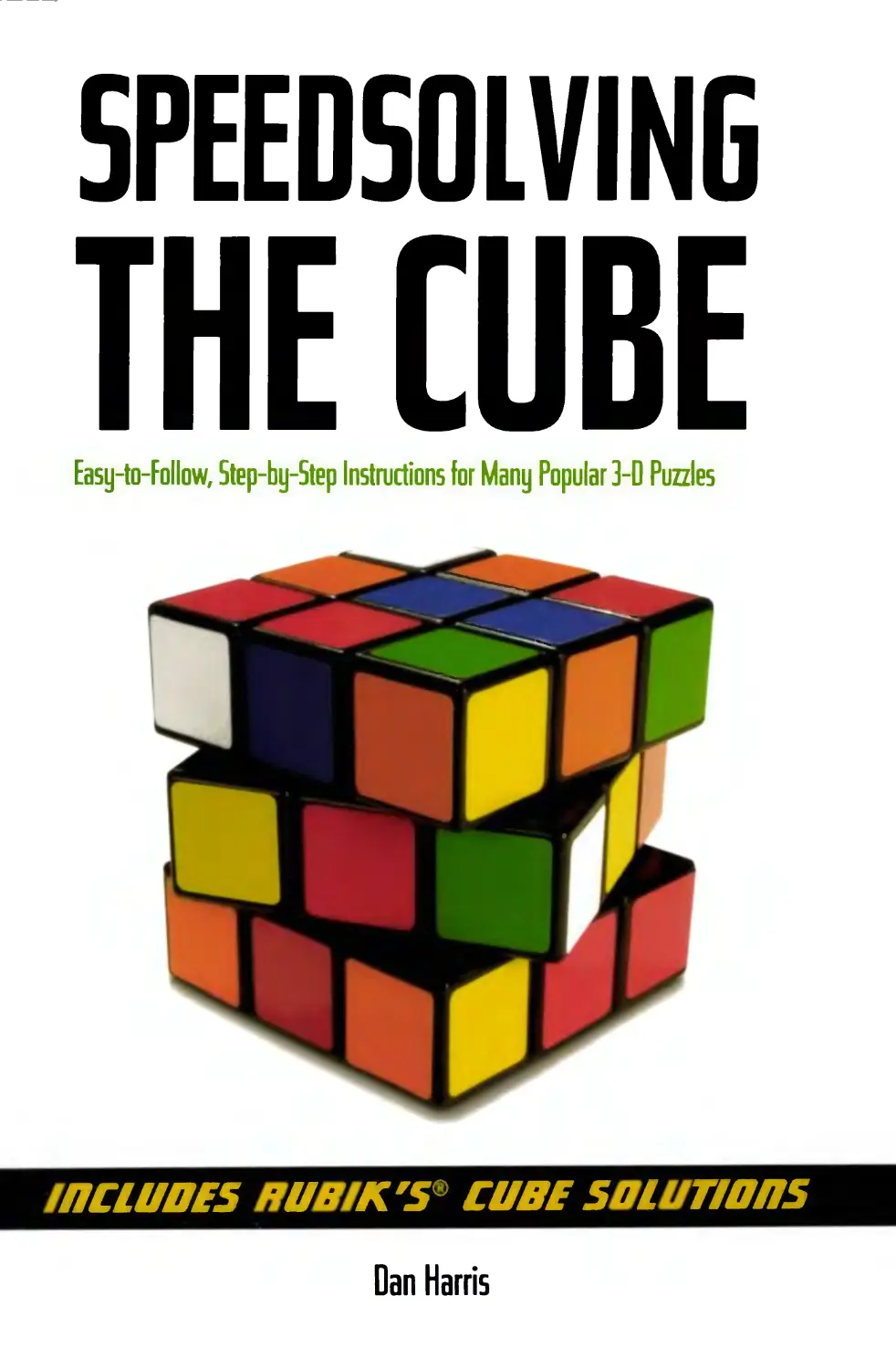
                    SPEEDSOLVING
THE CUBE
Easy-to-Follow, Step-by-Step Instructions for Many Popular 3-D Puzzles
BCIUBE5 U K'S CUBE S L TtBBS
Dan Harris

Speedsolving
the Cube
Easy-to-Follow, Step-by-Step Instructions for Many Popular
3-D Puzzles

Speedsolving
the Cube
Easy-to-Follow, Step-by-Step Instructions for Many
Popular 3-D Puzzles
Dan Harris
-J STERLING
New York

•J STERLING
New York
An Imprint of Sterling Publishing
387 Park Avenue South
New York, NY 10016
STERLING and the distinctive Sterling logo are registered trademarks of Sterling
Publishing Co., Inc.
© 2008 by Dan Harris
All rights reserved. No part of this publication may be reproduced, stored in a retrieval
system, or transmitted, in any form or by any means, electronic, mechanical,
photocopying, recording, or otherwise, without prior written permission from the publisher.
ISBN 978-1-4027-5313-8
Library of Congress Cataloging-in-Publication Data
Harris, Dan, 1985
Speedsolving the cubel easy-to-follow, step-by-step instructions for many poular 3-D
puzzles / Dan Harris.
p. cm.
Includes index.
ISBN-13: 978-1-4027-5313-8
ISBN-10: 1-4027-5313-6
GV1507.R83H37 2008
793.74-dc22
2007032214
Distributed in Canada by Sterling Publishing
c/o Canadian Manda Group, 165 Dufferin Street
Toronto, Ontario, Canada M6K 3H6
Distributed in the United Kingdom by GMC Distribution Services
Castle Place, 166 High Street, Lewes, East Sussex, England BN7 1XU
Distributed in Australia by Capricorn Link (Australia) Pty. Ltd.
P.O. Box 704, Windsor, NSW 2756, Australia
For information about custom editions, special sales, and premium and
corporate purchases, please contact Sterling Special Sales at 800-805-5489 or
specialsales@sterlingpublishing.com.
Manufactured in China
10 9
www.sterlingpublishing.com

Dedication
I This book is dedicated to
Lisa Aldridge and Ron van Bruchem.

Contents ■ ■ ■ ■
CHAPTER 1
About the Author 1
CHAPTER 2
A Short History of Rubik's Cube and "Speedcubing" . . 2
Rubik's Cube (3x3x3) Speedcubing Facts and Figures 5
Rubik's Revenge (4x4x4) Speedcubing Facts and Figures . . .6
Rubik's Professor Cube (5x5x5) Speedcubing
Facts and Figures 7
Rubik's Mini Cube (2x2x2) Speedcubing Facts and Figures . . 8
CHAPTER 3
Cubing Notation 9
Move Descriptions 10
Algorithms 10
Describing the Layers, Faces, Pieces, and Stickers 13
Inverses of Algorithms 15
CHAPTER 4
A Beginner's Method for Solving
the 3x3x3 Rubik's Cube 16
Things to Know Before You Get Started 17
The Beginner Method 19
The General Strategy 20
Solving the First Layer Edges 20
Solving the First Layer Corners 23
Solving the Second Layer 25

Solving the Last Layer 27
Flip the Last Layer Edges (Form a Cross on Top) 27
Position the Final Layer Edges 28
Twist the Final Layer Corners 30
Position the Final Layer Corners 32
Beginner Method Example Scrambles and Solution 37
CHAPTER 5
A Speedcubing Method for Solving
the 3x3x3 Rubik's Cube 40
Introduction to the CFOP System 40
The General Strategy 42
Solving the Cross 42
Some Initial Advice 44
Relative Position and Edge "Rip" 44
The 3-Color Rule 47
Putting It All Together 47
Example Cross Solutions 49
First 2 Layers (F2L) 51
Orient Last Layer (OLL) 56
Permute Last Layer (PLL) 64
Example Scrambles and Solutions Using the CFOP System .... 67
CHAPTER 6
Expert 3x3x3 Speedcubing Techniques 70
Finger Tricks 71
First 2 Layers: Pair Up and Insert 71
Pairing Up and Inserting 72

First 2 Layers: Using Empty Slots 73
First 2 Layers: Solving from All Angles 78
First 2 Layers: Trapped Pieces 81
Influencing the Last Layer During the First 2 Layers 84
Vandenbergh-Harris F2L 84
Zborowski-Bruchem F2L 91
Corner Orient Last Layer (COLL) 94
Zborowski-Bruchem Last Layer (ZBLL) 98
Combining Last Layer Techniques 98
CHAPTER 7
A Method to Solve Rubik's Revenge (4x4x4) 100
Things to Know Before You Get Started 101
Overview of the 3x3x3 Reduction Method 102
Solving the Centers 103
Solving the First Center 103
Solving the Remaining Centers 105
In Case of Mistakes 107
Pairing Up the Double Edges (Dedges) 108
The First 4 Dedges 108
The Next 4 Dedges Ill
Special Cases Ill
Solving the Final 4 Dedges Ill
Solving the Reduced 3x3x3 Cube 114
Orientation Parity 115
Permutation Parity 116
Tips for Getting Faster 117
Faster Centers 117

Faster Dedges 118
2-Pair System 119
Faster 3x3x3 Phase 119
CHAPTER 8
A Method to Solve Rubik's Professor
Cube (5x5x5) 121
Things to Know Before You Get Started 121
The General Strategy 122
Solving the Centers 123
Solving the Triple Edges (Tredges) 125
Solving the First 4 Tredges 126
Special Cases 128
Solving the Next 4 Tredges 129
Solving the Last 4 Tredges 129
Special Cases 130
The Final Tredge 132
Solving the Reduced 3x3x3 Cube 132
Tips for Getting Faster 133
Faster Centers 133
Faster Tredges 135
Faster 3x3x3 Phase 137
CHAPTER 9
A Method to Solve Rubik's Mini
Cube (2x2x2) 138
Things to Know Before You Get Started 139
The General Strategy 139

Solving the Bottom Layer 139
Solving the Top Face 141
Solving the Top Layer 142
Example Scrambles and Solutions 143
CHAPTER 10
General Tips 145
Use a "Speed" Cube 145
Memorize Algorithms with Your Hands, Not Your Brain ... 146
Cubing Is About a State of Mind 146
Achieve the Right Balance Between Speed and Fluency ... 147
Check Internet Resources and Chat with Other Cubers . . .148
CHAPTER 11
Pretty Patterns 149
Glossary 152
Further Resources 157
Speedcubing Websites 157
Speedcubing Forums 158
Where to Buy Puzzles and Puzzle Accessories 158
Index
159

1
About the Author
Dan Harris is one of the world's leading experts in the field of
"speedcubing," which is the term used to describe the solving
of Rubik's Cube and other related twisty-puzzles against the clock. Since
taking up speedcubing in 2002, Dan quickly rose through the ranks to
become one of the world's best twisty-puzzle solvers. In 2003 he
participated in the second Rubik's World Championships, finishing a
respectable 29th out of a field of almost 100. Since then he has taken
part in 2 further world events, 2 European championships, and several
national competitions hosted around the globe, culminating in his first
tournament win after several near misses at the Italian Open 2007,
hosted in Rome. He is the current UK record holder for several Rubik's
events, including the fastest solve of a 3x3x3 Rubik's Cube at 10.59
seconds, which was also the fastest individual 3x3x3 solve of the 2007
World Championships, held in Budapest. Dan has years of experience
in the methods behind the magic of Rubik's Cube, and in this book he
presents a host of information designed to help you not only solve your
puzzles but solve them fast!
1

A Short History of
Rubik's Cube and
"Speedcubing"
■
' The time: 1974.
The place: Budapest.
B The man: Erno Rubik.
■
That frustrating plastic puzzle made up of 6 sides and 54 different-
colored stickers came into being as the brainchild of Professor Rubik,
Hungarian lecturer of architecture. Although a patent application was
drafted in 1974 and applied for in 1975, it wasn't until 1977 that the
"Magic Cube" was first seen on shelves in Hungarian toy shops. One of
the main problems faced by Rubik was finding a manufacturer who could
take on the complex task of mass-producing the puzzle with all of its
inner and outer complexities. During 1978 and 1979, the Magic Cube's
popularity spread like wildfire throughout Hungary, even drawing
attention from the Western World, where it was stirring interest among
the ranks of academics and mathematicians. Thanks to the efforts of two
great men, Dr. Tibor Laczi and Tom Kremer, the Magic Cube finally made
its international debut in 1980 at the toy fairs of London, New York,
Paris, and Nuremberg. Between 1980 and 1982 an estimated 100 million
cubes were sold worldwide. It was renamed "Rubik's Cube" and has
proceeded to taunt millions of frustrated puzzlers and enchant dedicated
enthusiasts across the globe for over two decades.
2

A SHORT HISTORY OF RUBIK'S CUBE AND "SPEEDCUBING" 3
It was not long after the cube's international launch that several
talented puzzle solvers figured out various systems and solutions to solve
it and began competing against one another to see who could solve the
cube in the fastest time. The sport of speedcubing was born and the first
championships were held in the UK in 1981. The grand prize was a
trip to the upcoming World Championships, and Julian Chilvers won
with a fastest time of 25.79 seconds. In 1982 the inaugural Rubik's World
Championships were held in Budapest, with competitors from 19
different nations taking part. The competition was a roaring success, and
the title was taken by Vietnamese-American Minh Thai with a best time
and world record of 22.95 seconds. Afterward, the cube craze began to
die away, and by the 1990s it was a long-forgotten artifact forever
associated with '80s culture.
Fortunately for everyone concerned, the cube was reborn in 2003,
thanks to the incredible efforts of Canadian speedcuber Dan Gosbee,
who organized the second Rubik's World Championships, held in
Toronto, Canada. A few years earlier, some die-hard speedcubers from
the 1980s, together with some up-and-coming speedcubers, joined to
form an online speedcubing community, but it was the 2003 event that
really launched Rubik's Cube back onto the world stage. In all, 83
participants from 15 different countries took part, competing with not
only the standard 3x3x3 cube but also the 4x4x4,5x5x5, Rubik's
Magic, and Rubik's Clock, among others. The winner of the 3x3x3
event was Dan Knights, a software engineer from the United States,
with an average time in the final of exactly 20.00 seconds. Dan also
held the single-solve world record until it was broken by Danish
puzzler Jess Bonde in an incredible 16.53 seconds at the same event.
The number of competitions and competitors has dramatically increased
over the past few years, riding on the success of the 2003 World
Championships. Not long after, Ron van Bruchem founded the World
Cube Association, which is the governing body that, along with

4
SPEEDSOLVING THE CUBE
delegates in each participating country, oversees every official Rubik's
competition held around the globe.
As of 2007, over 2,000 people have competed in a Rubik's Cube
championship, and in 2006 alone, 33 different competitions took place
around the globe. Since its rebirth, sales have increased year upon year,
and alongside them, the sport of speedcubing has grown to become more
popular and active now than at any other time in the puzzle's history.

A SHORT HISTORY OF RUBIK'S CUBE AND "SPEEDCUBING" 5
RUBIK'S CUBE (3x3x3)
SPEEDCUBING FACTS AND FIGURES
Rubik's 3x3x3 World Champions—Past and Present
Year World Champion Winning Time All Results in Final
(seconds) (seconds)
1982 Minh Thai, USA 22.95* 27.16,22.95,27.97
2003 Dan Knights, USA 20.00 21.13,19.93,18.95,22.07,18.76
2005 Jean Pons, France 15.10 15.62,15.87,13.00,13.81,18.59
2007 Yu Nakajima, Japan 12.46 11.50,13.43,14.38,12.16,11.78
*Minh Thai's win was based on a single time; all other competitions are based on a mean of 3, after removing
the fastest and the slowest times.
Rubik's 3x3x3 European Champions—Past and Present
Year European Champion Winning Time All Results in Final
(seconds) (seconds)
2004 Lars Vandenbergh, Belgium 16.19 17.01,15.63,19.25,
15.93,14.95
2006 Joel van Noort, Netherlands 14.97 20.78,13.83,14.93,
15.07, 14.91
Rubik's 3x3x3 World Record Holders—Past and Present
Date
November 2007
October 2007
May 2007
February 2007
August 2006
January 2006
October 2005
April 2004
April 2004
January 2004
January 2004
August 2003
August 2003
June 1982
World Record Holder
Ron van Bruchem, Netherlands
Erik Akkersdijk, Netherlands
Thibaut Jacquinot, France
Edouard Chambon, France
Toby Mao, USA
Leyan Lo, USA
Jean Pons, France
Shotaro Makisumi, Japan
Shotaro Makisumi, Japan
Shotaro Makisumi, Japan
Shotaro Makisumi, Japan
Jess Bonde, Denmark
Dan Knights, USA
Minh Thai, USA
World Record Time
(seconds)
9.55
9.77
9.86
10.36
10.48
11.13
11.75
12.11
13.93
14.76
15.07
16.53
16.71
22.95

6
SPEEDSOLVING THE CUBE
RUBIK'S REVENGE (4x4x4)
SPEEDCUBING FACTS AND FIGURES
Rubik's 4x4x4 World Champions—Past and Present
Year World Champion Winning Time All Results in Final
(minutesrseconds) (minutes:seconds)
2003 Masayuki Akimoto, Japan 1:36.98 1:43.40,1:2706,1:40.49
2005 Yuki Hayashi, Japan 1:04.63 1:10.31,1:01.21,1:02.38
2007 Matyas Kuti, Hungary 1:02.37 1:02.78, 57.43, 1:10.36,
1:06.61,5771
Rubik's 4x4x4 European Champions—Past and Present
Year European Winning Time All Results in Final
Champion (minutes:seconds) (minutesrseconds)
2004 Olivier Gaucher, France 1:2721 1:33.41,1:26.80,1:21.42
2006 Jean Pons, France 1:02.40 1:03.31, 2:05.19,1:02.77,
5732,1:01.13
Rubik's 4x4x4 World Record Holders—Past and Present
Date
November 2007
October 2006
November 2005
August 2005
July 2005
April 2005
January 2005
August 2004
August 2004
July 2004
World Record Holder
Matyas Kuti, Hungary
Michael Fung, Netherlands
Yuki Hayashi, Japan
Chris Hardwick, USA
Yuki Hayashi, Japan
Frederick Badie, France
Frank Morris, USA
Lars Vandenbergh, Belgium
Frederick Badie, France
Chris Hardwick, USA
World Record Time
(minutesrseconds)
46.63
51.16
54.13
55.38
1:00.38
1:01.52
1:08.12
1:09.11
1:12.49
1:12.85

A SHORT HISTORY OF RUBIK'S CUBE AND "SPEEDCUBING"
7
RUBIK'S PROFESSOR CUBE (5x5x5)
SPEEDCUBING FACTS AND FIGURES
Rubik's 5x5x5 World Champions—Past and Present
Year World Champion Winning Time
(minutesiseconds)
2003 Masayuki Akimoto, Japan 2:50.45
2005 Frank Morris, USA 2:15.64
2007 Matyas Kuti, Hungary 1:46.07
All Results in Final
(minutes:seconds)
2:56.76, 2:47.62,2:46.96
2:16.43,2:04.03,2:26.45
1:46.65,1:46.78,1:43.69,
Rubik's 5x5x5 European Champions—Past and Present
Year European Winning Time
Champion (minutesiseconds)
2004 Lars Vandenbergh, 2:30.35
Belgium
2006 Ron van Bruchem, 2:09.57
Netherlands
All Results in Final
minutesiseconds)
2:38.44,2:35.53,2:1709
2:08.83,2:13.18,2:19.48,
2:06.20, 2:06.71
Rubik's 5x5x5 World Record Holders—Past and Present
Date World Record Holder
November 2007 Matyas Kuti, Hungary
July 2007 Takayuki Ookusa, Japan
February 2007 Frederick Badie, France
October 2006 Frank Morris, USA
May 2006 Ron van Bruchem, Netherlands
August 2005 Frank Morris, USA
August 2004 Lars Vandenbergh, Belgium
World Record Time
(minutesiseconds)
1:30.58
1:38.78
1:44.47
1:46.28
1:47.22
1:51.41
2:08.45

8
SPEEDSOLVING THE CUBE
RUBIK'S MINI CUBE (2x2x2)
SPEEDCUBING FACTS AND FIGURES
Rubik's 2x2x2 World Champions—Past and Present
Year World Champion Winning Time All Results in Final
(seconds) (seconds)
2005 Masayuki Akimoto, Japan 8.32 10.60, 7.26, 7.71,8.63, 8.61
Rubik'
Year
2006
s 2x2x2 European Champions-
European Champion
Milan Baticz, Hungary
Winning Time
(seconds)
5.92
Past and Present
All Results in Final
(seconds)
9.48, 5.03, 5.29, 4.13, 745
Rubik's 2x2x2 World Record Holders—Past and Present
Date World Record Holder World Record Time
(seconds)
November 2007 Ron von Bruchem, Netherlands 2.65
July 2007 Matyas Kuti, Hungary 2.73
April 2007 Matyas Kuti, Hungary 3.55
May 2006 Anthony Hsu, USA 3.55
December 2005 Gunnar Krig, Sweden 3.94
May 2005 Shotaro Makisumi, Japan 4.13
April 2005 Shotaro Makisumi, Japan 4.92
March 2005 Gunnar Krig, Sweden 6.35

3
Cubing Notation
Just as it is important in chess to have a notation scheme for recording
the moves in a game, it is important to have a notation scheme to
communicate various twists and turns of the Rubik's Cube and larger
puzzles. One of the first schemes put forward was by British
mathematician David Singmaster, who is also famous for the early
solution described in his book, Notes on Rubik's Magic Cube. The
notation presented in this section is based on his scheme and is the most
widely accepted and used notation in speedcubing today.
This notation is used throughout this book to describe moves for
the various puzzles. Please take your time to familiarize yourself with
the various notational "tokens;" by doing this you will be able to make
much more sense of the following chapters! You can also refer back to
this section when necessary.
9

10
SPEEDSOLVING THE CUBE
MOVE DESCRIPTIONS
■ Table 3.1
Move Notation Scheme—Uppercase Letters
Diagram
Definition 2x2x2 3x3x3 4x4x4 5x5x5
U • 2X2X2/3X3X3/4X4X4/5X5X5:
Turn the upper layer. l , 1
D • 2X2X2/3X3X3/4X4X4/5X5X5:
Turn the "down" layer.
R • 2X2X2/3X3X3/4X4X4/5X5X5
Turn the right layer.
L • 2X2X2/3X3X3/4X4X4/5X5X5
Turn the left layer.
F • 2X2X2/3X3X3/4X4X4/5X5X5
Turn the front layer.
B • 2X2X2/3X3X3/4X4X4/5X5X5
Turn the back layer.
ALGORITHMS
All of the moves given in this book are described using the above
notation, in strings called algorithms. An algorithm is a set of moves
that achieves a specific effect on the cube, for example, flipping 2 edges
or cycling 3 corners.
<^ f^
n
& rt
^
fi

CUBING NOTATION
11
Table 3.2
Move Notation Scheme—Lowercase Letters
Diagram
Definition
3x3x3: Turn the upper 2 layers.
4X4X4/5X5X5: Turn the inner-upper layer.
3X3X3: Turn the "down" 2 layers.
4X4X4/5x5X5: Turn the inner-down layer.
3x3X3: Turn the right 2 layers.
4X4x4/5X5X5: Turn the inner-right layer.
3X3X3: Turn the left 2 layers.
4x4X4/5X5X5: Turn the inner-left layer.
3x3X3: Turn the front 2 layers.
4X4X4/5X5X5: Turn the inner-front layer.
3X3X3: Turn the back 2 layers.
4X4X4/5X5X5: Turn the inner-back layer.
3x3x3 4x4x4 5x5x5
Table 3.3
Move Notation Scheme—Special Symbols
Special symbols indicating directionality or other information
No symbol means a clockwise turn of a face or rotation of the cube.
' This symbol describes a counterclockwise turn of a face or rotation of the cube.
2 This symbol describes a 180° clockwise turn of a face or rotation of the cube.
2' This symbol describes a 180° counterclockwise turn of a face or rotation of
the cube.
* This symbol indicates that the moves within the preceding brackets are to be
executed a multiple number of times.

12
SPEEDSOLVING THE CUBE
Table 3.4
Move Notation Scheme—Cube Rotations
Definition
x A cube rotation about the x-axis. For example,
x' x means rotate the cube so that the F-face
x2 becomes the U-face.
y A cube rotation about the y-axis. For example,
y' y' means rotate the cube counterclockwise so
y2 that the F-face becomes the R-face.
i A cube rotation about the z-axis. For example, ^
z' z2 means rotate the cube 180° clockwise so
12 that the U-face becomes the D-face, and the
R-face stays the same.
■ Example
A well-known algorithm among speedcubers is the "Sune." First
named by Swedish speedcuber Lars Petrus, this algorithm twists
3 corners (and also repositions some pieces). Written in cubing
notation, the algorithm is:
RUR'URU2R'
How do we interpret this?
The first letter is R. There is no symbol after, such as a ' or a 2, so the
first turn is the right layer 90° clockwise. Second is U, again with no
symbol, so the next turn is the upper layer 90° clockwise. Third we
have R again, this time combined with the ' symbol, so we must turn
the right layer 90° counterclockwise. Continue through to the end of
the algorithm, and if you have performed it correctly, it will have the
desired effect on your cube.
Diagram

CUBING NOTATION
13
DESCRIBING THE LAYERS, FACES,
PIECES, AND STICKERS
When talking about cubes, it is useful to be able to quickly refer to
different aspects such as a layer, a face, a piece, or a sticker. The layers
and faces are straightforward; they work in the same way as the move
notation, so the upper layer is called the U-layer, the right face is called
the R-face, and so forth.
When describing pieces, or positions of pieces, we use a combination
of letters that describes the layers the piece is on.
To talk about stickers, we use the same notation, but the first letter
also tells us which face the sticker is on. So if we talk about the URF
piece in Figure 3.1, we are referring to the whole corner piece, but if
we talk about the URF sticker, we are referring to the Yellow sticker
only—it is on the U-face and belongs to the corner piece that is at URF.
This notational system works for all of the different sizes of cubes.
Each piece is described in the same way.
Figure 3.2 shows some examples of possible 4x4x4 pieces. The
Red/Yellow edge piece is at UFr, or FUr, or any such combination
of those 3 letters, because it makes up part of the r-layer, the
U-layer, and the F-layer simultaneously. If we want to talk about the Red
Figure 3.1 The position of the Red/Yellow/Green corner is known as
the URF position, or FRU position, or RUF position, because it is at
the intersection of the U-layer, R-layer, and F-layer. The position of the
White/Blue edge is known as the FR or RF position, because it is at
the intersection of the Flayer and R-layer.

14
SPEEDSOLVING THE CUBE
^>>,
Figure 3.2
sticker of the Red/Yellow edge, we describe it as the FUr sticker—the
F comes first since the Red sticker is on the F-face. Similarly, the
Red/Green edge is described as being at uRF, FRu, and so forth, but the
Red sticker would always be described as the FRu sticker. The Red center
piece is at Fur, because it is on the F-face and makes up part of both the
u-layer and the r-layer.
Figure 3.3 shows some examples of possible 5x5x5 pieces that
we might want to describe. The pieces that are dead center of each
face (that is, the Red and Yellow dead centers) are simply known as the
center pieces. To describe the Yellow center that is diagonally across
from dead center, we say that it is in the Ubr position, because it is on
the U-face and makes up part of both the b-layer and the r-layer. The
other pieces in the diagram are named Fr, UF, FRU, and UFr—see if
you can match the names with the pieces.
Figure 3.3

CUBING NOTATION
15
INVERSES OF ALGORITHMS
The same algorithm can be inverted to achieve a similar but different
effect on the cube. For example, the inverse of an algorithm that cycles
3 edges clockwise will cycle 3 edges counterclockwise.
Inverting an algorithm is easy; just read it backward and change the
directional symbols. So where you see no symbol, replace it with a ';
where you see a ', remove it; and where you see a 2, leave it alone (or
replace it with a 2').
For example, the inverse of R' F R' B2 R F' R' B2 R2 is R2 B2 R
F R' B2 R F' R
If you perform an algorithm, and then its inverse, you get back to
the original state.
Don't worry if the notation seems a little confusing at first; just read
through it a couple of times, and it will begin to make perfect sense. I
promise.

A Beginner's Method for
4 Solving the 3X3X3
Rubik's Cube
=>
For a lot of people, just being able to solve the cube is satisfying
enough, which is absolutely fine. But speaking from personal
experience as a speedcuber, simply being able to solve Rubik's Cube is
not enough; solving it as fast as possible is the exciting part! In the
following tutorials, I present a wealth of information focused on first
enabling you to solve Rubik's Cube and then helping you to improve
your solving times by teaching you some more advanced
speedcubing techniques. Think of it as first learning to drive and then
training to become a Formula 1 racing driver.
Unofficially, some people say that you become a speedcuber once
you can solve Rubik's Cube in under 60 seconds. Other people say that
the only qualification required to be a speedcuber is that you race the
16

A BEGINNERS METHOD FOR SOLVING THE 3x3x3 RUBIK'S CUBE 17
clock while solving your cube. The 60-second barrier is very possible to
achieve even with the beginner solution. At first it may take you several
minutes to solve a cube, but as with any skill, practice is the key, and
you will soon be dramatically improving your times.
The world's elite can solve the puzzle in an average time of less than
20 seconds, and these days averages of under 15 seconds are becoming
increasingly common. By learning the advanced solution and absorbing
some of the expert techniques that I describe in chapters 5 and 6, you
will be well on your way to joining the elite ranks. But you cannot do
it without a lot of practice and dedication.
However far you want to get in the world of speedcubing, whether
it is just being able to solve the cube to show off to your friends or
becoming the world champion, this book is here to help you. Good luck!
THINGS TO KNOW BEFORE YOU GET STARTED
If you haven't already read the chapter about cubing notation (chapter
3), please do so now. Unless you are familiar with the notation, this
tutorial will not make much sense to you. Don't worry, the notation is
very simple and fairly intuitive, and it will not take many minutes of your
time to learn it.
The Rubik's Cube has 6 faces, and when the puzzle is solved, each
face will be a single, unique color. The majority of Rubik's Cubes possess
the "BOY" color scheme, where Red is opposite Orange, Blue opposite
Green, and Yellow opposite White. There will also be a corner piece that
is Blue/Orange/Yellow, reading clockwise.
When you first look at the cube, you may notice that there are 54
individual colored stickers, 9 on each face. Stop right there! Rather than
viewing the cube this way, look at it as 26 separate blocks, known as
"cubies," instead. You can never separate the colors on a single cubie, no
matter how hard you try, because they are, of course, fixed. There are
12 edge cubies, which have 2 stickers each, 8 corner cubies, which
have 3 stickers each, and 6 center cubies, each with 1 sticker. The

18
SPEEDSOLVING THE CUBE
center cubies are fixed in position relative to each other by the 6-armed
core mechanism inside the cube. This means the center cubie determines
the color of the whole face. For example, if your cube has a Red center
opposite an Orange center, it would be a waste of time attempting to
build a Red face next to an Orange face, because the centers are fixed.
There are an amazing 43,252,003,274,489,856,000 possible
configurations of Rubik's Cube, and only 1 of them is the solved position!
That's 43 quintillion, 252 quadrillion, 3 trillion, 274 billion, 489
million, 856 thousand! It's not necessary to know this in order to
solve it, but it is interesting to find out where this number comes from.
Now that you are familiar with some of the basic knowledge needed
to solve the cube, you're ready to go on and attempt it.
■ Number of Positions of Rubik's Cube
There are 6 centers that can take 1 possible arrangement (since they
are fixed and exclude rotations); 8 corners, each of which have
3 possible orientations and 8 possible positions; and 12 edges, each
of which have 2 possible orientations and 12 possible positions. This
gives us a number of configurations:
38 x 8! x 212 x 12!
However, we have to put a few restrictions in place on this number.
If 7 of the corners are twisted in position randomly, the orientation of
the eighth corner is predetermined. This means we must divide by 3.
Similarly, if 11 of the edges are randomly flipped, the orientation of
the twelfth edge is fixed, meaning we further divide by 2. Finally, we
cannot swap pieces an odd number of times. This means if we swap
the positions of 2 corner pieces, then 2 edges must swap as well, or
another 2 corners must be swapped. It is impossible to swap a single

A BEGINNER'S METHOD FOR SOLVING THE 3x3x3 RUBIK'S CUBE 19
pair of pieces, and the consequence is that half of these positions
cannot be reached.
The final number of configurations is:
38 x 8! x 212 x 12!
3x2x2
i
| which equals:
43,252,003,274,489,856,000
THE BEGINNER METHOD
The initial step on the road to becoming a speedcuber is by far the hardest
and most frustrating. As a beginner, with no experience using a
predefined strategy to solve Rubik's Cube, you have a lot of obstacles to
overcome and mountains to climb before you reach your first goal—
solving your cube!
Be patient, be determined, and don't give up. The satisfaction and
triumph of solving your first cube is something that cannot be described;
you must experience it for yourself. It has to be said, however, that you
will get a lot more satisfaction if you have already made a concerted
effort to solve the cube by yourself, before seeking assistance. Once
you have learned to solve the cube, you can never really unlearn it. By
giving yourself a chance to succeed on your own at this stage, you'll be
much more proud of the end result. Solving the cube on one's own is
not something that everyone can achieve—even I couldn't manage to
figure out the last stages by myself and had to seek help—so it's
definitely not something to be ashamed of or an indication that you
don't have the necessary intelligence to ever solve it.

20
SPEEDSOLVING THE CUBE
The General Strategy
■^rr1 c=$> -'\, i ' => iy> ' .=*> ^ . ! c=r> r, ,=*> Ia}> IB>
■ ) I !
The beginner method presented on the next few pages is known as a
"layer-by-layer" solution. First of all, we will solve the bottom (down)
layer in 2 steps, and then we'll proceed to solve the middle layer. We'll
finish off the cube by solving the top (up) layer in 4 stages, treating the
position and orientation of the corners and edges separately in each stage.
Once we have completed all 3 layers, the cube is solved!
Solving the First Layer Edges
+ Y
This step is probably the hardest of them all because you must first
overcome the hurdle of having no experience with the cube, and you
have the freedom of the whole cube in which to move pieces around.
There are no easy fixes; you just have to "see" it.
Start off by selecting a color that will be your "bottom face color."
I always select White, for reasons I discuss in chapter 6, but for the layer-
by-layer method, it doesn't matter which color you start with. It may
feel more natural for you to start solving the top layer first, and at this
stage it doesn't matter where you position your first layer. When you
begin to get faster and progress to more advanced systems, you will see
how solving the bottom layer first can be a big advantage.
Hold your cube with your chosen bottom face color on the bottom,
and try to keep it on the bottom at all times. This will make it easier for
you at these early stages, but once you get more used to the cube, this

A BEGINNER'S METHOD FOR SOLVING THE 3x3x3 RUBIK'S CUBE 21
won't be so important. There are 4 edge pieces (the pieces with 2 stickers)
that have a sticker of the same color as your bottom face color, and we
will focus on solving these pieces first.
Look first in the top layer for these edge pieces, because these are
easier to solve than edge pieces that may be stuck in the middle layer.
When there are no more pieces of the bottom face color in the top layer,
search in the middle layer and finally in the bottom layer. Table 4.1 shows
you what to do for each case.
■ Table 4.1
3x3x3 Beginner Method—First Layer Edges
Edge Piece in Top Layer
Bottom Face Color on Bottom Face Color not on
the Top (U) Face the Top (U) Face
I 111
Move: F2 Move: R' F R '
■ First turn the top layer so that the
color that is not the bottom face
color lines up with the center piece
of the same color (see diagram).
■ Hold the cube so that the edge piece
is at the front, and turn the front face
180° to insert the edge.
■ Turn the top layer so that the edge
piece is above a center piece that is
90° to the right of the center piece
that has the same color as the edge
(not the bottom face color). See the
diagram.
■ Hold the cube as in the diagram,
and perform the above algorithm.
This will insert the edge piece into
the correct position.
continued on next page

22
SPEEDSOLVING THE CUBE
continued from previous page
Edge Piece in Middle or Bottom Layer
Edge Piece in Middle Layer Edge Piece in Bottom Layer
>
^
i
Move: RUR
Hold the cube so that the edge is at the
front-right (FR) position (see diagram).
Apply the above algorithm to displace
the edge piece from the middle layer
and place it in the top layer.
Now you have 1 of the "edge piece in
top layer" cases, which are described
above.
Move: R2
Hold the cube so that the edge is at the
bottom-right position (see diagram).
Apply the above algorithm to displace
the edge piece from the bottom layer,
and place it into the top layer.
Now you have 1 of the "edge piece in
top layer" cases, which are described
above.
When you solve these pieces, you must make sure that the edge
sticker with the bottom face color is placed on the bottom and that the
other color on the edge piece matches up with a center piece of the same
color. The edge must have both colors matching the respective center
pieces; otherwise, you will never end up with a solved cube.
With a little bit of practice, once you have applied the above moves
as necessary to all 4 edge pieces, you will have solved the bottom layer
edges. Congratulations! Your cube should look something like Figure
4.1; however, you may have chosen a different bottom face color than
White. The most important thing to notice is how the colors on the
bottom edges match those of the center pieces.
Out of all the stages outlined in this beginner method, this first step
requires the most intuition. Be patient and take some time to get to know
the various cases. Believe me, with practice it becomes very easy! Once
you have mastered this step, you are ready to solve the first layer corners.

A BEGINNER'S METHOD FOR SOLVING THE 3x3x3 RUBIK'S CUBE 23
* 11
Solving the First Layer Corners
When solving the first layer corners, we will continue to hold the cube
so that our bottom face color is on the bottom. There are 4 corner pieces
that have a sticker of the same color as your bottom face color, and we
will now focus on these corner pieces.
As before, start searching for these pieces in the top layer, and once
you have exhausted the supply of top layer corner pieces, continue your
search in the bottom layer (of course, corner pieces cannot possibly be
in the middle layer). Continue until you have solved all 4 corners and
you obtain a completed first layer.
To identify where a corner piece should go in the first layer, look at
the other 2 colors (not the bottom face color). The corner piece will go
in the bottom layer, between the 2 center pieces that have these colors.
Table 4.2 shows all the possible cases you will encounter and what
to do for each.
Once you have solved all 4 corners, you will have completed the first
layer. In fact, you are rA of the way to solving the entire cube! Practice by
solving the first layer many times, and it won't be long before you completely
ft
Figure 4.1 A solved White cross

24
SPEEDSOLVING THE CUBE
■ Table 4.2
3x3x3 Beginner Method—First Layer Corners
Unsolved Corner Piece in Top Layer
Bottom Face Bottom Face Bottom Face Color
Color on Front Color on Right on Top
.>. <
U
Move: F' U' F
Move: RUR'
Turn the top layer to position the corner piece
directly above the position in which it belongs
(see diagram).
Apply the above algorithm to insert the
corner piece correctly into the first layer.
Move: R U2 R'
Turn the top layer to position
the corner piece directly
above the position in which
it belongs (see diagram).
Applying the above
algorithm changes the case
into the "bottom face color
on right" case, which you
can then solve.
Unsolved Corner Piece in Bottom Layer
^rjrC .nS^i tfeft
Move: RUR'
Hold the cube so that the corner piece is at the bottom right (see diagram).
Apply the above algorithm to move the corner piece into the top layer. You can
then use 1 of the above tricks to move the corner piece into its correct position.

A BEGINNER'S METHOD FOR SOLVING THE 3x3x3 RUBIK'S CUBE 25
master this step. When you are able to solve the first layer every time, you
are ready to move on to the second layer.
Solving the Second Layer
If you have managed to make it this far, solving the second layer will
seem relatively straightforward. As with the previous steps, continue to
hold the cube so that your bottom face color (the completed first layer)
remains on the bottom.
To complete the second layer, which will be the middle layer, you
must place 4 edges into their correct positions. You can identify these
edges in the top or middle layers if their sticker colors are not the same
color as the top center piece. We will focus on these 4 edges during
this part of the solution, but we must be careful not to mess up what we
have already solved.
The second layer can mostly be solved by applying just 1 simple
procedure; however, some special cases crop up now and again. All the
moves you need to know are detailed in Table 4.3.
Carry on applying the appropriate algorithms until the middle layer
is solved. Once all 4 edges are in position, you are % of the way to
completing the cube! With a little practice, you will see that solving the
middle layer is simply a case of repeating the same movements over and
over again. Once you've got the hang of these algorithms, you will be
able to successfully complete the middle layer 100% of the time. As soon
as you feel comfortable solving the first and second layers (known
collectively as the "first 2 layers," or "F2L"), you can move on to solving
the last layer and with it, the whole cube.

26
SPEEDSOLVING THE CUBE
Table 4.3
3x3x3 Beginner Method—Solving the Second Layer
Middle Layer Edge Piece in Top Layer
Edge Piece Belongs Edge Piece Belongs
in Front-Right Position in Front-Left Position
Move: URU'R'FR'F'R Move: U'L'ULFLFL'
■ Identify the color of the edge sticker around the side of the U-layer, and turn the |
U-layer to line up that sticker with its matching center color. Hold the edge so it is |
on the front face (see diagrams).
■ Identify which position you need to move the edge into (either the left or right),
and apply the appropriate algorithm detailed above. I
Middle Layer Edge Piece in Middle Layer
Occasionally you will find no more solvable edges in the top layer, yet the middle layer '
is incomplete. This can happen when 2 middle layer edge pieces are swapped over, or
if a middle layer edge is in the correct position but the colors are flipped over. I
^^r
Move: URU'R'FR'F'R
■ Hold the cube so that 1 of the wrong edges is at the front-right position (see diagram).
■ Apply the above algorithm, which will place a random piece from the top layer
into the middle layer, and the edge piece that was in the middle layer will now be
in the top layer. You can then use 1 of the "middle layer edge piece in top layer"
tricks to solve it.

A BEGINNER'S METHOD FOR SOLVING THE 3x3x3 RUBIK'S CUBE 27
Solving the Last Layer
By the time you reach the last layer, you will by definition have completed
the first 2 layers. This means that there are only 8 more pieces to solve,
but it also means that you have much less freedom in which to
manipulate the pieces, because you must be careful to keep the piece
positions you have already solved.
I will present 2 methods for solving the last layer; the first, known
as the "EZ" LL, allows you to solve the last layer with as few algorithms
as possible. After that, I will show you other algorithms that allow you
to take care of each of the 4 last layer steps more efficiently.
Flip the Last Layer Edges (Form a Cross on Top)
The goal of this step is to flip, or "orient," the top layer edges correctly.
The end result will be the formation of a cross on the top of your cube
(see diagram above). Unlike the cross we formed at the beginning of
the solution, it doesn't matter at this stage if some of the colors around
the side of the layer do not match up; we will take care of those in a
later step.
A physical constraint of Rubik's Cube is that edge pieces can only
be flipped in pairs. This restricts the number of possible cases you will
encounter at this stage. Since edge pieces are flipped only in pairs, you
can flip 4, 2, or 0 edges. If you encounter a position in which you have
to flip an odd number of edges, it means that at some point your cube
broke apart and was reassembled incorrectly. To fix this, you must break
it apart again and flip over 1 edge to restore "even parity," since no
sequence of moves can flip just 1 edge.

28
SPEEDSOLVING THE CUBE
To flip the top layer edges to form a cross pattern on the top, first
identify which case you have from the table below Hold the cube so
that it matches the diagram, and apply the appropriate algorithms from
either Table 4.4a (the "EZ" way) or Table 4.4b (the more efficient way).
Position the Final Layer Edges
i=4>
Now that all the top layer edges are oriented correctly, we need to move
them into their correct positions. This is called "permuting" the top
layer edges.
First of all, make sure to check that this step is necessary! In
some cases, the edges will already be correctly permuted, so you can skip
this step and move immediately to the next. If you can turn the top layer
such that all the edge colors match with the center piece colors, then the
edges are correctly permuted.
Most of the time, however, it is necessary to permute the edges. For
an easy way to solve the edges from here, check out the procedure in
Table 4.5a (the "EZ" way), or if you want a more efficient way of
permuting the edges, look at Table 4.5b.
The algorithms in Table 4.5a are examples of inverse processes. The
algorithm to permute the edges counterclockwise is simply the algorithm
to permute the edges clockwise read backward. Both of the algorithms
are known as "order 3" algorithms, meaning that if you perform the
move 3 times, you get back to the position you started with. It is therefore
possible to learn only 1 of these moves, and when you encounter the
other case, you simply apply the move you have learned twice instead
of once. It is up to you how much you want to learn at this stage.

A BEGINNER'S METHOD FOR SOLVING THE 3x3x3 RUBIK'S CUBE 29
Table 4.4a
3x3x3 Beginner Method—Solving the Last Layer
("EZ" Way)
Flip the Tot La er Edies Correct! (Top Color = Yellow).
tO
Move: FRUR'U'FU
Keep applying the above algorithm to your cube until you reach the position shown
in the diagram. It is possible that you will reach a position where the Yellow edges
are at UF and UB; in this case, it is obvious (I hope!) that you just do U to arrive at
the position shown in the diagram.
Once you have arrived at this position, apply the algorithm once more to flip
the top layer edges correctly.
Table 4.4b
3x3x3 Beginner Method—Solving the Last Layer
(More Efficient Way)
Flip the Top Layer Edges Correctly (Top Color = Yellow).
T
Case 1 Case 2 Case 3 Case 4
CaselFRUR UP
Case 2: F U R U' R' F'
Case 3: Apply Case 1 + U2 + Apply Case 2
Case 4: You already have a cross on top. Continue to the next step.

30
SPEEDSOLVING THE CUBE
■ Table 4.5a
3x3x3 Beginner Method—Solving the Last Layer
("EZ" Way)
Permute the top layer edges correctly (top color = Yellow).
/
^
*\
\
Move: R U2 R' U' R U' R'
Try to position your last layer so that 1 edge and 1 edge only is solved. If this is
possible, hold the cube so that the solved edge is at the front, and apply the above
algorithm. You may have to apply it 1 or 2 times, depending on the situation. If you
cannot position your last layer so that only 1 edge is solved, just apply the above
algorithm and then try again.
By now you should have completely solved the top layer edges. All
that remains to solve are the top layer corners, discussed in the next 2
sections.
Twist the Final Layer Corners
The penultimate step in the solution is to twist, or "orient," the final
layer corners. After you have completed this step successfully, the top
face will be solved, but not the top layer. Be very careful with this
step; it is easy to get wrong, and if you do so, you will end up back at
square 1!

A BEGINNER'S METHOD FOR SOLVING THE 3x3x3 RUBIK'S CUBE 31
■ Table 4.5b
3x3x3 Beginner Method—Solving the Last Layer
(More Efficient Way)
Permute the top layer edges correctly (top color = Yellow).
Permute Edges Clockwise Permute Edges Counterclockwise
4-
*\
i*
/*>
~g_ ;
V
Move: R U2 R' U' R U' R' Move: RUR'URU2R'
Adjacent Edge Swap
Move: RU2R'U'RU'R' 1 U2 1 RUR'URU2 R'
Try to position your last layer so that only 1 edge is solved. Hold the solved edge at
the front, and apply 1 of the moves from the top 2 diagrams, depending on how
you need to cycle around the edges. If you cannot position the last layer so that only
1 edge is solved, you must perform an adjacent edge swap, which is really just a
combination of clockwise and counterclockwise 3-edge cycles.
During each iteration of the process, you will orient the corner
that is in the top-right-back position, so when starting with this step,
make sure you hold the cube so that a wrongly twisted corner is in this
position. The "EZ" way is shown in Table 4.6a, and the more efficient
method is shown in Table 4.6b.
It will probably take you a few attempts to get this process correct, and
it will be frustrating. But be patient, because once you get the knack, it will

32
SPEEDSOLVING THE CUBE
Table 4.6a
3x3x3 Beginner Method—Solving the Last Layer
("EZ" Way)
Orient the top layer corners correctly.
Twist the corner clockwise Twist the corner
(top color on right). counterclockwise
(top color on back).
/
Move: RDR'D'
Turn the U-layer so that an unoriented corner is at UBR (see diagrams). Apply the
move above as many times as necessary to bring the correct sticker to the upper
layer (in this case, the Yellow sticker).
Next, don't rotate the cube, but turn the U-layer to bring the next unoriented
corner into the UBR position, and repeat the procedure. Continue to do this until all
corners are correctly twisted. Don't worry about the first 2 layers becoming a mess; it
will be restored once you have correctly oriented all the corners.
become straightforward to perform. All that remains now is to position the
final layer corners and finish off the cube!
Position the Final Layer Corners
The final step in the solution is to position, or "permute," the final layer
corners. First you must identify a corner that is already solved (read on
for what to do if this is not the case). This corner is easy to see; it will

A BEGINNER'S METHOD FOR SOLVING THE 3x3x3 RUBIK'S CUBE 33
Table 4.6b
3x3x3 Beginner Method—Solving the Last Layer
(More Efficient Way)
Orient the top layer corners correctly.
Twist the corner clockwise Twist the corner
(top color on right). counterclockwise
(top color on back).
>
R
/
Move: RDR'D'RDR'D'
Move: DRD'R'DRD'R'
Identify which of the cases you have at the beginning, and apply the appropriate
algorithm to twist the corner correctly. When it is correctly twisted, the top layer
color will be on the top face.
Stop! Each algorithm twists an individual corner on the top face and also appears
to randomize the bottom layer somewhat, so it will appear that all the hard work
put in at the beginning of the solve has been undone. But don't worry, it's
supposed to be like this! Don't rotate the cube in your hands, but turn the top
layer to move the next incorrect corner into the back-right position. Again select
the appropriate algorithm from the ones above, and when you have corrected all
of the incorrectly twisted corners, the top face should be solved, and the first
2 layers will be magically restored!
be the only corner piece around which all the stickers match up
perfectly, just as they do when the cube is in the solved state. Once
you have identified this corner, follow the procedure described in Table
4.7a or Table 4.7b to finish off your cube.
Don't be put off by the length of these algorithms. They are simply
a combination of 2 "substeps" to achieve an effect on the cube. The
moves enclosed in parentheses are the same substep; the only difference

34
SPEEDSOLVING THE CUBE
Table 4.7a
3x3x3 Beginner Method—Solving the Last Layer
("EZ" Way)
Permute the top layer corners correctly.
Corners Need to be Corners Need to be
Cycled Clockwise Cycled Counterclockwise
m
a
Move: (Rf D2 R) U2 (R' D2 R) U'
(R' D2 R) U' (R' D2 R)
Move: (R' D2 R) U (R' D2 R) U
(R' D2 R) U2 (R' D2 R)
Hold the cube so that the solved corner is in the top-left-front position.
Identify whether you should move the remaining corners in a clockwise cycle or
a counterclockwise cycle. You can discover this by working out where the corner
piece in the top-right-front position needs to be, and then working out where the
corner in that position needs to be, and so on. You will trace out either a
clockwise or a counterclockwise cycle.
Apply the appropriate move from the selection above.
is how you turn the top layer, and this should be easy to understand,
even without learning the algorithm.
The first step is to place the corner that was in the top-
right-front position into the down-back-left position, using the algorithm
R' D2 R. Next, look for the position where the corner piece, now in the
down-back-left position, should go. In the case of the clockwise corner
cycle, the down-back-left corner belongs in the top-back-left. So we turn
the top layer to bring the corner in this position to the top-front-right
(U2), and we again swap this with the down-back-left corner (R' D2 R).
By doing this, we solve the corner that was in the down-back-left position,
and we have replaced it with another corner piece to solve. By repeating

A BEGINNER'S METHOD FOR SOLVING THE 3x3x3 RUBIK'S CUBE 35
Table 4.7b
3x3x3 Beginner Method—Solving the Last Layer
(More Efficient Way)
Permute the top layer corners correctly.
Corners Need to be Corners Need to be
Cycled Clockwise Cycled Counterclockwise
a
a
Move: (x) R' U R' D2 R U' R' D2 R2 Move: (x) R2 D2 R U R' D2 R U' R
■ Hold the cube so that the solved corner is in the top-left-front position.
■ Identify whether you need to move the remaining corners in a clockwise cycle or
a counterclockwise cycle. You can discover this by working out where the corner
piece in the top-right-front position needs to be, and then working out where the
corner in that position needs to be, and so on. You will trace out either a
clockwise or a counterclockwise cycle.
■ Apply the appropriate move from the selection above.
this process, all the corners will eventually end up in their correct
positions, and the top layer will be solved! However, if you want more
direct algorithms, check out Table 4.7b.
But what if we don't have 1 solved corner to begin with? There are
2 possible cases where this can occur, and 2 reasonable ways to take care
of it. We can use the same tactic we used when it wasn't possible to solve
only 1 edge in the "permute final layer edges" step, or we can learn a
completely separate algorithm. Both scenarios are described in Table 4.8
below.
Again, don't be put off by the length of the first algorithms; they
work on exactly the same principle as before, swapping corners from

36
SPEEDSOLVING THE CUBE
■ Table 4.8
3x3x3 Beginner Method—Solving the Last Layer
("EZW Way and Efficient Way)
Permute the top layer corners correctly (special cases).
Swap Adjacent Corners Swap Diagonal Corners
* ^
«1 !►
Move: (R' D2 R) U' (R' D2 R) U
(R' D2 R) U (R' D2 R) U
(R' D2 R) U' (R' D2 R)
or
Move: R' F9 L' F R F' L F R' F' L F
RFL'F
or
Move: Apply the "corners clockwise
cycle" algorithm from Table 4.7a or
4.7b, and then solve the resulting
position.
*s
^
X
^
^
Move: (R' D2 R) U2 (R' D2 R) U2
(R' D2 R) U (R' D2 R) U2
(R' D2 R) U2 (R' D2 R)
or
Move: R2 L2 U R2 L2 U2 R2 L2 U
R2L2U2
or
Move: Apply the "corners clockwise
cycle" algorithm from Table 4.7a or
4.7b, and then solve the resulting
position.
the top layer with the corner in the down-back-left position until all the
corners are in their correct positions.
Now that the top layer is finished, line it up with the first 2 layers
and voila, you have solved your first cube! Congratulations on making
it this far; it is just a matter of practice before you can solve the cube
without any assistance from this book. But this is only the beginning.
Now that you have learned how to solve the cube, simply solving it is
not enough—you have to solve it as fast as possible! Using the method
described in this chapter, it is possible to get times down to around 45
to 50 seconds. To get faster, you must use a more advanced, and more

A BEGINNERS METHOD FOR SOLVING THE 3x3x3 RUBIK'S CUBE 37
complicated, method. One of the best and most widely used methods
for speedcubing is known as the "Fridrich" system, described in detail
in chapter 5.
Beginner Method Example Scrambles and Solutions
Start with a solved cube and apply the scramble algorithm with your
chosen bottom face color on the bottom. Be sure to apply the scramble
correctly; otherwise, the solution won't make very much sense. Use the
images in Table 4.9 as a guide only. If you scramble with Red on front
and Yellow on up, then your cube should look like the diagram after
scrambling. If you scramble with any other orientation, or you have a
different color scheme, then it won't match the diagram exactly, but the
pattern of colors should be the same.

38
SPEEDSOLVING THE CUBE
Table 4.9
Beginner Method—Example Solutions
Example Scramble 1: U2 L B2 F2 V D2 L2 D' B' R' B F2 R' B2
F2 D2 U L2 R U' F D' U F2 L2
Solving the first layer edges:
- yUF2
- R2 y' U2 F2
■ y' U F2
- y R U R y2 U R F R
Solving the first layer corners:
- U2 R U2 R U R U R
■ y2 U F' U' F
- y' U R U R'
- y2 R U2 R' U' R U R'
Solving the second layer:
- y2 U' L' U L P L F1/
- y2 U2 U R U R F R F R
- U2 U' L' U L P L F1/
Solving the final layer:
- y F R U R U F'-Orient the edges.
■ y' R U2 R' U' R U' R'-Permute the edges.
- y2 (R D R' D' R D R' D) U' (DRD'R'DR D' R')-Orient the corners
■ U-Line up the layers; solved!

A BEGINNER'S METHOD FOR SOLVING THE 3x3x3 RUBIK'S CUBE
Example Scramble 2: L B2 F D' B F' L2 B2 F2 L B' F L2 B'
F' RD'U'FU'F D2 B' F2 U'
Solving the first layer edges:
■ y2 U R' F R
■ R U R' U L2
- B2
- yUR'FR
Solving the first layer corners:
■ y2 U2 R U R'
- y'RU2R'U'RUR'
- y2 U2 F' U' F
- yRUR'
Solving the second layer:
- y2 U' L' U L F' L F L'
-UURU'R'FR'F'R
■ y2 U2 U' L' U L F' L F L'
Solving the final layer:
■ F R U R' U' F'-Orient the edges.
. R U2 R U R U' R' y2 R U R' U R U2 R'-Permute the edges (note we had to
use the tactic of performing the move twice this time).
- y2 (R D R D R D R' D) U' (D R D' R' D R D' R')-Orient the corners
- U y (lining up the solved corner) (R' D2 R) U2 (R' D2 R) U' (R' D2 R) U'
(R' D2 R)-Permute the corners.

A Speedcubing Method
5 for Solving the 3X3X3
Rubik's Cube
In this chapter I present a wealth of information about an advanced
speedcubing method known as the CFOP system, which is the system
I currently use for speedcubing. This method has allowed me to set
personal-best average times of under 15 seconds.
INTRODUCTION TO THE CFOP SYSTEM
The CFOP system is a very efficient layer-by-layer solution that enables
speedcubers to solve Rubik's Cube in under 20 seconds on average.
CFOP stands for Cross, First 2 Layers, Orient Last Layer, and Permute
Last Layer, which describe the various steps of the system in the order
that they are applied. It is widely accepted that Jessica Fridrich of the
Czech Republic was the first speedcuber to realize the potential of this
powerful system. The ideas for solving the first 2 layers simultaneously
had already been documented, but she is credited with the inspirational
idea in 1981 of solving the last layer in 2 steps instead of 4 steps, which
40

A SPEEDCUBING METHOD FOR SOLVING THE 3x3x3 RUBIK'S CUBE 41
was commonplace at the time. She notes on her website that her first
realization of such a system came when a friend mentioned on a
particular cube-solving occasion, "Oh, I like this T pattern, because
when you turn the edges, the whole last layer will actually flip correctly."
A 1982 World Championship finalist, Fridrich was also the first
person to document this method for solving Rubik's Cube on the Internet,
when she set up her speedcubing page in 1997. Without her effort, it
is very likely that speedcubing as it is known today would never have
come into existence. It is for this that she will be forever associated with
the CFOP system, which is also known worldwide as the Fridrich system.
It is worth mentioning that other methods exist that are also
extremely fast and efficient. One such system is the Petrus method,
invented by 1982 World Championship finalist Lars Petrus of Sweden.
The Petrus method starts by making a 2x2x2 block, expanding this to
a 2x2x3, fixing "bad edges" (edges not correctly oriented within a 2-
generator reference frame), and then solving the rest. Petrus claims the
advantage of this method is that, unlike layer-by-layer solutions, you never
break up and restore parts of the cube you have already solved in order
to solve further parts.
Another very quick system is the Roux method, invented by
Frenchman Gilles Roux, who is also the 2006 European Fewest Moves
Champion. In his system, you first build a 1x2x3 block and then a
1 x2x3 block on the opposite side. You continue by solving the 4
remaining corners, and then finish off the 6 remaining edges. This
solution is extremely efficient in terms of numbers of moves, but it
requires a lot of insight and intuition. There are also various fast "corners
first" methods, one of which is known as the Waterman method, but
none of these methods have matched the popularity of the CFOP system.
I wish you every success in your quest to learn this method and to make
the transition from cubing to speedcubing!

42
SPEEDSOLVING THE CUBE
The General Strategy
^ " -*- ^ 1 ^ >> !
As with the beginner solution, the first step is to make a cross shape on
the bottom face. However, in this section I go into a lot more depth about
solving the cross, and I introduce some techniques that will be useful
only if you already have experience solving the cube using the beginner
solution. Then we'll continue by solving the corners of the bottom layer
and the edges of the middle layer simultaneously, known collectively
as the "first 2 layers." Finally, we'll finish the cube by first solving the
top face and then solving the top layer. Each step requires quite a bit
more memorization that any step in the beginner solution, but by learning
it a step at a time, it will not be long before you are familiar with most,
if not all, of the algorithms.
Solving the Cross
>
The first step is to locate and solve the 4 edge pieces that make up the
cross. This Cross step is so called because when the first 4 edge pieces
are solved, a cross pattern is formed on 1 of the faces. This is an intuitive
step and requires no memorization of algorithms, but it does require
100% concentration!
Solving the cross quickly and efficiently is a real art form,
and you can learn it only through practice and experience. Unlike the

A SPEEDCUBING METHOD FOR SOLVING THE 3x3x3 RUBIK'S CUBE 43
beginner solution to the cross, where we solved the 4 cross edges
independently, we now must attempt to solve all 4 edges simultaneously.
A beginner cannot pick up the cube and expect to see the optimal
solution to the cross straightaway (a lot of experts have trouble with this,
too), let alone execute it in the best way. The top speedcubers aim to
solve the cross in around 2 seconds or less.
In this section, I explain and demonstrate some of the things you
should look for during your pre-inspection of the cube, along with some
tricks and techniques that you can learn. I also give examples for various
cases, with explanations of the ideas behind the solution. Keep practicing,
but don't expect to master it in 1 day.
Computer analysis by 2004 European speedcubing champion Lars
Vandenbergh of Belgium has shown that from every possible starting
configuration, there is an optimal solution of 8 moves or less (see
Table 5.1).
Important points to note are that almost all (> 99.9%) cases can be
solved in 7 moves or less, and on most occasions you require only 5 or
Table 5.1
3x3x3 Advanced Method—Cross Statistics
# Moves # Cases % of Total Cumulative %
to Solve (out of 190,080) Cases
1
15
158
1,394
9,809
46,381
97,254
34,966
102
0.00005
0.008
0.08
0.7
5.2
24.4
51.2
18.4
0.05
<0.1
<0.1
<0.1
0.8
6.0
30.4
81.6
> 99.9
100

44
SPEEDSOLVING THE CUBE
6 moves to solve the cross. Therefore, if you could see the shortest or
near shortest cross solution every time, and execute it quickly, a cross
in 1.5 to 2 seconds is perfectly reasonable.
Some Initial Advice
My first and foremost recommendation is to always solve the cross
on the bottom face. If your current method is to make a cross on the
top face, and then turn the cube upside down at some stage to solve
the final layers, I recommend that you get out of this habit immediately.
A few speedcubers prefer to solve the cross on the left, which is possibly
just as good as solving the cross on the bottom, but I shall concentrate
on "cross on bottom" solving since this is the method I like best and find
easiest to use. Solving with the cross on the bottom is a good idea; it
allows you to have the best view of the U-layer, which means that
you can easily look ahead and search for the F2L pieces while you solve
the cross. It also means that you don't have to turn the cube upside
down at some stage during your solve, which saves valuable seconds.
Second, know the color scheme of your cube inside out. Make
sure that with the cross on the bottom, you know which colors are
opposites of each other (look at directly opposite centers), and you know
the order of the colors all the way around the cube. On my cube, I know
that Red is opposite Orange, Blue is opposite Green, and if I have Red
facing me, then Green is on the R-face, Blue is on the L-face, and Orange
is on the B-face. This knowledge will allow you to concentrate on the
other aspects of solving the cross. Learn your color scheme and practice
it until it becomes second nature.
Relative Position and Edge "Flip"
Relative position is a concept that you must firmly fix in your mind before
you can even hope to start seeing the shortest solutions to the cross for
a given configuration.

A SPEEDCUBING METHOD FOR SOLVING THE 3x3x3 RUBIK'S CUBE 45
If you think about it, it is not necessary to line up each edge with
the same-colored center piece at a time, and then place them 1 at a
time in the D-layer. This is a fine method if you are a beginner, or even
intermediate, but if you want to start speedcubing seriously you must
get out of this habit. This is where a good knowledge of your cube's
color scheme is necessary. As long as you place, for example, the
Red/White edge opposite the Orange/White edge, and the
Blue/White edge opposite the Green/White edge, and you have
made sure that the colors are correct all the way round, a D move
will position the cross and fix all the pieces simultaneously every time.
In other words, if you place the cross pieces incorrectly in the D-layer,
but correctly relative to each other, you still get a solved cross (see
Figure 5.1).
When you are pre-inspecting the cube, you will, of course, want to
concentrate on the cross edges only, mentally blanking out the rest of
the pieces altogether. Another useful thing to note about each cross edge
as you inspect the cube is its "flip." But what is "flip"?
A correctly flipped edge An edge that has a correct flip needs a
maximum of 1 move to be inserted into the D-layer, in such a way
Figure 5.1 Using the concept of relative position, you can see that all
of these crosses are solved; only D-turns are needed to fix all of the
edges simultaneously.

46
SPEEDSOLVING THE CUBE
11
Figure 5.2 The Orange edge is flipped correctly, only F2 is required to
place it into the D-layer.
so that it correctly forms a part of the cross (see Figure 5.2). It may
already be sitting in the D-layer, in which case it does not need to be
moved at all.
An incorrectly flipped edge An edge that is incorrectly flipped will
always need 2 moves to be inserted into the D-layer, to form part of
the cross (see Figure 5.3). One move is required to correct its flip, and
the other to insert it into the D-layer.
Edges that have an incorrect flip are the more difficult edges to solve,
and you'll need to make special considerations when incorporating them
1 I
Figure 5.3 The Orange edge is incorrectly flipped; more than
1 move is needed to correct the flip and place it into the
D-layer.

A SPEEDCUBING METHOD FOR SOLVING THE 3x3x3 RUBIK'S CUBE 47
into your cross solution. These techniques are best shown and described
in the examples at the end of the "Solving the Cross" section in "Example
Cross Solutions."
The 3-Color Rule
Even when you have fully mastered the concept of relative position, it
can be difficult to see at a glance whether or not certain cross pieces
are in the correct positions relative to each other. A useful rule to help
you decide is the 3-Color Rule, which is based on the colors of 2 edge
pieces and the 2 center pieces they are connected to. Tables 5.2 and
5.3 demonstrate some of the possible scenarios for which you can apply
this rule.
The 3-Color Rule breaks down if 1 or both of the connected
edge/center pairs are the same color, or opposite colors. But in these
cases, it is much easier to see whether or not the edges will place in
the correct relative positions.
Putting It All Together
For each cube, you get only 1 chance at the cross. By learning these
techniques, you can make the most of your pre-inspection time. It is
important to realize how each technique helps the other, and how they
overlap. However, the second component that helps you determine the
shortest solution to each cross cannot be taught, for it is mastering the
ability to see what happens to the cube as you apply 6 or 7 or 8 moves
to it, in your head. In the following examples, I try to demonstrate as
many tricks for solving or seeing ahead as I can, and I give a detailed
description of the thought processes that go on in my head as I take 15
seconds to look at the cube. If you follow each example carefully, it
should reinforce everything that I have said here and put it into a visual
context. I hope you find these examples useful.

48
SPEEDSOLVING THE CUBE
<l
Table 5.2
3x3x3 Advanced Method—Solving the Cross: How to
Apply the 3-Color Rule
Case Explanation
^ If I move R', will the cross edges be in the correct relative
1 " positions to one another?
! The Green/White edge piece matches with the Red center, and
r ' the Red/White piece is connected to the Green center. White is
the cross color, which can be ignored, meaning that we are
looking at only 2 colors-Green and Red. 2 colors = wrong,
which means that moving R' would not place the cross pieces
in the correct relative positions.
If I move F2, will the cross edges be in the correct relative
^ " positions to one another?
A Blue/White edge is connected to the Red center, and a
| Red/White edge is connected to the Green center. Again we can
ignore White, the cross color. The colors we are interested in are
Blue, Red, and Green. 3 colors = correct; therefore we can
confidently say that after moving F2, the cross edges will be
in the correct relative positions.
If I move R' followed by F2, will both cross edges be in the
^ correct positions relative to one another?
' At a glance, this question is not easily answered, unless you know
I | the 3-Color Rule. Looking at the case, we see that the Blue/White
edge is connected to the Red center, and the Orange/White edge is
connected to the Green center. This time (again ignoring the cross
color), we are looking at 4 colors-Blue, Red, Orange, and Green.
4 colors = wrong, so by the 3-Color Rule we can see that R'
followed by F2 would not place these edges in the correct relative
positions. However, moving F2 followed by L, we move the Orange/
White edge over to match the Blue center, eliminating the color
Green and leaving us with 3 colors-Blue, Red, and Orange. This indi-j
cates that the cross edges are now in the correct relative positions. |

A SPEEDCUB1NG METHOD FOR SOLVING THE 3x3x3 RUBIK'S CUBE 49
Table 5.3
3x3x3 Advanced Method—Solving the Cross: How the
3-Color Rule Breaks Down
Explanation
In this case, we see 4 colors, but we also see (by knowing the
color scheme) that both edge/center pairs are oppositely
colored. So although we see 4 colors, it is easy to know that
they are in the correct relative positions because a D2 move
would fix both pairs.
Here we see only 2 colors, but since both edge/center
pairs are matching colors, they are obviously in the
correct positions.
Here we see 3 colors. If we used the 3-Color Rule, we would think
that these cross edges were in the correct positions. But 1 of the
cross edges is the same color as the center it is connected to,
and the other cross edge is the opposite color of the center it is
connected to. Although the rule suggests otherwise, we can easily
see that these edges are not in the correct relative positions.
Example Cross Solutions
Example Scramble 1: R' B2 U' F2 L2 D' U L' F D2 R U2 B' L R
We have 15 seconds for pre-inspection. What do we need to see?
■ There are 3 correctly flipped cross edges (which can be placed in
the D-layer in 1 move or less) and 1 incorrectly flipped cross edge
(requiring 2 moves to place in the D-layer).
■ The Orange/White piece at DF is in the D-layer, but it is
matched up with an opposite-colored center (Red).
■ The Green/White piece is matched up with the Green center
and can be put in place with an R move.
Case
■^
n

50
SPEEDSOLVING THE CUBE
■ The Blue/White piece is in the U-layer and correctly flipped. We
can move it to the D-layer with an F2 move.
■ The Red/White piece is in the U-layer and incorrectly flipped.
We need to pay some attention to it.
Solution: First we take care of the incorrectly flipped edge. If we
were to do B or B' to unflip the edge, we would move the Green/White
edge out of place. We see that if we do U', the Red/White edge is
matched up with its opposite center (Green).
We can now do R2 to place the Blue/White edge in the D-layer,
then both Orange/White and Blue/White are in the correct relative
positions, and it doesn't disturb the Green/White edge since we are
turning the face with the Green center. Now we are free to move L,
matching up the Red/White cross piece with the Red center and not
disturbing any other cross edges.
We can now finish the cross in 3 more moves, but we must take
care to apply them in the right order. First we move D2 to fix the 2 edges
in the D-layer and free up the slots for the remaining edges. Then we
place the Green/White edge with R' (placing the Red/White edge with
F' first would knock the Green edge out of place), and finally we finish
the cross with F'.
U' R2 L D2 R' F'
Example Scramble 2: U B R2 B D B D' U' R' D2 L2 U R B' L'
We have 15 seconds for pre-inspection. What do we need to see?
■ There are 2 correctly flipped edges, as well as 2 incorrectly
flipped edges in the D-layer.
■ The Blue/White edge is lined up with its opposite-colored center.
■ The Green/White and Orange/White edges are incorrectly
placed relative to each other; the Orange/White edge is
matched with the Green center, and the Green/White edge
with the Orange center: 2 colors = wrong.

A SPEEDCUBING METHOD FOR SOLVING THE 3x3x3 RUBIK'S CUBE 51
Solution: There are several possibilities; the 2 incorrectly flipped
edges in the D-layer make this a particularly difficult case. D' R F places
the Orange/White and Green/White edges in the D-layer correctly.
B' flips the Red/White edge correctly, and L' places it opposite the
Orange/White edge, in the correct relative position. D' moves the cross
around so that R2 places the Blue/White edge in the correct relative
position. Finally, D2 solves all of the cross pieces.
D'RFB'L'D'R2D2
This solution is long, at 8 moves, but with only 15 seconds of pre-
inspection (which is all you get in a competition), it would be hard to
find something shorter for this particularly difficult case. If you can
manage to find a shorter solution, congratulations!
Don't be concerned if you are not able to solve the cross in 2 seconds
or less straightaway. It takes most people many months to really master
the cross to this extent, but with the knowledge of these techniques,
you will be well on your way toward this mastery. As long as you are
able to solve the cross, you are ready to learn the next step. The speed
will come with practice.
First 2 Layers (F2L)
You saw in the beginner method that the F2L is solved in 2 distinct
phases; first you solve the corners of the first layer, and then you solve
the edges of the middle layer. The F2L in the CFOP system is a lot more

52
SPEEDSOLVING THE CUBE
advanced, however, since you solve both the first layer corners and
middle layer edges simultaneously.
During this stage, you locate a "corner/edge pair" (simply a corner
piece that belongs in the first layer, and the corresponding edge piece
that belongs above it in the second layer), and you apply an algorithm
to move these pieces into the correct "slot" (the name for the position
on the cube where the solved pair resides). In most cases, you must
perform this process 4 times, to solve each of the 4 corner/edge pairs
that make up the F2L.
Tables 5.4 through 5.9 contain the complete set of 42 standard
configurations of the first layer corner and corresponding middle layer
edge, as well as algorithms to solve them into the FR position. I have
subdivided them into categories based on the position and orientation
of the corner piece, and these categories should be small enough so as
to form manageable blocks of algorithms for you to learn in just 1 or 2
sessions. The letter denotes the face that the cross color on the corner
piece is on, and a lowercase d indicates that the corner piece is in the
bottom layer, as opposed to the top layer. The number corresponds to
1 of the 10 possible edge positions and orientations. You will notice for
example, that the edge in Case #U2 is in the same position as in Case
#R2, the only difference being that the white sticker is on the U face in
#U2, and on the R face in #R2. There are many more ways to solve each
case than the 1 algorithm I have given, but I have listed what I believe
to be the fastest algorithms to solve in terms of both number of moves
and ease of execution. They are the algorithms I currently use in
speedsolving.
Many nonstandard configurations may crop up during your solves,
and I give some advice on what to do when this happens in chapter 6.
It is pretty much impossible to give clear-cut guidance on solving the
F2L, for there are many hundreds of possible solutions for every case
and many subtleties and nuances that you can learn only through
experience. However, learning the tricks given in the tables is a good

A SPEEDCUBING METHOD FOR SOLVING THE 3x3x3 RUBIK'S CUBE 53
Table 5.4
3x3x3 Advanced Method—First 2 Layers: Corner in
U-Layer, Cross Color on U-Face
-k
i
^
^
~T
1 *
^
'H,
Case #U1
' RUR'U'RUR'U'RUR'
Case #U3
(y') R' U2 R U R' U' R
Case #U5
d' V U2' LU'L'UL
Case #U7
d2 (y) R' U'RU'R'UR
Case #U9
(y') U2 R2' U2 R U R' U R2
^
\
i ^ "^^
^
8
V
Case #U2
RU'IU' R' Ul'
Case #U4
U2 R2' U2 R' U' R U' R2'
Case #U6
U2RUR'URU'R'
Case #U8
URU2R'URU'R'
Case #U 10
R U2 R' U' R U R'
starting point for any aspiring speedcuber, and once you master them,
you will be well on your way to having a greater understanding of
how best to solve the F2L.
Try to see how each algorithm works, and why it shuffles the corner
and the edge around in the way it does; this will really help you learn
them. Don't be put off by the number of cases; the algorithms are quite
short and straightforward. Go through several solves slowly, look at what

54
SPEEDSOLVING THE CUBE
Table 5.5
3x3x3 Advanced Method—First 2 Layers: Corner in
U-Layer, Cross Color on R-Face
1
Case #R1
dR'URU2'R'UR
Case #R3
d'L'UL
Case #R5
dR'U'R U2' R'UR
Case #R7
d R' U2 R U2' R'UR
Case #R9
R U' R' U2 (y') R' U' R
1-
1
i
V
-
Case #R2
dR'U'Rd'RUR'
Case #R4
URU'R'U'RUR'U'RUR'
Case #R6
U'RUR'URUR'
Case #R8
RUR'
Case #R 10
U'RU'R'URUR'
cases appear on your cube, and use these tables to solve them. Slowly
build your knowledge and your speed, until you are able to efficiently
place each corner/edge pair together in the first 2 layers every time.
After solving the F2L, the powerful orientation and permutation steps
are all that stand in the way between you and the solved cube. We'll
learn these in the next sections.

A SPEEDCUBING METHOD FOR SOLVING THE 3x3x3 RUBIK'S CUBE 55
Table 5.6
3x3x3 Advanced Method—First 2 Layers: Corner in
U-Layer, Cross Color on F-Face
^
Case #F1 Case #F2
U' R U' R' U2 R U' R' U'RUR'd R' U' R
Case #F3 ^ Case #F4
dR'URU'R'U'R . FUFU2RUR'
Case #F5 Case #F6
+■, (y') R' U' R ; ! U' R U2' R' U2 R U' R'
Case #F7 Case #F8
dR'U'RU'R'U'R U'RUR'U2RU'R'
Case#F9 . Case #F 10
d'L'ULUL'U'LUL'U'L URU'R'
I
Table 5.7
3x3x3 Advanced Method—First 2 Layers: Corner in
Position, Oriented Correctly
^1'
1
^_
- i'
Case #Ddl
Do nothing; the pair
is solved!
Case #Dd3
URU'R'd'L'UL
^
: 4
Case #Dd2
RU'R'd R' U2 RU2' R'UR
Case #Dd4
RU'R'U'RU'R'URU R'

56
SPEEDSOLVING THE CUBE
Table 5.8
3x3x3 Advanced Method—First 2 Layers: Corner in
Position, Twisted Counterclockwise
~
V
8*
Case #Fdl
1 RUR'U'RU2R'U'RUR'
Case #Fd3
(y')R'U' RUR'U'R
1
1
^
Case #Fd2
RU'R'dR'U'RU'R'U'R
Case #Fd4
RU'R'URU' R'
Table 5.9
3x3x3 Advanced Method—First 2 Layers: Corner in
Position, Twisted Clockwise
Case#Rdl Case #Rd2
j* RU2'RUR'URU2'R2' J* RU'R'U2 (y7) R'U'RU'R'UR
Case#Rd3 ^ . Case #Rd4
^ (y') R'URU'R'UR j^ RUR'U'RUR'
I
Orient Last Layer (OLL)
The Orient Last Layer step is the first of 2 steps needed to complete
the last layer. During this step, you will correct the orientation (corner

A SPEEDCUBING METHOD FOR SOLVING THE 3x3x3 RUBIK'S CUBE 57
twist and edge flip) of every piece in the last layer, resulting in a solved
up face, but not a solved up layer. This step has the most cases to learn,
and many feel that mastering it represents the turning point from being
a beginner to becoming an expert.
In Tables 5.10 to 5.23, you will find the 57 cases that you can
encounter during the Orient Last Layer phase of the CFOP system,
broken into bite-size chunks that should prove easier to learn. Cases
are labelled in order of the number of U-face stickers showing on the U-
face. It should be noted that due to my method of learning by categories,
the case numbers appear to be random, an example being, #30 appears
with cases #l-#7. The numbers are presented in this way on purpose,
Table 5.10
3x3x3 Advanced Method—Orient Last Layer: All Edges
Flipped Correctly
Case #49
R U2' R2' U' R2 U'
R2'U2R
I
Case #50
RUR'URU'R'URU2'R'
| Case #51 |
R U R' U R U2' R'
Case #55
R2' D R' U2 R D' R'
U2R'
:.
a
Case #52
R U2 R' U' R U' R'
Case #56
l'U'LURU'r'F
■
Case #57
l'U'L'URU'LU(x')

58
SPEEDSOLVING THE CUBE
Table 5.11
3x3x3 Advanced Method—Orient Last Layer: No Edges
Flipped Correctly
Case #01
RU(x')U' RUl'R'
U'l'Ul F
' Case #02
| FRUR'U'F'fRU
R' U' f
I-
Case #03
r' R2 U R' U r U2
r'UR'r
Case #04
[ r'RU'rU2 r' U' R U'
R2'r
Case #05
r'RURUR'U'rR2'
FRF'
Case #06
FRUR'U (y') R' U2 R'
FRF'
Case #07
RUR'UR'FRF
U2 R' F R F'
Case #30
r'RURUR'U'r2 R2'
URU'r'
■ Table 5.12
3x3x3 Advanced Method—Orient Last Layer: T-Shapes
Case #47
FRUR'U'P
Case #48
RUR'U'R'FRF

A SPEEDCUBING METHOD FOR SOLVING THE 3x3x3 RUBIK'S CUBE 59
Table 5.13
3x3x3 Advanced Method—Orient Last Layer: C-Shapes
Case #45
R'UTUIFUR
Case #46
RUR'U' (x) D'R'UR U'
D(x')
■ Table 5.14
3x3x3 Advanced Method—Orient Last Layer: Squares
"I Case #20
r U2 R' U' R U' r'
Case #21
1' U2 L U L' U 1
■ Table 5.15
3x3x3 Advanced Method—Orient Last Layer: Lightning
Bolts
Case #22
rUR'URU2r'
i
Case #23
l'U'LU'L'U2'l
Case #24
r R2' U' R U' R' U2 |
RU'Rr'
Case #25
r'R2UR'URU2R'
UR' r
Case #43
R'FRUR'U'FUR
Case #44
LFL'U'LUFU' V

60
SPEEDSOLVING THE CUBE
Table 5.16
3x3x3 Advanced Method—Orient Last Layer: I-Shapes
Case #08
R' U2 R2 U R' U R
U2 (x') U' R' U (x)
Case #09
R'U'RU'R'dR'URB
Case #10
fRUR'U'RUR'U'f
| Case #11
r' U'rU'R'URU' R' U
[ Rr'Ur
and in my opinion, the best way to learn them is in the order in which
they are presented here. It must be noted that there are many more ways
to solve each case-different algorithms that achieve the same effect.
However, I have tried many different algorithms in the past, and the ones
below are the ones I have found to be the fastest, and the ones I currently
use for speedcubing.
Table 5.17
3x3x3 Advanced Method—Orient Last Layer: P-Shapes
Case #35
RUB'U'R'UIUI' |
Case #36
R'U'FURU' R' F' R
fl Case #37
FURU'R'F
Case #38
FU'L'ULF

A SPEEDCUBING METHOD FOR SOLVING THE 3x3x3 RUBIK'S CUBE 61
Table 5.18
3x3x3 Advanced Method—Orient Last Layer: L-Shapes
= Case #12
[ FRUR'U'RUR'U'F' J
3 Case #14
l'UR'U'Rl U2 (x')
U'RUl'
Case #13
F L'U'LUL'U'LUF
Case #15
R' F R2 B' R2' F' R2 B R'
| Case #16
r' U'RU'R'UR U'
| R' U2 r
Case #17
rUR'URU'R'U
R U2' r'
Table 5.19
3x3x3 Advanced Method—Orient Last Layer: W-Shapes
Case #33
RUR'URU'R'U'
R' F R F'
Case #34
I
I R'U'RU'R'URUIU'
R' U (x)

62
SPEEDSOLVING THE CUBE
Table 5.20
3x3x3 Advanced Method—Orient Last Layer: Fish
Case #18
[ R' U' R (y' x) R U' R'
FRU1'
Case #19
RUR'(x z') R'URB'
R' IT 1 I
Case #31
R' U2 I R U' R' U I' U2' R
| Case #32
I FRU'R'U'RUR'F
Table 5.21
3x3x3 Advanced Method—Orient Last Layer: Knight
Moves
i
Case #26
R'FRUl'U'l (y')
J RU'R'
Case #27
(x')RU'R'FRUR'(xy)
R'UR
Case #28
LFL'RUR'U'LFL'
Case #29
L'B'LR'U'RUL'BL

A SPEEDCUBING METHOD FOR SOLVING THE 3x3x3 RUBIK'S CUBE 63
Table 5.22
3x3x3 Advanced Method—Orient Last Layer: Awkward
Shapes
™ Case #39 = Case #40
[ B'RB'R2'URU 1 R2'U R'B'R U'R2'U1
[ | R'U'RB2 J | U lf
— = Case #41 = Case #42
[ R U R' U R U2' R' F J R' U' R U' R' U2 R F R U
RUR'U' F R' U' F
To use the tables, identify which of the diagrams matches the pattern
of stickers on your last layer. Then execute the corresponding algorithm.
Most cubers who learn CFOP leave the OLL until last. Don't try to
learn it all in 1 go; it will take several months for you to get used to all
of the cases. But even when you know only a small portion of the cases,
when you are presented with one of them on the cube and you manage
to solve it, it is very satisfying!
■ Table 5.23
3x3x3 Advanced Method—Orient Last Layer: Corners
Correct, Edges Flipped
Case #53 " Case #54
R U R' U' r R' U R U' r' [ r R' U R r' U2 r R' U R r'

64
SPEEDSOLVING THE CUBE
If you don't want to learn them all, you may find it useful to learn
only the 7 cases in Table 5.10; combined with the permutation of the
last layer (PLL) described in the next section, they form what is known
as a 3-look last layer, a stepping stone between the beginner 4-look last
layer and this expert CFOP 2-look last layer. When you get to the last
layer, you first form a cross on the top, as in the beginner method, then
you orient the last layer corners using one of those OLL algorithms,
and finally you permute all last layer pieces with a PLL algorithm.
Permute Last Layer (PLL)
>^
^>
Permuting the last layer is the second of the 2 steps required to solve
the last layer in this system. Here, you correct the positions (permutation)
of each piece in the last layer, without changing their orientation. The
end result is a completed last layer, and therefore a solved cube, provided
you have kept the F2L intact. This stage has the longest sequences to
learn, since you have the least freedom with which to move the pieces
around. There are, however, only 21 cases, compared with the mammoth
undertaking of the 57 OLL cases.
Tables 5.24 through 5.30 show algorithms to solve all 21 possible
PLL cases. I have tried to organize the PLL algorithms into manageable,
bite-size categories, which may help you structure your learning. Of
course, feel free to learn them in any order you desire.

A SPEEDCUBING METHOD FOR SOLVING THE 3x3x3 RUBIK'S CUBE 65
Table 5.24
3x3x3 Adv ced Method—Permute Last Layer: Edge
Permutations
w
Case #01
R2' U R U R' U' R'
U' R' U R'
ek
Case #02
R2U'R'U'RURU
RU'R
^k
Case #05
R'U'RU'RURU'R'U
R U R2 U' R' U2
Case #17
r2 R2' U r2 R2' U2 r2 R2'
Ur2R2'
Table 5.25
3x3x3 Advanced Method—Permute Last Layer: Corner
Permutations
m
Case #03
(x) R' U R' D2 R U' R'
D2 12 (x)
Case #04
(x)R2D2RUR'D2RU'l
4j h*
Case #16
1'U'L'URU'LUR'
U'LURU' L'U(x')
Table 5.26
3x3x3 Advanced Method—Permute Last Layer:
R-Permutations
«■
_*>
>
Case #08
R U2' R' U2 R B' R' U'
R U 1 U R2' F (x)
-tf-
Case #09
R' U2 R U2' R' F R U R'
U' R' F R2 U'

66
SPEEDSOLVING THE CUBE
Table 5.27
3x3x3 Advanced Method—Permute Last Layer
J-Permutations
1 4
-Ji
1
Case #10
RUR'F'RUR'U' R'
F R2 U' R' U'
*I±_
T
Case #11
F2' L' U' r U2'
U' R2 (x2)
UR'
Table 5.28
3x3x3 Advanced Method—Permute Last Layer:
N-Permutations
T
Case #12
RU'L U2' R'UL'R
U' L U2' R' U L'
*
s
Case #13
L'UR'U2'LU'L'RU
R' U2' LU'R
Table 5.29
3x3x3 Advanced Method—Permute Last Layer:
G-Permutations
Case #18
R2' u R' U R' U' R u'
R2 (y') R'UR
&
Case #19
R2u'RU'RUR'u
R2' (y) R U' R'
}
Case #20
RUR' (y') R2 u' R U'
R' U R' u R2
Case #21
L' U' L (y') R2' u R' U
RU' Ru' R2

A SPEEDCUBING METHOD FOR SOLVING THE 3x3x3 RUBIK'S CUBE 67
■ Table 5.30
3x3x3 Advanced Method—Permute Last Layer: The Rest
4i 1+
%r]
Case #06
R'URU'R2FU'FU
(x) R U R' U' R2 B' (x')
Case #14
R' U R' U' (x2 y') R' U
R'U'lRU'R'URU(x')
I 141
4i W
TtI
u
Case #07
RUR'U'R'FR2U' R'
U'RUR' F'
Case #15
FRU'R'U'RUR' F
RUR'U'l'URU' (x']
To use the tables, try to identify the way in which you need to swap
the pieces of your last layer. Try to line up as many pieces as you can
before applying the PLL; this will help you recognize the cases at first.
When you have found your case, execute the corresponding algorithm
to permute the pieces.
Example Scrambles and Solutions Using the CFOP System
You have made it to the end of the CFOP system. Well done! It seems a
daunting task at first—I know as I have been there myself—but with a
lot of practice and the will to succeed in learning the method, you will
be able to master this system and solve the cube in 20 seconds or less.
If you didn't understand some elements of the example solutions,
especially relating to how the F2L algorithms appear to be executed
differently from how they are presented in the F2L section, please read
the advice in chapter 6 in the "First 2 Layers: Solving from All Angles"
section, which may shed some light on your difficulties!

68
SPEEDSOLV1NG THE CUBE
■ Example Scramble 1 (start Red-F, Yellow-U, and Green-R
to match picture): U2 L B2 F2 L' D2 L2 D' B' R' B F2 R' B2
F2 D2 U L2 R U' F D' U F2 L2
Cross:
■ B2 D F' B2 D2
First 2 Layers:
■ U2 y' R U R' d Rf Uf R—First pair
■ U R Uf R B' R' B R'—Second pair
■ U2 L' U L U L' U' L—Third pair
■ y2 U' RU2 R'U'RU R'—Fourth pair
Orient Last Layer:
■ U' R' U' R U' R' U2 R F R U R' U' F'—One of the "awkward
shapes"
Permute Last Layer:
■ F2' L' U' r U2' V U Rf U' R2 D2—An "upside down"
J-permutation

A SPEEDCUBING METHOD FOR SOLVING THE 3x3x3 RUBIK'S CUBE 69
■ Example Scramble 2: L B2 F D' B F' L2 B2 F2 L B' F L2 Bf
F' R D' U' F U' F D2 B' F2 U'
I Cross:
■ V B' U' R' F D B' D
First 2 Layers:
■ dR'U'RU'R'UR
■ dL'UL
■ UR'U2RU' R'UR
■ y'R'URU'R'U'R
Orient Last Layer:
■ y2 x' R U' R' F' R U R' x y R' U R—A "knight move"
OLL case
Permute Last Layer:
■ y2 x R2 D2 R U R' D2 R U' 1—A 3-corner cycle permutation

Expert 3X3X3
Speedcubing
Techniques
This chapter gives you insight into advanced techniques that will
allow you to expand on your basic knowledge of the CFOP system
and refine some aspects of your solving. Most of the sections are aimed
at improving your speed in the First 2 Layers (F2L) stage, which is where
most people gain a lot more time. The reason for this is simple: whereas
the Orient Last Layer (OLL) and Permute Last Layer (PLL) stages are
brute-force approaches—it's just a case of how fast you can recognize
each case and perform each algorithm—the F2L is more subtle and
allows you to express yourself more freely. After achieving the cross, you
can take several different paths through the F2L, and it is a daunting task
to rapidly select the fastest one. By applying some of the following tips,
you will gain a better understanding of how the pros manage this.
Read through the sections in order, because each one builds upon
knowledge gained in the previous, and by the end of the chapter you
will have acquired as much knowledge as the world's elite cubers. Then
it's just a matter of getting a lot of cubing experience!
6
70

EXPERT 3x3x3 SPEEDCUBING TECHNIQUES
71
FINGER TRICKS
One of the easiest ways to quickly become faster is to incorporate finger
tricks into your solutions. Finger tricks are sequences of moves that
you can perform in 1 fluid hand movement.
For example, the move sequence (R' U R') is a finger trick. Begin
by holding the R-layer so that your thumb is on the UF sticker, your index
finger is on the DBR sticker, and your remaining fingers help to grip the
R-layer. Turn your hand to make the move R'. Now your index finger
is on the BUR sticker, and you can use this to push the U-layer to make
a U move. Finally, continue the hand movement to make the final R'.
You can perform these 3 moves in the time it takes to execute R2.
You can use your index finger and thumb to perform a variety of
finger tricks, such as (R U R'), (R U' R), (R U' R'), (R' F), (R B'), and
many more. Play around with your cube and experiment to find finger
tricks that work for you. By incorporating these into your solves, you
can rapidly decrease your solving times, but the amount of time you gain
will depend a lot on how stable and easy to turn your cube is.
FIRST 2 LAYERS: PAIR UP AND INSERT
Learning the concepts of "pair up" and "insert" is the first and perhaps
greatest step on the road to full F2L mastery. Most algorithms that you
use for the F2L (including the ones in this book) follow these concepts,
with only a few minor exceptions. It is very important, if you want to
become fast, that you understand how each F2L algorithm first "pairs
up" the corner and edge, and then "inserts" them into the correct
position, rather than just blindly applying the algorithm to solve the
corner/edge pair. Only when you fully understand this will you be able
to take your cubing to a higher level.

72
SPEEDSOLVING THE CUBE
Pairing Up and Inserting
F2L algorithms shuffle the corner and edge around in such a way that
the pieces can be paired up in 2 distinct ways: a "connected pair" or a
"separated pair," as shown in Table 6.1.
The most important thing to realize is that nearly every F2L
algorithm you come across sets up 1 of these situations, and then you
add a couple of moves to the end to insert the pair and maybe to restore
other pairs that broke up during the "pair-up" process. That's the way
in which they work. Table 6.2 shows some examples.
When you have some spare time, examine some of your F2L
algorithms and see how they work in terms of the pair-up and insert
process. You will gain a greater understanding of how each algorithm
works, and this new knowledge will help you put into practice the
techniques described in later sections.
Table 6.1
3x3x3 Expert Techniques—Pair Up and Insert
Connected pair There are 2 basic ways to insert a connected pair.
One technique is to bring the "slot pieces" (that is,
the pieces that are in the position where the
corner/edge pair belongs) into the U-layer, do a U
turn to replace those pieces with the corner/edge
I pair, and then return the pair back into the slot. Or
you could insert them using something like F R' F'
R (in the diagram) or an equivalent trick.
Separated pair You do not have much choice with this type of pair,
except to connect the pair while bringing the "slot
, ^ pieces" to the U-layer, replace them with the pair,
i and then return the pair into the slot. In the
| diagram, R U R' would do the trick.

EXPERT 3x3x3 SPEEDCUBING TECHNIQUES
73
>T
^
Tabl- 6.2
3x3x3 Expert Techniques—Pair Up and Insert Examples
Case Explanation
Do F' U' F U2 F' U The first U-move sets up the corner and edge so
F U to set up. tnat tne "pair-up" moves will use the slot they are
destined for, so as not to break up any other pairs.
(This may not be the most efficient way to do it,
but see the next section "First 2 Layers: Using
Empty Slots," for more detail.) The pair-up moves
are F' U' F (the corner is moved out of the way, a
U-turn is made to change the position of the edge,
Move: UFU'F U2' and when the corner js bro ht back to the
PUP °
U-layer the pair is made). Finally, U2 sets up the
insertion, and F' U F completes the insertion of a
connected pair.
DoRU'R'UR U2 R' The first set of moves-R U2 R'-is the pair-up
to set up. process. This time you form a separated pair,
which you must move into position before
connecting, by a U' move. The reason for this is
that when you connect a separated pair, you insert
it into the slot below the corner piece. R U R'
finishes the job.
Move: R U2 R' U' R U R'
FIRST 2 LAYERS: USING EMPTY SLOTS
"Empty slots" are F2L slots that have not yet been solved. It is really
useful to keep track of where your empty slots are, because you can
use them to your advantage when trying to reduce the number of moves,
changes of grip, and rotations while you execute a speed solution. To
become fast and fluent at the F2L, you must keep all these moves to a
minimum.

74
SPEEDSOLVING THE CUBE
You get the chance to use empty slots during the pair-up stage of
solving the current F2L pair (see Table 6.2 for a description of "pair-up"
and "insert"). The standard algorithms presented in Tables 5.4-5.9 are
designed to disturb only the slot that you will eventually solve the pair
into, which means you can use them at any stage in the F2L. But this
isn't usually the most efficient way, since using empty slots can:
■ Make a "standard" cube rotation or setup move unnecessary
■ Reduce the number of moves needed to solve the current pair
■ Break up a difficult pair trapped in the F2L
Tables 6.3 through 6.5 show some examples of scenarios in which
you could use empty slots to achieve all of these.
I hope these examples have helped you to better understand how to
use empty slots to your advantage. I have shown you the advantages
you can gain and how they will save you time, but I have by no means
shown you how to use empty slots for every possible F2L case. There is
no substitute for lots of practice using empty slots. You must investigate
for yourself how each of your F2L moves disturbs the other slots and what
time advantages you can gain from your newfound knowledge. Once you
master the use of empty slots, you will see a definite decrease in your
times and a greater fluidity and rhythm in your solving. When you couple
this technique with the ability to solve pieces from all angles, as discussed
in the next section, you will begin to see how the world's best can put
together the entire F2L in under 10 seconds.

EXPERT 3x3x3 SPEEDCUBING TECHNIQUES
75
■ Table 6.3
3x3x3 Expert Techniques—Empty Slots Examples:
Making a Cube Rotation or Setup Move Unnecessary
Do L' U L U R U R' on a solved cube to set up.
The standard way to solve it
The standard algorithm for this case breaks up the slot
beneath the corner piece. So the first U is to set up the
correct position. From this position it is quite awkward
to execute the pair-up moves, so you might decide to
Move: Uy'RU' R' rotate (Y')before executing R U' R' U2. It is again
U2 y L' U' L awkward from here to execute the insertion moves, so
you might decide to rotate back again (y) before
executing L' U' L. However you perform the move,
you will have to rotate or change your grip to execute
the move, which may consume half a second.
Solving using an empty slot
With experience, you will recognize the standard
procedure to break up or pair up a corner/edge
pair in this configuration. It always disturbs the slot
beneath the corner piece, and if this slot is empty,
Move: R U' R' U' L' U' L vou can make use of ll
In this case, the moves R U' R' pair up the
corner/edge pair and disturb the FR slot (beneath
the corner piece). But because this slot is empty,
you don't care if you disturb it! That is the crucial
thing when using empty slots. You are now free to
do U' to set up the insertion, and finally L' U' L to
insert. You haven't rotated, and because of that you
haven't lost any rhythm or momentum, or time.
With experience you will find that you can solve
this particular F2L case without rotating if the empty
slot you are using is an adjacent slot to the 1 you
continued on next page

76
SPEEDSOLVING THE CUBE
continued from previous page
are solving it into. If you are solving it using a
diagonally opposite empty slot, you will still have
to rotate.
Table 6.4
3x3x3 Expert Techniques—Empty Slots Examples:
Reducing the Number of Moves Needed to Solve the
Current Pair
Do R U' R2 U2 R on a solved cube to set up.
The standard way to solve it
The pair-up move for this case disturbs the slot that
is "behind" the corner piece. This is because the pair-
up procedure hides the corner piece in the bottom
layer (which in turns brings up the slot pieces behind
Move- R' U2 R2' U tne corner) wn''e vou move tne ec^e rounc't0 otner
R2' U R side. Bringing the corner back up connects the pair.
So pairing up is R' U2 R2', and you have disturbed
the slot behind the corner (the BR slot). The rest of
the moves insert the pair and finally restore the BR
pair that you initially disturbed, by U R2' U R.
<r
Move: R' U2 R2' U R'
Solving using an empty slot
If the BR slot is empty, then you don't care if you
disturb it. This means you don't have to waste
moves restoring it, and you can finish the move by
just inserting the pair. R' U2 R2' is the pair-up;
U R' is the insert.
You have saved 2 moves compared with the
standard way of solving. If you are cubing at 2 to 3
moves per second, you have slashed from 0.66 to
1 second off your time.

EXPERT 3x3x3 SPEEDCUBING TECHNIQUES
77
Table 6.5
3x3x3 Expert Techniques—Empty Slots Examples:
Breaking Up a Diff ult Pair Trapped in the F2L
Do R U' R2 U' R F' U' F U B' R' U' R U B U2 B U2' B' U
on a solved cube to set up.
The standard way to solve it
j -pn
A good trick for cases where the corner piece has
the cross color on top, and the edge is separated
from the corner in the U-layer, is to line up the edge
color around the side with its center color (U2 y,
Move: U2 y R U R' Orange in the diagram), then move the edge into
URU'R' the middle layer, while at the same time bringing up
the slot pieces (R) from the slot that you intend to
solve the pieces into. Finally, you can pair up the
corner with the edge by making U moves (U), and
insert as usual (R' U R U' R'). This is the basis of
the standard way, and it is fine to do in this case. But
the situation of the other pair (the FR pair) might
mean that you choose to do something different.
Solving using an empty slot
,\>r | The situation of the FR pair is awkward to solve, and
the solution can be long and slow. You might simply
release the pair and then solve the resulting F2L
case (for example, R U' R'), or if you were smart,
Move- U'RUR'vRU'R' You wou'c' use '*as an emPtY s'ot' wn'cn wou'c'
disturb the pair and set up a new case while at the
same time place the other pair (BR pair). In this
case, U' R U R' makes the pair, utilizing the FR slot
as an empty slot, y R U' R' is the simple insertion.
Although you still had to rotate, you have set
up a much simpler case for the final pair compared
with what you had before. It can take quite a bit of
continued on next page

78
SPEEDSOLVING THE CUBE
continued from previous page
experience to see which way you have to move
the edge initially to make the pair. If you had tried
F' U2 F, you would have found that the edge ends
up connected to the corner, but flipped incorrectly.
As an afterthought you could solve the final
pair nicely without having to rotate using the
nonstandard F2L algorithm r'RU'R'FRUR' r.
FIRST 2 LAYERS: SOLVING FROM ALL ANGLES
It is a myth that to be able to solve pairs into all 4 possible F2L slots you
must learn 4 sets of F2L algorithms; this is just not the case. You can
expand what you know about pair up and insert and empty slots to all
4 F2L slots; in this section you will learn how to interpret the situation
and use tricks to be able to solve with minimal rotation and maximum
fluidity.
As discussed before, you can solve just about every F2L situation
using a "pair up and insert" algorithm. To solve pairs into different slot
positions (different angles), you must interpret your pair-up maneuver
in a slightly different way from how you may have been doing up to now.
Instead of remembering a strict set of moves that will pair up the
corner and edge into either a separated or connected pair—for example,
R' U R—you must imagine the movement that your hands have to do
to pair up the pieces, which I like to call a "trick." This is an important
part of making the transition from remembering and recalling the
algorithms in your brain to moving the muscles in your hands to perform
the same feat—muscle memory. By seeing it this way, when you have
to solve a pair into a slot other than FR, it will be much easier to imagine
how you might move your hands to pair up the pieces, rather than trying
to transform notation in your head to achieve the same result. Eventually,
after much practice, you will just "know" what to do.

EXPERT 3x3x3 SPEEDCUBING TECHNIQUES
79
Table 6.6
3x3x3 Expert Techniques—Solving from All Angles:
The Pair-Up Trick for Case #F3
>r I 1
Move: R'UR Move: F'UF
Imagine you knew only the pair-up trick for the situation in the first cube. That is,
after all, the position given in most sets of F2L algorithms, including the tables in this
book, and is therefore the position that most people learn. You know that to pair
them up, you must do R' U R. But if you were going at top speed and you
encountered 1 of the cases in the other 3 cubes, would you realize that they are the
same case, and could you transform that move into F' U F# L' U L, or B' U B in a
split second?
What you really need to know is the trick in terms of how the pieces move
relative to each other. In this case, when I learned it, I remembered this procedure:
■ Move the layer that the corner is on so that the cross color goes onto the
D-face.
■ Move the edge away from the corner by 1 quarter turn.
■ Bring the corner back into the U-layer.
I also know that this pair-up trick disturbs the slot behind the corner. Armed with
this information, you can see how it is easy to do the same thing at all 4 angles! No
matter which angle you view the case from, the procedure will always be the same.
Knowing the trick in terms of how the pieces move (that is, what your hands have
to do) can help you solve the pair at all angles, because once you have paired them
up, you can easily insert the pieces into any slot. No matter which slot they belong
to, no matter how they are angled in the U-layer, if they correspond to case #F3,
you can use this procedure to pair up the pieces.
i
Move: L'UL Move: B'UB

80
SPEEDSOLVING THE CUBE
The pair-up stage is all you really need to concentrate on in this
tutorial, shown in Tables 6.6 and 6.7, because once you have paired up,
you can easily see the insertion trick, and with practice this will become
natural to you. Once you have the hang of this, you can start putting it
together with what you know about empty slots to choose the most
efficient way to solve each pair into any F2L slot you need.
Even with just these 2 examples, you should be able to see the
potential of this technique for solving pieces into any slot. This technique
works with almost all F2L algorithms, and it's up to you to investigate
the tricks that work for the various cases and which slot (seconds) the
trick affects. This, coupled with the usual copious amount of practice,
should allow you to become much more fluid when solving the F2L.
Table 6.7
3x3x3 Expert Techniques—Solving from All Angles:
The Pair-Up Trick for Case #R5
Move: R' U' R Move: F' U' F Move: L' U' L Move: B' U' B I
This time, the procedure is: |
■ Move the corner down to the D-layer, so that the cross color stays on the |
same face. •
■ Move the edge toward the corner 1 quarter turn. I
■ Bring the corner back into the U-layer. i
Again, this pair-up trick disturbs the slot behind the corner. So if the slot behind the I
corner is empty, then you can pair up the pieces using these tricks! That's all there is to it.

EXPERT 3x3x3 SPEEDCUBING TECHNIQUES
81
Remember to look out for empty slots; if you have a choice of empty
slots, you can work out which 1 lets you solve the pieces without
rotation. Do this slowly at first; eventually you will build back up to
top speed.
FIRST 2 LAYERS: TRAPPED PIECES
Pieces trapped in the first 2 layers are notoriously awkward to solve. The
algorithms to solve "standard" cases, where pieces are trapped in the
correct slot but wrongly oriented, are rather long-winded, and pieces
trapped in a wrong slot can be even more troublesome. Solving the F2L
would be much easier without these situations.
There are 3 main ways to deal with these cases:
■ Know an algorithm to solve the case. This is fine for the
standard cases where the pieces are trapped in the correct slot.
To know algorithms for all nonstandard cases is a lot to ask, but
it's doable. A nonstandard case with a simple yet nonintuitive
solution is known as a shortcut, and some experienced cubers
use a lot of shortcuts in their speedsolving. Personally, I don't
believe this is the most effective way of dealing with these cases,
although for some special cases I also use shortcuts.
■ Use a simple trick to release the pieces and place them
into the U-layer, and then solve the resulting case. This is
the simplest way to deal with these cases but probably not the
most efficient. There are occasions in which the case you are left
with is still difficult and long-winded to solve, and you could add
unnecessary moves to your solution in the process. However,
sometimes there is nothing better to do.
■ Treat the slot containing the pieces as an empty slot, so
they are released into the U-layer when solving another
pair. This is the smartest way to release a trapped pair, but it also
requires the most knowledge and experience in solving using
empty slots.

82
SPEEDSOLVING THE CUBE
Tables 6.8 through 6.10 give examples of each technique. Following
these with a real cube will give you better insight into each situation.
■ Table 6.8
3x3x3 Expert Techniques—Pieces Trapped in the F2L:
Solving the Case Using a Standard Algorithm or a Shortcut
Do R U' R' F' L' U2 L F to set up.
This case is a standard case (#Fd2) listed in the set
of 41 F2L cases in chapter 5. You can find more
examples of cases like this in the Fd and Rd
categories.
^>>
Move: RU'R'd R' U' R
U' R' U' R
Do R U R F R' F' R to set up.
This is an example of a nonstandard case, which
you won't find listed in any sets of F2L algorithms.
Unless you know this shortcut, it can be quite a
I difficult case to solve, and certainly not achievable
in 7 moves.
Move: R'FRF' R' U' R

EXPERT 3x3x3 SPEEDCUBING TECHNIQUES
83
Table 6.9
3x3x3 Expert Techniques—Pieces Trapped in the F2L:
Displacing the Trapped Pair Using a Simple Trick
Do RU'R'UB U' B' U2 to set p.
In this situation, the FR edge is trapped in the BR
slot. The DFR corner is in the U-layer, at UBR. The
trick R' U' R displaces the trapped edge and the
, result is a standard case that you can solve with a
1 standard algorithm.
1 You must be careful when using this technique.
It's not a good idea to just blindly apply a trick-for
Move: R' U' R example, if instead of the move described, you
actually applied R' U R to release the edge. This
works, but now you have trapped the corner in a
wrong slot and are back to where you started! You
have to keep an eye out for this.
Table 6.10
3x3x3 Expert Techniques—Pieces Trapped in the F2L:
Treating the Slot Containing Trapped Pieces as an Empty Slot
Do R U' R' F' L' U2 L F R' U'RU2R'UR to set up.
The BR pair is a standard case; normally you would
^ , use R' U' R to pair up and U2 R' U R to insert.
However, you can see that this leaves an awkward
pair in the FR slot. You could use this as an empty
slot when pairing up the BR pair. The pair-up
moves disturb the BR slot, so first do d to move the
Move: dR'U'RdL'UL FR s|ot jnt0 the BR positjon Then do the pai[,upf
which now disturbs the awkward pair, R' U' R.
Finish off with d L' U L, and you are left with a
much easier pair to solve last. You have added only
1 extra move to the solution, and you save time by
having an easier pair to solve at the end.

84
SPEEDSOLVING THE CUBE
Being able to confidently deal with awkward cases is a big part of
speedcubing. Solve your F2L slowly at first and look for occasions where
you can apply these techniques. Practice them until they become natural
to you. Eventually you will find that you don't have to make a decision
each time; you will just "know" the best way to deal with each case.
INFLUENCING THE LAST LAYER DURING
THE FIRST 2 LAYERS
To improve solution times, some speedcubers have wondered if they need
a faster last layer strategy (LL). Fridrich's OLL and PLL stages are hard to
beat in this respect; probably the only way that could be faster theoretically
is to learn all the algorithms required to solve the last layer in 1 step. In
practice, though, even this strategy would struggle against the powerful
OLL + PLL, because the cases would be difficult and time-consuming to
recognize, and it would take a superhuman effort to memorize all of the
algorithms in the first place. Some current work has been devoted,
therefore, to preparing the last layer during the F2L stage, to reduce the
number of possible last layer cases and make different strategies possible.
Most of the focus has been on manipulating the LL edges while solving
the F2L. One method is to orient all edges at the beginning of the solution,
before making the cross. A more common strategy is to orient the LL edges
and solve the final F2L pair simultaneously. In this section, I show you two
methods that let you prepare the last layer in this way, along with possible
continuations once you have achieved this.
Vandenbergh-Harris F2L
The Vandenbergh-Harris F2L makes use of the fact, which I keep
reiterating, that most F2L algorithms have distinct pair-up and insert
phases. It was invented by Lars Vandenbergh of Belgium and myself,
Dan Harris of the United Kingdom, as a clever technique for influencing
the LL during the final step of the F2L. Known as the VHF2L, the strategy
is to first pair up the final corner/edge pair into either a separated or

EXPERT 3x3x3 SPEEDCUBING TECHNIQUES
85
connected pair. The final corner/edge pair is then inserted using a special
insertion trick, which solves the pair and simultaneously orients all
LL edges. There are only 32 cases to learn—16 where you have a
connected pair and 16 where you have a separated pair—and they are
all straightforward to apply. Table 6.11 gives you an example.
Tables 6.12 and 6.13 contain the complete set of VHF2L insertion
tricks. To use them, when you arrive at the final pair of the F2L, pair up
the corner and edge in the usual way, and then identify which of the
following 32 cases you are left with. Once you have identified it, use the
corresponding algorithm to solve it and orient all LL edges. Be careful—
Table 6.11
3x3x3 Expert Techniques—VHF2L Examples:
Influencing the LL Edges Using the VHF2L
Do R U' R' F' U2 F U' R' F R F' U' on a solved cube to set up.
The standard way to solve
Normally you would solve this case with R U2 R' U
f " R U' R'. This solves the F2L and leaves 2 edges
incorrectly oriented.
Move: RU2R'URU' R'
continued on next page

86
SPEEDSOLVING THE CUBE
continued from previous page
I
"i
Solving using VHF2L
The beginning of the algorithm is exactly the same,
since the first few moves complete the pair-up
phase, which is integral to VHF2L. R U2 R' forms a
connected pair. The insertion trick for the resulting
case is then U2 R U' R' U' R' F R F'f which solves
the F2L and correctly orients all LL edges. Although
the algorithm is now substantially longer, it is fairly
intuitive, and you can execute it fast with lots of
quick finger triggers.
Move: R U2 R' U2 R U'
R' U'R'FR F
if you are unlucky, you will have a case for which your algorithm isn't a
simple pair up and insert, and in these cases it is very awkward to do
anything about it. That is where learning a specialized algorithm has a
big advantage.
Table 6.12
3x3x3 Expert Techniques—VHF2L Algorithms for
Connected Pairs: Solving into the FR Slot
Pair is locked against correctly oriented LL edges.
E
I J
URU'R' UFUFRU'R' U F' U2 F R U' R' U2 R U' R' F
UFRU'R'

EXPERT 3x3x3 SPEEDCUBING TECHNIQUES
87
Pair is separate from correctly oriented LL edges.
R'FRF
U2 R U' R' U'
R'FRF
URUR'U2
R' F R F
d R' U2 R d L U'
L' U'L'BL B'
Pair is locked against correctly oriented LL edges.
d'L'UL
U' R U' R'
FUF
U' R U2' R' F
UF
d'U'L'ULF
U' FL'UL
Pair is separate from correctly oriented LL edges.
FR'FR
U2FUFUF
R' F' R
d' L' U' L U2'
L F L' F
URUR'FUF
dRB'R'B

SPEEDSOLVING THE CUBE
■ Table 6.13
3x3x3 Expert Techniques—VHF2L Algorithms for
Separated Pairs: Solving into the FR Slot
RUR'
RU'R'U'RU RU' R' U2 R'
R' U2 R' F R F' F R F'
R U' R' U' F'
U2 F R U' R'
.'
ta
«ta
'ta
R U2' R' U'
R' F R F'
R U2' R'FUF RU' R' U' F' U R U' R' F U F U2 R
RUR' FRU'R' U R' U2 R' F R F I
PP
F' U' F F' U' F2 U R F' U F U2 F FUFUR
U' R' F' R' F' R U2' R'F'UF I
F' U2 F U F F' U2 L' U L F F' U2 F R U2' F D B' R' B D'
R' F' R R'F'UF F2 U' F

EXPERT 3x3x3 SPEEDCUBING TECHNIQUES
89
You should approach these algorithms in the same way that you
approach the normal F2L algorithms. Understand how they change the
edges, and by doing so you can apply other things you now know, such
as solving from all angles.
In general, fewer correctly oriented LL edges means working harder
to achieve correct orientation, and therefore the algorithms are longer.
The algorithms for the cases where no edges are correctly oriented to
start with are pretty awful, and you wouldn't really gain any time
advantage if you used this method to solve them. Once you become
familiar with the VHF2L method, it might be a good idea to see if you
can change the edges when solving the third pair. If you can always
end up with 2 LL edges flipped correctly when reaching the fourth pair,
you will not have so much work to do with the fourth pair. Table 6.14
demonstrates this nicely. Don't worry if it seems incomprehensible at
first; with practice, it will begin to make more sense.
Table 6.14
3x3x3 Expert Techniques—VHF2L Examples: Flipping
Edges During the Third Pair
DoRUR'URU2R'FRUR'U'FRUR'U'RU'R'ULF' 1/
F2 U F' U' to set up.
You're at the third pair of the F2L, and it's not
looking good. If you solve the third pair using a
standard algorithm, you will probably end up with
an awkward VHF2L case to solve. So you might
decide to try and change things for the better
during the third pair.
Move: dRU'R'U2 PU F
U2 R U' R' U' R' U' R U' R' Going for the FL pair while changing the edges
UR
Do a standard pair-up move, d R U' R', and a
connected pair is now in the top layer. Now, instead i
continued on next page

90
SPEEDSOLVING THE CUBE
continued from previous page
of inserting this pair in the normal way (that is, U R I
U' R' or R' F R F'), you can be a bit more clever in
how you approach it. U2 moves the pair out of the I
way, ready for the next piece of the puzzle, F' U F.
This trick inserts another correctly oriented LL edge
into the last layer, without disturbing the connected
pair. By doing the extra work here, you make it much
easier to finish with 4 correctly oriented LL edges after
solving the whole F2L
Insert the third pair
With a bit of practice, you will be able to spot that the
correct insertion here is U2 R U' R' This brings 3
correctly oriented LL edges to the U-layer, and by
recognizing that you an solve the fourth pair using a
2-generator algorithm, you an deduce that all edges are i
correctly oriented. If you use a 2-generator algorithm (an
algorithm that uses only 2 sides), the edge orientation
will not change, and you an guarantee 4 correctly
flipped edges after solving the fourth pair. ,
Solve the fourth pair using 2-gen I
U' sets up the case using our little edge color trick,
and R' U'RU'R'UR is the 2-gen algorithm you
need to solve the pair. l/o/'/tf-4 correctly flipped LL
edges with minimal effort!
As an aside, if you were very sharp, you might have
spotted that after d R U' R' U2 F' U F it is possible to
insert the BR pair without undoing the connected FR
pair and without disturbing the edge orientation. You
therefore would have a slightly shorter solution, while
still orienting all 4 LL edges: U R U R U R U R But 1
these types of shortcuts are easy to miss, and it takes a
lot of experience to be able to spot them at top speed.

EXPERT 3x3x3 SPEEDCUBING TECHNIQUES
91
Remember:
■ Every algorithm of the "pair up and insert" variety can be
modified to include these VHF2L tricks.
■ You have the ability to choose the way you insert the pieces; the
trick you choose will determine the final orientation of the LL
edges.
■ If the situation is looking tough by the time you get to the third
pair, remember that you have the option to orient at least 2
edges while solving the third pair.
■ Know that if you have 3 LL edges correctly oriented in the U-
layer by the time you get to the fourth pair, and you get a fourth
pair case that can be solved using a 2-gen algorithm, all the
edges are correctly oriented.
■ 2-generator algorithms do not disturb edge orientation.
Practice solving as many cubes as you can and go through the
transition stage from the final couple of F2L pairs to the LL very slowly,
trying each time to flip edges. The more you practice, the more you
will discover about the technique. You will begin to see naturally which
insertions to use and how to smartly use the edge "overlap," and soon
you won't need to know the tricks as set moves. Then you can start
applying the tricks at all angles.
As I have mentioned before, there are cases for which this particular
strategy doesn't work. The algorithms for these cases would not have
separate pair-up and insert stages, but they would solve the pieces more
directly. Another, more brute-force approach to influencing the LL is the
ZBF2L, described in the next section.
Zborowski-Bruchem F2L
Invented independently by Ron van Bruchem of The Netherlands and
Zbigniew Zborowski of Poland, the ZB system is a brute-force approach
to solving the final stages of the cube. For the ZBF2L part, the idea is

92
SPEEDSOLVING THE CUBE
the same as the VHF2L: solve the final pair and orient the LL edges
correctly. However, to achieve this requires knowing a specific algorithm
for every combination of standard F2L cases and LL edge orientations,
resulting in a mammoth 306 cases to learn. It is beyond the scope of
this book to list all of these cases and algorithms, but in Tables 6.15
through 6.171 give some examples of how you might put ZBF2L into
practice during your solves.
Table 6.15
3x3x3 Expert Techniques—ZBF2L Examples: Same
F2L Case, Different Algorithms
DoRU'R'dUR'U'Ry to set up.
The standard "pair up and insert" trick is the
^ algorithm that solves this case. The correct edges
on the LL are in a "backward L shape," and this
algorithm flips the UR and FR edges so that when
they are placed in the U-layer, they are oriented
correctly. When the edges are in this pattern for this
M°Ve: VR U R'R U' d' case'the alS°rithm V' R' U R U' d' R U R' will
always solve the pair and orient all the edges.
Do 1 L' U L F L' U' L 1' to set up.
This second example has the same F2L case as the
first example, but a different LL edge situation. This
time, the correct edge pieces on the LL form a
horizontal line. Applying the algorithm I L' U L F'
L' U' LI' solves this particular case and orients all
Move: 1 L' U L F 1/ U' L 1' the LL edgeS at the S3me time- APP'Y,n8the
algorithm from the first example would solve the
F2L case but leave 2 LL edges flipped incorrectly, so
you must choose this particular algorithm if you
want to orient all 4 LL edges correctly.

EXPERT 3x3x3 SPEEDCUBING TECHNIQUES
93
Table 6.16
3x3x3 Expert Techniques—ZBF2L Examples: Same
Move, Different Direction
DoRB'RBR'UR' to This example was the first example I ever learned,
up" and it is a neat demonstration of how an easy-to-
make split-second choice makes all the difference.
-\ ^ The algorithm to solve this pair is very nice and can
be executed from many different directions. When
you have 3 LL edges correctly flipped in the U-layer,
then the fourth will also be in the U-layer, flipped
incorrectly. To orient all LL edges in these cases, the
Move: RU'RB'R'B R' ^ js t0 begjn the a|g0rithm in the direction of the
Do y' R'FR'FRU'Ry unflipped edge. You can incorporate this simple trick
to set up. into your solving even if you are not learning ZB.
^
Move: y'R'UR'FRFR
I hope these examples give you some insight into how the use of
specialized algorithms can help you orient all the LL edges simultaneously
when solving the F2L. The examples here are nothing special, just a few
little tricks you can use in your solving. But be warned, ZB is hard work;
just the sheer number of cases to learn is enough to put off most people.
The algorithms found so far for ZB cases are usually optimal, or
just suboptimal, so while the move count may be short, they can
sometimes be awkward and slow to perform. But like OLL + PLL, as
more people work on this system, they will find better algorithms, and
soon enough there will be a set of extremely fast, specialized ZB

94
SPEEDSOLVING THE CUBE
■ Table 6.17
3x3x3 Expert Techniques—ZBF2L Examples: Using
Moves to Your Advantage
Do y' R' U' R U2 R' U2 R d' R U R' U' to set up.
^ The same move is used to solve both cases, except
^ the end result in the first example is that you have
■ only 2 LL edges oriented correctly, and in the
second example you have all 4! What happened? In
the second example, a setup move (U) is inserted
at the beginning, because this particular algorithm
Move: RU'R'd R' U2 R f|jps the FR and UF edges. So by moving the
U2' R'UR unflipped LL edge into the UF position before
executing the algorithm, you will automatically
^ ^ ^^ orient all the edges. You can recognize and perform
this maneuver in literally a fraction of a second; it's
not a difficult trick, and it's worth knowing even if
you are not learning ZB or VH.
Move: URU'R'dR' U2
R U2' R'UR
algorithms. One of the best resources for ZBF2L algorithms is Lars
Vandenbergh's speedcubing website; you can find the address in
"Speedcubing Websites" at the end of this book.
CORNER ORIENT LAST LAYER (COLL)
The Corner Orient Last Layer algorithm set, or COLL, is an advanced
last layer strategy. If, upon reaching the LL stage of your solution, the LL
edges are already correctly oriented—achieved either by chance or by
making use of some of the techniques described in the previous sections

EXPERT 3x3x3 SPEEDCUBING TECHNIQUES
95
on influencing the LL during F2L—you can use the algorithms given in
Table 6.18 to orient and permute the LL corners simultaneously.
The main advantage of continuing in this way is that it greatly
increases your chance of skipping the PLL step altogether. You have 1
out of 12 chances of doing this, and the remaining 11 of the 12 times
you leave yourself with a fast-edges-only permutation. However, the
flip side is that the cases can be hard to recognize, the algorithms are
quite long, and there are a lot of them! It is generally accepted that
learning COLL isn't enough to directly improve your solving times
significantly, but by learning these skills you may see improvements in
other areas, especially in your ability to recognize cases quickly and
remember lots of algorithms. This experience is good to get under your
belt, especially if you are a sub-20 cuber on the lookout for anything that
could shave fractions of a second off your times.
There are 40 cases, each identified by the orientation case and a 4-
letter code. When identifying your COLL case, concentrate on the 6
stickers at ULB, URB, ULF, URF, FLU, and FRU. Only 4 of these stickers
will be different colors than the color of your top face; these are the
stickers that the 4-letter code refers to. The code is written in 2 columns
of 2 letters; the left column corresponds to the ULB, ULF, and FLU
stickers, and the right column corresponds to the URB, URF, and FRU
stickers. If 2 stickers have the same color, they are designated the front
color, by the letter F. The other colors are then assigned letters relating
to their positions relative to the front color. So if the sticker in the position
F was Red, then L would be a Blue sticker on your cube. If you are having
trouble understanding this (which is not easy to explain on paper), simply
do the inverse of 1 of the algorithms and see what the sticker pattern
looks like. You should then be able to associate it with the corresponding
4-letter code.

Table 6.18
3x3x3 Expert Techniques—Comer Orient Last Layer
F
B
F
F
F
F
L
F
F
B
F
L
If
F
F
F
R
IL
R
F
F
B
B
B
R
L
R
F
F
B
F
R
B
L
R
F
L
F
FRUR'U'RUR'U'RU
R'U'F'
RU2R'U'RUR'U'RU'
R'
R'rU2L'U2x'dR2'U
R2'U'R2B
U'RUR'URUL'UR'U'
L
R U2 R' U' R U' R2 U2 R
UR'UR
UTU2R'D2RU2R'D2
R2
R'UR2'Dr'U2'rD'R2
U'R
U'rUR'U'L'URU'
UI'U'LURU'L'U
LU'L'U2'LRU'L'UR'
DRD'R2'UR'F2'L'UL
F2' U' R2
R'U2RFU'R'U'RdR'
R'I'U2R'D2RU2R'D2
R'
R2D'RU2R'DRU2'R
U2 R2' D R' U2 R D' R'
U2R'
R'U'RU'R'U2R2UR'
URU2'R'

L
i
-
^—
S
F
L
F
L
F
1
U_ _J
F
L
F
L
F
1
F
L
R
iF
R
F
R
F
R
F
F
B
F
R
B I
F
R
F
B
R
R
B
B
R
R
B
F
R
F
L
B
F
L
F
LU2'LDL'U2'LD'L2'
UR'U2R'D'RU2R'D
R2
U2R' FRB' R'F'RB
RU2R'U'RUR'U'RU
R'U'RU'R'
I'U'L'URU'LU
L'U2'RU'R'U2LRU'R'
U'RUR'URU2R'
U R U R' U R2' D R' U2 R
D'R2
U'RU'L'UR'U'L
R'DR2DL2'D'R2DL2'
D2R
U'L'RUR'U'LU2'RU2
R'
URUR'UL'URU'L
U2'R'
Pi
As
!F F
lB B
F L
L B
F L
UR'ULU'RU'L'U'LU'
L'
URF'U'R2'FU'F'U
R2'UFR'
UR'F2y'UR2'U'R2U'
yRL'U2'L
U2RU2R'U'RU'R2U
LU'RUL'
ULU2'r'UL'URUR'
U2 L U' w
URU2'R2'U'R2U'R2'
U2R
RU2 R'U'RU'R'
UR'U'RU'R2D'RU2
R'DR2
U'R'U LU'RUL'
LD'L2'D'R2DL2'D'R2
D2L'
U'LR'U'RUL'U2'R'
U2R
UR'U'RU'LU'R'UL'
U2'R

98
SPEEDSOLVING THE CUBE
ZBOROWSKI-BRUCHEM LAST LAYER (ZBLL)
The ZBLL is the closest speedcubers have come to a strategy that enables
you to solve the last layer in 1 step, other than learning algorithms to
solve the full set of 1,211 distinct LL cases. It is the natural finish to a
solve that uses the ZBF2L; once you have reached the last layer step and
you have influenced the LL edges such that they are all correctly oriented,
there are now only 493 possible configurations (494 including the solved
case). Knowing an algorithm for each case would allow you to solve
the LL in 1 step. This is an extreme brute-force approach and requires
a lot of dedication to learn; to date (2007), nobody has managed to learn
the full set of cases for speedcubing.
Most speedcubers are in agreement that knowing and completely
mastering the full system would allow you to take a second or 2 off your
time, but to feel the benefit you would need to be a perfect cuber in all
other areas. It is beyond the scope of this book to list algorithms for all
of the cases; in fact, many of the cases do not have good algorithms yet.
It is doubtful that ZBLL will become a system in wide use, but those
who do manage to learn it may well achieve legendary status in the
world of speedcubing.
COMBINING LAST LAYER TECHNIQUES
You can use the last layer techniques I have described in several different
combinations to gradually improve your speedcubing. It's not necessary
to always use ZBF2L with ZBLL; you can gradually build up your
knowledge of both by learning VHF2L and COLL. Possible combinations
include:
■ The VH System: VHF2L + COLL + PLL (if necessary). This
system was developed to be a stepping stone between standard
CFOP and ZB. In the process, you do not learn anything extra
that won't be useful if you decide to carry on and learn ZB.
However, it is still a good system on its own.

EXPERT 3x3x3 SPEEDCUBING TECHNIQUES
99
■ The ZB System: ZBF2L + ZBLL. This is the ultimate system, but
mastery requires knowledge of 799 algorithms, which to date
nobody has accomplished.
■ Combination: VHF2L + ZBLL. This is a system I am currently
working on, harnessing the power of the ZBLL with the ease of
the VHF2L.
■ Combination: ZBF2L + COLL + PLL (if necessary). This is
another combination of systems, but it's only really useful if you
intend to carry on and learn the full ZB. There is no real
advantage to learning all 306 ZBF2L algorithms if you do not
then go on to learn the ZBLL.
Any of the above approaches requires a lot of hard work and
dedication, even more so than that needed to master the CFOP system.
But if you have the time, the patience, and an overwhelming drive to
improve your speedcubing, then give it a go! You could one day be the
fastest speedcuber in the world. I wish you the best of luck for whichever
path you decide to take from here, whether it's ZB or VH or you are
just satisfied with trying to improve on your standard CFOP.

A Method to Solve
Rubik's Revenge
(4X4X4)
I'll begin this chapter with a warning. Don't try to run before you can
walk! If you want to attempt to solve the 4x4x4 before you have
really tried to get a grip on the 3x3x3, that is fine, but since you are
reading this chapter, I will assume that you want to learn a solution. This
solution is geared toward cubers who already have some experience
with the 3x3x3, have learned a solution (beginner or expert) or figured
it out on their own, and can solve it from memory without any problems.
If you are a complete novice to cubing, you may be able to follow the
solution described in this section, but you will find it hard going compared
with those who have experience already with the standard Rubik's Cube.
The 4x4x4, being larger than the standard 3x3x3, has an even
greater number of possible configurations than the mighty 43 quintillion
boasted by Rubik's Cube. In fact, the Rubik's Revenge has a staggering
7.4 quattuordecillion (that's 7.4 x 1045) possible positions, and only 1 of
them is the solution! The world's elite can solve this puzzle in about 60
seconds on average. At the time of writing, the current official world
record is 46.63 seconds, set by Mdty^s Kuti of Hungary at the UK Open
Championships of 2007.
100

A METHOD TO SOLVE RUBIK'S REVENGE (4x4x4)
101
THINGS TO KNOW BEFORE YOU GET STARTED
Please familiarize yourself with the 4x4x4 notation used in this book
by reading chapter 3, "Cubing Notation," before you attempt to learn
this solution. It will immediately make things a lot easier for you.
The 4x4x4 is known as an "even" cube, because it has an even
number of cubies along each dimension. This has some important
consequences, 1 of which is that there are no fixed center pieces, meaning
that there is no quick and fast way to determine where each color goes in
relation to the others. Because of this, it's even more important than ever
to know your color scheme. If your cube is scrambled already, and you
don't know where each color should go, there is an easy way to determine
the color scheme. Assuming that you can solve the corners of a 3x3x3
or solve a 2x2x2, simply solve the corners of your 4x4x4, so they look
like Figure 7.1.
The evenness of the 4x4x4 also allows some particular cases to appear
that are not possible to have on the 3x3x3. At first glance, this statement
is obvious and unnecessary, but once you have read through the solution,
this statement will become much more relevant.
The solution to the 4x4x4 relies a lot less on learning algorithms,
but more emphasis is placed on a simple general procedure that you
can apply to any scrambled 4x4x4. However, to solve it using the
method below, you still must be able to solve a 3x3x3.
Figure 7.1 With the corners solved, you can easily see which center
should go where.

102
SPEEDSOLVING THE CUBE
OVERVIEW OF THE 3x3x3 REDUCTION METHOD
The strategy that is in use to varying degrees by most of the world's elite
is known as the 3x3x3 reduction method. The idea is to take your
scrambled 4x4x4 cube, transform it into the equivalent of a 3x3x3
cube, and then solve it using a 3x3x3 method. While more direct
solutions are available, this solution has proven to be 1 of the fastest and
most widely used solutions in speedcubing. It is also quite easy to follow,
especially if you have previous experience in solving the 3x3x3.
The 3x3x3 reduction method works like this:
■ Solve the center pieces: By solving the 24 pieces
that make up the centers, ensuring they are in the
correct relative positions according to your cube's
color scheme, you will have formed the equivalent
of the fixed center of a 3x3x3.
■ Pair up the double edges ("dedges"): By
matching up edge pieces that have the same color
(there are 12 pairs of 2 edges that have the same
color), you form the equivalent of 1 large edge on
the 3x3x3.
■ Solve the resultant 3x3x3 cube: Now you can
solve the cube in the same way as the 3x3x3,
making sure to turn only the outer layers to preserve
the centers and edges. You may come up against
some strange cases when attempting to solve the
last layer, however, and you will need to know some
new tricks to overcome these. I describe these in more detail in
the "Orientation Parity" and "Permutation Parity" sections.
i
*

A METHOD TO SOLVE RUBIK'S REVENGE (4x4x4) 103
Now that you know the idea behind the solution, let's proceed to
the actual solution!
SOLVING THE CENTERS
Solving the centers is straightforward, but it can take a little time to really
get your head around it. It is much like solving the 3x3x3 Cross stage.
You have the freedom of the whole cube at this point, since nothing
has been solved. There are 24 center pieces on the 4x4x4,4 on each
of the 6 faces; you'll know them because they have only 1 sticker. In the
following section I describe a simple beginner solution that is rigid and
easy to follow, with only 1 simple procedure to learn. I'll refer to the
terms centers and center cubies, which describe the simulated 3x3x3
center and actual 4x4x4 centers, respectively.
Choose a color to start with. It is a good idea to choose the color
that is most complete already—for example, if 3 White center cubies
are already together, then you have to add only 1 more to complete
the whole center. However, once you get used to solving the centers,
you might find it easier to always start with the same color, because
then you will get used to where the other centers must go relative to
the first center.
Solving the First Center
Solving the first center is very much like solving the Cross stage on the
3x3x3. There are no set algorithms, and it is very much an intuitive

104
SPEEDSOLVING THE CUBE
step. There are some guidelines that you can follow, however, to help
you complete this first step. The best way is to first match up 2 of your
chosen color center cubies so that they form a 2x 1 block. Next, do the
same with the remaining 2 center cubies, but make sure you don't break
up the first block. Finally, join them together to make a 2x2 block, which
is a complete center. Table 7.1 should make this process clearer.
Table 7.1
4x4x4—Solving the First Center: Example
i
This is the initial position in our example. The first thing to do is to
make a matching 2X1 block. Do this with the moves:
F(Dd)
(Reminder: Lowercase letters mean you need to shift the
second layer in from that face, not the outer 2 like the
3x3x3. Refer to page 11.)
With 1 matching 2X1 block, you can pair up the remaining
2 center cubies. Be careful not to upset the block you have
already solved. Do this by:
U2 (R r)
All that remains is to join the blocks together to form a center.
This can be accomplished in this example by:
R' (F r)
Here is the finished center.

A METHOD TO SOLVE RUBIK'S REVENGE 4x4x4
105
Hold the cube so that the completed first center is on the bottom
face. Now you are ready to complete the remaining 5 centers.
Solving the Remaining Centers
Here it becomes very important to know your cube's color scheme. Now
that you have solved 1 center and are holding the cube with that center
on the bottom, you already have enough information to know which
color should be on the top face. You still have a free choice about where
the other 4 centers should go around the middle layers, so it is a good
idea to see if any centers are almost completed. If a face has 2 or 3 Blue
center cubies, for example, then solve the Blue center on this face.
The strategy here is to swap the Ufr center cubie (the center cubie
on the U-layer at the intersection of the f and r slices) with the Ful center
cubie. By preparing the ground each time before a swap, you can
gradually build up all of the centers with this simple move. Table 7.2
explains the process.
Table 7.3 should shed some light on this procedure. Although it
may seem a bit awkward at first, in reality it is very straightforward. The
only thing to be careful of is to make sure that you think about which
pieces you are swapping.
By swapping the centers in this way, you will eventually build all 5
centers. If you get to a position where your top center is complete but
some other centers aren't, then hold the cube so an unsolved center
cubie is on the front in the Ful position and swap this with a random
piece from the U-face. You will then have a different center cubie on the
U-face to solve.
Read the swapping procedure notes and example carefully, and
experiment with the swapping move to see how it works. With a little
bit of practice, you will get the hang of it, and once you do, you will
always be able to solve the centers with this simple move.

106
SPEEDSOLVING THE CUBE
Table 7.2
4x4x4—Solving the Final 5 Centers
4
Move: (R' r') F (R r)
Turn the U-layer so that a center cubie that isn't the color of the top center (that
is, the color that goes opposite the color of your first center, which is on the
bottom) is in the Ufr position (see diagram).
Turn the bottom 3 layers to bring the face onto which you are going to solve the
center cubie to the front.
Make sure that you are swapping with a center cubie of a different color (you
may need to turn the F-face).
Apply the swapping algorithm.
Repeat from the beginning until all centers are solved.
Table 7.3
4x4x4—Solving the Final 5 Centers Example:
Swapping 2 Center Cubies
You have already solved the White center, and you are holding it on |
. ^ the bottom. When solved, the up center will therefore be Yellow. A i
' Blue center cubie is in Ufr, so this is the one to solve next. There are ,
2 Blue center cubies on the front face, so it makes sense to solve the I
I Blue center here. When you make this choice, it fixes the other |
centers, so as you look at the diagram, Red will be on the right, Green,
on the back, and Orange on the left. If you applied the swapping '
move now, you would be swapping a Blue center cubie with a Blue i
center cubie, and this would get you nowhere. You therefore have to
turn the F-face first to get a cubie that is not Blue into the Ful position.
1
Move: F

A METHOD TO SOLVE RUBIK'S REVENGE (4x4x4)
107
■f
Now everything is set to perform the swap.
Move: (R' r') F (R r)
The swap is complete. The Blue center is nearing completion, |
and you have a new center cubie in Ufr. In this example, it is l
Yellow, which actually belongs on the U-face, so you wouldn't I
want to swap that with anything. Before making another swap, i
you would have to turn the U-layer to bring a different cubie I
into Ufr (for example, U would allow you to swap a Red center
cubie, and then you would move (u d' D') to bring the Red
center to the Front).
In Case of Mistakes
Even if you know your cube's color scheme, it's possible to get the centers
in the wrong positions with respect to each other, especially when you
are a beginner. The algorithms shown in Tables 7.4 and 7.5 can get you
out of this situation and restore the correct positions of your centers.
Table 7.4
4x4x4—Solving the Final 5 Centers:
Swapping Oppo ite Centers
Move: (R2 r2) U2 D2 (R2 r2)
This move swaps the up center and the bottom center.

108
SPEEDSOLVING THE CUBE
■ Table 7.5
4x4x4—Solving the Final 5 Centers:
Swapping Adjacent Centers
i
Move: (U' u') R2 (U u) (D d) R2 (D' d')
This move swaps the front center and the right center
Now that your centers are solved, you are halfway there. Next you
must pair up the dedges to complete the 3x3x3 reduction phase of the
solution. This is covered in the following section.
PAIRING UP THE DOUBLE EDGES (DEDGES)
The first thing to do is decide on a color to hold on the bottom. Once
you have chosen it, try to always hold the cube so this color is on the
bottom for the first stage of pairing up the dedges. Divide the cube into
3 sections: the top layer, the bottom layer, and the layers in between.
The idea is to pair up edges in the middle layers and store them in the
top and bottom layers.
The First 4 Dedges
Look at the edge piece at uFL. This is the top edge of the 2 edges at the
front and left position. Find the other edge that has the same colors as

A METHOD TO SOLVE RUBIK'S REVENGE (4x4x4)
109
this edge, and then use Table 7.6 below to see which situation you have.
Once you have identified the case, use the appropriate algorithms to
solve it.
If you have applied the correct algorithm, the other edge piece will
now be at dFR. To pair up the edges into a dedge, simply apply the move
(D' d'), as shown in Table 7.7.
Table 7.6
4x4x4—The First 4 Dedges
If the other edge piece is in the top layer:
Turn the U-layer so that the edge is in front of you
(see the diagrams).
i
Move: R U' R' Move: U'F'UF
If the other edge piece is in the bottom layer:
Turn the D-layer so that the edge is in front of you
(see the diagrams).
>^
iJ
Move: DFD'F' Move: R'DR
If the other edge piece is trapped in the middle la er:
Read the "Special Cases" section later in this chapter.

110
SPEEDSOLVING THE CUBE
Table 7.7
4x4x4—The First 4 Dedges: Pairing Up the Dedge
'4.
Move: (D' d')
Now that you have paired up the dedge, you need to store it out
of the way so that you don't accidentally break it up again at a later
stage. We will store the first 4 dedges in the U-layer, using the moves
in Table 7.8.
■ Table 7.8
4x4x4—The First 4 Dedges:
Storing the Dedge in the U-Layer
1 ' '." I
Move: L'UL(D d)
The most important thing when storing the dedge is that when you move it into the
U-layer, you replace it with a pair of edges that doesn't already form a dedge. This
storing move replaces the pair of edges at UF, so before you store the dedge, you I
must turn the U-layer to bring a pair of unsolved edges to the front. At first, it is
likely (but not necessarily) the case that you have 4 pairs of unsolved edges in the
U-layer. But as you fix more dedges and store them in the U-layer, you have fewer
positions available. At this point, you must be really careful to not break up dedges
you have already formed and stored out of the way.
Also remember to add the (D d) move at the end of the storing move. This
restores the centers that were broken up during the pair-up phase.

A METHOD TO SOLVE RUBIK'S REVENGE (4x4x4)
111
At the same time that you store your solved dedge, you place a new
unpaired edge at uFL, and you can begin the process again. Repeat until
all 4 dedge positions in the U-layer contain solved dedges, at which point
you can no longer use the U-layer for storing.
The Next 4 Dedges
There is nothing new to learn for this step. Simply turn the cube
upside down (z2) and solve the next 4 dedges in exactly the same way
as the first 4.
Special Cases
When the other edge piece is trapped in the middle layer, the trick is to
first move it into the U-layer and then solve it using the procedure
described previously in the "First 4 Dedges" section. Table 7.9 shows
you how.
Solving the Final 4 Dedges
At this stage we have solved 8 dedges and stored them in the
U- and D-layers. Both these layers are now full, so we can't use the tricks
we used for the first 8 dedges to solve the final 4.
We begin to solve the remaining dedges in exactly the same way
as before, starting with the edge in the uFL position. We then search
for the other edge that has the same colors, as before. By now there are
only 4 possible positions that the other edge could be in. Table 7.10
shows the 4 cases and what you should do for each one.
The object of Table 7.10 is to get the other edge into the FR position.
The next step is to make sure that the other edge occupies the uFR
position. If it already does, then we can finally complete the dedge, but
if it instead occupies the dFR position, we must flip the edge pair first,
shown in Table 7.11.

112
SPEEDSOLVING THE CUBE
■ Table 7.9
4x4x4—Solving the Dedges: Special Case
When the edge piece is trapped in the middle la er:
Rotate the cube around the y-ax\s to bring the other
edge piece to the FR position.
Move: R U' R'
In this case, the other edge piece you want is the Blue/Orange (or it could equally
be the White/Blue). It is trapped in the middle layer, so you rotate the cube to
bring it to the FR position. Applying the move R U' R' moves the edge you want
into the U-layer, where you can solve it using 1 of the standard procedures. As
with the storing move, you must be careful that the edge pair you replace in
the U-layer is not a solved dedge, so you may have to turn the U-layer to bring a
random unsolved pair into the UF position (in this case, the Blue/Yellow +
Yellow/Orange pair). Finally, rotate the cube back again and solve the dedge in
the normal way.
Once you have manipulated the cube so that the other edge is in
the uFR position, you can finally solve the dedge using the maneuver
shown in Table 7.12.
When the dedge is solved, rotate the cube clockwise around the y
axis to bring the next edge pair into the FL position. You can then repeat
the same procedure to solve the tenth and eleventh dedges, the only
difference being that for each iteration there will be 1 less position in
which the "other edge" can initially be. When you have solved the
eleventh dedge, the twelfth dedge is automatically solved, and you have
completed the 3x3x3 reduction phase of the solution.

A METHOD TO SOLVE RUBIK'S REVENGE (4x4x4)
113
Table 7.10
4x4x4—The Final 4 Dedges
Other Edge in the FL Position
■Hl
I
Other Edge in the FR Position
Do nothing; the dedge is solved.
Prepare to solve the next dedge.
Other Edge in the BR Position
Go to the "Flipping the Edge Pair" step,
shown in Table 7.11.
Other Edge in the BL Position
>f
Move: R2
and then go to Table 7.11
*HI
r*
r
Move: B2 R2
and then go to Table 7.11
Table 7.11
4x4x4—The Final 4 Dedges: Flipping the Edge Pair
Other Edge in the uFR Position Other Edge in the dFR Position
>f
J
rt
Go to Table 712.
Move: RUR'FR'F'R
and then go to Table 7.12.

114
SPEEDSOLVING THE CUBE
■ Table 7.12
4x4x4—The Final 4 Dedges: Final Step
i
Move: (Dd)RUR'F R' F R (D' d)
This algorithm is more or less exactly the same as the previous algorithm for flipping
the edge, but with some extra slice moves. The dFR edge is replaced by the dFL edge,
then the FR edge pair is flipped upside down, so the uFR edge becomes the dFR edge.
When the slice move is undone, the centers are restored, and the dFR edge goes back
to being the dFL edge.
SOLVING THE REDUCED 3x3x3 CUBE
Now that you have simulated a 3x3x3 on your 4x4x4, you can begin
to solve it like a 3x3x3. Turning only the outer layers will ensure that
your centers and edges stay intact, and you can use exactly the same
solution you know for the 3x3x3 to complete the 4x4x4. However,
you should be aware of a couple of scenarios and know how to deal with
them. Although you are simulating a 3x3x3, it is actually still a 4x4x4,
and things that are possible in the 4x4x4 reference frame are impossible
in the 3x3x3 reference frame. These 2 instances are called parities,

A METHOD TO SOLVE RUBIK'S REVENGE (4x4x4)
115
and they will become apparent once you reach the last layer stage.
I cover the algorithms for dealing with them in the next 2 sections.
ORIENTATION PARITY
, >-
1
*^
■* 1
Reducing the 4 x 4 x 4 into a pseudo-3 x 3 x 3 in this way gives you a 50-
50 chance of having an odd number of dedge flips. This will become
more apparent by the time you have solved the F2L (really F3L!) and
are proceeding to solve the orientation of the last layer. On the 3x3x3,
it is only possible at this stage to have 0,2, or 4 edges correctly flipped,
but the 4x4x4 makes it possible for your 3x3x3 equivalent to have
any number of dedges flipped, from 0 to all 4. If you have an even number
of dedge flips, you can continue to solve in the normal way. However,
if you have an odd number of dedge flips, you need to apply an
"orientation parity fix" algorithm to restore what is known as "even
parity." The orientation parity fix flips over a single dedge, but be careful
to apply it correctly, or else you might end up going back to square 1—
a scrambled mess!
To fix the orientation parity, choose from 1 of the algorithms in Table
7.13; try them out to see which you like best. The first set of algorithms
changes only the orientation of a single dedge, whereas the second set
changes the orientation of a single dedge plus 2 corner pieces. Although
the algorithms in the second set look longer, they tend to be faster for
speedcubing since they use a lot of double layer turns instead of inner
slice turns. You can use any of these algorithms to fix the orientation

116
SPEEDSOLVING THE CUBE
Table 7.13
4x4x4—Orientation Parity
Case Algorithm
- 12 B2 I U2 I U2 x' U2 I U2 I U2 I U2 12 U2 X
- r2 B2 r U2 r' U2 x' U2 r' U2 r U2 r U2 r2 U2 x
itt
1 - r2 B2 U2 I U2 r U2 r U2 F2 r F21' B2 r2
<L
(L2 12) B2 (L I) U2 (L I) U2 x' U2 (L I) U2 (L' I) U2 (L I)
U2 (L2 12) U2 X
(R2 r2) B2 (R' r') U2 (R' r') U2 x' U2 (R' r) U2
(R r) U2 (R r') U2 (R2 r2) U2 x
(R2 r2) B2 U2 (L I) U2 (R' r') U2 (R r) U2 F2 (R r)
F2 (L' I) B2 (R2 r2)
parity, but bear in mind that in addition to fixing the parity, they affect
other pieces in the last layer. This is why fixing your orientation parity
should be the first thing you do when solving the last layer.
PERMUTATION PARITY
!.»
There is also a 50-50 chance of having a permutation parity error once
you have fixed the orientation of the last layer. By the time you reach
the permutation step on the 3x3x3, the total number of edge swaps
and corner swaps will be an even number. But because we are solving
an even cube, it is possible, when solving the 4x4x4 using the 3x3x3

A METHOD TO SOLVE RUBIK'S REVENGE (4x4x4) 117
■ Table 7.14
4x4x4—Permutation Parity
Case Algorithm
^^ - r2 U2 r2 (U2 u2) r2 u2
^^ ■ (D2 d2) (R2 r2) U2 r2 U2 (R2 r2) (D2 d2)
reduction method, that the total number of swaps needed appears to
be an odd number. This isn't so easy to recognize, but if you encounter
a case that you cannot solve using your normal 3x3x3 method, then
you have a permutation parity error. Table 7.14 shows you what to do.
TIPS FOR GETTING FASTER
The method described in this chapter is a great system for solving your
Revenge. While it is simple to do, it is also not very efficient. To solve
the 4x4x4 fast, as with any other twisty puzzle, you must use an
efficient solution and be able to execute it quickly.
Faster Centers
Most speedcubers solve the centers in a certain order to ensure their
color scheme is always correct. The first center can be solved in much
the same way as described above, but speedcubers can usually see the
shortest solution to this center. Next they solve the opposite center and
then the remaining 4 centers, 1 after the other, using special tricks and
knowledge of the fastest way to solve the last 2 centers. By solving in
this way, it is possible to reduce your move count to about 30 for the
centers, and if you execute it at 2 to 3 turns per second, times of 10 to
15 seconds for the centers are possible. The top speedcubers solve the
centers of the 4x4x4 in about 10 to 12 seconds.

118
SPEEDSOLVING THE CUBE
Table 7.15
4x4x4—Faster Centers Example
Scramble with Yellow on top and Red on front: B L2 u F2 R' D2 R2
u2 12 B2 f2 F R B f2 L2 r2 R2 f D' u2 U' B2 F L' r R u L' F2
^ 0
First center (White):
- U' (R r) (D' d) U' (L' I')
Second (opposite) center (Yellow):
■ x2 IT U2 (R r) U2 (R' r)
Third center (Orange):
- zx'U'(R'r')
Fourth center (Green):
- x' U (R' r) U' F' (R r) F x' U (R2 r2) U2 (R2 r2)
Fifth and sixth centers (Red and Blue):
- F (R r) U' (R' r) U (R r) U2 (R' r')
Table 7.15 shows how a speedcuber might solve the centers, which
should give you some ideas for improving your center-solving skills.
Scramble a solved 4x4x4 using the example scramble in the table. Take
great care when applying the scramble, and make sure the end result
looks like the diagram; otherwise, the solution will not solve the centers.
Faster Dedges
There are 2 dominant advanced strategies for solving the dedges: the 2-
pair system and the 6-pair system. As the names suggest, the goal of each

A METHOD TO SOLVE RUBIK'S REVENGE (4x4x4)
119
system is to solve not 1 dedge at a time but rather 2 or 6 dedges
simultaneously. Each system has its advantages and disadvantages. The
6-pair system can be more efficient but has a greater chance of
encountering some awkward cases, whereas the 2-pair system may be
less efficient in terms of numbers of moves but more straightforward to
execute. The 6-pair system is simply an extension of the 2-pair system,
so I'll discuss the 2-pair system and let you work out the 6-pair system
for yourself.
2-Pair System
The 2-pair and 6-pair strategies work on a principle similar to the beginner
method, except that you must be more careful about where you store
a solved dedge. Rather than storing it in a random position in the U-layer,
you store it in such a way that it brings a useful edge piece into the middle
layers.
First of all, solve 2 dedges and store them at BR and BL. This leaves
10 dedges to solve, 4 in the U-layer, 4 in the D-layer, and 2 at FL and
FR. Then pair up dedges in the front 2 slots and store them in both the
U-layer and the D-layer. Follow the example shown in Table 7.16.
You can encounter 1 or 2 difficult cases at the end of the dedge-
pairing process, but I'll leave it as an exercise for you to find simple
solutions to these problems, using what you already know. I will give you
a clue: the "flip" procedure once again comes in very handy.
Faster 3x3x3 Phase
The amount of time required to solve the 3 x 3 x 3 phase is mainly dependent
on the method you use to solve a 3x3x3. If you use a beginner method,
you will naturally need more time to complete the 3x3x3 phase than
someone who uses the CFOP system with some advanced techniques.
Improving this stage is all about using a fast method, practicing a lot, and
getting good at recognizing and fixing the orientation and permutation parity
problems described earlier.

120
SPEEDSOLVING THE CUBE
■ Table 7.16
4x4x4—Faster Dedges Example
Begin by looking at the edge at uFL, as before. In the diagram, this
is the Green/Red piece (the Red sticker is not visible on the
I diagram). The other Green/Red edge is at rUF, and you insert it
i into dFR.
Move: U'F'UF
Get ready to make the first dedge. (If u') will do the job, but
♦ before you do that, note the colors on the edge at uFR. When
you make the pair, you are going to store it in such a way that
the other edge with the uFR colors (Blue/White) is brought down
into dFR. The other Blue/White edge is at the moment at IUF.
Move: u' R U' R'
The first dedge is stored in the U-layer, inserted there to bring
the other Blue/White edge into dFR. Now, when you restore
0 the centers, you make another dedge at FR.
Move: (U u)
Having formed another dedge, store it so that the other
^ - Orange/White edge moves into dFR. Then just repeat this
procedure, each time forming 2 pairs, until all dedges are
solved.

A Method to Solve
O Rubik's Professor Cube
(5X5X5)
As with the 4x4x4 solution, this solution is geared toward cubers
who already have some experience with the 3x3x3, have learned
a solution (beginner or expert) or figured it out on their own, and can
solve it from memory without any problems. If you are a complete novice
to cubing, you may be able to follow the solution described in this section,
but you will find it hard going compared with those who have experience
with the standard Rubik's Cube.
The 5x5x5 is a monster, packing in a phenomenal 280
trevigintillion (2.8 x 1072) possible configurations. It is currently the
largest cubical twisty puzzle in production. The best 5x5x5 solvers in
the world can complete this puzzle in about 120 seconds; the current
world record is 90.58 seconds, set by Hungarian Matyas Kuti at the UK
Open Championships of 2007.
THINGS TO KNOW BEFORE YOU GET STARTED
Once again, please familiarize yourself with the notation used in this book
by reading chapter 3, "Cubing Notation/' before attempting to learn
this solution. Otherwise, it won't make a great deal of sense to you.
121

122
SPEEDSOLVING THE CUBE
The 5x5x5 shares the same characteristic of fixed centers with
the 3x3x3; if you open up a 5x5x5, you will see that the center
pieces are joined together in the core of the puzzle. This means that,
unlike the 4x4x4, the colors of the faces are determined by the colors
of the center pieces.
The 5x5x5 has many different types of pieces. Table 8.1 describes
the naming scheme of each type of piece, and I recommend that you
learn these before attempting to solve the cube. It will make your life a
lot easier.
THE GENERAL STRATEGY
We will expand on the 3x3x3 reduction method we used to solve the
4x4x4 and apply the same principles to the 5x5x5. Again, there are
more direct ways to solve, but 3x3x3 reduction is the method of choice
for nearly all today's speedcubers.
■ Table 8.1
5x5x5—Piece Names
Centers
Edge-Centers
Corner-Centers
T,
Center-Edges
Wing Edges
Corners

A METHOD TO SOLVE RUBIK'S PROFESSOR CUBE (5x5x5)
123
I
Applied to the 5x5x5, the 3x3x3 reduction method works
like this:
■ Solve the center pieces: There are 54 center cubies to solve,
9 on each face. The center on each face of the
5x5x5 determines the color that face will be.
When solved, they form the equivalent of the j ,^ >> ,
center piece on a 3 x 3 x 3. '
■ Pair up the triple edges (tredges): By matching
up edge pieces that have the same colors (there
are 12 pairs of 3 edges that have the same colors),
you form the equivalent of 1 large edge on the
3x3x3.
■ Solve the resultant 3x3x3 cube: Now solve I
the cube in the same way as the 3x3x3, making
sure to turn only the outer layers to preserve the
centers and edges. There is only 1 special parity
case that may occur on the 5x5x5, unlike the 2
that can occur on the 4x4x4.
*!
SOLVING THE CENTERS
U
i'l
sfi
I
In this section I show you a simple procedure to solve the centers. Read
through carefully a few times, following with your cube. It won't be
long before you get the hang of it. We will solve a center at a time,
rotating the cube as we do, so that we always solve the top center. By

124
SPEEDSOLVING THE CUBE
doing it this way, we gradually build up the centers without having to
learn too much.
Choose a center to start with—it can be any color—and hold the
cube so that your chosen center is on top. First of all, we will solve the
edge-centers, shown in Table 8.2.
After solving the edge-centers, you need to solve the corner-centers
to complete the up center. Table 8.3 shows you how.
After solving the corner-centers, the up center will be complete.
To solve the remaining 5 centers, simply rotate the cube to
put an unsolved center on top, and repeat the procedures
described above.
Table 8.2
5 x 5 x 5—Solving the Edge-Centers
Edge-Center at Front
Edge-Center on Bottom
Move: (R' r') F (R r)
Move: (R2 r2) D (R2 r2)
Find an edge-center somewhere on the cube that is the same color as your chosen
color. While making sure that your chosen center color is on top, rotate the cube in |
your hands so that the edge-center is on either the front face or the down face.
Turn the up face so that an unsolved edge-center is at Ur (the position directly to
the right of dead center). Turn the front face so that the edge-center of your chosen
color is at Fu, or if it is on the down face, turn the down face so that the chosen edge- I
center is at Df (see the diagrams).
Apply the appropriate algorithm to solve the edge-center onto the up face.
Repeat this procedure until you have solved all 4 edge-centers on the up face.

A METHOD TO SOLVE RUBIK'S PROFESSOR CUBE (5x5x5) 125
Table 8.3
5 x 5 x 5—Solving the Corner-Centers
Corner-Center at Front Corner-Center on Bottom
Move: {R r) U (R' r') U (R r) Move: (R2 r2) U (R2 r2)
(U2 u2) (R' r') (R r) U (R2 r2) (U2 u2) (R2 r2)
Find a corner-center somewhere on the cube that is the same color as your chosen
color. While again making sure that your chosen center color is on top, rotate the cube
in your hands so that the corner-center is on either the front face or the down face.
Turn the up face so that an unsolved corner-center is at Ufr (the center that is
southeast of dead center, as you look at it). Turn the front face so that the corner-
center of your chosen color is at Fur, or if it is on the down face, turn the down face
so that the chosen edge-center is at Dfr (see the diagrams).
Apply the appropriate algorithm to solve the corner-center onto the up face.
Repeat this procedure until you have solved all 4 corner-centers on the up face.
SOLVING THE TRIPLE EDGES (TREDGES)
In principle, the solution is exactly the same as the 4x4x4. Choose
a color to hold on the bottom and try to always hold the cube so this
color is on the bottom. Divide the cube into 3 sections: the top layer,
the bottom layer, and the layers in between. The idea is to pair up edges
in the middle layers and store them in the top and bottom layers.

126
SPEEDSOLVING THE CUBE
Important: When solving the tredges, don't be concerned about
what happens to the centers. Although they are broken up, it is
not necessary to restore them until you have solved 8 of the 12
tredges.
Solving the First 4 Tredges
Identify the wing edge at uLF. The cube has another wing edge with
exactly the same colors; you need to find this and pair it up with the
wing edge at uLF. Table 8.4 will help you figure out which situation
you have and how to solve it.
Table 8.4
5 x 5 x 5—Solving the First 4 Tredges: 1
If the other wing edge piece is in the top layer:
Turn the U-layer so that the wing edge is in front of you (see the diagrams). |
i i
Move: R U' R' (D' d') Move: U'F'UF (D' d')
If the other wing edge piece is in the bottom layer:
Turn the D-layer so that the wing edge is in front of you (see the diagrams).
Move: DFD' (D' d') Move: R'DR (D' d')
If the other edge piece is trapped in the middle layer:
Go to the following section, "Special Cases."

A METHOD TO SOLVE RUBIK'S PROFESSOR CUBE (5x5x5)
127
Once you have paired up the wing edges, you need to match them
up with the corresponding center-edge to form a tredge. Look around
the cube to find the center-edge that has the same colors as the wing
edge you just paired up. When you find it, use Table 8.5 to help you add
it to the wing edges.
Table 8.5
5 x 5 x 5—Solving the First 4 Tredges: 2
If the other center-edge piece is in the top layer:
Turn the U-layer so that the center-edge is in front of you (see the diagrams).
Colors on Front Face are Colors on Front Face are
Nonmatching Matching
Move: U'PUF (UV) (D d) Move: R U' R' (IT u') (D d)
If the other center-edge piece is in the bottom layer:
Turn the D-layer so that the center-edge is in front of you (see the diagrams).
Colors on Front Face are Colors on Front Face are
Nonmatching Matching
I
Move: R'FUF (UV) (D d) Move: R U' R' (IT u') (D d)
If the other center-edge piece is trapped in the middle layer:
Go to the following section, "Special Cases."

128
SPEEDSOLVING THE CUBE
Now that you have paired up the tredge, you need to store it safely
out of the way so that you don't break it up later on. We will store the
first 4 tredges in the U-layer, in exactly the same way as we did with
the 4x4x4. Table 8.6 shows you how.
Special Cases
Occasionally, a wing edge or center-edge that you seek is trapped in the
middle layers. To solve this, rotate the cube in your hand, keeping your
top and bottom faces the same, until the trapped piece is in the FR
position. Then use the algorithm in Table 8.6 to move the trapped piece
into the U-layer and replace it with a random piece. You must make
sure—as with the storing move—that a random, unsolved tredge is in
Table 8.6
5 x 5 x 5—Solving the First 4 Tredges:
Storing the Tredge in the U-Layer
11 iii
Move: R U' R'
1 I I ♦ *
The most important thing to be sure of when storing the tredge is that you replace it
with a trio of edges that doesn't already form a tredge. This storing move replaces the
j pair of edges at UF, so before you store the tredge, you must turn the U-layer to bring
! a trio of unsolved edges to the front. At first, it is likely to be (but not necessarily) the
case that you have 4 trios of unsolved edges in the U-layer. But as you fix more
■ tredges and store them in the U-layer, you have fewer positions available. Then, you
must be really careful to not break up tredges you have already formed and stored
I out of the way.

A METHOD TO SOLVE RUBIK'S PROFESSOR CUBE (5x5x5) 129
the UF position before swapping the pieces over. Once you have moved
the trapped piece into the U-layer, you can use 1 of the moves given in
the tables above to make the tredge.
Solving the Next 4 Tredges
When you have solved the first 4 tredges, the U-layer becomes full and
can no longer hold any more solved tredges. To solve the next 4 tredges,
as with the 4x4x4, simply rotate the cube upside down—so the D-
layer becomes the new U-layer—and begin to fill it up again. You can
use exactly the same procedure described above to solve the next 4
tredges, and again, don't worry about the centers for now.
Solving the Last 4 Tredges
At this point, we must restore the broken centers. This should be a
simple case of turning the u and d slices. If this is not enough to fix your
centers, then I am afraid you have gone wrong somewhere and will
have to start again.
Before we go any further, Table 8.7 shows you an important move.
This move to flip over a tredge is very useful at this stage (notice that it
is exactly the same as the 4x4x4). You must learn this move since the
next few steps rely heavily on it.
Table 8.7
5 x 5 x 5—The Flipping Maneuver
r
u. ■
Move: RUR'FR'FR= [Hip]

130
SPEEDSOLVING THE CUBE
Table 8.8
5 x 5 x 5—Solving the Final 4 Tredges: 1
A wing edge in the FL position A wing edge in the FR Position
y
If the colors do not match up, search for
the other wing edge. If both wing edges
are in FL, go to Table 8.10.
A wing Edge in the BR Position
Go to Table 8.9.
A Wing Edge in the BL Position
'^
Move: R2
and then go to Table 8.9.
Move: B2 R2
and then go to Table 8.9.
To solve the remaining tredges, identify the colors of the FL center-
edge. Look on the FR, BR, and BL edges for a wing edge that has the
same colors. Once you find 1 of the 2 wing edges with the same colors,
follow the directions in Table 8.8.
Table 8.9 shows how to pair it up with the center-edge.
Special Cases
If you get a case where both wing edges are in the FL position but the
colors don't match with the center-edge, then don't worry. Table 8.10
shows a simple way to solve the tredge.

A METHOD TO SOLVE RUBIK'S PROFESSOR CUBE (5x5x5)
131
Table 8.9
5 x 5 x 5—Solving the Final 4 Tredges: 2
If the colors on the front face match:
Wing Edge is at dFR Wing Edge is at uFR
s
^
Move: (U' u) [flip] (U u) Move: (D d) [Flip] (D' d')
If the colors on the front face do not match:
Wing Edge is at uFR Wing Edge is at dFR
Move: [flip] (U' u') [flip] (U u) Move: [flip] (D d) [flip] (D' d')
Table 8.10
5 x 5 x 5—Solving the Final 4 Tredges:
Special Case
T4l * S
^
Move: (U' u') (D d) [flip] (U u) (D' d';

132
SPEEDSOLVING THE CUBE
You must repeat the above procedure twice per tredge, because
there are 2 wing edges to solve each time, and you must solve
3 tredges in this way. When you have solved 1 tredge, simply rotate
the cube clockwise about the /axis to bring another unsolved tredge
into the FL position, ready to solve.
The Final Tredge
In 50% of solves, the twelfth and final tredge will be solved after you
have solved the eleventh tredge. But in the other 50%, you must do
some extra work to solve the final tredge. The problem—2 wing edges
appear to be flipped over—is the same as the 4x4x4 orientation parity,
and you can solve it in much the same way, as shown in Table 8.11.
Once you have fixed the final tredge, you have successfully
completed the 3x3x3 reduction phase of the solution. You are only a
few steps away from the completed 5x5x5 cube.
■ Table 8.11
5 x 5 x 5—The Final Tredge
Move: r2 B2 U2 1 U2 r' U2 r U2 F2 r F2 1' B2 r2 |
i Hold the cube so that the final tredge to be solved is at UF. Then apply the parity fix
j given above. It is a long and not very nice move; even I forget this sometimes!
SOLVING THE REDUCED 3x3x3 CUBE
By turning the outer layers only, you can now solve the cube in exactly
the same way as a 3 x 3 x 3. If you don't know how to solve the 3 x 3 x 3,
please see the beginner method described in chapter 4 for guidance.

A METHOD TO SOLVE RUBIK'S PROFESSOR CUBE (5x5x5) 133
However, most people who have never attempted a 3x3x3 wouldn't
dream of trying a 5 x5 x5, so I assume that you can already solve it. You
will encounter no unusual cases or obstacles along the way; a normal
3x3x3 method is enough to finish off the Professor Cube. Well done!
TIPS FOR GETTING FASTER
Like the 4x4x4 method and the Revenge, the 5x5x5 method
described above is a great method for solving your Professor Cube in the
beginning. But if you want to solve it faster, you must become more
efficient at the various steps.
Faster Centers
Speedcubers do not solve the centers of the 5x5x5 in the same way I
describe above. While we do solve a center at a time, we are a lot more
efficient in the way we do it. Most speedcubers tend to use the strategy
of making 3x 1 or 2x2 blocks and inserting them into the correct face.
By placing several pieces together at a time, we can greatly reduce the
number of moves needed to solve the centers. We use additional special
tricks to solve the last 2 centers. The usual strategy is to first solve as
many pieces as possible, and then know the shortest ways to solve the
remaining center cubies. The fastest 5x5x5 solvers aim to solve the
centers in about 30 to 35 seconds on average Table 8.12 demonstrates
how a speedcuber would solve the first center of the Professor Cube.
Experiment on your own cube to investigate the strategy of solving
many center pieces at once. With some experience, you will start to
see various shortcuts of your own accord. The standard order to solve
the centers is to solve the first center, then solve the opposite center, and
i i

134
SPEEDSOLVING THE CUBE
■ Table 8.12
5 x 5 x 5—Faster Centers Example
U-F-R View
f>,
>
i,
D-B-L View
i i>
To solve the Yellow center, I first make a
3 X1 block on the Yellow face. In doing
so, I bring down the Yellow corner-center
that is currently on the Yellow face.
Move: (L' I') U2 (L 1)
Next I join up another 3 X l block in the
middle layers by matching the corner-
center on F with the 2 X1 block of
Yellow on R.
Move: F R (U' u')
Having formed the next 3 X l block, it is
simply a matter of adding it to the
Yellow face.
Move: U' (F' f)
1 7 *
All that remains is to join up the
remaining 3 Yellow center cubies and
insert them into the Yellow face.
Move: B' (IT u') B' D' (L 1) B' (L 1)
^Pt,
*
The first center is solved!

A METHOD TO SOLVE RUBIK'S PROFESSOR CUBE (5x5x5)
135
finally solve the remaining 4 centers in a ring around the middle. Because,
unlike the 4x4x4, there is a fixed center piece, you immediately can
recognize which colored center should go where.
Faster Tredges
By being clever about where you store solved tredges, taking special
note of which unsolved edge pieces you are replacing, you can make
the first-8-tredge method a bit more efficient. Rather than storing 4 in
the U-layer, turning the cube upside down, and then storing 4 in the
U-layer again, try to store the solved tredges in such a way that you
bring down an edge piece of the same color as the next tredge you plan
to solve. Table 8.13 shows an example.
By using this technique, we immediately reduce the number of moves,
and therefore time, required to solve the tredges. It's all about moving
fluently, looking ahead, and not pausing between storing 1 tredge and getting
Table 8.13
5 x 5 x 5—Faster Tredges Example
In this example, I have just solved the Blue/Red
^ ^ tredge and am getting ready to store it in either the
i I - U-layer or D-layer. Since there is a random unsolved
I | tredge in UF, I could just insert it into the U-layer as
before (R U' R') and then begin the tredge-forming
procedure all over again. However, I notice that the
Yellow/Orange ed8e Piece at uFL is Yellow/Orange, and I see the
other Yellow/Orange wing edge at bUF. So if I insert
the solved tredge using F' U F, I have not only
stored it safely but also brought the Yellow/Orange |
wing edge into the middle layers. It's then simply a i
matter of moving (D' d') to match up the 2
Yellow/Orange edges, finding the corresponding
center edge, and then forming another tredge.
Move: F'UF

136
SPEEDSOLVING THE CUBE
ready to form the next. Try it out for yourself, slowly at first, until you get
the hang of chaining the steps together.
Speedcubers also have some special tricks for solving the last 2
tredges. There are 10 cases in all, 6 without a parity error and 4 with.
Table 8.14 gives the algorithms to solve these cases.
Table 8.14
5 x 5 x 5—Special Tricks for the Last 2 Tredges
(Dd)RUR'F R' F' R (D' d') (D' d') L' U' L F' L F L' (D d)
#^ " I
(D d) (U' u') RUR'FR'PR(Uu) x y (R r)2 B2 U2 (L 1) U2 (R' r') U2 i
(D' d') (R r) U2 F2 (R r) F2 (1/ 1') B2 (R r)2 I
i
'i i ' hi
(U u)2(R r)2F2 u2 F2 (R r)2 L2 (D d) B2 (D' d') L2F2 L2 (U u)
(U u)2 R2 (UV)

A METHOD TO SOLVE RUBIK'S PROFESSOR CUBE (5x5x5)
137
x y (R r)2 B2 (R' r) U2 (R' r') U2 B2 x y' (V 1') U2 (L' 1') U2 F2 (L' 1')
(R' r') B2 (R r) B2 (R' r') B2 (R r)2 F2 (R r) U2 (R' r') U2 (L 1)2
>^
-^
x y (L 1) U2 (L 1)2 U2 (L' 1') U2 (L
1) U2 (1/ 1') U2 (L 1)2 U2 (L 1)
x y (R' r') U2 (R r)2 U2 (R r) U2
(R' r') U2 (R r) U2 (R r)2 U2 (R' r')
To set up the various cases on your cube, just solve the Hedges in
your normal way and then invert the algorithms to get the corresponding
case. Keep practicing, and you will soon get the hang of the faster Hedge
technique.
Faster 3x3x3 Phase
The advice for the 5 x 5 x 5 reduced 3x3x3 phase is very similar to that
for the 4x4x4. The amount of time required to solve the 3x3x3 phase
is mostly dependent on the method you use to solve a 3x3x3. If you
use a beginner method, you will naturally need more time to complete
the 3x3x3 phase than someone who uses the CFOP system with some
advanced techniques. Because the 5x5x5 is a much larger cube than
the 3x3x3, try to use more "wristy" turns, rather than finger tricks,
which will tire out your fingers and increase the chance of pieces locking
up and popping out. Other than that, there isn't really much to say apart
from practice, practice, practice!

9
A Method to Solve
Rubik's Mini Cube
(2X2X2)
If you can already solve the 3x3x3, then you should have no problem
with the 2x2x2. With a bit of thought, you can utilize some of the
algorithms you know and apply them to the Mini Cube. Essentially, the
2x2x2 is the same as a 3x3x3 but without centers and edges, and
the number of possible configurations is much smaller, coming in at only
3,674,160. Using expert methods, the fastest cubers in the world can
solve this puzzle in 5 to 6 seconds on average. This chapter presents a
simple method that allows even the most inexperienced puzzle solver
to come to grips with this puzzle.
138

A METHOD TO SOLVE RUBIK'S MINI CUBE (2x2x2)
139
THINGS TO KNOW BEFORE YOU GET STARTED
If you haven't already done so, please familiarize yourself with the
notation used to describe moves on the 2x2x2. This information can
be found in chapter 3, "Cubing Notation."
The 2x2x2, like the 4x4x4, is an even cube and thus has no
fixed centers. This means you decide what color the first face will be,
and this determines the positions of the other colors. There is not much
else to say, so let's get on with the solution.
THE GENERAL STRATEGY
Solving the 2x2x2 is accomplished in 3 simple steps:
■ Solve 1 layer: This is the same as solving the corners on the
3x3x3 and is achieved with 2 simple moves.
■ Solve the top face: This step works in exactly the same way as
twisting the top layer corners on the 3x3x3 and is again
achieved very simply.
■ Solve the rest: One further algorithm is required to solve the
top layer, and hence the entire cube.
SOLVING THE BOTTOM LAYER
Choose a color to go on the bottom face, and then hold the cube so
that there is at least 1 sticker of that color on the bottom face. Search
the upper layer for other cubies with that color.

140
SPEEDSOLVING THE CUBE
When you have found such a cubie, turn the
U-layer so that it occupies the up-front-right (UFR)
position, and then turn the D-layer to bring the position
where it needs to go into the down-front-right position
(DFR). You will then swap the piece in that position with
the piece in the U-layer that has your bottom face color
on it. See Table 9.1.
If there are no pieces with the bottom face color in the U-layer, turn
the D-layer until an unsolved piece is at DFR. Then swap it with a random
piece from the upper layer by using a trick from Table 9.1—the first
algorithm is as good as any. When you have done this, you should have
a piece in the upper layer that is the same color as the bottom face.
Repeat this procedure until the bottom layer is completely solved,
and your cube should look something like Figure 9.1.
Make sure you have indeed solved the entire layer and not just the
bottom face. If this isn't the case, then you have placed some pieces in
the wrong destinations. Swap them back up into the upper layer using
1 of the tricks from the table, and then place them into the correct
destination slots.
Table 9.1
2x2x2—Solving the Bottom Layer
In the diagrams, White is the bottom face color.
Bottom Face Color on Bottom Face Color on Bottom Face Color on
the Right the Front the Top (Up)
Move: RUR'
Move: F' U' F Move: R U2 R' U' R U R'

A METHOD TO SOLVE RUBIK'S MINI CUBE (2x2x2) 141
Figure 9.1 The solved bottom layer
SOLVING THE TOP FACE
Make sure you know what color the top face is supposed to be before
attempting this step. To identify the color, have a look at all the stickers
on the upper layer—you will see 4 pairs of 2 colors and 1 set of 4 colors.
The color of the "4-color" set is the top face color, which is obvious, if
you think about it.
Hold the cube in your hands with the solved layer on the bottom,
and whatever you do, don't rotate the cube in your hands while applying
the next procedure! You will have to twist 2,3, or 4 corners to solve the
top face; it is impossible to have only 1 corner twisted. If no corners are
twisted, the top face is already solved. In each case, you will twist the
up-back-right (UBR) corners. See the diagrams in Table 9.2 for
clarification.
This step is easy to get wrong. If you do make a mistake, it is likely
that you will have to start from scratch. Apply the procedure carefully,
and with a little bit of practice, you will soon be able to solve the top
face with no problems. All that is left now is to position the top layer
corners correctly.

142
SPEEDSOLVING THE CUBE
■ Table 9.2
2x2x2—Solving the Top Face
The top face color in these diagrams is Yellow.
Top Face Color on Top Face Color on
the Right Side the Back
Move: RDR'D'RDR'D' Move: DRD'R'DRD'R'
■ Turn the top layer so that a wrongly twisted corner is at the up-back-right. .
■ Identify which of the 2 cases you have, and apply the corresponding algorithm |
■ Don't rotate the cube. It will look like you have messed up your first layer, but
don't worry. When you have finished solving the top face, your first layer will I
magically restore itself.
■ Repeat this procedure to twist all the wrongly twisted corners in your top layer. I
i
SOLVING THE TOP LAYER
At this stage there are only 3 possible cases: 2 adjacent corners are
swapped, 2 opposite corners are swapped, or the cube is solved. Identify
which case you have from Table 9.3 and apply the corresponding
algorithm to solve your cube.
s^

A METHOD TO SOLVE RUBIK'S MINI CUBE (2x2x2) 143
Table 9.3
2x2x2—Solving the Top Layer
Adjacent Corners Swapped Opposite Corners Swapped I
Move: L2 B2 L' F' L B2 L' F L' U' Move: (L2 B2 L' F' L B2 L' F L' U')*2
(You'll need to turn the U face
before repeating)
As you can see, there is just 1 algorithm to learn. In the case of the
opposite corner swap, you just apply it 2 times.
If you made it this far, congratulations! Now there is nothing to stop
you from being able to solve this puzzle faster and faster; all that is
required is practice.
EXAMPLE SCRAMBLES AND SOLUTIONS
Start with a solved cube and apply the scramble algorithm with your chosen
bottom face color on the bottom. Be sure to apply the scramble correctly,
or the solution won't make much sense. Use the images in Table 9.4 as a
guide only; if you scramble with Red on front and Yellow on up, then your
cube should look like the diagram after scrambling. If you scramble with
any other orientation, or you have a different color scheme, then it won't
match the diagram exactly, but the pattern of colors should be the same.

144
SPEEDSOLVING THE CUBE
■ Table 9.4
2x2x2—Example Solutions
Example Scramble 1: U' R2 F2 R' U2 F' U2 F' R' U R F2 U2 F R2
Solving the bottom layer:
-D'U'F'U'F \ I
■ D R U R'
- D R U2 R' U R U R'
Solving the top face:
■ RDR'D' RDR' D' I
-U'RDR'D'RDR'D' I
■ U'DRD'R'DRD'R' |
- U'DRD'R'DRD'R'
Solving the top layer: I
■ y L2 B2 L' F' L B2 L' F L' U'
Example Scramble 2: F R U F U2 F R F2 U2 F2 U' R' F' U' F
Solving the bottom layer: I
-z'UDF'U'F ^*^> I
- U2 D R U2 R' U' R U R' j
■ U2 D F' U' F I
Solving the top face:
■ U RDR'D' RDR'D' I
- U DRD'R'DRD'R'
Solving the top layer: |
• L2 B2 L' F' L B2 L' F L' U' '

General Tips
The last few chapters have concentrated heavily on the mechanics
behind solving your cubes and solving them for speed. I would like
to pass on a few more general tips, however, that you can apply not only
to 1 particular puzzle but also to your speedsolving in general.
USE A "SPEED" CUBE
There is nothing more disheartening and frustrating than having to play
with an old, rusty, worn-out cube, the sides of which are stiff and difficult
to turn. Invest in a good, new cube. You could purchase a do-it-yourself
kit from the Rubik's website and put together a good speedcube yourself,
or you could buy one from a shop and hope that you are lucky enough
to get a cube that turns nicely. Most, if not all, speedcubers treat their
puzzle insides with silicon spray lubricant to make the sides spin even
faster. You will also find that your cube becomes smoother the more you
play with it as the rough edges inside gradually wear away. You can
accelerate this process by sanding the insides of your cube very slightly,
but don't overdo it, or you will make your cube too loose and unstable.
10
145

146
SPEEDSOLVING THE CUBE
MEMORIZE ALGORITHMS WITH YOUR HANDS, NOT
YOUR BRAIN
The sheer number of algorithms in the advanced system is daunting for
the cubing novice. Each time you learn a new algorithm, make sure you
are dead certain that you can recognize the case that the algorithm solves.
Go through the algorithm several times, let your hands get used to the
moves, and find an easy way to remember portions of the algorithm,
such as a sequence of moves that you can execute in a single finger trick.
Repeat the algorithm as much as possible—while watching TV, while
waiting for a bus, even on the toilet if you are really keen. Eventually
the algorithm will make the transition from your conscious memory to
your subconscious muscle memory. Once you have achieved this, it is
difficult to forget. You can memorize hundreds of algorithms this way,
but it takes time and dedication.
The F2L algorithms are much more straightforward to learn than
the OLL + PLL or more advanced algorithms, because it is easy to
see what should be happening to the pieces with the F2L. If you
understand the method behind the F2L algorithms, described in detail
in chapter 6, then you should have no problem working out how to
solve the F2L, even if you occasionally forget the algorithm itself. Over
time, all the algorithms will seep into your muscle memory, until
everything becomes automatic.
CUBING IS ABOUT A STATE OF MIND
In the beginning, you will have to give the cube 110% of your
concentration and patience; it is hard work to recall the algorithms from
memory when you are not used to them and haven't executed them
hundreds of times. When you have practiced for a while, it will become
much easier, and once you are used to solving the cube, it will feel more
like a great way to kill time than agonizing, hard work. If you want to
become a speedcuber and learn a speedcubing solution, you need a more
professional approach. To cube fast and cube well, you must be relaxed

GENERAL TIPS
147
enough so that you don't rush, because if you rush, you will make
mistakes. However, don't relax too much, or you will lapse in
concentration and also make mistakes. Always be positive, give each
cube your full attention, and even if you do make a mistake never give
up. It could be the rare occasion where the last layer is solved without
you having to perform a single algorithm. This, by the way, has a
probability of 1 in 15,552.
ACHIEVE THE RIGHT BALANCE BETWEEN SPEED
AND FLUENCY
Speedcubers hit their best times when they achieve the perfect balance
of speed and fluency. You obviously must turn quickly to solve the cube
in a fast time, but the hands are quicker than the eyes, so it is quite
possible to execute algorithms so rapidly that your eyes and brain can't
keep up. When this happens, you will inevitably have to pause after each
algorithm to look for the next pieces to solve, and introducing these
delays impacts your overall solving time. If you slow down a bit, just
enough so that your eyes and brain can keep up with what is happening
to the cube, you will be able to determine the next pieces to solve while
you are executing an algorithm ingrained in your muscle memory. By
anticipating where the next pieces will be, and how they will be
positioned on the cube, you can decide much more quickly which
algorithm you should apply next. Using this technique, you can chain
algorithms together to solve the whole of the cube, with next to no
delays. The slower you turn, the easier this becomes, but of course, don't
turn too slowly or you will impact your solving time. It's all about
experimentation and finding the right balance.
CHECK INTERNET RESOURCES AND CHAT WITH
OTHER CUBERS
Nowadays there are several great speedcubing resources on the Internet,
written by dedicated speedcubers such as myself. I list some of my

148
SPEEDSOLVING THE CUBE
favorite websites at the end of this book, and from those sites you can
find links to many more. Be sure to check them out; most of the best
cubers have contact pages on their websites. You can get in touch
with them and ask questions; speedcubers are always happy to help
a fellow cuber.

11
Pretty Patterns
You can make some very nice patterns with your cubes, and they
make a great display piece on the coffee table. Start with a solved
cube and use the algorithms in Table 11.1 to transform your cubes into
a myriad of wonderful patterns.
Table 11.1
Pretty Pattern Algorithms
Pattern Algorithm
U2 D2 R2 L2 F2 B2
continued on next page
149

150
continued from previous page
Pattern
SPEEDSOLVING THE CUBE
Algorithm
J
(d D' r R')*4
R2 L2 U D F2 B2 U D
<5^>
R2 L2 U2 R2 L2 D2 F2 B2 U2 F2 B2 D2
U2 R2 U2 D2 R2 U D
U r' R D2 F2 D2 r R' U2 F2 U
L' F' R' L U D R' D' L' B' U2 L' U' R L U' F2 R'

PRETTY PATTERNS
151
Pattern
Algorithm
F L F U R U F2 L2 U L B D' B' L2 U
U L U F R2 B R F U B2 U B L U F U R F
L2 D2 L D2 B2 L2 B2 L D2 L2 B2 L' B2
J
LUB'U'RL'BR'FB'DRD P
((rR'U)*4xy')*3
This is by no means an exhaustive list of patterns; there are many
thousands of pretty combinations you can make. Try them out, and see
if you can make some different ones.

Glossary
' Notational suffix indicating that the preceding move token is in the
counterclockwise direction
2-generator An algorithm that turns only 2 layers; the set of
positions that can be reached by turning only 2 layers
2-look/3-look/4-look LL The number of distinct steps required to
solve the last layer of a cube
algorithm A sequence of turns that always achieves a particular
desired effect on the cube
average time In speedcubing, a cuber's average time is determined
by solving the cube n times, n - 2 of which count. The fastest and the
slowest times are removed, and the mean of the remaining times is
calculated.
B-layer/face The back layer/face of the cube
big cubes The 4x4x4 and 5x5x5 cube puzzles
center piece The cubie that is at the direct center of a face, or in the
case of the 4x4x4, the 4 cubies that surround the center point of a
face
152

GLOSSARY
153
CFOP system Cross + First 2 Layers + OLL + PLL—an advanced
system in speedcubing
COLL Corner Orient Last Layer—a set of algorithms that orients and
permutes the corners of the last layer, without changing the
orientation of the last layer edges
corner piece The cubies at the extreme corners of the puzzle. There
are 8 of these on each cube, with 3 colors on each corner.
cross The first 4 edges solved in most layer-by-layer speedcubing
solutions. When solved, they form a cross or plus shape on 1 of the
faces.
cubie The individual pieces that make up the whole cube puzzle
cycle The act of changing the positions of pieces—for example, in
the original piece configuration A-B-C, those pieces are shuffled to
occupy the positions C-A-B, or B-C-A
D-layer/face The bottom layer/face of the cube. D stands for
"down."
E-layer The middle layer of the cube between the U- and
D-layers; thought to stand for "equator"
edge piece An individual piece of a cube puzzle that has 2 colors.
There are 12 (n - 2) edges on an nxnxn cube.
F-layer/face The front layer/face of the cube
face A 2-dimensional side of the cube, made up of 1 unique color
when the puzzle is solved
finger trick A combination of moves that can be executed very
rapidly since they can be triggered in the same hand movement

154 SPEEDSOLVING THE CUBE
First 2 Layers/F2L The D-layer and E-layer of the cube; the term to
describe the solving of the D-layer and E-layer simultaneously
flip To physically change the orientation of an edge, or the actual
orientation state of the edge
Fridrich method/system A commonly used alternative name for
the CFOP system
inverse An algorithm written or executed in reverse
last layer/LL The final layer to solve in any layer-by-layer system—
usually the U-layer
layer A 3-dimensional slice of the cube, made up of all the cubies
that move when a portion of the puzzle is turned
layer-by-layer An approach to solving the cube that involves solving
a layer at a time
L-layer/face The left layer/face of the cube
lucky case A speedsolve in which 1 or more parts are skipped due
to luck
move A turn of 1 of the layers of the cube
orientation (see flip and twist) The physical act of twisting a
piece without necessarily affecting its position; the current state of the
piece's orientation relative to the rest of the puzzle
Orient(ation) Last Layer/OLL The stage in the CFOP system
where the orientations of the last layer pieces are corrected
orientation parity (fix) A case on the big cubes where the edge
orientation appears to violate the rules of parity, when considering the
3x3x3 reference frame; the algorithm to fix such a case

GLOSSARY 155
parity Relationship between the orientations and permutations of
edges and corners
permutation The physical act of changing the position of a piece,
without necessarily affecting its orientation
Permute Last Layer/PLL The stage in the CFOP system where the
positions of all the last layer pieces are corrected
permutation parity (fix) A case on the big cubes where the edge
permutation appears to violate the rules of parity, when considering
the 3x3x3 reference frame; the algorithm to fix such a case
Pocket Cube The 2x2x2 version of Rubik's Cube
Professor Cube The 5x5x5 version of Rubik's Cube
R-layer/face The right layer/face of the cube
Revenge Cube The 4x4x4 version of Rubik's Cube
rotation The physical act of turning the whole cube, without turning
the individual layers
Rubik's Cube The original 3x3x3 cubical puzzle
side See face
speedcuber A person who solves Rubik's Cube and related twisty
puzzles against the clock
speedcubing/speedsolving The art of solving Rubik's Cube and
related twisty puzzles as fast as possible
trigger Another name for a finger trick
twist To physically change the orientation of a corner, or the actual
orientation state of the corner
U-layer/face The up(per) layer/face of the cube

156 SPEEDSOLVING THE CUBE
VH system An advanced system for solving Rubik's Cube invented
by Lars Vandenbergh and Dan Harris
World Cube Association (WCA) The governing body of all official
speedcubing competitions
x A cube rotation in the direction of R
y A cube rotation in the direction of U
z A cube rotation in the direction of F
ZB system An advanced system for solving Rubik's Cube invented
independently by Zbigniew Zborowski and Ron van Bruchem

Further Resources
SPEEDCUBING WEBSITES
http://www.cubestation.co.uk The author's website.
http://www.speedcubing.com Website by WCA co-founder Ron
van Bruchem from The Netherlands; probably the biggest single
resource for speedcubing on the Internet.
http://www.solvethecube.co.uk Website by 2006 European
champion and multiple tournament winner Joel van Noort from The
Netherlands; contains a lot of useful algorithms and tools.
http://www.cubezone.be Website by 2004 European champion
and Square-1 world record holder Lars Vandenbergh from Belgium;
lots of useful information, including his Square-1 system.
http://www.geocities.com/jaapsch/puzzles Website by puzzle
enthusiast Jaap Scherphuis of The Netherlands; has information on an
extensive range of puzzles, including solutions.
http://www.thepublicvoid.com 2003 world champion Dan
Knights' website.
http://www.stefan-pochmann.info/spocc/ Great website by
Germany's Stefan Pochmann, who has held multiple world records
over the years.
157

158
SPEEDSOLVING THE CUBE
http://www.ws.binghamton.edu/fridrich/cube.html Website
by Jessica Fridrich, developer of the Fridrich method and 1982/2003
World Championship finalist.
http://www.lar5.com/cube The Petrus method, by 1982 World
Championship finalist Lars Petrus.
http://grrroux.free.fr/method/Intro.html The Roux method, by
Gilles Roux.
http://www.geocities.com/jasmine_ellen/RubiksCube
Solution.html A great beginner solution by Australian champion
Jasmine Lee.
http://www.worldcubeassociation.org Website of the official
governing body of speedcubing; contains a fantastic database of all
official competitions and competition results.
SPEEDCUBING FORUMS
http://games.groups.yahoo.com/group/speedsolving
rubikscube/ The most established international speedcubing
Internet forum.
http://www.speedsolving.com/ Another fantastic forum and
resource for speedcubing.
http://twistypuzzles.com/forum/ A more general forum, for
both speedcubers and puzzle enthusiasts/collectors.
WHERE TO BUY PUZZLES AND PUZZLE ACCESSORIES
http://www.rubiks.com The official site of the Rubik's brand.
http://www.cubesmith.com A puzzle accessory website with
top-quality products from Chris Licciardi; a great place to buy new
stickers when yours wear out!

Index
* move explained, 11
' move explained, 11,152
2-generator algorithm, 90-91, 152
2-look last layer, 64, 152
2 move explained, 11
2' move explained, 11
2x2x2 (Rubik's Mini Cube)
configurations, maximum, 138
defined as Pocket Cube, 155
solution
bottom layer, 139-141
example solutions, 143-144
overview, 139
top face, 141-142
top layer, 142-143
3-Color Rule, 47-49
3-look last layer, 64,152
3x3x3 (Rubik's Cube)
configurations, maximum, 18-19
defined, 155
development, 2
naming, 2
solution, beginner method
example solutions, 37-39
EZ last layer, 27-37
first layer corners, 23-25
first layer edges, 20-22
last layer, 27-37
second/middle layer, 25-26
speedcubing solution (CFOP)
Cross step, 42-51
First 2 Layers (F2L) step, 51-56
Orient Last Layer (OLL) step,
56-64
Permute Last Layer (PLL) step,
64-67
solutions examples, 67-69
3x3x3 reduction method
for 4x4x4 cube. See4x4x4
solution
for 5x5x5 cube. See5x5x5
solution
4-colorset, 141
4-look last layer, 64,152
4x4x4 (Rubik's Revenge)
configurations, maximum, 100
defined as Revenge Cube, 155
solution, 3x3x3 reduction method
centers, 103-108,117-118
dedges, 108-114,118-120
faster techniques, 117-120
orientation parity, 115-116,
119
overview, 102-103
permutation parity, 116-117,
119
reduced 3x3x3 cube,
114-115
159

160
SPEEDSOLVING THE CUBE
5x5x5 (Rubik's Professor Cube)
configurations, maximum, 121
defined as Professor Cube, 155
piece names, 122-123
solution, 3x3x3 reduction
method
centers, 123-124
faster techniques, 133-137
overview, 122-123
reduced 3x3x3 cube,
132-133
tredges, 125-132
solution examples, 133-136
A
accessories, 158
advanced techniques. See
speedcubing techniques
Akimoto, Masayuki, 6, 7, 8
Akkersdijk, Erik, 5
algorithm
2-generator, 90-91
defined, 10, 152
inverse, 15,28, 154
memorizing, 146
order-3, 28
substeps, 33
Sune, 12
swapping centers, 105-108
ZBF2L, 91-94
angles, F2L, 78-81
average time, defined, 152
B
B layer/face defined, 152
B move explained, 10
b move explained, 11
back layer, 10-14
Badie, Fredrick, 6, 7, 121
Baticz, Milan, 8
beginner solution, 3x3x3,
4-look last layer, 64
example solutions, 37-39
EZ last layer, 27-37
first layer corners, 23-25
first layer edges, 20-22
last layer, 27-37
second (middle) layer, 25-26
big cubes, defined, 152
Bonde, Jess, 3,5
BOY color scheme, 17
brackets, notation, 11
Bruchem, Ron van, 3, 5, 7, 8, 91,
155,157
c
center cubies, defined, 103
center-edges, 122, 127-128
center piece, defined, 152
centers
defined, 103, 122
faster, 117-118, 133-135
restoring, 110, 114,129
solving, 103-108, 122-124
swapping, 105-108
CFOP (Fridrich system), 37, 40-41,
153, 154
Cross step, 42-51
First 2 Layers (F2L) step, 51-56
Orient Last Layer (OLL) step,
56-64
Permute Last Layer (PLL) step,
64-67
Chambon, Edouard, 5
champions, 5-8

INDEX
161
Championships, 1,3-8
Chilvers, Julian, 3
Ciaton, Lukasz, 8
COLL (Corner Orient Last Layer),
94-97, 153
color scheme, 17
importance, 44-45, 101, 105
configurations, maximum, 18-19,
100,121, 138
connected pair, 72-73
corner-centers, 122-125
Corner Orient Last Layer (COLL),
94-97, 153
corner piece, defined, 153
corners (5x5x5), 122
Cross step (CFOP), 42-51
cross, defined, 153
cubes
accessories, 158
big, defined, 152
buying, 145, 158
even cubes, 101, 139
lubricating, 145
quality, 145
sanding, 145
types, 2-3
Magic Cube, 2
Pocket Cube, 155. See 2x2x2
Rubik's Clock, 3
Rubik's Cube. See 3x3x3
Rubik's Magic, 3
Rubik's Mini Cube. See
2x2x2
Rubik's Professor Cube. See
5x5x5
Rubik's Revenge. See 4x4x4
cubie, explained, 17, 153
cubing notation, 9-15
cycle, defined, 153
D
D layer/face defined, 153
D move explained, 10
d move explained, 11
dedges (double edges)
2-pair system, 118-119
6-pair system, 118-119
explained, 102
solving, 108-114,118-120
storing, 110
double edges. See dedges
down layer, 10-14
E
E layer/face defined, 153
edge-centers, 122-124
edge overlap, 91
edge piece, defined, 153
edges
double. See dedges
flipped, 45-47, 89-90
triple. See Hedges
empty slots, 73-78
equipment, 158
even cube, explained, 101, 139
even parity, 27,115, 119. See also
parity
example solutions
2x2x2, 143-144
3x3x3 beginner method, 37-39
3x3x3 CFOP system, 67-69
3x3x3, Cross step, 49-51
5x5x5 faster centers, 133-134
5x5x5 faster tredges, 135-136
empty slots, 75-78
patterns, 149-151

162
expert techniques. See speedcubing
techniques
EZ last layer, 27-37
F
F layer/face defined, 153
F move explained, 10
f move explained, 11
F2L. See First 2 Layers
face, defined, 153
face, notation, 11-14
faster techniques. See speedcubing
and speedsolving
finger tricks, 71, 146, 153
finger triggers, 86, 155
First 2 Layers (F2L)
CFOP step, 51-56
empty slots, 73-78
explained, 42, 154
influencing last layer, 84-94
pair up and insert, 71-73
solving from all angles, 78-81
trapped pieces, 81-84
flip, explained, 27,45-47, 154
flipped edges, 45-47, 89-90
flipping Hedges, 129
forums, 158
Fridrich, Jessica, 40-41, 158
Fridrich system (CFOP), 37, 40-41,
153,154
Cross step, 42-51
First 2 Layers (F2L) step, 51-56
Orient Last Layer (OLL) step,
56-64
Permute Last Layer (PLL) step,
64-67
front layer, 10-14
Fung, Michael, 6, 100
SPEEDSOLVING THE CUBE
G
Gaucher, Olivier, 6
Gosbee, Dan, 3
H
Hardwick, Chris, 6
Harris, Dan, 1,84, 156, 157
Hayashi, Yuki, 6
Hellberg, Micael, 8
Hsu, Anthony, 8
I
inner layers, 11-14
insertion tricks, VHF2L, 85-88
inverse algorithm, 15, 28, 154
J
Jacquinot, Thibaut, 5
K
Knights, Dan, 3, 5, 157
Kremer, Tom, 2
Krig, Gunnar, 8
Kuti, Matyfc, 6, 7, 8
L
L layer/face defined, 154
L move explained, 10
1 move explained, 11
Laczi, Tibor, 2
last layer (LL)
2-look (CFOP), 64
3-look, 64
4-look (beginner), 64

INDEX
163
beginner method, 27-37
defined, 154
influenced by F2L, 84-94
strategies, 84-99
layers
F2L influencing LL, 84-94
first layer corners, 23-25
first layer edges, 20-22
last. See last layer (LL)
layer-by-layer solution, 20,154
notation, 10-14
second/middle layer, 25-26
Lee, Jasmine, 158
left layer, 10-14
Licciardi, Chris, 158
Lo, Leyan, 5
lubricating cube, 145
lucky case, defined, 154
M
Magic Cube, 2
Makisumi, Shotaro, 5,8
Mao, Toby, 5
Morris, Frank, 6, 7
move, defined, 154
move notation scheme, 9-15
muscle memory, 78, 146
N
Nakajima, Yu, 5
notation scheme, 9-15
Notes on Rubric's Magic Cube, 9
o
OLL (Orient Last Layer), 56-64, 154
Ookusa, Takayuki, 7
orient, explained, 27, 29
Orient Last Layer (OLL), 56-64, 154
orientation, defined, 154
orientation parity, 115-116,119,
132,154
overlap, edge, 91
P
pair up and insert, 71-73
pairs, 72-73
parity, 27, 115-117, 119, 132, 155
parity error, 126
patterns, 149-151
permutation parity, 116-117, 119,
155
permute, explained, 28, 32
Permute Last Layer (PLL), 64-67,
155
Petrus, Lars, 12,41, 158
piece, notation, 13-14
PLL (Permute Last Layer), 64-67,
155
Pochmann, Stefan, 157
Pocket Cube. See2x2x2 (Rubik's
Mini Cube)
Pons, Jean, 5,6
pre-inspection, 45, 47, 49
Professor Cube. See 5x5x5
(Rubik's Professor Cube)
Q
quicker techniques. See speedcubing
afldspeedsolving
R
R layer/face defined, 155

164
SPEEDSOLVING THE CUBE
R move explained, 10
r move explained, 11
reduced 3x3x3 cube, 114-115,
132-133
relative position, explained, 44-47
Revenge Cube. See4x4x4 (Rubik's
Revenge)
right layer, 10-14
rotation, 11-14, 155
Roux, Gilles, 41, 158
Roux method, 158
Rubik, Erno, 2
Rubik's Cube. See 3 x 3 x 3
Rubik's Mini Cube. See2x2x2
Rubik's Professor Cube. See 5x5x5
Rubik's Revenge. See 4x4x4
Rubik's World Championships,
1,3-8
s
sanding cube, 145
Scherphuis, Jaap, 157
separated pair, 72-73
side, defined, 155
Singmaster, David, 9
slot, defined, 52
slot pieces, defined, 72
solutions
2x2x2. See2x2x2 (Rubik's
Mini Cube)
3x3x3. See3x3x3 (Rubik's
Cube)
4x4x4. See4x4x4 (Rubik's
Revenge)
5x5x5. See5x5x5 (Rubik's
Professor Cube)
configurations, maximum, 18-19,
100,121,138
empty slots example, 75-78
layer-by-layer, explained, 20
patterns examples, 149-151
solving from all angles, 78-81
solving on your own, 19
speedcuber, 16-17, 155
speedcubing
CFOP (Fridrich system), 37,
40-41,153, 154
Cross step, 42-51
First 2 Layers (F2L) step, 51-56
Orient Last Layer (OLL) step,
56-64
Permute Last Layer (PLL) step,
64-67
chat, 147-148, 157-158
competition, 3-8
defined, 1, 155
notation, 9-15
Petrus method, 41
Roux method, 41
sport, 3
techniques, expert
4x4x4, 117-120. See also
4x4x4 (Rubik's Revenge)
combinations for LL, 99
Corner Orient Last Layer (COLL),
94-97
finger tricks, 71
First 2 Layers
empty slots, 73-78
influencing last layer, 84-94
pair up and insert, 71-73
solving from all angles, 78-81
trapped pieces, 81-84
last layer strategies, 84-99
pair up and insert, 71-73
VH (Vandenbergh-Harris) system,
98,156

INDEX
165
VHF2L, 84-91
ZB (Zborowski-Bruchem) system,
99, 156
ZBF2L, 91-94
ZBLL, 98
tips for speed. See speedsolving tips
Waterman method, 41
websites, 147-148, 157-158
speedsolving, defined, 155
speedsolving tips
3x3x3 reduction method,
117-120,133-137
4X4X4 cube, 117-120
5x5x5 cube, 133-137
balance, 147
chat, 147-148,157-158
cube lubricating, 145
cube quality, 145
cube sanding, 145
memorization, 146
mental state, 146-147
resources, 147-148, 157-158
websites, 147-148, 157-158
sticker, notation, 13-14
storing dedges, 110
storing Hedges, 128, 135
substeps, explained, 33
Sune algorithm, 12
supplies, 158
swapping centers, 105-108
T
Thai, Minh, 3, 5
tips for speed. See speedsolving tips
trapped pieces, 81-84
Hedges (triple edges)
faster, 135-137
first-8-tredge method, 135-136
flipping, 129
solving, 125-132
special cases, 128-129,130-132
storing, 128, 135
tricks, defined, 78
tricks, finger, 71, 146, 153
triggers, finger, 86, 155
triple edges. See tredges
twist, defined, 29, 155
u
U layer/face defined, 155
U move explained, 10
u move explained, 11
upper layer, 10-14
V
van Bruchem, Ron, 3, 5, 7, 8, 91,
155,157
van Noort, Joel, 5,155
Vandenbergh, Lars, 5, 6, 7,43, 84,
94,156,157
VH (Vandenbergh-Harris) system, 98,
156
VHF2L, 84-91
w
Waterman (Marc) method, 41
websites, 147-148, 157-158
Wesley, David, 7
wing edges, 122, 126-128
World Championships, 1, 3-8
World Cube Association, 3-4,156,
158
world records, 5-8, 100, 121
wristy turns, 137

166
SPEEDSOLVING THE CUBE
x move explained, 12, 156
x' move explained, 12
x2 move explained, 12
y move explained, 12, 156
y' move explained, 12
y2 move explained, 12
z move explained, 12, 156
z' move explained, 12
z2 move explained, 12
ZB (Zborowski-Bruchem) system, 99,
156
ZBF2L, 91-94
ZBLL, 98
Zborowski, Zbigniew, 91, 155

ZZLES/GAMES
$9.95
Can. $10.95
SUPER STRATEGIES
FOR SPEEDCUBERS
F.
or many of us, simply being able to solve Rubik's Cube is not rewarding
enough. Solving it as fast as possible is the exciting part!
The world's best can quickly twist and turn puzzle cubes so that each side
features the same colored squares in an average time of less than 20 seconds.
Using Speedsolving the G/6e-written by one of the leading experts of the
genre-will set you on your way to joining the top ranks of solvers. It
not only gives the solution to the familiar 3x3x3 cube (which has
43,252,003,274,489,856,000 possible configurations, only one of which is
the solved position!), but also the 2x2x2 as well as the difficult 4x4x4 and
5x5x5 puzzles.
Whether you want to impress your friends or become a world champion speed-
cuber, this is the guide to help get you there-perhaps even in record time.
*&
a
ISBN-13: 978-1-4027-5313-8
ISBN-10: 1-4027-5313-6
50995>
STERLING
New York
9»781402"753138"
Printed in China